window.__IS_SSR__=true
window.__INITIAL_STATE__={
"attachmentsReducer": {
"audio_0": {
"type": "attachments",
"id": "audio_0",
"imgSizes": {
"kqedFullSize": {
"file": "https://ww2.kqed.org/news/wp-content/themes/KQED-unified/img/audio_bgs/background0.jpg"
}
}
},
"audio_1": {
"type": "attachments",
"id": "audio_1",
"imgSizes": {
"kqedFullSize": {
"file": "https://ww2.kqed.org/news/wp-content/themes/KQED-unified/img/audio_bgs/background1.jpg"
}
}
},
"audio_2": {
"type": "attachments",
"id": "audio_2",
"imgSizes": {
"kqedFullSize": {
"file": "https://ww2.kqed.org/news/wp-content/themes/KQED-unified/img/audio_bgs/background2.jpg"
}
}
},
"audio_3": {
"type": "attachments",
"id": "audio_3",
"imgSizes": {
"kqedFullSize": {
"file": "https://ww2.kqed.org/news/wp-content/themes/KQED-unified/img/audio_bgs/background3.jpg"
}
}
},
"audio_4": {
"type": "attachments",
"id": "audio_4",
"imgSizes": {
"kqedFullSize": {
"file": "https://ww2.kqed.org/news/wp-content/themes/KQED-unified/img/audio_bgs/background4.jpg"
}
}
},
"placeholder": {
"type": "attachments",
"id": "placeholder",
"imgSizes": {
"thumbnail": {
"file": "https://cdn.kqed.org/wp-content/uploads/2024/12/KQED-Default-Image-816638274-2000x1333-1-160x107.jpg",
"width": 160,
"height": 107,
"mimeType": "image/jpeg"
},
"medium": {
"file": "https://cdn.kqed.org/wp-content/uploads/2024/12/KQED-Default-Image-816638274-2000x1333-1-800x533.jpg",
"width": 800,
"height": 533,
"mimeType": "image/jpeg"
},
"medium_large": {
"file": "https://cdn.kqed.org/wp-content/uploads/2024/12/KQED-Default-Image-816638274-2000x1333-1-768x512.jpg",
"width": 768,
"height": 512,
"mimeType": "image/jpeg"
},
"large": {
"file": "https://cdn.kqed.org/wp-content/uploads/2024/12/KQED-Default-Image-816638274-2000x1333-1-1020x680.jpg",
"width": 1020,
"height": 680,
"mimeType": "image/jpeg"
},
"1536x1536": {
"file": "https://cdn.kqed.org/wp-content/uploads/2024/12/KQED-Default-Image-816638274-2000x1333-1-1536x1024.jpg",
"width": 1536,
"height": 1024,
"mimeType": "image/jpeg"
},
"fd-lrg": {
"file": "https://cdn.kqed.org/wp-content/uploads/2024/12/KQED-Default-Image-816638274-2000x1333-1-1536x1024.jpg",
"width": 1536,
"height": 1024,
"mimeType": "image/jpeg"
},
"fd-med": {
"file": "https://cdn.kqed.org/wp-content/uploads/2024/12/KQED-Default-Image-816638274-2000x1333-1-1020x680.jpg",
"width": 1020,
"height": 680,
"mimeType": "image/jpeg"
},
"fd-sm": {
"file": "https://cdn.kqed.org/wp-content/uploads/2024/12/KQED-Default-Image-816638274-2000x1333-1-800x533.jpg",
"width": 800,
"height": 533,
"mimeType": "image/jpeg"
},
"post-thumbnail": {
"file": "https://cdn.kqed.org/wp-content/uploads/2024/12/KQED-Default-Image-816638274-2000x1333-1-672x372.jpg",
"width": 672,
"height": 372,
"mimeType": "image/jpeg"
},
"twentyfourteen-full-width": {
"file": "https://cdn.kqed.org/wp-content/uploads/2024/12/KQED-Default-Image-816638274-2000x1333-1-1038x576.jpg",
"width": 1038,
"height": 576,
"mimeType": "image/jpeg"
},
"xxsmall": {
"file": "https://cdn.kqed.org/wp-content/uploads/2024/12/KQED-Default-Image-816638274-2000x1333-1-160x107.jpg",
"width": 160,
"height": 107,
"mimeType": "image/jpeg"
},
"xsmall": {
"file": "https://cdn.kqed.org/wp-content/uploads/2024/12/KQED-Default-Image-816638274-2000x1333-1-672x372.jpg",
"width": 672,
"height": 372,
"mimeType": "image/jpeg"
},
"small": {
"file": "https://cdn.kqed.org/wp-content/uploads/2024/12/KQED-Default-Image-816638274-2000x1333-1-672x372.jpg",
"width": 672,
"height": 372,
"mimeType": "image/jpeg"
},
"xlarge": {
"file": "https://cdn.kqed.org/wp-content/uploads/2024/12/KQED-Default-Image-816638274-2000x1333-1-1020x680.jpg",
"width": 1020,
"height": 680,
"mimeType": "image/jpeg"
},
"full-width": {
"file": "https://cdn.kqed.org/wp-content/uploads/2024/12/KQED-Default-Image-816638274-2000x1333-1-1920x1280.jpg",
"width": 1920,
"height": 1280,
"mimeType": "image/jpeg"
},
"guest-author-32": {
"file": "https://cdn.kqed.org/wp-content/uploads/2025/01/KQED-Default-Image-816638274-1333x1333-1-160x160.jpg",
"width": 32,
"height": 32,
"mimeType": "image/jpeg"
},
"guest-author-50": {
"file": "https://cdn.kqed.org/wp-content/uploads/2025/01/KQED-Default-Image-816638274-1333x1333-1-160x160.jpg",
"width": 50,
"height": 50,
"mimeType": "image/jpeg"
},
"guest-author-64": {
"file": "https://cdn.kqed.org/wp-content/uploads/2025/01/KQED-Default-Image-816638274-1333x1333-1-160x160.jpg",
"width": 64,
"height": 64,
"mimeType": "image/jpeg"
},
"guest-author-96": {
"file": "https://cdn.kqed.org/wp-content/uploads/2025/01/KQED-Default-Image-816638274-1333x1333-1-160x160.jpg",
"width": 96,
"height": 96,
"mimeType": "image/jpeg"
},
"guest-author-128": {
"file": "https://cdn.kqed.org/wp-content/uploads/2025/01/KQED-Default-Image-816638274-1333x1333-1-160x160.jpg",
"width": 128,
"height": 128,
"mimeType": "image/jpeg"
},
"detail": {
"file": "https://cdn.kqed.org/wp-content/uploads/2025/01/KQED-Default-Image-816638274-1333x1333-1-160x160.jpg",
"width": 160,
"height": 160,
"mimeType": "image/jpeg"
},
"kqedFullSize": {
"file": "https://cdn.kqed.org/wp-content/uploads/2024/12/KQED-Default-Image-816638274-2000x1333-1.jpg",
"width": 2000,
"height": 1333
}
}
},
"news_11979310": {
"type": "attachments",
"id": "news_11979310",
"meta": {
"index": "attachments_1716263798",
"site": "news",
"id": "11979310",
"found": true
},
"parent": 11979306,
"imgSizes": {
"twentyfourteen-full-width": {
"file": "https://cdn.kqed.org/wp-content/uploads/sites/10/2024/03/GettyImages-1253689390-1024x576.jpg",
"width": 1024,
"mimeType": "image/jpeg",
"height": 576
},
"thumbnail": {
"file": "https://cdn.kqed.org/wp-content/uploads/sites/10/2024/03/GettyImages-1253689390-160x107.jpg",
"width": 160,
"mimeType": "image/jpeg",
"height": 107
},
"post-thumbnail": {
"file": "https://cdn.kqed.org/wp-content/uploads/sites/10/2024/03/GettyImages-1253689390-672x372.jpg",
"width": 672,
"mimeType": "image/jpeg",
"height": 372
},
"kqedFullSize": {
"file": "https://cdn.kqed.org/wp-content/uploads/sites/10/2024/03/GettyImages-1253689390.jpg",
"width": 1024,
"height": 687
},
"large": {
"file": "https://cdn.kqed.org/wp-content/uploads/sites/10/2024/03/GettyImages-1253689390-1020x684.jpg",
"width": 1020,
"mimeType": "image/jpeg",
"height": 684
},
"medium": {
"file": "https://cdn.kqed.org/wp-content/uploads/sites/10/2024/03/GettyImages-1253689390-800x537.jpg",
"width": 800,
"mimeType": "image/jpeg",
"height": 537
}
},
"publishDate": 1710361765,
"modified": 1710361913,
"caption": "The Google logo is seen during the Google I/O annual developers conference at Shoreline Amphitheatre in Mountain View on May 10, 2023. Alphabet is one of the companies that would be affected by the new AI rules being drafted by the California Privacy Protection Agency. ",
"description": null,
"title": "US-IT-CONFERENCE-GOOGLE",
"credit": "Josh Edelson / AFP via Getty Images",
"status": "inherit",
"altTag": "A logo of the letter \"G\" that is red, yellow, green and blue on a sign post.",
"isLoading": false,
"fetchFailed": false
},
"news_11979393": {
"type": "attachments",
"id": "news_11979393",
"meta": {
"index": "attachments_1716263798",
"site": "news",
"id": "11979393",
"found": true
},
"parent": 11979392,
"imgSizes": {
"twentyfourteen-full-width": {
"file": "https://cdn.kqed.org/wp-content/uploads/sites/10/2024/03/060522_LA_Water_PU_CM_33-copy-2-1038x576.jpg",
"width": 1038,
"mimeType": "image/jpeg",
"height": 576
},
"thumbnail": {
"file": "https://cdn.kqed.org/wp-content/uploads/sites/10/2024/03/060522_LA_Water_PU_CM_33-copy-2-160x107.jpg",
"width": 160,
"mimeType": "image/jpeg",
"height": 107
},
"post-thumbnail": {
"file": "https://cdn.kqed.org/wp-content/uploads/sites/10/2024/03/060522_LA_Water_PU_CM_33-copy-2-672x372.jpg",
"width": 672,
"mimeType": "image/jpeg",
"height": 372
},
"kqedFullSize": {
"file": "https://cdn.kqed.org/wp-content/uploads/sites/10/2024/03/060522_LA_Water_PU_CM_33-copy-2.jpg",
"width": 2000,
"height": 1334
},
"large": {
"file": "https://cdn.kqed.org/wp-content/uploads/sites/10/2024/03/060522_LA_Water_PU_CM_33-copy-2-1020x680.jpg",
"width": 1020,
"mimeType": "image/jpeg",
"height": 680
},
"1536x1536": {
"file": "https://cdn.kqed.org/wp-content/uploads/sites/10/2024/03/060522_LA_Water_PU_CM_33-copy-2-1536x1025.jpg",
"width": 1536,
"mimeType": "image/jpeg",
"height": 1025
},
"full-width": {
"file": "https://cdn.kqed.org/wp-content/uploads/sites/10/2024/03/060522_LA_Water_PU_CM_33-copy-2-1920x1281.jpg",
"width": 1920,
"mimeType": "image/jpeg",
"height": 1281
},
"medium": {
"file": "https://cdn.kqed.org/wp-content/uploads/sites/10/2024/03/060522_LA_Water_PU_CM_33-copy-2-800x534.jpg",
"width": 800,
"mimeType": "image/jpeg",
"height": 534
}
},
"publishDate": 1710375751,
"modified": 1710439527,
"caption": "Sprinklers water a lawn in Los Angeles on June 5, 2022. Under new proposed rules, water agencies in California's urban areas will have to meet mandatory water conservation cuts.",
"description": null,
"title": "060522_LA_Water_PU_CM_33 copy 2",
"credit": "Pablo Unzueta/CalMatters",
"status": "inherit",
"altTag": "Green grass in an enclosed space is watered by sprinklers.",
"isLoading": false,
"fetchFailed": false
},
"news_11979187": {
"type": "attachments",
"id": "news_11979187",
"meta": {
"index": "attachments_1716263798",
"site": "news",
"id": "11979187",
"found": true
},
"parent": 11979186,
"imgSizes": {
"twentyfourteen-full-width": {
"file": "https://cdn.kqed.org/wp-content/uploads/sites/10/2024/03/100821-Tahoe-Fire-Economy-SW-24-copy-1038x576.jpg",
"width": 1038,
"mimeType": "image/jpeg",
"height": 576
},
"thumbnail": {
"file": "https://cdn.kqed.org/wp-content/uploads/sites/10/2024/03/100821-Tahoe-Fire-Economy-SW-24-copy-160x107.jpg",
"width": 160,
"mimeType": "image/jpeg",
"height": 107
},
"post-thumbnail": {
"file": "https://cdn.kqed.org/wp-content/uploads/sites/10/2024/03/100821-Tahoe-Fire-Economy-SW-24-copy-672x372.jpg",
"width": 672,
"mimeType": "image/jpeg",
"height": 372
},
"kqedFullSize": {
"file": "https://cdn.kqed.org/wp-content/uploads/sites/10/2024/03/100821-Tahoe-Fire-Economy-SW-24-copy.jpg",
"width": 2000,
"height": 1333
},
"large": {
"file": "https://cdn.kqed.org/wp-content/uploads/sites/10/2024/03/100821-Tahoe-Fire-Economy-SW-24-copy-1020x680.jpg",
"width": 1020,
"mimeType": "image/jpeg",
"height": 680
},
"1536x1536": {
"file": "https://cdn.kqed.org/wp-content/uploads/sites/10/2024/03/100821-Tahoe-Fire-Economy-SW-24-copy-1536x1024.jpg",
"width": 1536,
"mimeType": "image/jpeg",
"height": 1024
},
"full-width": {
"file": "https://cdn.kqed.org/wp-content/uploads/sites/10/2024/03/100821-Tahoe-Fire-Economy-SW-24-copy-1920x1280.jpg",
"width": 1920,
"mimeType": "image/jpeg",
"height": 1280
},
"medium": {
"file": "https://cdn.kqed.org/wp-content/uploads/sites/10/2024/03/100821-Tahoe-Fire-Economy-SW-24-copy-800x533.jpg",
"width": 800,
"mimeType": "image/jpeg",
"height": 533
}
},
"publishDate": 1710289674,
"modified": 1710312463,
"caption": "Cook Martha Garcia preps food restaurant in South Lake Tahoe in 2021. Many of California’s low-wage workers are in the fast food and restaurant industry.",
"description": null,
"title": "100821-Tahoe-Fire-Economy-SW-24 copy",
"credit": "CalMatters",
"status": "inherit",
"altTag": null,
"isLoading": false,
"fetchFailed": false
},
"news_11979040": {
"type": "attachments",
"id": "news_11979040",
"meta": {
"index": "attachments_1716263798",
"site": "news",
"id": "11979040",
"found": true
},
"parent": 11979008,
"imgSizes": {
"twentyfourteen-full-width": {
"file": "https://cdn.kqed.org/wp-content/uploads/sites/10/2024/03/110723-Yreka-And-Klamath-Falls-LV_CM_14-ezgif.com-webp-to-jpg-converter-1038x576.jpg",
"width": 1038,
"mimeType": "image/jpeg",
"height": 576
},
"thumbnail": {
"file": "https://cdn.kqed.org/wp-content/uploads/sites/10/2024/03/110723-Yreka-And-Klamath-Falls-LV_CM_14-ezgif.com-webp-to-jpg-converter-160x107.jpg",
"width": 160,
"mimeType": "image/jpeg",
"height": 107
},
"post-thumbnail": {
"file": "https://cdn.kqed.org/wp-content/uploads/sites/10/2024/03/110723-Yreka-And-Klamath-Falls-LV_CM_14-ezgif.com-webp-to-jpg-converter-672x372.jpg",
"width": 672,
"mimeType": "image/jpeg",
"height": 372
},
"kqedFullSize": {
"file": "https://cdn.kqed.org/wp-content/uploads/sites/10/2024/03/110723-Yreka-And-Klamath-Falls-LV_CM_14-ezgif.com-webp-to-jpg-converter.jpg",
"width": 2000,
"height": 1333
},
"large": {
"file": "https://cdn.kqed.org/wp-content/uploads/sites/10/2024/03/110723-Yreka-And-Klamath-Falls-LV_CM_14-ezgif.com-webp-to-jpg-converter-1020x680.jpg",
"width": 1020,
"mimeType": "image/jpeg",
"height": 680
},
"1536x1536": {
"file": "https://cdn.kqed.org/wp-content/uploads/sites/10/2024/03/110723-Yreka-And-Klamath-Falls-LV_CM_14-ezgif.com-webp-to-jpg-converter-1536x1024.jpg",
"width": 1536,
"mimeType": "image/jpeg",
"height": 1024
},
"full-width": {
"file": "https://cdn.kqed.org/wp-content/uploads/sites/10/2024/03/110723-Yreka-And-Klamath-Falls-LV_CM_14-ezgif.com-webp-to-jpg-converter-1920x1280.jpg",
"width": 1920,
"mimeType": "image/jpeg",
"height": 1280
},
"medium": {
"file": "https://cdn.kqed.org/wp-content/uploads/sites/10/2024/03/110723-Yreka-And-Klamath-Falls-LV_CM_14-ezgif.com-webp-to-jpg-converter-800x533.jpg",
"width": 800,
"mimeType": "image/jpeg",
"height": 533
}
},
"publishDate": 1710204061,
"modified": 1710265101,
"caption": "Chinook Salmon swimming along the Scott River on Oct. 30, 2023. \n",
"description": null,
"title": "110723-Yreka-And-Klamath-Falls-LV_CM_14-ezgif.com-webp-to-jpg-converter",
"credit": "Larry Valenzuela, CalMatters/CatchLight Local",
"status": "inherit",
"altTag": "Fish swimming in a river.",
"isLoading": false,
"fetchFailed": false
},
"news_11978931": {
"type": "attachments",
"id": "news_11978931",
"meta": {
"index": "attachments_1716263798",
"site": "news",
"id": "11978931",
"found": true
},
"parent": 11978919,
"imgSizes": {
"twentyfourteen-full-width": {
"file": "https://cdn.kqed.org/wp-content/uploads/sites/10/2024/03/030524-Election-Primary-MG-CM-10-1038x576.jpg",
"width": 1038,
"mimeType": "image/jpeg",
"height": 576
},
"thumbnail": {
"file": "https://cdn.kqed.org/wp-content/uploads/sites/10/2024/03/030524-Election-Primary-MG-CM-10-160x107.jpg",
"width": 160,
"mimeType": "image/jpeg",
"height": 107
},
"post-thumbnail": {
"file": "https://cdn.kqed.org/wp-content/uploads/sites/10/2024/03/030524-Election-Primary-MG-CM-10-672x372.jpg",
"width": 672,
"mimeType": "image/jpeg",
"height": 372
},
"kqedFullSize": {
"file": "https://cdn.kqed.org/wp-content/uploads/sites/10/2024/03/030524-Election-Primary-MG-CM-10.jpg",
"width": 2000,
"height": 1333
},
"large": {
"file": "https://cdn.kqed.org/wp-content/uploads/sites/10/2024/03/030524-Election-Primary-MG-CM-10-1020x680.jpg",
"width": 1020,
"mimeType": "image/jpeg",
"height": 680
},
"1536x1536": {
"file": "https://cdn.kqed.org/wp-content/uploads/sites/10/2024/03/030524-Election-Primary-MG-CM-10-1536x1024.jpg",
"width": 1536,
"mimeType": "image/jpeg",
"height": 1024
},
"full-width": {
"file": "https://cdn.kqed.org/wp-content/uploads/sites/10/2024/03/030524-Election-Primary-MG-CM-10-1920x1280.jpg",
"width": 1920,
"mimeType": "image/jpeg",
"height": 1280
},
"medium": {
"file": "https://cdn.kqed.org/wp-content/uploads/sites/10/2024/03/030524-Election-Primary-MG-CM-10-800x533.jpg",
"width": 800,
"mimeType": "image/jpeg",
"height": 533
}
},
"publishDate": 1710187641,
"modified": 1710187752,
"caption": "Gov. Gavin Newsom casts his ballot at a polling site at the California Museum in Sacramento on March 5, 2024. ",
"description": null,
"title": "030524-Election-Primary-MG-CM-10",
"credit": "Miguel Gutierrez Jr./CalMatters",
"status": "inherit",
"altTag": "A man wearing a suit stands hands a woman in a t shirt that says \"I Voted\" a piece of paper.",
"isLoading": false,
"fetchFailed": false
},
"news_11978872": {
"type": "attachments",
"id": "news_11978872",
"meta": {
"index": "attachments_1716263798",
"site": "news",
"id": "11978872",
"found": true
},
"parent": 11978863,
"imgSizes": {
"twentyfourteen-full-width": {
"file": "https://cdn.kqed.org/wp-content/uploads/sites/10/2024/03/022824_Self-Governed-City_FG_10-1038x576.jpg",
"width": 1038,
"mimeType": "image/jpeg",
"height": 576
},
"thumbnail": {
"file": "https://cdn.kqed.org/wp-content/uploads/sites/10/2024/03/022824_Self-Governed-City_FG_10-160x107.jpg",
"width": 160,
"mimeType": "image/jpeg",
"height": 107
},
"post-thumbnail": {
"file": "https://cdn.kqed.org/wp-content/uploads/sites/10/2024/03/022824_Self-Governed-City_FG_10-672x372.jpg",
"width": 672,
"mimeType": "image/jpeg",
"height": 372
},
"kqedFullSize": {
"file": "https://cdn.kqed.org/wp-content/uploads/sites/10/2024/03/022824_Self-Governed-City_FG_10.jpg",
"width": 2000,
"height": 1333
},
"large": {
"file": "https://cdn.kqed.org/wp-content/uploads/sites/10/2024/03/022824_Self-Governed-City_FG_10-1020x680.jpg",
"width": 1020,
"mimeType": "image/jpeg",
"height": 680
},
"1536x1536": {
"file": "https://cdn.kqed.org/wp-content/uploads/sites/10/2024/03/022824_Self-Governed-City_FG_10-1536x1024.jpg",
"width": 1536,
"mimeType": "image/jpeg",
"height": 1024
},
"full-width": {
"file": "https://cdn.kqed.org/wp-content/uploads/sites/10/2024/03/022824_Self-Governed-City_FG_10-1920x1280.jpg",
"width": 1920,
"mimeType": "image/jpeg",
"height": 1280
},
"medium": {
"file": "https://cdn.kqed.org/wp-content/uploads/sites/10/2024/03/022824_Self-Governed-City_FG_10-800x533.jpg",
"width": 800,
"mimeType": "image/jpeg",
"height": 533
}
},
"publishDate": 1710178308,
"modified": 1710179570,
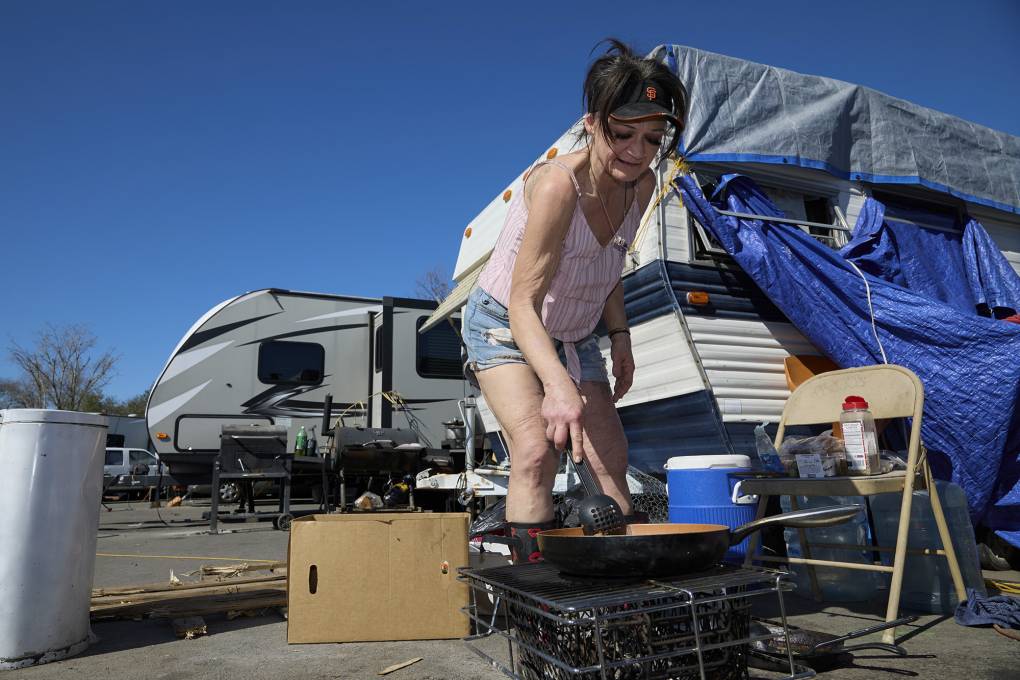
"caption": "Jeanne Gillis cooks ground turkey over a wood fire next to her trailer at Camp Resolution, a “self governed” homeless camp on city-owned land in Sacramento, Feb. 28, 2024. Residents have to rely on bottled water, generators and wood fires because no utilities are provided at the camp.",
"description": null,
"title": "022824_Self-Governed-City_FG_10",
"credit": "Fred Greaves/CalMatters",
"status": "inherit",
"altTag": "A woman wearing a visor, light sleeveless top and jean shorts holds a utensil to cook food on a grill outside.",
"isLoading": false,
"fetchFailed": false
},
"news_11978666": {
"type": "attachments",
"id": "news_11978666",
"meta": {
"index": "attachments_1716263798",
"site": "news",
"id": "11978666",
"found": true
},
"parent": 11978665,
"imgSizes": {
"twentyfourteen-full-width": {
"file": "https://cdn.kqed.org/wp-content/uploads/sites/10/2024/03/CMDaylight01-1038x576.jpg",
"width": 1038,
"mimeType": "image/jpeg",
"height": 576
},
"thumbnail": {
"file": "https://cdn.kqed.org/wp-content/uploads/sites/10/2024/03/CMDaylight01-160x107.jpg",
"width": 160,
"mimeType": "image/jpeg",
"height": 107
},
"post-thumbnail": {
"file": "https://cdn.kqed.org/wp-content/uploads/sites/10/2024/03/CMDaylight01-672x372.jpg",
"width": 672,
"mimeType": "image/jpeg",
"height": 372
},
"kqedFullSize": {
"file": "https://cdn.kqed.org/wp-content/uploads/sites/10/2024/03/CMDaylight01.jpg",
"width": 2000,
"height": 1333
},
"large": {
"file": "https://cdn.kqed.org/wp-content/uploads/sites/10/2024/03/CMDaylight01-1020x680.jpg",
"width": 1020,
"mimeType": "image/jpeg",
"height": 680
},
"1536x1536": {
"file": "https://cdn.kqed.org/wp-content/uploads/sites/10/2024/03/CMDaylight01-1536x1024.jpg",
"width": 1536,
"mimeType": "image/jpeg",
"height": 1024
},
"full-width": {
"file": "https://cdn.kqed.org/wp-content/uploads/sites/10/2024/03/CMDaylight01-1920x1280.jpg",
"width": 1920,
"mimeType": "image/jpeg",
"height": 1280
},
"medium": {
"file": "https://cdn.kqed.org/wp-content/uploads/sites/10/2024/03/CMDaylight01-800x533.jpg",
"width": 800,
"mimeType": "image/jpeg",
"height": 533
}
},
"publishDate": 1709919546,
"modified": 1709925972,
"caption": "The sun sets at the end of the day in Fresno on Aug. 30, 2022. ",
"description": null,
"title": "CMDaylight01",
"credit": "Larry Valenzuela, CalMatters/CatchLight Local",
"status": "inherit",
"altTag": "The sun sets in the distance as the silhouettes of trees dot the deep orange sky.",
"isLoading": false,
"fetchFailed": false
},
"news_11978533": {
"type": "attachments",
"id": "news_11978533",
"meta": {
"index": "attachments_1716263798",
"site": "news",
"id": "11978533",
"found": true
},
"title": "Senate Candidate Katie Porter Campaigns In Bay Area",
"publishDate": 1709835477,
"status": "inherit",
"parent": 11978528,
"modified": 1760123999,
"caption": "Former US Rep. Katie Porter (D-Calif.) speaks to members of the media during a campaign event on Feb. 24, 2024 in Emeryville. ",
"credit": "Josh Edelson/Getty Images",
"altTag": "A woman wearing a sleeveless red shirt has her hands raised with signs that read \"Katie Porter for Senate\" in the background.",
"description": null,
"imgSizes": {
"medium": {
"file": "https://cdn.kqed.org/wp-content/uploads/sites/10/2024/03/GettyImages-2028789203-800x544.jpg",
"width": 800,
"height": 544,
"mimeType": "image/jpeg"
},
"large": {
"file": "https://cdn.kqed.org/wp-content/uploads/sites/10/2024/03/GettyImages-2028789203-1020x693.jpg",
"width": 1020,
"height": 693,
"mimeType": "image/jpeg"
},
"thumbnail": {
"file": "https://cdn.kqed.org/wp-content/uploads/sites/10/2024/03/GettyImages-2028789203-160x109.jpg",
"width": 160,
"height": 109,
"mimeType": "image/jpeg"
},
"post-thumbnail": {
"file": "https://cdn.kqed.org/wp-content/uploads/sites/10/2024/03/GettyImages-2028789203-672x372.jpg",
"width": 672,
"height": 372,
"mimeType": "image/jpeg"
},
"twentyfourteen-full-width": {
"file": "https://cdn.kqed.org/wp-content/uploads/sites/10/2024/03/GettyImages-2028789203-1024x576.jpg",
"width": 1024,
"height": 576,
"mimeType": "image/jpeg"
},
"kqedFullSize": {
"file": "https://cdn.kqed.org/wp-content/uploads/sites/10/2024/03/GettyImages-2028789203.jpg",
"width": 1024,
"height": 696
}
},
"isLoading": false,
"fetchFailed": false
},
"news_11978450": {
"type": "attachments",
"id": "news_11978450",
"meta": {
"index": "attachments_1716263798",
"site": "news",
"id": "11978450",
"found": true
},
"parent": 11978448,
"imgSizes": {
"twentyfourteen-full-width": {
"file": "https://cdn.kqed.org/wp-content/uploads/sites/10/2024/03/CMHousingAI01-1038x576.jpg",
"width": 1038,
"mimeType": "image/jpeg",
"height": 576
},
"thumbnail": {
"file": "https://cdn.kqed.org/wp-content/uploads/sites/10/2024/03/CMHousingAI01-160x107.jpg",
"width": 160,
"mimeType": "image/jpeg",
"height": 107
},
"post-thumbnail": {
"file": "https://cdn.kqed.org/wp-content/uploads/sites/10/2024/03/CMHousingAI01-672x372.jpg",
"width": 672,
"mimeType": "image/jpeg",
"height": 372
},
"kqedFullSize": {
"file": "https://cdn.kqed.org/wp-content/uploads/sites/10/2024/03/CMHousingAI01.jpg",
"width": 2000,
"height": 1333
},
"large": {
"file": "https://cdn.kqed.org/wp-content/uploads/sites/10/2024/03/CMHousingAI01-1020x680.jpg",
"width": 1020,
"mimeType": "image/jpeg",
"height": 680
},
"1536x1536": {
"file": "https://cdn.kqed.org/wp-content/uploads/sites/10/2024/03/CMHousingAI01-1536x1024.jpg",
"width": 1536,
"mimeType": "image/jpeg",
"height": 1024
},
"full-width": {
"file": "https://cdn.kqed.org/wp-content/uploads/sites/10/2024/03/CMHousingAI01-1920x1280.jpg",
"width": 1920,
"mimeType": "image/jpeg",
"height": 1280
},
"medium": {
"file": "https://cdn.kqed.org/wp-content/uploads/sites/10/2024/03/CMHousingAI01-800x533.jpg",
"width": 800,
"mimeType": "image/jpeg",
"height": 533
}
},
"publishDate": 1709759665,
"modified": 1709759802,
"caption": "Sandricka Henderson receives support through Los Angeles County's Housing for Health Division's Homeless Prevention program. Feb. 29, 2024.",
"description": null,
"title": "CMHousingAI01",
"credit": "Jules Hotz/CalMatters",
"status": "inherit",
"altTag": null,
"isLoading": false,
"fetchFailed": false
},
"news_11978395": {
"type": "attachments",
"id": "news_11978395",
"meta": {
"index": "attachments_1716263798",
"site": "news",
"id": "11978395",
"found": true
},
"parent": 11978394,
"imgSizes": {
"twentyfourteen-full-width": {
"file": "https://cdn.kqed.org/wp-content/uploads/sites/10/2024/03/CMInflation01-1038x576.jpg",
"width": 1038,
"mimeType": "image/jpeg",
"height": 576
},
"thumbnail": {
"file": "https://cdn.kqed.org/wp-content/uploads/sites/10/2024/03/CMInflation01-160x107.jpg",
"width": 160,
"mimeType": "image/jpeg",
"height": 107
},
"post-thumbnail": {
"file": "https://cdn.kqed.org/wp-content/uploads/sites/10/2024/03/CMInflation01-672x372.jpg",
"width": 672,
"mimeType": "image/jpeg",
"height": 372
},
"kqedFullSize": {
"file": "https://cdn.kqed.org/wp-content/uploads/sites/10/2024/03/CMInflation01.jpg",
"width": 2000,
"height": 1334
},
"large": {
"file": "https://cdn.kqed.org/wp-content/uploads/sites/10/2024/03/CMInflation01-1020x680.jpg",
"width": 1020,
"mimeType": "image/jpeg",
"height": 680
},
"1536x1536": {
"file": "https://cdn.kqed.org/wp-content/uploads/sites/10/2024/03/CMInflation01-1536x1025.jpg",
"width": 1536,
"mimeType": "image/jpeg",
"height": 1025
},
"full-width": {
"file": "https://cdn.kqed.org/wp-content/uploads/sites/10/2024/03/CMInflation01-1920x1281.jpg",
"width": 1920,
"mimeType": "image/jpeg",
"height": 1281
},
"medium": {
"file": "https://cdn.kqed.org/wp-content/uploads/sites/10/2024/03/CMInflation01-800x534.jpg",
"width": 800,
"mimeType": "image/jpeg",
"height": 534
}
},
"publishDate": 1709747889,
"modified": 1709757972,
"caption": "Antionette Martinez and her son Caden, 5, do their biweekly grocery shop at FoodMaxx on July 26, 2019.",
"description": null,
"title": "CMInflation01",
"credit": "Anne Wernikoff/CalMatters",
"status": "inherit",
"altTag": "A woman reaches for an item on the top shelf at a grocery store beside a shopping cart with a child sitting in it.",
"isLoading": false,
"fetchFailed": false
},
"news_11969362": {
"type": "attachments",
"id": "news_11969362",
"meta": {
"index": "attachments_1716263798",
"site": "news",
"id": "11969362",
"found": true
},
"parent": 11969359,
"imgSizes": {
"twentyfourteen-full-width": {
"file": "https://cdn.kqed.org/wp-content/uploads/sites/10/2023/12/230726-SAN-QUENTIN-MHN-12-qut-1038x576.jpg",
"width": 1038,
"mimeType": "image/jpeg",
"height": 576
},
"thumbnail": {
"file": "https://cdn.kqed.org/wp-content/uploads/sites/10/2023/12/230726-SAN-QUENTIN-MHN-12-qut-160x107.jpg",
"width": 160,
"mimeType": "image/jpeg",
"height": 107
},
"post-thumbnail": {
"file": "https://cdn.kqed.org/wp-content/uploads/sites/10/2023/12/230726-SAN-QUENTIN-MHN-12-qut-672x372.jpg",
"width": 672,
"mimeType": "image/jpeg",
"height": 372
},
"kqedFullSize": {
"file": "https://cdn.kqed.org/wp-content/uploads/sites/10/2023/12/230726-SAN-QUENTIN-MHN-12-qut.jpg",
"width": 1920,
"height": 1280
},
"large": {
"file": "https://cdn.kqed.org/wp-content/uploads/sites/10/2023/12/230726-SAN-QUENTIN-MHN-12-qut-1020x680.jpg",
"width": 1020,
"mimeType": "image/jpeg",
"height": 680
},
"1536x1536": {
"file": "https://cdn.kqed.org/wp-content/uploads/sites/10/2023/12/230726-SAN-QUENTIN-MHN-12-qut-1536x1024.jpg",
"width": 1536,
"mimeType": "image/jpeg",
"height": 1024
},
"medium": {
"file": "https://cdn.kqed.org/wp-content/uploads/sites/10/2023/12/230726-SAN-QUENTIN-MHN-12-qut-800x533.jpg",
"width": 800,
"mimeType": "image/jpeg",
"height": 533
}
},
"publishDate": 1701998597,
"modified": 1702060032,
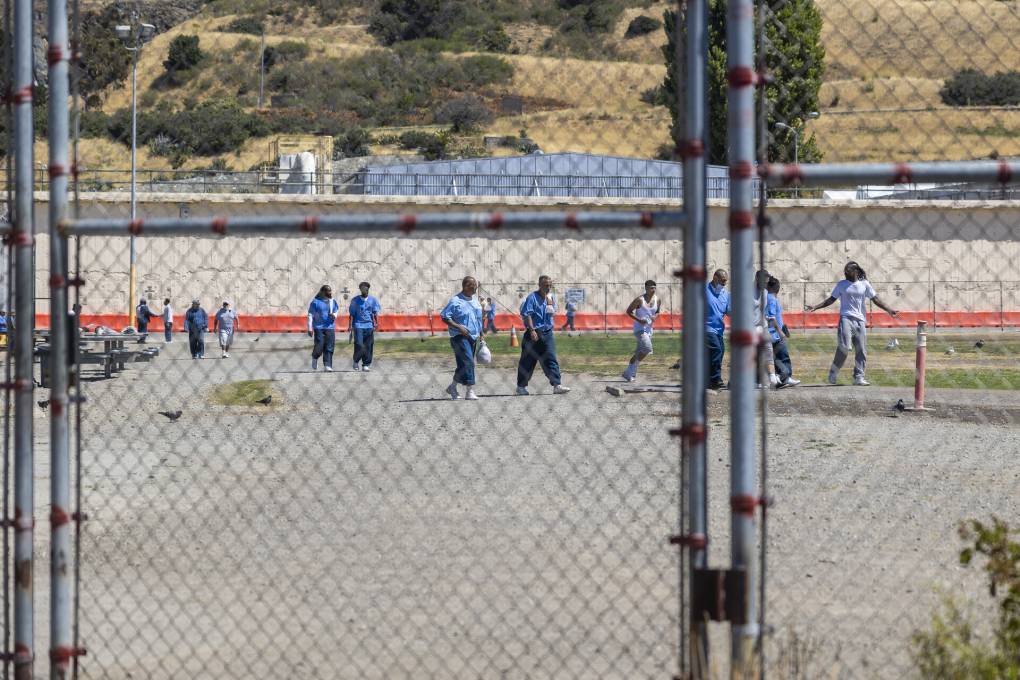
"caption": "Incarcerated people walk around a track at San Quentin State Prison in Marin County on July 26, 2023. ",
"description": null,
"title": "230726-SAN QUENTIN-MHN-12-qut",
"credit": "Martin do Nascimento",
"status": "inherit",
"altTag": "Men in blue uniforms walk around a large asphalt yard behind a locked fence.",
"isLoading": false,
"fetchFailed": false
},
"news_11977755": {
"type": "attachments",
"id": "news_11977755",
"meta": {
"index": "attachments_1716263798",
"site": "news",
"id": "11977755",
"found": true
},
"parent": 11977752,
"imgSizes": {
"twentyfourteen-full-width": {
"file": "https://cdn.kqed.org/wp-content/uploads/sites/10/2024/03/CMPollWorkers01-1038x576.jpg",
"width": 1038,
"mimeType": "image/jpeg",
"height": 576
},
"thumbnail": {
"file": "https://cdn.kqed.org/wp-content/uploads/sites/10/2024/03/CMPollWorkers01-160x107.jpg",
"width": 160,
"mimeType": "image/jpeg",
"height": 107
},
"post-thumbnail": {
"file": "https://cdn.kqed.org/wp-content/uploads/sites/10/2024/03/CMPollWorkers01-672x372.jpg",
"width": 672,
"mimeType": "image/jpeg",
"height": 372
},
"kqedFullSize": {
"file": "https://cdn.kqed.org/wp-content/uploads/sites/10/2024/03/CMPollWorkers01.jpg",
"width": 2000,
"height": 1333
},
"large": {
"file": "https://cdn.kqed.org/wp-content/uploads/sites/10/2024/03/CMPollWorkers01-1020x680.jpg",
"width": 1020,
"mimeType": "image/jpeg",
"height": 680
},
"1536x1536": {
"file": "https://cdn.kqed.org/wp-content/uploads/sites/10/2024/03/CMPollWorkers01-1536x1024.jpg",
"width": 1536,
"mimeType": "image/jpeg",
"height": 1024
},
"full-width": {
"file": "https://cdn.kqed.org/wp-content/uploads/sites/10/2024/03/CMPollWorkers01-1920x1280.jpg",
"width": 1920,
"mimeType": "image/jpeg",
"height": 1280
},
"medium": {
"file": "https://cdn.kqed.org/wp-content/uploads/sites/10/2024/03/CMPollWorkers01-800x533.jpg",
"width": 800,
"mimeType": "image/jpeg",
"height": 533
}
},
"publishDate": 1709323952,
"modified": 1709328576,
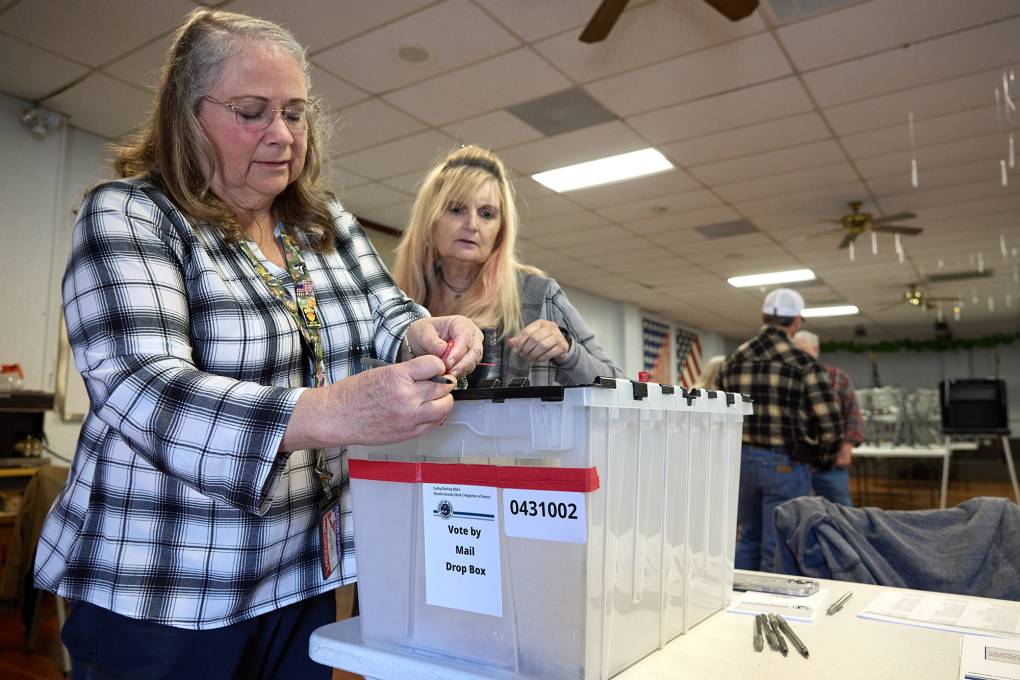
"caption": "Poll workers Twyla Carpenter (left) and Regina Jasperse inspect the lock on a vote by mail drop box at a polling station at the American Legion in Shasta Lake, California, during a special election in Shasta County on Nov. 7, 2023. Workers must verify that the locks are intact and secure the box multiple times during the day.",
"description": null,
"title": "CMPollWorkers01",
"credit": "Fred Greaves/CalMatters",
"status": "inherit",
"altTag": null,
"isLoading": false,
"fetchFailed": false
}
},
"audioPlayerReducer": {
"postId": "stream_live",
"isPaused": true,
"isPlaying": false,
"pfsActive": false,
"pledgeModalIsOpen": true,
"playerDrawerIsOpen": false,
"liveAudioPlayStartedAt": 0,
"liveAudioPlayContext": ""
},
"authorsReducer": {
"byline_news_11979306": {
"type": "authors",
"id": "byline_news_11979306",
"meta": {
"override": true
},
"slug": "byline_news_11979306",
"name": "\u003ca href=\"https://calmatters.org/author/khari-johnson/\">Khari Johnson\u003c/a>",
"isLoading": false
},
"byline_news_11979392": {
"type": "authors",
"id": "byline_news_11979392",
"meta": {
"override": true
},
"slug": "byline_news_11979392",
"name": "\u003ca>Rachel Becker\u003c/a>",
"isLoading": false
},
"byline_news_11979186": {
"type": "authors",
"id": "byline_news_11979186",
"meta": {
"override": true
},
"slug": "byline_news_11979186",
"name": "\u003ca href=\"https://calmatters.org/author/alejandra-reyesvelarde/\">Alejandra Reyes-Velarde\u003c/a>",
"isLoading": false
},
"byline_news_11979008": {
"type": "authors",
"id": "byline_news_11979008",
"meta": {
"override": true
},
"slug": "byline_news_11979008",
"name": "\u003ca href=\"https://calmatters.org/author/rachel-becker/\">Rachel Becker\u003c/a>",
"isLoading": false
},
"byline_news_11978919": {
"type": "authors",
"id": "byline_news_11978919",
"meta": {
"override": true
},
"slug": "byline_news_11978919",
"name": "Kristen Hwang and Jeanne Kuang",
"isLoading": false
},
"byline_news_11978863": {
"type": "authors",
"id": "byline_news_11978863",
"meta": {
"override": true
},
"slug": "byline_news_11978863",
"name": "Marisa Kendall",
"isLoading": false
},
"byline_news_11978665": {
"type": "authors",
"id": "byline_news_11978665",
"meta": {
"override": true
},
"slug": "byline_news_11978665",
"name": "\u003ca href=\"https://calmatters.org/author/lynn-la/\">Lynn La\u003c/a>",
"isLoading": false
},
"byline_news_11978528": {
"type": "authors",
"id": "byline_news_11978528",
"meta": {
"override": true
},
"slug": "byline_news_11978528",
"name": "\u003ca href=\"https://calmatters.org/author/yue-yu/\">Yue Stella Yu\u003c/a>",
"isLoading": false
},
"byline_news_11978448": {
"type": "authors",
"id": "byline_news_11978448",
"meta": {
"override": true
},
"slug": "byline_news_11978448",
"name": "\u003ca href=\"https://calmatters.org/author/marisa-kendall/\">Marisa Kendall\u003c/a>",
"isLoading": false
},
"byline_news_11978394": {
"type": "authors",
"id": "byline_news_11978394",
"meta": {
"override": true
},
"slug": "byline_news_11978394",
"name": "\u003ca href=\"https://calmatters.org/author/levi-sumagaysay/\">Levi Sumagaysay\u003c/a>",
"isLoading": false
},
"byline_news_11978127": {
"type": "authors",
"id": "byline_news_11978127",
"meta": {
"override": true
},
"slug": "byline_news_11978127",
"name": "Nigel Duara",
"isLoading": false
},
"byline_news_11977752": {
"type": "authors",
"id": "byline_news_11977752",
"meta": {
"override": true
},
"slug": "byline_news_11977752",
"name": "\u003ca href=\"https://calmatters.org/author/sameea-kamal/\">Sameea Kamal\u003c/a>",
"isLoading": false
}
},
"pagesReducer": {
"news_affiliate_calmatters": {
"type": "terms",
"id": "news_18481",
"meta": {
"index": "terms_1716263798",
"site": "news",
"id": "18481",
"score": 15.355904
},
"featImg": null,
"name": "CALmatters",
"description": null,
"taxonomy": "affiliate",
"headData": {
"twImgId": null,
"twTitle": null,
"ogTitle": null,
"ogImgId": null,
"twDescription": null,
"description": null,
"title": "CALmatters Archives | KQED Arts",
"ogDescription": null
},
"ttid": 18515,
"slug": "calmatters",
"isLoading": false,
"title": "CALmatters",
"pageMeta": {
"site": "news",
"WpPageTemplate": "page-topic-editorial",
"currentPage": 35
},
"blocks": [
{
"blockName": "kqed/post-list",
"attrs": {
"layout": "cardArticle2",
"query": "posts/news?affiliate=calmatters",
"seeMore": false,
"paginated": true,
"page": 35
}
},
{
"blockName": "kqed/ad"
}
]
}
},
"pfsSessionReducer": {},
"postsReducer": {
"stream_live": {
"type": "live",
"id": "stream_live",
"audioUrl": "https://streams.kqed.org/kqedradio",
"title": "Live Stream",
"excerpt": "Live Stream information currently unavailable.",
"link": "/radio",
"featImg": "",
"label": {
"name": "KQED Live",
"link": "/"
}
},
"stream_kqedNewscast": {
"type": "posts",
"id": "stream_kqedNewscast",
"audioUrl": "https://www.kqed.org/.stream/anon/radio/RDnews/newscast.mp3?_=1",
"title": "KQED Newscast",
"featImg": "",
"label": {
"name": "88.5 FM",
"link": "/"
}
},
"news_11979306": {
"type": "posts",
"id": "news_11979306",
"meta": {
"index": "posts_1716263798",
"site": "news",
"id": "11979306",
"score": null,
"sort": [
1710414015000
]
},
"guestAuthors": [],
"slug": "california-takes-steps-to-regulate-ai-use-by-large-companies",
"title": "California Privacy Agency Advances AI Rules to Protect Consumer Data",
"publishDate": 1710414015,
"format": "standard",
"headTitle": "California Privacy Agency Advances AI Rules to Protect Consumer Data | KQED",
"labelTerm": {
"term": 18481,
"site": "news"
},
"content": "\u003cp>Rules around businesses using artificial intelligence have begun to come into focus for the first time.\u003c/p>\n\u003cp>The California Privacy Protection Agency board on Friday voted 3–2 to advance rules about how businesses use artificial intelligence and collect the personal information of consumers, workers, and students. The vote, which took place in Oakland, continues a process that started in November 2021.\u003c/p>\n\u003cp>The proposed rules seek to create guidelines for the many areas in which AI and personal data can influence the lives of Californians: job compensation, demotion, and opportunity; housing, insurance, health care, and student expulsion. For example, under the rules, if an employer wanted to use AI to make predictions about a person’s emotional state or personality during a job interview, a job candidate could opt out without fear of discrimination for choosing to do so.\u003c/p>\n\u003cp>Under the rules advanced on Friday, businesses must notify people before using AI. If people opt out of interacting with an AI model, businesses cannot discriminate against people for that choice. If people agree to use an AI service or tool, businesses must respond to requests by individuals about how they use their personal information to make predictions. The rules would also require employers or third-party contractors to carry out risk assessments to evaluate the performance of their technology.\u003c/p>\n\u003cp>The proposed rules would affect any company making more than $25 million in annual revenue or processing the personal data of more than 100,000 Californians. AI regulation in California could be disproportionately influential. A \u003ca href=\"https://www.axios.com/local/san-diego/2023/08/02/california-san-diego-ai-technology-forbes-brookings\">Forbes analysis\u003c/a> found that 35 of the top 50 AI companies in the world are headquartered in California.\u003c/p>\n\u003cp>[ad fullwidth]\u003c/p>\n\u003cp>The process for making rules around AI underway in California is unique because it affects workers, students as well as consumers. And whereas many states leave enforcement of data privacy laws to attorneys general, California’s data privacy law is enforced by a board with the power to make rules. Draft rules for automated decision-making technology and AI go beyond privacy bills in other states like Colorado and Washington or Europe’s General Data Protection Regulation to extend privacy protections to full-time employees, independent contractors, and job applicants.\u003c/p>\n\u003cp>[aside postID=\"news_11976097,news_11972309,news_11973657\" label=\"Related Stories\"]Disclosure is a core part of AI regulation efforts like the privacy protection agency draft rules and the AI Act, which European Union lawmakers expect to pass into law in the coming months. A lack of disclosure has led to instances in recent years where bias algorithms can automate \u003ca href=\"https://www.wired.com/story/wrongful-arrests-ai-derailed-3-mens-lives/\">indignity and discrimination\u003c/a>. Algorithms have also made critical decisions about things like housing, health care or education without consumer’s knowledge or consent. Once both laws go into effect, businesses will have 24 months to comply.\u003c/p>\n\u003ch2>An artificial intelligence loophole?\u003c/h2>\n\u003cp>More than 20 labor unions and digital rights organizations say the latest iteration of the rules — introduced a few days before the meeting — is watered down and introduces loopholes that would let businesses evade accountability when using the technology. Privacy board staff introduced the first version of draft rules last fall.\u003c/p>\n\u003cp>Those digital rights advocates — including organizations like the California Labor Federation and UC Berkeley Labor Center — said the rules eliminate an opt-out option from previous versions of the rules and change the definition of a key term in a way that could be taken advantage of.\u003c/p>\n\u003cp>Changing the definition of automated decision-making technology to one that only covers technology that “substantially facilitates human decision making,” the advocates argue, creates an opening for companies to side-step accountability.\u003c/p>\n\u003cp>“Companies could easily claim that they do not use automated systems that ‘substantially facilitate’ human decisions,” reads a letter issued by the advocates and shared with CalMatters. “This revision deprives the agency of necessary information about how risk-prone algorithmic tools are being used.”\u003c/p>\n\u003cp>That language change sounds like a gap in the law, said board member Vinhcent Le, who was part of a subcommittee that worked with privacy protection agency lawyers and staff to develop the first draft of rules more than two years ago.\u003c/p>\n\u003cp>“If this advances as is, we should focus on making sure this doesn’t become a big loophole,” he said.\u003c/p>\n\u003cp>California is the first and only place where employees are getting critical info about their data, UC Berkeley Labor Center Director Annette Bernhardt told the board during public comment ahead of the vote, and recent amendments threaten to deprive workers of agency over algorithmic tools.\u003c/p>\n\u003cp>In public comment at a December 2023 meeting where the board held its first discussions of the draft rules, business groups argued in favor of an exemption from public records requests and eliminating risk assessment approval by a company board of directors. Business interests like the Bay Area Council — whose members include big AI companies like Amazon, Google and Meta — previously argued that the draft rule definitions of AI and automated decision making were too broad.\u003c/p>\n\u003cp>Privacy Protection Agency Executive Director Ashkan Soltani said he’s looking forward to more input from the public since roughly 90% of feedback thus far has come from business lobbyists.\u003c/p>\n\u003ch2>AI rules moving toward completion\u003c/h2>\n\u003cp>Before Friday’s vote, board member Lydia de la Torre said she wasn’t comfortable moving the rules forward without unanimous approval because they are likely to face litigation from lawyers who are already telling the board that the draft rules represent an overreach.\u003c/p>\n\u003cp>Board member Alastair Mactaggart said he voted no because he still finds the definition of automated decision-making technology “extraordinarily broad” and said the rules should not move forward because they will require every business to carry out risk assessments.\u003c/p>\n\u003cp>In response to de La Torre’s concern about litigation, board member Jeffrey Worthe said the meaningful vote is not now but when the board ends the public feedback process and votes to begin formal rulemaking.\u003c/p>\n\u003cp>“It’s time to move this to a wider audience,” he said. “We don’t have to have it all decided now.”\u003c/p>\n\u003cp>Research \u003ca href=\"https://laborcenter.berkeley.edu/wp-content/uploads/2021/11/Data-and-Algorithms-at-Work.pdf\">co-authored by Bernhardt (PDF)\u003c/a> found that workplace surveillance is on the rise and that it’s often used by small or mid-sized companies that obtain technology with little knowledge about how the tech works. She told CalMatters she’s less worried about AI eliminating jobs than she is about algorithms used in the workplace treating people like machines.\u003c/p>\n\u003cp>Staff counsel Neelofer Shaikh characterized workers subject to workplace surveillance as particularly vulnerable because “it is much harder to leave your workplace if you are subject to intensive profiling than to just leave a website.”\u003c/p>\n\u003cp>Work on draft AI regulation to protect the personal privacy of consumers and workers started shortly after the formation of the board following the \u003ca href=\"https://calmatters.org/election-2020-guide/proposition-24-data-privacy/\">November 2020 passage\u003c/a> of the California Privacy Rights Act, which directs the board to protect the personal privacy of California residents.\u003c/p>\n\u003cp>[ad floatright]\u003c/p>\n\u003cp>In July, there will be another vote on these rules. Privacy protection agency staff don’t expect a final vote to approve the draft rules to take place for another year.\u003c/p>\n\n",
"blocks": [],
"excerpt": "The multi-year process started in late 2021 and took the next step toward regulating the business use of AI in California. Given the number of AI companies in the state, the rules are expected to be influential.",
"status": "publish",
"parent": 0,
"modified": 1726245145,
"stats": {
"hasAudio": false,
"hasVideo": false,
"hasChartOrMap": false,
"iframeSrcs": [],
"hasGoogleForm": false,
"hasGallery": false,
"hasHearkenModule": false,
"hasPolis": false,
"paragraphCount": 26,
"wordCount": 1207
},
"headData": {
"title": "California Privacy Agency Advances AI Rules to Protect Consumer Data | KQED",
"description": "The multi-year process started in late 2021 and took the next step toward regulating the business use of AI in California. Given the number of AI companies in the state, the rules are expected to be influential.",
"ogTitle": "",
"ogDescription": "",
"ogImgId": "",
"twTitle": "",
"twDescription": "",
"twImgId": "",
"schema": {
"@context": "https://schema.org",
"@type": "NewsArticle",
"headline": "California Privacy Agency Advances AI Rules to Protect Consumer Data",
"datePublished": "2024-03-14T04:00:15-07:00",
"dateModified": "2024-09-13T09:32:25-07:00",
"image": "https://cdn.kqed.org/wp-content/uploads/2020/02/KQED-OG-Image@1x.png",
"isAccessibleForFree": "True",
"publisher": {
"@type": "NewsMediaOrganization",
"@id": "https://www.kqed.org/#organization",
"name": "KQED",
"logo": "https://cdn.kqed.org/wp-content/uploads/2020/02/KQED-OG-Image@1x.png",
"url": "https://www.kqed.org",
"sameAs": [
"https://www.facebook.com/KQED",
"https://twitter.com/KQED",
"https://www.instagram.com/kqed/",
"https://www.tiktok.com/@kqedofficial",
"https://www.linkedin.com/company/kqed",
"https://www.youtube.com/channel/UCeC0IOo7i1P_61zVUWbJ4nw"
]
}
}
},
"sticky": false,
"nprByline": "\u003ca href=\"https://calmatters.org/author/khari-johnson/\">Khari Johnson\u003c/a>",
"excludeFromSiteSearch": "Include",
"showOnAuthorArchivePages": "No",
"articleAge": "0",
"path": "/news/11979306/california-takes-steps-to-regulate-ai-use-by-large-companies",
"audioTrackLength": null,
"parsedContent": [
{
"type": "contentString",
"content": "\u003cdiv class=\"post-body\">\u003cp>\u003cp>Rules around businesses using artificial intelligence have begun to come into focus for the first time.\u003c/p>\n\u003cp>The California Privacy Protection Agency board on Friday voted 3–2 to advance rules about how businesses use artificial intelligence and collect the personal information of consumers, workers, and students. The vote, which took place in Oakland, continues a process that started in November 2021.\u003c/p>\n\u003cp>The proposed rules seek to create guidelines for the many areas in which AI and personal data can influence the lives of Californians: job compensation, demotion, and opportunity; housing, insurance, health care, and student expulsion. For example, under the rules, if an employer wanted to use AI to make predictions about a person’s emotional state or personality during a job interview, a job candidate could opt out without fear of discrimination for choosing to do so.\u003c/p>\n\u003cp>Under the rules advanced on Friday, businesses must notify people before using AI. If people opt out of interacting with an AI model, businesses cannot discriminate against people for that choice. If people agree to use an AI service or tool, businesses must respond to requests by individuals about how they use their personal information to make predictions. The rules would also require employers or third-party contractors to carry out risk assessments to evaluate the performance of their technology.\u003c/p>\n\u003cp>The proposed rules would affect any company making more than $25 million in annual revenue or processing the personal data of more than 100,000 Californians. AI regulation in California could be disproportionately influential. A \u003ca href=\"https://www.axios.com/local/san-diego/2023/08/02/california-san-diego-ai-technology-forbes-brookings\">Forbes analysis\u003c/a> found that 35 of the top 50 AI companies in the world are headquartered in California.\u003c/p>\n\u003cp>\u003c/p>\u003c/div>",
"attributes": {
"named": {},
"numeric": []
}
},
{
"type": "component",
"content": "",
"name": "ad",
"attributes": {
"named": {
"label": "fullwidth"
},
"numeric": [
"fullwidth"
]
}
},
{
"type": "contentString",
"content": "\u003cdiv class=\"post-body\">\u003cp>\u003c/p>\n\u003cp>The process for making rules around AI underway in California is unique because it affects workers, students as well as consumers. And whereas many states leave enforcement of data privacy laws to attorneys general, California’s data privacy law is enforced by a board with the power to make rules. Draft rules for automated decision-making technology and AI go beyond privacy bills in other states like Colorado and Washington or Europe’s General Data Protection Regulation to extend privacy protections to full-time employees, independent contractors, and job applicants.\u003c/p>\n\u003cp>\u003c/p>\u003c/div>",
"attributes": {
"named": {},
"numeric": []
}
},
{
"type": "component",
"content": "",
"name": "aside",
"attributes": {
"named": {
"postid": "news_11976097,news_11972309,news_11973657",
"label": "Related Stories "
},
"numeric": []
}
},
{
"type": "contentString",
"content": "\u003cdiv class=\"post-body\">\u003cp>Disclosure is a core part of AI regulation efforts like the privacy protection agency draft rules and the AI Act, which European Union lawmakers expect to pass into law in the coming months. A lack of disclosure has led to instances in recent years where bias algorithms can automate \u003ca href=\"https://www.wired.com/story/wrongful-arrests-ai-derailed-3-mens-lives/\">indignity and discrimination\u003c/a>. Algorithms have also made critical decisions about things like housing, health care or education without consumer’s knowledge or consent. Once both laws go into effect, businesses will have 24 months to comply.\u003c/p>\n\u003ch2>An artificial intelligence loophole?\u003c/h2>\n\u003cp>More than 20 labor unions and digital rights organizations say the latest iteration of the rules — introduced a few days before the meeting — is watered down and introduces loopholes that would let businesses evade accountability when using the technology. Privacy board staff introduced the first version of draft rules last fall.\u003c/p>\n\u003cp>Those digital rights advocates — including organizations like the California Labor Federation and UC Berkeley Labor Center — said the rules eliminate an opt-out option from previous versions of the rules and change the definition of a key term in a way that could be taken advantage of.\u003c/p>\n\u003cp>Changing the definition of automated decision-making technology to one that only covers technology that “substantially facilitates human decision making,” the advocates argue, creates an opening for companies to side-step accountability.\u003c/p>\n\u003cp>“Companies could easily claim that they do not use automated systems that ‘substantially facilitate’ human decisions,” reads a letter issued by the advocates and shared with CalMatters. “This revision deprives the agency of necessary information about how risk-prone algorithmic tools are being used.”\u003c/p>\n\u003cp>That language change sounds like a gap in the law, said board member Vinhcent Le, who was part of a subcommittee that worked with privacy protection agency lawyers and staff to develop the first draft of rules more than two years ago.\u003c/p>\n\u003cp>“If this advances as is, we should focus on making sure this doesn’t become a big loophole,” he said.\u003c/p>\n\u003cp>California is the first and only place where employees are getting critical info about their data, UC Berkeley Labor Center Director Annette Bernhardt told the board during public comment ahead of the vote, and recent amendments threaten to deprive workers of agency over algorithmic tools.\u003c/p>\n\u003cp>In public comment at a December 2023 meeting where the board held its first discussions of the draft rules, business groups argued in favor of an exemption from public records requests and eliminating risk assessment approval by a company board of directors. Business interests like the Bay Area Council — whose members include big AI companies like Amazon, Google and Meta — previously argued that the draft rule definitions of AI and automated decision making were too broad.\u003c/p>\n\u003cp>Privacy Protection Agency Executive Director Ashkan Soltani said he’s looking forward to more input from the public since roughly 90% of feedback thus far has come from business lobbyists.\u003c/p>\n\u003ch2>AI rules moving toward completion\u003c/h2>\n\u003cp>Before Friday’s vote, board member Lydia de la Torre said she wasn’t comfortable moving the rules forward without unanimous approval because they are likely to face litigation from lawyers who are already telling the board that the draft rules represent an overreach.\u003c/p>\n\u003cp>Board member Alastair Mactaggart said he voted no because he still finds the definition of automated decision-making technology “extraordinarily broad” and said the rules should not move forward because they will require every business to carry out risk assessments.\u003c/p>\n\u003cp>In response to de La Torre’s concern about litigation, board member Jeffrey Worthe said the meaningful vote is not now but when the board ends the public feedback process and votes to begin formal rulemaking.\u003c/p>\n\u003cp>“It’s time to move this to a wider audience,” he said. “We don’t have to have it all decided now.”\u003c/p>\n\u003cp>Research \u003ca href=\"https://laborcenter.berkeley.edu/wp-content/uploads/2021/11/Data-and-Algorithms-at-Work.pdf\">co-authored by Bernhardt (PDF)\u003c/a> found that workplace surveillance is on the rise and that it’s often used by small or mid-sized companies that obtain technology with little knowledge about how the tech works. She told CalMatters she’s less worried about AI eliminating jobs than she is about algorithms used in the workplace treating people like machines.\u003c/p>\n\u003cp>Staff counsel Neelofer Shaikh characterized workers subject to workplace surveillance as particularly vulnerable because “it is much harder to leave your workplace if you are subject to intensive profiling than to just leave a website.”\u003c/p>\n\u003cp>Work on draft AI regulation to protect the personal privacy of consumers and workers started shortly after the formation of the board following the \u003ca href=\"https://calmatters.org/election-2020-guide/proposition-24-data-privacy/\">November 2020 passage\u003c/a> of the California Privacy Rights Act, which directs the board to protect the personal privacy of California residents.\u003c/p>\n\u003cp>\u003c/p>\u003c/div>",
"attributes": {
"named": {},
"numeric": []
}
},
{
"type": "component",
"content": "",
"name": "ad",
"attributes": {
"named": {
"label": "floatright"
},
"numeric": [
"floatright"
]
}
},
{
"type": "contentString",
"content": "\u003cdiv class=\"post-body\">\u003cp>\u003c/p>\n\u003cp>In July, there will be another vote on these rules. Privacy protection agency staff don’t expect a final vote to approve the draft rules to take place for another year.\u003c/p>\n\n\u003c/div>\u003c/p>",
"attributes": {
"named": {},
"numeric": []
}
}
],
"link": "/news/11979306/california-takes-steps-to-regulate-ai-use-by-large-companies",
"authors": [
"byline_news_11979306"
],
"categories": [
"news_8"
],
"tags": [
"news_25184",
"news_2414",
"news_4289"
],
"affiliates": [
"news_18481"
],
"featImg": "news_11979310",
"label": "news_18481"
},
"news_11979392": {
"type": "posts",
"id": "news_11979392",
"meta": {
"index": "posts_1716263798",
"site": "news",
"id": "11979392",
"score": null,
"sort": [
1710376653000
]
},
"parent": 0,
"labelTerm": {
"site": "news",
"term": 18481
},
"blocks": [],
"publishDate": 1710376653,
"format": "standard",
"title": "California Weakens Plan for Mandatory Cutbacks in Urban Water Use",
"headTitle": "California Weakens Plan for Mandatory Cutbacks in Urban Water Use | KQED",
"content": "\u003cp>Facing criticism over their ambitious plan to curb urban water use, California’s regulators on Tuesday weakened the proposed rules — giving water providers more\u003cstrong> \u003c/strong>years and flexibility to comply.\u003c/p>\n\u003cp>Cities and urban water districts welcome the changes to the state’s draft conservation rules, which they said would have been too costly for ratepayers, \u003ca href=\"https://calmatters.org/environment/2024/01/california-new-water-conservation-rules-analyst-report/\">estimated at $13.5 billion\u003c/a>, and too difficult to achieve.\u003c/p>\n\u003cp>However, environmentalists are dismayed by the revisions, which they said won’t save enough water for weather shortages as climate change squeezes supplies.\u003c/p>\n\u003cp>[pullquote align=\"right\" size=\"medium\" citation=\"Tracy Quinn, CEO and president, Heal the Bay\"]‘It’s really looking like this is a ‘do nothing’ regulation. The updated standards are weak, and the regulation includes semi-truck sized loopholes that make it too easy for water suppliers to shirk their obligation to use water more efficiently.’[/pullquote]“It’s really looking like this is a ‘do nothing’ regulation,” said \u003ca href=\"https://healthebay.org/staff/tracy-quinn/\">Tracy Quinn\u003c/a>, CEO and president of Heal the Bay, a Los Angeles County environmental group. “The updated standards are weak, and the regulation includes semi-truck sized loopholes that make it too easy for water suppliers to shirk their obligation to use water more efficiently.”\u003c/p>\n\u003cp>Mandated by a package of laws enacted in 2018, the rules from the State Water Resources Control Board aim to make “\u003ca href=\"https://water.ca.gov/-/media/DWR-Website/Web-Pages/Programs/Water-Use-And-Efficiency/Make-Water-Conservation-A-California-Way-of-Life/Files/PDFs/Final-WCL-Primer.pdf?la=en&hash=B442FD7A34349FA91DA5CDEFC47134EA38ABF209\">water conservation a California way of life (PDF)\u003c/a>” by mandating cuts in water use among more than 400 cities and water agencies that supply the vast majority of Californians.\u003c/p>\n\u003cp>The regulation won’t set mandatory conservation targets for individuals. Instead, it creates water budgets for cities and districts, which would meet them through rebates, new rate structures and other efforts to cut their customers’ use.\u003c/p>\n\u003cp>The Legislative Analyst’s Office, in a January report, \u003ca href=\"https://calmatters.org/environment/2024/01/california-new-water-conservation-rules-analyst-report/\">heavily criticized the original rules,\u003c/a> saying they would set “such stringent standards for outdoor use that suppliers will not have much ‘wiggle room’ in complying.”\u003c/p>\n\u003cp>Warning that the costs may outweigh the benefits, the analysts recommended relaxing several of the requirements, such as the residential outdoor standard, and extending deadlines.\u003c/p>\n\u003cp>The board’s new revisions delay the start date for enforcing compliance with the water budgets by two years, until 2027 \u003cstrong>— \u003c/strong>largely because the water board is behind schedule in adopting the regulation, its executive director, \u003ca href=\"https://www.waterboards.ca.gov/about_us/board_members/leadership.html\">Eric Oppenheimer\u003c/a>, said. Water suppliers are also granted an extra five years, until 2035, to meet targets ramping down outdoor water use and are given until 2040 for reductions originally planned for 2035.\u003c/p>\n\u003cp>[ad fullwidth]\u003c/p>\n\u003cp>The latest version would conserve about 520,000 acre-feet of water a year starting in 2040, according to the water board’s estimates. That’s 170,000 acre-feet less than the previous version,\u003cem> \u003c/em>enough to serve more than half a million households for a year.\u003c/p>\n\u003cp>California Gov. Gavin Newsom has called for \u003ca href=\"https://resources.ca.gov/-/media/CNRA-Website/Files/Initiatives/Water-Resilience/CA-Water-Supply-Strategy.pdf\">at least 500,000 acre-feet in annual conservation by 2030 (PDF)\u003c/a>.\u003c/p>\n\u003cp>When the rules are finalized, each water supplier must meet individualized conservation goals, calculated from a complex formula based on standards for indoor and outdoor residential water use and certain commercial landscapes, as well as losses like leaks. Other variables, such as the presence of livestock in a region or the availability of recycled water, can factor into the calculation.\u003c/p>\n\u003cp>The water board said it would vote on the updated plan in July, following public comment, and it would take effect at the beginning of next year.\u003c/p>\n\u003cp>Statewide, 63 water suppliers, serving about 9% of the population where household incomes are below the state median, will be required to cut water use by more than 20%. Under the revisions, they could cut use by only 1% per year and still be deemed in compliance, provided they meet other requirements. Another 19 suppliers in wealthier regions facing cuts of 30% or more could cut use by only 2% per year and still comply.\u003c/p>\n\u003cp>[pullquote align=\"right\" size=\"medium\" citation=\"Eric Oppenheimer, director, State Water Resources Control Board\"]‘You still have to meet your objective, whatever that may be. But you get more time to get there — in some cases, substantially more time.’[/pullquote]“You still have to meet your objective, whatever that may be. But you get more time to get there — in some cases, substantially more time,” Oppenheimer said.\u003c/p>\n\u003cp>“That would mean that if your ultimate compliance target was 30%, you’d have 30 years to get there,” compared to approximately 15 years under the old version, Oppenheimer said.\u003c/p>\n\u003cp>Water suppliers welcomed the extended deadlines because they would have more time to coax customers with rebates and other programs to make lasting changes to irrigated landscapes without harming shade trees and disadvantaged communities.\u003c/p>\n\u003cp>The changes will allow “urban retail water suppliers to thoughtfully and cost-effectively implement programs,” said \u003ca href=\"https://www.acwa.com/about/leadership-staff/\">Chelsea Haines\u003c/a> of the Association of California Water Agencies, which represents more than 450 public agencies. “I hope that we see this additional time not as a delay but as an opportunity.”\u003c/p>\n\u003cp>[aside label=\"Related Stories\" postID=\"news_11971872,news_11969648,news_11977573\"]The water board does not have an updated cost estimate for the revised rules to compare to the $13.5 billion estimate for the old version. The costs come largely because cities and agencies would offer rebates and rate cuts to those who conserve. The benefits were estimated to reach about $15.6 billion, largely because suppliers and customers will buy less water.\u003c/p>\n\u003cp>Environmentalists say the delays belie the urgency of preparing for the next inevitable drought and will force more drastic changes to landscapes when emergency conservation measures are needed once again.\u003c/p>\n\u003cp>“The fact that we aren’t taking steps as quickly as possible to invest in more climate resilient landscapes that will be able to survive those future droughts is unthinkable. Quite frankly, it’s reckless,” Quinn said.\u003c/p>\n\u003cp>\u003ca href=\"https://pacinst.org/meet-our-staff-heather-cooley/\">Heather Cooley\u003c/a>, director of research for the Pacific Institute, said conservation is cheaper than developing new supplies through desalination or recycling — a burden that customers would eventually bear.\u003c/p>\n\u003cp>“By weakening the standard, we’re making water more expensive,” Cooley said.\u003c/p>\n\u003cp>[pullquote align=\"right\" size=\"medium\" citation=\"Heather Cooley, director of research, Pacific Institute\"]‘By weakening the standard, we’re making water more expensive.’[/pullquote]Under a previous version of the rules, about 18% of suppliers — serving about a quarter of the state’s population — wouldn’t have to reduce their customers’ use to meet the 2035 standards, according to the board’s estimates last September. Now, under the new version, 37% of suppliers — serving 42% of the state’s population — wouldn’t have to change their water use by 2035. And by 2040, 31% could still maintain their status quo, according to water board data.\u003c/p>\n\u003cp>Asked if they were concerned about the reduced savings under the latest version, Oppenheimer said flexibility and feasibility are important.\u003cem> \u003c/em>\u003c/p>\n\u003cp>“We think 500,000 acre-feet of saved project savings is a substantial amount,” he said. “More is always better, but that needs to be balanced against providing enough flexibility to the water suppliers and the feasibility of meeting those standards.”\u003c/p>\n\u003cp>[ad floatright]\u003c/p>\n",
"stats": {
"hasVideo": false,
"hasChartOrMap": false,
"hasAudio": false,
"hasPolis": false,
"wordCount": 1247,
"hasGoogleForm": false,
"hasGallery": false,
"hasHearkenModule": false,
"iframeSrcs": [],
"paragraphCount": 28
},
"modified": 1710441920,
"excerpt": "The revised proposal grants water providers an extra five years to reduce outdoor irrigation. Cities and water agencies that have lobbied for the extension are relieved, while critics say Californians will keep wasting water.",
"headData": {
"twImgId": "",
"twTitle": "",
"ogTitle": "",
"ogImgId": "",
"twDescription": "",
"description": "The revised proposal grants water providers an extra five years to reduce outdoor irrigation. Cities and water agencies that have lobbied for the extension are relieved, while critics say Californians will keep wasting water.",
"title": "California Weakens Plan for Mandatory Cutbacks in Urban Water Use | KQED",
"ogDescription": "",
"schema": {
"@context": "https://schema.org",
"@type": "NewsArticle",
"headline": "California Weakens Plan for Mandatory Cutbacks in Urban Water Use",
"datePublished": "2024-03-13T17:37:33-07:00",
"dateModified": "2024-03-14T11:45:20-07:00",
"image": "https://cdn.kqed.org/wp-content/uploads/2020/02/KQED-OG-Image@1x.png",
"isAccessibleForFree": "True",
"publisher": {
"@type": "NewsMediaOrganization",
"@id": "https://www.kqed.org/#organization",
"name": "KQED",
"logo": "https://cdn.kqed.org/wp-content/uploads/2020/02/KQED-OG-Image@1x.png",
"url": "https://www.kqed.org",
"sameAs": [
"https://www.facebook.com/KQED",
"https://twitter.com/KQED",
"https://www.instagram.com/kqed/",
"https://www.tiktok.com/@kqedofficial",
"https://www.linkedin.com/company/kqed",
"https://www.youtube.com/channel/UCeC0IOo7i1P_61zVUWbJ4nw"
]
}
}
},
"guestAuthors": [],
"slug": "california-weakens-plan-for-mandatory-cutbacks-in-urban-water-use",
"status": "publish",
"nprByline": "\u003ca>Rachel Becker\u003c/a>",
"excludeFromSiteSearch": "Include",
"sticky": false,
"showOnAuthorArchivePages": "No",
"articleAge": "0",
"path": "/news/11979392/california-weakens-plan-for-mandatory-cutbacks-in-urban-water-use",
"audioTrackLength": null,
"parsedContent": [
{
"type": "contentString",
"content": "\u003cdiv class=\"post-body\">\u003cp>\u003cp>Facing criticism over their ambitious plan to curb urban water use, California’s regulators on Tuesday weakened the proposed rules — giving water providers more\u003cstrong> \u003c/strong>years and flexibility to comply.\u003c/p>\n\u003cp>Cities and urban water districts welcome the changes to the state’s draft conservation rules, which they said would have been too costly for ratepayers, \u003ca href=\"https://calmatters.org/environment/2024/01/california-new-water-conservation-rules-analyst-report/\">estimated at $13.5 billion\u003c/a>, and too difficult to achieve.\u003c/p>\n\u003cp>However, environmentalists are dismayed by the revisions, which they said won’t save enough water for weather shortages as climate change squeezes supplies.\u003c/p>\n\u003cp>\u003c/p>\u003c/div>",
"attributes": {
"named": {},
"numeric": []
}
},
{
"type": "component",
"content": "‘It’s really looking like this is a ‘do nothing’ regulation. The updated standards are weak, and the regulation includes semi-truck sized loopholes that make it too easy for water suppliers to shirk their obligation to use water more efficiently.’",
"name": "pullquote",
"attributes": {
"named": {
"align": "right",
"size": "medium",
"citation": "Tracy Quinn, CEO and president, Heal the Bay",
"label": ""
},
"numeric": []
}
},
{
"type": "contentString",
"content": "\u003cdiv class=\"post-body\">\u003cp>“It’s really looking like this is a ‘do nothing’ regulation,” said \u003ca href=\"https://healthebay.org/staff/tracy-quinn/\">Tracy Quinn\u003c/a>, CEO and president of Heal the Bay, a Los Angeles County environmental group. “The updated standards are weak, and the regulation includes semi-truck sized loopholes that make it too easy for water suppliers to shirk their obligation to use water more efficiently.”\u003c/p>\n\u003cp>Mandated by a package of laws enacted in 2018, the rules from the State Water Resources Control Board aim to make “\u003ca href=\"https://water.ca.gov/-/media/DWR-Website/Web-Pages/Programs/Water-Use-And-Efficiency/Make-Water-Conservation-A-California-Way-of-Life/Files/PDFs/Final-WCL-Primer.pdf?la=en&hash=B442FD7A34349FA91DA5CDEFC47134EA38ABF209\">water conservation a California way of life (PDF)\u003c/a>” by mandating cuts in water use among more than 400 cities and water agencies that supply the vast majority of Californians.\u003c/p>\n\u003cp>The regulation won’t set mandatory conservation targets for individuals. Instead, it creates water budgets for cities and districts, which would meet them through rebates, new rate structures and other efforts to cut their customers’ use.\u003c/p>\n\u003cp>The Legislative Analyst’s Office, in a January report, \u003ca href=\"https://calmatters.org/environment/2024/01/california-new-water-conservation-rules-analyst-report/\">heavily criticized the original rules,\u003c/a> saying they would set “such stringent standards for outdoor use that suppliers will not have much ‘wiggle room’ in complying.”\u003c/p>\n\u003cp>Warning that the costs may outweigh the benefits, the analysts recommended relaxing several of the requirements, such as the residential outdoor standard, and extending deadlines.\u003c/p>\n\u003cp>The board’s new revisions delay the start date for enforcing compliance with the water budgets by two years, until 2027 \u003cstrong>— \u003c/strong>largely because the water board is behind schedule in adopting the regulation, its executive director, \u003ca href=\"https://www.waterboards.ca.gov/about_us/board_members/leadership.html\">Eric Oppenheimer\u003c/a>, said. Water suppliers are also granted an extra five years, until 2035, to meet targets ramping down outdoor water use and are given until 2040 for reductions originally planned for 2035.\u003c/p>\n\u003cp>\u003c/p>\u003c/div>",
"attributes": {
"named": {},
"numeric": []
}
},
{
"type": "component",
"content": "",
"name": "ad",
"attributes": {
"named": {
"label": "fullwidth"
},
"numeric": [
"fullwidth"
]
}
},
{
"type": "contentString",
"content": "\u003cdiv class=\"post-body\">\u003cp>\u003c/p>\n\u003cp>The latest version would conserve about 520,000 acre-feet of water a year starting in 2040, according to the water board’s estimates. That’s 170,000 acre-feet less than the previous version,\u003cem> \u003c/em>enough to serve more than half a million households for a year.\u003c/p>\n\u003cp>California Gov. Gavin Newsom has called for \u003ca href=\"https://resources.ca.gov/-/media/CNRA-Website/Files/Initiatives/Water-Resilience/CA-Water-Supply-Strategy.pdf\">at least 500,000 acre-feet in annual conservation by 2030 (PDF)\u003c/a>.\u003c/p>\n\u003cp>When the rules are finalized, each water supplier must meet individualized conservation goals, calculated from a complex formula based on standards for indoor and outdoor residential water use and certain commercial landscapes, as well as losses like leaks. Other variables, such as the presence of livestock in a region or the availability of recycled water, can factor into the calculation.\u003c/p>\n\u003cp>The water board said it would vote on the updated plan in July, following public comment, and it would take effect at the beginning of next year.\u003c/p>\n\u003cp>Statewide, 63 water suppliers, serving about 9% of the population where household incomes are below the state median, will be required to cut water use by more than 20%. Under the revisions, they could cut use by only 1% per year and still be deemed in compliance, provided they meet other requirements. Another 19 suppliers in wealthier regions facing cuts of 30% or more could cut use by only 2% per year and still comply.\u003c/p>\n\u003cp>\u003c/p>\u003c/div>",
"attributes": {
"named": {},
"numeric": []
}
},
{
"type": "component",
"content": "‘You still have to meet your objective, whatever that may be. But you get more time to get there — in some cases, substantially more time.’",
"name": "pullquote",
"attributes": {
"named": {
"align": "right",
"size": "medium",
"citation": "Eric Oppenheimer, director, State Water Resources Control Board",
"label": ""
},
"numeric": []
}
},
{
"type": "contentString",
"content": "\u003cdiv class=\"post-body\">\u003cp>“You still have to meet your objective, whatever that may be. But you get more time to get there — in some cases, substantially more time,” Oppenheimer said.\u003c/p>\n\u003cp>“That would mean that if your ultimate compliance target was 30%, you’d have 30 years to get there,” compared to approximately 15 years under the old version, Oppenheimer said.\u003c/p>\n\u003cp>Water suppliers welcomed the extended deadlines because they would have more time to coax customers with rebates and other programs to make lasting changes to irrigated landscapes without harming shade trees and disadvantaged communities.\u003c/p>\n\u003cp>The changes will allow “urban retail water suppliers to thoughtfully and cost-effectively implement programs,” said \u003ca href=\"https://www.acwa.com/about/leadership-staff/\">Chelsea Haines\u003c/a> of the Association of California Water Agencies, which represents more than 450 public agencies. “I hope that we see this additional time not as a delay but as an opportunity.”\u003c/p>\n\u003cp>\u003c/p>\u003c/div>",
"attributes": {
"named": {},
"numeric": []
}
},
{
"type": "component",
"content": "",
"name": "aside",
"attributes": {
"named": {
"label": "Related Stories ",
"postid": "news_11971872,news_11969648,news_11977573"
},
"numeric": []
}
},
{
"type": "contentString",
"content": "\u003cdiv class=\"post-body\">\u003cp>The water board does not have an updated cost estimate for the revised rules to compare to the $13.5 billion estimate for the old version. The costs come largely because cities and agencies would offer rebates and rate cuts to those who conserve. The benefits were estimated to reach about $15.6 billion, largely because suppliers and customers will buy less water.\u003c/p>\n\u003cp>Environmentalists say the delays belie the urgency of preparing for the next inevitable drought and will force more drastic changes to landscapes when emergency conservation measures are needed once again.\u003c/p>\n\u003cp>“The fact that we aren’t taking steps as quickly as possible to invest in more climate resilient landscapes that will be able to survive those future droughts is unthinkable. Quite frankly, it’s reckless,” Quinn said.\u003c/p>\n\u003cp>\u003ca href=\"https://pacinst.org/meet-our-staff-heather-cooley/\">Heather Cooley\u003c/a>, director of research for the Pacific Institute, said conservation is cheaper than developing new supplies through desalination or recycling — a burden that customers would eventually bear.\u003c/p>\n\u003cp>“By weakening the standard, we’re making water more expensive,” Cooley said.\u003c/p>\n\u003cp>\u003c/p>\u003c/div>",
"attributes": {
"named": {},
"numeric": []
}
},
{
"type": "component",
"content": "‘By weakening the standard, we’re making water more expensive.’",
"name": "pullquote",
"attributes": {
"named": {
"align": "right",
"size": "medium",
"citation": "Heather Cooley, director of research, Pacific Institute",
"label": ""
},
"numeric": []
}
},
{
"type": "contentString",
"content": "\u003cdiv class=\"post-body\">\u003cp>Under a previous version of the rules, about 18% of suppliers — serving about a quarter of the state’s population — wouldn’t have to reduce their customers’ use to meet the 2035 standards, according to the board’s estimates last September. Now, under the new version, 37% of suppliers — serving 42% of the state’s population — wouldn’t have to change their water use by 2035. And by 2040, 31% could still maintain their status quo, according to water board data.\u003c/p>\n\u003cp>Asked if they were concerned about the reduced savings under the latest version, Oppenheimer said flexibility and feasibility are important.\u003cem> \u003c/em>\u003c/p>\n\u003cp>“We think 500,000 acre-feet of saved project savings is a substantial amount,” he said. “More is always better, but that needs to be balanced against providing enough flexibility to the water suppliers and the feasibility of meeting those standards.”\u003c/p>\n\u003cp>\u003c/p>\u003c/div>",
"attributes": {
"named": {},
"numeric": []
}
},
{
"type": "component",
"content": "",
"name": "ad",
"attributes": {
"named": {
"label": "floatright"
},
"numeric": [
"floatright"
]
}
},
{
"type": "contentString",
"content": "\u003cdiv class=\"post-body\">\u003cp>\u003c/p>\n\u003c/div>\u003c/p>",
"attributes": {
"named": {},
"numeric": []
}
}
],
"link": "/news/11979392/california-weakens-plan-for-mandatory-cutbacks-in-urban-water-use",
"authors": [
"byline_news_11979392"
],
"categories": [
"news_31795",
"news_19906",
"news_8",
"news_356"
],
"tags": [
"news_20023",
"news_17996",
"news_3187",
"news_483"
],
"affiliates": [
"news_18481"
],
"featImg": "news_11979393",
"label": "news_18481"
},
"news_11979186": {
"type": "posts",
"id": "news_11979186",
"meta": {
"index": "posts_1716263798",
"site": "news",
"id": "11979186",
"score": null,
"sort": [
1710327650000
]
},
"guestAuthors": [],
"slug": "california-minimum-wage-is-still-not-enough-to-meet-workers-cost-of-living-report-says",
"title": "California Minimum Wage Is Still Not Enough to Meet Workers' Cost of Living, Report Says",
"publishDate": 1710327650,
"format": "standard",
"headTitle": "California Minimum Wage Is Still Not Enough to Meet Workers’ Cost of Living, Report Says | KQED",
"labelTerm": {
"term": 18481,
"site": "news"
},
"content": "\u003cp>California’s $16-an-hour minimum wage may be much higher than a “poverty wage” by federal standards, but high housing costs still make it difficult for low-wage workers to live and make ends meet in the state, according to a new report by the state’s Legislative Analyst’s Office.\u003c/p>\n\u003cp>\u003ca href=\"https://lao.ca.gov/Publications/Report/4878/3\">The report, published today\u003c/a>, paints a picture of who low-wage workers are and whether the state’s minimum wage is sufficient to address poverty and inequality.\u003c/p>\n\u003cp>Many workers move on from low-wage work to higher-paying jobs as they transition from their 20s to their 30s, but that mobility slows significantly when workers enter their early 30s, according to the report.\u003c/p>\n\u003cp>[pullquote align=\"right\" size=\"medium\" citation=\"Legislative Analyst’s Office\"]‘We suspect that low-wage workers’ high likelihood of living in three-earner (or more) households might be due largely to California’s high housing costs.’[/pullquote]“As a result, half of low-wage workers are over 35 and one-quarter are 50 or older,” the report states. “The state’s economic policies should reflect the fact that many workers hold relatively low-wage jobs through middle age and beyond.”\u003c/p>\n\u003cp>The majority of low-wage workers — defined as those who earn an hourly wage of $17.50 or less — are \u003ca href=\"https://calmatters.org/california-divide/2023/07/california-caregivers/\">home health and personal care aides\u003c/a>. Three-fourths of them are part of the state’s In-Home Supportive Services program, which provides care aides to low-income individuals.\u003c/p>\n\u003cp>Fast food workers make up the second largest low-wage occupation, but that likely won’t be the case once that industry’s \u003ca href=\"https://calmatters.org/california-divide/2023/09/minimum-wage-california/\">$20-an-hour minimum wage \u003c/a>kicks in next month. Other low-wage jobs include cashiers, retail salespeople, waiters, farmworkers and packagers.\u003c/p>\n\u003cp>Nearly 6 in 10 low-wage workers are Latino, and about half of those are immigrants. Most low-wage workers live with at least one other worker and have no young children.\u003c/p>\n\u003cp>“We suspect that low-wage workers’ high likelihood of living in three-earner (or more) households might be due largely to California’s high housing costs,” the Legislative Analyst’s Office said.\u003c/p>\n\u003cp>[ad fullwidth]\u003c/p>\n\u003cp>The office also analyzed housing affordability for minimum-wage earners of varying household sizes and in various regions and found that California’s major metropolitan areas and much of its Central Coast are unaffordable for minimum-wage workers, regardless of whether they are single-income households, double-low-income households or if they have children.\u003c/p>\n\u003cp>For minimum-wage workers with a more “favorable” ratio of income to expenses — for example, those without children and those with two earners in a household — housing in some rural and mid-size metro areas may be affordable.\u003c/p>\n\u003cp>However, there are eight coastal counties in the state where even two minimum-wage workers in a household with one child would face housing costs exceeding half their gross income, according to the report.\u003c/p>\n\u003cp>[aside label=\"Related Stories\" postID=\"news_11977956,news_11970640,news_11954955\"]For minimum-wage earners who are single parents and have at least one child, housing is unaffordable in all but three California counties: Modoc, Trinity and Colusa, according to the report. In all counties except Modoc, a single parent of three who earns minimum wage can expect housing costs that exceed half their gross income.\u003c/p>\n\u003cp>It’s even more challenging to afford housing in counties that don’t have local minimum wages.\u003c/p>\n\u003cp>The report analyzed wage differences across California regions. Average wages in Imperial County, Monterey County and most of the San Joaquin Valley are 20% lower than the state average. In the Bay Area, wages are 20% higher, and in some counties, 50% higher than the state average.\u003c/p>\n\u003cp>Many of the high-wage regions don’t have local minimum wages, which impacts low-wage workers’ ability to afford living there.\u003c/p>\n\u003cp>In five of the state’s most expensive counties — Marin, Monterey, Orange, Santa Barbara and Santa Cruz — only one city, Novato, has a local minimum wage higher than the state’s.\u003c/p>\n\u003cp>“Going forward, the Legislature may wish to consider taking a more active role — perhaps by setting different minimum wages in different regions or by helping local governments coordinate their minimum-wage policies,” the Legislative Analyst’s Office said.\u003c/p>\n\u003cp>\u003c/p>\n",
"blocks": [],
"excerpt": "The Legislative Analyst’s Office says the state’s $16-an-hour minimum can’t dispel poverty or inequality, though it’s among the highest in the country.",
"status": "publish",
"parent": 0,
"modified": 1721117406,
"stats": {
"hasAudio": false,
"hasVideo": false,
"hasChartOrMap": false,
"iframeSrcs": [],
"hasGoogleForm": false,
"hasGallery": false,
"hasHearkenModule": false,
"hasPolis": false,
"paragraphCount": 19,
"wordCount": 743
},
"headData": {
"title": "California Minimum Wage Is Still Not Enough to Meet Workers' Cost of Living, Report Says | KQED",
"description": "The Legislative Analyst’s Office says the state’s $16-an-hour minimum can’t dispel poverty or inequality, though it’s among the highest in the country.",
"ogTitle": "",
"ogDescription": "",
"ogImgId": "",
"twTitle": "",
"twDescription": "",
"twImgId": "",
"schema": {
"@context": "https://schema.org",
"@type": "NewsArticle",
"headline": "California Minimum Wage Is Still Not Enough to Meet Workers' Cost of Living, Report Says",
"datePublished": "2024-03-13T04:00:50-07:00",
"dateModified": "2024-07-16T01:10:06-07:00",
"image": "https://cdn.kqed.org/wp-content/uploads/2020/02/KQED-OG-Image@1x.png",
"isAccessibleForFree": "True",
"publisher": {
"@type": "NewsMediaOrganization",
"@id": "https://www.kqed.org/#organization",
"name": "KQED",
"logo": "https://cdn.kqed.org/wp-content/uploads/2020/02/KQED-OG-Image@1x.png",
"url": "https://www.kqed.org",
"sameAs": [
"https://www.facebook.com/KQED",
"https://twitter.com/KQED",
"https://www.instagram.com/kqed/",
"https://www.tiktok.com/@kqedofficial",
"https://www.linkedin.com/company/kqed",
"https://www.youtube.com/channel/UCeC0IOo7i1P_61zVUWbJ4nw"
]
}
}
},
"sticky": false,
"nprByline": "\u003ca href=\"https://calmatters.org/author/alejandra-reyesvelarde/\">Alejandra Reyes-Velarde\u003c/a>",
"excludeFromSiteSearch": "Include",
"showOnAuthorArchivePages": "No",
"articleAge": "0",
"path": "/news/11979186/california-minimum-wage-is-still-not-enough-to-meet-workers-cost-of-living-report-says",
"audioTrackLength": null,
"parsedContent": [
{
"type": "contentString",
"content": "\u003cdiv class=\"post-body\">\u003cp>\u003cp>California’s $16-an-hour minimum wage may be much higher than a “poverty wage” by federal standards, but high housing costs still make it difficult for low-wage workers to live and make ends meet in the state, according to a new report by the state’s Legislative Analyst’s Office.\u003c/p>\n\u003cp>\u003ca href=\"https://lao.ca.gov/Publications/Report/4878/3\">The report, published today\u003c/a>, paints a picture of who low-wage workers are and whether the state’s minimum wage is sufficient to address poverty and inequality.\u003c/p>\n\u003cp>Many workers move on from low-wage work to higher-paying jobs as they transition from their 20s to their 30s, but that mobility slows significantly when workers enter their early 30s, according to the report.\u003c/p>\n\u003cp>\u003c/p>\u003c/div>",
"attributes": {
"named": {},
"numeric": []
}
},
{
"type": "component",
"content": "‘We suspect that low-wage workers’ high likelihood of living in three-earner (or more) households might be due largely to California’s high housing costs.’",
"name": "pullquote",
"attributes": {
"named": {
"align": "right",
"size": "medium",
"citation": "Legislative Analyst’s Office",
"label": ""
},
"numeric": []
}
},
{
"type": "contentString",
"content": "\u003cdiv class=\"post-body\">\u003cp>“As a result, half of low-wage workers are over 35 and one-quarter are 50 or older,” the report states. “The state’s economic policies should reflect the fact that many workers hold relatively low-wage jobs through middle age and beyond.”\u003c/p>\n\u003cp>The majority of low-wage workers — defined as those who earn an hourly wage of $17.50 or less — are \u003ca href=\"https://calmatters.org/california-divide/2023/07/california-caregivers/\">home health and personal care aides\u003c/a>. Three-fourths of them are part of the state’s In-Home Supportive Services program, which provides care aides to low-income individuals.\u003c/p>\n\u003cp>Fast food workers make up the second largest low-wage occupation, but that likely won’t be the case once that industry’s \u003ca href=\"https://calmatters.org/california-divide/2023/09/minimum-wage-california/\">$20-an-hour minimum wage \u003c/a>kicks in next month. Other low-wage jobs include cashiers, retail salespeople, waiters, farmworkers and packagers.\u003c/p>\n\u003cp>Nearly 6 in 10 low-wage workers are Latino, and about half of those are immigrants. Most low-wage workers live with at least one other worker and have no young children.\u003c/p>\n\u003cp>“We suspect that low-wage workers’ high likelihood of living in three-earner (or more) households might be due largely to California’s high housing costs,” the Legislative Analyst’s Office said.\u003c/p>\n\u003cp>\u003c/p>\u003c/div>",
"attributes": {
"named": {},
"numeric": []
}
},
{
"type": "component",
"content": "",
"name": "ad",
"attributes": {
"named": {
"label": "fullwidth"
},
"numeric": [
"fullwidth"
]
}
},
{
"type": "contentString",
"content": "\u003cdiv class=\"post-body\">\u003cp>\u003c/p>\n\u003cp>The office also analyzed housing affordability for minimum-wage earners of varying household sizes and in various regions and found that California’s major metropolitan areas and much of its Central Coast are unaffordable for minimum-wage workers, regardless of whether they are single-income households, double-low-income households or if they have children.\u003c/p>\n\u003cp>For minimum-wage workers with a more “favorable” ratio of income to expenses — for example, those without children and those with two earners in a household — housing in some rural and mid-size metro areas may be affordable.\u003c/p>\n\u003cp>However, there are eight coastal counties in the state where even two minimum-wage workers in a household with one child would face housing costs exceeding half their gross income, according to the report.\u003c/p>\n\u003cp>\u003c/p>\u003c/div>",
"attributes": {
"named": {},
"numeric": []
}
},
{
"type": "component",
"content": "",
"name": "aside",
"attributes": {
"named": {
"label": "Related Stories ",
"postid": "news_11977956,news_11970640,news_11954955"
},
"numeric": []
}
},
{
"type": "contentString",
"content": "\u003cdiv class=\"post-body\">\u003cp>For minimum-wage earners who are single parents and have at least one child, housing is unaffordable in all but three California counties: Modoc, Trinity and Colusa, according to the report. In all counties except Modoc, a single parent of three who earns minimum wage can expect housing costs that exceed half their gross income.\u003c/p>\n\u003cp>It’s even more challenging to afford housing in counties that don’t have local minimum wages.\u003c/p>\n\u003cp>The report analyzed wage differences across California regions. Average wages in Imperial County, Monterey County and most of the San Joaquin Valley are 20% lower than the state average. In the Bay Area, wages are 20% higher, and in some counties, 50% higher than the state average.\u003c/p>\n\u003cp>Many of the high-wage regions don’t have local minimum wages, which impacts low-wage workers’ ability to afford living there.\u003c/p>\n\u003cp>In five of the state’s most expensive counties — Marin, Monterey, Orange, Santa Barbara and Santa Cruz — only one city, Novato, has a local minimum wage higher than the state’s.\u003c/p>\n\u003cp>“Going forward, the Legislature may wish to consider taking a more active role — perhaps by setting different minimum wages in different regions or by helping local governments coordinate their minimum-wage policies,” the Legislative Analyst’s Office said.\u003c/p>\n\u003cp>\u003c/p>\n\u003c/div>\u003c/p>",
"attributes": {
"named": {},
"numeric": []
}
}
],
"link": "/news/11979186/california-minimum-wage-is-still-not-enough-to-meet-workers-cost-of-living-report-says",
"authors": [
"byline_news_11979186"
],
"categories": [
"news_8"
],
"tags": [
"news_21405",
"news_27626",
"news_2141"
],
"affiliates": [
"news_18481"
],
"featImg": "news_11979187",
"label": "news_18481"
},
"news_11979008": {
"type": "posts",
"id": "news_11979008",
"meta": {
"index": "posts_1716263798",
"site": "news",
"id": "11979008",
"score": null,
"sort": [
1710253846000
]
},
"guestAuthors": [],
"slug": "simply-catastrophic-california-salmon-season-to-be-restricted-or-shut-down-again",
"title": "'Simply Catastrophic': California Salmon Season to Be Restricted or Shut Down — Again",
"publishDate": 1710253846,
"format": "standard",
"headTitle": "‘Simply Catastrophic’: California Salmon Season to Be Restricted or Shut Down — Again | KQED",
"labelTerm": {
"term": 18481,
"site": "news"
},
"content": "\u003cp>California’s fishing industry is bracing for another bad year as federal managers announced Monday plans to heavily restrict or prohibit salmon fishing again after \u003ca href=\"https://calmatters.org/environment/water/2023/03/california-salmon-fishery-shut-down/\">canceling the entire season last year\u003c/a>.\u003c/p>\n\u003cp>The Pacific Fishery Management Council on Monday released \u003ca href=\"https://www.pcouncil.org/documents/2024/03/agenda-item-c-9-a-supplemental-stt-report-1-salmon-technical-team-report-collation-of-preliminary-salmon-management-alternatives-for-2024-ocean-fisheries.pdf/\">a series of options\u003c/a> that are under consideration, all of which either ban commercial and recreational salmon fishing in the ocean off California or shorten the season and set strict catch limits. The council’s decision is expected next month; the commercial season \u003ca href=\"https://www.federalregister.gov/documents/2022/05/16/2022-10430/fisheries-off-west-coast-states-west-coast-salmon-fisheries-2022-specifications-and-management\">typically begins in May and ends in October\u003c/a>.\u003c/p>\n\u003cp>While more Chinook salmon returned from the ocean to spawn last year than in 2022, fishery managers said the population is expected to be so small that they must be protected this year to avoid overfishing.\u003c/p>\n\u003cp>Fall-run Chinook salmon are a mainstay of commercial and recreational fishing and tribal food supplies. But their populations are \u003ca href=\"https://www.researchgate.net/publication/233103975_Historical_Abundance_and_Decline_of_Chinook_Salmon_in_the_Central_Valley_Region_of_California\">now a fraction of what they once were\u003c/a> — dams have blocked vital habitat, while droughts and water diversions have driven down flows and increased temperatures, killing large numbers of salmon eggs and young fish.\u003c/p>\n\u003cp>The plan is a devastating blow for an industry still reeling from last year’s closure. State officials estimate that last year’s \u003ca href=\"https://www.gov.ca.gov/wp-content/uploads/2023/04/California-Salmon-Disaster-Request-Letter-04.06.23.pdf?emrc=872969\">closure\u003c/a> \u003ca href=\"https://news.caloes.ca.gov/federal-assistance-for-california-salmon-fisheries-available-in-31-counties/\">cost about $45 million\u003c/a> — which the fishing industry says vastly underestimates the actual toll.\u003c/p>\n\u003cp>[ad fullwidth]\u003c/p>\n\u003cp>“There’s no way to sugarcoat it, as it’s simply catastrophic,” said Scott Artis, executive director of the \u003ca href=\"https://goldenstatesalmon.org/mission-2/\">Golden State Salmon Association\u003c/a>, which represents the commercial and recreational fishing industry, other businesses, restaurants and environmentalists.\u003c/p>\n\u003cp>“The fishing industry and many thousands of salmon families and businesses eagerly waiting to get back to work are potentially facing another year in the harbor instead of putting food on the table.”\u003c/p>\n\u003cp>The options are likely to evolve as the Pacific Fishery Management Council continues to analyze them over the next month. Two call for significantly shortened seasons and harvest limits for both commercial and sport fishing off California this year. The third would cancel the season for the second year in a row.[pullquote size='medium' align='right' citation=\"Scott Artis, executive director, Golden State Salmon Association\"]‘The fishing industry and many thousands of salmon families and businesses eagerly waiting to get back to work are potentially facing another year in the harbor instead of putting food on the table.’[/pullquote]“In response to poor river and ocean conditions, California stocks are forecast to have 2024 abundance levels that are well below average,” \u003ca href=\"https://fisheries.legislature.ca.gov/sites/fisheries.legislature.ca.gov/files/u8/9%20Marci%20Yaremko%20Biography.pdf\">Marci Yaremko\u003c/a>, the California Department of Fish and Wildlife’s appointee to the Pacific council, said Monday. “The options that have been developed that do authorize some fishing are very precautionary.”\u003c/p>\n\u003cp>Harvest limits and other restrictions on the number of fish caught per trip are new concepts for managing ocean salmon fisheries, Yaremko said.\u003c/p>\n\u003cp>“Even the best option that they give us there is crumbs compared to a regular salmon season,” said Jared Davis, captain of the Salty Lady, a charter fishing boat.\u003cstrong> \u003c/strong>\u003c/p>\n\u003cp>Still, of all the options, he said, he’d prefer complete closure. The shortened seasons don’t offer enough days to sustain his business, and the potential repercussions aren’t worth it.\u003c/p>\n\u003cp>“I think fishing on low abundance, such as we have this year, is reckless and irresponsible,” he said. “It’s really playing with fire for us to take any fish out of there.”\u003c/p>\n\u003cp>\u003ca href=\"https://calmatters.org/commentary/2023/04/close-california-salmon-season-fisherman/\">Sarah Bates\u003c/a>, who owns a commercial fishing boat berthed at Fisherman’s Wharf in San Francisco, called the decision “tragic.”\u003c/p>\n\u003cp>“We’re looking at numbers of fish that don’t even make it worthwhile to untie the boat,” she said. “It’s not enough fish to pay for the maintenance and preparation.”\u003c/p>\n\u003cfigure id=\"attachment_11979039\" class=\"wp-caption aligncenter\" style=\"max-width: 1568px\">\u003cimg loading=\"lazy\" decoding=\"async\" class=\"size-full wp-image-11979039\" src=\"https://cdn.kqed.org/wp-content/uploads/sites/10/2024/03/030823-JARED-DAVIS-MHN-CM-16-ezgif.com-webp-to-jpg-converter.jpg\" alt=\"\" width=\"1568\" height=\"1045\" srcset=\"https://cdn.kqed.org/wp-content/uploads/sites/10/2024/03/030823-JARED-DAVIS-MHN-CM-16-ezgif.com-webp-to-jpg-converter.jpg 1568w, https://cdn.kqed.org/wp-content/uploads/sites/10/2024/03/030823-JARED-DAVIS-MHN-CM-16-ezgif.com-webp-to-jpg-converter-800x533.jpg 800w, https://cdn.kqed.org/wp-content/uploads/sites/10/2024/03/030823-JARED-DAVIS-MHN-CM-16-ezgif.com-webp-to-jpg-converter-1020x680.jpg 1020w, https://cdn.kqed.org/wp-content/uploads/sites/10/2024/03/030823-JARED-DAVIS-MHN-CM-16-ezgif.com-webp-to-jpg-converter-160x107.jpg 160w, https://cdn.kqed.org/wp-content/uploads/sites/10/2024/03/030823-JARED-DAVIS-MHN-CM-16-ezgif.com-webp-to-jpg-converter-1536x1024.jpg 1536w\" sizes=\"(max-width: 1568px) 100vw, 1568px\">\u003cfigcaption class=\"wp-caption-text\">Jared Davis stands aboard his charter fishing boat, the Salty Lady, in Richmond on March 8, 2023. The end of the salmon season has left him struggling to make a living. \u003ccite>(Martin do Nascimento/CalMatters)\u003c/cite>\u003c/figcaption>\u003c/figure>\n\u003ch2>A financial nightmare — some may never fish again\u003c/h2>\n\u003cp>RJ Waldron, 48, put his sports fishing boat, the Sundance, up for sale in January\u003cem>.\u003c/em> When the salmon season closed last year, an estimated 85% of his business dried up. Few clients took him up on his offer to switch to halibut, striped bass or rockfish.\u003c/p>\n\u003cp>Buying the boat eight years ago to run a charter fishing business out of the East Bay had been a dream come true for Waldron, a long-time fishing and hunting guide. [pullquote size='medium' align='right' citation=\"RJ Waldron\"]‘Basically, this last year, I’ve just been blowing through my cash, blowing through the savings, just trying to stay afloat. I put everything I had into this fishing business, into the salmon. And it’s totally out of my control. I can’t resurrect it.’[/pullquote]\u003c/p>\n\u003cp>“Basically, this last year, I’ve just been blowing through my cash, blowing through the savings, just trying to stay afloat,” Waldron said. “I put everything I had into this fishing business, into the salmon. And it’s totally out of my control. I can’t resurrect it.”\u003c/p>\n\u003cp>California’s commercial fleet and recreational anglers still await federal disaster aid for last year’s losses. The federal government allocated only \u003ca href=\"https://www.noaa.gov/news-release/us-department-of-commerce-allocates-over-206m-in-fishery-disaster-funding\">$20.6 million in disaster funding\u003c/a>, and a year later, none of the salmon fishers CalMatters interviewed received a check.\u003c/p>\n\u003cp>Waldron called the lack of disaster aid a “big slap in the face.”\u003c/p>\n\u003cp>Davis said he tried to weather the storm by arranging trips for halibut, striped bass, rockfish and lingcod. Still, he estimates that his business was down 80% from a normal year.\u003c/p>\n\u003cp>Seeing the season restricted this year “breaks my heart,” he said. “It’s what I love, and it’s a passion. It’s something I’ve been doing my whole life, and I know that there’s a lot of others in the industry that it’s the same for.”\u003c/p>\n\u003cfigure id=\"attachment_11979038\" class=\"wp-caption aligncenter\" style=\"max-width: 1568px\">\u003cimg loading=\"lazy\" decoding=\"async\" class=\"size-full wp-image-11979038\" src=\"https://cdn.kqed.org/wp-content/uploads/sites/10/2024/03/030823-JARED-DAVIS-MHN-CM-13-ezgif.com-webp-to-jpg-converter.jpg\" alt=\"\" width=\"1568\" height=\"1045\" srcset=\"https://cdn.kqed.org/wp-content/uploads/sites/10/2024/03/030823-JARED-DAVIS-MHN-CM-13-ezgif.com-webp-to-jpg-converter.jpg 1568w, https://cdn.kqed.org/wp-content/uploads/sites/10/2024/03/030823-JARED-DAVIS-MHN-CM-13-ezgif.com-webp-to-jpg-converter-800x533.jpg 800w, https://cdn.kqed.org/wp-content/uploads/sites/10/2024/03/030823-JARED-DAVIS-MHN-CM-13-ezgif.com-webp-to-jpg-converter-1020x680.jpg 1020w, https://cdn.kqed.org/wp-content/uploads/sites/10/2024/03/030823-JARED-DAVIS-MHN-CM-13-ezgif.com-webp-to-jpg-converter-160x107.jpg 160w, https://cdn.kqed.org/wp-content/uploads/sites/10/2024/03/030823-JARED-DAVIS-MHN-CM-13-ezgif.com-webp-to-jpg-converter-1536x1024.jpg 1536w\" sizes=\"(max-width: 1568px) 100vw, 1568px\">\u003cfigcaption class=\"wp-caption-text\">Fishing boats at a dry dock in Richmond on March 8, 2023. Many recreational and commercial salmon fishing ventures have shut down. \u003ccite>(Martin do Nascimento/CalMatters)\u003c/cite>\u003c/figcaption>\u003c/figure>\n\u003cp>Salmon fishers fear the closure will drive yet more boats permanently from the fleet — already down to \u003ca href=\"https://www.pcouncil.org/documents/2024/02/review-of-2023-ocean-salmon-fisheries.pdf/\">464 vessels\u003c/a> in 2022 from \u003ca href=\"https://www.pcouncil.org/documents/2024/02/review-of-2023-ocean-salmon-fisheries.pdf/#page=356\">nearly 5,000 in the early ‘80s\u003c/a>. Recreational salmon fishing trips plummeted from nearly \u003ca href=\"https://www.pcouncil.org/documents/2024/02/review-of-2023-ocean-salmon-fisheries.pdf/\">99,000 in 2022 to zero\u003c/a> last year.\u003c/p>\n\u003cp>Bates estimates that about half of the fleet took shore jobs. And some, she said, probably won’t return.[aside postID=\"news_11974963,news_11954645,news_11974205\" label=\"Related Coverage\"]“Some people, I’m sure, will not go fishing again,” she said. “They got a job that will hold them through and their momentum will shift, and I’m sure we’re going to lose members of our fleet.”\u003c/p>\n\u003cp>To make ends meet last year, Bates picked up bookkeeping work. But she doesn’t know yet what she’ll do this year. Bates’ boat is called the Bounty, a cruel irony now. Still, she said the boat has seen bad seasons before — and it’s bad luck to change a boat’s name, she said.\u003c/p>\n\u003cp>Tommy “TF” Graham also will keep working on land. A commercial fisherman based in Bodega Bay, he got a Class A driver’s license so he could drive a truck and stay afloat through the closures. Now, when he’s not crab fishing, Graham wakes up at 3 a.m. to drive frozen and farmed salmon and other fish from around the world into San Francisco.\u003c/p>\n\u003cp>“A guy has got to get up and put his boots on and go to work every day,” Graham said. Still, he said, “I used to be a provider; now I’m a consumer. It feels like shit, to tell you the truth.”\u003c/p>\n\u003ch2>Drought and water diversions kill salmon\u003c/h2>\n\u003cp>Monday’s decision follows \u003ca href=\"https://www.pcouncil.org/documents/2024/03/agenda-item-c-5-b-supplemental-nmfs-report-1-nmfs-guidance-letter.pdf/\">the release of population numbers\u003c/a> for \u003ca href=\"https://www.fisheries.noaa.gov/s3/2024-02/D2-FisheryStructurepresentation-for-WG-01302024.pdf\">Sacramento River fall-run Chinook\u003c/a>, which make up the greatest proportion of California and Oregon ocean salmon fisheries. Their numbers are down from an average of more than 200,000 fish that returned to spawn in the mid-2000s. And those numbers are a fraction \u003ca href=\"https://www.researchgate.net/publication/233103975_Historical_Abundance_and_Decline_of_Chinook_Salmon_in_the_Central_Valley_Region_of_California\">of the historical counts\u003c/a> of between one and two million fall and spring-run salmon returning to the Central Valley every year.\u003c/p>\n\u003cp>\u003c!-- iframe plugin v.4.3 wordpress.org/plugins/iframe/ -->\u003cbr>\n\u003ciframe loading=\"lazy\" src=\"https://datawrapper.dwcdn.net/91bCe/4/\" scrolling=\"no\" frameborder=\"0\" style=\"border: none;\" width=\"1000\" height=\"650\" data-external=\"1\" class=\"iframe-class\">\u003c/iframe>\u003c/p>\n\u003cp>Last year, fewer than \u003ca href=\"https://www.pcouncil.org/documents/2024/03/agenda-item-c-5-b-supplemental-nmfs-report-1-nmfs-guidance-letter.pdf/\">134,000 returned to\u003c/a> the Sacramento River. That’s more than double the fish that returned in 2022, which was \u003ca href=\"https://calmatters.org/environment/water/2023/03/california-salmon-fishery-shut-down/\">the third-lowest count on record\u003c/a>. But it barely cleared the federal government’s minimum conservation target of 122,000 fish and fell 19% short of the number that had been projected to return — despite the cancellation of all salmon fishing.\u003c/p>\n\u003cp>Now, scientists estimate that 213,606 Sacramento River fall-run salmon are swimming off the coast. It’s more than last year — more even than the upper limit of the fishery’s conservation target. However, it is still the second lowest projection in a decade, \u003ca href=\"https://www.pcouncil.org/documents/2024/03/agenda-item-c-5-b-supplemental-nmfs-report-1-nmfs-guidance-letter.pdf/\">according to a guidance letter from the National Marine Fisheries Service\u003c/a>. “Caution is warranted to reduce the chances that the stock becomes overfished again.”\u003c/p>\n\u003cp>Federal officials \u003ca href=\"https://www.pcouncil.org/documents/2024/03/agenda-item-c-5-b-supplemental-nmfs-report-1-nmfs-guidance-letter.pdf/\">attributed the struggling populations in part to low flows and high temperatures\u003c/a> on the Sacramento River during California’s drought in 2021, when the fish \u003ca href=\"https://www.pcouncil.org/documents/2024/03/agenda-item-c-5-b-supplemental-nmfs-report-1-nmfs-guidance-letter.pdf/\">returning this year\u003c/a> were spawned.\u003c/p>\n\u003cp>However, the salmon industry also points to state and federal management of the Sacramento River and operations of the vast Central Valley Project, which funnels water south from Northern California’s rivers to irrigate \u003ca href=\"https://www.usbr.gov/projects/index.php?id=506\">a third of the state’s agricultural land and supply a million households\u003c/a>.\u003c/p>\n\u003cp>In 2021, almost all of the endangered winter-run Chinook eggs in the Sacramento River were wiped out — \u003ca href=\"https://www.fisheries.noaa.gov/west-coast/climate/river-temperatures-and-survival-endangered-california-winter-run-chinook-salmon\">cooked in dangerously hot water\u003c/a>. The Pacific Fishery Management Council told state and federal water managers in 2022 that \u003ca href=\"https://www.pcouncil.org/documents/2022/09/september-2022-letter-to-nmfs-bor-and-ca-state-water-resources-control-board.pdf/\">the conditions\u003c/a> also could harm eggs of spring-run and fall-run Chinook salmon. Expressing their “grave concerns,” they said “a major factor” was the “high river temperatures that were under (the U.S. Bureau of) Reclamation’s control.”\u003c/p>\n\u003cp>\u003c!-- iframe plugin v.4.3 wordpress.org/plugins/iframe/ -->\u003cbr>\n\u003ciframe loading=\"lazy\" src=\"https://datawrapper.dwcdn.net/aemJd/2/\" scrolling=\"no\" frameborder=\"0\" style=\"border: none;\" width=\"1000\" height=\"650\" data-external=\"1\" class=\"iframe-class\">\u003c/iframe>\u003c/p>\n\u003cp>The \u003ca href=\"https://calmatters.org/environment/2024/01/california-salmon-newsom-plan/\">Newsom administration has come under fire\u003c/a> from conservationists and the fishing industry for actions that could jeopardize salmon. These include \u003ca href=\"https://calmatters.org/environment/2023/02/water-board-waives-environmental-rules-delta-water/\">waiving water quality requirements in the Delta\u003c/a> and backing a controversial pact with \u003ca href=\"https://calmatters.org/environment/water/2023/09/california-delta-bay-plan/\">major water suppliers related to diversions from the Bay-Delta watershed\u003c/a>.\u003c/p>\n\u003cp>“It’s really hard for me to swallow that we export all this water and have little to no regulation on the farming,” Waldron said. “We’re taking away from a resource to give to another resource. And I don’t understand how we can let that happen, especially (since) the salmon are a natural resource.”\u003c/p>\n\u003cp>The Newsom administration \u003ca href=\"https://calmatters.org/environment/2024/01/california-salmon-newsom-plan/\">unveiled a plan\u003c/a> in January aimed at protecting and restoring salmon “amidst hotter and drier weather exacerbated by climate change.”\u003c/p>\n\u003ch2>‘Perpetual situation’ for the Yurok Tribe\u003c/h2>\n\u003cp>The Yurok Tribe in far Northern California is expecting restrictions this year as well, based on the Pacific Fishery Management Council’s Klamath Tribal allocation of \u003ca href=\"https://www.pcouncil.org/documents/2024/03/agenda-item-c-9-a-supplemental-stt-report-1-salmon-technical-team-report-collation-of-preliminary-salmon-management-alternatives-for-2024-ocean-fisheries.pdf/#page=5\">roughly 6,300 to 6,600 fish\u003c/a>.\u003c/p>\n\u003cp>“A commercial fishery is completely out of the question,” Barry McCovey Jr., who directs the \u003ca href=\"https://www.yuroktribe.org/fisheries\">fisheries program\u003c/a> for the Yurok, the largest tribe in California with a reservation spanning \u003ca href=\"https://media.fisheries.noaa.gov/dam-migration/yurok_klamath_doi_2011.pdf\">a 45-mile stretch of the lower Klamath River\u003c/a>.\u003c/p>\n\u003cp>“What we’re looking at now — that’s not enough for one fish for every tribal member. It’s less than that. And a typical family could maybe use 30 or 40, or maybe even 50 fish a year.”[pullquote size='medium' align='right' citation=\"Barry McCovey Jr., biologist, Yurok Tribe fisheries program \"]‘We’re salmon people. That’s who we are. To have that opportunity not be there was very, very devastating on so many levels. It’s not just about food. It’s about culture.’[/pullquote]Collapsing salmon populations on the Klamath have forced the Yurok Tribe to cancel its commercial fishery every year since 2015 but one. Last year, the tribe also closed down subsistence fishing and served no Klamath River salmon at its annual salmon festival.\u003c/p>\n\u003cp>“We’re salmon people. That’s who we are,” McCovey said. “To have that opportunity not be there was very, very devastating on so many levels. It’s not just about food. It’s about culture.\u003c/p>\n\u003cp>“This has been going on for a long time,” he added. “It’s starting to be a perpetual situation that we’re in here.”\u003c/p>\n\u003cp>He said salmon are on life support, although more returned last year than since 2018, which McCovey said might be due to the canceled fisheries. He hopes that the salmon will eventually recover with the demolition of hydroelectric dams and the tribe’s restoration efforts.\u003c/p>\n\u003cp>[ad floatright]\u003c/p>\n\u003cp>“Eventually, this is going to end. We’re going to come out of this. We’re too hard-headed to give up,” he said.\u003c/p>\n\n",
"blocks": [],
"excerpt": "Chinook counts are less dire than last year, but fishery managers are still opting to heavily reduce or ban commercial and recreational fishing this year because 'caution is warranted.' The salmon industry is devastated.",
"status": "publish",
"parent": 0,
"modified": 1721117729,
"stats": {
"hasAudio": false,
"hasVideo": false,
"hasChartOrMap": true,
"iframeSrcs": [
"https://datawrapper.dwcdn.net/91bCe/4/",
"https://datawrapper.dwcdn.net/aemJd/2/"
],
"hasGoogleForm": false,
"hasGallery": false,
"hasHearkenModule": false,
"hasPolis": false,
"paragraphCount": 46,
"wordCount": 2299
},
"headData": {
"title": "'Simply Catastrophic': California Salmon Season to Be Restricted or Shut Down — Again | KQED",
"description": "Chinook counts are less dire than last year, but fishery managers are still opting to heavily reduce or ban commercial and recreational fishing this year because 'caution is warranted.' The salmon industry is devastated.",
"ogTitle": "",
"ogDescription": "",
"ogImgId": "",
"twTitle": "",
"twDescription": "",
"twImgId": "",
"schema": {
"@context": "https://schema.org",
"@type": "NewsArticle",
"headline": "'Simply Catastrophic': California Salmon Season to Be Restricted or Shut Down — Again",
"datePublished": "2024-03-12T07:30:46-07:00",
"dateModified": "2024-07-16T01:15:29-07:00",
"image": "https://cdn.kqed.org/wp-content/uploads/2020/02/KQED-OG-Image@1x.png",
"isAccessibleForFree": "True",
"publisher": {
"@type": "NewsMediaOrganization",
"@id": "https://www.kqed.org/#organization",
"name": "KQED",
"logo": "https://cdn.kqed.org/wp-content/uploads/2020/02/KQED-OG-Image@1x.png",
"url": "https://www.kqed.org",
"sameAs": [
"https://www.facebook.com/KQED",
"https://twitter.com/KQED",
"https://www.instagram.com/kqed/",
"https://www.tiktok.com/@kqedofficial",
"https://www.linkedin.com/company/kqed",
"https://www.youtube.com/channel/UCeC0IOo7i1P_61zVUWbJ4nw"
]
}
}
},
"sticky": false,
"nprByline": "\u003ca href=\"https://calmatters.org/author/rachel-becker/\">Rachel Becker\u003c/a>",
"excludeFromSiteSearch": "Include",
"showOnAuthorArchivePages": "No",
"articleAge": "0",
"path": "/news/11979008/simply-catastrophic-california-salmon-season-to-be-restricted-or-shut-down-again",
"audioTrackLength": null,
"parsedContent": [
{
"type": "contentString",
"content": "\u003cdiv class=\"post-body\">\u003cp>\u003cp>California’s fishing industry is bracing for another bad year as federal managers announced Monday plans to heavily restrict or prohibit salmon fishing again after \u003ca href=\"https://calmatters.org/environment/water/2023/03/california-salmon-fishery-shut-down/\">canceling the entire season last year\u003c/a>.\u003c/p>\n\u003cp>The Pacific Fishery Management Council on Monday released \u003ca href=\"https://www.pcouncil.org/documents/2024/03/agenda-item-c-9-a-supplemental-stt-report-1-salmon-technical-team-report-collation-of-preliminary-salmon-management-alternatives-for-2024-ocean-fisheries.pdf/\">a series of options\u003c/a> that are under consideration, all of which either ban commercial and recreational salmon fishing in the ocean off California or shorten the season and set strict catch limits. The council’s decision is expected next month; the commercial season \u003ca href=\"https://www.federalregister.gov/documents/2022/05/16/2022-10430/fisheries-off-west-coast-states-west-coast-salmon-fisheries-2022-specifications-and-management\">typically begins in May and ends in October\u003c/a>.\u003c/p>\n\u003cp>While more Chinook salmon returned from the ocean to spawn last year than in 2022, fishery managers said the population is expected to be so small that they must be protected this year to avoid overfishing.\u003c/p>\n\u003cp>Fall-run Chinook salmon are a mainstay of commercial and recreational fishing and tribal food supplies. But their populations are \u003ca href=\"https://www.researchgate.net/publication/233103975_Historical_Abundance_and_Decline_of_Chinook_Salmon_in_the_Central_Valley_Region_of_California\">now a fraction of what they once were\u003c/a> — dams have blocked vital habitat, while droughts and water diversions have driven down flows and increased temperatures, killing large numbers of salmon eggs and young fish.\u003c/p>\n\u003cp>The plan is a devastating blow for an industry still reeling from last year’s closure. State officials estimate that last year’s \u003ca href=\"https://www.gov.ca.gov/wp-content/uploads/2023/04/California-Salmon-Disaster-Request-Letter-04.06.23.pdf?emrc=872969\">closure\u003c/a> \u003ca href=\"https://news.caloes.ca.gov/federal-assistance-for-california-salmon-fisheries-available-in-31-counties/\">cost about $45 million\u003c/a> — which the fishing industry says vastly underestimates the actual toll.\u003c/p>\n\u003cp>\u003c/p>\u003c/div>",
"attributes": {
"named": {},
"numeric": []
}
},
{
"type": "component",
"content": "",
"name": "ad",
"attributes": {
"named": {
"label": "fullwidth"
},
"numeric": [
"fullwidth"
]
}
},
{
"type": "contentString",
"content": "\u003cdiv class=\"post-body\">\u003cp>\u003c/p>\n\u003cp>“There’s no way to sugarcoat it, as it’s simply catastrophic,” said Scott Artis, executive director of the \u003ca href=\"https://goldenstatesalmon.org/mission-2/\">Golden State Salmon Association\u003c/a>, which represents the commercial and recreational fishing industry, other businesses, restaurants and environmentalists.\u003c/p>\n\u003cp>“The fishing industry and many thousands of salmon families and businesses eagerly waiting to get back to work are potentially facing another year in the harbor instead of putting food on the table.”\u003c/p>\n\u003cp>The options are likely to evolve as the Pacific Fishery Management Council continues to analyze them over the next month. Two call for significantly shortened seasons and harvest limits for both commercial and sport fishing off California this year. The third would cancel the season for the second year in a row.\u003c/p>\u003c/div>",
"attributes": {
"named": {},
"numeric": []
}
},
{
"type": "component",
"content": "‘The fishing industry and many thousands of salmon families and businesses eagerly waiting to get back to work are potentially facing another year in the harbor instead of putting food on the table.’",
"name": "pullquote",
"attributes": {
"named": {
"size": "medium",
"align": "right",
"citation": "Scott Artis, executive director, Golden State Salmon Association",
"label": ""
},
"numeric": []
}
},
{
"type": "contentString",
"content": "\u003cdiv class=\"post-body\">\u003cp>“In response to poor river and ocean conditions, California stocks are forecast to have 2024 abundance levels that are well below average,” \u003ca href=\"https://fisheries.legislature.ca.gov/sites/fisheries.legislature.ca.gov/files/u8/9%20Marci%20Yaremko%20Biography.pdf\">Marci Yaremko\u003c/a>, the California Department of Fish and Wildlife’s appointee to the Pacific council, said Monday. “The options that have been developed that do authorize some fishing are very precautionary.”\u003c/p>\n\u003cp>Harvest limits and other restrictions on the number of fish caught per trip are new concepts for managing ocean salmon fisheries, Yaremko said.\u003c/p>\n\u003cp>“Even the best option that they give us there is crumbs compared to a regular salmon season,” said Jared Davis, captain of the Salty Lady, a charter fishing boat.\u003cstrong> \u003c/strong>\u003c/p>\n\u003cp>Still, of all the options, he said, he’d prefer complete closure. The shortened seasons don’t offer enough days to sustain his business, and the potential repercussions aren’t worth it.\u003c/p>\n\u003cp>“I think fishing on low abundance, such as we have this year, is reckless and irresponsible,” he said. “It’s really playing with fire for us to take any fish out of there.”\u003c/p>\n\u003cp>\u003ca href=\"https://calmatters.org/commentary/2023/04/close-california-salmon-season-fisherman/\">Sarah Bates\u003c/a>, who owns a commercial fishing boat berthed at Fisherman’s Wharf in San Francisco, called the decision “tragic.”\u003c/p>\n\u003cp>“We’re looking at numbers of fish that don’t even make it worthwhile to untie the boat,” she said. “It’s not enough fish to pay for the maintenance and preparation.”\u003c/p>\n\u003cfigure id=\"attachment_11979039\" class=\"wp-caption aligncenter\" style=\"max-width: 1568px\">\u003cimg loading=\"lazy\" decoding=\"async\" class=\"size-full wp-image-11979039\" src=\"https://cdn.kqed.org/wp-content/uploads/sites/10/2024/03/030823-JARED-DAVIS-MHN-CM-16-ezgif.com-webp-to-jpg-converter.jpg\" alt=\"\" width=\"1568\" height=\"1045\" srcset=\"https://cdn.kqed.org/wp-content/uploads/sites/10/2024/03/030823-JARED-DAVIS-MHN-CM-16-ezgif.com-webp-to-jpg-converter.jpg 1568w, https://cdn.kqed.org/wp-content/uploads/sites/10/2024/03/030823-JARED-DAVIS-MHN-CM-16-ezgif.com-webp-to-jpg-converter-800x533.jpg 800w, https://cdn.kqed.org/wp-content/uploads/sites/10/2024/03/030823-JARED-DAVIS-MHN-CM-16-ezgif.com-webp-to-jpg-converter-1020x680.jpg 1020w, https://cdn.kqed.org/wp-content/uploads/sites/10/2024/03/030823-JARED-DAVIS-MHN-CM-16-ezgif.com-webp-to-jpg-converter-160x107.jpg 160w, https://cdn.kqed.org/wp-content/uploads/sites/10/2024/03/030823-JARED-DAVIS-MHN-CM-16-ezgif.com-webp-to-jpg-converter-1536x1024.jpg 1536w\" sizes=\"(max-width: 1568px) 100vw, 1568px\">\u003cfigcaption class=\"wp-caption-text\">Jared Davis stands aboard his charter fishing boat, the Salty Lady, in Richmond on March 8, 2023. The end of the salmon season has left him struggling to make a living. \u003ccite>(Martin do Nascimento/CalMatters)\u003c/cite>\u003c/figcaption>\u003c/figure>\n\u003ch2>A financial nightmare — some may never fish again\u003c/h2>\n\u003cp>RJ Waldron, 48, put his sports fishing boat, the Sundance, up for sale in January\u003cem>.\u003c/em> When the salmon season closed last year, an estimated 85% of his business dried up. Few clients took him up on his offer to switch to halibut, striped bass or rockfish.\u003c/p>\n\u003cp>Buying the boat eight years ago to run a charter fishing business out of the East Bay had been a dream come true for Waldron, a long-time fishing and hunting guide. \u003c/p>\u003c/div>",
"attributes": {
"named": {},
"numeric": []
}
},
{
"type": "component",
"content": "‘Basically, this last year, I’ve just been blowing through my cash, blowing through the savings, just trying to stay afloat. I put everything I had into this fishing business, into the salmon. And it’s totally out of my control. I can’t resurrect it.’",
"name": "pullquote",
"attributes": {
"named": {
"size": "medium",
"align": "right",
"citation": "RJ Waldron",
"label": ""
},
"numeric": []
}
},
{
"type": "contentString",
"content": "\u003cdiv class=\"post-body\">\u003cp>\u003c/p>\n\u003cp>“Basically, this last year, I’ve just been blowing through my cash, blowing through the savings, just trying to stay afloat,” Waldron said. “I put everything I had into this fishing business, into the salmon. And it’s totally out of my control. I can’t resurrect it.”\u003c/p>\n\u003cp>California’s commercial fleet and recreational anglers still await federal disaster aid for last year’s losses. The federal government allocated only \u003ca href=\"https://www.noaa.gov/news-release/us-department-of-commerce-allocates-over-206m-in-fishery-disaster-funding\">$20.6 million in disaster funding\u003c/a>, and a year later, none of the salmon fishers CalMatters interviewed received a check.\u003c/p>\n\u003cp>Waldron called the lack of disaster aid a “big slap in the face.”\u003c/p>\n\u003cp>Davis said he tried to weather the storm by arranging trips for halibut, striped bass, rockfish and lingcod. Still, he estimates that his business was down 80% from a normal year.\u003c/p>\n\u003cp>Seeing the season restricted this year “breaks my heart,” he said. “It’s what I love, and it’s a passion. It’s something I’ve been doing my whole life, and I know that there’s a lot of others in the industry that it’s the same for.”\u003c/p>\n\u003cfigure id=\"attachment_11979038\" class=\"wp-caption aligncenter\" style=\"max-width: 1568px\">\u003cimg loading=\"lazy\" decoding=\"async\" class=\"size-full wp-image-11979038\" src=\"https://cdn.kqed.org/wp-content/uploads/sites/10/2024/03/030823-JARED-DAVIS-MHN-CM-13-ezgif.com-webp-to-jpg-converter.jpg\" alt=\"\" width=\"1568\" height=\"1045\" srcset=\"https://cdn.kqed.org/wp-content/uploads/sites/10/2024/03/030823-JARED-DAVIS-MHN-CM-13-ezgif.com-webp-to-jpg-converter.jpg 1568w, https://cdn.kqed.org/wp-content/uploads/sites/10/2024/03/030823-JARED-DAVIS-MHN-CM-13-ezgif.com-webp-to-jpg-converter-800x533.jpg 800w, https://cdn.kqed.org/wp-content/uploads/sites/10/2024/03/030823-JARED-DAVIS-MHN-CM-13-ezgif.com-webp-to-jpg-converter-1020x680.jpg 1020w, https://cdn.kqed.org/wp-content/uploads/sites/10/2024/03/030823-JARED-DAVIS-MHN-CM-13-ezgif.com-webp-to-jpg-converter-160x107.jpg 160w, https://cdn.kqed.org/wp-content/uploads/sites/10/2024/03/030823-JARED-DAVIS-MHN-CM-13-ezgif.com-webp-to-jpg-converter-1536x1024.jpg 1536w\" sizes=\"(max-width: 1568px) 100vw, 1568px\">\u003cfigcaption class=\"wp-caption-text\">Fishing boats at a dry dock in Richmond on March 8, 2023. Many recreational and commercial salmon fishing ventures have shut down. \u003ccite>(Martin do Nascimento/CalMatters)\u003c/cite>\u003c/figcaption>\u003c/figure>\n\u003cp>Salmon fishers fear the closure will drive yet more boats permanently from the fleet — already down to \u003ca href=\"https://www.pcouncil.org/documents/2024/02/review-of-2023-ocean-salmon-fisheries.pdf/\">464 vessels\u003c/a> in 2022 from \u003ca href=\"https://www.pcouncil.org/documents/2024/02/review-of-2023-ocean-salmon-fisheries.pdf/#page=356\">nearly 5,000 in the early ‘80s\u003c/a>. Recreational salmon fishing trips plummeted from nearly \u003ca href=\"https://www.pcouncil.org/documents/2024/02/review-of-2023-ocean-salmon-fisheries.pdf/\">99,000 in 2022 to zero\u003c/a> last year.\u003c/p>\n\u003cp>Bates estimates that about half of the fleet took shore jobs. And some, she said, probably won’t return.\u003c/p>\u003c/div>",
"attributes": {
"named": {},
"numeric": []
}
},
{
"type": "component",
"content": "",
"name": "aside",
"attributes": {
"named": {
"postid": "news_11974963,news_11954645,news_11974205",
"label": "Related Coverage "
},
"numeric": []
}
},
{
"type": "contentString",
"content": "\u003cdiv class=\"post-body\">\u003cp>“Some people, I’m sure, will not go fishing again,” she said. “They got a job that will hold them through and their momentum will shift, and I’m sure we’re going to lose members of our fleet.”\u003c/p>\n\u003cp>To make ends meet last year, Bates picked up bookkeeping work. But she doesn’t know yet what she’ll do this year. Bates’ boat is called the Bounty, a cruel irony now. Still, she said the boat has seen bad seasons before — and it’s bad luck to change a boat’s name, she said.\u003c/p>\n\u003cp>Tommy “TF” Graham also will keep working on land. A commercial fisherman based in Bodega Bay, he got a Class A driver’s license so he could drive a truck and stay afloat through the closures. Now, when he’s not crab fishing, Graham wakes up at 3 a.m. to drive frozen and farmed salmon and other fish from around the world into San Francisco.\u003c/p>\n\u003cp>“A guy has got to get up and put his boots on and go to work every day,” Graham said. Still, he said, “I used to be a provider; now I’m a consumer. It feels like shit, to tell you the truth.”\u003c/p>\n\u003ch2>Drought and water diversions kill salmon\u003c/h2>\n\u003cp>Monday’s decision follows \u003ca href=\"https://www.pcouncil.org/documents/2024/03/agenda-item-c-5-b-supplemental-nmfs-report-1-nmfs-guidance-letter.pdf/\">the release of population numbers\u003c/a> for \u003ca href=\"https://www.fisheries.noaa.gov/s3/2024-02/D2-FisheryStructurepresentation-for-WG-01302024.pdf\">Sacramento River fall-run Chinook\u003c/a>, which make up the greatest proportion of California and Oregon ocean salmon fisheries. Their numbers are down from an average of more than 200,000 fish that returned to spawn in the mid-2000s. And those numbers are a fraction \u003ca href=\"https://www.researchgate.net/publication/233103975_Historical_Abundance_and_Decline_of_Chinook_Salmon_in_the_Central_Valley_Region_of_California\">of the historical counts\u003c/a> of between one and two million fall and spring-run salmon returning to the Central Valley every year.\u003c/p>\n\u003cp>\u003c!-- iframe plugin v.4.3 wordpress.org/plugins/iframe/ -->\u003cbr>\n\u003ciframe loading=\"lazy\" src=\"https://datawrapper.dwcdn.net/91bCe/4/\" scrolling=\"no\" frameborder=\"0\" style=\"border: none;\" width=\"1000\" height=\"650\" data-external=\"1\" class=\"iframe-class\">\u003c/iframe>\u003c/p>\n\u003cp>Last year, fewer than \u003ca href=\"https://www.pcouncil.org/documents/2024/03/agenda-item-c-5-b-supplemental-nmfs-report-1-nmfs-guidance-letter.pdf/\">134,000 returned to\u003c/a> the Sacramento River. That’s more than double the fish that returned in 2022, which was \u003ca href=\"https://calmatters.org/environment/water/2023/03/california-salmon-fishery-shut-down/\">the third-lowest count on record\u003c/a>. But it barely cleared the federal government’s minimum conservation target of 122,000 fish and fell 19% short of the number that had been projected to return — despite the cancellation of all salmon fishing.\u003c/p>\n\u003cp>Now, scientists estimate that 213,606 Sacramento River fall-run salmon are swimming off the coast. It’s more than last year — more even than the upper limit of the fishery’s conservation target. However, it is still the second lowest projection in a decade, \u003ca href=\"https://www.pcouncil.org/documents/2024/03/agenda-item-c-5-b-supplemental-nmfs-report-1-nmfs-guidance-letter.pdf/\">according to a guidance letter from the National Marine Fisheries Service\u003c/a>. “Caution is warranted to reduce the chances that the stock becomes overfished again.”\u003c/p>\n\u003cp>Federal officials \u003ca href=\"https://www.pcouncil.org/documents/2024/03/agenda-item-c-5-b-supplemental-nmfs-report-1-nmfs-guidance-letter.pdf/\">attributed the struggling populations in part to low flows and high temperatures\u003c/a> on the Sacramento River during California’s drought in 2021, when the fish \u003ca href=\"https://www.pcouncil.org/documents/2024/03/agenda-item-c-5-b-supplemental-nmfs-report-1-nmfs-guidance-letter.pdf/\">returning this year\u003c/a> were spawned.\u003c/p>\n\u003cp>However, the salmon industry also points to state and federal management of the Sacramento River and operations of the vast Central Valley Project, which funnels water south from Northern California’s rivers to irrigate \u003ca href=\"https://www.usbr.gov/projects/index.php?id=506\">a third of the state’s agricultural land and supply a million households\u003c/a>.\u003c/p>\n\u003cp>In 2021, almost all of the endangered winter-run Chinook eggs in the Sacramento River were wiped out — \u003ca href=\"https://www.fisheries.noaa.gov/west-coast/climate/river-temperatures-and-survival-endangered-california-winter-run-chinook-salmon\">cooked in dangerously hot water\u003c/a>. The Pacific Fishery Management Council told state and federal water managers in 2022 that \u003ca href=\"https://www.pcouncil.org/documents/2022/09/september-2022-letter-to-nmfs-bor-and-ca-state-water-resources-control-board.pdf/\">the conditions\u003c/a> also could harm eggs of spring-run and fall-run Chinook salmon. Expressing their “grave concerns,” they said “a major factor” was the “high river temperatures that were under (the U.S. Bureau of) Reclamation’s control.”\u003c/p>\n\u003cp>\u003c!-- iframe plugin v.4.3 wordpress.org/plugins/iframe/ -->\u003cbr>\n\u003ciframe loading=\"lazy\" src=\"https://datawrapper.dwcdn.net/aemJd/2/\" scrolling=\"no\" frameborder=\"0\" style=\"border: none;\" width=\"1000\" height=\"650\" data-external=\"1\" class=\"iframe-class\">\u003c/iframe>\u003c/p>\n\u003cp>The \u003ca href=\"https://calmatters.org/environment/2024/01/california-salmon-newsom-plan/\">Newsom administration has come under fire\u003c/a> from conservationists and the fishing industry for actions that could jeopardize salmon. These include \u003ca href=\"https://calmatters.org/environment/2023/02/water-board-waives-environmental-rules-delta-water/\">waiving water quality requirements in the Delta\u003c/a> and backing a controversial pact with \u003ca href=\"https://calmatters.org/environment/water/2023/09/california-delta-bay-plan/\">major water suppliers related to diversions from the Bay-Delta watershed\u003c/a>.\u003c/p>\n\u003cp>“It’s really hard for me to swallow that we export all this water and have little to no regulation on the farming,” Waldron said. “We’re taking away from a resource to give to another resource. And I don’t understand how we can let that happen, especially (since) the salmon are a natural resource.”\u003c/p>\n\u003cp>The Newsom administration \u003ca href=\"https://calmatters.org/environment/2024/01/california-salmon-newsom-plan/\">unveiled a plan\u003c/a> in January aimed at protecting and restoring salmon “amidst hotter and drier weather exacerbated by climate change.”\u003c/p>\n\u003ch2>‘Perpetual situation’ for the Yurok Tribe\u003c/h2>\n\u003cp>The Yurok Tribe in far Northern California is expecting restrictions this year as well, based on the Pacific Fishery Management Council’s Klamath Tribal allocation of \u003ca href=\"https://www.pcouncil.org/documents/2024/03/agenda-item-c-9-a-supplemental-stt-report-1-salmon-technical-team-report-collation-of-preliminary-salmon-management-alternatives-for-2024-ocean-fisheries.pdf/#page=5\">roughly 6,300 to 6,600 fish\u003c/a>.\u003c/p>\n\u003cp>“A commercial fishery is completely out of the question,” Barry McCovey Jr., who directs the \u003ca href=\"https://www.yuroktribe.org/fisheries\">fisheries program\u003c/a> for the Yurok, the largest tribe in California with a reservation spanning \u003ca href=\"https://media.fisheries.noaa.gov/dam-migration/yurok_klamath_doi_2011.pdf\">a 45-mile stretch of the lower Klamath River\u003c/a>.\u003c/p>\n\u003cp>“What we’re looking at now — that’s not enough for one fish for every tribal member. It’s less than that. And a typical family could maybe use 30 or 40, or maybe even 50 fish a year.”\u003c/p>\u003c/div>",
"attributes": {
"named": {},
"numeric": []
}
},
{
"type": "component",
"content": "‘We’re salmon people. That’s who we are. To have that opportunity not be there was very, very devastating on so many levels. It’s not just about food. It’s about culture.’",
"name": "pullquote",
"attributes": {
"named": {
"size": "medium",
"align": "right",
"citation": "Barry McCovey Jr., biologist, Yurok Tribe fisheries program ",
"label": ""
},
"numeric": []
}
},
{
"type": "contentString",
"content": "\u003cdiv class=\"post-body\">\u003cp>Collapsing salmon populations on the Klamath have forced the Yurok Tribe to cancel its commercial fishery every year since 2015 but one. Last year, the tribe also closed down subsistence fishing and served no Klamath River salmon at its annual salmon festival.\u003c/p>\n\u003cp>“We’re salmon people. That’s who we are,” McCovey said. “To have that opportunity not be there was very, very devastating on so many levels. It’s not just about food. It’s about culture.\u003c/p>\n\u003cp>“This has been going on for a long time,” he added. “It’s starting to be a perpetual situation that we’re in here.”\u003c/p>\n\u003cp>He said salmon are on life support, although more returned last year than since 2018, which McCovey said might be due to the canceled fisheries. He hopes that the salmon will eventually recover with the demolition of hydroelectric dams and the tribe’s restoration efforts.\u003c/p>\n\u003cp>\u003c/p>\u003c/div>",
"attributes": {
"named": {},
"numeric": []
}
},
{
"type": "component",
"content": "",
"name": "ad",
"attributes": {
"named": {
"label": "floatright"
},
"numeric": [
"floatright"
]
}
},
{
"type": "contentString",
"content": "\u003cdiv class=\"post-body\">\u003cp>\u003c/p>\n\u003cp>“Eventually, this is going to end. We’re going to come out of this. We’re too hard-headed to give up,” he said.\u003c/p>\n\n\u003c/div>\u003c/p>",
"attributes": {
"named": {},
"numeric": []
}
}
],
"link": "/news/11979008/simply-catastrophic-california-salmon-season-to-be-restricted-or-shut-down-again",
"authors": [
"byline_news_11979008"
],
"categories": [
"news_19906",
"news_8",
"news_356"
],
"tags": [
"news_2345",
"news_20023",
"news_3531"
],
"affiliates": [
"news_18481"
],
"featImg": "news_11979040",
"label": "news_18481"
},
"news_11978919": {
"type": "posts",
"id": "news_11978919",
"meta": {
"index": "posts_1716263798",
"site": "news",
"id": "11978919",
"score": null,
"sort": [
1710191366000
]
},
"guestAuthors": [],
"slug": "prop-1-update-gavin-newsoms-mental-health-plan-maintains-slim-lead",
"title": "Proposition 1 Update: Gavin Newsom’s Mental Health Plan Maintains Slim Lead",
"publishDate": 1710191366,
"format": "standard",
"headTitle": "Proposition 1 Update: Gavin Newsom’s Mental Health Plan Maintains Slim Lead | KQED",
"labelTerm": {
"term": 18481,
"site": "news"
},
"content": "\u003cp>California voters, by a thin margin, are favoring Gov. Gavin Newsom’s $6.4 billion plan to build mental health treatment beds and housing through a ballot measure that he characterizes as critical to addressing the state’s homelessness crisis.\u003c/p>\n\u003cp>\u003ca href=\"https://calmatters.org/health/mental-health/2023/09/gavin-newsom-mental-health-2024-election/\" target=\"_blank\" rel=\"noreferrer noopener\">Proposition 1 is a two-part ballot initiative\u003c/a>. It includes a bond to build treatment facilities and \u003ca href=\"https://calmatters.org/health/mental-health/2023/09/gavin-newsom-mental-health-2024-election/\" target=\"_blank\" rel=\"noreferrer noopener\">permanent supportive housing for people with mental health\u003c/a> and addiction challenges. It also proposes changes to a longstanding tax on personal incomes over $1 million, known as the Mental Health Services Act, by requiring counties to spend 30% of that revenue on housing instead of other services.\u003c/p>\n\u003cp>\u003ca href=\"https://cdn.kqed.org/wp-content/uploads/sites/10/2024/03/Screenshot-2024-03-11-at-12.59.16-PM.png\">\u003cimg loading=\"lazy\" decoding=\"async\" class=\"aligncenter size-full wp-image-11978927\" src=\"https://cdn.kqed.org/wp-content/uploads/sites/10/2024/03/Screenshot-2024-03-11-at-12.59.16-PM.png\" alt=\"\" width=\"1576\" height=\"382\" srcset=\"https://cdn.kqed.org/wp-content/uploads/sites/10/2024/03/Screenshot-2024-03-11-at-12.59.16-PM.png 1576w, https://cdn.kqed.org/wp-content/uploads/sites/10/2024/03/Screenshot-2024-03-11-at-12.59.16-PM-800x194.png 800w, https://cdn.kqed.org/wp-content/uploads/sites/10/2024/03/Screenshot-2024-03-11-at-12.59.16-PM-1020x247.png 1020w, https://cdn.kqed.org/wp-content/uploads/sites/10/2024/03/Screenshot-2024-03-11-at-12.59.16-PM-160x39.png 160w, https://cdn.kqed.org/wp-content/uploads/sites/10/2024/03/Screenshot-2024-03-11-at-12.59.16-PM-1536x372.png 1536w\" sizes=\"(max-width: 1576px) 100vw, 1576px\">\u003c/a>\u003cbr>\nAs of 9:15 a.m., Monday, with about 5.4 million votes counted, the measure is leading by 50.3% to 49.7%.\u003c/p>\n\u003cp>Newsom has previously said Proposition 1 will help California fulfill a decadeslong promise to get “people off the streets, out of tents and into treatment.”\u003c/p>\n\u003cp>\u003ca href=\"https://calmatters.org/health/mental-health/2024/03/proposition-1-gavin-newsom/\" target=\"_blank\" rel=\"noreferrer noopener\">The Yes on Proposition 1 campaign\u003c/a> amassed a nearly $21 million war chest for the ballot measure, drawing support from law enforcement groups, major health care organizations and the mental health advocacy group NAMI California.\u003c/p>\n\u003cp>[ad fullwidth]\u003c/p>\n\u003cp>[aside postID=\"news_11977998,news_11975170\" label=\"Related Stories\"]“This is exactly where we thought we’d be,” Anthony York, a spokesman for the Yes on Proposition 1 campaign, said on Wednesday. “There are 2 to 3 million ballots outstanding. I’d say we’re cautiously optimistic.”\u003c/p>\n\u003cp>In contrast, the opposition campaign raised very little money. Opponents are led by clients of mental health services and some small mental health agencies who worry their programs could lose funding if the measure passes. Others, including the Howard Jarvis Taxpayers Association, opposed the measure because of its cost.\u003c/p>\n\u003cp>Paul Simmons, executive director of the opposition campaign, struck a hopeful tone as early votes started rolling in Tuesday night.\u003c/p>\n\u003cp>“We expected to be further behind in the early voting,” Simmons said. “This being at 51% or 50% is very encouraging to me.”\u003c/p>\n\u003cp>Recent polling casts uncertainty over what many initially considered an easy win for the governor. Fifty percent of likely voters supported the measure a week ago, according to the latest poll by \u003ca href=\"https://escholarship.org/content/qt9qm0g9w3/qt9qm0g9w3.pdf?t=s9mlwp\" target=\"_blank\" rel=\"noreferrer noopener\">UC Berkeley’s Institute of Governmental Studies\u003c/a>. The poll tallied opposition at 34% and undecided at 16%.\u003c/p>\n\u003cp>Proposition 1 needs a simple majority of the vote to pass.\u003c/p>\n\u003cp>Jon Coupal, executive director of the Howard Jarvis Taxpayer Association, said the results so far show that Californians are concerned about government spending.\u003c/p>\n\u003cp>“This has two strikes. No. 1, it was a bond measure. People are sensitive right now to government debt. A lot of people had the reaction of, ‘I’m all for helping the homeless, but do we really need a bond to do this?’\u003c/p>\n\u003cp>“Then secondly, I think people are well aware of the billions of dollars we have thrown at \u003ca href=\"https://calmatters.org/housing/2023/02/california-homelessness-spending-report/\" target=\"_blank\" rel=\"noreferrer noopener\">homelessness and mental health\u003c/a> and the problem just seems to get worse, so I think people may look at that and say, you’re asking for more money, and you’re not demonstrating any results,” he said.\u003c/p>\n\u003cp>Here’s a look at what the measure would do.\u003c/p>\n\u003ch2>What does Proposition 1 promise?\u003c/h2>\n\u003cp>The dual bond measure and change to California’s so-called “millionaire’s tax” are Newsom’s attempt to increase the state’s mental health and addiction treatment capacity and get people living in encampments into stable housing.\u003c/p>\n\u003cp>The number of unhoused Californians had ballooned to 181,000 people in 2022 during the most recent point-in-time count, a 60% increase over the past decade. \u003ca href=\"https://calmatters.org/housing/2023/06/california-homeless-growth-report/\" target=\"_blank\" rel=\"noreferrer noopener\">New research from UCSF\u003c/a> estimated that more than 21,000 homeless people currently experience hallucinations. Meanwhile, the number of \u003ca href=\"https://calmatters.org/wp-content/uploads/2019/04/CHA-Psych-Bed-Data-Report-Sept.-2018.pdf\" target=\"_blank\" rel=\"noreferrer noopener\">acute care mental health hospital beds\u003c/a> decreased by at least 30% between 1995 and 2016, according to the California Hospital Association.\u003c/p>\n\u003cp>The bond measure is supposed to build a combined 11,150 treatment beds and housing units, with some set aside for veterans.\u003c/p>\n\u003ch2>Where will the money go?\u003c/h2>\n\u003cp>Money raised by the bond would be funneled into two existing state programs: the Behavioral Health Continuum Infrastructure Program and Project Homekey.\u003c/p>\n\u003cp>The behavioral health program would get a $4.4 billion infusion to build 6,800 in-patient mental health and substance use disorder treatment beds. The Department of Health Care Services will award grants to counties and local organizations to construct, acquire and expand treatment capacity. To date, the department has awarded more than $1.6 billion to a variety of programs, including \u003ca href=\"https://www.infrastructure.buildingcalhhs.com/\" target=\"_blank\" rel=\"noreferrer noopener\">crisis care and children’s facilities,\u003c/a> as part of a pre-existing budget investment.\u003c/p>\n\u003cp>Project Homekey would get $2 billion to build 4,350 units of supportive housing for people with mental health and addiction challenges. A little more than half of the units will be reserved for homeless veterans. Project Homekey is an \u003ca href=\"https://calmatters.org/housing/2020/11/newsom-pandemic-beat-homelessness/\" target=\"_blank\" rel=\"noreferrer noopener\">extension of Newsom’s pandemic-era efforts to house people\u003c/a> living in encampments during the height of the COVID-19 pandemic. The state budget previously gave the Department of Housing and Community Services $736 million to convert hotels, motels and other buildings into housing.\u003c/p>\n\u003ch2>How much will it cost?\u003c/h2>\n\u003cp>Bonds allow government agencies to borrow money and repay debt over time. Proposition 1 is estimated to cost $310 million annually over 30 years, totaling $9.3 billion, according to the nonpartisan \u003ca href=\"https://lao.ca.gov/BallotAnalysis/Proposition?number=1&year=2024\">Legislative Analyst’s Office\u003c/a>. Payments would be made from the state general fund.\u003c/p>\n\u003cp>\u003ca href=\"https://calmatters.org/politics/capitol/2024/02/california-budget-deficit-balloons/\">California faces state budget cuts\u003c/a> for the second consecutive year, with some estimates projecting a $73 billion shortfall.\u003c/p>\n\u003ch2>What other changes have happened recently?\u003c/h2>\n\u003cp>Newsom has made mental health a signature issue. If Proposition 1 passes, it would represent another milestone in his \u003ca href=\"https://calmatters.org/health/mental-health/2024/02/california-mental-health-history/\" target=\"_blank\" rel=\"noreferrer noopener\">overhaul of California’s behavioral health system\u003c/a>.\u003c/p>\n\u003cp>Last year, Newsom signed a law easing restrictions on California’s decades-old conservatorship law, which limits who can be placed in \u003ca href=\"https://calmatters.org/health/2023/10/california-mental-health-involuntary-treatment-law/\" target=\"_blank\" rel=\"noreferrer noopener\">involuntary treatment programs\u003c/a>.\u003c/p>\n\u003cp>In 2022, his signature mental health push established a special \u003ca href=\"https://calmatters.org/housing/2023/08/care-court-california-start/\" target=\"_blank\" rel=\"noreferrer noopener\">court system to compel people with untreated mental health\u003c/a> and addiction challenges into treatment programs.\u003c/p>\n\u003cp>And in 2021, Newsom poured more than $4 billion in one-time funds into children’s programs to address \u003ca href=\"https://calmatters.org/health/2022/03/california-children-mental-health-crisis/\" target=\"_blank\" rel=\"noreferrer noopener\">rising suicide rates and overdoses among youth\u003c/a>.\u003c/p>\n\u003ch2>Who opposed it and why?\u003c/h2>\n\u003cp>[ad floatright]\u003c/p>\n\u003cp>A coalition of small mental health organizations, disability advocates and current clients of county mental health programs opposed Proposition 1. They argued that the measure would increase the amount of involuntary treatment and divert money from local organizations that serve hard-to-reach populations, such as LGBTQ people and communities of color.\u003c/p>\n\n",
"blocks": [],
"excerpt": "Recent polls show many Californians were undecided heading into Election Day on Gov. Newsom’s Proposition 1, which would fund new mental health treatment facilities.",
"status": "publish",
"parent": 0,
"modified": 1722644114,
"stats": {
"hasAudio": false,
"hasVideo": false,
"hasChartOrMap": false,
"iframeSrcs": [],
"hasGoogleForm": false,
"hasGallery": false,
"hasHearkenModule": false,
"hasPolis": false,
"paragraphCount": 30,
"wordCount": 1111
},
"headData": {
"title": "Proposition 1 Update: Gavin Newsom’s Mental Health Plan Maintains Slim Lead | KQED",
"description": "Recent polls show many Californians were undecided heading into Election Day on Gov. Newsom’s Proposition 1, which would fund new mental health treatment facilities.",
"ogTitle": "",
"ogDescription": "",
"ogImgId": "",
"twTitle": "",
"twDescription": "",
"twImgId": "",
"schema": {
"@context": "https://schema.org",
"@type": "NewsArticle",
"headline": "Proposition 1 Update: Gavin Newsom’s Mental Health Plan Maintains Slim Lead",
"datePublished": "2024-03-11T14:09:26-07:00",
"dateModified": "2024-08-02T17:15:14-07:00",
"image": "https://cdn.kqed.org/wp-content/uploads/2020/02/KQED-OG-Image@1x.png",
"isAccessibleForFree": "True",
"publisher": {
"@type": "NewsMediaOrganization",
"@id": "https://www.kqed.org/#organization",
"name": "KQED",
"logo": "https://cdn.kqed.org/wp-content/uploads/2020/02/KQED-OG-Image@1x.png",
"url": "https://www.kqed.org",
"sameAs": [
"https://www.facebook.com/KQED",
"https://twitter.com/KQED",
"https://www.instagram.com/kqed/",
"https://www.tiktok.com/@kqedofficial",
"https://www.linkedin.com/company/kqed",
"https://www.youtube.com/channel/UCeC0IOo7i1P_61zVUWbJ4nw"
]
}
}
},
"sticky": false,
"nprByline": "Kristen Hwang and Jeanne Kuang",
"excludeFromSiteSearch": "Include",
"showOnAuthorArchivePages": "No",
"articleAge": "0",
"path": "/news/11978919/prop-1-update-gavin-newsoms-mental-health-plan-maintains-slim-lead",
"audioTrackLength": null,
"parsedContent": [
{
"type": "contentString",
"content": "\u003cdiv class=\"post-body\">\u003cp>\u003cp>California voters, by a thin margin, are favoring Gov. Gavin Newsom’s $6.4 billion plan to build mental health treatment beds and housing through a ballot measure that he characterizes as critical to addressing the state’s homelessness crisis.\u003c/p>\n\u003cp>\u003ca href=\"https://calmatters.org/health/mental-health/2023/09/gavin-newsom-mental-health-2024-election/\" target=\"_blank\" rel=\"noreferrer noopener\">Proposition 1 is a two-part ballot initiative\u003c/a>. It includes a bond to build treatment facilities and \u003ca href=\"https://calmatters.org/health/mental-health/2023/09/gavin-newsom-mental-health-2024-election/\" target=\"_blank\" rel=\"noreferrer noopener\">permanent supportive housing for people with mental health\u003c/a> and addiction challenges. It also proposes changes to a longstanding tax on personal incomes over $1 million, known as the Mental Health Services Act, by requiring counties to spend 30% of that revenue on housing instead of other services.\u003c/p>\n\u003cp>\u003ca href=\"https://cdn.kqed.org/wp-content/uploads/sites/10/2024/03/Screenshot-2024-03-11-at-12.59.16-PM.png\">\u003cimg loading=\"lazy\" decoding=\"async\" class=\"aligncenter size-full wp-image-11978927\" src=\"https://cdn.kqed.org/wp-content/uploads/sites/10/2024/03/Screenshot-2024-03-11-at-12.59.16-PM.png\" alt=\"\" width=\"1576\" height=\"382\" srcset=\"https://cdn.kqed.org/wp-content/uploads/sites/10/2024/03/Screenshot-2024-03-11-at-12.59.16-PM.png 1576w, https://cdn.kqed.org/wp-content/uploads/sites/10/2024/03/Screenshot-2024-03-11-at-12.59.16-PM-800x194.png 800w, https://cdn.kqed.org/wp-content/uploads/sites/10/2024/03/Screenshot-2024-03-11-at-12.59.16-PM-1020x247.png 1020w, https://cdn.kqed.org/wp-content/uploads/sites/10/2024/03/Screenshot-2024-03-11-at-12.59.16-PM-160x39.png 160w, https://cdn.kqed.org/wp-content/uploads/sites/10/2024/03/Screenshot-2024-03-11-at-12.59.16-PM-1536x372.png 1536w\" sizes=\"(max-width: 1576px) 100vw, 1576px\">\u003c/a>\u003cbr>\nAs of 9:15 a.m., Monday, with about 5.4 million votes counted, the measure is leading by 50.3% to 49.7%.\u003c/p>\n\u003cp>Newsom has previously said Proposition 1 will help California fulfill a decadeslong promise to get “people off the streets, out of tents and into treatment.”\u003c/p>\n\u003cp>\u003ca href=\"https://calmatters.org/health/mental-health/2024/03/proposition-1-gavin-newsom/\" target=\"_blank\" rel=\"noreferrer noopener\">The Yes on Proposition 1 campaign\u003c/a> amassed a nearly $21 million war chest for the ballot measure, drawing support from law enforcement groups, major health care organizations and the mental health advocacy group NAMI California.\u003c/p>\n\u003cp>\u003c/p>\u003c/div>",
"attributes": {
"named": {},
"numeric": []
}
},
{
"type": "component",
"content": "",
"name": "ad",
"attributes": {
"named": {
"label": "fullwidth"
},
"numeric": [
"fullwidth"
]
}
},
{
"type": "contentString",
"content": "\u003cdiv class=\"post-body\">\u003cp>\u003c/p>\n\u003cp>\u003c/p>\u003c/div>",
"attributes": {
"named": {},
"numeric": []
}
},
{
"type": "component",
"content": "",
"name": "aside",
"attributes": {
"named": {
"postid": "news_11977998,news_11975170",
"label": "Related Stories "
},
"numeric": []
}
},
{
"type": "contentString",
"content": "\u003cdiv class=\"post-body\">\u003cp>“This is exactly where we thought we’d be,” Anthony York, a spokesman for the Yes on Proposition 1 campaign, said on Wednesday. “There are 2 to 3 million ballots outstanding. I’d say we’re cautiously optimistic.”\u003c/p>\n\u003cp>In contrast, the opposition campaign raised very little money. Opponents are led by clients of mental health services and some small mental health agencies who worry their programs could lose funding if the measure passes. Others, including the Howard Jarvis Taxpayers Association, opposed the measure because of its cost.\u003c/p>\n\u003cp>Paul Simmons, executive director of the opposition campaign, struck a hopeful tone as early votes started rolling in Tuesday night.\u003c/p>\n\u003cp>“We expected to be further behind in the early voting,” Simmons said. “This being at 51% or 50% is very encouraging to me.”\u003c/p>\n\u003cp>Recent polling casts uncertainty over what many initially considered an easy win for the governor. Fifty percent of likely voters supported the measure a week ago, according to the latest poll by \u003ca href=\"https://escholarship.org/content/qt9qm0g9w3/qt9qm0g9w3.pdf?t=s9mlwp\" target=\"_blank\" rel=\"noreferrer noopener\">UC Berkeley’s Institute of Governmental Studies\u003c/a>. The poll tallied opposition at 34% and undecided at 16%.\u003c/p>\n\u003cp>Proposition 1 needs a simple majority of the vote to pass.\u003c/p>\n\u003cp>Jon Coupal, executive director of the Howard Jarvis Taxpayer Association, said the results so far show that Californians are concerned about government spending.\u003c/p>\n\u003cp>“This has two strikes. No. 1, it was a bond measure. People are sensitive right now to government debt. A lot of people had the reaction of, ‘I’m all for helping the homeless, but do we really need a bond to do this?’\u003c/p>\n\u003cp>“Then secondly, I think people are well aware of the billions of dollars we have thrown at \u003ca href=\"https://calmatters.org/housing/2023/02/california-homelessness-spending-report/\" target=\"_blank\" rel=\"noreferrer noopener\">homelessness and mental health\u003c/a> and the problem just seems to get worse, so I think people may look at that and say, you’re asking for more money, and you’re not demonstrating any results,” he said.\u003c/p>\n\u003cp>Here’s a look at what the measure would do.\u003c/p>\n\u003ch2>What does Proposition 1 promise?\u003c/h2>\n\u003cp>The dual bond measure and change to California’s so-called “millionaire’s tax” are Newsom’s attempt to increase the state’s mental health and addiction treatment capacity and get people living in encampments into stable housing.\u003c/p>\n\u003cp>The number of unhoused Californians had ballooned to 181,000 people in 2022 during the most recent point-in-time count, a 60% increase over the past decade. \u003ca href=\"https://calmatters.org/housing/2023/06/california-homeless-growth-report/\" target=\"_blank\" rel=\"noreferrer noopener\">New research from UCSF\u003c/a> estimated that more than 21,000 homeless people currently experience hallucinations. Meanwhile, the number of \u003ca href=\"https://calmatters.org/wp-content/uploads/2019/04/CHA-Psych-Bed-Data-Report-Sept.-2018.pdf\" target=\"_blank\" rel=\"noreferrer noopener\">acute care mental health hospital beds\u003c/a> decreased by at least 30% between 1995 and 2016, according to the California Hospital Association.\u003c/p>\n\u003cp>The bond measure is supposed to build a combined 11,150 treatment beds and housing units, with some set aside for veterans.\u003c/p>\n\u003ch2>Where will the money go?\u003c/h2>\n\u003cp>Money raised by the bond would be funneled into two existing state programs: the Behavioral Health Continuum Infrastructure Program and Project Homekey.\u003c/p>\n\u003cp>The behavioral health program would get a $4.4 billion infusion to build 6,800 in-patient mental health and substance use disorder treatment beds. The Department of Health Care Services will award grants to counties and local organizations to construct, acquire and expand treatment capacity. To date, the department has awarded more than $1.6 billion to a variety of programs, including \u003ca href=\"https://www.infrastructure.buildingcalhhs.com/\" target=\"_blank\" rel=\"noreferrer noopener\">crisis care and children’s facilities,\u003c/a> as part of a pre-existing budget investment.\u003c/p>\n\u003cp>Project Homekey would get $2 billion to build 4,350 units of supportive housing for people with mental health and addiction challenges. A little more than half of the units will be reserved for homeless veterans. Project Homekey is an \u003ca href=\"https://calmatters.org/housing/2020/11/newsom-pandemic-beat-homelessness/\" target=\"_blank\" rel=\"noreferrer noopener\">extension of Newsom’s pandemic-era efforts to house people\u003c/a> living in encampments during the height of the COVID-19 pandemic. The state budget previously gave the Department of Housing and Community Services $736 million to convert hotels, motels and other buildings into housing.\u003c/p>\n\u003ch2>How much will it cost?\u003c/h2>\n\u003cp>Bonds allow government agencies to borrow money and repay debt over time. Proposition 1 is estimated to cost $310 million annually over 30 years, totaling $9.3 billion, according to the nonpartisan \u003ca href=\"https://lao.ca.gov/BallotAnalysis/Proposition?number=1&year=2024\">Legislative Analyst’s Office\u003c/a>. Payments would be made from the state general fund.\u003c/p>\n\u003cp>\u003ca href=\"https://calmatters.org/politics/capitol/2024/02/california-budget-deficit-balloons/\">California faces state budget cuts\u003c/a> for the second consecutive year, with some estimates projecting a $73 billion shortfall.\u003c/p>\n\u003ch2>What other changes have happened recently?\u003c/h2>\n\u003cp>Newsom has made mental health a signature issue. If Proposition 1 passes, it would represent another milestone in his \u003ca href=\"https://calmatters.org/health/mental-health/2024/02/california-mental-health-history/\" target=\"_blank\" rel=\"noreferrer noopener\">overhaul of California’s behavioral health system\u003c/a>.\u003c/p>\n\u003cp>Last year, Newsom signed a law easing restrictions on California’s decades-old conservatorship law, which limits who can be placed in \u003ca href=\"https://calmatters.org/health/2023/10/california-mental-health-involuntary-treatment-law/\" target=\"_blank\" rel=\"noreferrer noopener\">involuntary treatment programs\u003c/a>.\u003c/p>\n\u003cp>In 2022, his signature mental health push established a special \u003ca href=\"https://calmatters.org/housing/2023/08/care-court-california-start/\" target=\"_blank\" rel=\"noreferrer noopener\">court system to compel people with untreated mental health\u003c/a> and addiction challenges into treatment programs.\u003c/p>\n\u003cp>And in 2021, Newsom poured more than $4 billion in one-time funds into children’s programs to address \u003ca href=\"https://calmatters.org/health/2022/03/california-children-mental-health-crisis/\" target=\"_blank\" rel=\"noreferrer noopener\">rising suicide rates and overdoses among youth\u003c/a>.\u003c/p>\n\u003ch2>Who opposed it and why?\u003c/h2>\n\u003cp>\u003c/p>\u003c/div>",
"attributes": {
"named": {},
"numeric": []
}
},
{
"type": "component",
"content": "",
"name": "ad",
"attributes": {
"named": {
"label": "floatright"
},
"numeric": [
"floatright"
]
}
},
{
"type": "contentString",
"content": "\u003cdiv class=\"post-body\">\u003cp>\u003c/p>\n\u003cp>A coalition of small mental health organizations, disability advocates and current clients of county mental health programs opposed Proposition 1. They argued that the measure would increase the amount of involuntary treatment and divert money from local organizations that serve hard-to-reach populations, such as LGBTQ people and communities of color.\u003c/p>\n\n\u003c/div>\u003c/p>",
"attributes": {
"named": {},
"numeric": []
}
}
],
"link": "/news/11978919/prop-1-update-gavin-newsoms-mental-health-plan-maintains-slim-lead",
"authors": [
"byline_news_11978919"
],
"categories": [
"news_8"
],
"tags": [
"news_16",
"news_2109",
"news_31304"
],
"affiliates": [
"news_18481"
],
"featImg": "news_11978931",
"label": "news_18481"
},
"news_11978863": {
"type": "posts",
"id": "news_11978863",
"meta": {
"index": "posts_1716263798",
"site": "news",
"id": "11978863",
"score": null,
"sort": [
1710183656000
]
},
"guestAuthors": [],
"slug": "sacramento-gave-a-homeless-camp-a-lease-as-an-experiment-heres-what-happened",
"title": "City-Sanctioned Homeless Camp in Sacramento Now Under Threat of Prosecution. What Went Wrong",
"publishDate": 1710183656,
"format": "standard",
"headTitle": "City-Sanctioned Homeless Camp in Sacramento Now Under Threat of Prosecution. What Went Wrong | KQED",
"labelTerm": {
"term": 18481,
"site": "news"
},
"content": "\u003cp>When Sacramento changed its plan to demolish a homeless encampment on a vacant lot on Colfax Street, instead offering the unhoused occupants a lease, activists and camp residents celebrated it as a win.\u003c/p>\n\u003cp>The first-of-its-kind deal, which allows the camp to remain in place and govern itself without city interference, was held up as a model Sacramento could replicate at future sites. Other cities, including San Jose, have said they’re considering similar models, putting the success or failure of this encampment under the microscope.\u003c/p>\n\u003cp>A year later, Sacramento has not managed to reproduce the concept and has no plans to. Residents of the camp, who lack electricity or running water, complain they feel forgotten. And the county district attorney, claiming the site threatens public safety, has demanded the city clear the camp or risk prosecution.[pullquote size=\"medium\" align=\"right\" citation=\"Eric Tars, senior policy director, National Homelessness Law Center\"]‘When individuals in these encampments have a sense of ownership, then it can really lead to the camp being a place that they take pride in and that they are trying to keep in as good condition as possible.’[/pullquote]\u003c/p>\n\u003cp>Those troubles highlight the logistical and ethical dilemmas that come with setting aside outdoor spaces for unhoused residents to go when there \u003ca href=\"https://calmatters.org/housing/homelessness/2023/09/california-homeless-camps/\">aren’t enough beds indoors\u003c/a>. And it comes at a time when officials across the state increasingly are turning to this last-ditch solution as they face \u003ca href=\"https://calmatters.org/housing/2023/04/california-homeless-city-laws/\">mounting pressure to clear encampments\u003c/a> away from sidewalks, parks, schools and other high-traffic public areas.\u003c/p>\n\u003cp>“The fact that people have a place where they can legally exist and not be threatened with arrest, not be run off and have to lose their belongings, where they can go to the bathroom with dignity, where there’s trash pickup so they don’t have to live in a place where there’s trash all over, where service providers can find them regularly and they aren’t going to lose contact with people as they work their way to housing — those are all good things,” said Eric Tars, senior policy director of the National Homelessness Law Center. “But it would be even better if they were doing them indoors.”\u003c/p>\n\u003ch2>They got a lease, and they make their own rules\u003c/h2>\n\u003cp>Camp Resolution, as the Sacramento camp is known, was started in 2022 by Sharon and Joyce Jones — a married couple in their 50s who found themselves unhoused for the first time late in life. More than four-dozen people now live there, some in new-looking Bullet trailers provided by the city, and others in cars, tents and more dilapidated trailers and RVs.\u003c/p>\n\u003cfigure id=\"attachment_11978871\" class=\"wp-caption aligncenter\" style=\"max-width: 2000px\">\u003ca href=\"https://cdn.kqed.org/wp-content/uploads/sites/10/2024/03/022824_Self-Governed-City_FG_01.jpg\">\u003cimg loading=\"lazy\" decoding=\"async\" class=\"size-full wp-image-11978871\" src=\"https://cdn.kqed.org/wp-content/uploads/sites/10/2024/03/022824_Self-Governed-City_FG_01.jpg\" alt=\"Two women wearing hats and jeans uses a water bottle to water plants in a garden outside.\" width=\"2000\" height=\"1333\" srcset=\"https://cdn.kqed.org/wp-content/uploads/sites/10/2024/03/022824_Self-Governed-City_FG_01.jpg 2000w, https://cdn.kqed.org/wp-content/uploads/sites/10/2024/03/022824_Self-Governed-City_FG_01-800x533.jpg 800w, https://cdn.kqed.org/wp-content/uploads/sites/10/2024/03/022824_Self-Governed-City_FG_01-1020x680.jpg 1020w, https://cdn.kqed.org/wp-content/uploads/sites/10/2024/03/022824_Self-Governed-City_FG_01-160x107.jpg 160w, https://cdn.kqed.org/wp-content/uploads/sites/10/2024/03/022824_Self-Governed-City_FG_01-1536x1024.jpg 1536w, https://cdn.kqed.org/wp-content/uploads/sites/10/2024/03/022824_Self-Governed-City_FG_01-1920x1280.jpg 1920w\" sizes=\"auto, (max-width: 2000px) 100vw, 2000px\">\u003c/a>\u003cfigcaption class=\"wp-caption-text\">Joyce (l) and Sharon Jones poke holes in a water bottle to water their garden next to their trailer at Camp Resolution, a “self-governed” homeless camp on city-owned land in Sacramento, February 28, 2024. The camp has no running water so residents have to rely on bottled water for all of their needs. \u003ccite>(Fred Greaves/CalMatters)\u003c/cite>\u003c/figcaption>\u003c/figure>\n\u003cp>Some residents have taken pains to make it more homey: Two potted plants hang from the hitch of one trailer, chickens roam the lot, and Sharon and Joyce are putting in a garden, using pallets to make raised planter beds.\u003c/p>\n\u003cp>[ad fullwidth]\u003c/p>\n\u003cp>“We try to make it as comfortable as possible, but sometimes it’s impossible,” Joyce said.\u003c/p>\n\u003cp>[aside postID=\"news_11972519,news_11977464,news_11947567\" label=\"Related Stories\"]Shortly after Joyce and her community occupied the city-owned, formerly vacant lot in 2022, city workers determined the camp was unsafe and needed to be demolished — as often happens in Sacramento and throughout California. But that’s where the story takes an unusual turn. Residents of the camp and their supporters showed up in force to a city council meeting and persuaded council members to delay the sweep. About six months later, the city signed a \u003ca href=\"https://calmatters.org/wp-content/uploads/2024/03/camp_resolution_lease.pdf\">lease allowing the camp to remain\u003c/a> in place.\u003c/p>\n\u003cp>The lease, which advocacy group Safe Ground Sacramento signed on behalf of the Camp Resolution residents, was an experiment. Generally, similar programs are run by nonprofits contracted by a city. They often impose curfews, no-guest policies, sobriety requirements and other rules on residents. In exchange, they offer social services such as counseling or help finding permanent housing, and amenities such as showers and bathrooms.\u003c/p>\n\u003cp>“They don’t think people experiencing homelessness are capable of governing themselves,” Tars said.\u003c/p>\n\u003cp>Camp Resolution is different. Safe Ground Sacramento, which leases the property from the city for free, takes a hands-off approach that lets residents run the camp and write their own rules. The city gave the residents a handful of residential trailers, set up portable toilets and a hand-washing station, and provided dumpsters and ongoing trash pickup. But that’s it.\u003c/p>\n\u003cp>Many activist groups laud that model as a best practice, saying it’s important to let the residents run or at least help run their own camp.\u003c/p>\n\u003cp>“When individuals in these encampments have a sense of ownership, then it can really lead to the camp being a place that they take pride in and that they are trying to keep in as good condition as possible,” Tars said. “It gives a sense of responsibility to others in that community.”\u003c/p>\n\u003cp>It also means minimal overhead for the city: The trailers provided to Camp Resolution residents came from the Federal Emergency Management Agency at no cost to the city of Sacramento, and adding the camp to the city’s existing contract for trash pickup didn’t add any additional expense.\u003c/p>\n\u003cp>But in the case of Camp Resolution, it also means residents are left to fend for themselves. The city doesn’t provide electricity or running water. Community members donate food, some residents have generators, and a nonprofit used to bring a trailer with showers every other Sunday — but they recently stopped.\u003c/p>\n\u003cp>“It’s not going very well,” Joyce said. “I think that (the city) should do a little bit more.”\u003c/p>\n\u003cfigure id=\"attachment_11978874\" class=\"wp-caption aligncenter\" style=\"max-width: 2000px\">\u003ca href=\"https://cdn.kqed.org/wp-content/uploads/sites/10/2024/03/022824_Self-Governed-City_FG_14.jpg\">\u003cimg loading=\"lazy\" decoding=\"async\" class=\"size-full wp-image-11978874\" src=\"https://cdn.kqed.org/wp-content/uploads/sites/10/2024/03/022824_Self-Governed-City_FG_14.jpg\" alt=\"A woman wearing a visor, a light sleeveless top, and jean shorts crouches down to wash dishes outside by a row of RVs and debris.\" width=\"2000\" height=\"1333\" srcset=\"https://cdn.kqed.org/wp-content/uploads/sites/10/2024/03/022824_Self-Governed-City_FG_14.jpg 2000w, https://cdn.kqed.org/wp-content/uploads/sites/10/2024/03/022824_Self-Governed-City_FG_14-800x533.jpg 800w, https://cdn.kqed.org/wp-content/uploads/sites/10/2024/03/022824_Self-Governed-City_FG_14-1020x680.jpg 1020w, https://cdn.kqed.org/wp-content/uploads/sites/10/2024/03/022824_Self-Governed-City_FG_14-160x107.jpg 160w, https://cdn.kqed.org/wp-content/uploads/sites/10/2024/03/022824_Self-Governed-City_FG_14-1536x1024.jpg 1536w, https://cdn.kqed.org/wp-content/uploads/sites/10/2024/03/022824_Self-Governed-City_FG_14-1920x1280.jpg 1920w\" sizes=\"auto, (max-width: 2000px) 100vw, 2000px\">\u003c/a>\u003cfigcaption class=\"wp-caption-text\">Jeanne Gillis uses tubs to wash dishes next to her trailer at Camp Resolution, a “self-governed” homeless camp on city-owned land in Sacramento, on Feb. 28, 2024. \u003ccite>(Fred Greaves/CalMatters)\u003c/cite>\u003c/figcaption>\u003c/figure>\n\u003cp>The Camp Resolution lease says the city would provide up to 33 trailers. Residents ended up receiving just 16. But 51 people live at the camp, meaning some people sleep in tents, in their cars, or in dilapidated trailers and RVs that leak in the rain and have sprouted mold.\u003c/p>\n\u003cp>The city wouldn’t comment on the trailers — or anything else — citing a pending threat of prosecution from the county District Attorney’s Office. City officials recently sent 40 trailers to a \u003ca href=\"https://sacramentocityexpress.com/2024/01/05/city-to-open-new-shelter-and-service-campus-for-people-experiencing-homelessness/\">new safe sleeping site they opened on Roseville Road\u003c/a>, which also has plumbed toilets and showers.\u003c/p>\n\u003cp>Several of the Camp Resolution residents are elderly, and some have serious medical issues that make living without reliable power and water difficult. One woman, who recently turned 60, is on dialysis and gets around on an electric mobility scooter that she leaves parked outside her trailer.\u003c/p>\n\u003cp>Most of the residents are women, some of whom wouldn’t feel safe on the streets by themselves. Jeanne Gillis, 53, was cooking ground turkey over an open flame outside her trailer on a recent Wednesday. Gillis, who used to work as a medical patients’ advocate, lost her housing two years ago when she got sick with lupus and could no longer work. She’d never been unhoused before and didn’t know what to do — so Sharon and Joyce took her under their wing. Now she’s part of their tight-knit community.\u003c/p>\n\u003cfigure id=\"attachment_11978873\" class=\"wp-caption aligncenter\" style=\"max-width: 2000px\">\u003ca href=\"https://cdn.kqed.org/wp-content/uploads/sites/10/2024/03/022824_Self-Governed-City_FG_11.jpg\">\u003cimg loading=\"lazy\" decoding=\"async\" class=\"size-full wp-image-11978873\" src=\"https://cdn.kqed.org/wp-content/uploads/sites/10/2024/03/022824_Self-Governed-City_FG_11.jpg\" alt=\"A woman wearing a visor, a light sleeveless top, and jean shorts holds a utensil to cook food on a grill outside with an RV and water bottles around.\" width=\"2000\" height=\"1333\" srcset=\"https://cdn.kqed.org/wp-content/uploads/sites/10/2024/03/022824_Self-Governed-City_FG_11.jpg 2000w, https://cdn.kqed.org/wp-content/uploads/sites/10/2024/03/022824_Self-Governed-City_FG_11-800x533.jpg 800w, https://cdn.kqed.org/wp-content/uploads/sites/10/2024/03/022824_Self-Governed-City_FG_11-1020x680.jpg 1020w, https://cdn.kqed.org/wp-content/uploads/sites/10/2024/03/022824_Self-Governed-City_FG_11-160x107.jpg 160w, https://cdn.kqed.org/wp-content/uploads/sites/10/2024/03/022824_Self-Governed-City_FG_11-1536x1024.jpg 1536w, https://cdn.kqed.org/wp-content/uploads/sites/10/2024/03/022824_Self-Governed-City_FG_11-1920x1280.jpg 1920w\" sizes=\"auto, (max-width: 2000px) 100vw, 2000px\">\u003c/a>\u003cfigcaption class=\"wp-caption-text\">Jeanne Gillis cooks ground turkey over a wood fire next to her trailer at Camp Resolution, a “self-governed” homeless camp on city-owned land in Sacramento, on Feb. 28, 2024. Residents have to rely on bottled water, generators and wood fires because no utilities are provided at the camp. \u003ccite>(Fred Greaves/CalMatters)\u003c/cite>\u003c/figcaption>\u003c/figure>\n\u003cp>“Thank God for everybody. Because it’s hard,” she said, tearing up. “I don’t think I’d be here if it wasn’t for everybody.”\u003c/p>\n\u003ch2>Camp Resolution faces legal threat\u003c/h2>\n\u003cp>Camp Resolution also faces an outside threat — \u003ca href=\"https://www.kcra.com/article/sacramento-county-da-letter-threatens-criminal-charges-over-camp-resolution-site/45853185\">Sacramento County District Attorney Thien Ho has demanded\u003c/a> that the city close the camp. His office \u003ca href=\"https://calmatters.org/wp-content/uploads/2024/03/sacramento_county_district_attorney_s_office_letter.pdf\">sent a letter\u003c/a> to the city and Safe Ground Sacramento in November, labeling the site a public health hazard. The site is contaminated by toxic chemicals left over from when it was used as a vehicle maintenance yard and held underground storage tanks for diesel and gasoline, he said. It’s not safe to camp on the contaminated soil, according to his letter. But only half of the site is paved, while the other half is bare dirt — and people live on both sides.\u003c/p>\n\u003cp>Ho’s office did not set a specific deadline for the city to clear the encampment, leaving it unclear exactly what, if anything, would come of his threat.\u003c/p>\n\u003cp>When asked about Ho’s next steps, Sonia Martinez Satchell, a spokesperson for the District Attorney’s Office, indicated prosecution is still on the table.\u003c/p>\n\u003cp>“To date, the City has failed to move the unhoused off this toxic waste site,” she said in an emailed statement. “We will not waiver from our commitment to protect public safety for all. As outlined in our letter, all available actions and recourse remain available.”\u003c/p>\n\u003cp>But camp residents and the advocates working with them say they’ve heard nothing but silence from the District Attorney’s Office since the November letter. That means the fate of those living at Camp Resolution is still up in the air.\u003c/p>\n\u003cp>Tim Swanson, spokesman for the City Manager’s Office, said the city can’t comment on any aspect of Camp Resolution because of the pending threat of prosecution.\u003c/p>\n\u003cp>Sharon and Joyce aren’t concerned — they claim the camp isn’t on the portion of the site that’s contaminated. Ho’s letter is just an excuse to try to kick them off the property, they said.\u003c/p>\n\u003ch2>Sanctioned homeless encampments in California\u003c/h2>\n\u003cp>Faced with a massive shortage of affordable homes, desperate city officials across California are considering opening places where unhoused people can legally set up tents. The move could give them more power to clear encampments from around parks, schools, downtown zones and other high-profile areas. That’s because unless cities have somewhere for displaced unhoused residents to go, the 2018 appellate case \u003ca href=\"https://law.justia.com/cases/federal/appellate-courts/ca9/15-35845/15-35845-2018-09-04.html\">Martin v. Boise\u003c/a> limits the extent to which they can clear encampments. That could change soon, as the \u003ca href=\"https://calmatters.org/housing/homelessness/2024/01/homeless-camp-scotus/\">Supreme Court has agreed\u003c/a> to take up the case and will hear arguments next month. But for now, cities’ hands remain largely tied if they lack enough shelter beds.\u003c/p>\n\u003cp>\u003ca href=\"https://www.kpbs.org/news/local/2023/07/31/san-diegos-unsafe-camping-ordinance-enforcement-begins\">San Diego recently passed an ordinance\u003c/a> banning encampments in much of the city. As the city ramped up enforcement, it \u003ca href=\"https://www.sandiego.gov/homelessness-strategies-and-solutions/services/safe-sleeping-program\">opened two sanctioned campsites\u003c/a> that together can hold more than 500 tents.\u003c/p>\n\u003cp>After the city \u003ca href=\"https://www.mercurynews.com/2021/05/19/why-san-jose-leaders-say-sanctioned-tent-sites-for-unhoused-residents-wont-work-here/\">rejected the idea\u003c/a> three years ago, \u003ca href=\"https://www.mercurynews.com/2023/12/12/san-jose-considering-sanctioned-encampments-as-interim-options-face-long-wait-lines-timelines/\">San Jose Mayor Matt Mahan recently said \u003c/a>he’s considering opening similar sites.\u003c/p>\n\u003cp>Safe sleeping sites take many different forms — and have a range of price tags. In August, after the city stalled in its attempts to open safe sleeping sites, Sacramento City Manager Howard Chan single-handedly tried to identify locations for the projects. He initially said Camp Resolution could be a model for future sites — because it cost the city so little to run, it would allow the city to open more sites than if they used more expensive models.\u003c/p>\n\u003cp>Instead, the city in January launched \u003ca href=\"https://sacramentocityexpress.com/2024/01/05/city-to-open-new-shelter-and-service-campus-for-people-experiencing-homelessness/\">its next safe sleeping site, on Roseville Road\u003c/a>, with more services, more oversight and a greater cost — $3.2 million per year. The site has 60 rudimentary tiny homes and 40 trailers and is governed by a nonprofit contracted through the city.\u003c/p>\n\u003cp>But, due to an anticipated budget shortfall for the coming fiscal year, the city has no plans to launch additional safe sleeping sites, Swanson said. At a committee meeting last month, city staff predicted that by next year, \u003ca href=\"https://sacramento.granicus.com/MetaViewer.php?view_id=38&clip_id=5832&meta_id=767774\">the city’s budget for homeless services would be short $11 million\u003c/a>. By the 2025-26 fiscal year, they expected to be short nearly $39 million.\u003c/p>\n\u003ch3 id=\"h-life-at-camp-resolution\" class=\"wp-block-heading\">Life at Camp Resolution\u003c/h3>\n\u003cp>There are about 800 people on the waitlist to get into Camp Resolution, according to Sharon and Joyce. Only six people from the camp have moved out and into permanent housing, they said. Just on the other side of the gate that separates Camp Resolution from the rest of the world, a group of people live in a cluster of cars parked haphazardly on the side of the road. Across the street, someone has erected a makeshift shack. RVs that serve as stand-in homes line the road.\u003c/p>\n\u003cp>Inside the gate, Sharon and Joyce tend to have the ultimate say in what goes, though there’s also a council that meets on Thursday evenings to discuss camp issues. Things don’t always go smoothly.\u003c/p>\n\u003cfigure id=\"attachment_11978875\" class=\"wp-caption aligncenter\" style=\"max-width: 2000px\">\u003ca href=\"https://cdn.kqed.org/wp-content/uploads/sites/10/2024/03/022824_Self-Governed-City_FG_27.jpg\">\u003cimg loading=\"lazy\" decoding=\"async\" class=\"size-full wp-image-11978875\" src=\"https://cdn.kqed.org/wp-content/uploads/sites/10/2024/03/022824_Self-Governed-City_FG_27.jpg\" alt=\"An aerial view of several RVs.\" width=\"2000\" height=\"1333\" srcset=\"https://cdn.kqed.org/wp-content/uploads/sites/10/2024/03/022824_Self-Governed-City_FG_27.jpg 2000w, https://cdn.kqed.org/wp-content/uploads/sites/10/2024/03/022824_Self-Governed-City_FG_27-800x533.jpg 800w, https://cdn.kqed.org/wp-content/uploads/sites/10/2024/03/022824_Self-Governed-City_FG_27-1020x680.jpg 1020w, https://cdn.kqed.org/wp-content/uploads/sites/10/2024/03/022824_Self-Governed-City_FG_27-160x107.jpg 160w, https://cdn.kqed.org/wp-content/uploads/sites/10/2024/03/022824_Self-Governed-City_FG_27-1536x1024.jpg 1536w, https://cdn.kqed.org/wp-content/uploads/sites/10/2024/03/022824_Self-Governed-City_FG_27-1920x1280.jpg 1920w\" sizes=\"auto, (max-width: 2000px) 100vw, 2000px\">\u003c/a>\u003cfigcaption class=\"wp-caption-text\">An aerial view looking west of Camp Resolution, a “self-governed” homeless camp on city-owned land in Sacramento, on Feb. 28, 2024. To the left of the camp is Arden Way and at the bottom of the frame is Colfax St. \u003ccite>(Fred Greaves/CalMatters)\u003c/cite>\u003c/figcaption>\u003c/figure>\n\u003cp>Last year a neighbor’s dogs attacked Sharon and sent her to the hospital with multiple bite injuries. That led to new rules at the camp about pets. But Sharon and Joyce say it’s hard to actually enforce the rules they impose.\u003c/p>\n\u003cp>“We need more structure,” Sharon said.\u003c/p>\n\u003cp>As they showed off the different parts of their community, Sharon and Joyce expressed disapproval of a trash pile in the middle of the camp.\u003c/p>\n\u003cp>“That can go in the trash can,” Joyce said. It didn’t take long. A few minutes later, residents could be seen picking up the garbage and carrying it to a nearby dumpster.\u003c/p>\n\u003cp>[ad floatright]\u003c/p>\n\u003cp>\u003cem>CalMatters Capitol reporter \u003ca href=\"https://calmatters.org/author/jeanne-kuang/\">Jeanne Kuang\u003c/a> contributed to this story.\u003c/em>\u003c/p>\n\n",
"blocks": [],
"excerpt": "Camp Resolution, a completely self-governed, city-sanctioned homeless encampment, was supposed to be a model Sacramento could copy for future sites. That didn’t happen, and now it’s under threat of prosecution.",
"status": "publish",
"parent": 0,
"modified": 1740516501,
"stats": {
"hasAudio": false,
"hasVideo": false,
"hasChartOrMap": false,
"iframeSrcs": [],
"hasGoogleForm": false,
"hasGallery": false,
"hasHearkenModule": false,
"hasPolis": false,
"paragraphCount": 44,
"wordCount": 2409
},
"headData": {
"title": "City-Sanctioned Homeless Camp in Sacramento Now Under Threat of Prosecution. What Went Wrong | KQED",
"description": "Camp Resolution, a completely self-governed, city-sanctioned homeless encampment, was supposed to be a model Sacramento could copy for future sites. That didn’t happen, and now it’s under threat of prosecution.",
"ogTitle": "",
"ogDescription": "",
"ogImgId": "",
"twTitle": "",
"twDescription": "",
"twImgId": "",
"schema": {
"@context": "https://schema.org",
"@type": "NewsArticle",
"headline": "City-Sanctioned Homeless Camp in Sacramento Now Under Threat of Prosecution. What Went Wrong",
"datePublished": "2024-03-11T12:00:56-07:00",
"dateModified": "2025-02-25T12:48:21-08:00",
"image": "https://cdn.kqed.org/wp-content/uploads/2020/02/KQED-OG-Image@1x.png",
"isAccessibleForFree": "True",
"publisher": {
"@type": "NewsMediaOrganization",
"@id": "https://www.kqed.org/#organization",
"name": "KQED",
"logo": "https://cdn.kqed.org/wp-content/uploads/2020/02/KQED-OG-Image@1x.png",
"url": "https://www.kqed.org",
"sameAs": [
"https://www.facebook.com/KQED",
"https://twitter.com/KQED",
"https://www.instagram.com/kqed/",
"https://www.tiktok.com/@kqedofficial",
"https://www.linkedin.com/company/kqed",
"https://www.youtube.com/channel/UCeC0IOo7i1P_61zVUWbJ4nw"
]
}
}
},
"sticky": false,
"nprByline": "Marisa Kendall",
"excludeFromSiteSearch": "Include",
"showOnAuthorArchivePages": "No",
"articleAge": "0",
"path": "/news/11978863/sacramento-gave-a-homeless-camp-a-lease-as-an-experiment-heres-what-happened",
"audioTrackLength": null,
"parsedContent": [
{
"type": "contentString",
"content": "\u003cdiv class=\"post-body\">\u003cp>\u003cp>When Sacramento changed its plan to demolish a homeless encampment on a vacant lot on Colfax Street, instead offering the unhoused occupants a lease, activists and camp residents celebrated it as a win.\u003c/p>\n\u003cp>The first-of-its-kind deal, which allows the camp to remain in place and govern itself without city interference, was held up as a model Sacramento could replicate at future sites. Other cities, including San Jose, have said they’re considering similar models, putting the success or failure of this encampment under the microscope.\u003c/p>\n\u003cp>A year later, Sacramento has not managed to reproduce the concept and has no plans to. Residents of the camp, who lack electricity or running water, complain they feel forgotten. And the county district attorney, claiming the site threatens public safety, has demanded the city clear the camp or risk prosecution.\u003c/p>\u003c/div>",
"attributes": {
"named": {},
"numeric": []
}
},
{
"type": "component",
"content": "‘When individuals in these encampments have a sense of ownership, then it can really lead to the camp being a place that they take pride in and that they are trying to keep in as good condition as possible.’",
"name": "pullquote",
"attributes": {
"named": {
"size": "medium",
"align": "right",
"citation": "Eric Tars, senior policy director, National Homelessness Law Center",
"label": ""
},
"numeric": []
}
},
{
"type": "contentString",
"content": "\u003cdiv class=\"post-body\">\u003cp>\u003c/p>\n\u003cp>Those troubles highlight the logistical and ethical dilemmas that come with setting aside outdoor spaces for unhoused residents to go when there \u003ca href=\"https://calmatters.org/housing/homelessness/2023/09/california-homeless-camps/\">aren’t enough beds indoors\u003c/a>. And it comes at a time when officials across the state increasingly are turning to this last-ditch solution as they face \u003ca href=\"https://calmatters.org/housing/2023/04/california-homeless-city-laws/\">mounting pressure to clear encampments\u003c/a> away from sidewalks, parks, schools and other high-traffic public areas.\u003c/p>\n\u003cp>“The fact that people have a place where they can legally exist and not be threatened with arrest, not be run off and have to lose their belongings, where they can go to the bathroom with dignity, where there’s trash pickup so they don’t have to live in a place where there’s trash all over, where service providers can find them regularly and they aren’t going to lose contact with people as they work their way to housing — those are all good things,” said Eric Tars, senior policy director of the National Homelessness Law Center. “But it would be even better if they were doing them indoors.”\u003c/p>\n\u003ch2>They got a lease, and they make their own rules\u003c/h2>\n\u003cp>Camp Resolution, as the Sacramento camp is known, was started in 2022 by Sharon and Joyce Jones — a married couple in their 50s who found themselves unhoused for the first time late in life. More than four-dozen people now live there, some in new-looking Bullet trailers provided by the city, and others in cars, tents and more dilapidated trailers and RVs.\u003c/p>\n\u003cfigure id=\"attachment_11978871\" class=\"wp-caption aligncenter\" style=\"max-width: 2000px\">\u003ca href=\"https://cdn.kqed.org/wp-content/uploads/sites/10/2024/03/022824_Self-Governed-City_FG_01.jpg\">\u003cimg loading=\"lazy\" decoding=\"async\" class=\"size-full wp-image-11978871\" src=\"https://cdn.kqed.org/wp-content/uploads/sites/10/2024/03/022824_Self-Governed-City_FG_01.jpg\" alt=\"Two women wearing hats and jeans uses a water bottle to water plants in a garden outside.\" width=\"2000\" height=\"1333\" srcset=\"https://cdn.kqed.org/wp-content/uploads/sites/10/2024/03/022824_Self-Governed-City_FG_01.jpg 2000w, https://cdn.kqed.org/wp-content/uploads/sites/10/2024/03/022824_Self-Governed-City_FG_01-800x533.jpg 800w, https://cdn.kqed.org/wp-content/uploads/sites/10/2024/03/022824_Self-Governed-City_FG_01-1020x680.jpg 1020w, https://cdn.kqed.org/wp-content/uploads/sites/10/2024/03/022824_Self-Governed-City_FG_01-160x107.jpg 160w, https://cdn.kqed.org/wp-content/uploads/sites/10/2024/03/022824_Self-Governed-City_FG_01-1536x1024.jpg 1536w, https://cdn.kqed.org/wp-content/uploads/sites/10/2024/03/022824_Self-Governed-City_FG_01-1920x1280.jpg 1920w\" sizes=\"auto, (max-width: 2000px) 100vw, 2000px\">\u003c/a>\u003cfigcaption class=\"wp-caption-text\">Joyce (l) and Sharon Jones poke holes in a water bottle to water their garden next to their trailer at Camp Resolution, a “self-governed” homeless camp on city-owned land in Sacramento, February 28, 2024. The camp has no running water so residents have to rely on bottled water for all of their needs. \u003ccite>(Fred Greaves/CalMatters)\u003c/cite>\u003c/figcaption>\u003c/figure>\n\u003cp>Some residents have taken pains to make it more homey: Two potted plants hang from the hitch of one trailer, chickens roam the lot, and Sharon and Joyce are putting in a garden, using pallets to make raised planter beds.\u003c/p>\n\u003cp>\u003c/p>\u003c/div>",
"attributes": {
"named": {},
"numeric": []
}
},
{
"type": "component",
"content": "",
"name": "ad",
"attributes": {
"named": {
"label": "fullwidth"
},
"numeric": [
"fullwidth"
]
}
},
{
"type": "contentString",
"content": "\u003cdiv class=\"post-body\">\u003cp>\u003c/p>\n\u003cp>“We try to make it as comfortable as possible, but sometimes it’s impossible,” Joyce said.\u003c/p>\n\u003cp>\u003c/p>\u003c/div>",
"attributes": {
"named": {},
"numeric": []
}
},
{
"type": "component",
"content": "",
"name": "aside",
"attributes": {
"named": {
"postid": "news_11972519,news_11977464,news_11947567",
"label": "Related Stories "
},
"numeric": []
}
},
{
"type": "contentString",
"content": "\u003cdiv class=\"post-body\">\u003cp>Shortly after Joyce and her community occupied the city-owned, formerly vacant lot in 2022, city workers determined the camp was unsafe and needed to be demolished — as often happens in Sacramento and throughout California. But that’s where the story takes an unusual turn. Residents of the camp and their supporters showed up in force to a city council meeting and persuaded council members to delay the sweep. About six months later, the city signed a \u003ca href=\"https://calmatters.org/wp-content/uploads/2024/03/camp_resolution_lease.pdf\">lease allowing the camp to remain\u003c/a> in place.\u003c/p>\n\u003cp>The lease, which advocacy group Safe Ground Sacramento signed on behalf of the Camp Resolution residents, was an experiment. Generally, similar programs are run by nonprofits contracted by a city. They often impose curfews, no-guest policies, sobriety requirements and other rules on residents. In exchange, they offer social services such as counseling or help finding permanent housing, and amenities such as showers and bathrooms.\u003c/p>\n\u003cp>“They don’t think people experiencing homelessness are capable of governing themselves,” Tars said.\u003c/p>\n\u003cp>Camp Resolution is different. Safe Ground Sacramento, which leases the property from the city for free, takes a hands-off approach that lets residents run the camp and write their own rules. The city gave the residents a handful of residential trailers, set up portable toilets and a hand-washing station, and provided dumpsters and ongoing trash pickup. But that’s it.\u003c/p>\n\u003cp>Many activist groups laud that model as a best practice, saying it’s important to let the residents run or at least help run their own camp.\u003c/p>\n\u003cp>“When individuals in these encampments have a sense of ownership, then it can really lead to the camp being a place that they take pride in and that they are trying to keep in as good condition as possible,” Tars said. “It gives a sense of responsibility to others in that community.”\u003c/p>\n\u003cp>It also means minimal overhead for the city: The trailers provided to Camp Resolution residents came from the Federal Emergency Management Agency at no cost to the city of Sacramento, and adding the camp to the city’s existing contract for trash pickup didn’t add any additional expense.\u003c/p>\n\u003cp>But in the case of Camp Resolution, it also means residents are left to fend for themselves. The city doesn’t provide electricity or running water. Community members donate food, some residents have generators, and a nonprofit used to bring a trailer with showers every other Sunday — but they recently stopped.\u003c/p>\n\u003cp>“It’s not going very well,” Joyce said. “I think that (the city) should do a little bit more.”\u003c/p>\n\u003cfigure id=\"attachment_11978874\" class=\"wp-caption aligncenter\" style=\"max-width: 2000px\">\u003ca href=\"https://cdn.kqed.org/wp-content/uploads/sites/10/2024/03/022824_Self-Governed-City_FG_14.jpg\">\u003cimg loading=\"lazy\" decoding=\"async\" class=\"size-full wp-image-11978874\" src=\"https://cdn.kqed.org/wp-content/uploads/sites/10/2024/03/022824_Self-Governed-City_FG_14.jpg\" alt=\"A woman wearing a visor, a light sleeveless top, and jean shorts crouches down to wash dishes outside by a row of RVs and debris.\" width=\"2000\" height=\"1333\" srcset=\"https://cdn.kqed.org/wp-content/uploads/sites/10/2024/03/022824_Self-Governed-City_FG_14.jpg 2000w, https://cdn.kqed.org/wp-content/uploads/sites/10/2024/03/022824_Self-Governed-City_FG_14-800x533.jpg 800w, https://cdn.kqed.org/wp-content/uploads/sites/10/2024/03/022824_Self-Governed-City_FG_14-1020x680.jpg 1020w, https://cdn.kqed.org/wp-content/uploads/sites/10/2024/03/022824_Self-Governed-City_FG_14-160x107.jpg 160w, https://cdn.kqed.org/wp-content/uploads/sites/10/2024/03/022824_Self-Governed-City_FG_14-1536x1024.jpg 1536w, https://cdn.kqed.org/wp-content/uploads/sites/10/2024/03/022824_Self-Governed-City_FG_14-1920x1280.jpg 1920w\" sizes=\"auto, (max-width: 2000px) 100vw, 2000px\">\u003c/a>\u003cfigcaption class=\"wp-caption-text\">Jeanne Gillis uses tubs to wash dishes next to her trailer at Camp Resolution, a “self-governed” homeless camp on city-owned land in Sacramento, on Feb. 28, 2024. \u003ccite>(Fred Greaves/CalMatters)\u003c/cite>\u003c/figcaption>\u003c/figure>\n\u003cp>The Camp Resolution lease says the city would provide up to 33 trailers. Residents ended up receiving just 16. But 51 people live at the camp, meaning some people sleep in tents, in their cars, or in dilapidated trailers and RVs that leak in the rain and have sprouted mold.\u003c/p>\n\u003cp>The city wouldn’t comment on the trailers — or anything else — citing a pending threat of prosecution from the county District Attorney’s Office. City officials recently sent 40 trailers to a \u003ca href=\"https://sacramentocityexpress.com/2024/01/05/city-to-open-new-shelter-and-service-campus-for-people-experiencing-homelessness/\">new safe sleeping site they opened on Roseville Road\u003c/a>, which also has plumbed toilets and showers.\u003c/p>\n\u003cp>Several of the Camp Resolution residents are elderly, and some have serious medical issues that make living without reliable power and water difficult. One woman, who recently turned 60, is on dialysis and gets around on an electric mobility scooter that she leaves parked outside her trailer.\u003c/p>\n\u003cp>Most of the residents are women, some of whom wouldn’t feel safe on the streets by themselves. Jeanne Gillis, 53, was cooking ground turkey over an open flame outside her trailer on a recent Wednesday. Gillis, who used to work as a medical patients’ advocate, lost her housing two years ago when she got sick with lupus and could no longer work. She’d never been unhoused before and didn’t know what to do — so Sharon and Joyce took her under their wing. Now she’s part of their tight-knit community.\u003c/p>\n\u003cfigure id=\"attachment_11978873\" class=\"wp-caption aligncenter\" style=\"max-width: 2000px\">\u003ca href=\"https://cdn.kqed.org/wp-content/uploads/sites/10/2024/03/022824_Self-Governed-City_FG_11.jpg\">\u003cimg loading=\"lazy\" decoding=\"async\" class=\"size-full wp-image-11978873\" src=\"https://cdn.kqed.org/wp-content/uploads/sites/10/2024/03/022824_Self-Governed-City_FG_11.jpg\" alt=\"A woman wearing a visor, a light sleeveless top, and jean shorts holds a utensil to cook food on a grill outside with an RV and water bottles around.\" width=\"2000\" height=\"1333\" srcset=\"https://cdn.kqed.org/wp-content/uploads/sites/10/2024/03/022824_Self-Governed-City_FG_11.jpg 2000w, https://cdn.kqed.org/wp-content/uploads/sites/10/2024/03/022824_Self-Governed-City_FG_11-800x533.jpg 800w, https://cdn.kqed.org/wp-content/uploads/sites/10/2024/03/022824_Self-Governed-City_FG_11-1020x680.jpg 1020w, https://cdn.kqed.org/wp-content/uploads/sites/10/2024/03/022824_Self-Governed-City_FG_11-160x107.jpg 160w, https://cdn.kqed.org/wp-content/uploads/sites/10/2024/03/022824_Self-Governed-City_FG_11-1536x1024.jpg 1536w, https://cdn.kqed.org/wp-content/uploads/sites/10/2024/03/022824_Self-Governed-City_FG_11-1920x1280.jpg 1920w\" sizes=\"auto, (max-width: 2000px) 100vw, 2000px\">\u003c/a>\u003cfigcaption class=\"wp-caption-text\">Jeanne Gillis cooks ground turkey over a wood fire next to her trailer at Camp Resolution, a “self-governed” homeless camp on city-owned land in Sacramento, on Feb. 28, 2024. Residents have to rely on bottled water, generators and wood fires because no utilities are provided at the camp. \u003ccite>(Fred Greaves/CalMatters)\u003c/cite>\u003c/figcaption>\u003c/figure>\n\u003cp>“Thank God for everybody. Because it’s hard,” she said, tearing up. “I don’t think I’d be here if it wasn’t for everybody.”\u003c/p>\n\u003ch2>Camp Resolution faces legal threat\u003c/h2>\n\u003cp>Camp Resolution also faces an outside threat — \u003ca href=\"https://www.kcra.com/article/sacramento-county-da-letter-threatens-criminal-charges-over-camp-resolution-site/45853185\">Sacramento County District Attorney Thien Ho has demanded\u003c/a> that the city close the camp. His office \u003ca href=\"https://calmatters.org/wp-content/uploads/2024/03/sacramento_county_district_attorney_s_office_letter.pdf\">sent a letter\u003c/a> to the city and Safe Ground Sacramento in November, labeling the site a public health hazard. The site is contaminated by toxic chemicals left over from when it was used as a vehicle maintenance yard and held underground storage tanks for diesel and gasoline, he said. It’s not safe to camp on the contaminated soil, according to his letter. But only half of the site is paved, while the other half is bare dirt — and people live on both sides.\u003c/p>\n\u003cp>Ho’s office did not set a specific deadline for the city to clear the encampment, leaving it unclear exactly what, if anything, would come of his threat.\u003c/p>\n\u003cp>When asked about Ho’s next steps, Sonia Martinez Satchell, a spokesperson for the District Attorney’s Office, indicated prosecution is still on the table.\u003c/p>\n\u003cp>“To date, the City has failed to move the unhoused off this toxic waste site,” she said in an emailed statement. “We will not waiver from our commitment to protect public safety for all. As outlined in our letter, all available actions and recourse remain available.”\u003c/p>\n\u003cp>But camp residents and the advocates working with them say they’ve heard nothing but silence from the District Attorney’s Office since the November letter. That means the fate of those living at Camp Resolution is still up in the air.\u003c/p>\n\u003cp>Tim Swanson, spokesman for the City Manager’s Office, said the city can’t comment on any aspect of Camp Resolution because of the pending threat of prosecution.\u003c/p>\n\u003cp>Sharon and Joyce aren’t concerned — they claim the camp isn’t on the portion of the site that’s contaminated. Ho’s letter is just an excuse to try to kick them off the property, they said.\u003c/p>\n\u003ch2>Sanctioned homeless encampments in California\u003c/h2>\n\u003cp>Faced with a massive shortage of affordable homes, desperate city officials across California are considering opening places where unhoused people can legally set up tents. The move could give them more power to clear encampments from around parks, schools, downtown zones and other high-profile areas. That’s because unless cities have somewhere for displaced unhoused residents to go, the 2018 appellate case \u003ca href=\"https://law.justia.com/cases/federal/appellate-courts/ca9/15-35845/15-35845-2018-09-04.html\">Martin v. Boise\u003c/a> limits the extent to which they can clear encampments. That could change soon, as the \u003ca href=\"https://calmatters.org/housing/homelessness/2024/01/homeless-camp-scotus/\">Supreme Court has agreed\u003c/a> to take up the case and will hear arguments next month. But for now, cities’ hands remain largely tied if they lack enough shelter beds.\u003c/p>\n\u003cp>\u003ca href=\"https://www.kpbs.org/news/local/2023/07/31/san-diegos-unsafe-camping-ordinance-enforcement-begins\">San Diego recently passed an ordinance\u003c/a> banning encampments in much of the city. As the city ramped up enforcement, it \u003ca href=\"https://www.sandiego.gov/homelessness-strategies-and-solutions/services/safe-sleeping-program\">opened two sanctioned campsites\u003c/a> that together can hold more than 500 tents.\u003c/p>\n\u003cp>After the city \u003ca href=\"https://www.mercurynews.com/2021/05/19/why-san-jose-leaders-say-sanctioned-tent-sites-for-unhoused-residents-wont-work-here/\">rejected the idea\u003c/a> three years ago, \u003ca href=\"https://www.mercurynews.com/2023/12/12/san-jose-considering-sanctioned-encampments-as-interim-options-face-long-wait-lines-timelines/\">San Jose Mayor Matt Mahan recently said \u003c/a>he’s considering opening similar sites.\u003c/p>\n\u003cp>Safe sleeping sites take many different forms — and have a range of price tags. In August, after the city stalled in its attempts to open safe sleeping sites, Sacramento City Manager Howard Chan single-handedly tried to identify locations for the projects. He initially said Camp Resolution could be a model for future sites — because it cost the city so little to run, it would allow the city to open more sites than if they used more expensive models.\u003c/p>\n\u003cp>Instead, the city in January launched \u003ca href=\"https://sacramentocityexpress.com/2024/01/05/city-to-open-new-shelter-and-service-campus-for-people-experiencing-homelessness/\">its next safe sleeping site, on Roseville Road\u003c/a>, with more services, more oversight and a greater cost — $3.2 million per year. The site has 60 rudimentary tiny homes and 40 trailers and is governed by a nonprofit contracted through the city.\u003c/p>\n\u003cp>But, due to an anticipated budget shortfall for the coming fiscal year, the city has no plans to launch additional safe sleeping sites, Swanson said. At a committee meeting last month, city staff predicted that by next year, \u003ca href=\"https://sacramento.granicus.com/MetaViewer.php?view_id=38&clip_id=5832&meta_id=767774\">the city’s budget for homeless services would be short $11 million\u003c/a>. By the 2025-26 fiscal year, they expected to be short nearly $39 million.\u003c/p>\n\u003ch3 id=\"h-life-at-camp-resolution\" class=\"wp-block-heading\">Life at Camp Resolution\u003c/h3>\n\u003cp>There are about 800 people on the waitlist to get into Camp Resolution, according to Sharon and Joyce. Only six people from the camp have moved out and into permanent housing, they said. Just on the other side of the gate that separates Camp Resolution from the rest of the world, a group of people live in a cluster of cars parked haphazardly on the side of the road. Across the street, someone has erected a makeshift shack. RVs that serve as stand-in homes line the road.\u003c/p>\n\u003cp>Inside the gate, Sharon and Joyce tend to have the ultimate say in what goes, though there’s also a council that meets on Thursday evenings to discuss camp issues. Things don’t always go smoothly.\u003c/p>\n\u003cfigure id=\"attachment_11978875\" class=\"wp-caption aligncenter\" style=\"max-width: 2000px\">\u003ca href=\"https://cdn.kqed.org/wp-content/uploads/sites/10/2024/03/022824_Self-Governed-City_FG_27.jpg\">\u003cimg loading=\"lazy\" decoding=\"async\" class=\"size-full wp-image-11978875\" src=\"https://cdn.kqed.org/wp-content/uploads/sites/10/2024/03/022824_Self-Governed-City_FG_27.jpg\" alt=\"An aerial view of several RVs.\" width=\"2000\" height=\"1333\" srcset=\"https://cdn.kqed.org/wp-content/uploads/sites/10/2024/03/022824_Self-Governed-City_FG_27.jpg 2000w, https://cdn.kqed.org/wp-content/uploads/sites/10/2024/03/022824_Self-Governed-City_FG_27-800x533.jpg 800w, https://cdn.kqed.org/wp-content/uploads/sites/10/2024/03/022824_Self-Governed-City_FG_27-1020x680.jpg 1020w, https://cdn.kqed.org/wp-content/uploads/sites/10/2024/03/022824_Self-Governed-City_FG_27-160x107.jpg 160w, https://cdn.kqed.org/wp-content/uploads/sites/10/2024/03/022824_Self-Governed-City_FG_27-1536x1024.jpg 1536w, https://cdn.kqed.org/wp-content/uploads/sites/10/2024/03/022824_Self-Governed-City_FG_27-1920x1280.jpg 1920w\" sizes=\"auto, (max-width: 2000px) 100vw, 2000px\">\u003c/a>\u003cfigcaption class=\"wp-caption-text\">An aerial view looking west of Camp Resolution, a “self-governed” homeless camp on city-owned land in Sacramento, on Feb. 28, 2024. To the left of the camp is Arden Way and at the bottom of the frame is Colfax St. \u003ccite>(Fred Greaves/CalMatters)\u003c/cite>\u003c/figcaption>\u003c/figure>\n\u003cp>Last year a neighbor’s dogs attacked Sharon and sent her to the hospital with multiple bite injuries. That led to new rules at the camp about pets. But Sharon and Joyce say it’s hard to actually enforce the rules they impose.\u003c/p>\n\u003cp>“We need more structure,” Sharon said.\u003c/p>\n\u003cp>As they showed off the different parts of their community, Sharon and Joyce expressed disapproval of a trash pile in the middle of the camp.\u003c/p>\n\u003cp>“That can go in the trash can,” Joyce said. It didn’t take long. A few minutes later, residents could be seen picking up the garbage and carrying it to a nearby dumpster.\u003c/p>\n\u003cp>\u003c/p>\u003c/div>",
"attributes": {
"named": {},
"numeric": []
}
},
{
"type": "component",
"content": "",
"name": "ad",
"attributes": {
"named": {
"label": "floatright"
},
"numeric": [
"floatright"
]
}
},
{
"type": "contentString",
"content": "\u003cdiv class=\"post-body\">\u003cp>\u003c/p>\n\u003cp>\u003cem>CalMatters Capitol reporter \u003ca href=\"https://calmatters.org/author/jeanne-kuang/\">Jeanne Kuang\u003c/a> contributed to this story.\u003c/em>\u003c/p>\n\n\u003c/div>\u003c/p>",
"attributes": {
"named": {},
"numeric": []
}
}
],
"link": "/news/11978863/sacramento-gave-a-homeless-camp-a-lease-as-an-experiment-heres-what-happened",
"authors": [
"byline_news_11978863"
],
"categories": [
"news_18540",
"news_6266",
"news_8"
],
"tags": [
"news_4020",
"news_24635",
"news_29607"
],
"affiliates": [
"news_18481"
],
"featImg": "news_11978872",
"label": "news_18481"
},
"news_11978665": {
"type": "posts",
"id": "news_11978665",
"meta": {
"index": "posts_1716263798",
"site": "news",
"id": "11978665",
"score": null,
"sort": [
1709924408000
]
},
"guestAuthors": [],
"slug": "heres-why-california-is-reinstating-daylight-saving-time",
"title": "Here's Why Daylight Saving Time Is Still Happening in California",
"publishDate": 1709924408,
"format": "standard",
"headTitle": "Here’s Why Daylight Saving Time Is Still Happening in California | KQED",
"labelTerm": {},
"content": "\u003cp>In the wee hours of Sunday morning, Californians (and most of the country) will have to move their clocks one hour forward, starting eight months of daylight saving time. The change means we get to experience more daylight later in the day, but the sudden hour of lost sleep can be jarring for some people — and can \u003ca href=\"https://publichealth.jhu.edu/2023/7-things-to-know-about-daylight-saving-time\">even increase health risks\u003c/a>, experts say.\u003c/p>\n\u003cp>Didn’t Californians vote on this issue? Yes, sort of, but it isn’t quite that simple.\u003c/p>\n\u003cp>In November 2018, voters overwhelmingly passed \u003ca href=\"https://ballotpedia.org/California_Proposition_7,_Legislative_Power_to_Change_Daylight_Saving_Time_Measure_(2018)\">Proposition 7\u003c/a>. However, the measure only \u003cem>allowed\u003c/em> the Legislature to change daylight saving time, either by establishing it year-round or abolishing it.\u003c/p>\n\u003cp>A change still requires a two-thirds majority of the state Assembly and Senate and the governor’s signature. Permanently keeping daylight saving time also \u003ca href=\"https://thehill.com/homenews/house/4292418-status-of-bill-daylight-saving-time-permanent/\">requires congressional action\u003c/a> — and that hasn’t happened.\u003c/p>\n\u003cp>[ad fullwidth]\u003c/p>\n\u003cp>California doesn’t have to wait on Congress to use standard time, which is what Hawaii and most of Arizona do.\u003c/p>\n\u003cp>So this year, Republican Sen. \u003ca href=\"https://calmatters.org/legislator-tracker/roger-niello-1948/\">Roger Niello\u003c/a> of Roseville \u003ca href=\"https://calmatters.org/newsletter/california-bills-2024/\">introduced legislation\u003c/a> to do away with daylight saving time for good and \u003ca href=\"https://digitaldemocracy.calmatters.org/bills/ca_202320240sb1413?slug=CA_202320240SB1413\">establish standard time year-round\u003c/a>. (Westminster Republican \u003ca href=\"https://calmatters.org/legislator-tracker/tri-ta-1973/\">Tri Ta\u003c/a> is carrying \u003ca href=\"https://digitaldemocracy.calmatters.org/bills/ca_202320240ab1776?slug=CA_202320240AB1776\">a twin bill\u003c/a> in the Assembly.)[aside postID=science_1991493 hero='https://cdn.kqed.org/wp-content/uploads/sites/35/2024/02/Clipboard_02-21-2024_01-nasa-1020x573.jpg']Arguing that standard time makes “the most sense,” Niello says his bill has the backing of the California Medical Association. A large portion of the \u003ca href=\"https://www.ama-assn.org/press-center/press-releases/ama-calls-permanent-standard-time\">medical\u003c/a> and \u003ca href=\"https://jcsm.aasm.org/doi/10.5664/jcsm.10898\">sleep expert\u003c/a> communities also agree that standard time coincides better with people’s natural clocks.\u003c/p>\n\u003cp>In its \u003ca href=\"https://lao.ca.gov/BallotAnalysis/Proposition?number=7&year=2018\">analysis of Prop. 7\u003c/a>, the nonpartisan Legislative Analyst’s Office said continuing to switch between time standards potentially affected “worker productivity and the number of accidents.”\u003c/p>\n\u003cp>But California lawmakers can’t quite agree on what standard we should stick with. In 2021, then-Assemblymember \u003ca href=\"https://calmatters.org/legislator-tracker/steven-choi-1944/\">Steven Choi\u003c/a> proposed a measure to \u003ca href=\"https://sfstandard.com/2023/11/04/daylight-savings-time-end-california/\">make daylight saving time permanent\u003c/a> (which, again, would still be contingent on changing federal law). The bill died before it reached the Senate.[pullquote size=\"medium\" align=\"right\" citation=\"Republican Sen. Roger Niello of Roseville\"]‘I have become increasingly tired of making the switch myself on a personal basis.’[/pullquote]Even now, with Niello’s bill, \u003ca href=\"https://twitter.com/Patterdude/status/1759428450002362468\">other lawmakers expressed their preference\u003c/a> for year-round daylight saving time — not standard time.\u003c/p>\n\u003cp>Niello, however, says that last fall, lawmakers from Oregon and Washington contacted him about making standard time permanent, saying that it would be a “good idea” for the West Coast to align their clocks. There are also similar bills in Idaho and Utah.\u003c/p>\n\u003cp>While Niello recognizes that not everybody shares his preference for standard time, at least more could agree with doing away with changing clocks altogether.\u003c/p>\n\u003cp>“I have become increasingly tired of making the switch myself on a personal basis,” he said.\u003c/p>\n\u003cp>\u003c/p>\n",
"blocks": [],
"excerpt": "Voters authorized the Legislature to go to standard or daylight saving time year-round, but nearly six years later, no law is on the books. To do so, it takes a two-thirds vote and congressional action.",
"status": "publish",
"parent": 0,
"modified": 1721151752,
"stats": {
"hasAudio": false,
"hasVideo": false,
"hasChartOrMap": false,
"iframeSrcs": [],
"hasGoogleForm": false,
"hasGallery": false,
"hasHearkenModule": false,
"hasPolis": false,
"paragraphCount": 13,
"wordCount": 510
},
"headData": {
"title": "Here's Why Daylight Saving Time Is Still Happening in California | KQED",
"description": "Voters authorized the Legislature to go to standard or daylight saving time year-round, but nearly six years later, no law is on the books. To do so, it takes a two-thirds vote and congressional action.",
"ogTitle": "",
"ogDescription": "",
"ogImgId": "",
"twTitle": "",
"twDescription": "",
"twImgId": "",
"schema": {
"@context": "https://schema.org",
"@type": "NewsArticle",
"headline": "Here's Why Daylight Saving Time Is Still Happening in California",
"datePublished": "2024-03-08T11:00:08-08:00",
"dateModified": "2024-07-16T10:42:32-07:00",
"image": "https://cdn.kqed.org/wp-content/uploads/2020/02/KQED-OG-Image@1x.png",
"isAccessibleForFree": "True",
"publisher": {
"@type": "NewsMediaOrganization",
"@id": "https://www.kqed.org/#organization",
"name": "KQED",
"logo": "https://cdn.kqed.org/wp-content/uploads/2020/02/KQED-OG-Image@1x.png",
"url": "https://www.kqed.org",
"sameAs": [
"https://www.facebook.com/KQED",
"https://twitter.com/KQED",
"https://www.instagram.com/kqed/",
"https://www.tiktok.com/@kqedofficial",
"https://www.linkedin.com/company/kqed",
"https://www.youtube.com/channel/UCeC0IOo7i1P_61zVUWbJ4nw"
]
}
}
},
"source": "CalMatters",
"sourceUrl": "https://calmatters.org/",
"sticky": false,
"nprByline": "\u003ca href=\"https://calmatters.org/author/lynn-la/\">Lynn La\u003c/a>",
"excludeFromSiteSearch": "Include",
"showOnAuthorArchivePages": "No",
"articleAge": "0",
"path": "/news/11978665/heres-why-california-is-reinstating-daylight-saving-time",
"audioTrackLength": null,
"parsedContent": [
{
"type": "contentString",
"content": "\u003cdiv class=\"post-body\">\u003cp>\u003cp>In the wee hours of Sunday morning, Californians (and most of the country) will have to move their clocks one hour forward, starting eight months of daylight saving time. The change means we get to experience more daylight later in the day, but the sudden hour of lost sleep can be jarring for some people — and can \u003ca href=\"https://publichealth.jhu.edu/2023/7-things-to-know-about-daylight-saving-time\">even increase health risks\u003c/a>, experts say.\u003c/p>\n\u003cp>Didn’t Californians vote on this issue? Yes, sort of, but it isn’t quite that simple.\u003c/p>\n\u003cp>In November 2018, voters overwhelmingly passed \u003ca href=\"https://ballotpedia.org/California_Proposition_7,_Legislative_Power_to_Change_Daylight_Saving_Time_Measure_(2018)\">Proposition 7\u003c/a>. However, the measure only \u003cem>allowed\u003c/em> the Legislature to change daylight saving time, either by establishing it year-round or abolishing it.\u003c/p>\n\u003cp>A change still requires a two-thirds majority of the state Assembly and Senate and the governor’s signature. Permanently keeping daylight saving time also \u003ca href=\"https://thehill.com/homenews/house/4292418-status-of-bill-daylight-saving-time-permanent/\">requires congressional action\u003c/a> — and that hasn’t happened.\u003c/p>\n\u003cp>\u003c/p>\u003c/div>",
"attributes": {
"named": {},
"numeric": []
}
},
{
"type": "component",
"content": "",
"name": "ad",
"attributes": {
"named": {
"label": "fullwidth"
},
"numeric": [
"fullwidth"
]
}
},
{
"type": "contentString",
"content": "\u003cdiv class=\"post-body\">\u003cp>\u003c/p>\n\u003cp>California doesn’t have to wait on Congress to use standard time, which is what Hawaii and most of Arizona do.\u003c/p>\n\u003cp>So this year, Republican Sen. \u003ca href=\"https://calmatters.org/legislator-tracker/roger-niello-1948/\">Roger Niello\u003c/a> of Roseville \u003ca href=\"https://calmatters.org/newsletter/california-bills-2024/\">introduced legislation\u003c/a> to do away with daylight saving time for good and \u003ca href=\"https://digitaldemocracy.calmatters.org/bills/ca_202320240sb1413?slug=CA_202320240SB1413\">establish standard time year-round\u003c/a>. (Westminster Republican \u003ca href=\"https://calmatters.org/legislator-tracker/tri-ta-1973/\">Tri Ta\u003c/a> is carrying \u003ca href=\"https://digitaldemocracy.calmatters.org/bills/ca_202320240ab1776?slug=CA_202320240AB1776\">a twin bill\u003c/a> in the Assembly.)\u003c/p>\u003c/div>",
"attributes": {
"named": {},
"numeric": []
}
},
{
"type": "component",
"content": "",
"name": "aside",
"attributes": {
"named": {
"postid": "science_1991493",
"hero": "https://cdn.kqed.org/wp-content/uploads/sites/35/2024/02/Clipboard_02-21-2024_01-nasa-1020x573.jpg",
"label": ""
},
"numeric": []
}
},
{
"type": "contentString",
"content": "\u003cdiv class=\"post-body\">\u003cp>Arguing that standard time makes “the most sense,” Niello says his bill has the backing of the California Medical Association. A large portion of the \u003ca href=\"https://www.ama-assn.org/press-center/press-releases/ama-calls-permanent-standard-time\">medical\u003c/a> and \u003ca href=\"https://jcsm.aasm.org/doi/10.5664/jcsm.10898\">sleep expert\u003c/a> communities also agree that standard time coincides better with people’s natural clocks.\u003c/p>\n\u003cp>In its \u003ca href=\"https://lao.ca.gov/BallotAnalysis/Proposition?number=7&year=2018\">analysis of Prop. 7\u003c/a>, the nonpartisan Legislative Analyst’s Office said continuing to switch between time standards potentially affected “worker productivity and the number of accidents.”\u003c/p>\n\u003cp>But California lawmakers can’t quite agree on what standard we should stick with. In 2021, then-Assemblymember \u003ca href=\"https://calmatters.org/legislator-tracker/steven-choi-1944/\">Steven Choi\u003c/a> proposed a measure to \u003ca href=\"https://sfstandard.com/2023/11/04/daylight-savings-time-end-california/\">make daylight saving time permanent\u003c/a> (which, again, would still be contingent on changing federal law). The bill died before it reached the Senate.\u003c/p>\u003c/div>",
"attributes": {
"named": {},
"numeric": []
}
},
{
"type": "component",
"content": "‘I have become increasingly tired of making the switch myself on a personal basis.’",
"name": "pullquote",
"attributes": {
"named": {
"size": "medium",
"align": "right",
"citation": "Republican Sen. Roger Niello of Roseville",
"label": ""
},
"numeric": []
}
},
{
"type": "contentString",
"content": "\u003cdiv class=\"post-body\">\u003cp>Even now, with Niello’s bill, \u003ca href=\"https://twitter.com/Patterdude/status/1759428450002362468\">other lawmakers expressed their preference\u003c/a> for year-round daylight saving time — not standard time.\u003c/p>\n\u003cp>Niello, however, says that last fall, lawmakers from Oregon and Washington contacted him about making standard time permanent, saying that it would be a “good idea” for the West Coast to align their clocks. There are also similar bills in Idaho and Utah.\u003c/p>\n\u003cp>While Niello recognizes that not everybody shares his preference for standard time, at least more could agree with doing away with changing clocks altogether.\u003c/p>\n\u003cp>“I have become increasingly tired of making the switch myself on a personal basis,” he said.\u003c/p>\n\u003cp>\u003c/p>\n\u003c/div>\u003c/p>",
"attributes": {
"named": {},
"numeric": []
}
}
],
"link": "/news/11978665/heres-why-california-is-reinstating-daylight-saving-time",
"authors": [
"byline_news_11978665"
],
"categories": [
"news_8"
],
"tags": [
"news_26542",
"news_18538"
],
"affiliates": [
"news_18481"
],
"featImg": "news_11978666",
"label": "source_news_11978665"
},
"news_11978528": {
"type": "posts",
"id": "news_11978528",
"meta": {
"index": "posts_1716263798",
"site": "news",
"id": "11978528",
"score": null,
"sort": [
1709848853000
]
},
"guestAuthors": [],
"slug": "progressive-groups-criticize-adam-schiffs-tactics-in-u-s-senate-race",
"title": "Progressive Groups Criticize Adam Schiff's Tactics in US Senate Race",
"publishDate": 1709848853,
"format": "standard",
"headTitle": "Progressive Groups Criticize Adam Schiff’s Tactics in US Senate Race | KQED",
"labelTerm": {
"term": 18481,
"site": "news"
},
"content": "\u003cp>Buoyed by a sizable war chest, Democrat Adam Schiff spent heavily to propel himself and his desired opponent — former baseball star Steve Garvey, a Republican — into the November election for California’s U.S. Senate seat.\u003c/p>\n\u003cp>The matchup has likely guaranteed Schiff’s November victory since no Republican has won a California statewide race in almost 20 years. Some Democrats rejoiced at the outcome, hoping it could free up more campaign cash to support Democrats in swing districts and states.\u003c/p>\n\u003cp>Progressives, however, are not happy.\u003c/p>\n\u003cp>Schiff’s boost for Garvey drew a sharp rebuke from some progressive groups, who argued his tactics elbowed out Reps. Katie Porter and Barbara Lee — both popular among progressive voters — and could both encourage GOP turnout and dampen turnout among young voters of color to hurt Democrats in key congressional and legislative races in November.\u003c/p>\n\u003cp>[ad fullwidth]\u003c/p>\n\u003cp>“Adam Schiff’s selfishness may have just helped MAGA extremists win control of the same House of Representatives that oversees the presidential Electoral College count,“ said Adam Green, co-founder of the Progressive Change Campaign Committee, which endorsed Porter.\u003c/p>\n\u003cp>[pullquote size=\"medium\" align=\"right\" citation=\"Joseph Geevarghese, executive director, Our Revolution\"]‘I see both the administration and Adam Schiff recognizing there’s deep voter discontent, but not necessarily fully responding to it in a way that would win back the trust of key parts of the Democratic base and motivate them.’[/pullquote]Green on Wednesday called on Schiff to give millions of dollars to congressional candidates in battleground districts “that he just left out to dry.”\u003c/p>\n\u003cp>And Schiff’s defense of Israel in the Gaza war — at odds with progressives pushing for a permanent cease-fire — could discourage some Democrats from voting in the race, some warned.\u003c/p>\n\u003cp>“If Adam Schiff does not move towards a more progressive position on issues, especially with cease-fire … he’s gonna run the real risk that base voters may sit it out this go around,” said Joseph Geevarghese, executive director of the grassroots advocacy group Our Revolution, which supported Lee.\u003c/p>\n\u003cp>Asked for comment, Schiff’s campaign pointed to a Fox11 News interview Wednesday in which Schiff was asked to respond to the criticism that his strategies could make it more difficult for Democrats to retake control of Congress.\u003c/p>\n\u003cp>[aside postID=\"news_11978293,news_11978232\" label=\"Related Stories\"]“There’s only one Democrat who buys that argument,” Schiff said, referring to Porter, “who would think that one Democrat spending millions against another Democrat to beat each other up was a good idea for the party instead of being able to use those resources to elect other Democrats.”\u003c/p>\n\u003cp>Schiff also doubled down on his opposition to a permanent cease-fire, arguing it would “permanently entrench the terrorist organization like Hamas governing Gaza.”\u003c/p>\n\u003cp>The outrage from some progressives is a reality Schiff will have to face within his own party as he works to consolidate the Democratic vote for the November election.\u003c/p>\n\u003cp>While he has consistently placed first in polls among Democratic voters overall, Schiff was mostly popular among older, whiter homeowners, while Porter had more support among younger voters and those who identified as progressive Democrats, according to a \u003ca href=\"https://escholarship.org/uc/item/9qm0g9w3?\">UC Berkeley Institute of Governmental Studies poll\u003c/a> last week.\u003c/p>\n\u003cp>But could the splinter with progressives hurt Schiff’s chances of winning in November?\u003c/p>\n\u003cp>Unlikely, said Democratic strategist Garry South, who voted for Schiff.\u003c/p>\n\u003cp>“If progressive voters sit out the Senate race when the opponent to Adam Schiff is Steve Garvey, a guy who voted for Donald Trump twice, (you) might have to question their motivation,” he said.\u003c/p>\n\u003ch2>The Gaza concern\u003c/h2>\n\u003cp>Chants for a cease-fire in Gaza broke out minutes into Schiff’s victory speech Tuesday night, bringing the celebration in Los Angeles to a brief halt.\u003c/p>\n\u003cp>“Let Gaza Live!” Pro-cease-fire protesters scattered in the crowd repeatedly yelled, some holding their fists high.\u003c/p>\n\u003cp>It’s a signal that progressives in California are growing more frustrated with \u003ca href=\"https://calmatters.org/politics/2023/11/gaza-war-california-leaders/\">some Democratic officials’ reluctance to call for a permanent cease-fire\u003c/a> in Gaza as civilian casualties rise. During the California Democratic Party convention last November, Lee — the only one in the race to call for a permanent cease-fire at the time — \u003ca href=\"https://calmatters.org/politics/2023/11/california-senate-democrats/\">won the plurality vote\u003c/a> from party delegates as pro-cease-fire protesters chanted her name.\u003c/p>\n\u003cfigure id=\"attachment_11978529\" class=\"wp-caption aligncenter\" style=\"max-width: 2000px\">\u003ca href=\"https://cdn.kqed.org/wp-content/uploads/sites/10/2024/03/111823-CA-Dem-Day-02-MG-CM-18-2.jpg\">\u003cimg loading=\"lazy\" decoding=\"async\" class=\"size-full wp-image-11978529\" src=\"https://cdn.kqed.org/wp-content/uploads/sites/10/2024/03/111823-CA-Dem-Day-02-MG-CM-18-2.jpg\" alt=\"A Black woman wearing a blue suit holds a microphone on stage next to another person and in front of and audience and some flags.\" width=\"2000\" height=\"1333\" srcset=\"https://cdn.kqed.org/wp-content/uploads/sites/10/2024/03/111823-CA-Dem-Day-02-MG-CM-18-2.jpg 2000w, https://cdn.kqed.org/wp-content/uploads/sites/10/2024/03/111823-CA-Dem-Day-02-MG-CM-18-2-800x533.jpg 800w, https://cdn.kqed.org/wp-content/uploads/sites/10/2024/03/111823-CA-Dem-Day-02-MG-CM-18-2-1020x680.jpg 1020w, https://cdn.kqed.org/wp-content/uploads/sites/10/2024/03/111823-CA-Dem-Day-02-MG-CM-18-2-160x107.jpg 160w, https://cdn.kqed.org/wp-content/uploads/sites/10/2024/03/111823-CA-Dem-Day-02-MG-CM-18-2-1536x1024.jpg 1536w, https://cdn.kqed.org/wp-content/uploads/sites/10/2024/03/111823-CA-Dem-Day-02-MG-CM-18-2-1920x1280.jpg 1920w\" sizes=\"(max-width: 2000px) 100vw, 2000px\">\u003c/a>\u003cfigcaption class=\"wp-caption-text\">US Rep. Barbara Lee (D-Calif.), addresses delegates at the Democratic Party convention in Sacramento on Nov. 17, 2023. \u003ccite>(Miguel Gutierrez Jr./CalMatters)\u003c/cite>\u003c/figcaption>\u003c/figure>\n\u003cp>Schiff has been in lockstep with the White House on the issue, on Tuesday backing a call for a temporary cease-fire backed by President Joe Biden, \u003ca href=\"https://www.politico.com/newsletters/california-playbook-pm/2024/03/05/senate-candidate-shifts-on-cease-fire-00145120?nname=california-playbook-pm&nid=00000177-6f21-d412-abff-6ff78f190000&nrid=73dfe5c5-57df-4143-a8f7-a491e18e84c1&nlid=2693079\">Politico reported\u003c/a>. Vice President Kamala Harris on Sunday called for an “\u003ca href=\"https://thehill.com/homenews/administration/4505716-harris-immediate-cease-fire-at-least-next-six-weeks-gaza/\">immediate cease-fire\u003c/a>” for at least six weeks as the administration continued to negotiate with Israel on a deal.\u003c/p>\n\u003cp>Biden has faced backlash from progressive voters for his stance on the Israel-Hamas war. In a February poll, 46% of the Democrats said they were dissatisfied with Biden’s handling of the situation. In states including \u003ca href=\"https://www.thedailybeast.com/why-minnesotas-uncommitted-vote-is-a-real-threat-to-bidens-re-election?via=newsletter&source=DDAfternoon&user_emailA=efab02a5cea0013f53b159ebff9d8e8d&user_emailB=c28e076eb1403a171cd133389fbd5f156e39ff5c79ba73ef85839c1193952f88&utm_source=Sailthru&utm_medium=email&utm_campaign=240306-Digest%20PM&utm_term=G%20List%20Daily%20Beast%20Newsletter%20PM\">Minnesota\u003c/a> and \u003ca href=\"https://www.bridgemi.com/michigan-government/michigan-2024-results-13-democrats-uncommitted-will-it-matter-biden\">Michigan\u003c/a>, droves of voters voted “uncommitted” to express their frustration with Biden’s stance on the Gaza war as he faces a sure rematch with Trump in November. In a similar protest, California leaders with the Council on American-Islamic Relations \u003ca href=\"https://calmatters.org/politics/elections/2024/02/gaza-ceasefire-democrats-california-election/\">called for Democratic voters to leave the presidential race blank\u003c/a>.\u003c/p>\n\u003cp>Geevarghese argued that a temporary cease-fire is not enough and that Biden’s shift toward a temporary cease-fire was merely “rhetoric.”\u003c/p>\n\u003cp>“The base is angry and disgusted with the conduct of foreign policy by the U.S. government and wants to see concrete action,” he said.\u003c/p>\n\u003cp>“I see both the administration and Adam Schiff recognizing there’s deep voter discontent, but not necessarily fully responding to it in a way that would win back the trust of key parts of the Democratic base and motivate them.”\u003c/p>\n\u003ch2>‘Ongoing struggle’\u003c/h2>\n\u003cp>But efforts to elevate Porter or Lee into the November election still fell short — a result most progressive groups blamed on Schiff’s strategy.\u003c/p>\n\u003cp>“Ultimately, the more than $11 million scheme that Schiff and his allies invested in to keep progressive women off the ballot proved insurmountable in a low voter turnout election in California,” reads a statement from Power PAC, a progressive group supporting Lee.\u003c/p>\n\u003cp>But South shrugged off the criticism, arguing it is “fair game” in a top-two primary for a candidate to target any of their opponents, regardless of party affiliation.\u003c/p>\n\u003cp>“I know there’s all kinds of tut-tutting about the supposed cynicism of Schiff boosting Steve Garvey, but the fact of the matter is neither of the two so-called ‘progressive’ candidates, Barbara Lee or Katie Porter, had the resources to do much of anything,” he said. “This wasn’t dirty pool.”\u003c/p>\n\u003cp>Porter would disagree. In her Tuesday night speech, she argued she was boxed out by “special interests and the ultra-wealthy” that spent millions of dollars in the race. However, she also \u003ca href=\"https://urldefense.com/v3/__https:/x.com/ccadelago/status/1762183572751011981?s=20__;!!CxwJSw!M0SBCB2HY89xLfrdBuXolyU9aH5z96q8ru-rla67e6U5pxex1yv9AYvBBQDsP56ci0XkZ5jLWi2XzXwhp19Oog%24\">adopted a similar tactic\u003c/a>, airing ads to boost Republican candidate Eric Early, although at a much smaller scale than Schiff.\u003c/p>\n\u003cp>“Like we’ve seen in this campaign, they spend millions to defeat someone who will dilute their influence and disrupt the status quo,” she said in a campaign statement Wednesday.\u003c/p>\n\u003cp>Lee congratulated Schiff in a Wednesday statement, touting her “grassroots” campaign for “progressive change” while acknowledging a lackluster fundraising effort.\u003c/p>\n\u003cp>“Despite being heavily outspent by my opponents, our values never wavered,” she said.\u003c/p>\n\u003cp>Lee — who has represented the Oakland area in Congress since 1998 — has never had to build a national network of donors, South noted. And while Porter’s aggressive style may have worked in questioning witnesses during congressional hearings, it may not have resonated with voters and donors, South said.\u003c/p>\n\u003cp>The two candidates’ failure to advance out of the primary shows an “ongoing struggle” for progressives to break through, Geevarghese said.\u003c/p>\n\u003cp>“It is a problem that the progressive movement got splintered in California,” he said. “There is an establishment Democratic bloc that does have the reins on power. Whether it’s through the party and then through their candidates, it’s challenging for our movement to be able to break through.”\u003c/p>\n\u003cp>[ad floatright]\u003c/p>\n",
"blocks": [],
"excerpt": "Progressive Democratic groups that backed Katie Porter or Barbara Lee are blasting Rep. Schiff’s 'selfish' tactics in boosting Republican Steve Garvey into the November election. Some also want Schiff to take a stronger stand for a cease-fire in Gaza.",
"status": "publish",
"parent": 0,
"modified": 1728429531,
"stats": {
"hasAudio": false,
"hasVideo": false,
"hasChartOrMap": false,
"iframeSrcs": [],
"hasGoogleForm": false,
"hasGallery": false,
"hasHearkenModule": false,
"hasPolis": false,
"paragraphCount": 37,
"wordCount": 1446
},
"headData": {
"title": "Progressive Groups Criticize Adam Schiff's Tactics in US Senate Race | KQED",
"description": "Progressive Democratic groups that backed Katie Porter or Barbara Lee are blasting Rep. Schiff’s 'selfish' tactics in boosting Republican Steve Garvey into the November election. Some also want Schiff to take a stronger stand for a cease-fire in Gaza.",
"ogTitle": "",
"ogDescription": "",
"ogImgId": "",
"twTitle": "",
"twDescription": "",
"twImgId": "",
"schema": {
"@context": "https://schema.org",
"@type": "NewsArticle",
"headline": "Progressive Groups Criticize Adam Schiff's Tactics in US Senate Race",
"datePublished": "2024-03-07T14:00:53-08:00",
"dateModified": "2024-10-08T16:18:51-07:00",
"image": "https://cdn.kqed.org/wp-content/uploads/2020/02/KQED-OG-Image@1x.png",
"isAccessibleForFree": "True",
"publisher": {
"@type": "NewsMediaOrganization",
"@id": "https://www.kqed.org/#organization",
"name": "KQED",
"logo": "https://cdn.kqed.org/wp-content/uploads/2020/02/KQED-OG-Image@1x.png",
"url": "https://www.kqed.org",
"sameAs": [
"https://www.facebook.com/KQED",
"https://twitter.com/KQED",
"https://www.instagram.com/kqed/",
"https://www.tiktok.com/@kqedofficial",
"https://www.linkedin.com/company/kqed",
"https://www.youtube.com/channel/UCeC0IOo7i1P_61zVUWbJ4nw"
]
}
}
},
"sticky": false,
"nprByline": "\u003ca href=\"https://calmatters.org/author/yue-yu/\">Yue Stella Yu\u003c/a>",
"excludeFromSiteSearch": "Include",
"showOnAuthorArchivePages": "No",
"articleAge": "0",
"path": "/news/11978528/progressive-groups-criticize-adam-schiffs-tactics-in-u-s-senate-race",
"audioTrackLength": null,
"parsedContent": [
{
"type": "contentString",
"content": "\u003cdiv class=\"post-body\">\u003cp>\u003cp>Buoyed by a sizable war chest, Democrat Adam Schiff spent heavily to propel himself and his desired opponent — former baseball star Steve Garvey, a Republican — into the November election for California’s U.S. Senate seat.\u003c/p>\n\u003cp>The matchup has likely guaranteed Schiff’s November victory since no Republican has won a California statewide race in almost 20 years. Some Democrats rejoiced at the outcome, hoping it could free up more campaign cash to support Democrats in swing districts and states.\u003c/p>\n\u003cp>Progressives, however, are not happy.\u003c/p>\n\u003cp>Schiff’s boost for Garvey drew a sharp rebuke from some progressive groups, who argued his tactics elbowed out Reps. Katie Porter and Barbara Lee — both popular among progressive voters — and could both encourage GOP turnout and dampen turnout among young voters of color to hurt Democrats in key congressional and legislative races in November.\u003c/p>\n\u003cp>\u003c/p>\u003c/div>",
"attributes": {
"named": {},
"numeric": []
}
},
{
"type": "component",
"content": "",
"name": "ad",
"attributes": {
"named": {
"label": "fullwidth"
},
"numeric": [
"fullwidth"
]
}
},
{
"type": "contentString",
"content": "\u003cdiv class=\"post-body\">\u003cp>\u003c/p>\n\u003cp>“Adam Schiff’s selfishness may have just helped MAGA extremists win control of the same House of Representatives that oversees the presidential Electoral College count,“ said Adam Green, co-founder of the Progressive Change Campaign Committee, which endorsed Porter.\u003c/p>\n\u003cp>\u003c/p>\u003c/div>",
"attributes": {
"named": {},
"numeric": []
}
},
{
"type": "component",
"content": "‘I see both the administration and Adam Schiff recognizing there’s deep voter discontent, but not necessarily fully responding to it in a way that would win back the trust of key parts of the Democratic base and motivate them.’",
"name": "pullquote",
"attributes": {
"named": {
"size": "medium",
"align": "right",
"citation": "Joseph Geevarghese, executive director, Our Revolution",
"label": ""
},
"numeric": []
}
},
{
"type": "contentString",
"content": "\u003cdiv class=\"post-body\">\u003cp>Green on Wednesday called on Schiff to give millions of dollars to congressional candidates in battleground districts “that he just left out to dry.”\u003c/p>\n\u003cp>And Schiff’s defense of Israel in the Gaza war — at odds with progressives pushing for a permanent cease-fire — could discourage some Democrats from voting in the race, some warned.\u003c/p>\n\u003cp>“If Adam Schiff does not move towards a more progressive position on issues, especially with cease-fire … he’s gonna run the real risk that base voters may sit it out this go around,” said Joseph Geevarghese, executive director of the grassroots advocacy group Our Revolution, which supported Lee.\u003c/p>\n\u003cp>Asked for comment, Schiff’s campaign pointed to a Fox11 News interview Wednesday in which Schiff was asked to respond to the criticism that his strategies could make it more difficult for Democrats to retake control of Congress.\u003c/p>\n\u003cp>\u003c/p>\u003c/div>",
"attributes": {
"named": {},
"numeric": []
}
},
{
"type": "component",
"content": "",
"name": "aside",
"attributes": {
"named": {
"postid": "news_11978293,news_11978232",
"label": "Related Stories "
},
"numeric": []
}
},
{
"type": "contentString",
"content": "\u003cdiv class=\"post-body\">\u003cp>“There’s only one Democrat who buys that argument,” Schiff said, referring to Porter, “who would think that one Democrat spending millions against another Democrat to beat each other up was a good idea for the party instead of being able to use those resources to elect other Democrats.”\u003c/p>\n\u003cp>Schiff also doubled down on his opposition to a permanent cease-fire, arguing it would “permanently entrench the terrorist organization like Hamas governing Gaza.”\u003c/p>\n\u003cp>The outrage from some progressives is a reality Schiff will have to face within his own party as he works to consolidate the Democratic vote for the November election.\u003c/p>\n\u003cp>While he has consistently placed first in polls among Democratic voters overall, Schiff was mostly popular among older, whiter homeowners, while Porter had more support among younger voters and those who identified as progressive Democrats, according to a \u003ca href=\"https://escholarship.org/uc/item/9qm0g9w3?\">UC Berkeley Institute of Governmental Studies poll\u003c/a> last week.\u003c/p>\n\u003cp>But could the splinter with progressives hurt Schiff’s chances of winning in November?\u003c/p>\n\u003cp>Unlikely, said Democratic strategist Garry South, who voted for Schiff.\u003c/p>\n\u003cp>“If progressive voters sit out the Senate race when the opponent to Adam Schiff is Steve Garvey, a guy who voted for Donald Trump twice, (you) might have to question their motivation,” he said.\u003c/p>\n\u003ch2>The Gaza concern\u003c/h2>\n\u003cp>Chants for a cease-fire in Gaza broke out minutes into Schiff’s victory speech Tuesday night, bringing the celebration in Los Angeles to a brief halt.\u003c/p>\n\u003cp>“Let Gaza Live!” Pro-cease-fire protesters scattered in the crowd repeatedly yelled, some holding their fists high.\u003c/p>\n\u003cp>It’s a signal that progressives in California are growing more frustrated with \u003ca href=\"https://calmatters.org/politics/2023/11/gaza-war-california-leaders/\">some Democratic officials’ reluctance to call for a permanent cease-fire\u003c/a> in Gaza as civilian casualties rise. During the California Democratic Party convention last November, Lee — the only one in the race to call for a permanent cease-fire at the time — \u003ca href=\"https://calmatters.org/politics/2023/11/california-senate-democrats/\">won the plurality vote\u003c/a> from party delegates as pro-cease-fire protesters chanted her name.\u003c/p>\n\u003cfigure id=\"attachment_11978529\" class=\"wp-caption aligncenter\" style=\"max-width: 2000px\">\u003ca href=\"https://cdn.kqed.org/wp-content/uploads/sites/10/2024/03/111823-CA-Dem-Day-02-MG-CM-18-2.jpg\">\u003cimg loading=\"lazy\" decoding=\"async\" class=\"size-full wp-image-11978529\" src=\"https://cdn.kqed.org/wp-content/uploads/sites/10/2024/03/111823-CA-Dem-Day-02-MG-CM-18-2.jpg\" alt=\"A Black woman wearing a blue suit holds a microphone on stage next to another person and in front of and audience and some flags.\" width=\"2000\" height=\"1333\" srcset=\"https://cdn.kqed.org/wp-content/uploads/sites/10/2024/03/111823-CA-Dem-Day-02-MG-CM-18-2.jpg 2000w, https://cdn.kqed.org/wp-content/uploads/sites/10/2024/03/111823-CA-Dem-Day-02-MG-CM-18-2-800x533.jpg 800w, https://cdn.kqed.org/wp-content/uploads/sites/10/2024/03/111823-CA-Dem-Day-02-MG-CM-18-2-1020x680.jpg 1020w, https://cdn.kqed.org/wp-content/uploads/sites/10/2024/03/111823-CA-Dem-Day-02-MG-CM-18-2-160x107.jpg 160w, https://cdn.kqed.org/wp-content/uploads/sites/10/2024/03/111823-CA-Dem-Day-02-MG-CM-18-2-1536x1024.jpg 1536w, https://cdn.kqed.org/wp-content/uploads/sites/10/2024/03/111823-CA-Dem-Day-02-MG-CM-18-2-1920x1280.jpg 1920w\" sizes=\"(max-width: 2000px) 100vw, 2000px\">\u003c/a>\u003cfigcaption class=\"wp-caption-text\">US Rep. Barbara Lee (D-Calif.), addresses delegates at the Democratic Party convention in Sacramento on Nov. 17, 2023. \u003ccite>(Miguel Gutierrez Jr./CalMatters)\u003c/cite>\u003c/figcaption>\u003c/figure>\n\u003cp>Schiff has been in lockstep with the White House on the issue, on Tuesday backing a call for a temporary cease-fire backed by President Joe Biden, \u003ca href=\"https://www.politico.com/newsletters/california-playbook-pm/2024/03/05/senate-candidate-shifts-on-cease-fire-00145120?nname=california-playbook-pm&nid=00000177-6f21-d412-abff-6ff78f190000&nrid=73dfe5c5-57df-4143-a8f7-a491e18e84c1&nlid=2693079\">Politico reported\u003c/a>. Vice President Kamala Harris on Sunday called for an “\u003ca href=\"https://thehill.com/homenews/administration/4505716-harris-immediate-cease-fire-at-least-next-six-weeks-gaza/\">immediate cease-fire\u003c/a>” for at least six weeks as the administration continued to negotiate with Israel on a deal.\u003c/p>\n\u003cp>Biden has faced backlash from progressive voters for his stance on the Israel-Hamas war. In a February poll, 46% of the Democrats said they were dissatisfied with Biden’s handling of the situation. In states including \u003ca href=\"https://www.thedailybeast.com/why-minnesotas-uncommitted-vote-is-a-real-threat-to-bidens-re-election?via=newsletter&source=DDAfternoon&user_emailA=efab02a5cea0013f53b159ebff9d8e8d&user_emailB=c28e076eb1403a171cd133389fbd5f156e39ff5c79ba73ef85839c1193952f88&utm_source=Sailthru&utm_medium=email&utm_campaign=240306-Digest%20PM&utm_term=G%20List%20Daily%20Beast%20Newsletter%20PM\">Minnesota\u003c/a> and \u003ca href=\"https://www.bridgemi.com/michigan-government/michigan-2024-results-13-democrats-uncommitted-will-it-matter-biden\">Michigan\u003c/a>, droves of voters voted “uncommitted” to express their frustration with Biden’s stance on the Gaza war as he faces a sure rematch with Trump in November. In a similar protest, California leaders with the Council on American-Islamic Relations \u003ca href=\"https://calmatters.org/politics/elections/2024/02/gaza-ceasefire-democrats-california-election/\">called for Democratic voters to leave the presidential race blank\u003c/a>.\u003c/p>\n\u003cp>Geevarghese argued that a temporary cease-fire is not enough and that Biden’s shift toward a temporary cease-fire was merely “rhetoric.”\u003c/p>\n\u003cp>“The base is angry and disgusted with the conduct of foreign policy by the U.S. government and wants to see concrete action,” he said.\u003c/p>\n\u003cp>“I see both the administration and Adam Schiff recognizing there’s deep voter discontent, but not necessarily fully responding to it in a way that would win back the trust of key parts of the Democratic base and motivate them.”\u003c/p>\n\u003ch2>‘Ongoing struggle’\u003c/h2>\n\u003cp>But efforts to elevate Porter or Lee into the November election still fell short — a result most progressive groups blamed on Schiff’s strategy.\u003c/p>\n\u003cp>“Ultimately, the more than $11 million scheme that Schiff and his allies invested in to keep progressive women off the ballot proved insurmountable in a low voter turnout election in California,” reads a statement from Power PAC, a progressive group supporting Lee.\u003c/p>\n\u003cp>But South shrugged off the criticism, arguing it is “fair game” in a top-two primary for a candidate to target any of their opponents, regardless of party affiliation.\u003c/p>\n\u003cp>“I know there’s all kinds of tut-tutting about the supposed cynicism of Schiff boosting Steve Garvey, but the fact of the matter is neither of the two so-called ‘progressive’ candidates, Barbara Lee or Katie Porter, had the resources to do much of anything,” he said. “This wasn’t dirty pool.”\u003c/p>\n\u003cp>Porter would disagree. In her Tuesday night speech, she argued she was boxed out by “special interests and the ultra-wealthy” that spent millions of dollars in the race. However, she also \u003ca href=\"https://urldefense.com/v3/__https:/x.com/ccadelago/status/1762183572751011981?s=20__;!!CxwJSw!M0SBCB2HY89xLfrdBuXolyU9aH5z96q8ru-rla67e6U5pxex1yv9AYvBBQDsP56ci0XkZ5jLWi2XzXwhp19Oog%24\">adopted a similar tactic\u003c/a>, airing ads to boost Republican candidate Eric Early, although at a much smaller scale than Schiff.\u003c/p>\n\u003cp>“Like we’ve seen in this campaign, they spend millions to defeat someone who will dilute their influence and disrupt the status quo,” she said in a campaign statement Wednesday.\u003c/p>\n\u003cp>Lee congratulated Schiff in a Wednesday statement, touting her “grassroots” campaign for “progressive change” while acknowledging a lackluster fundraising effort.\u003c/p>\n\u003cp>“Despite being heavily outspent by my opponents, our values never wavered,” she said.\u003c/p>\n\u003cp>Lee — who has represented the Oakland area in Congress since 1998 — has never had to build a national network of donors, South noted. And while Porter’s aggressive style may have worked in questioning witnesses during congressional hearings, it may not have resonated with voters and donors, South said.\u003c/p>\n\u003cp>The two candidates’ failure to advance out of the primary shows an “ongoing struggle” for progressives to break through, Geevarghese said.\u003c/p>\n\u003cp>“It is a problem that the progressive movement got splintered in California,” he said. “There is an establishment Democratic bloc that does have the reins on power. Whether it’s through the party and then through their candidates, it’s challenging for our movement to be able to break through.”\u003c/p>\n\u003cp>\u003c/p>\u003c/div>",
"attributes": {
"named": {},
"numeric": []
}
},
{
"type": "component",
"content": "",
"name": "ad",
"attributes": {
"named": {
"label": "floatright"
},
"numeric": [
"floatright"
]
}
},
{
"type": "contentString",
"content": "\u003cdiv class=\"post-body\">\u003cp>\u003c/p>\n\u003c/div>\u003c/p>",
"attributes": {
"named": {},
"numeric": []
}
}
],
"link": "/news/11978528/progressive-groups-criticize-adam-schiffs-tactics-in-u-s-senate-race",
"authors": [
"byline_news_11978528"
],
"categories": [
"news_8"
],
"tags": [
"news_20716",
"news_22185",
"news_6317",
"news_32839",
"news_30028",
"news_24023"
],
"affiliates": [
"news_18481"
],
"featImg": "news_11978533",
"label": "news_18481"
},
"news_11978448": {
"type": "posts",
"id": "news_11978448",
"meta": {
"index": "posts_1716263798",
"site": "news",
"id": "11978448",
"score": null,
"sort": [
1709825423000
]
},
"guestAuthors": [],
"slug": "los-angeles-county-uses-ai-to-prevent-homelessness-and-offers-assistance",
"title": "Los Angeles County Uses AI to Prevent Homelessness and Offers Assistance",
"publishDate": 1709825423,
"format": "standard",
"headTitle": "Los Angeles County Uses AI to Prevent Homelessness and Offers Assistance | KQED",
"labelTerm": {},
"content": "\u003cp>You’ve likely heard about AI powering driverless cars, writing term papers and creating unsettling deep fakes.\u003c/p>\n\u003cp>Can that same technology also prevent people from becoming homeless?\u003c/p>\n\u003cp>That’s what Los Angeles County is trying to find out. Officials there are using \u003ca href=\"https://calmatters.org/politics/elections/2024/02/ai-elections-bill-package/\">AI technology\u003c/a> to predict who in the county is most likely to lose their housing — and then stepping in to help those people with their rent, utility bills, car payments and more.[pullquote size=\"medium\" align=\"right\" citation=\"Dana Vanderford, associate director of homelessness prevention, LA County’s Department of Health Services\"]‘If we know who people are who unfortunately are going to have that experience … it’s a real opportunity to do something early on in their lives to prevent that from happening.’[/pullquote]It’s still an experimental strategy. But the program has served more than 700 clients since 2021, and 86% have retained their housing. It comes at a time when \u003ca href=\"https://calmatters.org/housing/homelessness/2024/01/california-homeless-point-in-time-count-2024/\">more than 180,000 Californians have no place to call home\u003c/a>, and people are ending up on the streets faster than government agencies and nonprofits can get them into housing. Officials all over the state are turning to methods aimed at preventing homelessness before it happens.\u003c/p>\n\u003cp>LA County’s algorithm analyzes data from residents’ emergency room visits, jail stays, use of food assistance and more, and has sparked interest from Silicon Valley to San Diego. Final data on the program — which has roughly $26 million in federal COVID funds and is expected to end in 2026 — aren’t yet out. If it’s successful, it could have major implications for helping cities and counties spend their limited resources more efficiently.\u003c/p>\n\u003cp>“If we know who people are who unfortunately are going to have that experience, and they’re already county clients, it’s a real opportunity to do something early on in their lives to prevent that from happening,” said Dana Vanderford, associate director of homelessness prevention for LA County’s Department of Health Services.\u003c/p>\n\u003cfigure id=\"attachment_11978466\" class=\"wp-caption aligncenter\" style=\"max-width: 2000px\">\u003cimg loading=\"lazy\" decoding=\"async\" class=\"size-full wp-image-11978466\" src=\"https://cdn.kqed.org/wp-content/uploads/sites/10/2024/03/CMHousingAI02.jpg\" alt=\"\" width=\"2000\" height=\"1333\" srcset=\"https://cdn.kqed.org/wp-content/uploads/sites/10/2024/03/CMHousingAI02.jpg 2000w, https://cdn.kqed.org/wp-content/uploads/sites/10/2024/03/CMHousingAI02-800x533.jpg 800w, https://cdn.kqed.org/wp-content/uploads/sites/10/2024/03/CMHousingAI02-1020x680.jpg 1020w, https://cdn.kqed.org/wp-content/uploads/sites/10/2024/03/CMHousingAI02-160x107.jpg 160w, https://cdn.kqed.org/wp-content/uploads/sites/10/2024/03/CMHousingAI02-1536x1024.jpg 1536w, https://cdn.kqed.org/wp-content/uploads/sites/10/2024/03/CMHousingAI02-1920x1280.jpg 1920w\" sizes=\"(max-width: 2000px) 100vw, 2000px\">\u003cfigcaption class=\"wp-caption-text\">Dana Vanderford, Associate Director of Homelessness Prevention at Housing for Health at Los Angeles County Department of Health Services, in Los Angeles, on Feb. 29, 2024. \u003ccite>(Jules Hotz/CalMatters)\u003c/cite>\u003c/figcaption>\u003c/figure>\n\u003ch2>How does artificial intelligence predict homelessness?\u003c/h2>\n\u003cp>The idea started in 2019, when UCLA’s California Policy Lab began experimenting to see if it could use machine learning, combined with LA County data, to predict homelessness. Then, the county paired that with money to intervene before people ended up on the street — the program is predominantly funded with $26 million in COVID-era \u003ca href=\"https://www.whitehouse.gov/american-rescue-plan/\">funds from the federal American Rescue Plan\u003c/a>.\u003c/p>\n\u003cp>The UCLA researchers start with a list of 90,000 people who recently used services from the county’s Health Services or Mental Health departments. Using 580 factors, the computer ranks those people from 1 to 90,000 based on their risk of becoming homeless. The people deemed to be highest-risk tend to show up in emergency rooms and jails at high rates and have high usage of services such as CalFresh food benefits. However, the model considers many more data points.\u003c/p>\n\u003cp>[ad fullwidth]\u003c/p>\n\u003cp>For example, if people receive services in many different geographic areas, it could mean they’re couch surfing — bouncing from one precarious living situation to the next.\u003c/p>\n\u003cp>“You sort of let the computer learn what it finds to be predictive over time,” said Janey Rountree, executive director of the California Policy Lab at UCLA.\u003c/p>\n\u003cp>To train the algorithm, the researchers showed it a list of people who became homeless along with the services they used before losing their housing. Then, they had the algorithm practice “predicting” homelessness using old data and checked to see if it was accurate. When they were satisfied, they started using it for real predictions.\u003c/p>\n\u003cp>How well does it work? Among the 90,000 people the researchers started with, 7% became homeless in 18 months. Among the 10,000 people the algorithm deemed to be the highest risk, 24% became homeless.\u003c/p>\n\u003cp>If they were targeting fewer people (say 1,000 instead of 10,000), it would be even more accurate, Rountree said. But social workers aren’t able to get in touch with many of the people on the list, and others don’t agree to participate in the aid program, so they have to cast a broader net.[pullquote size=\"medium\" align=\"right\" citation=\"Janey Rountree, executive director, UCLA’s California Policy Lab\"]‘You sort of let the computer learn what it finds to be predictive over time.’[/pullquote]Is a computer really better at guessing who will become homeless than human social workers trained in this work? Rountree says yes — 3.5 times better, to be exact.\u003c/p>\n\u003cp>The problem with humans, she said, is that they’re biased toward the people they know.\u003c/p>\n\u003cp>“It’s just human nature to want to help the people that you’re in contact with,” she said. “They all seem housing-unstable and at high risk. You want to help those individuals or those families in front of you. But not all of them are going to become homeless and be on the street or use shelter if they don’t get assistance.”\u003c/p>\n\u003cp>Caseworkers also often prioritize people with lower needs, Rountree said. Someone who recently lost their job but otherwise is stable gets preference over someone facing ongoing struggles with their mental health or addiction because the stable person is easier to help. However, the stable person may not be the one who needs the help the most.\u003c/p>\n\u003cp>Rountree said there’s also a belief that people with higher needs will not spend the money they’re given wisely. But AI doesn’t have that bias, so it ensures the money goes to those who need it most.\u003c/p>\n\u003cp>The results are apparent. People the algorithm targets are much more likely to have been incarcerated, sought substance use treatment, had mental health issues or been hospitalized than the people who seek aid through LA County’s other homelessness prevention programs, Rountree said. In that way, this program fills a hole in LA County’s net of services, she said.\u003c/p>\n\u003cp>LA County’s other, more traditional programs geared to prevent homelessness rely on people reaching out to request help or on caseworkers referring clients.\u003c/p>\n\u003cp>Interestingly, they aren’t duplicating efforts. There’s almost no overlap between the people targeted by the AI algorithm and those served by traditional prevention programs, Vanderford said.\u003c/p>\n\u003cp>“We know there’s a significant population of folks, who if somebody doesn’t reach out to them to offer assistance, they might lose their housing right out from under them without reaching out for assistance themselves,” she said.\u003c/p>\n\u003ch2>Then, a human steps in\u003c/h2>\n\u003cp>Four times a year, the Policy Lab researchers send LA County a list of residents the AI program has deemed most likely to become homeless. The county then mails those people letters, telling them they’ve been selected to participate in the program. After that, a social worker cold-calls them to tell them the good news.\u003c/p>\n\u003cp>The person at the other end of the line is often convinced it’s a scam. After all, how often does someone legitimate call out of the blue to offer free money?\u003c/p>\n\u003cp>When that happens, case worker Genice Brown usually asks if she can email them—a move she hopes lends a bit more credence to her pitch. Once she convinces them the program is real, nine out of 10 people agree to sign up, she said.\u003c/p>\n\u003cfigure id=\"attachment_11978489\" class=\"wp-caption aligncenter\" style=\"max-width: 2000px\">\u003cimg loading=\"lazy\" decoding=\"async\" class=\"size-full wp-image-11978489\" src=\"https://cdn.kqed.org/wp-content/uploads/sites/10/2024/03/CMHousingAI03.jpg\" alt=\"\" width=\"2000\" height=\"1333\" srcset=\"https://cdn.kqed.org/wp-content/uploads/sites/10/2024/03/CMHousingAI03.jpg 2000w, https://cdn.kqed.org/wp-content/uploads/sites/10/2024/03/CMHousingAI03-800x533.jpg 800w, https://cdn.kqed.org/wp-content/uploads/sites/10/2024/03/CMHousingAI03-1020x680.jpg 1020w, https://cdn.kqed.org/wp-content/uploads/sites/10/2024/03/CMHousingAI03-160x107.jpg 160w, https://cdn.kqed.org/wp-content/uploads/sites/10/2024/03/CMHousingAI03-1536x1024.jpg 1536w, https://cdn.kqed.org/wp-content/uploads/sites/10/2024/03/CMHousingAI03-1920x1280.jpg 1920w\" sizes=\"(max-width: 2000px) 100vw, 2000px\">\u003cfigcaption class=\"wp-caption-text\">Genice Brown, a medical case worker with the Housing Stabilization and Homelessness Prevention Unit, in Los Angeles on Feb. 29, 2024. \u003ccite>(Jules Hotz/CalMatters)\u003c/cite>\u003c/figcaption>\u003c/figure>\n\u003cp>Individuals enrolled in the program receive a base sum of either $4,000 or $6,000 (the amount is randomly assigned so researchers can assess the impacts of different amounts of money). Families start at $6,000 or $8,000, with larger families receiving more.\u003c/p>\n\u003cp>Brown can use that money for whatever her clients need most. Usually, rent comes first, but it also can cover other bills. In addition, she helps connect her clients to doctors, dentists and mental health services. If they’re looking for work, Brown gets them gift cards for interview outfits, helps them with their resumes and role-plays interview questions.\u003c/p>\n\u003cp>She works with each client for three or four months.\u003c/p>\n\u003ch2>‘I just really needed the help’\u003c/h2>\n\u003cp>For 38-year-old Sandricka Henderson, help came just in time.\u003c/p>\n\u003cp>Diagnosed with lupus at the start of the COVID-19 pandemic, Henderson could no longer work her physically demanding warehouse job. Disability benefits gave her barely more than $1,000 a month — just a quarter of what she made while she was working. With an 8-year-old son to support, Henderson found she was at least $400 behind on her bills every month.\u003c/p>\n\u003cp>Just before Christmas last year, Henderson received a call from a woman offering free money. Henderson was sure it was a scam and braced for the woman to ask for her Social Security number.[aside label='More Stories on Artificial Intelligence' tag='artificial-intelligence']But the social worker (who turned out to be Genice Brown) didn’t, and Henderson eventually realized the program was real. The first thing Brown gave her was a $100 gift card to a local grocery store — a blessing, Henderson said because she had nothing in her refrigerator.\u003c/p>\n\u003cp>Shortly after, Henderson’s landlord sent her a letter warning she had 10 days to pay her rent or be evicted. About a week later, Brown sent the rent money and helped Henderson avoid catastrophe. She also helped Henderson catch up on her car payment.\u003c/p>\n\u003cp>Now, Henderson no longer feels like she’s teetering on the edge of homelessness. She has some money in her savings account, and her rent is prepaid for several months.\u003c/p>\n\u003cp>“I just really needed the help,” Henderson said. Because she’s used to working hard and taking care of herself, she added, she never would have reached out and asked for it.\u003c/p>\n\u003cp>“It really did change my whole circumstances,” she said. “My son had a Christmas that I didn’t think I was going to be able to give him.”\u003c/p>\n\u003ch2>The future of AI in homelessness services\u003c/h2>\n\u003cp>Throughout California, new people are becoming homeless faster than aid workers can find existing homeless residents housing. \u003ca href=\"https://destinationhomesv.org/community-plan/\">In Santa Clara County, for example, for every one homeless household that moved into housing last year, another 1.7 became newly homeless\u003c/a>, according to \u003ca href=\"https://destinationhomesv.org/who-we-are/\">Destination: Home, a Santa Clara County-based organization focused on ending homelessness\u003c/a>.[pullquote size=\"medium\" align=\"right\" citation=\"Consuelo Hernandez, director, LA County’s Office of Supportive Housing\"]‘Without having additional resources, what is the true benefit of knowing there are more people out there who are in need?’[/pullquote]The LA County team has met with government agencies from all over the country who are interested in its AI model, including Santa Clara and San Diego counties, Vanderford said.\u003c/p>\n\u003cp>San Diego County is working on a plan for homelessness prevention, Tim McClain, spokesman for the county’s Health and Human Services Agency, said in an email to CalMatters. He wouldn’t provide any additional updates.\u003c/p>\n\u003cp>Santa Clara County met with the California Policy Lab earlier this year and hopes to schedule another informational meeting soon, said Consuelo Hernandez, director of the county’s Office of Supportive Housing. The county’s homelessness prevention program relies on humans triaging clients. If artificial intelligence can do that work more efficiently, it’s worth exploring, Hernandez said.\u003c/p>\n\u003cp>But at the end of the day, what they want is more money to help the people who already fill their queues.\u003c/p>\n\u003cp>“Without having additional resources,” Hernandez said, “what is the true benefit of knowing there are more people out there who are in need?”\u003c/p>\n\u003cp>[ad floatright]\u003c/p>\n",
"blocks": [],
"excerpt": "It’s an experiment still in progress: machine learning predicts who will end up on the street — and then social workers step in to offer help. So far, nearly 90% of participants kept their housing. ",
"status": "publish",
"parent": 0,
"modified": 1726245156,
"stats": {
"hasAudio": false,
"hasVideo": false,
"hasChartOrMap": false,
"iframeSrcs": [],
"hasGoogleForm": false,
"hasGallery": false,
"hasHearkenModule": false,
"hasPolis": false,
"paragraphCount": 40,
"wordCount": 2049
},
"headData": {
"title": "Los Angeles County Uses AI to Prevent Homelessness and Offers Assistance | KQED",
"description": "It’s an experiment still in progress: machine learning predicts who will end up on the street — and then social workers step in to offer help. So far, nearly 90% of participants kept their housing. ",
"ogTitle": "",
"ogDescription": "",
"ogImgId": "",
"twTitle": "",
"twDescription": "",
"twImgId": "",
"schema": {
"@context": "https://schema.org",
"@type": "NewsArticle",
"headline": "Los Angeles County Uses AI to Prevent Homelessness and Offers Assistance",
"datePublished": "2024-03-07T07:30:23-08:00",
"dateModified": "2024-09-13T09:32:36-07:00",
"image": "https://cdn.kqed.org/wp-content/uploads/2020/02/KQED-OG-Image@1x.png",
"isAccessibleForFree": "True",
"publisher": {
"@type": "NewsMediaOrganization",
"@id": "https://www.kqed.org/#organization",
"name": "KQED",
"logo": "https://cdn.kqed.org/wp-content/uploads/2020/02/KQED-OG-Image@1x.png",
"url": "https://www.kqed.org",
"sameAs": [
"https://www.facebook.com/KQED",
"https://twitter.com/KQED",
"https://www.instagram.com/kqed/",
"https://www.tiktok.com/@kqedofficial",
"https://www.linkedin.com/company/kqed",
"https://www.youtube.com/channel/UCeC0IOo7i1P_61zVUWbJ4nw"
]
}
}
},
"source": "CalMatters",
"sourceUrl": "https://calmatters.org/",
"sticky": false,
"nprByline": "\u003ca href=\"https://calmatters.org/author/marisa-kendall/\">Marisa Kendall\u003c/a>",
"excludeFromSiteSearch": "Include",
"showOnAuthorArchivePages": "No",
"articleAge": "0",
"path": "/news/11978448/los-angeles-county-uses-ai-to-prevent-homelessness-and-offers-assistance",
"audioTrackLength": null,
"parsedContent": [
{
"type": "contentString",
"content": "\u003cdiv class=\"post-body\">\u003cp>\u003cp>You’ve likely heard about AI powering driverless cars, writing term papers and creating unsettling deep fakes.\u003c/p>\n\u003cp>Can that same technology also prevent people from becoming homeless?\u003c/p>\n\u003cp>That’s what Los Angeles County is trying to find out. Officials there are using \u003ca href=\"https://calmatters.org/politics/elections/2024/02/ai-elections-bill-package/\">AI technology\u003c/a> to predict who in the county is most likely to lose their housing — and then stepping in to help those people with their rent, utility bills, car payments and more.\u003c/p>\u003c/div>",
"attributes": {
"named": {},
"numeric": []
}
},
{
"type": "component",
"content": "‘If we know who people are who unfortunately are going to have that experience … it’s a real opportunity to do something early on in their lives to prevent that from happening.’",
"name": "pullquote",
"attributes": {
"named": {
"size": "medium",
"align": "right",
"citation": "Dana Vanderford, associate director of homelessness prevention, LA County’s Department of Health Services",
"label": ""
},
"numeric": []
}
},
{
"type": "contentString",
"content": "\u003cdiv class=\"post-body\">\u003cp>It’s still an experimental strategy. But the program has served more than 700 clients since 2021, and 86% have retained their housing. It comes at a time when \u003ca href=\"https://calmatters.org/housing/homelessness/2024/01/california-homeless-point-in-time-count-2024/\">more than 180,000 Californians have no place to call home\u003c/a>, and people are ending up on the streets faster than government agencies and nonprofits can get them into housing. Officials all over the state are turning to methods aimed at preventing homelessness before it happens.\u003c/p>\n\u003cp>LA County’s algorithm analyzes data from residents’ emergency room visits, jail stays, use of food assistance and more, and has sparked interest from Silicon Valley to San Diego. Final data on the program — which has roughly $26 million in federal COVID funds and is expected to end in 2026 — aren’t yet out. If it’s successful, it could have major implications for helping cities and counties spend their limited resources more efficiently.\u003c/p>\n\u003cp>“If we know who people are who unfortunately are going to have that experience, and they’re already county clients, it’s a real opportunity to do something early on in their lives to prevent that from happening,” said Dana Vanderford, associate director of homelessness prevention for LA County’s Department of Health Services.\u003c/p>\n\u003cfigure id=\"attachment_11978466\" class=\"wp-caption aligncenter\" style=\"max-width: 2000px\">\u003cimg loading=\"lazy\" decoding=\"async\" class=\"size-full wp-image-11978466\" src=\"https://cdn.kqed.org/wp-content/uploads/sites/10/2024/03/CMHousingAI02.jpg\" alt=\"\" width=\"2000\" height=\"1333\" srcset=\"https://cdn.kqed.org/wp-content/uploads/sites/10/2024/03/CMHousingAI02.jpg 2000w, https://cdn.kqed.org/wp-content/uploads/sites/10/2024/03/CMHousingAI02-800x533.jpg 800w, https://cdn.kqed.org/wp-content/uploads/sites/10/2024/03/CMHousingAI02-1020x680.jpg 1020w, https://cdn.kqed.org/wp-content/uploads/sites/10/2024/03/CMHousingAI02-160x107.jpg 160w, https://cdn.kqed.org/wp-content/uploads/sites/10/2024/03/CMHousingAI02-1536x1024.jpg 1536w, https://cdn.kqed.org/wp-content/uploads/sites/10/2024/03/CMHousingAI02-1920x1280.jpg 1920w\" sizes=\"(max-width: 2000px) 100vw, 2000px\">\u003cfigcaption class=\"wp-caption-text\">Dana Vanderford, Associate Director of Homelessness Prevention at Housing for Health at Los Angeles County Department of Health Services, in Los Angeles, on Feb. 29, 2024. \u003ccite>(Jules Hotz/CalMatters)\u003c/cite>\u003c/figcaption>\u003c/figure>\n\u003ch2>How does artificial intelligence predict homelessness?\u003c/h2>\n\u003cp>The idea started in 2019, when UCLA’s California Policy Lab began experimenting to see if it could use machine learning, combined with LA County data, to predict homelessness. Then, the county paired that with money to intervene before people ended up on the street — the program is predominantly funded with $26 million in COVID-era \u003ca href=\"https://www.whitehouse.gov/american-rescue-plan/\">funds from the federal American Rescue Plan\u003c/a>.\u003c/p>\n\u003cp>The UCLA researchers start with a list of 90,000 people who recently used services from the county’s Health Services or Mental Health departments. Using 580 factors, the computer ranks those people from 1 to 90,000 based on their risk of becoming homeless. The people deemed to be highest-risk tend to show up in emergency rooms and jails at high rates and have high usage of services such as CalFresh food benefits. However, the model considers many more data points.\u003c/p>\n\u003cp>\u003c/p>\u003c/div>",
"attributes": {
"named": {},
"numeric": []
}
},
{
"type": "component",
"content": "",
"name": "ad",
"attributes": {
"named": {
"label": "fullwidth"
},
"numeric": [
"fullwidth"
]
}
},
{
"type": "contentString",
"content": "\u003cdiv class=\"post-body\">\u003cp>\u003c/p>\n\u003cp>For example, if people receive services in many different geographic areas, it could mean they’re couch surfing — bouncing from one precarious living situation to the next.\u003c/p>\n\u003cp>“You sort of let the computer learn what it finds to be predictive over time,” said Janey Rountree, executive director of the California Policy Lab at UCLA.\u003c/p>\n\u003cp>To train the algorithm, the researchers showed it a list of people who became homeless along with the services they used before losing their housing. Then, they had the algorithm practice “predicting” homelessness using old data and checked to see if it was accurate. When they were satisfied, they started using it for real predictions.\u003c/p>\n\u003cp>How well does it work? Among the 90,000 people the researchers started with, 7% became homeless in 18 months. Among the 10,000 people the algorithm deemed to be the highest risk, 24% became homeless.\u003c/p>\n\u003cp>If they were targeting fewer people (say 1,000 instead of 10,000), it would be even more accurate, Rountree said. But social workers aren’t able to get in touch with many of the people on the list, and others don’t agree to participate in the aid program, so they have to cast a broader net.\u003c/p>\u003c/div>",
"attributes": {
"named": {},
"numeric": []
}
},
{
"type": "component",
"content": "‘You sort of let the computer learn what it finds to be predictive over time.’",
"name": "pullquote",
"attributes": {
"named": {
"size": "medium",
"align": "right",
"citation": "Janey Rountree, executive director, UCLA’s California Policy Lab",
"label": ""
},
"numeric": []
}
},
{
"type": "contentString",
"content": "\u003cdiv class=\"post-body\">\u003cp>Is a computer really better at guessing who will become homeless than human social workers trained in this work? Rountree says yes — 3.5 times better, to be exact.\u003c/p>\n\u003cp>The problem with humans, she said, is that they’re biased toward the people they know.\u003c/p>\n\u003cp>“It’s just human nature to want to help the people that you’re in contact with,” she said. “They all seem housing-unstable and at high risk. You want to help those individuals or those families in front of you. But not all of them are going to become homeless and be on the street or use shelter if they don’t get assistance.”\u003c/p>\n\u003cp>Caseworkers also often prioritize people with lower needs, Rountree said. Someone who recently lost their job but otherwise is stable gets preference over someone facing ongoing struggles with their mental health or addiction because the stable person is easier to help. However, the stable person may not be the one who needs the help the most.\u003c/p>\n\u003cp>Rountree said there’s also a belief that people with higher needs will not spend the money they’re given wisely. But AI doesn’t have that bias, so it ensures the money goes to those who need it most.\u003c/p>\n\u003cp>The results are apparent. People the algorithm targets are much more likely to have been incarcerated, sought substance use treatment, had mental health issues or been hospitalized than the people who seek aid through LA County’s other homelessness prevention programs, Rountree said. In that way, this program fills a hole in LA County’s net of services, she said.\u003c/p>\n\u003cp>LA County’s other, more traditional programs geared to prevent homelessness rely on people reaching out to request help or on caseworkers referring clients.\u003c/p>\n\u003cp>Interestingly, they aren’t duplicating efforts. There’s almost no overlap between the people targeted by the AI algorithm and those served by traditional prevention programs, Vanderford said.\u003c/p>\n\u003cp>“We know there’s a significant population of folks, who if somebody doesn’t reach out to them to offer assistance, they might lose their housing right out from under them without reaching out for assistance themselves,” she said.\u003c/p>\n\u003ch2>Then, a human steps in\u003c/h2>\n\u003cp>Four times a year, the Policy Lab researchers send LA County a list of residents the AI program has deemed most likely to become homeless. The county then mails those people letters, telling them they’ve been selected to participate in the program. After that, a social worker cold-calls them to tell them the good news.\u003c/p>\n\u003cp>The person at the other end of the line is often convinced it’s a scam. After all, how often does someone legitimate call out of the blue to offer free money?\u003c/p>\n\u003cp>When that happens, case worker Genice Brown usually asks if she can email them—a move she hopes lends a bit more credence to her pitch. Once she convinces them the program is real, nine out of 10 people agree to sign up, she said.\u003c/p>\n\u003cfigure id=\"attachment_11978489\" class=\"wp-caption aligncenter\" style=\"max-width: 2000px\">\u003cimg loading=\"lazy\" decoding=\"async\" class=\"size-full wp-image-11978489\" src=\"https://cdn.kqed.org/wp-content/uploads/sites/10/2024/03/CMHousingAI03.jpg\" alt=\"\" width=\"2000\" height=\"1333\" srcset=\"https://cdn.kqed.org/wp-content/uploads/sites/10/2024/03/CMHousingAI03.jpg 2000w, https://cdn.kqed.org/wp-content/uploads/sites/10/2024/03/CMHousingAI03-800x533.jpg 800w, https://cdn.kqed.org/wp-content/uploads/sites/10/2024/03/CMHousingAI03-1020x680.jpg 1020w, https://cdn.kqed.org/wp-content/uploads/sites/10/2024/03/CMHousingAI03-160x107.jpg 160w, https://cdn.kqed.org/wp-content/uploads/sites/10/2024/03/CMHousingAI03-1536x1024.jpg 1536w, https://cdn.kqed.org/wp-content/uploads/sites/10/2024/03/CMHousingAI03-1920x1280.jpg 1920w\" sizes=\"(max-width: 2000px) 100vw, 2000px\">\u003cfigcaption class=\"wp-caption-text\">Genice Brown, a medical case worker with the Housing Stabilization and Homelessness Prevention Unit, in Los Angeles on Feb. 29, 2024. \u003ccite>(Jules Hotz/CalMatters)\u003c/cite>\u003c/figcaption>\u003c/figure>\n\u003cp>Individuals enrolled in the program receive a base sum of either $4,000 or $6,000 (the amount is randomly assigned so researchers can assess the impacts of different amounts of money). Families start at $6,000 or $8,000, with larger families receiving more.\u003c/p>\n\u003cp>Brown can use that money for whatever her clients need most. Usually, rent comes first, but it also can cover other bills. In addition, she helps connect her clients to doctors, dentists and mental health services. If they’re looking for work, Brown gets them gift cards for interview outfits, helps them with their resumes and role-plays interview questions.\u003c/p>\n\u003cp>She works with each client for three or four months.\u003c/p>\n\u003ch2>‘I just really needed the help’\u003c/h2>\n\u003cp>For 38-year-old Sandricka Henderson, help came just in time.\u003c/p>\n\u003cp>Diagnosed with lupus at the start of the COVID-19 pandemic, Henderson could no longer work her physically demanding warehouse job. Disability benefits gave her barely more than $1,000 a month — just a quarter of what she made while she was working. With an 8-year-old son to support, Henderson found she was at least $400 behind on her bills every month.\u003c/p>\n\u003cp>Just before Christmas last year, Henderson received a call from a woman offering free money. Henderson was sure it was a scam and braced for the woman to ask for her Social Security number.\u003c/p>\u003c/div>",
"attributes": {
"named": {},
"numeric": []
}
},
{
"type": "component",
"content": "",
"name": "aside",
"attributes": {
"named": {
"label": "More Stories on Artificial Intelligence ",
"tag": "artificial-intelligence"
},
"numeric": []
}
},
{
"type": "contentString",
"content": "\u003cdiv class=\"post-body\">\u003cp>But the social worker (who turned out to be Genice Brown) didn’t, and Henderson eventually realized the program was real. The first thing Brown gave her was a $100 gift card to a local grocery store — a blessing, Henderson said because she had nothing in her refrigerator.\u003c/p>\n\u003cp>Shortly after, Henderson’s landlord sent her a letter warning she had 10 days to pay her rent or be evicted. About a week later, Brown sent the rent money and helped Henderson avoid catastrophe. She also helped Henderson catch up on her car payment.\u003c/p>\n\u003cp>Now, Henderson no longer feels like she’s teetering on the edge of homelessness. She has some money in her savings account, and her rent is prepaid for several months.\u003c/p>\n\u003cp>“I just really needed the help,” Henderson said. Because she’s used to working hard and taking care of herself, she added, she never would have reached out and asked for it.\u003c/p>\n\u003cp>“It really did change my whole circumstances,” she said. “My son had a Christmas that I didn’t think I was going to be able to give him.”\u003c/p>\n\u003ch2>The future of AI in homelessness services\u003c/h2>\n\u003cp>Throughout California, new people are becoming homeless faster than aid workers can find existing homeless residents housing. \u003ca href=\"https://destinationhomesv.org/community-plan/\">In Santa Clara County, for example, for every one homeless household that moved into housing last year, another 1.7 became newly homeless\u003c/a>, according to \u003ca href=\"https://destinationhomesv.org/who-we-are/\">Destination: Home, a Santa Clara County-based organization focused on ending homelessness\u003c/a>.\u003c/p>\u003c/div>",
"attributes": {
"named": {},
"numeric": []
}
},
{
"type": "component",
"content": "‘Without having additional resources, what is the true benefit of knowing there are more people out there who are in need?’",
"name": "pullquote",
"attributes": {
"named": {
"size": "medium",
"align": "right",
"citation": "Consuelo Hernandez, director, LA County’s Office of Supportive Housing",
"label": ""
},
"numeric": []
}
},
{
"type": "contentString",
"content": "\u003cdiv class=\"post-body\">\u003cp>The LA County team has met with government agencies from all over the country who are interested in its AI model, including Santa Clara and San Diego counties, Vanderford said.\u003c/p>\n\u003cp>San Diego County is working on a plan for homelessness prevention, Tim McClain, spokesman for the county’s Health and Human Services Agency, said in an email to CalMatters. He wouldn’t provide any additional updates.\u003c/p>\n\u003cp>Santa Clara County met with the California Policy Lab earlier this year and hopes to schedule another informational meeting soon, said Consuelo Hernandez, director of the county’s Office of Supportive Housing. The county’s homelessness prevention program relies on humans triaging clients. If artificial intelligence can do that work more efficiently, it’s worth exploring, Hernandez said.\u003c/p>\n\u003cp>But at the end of the day, what they want is more money to help the people who already fill their queues.\u003c/p>\n\u003cp>“Without having additional resources,” Hernandez said, “what is the true benefit of knowing there are more people out there who are in need?”\u003c/p>\n\u003cp>\u003c/p>\u003c/div>",
"attributes": {
"named": {},
"numeric": []
}
},
{
"type": "component",
"content": "",
"name": "ad",
"attributes": {
"named": {
"label": "floatright"
},
"numeric": [
"floatright"
]
}
},
{
"type": "contentString",
"content": "\u003cdiv class=\"post-body\">\u003cp>\u003c/p>\n\u003c/div>\u003c/p>",
"attributes": {
"named": {},
"numeric": []
}
}
],
"link": "/news/11978448/los-angeles-county-uses-ai-to-prevent-homelessness-and-offers-assistance",
"authors": [
"byline_news_11978448"
],
"categories": [
"news_6266",
"news_8"
],
"tags": [
"news_25184",
"news_18538",
"news_4020",
"news_1775",
"news_1631"
],
"affiliates": [
"news_18481"
],
"featImg": "news_11978450",
"label": "source_news_11978448"
},
"news_11978394": {
"type": "posts",
"id": "news_11978394",
"meta": {
"index": "posts_1716263798",
"site": "news",
"id": "11978394",
"score": null,
"sort": [
1709762424000
]
},
"guestAuthors": [],
"slug": "californians-face-higher-costs-for-goods-and-services-despite-slowing-inflation",
"title": "Californians Face Higher Costs for Goods and Services Despite Slowing Inflation",
"publishDate": 1709762424,
"format": "standard",
"headTitle": "Californians Face Higher Costs for Goods and Services Despite Slowing Inflation | KQED",
"labelTerm": {},
"content": "\u003cp>Pandemic-era inflation has fallen from its peak two years ago, but the costs of many goods and services continue to rise and are still higher than before the onset of COVID-19, a couple of closely watched economic indicators show.\u003c/p>\n\u003cp>Prices have grown about 20% overall since 2020, according to an \u003ca href=\"https://lao.ca.gov/LAOEconTax/Article/Detail/766\">analysis\u003c/a> by the California Legislative Analyst’s Office based on the most recent consumer price index data. Over the past couple of months, prices in California appear to have risen slightly more than the country as a whole, according to data from the Bureau of Labor Statistics.\u003c/p>\n\u003cp>Continued rising prices are why many Californians are struggling in an economy that’s widely considered to be doing OK because the nation has avoided a recession, experts said.[pullquote size=\"medium\" align=\"right\" citation=\"Steven Hamburg, chief scientist, Environmental Defense Fund\"]‘When you go to the grocery store, your total bill is still much higher overall than a few years ago.’[/pullquote]While a slowdown in inflation, or price growth, is “great news, it’s not like those prices are declining,” said Sarah Bohn, economist and director of the Public Policy Institute of California Economic Policy Center. “When you go to the grocery store, your total bill is still much higher overall than a few years ago,” she said.\u003c/p>\n\u003cp>What’s more, Bohn said Californians’ wages have not kept up with inflation: “Wages only grew 15% than before the pandemic. On paper, that looks amazing, like a $5-an-hour increase. But after inflation, it feels like a pay cut — I \u003ca href=\"https://www.ppic.org/blog/whats-in-store-for-californias-economy/\">calculated\u003c/a> that it’s like a $1.25-an-hour cut.”\u003c/p>\n\u003cp>That’s a big concern, especially for low- and middle-income families who “have a lot less flexibility in terms of what they’re spending their resources on,” Bohn said.\u003c/p>\n\u003cp>Nationwide, services are mostly responsible for continued inflation, Bureau of Labor Statistics data shows. The prices of goods such as new vehicles and meat, poultry, eggs and fish were unchanged from December to January, while overall food prices were up almost 0.4%, slightly lower than the previous two months. Consumer costs for services such as electricity, rent, medical care, airfares and health and auto insurance all rose.\u003c/p>\n\u003cp>But in California, high prices for both goods and services persist.\u003c/p>\n\u003cp>[ad fullwidth]\u003c/p>\n\u003cp>Food banks say the cost of buying food hasn’t gone down — and the demand for their services remains high \u003ca href=\"https://calmatters.org/california-divide/2023/12/food-insecurity-california/\">as pandemic aid has expired\u003c/a> and inflation remains.\u003c/p>\n\u003cp>While the San Francisco-Marin Food Bank hasn’t seen “major” price increases for meat, and produce prices have stabilized, it continues to see high prices for some food, spokesperson Keely Hopkins said. The average price the food bank has paid for eggs has risen by $2.27 a dozen over the past eight months, Hopkins said.[aside postID=news_11953447 hero='https://ww2.kqed.org/app/uploads/sites/10/2023/06/RS66300_230613-SFMarinFoodPantry-11-BL-KQED-1020x680.jpg']High food prices have also been a problem for the Los Angeles Regional Food Bank, which buys 10% of its inventory to supplement donated food: The food bank now serves an average of 900,000 people per month, two and a half times the monthly average pre-pandemic.\u003c/p>\n\u003cp>“[That’s] the impact of the end of COVID-era programs such as the SNAP/CalFresh benefit boost and the continued impact of inflation,” said David May, a spokesperson for the food bank.\u003c/p>\n\u003cp>On the services side, some California residents are \u003ca href=\"https://calmatters.org/economy/2023/12/california-car-insurance/\">struggling to get affordable auto insurance\u003c/a>, with premiums rising 17.7% from 2023 to 2024, according to Bankrate.com. Electricity prices have also increased as regulators approve \u003ca href=\"https://calmatters.org/california-divide/2024/02/utility-rate-hikes-california/\">rate hikes\u003c/a> by major utilities such as PG&E.\u003c/p>\n\u003cp>As for rent, “shelter is the major driver of services inflation in the inflation numbers,” said Jerry Nickelsburg, senior economist for the UCLA Anderson Forecast. He added, “We are seeing a slowing in rental rates [negative in some parts of the state], but as leases come due and rent-stabilized units are vacated, average rents increase to today’s market rents.”\u003c/p>\n\u003cp>Rent in California is 38% higher than the national median, according to real-estate listings company Zillow. This month, the median rent of $2,755 in the state rose $5 from the month before but is $195 less than in March 2023, Zillow data shows.[pullquote size=\"medium\" align=\"right\" citation=\"Jerry Nickelsburg, senior economist, UCLA Anderson Forecast\"]‘We are seeing a slowing in rental rates [negative in some parts of the state], but as leases come due and rent-stabilized units are vacated, average rents increase to today’s market rents.’[/pullquote]Meanwhile, the personal consumption expenditures price index, which excludes food and energy costs, rose 0.4% in January from the previous month and 2.8% from the previous year, according to data released by the Commerce Department’s Bureau of Economic Analysis last week.\u003c/p>\n\u003cp>The Federal Reserve \u003ca href=\"https://www.cnbc.com/2024/02/29/pce-inflation-january-2023-.html\">is said to focus more on this index\u003c/a> instead of the consumer price index because it more accurately reflects actual consumer spending. Either way, since the Fed’s target inflation rate is 2%, continued inflation is not likely to slash interest rates anytime soon — meaning possible continued \u003ca href=\"https://www.latimes.com/california/story/2023-09-21/tracking-home-and-rent-prices-in-southern-california\">slowness in home buying, \u003c/a>getting loans to buy big-ticket items such as cars and borrowing by businesses.\u003c/p>\n\u003cp>Nickelsburg said he does not expect the Fed to reduce interest rates in the first half of the year. That’s in line with the expectations of other economists, such as those from Wells Fargo, who said in a report last month that continued inflation means the “road back to 2% inflation likely will have some potholes.”\u003c/p>\n\u003cp>\u003c/p>\n",
"blocks": [],
"excerpt": "In California, despite services being mostly responsible for ongoing inflation, prices for food and various goods remain high, according to the consumer price index.",
"status": "publish",
"parent": 0,
"modified": 1738787247,
"stats": {
"hasAudio": false,
"hasVideo": false,
"hasChartOrMap": false,
"iframeSrcs": [],
"hasGoogleForm": false,
"hasGallery": false,
"hasHearkenModule": false,
"hasPolis": false,
"paragraphCount": 17,
"wordCount": 985
},
"headData": {
"title": "Californians Face Higher Costs for Goods and Services Despite Slowing Inflation | KQED",
"description": "In California, despite services being mostly responsible for ongoing inflation, prices for food and various goods remain high, according to the consumer price index.",
"ogTitle": "",
"ogDescription": "",
"ogImgId": "",
"twTitle": "",
"twDescription": "",
"twImgId": "",
"schema": {
"@context": "https://schema.org",
"@type": "NewsArticle",
"headline": "Californians Face Higher Costs for Goods and Services Despite Slowing Inflation",
"datePublished": "2024-03-06T14:00:24-08:00",
"dateModified": "2025-02-05T12:27:27-08:00",
"image": "https://cdn.kqed.org/wp-content/uploads/2020/02/KQED-OG-Image@1x.png",
"isAccessibleForFree": "True",
"publisher": {
"@type": "NewsMediaOrganization",
"@id": "https://www.kqed.org/#organization",
"name": "KQED",
"logo": "https://cdn.kqed.org/wp-content/uploads/2020/02/KQED-OG-Image@1x.png",
"url": "https://www.kqed.org",
"sameAs": [
"https://www.facebook.com/KQED",
"https://twitter.com/KQED",
"https://www.instagram.com/kqed/",
"https://www.tiktok.com/@kqedofficial",
"https://www.linkedin.com/company/kqed",
"https://www.youtube.com/channel/UCeC0IOo7i1P_61zVUWbJ4nw"
]
}
}
},
"source": "CalMatters",
"sourceUrl": "https://calmatters.org/",
"sticky": false,
"nprByline": "\u003ca href=\"https://calmatters.org/author/levi-sumagaysay/\">Levi Sumagaysay\u003c/a>",
"excludeFromSiteSearch": "Include",
"showOnAuthorArchivePages": "No",
"articleAge": "0",
"path": "/news/11978394/californians-face-higher-costs-for-goods-and-services-despite-slowing-inflation",
"audioTrackLength": null,
"parsedContent": [
{
"type": "contentString",
"content": "\u003cdiv class=\"post-body\">\u003cp>\u003cp>Pandemic-era inflation has fallen from its peak two years ago, but the costs of many goods and services continue to rise and are still higher than before the onset of COVID-19, a couple of closely watched economic indicators show.\u003c/p>\n\u003cp>Prices have grown about 20% overall since 2020, according to an \u003ca href=\"https://lao.ca.gov/LAOEconTax/Article/Detail/766\">analysis\u003c/a> by the California Legislative Analyst’s Office based on the most recent consumer price index data. Over the past couple of months, prices in California appear to have risen slightly more than the country as a whole, according to data from the Bureau of Labor Statistics.\u003c/p>\n\u003cp>Continued rising prices are why many Californians are struggling in an economy that’s widely considered to be doing OK because the nation has avoided a recession, experts said.\u003c/p>\u003c/div>",
"attributes": {
"named": {},
"numeric": []
}
},
{
"type": "component",
"content": "‘When you go to the grocery store, your total bill is still much higher overall than a few years ago.’",
"name": "pullquote",
"attributes": {
"named": {
"size": "medium",
"align": "right",
"citation": "Steven Hamburg, chief scientist, Environmental Defense Fund",
"label": ""
},
"numeric": []
}
},
{
"type": "contentString",
"content": "\u003cdiv class=\"post-body\">\u003cp>While a slowdown in inflation, or price growth, is “great news, it’s not like those prices are declining,” said Sarah Bohn, economist and director of the Public Policy Institute of California Economic Policy Center. “When you go to the grocery store, your total bill is still much higher overall than a few years ago,” she said.\u003c/p>\n\u003cp>What’s more, Bohn said Californians’ wages have not kept up with inflation: “Wages only grew 15% than before the pandemic. On paper, that looks amazing, like a $5-an-hour increase. But after inflation, it feels like a pay cut — I \u003ca href=\"https://www.ppic.org/blog/whats-in-store-for-californias-economy/\">calculated\u003c/a> that it’s like a $1.25-an-hour cut.”\u003c/p>\n\u003cp>That’s a big concern, especially for low- and middle-income families who “have a lot less flexibility in terms of what they’re spending their resources on,” Bohn said.\u003c/p>\n\u003cp>Nationwide, services are mostly responsible for continued inflation, Bureau of Labor Statistics data shows. The prices of goods such as new vehicles and meat, poultry, eggs and fish were unchanged from December to January, while overall food prices were up almost 0.4%, slightly lower than the previous two months. Consumer costs for services such as electricity, rent, medical care, airfares and health and auto insurance all rose.\u003c/p>\n\u003cp>But in California, high prices for both goods and services persist.\u003c/p>\n\u003cp>\u003c/p>\u003c/div>",
"attributes": {
"named": {},
"numeric": []
}
},
{
"type": "component",
"content": "",
"name": "ad",
"attributes": {
"named": {
"label": "fullwidth"
},
"numeric": [
"fullwidth"
]
}
},
{
"type": "contentString",
"content": "\u003cdiv class=\"post-body\">\u003cp>\u003c/p>\n\u003cp>Food banks say the cost of buying food hasn’t gone down — and the demand for their services remains high \u003ca href=\"https://calmatters.org/california-divide/2023/12/food-insecurity-california/\">as pandemic aid has expired\u003c/a> and inflation remains.\u003c/p>\n\u003cp>While the San Francisco-Marin Food Bank hasn’t seen “major” price increases for meat, and produce prices have stabilized, it continues to see high prices for some food, spokesperson Keely Hopkins said. The average price the food bank has paid for eggs has risen by $2.27 a dozen over the past eight months, Hopkins said.\u003c/p>\u003c/div>",
"attributes": {
"named": {},
"numeric": []
}
},
{
"type": "component",
"content": "",
"name": "aside",
"attributes": {
"named": {
"postid": "news_11953447",
"hero": "https://ww2.kqed.org/app/uploads/sites/10/2023/06/RS66300_230613-SFMarinFoodPantry-11-BL-KQED-1020x680.jpg",
"label": ""
},
"numeric": []
}
},
{
"type": "contentString",
"content": "\u003cdiv class=\"post-body\">\u003cp>High food prices have also been a problem for the Los Angeles Regional Food Bank, which buys 10% of its inventory to supplement donated food: The food bank now serves an average of 900,000 people per month, two and a half times the monthly average pre-pandemic.\u003c/p>\n\u003cp>“[That’s] the impact of the end of COVID-era programs such as the SNAP/CalFresh benefit boost and the continued impact of inflation,” said David May, a spokesperson for the food bank.\u003c/p>\n\u003cp>On the services side, some California residents are \u003ca href=\"https://calmatters.org/economy/2023/12/california-car-insurance/\">struggling to get affordable auto insurance\u003c/a>, with premiums rising 17.7% from 2023 to 2024, according to Bankrate.com. Electricity prices have also increased as regulators approve \u003ca href=\"https://calmatters.org/california-divide/2024/02/utility-rate-hikes-california/\">rate hikes\u003c/a> by major utilities such as PG&E.\u003c/p>\n\u003cp>As for rent, “shelter is the major driver of services inflation in the inflation numbers,” said Jerry Nickelsburg, senior economist for the UCLA Anderson Forecast. He added, “We are seeing a slowing in rental rates [negative in some parts of the state], but as leases come due and rent-stabilized units are vacated, average rents increase to today’s market rents.”\u003c/p>\n\u003cp>Rent in California is 38% higher than the national median, according to real-estate listings company Zillow. This month, the median rent of $2,755 in the state rose $5 from the month before but is $195 less than in March 2023, Zillow data shows.\u003c/p>\u003c/div>",
"attributes": {
"named": {},
"numeric": []
}
},
{
"type": "component",
"content": "‘We are seeing a slowing in rental rates [negative in some parts of the state], but as leases come due and rent-stabilized units are vacated, average rents increase to today’s market rents.’",
"name": "pullquote",
"attributes": {
"named": {
"size": "medium",
"align": "right",
"citation": "Jerry Nickelsburg, senior economist, UCLA Anderson Forecast",
"label": ""
},
"numeric": []
}
},
{
"type": "contentString",
"content": "\u003cdiv class=\"post-body\">\u003cp>Meanwhile, the personal consumption expenditures price index, which excludes food and energy costs, rose 0.4% in January from the previous month and 2.8% from the previous year, according to data released by the Commerce Department’s Bureau of Economic Analysis last week.\u003c/p>\n\u003cp>The Federal Reserve \u003ca href=\"https://www.cnbc.com/2024/02/29/pce-inflation-january-2023-.html\">is said to focus more on this index\u003c/a> instead of the consumer price index because it more accurately reflects actual consumer spending. Either way, since the Fed’s target inflation rate is 2%, continued inflation is not likely to slash interest rates anytime soon — meaning possible continued \u003ca href=\"https://www.latimes.com/california/story/2023-09-21/tracking-home-and-rent-prices-in-southern-california\">slowness in home buying, \u003c/a>getting loans to buy big-ticket items such as cars and borrowing by businesses.\u003c/p>\n\u003cp>Nickelsburg said he does not expect the Fed to reduce interest rates in the first half of the year. That’s in line with the expectations of other economists, such as those from Wells Fargo, who said in a report last month that continued inflation means the “road back to 2% inflation likely will have some potholes.”\u003c/p>\n\u003cp>\u003c/p>\n\u003c/div>\u003c/p>",
"attributes": {
"named": {},
"numeric": []
}
}
],
"link": "/news/11978394/californians-face-higher-costs-for-goods-and-services-despite-slowing-inflation",
"authors": [
"byline_news_11978394"
],
"categories": [
"news_8"
],
"tags": [
"news_18538",
"news_3651",
"news_18545",
"news_27626",
"news_20337",
"news_30877",
"news_27660",
"news_20967",
"news_3327"
],
"affiliates": [
"news_18481"
],
"featImg": "news_11978395",
"label": "source_news_11978394"
},
"news_11978127": {
"type": "posts",
"id": "news_11978127",
"meta": {
"index": "posts_1716263798",
"site": "news",
"id": "11978127",
"score": null,
"sort": [
1709726452000
]
},
"parent": 0,
"labelTerm": {
"site": "news",
"term": 18481
},
"blocks": [],
"publishDate": 1709726452,
"format": "standard",
"title": "California Supreme Court Bars Parole for Youth Offender Convicted 35 Years Ago",
"headTitle": "California Supreme Court Bars Parole for Youth Offender Convicted 35 Years Ago | KQED",
"content": "\u003cp>The California Supreme Court today upheld limits on when young people convicted of \u003ca href=\"https://www.courts.ca.gov/opinions/documents/S277487.PDF\" target=\"_blank\" rel=\"noreferrer noopener\">serious crimes are eligible for parole hearings\u003c/a>, finding that a man convicted of a 1989 slaying cannot seek parole under recent policy changes that were meant to give more inmates a shot at leaving prison.\u003c/p>\n\u003cp>The statute allows people between the ages of 18 and 25 convicted of certain crimes to seek parole at their 15th, 20th and 25th years of incarceration, except for people sentenced to life in prison without the possibility of parole after age 18.\u003c/p>\n\u003cp>That was the case for Tony Hardin of Los Angeles, who was 25 when he robbed and killed an elderly neighbor 35 years ago.\u003c/p>\n\u003cp>A jury convicted him of first-degree murder and agreed with prosecutors that the crime was a “special circumstance” — in this case, the murder was committed during a robbery. The jury declined a death penalty verdict and sentenced Hardin to life without parole.\u003c/p>\n\u003cp>In 2013, the Legislature passed a bill that required \u003ca href=\"https://leginfo.legislature.ca.gov/faces/billNavClient.xhtml?bill_id=201320140SB260\" target=\"_blank\" rel=\"noreferrer noopener\">parole hearings for people convicted as juveniles\u003c/a> by their 25th year of incarceration but made an exception for those sentenced to life without parole. In 2017, the Legislature expanded that law to include everyone convicted of an offense committed when they were 25 or younger, but once again left in the exception for people \u003ca href=\"https://www.courts.ca.gov/opinions/links/S277487-LINK1.PDF\" target=\"_blank\" rel=\"noreferrer noopener\">in prison for life without parole\u003c/a>.\u003c/p>\n\u003cp>[ad fullwidth]\u003c/p>\n\u003cp>[aside postID=\"forum_2010101893858,news_11967728\" label=\"Related Stories\"]Hardin appealed his conviction in 2021, arguing that barring inmates like him from parole violates the equal protection clause of the Fourteenth Amendment. He argued that parole would be possible for a 17-year-old who committed a \u003ca href=\"https://www.courts.ca.gov/opinions/links/S277487-LINK3.PDF\" target=\"_blank\" rel=\"noreferrer noopener\">special circumstance murder\u003c/a> or someone his age who was convicted of the first-degree murder without a special circumstance finding.\u003c/p>\n\u003cp>A Los Angeles Superior Court judge rebuffed his appeal, but in 2022, Hardin found a sympathetic ear with a three-judge panel of the state Court of Appeals’ Second Appellate District, which ruled that he should be eligible for an evidentiary hearing in which he could introduce \u003ca href=\"https://www.courts.ca.gov/opinions/revpub/B315434.PDF\" target=\"_blank\" rel=\"noreferrer noopener\">mitigating evidence related to his age\u003c/a> at the time of the crime.\u003c/p>\n\u003cp>These hearings, called Franklin hearings, can include evidence of a person’s state of mind when they committed a crime, the instability of their environment growing up, and their ability to understand their actions at the time of the crime. They are usually a precondition of a formal parole hearing.\u003c/p>\n\u003cp>“The disparate treatment of offenders like Hardin cannot stand,” the appeals court ruled.\u003c/p>\n\u003cp>The Supreme Court reversed the appeals court ruling, upheld that law and denied Hardin’s challenge in a 6–1 ruling. The high court ruled that the Legislature’s intent should be followed.\u003c/p>\n\u003cp>“Under California law, special circumstance murder is a uniquely serious offense, punishable only by death or life without possibility of parole,” Associate Supreme Court Justice Leondra Kruger wrote in the ruling.\u003c/p>\n\u003cp>“When it was considering whether to expand the youth offender parole system to include not only juvenile offenders but also certain young adults, the Legislature could rationally balance the seriousness of the offender’s crimes against the capacity of all young adults for growth, and determine that young adults who have committed certain very serious crimes should remain ineligible for release from prison.”\u003c/p>\n\u003cp>In a dissent, Associate Supreme Court Justice Kelli Evans wrote that excluding people like Hardin, who is Black, from parole hearings is indeed a violation of the equal protection clause.\u003c/p>\n\u003cp>\u003c/p>\n\u003cp>“The (life without parole) exclusion offends the Legislature’s only express and articulated purpose of the youth offender parole eligibility scheme and lacks rationality,” Evans wrote. “The exclusion bears the taint of racial prejudice and perpetuates extreme racial disparities plaguing our juvenile and criminal justice systems. Thus, I conclude it fails any mode of rational basis review.”\u003c/p>\n\n",
"stats": {
"hasVideo": false,
"hasChartOrMap": false,
"hasAudio": false,
"hasPolis": false,
"wordCount": 652,
"hasGoogleForm": false,
"hasGallery": false,
"hasHearkenModule": false,
"iframeSrcs": [],
"paragraphCount": 16
},
"modified": 1709671568,
"excerpt": "A Los Angeles man convicted of slaying an elderly neighbor in 1989 cannot seek parole under new state laws that were intended to give youth offenders a shot at freedom, the California Supreme Court ruled.",
"headData": {
"twImgId": "",
"twTitle": "",
"ogTitle": "",
"ogImgId": "",
"twDescription": "",
"description": "A Los Angeles man convicted of slaying an elderly neighbor in 1989 cannot seek parole under new state laws that were intended to give youth offenders a shot at freedom, the California Supreme Court ruled.",
"title": "California Supreme Court Bars Parole for Youth Offender Convicted 35 Years Ago | KQED",
"ogDescription": "",
"schema": {
"@context": "https://schema.org",
"@type": "NewsArticle",
"headline": "California Supreme Court Bars Parole for Youth Offender Convicted 35 Years Ago",
"datePublished": "2024-03-06T04:00:52-08:00",
"dateModified": "2024-03-05T12:46:08-08:00",
"image": "https://cdn.kqed.org/wp-content/uploads/2020/02/KQED-OG-Image@1x.png",
"isAccessibleForFree": "True",
"publisher": {
"@type": "NewsMediaOrganization",
"@id": "https://www.kqed.org/#organization",
"name": "KQED",
"logo": "https://cdn.kqed.org/wp-content/uploads/2020/02/KQED-OG-Image@1x.png",
"url": "https://www.kqed.org",
"sameAs": [
"https://www.facebook.com/KQED",
"https://twitter.com/KQED",
"https://www.instagram.com/kqed/",
"https://www.tiktok.com/@kqedofficial",
"https://www.linkedin.com/company/kqed",
"https://www.youtube.com/channel/UCeC0IOo7i1P_61zVUWbJ4nw"
]
}
}
},
"guestAuthors": [],
"slug": "california-supreme-court-bars-parole-for-youth-offender-convicted-35-years-ago",
"status": "publish",
"nprByline": "Nigel Duara",
"excludeFromSiteSearch": "Include",
"sticky": false,
"showOnAuthorArchivePages": "No",
"articleAge": "0",
"path": "/news/11978127/california-supreme-court-bars-parole-for-youth-offender-convicted-35-years-ago",
"audioTrackLength": null,
"parsedContent": [
{
"type": "contentString",
"content": "\u003cdiv class=\"post-body\">\u003cp>\u003cp>The California Supreme Court today upheld limits on when young people convicted of \u003ca href=\"https://www.courts.ca.gov/opinions/documents/S277487.PDF\" target=\"_blank\" rel=\"noreferrer noopener\">serious crimes are eligible for parole hearings\u003c/a>, finding that a man convicted of a 1989 slaying cannot seek parole under recent policy changes that were meant to give more inmates a shot at leaving prison.\u003c/p>\n\u003cp>The statute allows people between the ages of 18 and 25 convicted of certain crimes to seek parole at their 15th, 20th and 25th years of incarceration, except for people sentenced to life in prison without the possibility of parole after age 18.\u003c/p>\n\u003cp>That was the case for Tony Hardin of Los Angeles, who was 25 when he robbed and killed an elderly neighbor 35 years ago.\u003c/p>\n\u003cp>A jury convicted him of first-degree murder and agreed with prosecutors that the crime was a “special circumstance” — in this case, the murder was committed during a robbery. The jury declined a death penalty verdict and sentenced Hardin to life without parole.\u003c/p>\n\u003cp>In 2013, the Legislature passed a bill that required \u003ca href=\"https://leginfo.legislature.ca.gov/faces/billNavClient.xhtml?bill_id=201320140SB260\" target=\"_blank\" rel=\"noreferrer noopener\">parole hearings for people convicted as juveniles\u003c/a> by their 25th year of incarceration but made an exception for those sentenced to life without parole. In 2017, the Legislature expanded that law to include everyone convicted of an offense committed when they were 25 or younger, but once again left in the exception for people \u003ca href=\"https://www.courts.ca.gov/opinions/links/S277487-LINK1.PDF\" target=\"_blank\" rel=\"noreferrer noopener\">in prison for life without parole\u003c/a>.\u003c/p>\n\u003cp>\u003c/p>\u003c/div>",
"attributes": {
"named": {},
"numeric": []
}
},
{
"type": "component",
"content": "",
"name": "ad",
"attributes": {
"named": {
"label": "fullwidth"
},
"numeric": [
"fullwidth"
]
}
},
{
"type": "contentString",
"content": "\u003cdiv class=\"post-body\">\u003cp>\u003c/p>\n\u003cp>\u003c/p>\u003c/div>",
"attributes": {
"named": {},
"numeric": []
}
},
{
"type": "component",
"content": "",
"name": "aside",
"attributes": {
"named": {
"postid": "forum_2010101893858,news_11967728",
"label": "Related Stories "
},
"numeric": []
}
},
{
"type": "contentString",
"content": "\u003cdiv class=\"post-body\">\u003cp>Hardin appealed his conviction in 2021, arguing that barring inmates like him from parole violates the equal protection clause of the Fourteenth Amendment. He argued that parole would be possible for a 17-year-old who committed a \u003ca href=\"https://www.courts.ca.gov/opinions/links/S277487-LINK3.PDF\" target=\"_blank\" rel=\"noreferrer noopener\">special circumstance murder\u003c/a> or someone his age who was convicted of the first-degree murder without a special circumstance finding.\u003c/p>\n\u003cp>A Los Angeles Superior Court judge rebuffed his appeal, but in 2022, Hardin found a sympathetic ear with a three-judge panel of the state Court of Appeals’ Second Appellate District, which ruled that he should be eligible for an evidentiary hearing in which he could introduce \u003ca href=\"https://www.courts.ca.gov/opinions/revpub/B315434.PDF\" target=\"_blank\" rel=\"noreferrer noopener\">mitigating evidence related to his age\u003c/a> at the time of the crime.\u003c/p>\n\u003cp>These hearings, called Franklin hearings, can include evidence of a person’s state of mind when they committed a crime, the instability of their environment growing up, and their ability to understand their actions at the time of the crime. They are usually a precondition of a formal parole hearing.\u003c/p>\n\u003cp>“The disparate treatment of offenders like Hardin cannot stand,” the appeals court ruled.\u003c/p>\n\u003cp>The Supreme Court reversed the appeals court ruling, upheld that law and denied Hardin’s challenge in a 6–1 ruling. The high court ruled that the Legislature’s intent should be followed.\u003c/p>\n\u003cp>“Under California law, special circumstance murder is a uniquely serious offense, punishable only by death or life without possibility of parole,” Associate Supreme Court Justice Leondra Kruger wrote in the ruling.\u003c/p>\n\u003cp>“When it was considering whether to expand the youth offender parole system to include not only juvenile offenders but also certain young adults, the Legislature could rationally balance the seriousness of the offender’s crimes against the capacity of all young adults for growth, and determine that young adults who have committed certain very serious crimes should remain ineligible for release from prison.”\u003c/p>\n\u003cp>In a dissent, Associate Supreme Court Justice Kelli Evans wrote that excluding people like Hardin, who is Black, from parole hearings is indeed a violation of the equal protection clause.\u003c/p>\n\u003cp>\u003c/p>\n\u003cp>“The (life without parole) exclusion offends the Legislature’s only express and articulated purpose of the youth offender parole eligibility scheme and lacks rationality,” Evans wrote. “The exclusion bears the taint of racial prejudice and perpetuates extreme racial disparities plaguing our juvenile and criminal justice systems. Thus, I conclude it fails any mode of rational basis review.”\u003c/p>\n\n\u003c/div>\u003c/p>",
"attributes": {
"named": {},
"numeric": []
}
}
],
"link": "/news/11978127/california-supreme-court-bars-parole-for-youth-offender-convicted-35-years-ago",
"authors": [
"byline_news_11978127"
],
"categories": [
"news_8"
],
"tags": [
"news_27626",
"news_32488",
"news_17835"
],
"affiliates": [
"news_18481"
],
"featImg": "news_11969362",
"label": "news_18481"
},
"news_11977752": {
"type": "posts",
"id": "news_11977752",
"meta": {
"index": "posts_1716263798",
"site": "news",
"id": "11977752",
"score": null,
"sort": [
1709330426000
]
},
"guestAuthors": [],
"slug": "california-election-workers-return-post-covid-and-conspiracy-theories",
"title": "California Election Workers Make Comeback After COVID and Conspiracy Claims",
"publishDate": 1709330426,
"format": "standard",
"headTitle": "California Election Workers Make Comeback After COVID and Conspiracy Claims | KQED",
"labelTerm": {},
"content": "\u003cp>Between COVID-19 and election fraud conspiracy theories since 2020, it has been a tumultuous time for California’s election workers.\u003c/p>\n\u003cp>The state lost 15% of its election officials between the November 2020 election and July 2021, according to \u003ca href=\"https://www.calvoter.org/sites/default/files/cvf_addressing_harassment_of_election_officials_report.pdf\">the California Voter Foundation\u003c/a>, which documented incidents of threats, harassment and stress.\u003cstrong> \u003c/strong>While not all left due to safety concerns, more than half of California counties have a new registrar of voters since 2020, compared to a 17% turnover between 2016 and 2020.\u003c/p>\n\u003cp>Soon joining that list is \u003ca href=\"https://shastascout.org/shasta-county-registrar-of-voters-will-retire-in-may/\">Cathy Darling Allen\u003c/a>, the registrar in Shasta County, where officials have faced intimidation and threats by some unhappy with election results. She announced in February that she is \u003ca href=\"https://shastascout.org/shasta-county-registrar-of-voters-will-retire-in-may/\">retiring in May due to health issues\u003c/a> — and reducing stress is essential to recovery. [pullquote size=\"medium\" align=\"right\" citation=\"Kim Alexander, president, California Voter Foundation\"]‘People care very deeply about the right to vote and want to protect that.’[/pullquote]In November, tensions heightened when suspicious envelopes were sent to election offices in Los Angeles and Sacramento. Another arrived at \u003ca href=\"https://www.sos.ca.gov/administration/news-releases-and-advisories/2024-news-releases-and-advisories/presumptively-dangerous-substance-found-california-county-elections-office\">Yuba County’s office in January\u003c/a> and tested positive for fentanyl.\u003c/p>\n\u003cp>But ahead of Tuesday’s end of primary voting, elections officials in more than a dozen California counties say they’re in good shape for staffing permanent and temporary poll workers.\u003c/p>\n\u003cp>Kim Alexander, president of the California Voter Foundation, attributes the shift to the attitudes of both election workers and voters.\u003c/p>\n\u003cp>“People care very deeply about the right to vote and want to protect that,” she said.\u003c/p>\n\u003cp>“We’ve had over four years now of people hearing this false narrative about elections,” she added. And while elections aren’t perfect, “it doesn’t add up to widespread fraud, and I think people know that.”\u003c/p>\n\u003cp>[ad fullwidth]\u003c/p>\n\u003cp>Since 2020, county elections officials have taken several steps to strengthen the protection of workers — including safety protocols for possible fentanyl-laced envelopes — and to educate people that their vote is secure.\u003c/p>\n\u003cp>In Orange County, for example, the elections office works closely with local law enforcement and the health department to ensure the safety of election workers and voters, said Bob Page, the county’s registrar of voters.\u003c/p>\n\u003cp>The county has recruited about 1,600 people to work on elections — the result of a\u003cstrong> \u003c/strong>monthslong process that involves outreach efforts, background checks and training.\u003c/p>\n\u003cp>“We know it’s important to make sure we give people that work in the vote centers the tools to provide good customer service and try to help people who have concerns or may be a little disruptive when they come in,” he said. “Safety is something we’re going to keep paying attention to.”\u003c/p>\n\u003cp>Still, election security doesn’t seem to be the only motivating factor. Some counties that have opted into the \u003ca href=\"https://www.sos.ca.gov/voters-choice-act/more-days-more-ways\">Voter’s Choice Act\u003c/a>, which extends in-person voting to 10 days, say shorter shifts and fewer locations make it easier to hire staff.\u003c/p>\n\u003cp>There’s also money:\u003cstrong> \u003c/strong>In San Bernardino County, funding to increase stipends for poll workers and to hire additional full-time staff has helped.\u003c/p>\n\u003cp>“The election cycle and election preparation is a very stressful environment, with a lot of work in a small amount of time,” said Stephanie Shea, the county’s registrar of voters. “We’ve been fortunate that the board has approved additional positions that have helped us with our preparation for our elections.”\u003c/p>\n\u003cp>For the November 2022 election, the county had about 2,300 poll workers. For this year’s primary, it recruited more than 2,500. [aside label='More on California Elections' tag='elections']And in Kings County — where the county elections office is fully staffed for the first time since 2019 — Registrar of Voters Lupe Villa said he believes more people are looking for work now compared to 2020.\u003c/p>\n\u003cp>But while safety seems to be less of a concern for election worker recruitment, incidents such as the suspicious envelopes and packages sent to Yuba, Los Angeles and Sacramento elections offices show the danger hasn’t entirely subsided.\u003c/p>\n\u003cp>No staff were harmed in any of those cases. In January, the secretary of state’s office said it sent guidance to all counties on safety protocols and coordination with local, state and federal authorities.\u003c/p>\n\u003cp>Joe Kocurek, spokesperson for the secretary of state’s office, said Thursday there were no updates on the status of the three investigations that law enforcement agencies are handling.\u003c/p>\n\u003cp>In response to these incidents, county officials said they have trained employees to administer Narcan — an opioid overdose treatment — and stock gloves and masks to handle mail.\u003c/p>\n\u003cp>In Sacramento, at least, the scare didn’t seem to hamper the county’s ability to recruit workers for the primary. It has recruited 1,400 workers — including many who helped in prior elections, said Kenneth Casparis, a spokesperson for the county.\u003c/p>\n\u003cp>Despite improvement statewide, some counties in California continue to face challenges.\u003c/p>\n\u003cp>Mono County has struggled to recruit and retain both temporary elections staff and poll workers — even after increasing pay to the minimum wage, said Queenie Barnard, Mono County’s clerk-recorder-registrar.\u003c/p>\n\u003cfigure id=\"attachment_11977756\" class=\"wp-caption aligncenter\" style=\"max-width: 2000px\">\u003cimg loading=\"lazy\" decoding=\"async\" class=\"wp-image-11977756 size-full\" src=\"https://cdn.kqed.org/wp-content/uploads/sites/10/2024/03/CMPollWorkers02.jpg\" alt=\"\" width=\"2000\" height=\"1334\" srcset=\"https://cdn.kqed.org/wp-content/uploads/sites/10/2024/03/CMPollWorkers02.jpg 2000w, https://cdn.kqed.org/wp-content/uploads/sites/10/2024/03/CMPollWorkers02-800x534.jpg 800w, https://cdn.kqed.org/wp-content/uploads/sites/10/2024/03/CMPollWorkers02-1020x680.jpg 1020w, https://cdn.kqed.org/wp-content/uploads/sites/10/2024/03/CMPollWorkers02-160x107.jpg 160w, https://cdn.kqed.org/wp-content/uploads/sites/10/2024/03/CMPollWorkers02-1536x1025.jpg 1536w, https://cdn.kqed.org/wp-content/uploads/sites/10/2024/03/CMPollWorkers02-1920x1281.jpg 1920w\" sizes=\"(max-width: 2000px) 100vw, 2000px\">\u003cfigcaption class=\"wp-caption-text\">A voter fills out their ballot at a polling station at the American Legion in Shasta Lake, California, during a special election in Shasta County on Nov. 7, 2023. \u003ccite>(Fred Greaves/CalMatters)\u003c/cite>\u003c/figcaption>\u003c/figure>\n\u003cp>And in Shasta, where \u003ca href=\"https://assets01.aws.connect.clarityelections.com/Assets/Connect/RootPublish/shasta-ca.connect.clarityelections.com/Election%20Results%202000-Present/2020/1103/Full%20SOV.SHASTA.11.3.2020.pdf\">Donald Trump won 65% of the vote in 2020\u003c/a>, not much has changed, said Joanna Francescut, the assistant registrar of voters. Voters who show up in person are often angry and yell at staff or workers — which makes it difficult to find workers willing to deal with that for 12 to 16 hours a day for little pay, she said.\u003c/p>\n\u003cp>“The poll workers that worked in 2020, we would call to recruit them in 2022, and we’d often hear, ‘That last election terrified me, and I don’t feel comfortable coming back immediately. If things settle down in a couple of years, I’ll come back after that point,’” Francescut said. “So we’re hearing that consistently, and that hasn’t changed.”\u003c/p>\n\u003cp>“We’ve had over four years now of people hearing this false narrative about elections,” she added. And while elections aren’t perfect, “it doesn’t add up to widespread fraud, and I think people know that.”\u003c/p>\n\u003cp>Recent state laws, such as one in 2022 that \u003ca href=\"https://leginfo.legislature.ca.gov/faces/billNavClient.xhtml?bill_id=202120220SB1131\">allows election workers to shield their addresses from the public\u003c/a>, haven’t had a noticeable impact yet, according to election officials throughout the state. [pullquote size=\"medium\" align=\"right\" citation=\"Joanna Francescut, assistant registrar, Shasta County Registrar of Voters\"]‘We are, in fact, humans, and people that have families and children and live in this community. People tend to forget that.’[/pullquote]And a law to address the decision by Shasta County’s Board of Supervisors to\u003ca href=\"https://calmatters.org/newsletter/california-voting-shasta-county/\"> cancel its contract with Dominion Voting Machines\u003c/a> and require a hand count only decreased trust among some residents, Francescut said. The law, \u003ca href=\"https://leginfo.legislature.ca.gov/faces/billNavClient.xhtml?bill_id=202320240AB969\">signed by the governor in October\u003c/a>, limits hand-counting to only regular elections with less than 1,000 registered voters and special elections with fewer than 5,000 voters.\u003c/p>\n\u003cp>“This isn’t something that’s going away because the state Legislature’s changed the law,” Francescut said.\u003c/p>\n\u003cp>An elections commission in the county, with about \u003ca href=\"https://elections.shastacounty.gov/resources/voter-registration-information/voter-registration-statistics/\">112,000 registered voters\u003c/a> continues to push for hand-counting ballots. But on Tuesday, one of the supervisors who voted to get rid of the voting machines \u003ca href=\"https://www.abc10.com/article/news/local/california/shasta-county-elections-commission-hand-count-votes/103-5f4131aa-a463-4fdc-88ff-326820bf8650\">faces a recall election\u003c/a>.\u003c/p>\n\u003cp>Francescut said she hopes that legislators might understand the different points of view in Shasta County so that they can work together to achieve their shared goal of getting people to vote.\u003c/p>\n\u003cp>She also said the best way to protect election officials is to provide them with resources and training, especially given the changes in the last few years: “These people have been through a lot of stress, a lot of trauma, just for doing their work.”\u003c/p>\n\u003cp>But she also had a reminder for voters: “We are, in fact, humans, and people that have families and children and live in this community. People tend to forget that.”\u003c/p>\n\u003cp>[ad floatright]\u003c/p>\n",
"blocks": [],
"excerpt": "They had to get through the pandemic, election denial and suspicious envelopes. While some left, counties now say they’re having better luck recruiting poll workers.",
"status": "publish",
"parent": 0,
"modified": 1728425401,
"stats": {
"hasAudio": false,
"hasVideo": false,
"hasChartOrMap": false,
"iframeSrcs": [],
"hasGoogleForm": false,
"hasGallery": false,
"hasHearkenModule": false,
"hasPolis": false,
"paragraphCount": 33,
"wordCount": 1434
},
"headData": {
"title": "California Election Workers Make Comeback After COVID and Conspiracy Claims | KQED",
"description": "They had to get through the pandemic, election denial and suspicious envelopes. While some left, counties now say they’re having better luck recruiting poll workers.",
"ogTitle": "",
"ogDescription": "",
"ogImgId": "",
"twTitle": "",
"twDescription": "",
"twImgId": "",
"schema": {
"@context": "https://schema.org",
"@type": "NewsArticle",
"headline": "California Election Workers Make Comeback After COVID and Conspiracy Claims",
"datePublished": "2024-03-01T14:00:26-08:00",
"dateModified": "2024-10-08T15:10:01-07:00",
"image": "https://cdn.kqed.org/wp-content/uploads/2020/02/KQED-OG-Image@1x.png",
"isAccessibleForFree": "True",
"publisher": {
"@type": "NewsMediaOrganization",
"@id": "https://www.kqed.org/#organization",
"name": "KQED",
"logo": "https://cdn.kqed.org/wp-content/uploads/2020/02/KQED-OG-Image@1x.png",
"url": "https://www.kqed.org",
"sameAs": [
"https://www.facebook.com/KQED",
"https://twitter.com/KQED",
"https://www.instagram.com/kqed/",
"https://www.tiktok.com/@kqedofficial",
"https://www.linkedin.com/company/kqed",
"https://www.youtube.com/channel/UCeC0IOo7i1P_61zVUWbJ4nw"
]
}
}
},
"source": "CalMatters",
"sourceUrl": "https://calmatters.org/",
"sticky": false,
"nprByline": "\u003ca href=\"https://calmatters.org/author/sameea-kamal/\">Sameea Kamal\u003c/a>",
"excludeFromSiteSearch": "Include",
"showOnAuthorArchivePages": "No",
"articleAge": "0",
"path": "/news/11977752/california-election-workers-return-post-covid-and-conspiracy-theories",
"audioTrackLength": null,
"parsedContent": [
{
"type": "contentString",
"content": "\u003cdiv class=\"post-body\">\u003cp>\u003cp>Between COVID-19 and election fraud conspiracy theories since 2020, it has been a tumultuous time for California’s election workers.\u003c/p>\n\u003cp>The state lost 15% of its election officials between the November 2020 election and July 2021, according to \u003ca href=\"https://www.calvoter.org/sites/default/files/cvf_addressing_harassment_of_election_officials_report.pdf\">the California Voter Foundation\u003c/a>, which documented incidents of threats, harassment and stress.\u003cstrong> \u003c/strong>While not all left due to safety concerns, more than half of California counties have a new registrar of voters since 2020, compared to a 17% turnover between 2016 and 2020.\u003c/p>\n\u003cp>Soon joining that list is \u003ca href=\"https://shastascout.org/shasta-county-registrar-of-voters-will-retire-in-may/\">Cathy Darling Allen\u003c/a>, the registrar in Shasta County, where officials have faced intimidation and threats by some unhappy with election results. She announced in February that she is \u003ca href=\"https://shastascout.org/shasta-county-registrar-of-voters-will-retire-in-may/\">retiring in May due to health issues\u003c/a> — and reducing stress is essential to recovery. \u003c/p>\u003c/div>",
"attributes": {
"named": {},
"numeric": []
}
},
{
"type": "component",
"content": "‘People care very deeply about the right to vote and want to protect that.’",
"name": "pullquote",
"attributes": {
"named": {
"size": "medium",
"align": "right",
"citation": "Kim Alexander, president, California Voter Foundation",
"label": ""
},
"numeric": []
}
},
{
"type": "contentString",
"content": "\u003cdiv class=\"post-body\">\u003cp>In November, tensions heightened when suspicious envelopes were sent to election offices in Los Angeles and Sacramento. Another arrived at \u003ca href=\"https://www.sos.ca.gov/administration/news-releases-and-advisories/2024-news-releases-and-advisories/presumptively-dangerous-substance-found-california-county-elections-office\">Yuba County’s office in January\u003c/a> and tested positive for fentanyl.\u003c/p>\n\u003cp>But ahead of Tuesday’s end of primary voting, elections officials in more than a dozen California counties say they’re in good shape for staffing permanent and temporary poll workers.\u003c/p>\n\u003cp>Kim Alexander, president of the California Voter Foundation, attributes the shift to the attitudes of both election workers and voters.\u003c/p>\n\u003cp>“People care very deeply about the right to vote and want to protect that,” she said.\u003c/p>\n\u003cp>“We’ve had over four years now of people hearing this false narrative about elections,” she added. And while elections aren’t perfect, “it doesn’t add up to widespread fraud, and I think people know that.”\u003c/p>\n\u003cp>\u003c/p>\u003c/div>",
"attributes": {
"named": {},
"numeric": []
}
},
{
"type": "component",
"content": "",
"name": "ad",
"attributes": {
"named": {
"label": "fullwidth"
},
"numeric": [
"fullwidth"
]
}
},
{
"type": "contentString",
"content": "\u003cdiv class=\"post-body\">\u003cp>\u003c/p>\n\u003cp>Since 2020, county elections officials have taken several steps to strengthen the protection of workers — including safety protocols for possible fentanyl-laced envelopes — and to educate people that their vote is secure.\u003c/p>\n\u003cp>In Orange County, for example, the elections office works closely with local law enforcement and the health department to ensure the safety of election workers and voters, said Bob Page, the county’s registrar of voters.\u003c/p>\n\u003cp>The county has recruited about 1,600 people to work on elections — the result of a\u003cstrong> \u003c/strong>monthslong process that involves outreach efforts, background checks and training.\u003c/p>\n\u003cp>“We know it’s important to make sure we give people that work in the vote centers the tools to provide good customer service and try to help people who have concerns or may be a little disruptive when they come in,” he said. “Safety is something we’re going to keep paying attention to.”\u003c/p>\n\u003cp>Still, election security doesn’t seem to be the only motivating factor. Some counties that have opted into the \u003ca href=\"https://www.sos.ca.gov/voters-choice-act/more-days-more-ways\">Voter’s Choice Act\u003c/a>, which extends in-person voting to 10 days, say shorter shifts and fewer locations make it easier to hire staff.\u003c/p>\n\u003cp>There’s also money:\u003cstrong> \u003c/strong>In San Bernardino County, funding to increase stipends for poll workers and to hire additional full-time staff has helped.\u003c/p>\n\u003cp>“The election cycle and election preparation is a very stressful environment, with a lot of work in a small amount of time,” said Stephanie Shea, the county’s registrar of voters. “We’ve been fortunate that the board has approved additional positions that have helped us with our preparation for our elections.”\u003c/p>\n\u003cp>For the November 2022 election, the county had about 2,300 poll workers. For this year’s primary, it recruited more than 2,500. \u003c/p>\u003c/div>",
"attributes": {
"named": {},
"numeric": []
}
},
{
"type": "component",
"content": "",
"name": "aside",
"attributes": {
"named": {
"label": "More on California Elections ",
"tag": "elections"
},
"numeric": []
}
},
{
"type": "contentString",
"content": "\u003cdiv class=\"post-body\">\u003cp>And in Kings County — where the county elections office is fully staffed for the first time since 2019 — Registrar of Voters Lupe Villa said he believes more people are looking for work now compared to 2020.\u003c/p>\n\u003cp>But while safety seems to be less of a concern for election worker recruitment, incidents such as the suspicious envelopes and packages sent to Yuba, Los Angeles and Sacramento elections offices show the danger hasn’t entirely subsided.\u003c/p>\n\u003cp>No staff were harmed in any of those cases. In January, the secretary of state’s office said it sent guidance to all counties on safety protocols and coordination with local, state and federal authorities.\u003c/p>\n\u003cp>Joe Kocurek, spokesperson for the secretary of state’s office, said Thursday there were no updates on the status of the three investigations that law enforcement agencies are handling.\u003c/p>\n\u003cp>In response to these incidents, county officials said they have trained employees to administer Narcan — an opioid overdose treatment — and stock gloves and masks to handle mail.\u003c/p>\n\u003cp>In Sacramento, at least, the scare didn’t seem to hamper the county’s ability to recruit workers for the primary. It has recruited 1,400 workers — including many who helped in prior elections, said Kenneth Casparis, a spokesperson for the county.\u003c/p>\n\u003cp>Despite improvement statewide, some counties in California continue to face challenges.\u003c/p>\n\u003cp>Mono County has struggled to recruit and retain both temporary elections staff and poll workers — even after increasing pay to the minimum wage, said Queenie Barnard, Mono County’s clerk-recorder-registrar.\u003c/p>\n\u003cfigure id=\"attachment_11977756\" class=\"wp-caption aligncenter\" style=\"max-width: 2000px\">\u003cimg loading=\"lazy\" decoding=\"async\" class=\"wp-image-11977756 size-full\" src=\"https://cdn.kqed.org/wp-content/uploads/sites/10/2024/03/CMPollWorkers02.jpg\" alt=\"\" width=\"2000\" height=\"1334\" srcset=\"https://cdn.kqed.org/wp-content/uploads/sites/10/2024/03/CMPollWorkers02.jpg 2000w, https://cdn.kqed.org/wp-content/uploads/sites/10/2024/03/CMPollWorkers02-800x534.jpg 800w, https://cdn.kqed.org/wp-content/uploads/sites/10/2024/03/CMPollWorkers02-1020x680.jpg 1020w, https://cdn.kqed.org/wp-content/uploads/sites/10/2024/03/CMPollWorkers02-160x107.jpg 160w, https://cdn.kqed.org/wp-content/uploads/sites/10/2024/03/CMPollWorkers02-1536x1025.jpg 1536w, https://cdn.kqed.org/wp-content/uploads/sites/10/2024/03/CMPollWorkers02-1920x1281.jpg 1920w\" sizes=\"(max-width: 2000px) 100vw, 2000px\">\u003cfigcaption class=\"wp-caption-text\">A voter fills out their ballot at a polling station at the American Legion in Shasta Lake, California, during a special election in Shasta County on Nov. 7, 2023. \u003ccite>(Fred Greaves/CalMatters)\u003c/cite>\u003c/figcaption>\u003c/figure>\n\u003cp>And in Shasta, where \u003ca href=\"https://assets01.aws.connect.clarityelections.com/Assets/Connect/RootPublish/shasta-ca.connect.clarityelections.com/Election%20Results%202000-Present/2020/1103/Full%20SOV.SHASTA.11.3.2020.pdf\">Donald Trump won 65% of the vote in 2020\u003c/a>, not much has changed, said Joanna Francescut, the assistant registrar of voters. Voters who show up in person are often angry and yell at staff or workers — which makes it difficult to find workers willing to deal with that for 12 to 16 hours a day for little pay, she said.\u003c/p>\n\u003cp>“The poll workers that worked in 2020, we would call to recruit them in 2022, and we’d often hear, ‘That last election terrified me, and I don’t feel comfortable coming back immediately. If things settle down in a couple of years, I’ll come back after that point,’” Francescut said. “So we’re hearing that consistently, and that hasn’t changed.”\u003c/p>\n\u003cp>“We’ve had over four years now of people hearing this false narrative about elections,” she added. And while elections aren’t perfect, “it doesn’t add up to widespread fraud, and I think people know that.”\u003c/p>\n\u003cp>Recent state laws, such as one in 2022 that \u003ca href=\"https://leginfo.legislature.ca.gov/faces/billNavClient.xhtml?bill_id=202120220SB1131\">allows election workers to shield their addresses from the public\u003c/a>, haven’t had a noticeable impact yet, according to election officials throughout the state. \u003c/p>\u003c/div>",
"attributes": {
"named": {},
"numeric": []
}
},
{
"type": "component",
"content": "‘We are, in fact, humans, and people that have families and children and live in this community. People tend to forget that.’",
"name": "pullquote",
"attributes": {
"named": {
"size": "medium",
"align": "right",
"citation": "Joanna Francescut, assistant registrar, Shasta County Registrar of Voters",
"label": ""
},
"numeric": []
}
},
{
"type": "contentString",
"content": "\u003cdiv class=\"post-body\">\u003cp>And a law to address the decision by Shasta County’s Board of Supervisors to\u003ca href=\"https://calmatters.org/newsletter/california-voting-shasta-county/\"> cancel its contract with Dominion Voting Machines\u003c/a> and require a hand count only decreased trust among some residents, Francescut said. The law, \u003ca href=\"https://leginfo.legislature.ca.gov/faces/billNavClient.xhtml?bill_id=202320240AB969\">signed by the governor in October\u003c/a>, limits hand-counting to only regular elections with less than 1,000 registered voters and special elections with fewer than 5,000 voters.\u003c/p>\n\u003cp>“This isn’t something that’s going away because the state Legislature’s changed the law,” Francescut said.\u003c/p>\n\u003cp>An elections commission in the county, with about \u003ca href=\"https://elections.shastacounty.gov/resources/voter-registration-information/voter-registration-statistics/\">112,000 registered voters\u003c/a> continues to push for hand-counting ballots. But on Tuesday, one of the supervisors who voted to get rid of the voting machines \u003ca href=\"https://www.abc10.com/article/news/local/california/shasta-county-elections-commission-hand-count-votes/103-5f4131aa-a463-4fdc-88ff-326820bf8650\">faces a recall election\u003c/a>.\u003c/p>\n\u003cp>Francescut said she hopes that legislators might understand the different points of view in Shasta County so that they can work together to achieve their shared goal of getting people to vote.\u003c/p>\n\u003cp>She also said the best way to protect election officials is to provide them with resources and training, especially given the changes in the last few years: “These people have been through a lot of stress, a lot of trauma, just for doing their work.”\u003c/p>\n\u003cp>But she also had a reminder for voters: “We are, in fact, humans, and people that have families and children and live in this community. People tend to forget that.”\u003c/p>\n\u003cp>\u003c/p>\u003c/div>",
"attributes": {
"named": {},
"numeric": []
}
},
{
"type": "component",
"content": "",
"name": "ad",
"attributes": {
"named": {
"label": "floatright"
},
"numeric": [
"floatright"
]
}
},
{
"type": "contentString",
"content": "\u003cdiv class=\"post-body\">\u003cp>\u003c/p>\n\u003c/div>\u003c/p>",
"attributes": {
"named": {},
"numeric": []
}
}
],
"link": "/news/11977752/california-election-workers-return-post-covid-and-conspiracy-theories",
"authors": [
"byline_news_11977752"
],
"categories": [
"news_8"
],
"tags": [
"news_18538",
"news_32839",
"news_17968"
],
"affiliates": [
"news_18481"
],
"featImg": "news_11977755",
"label": "source_news_11977752"
}
},
"podcastsReducer": {
"isFetching": false,
"fetchFailed": false,
"hasFetched": false,
"podcasts": {}
},
"radioProgramsReducer": {
"isFetching": false,
"fetchFailed": false,
"hasFetched": false,
"radioPrograms": {}
},
"radioSearchSegmentsReducer": {},
"programsReducer": {
"all-things-considered": {
"id": "all-things-considered",
"title": "All Things Considered",
"info": "Every weekday, \u003cem>All Things Considered\u003c/em> hosts Robert Siegel, Audie Cornish, Ari Shapiro, and Kelly McEvers present the program's trademark mix of news, interviews, commentaries, reviews, and offbeat features. Michel Martin hosts on the weekends.",
"airtime": "MON-FRI 1pm-2pm, 4:30pm-6:30pm\u003cbr />SAT-SUN 5pm-6pm",
"imageSrc": "https://cdn.kqed.org/wp-content/uploads/2024/04/All-Things-Considered-Podcast-Tile-360x360-1.jpg",
"officialWebsiteLink": "https://www.npr.org/programs/all-things-considered/",
"meta": {
"site": "news",
"source": "npr"
},
"link": "/radio/program/all-things-considered"
},
"american-suburb-podcast": {
"id": "american-suburb-podcast",
"title": "American Suburb: The Podcast",
"tagline": "The flip side of gentrification, told through one town",
"info": "Gentrification is changing cities across America, forcing people from neighborhoods they have long called home. Call them the displaced. Now those priced out of the Bay Area are looking for a better life in an unlikely place. American Suburb follows this migration to one California town along the Delta, 45 miles from San Francisco. But is this once sleepy suburb ready for them?",
"imageSrc": "https://cdn.kqed.org/wp-content/uploads/2024/04/American-Suburb-Podcast-Tile-703x703-1.jpg",
"officialWebsiteLink": "/news/series/american-suburb-podcast",
"meta": {
"site": "news",
"source": "kqed",
"order": 19
},
"link": "/news/series/american-suburb-podcast/",
"subscribe": {
"npr": "https://rpb3r.app.goo.gl/RBrW",
"apple": "https://itunes.apple.com/WebObjects/MZStore.woa/wa/viewPodcast?mt=2&id=1287748328",
"tuneIn": "https://tunein.com/radio/American-Suburb-p1086805/",
"rss": "https://ww2.kqed.org/news/series/american-suburb-podcast/feed/podcast",
"google": "https://podcasts.google.com/feed/aHR0cHM6Ly9mZWVkcy5tZWdhcGhvbmUuZm0vS1FJTkMzMDExODgxNjA5"
}
},
"baycurious": {
"id": "baycurious",
"title": "Bay Curious",
"tagline": "Exploring the Bay Area, one question at a time",
"info": "KQED’s new podcast, Bay Curious, gets to the bottom of the mysteries — both profound and peculiar — that give the Bay Area its unique identity. And we’ll do it with your help! You ask the questions. You decide what Bay Curious investigates. And you join us on the journey to find the answers.",
"imageSrc": "https://cdn.kqed.org/wp-content/uploads/2024/04/Bay-Curious-Podcast-Tile-703x703-1.jpg",
"imageAlt": "KQED Bay Curious",
"officialWebsiteLink": "/news/series/baycurious",
"meta": {
"site": "news",
"source": "kqed",
"order": 3
},
"link": "/podcasts/baycurious",
"subscribe": {
"apple": "https://podcasts.apple.com/us/podcast/bay-curious/id1172473406",
"npr": "https://www.npr.org/podcasts/500557090/bay-curious",
"rss": "https://ww2.kqed.org/news/category/bay-curious-podcast/feed/podcast",
"amazon": "https://music.amazon.com/podcasts/9a90d476-aa04-455d-9a4c-0871ed6216d4/bay-curious",
"stitcher": "https://www.stitcher.com/podcast/kqed/bay-curious",
"spotify": "https://open.spotify.com/show/6O76IdmhixfijmhTZLIJ8k"
}
},
"bbc-world-service": {
"id": "bbc-world-service",
"title": "BBC World Service",
"info": "The day's top stories from BBC News compiled twice daily in the week, once at weekends.",
"airtime": "MON-FRI 9pm-10pm, TUE-FRI 1am-2am",
"imageSrc": "https://cdn.kqed.org/wp-content/uploads/2024/04/BBC-World-Service-Podcast-Tile-360x360-1.jpg",
"officialWebsiteLink": "https://www.bbc.co.uk/sounds/play/live:bbc_world_service",
"meta": {
"site": "news",
"source": "BBC World Service"
},
"link": "/radio/program/bbc-world-service",
"subscribe": {
"apple": "https://itunes.apple.com/us/podcast/global-news-podcast/id135067274?mt=2",
"tuneIn": "https://tunein.com/radio/BBC-World-Service-p455581/",
"rss": "https://podcasts.files.bbci.co.uk/p02nq0gn.rss"
}
},
"californiareport": {
"id": "californiareport",
"title": "The California Report",
"tagline": "California, day by day",
"info": "KQED’s statewide radio news program providing daily coverage of issues, trends and public policy decisions.",
"imageSrc": "https://cdn.kqed.org/wp-content/uploads/2024/04/The-California-Report-Podcast-Tile-703x703-1.jpg",
"imageAlt": "KQED The California Report",
"officialWebsiteLink": "/californiareport",
"meta": {
"site": "news",
"source": "kqed",
"order": 8
},
"link": "/californiareport",
"subscribe": {
"apple": "https://podcasts.apple.com/us/podcast/kqeds-the-california-report/id79681292",
"amazon": "https://music.amazon.com/podcasts/26099305-72af-4542-9dde-ac1807fe36d5/kqed-s-the-california-report",
"npr": "https://www.npr.org/podcasts/432285393/the-california-report",
"stitcher": "https://www.stitcher.com/podcast/kqedfm-kqeds-the-california-report-podcast-8838",
"rss": "https://ww2.kqed.org/news/tag/tcram/feed/podcast"
}
},
"californiareportmagazine": {
"id": "californiareportmagazine",
"title": "The California Report Magazine",
"tagline": "Your state, your stories",
"info": "Every week, The California Report Magazine takes you on a road trip for the ears: to visit the places and meet the people who make California unique. The in-depth storytelling podcast from the California Report.",
"airtime": "FRI 4:30pm-5pm, 6:30pm-7pm, 11pm-11:30pm",
"imageSrc": "https://cdn.kqed.org/wp-content/uploads/2024/04/The-California-Report-Magazine-Podcast-Tile-703x703-1.jpg",
"imageAlt": "KQED The California Report Magazine",
"officialWebsiteLink": "/californiareportmagazine",
"meta": {
"site": "news",
"source": "kqed",
"order": 10
},
"link": "/californiareportmagazine",
"subscribe": {
"apple": "https://podcasts.apple.com/us/podcast/the-california-report-magazine/id1314750545",
"google": "https://podcasts.google.com/feed/aHR0cHM6Ly9mZWVkcy5tZWdhcGhvbmUuZm0vS1FJTkM3NjkwNjk1OTAz",
"npr": "https://www.npr.org/podcasts/564733126/the-california-report-magazine",
"stitcher": "https://www.stitcher.com/podcast/kqed/the-california-report-magazine",
"rss": "https://ww2.kqed.org/news/tag/tcrmag/feed/podcast"
}
},
"city-arts": {
"id": "city-arts",
"title": "City Arts & Lectures",
"info": "A one-hour radio program to hear celebrated writers, artists and thinkers address contemporary ideas and values, often discussing the creative process. Please note: tapes or transcripts are not available",
"imageSrc": "https://ww2.kqed.org/radio/wp-content/uploads/sites/50/2018/05/cityartsandlecture-300x300.jpg",
"officialWebsiteLink": "https://www.cityarts.net/",
"airtime": "SUN 1pm-2pm, TUE 10pm, WED 1am",
"meta": {
"site": "news",
"source": "City Arts & Lectures"
},
"link": "https://www.cityarts.net",
"subscribe": {
"tuneIn": "https://tunein.com/radio/City-Arts-and-Lectures-p692/",
"rss": "https://www.cityarts.net/feed/"
}
},
"closealltabs": {
"id": "closealltabs",
"title": "Close All Tabs",
"tagline": "Your irreverent guide to the trends redefining our world",
"info": "Close All Tabs breaks down how digital culture shapes our world through thoughtful insights and irreverent humor.",
"imageSrc": "https://cdn.kqed.org/wp-content/uploads/2025/02/CAT_2_Tile-scaled.jpg",
"imageAlt": "KQED Close All Tabs",
"officialWebsiteLink": "/podcasts/closealltabs",
"meta": {
"site": "news",
"source": "kqed",
"order": 1
},
"link": "/podcasts/closealltabs",
"subscribe": {
"apple": "https://podcasts.apple.com/us/podcast/close-all-tabs/id214663465",
"rss": "https://feeds.megaphone.fm/KQINC6993880386",
"amazon": "https://music.amazon.com/podcasts/92d9d4ac-67a3-4eed-b10a-fb45d45b1ef2/close-all-tabs",
"spotify": "https://open.spotify.com/show/6LAJFHnGK1pYXYzv6SIol6?si=deb0cae19813417c"
}
},
"code-switch-life-kit": {
"id": "code-switch-life-kit",
"title": "Code Switch / Life Kit",
"info": "\u003cem>Code Switch\u003c/em>, which listeners will hear in the first part of the hour, has fearless and much-needed conversations about race. Hosted by journalists of color, the show tackles the subject of race head-on, exploring how it impacts every part of society — from politics and pop culture to history, sports and more.\u003cbr />\u003cbr />\u003cem>Life Kit\u003c/em>, which will be in the second part of the hour, guides you through spaces and feelings no one prepares you for — from finances to mental health, from workplace microaggressions to imposter syndrome, from relationships to parenting. The show features experts with real world experience and shares their knowledge. Because everyone needs a little help being human.\u003cbr />\u003cbr />\u003ca href=\"https://www.npr.org/podcasts/510312/codeswitch\">\u003cem>Code Switch\u003c/em> offical site and podcast\u003c/a>\u003cbr />\u003ca href=\"https://www.npr.org/lifekit\">\u003cem>Life Kit\u003c/em> offical site and podcast\u003c/a>\u003cbr />",
"airtime": "SUN 9pm-10pm",
"imageSrc": "https://cdn.kqed.org/wp-content/uploads/2024/04/Code-Switch-Life-Kit-Podcast-Tile-360x360-1.jpg",
"meta": {
"site": "radio",
"source": "npr"
},
"link": "/radio/program/code-switch-life-kit",
"subscribe": {
"apple": "https://podcasts.apple.com/podcast/1112190608?mt=2&at=11l79Y&ct=nprdirectory",
"google": "https://podcasts.google.com/feed/aHR0cHM6Ly93d3cubnByLm9yZy9yc3MvcG9kY2FzdC5waHA_aWQ9NTEwMzEy",
"spotify": "https://open.spotify.com/show/3bExJ9JQpkwNhoHvaIIuyV",
"rss": "https://feeds.npr.org/510312/podcast.xml"
}
},
"commonwealth-club": {
"id": "commonwealth-club",
"title": "Commonwealth Club of California Podcast",
"info": "The Commonwealth Club of California is the nation's oldest and largest public affairs forum. As a non-partisan forum, The Club brings to the public airwaves diverse viewpoints on important topics. The Club's weekly radio broadcast - the oldest in the U.S., dating back to 1924 - is carried across the nation on public radio stations and is now podcasting. Our website archive features audio of our recent programs, as well as selected speeches from our long and distinguished history. This podcast feed is usually updated twice a week and is always un-edited.",
"airtime": "THU 10pm, FRI 1am",
"imageSrc": "https://cdn.kqed.org/wp-content/uploads/2024/04/Commonwealth-Club-Podcast-Tile-360x360-1.jpg",
"officialWebsiteLink": "https://www.commonwealthclub.org/podcasts",
"meta": {
"site": "news",
"source": "Commonwealth Club of California"
},
"link": "/radio/program/commonwealth-club",
"subscribe": {
"apple": "https://itunes.apple.com/us/podcast/commonwealth-club-of-california-podcast/id976334034?mt=2",
"google": "https://podcasts.google.com/feed/aHR0cDovL3d3dy5jb21tb253ZWFsdGhjbHViLm9yZy9hdWRpby9wb2RjYXN0L3dlZWtseS54bWw",
"tuneIn": "https://tunein.com/radio/Commonwealth-Club-of-California-p1060/"
}
},
"forum": {
"id": "forum",
"title": "Forum",
"tagline": "The conversation starts here",
"info": "KQED’s live call-in program discussing local, state, national and international issues, as well as in-depth interviews.",
"airtime": "MON-FRI 9am-11am, 10pm-11pm",
"imageSrc": "https://cdn.kqed.org/wp-content/uploads/2024/04/Forum-Podcast-Tile-703x703-1.jpg",
"imageAlt": "KQED Forum with Mina Kim and Alexis Madrigal",
"officialWebsiteLink": "/forum",
"meta": {
"site": "news",
"source": "kqed",
"order": 9
},
"link": "/forum",
"subscribe": {
"apple": "https://podcasts.apple.com/us/podcast/kqeds-forum/id73329719",
"google": "https://podcasts.google.com/feed/aHR0cHM6Ly9mZWVkcy5tZWdhcGhvbmUuZm0vS1FJTkM5NTU3MzgxNjMz",
"npr": "https://www.npr.org/podcasts/432307980/forum",
"stitcher": "https://www.stitcher.com/podcast/kqedfm-kqeds-forum-podcast",
"rss": "https://feeds.megaphone.fm/KQINC9557381633"
}
},
"freakonomics-radio": {
"id": "freakonomics-radio",
"title": "Freakonomics Radio",
"info": "Freakonomics Radio is a one-hour award-winning podcast and public-radio project hosted by Stephen Dubner, with co-author Steve Levitt as a regular guest. It is produced in partnership with WNYC.",
"imageSrc": "https://ww2.kqed.org/news/wp-content/uploads/sites/10/2018/05/freakonomicsRadio.png",
"officialWebsiteLink": "http://freakonomics.com/",
"airtime": "SUN 1am-2am, SAT 3pm-4pm",
"meta": {
"site": "radio",
"source": "WNYC"
},
"link": "/radio/program/freakonomics-radio",
"subscribe": {
"npr": "https://rpb3r.app.goo.gl/4s8b",
"apple": "https://itunes.apple.com/us/podcast/freakonomics-radio/id354668519",
"tuneIn": "https://tunein.com/podcasts/WNYC-Podcasts/Freakonomics-Radio-p272293/",
"rss": "https://feeds.feedburner.com/freakonomicsradio"
}
},
"fresh-air": {
"id": "fresh-air",
"title": "Fresh Air",
"info": "Hosted by Terry Gross, \u003cem>Fresh Air from WHYY\u003c/em> is the Peabody Award-winning weekday magazine of contemporary arts and issues. One of public radio's most popular programs, Fresh Air features intimate conversations with today's biggest luminaries.",
"airtime": "MON-FRI 7pm-8pm",
"imageSrc": "https://cdn.kqed.org/wp-content/uploads/2024/04/Fresh-Air-Podcast-Tile-360x360-1.jpg",
"officialWebsiteLink": "https://www.npr.org/programs/fresh-air/",
"meta": {
"site": "radio",
"source": "npr"
},
"link": "/radio/program/fresh-air",
"subscribe": {
"npr": "https://rpb3r.app.goo.gl/4s8b",
"apple": "https://itunes.apple.com/WebObjects/MZStore.woa/wa/viewPodcast?s=143441&mt=2&id=214089682&at=11l79Y&ct=nprdirectory",
"tuneIn": "https://tunein.com/radio/Fresh-Air-p17/",
"rss": "https://feeds.npr.org/381444908/podcast.xml"
}
},
"here-and-now": {
"id": "here-and-now",
"title": "Here & Now",
"info": "A live production of NPR and WBUR Boston, in collaboration with stations across the country, Here & Now reflects the fluid world of news as it's happening in the middle of the day, with timely, in-depth news, interviews and conversation. Hosted by Robin Young, Jeremy Hobson and Tonya Mosley.",
"airtime": "MON-THU 11am-12pm",
"imageSrc": "https://cdn.kqed.org/wp-content/uploads/2024/04/Here-And-Now-Podcast-Tile-360x360-1.jpg",
"officialWebsiteLink": "http://www.wbur.org/hereandnow",
"meta": {
"site": "news",
"source": "npr"
},
"link": "/radio/program/here-and-now",
"subsdcribe": {
"apple": "https://itunes.apple.com/WebObjects/MZStore.woa/wa/viewPodcast?mt=2&id=426698661",
"tuneIn": "https://tunein.com/radio/Here--Now-p211/",
"rss": "https://feeds.npr.org/510051/podcast.xml"
}
},
"hidden-brain": {
"id": "hidden-brain",
"title": "Hidden Brain",
"info": "Shankar Vedantam uses science and storytelling to reveal the unconscious patterns that drive human behavior, shape our choices and direct our relationships.",
"imageSrc": "https://ww2.kqed.org/radio/wp-content/uploads/sites/50/2018/05/hiddenbrain.jpg",
"officialWebsiteLink": "https://www.npr.org/series/423302056/hidden-brain",
"airtime": "SUN 7pm-8pm",
"meta": {
"site": "news",
"source": "NPR"
},
"link": "/radio/program/hidden-brain",
"subscribe": {
"apple": "https://itunes.apple.com/us/podcast/hidden-brain/id1028908750?mt=2",
"tuneIn": "https://tunein.com/podcasts/Science-Podcasts/Hidden-Brain-p787503/",
"rss": "https://feeds.npr.org/510308/podcast.xml"
}
},
"how-i-built-this": {
"id": "how-i-built-this",
"title": "How I Built This with Guy Raz",
"info": "Guy Raz dives into the stories behind some of the world's best known companies. How I Built This weaves a narrative journey about innovators, entrepreneurs and idealists—and the movements they built.",
"imageSrc": "https://ww2.kqed.org/news/wp-content/uploads/sites/10/2018/05/howIBuiltThis.png",
"officialWebsiteLink": "https://www.npr.org/podcasts/510313/how-i-built-this",
"airtime": "SUN 7:30pm-8pm",
"meta": {
"site": "news",
"source": "npr"
},
"link": "/radio/program/how-i-built-this",
"subscribe": {
"npr": "https://rpb3r.app.goo.gl/3zxy",
"apple": "https://itunes.apple.com/us/podcast/how-i-built-this-with-guy-raz/id1150510297?mt=2",
"tuneIn": "https://tunein.com/podcasts/Arts--Culture-Podcasts/How-I-Built-This-p910896/",
"rss": "https://feeds.npr.org/510313/podcast.xml"
}
},
"hyphenacion": {
"id": "hyphenacion",
"title": "Hyphenación",
"tagline": "Where conversation and cultura meet",
"info": "What kind of no sabo word is Hyphenación? For us, it’s about living within a hyphenation. Like being a third-gen Mexican-American from the Texas border now living that Bay Area Chicano life. Like Xorje! Each week we bring together a couple of hyphenated Latinos to talk all about personal life choices: family, careers, relationships, belonging … everything is on the table. ",
"imageSrc": "https://cdn.kqed.org/wp-content/uploads/2025/03/Hyphenacion_FinalAssets_PodcastTile.png",
"imageAlt": "KQED Hyphenación",
"officialWebsiteLink": "/podcasts/hyphenacion",
"meta": {
"site": "news",
"source": "kqed",
"order": 15
},
"link": "/podcasts/hyphenacion",
"subscribe": {
"apple": "https://podcasts.apple.com/us/podcast/hyphenaci%C3%B3n/id1191591838",
"spotify": "https://open.spotify.com/show/2p3Fifq96nw9BPcmFdIq0o?si=39209f7b25774f38",
"youtube": "https://www.youtube.com/c/kqedarts",
"amazon": "https://music.amazon.com/podcasts/6c3dd23c-93fb-4aab-97ba-1725fa6315f1/hyphenaci%C3%B3n",
"rss": "https://feeds.megaphone.fm/KQINC2275451163"
}
},
"jerrybrown": {
"id": "jerrybrown",
"title": "The Political Mind of Jerry Brown",
"tagline": "Lessons from a lifetime in politics",
"info": "The Political Mind of Jerry Brown brings listeners the wisdom of the former Governor, Mayor, and presidential candidate. Scott Shafer interviewed Brown for more than 40 hours, covering the former governor's life and half-century in the political game – and Brown has some lessons he'd like to share. ",
"imageSrc": "https://cdn.kqed.org/wp-content/uploads/2024/04/The-Political-Mind-of-Jerry-Brown-Podcast-Tile-703x703-1.jpg",
"imageAlt": "KQED The Political Mind of Jerry Brown",
"officialWebsiteLink": "/podcasts/jerrybrown",
"meta": {
"site": "news",
"source": "kqed",
"order": 18
},
"link": "/podcasts/jerrybrown",
"subscribe": {
"npr": "https://www.npr.org/podcasts/790253322/the-political-mind-of-jerry-brown",
"apple": "https://itunes.apple.com/us/podcast/id1492194549",
"rss": "https://ww2.kqed.org/news/series/jerrybrown/feed/podcast/",
"tuneIn": "http://tun.in/pjGcK",
"stitcher": "https://www.stitcher.com/podcast/kqed/the-political-mind-of-jerry-brown",
"spotify": "https://open.spotify.com/show/54C1dmuyFyKMFttY6X2j6r?si=K8SgRCoISNK6ZbjpXrX5-w",
"amazon": "https://music.amazon.com/podcasts/44420f75-3b0e-4301-ab3b-16da6b09e543/the-political-mind-of-jerry-brown"
}
},
"latino-usa": {
"id": "latino-usa",
"title": "Latino USA",
"airtime": "MON 1am-2am, SUN 6pm-7pm",
"info": "Latino USA, the radio journal of news and culture, is the only national, English-language radio program produced from a Latino perspective.",
"imageSrc": "https://ww2.kqed.org/radio/wp-content/uploads/sites/50/2018/04/latinoUsa.jpg",
"officialWebsiteLink": "http://latinousa.org/",
"meta": {
"site": "news",
"source": "npr"
},
"link": "/radio/program/latino-usa",
"subscribe": {
"npr": "https://rpb3r.app.goo.gl/xtTd",
"apple": "https://itunes.apple.com/WebObjects/MZStore.woa/wa/viewPodcast?s=143441&mt=2&id=79681317&at=11l79Y&ct=nprdirectory",
"tuneIn": "https://tunein.com/radio/Latino-USA-p621/",
"rss": "https://feeds.npr.org/510016/podcast.xml"
}
},
"marketplace": {
"id": "marketplace",
"title": "Marketplace",
"info": "Our flagship program, helmed by Kai Ryssdal, examines what the day in money delivered, through stories, conversations, newsworthy numbers and more. Updated Monday through Friday at about 3:30 p.m. PT.",
"airtime": "MON-FRI 4pm-4:30pm, MON-WED 6:30pm-7pm",
"imageSrc": "https://cdn.kqed.org/wp-content/uploads/2024/04/Marketplace-Podcast-Tile-360x360-1.jpg",
"officialWebsiteLink": "https://www.marketplace.org/",
"meta": {
"site": "news",
"source": "American Public Media"
},
"link": "/radio/program/marketplace",
"subscribe": {
"apple": "https://itunes.apple.com/WebObjects/MZStore.woa/wa/viewPodcast?s=143441&mt=2&id=201853034&at=11l79Y&ct=nprdirectory",
"tuneIn": "https://tunein.com/radio/APM-Marketplace-p88/",
"rss": "https://feeds.publicradio.org/public_feeds/marketplace-pm/rss/rss"
}
},
"masters-of-scale": {
"id": "masters-of-scale",
"title": "Masters of Scale",
"info": "Masters of Scale is an original podcast in which LinkedIn co-founder and Greylock Partner Reid Hoffman sets out to describe and prove theories that explain how great entrepreneurs take their companies from zero to a gazillion in ingenious fashion.",
"airtime": "Every other Wednesday June 12 through October 16 at 8pm (repeats Thursdays at 2am)",
"imageSrc": "https://cdn.kqed.org/wp-content/uploads/2024/04/Masters-of-Scale-Podcast-Tile-360x360-1.jpg",
"officialWebsiteLink": "https://mastersofscale.com/",
"meta": {
"site": "radio",
"source": "WaitWhat"
},
"link": "/radio/program/masters-of-scale",
"subscribe": {
"apple": "http://mastersofscale.app.link/",
"rss": "https://rss.art19.com/masters-of-scale"
}
},
"mindshift": {
"id": "mindshift",
"title": "MindShift",
"tagline": "A podcast about the future of learning and how we raise our kids",
"info": "The MindShift podcast explores the innovations in education that are shaping how kids learn. Hosts Ki Sung and Katrina Schwartz introduce listeners to educators, researchers, parents and students who are developing effective ways to improve how kids learn. We cover topics like how fed-up administrators are developing surprising tactics to deal with classroom disruptions; how listening to podcasts are helping kids develop reading skills; the consequences of overparenting; and why interdisciplinary learning can engage students on all ends of the traditional achievement spectrum. This podcast is part of the MindShift education site, a division of KQED News. KQED is an NPR/PBS member station based in San Francisco. You can also visit the MindShift website for episodes and supplemental blog posts or tweet us \u003ca href=\"https://twitter.com/MindShiftKQED\">@MindShiftKQED\u003c/a> or visit us at \u003ca href=\"/mindshift\">MindShift.KQED.org\u003c/a>",
"imageSrc": "https://cdn.kqed.org/wp-content/uploads/2024/04/Mindshift-Podcast-Tile-703x703-1.jpg",
"imageAlt": "KQED MindShift: How We Will Learn",
"officialWebsiteLink": "/mindshift/",
"meta": {
"site": "news",
"source": "kqed",
"order": 12
},
"link": "/podcasts/mindshift",
"subscribe": {
"apple": "https://podcasts.apple.com/us/podcast/mindshift-podcast/id1078765985",
"google": "https://podcasts.google.com/feed/aHR0cHM6Ly9mZWVkcy5tZWdhcGhvbmUuZm0vS1FJTkM1NzY0NjAwNDI5",
"npr": "https://www.npr.org/podcasts/464615685/mind-shift-podcast",
"stitcher": "https://www.stitcher.com/podcast/kqed/stories-teachers-share",
"spotify": "https://open.spotify.com/show/0MxSpNYZKNprFLCl7eEtyx"
}
},
"morning-edition": {
"id": "morning-edition",
"title": "Morning Edition",
"info": "\u003cem>Morning Edition\u003c/em> takes listeners around the country and the world with multi-faceted stories and commentaries every weekday. Hosts Steve Inskeep, David Greene and Rachel Martin bring you the latest breaking news and features to prepare you for the day.",
"airtime": "MON-FRI 3am-9am",
"imageSrc": "https://cdn.kqed.org/wp-content/uploads/2024/04/Morning-Edition-Podcast-Tile-360x360-1.jpg",
"officialWebsiteLink": "https://www.npr.org/programs/morning-edition/",
"meta": {
"site": "news",
"source": "npr"
},
"link": "/radio/program/morning-edition"
},
"onourwatch": {
"id": "onourwatch",
"title": "On Our Watch",
"tagline": "Deeply-reported investigative journalism",
"info": "For decades, the process for how police police themselves has been inconsistent – if not opaque. In some states, like California, these proceedings were completely hidden. After a new police transparency law unsealed scores of internal affairs files, our reporters set out to examine these cases and the shadow world of police discipline. On Our Watch brings listeners into the rooms where officers are questioned and witnesses are interrogated to find out who this system is really protecting. Is it the officers, or the public they've sworn to serve?",
"imageSrc": "https://cdn.kqed.org/wp-content/uploads/2024/04/On-Our-Watch-Podcast-Tile-703x703-1.jpg",
"imageAlt": "On Our Watch from NPR and KQED",
"officialWebsiteLink": "/podcasts/onourwatch",
"meta": {
"site": "news",
"source": "kqed",
"order": 11
},
"link": "/podcasts/onourwatch",
"subscribe": {
"apple": "https://podcasts.apple.com/podcast/id1567098962",
"google": "https://podcasts.google.com/feed/aHR0cHM6Ly9mZWVkcy5ucHIub3JnLzUxMDM2MC9wb2RjYXN0LnhtbD9zYz1nb29nbGVwb2RjYXN0cw",
"npr": "https://rpb3r.app.goo.gl/onourwatch",
"spotify": "https://open.spotify.com/show/0OLWoyizopu6tY1XiuX70x",
"tuneIn": "https://tunein.com/radio/On-Our-Watch-p1436229/",
"stitcher": "https://www.stitcher.com/show/on-our-watch",
"rss": "https://feeds.npr.org/510360/podcast.xml"
}
},
"on-the-media": {
"id": "on-the-media",
"title": "On The Media",
"info": "Our weekly podcast explores how the media 'sausage' is made, casts an incisive eye on fluctuations in the marketplace of ideas, and examines threats to the freedom of information and expression in America and abroad. For one hour a week, the show tries to lift the veil from the process of \"making media,\" especially news media, because it's through that lens that we see the world and the world sees us",
"airtime": "SUN 2pm-3pm, MON 12am-1am",
"imageSrc": "https://ww2.kqed.org/radio/wp-content/uploads/sites/50/2018/04/onTheMedia.png",
"officialWebsiteLink": "https://www.wnycstudios.org/shows/otm",
"meta": {
"site": "news",
"source": "wnyc"
},
"link": "/radio/program/on-the-media",
"subscribe": {
"apple": "https://itunes.apple.com/us/podcast/on-the-media/id73330715?mt=2",
"tuneIn": "https://tunein.com/radio/On-the-Media-p69/",
"rss": "http://feeds.wnyc.org/onthemedia"
}
},
"pbs-newshour": {
"id": "pbs-newshour",
"title": "PBS NewsHour",
"info": "Analysis, background reports and updates from the PBS NewsHour putting today's news in context.",
"airtime": "MON-FRI 3pm-4pm",
"imageSrc": "https://cdn.kqed.org/wp-content/uploads/2024/04/PBS-News-Hour-Podcast-Tile-360x360-1.jpg",
"officialWebsiteLink": "https://www.pbs.org/newshour/",
"meta": {
"site": "news",
"source": "pbs"
},
"link": "/radio/program/pbs-newshour",
"subscribe": {
"apple": "https://itunes.apple.com/us/podcast/pbs-newshour-full-show/id394432287?mt=2",
"tuneIn": "https://tunein.com/radio/PBS-NewsHour---Full-Show-p425698/",
"rss": "https://www.pbs.org/newshour/feeds/rss/podcasts/show"
}
},
"perspectives": {
"id": "perspectives",
"title": "Perspectives",
"tagline": "KQED's series of daily listener commentaries since 1991",
"info": "KQED's series of daily listener commentaries since 1991.",
"imageSrc": "https://cdn.kqed.org/wp-content/uploads/2025/01/Perspectives_Tile_Final.jpg",
"imageAlt": "KQED Perspectives",
"officialWebsiteLink": "/perspectives/",
"meta": {
"site": "radio",
"source": "kqed",
"order": 14
},
"link": "/perspectives",
"subscribe": {
"apple": "https://podcasts.apple.com/us/podcast/id73801135",
"npr": "https://www.npr.org/podcasts/432309616/perspectives",
"rss": "https://ww2.kqed.org/perspectives/category/perspectives/feed/",
"google": "https://podcasts.google.com/feed/aHR0cHM6Ly93dzIua3FlZC5vcmcvcGVyc3BlY3RpdmVzL2NhdGVnb3J5L3BlcnNwZWN0aXZlcy9mZWVkLw"
}
},
"planet-money": {
"id": "planet-money",
"title": "Planet Money",
"info": "The economy explained. Imagine you could call up a friend and say, Meet me at the bar and tell me what's going on with the economy. Now imagine that's actually a fun evening.",
"airtime": "SUN 3pm-4pm",
"imageSrc": "https://ww2.kqed.org/radio/wp-content/uploads/sites/50/2018/04/planetmoney.jpg",
"officialWebsiteLink": "https://www.npr.org/sections/money/",
"meta": {
"site": "news",
"source": "npr"
},
"link": "/radio/program/planet-money",
"subscribe": {
"npr": "https://rpb3r.app.goo.gl/M4f5",
"apple": "https://itunes.apple.com/us/podcast/planet-money/id290783428?mt=2",
"tuneIn": "https://tunein.com/podcasts/Business--Economics-Podcasts/Planet-Money-p164680/",
"rss": "https://feeds.npr.org/510289/podcast.xml"
}
},
"politicalbreakdown": {
"id": "politicalbreakdown",
"title": "Political Breakdown",
"tagline": "Politics from a personal perspective",
"info": "Political Breakdown is a new series that explores the political intersection of California and the nation. Each week hosts Scott Shafer and Marisa Lagos are joined with a new special guest to unpack politics -- with personality — and offer an insider’s glimpse at how politics happens.",
"airtime": "THU 6:30pm-7pm",
"imageSrc": "https://cdn.kqed.org/wp-content/uploads/2024/04/Political-Breakdown-2024-Podcast-Tile-703x703-1.jpg",
"imageAlt": "KQED Political Breakdown",
"officialWebsiteLink": "/podcasts/politicalbreakdown",
"meta": {
"site": "radio",
"source": "kqed",
"order": 5
},
"link": "/podcasts/politicalbreakdown",
"subscribe": {
"apple": "https://podcasts.apple.com/us/podcast/political-breakdown/id1327641087",
"amazon": "https://music.amazon.com/podcasts/e0c2d153-ad36-4c8d-901d-f1da6a724824/political-breakdown",
"npr": "https://www.npr.org/podcasts/572155894/political-breakdown",
"stitcher": "https://www.stitcher.com/podcast/kqed/political-breakdown",
"spotify": "https://open.spotify.com/show/07RVyIjIdk2WDuVehvBMoN",
"rss": "https://ww2.kqed.org/news/tag/political-breakdown/feed/podcast"
}
},
"possible": {
"id": "possible",
"title": "Possible",
"info": "Possible is hosted by entrepreneur Reid Hoffman and writer Aria Finger. Together in Possible, Hoffman and Finger lead enlightening discussions about building a brighter collective future. The show features interviews with visionary guests like Trevor Noah, Sam Altman and Janette Sadik-Khan. Possible paints an optimistic portrait of the world we can create through science, policy, business, art and our shared humanity. It asks: What if everything goes right for once? How can we get there? Each episode also includes a short fiction story generated by advanced AI GPT-4, serving as a thought-provoking springboard to speculate how humanity could leverage technology for good.",
"airtime": "SUN 2pm",
"imageSrc": "https://cdn.kqed.org/wp-content/uploads/2024/04/Possible-Podcast-Tile-360x360-1.jpg",
"officialWebsiteLink": "https://www.possible.fm/",
"meta": {
"site": "news",
"source": "Possible"
},
"link": "/radio/program/possible",
"subscribe": {
"apple": "https://podcasts.apple.com/us/podcast/possible/id1677184070",
"spotify": "https://open.spotify.com/show/730YpdUSNlMyPQwNnyjp4k"
}
},
"pri-the-world": {
"id": "pri-the-world",
"title": "PRI's The World: Latest Edition",
"info": "Each weekday, host Marco Werman and his team of producers bring you the world's most interesting stories in an hour of radio that reminds us just how small our planet really is.",
"airtime": "MON-FRI 2pm-3pm",
"imageSrc": "https://cdn.kqed.org/wp-content/uploads/2024/04/The-World-Podcast-Tile-360x360-1.jpg",
"officialWebsiteLink": "https://www.pri.org/programs/the-world",
"meta": {
"site": "news",
"source": "PRI"
},
"link": "/radio/program/pri-the-world",
"subscribe": {
"apple": "https://itunes.apple.com/us/podcast/pris-the-world-latest-edition/id278196007?mt=2",
"tuneIn": "https://tunein.com/podcasts/News--Politics-Podcasts/PRIs-The-World-p24/",
"rss": "http://feeds.feedburner.com/pri/theworld"
}
},
"radiolab": {
"id": "radiolab",
"title": "Radiolab",
"info": "A two-time Peabody Award-winner, Radiolab is an investigation told through sounds and stories, and centered around one big idea. In the Radiolab world, information sounds like music and science and culture collide. Hosted by Jad Abumrad and Robert Krulwich, the show is designed for listeners who demand skepticism, but appreciate wonder. WNYC Studios is the producer of other leading podcasts including Freakonomics Radio, Death, Sex & Money, On the Media and many more.",
"airtime": "SUN 12am-1am, SAT 2pm-3pm",
"imageSrc": "https://ww2.kqed.org/radio/wp-content/uploads/sites/50/2018/04/radiolab1400.png",
"officialWebsiteLink": "https://www.wnycstudios.org/shows/radiolab/",
"meta": {
"site": "science",
"source": "WNYC"
},
"link": "/radio/program/radiolab",
"subscribe": {
"apple": "https://itunes.apple.com/us/podcast/radiolab/id152249110?mt=2",
"tuneIn": "https://tunein.com/radio/RadioLab-p68032/",
"rss": "https://feeds.wnyc.org/radiolab"
}
},
"reveal": {
"id": "reveal",
"title": "Reveal",
"info": "Created by The Center for Investigative Reporting and PRX, Reveal is public radios first one-hour weekly radio show and podcast dedicated to investigative reporting. Credible, fact based and without a partisan agenda, Reveal combines the power and artistry of driveway moment storytelling with data-rich reporting on critically important issues. The result is stories that inform and inspire, arming our listeners with information to right injustices, hold the powerful accountable and improve lives.Reveal is hosted by Al Letson and showcases the award-winning work of CIR and newsrooms large and small across the nation. In a radio and podcast market crowded with choices, Reveal focuses on important and often surprising stories that illuminate the world for our listeners.",
"airtime": "SAT 4pm-5pm",
"imageSrc": "https://ww2.kqed.org/radio/wp-content/uploads/sites/50/2018/04/reveal300px.png",
"officialWebsiteLink": "https://www.revealnews.org/episodes/",
"meta": {
"site": "news",
"source": "npr"
},
"link": "/radio/program/reveal",
"subscribe": {
"apple": "https://itunes.apple.com/us/podcast/reveal/id886009669",
"tuneIn": "https://tunein.com/radio/Reveal-p679597/",
"rss": "http://feeds.revealradio.org/revealpodcast"
}
},
"rightnowish": {
"id": "rightnowish",
"title": "Rightnowish",
"tagline": "Art is where you find it",
"info": "Rightnowish digs into life in the Bay Area right now… ish. Journalist Pendarvis Harshaw takes us to galleries painted on the sides of liquor stores in West Oakland. We'll dance in warehouses in the Bayview, make smoothies with kids in South Berkeley, and listen to classical music in a 1984 Cutlass Supreme in Richmond. Every week, Pen talks to movers and shakers about how the Bay Area shapes what they create, and how they shape the place we call home.",
"imageSrc": "https://cdn.kqed.org/wp-content/uploads/2024/04/Rightnowish-Podcast-Tile-500x500-1.jpg",
"imageAlt": "KQED Rightnowish with Pendarvis Harshaw",
"officialWebsiteLink": "/podcasts/rightnowish",
"meta": {
"site": "arts",
"source": "kqed",
"order": 16
},
"link": "/podcasts/rightnowish",
"subscribe": {
"npr": "https://www.npr.org/podcasts/721590300/rightnowish",
"rss": "https://ww2.kqed.org/arts/programs/rightnowish/feed/podcast",
"apple": "https://podcasts.apple.com/us/podcast/rightnowish/id1482187648",
"stitcher": "https://www.stitcher.com/podcast/kqed/rightnowish",
"google": "https://podcasts.google.com/feed/aHR0cHM6Ly9mZWVkcy5tZWdhcGhvbmUuZm0vS1FJTkMxMjU5MTY3NDc4",
"spotify": "https://open.spotify.com/show/7kEJuafTzTVan7B78ttz1I"
}
},
"science-friday": {
"id": "science-friday",
"title": "Science Friday",
"info": "Science Friday is a weekly science talk show, broadcast live over public radio stations nationwide. Each week, the show focuses on science topics that are in the news and tries to bring an educated, balanced discussion to bear on the scientific issues at hand. Panels of expert guests join host Ira Flatow, a veteran science journalist, to discuss science and to take questions from listeners during the call-in portion of the program.",
"airtime": "FRI 11am-1pm",
"imageSrc": "https://cdn.kqed.org/wp-content/uploads/2024/04/Science-Friday-Podcast-Tile-360x360-1.jpg",
"officialWebsiteLink": "https://www.wnycstudios.org/shows/science-friday",
"meta": {
"site": "news",
"source": "npr"
},
"link": "/radio/program/science-friday",
"subscribe": {
"apple": "https://itunes.apple.com/WebObjects/MZStore.woa/wa/viewPodcast?s=143441&mt=2&id=73329284&at=11l79Y&ct=nprdirectory",
"tuneIn": "https://tunein.com/radio/Science-Friday-p394/",
"rss": "http://feeds.wnyc.org/science-friday"
}
},
"snap-judgment": {
"id": "snap-judgment",
"title": "Snap Judgment",
"tagline": "Real stories with killer beats",
"info": "The Snap Judgment radio show and podcast mixes real stories with killer beats to produce cinematic, dramatic radio. Snap's musical brand of storytelling dares listeners to see the world through the eyes of another. This is storytelling... with a BEAT!! Snap first aired on public radio stations nationwide in July 2010. Today, Snap Judgment airs on over 450 public radio stations and is brought to the airwaves by KQED & PRX.",
"airtime": "SAT 1pm-2pm, 9pm-10pm",
"imageSrc": "https://cdn.kqed.org/wp-content/uploads/2024/05/Snap-Judgment-Podcast-Tile-703x703-1.jpg",
"imageAlt": "KQED Snap Judgment",
"officialWebsiteLink": "https://snapjudgment.org",
"meta": {
"site": "arts",
"source": "kqed",
"order": 4
},
"link": "https://snapjudgment.org",
"subscribe": {
"apple": "https://podcasts.apple.com/us/podcast/snap-judgment/id283657561",
"npr": "https://www.npr.org/podcasts/449018144/snap-judgment",
"stitcher": "https://www.pandora.com/podcast/snap-judgment/PC:241?source=stitcher-sunset",
"spotify": "https://open.spotify.com/show/3Cct7ZWmxHNAtLgBTqjC5v",
"rss": "https://snap.feed.snapjudgment.org/"
}
},
"soldout": {
"id": "soldout",
"title": "SOLD OUT: Rethinking Housing in America",
"tagline": "A new future for housing",
"info": "Sold Out: Rethinking Housing in America",
"imageSrc": "https://cdn.kqed.org/wp-content/uploads/2024/04/Sold-Out-Podcast-Tile-703x703-1.jpg",
"imageAlt": "KQED Sold Out: Rethinking Housing in America",
"officialWebsiteLink": "/podcasts/soldout",
"meta": {
"site": "news",
"source": "kqed",
"order": 13
},
"link": "/podcasts/soldout",
"subscribe": {
"npr": "https://www.npr.org/podcasts/911586047/s-o-l-d-o-u-t-a-new-future-for-housing",
"apple": "https://podcasts.apple.com/us/podcast/introducing-sold-out-rethinking-housing-in-america/id1531354937",
"rss": "https://feeds.megaphone.fm/soldout",
"spotify": "https://open.spotify.com/show/38dTBSk2ISFoPiyYNoKn1X",
"stitcher": "https://www.stitcher.com/podcast/kqed/sold-out-rethinking-housing-in-america",
"tunein": "https://tunein.com/radio/SOLD-OUT-Rethinking-Housing-in-America-p1365871/"
}
},
"spooked": {
"id": "spooked",
"title": "Spooked",
"tagline": "True-life supernatural stories",
"info": "",
"imageSrc": "https://cdn.kqed.org/wp-content/uploads/2024/10/Spooked-Podcast-Tile-703x703-1.jpg",
"imageAlt": "KQED Spooked",
"officialWebsiteLink": "https://spookedpodcast.org/",
"meta": {
"site": "news",
"source": "kqed",
"order": 7
},
"link": "https://spookedpodcast.org/",
"subscribe": {
"apple": "https://podcasts.apple.com/us/podcast/spooked/id1279361017",
"npr": "https://www.npr.org/podcasts/549547848/snap-judgment-presents-spooked",
"spotify": "https://open.spotify.com/show/76571Rfl3m7PLJQZKQIGCT",
"rss": "https://feeds.simplecast.com/TBotaapn"
}
},
"tech-nation": {
"id": "tech-nation",
"title": "Tech Nation Radio Podcast",
"info": "Tech Nation is a weekly public radio program, hosted by Dr. Moira Gunn. Founded in 1993, it has grown from a simple interview show to a multi-faceted production, featuring conversations with noted technology and science leaders, and a weekly science and technology-related commentary.",
"airtime": "FRI 10pm",
"imageSrc": "https://cdn.kqed.org/wp-content/uploads/2024/04/Tech-Nation-Radio-Podcast-Tile-360x360-1.jpg",
"officialWebsiteLink": "http://technation.podomatic.com/",
"meta": {
"site": "science",
"source": "Tech Nation Media"
},
"link": "/radio/program/tech-nation",
"subscribe": {
"rss": "https://technation.podomatic.com/rss2.xml"
}
},
"ted-radio-hour": {
"id": "ted-radio-hour",
"title": "TED Radio Hour",
"info": "The TED Radio Hour is a journey through fascinating ideas, astonishing inventions, fresh approaches to old problems, and new ways to think and create.",
"airtime": "SUN 3pm-4pm, SAT 10pm-11pm",
"imageSrc": "https://ww2.kqed.org/radio/wp-content/uploads/sites/50/2018/04/tedRadioHour.jpg",
"officialWebsiteLink": "https://www.npr.org/programs/ted-radio-hour/?showDate=2018-06-22",
"meta": {
"site": "news",
"source": "npr"
},
"link": "/radio/program/ted-radio-hour",
"subscribe": {
"npr": "https://rpb3r.app.goo.gl/8vsS",
"apple": "https://itunes.apple.com/WebObjects/MZStore.woa/wa/viewPodcast?s=143441&mt=2&id=523121474&at=11l79Y&ct=nprdirectory",
"tuneIn": "https://tunein.com/radio/TED-Radio-Hour-p418021/",
"rss": "https://feeds.npr.org/510298/podcast.xml"
}
},
"thebay": {
"id": "thebay",
"title": "The Bay",
"tagline": "Local news to keep you rooted",
"info": "Host Devin Katayama walks you through the biggest story of the day with reporters and newsmakers.",
"imageSrc": "https://cdn.kqed.org/wp-content/uploads/2024/04/The-Bay-Podcast-Tile-703x703-1.jpg",
"imageAlt": "KQED The Bay",
"officialWebsiteLink": "/podcasts/thebay",
"meta": {
"site": "radio",
"source": "kqed",
"order": 2
},
"link": "/podcasts/thebay",
"subscribe": {
"apple": "https://podcasts.apple.com/us/podcast/the-bay/id1350043452",
"amazon": "https://music.amazon.com/podcasts/d800ea4c-7a2c-42f2-b861-edaf78a5db0b/the-bay",
"npr": "https://www.npr.org/podcasts/586725995/the-bay",
"stitcher": "https://www.stitcher.com/podcast/kqed/the-bay",
"spotify": "https://open.spotify.com/show/4BIKBKIujizLHlIlBNaAqQ",
"rss": "https://feeds.megaphone.fm/KQINC8259786327"
}
},
"thelatest": {
"id": "thelatest",
"title": "The Latest",
"tagline": "Trusted local news in real time",
"info": "",
"imageSrc": "https://cdn.kqed.org/wp-content/uploads/2025/05/The-Latest-2025-Podcast-Tile-703x703-1.jpg",
"imageAlt": "KQED The Latest",
"officialWebsiteLink": "/thelatest",
"meta": {
"site": "news",
"source": "kqed",
"order": 6
},
"link": "/thelatest",
"subscribe": {
"apple": "https://podcasts.apple.com/us/podcast/the-latest-from-kqed/id1197721799",
"npr": "https://www.npr.org/podcasts/1257949365/the-latest-from-k-q-e-d",
"spotify": "https://open.spotify.com/show/5KIIXMgM9GTi5AepwOYvIZ?si=bd3053fec7244dba",
"rss": "https://feeds.megaphone.fm/KQINC9137121918"
}
},
"theleap": {
"id": "theleap",
"title": "The Leap",
"tagline": "What if you closed your eyes, and jumped?",
"info": "Stories about people making dramatic, risky changes, told by award-winning public radio reporter Judy Campbell.",
"imageSrc": "https://cdn.kqed.org/wp-content/uploads/2024/04/The-Leap-Podcast-Tile-703x703-1.jpg",
"imageAlt": "KQED The Leap",
"officialWebsiteLink": "/podcasts/theleap",
"meta": {
"site": "news",
"source": "kqed",
"order": 17
},
"link": "/podcasts/theleap",
"subscribe": {
"apple": "https://podcasts.apple.com/us/podcast/the-leap/id1046668171",
"npr": "https://www.npr.org/podcasts/447248267/the-leap",
"stitcher": "https://www.stitcher.com/podcast/kqed/the-leap",
"spotify": "https://open.spotify.com/show/3sSlVHHzU0ytLwuGs1SD1U",
"rss": "https://ww2.kqed.org/news/programs/the-leap/feed/podcast"
}
},
"the-moth-radio-hour": {
"id": "the-moth-radio-hour",
"title": "The Moth Radio Hour",
"info": "Since its launch in 1997, The Moth has presented thousands of true stories, told live and without notes, to standing-room-only crowds worldwide. Moth storytellers stand alone, under a spotlight, with only a microphone and a roomful of strangers. The storyteller and the audience embark on a high-wire act of shared experience which is both terrifying and exhilarating. Since 2008, The Moth podcast has featured many of our favorite stories told live on Moth stages around the country. For information on all of our programs and live events, visit themoth.org.",
"airtime": "SAT 8pm-9pm and SUN 11am-12pm",
"imageSrc": "https://ww2.kqed.org/radio/wp-content/uploads/sites/50/2018/04/theMoth.jpg",
"officialWebsiteLink": "https://themoth.org/",
"meta": {
"site": "arts",
"source": "prx"
},
"link": "/radio/program/the-moth-radio-hour",
"subscribe": {
"apple": "https://itunes.apple.com/us/podcast/the-moth-podcast/id275699983?mt=2",
"tuneIn": "https://tunein.com/radio/The-Moth-p273888/",
"rss": "http://feeds.themoth.org/themothpodcast"
}
},
"the-new-yorker-radio-hour": {
"id": "the-new-yorker-radio-hour",
"title": "The New Yorker Radio Hour",
"info": "The New Yorker Radio Hour is a weekly program presented by the magazine's editor, David Remnick, and produced by WNYC Studios and The New Yorker. Each episode features a diverse mix of interviews, profiles, storytelling, and an occasional burst of humor inspired by the magazine, and shaped by its writers, artists, and editors. This isn't a radio version of a magazine, but something all its own, reflecting the rich possibilities of audio storytelling and conversation. Theme music for the show was composed and performed by Merrill Garbus of tUnE-YArDs.",
"airtime": "SAT 10am-11am",
"imageSrc": "https://cdn.kqed.org/wp-content/uploads/2024/04/The-New-Yorker-Podcast-Tile-360x360-1.jpg",
"officialWebsiteLink": "https://www.wnycstudios.org/shows/tnyradiohour",
"meta": {
"site": "arts",
"source": "WNYC"
},
"link": "/radio/program/the-new-yorker-radio-hour",
"subscribe": {
"apple": "https://itunes.apple.com/us/podcast/id1050430296",
"tuneIn": "https://tunein.com/podcasts/WNYC-Podcasts/New-Yorker-Radio-Hour-p803804/",
"rss": "https://feeds.feedburner.com/newyorkerradiohour"
}
},
"the-sam-sanders-show": {
"id": "the-sam-sanders-show",
"title": "The Sam Sanders Show",
"info": "One of public radio's most dynamic voices, Sam Sanders helped launch The NPR Politics Podcast and hosted NPR's hit show It's Been A Minute. Now, the award-winning host returns with something brand new, The Sam Sanders Show. Every week, Sam Sanders and friends dig into the culture that shapes our lives: what's driving the biggest trends, how artists really think, and even the memes you can't stop scrolling past. Sam is beloved for his way of unpacking the world and bringing you up close to fresh currents and engaging conversations. The Sam Sanders Show is smart, funny and always a good time.",
"airtime": "FRI 12-1pm AND SAT 11am-12pm",
"imageSrc": "https://cdn.kqed.org/wp-content/uploads/2025/11/The-Sam-Sanders-Show-Podcast-Tile-400x400-1.jpg",
"officialWebsiteLink": "https://www.kcrw.com/shows/the-sam-sanders-show/latest",
"meta": {
"site": "arts",
"source": "KCRW"
},
"link": "https://www.kcrw.com/shows/the-sam-sanders-show/latest",
"subscribe": {
"rss": "https://feed.cdnstream1.com/zjb/feed/download/ac/28/59/ac28594c-e1d0-4231-8728-61865cdc80e8.xml"
}
},
"the-splendid-table": {
"id": "the-splendid-table",
"title": "The Splendid Table",
"info": "\u003cem>The Splendid Table\u003c/em> hosts our nation's conversations about cooking, sustainability and food culture.",
"imageSrc": "https://cdn.kqed.org/wp-content/uploads/2024/04/The-Splendid-Table-Podcast-Tile-360x360-1.jpg",
"officialWebsiteLink": "https://www.splendidtable.org/",
"airtime": "SUN 10-11 pm",
"meta": {
"site": "radio",
"source": "npr"
},
"link": "/radio/program/the-splendid-table"
},
"this-american-life": {
"id": "this-american-life",
"title": "This American Life",
"info": "This American Life is a weekly public radio show, heard by 2.2 million people on more than 500 stations. Another 2.5 million people download the weekly podcast. It is hosted by Ira Glass, produced in collaboration with Chicago Public Media, delivered to stations by PRX The Public Radio Exchange, and has won all of the major broadcasting awards.",
"airtime": "SAT 12pm-1pm, 7pm-8pm",
"imageSrc": "https://ww2.kqed.org/radio/wp-content/uploads/sites/50/2018/04/thisAmericanLife.png",
"officialWebsiteLink": "https://www.thisamericanlife.org/",
"meta": {
"site": "news",
"source": "wbez"
},
"link": "/radio/program/this-american-life",
"subscribe": {
"apple": "https://itunes.apple.com/WebObjects/MZStore.woa/wa/viewPodcast?s=143441&mt=2&id=201671138&at=11l79Y&ct=nprdirectory",
"rss": "https://www.thisamericanlife.org/podcast/rss.xml"
}
},
"tinydeskradio": {
"id": "tinydeskradio",
"title": "Tiny Desk Radio",
"info": "We're bringing the best of Tiny Desk to the airwaves, only on public radio.",
"airtime": "SUN 8pm and SAT 9pm",
"imageSrc": "https://cdn.kqed.org/wp-content/uploads/2025/04/300x300-For-Member-Station-Logo-Tiny-Desk-Radio-@2x.png",
"officialWebsiteLink": "https://www.npr.org/series/g-s1-52030/tiny-desk-radio",
"meta": {
"site": "news",
"source": "npr"
},
"link": "/radio/program/tinydeskradio",
"subscribe": {
"rss": "https://feeds.npr.org/g-s1-52030/rss.xml"
}
},
"wait-wait-dont-tell-me": {
"id": "wait-wait-dont-tell-me",
"title": "Wait Wait... Don't Tell Me!",
"info": "Peter Sagal and Bill Kurtis host the weekly NPR News quiz show alongside some of the best and brightest news and entertainment personalities.",
"airtime": "SUN 10am-11am, SAT 11am-12pm, SAT 6pm-7pm",
"imageSrc": "https://cdn.kqed.org/wp-content/uploads/2024/04/Wait-Wait-Podcast-Tile-300x300-1.jpg",
"officialWebsiteLink": "https://www.npr.org/programs/wait-wait-dont-tell-me/",
"meta": {
"site": "news",
"source": "npr"
},
"link": "/radio/program/wait-wait-dont-tell-me",
"subscribe": {
"npr": "https://rpb3r.app.goo.gl/Xogv",
"apple": "https://itunes.apple.com/WebObjects/MZStore.woa/wa/viewPodcast?s=143441&mt=2&id=121493804&at=11l79Y&ct=nprdirectory",
"tuneIn": "https://tunein.com/radio/Wait-Wait-Dont-Tell-Me-p46/",
"rss": "https://feeds.npr.org/344098539/podcast.xml"
}
},
"weekend-edition-saturday": {
"id": "weekend-edition-saturday",
"title": "Weekend Edition Saturday",
"info": "Weekend Edition Saturday wraps up the week's news and offers a mix of analysis and features on a wide range of topics, including arts, sports, entertainment, and human interest stories. The two-hour program is hosted by NPR's Peabody Award-winning Scott Simon.",
"airtime": "SAT 5am-10am",
"imageSrc": "https://cdn.kqed.org/wp-content/uploads/2024/04/Weekend-Edition-Podcast-Tile-360x360-1.jpg",
"officialWebsiteLink": "https://www.npr.org/programs/weekend-edition-saturday/",
"meta": {
"site": "news",
"source": "npr"
},
"link": "/radio/program/weekend-edition-saturday"
},
"weekend-edition-sunday": {
"id": "weekend-edition-sunday",
"title": "Weekend Edition Sunday",
"info": "Weekend Edition Sunday features interviews with newsmakers, artists, scientists, politicians, musicians, writers, theologians and historians. The program has covered news events from Nelson Mandela's 1990 release from a South African prison to the capture of Saddam Hussein.",
"airtime": "SUN 5am-10am",
"imageSrc": "https://cdn.kqed.org/wp-content/uploads/2024/04/Weekend-Edition-Podcast-Tile-360x360-1.jpg",
"officialWebsiteLink": "https://www.npr.org/programs/weekend-edition-sunday/",
"meta": {
"site": "news",
"source": "npr"
},
"link": "/radio/program/weekend-edition-sunday"
}
},
"racesReducer": {},
"racesGenElectionReducer": {},
"racesGenElection2026Reducer": {},
"racesGenElection2026PresidentialReducer": {},
"radioSchedulesReducer": {},
"listsReducer": {
"posts/news?affiliate=calmatters": {
"isFetching": false,
"latestQuery": {
"from": 408,
"size": 12
},
"vitalsOnly": false,
"totalRequested": 12,
"isLoading": false,
"isLoadingMore": true,
"total": {
"value": 1005,
"relation": "eq"
},
"items": [
"news_11979306",
"news_11979392",
"news_11979186",
"news_11979008",
"news_11978919",
"news_11978863",
"news_11978665",
"news_11978528",
"news_11978448",
"news_11978394",
"news_11978127",
"news_11977752"
],
"complete": true
}
},
"recallGuideReducer": {
"intros": {},
"policy": {},
"candidates": {}
},
"savedArticleReducer": {
"articles": [],
"status": {}
},
"newslettersReducer": {
"isFetching": false,
"fetchFailed": false,
"hasFetched": false,
"newsletters": {},
"isSubscribing": false,
"isUnsubscribing": false,
"subscribedNewsletters": {}
},
"termsReducer": {
"about": {
"name": "About",
"type": "terms",
"id": "about",
"slug": "about",
"link": "/about",
"taxonomy": "site"
},
"arts": {
"name": "Arts & Culture",
"grouping": [
"arts",
"pop",
"trulyca"
],
"description": "KQED Arts provides daily in-depth coverage of the Bay Area's music, art, film, performing arts, literature and arts news, as well as cultural commentary and criticism.",
"type": "terms",
"id": "arts",
"slug": "arts",
"link": "/arts",
"taxonomy": "site"
},
"artschool": {
"name": "Art School",
"parent": "arts",
"type": "terms",
"id": "artschool",
"slug": "artschool",
"link": "/artschool",
"taxonomy": "site"
},
"bayareabites": {
"name": "KQED food",
"grouping": [
"food",
"bayareabites",
"checkplease"
],
"parent": "food",
"type": "terms",
"id": "bayareabites",
"slug": "bayareabites",
"link": "/food",
"taxonomy": "site"
},
"bayareahiphop": {
"name": "Bay Area Hiphop",
"type": "terms",
"id": "bayareahiphop",
"slug": "bayareahiphop",
"link": "/bayareahiphop",
"taxonomy": "site"
},
"campaign21": {
"name": "Campaign 21",
"type": "terms",
"id": "campaign21",
"slug": "campaign21",
"link": "/campaign21",
"taxonomy": "site"
},
"careers": {
"name": "Careers",
"type": "terms",
"id": "careers",
"slug": "careers",
"link": "/careers",
"taxonomy": "site"
},
"checkplease": {
"name": "KQED food",
"grouping": [
"food",
"bayareabites",
"checkplease"
],
"parent": "food",
"type": "terms",
"id": "checkplease",
"slug": "checkplease",
"link": "/food",
"taxonomy": "site"
},
"education": {
"name": "Education",
"grouping": [
"education"
],
"type": "terms",
"id": "education",
"slug": "education",
"link": "/education",
"taxonomy": "site"
},
"elections": {
"name": "Elections",
"type": "terms",
"id": "elections",
"slug": "elections",
"link": "/elections",
"taxonomy": "site"
},
"events": {
"name": "Events",
"type": "terms",
"id": "events",
"slug": "events",
"link": "/events",
"taxonomy": "site"
},
"event": {
"name": "Event",
"alias": "events",
"type": "terms",
"id": "event",
"slug": "event",
"link": "/event",
"taxonomy": "site"
},
"filmschoolshorts": {
"name": "Film School Shorts",
"type": "terms",
"id": "filmschoolshorts",
"slug": "filmschoolshorts",
"link": "/filmschoolshorts",
"taxonomy": "site"
},
"food": {
"name": "KQED food",
"grouping": [
"food",
"bayareabites",
"checkplease"
],
"type": "terms",
"id": "food",
"slug": "food",
"link": "/food",
"taxonomy": "site"
},
"forum": {
"name": "Forum",
"relatedContentQuery": "posts/forum?",
"parent": "news",
"type": "terms",
"id": "forum",
"slug": "forum",
"link": "/forum",
"taxonomy": "site"
},
"futureofyou": {
"name": "Future of You",
"grouping": [
"science",
"futureofyou"
],
"parent": "science",
"type": "terms",
"id": "futureofyou",
"slug": "futureofyou",
"link": "/futureofyou",
"taxonomy": "site"
},
"jpepinheart": {
"name": "KQED food",
"relatedContentQuery": "posts/food,bayareabites,checkplease",
"parent": "food",
"type": "terms",
"id": "jpepinheart",
"slug": "jpepinheart",
"link": "/food",
"taxonomy": "site"
},
"liveblog": {
"name": "Live Blog",
"type": "terms",
"id": "liveblog",
"slug": "liveblog",
"link": "/liveblog",
"taxonomy": "site"
},
"livetv": {
"name": "Live TV",
"parent": "tv",
"type": "terms",
"id": "livetv",
"slug": "livetv",
"link": "/livetv",
"taxonomy": "site"
},
"lowdown": {
"name": "The Lowdown",
"relatedContentQuery": "posts/lowdown?",
"parent": "news",
"type": "terms",
"id": "lowdown",
"slug": "lowdown",
"link": "/lowdown",
"taxonomy": "site"
},
"mindshift": {
"name": "Mindshift",
"parent": "news",
"description": "MindShift explores the future of education by highlighting the innovative – and sometimes counterintuitive – ways educators and parents are helping all children succeed.",
"type": "terms",
"id": "mindshift",
"slug": "mindshift",
"link": "/mindshift",
"taxonomy": "site"
},
"news": {
"name": "News",
"grouping": [
"news",
"forum"
],
"type": "terms",
"id": "news",
"slug": "news",
"link": "/news",
"taxonomy": "site"
},
"newsletters": {
"name": "newsletters",
"type": "terms",
"id": "newsletters",
"slug": "newsletters",
"link": "/newsletters",
"taxonomy": "site"
},
"perspectives": {
"name": "Perspectives",
"parent": "radio",
"type": "terms",
"id": "perspectives",
"slug": "perspectives",
"link": "/perspectives",
"taxonomy": "site"
},
"podcasts": {
"name": "Podcasts",
"type": "terms",
"id": "podcasts",
"slug": "podcasts",
"link": "/podcasts",
"taxonomy": "site"
},
"pop": {
"name": "Pop",
"parent": "arts",
"type": "terms",
"id": "pop",
"slug": "pop",
"link": "/pop",
"taxonomy": "site"
},
"pressroom": {
"name": "Pressroom",
"type": "terms",
"id": "pressroom",
"slug": "pressroom",
"link": "/pressroom",
"taxonomy": "site"
},
"quest": {
"name": "Quest",
"parent": "science",
"type": "terms",
"id": "quest",
"slug": "quest",
"link": "/quest",
"taxonomy": "site"
},
"radio": {
"name": "Radio",
"grouping": [
"forum",
"perspectives"
],
"description": "Listen to KQED Public Radio – home of Forum and The California Report – on 88.5 FM in San Francisco, 89.3 FM in Sacramento, 88.3 FM in Santa Rosa and 88.1 FM in Martinez.",
"type": "terms",
"id": "radio",
"slug": "radio",
"link": "/radio",
"taxonomy": "site"
},
"root": {
"name": "KQED",
"image": "https://ww2.kqed.org/app/uploads/2020/02/KQED-OG-Image@1x.png",
"imageWidth": 1200,
"imageHeight": 630,
"headData": {
"title": "KQED | News, Radio, Podcasts, TV | Public Media for Northern California",
"description": "KQED provides public radio, television, and independent reporting on issues that matter to the Bay Area. We’re the NPR and PBS member station for Northern California."
},
"type": "terms",
"id": "root",
"slug": "root",
"link": "/root",
"taxonomy": "site"
},
"science": {
"name": "Science",
"grouping": [
"science",
"futureofyou"
],
"description": "KQED Science brings you award-winning science and environment coverage from the Bay Area and beyond.",
"type": "terms",
"id": "science",
"slug": "science",
"link": "/science",
"taxonomy": "site"
},
"stateofhealth": {
"name": "State of Health",
"parent": "science",
"type": "terms",
"id": "stateofhealth",
"slug": "stateofhealth",
"link": "/stateofhealth",
"taxonomy": "site"
},
"support": {
"name": "Support",
"type": "terms",
"id": "support",
"slug": "support",
"link": "/support",
"taxonomy": "site"
},
"thedolist": {
"name": "The Do List",
"parent": "arts",
"type": "terms",
"id": "thedolist",
"slug": "thedolist",
"link": "/thedolist",
"taxonomy": "site"
},
"trulyca": {
"name": "Truly CA",
"grouping": [
"arts",
"pop",
"trulyca"
],
"parent": "arts",
"type": "terms",
"id": "trulyca",
"slug": "trulyca",
"link": "/trulyca",
"taxonomy": "site"
},
"tv": {
"name": "TV",
"type": "terms",
"id": "tv",
"slug": "tv",
"link": "/tv",
"taxonomy": "site"
},
"voterguide": {
"name": "Voter Guide",
"parent": "elections",
"alias": "elections",
"type": "terms",
"id": "voterguide",
"slug": "voterguide",
"link": "/voterguide",
"taxonomy": "site"
},
"guiaelectoral": {
"name": "Guia Electoral",
"parent": "elections",
"alias": "elections",
"type": "terms",
"id": "guiaelectoral",
"slug": "guiaelectoral",
"link": "/guiaelectoral",
"taxonomy": "site"
},
"news_affiliate_calmatters": {
"isLoading": true
},
"news_18481": {
"type": "terms",
"id": "news_18481",
"meta": {
"index": "terms_1716263798",
"site": "news",
"id": "18481",
"found": true
},
"relationships": {},
"featImg": null,
"name": "CALmatters",
"description": null,
"taxonomy": "affiliate",
"headData": {
"twImgId": null,
"twTitle": null,
"ogTitle": null,
"ogImgId": null,
"twDescription": null,
"description": null,
"title": "CALmatters Archives | KQED Arts",
"ogDescription": null
},
"ttid": 18515,
"slug": "calmatters",
"isLoading": false,
"link": "/news/affiliate/calmatters"
},
"source_news_11978665": {
"type": "terms",
"id": "source_news_11978665",
"meta": {
"override": true
},
"name": "CalMatters",
"link": "https://calmatters.org/",
"isLoading": false
},
"source_news_11978448": {
"type": "terms",
"id": "source_news_11978448",
"meta": {
"override": true
},
"name": "CalMatters",
"link": "https://calmatters.org/",
"isLoading": false
},
"source_news_11978394": {
"type": "terms",
"id": "source_news_11978394",
"meta": {
"override": true
},
"name": "CalMatters",
"link": "https://calmatters.org/",
"isLoading": false
},
"source_news_11977752": {
"type": "terms",
"id": "source_news_11977752",
"meta": {
"override": true
},
"name": "CalMatters",
"link": "https://calmatters.org/",
"isLoading": false
},
"news_8": {
"type": "terms",
"id": "news_8",
"meta": {
"index": "terms_1716263798",
"site": "news",
"id": "8",
"found": true
},
"relationships": {},
"featImg": null,
"name": "News",
"description": null,
"taxonomy": "category",
"headData": {
"twImgId": null,
"twTitle": null,
"ogTitle": null,
"ogImgId": null,
"twDescription": null,
"description": null,
"title": "News Archives | KQED News",
"ogDescription": null
},
"ttid": 8,
"slug": "news",
"isLoading": false,
"link": "/news/category/news"
},
"news_25184": {
"type": "terms",
"id": "news_25184",
"meta": {
"index": "terms_1716263798",
"site": "news",
"id": "25184",
"found": true
},
"relationships": {},
"featImg": null,
"name": "AI",
"description": null,
"taxonomy": "tag",
"headData": {
"twImgId": null,
"twTitle": null,
"ogTitle": null,
"ogImgId": null,
"twDescription": null,
"description": null,
"title": "AI Archives | KQED News",
"ogDescription": null
},
"ttid": 25201,
"slug": "ai",
"isLoading": false,
"link": "/news/tag/ai"
},
"news_2414": {
"type": "terms",
"id": "news_2414",
"meta": {
"index": "terms_1716263798",
"site": "news",
"id": "2414",
"found": true
},
"relationships": {},
"featImg": null,
"name": "Internet Privacy",
"description": null,
"taxonomy": "tag",
"headData": {
"twImgId": null,
"twTitle": null,
"ogTitle": null,
"ogImgId": null,
"twDescription": null,
"description": null,
"title": "Internet Privacy Archives | KQED News",
"ogDescription": null
},
"ttid": 2429,
"slug": "internet-privacy",
"isLoading": false,
"link": "/news/tag/internet-privacy"
},
"news_4289": {
"type": "terms",
"id": "news_4289",
"meta": {
"index": "terms_1716263798",
"site": "news",
"id": "4289",
"found": true
},
"relationships": {},
"featImg": null,
"name": "surveillance",
"description": null,
"taxonomy": "tag",
"headData": {
"twImgId": null,
"twTitle": null,
"ogTitle": null,
"ogImgId": null,
"twDescription": null,
"description": null,
"title": "surveillance Archives | KQED News",
"ogDescription": null
},
"ttid": 4308,
"slug": "surveillance",
"isLoading": false,
"link": "/news/tag/surveillance"
},
"news_33732": {
"type": "terms",
"id": "news_33732",
"meta": {
"index": "terms_1716263798",
"site": "news",
"id": "33732",
"found": true
},
"relationships": {},
"featImg": null,
"name": "Technology",
"description": null,
"taxonomy": "interest",
"headData": {
"twImgId": null,
"twTitle": null,
"ogTitle": null,
"ogImgId": null,
"twDescription": null,
"description": null,
"title": "Technology Archives | KQED News",
"ogDescription": null
},
"ttid": 33749,
"slug": "technology",
"isLoading": false,
"link": "/news/interest/technology"
},
"news_31795": {
"type": "terms",
"id": "news_31795",
"meta": {
"index": "terms_1716263798",
"site": "news",
"id": "31795",
"found": true
},
"relationships": {},
"featImg": null,
"name": "California",
"description": null,
"taxonomy": "category",
"headData": {
"twImgId": null,
"twTitle": null,
"ogTitle": null,
"ogImgId": null,
"twDescription": null,
"description": null,
"title": "California Archives | KQED News",
"ogDescription": null
},
"ttid": 31812,
"slug": "california",
"isLoading": false,
"link": "/news/category/california"
},
"news_19906": {
"type": "terms",
"id": "news_19906",
"meta": {
"index": "terms_1716263798",
"site": "news",
"id": "19906",
"found": true
},
"relationships": {},
"featImg": null,
"name": "Environment",
"description": null,
"taxonomy": "category",
"headData": {
"twImgId": null,
"twTitle": null,
"ogTitle": null,
"ogImgId": null,
"twDescription": null,
"description": null,
"title": "Environment Archives | KQED News",
"ogDescription": null
},
"ttid": 19923,
"slug": "environment",
"isLoading": false,
"link": "/news/category/environment"
},
"news_356": {
"type": "terms",
"id": "news_356",
"meta": {
"index": "terms_1716263798",
"site": "news",
"id": "356",
"found": true
},
"relationships": {},
"featImg": null,
"name": "Science",
"description": null,
"taxonomy": "category",
"headData": {
"twImgId": null,
"twTitle": null,
"ogTitle": null,
"ogImgId": null,
"twDescription": null,
"description": null,
"title": "Science Archives | KQED News",
"ogDescription": null
},
"ttid": 364,
"slug": "science",
"isLoading": false,
"link": "/news/category/science"
},
"news_20023": {
"type": "terms",
"id": "news_20023",
"meta": {
"index": "terms_1716263798",
"site": "news",
"id": "20023",
"found": true
},
"relationships": {},
"featImg": null,
"name": "environment",
"description": null,
"taxonomy": "tag",
"headData": {
"twImgId": null,
"twTitle": null,
"ogTitle": null,
"ogImgId": null,
"twDescription": null,
"description": null,
"title": "environment Archives | KQED News",
"ogDescription": null
},
"ttid": 20040,
"slug": "environment",
"isLoading": false,
"link": "/news/tag/environment"
},
"news_17996": {
"type": "terms",
"id": "news_17996",
"meta": {
"index": "terms_1716263798",
"site": "news",
"id": "17996",
"found": true
},
"relationships": {},
"featImg": null,
"name": "News",
"description": null,
"taxonomy": "tag",
"headData": {
"twImgId": null,
"twTitle": null,
"ogTitle": null,
"ogImgId": null,
"twDescription": null,
"description": null,
"title": "News Archives | KQED News",
"ogDescription": null
},
"ttid": 18030,
"slug": "news",
"isLoading": false,
"link": "/news/tag/news"
},
"news_3187": {
"type": "terms",
"id": "news_3187",
"meta": {
"index": "terms_1716263798",
"site": "news",
"id": "3187",
"found": true
},
"relationships": {},
"featImg": null,
"name": "science",
"description": null,
"taxonomy": "tag",
"headData": {
"twImgId": null,
"twTitle": null,
"ogTitle": null,
"ogImgId": null,
"twDescription": null,
"description": null,
"title": "science Archives | KQED News",
"ogDescription": null
},
"ttid": 3205,
"slug": "science-2",
"isLoading": false,
"link": "/news/tag/science-2"
},
"news_483": {
"type": "terms",
"id": "news_483",
"meta": {
"index": "terms_1716263798",
"site": "news",
"id": "483",
"found": true
},
"relationships": {},
"featImg": null,
"name": "water",
"description": null,
"taxonomy": "tag",
"headData": {
"twImgId": null,
"twTitle": null,
"ogTitle": null,
"ogImgId": null,
"twDescription": null,
"description": null,
"title": "water Archives | KQED News",
"ogDescription": null
},
"ttid": 492,
"slug": "water-2",
"isLoading": false,
"link": "/news/tag/water-2"
},
"news_21405": {
"type": "terms",
"id": "news_21405",
"meta": {
"index": "terms_1716263798",
"site": "news",
"id": "21405",
"found": true
},
"relationships": {},
"featImg": null,
"name": "equity",
"description": null,
"taxonomy": "tag",
"headData": {
"twImgId": null,
"twTitle": null,
"ogTitle": null,
"ogImgId": null,
"twDescription": null,
"description": null,
"title": "equity Archives | KQED News",
"ogDescription": null
},
"ttid": 21422,
"slug": "equity",
"isLoading": false,
"link": "/news/tag/equity"
},
"news_27626": {
"type": "terms",
"id": "news_27626",
"meta": {
"index": "terms_1716263798",
"site": "news",
"id": "27626",
"found": true
},
"relationships": {},
"featImg": null,
"name": "featured-news",
"description": null,
"taxonomy": "tag",
"headData": {
"twImgId": null,
"twTitle": null,
"ogTitle": null,
"ogImgId": null,
"twDescription": null,
"description": null,
"title": "featured-news Archives | KQED News",
"ogDescription": null
},
"ttid": 27643,
"slug": "featured-news",
"isLoading": false,
"link": "/news/tag/featured-news"
},
"news_2141": {
"type": "terms",
"id": "news_2141",
"meta": {
"index": "terms_1716263798",
"site": "news",
"id": "2141",
"found": true
},
"relationships": {},
"featImg": null,
"name": "minimum wage",
"description": null,
"taxonomy": "tag",
"headData": {
"twImgId": null,
"twTitle": null,
"ogTitle": null,
"ogImgId": null,
"twDescription": null,
"description": null,
"title": "minimum wage Archives | KQED News",
"ogDescription": null
},
"ttid": 2156,
"slug": "minimum-wage",
"isLoading": false,
"link": "/news/tag/minimum-wage"
},
"news_33738": {
"type": "terms",
"id": "news_33738",
"meta": {
"index": "terms_1716263798",
"site": "news",
"id": "33738",
"found": true
},
"relationships": {},
"featImg": null,
"name": "California",
"description": null,
"taxonomy": "interest",
"headData": {
"twImgId": null,
"twTitle": null,
"ogTitle": null,
"ogImgId": null,
"twDescription": null,
"description": null,
"title": "California Archives | KQED News",
"ogDescription": null
},
"ttid": 33755,
"slug": "california",
"isLoading": false,
"link": "/news/interest/california"
},
"news_33733": {
"type": "terms",
"id": "news_33733",
"meta": {
"index": "terms_1716263798",
"site": "news",
"id": "33733",
"found": true
},
"relationships": {},
"featImg": null,
"name": "News",
"description": null,
"taxonomy": "interest",
"headData": {
"twImgId": null,
"twTitle": null,
"ogTitle": null,
"ogImgId": null,
"twDescription": null,
"description": null,
"title": "News Archives | KQED News",
"ogDescription": null
},
"ttid": 33750,
"slug": "news",
"isLoading": false,
"link": "/news/interest/news"
},
"news_2345": {
"type": "terms",
"id": "news_2345",
"meta": {
"index": "terms_1716263798",
"site": "news",
"id": "2345",
"found": true
},
"relationships": {},
"name": "California Fish and Game Commission",
"slug": "california-fish-and-game-commission",
"taxonomy": "tag",
"description": null,
"featImg": null,
"headData": {
"title": "California Fish and Game Commission | KQED News",
"description": null,
"ogTitle": null,
"ogDescription": null,
"ogImgId": null,
"twTitle": null,
"twDescription": null,
"twImgId": null,
"metaRobotsNoIndex": "noindex"
},
"ttid": 2360,
"isLoading": false,
"link": "/news/tag/california-fish-and-game-commission"
},
"news_3531": {
"type": "terms",
"id": "news_3531",
"meta": {
"index": "terms_1716263798",
"site": "news",
"id": "3531",
"found": true
},
"relationships": {},
"featImg": null,
"name": "salmon",
"description": null,
"taxonomy": "tag",
"headData": {
"twImgId": null,
"twTitle": null,
"ogTitle": null,
"ogImgId": null,
"twDescription": null,
"description": null,
"title": "salmon Archives | KQED News",
"ogDescription": null
},
"ttid": 3549,
"slug": "salmon",
"isLoading": false,
"link": "/news/tag/salmon"
},
"news_16": {
"type": "terms",
"id": "news_16",
"meta": {
"index": "terms_1716263798",
"site": "news",
"id": "16",
"found": true
},
"relationships": {},
"featImg": null,
"name": "Gavin Newsom",
"description": null,
"taxonomy": "tag",
"headData": {
"twImgId": null,
"twTitle": null,
"ogTitle": null,
"ogImgId": null,
"twDescription": null,
"description": null,
"title": "Gavin Newsom Archives | KQED News",
"ogDescription": null
},
"ttid": 16,
"slug": "gavin-newsom",
"isLoading": false,
"link": "/news/tag/gavin-newsom"
},
"news_2109": {
"type": "terms",
"id": "news_2109",
"meta": {
"index": "terms_1716263798",
"site": "news",
"id": "2109",
"found": true
},
"relationships": {},
"featImg": null,
"name": "mental health",
"description": null,
"taxonomy": "tag",
"headData": {
"twImgId": null,
"twTitle": null,
"ogTitle": null,
"ogImgId": null,
"twDescription": null,
"description": null,
"title": "mental health Archives | KQED News",
"ogDescription": null
},
"ttid": 2124,
"slug": "mental-health",
"isLoading": false,
"link": "/news/tag/mental-health"
},
"news_31304": {
"type": "terms",
"id": "news_31304",
"meta": {
"index": "terms_1716263798",
"site": "news",
"id": "31304",
"found": true
},
"relationships": {},
"name": "prop 1",
"slug": "prop-1",
"taxonomy": "tag",
"description": null,
"featImg": null,
"headData": {
"title": "prop 1 | KQED News",
"description": null,
"ogTitle": null,
"ogDescription": null,
"ogImgId": null,
"twTitle": null,
"twDescription": null,
"twImgId": null,
"metaRobotsNoIndex": "noindex"
},
"ttid": 31321,
"isLoading": false,
"link": "/news/tag/prop-1"
},
"news_33734": {
"type": "terms",
"id": "news_33734",
"meta": {
"index": "terms_1716263798",
"site": "news",
"id": "33734",
"found": true
},
"relationships": {},
"featImg": null,
"name": "Local Politics",
"description": null,
"taxonomy": "interest",
"headData": {
"twImgId": null,
"twTitle": null,
"ogTitle": null,
"ogImgId": null,
"twDescription": null,
"description": null,
"title": "Local Politics Archives | KQED News",
"ogDescription": null
},
"ttid": 33751,
"slug": "local-politics",
"isLoading": false,
"link": "/news/interest/local-politics"
},
"news_18540": {
"type": "terms",
"id": "news_18540",
"meta": {
"index": "terms_1716263798",
"site": "news",
"id": "18540",
"found": true
},
"relationships": {},
"featImg": null,
"name": "Education",
"description": null,
"taxonomy": "category",
"headData": {
"twImgId": null,
"twTitle": null,
"ogTitle": null,
"ogImgId": null,
"twDescription": null,
"description": null,
"title": "Education Archives | KQED News",
"ogDescription": null
},
"ttid": 2595,
"slug": "education",
"isLoading": false,
"link": "/news/category/education"
},
"news_6266": {
"type": "terms",
"id": "news_6266",
"meta": {
"index": "terms_1716263798",
"site": "news",
"id": "6266",
"found": true
},
"relationships": {},
"featImg": null,
"name": "Housing",
"description": null,
"taxonomy": "category",
"headData": {
"twImgId": null,
"twTitle": null,
"ogTitle": null,
"ogImgId": null,
"twDescription": null,
"description": null,
"title": "Housing Archives | KQED News",
"ogDescription": null
},
"ttid": 6290,
"slug": "housing",
"isLoading": false,
"link": "/news/category/housing"
},
"news_4020": {
"type": "terms",
"id": "news_4020",
"meta": {
"index": "terms_1716263798",
"site": "news",
"id": "4020",
"found": true
},
"relationships": {},
"name": "Homelessness",
"slug": "homelessness",
"taxonomy": "tag",
"description": null,
"featImg": null,
"headData": {
"title": "Homelessness | KQED News",
"description": null,
"ogTitle": null,
"ogDescription": null,
"ogImgId": null,
"twTitle": null,
"twDescription": null,
"twImgId": null,
"metaRobotsNoIndex": "index"
},
"ttid": 4039,
"isLoading": false,
"link": "/news/tag/homelessness"
},
"news_24635": {
"type": "terms",
"id": "news_24635",
"meta": {
"index": "terms_1716263798",
"site": "news",
"id": "24635",
"found": true
},
"relationships": {},
"featImg": null,
"name": "RVs",
"description": null,
"taxonomy": "tag",
"headData": {
"twImgId": null,
"twTitle": null,
"ogTitle": null,
"ogImgId": null,
"twDescription": null,
"description": null,
"title": "RVs Archives | KQED News",
"ogDescription": null
},
"ttid": 24652,
"slug": "rvs",
"isLoading": false,
"link": "/news/tag/rvs"
},
"news_29607": {
"type": "terms",
"id": "news_29607",
"meta": {
"index": "terms_1716263798",
"site": "news",
"id": "29607",
"found": true
},
"relationships": {},
"featImg": null,
"name": "unhoused",
"description": null,
"taxonomy": "tag",
"headData": {
"twImgId": null,
"twTitle": null,
"ogTitle": null,
"ogImgId": null,
"twDescription": null,
"description": null,
"title": "unhoused Archives | KQED News",
"ogDescription": null
},
"ttid": 29624,
"slug": "unhoused",
"isLoading": false,
"link": "/news/tag/unhoused"
},
"news_33746": {
"type": "terms",
"id": "news_33746",
"meta": {
"index": "terms_1716263798",
"site": "news",
"id": "33746",
"found": true
},
"relationships": {},
"featImg": null,
"name": "Education",
"description": null,
"taxonomy": "interest",
"headData": {
"twImgId": null,
"twTitle": null,
"ogTitle": null,
"ogImgId": null,
"twDescription": null,
"description": null,
"title": "Education Archives | KQED News",
"ogDescription": null
},
"ttid": 33763,
"slug": "education",
"isLoading": false,
"link": "/news/interest/education"
},
"news_26542": {
"type": "terms",
"id": "news_26542",
"meta": {
"index": "terms_1716263798",
"site": "news",
"id": "26542",
"found": true
},
"relationships": {},
"featImg": null,
"name": "CA Legislature",
"description": null,
"taxonomy": "tag",
"headData": {
"twImgId": null,
"twTitle": null,
"ogTitle": null,
"ogImgId": null,
"twDescription": null,
"description": null,
"title": "CA Legislature Archives | KQED News",
"ogDescription": null
},
"ttid": 26559,
"slug": "ca-legislature",
"isLoading": false,
"link": "/news/tag/ca-legislature"
},
"news_18538": {
"type": "terms",
"id": "news_18538",
"meta": {
"index": "terms_1716263798",
"site": "news",
"id": "18538",
"found": true
},
"relationships": {},
"featImg": null,
"name": "California",
"description": null,
"taxonomy": "tag",
"headData": {
"twImgId": null,
"twTitle": null,
"ogTitle": null,
"ogImgId": null,
"twDescription": null,
"description": null,
"title": "California Archives | KQED News",
"ogDescription": null
},
"ttid": 31,
"slug": "california",
"isLoading": false,
"link": "/news/tag/california"
},
"news_20716": {
"type": "terms",
"id": "news_20716",
"meta": {
"index": "terms_1716263798",
"site": "news",
"id": "20716",
"found": true
},
"relationships": {},
"featImg": null,
"name": "Adam Schiff",
"description": null,
"taxonomy": "tag",
"headData": {
"twImgId": null,
"twTitle": null,
"ogTitle": null,
"ogImgId": null,
"twDescription": null,
"description": null,
"title": "Adam Schiff Archives | KQED News",
"ogDescription": null
},
"ttid": 20733,
"slug": "adam-schiff",
"isLoading": false,
"link": "/news/tag/adam-schiff"
},
"news_22185": {
"type": "terms",
"id": "news_22185",
"meta": {
"index": "terms_1716263798",
"site": "news",
"id": "22185",
"found": true
},
"relationships": {},
"featImg": null,
"name": "Barbara Lee",
"description": null,
"taxonomy": "tag",
"headData": {
"twImgId": null,
"twTitle": null,
"ogTitle": null,
"ogImgId": null,
"twDescription": null,
"description": null,
"title": "Barbara Lee Archives | KQED News",
"ogDescription": null
},
"ttid": 22202,
"slug": "barbara-lee",
"isLoading": false,
"link": "/news/tag/barbara-lee"
},
"news_6317": {
"type": "terms",
"id": "news_6317",
"meta": {
"index": "terms_1716263798",
"site": "news",
"id": "6317",
"found": true
},
"relationships": {},
"featImg": null,
"name": "California primary",
"description": null,
"taxonomy": "tag",
"headData": {
"twImgId": null,
"twTitle": null,
"ogTitle": null,
"ogImgId": null,
"twDescription": null,
"description": null,
"title": "California primary Archives | KQED News",
"ogDescription": null
},
"ttid": 6341,
"slug": "california-primary",
"isLoading": false,
"link": "/news/tag/california-primary"
},
"news_32839": {
"type": "terms",
"id": "news_32839",
"meta": {
"index": "terms_1716263798",
"site": "news",
"id": "32839",
"found": true
},
"relationships": {},
"featImg": null,
"name": "Election 2024",
"description": null,
"taxonomy": "tag",
"headData": {
"twImgId": null,
"twTitle": null,
"ogTitle": null,
"ogImgId": null,
"twDescription": null,
"description": null,
"title": "Election 2024 Archives | KQED News",
"ogDescription": null
},
"ttid": 32856,
"slug": "election-2024",
"isLoading": false,
"link": "/news/tag/election-2024"
},
"news_30028": {
"type": "terms",
"id": "news_30028",
"meta": {
"index": "terms_1716263798",
"site": "news",
"id": "30028",
"found": true
},
"relationships": {},
"name": "Rep. Katie Porter",
"slug": "rep-katie-porter",
"taxonomy": "tag",
"description": null,
"featImg": null,
"headData": {
"title": "Rep. Katie Porter | KQED News",
"description": null,
"ogTitle": null,
"ogDescription": null,
"ogImgId": null,
"twTitle": null,
"twDescription": null,
"twImgId": null,
"metaRobotsNoIndex": "noindex"
},
"ttid": 30045,
"isLoading": false,
"link": "/news/tag/rep-katie-porter"
},
"news_24023": {
"type": "terms",
"id": "news_24023",
"meta": {
"index": "terms_1716263798",
"site": "news",
"id": "24023",
"found": true
},
"relationships": {},
"featImg": null,
"name": "Senate",
"description": null,
"taxonomy": "tag",
"headData": {
"twImgId": null,
"twTitle": null,
"ogTitle": null,
"ogImgId": null,
"twDescription": null,
"description": null,
"title": "Senate Archives | KQED News",
"ogDescription": null
},
"ttid": 24040,
"slug": "senate",
"isLoading": false,
"link": "/news/tag/senate"
},
"news_1775": {
"type": "terms",
"id": "news_1775",
"meta": {
"index": "terms_1716263798",
"site": "news",
"id": "1775",
"found": true
},
"relationships": {},
"featImg": null,
"name": "housing",
"description": null,
"taxonomy": "tag",
"headData": {
"twImgId": null,
"twTitle": null,
"ogTitle": null,
"ogImgId": null,
"twDescription": null,
"description": null,
"title": "housing Archives | KQED News",
"ogDescription": null
},
"ttid": 1790,
"slug": "housing",
"isLoading": false,
"link": "/news/tag/housing"
},
"news_1631": {
"type": "terms",
"id": "news_1631",
"meta": {
"index": "terms_1716263798",
"site": "news",
"id": "1631",
"found": true
},
"relationships": {},
"name": "Technology",
"slug": "technology",
"taxonomy": "tag",
"description": null,
"featImg": null,
"headData": {
"title": "Technology | KQED News",
"description": null,
"ogTitle": null,
"ogDescription": null,
"ogImgId": null,
"twTitle": null,
"twDescription": null,
"twImgId": null
},
"ttid": 1643,
"isLoading": false,
"link": "/news/tag/technology"
},
"news_33739": {
"type": "terms",
"id": "news_33739",
"meta": {
"index": "terms_1716263798",
"site": "news",
"id": "33739",
"found": true
},
"relationships": {},
"featImg": null,
"name": "Housing",
"description": null,
"taxonomy": "interest",
"headData": {
"twImgId": null,
"twTitle": null,
"ogTitle": null,
"ogImgId": null,
"twDescription": null,
"description": null,
"title": "Housing Archives | KQED News",
"ogDescription": null
},
"ttid": 33756,
"slug": "housing",
"isLoading": false,
"link": "/news/interest/housing"
},
"news_3651": {
"type": "terms",
"id": "news_3651",
"meta": {
"index": "terms_1716263798",
"site": "news",
"id": "3651",
"found": true
},
"relationships": {},
"featImg": null,
"name": "California economy",
"description": null,
"taxonomy": "tag",
"headData": {
"twImgId": null,
"twTitle": null,
"ogTitle": null,
"ogImgId": null,
"twDescription": null,
"description": null,
"title": "California economy Archives | KQED News",
"ogDescription": null
},
"ttid": 3669,
"slug": "california-economy",
"isLoading": false,
"link": "/news/tag/california-economy"
},
"news_18545": {
"type": "terms",
"id": "news_18545",
"meta": {
"index": "terms_1716263798",
"site": "news",
"id": "18545",
"found": true
},
"relationships": {},
"featImg": null,
"name": "Economy",
"description": null,
"taxonomy": "tag",
"headData": {
"twImgId": null,
"twTitle": null,
"ogTitle": null,
"ogImgId": null,
"twDescription": null,
"description": null,
"title": "Economy Archives | KQED News",
"ogDescription": null
},
"ttid": 1771,
"slug": "economy",
"isLoading": false,
"link": "/news/tag/economy"
},
"news_20337": {
"type": "terms",
"id": "news_20337",
"meta": {
"index": "terms_1716263798",
"site": "news",
"id": "20337",
"found": true
},
"relationships": {},
"featImg": null,
"name": "food banks",
"description": null,
"taxonomy": "tag",
"headData": {
"twImgId": null,
"twTitle": null,
"ogTitle": null,
"ogImgId": null,
"twDescription": null,
"description": null,
"title": "food banks Archives | KQED News",
"ogDescription": null
},
"ttid": 20354,
"slug": "food-banks",
"isLoading": false,
"link": "/news/tag/food-banks"
},
"news_30877": {
"type": "terms",
"id": "news_30877",
"meta": {
"index": "terms_1716263798",
"site": "news",
"id": "30877",
"found": true
},
"relationships": {},
"featImg": null,
"name": "inflation",
"description": null,
"taxonomy": "tag",
"headData": {
"twImgId": null,
"twTitle": null,
"ogTitle": null,
"ogImgId": null,
"twDescription": null,
"description": null,
"title": "inflation Archives | KQED News",
"ogDescription": null
},
"ttid": 30894,
"slug": "inflation",
"isLoading": false,
"link": "/news/tag/inflation"
},
"news_27660": {
"type": "terms",
"id": "news_27660",
"meta": {
"index": "terms_1716263798",
"site": "news",
"id": "27660",
"found": true
},
"relationships": {},
"featImg": null,
"name": "pandemic",
"description": null,
"taxonomy": "tag",
"headData": {
"twImgId": null,
"twTitle": null,
"ogTitle": null,
"ogImgId": null,
"twDescription": null,
"description": null,
"title": "pandemic Archives | KQED News",
"ogDescription": null
},
"ttid": 27677,
"slug": "pandemic",
"isLoading": false,
"link": "/news/tag/pandemic"
},
"news_20967": {
"type": "terms",
"id": "news_20967",
"meta": {
"index": "terms_1716263798",
"site": "news",
"id": "20967",
"found": true
},
"relationships": {},
"featImg": null,
"name": "Rent",
"description": null,
"taxonomy": "tag",
"headData": {
"twImgId": null,
"twTitle": null,
"ogTitle": null,
"ogImgId": null,
"twDescription": null,
"description": null,
"title": "Rent Archives | KQED News",
"ogDescription": null
},
"ttid": 20984,
"slug": "rent",
"isLoading": false,
"link": "/news/tag/rent"
},
"news_3327": {
"type": "terms",
"id": "news_3327",
"meta": {
"index": "terms_1716263798",
"site": "news",
"id": "3327",
"found": true
},
"relationships": {},
"featImg": null,
"name": "shelter",
"description": null,
"taxonomy": "tag",
"headData": {
"twImgId": null,
"twTitle": null,
"ogTitle": null,
"ogImgId": null,
"twDescription": null,
"description": null,
"title": "shelter Archives | KQED News",
"ogDescription": null
},
"ttid": 3345,
"slug": "shelter",
"isLoading": false,
"link": "/news/tag/shelter"
},
"news_32488": {
"type": "terms",
"id": "news_32488",
"meta": {
"index": "terms_1716263798",
"site": "news",
"id": "32488",
"found": true
},
"relationships": {},
"featImg": null,
"name": "incarcerated youth",
"description": null,
"taxonomy": "tag",
"headData": {
"twImgId": null,
"twTitle": null,
"ogTitle": null,
"ogImgId": null,
"twDescription": null,
"description": null,
"title": "incarcerated youth Archives | KQED News",
"ogDescription": null
},
"ttid": 32505,
"slug": "incarcerated-youth",
"isLoading": false,
"link": "/news/tag/incarcerated-youth"
},
"news_17835": {
"type": "terms",
"id": "news_17835",
"meta": {
"index": "terms_1716263798",
"site": "news",
"id": "17835",
"found": true
},
"relationships": {},
"featImg": null,
"name": "parole",
"description": null,
"taxonomy": "tag",
"headData": {
"twImgId": null,
"twTitle": null,
"ogTitle": null,
"ogImgId": null,
"twDescription": null,
"description": null,
"title": "parole Archives | KQED News",
"ogDescription": null
},
"ttid": 17869,
"slug": "parole",
"isLoading": false,
"link": "/news/tag/parole"
},
"news_33745": {
"type": "terms",
"id": "news_33745",
"meta": {
"index": "terms_1716263798",
"site": "news",
"id": "33745",
"found": true
},
"relationships": {},
"featImg": null,
"name": "Criminal Justice",
"description": null,
"taxonomy": "interest",
"headData": {
"twImgId": null,
"twTitle": null,
"ogTitle": null,
"ogImgId": null,
"twDescription": null,
"description": null,
"title": "Criminal Justice Archives | KQED News",
"ogDescription": null
},
"ttid": 33762,
"slug": "criminal-justice",
"isLoading": false,
"link": "/news/interest/criminal-justice"
},
"news_17968": {
"type": "terms",
"id": "news_17968",
"meta": {
"index": "terms_1716263798",
"site": "news",
"id": "17968",
"found": true
},
"relationships": {},
"name": "Politics",
"slug": "politics",
"taxonomy": "tag",
"description": null,
"featImg": null,
"headData": {
"title": "Politics | KQED News",
"description": null,
"ogTitle": null,
"ogDescription": null,
"ogImgId": null,
"twTitle": null,
"twDescription": null,
"twImgId": null
},
"ttid": 18002,
"isLoading": false,
"link": "/news/tag/politics"
}
},
"userPermissionsReducer": {
"wpLoggedIn": false
},
"eventsReducer": {},
"fssReducer": {},
"tvDailyScheduleReducer": {},
"tvWeeklyScheduleReducer": {},
"tvPrimetimeScheduleReducer": {},
"tvMonthlyScheduleReducer": {},
"userAccountReducer": {
"user": {
"email": null,
"emailStatus": "EMAIL_UNVALIDATED",
"loggedStatus": "LOGGED_OUT",
"loggingChecked": false,
"articles": [],
"firstName": null,
"lastName": null,
"phoneNumber": null,
"fetchingMembership": false,
"membershipError": false,
"memberships": [
{
"id": null,
"startDate": null,
"firstName": null,
"lastName": null,
"familyNumber": null,
"memberNumber": null,
"memberSince": null,
"expirationDate": null,
"pfsEligible": false,
"isSustaining": false,
"membershipLevel": "Prospect",
"membershipStatus": "Non Member",
"lastGiftDate": null,
"renewalDate": null,
"lastDonationAmount": null
}
]
},
"authModal": {
"isOpen": false,
"view": "LANDING_VIEW"
},
"error": null
},
"youthMediaReducer": {},
"checkPleaseReducer": {
"filterData": {
"region": {
"key": "Restaurant Region",
"filters": [
"Any Region"
]
},
"cuisine": {
"key": "Restaurant Cuisine",
"filters": [
"Any Cuisine"
]
}
},
"restaurantDataById": {},
"restaurantIdsSorted": [],
"error": null
},
"userAgentReducer": {
"userAgent": "Mozilla/5.0 AppleWebKit/537.36 (KHTML, like Gecko; compatible; ClaudeBot/1.0; +claudebot@anthropic.com)",
"isBot": true
},
"requestOutcomesReducer": {
"notFound": []
}
}