window.__IS_SSR__=true
window.__INITIAL_STATE__={
"attachmentsReducer": {
"audio_0": {
"type": "attachments",
"id": "audio_0",
"imgSizes": {
"kqedFullSize": {
"file": "https://ww2.kqed.org/news/wp-content/themes/KQED-unified/img/audio_bgs/background0.jpg"
}
}
},
"audio_1": {
"type": "attachments",
"id": "audio_1",
"imgSizes": {
"kqedFullSize": {
"file": "https://ww2.kqed.org/news/wp-content/themes/KQED-unified/img/audio_bgs/background1.jpg"
}
}
},
"audio_2": {
"type": "attachments",
"id": "audio_2",
"imgSizes": {
"kqedFullSize": {
"file": "https://ww2.kqed.org/news/wp-content/themes/KQED-unified/img/audio_bgs/background2.jpg"
}
}
},
"audio_3": {
"type": "attachments",
"id": "audio_3",
"imgSizes": {
"kqedFullSize": {
"file": "https://ww2.kqed.org/news/wp-content/themes/KQED-unified/img/audio_bgs/background3.jpg"
}
}
},
"audio_4": {
"type": "attachments",
"id": "audio_4",
"imgSizes": {
"kqedFullSize": {
"file": "https://ww2.kqed.org/news/wp-content/themes/KQED-unified/img/audio_bgs/background4.jpg"
}
}
},
"placeholder": {
"type": "attachments",
"id": "placeholder",
"imgSizes": {
"thumbnail": {
"file": "https://cdn.kqed.org/wp-content/uploads/2024/12/KQED-Default-Image-816638274-2000x1333-1-160x107.jpg",
"width": 160,
"height": 107,
"mimeType": "image/jpeg"
},
"medium": {
"file": "https://cdn.kqed.org/wp-content/uploads/2024/12/KQED-Default-Image-816638274-2000x1333-1-800x533.jpg",
"width": 800,
"height": 533,
"mimeType": "image/jpeg"
},
"medium_large": {
"file": "https://cdn.kqed.org/wp-content/uploads/2024/12/KQED-Default-Image-816638274-2000x1333-1-768x512.jpg",
"width": 768,
"height": 512,
"mimeType": "image/jpeg"
},
"large": {
"file": "https://cdn.kqed.org/wp-content/uploads/2024/12/KQED-Default-Image-816638274-2000x1333-1-1020x680.jpg",
"width": 1020,
"height": 680,
"mimeType": "image/jpeg"
},
"1536x1536": {
"file": "https://cdn.kqed.org/wp-content/uploads/2024/12/KQED-Default-Image-816638274-2000x1333-1-1536x1024.jpg",
"width": 1536,
"height": 1024,
"mimeType": "image/jpeg"
},
"fd-lrg": {
"file": "https://cdn.kqed.org/wp-content/uploads/2024/12/KQED-Default-Image-816638274-2000x1333-1-1536x1024.jpg",
"width": 1536,
"height": 1024,
"mimeType": "image/jpeg"
},
"fd-med": {
"file": "https://cdn.kqed.org/wp-content/uploads/2024/12/KQED-Default-Image-816638274-2000x1333-1-1020x680.jpg",
"width": 1020,
"height": 680,
"mimeType": "image/jpeg"
},
"fd-sm": {
"file": "https://cdn.kqed.org/wp-content/uploads/2024/12/KQED-Default-Image-816638274-2000x1333-1-800x533.jpg",
"width": 800,
"height": 533,
"mimeType": "image/jpeg"
},
"post-thumbnail": {
"file": "https://cdn.kqed.org/wp-content/uploads/2024/12/KQED-Default-Image-816638274-2000x1333-1-672x372.jpg",
"width": 672,
"height": 372,
"mimeType": "image/jpeg"
},
"twentyfourteen-full-width": {
"file": "https://cdn.kqed.org/wp-content/uploads/2024/12/KQED-Default-Image-816638274-2000x1333-1-1038x576.jpg",
"width": 1038,
"height": 576,
"mimeType": "image/jpeg"
},
"xxsmall": {
"file": "https://cdn.kqed.org/wp-content/uploads/2024/12/KQED-Default-Image-816638274-2000x1333-1-160x107.jpg",
"width": 160,
"height": 107,
"mimeType": "image/jpeg"
},
"xsmall": {
"file": "https://cdn.kqed.org/wp-content/uploads/2024/12/KQED-Default-Image-816638274-2000x1333-1-672x372.jpg",
"width": 672,
"height": 372,
"mimeType": "image/jpeg"
},
"small": {
"file": "https://cdn.kqed.org/wp-content/uploads/2024/12/KQED-Default-Image-816638274-2000x1333-1-672x372.jpg",
"width": 672,
"height": 372,
"mimeType": "image/jpeg"
},
"xlarge": {
"file": "https://cdn.kqed.org/wp-content/uploads/2024/12/KQED-Default-Image-816638274-2000x1333-1-1020x680.jpg",
"width": 1020,
"height": 680,
"mimeType": "image/jpeg"
},
"full-width": {
"file": "https://cdn.kqed.org/wp-content/uploads/2024/12/KQED-Default-Image-816638274-2000x1333-1-1920x1280.jpg",
"width": 1920,
"height": 1280,
"mimeType": "image/jpeg"
},
"guest-author-32": {
"file": "https://cdn.kqed.org/wp-content/uploads/2025/01/KQED-Default-Image-816638274-1333x1333-1-160x160.jpg",
"width": 32,
"height": 32,
"mimeType": "image/jpeg"
},
"guest-author-50": {
"file": "https://cdn.kqed.org/wp-content/uploads/2025/01/KQED-Default-Image-816638274-1333x1333-1-160x160.jpg",
"width": 50,
"height": 50,
"mimeType": "image/jpeg"
},
"guest-author-64": {
"file": "https://cdn.kqed.org/wp-content/uploads/2025/01/KQED-Default-Image-816638274-1333x1333-1-160x160.jpg",
"width": 64,
"height": 64,
"mimeType": "image/jpeg"
},
"guest-author-96": {
"file": "https://cdn.kqed.org/wp-content/uploads/2025/01/KQED-Default-Image-816638274-1333x1333-1-160x160.jpg",
"width": 96,
"height": 96,
"mimeType": "image/jpeg"
},
"guest-author-128": {
"file": "https://cdn.kqed.org/wp-content/uploads/2025/01/KQED-Default-Image-816638274-1333x1333-1-160x160.jpg",
"width": 128,
"height": 128,
"mimeType": "image/jpeg"
},
"detail": {
"file": "https://cdn.kqed.org/wp-content/uploads/2025/01/KQED-Default-Image-816638274-1333x1333-1-160x160.jpg",
"width": 160,
"height": 160,
"mimeType": "image/jpeg"
},
"kqedFullSize": {
"file": "https://cdn.kqed.org/wp-content/uploads/2024/12/KQED-Default-Image-816638274-2000x1333-1.jpg",
"width": 2000,
"height": 1333
}
}
},
"news_11977619": {
"type": "attachments",
"id": "news_11977619",
"meta": {
"index": "attachments_1716263798",
"site": "news",
"id": "11977619",
"found": true
},
"parent": 11977614,
"imgSizes": {
"twentyfourteen-full-width": {
"file": "https://cdn.kqed.org/wp-content/uploads/sites/10/2024/03/021422-FRESNO-HOMELESS-LV-08-CM-1038x576.jpg",
"width": 1038,
"mimeType": "image/jpeg",
"height": 576
},
"thumbnail": {
"file": "https://cdn.kqed.org/wp-content/uploads/sites/10/2024/03/021422-FRESNO-HOMELESS-LV-08-CM-160x107.jpg",
"width": 160,
"mimeType": "image/jpeg",
"height": 107
},
"post-thumbnail": {
"file": "https://cdn.kqed.org/wp-content/uploads/sites/10/2024/03/021422-FRESNO-HOMELESS-LV-08-CM-672x372.jpg",
"width": 672,
"mimeType": "image/jpeg",
"height": 372
},
"kqedFullSize": {
"file": "https://cdn.kqed.org/wp-content/uploads/sites/10/2024/03/021422-FRESNO-HOMELESS-LV-08-CM.jpg",
"width": 2000,
"height": 1333
},
"large": {
"file": "https://cdn.kqed.org/wp-content/uploads/sites/10/2024/03/021422-FRESNO-HOMELESS-LV-08-CM-1020x680.jpg",
"width": 1020,
"mimeType": "image/jpeg",
"height": 680
},
"1536x1536": {
"file": "https://cdn.kqed.org/wp-content/uploads/sites/10/2024/03/021422-FRESNO-HOMELESS-LV-08-CM-1536x1024.jpg",
"width": 1536,
"mimeType": "image/jpeg",
"height": 1024
},
"full-width": {
"file": "https://cdn.kqed.org/wp-content/uploads/sites/10/2024/03/021422-FRESNO-HOMELESS-LV-08-CM-1920x1280.jpg",
"width": 1920,
"mimeType": "image/jpeg",
"height": 1280
},
"medium": {
"file": "https://cdn.kqed.org/wp-content/uploads/sites/10/2024/03/021422-FRESNO-HOMELESS-LV-08-CM-800x533.jpg",
"width": 800,
"mimeType": "image/jpeg",
"height": 533
}
},
"publishDate": 1709240880,
"modified": 1709244112,
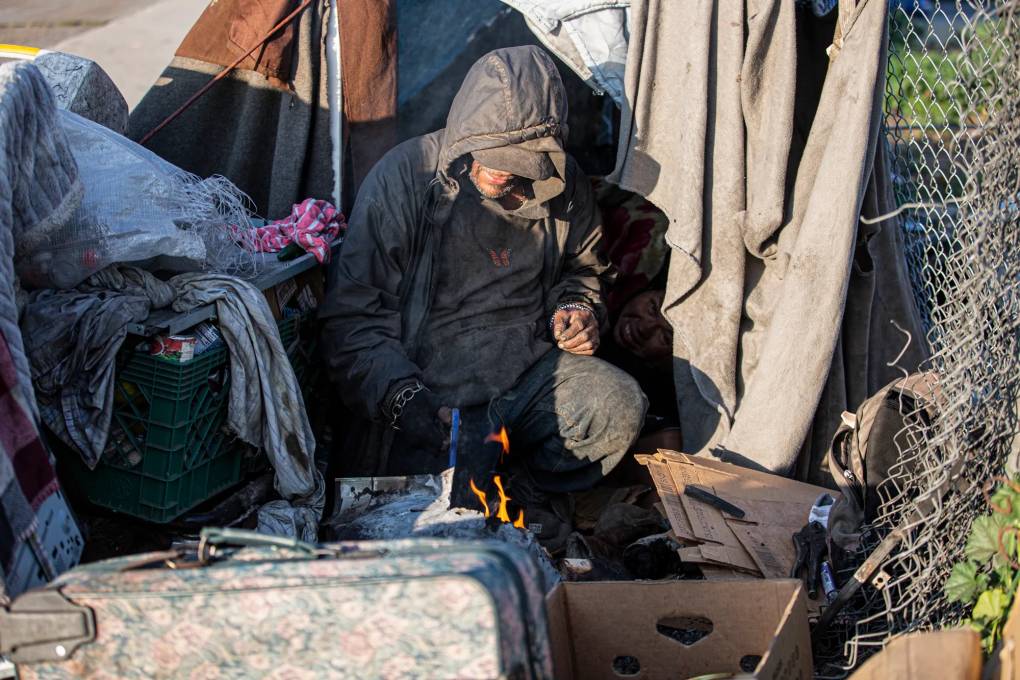
"caption": "A man starts a fire in his makeshift tent along a barbed wire fence near Highway 99 in southwest Fresno on Feb. 11, 2022.",
"description": null,
"title": "021422-FRESNO-HOMELESS-LV-08-CM",
"credit": "Larry Valenzuela/CalMatters",
"status": "inherit",
"altTag": "A seated man wearing a hooded jacket starts a fire in his makeshift tent.",
"isLoading": false,
"fetchFailed": false
},
"news_11977578": {
"type": "attachments",
"id": "news_11977578",
"meta": {
"index": "attachments_1716263798",
"site": "news",
"id": "11977578",
"found": true
},
"parent": 11977573,
"imgSizes": {
"twentyfourteen-full-width": {
"file": "https://cdn.kqed.org/wp-content/uploads/sites/10/2024/02/020524_LA-Rain_JAH_22-copy-1038x576.jpg",
"width": 1038,
"mimeType": "image/jpeg",
"height": 576
},
"thumbnail": {
"file": "https://cdn.kqed.org/wp-content/uploads/sites/10/2024/02/020524_LA-Rain_JAH_22-copy-160x107.jpg",
"width": 160,
"mimeType": "image/jpeg",
"height": 107
},
"post-thumbnail": {
"file": "https://cdn.kqed.org/wp-content/uploads/sites/10/2024/02/020524_LA-Rain_JAH_22-copy-672x372.jpg",
"width": 672,
"mimeType": "image/jpeg",
"height": 372
},
"kqedFullSize": {
"file": "https://cdn.kqed.org/wp-content/uploads/sites/10/2024/02/020524_LA-Rain_JAH_22-copy.jpg",
"width": 2000,
"height": 1333
},
"large": {
"file": "https://cdn.kqed.org/wp-content/uploads/sites/10/2024/02/020524_LA-Rain_JAH_22-copy-1020x680.jpg",
"width": 1020,
"mimeType": "image/jpeg",
"height": 680
},
"1536x1536": {
"file": "https://cdn.kqed.org/wp-content/uploads/sites/10/2024/02/020524_LA-Rain_JAH_22-copy-1536x1024.jpg",
"width": 1536,
"mimeType": "image/jpeg",
"height": 1024
},
"full-width": {
"file": "https://cdn.kqed.org/wp-content/uploads/sites/10/2024/02/020524_LA-Rain_JAH_22-copy-1920x1280.jpg",
"width": 1920,
"mimeType": "image/jpeg",
"height": 1280
},
"medium": {
"file": "https://cdn.kqed.org/wp-content/uploads/sites/10/2024/02/020524_LA-Rain_JAH_22-copy-800x533.jpg",
"width": 800,
"mimeType": "image/jpeg",
"height": 533
}
},
"publishDate": 1709231622,
"modified": 1709241523,
"caption": "The Los Angeles River after a day of heavy rain on Feb. 5, 2024. ",
"description": null,
"title": "020524_LA-Rain_JAH_22 copy",
"credit": "Jules Hotz for CalMatters",
"status": "inherit",
"altTag": "A brown river flows through a city with concrete banks and fencing on either side, buildings and power lines in the backdrop.",
"isLoading": false,
"fetchFailed": false
},
"news_11977409": {
"type": "attachments",
"id": "news_11977409",
"meta": {
"index": "attachments_1716263798",
"site": "news",
"id": "11977409",
"found": true
},
"parent": 11977405,
"imgSizes": {
"twentyfourteen-full-width": {
"file": "https://cdn.kqed.org/wp-content/uploads/sites/10/2024/02/022524_Migrants-Iris-Transit_AH_CM_08-1038x576.jpg",
"width": 1038,
"mimeType": "image/jpeg",
"height": 576
},
"thumbnail": {
"file": "https://cdn.kqed.org/wp-content/uploads/sites/10/2024/02/022524_Migrants-Iris-Transit_AH_CM_08-160x107.jpg",
"width": 160,
"mimeType": "image/jpeg",
"height": 107
},
"post-thumbnail": {
"file": "https://cdn.kqed.org/wp-content/uploads/sites/10/2024/02/022524_Migrants-Iris-Transit_AH_CM_08-672x372.jpg",
"width": 672,
"mimeType": "image/jpeg",
"height": 372
},
"kqedFullSize": {
"file": "https://cdn.kqed.org/wp-content/uploads/sites/10/2024/02/022524_Migrants-Iris-Transit_AH_CM_08.jpg",
"width": 2000,
"height": 1333
},
"large": {
"file": "https://cdn.kqed.org/wp-content/uploads/sites/10/2024/02/022524_Migrants-Iris-Transit_AH_CM_08-1020x680.jpg",
"width": 1020,
"mimeType": "image/jpeg",
"height": 680
},
"1536x1536": {
"file": "https://cdn.kqed.org/wp-content/uploads/sites/10/2024/02/022524_Migrants-Iris-Transit_AH_CM_08-1536x1024.jpg",
"width": 1536,
"mimeType": "image/jpeg",
"height": 1024
},
"full-width": {
"file": "https://cdn.kqed.org/wp-content/uploads/sites/10/2024/02/022524_Migrants-Iris-Transit_AH_CM_08-1920x1280.jpg",
"width": 1920,
"mimeType": "image/jpeg",
"height": 1280
},
"medium": {
"file": "https://cdn.kqed.org/wp-content/uploads/sites/10/2024/02/022524_Migrants-Iris-Transit_AH_CM_08-800x533.jpg",
"width": 800,
"mimeType": "image/jpeg",
"height": 533
}
},
"publishDate": 1709144533,
"modified": 1709144668,
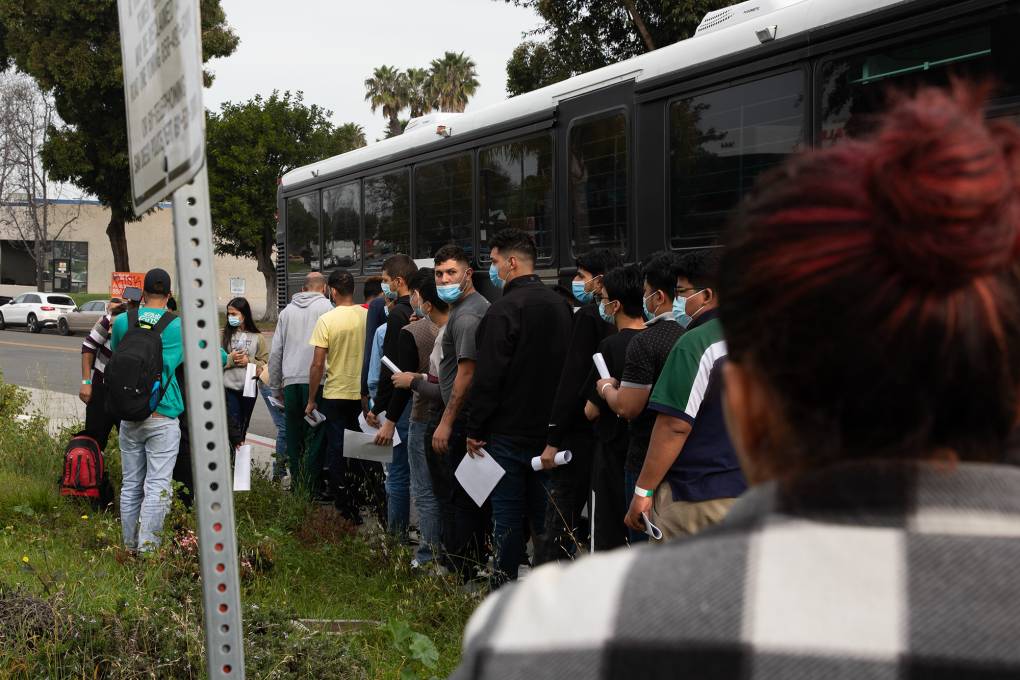
"caption": "Migrants arrive at the Iris Avenue Transit Center after being dropped off by Border Patrol agents in San Diego on Feb. 25, 2024. ",
"description": null,
"title": "022524_Migrants-Iris-Transit_AH_CM_08",
"credit": "Adriana Heldiz/CalMatters",
"status": "inherit",
"altTag": "Several people wearing face masks stand in line next to a bus.",
"isLoading": false,
"fetchFailed": false
},
"news_11976745": {
"type": "attachments",
"id": "news_11976745",
"meta": {
"index": "attachments_1716263798",
"site": "news",
"id": "11976745",
"found": true
},
"parent": 11976740,
"imgSizes": {
"twentyfourteen-full-width": {
"file": "https://cdn.kqed.org/wp-content/uploads/sites/10/2024/02/012324_Opioid-Safety_JY_CM_13-copy-1038x576.jpg",
"width": 1038,
"mimeType": "image/jpeg",
"height": 576
},
"thumbnail": {
"file": "https://cdn.kqed.org/wp-content/uploads/sites/10/2024/02/012324_Opioid-Safety_JY_CM_13-copy-160x107.jpg",
"width": 160,
"mimeType": "image/jpeg",
"height": 107
},
"post-thumbnail": {
"file": "https://cdn.kqed.org/wp-content/uploads/sites/10/2024/02/012324_Opioid-Safety_JY_CM_13-copy-672x372.jpg",
"width": 672,
"mimeType": "image/jpeg",
"height": 372
},
"kqedFullSize": {
"file": "https://cdn.kqed.org/wp-content/uploads/sites/10/2024/02/012324_Opioid-Safety_JY_CM_13-copy.jpg",
"width": 2000,
"height": 1333
},
"large": {
"file": "https://cdn.kqed.org/wp-content/uploads/sites/10/2024/02/012324_Opioid-Safety_JY_CM_13-copy-1020x680.jpg",
"width": 1020,
"mimeType": "image/jpeg",
"height": 680
},
"1536x1536": {
"file": "https://cdn.kqed.org/wp-content/uploads/sites/10/2024/02/012324_Opioid-Safety_JY_CM_13-copy-1536x1024.jpg",
"width": 1536,
"mimeType": "image/jpeg",
"height": 1024
},
"full-width": {
"file": "https://cdn.kqed.org/wp-content/uploads/sites/10/2024/02/012324_Opioid-Safety_JY_CM_13-copy-1920x1280.jpg",
"width": 1920,
"mimeType": "image/jpeg",
"height": 1280
},
"medium": {
"file": "https://cdn.kqed.org/wp-content/uploads/sites/10/2024/02/012324_Opioid-Safety_JY_CM_13-copy-800x533.jpg",
"width": 800,
"mimeType": "image/jpeg",
"height": 533
}
},
"publishDate": 1708631260,
"modified": 1708647250,
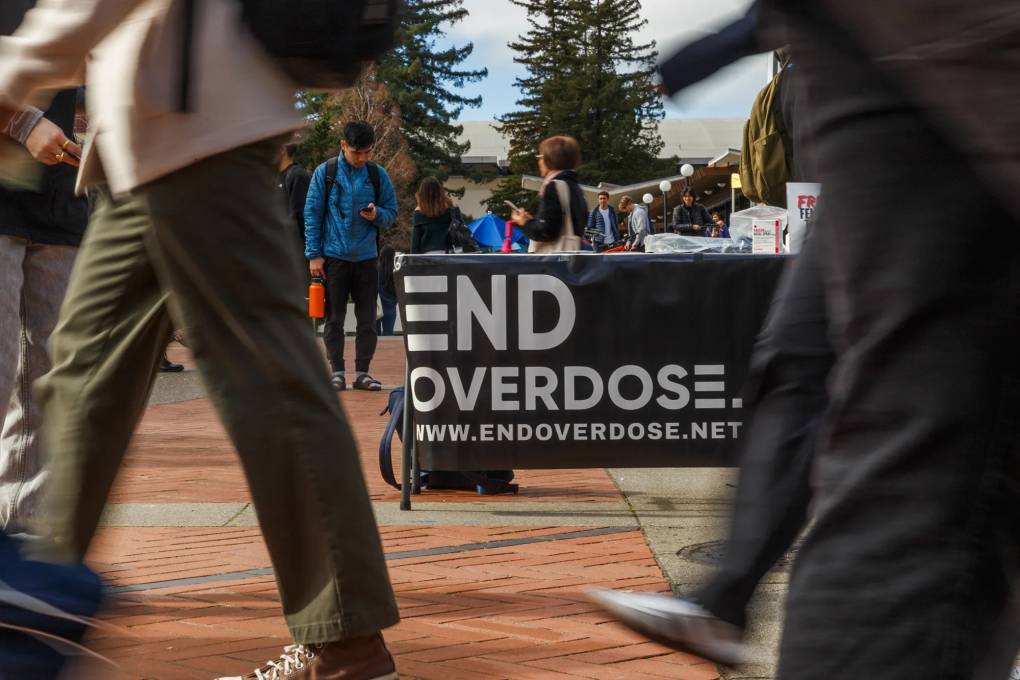
"caption": "The UC Berkeley chapter of End Overdose at Sproul Plaza in Berkeley on Jan. 23, 2024. The organization passes out free fentanyl test strips to students and gives other organizations training on Narcan usage.",
"description": null,
"title": "012324_Opioid-Safety_JY_CM_13 copy",
"credit": "Juliana Yamada for CalMatters",
"status": "inherit",
"altTag": "Students are seen walking in a plaza with a banner in the middle that reads \"End Overdose.\"",
"isLoading": false,
"fetchFailed": false
},
"news_11976711": {
"type": "attachments",
"id": "news_11976711",
"meta": {
"index": "attachments_1716263798",
"site": "news",
"id": "11976711",
"found": true
},
"parent": 11976710,
"imgSizes": {
"twentyfourteen-full-width": {
"file": "https://cdn.kqed.org/wp-content/uploads/sites/10/2024/02/021324_Sara-Fee_EF_16-CM-copy-1038x576.jpg",
"width": 1038,
"mimeType": "image/jpeg",
"height": 576
},
"thumbnail": {
"file": "https://cdn.kqed.org/wp-content/uploads/sites/10/2024/02/021324_Sara-Fee_EF_16-CM-copy-160x107.jpg",
"width": 160,
"mimeType": "image/jpeg",
"height": 107
},
"post-thumbnail": {
"file": "https://cdn.kqed.org/wp-content/uploads/sites/10/2024/02/021324_Sara-Fee_EF_16-CM-copy-672x372.jpg",
"width": 672,
"mimeType": "image/jpeg",
"height": 372
},
"kqedFullSize": {
"file": "https://cdn.kqed.org/wp-content/uploads/sites/10/2024/02/021324_Sara-Fee_EF_16-CM-copy.jpg",
"width": 2000,
"height": 1334
},
"large": {
"file": "https://cdn.kqed.org/wp-content/uploads/sites/10/2024/02/021324_Sara-Fee_EF_16-CM-copy-1020x680.jpg",
"width": 1020,
"mimeType": "image/jpeg",
"height": 680
},
"1536x1536": {
"file": "https://cdn.kqed.org/wp-content/uploads/sites/10/2024/02/021324_Sara-Fee_EF_16-CM-copy-1536x1025.jpg",
"width": 1536,
"mimeType": "image/jpeg",
"height": 1025
},
"full-width": {
"file": "https://cdn.kqed.org/wp-content/uploads/sites/10/2024/02/021324_Sara-Fee_EF_16-CM-copy-1920x1281.jpg",
"width": 1920,
"mimeType": "image/jpeg",
"height": 1281
},
"medium": {
"file": "https://cdn.kqed.org/wp-content/uploads/sites/10/2024/02/021324_Sara-Fee_EF_16-CM-copy-800x534.jpg",
"width": 800,
"mimeType": "image/jpeg",
"height": 534
}
},
"publishDate": 1708625402,
"modified": 1708630540,
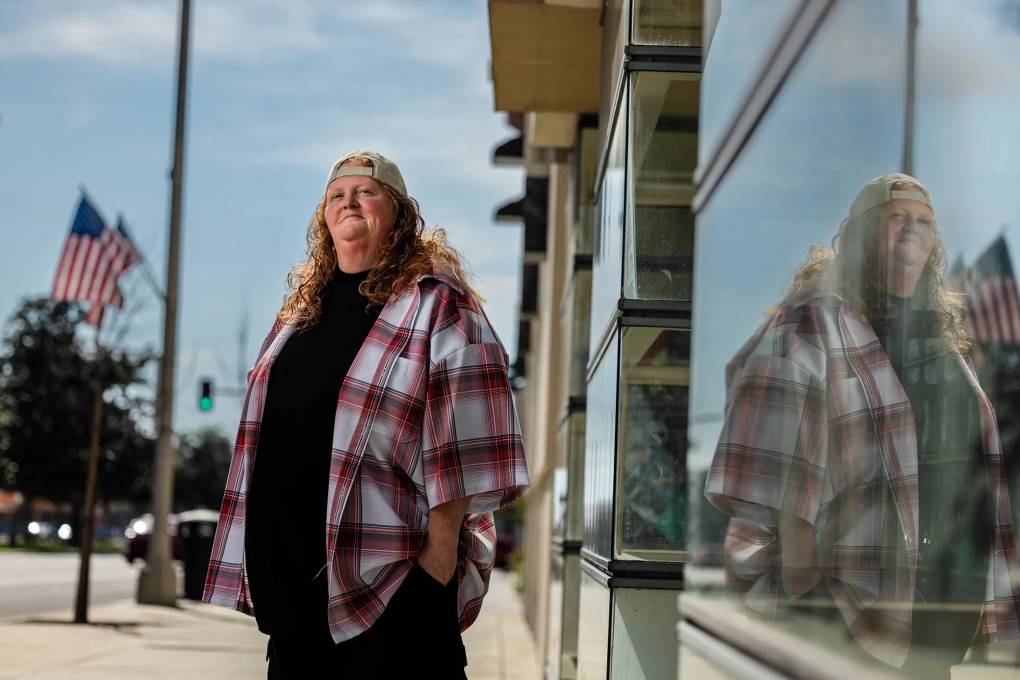
"caption": "Inland Empire Amazon Workers United founder Sara Fee in front of the Warehouse Worker Resource Center in Ontario on Feb. 13, 2024.\n",
"description": null,
"title": "021324_Sara-Fee_EF_16-CM copy",
"credit": "Elisa Ferrari for CalMatters",
"status": "inherit",
"altTag": "An older white woman with a trucker's cap and a plaid shirt stands outside a store on the street, looking away from the camera.",
"isLoading": false,
"fetchFailed": false
},
"news_11976405": {
"type": "attachments",
"id": "news_11976405",
"meta": {
"index": "attachments_1716263798",
"site": "news",
"id": "11976405",
"found": true
},
"parent": 11976403,
"imgSizes": {
"twentyfourteen-full-width": {
"file": "https://cdn.kqed.org/wp-content/uploads/sites/10/2024/02/021324-Life-Line-CPUC-MG-CM-01-1038x576.jpg",
"width": 1038,
"mimeType": "image/jpeg",
"height": 576
},
"thumbnail": {
"file": "https://cdn.kqed.org/wp-content/uploads/sites/10/2024/02/021324-Life-Line-CPUC-MG-CM-01-160x107.jpg",
"width": 160,
"mimeType": "image/jpeg",
"height": 107
},
"post-thumbnail": {
"file": "https://cdn.kqed.org/wp-content/uploads/sites/10/2024/02/021324-Life-Line-CPUC-MG-CM-01-672x372.jpg",
"width": 672,
"mimeType": "image/jpeg",
"height": 372
},
"kqedFullSize": {
"file": "https://cdn.kqed.org/wp-content/uploads/sites/10/2024/02/021324-Life-Line-CPUC-MG-CM-01.jpg",
"width": 2000,
"height": 1333
},
"large": {
"file": "https://cdn.kqed.org/wp-content/uploads/sites/10/2024/02/021324-Life-Line-CPUC-MG-CM-01-1020x680.jpg",
"width": 1020,
"mimeType": "image/jpeg",
"height": 680
},
"1536x1536": {
"file": "https://cdn.kqed.org/wp-content/uploads/sites/10/2024/02/021324-Life-Line-CPUC-MG-CM-01-1536x1024.jpg",
"width": 1536,
"mimeType": "image/jpeg",
"height": 1024
},
"full-width": {
"file": "https://cdn.kqed.org/wp-content/uploads/sites/10/2024/02/021324-Life-Line-CPUC-MG-CM-01-1920x1280.jpg",
"width": 1920,
"mimeType": "image/jpeg",
"height": 1280
},
"medium": {
"file": "https://cdn.kqed.org/wp-content/uploads/sites/10/2024/02/021324-Life-Line-CPUC-MG-CM-01-800x533.jpg",
"width": 800,
"mimeType": "image/jpeg",
"height": 533
}
},
"publishDate": 1708456722,
"modified": 1708465965,
"caption": null,
"description": null,
"title": "021324-Life-Line-CPUC-MG-CM-01",
"credit": "Illustration by Miguel Gutierrez Jr./CalMatters",
"status": "inherit",
"altTag": "An illustration of a telephone over an enlarged image of a blue social security card.",
"isLoading": false,
"fetchFailed": false
},
"news_11976374": {
"type": "attachments",
"id": "news_11976374",
"meta": {
"index": "attachments_1716263798",
"site": "news",
"id": "11976374",
"found": true
},
"parent": 11976372,
"imgSizes": {
"twentyfourteen-full-width": {
"file": "https://cdn.kqed.org/wp-content/uploads/sites/10/2024/02/010423-MaderaCommunityHospital-LV_CM_07-copy-1038x576.jpg",
"width": 1038,
"mimeType": "image/jpeg",
"height": 576
},
"thumbnail": {
"file": "https://cdn.kqed.org/wp-content/uploads/sites/10/2024/02/010423-MaderaCommunityHospital-LV_CM_07-copy-160x107.jpg",
"width": 160,
"mimeType": "image/jpeg",
"height": 107
},
"post-thumbnail": {
"file": "https://cdn.kqed.org/wp-content/uploads/sites/10/2024/02/010423-MaderaCommunityHospital-LV_CM_07-copy-672x372.jpg",
"width": 672,
"mimeType": "image/jpeg",
"height": 372
},
"kqedFullSize": {
"file": "https://cdn.kqed.org/wp-content/uploads/sites/10/2024/02/010423-MaderaCommunityHospital-LV_CM_07-copy.jpg",
"width": 2000,
"height": 1333
},
"large": {
"file": "https://cdn.kqed.org/wp-content/uploads/sites/10/2024/02/010423-MaderaCommunityHospital-LV_CM_07-copy-1020x680.jpg",
"width": 1020,
"mimeType": "image/jpeg",
"height": 680
},
"1536x1536": {
"file": "https://cdn.kqed.org/wp-content/uploads/sites/10/2024/02/010423-MaderaCommunityHospital-LV_CM_07-copy-1536x1024.jpg",
"width": 1536,
"mimeType": "image/jpeg",
"height": 1024
},
"full-width": {
"file": "https://cdn.kqed.org/wp-content/uploads/sites/10/2024/02/010423-MaderaCommunityHospital-LV_CM_07-copy-1920x1280.jpg",
"width": 1920,
"mimeType": "image/jpeg",
"height": 1280
},
"medium": {
"file": "https://cdn.kqed.org/wp-content/uploads/sites/10/2024/02/010423-MaderaCommunityHospital-LV_CM_07-copy-800x533.jpg",
"width": 800,
"mimeType": "image/jpeg",
"height": 533
}
},
"publishDate": 1708453045,
"modified": 1708453194,
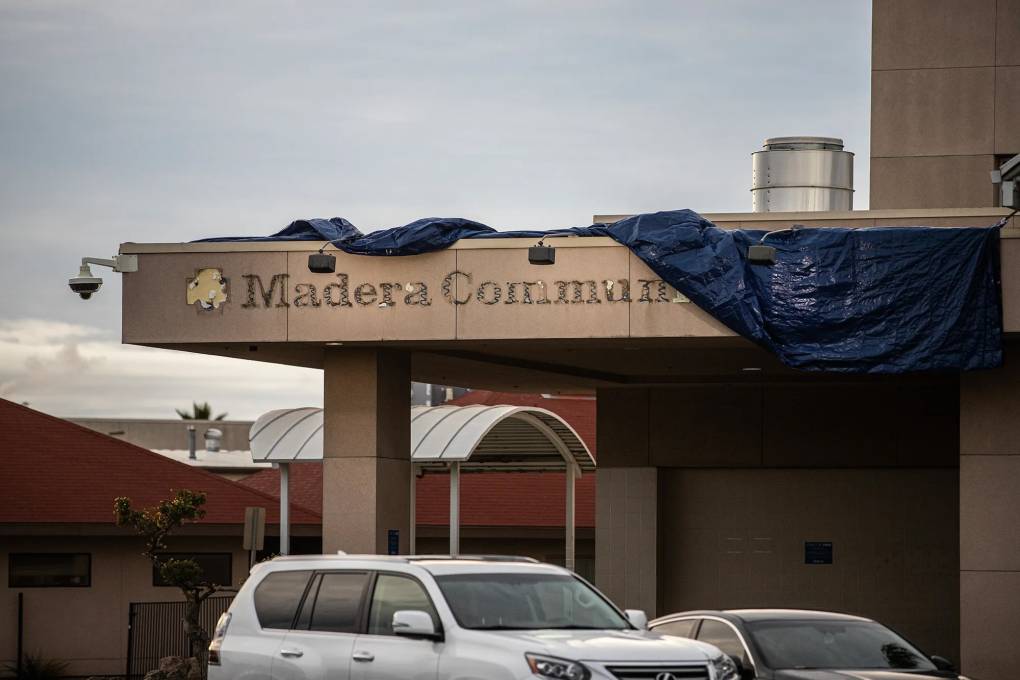
"caption": "Outlines of the former Madera Community Hospital sign are covered by a tarp at the emergency room entrance of the hospital on Jan. 2, 2023. \n",
"description": null,
"title": "010423-MaderaCommunityHospital-LV_CM_07 copy",
"credit": "Larry Valenzuela/CalMatters/CatchLight Local",
"status": "inherit",
"altTag": "A rundown building with tarps partially covering the entrance where the words \"Madera Community\" can be seen.",
"isLoading": false,
"fetchFailed": false
},
"news_11976262": {
"type": "attachments",
"id": "news_11976262",
"meta": {
"index": "attachments_1716263798",
"site": "news",
"id": "11976262",
"found": true
},
"parent": 11976260,
"imgSizes": {
"twentyfourteen-full-width": {
"file": "https://cdn.kqed.org/wp-content/uploads/sites/10/2024/02/110723_Shasta-Election_FG_CM_02-copy-1038x576.jpg",
"width": 1038,
"mimeType": "image/jpeg",
"height": 576
},
"thumbnail": {
"file": "https://cdn.kqed.org/wp-content/uploads/sites/10/2024/02/110723_Shasta-Election_FG_CM_02-copy-160x107.jpg",
"width": 160,
"mimeType": "image/jpeg",
"height": 107
},
"post-thumbnail": {
"file": "https://cdn.kqed.org/wp-content/uploads/sites/10/2024/02/110723_Shasta-Election_FG_CM_02-copy-672x372.jpg",
"width": 672,
"mimeType": "image/jpeg",
"height": 372
},
"kqedFullSize": {
"file": "https://cdn.kqed.org/wp-content/uploads/sites/10/2024/02/110723_Shasta-Election_FG_CM_02-copy.jpg",
"width": 2000,
"height": 1333
},
"large": {
"file": "https://cdn.kqed.org/wp-content/uploads/sites/10/2024/02/110723_Shasta-Election_FG_CM_02-copy-1020x680.jpg",
"width": 1020,
"mimeType": "image/jpeg",
"height": 680
},
"1536x1536": {
"file": "https://cdn.kqed.org/wp-content/uploads/sites/10/2024/02/110723_Shasta-Election_FG_CM_02-copy-1536x1024.jpg",
"width": 1536,
"mimeType": "image/jpeg",
"height": 1024
},
"full-width": {
"file": "https://cdn.kqed.org/wp-content/uploads/sites/10/2024/02/110723_Shasta-Election_FG_CM_02-copy-1920x1280.jpg",
"width": 1920,
"mimeType": "image/jpeg",
"height": 1280
},
"medium": {
"file": "https://cdn.kqed.org/wp-content/uploads/sites/10/2024/02/110723_Shasta-Election_FG_CM_02-copy-800x533.jpg",
"width": 800,
"mimeType": "image/jpeg",
"height": 533
}
},
"publishDate": 1708122373,
"modified": 1708132194,
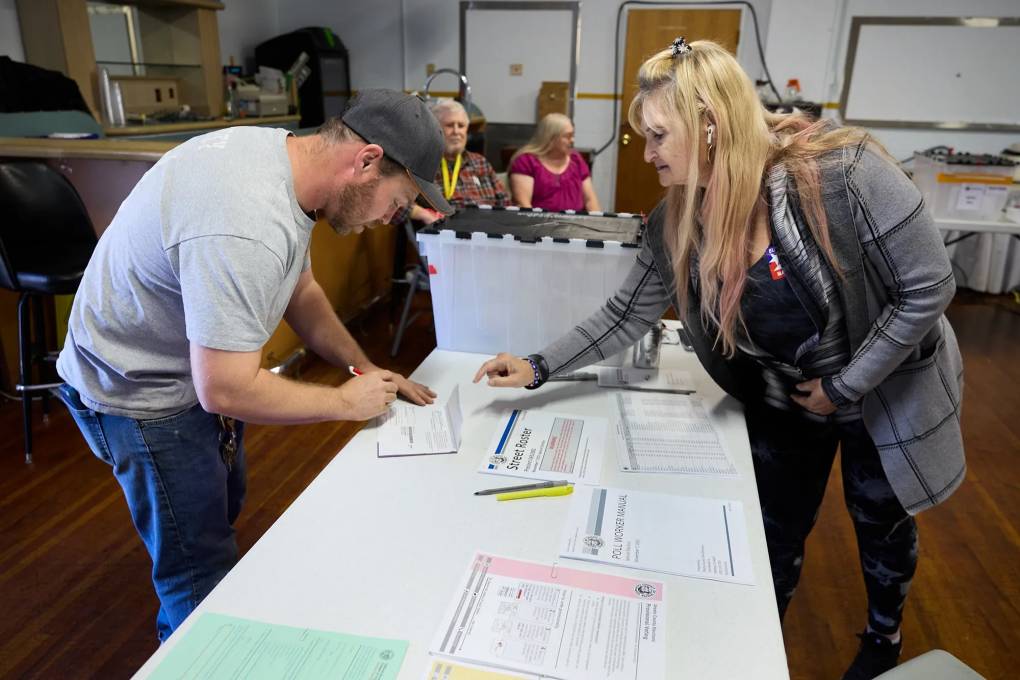
"caption": "Poll worker Regina Jasperse (right) helps Joey Knighten (left) fill out his mail-in ballot at a polling station at the American Legion in Shasta Lake on Nov. 7, 2023.",
"description": null,
"title": "110723_Shasta-Election_FG_CM_02 copy",
"credit": "Fred Greaves for CalMatters",
"status": "inherit",
"altTag": "A woman points to a man's ballot as he fills it out. Two other people sit in the background.",
"isLoading": false,
"fetchFailed": false
},
"news_11976191": {
"type": "attachments",
"id": "news_11976191",
"meta": {
"index": "attachments_1716263798",
"site": "news",
"id": "11976191",
"found": true
},
"parent": 11976186,
"imgSizes": {
"twentyfourteen-full-width": {
"file": "https://cdn.kqed.org/wp-content/uploads/sites/10/2024/02/CMEducation01-1038x576.jpg",
"width": 1038,
"mimeType": "image/jpeg",
"height": 576
},
"thumbnail": {
"file": "https://cdn.kqed.org/wp-content/uploads/sites/10/2024/02/CMEducation01-160x107.jpg",
"width": 160,
"mimeType": "image/jpeg",
"height": 107
},
"post-thumbnail": {
"file": "https://cdn.kqed.org/wp-content/uploads/sites/10/2024/02/CMEducation01-672x372.jpg",
"width": 672,
"mimeType": "image/jpeg",
"height": 372
},
"kqedFullSize": {
"file": "https://cdn.kqed.org/wp-content/uploads/sites/10/2024/02/CMEducation01.jpg",
"width": 2000,
"height": 1333
},
"large": {
"file": "https://cdn.kqed.org/wp-content/uploads/sites/10/2024/02/CMEducation01-1020x680.jpg",
"width": 1020,
"mimeType": "image/jpeg",
"height": 680
},
"1536x1536": {
"file": "https://cdn.kqed.org/wp-content/uploads/sites/10/2024/02/CMEducation01-1536x1024.jpg",
"width": 1536,
"mimeType": "image/jpeg",
"height": 1024
},
"full-width": {
"file": "https://cdn.kqed.org/wp-content/uploads/sites/10/2024/02/CMEducation01-1920x1280.jpg",
"width": 1920,
"mimeType": "image/jpeg",
"height": 1280
},
"medium": {
"file": "https://cdn.kqed.org/wp-content/uploads/sites/10/2024/02/CMEducation01-800x533.jpg",
"width": 800,
"mimeType": "image/jpeg",
"height": 533
}
},
"publishDate": 1708111194,
"modified": 1708127943,
"caption": "Mario Ramirez Garcia, 10, attends an online class in the bedroom he shares with his sister on April 23, 2021. “It’s funner in real school,” Mario said of distance learning.",
"description": null,
"title": "CMEducation01",
"credit": "Anne Wernikoff/CalMatters",
"status": "inherit",
"altTag": "A boy staring at a computer screen during a remote learning session in his room.",
"isLoading": false,
"fetchFailed": false
},
"news_11975893": {
"type": "attachments",
"id": "news_11975893",
"meta": {
"index": "attachments_1716263798",
"site": "news",
"id": "11975893",
"found": true
},
"parent": 11975890,
"imgSizes": {
"twentyfourteen-full-width": {
"file": "https://cdn.kqed.org/wp-content/uploads/sites/10/2024/02/013024_Contra-Costa-Water_LE_CM_07-1038x576.jpg",
"width": 1038,
"mimeType": "image/jpeg",
"height": 576
},
"thumbnail": {
"file": "https://cdn.kqed.org/wp-content/uploads/sites/10/2024/02/013024_Contra-Costa-Water_LE_CM_07-160x107.jpg",
"width": 160,
"mimeType": "image/jpeg",
"height": 107
},
"post-thumbnail": {
"file": "https://cdn.kqed.org/wp-content/uploads/sites/10/2024/02/013024_Contra-Costa-Water_LE_CM_07-672x372.jpg",
"width": 672,
"mimeType": "image/jpeg",
"height": 372
},
"kqedFullSize": {
"file": "https://cdn.kqed.org/wp-content/uploads/sites/10/2024/02/013024_Contra-Costa-Water_LE_CM_07.jpg",
"width": 2000,
"height": 1333
},
"large": {
"file": "https://cdn.kqed.org/wp-content/uploads/sites/10/2024/02/013024_Contra-Costa-Water_LE_CM_07-1020x680.jpg",
"width": 1020,
"mimeType": "image/jpeg",
"height": 680
},
"1536x1536": {
"file": "https://cdn.kqed.org/wp-content/uploads/sites/10/2024/02/013024_Contra-Costa-Water_LE_CM_07-1536x1024.jpg",
"width": 1536,
"mimeType": "image/jpeg",
"height": 1024
},
"full-width": {
"file": "https://cdn.kqed.org/wp-content/uploads/sites/10/2024/02/013024_Contra-Costa-Water_LE_CM_07-1920x1280.jpg",
"width": 1920,
"mimeType": "image/jpeg",
"height": 1280
},
"medium": {
"file": "https://cdn.kqed.org/wp-content/uploads/sites/10/2024/02/013024_Contra-Costa-Water_LE_CM_07-800x533.jpg",
"width": 800,
"mimeType": "image/jpeg",
"height": 533
}
},
"publishDate": 1707936518,
"modified": 1707962182,
"caption": "Instrumentation intern Ibrahim Mohamed conducts a maintenance check on a motor bearing temperature sensor while being trained by instrument technician Rodney Johnson inside a Contra Costa Water District pumping plant at the Antioch Service Center in Oakley on Jan. 30, 2024. The maintenance check was performed as part of a CalMatters media tour of the facility to highlight state investment in job training.",
"description": null,
"title": "013024_Contra-Costa-Water_LE_CM_07",
"credit": "Loren Elliott/CalMatters",
"status": "inherit",
"altTag": "Two men wearing jackets, with the man on the right wearing a neon orange jacket, look down on a yellow device with wiring. The man on the left is putting a wire into the device.",
"isLoading": false,
"fetchFailed": false
},
"news_11975536": {
"type": "attachments",
"id": "news_11975536",
"meta": {
"index": "attachments_1716263798",
"site": "news",
"id": "11975536",
"found": true
},
"parent": 11975534,
"imgSizes": {
"twentyfourteen-full-width": {
"file": "https://cdn.kqed.org/wp-content/uploads/sites/10/2024/02/CMFinancialAid01-1038x576.jpg",
"width": 1038,
"mimeType": "image/jpeg",
"height": 576
},
"thumbnail": {
"file": "https://cdn.kqed.org/wp-content/uploads/sites/10/2024/02/CMFinancialAid01-160x107.jpg",
"width": 160,
"mimeType": "image/jpeg",
"height": 107
},
"post-thumbnail": {
"file": "https://cdn.kqed.org/wp-content/uploads/sites/10/2024/02/CMFinancialAid01-672x372.jpg",
"width": 672,
"mimeType": "image/jpeg",
"height": 372
},
"kqedFullSize": {
"file": "https://cdn.kqed.org/wp-content/uploads/sites/10/2024/02/CMFinancialAid01.jpg",
"width": 2000,
"height": 1333
},
"large": {
"file": "https://cdn.kqed.org/wp-content/uploads/sites/10/2024/02/CMFinancialAid01-1020x680.jpg",
"width": 1020,
"mimeType": "image/jpeg",
"height": 680
},
"1536x1536": {
"file": "https://cdn.kqed.org/wp-content/uploads/sites/10/2024/02/CMFinancialAid01-1536x1024.jpg",
"width": 1536,
"mimeType": "image/jpeg",
"height": 1024
},
"full-width": {
"file": "https://cdn.kqed.org/wp-content/uploads/sites/10/2024/02/CMFinancialAid01-1920x1280.jpg",
"width": 1920,
"mimeType": "image/jpeg",
"height": 1280
},
"medium": {
"file": "https://cdn.kqed.org/wp-content/uploads/sites/10/2024/02/CMFinancialAid01-800x533.jpg",
"width": 800,
"mimeType": "image/jpeg",
"height": 533
}
},
"publishDate": 1707758498,
"modified": 1707758548,
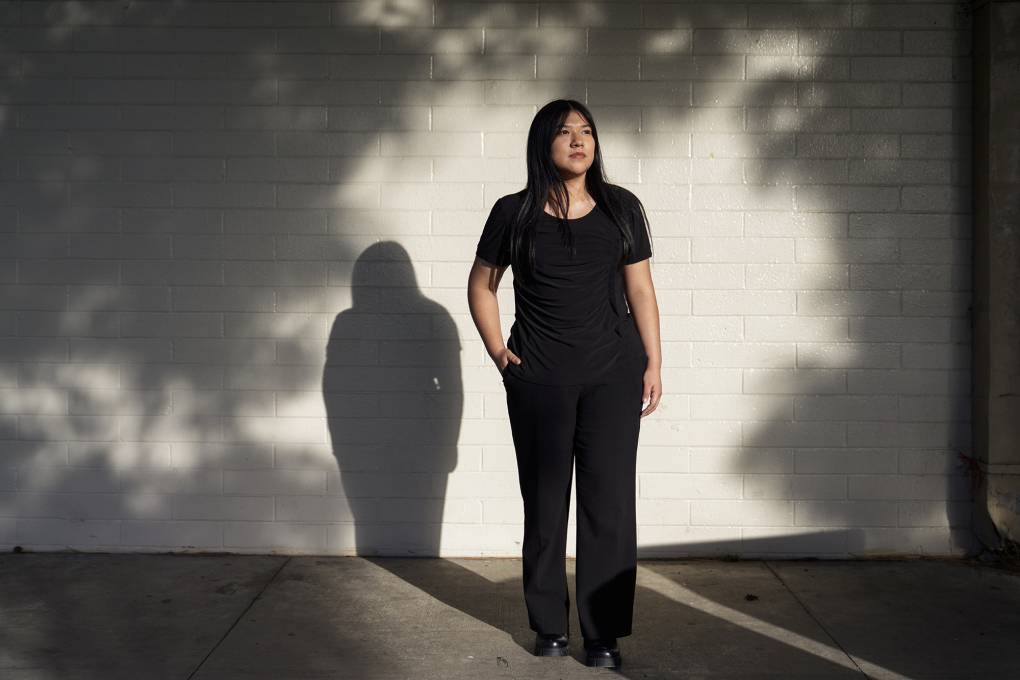
"caption": "Ashley Estrada, 18, will graduate from Diego Rivera High School in South LA in 2024. A technical error is currently blocking students whose parents don’t have a social security number from completing their FAFSA forms, and Estrada is one of the students affected. Feb. 9, 2024. ",
"description": null,
"title": "CMFinancialAid01",
"credit": "Lauren Justice/CalMatters",
"status": "inherit",
"altTag": "A woman stands by a wall.",
"isLoading": false,
"fetchFailed": false
},
"news_11975343": {
"type": "attachments",
"id": "news_11975343",
"meta": {
"index": "attachments_1716263798",
"site": "news",
"id": "11975343",
"found": true
},
"parent": 11975340,
"imgSizes": {
"twentyfourteen-full-width": {
"file": "https://cdn.kqed.org/wp-content/uploads/sites/10/2024/02/020924_FAST_FOOD_UNION_JAH_CM_00278-copy-1038x576.jpg",
"width": 1038,
"mimeType": "image/jpeg",
"height": 576
},
"thumbnail": {
"file": "https://cdn.kqed.org/wp-content/uploads/sites/10/2024/02/020924_FAST_FOOD_UNION_JAH_CM_00278-copy-160x107.jpg",
"width": 160,
"mimeType": "image/jpeg",
"height": 107
},
"post-thumbnail": {
"file": "https://cdn.kqed.org/wp-content/uploads/sites/10/2024/02/020924_FAST_FOOD_UNION_JAH_CM_00278-copy-672x372.jpg",
"width": 672,
"mimeType": "image/jpeg",
"height": 372
},
"kqedFullSize": {
"file": "https://cdn.kqed.org/wp-content/uploads/sites/10/2024/02/020924_FAST_FOOD_UNION_JAH_CM_00278-copy.jpg",
"width": 2000,
"height": 1333
},
"large": {
"file": "https://cdn.kqed.org/wp-content/uploads/sites/10/2024/02/020924_FAST_FOOD_UNION_JAH_CM_00278-copy-1020x680.jpg",
"width": 1020,
"mimeType": "image/jpeg",
"height": 680
},
"1536x1536": {
"file": "https://cdn.kqed.org/wp-content/uploads/sites/10/2024/02/020924_FAST_FOOD_UNION_JAH_CM_00278-copy-1536x1024.jpg",
"width": 1536,
"mimeType": "image/jpeg",
"height": 1024
},
"full-width": {
"file": "https://cdn.kqed.org/wp-content/uploads/sites/10/2024/02/020924_FAST_FOOD_UNION_JAH_CM_00278-copy-1920x1280.jpg",
"width": 1920,
"mimeType": "image/jpeg",
"height": 1280
},
"medium": {
"file": "https://cdn.kqed.org/wp-content/uploads/sites/10/2024/02/020924_FAST_FOOD_UNION_JAH_CM_00278-copy-800x533.jpg",
"width": 800,
"mimeType": "image/jpeg",
"height": 533
}
},
"publishDate": 1707593372,
"modified": 1707593432,
"caption": "Crowd participation at the California Fast Food Workers Union membership launch in Los Angeles on Feb. 9, 2024.",
"description": null,
"title": "020924_FAST_FOOD_UNION_JAH_CM_00278 copy",
"credit": "Jules Hotz for CalMatters",
"status": "inherit",
"altTag": "A crowd of people mostly wearing purple shirts and with a mural in the background celebrate and wave flags.",
"isLoading": false,
"fetchFailed": false
}
},
"audioPlayerReducer": {
"postId": "stream_live",
"isPaused": true,
"isPlaying": false,
"pfsActive": false,
"pledgeModalIsOpen": true,
"playerDrawerIsOpen": false,
"liveAudioPlayStartedAt": 0,
"liveAudioPlayContext": ""
},
"authorsReducer": {
"byline_news_11977614": {
"type": "authors",
"id": "byline_news_11977614",
"meta": {
"override": true
},
"slug": "byline_news_11977614",
"name": "\u003ca href=\"https://calmatters.org/author/marisa-kendall/\">Marisa Kendall\u003c/a>",
"isLoading": false
},
"byline_news_11977573": {
"type": "authors",
"id": "byline_news_11977573",
"meta": {
"override": true
},
"slug": "byline_news_11977573",
"name": "\u003ca href=\"https://calmatters.org/author/rachel-becker/\">Rachel Becker\u003c/a>",
"isLoading": false
},
"byline_news_11977405": {
"type": "authors",
"id": "byline_news_11977405",
"meta": {
"override": true
},
"slug": "byline_news_11977405",
"name": "\u003ca href=\"https://calmatters.org/author/wendy-fry/\">Wendy Fry\u003c/a>",
"isLoading": false
},
"byline_news_11976740": {
"type": "authors",
"id": "byline_news_11976740",
"meta": {
"override": true
},
"slug": "byline_news_11976740",
"name": "\u003ca href=\"https://calmatters.org/author/li-khan/\">Li Khan\u003c/a>",
"isLoading": false
},
"byline_news_11976710": {
"type": "authors",
"id": "byline_news_11976710",
"meta": {
"override": true
},
"slug": "byline_news_11976710",
"name": "\u003ca href=\"https://calmatters.org/author/jeanne-kuang/\">Jeanne Kuang\u003c/a>",
"isLoading": false
},
"byline_news_11976403": {
"type": "authors",
"id": "byline_news_11976403",
"meta": {
"override": true
},
"slug": "byline_news_11976403",
"name": "\u003ca href=\"https://calmatters.org/author/alejandra-reyesvelarde/\">Alejandra Reyes-Velarde\u003c/a>",
"isLoading": false
},
"byline_news_11976372": {
"type": "authors",
"id": "byline_news_11976372",
"meta": {
"override": true
},
"slug": "byline_news_11976372",
"name": "\u003ca href=\"https://calmatters.org/author/anaibarra/\">Ana B. Ibarra\u003c/a>",
"isLoading": false
},
"byline_news_11976260": {
"type": "authors",
"id": "byline_news_11976260",
"meta": {
"override": true
},
"slug": "byline_news_11976260",
"name": "\u003ca href=\"https://calmatters.org/author/alexei-koseff/\">Alexei Koseff\u003c/a>",
"isLoading": false
},
"byline_news_11976186": {
"type": "authors",
"id": "byline_news_11976186",
"meta": {
"override": true
},
"slug": "byline_news_11976186",
"name": "\u003ca href=\"https://calmatters.org/author/carolyn-jones/\">Carolyn Jones\u003c/a>",
"isLoading": false
},
"byline_news_11975890": {
"type": "authors",
"id": "byline_news_11975890",
"meta": {
"override": true
},
"slug": "byline_news_11975890",
"name": "\u003ca href=\"https://calmatters.org/author/adam-echelman/\">Adam Echelman\u003c/a>",
"isLoading": false
},
"byline_news_11975534": {
"type": "authors",
"id": "byline_news_11975534",
"meta": {
"override": true
},
"slug": "byline_news_11975534",
"name": "\u003ca href=\"https://calmatters.org/author/mikhailzinshteyn/\">Mikhail Zinshteyn\u003c/a>",
"isLoading": false
},
"byline_news_11975340": {
"type": "authors",
"id": "byline_news_11975340",
"meta": {
"override": true
},
"slug": "byline_news_11975340",
"name": "\u003ca href=\"https://calmatters.org/author/alejandra-reyesvelarde/\">Alejandra Reyes-Velarde\u003c/a>",
"isLoading": false
}
},
"pagesReducer": {
"news_affiliate_calmatters": {
"type": "terms",
"id": "news_18481",
"meta": {
"index": "terms_1716263798",
"site": "news",
"id": "18481",
"score": 15.355862
},
"featImg": null,
"name": "CALmatters",
"description": null,
"taxonomy": "affiliate",
"headData": {
"twImgId": null,
"twTitle": null,
"ogTitle": null,
"ogImgId": null,
"twDescription": null,
"description": null,
"title": "CALmatters Archives | KQED Arts",
"ogDescription": null
},
"ttid": 18515,
"slug": "calmatters",
"isLoading": false,
"title": "CALmatters",
"pageMeta": {
"site": "news",
"WpPageTemplate": "page-topic-editorial",
"currentPage": 36
},
"blocks": [
{
"blockName": "kqed/post-list",
"attrs": {
"layout": "cardArticle2",
"query": "posts/news?affiliate=calmatters",
"seeMore": false,
"paginated": true,
"page": 36
}
},
{
"blockName": "kqed/ad"
}
]
}
},
"pfsSessionReducer": {},
"postsReducer": {
"stream_live": {
"type": "live",
"id": "stream_live",
"audioUrl": "https://streams.kqed.org/kqedradio",
"title": "Live Stream",
"excerpt": "Live Stream information currently unavailable.",
"link": "/radio",
"featImg": "",
"label": {
"name": "KQED Live",
"link": "/"
}
},
"stream_kqedNewscast": {
"type": "posts",
"id": "stream_kqedNewscast",
"audioUrl": "https://www.kqed.org/.stream/anon/radio/RDnews/newscast.mp3?_=1",
"title": "KQED Newscast",
"featImg": "",
"label": {
"name": "88.5 FM",
"link": "/"
}
},
"news_11977614": {
"type": "posts",
"id": "news_11977614",
"meta": {
"index": "posts_1716263798",
"site": "news",
"id": "11977614",
"score": null,
"sort": [
1709323228000
]
},
"guestAuthors": [],
"slug": "its-now-significantly-more-deadly-to-be-homeless-why-are-so-many-people-dying",
"title": "Death Rate Among America's Unhoused Population Akin to 'Natural Disaster or War,' New Study Finds",
"publishDate": 1709323228,
"format": "standard",
"headTitle": "Death Rate Among America’s Unhoused Population Akin to ‘Natural Disaster or War,’ New Study Finds | KQED",
"labelTerm": {
"term": 18481,
"site": "news"
},
"content": "\u003cp>For many people, living on the streets of California is a death sentence.\u003c/p>\n\u003cp>That’s according to a \u003ca href=\"https://www.healthaffairs.org/doi/full/10.1377/hlthaff.2023.01039\">recent study\u003c/a> that took the first deep look into mortality rates in unhoused communities throughout the country. It found the death rate more than tripled between 2011 and 2020. The findings make clear that as the number of unhoused Californians is soaring, it’s also becoming more dangerous to be unhoused. And it means the stakes are sky-high when it comes to state and local efforts to combat the crisis: People’s lives are on the line.\u003c/p>\n\u003cp>The study’s co-author, Matthew Fowle of the University of Pennsylvania, said the 238% increase was “astonishing.”\u003c/p>\n\u003cp>“It’s unlike any other mortality trend that we really see in demography,” he said. “It’s comparable to something like a natural disaster or war.”[pullquote align=\"right\" size=\"medium\" citation=\"Dr. Margot Kushel, director of UCSF Benioff Homelessness and Housing Initiative\"]‘There is increasing evidence that you can prevent a lot of these deaths just by getting people housed.’[/pullquote]Overdoses played a major role in the deaths studied. But people also are dying at increased rates of things that might be avoided if they had a home or regular access to preventative medical care, such as exposure to heat and cold, traffic injuries, cardiovascular disease and diabetes.\u003c/p>\n\u003cp>“It’s just so hard to do that when you’re living on the streets or living in a shelter,” said Fowle, a postdoctoral fellow at the university’s Housing Initiative at Penn program. “Your main concern is, ‘Can I stay warm and dry for the night? Can I get enough food to eat?’ You can’t think about these other longer-term things that might be affecting your health until, in many cases, it’s too late.”\u003c/p>\n\u003cp>Some of the increase in the mortality rate may be attributable to county death records keeping better track of who is unhoused, Fowle said. Other than that, he and his team aren’t sure what else is behind the rising death rates — more research is needed, he said.\u003c/p>\n\u003cp>“Clearly, something is occurring across the country,” Fowle said.\u003c/p>\n\u003cp>The study, published this month in the health policy research journal Health Affairs, appears to be the first to look at death rates and causes of death in homeless communities nationwide. Data on this subject is spotty, as the feds and most states (including California) don’t require medical examiners to list someone’s housing status in their death records.\u003c/p>\n\u003cp>Fowle’s study looked at 22,143 deaths of unhoused residents in 22 localities across 10 states and Washington, D.C. — including eight California counties. The death rate among unhoused residents across all 22 localities increased from 814 per 100,000 in 2011 to 2,752 per 100,000 in 2020.\u003c/p>\n\u003cp>Among the general population, the nationwide mortality rate was much lower: 1,027 deaths per 100,000 people in 2020, \u003ca href=\"https://wonder.cdc.gov/controller/datarequest/D158;jsessionid=1D9C4FFB8CB6C9272489654C4B6A\">according to the Centers for Disease Control and Prevention\u003c/a>.\u003c/p>\n\u003cp>In California, the study looked at Alameda, Los Angeles, Orange, Sacramento, San Diego, San Mateo, Santa Clara and Solano counties. In those counties, the mortality rate more than doubled between 2015 and 2020. Some of those counties didn’t start collecting data until 2015.\u003c/p>\n\u003cp>Like most information on unhoused populations, the data has limitations. For example, it uses mortality rates based on the \u003ca href=\"https://calmatters.org/housing/2024/01/california-homeless-point-in-time-count-2024/\">federally mandated point-in-time population counts\u003c/a>, which are inexact estimates of the country’s homeless communities.\u003c/p>\n\u003cp>[ad fullwidth]\u003c/p>\n\u003cp>Nationwide, drug and alcohol overdoses were the leading cause of fatalities among unhoused people, accounting for nearly a third of all deaths. Overdoses caused 986 deaths per 100,000 unhoused people in 2020, a 488% increase from 2011.\u003c/p>\n\u003cp>The \u003ca href=\"https://calmatters.org/explainers/california-opioid-crisis/\">opioid crisis and the increased prevalence of fentanyl\u003c/a> played a huge role in those numbers, Fowle said. But deaths also may be driven by \u003ca href=\"https://calmatters.org/housing/2023/04/california-homeless-city-laws/\">new efforts throughout California and beyond to crack down on people sleeping in public places\u003c/a>, he said. When people use drugs in a homeless encampment surrounded by people they know and trust, or even alone on a busy downtown street, there’s a greater chance someone will see them and intervene if they overdose. If law enforcement breaks up their camps and pushes them out of downtown, they often go to isolated areas such as creek beds, where they’re harder to help in an emergency.\u003c/p>\n\u003cp>When someone is displaced from their camp, they also become less able to access a safe supply of drugs — putting them at greater risk for consuming something laced with fentanyl, said Dr. Margot Kushel, director of the UCSF Benioff Homelessness and Housing Initiative.\u003c/p>\n\u003cp>Another reason being homeless has become more deadly? The homeless population is getting older, Kushel said.\u003c/p>\n\u003cp>\u003ca href=\"https://calmatters.org/health/2023/02/california-homeless-seniors/\">The number of Californians 55 and older who sought homelessness services soared 84% between 2017 and 2021\u003c/a>, according to the state’s Homeless Data Integration System. That’s compared to a 43% increase across all age groups. In other words, more people older than 50 are becoming unhoused for the first time.\u003c/p>\n\u003cp>“As the homeless population continues to age, you’re just going to see death rates keep going up and up and up,” Kushel said. “You expect that, and it’s horrendous.”[aside label=\"more homelessness coverage\" tag=\"homelessness\"]The average age of death in the University of Pennsylvania study was 51 — more than 27 years younger than the average U.S. life expectancy during that period.\u003c/p>\n\u003cp>Deaths attributed to cardiovascular disease, the second-leading cause of death, increased 172% between 2011 and 2020. Other causes that saw major increases include diabetes, infection, cancer, homicide and exposure.\u003c/p>\n\u003cp>Being homeless is incredibly bad for your health, Kushel said. As soon as someone loses their housing, everything else starts to fall apart. Drug use tends to get worse, people lose the medication that treats their chronic illnesses, and they don’t go to the doctor for preventative care because they’re too busy worrying about where they’ll sleep or what they’ll eat. That means something like a small infection can turn life-threatening quickly.\u003c/p>\n\u003cp>And once someone is diagnosed with a serious illness, treatment is much harder on the street. A \u003ca href=\"https://www.healthaffairs.org/doi/full/10.1377/hlthaff.2023.01003\">recent study of veterans with cancer, co-authored by Kushel\u003c/a>, found that those without housing were 10% to 20% more likely to die than those with housing. And among formerly unhoused veterans who had since found housing, the risk of dying plummeted, the study found.\u003c/p>\n\u003cp>“There is increasing evidence that you can prevent a lot of these deaths just by getting people housed,” Kushel said.\u003c/p>\n\u003cp>Clinicians who treat people on the street watch in real time as conditions for their patients become more deadly. Whenever outreach workers call Dr. Susan Partovi, medical director of Homeless Health Care Los Angeles and author of the memoir \u003cem>Renegade MD\u003c/em>, the first thing she asks is, “Who died?”\u003c/p>\n\u003cp>All too often, it’s someone she knew.\u003c/p>\n\u003cp>“It’s really heartbreaking when you know someone, and you know their humor, and you know their dreams, and you know their past history, and you know their ups and downs in life,” she said. “And you’re kind of in the trenches with them and their struggles. And then they die. It’s just so disheartening. It’s just so sad.”\u003c/p>\n\u003cp>[ad floatright]\u003c/p>\n",
"blocks": [],
"excerpt": "The death rate among unhoused people throughout the country more than tripled between 2011 and 2020, with overdoses playing a major role, according to the report.",
"status": "publish",
"parent": 0,
"modified": 1726004410,
"stats": {
"hasAudio": false,
"hasVideo": false,
"hasChartOrMap": false,
"iframeSrcs": [],
"hasGoogleForm": false,
"hasGallery": false,
"hasHearkenModule": false,
"hasPolis": false,
"paragraphCount": 27,
"wordCount": 1286
},
"headData": {
"title": "Death Rate Among America's Unhoused Population Akin to 'Natural Disaster or War,' New Study Finds | KQED",
"description": "The death rate among unhoused people throughout the country more than tripled between 2011 and 2020, with overdoses playing a major role, according to the report.",
"ogTitle": "",
"ogDescription": "",
"ogImgId": "",
"twTitle": "",
"twDescription": "",
"twImgId": "",
"schema": {
"@context": "https://schema.org",
"@type": "NewsArticle",
"headline": "Death Rate Among America's Unhoused Population Akin to 'Natural Disaster or War,' New Study Finds",
"datePublished": "2024-03-01T12:00:28-08:00",
"dateModified": "2024-09-10T14:40:10-07:00",
"image": "https://cdn.kqed.org/wp-content/uploads/2020/02/KQED-OG-Image@1x.png",
"isAccessibleForFree": "True",
"publisher": {
"@type": "NewsMediaOrganization",
"@id": "https://www.kqed.org/#organization",
"name": "KQED",
"logo": "https://cdn.kqed.org/wp-content/uploads/2020/02/KQED-OG-Image@1x.png",
"url": "https://www.kqed.org",
"sameAs": [
"https://www.facebook.com/KQED",
"https://twitter.com/KQED",
"https://www.instagram.com/kqed/",
"https://www.tiktok.com/@kqedofficial",
"https://www.linkedin.com/company/kqed",
"https://www.youtube.com/channel/UCeC0IOo7i1P_61zVUWbJ4nw"
]
}
}
},
"sticky": false,
"nprByline": "\u003ca href=\"https://calmatters.org/author/marisa-kendall/\">Marisa Kendall\u003c/a>",
"excludeFromSiteSearch": "Include",
"showOnAuthorArchivePages": "No",
"articleAge": "0",
"path": "/news/11977614/its-now-significantly-more-deadly-to-be-homeless-why-are-so-many-people-dying",
"audioTrackLength": null,
"parsedContent": [
{
"type": "contentString",
"content": "\u003cdiv class=\"post-body\">\u003cp>\u003cp>For many people, living on the streets of California is a death sentence.\u003c/p>\n\u003cp>That’s according to a \u003ca href=\"https://www.healthaffairs.org/doi/full/10.1377/hlthaff.2023.01039\">recent study\u003c/a> that took the first deep look into mortality rates in unhoused communities throughout the country. It found the death rate more than tripled between 2011 and 2020. The findings make clear that as the number of unhoused Californians is soaring, it’s also becoming more dangerous to be unhoused. And it means the stakes are sky-high when it comes to state and local efforts to combat the crisis: People’s lives are on the line.\u003c/p>\n\u003cp>The study’s co-author, Matthew Fowle of the University of Pennsylvania, said the 238% increase was “astonishing.”\u003c/p>\n\u003cp>“It’s unlike any other mortality trend that we really see in demography,” he said. “It’s comparable to something like a natural disaster or war.”\u003c/p>\u003c/div>",
"attributes": {
"named": {},
"numeric": []
}
},
{
"type": "component",
"content": "‘There is increasing evidence that you can prevent a lot of these deaths just by getting people housed.’",
"name": "pullquote",
"attributes": {
"named": {
"align": "right",
"size": "medium",
"citation": "Dr. Margot Kushel, director of UCSF Benioff Homelessness and Housing Initiative",
"label": ""
},
"numeric": []
}
},
{
"type": "contentString",
"content": "\u003cdiv class=\"post-body\">\u003cp>Overdoses played a major role in the deaths studied. But people also are dying at increased rates of things that might be avoided if they had a home or regular access to preventative medical care, such as exposure to heat and cold, traffic injuries, cardiovascular disease and diabetes.\u003c/p>\n\u003cp>“It’s just so hard to do that when you’re living on the streets or living in a shelter,” said Fowle, a postdoctoral fellow at the university’s Housing Initiative at Penn program. “Your main concern is, ‘Can I stay warm and dry for the night? Can I get enough food to eat?’ You can’t think about these other longer-term things that might be affecting your health until, in many cases, it’s too late.”\u003c/p>\n\u003cp>Some of the increase in the mortality rate may be attributable to county death records keeping better track of who is unhoused, Fowle said. Other than that, he and his team aren’t sure what else is behind the rising death rates — more research is needed, he said.\u003c/p>\n\u003cp>“Clearly, something is occurring across the country,” Fowle said.\u003c/p>\n\u003cp>The study, published this month in the health policy research journal Health Affairs, appears to be the first to look at death rates and causes of death in homeless communities nationwide. Data on this subject is spotty, as the feds and most states (including California) don’t require medical examiners to list someone’s housing status in their death records.\u003c/p>\n\u003cp>Fowle’s study looked at 22,143 deaths of unhoused residents in 22 localities across 10 states and Washington, D.C. — including eight California counties. The death rate among unhoused residents across all 22 localities increased from 814 per 100,000 in 2011 to 2,752 per 100,000 in 2020.\u003c/p>\n\u003cp>Among the general population, the nationwide mortality rate was much lower: 1,027 deaths per 100,000 people in 2020, \u003ca href=\"https://wonder.cdc.gov/controller/datarequest/D158;jsessionid=1D9C4FFB8CB6C9272489654C4B6A\">according to the Centers for Disease Control and Prevention\u003c/a>.\u003c/p>\n\u003cp>In California, the study looked at Alameda, Los Angeles, Orange, Sacramento, San Diego, San Mateo, Santa Clara and Solano counties. In those counties, the mortality rate more than doubled between 2015 and 2020. Some of those counties didn’t start collecting data until 2015.\u003c/p>\n\u003cp>Like most information on unhoused populations, the data has limitations. For example, it uses mortality rates based on the \u003ca href=\"https://calmatters.org/housing/2024/01/california-homeless-point-in-time-count-2024/\">federally mandated point-in-time population counts\u003c/a>, which are inexact estimates of the country’s homeless communities.\u003c/p>\n\u003cp>\u003c/p>\u003c/div>",
"attributes": {
"named": {},
"numeric": []
}
},
{
"type": "component",
"content": "",
"name": "ad",
"attributes": {
"named": {
"label": "fullwidth"
},
"numeric": [
"fullwidth"
]
}
},
{
"type": "contentString",
"content": "\u003cdiv class=\"post-body\">\u003cp>\u003c/p>\n\u003cp>Nationwide, drug and alcohol overdoses were the leading cause of fatalities among unhoused people, accounting for nearly a third of all deaths. Overdoses caused 986 deaths per 100,000 unhoused people in 2020, a 488% increase from 2011.\u003c/p>\n\u003cp>The \u003ca href=\"https://calmatters.org/explainers/california-opioid-crisis/\">opioid crisis and the increased prevalence of fentanyl\u003c/a> played a huge role in those numbers, Fowle said. But deaths also may be driven by \u003ca href=\"https://calmatters.org/housing/2023/04/california-homeless-city-laws/\">new efforts throughout California and beyond to crack down on people sleeping in public places\u003c/a>, he said. When people use drugs in a homeless encampment surrounded by people they know and trust, or even alone on a busy downtown street, there’s a greater chance someone will see them and intervene if they overdose. If law enforcement breaks up their camps and pushes them out of downtown, they often go to isolated areas such as creek beds, where they’re harder to help in an emergency.\u003c/p>\n\u003cp>When someone is displaced from their camp, they also become less able to access a safe supply of drugs — putting them at greater risk for consuming something laced with fentanyl, said Dr. Margot Kushel, director of the UCSF Benioff Homelessness and Housing Initiative.\u003c/p>\n\u003cp>Another reason being homeless has become more deadly? The homeless population is getting older, Kushel said.\u003c/p>\n\u003cp>\u003ca href=\"https://calmatters.org/health/2023/02/california-homeless-seniors/\">The number of Californians 55 and older who sought homelessness services soared 84% between 2017 and 2021\u003c/a>, according to the state’s Homeless Data Integration System. That’s compared to a 43% increase across all age groups. In other words, more people older than 50 are becoming unhoused for the first time.\u003c/p>\n\u003cp>“As the homeless population continues to age, you’re just going to see death rates keep going up and up and up,” Kushel said. “You expect that, and it’s horrendous.”\u003c/p>\u003c/div>",
"attributes": {
"named": {},
"numeric": []
}
},
{
"type": "component",
"content": "",
"name": "aside",
"attributes": {
"named": {
"label": "more homelessness coverage ",
"tag": "homelessness"
},
"numeric": []
}
},
{
"type": "contentString",
"content": "\u003cdiv class=\"post-body\">\u003cp>The average age of death in the University of Pennsylvania study was 51 — more than 27 years younger than the average U.S. life expectancy during that period.\u003c/p>\n\u003cp>Deaths attributed to cardiovascular disease, the second-leading cause of death, increased 172% between 2011 and 2020. Other causes that saw major increases include diabetes, infection, cancer, homicide and exposure.\u003c/p>\n\u003cp>Being homeless is incredibly bad for your health, Kushel said. As soon as someone loses their housing, everything else starts to fall apart. Drug use tends to get worse, people lose the medication that treats their chronic illnesses, and they don’t go to the doctor for preventative care because they’re too busy worrying about where they’ll sleep or what they’ll eat. That means something like a small infection can turn life-threatening quickly.\u003c/p>\n\u003cp>And once someone is diagnosed with a serious illness, treatment is much harder on the street. A \u003ca href=\"https://www.healthaffairs.org/doi/full/10.1377/hlthaff.2023.01003\">recent study of veterans with cancer, co-authored by Kushel\u003c/a>, found that those without housing were 10% to 20% more likely to die than those with housing. And among formerly unhoused veterans who had since found housing, the risk of dying plummeted, the study found.\u003c/p>\n\u003cp>“There is increasing evidence that you can prevent a lot of these deaths just by getting people housed,” Kushel said.\u003c/p>\n\u003cp>Clinicians who treat people on the street watch in real time as conditions for their patients become more deadly. Whenever outreach workers call Dr. Susan Partovi, medical director of Homeless Health Care Los Angeles and author of the memoir \u003cem>Renegade MD\u003c/em>, the first thing she asks is, “Who died?”\u003c/p>\n\u003cp>All too often, it’s someone she knew.\u003c/p>\n\u003cp>“It’s really heartbreaking when you know someone, and you know their humor, and you know their dreams, and you know their past history, and you know their ups and downs in life,” she said. “And you’re kind of in the trenches with them and their struggles. And then they die. It’s just so disheartening. It’s just so sad.”\u003c/p>\n\u003cp>\u003c/p>\u003c/div>",
"attributes": {
"named": {},
"numeric": []
}
},
{
"type": "component",
"content": "",
"name": "ad",
"attributes": {
"named": {
"label": "floatright"
},
"numeric": [
"floatright"
]
}
},
{
"type": "contentString",
"content": "\u003cdiv class=\"post-body\">\u003cp>\u003c/p>\n\u003c/div>\u003c/p>",
"attributes": {
"named": {},
"numeric": []
}
}
],
"link": "/news/11977614/its-now-significantly-more-deadly-to-be-homeless-why-are-so-many-people-dying",
"authors": [
"byline_news_11977614"
],
"categories": [
"news_457",
"news_6266",
"news_8"
],
"tags": [
"news_27626",
"news_18543",
"news_4020",
"news_1775"
],
"affiliates": [
"news_18481"
],
"featImg": "news_11977619",
"label": "news_18481"
},
"news_11977573": {
"type": "posts",
"id": "news_11977573",
"meta": {
"index": "posts_1716263798",
"site": "news",
"id": "11977573",
"score": null,
"sort": [
1709244024000
]
},
"parent": 0,
"labelTerm": {
"site": "news",
"term": 18481
},
"blocks": [],
"publishDate": 1709244024,
"format": "standard",
"title": "Capturing Storm Runoff Could Supply Water to Millions of Californians a Year, Study Finds",
"headTitle": "Capturing Storm Runoff Could Supply Water to Millions of Californians a Year, Study Finds | KQED",
"content": "\u003cp>California fails to capture massive amounts of stormwater rushing off city streets and surfaces that could help supply water for millions of people a year, according to \u003ca href=\"https://pacinst.org/publication/united-states-urban-stormwater-runoff-potential/\">a new analysis \u003c/a>released today.\u003c/p>\n\u003cp>The nationwide report, by researchers with the Pacific Institute, ranks California ninth among states with the most estimated urban runoff. Rainwater flows off streets and yards into storm drains that eventually empty into waterways and the ocean — carrying pollutants picked up along the way.\u003c/p>\n\u003cp>The analysis found that California sheds\u003cstrong> \u003c/strong>almost 2.3 million acre-feet of precipitation from pavements, roofs, sidewalks and other surfaces in cities and towns every year. If captured and treated, that would supply more than a quarter of \u003ca href=\"https://water.ca.gov/-/media/DWR-Website/Web-Pages/Programs/California-Water-Plan/Docs/Update2023/PRD/California-Water-Plan-Update-2023-Public-Review-Draft.pdf\">California’s urban water use (PDF)\u003c/a>, or almost 7 million \u003ca href=\"https://www.watereducation.org/western-water/water-stressed-california-and-southwest-acre-foot-water-goes-lot-further-it-used\">Southern California households\u003c/a> each year.\u003c/p>\n\u003cp>[pullquote align=\"right\" size=\"medium\" citation=\"Heather Cooley, study co-author and director of research, Pacific Institute\"]‘What we’ve recognized, and are recognizing, is that stormwater is a resource that can be harnessed.’[/pullquote]Los Angeles came in first in the West and 19th nationwide among 2,645 urban areas for amounts of runoff. An average of about 490,000 acre-feet a year of rainfall flows off the pavement in the Los Angeles-Long Beach-Anaheim area — \u003ca href=\"https://www.ladwp.com/sites/default/files/documents/LADWP_2020_UWMP_Web.pdf\">roughly the amount that the city of Los Angeles and some surrounding areas (PDF)\u003c/a> use in a year.\u003c/p>\n\u003cp>“What we’ve recognized, and are recognizing, is that stormwater is a resource that can be harnessed,” said \u003ca href=\"https://pacinst.org/meet-our-staff-heather-cooley/\">Heather Cooley\u003c/a>, co-author of the study and director of research at the Pacific Institute.\u003c/p>\n\u003cp>In recent years, former President Donald Trump and other Republican politicians and lawmakers have criticized California for “wasting” water that flows out to sea. At the Conservative Political Action Conference last week, Trump \u003ca href=\"https://www.sacbee.com/article285887976.html\">said a California congressman told him\u003c/a>, “‘No, we don’t have a drought. We have so much water you don’t know what to do.’ But they send it out to the Pacific. We’re not going to let them get away with that any longer.”\u003c/p>\n\u003cp>But there are many reasons why stormwater flows into the ocean: Capturing it \u003ca href=\"https://gispublic.waterboards.ca.gov/portal/apps/storymaps/stories/3073c5b98ecb4f76969e50b3e9065a79\">can be costly\u003c/a>, requiring elaborate construction projects to trap and clean up or hold massive volumes of water.\u003c/p>\n\u003cp>And cities like Los Angeles are intentionally designed to protect people from floods by funneling large volumes of stormwater into channels and then out to sea.\u003c/p>\n\u003cp>[ad fullwidth]\u003c/p>\n\u003cp>“The whole area is designed with storm drains to capture all the flows so that people don’t get flooded, people’s property don’t get flooded,” said Adam Ariki, interim deputy director at Los Angeles County Department of Public Works. “We’re really trying to capture as much of it as possible. And with time, that number is going to go higher and higher and higher.”\u003c/p>\n\u003cp>In many cases, water containing oil, trash and other pollutants must be treated before it can percolate into aquifers pumped for drinking water. In others, lack of open space limits where runoff could be allowed to seep naturally into the ground.\u003c/p>\n\u003cp>Also, in some controversial cases, particularly the Bay-Delta in Northern California, experts say stormwater must flow into rivers and the ocean to support \u003ca href=\"https://www.epa.gov/system/files/documents/2024-01/epa-comments-on-sept-2023-ca-swrcb-sac-delta-draft-staff-report-2024-01-19.pdf\">fish (PDF)\u003c/a> and other wildlife. Growers and others in the Central Valley criticize those flows and call for more reservoirs, saying the water is wasted.\u003c/p>\n\u003cp>Sometimes, there’s just too much rain at once to capture all of it. “Some flows may need to be sacrificed or allowed to go to the ocean because you can only capture so much of it, especially like last year,” Ariki said. “That’s the challenge.”\u003c/p>\n\u003cp>\u003c!-- iframe plugin v.4.3 wordpress.org/plugins/iframe/ -->\u003cbr>\n\u003ciframe loading=\"lazy\" src=\"https://datawrapper.dwcdn.net/z0qa0/18/\" width=\"800\" height=\"400\" scrolling=\"yes\" class=\"iframe-class\" frameborder=\"0\">\u003c/iframe>\u003c/p>\n\u003cp>Water officials and experts agree that capturing more stormwater before it flows into drains is a top priority to help \u003ca href=\"https://calmatters.org/explainers/california-water-solutions/\">boost California’s water supply\u003c/a>.\u003c/p>\n\u003cp>Los Angeles County already collects about 200,000 acre-feet of runoff a year, including about 95% of the San Gabriel River’s flows — enough to fill about 100,000 Olympic-sized swimming pools. Last year, among the wettest in California, the county captured around 630,000 acre-feet of storm flows, Ariki said.\u003c/p>\n\u003cp>\u003ca href=\"https://pw.lacounty.gov/wrd/Reservoir/Reservoirs.pdf\">Fourteen dams capture flows off the mountains (PDF)\u003c/a> that are then slowly released into \u003ca href=\"https://pw.lacounty.gov/LACFCD/web/\">27 spreading grounds\u003c/a>, where they percolate into the ground to feed aquifers. However, capturing water from concrete rather than mountainsides can be more challenging.\u003c/p>\n\u003cp>[aside label=\"Related Stories\" postID=\"news_11971872,science_1983699,news_11969648\"]In most California cities, runoff flows into storm drains, not treatment plants. San Francisco, with its \u003ca href=\"https://www.sfpuc.org/about-us/our-systems/sewer-system/our-combined-sewer\">combined sewer system\u003c/a> that treats both stormwater and sewage, and Santa Monica, with its recently upgraded facilities for treating and injecting stormwater into the aquifer, are rare exceptions. Pollution of \u003ca href=\"https://www.sccwrp.org/about/research-areas/stormwater-bmps/runoff-water-quality/\">ocean waters\u003c/a> can sicken people and disrupt ecosystems.\u003c/p>\n\u003cp>“It is absolutely unsafe to swim in many locations for 72 hours after a rain event because of the pollution coming from our storm drain system,” said Tracy Quinn, president and \u003ca href=\"https://healthebay.org/about/\">CEO of Heal the Bay\u003c/a>, an environmental nonprofit that focuses on Santa Monica Bay.\u003c/p>\n\u003cp>In 2018, Los Angeles County voters approved \u003ca href=\"https://safecleanwaterla.org/about/faq/\">Measure W,\u003c/a> a property tax of 2.5 cents per square foot of impermeable surface, to generate about $300 million per year for stormwater capture projects.\u003c/p>\n\u003cp>Environmentalists are calling on the program to replace more hardscapes with parks and usable greenspace by 2045 — a move that also could help communities, especially in highly urbanized cities, better weather the extreme heat and floods of climate change.\u003c/p>\n\u003cp>Los Angeles is already working to \u003ca href=\"https://www.lacitysan.org/san/faces/home/portal/s-lsh-wwd/s-lsh-wwd-wp/s-lsh-wwd-wp-gi/s-lsh-wwd-wp-gi-gs/s-lsh-wwd-wp-gi-gs-bga?_adf.ctrl-state=byw1ri1t5_78&_afrLoop=25981605970620718#!\">funnel water off streets and into planted areas\u003c/a> as well as underground infiltration chambers and wells. And it has plans to ramp up the effort and \u003ca href=\"https://www.ladwp.com/community/construction-projects/other/stormwater-capture-parks-program\">expand stormwater capture beneath parks in the San Fernando Valley\u003c/a>, as well, said Art Castro, manager of the Los Angeles Department of Water and Power’s watershed management group.\u003c/p>\n\u003cp>“If you look at the density of the city, we can no longer build spreading grounds that are roughly 150 acres big,” Castro said. “Parks are going to be the next big opportunity that we have, and if you think about it, parks are in almost every community, in every watershed.”\u003c/p>\n\u003cp>\u003c/p>\n",
"stats": {
"hasVideo": false,
"hasChartOrMap": true,
"hasAudio": false,
"hasPolis": false,
"wordCount": 1074,
"hasGoogleForm": false,
"hasGallery": false,
"hasHearkenModule": false,
"iframeSrcs": [
"https://datawrapper.dwcdn.net/z0qa0/18/"
],
"paragraphCount": 24
},
"modified": 1709241534,
"excerpt": "Researchers say if California could collect and treat more stormwater in cities, it could provide enough water to supply a quarter of the state’s urban population.",
"headData": {
"twImgId": "",
"twTitle": "",
"ogTitle": "",
"ogImgId": "",
"twDescription": "",
"description": "Researchers say if California could collect and treat more stormwater in cities, it could provide enough water to supply a quarter of the state’s urban population.",
"title": "Capturing Storm Runoff Could Supply Water to Millions of Californians a Year, Study Finds | KQED",
"ogDescription": "",
"schema": {
"@context": "https://schema.org",
"@type": "NewsArticle",
"headline": "Capturing Storm Runoff Could Supply Water to Millions of Californians a Year, Study Finds",
"datePublished": "2024-02-29T14:00:24-08:00",
"dateModified": "2024-02-29T13:18:54-08:00",
"image": "https://cdn.kqed.org/wp-content/uploads/2020/02/KQED-OG-Image@1x.png",
"isAccessibleForFree": "True",
"publisher": {
"@type": "NewsMediaOrganization",
"@id": "https://www.kqed.org/#organization",
"name": "KQED",
"logo": "https://cdn.kqed.org/wp-content/uploads/2020/02/KQED-OG-Image@1x.png",
"url": "https://www.kqed.org",
"sameAs": [
"https://www.facebook.com/KQED",
"https://twitter.com/KQED",
"https://www.instagram.com/kqed/",
"https://www.tiktok.com/@kqedofficial",
"https://www.linkedin.com/company/kqed",
"https://www.youtube.com/channel/UCeC0IOo7i1P_61zVUWbJ4nw"
]
}
}
},
"guestAuthors": [],
"slug": "californias-urban-runoff-flows-down-the-drain-can-the-drought-plagued-state-capture-more-of-it",
"status": "publish",
"nprByline": "\u003ca href=\"https://calmatters.org/author/rachel-becker/\">Rachel Becker\u003c/a>",
"excludeFromSiteSearch": "Include",
"sticky": false,
"showOnAuthorArchivePages": "No",
"articleAge": "0",
"path": "/news/11977573/californias-urban-runoff-flows-down-the-drain-can-the-drought-plagued-state-capture-more-of-it",
"audioTrackLength": null,
"parsedContent": [
{
"type": "contentString",
"content": "\u003cdiv class=\"post-body\">\u003cp>\u003cp>California fails to capture massive amounts of stormwater rushing off city streets and surfaces that could help supply water for millions of people a year, according to \u003ca href=\"https://pacinst.org/publication/united-states-urban-stormwater-runoff-potential/\">a new analysis \u003c/a>released today.\u003c/p>\n\u003cp>The nationwide report, by researchers with the Pacific Institute, ranks California ninth among states with the most estimated urban runoff. Rainwater flows off streets and yards into storm drains that eventually empty into waterways and the ocean — carrying pollutants picked up along the way.\u003c/p>\n\u003cp>The analysis found that California sheds\u003cstrong> \u003c/strong>almost 2.3 million acre-feet of precipitation from pavements, roofs, sidewalks and other surfaces in cities and towns every year. If captured and treated, that would supply more than a quarter of \u003ca href=\"https://water.ca.gov/-/media/DWR-Website/Web-Pages/Programs/California-Water-Plan/Docs/Update2023/PRD/California-Water-Plan-Update-2023-Public-Review-Draft.pdf\">California’s urban water use (PDF)\u003c/a>, or almost 7 million \u003ca href=\"https://www.watereducation.org/western-water/water-stressed-california-and-southwest-acre-foot-water-goes-lot-further-it-used\">Southern California households\u003c/a> each year.\u003c/p>\n\u003cp>\u003c/p>\u003c/div>",
"attributes": {
"named": {},
"numeric": []
}
},
{
"type": "component",
"content": "‘What we’ve recognized, and are recognizing, is that stormwater is a resource that can be harnessed.’",
"name": "pullquote",
"attributes": {
"named": {
"align": "right",
"size": "medium",
"citation": "Heather Cooley, study co-author and director of research, Pacific Institute",
"label": ""
},
"numeric": []
}
},
{
"type": "contentString",
"content": "\u003cdiv class=\"post-body\">\u003cp>Los Angeles came in first in the West and 19th nationwide among 2,645 urban areas for amounts of runoff. An average of about 490,000 acre-feet a year of rainfall flows off the pavement in the Los Angeles-Long Beach-Anaheim area — \u003ca href=\"https://www.ladwp.com/sites/default/files/documents/LADWP_2020_UWMP_Web.pdf\">roughly the amount that the city of Los Angeles and some surrounding areas (PDF)\u003c/a> use in a year.\u003c/p>\n\u003cp>“What we’ve recognized, and are recognizing, is that stormwater is a resource that can be harnessed,” said \u003ca href=\"https://pacinst.org/meet-our-staff-heather-cooley/\">Heather Cooley\u003c/a>, co-author of the study and director of research at the Pacific Institute.\u003c/p>\n\u003cp>In recent years, former President Donald Trump and other Republican politicians and lawmakers have criticized California for “wasting” water that flows out to sea. At the Conservative Political Action Conference last week, Trump \u003ca href=\"https://www.sacbee.com/article285887976.html\">said a California congressman told him\u003c/a>, “‘No, we don’t have a drought. We have so much water you don’t know what to do.’ But they send it out to the Pacific. We’re not going to let them get away with that any longer.”\u003c/p>\n\u003cp>But there are many reasons why stormwater flows into the ocean: Capturing it \u003ca href=\"https://gispublic.waterboards.ca.gov/portal/apps/storymaps/stories/3073c5b98ecb4f76969e50b3e9065a79\">can be costly\u003c/a>, requiring elaborate construction projects to trap and clean up or hold massive volumes of water.\u003c/p>\n\u003cp>And cities like Los Angeles are intentionally designed to protect people from floods by funneling large volumes of stormwater into channels and then out to sea.\u003c/p>\n\u003cp>\u003c/p>\u003c/div>",
"attributes": {
"named": {},
"numeric": []
}
},
{
"type": "component",
"content": "",
"name": "ad",
"attributes": {
"named": {
"label": "fullwidth"
},
"numeric": [
"fullwidth"
]
}
},
{
"type": "contentString",
"content": "\u003cdiv class=\"post-body\">\u003cp>\u003c/p>\n\u003cp>“The whole area is designed with storm drains to capture all the flows so that people don’t get flooded, people’s property don’t get flooded,” said Adam Ariki, interim deputy director at Los Angeles County Department of Public Works. “We’re really trying to capture as much of it as possible. And with time, that number is going to go higher and higher and higher.”\u003c/p>\n\u003cp>In many cases, water containing oil, trash and other pollutants must be treated before it can percolate into aquifers pumped for drinking water. In others, lack of open space limits where runoff could be allowed to seep naturally into the ground.\u003c/p>\n\u003cp>Also, in some controversial cases, particularly the Bay-Delta in Northern California, experts say stormwater must flow into rivers and the ocean to support \u003ca href=\"https://www.epa.gov/system/files/documents/2024-01/epa-comments-on-sept-2023-ca-swrcb-sac-delta-draft-staff-report-2024-01-19.pdf\">fish (PDF)\u003c/a> and other wildlife. Growers and others in the Central Valley criticize those flows and call for more reservoirs, saying the water is wasted.\u003c/p>\n\u003cp>Sometimes, there’s just too much rain at once to capture all of it. “Some flows may need to be sacrificed or allowed to go to the ocean because you can only capture so much of it, especially like last year,” Ariki said. “That’s the challenge.”\u003c/p>\n\u003cp>\u003c!-- iframe plugin v.4.3 wordpress.org/plugins/iframe/ -->\u003cbr>\n\u003ciframe loading=\"lazy\" src=\"https://datawrapper.dwcdn.net/z0qa0/18/\" width=\"800\" height=\"400\" scrolling=\"yes\" class=\"iframe-class\" frameborder=\"0\">\u003c/iframe>\u003c/p>\n\u003cp>Water officials and experts agree that capturing more stormwater before it flows into drains is a top priority to help \u003ca href=\"https://calmatters.org/explainers/california-water-solutions/\">boost California’s water supply\u003c/a>.\u003c/p>\n\u003cp>Los Angeles County already collects about 200,000 acre-feet of runoff a year, including about 95% of the San Gabriel River’s flows — enough to fill about 100,000 Olympic-sized swimming pools. Last year, among the wettest in California, the county captured around 630,000 acre-feet of storm flows, Ariki said.\u003c/p>\n\u003cp>\u003ca href=\"https://pw.lacounty.gov/wrd/Reservoir/Reservoirs.pdf\">Fourteen dams capture flows off the mountains (PDF)\u003c/a> that are then slowly released into \u003ca href=\"https://pw.lacounty.gov/LACFCD/web/\">27 spreading grounds\u003c/a>, where they percolate into the ground to feed aquifers. However, capturing water from concrete rather than mountainsides can be more challenging.\u003c/p>\n\u003cp>\u003c/p>\u003c/div>",
"attributes": {
"named": {},
"numeric": []
}
},
{
"type": "component",
"content": "",
"name": "aside",
"attributes": {
"named": {
"label": "Related Stories ",
"postid": "news_11971872,science_1983699,news_11969648"
},
"numeric": []
}
},
{
"type": "contentString",
"content": "\u003cdiv class=\"post-body\">\u003cp>In most California cities, runoff flows into storm drains, not treatment plants. San Francisco, with its \u003ca href=\"https://www.sfpuc.org/about-us/our-systems/sewer-system/our-combined-sewer\">combined sewer system\u003c/a> that treats both stormwater and sewage, and Santa Monica, with its recently upgraded facilities for treating and injecting stormwater into the aquifer, are rare exceptions. Pollution of \u003ca href=\"https://www.sccwrp.org/about/research-areas/stormwater-bmps/runoff-water-quality/\">ocean waters\u003c/a> can sicken people and disrupt ecosystems.\u003c/p>\n\u003cp>“It is absolutely unsafe to swim in many locations for 72 hours after a rain event because of the pollution coming from our storm drain system,” said Tracy Quinn, president and \u003ca href=\"https://healthebay.org/about/\">CEO of Heal the Bay\u003c/a>, an environmental nonprofit that focuses on Santa Monica Bay.\u003c/p>\n\u003cp>In 2018, Los Angeles County voters approved \u003ca href=\"https://safecleanwaterla.org/about/faq/\">Measure W,\u003c/a> a property tax of 2.5 cents per square foot of impermeable surface, to generate about $300 million per year for stormwater capture projects.\u003c/p>\n\u003cp>Environmentalists are calling on the program to replace more hardscapes with parks and usable greenspace by 2045 — a move that also could help communities, especially in highly urbanized cities, better weather the extreme heat and floods of climate change.\u003c/p>\n\u003cp>Los Angeles is already working to \u003ca href=\"https://www.lacitysan.org/san/faces/home/portal/s-lsh-wwd/s-lsh-wwd-wp/s-lsh-wwd-wp-gi/s-lsh-wwd-wp-gi-gs/s-lsh-wwd-wp-gi-gs-bga?_adf.ctrl-state=byw1ri1t5_78&_afrLoop=25981605970620718#!\">funnel water off streets and into planted areas\u003c/a> as well as underground infiltration chambers and wells. And it has plans to ramp up the effort and \u003ca href=\"https://www.ladwp.com/community/construction-projects/other/stormwater-capture-parks-program\">expand stormwater capture beneath parks in the San Fernando Valley\u003c/a>, as well, said Art Castro, manager of the Los Angeles Department of Water and Power’s watershed management group.\u003c/p>\n\u003cp>“If you look at the density of the city, we can no longer build spreading grounds that are roughly 150 acres big,” Castro said. “Parks are going to be the next big opportunity that we have, and if you think about it, parks are in almost every community, in every watershed.”\u003c/p>\n\u003cp>\u003c/p>\n\u003c/div>\u003c/p>",
"attributes": {
"named": {},
"numeric": []
}
}
],
"link": "/news/11977573/californias-urban-runoff-flows-down-the-drain-can-the-drought-plagued-state-capture-more-of-it",
"authors": [
"byline_news_11977573"
],
"categories": [
"news_19906",
"news_8",
"news_356"
],
"tags": [
"news_18538",
"news_17601",
"news_27626",
"news_3187",
"news_483"
],
"affiliates": [
"news_18481"
],
"featImg": "news_11977578",
"label": "news_18481"
},
"news_11977405": {
"type": "posts",
"id": "news_11977405",
"meta": {
"index": "posts_1716263798",
"site": "news",
"id": "11977405",
"score": null,
"sort": [
1709157615000
]
},
"guestAuthors": [],
"slug": "san-diego-migrant-center-overwhelmed-border-patrol-resumes-street-releases",
"title": "San Diego Migrant Center Overwhelmed, Border Patrol Resumes Street Releases",
"publishDate": 1709157615,
"format": "standard",
"headTitle": "San Diego Migrant Center Overwhelmed, Border Patrol Resumes Street Releases | KQED",
"labelTerm": {
"term": 18481,
"site": "news"
},
"content": "\u003cp>As one volunteer said, it feels back to “zero” in San Diego after a migrant reception center ran out of money, leading federal Border Patrol officers to begin dropping off hundreds of people at a trolley station over the weekend.\u003c/p>\n\u003cp>The so-called “street releases” in San Diego have touched off disagreements among federal, state and local officials about how to assist the new arrivals and who should pay for it. They also reflect a broader challenge President Joe Biden faces trying to manage unprecedented numbers of people arriving at the US-Mexico border.\u003c/p>\n\u003cp>U.S. Customs and Border Protection reported nearly \u003ca href=\"https://www.cbp.gov/newsroom/stats/cbp-enforcement-statistics\">2.5 million encounters\u003c/a> with migrants along the southwest border from October 2022 through September 2023. More than 80% of those encounters occurred between official ports of entry — in remote desert areas or mountains in southeastern San Diego and elsewhere in California, Arizona and Texas.\u003c/p>\n\u003cp>[pullquote size=\"medium\" align=\"right\" citation=\"Lindsay Toczylowski, executive director, Immigrant Defenders Law Center\"]‘It’s astounding that $6 million have been spent in less than four months’ time and, as a region, we have absolutely no enduring welcoming infrastructure to show for it.’[/pullquote]In the past six months, nearly 100,000 \u003ca href=\"https://calmatters.org/california-divide/2023/12/immigration-california-street-releases/\">migrants have arrived in the San Diego region\u003c/a>, county officials said, though most have moved on to other U.S. cities.\u003c/p>\n\u003cp>Many of the migrants who arrived over the weekend had been in Border Patrol custody but were released on what the federal government calls “humanitarian parole.” Some were disoriented and unclear about where they were as they got off buses Saturday and Sunday at the Iris Street trolley station in San Diego. Some weren’t sure if they were still being detained.\u003c/p>\n\u003cp>They had no place to charge their cell phones, use bathrooms, eat a meal, or arrange travel to other parts of the United States. Many had received notices to appear in immigration courts in other cities, some they had never heard of and couldn’t pronounce. Others had been separated from family members during the detention process and didn’t know what to do next.\u003c/p>\n\u003cp>[ad fullwidth]\u003c/p>\n\u003cp>“Where am I?” asked Juan Carlos Ortiz, a 28-year-old from Nicaragua, as he rummaged through his backpack for shoelaces that had been removed from his shoes while in custody. With a shoelace halfway through one shoe, he raced with his group to catch the next trolley heading for the San Diego International Airport.\u003c/p>\n\u003cp>Another man who spoke Arabic called a friend in Egypt and pressed his phone into a reporter’s hand: “Is my friend still in custody?” asked the man on the phone, half a world away.\u003c/p>\n\u003cfigure id=\"attachment_11977410\" class=\"wp-caption aligncenter\" style=\"max-width: 2000px\">\u003ca href=\"https://cdn.kqed.org/wp-content/uploads/sites/10/2024/02/022524_Migrants-Iris-Transit_AH_CM_13.jpg\">\u003cimg loading=\"lazy\" decoding=\"async\" class=\"size-full wp-image-11977410\" src=\"https://cdn.kqed.org/wp-content/uploads/sites/10/2024/02/022524_Migrants-Iris-Transit_AH_CM_13.jpg\" alt=\"Several people stand around a parking lot, with one man kneeling to tie his shoe.\" width=\"2000\" height=\"1333\" srcset=\"https://cdn.kqed.org/wp-content/uploads/sites/10/2024/02/022524_Migrants-Iris-Transit_AH_CM_13.jpg 2000w, https://cdn.kqed.org/wp-content/uploads/sites/10/2024/02/022524_Migrants-Iris-Transit_AH_CM_13-800x533.jpg 800w, https://cdn.kqed.org/wp-content/uploads/sites/10/2024/02/022524_Migrants-Iris-Transit_AH_CM_13-1020x680.jpg 1020w, https://cdn.kqed.org/wp-content/uploads/sites/10/2024/02/022524_Migrants-Iris-Transit_AH_CM_13-160x107.jpg 160w, https://cdn.kqed.org/wp-content/uploads/sites/10/2024/02/022524_Migrants-Iris-Transit_AH_CM_13-1536x1024.jpg 1536w, https://cdn.kqed.org/wp-content/uploads/sites/10/2024/02/022524_Migrants-Iris-Transit_AH_CM_13-1920x1280.jpg 1920w\" sizes=\"(max-width: 2000px) 100vw, 2000px\">\u003c/a>\u003cfigcaption class=\"wp-caption-text\">Migrants arrive at the Iris Avenue Transit Center after being dropped off by Border Patrol agents in San Diego on Feb. 25, 2024. \u003ccite>(Adriana Heldiz/CalMatters)\u003c/cite>\u003c/figcaption>\u003c/figure>\n\u003cp>Border Patrol officials said they had no choice but to release the migrants on city streets because its holding facilities were overcrowded and understaffed. The agency said it was working with local and federal partners to find a solution to the humanitarian challenges at the southern border.\u003c/p>\n\u003cp>[aside postID=\"news_11973981,news_11957568,news_11970221\" label=\"Related Stories\"]The welcome center, which opened in October, closed Thursday night because of a lack of funds. Previously, it bused people from a federal detention center to a former elementary school in San Diego, where migrants were given basic services, connected with loved ones through translators, and allowed to rest and arrange for the next leg of their journey.\u003c/p>\n\u003cp>Since October, San Diego County has awarded $6 million to SBCS, the nonprofit formerly known as South Bay Community Services, which ran the center. The funds came from what’s left of $650 million the federal government sent San Diego County for the COVID-19 pandemic.\u003c/p>\n\u003cp>The nonprofit provided transportation, Wi-Fi, phone-charging stations, food, travel advice and other services. The group aimed to keep the center open through March, but Thursday was its last day because its “finite resources have been stretched to the limit” amid a significant increase in migrant arrivals, CEO Kathie Lembo said last week.\u003c/p>\n\u003cp>County officials said the center served 700 to 900 people a day last week. In total, it provided services to more than 81,000 migrants since October, Lembo said.\u003c/p>\n\u003cp>“This temporary support was vital and prevented tens of thousands of individuals from being stranded in San Diego without the support needed to continue their journey, as 99.5% of the migrants we served traveled on to destinations \u003cem>outside\u003c/em> of the county,” Lembo said in a statement.\u003c/p>\n\u003cp>What newly arrived migrants will do now that the center is closed is unclear.\u003c/p>\n\u003cp>Migrants who arrived last week came from China, Ecuador, Mexico, Egypt, Nicaragua, Guinea and Georgia.\u003c/p>\n\u003cp>“If you speak Spanish, please walk down the sidewalk this way,” volunteers shouted as group after group of migrants left the federal buses. “English, over here!” waved another volunteer.\u003c/p>\n\u003cp>Volunteers from nearly a dozen local and state nonprofits spread out from the Iris trolley station to the San Diego airport, trying to help direct people on the next leg of their trip.\u003c/p>\n\u003cp>“I’m going to show you a diagram of the trolley’s route. You guys are here at Iris,” volunteer Robert Vivar explained to a group of Spanish speakers, showing them a map. “Where you’re going to go is where the star is — at the stop called Old Town. That’s where you’re going to get down.”\u003c/p>\n\u003cp>Volunteers used translation apps on cell phones to try to communicate with those speaking languages other than English, Spanish or French.\u003c/p>\n\u003cp>It was the same routine volunteers followed last fall before the migrant welcome center opened.\u003c/p>\n\u003cp>“It feels like we’re starting from zero again,” said volunteer Patricia Mondragon, who stressed the need for continued government assistance. Mondragon said local or state governments could provide bathrooms, cell charging stations and Wi-Fi to help disoriented migrants figure out where they are and where they’re going next.\u003c/p>\n\u003cp>“We really feel strongly there is a continuous role here for a whole-of-government approach, so we can be the welcoming region that we are known to be. We need to help people in a dignified manner,” Mondragon said.\u003c/p>\n\u003cfigure id=\"attachment_11977408\" class=\"wp-caption aligncenter\" style=\"max-width: 2000px\">\u003ca href=\"https://cdn.kqed.org/wp-content/uploads/sites/10/2024/02/022524_Migrants-Iris-Transit_AH_CM_03.jpg\">\u003cimg loading=\"lazy\" decoding=\"async\" class=\"size-full wp-image-11977408\" src=\"https://cdn.kqed.org/wp-content/uploads/sites/10/2024/02/022524_Migrants-Iris-Transit_AH_CM_03.jpg\" alt=\"Five people wearing face masks walk next to a bus.\" width=\"2000\" height=\"1333\" srcset=\"https://cdn.kqed.org/wp-content/uploads/sites/10/2024/02/022524_Migrants-Iris-Transit_AH_CM_03.jpg 2000w, https://cdn.kqed.org/wp-content/uploads/sites/10/2024/02/022524_Migrants-Iris-Transit_AH_CM_03-800x533.jpg 800w, https://cdn.kqed.org/wp-content/uploads/sites/10/2024/02/022524_Migrants-Iris-Transit_AH_CM_03-1020x680.jpg 1020w, https://cdn.kqed.org/wp-content/uploads/sites/10/2024/02/022524_Migrants-Iris-Transit_AH_CM_03-160x107.jpg 160w, https://cdn.kqed.org/wp-content/uploads/sites/10/2024/02/022524_Migrants-Iris-Transit_AH_CM_03-1536x1024.jpg 1536w, https://cdn.kqed.org/wp-content/uploads/sites/10/2024/02/022524_Migrants-Iris-Transit_AH_CM_03-1920x1280.jpg 1920w\" sizes=\"(max-width: 2000px) 100vw, 2000px\">\u003c/a>\u003cfigcaption class=\"wp-caption-text\">Migrants arrive at the Iris Avenue Transit Center after being dropped off by Border Patrol agents in San Diego on Feb. 25, 2024. \u003ccite>(Adriana Heldiz/CalMatters)\u003c/cite>\u003c/figcaption>\u003c/figure>\n\u003cp>Gov. Gavin Newsom has said California cannot continue providing the same level of humanitarian services along the border it has in the past, not while facing tens of billions in projected budget deficits.\u003c/p>\n\u003cp>In the fiscal year that ended in June, the state allocated $150 million for sheltering services for migrants. That money is “fully committed” for the year, a spokesman said.\u003c/p>\n\u003cp>But Monday, Daniel Lopez, the deputy communications director for Newsom’s office, said California will continue “serving as a model of partnership for a safe and humane border.\u003c/p>\n\u003cp>“The state remains committed to supporting counties as they develop contingency plans to provide sheltering and other essential services for migrants,” he said.\u003c/p>\n\u003cp>California funds nonprofit organizations that temporarily house migrants who are separated from family members during the detention process. Lissette Gabelanez, 19, from Ecuador, was in that situation Saturday afternoon as she waited for her mother, father and 4-year-old brother to be released from detention.\u003c/p>\n\u003cp>“Should I just go back to the detention center,” she asked a volunteer, who told her she was free to make her own decisions, but they recommended she wait at the trolley station.\u003c/p>\n\u003cp>“I’m just very worried about my family,” she told CalMatters.\u003c/p>\n\u003cp>At the Old Town trolley station on Saturday morning, migrant travelers could take a free shuttle to the airport. But by midday Saturday, airport officials stopped migrants from boarding the free shuttles unless they could show proof that their airline tickets had already been purchased.\u003c/p>\n\u003cp>A couple from Colombia said they could only purchase their tickets in cash and decided to take a taxi from Old Town to the airport. About a dozen people gathered around a T-mobile booth at the train depot to ask the attendant to charge their phones as they tried connecting with loved ones to purchase airline tickets. “We’ve been slammed all day,” said the cashier.\u003c/p>\n\u003cfigure id=\"attachment_11977411\" class=\"wp-caption aligncenter\" style=\"max-width: 2000px\">\u003ca href=\"https://cdn.kqed.org/wp-content/uploads/sites/10/2024/02/022524_Migrants-Iris-Transit_AH_CM_16.jpg\">\u003cimg loading=\"lazy\" decoding=\"async\" class=\"size-full wp-image-11977411\" src=\"https://cdn.kqed.org/wp-content/uploads/sites/10/2024/02/022524_Migrants-Iris-Transit_AH_CM_16.jpg\" alt=\"Several people standing or sitting outside in a parking lot.\" width=\"2000\" height=\"1333\" srcset=\"https://cdn.kqed.org/wp-content/uploads/sites/10/2024/02/022524_Migrants-Iris-Transit_AH_CM_16.jpg 2000w, https://cdn.kqed.org/wp-content/uploads/sites/10/2024/02/022524_Migrants-Iris-Transit_AH_CM_16-800x533.jpg 800w, https://cdn.kqed.org/wp-content/uploads/sites/10/2024/02/022524_Migrants-Iris-Transit_AH_CM_16-1020x680.jpg 1020w, https://cdn.kqed.org/wp-content/uploads/sites/10/2024/02/022524_Migrants-Iris-Transit_AH_CM_16-160x107.jpg 160w, https://cdn.kqed.org/wp-content/uploads/sites/10/2024/02/022524_Migrants-Iris-Transit_AH_CM_16-1536x1024.jpg 1536w, https://cdn.kqed.org/wp-content/uploads/sites/10/2024/02/022524_Migrants-Iris-Transit_AH_CM_16-1920x1280.jpg 1920w\" sizes=\"(max-width: 2000px) 100vw, 2000px\">\u003c/a>\u003cfigcaption class=\"wp-caption-text\">Migrants arrive at the Iris Avenue Transit Center after being dropped off by Border Patrol agents in San Diego on Feb. 25, 2024. \u003ccite>(Adriana Heldiz/CalMatters)\u003c/cite>\u003c/figcaption>\u003c/figure>\n\u003cp>A spokesperson for the San Diego airport said migrants should not be arriving at the airport without tickets or more than eight hours before their flights are scheduled to take off.\u003c/p>\n\u003cp>“The airport is not set up to provide services,” said Nicole Hall, an airport spokesperson.\u003c/p>\n\u003cp>San Diego County Supervisor Jim Desmond, a Republican, opposes using county funds to manage the street releases.\u003c/p>\n\u003cp>“The federal government must manage the mess they’ve created,” he said. “We need the border to be secure and the laws to be upheld, including asylum cases to be heard on a case-by-case basis, not just mass released. But, in the meantime, if the federal government allows this to take place, they must fund the chaos they’ve created.”\u003c/p>\n\u003cp>Some advocates have raised concerns about how funds at the migrant welcome center were spent and are calling for the county to investigate.\u003c/p>\n\u003cp>\u003ca href=\"https://journaliststudio.google.com/pinpoint/search?collection=6f477840501d6965&utm_source=collection_publish_link\">Invoices obtained by CalMatters\u003c/a> through a Public Records Act request show that from October through December, the organization spent $750,000 on personnel costs, $368,000 on transportation from the border patrol detention center to the welcome center, $461,800 on onward travel for migrants, $151,000 on operating expenses, and $330,000 to subcontractors, among other costs.\u003c/p>\n\u003cp>“It’s astounding that $6 million have been spent in less than four months’ time, and, as a region, we have absolutely no enduring welcoming infrastructure to show for it. This is unacceptable,” said Lindsay Toczylowski, executive director of the Immigrant Defenders Law Center, which had volunteers at the trolley station.\u003c/p>\n\u003cp>Toczylowski said her organization must “fulfill the mission that has been abandoned by the organization that received all of the county funds.”\u003c/p>\n\u003cp>Funding transparency is crucial, said Erika Pinheiro, executive director of Al Otro Lado, another nonprofit that sent volunteers last weekend.\u003c/p>\n\u003cp>“Nothing can be done to get that money back, but we hope it serves as a lesson for the management of future funding so that it’s spent in a way that actually serves the community and focuses resources on the most vulnerable, ” Pinheiro said.\u003c/p>\n\u003cp>U.S. Customs and Border Protection said Friday it would continue to “surge personnel, transportation, processing, and humanitarian resources to the most active and arduous areas throughout San Diego’s border region where migrants are callously placed by smuggling organizations.”\u003c/p>\n\u003cp>It added it would coordinate as much as possible with state, local and nongovernmental partners, but “this situation is the latest example of the pressing need for Congress to provide additional resources and take legislative action to fix our outdated immigration laws.”\u003c/p>\n\u003cp>[ad floatright]\u003c/p>\n",
"blocks": [],
"excerpt": "'Street releases' have resumed following the early closure of the San Diego Migrant Welcome Center. The nonprofit that operated the migrant welcome center announced its 'finite resources have been stretched to the limit' amid a significant increase in migrant arrivals.",
"status": "publish",
"parent": 0,
"modified": 1721157458,
"stats": {
"hasAudio": false,
"hasVideo": false,
"hasChartOrMap": false,
"iframeSrcs": [],
"hasGoogleForm": false,
"hasGallery": false,
"hasHearkenModule": false,
"hasPolis": false,
"paragraphCount": 46,
"wordCount": 1908
},
"headData": {
"title": "San Diego Migrant Center Overwhelmed, Border Patrol Resumes Street Releases | KQED",
"description": "'Street releases' have resumed following the early closure of the San Diego Migrant Welcome Center. The nonprofit that operated the migrant welcome center announced its 'finite resources have been stretched to the limit' amid a significant increase in migrant arrivals.",
"ogTitle": "",
"ogDescription": "",
"ogImgId": "",
"twTitle": "",
"twDescription": "",
"twImgId": "",
"schema": {
"@context": "https://schema.org",
"@type": "NewsArticle",
"headline": "San Diego Migrant Center Overwhelmed, Border Patrol Resumes Street Releases",
"datePublished": "2024-02-28T14:00:15-08:00",
"dateModified": "2024-07-16T12:17:38-07:00",
"image": "https://cdn.kqed.org/wp-content/uploads/2020/02/KQED-OG-Image@1x.png",
"isAccessibleForFree": "True",
"publisher": {
"@type": "NewsMediaOrganization",
"@id": "https://www.kqed.org/#organization",
"name": "KQED",
"logo": "https://cdn.kqed.org/wp-content/uploads/2020/02/KQED-OG-Image@1x.png",
"url": "https://www.kqed.org",
"sameAs": [
"https://www.facebook.com/KQED",
"https://twitter.com/KQED",
"https://www.instagram.com/kqed/",
"https://www.tiktok.com/@kqedofficial",
"https://www.linkedin.com/company/kqed",
"https://www.youtube.com/channel/UCeC0IOo7i1P_61zVUWbJ4nw"
]
}
}
},
"sticky": false,
"nprByline": "\u003ca href=\"https://calmatters.org/author/wendy-fry/\">Wendy Fry\u003c/a>",
"excludeFromSiteSearch": "Include",
"showOnAuthorArchivePages": "No",
"articleAge": "0",
"path": "/news/11977405/san-diego-migrant-center-overwhelmed-border-patrol-resumes-street-releases",
"audioTrackLength": null,
"parsedContent": [
{
"type": "contentString",
"content": "\u003cdiv class=\"post-body\">\u003cp>\u003cp>As one volunteer said, it feels back to “zero” in San Diego after a migrant reception center ran out of money, leading federal Border Patrol officers to begin dropping off hundreds of people at a trolley station over the weekend.\u003c/p>\n\u003cp>The so-called “street releases” in San Diego have touched off disagreements among federal, state and local officials about how to assist the new arrivals and who should pay for it. They also reflect a broader challenge President Joe Biden faces trying to manage unprecedented numbers of people arriving at the US-Mexico border.\u003c/p>\n\u003cp>U.S. Customs and Border Protection reported nearly \u003ca href=\"https://www.cbp.gov/newsroom/stats/cbp-enforcement-statistics\">2.5 million encounters\u003c/a> with migrants along the southwest border from October 2022 through September 2023. More than 80% of those encounters occurred between official ports of entry — in remote desert areas or mountains in southeastern San Diego and elsewhere in California, Arizona and Texas.\u003c/p>\n\u003cp>\u003c/p>\u003c/div>",
"attributes": {
"named": {},
"numeric": []
}
},
{
"type": "component",
"content": "‘It’s astounding that $6 million have been spent in less than four months’ time and, as a region, we have absolutely no enduring welcoming infrastructure to show for it.’",
"name": "pullquote",
"attributes": {
"named": {
"size": "medium",
"align": "right",
"citation": "Lindsay Toczylowski, executive director, Immigrant Defenders Law Center",
"label": ""
},
"numeric": []
}
},
{
"type": "contentString",
"content": "\u003cdiv class=\"post-body\">\u003cp>In the past six months, nearly 100,000 \u003ca href=\"https://calmatters.org/california-divide/2023/12/immigration-california-street-releases/\">migrants have arrived in the San Diego region\u003c/a>, county officials said, though most have moved on to other U.S. cities.\u003c/p>\n\u003cp>Many of the migrants who arrived over the weekend had been in Border Patrol custody but were released on what the federal government calls “humanitarian parole.” Some were disoriented and unclear about where they were as they got off buses Saturday and Sunday at the Iris Street trolley station in San Diego. Some weren’t sure if they were still being detained.\u003c/p>\n\u003cp>They had no place to charge their cell phones, use bathrooms, eat a meal, or arrange travel to other parts of the United States. Many had received notices to appear in immigration courts in other cities, some they had never heard of and couldn’t pronounce. Others had been separated from family members during the detention process and didn’t know what to do next.\u003c/p>\n\u003cp>\u003c/p>\u003c/div>",
"attributes": {
"named": {},
"numeric": []
}
},
{
"type": "component",
"content": "",
"name": "ad",
"attributes": {
"named": {
"label": "fullwidth"
},
"numeric": [
"fullwidth"
]
}
},
{
"type": "contentString",
"content": "\u003cdiv class=\"post-body\">\u003cp>\u003c/p>\n\u003cp>“Where am I?” asked Juan Carlos Ortiz, a 28-year-old from Nicaragua, as he rummaged through his backpack for shoelaces that had been removed from his shoes while in custody. With a shoelace halfway through one shoe, he raced with his group to catch the next trolley heading for the San Diego International Airport.\u003c/p>\n\u003cp>Another man who spoke Arabic called a friend in Egypt and pressed his phone into a reporter’s hand: “Is my friend still in custody?” asked the man on the phone, half a world away.\u003c/p>\n\u003cfigure id=\"attachment_11977410\" class=\"wp-caption aligncenter\" style=\"max-width: 2000px\">\u003ca href=\"https://cdn.kqed.org/wp-content/uploads/sites/10/2024/02/022524_Migrants-Iris-Transit_AH_CM_13.jpg\">\u003cimg loading=\"lazy\" decoding=\"async\" class=\"size-full wp-image-11977410\" src=\"https://cdn.kqed.org/wp-content/uploads/sites/10/2024/02/022524_Migrants-Iris-Transit_AH_CM_13.jpg\" alt=\"Several people stand around a parking lot, with one man kneeling to tie his shoe.\" width=\"2000\" height=\"1333\" srcset=\"https://cdn.kqed.org/wp-content/uploads/sites/10/2024/02/022524_Migrants-Iris-Transit_AH_CM_13.jpg 2000w, https://cdn.kqed.org/wp-content/uploads/sites/10/2024/02/022524_Migrants-Iris-Transit_AH_CM_13-800x533.jpg 800w, https://cdn.kqed.org/wp-content/uploads/sites/10/2024/02/022524_Migrants-Iris-Transit_AH_CM_13-1020x680.jpg 1020w, https://cdn.kqed.org/wp-content/uploads/sites/10/2024/02/022524_Migrants-Iris-Transit_AH_CM_13-160x107.jpg 160w, https://cdn.kqed.org/wp-content/uploads/sites/10/2024/02/022524_Migrants-Iris-Transit_AH_CM_13-1536x1024.jpg 1536w, https://cdn.kqed.org/wp-content/uploads/sites/10/2024/02/022524_Migrants-Iris-Transit_AH_CM_13-1920x1280.jpg 1920w\" sizes=\"(max-width: 2000px) 100vw, 2000px\">\u003c/a>\u003cfigcaption class=\"wp-caption-text\">Migrants arrive at the Iris Avenue Transit Center after being dropped off by Border Patrol agents in San Diego on Feb. 25, 2024. \u003ccite>(Adriana Heldiz/CalMatters)\u003c/cite>\u003c/figcaption>\u003c/figure>\n\u003cp>Border Patrol officials said they had no choice but to release the migrants on city streets because its holding facilities were overcrowded and understaffed. The agency said it was working with local and federal partners to find a solution to the humanitarian challenges at the southern border.\u003c/p>\n\u003cp>\u003c/p>\u003c/div>",
"attributes": {
"named": {},
"numeric": []
}
},
{
"type": "component",
"content": "",
"name": "aside",
"attributes": {
"named": {
"postid": "news_11973981,news_11957568,news_11970221",
"label": "Related Stories "
},
"numeric": []
}
},
{
"type": "contentString",
"content": "\u003cdiv class=\"post-body\">\u003cp>The welcome center, which opened in October, closed Thursday night because of a lack of funds. Previously, it bused people from a federal detention center to a former elementary school in San Diego, where migrants were given basic services, connected with loved ones through translators, and allowed to rest and arrange for the next leg of their journey.\u003c/p>\n\u003cp>Since October, San Diego County has awarded $6 million to SBCS, the nonprofit formerly known as South Bay Community Services, which ran the center. The funds came from what’s left of $650 million the federal government sent San Diego County for the COVID-19 pandemic.\u003c/p>\n\u003cp>The nonprofit provided transportation, Wi-Fi, phone-charging stations, food, travel advice and other services. The group aimed to keep the center open through March, but Thursday was its last day because its “finite resources have been stretched to the limit” amid a significant increase in migrant arrivals, CEO Kathie Lembo said last week.\u003c/p>\n\u003cp>County officials said the center served 700 to 900 people a day last week. In total, it provided services to more than 81,000 migrants since October, Lembo said.\u003c/p>\n\u003cp>“This temporary support was vital and prevented tens of thousands of individuals from being stranded in San Diego without the support needed to continue their journey, as 99.5% of the migrants we served traveled on to destinations \u003cem>outside\u003c/em> of the county,” Lembo said in a statement.\u003c/p>\n\u003cp>What newly arrived migrants will do now that the center is closed is unclear.\u003c/p>\n\u003cp>Migrants who arrived last week came from China, Ecuador, Mexico, Egypt, Nicaragua, Guinea and Georgia.\u003c/p>\n\u003cp>“If you speak Spanish, please walk down the sidewalk this way,” volunteers shouted as group after group of migrants left the federal buses. “English, over here!” waved another volunteer.\u003c/p>\n\u003cp>Volunteers from nearly a dozen local and state nonprofits spread out from the Iris trolley station to the San Diego airport, trying to help direct people on the next leg of their trip.\u003c/p>\n\u003cp>“I’m going to show you a diagram of the trolley’s route. You guys are here at Iris,” volunteer Robert Vivar explained to a group of Spanish speakers, showing them a map. “Where you’re going to go is where the star is — at the stop called Old Town. That’s where you’re going to get down.”\u003c/p>\n\u003cp>Volunteers used translation apps on cell phones to try to communicate with those speaking languages other than English, Spanish or French.\u003c/p>\n\u003cp>It was the same routine volunteers followed last fall before the migrant welcome center opened.\u003c/p>\n\u003cp>“It feels like we’re starting from zero again,” said volunteer Patricia Mondragon, who stressed the need for continued government assistance. Mondragon said local or state governments could provide bathrooms, cell charging stations and Wi-Fi to help disoriented migrants figure out where they are and where they’re going next.\u003c/p>\n\u003cp>“We really feel strongly there is a continuous role here for a whole-of-government approach, so we can be the welcoming region that we are known to be. We need to help people in a dignified manner,” Mondragon said.\u003c/p>\n\u003cfigure id=\"attachment_11977408\" class=\"wp-caption aligncenter\" style=\"max-width: 2000px\">\u003ca href=\"https://cdn.kqed.org/wp-content/uploads/sites/10/2024/02/022524_Migrants-Iris-Transit_AH_CM_03.jpg\">\u003cimg loading=\"lazy\" decoding=\"async\" class=\"size-full wp-image-11977408\" src=\"https://cdn.kqed.org/wp-content/uploads/sites/10/2024/02/022524_Migrants-Iris-Transit_AH_CM_03.jpg\" alt=\"Five people wearing face masks walk next to a bus.\" width=\"2000\" height=\"1333\" srcset=\"https://cdn.kqed.org/wp-content/uploads/sites/10/2024/02/022524_Migrants-Iris-Transit_AH_CM_03.jpg 2000w, https://cdn.kqed.org/wp-content/uploads/sites/10/2024/02/022524_Migrants-Iris-Transit_AH_CM_03-800x533.jpg 800w, https://cdn.kqed.org/wp-content/uploads/sites/10/2024/02/022524_Migrants-Iris-Transit_AH_CM_03-1020x680.jpg 1020w, https://cdn.kqed.org/wp-content/uploads/sites/10/2024/02/022524_Migrants-Iris-Transit_AH_CM_03-160x107.jpg 160w, https://cdn.kqed.org/wp-content/uploads/sites/10/2024/02/022524_Migrants-Iris-Transit_AH_CM_03-1536x1024.jpg 1536w, https://cdn.kqed.org/wp-content/uploads/sites/10/2024/02/022524_Migrants-Iris-Transit_AH_CM_03-1920x1280.jpg 1920w\" sizes=\"(max-width: 2000px) 100vw, 2000px\">\u003c/a>\u003cfigcaption class=\"wp-caption-text\">Migrants arrive at the Iris Avenue Transit Center after being dropped off by Border Patrol agents in San Diego on Feb. 25, 2024. \u003ccite>(Adriana Heldiz/CalMatters)\u003c/cite>\u003c/figcaption>\u003c/figure>\n\u003cp>Gov. Gavin Newsom has said California cannot continue providing the same level of humanitarian services along the border it has in the past, not while facing tens of billions in projected budget deficits.\u003c/p>\n\u003cp>In the fiscal year that ended in June, the state allocated $150 million for sheltering services for migrants. That money is “fully committed” for the year, a spokesman said.\u003c/p>\n\u003cp>But Monday, Daniel Lopez, the deputy communications director for Newsom’s office, said California will continue “serving as a model of partnership for a safe and humane border.\u003c/p>\n\u003cp>“The state remains committed to supporting counties as they develop contingency plans to provide sheltering and other essential services for migrants,” he said.\u003c/p>\n\u003cp>California funds nonprofit organizations that temporarily house migrants who are separated from family members during the detention process. Lissette Gabelanez, 19, from Ecuador, was in that situation Saturday afternoon as she waited for her mother, father and 4-year-old brother to be released from detention.\u003c/p>\n\u003cp>“Should I just go back to the detention center,” she asked a volunteer, who told her she was free to make her own decisions, but they recommended she wait at the trolley station.\u003c/p>\n\u003cp>“I’m just very worried about my family,” she told CalMatters.\u003c/p>\n\u003cp>At the Old Town trolley station on Saturday morning, migrant travelers could take a free shuttle to the airport. But by midday Saturday, airport officials stopped migrants from boarding the free shuttles unless they could show proof that their airline tickets had already been purchased.\u003c/p>\n\u003cp>A couple from Colombia said they could only purchase their tickets in cash and decided to take a taxi from Old Town to the airport. About a dozen people gathered around a T-mobile booth at the train depot to ask the attendant to charge their phones as they tried connecting with loved ones to purchase airline tickets. “We’ve been slammed all day,” said the cashier.\u003c/p>\n\u003cfigure id=\"attachment_11977411\" class=\"wp-caption aligncenter\" style=\"max-width: 2000px\">\u003ca href=\"https://cdn.kqed.org/wp-content/uploads/sites/10/2024/02/022524_Migrants-Iris-Transit_AH_CM_16.jpg\">\u003cimg loading=\"lazy\" decoding=\"async\" class=\"size-full wp-image-11977411\" src=\"https://cdn.kqed.org/wp-content/uploads/sites/10/2024/02/022524_Migrants-Iris-Transit_AH_CM_16.jpg\" alt=\"Several people standing or sitting outside in a parking lot.\" width=\"2000\" height=\"1333\" srcset=\"https://cdn.kqed.org/wp-content/uploads/sites/10/2024/02/022524_Migrants-Iris-Transit_AH_CM_16.jpg 2000w, https://cdn.kqed.org/wp-content/uploads/sites/10/2024/02/022524_Migrants-Iris-Transit_AH_CM_16-800x533.jpg 800w, https://cdn.kqed.org/wp-content/uploads/sites/10/2024/02/022524_Migrants-Iris-Transit_AH_CM_16-1020x680.jpg 1020w, https://cdn.kqed.org/wp-content/uploads/sites/10/2024/02/022524_Migrants-Iris-Transit_AH_CM_16-160x107.jpg 160w, https://cdn.kqed.org/wp-content/uploads/sites/10/2024/02/022524_Migrants-Iris-Transit_AH_CM_16-1536x1024.jpg 1536w, https://cdn.kqed.org/wp-content/uploads/sites/10/2024/02/022524_Migrants-Iris-Transit_AH_CM_16-1920x1280.jpg 1920w\" sizes=\"(max-width: 2000px) 100vw, 2000px\">\u003c/a>\u003cfigcaption class=\"wp-caption-text\">Migrants arrive at the Iris Avenue Transit Center after being dropped off by Border Patrol agents in San Diego on Feb. 25, 2024. \u003ccite>(Adriana Heldiz/CalMatters)\u003c/cite>\u003c/figcaption>\u003c/figure>\n\u003cp>A spokesperson for the San Diego airport said migrants should not be arriving at the airport without tickets or more than eight hours before their flights are scheduled to take off.\u003c/p>\n\u003cp>“The airport is not set up to provide services,” said Nicole Hall, an airport spokesperson.\u003c/p>\n\u003cp>San Diego County Supervisor Jim Desmond, a Republican, opposes using county funds to manage the street releases.\u003c/p>\n\u003cp>“The federal government must manage the mess they’ve created,” he said. “We need the border to be secure and the laws to be upheld, including asylum cases to be heard on a case-by-case basis, not just mass released. But, in the meantime, if the federal government allows this to take place, they must fund the chaos they’ve created.”\u003c/p>\n\u003cp>Some advocates have raised concerns about how funds at the migrant welcome center were spent and are calling for the county to investigate.\u003c/p>\n\u003cp>\u003ca href=\"https://journaliststudio.google.com/pinpoint/search?collection=6f477840501d6965&utm_source=collection_publish_link\">Invoices obtained by CalMatters\u003c/a> through a Public Records Act request show that from October through December, the organization spent $750,000 on personnel costs, $368,000 on transportation from the border patrol detention center to the welcome center, $461,800 on onward travel for migrants, $151,000 on operating expenses, and $330,000 to subcontractors, among other costs.\u003c/p>\n\u003cp>“It’s astounding that $6 million have been spent in less than four months’ time, and, as a region, we have absolutely no enduring welcoming infrastructure to show for it. This is unacceptable,” said Lindsay Toczylowski, executive director of the Immigrant Defenders Law Center, which had volunteers at the trolley station.\u003c/p>\n\u003cp>Toczylowski said her organization must “fulfill the mission that has been abandoned by the organization that received all of the county funds.”\u003c/p>\n\u003cp>Funding transparency is crucial, said Erika Pinheiro, executive director of Al Otro Lado, another nonprofit that sent volunteers last weekend.\u003c/p>\n\u003cp>“Nothing can be done to get that money back, but we hope it serves as a lesson for the management of future funding so that it’s spent in a way that actually serves the community and focuses resources on the most vulnerable, ” Pinheiro said.\u003c/p>\n\u003cp>U.S. Customs and Border Protection said Friday it would continue to “surge personnel, transportation, processing, and humanitarian resources to the most active and arduous areas throughout San Diego’s border region where migrants are callously placed by smuggling organizations.”\u003c/p>\n\u003cp>It added it would coordinate as much as possible with state, local and nongovernmental partners, but “this situation is the latest example of the pressing need for Congress to provide additional resources and take legislative action to fix our outdated immigration laws.”\u003c/p>\n\u003cp>\u003c/p>\u003c/div>",
"attributes": {
"named": {},
"numeric": []
}
},
{
"type": "component",
"content": "",
"name": "ad",
"attributes": {
"named": {
"label": "floatright"
},
"numeric": [
"floatright"
]
}
},
{
"type": "contentString",
"content": "\u003cdiv class=\"post-body\">\u003cp>\u003c/p>\n\u003c/div>\u003c/p>",
"attributes": {
"named": {},
"numeric": []
}
}
],
"link": "/news/11977405/san-diego-migrant-center-overwhelmed-border-patrol-resumes-street-releases",
"authors": [
"byline_news_11977405"
],
"categories": [
"news_8"
],
"tags": [
"news_20595",
"news_23978"
],
"affiliates": [
"news_18481"
],
"featImg": "news_11977409",
"label": "news_18481"
},
"news_11976740": {
"type": "posts",
"id": "news_11976740",
"meta": {
"index": "posts_1716263798",
"site": "news",
"id": "11976740",
"score": null,
"sort": [
1708689630000
]
},
"parent": 0,
"labelTerm": {
"site": "news",
"term": 18481
},
"blocks": [],
"publishDate": 1708689630,
"format": "standard",
"title": "More California Colleges Provide Narcan Amid Ongoing Opioid Crisis",
"headTitle": "More California Colleges Provide Narcan Amid Ongoing Opioid Crisis | KQED",
"content": "\u003cp>When Mel McKernan moved in with her new roommate, Braedon Ellis, they bonded quickly. Every night, she would stay up until 1 a.m. just waiting for Ellis to get back from her job so they could watch TV together. McKernan, 19, was a second-year student at Seattle University. Ellis was 20 and working as a Domino’s delivery driver.\u003c/p>\n\u003cp>“She genuinely was the light of my life,” recalled McKernan, who has since transferred to UC Berkeley. “She had this beautiful purple hair. I felt like that was just an aura that she carried around with her.”\u003c/p>\n\u003cp>McKernan thought she had made a friend for life. The two young women lived with two other roommates in a beautiful waterfront house in Kenmore, Washington. But behind the walls, a darkness lurked. Their other roommates were addicted to fentanyl, an extremely potent synthetic opioid.\u003c/p>\n\u003cp>McKernan had braced herself for the possibility of losing a roommate. But she never expected it to be Ellis. Their magnetic connection severed when Ellis overdosed from a combination of drugs that included fentanyl.\u003c/p>\n\u003cp>“It completely changed my view on opioids,” McKernan said. “Because I was like, this could hit anyone. It can hit literally anyone.”\u003c/p>\n\u003cfigure id=\"attachment_11976746\" class=\"wp-caption alignnone\" style=\"max-width: 1568px\">\u003cimg loading=\"lazy\" decoding=\"async\" class=\"size-full wp-image-11976746\" src=\"https://cdn.kqed.org/wp-content/uploads/sites/10/2024/02/021624-Braedon-Ellis-CM-copy.jpg\" alt=\"A young person with a red shirt eye makeup, shoulder-length hair and necklaces and a nose piercing, smiles at the camera.\" width=\"1568\" height=\"1174\" srcset=\"https://cdn.kqed.org/wp-content/uploads/sites/10/2024/02/021624-Braedon-Ellis-CM-copy.jpg 1568w, https://cdn.kqed.org/wp-content/uploads/sites/10/2024/02/021624-Braedon-Ellis-CM-copy-800x599.jpg 800w, https://cdn.kqed.org/wp-content/uploads/sites/10/2024/02/021624-Braedon-Ellis-CM-copy-1020x764.jpg 1020w, https://cdn.kqed.org/wp-content/uploads/sites/10/2024/02/021624-Braedon-Ellis-CM-copy-160x120.jpg 160w, https://cdn.kqed.org/wp-content/uploads/sites/10/2024/02/021624-Braedon-Ellis-CM-copy-1536x1150.jpg 1536w\" sizes=\"(max-width: 1568px) 100vw, 1568px\">\u003cfigcaption class=\"wp-caption-text\">Braedon Ellis. \u003ccite>(Courtesy of Dionne Waltz)\u003c/cite>\u003c/figcaption>\u003c/figure>\n\u003cp>Fentanyl is now the leading cause of drug-related deaths nationwide. After a new wave of deadly overdoses among Californians 15 to 24 started to rise in 2019, lawmakers turned to California’s public colleges and universities to offer life-saving resources to its students.\u003c/p>\n\u003cp>\u003ca href=\"https://www.cdph.ca.gov/Programs/CCDPHP/sapb/Pages/Campus-Opioid-Safety-Act.aspx\">The Campus Opioid Safety Act\u003c/a>, which took effect Jan. 1, 2023, required campus health centers at most public colleges and universities to offer students free Narcan, a nasal spray that can reverse an opioid overdose. Some colleges and universities have since armed students with Narcan, but not all have followed suit.\u003c/p>\n\u003ch2>The rise of fentanyl deaths\u003c/h2>\n\u003cp>Today, when someone in the United States dies of a drug-related overdose, it’s \u003ca href=\"https://nida.nih.gov/publications/drugfacts/fentanyl#:~:text=Synthetic%20opioids%2C%20including%20fentanyl%2C%20are%20now%20the%20most%20common%20drugs%20involved%20in%C2%A0drug%20overdose%20deaths%C2%A0in%20the%20United%20States.\">usually linked to fentanyl\u003c/a>. That’s a change from \u003ca href=\"https://www.fda.gov/media/126835/download#page=2\">20 years ago\u003c/a>, when prescription opioids like OxyContin were the leading killer, according to Theo Krzywicki, founder and CEO of End Overdose, a national nonprofit based in Los Angeles aimed at eliminating drug-related overdose deaths, especially among teens and young adults.\u003c/p>\n\u003cp>“Fentanyl is a very different drug than OxyContin,” Krzywicki said. “The way people use it has changed.” Because fentanyl delivers a stronger and shorter-lived high than other opioids, people often use more of it, he said, and build up a tolerance to it quickly.\u003c/p>\n\u003cp>[ad fullwidth]\u003c/p>\n\u003cp>For years, the opioid epidemic hit middle-aged Californians harder, but the new wave brought on a rise in death rates for teens and young adults. By 2021, teens 15 to 19 were five times as likely to die from an opioid overdose compared to 2019. For 20- to 24-year-olds, they were over three times as likely. Meanwhile, rates for adults between 25 and 75 years old roughly doubled in the same time frame.\u003c/p>\n\u003cp>Recently, opioid-related fatalities among the state’s young people have started to reverse. While death rates for adults 25 and over continue to rise, rates have declined for people under 25. Since 2021, per-capita rates for opioid-related overdose deaths dropped by over a third for Californians 15 to 19 and 20 to 24.\u003c/p>\n\u003cp>\u003c!-- iframe plugin v.4.3 wordpress.org/plugins/iframe/ -->\u003cbr>\n\u003ciframe loading=\"lazy\" src=\"https://datawrapper.dwcdn.net/lF7mD/12/\" width=\"800\" height=\"600\" scrolling=\"yes\" class=\"iframe-class\" frameborder=\"0\">\u003c/iframe>\u003c/p>\n\u003cp>Rising awareness could be what’s driving the recent decline, according to a statement from the Los Angeles County Department of Public Health. College-aged students increasingly use social media to spread information about the risks of fentanyl and where to find life-saving resources such as Narcan. Young people also tend to have stronger support systems and are less likely to use drugs alone, according to the statement.\u003c/p>\n\u003ch2>Lawmakers require colleges to combat the crisis\u003c/h2>\n\u003cp>Melissa Hurtado, a Democratic Central Valley state senator, introduced the \u003ca href=\"https://leginfo.legislature.ca.gov/faces/billNavClient.xhtml?bill_id=202120220SB367#:~:text=67384.%C2%A0(a,terms%20and%20conditions.\">Campus Opioid Safety Act\u003c/a>, or SB 367, in February 2021. She said she chose to target college campuses after hearing story after story of young people overdosing in her district.\u003c/p>\n\u003cp>“It was just such a serious threat,” Hurtado said. “And it still is.”\u003c/p>\n\u003cfigure id=\"attachment_11976753\" class=\"wp-caption alignnone\" style=\"max-width: 1568px\">\u003cimg loading=\"lazy\" decoding=\"async\" class=\"size-full wp-image-11976753\" src=\"https://cdn.kqed.org/wp-content/uploads/sites/10/2024/02/101922_Bakersfield_Election_LV_CM_03-CM-copy.jpg\" alt=\"A Latina woman under a tent speaking.\" width=\"1568\" height=\"1045\" srcset=\"https://cdn.kqed.org/wp-content/uploads/sites/10/2024/02/101922_Bakersfield_Election_LV_CM_03-CM-copy.jpg 1568w, https://cdn.kqed.org/wp-content/uploads/sites/10/2024/02/101922_Bakersfield_Election_LV_CM_03-CM-copy-800x533.jpg 800w, https://cdn.kqed.org/wp-content/uploads/sites/10/2024/02/101922_Bakersfield_Election_LV_CM_03-CM-copy-1020x680.jpg 1020w, https://cdn.kqed.org/wp-content/uploads/sites/10/2024/02/101922_Bakersfield_Election_LV_CM_03-CM-copy-160x107.jpg 160w, https://cdn.kqed.org/wp-content/uploads/sites/10/2024/02/101922_Bakersfield_Election_LV_CM_03-CM-copy-1536x1024.jpg 1536w\" sizes=\"(max-width: 1568px) 100vw, 1568px\">\u003cfigcaption class=\"wp-caption-text\">State Sen. Melissa Hurtado speaks at a press conference on Oct. 14, 2022. \u003ccite>(Larry Valenzuela/CalMatters/CatchLight Local)\u003c/cite>\u003c/figcaption>\u003c/figure>\n\u003cp>This January, \u003ca href=\"https://leginfo.legislature.ca.gov/faces/billTextClient.xhtml?bill_id=202320240AB461\">another law\u003c/a>, AB 461, went into effect that added fentanyl test strips to the requirements. Drug users can use the small paper strips to check if their supply contains fentanyl. Counterfeit prescription pills, made to look like OxyContin or Adderall, \u003ca href=\"https://www.dea.gov/alert/sharp-increase-fake-prescription-pills-containing-fentanyl-and-meth#:~:text=Some%20of%20the%20most%20common%20counterfeit%20pills%20are%20made%20to%20look%20like%20prescription%20opioids%20such%20as%20oxycodone%20(Oxycontin%C2%AE%2C%20Percocet%C2%AE)%2C%20hydrocodone%20(Vicodin%C2%AE)%2C%20and%20alprazolam%20(Xanax%C2%AE)%3B%20or%20stimulants%20like%20amphetamines%20(Adderall%C2%AE).\">often contain fentanyl\u003c/a>, according to the U.S. Drug Enforcement Administration.\u003c/p>\n\u003cp>The act requires campus health centers at California State University campuses and community colleges to order free Narcan through a state program called the \u003ca href=\"https://www.dhcs.ca.gov/individuals/Pages/Naloxone_Distribution_Project.aspx\">Naloxone Distribution Project\u003c/a>. Schools also must educate their students about preventing overdoses and let them know where they can find opioid overdose reversal medication. The law “requests” the University of California system to do the same, stopping short of a requirement because of the system’s \u003ca href=\"https://policy.ucop.edu/delegations-of-authority/california-constitution-article-9-education.html#:~:text=The%20university%20shall%20be%20entirely,%2C%20ethnic%20heritage%2C%20or%20sex.\">constitutional autonomy\u003c/a>.\u003c/p>\n\u003cp>At least 100 public colleges in California have Narcan somewhere on campus, according to data from the state distribution project that included a list of all applications from colleges and universities. Although not required by law, some private universities like Stanford also offer Narcan to students.\u003c/p>\n\u003cp>Every UC and Cal State has ordered Narcan from the state distribution project in the last two years, with the exception of CSU Maritime Academy. However, CSU Maritime said in an email statement that Narcan is available through their student health center.\u003c/p>\n\u003cp>Fourteen of California’s 72 physical community college districts were not represented in the data, but Narcan could still be on those campuses. Victor Valley College in San Bernardino County ordered Narcan through its police department, so the request was categorized as law enforcement. DeAnza College in Santa Clara County received its supply of Narcan from the county health department, according to college spokesperson Marisa Spatafore.\u003c/p>\n\u003ch2>Cal State Bakersfield gets the word out\u003c/h2>\n\u003cp>Hurtado represents much of Kern County, one of the deadliest counties for opioid-related overdoses among young people. In 2022, 15- to 19-year-olds in Kern County fatally overdosed on opioids at a rate three times higher than the statewide rate for the same age group, according to the California Department of Public Health. For 20- to 24-year-olds, the rate was twice as high.\u003c/p>\n\u003cp>\u003c!-- iframe plugin v.4.3 wordpress.org/plugins/iframe/ -->\u003cbr>\n\u003ciframe loading=\"lazy\" src=\"https://datawrapper.dwcdn.net/avb2V/7/\" width=\"800\" height=\"450\" scrolling=\"yes\" class=\"iframe-class\" frameborder=\"0\">\u003c/iframe>\u003c/p>\n\u003cp>The county is home to Cal State Bakersfield, whose health education department has given its students about 60 boxes of Narcan since January 2023. After completing a short online training, students can drop by the campus health clinic to pick up the opioid reversal drug.\u003c/p>\n\u003cp>Lauren Hedlund, a health educator at Cal State Bakersfield, said her team gets the word out to students through tabling, activities, and flyers. They also bring Narcan directly to classrooms if an instructor requests it. The instructor showed the training video beforehand, and the health education team then visited the class to answer questions and hand out Narcan.\u003c/p>\n\u003cp>“It’s just making sure that I can reach as many students as possible so that they’re aware,” Hedlund said. She added that even if a student never needs the resources, they could know someone who does.\u003c/p>\n\u003ch2 id=\"h-some-colleges-lag-behind\" class=\"wp-block-heading\">Some colleges lag behind\u003c/h2>\n\u003cp>More than a year after the law went into effect, some colleges have yet to put Narcan in the hands of students. Elsewhere in Kern County, community colleges in Taft, Ridgecrest, and Bakersfield do not have a program for distributing Narcan to students. Bakersfield College is currently working on setting up a vending machine that would stock Narcan, menstrual products, and other health items, according to Marissa Perez, a medical assistant at the college.\u003c/p>\n\u003cp>[aside label=\"Related Stories\" postID=\"mindshift_62742,news_11975973,mindshift_62310,news_11969903\"]In the East Bay Area, Peralta Community College District received Narcan from the state early last year, but until recently, no efforts were made to make it available through the student health center. The district initially distributed Narcan to its security staff. No Narcan trainings have been held for students, although the safety department \u003ca href=\"https://peralta-edu.zoom.us/rec/play/pRx2NQk9vgqrJniy2Gu6qChwfHr9yyYN4FlNKHMq6D3CoXJobYui2rf8uJjOFrftvUL_OnbiXq4rqtD1.pwr82YrScr4Tq3dh?canPlayFromShare=true&from=share_recording_detail&startTime=1705616150000&componentName=rec-play&originRequestUrl=https%3A%2F%2Fperalta-edu.zoom.us%2Frec%2Fshare%2FopA52LARpVZiiOOvTconQzxZogVH5aFfHRUu17oxAAFUAZF87XhWEHLihfoKA4M6.NHj_aQT-bkukD_Ll%3FstartTime%3D1705616150000\">held a training this year\u003c/a> at an event for college employees.\u003c/p>\n\u003cp>Students can request a single packaged dose of Narcan through the district’s public safety office, according to a Feb. 14 announcement sent by Amy Marshall, the associate director of public safety. The email was sent to employees but not to students. Marshall informed CalMatters via email that the health center received Narcan on Feb. 20. However, the district’s associate vice chancellor of educational services, Tina Vasconcellos, clarified in an email to CalMatters that the Narcan would be for health center staff to use within the clinic and that they would not distribute Narcan to students.\u003c/p>\n\u003cp>A spokesperson from Hurtado’s office confirmed that even if a college has Narcan somewhere on campus, the school needs to offer it to students to comply with the law.\u003c/p>\n\u003ch2 id=\"h-uc-berkeley-students-steer-efforts\" class=\"wp-block-heading\">UC Berkeley students steer efforts\u003c/h2>\n\u003cp>Crushed after losing her close friend, McKernan dropped out of Seattle University and took a year off college to stay home in Sacramento. Now 21, she’s finding her footing as a transfer student at UC Berkeley, majoring in social welfare. She’s fervent about spreading harm reduction resources like Narcan, destigmatizing addiction, and addressing the deeper systemic issues that lead to addiction.\u003c/p>\n\u003cfigure id=\"attachment_11976749\" class=\"wp-caption alignnone\" style=\"max-width: 1568px\">\u003cimg loading=\"lazy\" decoding=\"async\" class=\"size-full wp-image-11976749\" src=\"https://cdn.kqed.org/wp-content/uploads/sites/10/2024/02/012324_Opioid-Safety_JY_CM_15-copy.jpg\" alt='Students in a plaza with a tent and a banner outside that reads \"End Overdose.\"' width=\"1568\" height=\"1045\" srcset=\"https://cdn.kqed.org/wp-content/uploads/sites/10/2024/02/012324_Opioid-Safety_JY_CM_15-copy.jpg 1568w, https://cdn.kqed.org/wp-content/uploads/sites/10/2024/02/012324_Opioid-Safety_JY_CM_15-copy-800x533.jpg 800w, https://cdn.kqed.org/wp-content/uploads/sites/10/2024/02/012324_Opioid-Safety_JY_CM_15-copy-1020x680.jpg 1020w, https://cdn.kqed.org/wp-content/uploads/sites/10/2024/02/012324_Opioid-Safety_JY_CM_15-copy-160x107.jpg 160w, https://cdn.kqed.org/wp-content/uploads/sites/10/2024/02/012324_Opioid-Safety_JY_CM_15-copy-1536x1024.jpg 1536w\" sizes=\"(max-width: 1568px) 100vw, 1568px\">\u003cfigcaption class=\"wp-caption-text\">UC Berkeley End Overdose Co-Presidents Shannon McCabe (left) and Tyler Mahomes (right) pass out free fentanyl test strips at Sproul Plaza on campus in Berkeley on Jan. 23, 2024. \u003ccite>(Juliana Yamada for CalMatters)\u003c/cite>\u003c/figcaption>\u003c/figure>\n\u003cp>At her former university, McKernan had tried to organize her fellow students around overdose prevention but struggled to find enough volunteers. So when she saw students from End Overdose’s UC Berkeley chapter handing out fentanyl test strips in Sproul Plaza on a recent afternoon, she asked immediately if she could join, offering to share infographics she’d made for social media.\u003c/p>\n\u003cp>Before her roommate’s death, she knew her household would benefit from Narcan, but she didn’t find out where to access it in time. “A lot of people, including myself, just learn about it too late,” McKernan said.\u003c/p>\n\u003cp>Tyler Mahomes, a legal studies major at UC Berkeley, founded the chapter of End Overdose last year. It’s one of the organization’s many college chapters across the United States, where students spread overdose prevention awareness and resources to fellow students. Mahomes’ team brings Narcan directly to fraternities and other student groups and works with his university to patch holes in their harm reduction efforts. For example, he notified the university when his dorm hadn’t been restocked with overdose safety kits containing Narcan.\u003c/p>\n\u003cfigure id=\"attachment_11976751\" class=\"wp-caption alignnone\" style=\"max-width: 1568px\">\u003cimg loading=\"lazy\" decoding=\"async\" class=\"size-full wp-image-11976751\" src=\"https://cdn.kqed.org/wp-content/uploads/sites/10/2024/02/012324_Opioid-Safety_JY_CM_08-copy.jpg\" alt='A box of medicine and a pamphlet next to it that reads \"Free Fentanyl Testing Strips.\"' width=\"1568\" height=\"1045\" srcset=\"https://cdn.kqed.org/wp-content/uploads/sites/10/2024/02/012324_Opioid-Safety_JY_CM_08-copy.jpg 1568w, https://cdn.kqed.org/wp-content/uploads/sites/10/2024/02/012324_Opioid-Safety_JY_CM_08-copy-800x533.jpg 800w, https://cdn.kqed.org/wp-content/uploads/sites/10/2024/02/012324_Opioid-Safety_JY_CM_08-copy-1020x680.jpg 1020w, https://cdn.kqed.org/wp-content/uploads/sites/10/2024/02/012324_Opioid-Safety_JY_CM_08-copy-160x107.jpg 160w, https://cdn.kqed.org/wp-content/uploads/sites/10/2024/02/012324_Opioid-Safety_JY_CM_08-copy-1536x1024.jpg 1536w\" sizes=\"(max-width: 1568px) 100vw, 1568px\">\u003cfigcaption class=\"wp-caption-text\">A box of Narcan nasal spray at UC Berkeley student organization End Overdose’s table at Sproul Plaza on Jan. 23, 2024. The organization passes out free fentanyl test strips to students and gives other organizations training on Narcan usage. \u003ccite>(Juliana Yamada for CalMatters)\u003c/cite>\u003c/figcaption>\u003c/figure>\n\u003cp>The students can even go where the university cannot. Last fall, the chapter volunteered at the Portola Music Festival in San Francisco to hand out Narcan to festivalgoers.\u003c/p>\n\u003cp>Students are receptive to End Overdose’s peer-to-peer, non-judgmental approach. “They don’t see us as this administrative force,” Mahomes said. “We’re students like them […] so they feel very comfortable.”\u003c/p>\n\u003cp>The approach has already seen some results. According to Mahomes, one student at a frat party recovered from an overdose after someone used Narcan provided by End Overdose.\u003c/p>\n\u003ch2 id=\"h-the-spark-that-went-out\" class=\"wp-block-heading\">The spark that went out\u003c/h2>\n\u003cp>Ellis, the purple-haired light of McKernan’s life, left behind her mother and an 8-year-old brother when fentanyl took her life. Her mother, Dionne Waltz, would find out two days later while driving to pick her son up from school.\u003c/p>\n\u003cp>[pullquote align=\"right\" size=\"medium\" citation=\"Mel McKernan\"]‘[I]f you’re educated and you’re prepared, it’s so much less likely that you’re going to lose a life to overdose.’[/pullquote]Ellis was a “fireball,” Waltz recalled. She still misses her daughter’s kind and generous spirit. When they went out for coffee, Ellis would insist on covering the tab, even paying for the car behind them. Even though she didn’t make a lot of money, she’d always save up to buy her little brother something nice for Christmas.\u003c/p>\n\u003cp>Two years later, the initial shock has faded. Waltz still grieves her only daughter. But she sees flickers of her spark everywhere: in the sunsets, in the birds, and in anything bright pink, one of Ellis’ favorite colors.\u003c/p>\n\u003cp>“On the inside, there’s that hollow echo all the time,” Waltz said. “I think about her every single day.”\u003c/p>\n\u003cfigure id=\"attachment_11976756\" class=\"wp-caption alignnone\" style=\"max-width: 1568px\">\u003cimg loading=\"lazy\" decoding=\"async\" class=\"size-full wp-image-11976756\" src=\"https://cdn.kqed.org/wp-content/uploads/sites/10/2024/02/021624-Braedon-Ellis-CM-03-scaled-copy.jpg\" alt=\"A mother and an 8-year-old daughter.\" width=\"1568\" height=\"1119\" srcset=\"https://cdn.kqed.org/wp-content/uploads/sites/10/2024/02/021624-Braedon-Ellis-CM-03-scaled-copy.jpg 1568w, https://cdn.kqed.org/wp-content/uploads/sites/10/2024/02/021624-Braedon-Ellis-CM-03-scaled-copy-800x571.jpg 800w, https://cdn.kqed.org/wp-content/uploads/sites/10/2024/02/021624-Braedon-Ellis-CM-03-scaled-copy-1020x728.jpg 1020w, https://cdn.kqed.org/wp-content/uploads/sites/10/2024/02/021624-Braedon-Ellis-CM-03-scaled-copy-160x114.jpg 160w, https://cdn.kqed.org/wp-content/uploads/sites/10/2024/02/021624-Braedon-Ellis-CM-03-scaled-copy-1536x1096.jpg 1536w\" sizes=\"(max-width: 1568px) 100vw, 1568px\">\u003cfigcaption class=\"wp-caption-text\">Dionne Waltz and Braedon Ellis. \u003ccite>(Courtesy of Dionne Waltz)\u003c/cite>\u003c/figcaption>\u003c/figure>\n\u003cp>When Ellis’ spark went out, another was lit. McKernan vowed not to lose another friend to an overdose. She believes that just starting a conversation about Narcan could save others.\u003c/p>\n\u003cp>“Because if you’re educated and you’re prepared, it’s so much less likely that you’re going to lose a life to overdose,” McKernan said.\u003c/p>\n\u003cp>\u003cem>Khan is a fellow with the \u003c/em>\u003ca href=\"http://www.calmatters.org/projects/college-journalism-network\">\u003cem>CalMatters College Journalism Network\u003c/em>\u003c/a>\u003cem>, a collaboration between CalMatters and student journalists from across California. This story and other higher education coverage are supported by the College Futures Foundation.\u003c/em>\u003c/p>\n\u003cp>[ad floatright]\u003c/p>\n",
"stats": {
"hasVideo": false,
"hasChartOrMap": true,
"hasAudio": false,
"hasPolis": false,
"wordCount": 2280,
"hasGoogleForm": false,
"hasGallery": false,
"hasHearkenModule": false,
"iframeSrcs": [
"https://datawrapper.dwcdn.net/lF7mD/12/",
"https://datawrapper.dwcdn.net/avb2V/7/"
],
"paragraphCount": 45
},
"modified": 1708648283,
"excerpt": "The Campus Opioid Safety Act required colleges and universities to put the power of reversing fentanyl overdoses directly into the hands of students. Some campuses give out the life-saving nasal spray Narcan, while others do not.",
"headData": {
"twImgId": "",
"twTitle": "",
"ogTitle": "",
"ogImgId": "",
"twDescription": "",
"description": "The Campus Opioid Safety Act required colleges and universities to put the power of reversing fentanyl overdoses directly into the hands of students. Some campuses give out the life-saving nasal spray Narcan, while others do not.",
"title": "More California Colleges Provide Narcan Amid Ongoing Opioid Crisis | KQED",
"ogDescription": "",
"schema": {
"@context": "https://schema.org",
"@type": "NewsArticle",
"headline": "More California Colleges Provide Narcan Amid Ongoing Opioid Crisis",
"datePublished": "2024-02-23T04:00:30-08:00",
"dateModified": "2024-02-22T16:31:23-08:00",
"image": "https://cdn.kqed.org/wp-content/uploads/2020/02/KQED-OG-Image@1x.png",
"isAccessibleForFree": "True",
"publisher": {
"@type": "NewsMediaOrganization",
"@id": "https://www.kqed.org/#organization",
"name": "KQED",
"logo": "https://cdn.kqed.org/wp-content/uploads/2020/02/KQED-OG-Image@1x.png",
"url": "https://www.kqed.org",
"sameAs": [
"https://www.facebook.com/KQED",
"https://twitter.com/KQED",
"https://www.instagram.com/kqed/",
"https://www.tiktok.com/@kqedofficial",
"https://www.linkedin.com/company/kqed",
"https://www.youtube.com/channel/UCeC0IOo7i1P_61zVUWbJ4nw"
]
}
}
},
"guestAuthors": [],
"slug": "narcan-at-california-colleges-are-students-getting-overdose-medication",
"status": "publish",
"nprByline": "\u003ca href=\"https://calmatters.org/author/li-khan/\">Li Khan\u003c/a>",
"excludeFromSiteSearch": "Include",
"sticky": false,
"showOnAuthorArchivePages": "No",
"articleAge": "0",
"path": "/news/11976740/narcan-at-california-colleges-are-students-getting-overdose-medication",
"audioTrackLength": null,
"parsedContent": [
{
"type": "contentString",
"content": "\u003cdiv class=\"post-body\">\u003cp>\u003cp>When Mel McKernan moved in with her new roommate, Braedon Ellis, they bonded quickly. Every night, she would stay up until 1 a.m. just waiting for Ellis to get back from her job so they could watch TV together. McKernan, 19, was a second-year student at Seattle University. Ellis was 20 and working as a Domino’s delivery driver.\u003c/p>\n\u003cp>“She genuinely was the light of my life,” recalled McKernan, who has since transferred to UC Berkeley. “She had this beautiful purple hair. I felt like that was just an aura that she carried around with her.”\u003c/p>\n\u003cp>McKernan thought she had made a friend for life. The two young women lived with two other roommates in a beautiful waterfront house in Kenmore, Washington. But behind the walls, a darkness lurked. Their other roommates were addicted to fentanyl, an extremely potent synthetic opioid.\u003c/p>\n\u003cp>McKernan had braced herself for the possibility of losing a roommate. But she never expected it to be Ellis. Their magnetic connection severed when Ellis overdosed from a combination of drugs that included fentanyl.\u003c/p>\n\u003cp>“It completely changed my view on opioids,” McKernan said. “Because I was like, this could hit anyone. It can hit literally anyone.”\u003c/p>\n\u003cfigure id=\"attachment_11976746\" class=\"wp-caption alignnone\" style=\"max-width: 1568px\">\u003cimg loading=\"lazy\" decoding=\"async\" class=\"size-full wp-image-11976746\" src=\"https://cdn.kqed.org/wp-content/uploads/sites/10/2024/02/021624-Braedon-Ellis-CM-copy.jpg\" alt=\"A young person with a red shirt eye makeup, shoulder-length hair and necklaces and a nose piercing, smiles at the camera.\" width=\"1568\" height=\"1174\" srcset=\"https://cdn.kqed.org/wp-content/uploads/sites/10/2024/02/021624-Braedon-Ellis-CM-copy.jpg 1568w, https://cdn.kqed.org/wp-content/uploads/sites/10/2024/02/021624-Braedon-Ellis-CM-copy-800x599.jpg 800w, https://cdn.kqed.org/wp-content/uploads/sites/10/2024/02/021624-Braedon-Ellis-CM-copy-1020x764.jpg 1020w, https://cdn.kqed.org/wp-content/uploads/sites/10/2024/02/021624-Braedon-Ellis-CM-copy-160x120.jpg 160w, https://cdn.kqed.org/wp-content/uploads/sites/10/2024/02/021624-Braedon-Ellis-CM-copy-1536x1150.jpg 1536w\" sizes=\"(max-width: 1568px) 100vw, 1568px\">\u003cfigcaption class=\"wp-caption-text\">Braedon Ellis. \u003ccite>(Courtesy of Dionne Waltz)\u003c/cite>\u003c/figcaption>\u003c/figure>\n\u003cp>Fentanyl is now the leading cause of drug-related deaths nationwide. After a new wave of deadly overdoses among Californians 15 to 24 started to rise in 2019, lawmakers turned to California’s public colleges and universities to offer life-saving resources to its students.\u003c/p>\n\u003cp>\u003ca href=\"https://www.cdph.ca.gov/Programs/CCDPHP/sapb/Pages/Campus-Opioid-Safety-Act.aspx\">The Campus Opioid Safety Act\u003c/a>, which took effect Jan. 1, 2023, required campus health centers at most public colleges and universities to offer students free Narcan, a nasal spray that can reverse an opioid overdose. Some colleges and universities have since armed students with Narcan, but not all have followed suit.\u003c/p>\n\u003ch2>The rise of fentanyl deaths\u003c/h2>\n\u003cp>Today, when someone in the United States dies of a drug-related overdose, it’s \u003ca href=\"https://nida.nih.gov/publications/drugfacts/fentanyl#:~:text=Synthetic%20opioids%2C%20including%20fentanyl%2C%20are%20now%20the%20most%20common%20drugs%20involved%20in%C2%A0drug%20overdose%20deaths%C2%A0in%20the%20United%20States.\">usually linked to fentanyl\u003c/a>. That’s a change from \u003ca href=\"https://www.fda.gov/media/126835/download#page=2\">20 years ago\u003c/a>, when prescription opioids like OxyContin were the leading killer, according to Theo Krzywicki, founder and CEO of End Overdose, a national nonprofit based in Los Angeles aimed at eliminating drug-related overdose deaths, especially among teens and young adults.\u003c/p>\n\u003cp>“Fentanyl is a very different drug than OxyContin,” Krzywicki said. “The way people use it has changed.” Because fentanyl delivers a stronger and shorter-lived high than other opioids, people often use more of it, he said, and build up a tolerance to it quickly.\u003c/p>\n\u003cp>\u003c/p>\u003c/div>",
"attributes": {
"named": {},
"numeric": []
}
},
{
"type": "component",
"content": "",
"name": "ad",
"attributes": {
"named": {
"label": "fullwidth"
},
"numeric": [
"fullwidth"
]
}
},
{
"type": "contentString",
"content": "\u003cdiv class=\"post-body\">\u003cp>\u003c/p>\n\u003cp>For years, the opioid epidemic hit middle-aged Californians harder, but the new wave brought on a rise in death rates for teens and young adults. By 2021, teens 15 to 19 were five times as likely to die from an opioid overdose compared to 2019. For 20- to 24-year-olds, they were over three times as likely. Meanwhile, rates for adults between 25 and 75 years old roughly doubled in the same time frame.\u003c/p>\n\u003cp>Recently, opioid-related fatalities among the state’s young people have started to reverse. While death rates for adults 25 and over continue to rise, rates have declined for people under 25. Since 2021, per-capita rates for opioid-related overdose deaths dropped by over a third for Californians 15 to 19 and 20 to 24.\u003c/p>\n\u003cp>\u003c!-- iframe plugin v.4.3 wordpress.org/plugins/iframe/ -->\u003cbr>\n\u003ciframe loading=\"lazy\" src=\"https://datawrapper.dwcdn.net/lF7mD/12/\" width=\"800\" height=\"600\" scrolling=\"yes\" class=\"iframe-class\" frameborder=\"0\">\u003c/iframe>\u003c/p>\n\u003cp>Rising awareness could be what’s driving the recent decline, according to a statement from the Los Angeles County Department of Public Health. College-aged students increasingly use social media to spread information about the risks of fentanyl and where to find life-saving resources such as Narcan. Young people also tend to have stronger support systems and are less likely to use drugs alone, according to the statement.\u003c/p>\n\u003ch2>Lawmakers require colleges to combat the crisis\u003c/h2>\n\u003cp>Melissa Hurtado, a Democratic Central Valley state senator, introduced the \u003ca href=\"https://leginfo.legislature.ca.gov/faces/billNavClient.xhtml?bill_id=202120220SB367#:~:text=67384.%C2%A0(a,terms%20and%20conditions.\">Campus Opioid Safety Act\u003c/a>, or SB 367, in February 2021. She said she chose to target college campuses after hearing story after story of young people overdosing in her district.\u003c/p>\n\u003cp>“It was just such a serious threat,” Hurtado said. “And it still is.”\u003c/p>\n\u003cfigure id=\"attachment_11976753\" class=\"wp-caption alignnone\" style=\"max-width: 1568px\">\u003cimg loading=\"lazy\" decoding=\"async\" class=\"size-full wp-image-11976753\" src=\"https://cdn.kqed.org/wp-content/uploads/sites/10/2024/02/101922_Bakersfield_Election_LV_CM_03-CM-copy.jpg\" alt=\"A Latina woman under a tent speaking.\" width=\"1568\" height=\"1045\" srcset=\"https://cdn.kqed.org/wp-content/uploads/sites/10/2024/02/101922_Bakersfield_Election_LV_CM_03-CM-copy.jpg 1568w, https://cdn.kqed.org/wp-content/uploads/sites/10/2024/02/101922_Bakersfield_Election_LV_CM_03-CM-copy-800x533.jpg 800w, https://cdn.kqed.org/wp-content/uploads/sites/10/2024/02/101922_Bakersfield_Election_LV_CM_03-CM-copy-1020x680.jpg 1020w, https://cdn.kqed.org/wp-content/uploads/sites/10/2024/02/101922_Bakersfield_Election_LV_CM_03-CM-copy-160x107.jpg 160w, https://cdn.kqed.org/wp-content/uploads/sites/10/2024/02/101922_Bakersfield_Election_LV_CM_03-CM-copy-1536x1024.jpg 1536w\" sizes=\"(max-width: 1568px) 100vw, 1568px\">\u003cfigcaption class=\"wp-caption-text\">State Sen. Melissa Hurtado speaks at a press conference on Oct. 14, 2022. \u003ccite>(Larry Valenzuela/CalMatters/CatchLight Local)\u003c/cite>\u003c/figcaption>\u003c/figure>\n\u003cp>This January, \u003ca href=\"https://leginfo.legislature.ca.gov/faces/billTextClient.xhtml?bill_id=202320240AB461\">another law\u003c/a>, AB 461, went into effect that added fentanyl test strips to the requirements. Drug users can use the small paper strips to check if their supply contains fentanyl. Counterfeit prescription pills, made to look like OxyContin or Adderall, \u003ca href=\"https://www.dea.gov/alert/sharp-increase-fake-prescription-pills-containing-fentanyl-and-meth#:~:text=Some%20of%20the%20most%20common%20counterfeit%20pills%20are%20made%20to%20look%20like%20prescription%20opioids%20such%20as%20oxycodone%20(Oxycontin%C2%AE%2C%20Percocet%C2%AE)%2C%20hydrocodone%20(Vicodin%C2%AE)%2C%20and%20alprazolam%20(Xanax%C2%AE)%3B%20or%20stimulants%20like%20amphetamines%20(Adderall%C2%AE).\">often contain fentanyl\u003c/a>, according to the U.S. Drug Enforcement Administration.\u003c/p>\n\u003cp>The act requires campus health centers at California State University campuses and community colleges to order free Narcan through a state program called the \u003ca href=\"https://www.dhcs.ca.gov/individuals/Pages/Naloxone_Distribution_Project.aspx\">Naloxone Distribution Project\u003c/a>. Schools also must educate their students about preventing overdoses and let them know where they can find opioid overdose reversal medication. The law “requests” the University of California system to do the same, stopping short of a requirement because of the system’s \u003ca href=\"https://policy.ucop.edu/delegations-of-authority/california-constitution-article-9-education.html#:~:text=The%20university%20shall%20be%20entirely,%2C%20ethnic%20heritage%2C%20or%20sex.\">constitutional autonomy\u003c/a>.\u003c/p>\n\u003cp>At least 100 public colleges in California have Narcan somewhere on campus, according to data from the state distribution project that included a list of all applications from colleges and universities. Although not required by law, some private universities like Stanford also offer Narcan to students.\u003c/p>\n\u003cp>Every UC and Cal State has ordered Narcan from the state distribution project in the last two years, with the exception of CSU Maritime Academy. However, CSU Maritime said in an email statement that Narcan is available through their student health center.\u003c/p>\n\u003cp>Fourteen of California’s 72 physical community college districts were not represented in the data, but Narcan could still be on those campuses. Victor Valley College in San Bernardino County ordered Narcan through its police department, so the request was categorized as law enforcement. DeAnza College in Santa Clara County received its supply of Narcan from the county health department, according to college spokesperson Marisa Spatafore.\u003c/p>\n\u003ch2>Cal State Bakersfield gets the word out\u003c/h2>\n\u003cp>Hurtado represents much of Kern County, one of the deadliest counties for opioid-related overdoses among young people. In 2022, 15- to 19-year-olds in Kern County fatally overdosed on opioids at a rate three times higher than the statewide rate for the same age group, according to the California Department of Public Health. For 20- to 24-year-olds, the rate was twice as high.\u003c/p>\n\u003cp>\u003c!-- iframe plugin v.4.3 wordpress.org/plugins/iframe/ -->\u003cbr>\n\u003ciframe loading=\"lazy\" src=\"https://datawrapper.dwcdn.net/avb2V/7/\" width=\"800\" height=\"450\" scrolling=\"yes\" class=\"iframe-class\" frameborder=\"0\">\u003c/iframe>\u003c/p>\n\u003cp>The county is home to Cal State Bakersfield, whose health education department has given its students about 60 boxes of Narcan since January 2023. After completing a short online training, students can drop by the campus health clinic to pick up the opioid reversal drug.\u003c/p>\n\u003cp>Lauren Hedlund, a health educator at Cal State Bakersfield, said her team gets the word out to students through tabling, activities, and flyers. They also bring Narcan directly to classrooms if an instructor requests it. The instructor showed the training video beforehand, and the health education team then visited the class to answer questions and hand out Narcan.\u003c/p>\n\u003cp>“It’s just making sure that I can reach as many students as possible so that they’re aware,” Hedlund said. She added that even if a student never needs the resources, they could know someone who does.\u003c/p>\n\u003ch2 id=\"h-some-colleges-lag-behind\" class=\"wp-block-heading\">Some colleges lag behind\u003c/h2>\n\u003cp>More than a year after the law went into effect, some colleges have yet to put Narcan in the hands of students. Elsewhere in Kern County, community colleges in Taft, Ridgecrest, and Bakersfield do not have a program for distributing Narcan to students. Bakersfield College is currently working on setting up a vending machine that would stock Narcan, menstrual products, and other health items, according to Marissa Perez, a medical assistant at the college.\u003c/p>\n\u003cp>\u003c/p>\u003c/div>",
"attributes": {
"named": {},
"numeric": []
}
},
{
"type": "component",
"content": "",
"name": "aside",
"attributes": {
"named": {
"label": "Related Stories ",
"postid": "mindshift_62742,news_11975973,mindshift_62310,news_11969903"
},
"numeric": []
}
},
{
"type": "contentString",
"content": "\u003cdiv class=\"post-body\">\u003cp>In the East Bay Area, Peralta Community College District received Narcan from the state early last year, but until recently, no efforts were made to make it available through the student health center. The district initially distributed Narcan to its security staff. No Narcan trainings have been held for students, although the safety department \u003ca href=\"https://peralta-edu.zoom.us/rec/play/pRx2NQk9vgqrJniy2Gu6qChwfHr9yyYN4FlNKHMq6D3CoXJobYui2rf8uJjOFrftvUL_OnbiXq4rqtD1.pwr82YrScr4Tq3dh?canPlayFromShare=true&from=share_recording_detail&startTime=1705616150000&componentName=rec-play&originRequestUrl=https%3A%2F%2Fperalta-edu.zoom.us%2Frec%2Fshare%2FopA52LARpVZiiOOvTconQzxZogVH5aFfHRUu17oxAAFUAZF87XhWEHLihfoKA4M6.NHj_aQT-bkukD_Ll%3FstartTime%3D1705616150000\">held a training this year\u003c/a> at an event for college employees.\u003c/p>\n\u003cp>Students can request a single packaged dose of Narcan through the district’s public safety office, according to a Feb. 14 announcement sent by Amy Marshall, the associate director of public safety. The email was sent to employees but not to students. Marshall informed CalMatters via email that the health center received Narcan on Feb. 20. However, the district’s associate vice chancellor of educational services, Tina Vasconcellos, clarified in an email to CalMatters that the Narcan would be for health center staff to use within the clinic and that they would not distribute Narcan to students.\u003c/p>\n\u003cp>A spokesperson from Hurtado’s office confirmed that even if a college has Narcan somewhere on campus, the school needs to offer it to students to comply with the law.\u003c/p>\n\u003ch2 id=\"h-uc-berkeley-students-steer-efforts\" class=\"wp-block-heading\">UC Berkeley students steer efforts\u003c/h2>\n\u003cp>Crushed after losing her close friend, McKernan dropped out of Seattle University and took a year off college to stay home in Sacramento. Now 21, she’s finding her footing as a transfer student at UC Berkeley, majoring in social welfare. She’s fervent about spreading harm reduction resources like Narcan, destigmatizing addiction, and addressing the deeper systemic issues that lead to addiction.\u003c/p>\n\u003cfigure id=\"attachment_11976749\" class=\"wp-caption alignnone\" style=\"max-width: 1568px\">\u003cimg loading=\"lazy\" decoding=\"async\" class=\"size-full wp-image-11976749\" src=\"https://cdn.kqed.org/wp-content/uploads/sites/10/2024/02/012324_Opioid-Safety_JY_CM_15-copy.jpg\" alt='Students in a plaza with a tent and a banner outside that reads \"End Overdose.\"' width=\"1568\" height=\"1045\" srcset=\"https://cdn.kqed.org/wp-content/uploads/sites/10/2024/02/012324_Opioid-Safety_JY_CM_15-copy.jpg 1568w, https://cdn.kqed.org/wp-content/uploads/sites/10/2024/02/012324_Opioid-Safety_JY_CM_15-copy-800x533.jpg 800w, https://cdn.kqed.org/wp-content/uploads/sites/10/2024/02/012324_Opioid-Safety_JY_CM_15-copy-1020x680.jpg 1020w, https://cdn.kqed.org/wp-content/uploads/sites/10/2024/02/012324_Opioid-Safety_JY_CM_15-copy-160x107.jpg 160w, https://cdn.kqed.org/wp-content/uploads/sites/10/2024/02/012324_Opioid-Safety_JY_CM_15-copy-1536x1024.jpg 1536w\" sizes=\"(max-width: 1568px) 100vw, 1568px\">\u003cfigcaption class=\"wp-caption-text\">UC Berkeley End Overdose Co-Presidents Shannon McCabe (left) and Tyler Mahomes (right) pass out free fentanyl test strips at Sproul Plaza on campus in Berkeley on Jan. 23, 2024. \u003ccite>(Juliana Yamada for CalMatters)\u003c/cite>\u003c/figcaption>\u003c/figure>\n\u003cp>At her former university, McKernan had tried to organize her fellow students around overdose prevention but struggled to find enough volunteers. So when she saw students from End Overdose’s UC Berkeley chapter handing out fentanyl test strips in Sproul Plaza on a recent afternoon, she asked immediately if she could join, offering to share infographics she’d made for social media.\u003c/p>\n\u003cp>Before her roommate’s death, she knew her household would benefit from Narcan, but she didn’t find out where to access it in time. “A lot of people, including myself, just learn about it too late,” McKernan said.\u003c/p>\n\u003cp>Tyler Mahomes, a legal studies major at UC Berkeley, founded the chapter of End Overdose last year. It’s one of the organization’s many college chapters across the United States, where students spread overdose prevention awareness and resources to fellow students. Mahomes’ team brings Narcan directly to fraternities and other student groups and works with his university to patch holes in their harm reduction efforts. For example, he notified the university when his dorm hadn’t been restocked with overdose safety kits containing Narcan.\u003c/p>\n\u003cfigure id=\"attachment_11976751\" class=\"wp-caption alignnone\" style=\"max-width: 1568px\">\u003cimg loading=\"lazy\" decoding=\"async\" class=\"size-full wp-image-11976751\" src=\"https://cdn.kqed.org/wp-content/uploads/sites/10/2024/02/012324_Opioid-Safety_JY_CM_08-copy.jpg\" alt='A box of medicine and a pamphlet next to it that reads \"Free Fentanyl Testing Strips.\"' width=\"1568\" height=\"1045\" srcset=\"https://cdn.kqed.org/wp-content/uploads/sites/10/2024/02/012324_Opioid-Safety_JY_CM_08-copy.jpg 1568w, https://cdn.kqed.org/wp-content/uploads/sites/10/2024/02/012324_Opioid-Safety_JY_CM_08-copy-800x533.jpg 800w, https://cdn.kqed.org/wp-content/uploads/sites/10/2024/02/012324_Opioid-Safety_JY_CM_08-copy-1020x680.jpg 1020w, https://cdn.kqed.org/wp-content/uploads/sites/10/2024/02/012324_Opioid-Safety_JY_CM_08-copy-160x107.jpg 160w, https://cdn.kqed.org/wp-content/uploads/sites/10/2024/02/012324_Opioid-Safety_JY_CM_08-copy-1536x1024.jpg 1536w\" sizes=\"(max-width: 1568px) 100vw, 1568px\">\u003cfigcaption class=\"wp-caption-text\">A box of Narcan nasal spray at UC Berkeley student organization End Overdose’s table at Sproul Plaza on Jan. 23, 2024. The organization passes out free fentanyl test strips to students and gives other organizations training on Narcan usage. \u003ccite>(Juliana Yamada for CalMatters)\u003c/cite>\u003c/figcaption>\u003c/figure>\n\u003cp>The students can even go where the university cannot. Last fall, the chapter volunteered at the Portola Music Festival in San Francisco to hand out Narcan to festivalgoers.\u003c/p>\n\u003cp>Students are receptive to End Overdose’s peer-to-peer, non-judgmental approach. “They don’t see us as this administrative force,” Mahomes said. “We’re students like them […] so they feel very comfortable.”\u003c/p>\n\u003cp>The approach has already seen some results. According to Mahomes, one student at a frat party recovered from an overdose after someone used Narcan provided by End Overdose.\u003c/p>\n\u003ch2 id=\"h-the-spark-that-went-out\" class=\"wp-block-heading\">The spark that went out\u003c/h2>\n\u003cp>Ellis, the purple-haired light of McKernan’s life, left behind her mother and an 8-year-old brother when fentanyl took her life. Her mother, Dionne Waltz, would find out two days later while driving to pick her son up from school.\u003c/p>\n\u003cp>\u003c/p>\u003c/div>",
"attributes": {
"named": {},
"numeric": []
}
},
{
"type": "component",
"content": "‘[I]f you’re educated and you’re prepared, it’s so much less likely that you’re going to lose a life to overdose.’",
"name": "pullquote",
"attributes": {
"named": {
"align": "right",
"size": "medium",
"citation": "Mel McKernan",
"label": ""
},
"numeric": []
}
},
{
"type": "contentString",
"content": "\u003cdiv class=\"post-body\">\u003cp>Ellis was a “fireball,” Waltz recalled. She still misses her daughter’s kind and generous spirit. When they went out for coffee, Ellis would insist on covering the tab, even paying for the car behind them. Even though she didn’t make a lot of money, she’d always save up to buy her little brother something nice for Christmas.\u003c/p>\n\u003cp>Two years later, the initial shock has faded. Waltz still grieves her only daughter. But she sees flickers of her spark everywhere: in the sunsets, in the birds, and in anything bright pink, one of Ellis’ favorite colors.\u003c/p>\n\u003cp>“On the inside, there’s that hollow echo all the time,” Waltz said. “I think about her every single day.”\u003c/p>\n\u003cfigure id=\"attachment_11976756\" class=\"wp-caption alignnone\" style=\"max-width: 1568px\">\u003cimg loading=\"lazy\" decoding=\"async\" class=\"size-full wp-image-11976756\" src=\"https://cdn.kqed.org/wp-content/uploads/sites/10/2024/02/021624-Braedon-Ellis-CM-03-scaled-copy.jpg\" alt=\"A mother and an 8-year-old daughter.\" width=\"1568\" height=\"1119\" srcset=\"https://cdn.kqed.org/wp-content/uploads/sites/10/2024/02/021624-Braedon-Ellis-CM-03-scaled-copy.jpg 1568w, https://cdn.kqed.org/wp-content/uploads/sites/10/2024/02/021624-Braedon-Ellis-CM-03-scaled-copy-800x571.jpg 800w, https://cdn.kqed.org/wp-content/uploads/sites/10/2024/02/021624-Braedon-Ellis-CM-03-scaled-copy-1020x728.jpg 1020w, https://cdn.kqed.org/wp-content/uploads/sites/10/2024/02/021624-Braedon-Ellis-CM-03-scaled-copy-160x114.jpg 160w, https://cdn.kqed.org/wp-content/uploads/sites/10/2024/02/021624-Braedon-Ellis-CM-03-scaled-copy-1536x1096.jpg 1536w\" sizes=\"(max-width: 1568px) 100vw, 1568px\">\u003cfigcaption class=\"wp-caption-text\">Dionne Waltz and Braedon Ellis. \u003ccite>(Courtesy of Dionne Waltz)\u003c/cite>\u003c/figcaption>\u003c/figure>\n\u003cp>When Ellis’ spark went out, another was lit. McKernan vowed not to lose another friend to an overdose. She believes that just starting a conversation about Narcan could save others.\u003c/p>\n\u003cp>“Because if you’re educated and you’re prepared, it’s so much less likely that you’re going to lose a life to overdose,” McKernan said.\u003c/p>\n\u003cp>\u003cem>Khan is a fellow with the \u003c/em>\u003ca href=\"http://www.calmatters.org/projects/college-journalism-network\">\u003cem>CalMatters College Journalism Network\u003c/em>\u003c/a>\u003cem>, a collaboration between CalMatters and student journalists from across California. This story and other higher education coverage are supported by the College Futures Foundation.\u003c/em>\u003c/p>\n\u003cp>\u003c/p>\u003c/div>",
"attributes": {
"named": {},
"numeric": []
}
},
{
"type": "component",
"content": "",
"name": "ad",
"attributes": {
"named": {
"label": "floatright"
},
"numeric": [
"floatright"
]
}
},
{
"type": "contentString",
"content": "\u003cdiv class=\"post-body\">\u003cp>\u003c/p>\n\u003c/div>\u003c/p>",
"attributes": {
"named": {},
"numeric": []
}
}
],
"link": "/news/11976740/narcan-at-california-colleges-are-students-getting-overdose-medication",
"authors": [
"byline_news_11976740"
],
"categories": [
"news_8"
],
"tags": [
"news_26003",
"news_20013",
"news_27626",
"news_23051",
"news_30252",
"news_30965",
"news_22774",
"news_33765"
],
"affiliates": [
"news_18481"
],
"featImg": "news_11976745",
"label": "news_18481"
},
"news_11976710": {
"type": "posts",
"id": "news_11976710",
"meta": {
"index": "posts_1716263798",
"site": "news",
"id": "11976710",
"score": null,
"sort": [
1708632024000
]
},
"guestAuthors": [],
"slug": "waiting-and-sweltering-why-are-californias-indoor-heat-protections-for-workers-5-years-late",
"title": "Why It's Taken 5 Years for California Workers to Get Indoor Heat Protection",
"publishDate": 1708632024,
"format": "standard",
"headTitle": "Why It’s Taken 5 Years for California Workers to Get Indoor Heat Protection | KQED",
"labelTerm": {
"term": 18481,
"site": "news"
},
"content": "\u003cp>After sorting and loading packages through a 100-plus-degree heat wave at an Inland Empire Amazon air freight hub last July, workers and their advocates called California’s workplace safety agency to complain of unsafe conditions.\u003c/p>\n\u003cp>Cal/OSHA inspectors came out, and in a citation issued in January and announced this week, agreed with the workers: The online retail giant hadn’t done enough to address the heat for those working outside on the tarmac and had committed “serious” safety violations.\u003c/p>\n\u003cp>But workers didn’t get all the accountability they wanted.\u003c/p>\n\u003cp>Cal/OSHA dismissed nearly half their complaints — the ones alleging hot working conditions inside the warehouses. One possible reason: While California requires employers to reduce the risks of heat illness for outdoor workers, a comparable rule still isn’t on the books for indoor workers. And though state lawmakers ordered one in 2016 and set a 2019 deadline, it won’t be until next month when the state is finally expected to adopt a rule to go into effect by the summer.\u003c/p>\n\u003cp>[pullquote align=\"right\" size=\"medium\" citation=\"Shane Gusman, lobbyist who represented the Teamsters and other unions during discussions\"]‘There’s a lot of push and pull between the employers’ and the workers’ side on this. It’s just something at this point in time we need to get in place. Summer’s coming.’[/pullquote]Excessive heat can cause nausea, vomiting, fainting, and, in the most extreme cases, heat stroke, leading to organ damage or death. In California, \u003ca href=\"https://www.rand.org/pubs/working_papers/WRA1386-1.html\">seven workers died\u003c/a> from indoor heat from 2010 through 2017. In recent years, summer temperatures \u003ca href=\"https://ktla.com/news/local-news/these-southern-california-temperatures-are-now-the-highest-ever-recorded/\">across southern California\u003c/a> have broken historical records.\u003c/p>\n\u003cp>Amazon disputed the citation and said it is appealing. It said that its San Bernardino air hub is air-conditioned, workers are encouraged to take breaks, and the company generally supports an indoor heat standard. It declined to comment on the state’s proposed rule. “We’ve seen the positive impacts of an effective heat mitigation program and believe all employers should be held to the same standard as we have proactively set,” company spokesperson Maureen Lynch Vogel wrote in an email.\u003c/p>\n\u003cp>To understand why a state rule has taken so long — even with lives at stake — is to take a journey through the byzantine world of administrative rulemaking in California.\u003c/p>\n\u003cp>A CalMatters review found:\u003c/p>\n\u003cul>\n\u003cli>The 2016 law gave \u003ca href=\"https://www.dir.ca.gov/dosh/\">Cal/OSHA\u003c/a> the option to adopt an indoor heat rule targeted at certain industries, but the agency wrote a broad one, prompting immediate pushback from a wide swath of employers;\u003c/li>\n\u003cli>The Cal/OSHA advisory committee took employer and worker input and drafted a rule by the 2019 deadline, but it had to be submitted to a little-known state workplace safety board for approval;\u003c/li>\n\u003cli>During the pandemic, that safety board, part of the understaffed Department of Industrial Relations, was focused on emergency COVID-19 prevention rules;\u003c/li>\n\u003cli>Before any vote could happen, the rule triggered a requirement in state law for an economic impact study;\u003c/li>\n\u003cli>The state hired two different contractors to complete the economic assessment and didn’t submit the final study until September 2021;\u003c/li>\n\u003cli>After another year-plus of “detailed consultation” with other agencies, the safety board started its own rulemaking process in March 2023. Still, there have been four public comment periods since — more than most other recent regulations.\u003c/li>\n\u003c/ul>\n\u003cp>The \u003ca href=\"https://www.dir.ca.gov/oshsb/oshsb.html\">Occupational Safety and Health Standards Board\u003c/a> is expected to give final approval to the rule at its March 21 meeting, making California the third state with indoor heat protections.\u003c/p>\n\u003cp>[ad fullwidth]\u003c/p>\n\u003cp>Approval would come at the last possible minute:\u003cstrong> \u003c/strong>If there are further amendments and the vote doesn’t happen in March, the workplace safety board’s formal rulemaking process — which can take as long as a year — would have to start over.\u003c/p>\n\u003cp>“There’s a lot of push and pull between the employers’ and the workers’ side on this,” said Shane Gusman, a lobbyist who represented the Teamsters and other unions during the discussions. “It’s just something at this point in time we need to get in place. Summer’s coming.”\u003c/p>\n\u003ch2>What’s in the indoor heat rule\u003c/h2>\n\u003cp>The rule would require employers statewide to provide cooling areas and monitor workers who take cooling breaks for signs of heat illness when indoor workplaces hit 82 degrees.\u003c/p>\n\u003cp>If the temperature hits 87, or if workers wear restrictive clothing or work near a heat source, businesses would have to take further steps: First, to cool the worksite, if feasible. If not, employers must adjust work schedules, slow production, allow more breaks or rotate workers through assignments. They’d have to provide personal fans or cooling vests as a last resort.\u003c/p>\n\u003cp>Industries expected to be most affected include warehouses, manufacturing and restaurants.\u003c/p>\n\u003cp>[pullquote align=\"right\" size=\"medium\" citation=\"Sara Fee, former Amazon air hub employee\"]‘The humidity inside the building was unbearable. You felt heavy in your chest like it was hard to breathe.’[/pullquote]Neither advocates for workers nor employers are satisfied with the proposed rule. Workers want to require lower temperatures. Employers said the rule is too complicated, conflicts with the outdoor heat rule and is too broad to apply to vastly different indoor workplaces.\u003c/p>\n\u003cp>“The hard part about this regulation for California employers has been trying to find language that works equally well for an office building, a restaurant kitchen and a storage shed,” said Rob Moutrie, policy advocate for the California Chamber of Commerce.\u003c/p>\n\u003cp>Workers’ advocates said their top priority now is to get a rule on the books without further delay.\u003c/p>\n\u003cp>Without the indoor rule, workers complaining of heat at the Amazon warehouse last summer asked Cal/OSHA to inspect inside under a general rule requiring safe workplaces.\u003c/p>\n\u003cp>“The humidity inside the building was unbearable,” said former air hub employee Sara Fee, who helped file the complaint along with the San Bernardino-based Warehouse Worker Resource Center, where she now works. “You felt heavy in your chest like it was hard to breathe.”\u003c/p>\n\u003cp>Hauling packages in and out of truck trailers was the hottest task. The metal containers sitting in the sun easily climbed above 100 degrees, Fee said, and even with air conditioners in the warehouse and fans near the trucks, the trailers “feel like a sauna” with workers in “constant motion.”\u003c/p>\n\u003cfigure id=\"attachment_11976716\" class=\"wp-caption alignnone\" style=\"max-width: 1568px\">\u003cimg loading=\"lazy\" decoding=\"async\" class=\"size-full wp-image-11976716\" src=\"https://cdn.kqed.org/wp-content/uploads/sites/10/2024/02/021324_Sara-Fee_EF_04-CM-copy.jpg\" alt=\"An older white woman with a plaid shirt on a black tshirt and a black truckers hat with a map behind her and looking at the camera with a slight smile. \" width=\"1568\" height=\"1046\" srcset=\"https://cdn.kqed.org/wp-content/uploads/sites/10/2024/02/021324_Sara-Fee_EF_04-CM-copy.jpg 1568w, https://cdn.kqed.org/wp-content/uploads/sites/10/2024/02/021324_Sara-Fee_EF_04-CM-copy-800x534.jpg 800w, https://cdn.kqed.org/wp-content/uploads/sites/10/2024/02/021324_Sara-Fee_EF_04-CM-copy-1020x680.jpg 1020w, https://cdn.kqed.org/wp-content/uploads/sites/10/2024/02/021324_Sara-Fee_EF_04-CM-copy-160x107.jpg 160w, https://cdn.kqed.org/wp-content/uploads/sites/10/2024/02/021324_Sara-Fee_EF_04-CM-copy-1536x1025.jpg 1536w\" sizes=\"(max-width: 1568px) 100vw, 1568px\">\u003cfigcaption class=\"wp-caption-text\">Inland Empire Amazon Workers United founder Sara Fee in front of the Warehouse Worker Resource Center in Ontario on Feb 13, 2024. \u003ccite>(Elisa Ferrari for CalMatters)\u003c/cite>\u003c/figcaption>\u003c/figure>\n\u003cp>“The heat that comes from the trailer almost knocks you over,” Fee said. “We had fans you could turn around and face into the trailers, but you might as well be standing there with a straw in your mouth blowing air.”\u003c/p>\n\u003cp>The agency found no evidence of safety violations indoors, according to the citation.\u003c/p>\n\u003cp>Amazon is appealing the outdoor citations and disputed claims about hot working conditions both inside and outside the 660,000-square-foot KSBD facility at San Bernardino International Airport, where about 1,400 workers carry cargo off arriving planes, sort them with the help of large robots and load them onto truck trailers.\u003c/p>\n\u003cp>[pullquote align=\"right\" size=\"medium\" citation=\"Lynch Vogel, spokesperson, Amazon\"]‘There’s simply no truth to claims that KSBD workers are working in extreme temperatures indoors.’[/pullquote]Amazon spokesperson Lynch Vogel said the facility is fully air-conditioned — unlike many others in the distribution industry — and never hotter than 78 degrees inside. “There’s simply no truth to claims that KSBD workers are working in extreme temperatures indoors,” she wrote in a statement.\u003c/p>\n\u003cp>But Tim Shadix, legal director of the Warehouse Worker Resource Center, said he suspects the lack of an indoor heat rule made it more difficult to issue violations inside the warehouse. The prior summer, workers wearing thermometers inside the warehouse and truck trailers reported temperatures of between 75 and 96 degrees and between 80 and 121 on the tarmac — \u003ca href=\"https://www.latimes.com/business/story/2022-09-21/amazon-heat-wave-california-work\">a report that\u003c/a> Amazon also disputed.\u003c/p>\n\u003cp>“Having a clear standard would give more clear indication to employers to take more proactive steps, and if there’s still a need for citations, having explicit standards that are required to be followed will make that process a clearer path for Cal/OSHA,” Shadix said.\u003c/p>\n\u003ch2>A long, hot history\u003c/h2>\n\u003cp>Though recent heat waves have made the \u003ca href=\"https://calmatters.org/california-divide/2023/07/workplace-injuries-rising-temperatures/\">risks of hot workplaces\u003c/a> top-of-mind for policymakers, workers have been pushing for protections for decades.\u003c/p>\n\u003cp>Workers in factories and even libraries in Southern California were petitioning the state for a general heat standard — indoors and outdoors — as early as the 1980s, said Kevin Riley, director of the Labor Occupational Safety and Health Program at UCLA.\u003c/p>\n\u003cp>“The library branches didn’t have air conditioning yet, and (librarians) got sick in the stacks,” he said. “Then in the subsequent decade or two, a lot of those spaces became air-conditioned.”\u003c/p>\n\u003cp>In 2005, the heat-related deaths of four farmworkers prompted California to adopt an outdoor heat illness prevention rule, which requires shade and water when the temperature hits 80 degrees and, for farming and construction work, additional breaks and monitoring when it hits 95. It was the first such rule in the nation; a 2021 study \u003ca href=\"https://docs.iza.org/dp14560.pdf\">suggested it has helped (PDF)\u003c/a> to decrease workplace injuries on hot days.\u003c/p>\n\u003cp>Other workers, such as those in the newly booming warehouses of the High Desert and Inland Empire, took up the cause of an indoor heat rule. In 2011, a union representing workers at a Lancaster warehouse secured heat protections in its contract with Rite Aid, but union president Luisa Gratz said as the climate gets hotter, workers need stronger protections in state law, too.\u003c/p>\n\u003cfigure id=\"attachment_11976719\" class=\"wp-caption alignnone\" style=\"max-width: 1568px\">\u003cimg loading=\"lazy\" decoding=\"async\" class=\"size-full wp-image-11976719\" src=\"https://cdn.kqed.org/wp-content/uploads/sites/10/2024/02/022024-Amazon-Warehouse-REUTERS-SH-CM-copy.jpg\" alt=\"\" width=\"1568\" height=\"1045\" srcset=\"https://cdn.kqed.org/wp-content/uploads/sites/10/2024/02/022024-Amazon-Warehouse-REUTERS-SH-CM-copy.jpg 1568w, https://cdn.kqed.org/wp-content/uploads/sites/10/2024/02/022024-Amazon-Warehouse-REUTERS-SH-CM-copy-800x533.jpg 800w, https://cdn.kqed.org/wp-content/uploads/sites/10/2024/02/022024-Amazon-Warehouse-REUTERS-SH-CM-copy-1020x680.jpg 1020w, https://cdn.kqed.org/wp-content/uploads/sites/10/2024/02/022024-Amazon-Warehouse-REUTERS-SH-CM-copy-160x107.jpg 160w, https://cdn.kqed.org/wp-content/uploads/sites/10/2024/02/022024-Amazon-Warehouse-REUTERS-SH-CM-copy-1536x1024.jpg 1536w\" sizes=\"(max-width: 1568px) 100vw, 1568px\">\u003cfigcaption class=\"wp-caption-text\">Workers load packages into electric trucks at an Amazon facility in Poway on Nov. 16, 2022. \u003ccite>(Sandy Huffaker/REUTERS)\u003c/cite>\u003c/figcaption>\u003c/figure>\n\u003cp>Last year, the Teamsters secured a contract with UPS that averted a nationwide strike and that, besides higher pay, included air conditioning in delivery trucks for drivers and additional fans, ice machines and water fountains in buildings.\u003c/p>\n\u003cp>In California, \u003ca href=\"https://www.rand.org/pubs/working_papers/WRA1386-1.html\">20 workers died\u003c/a> from heat illness between 2010 and 2017, seven of them because of indoor heat, according to the Rand Corp., which analyzed the state’s proposed indoor heat rules. Workers compensation data analyzed by Cal/OSHA show between 2010 and 2018 — the hottest decade on record — an average of 185 workers a year claimed injuries from indoor heat, a figure that was rising, and nearly 20% of all workplace heat injuries.\u003c/p>\n\u003cp>The agency only recently began separately counting safety complaints that mention indoor heat; it received 194 such complaints in 2022 and 549 last year.\u003c/p>\n\u003cp>Those most likely to experience injuries are younger and male, a likely indication of who is working in industries with the most heat exposure, said Amy Heinzerling, chief of the Emerging Workplace Hazards Unit at the California Department of Public Health. Nearly 10% were injured within the first two weeks on the job, Heinzerling found in another study, highlighting the importance of “gradually increasing worker exposure to hot conditions and really keeping a close eye on them for signs of heat illness.”\u003c/p>\n\u003cp>In 2016, former state Sen. \u003ca href=\"https://calmatters.org/legislator-tracker/connie-leyva-1967/\">Connie Leyva\u003c/a>, a labor-friendly Democrat from the Inland Empire, introduced the bill for Cal/OSHA to develop an indoor heat rule. It was a direct response to reports of workers falling ill from heat in warehouses concentrated in her district, she said.\u003c/p>\n\u003cp>She initially wanted the rule to take effect in 2017 and said in a recent interview she “had no idea that it would take this long.”\u003c/p>\n\u003cp>“I did expect it to happen right away,” she said.\u003c/p>\n\u003ch2>Delays in rulemaking\u003c/h2>\n\u003cp>When Cal/OSHA’s indoor heat advisory committee began meeting to draft the rule in February 2017, a wide range of employers pushed back immediately, some questioning the need for an indoor rule at all.\u003c/p>\n\u003cp>The committee met over the next two years, going back and forth on the temperature and whether to consider other factors, such as workers’ activity level and humidity levels in the workplace. Worker advocates wanted an across-the-board 80-degree threshold, while some employers called for stricter protections to kick in only at 95 degrees.\u003c/p>\n\u003cp>In early 2019, the agency had a draft proposal ready for the workplace safety board to kick off formal rulemaking — a process that can be as short as a few months and as long as one year.\u003c/p>\n\u003cp>That’s where the delays really began.\u003c/p>\n\u003cp>Because the rule would have at least $50 million in economic impact, a 2011 state law required a study to be submitted to the Department of Finance. The requirement has irked labor advocates, who argue workplace regulations are already subject to vetting. The Cal/OSHA advisory committee on indoor heat met three times and revised a draft rule seven times before submitting it to the safety board, which also takes comments.\u003c/p>\n\u003cp>[aside label=\"Related Stories\" postID=\"news_11956922,news_11969338,news_11886628\"]Leyva, backed by the California Labor Federation, tried in 2017 and 2021 to exempt Cal/OSHA from conducting economic impact studies, saying they slow down regulations that are needed for workers’ safety. Both times, the bill cleared the Senate and then died. Leyva blamed business interests that were hostile to new regulations.\u003c/p>\n\u003cp>“All the people who were always talking about streamlining things and saying, ‘There’s too much regulation, there’s too many hoops to jump through,’” she said, “We propose a bill that’s going to streamline it, and all of a sudden, ‘Oh, no, we can’t do that.’”\u003c/p>\n\u003cp>In February 2020, the Department of Industrial Relations, which houses Cal/OSHA and the occupational safety board, submitted a draft study to the Department of Finance. While that study was underway, the department put out a second contract. It submitted a final study a year and a half later, using the new contractor.\u003c/p>\n\u003cp>Neither department explained why two contractors were needed. The final economic impact study conducted by the Rand Corp. estimated that the proposed rule would cost employers statewide $215 million in the first year and about $88 million annually afterward, mostly for employers to install AC or fans or provide cool-down areas. The analysis also predicted the rule would cut indoor workplace heat injuries by 40% by 2030.\u003c/p>\n\u003cp>Another year passed. Asked for an explanation for the delay, the Department of Industrial Relations said only that it was talking to other agencies, including the governor’s office, between late 2021 and early 2023. The department responded in a statement Wednesday after weeks of inquiries. It declined to make a representative of the safety board available for an interview.\u003c/p>\n\u003cp>“This was a complex rulemaking that required detailed consultation with subject matter experts at various points, which led to further edits and refinements to the documents,” a department spokesperson said.\u003c/p>\n\u003cp>In November 2022, then-Assembly Labor chairperson \u003ca href=\"https://calmatters.org/legislator-tracker/ash-kalra-1972/\">Ash Kalra\u003c/a>, a San José Democrat, asked an embattled and understaffed Cal/OSHA about why the rule was taking so long. Director Jeff Killip, who \u003ca href=\"https://www.cal-osha.com/flash-report/dosh-chief-resigns/\">left his post in January\u003c/a>, replied that the pandemic had “diverted our focus,” and the standards board would soon be ready to begin formal rulemaking.\u003c/p>\n\u003cp>The board, which the governor appoints, kicked off that process in March 2023. Its vote of approval, along with the Department of Finance’s approval of the economic impact document, is among the last steps that are still needed.\u003c/p>\n\u003cp>[pullquote align=\"right\" size=\"medium\" citation=\"Tim Shadix, legal director, Warehouse Worker Resource Center\"]‘The clock was ticking on the deadline, and of course, the clock is ticking every day for workers in terms of exposure to heat illness. We would like to see it in place for the summer.’[/pullquote]During a public hearing last May, workers pleaded with the board to adopt the rule without further delay. But for the past year, the rule has undergone three more revisions requiring a new public comment period each time, the last of which ended in January.\u003c/p>\n\u003cp>In the past year, employers have pushed to exempt businesses where workers are only briefly inside a truck, trailer or storage shed. Business groups such as the California Farm Bureau remain upset that the latest exemption doesn’t apply if it’s hotter than 95 degrees.\u003c/p>\n\u003cp>“The temperature in those spaces is going to exceed 95 degrees for much of the year,” said the bureau’s director of labor affairs, Bryan Little. “It’s just not going to be very useful.”\u003c/p>\n\u003cp>The number of revisions is unusual compared to the \u003ca href=\"https://www.dir.ca.gov/oshsb/apprvd.html\">dozens of other\u003c/a> workplace safety rules approved since 2017. Of those, which ranged from regulations narrowly targeted at a single industry to a wider COVID-19 prevention standard, only one other rule — on protective equipment for firefighters — has undergone as many board revisions as indoor heat.\u003c/p>\n\u003cp>Workers’ groups are concerned about how the rule will be enforced, with Cal/OSHA currently without a director and suffering vacancy rates of one-third, and the rule only allowing workers’ representatives into unionized worksites.\u003c/p>\n\u003cp>But Shadix of the warehouse workers’ center said he just wants to see a rule adopted.\u003c/p>\n\u003cp>“The clock was ticking on the deadline, and of course, the clock is ticking every day for workers in terms of exposure to heat illness,” he said. “We would like to see it in place for the summer.”\u003c/p>\n\u003cp>[ad floatright]\u003c/p>\n",
"blocks": [],
"excerpt": "In March, the state is finally set to approve rules to protect workers from excessive heat indoors. Officials busted a 2019 deadline — a delay that demonstrates California's byzantine rulemaking process.",
"status": "publish",
"parent": 0,
"modified": 1726000592,
"stats": {
"hasAudio": false,
"hasVideo": false,
"hasChartOrMap": false,
"iframeSrcs": [],
"hasGoogleForm": false,
"hasGallery": false,
"hasHearkenModule": false,
"hasPolis": false,
"paragraphCount": 60,
"wordCount": 3007
},
"headData": {
"title": "Why It's Taken 5 Years for California Workers to Get Indoor Heat Protection | KQED",
"description": "In March, the state is finally set to approve rules to protect workers from excessive heat indoors. Officials busted a 2019 deadline — a delay that demonstrates California's byzantine rulemaking process.",
"ogTitle": "",
"ogDescription": "",
"ogImgId": "",
"twTitle": "",
"twDescription": "",
"twImgId": "",
"schema": {
"@context": "https://schema.org",
"@type": "NewsArticle",
"headline": "Why It's Taken 5 Years for California Workers to Get Indoor Heat Protection",
"datePublished": "2024-02-22T12:00:24-08:00",
"dateModified": "2024-09-10T13:36:32-07:00",
"image": "https://cdn.kqed.org/wp-content/uploads/2020/02/KQED-OG-Image@1x.png",
"isAccessibleForFree": "True",
"publisher": {
"@type": "NewsMediaOrganization",
"@id": "https://www.kqed.org/#organization",
"name": "KQED",
"logo": "https://cdn.kqed.org/wp-content/uploads/2020/02/KQED-OG-Image@1x.png",
"url": "https://www.kqed.org",
"sameAs": [
"https://www.facebook.com/KQED",
"https://twitter.com/KQED",
"https://www.instagram.com/kqed/",
"https://www.tiktok.com/@kqedofficial",
"https://www.linkedin.com/company/kqed",
"https://www.youtube.com/channel/UCeC0IOo7i1P_61zVUWbJ4nw"
]
}
}
},
"sticky": false,
"nprByline": "\u003ca href=\"https://calmatters.org/author/jeanne-kuang/\">Jeanne Kuang\u003c/a>",
"excludeFromSiteSearch": "Include",
"showOnAuthorArchivePages": "No",
"articleAge": "0",
"path": "/news/11976710/waiting-and-sweltering-why-are-californias-indoor-heat-protections-for-workers-5-years-late",
"audioTrackLength": null,
"parsedContent": [
{
"type": "contentString",
"content": "\u003cdiv class=\"post-body\">\u003cp>\u003cp>After sorting and loading packages through a 100-plus-degree heat wave at an Inland Empire Amazon air freight hub last July, workers and their advocates called California’s workplace safety agency to complain of unsafe conditions.\u003c/p>\n\u003cp>Cal/OSHA inspectors came out, and in a citation issued in January and announced this week, agreed with the workers: The online retail giant hadn’t done enough to address the heat for those working outside on the tarmac and had committed “serious” safety violations.\u003c/p>\n\u003cp>But workers didn’t get all the accountability they wanted.\u003c/p>\n\u003cp>Cal/OSHA dismissed nearly half their complaints — the ones alleging hot working conditions inside the warehouses. One possible reason: While California requires employers to reduce the risks of heat illness for outdoor workers, a comparable rule still isn’t on the books for indoor workers. And though state lawmakers ordered one in 2016 and set a 2019 deadline, it won’t be until next month when the state is finally expected to adopt a rule to go into effect by the summer.\u003c/p>\n\u003cp>\u003c/p>\u003c/div>",
"attributes": {
"named": {},
"numeric": []
}
},
{
"type": "component",
"content": "‘There’s a lot of push and pull between the employers’ and the workers’ side on this. It’s just something at this point in time we need to get in place. Summer’s coming.’",
"name": "pullquote",
"attributes": {
"named": {
"align": "right",
"size": "medium",
"citation": "Shane Gusman, lobbyist who represented the Teamsters and other unions during discussions",
"label": ""
},
"numeric": []
}
},
{
"type": "contentString",
"content": "\u003cdiv class=\"post-body\">\u003cp>Excessive heat can cause nausea, vomiting, fainting, and, in the most extreme cases, heat stroke, leading to organ damage or death. In California, \u003ca href=\"https://www.rand.org/pubs/working_papers/WRA1386-1.html\">seven workers died\u003c/a> from indoor heat from 2010 through 2017. In recent years, summer temperatures \u003ca href=\"https://ktla.com/news/local-news/these-southern-california-temperatures-are-now-the-highest-ever-recorded/\">across southern California\u003c/a> have broken historical records.\u003c/p>\n\u003cp>Amazon disputed the citation and said it is appealing. It said that its San Bernardino air hub is air-conditioned, workers are encouraged to take breaks, and the company generally supports an indoor heat standard. It declined to comment on the state’s proposed rule. “We’ve seen the positive impacts of an effective heat mitigation program and believe all employers should be held to the same standard as we have proactively set,” company spokesperson Maureen Lynch Vogel wrote in an email.\u003c/p>\n\u003cp>To understand why a state rule has taken so long — even with lives at stake — is to take a journey through the byzantine world of administrative rulemaking in California.\u003c/p>\n\u003cp>A CalMatters review found:\u003c/p>\n\u003cul>\n\u003cli>The 2016 law gave \u003ca href=\"https://www.dir.ca.gov/dosh/\">Cal/OSHA\u003c/a> the option to adopt an indoor heat rule targeted at certain industries, but the agency wrote a broad one, prompting immediate pushback from a wide swath of employers;\u003c/li>\n\u003cli>The Cal/OSHA advisory committee took employer and worker input and drafted a rule by the 2019 deadline, but it had to be submitted to a little-known state workplace safety board for approval;\u003c/li>\n\u003cli>During the pandemic, that safety board, part of the understaffed Department of Industrial Relations, was focused on emergency COVID-19 prevention rules;\u003c/li>\n\u003cli>Before any vote could happen, the rule triggered a requirement in state law for an economic impact study;\u003c/li>\n\u003cli>The state hired two different contractors to complete the economic assessment and didn’t submit the final study until September 2021;\u003c/li>\n\u003cli>After another year-plus of “detailed consultation” with other agencies, the safety board started its own rulemaking process in March 2023. Still, there have been four public comment periods since — more than most other recent regulations.\u003c/li>\n\u003c/ul>\n\u003cp>The \u003ca href=\"https://www.dir.ca.gov/oshsb/oshsb.html\">Occupational Safety and Health Standards Board\u003c/a> is expected to give final approval to the rule at its March 21 meeting, making California the third state with indoor heat protections.\u003c/p>\n\u003cp>\u003c/p>\u003c/div>",
"attributes": {
"named": {},
"numeric": []
}
},
{
"type": "component",
"content": "",
"name": "ad",
"attributes": {
"named": {
"label": "fullwidth"
},
"numeric": [
"fullwidth"
]
}
},
{
"type": "contentString",
"content": "\u003cdiv class=\"post-body\">\u003cp>\u003c/p>\n\u003cp>Approval would come at the last possible minute:\u003cstrong> \u003c/strong>If there are further amendments and the vote doesn’t happen in March, the workplace safety board’s formal rulemaking process — which can take as long as a year — would have to start over.\u003c/p>\n\u003cp>“There’s a lot of push and pull between the employers’ and the workers’ side on this,” said Shane Gusman, a lobbyist who represented the Teamsters and other unions during the discussions. “It’s just something at this point in time we need to get in place. Summer’s coming.”\u003c/p>\n\u003ch2>What’s in the indoor heat rule\u003c/h2>\n\u003cp>The rule would require employers statewide to provide cooling areas and monitor workers who take cooling breaks for signs of heat illness when indoor workplaces hit 82 degrees.\u003c/p>\n\u003cp>If the temperature hits 87, or if workers wear restrictive clothing or work near a heat source, businesses would have to take further steps: First, to cool the worksite, if feasible. If not, employers must adjust work schedules, slow production, allow more breaks or rotate workers through assignments. They’d have to provide personal fans or cooling vests as a last resort.\u003c/p>\n\u003cp>Industries expected to be most affected include warehouses, manufacturing and restaurants.\u003c/p>\n\u003cp>\u003c/p>\u003c/div>",
"attributes": {
"named": {},
"numeric": []
}
},
{
"type": "component",
"content": "‘The humidity inside the building was unbearable. You felt heavy in your chest like it was hard to breathe.’",
"name": "pullquote",
"attributes": {
"named": {
"align": "right",
"size": "medium",
"citation": "Sara Fee, former Amazon air hub employee",
"label": ""
},
"numeric": []
}
},
{
"type": "contentString",
"content": "\u003cdiv class=\"post-body\">\u003cp>Neither advocates for workers nor employers are satisfied with the proposed rule. Workers want to require lower temperatures. Employers said the rule is too complicated, conflicts with the outdoor heat rule and is too broad to apply to vastly different indoor workplaces.\u003c/p>\n\u003cp>“The hard part about this regulation for California employers has been trying to find language that works equally well for an office building, a restaurant kitchen and a storage shed,” said Rob Moutrie, policy advocate for the California Chamber of Commerce.\u003c/p>\n\u003cp>Workers’ advocates said their top priority now is to get a rule on the books without further delay.\u003c/p>\n\u003cp>Without the indoor rule, workers complaining of heat at the Amazon warehouse last summer asked Cal/OSHA to inspect inside under a general rule requiring safe workplaces.\u003c/p>\n\u003cp>“The humidity inside the building was unbearable,” said former air hub employee Sara Fee, who helped file the complaint along with the San Bernardino-based Warehouse Worker Resource Center, where she now works. “You felt heavy in your chest like it was hard to breathe.”\u003c/p>\n\u003cp>Hauling packages in and out of truck trailers was the hottest task. The metal containers sitting in the sun easily climbed above 100 degrees, Fee said, and even with air conditioners in the warehouse and fans near the trucks, the trailers “feel like a sauna” with workers in “constant motion.”\u003c/p>\n\u003cfigure id=\"attachment_11976716\" class=\"wp-caption alignnone\" style=\"max-width: 1568px\">\u003cimg loading=\"lazy\" decoding=\"async\" class=\"size-full wp-image-11976716\" src=\"https://cdn.kqed.org/wp-content/uploads/sites/10/2024/02/021324_Sara-Fee_EF_04-CM-copy.jpg\" alt=\"An older white woman with a plaid shirt on a black tshirt and a black truckers hat with a map behind her and looking at the camera with a slight smile. \" width=\"1568\" height=\"1046\" srcset=\"https://cdn.kqed.org/wp-content/uploads/sites/10/2024/02/021324_Sara-Fee_EF_04-CM-copy.jpg 1568w, https://cdn.kqed.org/wp-content/uploads/sites/10/2024/02/021324_Sara-Fee_EF_04-CM-copy-800x534.jpg 800w, https://cdn.kqed.org/wp-content/uploads/sites/10/2024/02/021324_Sara-Fee_EF_04-CM-copy-1020x680.jpg 1020w, https://cdn.kqed.org/wp-content/uploads/sites/10/2024/02/021324_Sara-Fee_EF_04-CM-copy-160x107.jpg 160w, https://cdn.kqed.org/wp-content/uploads/sites/10/2024/02/021324_Sara-Fee_EF_04-CM-copy-1536x1025.jpg 1536w\" sizes=\"(max-width: 1568px) 100vw, 1568px\">\u003cfigcaption class=\"wp-caption-text\">Inland Empire Amazon Workers United founder Sara Fee in front of the Warehouse Worker Resource Center in Ontario on Feb 13, 2024. \u003ccite>(Elisa Ferrari for CalMatters)\u003c/cite>\u003c/figcaption>\u003c/figure>\n\u003cp>“The heat that comes from the trailer almost knocks you over,” Fee said. “We had fans you could turn around and face into the trailers, but you might as well be standing there with a straw in your mouth blowing air.”\u003c/p>\n\u003cp>The agency found no evidence of safety violations indoors, according to the citation.\u003c/p>\n\u003cp>Amazon is appealing the outdoor citations and disputed claims about hot working conditions both inside and outside the 660,000-square-foot KSBD facility at San Bernardino International Airport, where about 1,400 workers carry cargo off arriving planes, sort them with the help of large robots and load them onto truck trailers.\u003c/p>\n\u003cp>\u003c/p>\u003c/div>",
"attributes": {
"named": {},
"numeric": []
}
},
{
"type": "component",
"content": "‘There’s simply no truth to claims that KSBD workers are working in extreme temperatures indoors.’",
"name": "pullquote",
"attributes": {
"named": {
"align": "right",
"size": "medium",
"citation": "Lynch Vogel, spokesperson, Amazon",
"label": ""
},
"numeric": []
}
},
{
"type": "contentString",
"content": "\u003cdiv class=\"post-body\">\u003cp>Amazon spokesperson Lynch Vogel said the facility is fully air-conditioned — unlike many others in the distribution industry — and never hotter than 78 degrees inside. “There’s simply no truth to claims that KSBD workers are working in extreme temperatures indoors,” she wrote in a statement.\u003c/p>\n\u003cp>But Tim Shadix, legal director of the Warehouse Worker Resource Center, said he suspects the lack of an indoor heat rule made it more difficult to issue violations inside the warehouse. The prior summer, workers wearing thermometers inside the warehouse and truck trailers reported temperatures of between 75 and 96 degrees and between 80 and 121 on the tarmac — \u003ca href=\"https://www.latimes.com/business/story/2022-09-21/amazon-heat-wave-california-work\">a report that\u003c/a> Amazon also disputed.\u003c/p>\n\u003cp>“Having a clear standard would give more clear indication to employers to take more proactive steps, and if there’s still a need for citations, having explicit standards that are required to be followed will make that process a clearer path for Cal/OSHA,” Shadix said.\u003c/p>\n\u003ch2>A long, hot history\u003c/h2>\n\u003cp>Though recent heat waves have made the \u003ca href=\"https://calmatters.org/california-divide/2023/07/workplace-injuries-rising-temperatures/\">risks of hot workplaces\u003c/a> top-of-mind for policymakers, workers have been pushing for protections for decades.\u003c/p>\n\u003cp>Workers in factories and even libraries in Southern California were petitioning the state for a general heat standard — indoors and outdoors — as early as the 1980s, said Kevin Riley, director of the Labor Occupational Safety and Health Program at UCLA.\u003c/p>\n\u003cp>“The library branches didn’t have air conditioning yet, and (librarians) got sick in the stacks,” he said. “Then in the subsequent decade or two, a lot of those spaces became air-conditioned.”\u003c/p>\n\u003cp>In 2005, the heat-related deaths of four farmworkers prompted California to adopt an outdoor heat illness prevention rule, which requires shade and water when the temperature hits 80 degrees and, for farming and construction work, additional breaks and monitoring when it hits 95. It was the first such rule in the nation; a 2021 study \u003ca href=\"https://docs.iza.org/dp14560.pdf\">suggested it has helped (PDF)\u003c/a> to decrease workplace injuries on hot days.\u003c/p>\n\u003cp>Other workers, such as those in the newly booming warehouses of the High Desert and Inland Empire, took up the cause of an indoor heat rule. In 2011, a union representing workers at a Lancaster warehouse secured heat protections in its contract with Rite Aid, but union president Luisa Gratz said as the climate gets hotter, workers need stronger protections in state law, too.\u003c/p>\n\u003cfigure id=\"attachment_11976719\" class=\"wp-caption alignnone\" style=\"max-width: 1568px\">\u003cimg loading=\"lazy\" decoding=\"async\" class=\"size-full wp-image-11976719\" src=\"https://cdn.kqed.org/wp-content/uploads/sites/10/2024/02/022024-Amazon-Warehouse-REUTERS-SH-CM-copy.jpg\" alt=\"\" width=\"1568\" height=\"1045\" srcset=\"https://cdn.kqed.org/wp-content/uploads/sites/10/2024/02/022024-Amazon-Warehouse-REUTERS-SH-CM-copy.jpg 1568w, https://cdn.kqed.org/wp-content/uploads/sites/10/2024/02/022024-Amazon-Warehouse-REUTERS-SH-CM-copy-800x533.jpg 800w, https://cdn.kqed.org/wp-content/uploads/sites/10/2024/02/022024-Amazon-Warehouse-REUTERS-SH-CM-copy-1020x680.jpg 1020w, https://cdn.kqed.org/wp-content/uploads/sites/10/2024/02/022024-Amazon-Warehouse-REUTERS-SH-CM-copy-160x107.jpg 160w, https://cdn.kqed.org/wp-content/uploads/sites/10/2024/02/022024-Amazon-Warehouse-REUTERS-SH-CM-copy-1536x1024.jpg 1536w\" sizes=\"(max-width: 1568px) 100vw, 1568px\">\u003cfigcaption class=\"wp-caption-text\">Workers load packages into electric trucks at an Amazon facility in Poway on Nov. 16, 2022. \u003ccite>(Sandy Huffaker/REUTERS)\u003c/cite>\u003c/figcaption>\u003c/figure>\n\u003cp>Last year, the Teamsters secured a contract with UPS that averted a nationwide strike and that, besides higher pay, included air conditioning in delivery trucks for drivers and additional fans, ice machines and water fountains in buildings.\u003c/p>\n\u003cp>In California, \u003ca href=\"https://www.rand.org/pubs/working_papers/WRA1386-1.html\">20 workers died\u003c/a> from heat illness between 2010 and 2017, seven of them because of indoor heat, according to the Rand Corp., which analyzed the state’s proposed indoor heat rules. Workers compensation data analyzed by Cal/OSHA show between 2010 and 2018 — the hottest decade on record — an average of 185 workers a year claimed injuries from indoor heat, a figure that was rising, and nearly 20% of all workplace heat injuries.\u003c/p>\n\u003cp>The agency only recently began separately counting safety complaints that mention indoor heat; it received 194 such complaints in 2022 and 549 last year.\u003c/p>\n\u003cp>Those most likely to experience injuries are younger and male, a likely indication of who is working in industries with the most heat exposure, said Amy Heinzerling, chief of the Emerging Workplace Hazards Unit at the California Department of Public Health. Nearly 10% were injured within the first two weeks on the job, Heinzerling found in another study, highlighting the importance of “gradually increasing worker exposure to hot conditions and really keeping a close eye on them for signs of heat illness.”\u003c/p>\n\u003cp>In 2016, former state Sen. \u003ca href=\"https://calmatters.org/legislator-tracker/connie-leyva-1967/\">Connie Leyva\u003c/a>, a labor-friendly Democrat from the Inland Empire, introduced the bill for Cal/OSHA to develop an indoor heat rule. It was a direct response to reports of workers falling ill from heat in warehouses concentrated in her district, she said.\u003c/p>\n\u003cp>She initially wanted the rule to take effect in 2017 and said in a recent interview she “had no idea that it would take this long.”\u003c/p>\n\u003cp>“I did expect it to happen right away,” she said.\u003c/p>\n\u003ch2>Delays in rulemaking\u003c/h2>\n\u003cp>When Cal/OSHA’s indoor heat advisory committee began meeting to draft the rule in February 2017, a wide range of employers pushed back immediately, some questioning the need for an indoor rule at all.\u003c/p>\n\u003cp>The committee met over the next two years, going back and forth on the temperature and whether to consider other factors, such as workers’ activity level and humidity levels in the workplace. Worker advocates wanted an across-the-board 80-degree threshold, while some employers called for stricter protections to kick in only at 95 degrees.\u003c/p>\n\u003cp>In early 2019, the agency had a draft proposal ready for the workplace safety board to kick off formal rulemaking — a process that can be as short as a few months and as long as one year.\u003c/p>\n\u003cp>That’s where the delays really began.\u003c/p>\n\u003cp>Because the rule would have at least $50 million in economic impact, a 2011 state law required a study to be submitted to the Department of Finance. The requirement has irked labor advocates, who argue workplace regulations are already subject to vetting. The Cal/OSHA advisory committee on indoor heat met three times and revised a draft rule seven times before submitting it to the safety board, which also takes comments.\u003c/p>\n\u003cp>\u003c/p>\u003c/div>",
"attributes": {
"named": {},
"numeric": []
}
},
{
"type": "component",
"content": "",
"name": "aside",
"attributes": {
"named": {
"label": "Related Stories ",
"postid": "news_11956922,news_11969338,news_11886628"
},
"numeric": []
}
},
{
"type": "contentString",
"content": "\u003cdiv class=\"post-body\">\u003cp>Leyva, backed by the California Labor Federation, tried in 2017 and 2021 to exempt Cal/OSHA from conducting economic impact studies, saying they slow down regulations that are needed for workers’ safety. Both times, the bill cleared the Senate and then died. Leyva blamed business interests that were hostile to new regulations.\u003c/p>\n\u003cp>“All the people who were always talking about streamlining things and saying, ‘There’s too much regulation, there’s too many hoops to jump through,’” she said, “We propose a bill that’s going to streamline it, and all of a sudden, ‘Oh, no, we can’t do that.’”\u003c/p>\n\u003cp>In February 2020, the Department of Industrial Relations, which houses Cal/OSHA and the occupational safety board, submitted a draft study to the Department of Finance. While that study was underway, the department put out a second contract. It submitted a final study a year and a half later, using the new contractor.\u003c/p>\n\u003cp>Neither department explained why two contractors were needed. The final economic impact study conducted by the Rand Corp. estimated that the proposed rule would cost employers statewide $215 million in the first year and about $88 million annually afterward, mostly for employers to install AC or fans or provide cool-down areas. The analysis also predicted the rule would cut indoor workplace heat injuries by 40% by 2030.\u003c/p>\n\u003cp>Another year passed. Asked for an explanation for the delay, the Department of Industrial Relations said only that it was talking to other agencies, including the governor’s office, between late 2021 and early 2023. The department responded in a statement Wednesday after weeks of inquiries. It declined to make a representative of the safety board available for an interview.\u003c/p>\n\u003cp>“This was a complex rulemaking that required detailed consultation with subject matter experts at various points, which led to further edits and refinements to the documents,” a department spokesperson said.\u003c/p>\n\u003cp>In November 2022, then-Assembly Labor chairperson \u003ca href=\"https://calmatters.org/legislator-tracker/ash-kalra-1972/\">Ash Kalra\u003c/a>, a San José Democrat, asked an embattled and understaffed Cal/OSHA about why the rule was taking so long. Director Jeff Killip, who \u003ca href=\"https://www.cal-osha.com/flash-report/dosh-chief-resigns/\">left his post in January\u003c/a>, replied that the pandemic had “diverted our focus,” and the standards board would soon be ready to begin formal rulemaking.\u003c/p>\n\u003cp>The board, which the governor appoints, kicked off that process in March 2023. Its vote of approval, along with the Department of Finance’s approval of the economic impact document, is among the last steps that are still needed.\u003c/p>\n\u003cp>\u003c/p>\u003c/div>",
"attributes": {
"named": {},
"numeric": []
}
},
{
"type": "component",
"content": "‘The clock was ticking on the deadline, and of course, the clock is ticking every day for workers in terms of exposure to heat illness. We would like to see it in place for the summer.’",
"name": "pullquote",
"attributes": {
"named": {
"align": "right",
"size": "medium",
"citation": "Tim Shadix, legal director, Warehouse Worker Resource Center",
"label": ""
},
"numeric": []
}
},
{
"type": "contentString",
"content": "\u003cdiv class=\"post-body\">\u003cp>During a public hearing last May, workers pleaded with the board to adopt the rule without further delay. But for the past year, the rule has undergone three more revisions requiring a new public comment period each time, the last of which ended in January.\u003c/p>\n\u003cp>In the past year, employers have pushed to exempt businesses where workers are only briefly inside a truck, trailer or storage shed. Business groups such as the California Farm Bureau remain upset that the latest exemption doesn’t apply if it’s hotter than 95 degrees.\u003c/p>\n\u003cp>“The temperature in those spaces is going to exceed 95 degrees for much of the year,” said the bureau’s director of labor affairs, Bryan Little. “It’s just not going to be very useful.”\u003c/p>\n\u003cp>The number of revisions is unusual compared to the \u003ca href=\"https://www.dir.ca.gov/oshsb/apprvd.html\">dozens of other\u003c/a> workplace safety rules approved since 2017. Of those, which ranged from regulations narrowly targeted at a single industry to a wider COVID-19 prevention standard, only one other rule — on protective equipment for firefighters — has undergone as many board revisions as indoor heat.\u003c/p>\n\u003cp>Workers’ groups are concerned about how the rule will be enforced, with Cal/OSHA currently without a director and suffering vacancy rates of one-third, and the rule only allowing workers’ representatives into unionized worksites.\u003c/p>\n\u003cp>But Shadix of the warehouse workers’ center said he just wants to see a rule adopted.\u003c/p>\n\u003cp>“The clock was ticking on the deadline, and of course, the clock is ticking every day for workers in terms of exposure to heat illness,” he said. “We would like to see it in place for the summer.”\u003c/p>\n\u003cp>\u003c/p>\u003c/div>",
"attributes": {
"named": {},
"numeric": []
}
},
{
"type": "component",
"content": "",
"name": "ad",
"attributes": {
"named": {
"label": "floatright"
},
"numeric": [
"floatright"
]
}
},
{
"type": "contentString",
"content": "\u003cdiv class=\"post-body\">\u003cp>\u003c/p>\n\u003c/div>\u003c/p>",
"attributes": {
"named": {},
"numeric": []
}
}
],
"link": "/news/11976710/waiting-and-sweltering-why-are-californias-indoor-heat-protections-for-workers-5-years-late",
"authors": [
"byline_news_11976710"
],
"categories": [
"news_34165",
"news_8"
],
"tags": [
"news_6145",
"news_255",
"news_27626",
"news_2929",
"news_19904",
"news_4569"
],
"affiliates": [
"news_18481"
],
"featImg": "news_11976711",
"label": "news_18481"
},
"news_11976403": {
"type": "posts",
"id": "news_11976403",
"meta": {
"index": "posts_1716263798",
"site": "news",
"id": "11976403",
"score": null,
"sort": [
1708529436000
]
},
"parent": 0,
"labelTerm": {
"site": "news",
"term": 18481
},
"blocks": [],
"publishDate": 1708529436,
"format": "standard",
"title": "California's Undocumented Immigrants Still Ineligible for Cell Phone Subsidies",
"headTitle": "California’s Undocumented Immigrants Still Ineligible for Cell Phone Subsidies | KQED",
"content": "\u003cp>It’s been 10 years since California decided to let lower-income undocumented immigrants qualify for state subsidies for phone and internet services.\u003c/p>\n\u003cp>Today, the California LifeLine program — which helps 1.2 million low-income households get free or discounted services — still excludes hundreds of thousands of undocumented residents because they don’t have Social Security numbers.\u003c/p>\n\u003cp>[pullquote size=\"medium\" align=\"right\" citation=\"Julie Rattray, attorney, Neighborhood Legal Services of Los Angeles County\"]‘If people are missing their medical appointments, if they miss their benefit renewals, if they can’t make an appointment with social service providers, you’re going to see significant impacts.’[/pullquote]Advocates say a decade is far too long for immigrants without legal status to be denied a crucial service. Cell phones have become vital for people to access social programs and \u003ca href=\"https://calmatters.org/health/2023/12/undocumented-health-insurance-new-california-laws-2024/\">health care\u003c/a>, especially during the COVID-19 pandemic.\u003c/p>\n\u003cp>“Honestly, how much longer do folks have to wait?” asked Ashley Salas, an attorney with the consumer group The Utility Reform Network (TURN). “How much longer are folks going to be harmed?”\u003c/p>\n\u003cp>The \u003ca href=\"https://www.cpuc.ca.gov/consumer-support/financial-assistance-savings-and-discounts/lifeline/california-lifeline-eligibility\">California Public Utilities Commission\u003c/a> said Thursday it has implemented its 2014 decision to stop using Social Security numbers to determine if someone is eligible for the LifeLine program. The commission said it does not use Social Security numbers to verify applicants’ identity.\u003c/p>\n\u003cp>[ad fullwidth]\u003c/p>\n\u003cp>But the LifeLine application still asks for Social Security numbers, shutting people out of the program who don’t have the numbers, advocates said recently.\u003c/p>\n\u003cp>In December, the commission asked consumer advocates and service providers to provide suggestions about how to make the changes the commission decided on 10 years ago. Some service providers responded with their own questions and with skepticism.\u003c/p>\n\u003ch2>A ‘lifeline’ for undocumented immigrants\u003c/h2>\n\u003cp>Natchelly Ruvalcava, a 51-year-old mother of one, said she could have used LifeLine’s discounts on cell phone service. The Los Angeles resident said she lost her livelihood when she got out of an abusive relationship but was stuck with more than $1,000 in unpaid cell charges she couldn’t afford.\u003c/p>\n\u003cp>[aside postID=\"news_11974704\" label=\"Related Story\"]She has since switched to a $25-a-month plan and uses an old phone with a dying battery.\u003c/p>\n\u003cp>“I use it a lot,” she said, “to connect with my attorney and people from (Neighborhood Legal Services), my church, with my son.”\u003c/p>\n\u003cp>Ruvalcava, who is undocumented, said she would sign up for LifeLine and lose the monthly bills if she could. “Twenty-five dollars saved a month is really helpful to buy things for my son.”\u003c/p>\n\u003cp>The state’s LifeLine program reimburses phone and internet service providers $19 a month per low-income customer they sign up for free or low-cost cell or internet service.\u003c/p>\n\u003cp>To qualify, a customer must earn less than 150% of the federal poverty line, which is about $45,900 a year for a four-person household. Most recipients of other social services, such as CalFresh or Medi-Cal, would qualify for LifeLine.\u003c/p>\n\u003cp>Many also usually qualify for the federal Lifeline program, but that program requires recipients to have Social Security numbers and reimburses providers $9.25 a month per customer.\u003c/p>\n\u003cp>Advocates said at least 700,000 undocumented Californians would benefit from removing the Social Security requirement from the LifeLine application. They based the estimate on how many \u003ca href=\"https://calmatters.org/health/2023/12/undocumented-health-insurance-new-california-laws-2024/\">undocumented Californians became eligible\u003c/a> for Medi-Cal through recent expansions of those services.\u003c/p>\n\u003ch2>The Social Security barrier\u003c/h2>\n\u003cp>Over the years, California has expanded its welfare programs to undocumented residents, including CalFresh and \u003ca href=\"https://calmatters.org/health/2023/12/undocumented-health-insurance-new-california-laws-2024/\">Medi-Cal\u003c/a>.\u003c/p>\n\u003cp>Even the federal government allows undocumented immigrants to qualify for its pandemic-era \u003ca href=\"https://calmatters.org/california-divide/2024/02/affordable-connectivity-program-deadline/\">Affordable Connectivity Program\u003c/a>, which subsidizes broadband access for low-income residents. That program doesn’t require a Social Security number.\u003c/p>\n\u003cp>In 2014, the state’s Public Utilities Commission directed staff to begin the process of expanding LifeLine to consumers lacking Social Security numbers. The following year, the commission requested a waiver from federal regulators to allow those people to apply to the federal program. So far, there has been no waiver.\u003c/p>\n\u003cp>The California Public Utilities Commission said it has stopped using Social Security numbers as a “gating factor” in determining the identity of an applicant. The agency didn’t say when it made that change.\u003c/p>\n\u003cp>Last year, multiple “stakeholders” informed the agency that just having the option to enter a Social Security number on LifeLine applications was a barrier for some applicants, said Terrie Prosper, a spokesperson for the commission. That’s when the agency started asking for feedback.\u003c/p>\n\u003cp>“The California LifeLine program is constantly evolving,” Prosper said. “Moreover, the program must adapt to evolving technology and a dynamic market while simultaneously balancing the needs of low-income qualified consumers and the challenges of managing multiple wireless service providers who participate voluntarily.”\u003c/p>\n\u003cp>Advocates say they were not aware of any changes the utilities commission made to their application process, and regardless of the changes, residents without legal status haven’t been able to access the program.\u003c/p>\n\u003cp>“It’s not making a meaningful difference for folks to be able to access the program,” Salas said.\u003c/p>\n\u003ch2>The impact of years of delay\u003c/h2>\n\u003cp>Julie Rattray, an attorney for Neighborhood Legal Services of Los Angeles County, said she discovered the state’s 10-year delay last year when a client who already had Medi-Cal tried signing up for LifeLine. The client was turned down.\u003c/p>\n\u003cp>Rattray said a staff person in the commission’s communications division told her the 2014 decision had not been implemented.\u003c/p>\n\u003cp>“We never imagined that one year later … the CPUC would still have failed to take action, but here we are,” she said.\u003c/p>\n\u003cp>Rattray said California’s LifeLine has fallen behind the trend of other state programs.\u003c/p>\n\u003cp>“If people are missing their medical appointments, if they miss their benefit renewals, if they can’t make an appointment with social service providers, you’re going to see significant impacts on households and their health,” she said.\u003c/p>\n\u003cp>That has already happened. A \u003ca href=\"https://latino.ucla.edu/research/equity-gaps-telehealth-covid-19/\">study last year\u003c/a> found inadequate cell phone devices or service were major deterrents for elderly, non-English speaking patients seeking telehealth care during the pandemic, said Arturo Vargas Bustamante, professor at the UCLA Fielding School of Public Health.\u003c/p>\n\u003cp>The Public Utilities Commission said cost isn’t an issue. A monthly \u003ca href=\"https://calmatters.org/california-divide/2022/10/california-lifeline/\">surcharge on existing telephone service funds the state LifeLine\u003c/a> program. The program’s budget for fiscal year 2022–23 was $274.4 million, according to the agency.\u003c/p>\n\u003cp>Many undocumented immigrants already are paying into the program via the surcharge, though many can’t benefit from it, said Vinhcent Le, technology equity legal counsel for the Greenlining Institute, which promotes equity for communities of color.\u003c/p>\n\u003ch2>Seeking ‘safe harbor’\u003c/h2>\n\u003cp>The California utilities commission in December asked providers and advocates some questions about the proposed change: Instead of Social Security numbers, what other forms of identity verification should the state use? And should California subsidize the federal discounts Californians won’t receive because they lack Social Security numbers?\u003c/p>\n\u003cp>AT&T wrote in its response that it doesn’t have a position on what the commission should substitute for Social Security numbers, but the state should make up for losing federal support for LifeLine participants if the change moves forward.\u003c/p>\n\u003cp>TracFone Wireless, a Verizon subsidiary, said the changes would impose a burden because supplemental ID documents would have to be manually reviewed. The company also suggested the state commission should create a “safe harbor” provision to protect providers from claims and administrative penalties for accepting LifeLine participants without Social Security numbers.\u003c/p>\n\u003cp>“Without such a safe harbor, TracFone believes that many providers will be reluctant to develop enrollment system changes and marketing that permit the no SSN enrollment exception,” the company wrote.\u003c/p>\n\u003cp>Several phone service providers said that without Social Security numbers, verifying identities to avoid fraud or duplicate accounts would be more difficult.\u003c/p>\n\u003cp>Sala said such concerns are an excuse to create barriers for low-income customers.\u003c/p>\n\u003cp>[ad floatright]\u003c/p>\n\u003cp>Fraud does happen, she said, but often it’s from “street teams” under pop-up tents, fabricating applications for service using fake names — rather than from real customers applying for LifeLine.\u003c/p>\n\n",
"stats": {
"hasVideo": false,
"hasChartOrMap": false,
"hasAudio": false,
"hasPolis": false,
"wordCount": 1412,
"hasGoogleForm": false,
"hasGallery": false,
"hasHearkenModule": false,
"iframeSrcs": [],
"paragraphCount": 40
},
"modified": 1708546285,
"excerpt": "In 2014, California decided undocumented people could qualify for LifeLine, a program that helps lower-income families afford internet and cell service. A decade later, undocumented people still can’t get it.",
"headData": {
"twImgId": "",
"twTitle": "",
"ogTitle": "",
"ogImgId": "",
"twDescription": "",
"description": "In 2014, California decided undocumented people could qualify for LifeLine, a program that helps lower-income families afford internet and cell service. A decade later, undocumented people still can’t get it.",
"title": "California's Undocumented Immigrants Still Ineligible for Cell Phone Subsidies | KQED",
"ogDescription": "",
"schema": {
"@context": "https://schema.org",
"@type": "NewsArticle",
"headline": "California's Undocumented Immigrants Still Ineligible for Cell Phone Subsidies",
"datePublished": "2024-02-21T07:30:36-08:00",
"dateModified": "2024-02-21T12:11:25-08:00",
"image": "https://cdn.kqed.org/wp-content/uploads/2020/02/KQED-OG-Image@1x.png",
"isAccessibleForFree": "True",
"publisher": {
"@type": "NewsMediaOrganization",
"@id": "https://www.kqed.org/#organization",
"name": "KQED",
"logo": "https://cdn.kqed.org/wp-content/uploads/2020/02/KQED-OG-Image@1x.png",
"url": "https://www.kqed.org",
"sameAs": [
"https://www.facebook.com/KQED",
"https://twitter.com/KQED",
"https://www.instagram.com/kqed/",
"https://www.tiktok.com/@kqedofficial",
"https://www.linkedin.com/company/kqed",
"https://www.youtube.com/channel/UCeC0IOo7i1P_61zVUWbJ4nw"
]
}
}
},
"guestAuthors": [],
"slug": "californias-undocumented-immigrants-still-excluded-from-cell-phone-subsidies",
"status": "publish",
"nprByline": "\u003ca href=\"https://calmatters.org/author/alejandra-reyesvelarde/\">Alejandra Reyes-Velarde\u003c/a>",
"excludeFromSiteSearch": "Include",
"sticky": false,
"showOnAuthorArchivePages": "No",
"articleAge": "0",
"path": "/news/11976403/californias-undocumented-immigrants-still-excluded-from-cell-phone-subsidies",
"audioTrackLength": null,
"parsedContent": [
{
"type": "contentString",
"content": "\u003cdiv class=\"post-body\">\u003cp>\u003cp>It’s been 10 years since California decided to let lower-income undocumented immigrants qualify for state subsidies for phone and internet services.\u003c/p>\n\u003cp>Today, the California LifeLine program — which helps 1.2 million low-income households get free or discounted services — still excludes hundreds of thousands of undocumented residents because they don’t have Social Security numbers.\u003c/p>\n\u003cp>\u003c/p>\u003c/div>",
"attributes": {
"named": {},
"numeric": []
}
},
{
"type": "component",
"content": "‘If people are missing their medical appointments, if they miss their benefit renewals, if they can’t make an appointment with social service providers, you’re going to see significant impacts.’",
"name": "pullquote",
"attributes": {
"named": {
"size": "medium",
"align": "right",
"citation": "Julie Rattray, attorney, Neighborhood Legal Services of Los Angeles County",
"label": ""
},
"numeric": []
}
},
{
"type": "contentString",
"content": "\u003cdiv class=\"post-body\">\u003cp>Advocates say a decade is far too long for immigrants without legal status to be denied a crucial service. Cell phones have become vital for people to access social programs and \u003ca href=\"https://calmatters.org/health/2023/12/undocumented-health-insurance-new-california-laws-2024/\">health care\u003c/a>, especially during the COVID-19 pandemic.\u003c/p>\n\u003cp>“Honestly, how much longer do folks have to wait?” asked Ashley Salas, an attorney with the consumer group The Utility Reform Network (TURN). “How much longer are folks going to be harmed?”\u003c/p>\n\u003cp>The \u003ca href=\"https://www.cpuc.ca.gov/consumer-support/financial-assistance-savings-and-discounts/lifeline/california-lifeline-eligibility\">California Public Utilities Commission\u003c/a> said Thursday it has implemented its 2014 decision to stop using Social Security numbers to determine if someone is eligible for the LifeLine program. The commission said it does not use Social Security numbers to verify applicants’ identity.\u003c/p>\n\u003cp>\u003c/p>\u003c/div>",
"attributes": {
"named": {},
"numeric": []
}
},
{
"type": "component",
"content": "",
"name": "ad",
"attributes": {
"named": {
"label": "fullwidth"
},
"numeric": [
"fullwidth"
]
}
},
{
"type": "contentString",
"content": "\u003cdiv class=\"post-body\">\u003cp>\u003c/p>\n\u003cp>But the LifeLine application still asks for Social Security numbers, shutting people out of the program who don’t have the numbers, advocates said recently.\u003c/p>\n\u003cp>In December, the commission asked consumer advocates and service providers to provide suggestions about how to make the changes the commission decided on 10 years ago. Some service providers responded with their own questions and with skepticism.\u003c/p>\n\u003ch2>A ‘lifeline’ for undocumented immigrants\u003c/h2>\n\u003cp>Natchelly Ruvalcava, a 51-year-old mother of one, said she could have used LifeLine’s discounts on cell phone service. The Los Angeles resident said she lost her livelihood when she got out of an abusive relationship but was stuck with more than $1,000 in unpaid cell charges she couldn’t afford.\u003c/p>\n\u003cp>\u003c/p>\u003c/div>",
"attributes": {
"named": {},
"numeric": []
}
},
{
"type": "component",
"content": "",
"name": "aside",
"attributes": {
"named": {
"postid": "news_11974704",
"label": "Related Story "
},
"numeric": []
}
},
{
"type": "contentString",
"content": "\u003cdiv class=\"post-body\">\u003cp>She has since switched to a $25-a-month plan and uses an old phone with a dying battery.\u003c/p>\n\u003cp>“I use it a lot,” she said, “to connect with my attorney and people from (Neighborhood Legal Services), my church, with my son.”\u003c/p>\n\u003cp>Ruvalcava, who is undocumented, said she would sign up for LifeLine and lose the monthly bills if she could. “Twenty-five dollars saved a month is really helpful to buy things for my son.”\u003c/p>\n\u003cp>The state’s LifeLine program reimburses phone and internet service providers $19 a month per low-income customer they sign up for free or low-cost cell or internet service.\u003c/p>\n\u003cp>To qualify, a customer must earn less than 150% of the federal poverty line, which is about $45,900 a year for a four-person household. Most recipients of other social services, such as CalFresh or Medi-Cal, would qualify for LifeLine.\u003c/p>\n\u003cp>Many also usually qualify for the federal Lifeline program, but that program requires recipients to have Social Security numbers and reimburses providers $9.25 a month per customer.\u003c/p>\n\u003cp>Advocates said at least 700,000 undocumented Californians would benefit from removing the Social Security requirement from the LifeLine application. They based the estimate on how many \u003ca href=\"https://calmatters.org/health/2023/12/undocumented-health-insurance-new-california-laws-2024/\">undocumented Californians became eligible\u003c/a> for Medi-Cal through recent expansions of those services.\u003c/p>\n\u003ch2>The Social Security barrier\u003c/h2>\n\u003cp>Over the years, California has expanded its welfare programs to undocumented residents, including CalFresh and \u003ca href=\"https://calmatters.org/health/2023/12/undocumented-health-insurance-new-california-laws-2024/\">Medi-Cal\u003c/a>.\u003c/p>\n\u003cp>Even the federal government allows undocumented immigrants to qualify for its pandemic-era \u003ca href=\"https://calmatters.org/california-divide/2024/02/affordable-connectivity-program-deadline/\">Affordable Connectivity Program\u003c/a>, which subsidizes broadband access for low-income residents. That program doesn’t require a Social Security number.\u003c/p>\n\u003cp>In 2014, the state’s Public Utilities Commission directed staff to begin the process of expanding LifeLine to consumers lacking Social Security numbers. The following year, the commission requested a waiver from federal regulators to allow those people to apply to the federal program. So far, there has been no waiver.\u003c/p>\n\u003cp>The California Public Utilities Commission said it has stopped using Social Security numbers as a “gating factor” in determining the identity of an applicant. The agency didn’t say when it made that change.\u003c/p>\n\u003cp>Last year, multiple “stakeholders” informed the agency that just having the option to enter a Social Security number on LifeLine applications was a barrier for some applicants, said Terrie Prosper, a spokesperson for the commission. That’s when the agency started asking for feedback.\u003c/p>\n\u003cp>“The California LifeLine program is constantly evolving,” Prosper said. “Moreover, the program must adapt to evolving technology and a dynamic market while simultaneously balancing the needs of low-income qualified consumers and the challenges of managing multiple wireless service providers who participate voluntarily.”\u003c/p>\n\u003cp>Advocates say they were not aware of any changes the utilities commission made to their application process, and regardless of the changes, residents without legal status haven’t been able to access the program.\u003c/p>\n\u003cp>“It’s not making a meaningful difference for folks to be able to access the program,” Salas said.\u003c/p>\n\u003ch2>The impact of years of delay\u003c/h2>\n\u003cp>Julie Rattray, an attorney for Neighborhood Legal Services of Los Angeles County, said she discovered the state’s 10-year delay last year when a client who already had Medi-Cal tried signing up for LifeLine. The client was turned down.\u003c/p>\n\u003cp>Rattray said a staff person in the commission’s communications division told her the 2014 decision had not been implemented.\u003c/p>\n\u003cp>“We never imagined that one year later … the CPUC would still have failed to take action, but here we are,” she said.\u003c/p>\n\u003cp>Rattray said California’s LifeLine has fallen behind the trend of other state programs.\u003c/p>\n\u003cp>“If people are missing their medical appointments, if they miss their benefit renewals, if they can’t make an appointment with social service providers, you’re going to see significant impacts on households and their health,” she said.\u003c/p>\n\u003cp>That has already happened. A \u003ca href=\"https://latino.ucla.edu/research/equity-gaps-telehealth-covid-19/\">study last year\u003c/a> found inadequate cell phone devices or service were major deterrents for elderly, non-English speaking patients seeking telehealth care during the pandemic, said Arturo Vargas Bustamante, professor at the UCLA Fielding School of Public Health.\u003c/p>\n\u003cp>The Public Utilities Commission said cost isn’t an issue. A monthly \u003ca href=\"https://calmatters.org/california-divide/2022/10/california-lifeline/\">surcharge on existing telephone service funds the state LifeLine\u003c/a> program. The program’s budget for fiscal year 2022–23 was $274.4 million, according to the agency.\u003c/p>\n\u003cp>Many undocumented immigrants already are paying into the program via the surcharge, though many can’t benefit from it, said Vinhcent Le, technology equity legal counsel for the Greenlining Institute, which promotes equity for communities of color.\u003c/p>\n\u003ch2>Seeking ‘safe harbor’\u003c/h2>\n\u003cp>The California utilities commission in December asked providers and advocates some questions about the proposed change: Instead of Social Security numbers, what other forms of identity verification should the state use? And should California subsidize the federal discounts Californians won’t receive because they lack Social Security numbers?\u003c/p>\n\u003cp>AT&T wrote in its response that it doesn’t have a position on what the commission should substitute for Social Security numbers, but the state should make up for losing federal support for LifeLine participants if the change moves forward.\u003c/p>\n\u003cp>TracFone Wireless, a Verizon subsidiary, said the changes would impose a burden because supplemental ID documents would have to be manually reviewed. The company also suggested the state commission should create a “safe harbor” provision to protect providers from claims and administrative penalties for accepting LifeLine participants without Social Security numbers.\u003c/p>\n\u003cp>“Without such a safe harbor, TracFone believes that many providers will be reluctant to develop enrollment system changes and marketing that permit the no SSN enrollment exception,” the company wrote.\u003c/p>\n\u003cp>Several phone service providers said that without Social Security numbers, verifying identities to avoid fraud or duplicate accounts would be more difficult.\u003c/p>\n\u003cp>Sala said such concerns are an excuse to create barriers for low-income customers.\u003c/p>\n\u003cp>\u003c/p>\u003c/div>",
"attributes": {
"named": {},
"numeric": []
}
},
{
"type": "component",
"content": "",
"name": "ad",
"attributes": {
"named": {
"label": "floatright"
},
"numeric": [
"floatright"
]
}
},
{
"type": "contentString",
"content": "\u003cdiv class=\"post-body\">\u003cp>\u003c/p>\n\u003cp>Fraud does happen, she said, but often it’s from “street teams” under pop-up tents, fabricating applications for service using fake names — rather than from real customers applying for LifeLine.\u003c/p>\n\n\u003c/div>\u003c/p>",
"attributes": {
"named": {},
"numeric": []
}
}
],
"link": "/news/11976403/californias-undocumented-immigrants-still-excluded-from-cell-phone-subsidies",
"authors": [
"byline_news_11976403"
],
"categories": [
"news_8"
],
"tags": [
"news_2958",
"news_27626",
"news_32709",
"news_244"
],
"affiliates": [
"news_18481"
],
"featImg": "news_11976405",
"label": "news_18481"
},
"news_11976372": {
"type": "posts",
"id": "news_11976372",
"meta": {
"index": "posts_1716263798",
"site": "news",
"id": "11976372",
"score": null,
"sort": [
1708466415000
]
},
"guestAuthors": [],
"slug": "57-million-in-california-aid-helps-reopen-shuttered-madera-county-hospital",
"title": "$57 Million in California Aid Helps Reopen Shuttered Madera County Hospital",
"publishDate": 1708466415,
"format": "standard",
"headTitle": "$57 Million in California Aid Helps Reopen Shuttered Madera County Hospital | KQED",
"labelTerm": {
"term": 18481,
"site": "news"
},
"content": "\u003cp>A California hospital that left a county of 160,000 people without \u003ca href=\"https://calmatters.org/category/health/\">critical emergency care\u003c/a> when it shut down 13 months ago took a significant step toward reopening last week, and it could begin accepting patients as early as this summer.\u003c/p>\n\u003cp>That’s good news for the residents of Madera County, but the court-approved deal to revive the hospital elicited mixed reactions among some San Joaquin Valley leaders who wanted a different option.\u003c/p>\n\u003cp>A bankruptcy court last week approved a bid from a Modesto-based hospital management company, \u003ca href=\"https://americanam.org/\">American Advanced Management, Inc\u003c/a>., to take over and reopen Madera Community Hospital.\u003c/p>\n\u003cp>That decision effectively shot down a last-minute proposal from industry powerhouses \u003ca href=\"https://calmatters.org/health/2024/02/madera-community-hospital-ucsf/\">UCSF Health and Adventist Health\u003c/a>. Several lawmakers from the region had endorsed the UCSF-Adventist plan and said in written statements after the bankruptcy hearing that they were still pulling for that proposal.\u003c/p>\n\u003cp>The hospital’s reopening is close but not quite a done deal. Madera County and other parties have another week to appeal the decision. The California Department of Public Health also must approve the hospital’s change-of-management application.\u003c/p>\n\u003cp>[pullquote align=\"right\" size=\"medium\" citation=\"Matthew Beehler, chief strategy officer, American Advanced Management\"]‘Our focus has always been on reopening this hospital as quickly as possible to improve the health and lives of community members.’[/pullquote]The Madera hospital’s closure alarmed the Legislature last year, leading it to create a $300 million bailout fund for \u003ca href=\"https://calmatters.org/health/2023/08/california-hospitals-bailout-loans/\">financially distressed hospitals\u003c/a>. The Madera hospital is eligible for $57 million from that fund.\u003c/p>\n\u003cp>American Advanced Management has submitted its management plan to the California Department of Health Care Access and Information to unlock that money. The department said it is still reviewing the application.\u003c/p>\n\u003cp>Matthew Beehler, chief strategy officer at American Advanced Management, said that pending these approvals, the hospital will be on track to reopen within 4 to 6 months. The company has committed $30 million on top of what the state will chip in to reopen the hospital.\u003c/p>\n\u003cp>“Our focus has always been on reopening this hospital as quickly as possible to improve the health and lives of community members,” he said in a written statement after the bankruptcy hearing.\u003c/p>\n\u003ch2>11th-hour bid for Madera hospital\u003c/h2>\n\u003cp>After months of scrambling to find suitors, \u003ca href=\"https://www.fresnobee.com/news/local/article283253198.html\">Madera Community Hospital entered negotiations\u003c/a> with the American Advanced Management last fall. Then, earlier this month, UCSF Health and Adventist Health announced that they, too, were interested in taking over the hospital and that they’d team up to enter a bid.\u003c/p>\n\u003cp>For months, lawmakers representing the Madera area \u003ca href=\"https://calmatters.org/health/2023/04/hospital-closures-california/\">pushed for the UC Health system\u003c/a> to take over the hospital with the idea that it could bring much-needed resources to the valley. In a press conference earlier this month, they called the proposed UCSF and Adventist partnership “a dream come true.”\u003c/p>\n\u003cp>[ad fullwidth]\u003c/p>\n\u003cp>But the UCSF and Adventist bid came too late. Judge René Lastreto of the U.S. Bankruptcy Court for the Eastern District of California said during last week’s hearing that it didn’t “behoove the creditors or the estate to continue to delay this any further” by entertaining the new proposal.\u003c/p>\n\u003cp>Democratic lawmakers Sen. Anna Caballero, Assemblymember Esmeralda Soria and Assemblymember Joaquin Arambula said they were disappointed the court didn’t give UCSF and Adventist more of a hearing.\u003c/p>\n\u003cp>“We hoped that the court would have granted UCSF, Adventist Health, and Madera County the opportunity to move forward and provide a full presentation of their joint venture to purchase and reopen Madera Community Hospital — to show what it could mean immediately for the residents and the long-term viability of this hospital for the region,” they said in a written statement.\u003c/p>\n\u003ch2>Reopening in sight, but no maternity ward\u003c/h2>\n\u003cp>American Advanced Management plans to reopen the hospital with an emergency room, an intensive care unit, medical imaging and a laboratory, but it will not immediately reopen labor and delivery, \u003ca href=\"https://fresnoland.org/2024/02/12/madera-hospital-reopening-plan-2/\">Fresnoland first reported\u003c/a>.\u003c/p>\n\u003cp>[aside label=\"Related Stories\" postID=\"news_11959175,news_11958245,news_11968579\"]That means pregnant patients will continue to travel to Fresno or Merced counties to give birth. \u003ca href=\"https://calmatters.org/health/2023/11/california-hospitals-close-maternity-wards/\">Maternity wards in California are closing\u003c/a> at an accelerated pace. Last year, in addition to Madera Community’s total closure, 11 other hospitals terminated their maternity services.\u003c/p>\n\u003cp>Beehler at American Advanced Management said the company decided not to reinstate a maternity ward because obstetrics is a resource-intensive department that is poorly reimbursed. Other hospitals have released similar statements when announcing the elimination of labor and delivery.\u003c/p>\n\u003cp>“Reopening maternity would be like reopening two hospitals at the same time,” Beehler said.\u003c/p>\n\u003cp>Madera Community Hospital delivered 735 babies in 2022 and another 720 in 2021. The county has a slightly higher birth rate than the state’s \u003ca>at 57.9 births per 1,000 women\u003c/a>.\u003c/p>\n\u003cp>Beehler said the company plans to provide prenatal services through the hospital’s clinics.\u003c/p>\n\u003ch2>Quick hiring key to reopening\u003c/h2>\n\u003cp>Sara Bosse, Madera County’s public health director, told the court last week that a critical element to the hospital’s reopening is how soon a new operator will be able to hire the necessary staff. She said that UCSF and Adventist could more easily attract providers to work in Madera.\u003c/p>\n\u003cp>“A physician that is looking for a position and is actively being recruited they probably would consider a position with UCSF before they would look at a position with an entity they may have not heard of before,” Bosse later told CalMatters.\u003c/p>\n\u003cp>Lawyers for American Advanced Management argued there was no evidence that the smaller hospital operator would have any trouble hiring staff. American Advanced Management is known for buying and managing distressed facilities in largely rural parts of the state. It operates hospitals in Colusa, Glenn and Coalinga.\u003c/p>\n\u003cp>Securing a strong workforce is critical, especially in an area that has long struggled with a shortage of\u003ca href=\"https://chhs.fresnostate.edu/ccphc/documents/SJVPHC%20RHEA%20Report%20Final%203.22.2022%20.pdf\"> primary care providers and specialists (PDF)\u003c/a> compared to wealthier parts of California.\u003c/p>\n\u003cp>“All of those things have to happen pretty quickly in order for any organization to open up a hospital and get it to a place that’s solvent,” Bosse said. “Both bringing on workforce and attracting patients.”\u003c/p>\n\u003cp>\u003cem>Supported by the California Health Care Foundation (CHCF), which works to ensure that\u003c/em> \u003cem>people have access to the care they need, when they need it, at a price they can afford. Visit \u003c/em>\u003ca href=\"http://www.chcf.org/\">\u003cem>www.chcf.org\u003c/em>\u003c/a>\u003cem> to learn more.\u003c/em>\u003c/p>\n\u003cp>[ad floatright]\u003c/p>\n",
"blocks": [],
"excerpt": "A community of 160,000 without critical emergency care for 13 months will have a hospital again, but not everyone’s happy with the deal and challenges remain.",
"status": "publish",
"parent": 0,
"modified": 1738186249,
"stats": {
"hasAudio": false,
"hasVideo": false,
"hasChartOrMap": false,
"iframeSrcs": [],
"hasGoogleForm": false,
"hasGallery": false,
"hasHearkenModule": false,
"hasPolis": false,
"paragraphCount": 28,
"wordCount": 1109
},
"headData": {
"title": "$57 Million in California Aid Helps Reopen Shuttered Madera County Hospital | KQED",
"description": "A community of 160,000 without critical emergency care for 13 months will have a hospital again, but not everyone’s happy with the deal and challenges remain.",
"ogTitle": "",
"ogDescription": "",
"ogImgId": "",
"twTitle": "",
"twDescription": "",
"twImgId": "",
"schema": {
"@context": "https://schema.org",
"@type": "NewsArticle",
"headline": "$57 Million in California Aid Helps Reopen Shuttered Madera County Hospital",
"datePublished": "2024-02-20T14:00:15-08:00",
"dateModified": "2025-01-29T13:30:49-08:00",
"image": "https://cdn.kqed.org/wp-content/uploads/2020/02/KQED-OG-Image@1x.png",
"isAccessibleForFree": "True",
"publisher": {
"@type": "NewsMediaOrganization",
"@id": "https://www.kqed.org/#organization",
"name": "KQED",
"logo": "https://cdn.kqed.org/wp-content/uploads/2020/02/KQED-OG-Image@1x.png",
"url": "https://www.kqed.org",
"sameAs": [
"https://www.facebook.com/KQED",
"https://twitter.com/KQED",
"https://www.instagram.com/kqed/",
"https://www.tiktok.com/@kqedofficial",
"https://www.linkedin.com/company/kqed",
"https://www.youtube.com/channel/UCeC0IOo7i1P_61zVUWbJ4nw"
]
}
}
},
"sticky": false,
"nprByline": "\u003ca href=\"https://calmatters.org/author/anaibarra/\">Ana B. Ibarra\u003c/a>",
"excludeFromSiteSearch": "Include",
"showOnAuthorArchivePages": "No",
"articleAge": "0",
"path": "/news/11976372/57-million-in-california-aid-helps-reopen-shuttered-madera-county-hospital",
"audioTrackLength": null,
"parsedContent": [
{
"type": "contentString",
"content": "\u003cdiv class=\"post-body\">\u003cp>\u003cp>A California hospital that left a county of 160,000 people without \u003ca href=\"https://calmatters.org/category/health/\">critical emergency care\u003c/a> when it shut down 13 months ago took a significant step toward reopening last week, and it could begin accepting patients as early as this summer.\u003c/p>\n\u003cp>That’s good news for the residents of Madera County, but the court-approved deal to revive the hospital elicited mixed reactions among some San Joaquin Valley leaders who wanted a different option.\u003c/p>\n\u003cp>A bankruptcy court last week approved a bid from a Modesto-based hospital management company, \u003ca href=\"https://americanam.org/\">American Advanced Management, Inc\u003c/a>., to take over and reopen Madera Community Hospital.\u003c/p>\n\u003cp>That decision effectively shot down a last-minute proposal from industry powerhouses \u003ca href=\"https://calmatters.org/health/2024/02/madera-community-hospital-ucsf/\">UCSF Health and Adventist Health\u003c/a>. Several lawmakers from the region had endorsed the UCSF-Adventist plan and said in written statements after the bankruptcy hearing that they were still pulling for that proposal.\u003c/p>\n\u003cp>The hospital’s reopening is close but not quite a done deal. Madera County and other parties have another week to appeal the decision. The California Department of Public Health also must approve the hospital’s change-of-management application.\u003c/p>\n\u003cp>\u003c/p>\u003c/div>",
"attributes": {
"named": {},
"numeric": []
}
},
{
"type": "component",
"content": "‘Our focus has always been on reopening this hospital as quickly as possible to improve the health and lives of community members.’",
"name": "pullquote",
"attributes": {
"named": {
"align": "right",
"size": "medium",
"citation": "Matthew Beehler, chief strategy officer, American Advanced Management",
"label": ""
},
"numeric": []
}
},
{
"type": "contentString",
"content": "\u003cdiv class=\"post-body\">\u003cp>The Madera hospital’s closure alarmed the Legislature last year, leading it to create a $300 million bailout fund for \u003ca href=\"https://calmatters.org/health/2023/08/california-hospitals-bailout-loans/\">financially distressed hospitals\u003c/a>. The Madera hospital is eligible for $57 million from that fund.\u003c/p>\n\u003cp>American Advanced Management has submitted its management plan to the California Department of Health Care Access and Information to unlock that money. The department said it is still reviewing the application.\u003c/p>\n\u003cp>Matthew Beehler, chief strategy officer at American Advanced Management, said that pending these approvals, the hospital will be on track to reopen within 4 to 6 months. The company has committed $30 million on top of what the state will chip in to reopen the hospital.\u003c/p>\n\u003cp>“Our focus has always been on reopening this hospital as quickly as possible to improve the health and lives of community members,” he said in a written statement after the bankruptcy hearing.\u003c/p>\n\u003ch2>11th-hour bid for Madera hospital\u003c/h2>\n\u003cp>After months of scrambling to find suitors, \u003ca href=\"https://www.fresnobee.com/news/local/article283253198.html\">Madera Community Hospital entered negotiations\u003c/a> with the American Advanced Management last fall. Then, earlier this month, UCSF Health and Adventist Health announced that they, too, were interested in taking over the hospital and that they’d team up to enter a bid.\u003c/p>\n\u003cp>For months, lawmakers representing the Madera area \u003ca href=\"https://calmatters.org/health/2023/04/hospital-closures-california/\">pushed for the UC Health system\u003c/a> to take over the hospital with the idea that it could bring much-needed resources to the valley. In a press conference earlier this month, they called the proposed UCSF and Adventist partnership “a dream come true.”\u003c/p>\n\u003cp>\u003c/p>\u003c/div>",
"attributes": {
"named": {},
"numeric": []
}
},
{
"type": "component",
"content": "",
"name": "ad",
"attributes": {
"named": {
"label": "fullwidth"
},
"numeric": [
"fullwidth"
]
}
},
{
"type": "contentString",
"content": "\u003cdiv class=\"post-body\">\u003cp>\u003c/p>\n\u003cp>But the UCSF and Adventist bid came too late. Judge René Lastreto of the U.S. Bankruptcy Court for the Eastern District of California said during last week’s hearing that it didn’t “behoove the creditors or the estate to continue to delay this any further” by entertaining the new proposal.\u003c/p>\n\u003cp>Democratic lawmakers Sen. Anna Caballero, Assemblymember Esmeralda Soria and Assemblymember Joaquin Arambula said they were disappointed the court didn’t give UCSF and Adventist more of a hearing.\u003c/p>\n\u003cp>“We hoped that the court would have granted UCSF, Adventist Health, and Madera County the opportunity to move forward and provide a full presentation of their joint venture to purchase and reopen Madera Community Hospital — to show what it could mean immediately for the residents and the long-term viability of this hospital for the region,” they said in a written statement.\u003c/p>\n\u003ch2>Reopening in sight, but no maternity ward\u003c/h2>\n\u003cp>American Advanced Management plans to reopen the hospital with an emergency room, an intensive care unit, medical imaging and a laboratory, but it will not immediately reopen labor and delivery, \u003ca href=\"https://fresnoland.org/2024/02/12/madera-hospital-reopening-plan-2/\">Fresnoland first reported\u003c/a>.\u003c/p>\n\u003cp>\u003c/p>\u003c/div>",
"attributes": {
"named": {},
"numeric": []
}
},
{
"type": "component",
"content": "",
"name": "aside",
"attributes": {
"named": {
"label": "Related Stories ",
"postid": "news_11959175,news_11958245,news_11968579"
},
"numeric": []
}
},
{
"type": "contentString",
"content": "\u003cdiv class=\"post-body\">\u003cp>That means pregnant patients will continue to travel to Fresno or Merced counties to give birth. \u003ca href=\"https://calmatters.org/health/2023/11/california-hospitals-close-maternity-wards/\">Maternity wards in California are closing\u003c/a> at an accelerated pace. Last year, in addition to Madera Community’s total closure, 11 other hospitals terminated their maternity services.\u003c/p>\n\u003cp>Beehler at American Advanced Management said the company decided not to reinstate a maternity ward because obstetrics is a resource-intensive department that is poorly reimbursed. Other hospitals have released similar statements when announcing the elimination of labor and delivery.\u003c/p>\n\u003cp>“Reopening maternity would be like reopening two hospitals at the same time,” Beehler said.\u003c/p>\n\u003cp>Madera Community Hospital delivered 735 babies in 2022 and another 720 in 2021. The county has a slightly higher birth rate than the state’s \u003ca>at 57.9 births per 1,000 women\u003c/a>.\u003c/p>\n\u003cp>Beehler said the company plans to provide prenatal services through the hospital’s clinics.\u003c/p>\n\u003ch2>Quick hiring key to reopening\u003c/h2>\n\u003cp>Sara Bosse, Madera County’s public health director, told the court last week that a critical element to the hospital’s reopening is how soon a new operator will be able to hire the necessary staff. She said that UCSF and Adventist could more easily attract providers to work in Madera.\u003c/p>\n\u003cp>“A physician that is looking for a position and is actively being recruited they probably would consider a position with UCSF before they would look at a position with an entity they may have not heard of before,” Bosse later told CalMatters.\u003c/p>\n\u003cp>Lawyers for American Advanced Management argued there was no evidence that the smaller hospital operator would have any trouble hiring staff. American Advanced Management is known for buying and managing distressed facilities in largely rural parts of the state. It operates hospitals in Colusa, Glenn and Coalinga.\u003c/p>\n\u003cp>Securing a strong workforce is critical, especially in an area that has long struggled with a shortage of\u003ca href=\"https://chhs.fresnostate.edu/ccphc/documents/SJVPHC%20RHEA%20Report%20Final%203.22.2022%20.pdf\"> primary care providers and specialists (PDF)\u003c/a> compared to wealthier parts of California.\u003c/p>\n\u003cp>“All of those things have to happen pretty quickly in order for any organization to open up a hospital and get it to a place that’s solvent,” Bosse said. “Both bringing on workforce and attracting patients.”\u003c/p>\n\u003cp>\u003cem>Supported by the California Health Care Foundation (CHCF), which works to ensure that\u003c/em> \u003cem>people have access to the care they need, when they need it, at a price they can afford. Visit \u003c/em>\u003ca href=\"http://www.chcf.org/\">\u003cem>www.chcf.org\u003c/em>\u003c/a>\u003cem> to learn more.\u003c/em>\u003c/p>\n\u003cp>\u003c/p>\u003c/div>",
"attributes": {
"named": {},
"numeric": []
}
},
{
"type": "component",
"content": "",
"name": "ad",
"attributes": {
"named": {
"label": "floatright"
},
"numeric": [
"floatright"
]
}
},
{
"type": "contentString",
"content": "\u003cdiv class=\"post-body\">\u003cp>\u003c/p>\n\u003c/div>\u003c/p>",
"attributes": {
"named": {},
"numeric": []
}
}
],
"link": "/news/11976372/57-million-in-california-aid-helps-reopen-shuttered-madera-county-hospital",
"authors": [
"byline_news_11976372"
],
"categories": [
"news_457",
"news_8"
],
"tags": [
"news_27626",
"news_18543",
"news_18659"
],
"affiliates": [
"news_18481"
],
"featImg": "news_11976374",
"label": "news_18481"
},
"news_11976260": {
"type": "posts",
"id": "news_11976260",
"meta": {
"index": "posts_1716263798",
"site": "news",
"id": "11976260",
"score": null,
"sort": [
1708450208000
]
},
"guestAuthors": [],
"slug": "want-your-california-primary-ballot-counted-first-heres-what-to-do",
"title": "Want Your California Primary Ballot Counted First? Here's What to Do",
"publishDate": 1708450208,
"format": "standard",
"headTitle": "Want Your California Primary Ballot Counted First? Here’s What to Do | KQED",
"labelTerm": {
"term": 18481,
"site": "news"
},
"content": "\u003cp>The slow vote count has become a \u003ca href=\"https://calmatters.org/politics/2022/11/california-election-results-count-faster/\">staple of California elections\u003c/a> — and a national frustration — as the state has shifted to overwhelmingly voting by mail.\u003c/p>\n\u003cp>It’s the result of the \u003ca href=\"https://calmatters.org/politics/elections/2020/03/california-primary-election-results-delayed/\">additional time that California provides\u003c/a> for mail ballots to arrive at local elections offices and the extra verification steps that workers complete before counting those votes. Because of the sheer size of the state, millions of ballots don’t get counted until weeks after election day.\u003c/p>\n\u003cp>But what if you want to make sure that yours is among the results rolling in on election night after the polls close? Perhaps you sleep more soundly knowing that you successfully exercised your right to vote, or maybe you want to help shape the early narratives of who’s up and who’s down.\u003c/p>\n\u003cp>Your best bet — easy, straightforward and cheap — is to mail back your ballot as soon as possible.\u003c/p>\n\u003cp>[aside label=\"Related Stories\" postID=\"news_11973915,news_11976026,news_11976026\"]County elections offices \u003ca href=\"https://calmatters.org/california-voter-guide-2024/faq/\">sent a ballot to every registered California voter\u003c/a> in early February, a month before \u003ca href=\"https://calmatters.org/california-voter-guide-2024/\">the March 5 primary election\u003c/a>. Those ballots now include prepaid postage, so you don’t even need a stamp. As long as it is postmarked by March 5, your ballot can arrive up to a week after the election and still be counted.\u003c/p>\n\u003cp>But if you return it sooner, so that workers receive it by the Friday or Saturday before the primary, your vote is likely to end up in the first batch of results released after the polls close at 8 p.m., according to Assemblymember \u003ca href=\"https://calmatters.org/legislator-tracker/gail-pellerin-1962/\">Gail Pellerin\u003c/a>, who served as the chief elections official of Santa Cruz County for nearly three decades before she was elected to the Legislature in 2022.\u003c/p>\n\u003cp>“Pretty much any ballot we got by Saturday, we would be able to process and get it through all the checks and balances to get into the count on Tuesday night,” said Pellerin, a Santa Cruz Democrat.\u003c/p>\n\u003cp>Sign up for California’s \u003ca href=\"https://california.ballottrax.net/voter/\">“Where’s My Ballot?” tracker\u003c/a> to receive an update by text, email or phone when your ballot is officially processed.\u003c/p>\n\u003cp>If you’re holding onto your ballot because you need more time to \u003ca href=\"https://calmatters.org/california-voter-guide-2024/\">research your vote\u003c/a>, consider returning it at an official drop box. You can find the locations on your county elections office’s website. The boxes are checked every day, Pellerin said, so ballots reach the processing center much quicker than those sent through the mail.\u003c/p>\n\u003cp>[ad fullwidth]\u003c/p>\n\u003cp>“Drop boxes eliminate that middle person,” she said.\u003c/p>\n\u003cp>For voters away from home around the election, a ballot mailed from anywhere or returned at any drop box in California will eventually make it back to your county elections office.\u003c/p>\n\u003cp>Now, maybe you’re too busy to vote early, or you worry about a late-breaking scandal, or you just like tradition. Even with the shift to mail ballots, California still requires counties to offer locations to vote in person, both on election day until 8 p.m. and in the 10 days leading up to it. You can also find those on your county elections office’s website.\u003c/p>\n\u003cp>Newly this year, because of Pellerin’s \u003ca href=\"https://leginfo.legislature.ca.gov/faces/billTextClient.xhtml?bill_id=202320240AB626\">Assembly Bill 626\u003c/a>, you can simply bring your completed ballot to a vote center in your county and turn it in, rather than having to fill out a new ballot there.\u003c/p>\n\u003cp>[pullquote align=\"right\" size=\"medium\" citation=\"Asm. Gail Pellerin (D-Santa Cruz)\"]‘You can take that very ballot that was mailed to you, voted, walk it in, and they’ll transfer you or rekey you in as an in-person voter. That ballot goes right in the ballot box and will be counted election night.’[/pullquote]“You can take that very ballot that was mailed to you, voted, walk it in, and they’ll transfer you or rekey you in as an in-person voter,” Pellerin said. “That ballot goes right in the ballot box and will be counted election night.”\u003c/p>\n\u003cp>If you lose your ballot or mismark it, you can also get a new one at a vote center.\u003c/p>\n\u003cp>Don’t forget that while voters registered with any party can cast a ballot in most primaries in California, the \u003ca href=\"https://calmatters.org/politics/elections/2024/02/california-primary-election-voter-questions/\">presidential race has different rules\u003c/a>. Only registered Republican voters can participate in the Republican primary, while the Democratic primary is open to independent voters who request the ballot.\u003c/p>\n\u003cp>If you forgot to do that, you can contact your county elections office and ask for a \u003ca href=\"https://www.sos.ca.gov/elections/voting-resources/remote-accessible-vote-mail\">remote-accessible mail ballot\u003c/a>. These are emailed to you, then must be printed out and returned in the postage-paid envelope that came with your mail ballot. Because of another Pellerin bill, \u003ca href=\"https://leginfo.legislature.ca.gov/faces/billTextClient.xhtml?bill_id=202320240AB292\">AB 292\u003c/a>, language about how to do that is now included on your ballot.\u003c/p>\n\u003cp>“We’re just trying to remove barriers for voters and make things as easy as possible and improve the voting experience so that everyone who’s registered votes,” Pellerin said. “That’s my goal.”\u003c/p>\n\u003cp>\u003c/p>\n",
"blocks": [],
"excerpt": "It’s a common complaint that it takes so long for election officials to finish counting votes. But there are ways to get your ballot to count in the first round of results.",
"status": "publish",
"parent": 0,
"modified": 1728429632,
"stats": {
"hasAudio": false,
"hasVideo": false,
"hasChartOrMap": false,
"iframeSrcs": [],
"hasGoogleForm": false,
"hasGallery": false,
"hasHearkenModule": false,
"hasPolis": false,
"paragraphCount": 20,
"wordCount": 870
},
"headData": {
"title": "Want Your California Primary Ballot Counted First? Here's What to Do | KQED",
"description": "It’s a common complaint that it takes so long for election officials to finish counting votes. But there are ways to get your ballot to count in the first round of results.",
"ogTitle": "",
"ogDescription": "",
"ogImgId": "",
"twTitle": "",
"twDescription": "",
"twImgId": "",
"schema": {
"@context": "https://schema.org",
"@type": "NewsArticle",
"headline": "Want Your California Primary Ballot Counted First? Here's What to Do",
"datePublished": "2024-02-20T09:30:08-08:00",
"dateModified": "2024-10-08T16:20:32-07:00",
"image": "https://cdn.kqed.org/wp-content/uploads/2020/02/KQED-OG-Image@1x.png",
"isAccessibleForFree": "True",
"publisher": {
"@type": "NewsMediaOrganization",
"@id": "https://www.kqed.org/#organization",
"name": "KQED",
"logo": "https://cdn.kqed.org/wp-content/uploads/2020/02/KQED-OG-Image@1x.png",
"url": "https://www.kqed.org",
"sameAs": [
"https://www.facebook.com/KQED",
"https://twitter.com/KQED",
"https://www.instagram.com/kqed/",
"https://www.tiktok.com/@kqedofficial",
"https://www.linkedin.com/company/kqed",
"https://www.youtube.com/channel/UCeC0IOo7i1P_61zVUWbJ4nw"
]
}
}
},
"sticky": false,
"nprByline": "\u003ca href=\"https://calmatters.org/author/alexei-koseff/\">Alexei Koseff\u003c/a>",
"excludeFromSiteSearch": "Include",
"showOnAuthorArchivePages": "No",
"articleAge": "0",
"path": "/news/11976260/want-your-california-primary-ballot-counted-first-heres-what-to-do",
"audioTrackLength": null,
"parsedContent": [
{
"type": "contentString",
"content": "\u003cdiv class=\"post-body\">\u003cp>\u003cp>The slow vote count has become a \u003ca href=\"https://calmatters.org/politics/2022/11/california-election-results-count-faster/\">staple of California elections\u003c/a> — and a national frustration — as the state has shifted to overwhelmingly voting by mail.\u003c/p>\n\u003cp>It’s the result of the \u003ca href=\"https://calmatters.org/politics/elections/2020/03/california-primary-election-results-delayed/\">additional time that California provides\u003c/a> for mail ballots to arrive at local elections offices and the extra verification steps that workers complete before counting those votes. Because of the sheer size of the state, millions of ballots don’t get counted until weeks after election day.\u003c/p>\n\u003cp>But what if you want to make sure that yours is among the results rolling in on election night after the polls close? Perhaps you sleep more soundly knowing that you successfully exercised your right to vote, or maybe you want to help shape the early narratives of who’s up and who’s down.\u003c/p>\n\u003cp>Your best bet — easy, straightforward and cheap — is to mail back your ballot as soon as possible.\u003c/p>\n\u003cp>\u003c/p>\u003c/div>",
"attributes": {
"named": {},
"numeric": []
}
},
{
"type": "component",
"content": "",
"name": "aside",
"attributes": {
"named": {
"label": "Related Stories ",
"postid": "news_11973915,news_11976026,news_11976026"
},
"numeric": []
}
},
{
"type": "contentString",
"content": "\u003cdiv class=\"post-body\">\u003cp>County elections offices \u003ca href=\"https://calmatters.org/california-voter-guide-2024/faq/\">sent a ballot to every registered California voter\u003c/a> in early February, a month before \u003ca href=\"https://calmatters.org/california-voter-guide-2024/\">the March 5 primary election\u003c/a>. Those ballots now include prepaid postage, so you don’t even need a stamp. As long as it is postmarked by March 5, your ballot can arrive up to a week after the election and still be counted.\u003c/p>\n\u003cp>But if you return it sooner, so that workers receive it by the Friday or Saturday before the primary, your vote is likely to end up in the first batch of results released after the polls close at 8 p.m., according to Assemblymember \u003ca href=\"https://calmatters.org/legislator-tracker/gail-pellerin-1962/\">Gail Pellerin\u003c/a>, who served as the chief elections official of Santa Cruz County for nearly three decades before she was elected to the Legislature in 2022.\u003c/p>\n\u003cp>“Pretty much any ballot we got by Saturday, we would be able to process and get it through all the checks and balances to get into the count on Tuesday night,” said Pellerin, a Santa Cruz Democrat.\u003c/p>\n\u003cp>Sign up for California’s \u003ca href=\"https://california.ballottrax.net/voter/\">“Where’s My Ballot?” tracker\u003c/a> to receive an update by text, email or phone when your ballot is officially processed.\u003c/p>\n\u003cp>If you’re holding onto your ballot because you need more time to \u003ca href=\"https://calmatters.org/california-voter-guide-2024/\">research your vote\u003c/a>, consider returning it at an official drop box. You can find the locations on your county elections office’s website. The boxes are checked every day, Pellerin said, so ballots reach the processing center much quicker than those sent through the mail.\u003c/p>\n\u003cp>\u003c/p>\u003c/div>",
"attributes": {
"named": {},
"numeric": []
}
},
{
"type": "component",
"content": "",
"name": "ad",
"attributes": {
"named": {
"label": "fullwidth"
},
"numeric": [
"fullwidth"
]
}
},
{
"type": "contentString",
"content": "\u003cdiv class=\"post-body\">\u003cp>\u003c/p>\n\u003cp>“Drop boxes eliminate that middle person,” she said.\u003c/p>\n\u003cp>For voters away from home around the election, a ballot mailed from anywhere or returned at any drop box in California will eventually make it back to your county elections office.\u003c/p>\n\u003cp>Now, maybe you’re too busy to vote early, or you worry about a late-breaking scandal, or you just like tradition. Even with the shift to mail ballots, California still requires counties to offer locations to vote in person, both on election day until 8 p.m. and in the 10 days leading up to it. You can also find those on your county elections office’s website.\u003c/p>\n\u003cp>Newly this year, because of Pellerin’s \u003ca href=\"https://leginfo.legislature.ca.gov/faces/billTextClient.xhtml?bill_id=202320240AB626\">Assembly Bill 626\u003c/a>, you can simply bring your completed ballot to a vote center in your county and turn it in, rather than having to fill out a new ballot there.\u003c/p>\n\u003cp>\u003c/p>\u003c/div>",
"attributes": {
"named": {},
"numeric": []
}
},
{
"type": "component",
"content": "‘You can take that very ballot that was mailed to you, voted, walk it in, and they’ll transfer you or rekey you in as an in-person voter. That ballot goes right in the ballot box and will be counted election night.’",
"name": "pullquote",
"attributes": {
"named": {
"align": "right",
"size": "medium",
"citation": "Asm. Gail Pellerin (D-Santa Cruz)",
"label": ""
},
"numeric": []
}
},
{
"type": "contentString",
"content": "\u003cdiv class=\"post-body\">\u003cp>“You can take that very ballot that was mailed to you, voted, walk it in, and they’ll transfer you or rekey you in as an in-person voter,” Pellerin said. “That ballot goes right in the ballot box and will be counted election night.”\u003c/p>\n\u003cp>If you lose your ballot or mismark it, you can also get a new one at a vote center.\u003c/p>\n\u003cp>Don’t forget that while voters registered with any party can cast a ballot in most primaries in California, the \u003ca href=\"https://calmatters.org/politics/elections/2024/02/california-primary-election-voter-questions/\">presidential race has different rules\u003c/a>. Only registered Republican voters can participate in the Republican primary, while the Democratic primary is open to independent voters who request the ballot.\u003c/p>\n\u003cp>If you forgot to do that, you can contact your county elections office and ask for a \u003ca href=\"https://www.sos.ca.gov/elections/voting-resources/remote-accessible-vote-mail\">remote-accessible mail ballot\u003c/a>. These are emailed to you, then must be printed out and returned in the postage-paid envelope that came with your mail ballot. Because of another Pellerin bill, \u003ca href=\"https://leginfo.legislature.ca.gov/faces/billTextClient.xhtml?bill_id=202320240AB292\">AB 292\u003c/a>, language about how to do that is now included on your ballot.\u003c/p>\n\u003cp>“We’re just trying to remove barriers for voters and make things as easy as possible and improve the voting experience so that everyone who’s registered votes,” Pellerin said. “That’s my goal.”\u003c/p>\n\u003cp>\u003c/p>\n\u003c/div>\u003c/p>",
"attributes": {
"named": {},
"numeric": []
}
}
],
"link": "/news/11976260/want-your-california-primary-ballot-counted-first-heres-what-to-do",
"authors": [
"byline_news_11976260"
],
"categories": [
"news_8"
],
"tags": [
"news_6317",
"news_32839",
"news_27626",
"news_17968",
"news_2027"
],
"affiliates": [
"news_18481"
],
"featImg": "news_11976262",
"label": "news_18481"
},
"news_11976186": {
"type": "posts",
"id": "news_11976186",
"meta": {
"index": "posts_1716263798",
"site": "news",
"id": "11976186",
"score": null,
"sort": [
1708372831000
]
},
"guestAuthors": [],
"slug": "california-schools-must-spend-2-billion-covid-funds-to-help-remote-learning-loss",
"title": "California Schools Must Spend $2 Billion COVID Funds to Help Remote Learning Loss",
"publishDate": 1708372831,
"format": "standard",
"headTitle": "California Schools Must Spend $2 Billion COVID Funds to Help Remote Learning Loss | KQED",
"labelTerm": {},
"content": "\u003cp>At the height of the pandemic, in the spring of 2020, Maria O., her husband and four children were quarantined in their one-bedroom apartment in South Los Angeles, each vying for privacy, quiet and adequate technology to work and attend school remotely.\u003c/p>\n\u003cp>There weren’t enough tablets or laptops, and Wi-Fi was glitchy. Her children ended up logging into online classes using their parents’ phones. While the children once loved school, they started falling behind academically. Everyone grew frustrated. [pullquote size=\"medium\" align=\"right\" citation=\"Maria O., parent, Los Angeles\"]‘People on the outside don’t know the impact that remote learning had on families like us. It was hard, and it was stressful. We stayed afloat, but it wasn’t easy.’[/pullquote]“People on the outside don’t know the impact that remote learning had on families like us,” Maria O. said. “It was hard and it was stressful. We stayed afloat, but it wasn’t easy.”\u003c/p>\n\u003cp>Maria O.’s family is among a dozen Californians who \u003ca href=\"https://publiccounsel.org/our-cases/cayla-j-v-california/\">joined a lawsuit\u003c/a> against the state, claiming that in many schools, remote learning was so inconsistent and ineffective that thousands of students — especially low-income, Black and Latino students — were denied their right to an education. She and other plaintiffs in the case were not identified by their full names in court documents and asked to remain anonymous when interviewed to protect their children’s privacy.\u003c/p>\n\u003cp>The \u003ca href=\"https://publiccounsel.org/wp-content/uploads/2023/08/2023-12-18.Cayla-J-Settlement.FINAL_.pdf\">case was settled\u003c/a> this month in Alameda County Superior Court, which issued an order that the state introduce legislation requiring schools to spend the remaining $2 billion in COVID-19 relief funds to help students most impacted by remote learning recover academically and emotionally from the pandemic. That could include tutoring, counseling, after-school activities and other steps.\u003c/p>\n\u003cp>[ad fullwidth]\u003c/p>\n\u003ch2>The impact of school shutdowns\u003c/h2>\n\u003cp>But beyond the settlement details, the case has drawn attention to the magnitude of learning loss during the pandemic. Despite herculean efforts by school staff to keep students engaged during remote classes, learning loss — especially among students who were struggling before the pandemic — is a crisis that could harm a generation of students, researchers said.\u003c/p>\n\u003cp>“We can measure the impact of lost quality instruction, but the implications of a traumatic few academic years are much bigger for student health, mental health and well-being,” said Joe Bishop, co-founder of UCLA’s Center for the Transformation of Schools. “In the same way we rush to support families after a wildfire or school shooting, we have to deploy assistance to help students, especially youth of color, with the same sense of urgency.”\u003c/p>\n\u003cp>Bishop and his team at UCLA \u003ca href=\"https://transformschools.ucla.edu/research/the-impact-of-covid-19-on-schools-in-california/\">published a pair of reports \u003c/a>on learning loss on behalf of the plaintiffs in the lawsuit. They interviewed teachers, administrators, counselors and school staff at all levels. They found that remote learning exacerbated pre-existing inequities and that most educators believe the state offered insufficient guidance on navigating the pandemic. [pullquote size=\"medium\" align=\"right\" citation=\"Joe Bishop, co-founder, UCLA’s Center for the Transformation of Schools\"]‘We can measure the impact of lost quality instruction, but the implications of a traumatic few academic years are much bigger for student health, mental health and well-being.’[/pullquote]But with California’s decentralized education system, the state’s authority was limited, said Elizabeth Sanders, a spokesperson for the California Department of Education. Still, the department provided ample assistance for schools under difficult circumstances, she said.\u003c/p>\n\u003cp>“Certainly, there were clear needs for support that students and families had during the pandemic. [The Department of Education] and Superintendent [Tony] Thurmond acted immediately to try to meet those needs,” Sanders said. “And when new needs arose, we stepped in to provide help every step of the way.”\u003c/p>\n\u003cp>For example, when some districts struggled to get laptops or tablets for every student, the state leveraged its connections to manufacturers to deliver enough devices to districts, even amid a global shortage, she said. In addition, the state provided a host of online resources for schools, addressing \u003ca href=\"https://schools.covid19.ca.gov/\">health\u003c/a>, \u003ca href=\"https://www.cde.ca.gov/ci/cr/dl/\">distance learning\u003c/a>, \u003ca href=\"https://www.cde.ca.gov/ls/he/hn/coronavirus.asp\">reopening\u003c/a> campuses, \u003ca href=\"https://www.cde.ca.gov/ls/he/hn/coronavirus.asp\">parents’ concerns\u003c/a> and other topics.\u003c/p>\n\u003cp>Nonetheless, too many districts were “flying in dangerous conditions without a control tower or central place of support,” Bishop said. “They were largely left alone to weather the COVID storm.”\u003c/p>\n\u003cp>While some districts fared relatively well during remote learning, others struggled to meet students’ basic needs. That included everything from providing enough devices and Wi-Fi hotspots to addressing students’ mental health needs to offering adequate academic instruction.\u003c/p>\n\u003cp>“Schools and districts felt isolated and on their own dealing with this extraordinary moment in our history,” Bishop said. “They had to be public health experts, help parents find jobs and housing, provide IT support.”\u003c/p>\n\u003cp>The UCLA researchers also looked at solutions to a problem they say stretches far beyond the realm of schools. They said the Department of Education needs support from the Legislature and other agencies to create a long-term roadmap for recovery. It should include a comprehensive plan to address staffing shortages, expand mental health services and target services to students who need them the most, among other steps.\u003c/p>\n\u003cp>“Right now, there’s not a clear compass for where we’re headed and what we’re doing about it,” Bishop said. “Learning has been stagnant, but as a state, what are we doing about it? This is a question we need to answer.”\u003c/p>\n\u003ch2>Parents’ frustrations\u003c/h2>\n\u003cp>Kelly R., another plaintiff in the lawsuit, said she’s hopeful the settlement funds will help students across California regain lost ground.\u003c/p>\n\u003cp>During remote learning, her three daughters, who were enrolled in Los Angeles Unified, experienced shortened school days and large amounts of independent work they struggled to complete. Kelly R., a case manager, was working from home, and because the family lived in an airplane path, Wi-Fi was unreliable.\u003c/p>\n\u003cp>Her children were falling behind academically, lost their self-confidence and started disliking school, she said. This was especially frustrating, she said because just a few miles away in more affluent neighborhoods, students were attending in-person learning pods paid for by their parents and staying on top of their academics.\u003c/p>\n\u003cp>“It was stressful, discouraging. I had a sense of helplessness. I kept asking myself, what could I have done better?” she said. “Maybe if we had been in a different tax bracket, things would have gone differently.”\u003c/p>\n\u003ch2>Compton Unified rebounds\u003c/h2>\n\u003cp>Compton Unified, in Los Angeles County, has rebounded almost entirely from the pandemic, according to the \u003ca href=\"https://www.caschooldashboard.org/reports/19734370000000/2023\">most recent California Schools Dashboard data\u003c/a>. Last year, English language arts scores surpassed the 2019 results, while math scores jumped 5.8% to nearly meet the pre-pandemic score. The graduation rate was 89% last year, two percentage points higher than in 2019. Chronic absenteeism was still high last year but lower than the state average of 24%.\u003c/p>\n\u003cp>Superintendent Darin Brawley credits a heavy investment in tutoring and mental health services, some of which pre-date the pandemic. The district used its COVID-19 relief funds to contract with four tutoring agencies and expand the mental health curriculum at all schools for families as well as students. It also operates 30 on-campus wellness centers that offer services such as mental health counseling, yoga and mindfulness and crisis intervention. [aside label='More on Education' tag='education']Brawley also credits an early reopening plan. Some students, including English learners and those in special education, began returning to in-person school in October 2020, months before most other schools reopened.\u003c/p>\n\u003cp>“Because of that, our students have done a little better. The drops were not as significant,” Brawley said. “Although we’re not where I want us to be.”\u003c/p>\n\u003cp>Brawley said the settlement heartens him, but its success will depend on whether the money actually benefits students who were most affected by remote learning. Accountability and follow-up will be key, he said.\u003c/p>\n\u003cp>“This case is extremely important. You cannot deny that Black and brown and low-income students were significantly impacted by the pandemic,” Brawley said. “But the devil will be in the details.”\u003c/p>\n\u003ch2>California’s education landscape\u003c/h2>\n\u003cp>California’s learning loss was not the worst in the country by a long shot. California is actually in the middle of the pack nationwide, \u003ca href=\"https://ed.stanford.edu/news/new-report-shows-historic-gains-pandemic-recovery-many-us-school-districts\">according to a report\u003c/a> from the Stanford Graduate School of Education released last month. California schools have seen less dramatic recovery than other states, but the initial loss wasn’t as great.\u003c/p>\n\u003cp>Nationwide, the recovery for some districts has been remarkable, said Sean Reardon, co-author of the study and a Stanford University education professor. While some districts, especially those in low-income areas, are still behind, some have made significant strides to catch up. Overall, students have rebounded by 25% in reading and 33% in math, far exceeding students’ typical progress in a year, according to the report. [pullquote size=\"medium\" align=\"right\" citation=\"Maria O., parent, Los Angeles\"]‘I didn’t take part in this lawsuit for my kids, though. I did it for the kids who don’t have the support that my kids do. I want to give them a voice.’[/pullquote]He said teachers deserve credit for those improvements, helping students stay on track academically while addressing a host of other demands.\u003c/p>\n\u003cp>“The question is, will the recovery be sustained as [COVID relief] funds run out this year,” Reardon said. “We also need to look at the strategy going forward.”\u003c/p>\n\u003cp>For Maria O., who works as a case manager, the effects of the pandemic still linger. Her children managed to stay afloat, thanks in part to tutoring and other support from Community Coalition, a South Los Angeles nonprofit focusing on social justice. But they’re not as enthusiastic about school as they once were.\u003c/p>\n\u003cp>Her son, who’s in high school, is especially disengaged, she said. Although he’s doing OK academically, he often wants to skip class, she said, and she worries about him.\u003c/p>\n\u003cp>“I didn’t take part in this lawsuit for my kids, though. I did it for the kids who don’t have the support that my kids do,” she said. “I want to give them a voice.”\u003c/p>\n\u003cp>[ad floatright]\u003c/p>\n",
"blocks": [],
"excerpt": "The recent legal settlement directs $2 billion to California schools to help students recover from learning loss. The lawsuit claimed remote learning was so ineffective that thousands of students were denied their right to an education.",
"status": "publish",
"parent": 0,
"modified": 1721136050,
"stats": {
"hasAudio": false,
"hasVideo": false,
"hasChartOrMap": false,
"iframeSrcs": [],
"hasGoogleForm": false,
"hasGallery": false,
"hasHearkenModule": false,
"hasPolis": false,
"paragraphCount": 31,
"wordCount": 1783
},
"headData": {
"title": "California Schools Must Spend $2 Billion COVID Funds to Help Remote Learning Loss | KQED",
"description": "The recent legal settlement directs $2 billion to California schools to help students recover from learning loss. The lawsuit claimed remote learning was so ineffective that thousands of students were denied their right to an education.",
"ogTitle": "",
"ogDescription": "",
"ogImgId": "",
"twTitle": "",
"twDescription": "",
"twImgId": "",
"schema": {
"@context": "https://schema.org",
"@type": "NewsArticle",
"headline": "California Schools Must Spend $2 Billion COVID Funds to Help Remote Learning Loss",
"datePublished": "2024-02-19T12:00:31-08:00",
"dateModified": "2024-07-16T06:20:50-07:00",
"image": "https://cdn.kqed.org/wp-content/uploads/2020/02/KQED-OG-Image@1x.png",
"isAccessibleForFree": "True",
"publisher": {
"@type": "NewsMediaOrganization",
"@id": "https://www.kqed.org/#organization",
"name": "KQED",
"logo": "https://cdn.kqed.org/wp-content/uploads/2020/02/KQED-OG-Image@1x.png",
"url": "https://www.kqed.org",
"sameAs": [
"https://www.facebook.com/KQED",
"https://twitter.com/KQED",
"https://www.instagram.com/kqed/",
"https://www.tiktok.com/@kqedofficial",
"https://www.linkedin.com/company/kqed",
"https://www.youtube.com/channel/UCeC0IOo7i1P_61zVUWbJ4nw"
]
}
}
},
"source": "CalMatters",
"sourceUrl": "https://calmatters.org/",
"sticky": false,
"nprByline": "\u003ca href=\"https://calmatters.org/author/carolyn-jones/\">Carolyn Jones\u003c/a>",
"excludeFromSiteSearch": "Include",
"showOnAuthorArchivePages": "No",
"articleAge": "0",
"path": "/news/11976186/california-schools-must-spend-2-billion-covid-funds-to-help-remote-learning-loss",
"audioTrackLength": null,
"parsedContent": [
{
"type": "contentString",
"content": "\u003cdiv class=\"post-body\">\u003cp>\u003cp>At the height of the pandemic, in the spring of 2020, Maria O., her husband and four children were quarantined in their one-bedroom apartment in South Los Angeles, each vying for privacy, quiet and adequate technology to work and attend school remotely.\u003c/p>\n\u003cp>There weren’t enough tablets or laptops, and Wi-Fi was glitchy. Her children ended up logging into online classes using their parents’ phones. While the children once loved school, they started falling behind academically. Everyone grew frustrated. \u003c/p>\u003c/div>",
"attributes": {
"named": {},
"numeric": []
}
},
{
"type": "component",
"content": "‘People on the outside don’t know the impact that remote learning had on families like us. It was hard, and it was stressful. We stayed afloat, but it wasn’t easy.’",
"name": "pullquote",
"attributes": {
"named": {
"size": "medium",
"align": "right",
"citation": "Maria O., parent, Los Angeles",
"label": ""
},
"numeric": []
}
},
{
"type": "contentString",
"content": "\u003cdiv class=\"post-body\">\u003cp>“People on the outside don’t know the impact that remote learning had on families like us,” Maria O. said. “It was hard and it was stressful. We stayed afloat, but it wasn’t easy.”\u003c/p>\n\u003cp>Maria O.’s family is among a dozen Californians who \u003ca href=\"https://publiccounsel.org/our-cases/cayla-j-v-california/\">joined a lawsuit\u003c/a> against the state, claiming that in many schools, remote learning was so inconsistent and ineffective that thousands of students — especially low-income, Black and Latino students — were denied their right to an education. She and other plaintiffs in the case were not identified by their full names in court documents and asked to remain anonymous when interviewed to protect their children’s privacy.\u003c/p>\n\u003cp>The \u003ca href=\"https://publiccounsel.org/wp-content/uploads/2023/08/2023-12-18.Cayla-J-Settlement.FINAL_.pdf\">case was settled\u003c/a> this month in Alameda County Superior Court, which issued an order that the state introduce legislation requiring schools to spend the remaining $2 billion in COVID-19 relief funds to help students most impacted by remote learning recover academically and emotionally from the pandemic. That could include tutoring, counseling, after-school activities and other steps.\u003c/p>\n\u003cp>\u003c/p>\u003c/div>",
"attributes": {
"named": {},
"numeric": []
}
},
{
"type": "component",
"content": "",
"name": "ad",
"attributes": {
"named": {
"label": "fullwidth"
},
"numeric": [
"fullwidth"
]
}
},
{
"type": "contentString",
"content": "\u003cdiv class=\"post-body\">\u003cp>\u003c/p>\n\u003ch2>The impact of school shutdowns\u003c/h2>\n\u003cp>But beyond the settlement details, the case has drawn attention to the magnitude of learning loss during the pandemic. Despite herculean efforts by school staff to keep students engaged during remote classes, learning loss — especially among students who were struggling before the pandemic — is a crisis that could harm a generation of students, researchers said.\u003c/p>\n\u003cp>“We can measure the impact of lost quality instruction, but the implications of a traumatic few academic years are much bigger for student health, mental health and well-being,” said Joe Bishop, co-founder of UCLA’s Center for the Transformation of Schools. “In the same way we rush to support families after a wildfire or school shooting, we have to deploy assistance to help students, especially youth of color, with the same sense of urgency.”\u003c/p>\n\u003cp>Bishop and his team at UCLA \u003ca href=\"https://transformschools.ucla.edu/research/the-impact-of-covid-19-on-schools-in-california/\">published a pair of reports \u003c/a>on learning loss on behalf of the plaintiffs in the lawsuit. They interviewed teachers, administrators, counselors and school staff at all levels. They found that remote learning exacerbated pre-existing inequities and that most educators believe the state offered insufficient guidance on navigating the pandemic. \u003c/p>\u003c/div>",
"attributes": {
"named": {},
"numeric": []
}
},
{
"type": "component",
"content": "‘We can measure the impact of lost quality instruction, but the implications of a traumatic few academic years are much bigger for student health, mental health and well-being.’",
"name": "pullquote",
"attributes": {
"named": {
"size": "medium",
"align": "right",
"citation": "Joe Bishop, co-founder, UCLA’s Center for the Transformation of Schools",
"label": ""
},
"numeric": []
}
},
{
"type": "contentString",
"content": "\u003cdiv class=\"post-body\">\u003cp>But with California’s decentralized education system, the state’s authority was limited, said Elizabeth Sanders, a spokesperson for the California Department of Education. Still, the department provided ample assistance for schools under difficult circumstances, she said.\u003c/p>\n\u003cp>“Certainly, there were clear needs for support that students and families had during the pandemic. [The Department of Education] and Superintendent [Tony] Thurmond acted immediately to try to meet those needs,” Sanders said. “And when new needs arose, we stepped in to provide help every step of the way.”\u003c/p>\n\u003cp>For example, when some districts struggled to get laptops or tablets for every student, the state leveraged its connections to manufacturers to deliver enough devices to districts, even amid a global shortage, she said. In addition, the state provided a host of online resources for schools, addressing \u003ca href=\"https://schools.covid19.ca.gov/\">health\u003c/a>, \u003ca href=\"https://www.cde.ca.gov/ci/cr/dl/\">distance learning\u003c/a>, \u003ca href=\"https://www.cde.ca.gov/ls/he/hn/coronavirus.asp\">reopening\u003c/a> campuses, \u003ca href=\"https://www.cde.ca.gov/ls/he/hn/coronavirus.asp\">parents’ concerns\u003c/a> and other topics.\u003c/p>\n\u003cp>Nonetheless, too many districts were “flying in dangerous conditions without a control tower or central place of support,” Bishop said. “They were largely left alone to weather the COVID storm.”\u003c/p>\n\u003cp>While some districts fared relatively well during remote learning, others struggled to meet students’ basic needs. That included everything from providing enough devices and Wi-Fi hotspots to addressing students’ mental health needs to offering adequate academic instruction.\u003c/p>\n\u003cp>“Schools and districts felt isolated and on their own dealing with this extraordinary moment in our history,” Bishop said. “They had to be public health experts, help parents find jobs and housing, provide IT support.”\u003c/p>\n\u003cp>The UCLA researchers also looked at solutions to a problem they say stretches far beyond the realm of schools. They said the Department of Education needs support from the Legislature and other agencies to create a long-term roadmap for recovery. It should include a comprehensive plan to address staffing shortages, expand mental health services and target services to students who need them the most, among other steps.\u003c/p>\n\u003cp>“Right now, there’s not a clear compass for where we’re headed and what we’re doing about it,” Bishop said. “Learning has been stagnant, but as a state, what are we doing about it? This is a question we need to answer.”\u003c/p>\n\u003ch2>Parents’ frustrations\u003c/h2>\n\u003cp>Kelly R., another plaintiff in the lawsuit, said she’s hopeful the settlement funds will help students across California regain lost ground.\u003c/p>\n\u003cp>During remote learning, her three daughters, who were enrolled in Los Angeles Unified, experienced shortened school days and large amounts of independent work they struggled to complete. Kelly R., a case manager, was working from home, and because the family lived in an airplane path, Wi-Fi was unreliable.\u003c/p>\n\u003cp>Her children were falling behind academically, lost their self-confidence and started disliking school, she said. This was especially frustrating, she said because just a few miles away in more affluent neighborhoods, students were attending in-person learning pods paid for by their parents and staying on top of their academics.\u003c/p>\n\u003cp>“It was stressful, discouraging. I had a sense of helplessness. I kept asking myself, what could I have done better?” she said. “Maybe if we had been in a different tax bracket, things would have gone differently.”\u003c/p>\n\u003ch2>Compton Unified rebounds\u003c/h2>\n\u003cp>Compton Unified, in Los Angeles County, has rebounded almost entirely from the pandemic, according to the \u003ca href=\"https://www.caschooldashboard.org/reports/19734370000000/2023\">most recent California Schools Dashboard data\u003c/a>. Last year, English language arts scores surpassed the 2019 results, while math scores jumped 5.8% to nearly meet the pre-pandemic score. The graduation rate was 89% last year, two percentage points higher than in 2019. Chronic absenteeism was still high last year but lower than the state average of 24%.\u003c/p>\n\u003cp>Superintendent Darin Brawley credits a heavy investment in tutoring and mental health services, some of which pre-date the pandemic. The district used its COVID-19 relief funds to contract with four tutoring agencies and expand the mental health curriculum at all schools for families as well as students. It also operates 30 on-campus wellness centers that offer services such as mental health counseling, yoga and mindfulness and crisis intervention. \u003c/p>\u003c/div>",
"attributes": {
"named": {},
"numeric": []
}
},
{
"type": "component",
"content": "",
"name": "aside",
"attributes": {
"named": {
"label": "More on Education ",
"tag": "education"
},
"numeric": []
}
},
{
"type": "contentString",
"content": "\u003cdiv class=\"post-body\">\u003cp>Brawley also credits an early reopening plan. Some students, including English learners and those in special education, began returning to in-person school in October 2020, months before most other schools reopened.\u003c/p>\n\u003cp>“Because of that, our students have done a little better. The drops were not as significant,” Brawley said. “Although we’re not where I want us to be.”\u003c/p>\n\u003cp>Brawley said the settlement heartens him, but its success will depend on whether the money actually benefits students who were most affected by remote learning. Accountability and follow-up will be key, he said.\u003c/p>\n\u003cp>“This case is extremely important. You cannot deny that Black and brown and low-income students were significantly impacted by the pandemic,” Brawley said. “But the devil will be in the details.”\u003c/p>\n\u003ch2>California’s education landscape\u003c/h2>\n\u003cp>California’s learning loss was not the worst in the country by a long shot. California is actually in the middle of the pack nationwide, \u003ca href=\"https://ed.stanford.edu/news/new-report-shows-historic-gains-pandemic-recovery-many-us-school-districts\">according to a report\u003c/a> from the Stanford Graduate School of Education released last month. California schools have seen less dramatic recovery than other states, but the initial loss wasn’t as great.\u003c/p>\n\u003cp>Nationwide, the recovery for some districts has been remarkable, said Sean Reardon, co-author of the study and a Stanford University education professor. While some districts, especially those in low-income areas, are still behind, some have made significant strides to catch up. Overall, students have rebounded by 25% in reading and 33% in math, far exceeding students’ typical progress in a year, according to the report. \u003c/p>\u003c/div>",
"attributes": {
"named": {},
"numeric": []
}
},
{
"type": "component",
"content": "‘I didn’t take part in this lawsuit for my kids, though. I did it for the kids who don’t have the support that my kids do. I want to give them a voice.’",
"name": "pullquote",
"attributes": {
"named": {
"size": "medium",
"align": "right",
"citation": "Maria O., parent, Los Angeles",
"label": ""
},
"numeric": []
}
},
{
"type": "contentString",
"content": "\u003cdiv class=\"post-body\">\u003cp>He said teachers deserve credit for those improvements, helping students stay on track academically while addressing a host of other demands.\u003c/p>\n\u003cp>“The question is, will the recovery be sustained as [COVID relief] funds run out this year,” Reardon said. “We also need to look at the strategy going forward.”\u003c/p>\n\u003cp>For Maria O., who works as a case manager, the effects of the pandemic still linger. Her children managed to stay afloat, thanks in part to tutoring and other support from Community Coalition, a South Los Angeles nonprofit focusing on social justice. But they’re not as enthusiastic about school as they once were.\u003c/p>\n\u003cp>Her son, who’s in high school, is especially disengaged, she said. Although he’s doing OK academically, he often wants to skip class, she said, and she worries about him.\u003c/p>\n\u003cp>“I didn’t take part in this lawsuit for my kids, though. I did it for the kids who don’t have the support that my kids do,” she said. “I want to give them a voice.”\u003c/p>\n\u003cp>\u003c/p>\u003c/div>",
"attributes": {
"named": {},
"numeric": []
}
},
{
"type": "component",
"content": "",
"name": "ad",
"attributes": {
"named": {
"label": "floatright"
},
"numeric": [
"floatright"
]
}
},
{
"type": "contentString",
"content": "\u003cdiv class=\"post-body\">\u003cp>\u003c/p>\n\u003c/div>\u003c/p>",
"attributes": {
"named": {},
"numeric": []
}
}
],
"link": "/news/11976186/california-schools-must-spend-2-billion-covid-funds-to-help-remote-learning-loss",
"authors": [
"byline_news_11976186"
],
"categories": [
"news_18540",
"news_8"
],
"tags": [
"news_27504",
"news_20013",
"news_27626",
"news_27660",
"news_28373",
"news_28515",
"news_33398"
],
"affiliates": [
"news_18481"
],
"featImg": "news_11976191",
"label": "source_news_11976186"
},
"news_11975890": {
"type": "posts",
"id": "news_11975890",
"meta": {
"index": "posts_1716263798",
"site": "news",
"id": "11975890",
"score": null,
"sort": [
1708016450000
]
},
"guestAuthors": [],
"slug": "are-californians-benefiting-from-a-370-million-workforce-program",
"title": "Are Californians Benefiting From a $370 Million Workforce Program?",
"publishDate": 1708016450,
"format": "standard",
"headTitle": "Are Californians Benefiting From a $370 Million Workforce Program? | KQED",
"labelTerm": {
"term": 18481,
"site": "news"
},
"content": "\u003cp>At 47, Ibrahim Mohamed doesn’t fit the typical image of a college intern. When he arrived in the U.S. from Sudan in 2016, he went online to look for a steady job and decided he wanted to be an electrician at a water treatment facility.\u003c/p>\n\u003cp>A few years later, he started his internship, which is part of a state program known as a “\u003ca href=\"https://cwdb.ca.gov/initiatives/high-road-training-partnerships/\">High Road Training Partnership\u003c/a>.” The focus is on training workers for “high road” jobs, defined as those that pay a living wage, provide opportunities for promotion, guarantee safe working conditions, and may offer other benefits, such as a union.\u003c/p>\n\u003cp>Since 2014, California has put roughly $370 million toward High Road job training, said Erin Hickey, a spokesperson for the California Workforce Development Board, in an email. The board, which administers the program, refused multiple requests for an interview.\u003c/p>\n\u003cp>[pullquote size=\"medium\" align=\"right\" citation=\"Peter O’Driscoll, executive director, Equitable Farm Initiative\"]‘In an agricultural (sector) that’s driven by low prices, the only place employers have to squeeze is workers.’[/pullquote]In Mohamed’s case, the money went to Jewish Vocational Service, a Bay Area nonprofit organization that worked with local water treatment districts and community colleges to create the internship. The water district is responsible for paying the interns, who work part-time, by way of an intermediary and at a rate of $27 an hour.\u003c/p>\n\u003cp>While the internship doesn’t cover all of his bills, Mohamed is committed to it and the future it could hold. In 2019, he moved from West Oakland to settle in Pittsburg, about 45 minutes away, in order to take night classes at Los Medanos College and intern with the Contra Costa Water District two days a week.\u003c/p>\n\u003cp>The rest of the week, he works as a programmer for a Canadian company. He started working there while living in Sudan. “It pays better,” he said, speaking of his programming job, “but it’s not continuous.” Some projects pay as much as $3,000, he said, but other times, the company gives him no work at all.\u003c/p>\n\u003cp>[ad fullwidth]\u003c/p>\n\u003cp>“I need a stable job. I don’t like moving from place to place,” he said.\u003c/p>\n\u003cp>The High Road programs vary by industry. In some cases, like Mohamed’s internship, the state is trying to expand access to jobs that are already considered “high road,” even if the supply of jobs is limited or highly technical. In other cases, the money is meant to transform “low road” jobs — those with low pay, poor working conditions, and few opportunities for advancement — into better ones.\u003c/p>\n\u003cp>The High Road program is an improvement compared to many other workforce programs, which often prioritize training people for jobs regardless of the quality, said Laura Dresser, the associate director of the High Road Strategy Center at the University of Wisconsin-Madison. She helped coin the term “high road” and served as a consultant to California’s workforce programs in 2017.\u003c/p>\n\u003cp>While other states like Pennsylvania and Wisconsin have made similar efforts, she said California’s program is larger and more systematic. Gov. Gavin Newsom’s administration has allocated most of the money and tried to focus on jobs that promote sustainability. High Road jobs are also a part of his \u003ca href=\"https://www.gov.ca.gov/wp-content/uploads/2023/08/8.31.23-Career-Education-Executive-Order.pdf\">Master Plan for Career Education (PDF)\u003c/a>, to be released later this year.\u003c/p>\n\u003cp>However, as the state faces a \u003ca href=\"https://calmatters.org/politics/2024/01/newsom-budget-california/\">$38 billion budget deficit \u003c/a>for the 2024–25 fiscal year, Newsom recently proposed cutting roughly $100 million from workforce development, most of which comes from High Road Training Partnerships or related programs.\u003c/p>\n\u003ch2>A job program that helps employers, too\u003c/h2>\n\u003cp>The state’s High Road program is designed to be a “partnership,” something that’s mutually beneficial for both employers and workers, Hickey said in the email. As Mohamed looks for a stable job, the water treatment industry is aging, with a higher percentage of \u003ca href=\"https://coeccc.net/california/2023/03/california-workforce-needs-in-the-water-wastewater-industry/\">skilled workers ready to retire\u003c/a> than in other professions across the state, according to a 2023 report.\u003c/p>\n\u003cp>It’s a “silver tsunami,” said Steven Currie, the workforce development program manager for the Contra Costa Water District. He said the district is also trying to diversify its staff. An internal survey of employees found that the water district is disproportionately white and male compared to the county population.\u003c/p>\n\u003cfigure id=\"attachment_11975894\" class=\"wp-caption aligncenter\" style=\"max-width: 2000px\">\u003ca href=\"https://cdn.kqed.org/wp-content/uploads/sites/10/2024/02/013024_Contra-Costa-Water_LE_CM_10.jpg\">\u003cimg loading=\"lazy\" decoding=\"async\" class=\"size-full wp-image-11975894\" src=\"https://cdn.kqed.org/wp-content/uploads/sites/10/2024/02/013024_Contra-Costa-Water_LE_CM_10.jpg\" alt=\"Gloved hands hold a yellow device with a digital display.\" width=\"2000\" height=\"1333\" srcset=\"https://cdn.kqed.org/wp-content/uploads/sites/10/2024/02/013024_Contra-Costa-Water_LE_CM_10.jpg 2000w, https://cdn.kqed.org/wp-content/uploads/sites/10/2024/02/013024_Contra-Costa-Water_LE_CM_10-800x533.jpg 800w, https://cdn.kqed.org/wp-content/uploads/sites/10/2024/02/013024_Contra-Costa-Water_LE_CM_10-1020x680.jpg 1020w, https://cdn.kqed.org/wp-content/uploads/sites/10/2024/02/013024_Contra-Costa-Water_LE_CM_10-160x107.jpg 160w, https://cdn.kqed.org/wp-content/uploads/sites/10/2024/02/013024_Contra-Costa-Water_LE_CM_10-1536x1024.jpg 1536w, https://cdn.kqed.org/wp-content/uploads/sites/10/2024/02/013024_Contra-Costa-Water_LE_CM_10-1920x1280.jpg 1920w\" sizes=\"(max-width: 2000px) 100vw, 2000px\">\u003c/a>\u003cfigcaption class=\"wp-caption-text\">Instrumentation intern Ibrahim Mohamed holds a temperature calibrator while conducting a maintenance check on a motor-bearing temperature sensor inside a Contra Costa Water District pumping plant at the Antioch Service Center in Oakley on Jan. 30, 2024. The maintenance check was performed as part of a CalMatters media tour of the facility, to highlight state investment in job training. \u003ccite>(Loren Elliott/CalMatters)\u003c/cite>\u003c/figcaption>\u003c/figure>\n\u003cp>A few decades ago, the district had a pipeline of skilled labor from a nearby paper and steel mill and from employees at the oil refineries near Concord and Martinez. The paper mill is gone now, the steel mill is \u003ca href=\"https://www.mercurynews.com/2024/01/20/end-of-a-bay-area-era-pittsburgs-steel-mill-idles-amid-sale-to-japanese-company/\">about to close\u003c/a>, and many of the oil refineries are shifting to renewable energy. A job posting for an electrician that used to get 25 to 30 applications now sees less than half that, said Matthew Novak, the district’s maintenance manager.\u003c/p>\n\u003cp>Over the past six years, Jewish Vocational Service has received a series of state grants, totaling just shy of $3 million, to help create a pipeline of new talent for the water and wastewater industry.\u003c/p>\n\u003cp>While the jobs come with benefits, such as health care and a pension, and the wages are good — with the lowest salary starting at around \u003ca href=\"https://www.baywork.org/careers/\">$65,000 a year\u003c/a> — these positions require years of specialized training that can be hard to come by, said Elizabeth Toups, a senior manager for the organization.\u003c/p>\n\u003cp>Mohamed has about two years of experience, but the specific position he wants, known as an instrument technician, requires five years. The Contra Costa Water District has seven employees working in that role, and even if he had the experience, none of those positions are currently open.\u003c/p>\n\u003cp>In its reports to the state, Jewish Vocational Service said the number of job placements in the water and wastewater industry fell below expectations. Toups said many trainees ultimately find work in other fields that need specialized electricians, such as construction or electric vehicle manufacturing.\u003c/p>\n\u003cp>“That’s not necessarily a loss, as far as we’re concerned,” she said. “Those people are getting jobs, and they’re getting that valuable experience.”\u003c/p>\n\u003ch2>What’s working in workforce training?\u003c/h2>\n\u003cp>In other cases, however, the outcomes have been mixed.\u003c/p>\n\u003cp>In 2021, the Miguel Contreras Foundation, a nonprofit training partner of the Los Angeles AFL-CIO, received nearly $650,000 to train electric bus mechanics in the San Gabriel Valley. The largest participating employer, Proterra, hired 11 of the participants, but the company — once \u003ca href=\"https://techcrunch.com/2023/08/09/what-led-to-ev-darling-proterras-bankruptcy/\">heralded as a leader\u003c/a> in electric vehicle technology — filed for bankruptcy not long after.\u003c/p>\n\u003cp>The same year, the nonprofit organization Equitable Food Initiative submitted a proposal to help “improve the wages and working conditions for more farmworkers in the state” while helping farms mitigate climate change. With a $600,000 state grant, the organization taught several farm operators how to reduce waste and increase recycling and composting.\u003c/p>\n\u003cp>“It’s helped the workers a little because the fields are cleaner, and we’ve learned how to recycle, how to separate plastic, cardboard, and aluminum,” said Benancio Estrada Martinez, the harvest manager at GoodFarms, which grows strawberries in Santa Maria. It was one of three businesses that participated in the Equitable Food Initiative’s High Road program.\u003c/p>\n\u003cp>As large retailers face pressure to cut costs and reduce greenhouse gasses, they put that pressure on smaller suppliers like GoodFarms, said Peter O’Driscoll, the executive director of the Equitable Farm Initiative. He said this program provided workers and employers an opportunity to jointly decide how their industry could further cut emissions.\u003c/p>\n\u003cp>By selling its cardboard to a local recycling company, the farm has made at least $7,000, money that the workers decide how to spend. Current ideas include a raffle, a barbecue, or splitting the proceeds evenly between the workers, said Gabriela Gamez, who oversees the project, known as the Green Team.\u003c/p>\n\u003cp>“Lunches, barbecues, things like that — I don’t think we’re going to pretend that’s a life-changing experience for the worker,” O’Driscoll said. Creating a system that yields more benefits for the workers would require reforming the industry. “In an agricultural (sector) that’s driven by low prices, the only place employers have to squeeze is workers.”\u003c/p>\n\u003cp>In 2021, the UCLA Labor Center released a state-funded \u003ca href=\"https://www.labor.ucla.edu/wp-content/uploads/2021/05/Eval_FINAL-REPORT-2.pdf\">evaluation (PDF)\u003c/a> of the High Road programs, which primarily described what programs did without using any quantitative performance metrics. The team recently received another grant from the state and will release a second evaluation in stages over the next two years. The final piece of that evaluation will include a new method to assess success, one that doesn’t focus on metrics that workforce programs typically use, such as wages and employment rates.\u003c/p>\n\u003cp>For Mohamed, the most important outcome is getting a full-time job. The nearby East Bay Municipal Utilities District recently lowered the experience level needed for entry-level instrument technicians, and Mohamed said he’d consider applying there if an opportunity arises.\u003c/p>\n\u003cp>The East Bay Municipal Utilities District has a location in Walnut Creek, which is about 20 minutes from Pittsburg. “Maybe I work in Walnut Creek,” he said. Otherwise, he may need to move again.\u003c/p>\n\u003cp>“As long as I get my foot in the door, I’m going to do it,” he said. “If I need to move, I’m going to do it. I’m not going to hesitate.”\u003c/p>\n\u003cp>\u003cem>Financial support for this story was provided by the Smidt Foundation.\u003c/em>\u003c/p>\n\u003cp>[ad floatright]\u003c/p>\n",
"blocks": [],
"excerpt": "State officials want to prepare more Californians for good jobs — those that pay a stable, living wage and offer other benefits, such as a pathway for promotions. ",
"status": "publish",
"parent": 0,
"modified": 1721135270,
"stats": {
"hasAudio": false,
"hasVideo": false,
"hasChartOrMap": false,
"iframeSrcs": [],
"hasGoogleForm": false,
"hasGallery": false,
"hasHearkenModule": false,
"hasPolis": false,
"paragraphCount": 33,
"wordCount": 1704
},
"headData": {
"title": "Are Californians Benefiting From a $370 Million Workforce Program? | KQED",
"description": "State officials want to prepare more Californians for good jobs — those that pay a stable, living wage and offer other benefits, such as a pathway for promotions. ",
"ogTitle": "",
"ogDescription": "",
"ogImgId": "",
"twTitle": "",
"twDescription": "",
"twImgId": "",
"schema": {
"@context": "https://schema.org",
"@type": "NewsArticle",
"headline": "Are Californians Benefiting From a $370 Million Workforce Program?",
"datePublished": "2024-02-15T09:00:50-08:00",
"dateModified": "2024-07-16T06:07:50-07:00",
"image": "https://cdn.kqed.org/wp-content/uploads/2020/02/KQED-OG-Image@1x.png",
"isAccessibleForFree": "True",
"publisher": {
"@type": "NewsMediaOrganization",
"@id": "https://www.kqed.org/#organization",
"name": "KQED",
"logo": "https://cdn.kqed.org/wp-content/uploads/2020/02/KQED-OG-Image@1x.png",
"url": "https://www.kqed.org",
"sameAs": [
"https://www.facebook.com/KQED",
"https://twitter.com/KQED",
"https://www.instagram.com/kqed/",
"https://www.tiktok.com/@kqedofficial",
"https://www.linkedin.com/company/kqed",
"https://www.youtube.com/channel/UCeC0IOo7i1P_61zVUWbJ4nw"
]
}
}
},
"sticky": false,
"nprByline": "\u003ca href=\"https://calmatters.org/author/adam-echelman/\">Adam Echelman\u003c/a>",
"excludeFromSiteSearch": "Include",
"showOnAuthorArchivePages": "No",
"articleAge": "0",
"path": "/news/11975890/are-californians-benefiting-from-a-370-million-workforce-program",
"audioTrackLength": null,
"parsedContent": [
{
"type": "contentString",
"content": "\u003cdiv class=\"post-body\">\u003cp>\u003cp>At 47, Ibrahim Mohamed doesn’t fit the typical image of a college intern. When he arrived in the U.S. from Sudan in 2016, he went online to look for a steady job and decided he wanted to be an electrician at a water treatment facility.\u003c/p>\n\u003cp>A few years later, he started his internship, which is part of a state program known as a “\u003ca href=\"https://cwdb.ca.gov/initiatives/high-road-training-partnerships/\">High Road Training Partnership\u003c/a>.” The focus is on training workers for “high road” jobs, defined as those that pay a living wage, provide opportunities for promotion, guarantee safe working conditions, and may offer other benefits, such as a union.\u003c/p>\n\u003cp>Since 2014, California has put roughly $370 million toward High Road job training, said Erin Hickey, a spokesperson for the California Workforce Development Board, in an email. The board, which administers the program, refused multiple requests for an interview.\u003c/p>\n\u003cp>\u003c/p>\u003c/div>",
"attributes": {
"named": {},
"numeric": []
}
},
{
"type": "component",
"content": "‘In an agricultural (sector) that’s driven by low prices, the only place employers have to squeeze is workers.’",
"name": "pullquote",
"attributes": {
"named": {
"size": "medium",
"align": "right",
"citation": "Peter O’Driscoll, executive director, Equitable Farm Initiative",
"label": ""
},
"numeric": []
}
},
{
"type": "contentString",
"content": "\u003cdiv class=\"post-body\">\u003cp>In Mohamed’s case, the money went to Jewish Vocational Service, a Bay Area nonprofit organization that worked with local water treatment districts and community colleges to create the internship. The water district is responsible for paying the interns, who work part-time, by way of an intermediary and at a rate of $27 an hour.\u003c/p>\n\u003cp>While the internship doesn’t cover all of his bills, Mohamed is committed to it and the future it could hold. In 2019, he moved from West Oakland to settle in Pittsburg, about 45 minutes away, in order to take night classes at Los Medanos College and intern with the Contra Costa Water District two days a week.\u003c/p>\n\u003cp>The rest of the week, he works as a programmer for a Canadian company. He started working there while living in Sudan. “It pays better,” he said, speaking of his programming job, “but it’s not continuous.” Some projects pay as much as $3,000, he said, but other times, the company gives him no work at all.\u003c/p>\n\u003cp>\u003c/p>\u003c/div>",
"attributes": {
"named": {},
"numeric": []
}
},
{
"type": "component",
"content": "",
"name": "ad",
"attributes": {
"named": {
"label": "fullwidth"
},
"numeric": [
"fullwidth"
]
}
},
{
"type": "contentString",
"content": "\u003cdiv class=\"post-body\">\u003cp>\u003c/p>\n\u003cp>“I need a stable job. I don’t like moving from place to place,” he said.\u003c/p>\n\u003cp>The High Road programs vary by industry. In some cases, like Mohamed’s internship, the state is trying to expand access to jobs that are already considered “high road,” even if the supply of jobs is limited or highly technical. In other cases, the money is meant to transform “low road” jobs — those with low pay, poor working conditions, and few opportunities for advancement — into better ones.\u003c/p>\n\u003cp>The High Road program is an improvement compared to many other workforce programs, which often prioritize training people for jobs regardless of the quality, said Laura Dresser, the associate director of the High Road Strategy Center at the University of Wisconsin-Madison. She helped coin the term “high road” and served as a consultant to California’s workforce programs in 2017.\u003c/p>\n\u003cp>While other states like Pennsylvania and Wisconsin have made similar efforts, she said California’s program is larger and more systematic. Gov. Gavin Newsom’s administration has allocated most of the money and tried to focus on jobs that promote sustainability. High Road jobs are also a part of his \u003ca href=\"https://www.gov.ca.gov/wp-content/uploads/2023/08/8.31.23-Career-Education-Executive-Order.pdf\">Master Plan for Career Education (PDF)\u003c/a>, to be released later this year.\u003c/p>\n\u003cp>However, as the state faces a \u003ca href=\"https://calmatters.org/politics/2024/01/newsom-budget-california/\">$38 billion budget deficit \u003c/a>for the 2024–25 fiscal year, Newsom recently proposed cutting roughly $100 million from workforce development, most of which comes from High Road Training Partnerships or related programs.\u003c/p>\n\u003ch2>A job program that helps employers, too\u003c/h2>\n\u003cp>The state’s High Road program is designed to be a “partnership,” something that’s mutually beneficial for both employers and workers, Hickey said in the email. As Mohamed looks for a stable job, the water treatment industry is aging, with a higher percentage of \u003ca href=\"https://coeccc.net/california/2023/03/california-workforce-needs-in-the-water-wastewater-industry/\">skilled workers ready to retire\u003c/a> than in other professions across the state, according to a 2023 report.\u003c/p>\n\u003cp>It’s a “silver tsunami,” said Steven Currie, the workforce development program manager for the Contra Costa Water District. He said the district is also trying to diversify its staff. An internal survey of employees found that the water district is disproportionately white and male compared to the county population.\u003c/p>\n\u003cfigure id=\"attachment_11975894\" class=\"wp-caption aligncenter\" style=\"max-width: 2000px\">\u003ca href=\"https://cdn.kqed.org/wp-content/uploads/sites/10/2024/02/013024_Contra-Costa-Water_LE_CM_10.jpg\">\u003cimg loading=\"lazy\" decoding=\"async\" class=\"size-full wp-image-11975894\" src=\"https://cdn.kqed.org/wp-content/uploads/sites/10/2024/02/013024_Contra-Costa-Water_LE_CM_10.jpg\" alt=\"Gloved hands hold a yellow device with a digital display.\" width=\"2000\" height=\"1333\" srcset=\"https://cdn.kqed.org/wp-content/uploads/sites/10/2024/02/013024_Contra-Costa-Water_LE_CM_10.jpg 2000w, https://cdn.kqed.org/wp-content/uploads/sites/10/2024/02/013024_Contra-Costa-Water_LE_CM_10-800x533.jpg 800w, https://cdn.kqed.org/wp-content/uploads/sites/10/2024/02/013024_Contra-Costa-Water_LE_CM_10-1020x680.jpg 1020w, https://cdn.kqed.org/wp-content/uploads/sites/10/2024/02/013024_Contra-Costa-Water_LE_CM_10-160x107.jpg 160w, https://cdn.kqed.org/wp-content/uploads/sites/10/2024/02/013024_Contra-Costa-Water_LE_CM_10-1536x1024.jpg 1536w, https://cdn.kqed.org/wp-content/uploads/sites/10/2024/02/013024_Contra-Costa-Water_LE_CM_10-1920x1280.jpg 1920w\" sizes=\"(max-width: 2000px) 100vw, 2000px\">\u003c/a>\u003cfigcaption class=\"wp-caption-text\">Instrumentation intern Ibrahim Mohamed holds a temperature calibrator while conducting a maintenance check on a motor-bearing temperature sensor inside a Contra Costa Water District pumping plant at the Antioch Service Center in Oakley on Jan. 30, 2024. The maintenance check was performed as part of a CalMatters media tour of the facility, to highlight state investment in job training. \u003ccite>(Loren Elliott/CalMatters)\u003c/cite>\u003c/figcaption>\u003c/figure>\n\u003cp>A few decades ago, the district had a pipeline of skilled labor from a nearby paper and steel mill and from employees at the oil refineries near Concord and Martinez. The paper mill is gone now, the steel mill is \u003ca href=\"https://www.mercurynews.com/2024/01/20/end-of-a-bay-area-era-pittsburgs-steel-mill-idles-amid-sale-to-japanese-company/\">about to close\u003c/a>, and many of the oil refineries are shifting to renewable energy. A job posting for an electrician that used to get 25 to 30 applications now sees less than half that, said Matthew Novak, the district’s maintenance manager.\u003c/p>\n\u003cp>Over the past six years, Jewish Vocational Service has received a series of state grants, totaling just shy of $3 million, to help create a pipeline of new talent for the water and wastewater industry.\u003c/p>\n\u003cp>While the jobs come with benefits, such as health care and a pension, and the wages are good — with the lowest salary starting at around \u003ca href=\"https://www.baywork.org/careers/\">$65,000 a year\u003c/a> — these positions require years of specialized training that can be hard to come by, said Elizabeth Toups, a senior manager for the organization.\u003c/p>\n\u003cp>Mohamed has about two years of experience, but the specific position he wants, known as an instrument technician, requires five years. The Contra Costa Water District has seven employees working in that role, and even if he had the experience, none of those positions are currently open.\u003c/p>\n\u003cp>In its reports to the state, Jewish Vocational Service said the number of job placements in the water and wastewater industry fell below expectations. Toups said many trainees ultimately find work in other fields that need specialized electricians, such as construction or electric vehicle manufacturing.\u003c/p>\n\u003cp>“That’s not necessarily a loss, as far as we’re concerned,” she said. “Those people are getting jobs, and they’re getting that valuable experience.”\u003c/p>\n\u003ch2>What’s working in workforce training?\u003c/h2>\n\u003cp>In other cases, however, the outcomes have been mixed.\u003c/p>\n\u003cp>In 2021, the Miguel Contreras Foundation, a nonprofit training partner of the Los Angeles AFL-CIO, received nearly $650,000 to train electric bus mechanics in the San Gabriel Valley. The largest participating employer, Proterra, hired 11 of the participants, but the company — once \u003ca href=\"https://techcrunch.com/2023/08/09/what-led-to-ev-darling-proterras-bankruptcy/\">heralded as a leader\u003c/a> in electric vehicle technology — filed for bankruptcy not long after.\u003c/p>\n\u003cp>The same year, the nonprofit organization Equitable Food Initiative submitted a proposal to help “improve the wages and working conditions for more farmworkers in the state” while helping farms mitigate climate change. With a $600,000 state grant, the organization taught several farm operators how to reduce waste and increase recycling and composting.\u003c/p>\n\u003cp>“It’s helped the workers a little because the fields are cleaner, and we’ve learned how to recycle, how to separate plastic, cardboard, and aluminum,” said Benancio Estrada Martinez, the harvest manager at GoodFarms, which grows strawberries in Santa Maria. It was one of three businesses that participated in the Equitable Food Initiative’s High Road program.\u003c/p>\n\u003cp>As large retailers face pressure to cut costs and reduce greenhouse gasses, they put that pressure on smaller suppliers like GoodFarms, said Peter O’Driscoll, the executive director of the Equitable Farm Initiative. He said this program provided workers and employers an opportunity to jointly decide how their industry could further cut emissions.\u003c/p>\n\u003cp>By selling its cardboard to a local recycling company, the farm has made at least $7,000, money that the workers decide how to spend. Current ideas include a raffle, a barbecue, or splitting the proceeds evenly between the workers, said Gabriela Gamez, who oversees the project, known as the Green Team.\u003c/p>\n\u003cp>“Lunches, barbecues, things like that — I don’t think we’re going to pretend that’s a life-changing experience for the worker,” O’Driscoll said. Creating a system that yields more benefits for the workers would require reforming the industry. “In an agricultural (sector) that’s driven by low prices, the only place employers have to squeeze is workers.”\u003c/p>\n\u003cp>In 2021, the UCLA Labor Center released a state-funded \u003ca href=\"https://www.labor.ucla.edu/wp-content/uploads/2021/05/Eval_FINAL-REPORT-2.pdf\">evaluation (PDF)\u003c/a> of the High Road programs, which primarily described what programs did without using any quantitative performance metrics. The team recently received another grant from the state and will release a second evaluation in stages over the next two years. The final piece of that evaluation will include a new method to assess success, one that doesn’t focus on metrics that workforce programs typically use, such as wages and employment rates.\u003c/p>\n\u003cp>For Mohamed, the most important outcome is getting a full-time job. The nearby East Bay Municipal Utilities District recently lowered the experience level needed for entry-level instrument technicians, and Mohamed said he’d consider applying there if an opportunity arises.\u003c/p>\n\u003cp>The East Bay Municipal Utilities District has a location in Walnut Creek, which is about 20 minutes from Pittsburg. “Maybe I work in Walnut Creek,” he said. Otherwise, he may need to move again.\u003c/p>\n\u003cp>“As long as I get my foot in the door, I’m going to do it,” he said. “If I need to move, I’m going to do it. I’m not going to hesitate.”\u003c/p>\n\u003cp>\u003cem>Financial support for this story was provided by the Smidt Foundation.\u003c/em>\u003c/p>\n\u003cp>\u003c/p>\u003c/div>",
"attributes": {
"named": {},
"numeric": []
}
},
{
"type": "component",
"content": "",
"name": "ad",
"attributes": {
"named": {
"label": "floatright"
},
"numeric": [
"floatright"
]
}
},
{
"type": "contentString",
"content": "\u003cdiv class=\"post-body\">\u003cp>\u003c/p>\n\u003c/div>\u003c/p>",
"attributes": {
"named": {},
"numeric": []
}
}
],
"link": "/news/11975890/are-californians-benefiting-from-a-370-million-workforce-program",
"authors": [
"byline_news_11975890"
],
"categories": [
"news_8"
],
"tags": [
"news_295",
"news_20023",
"news_27626",
"news_1760",
"news_1631",
"news_20287"
],
"affiliates": [
"news_18481"
],
"featImg": "news_11975893",
"label": "news_18481"
},
"news_11975534": {
"type": "posts",
"id": "news_11975534",
"meta": {
"index": "posts_1716263798",
"site": "news",
"id": "11975534",
"score": null,
"sort": [
1707768023000
]
},
"guestAuthors": [],
"slug": "california-students-panic-after-new-financial-aid-application-blocks-them",
"title": "California Students Panic After New Financial Aid Application Blocks Them",
"publishDate": 1707768023,
"format": "standard",
"headTitle": "California Students Panic After New Financial Aid Application Blocks Them | KQED",
"labelTerm": {},
"content": "\u003cp>A technical glitch is blocking students who are U.S. citizens — but whose parents aren’t — from completing their federal financial aid applications, and the problem is causing panic in California.\u003c/p>\n\u003cp>For many of these college applicants, it’s a crisis not only preventing them from applying for federal grants and loans but also from applying for free tuition at the University of California and California State University or partial tuition waivers at private colleges in the state. [pullquote size=\"medium\" align=\"right\" citation=\"Ashley Estrada, high school senior, Diego Rivera Learning Complex in south Los Angeles\"]‘I don’t know who to call. Because I already talked to all the adults around me and everyone’s just telling me to wait, and they don’t have an answer for me.’[/pullquote]The deadline for that state aid is April 2 for new students, a date set by \u003ca href=\"https://leginfo.legislature.ca.gov/faces/billNavClient.xhtml?bill_id=202320240SB117#:~:text=SEC.%2022.,financial%20aid%20programs\">California law\u003c/a> that only the Legislature and Gov. Gavin Newsom can change.\u003c/p>\n\u003cp>“It makes me feel worried,” said Ashley Estrada, a high school senior at Diego Rivera Learning Complex in south Los Angeles. Estrada is a citizen, while both her parents are undocumented. She has a high GPA and aspires to attend UC Berkeley, UCLA, Dartmouth or another elite campus.\u003c/p>\n\u003cp>“I don’t know who to call,” said Estrada, whose parents earn little money. “Because I already talked to all the adults around me and everyone’s just telling me to wait, and they don’t have an answer for me.”\u003c/p>\n\u003cp>She has attended financial aid workshops but cannot complete the Free Application for Federal Student Aid, better known as FAFSA. She called the customer support line listed on the application, but the call disconnected, she said.\u003c/p>\n\u003cp>When parents without Social Security numbers try to fill out the application on behalf of their children, they get \u003ca href=\"https://fsapartners.ed.gov/knowledge-center/topics/fafsa-simplification-information/2024-25-fafsa-issue-alerts#:~:text=PARENT%20WITH%20NO%20SSN%20UNABLE%20TO%20START%20FAFSA%20FORM%20FOR%20STUDENT%20OR%20CONTRIBUTE%20TO%20AN%20EXISTING%20FORM\">an error message\u003c/a> that blocks them from continuing. Without the parental information, students cannot complete the FAFSA. California State University’s director of financial aid, Noelia Gonzalez, wrote in an email that U.S. Department of Education officials told the university that they “expect to have a fix prior to April 2.”\u003c/p>\n\u003cp>[ad fullwidth]\u003c/p>\n\u003cp>An Education Department spokesperson wouldn’t comment on the record about the matter.\u003cstrong> \u003c/strong>\u003c/p>\n\u003cp>The problem is new and emerged this year. Federal law only requires that the student applying for federal aid be a citizen or have \u003ca href=\"https://studentaid.gov/understand-aid/eligibility/requirements/non-us-citizens\">permanent status\u003c/a>, but in most cases, that aid is calculated based on parents’ or a \u003ca href=\"https://fsapartners.ed.gov/knowledge-center/topics/fafsa-simplification-information/2024-25-fafsa-issue-alerts#:~:text=UNABLE%20TO%20ADD%20SPOUSE%20OR%20OTHER%20PARENT%20AS%20NON%2DREQUIRED%20CONTRIBUTOR%20IF%20SPOUSE%20OR%20OTHER%20PARENT%20DOES%20NOT%20HAVE%20SSN%20(Added%20Feb.%202%2C%202024)\">spouse’s\u003c/a> income information.\u003c/p>\n\u003ch2>The scale of the financial aid application fiasco\u003c/h2>\n\u003cp>Likely tens of thousands of California students are unable to complete the FAFSA because their parents aren’t citizens. Still, a firm number is impossible to calculate, said Jake Brymner, a deputy director with the California Student Aid Commission, the agency that oversees the state’s $3.4 billion financial aid program. He noted that last year, 108,000 students in California didn’t include their parents’ Social Security numbers in their FAFSA applications. That could be because the parents lacked one or they didn’t want to provide their numbers. [pullquote size=\"medium\" align=\"right\" citation=\"Jose Aguilar, financial aid director, UC Riverside\"]‘This is a major concern for the financial aid community across the country.’[/pullquote]“I am from a low-income area, and most of our parents are undocumented,” Estrada said. “I’m upset that we’re going through this.”\u003c/p>\n\u003cp>The typical low-income student caught in the federal technology imbroglio stands to lose as much as $14,000 in-state tuition waivers known as the \u003ca href=\"https://calmatters.org/education/higher-education/2023/10/cal-grant-2/\">Cal Grant\u003c/a> and $7,400 through the federal Pell Grant, plus the ability to borrow subsidized loans and other tools to afford college. Also on the line is a \u003ca href=\"https://calmatters.org/education/higher-education/2023/07/middle-class-scholarship-california/\">state scholarship worth up to several thousand dollars\u003c/a> that also has an April 2 deadline.\u003c/p>\n\u003cp>“This is a major concern for the financial aid community across the country,” said Jose Aguilar, the financial aid director for UC Riverside.\u003c/p>\n\u003ch2>Possible state grant fix\u003c/h2>\n\u003cp>While state policymakers cannot do anything about students locked out of federal aid, the state’s Student Aid Commission is considering a workaround for accessing state grants and scholarships. The idea is to permit affected students to complete the state financial aid application reserved for undocumented students and other noncitizens who aren’t eligible for federal support. That form is called the \u003ca href=\"https://calmatters.org/education/higher-education/2023/12/undocumented-students-california/\">California Dream Act Application\u003c/a>, one that tens of thousands of undocumented students already use. The commission \u003ca href=\"https://www.csac.ca.gov/sites/main/files/file-attachments/california_dream_act_application_1.pdf?1698767919\">does not share information\u003c/a> in the Dream Act application with the federal government or with immigration authorities.\u003c/p>\n\u003cp>The aid commission is conferring with state universities about this proposal. But that fix will “create a lot of confusion for these students,” said Aguilar. He worries that if the students whose parents don’t have Social Security numbers complete the Dream Act application, they won’t realize they’ll also have to submit the FAFSA when the Biden administration fixes the problem. [aside label='More on Education' tag='education'] “In many cases, these students might end up not receiving the full aid they are eligible for,” he said.\u003c/p>\n\u003cp>Both he and Cal State’s systemwide director of financial aid, Gonzalez, said the state should extend the deadline for the Cal Grant. Aguilar added that the Student Aid Commission could also identify students who missed the Cal Grant deadline because their parents aren’t citizens and allow them to submit an appeal.\u003c/p>\n\u003cp>Gonzales didn’t weigh in on whether it’s a good idea to open the Dream Act application to citizens whose parents aren’t. But if that happens, she would want the Student Aid Commission to contact those students to “submit a FAFSA as soon as the process is available.”\u003c/p>\n\u003ch2>Enrollment worries\u003c/h2>\n\u003cp>While some wealthy private colleges can probably provide students with financial aid packages to make up for any loss in federal or state support, most students rely on public dollars to afford their education.\u003c/p>\n\u003cp>Students who start school this fall will have until June 30, 2025, to submit their FAFSA applications for the 2024–25 academic year. By then, the federal government is likely to find a solution, said Cal State’s Gonzalez. Some in the California financial aid community fear that if these mixed-status students don’t get their federal aid processed by the time school starts, they won’t enroll.\u003c/p>\n\u003cp>“That is a concern,” said Aguilar of UC Riverside. “Our staff will be trained to be sensitive to this student population, encouraging them to complete the FAFSA.” [pullquote size=\"medium\" align=\"right\" citation=\"Erica Rosales, director, College Match\"]‘I don’t believe there is enough information out there to help the thousands of students who need that support in the class of 2024.’[/pullquote]If no fix emerges before students enroll this fall, Aguilar plans to temporarily cover the loss of the Pell Grant with UC’s internal aid. The university will give students deadlines to complete the FAFSA once the problems with it are fixed. If students don’t complete the FAFSA, they will be stuck with a bill equal to the amount of Pell money UC Riverside provided.\u003c/p>\n\u003cp>To him, a larger issue “is that these students will lose out on federal work-study and federal student subsidized loans” for 2024–25 if they cannot complete their FAFSA by the start of the fall term, he said. While his office can backfill a Pell Grant temporarily, he cannot do that with loans, which students with slightly higher parental incomes rely on to pay for housing and other expenses.\u003c/p>\n\u003cp>“I don’t believe there is enough information out there to help the thousands of students who need that support in the class of 2024,” said Erica Rosales, who runs College Match, a program that identifies low-income high school students with high GPAs in the Los Angeles area and prepares them to apply for the nation’s top colleges. Estrada, the Los Angeles student, is a College Match member.\u003c/p>\n\u003cp>Marcos Montes is a policy director for the Southern California College Attainment Network, an umbrella group of nonprofits. He was helping a student and her undocumented mother apply for FAFSA, to no avail. The student grew frustrated that she may not qualify for any financial aid.\u003c/p>\n\u003cp>Montes tried to instill hope. “I just had to relay my message that this is a temporary problem,” he said. His message to that family was, “Don’t give up on those thousands of dollars of financial aid that you’re eligible for.”\u003c/p>\n\u003ch2>Other FAFSA problems\u003c/h2>\n\u003cp>The current problem is the result of changes that the U.S. Department of Education made to FAFSA late last year to simplify it for parents and students. But the overhauled form, a response to \u003ca href=\"https://studentaid.gov/help-center/answers/article/fafsa-simplification-act\">recent\u003c/a> federal \u003ca href=\"https://studentaid.gov/sites/default/files/future-act-fact-sheet.pdf\">laws\u003c/a>, has wreaked havoc on a wider scale for different reasons, causing headaches for the Biden administration and colleges.\u003c/p>\n\u003cp>The new FAFSA debuted months later than the application start date in past years. Colleges will only start receiving students’ financial aid information from the Education Department in March, also months later than normal. That’ll create a huge bottleneck for colleges that have to analyze the financial information of thousands of admitted students and then send them individualized financial aid packages by late spring. The department is \u003ca href=\"https://www.insidehighered.com/news/government/student-aid-policy/2024/02/06/after-fafsa-backlash-ed-has-plan-help-colleges\">spending tens of millions of dollars\u003c/a> to assist colleges in processing the applications.\u003c/p>\n\u003cfigure id=\"attachment_11975540\" class=\"wp-caption aligncenter\" style=\"max-width: 2000px\">\u003cimg loading=\"lazy\" decoding=\"async\" class=\"size-full wp-image-11975540\" src=\"https://cdn.kqed.org/wp-content/uploads/sites/10/2024/02/CMFinancialAid02.jpg\" alt=\"A closeup shot of a financial aid flyer.\" width=\"2000\" height=\"1333\" srcset=\"https://cdn.kqed.org/wp-content/uploads/sites/10/2024/02/CMFinancialAid02.jpg 2000w, https://cdn.kqed.org/wp-content/uploads/sites/10/2024/02/CMFinancialAid02-800x533.jpg 800w, https://cdn.kqed.org/wp-content/uploads/sites/10/2024/02/CMFinancialAid02-1020x680.jpg 1020w, https://cdn.kqed.org/wp-content/uploads/sites/10/2024/02/CMFinancialAid02-160x107.jpg 160w, https://cdn.kqed.org/wp-content/uploads/sites/10/2024/02/CMFinancialAid02-1536x1024.jpg 1536w, https://cdn.kqed.org/wp-content/uploads/sites/10/2024/02/CMFinancialAid02-1920x1280.jpg 1920w\" sizes=\"auto, (max-width: 2000px) 100vw, 2000px\">\u003cfigcaption class=\"wp-caption-text\">FAFSA fact sheets are displayed at College Information Day at UC Berkeley in Berkeley on Oct. 14, 2023. \u003ccite>(Juliana Yamada/CalMatters)\u003c/cite>\u003c/figcaption>\u003c/figure>\n\u003cp>Typically, students must commit to enrolling at a school by May 1, but the delay in getting students’ financial aid information to colleges is forcing many campuses to push back that deadline. Students, too, will be in a rush to compare financial aid award letters under a compressed schedule, a time typically reserved for calling campuses and seeking clarification before they pick the school they’ll attend.\u003c/p>\n\u003cp>The \u003ca href=\"https://www.universityofcalifornia.edu/press-room/university-california-extends-commitment-deadline-first-year-students\">UC\u003c/a> and \u003ca href=\"https://www.calstate.edu/csu-system/news/Pages/CSU-Extends-Intent-to-Register-Deadline-Due-to-Federal-Aid-Processing-Delays.aspx\">Cal States\u003c/a> will now allow students to confirm their enrollment by May 15, and some Cal States may push back the deadline even more. By then, students like Estrada hope to know what their financial aid packages will be.\u003c/p>\n\u003cp>“I want students that are going through the same experience as me to know that if we speak up, maybe we’ll get an answer,” Estrada said. The answer she seeks? “We’re gonna get the aid, you know, we’re gonna go to college.”\u003c/p>\n\u003cp>[ad floatright]\u003c/p>\n",
"blocks": [],
"excerpt": "When parents without Social Security numbers try to fill out the aid application on behalf of their children, they are blocked from continuing. Federal officials are offering no information about when the problem will be fixed.",
"status": "publish",
"parent": 0,
"modified": 1740612837,
"stats": {
"hasAudio": false,
"hasVideo": false,
"hasChartOrMap": false,
"iframeSrcs": [],
"hasGoogleForm": false,
"hasGallery": false,
"hasHearkenModule": false,
"hasPolis": false,
"paragraphCount": 29,
"wordCount": 1844
},
"headData": {
"title": "California Students Panic After New Financial Aid Application Blocks Them | KQED",
"description": "When parents without Social Security numbers try to fill out the aid application on behalf of their children, they are blocked from continuing. Federal officials are offering no information about when the problem will be fixed.",
"ogTitle": "",
"ogDescription": "",
"ogImgId": "",
"twTitle": "",
"twDescription": "",
"twImgId": "",
"schema": {
"@context": "https://schema.org",
"@type": "NewsArticle",
"headline": "California Students Panic After New Financial Aid Application Blocks Them",
"datePublished": "2024-02-12T12:00:23-08:00",
"dateModified": "2025-02-26T15:33:57-08:00",
"image": "https://cdn.kqed.org/wp-content/uploads/2020/02/KQED-OG-Image@1x.png",
"isAccessibleForFree": "True",
"publisher": {
"@type": "NewsMediaOrganization",
"@id": "https://www.kqed.org/#organization",
"name": "KQED",
"logo": "https://cdn.kqed.org/wp-content/uploads/2020/02/KQED-OG-Image@1x.png",
"url": "https://www.kqed.org",
"sameAs": [
"https://www.facebook.com/KQED",
"https://twitter.com/KQED",
"https://www.instagram.com/kqed/",
"https://www.tiktok.com/@kqedofficial",
"https://www.linkedin.com/company/kqed",
"https://www.youtube.com/channel/UCeC0IOo7i1P_61zVUWbJ4nw"
]
}
}
},
"source": "CalMatters",
"sourceUrl": "https://calmatters.org/",
"sticky": false,
"nprByline": "\u003ca href=\"https://calmatters.org/author/mikhailzinshteyn/\">Mikhail Zinshteyn\u003c/a>",
"excludeFromSiteSearch": "Include",
"showOnAuthorArchivePages": "No",
"articleAge": "0",
"path": "/news/11975534/california-students-panic-after-new-financial-aid-application-blocks-them",
"audioTrackLength": null,
"parsedContent": [
{
"type": "contentString",
"content": "\u003cdiv class=\"post-body\">\u003cp>\u003cp>A technical glitch is blocking students who are U.S. citizens — but whose parents aren’t — from completing their federal financial aid applications, and the problem is causing panic in California.\u003c/p>\n\u003cp>For many of these college applicants, it’s a crisis not only preventing them from applying for federal grants and loans but also from applying for free tuition at the University of California and California State University or partial tuition waivers at private colleges in the state. \u003c/p>\u003c/div>",
"attributes": {
"named": {},
"numeric": []
}
},
{
"type": "component",
"content": "‘I don’t know who to call. Because I already talked to all the adults around me and everyone’s just telling me to wait, and they don’t have an answer for me.’",
"name": "pullquote",
"attributes": {
"named": {
"size": "medium",
"align": "right",
"citation": "Ashley Estrada, high school senior, Diego Rivera Learning Complex in south Los Angeles",
"label": ""
},
"numeric": []
}
},
{
"type": "contentString",
"content": "\u003cdiv class=\"post-body\">\u003cp>The deadline for that state aid is April 2 for new students, a date set by \u003ca href=\"https://leginfo.legislature.ca.gov/faces/billNavClient.xhtml?bill_id=202320240SB117#:~:text=SEC.%2022.,financial%20aid%20programs\">California law\u003c/a> that only the Legislature and Gov. Gavin Newsom can change.\u003c/p>\n\u003cp>“It makes me feel worried,” said Ashley Estrada, a high school senior at Diego Rivera Learning Complex in south Los Angeles. Estrada is a citizen, while both her parents are undocumented. She has a high GPA and aspires to attend UC Berkeley, UCLA, Dartmouth or another elite campus.\u003c/p>\n\u003cp>“I don’t know who to call,” said Estrada, whose parents earn little money. “Because I already talked to all the adults around me and everyone’s just telling me to wait, and they don’t have an answer for me.”\u003c/p>\n\u003cp>She has attended financial aid workshops but cannot complete the Free Application for Federal Student Aid, better known as FAFSA. She called the customer support line listed on the application, but the call disconnected, she said.\u003c/p>\n\u003cp>When parents without Social Security numbers try to fill out the application on behalf of their children, they get \u003ca href=\"https://fsapartners.ed.gov/knowledge-center/topics/fafsa-simplification-information/2024-25-fafsa-issue-alerts#:~:text=PARENT%20WITH%20NO%20SSN%20UNABLE%20TO%20START%20FAFSA%20FORM%20FOR%20STUDENT%20OR%20CONTRIBUTE%20TO%20AN%20EXISTING%20FORM\">an error message\u003c/a> that blocks them from continuing. Without the parental information, students cannot complete the FAFSA. California State University’s director of financial aid, Noelia Gonzalez, wrote in an email that U.S. Department of Education officials told the university that they “expect to have a fix prior to April 2.”\u003c/p>\n\u003cp>\u003c/p>\u003c/div>",
"attributes": {
"named": {},
"numeric": []
}
},
{
"type": "component",
"content": "",
"name": "ad",
"attributes": {
"named": {
"label": "fullwidth"
},
"numeric": [
"fullwidth"
]
}
},
{
"type": "contentString",
"content": "\u003cdiv class=\"post-body\">\u003cp>\u003c/p>\n\u003cp>An Education Department spokesperson wouldn’t comment on the record about the matter.\u003cstrong> \u003c/strong>\u003c/p>\n\u003cp>The problem is new and emerged this year. Federal law only requires that the student applying for federal aid be a citizen or have \u003ca href=\"https://studentaid.gov/understand-aid/eligibility/requirements/non-us-citizens\">permanent status\u003c/a>, but in most cases, that aid is calculated based on parents’ or a \u003ca href=\"https://fsapartners.ed.gov/knowledge-center/topics/fafsa-simplification-information/2024-25-fafsa-issue-alerts#:~:text=UNABLE%20TO%20ADD%20SPOUSE%20OR%20OTHER%20PARENT%20AS%20NON%2DREQUIRED%20CONTRIBUTOR%20IF%20SPOUSE%20OR%20OTHER%20PARENT%20DOES%20NOT%20HAVE%20SSN%20(Added%20Feb.%202%2C%202024)\">spouse’s\u003c/a> income information.\u003c/p>\n\u003ch2>The scale of the financial aid application fiasco\u003c/h2>\n\u003cp>Likely tens of thousands of California students are unable to complete the FAFSA because their parents aren’t citizens. Still, a firm number is impossible to calculate, said Jake Brymner, a deputy director with the California Student Aid Commission, the agency that oversees the state’s $3.4 billion financial aid program. He noted that last year, 108,000 students in California didn’t include their parents’ Social Security numbers in their FAFSA applications. That could be because the parents lacked one or they didn’t want to provide their numbers. \u003c/p>\u003c/div>",
"attributes": {
"named": {},
"numeric": []
}
},
{
"type": "component",
"content": "‘This is a major concern for the financial aid community across the country.’",
"name": "pullquote",
"attributes": {
"named": {
"size": "medium",
"align": "right",
"citation": "Jose Aguilar, financial aid director, UC Riverside",
"label": ""
},
"numeric": []
}
},
{
"type": "contentString",
"content": "\u003cdiv class=\"post-body\">\u003cp>“I am from a low-income area, and most of our parents are undocumented,” Estrada said. “I’m upset that we’re going through this.”\u003c/p>\n\u003cp>The typical low-income student caught in the federal technology imbroglio stands to lose as much as $14,000 in-state tuition waivers known as the \u003ca href=\"https://calmatters.org/education/higher-education/2023/10/cal-grant-2/\">Cal Grant\u003c/a> and $7,400 through the federal Pell Grant, plus the ability to borrow subsidized loans and other tools to afford college. Also on the line is a \u003ca href=\"https://calmatters.org/education/higher-education/2023/07/middle-class-scholarship-california/\">state scholarship worth up to several thousand dollars\u003c/a> that also has an April 2 deadline.\u003c/p>\n\u003cp>“This is a major concern for the financial aid community across the country,” said Jose Aguilar, the financial aid director for UC Riverside.\u003c/p>\n\u003ch2>Possible state grant fix\u003c/h2>\n\u003cp>While state policymakers cannot do anything about students locked out of federal aid, the state’s Student Aid Commission is considering a workaround for accessing state grants and scholarships. The idea is to permit affected students to complete the state financial aid application reserved for undocumented students and other noncitizens who aren’t eligible for federal support. That form is called the \u003ca href=\"https://calmatters.org/education/higher-education/2023/12/undocumented-students-california/\">California Dream Act Application\u003c/a>, one that tens of thousands of undocumented students already use. The commission \u003ca href=\"https://www.csac.ca.gov/sites/main/files/file-attachments/california_dream_act_application_1.pdf?1698767919\">does not share information\u003c/a> in the Dream Act application with the federal government or with immigration authorities.\u003c/p>\n\u003cp>The aid commission is conferring with state universities about this proposal. But that fix will “create a lot of confusion for these students,” said Aguilar. He worries that if the students whose parents don’t have Social Security numbers complete the Dream Act application, they won’t realize they’ll also have to submit the FAFSA when the Biden administration fixes the problem. \u003c/p>\u003c/div>",
"attributes": {
"named": {},
"numeric": []
}
},
{
"type": "component",
"content": "",
"name": "aside",
"attributes": {
"named": {
"label": "More on Education ",
"tag": "education"
},
"numeric": []
}
},
{
"type": "contentString",
"content": "\u003cdiv class=\"post-body\">\u003cp> “In many cases, these students might end up not receiving the full aid they are eligible for,” he said.\u003c/p>\n\u003cp>Both he and Cal State’s systemwide director of financial aid, Gonzalez, said the state should extend the deadline for the Cal Grant. Aguilar added that the Student Aid Commission could also identify students who missed the Cal Grant deadline because their parents aren’t citizens and allow them to submit an appeal.\u003c/p>\n\u003cp>Gonzales didn’t weigh in on whether it’s a good idea to open the Dream Act application to citizens whose parents aren’t. But if that happens, she would want the Student Aid Commission to contact those students to “submit a FAFSA as soon as the process is available.”\u003c/p>\n\u003ch2>Enrollment worries\u003c/h2>\n\u003cp>While some wealthy private colleges can probably provide students with financial aid packages to make up for any loss in federal or state support, most students rely on public dollars to afford their education.\u003c/p>\n\u003cp>Students who start school this fall will have until June 30, 2025, to submit their FAFSA applications for the 2024–25 academic year. By then, the federal government is likely to find a solution, said Cal State’s Gonzalez. Some in the California financial aid community fear that if these mixed-status students don’t get their federal aid processed by the time school starts, they won’t enroll.\u003c/p>\n\u003cp>“That is a concern,” said Aguilar of UC Riverside. “Our staff will be trained to be sensitive to this student population, encouraging them to complete the FAFSA.” \u003c/p>\u003c/div>",
"attributes": {
"named": {},
"numeric": []
}
},
{
"type": "component",
"content": "‘I don’t believe there is enough information out there to help the thousands of students who need that support in the class of 2024.’",
"name": "pullquote",
"attributes": {
"named": {
"size": "medium",
"align": "right",
"citation": "Erica Rosales, director, College Match",
"label": ""
},
"numeric": []
}
},
{
"type": "contentString",
"content": "\u003cdiv class=\"post-body\">\u003cp>If no fix emerges before students enroll this fall, Aguilar plans to temporarily cover the loss of the Pell Grant with UC’s internal aid. The university will give students deadlines to complete the FAFSA once the problems with it are fixed. If students don’t complete the FAFSA, they will be stuck with a bill equal to the amount of Pell money UC Riverside provided.\u003c/p>\n\u003cp>To him, a larger issue “is that these students will lose out on federal work-study and federal student subsidized loans” for 2024–25 if they cannot complete their FAFSA by the start of the fall term, he said. While his office can backfill a Pell Grant temporarily, he cannot do that with loans, which students with slightly higher parental incomes rely on to pay for housing and other expenses.\u003c/p>\n\u003cp>“I don’t believe there is enough information out there to help the thousands of students who need that support in the class of 2024,” said Erica Rosales, who runs College Match, a program that identifies low-income high school students with high GPAs in the Los Angeles area and prepares them to apply for the nation’s top colleges. Estrada, the Los Angeles student, is a College Match member.\u003c/p>\n\u003cp>Marcos Montes is a policy director for the Southern California College Attainment Network, an umbrella group of nonprofits. He was helping a student and her undocumented mother apply for FAFSA, to no avail. The student grew frustrated that she may not qualify for any financial aid.\u003c/p>\n\u003cp>Montes tried to instill hope. “I just had to relay my message that this is a temporary problem,” he said. His message to that family was, “Don’t give up on those thousands of dollars of financial aid that you’re eligible for.”\u003c/p>\n\u003ch2>Other FAFSA problems\u003c/h2>\n\u003cp>The current problem is the result of changes that the U.S. Department of Education made to FAFSA late last year to simplify it for parents and students. But the overhauled form, a response to \u003ca href=\"https://studentaid.gov/help-center/answers/article/fafsa-simplification-act\">recent\u003c/a> federal \u003ca href=\"https://studentaid.gov/sites/default/files/future-act-fact-sheet.pdf\">laws\u003c/a>, has wreaked havoc on a wider scale for different reasons, causing headaches for the Biden administration and colleges.\u003c/p>\n\u003cp>The new FAFSA debuted months later than the application start date in past years. Colleges will only start receiving students’ financial aid information from the Education Department in March, also months later than normal. That’ll create a huge bottleneck for colleges that have to analyze the financial information of thousands of admitted students and then send them individualized financial aid packages by late spring. The department is \u003ca href=\"https://www.insidehighered.com/news/government/student-aid-policy/2024/02/06/after-fafsa-backlash-ed-has-plan-help-colleges\">spending tens of millions of dollars\u003c/a> to assist colleges in processing the applications.\u003c/p>\n\u003cfigure id=\"attachment_11975540\" class=\"wp-caption aligncenter\" style=\"max-width: 2000px\">\u003cimg loading=\"lazy\" decoding=\"async\" class=\"size-full wp-image-11975540\" src=\"https://cdn.kqed.org/wp-content/uploads/sites/10/2024/02/CMFinancialAid02.jpg\" alt=\"A closeup shot of a financial aid flyer.\" width=\"2000\" height=\"1333\" srcset=\"https://cdn.kqed.org/wp-content/uploads/sites/10/2024/02/CMFinancialAid02.jpg 2000w, https://cdn.kqed.org/wp-content/uploads/sites/10/2024/02/CMFinancialAid02-800x533.jpg 800w, https://cdn.kqed.org/wp-content/uploads/sites/10/2024/02/CMFinancialAid02-1020x680.jpg 1020w, https://cdn.kqed.org/wp-content/uploads/sites/10/2024/02/CMFinancialAid02-160x107.jpg 160w, https://cdn.kqed.org/wp-content/uploads/sites/10/2024/02/CMFinancialAid02-1536x1024.jpg 1536w, https://cdn.kqed.org/wp-content/uploads/sites/10/2024/02/CMFinancialAid02-1920x1280.jpg 1920w\" sizes=\"auto, (max-width: 2000px) 100vw, 2000px\">\u003cfigcaption class=\"wp-caption-text\">FAFSA fact sheets are displayed at College Information Day at UC Berkeley in Berkeley on Oct. 14, 2023. \u003ccite>(Juliana Yamada/CalMatters)\u003c/cite>\u003c/figcaption>\u003c/figure>\n\u003cp>Typically, students must commit to enrolling at a school by May 1, but the delay in getting students’ financial aid information to colleges is forcing many campuses to push back that deadline. Students, too, will be in a rush to compare financial aid award letters under a compressed schedule, a time typically reserved for calling campuses and seeking clarification before they pick the school they’ll attend.\u003c/p>\n\u003cp>The \u003ca href=\"https://www.universityofcalifornia.edu/press-room/university-california-extends-commitment-deadline-first-year-students\">UC\u003c/a> and \u003ca href=\"https://www.calstate.edu/csu-system/news/Pages/CSU-Extends-Intent-to-Register-Deadline-Due-to-Federal-Aid-Processing-Delays.aspx\">Cal States\u003c/a> will now allow students to confirm their enrollment by May 15, and some Cal States may push back the deadline even more. By then, students like Estrada hope to know what their financial aid packages will be.\u003c/p>\n\u003cp>“I want students that are going through the same experience as me to know that if we speak up, maybe we’ll get an answer,” Estrada said. The answer she seeks? “We’re gonna get the aid, you know, we’re gonna go to college.”\u003c/p>\n\u003cp>\u003c/p>\u003c/div>",
"attributes": {
"named": {},
"numeric": []
}
},
{
"type": "component",
"content": "",
"name": "ad",
"attributes": {
"named": {
"label": "floatright"
},
"numeric": [
"floatright"
]
}
},
{
"type": "contentString",
"content": "\u003cdiv class=\"post-body\">\u003cp>\u003c/p>\n\u003c/div>\u003c/p>",
"attributes": {
"named": {},
"numeric": []
}
}
],
"link": "/news/11975534/california-students-panic-after-new-financial-aid-application-blocks-them",
"authors": [
"byline_news_11975534"
],
"categories": [
"news_18540",
"news_8"
],
"tags": [
"news_20013",
"news_27626",
"news_22697",
"news_3457"
],
"affiliates": [
"news_18481"
],
"featImg": "news_11975536",
"label": "source_news_11975534"
},
"news_11975340": {
"type": "posts",
"id": "news_11975340",
"meta": {
"index": "posts_1716263798",
"site": "news",
"id": "11975340",
"score": null,
"sort": [
1707663607000
]
},
"parent": 0,
"labelTerm": {
"site": "news",
"term": 18481
},
"blocks": [],
"publishDate": 1707663607,
"format": "standard",
"title": "California Gains New, First-of-Its-Kind Union to Advocate for Fast-Food Workers",
"headTitle": "California Gains New, First-of-Its-Kind Union to Advocate for Fast-Food Workers | KQED",
"content": "\u003cp>California’s fast-food workers have a new union to advocate for higher pay and safer working conditions, organizers announced Friday.\u003c/p>\n\u003cp>Thousands of workers statewide will be able to join the California Fast Food Workers Union, an organization that will likely represent a small share of workers but advocate for all fast-food employees in the state.\u003c/p>\n\u003cp>The organization doesn’t have the same \u003ca href=\"https://calmatters.org/projects/california-fast-food-bill-tests-labor-laws/\">collective bargaining \u003c/a>power of traditional unions, but it will be affiliated with the Service Employees International Union, a traditional union that represents workers in various industries and for more than a decade has fought to raise pay at fast-food restaurants. Recently it helped secure a \u003ca href=\"https://calmatters.org/california-divide/2023/09/minimum-wage-california/\">$20-an-hour \u003c/a>minimum wage for all fast-food workers in California.\u003c/p>\n\u003cp>[pullquote align=\"right\" size=\"medium\" citation=\"Joseph Bryant, international executive vice president, Service Employees International Union\"]‘Today is a historic day … The idea of it is to really build the voices by bringing hundreds and eventually thousands of workers together to be able to make demands, to be able to ensure they are getting treated with the respect and dignity they deserve.’[/pullquote]“Today is a historic day in the launching of the first-of-its-kind in the U.S. fast-food workers union,” said Joseph Bryant, international executive vice president of the Service Employees International Union. “The idea of it is to really build the voices by bringing hundreds and eventually thousands of workers together to be able to make demands, to be able to ensure they are getting treated with the respect and dignity they deserve.”\u003c/p>\n\u003cp>Workers who join will pay $20 monthly in membership dues.\u003c/p>\n\u003cp>The union won’t be able to negotiate contracts with individual employers, but it will be able to advocate for better working conditions across the industry through a recently created statewide fast-food council in a process similar to typical union bargaining, organizers said.\u003c/p>\n\u003cp>Last year the Service Employees International Union won a \u003ca href=\"https://calmatters.org/politics/2023/09/california-fast-food-deal/\">major victory\u003c/a> with the passage of a law that created a \u003ca href=\"https://calmatters.org/california-divide/2024/01/california-fast-food-council-2/\">fast-food labor council \u003c/a>that will set working conditions and standards in California and increase the minimum wage for fast workers to $20 starting in April. The fast-food council will elect representatives and begin meeting by March 15.\u003c/p>\n\u003cp>State legislative leaders and Gov. Gavin Newsom will appoint 11 representatives to the council, including fast-food workers and restaurant industry representatives.\u003c/p>\n\u003ch2 id=\"h-fast-food-workers-sign-up-in-la\" class=\"wp-block-heading\">Fast-food workers sign up in LA\u003c/h2>\n\u003cp>Hundreds of workers from across the state gathered at the Watts Labor Community Action Committee’s Phoenix Hall on Friday in Los Angeles to learn about their new union, begin the sign-up process and discuss potential priorities.\u003c/p>\n\u003cp>Workers were enthusiastic about how the union could support them in solving a range of issues they deal with, because they’ve already seen change with their involvement in the national Fight for $15 movement.\u003cstrong> \u003c/strong>The Fight for $15 launched in 2012 when 200 fast-food workers walked off the job in New York City to demand $15 an hour and union representation.\u003c/p>\n\u003cp>[ad fullwidth]\u003c/p>\n\u003cp>In many ways the new union is a formalization of the work the Fight for $15 movement has been doing for years, said Ken Jacobs, co-chair of the UC Berkeley Labor Center.\u003c/p>\n\u003cp>Through Fight for $15, workers advocated for the 2016 law that set California on a path to a $15 minimum wage and they pushed to create the fast-food council.\u003c/p>\n\u003cp>“Historically Fight for $15 has used tactics like doing one-day strikes and other actions on employers, as well as pushing for public policy that benefits fast-food workers,” Jacobs said. “I expect the fast-food workers union to do very similar sorts of actions. The change here is to codify this into a membership organization where workers are paying dues. It’s their organization, and they are formally part of the Service Employees International Union.”\u003c/p>\n\u003cp>This type of union, often called a minority union, is not unusual, he said. Another example of a minority union is the Communication Workers of America’s \u003ca href=\"https://cwad9.org/workplaces/t-mobile\">union for T-Mobile workers\u003c/a>, Jacobs said.\u003c/p>\n\u003cp>But the fast-food workers will have a unique opportunity to implement desired changes through the fast-food council, a mechanism that other minority unions don’t have, he added.\u003c/p>\n\u003cfigure id=\"attachment_11975344\" class=\"wp-caption alignnone\" style=\"max-width: 1568px\">\u003cimg loading=\"lazy\" decoding=\"async\" class=\"size-full wp-image-11975344\" src=\"https://cdn.kqed.org/wp-content/uploads/sites/10/2024/02/020924_FAST_FOOD_UNION_JAH_CM_00618-copy.jpg\" alt=\"A crowd wearing mostly purple shirts celebrates and applauds. \" width=\"1568\" height=\"1045\" srcset=\"https://cdn.kqed.org/wp-content/uploads/sites/10/2024/02/020924_FAST_FOOD_UNION_JAH_CM_00618-copy.jpg 1568w, https://cdn.kqed.org/wp-content/uploads/sites/10/2024/02/020924_FAST_FOOD_UNION_JAH_CM_00618-copy-800x533.jpg 800w, https://cdn.kqed.org/wp-content/uploads/sites/10/2024/02/020924_FAST_FOOD_UNION_JAH_CM_00618-copy-1020x680.jpg 1020w, https://cdn.kqed.org/wp-content/uploads/sites/10/2024/02/020924_FAST_FOOD_UNION_JAH_CM_00618-copy-160x107.jpg 160w, https://cdn.kqed.org/wp-content/uploads/sites/10/2024/02/020924_FAST_FOOD_UNION_JAH_CM_00618-copy-1536x1024.jpg 1536w\" sizes=\"(max-width: 1568px) 100vw, 1568px\">\u003cfigcaption class=\"wp-caption-text\">Workers applaud a panel lead by Joseph Bryant, executive vice president of SEIU, at the California Fast Food Workers Union membership launch in Los Angeles on Feb. 9, 2024. \u003ccite>(Jules Hotz for CalMatters)\u003c/cite>\u003c/figcaption>\u003c/figure>\n\u003cp>Maria Rosalva Najera Lopez, a McDonald’s worker, said the new union is the culmination of years of effort. She said her involvement in organizing with the Fight for $15 campaign had already improved conditions at work, and that with the new union, employers will be less likely to retaliate or push back against employees.\u003c/p>\n\u003cp>“Finally we’ve accomplished what we’ve been fighting for for so many years,” she said. “That’s what we’re celebrating.”\u003c/p>\n\u003cp>Chain restaurants are notoriously difficult to unionize because of high employee turnover and because the restaurant corporations are often not direct employers of the workers. Even when restaurants are able to unionize, such as Starbucks stores, corporations often employ delay tactics that make bargaining difficult, like shutting down stores, Jacobs said.\u003c/p>\n\u003cp>[pullquote align=\"right\" size=\"medium\" citation=\"Maria Rosalva Najera Lopez, McDonald’s worker\"]‘Finally we’ve accomplished what we’ve been fighting for for so many years. That’s what we’re celebrating.’[/pullquote]“Is the endgame to build enough power in the industry to try to win collective bargaining, or to build and strengthen the fast-food worker council and ultimately have some form of sectoral bargaining through the state?” Jacobs said.\u003c/p>\n\u003cp>He said gaining and keeping strong union membership will also be challenging.\u003c/p>\n\u003cp>Bryant said the union’s goal is simple: to make restaurants safe and sustainable places to work.\u003c/p>\n\u003cp>“This is an economic justice fight, a racial justice fight,” he said. “We feel today marks a new chapter in being able to lift the standards for so many families throughout California who are primarily Black, Brown and female.”\u003c/p>\n\u003ch2 id=\"h-restaurants-warn-of-higher-costs\" class=\"wp-block-heading\">Restaurants warn of higher costs\u003c/h2>\n\u003cp>Critics say this is a \u003ca href=\"https://www.ocregister.com/2024/02/09/the-seius-fake-fast-food-union/\">publicity stunt\u003c/a> and that the union will struggle to gain members.\u003c/p>\n\u003cp>Michael Saltsman, managing director of the Employment Policies Institute, called the California Fast Food Workers Union a “face-saving exercise” by the Service Employees International Union. The institute, based in Washington DC, has argued for lower minimum wages.\u003c/p>\n\u003cp>[aside label=\"Related Stories\" postID=\"news_11975229,news_11974073,news_11962737\"]The Service Employees International Union “needs something to show for the significant investments it has made in California and nationally, even if this new creation is primarily a lobbying and public relations vehicle,” Saltsman said. “However, it’s unclear who or what this new group speaks for, outside of Service Employees International Union leadership or the small number of aligned employees.”\u003c/p>\n\u003cp>Saltsman added, the union ensures the likelihood that at least four seats on the fast-food council — two seats for workers and two for worker representatives — are controlled by the union.\u003c/p>\n\u003cp>Wage increases for workers will likely lead to higher prices for consumers, said Jeff Hanscom, vice president of state and local government relations for the International Franchise Association, which represents restaurant chains.\u003c/p>\n\u003cp>“Local restaurant owners are pillars of their communities and proud of their commitment to employees, including the new $20/hour wage increase starting April 1,” he said in a statement. “However, that increase will add about $250,000 to the operating cost of each restaurant. Food prices will have to go up, customers will feel it, and restaurant owners will look for other ways to manage the additional cost while also keeping their small businesses afloat.”\u003c/p>\n\u003ch2 id=\"h-what-workers-want\" class=\"wp-block-heading\">What workers want\u003c/h2>\n\u003cp>Despite a strong turnout at Friday’s event, workers said there’s still a lot more work to do to bring other employees on board because many of their colleagues express fears of retaliation.\u003c/p>\n\u003cp>“A lot of people are scared,” Lopez said.\u003c/p>\n\u003cp>Celeste Perez, a Burger King worker in San José, said she signed up to be a union member days ago without thinking twice.\u003c/p>\n\u003cp>“It’s worth it,” she said. “We don’t have anything: health insurance, paid vacation. We don’t see our loved ones enough. We just work all day.”\u003c/p>\n\u003cp>Organizers outlined a few priorities for the union: In addition to annual wage increases and seeking better work schedules, the union plans to introduce local ordinances in San José and Los Angeles to strengthen job protections.\u003c/p>\n\u003cfigure id=\"attachment_11975345\" class=\"wp-caption alignnone\" style=\"max-width: 1568px\">\u003cimg loading=\"lazy\" decoding=\"async\" class=\"size-full wp-image-11975345\" src=\"https://cdn.kqed.org/wp-content/uploads/sites/10/2024/02/020924_FAST_FOOD_UNION_JAH_CM_00113-copy.jpg\" alt='A banner that says \"Fast Food Justice Ahora [Now]\" ' width=\"1568\" height=\"1045\" srcset=\"https://cdn.kqed.org/wp-content/uploads/sites/10/2024/02/020924_FAST_FOOD_UNION_JAH_CM_00113-copy.jpg 1568w, https://cdn.kqed.org/wp-content/uploads/sites/10/2024/02/020924_FAST_FOOD_UNION_JAH_CM_00113-copy-800x533.jpg 800w, https://cdn.kqed.org/wp-content/uploads/sites/10/2024/02/020924_FAST_FOOD_UNION_JAH_CM_00113-copy-1020x680.jpg 1020w, https://cdn.kqed.org/wp-content/uploads/sites/10/2024/02/020924_FAST_FOOD_UNION_JAH_CM_00113-copy-160x107.jpg 160w, https://cdn.kqed.org/wp-content/uploads/sites/10/2024/02/020924_FAST_FOOD_UNION_JAH_CM_00113-copy-1536x1024.jpg 1536w\" sizes=\"(max-width: 1568px) 100vw, 1568px\">\u003cfigcaption class=\"wp-caption-text\">A banner outside the California Fast Food Workers Union membership launch in Los Angeles on Feb. 9, 2024. \u003ccite>(Jules Hotz for CalMatters)\u003c/cite>\u003c/figcaption>\u003c/figure>\n\u003cp>Gloria Gonzalez, a Subway employee, said she feels confident the new union will offer strong support and resources.\u003c/p>\n\u003cp>“If we have violence at work, I know they’re going to support us in the protections we fight for. We have a lot of things we want to accomplish,” she said.\u003c/p>\n\u003cp>Gonzalez said a priority for her will be consistent wage increases. While she’s grateful for the $20 wage increase, she knows it won’t keep up with the rising cost of living in San José.\u003c/p>\n\u003cp>But with a formal union, workers said they’re hopeful their hesitant colleagues will sign up too.\u003c/p>\n\u003cp>“When we started, we were very few,” Gonzalez said. “Maybe people will lose some fear because they see that nothing happens to us when we organize.”\u003c/p>\n\u003cp>[ad floatright]\u003c/p>\n",
"stats": {
"hasVideo": false,
"hasChartOrMap": false,
"hasAudio": false,
"hasPolis": false,
"wordCount": 1654,
"hasGoogleForm": false,
"hasGallery": false,
"hasHearkenModule": false,
"iframeSrcs": [],
"paragraphCount": 40
},
"modified": 1707601422,
"excerpt": "The California Fast Food Workers Union promises to advocate for better conditions and higher pay for all fast-food workers. But some say the union will cause prices to rise.",
"headData": {
"twImgId": "",
"twTitle": "",
"ogTitle": "",
"ogImgId": "",
"twDescription": "",
"description": "The California Fast Food Workers Union promises to advocate for better conditions and higher pay for all fast-food workers. But some say the union will cause prices to rise.",
"title": "California Gains New, First-of-Its-Kind Union to Advocate for Fast-Food Workers | KQED",
"ogDescription": "",
"schema": {
"@context": "https://schema.org",
"@type": "NewsArticle",
"headline": "California Gains New, First-of-Its-Kind Union to Advocate for Fast-Food Workers",
"datePublished": "2024-02-11T07:00:07-08:00",
"dateModified": "2024-02-10T13:43:42-08:00",
"image": "https://cdn.kqed.org/wp-content/uploads/2020/02/KQED-OG-Image@1x.png",
"isAccessibleForFree": "True",
"publisher": {
"@type": "NewsMediaOrganization",
"@id": "https://www.kqed.org/#organization",
"name": "KQED",
"logo": "https://cdn.kqed.org/wp-content/uploads/2020/02/KQED-OG-Image@1x.png",
"url": "https://www.kqed.org",
"sameAs": [
"https://www.facebook.com/KQED",
"https://twitter.com/KQED",
"https://www.instagram.com/kqed/",
"https://www.tiktok.com/@kqedofficial",
"https://www.linkedin.com/company/kqed",
"https://www.youtube.com/channel/UCeC0IOo7i1P_61zVUWbJ4nw"
]
}
}
},
"guestAuthors": [],
"slug": "california-fast-food-workers-gain-new-first-of-its-kind-union-to-represent-them",
"status": "publish",
"nprByline": "\u003ca href=\"https://calmatters.org/author/alejandra-reyesvelarde/\">Alejandra Reyes-Velarde\u003c/a>",
"excludeFromSiteSearch": "Include",
"sticky": false,
"showOnAuthorArchivePages": "No",
"articleAge": "0",
"path": "/news/11975340/california-fast-food-workers-gain-new-first-of-its-kind-union-to-represent-them",
"audioTrackLength": null,
"parsedContent": [
{
"type": "contentString",
"content": "\u003cdiv class=\"post-body\">\u003cp>\u003cp>California’s fast-food workers have a new union to advocate for higher pay and safer working conditions, organizers announced Friday.\u003c/p>\n\u003cp>Thousands of workers statewide will be able to join the California Fast Food Workers Union, an organization that will likely represent a small share of workers but advocate for all fast-food employees in the state.\u003c/p>\n\u003cp>The organization doesn’t have the same \u003ca href=\"https://calmatters.org/projects/california-fast-food-bill-tests-labor-laws/\">collective bargaining \u003c/a>power of traditional unions, but it will be affiliated with the Service Employees International Union, a traditional union that represents workers in various industries and for more than a decade has fought to raise pay at fast-food restaurants. Recently it helped secure a \u003ca href=\"https://calmatters.org/california-divide/2023/09/minimum-wage-california/\">$20-an-hour \u003c/a>minimum wage for all fast-food workers in California.\u003c/p>\n\u003cp>\u003c/p>\u003c/div>",
"attributes": {
"named": {},
"numeric": []
}
},
{
"type": "component",
"content": "‘Today is a historic day … The idea of it is to really build the voices by bringing hundreds and eventually thousands of workers together to be able to make demands, to be able to ensure they are getting treated with the respect and dignity they deserve.’",
"name": "pullquote",
"attributes": {
"named": {
"align": "right",
"size": "medium",
"citation": "Joseph Bryant, international executive vice president, Service Employees International Union",
"label": ""
},
"numeric": []
}
},
{
"type": "contentString",
"content": "\u003cdiv class=\"post-body\">\u003cp>“Today is a historic day in the launching of the first-of-its-kind in the U.S. fast-food workers union,” said Joseph Bryant, international executive vice president of the Service Employees International Union. “The idea of it is to really build the voices by bringing hundreds and eventually thousands of workers together to be able to make demands, to be able to ensure they are getting treated with the respect and dignity they deserve.”\u003c/p>\n\u003cp>Workers who join will pay $20 monthly in membership dues.\u003c/p>\n\u003cp>The union won’t be able to negotiate contracts with individual employers, but it will be able to advocate for better working conditions across the industry through a recently created statewide fast-food council in a process similar to typical union bargaining, organizers said.\u003c/p>\n\u003cp>Last year the Service Employees International Union won a \u003ca href=\"https://calmatters.org/politics/2023/09/california-fast-food-deal/\">major victory\u003c/a> with the passage of a law that created a \u003ca href=\"https://calmatters.org/california-divide/2024/01/california-fast-food-council-2/\">fast-food labor council \u003c/a>that will set working conditions and standards in California and increase the minimum wage for fast workers to $20 starting in April. The fast-food council will elect representatives and begin meeting by March 15.\u003c/p>\n\u003cp>State legislative leaders and Gov. Gavin Newsom will appoint 11 representatives to the council, including fast-food workers and restaurant industry representatives.\u003c/p>\n\u003ch2 id=\"h-fast-food-workers-sign-up-in-la\" class=\"wp-block-heading\">Fast-food workers sign up in LA\u003c/h2>\n\u003cp>Hundreds of workers from across the state gathered at the Watts Labor Community Action Committee’s Phoenix Hall on Friday in Los Angeles to learn about their new union, begin the sign-up process and discuss potential priorities.\u003c/p>\n\u003cp>Workers were enthusiastic about how the union could support them in solving a range of issues they deal with, because they’ve already seen change with their involvement in the national Fight for $15 movement.\u003cstrong> \u003c/strong>The Fight for $15 launched in 2012 when 200 fast-food workers walked off the job in New York City to demand $15 an hour and union representation.\u003c/p>\n\u003cp>\u003c/p>\u003c/div>",
"attributes": {
"named": {},
"numeric": []
}
},
{
"type": "component",
"content": "",
"name": "ad",
"attributes": {
"named": {
"label": "fullwidth"
},
"numeric": [
"fullwidth"
]
}
},
{
"type": "contentString",
"content": "\u003cdiv class=\"post-body\">\u003cp>\u003c/p>\n\u003cp>In many ways the new union is a formalization of the work the Fight for $15 movement has been doing for years, said Ken Jacobs, co-chair of the UC Berkeley Labor Center.\u003c/p>\n\u003cp>Through Fight for $15, workers advocated for the 2016 law that set California on a path to a $15 minimum wage and they pushed to create the fast-food council.\u003c/p>\n\u003cp>“Historically Fight for $15 has used tactics like doing one-day strikes and other actions on employers, as well as pushing for public policy that benefits fast-food workers,” Jacobs said. “I expect the fast-food workers union to do very similar sorts of actions. The change here is to codify this into a membership organization where workers are paying dues. It’s their organization, and they are formally part of the Service Employees International Union.”\u003c/p>\n\u003cp>This type of union, often called a minority union, is not unusual, he said. Another example of a minority union is the Communication Workers of America’s \u003ca href=\"https://cwad9.org/workplaces/t-mobile\">union for T-Mobile workers\u003c/a>, Jacobs said.\u003c/p>\n\u003cp>But the fast-food workers will have a unique opportunity to implement desired changes through the fast-food council, a mechanism that other minority unions don’t have, he added.\u003c/p>\n\u003cfigure id=\"attachment_11975344\" class=\"wp-caption alignnone\" style=\"max-width: 1568px\">\u003cimg loading=\"lazy\" decoding=\"async\" class=\"size-full wp-image-11975344\" src=\"https://cdn.kqed.org/wp-content/uploads/sites/10/2024/02/020924_FAST_FOOD_UNION_JAH_CM_00618-copy.jpg\" alt=\"A crowd wearing mostly purple shirts celebrates and applauds. \" width=\"1568\" height=\"1045\" srcset=\"https://cdn.kqed.org/wp-content/uploads/sites/10/2024/02/020924_FAST_FOOD_UNION_JAH_CM_00618-copy.jpg 1568w, https://cdn.kqed.org/wp-content/uploads/sites/10/2024/02/020924_FAST_FOOD_UNION_JAH_CM_00618-copy-800x533.jpg 800w, https://cdn.kqed.org/wp-content/uploads/sites/10/2024/02/020924_FAST_FOOD_UNION_JAH_CM_00618-copy-1020x680.jpg 1020w, https://cdn.kqed.org/wp-content/uploads/sites/10/2024/02/020924_FAST_FOOD_UNION_JAH_CM_00618-copy-160x107.jpg 160w, https://cdn.kqed.org/wp-content/uploads/sites/10/2024/02/020924_FAST_FOOD_UNION_JAH_CM_00618-copy-1536x1024.jpg 1536w\" sizes=\"(max-width: 1568px) 100vw, 1568px\">\u003cfigcaption class=\"wp-caption-text\">Workers applaud a panel lead by Joseph Bryant, executive vice president of SEIU, at the California Fast Food Workers Union membership launch in Los Angeles on Feb. 9, 2024. \u003ccite>(Jules Hotz for CalMatters)\u003c/cite>\u003c/figcaption>\u003c/figure>\n\u003cp>Maria Rosalva Najera Lopez, a McDonald’s worker, said the new union is the culmination of years of effort. She said her involvement in organizing with the Fight for $15 campaign had already improved conditions at work, and that with the new union, employers will be less likely to retaliate or push back against employees.\u003c/p>\n\u003cp>“Finally we’ve accomplished what we’ve been fighting for for so many years,” she said. “That’s what we’re celebrating.”\u003c/p>\n\u003cp>Chain restaurants are notoriously difficult to unionize because of high employee turnover and because the restaurant corporations are often not direct employers of the workers. Even when restaurants are able to unionize, such as Starbucks stores, corporations often employ delay tactics that make bargaining difficult, like shutting down stores, Jacobs said.\u003c/p>\n\u003cp>\u003c/p>\u003c/div>",
"attributes": {
"named": {},
"numeric": []
}
},
{
"type": "component",
"content": "‘Finally we’ve accomplished what we’ve been fighting for for so many years. That’s what we’re celebrating.’",
"name": "pullquote",
"attributes": {
"named": {
"align": "right",
"size": "medium",
"citation": "Maria Rosalva Najera Lopez, McDonald’s worker",
"label": ""
},
"numeric": []
}
},
{
"type": "contentString",
"content": "\u003cdiv class=\"post-body\">\u003cp>“Is the endgame to build enough power in the industry to try to win collective bargaining, or to build and strengthen the fast-food worker council and ultimately have some form of sectoral bargaining through the state?” Jacobs said.\u003c/p>\n\u003cp>He said gaining and keeping strong union membership will also be challenging.\u003c/p>\n\u003cp>Bryant said the union’s goal is simple: to make restaurants safe and sustainable places to work.\u003c/p>\n\u003cp>“This is an economic justice fight, a racial justice fight,” he said. “We feel today marks a new chapter in being able to lift the standards for so many families throughout California who are primarily Black, Brown and female.”\u003c/p>\n\u003ch2 id=\"h-restaurants-warn-of-higher-costs\" class=\"wp-block-heading\">Restaurants warn of higher costs\u003c/h2>\n\u003cp>Critics say this is a \u003ca href=\"https://www.ocregister.com/2024/02/09/the-seius-fake-fast-food-union/\">publicity stunt\u003c/a> and that the union will struggle to gain members.\u003c/p>\n\u003cp>Michael Saltsman, managing director of the Employment Policies Institute, called the California Fast Food Workers Union a “face-saving exercise” by the Service Employees International Union. The institute, based in Washington DC, has argued for lower minimum wages.\u003c/p>\n\u003cp>\u003c/p>\u003c/div>",
"attributes": {
"named": {},
"numeric": []
}
},
{
"type": "component",
"content": "",
"name": "aside",
"attributes": {
"named": {
"label": "Related Stories ",
"postid": "news_11975229,news_11974073,news_11962737"
},
"numeric": []
}
},
{
"type": "contentString",
"content": "\u003cdiv class=\"post-body\">\u003cp>The Service Employees International Union “needs something to show for the significant investments it has made in California and nationally, even if this new creation is primarily a lobbying and public relations vehicle,” Saltsman said. “However, it’s unclear who or what this new group speaks for, outside of Service Employees International Union leadership or the small number of aligned employees.”\u003c/p>\n\u003cp>Saltsman added, the union ensures the likelihood that at least four seats on the fast-food council — two seats for workers and two for worker representatives — are controlled by the union.\u003c/p>\n\u003cp>Wage increases for workers will likely lead to higher prices for consumers, said Jeff Hanscom, vice president of state and local government relations for the International Franchise Association, which represents restaurant chains.\u003c/p>\n\u003cp>“Local restaurant owners are pillars of their communities and proud of their commitment to employees, including the new $20/hour wage increase starting April 1,” he said in a statement. “However, that increase will add about $250,000 to the operating cost of each restaurant. Food prices will have to go up, customers will feel it, and restaurant owners will look for other ways to manage the additional cost while also keeping their small businesses afloat.”\u003c/p>\n\u003ch2 id=\"h-what-workers-want\" class=\"wp-block-heading\">What workers want\u003c/h2>\n\u003cp>Despite a strong turnout at Friday’s event, workers said there’s still a lot more work to do to bring other employees on board because many of their colleagues express fears of retaliation.\u003c/p>\n\u003cp>“A lot of people are scared,” Lopez said.\u003c/p>\n\u003cp>Celeste Perez, a Burger King worker in San José, said she signed up to be a union member days ago without thinking twice.\u003c/p>\n\u003cp>“It’s worth it,” she said. “We don’t have anything: health insurance, paid vacation. We don’t see our loved ones enough. We just work all day.”\u003c/p>\n\u003cp>Organizers outlined a few priorities for the union: In addition to annual wage increases and seeking better work schedules, the union plans to introduce local ordinances in San José and Los Angeles to strengthen job protections.\u003c/p>\n\u003cfigure id=\"attachment_11975345\" class=\"wp-caption alignnone\" style=\"max-width: 1568px\">\u003cimg loading=\"lazy\" decoding=\"async\" class=\"size-full wp-image-11975345\" src=\"https://cdn.kqed.org/wp-content/uploads/sites/10/2024/02/020924_FAST_FOOD_UNION_JAH_CM_00113-copy.jpg\" alt='A banner that says \"Fast Food Justice Ahora [Now]\" ' width=\"1568\" height=\"1045\" srcset=\"https://cdn.kqed.org/wp-content/uploads/sites/10/2024/02/020924_FAST_FOOD_UNION_JAH_CM_00113-copy.jpg 1568w, https://cdn.kqed.org/wp-content/uploads/sites/10/2024/02/020924_FAST_FOOD_UNION_JAH_CM_00113-copy-800x533.jpg 800w, https://cdn.kqed.org/wp-content/uploads/sites/10/2024/02/020924_FAST_FOOD_UNION_JAH_CM_00113-copy-1020x680.jpg 1020w, https://cdn.kqed.org/wp-content/uploads/sites/10/2024/02/020924_FAST_FOOD_UNION_JAH_CM_00113-copy-160x107.jpg 160w, https://cdn.kqed.org/wp-content/uploads/sites/10/2024/02/020924_FAST_FOOD_UNION_JAH_CM_00113-copy-1536x1024.jpg 1536w\" sizes=\"(max-width: 1568px) 100vw, 1568px\">\u003cfigcaption class=\"wp-caption-text\">A banner outside the California Fast Food Workers Union membership launch in Los Angeles on Feb. 9, 2024. \u003ccite>(Jules Hotz for CalMatters)\u003c/cite>\u003c/figcaption>\u003c/figure>\n\u003cp>Gloria Gonzalez, a Subway employee, said she feels confident the new union will offer strong support and resources.\u003c/p>\n\u003cp>“If we have violence at work, I know they’re going to support us in the protections we fight for. We have a lot of things we want to accomplish,” she said.\u003c/p>\n\u003cp>Gonzalez said a priority for her will be consistent wage increases. While she’s grateful for the $20 wage increase, she knows it won’t keep up with the rising cost of living in San José.\u003c/p>\n\u003cp>But with a formal union, workers said they’re hopeful their hesitant colleagues will sign up too.\u003c/p>\n\u003cp>“When we started, we were very few,” Gonzalez said. “Maybe people will lose some fear because they see that nothing happens to us when we organize.”\u003c/p>\n\u003cp>\u003c/p>\u003c/div>",
"attributes": {
"named": {},
"numeric": []
}
},
{
"type": "component",
"content": "",
"name": "ad",
"attributes": {
"named": {
"label": "floatright"
},
"numeric": [
"floatright"
]
}
},
{
"type": "contentString",
"content": "\u003cdiv class=\"post-body\">\u003cp>\u003c/p>\n\u003c/div>\u003c/p>",
"attributes": {
"named": {},
"numeric": []
}
}
],
"link": "/news/11975340/california-fast-food-workers-gain-new-first-of-its-kind-union-to-represent-them",
"authors": [
"byline_news_11975340"
],
"categories": [
"news_8"
],
"tags": [
"news_31573",
"news_27626",
"news_19904",
"news_20482",
"news_4569"
],
"affiliates": [
"news_18481"
],
"featImg": "news_11975343",
"label": "news_18481"
}
},
"podcastsReducer": {
"isFetching": false,
"fetchFailed": false,
"hasFetched": false,
"podcasts": {}
},
"radioProgramsReducer": {
"isFetching": false,
"fetchFailed": false,
"hasFetched": false,
"radioPrograms": {}
},
"radioSearchSegmentsReducer": {},
"programsReducer": {
"all-things-considered": {
"id": "all-things-considered",
"title": "All Things Considered",
"info": "Every weekday, \u003cem>All Things Considered\u003c/em> hosts Robert Siegel, Audie Cornish, Ari Shapiro, and Kelly McEvers present the program's trademark mix of news, interviews, commentaries, reviews, and offbeat features. Michel Martin hosts on the weekends.",
"airtime": "MON-FRI 1pm-2pm, 4:30pm-6:30pm\u003cbr />SAT-SUN 5pm-6pm",
"imageSrc": "https://cdn.kqed.org/wp-content/uploads/2024/04/All-Things-Considered-Podcast-Tile-360x360-1.jpg",
"officialWebsiteLink": "https://www.npr.org/programs/all-things-considered/",
"meta": {
"site": "news",
"source": "npr"
},
"link": "/radio/program/all-things-considered"
},
"american-suburb-podcast": {
"id": "american-suburb-podcast",
"title": "American Suburb: The Podcast",
"tagline": "The flip side of gentrification, told through one town",
"info": "Gentrification is changing cities across America, forcing people from neighborhoods they have long called home. Call them the displaced. Now those priced out of the Bay Area are looking for a better life in an unlikely place. American Suburb follows this migration to one California town along the Delta, 45 miles from San Francisco. But is this once sleepy suburb ready for them?",
"imageSrc": "https://cdn.kqed.org/wp-content/uploads/2024/04/American-Suburb-Podcast-Tile-703x703-1.jpg",
"officialWebsiteLink": "/news/series/american-suburb-podcast",
"meta": {
"site": "news",
"source": "kqed",
"order": 19
},
"link": "/news/series/american-suburb-podcast/",
"subscribe": {
"npr": "https://rpb3r.app.goo.gl/RBrW",
"apple": "https://itunes.apple.com/WebObjects/MZStore.woa/wa/viewPodcast?mt=2&id=1287748328",
"tuneIn": "https://tunein.com/radio/American-Suburb-p1086805/",
"rss": "https://ww2.kqed.org/news/series/american-suburb-podcast/feed/podcast",
"google": "https://podcasts.google.com/feed/aHR0cHM6Ly9mZWVkcy5tZWdhcGhvbmUuZm0vS1FJTkMzMDExODgxNjA5"
}
},
"baycurious": {
"id": "baycurious",
"title": "Bay Curious",
"tagline": "Exploring the Bay Area, one question at a time",
"info": "KQED’s new podcast, Bay Curious, gets to the bottom of the mysteries — both profound and peculiar — that give the Bay Area its unique identity. And we’ll do it with your help! You ask the questions. You decide what Bay Curious investigates. And you join us on the journey to find the answers.",
"imageSrc": "https://cdn.kqed.org/wp-content/uploads/2024/04/Bay-Curious-Podcast-Tile-703x703-1.jpg",
"imageAlt": "KQED Bay Curious",
"officialWebsiteLink": "/news/series/baycurious",
"meta": {
"site": "news",
"source": "kqed",
"order": 3
},
"link": "/podcasts/baycurious",
"subscribe": {
"apple": "https://podcasts.apple.com/us/podcast/bay-curious/id1172473406",
"npr": "https://www.npr.org/podcasts/500557090/bay-curious",
"rss": "https://ww2.kqed.org/news/category/bay-curious-podcast/feed/podcast",
"amazon": "https://music.amazon.com/podcasts/9a90d476-aa04-455d-9a4c-0871ed6216d4/bay-curious",
"stitcher": "https://www.stitcher.com/podcast/kqed/bay-curious",
"spotify": "https://open.spotify.com/show/6O76IdmhixfijmhTZLIJ8k"
}
},
"bbc-world-service": {
"id": "bbc-world-service",
"title": "BBC World Service",
"info": "The day's top stories from BBC News compiled twice daily in the week, once at weekends.",
"airtime": "MON-FRI 9pm-10pm, TUE-FRI 1am-2am",
"imageSrc": "https://cdn.kqed.org/wp-content/uploads/2024/04/BBC-World-Service-Podcast-Tile-360x360-1.jpg",
"officialWebsiteLink": "https://www.bbc.co.uk/sounds/play/live:bbc_world_service",
"meta": {
"site": "news",
"source": "BBC World Service"
},
"link": "/radio/program/bbc-world-service",
"subscribe": {
"apple": "https://itunes.apple.com/us/podcast/global-news-podcast/id135067274?mt=2",
"tuneIn": "https://tunein.com/radio/BBC-World-Service-p455581/",
"rss": "https://podcasts.files.bbci.co.uk/p02nq0gn.rss"
}
},
"californiareport": {
"id": "californiareport",
"title": "The California Report",
"tagline": "California, day by day",
"info": "KQED’s statewide radio news program providing daily coverage of issues, trends and public policy decisions.",
"imageSrc": "https://cdn.kqed.org/wp-content/uploads/2024/04/The-California-Report-Podcast-Tile-703x703-1.jpg",
"imageAlt": "KQED The California Report",
"officialWebsiteLink": "/californiareport",
"meta": {
"site": "news",
"source": "kqed",
"order": 8
},
"link": "/californiareport",
"subscribe": {
"apple": "https://podcasts.apple.com/us/podcast/kqeds-the-california-report/id79681292",
"amazon": "https://music.amazon.com/podcasts/26099305-72af-4542-9dde-ac1807fe36d5/kqed-s-the-california-report",
"npr": "https://www.npr.org/podcasts/432285393/the-california-report",
"stitcher": "https://www.stitcher.com/podcast/kqedfm-kqeds-the-california-report-podcast-8838",
"rss": "https://ww2.kqed.org/news/tag/tcram/feed/podcast"
}
},
"californiareportmagazine": {
"id": "californiareportmagazine",
"title": "The California Report Magazine",
"tagline": "Your state, your stories",
"info": "Every week, The California Report Magazine takes you on a road trip for the ears: to visit the places and meet the people who make California unique. The in-depth storytelling podcast from the California Report.",
"airtime": "FRI 4:30pm-5pm, 6:30pm-7pm, 11pm-11:30pm",
"imageSrc": "https://cdn.kqed.org/wp-content/uploads/2024/04/The-California-Report-Magazine-Podcast-Tile-703x703-1.jpg",
"imageAlt": "KQED The California Report Magazine",
"officialWebsiteLink": "/californiareportmagazine",
"meta": {
"site": "news",
"source": "kqed",
"order": 10
},
"link": "/californiareportmagazine",
"subscribe": {
"apple": "https://podcasts.apple.com/us/podcast/the-california-report-magazine/id1314750545",
"google": "https://podcasts.google.com/feed/aHR0cHM6Ly9mZWVkcy5tZWdhcGhvbmUuZm0vS1FJTkM3NjkwNjk1OTAz",
"npr": "https://www.npr.org/podcasts/564733126/the-california-report-magazine",
"stitcher": "https://www.stitcher.com/podcast/kqed/the-california-report-magazine",
"rss": "https://ww2.kqed.org/news/tag/tcrmag/feed/podcast"
}
},
"city-arts": {
"id": "city-arts",
"title": "City Arts & Lectures",
"info": "A one-hour radio program to hear celebrated writers, artists and thinkers address contemporary ideas and values, often discussing the creative process. Please note: tapes or transcripts are not available",
"imageSrc": "https://ww2.kqed.org/radio/wp-content/uploads/sites/50/2018/05/cityartsandlecture-300x300.jpg",
"officialWebsiteLink": "https://www.cityarts.net/",
"airtime": "SUN 1pm-2pm, TUE 10pm, WED 1am",
"meta": {
"site": "news",
"source": "City Arts & Lectures"
},
"link": "https://www.cityarts.net",
"subscribe": {
"tuneIn": "https://tunein.com/radio/City-Arts-and-Lectures-p692/",
"rss": "https://www.cityarts.net/feed/"
}
},
"closealltabs": {
"id": "closealltabs",
"title": "Close All Tabs",
"tagline": "Your irreverent guide to the trends redefining our world",
"info": "Close All Tabs breaks down how digital culture shapes our world through thoughtful insights and irreverent humor.",
"imageSrc": "https://cdn.kqed.org/wp-content/uploads/2025/02/CAT_2_Tile-scaled.jpg",
"imageAlt": "KQED Close All Tabs",
"officialWebsiteLink": "/podcasts/closealltabs",
"meta": {
"site": "news",
"source": "kqed",
"order": 1
},
"link": "/podcasts/closealltabs",
"subscribe": {
"apple": "https://podcasts.apple.com/us/podcast/close-all-tabs/id214663465",
"rss": "https://feeds.megaphone.fm/KQINC6993880386",
"amazon": "https://music.amazon.com/podcasts/92d9d4ac-67a3-4eed-b10a-fb45d45b1ef2/close-all-tabs",
"spotify": "https://open.spotify.com/show/6LAJFHnGK1pYXYzv6SIol6?si=deb0cae19813417c"
}
},
"code-switch-life-kit": {
"id": "code-switch-life-kit",
"title": "Code Switch / Life Kit",
"info": "\u003cem>Code Switch\u003c/em>, which listeners will hear in the first part of the hour, has fearless and much-needed conversations about race. Hosted by journalists of color, the show tackles the subject of race head-on, exploring how it impacts every part of society — from politics and pop culture to history, sports and more.\u003cbr />\u003cbr />\u003cem>Life Kit\u003c/em>, which will be in the second part of the hour, guides you through spaces and feelings no one prepares you for — from finances to mental health, from workplace microaggressions to imposter syndrome, from relationships to parenting. The show features experts with real world experience and shares their knowledge. Because everyone needs a little help being human.\u003cbr />\u003cbr />\u003ca href=\"https://www.npr.org/podcasts/510312/codeswitch\">\u003cem>Code Switch\u003c/em> offical site and podcast\u003c/a>\u003cbr />\u003ca href=\"https://www.npr.org/lifekit\">\u003cem>Life Kit\u003c/em> offical site and podcast\u003c/a>\u003cbr />",
"airtime": "SUN 9pm-10pm",
"imageSrc": "https://cdn.kqed.org/wp-content/uploads/2024/04/Code-Switch-Life-Kit-Podcast-Tile-360x360-1.jpg",
"meta": {
"site": "radio",
"source": "npr"
},
"link": "/radio/program/code-switch-life-kit",
"subscribe": {
"apple": "https://podcasts.apple.com/podcast/1112190608?mt=2&at=11l79Y&ct=nprdirectory",
"google": "https://podcasts.google.com/feed/aHR0cHM6Ly93d3cubnByLm9yZy9yc3MvcG9kY2FzdC5waHA_aWQ9NTEwMzEy",
"spotify": "https://open.spotify.com/show/3bExJ9JQpkwNhoHvaIIuyV",
"rss": "https://feeds.npr.org/510312/podcast.xml"
}
},
"commonwealth-club": {
"id": "commonwealth-club",
"title": "Commonwealth Club of California Podcast",
"info": "The Commonwealth Club of California is the nation's oldest and largest public affairs forum. As a non-partisan forum, The Club brings to the public airwaves diverse viewpoints on important topics. The Club's weekly radio broadcast - the oldest in the U.S., dating back to 1924 - is carried across the nation on public radio stations and is now podcasting. Our website archive features audio of our recent programs, as well as selected speeches from our long and distinguished history. This podcast feed is usually updated twice a week and is always un-edited.",
"airtime": "THU 10pm, FRI 1am",
"imageSrc": "https://cdn.kqed.org/wp-content/uploads/2024/04/Commonwealth-Club-Podcast-Tile-360x360-1.jpg",
"officialWebsiteLink": "https://www.commonwealthclub.org/podcasts",
"meta": {
"site": "news",
"source": "Commonwealth Club of California"
},
"link": "/radio/program/commonwealth-club",
"subscribe": {
"apple": "https://itunes.apple.com/us/podcast/commonwealth-club-of-california-podcast/id976334034?mt=2",
"google": "https://podcasts.google.com/feed/aHR0cDovL3d3dy5jb21tb253ZWFsdGhjbHViLm9yZy9hdWRpby9wb2RjYXN0L3dlZWtseS54bWw",
"tuneIn": "https://tunein.com/radio/Commonwealth-Club-of-California-p1060/"
}
},
"forum": {
"id": "forum",
"title": "Forum",
"tagline": "The conversation starts here",
"info": "KQED’s live call-in program discussing local, state, national and international issues, as well as in-depth interviews.",
"airtime": "MON-FRI 9am-11am, 10pm-11pm",
"imageSrc": "https://cdn.kqed.org/wp-content/uploads/2024/04/Forum-Podcast-Tile-703x703-1.jpg",
"imageAlt": "KQED Forum with Mina Kim and Alexis Madrigal",
"officialWebsiteLink": "/forum",
"meta": {
"site": "news",
"source": "kqed",
"order": 9
},
"link": "/forum",
"subscribe": {
"apple": "https://podcasts.apple.com/us/podcast/kqeds-forum/id73329719",
"google": "https://podcasts.google.com/feed/aHR0cHM6Ly9mZWVkcy5tZWdhcGhvbmUuZm0vS1FJTkM5NTU3MzgxNjMz",
"npr": "https://www.npr.org/podcasts/432307980/forum",
"stitcher": "https://www.stitcher.com/podcast/kqedfm-kqeds-forum-podcast",
"rss": "https://feeds.megaphone.fm/KQINC9557381633"
}
},
"freakonomics-radio": {
"id": "freakonomics-radio",
"title": "Freakonomics Radio",
"info": "Freakonomics Radio is a one-hour award-winning podcast and public-radio project hosted by Stephen Dubner, with co-author Steve Levitt as a regular guest. It is produced in partnership with WNYC.",
"imageSrc": "https://ww2.kqed.org/news/wp-content/uploads/sites/10/2018/05/freakonomicsRadio.png",
"officialWebsiteLink": "http://freakonomics.com/",
"airtime": "SUN 1am-2am, SAT 3pm-4pm",
"meta": {
"site": "radio",
"source": "WNYC"
},
"link": "/radio/program/freakonomics-radio",
"subscribe": {
"npr": "https://rpb3r.app.goo.gl/4s8b",
"apple": "https://itunes.apple.com/us/podcast/freakonomics-radio/id354668519",
"tuneIn": "https://tunein.com/podcasts/WNYC-Podcasts/Freakonomics-Radio-p272293/",
"rss": "https://feeds.feedburner.com/freakonomicsradio"
}
},
"fresh-air": {
"id": "fresh-air",
"title": "Fresh Air",
"info": "Hosted by Terry Gross, \u003cem>Fresh Air from WHYY\u003c/em> is the Peabody Award-winning weekday magazine of contemporary arts and issues. One of public radio's most popular programs, Fresh Air features intimate conversations with today's biggest luminaries.",
"airtime": "MON-FRI 7pm-8pm",
"imageSrc": "https://cdn.kqed.org/wp-content/uploads/2024/04/Fresh-Air-Podcast-Tile-360x360-1.jpg",
"officialWebsiteLink": "https://www.npr.org/programs/fresh-air/",
"meta": {
"site": "radio",
"source": "npr"
},
"link": "/radio/program/fresh-air",
"subscribe": {
"npr": "https://rpb3r.app.goo.gl/4s8b",
"apple": "https://itunes.apple.com/WebObjects/MZStore.woa/wa/viewPodcast?s=143441&mt=2&id=214089682&at=11l79Y&ct=nprdirectory",
"tuneIn": "https://tunein.com/radio/Fresh-Air-p17/",
"rss": "https://feeds.npr.org/381444908/podcast.xml"
}
},
"here-and-now": {
"id": "here-and-now",
"title": "Here & Now",
"info": "A live production of NPR and WBUR Boston, in collaboration with stations across the country, Here & Now reflects the fluid world of news as it's happening in the middle of the day, with timely, in-depth news, interviews and conversation. Hosted by Robin Young, Jeremy Hobson and Tonya Mosley.",
"airtime": "MON-THU 11am-12pm",
"imageSrc": "https://cdn.kqed.org/wp-content/uploads/2024/04/Here-And-Now-Podcast-Tile-360x360-1.jpg",
"officialWebsiteLink": "http://www.wbur.org/hereandnow",
"meta": {
"site": "news",
"source": "npr"
},
"link": "/radio/program/here-and-now",
"subsdcribe": {
"apple": "https://itunes.apple.com/WebObjects/MZStore.woa/wa/viewPodcast?mt=2&id=426698661",
"tuneIn": "https://tunein.com/radio/Here--Now-p211/",
"rss": "https://feeds.npr.org/510051/podcast.xml"
}
},
"hidden-brain": {
"id": "hidden-brain",
"title": "Hidden Brain",
"info": "Shankar Vedantam uses science and storytelling to reveal the unconscious patterns that drive human behavior, shape our choices and direct our relationships.",
"imageSrc": "https://ww2.kqed.org/radio/wp-content/uploads/sites/50/2018/05/hiddenbrain.jpg",
"officialWebsiteLink": "https://www.npr.org/series/423302056/hidden-brain",
"airtime": "SUN 7pm-8pm",
"meta": {
"site": "news",
"source": "NPR"
},
"link": "/radio/program/hidden-brain",
"subscribe": {
"apple": "https://itunes.apple.com/us/podcast/hidden-brain/id1028908750?mt=2",
"tuneIn": "https://tunein.com/podcasts/Science-Podcasts/Hidden-Brain-p787503/",
"rss": "https://feeds.npr.org/510308/podcast.xml"
}
},
"how-i-built-this": {
"id": "how-i-built-this",
"title": "How I Built This with Guy Raz",
"info": "Guy Raz dives into the stories behind some of the world's best known companies. How I Built This weaves a narrative journey about innovators, entrepreneurs and idealists—and the movements they built.",
"imageSrc": "https://ww2.kqed.org/news/wp-content/uploads/sites/10/2018/05/howIBuiltThis.png",
"officialWebsiteLink": "https://www.npr.org/podcasts/510313/how-i-built-this",
"airtime": "SUN 7:30pm-8pm",
"meta": {
"site": "news",
"source": "npr"
},
"link": "/radio/program/how-i-built-this",
"subscribe": {
"npr": "https://rpb3r.app.goo.gl/3zxy",
"apple": "https://itunes.apple.com/us/podcast/how-i-built-this-with-guy-raz/id1150510297?mt=2",
"tuneIn": "https://tunein.com/podcasts/Arts--Culture-Podcasts/How-I-Built-This-p910896/",
"rss": "https://feeds.npr.org/510313/podcast.xml"
}
},
"hyphenacion": {
"id": "hyphenacion",
"title": "Hyphenación",
"tagline": "Where conversation and cultura meet",
"info": "What kind of no sabo word is Hyphenación? For us, it’s about living within a hyphenation. Like being a third-gen Mexican-American from the Texas border now living that Bay Area Chicano life. Like Xorje! Each week we bring together a couple of hyphenated Latinos to talk all about personal life choices: family, careers, relationships, belonging … everything is on the table. ",
"imageSrc": "https://cdn.kqed.org/wp-content/uploads/2025/03/Hyphenacion_FinalAssets_PodcastTile.png",
"imageAlt": "KQED Hyphenación",
"officialWebsiteLink": "/podcasts/hyphenacion",
"meta": {
"site": "news",
"source": "kqed",
"order": 15
},
"link": "/podcasts/hyphenacion",
"subscribe": {
"apple": "https://podcasts.apple.com/us/podcast/hyphenaci%C3%B3n/id1191591838",
"spotify": "https://open.spotify.com/show/2p3Fifq96nw9BPcmFdIq0o?si=39209f7b25774f38",
"youtube": "https://www.youtube.com/c/kqedarts",
"amazon": "https://music.amazon.com/podcasts/6c3dd23c-93fb-4aab-97ba-1725fa6315f1/hyphenaci%C3%B3n",
"rss": "https://feeds.megaphone.fm/KQINC2275451163"
}
},
"jerrybrown": {
"id": "jerrybrown",
"title": "The Political Mind of Jerry Brown",
"tagline": "Lessons from a lifetime in politics",
"info": "The Political Mind of Jerry Brown brings listeners the wisdom of the former Governor, Mayor, and presidential candidate. Scott Shafer interviewed Brown for more than 40 hours, covering the former governor's life and half-century in the political game – and Brown has some lessons he'd like to share. ",
"imageSrc": "https://cdn.kqed.org/wp-content/uploads/2024/04/The-Political-Mind-of-Jerry-Brown-Podcast-Tile-703x703-1.jpg",
"imageAlt": "KQED The Political Mind of Jerry Brown",
"officialWebsiteLink": "/podcasts/jerrybrown",
"meta": {
"site": "news",
"source": "kqed",
"order": 18
},
"link": "/podcasts/jerrybrown",
"subscribe": {
"npr": "https://www.npr.org/podcasts/790253322/the-political-mind-of-jerry-brown",
"apple": "https://itunes.apple.com/us/podcast/id1492194549",
"rss": "https://ww2.kqed.org/news/series/jerrybrown/feed/podcast/",
"tuneIn": "http://tun.in/pjGcK",
"stitcher": "https://www.stitcher.com/podcast/kqed/the-political-mind-of-jerry-brown",
"spotify": "https://open.spotify.com/show/54C1dmuyFyKMFttY6X2j6r?si=K8SgRCoISNK6ZbjpXrX5-w",
"amazon": "https://music.amazon.com/podcasts/44420f75-3b0e-4301-ab3b-16da6b09e543/the-political-mind-of-jerry-brown"
}
},
"latino-usa": {
"id": "latino-usa",
"title": "Latino USA",
"airtime": "MON 1am-2am, SUN 6pm-7pm",
"info": "Latino USA, the radio journal of news and culture, is the only national, English-language radio program produced from a Latino perspective.",
"imageSrc": "https://ww2.kqed.org/radio/wp-content/uploads/sites/50/2018/04/latinoUsa.jpg",
"officialWebsiteLink": "http://latinousa.org/",
"meta": {
"site": "news",
"source": "npr"
},
"link": "/radio/program/latino-usa",
"subscribe": {
"npr": "https://rpb3r.app.goo.gl/xtTd",
"apple": "https://itunes.apple.com/WebObjects/MZStore.woa/wa/viewPodcast?s=143441&mt=2&id=79681317&at=11l79Y&ct=nprdirectory",
"tuneIn": "https://tunein.com/radio/Latino-USA-p621/",
"rss": "https://feeds.npr.org/510016/podcast.xml"
}
},
"marketplace": {
"id": "marketplace",
"title": "Marketplace",
"info": "Our flagship program, helmed by Kai Ryssdal, examines what the day in money delivered, through stories, conversations, newsworthy numbers and more. Updated Monday through Friday at about 3:30 p.m. PT.",
"airtime": "MON-FRI 4pm-4:30pm, MON-WED 6:30pm-7pm",
"imageSrc": "https://cdn.kqed.org/wp-content/uploads/2024/04/Marketplace-Podcast-Tile-360x360-1.jpg",
"officialWebsiteLink": "https://www.marketplace.org/",
"meta": {
"site": "news",
"source": "American Public Media"
},
"link": "/radio/program/marketplace",
"subscribe": {
"apple": "https://itunes.apple.com/WebObjects/MZStore.woa/wa/viewPodcast?s=143441&mt=2&id=201853034&at=11l79Y&ct=nprdirectory",
"tuneIn": "https://tunein.com/radio/APM-Marketplace-p88/",
"rss": "https://feeds.publicradio.org/public_feeds/marketplace-pm/rss/rss"
}
},
"masters-of-scale": {
"id": "masters-of-scale",
"title": "Masters of Scale",
"info": "Masters of Scale is an original podcast in which LinkedIn co-founder and Greylock Partner Reid Hoffman sets out to describe and prove theories that explain how great entrepreneurs take their companies from zero to a gazillion in ingenious fashion.",
"airtime": "Every other Wednesday June 12 through October 16 at 8pm (repeats Thursdays at 2am)",
"imageSrc": "https://cdn.kqed.org/wp-content/uploads/2024/04/Masters-of-Scale-Podcast-Tile-360x360-1.jpg",
"officialWebsiteLink": "https://mastersofscale.com/",
"meta": {
"site": "radio",
"source": "WaitWhat"
},
"link": "/radio/program/masters-of-scale",
"subscribe": {
"apple": "http://mastersofscale.app.link/",
"rss": "https://rss.art19.com/masters-of-scale"
}
},
"mindshift": {
"id": "mindshift",
"title": "MindShift",
"tagline": "A podcast about the future of learning and how we raise our kids",
"info": "The MindShift podcast explores the innovations in education that are shaping how kids learn. Hosts Ki Sung and Katrina Schwartz introduce listeners to educators, researchers, parents and students who are developing effective ways to improve how kids learn. We cover topics like how fed-up administrators are developing surprising tactics to deal with classroom disruptions; how listening to podcasts are helping kids develop reading skills; the consequences of overparenting; and why interdisciplinary learning can engage students on all ends of the traditional achievement spectrum. This podcast is part of the MindShift education site, a division of KQED News. KQED is an NPR/PBS member station based in San Francisco. You can also visit the MindShift website for episodes and supplemental blog posts or tweet us \u003ca href=\"https://twitter.com/MindShiftKQED\">@MindShiftKQED\u003c/a> or visit us at \u003ca href=\"/mindshift\">MindShift.KQED.org\u003c/a>",
"imageSrc": "https://cdn.kqed.org/wp-content/uploads/2024/04/Mindshift-Podcast-Tile-703x703-1.jpg",
"imageAlt": "KQED MindShift: How We Will Learn",
"officialWebsiteLink": "/mindshift/",
"meta": {
"site": "news",
"source": "kqed",
"order": 12
},
"link": "/podcasts/mindshift",
"subscribe": {
"apple": "https://podcasts.apple.com/us/podcast/mindshift-podcast/id1078765985",
"google": "https://podcasts.google.com/feed/aHR0cHM6Ly9mZWVkcy5tZWdhcGhvbmUuZm0vS1FJTkM1NzY0NjAwNDI5",
"npr": "https://www.npr.org/podcasts/464615685/mind-shift-podcast",
"stitcher": "https://www.stitcher.com/podcast/kqed/stories-teachers-share",
"spotify": "https://open.spotify.com/show/0MxSpNYZKNprFLCl7eEtyx"
}
},
"morning-edition": {
"id": "morning-edition",
"title": "Morning Edition",
"info": "\u003cem>Morning Edition\u003c/em> takes listeners around the country and the world with multi-faceted stories and commentaries every weekday. Hosts Steve Inskeep, David Greene and Rachel Martin bring you the latest breaking news and features to prepare you for the day.",
"airtime": "MON-FRI 3am-9am",
"imageSrc": "https://cdn.kqed.org/wp-content/uploads/2024/04/Morning-Edition-Podcast-Tile-360x360-1.jpg",
"officialWebsiteLink": "https://www.npr.org/programs/morning-edition/",
"meta": {
"site": "news",
"source": "npr"
},
"link": "/radio/program/morning-edition"
},
"onourwatch": {
"id": "onourwatch",
"title": "On Our Watch",
"tagline": "Deeply-reported investigative journalism",
"info": "For decades, the process for how police police themselves has been inconsistent – if not opaque. In some states, like California, these proceedings were completely hidden. After a new police transparency law unsealed scores of internal affairs files, our reporters set out to examine these cases and the shadow world of police discipline. On Our Watch brings listeners into the rooms where officers are questioned and witnesses are interrogated to find out who this system is really protecting. Is it the officers, or the public they've sworn to serve?",
"imageSrc": "https://cdn.kqed.org/wp-content/uploads/2024/04/On-Our-Watch-Podcast-Tile-703x703-1.jpg",
"imageAlt": "On Our Watch from NPR and KQED",
"officialWebsiteLink": "/podcasts/onourwatch",
"meta": {
"site": "news",
"source": "kqed",
"order": 11
},
"link": "/podcasts/onourwatch",
"subscribe": {
"apple": "https://podcasts.apple.com/podcast/id1567098962",
"google": "https://podcasts.google.com/feed/aHR0cHM6Ly9mZWVkcy5ucHIub3JnLzUxMDM2MC9wb2RjYXN0LnhtbD9zYz1nb29nbGVwb2RjYXN0cw",
"npr": "https://rpb3r.app.goo.gl/onourwatch",
"spotify": "https://open.spotify.com/show/0OLWoyizopu6tY1XiuX70x",
"tuneIn": "https://tunein.com/radio/On-Our-Watch-p1436229/",
"stitcher": "https://www.stitcher.com/show/on-our-watch",
"rss": "https://feeds.npr.org/510360/podcast.xml"
}
},
"on-the-media": {
"id": "on-the-media",
"title": "On The Media",
"info": "Our weekly podcast explores how the media 'sausage' is made, casts an incisive eye on fluctuations in the marketplace of ideas, and examines threats to the freedom of information and expression in America and abroad. For one hour a week, the show tries to lift the veil from the process of \"making media,\" especially news media, because it's through that lens that we see the world and the world sees us",
"airtime": "SUN 2pm-3pm, MON 12am-1am",
"imageSrc": "https://ww2.kqed.org/radio/wp-content/uploads/sites/50/2018/04/onTheMedia.png",
"officialWebsiteLink": "https://www.wnycstudios.org/shows/otm",
"meta": {
"site": "news",
"source": "wnyc"
},
"link": "/radio/program/on-the-media",
"subscribe": {
"apple": "https://itunes.apple.com/us/podcast/on-the-media/id73330715?mt=2",
"tuneIn": "https://tunein.com/radio/On-the-Media-p69/",
"rss": "http://feeds.wnyc.org/onthemedia"
}
},
"pbs-newshour": {
"id": "pbs-newshour",
"title": "PBS NewsHour",
"info": "Analysis, background reports and updates from the PBS NewsHour putting today's news in context.",
"airtime": "MON-FRI 3pm-4pm",
"imageSrc": "https://cdn.kqed.org/wp-content/uploads/2024/04/PBS-News-Hour-Podcast-Tile-360x360-1.jpg",
"officialWebsiteLink": "https://www.pbs.org/newshour/",
"meta": {
"site": "news",
"source": "pbs"
},
"link": "/radio/program/pbs-newshour",
"subscribe": {
"apple": "https://itunes.apple.com/us/podcast/pbs-newshour-full-show/id394432287?mt=2",
"tuneIn": "https://tunein.com/radio/PBS-NewsHour---Full-Show-p425698/",
"rss": "https://www.pbs.org/newshour/feeds/rss/podcasts/show"
}
},
"perspectives": {
"id": "perspectives",
"title": "Perspectives",
"tagline": "KQED's series of daily listener commentaries since 1991",
"info": "KQED's series of daily listener commentaries since 1991.",
"imageSrc": "https://cdn.kqed.org/wp-content/uploads/2025/01/Perspectives_Tile_Final.jpg",
"imageAlt": "KQED Perspectives",
"officialWebsiteLink": "/perspectives/",
"meta": {
"site": "radio",
"source": "kqed",
"order": 14
},
"link": "/perspectives",
"subscribe": {
"apple": "https://podcasts.apple.com/us/podcast/id73801135",
"npr": "https://www.npr.org/podcasts/432309616/perspectives",
"rss": "https://ww2.kqed.org/perspectives/category/perspectives/feed/",
"google": "https://podcasts.google.com/feed/aHR0cHM6Ly93dzIua3FlZC5vcmcvcGVyc3BlY3RpdmVzL2NhdGVnb3J5L3BlcnNwZWN0aXZlcy9mZWVkLw"
}
},
"planet-money": {
"id": "planet-money",
"title": "Planet Money",
"info": "The economy explained. Imagine you could call up a friend and say, Meet me at the bar and tell me what's going on with the economy. Now imagine that's actually a fun evening.",
"airtime": "SUN 3pm-4pm",
"imageSrc": "https://ww2.kqed.org/radio/wp-content/uploads/sites/50/2018/04/planetmoney.jpg",
"officialWebsiteLink": "https://www.npr.org/sections/money/",
"meta": {
"site": "news",
"source": "npr"
},
"link": "/radio/program/planet-money",
"subscribe": {
"npr": "https://rpb3r.app.goo.gl/M4f5",
"apple": "https://itunes.apple.com/us/podcast/planet-money/id290783428?mt=2",
"tuneIn": "https://tunein.com/podcasts/Business--Economics-Podcasts/Planet-Money-p164680/",
"rss": "https://feeds.npr.org/510289/podcast.xml"
}
},
"politicalbreakdown": {
"id": "politicalbreakdown",
"title": "Political Breakdown",
"tagline": "Politics from a personal perspective",
"info": "Political Breakdown is a new series that explores the political intersection of California and the nation. Each week hosts Scott Shafer and Marisa Lagos are joined with a new special guest to unpack politics -- with personality — and offer an insider’s glimpse at how politics happens.",
"airtime": "THU 6:30pm-7pm",
"imageSrc": "https://cdn.kqed.org/wp-content/uploads/2024/04/Political-Breakdown-2024-Podcast-Tile-703x703-1.jpg",
"imageAlt": "KQED Political Breakdown",
"officialWebsiteLink": "/podcasts/politicalbreakdown",
"meta": {
"site": "radio",
"source": "kqed",
"order": 5
},
"link": "/podcasts/politicalbreakdown",
"subscribe": {
"apple": "https://podcasts.apple.com/us/podcast/political-breakdown/id1327641087",
"amazon": "https://music.amazon.com/podcasts/e0c2d153-ad36-4c8d-901d-f1da6a724824/political-breakdown",
"npr": "https://www.npr.org/podcasts/572155894/political-breakdown",
"stitcher": "https://www.stitcher.com/podcast/kqed/political-breakdown",
"spotify": "https://open.spotify.com/show/07RVyIjIdk2WDuVehvBMoN",
"rss": "https://ww2.kqed.org/news/tag/political-breakdown/feed/podcast"
}
},
"possible": {
"id": "possible",
"title": "Possible",
"info": "Possible is hosted by entrepreneur Reid Hoffman and writer Aria Finger. Together in Possible, Hoffman and Finger lead enlightening discussions about building a brighter collective future. The show features interviews with visionary guests like Trevor Noah, Sam Altman and Janette Sadik-Khan. Possible paints an optimistic portrait of the world we can create through science, policy, business, art and our shared humanity. It asks: What if everything goes right for once? How can we get there? Each episode also includes a short fiction story generated by advanced AI GPT-4, serving as a thought-provoking springboard to speculate how humanity could leverage technology for good.",
"airtime": "SUN 2pm",
"imageSrc": "https://cdn.kqed.org/wp-content/uploads/2024/04/Possible-Podcast-Tile-360x360-1.jpg",
"officialWebsiteLink": "https://www.possible.fm/",
"meta": {
"site": "news",
"source": "Possible"
},
"link": "/radio/program/possible",
"subscribe": {
"apple": "https://podcasts.apple.com/us/podcast/possible/id1677184070",
"spotify": "https://open.spotify.com/show/730YpdUSNlMyPQwNnyjp4k"
}
},
"pri-the-world": {
"id": "pri-the-world",
"title": "PRI's The World: Latest Edition",
"info": "Each weekday, host Marco Werman and his team of producers bring you the world's most interesting stories in an hour of radio that reminds us just how small our planet really is.",
"airtime": "MON-FRI 2pm-3pm",
"imageSrc": "https://cdn.kqed.org/wp-content/uploads/2024/04/The-World-Podcast-Tile-360x360-1.jpg",
"officialWebsiteLink": "https://www.pri.org/programs/the-world",
"meta": {
"site": "news",
"source": "PRI"
},
"link": "/radio/program/pri-the-world",
"subscribe": {
"apple": "https://itunes.apple.com/us/podcast/pris-the-world-latest-edition/id278196007?mt=2",
"tuneIn": "https://tunein.com/podcasts/News--Politics-Podcasts/PRIs-The-World-p24/",
"rss": "http://feeds.feedburner.com/pri/theworld"
}
},
"radiolab": {
"id": "radiolab",
"title": "Radiolab",
"info": "A two-time Peabody Award-winner, Radiolab is an investigation told through sounds and stories, and centered around one big idea. In the Radiolab world, information sounds like music and science and culture collide. Hosted by Jad Abumrad and Robert Krulwich, the show is designed for listeners who demand skepticism, but appreciate wonder. WNYC Studios is the producer of other leading podcasts including Freakonomics Radio, Death, Sex & Money, On the Media and many more.",
"airtime": "SUN 12am-1am, SAT 2pm-3pm",
"imageSrc": "https://ww2.kqed.org/radio/wp-content/uploads/sites/50/2018/04/radiolab1400.png",
"officialWebsiteLink": "https://www.wnycstudios.org/shows/radiolab/",
"meta": {
"site": "science",
"source": "WNYC"
},
"link": "/radio/program/radiolab",
"subscribe": {
"apple": "https://itunes.apple.com/us/podcast/radiolab/id152249110?mt=2",
"tuneIn": "https://tunein.com/radio/RadioLab-p68032/",
"rss": "https://feeds.wnyc.org/radiolab"
}
},
"reveal": {
"id": "reveal",
"title": "Reveal",
"info": "Created by The Center for Investigative Reporting and PRX, Reveal is public radios first one-hour weekly radio show and podcast dedicated to investigative reporting. Credible, fact based and without a partisan agenda, Reveal combines the power and artistry of driveway moment storytelling with data-rich reporting on critically important issues. The result is stories that inform and inspire, arming our listeners with information to right injustices, hold the powerful accountable and improve lives.Reveal is hosted by Al Letson and showcases the award-winning work of CIR and newsrooms large and small across the nation. In a radio and podcast market crowded with choices, Reveal focuses on important and often surprising stories that illuminate the world for our listeners.",
"airtime": "SAT 4pm-5pm",
"imageSrc": "https://ww2.kqed.org/radio/wp-content/uploads/sites/50/2018/04/reveal300px.png",
"officialWebsiteLink": "https://www.revealnews.org/episodes/",
"meta": {
"site": "news",
"source": "npr"
},
"link": "/radio/program/reveal",
"subscribe": {
"apple": "https://itunes.apple.com/us/podcast/reveal/id886009669",
"tuneIn": "https://tunein.com/radio/Reveal-p679597/",
"rss": "http://feeds.revealradio.org/revealpodcast"
}
},
"rightnowish": {
"id": "rightnowish",
"title": "Rightnowish",
"tagline": "Art is where you find it",
"info": "Rightnowish digs into life in the Bay Area right now… ish. Journalist Pendarvis Harshaw takes us to galleries painted on the sides of liquor stores in West Oakland. We'll dance in warehouses in the Bayview, make smoothies with kids in South Berkeley, and listen to classical music in a 1984 Cutlass Supreme in Richmond. Every week, Pen talks to movers and shakers about how the Bay Area shapes what they create, and how they shape the place we call home.",
"imageSrc": "https://cdn.kqed.org/wp-content/uploads/2024/04/Rightnowish-Podcast-Tile-500x500-1.jpg",
"imageAlt": "KQED Rightnowish with Pendarvis Harshaw",
"officialWebsiteLink": "/podcasts/rightnowish",
"meta": {
"site": "arts",
"source": "kqed",
"order": 16
},
"link": "/podcasts/rightnowish",
"subscribe": {
"npr": "https://www.npr.org/podcasts/721590300/rightnowish",
"rss": "https://ww2.kqed.org/arts/programs/rightnowish/feed/podcast",
"apple": "https://podcasts.apple.com/us/podcast/rightnowish/id1482187648",
"stitcher": "https://www.stitcher.com/podcast/kqed/rightnowish",
"google": "https://podcasts.google.com/feed/aHR0cHM6Ly9mZWVkcy5tZWdhcGhvbmUuZm0vS1FJTkMxMjU5MTY3NDc4",
"spotify": "https://open.spotify.com/show/7kEJuafTzTVan7B78ttz1I"
}
},
"science-friday": {
"id": "science-friday",
"title": "Science Friday",
"info": "Science Friday is a weekly science talk show, broadcast live over public radio stations nationwide. Each week, the show focuses on science topics that are in the news and tries to bring an educated, balanced discussion to bear on the scientific issues at hand. Panels of expert guests join host Ira Flatow, a veteran science journalist, to discuss science and to take questions from listeners during the call-in portion of the program.",
"airtime": "FRI 11am-1pm",
"imageSrc": "https://cdn.kqed.org/wp-content/uploads/2024/04/Science-Friday-Podcast-Tile-360x360-1.jpg",
"officialWebsiteLink": "https://www.wnycstudios.org/shows/science-friday",
"meta": {
"site": "news",
"source": "npr"
},
"link": "/radio/program/science-friday",
"subscribe": {
"apple": "https://itunes.apple.com/WebObjects/MZStore.woa/wa/viewPodcast?s=143441&mt=2&id=73329284&at=11l79Y&ct=nprdirectory",
"tuneIn": "https://tunein.com/radio/Science-Friday-p394/",
"rss": "http://feeds.wnyc.org/science-friday"
}
},
"snap-judgment": {
"id": "snap-judgment",
"title": "Snap Judgment",
"tagline": "Real stories with killer beats",
"info": "The Snap Judgment radio show and podcast mixes real stories with killer beats to produce cinematic, dramatic radio. Snap's musical brand of storytelling dares listeners to see the world through the eyes of another. This is storytelling... with a BEAT!! Snap first aired on public radio stations nationwide in July 2010. Today, Snap Judgment airs on over 450 public radio stations and is brought to the airwaves by KQED & PRX.",
"airtime": "SAT 1pm-2pm, 9pm-10pm",
"imageSrc": "https://cdn.kqed.org/wp-content/uploads/2024/05/Snap-Judgment-Podcast-Tile-703x703-1.jpg",
"imageAlt": "KQED Snap Judgment",
"officialWebsiteLink": "https://snapjudgment.org",
"meta": {
"site": "arts",
"source": "kqed",
"order": 4
},
"link": "https://snapjudgment.org",
"subscribe": {
"apple": "https://podcasts.apple.com/us/podcast/snap-judgment/id283657561",
"npr": "https://www.npr.org/podcasts/449018144/snap-judgment",
"stitcher": "https://www.pandora.com/podcast/snap-judgment/PC:241?source=stitcher-sunset",
"spotify": "https://open.spotify.com/show/3Cct7ZWmxHNAtLgBTqjC5v",
"rss": "https://snap.feed.snapjudgment.org/"
}
},
"soldout": {
"id": "soldout",
"title": "SOLD OUT: Rethinking Housing in America",
"tagline": "A new future for housing",
"info": "Sold Out: Rethinking Housing in America",
"imageSrc": "https://cdn.kqed.org/wp-content/uploads/2024/04/Sold-Out-Podcast-Tile-703x703-1.jpg",
"imageAlt": "KQED Sold Out: Rethinking Housing in America",
"officialWebsiteLink": "/podcasts/soldout",
"meta": {
"site": "news",
"source": "kqed",
"order": 13
},
"link": "/podcasts/soldout",
"subscribe": {
"npr": "https://www.npr.org/podcasts/911586047/s-o-l-d-o-u-t-a-new-future-for-housing",
"apple": "https://podcasts.apple.com/us/podcast/introducing-sold-out-rethinking-housing-in-america/id1531354937",
"rss": "https://feeds.megaphone.fm/soldout",
"spotify": "https://open.spotify.com/show/38dTBSk2ISFoPiyYNoKn1X",
"stitcher": "https://www.stitcher.com/podcast/kqed/sold-out-rethinking-housing-in-america",
"tunein": "https://tunein.com/radio/SOLD-OUT-Rethinking-Housing-in-America-p1365871/"
}
},
"spooked": {
"id": "spooked",
"title": "Spooked",
"tagline": "True-life supernatural stories",
"info": "",
"imageSrc": "https://cdn.kqed.org/wp-content/uploads/2024/10/Spooked-Podcast-Tile-703x703-1.jpg",
"imageAlt": "KQED Spooked",
"officialWebsiteLink": "https://spookedpodcast.org/",
"meta": {
"site": "news",
"source": "kqed",
"order": 7
},
"link": "https://spookedpodcast.org/",
"subscribe": {
"apple": "https://podcasts.apple.com/us/podcast/spooked/id1279361017",
"npr": "https://www.npr.org/podcasts/549547848/snap-judgment-presents-spooked",
"spotify": "https://open.spotify.com/show/76571Rfl3m7PLJQZKQIGCT",
"rss": "https://feeds.simplecast.com/TBotaapn"
}
},
"tech-nation": {
"id": "tech-nation",
"title": "Tech Nation Radio Podcast",
"info": "Tech Nation is a weekly public radio program, hosted by Dr. Moira Gunn. Founded in 1993, it has grown from a simple interview show to a multi-faceted production, featuring conversations with noted technology and science leaders, and a weekly science and technology-related commentary.",
"airtime": "FRI 10pm",
"imageSrc": "https://cdn.kqed.org/wp-content/uploads/2024/04/Tech-Nation-Radio-Podcast-Tile-360x360-1.jpg",
"officialWebsiteLink": "http://technation.podomatic.com/",
"meta": {
"site": "science",
"source": "Tech Nation Media"
},
"link": "/radio/program/tech-nation",
"subscribe": {
"rss": "https://technation.podomatic.com/rss2.xml"
}
},
"ted-radio-hour": {
"id": "ted-radio-hour",
"title": "TED Radio Hour",
"info": "The TED Radio Hour is a journey through fascinating ideas, astonishing inventions, fresh approaches to old problems, and new ways to think and create.",
"airtime": "SUN 3pm-4pm, SAT 10pm-11pm",
"imageSrc": "https://ww2.kqed.org/radio/wp-content/uploads/sites/50/2018/04/tedRadioHour.jpg",
"officialWebsiteLink": "https://www.npr.org/programs/ted-radio-hour/?showDate=2018-06-22",
"meta": {
"site": "news",
"source": "npr"
},
"link": "/radio/program/ted-radio-hour",
"subscribe": {
"npr": "https://rpb3r.app.goo.gl/8vsS",
"apple": "https://itunes.apple.com/WebObjects/MZStore.woa/wa/viewPodcast?s=143441&mt=2&id=523121474&at=11l79Y&ct=nprdirectory",
"tuneIn": "https://tunein.com/radio/TED-Radio-Hour-p418021/",
"rss": "https://feeds.npr.org/510298/podcast.xml"
}
},
"thebay": {
"id": "thebay",
"title": "The Bay",
"tagline": "Local news to keep you rooted",
"info": "Host Devin Katayama walks you through the biggest story of the day with reporters and newsmakers.",
"imageSrc": "https://cdn.kqed.org/wp-content/uploads/2024/04/The-Bay-Podcast-Tile-703x703-1.jpg",
"imageAlt": "KQED The Bay",
"officialWebsiteLink": "/podcasts/thebay",
"meta": {
"site": "radio",
"source": "kqed",
"order": 2
},
"link": "/podcasts/thebay",
"subscribe": {
"apple": "https://podcasts.apple.com/us/podcast/the-bay/id1350043452",
"amazon": "https://music.amazon.com/podcasts/d800ea4c-7a2c-42f2-b861-edaf78a5db0b/the-bay",
"npr": "https://www.npr.org/podcasts/586725995/the-bay",
"stitcher": "https://www.stitcher.com/podcast/kqed/the-bay",
"spotify": "https://open.spotify.com/show/4BIKBKIujizLHlIlBNaAqQ",
"rss": "https://feeds.megaphone.fm/KQINC8259786327"
}
},
"thelatest": {
"id": "thelatest",
"title": "The Latest",
"tagline": "Trusted local news in real time",
"info": "",
"imageSrc": "https://cdn.kqed.org/wp-content/uploads/2025/05/The-Latest-2025-Podcast-Tile-703x703-1.jpg",
"imageAlt": "KQED The Latest",
"officialWebsiteLink": "/thelatest",
"meta": {
"site": "news",
"source": "kqed",
"order": 6
},
"link": "/thelatest",
"subscribe": {
"apple": "https://podcasts.apple.com/us/podcast/the-latest-from-kqed/id1197721799",
"npr": "https://www.npr.org/podcasts/1257949365/the-latest-from-k-q-e-d",
"spotify": "https://open.spotify.com/show/5KIIXMgM9GTi5AepwOYvIZ?si=bd3053fec7244dba",
"rss": "https://feeds.megaphone.fm/KQINC9137121918"
}
},
"theleap": {
"id": "theleap",
"title": "The Leap",
"tagline": "What if you closed your eyes, and jumped?",
"info": "Stories about people making dramatic, risky changes, told by award-winning public radio reporter Judy Campbell.",
"imageSrc": "https://cdn.kqed.org/wp-content/uploads/2024/04/The-Leap-Podcast-Tile-703x703-1.jpg",
"imageAlt": "KQED The Leap",
"officialWebsiteLink": "/podcasts/theleap",
"meta": {
"site": "news",
"source": "kqed",
"order": 17
},
"link": "/podcasts/theleap",
"subscribe": {
"apple": "https://podcasts.apple.com/us/podcast/the-leap/id1046668171",
"npr": "https://www.npr.org/podcasts/447248267/the-leap",
"stitcher": "https://www.stitcher.com/podcast/kqed/the-leap",
"spotify": "https://open.spotify.com/show/3sSlVHHzU0ytLwuGs1SD1U",
"rss": "https://ww2.kqed.org/news/programs/the-leap/feed/podcast"
}
},
"the-moth-radio-hour": {
"id": "the-moth-radio-hour",
"title": "The Moth Radio Hour",
"info": "Since its launch in 1997, The Moth has presented thousands of true stories, told live and without notes, to standing-room-only crowds worldwide. Moth storytellers stand alone, under a spotlight, with only a microphone and a roomful of strangers. The storyteller and the audience embark on a high-wire act of shared experience which is both terrifying and exhilarating. Since 2008, The Moth podcast has featured many of our favorite stories told live on Moth stages around the country. For information on all of our programs and live events, visit themoth.org.",
"airtime": "SAT 8pm-9pm and SUN 11am-12pm",
"imageSrc": "https://ww2.kqed.org/radio/wp-content/uploads/sites/50/2018/04/theMoth.jpg",
"officialWebsiteLink": "https://themoth.org/",
"meta": {
"site": "arts",
"source": "prx"
},
"link": "/radio/program/the-moth-radio-hour",
"subscribe": {
"apple": "https://itunes.apple.com/us/podcast/the-moth-podcast/id275699983?mt=2",
"tuneIn": "https://tunein.com/radio/The-Moth-p273888/",
"rss": "http://feeds.themoth.org/themothpodcast"
}
},
"the-new-yorker-radio-hour": {
"id": "the-new-yorker-radio-hour",
"title": "The New Yorker Radio Hour",
"info": "The New Yorker Radio Hour is a weekly program presented by the magazine's editor, David Remnick, and produced by WNYC Studios and The New Yorker. Each episode features a diverse mix of interviews, profiles, storytelling, and an occasional burst of humor inspired by the magazine, and shaped by its writers, artists, and editors. This isn't a radio version of a magazine, but something all its own, reflecting the rich possibilities of audio storytelling and conversation. Theme music for the show was composed and performed by Merrill Garbus of tUnE-YArDs.",
"airtime": "SAT 10am-11am",
"imageSrc": "https://cdn.kqed.org/wp-content/uploads/2024/04/The-New-Yorker-Podcast-Tile-360x360-1.jpg",
"officialWebsiteLink": "https://www.wnycstudios.org/shows/tnyradiohour",
"meta": {
"site": "arts",
"source": "WNYC"
},
"link": "/radio/program/the-new-yorker-radio-hour",
"subscribe": {
"apple": "https://itunes.apple.com/us/podcast/id1050430296",
"tuneIn": "https://tunein.com/podcasts/WNYC-Podcasts/New-Yorker-Radio-Hour-p803804/",
"rss": "https://feeds.feedburner.com/newyorkerradiohour"
}
},
"the-sam-sanders-show": {
"id": "the-sam-sanders-show",
"title": "The Sam Sanders Show",
"info": "One of public radio's most dynamic voices, Sam Sanders helped launch The NPR Politics Podcast and hosted NPR's hit show It's Been A Minute. Now, the award-winning host returns with something brand new, The Sam Sanders Show. Every week, Sam Sanders and friends dig into the culture that shapes our lives: what's driving the biggest trends, how artists really think, and even the memes you can't stop scrolling past. Sam is beloved for his way of unpacking the world and bringing you up close to fresh currents and engaging conversations. The Sam Sanders Show is smart, funny and always a good time.",
"airtime": "FRI 12-1pm AND SAT 11am-12pm",
"imageSrc": "https://cdn.kqed.org/wp-content/uploads/2025/11/The-Sam-Sanders-Show-Podcast-Tile-400x400-1.jpg",
"officialWebsiteLink": "https://www.kcrw.com/shows/the-sam-sanders-show/latest",
"meta": {
"site": "arts",
"source": "KCRW"
},
"link": "https://www.kcrw.com/shows/the-sam-sanders-show/latest",
"subscribe": {
"rss": "https://feed.cdnstream1.com/zjb/feed/download/ac/28/59/ac28594c-e1d0-4231-8728-61865cdc80e8.xml"
}
},
"the-splendid-table": {
"id": "the-splendid-table",
"title": "The Splendid Table",
"info": "\u003cem>The Splendid Table\u003c/em> hosts our nation's conversations about cooking, sustainability and food culture.",
"imageSrc": "https://cdn.kqed.org/wp-content/uploads/2024/04/The-Splendid-Table-Podcast-Tile-360x360-1.jpg",
"officialWebsiteLink": "https://www.splendidtable.org/",
"airtime": "SUN 10-11 pm",
"meta": {
"site": "radio",
"source": "npr"
},
"link": "/radio/program/the-splendid-table"
},
"this-american-life": {
"id": "this-american-life",
"title": "This American Life",
"info": "This American Life is a weekly public radio show, heard by 2.2 million people on more than 500 stations. Another 2.5 million people download the weekly podcast. It is hosted by Ira Glass, produced in collaboration with Chicago Public Media, delivered to stations by PRX The Public Radio Exchange, and has won all of the major broadcasting awards.",
"airtime": "SAT 12pm-1pm, 7pm-8pm",
"imageSrc": "https://ww2.kqed.org/radio/wp-content/uploads/sites/50/2018/04/thisAmericanLife.png",
"officialWebsiteLink": "https://www.thisamericanlife.org/",
"meta": {
"site": "news",
"source": "wbez"
},
"link": "/radio/program/this-american-life",
"subscribe": {
"apple": "https://itunes.apple.com/WebObjects/MZStore.woa/wa/viewPodcast?s=143441&mt=2&id=201671138&at=11l79Y&ct=nprdirectory",
"rss": "https://www.thisamericanlife.org/podcast/rss.xml"
}
},
"tinydeskradio": {
"id": "tinydeskradio",
"title": "Tiny Desk Radio",
"info": "We're bringing the best of Tiny Desk to the airwaves, only on public radio.",
"airtime": "SUN 8pm and SAT 9pm",
"imageSrc": "https://cdn.kqed.org/wp-content/uploads/2025/04/300x300-For-Member-Station-Logo-Tiny-Desk-Radio-@2x.png",
"officialWebsiteLink": "https://www.npr.org/series/g-s1-52030/tiny-desk-radio",
"meta": {
"site": "news",
"source": "npr"
},
"link": "/radio/program/tinydeskradio",
"subscribe": {
"rss": "https://feeds.npr.org/g-s1-52030/rss.xml"
}
},
"wait-wait-dont-tell-me": {
"id": "wait-wait-dont-tell-me",
"title": "Wait Wait... Don't Tell Me!",
"info": "Peter Sagal and Bill Kurtis host the weekly NPR News quiz show alongside some of the best and brightest news and entertainment personalities.",
"airtime": "SUN 10am-11am, SAT 11am-12pm, SAT 6pm-7pm",
"imageSrc": "https://cdn.kqed.org/wp-content/uploads/2024/04/Wait-Wait-Podcast-Tile-300x300-1.jpg",
"officialWebsiteLink": "https://www.npr.org/programs/wait-wait-dont-tell-me/",
"meta": {
"site": "news",
"source": "npr"
},
"link": "/radio/program/wait-wait-dont-tell-me",
"subscribe": {
"npr": "https://rpb3r.app.goo.gl/Xogv",
"apple": "https://itunes.apple.com/WebObjects/MZStore.woa/wa/viewPodcast?s=143441&mt=2&id=121493804&at=11l79Y&ct=nprdirectory",
"tuneIn": "https://tunein.com/radio/Wait-Wait-Dont-Tell-Me-p46/",
"rss": "https://feeds.npr.org/344098539/podcast.xml"
}
},
"weekend-edition-saturday": {
"id": "weekend-edition-saturday",
"title": "Weekend Edition Saturday",
"info": "Weekend Edition Saturday wraps up the week's news and offers a mix of analysis and features on a wide range of topics, including arts, sports, entertainment, and human interest stories. The two-hour program is hosted by NPR's Peabody Award-winning Scott Simon.",
"airtime": "SAT 5am-10am",
"imageSrc": "https://cdn.kqed.org/wp-content/uploads/2024/04/Weekend-Edition-Podcast-Tile-360x360-1.jpg",
"officialWebsiteLink": "https://www.npr.org/programs/weekend-edition-saturday/",
"meta": {
"site": "news",
"source": "npr"
},
"link": "/radio/program/weekend-edition-saturday"
},
"weekend-edition-sunday": {
"id": "weekend-edition-sunday",
"title": "Weekend Edition Sunday",
"info": "Weekend Edition Sunday features interviews with newsmakers, artists, scientists, politicians, musicians, writers, theologians and historians. The program has covered news events from Nelson Mandela's 1990 release from a South African prison to the capture of Saddam Hussein.",
"airtime": "SUN 5am-10am",
"imageSrc": "https://cdn.kqed.org/wp-content/uploads/2024/04/Weekend-Edition-Podcast-Tile-360x360-1.jpg",
"officialWebsiteLink": "https://www.npr.org/programs/weekend-edition-sunday/",
"meta": {
"site": "news",
"source": "npr"
},
"link": "/radio/program/weekend-edition-sunday"
}
},
"racesReducer": {},
"racesGenElectionReducer": {},
"racesGenElection2026Reducer": {},
"racesGenElection2026PresidentialReducer": {},
"radioSchedulesReducer": {},
"listsReducer": {
"posts/news?affiliate=calmatters": {
"isFetching": false,
"latestQuery": {
"from": 420,
"size": 12
},
"vitalsOnly": false,
"totalRequested": 12,
"isLoading": false,
"isLoadingMore": true,
"total": {
"value": 1005,
"relation": "eq"
},
"items": [
"news_11977614",
"news_11977573",
"news_11977405",
"news_11976740",
"news_11976710",
"news_11976403",
"news_11976372",
"news_11976260",
"news_11976186",
"news_11975890",
"news_11975534",
"news_11975340"
],
"complete": true
}
},
"recallGuideReducer": {
"intros": {},
"policy": {},
"candidates": {}
},
"savedArticleReducer": {
"articles": [],
"status": {}
},
"newslettersReducer": {
"isFetching": false,
"fetchFailed": false,
"hasFetched": false,
"newsletters": {},
"isSubscribing": false,
"isUnsubscribing": false,
"subscribedNewsletters": {}
},
"termsReducer": {
"about": {
"name": "About",
"type": "terms",
"id": "about",
"slug": "about",
"link": "/about",
"taxonomy": "site"
},
"arts": {
"name": "Arts & Culture",
"grouping": [
"arts",
"pop",
"trulyca"
],
"description": "KQED Arts provides daily in-depth coverage of the Bay Area's music, art, film, performing arts, literature and arts news, as well as cultural commentary and criticism.",
"type": "terms",
"id": "arts",
"slug": "arts",
"link": "/arts",
"taxonomy": "site"
},
"artschool": {
"name": "Art School",
"parent": "arts",
"type": "terms",
"id": "artschool",
"slug": "artschool",
"link": "/artschool",
"taxonomy": "site"
},
"bayareabites": {
"name": "KQED food",
"grouping": [
"food",
"bayareabites",
"checkplease"
],
"parent": "food",
"type": "terms",
"id": "bayareabites",
"slug": "bayareabites",
"link": "/food",
"taxonomy": "site"
},
"bayareahiphop": {
"name": "Bay Area Hiphop",
"type": "terms",
"id": "bayareahiphop",
"slug": "bayareahiphop",
"link": "/bayareahiphop",
"taxonomy": "site"
},
"campaign21": {
"name": "Campaign 21",
"type": "terms",
"id": "campaign21",
"slug": "campaign21",
"link": "/campaign21",
"taxonomy": "site"
},
"careers": {
"name": "Careers",
"type": "terms",
"id": "careers",
"slug": "careers",
"link": "/careers",
"taxonomy": "site"
},
"checkplease": {
"name": "KQED food",
"grouping": [
"food",
"bayareabites",
"checkplease"
],
"parent": "food",
"type": "terms",
"id": "checkplease",
"slug": "checkplease",
"link": "/food",
"taxonomy": "site"
},
"education": {
"name": "Education",
"grouping": [
"education"
],
"type": "terms",
"id": "education",
"slug": "education",
"link": "/education",
"taxonomy": "site"
},
"elections": {
"name": "Elections",
"type": "terms",
"id": "elections",
"slug": "elections",
"link": "/elections",
"taxonomy": "site"
},
"events": {
"name": "Events",
"type": "terms",
"id": "events",
"slug": "events",
"link": "/events",
"taxonomy": "site"
},
"event": {
"name": "Event",
"alias": "events",
"type": "terms",
"id": "event",
"slug": "event",
"link": "/event",
"taxonomy": "site"
},
"filmschoolshorts": {
"name": "Film School Shorts",
"type": "terms",
"id": "filmschoolshorts",
"slug": "filmschoolshorts",
"link": "/filmschoolshorts",
"taxonomy": "site"
},
"food": {
"name": "KQED food",
"grouping": [
"food",
"bayareabites",
"checkplease"
],
"type": "terms",
"id": "food",
"slug": "food",
"link": "/food",
"taxonomy": "site"
},
"forum": {
"name": "Forum",
"relatedContentQuery": "posts/forum?",
"parent": "news",
"type": "terms",
"id": "forum",
"slug": "forum",
"link": "/forum",
"taxonomy": "site"
},
"futureofyou": {
"name": "Future of You",
"grouping": [
"science",
"futureofyou"
],
"parent": "science",
"type": "terms",
"id": "futureofyou",
"slug": "futureofyou",
"link": "/futureofyou",
"taxonomy": "site"
},
"jpepinheart": {
"name": "KQED food",
"relatedContentQuery": "posts/food,bayareabites,checkplease",
"parent": "food",
"type": "terms",
"id": "jpepinheart",
"slug": "jpepinheart",
"link": "/food",
"taxonomy": "site"
},
"liveblog": {
"name": "Live Blog",
"type": "terms",
"id": "liveblog",
"slug": "liveblog",
"link": "/liveblog",
"taxonomy": "site"
},
"livetv": {
"name": "Live TV",
"parent": "tv",
"type": "terms",
"id": "livetv",
"slug": "livetv",
"link": "/livetv",
"taxonomy": "site"
},
"lowdown": {
"name": "The Lowdown",
"relatedContentQuery": "posts/lowdown?",
"parent": "news",
"type": "terms",
"id": "lowdown",
"slug": "lowdown",
"link": "/lowdown",
"taxonomy": "site"
},
"mindshift": {
"name": "Mindshift",
"parent": "news",
"description": "MindShift explores the future of education by highlighting the innovative – and sometimes counterintuitive – ways educators and parents are helping all children succeed.",
"type": "terms",
"id": "mindshift",
"slug": "mindshift",
"link": "/mindshift",
"taxonomy": "site"
},
"news": {
"name": "News",
"grouping": [
"news",
"forum"
],
"type": "terms",
"id": "news",
"slug": "news",
"link": "/news",
"taxonomy": "site"
},
"newsletters": {
"name": "newsletters",
"type": "terms",
"id": "newsletters",
"slug": "newsletters",
"link": "/newsletters",
"taxonomy": "site"
},
"perspectives": {
"name": "Perspectives",
"parent": "radio",
"type": "terms",
"id": "perspectives",
"slug": "perspectives",
"link": "/perspectives",
"taxonomy": "site"
},
"podcasts": {
"name": "Podcasts",
"type": "terms",
"id": "podcasts",
"slug": "podcasts",
"link": "/podcasts",
"taxonomy": "site"
},
"pop": {
"name": "Pop",
"parent": "arts",
"type": "terms",
"id": "pop",
"slug": "pop",
"link": "/pop",
"taxonomy": "site"
},
"pressroom": {
"name": "Pressroom",
"type": "terms",
"id": "pressroom",
"slug": "pressroom",
"link": "/pressroom",
"taxonomy": "site"
},
"quest": {
"name": "Quest",
"parent": "science",
"type": "terms",
"id": "quest",
"slug": "quest",
"link": "/quest",
"taxonomy": "site"
},
"radio": {
"name": "Radio",
"grouping": [
"forum",
"perspectives"
],
"description": "Listen to KQED Public Radio – home of Forum and The California Report – on 88.5 FM in San Francisco, 89.3 FM in Sacramento, 88.3 FM in Santa Rosa and 88.1 FM in Martinez.",
"type": "terms",
"id": "radio",
"slug": "radio",
"link": "/radio",
"taxonomy": "site"
},
"root": {
"name": "KQED",
"image": "https://ww2.kqed.org/app/uploads/2020/02/KQED-OG-Image@1x.png",
"imageWidth": 1200,
"imageHeight": 630,
"headData": {
"title": "KQED | News, Radio, Podcasts, TV | Public Media for Northern California",
"description": "KQED provides public radio, television, and independent reporting on issues that matter to the Bay Area. We’re the NPR and PBS member station for Northern California."
},
"type": "terms",
"id": "root",
"slug": "root",
"link": "/root",
"taxonomy": "site"
},
"science": {
"name": "Science",
"grouping": [
"science",
"futureofyou"
],
"description": "KQED Science brings you award-winning science and environment coverage from the Bay Area and beyond.",
"type": "terms",
"id": "science",
"slug": "science",
"link": "/science",
"taxonomy": "site"
},
"stateofhealth": {
"name": "State of Health",
"parent": "science",
"type": "terms",
"id": "stateofhealth",
"slug": "stateofhealth",
"link": "/stateofhealth",
"taxonomy": "site"
},
"support": {
"name": "Support",
"type": "terms",
"id": "support",
"slug": "support",
"link": "/support",
"taxonomy": "site"
},
"thedolist": {
"name": "The Do List",
"parent": "arts",
"type": "terms",
"id": "thedolist",
"slug": "thedolist",
"link": "/thedolist",
"taxonomy": "site"
},
"trulyca": {
"name": "Truly CA",
"grouping": [
"arts",
"pop",
"trulyca"
],
"parent": "arts",
"type": "terms",
"id": "trulyca",
"slug": "trulyca",
"link": "/trulyca",
"taxonomy": "site"
},
"tv": {
"name": "TV",
"type": "terms",
"id": "tv",
"slug": "tv",
"link": "/tv",
"taxonomy": "site"
},
"voterguide": {
"name": "Voter Guide",
"parent": "elections",
"alias": "elections",
"type": "terms",
"id": "voterguide",
"slug": "voterguide",
"link": "/voterguide",
"taxonomy": "site"
},
"guiaelectoral": {
"name": "Guia Electoral",
"parent": "elections",
"alias": "elections",
"type": "terms",
"id": "guiaelectoral",
"slug": "guiaelectoral",
"link": "/guiaelectoral",
"taxonomy": "site"
},
"news_affiliate_calmatters": {
"isLoading": true
},
"news_18481": {
"type": "terms",
"id": "news_18481",
"meta": {
"index": "terms_1716263798",
"site": "news",
"id": "18481",
"found": true
},
"relationships": {},
"featImg": null,
"name": "CALmatters",
"description": null,
"taxonomy": "affiliate",
"headData": {
"twImgId": null,
"twTitle": null,
"ogTitle": null,
"ogImgId": null,
"twDescription": null,
"description": null,
"title": "CALmatters Archives | KQED Arts",
"ogDescription": null
},
"ttid": 18515,
"slug": "calmatters",
"isLoading": false,
"link": "/news/affiliate/calmatters"
},
"source_news_11976186": {
"type": "terms",
"id": "source_news_11976186",
"meta": {
"override": true
},
"name": "CalMatters",
"link": "https://calmatters.org/",
"isLoading": false
},
"source_news_11975534": {
"type": "terms",
"id": "source_news_11975534",
"meta": {
"override": true
},
"name": "CalMatters",
"link": "https://calmatters.org/",
"isLoading": false
},
"news_457": {
"type": "terms",
"id": "news_457",
"meta": {
"index": "terms_1716263798",
"site": "news",
"id": "457",
"found": true
},
"relationships": {},
"featImg": null,
"name": "Health",
"description": null,
"taxonomy": "category",
"headData": {
"twImgId": null,
"twTitle": null,
"ogTitle": null,
"ogImgId": null,
"twDescription": null,
"description": null,
"title": "Health Archives | KQED News",
"ogDescription": null
},
"ttid": 16998,
"slug": "health",
"isLoading": false,
"link": "/news/category/health"
},
"news_6266": {
"type": "terms",
"id": "news_6266",
"meta": {
"index": "terms_1716263798",
"site": "news",
"id": "6266",
"found": true
},
"relationships": {},
"featImg": null,
"name": "Housing",
"description": null,
"taxonomy": "category",
"headData": {
"twImgId": null,
"twTitle": null,
"ogTitle": null,
"ogImgId": null,
"twDescription": null,
"description": null,
"title": "Housing Archives | KQED News",
"ogDescription": null
},
"ttid": 6290,
"slug": "housing",
"isLoading": false,
"link": "/news/category/housing"
},
"news_8": {
"type": "terms",
"id": "news_8",
"meta": {
"index": "terms_1716263798",
"site": "news",
"id": "8",
"found": true
},
"relationships": {},
"featImg": null,
"name": "News",
"description": null,
"taxonomy": "category",
"headData": {
"twImgId": null,
"twTitle": null,
"ogTitle": null,
"ogImgId": null,
"twDescription": null,
"description": null,
"title": "News Archives | KQED News",
"ogDescription": null
},
"ttid": 8,
"slug": "news",
"isLoading": false,
"link": "/news/category/news"
},
"news_27626": {
"type": "terms",
"id": "news_27626",
"meta": {
"index": "terms_1716263798",
"site": "news",
"id": "27626",
"found": true
},
"relationships": {},
"featImg": null,
"name": "featured-news",
"description": null,
"taxonomy": "tag",
"headData": {
"twImgId": null,
"twTitle": null,
"ogTitle": null,
"ogImgId": null,
"twDescription": null,
"description": null,
"title": "featured-news Archives | KQED News",
"ogDescription": null
},
"ttid": 27643,
"slug": "featured-news",
"isLoading": false,
"link": "/news/tag/featured-news"
},
"news_18543": {
"type": "terms",
"id": "news_18543",
"meta": {
"index": "terms_1716263798",
"site": "news",
"id": "18543",
"found": true
},
"relationships": {},
"featImg": null,
"name": "Health",
"description": null,
"taxonomy": "tag",
"headData": {
"twImgId": null,
"twTitle": null,
"ogTitle": null,
"ogImgId": null,
"twDescription": null,
"description": null,
"title": "Health Archives | KQED News",
"ogDescription": null
},
"ttid": 466,
"slug": "health",
"isLoading": false,
"link": "/news/tag/health"
},
"news_4020": {
"type": "terms",
"id": "news_4020",
"meta": {
"index": "terms_1716263798",
"site": "news",
"id": "4020",
"found": true
},
"relationships": {},
"name": "Homelessness",
"slug": "homelessness",
"taxonomy": "tag",
"description": null,
"featImg": null,
"headData": {
"title": "Homelessness | KQED News",
"description": null,
"ogTitle": null,
"ogDescription": null,
"ogImgId": null,
"twTitle": null,
"twDescription": null,
"twImgId": null,
"metaRobotsNoIndex": "index"
},
"ttid": 4039,
"isLoading": false,
"link": "/news/tag/homelessness"
},
"news_1775": {
"type": "terms",
"id": "news_1775",
"meta": {
"index": "terms_1716263798",
"site": "news",
"id": "1775",
"found": true
},
"relationships": {},
"featImg": null,
"name": "housing",
"description": null,
"taxonomy": "tag",
"headData": {
"twImgId": null,
"twTitle": null,
"ogTitle": null,
"ogImgId": null,
"twDescription": null,
"description": null,
"title": "housing Archives | KQED News",
"ogDescription": null
},
"ttid": 1790,
"slug": "housing",
"isLoading": false,
"link": "/news/tag/housing"
},
"news_19906": {
"type": "terms",
"id": "news_19906",
"meta": {
"index": "terms_1716263798",
"site": "news",
"id": "19906",
"found": true
},
"relationships": {},
"featImg": null,
"name": "Environment",
"description": null,
"taxonomy": "category",
"headData": {
"twImgId": null,
"twTitle": null,
"ogTitle": null,
"ogImgId": null,
"twDescription": null,
"description": null,
"title": "Environment Archives | KQED News",
"ogDescription": null
},
"ttid": 19923,
"slug": "environment",
"isLoading": false,
"link": "/news/category/environment"
},
"news_356": {
"type": "terms",
"id": "news_356",
"meta": {
"index": "terms_1716263798",
"site": "news",
"id": "356",
"found": true
},
"relationships": {},
"featImg": null,
"name": "Science",
"description": null,
"taxonomy": "category",
"headData": {
"twImgId": null,
"twTitle": null,
"ogTitle": null,
"ogImgId": null,
"twDescription": null,
"description": null,
"title": "Science Archives | KQED News",
"ogDescription": null
},
"ttid": 364,
"slug": "science",
"isLoading": false,
"link": "/news/category/science"
},
"news_18538": {
"type": "terms",
"id": "news_18538",
"meta": {
"index": "terms_1716263798",
"site": "news",
"id": "18538",
"found": true
},
"relationships": {},
"featImg": null,
"name": "California",
"description": null,
"taxonomy": "tag",
"headData": {
"twImgId": null,
"twTitle": null,
"ogTitle": null,
"ogImgId": null,
"twDescription": null,
"description": null,
"title": "California Archives | KQED News",
"ogDescription": null
},
"ttid": 31,
"slug": "california",
"isLoading": false,
"link": "/news/tag/california"
},
"news_17601": {
"type": "terms",
"id": "news_17601",
"meta": {
"index": "terms_1716263798",
"site": "news",
"id": "17601",
"found": true
},
"relationships": {},
"featImg": null,
"name": "Drought",
"description": null,
"taxonomy": "tag",
"headData": {
"twImgId": null,
"twTitle": null,
"ogTitle": null,
"ogImgId": null,
"twDescription": null,
"description": null,
"title": "Drought Archives | KQED News",
"ogDescription": null
},
"ttid": 17635,
"slug": "drought",
"isLoading": false,
"link": "/news/tag/drought"
},
"news_3187": {
"type": "terms",
"id": "news_3187",
"meta": {
"index": "terms_1716263798",
"site": "news",
"id": "3187",
"found": true
},
"relationships": {},
"featImg": null,
"name": "science",
"description": null,
"taxonomy": "tag",
"headData": {
"twImgId": null,
"twTitle": null,
"ogTitle": null,
"ogImgId": null,
"twDescription": null,
"description": null,
"title": "science Archives | KQED News",
"ogDescription": null
},
"ttid": 3205,
"slug": "science-2",
"isLoading": false,
"link": "/news/tag/science-2"
},
"news_483": {
"type": "terms",
"id": "news_483",
"meta": {
"index": "terms_1716263798",
"site": "news",
"id": "483",
"found": true
},
"relationships": {},
"featImg": null,
"name": "water",
"description": null,
"taxonomy": "tag",
"headData": {
"twImgId": null,
"twTitle": null,
"ogTitle": null,
"ogImgId": null,
"twDescription": null,
"description": null,
"title": "water Archives | KQED News",
"ogDescription": null
},
"ttid": 492,
"slug": "water-2",
"isLoading": false,
"link": "/news/tag/water-2"
},
"news_20595": {
"type": "terms",
"id": "news_20595",
"meta": {
"index": "terms_1716263798",
"site": "news",
"id": "20595",
"found": true
},
"relationships": {},
"featImg": null,
"name": "border patrol",
"description": null,
"taxonomy": "tag",
"headData": {
"twImgId": null,
"twTitle": null,
"ogTitle": null,
"ogImgId": null,
"twDescription": null,
"description": null,
"title": "border patrol Archives | KQED News",
"ogDescription": null
},
"ttid": 20612,
"slug": "border-patrol",
"isLoading": false,
"link": "/news/tag/border-patrol"
},
"news_23978": {
"type": "terms",
"id": "news_23978",
"meta": {
"index": "terms_1716263798",
"site": "news",
"id": "23978",
"found": true
},
"relationships": {},
"featImg": null,
"name": "migrants",
"description": null,
"taxonomy": "tag",
"headData": {
"twImgId": null,
"twTitle": null,
"ogTitle": null,
"ogImgId": null,
"twDescription": null,
"description": null,
"title": "migrants Archives | KQED News",
"ogDescription": null
},
"ttid": 23995,
"slug": "migrants",
"isLoading": false,
"link": "/news/tag/migrants"
},
"news_26003": {
"type": "terms",
"id": "news_26003",
"meta": {
"index": "terms_1716263798",
"site": "news",
"id": "26003",
"found": true
},
"relationships": {},
"featImg": null,
"name": "drug overdose",
"description": null,
"taxonomy": "tag",
"headData": {
"twImgId": null,
"twTitle": null,
"ogTitle": null,
"ogImgId": null,
"twDescription": null,
"description": null,
"title": "drug overdose Archives | KQED News",
"ogDescription": null
},
"ttid": 26020,
"slug": "drug-overdose",
"isLoading": false,
"link": "/news/tag/drug-overdose"
},
"news_20013": {
"type": "terms",
"id": "news_20013",
"meta": {
"index": "terms_1716263798",
"site": "news",
"id": "20013",
"found": true
},
"relationships": {},
"featImg": null,
"name": "education",
"description": null,
"taxonomy": "tag",
"headData": {
"twImgId": null,
"twTitle": null,
"ogTitle": null,
"ogImgId": null,
"twDescription": null,
"description": null,
"title": "education Archives | KQED News",
"ogDescription": null
},
"ttid": 20030,
"slug": "education",
"isLoading": false,
"link": "/news/tag/education"
},
"news_23051": {
"type": "terms",
"id": "news_23051",
"meta": {
"index": "terms_1716263798",
"site": "news",
"id": "23051",
"found": true
},
"relationships": {},
"featImg": null,
"name": "fentanyl",
"description": null,
"taxonomy": "tag",
"headData": {
"twImgId": null,
"twTitle": null,
"ogTitle": null,
"ogImgId": null,
"twDescription": null,
"description": null,
"title": "fentanyl Archives | KQED News",
"ogDescription": null
},
"ttid": 23068,
"slug": "fentanyl",
"isLoading": false,
"link": "/news/tag/fentanyl"
},
"news_30252": {
"type": "terms",
"id": "news_30252",
"meta": {
"index": "terms_1716263798",
"site": "news",
"id": "30252",
"found": true
},
"relationships": {},
"featImg": null,
"name": "Naloxone",
"description": null,
"taxonomy": "tag",
"headData": {
"twImgId": null,
"twTitle": null,
"ogTitle": null,
"ogImgId": null,
"twDescription": null,
"description": null,
"title": "Naloxone Archives | KQED News",
"ogDescription": null
},
"ttid": 30269,
"slug": "naloxone",
"isLoading": false,
"link": "/news/tag/naloxone"
},
"news_30965": {
"type": "terms",
"id": "news_30965",
"meta": {
"index": "terms_1716263798",
"site": "news",
"id": "30965",
"found": true
},
"relationships": {},
"featImg": null,
"name": "Narcan",
"description": null,
"taxonomy": "tag",
"headData": {
"twImgId": null,
"twTitle": null,
"ogTitle": null,
"ogImgId": null,
"twDescription": null,
"description": null,
"title": "Narcan Archives | KQED News",
"ogDescription": null
},
"ttid": 30982,
"slug": "narcan",
"isLoading": false,
"link": "/news/tag/narcan"
},
"news_22774": {
"type": "terms",
"id": "news_22774",
"meta": {
"index": "terms_1716263798",
"site": "news",
"id": "22774",
"found": true
},
"relationships": {},
"featImg": null,
"name": "opioids",
"description": null,
"taxonomy": "tag",
"headData": {
"twImgId": null,
"twTitle": null,
"ogTitle": null,
"ogImgId": null,
"twDescription": null,
"description": null,
"title": "opioids Archives | KQED News",
"ogDescription": null
},
"ttid": 22791,
"slug": "opioids",
"isLoading": false,
"link": "/news/tag/opioids"
},
"news_33765": {
"type": "terms",
"id": "news_33765",
"meta": {
"index": "terms_1716263798",
"site": "news",
"id": "33765",
"found": true
},
"relationships": {},
"featImg": null,
"name": "universities",
"description": null,
"taxonomy": "tag",
"headData": {
"twImgId": null,
"twTitle": null,
"ogTitle": null,
"ogImgId": null,
"twDescription": null,
"description": null,
"title": "universities Archives | KQED News",
"ogDescription": null
},
"ttid": 33782,
"slug": "universities",
"isLoading": false,
"link": "/news/tag/universities"
},
"news_34165": {
"type": "terms",
"id": "news_34165",
"meta": {
"index": "terms_1716263798",
"site": "news",
"id": "34165",
"found": true
},
"relationships": {},
"name": "Climate",
"slug": "climate",
"taxonomy": "category",
"description": null,
"featImg": null,
"headData": {
"title": "Climate Archives | KQED News",
"description": null,
"ogTitle": null,
"ogDescription": null,
"ogImgId": null,
"twTitle": null,
"twDescription": null,
"twImgId": null
},
"ttid": 34182,
"isLoading": false,
"link": "/news/category/climate"
},
"news_6145": {
"type": "terms",
"id": "news_6145",
"meta": {
"index": "terms_1716263798",
"site": "news",
"id": "6145",
"found": true
},
"relationships": {},
"featImg": null,
"name": "Cal-OSHA",
"description": null,
"taxonomy": "tag",
"headData": {
"twImgId": null,
"twTitle": null,
"ogTitle": null,
"ogImgId": null,
"twDescription": null,
"description": null,
"title": "Cal-OSHA Archives | KQED News",
"ogDescription": null
},
"ttid": 6169,
"slug": "cal-osha",
"isLoading": false,
"link": "/news/tag/cal-osha"
},
"news_255": {
"type": "terms",
"id": "news_255",
"meta": {
"index": "terms_1716263798",
"site": "news",
"id": "255",
"found": true
},
"relationships": {},
"featImg": null,
"name": "climate change",
"description": null,
"taxonomy": "tag",
"headData": {
"twImgId": null,
"twTitle": null,
"ogTitle": null,
"ogImgId": null,
"twDescription": null,
"description": null,
"title": "climate change Archives | KQED News",
"ogDescription": null
},
"ttid": 263,
"slug": "climate-change",
"isLoading": false,
"link": "/news/tag/climate-change"
},
"news_2929": {
"type": "terms",
"id": "news_2929",
"meta": {
"index": "terms_1716263798",
"site": "news",
"id": "2929",
"found": true
},
"relationships": {},
"featImg": null,
"name": "heat",
"description": null,
"taxonomy": "tag",
"headData": {
"twImgId": null,
"twTitle": null,
"ogTitle": null,
"ogImgId": null,
"twDescription": null,
"description": null,
"title": "heat Archives | KQED News",
"ogDescription": null
},
"ttid": 2947,
"slug": "heat",
"isLoading": false,
"link": "/news/tag/heat"
},
"news_19904": {
"type": "terms",
"id": "news_19904",
"meta": {
"index": "terms_1716263798",
"site": "news",
"id": "19904",
"found": true
},
"relationships": {},
"name": "Labor",
"slug": "labor",
"taxonomy": "tag",
"description": null,
"featImg": null,
"headData": {
"title": "Labor | KQED News",
"description": null,
"ogTitle": null,
"ogDescription": null,
"ogImgId": null,
"twTitle": null,
"twDescription": null,
"twImgId": null
},
"ttid": 19921,
"isLoading": false,
"link": "/news/tag/labor"
},
"news_4569": {
"type": "terms",
"id": "news_4569",
"meta": {
"index": "terms_1716263798",
"site": "news",
"id": "4569",
"found": true
},
"relationships": {},
"featImg": null,
"name": "Workers",
"description": null,
"taxonomy": "tag",
"headData": {
"twImgId": null,
"twTitle": null,
"ogTitle": null,
"ogImgId": null,
"twDescription": null,
"description": null,
"title": "Workers Archives | KQED News",
"ogDescription": null
},
"ttid": 4588,
"slug": "workers",
"isLoading": false,
"link": "/news/tag/workers"
},
"news_2958": {
"type": "terms",
"id": "news_2958",
"meta": {
"index": "terms_1716263798",
"site": "news",
"id": "2958",
"found": true
},
"relationships": {},
"featImg": null,
"name": "cell phones",
"description": null,
"taxonomy": "tag",
"headData": {
"twImgId": null,
"twTitle": null,
"ogTitle": null,
"ogImgId": null,
"twDescription": null,
"description": null,
"title": "cell phones Archives | KQED News",
"ogDescription": null
},
"ttid": 2976,
"slug": "cell-phones",
"isLoading": false,
"link": "/news/tag/cell-phones"
},
"news_32709": {
"type": "terms",
"id": "news_32709",
"meta": {
"index": "terms_1716263798",
"site": "news",
"id": "32709",
"found": true
},
"relationships": {},
"name": "subsidies",
"slug": "subsidies",
"taxonomy": "tag",
"description": null,
"featImg": null,
"headData": {
"title": "subsidies | KQED News",
"description": null,
"ogTitle": null,
"ogDescription": null,
"ogImgId": null,
"twTitle": null,
"twDescription": null,
"twImgId": null,
"metaRobotsNoIndex": "noindex"
},
"ttid": 32726,
"isLoading": false,
"link": "/news/tag/subsidies"
},
"news_244": {
"type": "terms",
"id": "news_244",
"meta": {
"index": "terms_1716263798",
"site": "news",
"id": "244",
"found": true
},
"relationships": {},
"featImg": null,
"name": "undocumented immigrants",
"description": null,
"taxonomy": "tag",
"headData": {
"twImgId": null,
"twTitle": null,
"ogTitle": null,
"ogImgId": null,
"twDescription": null,
"description": null,
"title": "undocumented immigrants Archives | KQED News",
"ogDescription": null
},
"ttid": 252,
"slug": "undocumented-immigrants",
"isLoading": false,
"link": "/news/tag/undocumented-immigrants"
},
"news_18659": {
"type": "terms",
"id": "news_18659",
"meta": {
"index": "terms_1716263798",
"site": "news",
"id": "18659",
"found": true
},
"relationships": {},
"featImg": null,
"name": "hospitals",
"description": null,
"taxonomy": "tag",
"headData": {
"twImgId": null,
"twTitle": null,
"ogTitle": null,
"ogImgId": null,
"twDescription": null,
"description": null,
"title": "hospitals Archives | KQED News",
"ogDescription": null
},
"ttid": 18676,
"slug": "hospitals",
"isLoading": false,
"link": "/news/tag/hospitals"
},
"news_6317": {
"type": "terms",
"id": "news_6317",
"meta": {
"index": "terms_1716263798",
"site": "news",
"id": "6317",
"found": true
},
"relationships": {},
"featImg": null,
"name": "California primary",
"description": null,
"taxonomy": "tag",
"headData": {
"twImgId": null,
"twTitle": null,
"ogTitle": null,
"ogImgId": null,
"twDescription": null,
"description": null,
"title": "California primary Archives | KQED News",
"ogDescription": null
},
"ttid": 6341,
"slug": "california-primary",
"isLoading": false,
"link": "/news/tag/california-primary"
},
"news_32839": {
"type": "terms",
"id": "news_32839",
"meta": {
"index": "terms_1716263798",
"site": "news",
"id": "32839",
"found": true
},
"relationships": {},
"featImg": null,
"name": "Election 2024",
"description": null,
"taxonomy": "tag",
"headData": {
"twImgId": null,
"twTitle": null,
"ogTitle": null,
"ogImgId": null,
"twDescription": null,
"description": null,
"title": "Election 2024 Archives | KQED News",
"ogDescription": null
},
"ttid": 32856,
"slug": "election-2024",
"isLoading": false,
"link": "/news/tag/election-2024"
},
"news_17968": {
"type": "terms",
"id": "news_17968",
"meta": {
"index": "terms_1716263798",
"site": "news",
"id": "17968",
"found": true
},
"relationships": {},
"name": "Politics",
"slug": "politics",
"taxonomy": "tag",
"description": null,
"featImg": null,
"headData": {
"title": "Politics | KQED News",
"description": null,
"ogTitle": null,
"ogDescription": null,
"ogImgId": null,
"twTitle": null,
"twDescription": null,
"twImgId": null
},
"ttid": 18002,
"isLoading": false,
"link": "/news/tag/politics"
},
"news_2027": {
"type": "terms",
"id": "news_2027",
"meta": {
"index": "terms_1716263798",
"site": "news",
"id": "2027",
"found": true
},
"relationships": {},
"featImg": null,
"name": "voting",
"description": null,
"taxonomy": "tag",
"headData": {
"twImgId": null,
"twTitle": null,
"ogTitle": null,
"ogImgId": null,
"twDescription": null,
"description": null,
"title": "voting Archives | KQED News",
"ogDescription": null
},
"ttid": 2042,
"slug": "voting",
"isLoading": false,
"link": "/news/tag/voting"
},
"news_18540": {
"type": "terms",
"id": "news_18540",
"meta": {
"index": "terms_1716263798",
"site": "news",
"id": "18540",
"found": true
},
"relationships": {},
"featImg": null,
"name": "Education",
"description": null,
"taxonomy": "category",
"headData": {
"twImgId": null,
"twTitle": null,
"ogTitle": null,
"ogImgId": null,
"twDescription": null,
"description": null,
"title": "Education Archives | KQED News",
"ogDescription": null
},
"ttid": 2595,
"slug": "education",
"isLoading": false,
"link": "/news/category/education"
},
"news_27504": {
"type": "terms",
"id": "news_27504",
"meta": {
"index": "terms_1716263798",
"site": "news",
"id": "27504",
"found": true
},
"relationships": {},
"featImg": null,
"name": "covid-19",
"description": null,
"taxonomy": "tag",
"headData": {
"twImgId": null,
"twTitle": null,
"ogTitle": null,
"ogImgId": null,
"twDescription": null,
"description": null,
"title": "covid-19 Archives | KQED News",
"ogDescription": null
},
"ttid": 27521,
"slug": "covid-19",
"isLoading": false,
"link": "/news/tag/covid-19"
},
"news_27660": {
"type": "terms",
"id": "news_27660",
"meta": {
"index": "terms_1716263798",
"site": "news",
"id": "27660",
"found": true
},
"relationships": {},
"featImg": null,
"name": "pandemic",
"description": null,
"taxonomy": "tag",
"headData": {
"twImgId": null,
"twTitle": null,
"ogTitle": null,
"ogImgId": null,
"twDescription": null,
"description": null,
"title": "pandemic Archives | KQED News",
"ogDescription": null
},
"ttid": 27677,
"slug": "pandemic",
"isLoading": false,
"link": "/news/tag/pandemic"
},
"news_28373": {
"type": "terms",
"id": "news_28373",
"meta": {
"index": "terms_1716263798",
"site": "news",
"id": "28373",
"found": true
},
"relationships": {},
"featImg": null,
"name": "parents",
"description": null,
"taxonomy": "tag",
"headData": {
"twImgId": null,
"twTitle": null,
"ogTitle": null,
"ogImgId": null,
"twDescription": null,
"description": null,
"title": "parents Archives | KQED News",
"ogDescription": null
},
"ttid": 28390,
"slug": "parents",
"isLoading": false,
"link": "/news/tag/parents"
},
"news_28515": {
"type": "terms",
"id": "news_28515",
"meta": {
"index": "terms_1716263798",
"site": "news",
"id": "28515",
"found": true
},
"relationships": {},
"featImg": null,
"name": "remote learning",
"description": null,
"taxonomy": "tag",
"headData": {
"twImgId": null,
"twTitle": null,
"ogTitle": null,
"ogImgId": null,
"twDescription": null,
"description": null,
"title": "remote learning Archives | KQED News",
"ogDescription": null
},
"ttid": 28532,
"slug": "remote-learning",
"isLoading": false,
"link": "/news/tag/remote-learning"
},
"news_33398": {
"type": "terms",
"id": "news_33398",
"meta": {
"index": "terms_1716263798",
"site": "news",
"id": "33398",
"found": true
},
"relationships": {},
"name": "student parents",
"slug": "student-parents",
"taxonomy": "tag",
"description": null,
"featImg": null,
"headData": {
"title": "student parents | KQED News",
"description": null,
"ogTitle": null,
"ogDescription": null,
"ogImgId": null,
"twTitle": null,
"twDescription": null,
"twImgId": null,
"metaRobotsNoIndex": "noindex"
},
"ttid": 33415,
"isLoading": false,
"link": "/news/tag/student-parents"
},
"news_33746": {
"type": "terms",
"id": "news_33746",
"meta": {
"index": "terms_1716263798",
"site": "news",
"id": "33746",
"found": true
},
"relationships": {},
"featImg": null,
"name": "Education",
"description": null,
"taxonomy": "interest",
"headData": {
"twImgId": null,
"twTitle": null,
"ogTitle": null,
"ogImgId": null,
"twDescription": null,
"description": null,
"title": "Education Archives | KQED News",
"ogDescription": null
},
"ttid": 33763,
"slug": "education",
"isLoading": false,
"link": "/news/interest/education"
},
"news_295": {
"type": "terms",
"id": "news_295",
"meta": {
"index": "terms_1716263798",
"site": "news",
"id": "295",
"found": true
},
"relationships": {},
"featImg": null,
"name": "EBMUD",
"description": null,
"taxonomy": "tag",
"headData": {
"twImgId": null,
"twTitle": null,
"ogTitle": null,
"ogImgId": null,
"twDescription": null,
"description": null,
"title": "EBMUD Archives | KQED News",
"ogDescription": null
},
"ttid": 303,
"slug": "ebmud",
"isLoading": false,
"link": "/news/tag/ebmud"
},
"news_20023": {
"type": "terms",
"id": "news_20023",
"meta": {
"index": "terms_1716263798",
"site": "news",
"id": "20023",
"found": true
},
"relationships": {},
"featImg": null,
"name": "environment",
"description": null,
"taxonomy": "tag",
"headData": {
"twImgId": null,
"twTitle": null,
"ogTitle": null,
"ogImgId": null,
"twDescription": null,
"description": null,
"title": "environment Archives | KQED News",
"ogDescription": null
},
"ttid": 20040,
"slug": "environment",
"isLoading": false,
"link": "/news/tag/environment"
},
"news_1760": {
"type": "terms",
"id": "news_1760",
"meta": {
"index": "terms_1716263798",
"site": "news",
"id": "1760",
"found": true
},
"relationships": {},
"featImg": null,
"name": "Jobs",
"description": null,
"taxonomy": "tag",
"headData": {
"twImgId": null,
"twTitle": null,
"ogTitle": null,
"ogImgId": null,
"twDescription": null,
"description": null,
"title": "Jobs Archives | KQED News",
"ogDescription": null
},
"ttid": 1773,
"slug": "jobs",
"isLoading": false,
"link": "/news/tag/jobs"
},
"news_1631": {
"type": "terms",
"id": "news_1631",
"meta": {
"index": "terms_1716263798",
"site": "news",
"id": "1631",
"found": true
},
"relationships": {},
"name": "Technology",
"slug": "technology",
"taxonomy": "tag",
"description": null,
"featImg": null,
"headData": {
"title": "Technology | KQED News",
"description": null,
"ogTitle": null,
"ogDescription": null,
"ogImgId": null,
"twTitle": null,
"twDescription": null,
"twImgId": null
},
"ttid": 1643,
"isLoading": false,
"link": "/news/tag/technology"
},
"news_20287": {
"type": "terms",
"id": "news_20287",
"meta": {
"index": "terms_1716263798",
"site": "news",
"id": "20287",
"found": true
},
"relationships": {},
"featImg": null,
"name": "wastewater",
"description": null,
"taxonomy": "tag",
"headData": {
"twImgId": null,
"twTitle": null,
"ogTitle": null,
"ogImgId": null,
"twDescription": null,
"description": null,
"title": "wastewater Archives | KQED News",
"ogDescription": null
},
"ttid": 20304,
"slug": "wastewater",
"isLoading": false,
"link": "/news/tag/wastewater"
},
"news_22697": {
"type": "terms",
"id": "news_22697",
"meta": {
"index": "terms_1716263798",
"site": "news",
"id": "22697",
"found": true
},
"relationships": {},
"featImg": null,
"name": "financial aid",
"description": null,
"taxonomy": "tag",
"headData": {
"twImgId": null,
"twTitle": null,
"ogTitle": null,
"ogImgId": null,
"twDescription": null,
"description": null,
"title": "financial aid Archives | KQED News",
"ogDescription": null
},
"ttid": 22714,
"slug": "financial-aid",
"isLoading": false,
"link": "/news/tag/financial-aid"
},
"news_3457": {
"type": "terms",
"id": "news_3457",
"meta": {
"index": "terms_1716263798",
"site": "news",
"id": "3457",
"found": true
},
"relationships": {},
"name": "Students",
"slug": "students",
"taxonomy": "tag",
"description": null,
"featImg": null,
"headData": {
"title": "Students | KQED News",
"description": null,
"ogTitle": null,
"ogDescription": null,
"ogImgId": null,
"twTitle": null,
"twDescription": null,
"twImgId": null
},
"ttid": 3475,
"isLoading": false,
"link": "/news/tag/students"
},
"news_31573": {
"type": "terms",
"id": "news_31573",
"meta": {
"index": "terms_1716263798",
"site": "news",
"id": "31573",
"found": true
},
"relationships": {},
"featImg": null,
"name": "fast food",
"description": null,
"taxonomy": "tag",
"headData": {
"twImgId": null,
"twTitle": null,
"ogTitle": null,
"ogImgId": null,
"twDescription": null,
"description": null,
"title": "fast food Archives | KQED News",
"ogDescription": null
},
"ttid": 31590,
"slug": "fast-food",
"isLoading": false,
"link": "/news/tag/fast-food"
},
"news_20482": {
"type": "terms",
"id": "news_20482",
"meta": {
"index": "terms_1716263798",
"site": "news",
"id": "20482",
"found": true
},
"relationships": {},
"featImg": null,
"name": "labor unions",
"description": null,
"taxonomy": "tag",
"headData": {
"twImgId": null,
"twTitle": null,
"ogTitle": null,
"ogImgId": null,
"twDescription": null,
"description": null,
"title": "labor unions Archives | KQED News",
"ogDescription": null
},
"ttid": 20499,
"slug": "labor-unions",
"isLoading": false,
"link": "/news/tag/labor-unions"
}
},
"userPermissionsReducer": {
"wpLoggedIn": false
},
"eventsReducer": {},
"fssReducer": {},
"tvDailyScheduleReducer": {},
"tvWeeklyScheduleReducer": {},
"tvPrimetimeScheduleReducer": {},
"tvMonthlyScheduleReducer": {},
"userAccountReducer": {
"user": {
"email": null,
"emailStatus": "EMAIL_UNVALIDATED",
"loggedStatus": "LOGGED_OUT",
"loggingChecked": false,
"articles": [],
"firstName": null,
"lastName": null,
"phoneNumber": null,
"fetchingMembership": false,
"membershipError": false,
"memberships": [
{
"id": null,
"startDate": null,
"firstName": null,
"lastName": null,
"familyNumber": null,
"memberNumber": null,
"memberSince": null,
"expirationDate": null,
"pfsEligible": false,
"isSustaining": false,
"membershipLevel": "Prospect",
"membershipStatus": "Non Member",
"lastGiftDate": null,
"renewalDate": null,
"lastDonationAmount": null
}
]
},
"authModal": {
"isOpen": false,
"view": "LANDING_VIEW"
},
"error": null
},
"youthMediaReducer": {},
"checkPleaseReducer": {
"filterData": {
"region": {
"key": "Restaurant Region",
"filters": [
"Any Region"
]
},
"cuisine": {
"key": "Restaurant Cuisine",
"filters": [
"Any Cuisine"
]
}
},
"restaurantDataById": {},
"restaurantIdsSorted": [],
"error": null
},
"userAgentReducer": {
"userAgent": "Mozilla/5.0 AppleWebKit/537.36 (KHTML, like Gecko; compatible; ClaudeBot/1.0; +claudebot@anthropic.com)",
"isBot": true
},
"requestOutcomesReducer": {
"notFound": []
}
}