Why Is Flock Safety So Controversial in the Bay Area?
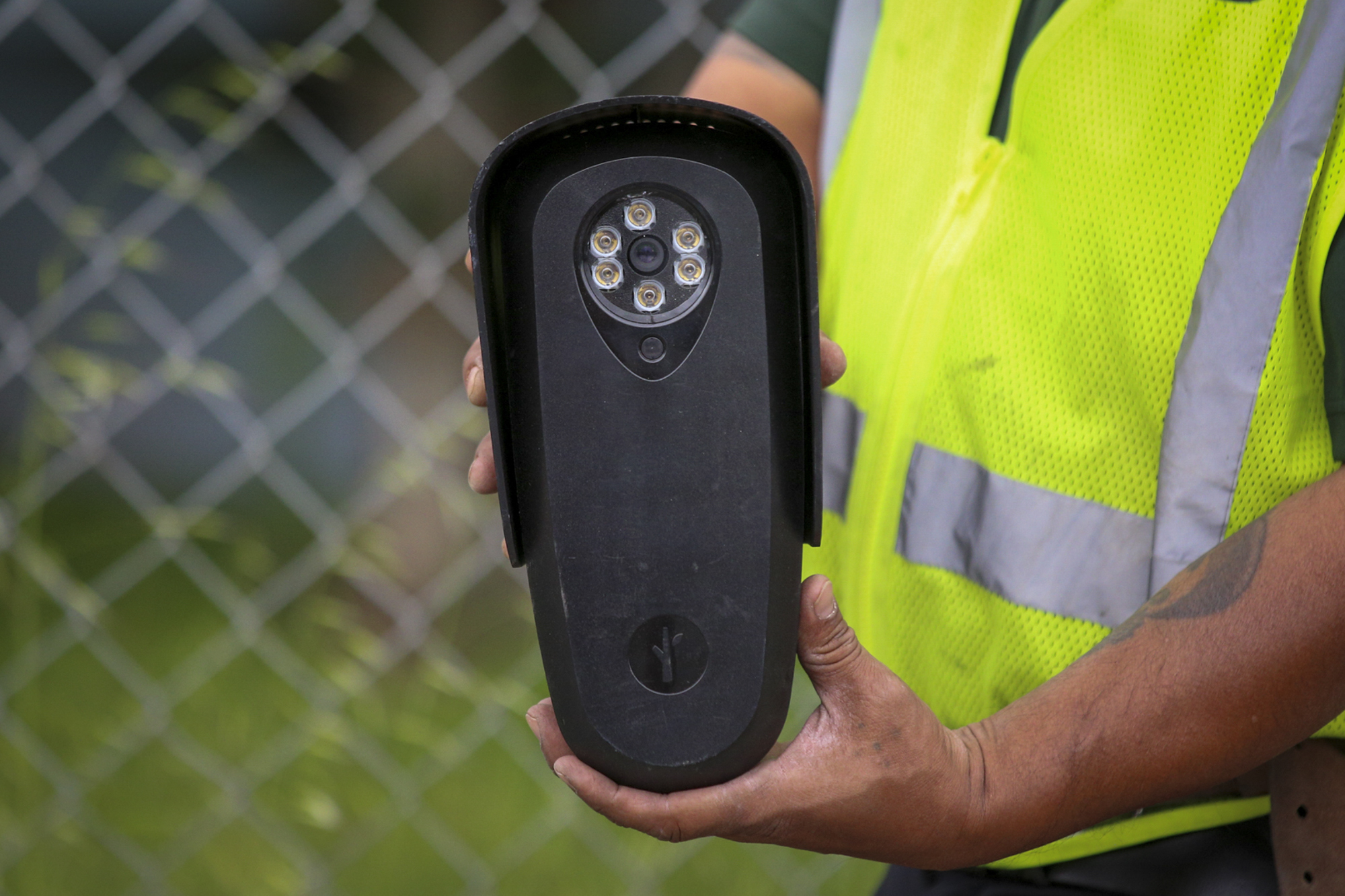
Flock Safety automated license plate readers have proliferated across the Bay Area over the past several years. But as residents learn more about the type of data captured and how it can be used by law enforcement agencies across the country, pushback has grown. Proponents of the system say it helps make our streets safer. Opponents worry it violates our Fourth Amendment right to privacy. Morgan Sung from KQED’s Close All Tabs podcast dug into these questions.
Further Reading:
- ‘Get the Flock Out’: The Fight Over License-Plate Readers Heats Up
- San Francisco Police Audit Shows Feds ‘Improperly’ Accessed License Plate Data Hundreds of Times
- Stanford Cuts Ties With Flock Safety, Shifts to New Surveillance Vendor
Episode Transcript:
Olivia Allen-Price: In April, Bay Area residents crowded into the downtown Oakland Administration building for what was supposed to be a routine budget meeting for the Alameda County Board of Supervisors. But it was unusually packed, because of one meaty agenda item: approving a contract extension for Flock Safety cameras.
Resident after resident came to the mic during public comment …
Bay Area Resident: Having Flock cameras will not keep us safe. These cameras will go up in the neighborhoods where people of color live and we can be damn sure that this information will be taken by the feds and shared with ICE.
Olivia Allen-Price: Flock is a controversial surveillance company that runs AI-powered license plate readers.
Robert Battinich: I own property in San Leandro and I’ve been robbed 24 times. Recently, they put Flock cameras in San Leandro, and it seems to be that they haven’t been breaking in. So, please vote “yes” on renewing the contract with the Flock cameras.
Olivia Allen-Price: On one side of the debate: law enforcement and their supporters, who say the cameras reduce crime and improve public safety. On the other: residents and advocates who are concerned about a creeping surveillance state, an erosion of privacy, and the security issues Flock has been exposed for.
Narayan: Good evening. I urge you to reject Flock’s $854,000 contract extension. This isn’t a camera system, it’s a mass surveillance network. You guys say you care about immigrant communities, but this system puts them directly in danger.
Olivia Allen-Price: The budget meeting lasted hours — and in the end, the board of supervisors voted 3-2 in favor of extending the contract. Protests broke out.
[Protesters outside of budget meeting]: Get Flock off our block! Get Flock off our block! Get Flock off our block!
Olivia Allen-Price: Since that April meeting, the Flock contract was extended in Alameda County again through the end of 2027 to the tune of $2.4 million. And it’s against this backdrop that listener Dennis Riley wrote in to Bay Curious…
Dennis Riley: I’ve seen flock cameras all around the city, all around the Bay Area. .. there’s really no escape from them. I don’t really know what information they record. Um, how much I’m documented on camera.
Olivia Allen-Price: He wants to know what Flock is doing with the information they record…
Dennis Riley: Who are they selling it to? What are they recording? What is this information being used for? It really unsettles me how much I’m being tracked by private companies.
Olivia Allen-Price: To answer this one we turn to Morgan Sung, a tech journalist and the host of KQED’s Close All Tabs podcast, who recently took on this topic…
Morgan Sung: Automated license plate readers, or ALPRs, have been rapidly rolled out by cities and communities around the country, with Flock Safety’s tech at the lead. Before we get any deeper into this, we need to talk about what Flock actually is — and how it was adopted so quickly.
Let’s get into the origin story. So, Flock Safety is based in Atlanta, Georgia. It operates a whole host of surveillance devices: cameras, drones, and, importantly, for this story, ALPRs. Back in 2017, this Georgia Tech alum, Garrett Langley, noticed the uptake in break-ins around his Atlanta neighborhood. Police told him that grainy surveillance camera footage was actually unhelpful, and what they really needed to find perpetrators were license plates.
So, Garrett called up two of his college buddies. Together, they worked on a prototype camera that could record and share what he called “evidence,” not just footage. Here he is speaking to Forbes last year.
[Clip of Garrett’s interview with @Forbes on YouTube]: Yeah, it’s pretty wild. At the end of ’17, we were sitting at my dining room table in Atlanta, building cameras by hand. And now, today, we’re in a roughly 100,000 square foot facility building cameras, building trailers, building drones — all right here in Georgia, which is pretty fun.
Morgan Sung: “Fun” is certainly one way to put it. This entrepreneurial, neighborly concern has grown into an operation of at least 90,000 cameras nationwide, scanning over 20 billion license plates per month. Over 1,000 private businesses have also installed the cameras, adding to Flock’s massive surveillance database.
In Oakland, the push for installing Flock’s ALPRs was fueled by local frustration over BIP-ing — you know, breaking into a parked car and looting whatever’s inside. Here’s Roselyn Romero, a reporter for the independent local news outlet, The Oaklandside. She’s been covering Flock Safety cameras for the region.
Roselyn Romero: BIP-ing, or car break-ins, were also understandably making a lot of residents angry.
Morgan Sung: The city took action around 2024.
Roselyn Romero: The Oakland Police Department eventually signed a contract with Flock Safety for cameras to be installed throughout the city, primarily on freeway entrances and exits. And right now, today, there are 293 Flock cameras in Oakland — specifically, automated license plate readers.
Morgan Sung: Flock’s ALPRs go way further than the standard traffic cam that tickets drivers for speeding. The cameras automatically capture the license plate of every car that drives by — as well as 6 to 12 images of other identifying information. All of this is used to create what Flock calls: a vehicle fingerprint.
Roselyn Romero: The make and the model of that vehicle, if there is a scrape on the bumper, or if there are bumper stickers on the car — Flock keeps a database of all of that information of every car that passes by the ALPRs. And that database can be used by the law enforcement agencies that contract with Flock to investigate crimes.
Morgan Sung: Flock will send officers alerts when a camera captures a vehicle that’s been marked stolen or wanted. Or, the police can search the database to trace a specific vehicle’s movements across the country. Car break-ins in San Francisco have plummeted since 2023.
But whether Flock has any part in that is dubious. The city started cracking down on car break-ins long before it adopted Flock cameras. Still, supporters say that Flock is necessary to prevent crime and catch those who do it. Now, the company says its devices are not equipped to track individual people — but recent expansions have residents concerned.
Roselyn Romero: Flock also has cameras that are called pan, tilt, and zoom cameras. Those cameras, which are currently being used by the Alameda County Sheriff’s Office, can be used to track pedestrians in addition to vehicles.
Morgan Sung: All of the data collected by Flock cameras around the country is shared and stored in a massive aggregated database, which can be accessed by anyone in the network. That means that police in Texas can hunt a woman who travels out of state for an abortion, or that ICE agents can ask local police in Illinois to track undocumented families.
Both of these scenarios are real. They’ve already happened. Privacy activists and civil liberties groups are especially worried. Given the Trump administration’s recent immigration crackdown.
Roselyn Romero: People are scared — even putting Flock cameras aside, many immigrants are afraid of immigration enforcement knocking on their doors. We’re hearing a lot of newly arrived immigrants, refugee and asylum seekers, and other vulnerable populations say that they don’t even want to go outside anymore. They don’t even want to go grocery shopping or send their children to school because they’re afraid of ICE coming in and taking them away from their families.
We’ve been seeing reports of law enforcement agencies and police departments in places outside of California that have shared data with Border Patrol, with U.S. Customs and Immigration Enforcement, and other federal law enforcement agencies that deal with deporting people.
And so a lot of people are understandably afraid. And really concerned about, well, if this technology is continued here in Alameda County, who’s to say that that data is gonna end up in the wrong hands?
A big part of the concern is around data privacy. Flock says it deletes all the information after 30 days. But the company isn’t very transparent about how they handle all of this data.
Roselyn Romero: There have been a lot of concerns from community members I’ve interviewed who say, you know, even if this data is stored in this database for 30 days, what happens after those 30 days? There have just been a whole host of concerns about the type of data that is stored, for how long it’s stored, and who has access to that data before and after it’s retained.
Morgan Sung: Flock also says all of this data, and their camera feeds, are encrypted. These assurances fall flat, though. Around the U.S., amateur hackers have been able to get around the company’s security systems. Tech YouTuber Benn Jordan explained how he did it in a video posted last year.
[Clip from @BennJordan on YouTube]: You may remember me from this video, where I told you about 40,000 of these things that your tax dollars pay for that are tracking your every move and repurposing data collected about you every time that you drive past them. Upon further investigation, it turns out that there are over 80,000 of them — and, um, we got some, and we hacked them.
Morgan Sung: With the help of a cybersecurity expert, Benn was able to hack Flock safety cameras in a whopping 30 seconds.
[Clip from @BennJordan on YouTube]: First thing you’re going to want to do is go ahead and press the button to turn on that police camera. Then press the button on the back a number of times I can’t disclose in this video. There she is: the Flock wireless access point. Go on and connect. Send a command to enable ADB. Connect. And now you can connect to the Flock Safety device and access its data. Or install whatever the hell you want on it. Have fun!
Morgan Sung: Apparently, hacking a Flock camera really is that easy. At least, it was when that video was published. And once you’re in, there’s a lot you can do.
[Clip from @BennJordan on YouTube]: You can clone or decompile the apps. You could send the video stream data to a remote server. You could use it as a botnet client for malware. You could have it capture Wi-Fi handshake credentials and do middleman or honeypot attacks — or replace or modify captured footage or images. And if that is the case, this could bring into question the integrity of the data being used as admissible evidence in court, like, in general.
Roselyn Romero: When these cameras can be hacked and used to spy on people or watch kids, watch everyday people, it really makes you think: how comfortable are we with this type of mass surveillance in our communities?
Morgan Sung: In a follow-up video, Benn showed how easy it was to find the control panels for Flock’s cameras. 404 Media confirmed that at least 60 of Flock’s Condor cameras — the ones that can pan, zoom, and tilt — were left unsecured on the open internet. That means that the live streams and administrator panels could be accessed by anyone with the right link — no login credentials needed. With the panels, anyone could download 30 days of archive footage, manually control the cameras, and run diagnostics.
So, if Flock cameras can be easily hacked or are left totally unsecured, what does it mean for the troves of data? All the photos, the live feeds, the vehicle fingerprints that are stored on Flock’s cloud servers — how is this data being used, authorized or not? Who can access it? That’s a new tab: How is Flock being misused?
Roselyn Romero: There have been a lot of red flags raised by privacy experts and technology experts who say that Flock doesn’t have enough data privacy safeguards to protect itself from liability, as well as protect community members who may be vulnerable to civil immigration enforcement, or enforcement as it relates to seeking abortions or reproductive health care in states where it’s illegal.
Morgan Sung: There have been reports of law enforcement using Flock data for both of these purposes — as well as more… personal uses.
Roselyn Romero: We’ve seen reports from other parts of the country where police officers have used Flock’s database to track down their ex-girlfriends and stalk them.
Morgan Sung: A Wisconsin cop used Flock to stalk his ex-girlfriend and her partner. He submitted 179 database searches for their license plates. In fact, multiple officers have been accused of using Flock’s database to stalk romantic interests — there are at least 21 reported incidents of this in recent years.
Roselyn Romero: So, even though we have Flock and law enforcement saying one thing about Flock cameras’ original intent and purpose, there’s always the potential for something to happen where this technology is used beyond its original intent.
Morgan Sung: And that’s all assuming that technology is working correctly. What if Flock’s vehicle fingerprint is wrong? Just a few months ago, police stopped a 62-year-old woman in Oakland who was driving to her job at a nursing home. Flock had connected her plates to a “serious crime.”
Roselyn Romero: So, she exited the vehicle with her hands up, her car registration was in her hand, and she saw these sheriff’s deputies pointing their guns at her — and she was really confused.
And so, eventually the sheriff’s deputies told her, “Oh, you might not be the suspect we’re looking for because the license plate reader tracked down your license plate. And we essentially connected your license plate number to a crime that had been committed not that long ago.”
Morgan Sung: What the woman didn’t know was that her plates had been stolen, and replaced with the ones associated with the crime.
Roselyn Romero: She came to the realization, “I’m being treated like I’m a violent criminal.” That could have gone so much worse than it did, right?
Morgan Sung: But here’s the thing: Flock flagged a black Honda Civic. This woman drove a silver car. Flock’s “vehicle fingerprint” is supposed to be holistic, taking into account way more details about a car than just its license plates. Were these other details checked before officers made the stop?
Roselyn Romero: It opens up this scary question of: can this happen to me? Can this happen to someone I love, someone I know — completely unsuspecting — who may have had their license plate stolen?
Morgan Sung: And here’s another issue with this technology: racial bias. Black and Brown communities are already more likely to be overpoliced and are disproportionately targeted for traffic stops. The existing bias is evident in Flock’s search records — law enforcement officials still use racist and derogatory language when they search through Flock’s ALPR database.
And as one study showed, Flock Safety cameras have been found to surveil predominantly Black communities more intensely than white ones. In Virginia’s Hampton Roads area, neighborhoods where at least 50% of residents are Black have four times the number of Flock cameras as majority-white neighborhoods. One of the highest concentrations of cameras is around the only HBCU in the area.
Roselyn Romero: In neighborhoods where Black and Brown people are already overly policed, overly surveilled, and overly criminalized, these cameras can play a big role in terms of the types of enforcement actions police take against these communities.
Morgan Sung: And, the company has been long-resistant to efforts to track and log its devices, like in the case of a project called DeFlock. It’s an open-source, community-run tool that identifies and maps the locations of Flock’s cameras. Flock CEO and Co-Founder Garrett Langley is not a fan. Here he is speaking to Forbes again.
[Clip of Garrett’s interview with @Forbes on YouTube]: Unfortunately, there’s terroristic organizations like DeFlock, whose primary motivation is chaos. They are closer to Antifa than they are anything else. And that, I think, is unfortunate — because we don’t want chaos, or I don’t want chaos. I like law and order, I like a society that has a bedrock of safety.
Morgan Sung: That interview is from September of last year. A few months later, he sent an unsolicited email to all Flock law enforcement clients.
Roselyn Romero: And in that email, the CEO attacked activist groups who were against Flock. He said that they wanted to normalize lawlessness and let murderers go free. The CEO also called these activists, quote, “terrorists.”
Morgan Sung: This prompted the city of Staunton, Virginia, as well as several others, to officially terminate their contracts.
Roselyn Romero: And in a press release, the police chief of Staunton, Virginia, basically was like, “We will not tolerate this type of rhetoric.” They said, quote, “The city of Staunton wants to make it clear that the Flock Safety CEO’s narrative does not reflect the city’s values.”
Morgan Sung: Langley’s comments also came amid intense debate over local police sharing Flock data with ICE, which is a violation of city policy in some places. Altogether, it was a PR disaster. As of March, at least 30 localities have canceled their contracts with Flock, or deactivated the ALPRs. The city of Dayton, Ohio is still deciding whether to turn off their cameras — so, while they deliberate, they covered them up with trash bags.
Despite all the vocal opposition, Flock has a lot of support from businesses looking to improve public safety around their buildings — whether it’s private companies trying to protect employees in downtown corporate offices, or mom-and-pop shops trying to protect their storefronts.
Roselyn Romero: Flock Safety cameras have been used by many business leaders and commercial districts throughout the Bay Area to address crime, prevent crime, track down people who may have broken into restaurants, vandalized businesses. So there’s just been a lot of support from large corporations, in addition to local business leaders, who argue that Flock cameras have actually been a really good thing for business, and for the safety of their employees, and customers.
Morgan Sung: But residents are becoming more vocal about their distrust in Flock — in part, because it’s unclear who exactly has access to Flock’s data once it’s collected.
Roselyn Romero: Who’s to say that these law enforcement agencies from other states can also use data from California law enforcement agencies?
Morgan Sung: How far is this data being shared? Is Flock breaking local laws? One reporter in Palo Alto uncovered a slew of Flock search requests that violated the city’s own policies. We’re getting into that after this break.
Olivia Allen-Price: Stay with us.
Sponsor message
Olivia Allen-Price: One huge concern for advocates is how Flock data is being shared. Reporter and Podcast Host Morgan Sung digs in on a scandal that broke out in Palo Alto.
Riley Cooke: People were just as fired up about a pickleball debate a couple of weeks ago in Palo Alto — so there are certain issues that definitely get people to turn out, whether it’s converting a pickleball court or, you know, cameras that are watching your every move when you’re moving about the city.
Morgan Sung: Riley Cooke is a City Hall reporter at Palo Alto Weekly. Earlier this year, a publication in nearby Mountain View had discovered that the city’s Flock data had been accessed by a slew of outside entities. Riley wanted to find out if the same thing was happening in Palo Alto.
Riley Cooke: So what I did is I filed a records request for these search audits that Flock and the police department maintain. So, every time a search is conducted, whether by a local officer or by an out-of-state agency, or outside agency at all into Palo Alto — that’s logged in a giant spreadsheet with the time, the date, and the reason for the search.
Morgan Sung: The request was approved, but at first, the police chief didn’t hand over the specific documents that Riley was looking for.
Riley Cooke: So, I reopened the request and said, “Hey, I actually want these spreadsheets.” And eventually they gave them to me in March. And my editor was- he was out on some, like, coffee chat with a source, and so I was blowing up his texts, like, “We got the ALPR records, we’ve got them.” And it’s thousands and thousands of pages that detail every single search: the time, the date, who conducted it.
Morgan Sung: The search records revealed that police departments from all over the country were also searching Palo Alto’s Flock data, without the permission of the city, or the Palo Alto Police Department.
Riley Cooke: The police department told me that they didn’t actually access any of the data or download it, but Palo Alto’s cameras still appeared in search results from, you know, Mississippi, Illinois — basically all 50 states, including some federal agencies, such as the ATF.
Morgan Sung: ATF is short for the Bureau of Alcohol, Tobacco, Firearms, and Explosives. Riley’s reporting shows that, for about a year and a half, tens of thousands of searches from outside agencies were performed in Palo Alto.
Riley Cooke: I think my hope with doing that was to sort of beg the question of: what do these agencies have anything to do with Palo Alto? Or why is Palo Alto’s ALPR data appearing in search results by, you know, police departments from halfway across the country?
Morgan Sung: This is actually super illegal. California law prohibits the sharing of ALPR data with out-of-state and federal agencies — and this has been the case since 2016. The Palo Alto Police Department told Riley that they didn’t know the city had been opted into the national lookup feature.
Riley Cooke: And, they went above and beyond existing California law about not sharing with any out-of-state or federal agencies. And, what my reporting shows is that Flock was still able to bypass those without telling anybody. They didn’t tell the police department, they didn’t tell city officials, they just quietly rolled out this nationwide data-sharing effort, which completely went past local and California regulations.
I think city officials were really confident at first that they had enacted these protections, that they were protecting residents and heeding those surveillance concerns. And yet, at the end of the day, the company still did what they wanted to do.
Morgan Sung: It begs the question: why did Flock bypass the police department and make this data available nationwide? And what is the point of privacy protections if Flock can just access the data and share it anyway?
Riley Cooke: Recently there’s been hundreds of people turning out to city government meetings to protest the Flock contract and urging Palo Alto to do what neighboring cities have done, which is to shut down the cameras or terminate their contract with Flock.
Morgan Sung: Now, thanks to Riley’s reporting, the Palo Alto Police Department is proactively sharing license plate search logs on its website.
Riley Cooke: So, everyone’s able to go and find that information on their own, and can verify that no out-of-state or illegal searches are being performed. I don’t know any other city that’s currently doing that by practically publishing those, so I think that’s pretty cool. And Palo Alto is also auditing its Flock contract.
Morgan Sung: The consulting firm in charge of the Flock audit — called the OIR Group — has managed to hold Palo Alto’s cops accountable in the past — like standardizing bodycam usage. Will these data protections do anything, though? Riley says that residents are concerned that Flock could easily disregard them and go over the city again, like it did in Mountain View.
Riley Cooke: They don’t like that they were lied to. And so, I think a lot of residents had their suspicions about this, couldn’t exactly confirm that it was happening in Palo Alto, and my reporting was just — again, that confirmation that they were looking for.
Morgan Sung: Riley said the Palo Alto Police Department will probably listen to resident demands for greater transparency around Flock. But, even if the city gets rid of Flock cameras, law enforcement will likely still use ALPRs. If not Flock’s, then another company’s. There’s nationwide pushback against Flock — are these community efforts going anywhere though? Let’s open one last tab: can Flock be stopped?
We’re heading back to Alameda County, where Oakland is partnering with Flock to operate nearly 300 ALPRs throughout the city. But organizers remain committed to protesting the contracts. Roselyn Romero, the Oaklandside reporter from earlier, pointed out that Alameda County has a history of social movements.
Roselyn Romero: Because of Alameda County’s location, situated where all of these technological and AI advancements are originated, and the fact that Alameda County is home to many social justice movements over the years — I’m thinking about the Black Panther Party in Oakland, right?
A lot of these social justice movements, racial justice movements, and activists are also on the side of: we shouldn’t have Flock in our communities, and why are we continuing to expand these sorts of police technologies in our neighborhoods, when there are already so many community members who are vulnerable and afraid?
So I think it speaks to this crucial moment in Alameda County of: everybody agrees that Flock Safety’s cameras are really powerful. It’s just- now, the debate is: what to use that power for, how comfortable we are with that power, and where we see our society going with this type of powerful tool in our communities.
Morgan Sung: In California, organizers have actually made real progress in stopping Flock — or getting it removed. Santa Cruz was the first city to turn off its cameras. Mountain View, South Pasadena, El Cerrito, Campbell, Oxnard, and other California cities followed. And, like we talked about earlier, some residents have taken matters into their own hands.
Roselyn Romero: In Oakland, we’ve seen people paintbombing these Flock cameras, where cameras in Oakland have just been splashed with paint and vandalized, if you will.
Morgan Sung: And beyond the concerns about Flock’s capabilities, the company’s services are expensive. Flock contracts add up to millions of dollars. And this has many residents questioning how else this funding could be used.
Roselyn Romero: When crime is at near historic lows, why are we continuing to put more money and more power into these powerful technologies? Right now, the Oakland City Council is debating its budget for the next fiscal year. And, we’re seeing all of these programs for violence prevention and for other community events being cut.
A lot of community members are saying, “Why are we continuing to invest in police technologies and surveillance tools when we could instead allocate that money toward, say, health care or childhood education — early childhood education — more social programs for people who really need it during the summertime, or homelessness services?”
It’s a really interesting and seemingly endless debate that we’re seeing in Oakland and Alameda County and across the country.
Alameda County Supervisor David Haubert: [bangs gavel] We have to take a vote on this.
Morgan Sung: Back in April, at the Alameda Board of Supervisors meeting, the board voted in favor of extending the Flock contract until July 1st. That’s despite the vocal pushback from residents.
[Protesters outside of budget meeting]: Get Flock off our block! Get Flock off our block! Get Flock off our block!
Morgan Sung: Last Tuesday — the day before the contract expired —the Alameda Board of Supervisors once again voted to extend Flock’s contract… This time, until the end of next year.
Alameda County Supervisor David Haubert: So that motion passes. We’re not entertaining comments from the gallery.
Morgan Sung: Once that’s up, the County Sheriff’s Office will have the opportunity to look for alternative vendors: surveillance tech companies that offer the same services as Flock. There are about a dozen or so competitors that could replace Flock cameras.
So, even if the board votes to end its contract, this larger question still exists: Does mass surveillance of people who aren’t suspected of a crime violate their Fourth Amendment right to privacy? Is that worth giving up in the name of public safety?
Roselyn Romero: This debate is not unique to the Bay Area. We’re seeing — at the federal level — President Donald Trump’s mass deportation agenda playing out in full force. What does that say about the type of surveillance, technology, and society that we want to have here in the Bay Area? What does that say about the types of companies and values we want to support and continue funding, not just at the national level, but even here, in our own communities.
Morgan Sung: This debate gets at the heart of the right to privacy, guaranteed by the Constitution, but chipped away at every year. Communities across the country have made it clear that they oppose the partnerships between surveillance tech companies and the government. Will city leaders listen? Who knows? But paintbombing Flock cameras is a growing trend. And, as we’ve seen from other incidents across the country, people will find alternative — and creative —ways to make their anger heard.
Olivia Allen-Price: That was KQED tech journalist Morgan Sung who reported on this for the Close All Tabs podcast, which she hosts. Their team includes Maya Cueva, Chris Egusa, Chris Hambrick and Brendan Willard.
Thanks to Dennis Riley, for asking this week’s question.
Bay Curious is produced in SF at member-supported KQED.
Our show is produced by Katrina Schwartz, Christopher Beale and me, Olivia Allen-Price.
With extra support from Maha Sanad, Katie Sprenger, Jen Chien, Ethan Toven-Lindsey and everyone on team KQED.
Some members of the KQED Podcast team are represented by the Screen Actors Guild, American Federation of Television and Radio Artists, San Francisco, Northern California Local.
I’m Olivia Allen-Price. Have a great week.