‘We’re Not Fighting This Alone’: Gilroy and Beyond Pushes Back Against Planned ICE Facility
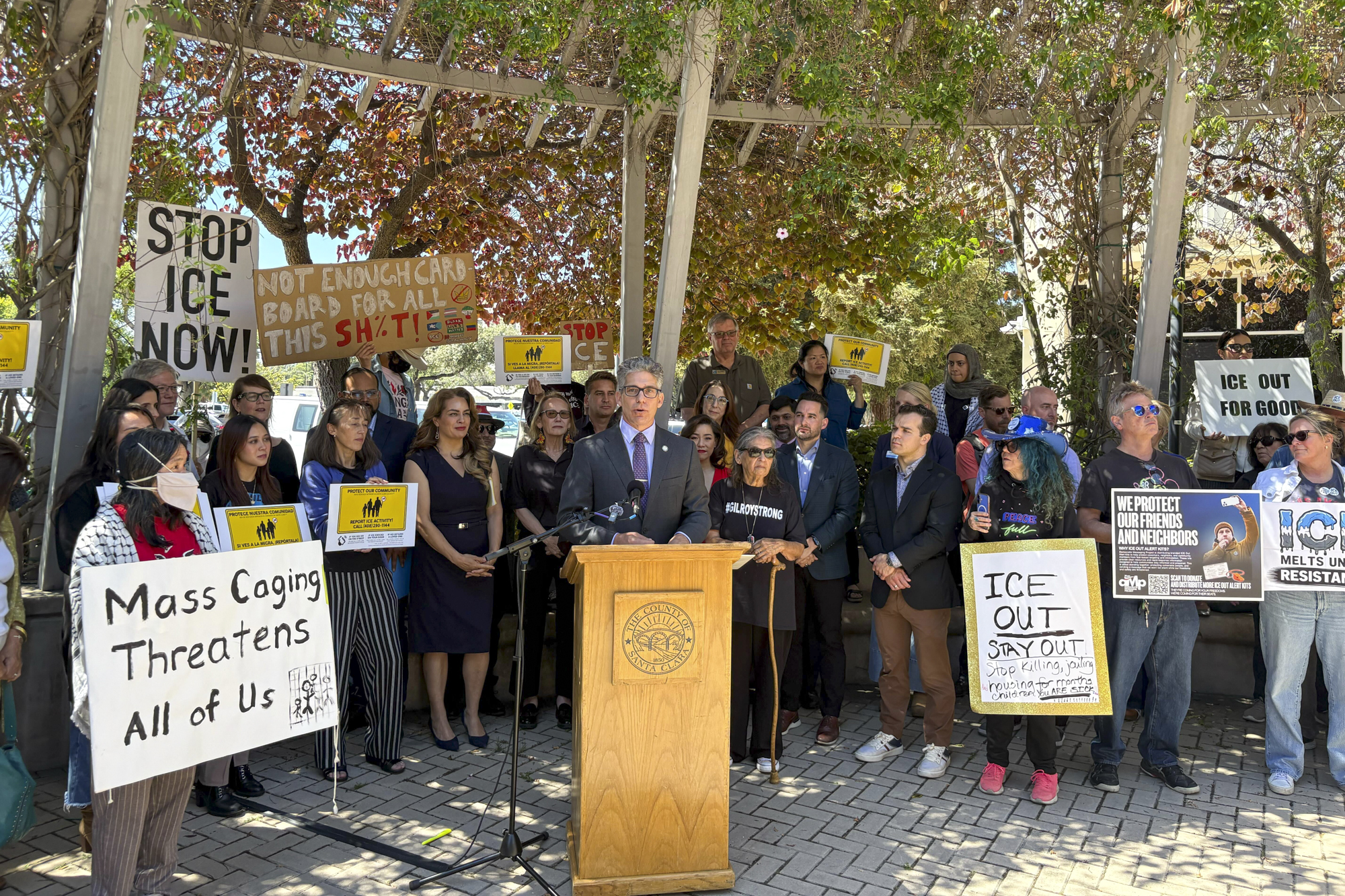
State and local leaders are suing the federal government after alleging that Immigration and Customs Enforcement quietly broke ground on a proposal to build an ICE facility in Gilroy. Santa Clara County leaders and a number of other Bay Area cities, counties and community groups, have banded together to put a stop to the plan. At a recent press conference, members of San Jose’s Japanese American community also spoke out, drawing parallels to the incarceration of Japanese Americans during World War II.
Some members of the KQED podcast team are represented by The Screen Actors Guild, American Federation of Television and Radio Artists, San Francisco-Northern California Local.
Episode transcript
This transcript is computer-generated. While our team has reviewed it, there may be errors.
Ericka Cruz Guevarra: I’m Ericka Cruz Guevarra and welcome to The Bay, local news to keep you rooted. Back in April, Rebeca Armendariz got a message from someone in her community of Gilroy. Rumors were spreading of an immigration and customs enforcement facility coming to the city, where about 60% of the population identify as Hispanic or Latino, many of whom are also immigrants.
Rebeca Armendariz: We have lots of farm workers. We have farm workers that come documented, and we have farm work that migrate from Yuma and Texas and other parts of the Southwest.
Ericka Cruz Guevarra: Now it’s in this community where immigration and customs enforcement plans to build a 4,000 square foot facility that state and county leaders say will be an ICE detention center. And advocates warn that it could be used to hold immigrants not just from Gilroy, but from across the Bay Area.
Rebeca Armendariz: This is an issue that is impacting all of us, and that’s why all of us have to come together and fight against this deportation machine.
Ericka Cruz Guevarra: The state, along with dozens of cities, counties, and multi-ethnic community groups are now fighting to stop the ICE facility from being built. And long-time Gilroy residents like Armendariz say they’re ready for this fight.
Rebeca Armendariz: We’ve been organizing for decades, for generations, in my community, like my parents before me and others before them. I feel like we are in a place that we’re not fighting this alone, where I have, you know, dozens and dozens of other activists and community members who will also put themselves on the line and to fight back with all we have, right, with all we’ve got.
Ericka Cruz Guevarra: Today, the Bay Area’s fight against an ICE facility in Gilroy. So, Joseph, just to start, what do we know so far and at this point about the federal government’s plans for a potential detention center in the city of Gilroy?
Joseph Geha: Most of what we know is from documents that are filed as part of a lawsuit against ICE and against the federal government. That’s been brought by Santa Clara County and the state attorney general’s office.
Ericka Cruz Guevarra: Joseph Geha covers the South Bay for KQED.
Joseph Geha: And basically what the, what the lawsuit shows is that the federal government, ICE essentially wants to redevelop this 25 acre property on Holsclaw road. It’s a essentially a piece of farmland to, you know, make it an office for ICE operations and it would include concrete reinforced holding rooms for detainees. Santa Clara County and the state are basically alleging that this office would hold about 60 employees and possibly up to 150 detainees.
Ericka Cruz Guevarra: That’s interesting. So it sounds like the details that we know so far are not necessarily coming from the federal government or the Trump administration itself, but from this lawsuit from Santa Clara County and the state attorney general, essentially suing ICE and the federal government to try and stop this detention center from being built, right?
Joseph Geha: That’s correct. The county and the state say they had county investigators kind of taking a look at the property and watching it closely. And it was in late April that they started seeing fences go up. There was demolition taking place. So like, they’re very clear in their lawsuit that the government has started to develop this and started to do work on the site and then, you know, done a lease there and everything all in secret. At a high level, Santa Clara County and the state are arguing that, first of all, this property used to be used recently as an agricultural research facility where pesticides were often being tested. So there’s a lot of hazardous materials at the site and they are worried that that also makes it an inappropriate place for this facility. They’re also saying that the government is violating intergovernmental cooperation laws, essentially saying that federal government started developing this in secret and really told the county and the state nothing about this and that goes against laws where they are you know required to solicit the input of the communities that they’re intending to build or develop in and that this site is inappropriate and not allowed essentially to become a non-agricultural use without you know explicit permission from the county.
Ericka Cruz Guevarra: Or not an appropriate place to house more than 100 potential people for long periods of time.
Joseph Geha: That too, yeah. It’s been reported widely in media and other lawsuits that the Trump administration’s facilities for ICE and detention centers and temporary holding centers and offices have all kind of violated rights of people in their own right. That they’re not providing proper, you know, hygiene facilities, water, food, bathrooms, you know, sleeping sites. So that people are actually being held in very subpar, you cruel conditions. I think the concern from the county and the state is that it would indeed kind of bring that cruelty to their backyard.
Ericka Cruz Guevarra: And there’s some precedent for that concern, right? Because we have sort of seen the Trump administration in the last two years really beefing up detention centers across not just California, but the country, right.
Joseph Geha: That’s right. I mean, the government is and has kind of publicized the fact that it is rapidly expanding its deportation program. And as a part of that is purchasing all kinds of facilities. ICE as an agency has kind of touted from the top down that they are getting more funding and that this should not be a surprise that they’re going to continue to push these operations forward.
Ericka Cruz Guevarra: Do we know why they’re looking at building this facility in Gilroy specifically?
Joseph Geha: ICE itself and the federal government have not said very much about this site until recently. They told the Sacramento Bee in late July that this site is not for a detention center. A spokesperson for ICE said the South Bay facility would be for an ICE office that will support local operations and the enforcement of federal immigration laws. So even when they’re offering a statement, ICE has been pretty vague. But, if you listen to the concern from advocates, you know, they are saying that this is essentially a part of the Bay Area. It’s close to the central coast. It’s in South Santa Clara County, Gilroy within the county. These places are heavily immigrant rich communities, and this is something that has really concerned folks up and down the Bay Area here.
Rebeca Armendariz: Our local coalition has pulled together folks from Soledad to Stockton, Morgan Hill to Monterey because we know that if they build this gallery processing center and they open the Dublin Detention Center, they will fill it with our people from the Central Coast to the Bay Area.
Joseph Geha: But one of the most outspoken folks against this facility and a person who has really stood up for social justice issues in the South Bay is Rebeca Armendariz. She’s a former Gilroy council member and she currently is associated with Working Partnerships USA, which is a nonprofit in the south Bay.
Rebeca Armendariz: Leaders from Monterey, Santa Cruz, San Benito, and even Marin County have joined a dozen cities and others to sign on to an amicus brief in support of our lawsuit. They know that ICE will raid workplaces, schools, malls, neighborhoods, hospitals, and even places of worship. We see that our community will suffer together as they always have, but that’s why together we will gather, we will strategize, we’ll organize, and continue to fight together so that we will win back our country.
Ericka Cruz Guevarra: Coming up how the rest of the Bay Area is responding to the ICE facility in Gilroy. By the way, if you appreciate the local deep dives that we bring you here on The Bay, consider becoming a sustaining KQED member. KQED members are the backbone of our journalism here. Join the thousands of people who make it all happen. Just go to donate.kqed.org slash podcasts. We’ll be right back. You have specifically been reporting on the reaction from surrounding communities near and around Gilroy and their response to this potential detention center there. And it seems like the concern has really stretched beyond Gilroy itself.
Joseph Geha: The reaction was very strong. I mean, community members from Gilroy, uh, of course, but as well as San Jose and other Santa Clara County residents were coming together to call attention to this, I think a list of something like 25 or more cities and counties have signed onto this lawsuit to say that they, uh also oppose this and we’re talking about, yes, like the entire, you know, Monterey County board of supervisors, along with like small places like the city of Alameda in the Bay. Agricultural cities like Watsonville, but also Sunnyvale where Google and other major companies are based. Also yes, individually in local communities we’re seeing pockets of resistance. One community in particular that I think has really expressed a deep concern and connection to this issue is the Japanese American community in San Jose. So recently I went to a press conference and a rally in Japantown.
Press Conference: We will never be defeated!
Ericka Cruz Guevarra: What was the idea behind this press conference? Why were folks there to speak out?
Joseph Geha: It was like a whole coalition, like basically several different groups of people, but it was led by local Japanese American groups. One of them is called the San Jose Nikkei Resisters and the Neighbors Not Enemy Coalition of San Jose. And they’re drawing connections from the Japanese American community to the past, to the pretty recent past of, you know, the incarceration of Japanese Americans at concentration camps during World War II.
Susan Hayase You know, when we see people dragged away, we think of our grandparents and we think of our parents. We feel it deeply.
Joseph Geha: One of the main organizers of the San Jose Nikkei Resisters, the co-founder, is this person named Susan Hayase. And Susan is a person who’s been in the fight, I would say, for a long time. Decades ago, she helped participate in the effort to get reparations for Japanese Americans, the Japanese American redress effort, and an apology from the U.S., both in words, but in the form of these reparations for the incarceration of people during World War II.
Susan Hayase: We’ve had to stand up for ourselves and stand together with other communities in struggles for justice and equality. And so facing the demands of today with our neighbors being attacked by ICE, we’re not starting from scratch. We’re doing it again.
Joseph Geha: She told me, you know, this is this is very close to her because we’re talking about not some far away distant past We’re talking, about her parents generation.
Susan Hayase: We hoped that by illuminating our history, we could inspire people to make sure that it never happened again. But today, unfortunately, it’s too late to just say never again. The thing we feared is happening again now. In World War II, there were 75 confinement sites. Today, there are over 200, and there are reports of horrifying subhuman conditions. In World war II, over 125,000 were detained. Today, almost 400,000 have been arrested by ICE. Over 51 have died in ICE custody, and the number of those being shot in the street is growing.
Joseph Geha: It was not just Japanese Americans at this press conference. Certainly that was, I think, the focus of the day. But the point drawn by several speakers there is that this coalition, these various groups of people from around the community, were multiethnic, right? Different generations, different ages, different cultural backgrounds, different religions. And they’re all here to kind of say that this is not the right direction for this community.
Ericka Cruz Guevarra: What is the status of things now?
Joseph Geha: With the lawsuit, things right now are kind of in a holding pattern. So part of the ask of the lawsuit the big driving force of the lawsuits to stop this, right? But in the meantime, the county and the state have also filed a request with the courts for a preliminary injunction. Essentially meaning, can we put a court order to hold on everything until this litigation is done? And as part of kind of like a scheduling compromise with the federal government, they have agreed. To halt all operations there, like construction and demolition, until at least September 9th. And that right around then is going to be a court hearing on this request for preliminary injunction. So we may know more by early September about whether or not a court is going to have a favorable view of the lawsuit brought by Santa Clara County and the state.
Ericka Cruz Guevarra: I mean, one thing I’m thinking about is I feel like we’ve really seen the South Bay, Santa Clara County, really coming out against the Trump administration and ICE since the start of Trump’s second administration. I mean things like bans on masks for ICE in the county, for example. Is it safe to say that this is kind of just like another frontier in the South Bay’s pushback against the trump administration’s policies on immigration?
Joseph Geha: I think you hit the nail on the head. Santa Clara County, cities like San Jose and others here that represent a lot of people have, yes, taken steps to signal where their values are, to say that we’re in new territory here. We haven’t dealt with a federal administration like this that has gone after our people so aggressively and in ways that we believe violate myriad laws. So what we’re going to do is set up as many laws, protections, funding apparatus as possible. Within reason to make sure that our community members know that they are supported locally. That this immigrant rich community, city and county are not alone in this fight.
Ericka Cruz Guevarra: Well Joseph, thank you so much.
Joseph Geha: Thank you, Ericka. It’s always great talking to you.
Susan Hayase I think that sometimes people get used to bad news, you know, they become calloused. But I think in order to make this system work, everybody has to participate. In that same spirit, we can and should protest, object and resist today’s brutal, unlawful ICE, policies. Moi chiro. Let’s do it again.
Crowd: Woo!
Ericka Cruz Guevarra: That was Joseph Geha who covers the South Bay for KQED. This episode was cut down and edited by Kyana Moghadam and me. Gabriela Glueck is our producer. She scored this episode and added all the tape. She also conducted the interview that you heard with Rebeca Armendariz. Music courtesy of APM and Audio Network. If you ever want to get in touch with us here at the Bay. You could send us an email at thebay.kqed.org. The Bay is a production of listener-supported KQED public media. Support for The Bay is provided in part by the Osher Production Fund. Some members of the KQED podcast team are represented by the Screen Actors Guild, American Federation of Television and Radio Artists, San Francisco, Northern California Local. I’m Ericka Cruz Guevarra. Thank you so much for listening. Talk to you next time.