window.__IS_SSR__=true
window.__INITIAL_STATE__={
"attachmentsReducer": {
"audio_0": {
"type": "attachments",
"id": "audio_0",
"imgSizes": {
"kqedFullSize": {
"file": "https://ww2.kqed.org/news/wp-content/themes/KQED-unified/img/audio_bgs/background0.jpg"
}
}
},
"audio_1": {
"type": "attachments",
"id": "audio_1",
"imgSizes": {
"kqedFullSize": {
"file": "https://ww2.kqed.org/news/wp-content/themes/KQED-unified/img/audio_bgs/background1.jpg"
}
}
},
"audio_2": {
"type": "attachments",
"id": "audio_2",
"imgSizes": {
"kqedFullSize": {
"file": "https://ww2.kqed.org/news/wp-content/themes/KQED-unified/img/audio_bgs/background2.jpg"
}
}
},
"audio_3": {
"type": "attachments",
"id": "audio_3",
"imgSizes": {
"kqedFullSize": {
"file": "https://ww2.kqed.org/news/wp-content/themes/KQED-unified/img/audio_bgs/background3.jpg"
}
}
},
"audio_4": {
"type": "attachments",
"id": "audio_4",
"imgSizes": {
"kqedFullSize": {
"file": "https://ww2.kqed.org/news/wp-content/themes/KQED-unified/img/audio_bgs/background4.jpg"
}
}
},
"placeholder": {
"type": "attachments",
"id": "placeholder",
"imgSizes": {
"thumbnail": {
"file": "https://cdn.kqed.org/wp-content/uploads/2024/12/KQED-Default-Image-816638274-2000x1333-1-160x107.jpg",
"width": 160,
"height": 107,
"mimeType": "image/jpeg"
},
"medium": {
"file": "https://cdn.kqed.org/wp-content/uploads/2024/12/KQED-Default-Image-816638274-2000x1333-1-800x533.jpg",
"width": 800,
"height": 533,
"mimeType": "image/jpeg"
},
"medium_large": {
"file": "https://cdn.kqed.org/wp-content/uploads/2024/12/KQED-Default-Image-816638274-2000x1333-1-768x512.jpg",
"width": 768,
"height": 512,
"mimeType": "image/jpeg"
},
"large": {
"file": "https://cdn.kqed.org/wp-content/uploads/2024/12/KQED-Default-Image-816638274-2000x1333-1-1020x680.jpg",
"width": 1020,
"height": 680,
"mimeType": "image/jpeg"
},
"1536x1536": {
"file": "https://cdn.kqed.org/wp-content/uploads/2024/12/KQED-Default-Image-816638274-2000x1333-1-1536x1024.jpg",
"width": 1536,
"height": 1024,
"mimeType": "image/jpeg"
},
"fd-lrg": {
"file": "https://cdn.kqed.org/wp-content/uploads/2024/12/KQED-Default-Image-816638274-2000x1333-1-1536x1024.jpg",
"width": 1536,
"height": 1024,
"mimeType": "image/jpeg"
},
"fd-med": {
"file": "https://cdn.kqed.org/wp-content/uploads/2024/12/KQED-Default-Image-816638274-2000x1333-1-1020x680.jpg",
"width": 1020,
"height": 680,
"mimeType": "image/jpeg"
},
"fd-sm": {
"file": "https://cdn.kqed.org/wp-content/uploads/2024/12/KQED-Default-Image-816638274-2000x1333-1-800x533.jpg",
"width": 800,
"height": 533,
"mimeType": "image/jpeg"
},
"post-thumbnail": {
"file": "https://cdn.kqed.org/wp-content/uploads/2024/12/KQED-Default-Image-816638274-2000x1333-1-672x372.jpg",
"width": 672,
"height": 372,
"mimeType": "image/jpeg"
},
"twentyfourteen-full-width": {
"file": "https://cdn.kqed.org/wp-content/uploads/2024/12/KQED-Default-Image-816638274-2000x1333-1-1038x576.jpg",
"width": 1038,
"height": 576,
"mimeType": "image/jpeg"
},
"xxsmall": {
"file": "https://cdn.kqed.org/wp-content/uploads/2024/12/KQED-Default-Image-816638274-2000x1333-1-160x107.jpg",
"width": 160,
"height": 107,
"mimeType": "image/jpeg"
},
"xsmall": {
"file": "https://cdn.kqed.org/wp-content/uploads/2024/12/KQED-Default-Image-816638274-2000x1333-1-672x372.jpg",
"width": 672,
"height": 372,
"mimeType": "image/jpeg"
},
"small": {
"file": "https://cdn.kqed.org/wp-content/uploads/2024/12/KQED-Default-Image-816638274-2000x1333-1-672x372.jpg",
"width": 672,
"height": 372,
"mimeType": "image/jpeg"
},
"xlarge": {
"file": "https://cdn.kqed.org/wp-content/uploads/2024/12/KQED-Default-Image-816638274-2000x1333-1-1020x680.jpg",
"width": 1020,
"height": 680,
"mimeType": "image/jpeg"
},
"full-width": {
"file": "https://cdn.kqed.org/wp-content/uploads/2024/12/KQED-Default-Image-816638274-2000x1333-1-1920x1280.jpg",
"width": 1920,
"height": 1280,
"mimeType": "image/jpeg"
},
"guest-author-32": {
"file": "https://cdn.kqed.org/wp-content/uploads/2025/01/KQED-Default-Image-816638274-1333x1333-1-160x160.jpg",
"width": 32,
"height": 32,
"mimeType": "image/jpeg"
},
"guest-author-50": {
"file": "https://cdn.kqed.org/wp-content/uploads/2025/01/KQED-Default-Image-816638274-1333x1333-1-160x160.jpg",
"width": 50,
"height": 50,
"mimeType": "image/jpeg"
},
"guest-author-64": {
"file": "https://cdn.kqed.org/wp-content/uploads/2025/01/KQED-Default-Image-816638274-1333x1333-1-160x160.jpg",
"width": 64,
"height": 64,
"mimeType": "image/jpeg"
},
"guest-author-96": {
"file": "https://cdn.kqed.org/wp-content/uploads/2025/01/KQED-Default-Image-816638274-1333x1333-1-160x160.jpg",
"width": 96,
"height": 96,
"mimeType": "image/jpeg"
},
"guest-author-128": {
"file": "https://cdn.kqed.org/wp-content/uploads/2025/01/KQED-Default-Image-816638274-1333x1333-1-160x160.jpg",
"width": 128,
"height": 128,
"mimeType": "image/jpeg"
},
"detail": {
"file": "https://cdn.kqed.org/wp-content/uploads/2025/01/KQED-Default-Image-816638274-1333x1333-1-160x160.jpg",
"width": 160,
"height": 160,
"mimeType": "image/jpeg"
},
"kqedFullSize": {
"file": "https://cdn.kqed.org/wp-content/uploads/2024/12/KQED-Default-Image-816638274-2000x1333-1.jpg",
"width": 2000,
"height": 1333
}
}
},
"bayareabites_134873": {
"type": "attachments",
"id": "bayareabites_134873",
"meta": {
"index": "attachments_1716263798",
"site": "bayareabites",
"id": "134873",
"found": true
},
"parent": 134870,
"imgSizes": {
"thumbnail": {
"file": "https://ww2.kqed.org/app/uploads/sites/24/2019/09/gettyimages-1014737616_custom-9d3476efc13366bda4265ec37dfac88ce23bc5fc-s700-c85-160x120.jpg",
"width": 160,
"mimeType": "image/jpeg",
"height": 120
},
"post-thumbnail": {
"file": "https://ww2.kqed.org/app/uploads/sites/24/2019/09/gettyimages-1014737616_custom-9d3476efc13366bda4265ec37dfac88ce23bc5fc-s700-c85-672x372.jpg",
"width": 672,
"mimeType": "image/jpeg",
"height": 372
},
"kqedFullSize": {
"file": "https://ww2.kqed.org/app/uploads/sites/24/2019/09/gettyimages-1014737616_custom-9d3476efc13366bda4265ec37dfac88ce23bc5fc-s700-c85.jpg",
"width": 700,
"height": 527
}
},
"publishDate": 1569879613,
"modified": 1569879647,
"caption": "A new set of analyses contradict the current dietary recommendations to limit red and processed meats.",
"description": "A new set of analyses contradict the current dietary recommendations to limit red and processed meats.",
"title": "gettyimages-1014737616_custom-9d3476efc13366bda4265ec37dfac88ce23bc5fc-s700-c85",
"credit": "PeopleImages/Getty Images",
"status": "inherit",
"isLoading": false,
"fetchFailed": false
},
"bayareabites_134765": {
"type": "attachments",
"id": "bayareabites_134765",
"meta": {
"index": "attachments_1716263798",
"site": "bayareabites",
"id": "134765",
"found": true
},
"parent": 134764,
"imgSizes": {
"twentyfourteen-full-width": {
"file": "https://ww2.kqed.org/app/uploads/sites/24/2019/09/crusoe2-2ddb3b7cf4063df0ddb213174ddfccdcdb954257-1038x576.jpg",
"width": 1038,
"mimeType": "image/jpeg",
"height": 576
},
"thumbnail": {
"file": "https://ww2.kqed.org/app/uploads/sites/24/2019/09/crusoe2-2ddb3b7cf4063df0ddb213174ddfccdcdb954257-160x120.jpg",
"width": 160,
"mimeType": "image/jpeg",
"height": 120
},
"post-thumbnail": {
"file": "https://ww2.kqed.org/app/uploads/sites/24/2019/09/crusoe2-2ddb3b7cf4063df0ddb213174ddfccdcdb954257-672x372.jpg",
"width": 672,
"mimeType": "image/jpeg",
"height": 372
},
"kqedFullSize": {
"file": "https://ww2.kqed.org/app/uploads/sites/24/2019/09/crusoe2-2ddb3b7cf4063df0ddb213174ddfccdcdb954257-e1568749628473.jpg",
"width": 1920,
"height": 1441
},
"large": {
"file": "https://ww2.kqed.org/app/uploads/sites/24/2019/09/crusoe2-2ddb3b7cf4063df0ddb213174ddfccdcdb954257-1020x766.jpg",
"width": 1020,
"mimeType": "image/jpeg",
"height": 766
},
"complete_open_graph": {
"file": "https://ww2.kqed.org/app/uploads/sites/24/2019/09/crusoe2-2ddb3b7cf4063df0ddb213174ddfccdcdb954257-1200x901.jpg",
"width": 1200,
"mimeType": "image/jpeg",
"height": 901
},
"full-width": {
"file": "https://ww2.kqed.org/app/uploads/sites/24/2019/09/crusoe2-2ddb3b7cf4063df0ddb213174ddfccdcdb954257-1920x1441.jpg",
"width": 1920,
"mimeType": "image/jpeg",
"height": 1441
},
"medium": {
"file": "https://ww2.kqed.org/app/uploads/sites/24/2019/09/crusoe2-2ddb3b7cf4063df0ddb213174ddfccdcdb954257-800x600.jpg",
"width": 800,
"mimeType": "image/jpeg",
"height": 600
},
"medium_large": {
"file": "https://ww2.kqed.org/app/uploads/sites/24/2019/09/crusoe2-2ddb3b7cf4063df0ddb213174ddfccdcdb954257-768x576.jpg",
"width": 768,
"mimeType": "image/jpeg",
"height": 576
}
},
"publishDate": 1568749306,
"modified": 1568749669,
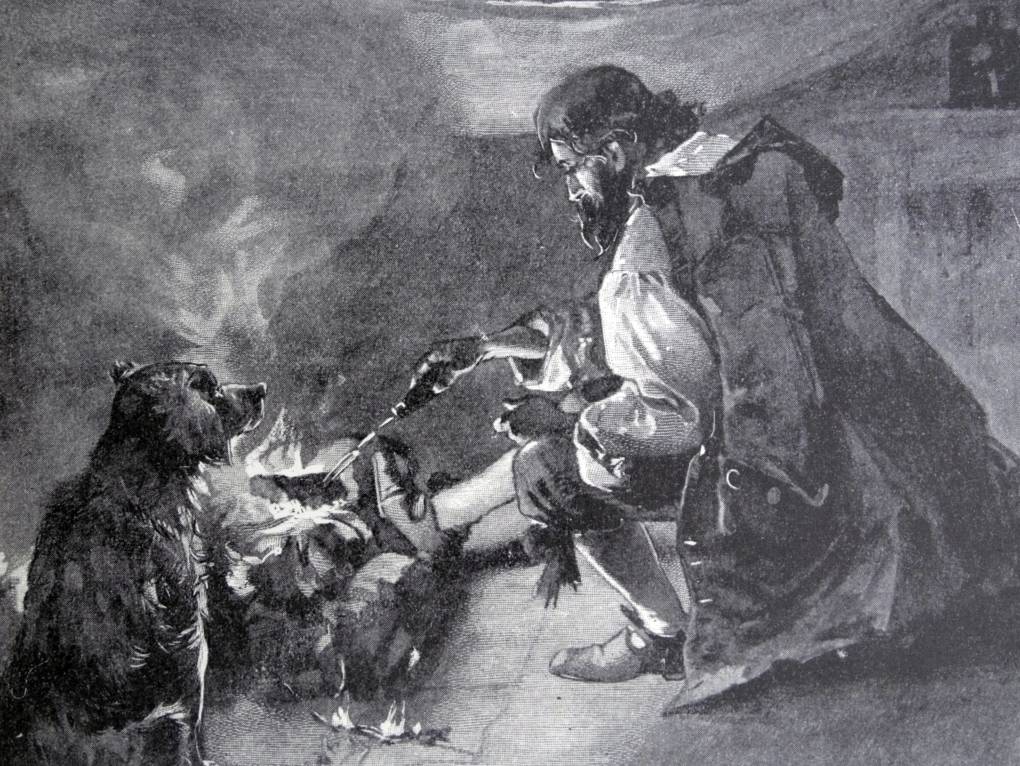
"caption": "Illustration from a 19th-century edition of 'Robinson Crusoe', a novel by Daniel Defoe first published in 1719. It relates the story of Robinson Crusoe, stranded on an island for 28 years and his subsequent fight for survival. Out of desperation, he became a master of innovation, especially at preparing meals.",
"description": "Illustration from a 19th-century edition of 'Robinson Crusoe', a novel by Daniel Defoe first published in 1719. It relates the story of Robinson Crusoe, stranded on an island for 28 years and his subsequent fight for survival. Out of desperation, he became a master of innovation, especially at preparing meals.",
"title": "Illustration from a 19th-century edition of 'Robinson Crusoe', a novel by Daniel Defoe first published in 1719. It relates the story of Robinson Crusoe, stranded on an island for 28 years and his subsequent fight for survival. Out of desperation, he became a master of innovation, especially at preparing meals.",
"credit": "Universal History Archive/Universal Images Group via Getty Images",
"status": "inherit",
"isLoading": false,
"fetchFailed": false
},
"bayareabites_134752": {
"type": "attachments",
"id": "bayareabites_134752",
"meta": {
"index": "attachments_1716263798",
"site": "bayareabites",
"id": "134752",
"found": true
},
"parent": 134751,
"imgSizes": {
"twentyfourteen-full-width": {
"file": "https://ww2.kqed.org/app/uploads/sites/24/2019/09/chef_enl-4883be5dba4c153288bab3714ac8aa3874d1cfd4-1038x576.jpg",
"width": 1038,
"mimeType": "image/jpeg",
"height": 576
},
"thumbnail": {
"file": "https://ww2.kqed.org/app/uploads/sites/24/2019/09/chef_enl-4883be5dba4c153288bab3714ac8aa3874d1cfd4-160x213.jpg",
"width": 160,
"mimeType": "image/jpeg",
"height": 213
},
"post-thumbnail": {
"file": "https://ww2.kqed.org/app/uploads/sites/24/2019/09/chef_enl-4883be5dba4c153288bab3714ac8aa3874d1cfd4-672x372.jpg",
"width": 672,
"mimeType": "image/jpeg",
"height": 372
},
"kqedFullSize": {
"file": "https://ww2.kqed.org/app/uploads/sites/24/2019/09/chef_enl-4883be5dba4c153288bab3714ac8aa3874d1cfd4-e1568159219615.jpg",
"width": 1920,
"height": 2560
},
"large": {
"file": "https://ww2.kqed.org/app/uploads/sites/24/2019/09/chef_enl-4883be5dba4c153288bab3714ac8aa3874d1cfd4-1020x1360.jpg",
"width": 1020,
"mimeType": "image/jpeg",
"height": 1360
},
"complete_open_graph": {
"file": "https://ww2.kqed.org/app/uploads/sites/24/2019/09/chef_enl-4883be5dba4c153288bab3714ac8aa3874d1cfd4-900x1200.jpg",
"width": 900,
"mimeType": "image/jpeg",
"height": 1200
},
"full-width": {
"file": "https://ww2.kqed.org/app/uploads/sites/24/2019/09/chef_enl-4883be5dba4c153288bab3714ac8aa3874d1cfd4-1920x2560.jpg",
"width": 1920,
"mimeType": "image/jpeg",
"height": 2560
},
"medium": {
"file": "https://ww2.kqed.org/app/uploads/sites/24/2019/09/chef_enl-4883be5dba4c153288bab3714ac8aa3874d1cfd4-800x1067.jpg",
"width": 800,
"mimeType": "image/jpeg",
"height": 1067
},
"medium_large": {
"file": "https://ww2.kqed.org/app/uploads/sites/24/2019/09/chef_enl-4883be5dba4c153288bab3714ac8aa3874d1cfd4-768x1024.jpg",
"width": 768,
"mimeType": "image/jpeg",
"height": 1024
}
},
"publishDate": 1568159168,
"modified": 1568159239,
"caption": "Chef Omari McQueen stands in the doorway of his vegan Caribbean pop-up restaurant Dipalicious.",
"description": "Chef Omari McQueen stands in the doorway of his vegan Caribbean pop-up restaurant Dipalicious.",
"title": "Chef Omari McQueen stands in the doorway of his vegan Caribbean pop-up restaurant Dipalicious.",
"credit": "Kennedy News and Media",
"status": "inherit",
"isLoading": false,
"fetchFailed": false
},
"bayareabites_134734": {
"type": "attachments",
"id": "bayareabites_134734",
"meta": {
"index": "attachments_1716263798",
"site": "bayareabites",
"id": "134734",
"found": true
},
"parent": 134733,
"imgSizes": {
"twentyfourteen-full-width": {
"file": "https://ww2.kqed.org/app/uploads/sites/24/2019/09/empty-urchin-a7dfd129c5a2146dbf830ef0dcff27a83999cf7a-1038x576.jpg",
"width": 1038,
"mimeType": "image/jpeg",
"height": 576
},
"thumbnail": {
"file": "https://ww2.kqed.org/app/uploads/sites/24/2019/09/empty-urchin-a7dfd129c5a2146dbf830ef0dcff27a83999cf7a-160x120.jpg",
"width": 160,
"mimeType": "image/jpeg",
"height": 120
},
"post-thumbnail": {
"file": "https://ww2.kqed.org/app/uploads/sites/24/2019/09/empty-urchin-a7dfd129c5a2146dbf830ef0dcff27a83999cf7a-672x372.jpg",
"width": 672,
"mimeType": "image/jpeg",
"height": 372
},
"kqedFullSize": {
"file": "https://ww2.kqed.org/app/uploads/sites/24/2019/09/empty-urchin-a7dfd129c5a2146dbf830ef0dcff27a83999cf7a-e1568051389867.jpg",
"width": 1920,
"height": 1440
},
"large": {
"file": "https://ww2.kqed.org/app/uploads/sites/24/2019/09/empty-urchin-a7dfd129c5a2146dbf830ef0dcff27a83999cf7a-1020x765.jpg",
"width": 1020,
"mimeType": "image/jpeg",
"height": 765
},
"complete_open_graph": {
"file": "https://ww2.kqed.org/app/uploads/sites/24/2019/09/empty-urchin-a7dfd129c5a2146dbf830ef0dcff27a83999cf7a-1200x900.jpg",
"width": 1200,
"mimeType": "image/jpeg",
"height": 900
},
"full-width": {
"file": "https://ww2.kqed.org/app/uploads/sites/24/2019/09/empty-urchin-a7dfd129c5a2146dbf830ef0dcff27a83999cf7a-1920x1440.jpg",
"width": 1920,
"mimeType": "image/jpeg",
"height": 1440
},
"medium": {
"file": "https://ww2.kqed.org/app/uploads/sites/24/2019/09/empty-urchin-a7dfd129c5a2146dbf830ef0dcff27a83999cf7a-800x600.jpg",
"width": 800,
"mimeType": "image/jpeg",
"height": 600
},
"medium_large": {
"file": "https://ww2.kqed.org/app/uploads/sites/24/2019/09/empty-urchin-a7dfd129c5a2146dbf830ef0dcff27a83999cf7a-768x576.jpg",
"width": 768,
"mimeType": "image/jpeg",
"height": 576
}
},
"publishDate": 1568051247,
"modified": 1568051461,
"caption": "Since purple sea urchins have eaten up their food supply, many of them are empty inside.",
"description": "Since purple sea urchins have eaten up their food supply, many of them are empty inside.",
"title": "Since purple sea urchins have eaten up their food supply, many of them are empty inside.",
"credit": "Erika Mahoney/KAZU",
"status": "inherit",
"isLoading": false,
"fetchFailed": false
},
"bayareabites_134688": {
"type": "attachments",
"id": "bayareabites_134688",
"meta": {
"index": "attachments_1716263798",
"site": "bayareabites",
"id": "134688",
"found": true
},
"parent": 134687,
"imgSizes": {
"thumbnail": {
"file": "https://ww2.kqed.org/app/uploads/sites/24/2019/08/afong-moy-cookie_orig_custom-6ab62ce5e256d116c7f66fe4510da05c9732fc45-160x146.jpg",
"width": 160,
"mimeType": "image/jpeg",
"height": 146
},
"post-thumbnail": {
"file": "https://ww2.kqed.org/app/uploads/sites/24/2019/08/afong-moy-cookie_orig_custom-6ab62ce5e256d116c7f66fe4510da05c9732fc45-598x372.jpg",
"width": 598,
"mimeType": "image/jpeg",
"height": 372
},
"kqedFullSize": {
"file": "https://ww2.kqed.org/app/uploads/sites/24/2019/08/afong-moy-cookie_orig_custom-6ab62ce5e256d116c7f66fe4510da05c9732fc45.jpg",
"width": 598,
"height": 544
}
},
"publishDate": 1567530617,
"modified": 1567530654,
"caption": "Jasmine Cho's cookie portrait of Afong Moy, who is often cited as the first Chinese woman to step foot in the United States. Beginning in the 1830s, Moy was put on display before crowds as a curiosity.",
"description": "Jasmine Cho's cookie portrait of Afong Moy, who is often cited as the first Chinese woman to step foot in the United States. Beginning in the 1830s, Moy was put on display before crowds as a curiosity.",
"title": "Jasmine Cho's cookie portrait of Afong Moy, who is often cited as the first Chinese woman to step foot in the United States. Beginning in the 1830s, Moy was put on display before crowds as a curiosity.",
"credit": "Jasmine Cho",
"status": "inherit",
"isLoading": false,
"fetchFailed": false
},
"bayareabites_134483": {
"type": "attachments",
"id": "bayareabites_134483",
"meta": {
"index": "attachments_1716263798",
"site": "bayareabites",
"id": "134483",
"found": true
},
"parent": 134482,
"imgSizes": {
"twentyfourteen-full-width": {
"file": "https://ww2.kqed.org/app/uploads/sites/24/2019/08/npr-final-illustration-karina-perez_custom-6d51de528ba6f5ff9b31c4a59b8c845ec7f498a1-1038x576.jpg",
"width": 1038,
"mimeType": "image/jpeg",
"height": 576
},
"thumbnail": {
"file": "https://ww2.kqed.org/app/uploads/sites/24/2019/08/npr-final-illustration-karina-perez_custom-6d51de528ba6f5ff9b31c4a59b8c845ec7f498a1-160x90.jpg",
"width": 160,
"mimeType": "image/jpeg",
"height": 90
},
"post-thumbnail": {
"file": "https://ww2.kqed.org/app/uploads/sites/24/2019/08/npr-final-illustration-karina-perez_custom-6d51de528ba6f5ff9b31c4a59b8c845ec7f498a1-672x372.jpg",
"width": 672,
"mimeType": "image/jpeg",
"height": 372
},
"kqedFullSize": {
"file": "https://ww2.kqed.org/app/uploads/sites/24/2019/08/npr-final-illustration-karina-perez_custom-6d51de528ba6f5ff9b31c4a59b8c845ec7f498a1-e1566404403752.jpg",
"width": 1920,
"height": 1080
},
"large": {
"file": "https://ww2.kqed.org/app/uploads/sites/24/2019/08/npr-final-illustration-karina-perez_custom-6d51de528ba6f5ff9b31c4a59b8c845ec7f498a1-1020x574.jpg",
"width": 1020,
"mimeType": "image/jpeg",
"height": 574
},
"complete_open_graph": {
"file": "https://ww2.kqed.org/app/uploads/sites/24/2019/08/npr-final-illustration-karina-perez_custom-6d51de528ba6f5ff9b31c4a59b8c845ec7f498a1-1200x675.jpg",
"width": 1200,
"mimeType": "image/jpeg",
"height": 675
},
"full-width": {
"file": "https://ww2.kqed.org/app/uploads/sites/24/2019/08/npr-final-illustration-karina-perez_custom-6d51de528ba6f5ff9b31c4a59b8c845ec7f498a1-1920x1080.jpg",
"width": 1920,
"mimeType": "image/jpeg",
"height": 1080
},
"medium": {
"file": "https://ww2.kqed.org/app/uploads/sites/24/2019/08/npr-final-illustration-karina-perez_custom-6d51de528ba6f5ff9b31c4a59b8c845ec7f498a1-800x450.jpg",
"width": 800,
"mimeType": "image/jpeg",
"height": 450
},
"medium_large": {
"file": "https://ww2.kqed.org/app/uploads/sites/24/2019/08/npr-final-illustration-karina-perez_custom-6d51de528ba6f5ff9b31c4a59b8c845ec7f498a1-768x432.jpg",
"width": 768,
"mimeType": "image/jpeg",
"height": 432
}
},
"publishDate": 1566404263,
"modified": 1566404587,
"caption": "The Pew Research Center estimates there are 7.5 million unauthorized workers in the United States concentrated in agriculture, construction and the hospitality industry.",
"description": "The Pew Research Center estimates there are 7.5 million unauthorized workers in the United States concentrated in agriculture, construction and the hospitality industry.",
"title": "The Pew Research Center estimates there are 7.5 million unauthorized workers in the United States concentrated in agriculture, construction and the hospitality industry.",
"credit": "Karina Perez for NPR",
"status": "inherit",
"isLoading": false,
"fetchFailed": false
},
"bayareabites_134474": {
"type": "attachments",
"id": "bayareabites_134474",
"meta": {
"index": "attachments_1716263798",
"site": "bayareabites",
"id": "134474",
"found": true
},
"parent": 134473,
"imgSizes": {
"twentyfourteen-full-width": {
"file": "https://ww2.kqed.org/app/uploads/sites/24/2019/08/plastics-china-20b6cd3aecb5a51a650d2d3a02c90fec14fdef5a-1038x576.jpg",
"width": 1038,
"mimeType": "image/jpeg",
"height": 576
},
"thumbnail": {
"file": "https://ww2.kqed.org/app/uploads/sites/24/2019/08/plastics-china-20b6cd3aecb5a51a650d2d3a02c90fec14fdef5a-160x120.jpg",
"width": 160,
"mimeType": "image/jpeg",
"height": 120
},
"post-thumbnail": {
"file": "https://ww2.kqed.org/app/uploads/sites/24/2019/08/plastics-china-20b6cd3aecb5a51a650d2d3a02c90fec14fdef5a-672x372.jpg",
"width": 672,
"mimeType": "image/jpeg",
"height": 372
},
"kqedFullSize": {
"file": "https://ww2.kqed.org/app/uploads/sites/24/2019/08/plastics-china-20b6cd3aecb5a51a650d2d3a02c90fec14fdef5a-e1566359264633.jpg",
"width": 1920,
"height": 1440
},
"large": {
"file": "https://ww2.kqed.org/app/uploads/sites/24/2019/08/plastics-china-20b6cd3aecb5a51a650d2d3a02c90fec14fdef5a-1020x765.jpg",
"width": 1020,
"mimeType": "image/jpeg",
"height": 765
},
"complete_open_graph": {
"file": "https://ww2.kqed.org/app/uploads/sites/24/2019/08/plastics-china-20b6cd3aecb5a51a650d2d3a02c90fec14fdef5a-1200x900.jpg",
"width": 1200,
"mimeType": "image/jpeg",
"height": 900
},
"full-width": {
"file": "https://ww2.kqed.org/app/uploads/sites/24/2019/08/plastics-china-20b6cd3aecb5a51a650d2d3a02c90fec14fdef5a-1920x1440.jpg",
"width": 1920,
"mimeType": "image/jpeg",
"height": 1440
},
"medium": {
"file": "https://ww2.kqed.org/app/uploads/sites/24/2019/08/plastics-china-20b6cd3aecb5a51a650d2d3a02c90fec14fdef5a-800x600.jpg",
"width": 800,
"mimeType": "image/jpeg",
"height": 600
},
"medium_large": {
"file": "https://ww2.kqed.org/app/uploads/sites/24/2019/08/plastics-china-20b6cd3aecb5a51a650d2d3a02c90fec14fdef5a-768x576.jpg",
"width": 768,
"mimeType": "image/jpeg",
"height": 576
}
},
"publishDate": 1566359153,
"modified": 1566359334,
"caption": "Trash sent for recycling moves along a conveyor belt to be sorted at Waste Management's material recovery facility in Elkridge, Md. In 2018, China announced it would no longer buy most plastic waste from places like the United States.",
"description": "Trash sent for recycling moves along a conveyor belt to be sorted at Waste Management's material recovery facility in Elkridge, Md. In 2018, China announced it would no longer buy most plastic waste from places like the United States.",
"title": "Trash sent for recycling moves along a conveyor belt to be sorted at Waste Management's material recovery facility in Elkridge, Md. In 2018, China announced it would no longer buy most plastic waste from places like the United States.",
"credit": "Saul Loeb/AFP/Getty Images",
"status": "inherit",
"isLoading": false,
"fetchFailed": false
},
"bayareabites_134466": {
"type": "attachments",
"id": "bayareabites_134466",
"meta": {
"index": "attachments_1716263798",
"site": "bayareabites",
"id": "134466",
"found": true
},
"parent": 134465,
"imgSizes": {
"thumbnail": {
"file": "https://ww2.kqed.org/app/uploads/sites/24/2019/08/jalepeno-e757b387f810255324c0dae3651dda41f5df9df6-160x120.jpg",
"width": 160,
"mimeType": "image/jpeg",
"height": 120
},
"post-thumbnail": {
"file": "https://ww2.kqed.org/app/uploads/sites/24/2019/08/jalepeno-e757b387f810255324c0dae3651dda41f5df9df6-672x372.jpg",
"width": 672,
"mimeType": "image/jpeg",
"height": 372
},
"kqedFullSize": {
"file": "https://ww2.kqed.org/app/uploads/sites/24/2019/08/jalepeno-e757b387f810255324c0dae3651dda41f5df9df6.jpg",
"width": 702,
"height": 526
}
},
"publishDate": 1566232632,
"modified": 1566232676,
"caption": "U.S. officers found nearly four tons of marijuana in a shipment of peppers in San Diego.",
"description": "U.S. officers found nearly four tons of marijuana in a shipment of peppers in San Diego.",
"title": "U.S. officers found nearly four tons of marijuana in a shipment of peppers in San Diego.",
"credit": "U.S. Customs and Border Protection",
"status": "inherit",
"isLoading": false,
"fetchFailed": false
},
"bayareabites_134429": {
"type": "attachments",
"id": "bayareabites_134429",
"meta": {
"index": "attachments_1716263798",
"site": "bayareabites",
"id": "134429",
"found": true
},
"parent": 134428,
"imgSizes": {
"twentyfourteen-full-width": {
"file": "https://ww2.kqed.org/app/uploads/sites/24/2019/08/eid2_custom-66f2afb7df566f9391729da592cff7cce8587690-1038x576.jpg",
"width": 1038,
"mimeType": "image/jpeg",
"height": 576
},
"thumbnail": {
"file": "https://ww2.kqed.org/app/uploads/sites/24/2019/08/eid2_custom-66f2afb7df566f9391729da592cff7cce8587690-160x107.jpg",
"width": 160,
"mimeType": "image/jpeg",
"height": 107
},
"post-thumbnail": {
"file": "https://ww2.kqed.org/app/uploads/sites/24/2019/08/eid2_custom-66f2afb7df566f9391729da592cff7cce8587690-672x372.jpg",
"width": 672,
"mimeType": "image/jpeg",
"height": 372
},
"kqedFullSize": {
"file": "https://ww2.kqed.org/app/uploads/sites/24/2019/08/eid2_custom-66f2afb7df566f9391729da592cff7cce8587690-e1565884491321.jpg",
"width": 1920,
"height": 1280
},
"large": {
"file": "https://ww2.kqed.org/app/uploads/sites/24/2019/08/eid2_custom-66f2afb7df566f9391729da592cff7cce8587690-1020x680.jpg",
"width": 1020,
"mimeType": "image/jpeg",
"height": 680
},
"complete_open_graph": {
"file": "https://ww2.kqed.org/app/uploads/sites/24/2019/08/eid2_custom-66f2afb7df566f9391729da592cff7cce8587690-1200x800.jpg",
"width": 1200,
"mimeType": "image/jpeg",
"height": 800
},
"full-width": {
"file": "https://ww2.kqed.org/app/uploads/sites/24/2019/08/eid2_custom-66f2afb7df566f9391729da592cff7cce8587690-1920x1280.jpg",
"width": 1920,
"mimeType": "image/jpeg",
"height": 1280
},
"medium": {
"file": "https://ww2.kqed.org/app/uploads/sites/24/2019/08/eid2_custom-66f2afb7df566f9391729da592cff7cce8587690-800x533.jpg",
"width": 800,
"mimeType": "image/jpeg",
"height": 533
},
"medium_large": {
"file": "https://ww2.kqed.org/app/uploads/sites/24/2019/08/eid2_custom-66f2afb7df566f9391729da592cff7cce8587690-768x512.jpg",
"width": 768,
"mimeType": "image/jpeg",
"height": 512
}
},
"publishDate": 1565884447,
"modified": 1565884510,
"caption": "Eid feast",
"description": "Eid feast",
"title": "Eid feast",
"credit": "Malaka Gharib/NPR",
"status": "inherit",
"isLoading": false,
"fetchFailed": false
},
"bayareabites_134404": {
"type": "attachments",
"id": "bayareabites_134404",
"meta": {
"index": "attachments_1716263798",
"site": "bayareabites",
"id": "134404",
"found": true
},
"parent": 134403,
"imgSizes": {
"thumbnail": {
"file": "https://ww2.kqed.org/app/uploads/sites/24/2019/08/cows_wide-6a4b2579b88d128119a98a778eea4b0cc0420774-160x90.jpg",
"width": 160,
"mimeType": "image/jpeg",
"height": 90
},
"post-thumbnail": {
"file": "https://ww2.kqed.org/app/uploads/sites/24/2019/08/cows_wide-6a4b2579b88d128119a98a778eea4b0cc0420774-672x372.jpg",
"width": 672,
"mimeType": "image/jpeg",
"height": 372
},
"kqedFullSize": {
"file": "https://ww2.kqed.org/app/uploads/sites/24/2019/08/cows_wide-6a4b2579b88d128119a98a778eea4b0cc0420774.jpg",
"width": 873,
"height": 491
},
"medium": {
"file": "https://ww2.kqed.org/app/uploads/sites/24/2019/08/cows_wide-6a4b2579b88d128119a98a778eea4b0cc0420774-800x450.jpg",
"width": 800,
"mimeType": "image/jpeg",
"height": 450
},
"medium_large": {
"file": "https://ww2.kqed.org/app/uploads/sites/24/2019/08/cows_wide-6a4b2579b88d128119a98a778eea4b0cc0420774-768x432.jpg",
"width": 768,
"mimeType": "image/jpeg",
"height": 432
}
},
"publishDate": 1565709653,
"modified": 1565710059,
"caption": "Cows graze on a grass field at a farm in Schaghticoke, N.Y. The grass-fed movement is based on the idea of regenerative agriculture.",
"description": "Cows graze on a grass field at a farm in Schaghticoke, N.Y. The grass-fed movement is based on the idea of regenerative agriculture.",
"title": "Cows graze on a grass field at a farm in Schaghticoke, N.Y. The grass-fed movement is based on the idea of regenerative agriculture.",
"credit": "John Greim/LightRocket via Getty Images",
"status": "inherit",
"isLoading": false,
"fetchFailed": false
},
"bayareabites_134389": {
"type": "attachments",
"id": "bayareabites_134389",
"meta": {
"index": "attachments_1716263798",
"site": "bayareabites",
"id": "134389",
"found": true
},
"parent": 134383,
"imgSizes": {
"thumbnail": {
"file": "https://ww2.kqed.org/app/uploads/sites/24/2019/08/ap_19219653654719-5b2ec93fdced90a9d9a02012fa07997d49be44b0-s700-c85-160x120.jpg",
"width": 160,
"mimeType": "image/jpeg",
"height": 120
},
"post-thumbnail": {
"file": "https://ww2.kqed.org/app/uploads/sites/24/2019/08/ap_19219653654719-5b2ec93fdced90a9d9a02012fa07997d49be44b0-s700-c85-672x372.jpg",
"width": 672,
"mimeType": "image/jpeg",
"height": 372
},
"kqedFullSize": {
"file": "https://ww2.kqed.org/app/uploads/sites/24/2019/08/ap_19219653654719-5b2ec93fdced90a9d9a02012fa07997d49be44b0-s700-c85.jpg",
"width": 700,
"height": 524
}
},
"publishDate": 1565455831,
"modified": 1565455853,
"caption": "A trailer loaded with chickens passes a federal agent outside a Koch Foods plant in Morton, Miss., on Wednesday.",
"description": "A trailer loaded with chickens passes a federal agent outside a Koch Foods plant in Morton, Miss., on Wednesday.",
"title": "ap_19219653654719-5b2ec93fdced90a9d9a02012fa07997d49be44b0-s700-c85",
"credit": "Rogelio V. Solis/AP",
"status": "inherit",
"isLoading": false,
"fetchFailed": false
},
"bayareabites_134338": {
"type": "attachments",
"id": "bayareabites_134338",
"meta": {
"index": "attachments_1716263798",
"site": "bayareabites",
"id": "134338",
"found": true
},
"parent": 134337,
"imgSizes": {
"twentyfourteen-full-width": {
"file": "https://ww2.kqed.org/app/uploads/sites/24/2019/08/img_0422_custom-2d277c1d1d8e9afce122300c7e2604579b8638d9-1038x576.jpg",
"width": 1038,
"mimeType": "image/jpeg",
"height": 576
},
"thumbnail": {
"file": "https://ww2.kqed.org/app/uploads/sites/24/2019/08/img_0422_custom-2d277c1d1d8e9afce122300c7e2604579b8638d9-160x82.jpg",
"width": 160,
"mimeType": "image/jpeg",
"height": 82
},
"post-thumbnail": {
"file": "https://ww2.kqed.org/app/uploads/sites/24/2019/08/img_0422_custom-2d277c1d1d8e9afce122300c7e2604579b8638d9-672x372.jpg",
"width": 672,
"mimeType": "image/jpeg",
"height": 372
},
"kqedFullSize": {
"file": "https://ww2.kqed.org/app/uploads/sites/24/2019/08/img_0422_custom-2d277c1d1d8e9afce122300c7e2604579b8638d9-e1564786252632.jpg",
"width": 1920,
"height": 985
},
"large": {
"file": "https://ww2.kqed.org/app/uploads/sites/24/2019/08/img_0422_custom-2d277c1d1d8e9afce122300c7e2604579b8638d9-1020x523.jpg",
"width": 1020,
"mimeType": "image/jpeg",
"height": 523
},
"complete_open_graph": {
"file": "https://ww2.kqed.org/app/uploads/sites/24/2019/08/img_0422_custom-2d277c1d1d8e9afce122300c7e2604579b8638d9-1200x615.jpg",
"width": 1200,
"mimeType": "image/jpeg",
"height": 615
},
"full-width": {
"file": "https://ww2.kqed.org/app/uploads/sites/24/2019/08/img_0422_custom-2d277c1d1d8e9afce122300c7e2604579b8638d9-1920x985.jpg",
"width": 1920,
"mimeType": "image/jpeg",
"height": 985
},
"medium": {
"file": "https://ww2.kqed.org/app/uploads/sites/24/2019/08/img_0422_custom-2d277c1d1d8e9afce122300c7e2604579b8638d9-800x410.jpg",
"width": 800,
"mimeType": "image/jpeg",
"height": 410
},
"medium_large": {
"file": "https://ww2.kqed.org/app/uploads/sites/24/2019/08/img_0422_custom-2d277c1d1d8e9afce122300c7e2604579b8638d9-768x394.jpg",
"width": 768,
"mimeType": "image/jpeg",
"height": 394
}
},
"publishDate": 1564786028,
"modified": 1564786271,
"caption": "Two scoops of Perfect Day's vegan ice cream, made with synthetic whey proteins. Protein from whey, a byproduct of cheese-making, is often used to give frozen desserts a creamy texture. Perfect Day makes its whey proteins using microbes.",
"description": "Two scoops of Perfect Day's vegan ice cream, made with synthetic whey proteins. Protein from whey, a byproduct of cheese-making, is often used to give frozen desserts a creamy texture. Perfect Day makes its whey proteins using microbes.",
"title": "Two scoops of Perfect Day's vegan ice cream, made with synthetic whey proteins. Protein from whey, a byproduct of cheese-making, is often used to give frozen desserts a creamy texture. Perfect Day makes its whey proteins using microbes.",
"credit": "Olivia Falcigno/NPR",
"status": "inherit",
"isLoading": false,
"fetchFailed": false
}
},
"audioPlayerReducer": {
"postId": "stream_live",
"isPaused": true,
"isPlaying": false,
"pfsActive": false,
"pledgeModalIsOpen": true,
"playerDrawerIsOpen": false,
"liveAudioPlayStartedAt": 0,
"liveAudioPlayContext": ""
},
"authorsReducer": {
"byline_bayareabites_134870": {
"type": "authors",
"id": "byline_bayareabites_134870",
"meta": {
"override": true
},
"slug": "byline_bayareabites_134870",
"name": "Allison Aubrey, NPR Food",
"isLoading": false
},
"byline_bayareabites_134764": {
"type": "authors",
"id": "byline_bayareabites_134764",
"meta": {
"override": true
},
"slug": "byline_bayareabites_134764",
"name": "Nina Martyris, NPR Food",
"isLoading": false
},
"byline_bayareabites_134751": {
"type": "authors",
"id": "byline_bayareabites_134751",
"meta": {
"override": true
},
"slug": "byline_bayareabites_134751",
"name": "Richard Morgan, NPR Food",
"isLoading": false
},
"byline_bayareabites_134733": {
"type": "authors",
"id": "byline_bayareabites_134733",
"meta": {
"override": true
},
"slug": "byline_bayareabites_134733",
"name": "Erika Mahoney, NPR Food",
"isLoading": false
},
"byline_bayareabites_134687": {
"type": "authors",
"id": "byline_bayareabites_134687",
"meta": {
"override": true
},
"slug": "byline_bayareabites_134687",
"name": "Caroline Choe, NPR Food",
"isLoading": false
},
"byline_bayareabites_134482": {
"type": "authors",
"id": "byline_bayareabites_134482",
"meta": {
"override": true
},
"slug": "byline_bayareabites_134482",
"name": "John Burnett, NPR",
"isLoading": false
},
"byline_bayareabites_134473": {
"type": "authors",
"id": "byline_bayareabites_134473",
"meta": {
"override": true
},
"slug": "byline_bayareabites_134473",
"name": "Christopher Joyce, All Things Considered",
"isLoading": false
},
"byline_bayareabites_134465": {
"type": "authors",
"id": "byline_bayareabites_134465",
"meta": {
"override": true
},
"slug": "byline_bayareabites_134465",
"name": "Merrit Kennedy, NPR",
"isLoading": false
},
"byline_bayareabites_134428": {
"type": "authors",
"id": "byline_bayareabites_134428",
"meta": {
"override": true
},
"slug": "byline_bayareabites_134428",
"name": "Malaka Gharib, NPR's Goats & Soda",
"isLoading": false
},
"byline_bayareabites_134403": {
"type": "authors",
"id": "byline_bayareabites_134403",
"meta": {
"override": true
},
"slug": "byline_bayareabites_134403",
"name": "Nancy Matsumoto, NPR Food",
"isLoading": false
},
"byline_bayareabites_134383": {
"type": "authors",
"id": "byline_bayareabites_134383",
"meta": {
"override": true
},
"slug": "byline_bayareabites_134383",
"name": "Scott Horsley, All Things Considered",
"isLoading": false
},
"byline_bayareabites_134337": {
"type": "authors",
"id": "byline_bayareabites_134337",
"meta": {
"override": true
},
"slug": "byline_bayareabites_134337",
"name": "Maria Godoy, NPR Food",
"isLoading": false
}
},
"pagesReducer": {
"bayareabites_category_npr-food": {
"type": "terms",
"id": "bayareabites_10916",
"meta": {
"index": "terms_1716263798",
"site": "bayareabites",
"id": "10916",
"score": 13.894413
},
"featImg": null,
"name": "NPR food",
"description": null,
"taxonomy": "category",
"headData": {
"twImgId": null,
"twTitle": null,
"ogTitle": null,
"ogImgId": null,
"twDescription": null,
"description": null,
"title": "NPR food Archives | KQED Bay Area Bites",
"ogDescription": null
},
"ttid": 5375,
"slug": "npr-food",
"isLoading": false,
"title": "NPR food",
"pageMeta": {
"site": "bayareabites",
"WpPageTemplate": "page-topic-editorial",
"currentPage": 3
},
"blocks": [
{
"blockName": "kqed/post-list",
"attrs": {
"layout": "cardArticle2",
"query": "posts/bayareabites?category=npr-food",
"seeMore": false,
"paginated": true,
"page": 3
}
},
{
"blockName": "kqed/ad"
}
]
}
},
"pfsSessionReducer": {},
"postsReducer": {
"stream_live": {
"type": "live",
"id": "stream_live",
"audioUrl": "https://hls.kqed.org/hls/kqed_app/playlist.m3u8",
"title": "Live Stream",
"excerpt": "Live Stream information currently unavailable.",
"link": "/radio",
"featImg": "",
"label": {
"name": "KQED Live",
"link": "/"
}
},
"stream_kqedNewscast": {
"type": "posts",
"id": "stream_kqedNewscast",
"audioUrl": "https://www.kqed.org/.stream/anon/radio/RDnews/newscast.mp3?_=1",
"title": "KQED Newscast",
"featImg": "",
"label": {
"name": "88.5 FM",
"link": "/"
}
},
"bayareabites_134870": {
"type": "posts",
"id": "bayareabites_134870",
"meta": {
"index": "posts_1716263798",
"site": "bayareabites",
"id": "134870",
"score": null,
"sort": [
1569880293000
]
},
"parent": 0,
"labelTerm": {
"site": "bayareabites"
},
"blocks": [],
"publishDate": 1569880293,
"format": "standard",
"disqusTitle": "No Need To Cut Back On Red Meat? Controversial New 'Guidelines' Lead To Outrage",
"title": "No Need To Cut Back On Red Meat? Controversial New 'Guidelines' Lead To Outrage",
"headTitle": "Bay Area Bites | KQED Food",
"content": "\u003cp>[aside postID='bayareabites_133954' label='More on Processed Meats']\u003cbr>\nA new set of analyses published Monday in the \u003cem>Annals of Internal Medicine\u003c/em> challenges the widespread recommendations to cut back on red and processed meats.\u003c/p>\n\u003cp>The prominent medical journal has also published a \u003ca href=\"https://annals.org/aim/fullarticle/2752328/unprocessed-red-meat-processed-meat-consumption-dietary-guideline-recommendations-from\">new recommendation\u003c/a> from a panel of scientists, many of whom are not nutrition experts: \"The panel suggests adults continue current processed meat consumption,\" according to the guideline paper. In other words: no need to cut back.\u003c/p>\n\u003cp>Scores of nutrition experts say this conclusion contradicts a large body of evidence, from decades of observational studies, that has found that people who consume less red and processed meats, over time, have lower rates of heart disease and death from certain cancers, including colorectal cancer.\u003c/p>\n\u003cp>Recommendations from the \u003ca href=\"https://www.heart.org/en/healthy-living/healthy-eating/eat-smart/nutrition-basics/aha-diet-and-lifestyle-recommendations\">American Heart Association\u003c/a> and the \u003ca href=\"https://web.archive.org/web/20170611033849/https://www.cancer.org/latest-news/world-health-organization-says-processed-meat-causes-cancer.html\">American Cancer Society\u003c/a>, as well as the U.S. Dietary Guidelines, all call for limiting red meats and processed meats.\u003c/p>\n\u003cp>\"I am outraged and bewildered,\" says nutrition scientist Christopher Gardner, a professor of medicine at Stanford University. \"This is perplexing, given the ... clear evidence for harm associated with high red meat intake,\" says Frank Hu, the chair of the Department of Nutrition at the Harvard T.H. Chan School of Public Health.\u003c/p>\n\u003cp>[ad fullwidth]\u003c/p>\n\u003cp>Gardner and Hu are among a group of scientists who signed a letter to the journal's editor requesting the papers be held pending further review. Others include \u003ca href=\"https://nutrition.tufts.edu/profile/faculty/dariush-mozaffarian\">Dariush Mozaffarian\u003c/a>, the dean of the Friedman School of Nutrition at Tufts University, as well as Eric Rimm and Dr. Walter Willett, also of Harvard's T.H. Chan School of Public Health.\u003c/p>\n\u003cp>Nutrition scientists point to research, such as this study \u003ca href=\"https://www.ncbi.nlm.nih.gov/pubmed/25733454\">published in 2015\u003c/a>, that finds that people who have a pattern of eating that's lower in red and processed meats have a reduced risk of death from cardiovascular disease and some cancers.\u003c/p>\n\u003cp>\"There's a lot more agreement out there than people think,\" Gardner says.\u003c/p>\n\u003cp>However, the authors of the new papers published in Annals say they're not convinced by the studies that link red and processed meats to higher health risks. They conclude that the existing guidelines from leading health groups to limit red and processed meats are \"weak recommendations\" that are based on \"low-certainty evidence.\"\u003c/p>\n\u003cp>So, what explains this divide?\u003c/p>\n\u003cp>In a nutshell, the authors of the new analyses have used an alternative approach to evaluate the evidence. They've used a system known as \u003ca href=\"https://ktdrr.org/products/update/v1n5/dijkers_grade_ktupdatev1n5.pdf\">GRADE\u003c/a>, which is a process to rate the quality of scientific evidence. Using this approach, a kind of study known as a randomized controlled trial — or RCT, for short - is considered high quality evidence.\u003c/p>\n\u003cp>Nutrition scientist Frank Hu of Harvard says the problem with GRADE is that it was mainly developed for evaluating evidence from drug trials. \"It's really problematic and inappropriate to use GRADE to evaluate nutrition studies,\" Hu says. Most of nutrition science is built on another type of study, observational studies. These are conducted by tracking the eating habits of people over many years. But here's the rub: The GRADE system considers these observational studies to be low-quality.\u003c/p>\n\u003cp>Our diets, however, are not like drugs. The impact of eating a meat-centric diet is tricky to measure. Unlike a pill — which can be measured against a placebo in a short-term trial — our diets are much more complicated. What we eat today may influence our health over decades. And, teasing out an independent effect is tougher, because our diets are varied and complex.\u003c/p>\n\u003cp>If a pill leads to an improvement over a placebo, scientists can conclude that the pill is efficacious. But if you try to use this same model with diet, you can't isolate the effects of say, just meat — or just processed meat — because we eat so many different things as part of our diets. So, therefore, critics say the drug evaluation model is not a good fit.\u003c/p>\n\u003cp>So where does this leave us, the eaters who are trying to make good choices?\u003c/p>\n\u003cp>\"There may be a benefit [from] reducing your intake of red or processed meat, and people should know that,\" says Bradley Johnston, one of the authors of the new analyses.\u003c/p>\n\u003cp>On the other hand, \"there may not be a benefit at all,\" Johnston says. \"We're uncertain.\"\u003c/p>\n\u003cp>Johnston previously authored a study, also published in the \u003cem>Annals of Internal Medicine\u003c/em>, that \u003ca href=\"https://www.npr.org/sections/thesalt/2016/12/19/505867535/how-much-is-too-much-new-study-casts-doubts-on-sugar-guidelines\">challenged the quality of the evidence behind the recommendations to limit sugar\u003c/a>. That paper, published online in 2016, was funded by the International Life Sciences Institute, a nonprofit group funded by large food and beverage companies that has \u003ca href=\"https://www.nytimes.com/2019/09/16/health/ilsi-food-policy-india-brazil-china.html\">come under scrutiny\u003c/a> for its role in shaping food policy.\u003c/p>\n\u003cp>I asked Johnston what kind of study it would take to provide compelling evidence that reducing red meat consumption can reduce health risks. \"It would take a lot of money ... and it should be based on randomized trials,\" Johnston says.\u003c/p>\n\u003cp>But this is completely impractical, says Harvard's Rimm. \"Can you imagine the cost if you had to ... give patients red meat almost every day for a decade and then convince the other group ... not to eat meat for a decade?\"\u003c/p>\n\u003cp>The editor of \u003cem>Annals of Internal Medicine\u003c/em>, \u003ca href=\"https://annals.org/aim/pages/biography\">Dr. Christine Laine\u003c/a>, says she agrees it would be tough to carry out such a study. \"We're not going to be able to do a randomized controlled trial that is going to definitely answer this question,\" Laine told us.\u003c/p>\n\u003cp>But she defended the decision to publish the new analyses and recommendation, as well as the use of the GRADE evaluation system. She says the papers show that the quality of the evidence behind the current recommendations to cut down on red and process meats is not as strong as people may have been led to believe. \"We should just be transparent,\" Laine says. \"I think we should be honest with the public that we don't really know.\"\u003c/p>\n\u003cp>Stanford's Gardner says his biggest concern is \"this will do a disservice to the public.\" He says that by offering up a new guideline, the new papers may confuse people. Harvard's Hu agrees. The publication \"gives an impression of a major scientific breakthrough, but this is clearly not the case.\"\u003c/p>\n\u003cp>Hu and his colleagues says there is a consensus already: \"To improve both human health and environmental sustainability, it is important to adopt dietary patterns that are high in healthy plant-based foods and relatively low in red and processed meats.\" \u003c/p>\n\u003cp>[ad floatright]\u003c/p>\n\u003cp>\u003ci>Copyright 2019 NPR. To see more, visit \u003ca href=\"https://www.npr.org/sections/thesalt/2019/09/30/765722916/no-need-to-cut-back-on-red-meat-controversial-new-guidelines-lead-to-outrage\">NPR.org\u003c/a>.\u003c/i>\u003c/p>\n\n",
"disqusIdentifier": "134870 https://ww2.kqed.org/bayareabites/?p=134870",
"disqusUrl": "https://ww2.kqed.org/bayareabites/2019/09/30/no-need-to-cut-back-on-red-meat-controversial-new-guidelines-lead-to-outrage/",
"stats": {
"hasVideo": false,
"hasChartOrMap": false,
"hasAudio": false,
"hasPolis": false,
"wordCount": 1092,
"hasGoogleForm": false,
"hasGallery": false,
"hasHearkenModule": false,
"iframeSrcs": [],
"paragraphCount": 27
},
"modified": 1637347074,
"excerpt": "A prominent medical journal has published a new recommendation from a group of scientists concluding there's no need to cut back on red and processed meats. This contradicts current guidelines.",
"headData": {
"twImgId": "",
"twTitle": "",
"ogTitle": "",
"ogImgId": "",
"twDescription": "",
"description": "A prominent medical journal has published a new recommendation from a group of scientists concluding there's no need to cut back on red and processed meats. This contradicts current guidelines.",
"title": "No Need To Cut Back On Red Meat? Controversial New 'Guidelines' Lead To Outrage | KQED",
"ogDescription": "",
"schema": {
"@context": "https://schema.org",
"@type": "Article",
"headline": "No Need To Cut Back On Red Meat? Controversial New 'Guidelines' Lead To Outrage",
"datePublished": "2019-09-30T14:51:33-07:00",
"dateModified": "2021-11-19T10:37:54-08:00",
"image": "https://cdn.kqed.org/wp-content/uploads/2020/02/KQED-OG-Image@1x.png"
}
},
"guestAuthors": [],
"slug": "no-need-to-cut-back-on-red-meat-controversial-new-guidelines-lead-to-outrage",
"status": "publish",
"templateType": "standard",
"nprByline": "Allison Aubrey, NPR Food",
"excludeFromSiteSearch": "Include",
"featuredImageType": "standard",
"path": "/bayareabites/134870/no-need-to-cut-back-on-red-meat-controversial-new-guidelines-lead-to-outrage",
"audioTrackLength": null,
"parsedContent": [
{
"type": "contentString",
"content": "\u003cdiv class=\"post-body\">\u003cp>\u003cp>\u003c/p>\u003c/div>",
"attributes": {
"named": {},
"numeric": []
}
},
{
"type": "component",
"content": "",
"name": "aside",
"attributes": {
"named": {
"postid": "bayareabites_133954",
"label": "More on Processed Meats "
},
"numeric": []
}
},
{
"type": "contentString",
"content": "\u003cdiv class=\"post-body\">\u003cp>\u003cbr>\nA new set of analyses published Monday in the \u003cem>Annals of Internal Medicine\u003c/em> challenges the widespread recommendations to cut back on red and processed meats.\u003c/p>\n\u003cp>The prominent medical journal has also published a \u003ca href=\"https://annals.org/aim/fullarticle/2752328/unprocessed-red-meat-processed-meat-consumption-dietary-guideline-recommendations-from\">new recommendation\u003c/a> from a panel of scientists, many of whom are not nutrition experts: \"The panel suggests adults continue current processed meat consumption,\" according to the guideline paper. In other words: no need to cut back.\u003c/p>\n\u003cp>Scores of nutrition experts say this conclusion contradicts a large body of evidence, from decades of observational studies, that has found that people who consume less red and processed meats, over time, have lower rates of heart disease and death from certain cancers, including colorectal cancer.\u003c/p>\n\u003cp>Recommendations from the \u003ca href=\"https://www.heart.org/en/healthy-living/healthy-eating/eat-smart/nutrition-basics/aha-diet-and-lifestyle-recommendations\">American Heart Association\u003c/a> and the \u003ca href=\"https://web.archive.org/web/20170611033849/https://www.cancer.org/latest-news/world-health-organization-says-processed-meat-causes-cancer.html\">American Cancer Society\u003c/a>, as well as the U.S. Dietary Guidelines, all call for limiting red meats and processed meats.\u003c/p>\n\u003cp>\"I am outraged and bewildered,\" says nutrition scientist Christopher Gardner, a professor of medicine at Stanford University. \"This is perplexing, given the ... clear evidence for harm associated with high red meat intake,\" says Frank Hu, the chair of the Department of Nutrition at the Harvard T.H. Chan School of Public Health.\u003c/p>\n\u003cp>\u003c/p>\u003c/div>",
"attributes": {
"named": {},
"numeric": []
}
},
{
"type": "component",
"content": "",
"name": "ad",
"attributes": {
"named": {
"label": "fullwidth"
},
"numeric": [
"fullwidth"
]
}
},
{
"type": "contentString",
"content": "\u003cdiv class=\"post-body\">\u003cp>\u003c/p>\n\u003cp>Gardner and Hu are among a group of scientists who signed a letter to the journal's editor requesting the papers be held pending further review. Others include \u003ca href=\"https://nutrition.tufts.edu/profile/faculty/dariush-mozaffarian\">Dariush Mozaffarian\u003c/a>, the dean of the Friedman School of Nutrition at Tufts University, as well as Eric Rimm and Dr. Walter Willett, also of Harvard's T.H. Chan School of Public Health.\u003c/p>\n\u003cp>Nutrition scientists point to research, such as this study \u003ca href=\"https://www.ncbi.nlm.nih.gov/pubmed/25733454\">published in 2015\u003c/a>, that finds that people who have a pattern of eating that's lower in red and processed meats have a reduced risk of death from cardiovascular disease and some cancers.\u003c/p>\n\u003cp>\"There's a lot more agreement out there than people think,\" Gardner says.\u003c/p>\n\u003cp>However, the authors of the new papers published in Annals say they're not convinced by the studies that link red and processed meats to higher health risks. They conclude that the existing guidelines from leading health groups to limit red and processed meats are \"weak recommendations\" that are based on \"low-certainty evidence.\"\u003c/p>\n\u003cp>So, what explains this divide?\u003c/p>\n\u003cp>In a nutshell, the authors of the new analyses have used an alternative approach to evaluate the evidence. They've used a system known as \u003ca href=\"https://ktdrr.org/products/update/v1n5/dijkers_grade_ktupdatev1n5.pdf\">GRADE\u003c/a>, which is a process to rate the quality of scientific evidence. Using this approach, a kind of study known as a randomized controlled trial — or RCT, for short - is considered high quality evidence.\u003c/p>\n\u003cp>Nutrition scientist Frank Hu of Harvard says the problem with GRADE is that it was mainly developed for evaluating evidence from drug trials. \"It's really problematic and inappropriate to use GRADE to evaluate nutrition studies,\" Hu says. Most of nutrition science is built on another type of study, observational studies. These are conducted by tracking the eating habits of people over many years. But here's the rub: The GRADE system considers these observational studies to be low-quality.\u003c/p>\n\u003cp>Our diets, however, are not like drugs. The impact of eating a meat-centric diet is tricky to measure. Unlike a pill — which can be measured against a placebo in a short-term trial — our diets are much more complicated. What we eat today may influence our health over decades. And, teasing out an independent effect is tougher, because our diets are varied and complex.\u003c/p>\n\u003cp>If a pill leads to an improvement over a placebo, scientists can conclude that the pill is efficacious. But if you try to use this same model with diet, you can't isolate the effects of say, just meat — or just processed meat — because we eat so many different things as part of our diets. So, therefore, critics say the drug evaluation model is not a good fit.\u003c/p>\n\u003cp>So where does this leave us, the eaters who are trying to make good choices?\u003c/p>\n\u003cp>\"There may be a benefit [from] reducing your intake of red or processed meat, and people should know that,\" says Bradley Johnston, one of the authors of the new analyses.\u003c/p>\n\u003cp>On the other hand, \"there may not be a benefit at all,\" Johnston says. \"We're uncertain.\"\u003c/p>\n\u003cp>Johnston previously authored a study, also published in the \u003cem>Annals of Internal Medicine\u003c/em>, that \u003ca href=\"https://www.npr.org/sections/thesalt/2016/12/19/505867535/how-much-is-too-much-new-study-casts-doubts-on-sugar-guidelines\">challenged the quality of the evidence behind the recommendations to limit sugar\u003c/a>. That paper, published online in 2016, was funded by the International Life Sciences Institute, a nonprofit group funded by large food and beverage companies that has \u003ca href=\"https://www.nytimes.com/2019/09/16/health/ilsi-food-policy-india-brazil-china.html\">come under scrutiny\u003c/a> for its role in shaping food policy.\u003c/p>\n\u003cp>I asked Johnston what kind of study it would take to provide compelling evidence that reducing red meat consumption can reduce health risks. \"It would take a lot of money ... and it should be based on randomized trials,\" Johnston says.\u003c/p>\n\u003cp>But this is completely impractical, says Harvard's Rimm. \"Can you imagine the cost if you had to ... give patients red meat almost every day for a decade and then convince the other group ... not to eat meat for a decade?\"\u003c/p>\n\u003cp>The editor of \u003cem>Annals of Internal Medicine\u003c/em>, \u003ca href=\"https://annals.org/aim/pages/biography\">Dr. Christine Laine\u003c/a>, says she agrees it would be tough to carry out such a study. \"We're not going to be able to do a randomized controlled trial that is going to definitely answer this question,\" Laine told us.\u003c/p>\n\u003cp>But she defended the decision to publish the new analyses and recommendation, as well as the use of the GRADE evaluation system. She says the papers show that the quality of the evidence behind the current recommendations to cut down on red and process meats is not as strong as people may have been led to believe. \"We should just be transparent,\" Laine says. \"I think we should be honest with the public that we don't really know.\"\u003c/p>\n\u003cp>Stanford's Gardner says his biggest concern is \"this will do a disservice to the public.\" He says that by offering up a new guideline, the new papers may confuse people. Harvard's Hu agrees. The publication \"gives an impression of a major scientific breakthrough, but this is clearly not the case.\"\u003c/p>\n\u003cp>Hu and his colleagues says there is a consensus already: \"To improve both human health and environmental sustainability, it is important to adopt dietary patterns that are high in healthy plant-based foods and relatively low in red and processed meats.\" \u003c/p>\n\u003cp>\u003c/p>\u003c/div>",
"attributes": {
"named": {},
"numeric": []
}
},
{
"type": "component",
"content": "",
"name": "ad",
"attributes": {
"named": {
"label": "floatright"
},
"numeric": [
"floatright"
]
}
},
{
"type": "contentString",
"content": "\u003cdiv class=\"post-body\">\u003cp>\u003c/p>\n\u003cp>\u003ci>Copyright 2019 NPR. To see more, visit \u003ca href=\"https://www.npr.org/sections/thesalt/2019/09/30/765722916/no-need-to-cut-back-on-red-meat-controversial-new-guidelines-lead-to-outrage\">NPR.org\u003c/a>.\u003c/i>\u003c/p>\n\n\u003c/div>\u003c/p>",
"attributes": {
"named": {},
"numeric": []
}
}
],
"link": "/bayareabites/134870/no-need-to-cut-back-on-red-meat-controversial-new-guidelines-lead-to-outrage",
"authors": [
"byline_bayareabites_134870"
],
"categories": [
"bayareabites_10028",
"bayareabites_1245",
"bayareabites_10916",
"bayareabites_358"
],
"tags": [
"bayareabites_1270",
"bayareabites_16272",
"bayareabites_11331",
"bayareabites_14756"
],
"featImg": "bayareabites_134873",
"label": "bayareabites"
},
"bayareabites_134764": {
"type": "posts",
"id": "bayareabites_134764",
"meta": {
"index": "posts_1716263798",
"site": "bayareabites",
"id": "134764",
"score": null,
"sort": [
1568750178000
]
},
"parent": 0,
"labelTerm": {
"site": "bayareabites"
},
"blocks": [],
"publishDate": 1568750178,
"format": "standard",
"disqusTitle": "The Spirit Of Innovation Still Thrives In The Good Old Kitchen Hack",
"title": "The Spirit Of Innovation Still Thrives In The Good Old Kitchen Hack",
"headTitle": "Bay Area Bites | KQED Food",
"content": "\u003cp>[aside postID='bayareabites_134687,bayareabites_133932' target=_ label='More Food History']\u003c/p>\n\u003cp>This year marks 300 years since the publication of Daniel Defoe's blockbuster novel \u003cem>Robinson Crusoe. \u003c/em>And while its hero is rightly hailed as fiction's most famous castaway, he can just as equally stake his claim to another — more culinary — title.\u003c/p>\n\u003cp>Robinson Crusoe: patron saint of the kitchen hack.\u003c/p>\n\u003cp>This is the man who grew, ground and baked his own organic, artisanal bread from scratch — with nary a Kitchenaid mixer in sight.\u003c/p>\n\u003cp>In an age when we are drowning in kitchen gizmos — whether it's a waterwheel-shaped device to cube a watermelon or a pint-sized mill to mince your herbs or a steel pot with buttons that promises Michelin magic — it's inspiring to recall the Herculean story of Crusoe's bread making and celebrate the kind of ingenuity it embodies.\u003c/p>\n\u003cp>[ad fullwidth]\u003c/p>\n\u003cp>Shipwrecked on a deserted island, Crusoe has no plow, no scythe, no threshing floor, no mill, no sieve, no oven. No problem. Driven by desperation, he comes up with tools and methods to turn his precious store of corn into freshly baked loaves: a bough of a tree is his harrow and a cutlass his scythe; he uses his bare hands to rub the kernels from the ears for want of a threshing floor; a mortar and pestle scooped from tree wood serve as a mill; calico and muslin neckcloths retrieved from his ship sift the coarse meal; and as for an oven — that seemingly insurmountable hurdle — rough clay pans handcrafted by him work just fine. This is jerry-riggery at its finest, and results in what to him is the most delicious loaf of bread in the world.\u003c/p>\n\u003cfigure id=\"attachment_134766\" class=\"wp-caption aligncenter\" style=\"max-width: 1838px\">\u003cimg src=\"https://ww2.kqed.org/bayareabites/wp-content/uploads/sites/24/2019/09/crusoe1_vert-fb2b0294e51ad7209a1655346183f36bb75d3035.jpg\" alt=\"Robinson Crusoe cooked with whatever was available.\" width=\"1838\" height=\"2451\" class=\"size-full wp-image-134766\" srcset=\"https://ww2.kqed.org/app/uploads/sites/24/2019/09/crusoe1_vert-fb2b0294e51ad7209a1655346183f36bb75d3035.jpg 1838w, https://ww2.kqed.org/app/uploads/sites/24/2019/09/crusoe1_vert-fb2b0294e51ad7209a1655346183f36bb75d3035-160x213.jpg 160w, https://ww2.kqed.org/app/uploads/sites/24/2019/09/crusoe1_vert-fb2b0294e51ad7209a1655346183f36bb75d3035-800x1067.jpg 800w, https://ww2.kqed.org/app/uploads/sites/24/2019/09/crusoe1_vert-fb2b0294e51ad7209a1655346183f36bb75d3035-768x1024.jpg 768w, https://ww2.kqed.org/app/uploads/sites/24/2019/09/crusoe1_vert-fb2b0294e51ad7209a1655346183f36bb75d3035-1020x1360.jpg 1020w, https://ww2.kqed.org/app/uploads/sites/24/2019/09/crusoe1_vert-fb2b0294e51ad7209a1655346183f36bb75d3035-900x1200.jpg 900w\" sizes=\"(max-width: 1838px) 100vw, 1838px\">\u003cfigcaption class=\"wp-caption-text\">Robinson Crusoe cooked with whatever was available. \u003ccite>(Buyenlarge/Getty Images)\u003c/cite>\u003c/figcaption>\u003c/figure>\n\u003cp>The Crusoe spirit is hardly unique. Throughout history, cooks across cultures have invented ways to overcome a lack of conventional cooking tools. This is especially true in conditions of war, captivity, scarcity – and student housing\u003c/p>\n\u003cp>America may be the cradle of the pointless gizmo but it is also the land, as food historian Frederick Opie reminds us, of the hoe cake — those crisp discs of cornbread supposedly named after the blade of the hoe on which they were baked by enslaved men and women forced to work the cotton fields of the South. \"They simply cleaned off their hoes, poured batter on it and baked their bread,\" says Opie. \"They were also known to use clam and oyster shells as knives; they sharpened them and used them to cut and grate vegetables.\"\u003c/p>\n\u003cp>Vessels were scarce, but the humble gourd proved wonderfully versatile. In his memoir \u003ca href=\"https://www.gutenberg.org/files/45631/45631-h/45631-h.htm\">\u003cem>Twelve Years a Slave\u003c/em>\u003c/a>, Solomon Northup sings its praise for dispensing \"with the necessity of pails, dippers, basins, and such tin and wooden superfluities altogether.\" During WWI, the Salvation Army women sent to France as part of the war effort \u003ca href=\"https://www.npr.org/sections/thesalt/2013/06/07/189514005/on-national-doughnut-day-free-food-and-feel-good-history\">churned out thousands of donuts for the GIs\u003c/a>, initially using shell casings for rolling pins and helmets filled with lard to fry braided crullers. They were a sensation with the soldiers, who dubbed them the \"Donut Lassies.\"\u003c/p>\n\u003cp>This spirit of innovation was recently saluted by food critic Ruth Reichl in a piece for \u003cem>Real Simple \u003c/em>magazine, where she called out the Great American Kitchen, with its \"battery of arcane appliances,\" as something of a hoax. (\"Utter nonsense\" was how she politely put it.) Reichl joyously recalled how she and her husband made do when they were young and penniless: a bottle of cheap wine was used to roll out pastry and — charmingly — discarded ceramic flower pots were called into service to bake cakes and bread. Theirs was a small, dishwasher-free kitchen with scavenged pallets for counters, but one full of music and happiness, hungry friends and good meals. \"I'm convinced I invented the microplane,\" Reichl jokes. \"When I needed to grate Parmesan, I riffled through my husband's tool box and borrowed his rasp.\"\u003c/p>\n\u003cp>Southern cooking legend Edna Lewis would have smiled in approval. Ingenuity and thrift were values she was raised on, growing up as she did during the Depression on a farm in Freetown, Va., a town established by emancipated slaves. When she died in 2006, the \u003ca href=\"https://www.nytimes.com/2006/02/14/us/edna-lewis-89-dies-wrote-cookbooks-that-revived-refined-southern-cuisine.html\">New York Times obituary\u003c/a> noted, \"Without fancy cooking equipment, the family improvised, measuring baking powder on coins.\" Nothing was bought from the store if something at home could do the job. Buying specialized jelly bags (used to strain fruit for jelly-making) was out of the question. \"I always use the washed and bleached-out bags that Virginia hams come in, and you can also use the bags that hold popcorn rice,\" Lewis writes in \u003ca href=\"https://www.amazon.com/Pursuit-Flavor-Edna-Lewis/dp/0525655514/ref=sr_1_1?keywords=in+pursuit+of+flavor&qid=1568319551&s=books&sr=1-1\">\u003cem>In Pursuit of Flavor\u003c/em>\u003c/a>. \"Just wash them well and hang them in the sun to dry and bleach.\"\u003c/p>\n\u003cp>Lewis also described how, even in the summer, meat could be kept cold in a contraption called a \"spring box\":\u003c/p>\n\u003cblockquote>\n\u003cp>\u003cem>\"Because we had no electricity, fresh meat was not refrigerated, but we could store it and other perishables for a few days in the spring box, even during the hottest weeks of the summer. The spring box was a covered wooden box set over the run-off stream from the spring. It had holes in both ends so that a tiny trickle of cold, clear spring water passed through it and kept any food stored inside perfectly cold ... My aunt, who had a well for water rather than a spring, would put food in the bucket and keep it cold by lowering it down the well.\"\u003c/em>\u003c/p>\n\u003c/blockquote>\n\u003cp>\"I love the Edna Lewis story about refrigeration,\" says Nashville baker and author Anne Byrn, who has improvised all her life. \"I have used a sharp paring knife to cut slivers of lemon zest when there's no zester on a photo shoot, and I know the visual tests for candy making in case there's no thermometer around,\" she says. \"This has completely frustrated my husband, John, a lover of gadgets, especially because I tossed out his red plastic shrimp deveiner when we were first married. I thought, Who needs this when you've got a sharp paring knife? ... But, I bought him a replacement!\"\u003c/p>\n\u003cp>In her book \u003ca href=\"https://www.amazon.com/American-Cake-Colonial-Gingerbread-Best-Loved/dp/1623365430/ref=sr_1_1?keywords=american+cake&qid=1568319514&s=books&sr=1-1\">\u003cem>American Cake\u003c/em>\u003c/a>\u003cem>,\u003c/em> Byrn notes that Shaker women used peach twigs to whisk egg whites in the forlorn hope that it would impart a peachy flavor to the meringue. \"The Shakers were truly innovative as well as minimalists,\" she says. \"They cared for nature, and it's no small coincidence that their contribution to cooking has been the lemon pie in which you use the entire lemon.\"\u003c/p>\n\u003cp>Byrn's forthcoming book, \u003ca href=\"https://www.amazon.com/Skillet-Love-Steak-Recipes-Cast-Iron/dp/1538763184\">Skillet Love\u003c/a>, is a tribute to the pan that does everything. \"It's perfect for people who like to improvise and are gadget-weary. It can pound chicken flat into cutlets. And now it is my new go-to pan for baking cakes. A pound cake baked in a cast-iron skillet has a crunchy exterior and the most tender interior crumb. And oh ... while we're talking about baking, cooks used tin cans to stamp out biscuits and cookies. Which is why tin cookie cutters cut the best! \"\u003c/p>\n\u003cp>Empty tins are a hacker's best friend. Ask the renowned chef of Italian food, Lidia Bastianich. \"For baking, I always have four empty tomato cans, cleaned, and I use them to prop up a hot baking sheet coming out of the oven to cool,\" she says. For British chef Jamie Oliver, \u003ca href=\"https://www.theguardian.com/lifeandstyle/2011/dec/02/chefs-favourite-kitchen-gadgets-equipment\">an empty jam jar\u003c/a> is his gadget \u003cem>du jour\u003c/em>. \"Super-cheap and super-useful, for anything from salad dressings and salsas to storing pulses and spices.\" One more use for the jam jar? It's the hipster's vessel of choice for drinking over-hopped, overpriced craft beer.\u003c/p>\n\u003cp>Another fertile nursery of innovation is the prison. \"I've done recent work with prisoners and have been simply amazed by the things they come up with,\" says Opie, who has a fascinating podcast called \u003ca href=\"https://soundcloud.com/fredopieshow/part-2-joint-gensius-prison-pop-ups-and-moonshine\">\u003cem>Joint Genius, Prison Pop Ups and Moonshine\u003c/em>\u003c/a>\u003ca href=\"https://soundcloud.com/fredopieshow/part-2-joint-gensius-prison-pop-ups-and-moonshine\">.\u003c/a> \"In one prison, there is a commissary where inmates can buy a hot pot, something to heat food but not cook or boil in — since boiling water can be used as a weapon. But there are a couple of prisoners who are really clever and they simply rewired those pots and now they use them to cook and boil food. It's amazing. They also use their T-shirts as a sieve to make all kinds of alcoholic beverages.\"\u003c/p>\n\u003cp>The T-shirt-as-sieve hack recalls Crusoe's neckcloth-as-sieve one. The bottle-as-rolling pin trick, of course, is hardly new, and Reichl will be pleased to know that when Gandhi was imprisoned by the British in 1932 during the Indian freedom struggle, he and his secretary, Mahadev Desai, used a glass bottle to roll out thin rotis (unleavened bread) when the jail warder didn't have a rolling pin handy. Opie calls these innovations \"universal ways of surviving.\"\u003c/p>\n\u003cp>If neckcloths, T-shirts, cutlasses and rasps can be pressed into service in the kitchen, kitchen products, too, can be called upon for non-culinary purposes. Chef \u003ca href=\"https://www.thebertinetkitchen.com/\">Richard Bertinet\u003c/a> says his scraper is indispensable \"for cleaning the car windscreen in winter,\" while Fergus Henderson gets lyrical about the wooden spoon: \"You can stir food, spank those who need spanking, conduct [an orchestra]. ...\" If one were to rewind all the way back to the Crusades, there is the Englishwoman named Margaret of Beverly, who defended herself in Jerusalem by\u003cstrong> \u003c/strong>clapping a saucepan on her head for a helmet. \u003c/p>\n\u003cp>In America, one of the most enduring icons of re-use is the feedsack dress, a fashionable garment that grew out of the hard years of the Depression, when creative rural housewives refashioned \u003ca href=\"https://americanhistory.si.edu/collections/search/object/nmah_1105750\">feed sacks\u003c/a> and flour bags to make clothes, curtains, towels and quilts for their families. Frugality aside, creating something beautiful out of ordinary packaging gave these women a sense of pride and joy that helped lighten those bleak years. \u003c/p>\n\u003cp>Food magazines and YouTube recognize this spirit and are constantly coming up with useful tips, whether it is using a wine stopper to make thumbprint cookies; a cooling rack to steam veggies; or a shower cap to cover a dish instead of fiddly plastic wrap.\u003c/p>\n\u003cp>For those who love hacks, gadgets are simply an impediment. To quote the Scottish poet Kathleen Jamie from another context, they have \"no more need of those implements than a deer has, browsing in a glade.\" The great Elizabeth David's rant against the \u003ca href=\"https://www.londonreviewbookshop.co.uk/blog/2017/3/garlic-presses-are-utterly-useless-by-elizabeth-david\">\"utterly useless\" garlic press\u003c/a> — that most divisive of all kitchen gadgets — is now legendary.\u003c/p>\n\u003cp>But there are other great chefs — Julia Child and James Beard among them — who love gadgets. Beard's joy on first encountering a food processor in Paris — he played a key role in making the Cuisinart processor a commercial success; it was a flop before he and Julia Child championed it — is perfectly understandable. The food processor, like the refrigerator, was life-changing, liberating cooks (mainly women) from the drudgery of chopping and grinding. But Beard also tended to get gulled by the flood of new and improved devices entering the market, and his editor Judith Jones complained bitterly about Corningware installing smooth-as-glass burners in his kitchen, which may have looked svelte but were as \"slow as molasses to heat up.\"\u003c/p>\n\u003cp>For all his love of gadgets, Beard knew that the most intelligent and sensuous tool in the kitchen was the human hand. \"Hands are our earliest tools,\" he said. \"Cooking starts with the hands, which are so sensitive that when they touch something, they transmit messages to your brain about texture and temperature.\"\u003c/p>\n\u003cp>The gadget debate will last forever, but most cooks will raise their glass to the one gadget that's simply indispensable. Poet Wendy Cope captured its profound importance when she wrote:\u003c/p>\n\u003cblockquote>\n\u003cp>\u003cem>The day he moved out was terrible --\u003c/em>\u003cbr>\u003cem> That evening she went through hell.\u003c/em>\u003cbr>\u003cem> His absence wasn't a problem\u003c/em>\u003cbr>\u003cem> But the corkscrew had gone as well.\u003c/em>\u003c/p>\n\u003c/blockquote>\n\u003cp>[ad floatright]\u003c/p>\n\u003cp>\u003ci>Copyright 2019 NPR. To see more, visit \u003ca href=\"https://www.npr.org/sections/thesalt/2019/09/17/760236914/the-spirit-of-innovation-still-thrives-in-the-good-old-kitchen-hack\">NPR.org\u003c/a>.\u003c/i>\u003c/p>\n\n",
"disqusIdentifier": "134764 https://ww2.kqed.org/bayareabites/?p=134764",
"disqusUrl": "https://ww2.kqed.org/bayareabites/2019/09/17/the-spirit-of-innovation-still-thrives-in-the-good-old-kitchen-hack/",
"stats": {
"hasVideo": false,
"hasChartOrMap": false,
"hasAudio": false,
"hasPolis": false,
"wordCount": 2025,
"hasGoogleForm": false,
"hasGallery": false,
"hasHearkenModule": false,
"iframeSrcs": [],
"paragraphCount": 30
},
"modified": 1568750178,
"excerpt": "What would Robinson Crusoe have done with a watermelon cuber? His spirit of ingenuity lives on in the kitchen, as inventive cooks still think beyond the norm of conventional kitchen tools.",
"headData": {
"twImgId": "",
"twTitle": "",
"ogTitle": "",
"ogImgId": "",
"twDescription": "",
"description": "What would Robinson Crusoe have done with a watermelon cuber? His spirit of ingenuity lives on in the kitchen, as inventive cooks still think beyond the norm of conventional kitchen tools.",
"title": "The Spirit Of Innovation Still Thrives In The Good Old Kitchen Hack | KQED",
"ogDescription": "",
"schema": {
"@context": "https://schema.org",
"@type": "Article",
"headline": "The Spirit Of Innovation Still Thrives In The Good Old Kitchen Hack",
"datePublished": "2019-09-17T12:56:18-07:00",
"dateModified": "2019-09-17T12:56:18-07:00",
"image": "https://cdn.kqed.org/wp-content/uploads/2020/02/KQED-OG-Image@1x.png"
}
},
"guestAuthors": [],
"slug": "the-spirit-of-innovation-still-thrives-in-the-good-old-kitchen-hack",
"status": "publish",
"nprApiLink": "http://api.npr.org/query?id=760236914&apiKey=MDAxOTAwOTE4MDEyMTkxMDAzNjczZDljZA004",
"nprByline": "Nina Martyris, NPR Food",
"nprStoryDate": "Tue, 17 Sep 2019 07:00:52 -0400",
"nprLastModifiedDate": "Tue, 17 Sep 2019 11:21:36 -0400",
"nprHtmlLink": "https://www.npr.org/sections/thesalt/2019/09/17/760236914/the-spirit-of-innovation-still-thrives-in-the-good-old-kitchen-hack?ft=nprml&f=760236914",
"nprImageAgency": "Universal Images Group via Getty Images",
"nprImageCredit": "Universal History Archive",
"nprStoryId": "760236914",
"nprRetrievedStory": "1",
"nprPubDate": "Tue, 17 Sep 2019 11:21:00 -0400",
"path": "/bayareabites/134764/the-spirit-of-innovation-still-thrives-in-the-good-old-kitchen-hack",
"audioTrackLength": null,
"parsedContent": [
{
"type": "contentString",
"content": "\u003cdiv class=\"post-body\">\u003cp>\u003cp>\u003c/p>\u003c/div>",
"attributes": {
"named": {},
"numeric": []
}
},
{
"type": "component",
"content": "",
"name": "aside",
"attributes": {
"named": {
"postid": "bayareabites_134687,bayareabites_133932",
"target": "_",
"label": "More Food History "
},
"numeric": []
}
},
{
"type": "contentString",
"content": "\u003cdiv class=\"post-body\">\u003cp>\u003c/p>\n\u003cp>This year marks 300 years since the publication of Daniel Defoe's blockbuster novel \u003cem>Robinson Crusoe. \u003c/em>And while its hero is rightly hailed as fiction's most famous castaway, he can just as equally stake his claim to another — more culinary — title.\u003c/p>\n\u003cp>Robinson Crusoe: patron saint of the kitchen hack.\u003c/p>\n\u003cp>This is the man who grew, ground and baked his own organic, artisanal bread from scratch — with nary a Kitchenaid mixer in sight.\u003c/p>\n\u003cp>In an age when we are drowning in kitchen gizmos — whether it's a waterwheel-shaped device to cube a watermelon or a pint-sized mill to mince your herbs or a steel pot with buttons that promises Michelin magic — it's inspiring to recall the Herculean story of Crusoe's bread making and celebrate the kind of ingenuity it embodies.\u003c/p>\n\u003cp>\u003c/p>\u003c/div>",
"attributes": {
"named": {},
"numeric": []
}
},
{
"type": "component",
"content": "",
"name": "ad",
"attributes": {
"named": {
"label": "fullwidth"
},
"numeric": [
"fullwidth"
]
}
},
{
"type": "contentString",
"content": "\u003cdiv class=\"post-body\">\u003cp>\u003c/p>\n\u003cp>Shipwrecked on a deserted island, Crusoe has no plow, no scythe, no threshing floor, no mill, no sieve, no oven. No problem. Driven by desperation, he comes up with tools and methods to turn his precious store of corn into freshly baked loaves: a bough of a tree is his harrow and a cutlass his scythe; he uses his bare hands to rub the kernels from the ears for want of a threshing floor; a mortar and pestle scooped from tree wood serve as a mill; calico and muslin neckcloths retrieved from his ship sift the coarse meal; and as for an oven — that seemingly insurmountable hurdle — rough clay pans handcrafted by him work just fine. This is jerry-riggery at its finest, and results in what to him is the most delicious loaf of bread in the world.\u003c/p>\n\u003cfigure id=\"attachment_134766\" class=\"wp-caption aligncenter\" style=\"max-width: 1838px\">\u003cimg src=\"https://ww2.kqed.org/bayareabites/wp-content/uploads/sites/24/2019/09/crusoe1_vert-fb2b0294e51ad7209a1655346183f36bb75d3035.jpg\" alt=\"Robinson Crusoe cooked with whatever was available.\" width=\"1838\" height=\"2451\" class=\"size-full wp-image-134766\" srcset=\"https://ww2.kqed.org/app/uploads/sites/24/2019/09/crusoe1_vert-fb2b0294e51ad7209a1655346183f36bb75d3035.jpg 1838w, https://ww2.kqed.org/app/uploads/sites/24/2019/09/crusoe1_vert-fb2b0294e51ad7209a1655346183f36bb75d3035-160x213.jpg 160w, https://ww2.kqed.org/app/uploads/sites/24/2019/09/crusoe1_vert-fb2b0294e51ad7209a1655346183f36bb75d3035-800x1067.jpg 800w, https://ww2.kqed.org/app/uploads/sites/24/2019/09/crusoe1_vert-fb2b0294e51ad7209a1655346183f36bb75d3035-768x1024.jpg 768w, https://ww2.kqed.org/app/uploads/sites/24/2019/09/crusoe1_vert-fb2b0294e51ad7209a1655346183f36bb75d3035-1020x1360.jpg 1020w, https://ww2.kqed.org/app/uploads/sites/24/2019/09/crusoe1_vert-fb2b0294e51ad7209a1655346183f36bb75d3035-900x1200.jpg 900w\" sizes=\"(max-width: 1838px) 100vw, 1838px\">\u003cfigcaption class=\"wp-caption-text\">Robinson Crusoe cooked with whatever was available. \u003ccite>(Buyenlarge/Getty Images)\u003c/cite>\u003c/figcaption>\u003c/figure>\n\u003cp>The Crusoe spirit is hardly unique. Throughout history, cooks across cultures have invented ways to overcome a lack of conventional cooking tools. This is especially true in conditions of war, captivity, scarcity – and student housing\u003c/p>\n\u003cp>America may be the cradle of the pointless gizmo but it is also the land, as food historian Frederick Opie reminds us, of the hoe cake — those crisp discs of cornbread supposedly named after the blade of the hoe on which they were baked by enslaved men and women forced to work the cotton fields of the South. \"They simply cleaned off their hoes, poured batter on it and baked their bread,\" says Opie. \"They were also known to use clam and oyster shells as knives; they sharpened them and used them to cut and grate vegetables.\"\u003c/p>\n\u003cp>Vessels were scarce, but the humble gourd proved wonderfully versatile. In his memoir \u003ca href=\"https://www.gutenberg.org/files/45631/45631-h/45631-h.htm\">\u003cem>Twelve Years a Slave\u003c/em>\u003c/a>, Solomon Northup sings its praise for dispensing \"with the necessity of pails, dippers, basins, and such tin and wooden superfluities altogether.\" During WWI, the Salvation Army women sent to France as part of the war effort \u003ca href=\"https://www.npr.org/sections/thesalt/2013/06/07/189514005/on-national-doughnut-day-free-food-and-feel-good-history\">churned out thousands of donuts for the GIs\u003c/a>, initially using shell casings for rolling pins and helmets filled with lard to fry braided crullers. They were a sensation with the soldiers, who dubbed them the \"Donut Lassies.\"\u003c/p>\n\u003cp>This spirit of innovation was recently saluted by food critic Ruth Reichl in a piece for \u003cem>Real Simple \u003c/em>magazine, where she called out the Great American Kitchen, with its \"battery of arcane appliances,\" as something of a hoax. (\"Utter nonsense\" was how she politely put it.) Reichl joyously recalled how she and her husband made do when they were young and penniless: a bottle of cheap wine was used to roll out pastry and — charmingly — discarded ceramic flower pots were called into service to bake cakes and bread. Theirs was a small, dishwasher-free kitchen with scavenged pallets for counters, but one full of music and happiness, hungry friends and good meals. \"I'm convinced I invented the microplane,\" Reichl jokes. \"When I needed to grate Parmesan, I riffled through my husband's tool box and borrowed his rasp.\"\u003c/p>\n\u003cp>Southern cooking legend Edna Lewis would have smiled in approval. Ingenuity and thrift were values she was raised on, growing up as she did during the Depression on a farm in Freetown, Va., a town established by emancipated slaves. When she died in 2006, the \u003ca href=\"https://www.nytimes.com/2006/02/14/us/edna-lewis-89-dies-wrote-cookbooks-that-revived-refined-southern-cuisine.html\">New York Times obituary\u003c/a> noted, \"Without fancy cooking equipment, the family improvised, measuring baking powder on coins.\" Nothing was bought from the store if something at home could do the job. Buying specialized jelly bags (used to strain fruit for jelly-making) was out of the question. \"I always use the washed and bleached-out bags that Virginia hams come in, and you can also use the bags that hold popcorn rice,\" Lewis writes in \u003ca href=\"https://www.amazon.com/Pursuit-Flavor-Edna-Lewis/dp/0525655514/ref=sr_1_1?keywords=in+pursuit+of+flavor&qid=1568319551&s=books&sr=1-1\">\u003cem>In Pursuit of Flavor\u003c/em>\u003c/a>. \"Just wash them well and hang them in the sun to dry and bleach.\"\u003c/p>\n\u003cp>Lewis also described how, even in the summer, meat could be kept cold in a contraption called a \"spring box\":\u003c/p>\n\u003cblockquote>\n\u003cp>\u003cem>\"Because we had no electricity, fresh meat was not refrigerated, but we could store it and other perishables for a few days in the spring box, even during the hottest weeks of the summer. The spring box was a covered wooden box set over the run-off stream from the spring. It had holes in both ends so that a tiny trickle of cold, clear spring water passed through it and kept any food stored inside perfectly cold ... My aunt, who had a well for water rather than a spring, would put food in the bucket and keep it cold by lowering it down the well.\"\u003c/em>\u003c/p>\n\u003c/blockquote>\n\u003cp>\"I love the Edna Lewis story about refrigeration,\" says Nashville baker and author Anne Byrn, who has improvised all her life. \"I have used a sharp paring knife to cut slivers of lemon zest when there's no zester on a photo shoot, and I know the visual tests for candy making in case there's no thermometer around,\" she says. \"This has completely frustrated my husband, John, a lover of gadgets, especially because I tossed out his red plastic shrimp deveiner when we were first married. I thought, Who needs this when you've got a sharp paring knife? ... But, I bought him a replacement!\"\u003c/p>\n\u003cp>In her book \u003ca href=\"https://www.amazon.com/American-Cake-Colonial-Gingerbread-Best-Loved/dp/1623365430/ref=sr_1_1?keywords=american+cake&qid=1568319514&s=books&sr=1-1\">\u003cem>American Cake\u003c/em>\u003c/a>\u003cem>,\u003c/em> Byrn notes that Shaker women used peach twigs to whisk egg whites in the forlorn hope that it would impart a peachy flavor to the meringue. \"The Shakers were truly innovative as well as minimalists,\" she says. \"They cared for nature, and it's no small coincidence that their contribution to cooking has been the lemon pie in which you use the entire lemon.\"\u003c/p>\n\u003cp>Byrn's forthcoming book, \u003ca href=\"https://www.amazon.com/Skillet-Love-Steak-Recipes-Cast-Iron/dp/1538763184\">Skillet Love\u003c/a>, is a tribute to the pan that does everything. \"It's perfect for people who like to improvise and are gadget-weary. It can pound chicken flat into cutlets. And now it is my new go-to pan for baking cakes. A pound cake baked in a cast-iron skillet has a crunchy exterior and the most tender interior crumb. And oh ... while we're talking about baking, cooks used tin cans to stamp out biscuits and cookies. Which is why tin cookie cutters cut the best! \"\u003c/p>\n\u003cp>Empty tins are a hacker's best friend. Ask the renowned chef of Italian food, Lidia Bastianich. \"For baking, I always have four empty tomato cans, cleaned, and I use them to prop up a hot baking sheet coming out of the oven to cool,\" she says. For British chef Jamie Oliver, \u003ca href=\"https://www.theguardian.com/lifeandstyle/2011/dec/02/chefs-favourite-kitchen-gadgets-equipment\">an empty jam jar\u003c/a> is his gadget \u003cem>du jour\u003c/em>. \"Super-cheap and super-useful, for anything from salad dressings and salsas to storing pulses and spices.\" One more use for the jam jar? It's the hipster's vessel of choice for drinking over-hopped, overpriced craft beer.\u003c/p>\n\u003cp>Another fertile nursery of innovation is the prison. \"I've done recent work with prisoners and have been simply amazed by the things they come up with,\" says Opie, who has a fascinating podcast called \u003ca href=\"https://soundcloud.com/fredopieshow/part-2-joint-gensius-prison-pop-ups-and-moonshine\">\u003cem>Joint Genius, Prison Pop Ups and Moonshine\u003c/em>\u003c/a>\u003ca href=\"https://soundcloud.com/fredopieshow/part-2-joint-gensius-prison-pop-ups-and-moonshine\">.\u003c/a> \"In one prison, there is a commissary where inmates can buy a hot pot, something to heat food but not cook or boil in — since boiling water can be used as a weapon. But there are a couple of prisoners who are really clever and they simply rewired those pots and now they use them to cook and boil food. It's amazing. They also use their T-shirts as a sieve to make all kinds of alcoholic beverages.\"\u003c/p>\n\u003cp>The T-shirt-as-sieve hack recalls Crusoe's neckcloth-as-sieve one. The bottle-as-rolling pin trick, of course, is hardly new, and Reichl will be pleased to know that when Gandhi was imprisoned by the British in 1932 during the Indian freedom struggle, he and his secretary, Mahadev Desai, used a glass bottle to roll out thin rotis (unleavened bread) when the jail warder didn't have a rolling pin handy. Opie calls these innovations \"universal ways of surviving.\"\u003c/p>\n\u003cp>If neckcloths, T-shirts, cutlasses and rasps can be pressed into service in the kitchen, kitchen products, too, can be called upon for non-culinary purposes. Chef \u003ca href=\"https://www.thebertinetkitchen.com/\">Richard Bertinet\u003c/a> says his scraper is indispensable \"for cleaning the car windscreen in winter,\" while Fergus Henderson gets lyrical about the wooden spoon: \"You can stir food, spank those who need spanking, conduct [an orchestra]. ...\" If one were to rewind all the way back to the Crusades, there is the Englishwoman named Margaret of Beverly, who defended herself in Jerusalem by\u003cstrong> \u003c/strong>clapping a saucepan on her head for a helmet. \u003c/p>\n\u003cp>In America, one of the most enduring icons of re-use is the feedsack dress, a fashionable garment that grew out of the hard years of the Depression, when creative rural housewives refashioned \u003ca href=\"https://americanhistory.si.edu/collections/search/object/nmah_1105750\">feed sacks\u003c/a> and flour bags to make clothes, curtains, towels and quilts for their families. Frugality aside, creating something beautiful out of ordinary packaging gave these women a sense of pride and joy that helped lighten those bleak years. \u003c/p>\n\u003cp>Food magazines and YouTube recognize this spirit and are constantly coming up with useful tips, whether it is using a wine stopper to make thumbprint cookies; a cooling rack to steam veggies; or a shower cap to cover a dish instead of fiddly plastic wrap.\u003c/p>\n\u003cp>For those who love hacks, gadgets are simply an impediment. To quote the Scottish poet Kathleen Jamie from another context, they have \"no more need of those implements than a deer has, browsing in a glade.\" The great Elizabeth David's rant against the \u003ca href=\"https://www.londonreviewbookshop.co.uk/blog/2017/3/garlic-presses-are-utterly-useless-by-elizabeth-david\">\"utterly useless\" garlic press\u003c/a> — that most divisive of all kitchen gadgets — is now legendary.\u003c/p>\n\u003cp>But there are other great chefs — Julia Child and James Beard among them — who love gadgets. Beard's joy on first encountering a food processor in Paris — he played a key role in making the Cuisinart processor a commercial success; it was a flop before he and Julia Child championed it — is perfectly understandable. The food processor, like the refrigerator, was life-changing, liberating cooks (mainly women) from the drudgery of chopping and grinding. But Beard also tended to get gulled by the flood of new and improved devices entering the market, and his editor Judith Jones complained bitterly about Corningware installing smooth-as-glass burners in his kitchen, which may have looked svelte but were as \"slow as molasses to heat up.\"\u003c/p>\n\u003cp>For all his love of gadgets, Beard knew that the most intelligent and sensuous tool in the kitchen was the human hand. \"Hands are our earliest tools,\" he said. \"Cooking starts with the hands, which are so sensitive that when they touch something, they transmit messages to your brain about texture and temperature.\"\u003c/p>\n\u003cp>The gadget debate will last forever, but most cooks will raise their glass to the one gadget that's simply indispensable. Poet Wendy Cope captured its profound importance when she wrote:\u003c/p>\n\u003cblockquote>\n\u003cp>\u003cem>The day he moved out was terrible --\u003c/em>\u003cbr>\u003cem> That evening she went through hell.\u003c/em>\u003cbr>\u003cem> His absence wasn't a problem\u003c/em>\u003cbr>\u003cem> But the corkscrew had gone as well.\u003c/em>\u003c/p>\n\u003c/blockquote>\n\u003cp>\u003c/p>\u003c/div>",
"attributes": {
"named": {},
"numeric": []
}
},
{
"type": "component",
"content": "",
"name": "ad",
"attributes": {
"named": {
"label": "floatright"
},
"numeric": [
"floatright"
]
}
},
{
"type": "contentString",
"content": "\u003cdiv class=\"post-body\">\u003cp>\u003c/p>\n\u003cp>\u003ci>Copyright 2019 NPR. To see more, visit \u003ca href=\"https://www.npr.org/sections/thesalt/2019/09/17/760236914/the-spirit-of-innovation-still-thrives-in-the-good-old-kitchen-hack\">NPR.org\u003c/a>.\u003c/i>\u003c/p>\n\n\u003c/div>\u003c/p>",
"attributes": {
"named": {},
"numeric": []
}
}
],
"link": "/bayareabites/134764/the-spirit-of-innovation-still-thrives-in-the-good-old-kitchen-hack",
"authors": [
"byline_bayareabites_134764"
],
"categories": [
"bayareabites_2254",
"bayareabites_2695",
"bayareabites_11028",
"bayareabites_2090",
"bayareabites_10916"
],
"tags": [
"bayareabites_1608",
"bayareabites_16465",
"bayareabites_16272"
],
"featImg": "bayareabites_134765",
"label": "bayareabites"
},
"bayareabites_134751": {
"type": "posts",
"id": "bayareabites_134751",
"meta": {
"index": "posts_1716263798",
"site": "bayareabites",
"id": "134751",
"score": null,
"sort": [
1568159493000
]
},
"parent": 0,
"labelTerm": {
"site": "bayareabites"
},
"blocks": [],
"publishDate": 1568159493,
"format": "standard",
"disqusTitle": "This Rising Star Chef Is Black, Vegan — And Only 11 Years Old",
"title": "This Rising Star Chef Is Black, Vegan — And Only 11 Years Old",
"headTitle": "Bay Area Bites | KQED Food",
"content": "\u003cp>An 11-year-old boy recently hit up 53-year-old Roger Wade on LinkedIn, wishing to open a restaurant one day. Wade wrote back: Why not now?\u003c/p>\n\u003cp>When Wade, CEO of \u003ca href=\"https://www.boxpark.co.uk/\">Boxpark\u003c/a>, a chain of hip food halls in London, was 11 years old himself, he sold candy to his schoolmates. He cited that memory as a heartstring plucked by Omari McQueen, the \u003ca href=\"https://uk.linkedin.com/in/omari-mcqueen-a33939168\">11-year-old LinkedIn user\u003c/a>. \"Age doesn't define a person any more than gender or race does,\" Wade said. \"We were happy to support a dream. Omari is a role model for dreaming big.\"\u003cbr>\n[aside postID='bayareabites_131003,bayareabites_130171' label='More on Kids and Cooking']\u003cbr>\nWade waived the £1,000 rent for a weeklong pop-up at Boxpark's Croydon location, freeing McQueen to bill himself as the \"world's youngest restaurateur\" — even younger than \u003ca href=\"https://www.kcrw.com/culture/shows/the-document/chef-flynn\">Flynn McGarry\u003c/a>, who, in 2011, became a foodie wunderkind at 11 1/2 by running a restaurant out of his California home (and charging $160 a head when he debuted in New York).\u003c/p>\n\u003cp>McQueen debuted Dipalicious, his vegan Caribbean spot, in the same food hall as Goat, a Jamaican restaurant run by \u003ca href=\"https://www.boxpark.co.uk/blog/introducing-goat/\">James Cochran\u003c/a>, the 2018 \u003cem>Great British Menu\u003c/em> champion of champions.\u003c/p>\n\u003cp>\u003cstrong> \u003c/strong>McQueen's pop-up week spanned a week in August, which was a very busy month for him. A few days before Dipalicious, opened, he appeared on \u003cem>Step Up to the Plate\u003c/em>, a BBC food competition in which children jostle to showcase their restaurant skills. (He had already \u003ca href=\"https://www.bbc.co.uk/newsround/47063786\">taught\u003c/a> the BBC's \u003cem>Newsround\u003c/em> how to make vegan shepherd's pie.) McQueen did not advance in the competition, even though celebrity chef Liam Charles scored his beetroot risotto a 9.5 out of 10.\u003c/p>\n\u003cp>\"I'm not bothered,\" McQueen said recently as he peeled potatoes in Dipalicious' kitchen. \"I skipped ahead to having my own proper restaurant anyway.\"\u003c/p>\n\u003cp>[ad fullwidth]\u003c/p>\n\u003cp>Now he enjoys a childhood of industrial blenders for Christmas, iPad breaks to play \u003cem>Cooking Mama\u003c/em> and international fame, but it wasn't always so giddy. When McQueen was 7, his stay-at-home mother said she began suffering from hemiplegic migraines, which would paralyze half her body for up to 24 hours. In order to make sure her six kids got fed, she said she tried teaching her eldest child to cook, but it was McQueen, second-eldest, who took to it. His father, the son of Jamaican immigrants, had barely taught McQueen how to fry fish before the precocious young chef stumbled upon a \u003ca href=\"https://www.youtube.com/user/officialpeta\">PETA video\u003c/a> on YouTube and became \u003ca href=\"https://www.npr.org/2019/01/07/683015303/planting-a-seed-the-vegan-diet-in-2019\">vegan\u003c/a>, joining \u003ca href=\"https://www.theguardian.com/lifeandstyle/2018/apr/01/vegans-are-coming-millennials-health-climate-change-animal-welfare\">a British renaissance\u003c/a> in plant-based eating. (Similarly, McGarry's early signature dish was a \u003ca href=\"https://www.vogue.com/article/gem-restaurant-chef-flynn-mcgarry-must-eat-beet\">beet Wellington\u003c/a>).\u003c/p>\n\u003cp>McQueen approaches his veganism with kids-say-the-darndest-things candor, leaving carrots and almond milk out for Santa, along with a note telling him why he should be vegan. Or asking attendees at a vegan conference — for which he sat as \u003ca href=\"https://youtu.be/Wk_nQO4dl1w\">an expert in a panel discussion\u003c/a> — to raise their hands if they're not vegan, then asking them plainly, \"Why are you not vegan?\" On a national evening news program, he said \u003ca href=\"https://youtu.be/GIEx90nygzs\">milk is \"cows' pus\"\u003c/a> (because of common \u003ca href=\"https://en.m.wikipedia.org/wiki/Mastitis_in_dairy_cattle\">mastitis\u003c/a>). Does he ever drink Coca-Cola? \"No, it's used to \u003ca href=\"https://www.businessinsider.com/i-tried-cleaning-my-toilet-with-coke-and-it-actually-works-2017-12\">clean toilets\u003c/a>.\" But his candor cuts both ways: On his televised food competition, he called \u003ca href=\"https://www.pbs.org/video/what-is-natto-vsmi1w/\">natto\u003c/a> \"disgusting.\"\u003c/p>\n\u003cp>Although he is often cited as an \"award-winning chef,\" the awards he has won have been for vegan compassion and entrepreneurship, not cooking — yet. Whereas McGarry was re-creating labyrinthine recipes from \u003ca href=\"https://www.npr.org/2014/07/19/332570027/not-my-job-french-laundry-chef-thomas-keller-gets-quizzed-on-actual-laundry\">The French Laundry Cookbook\u003c/a>, the go-tos of McQueen's separate \u003ca href=\"https://www.dipalicious.co.uk/\">Dipalicious\u003c/a> food brand are easy purees and smoothies. His vegan Caribbean offerings at Boxpark showcased simple, on-trend dishes including pumpkin soup (£7), barbecue jackfruit with breadfruit chips (£8) and callaloo (£8). While it's easy for Caribbean spice to punch the tongue with heat, his hugs it with flavor: Omari umami. Dipalicious sold no desserts except for its sweet namesake dipping sauces (£4.99) — a puree of peaches and pears with nutmeg, for example. McQueen also made sure to offer smaller-portioned kids' meals (£3.99), although child vegans are \u003ca href=\"https://www.nytimes.com/2019/08/24/health/vegan-parents-malnourished-baby.html\">controversial\u003c/a>.\u003c/p>\n\u003cp>McQueen's next big-picture dream is to convert a bus to a food truck and drive around the country with his father, a bus driver, evangelizing veganism's moral and nutritional imperatives. \"You can tell people that food is healthy or kind to animals,\" he said while eating dairy-free raspberry ice cream from \u003ca href=\"https://whatthepitta.com/\">What The Pitta\u003c/a>, the other vegan shop at Boxpark Croydon, \"but they won't care unless the food is fun and delicious.\"\u003c/p>\n\u003cp>Celebrity is a big part of his thinking as well — he has met actor Daniel Radcliffe and British television stars — and so he has a more immediate goal in mind by his 12th birthday in May next year: He aches to meet \u003ca href=\"https://www.npr.org/templates/story/story.php?storyId=103321043\">Gordon Ramsay\u003c/a>. \"He's like a superhero. His superpower is being a chef who shouts,\" he said. \"I love to cook and make delicious food, but I want to learn how to do it while shouting, because that looks fun.\"\u003c/p>\n\u003cp>\u003cstrong> \u003c/strong>A short game of \"... Or Gordon Ramsay?\" followed:\u003c/p>\n\u003cblockquote>\n\u003cp>\u003cstrong>NPR:\u003c/strong> Who would you choose between [your favorite athlete,] Alexis Sánchez or Gordon Ramsay?\u003c/p>\n\u003cp>\u003cstrong>McQueen:\u003c/strong> Gordon Ramsay.\u003c/p>\n\u003cp>\u003cstrong>NPR:\u003c/strong> Barack Obama or Gordon Ramsay?\u003c/p>\n\u003cp>\u003cstrong>McQueen:\u003c/strong> Gordon Ramsay.\u003c/p>\n\u003cp>\u003cstrong>NPR:\u003c/strong> Queen Elizabeth or Gordon Ramsay?\u003c/p>\n\u003cp>\u003cstrong>McQueen:\u003c/strong> Gordon Ramsay.\u003c/p>\n\u003cp>\u003cstrong>NPR:\u003c/strong> Spider-Man or Gordon Ramsay?\u003c/p>\n\u003cp>\u003cstrong>McQueen:\u003c/strong> Gordon Ramsay.\u003c/p>\n\u003cp>\u003cstrong>NPR:\u003c/strong> Santa Claus or Gordon Ramsay?\u003c/p>\n\u003cp>\u003cstrong>McQueen:\u003c/strong> Gordon Ramsay.\u003c/p>\n\u003c/blockquote>\n\u003cp>When a recent Dipalicious customer was confused to be greeted by an 11-year-old's firm handshake and a lecture on the benefits of jackfruit, McQueen pointed to a photo on the wall of himself in a tuxedo. (He bought it when he was 10 — \"but it still fits me.\")\u003c/p>\n\u003cp>\"I'm in charge here. This is my restaurant,\" he said. The customer — Chris Tagoe, a 38-year-old IT developer — walked out with pumpkin soup and vegetable curry. \"I wouldn't normally go vegan or veg,\" said Tagoe, \"but he's really nice.\"\u003c/p>\n\u003cp>With his pop-up closed, McQueen is back to his YouTube channel, where his vegan pizza recipe includes an \"Uptown Funk\" dance break, and he sometimes offers left-field advice on how to become a millionaire, though he isn't one himself. Home-schooled until now, he begins public school in the fall, although he'll still sell his sauces and prepacked vegan meals after school. \"I'm ready for the world,\" he said.\u003c/p>\n\u003cp>\u003ca href=\"http://charmandrigor.com/\">Richard Morgan\u003c/a>\u003cem>, a freelance writer in New York, is the author of \u003c/em>\u003ca href=\"https://www.amazon.com/Bedlam-Kindle-Single-Richard-Morgan-ebook/dp/B00WH0F2QS\">Born in Bedlam\u003c/a>\u003cem>, a memoir.\u003c/em> \u003c/p>\n\u003cp>[ad floatright]\u003c/p>\n\u003cp>\u003ci>Copyright 2019 NPR. To see more, visit \u003ca href=\"https://www.npr.org/sections/thesalt/2019/09/10/755469712/this-rising-star-chef-is-black-vegan-and-only-11-years-old\">NPR.org\u003c/a>.\u003c/i>\u003c/p>\n\n",
"disqusIdentifier": "134751 https://ww2.kqed.org/bayareabites/?p=134751",
"disqusUrl": "https://ww2.kqed.org/bayareabites/2019/09/10/this-rising-star-chef-is-black-vegan-and-only-11-years-old/",
"stats": {
"hasVideo": false,
"hasChartOrMap": false,
"hasAudio": false,
"hasPolis": false,
"wordCount": 1122,
"hasGoogleForm": false,
"hasGallery": false,
"hasHearkenModule": false,
"iframeSrcs": [],
"paragraphCount": 28
},
"modified": 1568159493,
"excerpt": "U.K. tween Omari McQueen began to cook at age 7, when his mother experienced paralyzing migraines. It wasn't long before he appeared on TV, opened a trendy food hall booth and sat on an expert panel.",
"headData": {
"twImgId": "",
"twTitle": "",
"ogTitle": "",
"ogImgId": "",
"twDescription": "",
"description": "U.K. tween Omari McQueen began to cook at age 7, when his mother experienced paralyzing migraines. It wasn't long before he appeared on TV, opened a trendy food hall booth and sat on an expert panel.",
"title": "This Rising Star Chef Is Black, Vegan — And Only 11 Years Old | KQED",
"ogDescription": "",
"schema": {
"@context": "https://schema.org",
"@type": "Article",
"headline": "This Rising Star Chef Is Black, Vegan — And Only 11 Years Old",
"datePublished": "2019-09-10T16:51:33-07:00",
"dateModified": "2019-09-10T16:51:33-07:00",
"image": "https://cdn.kqed.org/wp-content/uploads/2020/02/KQED-OG-Image@1x.png"
}
},
"guestAuthors": [],
"slug": "this-rising-star-chef-is-black-vegan-and-only-11-years-old",
"status": "publish",
"nprApiLink": "http://api.npr.org/query?id=755469712&apiKey=MDAxOTAwOTE4MDEyMTkxMDAzNjczZDljZA004",
"nprByline": "Richard Morgan, NPR Food",
"nprStoryDate": "Tue, 10 Sep 2019 07:00:18 -0400",
"nprLastModifiedDate": "Tue, 10 Sep 2019 12:12:58 -0400",
"nprHtmlLink": "https://www.npr.org/sections/thesalt/2019/09/10/755469712/this-rising-star-chef-is-black-vegan-and-only-11-years-old?ft=nprml&f=755469712",
"nprImageAgency": "Kennedy News and Media",
"nprStoryId": "755469712",
"nprRetrievedStory": "1",
"nprPubDate": "Tue, 10 Sep 2019 12:12:00 -0400",
"path": "/bayareabites/134751/this-rising-star-chef-is-black-vegan-and-only-11-years-old",
"audioTrackLength": null,
"parsedContent": [
{
"type": "contentString",
"content": "\u003cdiv class=\"post-body\">\u003cp>\u003cp>An 11-year-old boy recently hit up 53-year-old Roger Wade on LinkedIn, wishing to open a restaurant one day. Wade wrote back: Why not now?\u003c/p>\n\u003cp>When Wade, CEO of \u003ca href=\"https://www.boxpark.co.uk/\">Boxpark\u003c/a>, a chain of hip food halls in London, was 11 years old himself, he sold candy to his schoolmates. He cited that memory as a heartstring plucked by Omari McQueen, the \u003ca href=\"https://uk.linkedin.com/in/omari-mcqueen-a33939168\">11-year-old LinkedIn user\u003c/a>. \"Age doesn't define a person any more than gender or race does,\" Wade said. \"We were happy to support a dream. Omari is a role model for dreaming big.\"\u003cbr>\n\u003c/p>\u003c/div>",
"attributes": {
"named": {},
"numeric": []
}
},
{
"type": "component",
"content": "",
"name": "aside",
"attributes": {
"named": {
"postid": "bayareabites_131003,bayareabites_130171",
"label": "More on Kids and Cooking "
},
"numeric": []
}
},
{
"type": "contentString",
"content": "\u003cdiv class=\"post-body\">\u003cp>\u003cbr>\nWade waived the £1,000 rent for a weeklong pop-up at Boxpark's Croydon location, freeing McQueen to bill himself as the \"world's youngest restaurateur\" — even younger than \u003ca href=\"https://www.kcrw.com/culture/shows/the-document/chef-flynn\">Flynn McGarry\u003c/a>, who, in 2011, became a foodie wunderkind at 11 1/2 by running a restaurant out of his California home (and charging $160 a head when he debuted in New York).\u003c/p>\n\u003cp>McQueen debuted Dipalicious, his vegan Caribbean spot, in the same food hall as Goat, a Jamaican restaurant run by \u003ca href=\"https://www.boxpark.co.uk/blog/introducing-goat/\">James Cochran\u003c/a>, the 2018 \u003cem>Great British Menu\u003c/em> champion of champions.\u003c/p>\n\u003cp>\u003cstrong> \u003c/strong>McQueen's pop-up week spanned a week in August, which was a very busy month for him. A few days before Dipalicious, opened, he appeared on \u003cem>Step Up to the Plate\u003c/em>, a BBC food competition in which children jostle to showcase their restaurant skills. (He had already \u003ca href=\"https://www.bbc.co.uk/newsround/47063786\">taught\u003c/a> the BBC's \u003cem>Newsround\u003c/em> how to make vegan shepherd's pie.) McQueen did not advance in the competition, even though celebrity chef Liam Charles scored his beetroot risotto a 9.5 out of 10.\u003c/p>\n\u003cp>\"I'm not bothered,\" McQueen said recently as he peeled potatoes in Dipalicious' kitchen. \"I skipped ahead to having my own proper restaurant anyway.\"\u003c/p>\n\u003cp>\u003c/p>\u003c/div>",
"attributes": {
"named": {},
"numeric": []
}
},
{
"type": "component",
"content": "",
"name": "ad",
"attributes": {
"named": {
"label": "fullwidth"
},
"numeric": [
"fullwidth"
]
}
},
{
"type": "contentString",
"content": "\u003cdiv class=\"post-body\">\u003cp>\u003c/p>\n\u003cp>Now he enjoys a childhood of industrial blenders for Christmas, iPad breaks to play \u003cem>Cooking Mama\u003c/em> and international fame, but it wasn't always so giddy. When McQueen was 7, his stay-at-home mother said she began suffering from hemiplegic migraines, which would paralyze half her body for up to 24 hours. In order to make sure her six kids got fed, she said she tried teaching her eldest child to cook, but it was McQueen, second-eldest, who took to it. His father, the son of Jamaican immigrants, had barely taught McQueen how to fry fish before the precocious young chef stumbled upon a \u003ca href=\"https://www.youtube.com/user/officialpeta\">PETA video\u003c/a> on YouTube and became \u003ca href=\"https://www.npr.org/2019/01/07/683015303/planting-a-seed-the-vegan-diet-in-2019\">vegan\u003c/a>, joining \u003ca href=\"https://www.theguardian.com/lifeandstyle/2018/apr/01/vegans-are-coming-millennials-health-climate-change-animal-welfare\">a British renaissance\u003c/a> in plant-based eating. (Similarly, McGarry's early signature dish was a \u003ca href=\"https://www.vogue.com/article/gem-restaurant-chef-flynn-mcgarry-must-eat-beet\">beet Wellington\u003c/a>).\u003c/p>\n\u003cp>McQueen approaches his veganism with kids-say-the-darndest-things candor, leaving carrots and almond milk out for Santa, along with a note telling him why he should be vegan. Or asking attendees at a vegan conference — for which he sat as \u003ca href=\"https://youtu.be/Wk_nQO4dl1w\">an expert in a panel discussion\u003c/a> — to raise their hands if they're not vegan, then asking them plainly, \"Why are you not vegan?\" On a national evening news program, he said \u003ca href=\"https://youtu.be/GIEx90nygzs\">milk is \"cows' pus\"\u003c/a> (because of common \u003ca href=\"https://en.m.wikipedia.org/wiki/Mastitis_in_dairy_cattle\">mastitis\u003c/a>). Does he ever drink Coca-Cola? \"No, it's used to \u003ca href=\"https://www.businessinsider.com/i-tried-cleaning-my-toilet-with-coke-and-it-actually-works-2017-12\">clean toilets\u003c/a>.\" But his candor cuts both ways: On his televised food competition, he called \u003ca href=\"https://www.pbs.org/video/what-is-natto-vsmi1w/\">natto\u003c/a> \"disgusting.\"\u003c/p>\n\u003cp>Although he is often cited as an \"award-winning chef,\" the awards he has won have been for vegan compassion and entrepreneurship, not cooking — yet. Whereas McGarry was re-creating labyrinthine recipes from \u003ca href=\"https://www.npr.org/2014/07/19/332570027/not-my-job-french-laundry-chef-thomas-keller-gets-quizzed-on-actual-laundry\">The French Laundry Cookbook\u003c/a>, the go-tos of McQueen's separate \u003ca href=\"https://www.dipalicious.co.uk/\">Dipalicious\u003c/a> food brand are easy purees and smoothies. His vegan Caribbean offerings at Boxpark showcased simple, on-trend dishes including pumpkin soup (£7), barbecue jackfruit with breadfruit chips (£8) and callaloo (£8). While it's easy for Caribbean spice to punch the tongue with heat, his hugs it with flavor: Omari umami. Dipalicious sold no desserts except for its sweet namesake dipping sauces (£4.99) — a puree of peaches and pears with nutmeg, for example. McQueen also made sure to offer smaller-portioned kids' meals (£3.99), although child vegans are \u003ca href=\"https://www.nytimes.com/2019/08/24/health/vegan-parents-malnourished-baby.html\">controversial\u003c/a>.\u003c/p>\n\u003cp>McQueen's next big-picture dream is to convert a bus to a food truck and drive around the country with his father, a bus driver, evangelizing veganism's moral and nutritional imperatives. \"You can tell people that food is healthy or kind to animals,\" he said while eating dairy-free raspberry ice cream from \u003ca href=\"https://whatthepitta.com/\">What The Pitta\u003c/a>, the other vegan shop at Boxpark Croydon, \"but they won't care unless the food is fun and delicious.\"\u003c/p>\n\u003cp>Celebrity is a big part of his thinking as well — he has met actor Daniel Radcliffe and British television stars — and so he has a more immediate goal in mind by his 12th birthday in May next year: He aches to meet \u003ca href=\"https://www.npr.org/templates/story/story.php?storyId=103321043\">Gordon Ramsay\u003c/a>. \"He's like a superhero. His superpower is being a chef who shouts,\" he said. \"I love to cook and make delicious food, but I want to learn how to do it while shouting, because that looks fun.\"\u003c/p>\n\u003cp>\u003cstrong> \u003c/strong>A short game of \"... Or Gordon Ramsay?\" followed:\u003c/p>\n\u003cblockquote>\n\u003cp>\u003cstrong>NPR:\u003c/strong> Who would you choose between [your favorite athlete,] Alexis Sánchez or Gordon Ramsay?\u003c/p>\n\u003cp>\u003cstrong>McQueen:\u003c/strong> Gordon Ramsay.\u003c/p>\n\u003cp>\u003cstrong>NPR:\u003c/strong> Barack Obama or Gordon Ramsay?\u003c/p>\n\u003cp>\u003cstrong>McQueen:\u003c/strong> Gordon Ramsay.\u003c/p>\n\u003cp>\u003cstrong>NPR:\u003c/strong> Queen Elizabeth or Gordon Ramsay?\u003c/p>\n\u003cp>\u003cstrong>McQueen:\u003c/strong> Gordon Ramsay.\u003c/p>\n\u003cp>\u003cstrong>NPR:\u003c/strong> Spider-Man or Gordon Ramsay?\u003c/p>\n\u003cp>\u003cstrong>McQueen:\u003c/strong> Gordon Ramsay.\u003c/p>\n\u003cp>\u003cstrong>NPR:\u003c/strong> Santa Claus or Gordon Ramsay?\u003c/p>\n\u003cp>\u003cstrong>McQueen:\u003c/strong> Gordon Ramsay.\u003c/p>\n\u003c/blockquote>\n\u003cp>When a recent Dipalicious customer was confused to be greeted by an 11-year-old's firm handshake and a lecture on the benefits of jackfruit, McQueen pointed to a photo on the wall of himself in a tuxedo. (He bought it when he was 10 — \"but it still fits me.\")\u003c/p>\n\u003cp>\"I'm in charge here. This is my restaurant,\" he said. The customer — Chris Tagoe, a 38-year-old IT developer — walked out with pumpkin soup and vegetable curry. \"I wouldn't normally go vegan or veg,\" said Tagoe, \"but he's really nice.\"\u003c/p>\n\u003cp>With his pop-up closed, McQueen is back to his YouTube channel, where his vegan pizza recipe includes an \"Uptown Funk\" dance break, and he sometimes offers left-field advice on how to become a millionaire, though he isn't one himself. Home-schooled until now, he begins public school in the fall, although he'll still sell his sauces and prepacked vegan meals after school. \"I'm ready for the world,\" he said.\u003c/p>\n\u003cp>\u003ca href=\"http://charmandrigor.com/\">Richard Morgan\u003c/a>\u003cem>, a freelance writer in New York, is the author of \u003c/em>\u003ca href=\"https://www.amazon.com/Bedlam-Kindle-Single-Richard-Morgan-ebook/dp/B00WH0F2QS\">Born in Bedlam\u003c/a>\u003cem>, a memoir.\u003c/em> \u003c/p>\n\u003cp>\u003c/p>\u003c/div>",
"attributes": {
"named": {},
"numeric": []
}
},
{
"type": "component",
"content": "",
"name": "ad",
"attributes": {
"named": {
"label": "floatright"
},
"numeric": [
"floatright"
]
}
},
{
"type": "contentString",
"content": "\u003cdiv class=\"post-body\">\u003cp>\u003c/p>\n\u003cp>\u003ci>Copyright 2019 NPR. To see more, visit \u003ca href=\"https://www.npr.org/sections/thesalt/2019/09/10/755469712/this-rising-star-chef-is-black-vegan-and-only-11-years-old\">NPR.org\u003c/a>.\u003c/i>\u003c/p>\n\n\u003c/div>\u003c/p>",
"attributes": {
"named": {},
"numeric": []
}
}
],
"link": "/bayareabites/134751/this-rising-star-chef-is-black-vegan-and-only-11-years-old",
"authors": [
"byline_bayareabites_134751"
],
"categories": [
"bayareabites_63",
"bayareabites_11028",
"bayareabites_10028",
"bayareabites_1246",
"bayareabites_10916"
],
"tags": [
"bayareabites_14744",
"bayareabites_2293",
"bayareabites_16272"
],
"featImg": "bayareabites_134752",
"label": "bayareabites"
},
"bayareabites_134733": {
"type": "posts",
"id": "bayareabites_134733",
"meta": {
"index": "posts_1716263798",
"site": "bayareabites",
"id": "134733",
"score": null,
"sort": [
1568052132000
]
},
"parent": 0,
"labelTerm": {
"site": "bayareabites"
},
"blocks": [],
"publishDate": 1568052132,
"format": "standard",
"disqusTitle": "Saving California's Kelp Forest May Depend On Eating Purple Sea Urchins",
"title": "Saving California's Kelp Forest May Depend On Eating Purple Sea Urchins",
"headTitle": "Bay Area Bites | KQED Food",
"content": "\u003cp>[aside postID='science_922896,science_1927312' label='More on Sea Urchins']\u003c/p>\n\u003cp>A favorite dish for purple sea urchins living off the coast of California is kelp. Problem is, those kelp forests are shrinking dramatically and that's hurting the marine ecosystem. So a group of scientists ran an experiment to see if these sea urchins can become a top menu item themselves. \u003c/p>\n\u003cp>Just off the Monterey Peninsula, a boat sways in the ocean. Three divers get ready to jump in. They're students from \u003ca href=\"https://www.mlml.calstate.edu/\">Moss Landing Marine Laboratories\u003c/a>, a graduate school for marine scientists. The assignment, count purple sea urchins. \u003c/p>\n\u003cp>\"Catch you on the flip side,\" says Shelby Penn. \u003c/p>\n\u003cp>Their professor, Luke Gardner, waits on deck. He expects they'll find plenty of urchins. And that's not a good thing. \u003c/p>\n\u003cp>[ad fullwidth]\u003c/p>\n\u003cp>\"What they do is they just eat everything in sight,\" Gardner says. \u003c/p>\n\u003cp>These spiny creatures are mowing down California's kelp forests. Kelp is a vital part of the ecosystem. It provides food and shelter for numerous animals, including abalone, rockfish and sea otters.\u003c/p>\n\u003cp>\u003cstrong>Urchin barrens\u003c/strong> \u003c/p>\n\u003cp>The problem began around 2014. That's when Gardner says warmer ocean temperatures began affecting the reproduction of kelp. It's also when a disease killed off sunflower sea stars, a predator of purple sea urchins. The purple sea urchin population skyrocketed.\u003c/p>\n\u003cp>\"So with the increase in purple sea urchins, what we've seen is a dramatic reduction in kelp cover, primarily in Northern California. But it's slowly creeping further south. And now we're starting to see a fair bit of it on the Central Coast,\" Gardner says. \u003c/p>\n\u003cp>Urchin barrens are areas that used to be full of kelp and are now full of urchins. One of these is below the boat. Diver Daniel Gossard takes video of it with a GoPro camera. The video shows rocks covered in spiny, ball-shaped creatures that can fit in the palm of your hand. \u003c/p>\n\u003cp>\"The kelp was nonexistent,\" Gossard said on the boat ride back. \u003c/p>\n\u003cp>The divers didn't come up empty-handed. They bring Gardner some purple urchins. \u003c/p>\n\u003cp>\"They've just got a bunch of spines, bright colors,\" says Gardner.\u003c/p>\n\u003cp>What's inside is the part we eat, the uni — a part of the sea urchin considered a delicacy in Japanese cuisine. (You might have encountered it on the menu at a sushi restaurant.) Commercial divers have been harvesting urchins in California for decades. Primarily red sea urchin, because they're bigger.\u003c/p>\n\u003cp>Gardner says we should be eating more of the purple ones.\u003c/p>\n\u003cp>\"The problem with these guys is that when you open them up... there's nothing in there,\" he says.\u003c/p>\n\u003cp>Since they've eaten up their food supply, they're basically skeletons.\u003c/p>\n\u003cp>Enter aquaculture, or the farming of aquatic organisms. \u003c/p>\n\u003cp>Gardner is also an aquaculture specialist with the \u003ca href=\"https://caseagrant.ucsd.edu/\">California Sea Grant\u003c/a>, a state and federal partnership that uses science to help coastal communities solve issues. So he had his students run a research trial on this problem. The goal was to make these urchins valuable by turning them into a delicacy. \u003c/p>\n\u003cp>Graduate student Katie Neylan helped run the experiment. She and her classmates removed 500 purple sea urchins from the ocean and transplanted them into big, blue tanks at the \u003ca href=\"https://www.mlml.calstate.edu/aquaculture/\">Moss Landing Marine Laboratories Center of Aquaculture\u003c/a>. \u003c/p>\n\u003cp>\"We came out and fed them every three to five days. We had red algae that we fed them called ogo or Gracilaria pacifica. We fed them kelp, which is just giant kelp, Macrocystis pyrifera,\" Neylan says. \u003c/p>\n\u003cp>The ones eating ogo reached market size faster, in just eight weeks. Neylan says it showed how ogo is more nutritious thank kelp. \u003c/p>\n\u003cp>\u003cstrong>The proof in the eating\u003c/strong>\u003c/p>\n\u003cp>Then, it was time for the taste test.\u003c/p>\n\u003cp>On a typical foggy day in Carmel-by-the-Sea, the class crowds into the kitchen of Michelin Star restaurant \u003ca href=\"https://auberginecarmel.com/\">Aubergine\u003c/a>. Here, Executive Chef Justin Cogley serves uni from around the world. \u003c/p>\n\u003cp>He uses tweezers to open up the purple urchins, revealing the orange uni inside.His favorite is the ogo-fed.\u003c/p>\n\u003cfigure id=\"attachment_134735\" class=\"wp-caption aligncenter\" style=\"max-width: 1920px\">\u003cimg src=\"https://ww2.kqed.org/bayareabites/wp-content/uploads/sites/24/2019/09/urchin-dish_wide-99ab7d9403f4444805169cdad824a0df3a759804-e1568051492253.jpg\" alt=\"Aubergine Executive Chef Justin Cogley prepared the uni on a fried potato with a sweet soy glaze for the class to try.\" width=\"1920\" height=\"1080\" class=\"size-full wp-image-134735\">\u003cfigcaption class=\"wp-caption-text\">Aubergine Executive Chef Justin Cogley prepared the uni on a fried potato with a sweet soy glaze for the class to try. \u003ccite>(Erika Mahoney/KAZU)\u003c/cite>\u003c/figcaption>\u003c/figure>\n\u003cp>\"Honestly, it's rich and buttery. I think this one might be a touch [cleaner], tastes a little bit cleaner,\" Cogley says. \u003c/p>\n\u003cp>His conclusion, he'd serve it. \u003c/p>\n\u003cp>\"It's a great story and everyone's trying to do their part to save the ocean too,\" Cogley says. \u003c/p>\n\u003cp>He prepares the uni on a fried potato with a sweet soy glaze for everyone to try. \u003c/p>\n\u003cp>It's a tasty end to the project. But this could be just the beginning. A company called Urchinomics has been selling their ranched urchins in Japan. Now, they're working to secure a site in California. All in an effort to save the state's dwindling kelp forest and help the thousands of animals that depend on it. \u003c/p>\n\u003cp>\u003c/p>\n\u003cp>\u003ci>Copyright 2019 NPR/KAZU. To see more, visit \u003ca href=\"https://www.npr.org/sections/thesalt/2019/09/09/756929657/saving-californias-kelp-forest-may-depend-on-eating-purple-sea-urchins\">NPR.org\u003c/a>.\u003c/i>\u003c/p>\n\n",
"disqusIdentifier": "134733 https://ww2.kqed.org/bayareabites/?p=134733",
"disqusUrl": "https://ww2.kqed.org/bayareabites/2019/09/09/saving-californias-kelp-forest-may-depend-on-eating-purple-sea-urchins/",
"stats": {
"hasVideo": false,
"hasChartOrMap": false,
"hasAudio": false,
"hasPolis": false,
"wordCount": 832,
"hasGoogleForm": false,
"hasGallery": false,
"hasHearkenModule": false,
"iframeSrcs": [],
"paragraphCount": 35
},
"modified": 1568052132,
"excerpt": "Purple sea urchins are devouring the kelp forest off California's coast. To help the forest survive, researchers are trying to make these urchins a delicacy on menus at seafood restaurants.",
"headData": {
"twImgId": "",
"twTitle": "",
"ogTitle": "",
"ogImgId": "",
"twDescription": "",
"description": "Purple sea urchins are devouring the kelp forest off California's coast. To help the forest survive, researchers are trying to make these urchins a delicacy on menus at seafood restaurants.",
"title": "Saving California's Kelp Forest May Depend On Eating Purple Sea Urchins | KQED",
"ogDescription": "",
"schema": {
"@context": "https://schema.org",
"@type": "Article",
"headline": "Saving California's Kelp Forest May Depend On Eating Purple Sea Urchins",
"datePublished": "2019-09-09T11:02:12-07:00",
"dateModified": "2019-09-09T11:02:12-07:00",
"image": "https://cdn.kqed.org/wp-content/uploads/2020/02/KQED-OG-Image@1x.png"
}
},
"guestAuthors": [],
"slug": "saving-californias-kelp-forest-may-depend-on-eating-purple-sea-urchins",
"status": "publish",
"nprApiLink": "http://api.npr.org/query?id=756929657&apiKey=MDAxOTAwOTE4MDEyMTkxMDAzNjczZDljZA004",
"nprByline": "Erika Mahoney, NPR Food",
"nprStoryDate": "Mon, 09 Sep 2019 12:01:17 -0400",
"nprLastModifiedDate": "Mon, 09 Sep 2019 12:01:17 -0400",
"nprHtmlLink": "https://www.npr.org/sections/thesalt/2019/09/09/756929657/saving-californias-kelp-forest-may-depend-on-eating-purple-sea-urchins?ft=nprml&f=756929657",
"nprImageAgency": "KAZU",
"nprImageCredit": "Erika Mahoney",
"nprStoryId": "756929657",
"nprRetrievedStory": "1",
"nprPubDate": "Mon, 09 Sep 2019 12:01:00 -0400",
"path": "/bayareabites/134733/saving-californias-kelp-forest-may-depend-on-eating-purple-sea-urchins",
"audioTrackLength": null,
"parsedContent": [
{
"type": "contentString",
"content": "\u003cdiv class=\"post-body\">\u003cp>\u003cp>\u003c/p>\u003c/div>",
"attributes": {
"named": {},
"numeric": []
}
},
{
"type": "component",
"content": "",
"name": "aside",
"attributes": {
"named": {
"postid": "science_922896,science_1927312",
"label": "More on Sea Urchins "
},
"numeric": []
}
},
{
"type": "contentString",
"content": "\u003cdiv class=\"post-body\">\u003cp>\u003c/p>\n\u003cp>A favorite dish for purple sea urchins living off the coast of California is kelp. Problem is, those kelp forests are shrinking dramatically and that's hurting the marine ecosystem. So a group of scientists ran an experiment to see if these sea urchins can become a top menu item themselves. \u003c/p>\n\u003cp>Just off the Monterey Peninsula, a boat sways in the ocean. Three divers get ready to jump in. They're students from \u003ca href=\"https://www.mlml.calstate.edu/\">Moss Landing Marine Laboratories\u003c/a>, a graduate school for marine scientists. The assignment, count purple sea urchins. \u003c/p>\n\u003cp>\"Catch you on the flip side,\" says Shelby Penn. \u003c/p>\n\u003cp>Their professor, Luke Gardner, waits on deck. He expects they'll find plenty of urchins. And that's not a good thing. \u003c/p>\n\u003cp>\u003c/p>\u003c/div>",
"attributes": {
"named": {},
"numeric": []
}
},
{
"type": "component",
"content": "",
"name": "ad",
"attributes": {
"named": {
"label": "fullwidth"
},
"numeric": [
"fullwidth"
]
}
},
{
"type": "contentString",
"content": "\u003cdiv class=\"post-body\">\u003cp>\u003c/p>\n\u003cp>\"What they do is they just eat everything in sight,\" Gardner says. \u003c/p>\n\u003cp>These spiny creatures are mowing down California's kelp forests. Kelp is a vital part of the ecosystem. It provides food and shelter for numerous animals, including abalone, rockfish and sea otters.\u003c/p>\n\u003cp>\u003cstrong>Urchin barrens\u003c/strong> \u003c/p>\n\u003cp>The problem began around 2014. That's when Gardner says warmer ocean temperatures began affecting the reproduction of kelp. It's also when a disease killed off sunflower sea stars, a predator of purple sea urchins. The purple sea urchin population skyrocketed.\u003c/p>\n\u003cp>\"So with the increase in purple sea urchins, what we've seen is a dramatic reduction in kelp cover, primarily in Northern California. But it's slowly creeping further south. And now we're starting to see a fair bit of it on the Central Coast,\" Gardner says. \u003c/p>\n\u003cp>Urchin barrens are areas that used to be full of kelp and are now full of urchins. One of these is below the boat. Diver Daniel Gossard takes video of it with a GoPro camera. The video shows rocks covered in spiny, ball-shaped creatures that can fit in the palm of your hand. \u003c/p>\n\u003cp>\"The kelp was nonexistent,\" Gossard said on the boat ride back. \u003c/p>\n\u003cp>The divers didn't come up empty-handed. They bring Gardner some purple urchins. \u003c/p>\n\u003cp>\"They've just got a bunch of spines, bright colors,\" says Gardner.\u003c/p>\n\u003cp>What's inside is the part we eat, the uni — a part of the sea urchin considered a delicacy in Japanese cuisine. (You might have encountered it on the menu at a sushi restaurant.) Commercial divers have been harvesting urchins in California for decades. Primarily red sea urchin, because they're bigger.\u003c/p>\n\u003cp>Gardner says we should be eating more of the purple ones.\u003c/p>\n\u003cp>\"The problem with these guys is that when you open them up... there's nothing in there,\" he says.\u003c/p>\n\u003cp>Since they've eaten up their food supply, they're basically skeletons.\u003c/p>\n\u003cp>Enter aquaculture, or the farming of aquatic organisms. \u003c/p>\n\u003cp>Gardner is also an aquaculture specialist with the \u003ca href=\"https://caseagrant.ucsd.edu/\">California Sea Grant\u003c/a>, a state and federal partnership that uses science to help coastal communities solve issues. So he had his students run a research trial on this problem. The goal was to make these urchins valuable by turning them into a delicacy. \u003c/p>\n\u003cp>Graduate student Katie Neylan helped run the experiment. She and her classmates removed 500 purple sea urchins from the ocean and transplanted them into big, blue tanks at the \u003ca href=\"https://www.mlml.calstate.edu/aquaculture/\">Moss Landing Marine Laboratories Center of Aquaculture\u003c/a>. \u003c/p>\n\u003cp>\"We came out and fed them every three to five days. We had red algae that we fed them called ogo or Gracilaria pacifica. We fed them kelp, which is just giant kelp, Macrocystis pyrifera,\" Neylan says. \u003c/p>\n\u003cp>The ones eating ogo reached market size faster, in just eight weeks. Neylan says it showed how ogo is more nutritious thank kelp. \u003c/p>\n\u003cp>\u003cstrong>The proof in the eating\u003c/strong>\u003c/p>\n\u003cp>Then, it was time for the taste test.\u003c/p>\n\u003cp>On a typical foggy day in Carmel-by-the-Sea, the class crowds into the kitchen of Michelin Star restaurant \u003ca href=\"https://auberginecarmel.com/\">Aubergine\u003c/a>. Here, Executive Chef Justin Cogley serves uni from around the world. \u003c/p>\n\u003cp>He uses tweezers to open up the purple urchins, revealing the orange uni inside.His favorite is the ogo-fed.\u003c/p>\n\u003cfigure id=\"attachment_134735\" class=\"wp-caption aligncenter\" style=\"max-width: 1920px\">\u003cimg src=\"https://ww2.kqed.org/bayareabites/wp-content/uploads/sites/24/2019/09/urchin-dish_wide-99ab7d9403f4444805169cdad824a0df3a759804-e1568051492253.jpg\" alt=\"Aubergine Executive Chef Justin Cogley prepared the uni on a fried potato with a sweet soy glaze for the class to try.\" width=\"1920\" height=\"1080\" class=\"size-full wp-image-134735\">\u003cfigcaption class=\"wp-caption-text\">Aubergine Executive Chef Justin Cogley prepared the uni on a fried potato with a sweet soy glaze for the class to try. \u003ccite>(Erika Mahoney/KAZU)\u003c/cite>\u003c/figcaption>\u003c/figure>\n\u003cp>\"Honestly, it's rich and buttery. I think this one might be a touch [cleaner], tastes a little bit cleaner,\" Cogley says. \u003c/p>\n\u003cp>His conclusion, he'd serve it. \u003c/p>\n\u003cp>\"It's a great story and everyone's trying to do their part to save the ocean too,\" Cogley says. \u003c/p>\n\u003cp>He prepares the uni on a fried potato with a sweet soy glaze for everyone to try. \u003c/p>\n\u003cp>It's a tasty end to the project. But this could be just the beginning. A company called Urchinomics has been selling their ranched urchins in Japan. Now, they're working to secure a site in California. All in an effort to save the state's dwindling kelp forest and help the thousands of animals that depend on it. \u003c/p>\n\u003cp>\u003c/p>\n\u003cp>\u003ci>Copyright 2019 NPR/KAZU. To see more, visit \u003ca href=\"https://www.npr.org/sections/thesalt/2019/09/09/756929657/saving-californias-kelp-forest-may-depend-on-eating-purple-sea-urchins\">NPR.org\u003c/a>.\u003c/i>\u003c/p>\n\n\u003c/div>\u003c/p>",
"attributes": {
"named": {},
"numeric": []
}
}
],
"link": "/bayareabites/134733/saving-californias-kelp-forest-may-depend-on-eating-purple-sea-urchins",
"authors": [
"byline_bayareabites_134733"
],
"categories": [
"bayareabites_2638",
"bayareabites_11028",
"bayareabites_10028",
"bayareabites_10916",
"bayareabites_358",
"bayareabites_91",
"bayareabites_60"
],
"tags": [
"bayareabites_836",
"bayareabites_14775",
"bayareabites_15739",
"bayareabites_16272",
"bayareabites_14756",
"bayareabites_16464"
],
"featImg": "bayareabites_134734",
"label": "bayareabites"
},
"bayareabites_134687": {
"type": "posts",
"id": "bayareabites_134687",
"meta": {
"index": "posts_1716263798",
"site": "bayareabites",
"id": "134687",
"score": null,
"sort": [
1567531404000
]
},
"parent": 0,
"labelTerm": {
"site": "bayareabites"
},
"blocks": [],
"publishDate": 1567531404,
"format": "standard",
"disqusTitle": "Cookie Artist Teaches Edible Lessons In Asian-American History",
"title": "Cookie Artist Teaches Edible Lessons In Asian-American History",
"headTitle": "Bay Area Bites | KQED Food",
"content": "\u003cp>[aside postID='bayareabites_131913,news_11705621' label='More on Asian-American Art & History']\u003cbr>\nJasmine Cho knows the power of a good cookie. \"Cookies,\" she says, \"can make anything more palatable.\" Including conversations about race and social justice in America.\u003c/p>\n\u003cp>\u003ca href=\"https://www.jasminemcho.com/\">A baker based in Pittsburgh\u003c/a>, Cho creates intricate, hand-drawn cookie portraits of Asian-American figures as a way to increase representation and raise awareness of Asian-American history and identity. \u003c/p>\n\u003cp>Figures represented in sugar and icing include people like Takao Ozawa, a Japanese-American whose petition for U.S. citizenship was denied on the basis of race in a landmark Supreme Court case, and \u003ca href=\"https://oac.cdlib.org/findaid/ark:/13030/kt3z09n6d9/\">Yuji Ichioka\u003c/a>, a pioneering historian of the Japanese-American experience who coined the term \"Asian-American.\" \u003c/p>\n\u003cfigure id=\"attachment_134689\" class=\"wp-caption aligncenter\" style=\"max-width: 649px\">\u003cimg src=\"https://ww2.kqed.org/bayareabites/wp-content/uploads/sites/24/2019/08/takao-ozawa-cookie_orig_custom-0464da743d7a46d416461aed9d8f57d60b9e9dc1.jpg\" alt=\"A cookie portrait of Takao Ozawa, a Japanese-American whose petition for U.S. citizenship was denied on the basis of race in a landmark 1922 Supreme Court decision.\" width=\"649\" height=\"552\" class=\"size-full wp-image-134689\" srcset=\"https://ww2.kqed.org/app/uploads/sites/24/2019/08/takao-ozawa-cookie_orig_custom-0464da743d7a46d416461aed9d8f57d60b9e9dc1.jpg 649w, https://ww2.kqed.org/app/uploads/sites/24/2019/08/takao-ozawa-cookie_orig_custom-0464da743d7a46d416461aed9d8f57d60b9e9dc1-160x136.jpg 160w\" sizes=\"(max-width: 649px) 100vw, 649px\">\u003cfigcaption class=\"wp-caption-text\">A cookie portrait of Takao Ozawa, a Japanese-American whose petition for U.S. citizenship was denied on the basis of race in a landmark 1922 Supreme Court decision. \u003ccite>(Jasmine Cho)\u003c/cite>\u003c/figcaption>\u003c/figure>\n\u003cp>Others featured on her baked creations include Olympic gold medalist \u003ca href=\"https://www.britannica.com/biography/Sammy-Lee\">Sammy Lee\u003c/a>; \u003ca href=\"https://www.wbur.org/hereandnow/2018/08/02/chinese-lady-play-afong-moy\">Afong Moy\u003c/a>, often cited as the first Chinese woman to set foot in the United States, who was put on display before crowds as a curiosity beginning in the 1830s; and author and civil rights activist \u003ca href=\"https://www.npr.org/sections/codeswitch/2015/06/27/417175523/grace-lee-boggs-activist-and-american-revolutionary-turns-100\">Grace Lee Boggs\u003c/a>. Many of these figures are not widely known.\u003c/p>\n\u003cp>As Cho told the audience during a recent TEDx talk in Pittsburgh, \"Privilege is when your culture is taught as a core curriculum, and mine is taught as an elective.\" The statement was met with a burst of supportive applause.\u003c/p>\n\u003cfigure id=\"attachment_134700\" class=\"wp-caption aligncenter\" style=\"max-width: 571px\">\u003cimg src=\"https://ww2.kqed.org/bayareabites/wp-content/uploads/sites/24/2019/09/sammy-lee-cookie_orig_custom-7750e700a6c78ff5c7f62df4093bb90fa48c4b60-s1600-c85.jpg\" alt=\"Cho's portrait of diver Sammy Lee. In 1948, Lee became the first Asian-American to win an Olympic gold medal.\" width=\"571\" height=\"792\" class=\"size-full wp-image-134700\" srcset=\"https://ww2.kqed.org/app/uploads/sites/24/2019/09/sammy-lee-cookie_orig_custom-7750e700a6c78ff5c7f62df4093bb90fa48c4b60-s1600-c85.jpg 571w, https://ww2.kqed.org/app/uploads/sites/24/2019/09/sammy-lee-cookie_orig_custom-7750e700a6c78ff5c7f62df4093bb90fa48c4b60-s1600-c85-160x222.jpg 160w\" sizes=\"(max-width: 571px) 100vw, 571px\">\u003cfigcaption class=\"wp-caption-text\">Cho's portrait of diver Sammy Lee. In 1948, Lee became the first Asian-American to win an Olympic gold medal. \u003ccite>(Jasmine Cho)\u003c/cite>\u003c/figcaption>\u003c/figure>\n\u003cp>Cho shares her cookie art on social media\u003cstrong> \u003c/strong>and her work is becoming more frequently featured in the Pittsburgh art scene. A collection of her cookies has also recently been purchased and displayed at the City County Building.\u003c/p>\n\u003cp>[ad fullwidth]\u003c/p>\n\u003cp>Marian Lien, an advocate for Asian-American and Pacific Islander inclusion in Pittsburgh, recently encountered Cho's cookie art on exhibit at a local coffee shop. She said the display had a visible impact on her teenage daughter. \"Who would have thought using baked goods as a platform to talk social justice was a thing? And yet, the attention it has garnered is exactly what we need to start dialog and to impart enlightenment.\"\u003c/p>\n\u003cfigure id=\"attachment_134695\" class=\"wp-caption aligncenter\" style=\"max-width: 785px\">\u003cimg src=\"https://ww2.kqed.org/bayareabites/wp-content/uploads/sites/24/2019/09/grace-lee-boggs-cookie_1_orig_custom-432c808ef7e6ebadf55f20a0ed724fc3e36a2c21-s1600-c85.jpg\" alt=\"Cho's portrait of human rights activist Grace Lee Boggs\" width=\"785\" height=\"787\" class=\"size-full wp-image-134695\" srcset=\"https://ww2.kqed.org/app/uploads/sites/24/2019/09/grace-lee-boggs-cookie_1_orig_custom-432c808ef7e6ebadf55f20a0ed724fc3e36a2c21-s1600-c85.jpg 785w, https://ww2.kqed.org/app/uploads/sites/24/2019/09/grace-lee-boggs-cookie_1_orig_custom-432c808ef7e6ebadf55f20a0ed724fc3e36a2c21-s1600-c85-160x160.jpg 160w, https://ww2.kqed.org/app/uploads/sites/24/2019/09/grace-lee-boggs-cookie_1_orig_custom-432c808ef7e6ebadf55f20a0ed724fc3e36a2c21-s1600-c85-768x770.jpg 768w\" sizes=\"(max-width: 785px) 100vw, 785px\">\u003cfigcaption class=\"wp-caption-text\">Cho's portrait of human rights activist Grace Lee Boggs \u003ccite>(Jasmine Cho)\u003c/cite>\u003c/figcaption>\u003c/figure>\n\u003cp>Lien says that when her daughter, who was then 16, saw Cho's exhibit, she said, \"'Wow, I didn't know there were that many of us that were making a difference. I better step up my game.' She proceeded to Google many of the Asian- and Pacific-Islander-American heroes and sheroes, and what could have been a 15-minute viewing became a two-hour experience for her.\"\u003c/p>\n\u003cp>That's exactly the kind of reaction Cho wants her cookies to elicit. \"With all that has happened, and all that's still happening in America, it's so easy to become desensitized. Cookies are always going to be inviting, and your curiosity is always going to be stoked. I've never seen them met with less eagerness to know more.\"\u003c/p>\n\u003cfigure id=\"attachment_134696\" class=\"wp-caption aligncenter\" style=\"max-width: 1065px\">\u003cimg src=\"https://ww2.kqed.org/bayareabites/wp-content/uploads/sites/24/2019/09/larry-itlong-img-5379_orig_custom-f138fd1938e188edb303738a6de060509bfd5685-s1600-c85.jpg\" alt=\"Cho's portrait of Filipino-American labor leader Larry Itliong.\" width=\"1065\" height=\"796\" class=\"size-full wp-image-134696\" srcset=\"https://ww2.kqed.org/app/uploads/sites/24/2019/09/larry-itlong-img-5379_orig_custom-f138fd1938e188edb303738a6de060509bfd5685-s1600-c85.jpg 1065w, https://ww2.kqed.org/app/uploads/sites/24/2019/09/larry-itlong-img-5379_orig_custom-f138fd1938e188edb303738a6de060509bfd5685-s1600-c85-160x120.jpg 160w, https://ww2.kqed.org/app/uploads/sites/24/2019/09/larry-itlong-img-5379_orig_custom-f138fd1938e188edb303738a6de060509bfd5685-s1600-c85-800x598.jpg 800w, https://ww2.kqed.org/app/uploads/sites/24/2019/09/larry-itlong-img-5379_orig_custom-f138fd1938e188edb303738a6de060509bfd5685-s1600-c85-768x574.jpg 768w, https://ww2.kqed.org/app/uploads/sites/24/2019/09/larry-itlong-img-5379_orig_custom-f138fd1938e188edb303738a6de060509bfd5685-s1600-c85-1020x762.jpg 1020w\" sizes=\"(max-width: 1065px) 100vw, 1065px\">\u003cfigcaption class=\"wp-caption-text\">Cho's portrait of Filipino-American labor leader Larry Itliong. \u003ccite>(Jasmine Cho)\u003c/cite>\u003c/figcaption>\u003c/figure>\n\u003cp>Cho is also spreading awareness through a children's book she wrote and illustrated, \u003ca href=\"https://yummyholic.com/products/childrens-book-role-models-who-look-like-me\">Role Models Who Look Like Me: Asian-Americans and Pacific Islanders Who Made History\u003c/a>. These are the types of stories of Asian-American representation that Cho says were lacking in her own childhood. Although she grew up in Los Angeles, the daughter of a renowned Taekwondo master, Cho says she was the only Korean-American kid in her community. \"I felt like a minority within a minority,\" she told me. It's a feeling that followed her into adulthood, as she described in her TEDx talk: \"Growing up as an Asian-American, I felt that I needed to accept being invisible.\" \u003c/p>\n\u003cp>While promoting her book, Cho has visited schools as a guest lecturer. In her presentations, Cho will often ask children whether they, too, have ever felt left out or lonely, as she once did. Teacher Amy Kim, an early-childhood educator at Pittsburgh's Shady Side Academy, observed her students' responses during Cho's recent visit. \u003c/p>\n\u003cfigure id=\"attachment_134697\" class=\"wp-caption aligncenter\" style=\"max-width: 1098px\">\u003cimg src=\"https://ww2.kqed.org/bayareabites/wp-content/uploads/sites/24/2019/09/kate-buckley-portrait-of-jasmine-cho-at-work_custom-357106241c2da423ae5431945d20a44a49396d6a-s1600-c85.jpg\" alt=\"\" width=\"1098\" height=\"734\" class=\"size-full wp-image-134697\" srcset=\"https://ww2.kqed.org/app/uploads/sites/24/2019/09/kate-buckley-portrait-of-jasmine-cho-at-work_custom-357106241c2da423ae5431945d20a44a49396d6a-s1600-c85.jpg 1098w, https://ww2.kqed.org/app/uploads/sites/24/2019/09/kate-buckley-portrait-of-jasmine-cho-at-work_custom-357106241c2da423ae5431945d20a44a49396d6a-s1600-c85-160x107.jpg 160w, https://ww2.kqed.org/app/uploads/sites/24/2019/09/kate-buckley-portrait-of-jasmine-cho-at-work_custom-357106241c2da423ae5431945d20a44a49396d6a-s1600-c85-800x535.jpg 800w, https://ww2.kqed.org/app/uploads/sites/24/2019/09/kate-buckley-portrait-of-jasmine-cho-at-work_custom-357106241c2da423ae5431945d20a44a49396d6a-s1600-c85-768x513.jpg 768w, https://ww2.kqed.org/app/uploads/sites/24/2019/09/kate-buckley-portrait-of-jasmine-cho-at-work_custom-357106241c2da423ae5431945d20a44a49396d6a-s1600-c85-1020x682.jpg 1020w\" sizes=\"(max-width: 1098px) 100vw, 1098px\">\u003cfigcaption class=\"wp-caption-text\">Baker and artist Jasmine Cho at work on a portrait. \u003ccite>(Kate Buckley Photography)\u003c/cite>\u003c/figcaption>\u003c/figure>\n\u003cp>\"Our students were immediately impacted by her visit,\" Kim says. \"For our Asian-American students especially, they absolutely connected with her and her children's book almost immediately. Their faces said it all by their proud expressions. ... The Asian children gleamed, knowing these famous Americans were similar to them.\" As part of the presentation, Kim says Cho helped students make their own cookie self-portraits.\u003c/p>\n\u003cp> As for Cho's own role models? She cites among them James Beard award-winning chef Joanne Chang, whose cookbooks served as early inspiration for Cho's journey as a self-taught baker and artist. During a recent trip to Boston, Cho got to meet Chang. Of course, she presented her idol with a cookie portrait Cho had made of Chang.\u003c/p>\n\u003cp>But if you want your own custom cookie portrait by Cho, you're out of luck. She's not taking any more orders through her online custom bakery, \u003ca href=\"https://yummyholic.com/\">Yummyholic\u003c/a>, for the rest of the year in order to focus on another passion—baking as therapy. \u003c/p>\n\u003cp>Cho is currently pursuing a bachelor's degree in art therapy and has received a $10,000 \"community champion\" award from Citizens Bank to support her work providing baking therapy for the Center for Victims in Pittsburgh. For her, it's just one more form of cookie activism.\u003c/p>\n\u003chr>\n\u003cp>\u003ca href=\"https://www.createandplate.com/\">\u003cem>Caroline Choe\u003c/em>\u003c/a>\u003cem> is a writer, artist, teacher and chef based in New York City.\u003c/em> \u003c/p>\n\u003cp>\u003c/p>\n\u003cp>\u003cb>Copyright 2019 NPR. To see more, visit \u003ca href=\"https://www.npr.org/sections/thesalt/2019/08/31/756005776/cookie-artist-teaches-edible-lessons-in-asian-american-history\">NPR.org\u003c/a>.\u003c/b>\u003c/p>\n\n",
"disqusIdentifier": "134687 https://ww2.kqed.org/bayareabites/?p=134687",
"disqusUrl": "https://ww2.kqed.org/bayareabites/2019/09/03/cookie-artist-teaches-edible-lessons-in-asian-american-history/",
"stats": {
"hasVideo": false,
"hasChartOrMap": false,
"hasAudio": false,
"hasPolis": false,
"wordCount": 968,
"hasGoogleForm": false,
"hasGallery": false,
"hasHearkenModule": false,
"iframeSrcs": [],
"paragraphCount": 19
},
"modified": 1567628479,
"excerpt": "Jasmine Cho makes cookie portraits of people like Takao Ozawa, who was denied U.S. citizenship on the basis of race in a landmark case. Her goal: to make social justice lessons more palatable.",
"headData": {
"twImgId": "",
"twTitle": "",
"ogTitle": "",
"ogImgId": "",
"twDescription": "",
"description": "Jasmine Cho makes cookie portraits of people like Takao Ozawa, who was denied U.S. citizenship on the basis of race in a landmark case. Her goal: to make social justice lessons more palatable.",
"title": "Cookie Artist Teaches Edible Lessons In Asian-American History | KQED",
"ogDescription": "",
"schema": {
"@context": "https://schema.org",
"@type": "Article",
"headline": "Cookie Artist Teaches Edible Lessons In Asian-American History",
"datePublished": "2019-09-03T10:23:24-07:00",
"dateModified": "2019-09-04T13:21:19-07:00",
"image": "https://cdn.kqed.org/wp-content/uploads/2020/02/KQED-OG-Image@1x.png"
}
},
"guestAuthors": [],
"slug": "cookie-artist-teaches-edible-lessons-in-asian-american-history",
"status": "publish",
"nprApiLink": "http://api.npr.org/query?id=756005776&apiKey=MDAxOTAwOTE4MDEyMTkxMDAzNjczZDljZA004",
"nprByline": "Caroline Choe, NPR Food",
"nprStoryDate": "Sat, 31 Aug 2019 07:01:18 -0400",
"nprLastModifiedDate": "Sat, 31 Aug 2019 07:01:18 -0400",
"nprHtmlLink": "https://www.npr.org/sections/thesalt/2019/08/31/756005776/cookie-artist-teaches-edible-lessons-in-asian-american-history?ft=nprml&f=756005776",
"nprImageAgency": "Jasmine Cho",
"nprStoryId": "756005776",
"nprRetrievedStory": "1",
"nprPubDate": "Sat, 31 Aug 2019 07:01:00 -0400",
"path": "/bayareabites/134687/cookie-artist-teaches-edible-lessons-in-asian-american-history",
"audioTrackLength": null,
"parsedContent": [
{
"type": "contentString",
"content": "\u003cdiv class=\"post-body\">\u003cp>\u003cp>\u003c/p>\u003c/div>",
"attributes": {
"named": {},
"numeric": []
}
},
{
"type": "component",
"content": "",
"name": "aside",
"attributes": {
"named": {
"postid": "bayareabites_131913,news_11705621",
"label": "More on Asian-American Art & History "
},
"numeric": []
}
},
{
"type": "contentString",
"content": "\u003cdiv class=\"post-body\">\u003cp>\u003cbr>\nJasmine Cho knows the power of a good cookie. \"Cookies,\" she says, \"can make anything more palatable.\" Including conversations about race and social justice in America.\u003c/p>\n\u003cp>\u003ca href=\"https://www.jasminemcho.com/\">A baker based in Pittsburgh\u003c/a>, Cho creates intricate, hand-drawn cookie portraits of Asian-American figures as a way to increase representation and raise awareness of Asian-American history and identity. \u003c/p>\n\u003cp>Figures represented in sugar and icing include people like Takao Ozawa, a Japanese-American whose petition for U.S. citizenship was denied on the basis of race in a landmark Supreme Court case, and \u003ca href=\"https://oac.cdlib.org/findaid/ark:/13030/kt3z09n6d9/\">Yuji Ichioka\u003c/a>, a pioneering historian of the Japanese-American experience who coined the term \"Asian-American.\" \u003c/p>\n\u003cfigure id=\"attachment_134689\" class=\"wp-caption aligncenter\" style=\"max-width: 649px\">\u003cimg src=\"https://ww2.kqed.org/bayareabites/wp-content/uploads/sites/24/2019/08/takao-ozawa-cookie_orig_custom-0464da743d7a46d416461aed9d8f57d60b9e9dc1.jpg\" alt=\"A cookie portrait of Takao Ozawa, a Japanese-American whose petition for U.S. citizenship was denied on the basis of race in a landmark 1922 Supreme Court decision.\" width=\"649\" height=\"552\" class=\"size-full wp-image-134689\" srcset=\"https://ww2.kqed.org/app/uploads/sites/24/2019/08/takao-ozawa-cookie_orig_custom-0464da743d7a46d416461aed9d8f57d60b9e9dc1.jpg 649w, https://ww2.kqed.org/app/uploads/sites/24/2019/08/takao-ozawa-cookie_orig_custom-0464da743d7a46d416461aed9d8f57d60b9e9dc1-160x136.jpg 160w\" sizes=\"(max-width: 649px) 100vw, 649px\">\u003cfigcaption class=\"wp-caption-text\">A cookie portrait of Takao Ozawa, a Japanese-American whose petition for U.S. citizenship was denied on the basis of race in a landmark 1922 Supreme Court decision. \u003ccite>(Jasmine Cho)\u003c/cite>\u003c/figcaption>\u003c/figure>\n\u003cp>Others featured on her baked creations include Olympic gold medalist \u003ca href=\"https://www.britannica.com/biography/Sammy-Lee\">Sammy Lee\u003c/a>; \u003ca href=\"https://www.wbur.org/hereandnow/2018/08/02/chinese-lady-play-afong-moy\">Afong Moy\u003c/a>, often cited as the first Chinese woman to set foot in the United States, who was put on display before crowds as a curiosity beginning in the 1830s; and author and civil rights activist \u003ca href=\"https://www.npr.org/sections/codeswitch/2015/06/27/417175523/grace-lee-boggs-activist-and-american-revolutionary-turns-100\">Grace Lee Boggs\u003c/a>. Many of these figures are not widely known.\u003c/p>\n\u003cp>As Cho told the audience during a recent TEDx talk in Pittsburgh, \"Privilege is when your culture is taught as a core curriculum, and mine is taught as an elective.\" The statement was met with a burst of supportive applause.\u003c/p>\n\u003cfigure id=\"attachment_134700\" class=\"wp-caption aligncenter\" style=\"max-width: 571px\">\u003cimg src=\"https://ww2.kqed.org/bayareabites/wp-content/uploads/sites/24/2019/09/sammy-lee-cookie_orig_custom-7750e700a6c78ff5c7f62df4093bb90fa48c4b60-s1600-c85.jpg\" alt=\"Cho's portrait of diver Sammy Lee. In 1948, Lee became the first Asian-American to win an Olympic gold medal.\" width=\"571\" height=\"792\" class=\"size-full wp-image-134700\" srcset=\"https://ww2.kqed.org/app/uploads/sites/24/2019/09/sammy-lee-cookie_orig_custom-7750e700a6c78ff5c7f62df4093bb90fa48c4b60-s1600-c85.jpg 571w, https://ww2.kqed.org/app/uploads/sites/24/2019/09/sammy-lee-cookie_orig_custom-7750e700a6c78ff5c7f62df4093bb90fa48c4b60-s1600-c85-160x222.jpg 160w\" sizes=\"(max-width: 571px) 100vw, 571px\">\u003cfigcaption class=\"wp-caption-text\">Cho's portrait of diver Sammy Lee. In 1948, Lee became the first Asian-American to win an Olympic gold medal. \u003ccite>(Jasmine Cho)\u003c/cite>\u003c/figcaption>\u003c/figure>\n\u003cp>Cho shares her cookie art on social media\u003cstrong> \u003c/strong>and her work is becoming more frequently featured in the Pittsburgh art scene. A collection of her cookies has also recently been purchased and displayed at the City County Building.\u003c/p>\n\u003cp>\u003c/p>\u003c/div>",
"attributes": {
"named": {},
"numeric": []
}
},
{
"type": "component",
"content": "",
"name": "ad",
"attributes": {
"named": {
"label": "fullwidth"
},
"numeric": [
"fullwidth"
]
}
},
{
"type": "contentString",
"content": "\u003cdiv class=\"post-body\">\u003cp>\u003c/p>\n\u003cp>Marian Lien, an advocate for Asian-American and Pacific Islander inclusion in Pittsburgh, recently encountered Cho's cookie art on exhibit at a local coffee shop. She said the display had a visible impact on her teenage daughter. \"Who would have thought using baked goods as a platform to talk social justice was a thing? And yet, the attention it has garnered is exactly what we need to start dialog and to impart enlightenment.\"\u003c/p>\n\u003cfigure id=\"attachment_134695\" class=\"wp-caption aligncenter\" style=\"max-width: 785px\">\u003cimg src=\"https://ww2.kqed.org/bayareabites/wp-content/uploads/sites/24/2019/09/grace-lee-boggs-cookie_1_orig_custom-432c808ef7e6ebadf55f20a0ed724fc3e36a2c21-s1600-c85.jpg\" alt=\"Cho's portrait of human rights activist Grace Lee Boggs\" width=\"785\" height=\"787\" class=\"size-full wp-image-134695\" srcset=\"https://ww2.kqed.org/app/uploads/sites/24/2019/09/grace-lee-boggs-cookie_1_orig_custom-432c808ef7e6ebadf55f20a0ed724fc3e36a2c21-s1600-c85.jpg 785w, https://ww2.kqed.org/app/uploads/sites/24/2019/09/grace-lee-boggs-cookie_1_orig_custom-432c808ef7e6ebadf55f20a0ed724fc3e36a2c21-s1600-c85-160x160.jpg 160w, https://ww2.kqed.org/app/uploads/sites/24/2019/09/grace-lee-boggs-cookie_1_orig_custom-432c808ef7e6ebadf55f20a0ed724fc3e36a2c21-s1600-c85-768x770.jpg 768w\" sizes=\"(max-width: 785px) 100vw, 785px\">\u003cfigcaption class=\"wp-caption-text\">Cho's portrait of human rights activist Grace Lee Boggs \u003ccite>(Jasmine Cho)\u003c/cite>\u003c/figcaption>\u003c/figure>\n\u003cp>Lien says that when her daughter, who was then 16, saw Cho's exhibit, she said, \"'Wow, I didn't know there were that many of us that were making a difference. I better step up my game.' She proceeded to Google many of the Asian- and Pacific-Islander-American heroes and sheroes, and what could have been a 15-minute viewing became a two-hour experience for her.\"\u003c/p>\n\u003cp>That's exactly the kind of reaction Cho wants her cookies to elicit. \"With all that has happened, and all that's still happening in America, it's so easy to become desensitized. Cookies are always going to be inviting, and your curiosity is always going to be stoked. I've never seen them met with less eagerness to know more.\"\u003c/p>\n\u003cfigure id=\"attachment_134696\" class=\"wp-caption aligncenter\" style=\"max-width: 1065px\">\u003cimg src=\"https://ww2.kqed.org/bayareabites/wp-content/uploads/sites/24/2019/09/larry-itlong-img-5379_orig_custom-f138fd1938e188edb303738a6de060509bfd5685-s1600-c85.jpg\" alt=\"Cho's portrait of Filipino-American labor leader Larry Itliong.\" width=\"1065\" height=\"796\" class=\"size-full wp-image-134696\" srcset=\"https://ww2.kqed.org/app/uploads/sites/24/2019/09/larry-itlong-img-5379_orig_custom-f138fd1938e188edb303738a6de060509bfd5685-s1600-c85.jpg 1065w, https://ww2.kqed.org/app/uploads/sites/24/2019/09/larry-itlong-img-5379_orig_custom-f138fd1938e188edb303738a6de060509bfd5685-s1600-c85-160x120.jpg 160w, https://ww2.kqed.org/app/uploads/sites/24/2019/09/larry-itlong-img-5379_orig_custom-f138fd1938e188edb303738a6de060509bfd5685-s1600-c85-800x598.jpg 800w, https://ww2.kqed.org/app/uploads/sites/24/2019/09/larry-itlong-img-5379_orig_custom-f138fd1938e188edb303738a6de060509bfd5685-s1600-c85-768x574.jpg 768w, https://ww2.kqed.org/app/uploads/sites/24/2019/09/larry-itlong-img-5379_orig_custom-f138fd1938e188edb303738a6de060509bfd5685-s1600-c85-1020x762.jpg 1020w\" sizes=\"(max-width: 1065px) 100vw, 1065px\">\u003cfigcaption class=\"wp-caption-text\">Cho's portrait of Filipino-American labor leader Larry Itliong. \u003ccite>(Jasmine Cho)\u003c/cite>\u003c/figcaption>\u003c/figure>\n\u003cp>Cho is also spreading awareness through a children's book she wrote and illustrated, \u003ca href=\"https://yummyholic.com/products/childrens-book-role-models-who-look-like-me\">Role Models Who Look Like Me: Asian-Americans and Pacific Islanders Who Made History\u003c/a>. These are the types of stories of Asian-American representation that Cho says were lacking in her own childhood. Although she grew up in Los Angeles, the daughter of a renowned Taekwondo master, Cho says she was the only Korean-American kid in her community. \"I felt like a minority within a minority,\" she told me. It's a feeling that followed her into adulthood, as she described in her TEDx talk: \"Growing up as an Asian-American, I felt that I needed to accept being invisible.\" \u003c/p>\n\u003cp>While promoting her book, Cho has visited schools as a guest lecturer. In her presentations, Cho will often ask children whether they, too, have ever felt left out or lonely, as she once did. Teacher Amy Kim, an early-childhood educator at Pittsburgh's Shady Side Academy, observed her students' responses during Cho's recent visit. \u003c/p>\n\u003cfigure id=\"attachment_134697\" class=\"wp-caption aligncenter\" style=\"max-width: 1098px\">\u003cimg src=\"https://ww2.kqed.org/bayareabites/wp-content/uploads/sites/24/2019/09/kate-buckley-portrait-of-jasmine-cho-at-work_custom-357106241c2da423ae5431945d20a44a49396d6a-s1600-c85.jpg\" alt=\"\" width=\"1098\" height=\"734\" class=\"size-full wp-image-134697\" srcset=\"https://ww2.kqed.org/app/uploads/sites/24/2019/09/kate-buckley-portrait-of-jasmine-cho-at-work_custom-357106241c2da423ae5431945d20a44a49396d6a-s1600-c85.jpg 1098w, https://ww2.kqed.org/app/uploads/sites/24/2019/09/kate-buckley-portrait-of-jasmine-cho-at-work_custom-357106241c2da423ae5431945d20a44a49396d6a-s1600-c85-160x107.jpg 160w, https://ww2.kqed.org/app/uploads/sites/24/2019/09/kate-buckley-portrait-of-jasmine-cho-at-work_custom-357106241c2da423ae5431945d20a44a49396d6a-s1600-c85-800x535.jpg 800w, https://ww2.kqed.org/app/uploads/sites/24/2019/09/kate-buckley-portrait-of-jasmine-cho-at-work_custom-357106241c2da423ae5431945d20a44a49396d6a-s1600-c85-768x513.jpg 768w, https://ww2.kqed.org/app/uploads/sites/24/2019/09/kate-buckley-portrait-of-jasmine-cho-at-work_custom-357106241c2da423ae5431945d20a44a49396d6a-s1600-c85-1020x682.jpg 1020w\" sizes=\"(max-width: 1098px) 100vw, 1098px\">\u003cfigcaption class=\"wp-caption-text\">Baker and artist Jasmine Cho at work on a portrait. \u003ccite>(Kate Buckley Photography)\u003c/cite>\u003c/figcaption>\u003c/figure>\n\u003cp>\"Our students were immediately impacted by her visit,\" Kim says. \"For our Asian-American students especially, they absolutely connected with her and her children's book almost immediately. Their faces said it all by their proud expressions. ... The Asian children gleamed, knowing these famous Americans were similar to them.\" As part of the presentation, Kim says Cho helped students make their own cookie self-portraits.\u003c/p>\n\u003cp> As for Cho's own role models? She cites among them James Beard award-winning chef Joanne Chang, whose cookbooks served as early inspiration for Cho's journey as a self-taught baker and artist. During a recent trip to Boston, Cho got to meet Chang. Of course, she presented her idol with a cookie portrait Cho had made of Chang.\u003c/p>\n\u003cp>But if you want your own custom cookie portrait by Cho, you're out of luck. She's not taking any more orders through her online custom bakery, \u003ca href=\"https://yummyholic.com/\">Yummyholic\u003c/a>, for the rest of the year in order to focus on another passion—baking as therapy. \u003c/p>\n\u003cp>Cho is currently pursuing a bachelor's degree in art therapy and has received a $10,000 \"community champion\" award from Citizens Bank to support her work providing baking therapy for the Center for Victims in Pittsburgh. For her, it's just one more form of cookie activism.\u003c/p>\n\u003chr>\n\u003cp>\u003ca href=\"https://www.createandplate.com/\">\u003cem>Caroline Choe\u003c/em>\u003c/a>\u003cem> is a writer, artist, teacher and chef based in New York City.\u003c/em> \u003c/p>\n\u003cp>\u003c/p>\n\u003cp>\u003cb>Copyright 2019 NPR. To see more, visit \u003ca href=\"https://www.npr.org/sections/thesalt/2019/08/31/756005776/cookie-artist-teaches-edible-lessons-in-asian-american-history\">NPR.org\u003c/a>.\u003c/b>\u003c/p>\n\n\u003c/div>\u003c/p>",
"attributes": {
"named": {},
"numeric": []
}
}
],
"link": "/bayareabites/134687/cookie-artist-teaches-edible-lessons-in-asian-american-history",
"authors": [
"byline_bayareabites_134687"
],
"categories": [
"bayareabites_1653",
"bayareabites_11028",
"bayareabites_2090",
"bayareabites_10028",
"bayareabites_10916",
"bayareabites_2035"
],
"featImg": "bayareabites_134688",
"label": "bayareabites"
},
"bayareabites_134482": {
"type": "posts",
"id": "bayareabites_134482",
"meta": {
"index": "posts_1716263798",
"site": "bayareabites",
"id": "134482",
"score": null,
"sort": [
1566405466000
]
},
"parent": 0,
"labelTerm": {
"site": "bayareabites"
},
"blocks": [],
"publishDate": 1566405466,
"format": "standard",
"disqusTitle": "'You Cannot Hire American Here': Employers on Why They Hire Undocumented Workers",
"title": "'You Cannot Hire American Here': Employers on Why They Hire Undocumented Workers",
"headTitle": "Bay Area Bites | KQED Food",
"content": "\u003cp>[aside tag='ice' num='2' label='More on ICE']\u003c/p>\n\u003cp>The lunch rush is over at a popular, cozy restaurant in a city somewhere in Missouri. The owner, Lynn, is sipping a glass of pinot grigio as her cooking crew cleans up.\u003c/p>\n\u003cp>Like thousands of other restaurants across America, Lynn's kitchen is staffed mainly with unauthorized Latino workers. She agreed to openly discuss this employment conundrum if NPR agreed not to give her last name, identify her restaurant, name the city, or even specify the type of cuisine. Like a lot of employers these days, she doesn't want to attract the attention of federal immigration agents.\u003c/p>\n\u003cp>When asked how many eating establishments have undocumented workers in the kitchen in her Midwestern city, Lynn states flatly: \"A hundred percent. You cannot hire American here.\"\u003c/p>\n\u003cp>Across the country, immigrants who are in the country unlawfully often do manual, low-paying jobs, and employers say they have no choice but to rely on them. Meanwhile, the Trump administration has vowed to ramp up workplace raids targeting this shadow workforce.\u003c/p>\n\u003cp>[ad fullwidth]\u003c/p>\n\u003cp>Two weeks ago, Immigration and Customs Enforcement raided seven chicken processing plants in Mississippi. Agents rounded up 680 workers in one of the largest workplace enforcement actions in contemporary history. They were earning $11 to $12 an hour to dismember poultry — dangerous, brutal, repetitive labor.\u003c/p>\n\u003cp>The raids have resurrected an old debate: if not immigrants, then who will do the tough jobs in America?\u003c/p>\n\u003cp>Cooking chicken in Lynn's restaurant kitchen is not as hard as processing chickens in an agro-business plant, but nonetheless she says it's challenging finding workers.\u003c/p>\n\u003cp>\"It's hard work,\" she says. \"You have to be able to stand on your feet all day. It's not a good paying job.\"\u003c/p>\n\u003cp>She pays dishwashers $11.50 an hour, $16 for cooks. That's more than the federal minimum wage, but they get no insurance, vacations or sick pay.\u003cbr>\n[aside postID='bayareabites_134383' align='left' label='About Those Chicken Processing Plants']\u003cbr>\nThe kitchen manager, Jaime, has been using a fake Social Security number since he came to the U.S. from Mexico 21 years ago. He says he paid an underground seller $60 for it and didn't ask any questions.\u003c/p>\n\u003cp>\"We had to pay to get a Social,\" he says. \"We know [that] is illegal,\" he says, and added that \"we don't have that, we not gonna have jobs.\" Jaime also agreed to speak frankly if his surname was not used.\u003c/p>\n\u003cp>Jaime stands in the kitchen wearing a black chef's uniform and an Adidas ball cap. His wife, also a cook, scrapes a pan next to him. He says every immigrant he knows is constantly fearful of ICE, and he spoke with NPR weeks before the high-profile chicken plant roundups.\u003c/p>\n\u003cp>\"We just need [to be] careful about everything. If we do something not correctly, we're gonna have troubles.\"\u003c/p>\n\u003cp>Lynn maintains that Jaime and the rest of the staff, all of whom come from Central Mexico, are key to her restaurant's success. She says they're dependable, loyal and incredibly hard working.\u003c/p>\n\u003cp>\"You cannot hire an American here that will show up to work. They will not be committed to their job. In America,\" she says, \"restaurant work is not a serious profession.\"\u003c/p>\n\u003cp>President Trump, who signed the \"Buy American and Hire American\" executive order that led to a crackdown on visa fraud, frequently argues that unauthorized immigrants take jobs away from U.S. workers. By that logic, Jaime is taking a job away from a citizen who wants it, to which Lynn responds with a laugh.\u003c/p>\n\u003cp>\"That is the biggest joke. I hear it all the time. We put ads on Craigslist, Facebook, in the window, in the newspaper,\" she says. \"The people that come in and apply to take our jobs will show up for one shift. They will not be clean. They will not probably be sober. They will ask for their money at the end of the shift and then they will not be back for the second shift.\"\u003c/p>\n\u003cp>\u003ca href=\"https://www.pewresearch.org/hispanic/2016/11/03/size-of-u-s-unauthorized-immigrant-workforce-stable-after-the-great-recession/\">The Pew Research Center estimates\u003c/a> there are 7.5 million unauthorized workers in the United States concentrated in agriculture, construction and the hospitality industry. In 2014, about 1.1 million, or 10%, of restaurant workers were unauthorized.\u003c/p>\n\u003cp>Would they choose another line of work if they had green cards and work authorization?\u003c/p>\n\u003cp>\"I like to cook and I like to work,\" says Jaime. Pressed about whether he would work somewhere else if he were a lawful permanent resident, Jaime says, \"I would like to do something else, I don't know, something different.\" He doesn't say what work he might choose if he had papers, and the fact is there's no path to citizenship for him.\u003c/p>\n\u003cp>ICE typically targets large employers with hundreds of unauthorized workers for its splashy enforcement actions. In the hypothetical, what would happen to Lynn's restaurant if every unauthorized worker in her city were deported tomorrow?\u003c/p>\n\u003cp>(The prospect of undocumented labor disappearing overnight has been spoofed in \u003ca href=\"https://www.youtube.com/watch?v=cYJcfhxMkrQ\">the 2004 cult movie\u003c/a>, \u003cem>A Day Without A Mexican.\u003c/em>)\u003c/p>\n\u003cp>\"We'd close,\" she says matter-of-factly. \"I'd sell everything for whatever we could get for it and we would close. Because there's not enough talented people who really do know how to cook.\"\u003c/p>\n\u003cp>But administration hard-liners say the law is the law.\u003c/p>\n\u003cp>\"Whether you're talking about a chicken plant with 200-plus illegal workers or a little restaurant that has half a dozen illegal workers, the issue's the same,\" says Mark Krikorian, executive director of the Center for Immigration Studies, a Washington, D.C., think tank that favors lower immigration. Krikorian insists there are U.S. citizens who will take these unattractive jobs, and he cheers on Trump's ICE raids.\u003c/p>\n\u003cp>\"And if that means a little restaurant somewhere ends up closing, that's unfortunate. I wish that on no one. But restaurants close every day,\" Krikorian says. \"And if the labor market is tighter, what that means is restaurants that do come up with a way of recruiting and retaining legal workers will have a competitive advantage.\"\u003c/p>\n\u003cp>In light of the Mississippi raids, Lynn says she's not really afraid of immigration agents targeting her tiny restaurant kitchen.\u003c/p>\n\u003cp>\"What I am worried about,\" she adds, \"is the cost of chicken going up.\"\u003c/p>\n\u003cp>[ad floatright]\u003c/p>\n\u003cp>\u003ci>Copyright 2019 NPR. To see more, visit \u003ca href=\"https://www.npr.org/2019/08/21/752336132/employers-struggle-with-hiring-undocumented-workers-you-cannot-hire-american-her\">NPR.org\u003c/a>.\u003c/i>\u003c/p>\n\n",
"disqusIdentifier": "134482 https://ww2.kqed.org/bayareabites/?p=134482",
"disqusUrl": "https://ww2.kqed.org/bayareabites/2019/08/21/you-cannot-hire-american-here-employers-on-why-they-hire-undocumented-workers/",
"stats": {
"hasVideo": false,
"hasChartOrMap": false,
"hasAudio": false,
"hasPolis": false,
"wordCount": 1076,
"hasGoogleForm": false,
"hasGallery": false,
"hasHearkenModule": false,
"iframeSrcs": [],
"paragraphCount": 31
},
"modified": 1566408555,
"excerpt": "Unauthorized immigrants often do manual, low-paying jobs, and employers say they have no choice but to hire them. But the White House and advocates for lower immigration say the law is the law.",
"headData": {
"twImgId": "",
"twTitle": "",
"ogTitle": "",
"ogImgId": "",
"twDescription": "",
"description": "Unauthorized immigrants often do manual, low-paying jobs, and employers say they have no choice but to hire them. But the White House and advocates for lower immigration say the law is the law.",
"title": "'You Cannot Hire American Here': Employers on Why They Hire Undocumented Workers | KQED",
"ogDescription": "",
"schema": {
"@context": "https://schema.org",
"@type": "Article",
"headline": "'You Cannot Hire American Here': Employers on Why They Hire Undocumented Workers",
"datePublished": "2019-08-21T09:37:46-07:00",
"dateModified": "2019-08-21T10:29:15-07:00",
"image": "https://cdn.kqed.org/wp-content/uploads/2020/02/KQED-OG-Image@1x.png"
}
},
"guestAuthors": [],
"slug": "you-cannot-hire-american-here-employers-on-why-they-hire-undocumented-workers",
"status": "publish",
"nprApiLink": "http://api.npr.org/query?id=752336132&apiKey=MDAxOTAwOTE4MDEyMTkxMDAzNjczZDljZA004",
"nprByline": "John Burnett, NPR",
"nprStoryDate": "Wed, 21 Aug 2019 05:00:45 -0400",
"nprLastModifiedDate": "Wed, 21 Aug 2019 08:51:29 -0400",
"nprHtmlLink": "https://www.npr.org/2019/08/21/752336132/employers-struggle-with-hiring-undocumented-workers-you-cannot-hire-american-her?ft=nprml&f=752336132",
"nprAudio": "https://ondemand.npr.org/anon.npr-mp3/npr/me/2019/08/20190816_me_missouri_restaurant_owner_grapples_with_hiring_undocumented_immigrants.mp3?orgId=1&topicId=1003&d=340&story=752336132&ft=nprml&f=752336132",
"nprImageAgency": "Karina Perez for NPR",
"nprAudioM3u": "http://api.npr.org/m3u/1752336291-bd0718.m3u?orgId=1&topicId=1003&d=340&story=752336132&ft=nprml&f=752336132",
"nprStoryId": "752336132",
"nprRetrievedStory": "1",
"nprPubDate": "Wed, 21 Aug 2019 08:51:00 -0400",
"path": "/bayareabites/134482/you-cannot-hire-american-here-employers-on-why-they-hire-undocumented-workers",
"audioUrl": "https://ondemand.npr.org/anon.npr-mp3/npr/me/2019/08/20190816_me_missouri_restaurant_owner_grapples_with_hiring_undocumented_immigrants.mp3?orgId=1&topicId=1003&d=340&story=752336132&ft=nprml&f=752336132",
"audioTrackLength": null,
"parsedContent": [
{
"type": "contentString",
"content": "\u003cdiv class=\"post-body\">\u003cp>\u003cp>\u003c/p>\u003c/div>",
"attributes": {
"named": {},
"numeric": []
}
},
{
"type": "component",
"content": "",
"name": "aside",
"attributes": {
"named": {
"tag": "ice",
"num": "2",
"label": "More on ICE "
},
"numeric": []
}
},
{
"type": "contentString",
"content": "\u003cdiv class=\"post-body\">\u003cp>\u003c/p>\n\u003cp>The lunch rush is over at a popular, cozy restaurant in a city somewhere in Missouri. The owner, Lynn, is sipping a glass of pinot grigio as her cooking crew cleans up.\u003c/p>\n\u003cp>Like thousands of other restaurants across America, Lynn's kitchen is staffed mainly with unauthorized Latino workers. She agreed to openly discuss this employment conundrum if NPR agreed not to give her last name, identify her restaurant, name the city, or even specify the type of cuisine. Like a lot of employers these days, she doesn't want to attract the attention of federal immigration agents.\u003c/p>\n\u003cp>When asked how many eating establishments have undocumented workers in the kitchen in her Midwestern city, Lynn states flatly: \"A hundred percent. You cannot hire American here.\"\u003c/p>\n\u003cp>Across the country, immigrants who are in the country unlawfully often do manual, low-paying jobs, and employers say they have no choice but to rely on them. Meanwhile, the Trump administration has vowed to ramp up workplace raids targeting this shadow workforce.\u003c/p>\n\u003cp>\u003c/p>\u003c/div>",
"attributes": {
"named": {},
"numeric": []
}
},
{
"type": "component",
"content": "",
"name": "ad",
"attributes": {
"named": {
"label": "fullwidth"
},
"numeric": [
"fullwidth"
]
}
},
{
"type": "contentString",
"content": "\u003cdiv class=\"post-body\">\u003cp>\u003c/p>\n\u003cp>Two weeks ago, Immigration and Customs Enforcement raided seven chicken processing plants in Mississippi. Agents rounded up 680 workers in one of the largest workplace enforcement actions in contemporary history. They were earning $11 to $12 an hour to dismember poultry — dangerous, brutal, repetitive labor.\u003c/p>\n\u003cp>The raids have resurrected an old debate: if not immigrants, then who will do the tough jobs in America?\u003c/p>\n\u003cp>Cooking chicken in Lynn's restaurant kitchen is not as hard as processing chickens in an agro-business plant, but nonetheless she says it's challenging finding workers.\u003c/p>\n\u003cp>\"It's hard work,\" she says. \"You have to be able to stand on your feet all day. It's not a good paying job.\"\u003c/p>\n\u003cp>She pays dishwashers $11.50 an hour, $16 for cooks. That's more than the federal minimum wage, but they get no insurance, vacations or sick pay.\u003cbr>\n\u003c/p>\u003c/div>",
"attributes": {
"named": {},
"numeric": []
}
},
{
"type": "component",
"content": "",
"name": "aside",
"attributes": {
"named": {
"postid": "bayareabites_134383",
"align": "left",
"label": "About Those Chicken Processing Plants "
},
"numeric": []
}
},
{
"type": "contentString",
"content": "\u003cdiv class=\"post-body\">\u003cp>\u003cbr>\nThe kitchen manager, Jaime, has been using a fake Social Security number since he came to the U.S. from Mexico 21 years ago. He says he paid an underground seller $60 for it and didn't ask any questions.\u003c/p>\n\u003cp>\"We had to pay to get a Social,\" he says. \"We know [that] is illegal,\" he says, and added that \"we don't have that, we not gonna have jobs.\" Jaime also agreed to speak frankly if his surname was not used.\u003c/p>\n\u003cp>Jaime stands in the kitchen wearing a black chef's uniform and an Adidas ball cap. His wife, also a cook, scrapes a pan next to him. He says every immigrant he knows is constantly fearful of ICE, and he spoke with NPR weeks before the high-profile chicken plant roundups.\u003c/p>\n\u003cp>\"We just need [to be] careful about everything. If we do something not correctly, we're gonna have troubles.\"\u003c/p>\n\u003cp>Lynn maintains that Jaime and the rest of the staff, all of whom come from Central Mexico, are key to her restaurant's success. She says they're dependable, loyal and incredibly hard working.\u003c/p>\n\u003cp>\"You cannot hire an American here that will show up to work. They will not be committed to their job. In America,\" she says, \"restaurant work is not a serious profession.\"\u003c/p>\n\u003cp>President Trump, who signed the \"Buy American and Hire American\" executive order that led to a crackdown on visa fraud, frequently argues that unauthorized immigrants take jobs away from U.S. workers. By that logic, Jaime is taking a job away from a citizen who wants it, to which Lynn responds with a laugh.\u003c/p>\n\u003cp>\"That is the biggest joke. I hear it all the time. We put ads on Craigslist, Facebook, in the window, in the newspaper,\" she says. \"The people that come in and apply to take our jobs will show up for one shift. They will not be clean. They will not probably be sober. They will ask for their money at the end of the shift and then they will not be back for the second shift.\"\u003c/p>\n\u003cp>\u003ca href=\"https://www.pewresearch.org/hispanic/2016/11/03/size-of-u-s-unauthorized-immigrant-workforce-stable-after-the-great-recession/\">The Pew Research Center estimates\u003c/a> there are 7.5 million unauthorized workers in the United States concentrated in agriculture, construction and the hospitality industry. In 2014, about 1.1 million, or 10%, of restaurant workers were unauthorized.\u003c/p>\n\u003cp>Would they choose another line of work if they had green cards and work authorization?\u003c/p>\n\u003cp>\"I like to cook and I like to work,\" says Jaime. Pressed about whether he would work somewhere else if he were a lawful permanent resident, Jaime says, \"I would like to do something else, I don't know, something different.\" He doesn't say what work he might choose if he had papers, and the fact is there's no path to citizenship for him.\u003c/p>\n\u003cp>ICE typically targets large employers with hundreds of unauthorized workers for its splashy enforcement actions. In the hypothetical, what would happen to Lynn's restaurant if every unauthorized worker in her city were deported tomorrow?\u003c/p>\n\u003cp>(The prospect of undocumented labor disappearing overnight has been spoofed in \u003ca href=\"https://www.youtube.com/watch?v=cYJcfhxMkrQ\">the 2004 cult movie\u003c/a>, \u003cem>A Day Without A Mexican.\u003c/em>)\u003c/p>\n\u003cp>\"We'd close,\" she says matter-of-factly. \"I'd sell everything for whatever we could get for it and we would close. Because there's not enough talented people who really do know how to cook.\"\u003c/p>\n\u003cp>But administration hard-liners say the law is the law.\u003c/p>\n\u003cp>\"Whether you're talking about a chicken plant with 200-plus illegal workers or a little restaurant that has half a dozen illegal workers, the issue's the same,\" says Mark Krikorian, executive director of the Center for Immigration Studies, a Washington, D.C., think tank that favors lower immigration. Krikorian insists there are U.S. citizens who will take these unattractive jobs, and he cheers on Trump's ICE raids.\u003c/p>\n\u003cp>\"And if that means a little restaurant somewhere ends up closing, that's unfortunate. I wish that on no one. But restaurants close every day,\" Krikorian says. \"And if the labor market is tighter, what that means is restaurants that do come up with a way of recruiting and retaining legal workers will have a competitive advantage.\"\u003c/p>\n\u003cp>In light of the Mississippi raids, Lynn says she's not really afraid of immigration agents targeting her tiny restaurant kitchen.\u003c/p>\n\u003cp>\"What I am worried about,\" she adds, \"is the cost of chicken going up.\"\u003c/p>\n\u003cp>\u003c/p>\u003c/div>",
"attributes": {
"named": {},
"numeric": []
}
},
{
"type": "component",
"content": "",
"name": "ad",
"attributes": {
"named": {
"label": "floatright"
},
"numeric": [
"floatright"
]
}
},
{
"type": "contentString",
"content": "\u003cdiv class=\"post-body\">\u003cp>\u003c/p>\n\u003cp>\u003ci>Copyright 2019 NPR. To see more, visit \u003ca href=\"https://www.npr.org/2019/08/21/752336132/employers-struggle-with-hiring-undocumented-workers-you-cannot-hire-american-her\">NPR.org\u003c/a>.\u003c/i>\u003c/p>\n\n\u003c/div>\u003c/p>",
"attributes": {
"named": {},
"numeric": []
}
}
],
"link": "/bayareabites/134482/you-cannot-hire-american-here-employers-on-why-they-hire-undocumented-workers",
"authors": [
"byline_bayareabites_134482"
],
"categories": [
"bayareabites_1962",
"bayareabites_11028",
"bayareabites_10028",
"bayareabites_10916",
"bayareabites_2035"
],
"tags": [
"bayareabites_16454",
"bayareabites_14947",
"bayareabites_16272"
],
"featImg": "bayareabites_134483",
"label": "bayareabites"
},
"bayareabites_134473": {
"type": "posts",
"id": "bayareabites_134473",
"meta": {
"index": "posts_1716263798",
"site": "bayareabites",
"id": "134473",
"score": null,
"sort": [
1566359881000
]
},
"parent": 0,
"labelTerm": {
"site": "bayareabites"
},
"blocks": [],
"publishDate": 1566359881,
"format": "standard",
"disqusTitle": "U.S. Recycling Industry Is Struggling To Figure Out A Future Without China",
"title": "U.S. Recycling Industry Is Struggling To Figure Out A Future Without China",
"headTitle": "Bay Area Bites | KQED Food",
"content": "\u003cp>[aside postID='science_1941477,forum_2010101871721' label='More on Recycling Plastics']\u003cbr>\nThe U.S. used to send a lot of its plastic waste to China to get recycled. But last year, China put the kibosh on imports of the world's waste. The policy, called National Sword, freaked out people in the U.S. — a huge market for plastic waste had just dried up.\u003c/p>\n\u003cp>Where was it all going to go now?\u003c/p>\n\u003cp>In March, executives from big companies that make or package everything from water to toothpaste in plastic met in Washington, D.C. Recyclers and the people who collect and sort trash were there too. It was the whole chain that makes up the plastic pipeline. It was a time of reckoning.\u003c/p>\n\u003cp>John Caturano of Nestlé Waters North America, which makes bottled water, said plastic is getting a bad reputation. \"The water bottle has in some ways become the mink coat or the pack of cigarettes. It's socially not very acceptable to the young folks, and that scares me,\" he said during a panel called Life After National Sword.\u003c/p>\n\u003cp>Sunil Bagaria, who runs recycling company GDB International, took his colleagues to task. \"Forever, we have depended on shipping our scrap overseas,\" he bemoaned. \"Let's stop that.\" European countries, he added, \"are recycling 35% to 40% [of their plastic waste]. The U.S. only recycles 10%. How tragic is that?\"\u003c/p>\n\u003cp>[ad fullwidth]\u003c/p>\n\u003cp>After a couple of days of this, a woman named Kara Pochiro from the Association of Plastic Recyclers stood up and said not to panic. \"Plastic recycling isn't dead, and it works, and it's important to protecting our environment, and it's essential to the circular economy,\" she reassured.\u003c/p>\n\u003cp>\"Circular economy\" is now a catchphrase that some say is a way out of the plastic mess. The idea is essentially this: Society needs plastic, but people need to recycle a lot more of it and use it again and again and again. That will eliminate a lot of waste and cut down on the avalanche of new plastic made every year.\u003c/p>\n\u003cp>So how does circularity actually work? A good place to find out is at a recycling company called TerraCycle in Trenton, N.J. The company's global vice president for research and development is Ernie Simpson. A cheerful man with a Jamaican accent, he works out of a small lab at TerraCycle's headquarters.\u003c/p>\n\u003cfigure id=\"attachment_134475\" class=\"wp-caption aligncenter\" style=\"max-width: 1920px\">\u003cimg src=\"https://ww2.kqed.org/bayareabites/wp-content/uploads/sites/24/2019/08/terracycle-offices_enl-48b0bd89ee7e6ef664f17834e0f408b14e2962a4-e1566359369460.jpg\" alt=\"Plastic bottles surround an employee at a workstation inside recycling company TerraCycle's headquarters in Trenton, N.J., in 2017.\" width=\"1920\" height=\"1280\" class=\"size-full wp-image-134475\">\u003cfigcaption class=\"wp-caption-text\">Plastic bottles surround an employee at a workstation inside recycling company TerraCycle's headquarters in Trenton, N.J., in 2017. \u003ccite>(David Williams/Bloomberg via Getty Images)\u003c/cite>\u003c/figcaption>\u003c/figure>\n\u003cp>He's also a physicist who's part of a collaboration with Procter & Gamble to turn plastic trash into new products. In his lab, Simpson has an array of very sophisticated and expensive equipment — a Fourier-transform infrared spectrometer and a calorimeter, which use light or heat, respectively, to determine the chemistry of plastic. What goes into those devices is junk.\u003c/p>\n\u003cp>Simpson holds up a clear plastic bag. Inside, he says, \"is the famous beach plastic from the ocean\": wrappers, caps, bottles. To recycle any of it, he has to know what kind of plastic each piece is made of.\u003c/p>\n\u003cp>How many kinds of plastic are there? \"Ohhhh,\" he sighs. \"Indefinite, just about. There are about 20 different categories of material, but there are blends and there are hybrids.\" Almost all possess their own characteristics, some easily recyclable, many not. Some can be melted down; others shredded mechanically or chemically broken down. They end up as pellets the size of small marbles. These go to fabricators that turn the material back into products.\u003cbr>\n[aside postID='news_11714223,news_11768467' align='left' label='More on the Recycling Industry']\u003cbr>\n\"And so that's how the famous Head & Shoulders shampoo bottle was created,\" Simpson says, referring to what P&G calls the \"world's first recyclable shampoo bottle made from beach plastic.\" That's a form of circularity — pouring old plastic into new bottles.\u003c/p>\n\u003cp>There's a catch though. \"This particular one,\" Simpson says of the beach plastic, \"is probably three times as expensive as virgin\" — virgin being brand-new plastic made straight from oil and gas out of the ground. This is one of the obstacles to circularity: It costs a lot. There's not a lot of money to be made from recycling to begin with, and it's tough for recycled plastic to compete with virgin plastic made cheap by the boom in U.S. oil and gas production. And there aren't nearly enough recyclers in the U.S. to handle the tsunami of new plastic pouring out of the petrochemical industry.\u003c/p>\n\u003cfigure id=\"attachment_134476\" class=\"wp-caption aligncenter\" style=\"max-width: 1893px\">\u003cimg src=\"https://ww2.kqed.org/bayareabites/wp-content/uploads/sites/24/2019/08/terracycle-2_enl-791fc7ad00b2af7bc497fd6630dfe93a64d0736c.jpg\" alt=\"Material collected by TerraCycle is shredded for processing.\" width=\"1893\" height=\"1080\" class=\"size-full wp-image-134476\" srcset=\"https://ww2.kqed.org/app/uploads/sites/24/2019/08/terracycle-2_enl-791fc7ad00b2af7bc497fd6630dfe93a64d0736c.jpg 1893w, https://ww2.kqed.org/app/uploads/sites/24/2019/08/terracycle-2_enl-791fc7ad00b2af7bc497fd6630dfe93a64d0736c-160x91.jpg 160w, https://ww2.kqed.org/app/uploads/sites/24/2019/08/terracycle-2_enl-791fc7ad00b2af7bc497fd6630dfe93a64d0736c-800x456.jpg 800w, https://ww2.kqed.org/app/uploads/sites/24/2019/08/terracycle-2_enl-791fc7ad00b2af7bc497fd6630dfe93a64d0736c-768x438.jpg 768w, https://ww2.kqed.org/app/uploads/sites/24/2019/08/terracycle-2_enl-791fc7ad00b2af7bc497fd6630dfe93a64d0736c-1020x582.jpg 1020w, https://ww2.kqed.org/app/uploads/sites/24/2019/08/terracycle-2_enl-791fc7ad00b2af7bc497fd6630dfe93a64d0736c-1200x685.jpg 1200w\" sizes=\"(max-width: 1893px) 100vw, 1893px\">\u003cfigcaption class=\"wp-caption-text\">Material collected by TerraCycle is shredded for processing. \u003ccite>(Courtesy of TerraCycle)\u003c/cite>\u003c/figcaption>\u003c/figure>\n\u003cfigure id=\"attachment_134477\" class=\"wp-caption aligncenter\" style=\"max-width: 1920px\">\u003cimg src=\"https://ww2.kqed.org/bayareabites/wp-content/uploads/sites/24/2019/08/terracycle-3_enl-ff129b0f2f05d93c384f9625f5eb6d6d213b9a2a.jpg\" alt=\"Collected material, including plastic, is baled at TerraCycle.\" width=\"1920\" height=\"1080\" class=\"size-full wp-image-134477\" srcset=\"https://ww2.kqed.org/app/uploads/sites/24/2019/08/terracycle-3_enl-ff129b0f2f05d93c384f9625f5eb6d6d213b9a2a.jpg 1920w, https://ww2.kqed.org/app/uploads/sites/24/2019/08/terracycle-3_enl-ff129b0f2f05d93c384f9625f5eb6d6d213b9a2a-160x90.jpg 160w, https://ww2.kqed.org/app/uploads/sites/24/2019/08/terracycle-3_enl-ff129b0f2f05d93c384f9625f5eb6d6d213b9a2a-800x450.jpg 800w, https://ww2.kqed.org/app/uploads/sites/24/2019/08/terracycle-3_enl-ff129b0f2f05d93c384f9625f5eb6d6d213b9a2a-768x432.jpg 768w, https://ww2.kqed.org/app/uploads/sites/24/2019/08/terracycle-3_enl-ff129b0f2f05d93c384f9625f5eb6d6d213b9a2a-1020x574.jpg 1020w, https://ww2.kqed.org/app/uploads/sites/24/2019/08/terracycle-3_enl-ff129b0f2f05d93c384f9625f5eb6d6d213b9a2a-1200x675.jpg 1200w\" sizes=\"(max-width: 1920px) 100vw, 1920px\">\u003cfigcaption class=\"wp-caption-text\">Collected material, including plastic, is baled at TerraCycle. \u003ccite>(Courtesy of TerraCycle)\u003c/cite>\u003c/figcaption>\u003c/figure>\n\u003cp>\"Recycling is the underdog,\" says Keefe Harrison, CEO of the Recycling Partnership, a nonprofit that seeks to boost the industry. \"We're fighting an uphill battle to make it cost competitive from day one.\" One problem, she says, is the U.S. outsourced so much of its recycling to Asia that the domestic industry languished. And there's the fact that plastic manufacturers keep making more and more of it, and consumer brands like Procter & Gamble, Nestlé and Walmart keep wrapping more consumer goods in it.\u003c/p>\n\u003cp>Harrison explains: \"So we've got these companies producing this new packaging and new materials and new plastics in such a scientific- and business-driven way, and then [they] rely on the disjointed network that is recycling to get it back. And [recycling] is not robust.\" That's an assessment shared by others, such as global financial analysis company IHS Markit.\u003c/p>\n\u003cp>Several petrochemical companies have joined big consumer brands in pledging to make most of their plastic recyclable, reusable or compostable within the next decade or two. Their group, Alliance to End Plastic Waste, has promised to spend $1.5 billion over five years to do that.\u003c/p>\n\u003cp>But as environmental groups like Greenpeace and Break Free From Plastic point out, just because something can technically be recycled doesn't mean it will be. There has to be an industry robust enough to do it — and a profit at the end of the day. And, they say, building up recycling allows plastic producers to keep making 300 million tons of new plastic every year (half of which is for single use) and to put the burden of cleaning up the waste on someone else.\u003c/p>\n\u003cp>Pochiro, of the Association of Plastic Recyclers, says recycling does need help — from consumers, for example. \"We're trying to make consumers understand that recycling isn't just about putting your container in the bin,\" she says. \"You also need to buy recycled,\" meaning products that contain recycled plastic.\u003c/p>\n\u003cp>There's a growing market for such products, stuff like bottles, clothing, packaging or bags, for example. But it's tough to compete against cheap virgin plastic. Recycling companies need huge investments, and to get that, they have to show they have a market for their products. And for that, Pochiro says, they need commitments — voluntary or mandated by law — by consumer goods companies to buy recycled plastic.\u003c/p>\n\u003cp>\"If a recycler can't be confident enough that they have a market for at least maybe six months to a year,\" she says, \"then they aren't going to want to make that investment in their own facilities\" to make more recycled plastic.\u003c/p>\n\u003cp>But there's a disconnect underlying all this talk by the plastics industry to help recyclers and the circular economy of plastic.\u003c/p>\n\u003cp>A report from ICIS, a plastics market research company, says the petrochemical industry will likely double its plastic manufacturing capacity from 2016 to 2024. And the American Chemistry Council, which represents, among others, plastics manufacturers, says it expects industry to spend nearly $25 billion to build new plastic manufacturing capacity by 2025. (That compares with the $1.5 billion that the industry plans to spend on cleaning up plastic waste.) The World Economic Forum has issued a report on plastic that predicts a doubling of production in the next two decades.\u003c/p>\n\u003cp>One thing driving that growth is the belief that demand for petroleum-based fuels will decline — the oil and gas industry is looking to produce more plastics from petrochemicals to take up the slack.\u003c/p>\n\u003cp>So if a new circular plastics economy recycles — that is, reuses — more \u003cem>old\u003c/em> plastic, why is the petrochemical industry spending billions of dollars for a boom in \u003cem>new\u003c/em> plastic? Where is all that new plastic going to go? It seems the industry isn't too worried. The American Chemistry Council's analysis includes this statement about new plastic: \"In a virtuous cycle, as the manufacturing renaissance accelerates, demand for plastic products will be generated, reinforcing resin [raw plastic] demand.\"\u003c/p>\n\u003cp>Essentially, go ahead and make it, and people will find a way to use it. \u003c/p>\n\u003cp>[ad floatright]\u003c/p>\n\u003cp>\u003ci>Copyright 2019 NPR. To see more, visit \u003ca href=\"https://www.npr.org/2019/08/20/750864036/u-s-recycling-industry-is-struggling-to-figure-out-a-future-without-china\">NPR.org\u003c/a>.\u003c/i>\u003c/p>\n\n",
"disqusIdentifier": "134473 https://ww2.kqed.org/bayareabites/?p=134473",
"disqusUrl": "https://ww2.kqed.org/bayareabites/2019/08/20/u-s-recycling-industry-is-struggling-to-figure-out-a-future-without-china/",
"stats": {
"hasVideo": false,
"hasChartOrMap": false,
"hasAudio": false,
"hasPolis": false,
"wordCount": 1497,
"hasGoogleForm": false,
"hasGallery": false,
"hasHearkenModule": false,
"iframeSrcs": [],
"paragraphCount": 27
},
"modified": 1566359881,
"excerpt": "China is no longer taking the world's waste. The U.S. recycling industry is overwhelmed — it can't keep up with the plastic being churned out. This doesn't bode well for our plastic waste problem.",
"headData": {
"twImgId": "",
"twTitle": "",
"ogTitle": "",
"ogImgId": "",
"twDescription": "",
"description": "China is no longer taking the world's waste. The U.S. recycling industry is overwhelmed — it can't keep up with the plastic being churned out. This doesn't bode well for our plastic waste problem.",
"title": "U.S. Recycling Industry Is Struggling To Figure Out A Future Without China | KQED",
"ogDescription": "",
"schema": {
"@context": "https://schema.org",
"@type": "Article",
"headline": "U.S. Recycling Industry Is Struggling To Figure Out A Future Without China",
"datePublished": "2019-08-20T20:58:01-07:00",
"dateModified": "2019-08-20T20:58:01-07:00",
"image": "https://cdn.kqed.org/wp-content/uploads/2020/02/KQED-OG-Image@1x.png"
}
},
"guestAuthors": [],
"slug": "u-s-recycling-industry-is-struggling-to-figure-out-a-future-without-china",
"status": "publish",
"nprApiLink": "http://api.npr.org/query?id=750864036&apiKey=MDAxOTAwOTE4MDEyMTkxMDAzNjczZDljZA004",
"nprByline": "Christopher Joyce, All Things Considered",
"nprStoryDate": "Tue, 20 Aug 2019 15:27:00 -0400",
"nprLastModifiedDate": "Tue, 20 Aug 2019 20:14:02 -0400",
"nprHtmlLink": "https://www.npr.org/2019/08/20/750864036/u-s-recycling-industry-is-struggling-to-figure-out-a-future-without-china?ft=nprml&f=750864036",
"nprAudio": "https://ondemand.npr.org/anon.npr-mp3/npr/atc/2019/08/20190820_atc_us_recycling_industry_is_struggling_to_figure_out_a_future_without_china.mp3?orgId=1&topicId=1007&aggIds=684530164&d=317&p=2&story=750864036&ft=nprml&f=750864036",
"nprImageAgency": "AFP/Getty Images",
"nprImageCredit": "Saul Loeb",
"nprAudioM3u": "http://api.npr.org/m3u/1752882698-5f2771.m3u?orgId=1&topicId=1007&aggIds=684530164&d=317&p=2&story=750864036&ft=nprml&f=750864036",
"nprStoryId": "750864036",
"nprRetrievedStory": "1",
"nprPubDate": "Tue, 20 Aug 2019 20:10:00 -0400",
"path": "/bayareabites/134473/u-s-recycling-industry-is-struggling-to-figure-out-a-future-without-china",
"audioUrl": "https://ondemand.npr.org/anon.npr-mp3/npr/atc/2019/08/20190820_atc_us_recycling_industry_is_struggling_to_figure_out_a_future_without_china.mp3?orgId=1&topicId=1007&aggIds=684530164&d=317&p=2&story=750864036&ft=nprml&f=750864036",
"audioTrackLength": null,
"parsedContent": [
{
"type": "contentString",
"content": "\u003cdiv class=\"post-body\">\u003cp>\u003cp>\u003c/p>\u003c/div>",
"attributes": {
"named": {},
"numeric": []
}
},
{
"type": "component",
"content": "",
"name": "aside",
"attributes": {
"named": {
"postid": "science_1941477,forum_2010101871721",
"label": "More on Recycling Plastics "
},
"numeric": []
}
},
{
"type": "contentString",
"content": "\u003cdiv class=\"post-body\">\u003cp>\u003cbr>\nThe U.S. used to send a lot of its plastic waste to China to get recycled. But last year, China put the kibosh on imports of the world's waste. The policy, called National Sword, freaked out people in the U.S. — a huge market for plastic waste had just dried up.\u003c/p>\n\u003cp>Where was it all going to go now?\u003c/p>\n\u003cp>In March, executives from big companies that make or package everything from water to toothpaste in plastic met in Washington, D.C. Recyclers and the people who collect and sort trash were there too. It was the whole chain that makes up the plastic pipeline. It was a time of reckoning.\u003c/p>\n\u003cp>John Caturano of Nestlé Waters North America, which makes bottled water, said plastic is getting a bad reputation. \"The water bottle has in some ways become the mink coat or the pack of cigarettes. It's socially not very acceptable to the young folks, and that scares me,\" he said during a panel called Life After National Sword.\u003c/p>\n\u003cp>Sunil Bagaria, who runs recycling company GDB International, took his colleagues to task. \"Forever, we have depended on shipping our scrap overseas,\" he bemoaned. \"Let's stop that.\" European countries, he added, \"are recycling 35% to 40% [of their plastic waste]. The U.S. only recycles 10%. How tragic is that?\"\u003c/p>\n\u003cp>\u003c/p>\u003c/div>",
"attributes": {
"named": {},
"numeric": []
}
},
{
"type": "component",
"content": "",
"name": "ad",
"attributes": {
"named": {
"label": "fullwidth"
},
"numeric": [
"fullwidth"
]
}
},
{
"type": "contentString",
"content": "\u003cdiv class=\"post-body\">\u003cp>\u003c/p>\n\u003cp>After a couple of days of this, a woman named Kara Pochiro from the Association of Plastic Recyclers stood up and said not to panic. \"Plastic recycling isn't dead, and it works, and it's important to protecting our environment, and it's essential to the circular economy,\" she reassured.\u003c/p>\n\u003cp>\"Circular economy\" is now a catchphrase that some say is a way out of the plastic mess. The idea is essentially this: Society needs plastic, but people need to recycle a lot more of it and use it again and again and again. That will eliminate a lot of waste and cut down on the avalanche of new plastic made every year.\u003c/p>\n\u003cp>So how does circularity actually work? A good place to find out is at a recycling company called TerraCycle in Trenton, N.J. The company's global vice president for research and development is Ernie Simpson. A cheerful man with a Jamaican accent, he works out of a small lab at TerraCycle's headquarters.\u003c/p>\n\u003cfigure id=\"attachment_134475\" class=\"wp-caption aligncenter\" style=\"max-width: 1920px\">\u003cimg src=\"https://ww2.kqed.org/bayareabites/wp-content/uploads/sites/24/2019/08/terracycle-offices_enl-48b0bd89ee7e6ef664f17834e0f408b14e2962a4-e1566359369460.jpg\" alt=\"Plastic bottles surround an employee at a workstation inside recycling company TerraCycle's headquarters in Trenton, N.J., in 2017.\" width=\"1920\" height=\"1280\" class=\"size-full wp-image-134475\">\u003cfigcaption class=\"wp-caption-text\">Plastic bottles surround an employee at a workstation inside recycling company TerraCycle's headquarters in Trenton, N.J., in 2017. \u003ccite>(David Williams/Bloomberg via Getty Images)\u003c/cite>\u003c/figcaption>\u003c/figure>\n\u003cp>He's also a physicist who's part of a collaboration with Procter & Gamble to turn plastic trash into new products. In his lab, Simpson has an array of very sophisticated and expensive equipment — a Fourier-transform infrared spectrometer and a calorimeter, which use light or heat, respectively, to determine the chemistry of plastic. What goes into those devices is junk.\u003c/p>\n\u003cp>Simpson holds up a clear plastic bag. Inside, he says, \"is the famous beach plastic from the ocean\": wrappers, caps, bottles. To recycle any of it, he has to know what kind of plastic each piece is made of.\u003c/p>\n\u003cp>How many kinds of plastic are there? \"Ohhhh,\" he sighs. \"Indefinite, just about. There are about 20 different categories of material, but there are blends and there are hybrids.\" Almost all possess their own characteristics, some easily recyclable, many not. Some can be melted down; others shredded mechanically or chemically broken down. They end up as pellets the size of small marbles. These go to fabricators that turn the material back into products.\u003cbr>\n\u003c/p>\u003c/div>",
"attributes": {
"named": {},
"numeric": []
}
},
{
"type": "component",
"content": "",
"name": "aside",
"attributes": {
"named": {
"postid": "news_11714223,news_11768467",
"align": "left",
"label": "More on the Recycling Industry "
},
"numeric": []
}
},
{
"type": "contentString",
"content": "\u003cdiv class=\"post-body\">\u003cp>\u003cbr>\n\"And so that's how the famous Head & Shoulders shampoo bottle was created,\" Simpson says, referring to what P&G calls the \"world's first recyclable shampoo bottle made from beach plastic.\" That's a form of circularity — pouring old plastic into new bottles.\u003c/p>\n\u003cp>There's a catch though. \"This particular one,\" Simpson says of the beach plastic, \"is probably three times as expensive as virgin\" — virgin being brand-new plastic made straight from oil and gas out of the ground. This is one of the obstacles to circularity: It costs a lot. There's not a lot of money to be made from recycling to begin with, and it's tough for recycled plastic to compete with virgin plastic made cheap by the boom in U.S. oil and gas production. And there aren't nearly enough recyclers in the U.S. to handle the tsunami of new plastic pouring out of the petrochemical industry.\u003c/p>\n\u003cfigure id=\"attachment_134476\" class=\"wp-caption aligncenter\" style=\"max-width: 1893px\">\u003cimg src=\"https://ww2.kqed.org/bayareabites/wp-content/uploads/sites/24/2019/08/terracycle-2_enl-791fc7ad00b2af7bc497fd6630dfe93a64d0736c.jpg\" alt=\"Material collected by TerraCycle is shredded for processing.\" width=\"1893\" height=\"1080\" class=\"size-full wp-image-134476\" srcset=\"https://ww2.kqed.org/app/uploads/sites/24/2019/08/terracycle-2_enl-791fc7ad00b2af7bc497fd6630dfe93a64d0736c.jpg 1893w, https://ww2.kqed.org/app/uploads/sites/24/2019/08/terracycle-2_enl-791fc7ad00b2af7bc497fd6630dfe93a64d0736c-160x91.jpg 160w, https://ww2.kqed.org/app/uploads/sites/24/2019/08/terracycle-2_enl-791fc7ad00b2af7bc497fd6630dfe93a64d0736c-800x456.jpg 800w, https://ww2.kqed.org/app/uploads/sites/24/2019/08/terracycle-2_enl-791fc7ad00b2af7bc497fd6630dfe93a64d0736c-768x438.jpg 768w, https://ww2.kqed.org/app/uploads/sites/24/2019/08/terracycle-2_enl-791fc7ad00b2af7bc497fd6630dfe93a64d0736c-1020x582.jpg 1020w, https://ww2.kqed.org/app/uploads/sites/24/2019/08/terracycle-2_enl-791fc7ad00b2af7bc497fd6630dfe93a64d0736c-1200x685.jpg 1200w\" sizes=\"(max-width: 1893px) 100vw, 1893px\">\u003cfigcaption class=\"wp-caption-text\">Material collected by TerraCycle is shredded for processing. \u003ccite>(Courtesy of TerraCycle)\u003c/cite>\u003c/figcaption>\u003c/figure>\n\u003cfigure id=\"attachment_134477\" class=\"wp-caption aligncenter\" style=\"max-width: 1920px\">\u003cimg src=\"https://ww2.kqed.org/bayareabites/wp-content/uploads/sites/24/2019/08/terracycle-3_enl-ff129b0f2f05d93c384f9625f5eb6d6d213b9a2a.jpg\" alt=\"Collected material, including plastic, is baled at TerraCycle.\" width=\"1920\" height=\"1080\" class=\"size-full wp-image-134477\" srcset=\"https://ww2.kqed.org/app/uploads/sites/24/2019/08/terracycle-3_enl-ff129b0f2f05d93c384f9625f5eb6d6d213b9a2a.jpg 1920w, https://ww2.kqed.org/app/uploads/sites/24/2019/08/terracycle-3_enl-ff129b0f2f05d93c384f9625f5eb6d6d213b9a2a-160x90.jpg 160w, https://ww2.kqed.org/app/uploads/sites/24/2019/08/terracycle-3_enl-ff129b0f2f05d93c384f9625f5eb6d6d213b9a2a-800x450.jpg 800w, https://ww2.kqed.org/app/uploads/sites/24/2019/08/terracycle-3_enl-ff129b0f2f05d93c384f9625f5eb6d6d213b9a2a-768x432.jpg 768w, https://ww2.kqed.org/app/uploads/sites/24/2019/08/terracycle-3_enl-ff129b0f2f05d93c384f9625f5eb6d6d213b9a2a-1020x574.jpg 1020w, https://ww2.kqed.org/app/uploads/sites/24/2019/08/terracycle-3_enl-ff129b0f2f05d93c384f9625f5eb6d6d213b9a2a-1200x675.jpg 1200w\" sizes=\"(max-width: 1920px) 100vw, 1920px\">\u003cfigcaption class=\"wp-caption-text\">Collected material, including plastic, is baled at TerraCycle. \u003ccite>(Courtesy of TerraCycle)\u003c/cite>\u003c/figcaption>\u003c/figure>\n\u003cp>\"Recycling is the underdog,\" says Keefe Harrison, CEO of the Recycling Partnership, a nonprofit that seeks to boost the industry. \"We're fighting an uphill battle to make it cost competitive from day one.\" One problem, she says, is the U.S. outsourced so much of its recycling to Asia that the domestic industry languished. And there's the fact that plastic manufacturers keep making more and more of it, and consumer brands like Procter & Gamble, Nestlé and Walmart keep wrapping more consumer goods in it.\u003c/p>\n\u003cp>Harrison explains: \"So we've got these companies producing this new packaging and new materials and new plastics in such a scientific- and business-driven way, and then [they] rely on the disjointed network that is recycling to get it back. And [recycling] is not robust.\" That's an assessment shared by others, such as global financial analysis company IHS Markit.\u003c/p>\n\u003cp>Several petrochemical companies have joined big consumer brands in pledging to make most of their plastic recyclable, reusable or compostable within the next decade or two. Their group, Alliance to End Plastic Waste, has promised to spend $1.5 billion over five years to do that.\u003c/p>\n\u003cp>But as environmental groups like Greenpeace and Break Free From Plastic point out, just because something can technically be recycled doesn't mean it will be. There has to be an industry robust enough to do it — and a profit at the end of the day. And, they say, building up recycling allows plastic producers to keep making 300 million tons of new plastic every year (half of which is for single use) and to put the burden of cleaning up the waste on someone else.\u003c/p>\n\u003cp>Pochiro, of the Association of Plastic Recyclers, says recycling does need help — from consumers, for example. \"We're trying to make consumers understand that recycling isn't just about putting your container in the bin,\" she says. \"You also need to buy recycled,\" meaning products that contain recycled plastic.\u003c/p>\n\u003cp>There's a growing market for such products, stuff like bottles, clothing, packaging or bags, for example. But it's tough to compete against cheap virgin plastic. Recycling companies need huge investments, and to get that, they have to show they have a market for their products. And for that, Pochiro says, they need commitments — voluntary or mandated by law — by consumer goods companies to buy recycled plastic.\u003c/p>\n\u003cp>\"If a recycler can't be confident enough that they have a market for at least maybe six months to a year,\" she says, \"then they aren't going to want to make that investment in their own facilities\" to make more recycled plastic.\u003c/p>\n\u003cp>But there's a disconnect underlying all this talk by the plastics industry to help recyclers and the circular economy of plastic.\u003c/p>\n\u003cp>A report from ICIS, a plastics market research company, says the petrochemical industry will likely double its plastic manufacturing capacity from 2016 to 2024. And the American Chemistry Council, which represents, among others, plastics manufacturers, says it expects industry to spend nearly $25 billion to build new plastic manufacturing capacity by 2025. (That compares with the $1.5 billion that the industry plans to spend on cleaning up plastic waste.) The World Economic Forum has issued a report on plastic that predicts a doubling of production in the next two decades.\u003c/p>\n\u003cp>One thing driving that growth is the belief that demand for petroleum-based fuels will decline — the oil and gas industry is looking to produce more plastics from petrochemicals to take up the slack.\u003c/p>\n\u003cp>So if a new circular plastics economy recycles — that is, reuses — more \u003cem>old\u003c/em> plastic, why is the petrochemical industry spending billions of dollars for a boom in \u003cem>new\u003c/em> plastic? Where is all that new plastic going to go? It seems the industry isn't too worried. The American Chemistry Council's analysis includes this statement about new plastic: \"In a virtuous cycle, as the manufacturing renaissance accelerates, demand for plastic products will be generated, reinforcing resin [raw plastic] demand.\"\u003c/p>\n\u003cp>Essentially, go ahead and make it, and people will find a way to use it. \u003c/p>\n\u003cp>\u003c/p>\u003c/div>",
"attributes": {
"named": {},
"numeric": []
}
},
{
"type": "component",
"content": "",
"name": "ad",
"attributes": {
"named": {
"label": "floatright"
},
"numeric": [
"floatright"
]
}
},
{
"type": "contentString",
"content": "\u003cdiv class=\"post-body\">\u003cp>\u003c/p>\n\u003cp>\u003ci>Copyright 2019 NPR. To see more, visit \u003ca href=\"https://www.npr.org/2019/08/20/750864036/u-s-recycling-industry-is-struggling-to-figure-out-a-future-without-china\">NPR.org\u003c/a>.\u003c/i>\u003c/p>\n\n\u003c/div>\u003c/p>",
"attributes": {
"named": {},
"numeric": []
}
}
],
"link": "/bayareabites/134473/u-s-recycling-industry-is-struggling-to-figure-out-a-future-without-china",
"authors": [
"byline_bayareabites_134473"
],
"categories": [
"bayareabites_10028",
"bayareabites_10916",
"bayareabites_2035",
"bayareabites_358",
"bayareabites_60"
],
"tags": [
"bayareabites_16430",
"bayareabites_16272",
"bayareabites_15351",
"bayareabites_14756"
],
"featImg": "bayareabites_134474",
"label": "bayareabites"
},
"bayareabites_134465": {
"type": "posts",
"id": "bayareabites_134465",
"meta": {
"index": "posts_1716263798",
"site": "bayareabites",
"id": "134465",
"score": null,
"sort": [
1566232830000
]
},
"parent": 0,
"labelTerm": {
"site": "bayareabites"
},
"blocks": [],
"publishDate": 1566232830,
"format": "standard",
"disqusTitle": "Spicy With A Twist: Nearly 4 Tons Of Pot Found In Jalapeno Shipment",
"title": "Spicy With A Twist: Nearly 4 Tons Of Pot Found In Jalapeno Shipment",
"headTitle": "Bay Area Bites | KQED Food",
"content": "\u003cp>[aside tag='marijuana' label='More on Marijuana']\u003c/p>\n\u003cp>When U.S. officials opened a trailer full of jalapeno peppers last week, they found something a bit more illicit tucked among the spicy chilies.\u003c/p>\n\u003cp>U.S. Customs and Border Protection officers seized nearly four tons of weed mixed in with a large shipment of red and green jalapenos at the Otay Mesa cargo facility in San Diego.\u003c/p>\n\u003cp>\"I am proud of the officers for seizing this significant marijuana load,\" Otay Mesa Port Director Rosa Hernandez \u003ca href=\"https://www.cbp.gov/newsroom/local-media-release/otay-mesa-cbp-officers-seize-almost-4-tons-marijuana-inside-shipment\">said in a statement\u003c/a>. \"Not only did they prevent the drugs from reaching our community, they also prevented millions of dollars of potential profit from making it into the hands of a transnational criminal organization.\"\u003c/p>\n\u003cp>The drugs seized were valued at $2.3 million, CBP officials said. \u003c/p>\n\u003cp>[ad fullwidth]\u003c/p>\n\u003cp>CBP says its officers pulled over the vehicle driven by a 37-year-old Mexican man on Thursday around 6:15 p.m. local time. It's not clear why the vehicle was flagged for secondary screening. The officers used a dog, which indicated there might be more inside the truck than just peppers. \u003c/p>\n\u003cp>\"CBP officers probed the shipment and discovered a leafy-green like substance that field-tested positive for the properties of marijuana,\" the statement added. \u003c/p>\n\u003cp>Photos from the scene show a stack of bulky green packages surrounded by chilies. They found 314 packages of the narcotics, weighing 7,560 pounds.\u003c/p>\n\u003cp>This isn't the biggest recent marijuana bust at the cargo facility. Two days prior to this find, officers seized more than 10,000 pounds of pot hidden in an auto parts shipment. \u003c/p>\n\u003cp>Marijuana is by far the \u003ca href=\"https://www.cbp.gov/newsroom/stats/cbp-enforcement-statistics\">most common drug\u003c/a> seized by CBP officials. From October 2018 through the end of July, they've seized more than 225,000 pounds of pot nationwide. The second-most common drug seized is cocaine, at more than 81,000 pounds during that same period.\u003c/p>\n\u003cp>Concealing drugs in produce shipments appears to be a common strategy for drug traffickers. Banana shipments, for example, seem to be a \u003ca href=\"https://www.npr.org/2018/09/23/650921591/a-bunch-of-cocaine-boxes-of-donated-bananas-contained-17-8-million-worth-of-drug\">favored hiding place\u003c/a> by traffickers of cocaine. \u003c/p>\n\u003cp>\u003c/p>\n\u003cp>\u003ci>Copyright 2019 NPR. To see more, visit \u003ca href=\"https://www.npr.org/2019/08/19/752333921/spicy-with-a-twist-nearly-4-tons-of-pot-found-in-jalape-o-shipment\">NPR.org\u003c/a>.\u003c/i>\u003c/p>\n\n",
"disqusIdentifier": "134465 https://ww2.kqed.org/bayareabites/?p=134465",
"disqusUrl": "https://ww2.kqed.org/bayareabites/2019/08/19/spicy-with-a-twist-nearly-4-tons-of-pot-found-in-jalapeno-shipment/",
"stats": {
"hasVideo": false,
"hasChartOrMap": false,
"hasAudio": false,
"hasPolis": false,
"wordCount": 355,
"hasGoogleForm": false,
"hasGallery": false,
"hasHearkenModule": false,
"iframeSrcs": [],
"paragraphCount": 14
},
"modified": 1566252551,
"excerpt": "Hundreds of bulky green packages were discovered amid the spicy chilies. The drugs seized at a San Diego cargo facility were valued at $2.3 million. ",
"headData": {
"twImgId": "",
"twTitle": "",
"ogTitle": "",
"ogImgId": "",
"twDescription": "",
"description": "Hundreds of bulky green packages were discovered amid the spicy chilies. The drugs seized at a San Diego cargo facility were valued at $2.3 million. ",
"title": "Spicy With A Twist: Nearly 4 Tons Of Pot Found In Jalapeno Shipment | KQED",
"ogDescription": "",
"schema": {
"@context": "https://schema.org",
"@type": "Article",
"headline": "Spicy With A Twist: Nearly 4 Tons Of Pot Found In Jalapeno Shipment",
"datePublished": "2019-08-19T09:40:30-07:00",
"dateModified": "2019-08-19T15:09:11-07:00",
"image": "https://cdn.kqed.org/wp-content/uploads/2020/02/KQED-OG-Image@1x.png"
}
},
"guestAuthors": [],
"slug": "spicy-with-a-twist-nearly-4-tons-of-pot-found-in-jalapeno-shipment",
"status": "publish",
"nprApiLink": "http://api.npr.org/query?id=752333921&apiKey=MDAxOTAwOTE4MDEyMTkxMDAzNjczZDljZA004",
"nprByline": "Merrit Kennedy, NPR",
"nprStoryDate": "Mon, 19 Aug 2019 11:41:58 -0400",
"nprLastModifiedDate": "Mon, 19 Aug 2019 12:14:44 -0400",
"nprHtmlLink": "https://www.npr.org/2019/08/19/752333921/spicy-with-a-twist-nearly-4-tons-of-pot-found-in-jalape-o-shipment?ft=nprml&f=752333921",
"nprImageAgency": "U.S. Customs and Border Protection",
"nprStoryId": "752333921",
"nprRetrievedStory": "1",
"nprPubDate": "Mon, 19 Aug 2019 12:14:00 -0400",
"path": "/bayareabites/134465/spicy-with-a-twist-nearly-4-tons-of-pot-found-in-jalapeno-shipment",
"audioTrackLength": null,
"parsedContent": [
{
"type": "contentString",
"content": "\u003cdiv class=\"post-body\">\u003cp>\u003cp>\u003c/p>\u003c/div>",
"attributes": {
"named": {},
"numeric": []
}
},
{
"type": "component",
"content": "",
"name": "aside",
"attributes": {
"named": {
"tag": "marijuana",
"label": "More on Marijuana "
},
"numeric": []
}
},
{
"type": "contentString",
"content": "\u003cdiv class=\"post-body\">\u003cp>\u003c/p>\n\u003cp>When U.S. officials opened a trailer full of jalapeno peppers last week, they found something a bit more illicit tucked among the spicy chilies.\u003c/p>\n\u003cp>U.S. Customs and Border Protection officers seized nearly four tons of weed mixed in with a large shipment of red and green jalapenos at the Otay Mesa cargo facility in San Diego.\u003c/p>\n\u003cp>\"I am proud of the officers for seizing this significant marijuana load,\" Otay Mesa Port Director Rosa Hernandez \u003ca href=\"https://www.cbp.gov/newsroom/local-media-release/otay-mesa-cbp-officers-seize-almost-4-tons-marijuana-inside-shipment\">said in a statement\u003c/a>. \"Not only did they prevent the drugs from reaching our community, they also prevented millions of dollars of potential profit from making it into the hands of a transnational criminal organization.\"\u003c/p>\n\u003cp>The drugs seized were valued at $2.3 million, CBP officials said. \u003c/p>\n\u003cp>\u003c/p>\u003c/div>",
"attributes": {
"named": {},
"numeric": []
}
},
{
"type": "component",
"content": "",
"name": "ad",
"attributes": {
"named": {
"label": "fullwidth"
},
"numeric": [
"fullwidth"
]
}
},
{
"type": "contentString",
"content": "\u003cdiv class=\"post-body\">\u003cp>\u003c/p>\n\u003cp>CBP says its officers pulled over the vehicle driven by a 37-year-old Mexican man on Thursday around 6:15 p.m. local time. It's not clear why the vehicle was flagged for secondary screening. The officers used a dog, which indicated there might be more inside the truck than just peppers. \u003c/p>\n\u003cp>\"CBP officers probed the shipment and discovered a leafy-green like substance that field-tested positive for the properties of marijuana,\" the statement added. \u003c/p>\n\u003cp>Photos from the scene show a stack of bulky green packages surrounded by chilies. They found 314 packages of the narcotics, weighing 7,560 pounds.\u003c/p>\n\u003cp>This isn't the biggest recent marijuana bust at the cargo facility. Two days prior to this find, officers seized more than 10,000 pounds of pot hidden in an auto parts shipment. \u003c/p>\n\u003cp>Marijuana is by far the \u003ca href=\"https://www.cbp.gov/newsroom/stats/cbp-enforcement-statistics\">most common drug\u003c/a> seized by CBP officials. From October 2018 through the end of July, they've seized more than 225,000 pounds of pot nationwide. The second-most common drug seized is cocaine, at more than 81,000 pounds during that same period.\u003c/p>\n\u003cp>Concealing drugs in produce shipments appears to be a common strategy for drug traffickers. Banana shipments, for example, seem to be a \u003ca href=\"https://www.npr.org/2018/09/23/650921591/a-bunch-of-cocaine-boxes-of-donated-bananas-contained-17-8-million-worth-of-drug\">favored hiding place\u003c/a> by traffickers of cocaine. \u003c/p>\n\u003cp>\u003c/p>\n\u003cp>\u003ci>Copyright 2019 NPR. To see more, visit \u003ca href=\"https://www.npr.org/2019/08/19/752333921/spicy-with-a-twist-nearly-4-tons-of-pot-found-in-jalape-o-shipment\">NPR.org\u003c/a>.\u003c/i>\u003c/p>\n\n\u003c/div>\u003c/p>",
"attributes": {
"named": {},
"numeric": []
}
}
],
"link": "/bayareabites/134465/spicy-with-a-twist-nearly-4-tons-of-pot-found-in-jalapeno-shipment",
"authors": [
"byline_bayareabites_134465"
],
"categories": [
"bayareabites_15908",
"bayareabites_10028",
"bayareabites_10916"
],
"tags": [
"bayareabites_14076",
"bayareabites_16272",
"bayareabites_3419"
],
"featImg": "bayareabites_134466",
"label": "bayareabites"
},
"bayareabites_134428": {
"type": "posts",
"id": "bayareabites_134428",
"meta": {
"index": "posts_1716263798",
"site": "bayareabites",
"id": "134428",
"score": null,
"sort": [
1565884946000
]
},
"parent": 0,
"labelTerm": {
"site": "bayareabites"
},
"blocks": [],
"publishDate": 1565884946,
"format": "standard",
"disqusTitle": "Hide The Wine! I'm Hosting My First Eid Al-Adha Feast",
"title": "Hide The Wine! I'm Hosting My First Eid Al-Adha Feast",
"headTitle": "Bay Area Bites | KQED Food",
"content": "\u003cp>A few days ago, my dad gave me a call. \"When we land in D.C., it's going to be Eid al-Adha,\" he said. \"You know, the one where we eat \u003cem>kharouf\u003c/em>.\"\u003c/p>\n\u003cp>No, I did not know. I had never observed the Muslim holiday of Eid al-Adha.\u003c/p>\n\u003cp>Although my father is a Muslim, my mother is Filipino and a strict Catholic. My parents divorced when I was a child. For most of my life, my dad lived in Cairo while I grew up in Southern California. I'd visit him in the summertime. But the trips never intersected with an Eid celebration.\u003cbr>\n[aside postID='bayareabites_116877,bayareabites_105053' label='More Lamb Recipes']\u003cbr>\nNow that he and my little brother Ahmed were coming to the States for a few weeks, it seemed like a good reason to host a big Eid feast in their honor.\u003c/p>\n\u003cp>\"Very cool,\" I said. \"We'll definitely have some \u003cem>kharouf\u003c/em> ready when you get here.\" I searched my mind for the English translation of the word. I knew it was some kind of animal. Perhaps ... goat?\u003c/p>\n\u003cp>In addition to never celebrating Eid al-Adha, I've never cooked \u003cem>goat\u003c/em>. I could feel my confidence begin to crumble. Where would I get the meat? Do I have to slaughter it myself? What am I supposed to cook? And umm, which Eid was this again?\u003c/p>\n\u003cp>[ad fullwidth]\u003c/p>\n\u003cp>Eid means \"feast\" or \"holiday\" in Arabic. There is Eid al-Fitr, which comes after the month of Ramadan, and then there is Eid al-Adha. This holiday, which started this past weekend and runs for five days, is \"a sacred time of year, but it's also joyous and charitable,\" says \u003ca href=\"https://americanstudies.yale.edu/people/zareena-grewal\">Zareena Grewal\u003c/a>, an associate professor of religious studies at Yale University. It honors all the Muslims who have made the annual hajj, the Islamic pilgrimage to Mecca.\u003c/p>\n\u003cp>As a sign of solidarity, Muslims around the world celebrate. They give money and new clothes to children, spend time with family and friends and most important — slaughter an animal.\u003c/p>\n\u003cp>I started to get nervous. I wasn't sure if I was even \u003cem>allowed\u003c/em> to host an Eid al-Adha feast. I haven't stepped foot in a mosque in ages. And my husband and I have beer and wine in the house. Alcohol is forbidden in Islam.\u003c/p>\n\u003cp>A few days before my dad and brother's arrival, I called my friend \u003ca href=\"https://www.linkedin.com/in/brenda-abdelall-53088624\">Brenda Abdelall\u003c/a> in a frenzy. An Egyptian American lawyer and philanthropic consultant, she is an excellent cook and has a Middle Eastern food blog called \u003ca href=\"http://mideats.com/\">MidEats\u003c/a>.\u003c/p>\n\u003cp>\"\u003cem>Adha\u003c/em> means sacrifice in Arabic,\" says Abdelall, who is Muslim. \"It's all about what Abraham had gone through.\"\u003c/p>\n\u003cp>In a story that has versions in both the Koran and the Bible, God asks the Prophet Abraham — who, according to Islamic teachings, established the rites of hajj — to sacrifice his son. Abraham takes his son to Mount Moriah to slaughter him. At the last moment, God — satisfied by Abraham's devotion — sends a ram to take his son's place, sparing his life.\u003c/p>\n\u003cp>\"It's tradition to slaughter an animal and have a sacrifice on Eid. You do it with your family. You eat half of it, and you give the other half away\" to those who are impoverished, says Abdelall.\u003c/p>\n\u003cp>OK, so what am I supposed to do, kill a goat? I asked her. \"Goat?\" she asked. Muslims can choose any meat — goat, sheep, cow, etc. — to slaughter, she explains, but Egyptians usually do lamb for Eid al-Adha.\u003c/p>\n\u003cp>After being tormented for days about how to tenderize goat meat, I realized that \u003cem>kharouf\u003c/em> means \"sheep\" in Arabic. I had the wrong translation. I let out a quiet sigh of relief.\u003c/p>\n\u003cp>Egyptians, she went on, usually serve a dish called \u003cem>fattah\u003c/em>: a casserole of rice and bread soaked in a tangy sauce of garlic, tomato, vinegar and meat broth. The top is decorated with large chunks of tender lamb. (See Abdelall's \u003ca href=\"http://mideats.com/recipe/fettah-hamra/\">recipe for fattah here\u003c/a>. She says you can also replace the beef with the meat of your choice.)\u003c/p>\n\u003cp>\"We have friends who go out to [farms] in Northern Virginia to pick out [an animal] to slaughter,\" she says. \"I go to Whole Foods.\"\u003c/p>\n\u003cp>Now \u003cem>that\u003c/em> I can do. With the menu sorted, I still had the other looming question: Is it OK to even celebrate this holiday as a non-practicing Muslim?\u003c/p>\n\u003cp>I turned to \u003ca href=\"http://facultyweb.kennesaw.edu/abagasra/index.php\">Anisah Bagasra\u003c/a>, an assistant professor of psychology at Kennesaw State University. She researches how Muslim Americans develop and maintain religious identity.\u003c/p>\n\u003cp>\"Most people who come from mixed-race or multi-religious backgrounds struggle with [identity], particularly because we feel like we have to choose a side,\" says Bagasra, a Muslim with a Pakistani father and American mother. \"They think: Am I being disingenuous if I play into one side over the other?\"\u003c/p>\n\u003cp>I thought about my situation, with my Catholic mom, Muslim father and American lifestyle. If I favor one part of my culture, it sometimes feels as if l am betraying one side of myself or one parent.\u003c/p>\n\u003cp>And how could I host an Islamic feast when I was devising a plan with my American husband, Darren, to hide our alcohol stash?\u003c/p>\n\u003cp>Bagasra offered some helpful advice. \"In Islam, it's perfectly OK [for non-Muslims] to help celebrate religious traditions with family and friends,\" she says. \"Even if you don't know a lot about Eid celebrations or meals, it's fine to celebrate alongside Muslims and make an effort to make your father feel at home.\"\u003c/p>\n\u003cp>It's not uncommon for Hindus to break fast with Muslims during Ramadan in South Asia, she says. And Abdelall says that in Egypt, where there is a Coptic Christian population of \u003ca href=\"https://www.npr.org/sections/parallels/2017/05/26/529508192/after-2016-assault-a-coptic-christian-grandmother-in-egypt-fights-for-justice\">9 million\u003c/a>, both Muslims and Christians honor Christmas and Eid.\u003c/p>\n\u003cp>\"Any effort you make is a wonderful effort,\" says Bagasra.\u003c/p>\n\u003cp>Still, I felt this nagging guilt. And I realized what the feeling was really about: my own relationship to Islam. I called up \u003ca href=\"https://wagner.nyu.edu/community/faculty/suhaib-webb\">Suhaib Webb\u003c/a>, an imam and a research scholar at NYU's Islamic center, and told him my woes.\u003c/p>\n\u003cp>\"There is a freedom and agency for people to experience the meaning of faith,\" he says. \"Why would you feel guilty?\u003c/p>\n\u003cp>Hosting this dinner, he added, \"that's totally dope. You're finding some kind of spiritual meaning, searching your cultural DNA. I think this is very personal and meaningful for you.\u003cstrong>\" \u003c/strong>\u003c/p>\n\u003cp>I nodded silently on the other end of the line.\u003c/p>\n\u003cp>With that blessing, I sprang into action. On Sunday, the day before my dad and brother arrived to D.C., I invited my other brother, Abdelrahman, 26, and his friends Eslam and Hazem to come over and help Darren and me cook the big Eid feast for Monday. Abdelrahman and his friends had moved to the States from Cairo less than a year ago. I knew they were homesick — and familiar food is an excellent cure.\u003c/p>\n\u003cp>\"You're helping us make the fattah,\" I told them, along with \u003cem>bamya\u003c/em>, an Arabic dish of stewed lamb and okra.\u003c/p>\n\u003cp>They shared what Eid al-Adha is like in Egypt. \"The streets turn into a slaughterhouse,\" says Eslam. Families who can afford it buy a live animal bring it home and kill it themselves. He winced. \"There's so much blood. I hate it.\"\u003c/p>\n\u003cp>\"We also go out with our friends and watch movies,\" says Abdelrahman. A lot of new Egyptian films come out especially for Eid.\u003c/p>\n\u003cp>With three pots of meat bubbling away on the stovetop, I shoved a frozen Costco lasagna in the oven. I almost forgot that it was the first day of Eid. Not exactly traditional — but the point is that we were all together.\u003c/p>\n\u003cp>And what about the feast for my dad and brother?\u003c/p>\n\u003cp>It went off without a hitch. We served the food that they would have had in Cairo, where they just were 24 hours before. Except it was happening here. In my home. And that felt epic.\u003c/p>\n\u003cp>\u003cem>Malaka Gharib is the author of \u003c/em>\u003ca href=\"https://www.penguinrandomhouse.com/books/575400/i-was-their-american-dream-by-malaka-gharib/9780525575115/\">I Was Their American Dream: A Graphic Memoir,\u003c/a>\u003cem> about being a first-generation Filipino Egyptian American. \u003c/em> \u003c/p>\n\u003cp>[ad floatright]\u003c/p>\n\u003cp>\u003ci>Copyright 2019 NPR. To see more, visit \u003ca href=\"https://www.npr.org/sections/goatsandsoda/2019/08/14/751053788/hide-the-wine-im-hosting-my-first-eid-al-adha-feast\">NPR.org\u003c/a>.\u003c/i>\u003c/p>\n\n",
"disqusIdentifier": "134428 https://ww2.kqed.org/bayareabites/?p=134428",
"disqusUrl": "https://ww2.kqed.org/bayareabites/2019/08/15/hide-the-wine-im-hosting-my-first-eid-al-adha-feast/",
"stats": {
"hasVideo": false,
"hasChartOrMap": false,
"hasAudio": false,
"hasPolis": false,
"wordCount": 1373,
"hasGoogleForm": false,
"hasGallery": false,
"hasHearkenModule": false,
"iframeSrcs": [],
"paragraphCount": 39
},
"modified": 1565884946,
"excerpt": "I haven't been to a mosque in ages. I had no idea how to celebrate the holiday — or whether it was appropriate for me to do so.",
"headData": {
"twImgId": "",
"twTitle": "",
"ogTitle": "",
"ogImgId": "",
"twDescription": "",
"description": "I haven't been to a mosque in ages. I had no idea how to celebrate the holiday — or whether it was appropriate for me to do so.",
"title": "Hide The Wine! I'm Hosting My First Eid Al-Adha Feast | KQED",
"ogDescription": "",
"schema": {
"@context": "https://schema.org",
"@type": "Article",
"headline": "Hide The Wine! I'm Hosting My First Eid Al-Adha Feast",
"datePublished": "2019-08-15T09:02:26-07:00",
"dateModified": "2019-08-15T09:02:26-07:00",
"image": "https://cdn.kqed.org/wp-content/uploads/2020/02/KQED-OG-Image@1x.png"
}
},
"guestAuthors": [],
"slug": "hide-the-wine-im-hosting-my-first-eid-al-adha-feast",
"status": "publish",
"nprApiLink": "http://api.npr.org/query?id=751053788&apiKey=MDAxOTAwOTE4MDEyMTkxMDAzNjczZDljZA004",
"nprByline": "Malaka Gharib, NPR's Goats & Soda",
"nprStoryDate": "Wed, 14 Aug 2019 13:41:00 -0400",
"nprLastModifiedDate": "Wed, 14 Aug 2019 14:42:46 -0400",
"nprHtmlLink": "https://www.npr.org/sections/goatsandsoda/2019/08/14/751053788/hide-the-wine-im-hosting-my-first-eid-al-adha-feast?ft=nprml&f=751053788",
"nprImageAgency": "Malaka Gharib/NPR",
"nprStoryId": "751053788",
"nprRetrievedStory": "1",
"nprPubDate": "Wed, 14 Aug 2019 14:42:00 -0400",
"path": "/bayareabites/134428/hide-the-wine-im-hosting-my-first-eid-al-adha-feast",
"audioTrackLength": null,
"parsedContent": [
{
"type": "contentString",
"content": "\u003cdiv class=\"post-body\">\u003cp>\u003cp>A few days ago, my dad gave me a call. \"When we land in D.C., it's going to be Eid al-Adha,\" he said. \"You know, the one where we eat \u003cem>kharouf\u003c/em>.\"\u003c/p>\n\u003cp>No, I did not know. I had never observed the Muslim holiday of Eid al-Adha.\u003c/p>\n\u003cp>Although my father is a Muslim, my mother is Filipino and a strict Catholic. My parents divorced when I was a child. For most of my life, my dad lived in Cairo while I grew up in Southern California. I'd visit him in the summertime. But the trips never intersected with an Eid celebration.\u003cbr>\n\u003c/p>\u003c/div>",
"attributes": {
"named": {},
"numeric": []
}
},
{
"type": "component",
"content": "",
"name": "aside",
"attributes": {
"named": {
"postid": "bayareabites_116877,bayareabites_105053",
"label": "More Lamb Recipes "
},
"numeric": []
}
},
{
"type": "contentString",
"content": "\u003cdiv class=\"post-body\">\u003cp>\u003cbr>\nNow that he and my little brother Ahmed were coming to the States for a few weeks, it seemed like a good reason to host a big Eid feast in their honor.\u003c/p>\n\u003cp>\"Very cool,\" I said. \"We'll definitely have some \u003cem>kharouf\u003c/em> ready when you get here.\" I searched my mind for the English translation of the word. I knew it was some kind of animal. Perhaps ... goat?\u003c/p>\n\u003cp>In addition to never celebrating Eid al-Adha, I've never cooked \u003cem>goat\u003c/em>. I could feel my confidence begin to crumble. Where would I get the meat? Do I have to slaughter it myself? What am I supposed to cook? And umm, which Eid was this again?\u003c/p>\n\u003cp>\u003c/p>\u003c/div>",
"attributes": {
"named": {},
"numeric": []
}
},
{
"type": "component",
"content": "",
"name": "ad",
"attributes": {
"named": {
"label": "fullwidth"
},
"numeric": [
"fullwidth"
]
}
},
{
"type": "contentString",
"content": "\u003cdiv class=\"post-body\">\u003cp>\u003c/p>\n\u003cp>Eid means \"feast\" or \"holiday\" in Arabic. There is Eid al-Fitr, which comes after the month of Ramadan, and then there is Eid al-Adha. This holiday, which started this past weekend and runs for five days, is \"a sacred time of year, but it's also joyous and charitable,\" says \u003ca href=\"https://americanstudies.yale.edu/people/zareena-grewal\">Zareena Grewal\u003c/a>, an associate professor of religious studies at Yale University. It honors all the Muslims who have made the annual hajj, the Islamic pilgrimage to Mecca.\u003c/p>\n\u003cp>As a sign of solidarity, Muslims around the world celebrate. They give money and new clothes to children, spend time with family and friends and most important — slaughter an animal.\u003c/p>\n\u003cp>I started to get nervous. I wasn't sure if I was even \u003cem>allowed\u003c/em> to host an Eid al-Adha feast. I haven't stepped foot in a mosque in ages. And my husband and I have beer and wine in the house. Alcohol is forbidden in Islam.\u003c/p>\n\u003cp>A few days before my dad and brother's arrival, I called my friend \u003ca href=\"https://www.linkedin.com/in/brenda-abdelall-53088624\">Brenda Abdelall\u003c/a> in a frenzy. An Egyptian American lawyer and philanthropic consultant, she is an excellent cook and has a Middle Eastern food blog called \u003ca href=\"http://mideats.com/\">MidEats\u003c/a>.\u003c/p>\n\u003cp>\"\u003cem>Adha\u003c/em> means sacrifice in Arabic,\" says Abdelall, who is Muslim. \"It's all about what Abraham had gone through.\"\u003c/p>\n\u003cp>In a story that has versions in both the Koran and the Bible, God asks the Prophet Abraham — who, according to Islamic teachings, established the rites of hajj — to sacrifice his son. Abraham takes his son to Mount Moriah to slaughter him. At the last moment, God — satisfied by Abraham's devotion — sends a ram to take his son's place, sparing his life.\u003c/p>\n\u003cp>\"It's tradition to slaughter an animal and have a sacrifice on Eid. You do it with your family. You eat half of it, and you give the other half away\" to those who are impoverished, says Abdelall.\u003c/p>\n\u003cp>OK, so what am I supposed to do, kill a goat? I asked her. \"Goat?\" she asked. Muslims can choose any meat — goat, sheep, cow, etc. — to slaughter, she explains, but Egyptians usually do lamb for Eid al-Adha.\u003c/p>\n\u003cp>After being tormented for days about how to tenderize goat meat, I realized that \u003cem>kharouf\u003c/em> means \"sheep\" in Arabic. I had the wrong translation. I let out a quiet sigh of relief.\u003c/p>\n\u003cp>Egyptians, she went on, usually serve a dish called \u003cem>fattah\u003c/em>: a casserole of rice and bread soaked in a tangy sauce of garlic, tomato, vinegar and meat broth. The top is decorated with large chunks of tender lamb. (See Abdelall's \u003ca href=\"http://mideats.com/recipe/fettah-hamra/\">recipe for fattah here\u003c/a>. She says you can also replace the beef with the meat of your choice.)\u003c/p>\n\u003cp>\"We have friends who go out to [farms] in Northern Virginia to pick out [an animal] to slaughter,\" she says. \"I go to Whole Foods.\"\u003c/p>\n\u003cp>Now \u003cem>that\u003c/em> I can do. With the menu sorted, I still had the other looming question: Is it OK to even celebrate this holiday as a non-practicing Muslim?\u003c/p>\n\u003cp>I turned to \u003ca href=\"http://facultyweb.kennesaw.edu/abagasra/index.php\">Anisah Bagasra\u003c/a>, an assistant professor of psychology at Kennesaw State University. She researches how Muslim Americans develop and maintain religious identity.\u003c/p>\n\u003cp>\"Most people who come from mixed-race or multi-religious backgrounds struggle with [identity], particularly because we feel like we have to choose a side,\" says Bagasra, a Muslim with a Pakistani father and American mother. \"They think: Am I being disingenuous if I play into one side over the other?\"\u003c/p>\n\u003cp>I thought about my situation, with my Catholic mom, Muslim father and American lifestyle. If I favor one part of my culture, it sometimes feels as if l am betraying one side of myself or one parent.\u003c/p>\n\u003cp>And how could I host an Islamic feast when I was devising a plan with my American husband, Darren, to hide our alcohol stash?\u003c/p>\n\u003cp>Bagasra offered some helpful advice. \"In Islam, it's perfectly OK [for non-Muslims] to help celebrate religious traditions with family and friends,\" she says. \"Even if you don't know a lot about Eid celebrations or meals, it's fine to celebrate alongside Muslims and make an effort to make your father feel at home.\"\u003c/p>\n\u003cp>It's not uncommon for Hindus to break fast with Muslims during Ramadan in South Asia, she says. And Abdelall says that in Egypt, where there is a Coptic Christian population of \u003ca href=\"https://www.npr.org/sections/parallels/2017/05/26/529508192/after-2016-assault-a-coptic-christian-grandmother-in-egypt-fights-for-justice\">9 million\u003c/a>, both Muslims and Christians honor Christmas and Eid.\u003c/p>\n\u003cp>\"Any effort you make is a wonderful effort,\" says Bagasra.\u003c/p>\n\u003cp>Still, I felt this nagging guilt. And I realized what the feeling was really about: my own relationship to Islam. I called up \u003ca href=\"https://wagner.nyu.edu/community/faculty/suhaib-webb\">Suhaib Webb\u003c/a>, an imam and a research scholar at NYU's Islamic center, and told him my woes.\u003c/p>\n\u003cp>\"There is a freedom and agency for people to experience the meaning of faith,\" he says. \"Why would you feel guilty?\u003c/p>\n\u003cp>Hosting this dinner, he added, \"that's totally dope. You're finding some kind of spiritual meaning, searching your cultural DNA. I think this is very personal and meaningful for you.\u003cstrong>\" \u003c/strong>\u003c/p>\n\u003cp>I nodded silently on the other end of the line.\u003c/p>\n\u003cp>With that blessing, I sprang into action. On Sunday, the day before my dad and brother arrived to D.C., I invited my other brother, Abdelrahman, 26, and his friends Eslam and Hazem to come over and help Darren and me cook the big Eid feast for Monday. Abdelrahman and his friends had moved to the States from Cairo less than a year ago. I knew they were homesick — and familiar food is an excellent cure.\u003c/p>\n\u003cp>\"You're helping us make the fattah,\" I told them, along with \u003cem>bamya\u003c/em>, an Arabic dish of stewed lamb and okra.\u003c/p>\n\u003cp>They shared what Eid al-Adha is like in Egypt. \"The streets turn into a slaughterhouse,\" says Eslam. Families who can afford it buy a live animal bring it home and kill it themselves. He winced. \"There's so much blood. I hate it.\"\u003c/p>\n\u003cp>\"We also go out with our friends and watch movies,\" says Abdelrahman. A lot of new Egyptian films come out especially for Eid.\u003c/p>\n\u003cp>With three pots of meat bubbling away on the stovetop, I shoved a frozen Costco lasagna in the oven. I almost forgot that it was the first day of Eid. Not exactly traditional — but the point is that we were all together.\u003c/p>\n\u003cp>And what about the feast for my dad and brother?\u003c/p>\n\u003cp>It went off without a hitch. We served the food that they would have had in Cairo, where they just were 24 hours before. Except it was happening here. In my home. And that felt epic.\u003c/p>\n\u003cp>\u003cem>Malaka Gharib is the author of \u003c/em>\u003ca href=\"https://www.penguinrandomhouse.com/books/575400/i-was-their-american-dream-by-malaka-gharib/9780525575115/\">I Was Their American Dream: A Graphic Memoir,\u003c/a>\u003cem> about being a first-generation Filipino Egyptian American. \u003c/em> \u003c/p>\n\u003cp>\u003c/p>\u003c/div>",
"attributes": {
"named": {},
"numeric": []
}
},
{
"type": "component",
"content": "",
"name": "ad",
"attributes": {
"named": {
"label": "floatright"
},
"numeric": [
"floatright"
]
}
},
{
"type": "contentString",
"content": "\u003cdiv class=\"post-body\">\u003cp>\u003c/p>\n\u003cp>\u003ci>Copyright 2019 NPR. To see more, visit \u003ca href=\"https://www.npr.org/sections/goatsandsoda/2019/08/14/751053788/hide-the-wine-im-hosting-my-first-eid-al-adha-feast\">NPR.org\u003c/a>.\u003c/i>\u003c/p>\n\n\u003c/div>\u003c/p>",
"attributes": {
"named": {},
"numeric": []
}
}
],
"link": "/bayareabites/134428/hide-the-wine-im-hosting-my-first-eid-al-adha-feast",
"authors": [
"byline_bayareabites_134428"
],
"categories": [
"bayareabites_11028",
"bayareabites_1763",
"bayareabites_1146",
"bayareabites_10916"
],
"tags": [
"bayareabites_16263",
"bayareabites_16453",
"bayareabites_14780",
"bayareabites_10264",
"bayareabites_16272"
],
"featImg": "bayareabites_134429",
"label": "bayareabites"
},
"bayareabites_134403": {
"type": "posts",
"id": "bayareabites_134403",
"meta": {
"index": "posts_1716263798",
"site": "bayareabites",
"id": "134403",
"score": null,
"sort": [
1565710590000
]
},
"parent": 0,
"labelTerm": {
"site": "bayareabites"
},
"blocks": [],
"publishDate": 1565710590,
"format": "standard",
"disqusTitle": "Is Grass-Fed Beef Really Better For The Planet? Here's The Science",
"title": "Is Grass-Fed Beef Really Better For The Planet? Here's The Science",
"headTitle": "Bay Area Bites | KQED Food",
"content": "\u003cp>[aside postid='news_11718100,news_11719669' label='More on Beef']\u003c/p>\n\u003cp>For the environmentally minded carnivore, meat poses a culinary conundrum. Producing it requires a great deal of land and water resources, and ruminants such as cows and sheep are responsible for half of all greenhouse gas emissions associated with agriculture, according to the World Resources Institute. \u003c/p>\n\u003cp>That's why many researchers are now calling for the world to \u003ca href=\"https://www.npr.org/sections/thesalt/2019/08/08/748416223/to-slow-global-warming-u-n-warns-agriculture-must-change\">cut back on its meat consumption\u003c/a>. But some advocates say there is a way to eat meat that's better for the planet and better for the animals: grass-fed beef.\u003c/p>\n\u003cp>But is grass-fed beef really greener than feedlot-finished beef? Let's parse the science.\u003c/p>\n\u003cp>\u003cstrong>What's the difference between grass-fed and feedlot beef? \u003c/strong>\u003c/p>\n\u003cp>[ad fullwidth]\u003c/p>\n\u003cp>Feedlot calves begin their lives on pasture with the cow that produced them. They're weaned after six to nine months, then grazed a bit more on pasture. They're then \"finished\" for about 120 days on high-energy corn and other grains in a feedlot, gaining weight fast and creating that fat-marbled beef that consumers like. At about 14 to 18 months of age, they are sent to slaughter. (One downside of the feedlot system, \u003ca href=\"https://www.npr.org/sections/thesalt/2019/04/02/707406946/some-in-the-beef-industry-are-bucking-the-widespread-use-of-antibiotics-heres-ho\">as we've reported\u003c/a>, is that a diet of corn can lead to liver abscesses in cattle, which is why animals who eat it receive antibiotics as part of their feed.)\u003c/p>\n\u003cp>In a grass-fed and finished scenario, cattle spend their entire lives on grass. Since their feed is much lower in energy, they are sent to slaughter later — between 18 to 24 months of age, after a finishing period, still on grass, of 190 days. Their weight at slaughter averages about 1,200 pounds compared with about 1,350 pounds for feedlot animals.\u003c/p>\n\u003cp>\u003cstrong>What's the environmental argument for grass-fed beef? \u003c/strong>\u003c/p>\n\u003cp>The grass-fed movement is based on a large idea, one known as \u003ca href=\"https://regenerationinternational.org/why-regenerative-agriculture/\">regenerative agriculture\u003c/a> or holistic management. It holds that grazing ruminant populations are key to a healthy ecosystem.\u003c/p>\n\u003cp>Think of the hordes of bison that once roamed the prairies. Their manure returned nutrients to the soil. And because these animals grazed on grass, the land didn't have to be plowed to plant corn for feed, so deep-rooted grasses that prevent erosion flourished. Had those iconic herds still been around in the 1930s, the argument goes, they would have helped prevent the catastrophe of the Dust Bowl.\u003c/p>\n\u003cp>Fourth-generation Oregon rancher Cory Carman runs a 5,000-acre \u003ca href=\"https://carmanranch.com/\">grass-fed beef cattle operation\u003c/a>, where grazing is key to restoring ecosystem balance. \"Agricultural livestock are this incredible tool in promoting soil health,\" she says. \"The longer you can manage cattle on pasture range, the more they can contribute to ecosystem regeneration.\"\u003cbr>\n[aside postid='bayareabites_133231,bayareabites_131706' label='About Antibiotics in Beef Production' align='left']\u003cbr>\nReturning cattle and other ruminants to the land for their entire lives can result in multiple benefits, according to organizations like the \u003ca href=\"https://www.savory.global/\">Savory Institute\u003c/a>, including restoring soil microbial diversity, and making the land more resilient to flooding and drought. It can boost the nutrient content and flavor of livestock and plants. And because grasses trap atmospheric carbon dioxide, the grass-fed system can also help fight climate change. But it does require more land to produce the same amount of meat.\u003c/p>\n\u003cp>As Shauna Sadowski, head of sustainability for the natural and organic operating unit at General Mills, puts it, \"Our current model is an extractive one that has left our environment in a state of degradation — eroded soil, polluted water. We have to change the entire paradigm to use natural ecological processes to gather nutrients and build the soil.\"\u003c/p>\n\u003cp>\u003cstrong>Which type of beef has the smaller environmental footprint?\u003c/strong>\u003c/p>\n\u003cp>It's complicated. \u003c/p>\n\u003cp>To measure the environmental impact of a farming system, scientists rely on studies known as life-cycle assessments (LCAs), which take into account resources and energy use at all stages. \u003c/p>\n\u003cp>A \u003ca href=\"https://www.ncbi.nlm.nih.gov/pubmed/24216416\">number of past studies\u003c/a> have found lower greenhouse gas emissions associated with the feedlot system. One reason is that grass-fed cows gain weight more slowly, so they produce more methane (mostly \u003ca href=\"https://www.npr.org/sections/thesalt/2017/09/22/552698446/gassy-cows-warm-the-planet-scientists-think-they-know-how-to-squelch-those-belch\">in the form of belches\u003c/a>) over their longer lifespans. \u003c/p>\n\u003cp>\u003ca href=\"https://ourenvironment.berkeley.edu/people/paige-stanley\">Paige Stanley\u003c/a>, a researcher at the University of California, Berkeley, says many of these studies have prioritized efficiency — high-energy feed, smaller land footprint — as a way of reducing greenhouse gas emissions. The larger the animal and the shorter its life, the lower its footprint. But she adds, \"We're learning that there are other dimensions: soil health, carbon and landscape health. Separating them is doing us a disservice.\" She and other researchers are trying to figure out how to incorporate those factors into an LCA analysis.\u003c/p>\n\u003cp>Stanley co-authored a \u003ca href=\"https://www.sciencedirect.com/science/article/pii/S0308521X17310338#.WpHorNqe0qU.twitter\">recent LCA study,\u003c/a> led by Jason Rowntree of Michigan State University, that found carbon-trapping benefits of the grass-fed approach. Another recent \u003ca href=\"https://blog.whiteoakpastures.com/hubfs/WOP-LCA-Quantis-2019.pdf\">LCA study\u003c/a>, of Georgia's holistically managed\u003ca href=\"https://www.whiteoakpastures.com/meet-us/about-white-oak-pastures/\"> White Oak Pastures\u003c/a>, found that the 3,200-acre farm stored enough carbon in its grasses to offset not only all of the methane emissions from its grass-fed cattle, but also much of the farm's total emissions. (The latter study was funded by General Mills.)\u003c/p>\n\u003cp>Linus Blomqvist, director for conservation, food and agriculture for the Oakland, Calif.-based \u003ca href=\"https://thebreakthrough.org/\">Breakthrough Institute\u003c/a>, however, defends feedlot finishing, pointing out that the difference between the two systems is only the last third of the grass-fed cattle's life. Does the extra amount of pasture time sequester so much carbon that it offsets the advantage of the feedlot? \"We don't actually have very good evidence for that,\" he says.\u003cbr>\n[aside postid='bayareabites_133954,bayareabites_134201' label='More on Nutrition']\u003cbr>\n\u003ca href=\"https://animalscience.ucdavis.edu/people/faculty/alison-van-eenennaam\">Alison Van Eenennaam\u003c/a>, a specialist in animal genomics and biotechnology at the University of California, Davis, says grass-fed makes more sense in a country like Australia, which has a temperate climate, large tracts of grassland and no corn belt. But in the U.S., which does have a corn belt that suffers from cold winters, she believes grain finishing is the more efficient way to produce beef. \u003c/p>\n\u003cp>Which brings us to our next point.\u003c/p>\n\u003cp>\u003cstrong>Do you know where your grass-fed beef came from? \u003c/strong>\u003c/p>\n\u003cp>About 75% to 80% of grass-fed beef sold in the U.S. is grown abroad, from Australia, New Zealand and parts of South America, according to a 2017 \u003ca href=\"https://www.stonebarnscenter.org/wp-content/uploads/2017/10/Grassfed_Full_v2.pdf\">report\u003c/a> from the Stone Barns Center for Food and Agriculture. Those countries have the advantage of \"vast expanses of grassland, low-input beef that is not finished to a high level and is very inexpensive,\" says Rowntree — even with the cost of shipping it halfway around the world. Most of what comes from Australia is ground beef, not steaks, because the end result of their finishing process tends to be tough. \u003c/p>\n\u003cp>Many U.S. customers who want to support local food are likely unaware of the foreign origin of most grass-fed beef. By law, if meat is \"processed,\" or passes through a USDA-inspected plant (a requirement for all imported beef), it can be labeled as a product of the U.S. \u003c/p>\n\u003cp>\"But does it benefit the American farmer?\" Rowntree asks, comparing this market to the sheep industry, \"which lost out to imports from Australia and New Zealand.\"\u003c/p>\n\u003cp>The popularity of grass-fed beef is pulling U.S.-based multinational companies into the market as well, which will drive prices down further. Meat processor JBS now has a grass-fed line, Tyson is planning a Texas grass-fed program and earlier this year Perdue announced it was \u003ca href=\"https://www.bloomberg.com/news/articles/2019-05-23/most-grass-fed-beef-labeled-product-of-u-s-a-is-imported\">getting into the market\u003c/a>.\u003c/p>\n\u003cp>\u003cstrong>Which system is better for animal welfare?\u003c/strong>\u003c/p>\n\u003cp>To many grass-fed advocates, this is one of the main reasons for switching to grass-fed beef. After all, cows evolved to live this way. \u003c/p>\n\u003cp>\"I've been on feedlots farms that have outstanding animal welfare, and I've been on small farms that would make you cringe,\" Rowntree says. But he adds, \"Managing cattle on pasture in a grass-finishing system to me epitomizes animal welfare.\" \u003c/p>\n\u003chr>\n\u003cp>\u003cem>Nancy Matsumoto is a journalist based in Toronto and New York City who writes about sustainability, food, sake and Japanese American culture.\u003c/em> \u003cem>You can read more of her work \u003c/em>\u003ca href=\"https://nancymatsumoto.com/\">here\u003c/a>.\u003c/p>\n\u003cp>[ad floatright]\u003c/p>\n\u003cp>\u003ci>Copyright 2019 NPR. To see more, visit \u003ca href=\"https://www.npr.org/sections/thesalt/2019/08/13/746576239/is-grass-fed-beef-really-better-for-the-planet-heres-the-science\">NPR.org\u003c/a>.\u003c/i>\u003c/p>\n\n",
"disqusIdentifier": "134403 https://ww2.kqed.org/bayareabites/?p=134403",
"disqusUrl": "https://ww2.kqed.org/bayareabites/2019/08/13/is-grass-fed-beef-really-better-for-the-planet-heres-the-science/",
"stats": {
"hasVideo": false,
"hasChartOrMap": false,
"hasAudio": false,
"hasPolis": false,
"wordCount": 1377,
"hasGoogleForm": false,
"hasGallery": false,
"hasHearkenModule": false,
"iframeSrcs": [],
"paragraphCount": 32
},
"modified": 1565710590,
"excerpt": "There are many elements to consider: climate, animal welfare, greenhouse gas emissions, land use. And with so many factors at play, sometimes the answer gets complicated.",
"headData": {
"twImgId": "",
"twTitle": "",
"ogTitle": "",
"ogImgId": "",
"twDescription": "",
"description": "There are many elements to consider: climate, animal welfare, greenhouse gas emissions, land use. And with so many factors at play, sometimes the answer gets complicated.",
"title": "Is Grass-Fed Beef Really Better For The Planet? Here's The Science | KQED",
"ogDescription": "",
"schema": {
"@context": "https://schema.org",
"@type": "Article",
"headline": "Is Grass-Fed Beef Really Better For The Planet? Here's The Science",
"datePublished": "2019-08-13T08:36:30-07:00",
"dateModified": "2019-08-13T08:36:30-07:00",
"image": "https://cdn.kqed.org/wp-content/uploads/2020/02/KQED-OG-Image@1x.png"
}
},
"guestAuthors": [],
"slug": "is-grass-fed-beef-really-better-for-the-planet-heres-the-science",
"status": "publish",
"nprApiLink": "http://api.npr.org/query?id=746576239&apiKey=MDAxOTAwOTE4MDEyMTkxMDAzNjczZDljZA004",
"nprByline": "Nancy Matsumoto, NPR Food",
"nprStoryDate": "Tue, 13 Aug 2019 07:00:56 -0400",
"nprLastModifiedDate": "Tue, 13 Aug 2019 10:40:08 -0400",
"nprHtmlLink": "https://www.npr.org/sections/thesalt/2019/08/13/746576239/is-grass-fed-beef-really-better-for-the-planet-heres-the-science?ft=nprml&f=746576239",
"nprImageAgency": "LightRocket via Getty Images",
"nprImageCredit": "John Greim",
"nprStoryId": "746576239",
"nprRetrievedStory": "1",
"nprPubDate": "Tue, 13 Aug 2019 10:40:00 -0400",
"path": "/bayareabites/134403/is-grass-fed-beef-really-better-for-the-planet-heres-the-science",
"audioTrackLength": null,
"parsedContent": [
{
"type": "contentString",
"content": "\u003cdiv class=\"post-body\">\u003cp>\u003cp>\u003c/p>\u003c/div>",
"attributes": {
"named": {},
"numeric": []
}
},
{
"type": "component",
"content": "",
"name": "aside",
"attributes": {
"named": {
"postid": "news_11718100,news_11719669",
"label": "More on Beef "
},
"numeric": []
}
},
{
"type": "contentString",
"content": "\u003cdiv class=\"post-body\">\u003cp>\u003c/p>\n\u003cp>For the environmentally minded carnivore, meat poses a culinary conundrum. Producing it requires a great deal of land and water resources, and ruminants such as cows and sheep are responsible for half of all greenhouse gas emissions associated with agriculture, according to the World Resources Institute. \u003c/p>\n\u003cp>That's why many researchers are now calling for the world to \u003ca href=\"https://www.npr.org/sections/thesalt/2019/08/08/748416223/to-slow-global-warming-u-n-warns-agriculture-must-change\">cut back on its meat consumption\u003c/a>. But some advocates say there is a way to eat meat that's better for the planet and better for the animals: grass-fed beef.\u003c/p>\n\u003cp>But is grass-fed beef really greener than feedlot-finished beef? Let's parse the science.\u003c/p>\n\u003cp>\u003cstrong>What's the difference between grass-fed and feedlot beef? \u003c/strong>\u003c/p>\n\u003cp>\u003c/p>\u003c/div>",
"attributes": {
"named": {},
"numeric": []
}
},
{
"type": "component",
"content": "",
"name": "ad",
"attributes": {
"named": {
"label": "fullwidth"
},
"numeric": [
"fullwidth"
]
}
},
{
"type": "contentString",
"content": "\u003cdiv class=\"post-body\">\u003cp>\u003c/p>\n\u003cp>Feedlot calves begin their lives on pasture with the cow that produced them. They're weaned after six to nine months, then grazed a bit more on pasture. They're then \"finished\" for about 120 days on high-energy corn and other grains in a feedlot, gaining weight fast and creating that fat-marbled beef that consumers like. At about 14 to 18 months of age, they are sent to slaughter. (One downside of the feedlot system, \u003ca href=\"https://www.npr.org/sections/thesalt/2019/04/02/707406946/some-in-the-beef-industry-are-bucking-the-widespread-use-of-antibiotics-heres-ho\">as we've reported\u003c/a>, is that a diet of corn can lead to liver abscesses in cattle, which is why animals who eat it receive antibiotics as part of their feed.)\u003c/p>\n\u003cp>In a grass-fed and finished scenario, cattle spend their entire lives on grass. Since their feed is much lower in energy, they are sent to slaughter later — between 18 to 24 months of age, after a finishing period, still on grass, of 190 days. Their weight at slaughter averages about 1,200 pounds compared with about 1,350 pounds for feedlot animals.\u003c/p>\n\u003cp>\u003cstrong>What's the environmental argument for grass-fed beef? \u003c/strong>\u003c/p>\n\u003cp>The grass-fed movement is based on a large idea, one known as \u003ca href=\"https://regenerationinternational.org/why-regenerative-agriculture/\">regenerative agriculture\u003c/a> or holistic management. It holds that grazing ruminant populations are key to a healthy ecosystem.\u003c/p>\n\u003cp>Think of the hordes of bison that once roamed the prairies. Their manure returned nutrients to the soil. And because these animals grazed on grass, the land didn't have to be plowed to plant corn for feed, so deep-rooted grasses that prevent erosion flourished. Had those iconic herds still been around in the 1930s, the argument goes, they would have helped prevent the catastrophe of the Dust Bowl.\u003c/p>\n\u003cp>Fourth-generation Oregon rancher Cory Carman runs a 5,000-acre \u003ca href=\"https://carmanranch.com/\">grass-fed beef cattle operation\u003c/a>, where grazing is key to restoring ecosystem balance. \"Agricultural livestock are this incredible tool in promoting soil health,\" she says. \"The longer you can manage cattle on pasture range, the more they can contribute to ecosystem regeneration.\"\u003cbr>\n\u003c/p>\u003c/div>",
"attributes": {
"named": {},
"numeric": []
}
},
{
"type": "component",
"content": "",
"name": "aside",
"attributes": {
"named": {
"postid": "bayareabites_133231,bayareabites_131706",
"label": "About Antibiotics in Beef Production ",
"align": "left"
},
"numeric": []
}
},
{
"type": "contentString",
"content": "\u003cdiv class=\"post-body\">\u003cp>\u003cbr>\nReturning cattle and other ruminants to the land for their entire lives can result in multiple benefits, according to organizations like the \u003ca href=\"https://www.savory.global/\">Savory Institute\u003c/a>, including restoring soil microbial diversity, and making the land more resilient to flooding and drought. It can boost the nutrient content and flavor of livestock and plants. And because grasses trap atmospheric carbon dioxide, the grass-fed system can also help fight climate change. But it does require more land to produce the same amount of meat.\u003c/p>\n\u003cp>As Shauna Sadowski, head of sustainability for the natural and organic operating unit at General Mills, puts it, \"Our current model is an extractive one that has left our environment in a state of degradation — eroded soil, polluted water. We have to change the entire paradigm to use natural ecological processes to gather nutrients and build the soil.\"\u003c/p>\n\u003cp>\u003cstrong>Which type of beef has the smaller environmental footprint?\u003c/strong>\u003c/p>\n\u003cp>It's complicated. \u003c/p>\n\u003cp>To measure the environmental impact of a farming system, scientists rely on studies known as life-cycle assessments (LCAs), which take into account resources and energy use at all stages. \u003c/p>\n\u003cp>A \u003ca href=\"https://www.ncbi.nlm.nih.gov/pubmed/24216416\">number of past studies\u003c/a> have found lower greenhouse gas emissions associated with the feedlot system. One reason is that grass-fed cows gain weight more slowly, so they produce more methane (mostly \u003ca href=\"https://www.npr.org/sections/thesalt/2017/09/22/552698446/gassy-cows-warm-the-planet-scientists-think-they-know-how-to-squelch-those-belch\">in the form of belches\u003c/a>) over their longer lifespans. \u003c/p>\n\u003cp>\u003ca href=\"https://ourenvironment.berkeley.edu/people/paige-stanley\">Paige Stanley\u003c/a>, a researcher at the University of California, Berkeley, says many of these studies have prioritized efficiency — high-energy feed, smaller land footprint — as a way of reducing greenhouse gas emissions. The larger the animal and the shorter its life, the lower its footprint. But she adds, \"We're learning that there are other dimensions: soil health, carbon and landscape health. Separating them is doing us a disservice.\" She and other researchers are trying to figure out how to incorporate those factors into an LCA analysis.\u003c/p>\n\u003cp>Stanley co-authored a \u003ca href=\"https://www.sciencedirect.com/science/article/pii/S0308521X17310338#.WpHorNqe0qU.twitter\">recent LCA study,\u003c/a> led by Jason Rowntree of Michigan State University, that found carbon-trapping benefits of the grass-fed approach. Another recent \u003ca href=\"https://blog.whiteoakpastures.com/hubfs/WOP-LCA-Quantis-2019.pdf\">LCA study\u003c/a>, of Georgia's holistically managed\u003ca href=\"https://www.whiteoakpastures.com/meet-us/about-white-oak-pastures/\"> White Oak Pastures\u003c/a>, found that the 3,200-acre farm stored enough carbon in its grasses to offset not only all of the methane emissions from its grass-fed cattle, but also much of the farm's total emissions. (The latter study was funded by General Mills.)\u003c/p>\n\u003cp>Linus Blomqvist, director for conservation, food and agriculture for the Oakland, Calif.-based \u003ca href=\"https://thebreakthrough.org/\">Breakthrough Institute\u003c/a>, however, defends feedlot finishing, pointing out that the difference between the two systems is only the last third of the grass-fed cattle's life. Does the extra amount of pasture time sequester so much carbon that it offsets the advantage of the feedlot? \"We don't actually have very good evidence for that,\" he says.\u003cbr>\n\u003c/p>\u003c/div>",
"attributes": {
"named": {},
"numeric": []
}
},
{
"type": "component",
"content": "",
"name": "aside",
"attributes": {
"named": {
"postid": "bayareabites_133954,bayareabites_134201",
"label": "More on Nutrition "
},
"numeric": []
}
},
{
"type": "contentString",
"content": "\u003cdiv class=\"post-body\">\u003cp>\u003cbr>\n\u003ca href=\"https://animalscience.ucdavis.edu/people/faculty/alison-van-eenennaam\">Alison Van Eenennaam\u003c/a>, a specialist in animal genomics and biotechnology at the University of California, Davis, says grass-fed makes more sense in a country like Australia, which has a temperate climate, large tracts of grassland and no corn belt. But in the U.S., which does have a corn belt that suffers from cold winters, she believes grain finishing is the more efficient way to produce beef. \u003c/p>\n\u003cp>Which brings us to our next point.\u003c/p>\n\u003cp>\u003cstrong>Do you know where your grass-fed beef came from? \u003c/strong>\u003c/p>\n\u003cp>About 75% to 80% of grass-fed beef sold in the U.S. is grown abroad, from Australia, New Zealand and parts of South America, according to a 2017 \u003ca href=\"https://www.stonebarnscenter.org/wp-content/uploads/2017/10/Grassfed_Full_v2.pdf\">report\u003c/a> from the Stone Barns Center for Food and Agriculture. Those countries have the advantage of \"vast expanses of grassland, low-input beef that is not finished to a high level and is very inexpensive,\" says Rowntree — even with the cost of shipping it halfway around the world. Most of what comes from Australia is ground beef, not steaks, because the end result of their finishing process tends to be tough. \u003c/p>\n\u003cp>Many U.S. customers who want to support local food are likely unaware of the foreign origin of most grass-fed beef. By law, if meat is \"processed,\" or passes through a USDA-inspected plant (a requirement for all imported beef), it can be labeled as a product of the U.S. \u003c/p>\n\u003cp>\"But does it benefit the American farmer?\" Rowntree asks, comparing this market to the sheep industry, \"which lost out to imports from Australia and New Zealand.\"\u003c/p>\n\u003cp>The popularity of grass-fed beef is pulling U.S.-based multinational companies into the market as well, which will drive prices down further. Meat processor JBS now has a grass-fed line, Tyson is planning a Texas grass-fed program and earlier this year Perdue announced it was \u003ca href=\"https://www.bloomberg.com/news/articles/2019-05-23/most-grass-fed-beef-labeled-product-of-u-s-a-is-imported\">getting into the market\u003c/a>.\u003c/p>\n\u003cp>\u003cstrong>Which system is better for animal welfare?\u003c/strong>\u003c/p>\n\u003cp>To many grass-fed advocates, this is one of the main reasons for switching to grass-fed beef. After all, cows evolved to live this way. \u003c/p>\n\u003cp>\"I've been on feedlots farms that have outstanding animal welfare, and I've been on small farms that would make you cringe,\" Rowntree says. But he adds, \"Managing cattle on pasture in a grass-finishing system to me epitomizes animal welfare.\" \u003c/p>\n\u003chr>\n\u003cp>\u003cem>Nancy Matsumoto is a journalist based in Toronto and New York City who writes about sustainability, food, sake and Japanese American culture.\u003c/em> \u003cem>You can read more of her work \u003c/em>\u003ca href=\"https://nancymatsumoto.com/\">here\u003c/a>.\u003c/p>\n\u003cp>\u003c/p>\u003c/div>",
"attributes": {
"named": {},
"numeric": []
}
},
{
"type": "component",
"content": "",
"name": "ad",
"attributes": {
"named": {
"label": "floatright"
},
"numeric": [
"floatright"
]
}
},
{
"type": "contentString",
"content": "\u003cdiv class=\"post-body\">\u003cp>\u003c/p>\n\u003cp>\u003ci>Copyright 2019 NPR. To see more, visit \u003ca href=\"https://www.npr.org/sections/thesalt/2019/08/13/746576239/is-grass-fed-beef-really-better-for-the-planet-heres-the-science\">NPR.org\u003c/a>.\u003c/i>\u003c/p>\n\n\u003c/div>\u003c/p>",
"attributes": {
"named": {},
"numeric": []
}
}
],
"link": "/bayareabites/134403/is-grass-fed-beef-really-better-for-the-planet-heres-the-science",
"authors": [
"byline_bayareabites_134403"
],
"categories": [
"bayareabites_1962",
"bayareabites_1874",
"bayareabites_10028",
"bayareabites_10916",
"bayareabites_358",
"bayareabites_60"
],
"tags": [
"bayareabites_129",
"bayareabites_620",
"bayareabites_16272",
"bayareabites_14756"
],
"featImg": "bayareabites_134404",
"label": "bayareabites"
},
"bayareabites_134383": {
"type": "posts",
"id": "bayareabites_134383",
"meta": {
"index": "posts_1716263798",
"site": "bayareabites",
"id": "134383",
"score": null,
"sort": [
1565455549000
]
},
"parent": 0,
"labelTerm": {
"site": "bayareabites"
},
"blocks": [],
"publishDate": 1565455549,
"format": "audio",
"disqusTitle": "Chicken Plants See Little Fallout From Immigration Raids",
"title": "Chicken Plants See Little Fallout From Immigration Raids",
"headTitle": "Bay Area Bites | KQED Food",
"content": "\u003cp>[aside postID='bayareabites_101144' label='Want to adopt a chicken?']\u003cbr>\nFederal agents carried out one of the largest immigration raids in recent history this week, arresting nearly 700 workers at chicken processing plants in Mississippi. \u003c/p>\n\u003cp>But you can still buy a rotisserie bird at your local supermarket tonight for less than $10.\u003c/p>\n\u003cp>So far, the government crackdown has had little effect on the wider food processing industry, a dangerous business that is heavily reliant on immigrant labor.\u003c/p>\n\u003cp>The Trump administration says its crackdown helps discourage illegal immigration. But workers' advocates warn it leaves vulnerable employees open to exploitation and unsafe working conditions.\u003c/p>\n\u003cp>\"Americans really need to think about where their chicken and where their beef and their pork comes from and really demand that the industry raise labor standards,\" says Debbie Berkowitz, who directs a health and safety program at the National Employment Law Project. \u003c/p>\n\u003cp>[ad fullwidth]\u003c/p>\n\u003cp>Authorities raided seven Mississippi poultry plants on Wednesday, \u003ca href=\"https://www.justice.gov/usao-sdms/pr/largest-single-state-worksite-enforcement-action-nation-s-history-conducted-ice-and-doj\">arresting 680 people\u003c/a> suspected of living in the country illegally. So far, no charges have been brought against the five companies that run the plants, although federal officials say that could change as the investigation is ongoing.\u003c/p>\n\u003cp>The Trump administration has focused considerable resources on workplace immigration probes. \u003ca href=\"https://www.ice.gov/features/worksite-enforcement\">Investigations and audits more than tripled\u003c/a> last year, and arrests of workers rose even more. But there was no comparable increase in the number of employers cited. \u003c/p>\n\u003cp>\"These enforcement actions are always aimed toward the workforces,\" says Ted Genoways, whose 2014 book, \u003cem>The Chain,\u003c/em> focuses on the food processing industry. \"No one ever seems to ask how it is that a company comes to employ a factory full of people who do not have legal immigration status.\"\u003c/p>\n\u003cp>Genoways says that is reminiscent of other high-profile raids on a meatpacking plant in Postville, Iowa, in 2008 and at half a dozen Swift plants in 2006.\u003cbr>\n[aside postID='bayareabites_117913' label='Meet your meats']\u003cbr>\n\"In all those cases, there were work stoppages, huge numbers of people swept up, families divided, but little to no consequences for the people who did the hiring,\" he says. \"And those plants were back up and in production in fairly short order.\"\u003c/p>\n\u003cp>Koch Foods, one of the companies raided in Mississippi this week, said in \u003ca href=\"http://kochfoodsinc.com/news/2019/08/08/KochFoodsConfirmsMortonMSICERaid\">a statement\u003c/a> that it closed for one shift on Wednesday but planned to keep operating to \"minimize customer impact.\" The company also advertised a \u003ca href=\"https://www.facebook.com/events/1125933620950363/\">hiring fair\u003c/a> in Mississippi next Monday and advised job applicants to bring two forms of ID.\u003c/p>\n\u003cp>Koch Foods (no relation to Charles and David Koch, the majority shareholders of Koch Industries) — \u003ca href=\"https://www.eeoc.gov/eeoc/newsroom/release/8-1-18b.cfm\">paid nearly $4 million\u003c/a> last year to settle a complaint brought by the Equal Employment Opportunity Commission. Latina workers at the company's plant in Morton, Miss., accused the company of both racial and sexual harassment. The company admitted no wrongdoing. \u003c/p>\n\u003cp>Another of the companies raided this week, Peco Foods, had \u003ca href=\"https://www.nelp.org/publication/workplace-safety-enforcement-continues-decline-trump-administration/\">two workers suffer amputations last year\u003c/a> at a chicken processing plant in Arkansas.\u003c/p>\n\u003cp>The \u003ca href=\"https://www.nationalchickencouncil.org/industry-issues/worker-safety-u-s-poultry-industry/\">chicken industry boasts\u003c/a> that its processing plants have gotten safer. The rate of workplace injuries was \u003ca href=\"https://www.ishn.com/articles/111233-poultry-industry-injuries-decreasing\">cut by half \u003c/a>between 2003 and 2016. But poultry workers are still twice as likely to suffer serious injuries and six times as likely to contract a workplace illness as other private sector employees. \u003c/p>\n\u003cp>Berkowitz, who was chief of staff at OSHA during the Obama administration, says those numbers are likely understated, because of \u003ca href=\"https://www.nelp.org/publication/workplace-safety-enforcement-continues-decline-trump-administration/\">declining government inspections\u003c/a>.\u003c/p>\n\u003cp>\"The industry is totally dependent on finding workers who will not raise issues and who, to a degree, live in fear of the company and they'll just keep their head down and do the work,\" Berkowitz says. \"For the last 30 years that's been immigrant labor.\" \u003c/p>\n\u003cp>A quarter-century ago, journalist Tony Horwitz documented the miserable conditions in a chicken processing plant in a \u003ca href=\"https://www.pulitzer.org/winners/tony-horwitz\">Pulitzer Prize-winning story\u003c/a> for \u003cem>The Wall Street Journal\u003c/em>. Industry observers say little has changed since then.\u003c/p>\n\u003cp>\"On a good day, the work is repetitive and stressful,\" Genoways says. \"On a bad day, if there's a single mistake made by anyone in a group, there's a high risk of accident.\"\u003c/p>\n\u003cp>If anything, the pressure on workers has only increased, as \u003ca href=\"https://www.nytimes.com/2019/08/09/business/pork-factory-regulations.html\">processing lines move ever faster\u003c/a>. \u003c/p>\n\u003cp>\"Meatpacking remains one of the most dangerous jobs in America,\" Genoways says. \"And because of that, for really more than a century it's been a job that's very often done by first-generation immigrants who are just looking for a foot in the door and a way up the economic ladder in America.\" \u003c/p>\n\u003cp>\u003c/p>\n\u003cp>\u003ci>Copyright 2019 NPR. To see more, visit \u003ca href=\"https://www.npr.org/2019/08/09/749932968/chicken-plants-see-little-fallout-from-immigration-raids\">NPR.org\u003c/a>.\u003c/i>\u003c/p>\n\n",
"disqusIdentifier": "134383 https://ww2.kqed.org/bayareabites/?p=134383",
"disqusUrl": "https://ww2.kqed.org/bayareabites/2019/08/10/chicken-plants-see-little-fallout-from-immigration-raids/",
"stats": {
"hasVideo": false,
"hasChartOrMap": false,
"hasAudio": false,
"hasPolis": false,
"wordCount": 761,
"hasGoogleForm": false,
"hasGallery": false,
"hasHearkenModule": false,
"iframeSrcs": [],
"paragraphCount": 22
},
"modified": 1565455856,
"excerpt": "The Trump administration says its crackdown helps discourage illegal immigration. But workers' advocates warn it leaves vulnerable employees open to exploitation and unsafe working conditions.",
"headData": {
"twImgId": "",
"twTitle": "",
"ogTitle": "",
"ogImgId": "",
"twDescription": "",
"description": "The Trump administration says its crackdown helps discourage illegal immigration. But workers' advocates warn it leaves vulnerable employees open to exploitation and unsafe working conditions.",
"title": "Chicken Plants See Little Fallout From Immigration Raids | KQED",
"ogDescription": "",
"schema": {
"@context": "https://schema.org",
"@type": "Article",
"headline": "Chicken Plants See Little Fallout From Immigration Raids",
"datePublished": "2019-08-10T09:45:49-07:00",
"dateModified": "2019-08-10T09:50:56-07:00",
"image": "https://cdn.kqed.org/wp-content/uploads/2020/02/KQED-OG-Image@1x.png"
}
},
"guestAuthors": [],
"slug": "chicken-plants-see-little-fallout-from-immigration-raids",
"status": "publish",
"nprApiLink": "http://api.npr.org/query?id=749932968&apiKey=MDAxOTAwOTE4MDEyMTkxMDAzNjczZDljZA004",
"nprByline": "Scott Horsley, All Things Considered",
"nprStoryDate": "Fri, 09 Aug 2019 19:05:12 -0400",
"nprLastModifiedDate": "Sat, 10 Aug 2019 01:56:40 -0400",
"nprHtmlLink": "https://www.npr.org/2019/08/09/749932968/chicken-plants-see-little-fallout-from-immigration-raids?ft=nprml&f=749932968",
"nprAudio": "https://ondemand.npr.org/anon.npr-mp3/npr/atc/2019/08/20190809_atc_immigrant_workers.mp3?orgId=1&topicId=1006&d=229&p=2&story=749932968&ft=nprml&f=749932968",
"nprImageAgency": "AP",
"nprImageCredit": "Rogelio V. Solis",
"nprAudioM3u": "http://api.npr.org/m3u/1749932969-85b8fb.m3u?orgId=1&topicId=1006&d=229&p=2&story=749932968&ft=nprml&f=749932968",
"nprStoryId": "749932968",
"nprRetrievedStory": "1",
"nprPubDate": "Sat, 10 Aug 2019 01:56:00 -0400",
"path": "/bayareabites/134383/chicken-plants-see-little-fallout-from-immigration-raids",
"audioUrl": "https://ondemand.npr.org/anon.npr-mp3/npr/atc/2019/08/20190809_atc_immigrant_workers.mp3?orgId=1&topicId=1006&d=229&p=2&story=749932968&ft=nprml&f=749932968",
"audioTrackLength": null,
"parsedContent": [
{
"type": "contentString",
"content": "\u003cdiv class=\"post-body\">\u003cp>\u003cp>\u003c/p>\u003c/div>",
"attributes": {
"named": {},
"numeric": []
}
},
{
"type": "component",
"content": "",
"name": "aside",
"attributes": {
"named": {
"postid": "bayareabites_101144",
"label": "Want to adopt a chicken? "
},
"numeric": []
}
},
{
"type": "contentString",
"content": "\u003cdiv class=\"post-body\">\u003cp>\u003cbr>\nFederal agents carried out one of the largest immigration raids in recent history this week, arresting nearly 700 workers at chicken processing plants in Mississippi. \u003c/p>\n\u003cp>But you can still buy a rotisserie bird at your local supermarket tonight for less than $10.\u003c/p>\n\u003cp>So far, the government crackdown has had little effect on the wider food processing industry, a dangerous business that is heavily reliant on immigrant labor.\u003c/p>\n\u003cp>The Trump administration says its crackdown helps discourage illegal immigration. But workers' advocates warn it leaves vulnerable employees open to exploitation and unsafe working conditions.\u003c/p>\n\u003cp>\"Americans really need to think about where their chicken and where their beef and their pork comes from and really demand that the industry raise labor standards,\" says Debbie Berkowitz, who directs a health and safety program at the National Employment Law Project. \u003c/p>\n\u003cp>\u003c/p>\u003c/div>",
"attributes": {
"named": {},
"numeric": []
}
},
{
"type": "component",
"content": "",
"name": "ad",
"attributes": {
"named": {
"label": "fullwidth"
},
"numeric": [
"fullwidth"
]
}
},
{
"type": "contentString",
"content": "\u003cdiv class=\"post-body\">\u003cp>\u003c/p>\n\u003cp>Authorities raided seven Mississippi poultry plants on Wednesday, \u003ca href=\"https://www.justice.gov/usao-sdms/pr/largest-single-state-worksite-enforcement-action-nation-s-history-conducted-ice-and-doj\">arresting 680 people\u003c/a> suspected of living in the country illegally. So far, no charges have been brought against the five companies that run the plants, although federal officials say that could change as the investigation is ongoing.\u003c/p>\n\u003cp>The Trump administration has focused considerable resources on workplace immigration probes. \u003ca href=\"https://www.ice.gov/features/worksite-enforcement\">Investigations and audits more than tripled\u003c/a> last year, and arrests of workers rose even more. But there was no comparable increase in the number of employers cited. \u003c/p>\n\u003cp>\"These enforcement actions are always aimed toward the workforces,\" says Ted Genoways, whose 2014 book, \u003cem>The Chain,\u003c/em> focuses on the food processing industry. \"No one ever seems to ask how it is that a company comes to employ a factory full of people who do not have legal immigration status.\"\u003c/p>\n\u003cp>Genoways says that is reminiscent of other high-profile raids on a meatpacking plant in Postville, Iowa, in 2008 and at half a dozen Swift plants in 2006.\u003cbr>\n\u003c/p>\u003c/div>",
"attributes": {
"named": {},
"numeric": []
}
},
{
"type": "component",
"content": "",
"name": "aside",
"attributes": {
"named": {
"postid": "bayareabites_117913",
"label": "Meet your meats "
},
"numeric": []
}
},
{
"type": "contentString",
"content": "\u003cdiv class=\"post-body\">\u003cp>\u003cbr>\n\"In all those cases, there were work stoppages, huge numbers of people swept up, families divided, but little to no consequences for the people who did the hiring,\" he says. \"And those plants were back up and in production in fairly short order.\"\u003c/p>\n\u003cp>Koch Foods, one of the companies raided in Mississippi this week, said in \u003ca href=\"http://kochfoodsinc.com/news/2019/08/08/KochFoodsConfirmsMortonMSICERaid\">a statement\u003c/a> that it closed for one shift on Wednesday but planned to keep operating to \"minimize customer impact.\" The company also advertised a \u003ca href=\"https://www.facebook.com/events/1125933620950363/\">hiring fair\u003c/a> in Mississippi next Monday and advised job applicants to bring two forms of ID.\u003c/p>\n\u003cp>Koch Foods (no relation to Charles and David Koch, the majority shareholders of Koch Industries) — \u003ca href=\"https://www.eeoc.gov/eeoc/newsroom/release/8-1-18b.cfm\">paid nearly $4 million\u003c/a> last year to settle a complaint brought by the Equal Employment Opportunity Commission. Latina workers at the company's plant in Morton, Miss., accused the company of both racial and sexual harassment. The company admitted no wrongdoing. \u003c/p>\n\u003cp>Another of the companies raided this week, Peco Foods, had \u003ca href=\"https://www.nelp.org/publication/workplace-safety-enforcement-continues-decline-trump-administration/\">two workers suffer amputations last year\u003c/a> at a chicken processing plant in Arkansas.\u003c/p>\n\u003cp>The \u003ca href=\"https://www.nationalchickencouncil.org/industry-issues/worker-safety-u-s-poultry-industry/\">chicken industry boasts\u003c/a> that its processing plants have gotten safer. The rate of workplace injuries was \u003ca href=\"https://www.ishn.com/articles/111233-poultry-industry-injuries-decreasing\">cut by half \u003c/a>between 2003 and 2016. But poultry workers are still twice as likely to suffer serious injuries and six times as likely to contract a workplace illness as other private sector employees. \u003c/p>\n\u003cp>Berkowitz, who was chief of staff at OSHA during the Obama administration, says those numbers are likely understated, because of \u003ca href=\"https://www.nelp.org/publication/workplace-safety-enforcement-continues-decline-trump-administration/\">declining government inspections\u003c/a>.\u003c/p>\n\u003cp>\"The industry is totally dependent on finding workers who will not raise issues and who, to a degree, live in fear of the company and they'll just keep their head down and do the work,\" Berkowitz says. \"For the last 30 years that's been immigrant labor.\" \u003c/p>\n\u003cp>A quarter-century ago, journalist Tony Horwitz documented the miserable conditions in a chicken processing plant in a \u003ca href=\"https://www.pulitzer.org/winners/tony-horwitz\">Pulitzer Prize-winning story\u003c/a> for \u003cem>The Wall Street Journal\u003c/em>. Industry observers say little has changed since then.\u003c/p>\n\u003cp>\"On a good day, the work is repetitive and stressful,\" Genoways says. \"On a bad day, if there's a single mistake made by anyone in a group, there's a high risk of accident.\"\u003c/p>\n\u003cp>If anything, the pressure on workers has only increased, as \u003ca href=\"https://www.nytimes.com/2019/08/09/business/pork-factory-regulations.html\">processing lines move ever faster\u003c/a>. \u003c/p>\n\u003cp>\"Meatpacking remains one of the most dangerous jobs in America,\" Genoways says. \"And because of that, for really more than a century it's been a job that's very often done by first-generation immigrants who are just looking for a foot in the door and a way up the economic ladder in America.\" \u003c/p>\n\u003cp>\u003c/p>\n\u003cp>\u003ci>Copyright 2019 NPR. To see more, visit \u003ca href=\"https://www.npr.org/2019/08/09/749932968/chicken-plants-see-little-fallout-from-immigration-raids\">NPR.org\u003c/a>.\u003c/i>\u003c/p>\n\n\u003c/div>\u003c/p>",
"attributes": {
"named": {},
"numeric": []
}
}
],
"link": "/bayareabites/134383/chicken-plants-see-little-fallout-from-immigration-raids",
"authors": [
"byline_bayareabites_134383"
],
"categories": [
"bayareabites_1962",
"bayareabites_10028",
"bayareabites_10916",
"bayareabites_2035"
],
"tags": [
"bayareabites_129",
"bayareabites_14775",
"bayareabites_14177",
"bayareabites_16272"
],
"featImg": "bayareabites_134389",
"label": "bayareabites"
},
"bayareabites_134337": {
"type": "posts",
"id": "bayareabites_134337",
"meta": {
"index": "posts_1716263798",
"site": "bayareabites",
"id": "134337",
"score": null,
"sort": [
1564786448000
]
},
"parent": 0,
"labelTerm": {
"site": "bayareabites"
},
"blocks": [],
"publishDate": 1564786448,
"format": "standard",
"disqusTitle": "Dairy Ice Cream, No Cow Needed: These Egg And Milk Proteins Are Made Without Animals",
"title": "Dairy Ice Cream, No Cow Needed: These Egg And Milk Proteins Are Made Without Animals",
"headTitle": "Bay Area Bites | KQED Food",
"content": "\u003cp>[aside postID='news_10710678,bayareabites_96566' label='More Ice Cream']\u003c/p>\n\u003cp>Earlier today, I ate a scoop of chocolate ice cream – creamy and pleasantly fatty feeling in my mouth. This would hardly seem newsworthy, except for the high-tech ingredient that made my frozen treat go down so smoothly: dairy proteins produced in a lab, no cows needed.\u003c/p>\n\u003cp>The realm of plant-based meat substitutes has gotten a lot of buzz lately. Think the Impossible Burger and Beyond Meat – companies that use biochemistry to mimic the taste and texture of meat using plant-based ingredients. There's another frontier along these lines – start-ups that use microbes to create egg, dairy and other animal proteins without the animals.\u003c/p>\n\u003cp>Their pitch: Sustainability. Livestock agriculture uses lots of water and land resources, and produces significant amounts of greenhouse gases.\u003c/p>\n\u003cp>\"If you can produce just the proteins that you want without keeping a living animal alive, that's going to be a lot more efficient, so it's better for the environment,\" says Bruce Friedrich of the \u003ca href=\"https://www.gfi.org/\">Good Food Institute\u003c/a>, which promotes plant- and cell-based alternatives to animal protein. And he says as the technology scales up, it should be a lot cheaper to produce proteins this way, too.\u003c/p>\n\u003cp>[ad fullwidth]\u003c/p>\n\u003cp>Among the early entrants in this field is \u003ca href=\"https://www.perfectdayfoods.com/\">Perfect Day\u003c/a>, producer of the aforementioned ice cream. The company took the genetic code for the main proteins in whey, a byproduct of cheese-making, then had it artificially synthesized into a molecule of DNA – so the process is \"totally animal free,\" says Perfect Day co-founder Ryan Pandya. Then they genetically engineered microbes to produce the same proteins through fermentation.\u003c/p>\n\u003cp>\"Just like cows eat plants and make milk, it turns out [micro]flora can eat plants and make milk. And that's all we've done,\" Pandya says.\u003c/p>\n\u003cp>\"The process is really simple,\" he says. You take a tank of microbes, feed them, and they turn into milk protein. \"Then you separated it out with filtration and drying and you're done.\"\u003c/p>\n\u003cp>Why focus on whey? In frozen desserts, whey protein provides velvety texture – Perfect Day released its ice cream in a limited run of about 1,000 3-pint boxes as a sort of proof of concept to introduce consumers to its technology. (Bonus: It's also lactose free.)\u003c/p>\n\u003cp>But the company's goal is actually to become an ingredient supplier to all the food companies that rely on whey to boost protein levels in a range of foods, from \u003ca href=\"https://www.npr.org/sections/thesalt/2012/11/08/164687100/you-can-thank-a-whey-refinery-for-that-protein-smoothie\">smoothies to power bars\u003c/a>. The target audience goes beyond vegans — to everyone.\u003c/p>\n\u003cp>\"Rather than try to compete with all these big food makers that are otherwise just going to buy a ton of whey protein from factory-farmed cows, we can actually give them a better supply chain and in so doing, we can have a lot more impact than we would on our own,\" Pandya says.\u003c/p>\n\u003cp>Other companies looking to shake up the food supply include \u003ca href=\"https://www.motifingredients.com/\">Motif Ingredients\u003c/a>, which launched earlier this year with $90 million in investor financing. It aims to produce proteins derived from dairy, egg and meat using microbial fermentation and supply them to food makers looking for alternatives to animal proteins.\u003c/p>\n\u003cp>\u003ca href=\"https://www.clarafoods.com/\">Clara Foods\u003c/a> is using a similar synthetic biology process to create egg white proteins, including a highly soluble protein that would be used in sports drinks and other beverages. That could hit the food market early next year, says Ranjan Patnaik, vice president for technology strategy and operational excellence. Another protein in the pipeline could be used as egg whites — think vegan meringue and baked goods.\u003c/p>\n\u003cp>\"We have made all kinds those of pound cake, meringue, other recipes\" in their development lab in the San Francisco Bay Area, Patnaik says.\u003c/p>\n\u003cp>\u003ca href=\"https://www.newculturefood.com/\">New Culture\u003c/a>, another California startup, is also targeting dairy: It's using microbial fermentation to make casein, milk proteins that give cheese its stretchy quality – which, alas, many vegan cheeses today seem to lack, says co-founder \u003ca href=\"https://www.linkedin.com/in/injaradman/\">Inja Radman.\u003c/a>\u003c/p>\n\u003cp>If all this sounds a little too futuristic, consider this: Much of the cheese produced today already relies on the same technology in the form of rennet, an enzyme used to curdle milk. Cheese makers used to get it from the stomachs of slaughtered calves but for many years now, \u003ca href=\"https://io9.gizmodo.com/you-can-thank-genetic-engineering-for-your-delicious-ch-1701156684\">much of the rennet used for cheese\u003c/a> has been made via microbial fermentation, notes Friedrich.\u003c/p>\n\u003cp>Given that this technology is already out there, and that the synthetic animals proteins produced are exact genetic replicas of the real thing, the companies making them don't anticipate major hurdles with regulators at the Food and Drug Administration.\u003c/p>\n\u003cp>Some critics — like \u003ca href=\"https://foe.org/team-members/dana-perls/\">Dana Perls\u003c/a>, senior food campaigner for the environmental group Friends of the Earth — are concerned that the FDA will not give sufficient scrutiny to this new wave of synthetic proteins. Perls worries that the adoption of these proteins will make our food supply even more dependent on the fruits of biotechnology. \"The real solution for climate chaos and animal welfare problems are the truly organic, plant-based sources of proteins and organic solutions for less and better meat,\" Perls says.\u003c/p>\n\u003cp>Many dairy farmers are also not on board. For one thing, says \u003ca href=\"https://www.nmpf.org/team/alan-bjerga/\">Alan Bjerga\u003c/a> of the National Milk Producers Federation, an industry group that represents dairy producers, products made with synthetic dairy proteins may not have the same nutritional profile – such as vitamin and mineral content — as those made with milk from real cows.\u003c/p>\n\u003cp>\"We want to make sure that consumers are very informed that these are not nutritionally the same,\" he says.\u003c/p>\n\u003cp>Others in the food industry, however, have embraced the new start-ups. Archer Daniels Midland, a global ingredient and food processing company, has partnered with Perfect Day. Fonterra, a multinational dairy giant based in New Zealand, is an investor in Motif Ingredients. And Clara Foods has teamed up with Ingredion, which supplies ingredients to the food and beverage industry, among others. \u003c/p>\n\u003cp>\u003c/p>\n\u003cp>\u003ci>Copyright 2019 NPR. To see more, visit \u003ca href=\"https://www.npr.org/sections/thesalt/2019/08/02/747026144/dairy-ice-cream-no-cow-needed-these-egg-and-milk-proteins-are-made-without-anima\">NPR.org\u003c/a>.\u003c/i>\u003c/p>\n\n",
"disqusIdentifier": "134337 https://ww2.kqed.org/bayareabites/?p=134337",
"disqusUrl": "https://ww2.kqed.org/bayareabites/2019/08/02/dairy-ice-cream-no-cow-needed-these-egg-and-milk-proteins-are-made-without-animals/",
"stats": {
"hasVideo": false,
"hasChartOrMap": false,
"hasAudio": false,
"hasPolis": false,
"wordCount": 1004,
"hasGoogleForm": false,
"hasGallery": false,
"hasHearkenModule": false,
"iframeSrcs": [],
"paragraphCount": 24
},
"modified": 1564786448,
"excerpt": "Some startups are making synthetic versions of animal proteins for use in foods from smoothies to baked goods. The goal: to reshape the food supply without the environmental footprint of livestock.",
"headData": {
"twImgId": "",
"twTitle": "",
"ogTitle": "",
"ogImgId": "",
"twDescription": "",
"description": "Some startups are making synthetic versions of animal proteins for use in foods from smoothies to baked goods. The goal: to reshape the food supply without the environmental footprint of livestock.",
"title": "Dairy Ice Cream, No Cow Needed: These Egg And Milk Proteins Are Made Without Animals | KQED",
"ogDescription": "",
"schema": {
"@context": "https://schema.org",
"@type": "Article",
"headline": "Dairy Ice Cream, No Cow Needed: These Egg And Milk Proteins Are Made Without Animals",
"datePublished": "2019-08-02T15:54:08-07:00",
"dateModified": "2019-08-02T15:54:08-07:00",
"image": "https://cdn.kqed.org/wp-content/uploads/2020/02/KQED-OG-Image@1x.png"
}
},
"guestAuthors": [],
"slug": "dairy-ice-cream-no-cow-needed-these-egg-and-milk-proteins-are-made-without-animals",
"status": "publish",
"nprApiLink": "http://api.npr.org/query?id=747026144&apiKey=MDAxOTAwOTE4MDEyMTkxMDAzNjczZDljZA004",
"nprByline": "Maria Godoy, NPR Food",
"nprStoryDate": "Fri, 02 Aug 2019 14:08:00 -0400",
"nprLastModifiedDate": "Fri, 02 Aug 2019 18:00:53 -0400",
"nprHtmlLink": "https://www.npr.org/sections/thesalt/2019/08/02/747026144/dairy-ice-cream-no-cow-needed-these-egg-and-milk-proteins-are-made-without-anima?ft=nprml&f=747026144",
"nprAudio": "https://ondemand.npr.org/anon.npr-mp3/npr/atc/2019/08/20190802_atc_i_scream_you_scream_we_all_scream_for_lab-grown_animal_proteins.mp3?orgId=1&topicId=1053&d=257&p=2&story=747026144&ft=nprml&f=747026144",
"audioTrackLength": 257,
"nprImageAgency": "Olivia Falcigno/NPR",
"nprAudioM3u": "http://api.npr.org/m3u/1747719585-b85623.m3u?orgId=1&topicId=1053&d=257&p=2&story=747026144&ft=nprml&f=747026144",
"nprStoryId": "747026144",
"nprRetrievedStory": "1",
"nprPubDate": "Fri, 02 Aug 2019 18:00:00 -0400",
"path": "/bayareabites/134337/dairy-ice-cream-no-cow-needed-these-egg-and-milk-proteins-are-made-without-animals",
"audioUrl": "https://ondemand.npr.org/anon.npr-mp3/npr/atc/2019/08/20190802_atc_i_scream_you_scream_we_all_scream_for_lab-grown_animal_proteins.mp3?orgId=1&topicId=1053&d=257&p=2&story=747026144&ft=nprml&f=747026144",
"parsedContent": [
{
"type": "contentString",
"content": "\u003cdiv class=\"post-body\">\u003cp>\u003cp>\u003c/p>\u003c/div>",
"attributes": {
"named": {},
"numeric": []
}
},
{
"type": "component",
"content": "",
"name": "aside",
"attributes": {
"named": {
"postid": "news_10710678,bayareabites_96566",
"label": "More Ice Cream "
},
"numeric": []
}
},
{
"type": "contentString",
"content": "\u003cdiv class=\"post-body\">\u003cp>\u003c/p>\n\u003cp>Earlier today, I ate a scoop of chocolate ice cream – creamy and pleasantly fatty feeling in my mouth. This would hardly seem newsworthy, except for the high-tech ingredient that made my frozen treat go down so smoothly: dairy proteins produced in a lab, no cows needed.\u003c/p>\n\u003cp>The realm of plant-based meat substitutes has gotten a lot of buzz lately. Think the Impossible Burger and Beyond Meat – companies that use biochemistry to mimic the taste and texture of meat using plant-based ingredients. There's another frontier along these lines – start-ups that use microbes to create egg, dairy and other animal proteins without the animals.\u003c/p>\n\u003cp>Their pitch: Sustainability. Livestock agriculture uses lots of water and land resources, and produces significant amounts of greenhouse gases.\u003c/p>\n\u003cp>\"If you can produce just the proteins that you want without keeping a living animal alive, that's going to be a lot more efficient, so it's better for the environment,\" says Bruce Friedrich of the \u003ca href=\"https://www.gfi.org/\">Good Food Institute\u003c/a>, which promotes plant- and cell-based alternatives to animal protein. And he says as the technology scales up, it should be a lot cheaper to produce proteins this way, too.\u003c/p>\n\u003cp>\u003c/p>\u003c/div>",
"attributes": {
"named": {},
"numeric": []
}
},
{
"type": "component",
"content": "",
"name": "ad",
"attributes": {
"named": {
"label": "fullwidth"
},
"numeric": [
"fullwidth"
]
}
},
{
"type": "contentString",
"content": "\u003cdiv class=\"post-body\">\u003cp>\u003c/p>\n\u003cp>Among the early entrants in this field is \u003ca href=\"https://www.perfectdayfoods.com/\">Perfect Day\u003c/a>, producer of the aforementioned ice cream. The company took the genetic code for the main proteins in whey, a byproduct of cheese-making, then had it artificially synthesized into a molecule of DNA – so the process is \"totally animal free,\" says Perfect Day co-founder Ryan Pandya. Then they genetically engineered microbes to produce the same proteins through fermentation.\u003c/p>\n\u003cp>\"Just like cows eat plants and make milk, it turns out [micro]flora can eat plants and make milk. And that's all we've done,\" Pandya says.\u003c/p>\n\u003cp>\"The process is really simple,\" he says. You take a tank of microbes, feed them, and they turn into milk protein. \"Then you separated it out with filtration and drying and you're done.\"\u003c/p>\n\u003cp>Why focus on whey? In frozen desserts, whey protein provides velvety texture – Perfect Day released its ice cream in a limited run of about 1,000 3-pint boxes as a sort of proof of concept to introduce consumers to its technology. (Bonus: It's also lactose free.)\u003c/p>\n\u003cp>But the company's goal is actually to become an ingredient supplier to all the food companies that rely on whey to boost protein levels in a range of foods, from \u003ca href=\"https://www.npr.org/sections/thesalt/2012/11/08/164687100/you-can-thank-a-whey-refinery-for-that-protein-smoothie\">smoothies to power bars\u003c/a>. The target audience goes beyond vegans — to everyone.\u003c/p>\n\u003cp>\"Rather than try to compete with all these big food makers that are otherwise just going to buy a ton of whey protein from factory-farmed cows, we can actually give them a better supply chain and in so doing, we can have a lot more impact than we would on our own,\" Pandya says.\u003c/p>\n\u003cp>Other companies looking to shake up the food supply include \u003ca href=\"https://www.motifingredients.com/\">Motif Ingredients\u003c/a>, which launched earlier this year with $90 million in investor financing. It aims to produce proteins derived from dairy, egg and meat using microbial fermentation and supply them to food makers looking for alternatives to animal proteins.\u003c/p>\n\u003cp>\u003ca href=\"https://www.clarafoods.com/\">Clara Foods\u003c/a> is using a similar synthetic biology process to create egg white proteins, including a highly soluble protein that would be used in sports drinks and other beverages. That could hit the food market early next year, says Ranjan Patnaik, vice president for technology strategy and operational excellence. Another protein in the pipeline could be used as egg whites — think vegan meringue and baked goods.\u003c/p>\n\u003cp>\"We have made all kinds those of pound cake, meringue, other recipes\" in their development lab in the San Francisco Bay Area, Patnaik says.\u003c/p>\n\u003cp>\u003ca href=\"https://www.newculturefood.com/\">New Culture\u003c/a>, another California startup, is also targeting dairy: It's using microbial fermentation to make casein, milk proteins that give cheese its stretchy quality – which, alas, many vegan cheeses today seem to lack, says co-founder \u003ca href=\"https://www.linkedin.com/in/injaradman/\">Inja Radman.\u003c/a>\u003c/p>\n\u003cp>If all this sounds a little too futuristic, consider this: Much of the cheese produced today already relies on the same technology in the form of rennet, an enzyme used to curdle milk. Cheese makers used to get it from the stomachs of slaughtered calves but for many years now, \u003ca href=\"https://io9.gizmodo.com/you-can-thank-genetic-engineering-for-your-delicious-ch-1701156684\">much of the rennet used for cheese\u003c/a> has been made via microbial fermentation, notes Friedrich.\u003c/p>\n\u003cp>Given that this technology is already out there, and that the synthetic animals proteins produced are exact genetic replicas of the real thing, the companies making them don't anticipate major hurdles with regulators at the Food and Drug Administration.\u003c/p>\n\u003cp>Some critics — like \u003ca href=\"https://foe.org/team-members/dana-perls/\">Dana Perls\u003c/a>, senior food campaigner for the environmental group Friends of the Earth — are concerned that the FDA will not give sufficient scrutiny to this new wave of synthetic proteins. Perls worries that the adoption of these proteins will make our food supply even more dependent on the fruits of biotechnology. \"The real solution for climate chaos and animal welfare problems are the truly organic, plant-based sources of proteins and organic solutions for less and better meat,\" Perls says.\u003c/p>\n\u003cp>Many dairy farmers are also not on board. For one thing, says \u003ca href=\"https://www.nmpf.org/team/alan-bjerga/\">Alan Bjerga\u003c/a> of the National Milk Producers Federation, an industry group that represents dairy producers, products made with synthetic dairy proteins may not have the same nutritional profile – such as vitamin and mineral content — as those made with milk from real cows.\u003c/p>\n\u003cp>\"We want to make sure that consumers are very informed that these are not nutritionally the same,\" he says.\u003c/p>\n\u003cp>Others in the food industry, however, have embraced the new start-ups. Archer Daniels Midland, a global ingredient and food processing company, has partnered with Perfect Day. Fonterra, a multinational dairy giant based in New Zealand, is an investor in Motif Ingredients. And Clara Foods has teamed up with Ingredion, which supplies ingredients to the food and beverage industry, among others. \u003c/p>\n\u003cp>\u003c/p>\n\u003cp>\u003ci>Copyright 2019 NPR. To see more, visit \u003ca href=\"https://www.npr.org/sections/thesalt/2019/08/02/747026144/dairy-ice-cream-no-cow-needed-these-egg-and-milk-proteins-are-made-without-anima\">NPR.org\u003c/a>.\u003c/i>\u003c/p>\n\n\u003c/div>\u003c/p>",
"attributes": {
"named": {},
"numeric": []
}
}
],
"link": "/bayareabites/134337/dairy-ice-cream-no-cow-needed-these-egg-and-milk-proteins-are-made-without-animals",
"authors": [
"byline_bayareabites_134337"
],
"categories": [
"bayareabites_10028",
"bayareabites_4084",
"bayareabites_1245",
"bayareabites_10916",
"bayareabites_358",
"bayareabites_60",
"bayareabites_1873"
],
"tags": [
"bayareabites_312",
"bayareabites_16272",
"bayareabites_1871"
],
"featImg": "bayareabites_134338",
"label": "bayareabites"
}
},
"podcastsReducer": {
"isFetching": false,
"fetchFailed": false,
"hasFetched": false,
"podcasts": {}
},
"radioProgramsReducer": {
"isFetching": false,
"fetchFailed": false,
"hasFetched": false,
"radioPrograms": {}
},
"radioSearchSegmentsReducer": {},
"programsReducer": {
"all-things-considered": {
"id": "all-things-considered",
"title": "All Things Considered",
"info": "Every weekday, \u003cem>All Things Considered\u003c/em> hosts Robert Siegel, Audie Cornish, Ari Shapiro, and Kelly McEvers present the program's trademark mix of news, interviews, commentaries, reviews, and offbeat features. Michel Martin hosts on the weekends.",
"airtime": "MON-FRI 1pm-2pm, 4:30pm-6:30pm\u003cbr />SAT-SUN 5pm-6pm",
"imageSrc": "https://cdn.kqed.org/wp-content/uploads/2024/04/All-Things-Considered-Podcast-Tile-360x360-1.jpg",
"officialWebsiteLink": "https://www.npr.org/programs/all-things-considered/",
"meta": {
"site": "news",
"source": "npr"
},
"link": "/radio/program/all-things-considered"
},
"american-suburb-podcast": {
"id": "american-suburb-podcast",
"title": "American Suburb: The Podcast",
"tagline": "The flip side of gentrification, told through one town",
"info": "Gentrification is changing cities across America, forcing people from neighborhoods they have long called home. Call them the displaced. Now those priced out of the Bay Area are looking for a better life in an unlikely place. American Suburb follows this migration to one California town along the Delta, 45 miles from San Francisco. But is this once sleepy suburb ready for them?",
"imageSrc": "https://cdn.kqed.org/wp-content/uploads/2024/04/American-Suburb-Podcast-Tile-703x703-1.jpg",
"officialWebsiteLink": "/news/series/american-suburb-podcast",
"meta": {
"site": "news",
"source": "kqed",
"order": 19
},
"link": "/news/series/american-suburb-podcast/",
"subscribe": {
"npr": "https://rpb3r.app.goo.gl/RBrW",
"apple": "https://itunes.apple.com/WebObjects/MZStore.woa/wa/viewPodcast?mt=2&id=1287748328",
"tuneIn": "https://tunein.com/radio/American-Suburb-p1086805/",
"rss": "https://ww2.kqed.org/news/series/american-suburb-podcast/feed/podcast",
"google": "https://podcasts.google.com/feed/aHR0cHM6Ly9mZWVkcy5tZWdhcGhvbmUuZm0vS1FJTkMzMDExODgxNjA5"
}
},
"baycurious": {
"id": "baycurious",
"title": "Bay Curious",
"tagline": "Exploring the Bay Area, one question at a time",
"info": "KQED’s new podcast, Bay Curious, gets to the bottom of the mysteries — both profound and peculiar — that give the Bay Area its unique identity. And we’ll do it with your help! You ask the questions. You decide what Bay Curious investigates. And you join us on the journey to find the answers.",
"imageSrc": "https://cdn.kqed.org/wp-content/uploads/2024/04/Bay-Curious-Podcast-Tile-703x703-1.jpg",
"imageAlt": "KQED Bay Curious",
"officialWebsiteLink": "/news/series/baycurious",
"meta": {
"site": "news",
"source": "kqed",
"order": 3
},
"link": "/podcasts/baycurious",
"subscribe": {
"apple": "https://podcasts.apple.com/us/podcast/bay-curious/id1172473406",
"npr": "https://www.npr.org/podcasts/500557090/bay-curious",
"rss": "https://ww2.kqed.org/news/category/bay-curious-podcast/feed/podcast",
"amazon": "https://music.amazon.com/podcasts/9a90d476-aa04-455d-9a4c-0871ed6216d4/bay-curious",
"stitcher": "https://www.stitcher.com/podcast/kqed/bay-curious",
"spotify": "https://open.spotify.com/show/6O76IdmhixfijmhTZLIJ8k"
}
},
"bbc-world-service": {
"id": "bbc-world-service",
"title": "BBC World Service",
"info": "The day's top stories from BBC News compiled twice daily in the week, once at weekends.",
"airtime": "MON-FRI 9pm-10pm, TUE-FRI 1am-2am",
"imageSrc": "https://cdn.kqed.org/wp-content/uploads/2024/04/BBC-World-Service-Podcast-Tile-360x360-1.jpg",
"officialWebsiteLink": "https://www.bbc.co.uk/sounds/play/live:bbc_world_service",
"meta": {
"site": "news",
"source": "BBC World Service"
},
"link": "/radio/program/bbc-world-service",
"subscribe": {
"apple": "https://itunes.apple.com/us/podcast/global-news-podcast/id135067274?mt=2",
"tuneIn": "https://tunein.com/radio/BBC-World-Service-p455581/",
"rss": "https://podcasts.files.bbci.co.uk/p02nq0gn.rss"
}
},
"californiareport": {
"id": "californiareport",
"title": "The California Report",
"tagline": "California, day by day",
"info": "KQED’s statewide radio news program providing daily coverage of issues, trends and public policy decisions.",
"imageSrc": "https://cdn.kqed.org/wp-content/uploads/2024/04/The-California-Report-Podcast-Tile-703x703-1.jpg",
"imageAlt": "KQED The California Report",
"officialWebsiteLink": "/californiareport",
"meta": {
"site": "news",
"source": "kqed",
"order": 8
},
"link": "/californiareport",
"subscribe": {
"apple": "https://podcasts.apple.com/us/podcast/kqeds-the-california-report/id79681292",
"amazon": "https://music.amazon.com/podcasts/26099305-72af-4542-9dde-ac1807fe36d5/kqed-s-the-california-report",
"npr": "https://www.npr.org/podcasts/432285393/the-california-report",
"stitcher": "https://www.stitcher.com/podcast/kqedfm-kqeds-the-california-report-podcast-8838",
"rss": "https://ww2.kqed.org/news/tag/tcram/feed/podcast"
}
},
"californiareportmagazine": {
"id": "californiareportmagazine",
"title": "The California Report Magazine",
"tagline": "Your state, your stories",
"info": "Every week, The California Report Magazine takes you on a road trip for the ears: to visit the places and meet the people who make California unique. The in-depth storytelling podcast from the California Report.",
"airtime": "FRI 4:30pm-5pm, 6:30pm-7pm, 11pm-11:30pm",
"imageSrc": "https://cdn.kqed.org/wp-content/uploads/2024/04/The-California-Report-Magazine-Podcast-Tile-703x703-1.jpg",
"imageAlt": "KQED The California Report Magazine",
"officialWebsiteLink": "/californiareportmagazine",
"meta": {
"site": "news",
"source": "kqed",
"order": 10
},
"link": "/californiareportmagazine",
"subscribe": {
"apple": "https://podcasts.apple.com/us/podcast/the-california-report-magazine/id1314750545",
"google": "https://podcasts.google.com/feed/aHR0cHM6Ly9mZWVkcy5tZWdhcGhvbmUuZm0vS1FJTkM3NjkwNjk1OTAz",
"npr": "https://www.npr.org/podcasts/564733126/the-california-report-magazine",
"stitcher": "https://www.stitcher.com/podcast/kqed/the-california-report-magazine",
"rss": "https://ww2.kqed.org/news/tag/tcrmag/feed/podcast"
}
},
"city-arts": {
"id": "city-arts",
"title": "City Arts & Lectures",
"info": "A one-hour radio program to hear celebrated writers, artists and thinkers address contemporary ideas and values, often discussing the creative process. Please note: tapes or transcripts are not available",
"imageSrc": "https://ww2.kqed.org/radio/wp-content/uploads/sites/50/2018/05/cityartsandlecture-300x300.jpg",
"officialWebsiteLink": "https://www.cityarts.net/",
"airtime": "SUN 1pm-2pm, TUE 10pm, WED 1am",
"meta": {
"site": "news",
"source": "City Arts & Lectures"
},
"link": "https://www.cityarts.net",
"subscribe": {
"tuneIn": "https://tunein.com/radio/City-Arts-and-Lectures-p692/",
"rss": "https://www.cityarts.net/feed/"
}
},
"closealltabs": {
"id": "closealltabs",
"title": "Close All Tabs",
"tagline": "Your irreverent guide to the trends redefining our world",
"info": "Close All Tabs breaks down how digital culture shapes our world through thoughtful insights and irreverent humor.",
"imageSrc": "https://cdn.kqed.org/wp-content/uploads/2025/02/CAT_2_Tile-scaled.jpg",
"imageAlt": "KQED Close All Tabs",
"officialWebsiteLink": "/podcasts/closealltabs",
"meta": {
"site": "news",
"source": "kqed",
"order": 1
},
"link": "/podcasts/closealltabs",
"subscribe": {
"apple": "https://podcasts.apple.com/us/podcast/close-all-tabs/id214663465",
"rss": "https://feeds.megaphone.fm/KQINC6993880386",
"amazon": "https://music.amazon.com/podcasts/92d9d4ac-67a3-4eed-b10a-fb45d45b1ef2/close-all-tabs",
"spotify": "https://open.spotify.com/show/6LAJFHnGK1pYXYzv6SIol6?si=deb0cae19813417c"
}
},
"code-switch-life-kit": {
"id": "code-switch-life-kit",
"title": "Code Switch / Life Kit",
"info": "\u003cem>Code Switch\u003c/em>, which listeners will hear in the first part of the hour, has fearless and much-needed conversations about race. Hosted by journalists of color, the show tackles the subject of race head-on, exploring how it impacts every part of society — from politics and pop culture to history, sports and more.\u003cbr />\u003cbr />\u003cem>Life Kit\u003c/em>, which will be in the second part of the hour, guides you through spaces and feelings no one prepares you for — from finances to mental health, from workplace microaggressions to imposter syndrome, from relationships to parenting. The show features experts with real world experience and shares their knowledge. Because everyone needs a little help being human.\u003cbr />\u003cbr />\u003ca href=\"https://www.npr.org/podcasts/510312/codeswitch\">\u003cem>Code Switch\u003c/em> offical site and podcast\u003c/a>\u003cbr />\u003ca href=\"https://www.npr.org/lifekit\">\u003cem>Life Kit\u003c/em> offical site and podcast\u003c/a>\u003cbr />",
"airtime": "SUN 9pm-10pm",
"imageSrc": "https://cdn.kqed.org/wp-content/uploads/2024/04/Code-Switch-Life-Kit-Podcast-Tile-360x360-1.jpg",
"meta": {
"site": "radio",
"source": "npr"
},
"link": "/radio/program/code-switch-life-kit",
"subscribe": {
"apple": "https://podcasts.apple.com/podcast/1112190608?mt=2&at=11l79Y&ct=nprdirectory",
"google": "https://podcasts.google.com/feed/aHR0cHM6Ly93d3cubnByLm9yZy9yc3MvcG9kY2FzdC5waHA_aWQ9NTEwMzEy",
"spotify": "https://open.spotify.com/show/3bExJ9JQpkwNhoHvaIIuyV",
"rss": "https://feeds.npr.org/510312/podcast.xml"
}
},
"commonwealth-club": {
"id": "commonwealth-club",
"title": "Commonwealth Club of California Podcast",
"info": "The Commonwealth Club of California is the nation's oldest and largest public affairs forum. As a non-partisan forum, The Club brings to the public airwaves diverse viewpoints on important topics. The Club's weekly radio broadcast - the oldest in the U.S., dating back to 1924 - is carried across the nation on public radio stations and is now podcasting. Our website archive features audio of our recent programs, as well as selected speeches from our long and distinguished history. This podcast feed is usually updated twice a week and is always un-edited.",
"airtime": "THU 10pm, FRI 1am",
"imageSrc": "https://cdn.kqed.org/wp-content/uploads/2024/04/Commonwealth-Club-Podcast-Tile-360x360-1.jpg",
"officialWebsiteLink": "https://www.commonwealthclub.org/podcasts",
"meta": {
"site": "news",
"source": "Commonwealth Club of California"
},
"link": "/radio/program/commonwealth-club",
"subscribe": {
"apple": "https://itunes.apple.com/us/podcast/commonwealth-club-of-california-podcast/id976334034?mt=2",
"google": "https://podcasts.google.com/feed/aHR0cDovL3d3dy5jb21tb253ZWFsdGhjbHViLm9yZy9hdWRpby9wb2RjYXN0L3dlZWtseS54bWw",
"tuneIn": "https://tunein.com/radio/Commonwealth-Club-of-California-p1060/"
}
},
"forum": {
"id": "forum",
"title": "Forum",
"tagline": "The conversation starts here",
"info": "KQED’s live call-in program discussing local, state, national and international issues, as well as in-depth interviews.",
"airtime": "MON-FRI 9am-11am, 10pm-11pm",
"imageSrc": "https://cdn.kqed.org/wp-content/uploads/2024/04/Forum-Podcast-Tile-703x703-1.jpg",
"imageAlt": "KQED Forum with Mina Kim and Alexis Madrigal",
"officialWebsiteLink": "/forum",
"meta": {
"site": "news",
"source": "kqed",
"order": 9
},
"link": "/forum",
"subscribe": {
"apple": "https://podcasts.apple.com/us/podcast/kqeds-forum/id73329719",
"google": "https://podcasts.google.com/feed/aHR0cHM6Ly9mZWVkcy5tZWdhcGhvbmUuZm0vS1FJTkM5NTU3MzgxNjMz",
"npr": "https://www.npr.org/podcasts/432307980/forum",
"stitcher": "https://www.stitcher.com/podcast/kqedfm-kqeds-forum-podcast",
"rss": "https://feeds.megaphone.fm/KQINC9557381633"
}
},
"freakonomics-radio": {
"id": "freakonomics-radio",
"title": "Freakonomics Radio",
"info": "Freakonomics Radio is a one-hour award-winning podcast and public-radio project hosted by Stephen Dubner, with co-author Steve Levitt as a regular guest. It is produced in partnership with WNYC.",
"imageSrc": "https://ww2.kqed.org/news/wp-content/uploads/sites/10/2018/05/freakonomicsRadio.png",
"officialWebsiteLink": "http://freakonomics.com/",
"airtime": "SUN 1am-2am, SAT 3pm-4pm",
"meta": {
"site": "radio",
"source": "WNYC"
},
"link": "/radio/program/freakonomics-radio",
"subscribe": {
"npr": "https://rpb3r.app.goo.gl/4s8b",
"apple": "https://itunes.apple.com/us/podcast/freakonomics-radio/id354668519",
"tuneIn": "https://tunein.com/podcasts/WNYC-Podcasts/Freakonomics-Radio-p272293/",
"rss": "https://feeds.feedburner.com/freakonomicsradio"
}
},
"fresh-air": {
"id": "fresh-air",
"title": "Fresh Air",
"info": "Hosted by Terry Gross, \u003cem>Fresh Air from WHYY\u003c/em> is the Peabody Award-winning weekday magazine of contemporary arts and issues. One of public radio's most popular programs, Fresh Air features intimate conversations with today's biggest luminaries.",
"airtime": "MON-FRI 7pm-8pm",
"imageSrc": "https://cdn.kqed.org/wp-content/uploads/2024/04/Fresh-Air-Podcast-Tile-360x360-1.jpg",
"officialWebsiteLink": "https://www.npr.org/programs/fresh-air/",
"meta": {
"site": "radio",
"source": "npr"
},
"link": "/radio/program/fresh-air",
"subscribe": {
"npr": "https://rpb3r.app.goo.gl/4s8b",
"apple": "https://itunes.apple.com/WebObjects/MZStore.woa/wa/viewPodcast?s=143441&mt=2&id=214089682&at=11l79Y&ct=nprdirectory",
"tuneIn": "https://tunein.com/radio/Fresh-Air-p17/",
"rss": "https://feeds.npr.org/381444908/podcast.xml"
}
},
"here-and-now": {
"id": "here-and-now",
"title": "Here & Now",
"info": "A live production of NPR and WBUR Boston, in collaboration with stations across the country, Here & Now reflects the fluid world of news as it's happening in the middle of the day, with timely, in-depth news, interviews and conversation. Hosted by Robin Young, Jeremy Hobson and Tonya Mosley.",
"airtime": "MON-THU 11am-12pm",
"imageSrc": "https://cdn.kqed.org/wp-content/uploads/2024/04/Here-And-Now-Podcast-Tile-360x360-1.jpg",
"officialWebsiteLink": "http://www.wbur.org/hereandnow",
"meta": {
"site": "news",
"source": "npr"
},
"link": "/radio/program/here-and-now",
"subsdcribe": {
"apple": "https://itunes.apple.com/WebObjects/MZStore.woa/wa/viewPodcast?mt=2&id=426698661",
"tuneIn": "https://tunein.com/radio/Here--Now-p211/",
"rss": "https://feeds.npr.org/510051/podcast.xml"
}
},
"hidden-brain": {
"id": "hidden-brain",
"title": "Hidden Brain",
"info": "Shankar Vedantam uses science and storytelling to reveal the unconscious patterns that drive human behavior, shape our choices and direct our relationships.",
"imageSrc": "https://ww2.kqed.org/radio/wp-content/uploads/sites/50/2018/05/hiddenbrain.jpg",
"officialWebsiteLink": "https://www.npr.org/series/423302056/hidden-brain",
"airtime": "SUN 7pm-8pm",
"meta": {
"site": "news",
"source": "NPR"
},
"link": "/radio/program/hidden-brain",
"subscribe": {
"apple": "https://itunes.apple.com/us/podcast/hidden-brain/id1028908750?mt=2",
"tuneIn": "https://tunein.com/podcasts/Science-Podcasts/Hidden-Brain-p787503/",
"rss": "https://feeds.npr.org/510308/podcast.xml"
}
},
"how-i-built-this": {
"id": "how-i-built-this",
"title": "How I Built This with Guy Raz",
"info": "Guy Raz dives into the stories behind some of the world's best known companies. How I Built This weaves a narrative journey about innovators, entrepreneurs and idealists—and the movements they built.",
"imageSrc": "https://ww2.kqed.org/news/wp-content/uploads/sites/10/2018/05/howIBuiltThis.png",
"officialWebsiteLink": "https://www.npr.org/podcasts/510313/how-i-built-this",
"airtime": "SUN 7:30pm-8pm",
"meta": {
"site": "news",
"source": "npr"
},
"link": "/radio/program/how-i-built-this",
"subscribe": {
"npr": "https://rpb3r.app.goo.gl/3zxy",
"apple": "https://itunes.apple.com/us/podcast/how-i-built-this-with-guy-raz/id1150510297?mt=2",
"tuneIn": "https://tunein.com/podcasts/Arts--Culture-Podcasts/How-I-Built-This-p910896/",
"rss": "https://feeds.npr.org/510313/podcast.xml"
}
},
"hyphenacion": {
"id": "hyphenacion",
"title": "Hyphenación",
"tagline": "Where conversation and cultura meet",
"info": "What kind of no sabo word is Hyphenación? For us, it’s about living within a hyphenation. Like being a third-gen Mexican-American from the Texas border now living that Bay Area Chicano life. Like Xorje! Each week we bring together a couple of hyphenated Latinos to talk all about personal life choices: family, careers, relationships, belonging … everything is on the table. ",
"imageSrc": "https://cdn.kqed.org/wp-content/uploads/2025/03/Hyphenacion_FinalAssets_PodcastTile.png",
"imageAlt": "KQED Hyphenación",
"officialWebsiteLink": "/podcasts/hyphenacion",
"meta": {
"site": "news",
"source": "kqed",
"order": 15
},
"link": "/podcasts/hyphenacion",
"subscribe": {
"apple": "https://podcasts.apple.com/us/podcast/hyphenaci%C3%B3n/id1191591838",
"spotify": "https://open.spotify.com/show/2p3Fifq96nw9BPcmFdIq0o?si=39209f7b25774f38",
"youtube": "https://www.youtube.com/c/kqedarts",
"amazon": "https://music.amazon.com/podcasts/6c3dd23c-93fb-4aab-97ba-1725fa6315f1/hyphenaci%C3%B3n",
"rss": "https://feeds.megaphone.fm/KQINC2275451163"
}
},
"jerrybrown": {
"id": "jerrybrown",
"title": "The Political Mind of Jerry Brown",
"tagline": "Lessons from a lifetime in politics",
"info": "The Political Mind of Jerry Brown brings listeners the wisdom of the former Governor, Mayor, and presidential candidate. Scott Shafer interviewed Brown for more than 40 hours, covering the former governor's life and half-century in the political game – and Brown has some lessons he'd like to share. ",
"imageSrc": "https://cdn.kqed.org/wp-content/uploads/2024/04/The-Political-Mind-of-Jerry-Brown-Podcast-Tile-703x703-1.jpg",
"imageAlt": "KQED The Political Mind of Jerry Brown",
"officialWebsiteLink": "/podcasts/jerrybrown",
"meta": {
"site": "news",
"source": "kqed",
"order": 18
},
"link": "/podcasts/jerrybrown",
"subscribe": {
"npr": "https://www.npr.org/podcasts/790253322/the-political-mind-of-jerry-brown",
"apple": "https://itunes.apple.com/us/podcast/id1492194549",
"rss": "https://ww2.kqed.org/news/series/jerrybrown/feed/podcast/",
"tuneIn": "http://tun.in/pjGcK",
"stitcher": "https://www.stitcher.com/podcast/kqed/the-political-mind-of-jerry-brown",
"spotify": "https://open.spotify.com/show/54C1dmuyFyKMFttY6X2j6r?si=K8SgRCoISNK6ZbjpXrX5-w",
"amazon": "https://music.amazon.com/podcasts/44420f75-3b0e-4301-ab3b-16da6b09e543/the-political-mind-of-jerry-brown"
}
},
"latino-usa": {
"id": "latino-usa",
"title": "Latino USA",
"airtime": "MON 1am-2am, SUN 6pm-7pm",
"info": "Latino USA, the radio journal of news and culture, is the only national, English-language radio program produced from a Latino perspective.",
"imageSrc": "https://ww2.kqed.org/radio/wp-content/uploads/sites/50/2018/04/latinoUsa.jpg",
"officialWebsiteLink": "http://latinousa.org/",
"meta": {
"site": "news",
"source": "npr"
},
"link": "/radio/program/latino-usa",
"subscribe": {
"npr": "https://rpb3r.app.goo.gl/xtTd",
"apple": "https://itunes.apple.com/WebObjects/MZStore.woa/wa/viewPodcast?s=143441&mt=2&id=79681317&at=11l79Y&ct=nprdirectory",
"tuneIn": "https://tunein.com/radio/Latino-USA-p621/",
"rss": "https://feeds.npr.org/510016/podcast.xml"
}
},
"marketplace": {
"id": "marketplace",
"title": "Marketplace",
"info": "Our flagship program, helmed by Kai Ryssdal, examines what the day in money delivered, through stories, conversations, newsworthy numbers and more. Updated Monday through Friday at about 3:30 p.m. PT.",
"airtime": "MON-FRI 4pm-4:30pm, MON-WED 6:30pm-7pm",
"imageSrc": "https://cdn.kqed.org/wp-content/uploads/2024/04/Marketplace-Podcast-Tile-360x360-1.jpg",
"officialWebsiteLink": "https://www.marketplace.org/",
"meta": {
"site": "news",
"source": "American Public Media"
},
"link": "/radio/program/marketplace",
"subscribe": {
"apple": "https://itunes.apple.com/WebObjects/MZStore.woa/wa/viewPodcast?s=143441&mt=2&id=201853034&at=11l79Y&ct=nprdirectory",
"tuneIn": "https://tunein.com/radio/APM-Marketplace-p88/",
"rss": "https://feeds.publicradio.org/public_feeds/marketplace-pm/rss/rss"
}
},
"masters-of-scale": {
"id": "masters-of-scale",
"title": "Masters of Scale",
"info": "Masters of Scale is an original podcast in which LinkedIn co-founder and Greylock Partner Reid Hoffman sets out to describe and prove theories that explain how great entrepreneurs take their companies from zero to a gazillion in ingenious fashion.",
"airtime": "Every other Wednesday June 12 through October 16 at 8pm (repeats Thursdays at 2am)",
"imageSrc": "https://cdn.kqed.org/wp-content/uploads/2024/04/Masters-of-Scale-Podcast-Tile-360x360-1.jpg",
"officialWebsiteLink": "https://mastersofscale.com/",
"meta": {
"site": "radio",
"source": "WaitWhat"
},
"link": "/radio/program/masters-of-scale",
"subscribe": {
"apple": "http://mastersofscale.app.link/",
"rss": "https://rss.art19.com/masters-of-scale"
}
},
"mindshift": {
"id": "mindshift",
"title": "MindShift",
"tagline": "A podcast about the future of learning and how we raise our kids",
"info": "The MindShift podcast explores the innovations in education that are shaping how kids learn. Hosts Ki Sung and Katrina Schwartz introduce listeners to educators, researchers, parents and students who are developing effective ways to improve how kids learn. We cover topics like how fed-up administrators are developing surprising tactics to deal with classroom disruptions; how listening to podcasts are helping kids develop reading skills; the consequences of overparenting; and why interdisciplinary learning can engage students on all ends of the traditional achievement spectrum. This podcast is part of the MindShift education site, a division of KQED News. KQED is an NPR/PBS member station based in San Francisco. You can also visit the MindShift website for episodes and supplemental blog posts or tweet us \u003ca href=\"https://twitter.com/MindShiftKQED\">@MindShiftKQED\u003c/a> or visit us at \u003ca href=\"/mindshift\">MindShift.KQED.org\u003c/a>",
"imageSrc": "https://cdn.kqed.org/wp-content/uploads/2024/04/Mindshift-Podcast-Tile-703x703-1.jpg",
"imageAlt": "KQED MindShift: How We Will Learn",
"officialWebsiteLink": "/mindshift/",
"meta": {
"site": "news",
"source": "kqed",
"order": 12
},
"link": "/podcasts/mindshift",
"subscribe": {
"apple": "https://podcasts.apple.com/us/podcast/mindshift-podcast/id1078765985",
"google": "https://podcasts.google.com/feed/aHR0cHM6Ly9mZWVkcy5tZWdhcGhvbmUuZm0vS1FJTkM1NzY0NjAwNDI5",
"npr": "https://www.npr.org/podcasts/464615685/mind-shift-podcast",
"stitcher": "https://www.stitcher.com/podcast/kqed/stories-teachers-share",
"spotify": "https://open.spotify.com/show/0MxSpNYZKNprFLCl7eEtyx"
}
},
"morning-edition": {
"id": "morning-edition",
"title": "Morning Edition",
"info": "\u003cem>Morning Edition\u003c/em> takes listeners around the country and the world with multi-faceted stories and commentaries every weekday. Hosts Steve Inskeep, David Greene and Rachel Martin bring you the latest breaking news and features to prepare you for the day.",
"airtime": "MON-FRI 3am-9am",
"imageSrc": "https://cdn.kqed.org/wp-content/uploads/2024/04/Morning-Edition-Podcast-Tile-360x360-1.jpg",
"officialWebsiteLink": "https://www.npr.org/programs/morning-edition/",
"meta": {
"site": "news",
"source": "npr"
},
"link": "/radio/program/morning-edition"
},
"onourwatch": {
"id": "onourwatch",
"title": "On Our Watch",
"tagline": "Deeply-reported investigative journalism",
"info": "For decades, the process for how police police themselves has been inconsistent – if not opaque. In some states, like California, these proceedings were completely hidden. After a new police transparency law unsealed scores of internal affairs files, our reporters set out to examine these cases and the shadow world of police discipline. On Our Watch brings listeners into the rooms where officers are questioned and witnesses are interrogated to find out who this system is really protecting. Is it the officers, or the public they've sworn to serve?",
"imageSrc": "https://cdn.kqed.org/wp-content/uploads/2024/04/On-Our-Watch-Podcast-Tile-703x703-1.jpg",
"imageAlt": "On Our Watch from NPR and KQED",
"officialWebsiteLink": "/podcasts/onourwatch",
"meta": {
"site": "news",
"source": "kqed",
"order": 11
},
"link": "/podcasts/onourwatch",
"subscribe": {
"apple": "https://podcasts.apple.com/podcast/id1567098962",
"google": "https://podcasts.google.com/feed/aHR0cHM6Ly9mZWVkcy5ucHIub3JnLzUxMDM2MC9wb2RjYXN0LnhtbD9zYz1nb29nbGVwb2RjYXN0cw",
"npr": "https://rpb3r.app.goo.gl/onourwatch",
"spotify": "https://open.spotify.com/show/0OLWoyizopu6tY1XiuX70x",
"tuneIn": "https://tunein.com/radio/On-Our-Watch-p1436229/",
"stitcher": "https://www.stitcher.com/show/on-our-watch",
"rss": "https://feeds.npr.org/510360/podcast.xml"
}
},
"on-the-media": {
"id": "on-the-media",
"title": "On The Media",
"info": "Our weekly podcast explores how the media 'sausage' is made, casts an incisive eye on fluctuations in the marketplace of ideas, and examines threats to the freedom of information and expression in America and abroad. For one hour a week, the show tries to lift the veil from the process of \"making media,\" especially news media, because it's through that lens that we see the world and the world sees us",
"airtime": "SUN 2pm-3pm, MON 12am-1am",
"imageSrc": "https://ww2.kqed.org/radio/wp-content/uploads/sites/50/2018/04/onTheMedia.png",
"officialWebsiteLink": "https://www.wnycstudios.org/shows/otm",
"meta": {
"site": "news",
"source": "wnyc"
},
"link": "/radio/program/on-the-media",
"subscribe": {
"apple": "https://itunes.apple.com/us/podcast/on-the-media/id73330715?mt=2",
"tuneIn": "https://tunein.com/radio/On-the-Media-p69/",
"rss": "http://feeds.wnyc.org/onthemedia"
}
},
"pbs-newshour": {
"id": "pbs-newshour",
"title": "PBS NewsHour",
"info": "Analysis, background reports and updates from the PBS NewsHour putting today's news in context.",
"airtime": "MON-FRI 3pm-4pm",
"imageSrc": "https://cdn.kqed.org/wp-content/uploads/2024/04/PBS-News-Hour-Podcast-Tile-360x360-1.jpg",
"officialWebsiteLink": "https://www.pbs.org/newshour/",
"meta": {
"site": "news",
"source": "pbs"
},
"link": "/radio/program/pbs-newshour",
"subscribe": {
"apple": "https://itunes.apple.com/us/podcast/pbs-newshour-full-show/id394432287?mt=2",
"tuneIn": "https://tunein.com/radio/PBS-NewsHour---Full-Show-p425698/",
"rss": "https://www.pbs.org/newshour/feeds/rss/podcasts/show"
}
},
"perspectives": {
"id": "perspectives",
"title": "Perspectives",
"tagline": "KQED's series of daily listener commentaries since 1991",
"info": "KQED's series of daily listener commentaries since 1991.",
"imageSrc": "https://cdn.kqed.org/wp-content/uploads/2025/01/Perspectives_Tile_Final.jpg",
"imageAlt": "KQED Perspectives",
"officialWebsiteLink": "/perspectives/",
"meta": {
"site": "radio",
"source": "kqed",
"order": 14
},
"link": "/perspectives",
"subscribe": {
"apple": "https://podcasts.apple.com/us/podcast/id73801135",
"npr": "https://www.npr.org/podcasts/432309616/perspectives",
"rss": "https://ww2.kqed.org/perspectives/category/perspectives/feed/",
"google": "https://podcasts.google.com/feed/aHR0cHM6Ly93dzIua3FlZC5vcmcvcGVyc3BlY3RpdmVzL2NhdGVnb3J5L3BlcnNwZWN0aXZlcy9mZWVkLw"
}
},
"planet-money": {
"id": "planet-money",
"title": "Planet Money",
"info": "The economy explained. Imagine you could call up a friend and say, Meet me at the bar and tell me what's going on with the economy. Now imagine that's actually a fun evening.",
"airtime": "SUN 3pm-4pm",
"imageSrc": "https://ww2.kqed.org/radio/wp-content/uploads/sites/50/2018/04/planetmoney.jpg",
"officialWebsiteLink": "https://www.npr.org/sections/money/",
"meta": {
"site": "news",
"source": "npr"
},
"link": "/radio/program/planet-money",
"subscribe": {
"npr": "https://rpb3r.app.goo.gl/M4f5",
"apple": "https://itunes.apple.com/us/podcast/planet-money/id290783428?mt=2",
"tuneIn": "https://tunein.com/podcasts/Business--Economics-Podcasts/Planet-Money-p164680/",
"rss": "https://feeds.npr.org/510289/podcast.xml"
}
},
"politicalbreakdown": {
"id": "politicalbreakdown",
"title": "Political Breakdown",
"tagline": "Politics from a personal perspective",
"info": "Political Breakdown is a new series that explores the political intersection of California and the nation. Each week hosts Scott Shafer and Marisa Lagos are joined with a new special guest to unpack politics -- with personality — and offer an insider’s glimpse at how politics happens.",
"airtime": "THU 6:30pm-7pm",
"imageSrc": "https://cdn.kqed.org/wp-content/uploads/2024/04/Political-Breakdown-2024-Podcast-Tile-703x703-1.jpg",
"imageAlt": "KQED Political Breakdown",
"officialWebsiteLink": "/podcasts/politicalbreakdown",
"meta": {
"site": "radio",
"source": "kqed",
"order": 5
},
"link": "/podcasts/politicalbreakdown",
"subscribe": {
"apple": "https://podcasts.apple.com/us/podcast/political-breakdown/id1327641087",
"amazon": "https://music.amazon.com/podcasts/e0c2d153-ad36-4c8d-901d-f1da6a724824/political-breakdown",
"npr": "https://www.npr.org/podcasts/572155894/political-breakdown",
"stitcher": "https://www.stitcher.com/podcast/kqed/political-breakdown",
"spotify": "https://open.spotify.com/show/07RVyIjIdk2WDuVehvBMoN",
"rss": "https://ww2.kqed.org/news/tag/political-breakdown/feed/podcast"
}
},
"possible": {
"id": "possible",
"title": "Possible",
"info": "Possible is hosted by entrepreneur Reid Hoffman and writer Aria Finger. Together in Possible, Hoffman and Finger lead enlightening discussions about building a brighter collective future. The show features interviews with visionary guests like Trevor Noah, Sam Altman and Janette Sadik-Khan. Possible paints an optimistic portrait of the world we can create through science, policy, business, art and our shared humanity. It asks: What if everything goes right for once? How can we get there? Each episode also includes a short fiction story generated by advanced AI GPT-4, serving as a thought-provoking springboard to speculate how humanity could leverage technology for good.",
"airtime": "SUN 2pm",
"imageSrc": "https://cdn.kqed.org/wp-content/uploads/2024/04/Possible-Podcast-Tile-360x360-1.jpg",
"officialWebsiteLink": "https://www.possible.fm/",
"meta": {
"site": "news",
"source": "Possible"
},
"link": "/radio/program/possible",
"subscribe": {
"apple": "https://podcasts.apple.com/us/podcast/possible/id1677184070",
"spotify": "https://open.spotify.com/show/730YpdUSNlMyPQwNnyjp4k"
}
},
"pri-the-world": {
"id": "pri-the-world",
"title": "PRI's The World: Latest Edition",
"info": "Each weekday, host Marco Werman and his team of producers bring you the world's most interesting stories in an hour of radio that reminds us just how small our planet really is.",
"airtime": "MON-FRI 2pm-3pm",
"imageSrc": "https://cdn.kqed.org/wp-content/uploads/2024/04/The-World-Podcast-Tile-360x360-1.jpg",
"officialWebsiteLink": "https://www.pri.org/programs/the-world",
"meta": {
"site": "news",
"source": "PRI"
},
"link": "/radio/program/pri-the-world",
"subscribe": {
"apple": "https://itunes.apple.com/us/podcast/pris-the-world-latest-edition/id278196007?mt=2",
"tuneIn": "https://tunein.com/podcasts/News--Politics-Podcasts/PRIs-The-World-p24/",
"rss": "http://feeds.feedburner.com/pri/theworld"
}
},
"radiolab": {
"id": "radiolab",
"title": "Radiolab",
"info": "A two-time Peabody Award-winner, Radiolab is an investigation told through sounds and stories, and centered around one big idea. In the Radiolab world, information sounds like music and science and culture collide. Hosted by Jad Abumrad and Robert Krulwich, the show is designed for listeners who demand skepticism, but appreciate wonder. WNYC Studios is the producer of other leading podcasts including Freakonomics Radio, Death, Sex & Money, On the Media and many more.",
"airtime": "SUN 12am-1am, SAT 2pm-3pm",
"imageSrc": "https://ww2.kqed.org/radio/wp-content/uploads/sites/50/2018/04/radiolab1400.png",
"officialWebsiteLink": "https://www.wnycstudios.org/shows/radiolab/",
"meta": {
"site": "science",
"source": "WNYC"
},
"link": "/radio/program/radiolab",
"subscribe": {
"apple": "https://itunes.apple.com/us/podcast/radiolab/id152249110?mt=2",
"tuneIn": "https://tunein.com/radio/RadioLab-p68032/",
"rss": "https://feeds.wnyc.org/radiolab"
}
},
"reveal": {
"id": "reveal",
"title": "Reveal",
"info": "Created by The Center for Investigative Reporting and PRX, Reveal is public radios first one-hour weekly radio show and podcast dedicated to investigative reporting. Credible, fact based and without a partisan agenda, Reveal combines the power and artistry of driveway moment storytelling with data-rich reporting on critically important issues. The result is stories that inform and inspire, arming our listeners with information to right injustices, hold the powerful accountable and improve lives.Reveal is hosted by Al Letson and showcases the award-winning work of CIR and newsrooms large and small across the nation. In a radio and podcast market crowded with choices, Reveal focuses on important and often surprising stories that illuminate the world for our listeners.",
"airtime": "SAT 4pm-5pm",
"imageSrc": "https://ww2.kqed.org/radio/wp-content/uploads/sites/50/2018/04/reveal300px.png",
"officialWebsiteLink": "https://www.revealnews.org/episodes/",
"meta": {
"site": "news",
"source": "npr"
},
"link": "/radio/program/reveal",
"subscribe": {
"apple": "https://itunes.apple.com/us/podcast/reveal/id886009669",
"tuneIn": "https://tunein.com/radio/Reveal-p679597/",
"rss": "http://feeds.revealradio.org/revealpodcast"
}
},
"rightnowish": {
"id": "rightnowish",
"title": "Rightnowish",
"tagline": "Art is where you find it",
"info": "Rightnowish digs into life in the Bay Area right now… ish. Journalist Pendarvis Harshaw takes us to galleries painted on the sides of liquor stores in West Oakland. We'll dance in warehouses in the Bayview, make smoothies with kids in South Berkeley, and listen to classical music in a 1984 Cutlass Supreme in Richmond. Every week, Pen talks to movers and shakers about how the Bay Area shapes what they create, and how they shape the place we call home.",
"imageSrc": "https://cdn.kqed.org/wp-content/uploads/2024/04/Rightnowish-Podcast-Tile-500x500-1.jpg",
"imageAlt": "KQED Rightnowish with Pendarvis Harshaw",
"officialWebsiteLink": "/podcasts/rightnowish",
"meta": {
"site": "arts",
"source": "kqed",
"order": 16
},
"link": "/podcasts/rightnowish",
"subscribe": {
"npr": "https://www.npr.org/podcasts/721590300/rightnowish",
"rss": "https://ww2.kqed.org/arts/programs/rightnowish/feed/podcast",
"apple": "https://podcasts.apple.com/us/podcast/rightnowish/id1482187648",
"stitcher": "https://www.stitcher.com/podcast/kqed/rightnowish",
"google": "https://podcasts.google.com/feed/aHR0cHM6Ly9mZWVkcy5tZWdhcGhvbmUuZm0vS1FJTkMxMjU5MTY3NDc4",
"spotify": "https://open.spotify.com/show/7kEJuafTzTVan7B78ttz1I"
}
},
"science-friday": {
"id": "science-friday",
"title": "Science Friday",
"info": "Science Friday is a weekly science talk show, broadcast live over public radio stations nationwide. Each week, the show focuses on science topics that are in the news and tries to bring an educated, balanced discussion to bear on the scientific issues at hand. Panels of expert guests join host Ira Flatow, a veteran science journalist, to discuss science and to take questions from listeners during the call-in portion of the program.",
"airtime": "FRI 11am-1pm",
"imageSrc": "https://cdn.kqed.org/wp-content/uploads/2024/04/Science-Friday-Podcast-Tile-360x360-1.jpg",
"officialWebsiteLink": "https://www.wnycstudios.org/shows/science-friday",
"meta": {
"site": "news",
"source": "npr"
},
"link": "/radio/program/science-friday",
"subscribe": {
"apple": "https://itunes.apple.com/WebObjects/MZStore.woa/wa/viewPodcast?s=143441&mt=2&id=73329284&at=11l79Y&ct=nprdirectory",
"tuneIn": "https://tunein.com/radio/Science-Friday-p394/",
"rss": "http://feeds.wnyc.org/science-friday"
}
},
"snap-judgment": {
"id": "snap-judgment",
"title": "Snap Judgment",
"tagline": "Real stories with killer beats",
"info": "The Snap Judgment radio show and podcast mixes real stories with killer beats to produce cinematic, dramatic radio. Snap's musical brand of storytelling dares listeners to see the world through the eyes of another. This is storytelling... with a BEAT!! Snap first aired on public radio stations nationwide in July 2010. Today, Snap Judgment airs on over 450 public radio stations and is brought to the airwaves by KQED & PRX.",
"airtime": "SAT 1pm-2pm, 9pm-10pm",
"imageSrc": "https://cdn.kqed.org/wp-content/uploads/2024/05/Snap-Judgment-Podcast-Tile-703x703-1.jpg",
"imageAlt": "KQED Snap Judgment",
"officialWebsiteLink": "https://snapjudgment.org",
"meta": {
"site": "arts",
"source": "kqed",
"order": 4
},
"link": "https://snapjudgment.org",
"subscribe": {
"apple": "https://podcasts.apple.com/us/podcast/snap-judgment/id283657561",
"npr": "https://www.npr.org/podcasts/449018144/snap-judgment",
"stitcher": "https://www.pandora.com/podcast/snap-judgment/PC:241?source=stitcher-sunset",
"spotify": "https://open.spotify.com/show/3Cct7ZWmxHNAtLgBTqjC5v",
"rss": "https://snap.feed.snapjudgment.org/"
}
},
"soldout": {
"id": "soldout",
"title": "SOLD OUT: Rethinking Housing in America",
"tagline": "A new future for housing",
"info": "Sold Out: Rethinking Housing in America",
"imageSrc": "https://cdn.kqed.org/wp-content/uploads/2024/04/Sold-Out-Podcast-Tile-703x703-1.jpg",
"imageAlt": "KQED Sold Out: Rethinking Housing in America",
"officialWebsiteLink": "/podcasts/soldout",
"meta": {
"site": "news",
"source": "kqed",
"order": 13
},
"link": "/podcasts/soldout",
"subscribe": {
"npr": "https://www.npr.org/podcasts/911586047/s-o-l-d-o-u-t-a-new-future-for-housing",
"apple": "https://podcasts.apple.com/us/podcast/introducing-sold-out-rethinking-housing-in-america/id1531354937",
"rss": "https://feeds.megaphone.fm/soldout",
"spotify": "https://open.spotify.com/show/38dTBSk2ISFoPiyYNoKn1X",
"stitcher": "https://www.stitcher.com/podcast/kqed/sold-out-rethinking-housing-in-america",
"tunein": "https://tunein.com/radio/SOLD-OUT-Rethinking-Housing-in-America-p1365871/"
}
},
"spooked": {
"id": "spooked",
"title": "Spooked",
"tagline": "True-life supernatural stories",
"info": "",
"imageSrc": "https://cdn.kqed.org/wp-content/uploads/2024/10/Spooked-Podcast-Tile-703x703-1.jpg",
"imageAlt": "KQED Spooked",
"officialWebsiteLink": "https://spookedpodcast.org/",
"meta": {
"site": "news",
"source": "kqed",
"order": 7
},
"link": "https://spookedpodcast.org/",
"subscribe": {
"apple": "https://podcasts.apple.com/us/podcast/spooked/id1279361017",
"npr": "https://www.npr.org/podcasts/549547848/snap-judgment-presents-spooked",
"spotify": "https://open.spotify.com/show/76571Rfl3m7PLJQZKQIGCT",
"rss": "https://feeds.simplecast.com/TBotaapn"
}
},
"tech-nation": {
"id": "tech-nation",
"title": "Tech Nation Radio Podcast",
"info": "Tech Nation is a weekly public radio program, hosted by Dr. Moira Gunn. Founded in 1993, it has grown from a simple interview show to a multi-faceted production, featuring conversations with noted technology and science leaders, and a weekly science and technology-related commentary.",
"airtime": "FRI 10pm",
"imageSrc": "https://cdn.kqed.org/wp-content/uploads/2024/04/Tech-Nation-Radio-Podcast-Tile-360x360-1.jpg",
"officialWebsiteLink": "http://technation.podomatic.com/",
"meta": {
"site": "science",
"source": "Tech Nation Media"
},
"link": "/radio/program/tech-nation",
"subscribe": {
"rss": "https://technation.podomatic.com/rss2.xml"
}
},
"ted-radio-hour": {
"id": "ted-radio-hour",
"title": "TED Radio Hour",
"info": "The TED Radio Hour is a journey through fascinating ideas, astonishing inventions, fresh approaches to old problems, and new ways to think and create.",
"airtime": "SUN 3pm-4pm, SAT 10pm-11pm",
"imageSrc": "https://ww2.kqed.org/radio/wp-content/uploads/sites/50/2018/04/tedRadioHour.jpg",
"officialWebsiteLink": "https://www.npr.org/programs/ted-radio-hour/?showDate=2018-06-22",
"meta": {
"site": "news",
"source": "npr"
},
"link": "/radio/program/ted-radio-hour",
"subscribe": {
"npr": "https://rpb3r.app.goo.gl/8vsS",
"apple": "https://itunes.apple.com/WebObjects/MZStore.woa/wa/viewPodcast?s=143441&mt=2&id=523121474&at=11l79Y&ct=nprdirectory",
"tuneIn": "https://tunein.com/radio/TED-Radio-Hour-p418021/",
"rss": "https://feeds.npr.org/510298/podcast.xml"
}
},
"thebay": {
"id": "thebay",
"title": "The Bay",
"tagline": "Local news to keep you rooted",
"info": "Host Devin Katayama walks you through the biggest story of the day with reporters and newsmakers.",
"imageSrc": "https://cdn.kqed.org/wp-content/uploads/2024/04/The-Bay-Podcast-Tile-703x703-1.jpg",
"imageAlt": "KQED The Bay",
"officialWebsiteLink": "/podcasts/thebay",
"meta": {
"site": "radio",
"source": "kqed",
"order": 2
},
"link": "/podcasts/thebay",
"subscribe": {
"apple": "https://podcasts.apple.com/us/podcast/the-bay/id1350043452",
"amazon": "https://music.amazon.com/podcasts/d800ea4c-7a2c-42f2-b861-edaf78a5db0b/the-bay",
"npr": "https://www.npr.org/podcasts/586725995/the-bay",
"stitcher": "https://www.stitcher.com/podcast/kqed/the-bay",
"spotify": "https://open.spotify.com/show/4BIKBKIujizLHlIlBNaAqQ",
"rss": "https://feeds.megaphone.fm/KQINC8259786327"
}
},
"thelatest": {
"id": "thelatest",
"title": "The Latest",
"tagline": "Trusted local news in real time",
"info": "",
"imageSrc": "https://cdn.kqed.org/wp-content/uploads/2025/05/The-Latest-2025-Podcast-Tile-703x703-1.jpg",
"imageAlt": "KQED The Latest",
"officialWebsiteLink": "/thelatest",
"meta": {
"site": "news",
"source": "kqed",
"order": 6
},
"link": "/thelatest",
"subscribe": {
"apple": "https://podcasts.apple.com/us/podcast/the-latest-from-kqed/id1197721799",
"npr": "https://www.npr.org/podcasts/1257949365/the-latest-from-k-q-e-d",
"spotify": "https://open.spotify.com/show/5KIIXMgM9GTi5AepwOYvIZ?si=bd3053fec7244dba",
"rss": "https://feeds.megaphone.fm/KQINC9137121918"
}
},
"theleap": {
"id": "theleap",
"title": "The Leap",
"tagline": "What if you closed your eyes, and jumped?",
"info": "Stories about people making dramatic, risky changes, told by award-winning public radio reporter Judy Campbell.",
"imageSrc": "https://cdn.kqed.org/wp-content/uploads/2024/04/The-Leap-Podcast-Tile-703x703-1.jpg",
"imageAlt": "KQED The Leap",
"officialWebsiteLink": "/podcasts/theleap",
"meta": {
"site": "news",
"source": "kqed",
"order": 17
},
"link": "/podcasts/theleap",
"subscribe": {
"apple": "https://podcasts.apple.com/us/podcast/the-leap/id1046668171",
"npr": "https://www.npr.org/podcasts/447248267/the-leap",
"stitcher": "https://www.stitcher.com/podcast/kqed/the-leap",
"spotify": "https://open.spotify.com/show/3sSlVHHzU0ytLwuGs1SD1U",
"rss": "https://ww2.kqed.org/news/programs/the-leap/feed/podcast"
}
},
"the-moth-radio-hour": {
"id": "the-moth-radio-hour",
"title": "The Moth Radio Hour",
"info": "Since its launch in 1997, The Moth has presented thousands of true stories, told live and without notes, to standing-room-only crowds worldwide. Moth storytellers stand alone, under a spotlight, with only a microphone and a roomful of strangers. The storyteller and the audience embark on a high-wire act of shared experience which is both terrifying and exhilarating. Since 2008, The Moth podcast has featured many of our favorite stories told live on Moth stages around the country. For information on all of our programs and live events, visit themoth.org.",
"airtime": "SAT 8pm-9pm and SUN 11am-12pm",
"imageSrc": "https://ww2.kqed.org/radio/wp-content/uploads/sites/50/2018/04/theMoth.jpg",
"officialWebsiteLink": "https://themoth.org/",
"meta": {
"site": "arts",
"source": "prx"
},
"link": "/radio/program/the-moth-radio-hour",
"subscribe": {
"apple": "https://itunes.apple.com/us/podcast/the-moth-podcast/id275699983?mt=2",
"tuneIn": "https://tunein.com/radio/The-Moth-p273888/",
"rss": "http://feeds.themoth.org/themothpodcast"
}
},
"the-new-yorker-radio-hour": {
"id": "the-new-yorker-radio-hour",
"title": "The New Yorker Radio Hour",
"info": "The New Yorker Radio Hour is a weekly program presented by the magazine's editor, David Remnick, and produced by WNYC Studios and The New Yorker. Each episode features a diverse mix of interviews, profiles, storytelling, and an occasional burst of humor inspired by the magazine, and shaped by its writers, artists, and editors. This isn't a radio version of a magazine, but something all its own, reflecting the rich possibilities of audio storytelling and conversation. Theme music for the show was composed and performed by Merrill Garbus of tUnE-YArDs.",
"airtime": "SAT 10am-11am",
"imageSrc": "https://cdn.kqed.org/wp-content/uploads/2024/04/The-New-Yorker-Podcast-Tile-360x360-1.jpg",
"officialWebsiteLink": "https://www.wnycstudios.org/shows/tnyradiohour",
"meta": {
"site": "arts",
"source": "WNYC"
},
"link": "/radio/program/the-new-yorker-radio-hour",
"subscribe": {
"apple": "https://itunes.apple.com/us/podcast/id1050430296",
"tuneIn": "https://tunein.com/podcasts/WNYC-Podcasts/New-Yorker-Radio-Hour-p803804/",
"rss": "https://feeds.feedburner.com/newyorkerradiohour"
}
},
"the-sam-sanders-show": {
"id": "the-sam-sanders-show",
"title": "The Sam Sanders Show",
"info": "One of public radio's most dynamic voices, Sam Sanders helped launch The NPR Politics Podcast and hosted NPR's hit show It's Been A Minute. Now, the award-winning host returns with something brand new, The Sam Sanders Show. Every week, Sam Sanders and friends dig into the culture that shapes our lives: what's driving the biggest trends, how artists really think, and even the memes you can't stop scrolling past. Sam is beloved for his way of unpacking the world and bringing you up close to fresh currents and engaging conversations. The Sam Sanders Show is smart, funny and always a good time.",
"airtime": "FRI 12-1pm AND SAT 11am-12pm",
"imageSrc": "https://cdn.kqed.org/wp-content/uploads/2025/11/The-Sam-Sanders-Show-Podcast-Tile-400x400-1.jpg",
"officialWebsiteLink": "https://www.kcrw.com/shows/the-sam-sanders-show/latest",
"meta": {
"site": "arts",
"source": "KCRW"
},
"link": "https://www.kcrw.com/shows/the-sam-sanders-show/latest",
"subscribe": {
"rss": "https://feed.cdnstream1.com/zjb/feed/download/ac/28/59/ac28594c-e1d0-4231-8728-61865cdc80e8.xml"
}
},
"the-splendid-table": {
"id": "the-splendid-table",
"title": "The Splendid Table",
"info": "\u003cem>The Splendid Table\u003c/em> hosts our nation's conversations about cooking, sustainability and food culture.",
"imageSrc": "https://cdn.kqed.org/wp-content/uploads/2024/04/The-Splendid-Table-Podcast-Tile-360x360-1.jpg",
"officialWebsiteLink": "https://www.splendidtable.org/",
"airtime": "SUN 10-11 pm",
"meta": {
"site": "radio",
"source": "npr"
},
"link": "/radio/program/the-splendid-table"
},
"this-american-life": {
"id": "this-american-life",
"title": "This American Life",
"info": "This American Life is a weekly public radio show, heard by 2.2 million people on more than 500 stations. Another 2.5 million people download the weekly podcast. It is hosted by Ira Glass, produced in collaboration with Chicago Public Media, delivered to stations by PRX The Public Radio Exchange, and has won all of the major broadcasting awards.",
"airtime": "SAT 12pm-1pm, 7pm-8pm",
"imageSrc": "https://ww2.kqed.org/radio/wp-content/uploads/sites/50/2018/04/thisAmericanLife.png",
"officialWebsiteLink": "https://www.thisamericanlife.org/",
"meta": {
"site": "news",
"source": "wbez"
},
"link": "/radio/program/this-american-life",
"subscribe": {
"apple": "https://itunes.apple.com/WebObjects/MZStore.woa/wa/viewPodcast?s=143441&mt=2&id=201671138&at=11l79Y&ct=nprdirectory",
"rss": "https://www.thisamericanlife.org/podcast/rss.xml"
}
},
"tinydeskradio": {
"id": "tinydeskradio",
"title": "Tiny Desk Radio",
"info": "We're bringing the best of Tiny Desk to the airwaves, only on public radio.",
"airtime": "SUN 8pm and SAT 9pm",
"imageSrc": "https://cdn.kqed.org/wp-content/uploads/2025/04/300x300-For-Member-Station-Logo-Tiny-Desk-Radio-@2x.png",
"officialWebsiteLink": "https://www.npr.org/series/g-s1-52030/tiny-desk-radio",
"meta": {
"site": "news",
"source": "npr"
},
"link": "/radio/program/tinydeskradio",
"subscribe": {
"rss": "https://feeds.npr.org/g-s1-52030/rss.xml"
}
},
"wait-wait-dont-tell-me": {
"id": "wait-wait-dont-tell-me",
"title": "Wait Wait... Don't Tell Me!",
"info": "Peter Sagal and Bill Kurtis host the weekly NPR News quiz show alongside some of the best and brightest news and entertainment personalities.",
"airtime": "SUN 10am-11am, SAT 11am-12pm, SAT 6pm-7pm",
"imageSrc": "https://cdn.kqed.org/wp-content/uploads/2024/04/Wait-Wait-Podcast-Tile-300x300-1.jpg",
"officialWebsiteLink": "https://www.npr.org/programs/wait-wait-dont-tell-me/",
"meta": {
"site": "news",
"source": "npr"
},
"link": "/radio/program/wait-wait-dont-tell-me",
"subscribe": {
"npr": "https://rpb3r.app.goo.gl/Xogv",
"apple": "https://itunes.apple.com/WebObjects/MZStore.woa/wa/viewPodcast?s=143441&mt=2&id=121493804&at=11l79Y&ct=nprdirectory",
"tuneIn": "https://tunein.com/radio/Wait-Wait-Dont-Tell-Me-p46/",
"rss": "https://feeds.npr.org/344098539/podcast.xml"
}
},
"weekend-edition-saturday": {
"id": "weekend-edition-saturday",
"title": "Weekend Edition Saturday",
"info": "Weekend Edition Saturday wraps up the week's news and offers a mix of analysis and features on a wide range of topics, including arts, sports, entertainment, and human interest stories. The two-hour program is hosted by NPR's Peabody Award-winning Scott Simon.",
"airtime": "SAT 5am-10am",
"imageSrc": "https://cdn.kqed.org/wp-content/uploads/2024/04/Weekend-Edition-Podcast-Tile-360x360-1.jpg",
"officialWebsiteLink": "https://www.npr.org/programs/weekend-edition-saturday/",
"meta": {
"site": "news",
"source": "npr"
},
"link": "/radio/program/weekend-edition-saturday"
},
"weekend-edition-sunday": {
"id": "weekend-edition-sunday",
"title": "Weekend Edition Sunday",
"info": "Weekend Edition Sunday features interviews with newsmakers, artists, scientists, politicians, musicians, writers, theologians and historians. The program has covered news events from Nelson Mandela's 1990 release from a South African prison to the capture of Saddam Hussein.",
"airtime": "SUN 5am-10am",
"imageSrc": "https://cdn.kqed.org/wp-content/uploads/2024/04/Weekend-Edition-Podcast-Tile-360x360-1.jpg",
"officialWebsiteLink": "https://www.npr.org/programs/weekend-edition-sunday/",
"meta": {
"site": "news",
"source": "npr"
},
"link": "/radio/program/weekend-edition-sunday"
}
},
"racesReducer": {},
"racesGenElectionReducer": {},
"racesGenElection2026Reducer": {},
"racesGenElection2026PresidentialReducer": {},
"radioSchedulesReducer": {},
"listsReducer": {
"posts/bayareabites?category=npr-food": {
"isFetching": false,
"latestQuery": {
"from": 24,
"size": 12
},
"vitalsOnly": false,
"totalRequested": 12,
"isLoading": false,
"isLoadingMore": true,
"total": {
"value": 1108,
"relation": "eq"
},
"items": [
"bayareabites_134870",
"bayareabites_134764",
"bayareabites_134751",
"bayareabites_134733",
"bayareabites_134687",
"bayareabites_134482",
"bayareabites_134473",
"bayareabites_134465",
"bayareabites_134428",
"bayareabites_134403",
"bayareabites_134383",
"bayareabites_134337"
],
"complete": true
}
},
"recallGuideReducer": {
"intros": {},
"policy": {},
"candidates": {}
},
"savedArticleReducer": {
"articles": [],
"status": {}
},
"newslettersReducer": {
"isFetching": false,
"fetchFailed": false,
"hasFetched": false,
"newsletters": {},
"isSubscribing": false,
"isUnsubscribing": false,
"subscribedNewsletters": {}
},
"termsReducer": {
"about": {
"name": "About",
"type": "terms",
"id": "about",
"slug": "about",
"link": "/about",
"taxonomy": "site"
},
"arts": {
"name": "Arts & Culture",
"grouping": [
"arts",
"pop",
"trulyca"
],
"description": "KQED Arts provides daily in-depth coverage of the Bay Area's music, art, film, performing arts, literature and arts news, as well as cultural commentary and criticism.",
"type": "terms",
"id": "arts",
"slug": "arts",
"link": "/arts",
"taxonomy": "site"
},
"artschool": {
"name": "Art School",
"parent": "arts",
"type": "terms",
"id": "artschool",
"slug": "artschool",
"link": "/artschool",
"taxonomy": "site"
},
"bayareabites": {
"name": "KQED food",
"grouping": [
"food",
"bayareabites",
"checkplease"
],
"parent": "food",
"type": "terms",
"id": "bayareabites",
"slug": "bayareabites",
"link": "/food",
"taxonomy": "site"
},
"bayareahiphop": {
"name": "Bay Area Hiphop",
"type": "terms",
"id": "bayareahiphop",
"slug": "bayareahiphop",
"link": "/bayareahiphop",
"taxonomy": "site"
},
"campaign21": {
"name": "Campaign 21",
"type": "terms",
"id": "campaign21",
"slug": "campaign21",
"link": "/campaign21",
"taxonomy": "site"
},
"careers": {
"name": "Careers",
"type": "terms",
"id": "careers",
"slug": "careers",
"link": "/careers",
"taxonomy": "site"
},
"checkplease": {
"name": "KQED food",
"grouping": [
"food",
"bayareabites",
"checkplease"
],
"parent": "food",
"type": "terms",
"id": "checkplease",
"slug": "checkplease",
"link": "/food",
"taxonomy": "site"
},
"education": {
"name": "Education",
"grouping": [
"education"
],
"type": "terms",
"id": "education",
"slug": "education",
"link": "/education",
"taxonomy": "site"
},
"elections": {
"name": "Elections",
"type": "terms",
"id": "elections",
"slug": "elections",
"link": "/elections",
"taxonomy": "site"
},
"events": {
"name": "Events",
"type": "terms",
"id": "events",
"slug": "events",
"link": "/events",
"taxonomy": "site"
},
"event": {
"name": "Event",
"alias": "events",
"type": "terms",
"id": "event",
"slug": "event",
"link": "/event",
"taxonomy": "site"
},
"filmschoolshorts": {
"name": "Film School Shorts",
"type": "terms",
"id": "filmschoolshorts",
"slug": "filmschoolshorts",
"link": "/filmschoolshorts",
"taxonomy": "site"
},
"food": {
"name": "KQED food",
"grouping": [
"food",
"bayareabites",
"checkplease"
],
"type": "terms",
"id": "food",
"slug": "food",
"link": "/food",
"taxonomy": "site"
},
"forum": {
"name": "Forum",
"relatedContentQuery": "posts/forum?",
"parent": "news",
"type": "terms",
"id": "forum",
"slug": "forum",
"link": "/forum",
"taxonomy": "site"
},
"futureofyou": {
"name": "Future of You",
"grouping": [
"science",
"futureofyou"
],
"parent": "science",
"type": "terms",
"id": "futureofyou",
"slug": "futureofyou",
"link": "/futureofyou",
"taxonomy": "site"
},
"jpepinheart": {
"name": "KQED food",
"relatedContentQuery": "posts/food,bayareabites,checkplease",
"parent": "food",
"type": "terms",
"id": "jpepinheart",
"slug": "jpepinheart",
"link": "/food",
"taxonomy": "site"
},
"liveblog": {
"name": "Live Blog",
"type": "terms",
"id": "liveblog",
"slug": "liveblog",
"link": "/liveblog",
"taxonomy": "site"
},
"livetv": {
"name": "Live TV",
"parent": "tv",
"type": "terms",
"id": "livetv",
"slug": "livetv",
"link": "/livetv",
"taxonomy": "site"
},
"lowdown": {
"name": "The Lowdown",
"relatedContentQuery": "posts/lowdown?",
"parent": "news",
"type": "terms",
"id": "lowdown",
"slug": "lowdown",
"link": "/lowdown",
"taxonomy": "site"
},
"mindshift": {
"name": "Mindshift",
"parent": "news",
"description": "MindShift explores the future of education by highlighting the innovative – and sometimes counterintuitive – ways educators and parents are helping all children succeed.",
"type": "terms",
"id": "mindshift",
"slug": "mindshift",
"link": "/mindshift",
"taxonomy": "site"
},
"news": {
"name": "News",
"grouping": [
"news",
"forum"
],
"type": "terms",
"id": "news",
"slug": "news",
"link": "/news",
"taxonomy": "site"
},
"newsletters": {
"name": "newsletters",
"type": "terms",
"id": "newsletters",
"slug": "newsletters",
"link": "/newsletters",
"taxonomy": "site"
},
"perspectives": {
"name": "Perspectives",
"parent": "radio",
"type": "terms",
"id": "perspectives",
"slug": "perspectives",
"link": "/perspectives",
"taxonomy": "site"
},
"podcasts": {
"name": "Podcasts",
"type": "terms",
"id": "podcasts",
"slug": "podcasts",
"link": "/podcasts",
"taxonomy": "site"
},
"pop": {
"name": "Pop",
"parent": "arts",
"type": "terms",
"id": "pop",
"slug": "pop",
"link": "/pop",
"taxonomy": "site"
},
"pressroom": {
"name": "Pressroom",
"type": "terms",
"id": "pressroom",
"slug": "pressroom",
"link": "/pressroom",
"taxonomy": "site"
},
"quest": {
"name": "Quest",
"parent": "science",
"type": "terms",
"id": "quest",
"slug": "quest",
"link": "/quest",
"taxonomy": "site"
},
"radio": {
"name": "Radio",
"grouping": [
"forum",
"perspectives"
],
"description": "Listen to KQED Public Radio – home of Forum and The California Report – on 88.5 FM in San Francisco, 89.3 FM in Sacramento, 88.3 FM in Santa Rosa and 88.1 FM in Martinez.",
"type": "terms",
"id": "radio",
"slug": "radio",
"link": "/radio",
"taxonomy": "site"
},
"root": {
"name": "KQED",
"image": "https://ww2.kqed.org/app/uploads/2020/02/KQED-OG-Image@1x.png",
"imageWidth": 1200,
"imageHeight": 630,
"headData": {
"title": "KQED | News, Radio, Podcasts, TV | Public Media for Northern California",
"description": "KQED provides public radio, television, and independent reporting on issues that matter to the Bay Area. We’re the NPR and PBS member station for Northern California."
},
"type": "terms",
"id": "root",
"slug": "root",
"link": "/root",
"taxonomy": "site"
},
"science": {
"name": "Science",
"grouping": [
"science",
"futureofyou"
],
"description": "KQED Science brings you award-winning science and environment coverage from the Bay Area and beyond.",
"type": "terms",
"id": "science",
"slug": "science",
"link": "/science",
"taxonomy": "site"
},
"stateofhealth": {
"name": "State of Health",
"parent": "science",
"type": "terms",
"id": "stateofhealth",
"slug": "stateofhealth",
"link": "/stateofhealth",
"taxonomy": "site"
},
"support": {
"name": "Support",
"type": "terms",
"id": "support",
"slug": "support",
"link": "/support",
"taxonomy": "site"
},
"thedolist": {
"name": "The Do List",
"parent": "arts",
"type": "terms",
"id": "thedolist",
"slug": "thedolist",
"link": "/thedolist",
"taxonomy": "site"
},
"trulyca": {
"name": "Truly CA",
"grouping": [
"arts",
"pop",
"trulyca"
],
"parent": "arts",
"type": "terms",
"id": "trulyca",
"slug": "trulyca",
"link": "/trulyca",
"taxonomy": "site"
},
"tv": {
"name": "TV",
"type": "terms",
"id": "tv",
"slug": "tv",
"link": "/tv",
"taxonomy": "site"
},
"voterguide": {
"name": "Voter Guide",
"parent": "elections",
"alias": "elections",
"type": "terms",
"id": "voterguide",
"slug": "voterguide",
"link": "/voterguide",
"taxonomy": "site"
},
"guiaelectoral": {
"name": "Guia Electoral",
"parent": "elections",
"alias": "elections",
"type": "terms",
"id": "guiaelectoral",
"slug": "guiaelectoral",
"link": "/guiaelectoral",
"taxonomy": "site"
},
"bayareabites_category_npr-food": {
"isLoading": true
},
"bayareabites_10916": {
"type": "terms",
"id": "bayareabites_10916",
"meta": {
"index": "terms_1716263798",
"site": "bayareabites",
"id": "10916",
"found": true
},
"relationships": {},
"featImg": null,
"name": "NPR food",
"description": null,
"taxonomy": "category",
"headData": {
"twImgId": null,
"twTitle": null,
"ogTitle": null,
"ogImgId": null,
"twDescription": null,
"description": null,
"title": "NPR food Archives | KQED Bay Area Bites",
"ogDescription": null
},
"ttid": 5375,
"slug": "npr-food",
"isLoading": false,
"link": "/bayareabites/category/npr-food"
},
"bayareabites_10028": {
"type": "terms",
"id": "bayareabites_10028",
"meta": {
"index": "terms_1716263798",
"site": "bayareabites",
"id": "10028",
"found": true
},
"relationships": {},
"featImg": null,
"name": "food news",
"description": null,
"taxonomy": "category",
"headData": {
"twImgId": null,
"twTitle": null,
"ogTitle": null,
"ogImgId": null,
"twDescription": null,
"description": null,
"title": "food news Archives | KQED Bay Area Bites",
"ogDescription": null
},
"ttid": 8301,
"slug": "food-news",
"isLoading": false,
"link": "/bayareabites/category/food-news"
},
"bayareabites_1245": {
"type": "terms",
"id": "bayareabites_1245",
"meta": {
"index": "terms_1716263798",
"site": "bayareabites",
"id": "1245",
"found": true
},
"relationships": {},
"featImg": null,
"name": "health and nutrition",
"description": null,
"taxonomy": "category",
"headData": {
"twImgId": null,
"twTitle": null,
"ogTitle": null,
"ogImgId": null,
"twDescription": null,
"description": null,
"title": "health and nutrition Archives | KQED Bay Area Bites",
"ogDescription": null
},
"ttid": 1078,
"slug": "health-and-nutrition",
"isLoading": false,
"link": "/bayareabites/category/health-and-nutrition"
},
"bayareabites_358": {
"type": "terms",
"id": "bayareabites_358",
"meta": {
"index": "terms_1716263798",
"site": "bayareabites",
"id": "358",
"found": true
},
"relationships": {},
"featImg": null,
"name": "science",
"description": null,
"taxonomy": "category",
"headData": {
"twImgId": null,
"twTitle": null,
"ogTitle": null,
"ogImgId": null,
"twDescription": null,
"description": null,
"title": "science Archives | KQED Bay Area Bites",
"ogDescription": null
},
"ttid": 7943,
"slug": "science",
"isLoading": false,
"link": "/bayareabites/category/science"
},
"bayareabites_1270": {
"type": "terms",
"id": "bayareabites_1270",
"meta": {
"index": "terms_1716263798",
"site": "bayareabites",
"id": "1270",
"found": true
},
"relationships": {},
"featImg": null,
"name": "health",
"description": null,
"taxonomy": "tag",
"headData": {
"twImgId": null,
"twTitle": null,
"ogTitle": null,
"ogImgId": null,
"twDescription": null,
"description": null,
"title": "health Archives | KQED Bay Area Bites",
"ogDescription": null
},
"ttid": 1113,
"slug": "health",
"isLoading": false,
"link": "/bayareabites/tag/health"
},
"bayareabites_16272": {
"type": "terms",
"id": "bayareabites_16272",
"meta": {
"index": "terms_1716263798",
"site": "bayareabites",
"id": "16272",
"found": true
},
"relationships": {},
"featImg": null,
"name": "npr food",
"description": null,
"taxonomy": "tag",
"headData": {
"twImgId": null,
"twTitle": null,
"ogTitle": null,
"ogImgId": null,
"twDescription": null,
"description": null,
"title": "npr food Archives | KQED Bay Area Bites",
"ogDescription": null
},
"ttid": 100602,
"slug": "npr-food",
"isLoading": false,
"link": "/bayareabites/tag/npr-food"
},
"bayareabites_11331": {
"type": "terms",
"id": "bayareabites_11331",
"meta": {
"index": "terms_1716263798",
"site": "bayareabites",
"id": "11331",
"found": true
},
"relationships": {},
"featImg": null,
"name": "processed meat",
"description": null,
"taxonomy": "tag",
"headData": {
"twImgId": null,
"twTitle": null,
"ogTitle": null,
"ogImgId": null,
"twDescription": null,
"description": null,
"title": "processed meat Archives | KQED Bay Area Bites",
"ogDescription": null
},
"ttid": 5790,
"slug": "processed-meat",
"isLoading": false,
"link": "/bayareabites/tag/processed-meat"
},
"bayareabites_14756": {
"type": "terms",
"id": "bayareabites_14756",
"meta": {
"index": "terms_1716263798",
"site": "bayareabites",
"id": "14756",
"found": true
},
"relationships": {},
"featImg": null,
"name": "science",
"description": null,
"taxonomy": "tag",
"headData": {
"twImgId": null,
"twTitle": null,
"ogTitle": null,
"ogImgId": null,
"twDescription": null,
"description": null,
"title": "science Archives | KQED Bay Area Bites",
"ogDescription": null
},
"ttid": 323,
"slug": "science",
"isLoading": false,
"link": "/bayareabites/tag/science"
},
"bayareabites_2254": {
"type": "terms",
"id": "bayareabites_2254",
"meta": {
"index": "terms_1716263798",
"site": "bayareabites",
"id": "2254",
"found": true
},
"relationships": {},
"featImg": null,
"name": "books, magazines, newspapers",
"description": null,
"taxonomy": "category",
"headData": {
"twImgId": null,
"twTitle": null,
"ogTitle": null,
"ogImgId": null,
"twDescription": null,
"description": null,
"title": "books, magazines, newspapers Archives | KQED Bay Area Bites",
"ogDescription": null
},
"ttid": 11,
"slug": "books-and-magazines",
"isLoading": false,
"link": "/bayareabites/category/books-and-magazines"
},
"bayareabites_2695": {
"type": "terms",
"id": "bayareabites_2695",
"meta": {
"index": "terms_1716263798",
"site": "bayareabites",
"id": "2695",
"found": true
},
"relationships": {},
"featImg": null,
"name": "cooking techniques and tips",
"description": null,
"taxonomy": "category",
"headData": {
"twImgId": null,
"twTitle": null,
"ogTitle": null,
"ogImgId": null,
"twDescription": null,
"description": null,
"title": "cooking techniques and tips Archives | KQED Bay Area Bites",
"ogDescription": null
},
"ttid": 1905,
"slug": "cooking-techniques-and-tips",
"isLoading": false,
"link": "/bayareabites/category/cooking-techniques-and-tips"
},
"bayareabites_11028": {
"type": "terms",
"id": "bayareabites_11028",
"meta": {
"index": "terms_1716263798",
"site": "bayareabites",
"id": "11028",
"found": true
},
"relationships": {},
"featImg": null,
"name": "food art",
"description": null,
"taxonomy": "category",
"headData": {
"twImgId": null,
"twTitle": null,
"ogTitle": null,
"ogImgId": null,
"twDescription": null,
"description": null,
"title": "food art Archives | KQED Bay Area Bites",
"ogDescription": null
},
"ttid": 7736,
"slug": "food-art",
"isLoading": false,
"link": "/bayareabites/category/food-art"
},
"bayareabites_2090": {
"type": "terms",
"id": "bayareabites_2090",
"meta": {
"index": "terms_1716263798",
"site": "bayareabites",
"id": "2090",
"found": true
},
"relationships": {},
"featImg": null,
"name": "food history and celebrities",
"description": null,
"taxonomy": "category",
"headData": {
"twImgId": null,
"twTitle": null,
"ogTitle": null,
"ogImgId": null,
"twDescription": null,
"description": null,
"title": "food history and celebrities Archives | KQED Bay Area Bites",
"ogDescription": null
},
"ttid": 1561,
"slug": "food-history-and-celebrities",
"isLoading": false,
"link": "/bayareabites/category/food-history-and-celebrities"
},
"bayareabites_1608": {
"type": "terms",
"id": "bayareabites_1608",
"meta": {
"index": "terms_1716263798",
"site": "bayareabites",
"id": "1608",
"found": true
},
"relationships": {},
"featImg": null,
"name": "food history",
"description": null,
"taxonomy": "tag",
"headData": {
"twImgId": null,
"twTitle": null,
"ogTitle": null,
"ogImgId": null,
"twDescription": null,
"description": null,
"title": "food history Archives | KQED Bay Area Bites",
"ogDescription": null
},
"ttid": 1310,
"slug": "food-history",
"isLoading": false,
"link": "/bayareabites/tag/food-history"
},
"bayareabites_16465": {
"type": "terms",
"id": "bayareabites_16465",
"meta": {
"index": "terms_1716263798",
"site": "bayareabites",
"id": "16465",
"found": true
},
"relationships": {},
"featImg": null,
"name": "kitchen hacks",
"description": null,
"taxonomy": "tag",
"headData": {
"twImgId": null,
"twTitle": null,
"ogTitle": null,
"ogImgId": null,
"twDescription": null,
"description": null,
"title": "kitchen hacks Archives | KQED Bay Area Bites",
"ogDescription": null
},
"ttid": 100795,
"slug": "kitchen-hacks",
"isLoading": false,
"link": "/bayareabites/tag/kitchen-hacks"
},
"bayareabites_63": {
"type": "terms",
"id": "bayareabites_63",
"meta": {
"index": "terms_1716263798",
"site": "bayareabites",
"id": "63",
"found": true
},
"relationships": {},
"featImg": null,
"name": "chefs",
"description": null,
"taxonomy": "category",
"headData": {
"twImgId": null,
"twTitle": null,
"ogTitle": null,
"ogImgId": null,
"twDescription": null,
"description": null,
"title": "chefs Archives | KQED Bay Area Bites",
"ogDescription": null
},
"ttid": 27,
"slug": "chefs",
"isLoading": false,
"link": "/bayareabites/category/chefs"
},
"bayareabites_1246": {
"type": "terms",
"id": "bayareabites_1246",
"meta": {
"index": "terms_1716263798",
"site": "bayareabites",
"id": "1246",
"found": true
},
"relationships": {},
"featImg": null,
"name": "kids and family",
"description": null,
"taxonomy": "category",
"headData": {
"twImgId": null,
"twTitle": null,
"ogTitle": null,
"ogImgId": null,
"twDescription": null,
"description": null,
"title": "kids and family Archives | KQED Bay Area Bites",
"ogDescription": null
},
"ttid": 1085,
"slug": "kids-and-family",
"isLoading": false,
"link": "/bayareabites/category/kids-and-family"
},
"bayareabites_14744": {
"type": "terms",
"id": "bayareabites_14744",
"meta": {
"index": "terms_1716263798",
"site": "bayareabites",
"id": "14744",
"found": true
},
"relationships": {},
"featImg": null,
"name": "chefs",
"description": null,
"taxonomy": "tag",
"headData": {
"twImgId": null,
"twTitle": null,
"ogTitle": null,
"ogImgId": null,
"twDescription": null,
"description": null,
"title": "chefs Archives | KQED Bay Area Bites",
"ogDescription": null
},
"ttid": 1676,
"slug": "chefs",
"isLoading": false,
"link": "/bayareabites/tag/chefs"
},
"bayareabites_2293": {
"type": "terms",
"id": "bayareabites_2293",
"meta": {
"index": "terms_1716263798",
"site": "bayareabites",
"id": "2293",
"found": true
},
"relationships": {},
"featImg": null,
"name": "cooking with kids",
"description": null,
"taxonomy": "tag",
"headData": {
"twImgId": null,
"twTitle": null,
"ogTitle": null,
"ogImgId": null,
"twDescription": null,
"description": null,
"title": "cooking with kids Archives | KQED Bay Area Bites",
"ogDescription": null
},
"ttid": 1707,
"slug": "cooking-with-kids",
"isLoading": false,
"link": "/bayareabites/tag/cooking-with-kids"
},
"bayareabites_2638": {
"type": "terms",
"id": "bayareabites_2638",
"meta": {
"index": "terms_1716263798",
"site": "bayareabites",
"id": "2638",
"found": true
},
"relationships": {},
"featImg": null,
"name": "DIY, foraging, urban homesteading",
"description": null,
"taxonomy": "category",
"headData": {
"twImgId": null,
"twTitle": null,
"ogTitle": null,
"ogImgId": null,
"twDescription": null,
"description": null,
"title": "DIY, foraging, urban homesteading Archives | KQED Bay Area Bites",
"ogDescription": null
},
"ttid": 1880,
"slug": "diy-and-urban-homesteading",
"isLoading": false,
"link": "/bayareabites/category/diy-and-urban-homesteading"
},
"bayareabites_91": {
"type": "terms",
"id": "bayareabites_91",
"meta": {
"index": "terms_1716263798",
"site": "bayareabites",
"id": "91",
"found": true
},
"relationships": {},
"featImg": null,
"name": "south bay",
"description": null,
"taxonomy": "category",
"headData": {
"twImgId": null,
"twTitle": null,
"ogTitle": null,
"ogImgId": null,
"twDescription": null,
"description": null,
"title": "south bay Archives | KQED Bay Area Bites",
"ogDescription": null
},
"ttid": 8157,
"slug": "south-bay",
"isLoading": false,
"link": "/bayareabites/category/south-bay"
},
"bayareabites_60": {
"type": "terms",
"id": "bayareabites_60",
"meta": {
"index": "terms_1716263798",
"site": "bayareabites",
"id": "60",
"found": true
},
"relationships": {},
"featImg": null,
"name": "sustainability, environment, climate change",
"description": null,
"taxonomy": "category",
"headData": {
"twImgId": null,
"twTitle": null,
"ogTitle": null,
"ogImgId": null,
"twDescription": null,
"description": null,
"title": "sustainability, environment, climate change Archives | KQED Bay Area Bites",
"ogDescription": null
},
"ttid": 23,
"slug": "sustainability",
"isLoading": false,
"link": "/bayareabites/category/sustainability"
},
"bayareabites_836": {
"type": "terms",
"id": "bayareabites_836",
"meta": {
"index": "terms_1716263798",
"site": "bayareabites",
"id": "836",
"found": true
},
"relationships": {},
"featImg": null,
"name": "climate change",
"description": null,
"taxonomy": "tag",
"headData": {
"twImgId": null,
"twTitle": null,
"ogTitle": null,
"ogImgId": null,
"twDescription": null,
"description": null,
"title": "climate change Archives | KQED Bay Area Bites",
"ogDescription": null
},
"ttid": 834,
"slug": "climate-change",
"isLoading": false,
"link": "/bayareabites/tag/climate-change"
},
"bayareabites_14775": {
"type": "terms",
"id": "bayareabites_14775",
"meta": {
"index": "terms_1716263798",
"site": "bayareabites",
"id": "14775",
"found": true
},
"relationships": {},
"featImg": null,
"name": "food news",
"description": null,
"taxonomy": "tag",
"headData": {
"twImgId": null,
"twTitle": null,
"ogTitle": null,
"ogImgId": null,
"twDescription": null,
"description": null,
"title": "food news Archives | KQED Bay Area Bites",
"ogDescription": null
},
"ttid": 4482,
"slug": "food-news",
"isLoading": false,
"link": "/bayareabites/tag/food-news"
},
"bayareabites_15739": {
"type": "terms",
"id": "bayareabites_15739",
"meta": {
"index": "terms_1716263798",
"site": "bayareabites",
"id": "15739",
"found": true
},
"relationships": {},
"featImg": null,
"name": "Monterey",
"description": null,
"taxonomy": "tag",
"headData": {
"twImgId": null,
"twTitle": null,
"ogTitle": null,
"ogImgId": null,
"twDescription": null,
"description": null,
"title": "Monterey Archives | KQED Bay Area Bites",
"ogDescription": null
},
"ttid": 100069,
"slug": "monterey",
"isLoading": false,
"link": "/bayareabites/tag/monterey"
},
"bayareabites_16464": {
"type": "terms",
"id": "bayareabites_16464",
"meta": {
"index": "terms_1716263798",
"site": "bayareabites",
"id": "16464",
"found": true
},
"relationships": {},
"featImg": null,
"name": "sea urchins",
"description": null,
"taxonomy": "tag",
"headData": {
"twImgId": null,
"twTitle": null,
"ogTitle": null,
"ogImgId": null,
"twDescription": null,
"description": null,
"title": "sea urchins Archives | KQED Bay Area Bites",
"ogDescription": null
},
"ttid": 100794,
"slug": "sea-urchins",
"isLoading": false,
"link": "/bayareabites/tag/sea-urchins"
},
"bayareabites_1653": {
"type": "terms",
"id": "bayareabites_1653",
"meta": {
"index": "terms_1716263798",
"site": "bayareabites",
"id": "1653",
"found": true
},
"relationships": {},
"featImg": null,
"name": "dessert and chocolate",
"description": null,
"taxonomy": "category",
"headData": {
"twImgId": null,
"twTitle": null,
"ogTitle": null,
"ogImgId": null,
"twDescription": null,
"description": null,
"title": "dessert and chocolate Archives | KQED Bay Area Bites",
"ogDescription": null
},
"ttid": 12,
"slug": "dessert-and-chocolate",
"isLoading": false,
"link": "/bayareabites/category/dessert-and-chocolate"
},
"bayareabites_2035": {
"type": "terms",
"id": "bayareabites_2035",
"meta": {
"index": "terms_1716263798",
"site": "bayareabites",
"id": "2035",
"found": true
},
"relationships": {},
"featImg": null,
"name": "politics, activism, food safety",
"description": null,
"taxonomy": "category",
"headData": {
"twImgId": null,
"twTitle": null,
"ogTitle": null,
"ogImgId": null,
"twDescription": null,
"description": null,
"title": "politics, activism, food safety Archives | KQED Bay Area Bites",
"ogDescription": null
},
"ttid": 943,
"slug": "politics-activism-food-safety",
"isLoading": false,
"link": "/bayareabites/category/politics-activism-food-safety"
},
"bayareabites_1962": {
"type": "terms",
"id": "bayareabites_1962",
"meta": {
"index": "terms_1716263798",
"site": "bayareabites",
"id": "1962",
"found": true
},
"relationships": {},
"featImg": null,
"name": "economy and food costs",
"description": null,
"taxonomy": "category",
"headData": {
"twImgId": null,
"twTitle": null,
"ogTitle": null,
"ogImgId": null,
"twDescription": null,
"description": null,
"title": "economy and food costs Archives | KQED Bay Area Bites",
"ogDescription": null
},
"ttid": 1488,
"slug": "economy-and-food-costs",
"isLoading": false,
"link": "/bayareabites/category/economy-and-food-costs"
},
"bayareabites_16454": {
"type": "terms",
"id": "bayareabites_16454",
"meta": {
"index": "terms_1716263798",
"site": "bayareabites",
"id": "16454",
"found": true
},
"relationships": {},
"featImg": null,
"name": "ice",
"description": null,
"taxonomy": "tag",
"headData": {
"twImgId": null,
"twTitle": null,
"ogTitle": null,
"ogImgId": null,
"twDescription": null,
"description": null,
"title": "ice Archives | KQED Bay Area Bites",
"ogDescription": null
},
"ttid": 100784,
"slug": "ice",
"isLoading": false,
"link": "/bayareabites/tag/ice"
},
"bayareabites_14947": {
"type": "terms",
"id": "bayareabites_14947",
"meta": {
"index": "terms_1716263798",
"site": "bayareabites",
"id": "14947",
"found": true
},
"relationships": {},
"featImg": null,
"name": "labor",
"description": null,
"taxonomy": "tag",
"headData": {
"twImgId": null,
"twTitle": null,
"ogTitle": null,
"ogImgId": null,
"twDescription": null,
"description": null,
"title": "labor Archives | KQED Bay Area Bites",
"ogDescription": null
},
"ttid": 99277,
"slug": "labor",
"isLoading": false,
"link": "/bayareabites/tag/labor"
},
"bayareabites_16430": {
"type": "terms",
"id": "bayareabites_16430",
"meta": {
"index": "terms_1716263798",
"site": "bayareabites",
"id": "16430",
"found": true
},
"relationships": {},
"featImg": null,
"name": "microplastics",
"description": null,
"taxonomy": "tag",
"headData": {
"twImgId": null,
"twTitle": null,
"ogTitle": null,
"ogImgId": null,
"twDescription": null,
"description": null,
"title": "microplastics Archives | KQED Bay Area Bites",
"ogDescription": null
},
"ttid": 100760,
"slug": "microplastics",
"isLoading": false,
"link": "/bayareabites/tag/microplastics"
},
"bayareabites_15351": {
"type": "terms",
"id": "bayareabites_15351",
"meta": {
"index": "terms_1716263798",
"site": "bayareabites",
"id": "15351",
"found": true
},
"relationships": {},
"featImg": null,
"name": "recycling",
"description": null,
"taxonomy": "tag",
"headData": {
"twImgId": null,
"twTitle": null,
"ogTitle": null,
"ogImgId": null,
"twDescription": null,
"description": null,
"title": "recycling Archives | KQED Bay Area Bites",
"ogDescription": null
},
"ttid": 99681,
"slug": "recycling",
"isLoading": false,
"link": "/bayareabites/tag/recycling"
},
"bayareabites_15908": {
"type": "terms",
"id": "bayareabites_15908",
"meta": {
"index": "terms_1716263798",
"site": "bayareabites",
"id": "15908",
"found": true
},
"relationships": {},
"featImg": null,
"name": "cannabis, marijuana",
"description": null,
"taxonomy": "category",
"headData": {
"twImgId": null,
"twTitle": null,
"ogTitle": null,
"ogImgId": null,
"twDescription": null,
"description": null,
"title": "cannabis, marijuana Archives | KQED Bay Area Bites",
"ogDescription": null
},
"ttid": 100238,
"slug": "cannabis-marijuana",
"isLoading": false,
"link": "/bayareabites/category/cannabis-marijuana"
},
"bayareabites_14076": {
"type": "terms",
"id": "bayareabites_14076",
"meta": {
"index": "terms_1716263798",
"site": "bayareabites",
"id": "14076",
"found": true
},
"relationships": {},
"featImg": null,
"name": "cannabis",
"description": null,
"taxonomy": "tag",
"headData": {
"twImgId": null,
"twTitle": null,
"ogTitle": null,
"ogImgId": null,
"twDescription": null,
"description": null,
"title": "cannabis Archives | KQED Bay Area Bites",
"ogDescription": null
},
"ttid": 8551,
"slug": "cannabis",
"isLoading": false,
"link": "/bayareabites/tag/cannabis"
},
"bayareabites_3419": {
"type": "terms",
"id": "bayareabites_3419",
"meta": {
"index": "terms_1716263798",
"site": "bayareabites",
"id": "3419",
"found": true
},
"relationships": {},
"featImg": null,
"name": "peppers",
"description": null,
"taxonomy": "tag",
"headData": {
"twImgId": null,
"twTitle": null,
"ogTitle": null,
"ogImgId": null,
"twDescription": null,
"description": null,
"title": "peppers Archives | KQED Bay Area Bites",
"ogDescription": null
},
"ttid": 2295,
"slug": "peppers",
"isLoading": false,
"link": "/bayareabites/tag/peppers"
},
"bayareabites_1763": {
"type": "terms",
"id": "bayareabites_1763",
"meta": {
"index": "terms_1716263798",
"site": "bayareabites",
"id": "1763",
"found": true
},
"relationships": {},
"featImg": null,
"name": "holidays and traditions",
"description": null,
"taxonomy": "category",
"headData": {
"twImgId": null,
"twTitle": null,
"ogTitle": null,
"ogImgId": null,
"twDescription": null,
"description": null,
"title": "holidays and traditions Archives | KQED Bay Area Bites",
"ogDescription": null
},
"ttid": 1254,
"slug": "holidays-and-traditions",
"isLoading": false,
"link": "/bayareabites/category/holidays-and-traditions"
},
"bayareabites_1146": {
"type": "terms",
"id": "bayareabites_1146",
"meta": {
"index": "terms_1716263798",
"site": "bayareabites",
"id": "1146",
"found": true
},
"relationships": {},
"featImg": null,
"name": "hospitality",
"description": null,
"taxonomy": "category",
"headData": {
"twImgId": null,
"twTitle": null,
"ogTitle": null,
"ogImgId": null,
"twDescription": null,
"description": null,
"title": "hospitality Archives | KQED Bay Area Bites",
"ogDescription": null
},
"ttid": 1460,
"slug": "hospitality",
"isLoading": false,
"link": "/bayareabites/category/hospitality"
},
"bayareabites_16263": {
"type": "terms",
"id": "bayareabites_16263",
"meta": {
"index": "terms_1716263798",
"site": "bayareabites",
"id": "16263",
"found": true
},
"relationships": {},
"featImg": null,
"name": "culture",
"description": null,
"taxonomy": "tag",
"headData": {
"twImgId": null,
"twTitle": null,
"ogTitle": null,
"ogImgId": null,
"twDescription": null,
"description": null,
"title": "culture Archives | KQED Bay Area Bites",
"ogDescription": null
},
"ttid": 100593,
"slug": "culture",
"isLoading": false,
"link": "/bayareabites/tag/culture"
},
"bayareabites_16453": {
"type": "terms",
"id": "bayareabites_16453",
"meta": {
"index": "terms_1716263798",
"site": "bayareabites",
"id": "16453",
"found": true
},
"relationships": {},
"featImg": null,
"name": "eid al adha",
"description": null,
"taxonomy": "tag",
"headData": {
"twImgId": null,
"twTitle": null,
"ogTitle": null,
"ogImgId": null,
"twDescription": null,
"description": null,
"title": "eid al adha Archives | KQED Bay Area Bites",
"ogDescription": null
},
"ttid": 100783,
"slug": "eid-al-adha",
"isLoading": false,
"link": "/bayareabites/tag/eid-al-adha"
},
"bayareabites_14780": {
"type": "terms",
"id": "bayareabites_14780",
"meta": {
"index": "terms_1716263798",
"site": "bayareabites",
"id": "14780",
"found": true
},
"relationships": {},
"featImg": null,
"name": "food art",
"description": null,
"taxonomy": "tag",
"headData": {
"twImgId": null,
"twTitle": null,
"ogTitle": null,
"ogImgId": null,
"twDescription": null,
"description": null,
"title": "food art Archives | KQED Bay Area Bites",
"ogDescription": null
},
"ttid": 5487,
"slug": "food-art",
"isLoading": false,
"link": "/bayareabites/tag/food-art"
},
"bayareabites_10264": {
"type": "terms",
"id": "bayareabites_10264",
"meta": {
"index": "terms_1716263798",
"site": "bayareabites",
"id": "10264",
"found": true
},
"relationships": {},
"featImg": null,
"name": "Middle Eastern food",
"description": null,
"taxonomy": "tag",
"headData": {
"twImgId": null,
"twTitle": null,
"ogTitle": null,
"ogImgId": null,
"twDescription": null,
"description": null,
"title": "Middle Eastern food Archives | KQED Bay Area Bites",
"ogDescription": null
},
"ttid": 4718,
"slug": "middle-eastern-food",
"isLoading": false,
"link": "/bayareabites/tag/middle-eastern-food"
},
"bayareabites_1874": {
"type": "terms",
"id": "bayareabites_1874",
"meta": {
"index": "terms_1716263798",
"site": "bayareabites",
"id": "1874",
"found": true
},
"relationships": {},
"featImg": null,
"name": "farmers and farms",
"description": null,
"taxonomy": "category",
"headData": {
"twImgId": null,
"twTitle": null,
"ogTitle": null,
"ogImgId": null,
"twDescription": null,
"description": null,
"title": "farmers and farms Archives | KQED Bay Area Bites",
"ogDescription": null
},
"ttid": 1452,
"slug": "farmers-farmers-markets",
"isLoading": false,
"link": "/bayareabites/category/farmers-farmers-markets"
},
"bayareabites_129": {
"type": "terms",
"id": "bayareabites_129",
"meta": {
"index": "terms_1716263798",
"site": "bayareabites",
"id": "129",
"found": true
},
"relationships": {},
"featImg": null,
"name": "agriculture",
"description": null,
"taxonomy": "tag",
"headData": {
"twImgId": null,
"twTitle": null,
"ogTitle": null,
"ogImgId": null,
"twDescription": null,
"description": null,
"title": "agriculture Archives | KQED Bay Area Bites",
"ogDescription": null
},
"ttid": 93,
"slug": "agriculture",
"isLoading": false,
"link": "/bayareabites/tag/agriculture"
},
"bayareabites_620": {
"type": "terms",
"id": "bayareabites_620",
"meta": {
"index": "terms_1716263798",
"site": "bayareabites",
"id": "620",
"found": true
},
"relationships": {},
"featImg": null,
"name": "beef",
"description": null,
"taxonomy": "tag",
"headData": {
"twImgId": null,
"twTitle": null,
"ogTitle": null,
"ogImgId": null,
"twDescription": null,
"description": null,
"title": "beef Archives | KQED Bay Area Bites",
"ogDescription": null
},
"ttid": 585,
"slug": "beef",
"isLoading": false,
"link": "/bayareabites/tag/beef"
},
"bayareabites_14177": {
"type": "terms",
"id": "bayareabites_14177",
"meta": {
"index": "terms_1716263798",
"site": "bayareabites",
"id": "14177",
"found": true
},
"relationships": {},
"featImg": null,
"name": "immigration",
"description": null,
"taxonomy": "tag",
"headData": {
"twImgId": null,
"twTitle": null,
"ogTitle": null,
"ogImgId": null,
"twDescription": null,
"description": null,
"title": "immigration Archives | KQED Bay Area Bites",
"ogDescription": null
},
"ttid": 8653,
"slug": "immigration",
"isLoading": false,
"link": "/bayareabites/tag/immigration"
},
"bayareabites_4084": {
"type": "terms",
"id": "bayareabites_4084",
"meta": {
"index": "terms_1716263798",
"site": "bayareabites",
"id": "4084",
"found": true
},
"relationships": {},
"featImg": null,
"name": "food trends and technology",
"description": null,
"taxonomy": "category",
"headData": {
"twImgId": null,
"twTitle": null,
"ogTitle": null,
"ogImgId": null,
"twDescription": null,
"description": null,
"title": "food trends and technology Archives | KQED Bay Area Bites",
"ogDescription": null
},
"ttid": 2573,
"slug": "food-and-technology",
"isLoading": false,
"link": "/bayareabites/category/food-and-technology"
},
"bayareabites_1873": {
"type": "terms",
"id": "bayareabites_1873",
"meta": {
"index": "terms_1716263798",
"site": "bayareabites",
"id": "1873",
"found": true
},
"relationships": {},
"featImg": null,
"name": "vegetarian and vegan",
"description": null,
"taxonomy": "category",
"headData": {
"twImgId": null,
"twTitle": null,
"ogTitle": null,
"ogImgId": null,
"twDescription": null,
"description": null,
"title": "vegetarian and vegan Archives | KQED Bay Area Bites",
"ogDescription": null
},
"ttid": 1451,
"slug": "vegetarian-and-vegan",
"isLoading": false,
"link": "/bayareabites/category/vegetarian-and-vegan"
},
"bayareabites_312": {
"type": "terms",
"id": "bayareabites_312",
"meta": {
"index": "terms_1716263798",
"site": "bayareabites",
"id": "312",
"found": true
},
"relationships": {},
"featImg": null,
"name": "ice cream",
"description": null,
"taxonomy": "tag",
"headData": {
"twImgId": null,
"twTitle": null,
"ogTitle": null,
"ogImgId": null,
"twDescription": null,
"description": null,
"title": "ice cream Archives | KQED Bay Area Bites",
"ogDescription": null
},
"ttid": 277,
"slug": "ice-cream",
"isLoading": false,
"link": "/bayareabites/tag/ice-cream"
},
"bayareabites_1871": {
"type": "terms",
"id": "bayareabites_1871",
"meta": {
"index": "terms_1716263798",
"site": "bayareabites",
"id": "1871",
"found": true
},
"relationships": {},
"featImg": null,
"name": "vegan",
"description": null,
"taxonomy": "tag",
"headData": {
"twImgId": null,
"twTitle": null,
"ogTitle": null,
"ogImgId": null,
"twDescription": null,
"description": null,
"title": "vegan Archives | KQED Bay Area Bites",
"ogDescription": null
},
"ttid": 1450,
"slug": "vegan",
"isLoading": false,
"link": "/bayareabites/tag/vegan"
}
},
"userPermissionsReducer": {
"wpLoggedIn": false
},
"eventsReducer": {},
"fssReducer": {},
"tvDailyScheduleReducer": {},
"tvWeeklyScheduleReducer": {},
"tvPrimetimeScheduleReducer": {},
"tvMonthlyScheduleReducer": {},
"userAccountReducer": {
"user": {
"email": null,
"emailStatus": "EMAIL_UNVALIDATED",
"loggedStatus": "LOGGED_OUT",
"loggingChecked": false,
"articles": [],
"firstName": null,
"lastName": null,
"phoneNumber": null,
"fetchingMembership": false,
"membershipError": false,
"memberships": [
{
"id": null,
"startDate": null,
"firstName": null,
"lastName": null,
"familyNumber": null,
"memberNumber": null,
"memberSince": null,
"expirationDate": null,
"pfsEligible": false,
"isSustaining": false,
"membershipLevel": "Prospect",
"membershipStatus": "Non Member",
"lastGiftDate": null,
"renewalDate": null,
"lastDonationAmount": null
}
]
},
"authModal": {
"isOpen": false,
"view": "LANDING_VIEW"
},
"error": null
},
"youthMediaReducer": {},
"checkPleaseReducer": {
"filterData": {
"region": {
"key": "Restaurant Region",
"filters": [
"Any Region"
]
},
"cuisine": {
"key": "Restaurant Cuisine",
"filters": [
"Any Cuisine"
]
}
},
"restaurantDataById": {},
"restaurantIdsSorted": [],
"error": null
},
"userAgentReducer": {
"userAgent": "Mozilla/5.0 AppleWebKit/537.36 (KHTML, like Gecko; compatible; ClaudeBot/1.0; +claudebot@anthropic.com)",
"isBot": true
},
"requestOutcomesReducer": {
"notFound": []
},
"navPromosReducer": {
"isFetching": false,
"fetchFailed": false,
"hasFetched": true,
"promos": {
"news": {
"name": "2026 Voter Guide",
"link": "/voterguide",
"imageURL": "https://cdn.kqed.org/wp-content/uploads/2026/10/Nav-News-Nov2026ElectionCoverage@2x-7bd4aad4.png",
"description": "Get informed in minutes with our Voter Guide for California’s November 3 election."
},
"podcasts-radio": {},
"video-tv": {},
"events": {},
"support": {}
}
}
}