window.__IS_SSR__=true
window.__INITIAL_STATE__={
"attachmentsReducer": {
"audio_0": {
"type": "attachments",
"id": "audio_0",
"imgSizes": {
"kqedFullSize": {
"file": "https://ww2.kqed.org/news/wp-content/themes/KQED-unified/img/audio_bgs/background0.jpg"
}
}
},
"audio_1": {
"type": "attachments",
"id": "audio_1",
"imgSizes": {
"kqedFullSize": {
"file": "https://ww2.kqed.org/news/wp-content/themes/KQED-unified/img/audio_bgs/background1.jpg"
}
}
},
"audio_2": {
"type": "attachments",
"id": "audio_2",
"imgSizes": {
"kqedFullSize": {
"file": "https://ww2.kqed.org/news/wp-content/themes/KQED-unified/img/audio_bgs/background2.jpg"
}
}
},
"audio_3": {
"type": "attachments",
"id": "audio_3",
"imgSizes": {
"kqedFullSize": {
"file": "https://ww2.kqed.org/news/wp-content/themes/KQED-unified/img/audio_bgs/background3.jpg"
}
}
},
"audio_4": {
"type": "attachments",
"id": "audio_4",
"imgSizes": {
"kqedFullSize": {
"file": "https://ww2.kqed.org/news/wp-content/themes/KQED-unified/img/audio_bgs/background4.jpg"
}
}
},
"placeholder": {
"type": "attachments",
"id": "placeholder",
"imgSizes": {
"thumbnail": {
"file": "https://cdn.kqed.org/wp-content/uploads/2024/12/KQED-Default-Image-816638274-2000x1333-1-160x107.jpg",
"width": 160,
"height": 107,
"mimeType": "image/jpeg"
},
"medium": {
"file": "https://cdn.kqed.org/wp-content/uploads/2024/12/KQED-Default-Image-816638274-2000x1333-1-800x533.jpg",
"width": 800,
"height": 533,
"mimeType": "image/jpeg"
},
"medium_large": {
"file": "https://cdn.kqed.org/wp-content/uploads/2024/12/KQED-Default-Image-816638274-2000x1333-1-768x512.jpg",
"width": 768,
"height": 512,
"mimeType": "image/jpeg"
},
"large": {
"file": "https://cdn.kqed.org/wp-content/uploads/2024/12/KQED-Default-Image-816638274-2000x1333-1-1020x680.jpg",
"width": 1020,
"height": 680,
"mimeType": "image/jpeg"
},
"1536x1536": {
"file": "https://cdn.kqed.org/wp-content/uploads/2024/12/KQED-Default-Image-816638274-2000x1333-1-1536x1024.jpg",
"width": 1536,
"height": 1024,
"mimeType": "image/jpeg"
},
"fd-lrg": {
"file": "https://cdn.kqed.org/wp-content/uploads/2024/12/KQED-Default-Image-816638274-2000x1333-1-1536x1024.jpg",
"width": 1536,
"height": 1024,
"mimeType": "image/jpeg"
},
"fd-med": {
"file": "https://cdn.kqed.org/wp-content/uploads/2024/12/KQED-Default-Image-816638274-2000x1333-1-1020x680.jpg",
"width": 1020,
"height": 680,
"mimeType": "image/jpeg"
},
"fd-sm": {
"file": "https://cdn.kqed.org/wp-content/uploads/2024/12/KQED-Default-Image-816638274-2000x1333-1-800x533.jpg",
"width": 800,
"height": 533,
"mimeType": "image/jpeg"
},
"post-thumbnail": {
"file": "https://cdn.kqed.org/wp-content/uploads/2024/12/KQED-Default-Image-816638274-2000x1333-1-672x372.jpg",
"width": 672,
"height": 372,
"mimeType": "image/jpeg"
},
"twentyfourteen-full-width": {
"file": "https://cdn.kqed.org/wp-content/uploads/2024/12/KQED-Default-Image-816638274-2000x1333-1-1038x576.jpg",
"width": 1038,
"height": 576,
"mimeType": "image/jpeg"
},
"xxsmall": {
"file": "https://cdn.kqed.org/wp-content/uploads/2024/12/KQED-Default-Image-816638274-2000x1333-1-160x107.jpg",
"width": 160,
"height": 107,
"mimeType": "image/jpeg"
},
"xsmall": {
"file": "https://cdn.kqed.org/wp-content/uploads/2024/12/KQED-Default-Image-816638274-2000x1333-1-672x372.jpg",
"width": 672,
"height": 372,
"mimeType": "image/jpeg"
},
"small": {
"file": "https://cdn.kqed.org/wp-content/uploads/2024/12/KQED-Default-Image-816638274-2000x1333-1-672x372.jpg",
"width": 672,
"height": 372,
"mimeType": "image/jpeg"
},
"xlarge": {
"file": "https://cdn.kqed.org/wp-content/uploads/2024/12/KQED-Default-Image-816638274-2000x1333-1-1020x680.jpg",
"width": 1020,
"height": 680,
"mimeType": "image/jpeg"
},
"full-width": {
"file": "https://cdn.kqed.org/wp-content/uploads/2024/12/KQED-Default-Image-816638274-2000x1333-1-1920x1280.jpg",
"width": 1920,
"height": 1280,
"mimeType": "image/jpeg"
},
"guest-author-32": {
"file": "https://cdn.kqed.org/wp-content/uploads/2025/01/KQED-Default-Image-816638274-1333x1333-1-160x160.jpg",
"width": 32,
"height": 32,
"mimeType": "image/jpeg"
},
"guest-author-50": {
"file": "https://cdn.kqed.org/wp-content/uploads/2025/01/KQED-Default-Image-816638274-1333x1333-1-160x160.jpg",
"width": 50,
"height": 50,
"mimeType": "image/jpeg"
},
"guest-author-64": {
"file": "https://cdn.kqed.org/wp-content/uploads/2025/01/KQED-Default-Image-816638274-1333x1333-1-160x160.jpg",
"width": 64,
"height": 64,
"mimeType": "image/jpeg"
},
"guest-author-96": {
"file": "https://cdn.kqed.org/wp-content/uploads/2025/01/KQED-Default-Image-816638274-1333x1333-1-160x160.jpg",
"width": 96,
"height": 96,
"mimeType": "image/jpeg"
},
"guest-author-128": {
"file": "https://cdn.kqed.org/wp-content/uploads/2025/01/KQED-Default-Image-816638274-1333x1333-1-160x160.jpg",
"width": 128,
"height": 128,
"mimeType": "image/jpeg"
},
"detail": {
"file": "https://cdn.kqed.org/wp-content/uploads/2025/01/KQED-Default-Image-816638274-1333x1333-1-160x160.jpg",
"width": 160,
"height": 160,
"mimeType": "image/jpeg"
},
"kqedFullSize": {
"file": "https://cdn.kqed.org/wp-content/uploads/2024/12/KQED-Default-Image-816638274-2000x1333-1.jpg",
"width": 2000,
"height": 1333
}
}
},
"arts_13808055": {
"type": "attachments",
"id": "arts_13808055",
"meta": {
"index": "attachments_1716263798",
"site": "arts",
"id": "13808055",
"found": true
},
"parent": 13808038,
"imgSizes": {
"small": {
"file": "https://ww2.kqed.org/app/uploads/sites/2/2017/09/RS26503_AnnWooPoster-qut-520x293.jpg",
"width": 520,
"mimeType": "image/jpeg",
"height": 293
},
"twentyfourteen-full-width": {
"file": "https://ww2.kqed.org/app/uploads/sites/2/2017/09/RS26503_AnnWooPoster-qut-1038x576.jpg",
"width": 1038,
"mimeType": "image/jpeg",
"height": 576
},
"thumbnail": {
"file": "https://ww2.kqed.org/app/uploads/sites/2/2017/09/RS26503_AnnWooPoster-qut-160x90.jpg",
"width": 160,
"mimeType": "image/jpeg",
"height": 90
},
"fd-sm": {
"file": "https://ww2.kqed.org/app/uploads/sites/2/2017/09/RS26503_AnnWooPoster-qut-960x540.jpg",
"width": 960,
"mimeType": "image/jpeg",
"height": 540
},
"post-thumbnail": {
"file": "https://ww2.kqed.org/app/uploads/sites/2/2017/09/RS26503_AnnWooPoster-qut-672x372.jpg",
"width": 672,
"mimeType": "image/jpeg",
"height": 372
},
"xsmall": {
"file": "https://ww2.kqed.org/app/uploads/sites/2/2017/09/RS26503_AnnWooPoster-qut-375x211.jpg",
"width": 375,
"mimeType": "image/jpeg",
"height": 211
},
"kqedFullSize": {
"file": "https://ww2.kqed.org/app/uploads/sites/2/2017/09/RS26503_AnnWooPoster-qut.jpg",
"width": 1920,
"height": 1080
},
"large": {
"file": "https://ww2.kqed.org/app/uploads/sites/2/2017/09/RS26503_AnnWooPoster-qut-1020x574.jpg",
"width": 1020,
"mimeType": "image/jpeg",
"height": 574
},
"xlarge": {
"file": "https://ww2.kqed.org/app/uploads/sites/2/2017/09/RS26503_AnnWooPoster-qut-1180x664.jpg",
"width": 1180,
"mimeType": "image/jpeg",
"height": 664
},
"guest-author-50": {
"file": "https://ww2.kqed.org/app/uploads/sites/2/2017/09/RS26503_AnnWooPoster-qut-50x50.jpg",
"width": 50,
"mimeType": "image/jpeg",
"height": 50
},
"guest-author-96": {
"file": "https://ww2.kqed.org/app/uploads/sites/2/2017/09/RS26503_AnnWooPoster-qut-96x96.jpg",
"width": 96,
"mimeType": "image/jpeg",
"height": 96
},
"medium": {
"file": "https://ww2.kqed.org/app/uploads/sites/2/2017/09/RS26503_AnnWooPoster-qut-800x450.jpg",
"width": 800,
"mimeType": "image/jpeg",
"height": 450
},
"guest-author-64": {
"file": "https://ww2.kqed.org/app/uploads/sites/2/2017/09/RS26503_AnnWooPoster-qut-64x64.jpg",
"width": 64,
"mimeType": "image/jpeg",
"height": 64
},
"guest-author-32": {
"file": "https://ww2.kqed.org/app/uploads/sites/2/2017/09/RS26503_AnnWooPoster-qut-32x32.jpg",
"width": 32,
"mimeType": "image/jpeg",
"height": 32
},
"fd-lrg": {
"file": "https://ww2.kqed.org/app/uploads/sites/2/2017/09/RS26503_AnnWooPoster-qut-1920x1080.jpg",
"width": 1920,
"mimeType": "image/jpeg",
"height": 1080
},
"fd-med": {
"file": "https://ww2.kqed.org/app/uploads/sites/2/2017/09/RS26503_AnnWooPoster-qut-1180x664.jpg",
"width": 1180,
"mimeType": "image/jpeg",
"height": 664
},
"full-width": {
"file": "https://ww2.kqed.org/app/uploads/sites/2/2017/09/RS26503_AnnWooPoster-qut-1920x1080.jpg",
"width": 1920,
"mimeType": "image/jpeg",
"height": 1080
},
"detail": {
"file": "https://ww2.kqed.org/app/uploads/sites/2/2017/09/RS26503_AnnWooPoster-qut-150x150.jpg",
"width": 150,
"mimeType": "image/jpeg",
"height": 150
},
"medium_large": {
"file": "https://ww2.kqed.org/app/uploads/sites/2/2017/09/RS26503_AnnWooPoster-qut-768x432.jpg",
"width": 768,
"mimeType": "image/jpeg",
"height": 432
},
"guest-author-128": {
"file": "https://ww2.kqed.org/app/uploads/sites/2/2017/09/RS26503_AnnWooPoster-qut-128x128.jpg",
"width": 128,
"mimeType": "image/jpeg",
"height": 128
},
"xxsmall": {
"file": "https://ww2.kqed.org/app/uploads/sites/2/2017/09/RS26503_AnnWooPoster-qut-240x135.jpg",
"width": 240,
"mimeType": "image/jpeg",
"height": 135
}
},
"publishDate": 1505133686,
"modified": 1505169571,
"caption": "Hundreds of friends, family and fans gathered at Chinese Performing Arts of America on September 10th, 2017 to celebrate Ann Woo's life and mourn her death.",
"description": "Hundreds of friends, family and fans gathered at Chinese Performing Arts of America on September 10th, 2017 to celebrate Ann Woo's life and mourn her death.",
"title": "RS26503_AnnWooPoster-qut",
"credit": "Photo: Rachael Myrow/KQED",
"status": "inherit",
"isLoading": false,
"fetchFailed": false
},
"arts_13806961": {
"type": "attachments",
"id": "arts_13806961",
"meta": {
"index": "attachments_1716263798",
"site": "arts",
"id": "13806961",
"found": true
},
"parent": 13806861,
"imgSizes": {
"small": {
"file": "https://ww2.kqed.org/app/uploads/sites/2/2017/08/06_ICA_Detritus_Gale-Antokal_COVER-520x293.jpg",
"width": 520,
"mimeType": "image/jpeg",
"height": 293
},
"twentyfourteen-full-width": {
"file": "https://ww2.kqed.org/app/uploads/sites/2/2017/08/06_ICA_Detritus_Gale-Antokal_COVER-1038x576.jpg",
"width": 1038,
"mimeType": "image/jpeg",
"height": 576
},
"thumbnail": {
"file": "https://ww2.kqed.org/app/uploads/sites/2/2017/08/06_ICA_Detritus_Gale-Antokal_COVER-160x90.jpg",
"width": 160,
"mimeType": "image/jpeg",
"height": 90
},
"fd-sm": {
"file": "https://ww2.kqed.org/app/uploads/sites/2/2017/08/06_ICA_Detritus_Gale-Antokal_COVER-960x540.jpg",
"width": 960,
"mimeType": "image/jpeg",
"height": 540
},
"post-thumbnail": {
"file": "https://ww2.kqed.org/app/uploads/sites/2/2017/08/06_ICA_Detritus_Gale-Antokal_COVER-672x372.jpg",
"width": 672,
"mimeType": "image/jpeg",
"height": 372
},
"xsmall": {
"file": "https://ww2.kqed.org/app/uploads/sites/2/2017/08/06_ICA_Detritus_Gale-Antokal_COVER-375x211.jpg",
"width": 375,
"mimeType": "image/jpeg",
"height": 211
},
"kqedFullSize": {
"file": "https://ww2.kqed.org/app/uploads/sites/2/2017/08/06_ICA_Detritus_Gale-Antokal_COVER.jpg",
"width": 1920,
"height": 1080
},
"large": {
"file": "https://ww2.kqed.org/app/uploads/sites/2/2017/08/06_ICA_Detritus_Gale-Antokal_COVER-1020x574.jpg",
"width": 1020,
"mimeType": "image/jpeg",
"height": 574
},
"xlarge": {
"file": "https://ww2.kqed.org/app/uploads/sites/2/2017/08/06_ICA_Detritus_Gale-Antokal_COVER-1180x664.jpg",
"width": 1180,
"mimeType": "image/jpeg",
"height": 664
},
"guest-author-50": {
"file": "https://ww2.kqed.org/app/uploads/sites/2/2017/08/06_ICA_Detritus_Gale-Antokal_COVER-50x50.jpg",
"width": 50,
"mimeType": "image/jpeg",
"height": 50
},
"guest-author-96": {
"file": "https://ww2.kqed.org/app/uploads/sites/2/2017/08/06_ICA_Detritus_Gale-Antokal_COVER-96x96.jpg",
"width": 96,
"mimeType": "image/jpeg",
"height": 96
},
"medium": {
"file": "https://ww2.kqed.org/app/uploads/sites/2/2017/08/06_ICA_Detritus_Gale-Antokal_COVER-800x450.jpg",
"width": 800,
"mimeType": "image/jpeg",
"height": 450
},
"guest-author-64": {
"file": "https://ww2.kqed.org/app/uploads/sites/2/2017/08/06_ICA_Detritus_Gale-Antokal_COVER-64x64.jpg",
"width": 64,
"mimeType": "image/jpeg",
"height": 64
},
"guest-author-32": {
"file": "https://ww2.kqed.org/app/uploads/sites/2/2017/08/06_ICA_Detritus_Gale-Antokal_COVER-32x32.jpg",
"width": 32,
"mimeType": "image/jpeg",
"height": 32
},
"fd-lrg": {
"file": "https://ww2.kqed.org/app/uploads/sites/2/2017/08/06_ICA_Detritus_Gale-Antokal_COVER-1920x1080.jpg",
"width": 1920,
"mimeType": "image/jpeg",
"height": 1080
},
"fd-med": {
"file": "https://ww2.kqed.org/app/uploads/sites/2/2017/08/06_ICA_Detritus_Gale-Antokal_COVER-1180x664.jpg",
"width": 1180,
"mimeType": "image/jpeg",
"height": 664
},
"full-width": {
"file": "https://ww2.kqed.org/app/uploads/sites/2/2017/08/06_ICA_Detritus_Gale-Antokal_COVER-1920x1080.jpg",
"width": 1920,
"mimeType": "image/jpeg",
"height": 1080
},
"detail": {
"file": "https://ww2.kqed.org/app/uploads/sites/2/2017/08/06_ICA_Detritus_Gale-Antokal_COVER-150x150.jpg",
"width": 150,
"mimeType": "image/jpeg",
"height": 150
},
"medium_large": {
"file": "https://ww2.kqed.org/app/uploads/sites/2/2017/08/06_ICA_Detritus_Gale-Antokal_COVER-768x432.jpg",
"width": 768,
"mimeType": "image/jpeg",
"height": 432
},
"guest-author-128": {
"file": "https://ww2.kqed.org/app/uploads/sites/2/2017/08/06_ICA_Detritus_Gale-Antokal_COVER-128x128.jpg",
"width": 128,
"mimeType": "image/jpeg",
"height": 128
},
"xxsmall": {
"file": "https://ww2.kqed.org/app/uploads/sites/2/2017/08/06_ICA_Detritus_Gale-Antokal_COVER-240x135.jpg",
"width": 240,
"mimeType": "image/jpeg",
"height": 135
}
},
"publishDate": 1504132497,
"modified": 1504132570,
"caption": "Detritus from Gale Antokal.",
"description": "Detritus from Gale Antokal.",
"title": "06_ICA_Detritus_Gale-Antokal_COVER",
"credit": "Courtesy of the San Jose Institute of Contemporary Art",
"status": "inherit",
"isLoading": false,
"fetchFailed": false
},
"arts_13806982": {
"type": "attachments",
"id": "arts_13806982",
"meta": {
"index": "attachments_1716263798",
"site": "arts",
"id": "13806982",
"found": true
},
"parent": 13806981,
"imgSizes": {
"small": {
"file": "https://ww2.kqed.org/app/uploads/sites/2/2017/08/20170801_opera_jt_120_wide-b0abd92cdafc05da6db1653c26936fdbbf107e25-520x293.jpg",
"width": 520,
"mimeType": "image/jpeg",
"height": 293
},
"twentyfourteen-full-width": {
"file": "https://ww2.kqed.org/app/uploads/sites/2/2017/08/20170801_opera_jt_120_wide-b0abd92cdafc05da6db1653c26936fdbbf107e25-1038x576.jpg",
"width": 1038,
"mimeType": "image/jpeg",
"height": 576
},
"thumbnail": {
"file": "https://ww2.kqed.org/app/uploads/sites/2/2017/08/20170801_opera_jt_120_wide-b0abd92cdafc05da6db1653c26936fdbbf107e25-160x90.jpg",
"width": 160,
"mimeType": "image/jpeg",
"height": 90
},
"fd-sm": {
"file": "https://ww2.kqed.org/app/uploads/sites/2/2017/08/20170801_opera_jt_120_wide-b0abd92cdafc05da6db1653c26936fdbbf107e25-960x540.jpg",
"width": 960,
"mimeType": "image/jpeg",
"height": 540
},
"post-thumbnail": {
"file": "https://ww2.kqed.org/app/uploads/sites/2/2017/08/20170801_opera_jt_120_wide-b0abd92cdafc05da6db1653c26936fdbbf107e25-672x372.jpg",
"width": 672,
"mimeType": "image/jpeg",
"height": 372
},
"xsmall": {
"file": "https://ww2.kqed.org/app/uploads/sites/2/2017/08/20170801_opera_jt_120_wide-b0abd92cdafc05da6db1653c26936fdbbf107e25-375x211.jpg",
"width": 375,
"mimeType": "image/jpeg",
"height": 211
},
"kqedFullSize": {
"file": "https://ww2.kqed.org/app/uploads/sites/2/2017/08/20170801_opera_jt_120_wide-b0abd92cdafc05da6db1653c26936fdbbf107e25.jpg",
"width": 2800,
"height": 1575
},
"large": {
"file": "https://ww2.kqed.org/app/uploads/sites/2/2017/08/20170801_opera_jt_120_wide-b0abd92cdafc05da6db1653c26936fdbbf107e25-1020x574.jpg",
"width": 1020,
"mimeType": "image/jpeg",
"height": 574
},
"xlarge": {
"file": "https://ww2.kqed.org/app/uploads/sites/2/2017/08/20170801_opera_jt_120_wide-b0abd92cdafc05da6db1653c26936fdbbf107e25-1180x664.jpg",
"width": 1180,
"mimeType": "image/jpeg",
"height": 664
},
"guest-author-50": {
"file": "https://ww2.kqed.org/app/uploads/sites/2/2017/08/20170801_opera_jt_120_wide-b0abd92cdafc05da6db1653c26936fdbbf107e25-50x50.jpg",
"width": 50,
"mimeType": "image/jpeg",
"height": 50
},
"guest-author-96": {
"file": "https://ww2.kqed.org/app/uploads/sites/2/2017/08/20170801_opera_jt_120_wide-b0abd92cdafc05da6db1653c26936fdbbf107e25-96x96.jpg",
"width": 96,
"mimeType": "image/jpeg",
"height": 96
},
"medium": {
"file": "https://ww2.kqed.org/app/uploads/sites/2/2017/08/20170801_opera_jt_120_wide-b0abd92cdafc05da6db1653c26936fdbbf107e25-800x450.jpg",
"width": 800,
"mimeType": "image/jpeg",
"height": 450
},
"guest-author-64": {
"file": "https://ww2.kqed.org/app/uploads/sites/2/2017/08/20170801_opera_jt_120_wide-b0abd92cdafc05da6db1653c26936fdbbf107e25-64x64.jpg",
"width": 64,
"mimeType": "image/jpeg",
"height": 64
},
"guest-author-32": {
"file": "https://ww2.kqed.org/app/uploads/sites/2/2017/08/20170801_opera_jt_120_wide-b0abd92cdafc05da6db1653c26936fdbbf107e25-32x32.jpg",
"width": 32,
"mimeType": "image/jpeg",
"height": 32
},
"fd-lrg": {
"file": "https://ww2.kqed.org/app/uploads/sites/2/2017/08/20170801_opera_jt_120_wide-b0abd92cdafc05da6db1653c26936fdbbf107e25-1920x1080.jpg",
"width": 1920,
"mimeType": "image/jpeg",
"height": 1080
},
"fd-med": {
"file": "https://ww2.kqed.org/app/uploads/sites/2/2017/08/20170801_opera_jt_120_wide-b0abd92cdafc05da6db1653c26936fdbbf107e25-1180x664.jpg",
"width": 1180,
"mimeType": "image/jpeg",
"height": 664
},
"full-width": {
"file": "https://ww2.kqed.org/app/uploads/sites/2/2017/08/20170801_opera_jt_120_wide-b0abd92cdafc05da6db1653c26936fdbbf107e25-1920x1080.jpg",
"width": 1920,
"mimeType": "image/jpeg",
"height": 1080
},
"detail": {
"file": "https://ww2.kqed.org/app/uploads/sites/2/2017/08/20170801_opera_jt_120_wide-b0abd92cdafc05da6db1653c26936fdbbf107e25-150x150.jpg",
"width": 150,
"mimeType": "image/jpeg",
"height": 150
},
"medium_large": {
"file": "https://ww2.kqed.org/app/uploads/sites/2/2017/08/20170801_opera_jt_120_wide-b0abd92cdafc05da6db1653c26936fdbbf107e25-768x432.jpg",
"width": 768,
"mimeType": "image/jpeg",
"height": 432
},
"guest-author-128": {
"file": "https://ww2.kqed.org/app/uploads/sites/2/2017/08/20170801_opera_jt_120_wide-b0abd92cdafc05da6db1653c26936fdbbf107e25-128x128.jpg",
"width": 128,
"mimeType": "image/jpeg",
"height": 128
},
"xxsmall": {
"file": "https://ww2.kqed.org/app/uploads/sites/2/2017/08/20170801_opera_jt_120_wide-b0abd92cdafc05da6db1653c26936fdbbf107e25-240x135.jpg",
"width": 240,
"mimeType": "image/jpeg",
"height": 135
}
},
"publishDate": 1504134779,
"modified": 1504136420,
"caption": "Soprano Katharine Gunnink sings the aria \"Ch'il Bel Sogno\" by Puccini at Adobe Headquarters in San Jose, Calif. for Arias in the Office.",
"description": "Soprano Katharine Gunnink sings the aria \"Ch'il Bel Sogno\" by Puccini at Adobe Headquarters in San Jose, Calif. for Arias in the Office.",
"title": "Soprano Katharine Gunnink sings the aria \"Ch'il Bel Sogno\" by Puccini at Adobe Headquarters in San Jose, Calif. for Arias in the Office.",
"credit": "James Tensuan/KQED",
"status": "inherit",
"isLoading": false,
"fetchFailed": false
},
"arts_13806492": {
"type": "attachments",
"id": "arts_13806492",
"meta": {
"index": "attachments_1716263798",
"site": "arts",
"id": "13806492",
"found": true
},
"parent": 13806485,
"imgSizes": {
"small": {
"file": "https://ww2.kqed.org/app/uploads/sites/2/2017/08/RS26378_Amazon-Bookstore-San-Jose-qut-520x293.jpg",
"width": 520,
"mimeType": "image/jpeg",
"height": 293
},
"twentyfourteen-full-width": {
"file": "https://ww2.kqed.org/app/uploads/sites/2/2017/08/RS26378_Amazon-Bookstore-San-Jose-qut-1038x576.jpg",
"width": 1038,
"mimeType": "image/jpeg",
"height": 576
},
"thumbnail": {
"file": "https://ww2.kqed.org/app/uploads/sites/2/2017/08/RS26378_Amazon-Bookstore-San-Jose-qut-160x90.jpg",
"width": 160,
"mimeType": "image/jpeg",
"height": 90
},
"fd-sm": {
"file": "https://ww2.kqed.org/app/uploads/sites/2/2017/08/RS26378_Amazon-Bookstore-San-Jose-qut-960x540.jpg",
"width": 960,
"mimeType": "image/jpeg",
"height": 540
},
"post-thumbnail": {
"file": "https://ww2.kqed.org/app/uploads/sites/2/2017/08/RS26378_Amazon-Bookstore-San-Jose-qut-672x372.jpg",
"width": 672,
"mimeType": "image/jpeg",
"height": 372
},
"xsmall": {
"file": "https://ww2.kqed.org/app/uploads/sites/2/2017/08/RS26378_Amazon-Bookstore-San-Jose-qut-375x211.jpg",
"width": 375,
"mimeType": "image/jpeg",
"height": 211
},
"kqedFullSize": {
"file": "https://ww2.kqed.org/app/uploads/sites/2/2017/08/RS26378_Amazon-Bookstore-San-Jose-qut.jpg",
"width": 1920,
"height": 1080
},
"large": {
"file": "https://ww2.kqed.org/app/uploads/sites/2/2017/08/RS26378_Amazon-Bookstore-San-Jose-qut-1020x574.jpg",
"width": 1020,
"mimeType": "image/jpeg",
"height": 574
},
"xlarge": {
"file": "https://ww2.kqed.org/app/uploads/sites/2/2017/08/RS26378_Amazon-Bookstore-San-Jose-qut-1180x664.jpg",
"width": 1180,
"mimeType": "image/jpeg",
"height": 664
},
"guest-author-50": {
"file": "https://ww2.kqed.org/app/uploads/sites/2/2017/08/RS26378_Amazon-Bookstore-San-Jose-qut-50x50.jpg",
"width": 50,
"mimeType": "image/jpeg",
"height": 50
},
"guest-author-96": {
"file": "https://ww2.kqed.org/app/uploads/sites/2/2017/08/RS26378_Amazon-Bookstore-San-Jose-qut-96x96.jpg",
"width": 96,
"mimeType": "image/jpeg",
"height": 96
},
"medium": {
"file": "https://ww2.kqed.org/app/uploads/sites/2/2017/08/RS26378_Amazon-Bookstore-San-Jose-qut-800x450.jpg",
"width": 800,
"mimeType": "image/jpeg",
"height": 450
},
"guest-author-64": {
"file": "https://ww2.kqed.org/app/uploads/sites/2/2017/08/RS26378_Amazon-Bookstore-San-Jose-qut-64x64.jpg",
"width": 64,
"mimeType": "image/jpeg",
"height": 64
},
"guest-author-32": {
"file": "https://ww2.kqed.org/app/uploads/sites/2/2017/08/RS26378_Amazon-Bookstore-San-Jose-qut-32x32.jpg",
"width": 32,
"mimeType": "image/jpeg",
"height": 32
},
"fd-lrg": {
"file": "https://ww2.kqed.org/app/uploads/sites/2/2017/08/RS26378_Amazon-Bookstore-San-Jose-qut-1920x1080.jpg",
"width": 1920,
"mimeType": "image/jpeg",
"height": 1080
},
"fd-med": {
"file": "https://ww2.kqed.org/app/uploads/sites/2/2017/08/RS26378_Amazon-Bookstore-San-Jose-qut-1180x664.jpg",
"width": 1180,
"mimeType": "image/jpeg",
"height": 664
},
"full-width": {
"file": "https://ww2.kqed.org/app/uploads/sites/2/2017/08/RS26378_Amazon-Bookstore-San-Jose-qut-1920x1080.jpg",
"width": 1920,
"mimeType": "image/jpeg",
"height": 1080
},
"detail": {
"file": "https://ww2.kqed.org/app/uploads/sites/2/2017/08/RS26378_Amazon-Bookstore-San-Jose-qut-150x150.jpg",
"width": 150,
"mimeType": "image/jpeg",
"height": 150
},
"medium_large": {
"file": "https://ww2.kqed.org/app/uploads/sites/2/2017/08/RS26378_Amazon-Bookstore-San-Jose-qut-768x432.jpg",
"width": 768,
"mimeType": "image/jpeg",
"height": 432
},
"guest-author-128": {
"file": "https://ww2.kqed.org/app/uploads/sites/2/2017/08/RS26378_Amazon-Bookstore-San-Jose-qut-128x128.jpg",
"width": 128,
"mimeType": "image/jpeg",
"height": 128
},
"xxsmall": {
"file": "https://ww2.kqed.org/app/uploads/sites/2/2017/08/RS26378_Amazon-Bookstore-San-Jose-qut-240x135.jpg",
"width": 240,
"mimeType": "image/jpeg",
"height": 135
}
},
"publishDate": 1503619349,
"modified": 1503619373,
"caption": "Amazon bookstores are expanding across the US. The latest one just opened in San Jose's swanky shopping mall, Santana Row.",
"description": "Amazon bookstores are expanding across the US. The latest one just opened in San Jose's swanky shopping mall, Santana Row.",
"title": "RS26378_Amazon Bookstore San Jose-qut",
"credit": "Photo: Rachael Myrow/KQED",
"status": "inherit",
"isLoading": false,
"fetchFailed": false
},
"arts_13805074": {
"type": "attachments",
"id": "arts_13805074",
"meta": {
"index": "attachments_1716263798",
"site": "arts",
"id": "13805074",
"found": true
},
"parent": 13805009,
"imgSizes": {
"small": {
"file": "https://ww2.kqed.org/app/uploads/sites/2/2017/08/RapOpera_KQEDartsthumbnail-520x293.jpg",
"width": 520,
"mimeType": "image/jpeg",
"height": 293
},
"twentyfourteen-full-width": {
"file": "https://ww2.kqed.org/app/uploads/sites/2/2017/08/RapOpera_KQEDartsthumbnail-1038x576.jpg",
"width": 1038,
"mimeType": "image/jpeg",
"height": 576
},
"thumbnail": {
"file": "https://ww2.kqed.org/app/uploads/sites/2/2017/08/RapOpera_KQEDartsthumbnail-160x90.jpg",
"width": 160,
"mimeType": "image/jpeg",
"height": 90
},
"fd-sm": {
"file": "https://ww2.kqed.org/app/uploads/sites/2/2017/08/RapOpera_KQEDartsthumbnail-960x540.jpg",
"width": 960,
"mimeType": "image/jpeg",
"height": 540
},
"post-thumbnail": {
"file": "https://ww2.kqed.org/app/uploads/sites/2/2017/08/RapOpera_KQEDartsthumbnail-672x372.jpg",
"width": 672,
"mimeType": "image/jpeg",
"height": 372
},
"xsmall": {
"file": "https://ww2.kqed.org/app/uploads/sites/2/2017/08/RapOpera_KQEDartsthumbnail-375x211.jpg",
"width": 375,
"mimeType": "image/jpeg",
"height": 211
},
"kqedFullSize": {
"file": "https://ww2.kqed.org/app/uploads/sites/2/2017/08/RapOpera_KQEDartsthumbnail.jpg",
"width": 1920,
"height": 1080
},
"large": {
"file": "https://ww2.kqed.org/app/uploads/sites/2/2017/08/RapOpera_KQEDartsthumbnail-1020x574.jpg",
"width": 1020,
"mimeType": "image/jpeg",
"height": 574
},
"xlarge": {
"file": "https://ww2.kqed.org/app/uploads/sites/2/2017/08/RapOpera_KQEDartsthumbnail-1180x664.jpg",
"width": 1180,
"mimeType": "image/jpeg",
"height": 664
},
"guest-author-50": {
"file": "https://ww2.kqed.org/app/uploads/sites/2/2017/08/RapOpera_KQEDartsthumbnail-50x50.jpg",
"width": 50,
"mimeType": "image/jpeg",
"height": 50
},
"guest-author-96": {
"file": "https://ww2.kqed.org/app/uploads/sites/2/2017/08/RapOpera_KQEDartsthumbnail-96x96.jpg",
"width": 96,
"mimeType": "image/jpeg",
"height": 96
},
"medium": {
"file": "https://ww2.kqed.org/app/uploads/sites/2/2017/08/RapOpera_KQEDartsthumbnail-800x450.jpg",
"width": 800,
"mimeType": "image/jpeg",
"height": 450
},
"guest-author-64": {
"file": "https://ww2.kqed.org/app/uploads/sites/2/2017/08/RapOpera_KQEDartsthumbnail-64x64.jpg",
"width": 64,
"mimeType": "image/jpeg",
"height": 64
},
"guest-author-32": {
"file": "https://ww2.kqed.org/app/uploads/sites/2/2017/08/RapOpera_KQEDartsthumbnail-32x32.jpg",
"width": 32,
"mimeType": "image/jpeg",
"height": 32
},
"fd-lrg": {
"file": "https://ww2.kqed.org/app/uploads/sites/2/2017/08/RapOpera_KQEDartsthumbnail-1920x1080.jpg",
"width": 1920,
"mimeType": "image/jpeg",
"height": 1080
},
"fd-med": {
"file": "https://ww2.kqed.org/app/uploads/sites/2/2017/08/RapOpera_KQEDartsthumbnail-1180x664.jpg",
"width": 1180,
"mimeType": "image/jpeg",
"height": 664
},
"full-width": {
"file": "https://ww2.kqed.org/app/uploads/sites/2/2017/08/RapOpera_KQEDartsthumbnail-1920x1080.jpg",
"width": 1920,
"mimeType": "image/jpeg",
"height": 1080
},
"detail": {
"file": "https://ww2.kqed.org/app/uploads/sites/2/2017/08/RapOpera_KQEDartsthumbnail-150x150.jpg",
"width": 150,
"mimeType": "image/jpeg",
"height": 150
},
"medium_large": {
"file": "https://ww2.kqed.org/app/uploads/sites/2/2017/08/RapOpera_KQEDartsthumbnail-768x432.jpg",
"width": 768,
"mimeType": "image/jpeg",
"height": 432
},
"guest-author-128": {
"file": "https://ww2.kqed.org/app/uploads/sites/2/2017/08/RapOpera_KQEDartsthumbnail-128x128.jpg",
"width": 128,
"mimeType": "image/jpeg",
"height": 128
},
"xxsmall": {
"file": "https://ww2.kqed.org/app/uploads/sites/2/2017/08/RapOpera_KQEDartsthumbnail-240x135.jpg",
"width": 240,
"mimeType": "image/jpeg",
"height": 135
}
},
"publishDate": 1502402725,
"modified": 1502402771,
"caption": null,
"description": "The San Jose Rap Opera Project tells street stories",
"title": "RapOpera_KQEDartsthumbnail",
"credit": null,
"status": "inherit",
"isLoading": false,
"fetchFailed": false
},
"arts_13741264": {
"type": "attachments",
"id": "arts_13741264",
"meta": {
"index": "attachments_1716263798",
"site": "arts",
"id": "13741264",
"found": true
},
"parent": 0,
"imgSizes": {
"small": {
"file": "https://ww2.kqed.org/app/uploads/sites/2/2017/07/w2w-header-janice-520x293.jpg",
"width": 520,
"mimeType": "image/jpeg",
"height": 293
},
"twentyfourteen-full-width": {
"file": "https://ww2.kqed.org/app/uploads/sites/2/2017/07/w2w-header-janice-1038x576.jpg",
"width": 1038,
"mimeType": "image/jpeg",
"height": 576
},
"thumbnail": {
"file": "https://ww2.kqed.org/app/uploads/sites/2/2017/07/w2w-header-janice-160x90.jpg",
"width": 160,
"mimeType": "image/jpeg",
"height": 90
},
"fd-sm": {
"file": "https://ww2.kqed.org/app/uploads/sites/2/2017/07/w2w-header-janice-960x540.jpg",
"width": 960,
"mimeType": "image/jpeg",
"height": 540
},
"post-thumbnail": {
"file": "https://ww2.kqed.org/app/uploads/sites/2/2017/07/w2w-header-janice-672x372.jpg",
"width": 672,
"mimeType": "image/jpeg",
"height": 372
},
"xsmall": {
"file": "https://ww2.kqed.org/app/uploads/sites/2/2017/07/w2w-header-janice-375x211.jpg",
"width": 375,
"mimeType": "image/jpeg",
"height": 211
},
"kqedFullSize": {
"file": "https://ww2.kqed.org/app/uploads/sites/2/2017/07/w2w-header-janice.jpg",
"width": 1920,
"height": 1080
},
"large": {
"file": "https://ww2.kqed.org/app/uploads/sites/2/2017/07/w2w-header-janice-1020x574.jpg",
"width": 1020,
"mimeType": "image/jpeg",
"height": 574
},
"xlarge": {
"file": "https://ww2.kqed.org/app/uploads/sites/2/2017/07/w2w-header-janice-1180x664.jpg",
"width": 1180,
"mimeType": "image/jpeg",
"height": 664
},
"guest-author-50": {
"file": "https://ww2.kqed.org/app/uploads/sites/2/2017/07/w2w-header-janice-50x50.jpg",
"width": 50,
"mimeType": "image/jpeg",
"height": 50
},
"guest-author-96": {
"file": "https://ww2.kqed.org/app/uploads/sites/2/2017/07/w2w-header-janice-96x96.jpg",
"width": 96,
"mimeType": "image/jpeg",
"height": 96
},
"medium": {
"file": "https://ww2.kqed.org/app/uploads/sites/2/2017/07/w2w-header-janice-800x450.jpg",
"width": 800,
"mimeType": "image/jpeg",
"height": 450
},
"guest-author-64": {
"file": "https://ww2.kqed.org/app/uploads/sites/2/2017/07/w2w-header-janice-64x64.jpg",
"width": 64,
"mimeType": "image/jpeg",
"height": 64
},
"guest-author-32": {
"file": "https://ww2.kqed.org/app/uploads/sites/2/2017/07/w2w-header-janice-32x32.jpg",
"width": 32,
"mimeType": "image/jpeg",
"height": 32
},
"fd-lrg": {
"file": "https://ww2.kqed.org/app/uploads/sites/2/2017/07/w2w-header-janice-1920x1080.jpg",
"width": 1920,
"mimeType": "image/jpeg",
"height": 1080
},
"fd-med": {
"file": "https://ww2.kqed.org/app/uploads/sites/2/2017/07/w2w-header-janice-1180x664.jpg",
"width": 1180,
"mimeType": "image/jpeg",
"height": 664
},
"full-width": {
"file": "https://ww2.kqed.org/app/uploads/sites/2/2017/07/w2w-header-janice-1920x1080.jpg",
"width": 1920,
"mimeType": "image/jpeg",
"height": 1080
},
"detail": {
"file": "https://ww2.kqed.org/app/uploads/sites/2/2017/07/w2w-header-janice-150x150.jpg",
"width": 150,
"mimeType": "image/jpeg",
"height": 150
},
"medium_large": {
"file": "https://ww2.kqed.org/app/uploads/sites/2/2017/07/w2w-header-janice-768x432.jpg",
"width": 768,
"mimeType": "image/jpeg",
"height": 432
},
"guest-author-128": {
"file": "https://ww2.kqed.org/app/uploads/sites/2/2017/07/w2w-header-janice-128x128.jpg",
"width": 128,
"mimeType": "image/jpeg",
"height": 128
},
"xxsmall": {
"file": "https://ww2.kqed.org/app/uploads/sites/2/2017/07/w2w-header-janice-240x135.jpg",
"width": 240,
"mimeType": "image/jpeg",
"height": 135
}
},
"publishDate": 1501028302,
"modified": 1501273268,
"caption": "Janice Sapigao.",
"description": "Janice Sapigao.",
"title": "Janice Lobo Sapigao",
"credit": "Photo: Christina Campbell",
"status": "inherit",
"isLoading": false,
"fetchFailed": false
},
"arts_13109608": {
"type": "attachments",
"id": "arts_13109608",
"meta": {
"index": "attachments_1716263798",
"site": "arts",
"id": "13109608",
"found": true
},
"parent": 13109154,
"imgSizes": {
"small": {
"file": "https://ww2.kqed.org/app/uploads/sites/2/2017/04/zinester_coverimage-520x293.jpg",
"width": 520,
"mimeType": "image/jpeg",
"height": 293
},
"twentyfourteen-full-width": {
"file": "https://ww2.kqed.org/app/uploads/sites/2/2017/04/zinester_coverimage-1038x576.jpg",
"width": 1038,
"mimeType": "image/jpeg",
"height": 576
},
"thumbnail": {
"file": "https://ww2.kqed.org/app/uploads/sites/2/2017/04/zinester_coverimage-160x90.jpg",
"width": 160,
"mimeType": "image/jpeg",
"height": 90
},
"fd-sm": {
"file": "https://ww2.kqed.org/app/uploads/sites/2/2017/04/zinester_coverimage-960x540.jpg",
"width": 960,
"mimeType": "image/jpeg",
"height": 540
},
"post-thumbnail": {
"file": "https://ww2.kqed.org/app/uploads/sites/2/2017/04/zinester_coverimage-672x372.jpg",
"width": 672,
"mimeType": "image/jpeg",
"height": 372
},
"xsmall": {
"file": "https://ww2.kqed.org/app/uploads/sites/2/2017/04/zinester_coverimage-375x211.jpg",
"width": 375,
"mimeType": "image/jpeg",
"height": 211
},
"kqedFullSize": {
"file": "https://ww2.kqed.org/app/uploads/sites/2/2017/04/zinester_coverimage.jpg",
"width": 1920,
"height": 1080
},
"large": {
"file": "https://ww2.kqed.org/app/uploads/sites/2/2017/04/zinester_coverimage-1020x574.jpg",
"width": 1020,
"mimeType": "image/jpeg",
"height": 574
},
"xlarge": {
"file": "https://ww2.kqed.org/app/uploads/sites/2/2017/04/zinester_coverimage-1180x664.jpg",
"width": 1180,
"mimeType": "image/jpeg",
"height": 664
},
"guest-author-50": {
"file": "https://ww2.kqed.org/app/uploads/sites/2/2017/04/zinester_coverimage-50x50.jpg",
"width": 50,
"mimeType": "image/jpeg",
"height": 50
},
"guest-author-96": {
"file": "https://ww2.kqed.org/app/uploads/sites/2/2017/04/zinester_coverimage-96x96.jpg",
"width": 96,
"mimeType": "image/jpeg",
"height": 96
},
"medium": {
"file": "https://ww2.kqed.org/app/uploads/sites/2/2017/04/zinester_coverimage-800x450.jpg",
"width": 800,
"mimeType": "image/jpeg",
"height": 450
},
"guest-author-64": {
"file": "https://ww2.kqed.org/app/uploads/sites/2/2017/04/zinester_coverimage-64x64.jpg",
"width": 64,
"mimeType": "image/jpeg",
"height": 64
},
"guest-author-32": {
"file": "https://ww2.kqed.org/app/uploads/sites/2/2017/04/zinester_coverimage-32x32.jpg",
"width": 32,
"mimeType": "image/jpeg",
"height": 32
},
"fd-lrg": {
"file": "https://ww2.kqed.org/app/uploads/sites/2/2017/04/zinester_coverimage-1920x1080.jpg",
"width": 1920,
"mimeType": "image/jpeg",
"height": 1080
},
"fd-med": {
"file": "https://ww2.kqed.org/app/uploads/sites/2/2017/04/zinester_coverimage-1180x664.jpg",
"width": 1180,
"mimeType": "image/jpeg",
"height": 664
},
"full-width": {
"file": "https://ww2.kqed.org/app/uploads/sites/2/2017/04/zinester_coverimage-1920x1080.jpg",
"width": 1920,
"mimeType": "image/jpeg",
"height": 1080
},
"detail": {
"file": "https://ww2.kqed.org/app/uploads/sites/2/2017/04/zinester_coverimage-150x150.jpg",
"width": 150,
"mimeType": "image/jpeg",
"height": 150
},
"medium_large": {
"file": "https://ww2.kqed.org/app/uploads/sites/2/2017/04/zinester_coverimage-768x432.jpg",
"width": 768,
"mimeType": "image/jpeg",
"height": 432
},
"guest-author-128": {
"file": "https://ww2.kqed.org/app/uploads/sites/2/2017/04/zinester_coverimage-128x128.jpg",
"width": 128,
"mimeType": "image/jpeg",
"height": 128
},
"xxsmall": {
"file": "https://ww2.kqed.org/app/uploads/sites/2/2017/04/zinester_coverimage-240x135.jpg",
"width": 240,
"mimeType": "image/jpeg",
"height": 135
}
},
"publishDate": 1493169577,
"modified": 1493169628,
"caption": "Zine makers table at the inaugural SJ ZineCon",
"description": "Zine makers table at the inaugural SJ ZineCon",
"title": "zinester_coverimage",
"credit": null,
"status": "inherit",
"isLoading": false,
"fetchFailed": false
},
"arts_13008896": {
"type": "attachments",
"id": "arts_13008896",
"meta": {
"index": "attachments_1716263798",
"site": "arts",
"id": "13008896",
"found": true
},
"parent": 13008664,
"imgSizes": {
"small": {
"file": "https://ww2.kqed.org/app/uploads/sites/2/2017/04/RS24646_LR-We-Dream-of-Ways-to-Break-These-Iron-Bars-28The-Earth-Will-Shake29-sfi-520x293.jpg",
"width": 520,
"mimeType": "image/jpeg",
"height": 293
},
"thumbnail": {
"file": "https://ww2.kqed.org/app/uploads/sites/2/2017/04/RS24646_LR-We-Dream-of-Ways-to-Break-These-Iron-Bars-28The-Earth-Will-Shake29-sfi-160x90.jpg",
"width": 160,
"mimeType": "image/jpeg",
"height": 90
},
"xsmall": {
"file": "https://ww2.kqed.org/app/uploads/sites/2/2017/04/RS24646_LR-We-Dream-of-Ways-to-Break-These-Iron-Bars-28The-Earth-Will-Shake29-sfi-375x211.jpg",
"width": 375,
"mimeType": "image/jpeg",
"height": 211
},
"kqedFullSize": {
"file": "https://ww2.kqed.org/app/uploads/sites/2/2017/04/RS24646_LR-We-Dream-of-Ways-to-Break-These-Iron-Bars-28The-Earth-Will-Shake29-sfi.jpg",
"width": 640,
"height": 360
},
"guest-author-50": {
"file": "https://ww2.kqed.org/app/uploads/sites/2/2017/04/RS24646_LR-We-Dream-of-Ways-to-Break-These-Iron-Bars-28The-Earth-Will-Shake29-sfi-50x50.jpg",
"width": 50,
"mimeType": "image/jpeg",
"height": 50
},
"guest-author-96": {
"file": "https://ww2.kqed.org/app/uploads/sites/2/2017/04/RS24646_LR-We-Dream-of-Ways-to-Break-These-Iron-Bars-28The-Earth-Will-Shake29-sfi-96x96.jpg",
"width": 96,
"mimeType": "image/jpeg",
"height": 96
},
"guest-author-64": {
"file": "https://ww2.kqed.org/app/uploads/sites/2/2017/04/RS24646_LR-We-Dream-of-Ways-to-Break-These-Iron-Bars-28The-Earth-Will-Shake29-sfi-64x64.jpg",
"width": 64,
"mimeType": "image/jpeg",
"height": 64
},
"detail": {
"file": "https://ww2.kqed.org/app/uploads/sites/2/2017/04/RS24646_LR-We-Dream-of-Ways-to-Break-These-Iron-Bars-28The-Earth-Will-Shake29-sfi-150x150.jpg",
"width": 150,
"mimeType": "image/jpeg",
"height": 150
},
"guest-author-32": {
"file": "https://ww2.kqed.org/app/uploads/sites/2/2017/04/RS24646_LR-We-Dream-of-Ways-to-Break-These-Iron-Bars-28The-Earth-Will-Shake29-sfi-32x32.jpg",
"width": 32,
"mimeType": "image/jpeg",
"height": 32
},
"guest-author-128": {
"file": "https://ww2.kqed.org/app/uploads/sites/2/2017/04/RS24646_LR-We-Dream-of-Ways-to-Break-These-Iron-Bars-28The-Earth-Will-Shake29-sfi-128x128.jpg",
"width": 128,
"mimeType": "image/jpeg",
"height": 128
},
"xxsmall": {
"file": "https://ww2.kqed.org/app/uploads/sites/2/2017/04/RS24646_LR-We-Dream-of-Ways-to-Break-These-Iron-Bars-28The-Earth-Will-Shake29-sfi-240x135.jpg",
"width": 240,
"mimeType": "image/jpeg",
"height": 135
}
},
"publishDate": 1491439805,
"modified": 1491439884,
"caption": "\"We Dream of Ways to Break These Iron Bars,\" by Long Beach artist Eric Almanza. \"My goal, the intention of my work,\" he says, \"is to put a face to these people, so that you can no longer say hey, let’s treat em all the same and kick em out.\"",
"description": "\"We Dream of Ways to Break These Iron Bars,\" by Long Beach artist Eric Almanza. \"My goal, the intention of my work,\" he says, \"is to put a face to these people, so that you can no longer say hey, let’s treat em all the same and kick em out.\"",
"title": "RS24646_LR We Dream of Ways to Break These Iron Bars The Earth Will Shake-sfi",
"credit": "Photo: Courtesy of Eric Almanza",
"status": "inherit",
"isLoading": false,
"fetchFailed": false
},
"arts_12895102": {
"type": "attachments",
"id": "arts_12895102",
"meta": {
"index": "attachments_1716263798",
"site": "arts",
"id": "12895102",
"found": true
},
"parent": 12894688,
"imgSizes": {
"small": {
"file": "https://ww2.kqed.org/app/uploads/sites/2/2017/03/RS24595_AdobeSemaphore-AlexaRickard-7245-1-qut-520x292.jpg",
"width": 520,
"mimeType": "image/jpeg",
"height": 292
},
"twentyfourteen-full-width": {
"file": "https://ww2.kqed.org/app/uploads/sites/2/2017/03/RS24595_AdobeSemaphore-AlexaRickard-7245-1-qut-1038x576.jpg",
"width": 1038,
"mimeType": "image/jpeg",
"height": 576
},
"thumbnail": {
"file": "https://ww2.kqed.org/app/uploads/sites/2/2017/03/RS24595_AdobeSemaphore-AlexaRickard-7245-1-qut-160x90.jpg",
"width": 160,
"mimeType": "image/jpeg",
"height": 90
},
"fd-sm": {
"file": "https://ww2.kqed.org/app/uploads/sites/2/2017/03/RS24595_AdobeSemaphore-AlexaRickard-7245-1-qut-960x540.jpg",
"width": 960,
"mimeType": "image/jpeg",
"height": 540
},
"post-thumbnail": {
"file": "https://ww2.kqed.org/app/uploads/sites/2/2017/03/RS24595_AdobeSemaphore-AlexaRickard-7245-1-qut-672x372.jpg",
"width": 672,
"mimeType": "image/jpeg",
"height": 372
},
"xsmall": {
"file": "https://ww2.kqed.org/app/uploads/sites/2/2017/03/RS24595_AdobeSemaphore-AlexaRickard-7245-1-qut-375x211.jpg",
"width": 375,
"mimeType": "image/jpeg",
"height": 211
},
"kqedFullSize": {
"file": "https://ww2.kqed.org/app/uploads/sites/2/2017/03/RS24595_AdobeSemaphore-AlexaRickard-7245-1-qut.jpg",
"width": 1920,
"height": 1079
},
"large": {
"file": "https://ww2.kqed.org/app/uploads/sites/2/2017/03/RS24595_AdobeSemaphore-AlexaRickard-7245-1-qut-1020x573.jpg",
"width": 1020,
"mimeType": "image/jpeg",
"height": 573
},
"xlarge": {
"file": "https://ww2.kqed.org/app/uploads/sites/2/2017/03/RS24595_AdobeSemaphore-AlexaRickard-7245-1-qut-1180x663.jpg",
"width": 1180,
"mimeType": "image/jpeg",
"height": 663
},
"guest-author-50": {
"file": "https://ww2.kqed.org/app/uploads/sites/2/2017/03/RS24595_AdobeSemaphore-AlexaRickard-7245-1-qut-50x50.jpg",
"width": 50,
"mimeType": "image/jpeg",
"height": 50
},
"guest-author-96": {
"file": "https://ww2.kqed.org/app/uploads/sites/2/2017/03/RS24595_AdobeSemaphore-AlexaRickard-7245-1-qut-96x96.jpg",
"width": 96,
"mimeType": "image/jpeg",
"height": 96
},
"medium": {
"file": "https://ww2.kqed.org/app/uploads/sites/2/2017/03/RS24595_AdobeSemaphore-AlexaRickard-7245-1-qut-800x450.jpg",
"width": 800,
"mimeType": "image/jpeg",
"height": 450
},
"guest-author-64": {
"file": "https://ww2.kqed.org/app/uploads/sites/2/2017/03/RS24595_AdobeSemaphore-AlexaRickard-7245-1-qut-64x64.jpg",
"width": 64,
"mimeType": "image/jpeg",
"height": 64
},
"guest-author-32": {
"file": "https://ww2.kqed.org/app/uploads/sites/2/2017/03/RS24595_AdobeSemaphore-AlexaRickard-7245-1-qut-32x32.jpg",
"width": 32,
"mimeType": "image/jpeg",
"height": 32
},
"fd-lrg": {
"file": "https://ww2.kqed.org/app/uploads/sites/2/2017/03/RS24595_AdobeSemaphore-AlexaRickard-7245-1-qut-1920x1079.jpg",
"width": 1920,
"mimeType": "image/jpeg",
"height": 1079
},
"fd-med": {
"file": "https://ww2.kqed.org/app/uploads/sites/2/2017/03/RS24595_AdobeSemaphore-AlexaRickard-7245-1-qut-1180x663.jpg",
"width": 1180,
"mimeType": "image/jpeg",
"height": 663
},
"full-width": {
"file": "https://ww2.kqed.org/app/uploads/sites/2/2017/03/RS24595_AdobeSemaphore-AlexaRickard-7245-1-qut-1920x1079.jpg",
"width": 1920,
"mimeType": "image/jpeg",
"height": 1079
},
"detail": {
"file": "https://ww2.kqed.org/app/uploads/sites/2/2017/03/RS24595_AdobeSemaphore-AlexaRickard-7245-1-qut-150x150.jpg",
"width": 150,
"mimeType": "image/jpeg",
"height": 150
},
"medium_large": {
"file": "https://ww2.kqed.org/app/uploads/sites/2/2017/03/RS24595_AdobeSemaphore-AlexaRickard-7245-1-qut-768x432.jpg",
"width": 768,
"mimeType": "image/jpeg",
"height": 432
},
"guest-author-128": {
"file": "https://ww2.kqed.org/app/uploads/sites/2/2017/03/RS24595_AdobeSemaphore-AlexaRickard-7245-1-qut-128x128.jpg",
"width": 128,
"mimeType": "image/jpeg",
"height": 128
},
"xxsmall": {
"file": "https://ww2.kqed.org/app/uploads/sites/2/2017/03/RS24595_AdobeSemaphore-AlexaRickard-7245-1-qut-240x135.jpg",
"width": 240,
"mimeType": "image/jpeg",
"height": 135
}
},
"publishDate": 1489439302,
"modified": 1489439344,
"caption": "Jimmy Waters, who teaches high school math in Knoxville, Tennessee, has cracked the second coded message broadcast by \"San Jose Semaphore.\" ",
"description": "Jimmy Waters, who teaches high school math in Knoxville, Tennessee, has cracked the second coded message broadcast by \"San Jose Semaphore.\" ",
"title": "RS24595_AdobeSemaphore-AlexaRickard-7245 (1)-qut",
"credit": "Photo: Courtesy of Alexa Rickard",
"status": "inherit",
"isLoading": false,
"fetchFailed": false
},
"arts_12669067": {
"type": "attachments",
"id": "arts_12669067",
"meta": {
"index": "attachments_1716263798",
"site": "arts",
"id": "12669067",
"found": true
},
"parent": 12668877,
"imgSizes": {
"small": {
"file": "https://ww2.kqed.org/app/uploads/sites/2/2017/01/RS23840_Krane_Susan-qut-520x293.jpg",
"width": 520,
"mimeType": "image/jpeg",
"height": 293
},
"twentyfourteen-full-width": {
"file": "https://ww2.kqed.org/app/uploads/sites/2/2017/01/RS23840_Krane_Susan-qut-1038x576.jpg",
"width": 1038,
"mimeType": "image/jpeg",
"height": 576
},
"thumbnail": {
"file": "https://ww2.kqed.org/app/uploads/sites/2/2017/01/RS23840_Krane_Susan-qut-160x90.jpg",
"width": 160,
"mimeType": "image/jpeg",
"height": 90
},
"fd-sm": {
"file": "https://ww2.kqed.org/app/uploads/sites/2/2017/01/RS23840_Krane_Susan-qut-960x541.jpg",
"width": 960,
"mimeType": "image/jpeg",
"height": 541
},
"post-thumbnail": {
"file": "https://ww2.kqed.org/app/uploads/sites/2/2017/01/RS23840_Krane_Susan-qut-672x372.jpg",
"width": 672,
"mimeType": "image/jpeg",
"height": 372
},
"xsmall": {
"file": "https://ww2.kqed.org/app/uploads/sites/2/2017/01/RS23840_Krane_Susan-qut-375x211.jpg",
"width": 375,
"mimeType": "image/jpeg",
"height": 211
},
"kqedFullSize": {
"file": "https://ww2.kqed.org/app/uploads/sites/2/2017/01/RS23840_Krane_Susan-qut.jpg",
"width": 1632,
"height": 920
},
"large": {
"file": "https://ww2.kqed.org/app/uploads/sites/2/2017/01/RS23840_Krane_Susan-qut-1020x575.jpg",
"width": 1020,
"mimeType": "image/jpeg",
"height": 575
},
"xlarge": {
"file": "https://ww2.kqed.org/app/uploads/sites/2/2017/01/RS23840_Krane_Susan-qut-1180x665.jpg",
"width": 1180,
"mimeType": "image/jpeg",
"height": 665
},
"guest-author-50": {
"file": "https://ww2.kqed.org/app/uploads/sites/2/2017/01/RS23840_Krane_Susan-qut-50x50.jpg",
"width": 50,
"mimeType": "image/jpeg",
"height": 50
},
"guest-author-96": {
"file": "https://ww2.kqed.org/app/uploads/sites/2/2017/01/RS23840_Krane_Susan-qut-96x96.jpg",
"width": 96,
"mimeType": "image/jpeg",
"height": 96
},
"medium": {
"file": "https://ww2.kqed.org/app/uploads/sites/2/2017/01/RS23840_Krane_Susan-qut-800x451.jpg",
"width": 800,
"mimeType": "image/jpeg",
"height": 451
},
"guest-author-64": {
"file": "https://ww2.kqed.org/app/uploads/sites/2/2017/01/RS23840_Krane_Susan-qut-64x64.jpg",
"width": 64,
"mimeType": "image/jpeg",
"height": 64
},
"guest-author-32": {
"file": "https://ww2.kqed.org/app/uploads/sites/2/2017/01/RS23840_Krane_Susan-qut-32x32.jpg",
"width": 32,
"mimeType": "image/jpeg",
"height": 32
},
"fd-med": {
"file": "https://ww2.kqed.org/app/uploads/sites/2/2017/01/RS23840_Krane_Susan-qut-1180x665.jpg",
"width": 1180,
"mimeType": "image/jpeg",
"height": 665
},
"detail": {
"file": "https://ww2.kqed.org/app/uploads/sites/2/2017/01/RS23840_Krane_Susan-qut-150x150.jpg",
"width": 150,
"mimeType": "image/jpeg",
"height": 150
},
"medium_large": {
"file": "https://ww2.kqed.org/app/uploads/sites/2/2017/01/RS23840_Krane_Susan-qut-768x433.jpg",
"width": 768,
"mimeType": "image/jpeg",
"height": 433
},
"guest-author-128": {
"file": "https://ww2.kqed.org/app/uploads/sites/2/2017/01/RS23840_Krane_Susan-qut-128x128.jpg",
"width": 128,
"mimeType": "image/jpeg",
"height": 128
},
"xxsmall": {
"file": "https://ww2.kqed.org/app/uploads/sites/2/2017/01/RS23840_Krane_Susan-qut-240x135.jpg",
"width": 240,
"mimeType": "image/jpeg",
"height": 135
}
},
"publishDate": 1485222896,
"modified": 1485222918,
"caption": "Susan Krane is leaving the San Jose Museum of Art after eight years at the helm.",
"description": "Susan Krane is leaving the San Jose Museum of Art after eight years at the helm.",
"title": "RS23840_Krane_Susan-qut",
"credit": "Photo: Courtesy of Jacob Poehls",
"status": "inherit",
"isLoading": false,
"fetchFailed": false
},
"arts_12622581": {
"type": "attachments",
"id": "arts_12622581",
"meta": {
"index": "attachments_1716263798",
"site": "arts",
"id": "12622581",
"found": true
},
"parent": 12621797,
"imgSizes": {
"small": {
"file": "https://ww2.kqed.org/app/uploads/sites/2/2017/01/RS23584_Photo-Dec-22-10-11-15-AM-001-qut-520x293.jpg",
"width": 520,
"mimeType": "image/jpeg",
"height": 293
},
"twentyfourteen-full-width": {
"file": "https://ww2.kqed.org/app/uploads/sites/2/2017/01/RS23584_Photo-Dec-22-10-11-15-AM-001-qut-1038x576.jpg",
"width": 1038,
"mimeType": "image/jpeg",
"height": 576
},
"thumbnail": {
"file": "https://ww2.kqed.org/app/uploads/sites/2/2017/01/RS23584_Photo-Dec-22-10-11-15-AM-001-qut-160x90.jpg",
"width": 160,
"mimeType": "image/jpeg",
"height": 90
},
"fd-sm": {
"file": "https://ww2.kqed.org/app/uploads/sites/2/2017/01/RS23584_Photo-Dec-22-10-11-15-AM-001-qut-960x542.jpg",
"width": 960,
"mimeType": "image/jpeg",
"height": 542
},
"post-thumbnail": {
"file": "https://ww2.kqed.org/app/uploads/sites/2/2017/01/RS23584_Photo-Dec-22-10-11-15-AM-001-qut-672x372.jpg",
"width": 672,
"mimeType": "image/jpeg",
"height": 372
},
"xsmall": {
"file": "https://ww2.kqed.org/app/uploads/sites/2/2017/01/RS23584_Photo-Dec-22-10-11-15-AM-001-qut-375x212.jpg",
"width": 375,
"mimeType": "image/jpeg",
"height": 212
},
"kqedFullSize": {
"file": "https://ww2.kqed.org/app/uploads/sites/2/2017/01/RS23584_Photo-Dec-22-10-11-15-AM-001-qut.jpg",
"width": 1920,
"height": 1083
},
"large": {
"file": "https://ww2.kqed.org/app/uploads/sites/2/2017/01/RS23584_Photo-Dec-22-10-11-15-AM-001-qut-1020x575.jpg",
"width": 1020,
"mimeType": "image/jpeg",
"height": 575
},
"xlarge": {
"file": "https://ww2.kqed.org/app/uploads/sites/2/2017/01/RS23584_Photo-Dec-22-10-11-15-AM-001-qut-1180x666.jpg",
"width": 1180,
"mimeType": "image/jpeg",
"height": 666
},
"guest-author-50": {
"file": "https://ww2.kqed.org/app/uploads/sites/2/2017/01/RS23584_Photo-Dec-22-10-11-15-AM-001-qut-50x50.jpg",
"width": 50,
"mimeType": "image/jpeg",
"height": 50
},
"guest-author-96": {
"file": "https://ww2.kqed.org/app/uploads/sites/2/2017/01/RS23584_Photo-Dec-22-10-11-15-AM-001-qut-96x96.jpg",
"width": 96,
"mimeType": "image/jpeg",
"height": 96
},
"medium": {
"file": "https://ww2.kqed.org/app/uploads/sites/2/2017/01/RS23584_Photo-Dec-22-10-11-15-AM-001-qut-800x451.jpg",
"width": 800,
"mimeType": "image/jpeg",
"height": 451
},
"guest-author-64": {
"file": "https://ww2.kqed.org/app/uploads/sites/2/2017/01/RS23584_Photo-Dec-22-10-11-15-AM-001-qut-64x64.jpg",
"width": 64,
"mimeType": "image/jpeg",
"height": 64
},
"guest-author-32": {
"file": "https://ww2.kqed.org/app/uploads/sites/2/2017/01/RS23584_Photo-Dec-22-10-11-15-AM-001-qut-32x32.jpg",
"width": 32,
"mimeType": "image/jpeg",
"height": 32
},
"fd-lrg": {
"file": "https://ww2.kqed.org/app/uploads/sites/2/2017/01/RS23584_Photo-Dec-22-10-11-15-AM-001-qut-1920x1083.jpg",
"width": 1920,
"mimeType": "image/jpeg",
"height": 1083
},
"fd-med": {
"file": "https://ww2.kqed.org/app/uploads/sites/2/2017/01/RS23584_Photo-Dec-22-10-11-15-AM-001-qut-1180x666.jpg",
"width": 1180,
"mimeType": "image/jpeg",
"height": 666
},
"full-width": {
"file": "https://ww2.kqed.org/app/uploads/sites/2/2017/01/RS23584_Photo-Dec-22-10-11-15-AM-001-qut-1920x1083.jpg",
"width": 1920,
"mimeType": "image/jpeg",
"height": 1083
},
"detail": {
"file": "https://ww2.kqed.org/app/uploads/sites/2/2017/01/RS23584_Photo-Dec-22-10-11-15-AM-001-qut-150x150.jpg",
"width": 150,
"mimeType": "image/jpeg",
"height": 150
},
"medium_large": {
"file": "https://ww2.kqed.org/app/uploads/sites/2/2017/01/RS23584_Photo-Dec-22-10-11-15-AM-001-qut-768x433.jpg",
"width": 768,
"mimeType": "image/jpeg",
"height": 433
},
"guest-author-128": {
"file": "https://ww2.kqed.org/app/uploads/sites/2/2017/01/RS23584_Photo-Dec-22-10-11-15-AM-001-qut-128x128.jpg",
"width": 128,
"mimeType": "image/jpeg",
"height": 128
},
"xxsmall": {
"file": "https://ww2.kqed.org/app/uploads/sites/2/2017/01/RS23584_Photo-Dec-22-10-11-15-AM-001-qut-240x135.jpg",
"width": 240,
"mimeType": "image/jpeg",
"height": 135
}
},
"publishDate": 1484346528,
"modified": 1484346547,
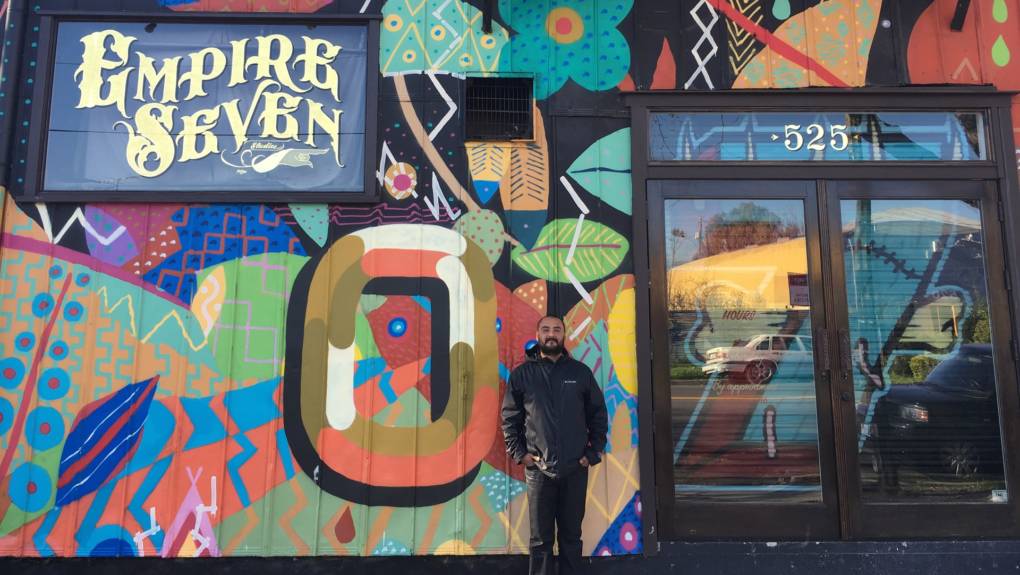
"caption": "Juan Carlos Araujo, outside the space Empire Seven Studios has occupied for almost 10 years. A developer who bought the property plans to raze the building in early 2017 to put up new housing.",
"description": "Juan Carlos Araujo, outside the space Empire Seven Studios has occupied for almost 10 years. A developer who bought the property plans to raze the building in early 2017 to put up new housing.",
"title": "rs23584_photo-dec-22-10-11-15-am-001-qut",
"credit": "Photo: Rachael Myrow/KQED",
"status": "inherit",
"isLoading": false,
"fetchFailed": false
},
"arts_11635263": {
"type": "attachments",
"id": "arts_11635263",
"meta": {
"index": "attachments_1716263798",
"site": "arts",
"id": "11635263",
"found": true
},
"parent": 11635262,
"imgSizes": {
"twentyfourteen-full-width": {
"file": "https://ww2.kqed.org/app/uploads/sites/2/2016/05/RS19639_Mary-Ellen-Bartley-THE_EDGE_OF_VISION-qut-1000x576.jpg",
"width": 1000,
"mimeType": "image/jpeg",
"height": 576
},
"thumbnail": {
"file": "https://ww2.kqed.org/app/uploads/sites/2/2016/05/RS19639_Mary-Ellen-Bartley-THE_EDGE_OF_VISION-qut-e1464845925658-400x220.jpg",
"width": 400,
"mimeType": "image/jpeg",
"height": 220
},
"fd-sm": {
"file": "https://ww2.kqed.org/app/uploads/sites/2/2016/05/RS19639_Mary-Ellen-Bartley-THE_EDGE_OF_VISION-qut-e1464845925658-960x528.jpg",
"width": 960,
"mimeType": "image/jpeg",
"height": 528
},
"post-thumbnail": {
"file": "https://ww2.kqed.org/app/uploads/sites/2/2016/05/RS19639_Mary-Ellen-Bartley-THE_EDGE_OF_VISION-qut-e1464845925658-672x372.jpg",
"width": 672,
"mimeType": "image/jpeg",
"height": 372
},
"kqedFullSize": {
"file": "https://ww2.kqed.org/app/uploads/sites/2/2016/05/RS19639_Mary-Ellen-Bartley-THE_EDGE_OF_VISION-qut-e1464845925658.jpg",
"width": 1000,
"height": 550
},
"guest-author-50": {
"file": "https://ww2.kqed.org/app/uploads/sites/2/2016/05/RS19639_Mary-Ellen-Bartley-THE_EDGE_OF_VISION-qut-e1464845925658-50x50.jpg",
"width": 50,
"mimeType": "image/jpeg",
"height": 50
},
"guest-author-96": {
"file": "https://ww2.kqed.org/app/uploads/sites/2/2016/05/RS19639_Mary-Ellen-Bartley-THE_EDGE_OF_VISION-qut-e1464845925658-96x96.jpg",
"width": 96,
"mimeType": "image/jpeg",
"height": 96
},
"medium": {
"file": "https://ww2.kqed.org/app/uploads/sites/2/2016/05/RS19639_Mary-Ellen-Bartley-THE_EDGE_OF_VISION-qut-e1464845925658-800x440.jpg",
"width": 800,
"mimeType": "image/jpeg",
"height": 440
},
"guest-author-64": {
"file": "https://ww2.kqed.org/app/uploads/sites/2/2016/05/RS19639_Mary-Ellen-Bartley-THE_EDGE_OF_VISION-qut-e1464845925658-64x64.jpg",
"width": 64,
"mimeType": "image/jpeg",
"height": 64
},
"guest-author-32": {
"file": "https://ww2.kqed.org/app/uploads/sites/2/2016/05/RS19639_Mary-Ellen-Bartley-THE_EDGE_OF_VISION-qut-e1464845925658-32x32.jpg",
"width": 32,
"mimeType": "image/jpeg",
"height": 32
},
"detail": {
"file": "https://ww2.kqed.org/app/uploads/sites/2/2016/05/RS19639_Mary-Ellen-Bartley-THE_EDGE_OF_VISION-qut-e1464845925658-150x150.jpg",
"width": 150,
"mimeType": "image/jpeg",
"height": 150
},
"medium_large": {
"file": "https://ww2.kqed.org/app/uploads/sites/2/2016/05/RS19639_Mary-Ellen-Bartley-THE_EDGE_OF_VISION-qut-e1464845925658-768x422.jpg",
"width": 768,
"mimeType": "image/jpeg",
"height": 422
},
"guest-author-128": {
"file": "https://ww2.kqed.org/app/uploads/sites/2/2016/05/RS19639_Mary-Ellen-Bartley-THE_EDGE_OF_VISION-qut-e1464845925658-128x128.jpg",
"width": 128,
"mimeType": "image/jpeg",
"height": 128
}
},
"publishDate": 1464727724,
"modified": 1464727764,
"caption": "The\tEdge of\tVision (2010) by Mary Ellen Bartley. From the series Standing Open. Pigment\tprints on\trag\tpaper, 18x27\".",
"description": "The\tEdge of\tVision (2010) by Mary Ellen Bartley. From the series Standing Open. Pigment\tprints on\trag\tpaper, 18x27\".",
"title": "RS19639_Mary Ellen Bartley-THE_EDGE_OF_VISION-qut",
"credit": "Photo: Courtesy of the Artist and Yancey Richardson Gallery",
"status": "inherit",
"isLoading": false,
"fetchFailed": false
}
},
"audioPlayerReducer": {
"postId": "stream_live",
"isPaused": true,
"isPlaying": false,
"pfsActive": false,
"pledgeModalIsOpen": true,
"playerDrawerIsOpen": false,
"liveAudioPlayStartedAt": 0,
"liveAudioPlayContext": ""
},
"authorsReducer": {
"byline_arts_13805009": {
"type": "authors",
"id": "byline_arts_13805009",
"meta": {
"override": true
},
"slug": "byline_arts_13805009",
"name": "Mike Seely",
"isLoading": false
},
"shotchkiss": {
"type": "authors",
"id": "61",
"meta": {
"index": "authors_1716337520",
"id": "61",
"found": true
},
"name": "Sarah Hotchkiss",
"firstName": "Sarah",
"lastName": "Hotchkiss",
"slug": "shotchkiss",
"email": "shotchkiss@kqed.org",
"display_author_email": true,
"staff_mastheads": [
"arts"
],
"title": "Senior Editor",
"bio": "Sarah Hotchkiss is a San Francisco \u003ca href=\"http://www.sarahhotchkiss.com\">artist\u003c/a> and arts writer. In 2019, she received the Dorothea & Leo Rabkin Foundation grant for visual art journalism and in 2020 she received a Society of Professional Journalists, Northern California award for excellence in arts and culture reporting.",
"avatar": "https://secure.gravatar.com/avatar/bc662df144b3d27fd8b1b6f1c2a420d34e91e53154d411bb7ad353cc8b6cea8d?s=600&d=blank&r=g",
"twitter": null,
"bluesky": null,
"facebook": null,
"instagram": null,
"linkedin": null,
"sites": [
{
"site": "",
"roles": [
"editor"
]
},
{
"site": "arts",
"roles": [
"Contributor",
"administrator"
]
},
{
"site": "artschool",
"roles": [
"administrator"
]
},
{
"site": "news",
"roles": [
"editor"
]
},
{
"site": "pop",
"roles": [
"administrator"
]
},
{
"site": "bayareabites",
"roles": [
"editor"
]
},
{
"site": "spark",
"roles": [
"editor"
]
},
{
"site": "checkplease",
"roles": [
"editor"
]
}
],
"headData": {
"title": "Sarah Hotchkiss | KQED",
"description": "Senior Editor",
"ogImgSrc": "https://secure.gravatar.com/avatar/bc662df144b3d27fd8b1b6f1c2a420d34e91e53154d411bb7ad353cc8b6cea8d?s=600&d=blank&r=g",
"twImgSrc": "https://secure.gravatar.com/avatar/bc662df144b3d27fd8b1b6f1c2a420d34e91e53154d411bb7ad353cc8b6cea8d?s=600&d=blank&r=g"
},
"isLoading": false,
"link": "/author/shotchkiss"
},
"rachael-myrow": {
"type": "authors",
"id": "251",
"meta": {
"index": "authors_1716337520",
"id": "251",
"found": true
},
"name": "Rachael Myrow",
"firstName": "Rachael",
"lastName": "Myrow",
"slug": "rachael-myrow",
"email": "rmyrow@kqed.org",
"display_author_email": true,
"staff_mastheads": [
"news"
],
"title": "Senior Editor of KQED's Silicon Valley News Desk",
"bio": "• I write and edit stories about how Silicon Valley power and policies shape everyday life in California. I’m also passionate about making Bay Area history and culture more accessible to a broad public. • I’ve been a journalist for most of my life, starting in high school with The Franklin Press in Los Angeles, where I grew up. While earning my first degree in English at UC Berkeley, I got my start in public radio at KALX-FM. After completing a second degree in journalism at Cal, I landed my first professional job at Marketplace, then moved on to KPCC (now LAist), and then KQED, where I hosted The California Report for more than seven years. • My reporting has appeared on NPR, The World, WBUR’s \u003ci>Here & Now\u003c/i>, and the BBC. I also guest host for KQED’s \u003ci>Forum\u003c/i>, as well as the Commonwealth Club in San Francisco. • I speak periodically on media, democracy and technology issues, and do voiceover work for documentaries and educational video projects. • Outside of the studio, you'll find me hiking Bay Area trails and whipping up Insta-ready meals in my kitchen. • I do not accept gifts, money, or favors from anyone connected to my reporting, I don't pay people for information, and I do not support or donate to political causes. • I strive to treat the people I report on with fairness, honesty, and respect. I also recognize there are often multiple sides to a story and work to verify information through multiple sources and documentation. If I get something wrong, I correct it.",
"avatar": "https://secure.gravatar.com/avatar/3ed8a3c5f26025e4a805ba634cda8cd764906b97438a6d9ce216b044e340da4e?s=600&d=blank&r=g",
"twitter": "rachaelmyrow",
"bluesky": null,
"facebook": null,
"instagram": null,
"linkedin": "https://www.linkedin.com/in/rachaelmyrow/",
"sites": [
{
"site": "arts",
"roles": [
"administrator"
]
},
{
"site": "news",
"roles": [
"edit_others_posts",
"editor"
]
},
{
"site": "futureofyou",
"roles": [
"editor"
]
},
{
"site": "bayareabites",
"roles": [
"editor"
]
},
{
"site": "stateofhealth",
"roles": [
"editor"
]
},
{
"site": "science",
"roles": [
"editor"
]
},
{
"site": "food",
"roles": [
"editor"
]
},
{
"site": "forum",
"roles": [
"editor"
]
},
{
"site": "liveblog",
"roles": [
"author"
]
}
],
"headData": {
"title": "Rachael Myrow | KQED",
"description": "Senior Editor of KQED's Silicon Valley News Desk",
"ogImgSrc": "https://secure.gravatar.com/avatar/3ed8a3c5f26025e4a805ba634cda8cd764906b97438a6d9ce216b044e340da4e?s=600&d=blank&r=g",
"twImgSrc": "https://secure.gravatar.com/avatar/3ed8a3c5f26025e4a805ba634cda8cd764906b97438a6d9ce216b044e340da4e?s=600&d=blank&r=g"
},
"isLoading": false,
"link": "/author/rachael-myrow"
},
"kwhalen": {
"type": "authors",
"id": "3248",
"meta": {
"index": "authors_1716337520",
"id": "3248",
"found": true
},
"name": "Kelly Whalen",
"firstName": "Kelly",
"lastName": "Whalen",
"slug": "kwhalen",
"email": "kwhalen@kqed.org",
"display_author_email": false,
"staff_mastheads": [],
"title": "Senior Video Producer",
"bio": "Kelly Whalen is a filmmaker and educator who directs and produces social justice documentaries and award-winning arts and culture web series. She is the creator of KQED Arts’ three-time Webby Award-winning YouTube series \u003cem>If Cities Could Dance\u003c/em>, featuring dancers across the country representing their cities’ signature moves, and the director of \u003cem>When the Waters Get Deep\u003c/em>, a documentary about Oakland-based artists SOL Development and their work toward healing their communities’ trauma from gun violence.",
"avatar": "https://secure.gravatar.com/avatar/1a2b57e8a13abdcfc3d4966d9c0e1512?s=600&d=blank&r=g",
"twitter": "kellyfilmmaker",
"facebook": null,
"instagram": null,
"linkedin": null,
"sites": [
{
"site": "arts",
"roles": [
"subscriber"
]
}
],
"headData": {
"title": "Kelly Whalen | KQED",
"description": "Senior Video Producer",
"ogImgSrc": "https://secure.gravatar.com/avatar/1a2b57e8a13abdcfc3d4966d9c0e1512?s=600&d=blank&r=g",
"twImgSrc": "https://secure.gravatar.com/avatar/1a2b57e8a13abdcfc3d4966d9c0e1512?s=600&d=blank&r=g"
},
"isLoading": false,
"link": "/author/kwhalen"
},
"eholmes": {
"type": "authors",
"id": "8623",
"meta": {
"index": "authors_1716337520",
"id": "8623",
"found": true
},
"name": "Emily Holmes",
"firstName": "Emily",
"lastName": "Holmes",
"slug": "eholmes",
"email": "emily@artpractical.com",
"display_author_email": false,
"staff_mastheads": [],
"title": null,
"bio": "\u003ca href=\"http://www.emilykholmes.com/\" target=\"_blank\" rel=\"noopener\">Emily Holmes \u003c/a>is a Sacramento-based writer and editor.",
"avatar": "https://secure.gravatar.com/avatar/3415140cdd1ccd2cb8e99eb21568553a?s=600&d=blank&r=g",
"twitter": null,
"facebook": null,
"instagram": null,
"linkedin": null,
"sites": [
{
"site": "arts",
"roles": [
"contributor"
]
}
],
"headData": {
"title": "Emily Holmes | KQED",
"description": null,
"ogImgSrc": "https://secure.gravatar.com/avatar/3415140cdd1ccd2cb8e99eb21568553a?s=600&d=blank&r=g",
"twImgSrc": "https://secure.gravatar.com/avatar/3415140cdd1ccd2cb8e99eb21568553a?s=600&d=blank&r=g"
},
"isLoading": false,
"link": "/author/eholmes"
}
},
"pagesReducer": {
"arts_tag_san-jose": {
"type": "terms",
"id": "arts_1084",
"meta": {
"index": "terms_1716263798",
"site": "arts",
"id": "1084",
"score": 8.005498
},
"featImg": null,
"name": "San Jose",
"description": null,
"taxonomy": "tag",
"headData": {
"twImgId": null,
"twTitle": null,
"ogTitle": null,
"ogImgId": null,
"twDescription": null,
"description": null,
"title": "San Jose Archives | KQED Arts",
"ogDescription": null
},
"ttid": 1101,
"slug": "san-jose",
"isLoading": false,
"title": "San Jose",
"pageMeta": {
"site": "arts",
"WpPageTemplate": "page-topic-editorial",
"currentPage": 16
},
"blocks": [
{
"blockName": "kqed/post-list",
"attrs": {
"layout": "cardArticle2",
"query": "posts/arts?tag=san-jose",
"seeMore": false,
"paginated": true,
"page": 16
}
},
{
"blockName": "kqed/ad"
}
]
}
},
"pfsSessionReducer": {},
"postsReducer": {
"stream_live": {
"type": "live",
"id": "stream_live",
"audioUrl": "https://streams.kqed.org/kqedradio",
"title": "Live Stream",
"excerpt": "Live Stream information currently unavailable.",
"link": "/radio",
"featImg": "",
"label": {
"name": "KQED Live",
"link": "/"
}
},
"stream_kqedNewscast": {
"type": "posts",
"id": "stream_kqedNewscast",
"audioUrl": "https://www.kqed.org/.stream/anon/radio/RDnews/newscast.mp3?_=1",
"title": "KQED Newscast",
"featImg": "",
"label": {
"name": "88.5 FM",
"link": "/"
}
},
"arts_13808038": {
"type": "posts",
"id": "arts_13808038",
"meta": {
"index": "posts_1716263798",
"site": "arts",
"id": "13808038",
"score": null,
"sort": [
1505174414000
]
},
"guestAuthors": [],
"slug": "chinese-arts-impresario-ann-woo-celebrated-at-south-bay-memorial",
"title": "Chinese Arts Impresario Ann Woo Celebrated at South Bay Memorial",
"publishDate": 1505174414,
"format": "audio",
"headTitle": "Chinese Arts Impresario Ann Woo Celebrated at South Bay Memorial | KQED",
"labelTerm": {
"site": "arts"
},
"content": "\u003cp>Around 350 people gathered in San Jose on Sunday afternoon to mourn the passing of Chinese arts impresario Ann Woo, who died rlnder mysterious circumstances in August at the age of 75.\u003c/p>\n\u003cp>In 1991, Woo co-founded \u003ca href=\"http://cpaasv.info\" target=\"_blank\" rel=\"noopener noreferrer\">Chinese Performing Arts of America\u003c/a> (CPAA), a San Jose-based cultural center focused on promoting interest in traditional Chinese and related performing arts disciplines that was integral to the creative landscape of Silicon Valley.\u003c/p>\n\u003cp>Woo’s commitment won her wide respect in the South Bay, ranging from parents grateful she provided a platform for their children to learn about their heritage, to community leaders happy she could wrangle high-quality entertainment for any civic occasion.\u003c/p>\n\u003cfigure id=\"attachment_13808056\" class=\"wp-caption alignnone\" style=\"max-width: 800px\">\u003cimg loading=\"lazy\" decoding=\"async\" class=\"wp-image-13808056 size-medium\" src=\"https://ww2.kqed.org/arts/wp-content/uploads/sites/2/2017/09/RS26506_IMG_3632-2-qut-800x450.jpg\" alt=\"Representatives of Ann Woo's two families, her personal family and that of Chinese Performing Arts of America, spoke and performed at her memorial.\" width=\"800\" height=\"450\" srcset=\"https://cdn.kqed.org/wp-content/uploads/sites/2/2017/09/RS26506_IMG_3632-2-qut-800x450.jpg 800w, https://cdn.kqed.org/wp-content/uploads/sites/2/2017/09/RS26506_IMG_3632-2-qut-160x90.jpg 160w, https://cdn.kqed.org/wp-content/uploads/sites/2/2017/09/RS26506_IMG_3632-2-qut-768x432.jpg 768w, https://cdn.kqed.org/wp-content/uploads/sites/2/2017/09/RS26506_IMG_3632-2-qut-1020x574.jpg 1020w, https://cdn.kqed.org/wp-content/uploads/sites/2/2017/09/RS26506_IMG_3632-2-qut.jpg 1920w, https://cdn.kqed.org/wp-content/uploads/sites/2/2017/09/RS26506_IMG_3632-2-qut-1180x664.jpg 1180w, https://cdn.kqed.org/wp-content/uploads/sites/2/2017/09/RS26506_IMG_3632-2-qut-960x540.jpg 960w, https://cdn.kqed.org/wp-content/uploads/sites/2/2017/09/RS26506_IMG_3632-2-qut-240x135.jpg 240w, https://cdn.kqed.org/wp-content/uploads/sites/2/2017/09/RS26506_IMG_3632-2-qut-375x211.jpg 375w, https://cdn.kqed.org/wp-content/uploads/sites/2/2017/09/RS26506_IMG_3632-2-qut-520x293.jpg 520w\" sizes=\"(max-width: 800px) 100vw, 800px\">\u003cfigcaption class=\"wp-caption-text\">Representatives of Ann Woo’s two families, her personal family and that of Chinese Performing Arts of America, spoke and performed at her memorial. \u003ccite>(Photo: Courtesy of Michael M. Cohen)\u003c/cite>\u003c/figcaption>\u003c/figure>\n\u003cp>“I knew Ann for 27 years,” said Patrick Kwok, former mayor of Cupertino and former board chair for the CPAA. “Her dedication and passion for Chinese arts is just beyond any description.”\u003c/p>\n\u003cp>Woo’s death\u003ca href=\"http://www.mercurynews.com/2017/09/08/ann-woo-death-as-memorial-nears-case-remains-a-mystery/\" target=\"_blank\" rel=\"noopener noreferrer\"> on Aug. 25\u003c/a> occurred two weeks after she fell into a dispute with a woman who had been involved in planning a future event with Woo’s organization. Woo was found later that same day, Aug. 11, on the ground outside CPAA’s offices, bleeding from the head.\u003c/p>\n\u003cp>[ad fullwidth]\u003c/p>\n\u003cp>The Santa Clara County medical examiner said an autopsy is complete, but the cause of death remains undetermined.\u003c/p>\n\u003cp>The homicide unit of San Jose’s police department continues to investigate, frustrated by a lack of witnesses to the incident. No arrests have yet been made, and no suspects have been publicly named.\u003c/p>\n\u003cfigure id=\"attachment_13808057\" class=\"wp-caption aligncenter\" style=\"max-width: 800px\">\u003cimg loading=\"lazy\" decoding=\"async\" class=\"wp-image-13808057 size-medium\" src=\"https://ww2.kqed.org/arts/wp-content/uploads/sites/2/2017/09/RS26504_Dancers-qut-800x450.jpg\" alt='Zhou Hui, Christina Cheng, Virginia Jian, Allie Dong, Liu Yan, Wang Xin perform the \"Red Ribbon Dance\" at the memorial for Ann Woo on September 10, 2017.' width=\"800\" height=\"450\" srcset=\"https://cdn.kqed.org/wp-content/uploads/sites/2/2017/09/RS26504_Dancers-qut-800x450.jpg 800w, https://cdn.kqed.org/wp-content/uploads/sites/2/2017/09/RS26504_Dancers-qut-160x90.jpg 160w, https://cdn.kqed.org/wp-content/uploads/sites/2/2017/09/RS26504_Dancers-qut-768x432.jpg 768w, https://cdn.kqed.org/wp-content/uploads/sites/2/2017/09/RS26504_Dancers-qut-1020x574.jpg 1020w, https://cdn.kqed.org/wp-content/uploads/sites/2/2017/09/RS26504_Dancers-qut.jpg 1920w, https://cdn.kqed.org/wp-content/uploads/sites/2/2017/09/RS26504_Dancers-qut-1180x664.jpg 1180w, https://cdn.kqed.org/wp-content/uploads/sites/2/2017/09/RS26504_Dancers-qut-960x540.jpg 960w, https://cdn.kqed.org/wp-content/uploads/sites/2/2017/09/RS26504_Dancers-qut-240x135.jpg 240w, https://cdn.kqed.org/wp-content/uploads/sites/2/2017/09/RS26504_Dancers-qut-375x211.jpg 375w, https://cdn.kqed.org/wp-content/uploads/sites/2/2017/09/RS26504_Dancers-qut-520x293.jpg 520w\" sizes=\"(max-width: 800px) 100vw, 800px\">\u003cfigcaption class=\"wp-caption-text\">Zhou Hui, Christina Cheng, Virginia Jian, Allie Dong, Liu Yan, Wang Xin perform the “Red Ribbon Dance” at the memorial for Ann Woo on September 10, 2017. \u003ccite>(Photo: Rachael Myrow/KQED)\u003c/cite>\u003c/figcaption>\u003c/figure>\n\u003ch3>A lifetime of achievement\u003c/h3>\n\u003cp>Woo emigrated from China to San Francisco when she was 14 years old. After graduating from UC Berkeley, she spent 30 years as an electronic design engineer, one of few women of her generation to undertake such work in Silicon Valley.\u003c/p>\n\u003cp>But Woo’s heart was always in the arts. When she retired from her tech career, she co-founded CPAA to provide low-cost dance lessons to children and adults, as well as cultivate an appreciation for Chinese culture in the wider community.\u003c/p>\n\u003cp>So great was Woo’s contribution to the South Bay arts scene that her work was the subject of \u003ca href=\"https://tely2.kqed.org/owa/redir.aspx?C=1tLv3zK35tE5CC9GwDvCk9QmYcCfXVA1v5LMLgyUgbjIoZycsvjUCA..&URL=https%3a%2f%2fww2.kqed.org%2farts%2f2014%2f03%2f20%2fsilicon-valley-businesswoman-builds-a-future-for-ancient-arts%2f\">a KQED Arts video\u003c/a> in 2014.\u003c/p>\n\u003cp>https://www.youtube.com/watch?v=S219hCL9-QU\u003c/p>\n\u003cp>“When we started, our mission was to introduce Chinese culture to the mainstream through performing arts,” Woo told KQED back in 2014. “But now, we also promote multi-culture.”\u003c/p>\n\u003cp>The center is home to 10 studios, and hosts classes in Indian, Latino and European traditions, as well as Chinese.\u003c/p>\n\u003cp>Many dignitaries attended and spoke at the memorial, ranging from local and regional politicians to the Consul General of the People’s Republic of China in San Francisco, Luo Linquan. Silent videos of past performances played on a screen while one speaker after another recounted Woo’s role in building and sustaining CPAA.\u003c/p>\n\u003cfigure id=\"attachment_13808058\" class=\"wp-caption aligncenter\" style=\"max-width: 800px\">\u003cimg loading=\"lazy\" decoding=\"async\" class=\"size-medium wp-image-13808058\" src=\"https://ww2.kqed.org/arts/wp-content/uploads/sites/2/2017/09/RS26505_DonationBoxes-qut-800x450.jpg\" alt=\"Two memorial funds have been established to help Ann Woo's family and her passion project, Chinese Performing Arts of America.\" width=\"800\" height=\"450\" srcset=\"https://cdn.kqed.org/wp-content/uploads/sites/2/2017/09/RS26505_DonationBoxes-qut-800x450.jpg 800w, https://cdn.kqed.org/wp-content/uploads/sites/2/2017/09/RS26505_DonationBoxes-qut-160x90.jpg 160w, https://cdn.kqed.org/wp-content/uploads/sites/2/2017/09/RS26505_DonationBoxes-qut-768x432.jpg 768w, https://cdn.kqed.org/wp-content/uploads/sites/2/2017/09/RS26505_DonationBoxes-qut-1020x574.jpg 1020w, https://cdn.kqed.org/wp-content/uploads/sites/2/2017/09/RS26505_DonationBoxes-qut.jpg 1920w, https://cdn.kqed.org/wp-content/uploads/sites/2/2017/09/RS26505_DonationBoxes-qut-1180x664.jpg 1180w, https://cdn.kqed.org/wp-content/uploads/sites/2/2017/09/RS26505_DonationBoxes-qut-960x540.jpg 960w, https://cdn.kqed.org/wp-content/uploads/sites/2/2017/09/RS26505_DonationBoxes-qut-240x135.jpg 240w, https://cdn.kqed.org/wp-content/uploads/sites/2/2017/09/RS26505_DonationBoxes-qut-375x211.jpg 375w, https://cdn.kqed.org/wp-content/uploads/sites/2/2017/09/RS26505_DonationBoxes-qut-520x293.jpg 520w\" sizes=\"(max-width: 800px) 100vw, 800px\">\u003cfigcaption class=\"wp-caption-text\">Two memorial funds have been established to help Ann Woo’s family and her passion project, Chinese Performing Arts of America. \u003ccite>(Photo: Rachael Myrow/KQED)\u003c/cite>\u003c/figcaption>\u003c/figure>\n\u003cp>“This is a testament to her impact on the community, locally and internationally,” said Woo’s daughter, Tina Fredericks, who came up from Pasadena to speak at the memorial. “My realization of her impact is still growing.”\u003c/p>\n\u003ch3>What lies ahead for CPAA\u003c/h3>\n\u003cp>At the time of Woo’s death, CPAA was struggling financially. The center’s interim director, Andy Jian, said Woo’s death occurred with the nonprofit “six figures” in debt. Jian said he is trying to negotiate with the center’s landlord and bank for a grace period as CPAA pulls itself back together.\u003c/p>\n\u003cp>There seems little question Jian and others are committed to keeping CPAA alive, not just because of Ann Woo’s lifetime of commitment to the organization, but also because of its standing in the South Bay arts community.\u003c/p>\n\u003cp>“If you’ve been to any event in Cupertino, Ann has touched your heart and soul,” said Cupertino Mayor Savita Vaidhyanathan. “I’ve been living in the city for over 20 years, and at any event I’ve been to, I’ve seen something performed by her students. Even if you do not understand Chinese — which I do not — her productions just touch your heart.”\u003c/p>\n\u003cp>\u003c/p>\n\u003cp>\u003cimg loading=\"lazy\" decoding=\"async\" class=\"aligncenter size-full wp-image-12127869\" src=\"https://ww2.kqed.org/arts/wp-content/uploads/sites/2/2016/09/Q.Logo_.Break_.jpg\" alt=\"\" width=\"800\" height=\"78\" srcset=\"https://cdn.kqed.org/wp-content/uploads/sites/2/2016/09/Q.Logo_.Break_.jpg 800w, https://cdn.kqed.org/wp-content/uploads/sites/2/2016/09/Q.Logo_.Break_-400x39.jpg 400w, https://cdn.kqed.org/wp-content/uploads/sites/2/2016/09/Q.Logo_.Break_-768x75.jpg 768w\" sizes=\"(max-width: 800px) 100vw, 800px\">\u003c/p>\n\n",
"blocks": [],
"excerpt": "The co-founder of Chinese Performing Arts of America, who died under mysterious circumstances in August, leaves behind a beloved South Bay arts institution. ",
"status": "publish",
"parent": 0,
"modified": 1726782068,
"stats": {
"hasAudio": false,
"hasVideo": true,
"hasChartOrMap": false,
"iframeSrcs": [],
"hasGoogleForm": false,
"hasGallery": false,
"hasHearkenModule": false,
"hasPolis": false,
"paragraphCount": 20,
"wordCount": 821
},
"headData": {
"title": "Chinese Arts Impresario Ann Woo Celebrated at South Bay Memorial | KQED",
"description": "The co-founder of Chinese Performing Arts of America, who died under mysterious circumstances in August, leaves behind a beloved South Bay arts institution. ",
"ogTitle": "",
"ogDescription": "",
"ogImgId": "",
"twTitle": "",
"twDescription": "",
"twImgId": "",
"schema": {
"@context": "https://schema.org",
"@type": "Article",
"headline": "Chinese Arts Impresario Ann Woo Celebrated at South Bay Memorial",
"datePublished": "2017-09-11T17:00:14-07:00",
"dateModified": "2024-09-19T14:41:08-07:00",
"image": "https://cdn.kqed.org/wp-content/uploads/2020/02/KQED-OG-Image@1x.png"
}
},
"audioUrl": "https://www.kqed.org/.stream/anon/radio/RDnews/2017/09/RachaelMyrowWoo.mp3",
"sticky": false,
"path": "/arts/13808038/chinese-arts-impresario-ann-woo-celebrated-at-south-bay-memorial",
"audioTrackLength": null,
"parsedContent": [
{
"type": "contentString",
"content": "\u003cdiv class=\"post-body\">\u003cp>\u003cp>Around 350 people gathered in San Jose on Sunday afternoon to mourn the passing of Chinese arts impresario Ann Woo, who died rlnder mysterious circumstances in August at the age of 75.\u003c/p>\n\u003cp>In 1991, Woo co-founded \u003ca href=\"http://cpaasv.info\" target=\"_blank\" rel=\"noopener noreferrer\">Chinese Performing Arts of America\u003c/a> (CPAA), a San Jose-based cultural center focused on promoting interest in traditional Chinese and related performing arts disciplines that was integral to the creative landscape of Silicon Valley.\u003c/p>\n\u003cp>Woo’s commitment won her wide respect in the South Bay, ranging from parents grateful she provided a platform for their children to learn about their heritage, to community leaders happy she could wrangle high-quality entertainment for any civic occasion.\u003c/p>\n\u003cfigure id=\"attachment_13808056\" class=\"wp-caption alignnone\" style=\"max-width: 800px\">\u003cimg loading=\"lazy\" decoding=\"async\" class=\"wp-image-13808056 size-medium\" src=\"https://ww2.kqed.org/arts/wp-content/uploads/sites/2/2017/09/RS26506_IMG_3632-2-qut-800x450.jpg\" alt=\"Representatives of Ann Woo's two families, her personal family and that of Chinese Performing Arts of America, spoke and performed at her memorial.\" width=\"800\" height=\"450\" srcset=\"https://cdn.kqed.org/wp-content/uploads/sites/2/2017/09/RS26506_IMG_3632-2-qut-800x450.jpg 800w, https://cdn.kqed.org/wp-content/uploads/sites/2/2017/09/RS26506_IMG_3632-2-qut-160x90.jpg 160w, https://cdn.kqed.org/wp-content/uploads/sites/2/2017/09/RS26506_IMG_3632-2-qut-768x432.jpg 768w, https://cdn.kqed.org/wp-content/uploads/sites/2/2017/09/RS26506_IMG_3632-2-qut-1020x574.jpg 1020w, https://cdn.kqed.org/wp-content/uploads/sites/2/2017/09/RS26506_IMG_3632-2-qut.jpg 1920w, https://cdn.kqed.org/wp-content/uploads/sites/2/2017/09/RS26506_IMG_3632-2-qut-1180x664.jpg 1180w, https://cdn.kqed.org/wp-content/uploads/sites/2/2017/09/RS26506_IMG_3632-2-qut-960x540.jpg 960w, https://cdn.kqed.org/wp-content/uploads/sites/2/2017/09/RS26506_IMG_3632-2-qut-240x135.jpg 240w, https://cdn.kqed.org/wp-content/uploads/sites/2/2017/09/RS26506_IMG_3632-2-qut-375x211.jpg 375w, https://cdn.kqed.org/wp-content/uploads/sites/2/2017/09/RS26506_IMG_3632-2-qut-520x293.jpg 520w\" sizes=\"(max-width: 800px) 100vw, 800px\">\u003cfigcaption class=\"wp-caption-text\">Representatives of Ann Woo’s two families, her personal family and that of Chinese Performing Arts of America, spoke and performed at her memorial. \u003ccite>(Photo: Courtesy of Michael M. Cohen)\u003c/cite>\u003c/figcaption>\u003c/figure>\n\u003cp>“I knew Ann for 27 years,” said Patrick Kwok, former mayor of Cupertino and former board chair for the CPAA. “Her dedication and passion for Chinese arts is just beyond any description.”\u003c/p>\n\u003cp>Woo’s death\u003ca href=\"http://www.mercurynews.com/2017/09/08/ann-woo-death-as-memorial-nears-case-remains-a-mystery/\" target=\"_blank\" rel=\"noopener noreferrer\"> on Aug. 25\u003c/a> occurred two weeks after she fell into a dispute with a woman who had been involved in planning a future event with Woo’s organization. Woo was found later that same day, Aug. 11, on the ground outside CPAA’s offices, bleeding from the head.\u003c/p>\n\u003cp>\u003c/p>\u003c/div>",
"attributes": {
"named": {},
"numeric": []
}
},
{
"type": "component",
"content": "",
"name": "ad",
"attributes": {
"named": {
"label": "fullwidth"
},
"numeric": [
"fullwidth"
]
}
},
{
"type": "contentString",
"content": "\u003cdiv class=\"post-body\">\u003cp>\u003c/p>\n\u003cp>The Santa Clara County medical examiner said an autopsy is complete, but the cause of death remains undetermined.\u003c/p>\n\u003cp>The homicide unit of San Jose’s police department continues to investigate, frustrated by a lack of witnesses to the incident. No arrests have yet been made, and no suspects have been publicly named.\u003c/p>\n\u003cfigure id=\"attachment_13808057\" class=\"wp-caption aligncenter\" style=\"max-width: 800px\">\u003cimg loading=\"lazy\" decoding=\"async\" class=\"wp-image-13808057 size-medium\" src=\"https://ww2.kqed.org/arts/wp-content/uploads/sites/2/2017/09/RS26504_Dancers-qut-800x450.jpg\" alt='Zhou Hui, Christina Cheng, Virginia Jian, Allie Dong, Liu Yan, Wang Xin perform the \"Red Ribbon Dance\" at the memorial for Ann Woo on September 10, 2017.' width=\"800\" height=\"450\" srcset=\"https://cdn.kqed.org/wp-content/uploads/sites/2/2017/09/RS26504_Dancers-qut-800x450.jpg 800w, https://cdn.kqed.org/wp-content/uploads/sites/2/2017/09/RS26504_Dancers-qut-160x90.jpg 160w, https://cdn.kqed.org/wp-content/uploads/sites/2/2017/09/RS26504_Dancers-qut-768x432.jpg 768w, https://cdn.kqed.org/wp-content/uploads/sites/2/2017/09/RS26504_Dancers-qut-1020x574.jpg 1020w, https://cdn.kqed.org/wp-content/uploads/sites/2/2017/09/RS26504_Dancers-qut.jpg 1920w, https://cdn.kqed.org/wp-content/uploads/sites/2/2017/09/RS26504_Dancers-qut-1180x664.jpg 1180w, https://cdn.kqed.org/wp-content/uploads/sites/2/2017/09/RS26504_Dancers-qut-960x540.jpg 960w, https://cdn.kqed.org/wp-content/uploads/sites/2/2017/09/RS26504_Dancers-qut-240x135.jpg 240w, https://cdn.kqed.org/wp-content/uploads/sites/2/2017/09/RS26504_Dancers-qut-375x211.jpg 375w, https://cdn.kqed.org/wp-content/uploads/sites/2/2017/09/RS26504_Dancers-qut-520x293.jpg 520w\" sizes=\"(max-width: 800px) 100vw, 800px\">\u003cfigcaption class=\"wp-caption-text\">Zhou Hui, Christina Cheng, Virginia Jian, Allie Dong, Liu Yan, Wang Xin perform the “Red Ribbon Dance” at the memorial for Ann Woo on September 10, 2017. \u003ccite>(Photo: Rachael Myrow/KQED)\u003c/cite>\u003c/figcaption>\u003c/figure>\n\u003ch3>A lifetime of achievement\u003c/h3>\n\u003cp>Woo emigrated from China to San Francisco when she was 14 years old. After graduating from UC Berkeley, she spent 30 years as an electronic design engineer, one of few women of her generation to undertake such work in Silicon Valley.\u003c/p>\n\u003cp>But Woo’s heart was always in the arts. When she retired from her tech career, she co-founded CPAA to provide low-cost dance lessons to children and adults, as well as cultivate an appreciation for Chinese culture in the wider community.\u003c/p>\n\u003cp>So great was Woo’s contribution to the South Bay arts scene that her work was the subject of \u003ca href=\"https://tely2.kqed.org/owa/redir.aspx?C=1tLv3zK35tE5CC9GwDvCk9QmYcCfXVA1v5LMLgyUgbjIoZycsvjUCA..&URL=https%3a%2f%2fww2.kqed.org%2farts%2f2014%2f03%2f20%2fsilicon-valley-businesswoman-builds-a-future-for-ancient-arts%2f\">a KQED Arts video\u003c/a> in 2014.\u003c/p>\u003c/p>\u003cp>\u003cspan class='utils-parseShortcode-shortcodes-__youtubeShortcode__embedYoutube'>\n \u003cspan class='utils-parseShortcode-shortcodes-__youtubeShortcode__embedYoutubeInside'>\n \u003ciframe\n loading='lazy'\n class='utils-parseShortcode-shortcodes-__youtubeShortcode__youtubePlayer'\n type='text/html'\n src='//www.youtube.com/embed/S219hCL9-QU'\n title='//www.youtube.com/embed/S219hCL9-QU'\n allowfullscreen='true'\n style='border:0;'>\u003c/iframe>\n \u003c/span>\n \u003c/span>\u003c/p>\u003cp>\u003cp>“When we started, our mission was to introduce Chinese culture to the mainstream through performing arts,” Woo told KQED back in 2014. “But now, we also promote multi-culture.”\u003c/p>\n\u003cp>The center is home to 10 studios, and hosts classes in Indian, Latino and European traditions, as well as Chinese.\u003c/p>\n\u003cp>Many dignitaries attended and spoke at the memorial, ranging from local and regional politicians to the Consul General of the People’s Republic of China in San Francisco, Luo Linquan. Silent videos of past performances played on a screen while one speaker after another recounted Woo’s role in building and sustaining CPAA.\u003c/p>\n\u003cfigure id=\"attachment_13808058\" class=\"wp-caption aligncenter\" style=\"max-width: 800px\">\u003cimg loading=\"lazy\" decoding=\"async\" class=\"size-medium wp-image-13808058\" src=\"https://ww2.kqed.org/arts/wp-content/uploads/sites/2/2017/09/RS26505_DonationBoxes-qut-800x450.jpg\" alt=\"Two memorial funds have been established to help Ann Woo's family and her passion project, Chinese Performing Arts of America.\" width=\"800\" height=\"450\" srcset=\"https://cdn.kqed.org/wp-content/uploads/sites/2/2017/09/RS26505_DonationBoxes-qut-800x450.jpg 800w, https://cdn.kqed.org/wp-content/uploads/sites/2/2017/09/RS26505_DonationBoxes-qut-160x90.jpg 160w, https://cdn.kqed.org/wp-content/uploads/sites/2/2017/09/RS26505_DonationBoxes-qut-768x432.jpg 768w, https://cdn.kqed.org/wp-content/uploads/sites/2/2017/09/RS26505_DonationBoxes-qut-1020x574.jpg 1020w, https://cdn.kqed.org/wp-content/uploads/sites/2/2017/09/RS26505_DonationBoxes-qut.jpg 1920w, https://cdn.kqed.org/wp-content/uploads/sites/2/2017/09/RS26505_DonationBoxes-qut-1180x664.jpg 1180w, https://cdn.kqed.org/wp-content/uploads/sites/2/2017/09/RS26505_DonationBoxes-qut-960x540.jpg 960w, https://cdn.kqed.org/wp-content/uploads/sites/2/2017/09/RS26505_DonationBoxes-qut-240x135.jpg 240w, https://cdn.kqed.org/wp-content/uploads/sites/2/2017/09/RS26505_DonationBoxes-qut-375x211.jpg 375w, https://cdn.kqed.org/wp-content/uploads/sites/2/2017/09/RS26505_DonationBoxes-qut-520x293.jpg 520w\" sizes=\"(max-width: 800px) 100vw, 800px\">\u003cfigcaption class=\"wp-caption-text\">Two memorial funds have been established to help Ann Woo’s family and her passion project, Chinese Performing Arts of America. \u003ccite>(Photo: Rachael Myrow/KQED)\u003c/cite>\u003c/figcaption>\u003c/figure>\n\u003cp>“This is a testament to her impact on the community, locally and internationally,” said Woo’s daughter, Tina Fredericks, who came up from Pasadena to speak at the memorial. “My realization of her impact is still growing.”\u003c/p>\n\u003ch3>What lies ahead for CPAA\u003c/h3>\n\u003cp>At the time of Woo’s death, CPAA was struggling financially. The center’s interim director, Andy Jian, said Woo’s death occurred with the nonprofit “six figures” in debt. Jian said he is trying to negotiate with the center’s landlord and bank for a grace period as CPAA pulls itself back together.\u003c/p>\n\u003cp>There seems little question Jian and others are committed to keeping CPAA alive, not just because of Ann Woo’s lifetime of commitment to the organization, but also because of its standing in the South Bay arts community.\u003c/p>\n\u003cp>“If you’ve been to any event in Cupertino, Ann has touched your heart and soul,” said Cupertino Mayor Savita Vaidhyanathan. “I’ve been living in the city for over 20 years, and at any event I’ve been to, I’ve seen something performed by her students. Even if you do not understand Chinese — which I do not — her productions just touch your heart.”\u003c/p>\n\u003cp>\u003c/p>\n\u003cp>\u003cimg loading=\"lazy\" decoding=\"async\" class=\"aligncenter size-full wp-image-12127869\" src=\"https://ww2.kqed.org/arts/wp-content/uploads/sites/2/2016/09/Q.Logo_.Break_.jpg\" alt=\"\" width=\"800\" height=\"78\" srcset=\"https://cdn.kqed.org/wp-content/uploads/sites/2/2016/09/Q.Logo_.Break_.jpg 800w, https://cdn.kqed.org/wp-content/uploads/sites/2/2016/09/Q.Logo_.Break_-400x39.jpg 400w, https://cdn.kqed.org/wp-content/uploads/sites/2/2016/09/Q.Logo_.Break_-768x75.jpg 768w\" sizes=\"(max-width: 800px) 100vw, 800px\">\u003c/p>\n\n\u003c/div>\u003c/p>",
"attributes": {
"named": {},
"numeric": []
}
}
],
"link": "/arts/13808038/chinese-arts-impresario-ann-woo-celebrated-at-south-bay-memorial",
"authors": [
"251"
],
"categories": [
"arts_235",
"arts_1564"
],
"tags": [
"arts_879",
"arts_1118",
"arts_596",
"arts_4730",
"arts_1084"
],
"featImg": "arts_13808055",
"label": "arts"
},
"arts_13806861": {
"type": "posts",
"id": "arts_13806861",
"meta": {
"index": "posts_1716263798",
"site": "arts",
"id": "13806861",
"score": null,
"sort": [
1504191639000
]
},
"parent": 0,
"labelTerm": {
"site": "arts"
},
"blocks": [],
"publishDate": 1504191639,
"format": "standard",
"title": "ICA's 'Detritus' Looks at What Artists Leave Behind",
"headTitle": "ICA’s ‘Detritus’ Looks at What Artists Leave Behind | KQED",
"content": "\u003cp>It’s a group exhibition of Bay Area artists with a twist: instead of showing artworks, \u003cem>Detritus\u003c/em> displays the byproducts of making. By “byproducts,” I mean objects that might, in some cases, be considered trash — or archival materials worth saving. To the artists of \u003cem>Detritus\u003c/em>, on view at the \u003ca href=\"http://sanjoseica.weebly.com/\" target=\"_blank\" rel=\"noopener noreferrer\">San Jose Institute of Contemporary Art\u003c/a> (ICA) through Sept. 10, the latter is a safe bet.\u003c/p>\n\u003cp>With byproducts from more than 100 Bay Area artists, \u003cem>Detritus\u003c/em> represents a hefty survey of regional creatives from multiple career levels. The exhibition shows a substantial commitment to diversity of medium, though the abstract expression-ish paint splatterings get extra attention in a digital slideshow of studio floors.\u003c/p>\n\u003cfigure id=\"attachment_13806962\" class=\"wp-caption aligncenter\" style=\"max-width: 1200px\">\u003cimg loading=\"lazy\" decoding=\"async\" src=\"https://ww2.kqed.org/arts/wp-content/uploads/sites/2/2017/08/04_ICA_Detritus_Sheila-Ghidini_1200.jpg\" alt=\"Sheila Ghidini, pencil shavings from various drawing projects, 2015-present.\" width=\"1200\" height=\"1200\" class=\"size-full wp-image-13806962\" srcset=\"https://cdn.kqed.org/wp-content/uploads/sites/2/2017/08/04_ICA_Detritus_Sheila-Ghidini_1200.jpg 1200w, https://cdn.kqed.org/wp-content/uploads/sites/2/2017/08/04_ICA_Detritus_Sheila-Ghidini_1200-160x160.jpg 160w, https://cdn.kqed.org/wp-content/uploads/sites/2/2017/08/04_ICA_Detritus_Sheila-Ghidini_1200-800x800.jpg 800w, https://cdn.kqed.org/wp-content/uploads/sites/2/2017/08/04_ICA_Detritus_Sheila-Ghidini_1200-768x768.jpg 768w, https://cdn.kqed.org/wp-content/uploads/sites/2/2017/08/04_ICA_Detritus_Sheila-Ghidini_1200-1020x1020.jpg 1020w, https://cdn.kqed.org/wp-content/uploads/sites/2/2017/08/04_ICA_Detritus_Sheila-Ghidini_1200-1180x1180.jpg 1180w, https://cdn.kqed.org/wp-content/uploads/sites/2/2017/08/04_ICA_Detritus_Sheila-Ghidini_1200-960x960.jpg 960w, https://cdn.kqed.org/wp-content/uploads/sites/2/2017/08/04_ICA_Detritus_Sheila-Ghidini_1200-240x240.jpg 240w, https://cdn.kqed.org/wp-content/uploads/sites/2/2017/08/04_ICA_Detritus_Sheila-Ghidini_1200-375x375.jpg 375w, https://cdn.kqed.org/wp-content/uploads/sites/2/2017/08/04_ICA_Detritus_Sheila-Ghidini_1200-520x520.jpg 520w, https://cdn.kqed.org/wp-content/uploads/sites/2/2017/08/04_ICA_Detritus_Sheila-Ghidini_1200-32x32.jpg 32w, https://cdn.kqed.org/wp-content/uploads/sites/2/2017/08/04_ICA_Detritus_Sheila-Ghidini_1200-50x50.jpg 50w, https://cdn.kqed.org/wp-content/uploads/sites/2/2017/08/04_ICA_Detritus_Sheila-Ghidini_1200-64x64.jpg 64w, https://cdn.kqed.org/wp-content/uploads/sites/2/2017/08/04_ICA_Detritus_Sheila-Ghidini_1200-96x96.jpg 96w, https://cdn.kqed.org/wp-content/uploads/sites/2/2017/08/04_ICA_Detritus_Sheila-Ghidini_1200-128x128.jpg 128w, https://cdn.kqed.org/wp-content/uploads/sites/2/2017/08/04_ICA_Detritus_Sheila-Ghidini_1200-150x150.jpg 150w\" sizes=\"(max-width: 1200px) 100vw, 1200px\">\u003cfigcaption class=\"wp-caption-text\">Sheila Ghidini, pencil shavings from various drawing projects, 2015-present. \u003ccite>(Courtesy of the San Jose Institute of Contemporary Art)\u003c/cite>\u003c/figcaption>\u003c/figure>\n\u003cp>The art-making leftovers range from amassed pencil shavings to foam-core prototypes, from blooper reels to stacked notebooks, all presented in varying degrees of aestheticized display. However, when surveying the gallery for the first time, it’s not necessarily obvious that this is an exhibition of not-art.\u003c/p>\n\u003cp>\u003cem>Detritus\u003c/em> could easily pass for a contemporary group show. This ambiguity is partially because art audiences are used to blurring the lines between everyday objects and art. Who hasn’t seen a stack of folded clothes placed on a pedestal (courtesy of \u003ca href=\"http://www.surabhisaraf.net\" target=\"_blank\" rel=\"noopener noreferrer\">Surabhi Saraf\u003c/a>) or a pile of lightbulbs on the floor (from \u003ca href=\"http://www.jimcampbell.tv\" target=\"_blank\" rel=\"noopener noreferrer\">Jim Campbell\u003c/a>) in an art institution before?\u003c/p>\n\u003cfigure id=\"attachment_13806967\" class=\"wp-caption alignright\" style=\"max-width: 801px\">\u003cimg loading=\"lazy\" decoding=\"async\" src=\"https://ww2.kqed.org/arts/wp-content/uploads/sites/2/2017/08/Install3_1200.jpg\" alt=\"Installation view of 'Detritus.'\" width=\"801\" height=\"1200\" class=\"size-full wp-image-13806967\" srcset=\"https://cdn.kqed.org/wp-content/uploads/sites/2/2017/08/Install3_1200.jpg 801w, https://cdn.kqed.org/wp-content/uploads/sites/2/2017/08/Install3_1200-160x240.jpg 160w, https://cdn.kqed.org/wp-content/uploads/sites/2/2017/08/Install3_1200-800x1199.jpg 800w, https://cdn.kqed.org/wp-content/uploads/sites/2/2017/08/Install3_1200-768x1151.jpg 768w, https://cdn.kqed.org/wp-content/uploads/sites/2/2017/08/Install3_1200-240x360.jpg 240w, https://cdn.kqed.org/wp-content/uploads/sites/2/2017/08/Install3_1200-375x562.jpg 375w, https://cdn.kqed.org/wp-content/uploads/sites/2/2017/08/Install3_1200-520x779.jpg 520w\" sizes=\"(max-width: 801px) 100vw, 801px\">\u003cfigcaption class=\"wp-caption-text\">Installation view of ‘Detritus.’ \u003ccite>(Courtesy of San Jose Institute of Contemporary Art)\u003c/cite>\u003c/figcaption>\u003c/figure>\n\u003cp>The other reason \u003cem>Detritus\u003c/em> reads like artwork is because the installation displays its objects like works of art. They benefit from institutional presentation: good lighting, white walls, careful display and labels.\u003c/p>\n\u003cp>[ad fullwidth]\u003c/p>\n\u003cp>Elevating the artists’ refuse — as a curatorial gesture — could point to the power of art institutions to declare what is or isn’t art, but that topic is more like a curatorial byproduct, if you will. Nor is the sentiment cheeky in nature: \u003cem>Detritus\u003c/em> isn’t trying to pull a fast one on us.\u003c/p>\n\u003cp>Instead, the curatorial statement wonders aloud why artists might save their debris the way they do — though the exhibition doesn’t answer its own question — and considers how to foreground art as labor by de-emphasizing the valued end-product.\u003c/p>\n\u003cp>Only a few of the displays in \u003cem>Detritus\u003c/em> include representation of a final artwork or in-depth written context for the debris. The exhibition brochure also includes nine photographs of finished artworks as an in-gallery scavenger hunt, but which ones seems arbitrary. Without the artists’ actual artworks on view, are viewers missing out?\u003c/p>\n\u003cp>The exhibition brochure, too, makes sure to include all of the artists’ websites, which presumably offers viewers an entryway to pursue further research. But printed URLs are akin telling someone to simply Google a name.\u003c/p>\n\u003cp>At the same time, it’s hard to determine if knowing the artists’ work beforehand changes that much, anyway. In some areas of the gallery, the mass groupings of detritus eliminated a sense of unique authorship. The rows of spray paint cans (\u003ca href=\"http://www.theapexer.com\" target=\"_blank\" rel=\"noopener\">Ricardo Richey\u003c/a>’s), that mound of pencil shavings (from \u003ca href=\"http://www.sheilaghidini.com\" target=\"_blank\" rel=\"noopener\">Sheila Ghidini\u003c/a> and, elsewhere, \u003ca href=\"https://robinkandel.com/\" target=\"_blank\" rel=\"noopener\">Robin Kandel\u003c/a>), and a cylinder of X-Acto blades (\u003ca href=\"http://www.adam5100.com\" target=\"_blank\" rel=\"noopener\">Adam Fiebelman\u003c/a>) all merge together. At best, this display formed a communal identity of “maker.” However, the display also reduced the scraps to purely aesthetic objects, devoid of specificity to the artists and their actual practices.\u003c/p>\n\u003cfigure id=\"attachment_13806964\" class=\"wp-caption aligncenter\" style=\"max-width: 1200px\">\u003cimg loading=\"lazy\" decoding=\"async\" src=\"https://ww2.kqed.org/arts/wp-content/uploads/sites/2/2017/08/Install2_1200.jpg\" alt=\"Installation view of 'Detritus.'\" width=\"1200\" height=\"801\" class=\"size-full wp-image-13806964\" srcset=\"https://cdn.kqed.org/wp-content/uploads/sites/2/2017/08/Install2_1200.jpg 1200w, https://cdn.kqed.org/wp-content/uploads/sites/2/2017/08/Install2_1200-160x107.jpg 160w, https://cdn.kqed.org/wp-content/uploads/sites/2/2017/08/Install2_1200-800x534.jpg 800w, https://cdn.kqed.org/wp-content/uploads/sites/2/2017/08/Install2_1200-768x513.jpg 768w, https://cdn.kqed.org/wp-content/uploads/sites/2/2017/08/Install2_1200-1020x681.jpg 1020w, https://cdn.kqed.org/wp-content/uploads/sites/2/2017/08/Install2_1200-1180x788.jpg 1180w, https://cdn.kqed.org/wp-content/uploads/sites/2/2017/08/Install2_1200-960x641.jpg 960w, https://cdn.kqed.org/wp-content/uploads/sites/2/2017/08/Install2_1200-240x160.jpg 240w, https://cdn.kqed.org/wp-content/uploads/sites/2/2017/08/Install2_1200-375x250.jpg 375w, https://cdn.kqed.org/wp-content/uploads/sites/2/2017/08/Install2_1200-520x347.jpg 520w\" sizes=\"(max-width: 1200px) 100vw, 1200px\">\u003cfigcaption class=\"wp-caption-text\">Installation view of ‘Detritus.’ \u003ccite>(Courtesy of the San Jose Institute of Contemporary Art)\u003c/cite>\u003c/figcaption>\u003c/figure>\n\u003cp>Don’t get me wrong: There’s pleasure in looking at the textures, colors and shapes of art-making materials. Who doesn’t love a giant vial of black glitter, courtesy of \u003ca href=\"http://www.jamievasta.com\" target=\"_blank\" rel=\"noopener\">Jamie Vasta\u003c/a>? Some of the included objects are irresistibly fun, too, like \u003ca href=\"http://www.leahrosenberg.com\" target=\"_blank\" rel=\"noopener\">Leah Rosenberg\u003c/a>’s giant paint-swatch paper. But the weight of any message around art as labor gets lost along the way. Because intrinsic to acknowledging that labor is knowing what’s at stake for the artists.\u003c/p>\n\u003cp>What’s missing from \u003cem>Detritus\u003c/em> is the weight of \u003cem>why\u003c/em> these 100-plus creatives make their art. Why they spend hours upon hours drawing, painting, peeling back blue tape from canvases, saving their twist-ties from clay shipments, and poring through reel after reel of video outtakes. Seeing the pencil shavings from a drawing actually erases the artist’s identity as a maker with a message.\u003c/p>\n\u003cp>\u003cimg loading=\"lazy\" decoding=\"async\" src=\"https://ww2.kqed.org/arts/wp-content/uploads/sites/2/2016/09/Q.Logo_.Break_.jpg\" alt=\"\" width=\"800\" height=\"78\" class=\"aligncenter size-full wp-image-12127869\" srcset=\"https://cdn.kqed.org/wp-content/uploads/sites/2/2016/09/Q.Logo_.Break_.jpg 800w, https://cdn.kqed.org/wp-content/uploads/sites/2/2016/09/Q.Logo_.Break_-400x39.jpg 400w, https://cdn.kqed.org/wp-content/uploads/sites/2/2016/09/Q.Logo_.Break_-768x75.jpg 768w\" sizes=\"(max-width: 800px) 100vw, 800px\">\u003c/p>\n\u003cp>\u003c/p>\n\u003cp>\u003cem>‘Detritus’ is on view through Sept. 10, 2017 at the San Jose Institute of Contemporary Art in San Jose. For more information, \u003ca href=\"http://sanjoseica.weebly.com/\" target=\"_blank\" rel=\"noopener\">click here\u003c/a>.\u003c/em>\u003c/p>\n\n",
"stats": {
"hasVideo": false,
"hasChartOrMap": false,
"hasAudio": false,
"hasPolis": false,
"wordCount": 793,
"hasGoogleForm": false,
"hasGallery": false,
"hasHearkenModule": false,
"iframeSrcs": [],
"paragraphCount": 16
},
"modified": 1705029644,
"excerpt": "A show of 100-plus Bay Area artists displays not their artworks, but the residue of those objects' making, prompting questions about the feasibility of exhibiting artists' labor.",
"headData": {
"twImgId": "",
"twTitle": "",
"ogTitle": "",
"ogImgId": "",
"twDescription": "",
"description": "A show of 100-plus Bay Area artists displays not their artworks, but the residue of those objects' making, prompting questions about the feasibility of exhibiting artists' labor.",
"title": "ICA's 'Detritus' Looks at What Artists Leave Behind | KQED",
"ogDescription": "",
"schema": {
"@context": "https://schema.org",
"@type": "Article",
"headline": "ICA's 'Detritus' Looks at What Artists Leave Behind",
"datePublished": "2017-08-31T08:00:39-07:00",
"dateModified": "2024-01-11T19:20:44-08:00",
"image": "https://cdn.kqed.org/wp-content/uploads/2020/02/KQED-OG-Image@1x.png"
}
},
"guestAuthors": [],
"slug": "seeing-the-pencil-shavings-for-the-drawing-icas-detritus-looks-at-what-artists-leave-behind",
"status": "publish",
"sticky": false,
"path": "/arts/13806861/seeing-the-pencil-shavings-for-the-drawing-icas-detritus-looks-at-what-artists-leave-behind",
"audioTrackLength": null,
"parsedContent": [
{
"type": "contentString",
"content": "\u003cdiv class=\"post-body\">\u003cp>\u003cp>It’s a group exhibition of Bay Area artists with a twist: instead of showing artworks, \u003cem>Detritus\u003c/em> displays the byproducts of making. By “byproducts,” I mean objects that might, in some cases, be considered trash — or archival materials worth saving. To the artists of \u003cem>Detritus\u003c/em>, on view at the \u003ca href=\"http://sanjoseica.weebly.com/\" target=\"_blank\" rel=\"noopener noreferrer\">San Jose Institute of Contemporary Art\u003c/a> (ICA) through Sept. 10, the latter is a safe bet.\u003c/p>\n\u003cp>With byproducts from more than 100 Bay Area artists, \u003cem>Detritus\u003c/em> represents a hefty survey of regional creatives from multiple career levels. The exhibition shows a substantial commitment to diversity of medium, though the abstract expression-ish paint splatterings get extra attention in a digital slideshow of studio floors.\u003c/p>\n\u003cfigure id=\"attachment_13806962\" class=\"wp-caption aligncenter\" style=\"max-width: 1200px\">\u003cimg loading=\"lazy\" decoding=\"async\" src=\"https://ww2.kqed.org/arts/wp-content/uploads/sites/2/2017/08/04_ICA_Detritus_Sheila-Ghidini_1200.jpg\" alt=\"Sheila Ghidini, pencil shavings from various drawing projects, 2015-present.\" width=\"1200\" height=\"1200\" class=\"size-full wp-image-13806962\" srcset=\"https://cdn.kqed.org/wp-content/uploads/sites/2/2017/08/04_ICA_Detritus_Sheila-Ghidini_1200.jpg 1200w, https://cdn.kqed.org/wp-content/uploads/sites/2/2017/08/04_ICA_Detritus_Sheila-Ghidini_1200-160x160.jpg 160w, https://cdn.kqed.org/wp-content/uploads/sites/2/2017/08/04_ICA_Detritus_Sheila-Ghidini_1200-800x800.jpg 800w, https://cdn.kqed.org/wp-content/uploads/sites/2/2017/08/04_ICA_Detritus_Sheila-Ghidini_1200-768x768.jpg 768w, https://cdn.kqed.org/wp-content/uploads/sites/2/2017/08/04_ICA_Detritus_Sheila-Ghidini_1200-1020x1020.jpg 1020w, https://cdn.kqed.org/wp-content/uploads/sites/2/2017/08/04_ICA_Detritus_Sheila-Ghidini_1200-1180x1180.jpg 1180w, https://cdn.kqed.org/wp-content/uploads/sites/2/2017/08/04_ICA_Detritus_Sheila-Ghidini_1200-960x960.jpg 960w, https://cdn.kqed.org/wp-content/uploads/sites/2/2017/08/04_ICA_Detritus_Sheila-Ghidini_1200-240x240.jpg 240w, https://cdn.kqed.org/wp-content/uploads/sites/2/2017/08/04_ICA_Detritus_Sheila-Ghidini_1200-375x375.jpg 375w, https://cdn.kqed.org/wp-content/uploads/sites/2/2017/08/04_ICA_Detritus_Sheila-Ghidini_1200-520x520.jpg 520w, https://cdn.kqed.org/wp-content/uploads/sites/2/2017/08/04_ICA_Detritus_Sheila-Ghidini_1200-32x32.jpg 32w, https://cdn.kqed.org/wp-content/uploads/sites/2/2017/08/04_ICA_Detritus_Sheila-Ghidini_1200-50x50.jpg 50w, https://cdn.kqed.org/wp-content/uploads/sites/2/2017/08/04_ICA_Detritus_Sheila-Ghidini_1200-64x64.jpg 64w, https://cdn.kqed.org/wp-content/uploads/sites/2/2017/08/04_ICA_Detritus_Sheila-Ghidini_1200-96x96.jpg 96w, https://cdn.kqed.org/wp-content/uploads/sites/2/2017/08/04_ICA_Detritus_Sheila-Ghidini_1200-128x128.jpg 128w, https://cdn.kqed.org/wp-content/uploads/sites/2/2017/08/04_ICA_Detritus_Sheila-Ghidini_1200-150x150.jpg 150w\" sizes=\"(max-width: 1200px) 100vw, 1200px\">\u003cfigcaption class=\"wp-caption-text\">Sheila Ghidini, pencil shavings from various drawing projects, 2015-present. \u003ccite>(Courtesy of the San Jose Institute of Contemporary Art)\u003c/cite>\u003c/figcaption>\u003c/figure>\n\u003cp>The art-making leftovers range from amassed pencil shavings to foam-core prototypes, from blooper reels to stacked notebooks, all presented in varying degrees of aestheticized display. However, when surveying the gallery for the first time, it’s not necessarily obvious that this is an exhibition of not-art.\u003c/p>\n\u003cp>\u003cem>Detritus\u003c/em> could easily pass for a contemporary group show. This ambiguity is partially because art audiences are used to blurring the lines between everyday objects and art. Who hasn’t seen a stack of folded clothes placed on a pedestal (courtesy of \u003ca href=\"http://www.surabhisaraf.net\" target=\"_blank\" rel=\"noopener noreferrer\">Surabhi Saraf\u003c/a>) or a pile of lightbulbs on the floor (from \u003ca href=\"http://www.jimcampbell.tv\" target=\"_blank\" rel=\"noopener noreferrer\">Jim Campbell\u003c/a>) in an art institution before?\u003c/p>\n\u003cfigure id=\"attachment_13806967\" class=\"wp-caption alignright\" style=\"max-width: 801px\">\u003cimg loading=\"lazy\" decoding=\"async\" src=\"https://ww2.kqed.org/arts/wp-content/uploads/sites/2/2017/08/Install3_1200.jpg\" alt=\"Installation view of 'Detritus.'\" width=\"801\" height=\"1200\" class=\"size-full wp-image-13806967\" srcset=\"https://cdn.kqed.org/wp-content/uploads/sites/2/2017/08/Install3_1200.jpg 801w, https://cdn.kqed.org/wp-content/uploads/sites/2/2017/08/Install3_1200-160x240.jpg 160w, https://cdn.kqed.org/wp-content/uploads/sites/2/2017/08/Install3_1200-800x1199.jpg 800w, https://cdn.kqed.org/wp-content/uploads/sites/2/2017/08/Install3_1200-768x1151.jpg 768w, https://cdn.kqed.org/wp-content/uploads/sites/2/2017/08/Install3_1200-240x360.jpg 240w, https://cdn.kqed.org/wp-content/uploads/sites/2/2017/08/Install3_1200-375x562.jpg 375w, https://cdn.kqed.org/wp-content/uploads/sites/2/2017/08/Install3_1200-520x779.jpg 520w\" sizes=\"(max-width: 801px) 100vw, 801px\">\u003cfigcaption class=\"wp-caption-text\">Installation view of ‘Detritus.’ \u003ccite>(Courtesy of San Jose Institute of Contemporary Art)\u003c/cite>\u003c/figcaption>\u003c/figure>\n\u003cp>The other reason \u003cem>Detritus\u003c/em> reads like artwork is because the installation displays its objects like works of art. They benefit from institutional presentation: good lighting, white walls, careful display and labels.\u003c/p>\n\u003cp>\u003c/p>\u003c/div>",
"attributes": {
"named": {},
"numeric": []
}
},
{
"type": "component",
"content": "",
"name": "ad",
"attributes": {
"named": {
"label": "fullwidth"
},
"numeric": [
"fullwidth"
]
}
},
{
"type": "contentString",
"content": "\u003cdiv class=\"post-body\">\u003cp>\u003c/p>\n\u003cp>Elevating the artists’ refuse — as a curatorial gesture — could point to the power of art institutions to declare what is or isn’t art, but that topic is more like a curatorial byproduct, if you will. Nor is the sentiment cheeky in nature: \u003cem>Detritus\u003c/em> isn’t trying to pull a fast one on us.\u003c/p>\n\u003cp>Instead, the curatorial statement wonders aloud why artists might save their debris the way they do — though the exhibition doesn’t answer its own question — and considers how to foreground art as labor by de-emphasizing the valued end-product.\u003c/p>\n\u003cp>Only a few of the displays in \u003cem>Detritus\u003c/em> include representation of a final artwork or in-depth written context for the debris. The exhibition brochure also includes nine photographs of finished artworks as an in-gallery scavenger hunt, but which ones seems arbitrary. Without the artists’ actual artworks on view, are viewers missing out?\u003c/p>\n\u003cp>The exhibition brochure, too, makes sure to include all of the artists’ websites, which presumably offers viewers an entryway to pursue further research. But printed URLs are akin telling someone to simply Google a name.\u003c/p>\n\u003cp>At the same time, it’s hard to determine if knowing the artists’ work beforehand changes that much, anyway. In some areas of the gallery, the mass groupings of detritus eliminated a sense of unique authorship. The rows of spray paint cans (\u003ca href=\"http://www.theapexer.com\" target=\"_blank\" rel=\"noopener\">Ricardo Richey\u003c/a>’s), that mound of pencil shavings (from \u003ca href=\"http://www.sheilaghidini.com\" target=\"_blank\" rel=\"noopener\">Sheila Ghidini\u003c/a> and, elsewhere, \u003ca href=\"https://robinkandel.com/\" target=\"_blank\" rel=\"noopener\">Robin Kandel\u003c/a>), and a cylinder of X-Acto blades (\u003ca href=\"http://www.adam5100.com\" target=\"_blank\" rel=\"noopener\">Adam Fiebelman\u003c/a>) all merge together. At best, this display formed a communal identity of “maker.” However, the display also reduced the scraps to purely aesthetic objects, devoid of specificity to the artists and their actual practices.\u003c/p>\n\u003cfigure id=\"attachment_13806964\" class=\"wp-caption aligncenter\" style=\"max-width: 1200px\">\u003cimg loading=\"lazy\" decoding=\"async\" src=\"https://ww2.kqed.org/arts/wp-content/uploads/sites/2/2017/08/Install2_1200.jpg\" alt=\"Installation view of 'Detritus.'\" width=\"1200\" height=\"801\" class=\"size-full wp-image-13806964\" srcset=\"https://cdn.kqed.org/wp-content/uploads/sites/2/2017/08/Install2_1200.jpg 1200w, https://cdn.kqed.org/wp-content/uploads/sites/2/2017/08/Install2_1200-160x107.jpg 160w, https://cdn.kqed.org/wp-content/uploads/sites/2/2017/08/Install2_1200-800x534.jpg 800w, https://cdn.kqed.org/wp-content/uploads/sites/2/2017/08/Install2_1200-768x513.jpg 768w, https://cdn.kqed.org/wp-content/uploads/sites/2/2017/08/Install2_1200-1020x681.jpg 1020w, https://cdn.kqed.org/wp-content/uploads/sites/2/2017/08/Install2_1200-1180x788.jpg 1180w, https://cdn.kqed.org/wp-content/uploads/sites/2/2017/08/Install2_1200-960x641.jpg 960w, https://cdn.kqed.org/wp-content/uploads/sites/2/2017/08/Install2_1200-240x160.jpg 240w, https://cdn.kqed.org/wp-content/uploads/sites/2/2017/08/Install2_1200-375x250.jpg 375w, https://cdn.kqed.org/wp-content/uploads/sites/2/2017/08/Install2_1200-520x347.jpg 520w\" sizes=\"(max-width: 1200px) 100vw, 1200px\">\u003cfigcaption class=\"wp-caption-text\">Installation view of ‘Detritus.’ \u003ccite>(Courtesy of the San Jose Institute of Contemporary Art)\u003c/cite>\u003c/figcaption>\u003c/figure>\n\u003cp>Don’t get me wrong: There’s pleasure in looking at the textures, colors and shapes of art-making materials. Who doesn’t love a giant vial of black glitter, courtesy of \u003ca href=\"http://www.jamievasta.com\" target=\"_blank\" rel=\"noopener\">Jamie Vasta\u003c/a>? Some of the included objects are irresistibly fun, too, like \u003ca href=\"http://www.leahrosenberg.com\" target=\"_blank\" rel=\"noopener\">Leah Rosenberg\u003c/a>’s giant paint-swatch paper. But the weight of any message around art as labor gets lost along the way. Because intrinsic to acknowledging that labor is knowing what’s at stake for the artists.\u003c/p>\n\u003cp>What’s missing from \u003cem>Detritus\u003c/em> is the weight of \u003cem>why\u003c/em> these 100-plus creatives make their art. Why they spend hours upon hours drawing, painting, peeling back blue tape from canvases, saving their twist-ties from clay shipments, and poring through reel after reel of video outtakes. Seeing the pencil shavings from a drawing actually erases the artist’s identity as a maker with a message.\u003c/p>\n\u003cp>\u003cimg loading=\"lazy\" decoding=\"async\" src=\"https://ww2.kqed.org/arts/wp-content/uploads/sites/2/2016/09/Q.Logo_.Break_.jpg\" alt=\"\" width=\"800\" height=\"78\" class=\"aligncenter size-full wp-image-12127869\" srcset=\"https://cdn.kqed.org/wp-content/uploads/sites/2/2016/09/Q.Logo_.Break_.jpg 800w, https://cdn.kqed.org/wp-content/uploads/sites/2/2016/09/Q.Logo_.Break_-400x39.jpg 400w, https://cdn.kqed.org/wp-content/uploads/sites/2/2016/09/Q.Logo_.Break_-768x75.jpg 768w\" sizes=\"(max-width: 800px) 100vw, 800px\">\u003c/p>\n\u003cp>\u003c/p>\n\u003cp>\u003cem>‘Detritus’ is on view through Sept. 10, 2017 at the San Jose Institute of Contemporary Art in San Jose. For more information, \u003ca href=\"http://sanjoseica.weebly.com/\" target=\"_blank\" rel=\"noopener\">click here\u003c/a>.\u003c/em>\u003c/p>\n\n\u003c/div>\u003c/p>",
"attributes": {
"named": {},
"numeric": []
}
}
],
"link": "/arts/13806861/seeing-the-pencil-shavings-for-the-drawing-icas-detritus-looks-at-what-artists-leave-behind",
"authors": [
"8623"
],
"categories": [
"arts_70"
],
"tags": [
"arts_1118",
"arts_596",
"arts_769",
"arts_1084"
],
"featImg": "arts_13806961",
"label": "arts"
},
"arts_13806981": {
"type": "posts",
"id": "arts_13806981",
"meta": {
"index": "posts_1716263798",
"site": "arts",
"id": "13806981",
"score": null,
"sort": [
1504136473000
]
},
"guestAuthors": [],
"slug": "new-pop-up-series-treats-silicon-valley-workers-to-opera-at-the-office",
"title": "New Pop-Up Series Treats Silicon Valley Workers to Opera at the Office",
"publishDate": 1504136473,
"format": "standard",
"headTitle": "New Pop-Up Series Treats Silicon Valley Workers to Opera at the Office | KQED",
"labelTerm": {
"term": 137,
"site": "arts"
},
"content": "\u003cp>The lobby of a Silicon Valley tech company is not where you would expect to hear a soprano belting out a \u003ca href=\"http://www.npr.org/artists/90063951/giacomo-puccini\" target=\"_blank\" rel=\"noopener noreferrer\">Puccini\u003c/a> aria, but that was exactly what happened at the first performance of Arias in the Office.\u003c/p>\n\u003cp>With “Ch’il Bel Sogno,” soprano Katharine Gunnink kicked off the new pop-up series at Adobe’s San Jose headquarters at the beginning of August. The initiative by Opera San José aims to introduce people to the very concept of opera as something that can be fun and enjoyable.\u003c/p>\n\u003cp>“That’s the idea — to bring what we do, and the level at which we do it, to people who’ve heard it and are fans, or people who’ve never heard it,” explains Aaron Nicholson, director of Marketing and Development for Opera San José.\u003c/p>\n\u003cp>The free performance had the intended effect on Jyh-Jiun Liou, a software quality engineer for Adobe who has lived in nearby Sunnyvale for 25 years but had no clue Opera San José even existed.\u003c/p>\n\u003cfigure id=\"attachment_13806983\" class=\"wp-caption alignright\" style=\"max-width: 800px\">\u003cimg loading=\"lazy\" decoding=\"async\" class=\"size-medium wp-image-13806983\" src=\"https://ww2.kqed.org/arts/wp-content/uploads/sites/2/2017/08/20170801_opera_jt_151-b0dc071ce1fee0bf3734a5e0916f8c01cf25c5c7-800x600.jpg\" alt=\"Trevor Neal performs for Adobe employees at the company's headquarters in San Jose, Calif. as part of Arias in the Office\" width=\"800\" height=\"600\" srcset=\"https://cdn.kqed.org/wp-content/uploads/sites/2/2017/08/20170801_opera_jt_151-b0dc071ce1fee0bf3734a5e0916f8c01cf25c5c7-800x600.jpg 800w, https://cdn.kqed.org/wp-content/uploads/sites/2/2017/08/20170801_opera_jt_151-b0dc071ce1fee0bf3734a5e0916f8c01cf25c5c7-160x120.jpg 160w, https://cdn.kqed.org/wp-content/uploads/sites/2/2017/08/20170801_opera_jt_151-b0dc071ce1fee0bf3734a5e0916f8c01cf25c5c7-768x576.jpg 768w, https://cdn.kqed.org/wp-content/uploads/sites/2/2017/08/20170801_opera_jt_151-b0dc071ce1fee0bf3734a5e0916f8c01cf25c5c7-1020x765.jpg 1020w, https://cdn.kqed.org/wp-content/uploads/sites/2/2017/08/20170801_opera_jt_151-b0dc071ce1fee0bf3734a5e0916f8c01cf25c5c7-1920x1440.jpg 1920w, https://cdn.kqed.org/wp-content/uploads/sites/2/2017/08/20170801_opera_jt_151-b0dc071ce1fee0bf3734a5e0916f8c01cf25c5c7-1180x885.jpg 1180w, https://cdn.kqed.org/wp-content/uploads/sites/2/2017/08/20170801_opera_jt_151-b0dc071ce1fee0bf3734a5e0916f8c01cf25c5c7-960x720.jpg 960w, https://cdn.kqed.org/wp-content/uploads/sites/2/2017/08/20170801_opera_jt_151-b0dc071ce1fee0bf3734a5e0916f8c01cf25c5c7-240x180.jpg 240w, https://cdn.kqed.org/wp-content/uploads/sites/2/2017/08/20170801_opera_jt_151-b0dc071ce1fee0bf3734a5e0916f8c01cf25c5c7-375x281.jpg 375w, https://cdn.kqed.org/wp-content/uploads/sites/2/2017/08/20170801_opera_jt_151-b0dc071ce1fee0bf3734a5e0916f8c01cf25c5c7-520x390.jpg 520w\" sizes=\"(max-width: 800px) 100vw, 800px\">\u003cfigcaption class=\"wp-caption-text\">Trevor Neal performs for Adobe employees at the company’s headquarters in San Jose, Calif. as part of Arias in the Office \u003ccite>(James Tensuan/KQED)\u003c/cite>\u003c/figcaption>\u003c/figure>\n\u003cp>“Not a fan, but I really like it,” she remarked. “So if I see they will have a performance — maybe I will purchase a ticket.”\u003c/p>\n\u003cp>[ad fullwidth]\u003c/p>\n\u003cp>On the other end of the spectrum was Zori Sanchez, of Adobe’s finance department. Sanchez is a single ticket holder who says she “periodically” goes to the opera with friends. “I tend to go with people who kind of love it,” she says.\u003c/p>\n\u003cp>About 60 self-selecting attendees gathered in the Adobe lobby for the free performance — and more curious passers-by looked on. Such pop-up concerts in non-traditional venues, like parks and pubs, have helped a growing number of opera artists cultivate new fans.\u003c/p>\n\u003cp>Opera on Tap is a national non-profit focused on taking the art form beyond the opera house in the name of community outreach. “We can’t just expect that if we put together a great season, people will come,” says Indre Viskontas, a soprano with the San Francisco chapter. “We need to go to where they are and show them how awesome our art is. And then they’ll come to some of the bigger productions.”\u003c/p>\n\u003cfigure id=\"attachment_13806984\" class=\"wp-caption alignright\" style=\"max-width: 800px\">\u003cimg loading=\"lazy\" decoding=\"async\" class=\"size-medium wp-image-13806984\" src=\"https://ww2.kqed.org/arts/wp-content/uploads/sites/2/2017/08/20170801_opera_jt_131-acb6491a973b523068c5e8572961bdc4e8cb3787-800x600.jpg\" alt=\"Adobe employees listen to Katharine Gunnick perform during the first performance of Arias at the Office.\" width=\"800\" height=\"600\" srcset=\"https://cdn.kqed.org/wp-content/uploads/sites/2/2017/08/20170801_opera_jt_131-acb6491a973b523068c5e8572961bdc4e8cb3787-800x600.jpg 800w, https://cdn.kqed.org/wp-content/uploads/sites/2/2017/08/20170801_opera_jt_131-acb6491a973b523068c5e8572961bdc4e8cb3787-160x120.jpg 160w, https://cdn.kqed.org/wp-content/uploads/sites/2/2017/08/20170801_opera_jt_131-acb6491a973b523068c5e8572961bdc4e8cb3787-768x576.jpg 768w, https://cdn.kqed.org/wp-content/uploads/sites/2/2017/08/20170801_opera_jt_131-acb6491a973b523068c5e8572961bdc4e8cb3787-1020x765.jpg 1020w, https://cdn.kqed.org/wp-content/uploads/sites/2/2017/08/20170801_opera_jt_131-acb6491a973b523068c5e8572961bdc4e8cb3787-1920x1440.jpg 1920w, https://cdn.kqed.org/wp-content/uploads/sites/2/2017/08/20170801_opera_jt_131-acb6491a973b523068c5e8572961bdc4e8cb3787-1180x885.jpg 1180w, https://cdn.kqed.org/wp-content/uploads/sites/2/2017/08/20170801_opera_jt_131-acb6491a973b523068c5e8572961bdc4e8cb3787-960x720.jpg 960w, https://cdn.kqed.org/wp-content/uploads/sites/2/2017/08/20170801_opera_jt_131-acb6491a973b523068c5e8572961bdc4e8cb3787-240x180.jpg 240w, https://cdn.kqed.org/wp-content/uploads/sites/2/2017/08/20170801_opera_jt_131-acb6491a973b523068c5e8572961bdc4e8cb3787-375x281.jpg 375w, https://cdn.kqed.org/wp-content/uploads/sites/2/2017/08/20170801_opera_jt_131-acb6491a973b523068c5e8572961bdc4e8cb3787-520x390.jpg 520w\" sizes=\"(max-width: 800px) 100vw, 800px\">\u003cfigcaption class=\"wp-caption-text\">Adobe employees listen to Katharine Gunnick perform during the first performance of Arias at the Office. \u003ccite>(James Tensuan/KQED)\u003c/cite>\u003c/figcaption>\u003c/figure>\n\u003cp>\u003c/p>\n\u003cp>For workers at some Silicon Valley companies, Arias in the Office might very well be pleasantly surprising lunchtime entertainment. But for opera singers and performers, the pop-up series is not just a means of expanding their audience, but also continuing the relevance and vibrancy of their art form.\u003c/p>\n\u003cdiv class=\"fullattribution\">Copyright 2017 NPR. To see more, visit http://www.npr.org/.\u003cimg decoding=\"async\" src=\"https://www.google-analytics.com/__utm.gif?utmac=UA-5828686-4&utmdt=New+Pop-Up+Series+Treats+Silicon+Valley+Workers+To+Opera+At+The+Office&utme=8(APIKey)9(MDAxOTAwOTE4MDEyMTkxMDAzNjczZDljZA004)\">\u003c/div>\n\n",
"blocks": [],
"excerpt": "Opera San José's initiative that aims to bring opera to a wider audience with free performances at tech companies.",
"status": "publish",
"parent": 0,
"modified": 1726785539,
"stats": {
"hasAudio": false,
"hasVideo": false,
"hasChartOrMap": false,
"iframeSrcs": [],
"hasGoogleForm": false,
"hasGallery": false,
"hasHearkenModule": false,
"hasPolis": false,
"paragraphCount": 11,
"wordCount": 496
},
"headData": {
"title": "New Pop-Up Series Treats Silicon Valley Workers to Opera at the Office | KQED",
"description": "Opera San José's initiative that aims to bring opera to a wider audience with free performances at tech companies.",
"ogTitle": "",
"ogDescription": "",
"ogImgId": "",
"twTitle": "",
"twDescription": "",
"twImgId": "",
"schema": {
"@context": "https://schema.org",
"@type": "Article",
"headline": "New Pop-Up Series Treats Silicon Valley Workers to Opera at the Office",
"datePublished": "2017-08-30T16:41:13-07:00",
"dateModified": "2024-09-19T15:38:59-07:00",
"image": "https://cdn.kqed.org/wp-content/uploads/2020/02/KQED-OG-Image@1x.png"
}
},
"sticky": false,
"nprImageCredit": "James Tensuan",
"nprImageAgency": "KQED",
"nprStoryId": "544164183",
"nprApiLink": "http://api.npr.org/query?id=544164183&apiKey=MDAxOTAwOTE4MDEyMTkxMDAzNjczZDljZA004",
"nprHtmlLink": "http://www.npr.org/sections/deceptivecadence/2017/08/30/544164183/new-pop-up-series-treats-silicon-valley-workers-to-opera-at-the-office?ft=nprml&f=544164183",
"nprRetrievedStory": "1",
"nprPubDate": "Wed, 30 Aug 2017 18:56:00 -0400",
"nprStoryDate": "Wed, 30 Aug 2017 18:00:00 -0400",
"nprLastModifiedDate": "Wed, 30 Aug 2017 18:04:42 -0400",
"nprAudio": "https://ondemand.npr.org/anon.npr-mp3/npr/atc/2017/08/20170830_atc_new_pop-up_series_treats_silicon_valley_workers_to_opera_at_the_office.mp3?orgId=1&topicId=1106&d=169&p=2&story=544164183&t=progseg&e=547237668&seg=20&ft=nprml&f=544164183",
"nprAudioM3u": "http://api.npr.org/m3u/1547373436-475318.m3u?orgId=1&topicId=1106&d=169&p=2&story=544164183&t=progseg&e=547237668&seg=20&ft=nprml&f=544164183",
"path": "/arts/13806981/new-pop-up-series-treats-silicon-valley-workers-to-opera-at-the-office",
"audioUrl": "https://ondemand.npr.org/anon.npr-mp3/npr/atc/2017/08/20170830_atc_new_pop-up_series_treats_silicon_valley_workers_to_opera_at_the_office.mp3?orgId=1&topicId=1106&d=169&p=2&story=544164183&t=progseg&e=547237668&seg=20&ft=nprml&f=544164183",
"audioTrackLength": null,
"parsedContent": [
{
"type": "contentString",
"content": "\u003cdiv class=\"post-body\">\u003cp>\u003cp>The lobby of a Silicon Valley tech company is not where you would expect to hear a soprano belting out a \u003ca href=\"http://www.npr.org/artists/90063951/giacomo-puccini\" target=\"_blank\" rel=\"noopener noreferrer\">Puccini\u003c/a> aria, but that was exactly what happened at the first performance of Arias in the Office.\u003c/p>\n\u003cp>With “Ch’il Bel Sogno,” soprano Katharine Gunnink kicked off the new pop-up series at Adobe’s San Jose headquarters at the beginning of August. The initiative by Opera San José aims to introduce people to the very concept of opera as something that can be fun and enjoyable.\u003c/p>\n\u003cp>“That’s the idea — to bring what we do, and the level at which we do it, to people who’ve heard it and are fans, or people who’ve never heard it,” explains Aaron Nicholson, director of Marketing and Development for Opera San José.\u003c/p>\n\u003cp>The free performance had the intended effect on Jyh-Jiun Liou, a software quality engineer for Adobe who has lived in nearby Sunnyvale for 25 years but had no clue Opera San José even existed.\u003c/p>\n\u003cfigure id=\"attachment_13806983\" class=\"wp-caption alignright\" style=\"max-width: 800px\">\u003cimg loading=\"lazy\" decoding=\"async\" class=\"size-medium wp-image-13806983\" src=\"https://ww2.kqed.org/arts/wp-content/uploads/sites/2/2017/08/20170801_opera_jt_151-b0dc071ce1fee0bf3734a5e0916f8c01cf25c5c7-800x600.jpg\" alt=\"Trevor Neal performs for Adobe employees at the company's headquarters in San Jose, Calif. as part of Arias in the Office\" width=\"800\" height=\"600\" srcset=\"https://cdn.kqed.org/wp-content/uploads/sites/2/2017/08/20170801_opera_jt_151-b0dc071ce1fee0bf3734a5e0916f8c01cf25c5c7-800x600.jpg 800w, https://cdn.kqed.org/wp-content/uploads/sites/2/2017/08/20170801_opera_jt_151-b0dc071ce1fee0bf3734a5e0916f8c01cf25c5c7-160x120.jpg 160w, https://cdn.kqed.org/wp-content/uploads/sites/2/2017/08/20170801_opera_jt_151-b0dc071ce1fee0bf3734a5e0916f8c01cf25c5c7-768x576.jpg 768w, https://cdn.kqed.org/wp-content/uploads/sites/2/2017/08/20170801_opera_jt_151-b0dc071ce1fee0bf3734a5e0916f8c01cf25c5c7-1020x765.jpg 1020w, https://cdn.kqed.org/wp-content/uploads/sites/2/2017/08/20170801_opera_jt_151-b0dc071ce1fee0bf3734a5e0916f8c01cf25c5c7-1920x1440.jpg 1920w, https://cdn.kqed.org/wp-content/uploads/sites/2/2017/08/20170801_opera_jt_151-b0dc071ce1fee0bf3734a5e0916f8c01cf25c5c7-1180x885.jpg 1180w, https://cdn.kqed.org/wp-content/uploads/sites/2/2017/08/20170801_opera_jt_151-b0dc071ce1fee0bf3734a5e0916f8c01cf25c5c7-960x720.jpg 960w, https://cdn.kqed.org/wp-content/uploads/sites/2/2017/08/20170801_opera_jt_151-b0dc071ce1fee0bf3734a5e0916f8c01cf25c5c7-240x180.jpg 240w, https://cdn.kqed.org/wp-content/uploads/sites/2/2017/08/20170801_opera_jt_151-b0dc071ce1fee0bf3734a5e0916f8c01cf25c5c7-375x281.jpg 375w, https://cdn.kqed.org/wp-content/uploads/sites/2/2017/08/20170801_opera_jt_151-b0dc071ce1fee0bf3734a5e0916f8c01cf25c5c7-520x390.jpg 520w\" sizes=\"(max-width: 800px) 100vw, 800px\">\u003cfigcaption class=\"wp-caption-text\">Trevor Neal performs for Adobe employees at the company’s headquarters in San Jose, Calif. as part of Arias in the Office \u003ccite>(James Tensuan/KQED)\u003c/cite>\u003c/figcaption>\u003c/figure>\n\u003cp>“Not a fan, but I really like it,” she remarked. “So if I see they will have a performance — maybe I will purchase a ticket.”\u003c/p>\n\u003cp>\u003c/p>\u003c/div>",
"attributes": {
"named": {},
"numeric": []
}
},
{
"type": "component",
"content": "",
"name": "ad",
"attributes": {
"named": {
"label": "fullwidth"
},
"numeric": [
"fullwidth"
]
}
},
{
"type": "contentString",
"content": "\u003cdiv class=\"post-body\">\u003cp>\u003c/p>\n\u003cp>On the other end of the spectrum was Zori Sanchez, of Adobe’s finance department. Sanchez is a single ticket holder who says she “periodically” goes to the opera with friends. “I tend to go with people who kind of love it,” she says.\u003c/p>\n\u003cp>About 60 self-selecting attendees gathered in the Adobe lobby for the free performance — and more curious passers-by looked on. Such pop-up concerts in non-traditional venues, like parks and pubs, have helped a growing number of opera artists cultivate new fans.\u003c/p>\n\u003cp>Opera on Tap is a national non-profit focused on taking the art form beyond the opera house in the name of community outreach. “We can’t just expect that if we put together a great season, people will come,” says Indre Viskontas, a soprano with the San Francisco chapter. “We need to go to where they are and show them how awesome our art is. And then they’ll come to some of the bigger productions.”\u003c/p>\n\u003cfigure id=\"attachment_13806984\" class=\"wp-caption alignright\" style=\"max-width: 800px\">\u003cimg loading=\"lazy\" decoding=\"async\" class=\"size-medium wp-image-13806984\" src=\"https://ww2.kqed.org/arts/wp-content/uploads/sites/2/2017/08/20170801_opera_jt_131-acb6491a973b523068c5e8572961bdc4e8cb3787-800x600.jpg\" alt=\"Adobe employees listen to Katharine Gunnick perform during the first performance of Arias at the Office.\" width=\"800\" height=\"600\" srcset=\"https://cdn.kqed.org/wp-content/uploads/sites/2/2017/08/20170801_opera_jt_131-acb6491a973b523068c5e8572961bdc4e8cb3787-800x600.jpg 800w, https://cdn.kqed.org/wp-content/uploads/sites/2/2017/08/20170801_opera_jt_131-acb6491a973b523068c5e8572961bdc4e8cb3787-160x120.jpg 160w, https://cdn.kqed.org/wp-content/uploads/sites/2/2017/08/20170801_opera_jt_131-acb6491a973b523068c5e8572961bdc4e8cb3787-768x576.jpg 768w, https://cdn.kqed.org/wp-content/uploads/sites/2/2017/08/20170801_opera_jt_131-acb6491a973b523068c5e8572961bdc4e8cb3787-1020x765.jpg 1020w, https://cdn.kqed.org/wp-content/uploads/sites/2/2017/08/20170801_opera_jt_131-acb6491a973b523068c5e8572961bdc4e8cb3787-1920x1440.jpg 1920w, https://cdn.kqed.org/wp-content/uploads/sites/2/2017/08/20170801_opera_jt_131-acb6491a973b523068c5e8572961bdc4e8cb3787-1180x885.jpg 1180w, https://cdn.kqed.org/wp-content/uploads/sites/2/2017/08/20170801_opera_jt_131-acb6491a973b523068c5e8572961bdc4e8cb3787-960x720.jpg 960w, https://cdn.kqed.org/wp-content/uploads/sites/2/2017/08/20170801_opera_jt_131-acb6491a973b523068c5e8572961bdc4e8cb3787-240x180.jpg 240w, https://cdn.kqed.org/wp-content/uploads/sites/2/2017/08/20170801_opera_jt_131-acb6491a973b523068c5e8572961bdc4e8cb3787-375x281.jpg 375w, https://cdn.kqed.org/wp-content/uploads/sites/2/2017/08/20170801_opera_jt_131-acb6491a973b523068c5e8572961bdc4e8cb3787-520x390.jpg 520w\" sizes=\"(max-width: 800px) 100vw, 800px\">\u003cfigcaption class=\"wp-caption-text\">Adobe employees listen to Katharine Gunnick perform during the first performance of Arias at the Office. \u003ccite>(James Tensuan/KQED)\u003c/cite>\u003c/figcaption>\u003c/figure>\n\u003cp>\u003c/p>\n\u003cp>For workers at some Silicon Valley companies, Arias in the Office might very well be pleasantly surprising lunchtime entertainment. But for opera singers and performers, the pop-up series is not just a means of expanding their audience, but also continuing the relevance and vibrancy of their art form.\u003c/p>\n\u003cdiv class=\"fullattribution\">Copyright 2017 NPR. To see more, visit http://www.npr.org/.\u003cimg decoding=\"async\" src=\"https://www.google-analytics.com/__utm.gif?utmac=UA-5828686-4&utmdt=New+Pop-Up+Series+Treats+Silicon+Valley+Workers+To+Opera+At+The+Office&utme=8(APIKey)9(MDAxOTAwOTE4MDEyMTkxMDAzNjczZDljZA004)\">\u003c/div>\n\n\u003c/div>\u003c/p>",
"attributes": {
"named": {},
"numeric": []
}
}
],
"link": "/arts/13806981/new-pop-up-series-treats-silicon-valley-workers-to-opera-at-the-office",
"authors": [
"251"
],
"categories": [
"arts_69",
"arts_235"
],
"tags": [
"arts_596",
"arts_763",
"arts_4642",
"arts_1084",
"arts_3001"
],
"affiliates": [
"arts_137"
],
"featImg": "arts_13806982",
"label": "arts_137"
},
"arts_13806485": {
"type": "posts",
"id": "arts_13806485",
"meta": {
"index": "posts_1716263798",
"site": "arts",
"id": "13806485",
"score": null,
"sort": [
1503621701000
]
},
"guestAuthors": [],
"slug": "first-amazon-bookstore-in-bay-area-opens-in-san-jose",
"title": "First Amazon Bookstore in Bay Area Opens in San Jose",
"publishDate": 1503621701,
"format": "audio",
"headTitle": "First Amazon Bookstore in Bay Area Opens in San Jose | KQED",
"labelTerm": {
"site": "arts"
},
"content": "\u003cp>The online retailer \u003ca href=\"http://www.amazon.com\" target=\"_blank\" rel=\"noopener noreferrer\">Amazon \u003c/a>opened a bookstore in San Jose Thursday. Take a moment with that news. This is 20 years after the online retail giant helped lay waste to the brick and mortar book industry. The San Jose bookstore is not the first. It’s Amazon’s \u003ca href=\"https://www.amazon.com/b/?_encoding=UTF8&node=13270229011\" target=\"_blank\" rel=\"noopener noreferrer\">tenth nationwide\u003c/a>, its second in California and its first in the Bay Area.\u003c/p>\n\u003cp>In many respects, the Seattle-based behemoth is following on the footsteps of other tech giants like Apple and Microsoft. Vice president of Amazon’s books division, Jennifer Cast, says customers like to see products in person — books, and other things, too. “They need help,” Cast says. “They need advice, and so we have associates who are experts on Amazon devices.”\u003c/p>\n\u003cp>That said, the Amazon bookstore in San Jose’s Santana Row delivers an impressive experience for book lovers, with numerous, distinctively Amazonian touches. You get the Amazon.com price if you’re signed up with the company’s membership program, Amazon Prime. Many of the bookstore sections follow what’s trending online. One area of the store called “Page Turners” highlights books that a large number of Kindle readers finished in three days or less.\u003c/p>\n\u003cfigure id=\"attachment_13806494\" class=\"wp-caption aligncenter\" style=\"max-width: 800px\">\u003cimg loading=\"lazy\" decoding=\"async\" class=\"size-medium wp-image-13806494\" src=\"https://ww2.kqed.org/arts/wp-content/uploads/sites/2/2017/08/RS26380_Book-Reviews-qut-800x450.jpg\" alt=\"Instead of handwritten employee reviews, there are printed customer reviews pinned up under the books. Scan the review card and you can see the price. \" width=\"800\" height=\"450\" srcset=\"https://cdn.kqed.org/wp-content/uploads/sites/2/2017/08/RS26380_Book-Reviews-qut-800x450.jpg 800w, https://cdn.kqed.org/wp-content/uploads/sites/2/2017/08/RS26380_Book-Reviews-qut-160x90.jpg 160w, https://cdn.kqed.org/wp-content/uploads/sites/2/2017/08/RS26380_Book-Reviews-qut-768x432.jpg 768w, https://cdn.kqed.org/wp-content/uploads/sites/2/2017/08/RS26380_Book-Reviews-qut-1020x574.jpg 1020w, https://cdn.kqed.org/wp-content/uploads/sites/2/2017/08/RS26380_Book-Reviews-qut.jpg 1920w, https://cdn.kqed.org/wp-content/uploads/sites/2/2017/08/RS26380_Book-Reviews-qut-1180x664.jpg 1180w, https://cdn.kqed.org/wp-content/uploads/sites/2/2017/08/RS26380_Book-Reviews-qut-960x540.jpg 960w, https://cdn.kqed.org/wp-content/uploads/sites/2/2017/08/RS26380_Book-Reviews-qut-240x135.jpg 240w, https://cdn.kqed.org/wp-content/uploads/sites/2/2017/08/RS26380_Book-Reviews-qut-375x211.jpg 375w, https://cdn.kqed.org/wp-content/uploads/sites/2/2017/08/RS26380_Book-Reviews-qut-520x293.jpg 520w\" sizes=\"(max-width: 800px) 100vw, 800px\">\u003cfigcaption class=\"wp-caption-text\">Instead of handwritten employee reviews, there are printed customer reviews pinned up under the books. Scan the review card and you can see the price. \u003ccite>(Photo: Rachael Myrow/KQED)\u003c/cite>\u003c/figcaption>\u003c/figure>\n\u003cp>Cast explains the bookstore is an extension of the web site. “We’ve been selling online for 20 years, and so we have a lot of information on what customers love: what customers are reading, why they’re reading, how they’re reading,” she says.\u003c/p>\n\u003cp>\u003cstrong>Customers react\u003c/strong>\u003c/p>\n\u003cp>[ad fullwidth]\u003c/p>\n\u003cp>Amazon’s first high street store opened in 2015 in Seattle. While it’s too soon to say whether the strategy works financially, there were plenty of curious and enthusiastic customers milling about the San Jose store on the first day.\u003c/p>\n\u003cp>Jim and Cynthia Williams of Campbell are both avid readers. She’s a Kindle fan. He’s not. “I have to have something to touch and feel,”Jim Williams says. “The hard copy has always been what I like. That’s part of the enjoyment of a book for me.”\u003c/p>\n\u003cfigure id=\"attachment_13806495\" class=\"wp-caption aligncenter\" style=\"max-width: 800px\">\u003cimg loading=\"lazy\" decoding=\"async\" class=\"size-medium wp-image-13806495\" src=\"https://ww2.kqed.org/arts/wp-content/uploads/sites/2/2017/08/RS26379_Amazon-Devices-qut-800x450.jpg\" alt=\"Not unlike an Apple store, Amazon bookstores have roving staff members at the ready to help you decide to buy devices like the Echo and Kindle or services like Fire TV.\" width=\"800\" height=\"450\" srcset=\"https://cdn.kqed.org/wp-content/uploads/sites/2/2017/08/RS26379_Amazon-Devices-qut-800x450.jpg 800w, https://cdn.kqed.org/wp-content/uploads/sites/2/2017/08/RS26379_Amazon-Devices-qut-160x90.jpg 160w, https://cdn.kqed.org/wp-content/uploads/sites/2/2017/08/RS26379_Amazon-Devices-qut-768x432.jpg 768w, https://cdn.kqed.org/wp-content/uploads/sites/2/2017/08/RS26379_Amazon-Devices-qut-1020x574.jpg 1020w, https://cdn.kqed.org/wp-content/uploads/sites/2/2017/08/RS26379_Amazon-Devices-qut.jpg 1920w, https://cdn.kqed.org/wp-content/uploads/sites/2/2017/08/RS26379_Amazon-Devices-qut-1180x664.jpg 1180w, https://cdn.kqed.org/wp-content/uploads/sites/2/2017/08/RS26379_Amazon-Devices-qut-960x540.jpg 960w, https://cdn.kqed.org/wp-content/uploads/sites/2/2017/08/RS26379_Amazon-Devices-qut-240x135.jpg 240w, https://cdn.kqed.org/wp-content/uploads/sites/2/2017/08/RS26379_Amazon-Devices-qut-375x211.jpg 375w, https://cdn.kqed.org/wp-content/uploads/sites/2/2017/08/RS26379_Amazon-Devices-qut-520x293.jpg 520w\" sizes=\"(max-width: 800px) 100vw, 800px\">\u003cfigcaption class=\"wp-caption-text\">Not unlike an Apple store, Amazon bookstores have roving staff members at the ready to help you decide to buy devices like the Echo and Kindle or services like Fire TV. \u003ccite>(Photo: Rachael Myrow/KQED)\u003c/cite>\u003c/figcaption>\u003c/figure>\n\u003cp>Before she retired, Cynthia Williams worked in finance in the tech industry and she sees Amazon’s move as making business sense. “Well, they’re acquiring Whole Foods, so they’re obviously getting more into brick and mortar,” she says. “So they’re bringing the businesses, the brick and mortar and the online together.”\u003c/p>\n\u003cp>\u003cstrong>What goes around comes around\u003c/strong>\u003c/p>\n\u003cp>It’s hard to truly quantify the devastation among independent bookstores that followed Amazon’s launch in 1994. Back in 1995, the \u003ca href=\"http://bookweb.org/\" target=\"_blank\" rel=\"noopener noreferrer\">American Booksellers Association\u003c/a> (ABA) claimed roughly 7,000 member stores. Today, there are roughly 2,300.\u003c/p>\n\u003cp>Amazon wasn’t to blame alone. National chains like Borders and Barnes & Noble also helped to put many mom and pop stores across the country out of business. The independents that did survive did so by building communities with in-store events and the like, as well as specializing in genres such as children’s books and science fiction.\u003c/p>\n\u003cp>“A new generation is coming into the business as both owner-managers and frontline booksellers,” says Dan Cullen of the ABA, adding that bookstores are proving remarkably resilient despite the Age of the Internet.\u003c/p>\n\u003cfigure id=\"attachment_13806496\" class=\"wp-caption aligncenter\" style=\"max-width: 800px\">\u003cimg loading=\"lazy\" decoding=\"async\" class=\"size-medium wp-image-13806496\" src=\"https://ww2.kqed.org/arts/wp-content/uploads/sites/2/2017/08/RS26381_Hicklebees-qut-800x450.jpg\" alt=\"Suzi Hough manages Hicklebees, a San Jose children's bookstore. She takes in stride the arrival of a new bookstore a 15 minute drive away. "If Amazon's here, it helps promote literacy, and that's important to us."\" width=\"800\" height=\"450\" srcset=\"https://cdn.kqed.org/wp-content/uploads/sites/2/2017/08/RS26381_Hicklebees-qut-800x450.jpg 800w, https://cdn.kqed.org/wp-content/uploads/sites/2/2017/08/RS26381_Hicklebees-qut-160x90.jpg 160w, https://cdn.kqed.org/wp-content/uploads/sites/2/2017/08/RS26381_Hicklebees-qut-768x432.jpg 768w, https://cdn.kqed.org/wp-content/uploads/sites/2/2017/08/RS26381_Hicklebees-qut-1020x574.jpg 1020w, https://cdn.kqed.org/wp-content/uploads/sites/2/2017/08/RS26381_Hicklebees-qut.jpg 1920w, https://cdn.kqed.org/wp-content/uploads/sites/2/2017/08/RS26381_Hicklebees-qut-1180x664.jpg 1180w, https://cdn.kqed.org/wp-content/uploads/sites/2/2017/08/RS26381_Hicklebees-qut-960x540.jpg 960w, https://cdn.kqed.org/wp-content/uploads/sites/2/2017/08/RS26381_Hicklebees-qut-240x135.jpg 240w, https://cdn.kqed.org/wp-content/uploads/sites/2/2017/08/RS26381_Hicklebees-qut-375x211.jpg 375w, https://cdn.kqed.org/wp-content/uploads/sites/2/2017/08/RS26381_Hicklebees-qut-520x293.jpg 520w\" sizes=\"(max-width: 800px) 100vw, 800px\">\u003cfigcaption class=\"wp-caption-text\">Suzi Hough manages Hicklebees, a San Jose children’s bookstore. She takes in stride the arrival of a new bookstore a 15 minute drive away. “If Amazon’s here, it helps promote literacy, and that’s important to us.” \u003ccite>(Photo: Rachael Myrow/KQED)\u003c/cite>\u003c/figcaption>\u003c/figure>\n\u003cp>“We got through it,” says Suzi Hough, who manages \u003ca href=\"http://www.hicklebees.com/\" target=\"_blank\" rel=\"noopener noreferrer\">Hicklebees\u003c/a>, a San Jose children’s bookstore that first opened in 1979. “We’re still here. And we think the same thing will happen again,”\u003c/p>\n\u003cp>Hough says she’s able to stay in business because her store works to differentiate itself from Amazon, for example by offering an extensive calendar of author visits, book club gatherings, and events for educators. “We’re really two different animals,” Hough says.\u003c/p>\n\u003cp>Eric Johnson of \u003ca href=\"http://www.recyclebookstore.com/\" target=\"_blank\" rel=\"noopener noreferrer\">Recycle Bookstore\u003c/a> in San Jose is similarly sanguine about Amazon’s foray into the South Bay. “My initial reaction is really a big shrug of the shoulders,” Johnson says. “It is obvious to me that Amazon opening up bookstores is not really intended as a serious attempt to compete as a traditional bookstore.” Amazon’s bookstore, he says, “is not so much a bookstore as it is a distribution center.”\u003c/p>\n\u003cp>In the meantime, Amazon has plans to continue expanding. In California, more stores are planned for Walnut Creek and Los Angeles.\u003c/p>\n\u003cp>\u003c/p>\n\u003cp>\u003cimg loading=\"lazy\" decoding=\"async\" class=\"aligncenter size-full wp-image-12127869\" src=\"https://ww2.kqed.org/arts/wp-content/uploads/sites/2/2016/09/Q.Logo_.Break_.jpg\" alt=\"Q.Logo.Break\" width=\"800\" height=\"78\" srcset=\"https://cdn.kqed.org/wp-content/uploads/sites/2/2016/09/Q.Logo_.Break_.jpg 800w, https://cdn.kqed.org/wp-content/uploads/sites/2/2016/09/Q.Logo_.Break_-400x39.jpg 400w, https://cdn.kqed.org/wp-content/uploads/sites/2/2016/09/Q.Logo_.Break_-768x75.jpg 768w\" sizes=\"(max-width: 800px) 100vw, 800px\">\u003c/p>\n\n",
"blocks": [],
"excerpt": "Amazon is opening brick and mortar bookstores across the US, with San Jose the latest location.",
"status": "publish",
"parent": 0,
"modified": 1726785547,
"stats": {
"hasAudio": false,
"hasVideo": false,
"hasChartOrMap": false,
"iframeSrcs": [],
"hasGoogleForm": false,
"hasGallery": false,
"hasHearkenModule": false,
"hasPolis": false,
"paragraphCount": 19,
"wordCount": 896
},
"headData": {
"title": "First Amazon Bookstore in Bay Area Opens in San Jose | KQED",
"description": "Amazon is opening brick and mortar bookstores across the US, with San Jose the latest location.",
"ogTitle": "",
"ogDescription": "",
"ogImgId": "",
"twTitle": "",
"twDescription": "",
"twImgId": "",
"schema": {
"@context": "https://schema.org",
"@type": "Article",
"headline": "First Amazon Bookstore in Bay Area Opens in San Jose",
"datePublished": "2017-08-24T17:41:41-07:00",
"dateModified": "2024-09-19T15:39:07-07:00",
"image": "https://cdn.kqed.org/wp-content/uploads/2020/02/KQED-OG-Image@1x.png"
}
},
"audioUrl": "http://www.kqed.org/.stream/anon/radio/tcr/2017/08/AmazonBookstoreMyrowfeatureEDL.mp3",
"sticky": false,
"path": "/arts/13806485/first-amazon-bookstore-in-bay-area-opens-in-san-jose",
"audioTrackLength": null,
"parsedContent": [
{
"type": "contentString",
"content": "\u003cdiv class=\"post-body\">\u003cp>\u003cp>The online retailer \u003ca href=\"http://www.amazon.com\" target=\"_blank\" rel=\"noopener noreferrer\">Amazon \u003c/a>opened a bookstore in San Jose Thursday. Take a moment with that news. This is 20 years after the online retail giant helped lay waste to the brick and mortar book industry. The San Jose bookstore is not the first. It’s Amazon’s \u003ca href=\"https://www.amazon.com/b/?_encoding=UTF8&node=13270229011\" target=\"_blank\" rel=\"noopener noreferrer\">tenth nationwide\u003c/a>, its second in California and its first in the Bay Area.\u003c/p>\n\u003cp>In many respects, the Seattle-based behemoth is following on the footsteps of other tech giants like Apple and Microsoft. Vice president of Amazon’s books division, Jennifer Cast, says customers like to see products in person — books, and other things, too. “They need help,” Cast says. “They need advice, and so we have associates who are experts on Amazon devices.”\u003c/p>\n\u003cp>That said, the Amazon bookstore in San Jose’s Santana Row delivers an impressive experience for book lovers, with numerous, distinctively Amazonian touches. You get the Amazon.com price if you’re signed up with the company’s membership program, Amazon Prime. Many of the bookstore sections follow what’s trending online. One area of the store called “Page Turners” highlights books that a large number of Kindle readers finished in three days or less.\u003c/p>\n\u003cfigure id=\"attachment_13806494\" class=\"wp-caption aligncenter\" style=\"max-width: 800px\">\u003cimg loading=\"lazy\" decoding=\"async\" class=\"size-medium wp-image-13806494\" src=\"https://ww2.kqed.org/arts/wp-content/uploads/sites/2/2017/08/RS26380_Book-Reviews-qut-800x450.jpg\" alt=\"Instead of handwritten employee reviews, there are printed customer reviews pinned up under the books. Scan the review card and you can see the price. \" width=\"800\" height=\"450\" srcset=\"https://cdn.kqed.org/wp-content/uploads/sites/2/2017/08/RS26380_Book-Reviews-qut-800x450.jpg 800w, https://cdn.kqed.org/wp-content/uploads/sites/2/2017/08/RS26380_Book-Reviews-qut-160x90.jpg 160w, https://cdn.kqed.org/wp-content/uploads/sites/2/2017/08/RS26380_Book-Reviews-qut-768x432.jpg 768w, https://cdn.kqed.org/wp-content/uploads/sites/2/2017/08/RS26380_Book-Reviews-qut-1020x574.jpg 1020w, https://cdn.kqed.org/wp-content/uploads/sites/2/2017/08/RS26380_Book-Reviews-qut.jpg 1920w, https://cdn.kqed.org/wp-content/uploads/sites/2/2017/08/RS26380_Book-Reviews-qut-1180x664.jpg 1180w, https://cdn.kqed.org/wp-content/uploads/sites/2/2017/08/RS26380_Book-Reviews-qut-960x540.jpg 960w, https://cdn.kqed.org/wp-content/uploads/sites/2/2017/08/RS26380_Book-Reviews-qut-240x135.jpg 240w, https://cdn.kqed.org/wp-content/uploads/sites/2/2017/08/RS26380_Book-Reviews-qut-375x211.jpg 375w, https://cdn.kqed.org/wp-content/uploads/sites/2/2017/08/RS26380_Book-Reviews-qut-520x293.jpg 520w\" sizes=\"(max-width: 800px) 100vw, 800px\">\u003cfigcaption class=\"wp-caption-text\">Instead of handwritten employee reviews, there are printed customer reviews pinned up under the books. Scan the review card and you can see the price. \u003ccite>(Photo: Rachael Myrow/KQED)\u003c/cite>\u003c/figcaption>\u003c/figure>\n\u003cp>Cast explains the bookstore is an extension of the web site. “We’ve been selling online for 20 years, and so we have a lot of information on what customers love: what customers are reading, why they’re reading, how they’re reading,” she says.\u003c/p>\n\u003cp>\u003cstrong>Customers react\u003c/strong>\u003c/p>\n\u003cp>\u003c/p>\u003c/div>",
"attributes": {
"named": {},
"numeric": []
}
},
{
"type": "component",
"content": "",
"name": "ad",
"attributes": {
"named": {
"label": "fullwidth"
},
"numeric": [
"fullwidth"
]
}
},
{
"type": "contentString",
"content": "\u003cdiv class=\"post-body\">\u003cp>\u003c/p>\n\u003cp>Amazon’s first high street store opened in 2015 in Seattle. While it’s too soon to say whether the strategy works financially, there were plenty of curious and enthusiastic customers milling about the San Jose store on the first day.\u003c/p>\n\u003cp>Jim and Cynthia Williams of Campbell are both avid readers. She’s a Kindle fan. He’s not. “I have to have something to touch and feel,”Jim Williams says. “The hard copy has always been what I like. That’s part of the enjoyment of a book for me.”\u003c/p>\n\u003cfigure id=\"attachment_13806495\" class=\"wp-caption aligncenter\" style=\"max-width: 800px\">\u003cimg loading=\"lazy\" decoding=\"async\" class=\"size-medium wp-image-13806495\" src=\"https://ww2.kqed.org/arts/wp-content/uploads/sites/2/2017/08/RS26379_Amazon-Devices-qut-800x450.jpg\" alt=\"Not unlike an Apple store, Amazon bookstores have roving staff members at the ready to help you decide to buy devices like the Echo and Kindle or services like Fire TV.\" width=\"800\" height=\"450\" srcset=\"https://cdn.kqed.org/wp-content/uploads/sites/2/2017/08/RS26379_Amazon-Devices-qut-800x450.jpg 800w, https://cdn.kqed.org/wp-content/uploads/sites/2/2017/08/RS26379_Amazon-Devices-qut-160x90.jpg 160w, https://cdn.kqed.org/wp-content/uploads/sites/2/2017/08/RS26379_Amazon-Devices-qut-768x432.jpg 768w, https://cdn.kqed.org/wp-content/uploads/sites/2/2017/08/RS26379_Amazon-Devices-qut-1020x574.jpg 1020w, https://cdn.kqed.org/wp-content/uploads/sites/2/2017/08/RS26379_Amazon-Devices-qut.jpg 1920w, https://cdn.kqed.org/wp-content/uploads/sites/2/2017/08/RS26379_Amazon-Devices-qut-1180x664.jpg 1180w, https://cdn.kqed.org/wp-content/uploads/sites/2/2017/08/RS26379_Amazon-Devices-qut-960x540.jpg 960w, https://cdn.kqed.org/wp-content/uploads/sites/2/2017/08/RS26379_Amazon-Devices-qut-240x135.jpg 240w, https://cdn.kqed.org/wp-content/uploads/sites/2/2017/08/RS26379_Amazon-Devices-qut-375x211.jpg 375w, https://cdn.kqed.org/wp-content/uploads/sites/2/2017/08/RS26379_Amazon-Devices-qut-520x293.jpg 520w\" sizes=\"(max-width: 800px) 100vw, 800px\">\u003cfigcaption class=\"wp-caption-text\">Not unlike an Apple store, Amazon bookstores have roving staff members at the ready to help you decide to buy devices like the Echo and Kindle or services like Fire TV. \u003ccite>(Photo: Rachael Myrow/KQED)\u003c/cite>\u003c/figcaption>\u003c/figure>\n\u003cp>Before she retired, Cynthia Williams worked in finance in the tech industry and she sees Amazon’s move as making business sense. “Well, they’re acquiring Whole Foods, so they’re obviously getting more into brick and mortar,” she says. “So they’re bringing the businesses, the brick and mortar and the online together.”\u003c/p>\n\u003cp>\u003cstrong>What goes around comes around\u003c/strong>\u003c/p>\n\u003cp>It’s hard to truly quantify the devastation among independent bookstores that followed Amazon’s launch in 1994. Back in 1995, the \u003ca href=\"http://bookweb.org/\" target=\"_blank\" rel=\"noopener noreferrer\">American Booksellers Association\u003c/a> (ABA) claimed roughly 7,000 member stores. Today, there are roughly 2,300.\u003c/p>\n\u003cp>Amazon wasn’t to blame alone. National chains like Borders and Barnes & Noble also helped to put many mom and pop stores across the country out of business. The independents that did survive did so by building communities with in-store events and the like, as well as specializing in genres such as children’s books and science fiction.\u003c/p>\n\u003cp>“A new generation is coming into the business as both owner-managers and frontline booksellers,” says Dan Cullen of the ABA, adding that bookstores are proving remarkably resilient despite the Age of the Internet.\u003c/p>\n\u003cfigure id=\"attachment_13806496\" class=\"wp-caption aligncenter\" style=\"max-width: 800px\">\u003cimg loading=\"lazy\" decoding=\"async\" class=\"size-medium wp-image-13806496\" src=\"https://ww2.kqed.org/arts/wp-content/uploads/sites/2/2017/08/RS26381_Hicklebees-qut-800x450.jpg\" alt=\"Suzi Hough manages Hicklebees, a San Jose children's bookstore. She takes in stride the arrival of a new bookstore a 15 minute drive away. "If Amazon's here, it helps promote literacy, and that's important to us."\" width=\"800\" height=\"450\" srcset=\"https://cdn.kqed.org/wp-content/uploads/sites/2/2017/08/RS26381_Hicklebees-qut-800x450.jpg 800w, https://cdn.kqed.org/wp-content/uploads/sites/2/2017/08/RS26381_Hicklebees-qut-160x90.jpg 160w, https://cdn.kqed.org/wp-content/uploads/sites/2/2017/08/RS26381_Hicklebees-qut-768x432.jpg 768w, https://cdn.kqed.org/wp-content/uploads/sites/2/2017/08/RS26381_Hicklebees-qut-1020x574.jpg 1020w, https://cdn.kqed.org/wp-content/uploads/sites/2/2017/08/RS26381_Hicklebees-qut.jpg 1920w, https://cdn.kqed.org/wp-content/uploads/sites/2/2017/08/RS26381_Hicklebees-qut-1180x664.jpg 1180w, https://cdn.kqed.org/wp-content/uploads/sites/2/2017/08/RS26381_Hicklebees-qut-960x540.jpg 960w, https://cdn.kqed.org/wp-content/uploads/sites/2/2017/08/RS26381_Hicklebees-qut-240x135.jpg 240w, https://cdn.kqed.org/wp-content/uploads/sites/2/2017/08/RS26381_Hicklebees-qut-375x211.jpg 375w, https://cdn.kqed.org/wp-content/uploads/sites/2/2017/08/RS26381_Hicklebees-qut-520x293.jpg 520w\" sizes=\"(max-width: 800px) 100vw, 800px\">\u003cfigcaption class=\"wp-caption-text\">Suzi Hough manages Hicklebees, a San Jose children’s bookstore. She takes in stride the arrival of a new bookstore a 15 minute drive away. “If Amazon’s here, it helps promote literacy, and that’s important to us.” \u003ccite>(Photo: Rachael Myrow/KQED)\u003c/cite>\u003c/figcaption>\u003c/figure>\n\u003cp>“We got through it,” says Suzi Hough, who manages \u003ca href=\"http://www.hicklebees.com/\" target=\"_blank\" rel=\"noopener noreferrer\">Hicklebees\u003c/a>, a San Jose children’s bookstore that first opened in 1979. “We’re still here. And we think the same thing will happen again,”\u003c/p>\n\u003cp>Hough says she’s able to stay in business because her store works to differentiate itself from Amazon, for example by offering an extensive calendar of author visits, book club gatherings, and events for educators. “We’re really two different animals,” Hough says.\u003c/p>\n\u003cp>Eric Johnson of \u003ca href=\"http://www.recyclebookstore.com/\" target=\"_blank\" rel=\"noopener noreferrer\">Recycle Bookstore\u003c/a> in San Jose is similarly sanguine about Amazon’s foray into the South Bay. “My initial reaction is really a big shrug of the shoulders,” Johnson says. “It is obvious to me that Amazon opening up bookstores is not really intended as a serious attempt to compete as a traditional bookstore.” Amazon’s bookstore, he says, “is not so much a bookstore as it is a distribution center.”\u003c/p>\n\u003cp>In the meantime, Amazon has plans to continue expanding. In California, more stores are planned for Walnut Creek and Los Angeles.\u003c/p>\n\u003cp>\u003c/p>\n\u003cp>\u003cimg loading=\"lazy\" decoding=\"async\" class=\"aligncenter size-full wp-image-12127869\" src=\"https://ww2.kqed.org/arts/wp-content/uploads/sites/2/2016/09/Q.Logo_.Break_.jpg\" alt=\"Q.Logo.Break\" width=\"800\" height=\"78\" srcset=\"https://cdn.kqed.org/wp-content/uploads/sites/2/2016/09/Q.Logo_.Break_.jpg 800w, https://cdn.kqed.org/wp-content/uploads/sites/2/2016/09/Q.Logo_.Break_-400x39.jpg 400w, https://cdn.kqed.org/wp-content/uploads/sites/2/2016/09/Q.Logo_.Break_-768x75.jpg 768w\" sizes=\"(max-width: 800px) 100vw, 800px\">\u003c/p>\n\n\u003c/div>\u003c/p>",
"attributes": {
"named": {},
"numeric": []
}
}
],
"link": "/arts/13806485/first-amazon-bookstore-in-bay-area-opens-in-san-jose",
"authors": [
"251"
],
"categories": [
"arts_73",
"arts_235"
],
"tags": [
"arts_2210",
"arts_1037",
"arts_928",
"arts_1118",
"arts_746",
"arts_596",
"arts_1084",
"arts_4358"
],
"featImg": "arts_13806492",
"label": "arts"
},
"arts_13805009": {
"type": "posts",
"id": "arts_13805009",
"meta": {
"index": "posts_1716263798",
"site": "arts",
"id": "13805009",
"score": null,
"sort": [
1502409627000
]
},
"guestAuthors": [],
"slug": "street-stories-told-in-san-joses-rap-opera-project",
"title": "Street Stories Told in San Jose's Rap Opera Project",
"publishDate": 1502409627,
"format": "video",
"headTitle": "Street Stories Told in San Jose’s Rap Opera Project | KQED",
"labelTerm": {
"site": "arts"
},
"content": "\u003cp>Beatboxer, MC and educator \u003ca href=\"https://www.instagram.com/emceeinfinite/\" target=\"_blank\" rel=\"noopener noreferrer\">Carlos Aguirre\u003c/a> wants to make one thing clear: The Rap Opera Project is not ‘Hamilton.’\u003c/p>\n\u003cp>Launched in 2017 by \u003ca href=\"http://www.operacultura.org\" target=\"_blank\" rel=\"noopener noreferrer\">Opera Cultura\u003c/a> with funding from \u003ca href=\"http://www.svcreates.org/opportunities/x-factor-grant/\" target=\"_blank\" rel=\"noopener noreferrer\">Silicon Valley Create’s X Factor grant\u003c/a>, the Rap Opera Project is really about modern-day storytelling. Over the course of multiple workshops at both the Santa Clara County Juvenile Hall and San Jose’s \u003ca href=\"http://maclaarte.org/\" target=\"_blank\" rel=\"noopener noreferrer\">MACLA\u003c/a>, Aguirre coaxed poems, short stories and rap lyrics out of participating youth. “These are rough, guttural street stories, not being told,” he says.\u003c/p>\n\u003cp>Aguirre drew unifying themes from the writing, fine-tuned the rhymes and worked with opera singer Alexandra Sessler, multidisciplinary artist Cellista and Opera Cultura founder and director Hector Armienta to produce an intimate performance at MACLA in early July. The collaborators hope to expand the project and stage a larger production.\u003c/p>\n\u003cp>Watch a young man’s deeply personal writing — including the anxieties and fears of growing up amidst gang violence in San Jose — transform into a dramatic musical performance. — \u003cem>Text by Sarah Hotchkiss\u003c/em>\u003c/p>\n\u003cp>[ad fullwidth]\u003c/p>\u003cp>\u003c/p>\n",
"blocks": [],
"excerpt": "A writing workshop for underrepresented youth brings their experiences to life in a rap opera.",
"status": "publish",
"parent": 0,
"modified": 1726785568,
"stats": {
"hasAudio": false,
"hasVideo": false,
"hasChartOrMap": false,
"iframeSrcs": [],
"hasGoogleForm": false,
"hasGallery": false,
"hasHearkenModule": false,
"hasPolis": false,
"paragraphCount": 6,
"wordCount": 182
},
"headData": {
"title": "Street Stories Told in San Jose's Rap Opera Project | KQED",
"description": "A writing workshop for underrepresented youth brings their experiences to life in a rap opera.",
"ogTitle": "",
"ogDescription": "",
"ogImgId": "",
"twTitle": "",
"twDescription": "",
"twImgId": "",
"schema": {
"@context": "https://schema.org",
"@type": "Article",
"headline": "Street Stories Told in San Jose's Rap Opera Project",
"datePublished": "2017-08-10T17:00:27-07:00",
"dateModified": "2024-09-19T15:39:28-07:00",
"image": "https://cdn.kqed.org/wp-content/uploads/2020/02/KQED-OG-Image@1x.png"
}
},
"videoEmbed": "https://vimeo.com/229195353",
"sticky": false,
"nprByline": "Mike Seely",
"path": "/arts/13805009/street-stories-told-in-san-joses-rap-opera-project",
"audioTrackLength": null,
"parsedContent": [
{
"type": "contentString",
"content": "\u003cdiv class=\"post-body\">\u003cp>\u003cp>Beatboxer, MC and educator \u003ca href=\"https://www.instagram.com/emceeinfinite/\" target=\"_blank\" rel=\"noopener noreferrer\">Carlos Aguirre\u003c/a> wants to make one thing clear: The Rap Opera Project is not ‘Hamilton.’\u003c/p>\n\u003cp>Launched in 2017 by \u003ca href=\"http://www.operacultura.org\" target=\"_blank\" rel=\"noopener noreferrer\">Opera Cultura\u003c/a> with funding from \u003ca href=\"http://www.svcreates.org/opportunities/x-factor-grant/\" target=\"_blank\" rel=\"noopener noreferrer\">Silicon Valley Create’s X Factor grant\u003c/a>, the Rap Opera Project is really about modern-day storytelling. Over the course of multiple workshops at both the Santa Clara County Juvenile Hall and San Jose’s \u003ca href=\"http://maclaarte.org/\" target=\"_blank\" rel=\"noopener noreferrer\">MACLA\u003c/a>, Aguirre coaxed poems, short stories and rap lyrics out of participating youth. “These are rough, guttural street stories, not being told,” he says.\u003c/p>\n\u003cp>Aguirre drew unifying themes from the writing, fine-tuned the rhymes and worked with opera singer Alexandra Sessler, multidisciplinary artist Cellista and Opera Cultura founder and director Hector Armienta to produce an intimate performance at MACLA in early July. The collaborators hope to expand the project and stage a larger production.\u003c/p>\n\u003cp>Watch a young man’s deeply personal writing — including the anxieties and fears of growing up amidst gang violence in San Jose — transform into a dramatic musical performance. — \u003cem>Text by Sarah Hotchkiss\u003c/em>\u003c/p>\n\u003cp>\u003c/p>\u003c/div>",
"attributes": {
"named": {},
"numeric": []
}
},
{
"type": "component",
"content": "",
"name": "ad",
"attributes": {
"named": {
"label": "fullwidth"
},
"numeric": [
"fullwidth"
]
}
},
{
"type": "contentString",
"content": "\u003cdiv class=\"post-body\">\u003cp>\u003c/p>\u003cp>\u003c/p>\n\u003c/div>\u003c/p>",
"attributes": {
"named": {},
"numeric": []
}
}
],
"link": "/arts/13805009/street-stories-told-in-san-joses-rap-opera-project",
"authors": [
"byline_arts_13805009"
],
"categories": [
"arts_69"
],
"tags": [
"arts_1118",
"arts_596",
"arts_763",
"arts_974",
"arts_3126",
"arts_1084",
"arts_1007"
],
"featImg": "arts_13805074",
"label": "arts"
},
"arts_13661123": {
"type": "posts",
"id": "arts_13661123",
"meta": {
"index": "posts_1716263798",
"site": "arts",
"id": "13661123",
"score": null,
"sort": [
1501419645000
]
},
"guestAuthors": [],
"slug": "women-to-watch-janice-sapigao",
"title": "Women to Watch: Janice Sapigao",
"publishDate": 1501419645,
"format": "image",
"headTitle": "Women to Watch: Janice Sapigao | KQED",
"labelTerm": {
"site": "arts"
},
"content": "\u003cp>\u003cb>\u003c/b>\u003ci>Welcome to KQED Arts’ \u003c/i>\u003ca href=\"http://ww2.kqed.org/arts/women-to-watch/\">\u003ci>Women to Watch\u003c/i>\u003c/a>\u003ci>, a series celebrating 20 local women artists, creatives and makers who are pushing boundaries in 2017. Driven by passion for their own disciplines, from photography to comedy and every other medium in between, these women are true vanguards paving the way in their respective communities.\u003c/i>\u003c/p>\n\u003cp>\u003ca href=\"http://www.janicewrites.com\" target=\"_blank\" rel=\"noopener noreferrer\">Janice Lobo Sapigao\u003c/a> grew up in Northside San Jose, the child of first-generation Filipino immigrants. Her mom worked the night shift, her dad, the day shift, and so Sapigao never saw them together except on weekends. After her dad died when she was just six years old, her family moved in with her cousin — and his family of 12 people.\u003c/p>\n\u003cp>“I lived in the same room with my mom and my brother for eight years,” Sapigao says. “I was the youngest, really quiet and observant. I didn’t really talk much, which is different from the way I am now!” Now, Sapigao loves to talk, and write, and teach others to do the same.\u003c/p>\n\u003cp>She’s published two books of poetry —\u003cb>\u003ci> \u003c/i>\u003c/b>\u003ci>microchips for millions\u003c/i> and \u003ci>Like a Solid to a Shadow\u003c/i>\u003cb>\u003ci> —\u003c/i>\u003c/b> as well as two chapbooks: \u003ci>you don’t know what you don’t know\u003c/i> and \u003ci>toxic city\u003c/i>. She is the Associate Editor of \u003ci>TAYO Literary Magazine.\u003c/i> She co-founded an open mic in Los Angeles called the \u003ca href=\"http://www.facebook.com/thesundayjump\">\u003cb>Sunday Jump\u003c/b>\u003c/a>. She also teaches part-time at Skyline College in San Bruno and San Jose City College, working with many students who haven’t had positive experiences with English literature.\u003c/p>\n\u003cfigure id=\"attachment_13741267\" class=\"wp-caption aligncenter\" style=\"max-width: 800px\">\u003cimg loading=\"lazy\" decoding=\"async\" class=\"size-medium wp-image-13741267\" src=\"https://ww2.kqed.org/arts/wp-content/uploads/sites/2/2017/07/w2w-janice-edited-800x450.jpg\" alt=\"Janice Sapigao.\" width=\"800\" height=\"450\" srcset=\"https://cdn.kqed.org/wp-content/uploads/sites/2/2017/07/w2w-janice-edited-800x450.jpg 800w, https://cdn.kqed.org/wp-content/uploads/sites/2/2017/07/w2w-janice-edited-160x90.jpg 160w, https://cdn.kqed.org/wp-content/uploads/sites/2/2017/07/w2w-janice-edited-768x432.jpg 768w, https://cdn.kqed.org/wp-content/uploads/sites/2/2017/07/w2w-janice-edited-1020x574.jpg 1020w, https://cdn.kqed.org/wp-content/uploads/sites/2/2017/07/w2w-janice-edited.jpg 1920w, https://cdn.kqed.org/wp-content/uploads/sites/2/2017/07/w2w-janice-edited-1180x664.jpg 1180w, https://cdn.kqed.org/wp-content/uploads/sites/2/2017/07/w2w-janice-edited-960x540.jpg 960w, https://cdn.kqed.org/wp-content/uploads/sites/2/2017/07/w2w-janice-edited-240x135.jpg 240w, https://cdn.kqed.org/wp-content/uploads/sites/2/2017/07/w2w-janice-edited-375x211.jpg 375w, https://cdn.kqed.org/wp-content/uploads/sites/2/2017/07/w2w-janice-edited-520x293.jpg 520w\" sizes=\"(max-width: 800px) 100vw, 800px\">\u003cfigcaption class=\"wp-caption-text\">Janice Sapigao. \u003ccite>(Photo: Christina Campbell)\u003c/cite>\u003c/figcaption>\u003c/figure>\n\u003cp>\u003cb>Did I \u003ca href=\"https://www.youtube.com/watch?v=uU5Pw9S4950\" target=\"_blank\" rel=\"noopener noreferrer\">hear right\u003c/a> watching one of your readings on YouTube: Sapigao means “nuts of the bird?”\u003c/b>\u003c/p>\n\u003cp>[ad fullwidth]\u003c/p>\n\u003cp>When I lived in L.A. (for grad school), I was doing community work in the historic Filipino neighborhood there and I met an elder who taught me \u003cem>Ilokano\u003c/em> (a native language in the Philippines), and he told me that. I haven’t checked with any other source, but I like it.\u003c/p>\n\u003cp>\u003cb>Your parents were first-generation immigrants. How did your mother react when you told her “I want to be a poet!”\u003c/b>\u003c/p>\n\u003cp>I never had a moment when I told her I want to be a poet. What she tells my family is that I’m a journalist. She knows that I’ve always written, and I’ve read a lot of books. Her context around writing is different. In the Philippines, especially under martial law, writing was the way you could save your life and risk your life at the same time. A journalist is the closest thing to describing what it is that I do. I don’t know how else to say it, because my Americanness is seeping into everything, and maybe the words in English are not enough to say what she knows and I understand. That’s what my poetry looks like: the pieces of a puzzle trying to come together.\u003c/p>\n\u003cp>https://youtu.be/XfMONYmAGuA\u003c/p>\n\u003cp>\u003cb>How does teaching pull on different muscles from the work you do as an individual artist?\u003c/b>\u003c/p>\n\u003cp>Teaching forces me — in a good way — to rethink the possibilities of writing, and the possibilities of a story. A lot of students who come in to my classes will say “I’ve never read a book in its entirety.” Or “I’ve never written an essay that I liked.” They think saying that may get me to cut them some slack. I think that’s where the work begins. How can I really change the narrative of what students have been taught belongs in an English class?\u003c/p>\n\u003cp>[youtube https://www.youtube.com/watch?v=uU5Pw9S4950]\u003c/p>\n\u003cp>\u003cb>What do you find most challenging about being an artist in the South Bay?\u003c/b>\u003c/p>\n\u003cp>I look really young, and I am young, but I feel, being a Filipina, and being an artist, people treat me really shitty. There’s a lack of support from librarians, editors, people in my community who may be thinking that they’re helping me. In grad school, nobody said “Here’s how you’ll really be treated.” Especially when you’re a writer who identifies with several communities of struggle. Every time I try to stand up for myself or question, I get that same negative reaction. Community organizing has taught me that you can’t move the community if the community doesn’t want to move.\u003c/p>\n\u003cp>\u003cb>What organizations are supportive and “doing it right”?\u003c/b>\u003c/p>\n\u003cp>\u003ca href=\"https://www.siliconvalleydebug.org\" target=\"_blank\" rel=\"noopener noreferrer\">Silicon Valley Debug\u003c/a>. I just started writing a book review column for them. They’ve been super supportive. They do the same with other folks. It’s so welcoming. That’s a necessary resource in San Jose.\u003c/p>\n\u003cp>\u003cb>What does your ideal future look like for women artists in the Bay Area?\u003c/b>\u003c/p>\n\u003cp>I think of three things: money; more time to create; and residencies which combines both of those things. That are also local and easy to get into! There’s \u003ca href=\"http://www.djerassi.org\" target=\"_blank\" rel=\"noopener noreferrer\">Djerassi\u003c/a> and \u003ca href=\"http://montalvoarts.org/programs/residency/\" target=\"_blank\" rel=\"noopener noreferrer\">Montalvo\u003c/a>, but those are spaces for folks who’ve been able to build up their resumes, not for emerging artists.\u003c/p>\n\u003cp>\u003cimg loading=\"lazy\" decoding=\"async\" class=\"aligncenter size-medium wp-image-12127869\" src=\"https://ww2.kqed.org/arts/wp-content/uploads/sites/2/2016/09/Q.Logo_.Break_-800x78.jpg\" alt=\"\" width=\"800\" height=\"78\" srcset=\"https://cdn.kqed.org/wp-content/uploads/sites/2/2016/09/Q.Logo_.Break_.jpg 800w, https://cdn.kqed.org/wp-content/uploads/sites/2/2016/09/Q.Logo_.Break_-400x39.jpg 400w, https://cdn.kqed.org/wp-content/uploads/sites/2/2016/09/Q.Logo_.Break_-768x75.jpg 768w\" sizes=\"(max-width: 800px) 100vw, 800px\">\u003c/p>\n\u003cp>\u003ci>Curious about who else made the list? Check out the \u003c/i>\u003ca href=\"http://ww2.kqed.org/arts/women-to-watch/\">\u003ci>Women to Watch \u003c/i>\u003c/a>\u003ci>series page, including photo galleries, interviews, and videos.\u003c/i>\u003c/p>\n\u003cp>\u003c/p>\n\u003cp>\u003ci>Do you know a Bay Area artist who is doing amazing things? \u003c/i>\u003ca href=\"https://www.instagram.com/kqed_arts/\">\u003ci>We\u003c/i>\u003c/a>\u003ci> want to hear from you! Highlight her efforts using \u003c/i>\u003ca href=\"https://www.instagram.com/explore/tags/baybrilliant/\">\u003ci>#BayBrilliant\u003c/i>\u003c/a>\u003ci>.\u003c/i>\u003c/p>\n\n",
"blocks": [],
"excerpt": "As a poet, writer, editor and teacher, Janice Sapigao imparts the power of the written word to the new generation.",
"status": "publish",
"parent": 0,
"modified": 1726785578,
"stats": {
"hasAudio": false,
"hasVideo": true,
"hasChartOrMap": false,
"iframeSrcs": [],
"hasGoogleForm": false,
"hasGallery": false,
"hasHearkenModule": false,
"hasPolis": false,
"paragraphCount": 22,
"wordCount": 937
},
"headData": {
"title": "Women to Watch: Janice Sapigao | KQED",
"description": "As a poet, writer, editor and teacher, Janice Sapigao imparts the power of the written word to the new generation.",
"ogTitle": "",
"ogDescription": "",
"ogImgId": "",
"twTitle": "",
"twDescription": "",
"twImgId": "",
"schema": {
"@context": "https://schema.org",
"@type": "Article",
"headline": "Women to Watch: Janice Sapigao",
"datePublished": "2017-07-30T06:00:45-07:00",
"dateModified": "2024-09-19T15:39:38-07:00",
"image": "https://cdn.kqed.org/wp-content/uploads/2020/02/KQED-OG-Image@1x.png"
}
},
"sticky": false,
"path": "/arts/13661123/women-to-watch-janice-sapigao",
"audioTrackLength": null,
"parsedContent": [
{
"type": "contentString",
"content": "\u003cdiv class=\"post-body\">\u003cp>\u003cp>\u003cb>\u003c/b>\u003ci>Welcome to KQED Arts’ \u003c/i>\u003ca href=\"http://ww2.kqed.org/arts/women-to-watch/\">\u003ci>Women to Watch\u003c/i>\u003c/a>\u003ci>, a series celebrating 20 local women artists, creatives and makers who are pushing boundaries in 2017. Driven by passion for their own disciplines, from photography to comedy and every other medium in between, these women are true vanguards paving the way in their respective communities.\u003c/i>\u003c/p>\n\u003cp>\u003ca href=\"http://www.janicewrites.com\" target=\"_blank\" rel=\"noopener noreferrer\">Janice Lobo Sapigao\u003c/a> grew up in Northside San Jose, the child of first-generation Filipino immigrants. Her mom worked the night shift, her dad, the day shift, and so Sapigao never saw them together except on weekends. After her dad died when she was just six years old, her family moved in with her cousin — and his family of 12 people.\u003c/p>\n\u003cp>“I lived in the same room with my mom and my brother for eight years,” Sapigao says. “I was the youngest, really quiet and observant. I didn’t really talk much, which is different from the way I am now!” Now, Sapigao loves to talk, and write, and teach others to do the same.\u003c/p>\n\u003cp>She’s published two books of poetry —\u003cb>\u003ci> \u003c/i>\u003c/b>\u003ci>microchips for millions\u003c/i> and \u003ci>Like a Solid to a Shadow\u003c/i>\u003cb>\u003ci> —\u003c/i>\u003c/b> as well as two chapbooks: \u003ci>you don’t know what you don’t know\u003c/i> and \u003ci>toxic city\u003c/i>. She is the Associate Editor of \u003ci>TAYO Literary Magazine.\u003c/i> She co-founded an open mic in Los Angeles called the \u003ca href=\"http://www.facebook.com/thesundayjump\">\u003cb>Sunday Jump\u003c/b>\u003c/a>. She also teaches part-time at Skyline College in San Bruno and San Jose City College, working with many students who haven’t had positive experiences with English literature.\u003c/p>\n\u003cfigure id=\"attachment_13741267\" class=\"wp-caption aligncenter\" style=\"max-width: 800px\">\u003cimg loading=\"lazy\" decoding=\"async\" class=\"size-medium wp-image-13741267\" src=\"https://ww2.kqed.org/arts/wp-content/uploads/sites/2/2017/07/w2w-janice-edited-800x450.jpg\" alt=\"Janice Sapigao.\" width=\"800\" height=\"450\" srcset=\"https://cdn.kqed.org/wp-content/uploads/sites/2/2017/07/w2w-janice-edited-800x450.jpg 800w, https://cdn.kqed.org/wp-content/uploads/sites/2/2017/07/w2w-janice-edited-160x90.jpg 160w, https://cdn.kqed.org/wp-content/uploads/sites/2/2017/07/w2w-janice-edited-768x432.jpg 768w, https://cdn.kqed.org/wp-content/uploads/sites/2/2017/07/w2w-janice-edited-1020x574.jpg 1020w, https://cdn.kqed.org/wp-content/uploads/sites/2/2017/07/w2w-janice-edited.jpg 1920w, https://cdn.kqed.org/wp-content/uploads/sites/2/2017/07/w2w-janice-edited-1180x664.jpg 1180w, https://cdn.kqed.org/wp-content/uploads/sites/2/2017/07/w2w-janice-edited-960x540.jpg 960w, https://cdn.kqed.org/wp-content/uploads/sites/2/2017/07/w2w-janice-edited-240x135.jpg 240w, https://cdn.kqed.org/wp-content/uploads/sites/2/2017/07/w2w-janice-edited-375x211.jpg 375w, https://cdn.kqed.org/wp-content/uploads/sites/2/2017/07/w2w-janice-edited-520x293.jpg 520w\" sizes=\"(max-width: 800px) 100vw, 800px\">\u003cfigcaption class=\"wp-caption-text\">Janice Sapigao. \u003ccite>(Photo: Christina Campbell)\u003c/cite>\u003c/figcaption>\u003c/figure>\n\u003cp>\u003cb>Did I \u003ca href=\"https://www.youtube.com/watch?v=uU5Pw9S4950\" target=\"_blank\" rel=\"noopener noreferrer\">hear right\u003c/a> watching one of your readings on YouTube: Sapigao means “nuts of the bird?”\u003c/b>\u003c/p>\n\u003cp>\u003c/p>\u003c/div>",
"attributes": {
"named": {},
"numeric": []
}
},
{
"type": "component",
"content": "",
"name": "ad",
"attributes": {
"named": {
"label": "fullwidth"
},
"numeric": [
"fullwidth"
]
}
},
{
"type": "contentString",
"content": "\u003cdiv class=\"post-body\">\u003cp>\u003c/p>\n\u003cp>When I lived in L.A. (for grad school), I was doing community work in the historic Filipino neighborhood there and I met an elder who taught me \u003cem>Ilokano\u003c/em> (a native language in the Philippines), and he told me that. I haven’t checked with any other source, but I like it.\u003c/p>\n\u003cp>\u003cb>Your parents were first-generation immigrants. How did your mother react when you told her “I want to be a poet!”\u003c/b>\u003c/p>\n\u003cp>I never had a moment when I told her I want to be a poet. What she tells my family is that I’m a journalist. She knows that I’ve always written, and I’ve read a lot of books. Her context around writing is different. In the Philippines, especially under martial law, writing was the way you could save your life and risk your life at the same time. A journalist is the closest thing to describing what it is that I do. I don’t know how else to say it, because my Americanness is seeping into everything, and maybe the words in English are not enough to say what she knows and I understand. That’s what my poetry looks like: the pieces of a puzzle trying to come together.\u003c/p>\u003c/p>\u003cp>\u003cspan class='utils-parseShortcode-shortcodes-__youtubeShortcode__embedYoutube'>\n \u003cspan class='utils-parseShortcode-shortcodes-__youtubeShortcode__embedYoutubeInside'>\n \u003ciframe\n loading='lazy'\n class='utils-parseShortcode-shortcodes-__youtubeShortcode__youtubePlayer'\n type='text/html'\n src='//www.youtube.com/embed/XfMONYmAGuA'\n title='//www.youtube.com/embed/XfMONYmAGuA'\n allowfullscreen='true'\n style='border:0;'>\u003c/iframe>\n \u003c/span>\n \u003c/span>\u003c/p>\u003cp>\u003cp>\u003cb>How does teaching pull on different muscles from the work you do as an individual artist?\u003c/b>\u003c/p>\n\u003cp>Teaching forces me — in a good way — to rethink the possibilities of writing, and the possibilities of a story. A lot of students who come in to my classes will say “I’ve never read a book in its entirety.” Or “I’ve never written an essay that I liked.” They think saying that may get me to cut them some slack. I think that’s where the work begins. How can I really change the narrative of what students have been taught belongs in an English class?\u003c/p>\n\u003cp>\u003c/p>\u003cp>\u003cspan class='utils-parseShortcode-shortcodes-__youtubeShortcode__embedYoutube'>\n \u003cspan class='utils-parseShortcode-shortcodes-__youtubeShortcode__embedYoutubeInside'>\n \u003ciframe\n loading='lazy'\n class='utils-parseShortcode-shortcodes-__youtubeShortcode__youtubePlayer'\n type='text/html'\n src='//www.youtube.com/embed/uU5Pw9S4950'\n title='//www.youtube.com/embed/uU5Pw9S4950'\n allowfullscreen='true'\n style='border:0;'>\u003c/iframe>\n \u003c/span>\n \u003c/span>\u003c/p>\u003cp>\u003c/p>\n\u003cp>\u003cb>What do you find most challenging about being an artist in the South Bay?\u003c/b>\u003c/p>\n\u003cp>I look really young, and I am young, but I feel, being a Filipina, and being an artist, people treat me really shitty. There’s a lack of support from librarians, editors, people in my community who may be thinking that they’re helping me. In grad school, nobody said “Here’s how you’ll really be treated.” Especially when you’re a writer who identifies with several communities of struggle. Every time I try to stand up for myself or question, I get that same negative reaction. Community organizing has taught me that you can’t move the community if the community doesn’t want to move.\u003c/p>\n\u003cp>\u003cb>What organizations are supportive and “doing it right”?\u003c/b>\u003c/p>\n\u003cp>\u003ca href=\"https://www.siliconvalleydebug.org\" target=\"_blank\" rel=\"noopener noreferrer\">Silicon Valley Debug\u003c/a>. I just started writing a book review column for them. They’ve been super supportive. They do the same with other folks. It’s so welcoming. That’s a necessary resource in San Jose.\u003c/p>\n\u003cp>\u003cb>What does your ideal future look like for women artists in the Bay Area?\u003c/b>\u003c/p>\n\u003cp>I think of three things: money; more time to create; and residencies which combines both of those things. That are also local and easy to get into! There’s \u003ca href=\"http://www.djerassi.org\" target=\"_blank\" rel=\"noopener noreferrer\">Djerassi\u003c/a> and \u003ca href=\"http://montalvoarts.org/programs/residency/\" target=\"_blank\" rel=\"noopener noreferrer\">Montalvo\u003c/a>, but those are spaces for folks who’ve been able to build up their resumes, not for emerging artists.\u003c/p>\n\u003cp>\u003cimg loading=\"lazy\" decoding=\"async\" class=\"aligncenter size-medium wp-image-12127869\" src=\"https://ww2.kqed.org/arts/wp-content/uploads/sites/2/2016/09/Q.Logo_.Break_-800x78.jpg\" alt=\"\" width=\"800\" height=\"78\" srcset=\"https://cdn.kqed.org/wp-content/uploads/sites/2/2016/09/Q.Logo_.Break_.jpg 800w, https://cdn.kqed.org/wp-content/uploads/sites/2/2016/09/Q.Logo_.Break_-400x39.jpg 400w, https://cdn.kqed.org/wp-content/uploads/sites/2/2016/09/Q.Logo_.Break_-768x75.jpg 768w\" sizes=\"(max-width: 800px) 100vw, 800px\">\u003c/p>\n\u003cp>\u003ci>Curious about who else made the list? Check out the \u003c/i>\u003ca href=\"http://ww2.kqed.org/arts/women-to-watch/\">\u003ci>Women to Watch \u003c/i>\u003c/a>\u003ci>series page, including photo galleries, interviews, and videos.\u003c/i>\u003c/p>\n\u003cp>\u003c/p>\n\u003cp>\u003ci>Do you know a Bay Area artist who is doing amazing things? \u003c/i>\u003ca href=\"https://www.instagram.com/kqed_arts/\">\u003ci>We\u003c/i>\u003c/a>\u003ci> want to hear from you! Highlight her efforts using \u003c/i>\u003ca href=\"https://www.instagram.com/explore/tags/baybrilliant/\">\u003ci>#BayBrilliant\u003c/i>\u003c/a>\u003ci>.\u003c/i>\u003c/p>\n\n\u003c/div>\u003c/p>",
"attributes": {
"named": {},
"numeric": []
}
}
],
"link": "/arts/13661123/women-to-watch-janice-sapigao",
"authors": [
"251"
],
"categories": [
"arts_73"
],
"tags": [
"arts_1118",
"arts_1176",
"arts_596",
"arts_1496",
"arts_4642",
"arts_1084",
"arts_4337",
"arts_1950"
],
"featImg": "arts_13741264",
"label": "arts"
},
"arts_13109154": {
"type": "posts",
"id": "arts_13109154",
"meta": {
"index": "posts_1716263798",
"site": "arts",
"id": "13109154",
"score": null,
"sort": [
1493169350000
]
},
"guestAuthors": [],
"slug": "inside-san-joses-zine-and-diy-scene",
"title": "Inside San Jose's Zine and DIY Scene",
"publishDate": 1493169350,
"format": "video",
"headTitle": "Inside San Jose’s Zine and DIY Scene | KQED",
"labelTerm": {
"site": "arts"
},
"content": "\u003cp>Anyone wondering if DIY publishing was still alive and well would look no further than February’s inaugural San Jose ZineCon, where visitors perused copies of locally made zines with names like \u003ci>Forget it Fatty: Confessions with Pictures\u003c/i>, \u003ci>Crocodile Girl\u003c/i>, \u003ci>Crush N Stuff\u003c/i> and \u003ci>Men are Disposable\u003c/i>, in all their self-published glory.\u003c/p>\n\u003cp>Zines are having something of a revival; at a time when writing on the internet can feel like a digital void, there’s nothing like a photocopied, stapled statement of purpose passed around among friends. Though the form has roots in early punk, zines today are radical, personal, political — and often, all of the above.\u003c/p>\n\u003cp>At one table in San Jose, \u003ci>Dear Hometown\u003c/i> — a zine in a manila envelope produced by the people behind the online publication \u003ca href=\"http://www.cheersfromthewasteland.com/\" target=\"_blank\" rel=\"noopener\">Cheers from the Wasteland\u003c/a> — took on the San Jose housing and rental market, the encroachment of Silicon Valley and the pressure to exist as DIY artists within an aggressively commercial society.\u003c/p>\n\u003cp>Inside, said editor Leslie Patron, were “21 unique love letters from different writers and artists in San Jose in response to people saying San Jose is a creative wasteland.”\u003c/p>\n\u003cp>Zinester Maryela Perez tabled the event with a zine in the form of an illustrated playlist, evoking the rush of crushing on someone, as well as the disappointment when it doesn’t work out. “It’s super inspirational to be around people who are, by any means necessary, creating things,” she said.\u003c/p>\n\u003cp>[ad fullwidth]\u003c/p>\n\u003cp>ZineCon co-organizer Ivy Atoms, who has toured the West Coast attending and tabling similar events, wanted to bring that energy back to San Jose, in a supportive, inclusive way. “Illustrators, writers, poets,” she lists, “we just wanted to give people a place to share their voices.” \u003cem>— Text by Sarah Hotchkiss; Video by Kelly Whalen\u003c/em>\u003c/p>\n\u003cp>\u003c/p>\n\u003cp>\u003cimg loading=\"lazy\" decoding=\"async\" class=\"aligncenter size-medium wp-image-12127869\" src=\"https://ww2.kqed.org/arts/wp-content/uploads/sites/2/2016/09/Q.Logo_.Break_-800x78.jpg\" alt=\"Q.Logo.Break\" width=\"800\" height=\"78\" srcset=\"https://cdn.kqed.org/wp-content/uploads/sites/2/2016/09/Q.Logo_.Break_.jpg 800w, https://cdn.kqed.org/wp-content/uploads/sites/2/2016/09/Q.Logo_.Break_-400x39.jpg 400w, https://cdn.kqed.org/wp-content/uploads/sites/2/2016/09/Q.Logo_.Break_-768x75.jpg 768w\" sizes=\"(max-width: 800px) 100vw, 800px\">\u003c/p>\n\n",
"blocks": [],
"excerpt": "Illustrators, photographers and writers who make up San Jose's alternative art scene create by any means necessary.",
"status": "publish",
"parent": 0,
"modified": 1726785666,
"stats": {
"hasAudio": false,
"hasVideo": false,
"hasChartOrMap": false,
"iframeSrcs": [],
"hasGoogleForm": false,
"hasGallery": false,
"hasHearkenModule": false,
"hasPolis": false,
"paragraphCount": 9,
"wordCount": 321
},
"headData": {
"title": "Inside San Jose's Zine and DIY Scene | KQED",
"description": "Illustrators, photographers and writers who make up San Jose's alternative art scene create by any means necessary.",
"ogTitle": "",
"ogDescription": "",
"ogImgId": "",
"twTitle": "",
"twDescription": "",
"twImgId": "",
"schema": {
"@context": "https://schema.org",
"@type": "Article",
"headline": "Inside San Jose's Zine and DIY Scene",
"datePublished": "2017-04-25T18:15:50-07:00",
"dateModified": "2024-09-19T15:41:06-07:00",
"image": "https://cdn.kqed.org/wp-content/uploads/2020/02/KQED-OG-Image@1x.png"
}
},
"videoEmbed": "https://youtu.be/gO3LJ6OG5b0",
"sticky": false,
"path": "/arts/13109154/inside-san-joses-zine-and-diy-scene",
"audioTrackLength": null,
"parsedContent": [
{
"type": "contentString",
"content": "\u003cdiv class=\"post-body\">\u003cp>\u003cp>Anyone wondering if DIY publishing was still alive and well would look no further than February’s inaugural San Jose ZineCon, where visitors perused copies of locally made zines with names like \u003ci>Forget it Fatty: Confessions with Pictures\u003c/i>, \u003ci>Crocodile Girl\u003c/i>, \u003ci>Crush N Stuff\u003c/i> and \u003ci>Men are Disposable\u003c/i>, in all their self-published glory.\u003c/p>\n\u003cp>Zines are having something of a revival; at a time when writing on the internet can feel like a digital void, there’s nothing like a photocopied, stapled statement of purpose passed around among friends. Though the form has roots in early punk, zines today are radical, personal, political — and often, all of the above.\u003c/p>\n\u003cp>At one table in San Jose, \u003ci>Dear Hometown\u003c/i> — a zine in a manila envelope produced by the people behind the online publication \u003ca href=\"http://www.cheersfromthewasteland.com/\" target=\"_blank\" rel=\"noopener\">Cheers from the Wasteland\u003c/a> — took on the San Jose housing and rental market, the encroachment of Silicon Valley and the pressure to exist as DIY artists within an aggressively commercial society.\u003c/p>\n\u003cp>Inside, said editor Leslie Patron, were “21 unique love letters from different writers and artists in San Jose in response to people saying San Jose is a creative wasteland.”\u003c/p>\n\u003cp>Zinester Maryela Perez tabled the event with a zine in the form of an illustrated playlist, evoking the rush of crushing on someone, as well as the disappointment when it doesn’t work out. “It’s super inspirational to be around people who are, by any means necessary, creating things,” she said.\u003c/p>\n\u003cp>\u003c/p>\u003c/div>",
"attributes": {
"named": {},
"numeric": []
}
},
{
"type": "component",
"content": "",
"name": "ad",
"attributes": {
"named": {
"label": "fullwidth"
},
"numeric": [
"fullwidth"
]
}
},
{
"type": "contentString",
"content": "\u003cdiv class=\"post-body\">\u003cp>\u003c/p>\n\u003cp>ZineCon co-organizer Ivy Atoms, who has toured the West Coast attending and tabling similar events, wanted to bring that energy back to San Jose, in a supportive, inclusive way. “Illustrators, writers, poets,” she lists, “we just wanted to give people a place to share their voices.” \u003cem>— Text by Sarah Hotchkiss; Video by Kelly Whalen\u003c/em>\u003c/p>\n\u003cp>\u003c/p>\n\u003cp>\u003cimg loading=\"lazy\" decoding=\"async\" class=\"aligncenter size-medium wp-image-12127869\" src=\"https://ww2.kqed.org/arts/wp-content/uploads/sites/2/2016/09/Q.Logo_.Break_-800x78.jpg\" alt=\"Q.Logo.Break\" width=\"800\" height=\"78\" srcset=\"https://cdn.kqed.org/wp-content/uploads/sites/2/2016/09/Q.Logo_.Break_.jpg 800w, https://cdn.kqed.org/wp-content/uploads/sites/2/2016/09/Q.Logo_.Break_-400x39.jpg 400w, https://cdn.kqed.org/wp-content/uploads/sites/2/2016/09/Q.Logo_.Break_-768x75.jpg 768w\" sizes=\"(max-width: 800px) 100vw, 800px\">\u003c/p>\n\n\u003c/div>\u003c/p>",
"attributes": {
"named": {},
"numeric": []
}
}
],
"link": "/arts/13109154/inside-san-joses-zine-and-diy-scene",
"authors": [
"61",
"3248"
],
"categories": [
"arts_70"
],
"tags": [
"arts_1118",
"arts_596",
"arts_3126",
"arts_1084",
"arts_1007",
"arts_914"
],
"featImg": "arts_13109608",
"label": "arts"
},
"arts_13008664": {
"type": "posts",
"id": "arts_13008664",
"meta": {
"index": "posts_1716263798",
"site": "arts",
"id": "13008664",
"score": null,
"sort": [
1491505216000
]
},
"parent": 0,
"labelTerm": {
"site": "arts"
},
"blocks": [],
"publishDate": 1491505216,
"format": "standard",
"title": "Chicanx Artists Mobilize Community in Age of Trump",
"headTitle": "Chicanx Artists Mobilize Community in Age of Trump | KQED",
"content": "\u003cp>At any number of anti-authoritarian protests around the world, you’ll see people carrying posters printed off the Internet, designed by or distributed by Melanie Cervantes and her partner Jesus Barraza. Together, Cervantes and Barraza operate the arts collective \u003ca href=\"http://dignidadrebelde.com/\" target=\"_blank\" rel=\"noopener\">Dignidad Rebelde\u003c/a>. Their West Oakland studio is tightly packed with the materials of their trade — screen printing.\u003c/p>\n\u003cp>\u003ca href=\"http://ww2.kqed.org/arts/2017/01/18/first-100-days-art-in-the-age-of-trump/\">\u003cimg loading=\"lazy\" decoding=\"async\" class=\"alignright size-full wp-image-12667846\" src=\"https://ww2.kqed.org/arts/wp-content/uploads/sites/2/2017/01/100Days_300x300z-1.jpg\" alt=\"100Days_300x300z\" width=\"300\" height=\"300\" srcset=\"https://cdn.kqed.org/wp-content/uploads/sites/2/2017/01/100Days_300x300z-1.jpg 300w, https://cdn.kqed.org/wp-content/uploads/sites/2/2017/01/100Days_300x300z-1-160x160.jpg 160w, https://cdn.kqed.org/wp-content/uploads/sites/2/2017/01/100Days_300x300z-1-240x240.jpg 240w, https://cdn.kqed.org/wp-content/uploads/sites/2/2017/01/100Days_300x300z-1-32x32.jpg 32w, https://cdn.kqed.org/wp-content/uploads/sites/2/2017/01/100Days_300x300z-1-50x50.jpg 50w, https://cdn.kqed.org/wp-content/uploads/sites/2/2017/01/100Days_300x300z-1-64x64.jpg 64w, https://cdn.kqed.org/wp-content/uploads/sites/2/2017/01/100Days_300x300z-1-96x96.jpg 96w, https://cdn.kqed.org/wp-content/uploads/sites/2/2017/01/100Days_300x300z-1-128x128.jpg 128w, https://cdn.kqed.org/wp-content/uploads/sites/2/2017/01/100Days_300x300z-1-150x150.jpg 150w\" sizes=\"(max-width: 300px) 100vw, 300px\">\u003c/a>The collective licenses its work under a creative commons license to make the amplification of their work easy. “What we’re doing is amplifying the voices of people in our communities,” Cervantes says. “Part of what’s powerful about the reproducible work is that you have a message that’s consistently being mobilized.”\u003c/p>\n\u003cp>The California native says she’s following in a long line of graphic collectives whose work has existed as much to educate people and fight colonialism as it has to produce art.\u003c/p>\n\u003cp>Cervantes cites outfits like \u003ca href=\"https://www.facebook.com/selfhelpgraphics\" target=\"_blank\" rel=\"noopener\">Self Help Graphics\u003c/a>, active in Los Angeles since the early 1970s, and Taller de Gráfica Popular, a Mexico City group that fought fascism in the 1930s. Cervantes finds this group’s efforts particularly relevant today, given the current divisive political climate.\u003c/p>\n\u003cfigure id=\"attachment_13008905\" class=\"wp-caption aligncenter\" style=\"max-width: 800px\">\u003cimg loading=\"lazy\" decoding=\"async\" class=\"size-medium wp-image-13008905\" src=\"https://ww2.kqed.org/arts/wp-content/uploads/sites/2/2017/04/RS24866_Domestic-Workers-Poster-qut-800x600.jpg\" alt='\"Domestic Workers,\" a poster by Melanie Cervantes.' width=\"800\" height=\"600\" srcset=\"https://cdn.kqed.org/wp-content/uploads/sites/2/2017/04/RS24866_Domestic-Workers-Poster-qut-800x600.jpg 800w, https://cdn.kqed.org/wp-content/uploads/sites/2/2017/04/RS24866_Domestic-Workers-Poster-qut-160x120.jpg 160w, https://cdn.kqed.org/wp-content/uploads/sites/2/2017/04/RS24866_Domestic-Workers-Poster-qut-768x576.jpg 768w, https://cdn.kqed.org/wp-content/uploads/sites/2/2017/04/RS24866_Domestic-Workers-Poster-qut-1020x765.jpg 1020w, https://cdn.kqed.org/wp-content/uploads/sites/2/2017/04/RS24866_Domestic-Workers-Poster-qut.jpg 1920w, https://cdn.kqed.org/wp-content/uploads/sites/2/2017/04/RS24866_Domestic-Workers-Poster-qut-1180x885.jpg 1180w, https://cdn.kqed.org/wp-content/uploads/sites/2/2017/04/RS24866_Domestic-Workers-Poster-qut-960x720.jpg 960w, https://cdn.kqed.org/wp-content/uploads/sites/2/2017/04/RS24866_Domestic-Workers-Poster-qut-240x180.jpg 240w, https://cdn.kqed.org/wp-content/uploads/sites/2/2017/04/RS24866_Domestic-Workers-Poster-qut-375x281.jpg 375w, https://cdn.kqed.org/wp-content/uploads/sites/2/2017/04/RS24866_Domestic-Workers-Poster-qut-520x390.jpg 520w\" sizes=\"(max-width: 800px) 100vw, 800px\">\u003cfigcaption class=\"wp-caption-text\">“Domestic Workers,” a poster by Melanie Cervantes. \u003ccite>(Photo: Courtesy of Melanie Cervantes)\u003c/cite>\u003c/figcaption>\u003c/figure>\n\u003cp>In her view, the Trump Administration is not really a political outlier “You know, the Obama Administration built a very effective deportation machine,” she says. “We’ve been fighting colonialism for, what, 520 some odd years.”\u003c/p>\n\u003cp>[ad fullwidth]\u003c/p>\n\u003cp>But if Cervantes doesn’t see herself as doing anything new, it’s also true that her talents as an art and history educator are heavily in demand right now. So much so, that you’d be hard-pressed to find her at her studio.\u003c/p>\n\u003cp>Cervantes’ calendar is packed with screen-printing workshops, which she teaches all over the country. She’s busy growing the Chicano art movement (or “Chicanx” as it’s commonly called these days in an effort to de-gender the masculine “Chicano”) with the mass distribution of her art and the know-how to produce art like it.\u003c/p>\n\u003cp>[soundcloud url=”https://api.soundcloud.com/tracks/316310247″ params=”color=ff5500&auto_play=false&hide_related=false&show_comments=true&show_user=true&show_reposts=false” width=”100%” height=”166″ iframe=”true” /]\u003c/p>\n\u003cp>Chicanx art covers a wide range of political issues. These include immigration and labor rights, the militarization of the police force, mass incarceration, and environmental injustice.\u003c/p>\n\u003cp>“This is a conversation that was happening when I was a child,” says Joey Reyes, who along with Cervantes co-curated the last \u003cem>Chicano/a Biennial\u003c/em> at San Jose’s \u003ca href=\"http://maclaarte.org/\" target=\"_blank\" rel=\"noopener\">Movimiento de Arte y Cultura Latino American\u003c/a>a (MACLA.) “This is a conversation that happens right now. The tension is real.”\u003c/p>\n\u003cp>The tension is also growing, as the Trump Administration makes good on promises to peel back civil rights enforcement and crackdown on illegal immigration.\u003c/p>\n\u003cfigure id=\"attachment_13008904\" class=\"wp-caption aligncenter\" style=\"max-width: 800px\">\u003cimg loading=\"lazy\" decoding=\"async\" class=\"wp-image-13008904 size-medium\" src=\"https://ww2.kqed.org/arts/wp-content/uploads/sites/2/2017/04/RS24865_DSC_0314-001-qut-800x451.jpg\" alt=\"Detail of "Institutionally Trapped," by <a href="http://www.aarondestrada.com/" target="_blank">Aaron Estrada</a>. It was in a recent exhibition at San Jose's MACLA. Curator Joey Reye says "It’s something very personal, looking at the history of incarceration within Estrada's own family and friends that he’s grown up with in Los Angeles."\" width=\"800\" height=\"451\" srcset=\"https://cdn.kqed.org/wp-content/uploads/sites/2/2017/04/RS24865_DSC_0314-001-qut-800x451.jpg 800w, https://cdn.kqed.org/wp-content/uploads/sites/2/2017/04/RS24865_DSC_0314-001-qut-160x90.jpg 160w, https://cdn.kqed.org/wp-content/uploads/sites/2/2017/04/RS24865_DSC_0314-001-qut-768x433.jpg 768w, https://cdn.kqed.org/wp-content/uploads/sites/2/2017/04/RS24865_DSC_0314-001-qut-1020x575.jpg 1020w, https://cdn.kqed.org/wp-content/uploads/sites/2/2017/04/RS24865_DSC_0314-001-qut.jpg 1920w, https://cdn.kqed.org/wp-content/uploads/sites/2/2017/04/RS24865_DSC_0314-001-qut-1180x665.jpg 1180w, https://cdn.kqed.org/wp-content/uploads/sites/2/2017/04/RS24865_DSC_0314-001-qut-960x541.jpg 960w, https://cdn.kqed.org/wp-content/uploads/sites/2/2017/04/RS24865_DSC_0314-001-qut-240x135.jpg 240w, https://cdn.kqed.org/wp-content/uploads/sites/2/2017/04/RS24865_DSC_0314-001-qut-375x211.jpg 375w, https://cdn.kqed.org/wp-content/uploads/sites/2/2017/04/RS24865_DSC_0314-001-qut-520x293.jpg 520w\" sizes=\"(max-width: 800px) 100vw, 800px\">\u003cfigcaption class=\"wp-caption-text\">Detail of “Institutionally Trapped,” by \u003ca href=\"http://www.aarondestrada.com/\" target=\"_blank\" rel=\"noopener\">Aaron Estrada\u003c/a>. It was in a recent exhibition at San Jose’s MACLA. Curator Joey Reye says “It’s something very personal, looking at the history of incarceration within Estrada’s own family and friends that he’s grown up with in Los Angeles.” \u003ccite>(Photo: Courtesy of MACLA)\u003c/cite>\u003c/figcaption>\u003c/figure>\n\u003cp>“You know, it’s easy to say, ‘let’s kick out 11 million people,’ but that is 11 million fathers, mothers, and children,” says \u003ca href=\"http://www.ericalmanza.com/\" target=\"_blank\" rel=\"noopener\">Eric Almanza\u003c/a>, one of the artists featured in MACLA’s \u003cem>Chicana/o Biennial\u003c/em>. “My goal is to put a face to these people, so that you can no longer say, ‘hey, let’s treat them all the same and kick them out.”‘\u003c/p>\n\u003cp>Almanza says he and fellow Chicanx artists are hoping their work can cultivate a stronger sense of compassion for the people being evicted from the U.S.\u003c/p>\n\u003cfigure id=\"attachment_13009113\" class=\"wp-caption aligncenter\" style=\"max-width: 800px\">\u003cimg loading=\"lazy\" decoding=\"async\" class=\"size-medium wp-image-13009113\" src=\"https://ww2.kqed.org/arts/wp-content/uploads/sites/2/2017/04/RS24645_LR-In-Search-of-a-New-Home-qut-800x637.jpg\" alt='\"In Search of a New Home,\" by Long Beach artist Eric Almanza. \"I have pieces that preach to the choir,\" he says, \"but I ’m also working on the more narrative, subtle pieces that try to strike a chord with people’s emotions and their hearts.\" ' width=\"800\" height=\"637\" srcset=\"https://cdn.kqed.org/wp-content/uploads/sites/2/2017/04/RS24645_LR-In-Search-of-a-New-Home-qut-800x637.jpg 800w, https://cdn.kqed.org/wp-content/uploads/sites/2/2017/04/RS24645_LR-In-Search-of-a-New-Home-qut-160x127.jpg 160w, https://cdn.kqed.org/wp-content/uploads/sites/2/2017/04/RS24645_LR-In-Search-of-a-New-Home-qut-768x612.jpg 768w, https://cdn.kqed.org/wp-content/uploads/sites/2/2017/04/RS24645_LR-In-Search-of-a-New-Home-qut-1020x813.jpg 1020w, https://cdn.kqed.org/wp-content/uploads/sites/2/2017/04/RS24645_LR-In-Search-of-a-New-Home-qut-1180x940.jpg 1180w, https://cdn.kqed.org/wp-content/uploads/sites/2/2017/04/RS24645_LR-In-Search-of-a-New-Home-qut-960x765.jpg 960w, https://cdn.kqed.org/wp-content/uploads/sites/2/2017/04/RS24645_LR-In-Search-of-a-New-Home-qut-240x191.jpg 240w, https://cdn.kqed.org/wp-content/uploads/sites/2/2017/04/RS24645_LR-In-Search-of-a-New-Home-qut-375x299.jpg 375w, https://cdn.kqed.org/wp-content/uploads/sites/2/2017/04/RS24645_LR-In-Search-of-a-New-Home-qut-520x414.jpg 520w, https://cdn.kqed.org/wp-content/uploads/sites/2/2017/04/RS24645_LR-In-Search-of-a-New-Home-qut.jpg 1200w\" sizes=\"(max-width: 800px) 100vw, 800px\">\u003cfigcaption class=\"wp-caption-text\">“In Search of a New Home,” by Long Beach artist Eric Almanza. “I have pieces that preach to the choir,” he says, “but I ’m also working on the more narrative, subtle pieces that try to strike a chord with people’s emotions and their hearts.” \u003ccite>(Photo: Courtesy of Eric Almanza)\u003c/cite>\u003c/figcaption>\u003c/figure>\n\u003cp>\u003cstrong>Art of Resistance\u003c/strong>\u003c/p>\n\u003cp>For a number of years, Almanza has included a logo in his work that he imagines will prove handy in a post-apocalyptic world. It’s a circular dream catcher with a triangle in the center that looks like the “\u003ca href=\"https://en.wikipedia.org/wiki/Triforce\" target=\"_blank\" rel=\"noopener\">triforce” \u003c/a>from \u003cem>\u003ca href=\"http://www.zelda.com/\" target=\"_blank\" rel=\"noopener\">Legend of Zelda\u003c/a>\u003c/em>. “It’s for the resistance, because every great resistance needs some kind of logo,” he says.\u003c/p>\n\u003cp>At the time he first developed the logo, Almanza thought it was a piece of apocalyptic science fiction. Now, he says, some kind of political apocalypse seems imminent under the Trump Administration. “Wow, these guys are for real,” Almanza says. “They have their agenda, and they’re going through with it. I always imagined it would take place 50 years from now, but it almost seems like time has fast-forwarded, and we’re just about to enter this post apocalyptic society that I’ve been painting and writing about.”\u003c/p>\n\u003cfigure id=\"attachment_13009114\" class=\"wp-caption aligncenter\" style=\"max-width: 800px\">\u003cimg loading=\"lazy\" decoding=\"async\" class=\"wp-image-13009114 size-medium\" src=\"https://ww2.kqed.org/arts/wp-content/uploads/sites/2/2017/04/RS24867_LR-Frida-001-qut-800x656.jpg\" alt='Detail of \"Frida,\" an oil painting by Eric Almanza. Note the symbol of resistance he includes in many of his more recent paintings.' width=\"800\" height=\"656\" srcset=\"https://cdn.kqed.org/wp-content/uploads/sites/2/2017/04/RS24867_LR-Frida-001-qut-800x656.jpg 800w, https://cdn.kqed.org/wp-content/uploads/sites/2/2017/04/RS24867_LR-Frida-001-qut-160x131.jpg 160w, https://cdn.kqed.org/wp-content/uploads/sites/2/2017/04/RS24867_LR-Frida-001-qut-768x630.jpg 768w, https://cdn.kqed.org/wp-content/uploads/sites/2/2017/04/RS24867_LR-Frida-001-qut-240x197.jpg 240w, https://cdn.kqed.org/wp-content/uploads/sites/2/2017/04/RS24867_LR-Frida-001-qut-375x307.jpg 375w, https://cdn.kqed.org/wp-content/uploads/sites/2/2017/04/RS24867_LR-Frida-001-qut-520x426.jpg 520w, https://cdn.kqed.org/wp-content/uploads/sites/2/2017/04/RS24867_LR-Frida-001-qut.jpg 893w\" sizes=\"(max-width: 800px) 100vw, 800px\">\u003cfigcaption class=\"wp-caption-text\">Detail of “Frida,” an oil painting by Eric Almanza. Note the symbol of resistance he includes in many of his more recent paintings. \u003ccite>(Photo: Courtesy of Eric Almanza)\u003c/cite>\u003c/figcaption>\u003c/figure>\n\u003cp>Almanza is organizing an exhibition titled \u003cem>Art of Resistance: Paintings\u003c/em> \u003cem>in Protest to a Trump Presidency\u003c/em>. Featuring 17 artists, including himself, the show is scheduled to open next month in Los Angeles. “I’ve started on a piece that takes a section of the border wall and it’s being set on fire,” Almanza says of his contribution. The logo of resistance is emblazoned on that wall.\u003c/p>\n\u003cp>\u003c/p>\n\u003cp>\u003cimg loading=\"lazy\" decoding=\"async\" class=\"aligncenter size-medium wp-image-12127869\" src=\"https://ww2.kqed.org/arts/wp-content/uploads/sites/2/2016/09/Q.Logo_.Break_-800x78.jpg\" alt=\"Q.Logo.Break\" width=\"800\" height=\"78\" srcset=\"https://cdn.kqed.org/wp-content/uploads/sites/2/2016/09/Q.Logo_.Break_.jpg 800w, https://cdn.kqed.org/wp-content/uploads/sites/2/2016/09/Q.Logo_.Break_-400x39.jpg 400w, https://cdn.kqed.org/wp-content/uploads/sites/2/2016/09/Q.Logo_.Break_-768x75.jpg 768w\" sizes=\"(max-width: 800px) 100vw, 800px\">\u003cem>“Art of Resistance: Paintings in Protest to a Trump Presidency” opens Saturday, May 13th at Ave 50 Studios in Highland Park, Los Angeles. More information \u003ca href=\"http://avenue50studio.org/\" target=\"_blank\" rel=\"noopener\">here\u003c/a>.\u003c/em>\u003c/p>\n\n",
"stats": {
"hasVideo": false,
"hasChartOrMap": false,
"hasAudio": false,
"hasPolis": false,
"wordCount": 1057,
"hasGoogleForm": false,
"hasGallery": false,
"hasHearkenModule": false,
"iframeSrcs": [],
"paragraphCount": 20
},
"modified": 1705031025,
"excerpt": "Some artists in the movement are responding to the current political climate by creating new art; others, by ramping up production of socially conscious images.",
"headData": {
"twImgId": "",
"twTitle": "",
"ogTitle": "",
"ogImgId": "",
"twDescription": "",
"description": "Some artists in the movement are responding to the current political climate by creating new art; others, by ramping up production of socially conscious images.",
"title": "Chicanx Artists Mobilize Community in Age of Trump | KQED",
"ogDescription": "",
"schema": {
"@context": "https://schema.org",
"@type": "Article",
"headline": "Chicanx Artists Mobilize Community in Age of Trump",
"datePublished": "2017-04-06T12:00:16-07:00",
"dateModified": "2024-01-11T19:43:45-08:00",
"image": "https://cdn.kqed.org/wp-content/uploads/2020/02/KQED-OG-Image@1x.png"
}
},
"guestAuthors": [],
"slug": "chicanex-artists-mobilize-community-through-reproducible-prints-and-exhibitions",
"status": "publish",
"sticky": false,
"guestFields": "0",
"path": "/arts/13008664/chicanex-artists-mobilize-community-through-reproducible-prints-and-exhibitions",
"audioTrackLength": null,
"parsedContent": [
{
"type": "contentString",
"content": "\u003cdiv class=\"post-body\">\u003cp>\u003cp>At any number of anti-authoritarian protests around the world, you’ll see people carrying posters printed off the Internet, designed by or distributed by Melanie Cervantes and her partner Jesus Barraza. Together, Cervantes and Barraza operate the arts collective \u003ca href=\"http://dignidadrebelde.com/\" target=\"_blank\" rel=\"noopener\">Dignidad Rebelde\u003c/a>. Their West Oakland studio is tightly packed with the materials of their trade — screen printing.\u003c/p>\n\u003cp>\u003ca href=\"http://ww2.kqed.org/arts/2017/01/18/first-100-days-art-in-the-age-of-trump/\">\u003cimg loading=\"lazy\" decoding=\"async\" class=\"alignright size-full wp-image-12667846\" src=\"https://ww2.kqed.org/arts/wp-content/uploads/sites/2/2017/01/100Days_300x300z-1.jpg\" alt=\"100Days_300x300z\" width=\"300\" height=\"300\" srcset=\"https://cdn.kqed.org/wp-content/uploads/sites/2/2017/01/100Days_300x300z-1.jpg 300w, https://cdn.kqed.org/wp-content/uploads/sites/2/2017/01/100Days_300x300z-1-160x160.jpg 160w, https://cdn.kqed.org/wp-content/uploads/sites/2/2017/01/100Days_300x300z-1-240x240.jpg 240w, https://cdn.kqed.org/wp-content/uploads/sites/2/2017/01/100Days_300x300z-1-32x32.jpg 32w, https://cdn.kqed.org/wp-content/uploads/sites/2/2017/01/100Days_300x300z-1-50x50.jpg 50w, https://cdn.kqed.org/wp-content/uploads/sites/2/2017/01/100Days_300x300z-1-64x64.jpg 64w, https://cdn.kqed.org/wp-content/uploads/sites/2/2017/01/100Days_300x300z-1-96x96.jpg 96w, https://cdn.kqed.org/wp-content/uploads/sites/2/2017/01/100Days_300x300z-1-128x128.jpg 128w, https://cdn.kqed.org/wp-content/uploads/sites/2/2017/01/100Days_300x300z-1-150x150.jpg 150w\" sizes=\"(max-width: 300px) 100vw, 300px\">\u003c/a>The collective licenses its work under a creative commons license to make the amplification of their work easy. “What we’re doing is amplifying the voices of people in our communities,” Cervantes says. “Part of what’s powerful about the reproducible work is that you have a message that’s consistently being mobilized.”\u003c/p>\n\u003cp>The California native says she’s following in a long line of graphic collectives whose work has existed as much to educate people and fight colonialism as it has to produce art.\u003c/p>\n\u003cp>Cervantes cites outfits like \u003ca href=\"https://www.facebook.com/selfhelpgraphics\" target=\"_blank\" rel=\"noopener\">Self Help Graphics\u003c/a>, active in Los Angeles since the early 1970s, and Taller de Gráfica Popular, a Mexico City group that fought fascism in the 1930s. Cervantes finds this group’s efforts particularly relevant today, given the current divisive political climate.\u003c/p>\n\u003cfigure id=\"attachment_13008905\" class=\"wp-caption aligncenter\" style=\"max-width: 800px\">\u003cimg loading=\"lazy\" decoding=\"async\" class=\"size-medium wp-image-13008905\" src=\"https://ww2.kqed.org/arts/wp-content/uploads/sites/2/2017/04/RS24866_Domestic-Workers-Poster-qut-800x600.jpg\" alt='\"Domestic Workers,\" a poster by Melanie Cervantes.' width=\"800\" height=\"600\" srcset=\"https://cdn.kqed.org/wp-content/uploads/sites/2/2017/04/RS24866_Domestic-Workers-Poster-qut-800x600.jpg 800w, https://cdn.kqed.org/wp-content/uploads/sites/2/2017/04/RS24866_Domestic-Workers-Poster-qut-160x120.jpg 160w, https://cdn.kqed.org/wp-content/uploads/sites/2/2017/04/RS24866_Domestic-Workers-Poster-qut-768x576.jpg 768w, https://cdn.kqed.org/wp-content/uploads/sites/2/2017/04/RS24866_Domestic-Workers-Poster-qut-1020x765.jpg 1020w, https://cdn.kqed.org/wp-content/uploads/sites/2/2017/04/RS24866_Domestic-Workers-Poster-qut.jpg 1920w, https://cdn.kqed.org/wp-content/uploads/sites/2/2017/04/RS24866_Domestic-Workers-Poster-qut-1180x885.jpg 1180w, https://cdn.kqed.org/wp-content/uploads/sites/2/2017/04/RS24866_Domestic-Workers-Poster-qut-960x720.jpg 960w, https://cdn.kqed.org/wp-content/uploads/sites/2/2017/04/RS24866_Domestic-Workers-Poster-qut-240x180.jpg 240w, https://cdn.kqed.org/wp-content/uploads/sites/2/2017/04/RS24866_Domestic-Workers-Poster-qut-375x281.jpg 375w, https://cdn.kqed.org/wp-content/uploads/sites/2/2017/04/RS24866_Domestic-Workers-Poster-qut-520x390.jpg 520w\" sizes=\"(max-width: 800px) 100vw, 800px\">\u003cfigcaption class=\"wp-caption-text\">“Domestic Workers,” a poster by Melanie Cervantes. \u003ccite>(Photo: Courtesy of Melanie Cervantes)\u003c/cite>\u003c/figcaption>\u003c/figure>\n\u003cp>In her view, the Trump Administration is not really a political outlier “You know, the Obama Administration built a very effective deportation machine,” she says. “We’ve been fighting colonialism for, what, 520 some odd years.”\u003c/p>\n\u003cp>\u003c/p>\u003c/div>",
"attributes": {
"named": {},
"numeric": []
}
},
{
"type": "component",
"content": "",
"name": "ad",
"attributes": {
"named": {
"label": "fullwidth"
},
"numeric": [
"fullwidth"
]
}
},
{
"type": "contentString",
"content": "\u003cdiv class=\"post-body\">\u003cp>\u003c/p>\n\u003cp>But if Cervantes doesn’t see herself as doing anything new, it’s also true that her talents as an art and history educator are heavily in demand right now. So much so, that you’d be hard-pressed to find her at her studio.\u003c/p>\n\u003cp>Cervantes’ calendar is packed with screen-printing workshops, which she teaches all over the country. She’s busy growing the Chicano art movement (or “Chicanx” as it’s commonly called these days in an effort to de-gender the masculine “Chicano”) with the mass distribution of her art and the know-how to produce art like it.\u003c/p>\n\u003cp>\u003c/p>\u003cp>\u003cdiv class='utils-parseShortcode-shortcodes-__shortcodes__shortcodeWrapper'>\n \u003ciframe width='”100%”' height='”166″'\n scrolling='no' frameborder='no'\n src='https://w.soundcloud.com/player/?url=”https://api.soundcloud.com/tracks/316310247″&visual=true&”color=ff5500&auto_play=false&hide_related=false&show_comments=true&show_user=true&show_reposts=false”'\n title='”https://api.soundcloud.com/tracks/316310247″'>\n \u003c/iframe>\n \u003c/div>\u003c/p>\u003cp>\u003c/p>\n\u003cp>Chicanx art covers a wide range of political issues. These include immigration and labor rights, the militarization of the police force, mass incarceration, and environmental injustice.\u003c/p>\n\u003cp>“This is a conversation that was happening when I was a child,” says Joey Reyes, who along with Cervantes co-curated the last \u003cem>Chicano/a Biennial\u003c/em> at San Jose’s \u003ca href=\"http://maclaarte.org/\" target=\"_blank\" rel=\"noopener\">Movimiento de Arte y Cultura Latino American\u003c/a>a (MACLA.) “This is a conversation that happens right now. The tension is real.”\u003c/p>\n\u003cp>The tension is also growing, as the Trump Administration makes good on promises to peel back civil rights enforcement and crackdown on illegal immigration.\u003c/p>\n\u003cfigure id=\"attachment_13008904\" class=\"wp-caption aligncenter\" style=\"max-width: 800px\">\u003cimg loading=\"lazy\" decoding=\"async\" class=\"wp-image-13008904 size-medium\" src=\"https://ww2.kqed.org/arts/wp-content/uploads/sites/2/2017/04/RS24865_DSC_0314-001-qut-800x451.jpg\" alt=\"Detail of "Institutionally Trapped," by <a href="http://www.aarondestrada.com/" target="_blank">Aaron Estrada</a>. It was in a recent exhibition at San Jose's MACLA. Curator Joey Reye says "It’s something very personal, looking at the history of incarceration within Estrada's own family and friends that he’s grown up with in Los Angeles."\" width=\"800\" height=\"451\" srcset=\"https://cdn.kqed.org/wp-content/uploads/sites/2/2017/04/RS24865_DSC_0314-001-qut-800x451.jpg 800w, https://cdn.kqed.org/wp-content/uploads/sites/2/2017/04/RS24865_DSC_0314-001-qut-160x90.jpg 160w, https://cdn.kqed.org/wp-content/uploads/sites/2/2017/04/RS24865_DSC_0314-001-qut-768x433.jpg 768w, https://cdn.kqed.org/wp-content/uploads/sites/2/2017/04/RS24865_DSC_0314-001-qut-1020x575.jpg 1020w, https://cdn.kqed.org/wp-content/uploads/sites/2/2017/04/RS24865_DSC_0314-001-qut.jpg 1920w, https://cdn.kqed.org/wp-content/uploads/sites/2/2017/04/RS24865_DSC_0314-001-qut-1180x665.jpg 1180w, https://cdn.kqed.org/wp-content/uploads/sites/2/2017/04/RS24865_DSC_0314-001-qut-960x541.jpg 960w, https://cdn.kqed.org/wp-content/uploads/sites/2/2017/04/RS24865_DSC_0314-001-qut-240x135.jpg 240w, https://cdn.kqed.org/wp-content/uploads/sites/2/2017/04/RS24865_DSC_0314-001-qut-375x211.jpg 375w, https://cdn.kqed.org/wp-content/uploads/sites/2/2017/04/RS24865_DSC_0314-001-qut-520x293.jpg 520w\" sizes=\"(max-width: 800px) 100vw, 800px\">\u003cfigcaption class=\"wp-caption-text\">Detail of “Institutionally Trapped,” by \u003ca href=\"http://www.aarondestrada.com/\" target=\"_blank\" rel=\"noopener\">Aaron Estrada\u003c/a>. It was in a recent exhibition at San Jose’s MACLA. Curator Joey Reye says “It’s something very personal, looking at the history of incarceration within Estrada’s own family and friends that he’s grown up with in Los Angeles.” \u003ccite>(Photo: Courtesy of MACLA)\u003c/cite>\u003c/figcaption>\u003c/figure>\n\u003cp>“You know, it’s easy to say, ‘let’s kick out 11 million people,’ but that is 11 million fathers, mothers, and children,” says \u003ca href=\"http://www.ericalmanza.com/\" target=\"_blank\" rel=\"noopener\">Eric Almanza\u003c/a>, one of the artists featured in MACLA’s \u003cem>Chicana/o Biennial\u003c/em>. “My goal is to put a face to these people, so that you can no longer say, ‘hey, let’s treat them all the same and kick them out.”‘\u003c/p>\n\u003cp>Almanza says he and fellow Chicanx artists are hoping their work can cultivate a stronger sense of compassion for the people being evicted from the U.S.\u003c/p>\n\u003cfigure id=\"attachment_13009113\" class=\"wp-caption aligncenter\" style=\"max-width: 800px\">\u003cimg loading=\"lazy\" decoding=\"async\" class=\"size-medium wp-image-13009113\" src=\"https://ww2.kqed.org/arts/wp-content/uploads/sites/2/2017/04/RS24645_LR-In-Search-of-a-New-Home-qut-800x637.jpg\" alt='\"In Search of a New Home,\" by Long Beach artist Eric Almanza. \"I have pieces that preach to the choir,\" he says, \"but I ’m also working on the more narrative, subtle pieces that try to strike a chord with people’s emotions and their hearts.\" ' width=\"800\" height=\"637\" srcset=\"https://cdn.kqed.org/wp-content/uploads/sites/2/2017/04/RS24645_LR-In-Search-of-a-New-Home-qut-800x637.jpg 800w, https://cdn.kqed.org/wp-content/uploads/sites/2/2017/04/RS24645_LR-In-Search-of-a-New-Home-qut-160x127.jpg 160w, https://cdn.kqed.org/wp-content/uploads/sites/2/2017/04/RS24645_LR-In-Search-of-a-New-Home-qut-768x612.jpg 768w, https://cdn.kqed.org/wp-content/uploads/sites/2/2017/04/RS24645_LR-In-Search-of-a-New-Home-qut-1020x813.jpg 1020w, https://cdn.kqed.org/wp-content/uploads/sites/2/2017/04/RS24645_LR-In-Search-of-a-New-Home-qut-1180x940.jpg 1180w, https://cdn.kqed.org/wp-content/uploads/sites/2/2017/04/RS24645_LR-In-Search-of-a-New-Home-qut-960x765.jpg 960w, https://cdn.kqed.org/wp-content/uploads/sites/2/2017/04/RS24645_LR-In-Search-of-a-New-Home-qut-240x191.jpg 240w, https://cdn.kqed.org/wp-content/uploads/sites/2/2017/04/RS24645_LR-In-Search-of-a-New-Home-qut-375x299.jpg 375w, https://cdn.kqed.org/wp-content/uploads/sites/2/2017/04/RS24645_LR-In-Search-of-a-New-Home-qut-520x414.jpg 520w, https://cdn.kqed.org/wp-content/uploads/sites/2/2017/04/RS24645_LR-In-Search-of-a-New-Home-qut.jpg 1200w\" sizes=\"(max-width: 800px) 100vw, 800px\">\u003cfigcaption class=\"wp-caption-text\">“In Search of a New Home,” by Long Beach artist Eric Almanza. “I have pieces that preach to the choir,” he says, “but I ’m also working on the more narrative, subtle pieces that try to strike a chord with people’s emotions and their hearts.” \u003ccite>(Photo: Courtesy of Eric Almanza)\u003c/cite>\u003c/figcaption>\u003c/figure>\n\u003cp>\u003cstrong>Art of Resistance\u003c/strong>\u003c/p>\n\u003cp>For a number of years, Almanza has included a logo in his work that he imagines will prove handy in a post-apocalyptic world. It’s a circular dream catcher with a triangle in the center that looks like the “\u003ca href=\"https://en.wikipedia.org/wiki/Triforce\" target=\"_blank\" rel=\"noopener\">triforce” \u003c/a>from \u003cem>\u003ca href=\"http://www.zelda.com/\" target=\"_blank\" rel=\"noopener\">Legend of Zelda\u003c/a>\u003c/em>. “It’s for the resistance, because every great resistance needs some kind of logo,” he says.\u003c/p>\n\u003cp>At the time he first developed the logo, Almanza thought it was a piece of apocalyptic science fiction. Now, he says, some kind of political apocalypse seems imminent under the Trump Administration. “Wow, these guys are for real,” Almanza says. “They have their agenda, and they’re going through with it. I always imagined it would take place 50 years from now, but it almost seems like time has fast-forwarded, and we’re just about to enter this post apocalyptic society that I’ve been painting and writing about.”\u003c/p>\n\u003cfigure id=\"attachment_13009114\" class=\"wp-caption aligncenter\" style=\"max-width: 800px\">\u003cimg loading=\"lazy\" decoding=\"async\" class=\"wp-image-13009114 size-medium\" src=\"https://ww2.kqed.org/arts/wp-content/uploads/sites/2/2017/04/RS24867_LR-Frida-001-qut-800x656.jpg\" alt='Detail of \"Frida,\" an oil painting by Eric Almanza. Note the symbol of resistance he includes in many of his more recent paintings.' width=\"800\" height=\"656\" srcset=\"https://cdn.kqed.org/wp-content/uploads/sites/2/2017/04/RS24867_LR-Frida-001-qut-800x656.jpg 800w, https://cdn.kqed.org/wp-content/uploads/sites/2/2017/04/RS24867_LR-Frida-001-qut-160x131.jpg 160w, https://cdn.kqed.org/wp-content/uploads/sites/2/2017/04/RS24867_LR-Frida-001-qut-768x630.jpg 768w, https://cdn.kqed.org/wp-content/uploads/sites/2/2017/04/RS24867_LR-Frida-001-qut-240x197.jpg 240w, https://cdn.kqed.org/wp-content/uploads/sites/2/2017/04/RS24867_LR-Frida-001-qut-375x307.jpg 375w, https://cdn.kqed.org/wp-content/uploads/sites/2/2017/04/RS24867_LR-Frida-001-qut-520x426.jpg 520w, https://cdn.kqed.org/wp-content/uploads/sites/2/2017/04/RS24867_LR-Frida-001-qut.jpg 893w\" sizes=\"(max-width: 800px) 100vw, 800px\">\u003cfigcaption class=\"wp-caption-text\">Detail of “Frida,” an oil painting by Eric Almanza. Note the symbol of resistance he includes in many of his more recent paintings. \u003ccite>(Photo: Courtesy of Eric Almanza)\u003c/cite>\u003c/figcaption>\u003c/figure>\n\u003cp>Almanza is organizing an exhibition titled \u003cem>Art of Resistance: Paintings\u003c/em> \u003cem>in Protest to a Trump Presidency\u003c/em>. Featuring 17 artists, including himself, the show is scheduled to open next month in Los Angeles. “I’ve started on a piece that takes a section of the border wall and it’s being set on fire,” Almanza says of his contribution. The logo of resistance is emblazoned on that wall.\u003c/p>\n\u003cp>\u003c/p>\n\u003cp>\u003cimg loading=\"lazy\" decoding=\"async\" class=\"aligncenter size-medium wp-image-12127869\" src=\"https://ww2.kqed.org/arts/wp-content/uploads/sites/2/2016/09/Q.Logo_.Break_-800x78.jpg\" alt=\"Q.Logo.Break\" width=\"800\" height=\"78\" srcset=\"https://cdn.kqed.org/wp-content/uploads/sites/2/2016/09/Q.Logo_.Break_.jpg 800w, https://cdn.kqed.org/wp-content/uploads/sites/2/2016/09/Q.Logo_.Break_-400x39.jpg 400w, https://cdn.kqed.org/wp-content/uploads/sites/2/2016/09/Q.Logo_.Break_-768x75.jpg 768w\" sizes=\"(max-width: 800px) 100vw, 800px\">\u003cem>“Art of Resistance: Paintings in Protest to a Trump Presidency” opens Saturday, May 13th at Ave 50 Studios in Highland Park, Los Angeles. More information \u003ca href=\"http://avenue50studio.org/\" target=\"_blank\" rel=\"noopener\">here\u003c/a>.\u003c/em>\u003c/p>\n\n\u003c/div>\u003c/p>",
"attributes": {
"named": {},
"numeric": []
}
}
],
"link": "/arts/13008664/chicanex-artists-mobilize-community-through-reproducible-prints-and-exhibitions",
"authors": [
"251"
],
"categories": [
"arts_235",
"arts_70"
],
"tags": [
"arts_1642",
"arts_3419",
"arts_1119",
"arts_1118",
"arts_2500",
"arts_596",
"arts_4642",
"arts_1084"
],
"featImg": "arts_13008896",
"label": "arts"
},
"arts_12894688": {
"type": "posts",
"id": "arts_12894688",
"meta": {
"index": "posts_1716263798",
"site": "arts",
"id": "12894688",
"score": null,
"sort": [
1489445523000
]
},
"guestAuthors": [],
"slug": "san-jose-semaphore-cracked-its-a-message-from-the-moon",
"title": "San Jose Semaphore Cracked! It's A Message From the Moon",
"publishDate": 1489445523,
"format": "standard",
"headTitle": "San Jose Semaphore Cracked! It’s A Message From the Moon | KQED",
"labelTerm": {
"site": "arts"
},
"content": "\u003cp>Jimmy Waters teaches high school math in Knoxville, Tennessee. Over the summer, he started reading Thomas Pynchon’s \u003ca href=\"https://en.wikipedia.org/wiki/The_Crying_of_Lot_49\" target=\"_blank\" rel=\"noopener\">\u003cem>The Crying of Lot 49\u003c/em>.\u003c/a>\u003c/p>\n\u003cp>As it happens, the novel was \u003ca href=\"https://ww2.kqed.org/news/2016/12/01/theres-a-secret-message-to-decode-in-san-jose/\" target=\"_blank\" rel=\"noopener\">also the source of the secret message\u003c/a> encoded in the very first ‘San Jose Semaphore,’ a media installation project on one of Adobe’s towers in downtown San Jose.\u003c/p>\n\u003cp>[audio src=\"https://dts.podtrac.com/redirect.mp3/http://www.kqed.org/.stream/anon/radio/bay-curious/2016/11/Semaphorespodcastmastered.mp3\" title=\"There’s a Secret Message to Decode in San Jose\" program=\"Bay Curious\" image=\"https://ww2.kqed.org/news/wp-content/uploads/sites/10/2016/11/semaphorescolors.jpg\"]\u003c/p>\n\u003cp>When Waters googled the book title, he stumbled upon the San Jose Semaphore. And then he saw that a second code was put up on the building — a code that hadn’t been cracked in four years.\u003c/p>\n\u003cp>Most people would be too intimidated to attempt the puzzle. After all, it hasn’t been cracked in four years. Not Waters. “I figured that anyone who’d tried to crack it had given up a long time ago. And I felt like I probably didn’t have any competition, so it was all mine to solve at my own pace.”\u003c/p>\n\u003ch3>Each disc as a digit\u003c/h3>\n\u003cp>[youtube https://www.youtube.com/watch?v=pbkhD0SDyI8]So Waters spent some time on the website set up by Adobe to explain the semaphore — and how it was cracked the first time, within a month of installation, by Bob Mayo and Mark Snesrud, two scientists who were in town for a conference. They spotted the semaphore and became obsessed. They wrote an entire \u003ca href=\"http://www.adobe.com/aboutadobe/philanthropy/sjsemaphore/pdf/decoding.pdf\" target=\"_blank\" rel=\"noopener\">scientific paper\u003c/a> explaining how they broke the code.\u003c/p>\n\u003cp>[ad fullwidth]\u003c/p>\n\u003cp>Waters read their paper, “and I tried to recreate what they had done on my computer.” You know, as you do. “I started turning the data into numbers, using each disc as a digit, and I kind of played around with graphing that.”\u003c/p>\n\u003ch3>‘This kind of looks like audio’\u003c/h3>\n\u003cp>\u003cimg loading=\"lazy\" decoding=\"async\" class=\"aligncenter size-full wp-image-12895526\" src=\"https://ww2.kqed.org/arts/wp-content/uploads/sites/2/2017/03/RS24599_Adobe-Wave-Form-qut.jpg\" alt=\"RS24599_Adobe-Wave-Form-qut\" width=\"1100\" height=\"619\" srcset=\"https://cdn.kqed.org/wp-content/uploads/sites/2/2017/03/RS24599_Adobe-Wave-Form-qut.jpg 1100w, https://cdn.kqed.org/wp-content/uploads/sites/2/2017/03/RS24599_Adobe-Wave-Form-qut-160x90.jpg 160w, https://cdn.kqed.org/wp-content/uploads/sites/2/2017/03/RS24599_Adobe-Wave-Form-qut-800x450.jpg 800w, https://cdn.kqed.org/wp-content/uploads/sites/2/2017/03/RS24599_Adobe-Wave-Form-qut-768x432.jpg 768w, https://cdn.kqed.org/wp-content/uploads/sites/2/2017/03/RS24599_Adobe-Wave-Form-qut-1020x574.jpg 1020w, https://cdn.kqed.org/wp-content/uploads/sites/2/2017/03/RS24599_Adobe-Wave-Form-qut-960x540.jpg 960w, https://cdn.kqed.org/wp-content/uploads/sites/2/2017/03/RS24599_Adobe-Wave-Form-qut-240x135.jpg 240w, https://cdn.kqed.org/wp-content/uploads/sites/2/2017/03/RS24599_Adobe-Wave-Form-qut-375x211.jpg 375w, https://cdn.kqed.org/wp-content/uploads/sites/2/2017/03/RS24599_Adobe-Wave-Form-qut-520x293.jpg 520w\" sizes=\"auto, (max-width: 1100px) 100vw, 1100px\">\u003c/p>\n\u003cp>Then it struck him. “When I graphed it, it kind of looked like those waves that you get for an audio file.” He was expecting text, like the first message, from \u003cem>The Crying of Lot 49\u003c/em>. But “the frequency was off at first, so they sounded like chipmunks,” says Waters.\u003c/p>\n\u003cp>“I couldn’t understand what they said, but I could tell that there were voices.” Waters had the audio running 5.5 times faster than normal. Once he slowed down the message, it all made sense…\u003c/p>\n\u003cp>Waters discovered that the semaphore, created by New York artist \u003ca href=\"https://vimeo.com/benrubin\" target=\"_blank\" rel=\"noopener\">Ben Rubin\u003c/a>, was a sizable stretch of audio from Neil Armstrong and pilot Buzz Aldrin’s moon landing in 1969. Namely, the quote that almost everyone has memorized: “That’s one small step for [a] man, one giant leap for mankind.”\u003c/p>\n\u003cp>“I thought it was neat that it was something that was so instantly recognizable,” says Waters.\u003c/p>\n\u003cp>“I love that Jimmy was able to make the leap to imagine that it might be audio,” says Rubin. “Because that was what was hard this time.”\u003c/p>\n\u003cfigure id=\"attachment_12895304\" class=\"wp-caption aligncenter\" style=\"max-width: 800px\">\u003cimg loading=\"lazy\" decoding=\"async\" class=\"wp-image-12895304 size-medium\" src=\"https://ww2.kqed.org/arts/wp-content/uploads/sites/2/2017/03/RS24597_Adobe_Semaphore_Vertical-qut-800x1419.jpg\" alt=\"The San Jose Semaphore seen from street level.\" width=\"800\" height=\"1419\" srcset=\"https://cdn.kqed.org/wp-content/uploads/sites/2/2017/03/RS24597_Adobe_Semaphore_Vertical-qut-800x1419.jpg 800w, https://cdn.kqed.org/wp-content/uploads/sites/2/2017/03/RS24597_Adobe_Semaphore_Vertical-qut-160x284.jpg 160w, https://cdn.kqed.org/wp-content/uploads/sites/2/2017/03/RS24597_Adobe_Semaphore_Vertical-qut-768x1362.jpg 768w, https://cdn.kqed.org/wp-content/uploads/sites/2/2017/03/RS24597_Adobe_Semaphore_Vertical-qut-1020x1809.jpg 1020w, https://cdn.kqed.org/wp-content/uploads/sites/2/2017/03/RS24597_Adobe_Semaphore_Vertical-qut-1920x3406.jpg 1920w, https://cdn.kqed.org/wp-content/uploads/sites/2/2017/03/RS24597_Adobe_Semaphore_Vertical-qut-1180x2093.jpg 1180w, https://cdn.kqed.org/wp-content/uploads/sites/2/2017/03/RS24597_Adobe_Semaphore_Vertical-qut-960x1703.jpg 960w, https://cdn.kqed.org/wp-content/uploads/sites/2/2017/03/RS24597_Adobe_Semaphore_Vertical-qut-240x426.jpg 240w, https://cdn.kqed.org/wp-content/uploads/sites/2/2017/03/RS24597_Adobe_Semaphore_Vertical-qut-375x665.jpg 375w, https://cdn.kqed.org/wp-content/uploads/sites/2/2017/03/RS24597_Adobe_Semaphore_Vertical-qut-520x922.jpg 520w, https://cdn.kqed.org/wp-content/uploads/sites/2/2017/03/RS24597_Adobe_Semaphore_Vertical-qut.jpg 1154w\" sizes=\"auto, (max-width: 800px) 100vw, 800px\">\u003cfigcaption class=\"wp-caption-text\">The San Jose Semaphore seen from street level. \u003ccite>(Photo: Courtesy of Alexa Rickard)\u003c/cite>\u003c/figcaption>\u003c/figure>\n\u003cp>For decoding the San Jose Semaphore, Waters got a free flight to San Jose and bragging rights. Also, Adobe is donating their Creative Cloud software to two computer labs at Waters’ high school, along with a 3D printer.\u003c/p>\n\u003cp>Does Waters think his students could crack this code? Sure enough: “I think it’s something you could explain, the process,” he says, confidently.\u003c/p>\n\u003ch3>What’s Next? San Jose Semaphore 3.0\u003c/h3>\n\u003cp>Rubin was a little dismayed when the first code was cracked in less than two months. But from the time he discovered it existed, it took Waters only about a month to crack the second. Is Rubin going to put up a third? “Absolutely. I don’t know what yet. Something that I hope will be a little bit harder.”\u003c/p>\n\u003cp>For inspiration, Rubin says he likes to imagine “what the \u003ca href=\"https://www.seti.org/\" target=\"_blank\" rel=\"noopener\">SETI \u003c/a>scientists are always hoping for; something that actually looks like communication.”\u003c/p>\n\u003cp>Perhaps it goes without saying you don’t have to be from the United States to submit a qualifying solution. You don’t even have to be from Planet Earth.\u003c/p>\n\u003cfigure id=\"attachment_12895303\" class=\"wp-caption aligncenter\" style=\"max-width: 800px\">\u003cimg loading=\"lazy\" decoding=\"async\" class=\"size-medium wp-image-12895303\" src=\"https://ww2.kqed.org/arts/wp-content/uploads/sites/2/2017/03/RS24596_97d62997f2c91fd9_soyld03710433r-qut-800x450.jpg\" alt=\"“Arrival,” the 2016 movie based on Ted Chiang’s “Story of Your Life,” features Amy Adams as an ace linguist trying to decode an alien language. Could Ben Rubin come up with a challenge compelling enough for aliens to decode?\" width=\"800\" height=\"450\" srcset=\"https://cdn.kqed.org/wp-content/uploads/sites/2/2017/03/RS24596_97d62997f2c91fd9_soyld03710433r-qut-800x450.jpg 800w, https://cdn.kqed.org/wp-content/uploads/sites/2/2017/03/RS24596_97d62997f2c91fd9_soyld03710433r-qut-160x90.jpg 160w, https://cdn.kqed.org/wp-content/uploads/sites/2/2017/03/RS24596_97d62997f2c91fd9_soyld03710433r-qut-768x432.jpg 768w, https://cdn.kqed.org/wp-content/uploads/sites/2/2017/03/RS24596_97d62997f2c91fd9_soyld03710433r-qut-1020x574.jpg 1020w, https://cdn.kqed.org/wp-content/uploads/sites/2/2017/03/RS24596_97d62997f2c91fd9_soyld03710433r-qut.jpg 1920w, https://cdn.kqed.org/wp-content/uploads/sites/2/2017/03/RS24596_97d62997f2c91fd9_soyld03710433r-qut-1180x664.jpg 1180w, https://cdn.kqed.org/wp-content/uploads/sites/2/2017/03/RS24596_97d62997f2c91fd9_soyld03710433r-qut-960x541.jpg 960w, https://cdn.kqed.org/wp-content/uploads/sites/2/2017/03/RS24596_97d62997f2c91fd9_soyld03710433r-qut-240x135.jpg 240w, https://cdn.kqed.org/wp-content/uploads/sites/2/2017/03/RS24596_97d62997f2c91fd9_soyld03710433r-qut-375x211.jpg 375w, https://cdn.kqed.org/wp-content/uploads/sites/2/2017/03/RS24596_97d62997f2c91fd9_soyld03710433r-qut-520x293.jpg 520w\" sizes=\"auto, (max-width: 800px) 100vw, 800px\">\u003cfigcaption class=\"wp-caption-text\">“Arrival,” the 2016 movie based on Ted Chiang’s “Story of Your Life,” features Amy Adams as an ace linguist trying to decode an alien language. Could Ben Rubin come up with a challenge compelling enough for aliens to decode? \u003ccite>(Photo: Courtesy of Paramount Pictures)\u003c/cite>\u003c/figcaption>\u003c/figure>\n\u003cp>\u003c/p>\n\u003cp>\u003cimg loading=\"lazy\" decoding=\"async\" class=\"aligncenter size-full wp-image-12127869\" src=\"https://ww2.kqed.org/arts/wp-content/uploads/sites/2/2016/09/Q.Logo_.Break_.jpg\" alt=\"Q.Logo.Break\" width=\"800\" height=\"78\" srcset=\"https://cdn.kqed.org/wp-content/uploads/sites/2/2016/09/Q.Logo_.Break_.jpg 800w, https://cdn.kqed.org/wp-content/uploads/sites/2/2016/09/Q.Logo_.Break_-400x39.jpg 400w, https://cdn.kqed.org/wp-content/uploads/sites/2/2016/09/Q.Logo_.Break_-768x75.jpg 768w\" sizes=\"auto, (max-width: 800px) 100vw, 800px\">\u003c/p>\n\n",
"blocks": [],
"excerpt": "Jimmy Waters, a high school teacher in Knoxville, Tennessee, has solved the strange code projected on a tall skyscraper in downtown San Jose. ",
"status": "publish",
"parent": 0,
"modified": 1759782664,
"stats": {
"hasAudio": true,
"hasVideo": true,
"hasChartOrMap": false,
"iframeSrcs": [],
"hasGoogleForm": false,
"hasGallery": false,
"hasHearkenModule": false,
"hasPolis": false,
"paragraphCount": 20,
"wordCount": 813
},
"headData": {
"title": "San Jose Semaphore Cracked! It's A Message From the Moon | KQED",
"description": "Jimmy Waters, a high school teacher in Knoxville, Tennessee, has solved the strange code projected on a tall skyscraper in downtown San Jose. ",
"ogTitle": "",
"ogDescription": "",
"ogImgId": "",
"twTitle": "",
"twDescription": "",
"twImgId": "",
"schema": {
"@context": "https://schema.org",
"@type": "Article",
"headline": "San Jose Semaphore Cracked! It's A Message From the Moon",
"datePublished": "2017-03-13T15:52:03-07:00",
"dateModified": "2025-10-06T13:31:04-07:00",
"image": "https://cdn.kqed.org/wp-content/uploads/2020/02/KQED-OG-Image@1x.png"
}
},
"primaryCategory": {
"termId": 235,
"slug": "news",
"name": "News"
},
"sticky": false,
"templateType": "standard",
"featuredImageType": "standard",
"excludeFromSiteSearch": "Include",
"articleAge": "0",
"path": "/arts/12894688/san-jose-semaphore-cracked-its-a-message-from-the-moon",
"audioUrl": "https://dts.podtrac.com/redirect.mp3/http://www.kqed.org/.stream/anon/radio/bay-curious/2016/11/Semaphorespodcastmastered.mp3",
"audioDuration": null,
"audioTrackLength": null,
"parsedContent": [
{
"type": "contentString",
"content": "\u003cdiv class=\"post-body\">\u003cp>\u003cp>Jimmy Waters teaches high school math in Knoxville, Tennessee. Over the summer, he started reading Thomas Pynchon’s \u003ca href=\"https://en.wikipedia.org/wiki/The_Crying_of_Lot_49\" target=\"_blank\" rel=\"noopener\">\u003cem>The Crying of Lot 49\u003c/em>.\u003c/a>\u003c/p>\n\u003cp>As it happens, the novel was \u003ca href=\"https://ww2.kqed.org/news/2016/12/01/theres-a-secret-message-to-decode-in-san-jose/\" target=\"_blank\" rel=\"noopener\">also the source of the secret message\u003c/a> encoded in the very first ‘San Jose Semaphore,’ a media installation project on one of Adobe’s towers in downtown San Jose.\u003c/p>\n\u003cp>\u003c/p>\u003c/div>",
"attributes": {
"named": {},
"numeric": []
}
},
{
"type": "component",
"content": "",
"name": "audio",
"attributes": {
"named": {
"src": "https://dts.podtrac.com/redirect.mp3/http://www.kqed.org/.stream/anon/radio/bay-curious/2016/11/Semaphorespodcastmastered.mp3",
"title": "There’s a Secret Message to Decode in San Jose",
"program": "Bay Curious",
"image": "https://ww2.kqed.org/news/wp-content/uploads/sites/10/2016/11/semaphorescolors.jpg",
"label": ""
},
"numeric": []
}
},
{
"type": "contentString",
"content": "\u003cdiv class=\"post-body\">\u003cp>\u003c/p>\n\u003cp>When Waters googled the book title, he stumbled upon the San Jose Semaphore. And then he saw that a second code was put up on the building — a code that hadn’t been cracked in four years.\u003c/p>\n\u003cp>Most people would be too intimidated to attempt the puzzle. After all, it hasn’t been cracked in four years. Not Waters. “I figured that anyone who’d tried to crack it had given up a long time ago. And I felt like I probably didn’t have any competition, so it was all mine to solve at my own pace.”\u003c/p>\n\u003ch3>Each disc as a digit\u003c/h3>\n\u003cp>\u003c/p>\u003cp>\u003cspan class='utils-parseShortcode-shortcodes-__youtubeShortcode__embedYoutube'>\n \u003cspan class='utils-parseShortcode-shortcodes-__youtubeShortcode__embedYoutubeInside'>\n \u003ciframe\n loading='lazy'\n class='utils-parseShortcode-shortcodes-__youtubeShortcode__youtubePlayer'\n type='text/html'\n src='//www.youtube.com/embed/pbkhD0SDyI8'\n title='//www.youtube.com/embed/pbkhD0SDyI8'\n allowfullscreen='true'\n style='border:0;'>\u003c/iframe>\n \u003c/span>\n \u003c/span>\u003c/p>\u003cp>So Waters spent some time on the website set up by Adobe to explain the semaphore — and how it was cracked the first time, within a month of installation, by Bob Mayo and Mark Snesrud, two scientists who were in town for a conference. They spotted the semaphore and became obsessed. They wrote an entire \u003ca href=\"http://www.adobe.com/aboutadobe/philanthropy/sjsemaphore/pdf/decoding.pdf\" target=\"_blank\" rel=\"noopener\">scientific paper\u003c/a> explaining how they broke the code.\u003c/p>\n\u003cp>\u003c/p>\u003c/div>",
"attributes": {
"named": {},
"numeric": []
}
},
{
"type": "component",
"content": "",
"name": "ad",
"attributes": {
"named": {
"label": "fullwidth"
},
"numeric": [
"fullwidth"
]
}
},
{
"type": "contentString",
"content": "\u003cdiv class=\"post-body\">\u003cp>\u003c/p>\n\u003cp>Waters read their paper, “and I tried to recreate what they had done on my computer.” You know, as you do. “I started turning the data into numbers, using each disc as a digit, and I kind of played around with graphing that.”\u003c/p>\n\u003ch3>‘This kind of looks like audio’\u003c/h3>\n\u003cp>\u003cimg loading=\"lazy\" decoding=\"async\" class=\"aligncenter size-full wp-image-12895526\" src=\"https://ww2.kqed.org/arts/wp-content/uploads/sites/2/2017/03/RS24599_Adobe-Wave-Form-qut.jpg\" alt=\"RS24599_Adobe-Wave-Form-qut\" width=\"1100\" height=\"619\" srcset=\"https://cdn.kqed.org/wp-content/uploads/sites/2/2017/03/RS24599_Adobe-Wave-Form-qut.jpg 1100w, https://cdn.kqed.org/wp-content/uploads/sites/2/2017/03/RS24599_Adobe-Wave-Form-qut-160x90.jpg 160w, https://cdn.kqed.org/wp-content/uploads/sites/2/2017/03/RS24599_Adobe-Wave-Form-qut-800x450.jpg 800w, https://cdn.kqed.org/wp-content/uploads/sites/2/2017/03/RS24599_Adobe-Wave-Form-qut-768x432.jpg 768w, https://cdn.kqed.org/wp-content/uploads/sites/2/2017/03/RS24599_Adobe-Wave-Form-qut-1020x574.jpg 1020w, https://cdn.kqed.org/wp-content/uploads/sites/2/2017/03/RS24599_Adobe-Wave-Form-qut-960x540.jpg 960w, https://cdn.kqed.org/wp-content/uploads/sites/2/2017/03/RS24599_Adobe-Wave-Form-qut-240x135.jpg 240w, https://cdn.kqed.org/wp-content/uploads/sites/2/2017/03/RS24599_Adobe-Wave-Form-qut-375x211.jpg 375w, https://cdn.kqed.org/wp-content/uploads/sites/2/2017/03/RS24599_Adobe-Wave-Form-qut-520x293.jpg 520w\" sizes=\"auto, (max-width: 1100px) 100vw, 1100px\">\u003c/p>\n\u003cp>Then it struck him. “When I graphed it, it kind of looked like those waves that you get for an audio file.” He was expecting text, like the first message, from \u003cem>The Crying of Lot 49\u003c/em>. But “the frequency was off at first, so they sounded like chipmunks,” says Waters.\u003c/p>\n\u003cp>“I couldn’t understand what they said, but I could tell that there were voices.” Waters had the audio running 5.5 times faster than normal. Once he slowed down the message, it all made sense…\u003c/p>\n\u003cp>Waters discovered that the semaphore, created by New York artist \u003ca href=\"https://vimeo.com/benrubin\" target=\"_blank\" rel=\"noopener\">Ben Rubin\u003c/a>, was a sizable stretch of audio from Neil Armstrong and pilot Buzz Aldrin’s moon landing in 1969. Namely, the quote that almost everyone has memorized: “That’s one small step for [a] man, one giant leap for mankind.”\u003c/p>\n\u003cp>“I thought it was neat that it was something that was so instantly recognizable,” says Waters.\u003c/p>\n\u003cp>“I love that Jimmy was able to make the leap to imagine that it might be audio,” says Rubin. “Because that was what was hard this time.”\u003c/p>\n\u003cfigure id=\"attachment_12895304\" class=\"wp-caption aligncenter\" style=\"max-width: 800px\">\u003cimg loading=\"lazy\" decoding=\"async\" class=\"wp-image-12895304 size-medium\" src=\"https://ww2.kqed.org/arts/wp-content/uploads/sites/2/2017/03/RS24597_Adobe_Semaphore_Vertical-qut-800x1419.jpg\" alt=\"The San Jose Semaphore seen from street level.\" width=\"800\" height=\"1419\" srcset=\"https://cdn.kqed.org/wp-content/uploads/sites/2/2017/03/RS24597_Adobe_Semaphore_Vertical-qut-800x1419.jpg 800w, https://cdn.kqed.org/wp-content/uploads/sites/2/2017/03/RS24597_Adobe_Semaphore_Vertical-qut-160x284.jpg 160w, https://cdn.kqed.org/wp-content/uploads/sites/2/2017/03/RS24597_Adobe_Semaphore_Vertical-qut-768x1362.jpg 768w, https://cdn.kqed.org/wp-content/uploads/sites/2/2017/03/RS24597_Adobe_Semaphore_Vertical-qut-1020x1809.jpg 1020w, https://cdn.kqed.org/wp-content/uploads/sites/2/2017/03/RS24597_Adobe_Semaphore_Vertical-qut-1920x3406.jpg 1920w, https://cdn.kqed.org/wp-content/uploads/sites/2/2017/03/RS24597_Adobe_Semaphore_Vertical-qut-1180x2093.jpg 1180w, https://cdn.kqed.org/wp-content/uploads/sites/2/2017/03/RS24597_Adobe_Semaphore_Vertical-qut-960x1703.jpg 960w, https://cdn.kqed.org/wp-content/uploads/sites/2/2017/03/RS24597_Adobe_Semaphore_Vertical-qut-240x426.jpg 240w, https://cdn.kqed.org/wp-content/uploads/sites/2/2017/03/RS24597_Adobe_Semaphore_Vertical-qut-375x665.jpg 375w, https://cdn.kqed.org/wp-content/uploads/sites/2/2017/03/RS24597_Adobe_Semaphore_Vertical-qut-520x922.jpg 520w, https://cdn.kqed.org/wp-content/uploads/sites/2/2017/03/RS24597_Adobe_Semaphore_Vertical-qut.jpg 1154w\" sizes=\"auto, (max-width: 800px) 100vw, 800px\">\u003cfigcaption class=\"wp-caption-text\">The San Jose Semaphore seen from street level. \u003ccite>(Photo: Courtesy of Alexa Rickard)\u003c/cite>\u003c/figcaption>\u003c/figure>\n\u003cp>For decoding the San Jose Semaphore, Waters got a free flight to San Jose and bragging rights. Also, Adobe is donating their Creative Cloud software to two computer labs at Waters’ high school, along with a 3D printer.\u003c/p>\n\u003cp>Does Waters think his students could crack this code? Sure enough: “I think it’s something you could explain, the process,” he says, confidently.\u003c/p>\n\u003ch3>What’s Next? San Jose Semaphore 3.0\u003c/h3>\n\u003cp>Rubin was a little dismayed when the first code was cracked in less than two months. But from the time he discovered it existed, it took Waters only about a month to crack the second. Is Rubin going to put up a third? “Absolutely. I don’t know what yet. Something that I hope will be a little bit harder.”\u003c/p>\n\u003cp>For inspiration, Rubin says he likes to imagine “what the \u003ca href=\"https://www.seti.org/\" target=\"_blank\" rel=\"noopener\">SETI \u003c/a>scientists are always hoping for; something that actually looks like communication.”\u003c/p>\n\u003cp>Perhaps it goes without saying you don’t have to be from the United States to submit a qualifying solution. You don’t even have to be from Planet Earth.\u003c/p>\n\u003cfigure id=\"attachment_12895303\" class=\"wp-caption aligncenter\" style=\"max-width: 800px\">\u003cimg loading=\"lazy\" decoding=\"async\" class=\"size-medium wp-image-12895303\" src=\"https://ww2.kqed.org/arts/wp-content/uploads/sites/2/2017/03/RS24596_97d62997f2c91fd9_soyld03710433r-qut-800x450.jpg\" alt=\"“Arrival,” the 2016 movie based on Ted Chiang’s “Story of Your Life,” features Amy Adams as an ace linguist trying to decode an alien language. Could Ben Rubin come up with a challenge compelling enough for aliens to decode?\" width=\"800\" height=\"450\" srcset=\"https://cdn.kqed.org/wp-content/uploads/sites/2/2017/03/RS24596_97d62997f2c91fd9_soyld03710433r-qut-800x450.jpg 800w, https://cdn.kqed.org/wp-content/uploads/sites/2/2017/03/RS24596_97d62997f2c91fd9_soyld03710433r-qut-160x90.jpg 160w, https://cdn.kqed.org/wp-content/uploads/sites/2/2017/03/RS24596_97d62997f2c91fd9_soyld03710433r-qut-768x432.jpg 768w, https://cdn.kqed.org/wp-content/uploads/sites/2/2017/03/RS24596_97d62997f2c91fd9_soyld03710433r-qut-1020x574.jpg 1020w, https://cdn.kqed.org/wp-content/uploads/sites/2/2017/03/RS24596_97d62997f2c91fd9_soyld03710433r-qut.jpg 1920w, https://cdn.kqed.org/wp-content/uploads/sites/2/2017/03/RS24596_97d62997f2c91fd9_soyld03710433r-qut-1180x664.jpg 1180w, https://cdn.kqed.org/wp-content/uploads/sites/2/2017/03/RS24596_97d62997f2c91fd9_soyld03710433r-qut-960x541.jpg 960w, https://cdn.kqed.org/wp-content/uploads/sites/2/2017/03/RS24596_97d62997f2c91fd9_soyld03710433r-qut-240x135.jpg 240w, https://cdn.kqed.org/wp-content/uploads/sites/2/2017/03/RS24596_97d62997f2c91fd9_soyld03710433r-qut-375x211.jpg 375w, https://cdn.kqed.org/wp-content/uploads/sites/2/2017/03/RS24596_97d62997f2c91fd9_soyld03710433r-qut-520x293.jpg 520w\" sizes=\"auto, (max-width: 800px) 100vw, 800px\">\u003cfigcaption class=\"wp-caption-text\">“Arrival,” the 2016 movie based on Ted Chiang’s “Story of Your Life,” features Amy Adams as an ace linguist trying to decode an alien language. Could Ben Rubin come up with a challenge compelling enough for aliens to decode? \u003ccite>(Photo: Courtesy of Paramount Pictures)\u003c/cite>\u003c/figcaption>\u003c/figure>\n\u003cp>\u003c/p>\n\u003cp>\u003cimg loading=\"lazy\" decoding=\"async\" class=\"aligncenter size-full wp-image-12127869\" src=\"https://ww2.kqed.org/arts/wp-content/uploads/sites/2/2016/09/Q.Logo_.Break_.jpg\" alt=\"Q.Logo.Break\" width=\"800\" height=\"78\" srcset=\"https://cdn.kqed.org/wp-content/uploads/sites/2/2016/09/Q.Logo_.Break_.jpg 800w, https://cdn.kqed.org/wp-content/uploads/sites/2/2016/09/Q.Logo_.Break_-400x39.jpg 400w, https://cdn.kqed.org/wp-content/uploads/sites/2/2016/09/Q.Logo_.Break_-768x75.jpg 768w\" sizes=\"auto, (max-width: 800px) 100vw, 800px\">\u003c/p>\n\n\u003c/div>\u003c/p>",
"attributes": {
"named": {},
"numeric": []
}
}
],
"link": "/arts/12894688/san-jose-semaphore-cracked-its-a-message-from-the-moon",
"authors": [
"251"
],
"categories": [
"arts_235"
],
"tags": [
"arts_1118",
"arts_596",
"arts_4642",
"arts_1084",
"arts_3001",
"arts_22572"
],
"featImg": "arts_12895102",
"label": "arts"
},
"arts_12668877": {
"type": "posts",
"id": "arts_12668877",
"meta": {
"index": "posts_1716263798",
"site": "arts",
"id": "12668877",
"score": null,
"sort": [
1485280460000
]
},
"guestAuthors": [],
"slug": "head-of-san-jose-museum-of-art-steps-down",
"title": "Head of San Jose Museum of Art Steps Down",
"publishDate": 1485280460,
"format": "standard",
"headTitle": "Head of San Jose Museum of Art Steps Down | KQED",
"labelTerm": {
"site": "arts"
},
"content": "\u003cp>The\u003ca href=\"http://sjmusart.org/\" target=\"_blank\" rel=\"noopener noreferrer\"> San Jose Museum of Art\u003c/a> (SJMA) announced Monday that Susan Krane will step down as executive director on Jan. 31.\u003c/p>\n\u003cp>“The museum is entering into a new phase of its new strategic plan,” says SJMA marketing and communications director Sherrill Ingalls. “It was a mutual decision between Susan and the board. And it seemed like the right time.”\u003c/p>\n\u003cp>Krane joined the museum in 2008, as the country was spiraling into economic depression. “During a challenging time for arts institutions, her fiscal discipline helped keep the museum financially sound, while—even in lean times—enabling the museum to creatively expand its public programming, grow the permanent collection in both size and stature, and present ambitious exhibitions that reflect the diversity, intelligence, and excitement of the Silicon Valley community,” Hildy Shandell, president of SJMA’s board of trustees, is quoted as saying in the official announcement of Krane’s departure.\u003c/p>\n\u003cp>Under Krane’s leadership, SJMA co-organized nationally touring exhibitions including the first museum exhibition devoted to the work of \u003ca href=\"http://sjmusart.org/press-release/san-jose-museum-art-present-first-museum-survey-devoted-work-leo-villareal-beginning\" target=\"_blank\" rel=\"noopener noreferrer\">Leo Villareal \u003c/a>in 2010; \u003ca href=\"http://sjmusart.org/exhibition/border-cantos\" target=\"_blank\" rel=\"noopener noreferrer\"> Border Cantos: Richard Misrach | Guillermo Galindo \u003c/a>in 2016; and \u003ca href=\"http://sjmusart.org/exhibition/new-stories-edge-asia-tabaimo-her-room\" target=\"_blank\" rel=\"noopener noreferrer\">\u003cem>Tabaimo: Her Room, \u003c/em>\u003c/a>also in 2016.\u003c/p>\n\u003cp>“It’s been an incredible eight-plus years at the museum, from the growth and great diversification of our exhibition program to amazing new creative partnerships and truly innovative initiatives with the community,” Krane said in an email interview. “I am very eager for a change and look forward to the flexibility to pursue new endeavors in arts engagement, particularly projects that further civic participation, as well as to devote time to several research and writing projects.”\u003c/p>\n\u003cp>[ad fullwidth]\u003c/p>\n\u003cp>Krane has curated several exhibitions herself while at the SJMA, including one \u003ca href=\"http://sjmusart.org/exhibition/your-mind-moment-art-and-practice-attention\" target=\"_blank\" rel=\"noopener noreferrer\">Your Mind, This Moment\u003c/a>, opening Feb. 17.\u003c/p>\n\u003cp>Susan Sayre Batton, deputy director of curatorial affairs, will serve as interim director while the board conducts a nationwide search for a new executive director. That said, a number of people at the museum and in the surrounding community suggest Batton might be a solid permanent choice.\u003c/p>\n\u003cp>“Susan has been a respected colleague and a strong advocate for the arts in San Jose,” says Cathy Kimball, who heads the San Jose Institute for Contemporary Arts and used to work at SJMA. “Sayre Batton has been a great addition to the Museum’s team. During the past year, we’ve become close colleagues and I feel confident that the museum is in good hands.”\u003c/p>\n\u003cp>\u003c/p>\n\u003cp> \u003c/p>\n\n",
"blocks": [],
"excerpt": "The museum board released a statement Monday announcing the executive director's departure at the end of the month",
"status": "publish",
"parent": 0,
"modified": 1726707967,
"stats": {
"hasAudio": false,
"hasVideo": false,
"hasChartOrMap": false,
"iframeSrcs": [],
"hasGoogleForm": false,
"hasGallery": false,
"hasHearkenModule": false,
"hasPolis": false,
"paragraphCount": 10,
"wordCount": 432
},
"headData": {
"title": "Head of San Jose Museum of Art Steps Down | KQED",
"description": "The museum board released a statement Monday announcing the executive director's departure at the end of the month",
"ogTitle": "",
"ogDescription": "",
"ogImgId": "",
"twTitle": "",
"twDescription": "",
"twImgId": "",
"schema": {
"@context": "https://schema.org",
"@type": "Article",
"headline": "Head of San Jose Museum of Art Steps Down",
"datePublished": "2017-01-24T09:54:20-08:00",
"dateModified": "2024-09-18T18:06:07-07:00",
"image": "https://cdn.kqed.org/wp-content/uploads/2020/02/KQED-OG-Image@1x.png"
}
},
"sticky": false,
"path": "/arts/12668877/head-of-san-jose-museum-of-art-steps-down",
"audioTrackLength": null,
"parsedContent": [
{
"type": "contentString",
"content": "\u003cdiv class=\"post-body\">\u003cp>\u003cp>The\u003ca href=\"http://sjmusart.org/\" target=\"_blank\" rel=\"noopener noreferrer\"> San Jose Museum of Art\u003c/a> (SJMA) announced Monday that Susan Krane will step down as executive director on Jan. 31.\u003c/p>\n\u003cp>“The museum is entering into a new phase of its new strategic plan,” says SJMA marketing and communications director Sherrill Ingalls. “It was a mutual decision between Susan and the board. And it seemed like the right time.”\u003c/p>\n\u003cp>Krane joined the museum in 2008, as the country was spiraling into economic depression. “During a challenging time for arts institutions, her fiscal discipline helped keep the museum financially sound, while—even in lean times—enabling the museum to creatively expand its public programming, grow the permanent collection in both size and stature, and present ambitious exhibitions that reflect the diversity, intelligence, and excitement of the Silicon Valley community,” Hildy Shandell, president of SJMA’s board of trustees, is quoted as saying in the official announcement of Krane’s departure.\u003c/p>\n\u003cp>Under Krane’s leadership, SJMA co-organized nationally touring exhibitions including the first museum exhibition devoted to the work of \u003ca href=\"http://sjmusart.org/press-release/san-jose-museum-art-present-first-museum-survey-devoted-work-leo-villareal-beginning\" target=\"_blank\" rel=\"noopener noreferrer\">Leo Villareal \u003c/a>in 2010; \u003ca href=\"http://sjmusart.org/exhibition/border-cantos\" target=\"_blank\" rel=\"noopener noreferrer\"> Border Cantos: Richard Misrach | Guillermo Galindo \u003c/a>in 2016; and \u003ca href=\"http://sjmusart.org/exhibition/new-stories-edge-asia-tabaimo-her-room\" target=\"_blank\" rel=\"noopener noreferrer\">\u003cem>Tabaimo: Her Room, \u003c/em>\u003c/a>also in 2016.\u003c/p>\n\u003cp>“It’s been an incredible eight-plus years at the museum, from the growth and great diversification of our exhibition program to amazing new creative partnerships and truly innovative initiatives with the community,” Krane said in an email interview. “I am very eager for a change and look forward to the flexibility to pursue new endeavors in arts engagement, particularly projects that further civic participation, as well as to devote time to several research and writing projects.”\u003c/p>\n\u003cp>\u003c/p>\u003c/div>",
"attributes": {
"named": {},
"numeric": []
}
},
{
"type": "component",
"content": "",
"name": "ad",
"attributes": {
"named": {
"label": "fullwidth"
},
"numeric": [
"fullwidth"
]
}
},
{
"type": "contentString",
"content": "\u003cdiv class=\"post-body\">\u003cp>\u003c/p>\n\u003cp>Krane has curated several exhibitions herself while at the SJMA, including one \u003ca href=\"http://sjmusart.org/exhibition/your-mind-moment-art-and-practice-attention\" target=\"_blank\" rel=\"noopener noreferrer\">Your Mind, This Moment\u003c/a>, opening Feb. 17.\u003c/p>\n\u003cp>Susan Sayre Batton, deputy director of curatorial affairs, will serve as interim director while the board conducts a nationwide search for a new executive director. That said, a number of people at the museum and in the surrounding community suggest Batton might be a solid permanent choice.\u003c/p>\n\u003cp>“Susan has been a respected colleague and a strong advocate for the arts in San Jose,” says Cathy Kimball, who heads the San Jose Institute for Contemporary Arts and used to work at SJMA. “Sayre Batton has been a great addition to the Museum’s team. During the past year, we’ve become close colleagues and I feel confident that the museum is in good hands.”\u003c/p>\n\u003cp>\u003c/p>\n\u003cp> \u003c/p>\n\n\u003c/div>\u003c/p>",
"attributes": {
"named": {},
"numeric": []
}
}
],
"link": "/arts/12668877/head-of-san-jose-museum-of-art-steps-down",
"authors": [
"251"
],
"categories": [
"arts_235",
"arts_70"
],
"tags": [
"arts_1448",
"arts_3649",
"arts_746",
"arts_596",
"arts_4642",
"arts_1084",
"arts_1187"
],
"featImg": "arts_12669067",
"label": "arts"
},
"arts_12621797": {
"type": "posts",
"id": "arts_12621797",
"meta": {
"index": "posts_1716263798",
"site": "arts",
"id": "12621797",
"score": null,
"sort": [
1484689184000
]
},
"guestAuthors": [],
"slug": "future-uncertain-for-san-joses-priced-out-empire-seven-studios",
"title": "Future Uncertain for San Jose's Priced Out Empire Seven Studios",
"publishDate": 1484689184,
"format": "standard",
"headTitle": "Future Uncertain for San Jose’s Priced Out Empire Seven Studios | KQED",
"labelTerm": {
"site": "arts"
},
"content": "\u003cp>The last art show is up on the walls of \u003ca href=\"http://www.empiresevenstudios.com/\" target=\"_blank\" rel=\"noopener noreferrer\">Empire Seven Studios\u003c/a> – at least, in the gallery Juan Carlos Araujo and Jennifer Ahn opened nearly 10 years ago. A luxury apartment developer bought the building near the corner of Empire and 7th in Japantown late last year, and in a story grown familiar to artists all over the Bay Area, the couple has to leave ahead of the bulldozers.\u003c/p>\n\u003cp>The new landlord has offered some give room. Empire Seven has until the end of February. After that? It’s anybody’s guess.\u003c/p>\n\u003cp>Araujo says he’s been exploring several prospects, “but so far, nothing has been signed in ink.” Ideally, he wants to stay in San Jose.\u003c/p>\n\u003cp>But the \u003ca href=\"https://www.gofundme.com/save-empire-seven\" target=\"_blank\" rel=\"noopener noreferrer\">GoFundMe campaign\u003c/a> Araujo and Ahn launched has raised about $27,000 — a fraction of what’s necessary to buy another property in this Silicon Valley town. So while the original goal was buying a property, they’d settle for a place to rent at this point in time.\u003c/p>\n\u003cp>http://www.youtube.com/watch?v=rLlXlMLMNZ0\u003c/p>\n\u003cp>[ad fullwidth]\u003c/p>\n\u003cp>\u003cstrong>A beloved local institution\u003c/strong>\u003c/p>\n\u003cp>“Empire Seven is a labor a love,” says Kristin Farr, a former KQED Arts writer who is now Deputy Editor for \u003ca href=\"http://www.juxtapoz.com/\" target=\"_blank\" rel=\"noopener noreferrer\">Juxtapoz Magazine\u003c/a>. She’s also a visual artist. “They’ve been very good to my husband and me. We’ve shown our art there a lot.”\u003c/p>\n\u003cp>Farr echoes a chorus of people who say Empire Seven is more than a gallery. For many, it’s a champion of emerging talent, and a go-between that brings under-the-radar artists together with established institutions and property owners for all sorts of public works, like murals.\u003c/p>\n\u003cp>Empire Seven’s current location is not in a fancy part of Japantown. Train tracks are steps away. Trash blows up against the front door. The place was a dusty mess when Araujo and Ahn came in with a broom and an idea nearly 10 years ago.\u003c/p>\n\u003cp>“You can hear the train in the back,” Araujo says as we talk. “It’s one of the things that sold me on the place. It looked like a diamond in the rough. I took a chance.”\u003c/p>\n\u003cfigure id=\"attachment_12622585\" class=\"wp-caption aligncenter\" style=\"max-width: 800px\">\u003cimg loading=\"lazy\" decoding=\"async\" class=\"size-medium wp-image-12622585\" src=\"http://ww2.kqed.org/arts/wp-content/uploads/sites/2/2017/01/RS23585_Photo-Dec-22-10-14-38-AM-001-qut-800x450.jpg\" alt=\"A mural by Andrew Schoultz, right around the corner from Empire Seven Studios.\" width=\"800\" height=\"450\" srcset=\"https://cdn.kqed.org/wp-content/uploads/sites/2/2017/01/RS23585_Photo-Dec-22-10-14-38-AM-001-qut-800x450.jpg 800w, https://cdn.kqed.org/wp-content/uploads/sites/2/2017/01/RS23585_Photo-Dec-22-10-14-38-AM-001-qut-160x90.jpg 160w, https://cdn.kqed.org/wp-content/uploads/sites/2/2017/01/RS23585_Photo-Dec-22-10-14-38-AM-001-qut-768x432.jpg 768w, https://cdn.kqed.org/wp-content/uploads/sites/2/2017/01/RS23585_Photo-Dec-22-10-14-38-AM-001-qut-1020x574.jpg 1020w, https://cdn.kqed.org/wp-content/uploads/sites/2/2017/01/RS23585_Photo-Dec-22-10-14-38-AM-001-qut.jpg 1920w, https://cdn.kqed.org/wp-content/uploads/sites/2/2017/01/RS23585_Photo-Dec-22-10-14-38-AM-001-qut-1180x664.jpg 1180w, https://cdn.kqed.org/wp-content/uploads/sites/2/2017/01/RS23585_Photo-Dec-22-10-14-38-AM-001-qut-960x541.jpg 960w, https://cdn.kqed.org/wp-content/uploads/sites/2/2017/01/RS23585_Photo-Dec-22-10-14-38-AM-001-qut-240x135.jpg 240w, https://cdn.kqed.org/wp-content/uploads/sites/2/2017/01/RS23585_Photo-Dec-22-10-14-38-AM-001-qut-375x211.jpg 375w, https://cdn.kqed.org/wp-content/uploads/sites/2/2017/01/RS23585_Photo-Dec-22-10-14-38-AM-001-qut-520x293.jpg 520w\" sizes=\"(max-width: 800px) 100vw, 800px\">\u003cfigcaption class=\"wp-caption-text\">A mural by Andrew Schoultz, right around the corner from Empire Seven Studios. \u003ccite>(Photo: Rachael Myrow/KQED)\u003c/cite>\u003c/figcaption>\u003c/figure>\n\u003cp>“Are we really doing this?” Ahn recollected on a recent episode of the San Jose-based podcast \u003ca href=\"https://soundcloud.com/jorge-m-sanchez/82-roberto-tinoco-duran\" target=\"_blank\" rel=\"noopener noreferrer\">JMS\u003c/a>. “Are we really, seriously doing this? It was nothing like it is now, but it all fell into place.” The drywall, the track lighting, the clean, white paint: that wasn’t here before them.\u003c/p>\n\u003cp>\u003cstrong>But Empire Seven is for-profit\u003c/strong>\u003c/p>\n\u003cp>The gallery does receive funding from the San Jose Office of Cultural Affairs. But there’s only so much support San Jose can offer, even though the city has gone to great lengths to help nonprofit arts organizations like the \u003ca href=\"http://www.bagi.org/\" target=\"_blank\" rel=\"noopener noreferrer\">Bay Area Glass Institute\u003c/a> and \u003ca href=\"http://maclaarte.org/\" target=\"_blank\" rel=\"noopener noreferrer\">Movimiento de Arte y Cultura Latino Americana\u003c/a> rent or buy.\u003c/p>\n\u003cp>Kerry Adams Hapner, Deputy Director of Economic Development for San Jose’s Director of Cultural Affairs, suggested that the couple should think seriously about becoming a nonprofit. “Empire Seven is a mission-driven organization with a public benefit. Becoming a nonprofit requires complete reconsideration of a business model and it is not for everyone, but it may enable them access to more resources. ”\u003c/p>\n\u003cp>Others aren’t so sure. Anjee Helstrup-Alvarez, Executive Director of MACLA, says “I would NOT suggest that they become a nonprofit organization. People often think that the 501(c)3 tax code structure is the holy grail of ‘free money’ and access to unlimited grants, but that is not the case. To be a nonprofit, you have be willing to live within the legal structure that governs our industry.”\u003c/p>\n\u003cfigure id=\"attachment_12622586\" class=\"wp-caption aligncenter\" style=\"max-width: 800px\">\u003cimg loading=\"lazy\" decoding=\"async\" class=\"size-medium wp-image-12622586\" src=\"http://ww2.kqed.org/arts/wp-content/uploads/sites/2/2017/01/RS23583_Photo-Dec-22-10-07-55-AM-001-qut-800x450.jpg\" alt='The last show up on the walls, DY*NAS*TY, is representative of the political and artistic aesthetic of Empire Seven. All three artists -- Mesngr, SFaustina and Cristovoe -- came up in graffiti, but work as \"grown-ups\" now in graphic design, animation and retail clothing.' width=\"800\" height=\"450\" srcset=\"https://cdn.kqed.org/wp-content/uploads/sites/2/2017/01/RS23583_Photo-Dec-22-10-07-55-AM-001-qut-800x450.jpg 800w, https://cdn.kqed.org/wp-content/uploads/sites/2/2017/01/RS23583_Photo-Dec-22-10-07-55-AM-001-qut-160x90.jpg 160w, https://cdn.kqed.org/wp-content/uploads/sites/2/2017/01/RS23583_Photo-Dec-22-10-07-55-AM-001-qut-768x432.jpg 768w, https://cdn.kqed.org/wp-content/uploads/sites/2/2017/01/RS23583_Photo-Dec-22-10-07-55-AM-001-qut-1020x574.jpg 1020w, https://cdn.kqed.org/wp-content/uploads/sites/2/2017/01/RS23583_Photo-Dec-22-10-07-55-AM-001-qut.jpg 1920w, https://cdn.kqed.org/wp-content/uploads/sites/2/2017/01/RS23583_Photo-Dec-22-10-07-55-AM-001-qut-1180x664.jpg 1180w, https://cdn.kqed.org/wp-content/uploads/sites/2/2017/01/RS23583_Photo-Dec-22-10-07-55-AM-001-qut-960x541.jpg 960w, https://cdn.kqed.org/wp-content/uploads/sites/2/2017/01/RS23583_Photo-Dec-22-10-07-55-AM-001-qut-240x135.jpg 240w, https://cdn.kqed.org/wp-content/uploads/sites/2/2017/01/RS23583_Photo-Dec-22-10-07-55-AM-001-qut-375x211.jpg 375w, https://cdn.kqed.org/wp-content/uploads/sites/2/2017/01/RS23583_Photo-Dec-22-10-07-55-AM-001-qut-520x293.jpg 520w\" sizes=\"(max-width: 800px) 100vw, 800px\">\u003cfigcaption class=\"wp-caption-text\">The last show up on the walls, DY*NAS*TY, is representative of the political and artistic aesthetic of Empire Seven. All three artists — Mesngr, SFaustina and Cristovoe — came up in graffiti, but work as “grown-ups” now in graphic design, animation and retail clothing. \u003ccite>(Photo: Rachael Myrow/KQED)\u003c/cite>\u003c/figcaption>\u003c/figure>\n\u003cp>That means a board of directors, by laws, etc, and all of that takes time to establish. It also takes even more time to apply for grants, and then to wait for that money to come through.\u003c/p>\n\u003cp>So what’s Empire Seven to do in the meantime? Araujo and Ahn are talking to the developer pushing them out about a gallery space in the new building. They might rent gallery space from other outfits to mount exhibitions. They might consult. They might pursue all those options simultaneously.\u003c/p>\n\u003cp>Whatever the case, Helstrup-Alvarez argues it’s a great idea for Empire Seven to “continue to build public awareness through their murals, public art projects, or pop-up exhibition spaces.”\u003c/p>\n\u003cp>Araujo is cagey about debt. He doesn’t want to take out loans or max out any credit cards. The GoFundMe campaign, he says, should at the least help Empire Seven survive the next few months.\u003c/p>\n\u003cp>\u003c/p>\n\u003cp>He appreciates all the cash and advice coming his way lately. “You know that you can survive, having all these people behind you.”\u003c/p>\n\u003cfigure id=\"attachment_12622587\" class=\"wp-caption aligncenter\" style=\"max-width: 800px\">\u003cimg loading=\"lazy\" decoding=\"async\" class=\"size-medium wp-image-12622587\" src=\"http://ww2.kqed.org/arts/wp-content/uploads/sites/2/2017/01/RS23586_Photo-Dec-22-10-12-50-AM-001-qut-800x451.jpg\" alt=\"A familiar sight in San Jose these days, warning of something new and upscale.\" width=\"800\" height=\"451\" srcset=\"https://cdn.kqed.org/wp-content/uploads/sites/2/2017/01/RS23586_Photo-Dec-22-10-12-50-AM-001-qut-800x451.jpg 800w, https://cdn.kqed.org/wp-content/uploads/sites/2/2017/01/RS23586_Photo-Dec-22-10-12-50-AM-001-qut-160x90.jpg 160w, https://cdn.kqed.org/wp-content/uploads/sites/2/2017/01/RS23586_Photo-Dec-22-10-12-50-AM-001-qut-768x433.jpg 768w, https://cdn.kqed.org/wp-content/uploads/sites/2/2017/01/RS23586_Photo-Dec-22-10-12-50-AM-001-qut-1020x575.jpg 1020w, https://cdn.kqed.org/wp-content/uploads/sites/2/2017/01/RS23586_Photo-Dec-22-10-12-50-AM-001-qut.jpg 1920w, https://cdn.kqed.org/wp-content/uploads/sites/2/2017/01/RS23586_Photo-Dec-22-10-12-50-AM-001-qut-1180x665.jpg 1180w, https://cdn.kqed.org/wp-content/uploads/sites/2/2017/01/RS23586_Photo-Dec-22-10-12-50-AM-001-qut-960x541.jpg 960w, https://cdn.kqed.org/wp-content/uploads/sites/2/2017/01/RS23586_Photo-Dec-22-10-12-50-AM-001-qut-240x135.jpg 240w, https://cdn.kqed.org/wp-content/uploads/sites/2/2017/01/RS23586_Photo-Dec-22-10-12-50-AM-001-qut-375x211.jpg 375w, https://cdn.kqed.org/wp-content/uploads/sites/2/2017/01/RS23586_Photo-Dec-22-10-12-50-AM-001-qut-520x293.jpg 520w\" sizes=\"(max-width: 800px) 100vw, 800px\">\u003cfigcaption class=\"wp-caption-text\">A familiar sight in San Jose these days, warning of something new and upscale. \u003ccite>(Photo: Rachael Myrow/KQED)\u003c/cite>\u003c/figcaption>\u003c/figure>\n\n",
"blocks": [],
"excerpt": "Empire Seven Studios of San Jose has until March 1st to figure out where it's going to live next.",
"status": "publish",
"parent": 0,
"modified": 1726708584,
"stats": {
"hasAudio": false,
"hasVideo": false,
"hasChartOrMap": false,
"iframeSrcs": [],
"hasGoogleForm": false,
"hasGallery": false,
"hasHearkenModule": false,
"hasPolis": false,
"paragraphCount": 21,
"wordCount": 925
},
"headData": {
"title": "Future Uncertain for San Jose's Priced Out Empire Seven Studios | KQED",
"description": "Empire Seven Studios of San Jose has until March 1st to figure out where it's going to live next.",
"ogTitle": "",
"ogDescription": "",
"ogImgId": "",
"twTitle": "",
"twDescription": "",
"twImgId": "",
"schema": {
"@context": "https://schema.org",
"@type": "Article",
"headline": "Future Uncertain for San Jose's Priced Out Empire Seven Studios",
"datePublished": "2017-01-17T13:39:44-08:00",
"dateModified": "2024-09-18T18:16:24-07:00",
"image": "https://cdn.kqed.org/wp-content/uploads/2020/02/KQED-OG-Image@1x.png"
}
},
"sticky": false,
"excludeFromSiteSearch": "Include",
"path": "/arts/12621797/future-uncertain-for-san-joses-priced-out-empire-seven-studios",
"audioTrackLength": null,
"parsedContent": [
{
"type": "contentString",
"content": "\u003cdiv class=\"post-body\">\u003cp>\u003cp>The last art show is up on the walls of \u003ca href=\"http://www.empiresevenstudios.com/\" target=\"_blank\" rel=\"noopener noreferrer\">Empire Seven Studios\u003c/a> – at least, in the gallery Juan Carlos Araujo and Jennifer Ahn opened nearly 10 years ago. A luxury apartment developer bought the building near the corner of Empire and 7th in Japantown late last year, and in a story grown familiar to artists all over the Bay Area, the couple has to leave ahead of the bulldozers.\u003c/p>\n\u003cp>The new landlord has offered some give room. Empire Seven has until the end of February. After that? It’s anybody’s guess.\u003c/p>\n\u003cp>Araujo says he’s been exploring several prospects, “but so far, nothing has been signed in ink.” Ideally, he wants to stay in San Jose.\u003c/p>\n\u003cp>But the \u003ca href=\"https://www.gofundme.com/save-empire-seven\" target=\"_blank\" rel=\"noopener noreferrer\">GoFundMe campaign\u003c/a> Araujo and Ahn launched has raised about $27,000 — a fraction of what’s necessary to buy another property in this Silicon Valley town. So while the original goal was buying a property, they’d settle for a place to rent at this point in time.\u003c/p>\u003c/p>\u003cp>\u003cspan class='utils-parseShortcode-shortcodes-__youtubeShortcode__embedYoutube'>\n \u003cspan class='utils-parseShortcode-shortcodes-__youtubeShortcode__embedYoutubeInside'>\n \u003ciframe\n loading='lazy'\n class='utils-parseShortcode-shortcodes-__youtubeShortcode__youtubePlayer'\n type='text/html'\n src='//www.youtube.com/embed/rLlXlMLMNZ0'\n title='//www.youtube.com/embed/rLlXlMLMNZ0'\n allowfullscreen='true'\n style='border:0;'>\u003c/iframe>\n \u003c/span>\n \u003c/span>\u003c/p>\u003cp>\u003cp>\u003c/p>\u003c/div>",
"attributes": {
"named": {},
"numeric": []
}
},
{
"type": "component",
"content": "",
"name": "ad",
"attributes": {
"named": {
"label": "fullwidth"
},
"numeric": [
"fullwidth"
]
}
},
{
"type": "contentString",
"content": "\u003cdiv class=\"post-body\">\u003cp>\u003c/p>\n\u003cp>\u003cstrong>A beloved local institution\u003c/strong>\u003c/p>\n\u003cp>“Empire Seven is a labor a love,” says Kristin Farr, a former KQED Arts writer who is now Deputy Editor for \u003ca href=\"http://www.juxtapoz.com/\" target=\"_blank\" rel=\"noopener noreferrer\">Juxtapoz Magazine\u003c/a>. She’s also a visual artist. “They’ve been very good to my husband and me. We’ve shown our art there a lot.”\u003c/p>\n\u003cp>Farr echoes a chorus of people who say Empire Seven is more than a gallery. For many, it’s a champion of emerging talent, and a go-between that brings under-the-radar artists together with established institutions and property owners for all sorts of public works, like murals.\u003c/p>\n\u003cp>Empire Seven’s current location is not in a fancy part of Japantown. Train tracks are steps away. Trash blows up against the front door. The place was a dusty mess when Araujo and Ahn came in with a broom and an idea nearly 10 years ago.\u003c/p>\n\u003cp>“You can hear the train in the back,” Araujo says as we talk. “It’s one of the things that sold me on the place. It looked like a diamond in the rough. I took a chance.”\u003c/p>\n\u003cfigure id=\"attachment_12622585\" class=\"wp-caption aligncenter\" style=\"max-width: 800px\">\u003cimg loading=\"lazy\" decoding=\"async\" class=\"size-medium wp-image-12622585\" src=\"http://ww2.kqed.org/arts/wp-content/uploads/sites/2/2017/01/RS23585_Photo-Dec-22-10-14-38-AM-001-qut-800x450.jpg\" alt=\"A mural by Andrew Schoultz, right around the corner from Empire Seven Studios.\" width=\"800\" height=\"450\" srcset=\"https://cdn.kqed.org/wp-content/uploads/sites/2/2017/01/RS23585_Photo-Dec-22-10-14-38-AM-001-qut-800x450.jpg 800w, https://cdn.kqed.org/wp-content/uploads/sites/2/2017/01/RS23585_Photo-Dec-22-10-14-38-AM-001-qut-160x90.jpg 160w, https://cdn.kqed.org/wp-content/uploads/sites/2/2017/01/RS23585_Photo-Dec-22-10-14-38-AM-001-qut-768x432.jpg 768w, https://cdn.kqed.org/wp-content/uploads/sites/2/2017/01/RS23585_Photo-Dec-22-10-14-38-AM-001-qut-1020x574.jpg 1020w, https://cdn.kqed.org/wp-content/uploads/sites/2/2017/01/RS23585_Photo-Dec-22-10-14-38-AM-001-qut.jpg 1920w, https://cdn.kqed.org/wp-content/uploads/sites/2/2017/01/RS23585_Photo-Dec-22-10-14-38-AM-001-qut-1180x664.jpg 1180w, https://cdn.kqed.org/wp-content/uploads/sites/2/2017/01/RS23585_Photo-Dec-22-10-14-38-AM-001-qut-960x541.jpg 960w, https://cdn.kqed.org/wp-content/uploads/sites/2/2017/01/RS23585_Photo-Dec-22-10-14-38-AM-001-qut-240x135.jpg 240w, https://cdn.kqed.org/wp-content/uploads/sites/2/2017/01/RS23585_Photo-Dec-22-10-14-38-AM-001-qut-375x211.jpg 375w, https://cdn.kqed.org/wp-content/uploads/sites/2/2017/01/RS23585_Photo-Dec-22-10-14-38-AM-001-qut-520x293.jpg 520w\" sizes=\"(max-width: 800px) 100vw, 800px\">\u003cfigcaption class=\"wp-caption-text\">A mural by Andrew Schoultz, right around the corner from Empire Seven Studios. \u003ccite>(Photo: Rachael Myrow/KQED)\u003c/cite>\u003c/figcaption>\u003c/figure>\n\u003cp>“Are we really doing this?” Ahn recollected on a recent episode of the San Jose-based podcast \u003ca href=\"https://soundcloud.com/jorge-m-sanchez/82-roberto-tinoco-duran\" target=\"_blank\" rel=\"noopener noreferrer\">JMS\u003c/a>. “Are we really, seriously doing this? It was nothing like it is now, but it all fell into place.” The drywall, the track lighting, the clean, white paint: that wasn’t here before them.\u003c/p>\n\u003cp>\u003cstrong>But Empire Seven is for-profit\u003c/strong>\u003c/p>\n\u003cp>The gallery does receive funding from the San Jose Office of Cultural Affairs. But there’s only so much support San Jose can offer, even though the city has gone to great lengths to help nonprofit arts organizations like the \u003ca href=\"http://www.bagi.org/\" target=\"_blank\" rel=\"noopener noreferrer\">Bay Area Glass Institute\u003c/a> and \u003ca href=\"http://maclaarte.org/\" target=\"_blank\" rel=\"noopener noreferrer\">Movimiento de Arte y Cultura Latino Americana\u003c/a> rent or buy.\u003c/p>\n\u003cp>Kerry Adams Hapner, Deputy Director of Economic Development for San Jose’s Director of Cultural Affairs, suggested that the couple should think seriously about becoming a nonprofit. “Empire Seven is a mission-driven organization with a public benefit. Becoming a nonprofit requires complete reconsideration of a business model and it is not for everyone, but it may enable them access to more resources. ”\u003c/p>\n\u003cp>Others aren’t so sure. Anjee Helstrup-Alvarez, Executive Director of MACLA, says “I would NOT suggest that they become a nonprofit organization. People often think that the 501(c)3 tax code structure is the holy grail of ‘free money’ and access to unlimited grants, but that is not the case. To be a nonprofit, you have be willing to live within the legal structure that governs our industry.”\u003c/p>\n\u003cfigure id=\"attachment_12622586\" class=\"wp-caption aligncenter\" style=\"max-width: 800px\">\u003cimg loading=\"lazy\" decoding=\"async\" class=\"size-medium wp-image-12622586\" src=\"http://ww2.kqed.org/arts/wp-content/uploads/sites/2/2017/01/RS23583_Photo-Dec-22-10-07-55-AM-001-qut-800x450.jpg\" alt='The last show up on the walls, DY*NAS*TY, is representative of the political and artistic aesthetic of Empire Seven. All three artists -- Mesngr, SFaustina and Cristovoe -- came up in graffiti, but work as \"grown-ups\" now in graphic design, animation and retail clothing.' width=\"800\" height=\"450\" srcset=\"https://cdn.kqed.org/wp-content/uploads/sites/2/2017/01/RS23583_Photo-Dec-22-10-07-55-AM-001-qut-800x450.jpg 800w, https://cdn.kqed.org/wp-content/uploads/sites/2/2017/01/RS23583_Photo-Dec-22-10-07-55-AM-001-qut-160x90.jpg 160w, https://cdn.kqed.org/wp-content/uploads/sites/2/2017/01/RS23583_Photo-Dec-22-10-07-55-AM-001-qut-768x432.jpg 768w, https://cdn.kqed.org/wp-content/uploads/sites/2/2017/01/RS23583_Photo-Dec-22-10-07-55-AM-001-qut-1020x574.jpg 1020w, https://cdn.kqed.org/wp-content/uploads/sites/2/2017/01/RS23583_Photo-Dec-22-10-07-55-AM-001-qut.jpg 1920w, https://cdn.kqed.org/wp-content/uploads/sites/2/2017/01/RS23583_Photo-Dec-22-10-07-55-AM-001-qut-1180x664.jpg 1180w, https://cdn.kqed.org/wp-content/uploads/sites/2/2017/01/RS23583_Photo-Dec-22-10-07-55-AM-001-qut-960x541.jpg 960w, https://cdn.kqed.org/wp-content/uploads/sites/2/2017/01/RS23583_Photo-Dec-22-10-07-55-AM-001-qut-240x135.jpg 240w, https://cdn.kqed.org/wp-content/uploads/sites/2/2017/01/RS23583_Photo-Dec-22-10-07-55-AM-001-qut-375x211.jpg 375w, https://cdn.kqed.org/wp-content/uploads/sites/2/2017/01/RS23583_Photo-Dec-22-10-07-55-AM-001-qut-520x293.jpg 520w\" sizes=\"(max-width: 800px) 100vw, 800px\">\u003cfigcaption class=\"wp-caption-text\">The last show up on the walls, DY*NAS*TY, is representative of the political and artistic aesthetic of Empire Seven. All three artists — Mesngr, SFaustina and Cristovoe — came up in graffiti, but work as “grown-ups” now in graphic design, animation and retail clothing. \u003ccite>(Photo: Rachael Myrow/KQED)\u003c/cite>\u003c/figcaption>\u003c/figure>\n\u003cp>That means a board of directors, by laws, etc, and all of that takes time to establish. It also takes even more time to apply for grants, and then to wait for that money to come through.\u003c/p>\n\u003cp>So what’s Empire Seven to do in the meantime? Araujo and Ahn are talking to the developer pushing them out about a gallery space in the new building. They might rent gallery space from other outfits to mount exhibitions. They might consult. They might pursue all those options simultaneously.\u003c/p>\n\u003cp>Whatever the case, Helstrup-Alvarez argues it’s a great idea for Empire Seven to “continue to build public awareness through their murals, public art projects, or pop-up exhibition spaces.”\u003c/p>\n\u003cp>Araujo is cagey about debt. He doesn’t want to take out loans or max out any credit cards. The GoFundMe campaign, he says, should at the least help Empire Seven survive the next few months.\u003c/p>\n\u003cp>\u003c/p>\n\u003cp>He appreciates all the cash and advice coming his way lately. “You know that you can survive, having all these people behind you.”\u003c/p>\n\u003cfigure id=\"attachment_12622587\" class=\"wp-caption aligncenter\" style=\"max-width: 800px\">\u003cimg loading=\"lazy\" decoding=\"async\" class=\"size-medium wp-image-12622587\" src=\"http://ww2.kqed.org/arts/wp-content/uploads/sites/2/2017/01/RS23586_Photo-Dec-22-10-12-50-AM-001-qut-800x451.jpg\" alt=\"A familiar sight in San Jose these days, warning of something new and upscale.\" width=\"800\" height=\"451\" srcset=\"https://cdn.kqed.org/wp-content/uploads/sites/2/2017/01/RS23586_Photo-Dec-22-10-12-50-AM-001-qut-800x451.jpg 800w, https://cdn.kqed.org/wp-content/uploads/sites/2/2017/01/RS23586_Photo-Dec-22-10-12-50-AM-001-qut-160x90.jpg 160w, https://cdn.kqed.org/wp-content/uploads/sites/2/2017/01/RS23586_Photo-Dec-22-10-12-50-AM-001-qut-768x433.jpg 768w, https://cdn.kqed.org/wp-content/uploads/sites/2/2017/01/RS23586_Photo-Dec-22-10-12-50-AM-001-qut-1020x575.jpg 1020w, https://cdn.kqed.org/wp-content/uploads/sites/2/2017/01/RS23586_Photo-Dec-22-10-12-50-AM-001-qut.jpg 1920w, https://cdn.kqed.org/wp-content/uploads/sites/2/2017/01/RS23586_Photo-Dec-22-10-12-50-AM-001-qut-1180x665.jpg 1180w, https://cdn.kqed.org/wp-content/uploads/sites/2/2017/01/RS23586_Photo-Dec-22-10-12-50-AM-001-qut-960x541.jpg 960w, https://cdn.kqed.org/wp-content/uploads/sites/2/2017/01/RS23586_Photo-Dec-22-10-12-50-AM-001-qut-240x135.jpg 240w, https://cdn.kqed.org/wp-content/uploads/sites/2/2017/01/RS23586_Photo-Dec-22-10-12-50-AM-001-qut-375x211.jpg 375w, https://cdn.kqed.org/wp-content/uploads/sites/2/2017/01/RS23586_Photo-Dec-22-10-12-50-AM-001-qut-520x293.jpg 520w\" sizes=\"(max-width: 800px) 100vw, 800px\">\u003cfigcaption class=\"wp-caption-text\">A familiar sight in San Jose these days, warning of something new and upscale. \u003ccite>(Photo: Rachael Myrow/KQED)\u003c/cite>\u003c/figcaption>\u003c/figure>\n\n\u003c/div>\u003c/p>",
"attributes": {
"named": {},
"numeric": []
}
}
],
"link": "/arts/12621797/future-uncertain-for-san-joses-priced-out-empire-seven-studios",
"authors": [
"251"
],
"categories": [
"arts_235",
"arts_75",
"arts_70"
],
"tags": [
"arts_1448",
"arts_14294",
"arts_596",
"arts_4642",
"arts_1084"
],
"featImg": "arts_12622581",
"label": "arts"
},
"arts_11635262": {
"type": "posts",
"id": "arts_11635262",
"meta": {
"index": "posts_1716263798",
"site": "arts",
"id": "11635262",
"score": null,
"sort": [
1464904808000
]
},
"guestAuthors": [],
"slug": "paper-stars-at-san-joses-institute-of-contemporary-art",
"title": "Paper is the Star at San Jose's Institute of Contemporary Art",
"publishDate": 1464904808,
"format": "standard",
"headTitle": "Paper is the Star at San Jose’s Institute of Contemporary Art | KQED",
"labelTerm": {
"site": "arts"
},
"content": "\u003cp>Starting June 5, San Jose’s \u003ca href=\"http://sjica.org/\" target=\"_blank\" rel=\"noopener noreferrer\">Institute of Contemporary Art\u003c/a> showcases three different exhibitions exploring paper as art, in all its forms: bent, broken, cut, glued, sewn, painted, photographed, manufactured and quite often used as a construction material.\u003c/p>\n\u003cp>There are three exhibitions in three different gallery spaces at the institute, each with its own focus.\u003c/p>\n\u003cp>\u003ca href=\"http://www.maryellenbartley.com/\" target=\"_blank\" rel=\"noopener noreferrer\">Mary Ellen Bartley\u003c/a> (see above) is the only artist to get an exhibition all to herself. A photographer, Bartley snaps books standing on their ends with their pages separated, essentially creating abstract and dreamy compositions. Bartley was inspired by a 2008 Met retrospective on \u003ca href=\"http://www.metmuseum.org/exhibitions/listings/2008/giorgio-morandi\" target=\"_blank\" rel=\"noopener noreferrer\">Giorgio Morandi\u003c/a>, the Italian painter and printmaker known for the tonal subtlety of his still lifes.\u003c/p>\n\u003cp>The 19 artists featured in \u003cem>Next New Paper\u003c/em> use paper as their medium. The 28 artists in \u003cem>This is Not a Book: Chapter Two\u003c/em> alter books to create something else entirely. All three exhibitions “complement each other so beautifully,” says Cathy Kimball, ICA’s Executive Director and Chief Curator. “They all speak to each other, but they’re very distinct.”\u003c/p>\n\u003cfigure id=\"attachment_11638675\" class=\"wp-caption aligncenter\" style=\"max-width: 800px\">\u003cimg loading=\"lazy\" decoding=\"async\" class=\"size-medium wp-image-11638675\" src=\"http://ww2.kqed.org/arts/wp-content/uploads/sites/2/2016/06/RS19640_NextNewPaper-Jann-Nunn-qut-800x532.jpg\" alt=\"New Punctuation (2013) by Jann Nunn. Hand-cut archival microprint paper, nylon, cast plastic, dimensions variable.\" width=\"800\" height=\"532\" srcset=\"https://cdn.kqed.org/wp-content/uploads/sites/2/2016/06/RS19640_NextNewPaper-Jann-Nunn-qut-800x532.jpg 800w, https://cdn.kqed.org/wp-content/uploads/sites/2/2016/06/RS19640_NextNewPaper-Jann-Nunn-qut-400x266.jpg 400w, https://cdn.kqed.org/wp-content/uploads/sites/2/2016/06/RS19640_NextNewPaper-Jann-Nunn-qut-768x511.jpg 768w, https://cdn.kqed.org/wp-content/uploads/sites/2/2016/06/RS19640_NextNewPaper-Jann-Nunn-qut-1180x785.jpg 1180w, https://cdn.kqed.org/wp-content/uploads/sites/2/2016/06/RS19640_NextNewPaper-Jann-Nunn-qut.jpg 1920w, https://cdn.kqed.org/wp-content/uploads/sites/2/2016/06/RS19640_NextNewPaper-Jann-Nunn-qut-960x639.jpg 960w\" sizes=\"(max-width: 800px) 100vw, 800px\">\u003cfigcaption class=\"wp-caption-text\">New Punctuation (2013) by Jann Nunn. Hand-cut archival microprint paper, nylon, cast plastic, dimensions variable. \u003ccite>(Photo: Courtesy of Jann Nunn)\u003c/cite>\u003c/figcaption>\u003c/figure>\n\u003cp>The art is drawn from all over the world, but one of the most charming sculptures in Next New Paper comes from \u003ca href=\"http://jann-nunn.com/home.html\" target=\"_blank\" rel=\"noopener noreferrer\">Jann Nunn\u003c/a> of Oakland. She teaches sculpture at Sonoma State University and a librarian there clued her in to a stash of archival microprint paper (similar to microfiche) otherwise headed for a landfill.\u003c/p>\n\u003cp>[ad fullwidth]\u003c/p>\n\u003cp>Nunn has painstakingly, individually cut the coated paper sheets to construct hanging mobiles. In between each sheet is a little spacer, lending a light-filled, buoyant quality to the forms. It gives a whole new meaning to the phrase “reduce, reuse, recycle.”\u003c/p>\n\u003cp>Guest curator \u003ca href=\"http://www.seagergray.com/\" target=\"_blank\" rel=\"noopener noreferrer\">Donna Seager\u003c/a> was brought in to put together \u003cem>This is Not a Book: Chapter Two\u003c/em>. “A lot of these artists are interested in the anatomy of the book,” says ICA Curator Patricia Cariño. Especially for those who consider books sacred objects, the ways in which they are used and abused to create something new can be startling, even shocking, even though the end result is typically beautiful.\u003c/p>\n\u003cfigure id=\"attachment_11638680\" class=\"wp-caption aligncenter\" style=\"max-width: 611px\">\u003cimg loading=\"lazy\" decoding=\"async\" class=\"size-medium wp-image-11638680\" src=\"http://ww2.kqed.org/arts/wp-content/uploads/sites/2/2016/06/RS19641_Not-a-Book-Jaqueline-Rush-Lee-qut-611x600.jpg\" alt='Anthologia (2007), by Jacqueline Rush Lee. Reassembled, inkedand folded book, 9x9x6\".' width=\"611\" height=\"600\" srcset=\"https://cdn.kqed.org/wp-content/uploads/sites/2/2016/06/RS19641_Not-a-Book-Jaqueline-Rush-Lee-qut-611x600.jpg 611w, https://cdn.kqed.org/wp-content/uploads/sites/2/2016/06/RS19641_Not-a-Book-Jaqueline-Rush-Lee-qut-400x393.jpg 400w, https://cdn.kqed.org/wp-content/uploads/sites/2/2016/06/RS19641_Not-a-Book-Jaqueline-Rush-Lee-qut-768x754.jpg 768w, https://cdn.kqed.org/wp-content/uploads/sites/2/2016/06/RS19641_Not-a-Book-Jaqueline-Rush-Lee-qut-1180x1158.jpg 1180w, https://cdn.kqed.org/wp-content/uploads/sites/2/2016/06/RS19641_Not-a-Book-Jaqueline-Rush-Lee-qut.jpg 1920w, https://cdn.kqed.org/wp-content/uploads/sites/2/2016/06/RS19641_Not-a-Book-Jaqueline-Rush-Lee-qut-960x942.jpg 960w, https://cdn.kqed.org/wp-content/uploads/sites/2/2016/06/RS19641_Not-a-Book-Jaqueline-Rush-Lee-qut-32x32.jpg 32w, https://cdn.kqed.org/wp-content/uploads/sites/2/2016/06/RS19641_Not-a-Book-Jaqueline-Rush-Lee-qut-50x50.jpg 50w, https://cdn.kqed.org/wp-content/uploads/sites/2/2016/06/RS19641_Not-a-Book-Jaqueline-Rush-Lee-qut-64x64.jpg 64w\" sizes=\"(max-width: 611px) 100vw, 611px\">\u003cfigcaption class=\"wp-caption-text\">Anthologia (2007), by Jacqueline Rush Lee. Reassembled, inked and folded book, 9x9x6″. \u003ccite>(Photo: Courtesy of Jim and Kelly Polisson)\u003c/cite>\u003c/figcaption>\u003c/figure>\n\u003cp>\u003ca href=\"http://www.jacquelinerushlee.com/\" target=\"_blank\" rel=\"noopener noreferrer\">Jacqueline Rush Lee\u003c/a> is a Hawaii-based sculptor who uses books as raw material to create conceptual art forms. In this case, the book’s pages were repeatedly soaked with ink until they became something else entirely. She then helps the book adopt another form even further removed from its original shape.\u003c/p>\n\u003cp>[contextly_sidebar id=”Ykbwd6bcHOVcxEpqus5VeUm7yngbh9W3″]As Lee writes on her web site, she completely transforms the book “into an abstract, poetic object with an entirely new narrative.” In a similar vein, other artists in \u003cem>This is Not a Book\u003c/em> use books to form everything from pillows to textiles to three-dimensional landscapes. Some of the artists make use of the letters. Others don’t crack open the books, except in a structural fashion.\u003c/p>\n\u003cp>“In some of these works, the text is pertinent to the work,” Kimball says. With Lee’s work, “not so much.”\u003c/p>\n\u003cp>\u003c/p>\n\u003cp>\u003cem>\u003cstrong>This is Not a Book: Chapter Two, Next New Paper and Mary Ellen Bartley: Looking Between the Covers\u003c/strong> all open June 5th at the San Jose Institute of Contemporary Art. For more information, head \u003ca href=\"http://www.sjica.org\" target=\"_blank\" rel=\"noopener noreferrer\">here\u003c/a>.\u003c/em>\u003c/p>\n\n",
"blocks": [],
"excerpt": "San Jose's Institute of Contemporary Art showcases multiple takes on paper as art, starting June 5. ",
"status": "publish",
"parent": 0,
"modified": 1726709643,
"stats": {
"hasAudio": false,
"hasVideo": false,
"hasChartOrMap": false,
"iframeSrcs": [],
"hasGoogleForm": false,
"hasGallery": false,
"hasHearkenModule": false,
"hasPolis": false,
"paragraphCount": 13,
"wordCount": 598
},
"headData": {
"title": "Paper is the Star at San Jose's Institute of Contemporary Art | KQED",
"description": "San Jose's Institute of Contemporary Art showcases multiple takes on paper as art, starting June 5. ",
"ogTitle": "",
"ogDescription": "",
"ogImgId": "",
"twTitle": "",
"twDescription": "",
"twImgId": "",
"schema": {
"@context": "https://schema.org",
"@type": "Article",
"headline": "Paper is the Star at San Jose's Institute of Contemporary Art",
"datePublished": "2016-06-02T15:00:08-07:00",
"dateModified": "2024-09-18T18:34:03-07:00",
"image": "https://cdn.kqed.org/wp-content/uploads/2020/02/KQED-OG-Image@1x.png"
}
},
"sticky": false,
"nprStoryId": "480512119",
"path": "/arts/11635262/paper-stars-at-san-joses-institute-of-contemporary-art",
"audioTrackLength": null,
"parsedContent": [
{
"type": "contentString",
"content": "\u003cdiv class=\"post-body\">\u003cp>\u003cp>Starting June 5, San Jose’s \u003ca href=\"http://sjica.org/\" target=\"_blank\" rel=\"noopener noreferrer\">Institute of Contemporary Art\u003c/a> showcases three different exhibitions exploring paper as art, in all its forms: bent, broken, cut, glued, sewn, painted, photographed, manufactured and quite often used as a construction material.\u003c/p>\n\u003cp>There are three exhibitions in three different gallery spaces at the institute, each with its own focus.\u003c/p>\n\u003cp>\u003ca href=\"http://www.maryellenbartley.com/\" target=\"_blank\" rel=\"noopener noreferrer\">Mary Ellen Bartley\u003c/a> (see above) is the only artist to get an exhibition all to herself. A photographer, Bartley snaps books standing on their ends with their pages separated, essentially creating abstract and dreamy compositions. Bartley was inspired by a 2008 Met retrospective on \u003ca href=\"http://www.metmuseum.org/exhibitions/listings/2008/giorgio-morandi\" target=\"_blank\" rel=\"noopener noreferrer\">Giorgio Morandi\u003c/a>, the Italian painter and printmaker known for the tonal subtlety of his still lifes.\u003c/p>\n\u003cp>The 19 artists featured in \u003cem>Next New Paper\u003c/em> use paper as their medium. The 28 artists in \u003cem>This is Not a Book: Chapter Two\u003c/em> alter books to create something else entirely. All three exhibitions “complement each other so beautifully,” says Cathy Kimball, ICA’s Executive Director and Chief Curator. “They all speak to each other, but they’re very distinct.”\u003c/p>\n\u003cfigure id=\"attachment_11638675\" class=\"wp-caption aligncenter\" style=\"max-width: 800px\">\u003cimg loading=\"lazy\" decoding=\"async\" class=\"size-medium wp-image-11638675\" src=\"http://ww2.kqed.org/arts/wp-content/uploads/sites/2/2016/06/RS19640_NextNewPaper-Jann-Nunn-qut-800x532.jpg\" alt=\"New Punctuation (2013) by Jann Nunn. Hand-cut archival microprint paper, nylon, cast plastic, dimensions variable.\" width=\"800\" height=\"532\" srcset=\"https://cdn.kqed.org/wp-content/uploads/sites/2/2016/06/RS19640_NextNewPaper-Jann-Nunn-qut-800x532.jpg 800w, https://cdn.kqed.org/wp-content/uploads/sites/2/2016/06/RS19640_NextNewPaper-Jann-Nunn-qut-400x266.jpg 400w, https://cdn.kqed.org/wp-content/uploads/sites/2/2016/06/RS19640_NextNewPaper-Jann-Nunn-qut-768x511.jpg 768w, https://cdn.kqed.org/wp-content/uploads/sites/2/2016/06/RS19640_NextNewPaper-Jann-Nunn-qut-1180x785.jpg 1180w, https://cdn.kqed.org/wp-content/uploads/sites/2/2016/06/RS19640_NextNewPaper-Jann-Nunn-qut.jpg 1920w, https://cdn.kqed.org/wp-content/uploads/sites/2/2016/06/RS19640_NextNewPaper-Jann-Nunn-qut-960x639.jpg 960w\" sizes=\"(max-width: 800px) 100vw, 800px\">\u003cfigcaption class=\"wp-caption-text\">New Punctuation (2013) by Jann Nunn. Hand-cut archival microprint paper, nylon, cast plastic, dimensions variable. \u003ccite>(Photo: Courtesy of Jann Nunn)\u003c/cite>\u003c/figcaption>\u003c/figure>\n\u003cp>The art is drawn from all over the world, but one of the most charming sculptures in Next New Paper comes from \u003ca href=\"http://jann-nunn.com/home.html\" target=\"_blank\" rel=\"noopener noreferrer\">Jann Nunn\u003c/a> of Oakland. She teaches sculpture at Sonoma State University and a librarian there clued her in to a stash of archival microprint paper (similar to microfiche) otherwise headed for a landfill.\u003c/p>\n\u003cp>\u003c/p>\u003c/div>",
"attributes": {
"named": {},
"numeric": []
}
},
{
"type": "component",
"content": "",
"name": "ad",
"attributes": {
"named": {
"label": "fullwidth"
},
"numeric": [
"fullwidth"
]
}
},
{
"type": "contentString",
"content": "\u003cdiv class=\"post-body\">\u003cp>\u003c/p>\n\u003cp>Nunn has painstakingly, individually cut the coated paper sheets to construct hanging mobiles. In between each sheet is a little spacer, lending a light-filled, buoyant quality to the forms. It gives a whole new meaning to the phrase “reduce, reuse, recycle.”\u003c/p>\n\u003cp>Guest curator \u003ca href=\"http://www.seagergray.com/\" target=\"_blank\" rel=\"noopener noreferrer\">Donna Seager\u003c/a> was brought in to put together \u003cem>This is Not a Book: Chapter Two\u003c/em>. “A lot of these artists are interested in the anatomy of the book,” says ICA Curator Patricia Cariño. Especially for those who consider books sacred objects, the ways in which they are used and abused to create something new can be startling, even shocking, even though the end result is typically beautiful.\u003c/p>\n\u003cfigure id=\"attachment_11638680\" class=\"wp-caption aligncenter\" style=\"max-width: 611px\">\u003cimg loading=\"lazy\" decoding=\"async\" class=\"size-medium wp-image-11638680\" src=\"http://ww2.kqed.org/arts/wp-content/uploads/sites/2/2016/06/RS19641_Not-a-Book-Jaqueline-Rush-Lee-qut-611x600.jpg\" alt='Anthologia (2007), by Jacqueline Rush Lee. Reassembled, inkedand folded book, 9x9x6\".' width=\"611\" height=\"600\" srcset=\"https://cdn.kqed.org/wp-content/uploads/sites/2/2016/06/RS19641_Not-a-Book-Jaqueline-Rush-Lee-qut-611x600.jpg 611w, https://cdn.kqed.org/wp-content/uploads/sites/2/2016/06/RS19641_Not-a-Book-Jaqueline-Rush-Lee-qut-400x393.jpg 400w, https://cdn.kqed.org/wp-content/uploads/sites/2/2016/06/RS19641_Not-a-Book-Jaqueline-Rush-Lee-qut-768x754.jpg 768w, https://cdn.kqed.org/wp-content/uploads/sites/2/2016/06/RS19641_Not-a-Book-Jaqueline-Rush-Lee-qut-1180x1158.jpg 1180w, https://cdn.kqed.org/wp-content/uploads/sites/2/2016/06/RS19641_Not-a-Book-Jaqueline-Rush-Lee-qut.jpg 1920w, https://cdn.kqed.org/wp-content/uploads/sites/2/2016/06/RS19641_Not-a-Book-Jaqueline-Rush-Lee-qut-960x942.jpg 960w, https://cdn.kqed.org/wp-content/uploads/sites/2/2016/06/RS19641_Not-a-Book-Jaqueline-Rush-Lee-qut-32x32.jpg 32w, https://cdn.kqed.org/wp-content/uploads/sites/2/2016/06/RS19641_Not-a-Book-Jaqueline-Rush-Lee-qut-50x50.jpg 50w, https://cdn.kqed.org/wp-content/uploads/sites/2/2016/06/RS19641_Not-a-Book-Jaqueline-Rush-Lee-qut-64x64.jpg 64w\" sizes=\"(max-width: 611px) 100vw, 611px\">\u003cfigcaption class=\"wp-caption-text\">Anthologia (2007), by Jacqueline Rush Lee. Reassembled, inked and folded book, 9x9x6″. \u003ccite>(Photo: Courtesy of Jim and Kelly Polisson)\u003c/cite>\u003c/figcaption>\u003c/figure>\n\u003cp>\u003ca href=\"http://www.jacquelinerushlee.com/\" target=\"_blank\" rel=\"noopener noreferrer\">Jacqueline Rush Lee\u003c/a> is a Hawaii-based sculptor who uses books as raw material to create conceptual art forms. In this case, the book’s pages were repeatedly soaked with ink until they became something else entirely. She then helps the book adopt another form even further removed from its original shape.\u003c/p>\n\u003cp>\u003c/p>\u003cp>\u003c/p>\u003cp>As Lee writes on her web site, she completely transforms the book “into an abstract, poetic object with an entirely new narrative.” In a similar vein, other artists in \u003cem>This is Not a Book\u003c/em> use books to form everything from pillows to textiles to three-dimensional landscapes. Some of the artists make use of the letters. Others don’t crack open the books, except in a structural fashion.\u003c/p>\n\u003cp>“In some of these works, the text is pertinent to the work,” Kimball says. With Lee’s work, “not so much.”\u003c/p>\n\u003cp>\u003c/p>\n\u003cp>\u003cem>\u003cstrong>This is Not a Book: Chapter Two, Next New Paper and Mary Ellen Bartley: Looking Between the Covers\u003c/strong> all open June 5th at the San Jose Institute of Contemporary Art. For more information, head \u003ca href=\"http://www.sjica.org\" target=\"_blank\" rel=\"noopener noreferrer\">here\u003c/a>.\u003c/em>\u003c/p>\n\n\u003c/div>\u003c/p>",
"attributes": {
"named": {},
"numeric": []
}
}
],
"link": "/arts/11635262/paper-stars-at-san-joses-institute-of-contemporary-art",
"authors": [
"251"
],
"categories": [
"arts_1",
"arts_235",
"arts_70"
],
"tags": [
"arts_1119",
"arts_1118",
"arts_3649",
"arts_596",
"arts_4642",
"arts_1084"
],
"featImg": "arts_11635263",
"label": "arts"
}
},
"podcastsReducer": {
"isFetching": false,
"fetchFailed": false,
"hasFetched": false,
"podcasts": {}
},
"radioProgramsReducer": {
"isFetching": false,
"fetchFailed": false,
"hasFetched": false,
"radioPrograms": {}
},
"radioSearchSegmentsReducer": {},
"programsReducer": {
"all-things-considered": {
"id": "all-things-considered",
"title": "All Things Considered",
"info": "Every weekday, \u003cem>All Things Considered\u003c/em> hosts Robert Siegel, Audie Cornish, Ari Shapiro, and Kelly McEvers present the program's trademark mix of news, interviews, commentaries, reviews, and offbeat features. Michel Martin hosts on the weekends.",
"airtime": "MON-FRI 1pm-2pm, 4:30pm-6:30pm\u003cbr />SAT-SUN 5pm-6pm",
"imageSrc": "https://cdn.kqed.org/wp-content/uploads/2024/04/All-Things-Considered-Podcast-Tile-360x360-1.jpg",
"officialWebsiteLink": "https://www.npr.org/programs/all-things-considered/",
"meta": {
"site": "news",
"source": "npr"
},
"link": "/radio/program/all-things-considered"
},
"american-suburb-podcast": {
"id": "american-suburb-podcast",
"title": "American Suburb: The Podcast",
"tagline": "The flip side of gentrification, told through one town",
"info": "Gentrification is changing cities across America, forcing people from neighborhoods they have long called home. Call them the displaced. Now those priced out of the Bay Area are looking for a better life in an unlikely place. American Suburb follows this migration to one California town along the Delta, 45 miles from San Francisco. But is this once sleepy suburb ready for them?",
"imageSrc": "https://cdn.kqed.org/wp-content/uploads/2024/04/American-Suburb-Podcast-Tile-703x703-1.jpg",
"officialWebsiteLink": "/news/series/american-suburb-podcast",
"meta": {
"site": "news",
"source": "kqed",
"order": 19
},
"link": "/news/series/american-suburb-podcast/",
"subscribe": {
"npr": "https://rpb3r.app.goo.gl/RBrW",
"apple": "https://itunes.apple.com/WebObjects/MZStore.woa/wa/viewPodcast?mt=2&id=1287748328",
"tuneIn": "https://tunein.com/radio/American-Suburb-p1086805/",
"rss": "https://ww2.kqed.org/news/series/american-suburb-podcast/feed/podcast",
"google": "https://podcasts.google.com/feed/aHR0cHM6Ly9mZWVkcy5tZWdhcGhvbmUuZm0vS1FJTkMzMDExODgxNjA5"
}
},
"baycurious": {
"id": "baycurious",
"title": "Bay Curious",
"tagline": "Exploring the Bay Area, one question at a time",
"info": "KQED’s new podcast, Bay Curious, gets to the bottom of the mysteries — both profound and peculiar — that give the Bay Area its unique identity. And we’ll do it with your help! You ask the questions. You decide what Bay Curious investigates. And you join us on the journey to find the answers.",
"imageSrc": "https://cdn.kqed.org/wp-content/uploads/2024/04/Bay-Curious-Podcast-Tile-703x703-1.jpg",
"imageAlt": "KQED Bay Curious",
"officialWebsiteLink": "/news/series/baycurious",
"meta": {
"site": "news",
"source": "kqed",
"order": 3
},
"link": "/podcasts/baycurious",
"subscribe": {
"apple": "https://podcasts.apple.com/us/podcast/bay-curious/id1172473406",
"npr": "https://www.npr.org/podcasts/500557090/bay-curious",
"rss": "https://ww2.kqed.org/news/category/bay-curious-podcast/feed/podcast",
"amazon": "https://music.amazon.com/podcasts/9a90d476-aa04-455d-9a4c-0871ed6216d4/bay-curious",
"stitcher": "https://www.stitcher.com/podcast/kqed/bay-curious",
"spotify": "https://open.spotify.com/show/6O76IdmhixfijmhTZLIJ8k"
}
},
"bbc-world-service": {
"id": "bbc-world-service",
"title": "BBC World Service",
"info": "The day's top stories from BBC News compiled twice daily in the week, once at weekends.",
"airtime": "MON-FRI 9pm-10pm, TUE-FRI 1am-2am",
"imageSrc": "https://cdn.kqed.org/wp-content/uploads/2024/04/BBC-World-Service-Podcast-Tile-360x360-1.jpg",
"officialWebsiteLink": "https://www.bbc.co.uk/sounds/play/live:bbc_world_service",
"meta": {
"site": "news",
"source": "BBC World Service"
},
"link": "/radio/program/bbc-world-service",
"subscribe": {
"apple": "https://itunes.apple.com/us/podcast/global-news-podcast/id135067274?mt=2",
"tuneIn": "https://tunein.com/radio/BBC-World-Service-p455581/",
"rss": "https://podcasts.files.bbci.co.uk/p02nq0gn.rss"
}
},
"californiareport": {
"id": "californiareport",
"title": "The California Report",
"tagline": "California, day by day",
"info": "KQED’s statewide radio news program providing daily coverage of issues, trends and public policy decisions.",
"imageSrc": "https://cdn.kqed.org/wp-content/uploads/2024/04/The-California-Report-Podcast-Tile-703x703-1.jpg",
"imageAlt": "KQED The California Report",
"officialWebsiteLink": "/californiareport",
"meta": {
"site": "news",
"source": "kqed",
"order": 8
},
"link": "/californiareport",
"subscribe": {
"apple": "https://podcasts.apple.com/us/podcast/kqeds-the-california-report/id79681292",
"amazon": "https://music.amazon.com/podcasts/26099305-72af-4542-9dde-ac1807fe36d5/kqed-s-the-california-report",
"npr": "https://www.npr.org/podcasts/432285393/the-california-report",
"stitcher": "https://www.stitcher.com/podcast/kqedfm-kqeds-the-california-report-podcast-8838",
"rss": "https://ww2.kqed.org/news/tag/tcram/feed/podcast"
}
},
"californiareportmagazine": {
"id": "californiareportmagazine",
"title": "The California Report Magazine",
"tagline": "Your state, your stories",
"info": "Every week, The California Report Magazine takes you on a road trip for the ears: to visit the places and meet the people who make California unique. The in-depth storytelling podcast from the California Report.",
"airtime": "FRI 4:30pm-5pm, 6:30pm-7pm, 11pm-11:30pm",
"imageSrc": "https://cdn.kqed.org/wp-content/uploads/2024/04/The-California-Report-Magazine-Podcast-Tile-703x703-1.jpg",
"imageAlt": "KQED The California Report Magazine",
"officialWebsiteLink": "/californiareportmagazine",
"meta": {
"site": "news",
"source": "kqed",
"order": 10
},
"link": "/californiareportmagazine",
"subscribe": {
"apple": "https://podcasts.apple.com/us/podcast/the-california-report-magazine/id1314750545",
"google": "https://podcasts.google.com/feed/aHR0cHM6Ly9mZWVkcy5tZWdhcGhvbmUuZm0vS1FJTkM3NjkwNjk1OTAz",
"npr": "https://www.npr.org/podcasts/564733126/the-california-report-magazine",
"stitcher": "https://www.stitcher.com/podcast/kqed/the-california-report-magazine",
"rss": "https://ww2.kqed.org/news/tag/tcrmag/feed/podcast"
}
},
"city-arts": {
"id": "city-arts",
"title": "City Arts & Lectures",
"info": "A one-hour radio program to hear celebrated writers, artists and thinkers address contemporary ideas and values, often discussing the creative process. Please note: tapes or transcripts are not available",
"imageSrc": "https://ww2.kqed.org/radio/wp-content/uploads/sites/50/2018/05/cityartsandlecture-300x300.jpg",
"officialWebsiteLink": "https://www.cityarts.net/",
"airtime": "SUN 1pm-2pm, TUE 10pm, WED 1am",
"meta": {
"site": "news",
"source": "City Arts & Lectures"
},
"link": "https://www.cityarts.net",
"subscribe": {
"tuneIn": "https://tunein.com/radio/City-Arts-and-Lectures-p692/",
"rss": "https://www.cityarts.net/feed/"
}
},
"closealltabs": {
"id": "closealltabs",
"title": "Close All Tabs",
"tagline": "Your irreverent guide to the trends redefining our world",
"info": "Close All Tabs breaks down how digital culture shapes our world through thoughtful insights and irreverent humor.",
"imageSrc": "https://cdn.kqed.org/wp-content/uploads/2025/02/CAT_2_Tile-scaled.jpg",
"imageAlt": "KQED Close All Tabs",
"officialWebsiteLink": "/podcasts/closealltabs",
"meta": {
"site": "news",
"source": "kqed",
"order": 1
},
"link": "/podcasts/closealltabs",
"subscribe": {
"apple": "https://podcasts.apple.com/us/podcast/close-all-tabs/id214663465",
"rss": "https://feeds.megaphone.fm/KQINC6993880386",
"amazon": "https://music.amazon.com/podcasts/92d9d4ac-67a3-4eed-b10a-fb45d45b1ef2/close-all-tabs",
"spotify": "https://open.spotify.com/show/6LAJFHnGK1pYXYzv6SIol6?si=deb0cae19813417c"
}
},
"code-switch-life-kit": {
"id": "code-switch-life-kit",
"title": "Code Switch / Life Kit",
"info": "\u003cem>Code Switch\u003c/em>, which listeners will hear in the first part of the hour, has fearless and much-needed conversations about race. Hosted by journalists of color, the show tackles the subject of race head-on, exploring how it impacts every part of society — from politics and pop culture to history, sports and more.\u003cbr />\u003cbr />\u003cem>Life Kit\u003c/em>, which will be in the second part of the hour, guides you through spaces and feelings no one prepares you for — from finances to mental health, from workplace microaggressions to imposter syndrome, from relationships to parenting. The show features experts with real world experience and shares their knowledge. Because everyone needs a little help being human.\u003cbr />\u003cbr />\u003ca href=\"https://www.npr.org/podcasts/510312/codeswitch\">\u003cem>Code Switch\u003c/em> offical site and podcast\u003c/a>\u003cbr />\u003ca href=\"https://www.npr.org/lifekit\">\u003cem>Life Kit\u003c/em> offical site and podcast\u003c/a>\u003cbr />",
"airtime": "SUN 9pm-10pm",
"imageSrc": "https://cdn.kqed.org/wp-content/uploads/2024/04/Code-Switch-Life-Kit-Podcast-Tile-360x360-1.jpg",
"meta": {
"site": "radio",
"source": "npr"
},
"link": "/radio/program/code-switch-life-kit",
"subscribe": {
"apple": "https://podcasts.apple.com/podcast/1112190608?mt=2&at=11l79Y&ct=nprdirectory",
"google": "https://podcasts.google.com/feed/aHR0cHM6Ly93d3cubnByLm9yZy9yc3MvcG9kY2FzdC5waHA_aWQ9NTEwMzEy",
"spotify": "https://open.spotify.com/show/3bExJ9JQpkwNhoHvaIIuyV",
"rss": "https://feeds.npr.org/510312/podcast.xml"
}
},
"commonwealth-club": {
"id": "commonwealth-club",
"title": "Commonwealth Club of California Podcast",
"info": "The Commonwealth Club of California is the nation's oldest and largest public affairs forum. As a non-partisan forum, The Club brings to the public airwaves diverse viewpoints on important topics. The Club's weekly radio broadcast - the oldest in the U.S., dating back to 1924 - is carried across the nation on public radio stations and is now podcasting. Our website archive features audio of our recent programs, as well as selected speeches from our long and distinguished history. This podcast feed is usually updated twice a week and is always un-edited.",
"airtime": "THU 10pm, FRI 1am",
"imageSrc": "https://cdn.kqed.org/wp-content/uploads/2024/04/Commonwealth-Club-Podcast-Tile-360x360-1.jpg",
"officialWebsiteLink": "https://www.commonwealthclub.org/podcasts",
"meta": {
"site": "news",
"source": "Commonwealth Club of California"
},
"link": "/radio/program/commonwealth-club",
"subscribe": {
"apple": "https://itunes.apple.com/us/podcast/commonwealth-club-of-california-podcast/id976334034?mt=2",
"google": "https://podcasts.google.com/feed/aHR0cDovL3d3dy5jb21tb253ZWFsdGhjbHViLm9yZy9hdWRpby9wb2RjYXN0L3dlZWtseS54bWw",
"tuneIn": "https://tunein.com/radio/Commonwealth-Club-of-California-p1060/"
}
},
"forum": {
"id": "forum",
"title": "Forum",
"tagline": "The conversation starts here",
"info": "KQED’s live call-in program discussing local, state, national and international issues, as well as in-depth interviews.",
"airtime": "MON-FRI 9am-11am, 10pm-11pm",
"imageSrc": "https://cdn.kqed.org/wp-content/uploads/2024/04/Forum-Podcast-Tile-703x703-1.jpg",
"imageAlt": "KQED Forum with Mina Kim and Alexis Madrigal",
"officialWebsiteLink": "/forum",
"meta": {
"site": "news",
"source": "kqed",
"order": 9
},
"link": "/forum",
"subscribe": {
"apple": "https://podcasts.apple.com/us/podcast/kqeds-forum/id73329719",
"google": "https://podcasts.google.com/feed/aHR0cHM6Ly9mZWVkcy5tZWdhcGhvbmUuZm0vS1FJTkM5NTU3MzgxNjMz",
"npr": "https://www.npr.org/podcasts/432307980/forum",
"stitcher": "https://www.stitcher.com/podcast/kqedfm-kqeds-forum-podcast",
"rss": "https://feeds.megaphone.fm/KQINC9557381633"
}
},
"freakonomics-radio": {
"id": "freakonomics-radio",
"title": "Freakonomics Radio",
"info": "Freakonomics Radio is a one-hour award-winning podcast and public-radio project hosted by Stephen Dubner, with co-author Steve Levitt as a regular guest. It is produced in partnership with WNYC.",
"imageSrc": "https://ww2.kqed.org/news/wp-content/uploads/sites/10/2018/05/freakonomicsRadio.png",
"officialWebsiteLink": "http://freakonomics.com/",
"airtime": "SUN 1am-2am, SAT 3pm-4pm",
"meta": {
"site": "radio",
"source": "WNYC"
},
"link": "/radio/program/freakonomics-radio",
"subscribe": {
"npr": "https://rpb3r.app.goo.gl/4s8b",
"apple": "https://itunes.apple.com/us/podcast/freakonomics-radio/id354668519",
"tuneIn": "https://tunein.com/podcasts/WNYC-Podcasts/Freakonomics-Radio-p272293/",
"rss": "https://feeds.feedburner.com/freakonomicsradio"
}
},
"fresh-air": {
"id": "fresh-air",
"title": "Fresh Air",
"info": "Hosted by Terry Gross, \u003cem>Fresh Air from WHYY\u003c/em> is the Peabody Award-winning weekday magazine of contemporary arts and issues. One of public radio's most popular programs, Fresh Air features intimate conversations with today's biggest luminaries.",
"airtime": "MON-FRI 7pm-8pm",
"imageSrc": "https://cdn.kqed.org/wp-content/uploads/2024/04/Fresh-Air-Podcast-Tile-360x360-1.jpg",
"officialWebsiteLink": "https://www.npr.org/programs/fresh-air/",
"meta": {
"site": "radio",
"source": "npr"
},
"link": "/radio/program/fresh-air",
"subscribe": {
"npr": "https://rpb3r.app.goo.gl/4s8b",
"apple": "https://itunes.apple.com/WebObjects/MZStore.woa/wa/viewPodcast?s=143441&mt=2&id=214089682&at=11l79Y&ct=nprdirectory",
"tuneIn": "https://tunein.com/radio/Fresh-Air-p17/",
"rss": "https://feeds.npr.org/381444908/podcast.xml"
}
},
"here-and-now": {
"id": "here-and-now",
"title": "Here & Now",
"info": "A live production of NPR and WBUR Boston, in collaboration with stations across the country, Here & Now reflects the fluid world of news as it's happening in the middle of the day, with timely, in-depth news, interviews and conversation. Hosted by Robin Young, Jeremy Hobson and Tonya Mosley.",
"airtime": "MON-THU 11am-12pm",
"imageSrc": "https://cdn.kqed.org/wp-content/uploads/2024/04/Here-And-Now-Podcast-Tile-360x360-1.jpg",
"officialWebsiteLink": "http://www.wbur.org/hereandnow",
"meta": {
"site": "news",
"source": "npr"
},
"link": "/radio/program/here-and-now",
"subsdcribe": {
"apple": "https://itunes.apple.com/WebObjects/MZStore.woa/wa/viewPodcast?mt=2&id=426698661",
"tuneIn": "https://tunein.com/radio/Here--Now-p211/",
"rss": "https://feeds.npr.org/510051/podcast.xml"
}
},
"hidden-brain": {
"id": "hidden-brain",
"title": "Hidden Brain",
"info": "Shankar Vedantam uses science and storytelling to reveal the unconscious patterns that drive human behavior, shape our choices and direct our relationships.",
"imageSrc": "https://ww2.kqed.org/radio/wp-content/uploads/sites/50/2018/05/hiddenbrain.jpg",
"officialWebsiteLink": "https://www.npr.org/series/423302056/hidden-brain",
"airtime": "SUN 7pm-8pm",
"meta": {
"site": "news",
"source": "NPR"
},
"link": "/radio/program/hidden-brain",
"subscribe": {
"apple": "https://itunes.apple.com/us/podcast/hidden-brain/id1028908750?mt=2",
"tuneIn": "https://tunein.com/podcasts/Science-Podcasts/Hidden-Brain-p787503/",
"rss": "https://feeds.npr.org/510308/podcast.xml"
}
},
"how-i-built-this": {
"id": "how-i-built-this",
"title": "How I Built This with Guy Raz",
"info": "Guy Raz dives into the stories behind some of the world's best known companies. How I Built This weaves a narrative journey about innovators, entrepreneurs and idealists—and the movements they built.",
"imageSrc": "https://ww2.kqed.org/news/wp-content/uploads/sites/10/2018/05/howIBuiltThis.png",
"officialWebsiteLink": "https://www.npr.org/podcasts/510313/how-i-built-this",
"airtime": "SUN 7:30pm-8pm",
"meta": {
"site": "news",
"source": "npr"
},
"link": "/radio/program/how-i-built-this",
"subscribe": {
"npr": "https://rpb3r.app.goo.gl/3zxy",
"apple": "https://itunes.apple.com/us/podcast/how-i-built-this-with-guy-raz/id1150510297?mt=2",
"tuneIn": "https://tunein.com/podcasts/Arts--Culture-Podcasts/How-I-Built-This-p910896/",
"rss": "https://feeds.npr.org/510313/podcast.xml"
}
},
"hyphenacion": {
"id": "hyphenacion",
"title": "Hyphenación",
"tagline": "Where conversation and cultura meet",
"info": "What kind of no sabo word is Hyphenación? For us, it’s about living within a hyphenation. Like being a third-gen Mexican-American from the Texas border now living that Bay Area Chicano life. Like Xorje! Each week we bring together a couple of hyphenated Latinos to talk all about personal life choices: family, careers, relationships, belonging … everything is on the table. ",
"imageSrc": "https://cdn.kqed.org/wp-content/uploads/2025/03/Hyphenacion_FinalAssets_PodcastTile.png",
"imageAlt": "KQED Hyphenación",
"officialWebsiteLink": "/podcasts/hyphenacion",
"meta": {
"site": "news",
"source": "kqed",
"order": 15
},
"link": "/podcasts/hyphenacion",
"subscribe": {
"apple": "https://podcasts.apple.com/us/podcast/hyphenaci%C3%B3n/id1191591838",
"spotify": "https://open.spotify.com/show/2p3Fifq96nw9BPcmFdIq0o?si=39209f7b25774f38",
"youtube": "https://www.youtube.com/c/kqedarts",
"amazon": "https://music.amazon.com/podcasts/6c3dd23c-93fb-4aab-97ba-1725fa6315f1/hyphenaci%C3%B3n",
"rss": "https://feeds.megaphone.fm/KQINC2275451163"
}
},
"jerrybrown": {
"id": "jerrybrown",
"title": "The Political Mind of Jerry Brown",
"tagline": "Lessons from a lifetime in politics",
"info": "The Political Mind of Jerry Brown brings listeners the wisdom of the former Governor, Mayor, and presidential candidate. Scott Shafer interviewed Brown for more than 40 hours, covering the former governor's life and half-century in the political game – and Brown has some lessons he'd like to share. ",
"imageSrc": "https://cdn.kqed.org/wp-content/uploads/2024/04/The-Political-Mind-of-Jerry-Brown-Podcast-Tile-703x703-1.jpg",
"imageAlt": "KQED The Political Mind of Jerry Brown",
"officialWebsiteLink": "/podcasts/jerrybrown",
"meta": {
"site": "news",
"source": "kqed",
"order": 18
},
"link": "/podcasts/jerrybrown",
"subscribe": {
"npr": "https://www.npr.org/podcasts/790253322/the-political-mind-of-jerry-brown",
"apple": "https://itunes.apple.com/us/podcast/id1492194549",
"rss": "https://ww2.kqed.org/news/series/jerrybrown/feed/podcast/",
"tuneIn": "http://tun.in/pjGcK",
"stitcher": "https://www.stitcher.com/podcast/kqed/the-political-mind-of-jerry-brown",
"spotify": "https://open.spotify.com/show/54C1dmuyFyKMFttY6X2j6r?si=K8SgRCoISNK6ZbjpXrX5-w",
"amazon": "https://music.amazon.com/podcasts/44420f75-3b0e-4301-ab3b-16da6b09e543/the-political-mind-of-jerry-brown"
}
},
"latino-usa": {
"id": "latino-usa",
"title": "Latino USA",
"airtime": "MON 1am-2am, SUN 6pm-7pm",
"info": "Latino USA, the radio journal of news and culture, is the only national, English-language radio program produced from a Latino perspective.",
"imageSrc": "https://ww2.kqed.org/radio/wp-content/uploads/sites/50/2018/04/latinoUsa.jpg",
"officialWebsiteLink": "http://latinousa.org/",
"meta": {
"site": "news",
"source": "npr"
},
"link": "/radio/program/latino-usa",
"subscribe": {
"npr": "https://rpb3r.app.goo.gl/xtTd",
"apple": "https://itunes.apple.com/WebObjects/MZStore.woa/wa/viewPodcast?s=143441&mt=2&id=79681317&at=11l79Y&ct=nprdirectory",
"tuneIn": "https://tunein.com/radio/Latino-USA-p621/",
"rss": "https://feeds.npr.org/510016/podcast.xml"
}
},
"marketplace": {
"id": "marketplace",
"title": "Marketplace",
"info": "Our flagship program, helmed by Kai Ryssdal, examines what the day in money delivered, through stories, conversations, newsworthy numbers and more. Updated Monday through Friday at about 3:30 p.m. PT.",
"airtime": "MON-FRI 4pm-4:30pm, MON-WED 6:30pm-7pm",
"imageSrc": "https://cdn.kqed.org/wp-content/uploads/2024/04/Marketplace-Podcast-Tile-360x360-1.jpg",
"officialWebsiteLink": "https://www.marketplace.org/",
"meta": {
"site": "news",
"source": "American Public Media"
},
"link": "/radio/program/marketplace",
"subscribe": {
"apple": "https://itunes.apple.com/WebObjects/MZStore.woa/wa/viewPodcast?s=143441&mt=2&id=201853034&at=11l79Y&ct=nprdirectory",
"tuneIn": "https://tunein.com/radio/APM-Marketplace-p88/",
"rss": "https://feeds.publicradio.org/public_feeds/marketplace-pm/rss/rss"
}
},
"masters-of-scale": {
"id": "masters-of-scale",
"title": "Masters of Scale",
"info": "Masters of Scale is an original podcast in which LinkedIn co-founder and Greylock Partner Reid Hoffman sets out to describe and prove theories that explain how great entrepreneurs take their companies from zero to a gazillion in ingenious fashion.",
"airtime": "Every other Wednesday June 12 through October 16 at 8pm (repeats Thursdays at 2am)",
"imageSrc": "https://cdn.kqed.org/wp-content/uploads/2024/04/Masters-of-Scale-Podcast-Tile-360x360-1.jpg",
"officialWebsiteLink": "https://mastersofscale.com/",
"meta": {
"site": "radio",
"source": "WaitWhat"
},
"link": "/radio/program/masters-of-scale",
"subscribe": {
"apple": "http://mastersofscale.app.link/",
"rss": "https://rss.art19.com/masters-of-scale"
}
},
"mindshift": {
"id": "mindshift",
"title": "MindShift",
"tagline": "A podcast about the future of learning and how we raise our kids",
"info": "The MindShift podcast explores the innovations in education that are shaping how kids learn. Hosts Ki Sung and Katrina Schwartz introduce listeners to educators, researchers, parents and students who are developing effective ways to improve how kids learn. We cover topics like how fed-up administrators are developing surprising tactics to deal with classroom disruptions; how listening to podcasts are helping kids develop reading skills; the consequences of overparenting; and why interdisciplinary learning can engage students on all ends of the traditional achievement spectrum. This podcast is part of the MindShift education site, a division of KQED News. KQED is an NPR/PBS member station based in San Francisco. You can also visit the MindShift website for episodes and supplemental blog posts or tweet us \u003ca href=\"https://twitter.com/MindShiftKQED\">@MindShiftKQED\u003c/a> or visit us at \u003ca href=\"/mindshift\">MindShift.KQED.org\u003c/a>",
"imageSrc": "https://cdn.kqed.org/wp-content/uploads/2024/04/Mindshift-Podcast-Tile-703x703-1.jpg",
"imageAlt": "KQED MindShift: How We Will Learn",
"officialWebsiteLink": "/mindshift/",
"meta": {
"site": "news",
"source": "kqed",
"order": 12
},
"link": "/podcasts/mindshift",
"subscribe": {
"apple": "https://podcasts.apple.com/us/podcast/mindshift-podcast/id1078765985",
"google": "https://podcasts.google.com/feed/aHR0cHM6Ly9mZWVkcy5tZWdhcGhvbmUuZm0vS1FJTkM1NzY0NjAwNDI5",
"npr": "https://www.npr.org/podcasts/464615685/mind-shift-podcast",
"stitcher": "https://www.stitcher.com/podcast/kqed/stories-teachers-share",
"spotify": "https://open.spotify.com/show/0MxSpNYZKNprFLCl7eEtyx"
}
},
"morning-edition": {
"id": "morning-edition",
"title": "Morning Edition",
"info": "\u003cem>Morning Edition\u003c/em> takes listeners around the country and the world with multi-faceted stories and commentaries every weekday. Hosts Steve Inskeep, David Greene and Rachel Martin bring you the latest breaking news and features to prepare you for the day.",
"airtime": "MON-FRI 3am-9am",
"imageSrc": "https://cdn.kqed.org/wp-content/uploads/2024/04/Morning-Edition-Podcast-Tile-360x360-1.jpg",
"officialWebsiteLink": "https://www.npr.org/programs/morning-edition/",
"meta": {
"site": "news",
"source": "npr"
},
"link": "/radio/program/morning-edition"
},
"onourwatch": {
"id": "onourwatch",
"title": "On Our Watch",
"tagline": "Deeply-reported investigative journalism",
"info": "For decades, the process for how police police themselves has been inconsistent – if not opaque. In some states, like California, these proceedings were completely hidden. After a new police transparency law unsealed scores of internal affairs files, our reporters set out to examine these cases and the shadow world of police discipline. On Our Watch brings listeners into the rooms where officers are questioned and witnesses are interrogated to find out who this system is really protecting. Is it the officers, or the public they've sworn to serve?",
"imageSrc": "https://cdn.kqed.org/wp-content/uploads/2024/04/On-Our-Watch-Podcast-Tile-703x703-1.jpg",
"imageAlt": "On Our Watch from NPR and KQED",
"officialWebsiteLink": "/podcasts/onourwatch",
"meta": {
"site": "news",
"source": "kqed",
"order": 11
},
"link": "/podcasts/onourwatch",
"subscribe": {
"apple": "https://podcasts.apple.com/podcast/id1567098962",
"google": "https://podcasts.google.com/feed/aHR0cHM6Ly9mZWVkcy5ucHIub3JnLzUxMDM2MC9wb2RjYXN0LnhtbD9zYz1nb29nbGVwb2RjYXN0cw",
"npr": "https://rpb3r.app.goo.gl/onourwatch",
"spotify": "https://open.spotify.com/show/0OLWoyizopu6tY1XiuX70x",
"tuneIn": "https://tunein.com/radio/On-Our-Watch-p1436229/",
"stitcher": "https://www.stitcher.com/show/on-our-watch",
"rss": "https://feeds.npr.org/510360/podcast.xml"
}
},
"on-the-media": {
"id": "on-the-media",
"title": "On The Media",
"info": "Our weekly podcast explores how the media 'sausage' is made, casts an incisive eye on fluctuations in the marketplace of ideas, and examines threats to the freedom of information and expression in America and abroad. For one hour a week, the show tries to lift the veil from the process of \"making media,\" especially news media, because it's through that lens that we see the world and the world sees us",
"airtime": "SUN 2pm-3pm, MON 12am-1am",
"imageSrc": "https://ww2.kqed.org/radio/wp-content/uploads/sites/50/2018/04/onTheMedia.png",
"officialWebsiteLink": "https://www.wnycstudios.org/shows/otm",
"meta": {
"site": "news",
"source": "wnyc"
},
"link": "/radio/program/on-the-media",
"subscribe": {
"apple": "https://itunes.apple.com/us/podcast/on-the-media/id73330715?mt=2",
"tuneIn": "https://tunein.com/radio/On-the-Media-p69/",
"rss": "http://feeds.wnyc.org/onthemedia"
}
},
"pbs-newshour": {
"id": "pbs-newshour",
"title": "PBS NewsHour",
"info": "Analysis, background reports and updates from the PBS NewsHour putting today's news in context.",
"airtime": "MON-FRI 3pm-4pm",
"imageSrc": "https://cdn.kqed.org/wp-content/uploads/2024/04/PBS-News-Hour-Podcast-Tile-360x360-1.jpg",
"officialWebsiteLink": "https://www.pbs.org/newshour/",
"meta": {
"site": "news",
"source": "pbs"
},
"link": "/radio/program/pbs-newshour",
"subscribe": {
"apple": "https://itunes.apple.com/us/podcast/pbs-newshour-full-show/id394432287?mt=2",
"tuneIn": "https://tunein.com/radio/PBS-NewsHour---Full-Show-p425698/",
"rss": "https://www.pbs.org/newshour/feeds/rss/podcasts/show"
}
},
"perspectives": {
"id": "perspectives",
"title": "Perspectives",
"tagline": "KQED's series of daily listener commentaries since 1991",
"info": "KQED's series of daily listener commentaries since 1991.",
"imageSrc": "https://cdn.kqed.org/wp-content/uploads/2025/01/Perspectives_Tile_Final.jpg",
"imageAlt": "KQED Perspectives",
"officialWebsiteLink": "/perspectives/",
"meta": {
"site": "radio",
"source": "kqed",
"order": 14
},
"link": "/perspectives",
"subscribe": {
"apple": "https://podcasts.apple.com/us/podcast/id73801135",
"npr": "https://www.npr.org/podcasts/432309616/perspectives",
"rss": "https://ww2.kqed.org/perspectives/category/perspectives/feed/",
"google": "https://podcasts.google.com/feed/aHR0cHM6Ly93dzIua3FlZC5vcmcvcGVyc3BlY3RpdmVzL2NhdGVnb3J5L3BlcnNwZWN0aXZlcy9mZWVkLw"
}
},
"planet-money": {
"id": "planet-money",
"title": "Planet Money",
"info": "The economy explained. Imagine you could call up a friend and say, Meet me at the bar and tell me what's going on with the economy. Now imagine that's actually a fun evening.",
"airtime": "SUN 3pm-4pm",
"imageSrc": "https://ww2.kqed.org/radio/wp-content/uploads/sites/50/2018/04/planetmoney.jpg",
"officialWebsiteLink": "https://www.npr.org/sections/money/",
"meta": {
"site": "news",
"source": "npr"
},
"link": "/radio/program/planet-money",
"subscribe": {
"npr": "https://rpb3r.app.goo.gl/M4f5",
"apple": "https://itunes.apple.com/us/podcast/planet-money/id290783428?mt=2",
"tuneIn": "https://tunein.com/podcasts/Business--Economics-Podcasts/Planet-Money-p164680/",
"rss": "https://feeds.npr.org/510289/podcast.xml"
}
},
"politicalbreakdown": {
"id": "politicalbreakdown",
"title": "Political Breakdown",
"tagline": "Politics from a personal perspective",
"info": "Political Breakdown is a new series that explores the political intersection of California and the nation. Each week hosts Scott Shafer and Marisa Lagos are joined with a new special guest to unpack politics -- with personality — and offer an insider’s glimpse at how politics happens.",
"airtime": "THU 6:30pm-7pm",
"imageSrc": "https://cdn.kqed.org/wp-content/uploads/2024/04/Political-Breakdown-2024-Podcast-Tile-703x703-1.jpg",
"imageAlt": "KQED Political Breakdown",
"officialWebsiteLink": "/podcasts/politicalbreakdown",
"meta": {
"site": "radio",
"source": "kqed",
"order": 5
},
"link": "/podcasts/politicalbreakdown",
"subscribe": {
"apple": "https://podcasts.apple.com/us/podcast/political-breakdown/id1327641087",
"amazon": "https://music.amazon.com/podcasts/e0c2d153-ad36-4c8d-901d-f1da6a724824/political-breakdown",
"npr": "https://www.npr.org/podcasts/572155894/political-breakdown",
"stitcher": "https://www.stitcher.com/podcast/kqed/political-breakdown",
"spotify": "https://open.spotify.com/show/07RVyIjIdk2WDuVehvBMoN",
"rss": "https://ww2.kqed.org/news/tag/political-breakdown/feed/podcast"
}
},
"possible": {
"id": "possible",
"title": "Possible",
"info": "Possible is hosted by entrepreneur Reid Hoffman and writer Aria Finger. Together in Possible, Hoffman and Finger lead enlightening discussions about building a brighter collective future. The show features interviews with visionary guests like Trevor Noah, Sam Altman and Janette Sadik-Khan. Possible paints an optimistic portrait of the world we can create through science, policy, business, art and our shared humanity. It asks: What if everything goes right for once? How can we get there? Each episode also includes a short fiction story generated by advanced AI GPT-4, serving as a thought-provoking springboard to speculate how humanity could leverage technology for good.",
"airtime": "SUN 2pm",
"imageSrc": "https://cdn.kqed.org/wp-content/uploads/2024/04/Possible-Podcast-Tile-360x360-1.jpg",
"officialWebsiteLink": "https://www.possible.fm/",
"meta": {
"site": "news",
"source": "Possible"
},
"link": "/radio/program/possible",
"subscribe": {
"apple": "https://podcasts.apple.com/us/podcast/possible/id1677184070",
"spotify": "https://open.spotify.com/show/730YpdUSNlMyPQwNnyjp4k"
}
},
"pri-the-world": {
"id": "pri-the-world",
"title": "PRI's The World: Latest Edition",
"info": "Each weekday, host Marco Werman and his team of producers bring you the world's most interesting stories in an hour of radio that reminds us just how small our planet really is.",
"airtime": "MON-FRI 2pm-3pm",
"imageSrc": "https://cdn.kqed.org/wp-content/uploads/2024/04/The-World-Podcast-Tile-360x360-1.jpg",
"officialWebsiteLink": "https://www.pri.org/programs/the-world",
"meta": {
"site": "news",
"source": "PRI"
},
"link": "/radio/program/pri-the-world",
"subscribe": {
"apple": "https://itunes.apple.com/us/podcast/pris-the-world-latest-edition/id278196007?mt=2",
"tuneIn": "https://tunein.com/podcasts/News--Politics-Podcasts/PRIs-The-World-p24/",
"rss": "http://feeds.feedburner.com/pri/theworld"
}
},
"radiolab": {
"id": "radiolab",
"title": "Radiolab",
"info": "A two-time Peabody Award-winner, Radiolab is an investigation told through sounds and stories, and centered around one big idea. In the Radiolab world, information sounds like music and science and culture collide. Hosted by Jad Abumrad and Robert Krulwich, the show is designed for listeners who demand skepticism, but appreciate wonder. WNYC Studios is the producer of other leading podcasts including Freakonomics Radio, Death, Sex & Money, On the Media and many more.",
"airtime": "SUN 12am-1am, SAT 2pm-3pm",
"imageSrc": "https://ww2.kqed.org/radio/wp-content/uploads/sites/50/2018/04/radiolab1400.png",
"officialWebsiteLink": "https://www.wnycstudios.org/shows/radiolab/",
"meta": {
"site": "science",
"source": "WNYC"
},
"link": "/radio/program/radiolab",
"subscribe": {
"apple": "https://itunes.apple.com/us/podcast/radiolab/id152249110?mt=2",
"tuneIn": "https://tunein.com/radio/RadioLab-p68032/",
"rss": "https://feeds.wnyc.org/radiolab"
}
},
"reveal": {
"id": "reveal",
"title": "Reveal",
"info": "Created by The Center for Investigative Reporting and PRX, Reveal is public radios first one-hour weekly radio show and podcast dedicated to investigative reporting. Credible, fact based and without a partisan agenda, Reveal combines the power and artistry of driveway moment storytelling with data-rich reporting on critically important issues. The result is stories that inform and inspire, arming our listeners with information to right injustices, hold the powerful accountable and improve lives.Reveal is hosted by Al Letson and showcases the award-winning work of CIR and newsrooms large and small across the nation. In a radio and podcast market crowded with choices, Reveal focuses on important and often surprising stories that illuminate the world for our listeners.",
"airtime": "SAT 4pm-5pm",
"imageSrc": "https://ww2.kqed.org/radio/wp-content/uploads/sites/50/2018/04/reveal300px.png",
"officialWebsiteLink": "https://www.revealnews.org/episodes/",
"meta": {
"site": "news",
"source": "npr"
},
"link": "/radio/program/reveal",
"subscribe": {
"apple": "https://itunes.apple.com/us/podcast/reveal/id886009669",
"tuneIn": "https://tunein.com/radio/Reveal-p679597/",
"rss": "http://feeds.revealradio.org/revealpodcast"
}
},
"rightnowish": {
"id": "rightnowish",
"title": "Rightnowish",
"tagline": "Art is where you find it",
"info": "Rightnowish digs into life in the Bay Area right now… ish. Journalist Pendarvis Harshaw takes us to galleries painted on the sides of liquor stores in West Oakland. We'll dance in warehouses in the Bayview, make smoothies with kids in South Berkeley, and listen to classical music in a 1984 Cutlass Supreme in Richmond. Every week, Pen talks to movers and shakers about how the Bay Area shapes what they create, and how they shape the place we call home.",
"imageSrc": "https://cdn.kqed.org/wp-content/uploads/2024/04/Rightnowish-Podcast-Tile-500x500-1.jpg",
"imageAlt": "KQED Rightnowish with Pendarvis Harshaw",
"officialWebsiteLink": "/podcasts/rightnowish",
"meta": {
"site": "arts",
"source": "kqed",
"order": 16
},
"link": "/podcasts/rightnowish",
"subscribe": {
"npr": "https://www.npr.org/podcasts/721590300/rightnowish",
"rss": "https://ww2.kqed.org/arts/programs/rightnowish/feed/podcast",
"apple": "https://podcasts.apple.com/us/podcast/rightnowish/id1482187648",
"stitcher": "https://www.stitcher.com/podcast/kqed/rightnowish",
"google": "https://podcasts.google.com/feed/aHR0cHM6Ly9mZWVkcy5tZWdhcGhvbmUuZm0vS1FJTkMxMjU5MTY3NDc4",
"spotify": "https://open.spotify.com/show/7kEJuafTzTVan7B78ttz1I"
}
},
"science-friday": {
"id": "science-friday",
"title": "Science Friday",
"info": "Science Friday is a weekly science talk show, broadcast live over public radio stations nationwide. Each week, the show focuses on science topics that are in the news and tries to bring an educated, balanced discussion to bear on the scientific issues at hand. Panels of expert guests join host Ira Flatow, a veteran science journalist, to discuss science and to take questions from listeners during the call-in portion of the program.",
"airtime": "FRI 11am-1pm",
"imageSrc": "https://cdn.kqed.org/wp-content/uploads/2024/04/Science-Friday-Podcast-Tile-360x360-1.jpg",
"officialWebsiteLink": "https://www.wnycstudios.org/shows/science-friday",
"meta": {
"site": "news",
"source": "npr"
},
"link": "/radio/program/science-friday",
"subscribe": {
"apple": "https://itunes.apple.com/WebObjects/MZStore.woa/wa/viewPodcast?s=143441&mt=2&id=73329284&at=11l79Y&ct=nprdirectory",
"tuneIn": "https://tunein.com/radio/Science-Friday-p394/",
"rss": "http://feeds.wnyc.org/science-friday"
}
},
"snap-judgment": {
"id": "snap-judgment",
"title": "Snap Judgment",
"tagline": "Real stories with killer beats",
"info": "The Snap Judgment radio show and podcast mixes real stories with killer beats to produce cinematic, dramatic radio. Snap's musical brand of storytelling dares listeners to see the world through the eyes of another. This is storytelling... with a BEAT!! Snap first aired on public radio stations nationwide in July 2010. Today, Snap Judgment airs on over 450 public radio stations and is brought to the airwaves by KQED & PRX.",
"airtime": "SAT 1pm-2pm, 9pm-10pm",
"imageSrc": "https://cdn.kqed.org/wp-content/uploads/2024/05/Snap-Judgment-Podcast-Tile-703x703-1.jpg",
"imageAlt": "KQED Snap Judgment",
"officialWebsiteLink": "https://snapjudgment.org",
"meta": {
"site": "arts",
"source": "kqed",
"order": 4
},
"link": "https://snapjudgment.org",
"subscribe": {
"apple": "https://podcasts.apple.com/us/podcast/snap-judgment/id283657561",
"npr": "https://www.npr.org/podcasts/449018144/snap-judgment",
"stitcher": "https://www.pandora.com/podcast/snap-judgment/PC:241?source=stitcher-sunset",
"spotify": "https://open.spotify.com/show/3Cct7ZWmxHNAtLgBTqjC5v",
"rss": "https://snap.feed.snapjudgment.org/"
}
},
"soldout": {
"id": "soldout",
"title": "SOLD OUT: Rethinking Housing in America",
"tagline": "A new future for housing",
"info": "Sold Out: Rethinking Housing in America",
"imageSrc": "https://cdn.kqed.org/wp-content/uploads/2024/04/Sold-Out-Podcast-Tile-703x703-1.jpg",
"imageAlt": "KQED Sold Out: Rethinking Housing in America",
"officialWebsiteLink": "/podcasts/soldout",
"meta": {
"site": "news",
"source": "kqed",
"order": 13
},
"link": "/podcasts/soldout",
"subscribe": {
"npr": "https://www.npr.org/podcasts/911586047/s-o-l-d-o-u-t-a-new-future-for-housing",
"apple": "https://podcasts.apple.com/us/podcast/introducing-sold-out-rethinking-housing-in-america/id1531354937",
"rss": "https://feeds.megaphone.fm/soldout",
"spotify": "https://open.spotify.com/show/38dTBSk2ISFoPiyYNoKn1X",
"stitcher": "https://www.stitcher.com/podcast/kqed/sold-out-rethinking-housing-in-america",
"tunein": "https://tunein.com/radio/SOLD-OUT-Rethinking-Housing-in-America-p1365871/"
}
},
"spooked": {
"id": "spooked",
"title": "Spooked",
"tagline": "True-life supernatural stories",
"info": "",
"imageSrc": "https://cdn.kqed.org/wp-content/uploads/2024/10/Spooked-Podcast-Tile-703x703-1.jpg",
"imageAlt": "KQED Spooked",
"officialWebsiteLink": "https://spookedpodcast.org/",
"meta": {
"site": "news",
"source": "kqed",
"order": 7
},
"link": "https://spookedpodcast.org/",
"subscribe": {
"apple": "https://podcasts.apple.com/us/podcast/spooked/id1279361017",
"npr": "https://www.npr.org/podcasts/549547848/snap-judgment-presents-spooked",
"spotify": "https://open.spotify.com/show/76571Rfl3m7PLJQZKQIGCT",
"rss": "https://feeds.simplecast.com/TBotaapn"
}
},
"tech-nation": {
"id": "tech-nation",
"title": "Tech Nation Radio Podcast",
"info": "Tech Nation is a weekly public radio program, hosted by Dr. Moira Gunn. Founded in 1993, it has grown from a simple interview show to a multi-faceted production, featuring conversations with noted technology and science leaders, and a weekly science and technology-related commentary.",
"airtime": "FRI 10pm",
"imageSrc": "https://cdn.kqed.org/wp-content/uploads/2024/04/Tech-Nation-Radio-Podcast-Tile-360x360-1.jpg",
"officialWebsiteLink": "http://technation.podomatic.com/",
"meta": {
"site": "science",
"source": "Tech Nation Media"
},
"link": "/radio/program/tech-nation",
"subscribe": {
"rss": "https://technation.podomatic.com/rss2.xml"
}
},
"ted-radio-hour": {
"id": "ted-radio-hour",
"title": "TED Radio Hour",
"info": "The TED Radio Hour is a journey through fascinating ideas, astonishing inventions, fresh approaches to old problems, and new ways to think and create.",
"airtime": "SUN 3pm-4pm, SAT 10pm-11pm",
"imageSrc": "https://ww2.kqed.org/radio/wp-content/uploads/sites/50/2018/04/tedRadioHour.jpg",
"officialWebsiteLink": "https://www.npr.org/programs/ted-radio-hour/?showDate=2018-06-22",
"meta": {
"site": "news",
"source": "npr"
},
"link": "/radio/program/ted-radio-hour",
"subscribe": {
"npr": "https://rpb3r.app.goo.gl/8vsS",
"apple": "https://itunes.apple.com/WebObjects/MZStore.woa/wa/viewPodcast?s=143441&mt=2&id=523121474&at=11l79Y&ct=nprdirectory",
"tuneIn": "https://tunein.com/radio/TED-Radio-Hour-p418021/",
"rss": "https://feeds.npr.org/510298/podcast.xml"
}
},
"thebay": {
"id": "thebay",
"title": "The Bay",
"tagline": "Local news to keep you rooted",
"info": "Host Devin Katayama walks you through the biggest story of the day with reporters and newsmakers.",
"imageSrc": "https://cdn.kqed.org/wp-content/uploads/2024/04/The-Bay-Podcast-Tile-703x703-1.jpg",
"imageAlt": "KQED The Bay",
"officialWebsiteLink": "/podcasts/thebay",
"meta": {
"site": "radio",
"source": "kqed",
"order": 2
},
"link": "/podcasts/thebay",
"subscribe": {
"apple": "https://podcasts.apple.com/us/podcast/the-bay/id1350043452",
"amazon": "https://music.amazon.com/podcasts/d800ea4c-7a2c-42f2-b861-edaf78a5db0b/the-bay",
"npr": "https://www.npr.org/podcasts/586725995/the-bay",
"stitcher": "https://www.stitcher.com/podcast/kqed/the-bay",
"spotify": "https://open.spotify.com/show/4BIKBKIujizLHlIlBNaAqQ",
"rss": "https://feeds.megaphone.fm/KQINC8259786327"
}
},
"thelatest": {
"id": "thelatest",
"title": "The Latest",
"tagline": "Trusted local news in real time",
"info": "",
"imageSrc": "https://cdn.kqed.org/wp-content/uploads/2025/05/The-Latest-2025-Podcast-Tile-703x703-1.jpg",
"imageAlt": "KQED The Latest",
"officialWebsiteLink": "/thelatest",
"meta": {
"site": "news",
"source": "kqed",
"order": 6
},
"link": "/thelatest",
"subscribe": {
"apple": "https://podcasts.apple.com/us/podcast/the-latest-from-kqed/id1197721799",
"npr": "https://www.npr.org/podcasts/1257949365/the-latest-from-k-q-e-d",
"spotify": "https://open.spotify.com/show/5KIIXMgM9GTi5AepwOYvIZ?si=bd3053fec7244dba",
"rss": "https://feeds.megaphone.fm/KQINC9137121918"
}
},
"theleap": {
"id": "theleap",
"title": "The Leap",
"tagline": "What if you closed your eyes, and jumped?",
"info": "Stories about people making dramatic, risky changes, told by award-winning public radio reporter Judy Campbell.",
"imageSrc": "https://cdn.kqed.org/wp-content/uploads/2024/04/The-Leap-Podcast-Tile-703x703-1.jpg",
"imageAlt": "KQED The Leap",
"officialWebsiteLink": "/podcasts/theleap",
"meta": {
"site": "news",
"source": "kqed",
"order": 17
},
"link": "/podcasts/theleap",
"subscribe": {
"apple": "https://podcasts.apple.com/us/podcast/the-leap/id1046668171",
"npr": "https://www.npr.org/podcasts/447248267/the-leap",
"stitcher": "https://www.stitcher.com/podcast/kqed/the-leap",
"spotify": "https://open.spotify.com/show/3sSlVHHzU0ytLwuGs1SD1U",
"rss": "https://ww2.kqed.org/news/programs/the-leap/feed/podcast"
}
},
"the-moth-radio-hour": {
"id": "the-moth-radio-hour",
"title": "The Moth Radio Hour",
"info": "Since its launch in 1997, The Moth has presented thousands of true stories, told live and without notes, to standing-room-only crowds worldwide. Moth storytellers stand alone, under a spotlight, with only a microphone and a roomful of strangers. The storyteller and the audience embark on a high-wire act of shared experience which is both terrifying and exhilarating. Since 2008, The Moth podcast has featured many of our favorite stories told live on Moth stages around the country. For information on all of our programs and live events, visit themoth.org.",
"airtime": "SAT 8pm-9pm and SUN 11am-12pm",
"imageSrc": "https://ww2.kqed.org/radio/wp-content/uploads/sites/50/2018/04/theMoth.jpg",
"officialWebsiteLink": "https://themoth.org/",
"meta": {
"site": "arts",
"source": "prx"
},
"link": "/radio/program/the-moth-radio-hour",
"subscribe": {
"apple": "https://itunes.apple.com/us/podcast/the-moth-podcast/id275699983?mt=2",
"tuneIn": "https://tunein.com/radio/The-Moth-p273888/",
"rss": "http://feeds.themoth.org/themothpodcast"
}
},
"the-new-yorker-radio-hour": {
"id": "the-new-yorker-radio-hour",
"title": "The New Yorker Radio Hour",
"info": "The New Yorker Radio Hour is a weekly program presented by the magazine's editor, David Remnick, and produced by WNYC Studios and The New Yorker. Each episode features a diverse mix of interviews, profiles, storytelling, and an occasional burst of humor inspired by the magazine, and shaped by its writers, artists, and editors. This isn't a radio version of a magazine, but something all its own, reflecting the rich possibilities of audio storytelling and conversation. Theme music for the show was composed and performed by Merrill Garbus of tUnE-YArDs.",
"airtime": "SAT 10am-11am",
"imageSrc": "https://cdn.kqed.org/wp-content/uploads/2024/04/The-New-Yorker-Podcast-Tile-360x360-1.jpg",
"officialWebsiteLink": "https://www.wnycstudios.org/shows/tnyradiohour",
"meta": {
"site": "arts",
"source": "WNYC"
},
"link": "/radio/program/the-new-yorker-radio-hour",
"subscribe": {
"apple": "https://itunes.apple.com/us/podcast/id1050430296",
"tuneIn": "https://tunein.com/podcasts/WNYC-Podcasts/New-Yorker-Radio-Hour-p803804/",
"rss": "https://feeds.feedburner.com/newyorkerradiohour"
}
},
"the-sam-sanders-show": {
"id": "the-sam-sanders-show",
"title": "The Sam Sanders Show",
"info": "One of public radio's most dynamic voices, Sam Sanders helped launch The NPR Politics Podcast and hosted NPR's hit show It's Been A Minute. Now, the award-winning host returns with something brand new, The Sam Sanders Show. Every week, Sam Sanders and friends dig into the culture that shapes our lives: what's driving the biggest trends, how artists really think, and even the memes you can't stop scrolling past. Sam is beloved for his way of unpacking the world and bringing you up close to fresh currents and engaging conversations. The Sam Sanders Show is smart, funny and always a good time.",
"airtime": "FRI 12-1pm AND SAT 11am-12pm",
"imageSrc": "https://cdn.kqed.org/wp-content/uploads/2025/11/The-Sam-Sanders-Show-Podcast-Tile-400x400-1.jpg",
"officialWebsiteLink": "https://www.kcrw.com/shows/the-sam-sanders-show/latest",
"meta": {
"site": "arts",
"source": "KCRW"
},
"link": "https://www.kcrw.com/shows/the-sam-sanders-show/latest",
"subscribe": {
"rss": "https://feed.cdnstream1.com/zjb/feed/download/ac/28/59/ac28594c-e1d0-4231-8728-61865cdc80e8.xml"
}
},
"the-splendid-table": {
"id": "the-splendid-table",
"title": "The Splendid Table",
"info": "\u003cem>The Splendid Table\u003c/em> hosts our nation's conversations about cooking, sustainability and food culture.",
"imageSrc": "https://cdn.kqed.org/wp-content/uploads/2024/04/The-Splendid-Table-Podcast-Tile-360x360-1.jpg",
"officialWebsiteLink": "https://www.splendidtable.org/",
"airtime": "SUN 10-11 pm",
"meta": {
"site": "radio",
"source": "npr"
},
"link": "/radio/program/the-splendid-table"
},
"this-american-life": {
"id": "this-american-life",
"title": "This American Life",
"info": "This American Life is a weekly public radio show, heard by 2.2 million people on more than 500 stations. Another 2.5 million people download the weekly podcast. It is hosted by Ira Glass, produced in collaboration with Chicago Public Media, delivered to stations by PRX The Public Radio Exchange, and has won all of the major broadcasting awards.",
"airtime": "SAT 12pm-1pm, 7pm-8pm",
"imageSrc": "https://ww2.kqed.org/radio/wp-content/uploads/sites/50/2018/04/thisAmericanLife.png",
"officialWebsiteLink": "https://www.thisamericanlife.org/",
"meta": {
"site": "news",
"source": "wbez"
},
"link": "/radio/program/this-american-life",
"subscribe": {
"apple": "https://itunes.apple.com/WebObjects/MZStore.woa/wa/viewPodcast?s=143441&mt=2&id=201671138&at=11l79Y&ct=nprdirectory",
"rss": "https://www.thisamericanlife.org/podcast/rss.xml"
}
},
"tinydeskradio": {
"id": "tinydeskradio",
"title": "Tiny Desk Radio",
"info": "We're bringing the best of Tiny Desk to the airwaves, only on public radio.",
"airtime": "SUN 8pm and SAT 9pm",
"imageSrc": "https://cdn.kqed.org/wp-content/uploads/2025/04/300x300-For-Member-Station-Logo-Tiny-Desk-Radio-@2x.png",
"officialWebsiteLink": "https://www.npr.org/series/g-s1-52030/tiny-desk-radio",
"meta": {
"site": "news",
"source": "npr"
},
"link": "/radio/program/tinydeskradio",
"subscribe": {
"rss": "https://feeds.npr.org/g-s1-52030/rss.xml"
}
},
"wait-wait-dont-tell-me": {
"id": "wait-wait-dont-tell-me",
"title": "Wait Wait... Don't Tell Me!",
"info": "Peter Sagal and Bill Kurtis host the weekly NPR News quiz show alongside some of the best and brightest news and entertainment personalities.",
"airtime": "SUN 10am-11am, SAT 11am-12pm, SAT 6pm-7pm",
"imageSrc": "https://cdn.kqed.org/wp-content/uploads/2024/04/Wait-Wait-Podcast-Tile-300x300-1.jpg",
"officialWebsiteLink": "https://www.npr.org/programs/wait-wait-dont-tell-me/",
"meta": {
"site": "news",
"source": "npr"
},
"link": "/radio/program/wait-wait-dont-tell-me",
"subscribe": {
"npr": "https://rpb3r.app.goo.gl/Xogv",
"apple": "https://itunes.apple.com/WebObjects/MZStore.woa/wa/viewPodcast?s=143441&mt=2&id=121493804&at=11l79Y&ct=nprdirectory",
"tuneIn": "https://tunein.com/radio/Wait-Wait-Dont-Tell-Me-p46/",
"rss": "https://feeds.npr.org/344098539/podcast.xml"
}
},
"weekend-edition-saturday": {
"id": "weekend-edition-saturday",
"title": "Weekend Edition Saturday",
"info": "Weekend Edition Saturday wraps up the week's news and offers a mix of analysis and features on a wide range of topics, including arts, sports, entertainment, and human interest stories. The two-hour program is hosted by NPR's Peabody Award-winning Scott Simon.",
"airtime": "SAT 5am-10am",
"imageSrc": "https://cdn.kqed.org/wp-content/uploads/2024/04/Weekend-Edition-Podcast-Tile-360x360-1.jpg",
"officialWebsiteLink": "https://www.npr.org/programs/weekend-edition-saturday/",
"meta": {
"site": "news",
"source": "npr"
},
"link": "/radio/program/weekend-edition-saturday"
},
"weekend-edition-sunday": {
"id": "weekend-edition-sunday",
"title": "Weekend Edition Sunday",
"info": "Weekend Edition Sunday features interviews with newsmakers, artists, scientists, politicians, musicians, writers, theologians and historians. The program has covered news events from Nelson Mandela's 1990 release from a South African prison to the capture of Saddam Hussein.",
"airtime": "SUN 5am-10am",
"imageSrc": "https://cdn.kqed.org/wp-content/uploads/2024/04/Weekend-Edition-Podcast-Tile-360x360-1.jpg",
"officialWebsiteLink": "https://www.npr.org/programs/weekend-edition-sunday/",
"meta": {
"site": "news",
"source": "npr"
},
"link": "/radio/program/weekend-edition-sunday"
}
},
"racesReducer": {},
"racesGenElectionReducer": {},
"racesGenElection2026Reducer": {},
"radioSchedulesReducer": {},
"listsReducer": {
"posts/arts?tag=san-jose": {
"isFetching": false,
"latestQuery": {
"from": 180,
"size": 12
},
"vitalsOnly": false,
"totalRequested": 12,
"isLoading": false,
"isLoadingMore": true,
"total": {
"value": 193,
"relation": "eq"
},
"items": [
"arts_13808038",
"arts_13806861",
"arts_13806981",
"arts_13806485",
"arts_13805009",
"arts_13661123",
"arts_13109154",
"arts_13008664",
"arts_12894688",
"arts_12668877",
"arts_12621797",
"arts_11635262"
],
"complete": true
}
},
"recallGuideReducer": {
"intros": {},
"policy": {},
"candidates": {}
},
"savedArticleReducer": {
"articles": [],
"status": {}
},
"newslettersReducer": {
"isFetching": false,
"fetchFailed": false,
"hasFetched": false,
"newsletters": {},
"isSubscribing": false,
"isUnsubscribing": false,
"subscribedNewsletters": {}
},
"termsReducer": {
"about": {
"name": "About",
"type": "terms",
"id": "about",
"slug": "about",
"link": "/about",
"taxonomy": "site"
},
"arts": {
"name": "Arts & Culture",
"grouping": [
"arts",
"pop",
"trulyca"
],
"description": "KQED Arts provides daily in-depth coverage of the Bay Area's music, art, film, performing arts, literature and arts news, as well as cultural commentary and criticism.",
"type": "terms",
"id": "arts",
"slug": "arts",
"link": "/arts",
"taxonomy": "site"
},
"artschool": {
"name": "Art School",
"parent": "arts",
"type": "terms",
"id": "artschool",
"slug": "artschool",
"link": "/artschool",
"taxonomy": "site"
},
"bayareabites": {
"name": "KQED food",
"grouping": [
"food",
"bayareabites",
"checkplease"
],
"parent": "food",
"type": "terms",
"id": "bayareabites",
"slug": "bayareabites",
"link": "/food",
"taxonomy": "site"
},
"bayareahiphop": {
"name": "Bay Area Hiphop",
"type": "terms",
"id": "bayareahiphop",
"slug": "bayareahiphop",
"link": "/bayareahiphop",
"taxonomy": "site"
},
"campaign21": {
"name": "Campaign 21",
"type": "terms",
"id": "campaign21",
"slug": "campaign21",
"link": "/campaign21",
"taxonomy": "site"
},
"careers": {
"name": "Careers",
"type": "terms",
"id": "careers",
"slug": "careers",
"link": "/careers",
"taxonomy": "site"
},
"checkplease": {
"name": "KQED food",
"grouping": [
"food",
"bayareabites",
"checkplease"
],
"parent": "food",
"type": "terms",
"id": "checkplease",
"slug": "checkplease",
"link": "/food",
"taxonomy": "site"
},
"education": {
"name": "Education",
"grouping": [
"education"
],
"type": "terms",
"id": "education",
"slug": "education",
"link": "/education",
"taxonomy": "site"
},
"elections": {
"name": "Elections",
"type": "terms",
"id": "elections",
"slug": "elections",
"link": "/elections",
"taxonomy": "site"
},
"events": {
"name": "Events",
"type": "terms",
"id": "events",
"slug": "events",
"link": "/events",
"taxonomy": "site"
},
"event": {
"name": "Event",
"alias": "events",
"type": "terms",
"id": "event",
"slug": "event",
"link": "/event",
"taxonomy": "site"
},
"filmschoolshorts": {
"name": "Film School Shorts",
"type": "terms",
"id": "filmschoolshorts",
"slug": "filmschoolshorts",
"link": "/filmschoolshorts",
"taxonomy": "site"
},
"food": {
"name": "KQED food",
"grouping": [
"food",
"bayareabites",
"checkplease"
],
"type": "terms",
"id": "food",
"slug": "food",
"link": "/food",
"taxonomy": "site"
},
"forum": {
"name": "Forum",
"relatedContentQuery": "posts/forum?",
"parent": "news",
"type": "terms",
"id": "forum",
"slug": "forum",
"link": "/forum",
"taxonomy": "site"
},
"futureofyou": {
"name": "Future of You",
"grouping": [
"science",
"futureofyou"
],
"parent": "science",
"type": "terms",
"id": "futureofyou",
"slug": "futureofyou",
"link": "/futureofyou",
"taxonomy": "site"
},
"jpepinheart": {
"name": "KQED food",
"relatedContentQuery": "posts/food,bayareabites,checkplease",
"parent": "food",
"type": "terms",
"id": "jpepinheart",
"slug": "jpepinheart",
"link": "/food",
"taxonomy": "site"
},
"liveblog": {
"name": "Live Blog",
"type": "terms",
"id": "liveblog",
"slug": "liveblog",
"link": "/liveblog",
"taxonomy": "site"
},
"livetv": {
"name": "Live TV",
"parent": "tv",
"type": "terms",
"id": "livetv",
"slug": "livetv",
"link": "/livetv",
"taxonomy": "site"
},
"lowdown": {
"name": "The Lowdown",
"relatedContentQuery": "posts/lowdown?",
"parent": "news",
"type": "terms",
"id": "lowdown",
"slug": "lowdown",
"link": "/lowdown",
"taxonomy": "site"
},
"mindshift": {
"name": "Mindshift",
"parent": "news",
"description": "MindShift explores the future of education by highlighting the innovative – and sometimes counterintuitive – ways educators and parents are helping all children succeed.",
"type": "terms",
"id": "mindshift",
"slug": "mindshift",
"link": "/mindshift",
"taxonomy": "site"
},
"news": {
"name": "News",
"grouping": [
"news",
"forum"
],
"type": "terms",
"id": "news",
"slug": "news",
"link": "/news",
"taxonomy": "site"
},
"newsletters": {
"name": "newsletters",
"type": "terms",
"id": "newsletters",
"slug": "newsletters",
"link": "/newsletters",
"taxonomy": "site"
},
"perspectives": {
"name": "Perspectives",
"parent": "radio",
"type": "terms",
"id": "perspectives",
"slug": "perspectives",
"link": "/perspectives",
"taxonomy": "site"
},
"podcasts": {
"name": "Podcasts",
"type": "terms",
"id": "podcasts",
"slug": "podcasts",
"link": "/podcasts",
"taxonomy": "site"
},
"pop": {
"name": "Pop",
"parent": "arts",
"type": "terms",
"id": "pop",
"slug": "pop",
"link": "/pop",
"taxonomy": "site"
},
"pressroom": {
"name": "Pressroom",
"type": "terms",
"id": "pressroom",
"slug": "pressroom",
"link": "/pressroom",
"taxonomy": "site"
},
"quest": {
"name": "Quest",
"parent": "science",
"type": "terms",
"id": "quest",
"slug": "quest",
"link": "/quest",
"taxonomy": "site"
},
"radio": {
"name": "Radio",
"grouping": [
"forum",
"perspectives"
],
"description": "Listen to KQED Public Radio – home of Forum and The California Report – on 88.5 FM in San Francisco, 89.3 FM in Sacramento, 88.3 FM in Santa Rosa and 88.1 FM in Martinez.",
"type": "terms",
"id": "radio",
"slug": "radio",
"link": "/radio",
"taxonomy": "site"
},
"root": {
"name": "KQED",
"image": "https://ww2.kqed.org/app/uploads/2020/02/KQED-OG-Image@1x.png",
"imageWidth": 1200,
"imageHeight": 630,
"headData": {
"title": "KQED | News, Radio, Podcasts, TV | Public Media for Northern California",
"description": "KQED provides public radio, television, and independent reporting on issues that matter to the Bay Area. We’re the NPR and PBS member station for Northern California."
},
"type": "terms",
"id": "root",
"slug": "root",
"link": "/root",
"taxonomy": "site"
},
"science": {
"name": "Science",
"grouping": [
"science",
"futureofyou"
],
"description": "KQED Science brings you award-winning science and environment coverage from the Bay Area and beyond.",
"type": "terms",
"id": "science",
"slug": "science",
"link": "/science",
"taxonomy": "site"
},
"stateofhealth": {
"name": "State of Health",
"parent": "science",
"type": "terms",
"id": "stateofhealth",
"slug": "stateofhealth",
"link": "/stateofhealth",
"taxonomy": "site"
},
"support": {
"name": "Support",
"type": "terms",
"id": "support",
"slug": "support",
"link": "/support",
"taxonomy": "site"
},
"thedolist": {
"name": "The Do List",
"parent": "arts",
"type": "terms",
"id": "thedolist",
"slug": "thedolist",
"link": "/thedolist",
"taxonomy": "site"
},
"trulyca": {
"name": "Truly CA",
"grouping": [
"arts",
"pop",
"trulyca"
],
"parent": "arts",
"type": "terms",
"id": "trulyca",
"slug": "trulyca",
"link": "/trulyca",
"taxonomy": "site"
},
"tv": {
"name": "TV",
"type": "terms",
"id": "tv",
"slug": "tv",
"link": "/tv",
"taxonomy": "site"
},
"voterguide": {
"name": "Voter Guide",
"parent": "elections",
"alias": "elections",
"type": "terms",
"id": "voterguide",
"slug": "voterguide",
"link": "/voterguide",
"taxonomy": "site"
},
"guiaelectoral": {
"name": "Guia Electoral",
"parent": "elections",
"alias": "elections",
"type": "terms",
"id": "guiaelectoral",
"slug": "guiaelectoral",
"link": "/guiaelectoral",
"taxonomy": "site"
},
"arts_tag_san-jose": {
"isLoading": true
},
"arts_1084": {
"type": "terms",
"id": "arts_1084",
"meta": {
"index": "terms_1716263798",
"site": "arts",
"id": "1084",
"found": true
},
"relationships": {},
"featImg": null,
"name": "San Jose",
"description": null,
"taxonomy": "tag",
"headData": {
"twImgId": null,
"twTitle": null,
"ogTitle": null,
"ogImgId": null,
"twDescription": null,
"description": null,
"title": "San Jose Archives | KQED Arts",
"ogDescription": null
},
"ttid": 1101,
"slug": "san-jose",
"isLoading": false,
"link": "/arts/tag/san-jose"
},
"arts_235": {
"type": "terms",
"id": "arts_235",
"meta": {
"index": "terms_1716263798",
"site": "arts",
"id": "235",
"found": true
},
"relationships": {},
"featImg": null,
"name": "News",
"description": null,
"taxonomy": "category",
"headData": {
"twImgId": null,
"twTitle": null,
"ogTitle": null,
"ogImgId": null,
"twDescription": null,
"description": null,
"title": "News Archives | KQED Arts",
"ogDescription": null
},
"ttid": 236,
"slug": "news",
"isLoading": false,
"link": "/arts/category/news"
},
"arts_1564": {
"type": "terms",
"id": "arts_1564",
"meta": {
"index": "terms_1716263798",
"site": "arts",
"id": "1564",
"found": true
},
"relationships": {},
"featImg": null,
"name": "Remembrance",
"description": null,
"taxonomy": "category",
"headData": {
"twImgId": null,
"twTitle": null,
"ogTitle": null,
"ogImgId": null,
"twDescription": null,
"description": null,
"title": "Remembrance Archives | KQED Arts",
"ogDescription": null
},
"ttid": 1576,
"slug": "remembrance",
"isLoading": false,
"link": "/arts/category/remembrance"
},
"arts_879": {
"type": "terms",
"id": "arts_879",
"meta": {
"index": "terms_1716263798",
"site": "arts",
"id": "879",
"found": true
},
"relationships": {},
"featImg": null,
"name": "dance",
"description": "Covering dance events in the Bay Area and more.",
"taxonomy": "tag",
"headData": {
"twImgId": null,
"twTitle": null,
"ogTitle": null,
"ogImgId": null,
"twDescription": null,
"description": "Covering dance events in the Bay Area and more.",
"title": "dance Archives | KQED Arts",
"ogDescription": null
},
"ttid": 897,
"slug": "dance",
"isLoading": false,
"link": "/arts/tag/dance"
},
"arts_1118": {
"type": "terms",
"id": "arts_1118",
"meta": {
"index": "terms_1716263798",
"site": "arts",
"id": "1118",
"found": true
},
"relationships": {},
"featImg": null,
"name": "featured",
"description": null,
"taxonomy": "tag",
"headData": {
"twImgId": null,
"twTitle": null,
"ogTitle": null,
"ogImgId": null,
"twDescription": null,
"description": null,
"title": "featured Archives | KQED Arts",
"ogDescription": null
},
"ttid": 1135,
"slug": "featured",
"isLoading": false,
"link": "/arts/tag/featured"
},
"arts_596": {
"type": "terms",
"id": "arts_596",
"meta": {
"index": "terms_1716263798",
"site": "arts",
"id": "596",
"found": true
},
"relationships": {},
"featImg": null,
"name": "ntv",
"description": null,
"taxonomy": "tag",
"headData": {
"twImgId": null,
"twTitle": null,
"ogTitle": null,
"ogImgId": null,
"twDescription": null,
"description": null,
"title": "ntv Archives | KQED Arts",
"ogDescription": null
},
"ttid": 602,
"slug": "ntv",
"isLoading": false,
"link": "/arts/tag/ntv"
},
"arts_4730": {
"type": "terms",
"id": "arts_4730",
"meta": {
"index": "terms_1716263798",
"site": "arts",
"id": "4730",
"found": true
},
"relationships": {},
"featImg": null,
"name": "police",
"description": null,
"taxonomy": "tag",
"headData": {
"twImgId": null,
"twTitle": null,
"ogTitle": null,
"ogImgId": null,
"twDescription": null,
"description": null,
"title": "police Archives | KQED Arts",
"ogDescription": null
},
"ttid": 4742,
"slug": "police",
"isLoading": false,
"link": "/arts/tag/police"
},
"arts_70": {
"type": "terms",
"id": "arts_70",
"meta": {
"index": "terms_1716263798",
"site": "arts",
"id": "70",
"found": true
},
"relationships": {},
"featImg": null,
"name": "Visual Arts",
"description": null,
"taxonomy": "category",
"headData": {
"twImgId": null,
"twTitle": null,
"ogTitle": null,
"ogImgId": null,
"twDescription": null,
"description": null,
"title": "Visual Arts Archives | KQED Arts",
"ogDescription": null
},
"ttid": 71,
"slug": "visualarts",
"isLoading": false,
"link": "/arts/category/visualarts"
},
"arts_769": {
"type": "terms",
"id": "arts_769",
"meta": {
"index": "terms_1716263798",
"site": "arts",
"id": "769",
"found": true
},
"relationships": {},
"featImg": null,
"name": "review",
"description": null,
"taxonomy": "tag",
"headData": {
"twImgId": null,
"twTitle": null,
"ogTitle": null,
"ogImgId": null,
"twDescription": null,
"description": null,
"title": "review Archives | KQED Arts",
"ogDescription": null
},
"ttid": 787,
"slug": "review",
"isLoading": false,
"link": "/arts/tag/review"
},
"arts_69": {
"type": "terms",
"id": "arts_69",
"meta": {
"index": "terms_1716263798",
"site": "arts",
"id": "69",
"found": true
},
"relationships": {},
"featImg": null,
"name": "Music",
"description": null,
"taxonomy": "category",
"headData": {
"twImgId": null,
"twTitle": null,
"ogTitle": null,
"ogImgId": null,
"twDescription": null,
"description": null,
"title": "Music Archives | KQED Arts",
"ogDescription": null
},
"ttid": 70,
"slug": "music",
"isLoading": false,
"link": "/arts/category/music"
},
"arts_763": {
"type": "terms",
"id": "arts_763",
"meta": {
"index": "terms_1716263798",
"site": "arts",
"id": "763",
"found": true
},
"relationships": {},
"featImg": null,
"name": "Opera",
"description": null,
"taxonomy": "tag",
"headData": {
"twImgId": null,
"twTitle": null,
"ogTitle": null,
"ogImgId": null,
"twDescription": null,
"description": null,
"title": "Opera Archives | KQED Arts",
"ogDescription": null
},
"ttid": 781,
"slug": "opera",
"isLoading": false,
"link": "/arts/tag/opera"
},
"arts_4642": {
"type": "terms",
"id": "arts_4642",
"meta": {
"index": "terms_1716263798",
"site": "arts",
"id": "4642",
"found": true
},
"relationships": {},
"featImg": null,
"name": "Rachael Myrow",
"description": null,
"taxonomy": "tag",
"headData": {
"twImgId": null,
"twTitle": null,
"ogTitle": null,
"ogImgId": null,
"twDescription": null,
"description": null,
"title": "Rachael Myrow Archives | KQED Arts",
"ogDescription": null
},
"ttid": 4654,
"slug": "rachael-myrow",
"isLoading": false,
"link": "/arts/tag/rachael-myrow"
},
"arts_3001": {
"type": "terms",
"id": "arts_3001",
"meta": {
"index": "terms_1716263798",
"site": "arts",
"id": "3001",
"found": true
},
"relationships": {},
"featImg": null,
"name": "silicon valley",
"description": null,
"taxonomy": "tag",
"headData": {
"twImgId": null,
"twTitle": null,
"ogTitle": null,
"ogImgId": null,
"twDescription": null,
"description": null,
"title": "silicon valley Archives | KQED Arts",
"ogDescription": null
},
"ttid": 3013,
"slug": "silicon-valley",
"isLoading": false,
"link": "/arts/tag/silicon-valley"
},
"arts_137": {
"type": "terms",
"id": "arts_137",
"meta": {
"index": "terms_1716263798",
"site": "arts",
"id": "137",
"found": true
},
"relationships": {},
"featImg": "https://ww2.kqed.org/app/uploads/sites/2/2014/04/logo-npr-lg1.png",
"name": "NPR",
"description": null,
"taxonomy": "affiliate",
"headData": {
"twImgId": null,
"twTitle": null,
"ogTitle": null,
"ogImgId": null,
"twDescription": null,
"description": null,
"title": "NPR Archives | KQED Arts",
"ogDescription": null
},
"ttid": 138,
"slug": "npr",
"isLoading": false,
"link": "/arts/affiliate/npr"
},
"arts_73": {
"type": "terms",
"id": "arts_73",
"meta": {
"index": "terms_1716263798",
"site": "arts",
"id": "73",
"found": true
},
"relationships": {},
"featImg": null,
"name": "Books",
"description": null,
"taxonomy": "category",
"headData": {
"twImgId": null,
"twTitle": null,
"ogTitle": null,
"ogImgId": null,
"twDescription": null,
"description": null,
"title": "Books Archives | KQED Arts",
"ogDescription": null
},
"ttid": 74,
"slug": "literature",
"isLoading": false,
"link": "/arts/category/literature"
},
"arts_2210": {
"type": "terms",
"id": "arts_2210",
"meta": {
"index": "terms_1716263798",
"site": "arts",
"id": "2210",
"found": true
},
"relationships": {},
"featImg": null,
"name": "Amazon",
"description": null,
"taxonomy": "tag",
"headData": {
"twImgId": null,
"twTitle": null,
"ogTitle": null,
"ogImgId": null,
"twDescription": null,
"description": null,
"title": "Amazon Archives | KQED Arts",
"ogDescription": null
},
"ttid": 2222,
"slug": "amazon",
"isLoading": false,
"link": "/arts/tag/amazon"
},
"arts_1037": {
"type": "terms",
"id": "arts_1037",
"meta": {
"index": "terms_1716263798",
"site": "arts",
"id": "1037",
"found": true
},
"relationships": {},
"featImg": null,
"name": "audio",
"description": null,
"taxonomy": "tag",
"headData": {
"twImgId": null,
"twTitle": null,
"ogTitle": null,
"ogImgId": null,
"twDescription": null,
"description": null,
"title": "audio Archives | KQED Arts",
"ogDescription": null
},
"ttid": 1054,
"slug": "audio",
"isLoading": false,
"link": "/arts/tag/audio"
},
"arts_928": {
"type": "terms",
"id": "arts_928",
"meta": {
"index": "terms_1716263798",
"site": "arts",
"id": "928",
"found": true
},
"relationships": {},
"featImg": null,
"name": "books",
"description": null,
"taxonomy": "tag",
"headData": {
"twImgId": null,
"twTitle": null,
"ogTitle": null,
"ogImgId": null,
"twDescription": null,
"description": null,
"title": "books Archives | KQED Arts",
"ogDescription": null
},
"ttid": 946,
"slug": "books",
"isLoading": false,
"link": "/arts/tag/books"
},
"arts_746": {
"type": "terms",
"id": "arts_746",
"meta": {
"index": "terms_1716263798",
"site": "arts",
"id": "746",
"found": true
},
"relationships": {},
"featImg": null,
"name": "news",
"description": null,
"taxonomy": "tag",
"headData": {
"twImgId": null,
"twTitle": null,
"ogTitle": null,
"ogImgId": null,
"twDescription": null,
"description": null,
"title": "news Archives | KQED Arts",
"ogDescription": null
},
"ttid": 764,
"slug": "news-2",
"isLoading": false,
"link": "/arts/tag/news-2"
},
"arts_4358": {
"type": "terms",
"id": "arts_4358",
"meta": {
"index": "terms_1716263798",
"site": "arts",
"id": "4358",
"found": true
},
"relationships": {},
"featImg": null,
"name": "TGAR news",
"description": null,
"taxonomy": "tag",
"headData": {
"twImgId": null,
"twTitle": null,
"ogTitle": null,
"ogImgId": null,
"twDescription": null,
"description": null,
"title": "TGAR news Archives | KQED Arts",
"ogDescription": null
},
"ttid": 4370,
"slug": "tgar-news",
"isLoading": false,
"link": "/arts/tag/tgar-news"
},
"arts_974": {
"type": "terms",
"id": "arts_974",
"meta": {
"index": "terms_1716263798",
"site": "arts",
"id": "974",
"found": true
},
"relationships": {},
"featImg": null,
"name": "rap",
"description": null,
"taxonomy": "tag",
"headData": {
"twImgId": null,
"twTitle": null,
"ogTitle": null,
"ogImgId": null,
"twDescription": null,
"description": null,
"title": "rap Archives | KQED Arts",
"ogDescription": null
},
"ttid": 992,
"slug": "rap",
"isLoading": false,
"link": "/arts/tag/rap"
},
"arts_3126": {
"type": "terms",
"id": "arts_3126",
"meta": {
"index": "terms_1716263798",
"site": "arts",
"id": "3126",
"found": true
},
"relationships": {},
"featImg": null,
"name": "represent",
"description": null,
"taxonomy": "tag",
"headData": {
"twImgId": null,
"twTitle": null,
"ogTitle": null,
"ogImgId": null,
"twDescription": null,
"description": null,
"title": "represent Archives | KQED Arts",
"ogDescription": null
},
"ttid": 3138,
"slug": "represent",
"isLoading": false,
"link": "/arts/tag/represent"
},
"arts_1007": {
"type": "terms",
"id": "arts_1007",
"meta": {
"index": "terms_1716263798",
"site": "arts",
"id": "1007",
"found": true
},
"relationships": {},
"featImg": null,
"name": "video",
"description": null,
"taxonomy": "tag",
"headData": {
"twImgId": null,
"twTitle": null,
"ogTitle": null,
"ogImgId": null,
"twDescription": null,
"description": null,
"title": "video Archives | KQED Arts",
"ogDescription": null
},
"ttid": 1024,
"slug": "video",
"isLoading": false,
"link": "/arts/tag/video"
},
"arts_1176": {
"type": "terms",
"id": "arts_1176",
"meta": {
"index": "terms_1716263798",
"site": "arts",
"id": "1176",
"found": true
},
"relationships": {},
"featImg": null,
"name": "Filipino-American",
"description": null,
"taxonomy": "tag",
"headData": {
"twImgId": null,
"twTitle": null,
"ogTitle": null,
"ogImgId": null,
"twDescription": null,
"description": null,
"title": "Filipino-American Archives | KQED Arts",
"ogDescription": null
},
"ttid": 1188,
"slug": "filipino-american",
"isLoading": false,
"link": "/arts/tag/filipino-american"
},
"arts_1496": {
"type": "terms",
"id": "arts_1496",
"meta": {
"index": "terms_1716263798",
"site": "arts",
"id": "1496",
"found": true
},
"relationships": {},
"featImg": null,
"name": "Poetry",
"description": null,
"taxonomy": "tag",
"headData": {
"twImgId": null,
"twTitle": null,
"ogTitle": null,
"ogImgId": null,
"twDescription": null,
"description": null,
"title": "Poetry Archives | KQED Arts",
"ogDescription": null
},
"ttid": 1508,
"slug": "poetry",
"isLoading": false,
"link": "/arts/tag/poetry"
},
"arts_4337": {
"type": "terms",
"id": "arts_4337",
"meta": {
"index": "terms_1716263798",
"site": "arts",
"id": "4337",
"found": true
},
"relationships": {},
"featImg": null,
"name": "women-to-watch-2017",
"description": null,
"taxonomy": "tag",
"headData": {
"twImgId": null,
"twTitle": null,
"ogTitle": null,
"ogImgId": null,
"twDescription": null,
"description": null,
"title": "women-to-watch-2017 Archives | KQED Arts",
"ogDescription": null
},
"ttid": 4349,
"slug": "women-to-watch-2017",
"isLoading": false,
"link": "/arts/tag/women-to-watch-2017"
},
"arts_1950": {
"type": "terms",
"id": "arts_1950",
"meta": {
"index": "terms_1716263798",
"site": "arts",
"id": "1950",
"found": true
},
"relationships": {},
"featImg": null,
"name": "women-to-watch-featured",
"description": null,
"taxonomy": "tag",
"headData": {
"twImgId": null,
"twTitle": null,
"ogTitle": null,
"ogImgId": null,
"twDescription": null,
"description": null,
"title": "women-to-watch-featured Archives | KQED Arts",
"ogDescription": null
},
"ttid": 1962,
"slug": "women-to-watch-featured",
"isLoading": false,
"link": "/arts/tag/women-to-watch-featured"
},
"arts_914": {
"type": "terms",
"id": "arts_914",
"meta": {
"index": "terms_1716263798",
"site": "arts",
"id": "914",
"found": true
},
"relationships": {},
"featImg": null,
"name": "zines",
"description": null,
"taxonomy": "tag",
"headData": {
"twImgId": null,
"twTitle": null,
"ogTitle": null,
"ogImgId": null,
"twDescription": null,
"description": null,
"title": "zines Archives | KQED Arts",
"ogDescription": null
},
"ttid": 932,
"slug": "zines",
"isLoading": false,
"link": "/arts/tag/zines"
},
"arts_1642": {
"type": "terms",
"id": "arts_1642",
"meta": {
"index": "terms_1716263798",
"site": "arts",
"id": "1642",
"found": true
},
"relationships": {},
"featImg": null,
"name": "#100daysart",
"description": null,
"taxonomy": "tag",
"headData": {
"twImgId": null,
"twTitle": null,
"ogTitle": null,
"ogImgId": null,
"twDescription": null,
"description": null,
"title": "#100daysart Archives | KQED Arts",
"ogDescription": null
},
"ttid": 1654,
"slug": "100daysart",
"isLoading": false,
"link": "/arts/tag/100daysart"
},
"arts_3419": {
"type": "terms",
"id": "arts_3419",
"meta": {
"index": "terms_1716263798",
"site": "arts",
"id": "3419",
"found": true
},
"relationships": {},
"featImg": null,
"name": "Chicano",
"description": null,
"taxonomy": "tag",
"headData": {
"twImgId": null,
"twTitle": null,
"ogTitle": null,
"ogImgId": null,
"twDescription": null,
"description": null,
"title": "Chicano Archives | KQED Arts",
"ogDescription": null
},
"ttid": 3431,
"slug": "chicano",
"isLoading": false,
"link": "/arts/tag/chicano"
},
"arts_1119": {
"type": "terms",
"id": "arts_1119",
"meta": {
"index": "terms_1716263798",
"site": "arts",
"id": "1119",
"found": true
},
"relationships": {},
"featImg": null,
"name": "feature",
"description": null,
"taxonomy": "tag",
"headData": {
"twImgId": null,
"twTitle": null,
"ogTitle": null,
"ogImgId": null,
"twDescription": null,
"description": null,
"title": "feature Archives | KQED Arts",
"ogDescription": null
},
"ttid": 1136,
"slug": "feature",
"isLoading": false,
"link": "/arts/tag/feature"
},
"arts_2500": {
"type": "terms",
"id": "arts_2500",
"meta": {
"index": "terms_1716263798",
"site": "arts",
"id": "2500",
"found": true
},
"relationships": {},
"featImg": null,
"name": "macla",
"description": null,
"taxonomy": "tag",
"headData": {
"twImgId": null,
"twTitle": null,
"ogTitle": null,
"ogImgId": null,
"twDescription": null,
"description": null,
"title": "macla Archives | KQED Arts",
"ogDescription": null
},
"ttid": 2512,
"slug": "macla",
"isLoading": false,
"link": "/arts/tag/macla"
},
"arts_22572": {
"type": "terms",
"id": "arts_22572",
"meta": {
"index": "terms_1716263798",
"site": "arts",
"id": "22572",
"found": true
},
"relationships": {},
"name": "technology",
"slug": "technology",
"taxonomy": "tag",
"description": null,
"featImg": null,
"headData": {
"title": "technology | KQED Arts",
"description": null,
"ogTitle": null,
"ogDescription": null,
"ogImgId": null,
"twTitle": null,
"twDescription": null,
"twImgId": null
},
"ttid": 22584,
"isLoading": false,
"link": "/arts/tag/technology"
},
"arts_1448": {
"type": "terms",
"id": "arts_1448",
"meta": {
"index": "terms_1716263798",
"site": "arts",
"id": "1448",
"found": true
},
"relationships": {},
"featImg": null,
"name": "art wire",
"description": null,
"taxonomy": "tag",
"headData": {
"twImgId": null,
"twTitle": null,
"ogTitle": null,
"ogImgId": null,
"twDescription": null,
"description": null,
"title": "art wire Archives | KQED Arts",
"ogDescription": null
},
"ttid": 1460,
"slug": "art-wire",
"isLoading": false,
"link": "/arts/tag/art-wire"
},
"arts_3649": {
"type": "terms",
"id": "arts_3649",
"meta": {
"index": "terms_1716263798",
"site": "arts",
"id": "3649",
"found": true
},
"relationships": {},
"featImg": null,
"name": "galleries",
"description": null,
"taxonomy": "tag",
"headData": {
"twImgId": null,
"twTitle": null,
"ogTitle": null,
"ogImgId": null,
"twDescription": null,
"description": null,
"title": "galleries Archives | KQED Arts",
"ogDescription": null
},
"ttid": 3661,
"slug": "galleries",
"isLoading": false,
"link": "/arts/tag/galleries"
},
"arts_1187": {
"type": "terms",
"id": "arts_1187",
"meta": {
"index": "terms_1716263798",
"site": "arts",
"id": "1187",
"found": true
},
"relationships": {},
"name": "San José Museum of Art",
"slug": "san-jose-museum-of-art",
"taxonomy": "tag",
"description": null,
"featImg": null,
"headData": {
"title": "San José Museum of Art | KQED Arts",
"description": null,
"ogTitle": null,
"ogDescription": null,
"ogImgId": null,
"twTitle": null,
"twDescription": null,
"twImgId": null
},
"ttid": 1199,
"isLoading": false,
"link": "/arts/tag/san-jose-museum-of-art"
},
"arts_75": {
"type": "terms",
"id": "arts_75",
"meta": {
"index": "terms_1716263798",
"site": "arts",
"id": "75",
"found": true
},
"relationships": {},
"featImg": null,
"name": "Pop Culture",
"description": null,
"taxonomy": "category",
"headData": {
"twImgId": null,
"twTitle": null,
"ogTitle": null,
"ogImgId": null,
"twDescription": null,
"description": null,
"title": "Pop Culture Archives | KQED Arts",
"ogDescription": null
},
"ttid": 76,
"slug": "popculture",
"isLoading": false,
"link": "/arts/category/popculture"
},
"arts_14294": {
"type": "terms",
"id": "arts_14294",
"meta": {
"index": "terms_1716263798",
"site": "arts",
"id": "14294",
"found": true
},
"relationships": {},
"featImg": null,
"name": "japantown",
"description": null,
"taxonomy": "tag",
"headData": {
"twImgId": null,
"twTitle": null,
"ogTitle": null,
"ogImgId": null,
"twDescription": null,
"description": null,
"title": "japantown Archives | KQED Arts",
"ogDescription": null
},
"ttid": 14306,
"slug": "japantown",
"isLoading": false,
"link": "/arts/tag/japantown"
},
"arts_1": {
"type": "terms",
"id": "arts_1",
"meta": {
"index": "terms_1716263798",
"site": "arts",
"id": "1",
"found": true
},
"relationships": {},
"featImg": null,
"name": "Arts",
"description": null,
"taxonomy": "category",
"headData": {
"twImgId": null,
"twTitle": null,
"ogTitle": null,
"ogImgId": null,
"twDescription": null,
"description": null,
"title": "Arts Archives | KQED Arts",
"ogDescription": null
},
"ttid": 1,
"slug": "arts",
"isLoading": false,
"link": "/arts/category/arts"
}
},
"userPermissionsReducer": {
"wpLoggedIn": false
},
"eventsReducer": {},
"fssReducer": {},
"tvDailyScheduleReducer": {},
"tvWeeklyScheduleReducer": {},
"tvPrimetimeScheduleReducer": {},
"tvMonthlyScheduleReducer": {},
"userAccountReducer": {
"user": {
"email": null,
"emailStatus": "EMAIL_UNVALIDATED",
"loggedStatus": "LOGGED_OUT",
"loggingChecked": false,
"articles": [],
"firstName": null,
"lastName": null,
"phoneNumber": null,
"fetchingMembership": false,
"membershipError": false,
"memberships": [
{
"id": null,
"startDate": null,
"firstName": null,
"lastName": null,
"familyNumber": null,
"memberNumber": null,
"memberSince": null,
"expirationDate": null,
"pfsEligible": false,
"isSustaining": false,
"membershipLevel": "Prospect",
"membershipStatus": "Non Member",
"lastGiftDate": null,
"renewalDate": null,
"lastDonationAmount": null
}
]
},
"authModal": {
"isOpen": false,
"view": "LANDING_VIEW"
},
"error": null
},
"youthMediaReducer": {},
"checkPleaseReducer": {
"filterData": {
"region": {
"key": "Restaurant Region",
"filters": [
"Any Region"
]
},
"cuisine": {
"key": "Restaurant Cuisine",
"filters": [
"Any Cuisine"
]
}
},
"restaurantDataById": {},
"restaurantIdsSorted": [],
"error": null
},
"userAgentReducer": {
"userAgent": "Mozilla/5.0 AppleWebKit/537.36 (KHTML, like Gecko; compatible; ClaudeBot/1.0; +claudebot@anthropic.com)",
"isBot": true
},
"requestOutcomesReducer": {
"notFound": []
}
}