window.__IS_SSR__=true
window.__INITIAL_STATE__={
"attachmentsReducer": {
"audio_0": {
"type": "attachments",
"id": "audio_0",
"imgSizes": {
"kqedFullSize": {
"file": "https://ww2.kqed.org/news/wp-content/themes/KQED-unified/img/audio_bgs/background0.jpg"
}
}
},
"audio_1": {
"type": "attachments",
"id": "audio_1",
"imgSizes": {
"kqedFullSize": {
"file": "https://ww2.kqed.org/news/wp-content/themes/KQED-unified/img/audio_bgs/background1.jpg"
}
}
},
"audio_2": {
"type": "attachments",
"id": "audio_2",
"imgSizes": {
"kqedFullSize": {
"file": "https://ww2.kqed.org/news/wp-content/themes/KQED-unified/img/audio_bgs/background2.jpg"
}
}
},
"audio_3": {
"type": "attachments",
"id": "audio_3",
"imgSizes": {
"kqedFullSize": {
"file": "https://ww2.kqed.org/news/wp-content/themes/KQED-unified/img/audio_bgs/background3.jpg"
}
}
},
"audio_4": {
"type": "attachments",
"id": "audio_4",
"imgSizes": {
"kqedFullSize": {
"file": "https://ww2.kqed.org/news/wp-content/themes/KQED-unified/img/audio_bgs/background4.jpg"
}
}
},
"placeholder": {
"type": "attachments",
"id": "placeholder",
"imgSizes": {
"thumbnail": {
"file": "https://cdn.kqed.org/wp-content/uploads/2024/12/KQED-Default-Image-816638274-2000x1333-1-160x107.jpg",
"width": 160,
"height": 107,
"mimeType": "image/jpeg"
},
"medium": {
"file": "https://cdn.kqed.org/wp-content/uploads/2024/12/KQED-Default-Image-816638274-2000x1333-1-800x533.jpg",
"width": 800,
"height": 533,
"mimeType": "image/jpeg"
},
"medium_large": {
"file": "https://cdn.kqed.org/wp-content/uploads/2024/12/KQED-Default-Image-816638274-2000x1333-1-768x512.jpg",
"width": 768,
"height": 512,
"mimeType": "image/jpeg"
},
"large": {
"file": "https://cdn.kqed.org/wp-content/uploads/2024/12/KQED-Default-Image-816638274-2000x1333-1-1020x680.jpg",
"width": 1020,
"height": 680,
"mimeType": "image/jpeg"
},
"1536x1536": {
"file": "https://cdn.kqed.org/wp-content/uploads/2024/12/KQED-Default-Image-816638274-2000x1333-1-1536x1024.jpg",
"width": 1536,
"height": 1024,
"mimeType": "image/jpeg"
},
"fd-lrg": {
"file": "https://cdn.kqed.org/wp-content/uploads/2024/12/KQED-Default-Image-816638274-2000x1333-1-1536x1024.jpg",
"width": 1536,
"height": 1024,
"mimeType": "image/jpeg"
},
"fd-med": {
"file": "https://cdn.kqed.org/wp-content/uploads/2024/12/KQED-Default-Image-816638274-2000x1333-1-1020x680.jpg",
"width": 1020,
"height": 680,
"mimeType": "image/jpeg"
},
"fd-sm": {
"file": "https://cdn.kqed.org/wp-content/uploads/2024/12/KQED-Default-Image-816638274-2000x1333-1-800x533.jpg",
"width": 800,
"height": 533,
"mimeType": "image/jpeg"
},
"post-thumbnail": {
"file": "https://cdn.kqed.org/wp-content/uploads/2024/12/KQED-Default-Image-816638274-2000x1333-1-672x372.jpg",
"width": 672,
"height": 372,
"mimeType": "image/jpeg"
},
"twentyfourteen-full-width": {
"file": "https://cdn.kqed.org/wp-content/uploads/2024/12/KQED-Default-Image-816638274-2000x1333-1-1038x576.jpg",
"width": 1038,
"height": 576,
"mimeType": "image/jpeg"
},
"xxsmall": {
"file": "https://cdn.kqed.org/wp-content/uploads/2024/12/KQED-Default-Image-816638274-2000x1333-1-160x107.jpg",
"width": 160,
"height": 107,
"mimeType": "image/jpeg"
},
"xsmall": {
"file": "https://cdn.kqed.org/wp-content/uploads/2024/12/KQED-Default-Image-816638274-2000x1333-1-672x372.jpg",
"width": 672,
"height": 372,
"mimeType": "image/jpeg"
},
"small": {
"file": "https://cdn.kqed.org/wp-content/uploads/2024/12/KQED-Default-Image-816638274-2000x1333-1-672x372.jpg",
"width": 672,
"height": 372,
"mimeType": "image/jpeg"
},
"xlarge": {
"file": "https://cdn.kqed.org/wp-content/uploads/2024/12/KQED-Default-Image-816638274-2000x1333-1-1020x680.jpg",
"width": 1020,
"height": 680,
"mimeType": "image/jpeg"
},
"full-width": {
"file": "https://cdn.kqed.org/wp-content/uploads/2024/12/KQED-Default-Image-816638274-2000x1333-1-1920x1280.jpg",
"width": 1920,
"height": 1280,
"mimeType": "image/jpeg"
},
"guest-author-32": {
"file": "https://cdn.kqed.org/wp-content/uploads/2025/01/KQED-Default-Image-816638274-1333x1333-1-160x160.jpg",
"width": 32,
"height": 32,
"mimeType": "image/jpeg"
},
"guest-author-50": {
"file": "https://cdn.kqed.org/wp-content/uploads/2025/01/KQED-Default-Image-816638274-1333x1333-1-160x160.jpg",
"width": 50,
"height": 50,
"mimeType": "image/jpeg"
},
"guest-author-64": {
"file": "https://cdn.kqed.org/wp-content/uploads/2025/01/KQED-Default-Image-816638274-1333x1333-1-160x160.jpg",
"width": 64,
"height": 64,
"mimeType": "image/jpeg"
},
"guest-author-96": {
"file": "https://cdn.kqed.org/wp-content/uploads/2025/01/KQED-Default-Image-816638274-1333x1333-1-160x160.jpg",
"width": 96,
"height": 96,
"mimeType": "image/jpeg"
},
"guest-author-128": {
"file": "https://cdn.kqed.org/wp-content/uploads/2025/01/KQED-Default-Image-816638274-1333x1333-1-160x160.jpg",
"width": 128,
"height": 128,
"mimeType": "image/jpeg"
},
"detail": {
"file": "https://cdn.kqed.org/wp-content/uploads/2025/01/KQED-Default-Image-816638274-1333x1333-1-160x160.jpg",
"width": 160,
"height": 160,
"mimeType": "image/jpeg"
},
"kqedFullSize": {
"file": "https://cdn.kqed.org/wp-content/uploads/2024/12/KQED-Default-Image-816638274-2000x1333-1.jpg",
"width": 2000,
"height": 1333
}
}
},
"arts_13926126": {
"type": "attachments",
"id": "arts_13926126",
"meta": {
"index": "attachments_1716263798",
"site": "arts",
"id": "13926126",
"found": true
},
"parent": 13926125,
"imgSizes": {
"twentyfourteen-full-width": {
"file": "https://ww2.kqed.org/app/uploads/sites/2/2023/03/gettyimages-1473110093_custom-5d70b7e2f4e79a9fb11598aae0884afac396e919-scaled-e1678730039957-1038x576.jpg",
"width": 1038,
"mimeType": "image/jpeg",
"height": 576
},
"thumbnail": {
"file": "https://ww2.kqed.org/app/uploads/sites/2/2023/03/gettyimages-1473110093_custom-5d70b7e2f4e79a9fb11598aae0884afac396e919-scaled-e1678730039957-160x107.jpg",
"width": 160,
"mimeType": "image/jpeg",
"height": 107
},
"post-thumbnail": {
"file": "https://ww2.kqed.org/app/uploads/sites/2/2023/03/gettyimages-1473110093_custom-5d70b7e2f4e79a9fb11598aae0884afac396e919-scaled-e1678730039957-672x372.jpg",
"width": 672,
"mimeType": "image/jpeg",
"height": 372
},
"kqedFullSize": {
"file": "https://ww2.kqed.org/app/uploads/sites/2/2023/03/gettyimages-1473110093_custom-5d70b7e2f4e79a9fb11598aae0884afac396e919-scaled-e1678730039957.jpg",
"width": 1920,
"height": 1279
},
"2048x2048": {
"file": "https://ww2.kqed.org/app/uploads/sites/2/2023/03/gettyimages-1473110093_custom-5d70b7e2f4e79a9fb11598aae0884afac396e919-2048x1364.jpg",
"width": 2048,
"mimeType": "image/jpeg",
"height": 1364
},
"large": {
"file": "https://ww2.kqed.org/app/uploads/sites/2/2023/03/gettyimages-1473110093_custom-5d70b7e2f4e79a9fb11598aae0884afac396e919-scaled-e1678730039957-1020x679.jpg",
"width": 1020,
"mimeType": "image/jpeg",
"height": 679
},
"1536x1536": {
"file": "https://ww2.kqed.org/app/uploads/sites/2/2023/03/gettyimages-1473110093_custom-5d70b7e2f4e79a9fb11598aae0884afac396e919-scaled-e1678730039957-1536x1023.jpg",
"width": 1536,
"mimeType": "image/jpeg",
"height": 1023
},
"full-width": {
"file": "https://ww2.kqed.org/app/uploads/sites/2/2023/03/gettyimages-1473110093_custom-5d70b7e2f4e79a9fb11598aae0884afac396e919-1920x1279.jpg",
"width": 1920,
"mimeType": "image/jpeg",
"height": 1279
},
"medium": {
"file": "https://ww2.kqed.org/app/uploads/sites/2/2023/03/gettyimages-1473110093_custom-5d70b7e2f4e79a9fb11598aae0884afac396e919-scaled-e1678730039957-800x533.jpg",
"width": 800,
"mimeType": "image/jpeg",
"height": 533
},
"medium_large": {
"file": "https://ww2.kqed.org/app/uploads/sites/2/2023/03/gettyimages-1473110093_custom-5d70b7e2f4e79a9fb11598aae0884afac396e919-scaled-e1678730039957-768x512.jpg",
"width": 768,
"mimeType": "image/jpeg",
"height": 512
}
},
"publishDate": 1678729509,
"modified": 1678730164,
"caption": "Ke Huy Quan, winner of the Best Supporting Actor award for ‘Everything Everywhere All at Once,’ poses in the press room during the 95th Annual Academy Awards on March 12, 2023 in Hollywood, California.",
"description": null,
"title": "Ke Huy Quan, winner of the Best Supporting Actor award for ‘Everything Everywhere All at Once,’ poses in the press room during the 95th Annual Academy Awards on March 12, 2023 in Hollywood, California.",
"credit": "Mike Coppola/Getty Images",
"status": "inherit",
"altTag": "An Asian man wearing black spectacles and a tuxedo holds up an Oscar statuette, jubilant expression on his face.",
"isLoading": false,
"fetchFailed": false
},
"arts_13926048": {
"type": "attachments",
"id": "arts_13926048",
"meta": {
"index": "attachments_1716263798",
"site": "arts",
"id": "13926048",
"found": true
},
"parent": 13926047,
"imgSizes": {
"twentyfourteen-full-width": {
"file": "https://ww2.kqed.org/app/uploads/sites/2/2023/03/banquet2_custom-f20ca080aed9902f80aee627e82f303352386806-scaled-e1678396109842-1038x576.jpg",
"width": 1038,
"mimeType": "image/jpeg",
"height": 576
},
"thumbnail": {
"file": "https://ww2.kqed.org/app/uploads/sites/2/2023/03/banquet2_custom-f20ca080aed9902f80aee627e82f303352386806-scaled-e1678396109842-160x96.jpg",
"width": 160,
"mimeType": "image/jpeg",
"height": 96
},
"post-thumbnail": {
"file": "https://ww2.kqed.org/app/uploads/sites/2/2023/03/banquet2_custom-f20ca080aed9902f80aee627e82f303352386806-scaled-e1678396109842-672x372.jpg",
"width": 672,
"mimeType": "image/jpeg",
"height": 372
},
"kqedFullSize": {
"file": "https://ww2.kqed.org/app/uploads/sites/2/2023/03/banquet2_custom-f20ca080aed9902f80aee627e82f303352386806-scaled-e1678396109842.jpg",
"width": 1920,
"height": 1155
},
"2048x2048": {
"file": "https://ww2.kqed.org/app/uploads/sites/2/2023/03/banquet2_custom-f20ca080aed9902f80aee627e82f303352386806-2048x1232.jpg",
"width": 2048,
"mimeType": "image/jpeg",
"height": 1232
},
"large": {
"file": "https://ww2.kqed.org/app/uploads/sites/2/2023/03/banquet2_custom-f20ca080aed9902f80aee627e82f303352386806-scaled-e1678396109842-1020x614.jpg",
"width": 1020,
"mimeType": "image/jpeg",
"height": 614
},
"1536x1536": {
"file": "https://ww2.kqed.org/app/uploads/sites/2/2023/03/banquet2_custom-f20ca080aed9902f80aee627e82f303352386806-scaled-e1678396109842-1536x924.jpg",
"width": 1536,
"mimeType": "image/jpeg",
"height": 924
},
"full-width": {
"file": "https://ww2.kqed.org/app/uploads/sites/2/2023/03/banquet2_custom-f20ca080aed9902f80aee627e82f303352386806-1920x1155.jpg",
"width": 1920,
"mimeType": "image/jpeg",
"height": 1155
},
"medium": {
"file": "https://ww2.kqed.org/app/uploads/sites/2/2023/03/banquet2_custom-f20ca080aed9902f80aee627e82f303352386806-scaled-e1678396109842-800x481.jpg",
"width": 800,
"mimeType": "image/jpeg",
"height": 481
},
"medium_large": {
"file": "https://ww2.kqed.org/app/uploads/sites/2/2023/03/banquet2_custom-f20ca080aed9902f80aee627e82f303352386806-scaled-e1678396109842-768x462.jpg",
"width": 768,
"mimeType": "image/jpeg",
"height": 462
}
},
"publishDate": 1678391179,
"modified": 1678396237,
"caption": "The first Oscar presentation and banquet was held in the Blossom Room of the Hollywood Roosevelt Hotel in May 1929.",
"description": null,
"title": "The first Oscar presentation and banquet was held in the Blossom Room of the Hollywood Roosevelt Hotel in May 1929.",
"credit": "Academy of Motion Picture Arts and Sciences",
"status": "inherit",
"altTag": "A room of men and women dressed in 1930s evening attire sit at dining tables in a large hall. Festive decorations hang from the ceiling.",
"isLoading": false,
"fetchFailed": false
},
"arts_13925868": {
"type": "attachments",
"id": "arts_13925868",
"meta": {
"index": "attachments_1716263798",
"site": "arts",
"id": "13925868",
"found": true
},
"parent": 13925866,
"imgSizes": {
"twentyfourteen-full-width": {
"file": "https://ww2.kqed.org/app/uploads/sites/2/2023/03/screen-shot-2023-02-08-at-2.37.05-pm_slide-0617f4f191061c1dd39025ea4e99f32da548819f-1038x576.png",
"width": 1038,
"mimeType": "image/png",
"height": 576
},
"thumbnail": {
"file": "https://ww2.kqed.org/app/uploads/sites/2/2023/03/screen-shot-2023-02-08-at-2.37.05-pm_slide-0617f4f191061c1dd39025ea4e99f32da548819f-160x107.png",
"width": 160,
"mimeType": "image/png",
"height": 107
},
"post-thumbnail": {
"file": "https://ww2.kqed.org/app/uploads/sites/2/2023/03/screen-shot-2023-02-08-at-2.37.05-pm_slide-0617f4f191061c1dd39025ea4e99f32da548819f-672x372.png",
"width": 672,
"mimeType": "image/png",
"height": 372
},
"kqedFullSize": {
"file": "https://ww2.kqed.org/app/uploads/sites/2/2023/03/screen-shot-2023-02-08-at-2.37.05-pm_slide-0617f4f191061c1dd39025ea4e99f32da548819f.png",
"width": 1848,
"height": 1232
},
"large": {
"file": "https://ww2.kqed.org/app/uploads/sites/2/2023/03/screen-shot-2023-02-08-at-2.37.05-pm_slide-0617f4f191061c1dd39025ea4e99f32da548819f-1020x680.png",
"width": 1020,
"mimeType": "image/png",
"height": 680
},
"1536x1536": {
"file": "https://ww2.kqed.org/app/uploads/sites/2/2023/03/screen-shot-2023-02-08-at-2.37.05-pm_slide-0617f4f191061c1dd39025ea4e99f32da548819f-1536x1024.png",
"width": 1536,
"mimeType": "image/png",
"height": 1024
},
"medium": {
"file": "https://ww2.kqed.org/app/uploads/sites/2/2023/03/screen-shot-2023-02-08-at-2.37.05-pm_slide-0617f4f191061c1dd39025ea4e99f32da548819f-800x533.png",
"width": 800,
"mimeType": "image/png",
"height": 533
},
"medium_large": {
"file": "https://ww2.kqed.org/app/uploads/sites/2/2023/03/screen-shot-2023-02-08-at-2.37.05-pm_slide-0617f4f191061c1dd39025ea4e99f32da548819f-768x512.png",
"width": 768,
"mimeType": "image/png",
"height": 512
}
},
"publishDate": 1678125300,
"modified": 1678127459,
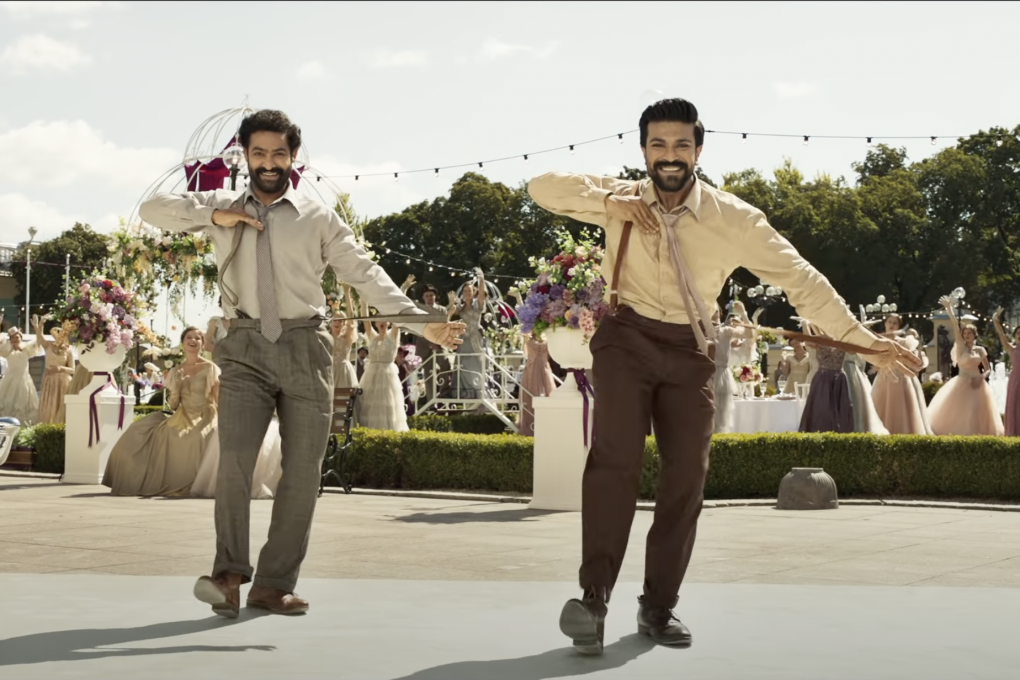
"caption": "N.T. Rama Rao Jr. (left) and Ram Charan performing ‘Naatu Naatu’ in ‘RRR.’",
"description": null,
"title": "N.T. Rama Rao Jr. (left) and Ram Charan performing ‘Naatu Naatu’ in ‘RRR.’",
"credit": "DVV Entertainment & Variance Films",
"status": "inherit",
"altTag": "Two Indian men wearing smart trousers, shirts, ties and suspenders perform a dance routine at an outdoor wedding.",
"isLoading": false,
"fetchFailed": false
},
"arts_13925433": {
"type": "attachments",
"id": "arts_13925433",
"meta": {
"index": "attachments_1716263798",
"site": "arts",
"id": "13925433",
"found": true
},
"parent": 13925431,
"imgSizes": {
"twentyfourteen-full-width": {
"file": "https://ww2.kqed.org/app/uploads/sites/2/2023/02/GettyImages-1246502908-1038x576.jpg",
"width": 1038,
"mimeType": "image/jpeg",
"height": 576
},
"thumbnail": {
"file": "https://ww2.kqed.org/app/uploads/sites/2/2023/02/GettyImages-1246502908-160x107.jpg",
"width": 160,
"mimeType": "image/jpeg",
"height": 107
},
"post-thumbnail": {
"file": "https://ww2.kqed.org/app/uploads/sites/2/2023/02/GettyImages-1246502908-672x372.jpg",
"width": 672,
"mimeType": "image/jpeg",
"height": 372
},
"kqedFullSize": {
"file": "https://ww2.kqed.org/app/uploads/sites/2/2023/02/GettyImages-1246502908-scaled.jpg",
"width": 2560,
"height": 1707
},
"2048x2048": {
"file": "https://ww2.kqed.org/app/uploads/sites/2/2023/02/GettyImages-1246502908-2048x1365.jpg",
"width": 2048,
"mimeType": "image/jpeg",
"height": 1365
},
"large": {
"file": "https://ww2.kqed.org/app/uploads/sites/2/2023/02/GettyImages-1246502908-1020x680.jpg",
"width": 1020,
"mimeType": "image/jpeg",
"height": 680
},
"1536x1536": {
"file": "https://ww2.kqed.org/app/uploads/sites/2/2023/02/GettyImages-1246502908-1536x1024.jpg",
"width": 1536,
"mimeType": "image/jpeg",
"height": 1024
},
"full-width": {
"file": "https://ww2.kqed.org/app/uploads/sites/2/2023/02/GettyImages-1246502908-1920x1280.jpg",
"width": 1920,
"mimeType": "image/jpeg",
"height": 1280
},
"medium": {
"file": "https://ww2.kqed.org/app/uploads/sites/2/2023/02/GettyImages-1246502908-800x533.jpg",
"width": 800,
"mimeType": "image/jpeg",
"height": 533
},
"medium_large": {
"file": "https://ww2.kqed.org/app/uploads/sites/2/2023/02/GettyImages-1246502908-768x512.jpg",
"width": 768,
"mimeType": "image/jpeg",
"height": 512
}
},
"publishDate": 1677184203,
"modified": 1677184411,
"caption": "The Oscar statue, on display inside Los Angeles’ Samuel Goldwyn Theater, January 2023.",
"description": null,
"title": "The Oscar statue, on display inside Los Angeles’ Samuel Goldwyn Theater, January 2023.",
"credit": "Jay L. Clendenin / Los Angeles Times via Getty Images",
"status": "inherit",
"altTag": "An imposing, life-size gold statue, lit from beneath, stands on stage before closed red curtains.",
"isLoading": false,
"fetchFailed": false
},
"arts_13922632": {
"type": "attachments",
"id": "arts_13922632",
"meta": {
"index": "attachments_1716263798",
"site": "arts",
"id": "13922632",
"found": true
},
"parent": 13922631,
"imgSizes": {
"twentyfourteen-full-width": {
"file": "https://ww2.kqed.org/app/uploads/sites/2/2022/12/ap22342671809722-bbad58985415cd38818e6205ecdcb6da489f5fe8-1038x576.jpg",
"width": 1038,
"mimeType": "image/jpeg",
"height": 576
},
"thumbnail": {
"file": "https://ww2.kqed.org/app/uploads/sites/2/2022/12/ap22342671809722-bbad58985415cd38818e6205ecdcb6da489f5fe8-160x120.jpg",
"width": 160,
"mimeType": "image/jpeg",
"height": 120
},
"post-thumbnail": {
"file": "https://ww2.kqed.org/app/uploads/sites/2/2022/12/ap22342671809722-bbad58985415cd38818e6205ecdcb6da489f5fe8-672x372.jpg",
"width": 672,
"mimeType": "image/jpeg",
"height": 372
},
"kqedFullSize": {
"file": "https://ww2.kqed.org/app/uploads/sites/2/2022/12/ap22342671809722-bbad58985415cd38818e6205ecdcb6da489f5fe8-scaled-e1670872332296.jpg",
"width": 1920,
"height": 1440
},
"2048x2048": {
"file": "https://ww2.kqed.org/app/uploads/sites/2/2022/12/ap22342671809722-bbad58985415cd38818e6205ecdcb6da489f5fe8-2048x1536.jpg",
"width": 2048,
"mimeType": "image/jpeg",
"height": 1536
},
"large": {
"file": "https://ww2.kqed.org/app/uploads/sites/2/2022/12/ap22342671809722-bbad58985415cd38818e6205ecdcb6da489f5fe8-1020x765.jpg",
"width": 1020,
"mimeType": "image/jpeg",
"height": 765
},
"1536x1536": {
"file": "https://ww2.kqed.org/app/uploads/sites/2/2022/12/ap22342671809722-bbad58985415cd38818e6205ecdcb6da489f5fe8-1536x1152.jpg",
"width": 1536,
"mimeType": "image/jpeg",
"height": 1152
},
"full-width": {
"file": "https://ww2.kqed.org/app/uploads/sites/2/2022/12/ap22342671809722-bbad58985415cd38818e6205ecdcb6da489f5fe8-1920x1440.jpg",
"width": 1920,
"mimeType": "image/jpeg",
"height": 1440
},
"medium": {
"file": "https://ww2.kqed.org/app/uploads/sites/2/2022/12/ap22342671809722-bbad58985415cd38818e6205ecdcb6da489f5fe8-800x600.jpg",
"width": 800,
"mimeType": "image/jpeg",
"height": 600
},
"medium_large": {
"file": "https://ww2.kqed.org/app/uploads/sites/2/2022/12/ap22342671809722-bbad58985415cd38818e6205ecdcb6da489f5fe8-768x576.jpg",
"width": 768,
"mimeType": "image/jpeg",
"height": 576
}
},
"publishDate": 1670871902,
"modified": 1670872515,
"caption": "(L-R) Stephanie Hsu, Michelle Yeoh and Ke Huy Quan in a scene from, ‘Everything Everywhere All At Once.’",
"description": null,
"title": "(L-R) Stephanie Hsu, Michelle Yeoh and Ke Huy Quan in a scene from, ‘Everything Everywhere All At Once.’ (Allyson Riggs/A24 Films via AP)",
"credit": "Allyson Riggs/A24 Films via AP",
"status": "inherit",
"altTag": "A slender middle-aged Asian woman with a cut on her forehead stands protectively in front of a man and a younger woman. They appear to be standing in an office.",
"isLoading": false,
"fetchFailed": false
},
"arts_13911229": {
"type": "attachments",
"id": "arts_13911229",
"meta": {
"index": "attachments_1716263798",
"site": "arts",
"id": "13911229",
"found": true
},
"parent": 13911228,
"imgSizes": {
"twentyfourteen-full-width": {
"file": "https://ww2.kqed.org/app/uploads/sites/2/2022/03/gettyimages-645725528_custom-6ce00fa5f23d730d95f0835abd9e49c7797a73ca-1038x576.jpg",
"width": 1038,
"mimeType": "image/jpeg",
"height": 576
},
"thumbnail": {
"file": "https://ww2.kqed.org/app/uploads/sites/2/2022/03/gettyimages-645725528_custom-6ce00fa5f23d730d95f0835abd9e49c7797a73ca-160x112.jpg",
"width": 160,
"mimeType": "image/jpeg",
"height": 112
},
"post-thumbnail": {
"file": "https://ww2.kqed.org/app/uploads/sites/2/2022/03/gettyimages-645725528_custom-6ce00fa5f23d730d95f0835abd9e49c7797a73ca-672x372.jpg",
"width": 672,
"mimeType": "image/jpeg",
"height": 372
},
"kqedFullSize": {
"file": "https://ww2.kqed.org/app/uploads/sites/2/2022/03/gettyimages-645725528_custom-6ce00fa5f23d730d95f0835abd9e49c7797a73ca-scaled-e1648507265644.jpg",
"width": 1920,
"height": 1343
},
"2048x2048": {
"file": "https://ww2.kqed.org/app/uploads/sites/2/2022/03/gettyimages-645725528_custom-6ce00fa5f23d730d95f0835abd9e49c7797a73ca-2048x1432.jpg",
"width": 2048,
"mimeType": "image/jpeg",
"height": 1432
},
"large": {
"file": "https://ww2.kqed.org/app/uploads/sites/2/2022/03/gettyimages-645725528_custom-6ce00fa5f23d730d95f0835abd9e49c7797a73ca-1020x713.jpg",
"width": 1020,
"mimeType": "image/jpeg",
"height": 713
},
"1536x1536": {
"file": "https://ww2.kqed.org/app/uploads/sites/2/2022/03/gettyimages-645725528_custom-6ce00fa5f23d730d95f0835abd9e49c7797a73ca-1536x1074.jpg",
"width": 1536,
"mimeType": "image/jpeg",
"height": 1074
},
"full-width": {
"file": "https://ww2.kqed.org/app/uploads/sites/2/2022/03/gettyimages-645725528_custom-6ce00fa5f23d730d95f0835abd9e49c7797a73ca-1920x1342.jpg",
"width": 1920,
"mimeType": "image/jpeg",
"height": 1342
},
"medium": {
"file": "https://ww2.kqed.org/app/uploads/sites/2/2022/03/gettyimages-645725528_custom-6ce00fa5f23d730d95f0835abd9e49c7797a73ca-800x559.jpg",
"width": 800,
"mimeType": "image/jpeg",
"height": 559
},
"medium_large": {
"file": "https://ww2.kqed.org/app/uploads/sites/2/2022/03/gettyimages-645725528_custom-6ce00fa5f23d730d95f0835abd9e49c7797a73ca-768x537.jpg",
"width": 768,
"mimeType": "image/jpeg",
"height": 537
}
},
"publishDate": 1648506185,
"modified": 1648507313,
"caption": "'La La Land' producer Jordan Horowitz holds up the winner card reading actual Best Picture winner 'Moonlight' with actor Warren Beatty and host Jimmy Kimmel onstage during the Academy Awards in 2017.",
"description": null,
"title": "'La La Land' producer Jordan Horowitz holds up the winner card reading actual Best Picture winner 'Moonlight' with actor Warren Beatty and host Jimmy Kimmel onstage during the Academy Awards in 2017.",
"credit": "Kevin Winter/Getty Images",
"status": "inherit",
"altTag": null,
"isLoading": false,
"fetchFailed": false
},
"arts_13911004": {
"type": "attachments",
"id": "arts_13911004",
"meta": {
"index": "attachments_1716263798",
"site": "arts",
"id": "13911004",
"found": true
},
"parent": 13911001,
"imgSizes": {
"twentyfourteen-full-width": {
"file": "https://ww2.kqed.org/app/uploads/sites/2/2022/03/dip5_custom-fd0eeef5b47e9ba7dfa869423dbb4c0dc5ba0c42-1-1038x576.jpg",
"width": 1038,
"mimeType": "image/jpeg",
"height": 576
},
"thumbnail": {
"file": "https://ww2.kqed.org/app/uploads/sites/2/2022/03/dip5_custom-fd0eeef5b47e9ba7dfa869423dbb4c0dc5ba0c42-1-160x88.jpg",
"width": 160,
"mimeType": "image/jpeg",
"height": 88
},
"post-thumbnail": {
"file": "https://ww2.kqed.org/app/uploads/sites/2/2022/03/dip5_custom-fd0eeef5b47e9ba7dfa869423dbb4c0dc5ba0c42-1-672x372.jpg",
"width": 672,
"mimeType": "image/jpeg",
"height": 372
},
"kqedFullSize": {
"file": "https://ww2.kqed.org/app/uploads/sites/2/2022/03/dip5_custom-fd0eeef5b47e9ba7dfa869423dbb4c0dc5ba0c42-1.jpg",
"width": 1821,
"height": 1000
},
"large": {
"file": "https://ww2.kqed.org/app/uploads/sites/2/2022/03/dip5_custom-fd0eeef5b47e9ba7dfa869423dbb4c0dc5ba0c42-1-1020x560.jpg",
"width": 1020,
"mimeType": "image/jpeg",
"height": 560
},
"1536x1536": {
"file": "https://ww2.kqed.org/app/uploads/sites/2/2022/03/dip5_custom-fd0eeef5b47e9ba7dfa869423dbb4c0dc5ba0c42-1-1536x843.jpg",
"width": 1536,
"mimeType": "image/jpeg",
"height": 843
},
"medium": {
"file": "https://ww2.kqed.org/app/uploads/sites/2/2022/03/dip5_custom-fd0eeef5b47e9ba7dfa869423dbb4c0dc5ba0c42-1-800x439.jpg",
"width": 800,
"mimeType": "image/jpeg",
"height": 439
},
"medium_large": {
"file": "https://ww2.kqed.org/app/uploads/sites/2/2022/03/dip5_custom-fd0eeef5b47e9ba7dfa869423dbb4c0dc5ba0c42-1-768x422.jpg",
"width": 768,
"mimeType": "image/jpeg",
"height": 422
}
},
"publishDate": 1648145016,
"modified": 1648147045,
"caption": "Scene stills of 'Titanic,' 'Parasite,' 'The Silence of the Lambs,' and 'The Godfather.'",
"description": null,
"title": "Scene stills of 'Titanic,' 'Parasite,' 'The Silence of the Lambs,' and 'The Godfather.'",
"credit": "CBS via Getty Images; NEON CJ Entertainment; Michael Ochs Archives/Getty Images; FilmPublicityArchive/United Archives via Getty Images",
"status": "inherit",
"altTag": null,
"isLoading": false,
"fetchFailed": false
},
"arts_13909101": {
"type": "attachments",
"id": "arts_13909101",
"meta": {
"index": "attachments_1716263798",
"site": "arts",
"id": "13909101",
"found": true
},
"parent": 13909100,
"imgSizes": {
"twentyfourteen-full-width": {
"file": "https://ww2.kqed.org/app/uploads/sites/2/2022/02/oscar-predictions-1-_wide-476fbb401cbf48f774176965969917ed465d5486-1038x576.jpg",
"width": 1038,
"mimeType": "image/jpeg",
"height": 576
},
"thumbnail": {
"file": "https://ww2.kqed.org/app/uploads/sites/2/2022/02/oscar-predictions-1-_wide-476fbb401cbf48f774176965969917ed465d5486-160x90.jpg",
"width": 160,
"mimeType": "image/jpeg",
"height": 90
},
"post-thumbnail": {
"file": "https://ww2.kqed.org/app/uploads/sites/2/2022/02/oscar-predictions-1-_wide-476fbb401cbf48f774176965969917ed465d5486-672x372.jpg",
"width": 672,
"mimeType": "image/jpeg",
"height": 372
},
"kqedFullSize": {
"file": "https://ww2.kqed.org/app/uploads/sites/2/2022/02/oscar-predictions-1-_wide-476fbb401cbf48f774176965969917ed465d5486-e1644353884747.jpg",
"width": 1920,
"height": 1079
},
"2048x2048": {
"file": "https://ww2.kqed.org/app/uploads/sites/2/2022/02/oscar-predictions-1-_wide-476fbb401cbf48f774176965969917ed465d5486-2048x1151.jpg",
"width": 2048,
"mimeType": "image/jpeg",
"height": 1151
},
"large": {
"file": "https://ww2.kqed.org/app/uploads/sites/2/2022/02/oscar-predictions-1-_wide-476fbb401cbf48f774176965969917ed465d5486-1020x573.jpg",
"width": 1020,
"mimeType": "image/jpeg",
"height": 573
},
"1536x1536": {
"file": "https://ww2.kqed.org/app/uploads/sites/2/2022/02/oscar-predictions-1-_wide-476fbb401cbf48f774176965969917ed465d5486-1536x864.jpg",
"width": 1536,
"mimeType": "image/jpeg",
"height": 864
},
"full-width": {
"file": "https://ww2.kqed.org/app/uploads/sites/2/2022/02/oscar-predictions-1-_wide-476fbb401cbf48f774176965969917ed465d5486-1920x1079.jpg",
"width": 1920,
"mimeType": "image/jpeg",
"height": 1079
},
"medium": {
"file": "https://ww2.kqed.org/app/uploads/sites/2/2022/02/oscar-predictions-1-_wide-476fbb401cbf48f774176965969917ed465d5486-800x450.jpg",
"width": 800,
"mimeType": "image/jpeg",
"height": 450
},
"medium_large": {
"file": "https://ww2.kqed.org/app/uploads/sites/2/2022/02/oscar-predictions-1-_wide-476fbb401cbf48f774176965969917ed465d5486-768x432.jpg",
"width": 768,
"mimeType": "image/jpeg",
"height": 432
}
},
"publishDate": 1644352424,
"modified": 1644353947,
"caption": "Kirsten Dunst ('The Power of the Dog'), Denzel Washington ('The Tragedy of Macbeth'), 'Flee' and 'Drive My Car' are among this year's Oscar nominations.",
"description": null,
"title": "Kirsten Dunst ('The Power of the Dog'), Denzel Washington ('The Tragedy of Macbeth'), 'Flee' and 'Drive My Car' are among this year's Oscar nominations.",
"credit": "Netflix; Apple TV+; NEON; Janus Films",
"status": "inherit",
"altTag": null,
"isLoading": false,
"fetchFailed": false
},
"arts_13896314": {
"type": "attachments",
"id": "arts_13896314",
"meta": {
"index": "attachments_1716263798",
"site": "arts",
"id": "13896314",
"found": true
},
"parent": 13896313,
"imgSizes": {
"twentyfourteen-full-width": {
"file": "https://ww2.kqed.org/app/uploads/sites/2/2021/04/gettyimages-1314438285_wide-50d5096679cee306ba47e4ae4f0eab31eafecb2f-1038x576.jpg",
"width": 1038,
"mimeType": "image/jpeg",
"height": 576
},
"thumbnail": {
"file": "https://ww2.kqed.org/app/uploads/sites/2/2021/04/gettyimages-1314438285_wide-50d5096679cee306ba47e4ae4f0eab31eafecb2f-160x90.jpg",
"width": 160,
"mimeType": "image/jpeg",
"height": 90
},
"post-thumbnail": {
"file": "https://ww2.kqed.org/app/uploads/sites/2/2021/04/gettyimages-1314438285_wide-50d5096679cee306ba47e4ae4f0eab31eafecb2f-672x372.jpg",
"width": 672,
"mimeType": "image/jpeg",
"height": 372
},
"kqedFullSize": {
"file": "https://ww2.kqed.org/app/uploads/sites/2/2021/04/gettyimages-1314438285_wide-50d5096679cee306ba47e4ae4f0eab31eafecb2f-scaled-e1619415142370.jpg",
"width": 1920,
"height": 1080
},
"2048x2048": {
"file": "https://ww2.kqed.org/app/uploads/sites/2/2021/04/gettyimages-1314438285_wide-50d5096679cee306ba47e4ae4f0eab31eafecb2f-2048x1152.jpg",
"width": 2048,
"mimeType": "image/jpeg",
"height": 1152
},
"large": {
"file": "https://ww2.kqed.org/app/uploads/sites/2/2021/04/gettyimages-1314438285_wide-50d5096679cee306ba47e4ae4f0eab31eafecb2f-1020x574.jpg",
"width": 1020,
"mimeType": "image/jpeg",
"height": 574
},
"1536x1536": {
"file": "https://ww2.kqed.org/app/uploads/sites/2/2021/04/gettyimages-1314438285_wide-50d5096679cee306ba47e4ae4f0eab31eafecb2f-1536x864.jpg",
"width": 1536,
"mimeType": "image/jpeg",
"height": 864
},
"full-width": {
"file": "https://ww2.kqed.org/app/uploads/sites/2/2021/04/gettyimages-1314438285_wide-50d5096679cee306ba47e4ae4f0eab31eafecb2f-1920x1080.jpg",
"width": 1920,
"mimeType": "image/jpeg",
"height": 1080
},
"medium": {
"file": "https://ww2.kqed.org/app/uploads/sites/2/2021/04/gettyimages-1314438285_wide-50d5096679cee306ba47e4ae4f0eab31eafecb2f-800x450.jpg",
"width": 800,
"mimeType": "image/jpeg",
"height": 450
},
"medium_large": {
"file": "https://ww2.kqed.org/app/uploads/sites/2/2021/04/gettyimages-1314438285_wide-50d5096679cee306ba47e4ae4f0eab31eafecb2f-768x432.jpg",
"width": 768,
"mimeType": "image/jpeg",
"height": 432
}
},
"publishDate": 1619414694,
"modified": 1619415174,
"caption": "Chloé Zhao accepts the Oscar for best director during Sunday night's ceremony. Her film 'Nomadland' also won best picture.",
"description": "Chloé Zhao accepts the Oscar for best director during Sunday night's ceremony. Her film 'Nomadland' also won best picture.",
"title": "Chloé Zhao accepts the Oscar for best director during Sunday night's ceremony. Her film 'Nomadland' also won best picture.",
"credit": "A.M.P.A.S. via Getty Images",
"status": "inherit",
"altTag": "Chloé Zhao accepts the Oscar for best director during Sunday night's ceremony. Her film 'Nomadland' also won best picture.",
"isLoading": false,
"fetchFailed": false
},
"arts_13896128": {
"type": "attachments",
"id": "arts_13896128",
"meta": {
"index": "attachments_1716263798",
"site": "arts",
"id": "13896128",
"found": true
},
"parent": 13896127,
"imgSizes": {
"twentyfourteen-full-width": {
"file": "https://ww2.kqed.org/app/uploads/sites/2/2021/04/euro_unit_21507r1_wide-991851f56ff23f7725293c4f73741361af3c3ad6-1038x576.jpg",
"width": 1038,
"mimeType": "image/jpeg",
"height": 576
},
"thumbnail": {
"file": "https://ww2.kqed.org/app/uploads/sites/2/2021/04/euro_unit_21507r1_wide-991851f56ff23f7725293c4f73741361af3c3ad6-160x90.jpg",
"width": 160,
"mimeType": "image/jpeg",
"height": 90
},
"post-thumbnail": {
"file": "https://ww2.kqed.org/app/uploads/sites/2/2021/04/euro_unit_21507r1_wide-991851f56ff23f7725293c4f73741361af3c3ad6-672x372.jpg",
"width": 672,
"mimeType": "image/jpeg",
"height": 372
},
"kqedFullSize": {
"file": "https://ww2.kqed.org/app/uploads/sites/2/2021/04/euro_unit_21507r1_wide-991851f56ff23f7725293c4f73741361af3c3ad6-scaled-e1619115538937.jpg",
"width": 1920,
"height": 1080
},
"2048x2048": {
"file": "https://ww2.kqed.org/app/uploads/sites/2/2021/04/euro_unit_21507r1_wide-991851f56ff23f7725293c4f73741361af3c3ad6-2048x1152.jpg",
"width": 2048,
"mimeType": "image/jpeg",
"height": 1152
},
"large": {
"file": "https://ww2.kqed.org/app/uploads/sites/2/2021/04/euro_unit_21507r1_wide-991851f56ff23f7725293c4f73741361af3c3ad6-1020x574.jpg",
"width": 1020,
"mimeType": "image/jpeg",
"height": 574
},
"1536x1536": {
"file": "https://ww2.kqed.org/app/uploads/sites/2/2021/04/euro_unit_21507r1_wide-991851f56ff23f7725293c4f73741361af3c3ad6-1536x864.jpg",
"width": 1536,
"mimeType": "image/jpeg",
"height": 864
},
"full-width": {
"file": "https://ww2.kqed.org/app/uploads/sites/2/2021/04/euro_unit_21507r1_wide-991851f56ff23f7725293c4f73741361af3c3ad6-1920x1080.jpg",
"width": 1920,
"mimeType": "image/jpeg",
"height": 1080
},
"medium": {
"file": "https://ww2.kqed.org/app/uploads/sites/2/2021/04/euro_unit_21507r1_wide-991851f56ff23f7725293c4f73741361af3c3ad6-800x450.jpg",
"width": 800,
"mimeType": "image/jpeg",
"height": 450
},
"medium_large": {
"file": "https://ww2.kqed.org/app/uploads/sites/2/2021/04/euro_unit_21507r1_wide-991851f56ff23f7725293c4f73741361af3c3ad6-768x432.jpg",
"width": 768,
"mimeType": "image/jpeg",
"height": 432
}
},
"publishDate": 1619049499,
"modified": 1619115587,
"caption": "'Eurovision Song Contest: The Story of Fire Saga' pushes pageantry over the top while still generating material that would thrive on a real-life Eurovision stage.",
"description": "'Eurovision Song Contest: The Story of Fire Saga' pushes pageantry over the top while still generating material that would thrive on a real-life Eurovision stage.",
"title": "'Eurovision Song Contest: The Story of Fire Saga' pushes pageantry over the top while still generating material that would thrive on a real-life Eurovision stage.",
"credit": "John Wilson/Netflix",
"status": "inherit",
"altTag": "'Eurovision Song Contest: The Story of Fire Saga' pushes pageantry over the top while still generating material that would thrive on a real-life Eurovision stage.",
"isLoading": false,
"fetchFailed": false
},
"arts_13895846": {
"type": "attachments",
"id": "arts_13895846",
"meta": {
"index": "attachments_1716263798",
"site": "arts",
"id": "13895846",
"found": true
},
"parent": 13895845,
"imgSizes": {
"twentyfourteen-full-width": {
"file": "https://ww2.kqed.org/app/uploads/sites/2/2021/04/2021-oscars_wide-cb581743965a3b36ea1d2e350b9bcc2427759327-1038x576.jpg",
"width": 1038,
"mimeType": "image/jpeg",
"height": 576
},
"thumbnail": {
"file": "https://ww2.kqed.org/app/uploads/sites/2/2021/04/2021-oscars_wide-cb581743965a3b36ea1d2e350b9bcc2427759327-160x90.jpg",
"width": 160,
"mimeType": "image/jpeg",
"height": 90
},
"post-thumbnail": {
"file": "https://ww2.kqed.org/app/uploads/sites/2/2021/04/2021-oscars_wide-cb581743965a3b36ea1d2e350b9bcc2427759327-672x372.jpg",
"width": 672,
"mimeType": "image/jpeg",
"height": 372
},
"kqedFullSize": {
"file": "https://ww2.kqed.org/app/uploads/sites/2/2021/04/2021-oscars_wide-cb581743965a3b36ea1d2e350b9bcc2427759327-scaled-e1618528299610.jpg",
"width": 1920,
"height": 1080
},
"2048x2048": {
"file": "https://ww2.kqed.org/app/uploads/sites/2/2021/04/2021-oscars_wide-cb581743965a3b36ea1d2e350b9bcc2427759327-2048x1152.jpg",
"width": 2048,
"mimeType": "image/jpeg",
"height": 1152
},
"large": {
"file": "https://ww2.kqed.org/app/uploads/sites/2/2021/04/2021-oscars_wide-cb581743965a3b36ea1d2e350b9bcc2427759327-1020x574.jpg",
"width": 1020,
"mimeType": "image/jpeg",
"height": 574
},
"1536x1536": {
"file": "https://ww2.kqed.org/app/uploads/sites/2/2021/04/2021-oscars_wide-cb581743965a3b36ea1d2e350b9bcc2427759327-1536x864.jpg",
"width": 1536,
"mimeType": "image/jpeg",
"height": 864
},
"full-width": {
"file": "https://ww2.kqed.org/app/uploads/sites/2/2021/04/2021-oscars_wide-cb581743965a3b36ea1d2e350b9bcc2427759327-1920x1080.jpg",
"width": 1920,
"mimeType": "image/jpeg",
"height": 1080
},
"medium": {
"file": "https://ww2.kqed.org/app/uploads/sites/2/2021/04/2021-oscars_wide-cb581743965a3b36ea1d2e350b9bcc2427759327-800x450.jpg",
"width": 800,
"mimeType": "image/jpeg",
"height": 450
},
"medium_large": {
"file": "https://ww2.kqed.org/app/uploads/sites/2/2021/04/2021-oscars_wide-cb581743965a3b36ea1d2e350b9bcc2427759327-768x432.jpg",
"width": 768,
"mimeType": "image/jpeg",
"height": 432
}
},
"publishDate": 1618526354,
"modified": 1618528421,
"caption": "Clockwise from top left: Audra Day in 'United States Vs. Billie Holiday,' Yuh-Jung Youn in 'Minari,' Daniel Kaluuya in 'Judas and the Black Messiah,' 'Nomadland' director Chloe Zhao with Frances McDormand.",
"description": "Clockwise from top left: Audra Day in 'United States Vs. Billie Holiday,' Yuh-Jung Youn in 'Minari,' Daniel Kaluuya in 'Judas and the Black Messiah,' 'Nomadland' director Chloe Zhao with Frances McDormand.",
"title": "Clockwise from top left: Audra Day in 'United States Vs. Billie Holiday,' Yuh-Jung Youn in 'Minari,' Daniel Kaluuya in 'Judas and the Black Messiah,' 'Nomadland' director Chloe Zhao with Frances McDormand.",
"credit": "Takashi Seida/Hulu, A24, Glen Wilson/Warner Bros., Joshua James Richards/20th Century Studios",
"status": "inherit",
"altTag": "Clockwise from top left: Audra Day in 'United States Vs. Billie Holiday,' Yuh-Jung Youn in 'Minari,' Daniel Kaluuya in 'Judas and the Black Messiah,' 'Nomadland' director Chloe Zhao with Frances McDormand.",
"isLoading": false,
"fetchFailed": false
},
"arts_13895653": {
"type": "attachments",
"id": "arts_13895653",
"meta": {
"index": "attachments_1716263798",
"site": "arts",
"id": "13895653",
"found": true
},
"parent": 13895652,
"imgSizes": {
"twentyfourteen-full-width": {
"file": "https://ww2.kqed.org/app/uploads/sites/2/2021/04/promising-young-woman-3_a057c017_190415_r1j8_2.2.1_c_rgb_wide-d9bf9e351a3031e4fa2ae5af3126f49162d62fa1-1038x576.jpg",
"width": 1038,
"mimeType": "image/jpeg",
"height": 576
},
"thumbnail": {
"file": "https://ww2.kqed.org/app/uploads/sites/2/2021/04/promising-young-woman-3_a057c017_190415_r1j8_2.2.1_c_rgb_wide-d9bf9e351a3031e4fa2ae5af3126f49162d62fa1-160x90.jpg",
"width": 160,
"mimeType": "image/jpeg",
"height": 90
},
"post-thumbnail": {
"file": "https://ww2.kqed.org/app/uploads/sites/2/2021/04/promising-young-woman-3_a057c017_190415_r1j8_2.2.1_c_rgb_wide-d9bf9e351a3031e4fa2ae5af3126f49162d62fa1-672x372.jpg",
"width": 672,
"mimeType": "image/jpeg",
"height": 372
},
"kqedFullSize": {
"file": "https://ww2.kqed.org/app/uploads/sites/2/2021/04/promising-young-woman-3_a057c017_190415_r1j8_2.2.1_c_rgb_wide-d9bf9e351a3031e4fa2ae5af3126f49162d62fa1.jpg",
"width": 1882,
"height": 1059
},
"large": {
"file": "https://ww2.kqed.org/app/uploads/sites/2/2021/04/promising-young-woman-3_a057c017_190415_r1j8_2.2.1_c_rgb_wide-d9bf9e351a3031e4fa2ae5af3126f49162d62fa1-1020x574.jpg",
"width": 1020,
"mimeType": "image/jpeg",
"height": 574
},
"1536x1536": {
"file": "https://ww2.kqed.org/app/uploads/sites/2/2021/04/promising-young-woman-3_a057c017_190415_r1j8_2.2.1_c_rgb_wide-d9bf9e351a3031e4fa2ae5af3126f49162d62fa1-1536x864.jpg",
"width": 1536,
"mimeType": "image/jpeg",
"height": 864
},
"medium": {
"file": "https://ww2.kqed.org/app/uploads/sites/2/2021/04/promising-young-woman-3_a057c017_190415_r1j8_2.2.1_c_rgb_wide-d9bf9e351a3031e4fa2ae5af3126f49162d62fa1-800x450.jpg",
"width": 800,
"mimeType": "image/jpeg",
"height": 450
},
"medium_large": {
"file": "https://ww2.kqed.org/app/uploads/sites/2/2021/04/promising-young-woman-3_a057c017_190415_r1j8_2.2.1_c_rgb_wide-d9bf9e351a3031e4fa2ae5af3126f49162d62fa1-768x432.jpg",
"width": 768,
"mimeType": "image/jpeg",
"height": 432
}
},
"publishDate": 1618338332,
"modified": 1618339276,
"caption": "In 'Promising Young Woman,' Carey Mulligan plays a woman who hunts down sexual predators by pretending to be drunk at bars, and then confronting the men who try to take advantage of her.",
"description": "In 'Promising Young Woman,' Carey Mulligan plays a woman who hunts down sexual predators by pretending to be drunk at bars, and then confronting the men who try to take advantage of her.",
"title": "In 'Promising Young Woman,' Carey Mulligan plays a woman who hunts down sexual predators by pretending to be drunk at bars, and then confronting the men who try to take advantage of her.",
"credit": "Focus Features",
"status": "inherit",
"altTag": "In 'Promising Young Woman,' Carey Mulligan plays a woman who hunts down sexual predators by pretending to be drunk at bars, and then confronting the men who try to take advantage of her.",
"isLoading": false,
"fetchFailed": false
}
},
"audioPlayerReducer": {
"postId": "stream_live",
"isPaused": true,
"isPlaying": false,
"pfsActive": false,
"pledgeModalIsOpen": true,
"playerDrawerIsOpen": false,
"liveAudioPlayStartedAt": 0,
"liveAudioPlayContext": ""
},
"authorsReducer": {
"byline_arts_13926125": {
"type": "authors",
"id": "byline_arts_13926125",
"meta": {
"override": true
},
"slug": "byline_arts_13926125",
"name": "Linda Holmes",
"isLoading": false
},
"byline_arts_13926047": {
"type": "authors",
"id": "byline_arts_13926047",
"meta": {
"override": true
},
"slug": "byline_arts_13926047",
"name": "Mandalit del Barco",
"isLoading": false
},
"byline_arts_13925866": {
"type": "authors",
"id": "byline_arts_13925866",
"meta": {
"override": true
},
"slug": "byline_arts_13925866",
"name": "Stephen Thompson",
"isLoading": false
},
"byline_arts_13925431": {
"type": "authors",
"id": "byline_arts_13925431",
"meta": {
"override": true
},
"slug": "byline_arts_13925431",
"name": "The Associated Press",
"isLoading": false
},
"byline_arts_13924083": {
"type": "authors",
"id": "byline_arts_13924083",
"meta": {
"override": true
},
"slug": "byline_arts_13924083",
"name": "Jake Coyle\u003cbr />Associated Press",
"isLoading": false
},
"byline_arts_13911228": {
"type": "authors",
"id": "byline_arts_13911228",
"meta": {
"override": true
},
"slug": "byline_arts_13911228",
"name": "Fi O'Reilly",
"isLoading": false
},
"byline_arts_13909100": {
"type": "authors",
"id": "byline_arts_13909100",
"meta": {
"override": true
},
"slug": "byline_arts_13909100",
"name": "Glen Weldon",
"isLoading": false
},
"byline_arts_13896313": {
"type": "authors",
"id": "byline_arts_13896313",
"meta": {
"override": true
},
"slug": "byline_arts_13896313",
"name": "Linda Holmes",
"isLoading": false
},
"byline_arts_13896127": {
"type": "authors",
"id": "byline_arts_13896127",
"meta": {
"override": true
},
"slug": "byline_arts_13896127",
"name": "Stephen Thompson",
"isLoading": false
},
"byline_arts_13895845": {
"type": "authors",
"id": "byline_arts_13895845",
"meta": {
"override": true
},
"slug": "byline_arts_13895845",
"name": "Bob Mondello",
"isLoading": false
},
"byline_arts_13895652": {
"type": "authors",
"id": "byline_arts_13895652",
"meta": {
"override": true
},
"slug": "byline_arts_13895652",
"name": "Sam Briger",
"isLoading": false
},
"kqedarts": {
"type": "authors",
"id": "92",
"meta": {
"index": "authors_1716337520",
"id": "92",
"found": true
},
"name": "KQED Arts",
"firstName": "KQED",
"lastName": "Arts",
"slug": "kqedarts",
"email": "arts@kqed.org",
"display_author_email": false,
"staff_mastheads": [],
"title": "KQED Staff",
"bio": null,
"avatar": "https://secure.gravatar.com/avatar/321c9ebfeb7736f9e55366a6d3399ab0?s=600&d=blank&r=g",
"twitter": null,
"facebook": null,
"instagram": "https://www.instagram.com/kqed_arts/",
"linkedin": null,
"sites": [
{
"site": "arts",
"roles": [
"contributor"
]
},
{
"site": "pop",
"roles": [
"contributor"
]
},
{
"site": "science",
"roles": [
"author"
]
},
{
"site": "food",
"roles": [
"contributor"
]
}
],
"headData": {
"title": "KQED Arts | KQED",
"description": "KQED Staff",
"ogImgSrc": "https://secure.gravatar.com/avatar/321c9ebfeb7736f9e55366a6d3399ab0?s=600&d=blank&r=g",
"twImgSrc": "https://secure.gravatar.com/avatar/321c9ebfeb7736f9e55366a6d3399ab0?s=600&d=blank&r=g"
},
"isLoading": false,
"link": "/author/kqedarts"
}
},
"pagesReducer": {
"arts_tag_oscars": {
"type": "terms",
"id": "arts_3698",
"meta": {
"index": "terms_1716263798",
"site": "arts",
"id": "3698",
"score": 8.937804
},
"featImg": null,
"name": "oscars",
"description": null,
"taxonomy": "tag",
"headData": {
"twImgId": null,
"twTitle": null,
"ogTitle": null,
"ogImgId": null,
"twDescription": null,
"description": null,
"title": "oscars Archives | KQED Arts",
"ogDescription": null
},
"ttid": 3710,
"slug": "oscars",
"isLoading": false,
"title": "oscars",
"pageMeta": {
"site": "arts",
"WpPageTemplate": "page-topic-editorial",
"currentPage": 3
},
"blocks": [
{
"blockName": "kqed/post-list",
"attrs": {
"layout": "cardArticle2",
"query": "posts/arts?tag=oscars",
"seeMore": false,
"paginated": true,
"page": 3
}
},
{
"blockName": "kqed/ad"
}
]
}
},
"pfsSessionReducer": {},
"postsReducer": {
"stream_live": {
"type": "live",
"id": "stream_live",
"audioUrl": "https://streams.kqed.org/kqedradio",
"title": "Live Stream",
"excerpt": "Live Stream information currently unavailable.",
"link": "/radio",
"featImg": "",
"label": {
"name": "KQED Live",
"link": "/"
}
},
"stream_kqedNewscast": {
"type": "posts",
"id": "stream_kqedNewscast",
"audioUrl": "https://www.kqed.org/.stream/anon/radio/RDnews/newscast.mp3?_=1",
"title": "KQED Newscast",
"featImg": "",
"label": {
"name": "88.5 FM",
"link": "/"
}
},
"arts_13926125": {
"type": "posts",
"id": "arts_13926125",
"meta": {
"index": "posts_1716263798",
"site": "arts",
"id": "13926125",
"score": null,
"sort": [
1678730826000
]
},
"parent": 0,
"labelTerm": {
"site": "arts",
"term": 137
},
"blocks": [],
"publishDate": 1678730826,
"format": "standard",
"title": "In the End, It Was an ‘Everything Everywhere’ Night at the Oscars",
"headTitle": "In the End, It Was an ‘Everything Everywhere’ Night at the Oscars | KQED",
"content": "\u003cp>\u003cem>Everything Everywhere All at Once \u003c/em>didn’t win every award for which it was nominated — it was nominated for 11 and \u003ca href=\"https://www.npr.org/2023/03/12/1162147562/academy-awards-2023-the-complete-list-of-winners\">won seven\u003c/a>. But it won big ones, again and again: best picture, best original screenplay, best director, best supporting actor and actress, best actress, and best editing.\u003c/p>\n\u003cp>[aside postid='arts_13911018']For a stretch in the middle of the ceremony, it seemed like \u003cem>All Quiet On The Western Front \u003c/em>might be coming on very strong, but the pendulum swung back. What’s perhaps most surprising is how many films that once seemed like strong contenders for major awards wound up getting completely shut out: \u003cem>Tár, The Banshees of Inisherin\u003c/em>, \u003cem>The Fabelmans \u003c/em>and \u003cem>Elvis \u003c/em>all went home empty-handed.\u003c/p>\n\u003cp>\u003cstrong>All the first-time acting nominees led to some emotional moments.\u003c/strong>\u003c/p>\n\u003cp>Of the 20 acting nominees across lead and supporting categories, 16 were first-time nominees. Unsurprisingly, they swept all four awards. The awards for supporting actor and supporting actress went to two very, very different “newcomers.”\u003c/p>\n\u003cp>https://www.youtube.com/watch?v=M33WRVhh2Fw\u003c/p>\n\u003cp>[ad fullwidth]\u003c/p>\n\u003cp>\u003ca href=\"https://www.npr.org/2023/03/12/1160156811/ke-huy-quan-best-supporting-actor-oscar-everything-everywhere-all-at-once\">Ke Huy Quan\u003c/a> once found himself shut out of Hollywood after a big start as a child actor in movies like \u003cem>Indiana Jones and the Temple of Doom\u003c/em> and \u003cem>The Goonies\u003c/em>. He came roaring back in \u003cem>Everything Everywhere All at Once\u003c/em>, and his speech highlighted the remarkable arc of his career. Jamie Lee Curtis also won for \u003cem>Everything Everywhere All At Once\u003c/em>, but her story could hardly be more different. Born to Oscar-nominated parents Tony Curtis and Janet Leigh, she became a star after \u003cem>Halloween \u003c/em>in 1978, when she was just turning 20 years old. In the 45 years since then, she’s made comedies like \u003cem>Trading Places \u003c/em>and \u003cem>A Fish Called Wanda\u003c/em>, family movies like \u003cem>Freaky Friday \u003c/em>and \u003cem>My Girl\u003c/em>, and — indeed — more horror films. And she expressed her gratitude for all the many, many people she’s worked with over the years.\u003c/p>\n\u003cp>\u003ca href=\"https://www.npr.org/2023/03/12/1158764789/michelle-yeoh-best-actress-oscar-everything-everywhere-all-at-once\">Michelle Yeoh,\u003c/a> a superstar who became the first Asian woman to win best actress, was \u003cem>Everything Everywhere’\u003c/em>s third acting winner. And she also acknowledged her parents, her family, and the history that she and the film were making. Finally, Brendan Fraser, who had a hot film career as a very handsome young man and then saw the industry’s interest in him wane, leaving a long period of relative quiet before his role in \u003cem>The Whale \u003c/em>this year, won. He’s another example of the many ways Hollywood can abandon or fail to see performers — and sometimes, even if not often, it can find them again.\u003c/p>\n\u003cp>https://www.youtube.com/watch?v=JYqYIeCHYAg\u003c/p>\n\u003cp>\u003cstrong>They really wanted this to be the Comeback Oscars. \u003c/strong>\u003c/p>\n\u003cp>Host Jimmy Kimmel, in his monologue, talked about 2022 as the year people came back to theaters, two years after COVID upended the movie business. Huge movies, particularly \u003cem>Avatar: The Way of Water\u003c/em> and \u003cem>Top Gun: Maverick\u003c/em>, were both moneymakers and best picture nominees. This year’s message was plain: we’re back. Perhaps it’s fitting that \u003cem>Avatar \u003c/em>won for visual effects and \u003cem>Top Gun: Maverick \u003c/em>for sound — the spectacles won awards that relate, in part, to their status as such.\u003c/p>\n\u003cp>[aside postid='arts_13926047']Making this the comeback Oscars was, of course, consistent with the industry’s chosen narrative of rebirth. But it’s also part of the Academy’s effort to revive interest in the ceremony after years of hearing the theory that the ratings were dropping because blockbusters weren’t being nominated. That theory might turn out to be right or it might be wrong, but if this year didn’t do it, then nominating big movies isn’t a solution to the ratings problem as has so often been speculated.\u003c/p>\n\u003cp>\u003cstrong>The Academy’s record when it comes to inclusion remains mixed, at best. \u003c/strong>\u003c/p>\n\u003cp>The milestones of the night — Michelle Yeoh and Ke Huy Quan being the first and second Asian performers to win in their respective categories was the most widely noted — sat alongside much more dispiriting facts.\u003c/p>\n\u003cp>https://www.youtube.com/watch?v=2qxgehkLT9I\u003c/p>\n\u003cp>For instance,\u003ca href=\"https://www.npr.org/2023/02/14/1156555360/black-panther-wakanda-forever-costume-design-ruth-e-carter\"> Ruth Carter, \u003c/a>who won for the costumes in \u003cem>Black Panther: Wakanda Forever\u003c/em>, became the first Black woman ever to win two Oscars, in a year in which Black nominees, particularly outside that one film, were limited. There are countless measures of representation, many more than just these two, and most are still painfully out of balance. But these notable firsts and these notable limitations juxtaposed continue to suggest that gains remain slow and uneven when they come at all.\u003c/p>\n\u003cp>\u003cstrong>The Oscars still love a war movie — and Netflix is a power.\u003c/strong>\u003c/p>\n\u003cp>[aside postid='arts_13925866']These things are subjective, of course, but it didn’t necessarily feel like there was a ton of enthusiastic buzz about the Netflix update of \u003cem>All Quiet on the Western Front \u003c/em>until it started winning awards. The film perhaps sneaked up on people, but as Oscar night wore on and it started to rake in prizes, including for score, cinematography, production design and international feature, the fondness that Academy voters still have for epic war sequences became perfectly clear. It was perhaps the most utterly traditional choice they could have made in every way \u003cem>except\u003c/em> for the fact that it’s a film that’s not in English.\u003c/p>\n\u003cp>At the same time, it was a reminder that while only a few years ago, Netflix was trying to wedge itself into the Oscars, it’s now established a home there. Both the big haul for \u003cem>All Quiet \u003c/em>and the nomination for Ana de Armas in \u003cem>Blonde\u003c/em> seemed like testaments to the streamer’s capacity to campaign.\u003c/p>\n\u003cp>\u003cstrong>The Oscars remain, as always … the Oscars. \u003c/strong>\u003c/p>\n\u003cp>This was a year in which they didn’t try much in terms of change; in fact, the goal seemed to be the most normal Oscars possible. Some montages, a nice In Memoriam segment, an okay monologue, solid musical performances from Lady Gaga and Rihanna among others, and a return to theater seating after last year’s cocktail tables and the train station set the year before. It looked and felt fully, and full-throatedly, traditional. No tricks, no gimmicks, just the Oscars. And, of course, David Byrne performing with hot dog fingers.\u003c/p>\n\u003cp>[ad floatright]\u003c/p>\n\u003cp>https://www.youtube.com/watch?v=xBtiNfQPfoQ\u003c/p>\n\u003cdiv class=\"fullattribution\">\u003cem>Copyright 2023 NPR. To see more, \u003ca href=\"https://www.npr.org\" target=\"_blank\" rel=\"noopener\">visit NPR\u003c/a>.\u003cimg decoding=\"async\" src=\"https://www.google-analytics.com/__utm.gif?utmac=UA-5828686-4&utmdt=In+the+end%2C+it+was+an+%27Everything+Everywhere%27+night+at+the+Oscars&utme=8(APIKey)9(MDAxOTAwOTE4MDEyMTkxMDAzNjczZDljZA004)\">\u003c/em>\u003c/div>\n\n",
"stats": {
"hasVideo": true,
"hasChartOrMap": false,
"hasAudio": false,
"hasPolis": false,
"wordCount": 1086,
"hasGoogleForm": false,
"hasGallery": false,
"hasHearkenModule": false,
"iframeSrcs": [],
"paragraphCount": 19
},
"modified": 1705005751,
"excerpt": "‘Everything Everywhere All at Once’ won seven of the 11 Oscars it was nominated for, including Best Actress for Michelle Yeoh. ",
"headData": {
"twImgId": "",
"twTitle": "In the End, It Was an ‘Everything Everywhere’ Night at the Oscars",
"socialTitle": "Oscars 2023 Roundup: ‘Everything Everywhere’ Wins Big%%page%% %%sep%% KQED",
"ogTitle": "In the End, It Was an ‘Everything Everywhere’ Night at the Oscars",
"ogImgId": "",
"twDescription": "",
"description": "‘Everything Everywhere All at Once’ won seven of the 11 Oscars it was nominated for, including Best Actress for Michelle Yeoh. ",
"title": "Oscars 2023 Roundup: ‘Everything Everywhere’ Wins Big | KQED",
"ogDescription": "",
"schema": {
"@context": "https://schema.org",
"@type": "Article",
"headline": "In the End, It Was an ‘Everything Everywhere’ Night at the Oscars",
"datePublished": "2023-03-13T11:07:06-07:00",
"dateModified": "2024-01-11T12:42:31-08:00",
"image": "https://cdn.kqed.org/wp-content/uploads/2020/02/KQED-OG-Image@1x.png"
}
},
"guestAuthors": [],
"slug": "oscars-round-up-michelle-yeoh-ke-huy-quan-everything-everywhere",
"status": "publish",
"nprApiLink": "http://api.npr.org/query?id=1163018004&apiKey=MDAxOTAwOTE4MDEyMTkxMDAzNjczZDljZA004",
"templateType": "standard",
"nprStoryDate": "Mon, 13 Mar 2023 01:00:39 -0400",
"excludeFromSiteSearch": "Include",
"nprLastModifiedDate": "Mon, 13 Mar 2023 06:47:01 -0400",
"featuredImageType": "standard",
"nprHtmlLink": "https://www.npr.org/2023/03/13/1163018004/oscars-2023-takeaways-everything-everywhere-all-at-once?ft=nprml&f=1163018004",
"nprImageAgency": "Getty Images",
"nprStoryId": "1163018004",
"nprByline": "Linda Holmes",
"sticky": false,
"nprImageCredit": "Mike Coppola",
"showOnAuthorArchivePages": "No",
"articleAge": "0",
"nprRetrievedStory": "1",
"nprPubDate": "Mon, 13 Mar 2023 06:47:00 -0400",
"path": "/arts/13926125/oscars-round-up-michelle-yeoh-ke-huy-quan-everything-everywhere",
"audioTrackLength": null,
"parsedContent": [
{
"type": "contentString",
"content": "\u003cdiv class=\"post-body\">\u003cp>\u003cp>\u003cem>Everything Everywhere All at Once \u003c/em>didn’t win every award for which it was nominated — it was nominated for 11 and \u003ca href=\"https://www.npr.org/2023/03/12/1162147562/academy-awards-2023-the-complete-list-of-winners\">won seven\u003c/a>. But it won big ones, again and again: best picture, best original screenplay, best director, best supporting actor and actress, best actress, and best editing.\u003c/p>\n\u003cp>\u003c/p>\u003c/div>",
"attributes": {
"named": {},
"numeric": []
}
},
{
"type": "component",
"content": "",
"name": "aside",
"attributes": {
"named": {
"postid": "arts_13911018",
"label": ""
},
"numeric": []
}
},
{
"type": "contentString",
"content": "\u003cdiv class=\"post-body\">\u003cp>For a stretch in the middle of the ceremony, it seemed like \u003cem>All Quiet On The Western Front \u003c/em>might be coming on very strong, but the pendulum swung back. What’s perhaps most surprising is how many films that once seemed like strong contenders for major awards wound up getting completely shut out: \u003cem>Tár, The Banshees of Inisherin\u003c/em>, \u003cem>The Fabelmans \u003c/em>and \u003cem>Elvis \u003c/em>all went home empty-handed.\u003c/p>\n\u003cp>\u003cstrong>All the first-time acting nominees led to some emotional moments.\u003c/strong>\u003c/p>\n\u003cp>Of the 20 acting nominees across lead and supporting categories, 16 were first-time nominees. Unsurprisingly, they swept all four awards. The awards for supporting actor and supporting actress went to two very, very different “newcomers.”\u003c/p>\u003c/p>\u003cp>\u003cspan class='utils-parseShortcode-shortcodes-__youtubeShortcode__embedYoutube'>\n \u003cspan class='utils-parseShortcode-shortcodes-__youtubeShortcode__embedYoutubeInside'>\n \u003ciframe\n loading='lazy'\n class='utils-parseShortcode-shortcodes-__youtubeShortcode__youtubePlayer'\n type='text/html'\n src='//www.youtube.com/embed/M33WRVhh2Fw'\n title='//www.youtube.com/embed/M33WRVhh2Fw'\n allowfullscreen='true'\n style='border:0;'>\u003c/iframe>\n \u003c/span>\n \u003c/span>\u003c/p>\u003cp>\u003cp>\u003c/p>\u003c/div>",
"attributes": {
"named": {},
"numeric": []
}
},
{
"type": "component",
"content": "",
"name": "ad",
"attributes": {
"named": {
"label": "fullwidth"
},
"numeric": [
"fullwidth"
]
}
},
{
"type": "contentString",
"content": "\u003cdiv class=\"post-body\">\u003cp>\u003c/p>\n\u003cp>\u003ca href=\"https://www.npr.org/2023/03/12/1160156811/ke-huy-quan-best-supporting-actor-oscar-everything-everywhere-all-at-once\">Ke Huy Quan\u003c/a> once found himself shut out of Hollywood after a big start as a child actor in movies like \u003cem>Indiana Jones and the Temple of Doom\u003c/em> and \u003cem>The Goonies\u003c/em>. He came roaring back in \u003cem>Everything Everywhere All at Once\u003c/em>, and his speech highlighted the remarkable arc of his career. Jamie Lee Curtis also won for \u003cem>Everything Everywhere All At Once\u003c/em>, but her story could hardly be more different. Born to Oscar-nominated parents Tony Curtis and Janet Leigh, she became a star after \u003cem>Halloween \u003c/em>in 1978, when she was just turning 20 years old. In the 45 years since then, she’s made comedies like \u003cem>Trading Places \u003c/em>and \u003cem>A Fish Called Wanda\u003c/em>, family movies like \u003cem>Freaky Friday \u003c/em>and \u003cem>My Girl\u003c/em>, and — indeed — more horror films. And she expressed her gratitude for all the many, many people she’s worked with over the years.\u003c/p>\n\u003cp>\u003ca href=\"https://www.npr.org/2023/03/12/1158764789/michelle-yeoh-best-actress-oscar-everything-everywhere-all-at-once\">Michelle Yeoh,\u003c/a> a superstar who became the first Asian woman to win best actress, was \u003cem>Everything Everywhere’\u003c/em>s third acting winner. And she also acknowledged her parents, her family, and the history that she and the film were making. Finally, Brendan Fraser, who had a hot film career as a very handsome young man and then saw the industry’s interest in him wane, leaving a long period of relative quiet before his role in \u003cem>The Whale \u003c/em>this year, won. He’s another example of the many ways Hollywood can abandon or fail to see performers — and sometimes, even if not often, it can find them again.\u003c/p>\u003c/p>\u003cp>\u003cspan class='utils-parseShortcode-shortcodes-__youtubeShortcode__embedYoutube'>\n \u003cspan class='utils-parseShortcode-shortcodes-__youtubeShortcode__embedYoutubeInside'>\n \u003ciframe\n loading='lazy'\n class='utils-parseShortcode-shortcodes-__youtubeShortcode__youtubePlayer'\n type='text/html'\n src='//www.youtube.com/embed/JYqYIeCHYAg'\n title='//www.youtube.com/embed/JYqYIeCHYAg'\n allowfullscreen='true'\n style='border:0;'>\u003c/iframe>\n \u003c/span>\n \u003c/span>\u003c/p>\u003cp>\u003cp>\u003cstrong>They really wanted this to be the Comeback Oscars. \u003c/strong>\u003c/p>\n\u003cp>Host Jimmy Kimmel, in his monologue, talked about 2022 as the year people came back to theaters, two years after COVID upended the movie business. Huge movies, particularly \u003cem>Avatar: The Way of Water\u003c/em> and \u003cem>Top Gun: Maverick\u003c/em>, were both moneymakers and best picture nominees. This year’s message was plain: we’re back. Perhaps it’s fitting that \u003cem>Avatar \u003c/em>won for visual effects and \u003cem>Top Gun: Maverick \u003c/em>for sound — the spectacles won awards that relate, in part, to their status as such.\u003c/p>\n\u003cp>\u003c/p>\u003c/div>",
"attributes": {
"named": {},
"numeric": []
}
},
{
"type": "component",
"content": "",
"name": "aside",
"attributes": {
"named": {
"postid": "arts_13926047",
"label": ""
},
"numeric": []
}
},
{
"type": "contentString",
"content": "\u003cdiv class=\"post-body\">\u003cp>Making this the comeback Oscars was, of course, consistent with the industry’s chosen narrative of rebirth. But it’s also part of the Academy’s effort to revive interest in the ceremony after years of hearing the theory that the ratings were dropping because blockbusters weren’t being nominated. That theory might turn out to be right or it might be wrong, but if this year didn’t do it, then nominating big movies isn’t a solution to the ratings problem as has so often been speculated.\u003c/p>\n\u003cp>\u003cstrong>The Academy’s record when it comes to inclusion remains mixed, at best. \u003c/strong>\u003c/p>\n\u003cp>The milestones of the night — Michelle Yeoh and Ke Huy Quan being the first and second Asian performers to win in their respective categories was the most widely noted — sat alongside much more dispiriting facts.\u003c/p>\u003c/p>\u003cp>\u003cspan class='utils-parseShortcode-shortcodes-__youtubeShortcode__embedYoutube'>\n \u003cspan class='utils-parseShortcode-shortcodes-__youtubeShortcode__embedYoutubeInside'>\n \u003ciframe\n loading='lazy'\n class='utils-parseShortcode-shortcodes-__youtubeShortcode__youtubePlayer'\n type='text/html'\n src='//www.youtube.com/embed/2qxgehkLT9I'\n title='//www.youtube.com/embed/2qxgehkLT9I'\n allowfullscreen='true'\n style='border:0;'>\u003c/iframe>\n \u003c/span>\n \u003c/span>\u003c/p>\u003cp>\u003cp>For instance,\u003ca href=\"https://www.npr.org/2023/02/14/1156555360/black-panther-wakanda-forever-costume-design-ruth-e-carter\"> Ruth Carter, \u003c/a>who won for the costumes in \u003cem>Black Panther: Wakanda Forever\u003c/em>, became the first Black woman ever to win two Oscars, in a year in which Black nominees, particularly outside that one film, were limited. There are countless measures of representation, many more than just these two, and most are still painfully out of balance. But these notable firsts and these notable limitations juxtaposed continue to suggest that gains remain slow and uneven when they come at all.\u003c/p>\n\u003cp>\u003cstrong>The Oscars still love a war movie — and Netflix is a power.\u003c/strong>\u003c/p>\n\u003cp>\u003c/p>\u003c/div>",
"attributes": {
"named": {},
"numeric": []
}
},
{
"type": "component",
"content": "",
"name": "aside",
"attributes": {
"named": {
"postid": "arts_13925866",
"label": ""
},
"numeric": []
}
},
{
"type": "contentString",
"content": "\u003cdiv class=\"post-body\">\u003cp>These things are subjective, of course, but it didn’t necessarily feel like there was a ton of enthusiastic buzz about the Netflix update of \u003cem>All Quiet on the Western Front \u003c/em>until it started winning awards. The film perhaps sneaked up on people, but as Oscar night wore on and it started to rake in prizes, including for score, cinematography, production design and international feature, the fondness that Academy voters still have for epic war sequences became perfectly clear. It was perhaps the most utterly traditional choice they could have made in every way \u003cem>except\u003c/em> for the fact that it’s a film that’s not in English.\u003c/p>\n\u003cp>At the same time, it was a reminder that while only a few years ago, Netflix was trying to wedge itself into the Oscars, it’s now established a home there. Both the big haul for \u003cem>All Quiet \u003c/em>and the nomination for Ana de Armas in \u003cem>Blonde\u003c/em> seemed like testaments to the streamer’s capacity to campaign.\u003c/p>\n\u003cp>\u003cstrong>The Oscars remain, as always … the Oscars. \u003c/strong>\u003c/p>\n\u003cp>This was a year in which they didn’t try much in terms of change; in fact, the goal seemed to be the most normal Oscars possible. Some montages, a nice In Memoriam segment, an okay monologue, solid musical performances from Lady Gaga and Rihanna among others, and a return to theater seating after last year’s cocktail tables and the train station set the year before. It looked and felt fully, and full-throatedly, traditional. No tricks, no gimmicks, just the Oscars. And, of course, David Byrne performing with hot dog fingers.\u003c/p>\n\u003cp>\u003c/p>\u003c/div>",
"attributes": {
"named": {},
"numeric": []
}
},
{
"type": "component",
"content": "",
"name": "ad",
"attributes": {
"named": {
"label": "floatright"
},
"numeric": [
"floatright"
]
}
},
{
"type": "contentString",
"content": "\u003cdiv class=\"post-body\">\u003cp>\u003c/p>\u003c/p>\u003cp>\u003cspan class='utils-parseShortcode-shortcodes-__youtubeShortcode__embedYoutube'>\n \u003cspan class='utils-parseShortcode-shortcodes-__youtubeShortcode__embedYoutubeInside'>\n \u003ciframe\n loading='lazy'\n class='utils-parseShortcode-shortcodes-__youtubeShortcode__youtubePlayer'\n type='text/html'\n src='//www.youtube.com/embed/xBtiNfQPfoQ'\n title='//www.youtube.com/embed/xBtiNfQPfoQ'\n allowfullscreen='true'\n style='border:0;'>\u003c/iframe>\n \u003c/span>\n \u003c/span>\u003c/p>\u003cp>\u003cdiv class=\"fullattribution\">\u003cem>Copyright 2023 NPR. To see more, \u003ca href=\"https://www.npr.org\" target=\"_blank\" rel=\"noopener\">visit NPR\u003c/a>.\u003cimg decoding=\"async\" src=\"https://www.google-analytics.com/__utm.gif?utmac=UA-5828686-4&utmdt=In+the+end%2C+it+was+an+%27Everything+Everywhere%27+night+at+the+Oscars&utme=8(APIKey)9(MDAxOTAwOTE4MDEyMTkxMDAzNjczZDljZA004)\">\u003c/em>\u003c/div>\n\n\u003c/div>\u003c/p>",
"attributes": {
"named": {},
"numeric": []
}
}
],
"link": "/arts/13926125/oscars-round-up-michelle-yeoh-ke-huy-quan-everything-everywhere",
"authors": [
"byline_arts_13926125"
],
"categories": [
"arts_1",
"arts_74",
"arts_75"
],
"tags": [
"arts_3701",
"arts_12467",
"arts_977",
"arts_3698",
"arts_5422"
],
"affiliates": [
"arts_137"
],
"featImg": "arts_13926126",
"label": "arts_137"
},
"arts_13926047": {
"type": "posts",
"id": "arts_13926047",
"meta": {
"index": "posts_1716263798",
"site": "arts",
"id": "13926047",
"score": null,
"sort": [
1678471846000
]
},
"parent": 0,
"labelTerm": {
"site": "arts",
"term": 137
},
"blocks": [],
"publishDate": 1678471846,
"format": "standard",
"title": "The First Oscars Lasted 15 Minutes — Plus Other Surprises From 95 Years of Awards",
"headTitle": "The First Oscars Lasted 15 Minutes — Plus Other Surprises From 95 Years of Awards | KQED",
"content": "\u003cp>You read that right — just 15 minutes. The first Academy Awards ceremony was held on May 1929, in the Blossom Room of the Hollywood Roosevelt Hotel. At the end of a private black-tie banquet, leading man Douglas Fairbanks announced the first ever winners of the golden statuettes.\u003c/p>\n\u003cp>All the recipients that year were silent movies, except one: \u003ca href=\"https://www.youtube.com/watch?v=yFaZOaLTkN0\">\u003cem>The Jazz Singer\u003c/em>\u003c/a>\u003cem>,\u003c/em> starring Al Jolson. \u003ca href=\"https://www.youtube.com/watch?v=zXOlmo943Vc\">The top prize in 1929 \u003c/a>went to \u003cem>Wings\u003c/em>, an airplane film similar to one of this year’s best picture nominees, \u003cem>Top Gun: Maverick\u003c/em>.\u003c/p>\n\u003cp>The following year, the Academy Award for Outstanding Production went to a war movie, \u003ca href=\"https://www.youtube.com/watch?v=grapXipP3fM\">\u003cem>All Quiet on the Western Front\u003c/em>\u003c/a> (a remake of that film is also a contender this year). \u003ca href=\"https://www.youtube.com/watch?v=Kt0mgFtdQwk\">Newsreel footage from 1930\u003c/a> captured the head of MGM, Louis B. Mayer, solemnly congratulating the movie’s producer Carl Laemmle, saying, “Sorry I didn’t win it, Mr. Laemmle. I know of no one I’d rather have beat me than you.”\u003c/p>\n\u003cp>https://www.youtube.com/watch?v=Kt0mgFtdQwk\u003c/p>\n\u003cp>As the silent movie era ended and the talkies began, Mayer had dreamed up the idea of an Academy for \u003ca href=\"https://www.findinglostangeles.com/all-content/2019/1/7/hollywoodland\">Hollywoodland\u003c/a>, as it was first known.\u003c/p>\n\u003cp>[ad fullwidth]\u003c/p>\n\u003cp>“He was afraid of the union movement that was kind of moving across the country, and he didn’t want the film industry to be unionized,” says Bruce Davis, a former CEO of the Academy for 30 years\u003cem>. “\u003c/em>So he thought, ‘Somehow, we’ll have this organization, and we’ll all just come to meetings and talk about our griefs and problems.’”\u003c/p>\n\u003cp>[aside postid='arts_13925866']Davis, author of \u003ca href=\"https://press.uchicago.edu/ucp/books/book/distributed/A/bo184793529.html\">\u003cem>The Academy and the Award\u003c/em>\u003c/a>\u003cem>, \u003c/em>says in the late 1920s, writers, directors, actors and other members of the new Academy didn’t trust Mayer’s group of anti-union studio bigwigs. They soon formed their guilds, and Davis says the Academy nearly folded in 1933.\u003c/p>\n\u003cp>“Finally, the Academy had to agree to get out of the labor business entirely,” says Davis.\u003c/p>\n\u003cp>Instead, the organization focused on handing out Oscars, as the statuettes were later nicknamed. \u003ca href=\"https://www.oldtimeradiodownloads.com/variety/academy-award-ceremonies/academy-award-ceremony-1947\">Radio stations\u003c/a> and newsreels began highlighting the ceremonies to movie fans captivated by Hollywood’s glitz and glamor.\u003c/p>\n\u003cp>In 1939, Hattie McDaniel became the first African American actor to win an Oscar for her role as Mammy in \u003cem>Gone With the Wind\u003c/em>. McDaniel rose from her seat at a segregated table to accept the award for best supporting actress.\u003c/p>\n\u003cp>https://www.youtube.com/watch?v=e7t4pTNZshA&t=3s\u003c/p>\n\u003cp>“I sincerely hope I shall always be a credit to my race and to the motion picture industry,” she said, wiping away her tears.\u003c/p>\n\u003cp>Over the years, the Oscars have included scandals and feuds … like the famous rivalry between sisters Joan Fontaine and Olivia de Havilland, who despised each other and vied for the best actress Oscar in 1942. (\u003ca href=\"https://www.youtube.com/watch?v=4tOZ-IU7izg\">Fontaine won\u003c/a> for her role in the Alfred Hitchcock film \u003cem>Suspicion\u003c/em>.)\u003c/p>\n\u003cp>The ceremonies continued during the infamous McCarthy era when many Hollywood writers were blacklisted as suspected communists. All of that was upended in 1957 when the winner of the best motion picture was announced: \u003ca href=\"https://www.youtube.com/watch?v=c2KdnI1N8AU\">Robert Rich, writer of \u003cem>The Brave One\u003c/em>\u003c/a>, a story about a Mexican boy and his pet bull.\u003c/p>\n\u003cp>[aside postid='arts_13925431']Someone else accepted the award on his behalf. “Then no one could find this guy. And that’s because he did not exist,” says Michael Schulman, a staff writer for the \u003cem>New Yorker \u003c/em>and author of the new book \u003ca href=\"https://www.npr.org/2023/02/22/1158513159/oscar-wars-michael-schulman-academy-awards-controversies\">\u003cem>Oscar Wars: A History of Hollywood in Gold, Sweat, and Tears\u003c/em>.\u003c/a>\u003c/p>\n\u003cp>Robert Rich was a pseudonym for screenwriter \u003ca href=\"https://www.npr.org/2008/06/17/91576667/trumbo-a-blacklisted-writer-in-his-own-words\">Dalton Trumbo\u003c/a>, who was imprisoned for defying the House Un-American Activities Committee.\u003c/p>\n\u003cp>“He realized there was a contradiction, that all of these people — suspected communists — were blacklisted, and yet they were all working,” says Schulman. “They were writing movies under fake names, and now they were winning awards.”\u003c/p>\n\u003cp>Schulman says that was one of the many Hollywood scandals the Oscars have exposed.\u003c/p>\n\u003cp>In \u003ca href=\"https://www.youtube.com/watch?v=iOtp4dli7-4\">1953, the Oscars began being broadcast on television, with host Bob Hope\u003c/a>, who quipped, “Isn’t it exciting to know that a lot of these glamorous stars are going to be in your homes tonight? Television, where movies go to die.”\u003c/p>\n\u003cp>The ceremonies are notorious for running long. But in 1959, the show ended up 20 minutes short. \u003ca href=\"https://www.youtube.com/watch?v=2riKdGOdU3E\">So emcee Jerry Lewis had to ad-lib\u003c/a> with shticks and bits to fill the airtime.\u003c/p>\n\u003cp>https://www.youtube.com/watch?v=2riKdGOdU3E\u003c/p>\n\u003cp>“We would like to now do 300 choruses of ‘There’s No Business Like Show Business,’” he said before taking the baton to lead the orchestra at the Pantages Theatre.\u003c/p>\n\u003cp>“Lewis invited all of the winners and participants from the show back up on stage, and they’re feeling like idiots. So they started dancing with each other,” chuckles Davis. “And still, it wouldn’t go off. Then people start sneaking off the stage.”\u003c/p>\n\u003cp>\u003ca href=\"https://interviews.televisionacademy.com/news/interview-clip-jerry-lewis-discusses-1959s-short-academy-awards-telecast\">For the remaining minutes\u003c/a>, NBC cut to a rerun of a sportscast.\u003c/p>\n\u003cp>Davis says one of the most poignant moments in Oscars history was when \u003ca href=\"https://www.youtube.com/watch?v=J3Pl-qvA1X8\">Charlie Chaplin, who had started in silent movies, won a lifetime achievement award in 1972\u003c/a>.\u003c/p>\n\u003cp>https://www.youtube.com/watch?v=J3Pl-qvA1X8\u003c/p>\n\u003cp>“He had been almost driven out of the country because his politics were seen to be too far left for the American public,” says Davis. “So to have him come back to receive an honorary award and be embraced by the entire industry was clearly a very moving thing.”\u003c/p>\n\u003cp>The audience gave Chaplin a 12-minute standing ovation.\u003c/p>\n\u003cp>The following year, the crowd booed when \u003ca href=\"https://www.youtube.com/watch?v=2QUacU0I4yU\">Marlon Brando sent Sacheen Littlefeather to the stage to decline his best actor award\u003c/a> because of “the treatment of the American Indians” by the film industry.\u003c/p>\n\u003cp>https://www.youtube.com/watch?v=2QUacU0I4yU\u003c/p>\n\u003cp>Years later, \u003ca href=\"https://www.npr.org/2022/10/03/1126515900/sacheen-littlefeather-marlon-brando-dies\">Littlefeather recalled being escorted offstage at the Oscars by security guards\u003c/a>. She said that for years Hollywood boycotted her, calling it being “red-listed.” Finally, nearly 50 years later, the Academy officially apologized to Littlefeather for the abuse she subsequently endured because of her Oscars appearance.\u003c/p>\n\u003cp>In 1974, the Oscars audience shrieked when gay activist \u003ca href=\"https://www.youtube.com/watch?v=EWBc-ir6IFM\">Robert Opel dashed across the stage naked\u003c/a>. The streaker prompted presenter David Niven to quip, “Probably the only laugh that man will ever get in his life is by stripping off and showing his shortcomings.”\u003c/p>\n\u003cp>https://www.youtube.com/watch?v=EWBc-ir6IFM\u003c/p>\n\u003cp>In 1985, \u003ca href=\"https://www.youtube.com/watch?v=u_8nAvU0T5Y\">best actress winner Sally Field\u003c/a> gave one of the Oscars’ most unforgettable speeches. “I can’t deny the fact that you like me,” she gushed. “Right now, you like me!”\u003c/p>\n\u003cp>Schulman says there have been other cringe moments, like the opening number in 1989, which included \u003ca href=\"https://www.youtube.com/watch?v=9mronRVvdmw\">actor Rob Lowe singing a duet with a live-action Snow White\u003c/a>.\u003c/p>\n\u003cp>Schulman says the 11-minute, over-the-top opening was a flop for flamboyant producer Allan Carr, who had previously produced the musicals \u003cem>Grease\u003c/em> and \u003cem>La Cage aux Folles\u003c/em>.\u003c/p>\n\u003cp>“When it went bad, there was a scapegoat effect,” says Schulman. “He was essentially ostracized within days. And he never recovered. It destroyed his career. It destroyed his life.”\u003c/p>\n\u003cp>In the last decade, the Oscars had a racial reckoning after being criticized for not giving awards to actors and filmmakers of color. \u003ca href=\"https://www.npr.org/2016/01/25/464244160/a-conversation-with-the-creator-of-oscarssowhite\">The #OscarsSoWhite movement\u003c/a> led to this \u003ca href=\"https://www.youtube.com/watch?v=GCQn_FkFElI&t=2s\">2017 mixup\u003c/a>:\u003c/p>\n\u003cp>https://www.youtube.com/watch?v=GCQn_FkFElI&t=2s\u003c/p>\n\u003cp>“There was a rookie from Pricewaterhouse that year who was a little too enthusiastic about being backstage with all of the stars and clearly took his mind off his job,” explains Davis. “He handed the presenter the wrong envelope.”\u003c/p>\n\u003cp>[aside postid='arts_13911018']Onstage, presenter Warren Beatty looked at the envelope puzzled. Then Faye Dunaway announced the final winner of the night: \u003cem>La La Land\u003c/em>.\u003c/p>\n\u003cp>Producer Jordan Horowitz accepted the award at first, surrounded by his cast. Then, after much confusion onstage, he returned to the mic.\u003c/p>\n\u003cp>“I’m sorry, no. There’s a mistake: \u003cem>Moonlight\u003c/em>. You guys won best picture,” Horowitz said before showing a card with the correct winner to the cameras. “This is not a joke. \u003cem>Moonlight\u003c/em> has won best picture.”\u003c/p>\n\u003cp>Last year, the winners were overshadowed by a confrontation with best actor nominee \u003ca href=\"https://www.youtube.com/watch?v=myjEoDypUD8\">Will Smith, who strode onstage and smacked presenter Chris Rock \u003c/a>after he had made a joke about Smith’s wife’s hair.\u003c/p>\n\u003cp>https://www.youtube.com/watch?v=myjEoDypUD8\u003c/p>\n\u003cp>After delivering the slap seen and heard around the world, Smith sat down in his seat and roared expletives at Rock. Smith won the best actor award for starring in \u003cem>King Richard\u003c/em>, but \u003ca href=\"https://www.npr.org/2022/04/08/1091681181/the-academy-bans-will-smith-for-10-years-for-chris-rock-slap\">the Academy punished him by banning him from its events for 10 years\u003c/a>.\u003c/p>\n\u003cp>[ad floatright]\u003c/p>\n\u003cp>Schulman says anything can happen during a live event, “Whether it’s a burst of anger with the slap or just something really moving, someone living their dream.” He says so much of the Oscars “are wrapped in this kind of celebrity, like ‘you-like-me’ absurdity, and then boom! Something happens that shocks your system a little bit.”\u003c/p>\n\u003cdiv class=\"fullattribution\">\u003cem>Copyright 2023 NPR. To see more, \u003ca href=\"https://www.npr.org\" target=\"_blank\" rel=\"noopener\">visit NPR\u003c/a>.\u003cimg decoding=\"async\" src=\"https://www.google-analytics.com/__utm.gif?utmac=UA-5828686-4&utmdt=The+first+Oscars+lasted+15+minutes+%E2%80%94+plus+other+surprises+from+95+years+of+awards&utme=8(APIKey)9(MDAxOTAwOTE4MDEyMTkxMDAzNjczZDljZA004)\">\u003c/em>\u003c/div>\n\n",
"stats": {
"hasVideo": true,
"hasChartOrMap": false,
"hasAudio": false,
"hasPolis": false,
"wordCount": 1579,
"hasGoogleForm": false,
"hasGallery": false,
"hasHearkenModule": false,
"iframeSrcs": [],
"paragraphCount": 41
},
"modified": 1705005756,
"excerpt": "Ahead of this Sunday’s Academy Awards, we look back on the surprises, the scandals, the slap and — yes — even the streaker.",
"headData": {
"twImgId": "",
"twTitle": "The First Oscars Lasted 15 Minutes — Plus Other Surprises From 95 Years of Awards",
"socialTitle": "The Oscars’ 10 Most Surprising Moments%%page%% %%sep%% KQED",
"ogTitle": "The First Oscars Lasted 15 Minutes — Plus Other Surprises From 95 Years of Awards",
"ogImgId": "",
"twDescription": "",
"description": "Ahead of this Sunday’s Academy Awards, we look back on the surprises, the scandals, the slap and — yes — even the streaker.",
"title": "The Oscars’ 10 Most Surprising Moments | KQED",
"ogDescription": "",
"schema": {
"@context": "https://schema.org",
"@type": "Article",
"headline": "The First Oscars Lasted 15 Minutes — Plus Other Surprises From 95 Years of Awards",
"datePublished": "2023-03-10T10:10:46-08:00",
"dateModified": "2024-01-11T12:42:36-08:00",
"image": "https://cdn.kqed.org/wp-content/uploads/2020/02/KQED-OG-Image@1x.png"
}
},
"guestAuthors": [],
"slug": "the-first-oscars-lasted-15-minutes-plus-other-surprises-from-95-years-of-awards",
"status": "publish",
"nprApiLink": "http://api.npr.org/query?id=1162052588&apiKey=MDAxOTAwOTE4MDEyMTkxMDAzNjczZDljZA004",
"templateType": "standard",
"nprStoryDate": "Thu, 09 Mar 2023 12:08:22 -0500",
"excludeFromSiteSearch": "Include",
"nprLastModifiedDate": "Thu, 09 Mar 2023 13:16:59 -0500",
"featuredImageType": "standard",
"nprHtmlLink": "https://www.npr.org/2023/03/09/1162052588/oscars-academy-award-scandal-slap?ft=nprml&f=1162052588",
"nprImageAgency": " Academy of Motion Picture Arts and Sciences",
"nprStoryId": "1162052588",
"nprByline": "Mandalit del Barco",
"sticky": false,
"showOnAuthorArchivePages": "No",
"articleAge": "0",
"nprRetrievedStory": "1",
"nprPubDate": "Thu, 09 Mar 2023 13:17:00 -0500",
"path": "/arts/13926047/the-first-oscars-lasted-15-minutes-plus-other-surprises-from-95-years-of-awards",
"audioTrackLength": null,
"parsedContent": [
{
"type": "contentString",
"content": "\u003cdiv class=\"post-body\">\u003cp>\u003cp>You read that right — just 15 minutes. The first Academy Awards ceremony was held on May 1929, in the Blossom Room of the Hollywood Roosevelt Hotel. At the end of a private black-tie banquet, leading man Douglas Fairbanks announced the first ever winners of the golden statuettes.\u003c/p>\n\u003cp>All the recipients that year were silent movies, except one: \u003ca href=\"https://www.youtube.com/watch?v=yFaZOaLTkN0\">\u003cem>The Jazz Singer\u003c/em>\u003c/a>\u003cem>,\u003c/em> starring Al Jolson. \u003ca href=\"https://www.youtube.com/watch?v=zXOlmo943Vc\">The top prize in 1929 \u003c/a>went to \u003cem>Wings\u003c/em>, an airplane film similar to one of this year’s best picture nominees, \u003cem>Top Gun: Maverick\u003c/em>.\u003c/p>\n\u003cp>The following year, the Academy Award for Outstanding Production went to a war movie, \u003ca href=\"https://www.youtube.com/watch?v=grapXipP3fM\">\u003cem>All Quiet on the Western Front\u003c/em>\u003c/a> (a remake of that film is also a contender this year). \u003ca href=\"https://www.youtube.com/watch?v=Kt0mgFtdQwk\">Newsreel footage from 1930\u003c/a> captured the head of MGM, Louis B. Mayer, solemnly congratulating the movie’s producer Carl Laemmle, saying, “Sorry I didn’t win it, Mr. Laemmle. I know of no one I’d rather have beat me than you.”\u003c/p>\u003c/p>\u003cp>\u003cspan class='utils-parseShortcode-shortcodes-__youtubeShortcode__embedYoutube'>\n \u003cspan class='utils-parseShortcode-shortcodes-__youtubeShortcode__embedYoutubeInside'>\n \u003ciframe\n loading='lazy'\n class='utils-parseShortcode-shortcodes-__youtubeShortcode__youtubePlayer'\n type='text/html'\n src='//www.youtube.com/embed/Kt0mgFtdQwk'\n title='//www.youtube.com/embed/Kt0mgFtdQwk'\n allowfullscreen='true'\n style='border:0;'>\u003c/iframe>\n \u003c/span>\n \u003c/span>\u003c/p>\u003cp>\u003cp>As the silent movie era ended and the talkies began, Mayer had dreamed up the idea of an Academy for \u003ca href=\"https://www.findinglostangeles.com/all-content/2019/1/7/hollywoodland\">Hollywoodland\u003c/a>, as it was first known.\u003c/p>\n\u003cp>\u003c/p>\u003c/div>",
"attributes": {
"named": {},
"numeric": []
}
},
{
"type": "component",
"content": "",
"name": "ad",
"attributes": {
"named": {
"label": "fullwidth"
},
"numeric": [
"fullwidth"
]
}
},
{
"type": "contentString",
"content": "\u003cdiv class=\"post-body\">\u003cp>\u003c/p>\n\u003cp>“He was afraid of the union movement that was kind of moving across the country, and he didn’t want the film industry to be unionized,” says Bruce Davis, a former CEO of the Academy for 30 years\u003cem>. “\u003c/em>So he thought, ‘Somehow, we’ll have this organization, and we’ll all just come to meetings and talk about our griefs and problems.’”\u003c/p>\n\u003cp>\u003c/p>\u003c/div>",
"attributes": {
"named": {},
"numeric": []
}
},
{
"type": "component",
"content": "",
"name": "aside",
"attributes": {
"named": {
"postid": "arts_13925866",
"label": ""
},
"numeric": []
}
},
{
"type": "contentString",
"content": "\u003cdiv class=\"post-body\">\u003cp>Davis, author of \u003ca href=\"https://press.uchicago.edu/ucp/books/book/distributed/A/bo184793529.html\">\u003cem>The Academy and the Award\u003c/em>\u003c/a>\u003cem>, \u003c/em>says in the late 1920s, writers, directors, actors and other members of the new Academy didn’t trust Mayer’s group of anti-union studio bigwigs. They soon formed their guilds, and Davis says the Academy nearly folded in 1933.\u003c/p>\n\u003cp>“Finally, the Academy had to agree to get out of the labor business entirely,” says Davis.\u003c/p>\n\u003cp>Instead, the organization focused on handing out Oscars, as the statuettes were later nicknamed. \u003ca href=\"https://www.oldtimeradiodownloads.com/variety/academy-award-ceremonies/academy-award-ceremony-1947\">Radio stations\u003c/a> and newsreels began highlighting the ceremonies to movie fans captivated by Hollywood’s glitz and glamor.\u003c/p>\n\u003cp>In 1939, Hattie McDaniel became the first African American actor to win an Oscar for her role as Mammy in \u003cem>Gone With the Wind\u003c/em>. McDaniel rose from her seat at a segregated table to accept the award for best supporting actress.\u003c/p>\u003c/p>\u003cp>\u003cspan class='utils-parseShortcode-shortcodes-__youtubeShortcode__embedYoutube'>\n \u003cspan class='utils-parseShortcode-shortcodes-__youtubeShortcode__embedYoutubeInside'>\n \u003ciframe\n loading='lazy'\n class='utils-parseShortcode-shortcodes-__youtubeShortcode__youtubePlayer'\n type='text/html'\n src='//www.youtube.com/embed/e7t4pTNZshA'\n title='//www.youtube.com/embed/e7t4pTNZshA'\n allowfullscreen='true'\n style='border:0;'>\u003c/iframe>\n \u003c/span>\n \u003c/span>\u003c/p>\u003cp>\u003cp>“I sincerely hope I shall always be a credit to my race and to the motion picture industry,” she said, wiping away her tears.\u003c/p>\n\u003cp>Over the years, the Oscars have included scandals and feuds … like the famous rivalry between sisters Joan Fontaine and Olivia de Havilland, who despised each other and vied for the best actress Oscar in 1942. (\u003ca href=\"https://www.youtube.com/watch?v=4tOZ-IU7izg\">Fontaine won\u003c/a> for her role in the Alfred Hitchcock film \u003cem>Suspicion\u003c/em>.)\u003c/p>\n\u003cp>The ceremonies continued during the infamous McCarthy era when many Hollywood writers were blacklisted as suspected communists. All of that was upended in 1957 when the winner of the best motion picture was announced: \u003ca href=\"https://www.youtube.com/watch?v=c2KdnI1N8AU\">Robert Rich, writer of \u003cem>The Brave One\u003c/em>\u003c/a>, a story about a Mexican boy and his pet bull.\u003c/p>\n\u003cp>\u003c/p>\u003c/div>",
"attributes": {
"named": {},
"numeric": []
}
},
{
"type": "component",
"content": "",
"name": "aside",
"attributes": {
"named": {
"postid": "arts_13925431",
"label": ""
},
"numeric": []
}
},
{
"type": "contentString",
"content": "\u003cdiv class=\"post-body\">\u003cp>Someone else accepted the award on his behalf. “Then no one could find this guy. And that’s because he did not exist,” says Michael Schulman, a staff writer for the \u003cem>New Yorker \u003c/em>and author of the new book \u003ca href=\"https://www.npr.org/2023/02/22/1158513159/oscar-wars-michael-schulman-academy-awards-controversies\">\u003cem>Oscar Wars: A History of Hollywood in Gold, Sweat, and Tears\u003c/em>.\u003c/a>\u003c/p>\n\u003cp>Robert Rich was a pseudonym for screenwriter \u003ca href=\"https://www.npr.org/2008/06/17/91576667/trumbo-a-blacklisted-writer-in-his-own-words\">Dalton Trumbo\u003c/a>, who was imprisoned for defying the House Un-American Activities Committee.\u003c/p>\n\u003cp>“He realized there was a contradiction, that all of these people — suspected communists — were blacklisted, and yet they were all working,” says Schulman. “They were writing movies under fake names, and now they were winning awards.”\u003c/p>\n\u003cp>Schulman says that was one of the many Hollywood scandals the Oscars have exposed.\u003c/p>\n\u003cp>In \u003ca href=\"https://www.youtube.com/watch?v=iOtp4dli7-4\">1953, the Oscars began being broadcast on television, with host Bob Hope\u003c/a>, who quipped, “Isn’t it exciting to know that a lot of these glamorous stars are going to be in your homes tonight? Television, where movies go to die.”\u003c/p>\n\u003cp>The ceremonies are notorious for running long. But in 1959, the show ended up 20 minutes short. \u003ca href=\"https://www.youtube.com/watch?v=2riKdGOdU3E\">So emcee Jerry Lewis had to ad-lib\u003c/a> with shticks and bits to fill the airtime.\u003c/p>\u003c/p>\u003cp>\u003cspan class='utils-parseShortcode-shortcodes-__youtubeShortcode__embedYoutube'>\n \u003cspan class='utils-parseShortcode-shortcodes-__youtubeShortcode__embedYoutubeInside'>\n \u003ciframe\n loading='lazy'\n class='utils-parseShortcode-shortcodes-__youtubeShortcode__youtubePlayer'\n type='text/html'\n src='//www.youtube.com/embed/2riKdGOdU3E'\n title='//www.youtube.com/embed/2riKdGOdU3E'\n allowfullscreen='true'\n style='border:0;'>\u003c/iframe>\n \u003c/span>\n \u003c/span>\u003c/p>\u003cp>\u003cp>“We would like to now do 300 choruses of ‘There’s No Business Like Show Business,’” he said before taking the baton to lead the orchestra at the Pantages Theatre.\u003c/p>\n\u003cp>“Lewis invited all of the winners and participants from the show back up on stage, and they’re feeling like idiots. So they started dancing with each other,” chuckles Davis. “And still, it wouldn’t go off. Then people start sneaking off the stage.”\u003c/p>\n\u003cp>\u003ca href=\"https://interviews.televisionacademy.com/news/interview-clip-jerry-lewis-discusses-1959s-short-academy-awards-telecast\">For the remaining minutes\u003c/a>, NBC cut to a rerun of a sportscast.\u003c/p>\n\u003cp>Davis says one of the most poignant moments in Oscars history was when \u003ca href=\"https://www.youtube.com/watch?v=J3Pl-qvA1X8\">Charlie Chaplin, who had started in silent movies, won a lifetime achievement award in 1972\u003c/a>.\u003c/p>\u003c/p>\u003cp>\u003cspan class='utils-parseShortcode-shortcodes-__youtubeShortcode__embedYoutube'>\n \u003cspan class='utils-parseShortcode-shortcodes-__youtubeShortcode__embedYoutubeInside'>\n \u003ciframe\n loading='lazy'\n class='utils-parseShortcode-shortcodes-__youtubeShortcode__youtubePlayer'\n type='text/html'\n src='//www.youtube.com/embed/J3Pl-qvA1X8'\n title='//www.youtube.com/embed/J3Pl-qvA1X8'\n allowfullscreen='true'\n style='border:0;'>\u003c/iframe>\n \u003c/span>\n \u003c/span>\u003c/p>\u003cp>\u003cp>“He had been almost driven out of the country because his politics were seen to be too far left for the American public,” says Davis. “So to have him come back to receive an honorary award and be embraced by the entire industry was clearly a very moving thing.”\u003c/p>\n\u003cp>The audience gave Chaplin a 12-minute standing ovation.\u003c/p>\n\u003cp>The following year, the crowd booed when \u003ca href=\"https://www.youtube.com/watch?v=2QUacU0I4yU\">Marlon Brando sent Sacheen Littlefeather to the stage to decline his best actor award\u003c/a> because of “the treatment of the American Indians” by the film industry.\u003c/p>\u003c/p>\u003cp>\u003cspan class='utils-parseShortcode-shortcodes-__youtubeShortcode__embedYoutube'>\n \u003cspan class='utils-parseShortcode-shortcodes-__youtubeShortcode__embedYoutubeInside'>\n \u003ciframe\n loading='lazy'\n class='utils-parseShortcode-shortcodes-__youtubeShortcode__youtubePlayer'\n type='text/html'\n src='//www.youtube.com/embed/2QUacU0I4yU'\n title='//www.youtube.com/embed/2QUacU0I4yU'\n allowfullscreen='true'\n style='border:0;'>\u003c/iframe>\n \u003c/span>\n \u003c/span>\u003c/p>\u003cp>\u003cp>Years later, \u003ca href=\"https://www.npr.org/2022/10/03/1126515900/sacheen-littlefeather-marlon-brando-dies\">Littlefeather recalled being escorted offstage at the Oscars by security guards\u003c/a>. She said that for years Hollywood boycotted her, calling it being “red-listed.” Finally, nearly 50 years later, the Academy officially apologized to Littlefeather for the abuse she subsequently endured because of her Oscars appearance.\u003c/p>\n\u003cp>In 1974, the Oscars audience shrieked when gay activist \u003ca href=\"https://www.youtube.com/watch?v=EWBc-ir6IFM\">Robert Opel dashed across the stage naked\u003c/a>. The streaker prompted presenter David Niven to quip, “Probably the only laugh that man will ever get in his life is by stripping off and showing his shortcomings.”\u003c/p>\u003c/p>\u003cp>\u003cspan class='utils-parseShortcode-shortcodes-__youtubeShortcode__embedYoutube'>\n \u003cspan class='utils-parseShortcode-shortcodes-__youtubeShortcode__embedYoutubeInside'>\n \u003ciframe\n loading='lazy'\n class='utils-parseShortcode-shortcodes-__youtubeShortcode__youtubePlayer'\n type='text/html'\n src='//www.youtube.com/embed/EWBc-ir6IFM'\n title='//www.youtube.com/embed/EWBc-ir6IFM'\n allowfullscreen='true'\n style='border:0;'>\u003c/iframe>\n \u003c/span>\n \u003c/span>\u003c/p>\u003cp>\u003cp>In 1985, \u003ca href=\"https://www.youtube.com/watch?v=u_8nAvU0T5Y\">best actress winner Sally Field\u003c/a> gave one of the Oscars’ most unforgettable speeches. “I can’t deny the fact that you like me,” she gushed. “Right now, you like me!”\u003c/p>\n\u003cp>Schulman says there have been other cringe moments, like the opening number in 1989, which included \u003ca href=\"https://www.youtube.com/watch?v=9mronRVvdmw\">actor Rob Lowe singing a duet with a live-action Snow White\u003c/a>.\u003c/p>\n\u003cp>Schulman says the 11-minute, over-the-top opening was a flop for flamboyant producer Allan Carr, who had previously produced the musicals \u003cem>Grease\u003c/em> and \u003cem>La Cage aux Folles\u003c/em>.\u003c/p>\n\u003cp>“When it went bad, there was a scapegoat effect,” says Schulman. “He was essentially ostracized within days. And he never recovered. It destroyed his career. It destroyed his life.”\u003c/p>\n\u003cp>In the last decade, the Oscars had a racial reckoning after being criticized for not giving awards to actors and filmmakers of color. \u003ca href=\"https://www.npr.org/2016/01/25/464244160/a-conversation-with-the-creator-of-oscarssowhite\">The #OscarsSoWhite movement\u003c/a> led to this \u003ca href=\"https://www.youtube.com/watch?v=GCQn_FkFElI&t=2s\">2017 mixup\u003c/a>:\u003c/p>\u003c/p>\u003cp>\u003cspan class='utils-parseShortcode-shortcodes-__youtubeShortcode__embedYoutube'>\n \u003cspan class='utils-parseShortcode-shortcodes-__youtubeShortcode__embedYoutubeInside'>\n \u003ciframe\n loading='lazy'\n class='utils-parseShortcode-shortcodes-__youtubeShortcode__youtubePlayer'\n type='text/html'\n src='//www.youtube.com/embed/GCQn_FkFElI'\n title='//www.youtube.com/embed/GCQn_FkFElI'\n allowfullscreen='true'\n style='border:0;'>\u003c/iframe>\n \u003c/span>\n \u003c/span>\u003c/p>\u003cp>\u003cp>“There was a rookie from Pricewaterhouse that year who was a little too enthusiastic about being backstage with all of the stars and clearly took his mind off his job,” explains Davis. “He handed the presenter the wrong envelope.”\u003c/p>\n\u003cp>\u003c/p>\u003c/div>",
"attributes": {
"named": {},
"numeric": []
}
},
{
"type": "component",
"content": "",
"name": "aside",
"attributes": {
"named": {
"postid": "arts_13911018",
"label": ""
},
"numeric": []
}
},
{
"type": "contentString",
"content": "\u003cdiv class=\"post-body\">\u003cp>Onstage, presenter Warren Beatty looked at the envelope puzzled. Then Faye Dunaway announced the final winner of the night: \u003cem>La La Land\u003c/em>.\u003c/p>\n\u003cp>Producer Jordan Horowitz accepted the award at first, surrounded by his cast. Then, after much confusion onstage, he returned to the mic.\u003c/p>\n\u003cp>“I’m sorry, no. There’s a mistake: \u003cem>Moonlight\u003c/em>. You guys won best picture,” Horowitz said before showing a card with the correct winner to the cameras. “This is not a joke. \u003cem>Moonlight\u003c/em> has won best picture.”\u003c/p>\n\u003cp>Last year, the winners were overshadowed by a confrontation with best actor nominee \u003ca href=\"https://www.youtube.com/watch?v=myjEoDypUD8\">Will Smith, who strode onstage and smacked presenter Chris Rock \u003c/a>after he had made a joke about Smith’s wife’s hair.\u003c/p>\u003c/p>\u003cp>\u003cspan class='utils-parseShortcode-shortcodes-__youtubeShortcode__embedYoutube'>\n \u003cspan class='utils-parseShortcode-shortcodes-__youtubeShortcode__embedYoutubeInside'>\n \u003ciframe\n loading='lazy'\n class='utils-parseShortcode-shortcodes-__youtubeShortcode__youtubePlayer'\n type='text/html'\n src='//www.youtube.com/embed/myjEoDypUD8'\n title='//www.youtube.com/embed/myjEoDypUD8'\n allowfullscreen='true'\n style='border:0;'>\u003c/iframe>\n \u003c/span>\n \u003c/span>\u003c/p>\u003cp>\u003cp>After delivering the slap seen and heard around the world, Smith sat down in his seat and roared expletives at Rock. Smith won the best actor award for starring in \u003cem>King Richard\u003c/em>, but \u003ca href=\"https://www.npr.org/2022/04/08/1091681181/the-academy-bans-will-smith-for-10-years-for-chris-rock-slap\">the Academy punished him by banning him from its events for 10 years\u003c/a>.\u003c/p>\n\u003cp>\u003c/p>\u003c/div>",
"attributes": {
"named": {},
"numeric": []
}
},
{
"type": "component",
"content": "",
"name": "ad",
"attributes": {
"named": {
"label": "floatright"
},
"numeric": [
"floatright"
]
}
},
{
"type": "contentString",
"content": "\u003cdiv class=\"post-body\">\u003cp>\u003c/p>\n\u003cp>Schulman says anything can happen during a live event, “Whether it’s a burst of anger with the slap or just something really moving, someone living their dream.” He says so much of the Oscars “are wrapped in this kind of celebrity, like ‘you-like-me’ absurdity, and then boom! Something happens that shocks your system a little bit.”\u003c/p>\n\u003cdiv class=\"fullattribution\">\u003cem>Copyright 2023 NPR. To see more, \u003ca href=\"https://www.npr.org\" target=\"_blank\" rel=\"noopener\">visit NPR\u003c/a>.\u003cimg decoding=\"async\" src=\"https://www.google-analytics.com/__utm.gif?utmac=UA-5828686-4&utmdt=The+first+Oscars+lasted+15+minutes+%E2%80%94+plus+other+surprises+from+95+years+of+awards&utme=8(APIKey)9(MDAxOTAwOTE4MDEyMTkxMDAzNjczZDljZA004)\">\u003c/em>\u003c/div>\n\n\u003c/div>\u003c/p>",
"attributes": {
"named": {},
"numeric": []
}
}
],
"link": "/arts/13926047/the-first-oscars-lasted-15-minutes-plus-other-surprises-from-95-years-of-awards",
"authors": [
"byline_arts_13926047"
],
"categories": [
"arts_1",
"arts_74",
"arts_75"
],
"tags": [
"arts_3701",
"arts_11323",
"arts_549",
"arts_977",
"arts_17088",
"arts_9200",
"arts_3178",
"arts_3698"
],
"affiliates": [
"arts_137"
],
"featImg": "arts_13926048",
"label": "arts_137"
},
"arts_13925866": {
"type": "posts",
"id": "arts_13925866",
"meta": {
"index": "posts_1716263798",
"site": "arts",
"id": "13925866",
"score": null,
"sort": [
1678127768000
]
},
"parent": 0,
"labelTerm": {
"site": "arts",
"term": 137
},
"blocks": [],
"publishDate": 1678127768,
"format": "standard",
"title": "The 2023 Oscars’ Best Original Song Nominees, Cruelly Ranked",
"headTitle": "The 2023 Oscars’ Best Original Song Nominees, Cruelly Ranked | KQED",
"content": "\u003cp>This year’s crop of Oscar nominees for best original song may not have a James Bond theme or a ubiquitous Disney banger, but it’s got range: a viral dance number, a pair of ballads by major pop stars, a welcome surprise and… yes, the obligatory \u003ca href=\"https://www.npr.org/artists/127988436/diane-warren\">Diane Warren\u003c/a> track.\u003c/p>\n\u003cp>NPR has been publishing these lists for a few years now — here’s \u003ca href=\"https://www.npr.org/2023/02/07/1083945317/the-2022-oscars-best-original-song-nominees-cruelly-ranked\">2022\u003c/a>, \u003ca href=\"https://www.kqed.org/arts/13896127/the-2021-oscars-best-original-song-nominees-cruelly-ranked\">2021\u003c/a>, \u003ca href=\"https://www.npr.org/2020/02/07/803636380/the-2020-oscars-best-original-song-nominees-cruelly-ranked\">2020\u003c/a> and \u003ca href=\"https://www.npr.org/2019/02/23/697103948/the-2019-oscars-best-original-song-nominees-cruelly-ranked\">2019\u003c/a> — and it’s been a while since a best-original-song field has been this easy to rank. The best are great, as they either feature prominently in the films or reflect directly on the themes therein. The worst either roll vacantly over the closing credits, are by Diane Warren, or both. The middle… eh, we’ll get there.\u003c/p>\n\u003cp>\u003cstrong>5. “Applause,” \u003c/strong>\u003cstrong>\u003cem>Tell It Like a Woman\u003c/em>\u003c/strong>\u003cstrong>, performed by Sofia Carson (Diane Warren, songwriter)\u003c/strong>\u003c/p>\n\u003cp>https://www.youtube.com/watch?v=VAHorHpPqb4&t=1s\u003c/p>\n\u003cp>Now might be a good time to note a few of the original songs that could have received Oscar nominations in 2023. Remember \u003cem>Turning Red’\u003c/em>s amazing boy-band pastiches? “\u003ca href=\"https://www.youtube.com/watch?v=DQQRjFzB8gY\">Nobody Like U\u003c/a>,” by last year’s best original song winners \u003ca href=\"https://www.npr.org/artists/691274976/billie-eilish\">Billie Eilish\u003c/a> and \u003ca href=\"https://www.npr.org/artists/1045249930/finneas\">Finneas\u003c/a>, didn’t even make \u003ca href=\"https://variety.com/feature/2023-oscars-best-original-song-predictions-1235396256/\">the shortlist for the category\u003c/a> this year. Same goes for “\u003ca href=\"https://www.youtube.com/watch?v=bduECEfvCng\">On My Way\u003c/a>,” a Jennifer Lopez pop ballad from \u003cem>Marry Me\u003c/em> that was strong enough to make viewers think, “It is plausible that this fictional chart-topper could be a huge hit in real life.” \u003ca href=\"https://www.npr.org/artists/519967140/jazmine-sullivan\">Jazmine Sullivan\u003c/a>’s “\u003ca href=\"https://www.youtube.com/watch?v=YSYtUDDW1WU\">Stand Up\u003c/a>” (from \u003cem>Till\u003c/em>) was shortlisted, but not nominated, while the Will Ferrell/Ryan Reynolds musical number “\u003ca href=\"https://www.youtube.com/watch?v=OMkJIR9pX1w\">Good Afternoon\u003c/a>” (from \u003cem>Spirited\u003c/em>, also shortlisted-but-not-nominated) would have given the Oscars telecast a welcome bit of bonkers energy, but… here we are. Diane Warren. Again. Some more.\u003c/p>\n\u003cp>[ad fullwidth]\u003c/p>\n\u003cp>Somewhere along the way, the Academy of Motion Picture Arts and Sciences went from having a Diane Warren fixation to a Diane Warren \u003cem>problem\u003c/em>. It’s one thing to nominate, say, 1997’s “\u003ca href=\"https://www.youtube.com/watch?v=MUFasKZcH_c\">How Do I Live\u003c/a>,” which has more or less become a pop standard. But Warren’s boilerplate movie songs have been nominated for eight of the past nine years, and the past six — all from consecutive years! — could have been written by ChatGPT if it had been fed enough Diane Warren songs beforehand. All six of those songs are basically the same: lightly rousing but deliberately paced vehicles dispensing affirmation, with titles like “Stand Up for Something,” “I’ll Fight” and “I’m Standing With You,” heard by virtually no one in the world beyond the people who didn’t feel like getting up to make themselves a snack on Oscar night.\u003c/p>\n\u003cp>[aside postid='arts_13896127']The Academy’s members gave Warren an honorary award last fall, which makes a fair bit of sense, given that she’s never been far from their minds. She received her first Oscar nomination all the way back in 1988, yet she’s never won in 13 (soon to be 14) tries. That honorary award would be much more welcome if it meant that Oscar voters would \u003cem>stop feeling obligated to nominate her\u003c/em>, particularly when the songs she’s written are 1) generic to the point of self-parody; and 2) extremely obscure. This year’s nominee is derived from a movie (\u003cem>Tell It Like a Woman\u003c/em>) that not only isn’t available for screening or streaming by the viewing public, but could also theoretically be entirely made up. Couldn’t you imagine, say, \u003cem>30 Rock\u003c/em>‘s Jenna Maroney appearing in a movie called \u003cem>Tell It Like a Woman\u003c/em>?\u003c/p>\n\u003cp>Anyway, “Applause.” Look, it’s possible that Academy voters were deeply moved by the song’s instructions to, you know, stand up and give yourself some respect and whatnot. But… come on. This song is nominated because Diane Warren’s name is on it, and because Diane Warren is a veteran Hollywood songwriter — she lives there and works specifically in the movie industry — and not some pop star tossing out crumbs in the hope of getting an EGOT someday. The song genuinely \u003cem>does not matter\u003c/em>, and that’s true in more ways than one.\u003c/p>\n\u003cp>So, there you go. Be sure to watch this space next year, when “\u003ca href=\"https://www.youtube.com/watch?v=C3twMeHY5Ws\">Gonna Be You\u003c/a>” makes\u003cem> 80 for Brady\u003c/em> the Oscar nominee it was destined to be.\u003c/p>\n\u003cp>\u003cstrong>4. “Lift Me Up,” \u003c/strong>\u003cstrong>\u003cem>Black Panther: Wakanda Forever\u003c/em>\u003c/strong>\u003cstrong>, performed by Rihanna (Tems, Ludwig Göransson, Rihanna, Ryan Coogler, songwriters)\u003c/strong>\u003c/p>\n\u003cp>https://www.youtube.com/watch?v=Mx_OexsUI2M\u003c/p>\n\u003cp>Remember that line a few sentences ago about “some pop star tossing out crumbs in the hope of getting an EGOT someday”? Meet \u003ca href=\"https://www.npr.org/artists/15757248/rihanna\">Rihanna’\u003c/a>s “Lift Me Up,” a ballad that barely merited a shrug when it came out last fall, even though it was 1) from the dizzily anticipated blockbuster \u003cem>Black Panther: Wakanda Forever\u003c/em>; and 2) the singer’s first piece of new music in more than six years. Revisiting the song months later, that shrug persists: Rihanna lends it a clear, emotive, luminous vocal, and it’s a more-or-less effective sonic bridge between \u003cem>Black Panther: Wakanda Forever\u003c/em> and its bonus scene, but the song could have been dropped onto the closing credits of just about any movie without the words needing to change.\u003c/p>\n\u003cp>Think about the emotional weight of the first \u003cem>Black Panther\u003c/em> movie to appear following the death of Chadwick Boseman. Now take a peek at this song’s lyric sheet: “Lift me up / Hold me down / Keep me close / Safe and sound.” There’s virtually nothing here beyond boilerplate requests for support, all the way down. Swap Rihanna’s name for that of, say, Sofia Carson, and ask yourself: Would “Lift Me Up” have even made the shortlist in this category?\u003c/p>\n\u003cp>\u003cstrong>3. “Hold My Hand,” \u003c/strong>\u003cstrong>\u003cem>Top Gun: Maverick\u003c/em>\u003c/strong>\u003cstrong>, performed by Lady Gaga (Lady Gaga and BloodPop, songwriters)\u003c/strong>\u003c/p>\n\u003cp>https://www.youtube.com/watch?v=O2CIAKVTOrc\u003c/p>\n\u003cp>\u003cem>Top Gun: Maverick\u003c/em> doesn’t squander many opportunities to recapture the high-flying grandeur of its 1986 predecessor. But it falls a little short in the songs department, even with the passing nod to \u003ca href=\"https://www.npr.org/artists/1140355932/kenny-loggins\">Kenny Loggins\u003c/a>’ “\u003ca href=\"https://www.youtube.com/watch?v=siwpn14IE7E\">Danger Zone\u003c/a>” that pops up in the film’s opening moments. The original \u003cem>Top Gun\u003c/em> was packed with hits — including “Danger Zone,” Berlin’s Oscar-winning “\u003ca href=\"https://www.youtube.com/watch?v=Bx51eegLTY8\">Take My Breath Away\u003c/a>” and Loverboy’s “\u003ca href=\"https://www.youtube.com/watch?v=3_nvASTXl-Y\">Heaven in Your Eyes\u003c/a>” — but \u003cem>Top Gun: Maverick\u003c/em> largely skimps on the original songs, with just OneRepublic’s forgettable “\u003ca href=\"https://www.youtube.com/watch?v=mNEUkkoUoIA\">I Ain’t Worried\u003c/a>” and Lady Gaga’s power ballad “Hold My Hand” to show for 36 years of buildup.\u003c/p>\n\u003cp>Where the latter song doesn’t skimp is in the sheer exertion of it all: Lady Gaga gives “Hold My Hand” every ounce of the fists-plunged-heavenward, writhing-atop-a-piano-on-a-lonely-airstrip grandeur it requires, and then some. Lyrically, it doesn’t add up to a whole lot — “I know you’re scared and your pain is imperfect / But don’t you give up on yourself” — but damned if it doesn’t pair effectively with images of planes whooshing ominously and rulebooks getting tossed into trash cans. This is Lady Gaga’s third Oscar nomination in this category alone (she won for “Shallow” in 2019), so she knows her way around a movie moment.\u003c/p>\n\u003cp>\u003cstrong>2. “This Is a Life,” \u003c/strong>\u003cstrong>\u003cem>Everything Everywhere All at Once\u003c/em>\u003c/strong>\u003cstrong>, performed by Ryan Lott, David Byrne and Mitski (Ryan Lott, David Byrne and Mitski, songwriters)\u003c/strong>\u003c/p>\n\u003cp>https://www.youtube.com/watch?v=EzxsTXNmVm0\u003c/p>\n\u003cp>Just based on degree-of-difficulty alone, this one deserves a lofty ranking: \u003ca href=\"https://www.npr.org/artists/92313933/son-lux\">Son Lux\u003c/a>’s Ryan Lott (also rightly nominated for best original score) helped synthesize the themes of \u003cem>Everything Everywhere All at Once\u003c/em> — of which there are many — into a singular, graceful song that mirrors the film’s grand, humanistic sweep. “This Is a Life” simply operates on another level from the other closing-credits fare on this list, in part because it fits alongside no movie but this one. It’s a song about “many lives that could have been,” about “the weight of eternity at the speed of light,” and about the impossible knot of outcomes the film has spent two-plus hours endeavoring to untangle.\u003c/p>\n\u003cp>It’s also exquisitely performed. Lott uses the orchestra at his disposal sparingly, as it slides in at key moments alongside the ideal pairing of singers \u003ca href=\"https://www.npr.org/artists/468710961/mitski\">Mitski\u003c/a> and \u003ca href=\"https://www.npr.org/artists/15320822/david-byrne\">David Byrne\u003c/a> — two voices that know their way around the search for meaning and wonder. Each contributes mightily to the song’s (and the film’s) warm, openhearted embrace of a world defined by endless possibility.\u003c/p>\n\u003cp>\u003cstrong>1. “Naatu Naatu” \u003c/strong>\u003cstrong>\u003cem>RRR\u003c/em>\u003c/strong>\u003cstrong>, performed by Kaala Bhairava and Rahul Sipligunj (M.M. Keeravaani and Chandrabose, songwriters)\u003c/strong>\u003c/p>\n\u003cp>https://www.youtube.com/watch?v=4_eEgJhsBMo\u003c/p>\n\u003cp>\u003cem>RRR\u003c/em> is an absolute meal of a movie: Three hours of grand, epic spectacle, punctuated by brutal violence and none-too-subtle messaging that combines anti-colonialism with ultranationalism. You might love it, you might not, but let’s see if we can’t gather together in celebration of its greatest moment: A viral dance number called “Naatu Naatu,” in which the film’s impossibly telegenic stars (Ram Charan and N.T. Rama Rao Jr.) dance their hearts out while lip-syncing for their lives.\u003c/p>\n\u003cp>[aside postid='arts_13925431']Placing “Naatu Naatu” and “Applause” in the same field of nominees is like declaring that \u003ca href=\"https://www.smithsonianmag.com/smart-news/in-defense-of-the-blobfish-why-the-worlds-ugliest-animal-isnt-as-ugly-as-you-think-it-is-6676336/\">the humble, misunderstood blobfish\u003c/a> is visually akin to Ram Charan because they’re both living organisms. Every second of this thing is \u003cem>electric\u003c/em>: a song-and-dance number for which watching qualifies as aerobic exercise, in part because dancing along is essentially involuntary.\u003c/p>\n\u003cp>[ad floatright]\u003c/p>\n\u003cp>It’s honestly a shame that the credits at the top of this ranking can only note performers and songwriters, because a healthy share of the credit also belongs to \u003cem>RRR’\u003c/em>s leads. Their commitment to the bit, and to Prem Rakshith’s impeccably synchronized choreography, makes “Naatu Naatu” one of the season’s biggest Oscar slam dunks. It should win, it almost certainly \u003cem>will\u003c/em> win, and the fact that it’s being performed on the telecast means we \u003cem>all\u003c/em> win.\u003c/p>\n\u003cdiv class=\"fullattribution\">\u003cem>Copyright 2023 NPR. To see more, \u003ca href=\"https://www.npr.org\" target=\"_blank\" rel=\"noopener\">visit NPR\u003c/a>.\u003cimg decoding=\"async\" src=\"https://www.google-analytics.com/__utm.gif?utmac=UA-5828686-4&utmdt=The+2023+Oscars%27+best+original+song+nominees%2C+cruelly+ranked&utme=8(APIKey)9(MDAxOTAwOTE4MDEyMTkxMDAzNjczZDljZA004)\">\u003c/em>\u003c/div>\n\n",
"stats": {
"hasVideo": true,
"hasChartOrMap": false,
"hasAudio": false,
"hasPolis": false,
"wordCount": 1827,
"hasGoogleForm": false,
"hasGallery": false,
"hasHearkenModule": false,
"iframeSrcs": [],
"paragraphCount": 23
},
"modified": 1705005776,
"excerpt": "“Naatu Naatu” for the win!",
"headData": {
"twImgId": "",
"twTitle": "The 2023 Oscars’ Best Original Song Nominees, Cruelly Ranked",
"socialTitle": "Oscars 2023: Who Will Win Best Song?%%page%% %%sep%% KQED",
"ogTitle": "The 2023 Oscars’ Best Original Song Nominees, Cruelly Ranked",
"ogImgId": "",
"twDescription": "",
"description": "“Naatu Naatu” for the win!",
"title": "Oscars 2023: Who Will Win Best Song? | KQED",
"ogDescription": "",
"schema": {
"@context": "https://schema.org",
"@type": "Article",
"headline": "The 2023 Oscars’ Best Original Song Nominees, Cruelly Ranked",
"datePublished": "2023-03-06T10:36:08-08:00",
"dateModified": "2024-01-11T12:42:56-08:00",
"image": "https://cdn.kqed.org/wp-content/uploads/2020/02/KQED-OG-Image@1x.png"
}
},
"guestAuthors": [],
"slug": "the-2023-oscars-best-original-song-nominees-cruelly-ranked",
"status": "publish",
"nprApiLink": "http://api.npr.org/query?id=1155451988&apiKey=MDAxOTAwOTE4MDEyMTkxMDAzNjczZDljZA004",
"templateType": "standard",
"nprStoryDate": "Mon, 06 Mar 2023 05:00:11 -0500",
"excludeFromSiteSearch": "Include",
"nprLastModifiedDate": "Mon, 06 Mar 2023 08:35:57 -0500",
"featuredImageType": "standard",
"nprHtmlLink": "https://www.npr.org/2023/03/06/1155451988/the-2023-oscars-best-original-song-nominees-cruelly-ranked?ft=nprml&f=1155451988",
"nprImageAgency": "DVV Entertainment & Variance Films",
"nprStoryId": "1155451988",
"nprByline": "Stephen Thompson",
"sticky": false,
"showOnAuthorArchivePages": "No",
"articleAge": "0",
"nprRetrievedStory": "1",
"nprPubDate": "Mon, 06 Mar 2023 08:35:00 -0500",
"path": "/arts/13925866/the-2023-oscars-best-original-song-nominees-cruelly-ranked",
"audioTrackLength": null,
"parsedContent": [
{
"type": "contentString",
"content": "\u003cdiv class=\"post-body\">\u003cp>\u003cp>This year’s crop of Oscar nominees for best original song may not have a James Bond theme or a ubiquitous Disney banger, but it’s got range: a viral dance number, a pair of ballads by major pop stars, a welcome surprise and… yes, the obligatory \u003ca href=\"https://www.npr.org/artists/127988436/diane-warren\">Diane Warren\u003c/a> track.\u003c/p>\n\u003cp>NPR has been publishing these lists for a few years now — here’s \u003ca href=\"https://www.npr.org/2023/02/07/1083945317/the-2022-oscars-best-original-song-nominees-cruelly-ranked\">2022\u003c/a>, \u003ca href=\"https://www.kqed.org/arts/13896127/the-2021-oscars-best-original-song-nominees-cruelly-ranked\">2021\u003c/a>, \u003ca href=\"https://www.npr.org/2020/02/07/803636380/the-2020-oscars-best-original-song-nominees-cruelly-ranked\">2020\u003c/a> and \u003ca href=\"https://www.npr.org/2019/02/23/697103948/the-2019-oscars-best-original-song-nominees-cruelly-ranked\">2019\u003c/a> — and it’s been a while since a best-original-song field has been this easy to rank. The best are great, as they either feature prominently in the films or reflect directly on the themes therein. The worst either roll vacantly over the closing credits, are by Diane Warren, or both. The middle… eh, we’ll get there.\u003c/p>\n\u003cp>\u003cstrong>5. “Applause,” \u003c/strong>\u003cstrong>\u003cem>Tell It Like a Woman\u003c/em>\u003c/strong>\u003cstrong>, performed by Sofia Carson (Diane Warren, songwriter)\u003c/strong>\u003c/p>\u003c/p>\u003cp>\u003cspan class='utils-parseShortcode-shortcodes-__youtubeShortcode__embedYoutube'>\n \u003cspan class='utils-parseShortcode-shortcodes-__youtubeShortcode__embedYoutubeInside'>\n \u003ciframe\n loading='lazy'\n class='utils-parseShortcode-shortcodes-__youtubeShortcode__youtubePlayer'\n type='text/html'\n src='//www.youtube.com/embed/VAHorHpPqb4'\n title='//www.youtube.com/embed/VAHorHpPqb4'\n allowfullscreen='true'\n style='border:0;'>\u003c/iframe>\n \u003c/span>\n \u003c/span>\u003c/p>\u003cp>\u003cp>Now might be a good time to note a few of the original songs that could have received Oscar nominations in 2023. Remember \u003cem>Turning Red’\u003c/em>s amazing boy-band pastiches? “\u003ca href=\"https://www.youtube.com/watch?v=DQQRjFzB8gY\">Nobody Like U\u003c/a>,” by last year’s best original song winners \u003ca href=\"https://www.npr.org/artists/691274976/billie-eilish\">Billie Eilish\u003c/a> and \u003ca href=\"https://www.npr.org/artists/1045249930/finneas\">Finneas\u003c/a>, didn’t even make \u003ca href=\"https://variety.com/feature/2023-oscars-best-original-song-predictions-1235396256/\">the shortlist for the category\u003c/a> this year. Same goes for “\u003ca href=\"https://www.youtube.com/watch?v=bduECEfvCng\">On My Way\u003c/a>,” a Jennifer Lopez pop ballad from \u003cem>Marry Me\u003c/em> that was strong enough to make viewers think, “It is plausible that this fictional chart-topper could be a huge hit in real life.” \u003ca href=\"https://www.npr.org/artists/519967140/jazmine-sullivan\">Jazmine Sullivan\u003c/a>’s “\u003ca href=\"https://www.youtube.com/watch?v=YSYtUDDW1WU\">Stand Up\u003c/a>” (from \u003cem>Till\u003c/em>) was shortlisted, but not nominated, while the Will Ferrell/Ryan Reynolds musical number “\u003ca href=\"https://www.youtube.com/watch?v=OMkJIR9pX1w\">Good Afternoon\u003c/a>” (from \u003cem>Spirited\u003c/em>, also shortlisted-but-not-nominated) would have given the Oscars telecast a welcome bit of bonkers energy, but… here we are. Diane Warren. Again. Some more.\u003c/p>\n\u003cp>\u003c/p>\u003c/div>",
"attributes": {
"named": {},
"numeric": []
}
},
{
"type": "component",
"content": "",
"name": "ad",
"attributes": {
"named": {
"label": "fullwidth"
},
"numeric": [
"fullwidth"
]
}
},
{
"type": "contentString",
"content": "\u003cdiv class=\"post-body\">\u003cp>\u003c/p>\n\u003cp>Somewhere along the way, the Academy of Motion Picture Arts and Sciences went from having a Diane Warren fixation to a Diane Warren \u003cem>problem\u003c/em>. It’s one thing to nominate, say, 1997’s “\u003ca href=\"https://www.youtube.com/watch?v=MUFasKZcH_c\">How Do I Live\u003c/a>,” which has more or less become a pop standard. But Warren’s boilerplate movie songs have been nominated for eight of the past nine years, and the past six — all from consecutive years! — could have been written by ChatGPT if it had been fed enough Diane Warren songs beforehand. All six of those songs are basically the same: lightly rousing but deliberately paced vehicles dispensing affirmation, with titles like “Stand Up for Something,” “I’ll Fight” and “I’m Standing With You,” heard by virtually no one in the world beyond the people who didn’t feel like getting up to make themselves a snack on Oscar night.\u003c/p>\n\u003cp>\u003c/p>\u003c/div>",
"attributes": {
"named": {},
"numeric": []
}
},
{
"type": "component",
"content": "",
"name": "aside",
"attributes": {
"named": {
"postid": "arts_13896127",
"label": ""
},
"numeric": []
}
},
{
"type": "contentString",
"content": "\u003cdiv class=\"post-body\">\u003cp>The Academy’s members gave Warren an honorary award last fall, which makes a fair bit of sense, given that she’s never been far from their minds. She received her first Oscar nomination all the way back in 1988, yet she’s never won in 13 (soon to be 14) tries. That honorary award would be much more welcome if it meant that Oscar voters would \u003cem>stop feeling obligated to nominate her\u003c/em>, particularly when the songs she’s written are 1) generic to the point of self-parody; and 2) extremely obscure. This year’s nominee is derived from a movie (\u003cem>Tell It Like a Woman\u003c/em>) that not only isn’t available for screening or streaming by the viewing public, but could also theoretically be entirely made up. Couldn’t you imagine, say, \u003cem>30 Rock\u003c/em>‘s Jenna Maroney appearing in a movie called \u003cem>Tell It Like a Woman\u003c/em>?\u003c/p>\n\u003cp>Anyway, “Applause.” Look, it’s possible that Academy voters were deeply moved by the song’s instructions to, you know, stand up and give yourself some respect and whatnot. But… come on. This song is nominated because Diane Warren’s name is on it, and because Diane Warren is a veteran Hollywood songwriter — she lives there and works specifically in the movie industry — and not some pop star tossing out crumbs in the hope of getting an EGOT someday. The song genuinely \u003cem>does not matter\u003c/em>, and that’s true in more ways than one.\u003c/p>\n\u003cp>So, there you go. Be sure to watch this space next year, when “\u003ca href=\"https://www.youtube.com/watch?v=C3twMeHY5Ws\">Gonna Be You\u003c/a>” makes\u003cem> 80 for Brady\u003c/em> the Oscar nominee it was destined to be.\u003c/p>\n\u003cp>\u003cstrong>4. “Lift Me Up,” \u003c/strong>\u003cstrong>\u003cem>Black Panther: Wakanda Forever\u003c/em>\u003c/strong>\u003cstrong>, performed by Rihanna (Tems, Ludwig Göransson, Rihanna, Ryan Coogler, songwriters)\u003c/strong>\u003c/p>\u003c/p>\u003cp>\u003cspan class='utils-parseShortcode-shortcodes-__youtubeShortcode__embedYoutube'>\n \u003cspan class='utils-parseShortcode-shortcodes-__youtubeShortcode__embedYoutubeInside'>\n \u003ciframe\n loading='lazy'\n class='utils-parseShortcode-shortcodes-__youtubeShortcode__youtubePlayer'\n type='text/html'\n src='//www.youtube.com/embed/Mx_OexsUI2M'\n title='//www.youtube.com/embed/Mx_OexsUI2M'\n allowfullscreen='true'\n style='border:0;'>\u003c/iframe>\n \u003c/span>\n \u003c/span>\u003c/p>\u003cp>\u003cp>Remember that line a few sentences ago about “some pop star tossing out crumbs in the hope of getting an EGOT someday”? Meet \u003ca href=\"https://www.npr.org/artists/15757248/rihanna\">Rihanna’\u003c/a>s “Lift Me Up,” a ballad that barely merited a shrug when it came out last fall, even though it was 1) from the dizzily anticipated blockbuster \u003cem>Black Panther: Wakanda Forever\u003c/em>; and 2) the singer’s first piece of new music in more than six years. Revisiting the song months later, that shrug persists: Rihanna lends it a clear, emotive, luminous vocal, and it’s a more-or-less effective sonic bridge between \u003cem>Black Panther: Wakanda Forever\u003c/em> and its bonus scene, but the song could have been dropped onto the closing credits of just about any movie without the words needing to change.\u003c/p>\n\u003cp>Think about the emotional weight of the first \u003cem>Black Panther\u003c/em> movie to appear following the death of Chadwick Boseman. Now take a peek at this song’s lyric sheet: “Lift me up / Hold me down / Keep me close / Safe and sound.” There’s virtually nothing here beyond boilerplate requests for support, all the way down. Swap Rihanna’s name for that of, say, Sofia Carson, and ask yourself: Would “Lift Me Up” have even made the shortlist in this category?\u003c/p>\n\u003cp>\u003cstrong>3. “Hold My Hand,” \u003c/strong>\u003cstrong>\u003cem>Top Gun: Maverick\u003c/em>\u003c/strong>\u003cstrong>, performed by Lady Gaga (Lady Gaga and BloodPop, songwriters)\u003c/strong>\u003c/p>\u003c/p>\u003cp>\u003cspan class='utils-parseShortcode-shortcodes-__youtubeShortcode__embedYoutube'>\n \u003cspan class='utils-parseShortcode-shortcodes-__youtubeShortcode__embedYoutubeInside'>\n \u003ciframe\n loading='lazy'\n class='utils-parseShortcode-shortcodes-__youtubeShortcode__youtubePlayer'\n type='text/html'\n src='//www.youtube.com/embed/O2CIAKVTOrc'\n title='//www.youtube.com/embed/O2CIAKVTOrc'\n allowfullscreen='true'\n style='border:0;'>\u003c/iframe>\n \u003c/span>\n \u003c/span>\u003c/p>\u003cp>\u003cp>\u003cem>Top Gun: Maverick\u003c/em> doesn’t squander many opportunities to recapture the high-flying grandeur of its 1986 predecessor. But it falls a little short in the songs department, even with the passing nod to \u003ca href=\"https://www.npr.org/artists/1140355932/kenny-loggins\">Kenny Loggins\u003c/a>’ “\u003ca href=\"https://www.youtube.com/watch?v=siwpn14IE7E\">Danger Zone\u003c/a>” that pops up in the film’s opening moments. The original \u003cem>Top Gun\u003c/em> was packed with hits — including “Danger Zone,” Berlin’s Oscar-winning “\u003ca href=\"https://www.youtube.com/watch?v=Bx51eegLTY8\">Take My Breath Away\u003c/a>” and Loverboy’s “\u003ca href=\"https://www.youtube.com/watch?v=3_nvASTXl-Y\">Heaven in Your Eyes\u003c/a>” — but \u003cem>Top Gun: Maverick\u003c/em> largely skimps on the original songs, with just OneRepublic’s forgettable “\u003ca href=\"https://www.youtube.com/watch?v=mNEUkkoUoIA\">I Ain’t Worried\u003c/a>” and Lady Gaga’s power ballad “Hold My Hand” to show for 36 years of buildup.\u003c/p>\n\u003cp>Where the latter song doesn’t skimp is in the sheer exertion of it all: Lady Gaga gives “Hold My Hand” every ounce of the fists-plunged-heavenward, writhing-atop-a-piano-on-a-lonely-airstrip grandeur it requires, and then some. Lyrically, it doesn’t add up to a whole lot — “I know you’re scared and your pain is imperfect / But don’t you give up on yourself” — but damned if it doesn’t pair effectively with images of planes whooshing ominously and rulebooks getting tossed into trash cans. This is Lady Gaga’s third Oscar nomination in this category alone (she won for “Shallow” in 2019), so she knows her way around a movie moment.\u003c/p>\n\u003cp>\u003cstrong>2. “This Is a Life,” \u003c/strong>\u003cstrong>\u003cem>Everything Everywhere All at Once\u003c/em>\u003c/strong>\u003cstrong>, performed by Ryan Lott, David Byrne and Mitski (Ryan Lott, David Byrne and Mitski, songwriters)\u003c/strong>\u003c/p>\u003c/p>\u003cp>\u003cspan class='utils-parseShortcode-shortcodes-__youtubeShortcode__embedYoutube'>\n \u003cspan class='utils-parseShortcode-shortcodes-__youtubeShortcode__embedYoutubeInside'>\n \u003ciframe\n loading='lazy'\n class='utils-parseShortcode-shortcodes-__youtubeShortcode__youtubePlayer'\n type='text/html'\n src='//www.youtube.com/embed/EzxsTXNmVm0'\n title='//www.youtube.com/embed/EzxsTXNmVm0'\n allowfullscreen='true'\n style='border:0;'>\u003c/iframe>\n \u003c/span>\n \u003c/span>\u003c/p>\u003cp>\u003cp>Just based on degree-of-difficulty alone, this one deserves a lofty ranking: \u003ca href=\"https://www.npr.org/artists/92313933/son-lux\">Son Lux\u003c/a>’s Ryan Lott (also rightly nominated for best original score) helped synthesize the themes of \u003cem>Everything Everywhere All at Once\u003c/em> — of which there are many — into a singular, graceful song that mirrors the film’s grand, humanistic sweep. “This Is a Life” simply operates on another level from the other closing-credits fare on this list, in part because it fits alongside no movie but this one. It’s a song about “many lives that could have been,” about “the weight of eternity at the speed of light,” and about the impossible knot of outcomes the film has spent two-plus hours endeavoring to untangle.\u003c/p>\n\u003cp>It’s also exquisitely performed. Lott uses the orchestra at his disposal sparingly, as it slides in at key moments alongside the ideal pairing of singers \u003ca href=\"https://www.npr.org/artists/468710961/mitski\">Mitski\u003c/a> and \u003ca href=\"https://www.npr.org/artists/15320822/david-byrne\">David Byrne\u003c/a> — two voices that know their way around the search for meaning and wonder. Each contributes mightily to the song’s (and the film’s) warm, openhearted embrace of a world defined by endless possibility.\u003c/p>\n\u003cp>\u003cstrong>1. “Naatu Naatu” \u003c/strong>\u003cstrong>\u003cem>RRR\u003c/em>\u003c/strong>\u003cstrong>, performed by Kaala Bhairava and Rahul Sipligunj (M.M. Keeravaani and Chandrabose, songwriters)\u003c/strong>\u003c/p>\u003c/p>\u003cp>\u003cspan class='utils-parseShortcode-shortcodes-__youtubeShortcode__embedYoutube'>\n \u003cspan class='utils-parseShortcode-shortcodes-__youtubeShortcode__embedYoutubeInside'>\n \u003ciframe\n loading='lazy'\n class='utils-parseShortcode-shortcodes-__youtubeShortcode__youtubePlayer'\n type='text/html'\n src='//www.youtube.com/embed/4_eEgJhsBMo'\n title='//www.youtube.com/embed/4_eEgJhsBMo'\n allowfullscreen='true'\n style='border:0;'>\u003c/iframe>\n \u003c/span>\n \u003c/span>\u003c/p>\u003cp>\u003cp>\u003cem>RRR\u003c/em> is an absolute meal of a movie: Three hours of grand, epic spectacle, punctuated by brutal violence and none-too-subtle messaging that combines anti-colonialism with ultranationalism. You might love it, you might not, but let’s see if we can’t gather together in celebration of its greatest moment: A viral dance number called “Naatu Naatu,” in which the film’s impossibly telegenic stars (Ram Charan and N.T. Rama Rao Jr.) dance their hearts out while lip-syncing for their lives.\u003c/p>\n\u003cp>\u003c/p>\u003c/div>",
"attributes": {
"named": {},
"numeric": []
}
},
{
"type": "component",
"content": "",
"name": "aside",
"attributes": {
"named": {
"postid": "arts_13925431",
"label": ""
},
"numeric": []
}
},
{
"type": "contentString",
"content": "\u003cdiv class=\"post-body\">\u003cp>Placing “Naatu Naatu” and “Applause” in the same field of nominees is like declaring that \u003ca href=\"https://www.smithsonianmag.com/smart-news/in-defense-of-the-blobfish-why-the-worlds-ugliest-animal-isnt-as-ugly-as-you-think-it-is-6676336/\">the humble, misunderstood blobfish\u003c/a> is visually akin to Ram Charan because they’re both living organisms. Every second of this thing is \u003cem>electric\u003c/em>: a song-and-dance number for which watching qualifies as aerobic exercise, in part because dancing along is essentially involuntary.\u003c/p>\n\u003cp>\u003c/p>\u003c/div>",
"attributes": {
"named": {},
"numeric": []
}
},
{
"type": "component",
"content": "",
"name": "ad",
"attributes": {
"named": {
"label": "floatright"
},
"numeric": [
"floatright"
]
}
},
{
"type": "contentString",
"content": "\u003cdiv class=\"post-body\">\u003cp>\u003c/p>\n\u003cp>It’s honestly a shame that the credits at the top of this ranking can only note performers and songwriters, because a healthy share of the credit also belongs to \u003cem>RRR’\u003c/em>s leads. Their commitment to the bit, and to Prem Rakshith’s impeccably synchronized choreography, makes “Naatu Naatu” one of the season’s biggest Oscar slam dunks. It should win, it almost certainly \u003cem>will\u003c/em> win, and the fact that it’s being performed on the telecast means we \u003cem>all\u003c/em> win.\u003c/p>\n\u003cdiv class=\"fullattribution\">\u003cem>Copyright 2023 NPR. To see more, \u003ca href=\"https://www.npr.org\" target=\"_blank\" rel=\"noopener\">visit NPR\u003c/a>.\u003cimg decoding=\"async\" src=\"https://www.google-analytics.com/__utm.gif?utmac=UA-5828686-4&utmdt=The+2023+Oscars%27+best+original+song+nominees%2C+cruelly+ranked&utme=8(APIKey)9(MDAxOTAwOTE4MDEyMTkxMDAzNjczZDljZA004)\">\u003c/em>\u003c/div>\n\n\u003c/div>\u003c/p>",
"attributes": {
"named": {},
"numeric": []
}
}
],
"link": "/arts/13925866/the-2023-oscars-best-original-song-nominees-cruelly-ranked",
"authors": [
"byline_arts_13925866"
],
"categories": [
"arts_1",
"arts_74",
"arts_69",
"arts_75"
],
"tags": [
"arts_3701",
"arts_12467",
"arts_2797",
"arts_3698",
"arts_4291",
"arts_1771"
],
"affiliates": [
"arts_137"
],
"featImg": "arts_13925868",
"label": "arts_137"
},
"arts_13925431": {
"type": "posts",
"id": "arts_13925431",
"meta": {
"index": "posts_1716263798",
"site": "arts",
"id": "13925431",
"score": null,
"sort": [
1677184789000
]
},
"parent": 0,
"labelTerm": {
"site": "arts"
},
"blocks": [],
"publishDate": 1677184789,
"format": "standard",
"title": "Everything You Need to Know About the 2023 Academy Awards",
"headTitle": "Everything You Need to Know About the 2023 Academy Awards | KQED",
"content": "\u003cp>Hollywood is gearing up for the 95th Academy Awards, where \u003cem>Everything Everywhere All at Once\u003c/em> comes in as the lead nominee and the film industry hopes to move past “the slap” of last year’s ceremony. Here’s everything you need to know about the 2023 Oscars, including when they are, where to watch the live show and this year’s controversies.\u003c/p>\n\u003ch2>When are the Oscars?\u003c/h2>\n\u003cp>The Oscars will be held Sunday, March 12, at the Dolby Theatre in Los Angeles. The ceremony is set to begin at 8 p.m. EST and will be broadcast live on ABC.\u003c/p>\n\u003ch2>Can you stream the Oscars?\u003c/h2>\n\u003cp>[aside postid='arts_13911228']The broadcast can be streamed with a subscription to Hulu Live TV, YouTubeTV, AT&T TV and Fubo TV. Some of these services offer brief free trials. You can also stream the show on ABC.com and on the ABC app by authenticating your provider.\u003c/p>\n\u003ch2>Who’s hosting?\u003c/h2>\n\u003cp>Jimmy Kimmel will host for the third time and his first time since 2018. That was also the last Oscars to feature a solo host. The show went hostless for several years after Kimmel’s last outing. Last year, Regina Hall, Amy Schumer and Wanda Sykes hosted as a trio. In an ad for this year’s show styled after \u003cem>Top Gun: Maverick\u003c/em>, Kimmel made his humble case for being the right person for the job while noting that he can’t get slapped because “I cry a lot.”\u003c/p>\n\u003cp>https://www.youtube.com/watch?v=aGsXh_loS7k\u003c/p>\n\u003ch2>What’s nominated for Best Picture at the 2023 Oscars?\u003c/h2>\n\u003cp>The 10 movies competing for best picture are: \u003cem>All Quiet on the Western Front\u003c/em>, \u003cem>Avatar: The Way of Water\u003c/em>, \u003cem>The Banshees of Inisherin\u003c/em>, \u003cem>Elvis\u003c/em>, \u003cem>Everything Everywhere All at Once\u003c/em>, \u003cem>The Fabelmans\u003c/em>, \u003cem>Tár\u003c/em>, \u003cem>Top Gun: Maverick\u003c/em>, \u003cem>Triangle of Sadness\u003c/em>, \u003cem>Women Talking\u003c/em>. \u003ca href=\"https://apnews.com/article/how-to-watch-2023-oscar-nominations-movies-364aca2fdaa51eae34307c3b02446ae8\" target=\"_blank\" rel=\"noopener\">Here’s a guide to how you can watch them.\u003c/a>\u003c/p>\n\u003ch2>What’s in store for the show?\u003c/h2>\n\u003cp>The Academy of Motion Pictures Arts and Sciences is yet to announce presenters. But it has said that winners to all categories will be announced live on the show. (Last year, some categories were taped in a pre-show, something that caused an uproar among academy members.) Nominees for best song are often performed, and the academy confirms that Rihanna will perform “Lift Me Up” from \u003cem>Black Panther: Wakanda Forever\u003c/em> on the show. There’s no word yet on whether the show will feature Lady Gaga’s “Hold My Hand,” from \u003cem>Top Gun: Maverick\u003c/em> or Kala Bhairava’s “Naatu Naatu,” from \u003cem>RRR\u003c/em> — two other buzzy original song nominees.\u003c/p>\n\u003cp>[ad fullwidth]\u003c/p>\n\u003cp>https://www.youtube.com/watch?v=Mx_OexsUI2M\u003c/p>\n\u003ch2>Who are the favorites?\u003c/h2>\n\u003cp>Daniel Kwan and Daniel Scheinert’s indie sci-fi hit \u003cem>Everything Everywhere All at Once\u003c/em> comes in with a leading 11 nominations. Close on its heels, though, is the Irish friends-falling-out dark comedy \u003cem>The Banshees of Inisherin\u003c/em>, with nine nods, a total matched by Netflix’s WWI film \u003cem>All Quiet on the Western Front\u003c/em>.\u003c/p>\n\u003cp>[aside postid='arts_13911018']Michelle Yeoh (\u003cem>Everything Everywhere All at Once\u003c/em>) may have a slight edge on Cate Blanchett (\u003cem>Tár\u003c/em>) for best actress. Best actor is harder to call, with Brendan Fraser (\u003cem>The Whale\u003c/em>), Colin Farrell (\u003cem>Banshees\u003c/em>) and Austin Butler (\u003cem>Elvis\u003c/em>) in the mix.\u003c/p>\n\u003cp>In the supporting categories, Angela Bassett (\u003cem>Black Panther: Wakanda Forever\u003c/em>) and Ke Huy Quan (\u003cem>Everything Everywhere All at Once\u003c/em>) are the frontrunners. Steven Spielberg (\u003cem>The Fabelmans\u003c/em>) may win his third best director Oscar, though the Daniels could also pull off the upset.\u003c/p>\n\u003ch2>What’s been controversial this year?\u003c/h2>\n\u003cp>Aside from the usual snubs and surprises, this year’s biggest to-do has been the debate surrounding Andrea Riseborough’s unexpected nomination for best actress. Riseborough was nominated for the little-seen Texas-set drama \u003cem>To Leslie\u003c/em> after many A-list stars rallied around her performance. When two other best-actress contenders — Danielle Deadwyler (\u003cem>Till\u003c/em>) and Viola Davis (\u003cem>Woman King\u003c/em>) — were snubbed, some saw that as a reflection of racial bias in the film industry. The academy launched an inquiry into the star-studded, grassroots campaign for Riseborough but found no reason to rescind her nomination.\u003c/p>\n\u003ch2>What else should you look for?\u003c/h2>\n\u003cp>Just the reading of the title to one of \u003ca href=\"https://apnews.com/article/my-year-of-dicks-oscars-b8a6cb7089a580da4dbae0b16571bb25\" target=\"_blank\" rel=\"noopener\">this year’s short film nominees\u003c/a> should prompt a wave of giggles. John Williams (\u003cem>The Fabelmans\u003c/em>), up for best score, is the oldest nominee ever, at 90 years old. After historic back-to-back best-director wins by Chloé Zhao (\u003cem>Nomadland\u003c/em>) and Jane Campion (\u003cem>The Power of the Dog\u003c/em>), no women were nominated this year for best director. Also don’t expect to see Will Smith at the Oscars anytime soon. After striking Chris Rock at last year’s ceremony, Smith was banned by the film academy from attending for 10 years.\u003c/p>\n\u003cp>\u003c/p>\n\u003cp>\u003cem>Copyright 2023 Associated Press. To see more, \u003ca href=\"https://apnews.com/\" rel=\"noopener\">visit AP\u003c/a>. \u003c/em>\u003c/p>\n\n",
"stats": {
"hasVideo": true,
"hasChartOrMap": false,
"hasAudio": false,
"hasPolis": false,
"wordCount": 841,
"hasGoogleForm": false,
"hasGallery": false,
"hasHearkenModule": false,
"iframeSrcs": [],
"paragraphCount": 14
},
"modified": 1705005815,
"excerpt": "Yes, Rihanna is performing at this year’s ceremony. If you happen to want to know anything else, you can find answers here.",
"headData": {
"twImgId": "",
"twTitle": "",
"ogTitle": "",
"ogImgId": "",
"twDescription": "",
"description": "Yes, Rihanna is performing at this year’s ceremony. If you happen to want to know anything else, you can find answers here.",
"title": "Everything You Need to Know About the 2023 Academy Awards | KQED",
"ogDescription": "",
"schema": {
"@context": "https://schema.org",
"@type": "Article",
"headline": "Everything You Need to Know About the 2023 Academy Awards",
"datePublished": "2023-02-23T12:39:49-08:00",
"dateModified": "2024-01-11T12:43:35-08:00",
"image": "https://cdn.kqed.org/wp-content/uploads/2020/02/KQED-OG-Image@1x.png"
}
},
"guestAuthors": [],
"slug": "everything-you-need-to-know-about-the-2023-academy-awards",
"status": "publish",
"templateType": "standard",
"nprByline": "The Associated Press",
"excludeFromSiteSearch": "Include",
"featuredImageType": "standard",
"sticky": false,
"showOnAuthorArchivePages": "No",
"articleAge": "0",
"path": "/arts/13925431/everything-you-need-to-know-about-the-2023-academy-awards",
"audioTrackLength": null,
"parsedContent": [
{
"type": "contentString",
"content": "\u003cdiv class=\"post-body\">\u003cp>\u003cp>Hollywood is gearing up for the 95th Academy Awards, where \u003cem>Everything Everywhere All at Once\u003c/em> comes in as the lead nominee and the film industry hopes to move past “the slap” of last year’s ceremony. Here’s everything you need to know about the 2023 Oscars, including when they are, where to watch the live show and this year’s controversies.\u003c/p>\n\u003ch2>When are the Oscars?\u003c/h2>\n\u003cp>The Oscars will be held Sunday, March 12, at the Dolby Theatre in Los Angeles. The ceremony is set to begin at 8 p.m. EST and will be broadcast live on ABC.\u003c/p>\n\u003ch2>Can you stream the Oscars?\u003c/h2>\n\u003cp>\u003c/p>\u003c/div>",
"attributes": {
"named": {},
"numeric": []
}
},
{
"type": "component",
"content": "",
"name": "aside",
"attributes": {
"named": {
"postid": "arts_13911228",
"label": ""
},
"numeric": []
}
},
{
"type": "contentString",
"content": "\u003cdiv class=\"post-body\">\u003cp>The broadcast can be streamed with a subscription to Hulu Live TV, YouTubeTV, AT&T TV and Fubo TV. Some of these services offer brief free trials. You can also stream the show on ABC.com and on the ABC app by authenticating your provider.\u003c/p>\n\u003ch2>Who’s hosting?\u003c/h2>\n\u003cp>Jimmy Kimmel will host for the third time and his first time since 2018. That was also the last Oscars to feature a solo host. The show went hostless for several years after Kimmel’s last outing. Last year, Regina Hall, Amy Schumer and Wanda Sykes hosted as a trio. In an ad for this year’s show styled after \u003cem>Top Gun: Maverick\u003c/em>, Kimmel made his humble case for being the right person for the job while noting that he can’t get slapped because “I cry a lot.”\u003c/p>\u003c/p>\u003cp>\u003cspan class='utils-parseShortcode-shortcodes-__youtubeShortcode__embedYoutube'>\n \u003cspan class='utils-parseShortcode-shortcodes-__youtubeShortcode__embedYoutubeInside'>\n \u003ciframe\n loading='lazy'\n class='utils-parseShortcode-shortcodes-__youtubeShortcode__youtubePlayer'\n type='text/html'\n src='//www.youtube.com/embed/aGsXh_loS7k'\n title='//www.youtube.com/embed/aGsXh_loS7k'\n allowfullscreen='true'\n style='border:0;'>\u003c/iframe>\n \u003c/span>\n \u003c/span>\u003c/p>\u003cp>\u003ch2>What’s nominated for Best Picture at the 2023 Oscars?\u003c/h2>\n\u003cp>The 10 movies competing for best picture are: \u003cem>All Quiet on the Western Front\u003c/em>, \u003cem>Avatar: The Way of Water\u003c/em>, \u003cem>The Banshees of Inisherin\u003c/em>, \u003cem>Elvis\u003c/em>, \u003cem>Everything Everywhere All at Once\u003c/em>, \u003cem>The Fabelmans\u003c/em>, \u003cem>Tár\u003c/em>, \u003cem>Top Gun: Maverick\u003c/em>, \u003cem>Triangle of Sadness\u003c/em>, \u003cem>Women Talking\u003c/em>. \u003ca href=\"https://apnews.com/article/how-to-watch-2023-oscar-nominations-movies-364aca2fdaa51eae34307c3b02446ae8\" target=\"_blank\" rel=\"noopener\">Here’s a guide to how you can watch them.\u003c/a>\u003c/p>\n\u003ch2>What’s in store for the show?\u003c/h2>\n\u003cp>The Academy of Motion Pictures Arts and Sciences is yet to announce presenters. But it has said that winners to all categories will be announced live on the show. (Last year, some categories were taped in a pre-show, something that caused an uproar among academy members.) Nominees for best song are often performed, and the academy confirms that Rihanna will perform “Lift Me Up” from \u003cem>Black Panther: Wakanda Forever\u003c/em> on the show. There’s no word yet on whether the show will feature Lady Gaga’s “Hold My Hand,” from \u003cem>Top Gun: Maverick\u003c/em> or Kala Bhairava’s “Naatu Naatu,” from \u003cem>RRR\u003c/em> — two other buzzy original song nominees.\u003c/p>\n\u003cp>\u003c/p>\u003c/div>",
"attributes": {
"named": {},
"numeric": []
}
},
{
"type": "component",
"content": "",
"name": "ad",
"attributes": {
"named": {
"label": "fullwidth"
},
"numeric": [
"fullwidth"
]
}
},
{
"type": "contentString",
"content": "\u003cdiv class=\"post-body\">\u003cp>\u003c/p>\u003c/p>\u003cp>\u003cspan class='utils-parseShortcode-shortcodes-__youtubeShortcode__embedYoutube'>\n \u003cspan class='utils-parseShortcode-shortcodes-__youtubeShortcode__embedYoutubeInside'>\n \u003ciframe\n loading='lazy'\n class='utils-parseShortcode-shortcodes-__youtubeShortcode__youtubePlayer'\n type='text/html'\n src='//www.youtube.com/embed/Mx_OexsUI2M'\n title='//www.youtube.com/embed/Mx_OexsUI2M'\n allowfullscreen='true'\n style='border:0;'>\u003c/iframe>\n \u003c/span>\n \u003c/span>\u003c/p>\u003cp>\u003ch2>Who are the favorites?\u003c/h2>\n\u003cp>Daniel Kwan and Daniel Scheinert’s indie sci-fi hit \u003cem>Everything Everywhere All at Once\u003c/em> comes in with a leading 11 nominations. Close on its heels, though, is the Irish friends-falling-out dark comedy \u003cem>The Banshees of Inisherin\u003c/em>, with nine nods, a total matched by Netflix’s WWI film \u003cem>All Quiet on the Western Front\u003c/em>.\u003c/p>\n\u003cp>\u003c/p>\u003c/div>",
"attributes": {
"named": {},
"numeric": []
}
},
{
"type": "component",
"content": "",
"name": "aside",
"attributes": {
"named": {
"postid": "arts_13911018",
"label": ""
},
"numeric": []
}
},
{
"type": "contentString",
"content": "\u003cdiv class=\"post-body\">\u003cp>Michelle Yeoh (\u003cem>Everything Everywhere All at Once\u003c/em>) may have a slight edge on Cate Blanchett (\u003cem>Tár\u003c/em>) for best actress. Best actor is harder to call, with Brendan Fraser (\u003cem>The Whale\u003c/em>), Colin Farrell (\u003cem>Banshees\u003c/em>) and Austin Butler (\u003cem>Elvis\u003c/em>) in the mix.\u003c/p>\n\u003cp>In the supporting categories, Angela Bassett (\u003cem>Black Panther: Wakanda Forever\u003c/em>) and Ke Huy Quan (\u003cem>Everything Everywhere All at Once\u003c/em>) are the frontrunners. Steven Spielberg (\u003cem>The Fabelmans\u003c/em>) may win his third best director Oscar, though the Daniels could also pull off the upset.\u003c/p>\n\u003ch2>What’s been controversial this year?\u003c/h2>\n\u003cp>Aside from the usual snubs and surprises, this year’s biggest to-do has been the debate surrounding Andrea Riseborough’s unexpected nomination for best actress. Riseborough was nominated for the little-seen Texas-set drama \u003cem>To Leslie\u003c/em> after many A-list stars rallied around her performance. When two other best-actress contenders — Danielle Deadwyler (\u003cem>Till\u003c/em>) and Viola Davis (\u003cem>Woman King\u003c/em>) — were snubbed, some saw that as a reflection of racial bias in the film industry. The academy launched an inquiry into the star-studded, grassroots campaign for Riseborough but found no reason to rescind her nomination.\u003c/p>\n\u003ch2>What else should you look for?\u003c/h2>\n\u003cp>Just the reading of the title to one of \u003ca href=\"https://apnews.com/article/my-year-of-dicks-oscars-b8a6cb7089a580da4dbae0b16571bb25\" target=\"_blank\" rel=\"noopener\">this year’s short film nominees\u003c/a> should prompt a wave of giggles. John Williams (\u003cem>The Fabelmans\u003c/em>), up for best score, is the oldest nominee ever, at 90 years old. After historic back-to-back best-director wins by Chloé Zhao (\u003cem>Nomadland\u003c/em>) and Jane Campion (\u003cem>The Power of the Dog\u003c/em>), no women were nominated this year for best director. Also don’t expect to see Will Smith at the Oscars anytime soon. After striking Chris Rock at last year’s ceremony, Smith was banned by the film academy from attending for 10 years.\u003c/p>\n\u003cp>\u003c/p>\n\u003cp>\u003cem>Copyright 2023 Associated Press. To see more, \u003ca href=\"https://apnews.com/\" rel=\"noopener\">visit AP\u003c/a>. \u003c/em>\u003c/p>\n\n\u003c/div>\u003c/p>",
"attributes": {
"named": {},
"numeric": []
}
}
],
"link": "/arts/13925431/everything-you-need-to-know-about-the-2023-academy-awards",
"authors": [
"byline_arts_13925431"
],
"categories": [
"arts_1",
"arts_74",
"arts_75"
],
"tags": [
"arts_8482",
"arts_3701",
"arts_9943",
"arts_3698",
"arts_4291",
"arts_5422"
],
"featImg": "arts_13925433",
"label": "arts"
},
"arts_13924083": {
"type": "posts",
"id": "arts_13924083",
"meta": {
"index": "posts_1716263798",
"site": "arts",
"id": "13924083",
"score": null,
"sort": [
1674586375000
]
},
"parent": 0,
"labelTerm": {
"site": "arts"
},
"blocks": [],
"publishDate": 1674586375,
"format": "standard",
"title": "‘Everything Everywhere All at Once’ Leads With 11 Oscar Nominations",
"headTitle": "‘Everything Everywhere All at Once’ Leads With 11 Oscar Nominations | KQED",
"content": "\u003cp>The multiverse-skipping sci-fi indie hit \u003ci>Everything Everywhere All at Once\u003c/i> led nominations to the 95th Academy Awards as Hollywood heaped honors on big-screen spectacles like \u003ci>Top Gun: Maverick\u003c/i> and \u003ci>Avatar: The Way of Water\u003c/i> a year after a streaming service won best picture for the first time.\u003c/p>\n\u003cp>Daniel Scheinert and Daniel Kwan’s \u003ci>Everything Everywhere All at Once\u003c/i> landed a leading 11 nominations on Tuesday, including nods for Michelle Yeoh and comeback kid Ke Huy Quan, the former child star of \u003ci>Indiana Jones and the Temple of Doom\u003c/i>. Released back in March, the A24 film has proved an unlikely Oscar heavyweight against the expectations of even its makers. Yeoh became the first Asian actor nominated for best actress.\u003c/p>\n\u003cp>“Even just to be nominated means validation, love, from your peers,” said an “overwhelmed” Yeoh speaking by phone from London. “What it means for the rest of the Asians around the world, not just in America but globally, is to say we have a seat at the table. We finally have a seat at the table. We are being recognized and being seen.”\u003c/p>\n\u003cp>[aside postID='arts_13920702,arts_13922812']The 10 movies up for best picture are: \u003ci>Everything Everywhere All at Once\u003c/i>, \u003ci>\u003ca href=\"https://www.kqed.org/arts/13920702/a-farmer-gets-dumped-by-his-best-friend-in-the-terrific-the-banshees-of-inisherin\">The Banshees of Inisherin\u003c/a>\u003c/i>, \u003ci>\u003ca href=\"https://www.kqed.org/arts/13921398/see-how-a-young-steven-spielberg-fell-in-love-with-film-in-the-fabelmans\">The Fabelmans\u003c/a>\u003c/i>, \u003ci>Tár\u003c/i>, \u003ci>Top Gun: Maverick\u003c/i>, \u003ci>\u003ca href=\"https://www.kqed.org/arts/13922812/review-avatar-way-of-water-james-cameron\">Avatar: The Way of Water\u003c/a>\u003c/i>, \u003ci>\u003ca href=\"https://www.kqed.org/arts/13915163/baz-luhrmanns-elvis-is-all-sequins-no-soul\">Elvis\u003c/a>\u003c/i>, \u003ci>All Quiet on the Western Front\u003c/i>, \u003ci>\u003ca href=\"https://www.kqed.org/arts/13923296/women-talking-sarah-polley-review-mennonite-miriam-toews\">Women Talking\u003c/a>\u003c/i> and \u003ci>Triangle of Sadness\u003c/i>.\u003c/p>\n\u003cp>Nominations were announced Tuesday from the academy’s Samuel Goldwyn Theater in Beverly Hills, California, by Riz Ahmed and Allison Williams. If last year’s Oscars were dominated by streaming — Apple TV+’s \u003ci>CODA\u003c/i> won best picture and Netflix landed a leading 27 nominations — movies that drew moviegoers to multiplexes after two years of pandemic make up many of this year’s top contenders.\u003c/p>\n\u003cp>[ad fullwidth]\u003c/p>\n\u003cp>For the first time, two sequels — \u003ci>Top Gun: Maverick\u003c/i> and \u003ci>Avatar: The Way of Water\u003c/i> — were nominated for best picture. The two films together account for some $3.5 billion in box office. Tom Cruise missed out on an acting nomination, but \u003ci>Top Gun: Maverick\u003c/i> — often credited with bringing many moviegoers back to theaters — walked away with seven nominations, including best sound, best visual effects and best song for Lada Gaga’s “Hold My Hand.” Ryan Coogler’s \u003ci>Black Panther: Wakanda Forever\u003c/i>, made in the wake of Chadwick Boseman’s death, also scored five nominations, including the first acting nod for a performance in a Marvel movie: Angela Bassett, the likely favorite to win best supporting actress.\u003c/p>\n\u003cfigure id=\"attachment_13922633\" class=\"wp-caption aligncenter\" style=\"max-width: 1920px\">\u003cimg loading=\"lazy\" decoding=\"async\" src=\"https://ww2.kqed.org/app/uploads/sites/2/2022/12/ap22342673136312_wide-6d7539f18653cf3d4ba249c293efa57a7726e824-scaled-e1670872640646.jpg\" alt=\"An older man sits dejected on a simple wooden chair inside a cottage. Outside his window, another man stares inside, looking concerned.\" width=\"1920\" height=\"1080\" class=\"size-full wp-image-13922633\">\u003cfigcaption class=\"wp-caption-text\">Brendan Gleeson and Colin Farrell in ‘The Banshees of Inisherin.’ \u003ccite>(Searchlight Pictures via AP)\u003c/cite>\u003c/figcaption>\u003c/figure>\n\u003cp>Going by earlier guild nominations, Martin McDonagh’s Ireland-set dark comedy \u003ci>The Banshees of Inisherin\u003c/i> may be the stiffest competition for \u003ci>Everything Everywhere All at Once\u003c/i> at the Oscars. The Searchlight Pictures film landed nine nominations Tuesday, including nods for McDonagh’s directing and screenplay, and a quartet of acting nominations: Colin Farrell for best actor, Kerry Condon for best supporting actress and both Brendan Gleeson and Barry Keoghan for best supporting actor.\u003c/p>\n\u003cp>[aside postID='arts_13921398,arts_13923296,arts_13915163']Baz Luhrmann’s bedazzled biopic \u003ci>Elvis\u003c/i> — another summer box-office hit — came away with eight nominations, including a best actor nod for star Austin Butler and nominations for its costumes, sound and production design.\u003c/p>\n\u003cp>Though Steven Spielberg’s \u003ci>The Fabelmans\u003c/i> struggled to catch on with audiences, the director’s autobiographical coming-of-age tale landed Spielberg his 20th Oscar nomination and eighth nod for best-director. John Williams, his longtime composer, extended his record for the most Oscar nominations for a living person. Williams’ 53rd nominations trails only Walt Disney’s 59. \u003ci>The Fabelmans\u003c/i> marks Spielberg’s 12th nomination as a producer for best picture.\u003c/p>\n\u003cp>In the ultra-competitive best actress race, \u003ci>Fabelmans\u003c/i> star Michelle Williams was nominated after being passed over by the Screen Actors Guild. The other nominees for best actress are: Ana de Armas, \u003ci>Blonde\u003c/i>; Cate Blanchett, \u003ci>Tár\u003c/i> and Andrea Riseborough, who emerged as a late contender after celebrities rallied around her performance as an alcoholic West Texas mother in the little-seen \u003ci>To Leslie\u003c/i>. Notably left out of the category were Viola Davis (\u003ci>Woman King\u003c/i>) and Danielle Deadwyler (\u003ci>Till\u003c/i>).\u003c/p>\n\u003cfigure id=\"attachment_13923014\" class=\"wp-caption aligncenter\" style=\"max-width: 2560px\">\u003cimg loading=\"lazy\" decoding=\"async\" src=\"https://ww2.kqed.org/app/uploads/sites/2/2022/12/tar-001_tar_fp_00001_r_rgb-1ec4c4a0a1e218a8838e408fd3728aadd4e08160-scaled.jpg\" alt=\"\" width=\"2560\" height=\"1920\" class=\"size-full wp-image-13923014\" srcset=\"https://cdn.kqed.org/wp-content/uploads/sites/2/2022/12/tar-001_tar_fp_00001_r_rgb-1ec4c4a0a1e218a8838e408fd3728aadd4e08160-scaled.jpg 2560w, https://cdn.kqed.org/wp-content/uploads/sites/2/2022/12/tar-001_tar_fp_00001_r_rgb-1ec4c4a0a1e218a8838e408fd3728aadd4e08160-800x600.jpg 800w, https://cdn.kqed.org/wp-content/uploads/sites/2/2022/12/tar-001_tar_fp_00001_r_rgb-1ec4c4a0a1e218a8838e408fd3728aadd4e08160-1020x765.jpg 1020w, https://cdn.kqed.org/wp-content/uploads/sites/2/2022/12/tar-001_tar_fp_00001_r_rgb-1ec4c4a0a1e218a8838e408fd3728aadd4e08160-160x120.jpg 160w, https://cdn.kqed.org/wp-content/uploads/sites/2/2022/12/tar-001_tar_fp_00001_r_rgb-1ec4c4a0a1e218a8838e408fd3728aadd4e08160-768x576.jpg 768w, https://cdn.kqed.org/wp-content/uploads/sites/2/2022/12/tar-001_tar_fp_00001_r_rgb-1ec4c4a0a1e218a8838e408fd3728aadd4e08160-1536x1152.jpg 1536w, https://cdn.kqed.org/wp-content/uploads/sites/2/2022/12/tar-001_tar_fp_00001_r_rgb-1ec4c4a0a1e218a8838e408fd3728aadd4e08160-2048x1536.jpg 2048w, https://cdn.kqed.org/wp-content/uploads/sites/2/2022/12/tar-001_tar_fp_00001_r_rgb-1ec4c4a0a1e218a8838e408fd3728aadd4e08160-1920x1440.jpg 1920w\" sizes=\"(max-width: 2560px) 100vw, 2560px\">\u003cfigcaption class=\"wp-caption-text\">Cate Blanchett plays a world-renowned conductor in the film ‘Tár.’ \u003ccite>(Courtesy of Focus Features)\u003c/cite>\u003c/figcaption>\u003c/figure>\n\u003cp>Only one streaming title broke into the best picture field: The German WWI film \u003ci>All Quiet on the Western Front\u003c/i>. Though Netflix for the first time in years lacks a possible best picture frontrunner, \u003ci>All Quiet on the Western Front\u003c/i> landed a better-than-expected nine nominations. The streaming service also has the top animated film contender in \u003ci>Guillermo del Toro’s Pinocchio\u003c/i>, which was nominated for best animated feature.\u003c/p>\n\u003cp>Along with Butler and Farrell, the best actor nominees are: Brendan Fraser, hailed for his comeback performance as an overweight shut-in in \u003ci>The Whale\u003c/i>, Bill Nighy for \u003ci>Living\u003c/i> and, in a surprise for one of the most critically lauded films of the year, Paul Mescal, for Charlotte Wells’ father-daughter tale \u003ci>Aftersun\u003c/i>.\u003c/p>\n\u003cp>Brian Tyree Henry landed his first Oscar nomination for his supporting turn in \u003ci>Causeway\u003c/i>, in which he starred opposite Jennifer Lawrence. In the supporting actress category, two \u003ci>Everything Everywhere All at Once\u003c/i> actors — Jamie Lee Curtis and Stephanie Hsu — were nominated along with Hong Chau (\u003ci>The Whale\u003c/i>), Condon and Bassett.\u003c/p>\n\u003cp>After the best director category saw back-to-back landmark wins for female filmmakers — Chloé Zhao (\u003ci>Nomadland\u003c/i>) in 2021, Jane Campion (\u003ci>The Power of the Dog\u003c/i>) last year — no women were nominated for best director. But in the best picture group, one of the up-for-grabs final slots went to Sarah Polley’s \u003ci>Women Talking\u003c/i>, a parable of sexual assault and justice.\u003c/p>\n\u003cfigure id=\"attachment_13923301\" class=\"wp-caption aligncenter\" style=\"max-width: 1920px\">\u003cimg loading=\"lazy\" decoding=\"async\" src=\"https://ww2.kqed.org/app/uploads/sites/2/2023/01/Foy.jpg\" alt=\"Young girl in a woman's lap and woman beside her, all in modest clothing.\" width=\"1920\" height=\"1080\" class=\"size-full wp-image-13923301\" srcset=\"https://cdn.kqed.org/wp-content/uploads/sites/2/2023/01/Foy.jpg 1920w, https://cdn.kqed.org/wp-content/uploads/sites/2/2023/01/Foy-800x450.jpg 800w, https://cdn.kqed.org/wp-content/uploads/sites/2/2023/01/Foy-1020x574.jpg 1020w, https://cdn.kqed.org/wp-content/uploads/sites/2/2023/01/Foy-160x90.jpg 160w, https://cdn.kqed.org/wp-content/uploads/sites/2/2023/01/Foy-768x432.jpg 768w, https://cdn.kqed.org/wp-content/uploads/sites/2/2023/01/Foy-1536x864.jpg 1536w\" sizes=\"(max-width: 1920px) 100vw, 1920px\">\u003cfigcaption class=\"wp-caption-text\">Emily Mitchell, Claire Foy and Rooney Mara in a scene from ‘Women Talking.’ \u003ccite>(Orion Pictures)\u003c/cite>\u003c/figcaption>\u003c/figure>\n\u003cp>The nominees for international film are: \u003ci>All Quiet on the Western Front\u003c/i> (Germany); \u003ci>Argentina, 1985\u003c/i> (Argentina); \u003ci>Close\u003c/i> (Belgium); \u003ci>EO\u003c/i> (Poland); \u003ci>The Quiet Girl\u003c/i> (Ireland).\u003c/p>\n\u003cp>The nominees for best animated film are: \u003ci>Guillermo del Toro’s Pinocchio\u003c/i>; \u003ci>Marcel the Shell With Shoes On\u003c/i>; \u003ci>Puss in Boots: The Last Wish\u003c/i>; \u003ci>The Sea Beast\u003c/i>; \u003ci>Turning Red\u003c/i>.\u003c/p>\n\u003cp>The Academy of Motion Pictures Arts & Sciences will surely celebrate a best picture field populated with blockbusters; according to data firm Comscore, their collective domestic box office of $1.574 billion is the most at the time of nominations ever. Ratings for the telecast have typically been higher in years with much-watched films as favorites. \u003c/p>\n\u003cp>But larger concerns are swirling around the movie business. Last year saw flashes of triumphant resurrection for theaters, like the success of \u003ci>Top Gun: Maverick\u003c/i>, after two years of pandemic. But partially due to a less steady stream of major releases, ticket sales for the year recovered only about 70% of pre-pandemic business. Regal Cinemas, the nation’s second-largest chain, announced the closure of 39 cinemas this month.\u003c/p>\n\u003cp>At the same time, storm clouds swept into the streaming world after years of once-seemingly boundless growth. Stocks plunged as Wall Street looked to streaming services to earn profits, not just add subscribers. A retrenchment has followed, as the industry again enters a new uncertain chapter.\u003c/p>\n\u003cp>Last year’s Oscar broadcast drew 16.6 million viewers, according to Nielsen, up from the record-low audience of 10.5 million for the pandemic-marred 2021 telecast. This year, ABC is bringing back Jimmy Kimmel to host the March 12 ceremony.\u003c/p>\n\u003cp>The full list of nominees is below:\u003c/p>\n\u003ch2>Best picture\u003c/h2>\n\u003cp>\u003ci>All Quiet on the Western Front\u003cbr>\nAvatar: The Way of Water\u003cbr>\nThe Banshees of Inisherin\u003cbr>\nElvis\u003cbr>\nEverything Everywhere All at Once\u003cbr>\nThe Fabelmans\u003cbr>\nTár\u003cbr>\nTop Gun: Maverick\u003cbr>\nTriangle of Sadness\u003cbr>\nWomen Talking\u003c/i>\u003c/p>\n\u003ch2>Best actor\u003c/h2>\n\u003cp>Brendan Fraser, \u003ci>The Whale\u003c/i>\u003cbr>\nColin Farrell, \u003ci>The Banshees of Inisherin\u003c/i>\u003cbr>\nAustin Butler, \u003ci>Elvis\u003c/i>\u003cbr>\nBill Nighy, \u003ci>Living\u003c/i>\u003cbr>\nPaul Mescal, \u003ci>Aftersun\u003c/i>\u003c/p>\n\u003ch2>Best actress\u003c/h2>\n\u003cp>Ana de Armas, \u003ci>Blonde\u003c/i>\u003cbr>\nCate Blanchett, \u003ci>Tár\u003c/i>\u003cbr>\nAndrea Riseborough, \u003ci>To Leslie\u003c/i>\u003cbr>\nMichelle Williams, \u003ci>The Fabelmans\u003c/i>\u003cbr>\nMichelle Yeoh, \u003ci>Everything Everywhere All at Once\u003c/i>\u003c/p>\n\u003ch2>Best director\u003c/h2>\n\u003cp>Martin McDonagh, \u003ci>The Banshees of Inisherin\u003c/i>\u003cbr>\nDaniel Kwan and Daniel Scheinert, \u003ci>Everything Everywhere All at Once\u003c/i>\u003cbr>\nSteven Spielberg, \u003ci>The Fabelmans\u003c/i>\u003cbr>\nTodd Field, \u003ci>Tár\u003c/i>\u003cbr>\nRuben Ostlund, \u003ci>Triangle of Sadness\u003c/i>\u003c/p>\n\u003ch2>Best supporting actress\u003c/h2>\n\u003cp>Angela Bassett, \u003ci>Black Panther: Wakanda Forever\u003c/i>\u003cbr>\nHong Chau, \u003ci>The Whale\u003c/i>\u003cbr>\nKerry Condon, \u003ci>The Banshees of Inisherin\u003c/i>\u003cbr>\nStephanie Hsu, \u003ci>Everything Everywhere All at Once\u003c/i>\u003cbr>\nJamie Lee Curtis, \u003ci>Everything Everywhere All at Once\u003c/i>\u003c/p>\n\u003ch2>Best supporting actor\u003c/h2>\n\u003cp>Brian Tyree Henry, \u003ci>Causeway\u003c/i>\u003cbr>\nJudd Hirsch, \u003ci>The Fabelmans\u003c/i>\u003cbr>\nBrendan Gleeson, \u003ci>Banshees on Inisherin\u003c/i>\u003cbr>\nBarry Keoghan, \u003ci>Banshees of Inisherin\u003c/i>\u003cbr>\nKe Huy Quan, \u003ci>Everything Everywhere All at Once\u003c/i>\u003c/p>\n\u003ch2>International film\u003c/h2>\n\u003cp>\u003ci>All Quiet on the Western Front\u003c/i> (Germany)\u003cbr>\n\u003ci>Argentina, 1985\u003c/i> (Argentina)\u003cbr>\n\u003ci>Close\u003c/i> (Belgium)\u003cbr>\n\u003ci>EO\u003c/i> (Poland)\u003cbr>\n\u003ci>The Quiet Girl\u003c/i> (Ireland)\u003c/p>\n\u003ch2>Best animated feature\u003c/h2>\n\u003cp>\u003ci>Guillermo del Toro’s Pinocchio\u003cbr>\nMarcel the Shell With Shoes On\u003cbr>\nPuss in Boots: The Last Wish\u003cbr>\nThe Sea Beast\u003cbr>\nTurning Red\u003c/i>\u003c/p>\n\u003ch2>Original screenplay\u003c/h2>\n\u003cp>\u003ci>Everything Everywhere All at Once\u003cbr>\nThe Banshees of Inisherin\u003cbr>\nThe Fabelmans\u003cbr>\nTár\u003cbr>\nTriangle of Sadness\u003c/i>\u003c/p>\n\u003ch2>Adapted screenplay\u003c/h2>\n\u003cp>\u003ci>All Quiet on the Western Front\u003cbr>\nGlass Onion: A Knives Out Mystery\u003cbr>\nLiving\u003cbr>\nTop Gun: Maverick\u003cbr>\nWomen Talking\u003c/i>\u003c/p>\n\u003ch2>Visual Effects\u003c/h2>\n\u003cp>\u003ci>Avatar: The Way of Water\u003cbr>\nTop Gun: Maverick\u003cbr>\nThe Batman\u003cbr>\nBlack Panther: Wakanda Forever\u003cbr>\nAll Quiet on the Western Front\u003c/i>\u003c/p>\n\u003ch2>Music (original score)\u003c/h2>\n\u003cp>Volker Bertelmann, \u003ci>All Quiet on the Western Front\u003c/i>\u003cbr>\nJustin Hurwitz, \u003ci>Babylon\u003c/i>\u003cbr>\nCarter Burwell, \u003ci>The Banshees of Inisherin\u003c/i>\u003cbr>\nSon Lux, \u003ci>Everything Everywhere All at Once\u003c/i>\u003cbr>\nJohn Williams, \u003ci>The Fabelmans\u003c/i>\u003c/p>\n\u003ch2>Original song\u003c/h2>\n\u003cp>“Applause,” from \u003ci>Tell It Like a Woman\u003c/i>\u003cbr>\n“Hold My Hand,” from \u003ci>Top Gun: Maverick\u003c/i>\u003cbr>\n“Lift Me Up” from \u003ci>Black Panther: Wakanda Forever\u003c/i>\u003cbr>\n“Naatu Naatu” from \u003ci>RRR\u003c/i>\u003cbr>\n“This Is a Life” from \u003ci>Everything Everywhere All at Once\u003c/i>\u003c/p>\n\u003ch2>Documentary feature\u003c/h2>\n\u003cp>\u003ci>All That Breathes\u003cbr>\nAll the Beauty and the Bloodshed\u003cbr>\nFire of Love\u003cbr>\nA House Made of Splinters\u003cbr>\nNavalny\u003c/i>\u003c/p>\n\u003ch2>Cinematography\u003c/h2>\n\u003cp>James Friend, \u003ci>All Quiet on the Western Front\u003c/i>\u003cbr>\nDarius Khondj, \u003ci>Bardo, False Chronicle of a Handful of Truths\u003c/i>\u003cbr>\nMandy Walker, \u003ci>Elvis\u003c/i>\u003cbr>\nRoger Deakins, \u003ci>Empire of Light\u003c/i>\u003cbr>\nFlorian Hoffmeister, \u003ci>Tár\u003c/i>\u003c/p>\n\u003ch2>Costume design\u003c/h2>\n\u003cp>\u003ci>Babylon\u003cbr>\nBlack Panther: Wakanda Forever\u003cbr>\nElvis\u003cbr>\nEverything Everywhere All at Once\u003cbr>\nMrs. Harris Goes to Paris\u003c/i>\u003c/p>\n\u003ch2>Animated short\u003c/h2>\n\u003cp>\u003ci>The Boy, the Mole, the Fox and the Horse\u003cbr>\nThe Flying Sailor\u003cbr>\nIce Merchants\u003cbr>\nMy Year of Dicks\u003cbr>\nAn Ostrich Told Me the World is Fake and I Think I Believe it\u003c/i>\u003c/p>\n\u003ch2>Live action short\u003c/h2>\n\u003cp>\u003ci>An Irish Goodbye\u003cbr>\nIvalu\u003cbr>\nLe Pupille\u003cbr>\nNight Ride\u003cbr>\nThe Red Suitcase\u003c/i>\u003c/p>\n\u003ch2>Documentary short\u003c/h2>\n\u003cp>\u003ci>The Elephant Whisperers\u003cbr>\nHaulout\u003cbr>\nHow Do You Measure a Year?\u003cbr>\nThe Martha Mitchell Effect\u003cbr>\nStranger at the Gate\u003c/i>\u003c/p>\n\u003ch2>Film editing\u003c/h2>\n\u003cp>\u003ci>The Banshees of Inisherin\u003cbr>\nElvis\u003cbr>\nEverything Everywhere All at Once\u003cbr>\nTár\u003cbr>\nTop Gun: Maverick\u003c/i>\u003c/p>\n\u003ch2>Sound\u003c/h2>\n\u003cp>\u003ci>All Quiet on the Western Front\u003cbr>\nAvatar: The Way of Water\u003cbr>\nThe Batman\u003cbr>\nElvis\u003cbr>\nTop Gun: Maverick\u003c/i>\u003c/p>\n\u003ch2>Production design\u003c/h2>\n\u003cp>\u003ci>All Quiet on the Western Front\u003cbr>\nAvatar: The Way of Water\u003cbr>\nBabylon\u003cbr>\nElvis\u003cbr>\nThe Fabelmans\u003c/i>\u003c/p>\n\u003ch2>Makeup and hairstyling\u003c/h2>\n\u003cp>[ad floatright]\u003c/p>\n\u003cp>\u003ci>All Quiet on the Western Front\u003cbr>\nThe Batman\u003cbr>\nBlack Panther: Wakanda Forever\u003cbr>\nElvis\u003cbr>\nThe Whale\u003c/i>\u003c/p>\n\n",
"stats": {
"hasVideo": false,
"hasChartOrMap": false,
"hasAudio": false,
"hasPolis": false,
"wordCount": 1861,
"hasGoogleForm": false,
"hasGallery": false,
"hasHearkenModule": false,
"iframeSrcs": [],
"paragraphCount": 46
},
"modified": 1705005943,
"excerpt": "The sci-fi indie’s nominations include acting nods for Michelle Yeoh, Ke Huy Quan, Stephanie Hsu and Jamie Lee Curtis.",
"headData": {
"twImgId": "",
"twTitle": "‘Everything Everywhere All at Once’ Leads With 11 Oscar Nominations",
"socialTitle": "2023 Oscars: ‘Everything Everywhere’ Gets 11 Nominations %%page%% %%sep%% KQED",
"ogTitle": "‘Everything Everywhere All at Once’ Leads With 11 Oscar Nominations",
"ogImgId": "",
"twDescription": "",
"description": "The sci-fi indie’s nominations include acting nods for Michelle Yeoh, Ke Huy Quan, Stephanie Hsu and Jamie Lee Curtis.",
"title": "2023 Oscars: ‘Everything Everywhere’ Gets 11 Nominations | KQED",
"ogDescription": "",
"schema": {
"@context": "https://schema.org",
"@type": "Article",
"headline": "‘Everything Everywhere All at Once’ Leads With 11 Oscar Nominations",
"datePublished": "2023-01-24T10:52:55-08:00",
"dateModified": "2024-01-11T12:45:43-08:00",
"image": "https://cdn.kqed.org/wp-content/uploads/2020/02/KQED-OG-Image@1x.png"
}
},
"guestAuthors": [],
"slug": "2023-oscar-nominations-everything-everywhere-academy-awards",
"status": "publish",
"templateType": "standard",
"nprByline": "Jake Coyle\u003cbr />Associated Press",
"excludeFromSiteSearch": "Include",
"featuredImageType": "standard",
"sticky": false,
"showOnAuthorArchivePages": "No",
"articleAge": "0",
"path": "/arts/13924083/2023-oscar-nominations-everything-everywhere-academy-awards",
"audioTrackLength": null,
"parsedContent": [
{
"type": "contentString",
"content": "\u003cdiv class=\"post-body\">\u003cp>\u003cp>The multiverse-skipping sci-fi indie hit \u003ci>Everything Everywhere All at Once\u003c/i> led nominations to the 95th Academy Awards as Hollywood heaped honors on big-screen spectacles like \u003ci>Top Gun: Maverick\u003c/i> and \u003ci>Avatar: The Way of Water\u003c/i> a year after a streaming service won best picture for the first time.\u003c/p>\n\u003cp>Daniel Scheinert and Daniel Kwan’s \u003ci>Everything Everywhere All at Once\u003c/i> landed a leading 11 nominations on Tuesday, including nods for Michelle Yeoh and comeback kid Ke Huy Quan, the former child star of \u003ci>Indiana Jones and the Temple of Doom\u003c/i>. Released back in March, the A24 film has proved an unlikely Oscar heavyweight against the expectations of even its makers. Yeoh became the first Asian actor nominated for best actress.\u003c/p>\n\u003cp>“Even just to be nominated means validation, love, from your peers,” said an “overwhelmed” Yeoh speaking by phone from London. “What it means for the rest of the Asians around the world, not just in America but globally, is to say we have a seat at the table. We finally have a seat at the table. We are being recognized and being seen.”\u003c/p>\n\u003cp>\u003c/p>\u003c/div>",
"attributes": {
"named": {},
"numeric": []
}
},
{
"type": "component",
"content": "",
"name": "aside",
"attributes": {
"named": {
"postid": "arts_13920702,arts_13922812",
"label": ""
},
"numeric": []
}
},
{
"type": "contentString",
"content": "\u003cdiv class=\"post-body\">\u003cp>The 10 movies up for best picture are: \u003ci>Everything Everywhere All at Once\u003c/i>, \u003ci>\u003ca href=\"https://www.kqed.org/arts/13920702/a-farmer-gets-dumped-by-his-best-friend-in-the-terrific-the-banshees-of-inisherin\">The Banshees of Inisherin\u003c/a>\u003c/i>, \u003ci>\u003ca href=\"https://www.kqed.org/arts/13921398/see-how-a-young-steven-spielberg-fell-in-love-with-film-in-the-fabelmans\">The Fabelmans\u003c/a>\u003c/i>, \u003ci>Tár\u003c/i>, \u003ci>Top Gun: Maverick\u003c/i>, \u003ci>\u003ca href=\"https://www.kqed.org/arts/13922812/review-avatar-way-of-water-james-cameron\">Avatar: The Way of Water\u003c/a>\u003c/i>, \u003ci>\u003ca href=\"https://www.kqed.org/arts/13915163/baz-luhrmanns-elvis-is-all-sequins-no-soul\">Elvis\u003c/a>\u003c/i>, \u003ci>All Quiet on the Western Front\u003c/i>, \u003ci>\u003ca href=\"https://www.kqed.org/arts/13923296/women-talking-sarah-polley-review-mennonite-miriam-toews\">Women Talking\u003c/a>\u003c/i> and \u003ci>Triangle of Sadness\u003c/i>.\u003c/p>\n\u003cp>Nominations were announced Tuesday from the academy’s Samuel Goldwyn Theater in Beverly Hills, California, by Riz Ahmed and Allison Williams. If last year’s Oscars were dominated by streaming — Apple TV+’s \u003ci>CODA\u003c/i> won best picture and Netflix landed a leading 27 nominations — movies that drew moviegoers to multiplexes after two years of pandemic make up many of this year’s top contenders.\u003c/p>\n\u003cp>\u003c/p>\u003c/div>",
"attributes": {
"named": {},
"numeric": []
}
},
{
"type": "component",
"content": "",
"name": "ad",
"attributes": {
"named": {
"label": "fullwidth"
},
"numeric": [
"fullwidth"
]
}
},
{
"type": "contentString",
"content": "\u003cdiv class=\"post-body\">\u003cp>\u003c/p>\n\u003cp>For the first time, two sequels — \u003ci>Top Gun: Maverick\u003c/i> and \u003ci>Avatar: The Way of Water\u003c/i> — were nominated for best picture. The two films together account for some $3.5 billion in box office. Tom Cruise missed out on an acting nomination, but \u003ci>Top Gun: Maverick\u003c/i> — often credited with bringing many moviegoers back to theaters — walked away with seven nominations, including best sound, best visual effects and best song for Lada Gaga’s “Hold My Hand.” Ryan Coogler’s \u003ci>Black Panther: Wakanda Forever\u003c/i>, made in the wake of Chadwick Boseman’s death, also scored five nominations, including the first acting nod for a performance in a Marvel movie: Angela Bassett, the likely favorite to win best supporting actress.\u003c/p>\n\u003cfigure id=\"attachment_13922633\" class=\"wp-caption aligncenter\" style=\"max-width: 1920px\">\u003cimg loading=\"lazy\" decoding=\"async\" src=\"https://ww2.kqed.org/app/uploads/sites/2/2022/12/ap22342673136312_wide-6d7539f18653cf3d4ba249c293efa57a7726e824-scaled-e1670872640646.jpg\" alt=\"An older man sits dejected on a simple wooden chair inside a cottage. Outside his window, another man stares inside, looking concerned.\" width=\"1920\" height=\"1080\" class=\"size-full wp-image-13922633\">\u003cfigcaption class=\"wp-caption-text\">Brendan Gleeson and Colin Farrell in ‘The Banshees of Inisherin.’ \u003ccite>(Searchlight Pictures via AP)\u003c/cite>\u003c/figcaption>\u003c/figure>\n\u003cp>Going by earlier guild nominations, Martin McDonagh’s Ireland-set dark comedy \u003ci>The Banshees of Inisherin\u003c/i> may be the stiffest competition for \u003ci>Everything Everywhere All at Once\u003c/i> at the Oscars. The Searchlight Pictures film landed nine nominations Tuesday, including nods for McDonagh’s directing and screenplay, and a quartet of acting nominations: Colin Farrell for best actor, Kerry Condon for best supporting actress and both Brendan Gleeson and Barry Keoghan for best supporting actor.\u003c/p>\n\u003cp>\u003c/p>\u003c/div>",
"attributes": {
"named": {},
"numeric": []
}
},
{
"type": "component",
"content": "",
"name": "aside",
"attributes": {
"named": {
"postid": "arts_13921398,arts_13923296,arts_13915163",
"label": ""
},
"numeric": []
}
},
{
"type": "contentString",
"content": "\u003cdiv class=\"post-body\">\u003cp>Baz Luhrmann’s bedazzled biopic \u003ci>Elvis\u003c/i> — another summer box-office hit — came away with eight nominations, including a best actor nod for star Austin Butler and nominations for its costumes, sound and production design.\u003c/p>\n\u003cp>Though Steven Spielberg’s \u003ci>The Fabelmans\u003c/i> struggled to catch on with audiences, the director’s autobiographical coming-of-age tale landed Spielberg his 20th Oscar nomination and eighth nod for best-director. John Williams, his longtime composer, extended his record for the most Oscar nominations for a living person. Williams’ 53rd nominations trails only Walt Disney’s 59. \u003ci>The Fabelmans\u003c/i> marks Spielberg’s 12th nomination as a producer for best picture.\u003c/p>\n\u003cp>In the ultra-competitive best actress race, \u003ci>Fabelmans\u003c/i> star Michelle Williams was nominated after being passed over by the Screen Actors Guild. The other nominees for best actress are: Ana de Armas, \u003ci>Blonde\u003c/i>; Cate Blanchett, \u003ci>Tár\u003c/i> and Andrea Riseborough, who emerged as a late contender after celebrities rallied around her performance as an alcoholic West Texas mother in the little-seen \u003ci>To Leslie\u003c/i>. Notably left out of the category were Viola Davis (\u003ci>Woman King\u003c/i>) and Danielle Deadwyler (\u003ci>Till\u003c/i>).\u003c/p>\n\u003cfigure id=\"attachment_13923014\" class=\"wp-caption aligncenter\" style=\"max-width: 2560px\">\u003cimg loading=\"lazy\" decoding=\"async\" src=\"https://ww2.kqed.org/app/uploads/sites/2/2022/12/tar-001_tar_fp_00001_r_rgb-1ec4c4a0a1e218a8838e408fd3728aadd4e08160-scaled.jpg\" alt=\"\" width=\"2560\" height=\"1920\" class=\"size-full wp-image-13923014\" srcset=\"https://cdn.kqed.org/wp-content/uploads/sites/2/2022/12/tar-001_tar_fp_00001_r_rgb-1ec4c4a0a1e218a8838e408fd3728aadd4e08160-scaled.jpg 2560w, https://cdn.kqed.org/wp-content/uploads/sites/2/2022/12/tar-001_tar_fp_00001_r_rgb-1ec4c4a0a1e218a8838e408fd3728aadd4e08160-800x600.jpg 800w, https://cdn.kqed.org/wp-content/uploads/sites/2/2022/12/tar-001_tar_fp_00001_r_rgb-1ec4c4a0a1e218a8838e408fd3728aadd4e08160-1020x765.jpg 1020w, https://cdn.kqed.org/wp-content/uploads/sites/2/2022/12/tar-001_tar_fp_00001_r_rgb-1ec4c4a0a1e218a8838e408fd3728aadd4e08160-160x120.jpg 160w, https://cdn.kqed.org/wp-content/uploads/sites/2/2022/12/tar-001_tar_fp_00001_r_rgb-1ec4c4a0a1e218a8838e408fd3728aadd4e08160-768x576.jpg 768w, https://cdn.kqed.org/wp-content/uploads/sites/2/2022/12/tar-001_tar_fp_00001_r_rgb-1ec4c4a0a1e218a8838e408fd3728aadd4e08160-1536x1152.jpg 1536w, https://cdn.kqed.org/wp-content/uploads/sites/2/2022/12/tar-001_tar_fp_00001_r_rgb-1ec4c4a0a1e218a8838e408fd3728aadd4e08160-2048x1536.jpg 2048w, https://cdn.kqed.org/wp-content/uploads/sites/2/2022/12/tar-001_tar_fp_00001_r_rgb-1ec4c4a0a1e218a8838e408fd3728aadd4e08160-1920x1440.jpg 1920w\" sizes=\"(max-width: 2560px) 100vw, 2560px\">\u003cfigcaption class=\"wp-caption-text\">Cate Blanchett plays a world-renowned conductor in the film ‘Tár.’ \u003ccite>(Courtesy of Focus Features)\u003c/cite>\u003c/figcaption>\u003c/figure>\n\u003cp>Only one streaming title broke into the best picture field: The German WWI film \u003ci>All Quiet on the Western Front\u003c/i>. Though Netflix for the first time in years lacks a possible best picture frontrunner, \u003ci>All Quiet on the Western Front\u003c/i> landed a better-than-expected nine nominations. The streaming service also has the top animated film contender in \u003ci>Guillermo del Toro’s Pinocchio\u003c/i>, which was nominated for best animated feature.\u003c/p>\n\u003cp>Along with Butler and Farrell, the best actor nominees are: Brendan Fraser, hailed for his comeback performance as an overweight shut-in in \u003ci>The Whale\u003c/i>, Bill Nighy for \u003ci>Living\u003c/i> and, in a surprise for one of the most critically lauded films of the year, Paul Mescal, for Charlotte Wells’ father-daughter tale \u003ci>Aftersun\u003c/i>.\u003c/p>\n\u003cp>Brian Tyree Henry landed his first Oscar nomination for his supporting turn in \u003ci>Causeway\u003c/i>, in which he starred opposite Jennifer Lawrence. In the supporting actress category, two \u003ci>Everything Everywhere All at Once\u003c/i> actors — Jamie Lee Curtis and Stephanie Hsu — were nominated along with Hong Chau (\u003ci>The Whale\u003c/i>), Condon and Bassett.\u003c/p>\n\u003cp>After the best director category saw back-to-back landmark wins for female filmmakers — Chloé Zhao (\u003ci>Nomadland\u003c/i>) in 2021, Jane Campion (\u003ci>The Power of the Dog\u003c/i>) last year — no women were nominated for best director. But in the best picture group, one of the up-for-grabs final slots went to Sarah Polley’s \u003ci>Women Talking\u003c/i>, a parable of sexual assault and justice.\u003c/p>\n\u003cfigure id=\"attachment_13923301\" class=\"wp-caption aligncenter\" style=\"max-width: 1920px\">\u003cimg loading=\"lazy\" decoding=\"async\" src=\"https://ww2.kqed.org/app/uploads/sites/2/2023/01/Foy.jpg\" alt=\"Young girl in a woman's lap and woman beside her, all in modest clothing.\" width=\"1920\" height=\"1080\" class=\"size-full wp-image-13923301\" srcset=\"https://cdn.kqed.org/wp-content/uploads/sites/2/2023/01/Foy.jpg 1920w, https://cdn.kqed.org/wp-content/uploads/sites/2/2023/01/Foy-800x450.jpg 800w, https://cdn.kqed.org/wp-content/uploads/sites/2/2023/01/Foy-1020x574.jpg 1020w, https://cdn.kqed.org/wp-content/uploads/sites/2/2023/01/Foy-160x90.jpg 160w, https://cdn.kqed.org/wp-content/uploads/sites/2/2023/01/Foy-768x432.jpg 768w, https://cdn.kqed.org/wp-content/uploads/sites/2/2023/01/Foy-1536x864.jpg 1536w\" sizes=\"(max-width: 1920px) 100vw, 1920px\">\u003cfigcaption class=\"wp-caption-text\">Emily Mitchell, Claire Foy and Rooney Mara in a scene from ‘Women Talking.’ \u003ccite>(Orion Pictures)\u003c/cite>\u003c/figcaption>\u003c/figure>\n\u003cp>The nominees for international film are: \u003ci>All Quiet on the Western Front\u003c/i> (Germany); \u003ci>Argentina, 1985\u003c/i> (Argentina); \u003ci>Close\u003c/i> (Belgium); \u003ci>EO\u003c/i> (Poland); \u003ci>The Quiet Girl\u003c/i> (Ireland).\u003c/p>\n\u003cp>The nominees for best animated film are: \u003ci>Guillermo del Toro’s Pinocchio\u003c/i>; \u003ci>Marcel the Shell With Shoes On\u003c/i>; \u003ci>Puss in Boots: The Last Wish\u003c/i>; \u003ci>The Sea Beast\u003c/i>; \u003ci>Turning Red\u003c/i>.\u003c/p>\n\u003cp>The Academy of Motion Pictures Arts & Sciences will surely celebrate a best picture field populated with blockbusters; according to data firm Comscore, their collective domestic box office of $1.574 billion is the most at the time of nominations ever. Ratings for the telecast have typically been higher in years with much-watched films as favorites. \u003c/p>\n\u003cp>But larger concerns are swirling around the movie business. Last year saw flashes of triumphant resurrection for theaters, like the success of \u003ci>Top Gun: Maverick\u003c/i>, after two years of pandemic. But partially due to a less steady stream of major releases, ticket sales for the year recovered only about 70% of pre-pandemic business. Regal Cinemas, the nation’s second-largest chain, announced the closure of 39 cinemas this month.\u003c/p>\n\u003cp>At the same time, storm clouds swept into the streaming world after years of once-seemingly boundless growth. Stocks plunged as Wall Street looked to streaming services to earn profits, not just add subscribers. A retrenchment has followed, as the industry again enters a new uncertain chapter.\u003c/p>\n\u003cp>Last year’s Oscar broadcast drew 16.6 million viewers, according to Nielsen, up from the record-low audience of 10.5 million for the pandemic-marred 2021 telecast. This year, ABC is bringing back Jimmy Kimmel to host the March 12 ceremony.\u003c/p>\n\u003cp>The full list of nominees is below:\u003c/p>\n\u003ch2>Best picture\u003c/h2>\n\u003cp>\u003ci>All Quiet on the Western Front\u003cbr>\nAvatar: The Way of Water\u003cbr>\nThe Banshees of Inisherin\u003cbr>\nElvis\u003cbr>\nEverything Everywhere All at Once\u003cbr>\nThe Fabelmans\u003cbr>\nTár\u003cbr>\nTop Gun: Maverick\u003cbr>\nTriangle of Sadness\u003cbr>\nWomen Talking\u003c/i>\u003c/p>\n\u003ch2>Best actor\u003c/h2>\n\u003cp>Brendan Fraser, \u003ci>The Whale\u003c/i>\u003cbr>\nColin Farrell, \u003ci>The Banshees of Inisherin\u003c/i>\u003cbr>\nAustin Butler, \u003ci>Elvis\u003c/i>\u003cbr>\nBill Nighy, \u003ci>Living\u003c/i>\u003cbr>\nPaul Mescal, \u003ci>Aftersun\u003c/i>\u003c/p>\n\u003ch2>Best actress\u003c/h2>\n\u003cp>Ana de Armas, \u003ci>Blonde\u003c/i>\u003cbr>\nCate Blanchett, \u003ci>Tár\u003c/i>\u003cbr>\nAndrea Riseborough, \u003ci>To Leslie\u003c/i>\u003cbr>\nMichelle Williams, \u003ci>The Fabelmans\u003c/i>\u003cbr>\nMichelle Yeoh, \u003ci>Everything Everywhere All at Once\u003c/i>\u003c/p>\n\u003ch2>Best director\u003c/h2>\n\u003cp>Martin McDonagh, \u003ci>The Banshees of Inisherin\u003c/i>\u003cbr>\nDaniel Kwan and Daniel Scheinert, \u003ci>Everything Everywhere All at Once\u003c/i>\u003cbr>\nSteven Spielberg, \u003ci>The Fabelmans\u003c/i>\u003cbr>\nTodd Field, \u003ci>Tár\u003c/i>\u003cbr>\nRuben Ostlund, \u003ci>Triangle of Sadness\u003c/i>\u003c/p>\n\u003ch2>Best supporting actress\u003c/h2>\n\u003cp>Angela Bassett, \u003ci>Black Panther: Wakanda Forever\u003c/i>\u003cbr>\nHong Chau, \u003ci>The Whale\u003c/i>\u003cbr>\nKerry Condon, \u003ci>The Banshees of Inisherin\u003c/i>\u003cbr>\nStephanie Hsu, \u003ci>Everything Everywhere All at Once\u003c/i>\u003cbr>\nJamie Lee Curtis, \u003ci>Everything Everywhere All at Once\u003c/i>\u003c/p>\n\u003ch2>Best supporting actor\u003c/h2>\n\u003cp>Brian Tyree Henry, \u003ci>Causeway\u003c/i>\u003cbr>\nJudd Hirsch, \u003ci>The Fabelmans\u003c/i>\u003cbr>\nBrendan Gleeson, \u003ci>Banshees on Inisherin\u003c/i>\u003cbr>\nBarry Keoghan, \u003ci>Banshees of Inisherin\u003c/i>\u003cbr>\nKe Huy Quan, \u003ci>Everything Everywhere All at Once\u003c/i>\u003c/p>\n\u003ch2>International film\u003c/h2>\n\u003cp>\u003ci>All Quiet on the Western Front\u003c/i> (Germany)\u003cbr>\n\u003ci>Argentina, 1985\u003c/i> (Argentina)\u003cbr>\n\u003ci>Close\u003c/i> (Belgium)\u003cbr>\n\u003ci>EO\u003c/i> (Poland)\u003cbr>\n\u003ci>The Quiet Girl\u003c/i> (Ireland)\u003c/p>\n\u003ch2>Best animated feature\u003c/h2>\n\u003cp>\u003ci>Guillermo del Toro’s Pinocchio\u003cbr>\nMarcel the Shell With Shoes On\u003cbr>\nPuss in Boots: The Last Wish\u003cbr>\nThe Sea Beast\u003cbr>\nTurning Red\u003c/i>\u003c/p>\n\u003ch2>Original screenplay\u003c/h2>\n\u003cp>\u003ci>Everything Everywhere All at Once\u003cbr>\nThe Banshees of Inisherin\u003cbr>\nThe Fabelmans\u003cbr>\nTár\u003cbr>\nTriangle of Sadness\u003c/i>\u003c/p>\n\u003ch2>Adapted screenplay\u003c/h2>\n\u003cp>\u003ci>All Quiet on the Western Front\u003cbr>\nGlass Onion: A Knives Out Mystery\u003cbr>\nLiving\u003cbr>\nTop Gun: Maverick\u003cbr>\nWomen Talking\u003c/i>\u003c/p>\n\u003ch2>Visual Effects\u003c/h2>\n\u003cp>\u003ci>Avatar: The Way of Water\u003cbr>\nTop Gun: Maverick\u003cbr>\nThe Batman\u003cbr>\nBlack Panther: Wakanda Forever\u003cbr>\nAll Quiet on the Western Front\u003c/i>\u003c/p>\n\u003ch2>Music (original score)\u003c/h2>\n\u003cp>Volker Bertelmann, \u003ci>All Quiet on the Western Front\u003c/i>\u003cbr>\nJustin Hurwitz, \u003ci>Babylon\u003c/i>\u003cbr>\nCarter Burwell, \u003ci>The Banshees of Inisherin\u003c/i>\u003cbr>\nSon Lux, \u003ci>Everything Everywhere All at Once\u003c/i>\u003cbr>\nJohn Williams, \u003ci>The Fabelmans\u003c/i>\u003c/p>\n\u003ch2>Original song\u003c/h2>\n\u003cp>“Applause,” from \u003ci>Tell It Like a Woman\u003c/i>\u003cbr>\n“Hold My Hand,” from \u003ci>Top Gun: Maverick\u003c/i>\u003cbr>\n“Lift Me Up” from \u003ci>Black Panther: Wakanda Forever\u003c/i>\u003cbr>\n“Naatu Naatu” from \u003ci>RRR\u003c/i>\u003cbr>\n“This Is a Life” from \u003ci>Everything Everywhere All at Once\u003c/i>\u003c/p>\n\u003ch2>Documentary feature\u003c/h2>\n\u003cp>\u003ci>All That Breathes\u003cbr>\nAll the Beauty and the Bloodshed\u003cbr>\nFire of Love\u003cbr>\nA House Made of Splinters\u003cbr>\nNavalny\u003c/i>\u003c/p>\n\u003ch2>Cinematography\u003c/h2>\n\u003cp>James Friend, \u003ci>All Quiet on the Western Front\u003c/i>\u003cbr>\nDarius Khondj, \u003ci>Bardo, False Chronicle of a Handful of Truths\u003c/i>\u003cbr>\nMandy Walker, \u003ci>Elvis\u003c/i>\u003cbr>\nRoger Deakins, \u003ci>Empire of Light\u003c/i>\u003cbr>\nFlorian Hoffmeister, \u003ci>Tár\u003c/i>\u003c/p>\n\u003ch2>Costume design\u003c/h2>\n\u003cp>\u003ci>Babylon\u003cbr>\nBlack Panther: Wakanda Forever\u003cbr>\nElvis\u003cbr>\nEverything Everywhere All at Once\u003cbr>\nMrs. Harris Goes to Paris\u003c/i>\u003c/p>\n\u003ch2>Animated short\u003c/h2>\n\u003cp>\u003ci>The Boy, the Mole, the Fox and the Horse\u003cbr>\nThe Flying Sailor\u003cbr>\nIce Merchants\u003cbr>\nMy Year of Dicks\u003cbr>\nAn Ostrich Told Me the World is Fake and I Think I Believe it\u003c/i>\u003c/p>\n\u003ch2>Live action short\u003c/h2>\n\u003cp>\u003ci>An Irish Goodbye\u003cbr>\nIvalu\u003cbr>\nLe Pupille\u003cbr>\nNight Ride\u003cbr>\nThe Red Suitcase\u003c/i>\u003c/p>\n\u003ch2>Documentary short\u003c/h2>\n\u003cp>\u003ci>The Elephant Whisperers\u003cbr>\nHaulout\u003cbr>\nHow Do You Measure a Year?\u003cbr>\nThe Martha Mitchell Effect\u003cbr>\nStranger at the Gate\u003c/i>\u003c/p>\n\u003ch2>Film editing\u003c/h2>\n\u003cp>\u003ci>The Banshees of Inisherin\u003cbr>\nElvis\u003cbr>\nEverything Everywhere All at Once\u003cbr>\nTár\u003cbr>\nTop Gun: Maverick\u003c/i>\u003c/p>\n\u003ch2>Sound\u003c/h2>\n\u003cp>\u003ci>All Quiet on the Western Front\u003cbr>\nAvatar: The Way of Water\u003cbr>\nThe Batman\u003cbr>\nElvis\u003cbr>\nTop Gun: Maverick\u003c/i>\u003c/p>\n\u003ch2>Production design\u003c/h2>\n\u003cp>\u003ci>All Quiet on the Western Front\u003cbr>\nAvatar: The Way of Water\u003cbr>\nBabylon\u003cbr>\nElvis\u003cbr>\nThe Fabelmans\u003c/i>\u003c/p>\n\u003ch2>Makeup and hairstyling\u003c/h2>\n\u003cp>\u003c/p>\u003c/div>",
"attributes": {
"named": {},
"numeric": []
}
},
{
"type": "component",
"content": "",
"name": "ad",
"attributes": {
"named": {
"label": "floatright"
},
"numeric": [
"floatright"
]
}
},
{
"type": "contentString",
"content": "\u003cdiv class=\"post-body\">\u003cp>\u003c/p>\n\u003cp>\u003ci>All Quiet on the Western Front\u003cbr>\nThe Batman\u003cbr>\nBlack Panther: Wakanda Forever\u003cbr>\nElvis\u003cbr>\nThe Whale\u003c/i>\u003c/p>\n\n\u003c/div>\u003c/p>",
"attributes": {
"named": {},
"numeric": []
}
}
],
"link": "/arts/13924083/2023-oscar-nominations-everything-everywhere-academy-awards",
"authors": [
"byline_arts_13924083"
],
"categories": [
"arts_1",
"arts_74"
],
"tags": [
"arts_3701",
"arts_977",
"arts_3698",
"arts_905"
],
"featImg": "arts_13922632",
"label": "arts"
},
"arts_13911228": {
"type": "posts",
"id": "arts_13911228",
"meta": {
"index": "posts_1716263798",
"site": "arts",
"id": "13911228",
"score": null,
"sort": [
1648507549000
]
},
"parent": 0,
"labelTerm": {
"site": "arts",
"term": 137
},
"blocks": [],
"publishDate": 1648507549,
"format": "standard",
"title": "5 Most Unexpected Moments in Oscars' History",
"headTitle": "5 Most Unexpected Moments in Oscars’ History | KQED",
"content": "\u003cp>This year’s face slap of Chris Rock by Will Smith was just the latest bizarre moment in the history of the Academy Awards.\u003c/p>\n\u003cp>[aside postid='pop_105648']From Roberto Benigni climbing across the theater’s chairs between him and his statuette to \u003ca href=\"https://pagesix.com/article/bjork-swan-dress-oscars-2001/\" target=\"_blank\" rel=\"noopener noreferrer\">Björk laying eggs on the red carpet\u003c/a>, Oscar ceremonies often go off script, sometimes spectacularly so.\u003c/p>\n\u003cp>We look back to five cases of the best-laid plans going awry, in ways serious, slapstick and slapdash.\u003c/p>\n\u003ch3>\u003cstrong>An early night\u003c/strong>\u003c/h3>\n\u003cp>https://www.youtube.com/watch?v=2riKdGOdU3E\u003c/p>\n\u003cp>That the Oscars ran too short might seem improbable as we now regularly approach a three-and-a-half-hour run time, but that is exactly what happened during the 31st Academy Awards in 1959. In an ultimately overzealous effort to make sure the show ran on time, the show’s producer Jerry Wald began cutting numbers from the show, leading the ceremony to end 20 minutes short of its intended two-hour run. Host Jerry Lewis and several other celebrities were left to improvise before NBC cut to a rerun of a sports broadcast.\u003c/p>\n\u003ch3>\u003cstrong>An Oscar he did refuse\u003c/strong>\u003c/h3>\n\u003cp>https://www.youtube.com/watch?v=2QUacU0I4yU\u003c/p>\n\u003cp>[ad fullwidth]\u003c/p>\n\u003cp>While politically charged speeches may be par for the course nowadays, that was not the case in 1973, when Sacheen Littlefeather endured taunts and jeers as she took the stage to reject an Oscar on behalf of best actor winner Marlon Brando. Littlefeather, an Apache actress, said Brando “very regretfully cannot accept this very generous award. And the reasons for this being are the treatment of American Indians today by the film industry … and also with recent happenings at Wounded Knee. I beg at this time that I have not intruded upon this evening and that we will in the future, our hearts and our understandings will meet with love and generosity.”\u003c/p>\n\u003cp>[aside postid='arts_13869074']To make the event even more surreal, Western star John Wayne—who spent a large portion of his career pretending to slaughter Native Americans on-screen—\u003ca href=\"https://www.theglobeandmail.com/arts/awards-and-festivals/film-awards/sacheen-littlefeather-marlon-brandos-one-time-oscars-accomplice-on-how-hollywood-has-changed/article28901215/\" target=\"_blank\" rel=\"noopener noreferrer\">was backstage wanting to remove Littlefeather before she spoke, according to an interview she gave in later years.\u003c/a>\u003c/p>\n\u003cp>After the ceremony, Littlefeather read to journalists \u003ca href=\"https://archive.nytimes.com/www.nytimes.com/packages/html/movies/bestpictures/godfather-ar3.html\" target=\"_blank\" rel=\"noopener noreferrer\">the full 15-page speech Brando had prepared\u003c/a>. The speech is credited with bringing more attention to the Wounded Knee standoff between the Oglala and the United States government.\u003c/p>\n\u003ch3>\u003cstrong>“Nothing to Hide”\u003c/strong>\u003c/h3>\n\u003cp>https://www.youtube.com/watch?v=EWBc-ir6IFM\u003c/p>\n\u003cp>Gay rights activist Robert Opel didn’t worry too much about what he was going to wear to the 1974 Academy Awards, opting instead to streak the stage wearing nothing more than his mustache—just before the award ceremony announced the winner for best picture. Opel, no stranger to public nudity, would later bare it all at a Los Angeles City Council meeting—interrupting a debate on outlawing nudity on public beaches—and even run for president as a nudist under the slogan “Nothing to Hide.”\u003c/p>\n\u003cp>After Opel’s brief performance, host David Niven offered the devastating quip, “Isn’t it fascinating to think that probably the only laugh that man will ever get in life is by stripping off and showing his shortcomings?”\u003c/p>\n\u003ch3>\u003cstrong>Sometimes the risk doesn’t pay off\u003c/strong>\u003c/h3>\n\u003cp>https://www.youtube.com/watch?v=9mronRVvdmw\u003c/p>\n\u003cp>The most alarming part of this incident might be that it was planned. The 61st Academy Awards opened with an 11-minute song and dance number starring Rob Lowe and Eileen Bowman as Snow White and featured lavish costumes, plenty of sparkles, and little to no relevance to the rest of the show.\u003c/p>\n\u003ch3>\u003cstrong>And the winner is…?\u003c/strong>\u003c/h3>\n\u003cp>https://www.youtube.com/watch?v=GCQn_FkFElI\u003c/p>\n\u003cp>\u003c/p>\n\u003cp>In 2012 a photograph of the still very alive film producer Jan Chapman was featured during the In Memoriam segment, and Faye Dunaway and Warren Beatty announced that \u003cem>La La Land\u003c/em> had won best picture. The cast and crew of the film, which had already won 12 other awards, were ecstatic as they crowded the stage. But after thanking his family and the Academy, producer Jordan Horowitz quickly returned to the microphone and announced that there had been a mistake: \u003ca href=\"https://www.npr.org/2017/02/27/517563215/la-la-land-producer-reacts-to-best-picture-blunder\" target=\"_blank\" rel=\"noopener noreferrer\">\u003cem>Moonlight\u003c/em> had won best picture\u003c/a>. Amid the chaos that ensued Beatty explained that he and Dunaway had been given the card from the previous award: Emma Stone, in \u003cem>La La Land\u003c/em>.\u003c/p>\n\u003cdiv class=\"fullattribution\">\u003cem>Copyright 2022 NPR. To see more, visit \u003ca href=\"https://www.npr.org\" target=\"_blank\" rel=\"noopener noreferrer\">NPR\u003c/a>.\u003cimg decoding=\"async\" src=\"https://www.google-analytics.com/__utm.gif?utmac=UA-5828686-4&utmdt=5+most+unexpected+moments+in+Oscars%27+history&utme=8(APIKey)9(MDAxOTAwOTE4MDEyMTkxMDAzNjczZDljZA004)\">\u003c/em>\u003c/div>\n\n",
"stats": {
"hasVideo": true,
"hasChartOrMap": false,
"hasAudio": false,
"hasPolis": false,
"wordCount": 747,
"hasGoogleForm": false,
"hasGallery": false,
"hasHearkenModule": false,
"iframeSrcs": [],
"paragraphCount": 13
},
"modified": 1705007039,
"excerpt": "One year the telecast was too short. During another Rob Lowe sang with Snow White. Oscar can go weirdly off-script.",
"headData": {
"twImgId": "",
"twTitle": "",
"ogTitle": "",
"ogImgId": "",
"twDescription": "",
"description": "One year the telecast was too short. During another Rob Lowe sang with Snow White. Oscar can go weirdly off-script.",
"title": "5 Most Unexpected Moments in Oscars' History | KQED",
"ogDescription": "",
"schema": {
"@context": "https://schema.org",
"@type": "Article",
"headline": "5 Most Unexpected Moments in Oscars' History",
"datePublished": "2022-03-28T15:45:49-07:00",
"dateModified": "2024-01-11T13:03:59-08:00",
"image": "https://cdn.kqed.org/wp-content/uploads/2020/02/KQED-OG-Image@1x.png"
}
},
"guestAuthors": [],
"slug": "5-most-unexpected-moments-in-oscars-history",
"status": "publish",
"nprApiLink": "http://api.npr.org/query?id=1089171857&apiKey=MDAxOTAwOTE4MDEyMTkxMDAzNjczZDljZA004",
"templateType": "standard",
"nprStoryDate": "Mon, 28 Mar 2022 16:07:53 -0400",
"excludeFromSiteSearch": "Include",
"nprLastModifiedDate": "Mon, 28 Mar 2022 16:17:57 -0400",
"featuredImageType": "standard",
"nprHtmlLink": "https://www.npr.org/2022/03/28/1089171857/from-snow-white-to-streakers-5-of-the-oscars-most-unexpected-moments?ft=nprml&f=1089171857",
"nprImageAgency": "Getty Images",
"nprStoryId": "1089171857",
"nprByline": "Fi O'Reilly",
"sticky": false,
"nprImageCredit": "Kevin Winter",
"showOnAuthorArchivePages": "No",
"nprRetrievedStory": "1",
"nprPubDate": "Mon, 28 Mar 2022 16:17:00 -0400",
"path": "/arts/13911228/5-most-unexpected-moments-in-oscars-history",
"audioTrackLength": null,
"parsedContent": [
{
"type": "contentString",
"content": "\u003cdiv class=\"post-body\">\u003cp>\u003cp>This year’s face slap of Chris Rock by Will Smith was just the latest bizarre moment in the history of the Academy Awards.\u003c/p>\n\u003cp>\u003c/p>\u003c/div>",
"attributes": {
"named": {},
"numeric": []
}
},
{
"type": "component",
"content": "",
"name": "aside",
"attributes": {
"named": {
"postid": "pop_105648",
"label": ""
},
"numeric": []
}
},
{
"type": "contentString",
"content": "\u003cdiv class=\"post-body\">\u003cp>From Roberto Benigni climbing across the theater’s chairs between him and his statuette to \u003ca href=\"https://pagesix.com/article/bjork-swan-dress-oscars-2001/\" target=\"_blank\" rel=\"noopener noreferrer\">Björk laying eggs on the red carpet\u003c/a>, Oscar ceremonies often go off script, sometimes spectacularly so.\u003c/p>\n\u003cp>We look back to five cases of the best-laid plans going awry, in ways serious, slapstick and slapdash.\u003c/p>\n\u003ch3>\u003cstrong>An early night\u003c/strong>\u003c/h3>\u003c/p>\u003cp>\u003cspan class='utils-parseShortcode-shortcodes-__youtubeShortcode__embedYoutube'>\n \u003cspan class='utils-parseShortcode-shortcodes-__youtubeShortcode__embedYoutubeInside'>\n \u003ciframe\n loading='lazy'\n class='utils-parseShortcode-shortcodes-__youtubeShortcode__youtubePlayer'\n type='text/html'\n src='//www.youtube.com/embed/2riKdGOdU3E'\n title='//www.youtube.com/embed/2riKdGOdU3E'\n allowfullscreen='true'\n style='border:0;'>\u003c/iframe>\n \u003c/span>\n \u003c/span>\u003c/p>\u003cp>\u003cp>That the Oscars ran too short might seem improbable as we now regularly approach a three-and-a-half-hour run time, but that is exactly what happened during the 31st Academy Awards in 1959. In an ultimately overzealous effort to make sure the show ran on time, the show’s producer Jerry Wald began cutting numbers from the show, leading the ceremony to end 20 minutes short of its intended two-hour run. Host Jerry Lewis and several other celebrities were left to improvise before NBC cut to a rerun of a sports broadcast.\u003c/p>\n\u003ch3>\u003cstrong>An Oscar he did refuse\u003c/strong>\u003c/h3>\u003c/p>\u003cp>\u003cspan class='utils-parseShortcode-shortcodes-__youtubeShortcode__embedYoutube'>\n \u003cspan class='utils-parseShortcode-shortcodes-__youtubeShortcode__embedYoutubeInside'>\n \u003ciframe\n loading='lazy'\n class='utils-parseShortcode-shortcodes-__youtubeShortcode__youtubePlayer'\n type='text/html'\n src='//www.youtube.com/embed/2QUacU0I4yU'\n title='//www.youtube.com/embed/2QUacU0I4yU'\n allowfullscreen='true'\n style='border:0;'>\u003c/iframe>\n \u003c/span>\n \u003c/span>\u003c/p>\u003cp>\u003cp>\u003c/p>\u003c/div>",
"attributes": {
"named": {},
"numeric": []
}
},
{
"type": "component",
"content": "",
"name": "ad",
"attributes": {
"named": {
"label": "fullwidth"
},
"numeric": [
"fullwidth"
]
}
},
{
"type": "contentString",
"content": "\u003cdiv class=\"post-body\">\u003cp>\u003c/p>\n\u003cp>While politically charged speeches may be par for the course nowadays, that was not the case in 1973, when Sacheen Littlefeather endured taunts and jeers as she took the stage to reject an Oscar on behalf of best actor winner Marlon Brando. Littlefeather, an Apache actress, said Brando “very regretfully cannot accept this very generous award. And the reasons for this being are the treatment of American Indians today by the film industry … and also with recent happenings at Wounded Knee. I beg at this time that I have not intruded upon this evening and that we will in the future, our hearts and our understandings will meet with love and generosity.”\u003c/p>\n\u003cp>\u003c/p>\u003c/div>",
"attributes": {
"named": {},
"numeric": []
}
},
{
"type": "component",
"content": "",
"name": "aside",
"attributes": {
"named": {
"postid": "arts_13869074",
"label": ""
},
"numeric": []
}
},
{
"type": "contentString",
"content": "\u003cdiv class=\"post-body\">\u003cp>To make the event even more surreal, Western star John Wayne—who spent a large portion of his career pretending to slaughter Native Americans on-screen—\u003ca href=\"https://www.theglobeandmail.com/arts/awards-and-festivals/film-awards/sacheen-littlefeather-marlon-brandos-one-time-oscars-accomplice-on-how-hollywood-has-changed/article28901215/\" target=\"_blank\" rel=\"noopener noreferrer\">was backstage wanting to remove Littlefeather before she spoke, according to an interview she gave in later years.\u003c/a>\u003c/p>\n\u003cp>After the ceremony, Littlefeather read to journalists \u003ca href=\"https://archive.nytimes.com/www.nytimes.com/packages/html/movies/bestpictures/godfather-ar3.html\" target=\"_blank\" rel=\"noopener noreferrer\">the full 15-page speech Brando had prepared\u003c/a>. The speech is credited with bringing more attention to the Wounded Knee standoff between the Oglala and the United States government.\u003c/p>\n\u003ch3>\u003cstrong>“Nothing to Hide”\u003c/strong>\u003c/h3>\u003c/p>\u003cp>\u003cspan class='utils-parseShortcode-shortcodes-__youtubeShortcode__embedYoutube'>\n \u003cspan class='utils-parseShortcode-shortcodes-__youtubeShortcode__embedYoutubeInside'>\n \u003ciframe\n loading='lazy'\n class='utils-parseShortcode-shortcodes-__youtubeShortcode__youtubePlayer'\n type='text/html'\n src='//www.youtube.com/embed/EWBc-ir6IFM'\n title='//www.youtube.com/embed/EWBc-ir6IFM'\n allowfullscreen='true'\n style='border:0;'>\u003c/iframe>\n \u003c/span>\n \u003c/span>\u003c/p>\u003cp>\u003cp>Gay rights activist Robert Opel didn’t worry too much about what he was going to wear to the 1974 Academy Awards, opting instead to streak the stage wearing nothing more than his mustache—just before the award ceremony announced the winner for best picture. Opel, no stranger to public nudity, would later bare it all at a Los Angeles City Council meeting—interrupting a debate on outlawing nudity on public beaches—and even run for president as a nudist under the slogan “Nothing to Hide.”\u003c/p>\n\u003cp>After Opel’s brief performance, host David Niven offered the devastating quip, “Isn’t it fascinating to think that probably the only laugh that man will ever get in life is by stripping off and showing his shortcomings?”\u003c/p>\n\u003ch3>\u003cstrong>Sometimes the risk doesn’t pay off\u003c/strong>\u003c/h3>\u003c/p>\u003cp>\u003cspan class='utils-parseShortcode-shortcodes-__youtubeShortcode__embedYoutube'>\n \u003cspan class='utils-parseShortcode-shortcodes-__youtubeShortcode__embedYoutubeInside'>\n \u003ciframe\n loading='lazy'\n class='utils-parseShortcode-shortcodes-__youtubeShortcode__youtubePlayer'\n type='text/html'\n src='//www.youtube.com/embed/9mronRVvdmw'\n title='//www.youtube.com/embed/9mronRVvdmw'\n allowfullscreen='true'\n style='border:0;'>\u003c/iframe>\n \u003c/span>\n \u003c/span>\u003c/p>\u003cp>\u003cp>The most alarming part of this incident might be that it was planned. The 61st Academy Awards opened with an 11-minute song and dance number starring Rob Lowe and Eileen Bowman as Snow White and featured lavish costumes, plenty of sparkles, and little to no relevance to the rest of the show.\u003c/p>\n\u003ch3>\u003cstrong>And the winner is…?\u003c/strong>\u003c/h3>\u003c/p>\u003cp>\u003cspan class='utils-parseShortcode-shortcodes-__youtubeShortcode__embedYoutube'>\n \u003cspan class='utils-parseShortcode-shortcodes-__youtubeShortcode__embedYoutubeInside'>\n \u003ciframe\n loading='lazy'\n class='utils-parseShortcode-shortcodes-__youtubeShortcode__youtubePlayer'\n type='text/html'\n src='//www.youtube.com/embed/GCQn_FkFElI'\n title='//www.youtube.com/embed/GCQn_FkFElI'\n allowfullscreen='true'\n style='border:0;'>\u003c/iframe>\n \u003c/span>\n \u003c/span>\u003c/p>\u003cp>\u003cp>\u003c/p>\n\u003cp>In 2012 a photograph of the still very alive film producer Jan Chapman was featured during the In Memoriam segment, and Faye Dunaway and Warren Beatty announced that \u003cem>La La Land\u003c/em> had won best picture. The cast and crew of the film, which had already won 12 other awards, were ecstatic as they crowded the stage. But after thanking his family and the Academy, producer Jordan Horowitz quickly returned to the microphone and announced that there had been a mistake: \u003ca href=\"https://www.npr.org/2017/02/27/517563215/la-la-land-producer-reacts-to-best-picture-blunder\" target=\"_blank\" rel=\"noopener noreferrer\">\u003cem>Moonlight\u003c/em> had won best picture\u003c/a>. Amid the chaos that ensued Beatty explained that he and Dunaway had been given the card from the previous award: Emma Stone, in \u003cem>La La Land\u003c/em>.\u003c/p>\n\u003cdiv class=\"fullattribution\">\u003cem>Copyright 2022 NPR. To see more, visit \u003ca href=\"https://www.npr.org\" target=\"_blank\" rel=\"noopener noreferrer\">NPR\u003c/a>.\u003cimg decoding=\"async\" src=\"https://www.google-analytics.com/__utm.gif?utmac=UA-5828686-4&utmdt=5+most+unexpected+moments+in+Oscars%27+history&utme=8(APIKey)9(MDAxOTAwOTE4MDEyMTkxMDAzNjczZDljZA004)\">\u003c/em>\u003c/div>\n\n\u003c/div>\u003c/p>",
"attributes": {
"named": {},
"numeric": []
}
}
],
"link": "/arts/13911228/5-most-unexpected-moments-in-oscars-history",
"authors": [
"byline_arts_13911228"
],
"categories": [
"arts_1",
"arts_74",
"arts_75"
],
"tags": [
"arts_3701",
"arts_977",
"arts_17088",
"arts_9200",
"arts_3178",
"arts_3698"
],
"affiliates": [
"arts_137"
],
"featImg": "arts_13911229",
"label": "arts_137"
},
"arts_13911018": {
"type": "posts",
"id": "arts_13911018",
"meta": {
"index": "posts_1716263798",
"site": "arts",
"id": "13911018",
"score": null,
"sort": [
1648148104000
]
},
"parent": 0,
"labelTerm": {
"site": "arts",
"term": 137
},
"blocks": [],
"publishDate": 1648148104,
"format": "standard",
"title": "The Top Movies Ever to Win the Best Picture Oscar, by NPR Listeners",
"headTitle": "The Top Movies Ever to Win the Best Picture Oscar, by NPR Listeners | KQED",
"content": "\u003cp>We argue every year about what should win best picture, and what will win best picture—but what about the \u003cem>best \u003c/em>best picture? We turned to our listeners with a poll to set all the best picture winners against each other to reach a final, \u003cem>Thunderdome\u003c/em>-style result. Recency bias! Nostalgia! Familiarity and unfamiliarity! All kinds of forces collided as our listeners chose their 15 favorite best picture winners (each person got to vote for five), and we’re here to count them all down.\u003c/p>\n\u003ch3>15. Amadeus (1984)\u003c/h3>\n\u003cp>https://www.youtube.com/watch?v=r7kWQj9FCGY\u003c/p>\n\u003cp>\u003cem>Amadeus \u003c/em>may be the prototypical sprig of Oscars catnip: a heavily fictionalized historical drama fueled by thundering lead performances from F. Murray Abraham (as Antonio Salieri) and Tom Hulce (as his brilliant-but-doomed tormentor, Wolfgang Amadeus Mozart). But damned if it isn’t grandly appointed, richly thought-provoking catnip. Nearly 40 years after its release, \u003cem>Amadeus \u003c/em>still informs countless conversations about genius, envy and the horrors of being second-best. —\u003cem> Stephen Thompson\u003c/em>\u003c/p>\n\u003ch3>14. West Side Story (1961)\u003c/h3>\n\u003cp>https://www.youtube.com/watch?v=NF1L3NorO3E\u003c/p>\n\u003cp>Since the announcement of Steven Spielberg’s remake a few years ago, I’ve noticed a lot more pointed critiques and flat out dismissals of the 1961 original film, and its Broadway inspiration. Sure, Natalie Wood is woefully miscast, Rita Moreno wore brownface for her Oscar-winning role as Anita, and the characters as written are as thin as the blades that fell Bernardo and Riff at the rumble … and yet, its cultural imprint seems unlikely to be erased anytime soon. The show has lived on as long as it has in countless school productions and several revivals largely (mostly?) \u003cem>because \u003c/em>of this movie and the hold it maintains on American imaginations, for better and for worse.\u003cem> — Aisha Harris\u003c/em>\u003c/p>\n\u003ch3>13. Forrest Gump (1994)\u003c/h3>\n\u003cp>https://www.youtube.com/watch?v=bLvqoHBptjg\u003c/p>\n\u003cp>[ad fullwidth]\u003c/p>\n\u003cp>Wait, I thought collectively we’d all agreed this movie is Bad, Actually—saccharine, slight, a frustratingly watered down and apolitical take on history … No? Hm, well, I guess nostalgia remains a helluva drug; the movie itself is already stuffed with corn-fed heaps of it, and nearly 30 years since its release, it’s become a nostalgic artifact of its own. It’s still not hard to stumble across it on cable TV, and aside from Woody the cowboy, this simple guy may turn out to be Tom Hanks’ most enduring character. —\u003cem> Aisha Harris\u003c/em>\u003c/p>\n\u003ch3>12. No Country for Old Men (2007)\u003c/h3>\n\u003cp>https://www.youtube.com/watch?v=38A__WT3-o0\u003c/p>\n\u003cp>Has there ever been a Best Picture winner more brutal and nihilistic than \u003cem>No Country for Old Men\u003c/em>? I suppose a case could be made for \u003cem>The\u003c/em> \u003cem>Silence of the Lambs\u003c/em>, but with this film, the Coen Brothers took themes they’d explored in movies like \u003cem>Fargo \u003c/em>and \u003cem>Blood Simple—\u003c/em>the implacable nature of violence, human helplessness in the face of fate—and distilled them into the unforgettable figure of Javier Bardem’s laconic, relentless hitman Anton Chigurh.\u003cem> — Glen Weldon\u003c/em>\u003c/p>\n\u003ch3>11. All About Eve (1950)\u003c/h3>\n\u003cp>https://www.youtube.com/watch?v=LSntQerk8cQ\u003c/p>\n\u003cp>If you haven’t seen this film in a while, you might have forgotten how bracingly fresh and fierce it remains, how every line of dialogue uttered by George Sanders as theater critic Addison DeWitt drips pure green poison. Broadway star Margo Channing is the role of Bette Davis’ life, and Anne Baxter serves you wide-eyed innocence and scheming vindictiveness, in turn—and sometimes, miraculously, both at once. —\u003cem> Glen Weldon\u003c/em>\u003c/p>\n\u003ch3>10. The Godfather Part II (1974)\u003c/h3>\n\u003cp>https://www.youtube.com/watch?v=9O1Iy9od7-A\u003c/p>\n\u003cp>Duh, right? The ascendance of Al Pacino’s Michael Corleone as the heir to his father’s throne is the stuff that masterful epics are made of. Meld that with a hop back in time, via the striking performance of Robert De Niro as the young Don Vito Corleone, and you’ve got one of the greatest movies ever made, period. The generational contrasts, the historical context, the astounding tragedy of it all (“I know it was you, Fredo”). Really, what more can be said that hasn’t already been said? —\u003cem> Aisha Harris\u003c/em>\u003c/p>\n\u003ch3>9. Titanic (1997)\u003c/h3>\n\u003cp>https://www.youtube.com/watch?v=jUm88F3MEbQ\u003c/p>\n\u003cp>\u003cem>Titanic \u003c/em>might have fared better in the popular imagination if it had \u003cem>not \u003c/em>won best picture. Its huge popularity, its catch-phrase-able script, \u003cem>and \u003c/em>best picture? It’s the kind of omnipresence that can transform a film from beloved to “ugh” in a hurry. But \u003cem>Titanic \u003c/em>is still a swoonily romantic, technically intricate spectacle with two star-making performances from Leonardo DiCaprio and Kate Winslet. Plus, it created the “was there room for Jack on that door?” debate that lives on to this day. —\u003cem> Linda Holmes\u003c/em>\u003c/p>\n\u003ch3>8. The Lord of the Rings: Return of the King (2003)\u003c/h3>\n\u003cp>https://www.youtube.com/watch?v=r5X-hFf6Bwo\u003c/p>\n\u003cp>Look: The logistics alone should send this film to #1. Think about it: From a brass tacks, film production perspective alone, this movie—the capstone to Peter Jackson’s trilogy adapting J.R.R. Tolkien’s sweeping saga of high fantasy and hairy feet—is a towering achievement. Think of the sheer work required to channel the technical and artistic skills of so many thousands of people into a single endeavor. Think of the huge amount of international, interdisciplinary communication, coordination and integration involved. Think of how just the line-item in the budget for elf-ears alone would choke a Mumakil. —\u003cem> Glen Weldon\u003c/em>\u003c/p>\n\u003ch3>7. The Sound of Music (1965)\u003c/h3>\n\u003cp>https://www.youtube.com/watch?v=UY6uw3WpPzY\u003c/p>\n\u003cp>The songs! The children! The escape from war! The Baroness, who really cannot be blamed for wishing she had brought her harmonica! \u003cem>The Sound of Music \u003c/em>is the movie musical that defines the genre for a lot of people (some of whom love it and some of whom … do not). And for all its schmaltzy sweetness, it packs a surprisingly sexy punch in the burgeoning relationship between Maria and Captain von Trapp. It even has hero nuns! It’s no surprise to find it’s one of our listeners’ … favorite things. (I’m sorry.) — \u003cem>Linda Holmes\u003c/em>\u003c/p>\n\u003ch3>6. The Godfather (1972)\u003c/h3>\n\u003cp>https://www.youtube.com/watch?v=UaVTIH8mujA\u003c/p>\n\u003cp>Not every movie that’s so deeply embedded in pop culture has been able to withstand the test of time. (Ahem, \u003cem>Gone With the Wind.\u003c/em>) But \u003cem>The Godfather \u003c/em>remains fresh, with credit due to its timeless themes, stacked cast, and sheer cinematic quotability. Even if you’ve never seen this film before, you’ve seen it before, because it’s touched nearly every facet of life (including politics) of the last 50 years. Proof that sometimes, the Oscars \u003cem>do\u003c/em> get it right.\u003cem> — Aisha Harris\u003c/em>\u003c/p>\n\u003ch3>5. The Silence of the Lambs (1991)\u003c/h3>\n\u003cp>https://www.youtube.com/watch?v=W6Mm8Sbe__o\u003c/p>\n\u003cp>The phrase “cannibalistic serial killer” doesn’t turn up in the synopses of most best picture winners, but \u003cem>The Silence of the Lambs\u003c/em> isn’t just any horror movie. It’s a psychological thriller headlined by Oscar-winning performances from Jodie Foster and Anthony Hopkins, who makes a meal (sorry) of some of the film’s juiciest bits of dialogue. The portrayal of serial killer Buffalo Bill hasn’t aged well, but the deeply uneasy relationship at the film’s center haunts audiences to this day. —\u003cem> Stephen Thompson\u003c/em>\u003c/p>\n\u003ch3>4. Schindler’s List (1993)\u003c/h3>\n\u003cp>https://www.youtube.com/watch?v=gG22XNhtnoY\u003c/p>\n\u003cp>The cultural significance of \u003cem>Schindler’s List \u003c/em>extends well beyond its Oscars pedigree: Steven Spielberg’s film, which tells the story of German industrialist Oskar Schindler, also helped spark a worldwide reckoning around the Holocaust while many of its survivors were still alive to tell their stories. It’s also a sublimely made film, thanks in part to stunning cinematography (by Janusz Kamiński), an unforgettable score (by John Williams) and riveting performances from Liam Neeson, Ben Kingsley and Ralph Fiennes, among others. —\u003cem> Stephen Thompson\u003c/em>\u003c/p>\n\u003ch3>3. Moonlight (2016)\u003c/h3>\n\u003cp>https://www.youtube.com/watch?v=9NJj12tJzqc\u003c/p>\n\u003cp>Yes, best pictures can be about spectacle, bombast, “dreams made of shadow and light,” etc. But in the right hands, they can also explore something as deeply personal and shockingly intimate as identity, as in this searchingly empathetic film written and directed by Barry Jenkins, which follows a queer Black boy through his adolescence and manhood. Every frame is shot through with the ache of melancholy, a desperate yearning for connection, and the main character’s exhausting self-vigilance to keep anyone from seeing him for who he is. Not for nothing, it also supplied us with the most memorable Oscar-night moment in recent memory. —\u003cem> Glen Weldon\u003c/em>\u003c/p>\n\u003ch3>2. Casablanca (1943)\u003c/h3>\n\u003cp>https://www.youtube.com/watch?v=BkL9l7qovsE\u003c/p>\n\u003cp>Humphrey Bogart, Ingrid Bergman and Paul Henreid form a haunted love triangle in a Moroccan World War II purgatory full of faint promise, deadly peril and a song that can’t stop conjuring old, hard memories. Virtually every line of \u003cem>Casablanca\u003c/em> has long been etched in the cultural firmament, serving as the source material for many generations’ worth of callbacks and references. Yet the film hasn’t lost its relevance or emotional pull, as its story of refugees, uncertainty and war continues to reverberate. —\u003cem> Stephen Thompson\u003c/em>\u003c/p>\n\u003ch3>1. Parasite (2019)\u003c/h3>\n\u003cp>https://www.youtube.com/watch?v=isOGD_7hNIY\u003c/p>\n\u003cp>[ad floatright]\u003c/p>\n\u003cp>Not only is Bong Joon-ho’s \u003cem>Parasite \u003c/em>a brilliant satire and a twisty story that’s practically two movies in one; it was one of the most satisfying best picture victories ever. If you wanted the Oscars to move past the dutiful, boring wins that some years had brought, the idea of \u003cem>Parasite \u003c/em>actually taking the trophy was just about the best thing you could hope for. Together with \u003cem>Moonlight \u003c/em>winning a couple of years earlier, it really started to seem like the wonderful films you \u003cem>wished \u003c/em>could win best picture actually could. —\u003cem> Linda Holmes\u003c/em>\u003c/p>\n\u003cdiv class=\"fullattribution\">\u003cem>Copyright 2022 NPR. To see more, \u003ca href=\"https://www.npr.org\" target=\"_blank\" rel=\"noopener noreferrer\">visit NPR\u003c/a>.\u003cimg decoding=\"async\" src=\"https://www.google-analytics.com/__utm.gif?utmac=UA-5828686-4&utmdt=You+voted+%E2%80%94+here%27s+a+ranking+of+the+top+movies+ever+to+win+an+Oscar+for+best+picture+&utme=8(APIKey)9(MDAxOTAwOTE4MDEyMTkxMDAzNjczZDljZA004)\">\u003c/em>\u003c/div>\n\n",
"stats": {
"hasVideo": true,
"hasChartOrMap": false,
"hasAudio": false,
"hasPolis": false,
"wordCount": 1736,
"hasGoogleForm": false,
"hasGallery": false,
"hasHearkenModule": false,
"iframeSrcs": [],
"paragraphCount": 18
},
"modified": 1705007057,
"excerpt": "'Pop Culture Happy Hour' listeners voted. This is their Top 15. ",
"headData": {
"twImgId": "",
"twTitle": "",
"ogTitle": "",
"ogImgId": "",
"twDescription": "",
"description": "'Pop Culture Happy Hour' listeners voted. This is their Top 15. ",
"title": "The Top Movies Ever to Win the Best Picture Oscar, by NPR Listeners | KQED",
"ogDescription": "",
"schema": {
"@context": "https://schema.org",
"@type": "Article",
"headline": "The Top Movies Ever to Win the Best Picture Oscar, by NPR Listeners",
"datePublished": "2022-03-24T11:55:04-07:00",
"dateModified": "2024-01-11T13:04:17-08:00",
"image": "https://cdn.kqed.org/wp-content/uploads/2020/02/KQED-OG-Image@1x.png"
}
},
"guestAuthors": [],
"slug": "the-top-movies-ever-to-win-the-best-picture-oscar-by-npr-listeners",
"status": "publish",
"nprApiLink": "http://api.npr.org/query?id=1086719860&apiKey=MDAxOTAwOTE4MDEyMTkxMDAzNjczZDljZA004",
"templateType": "standard",
"nprStoryDate": "Thu, 24 Mar 2022 05:00:26 -0400",
"excludeFromSiteSearch": "Include",
"nprLastModifiedDate": "Thu, 24 Mar 2022 05:00:26 -0400",
"featuredImageType": "standard",
"nprHtmlLink": "https://www.npr.org/2022/03/24/1086719860/best-movies-ever-oscars-best-picture-ranking-parasite-moonlight-west-side-story?ft=nprml&f=1086719860",
"nprAudio": "https://ondemand.npr.org/anon.npr-mp3/npr/pchh/2022/03/20220322_pchh_pchh_220322_oscars_best_best_pictures_final_noad.mp3?orgId=1&topicId=1045&aggIds=93568166&d=2445&story=1086719860&ft=nprml&f=1086719860",
"nprImageAgency": "CBS via Getty Images; NEON CJ Entertainment; Michael Ochs Archives/Getty Images; FilmPublicityArchive/United Archives via Getty Images",
"nprAudioM3u": "http://api.npr.org/m3u/11088295542-371fe3.m3u?orgId=1&topicId=1045&aggIds=93568166&d=2445&story=1086719860&ft=nprml&f=1086719860",
"nprStoryId": "1086719860",
"sticky": false,
"nprRetrievedStory": "1",
"nprPubDate": "Thu, 24 Mar 2022 05:00:00 -0400",
"path": "/arts/13911018/the-top-movies-ever-to-win-the-best-picture-oscar-by-npr-listeners",
"audioUrl": "https://ondemand.npr.org/anon.npr-mp3/npr/pchh/2022/03/20220322_pchh_pchh_220322_oscars_best_best_pictures_final_noad.mp3?orgId=1&topicId=1045&aggIds=93568166&d=2445&story=1086719860&ft=nprml&f=1086719860",
"audioTrackLength": null,
"parsedContent": [
{
"type": "contentString",
"content": "\u003cdiv class=\"post-body\">\u003cp>\u003cp>We argue every year about what should win best picture, and what will win best picture—but what about the \u003cem>best \u003c/em>best picture? We turned to our listeners with a poll to set all the best picture winners against each other to reach a final, \u003cem>Thunderdome\u003c/em>-style result. Recency bias! Nostalgia! Familiarity and unfamiliarity! All kinds of forces collided as our listeners chose their 15 favorite best picture winners (each person got to vote for five), and we’re here to count them all down.\u003c/p>\n\u003ch3>15. Amadeus (1984)\u003c/h3>\u003c/p>\u003cp>\u003cspan class='utils-parseShortcode-shortcodes-__youtubeShortcode__embedYoutube'>\n \u003cspan class='utils-parseShortcode-shortcodes-__youtubeShortcode__embedYoutubeInside'>\n \u003ciframe\n loading='lazy'\n class='utils-parseShortcode-shortcodes-__youtubeShortcode__youtubePlayer'\n type='text/html'\n src='//www.youtube.com/embed/r7kWQj9FCGY'\n title='//www.youtube.com/embed/r7kWQj9FCGY'\n allowfullscreen='true'\n style='border:0;'>\u003c/iframe>\n \u003c/span>\n \u003c/span>\u003c/p>\u003cp>\u003cp>\u003cem>Amadeus \u003c/em>may be the prototypical sprig of Oscars catnip: a heavily fictionalized historical drama fueled by thundering lead performances from F. Murray Abraham (as Antonio Salieri) and Tom Hulce (as his brilliant-but-doomed tormentor, Wolfgang Amadeus Mozart). But damned if it isn’t grandly appointed, richly thought-provoking catnip. Nearly 40 years after its release, \u003cem>Amadeus \u003c/em>still informs countless conversations about genius, envy and the horrors of being second-best. —\u003cem> Stephen Thompson\u003c/em>\u003c/p>\n\u003ch3>14. West Side Story (1961)\u003c/h3>\u003c/p>\u003cp>\u003cspan class='utils-parseShortcode-shortcodes-__youtubeShortcode__embedYoutube'>\n \u003cspan class='utils-parseShortcode-shortcodes-__youtubeShortcode__embedYoutubeInside'>\n \u003ciframe\n loading='lazy'\n class='utils-parseShortcode-shortcodes-__youtubeShortcode__youtubePlayer'\n type='text/html'\n src='//www.youtube.com/embed/NF1L3NorO3E'\n title='//www.youtube.com/embed/NF1L3NorO3E'\n allowfullscreen='true'\n style='border:0;'>\u003c/iframe>\n \u003c/span>\n \u003c/span>\u003c/p>\u003cp>\u003cp>Since the announcement of Steven Spielberg’s remake a few years ago, I’ve noticed a lot more pointed critiques and flat out dismissals of the 1961 original film, and its Broadway inspiration. Sure, Natalie Wood is woefully miscast, Rita Moreno wore brownface for her Oscar-winning role as Anita, and the characters as written are as thin as the blades that fell Bernardo and Riff at the rumble … and yet, its cultural imprint seems unlikely to be erased anytime soon. The show has lived on as long as it has in countless school productions and several revivals largely (mostly?) \u003cem>because \u003c/em>of this movie and the hold it maintains on American imaginations, for better and for worse.\u003cem> — Aisha Harris\u003c/em>\u003c/p>\n\u003ch3>13. Forrest Gump (1994)\u003c/h3>\u003c/p>\u003cp>\u003cspan class='utils-parseShortcode-shortcodes-__youtubeShortcode__embedYoutube'>\n \u003cspan class='utils-parseShortcode-shortcodes-__youtubeShortcode__embedYoutubeInside'>\n \u003ciframe\n loading='lazy'\n class='utils-parseShortcode-shortcodes-__youtubeShortcode__youtubePlayer'\n type='text/html'\n src='//www.youtube.com/embed/bLvqoHBptjg'\n title='//www.youtube.com/embed/bLvqoHBptjg'\n allowfullscreen='true'\n style='border:0;'>\u003c/iframe>\n \u003c/span>\n \u003c/span>\u003c/p>\u003cp>\u003cp>\u003c/p>\u003c/div>",
"attributes": {
"named": {},
"numeric": []
}
},
{
"type": "component",
"content": "",
"name": "ad",
"attributes": {
"named": {
"label": "fullwidth"
},
"numeric": [
"fullwidth"
]
}
},
{
"type": "contentString",
"content": "\u003cdiv class=\"post-body\">\u003cp>\u003c/p>\n\u003cp>Wait, I thought collectively we’d all agreed this movie is Bad, Actually—saccharine, slight, a frustratingly watered down and apolitical take on history … No? Hm, well, I guess nostalgia remains a helluva drug; the movie itself is already stuffed with corn-fed heaps of it, and nearly 30 years since its release, it’s become a nostalgic artifact of its own. It’s still not hard to stumble across it on cable TV, and aside from Woody the cowboy, this simple guy may turn out to be Tom Hanks’ most enduring character. —\u003cem> Aisha Harris\u003c/em>\u003c/p>\n\u003ch3>12. No Country for Old Men (2007)\u003c/h3>\u003c/p>\u003cp>\u003cspan class='utils-parseShortcode-shortcodes-__youtubeShortcode__embedYoutube'>\n \u003cspan class='utils-parseShortcode-shortcodes-__youtubeShortcode__embedYoutubeInside'>\n \u003ciframe\n loading='lazy'\n class='utils-parseShortcode-shortcodes-__youtubeShortcode__youtubePlayer'\n type='text/html'\n src='//www.youtube.com/embed/38A__WT3-o0'\n title='//www.youtube.com/embed/38A__WT3-o0'\n allowfullscreen='true'\n style='border:0;'>\u003c/iframe>\n \u003c/span>\n \u003c/span>\u003c/p>\u003cp>\u003cp>Has there ever been a Best Picture winner more brutal and nihilistic than \u003cem>No Country for Old Men\u003c/em>? I suppose a case could be made for \u003cem>The\u003c/em> \u003cem>Silence of the Lambs\u003c/em>, but with this film, the Coen Brothers took themes they’d explored in movies like \u003cem>Fargo \u003c/em>and \u003cem>Blood Simple—\u003c/em>the implacable nature of violence, human helplessness in the face of fate—and distilled them into the unforgettable figure of Javier Bardem’s laconic, relentless hitman Anton Chigurh.\u003cem> — Glen Weldon\u003c/em>\u003c/p>\n\u003ch3>11. All About Eve (1950)\u003c/h3>\u003c/p>\u003cp>\u003cspan class='utils-parseShortcode-shortcodes-__youtubeShortcode__embedYoutube'>\n \u003cspan class='utils-parseShortcode-shortcodes-__youtubeShortcode__embedYoutubeInside'>\n \u003ciframe\n loading='lazy'\n class='utils-parseShortcode-shortcodes-__youtubeShortcode__youtubePlayer'\n type='text/html'\n src='//www.youtube.com/embed/LSntQerk8cQ'\n title='//www.youtube.com/embed/LSntQerk8cQ'\n allowfullscreen='true'\n style='border:0;'>\u003c/iframe>\n \u003c/span>\n \u003c/span>\u003c/p>\u003cp>\u003cp>If you haven’t seen this film in a while, you might have forgotten how bracingly fresh and fierce it remains, how every line of dialogue uttered by George Sanders as theater critic Addison DeWitt drips pure green poison. Broadway star Margo Channing is the role of Bette Davis’ life, and Anne Baxter serves you wide-eyed innocence and scheming vindictiveness, in turn—and sometimes, miraculously, both at once. —\u003cem> Glen Weldon\u003c/em>\u003c/p>\n\u003ch3>10. The Godfather Part II (1974)\u003c/h3>\u003c/p>\u003cp>\u003cspan class='utils-parseShortcode-shortcodes-__youtubeShortcode__embedYoutube'>\n \u003cspan class='utils-parseShortcode-shortcodes-__youtubeShortcode__embedYoutubeInside'>\n \u003ciframe\n loading='lazy'\n class='utils-parseShortcode-shortcodes-__youtubeShortcode__youtubePlayer'\n type='text/html'\n src='//www.youtube.com/embed/9O1Iy9od7-A'\n title='//www.youtube.com/embed/9O1Iy9od7-A'\n allowfullscreen='true'\n style='border:0;'>\u003c/iframe>\n \u003c/span>\n \u003c/span>\u003c/p>\u003cp>\u003cp>Duh, right? The ascendance of Al Pacino’s Michael Corleone as the heir to his father’s throne is the stuff that masterful epics are made of. Meld that with a hop back in time, via the striking performance of Robert De Niro as the young Don Vito Corleone, and you’ve got one of the greatest movies ever made, period. The generational contrasts, the historical context, the astounding tragedy of it all (“I know it was you, Fredo”). Really, what more can be said that hasn’t already been said? —\u003cem> Aisha Harris\u003c/em>\u003c/p>\n\u003ch3>9. Titanic (1997)\u003c/h3>\u003c/p>\u003cp>\u003cspan class='utils-parseShortcode-shortcodes-__youtubeShortcode__embedYoutube'>\n \u003cspan class='utils-parseShortcode-shortcodes-__youtubeShortcode__embedYoutubeInside'>\n \u003ciframe\n loading='lazy'\n class='utils-parseShortcode-shortcodes-__youtubeShortcode__youtubePlayer'\n type='text/html'\n src='//www.youtube.com/embed/jUm88F3MEbQ'\n title='//www.youtube.com/embed/jUm88F3MEbQ'\n allowfullscreen='true'\n style='border:0;'>\u003c/iframe>\n \u003c/span>\n \u003c/span>\u003c/p>\u003cp>\u003cp>\u003cem>Titanic \u003c/em>might have fared better in the popular imagination if it had \u003cem>not \u003c/em>won best picture. Its huge popularity, its catch-phrase-able script, \u003cem>and \u003c/em>best picture? It’s the kind of omnipresence that can transform a film from beloved to “ugh” in a hurry. But \u003cem>Titanic \u003c/em>is still a swoonily romantic, technically intricate spectacle with two star-making performances from Leonardo DiCaprio and Kate Winslet. Plus, it created the “was there room for Jack on that door?” debate that lives on to this day. —\u003cem> Linda Holmes\u003c/em>\u003c/p>\n\u003ch3>8. The Lord of the Rings: Return of the King (2003)\u003c/h3>\u003c/p>\u003cp>\u003cspan class='utils-parseShortcode-shortcodes-__youtubeShortcode__embedYoutube'>\n \u003cspan class='utils-parseShortcode-shortcodes-__youtubeShortcode__embedYoutubeInside'>\n \u003ciframe\n loading='lazy'\n class='utils-parseShortcode-shortcodes-__youtubeShortcode__youtubePlayer'\n type='text/html'\n src='//www.youtube.com/embed/r5X-hFf6Bwo'\n title='//www.youtube.com/embed/r5X-hFf6Bwo'\n allowfullscreen='true'\n style='border:0;'>\u003c/iframe>\n \u003c/span>\n \u003c/span>\u003c/p>\u003cp>\u003cp>Look: The logistics alone should send this film to #1. Think about it: From a brass tacks, film production perspective alone, this movie—the capstone to Peter Jackson’s trilogy adapting J.R.R. Tolkien’s sweeping saga of high fantasy and hairy feet—is a towering achievement. Think of the sheer work required to channel the technical and artistic skills of so many thousands of people into a single endeavor. Think of the huge amount of international, interdisciplinary communication, coordination and integration involved. Think of how just the line-item in the budget for elf-ears alone would choke a Mumakil. —\u003cem> Glen Weldon\u003c/em>\u003c/p>\n\u003ch3>7. The Sound of Music (1965)\u003c/h3>\u003c/p>\u003cp>\u003cspan class='utils-parseShortcode-shortcodes-__youtubeShortcode__embedYoutube'>\n \u003cspan class='utils-parseShortcode-shortcodes-__youtubeShortcode__embedYoutubeInside'>\n \u003ciframe\n loading='lazy'\n class='utils-parseShortcode-shortcodes-__youtubeShortcode__youtubePlayer'\n type='text/html'\n src='//www.youtube.com/embed/UY6uw3WpPzY'\n title='//www.youtube.com/embed/UY6uw3WpPzY'\n allowfullscreen='true'\n style='border:0;'>\u003c/iframe>\n \u003c/span>\n \u003c/span>\u003c/p>\u003cp>\u003cp>The songs! The children! The escape from war! The Baroness, who really cannot be blamed for wishing she had brought her harmonica! \u003cem>The Sound of Music \u003c/em>is the movie musical that defines the genre for a lot of people (some of whom love it and some of whom … do not). And for all its schmaltzy sweetness, it packs a surprisingly sexy punch in the burgeoning relationship between Maria and Captain von Trapp. It even has hero nuns! It’s no surprise to find it’s one of our listeners’ … favorite things. (I’m sorry.) — \u003cem>Linda Holmes\u003c/em>\u003c/p>\n\u003ch3>6. The Godfather (1972)\u003c/h3>\u003c/p>\u003cp>\u003cspan class='utils-parseShortcode-shortcodes-__youtubeShortcode__embedYoutube'>\n \u003cspan class='utils-parseShortcode-shortcodes-__youtubeShortcode__embedYoutubeInside'>\n \u003ciframe\n loading='lazy'\n class='utils-parseShortcode-shortcodes-__youtubeShortcode__youtubePlayer'\n type='text/html'\n src='//www.youtube.com/embed/UaVTIH8mujA'\n title='//www.youtube.com/embed/UaVTIH8mujA'\n allowfullscreen='true'\n style='border:0;'>\u003c/iframe>\n \u003c/span>\n \u003c/span>\u003c/p>\u003cp>\u003cp>Not every movie that’s so deeply embedded in pop culture has been able to withstand the test of time. (Ahem, \u003cem>Gone With the Wind.\u003c/em>) But \u003cem>The Godfather \u003c/em>remains fresh, with credit due to its timeless themes, stacked cast, and sheer cinematic quotability. Even if you’ve never seen this film before, you’ve seen it before, because it’s touched nearly every facet of life (including politics) of the last 50 years. Proof that sometimes, the Oscars \u003cem>do\u003c/em> get it right.\u003cem> — Aisha Harris\u003c/em>\u003c/p>\n\u003ch3>5. The Silence of the Lambs (1991)\u003c/h3>\u003c/p>\u003cp>\u003cspan class='utils-parseShortcode-shortcodes-__youtubeShortcode__embedYoutube'>\n \u003cspan class='utils-parseShortcode-shortcodes-__youtubeShortcode__embedYoutubeInside'>\n \u003ciframe\n loading='lazy'\n class='utils-parseShortcode-shortcodes-__youtubeShortcode__youtubePlayer'\n type='text/html'\n src='//www.youtube.com/embed/W6Mm8Sbe__o'\n title='//www.youtube.com/embed/W6Mm8Sbe__o'\n allowfullscreen='true'\n style='border:0;'>\u003c/iframe>\n \u003c/span>\n \u003c/span>\u003c/p>\u003cp>\u003cp>The phrase “cannibalistic serial killer” doesn’t turn up in the synopses of most best picture winners, but \u003cem>The Silence of the Lambs\u003c/em> isn’t just any horror movie. It’s a psychological thriller headlined by Oscar-winning performances from Jodie Foster and Anthony Hopkins, who makes a meal (sorry) of some of the film’s juiciest bits of dialogue. The portrayal of serial killer Buffalo Bill hasn’t aged well, but the deeply uneasy relationship at the film’s center haunts audiences to this day. —\u003cem> Stephen Thompson\u003c/em>\u003c/p>\n\u003ch3>4. Schindler’s List (1993)\u003c/h3>\u003c/p>\u003cp>\u003cspan class='utils-parseShortcode-shortcodes-__youtubeShortcode__embedYoutube'>\n \u003cspan class='utils-parseShortcode-shortcodes-__youtubeShortcode__embedYoutubeInside'>\n \u003ciframe\n loading='lazy'\n class='utils-parseShortcode-shortcodes-__youtubeShortcode__youtubePlayer'\n type='text/html'\n src='//www.youtube.com/embed/gG22XNhtnoY'\n title='//www.youtube.com/embed/gG22XNhtnoY'\n allowfullscreen='true'\n style='border:0;'>\u003c/iframe>\n \u003c/span>\n \u003c/span>\u003c/p>\u003cp>\u003cp>The cultural significance of \u003cem>Schindler’s List \u003c/em>extends well beyond its Oscars pedigree: Steven Spielberg’s film, which tells the story of German industrialist Oskar Schindler, also helped spark a worldwide reckoning around the Holocaust while many of its survivors were still alive to tell their stories. It’s also a sublimely made film, thanks in part to stunning cinematography (by Janusz Kamiński), an unforgettable score (by John Williams) and riveting performances from Liam Neeson, Ben Kingsley and Ralph Fiennes, among others. —\u003cem> Stephen Thompson\u003c/em>\u003c/p>\n\u003ch3>3. Moonlight (2016)\u003c/h3>\u003c/p>\u003cp>\u003cspan class='utils-parseShortcode-shortcodes-__youtubeShortcode__embedYoutube'>\n \u003cspan class='utils-parseShortcode-shortcodes-__youtubeShortcode__embedYoutubeInside'>\n \u003ciframe\n loading='lazy'\n class='utils-parseShortcode-shortcodes-__youtubeShortcode__youtubePlayer'\n type='text/html'\n src='//www.youtube.com/embed/9NJj12tJzqc'\n title='//www.youtube.com/embed/9NJj12tJzqc'\n allowfullscreen='true'\n style='border:0;'>\u003c/iframe>\n \u003c/span>\n \u003c/span>\u003c/p>\u003cp>\u003cp>Yes, best pictures can be about spectacle, bombast, “dreams made of shadow and light,” etc. But in the right hands, they can also explore something as deeply personal and shockingly intimate as identity, as in this searchingly empathetic film written and directed by Barry Jenkins, which follows a queer Black boy through his adolescence and manhood. Every frame is shot through with the ache of melancholy, a desperate yearning for connection, and the main character’s exhausting self-vigilance to keep anyone from seeing him for who he is. Not for nothing, it also supplied us with the most memorable Oscar-night moment in recent memory. —\u003cem> Glen Weldon\u003c/em>\u003c/p>\n\u003ch3>2. Casablanca (1943)\u003c/h3>\u003c/p>\u003cp>\u003cspan class='utils-parseShortcode-shortcodes-__youtubeShortcode__embedYoutube'>\n \u003cspan class='utils-parseShortcode-shortcodes-__youtubeShortcode__embedYoutubeInside'>\n \u003ciframe\n loading='lazy'\n class='utils-parseShortcode-shortcodes-__youtubeShortcode__youtubePlayer'\n type='text/html'\n src='//www.youtube.com/embed/BkL9l7qovsE'\n title='//www.youtube.com/embed/BkL9l7qovsE'\n allowfullscreen='true'\n style='border:0;'>\u003c/iframe>\n \u003c/span>\n \u003c/span>\u003c/p>\u003cp>\u003cp>Humphrey Bogart, Ingrid Bergman and Paul Henreid form a haunted love triangle in a Moroccan World War II purgatory full of faint promise, deadly peril and a song that can’t stop conjuring old, hard memories. Virtually every line of \u003cem>Casablanca\u003c/em> has long been etched in the cultural firmament, serving as the source material for many generations’ worth of callbacks and references. Yet the film hasn’t lost its relevance or emotional pull, as its story of refugees, uncertainty and war continues to reverberate. —\u003cem> Stephen Thompson\u003c/em>\u003c/p>\n\u003ch3>1. Parasite (2019)\u003c/h3>\u003c/p>\u003cp>\u003cspan class='utils-parseShortcode-shortcodes-__youtubeShortcode__embedYoutube'>\n \u003cspan class='utils-parseShortcode-shortcodes-__youtubeShortcode__embedYoutubeInside'>\n \u003ciframe\n loading='lazy'\n class='utils-parseShortcode-shortcodes-__youtubeShortcode__youtubePlayer'\n type='text/html'\n src='//www.youtube.com/embed/isOGD_7hNIY'\n title='//www.youtube.com/embed/isOGD_7hNIY'\n allowfullscreen='true'\n style='border:0;'>\u003c/iframe>\n \u003c/span>\n \u003c/span>\u003c/p>\u003cp>\u003cp>\u003c/p>\u003c/div>",
"attributes": {
"named": {},
"numeric": []
}
},
{
"type": "component",
"content": "",
"name": "ad",
"attributes": {
"named": {
"label": "floatright"
},
"numeric": [
"floatright"
]
}
},
{
"type": "contentString",
"content": "\u003cdiv class=\"post-body\">\u003cp>\u003c/p>\n\u003cp>Not only is Bong Joon-ho’s \u003cem>Parasite \u003c/em>a brilliant satire and a twisty story that’s practically two movies in one; it was one of the most satisfying best picture victories ever. If you wanted the Oscars to move past the dutiful, boring wins that some years had brought, the idea of \u003cem>Parasite \u003c/em>actually taking the trophy was just about the best thing you could hope for. Together with \u003cem>Moonlight \u003c/em>winning a couple of years earlier, it really started to seem like the wonderful films you \u003cem>wished \u003c/em>could win best picture actually could. —\u003cem> Linda Holmes\u003c/em>\u003c/p>\n\u003cdiv class=\"fullattribution\">\u003cem>Copyright 2022 NPR. To see more, \u003ca href=\"https://www.npr.org\" target=\"_blank\" rel=\"noopener noreferrer\">visit NPR\u003c/a>.\u003cimg decoding=\"async\" src=\"https://www.google-analytics.com/__utm.gif?utmac=UA-5828686-4&utmdt=You+voted+%E2%80%94+here%27s+a+ranking+of+the+top+movies+ever+to+win+an+Oscar+for+best+picture+&utme=8(APIKey)9(MDAxOTAwOTE4MDEyMTkxMDAzNjczZDljZA004)\">\u003c/em>\u003c/div>\n\n\u003c/div>\u003c/p>",
"attributes": {
"named": {},
"numeric": []
}
}
],
"link": "/arts/13911018/the-top-movies-ever-to-win-the-best-picture-oscar-by-npr-listeners",
"authors": [
"92"
],
"categories": [
"arts_1",
"arts_74",
"arts_75"
],
"tags": [
"arts_3701",
"arts_3698"
],
"affiliates": [
"arts_137"
],
"featImg": "arts_13911004",
"label": "arts_137"
},
"arts_13909100": {
"type": "posts",
"id": "arts_13909100",
"meta": {
"index": "posts_1716263798",
"site": "arts",
"id": "13909100",
"score": null,
"sort": [
1644354045000
]
},
"parent": 0,
"labelTerm": {
"site": "arts",
"term": 137
},
"blocks": [],
"publishDate": 1644354045,
"format": "standard",
"title": "6 Quick Takeaways From This Year's Oscar Nominations",
"headTitle": "6 Quick Takeaways From This Year’s Oscar Nominations | KQED",
"content": "\u003cp>No, the Oscars are not a true measure of merit; they never have been. Yes, they’re a popularity contest, thanks to a system that can and does get gamed by expensive media campaigns. And yes, they’re just an excuse for an industry teeming with self-congratulatory personalities to lavishly congratulate itself.\u003c/p>\n\u003cp>Given all that, at the end of the day—yes, they’re fun. They’re fun to gawk at, fun to argue over and capable, under the right circumstances, of doing some actual good. A nomination can help audiences find a smaller movie they might have otherwise overlooked.\u003c/p>\n\u003cp>Some of you might object to treating the Oscars like a horserace. Some of you are wrong; that’s all the Oscars are. And with this morning’s nominations, the race is on. Here’s six things that leapt out:\u003c/p>\n\u003ch3>1. More Oscar voters = more diversity\u003c/h3>\n\u003cp>Nearly 9,500 members of the Academy of Motion Picture Arts and Sciences are eligible to cast votes this year—that’s a more than 30% increase in voting membership since the 2016 #OscarsSoWhite movement drove AMPAS to take efforts to make its voting pool younger and more diverse.\u003c/p>\n\u003cp>[aside postid='arts_13901279']This year, of the acting categories, only supporting actor remains #Sowhite, with Ciarán Hinds (\u003cem>Belfast\u003c/em>), Troy Kotsur (\u003cem>CODA\u003c/em>), Jesse Plemmons (\u003cem>The Power of the Dog\u003c/em>), Kodi Smit-McPhee (\u003cem>The Power of the Dog\u003c/em>) and J.K. Simmons (\u003cem>Being the Ricardos\u003c/em>) nudging out, among others, the blistering, unpredictable performance of Colman Domingo in \u003cem>Zola\u003c/em>.\u003c/p>\n\u003cp>[ad fullwidth]\u003c/p>\n\u003cp>Simmons has won in this category before, for \u003cem>Whiplash\u003c/em>, but this is the first nomination for the other four. Smart money’s on Smit-McPhee, whose performance is an extended act of stealth warfare.\u003c/p>\n\u003cp>The lead actor category is dominated by people of color, including a surprising nomination for Javier Bardem (\u003cem>Being the Ricardos\u003c/em>), and much-less-surprising nods for Will Smith (\u003cem>King Richard\u003c/em>) and Denzel Washington (\u003cem>The Tragedy of Macbeth\u003c/em>). And although Benedict Cumberbatch (\u003cem>The Power of the Dog\u003c/em>) seemed an early lock-on favorite, and Andrew Garfield’s nomination for \u003cem>Tick, Tick … Boom! \u003c/em>warms the hearts of musical-lovers, this is Denzel’s category to lose.\u003c/p>\n\u003cp>https://www.youtube.com/watch?v=ptqe7s6pO7g\u003c/p>\n\u003cp>The actress categories are all over the map, and generated some of the true surprises of the morning.\u003c/p>\n\u003cp>For supporting actress, everyone has been talking about Ariana DeBose for \u003cem>West Side Story \u003c/em>and Kirsten Dunst for \u003cem>The Power of the Dog\u003c/em>. The Judi Dench nomination for \u003cem>Belfast\u003c/em>—making her the oldest woman ever nominated in the supporting actress category—testifies to the fact that the Oscar voting pool still contains some of the old guard. Jessie Buckley’s nomination for \u003cem>The Lost Daughter\u003c/em> hadn’t been seriously tossed around among Oscar watchers, but her performance as Olivia Colman’s younger self in that film is crucial to understanding how Colman’s character became as damaged as she is. And that sound you heard when Aunjanue Ellis’ name was announced for \u003cem>King Richard\u003c/em> was a vast number of people who’ve been watching this excellent actress putting in the work for decades shouting, “Finally!”\u003c/p>\n\u003cp>[aside postid='arts_13906968']The lead actress category was full of previous nominees—Jessica Chastain for \u003cem>The Eyes of Tammy Faye\u003c/em>, Olivia Colman for \u003cem>The Lost Daughter\u003c/em>, Nicole Kidman for \u003cem>Being the Ricardos\u003c/em>, and Penelope Cruz for \u003cem>Parallel Mothers\u003c/em>. But while the Cruz nod wasn’t widely predicted, she does provide Almodovar’s baby-switching melodrama with a grounded quality it otherwise lacks. Maybe the biggest surprise of the morning, (besides Ruth Negga’s snub for \u003cem>Passing\u003c/em>), came from the category’s sole never-before-nominated actress: Kristen Stewart for \u003cem>Spencer\u003c/em>.\u003c/p>\n\u003cp>Stewart’s (literally) haunted performance in Pablo Larrain’s Diana biopic had a lot of buzz early on, but when she got overlooked by the BAFTAs, which generally act as a kind of Oscars bellwether, all that buzz faded away. Turns out she got counted out too early. Nevertheless, look for Kidman to stomp on the competition like they’re so many grapes under Lucy Ricardo’s bare feet.\u003c/p>\n\u003cp>As for best picture, the Japanese film\u003cem> Drive My Car\u003c/em> made it into the running, in addition to its nominations for best international feature, best directing and best adapted screenplay—just as \u003cem>Parasite\u003c/em> did, two years ago. Though beloved by critics, its moody, introspective tone and three-hour running time will likely combine to preclude a repeat of \u003cem>Parasite\u003c/em>‘s singular success.\u003c/p>\n\u003ch3>2. The dog? Is powerful!\u003c/h3>\n\u003cp>https://www.youtube.com/watch?v=LRDPo0CHrko\u003c/p>\n\u003cp>Jane Campion’s \u003cem>The Power of the Dog \u003c/em>was the morning’s big winner, with 12 nominations, beating out \u003cem>Dune \u003c/em>(10 nominations), \u003cem>West Side Story \u003c/em>(8), \u003cem>Belfast \u003c/em>(7) and \u003cem>King Richard\u003c/em> (6).\u003c/p>\n\u003cp>Campion’s nomination for best director makes her the first woman who’s been nominated twice in that category. Should she win, as she is heavily favored to do, she will only be the third woman to do so.\u003c/p>\n\u003cp>It would also represent the first best picture win for Netflix—a major battle victory in the ongoing war between streaming and theaters.\u003c/p>\n\u003ch3>3. The big battle: Feelgood vs. Feeldark\u003c/h3>\n\u003cp>https://www.youtube.com/watch?v=Ja3PPOnJQ2k\u003c/p>\n\u003cp>In the race for best picture, it’s likely going to come down to a fight between two very different movies: Kenneth Branagh’s warmly nostalgic \u003cem>Belfast\u003c/em>, and Campion’s not-at-all-warm, acidic \u003cem>The Power of the Dog\u003c/em>.\u003c/p>\n\u003cp>Both Branagh’s semi-autobiographical, poignant remembrance of his youth during The Troubles in Northern Ireland, and Campion’s dispassionate autopsy of festering masculinity, prove deeply satisfying, albeit in widely divergent ways. \u003cem>Belfast \u003c/em>provides comfort, while \u003cem>The Power of the Dog\u003c/em> provides cathartic, steel-trap plotting.\u003c/p>\n\u003cp>Five years ago, Belfast’s strong performances, young narrator and feelgood quality would have combined to make it a shoe-in; the less generous among us would’ve tagged it as “Oscar bait.” But the love for \u003cem>The Power of the Dog \u003c/em>has proven consistently strong and hasn’t yet flagged.\u003c/p>\n\u003ch3>4. Could \u003cem>Flee \u003c/em>go three for three?\u003c/h3>\n\u003cp>https://www.youtube.com/watch?v=wgj7DUEtfg0\u003c/p>\n\u003cp>The moving Danish film \u003cem>Flee \u003c/em>is both a documentary and an animated feature. It’s the tale of a young man who fled Afghanistan with his family as a boy, and who has spent his life guarding various secrets ever since. This morning it received nods for best doc, best animated feature and best international feature.\u003c/p>\n\u003cp>While a sweep is unlikely, given the competition, the trifecta of noms at least means that more people will get to see this excellent film. The best shot it’s got of a win is in best documentary, but it’s up against the beautiful \u003cem>Summer of Soul.\u003c/em>\u003c/p>\n\u003ch3>5. How to get better Oscars ceremony ratings? Two words: Be. ‘Yoncé.\u003c/h3>\n\u003cp>https://www.youtube.com/watch?v=4wYdZi3tFJ4\u003c/p>\n\u003cp>It’s no secret that the Oscars telecast has gotten lousy viewership over the past few years. The nomination of “Be Alive” from \u003cem>King Richard\u003c/em> for best original song, however, raises the possibility of a live performance by Beyoncé. If even a small percentage of the Hive tunes in for that, and/or for a performance of “No Time to Die” by Billie Eilish—ratings will get a bump. (The other best song nominees include tunes by okay-boomer favorites like Diane Warren and Van Morrison.)\u003c/p>\n\u003cp>\u003cem>Encanto\u003c/em>‘s “Dos Oruguitas” got a nod, as well. While it’s a beautiful song, it likely won’t send the droves of TikTokers who’ve been lip-syncing to the movie’s other, earwormier songs to their TV sets on Oscar night. (Justice for “Surface Pressure”!)\u003c/p>\n\u003ch3>6. Don’t look now, but \u003cem>Don’t Look Up\u003c/em> did well\u003c/h3>\n\u003cp>[aside postid='arts_13909095']Critics split on Adam McKay’s broad, scattershot, omnidirectional satire that attempted to turn a meteor speeding toward Earth into a metaphor for the slow, inexorable and devastating cost of \u003cem>human-caused \u003c/em>climate change. But the Academy ate it up, and lavished it with 4 nominations, including best picture, best original screenplay, best editing and best original score. And while it joins the ranks of films nominated for best picture but not best director, the film’s makers and its fans will always be able to point to these nominations.\u003c/p>\n\u003cp>[ad floatright]\u003c/p>\n\u003cp>(See above, in re: Oscars’ status as measure of merit.)\u003c/p>\n\u003cdiv class=\"fullattribution\">\u003cem>Copyright 2022 NPR. To see more, \u003ca href=\"https://www.npr.org\" target=\"_blank\" rel=\"noopener noreferrer\">visit NPR\u003c/a>.\u003cimg decoding=\"async\" src=\"https://www.google-analytics.com/__utm.gif?utmac=UA-5828686-4&utmdt=6+quick+takeaways+from+this+year%27s+Oscar+nominations&utme=8(APIKey)9(MDAxOTAwOTE4MDEyMTkxMDAzNjczZDljZA004)\">\u003c/em>\u003c/div>\n\n",
"stats": {
"hasVideo": true,
"hasChartOrMap": false,
"hasAudio": false,
"hasPolis": false,
"wordCount": 1473,
"hasGoogleForm": false,
"hasGallery": false,
"hasHearkenModule": false,
"iframeSrcs": [],
"paragraphCount": 26
},
"modified": 1705007227,
"excerpt": "Fears of an #Oscarssowhite redux go mostly unfounded in 2022's acting nominations. The battle for best picture will be riveting.",
"headData": {
"twImgId": "",
"twTitle": "",
"ogTitle": "",
"ogImgId": "",
"twDescription": "",
"description": "Fears of an #Oscarssowhite redux go mostly unfounded in 2022's acting nominations. The battle for best picture will be riveting.",
"title": "6 Quick Takeaways From This Year's Oscar Nominations | KQED",
"ogDescription": "",
"schema": {
"@context": "https://schema.org",
"@type": "Article",
"headline": "6 Quick Takeaways From This Year's Oscar Nominations",
"datePublished": "2022-02-08T13:00:45-08:00",
"dateModified": "2024-01-11T13:07:07-08:00",
"image": "https://cdn.kqed.org/wp-content/uploads/2020/02/KQED-OG-Image@1x.png"
}
},
"guestAuthors": [],
"slug": "6-quick-takeaways-from-this-years-oscar-nominations",
"status": "publish",
"nprApiLink": "http://api.npr.org/query?id=1078829501&apiKey=MDAxOTAwOTE4MDEyMTkxMDAzNjczZDljZA004",
"templateType": "standard",
"nprStoryDate": "Tue, 08 Feb 2022 12:41:13 -0500",
"excludeFromSiteSearch": "Include",
"nprLastModifiedDate": "Tue, 08 Feb 2022 15:22:21 -0500",
"featuredImageType": "standard",
"nprHtmlLink": "https://www.npr.org/2022/02/08/1078829501/oscar-nominations-2022-analysis?ft=nprml&f=1078829501",
"nprImageAgency": "Netflix; Apple TV+; NEON; Janus Films",
"nprStoryId": "1078829501",
"nprByline": "Glen Weldon",
"sticky": false,
"showOnAuthorArchivePages": "No",
"nprRetrievedStory": "1",
"nprPubDate": "Tue, 08 Feb 2022 15:22:00 -0500",
"path": "/arts/13909100/6-quick-takeaways-from-this-years-oscar-nominations",
"audioTrackLength": null,
"parsedContent": [
{
"type": "contentString",
"content": "\u003cdiv class=\"post-body\">\u003cp>\u003cp>No, the Oscars are not a true measure of merit; they never have been. Yes, they’re a popularity contest, thanks to a system that can and does get gamed by expensive media campaigns. And yes, they’re just an excuse for an industry teeming with self-congratulatory personalities to lavishly congratulate itself.\u003c/p>\n\u003cp>Given all that, at the end of the day—yes, they’re fun. They’re fun to gawk at, fun to argue over and capable, under the right circumstances, of doing some actual good. A nomination can help audiences find a smaller movie they might have otherwise overlooked.\u003c/p>\n\u003cp>Some of you might object to treating the Oscars like a horserace. Some of you are wrong; that’s all the Oscars are. And with this morning’s nominations, the race is on. Here’s six things that leapt out:\u003c/p>\n\u003ch3>1. More Oscar voters = more diversity\u003c/h3>\n\u003cp>Nearly 9,500 members of the Academy of Motion Picture Arts and Sciences are eligible to cast votes this year—that’s a more than 30% increase in voting membership since the 2016 #OscarsSoWhite movement drove AMPAS to take efforts to make its voting pool younger and more diverse.\u003c/p>\n\u003cp>\u003c/p>\u003c/div>",
"attributes": {
"named": {},
"numeric": []
}
},
{
"type": "component",
"content": "",
"name": "aside",
"attributes": {
"named": {
"postid": "arts_13901279",
"label": ""
},
"numeric": []
}
},
{
"type": "contentString",
"content": "\u003cdiv class=\"post-body\">\u003cp>This year, of the acting categories, only supporting actor remains #Sowhite, with Ciarán Hinds (\u003cem>Belfast\u003c/em>), Troy Kotsur (\u003cem>CODA\u003c/em>), Jesse Plemmons (\u003cem>The Power of the Dog\u003c/em>), Kodi Smit-McPhee (\u003cem>The Power of the Dog\u003c/em>) and J.K. Simmons (\u003cem>Being the Ricardos\u003c/em>) nudging out, among others, the blistering, unpredictable performance of Colman Domingo in \u003cem>Zola\u003c/em>.\u003c/p>\n\u003cp>\u003c/p>\u003c/div>",
"attributes": {
"named": {},
"numeric": []
}
},
{
"type": "component",
"content": "",
"name": "ad",
"attributes": {
"named": {
"label": "fullwidth"
},
"numeric": [
"fullwidth"
]
}
},
{
"type": "contentString",
"content": "\u003cdiv class=\"post-body\">\u003cp>\u003c/p>\n\u003cp>Simmons has won in this category before, for \u003cem>Whiplash\u003c/em>, but this is the first nomination for the other four. Smart money’s on Smit-McPhee, whose performance is an extended act of stealth warfare.\u003c/p>\n\u003cp>The lead actor category is dominated by people of color, including a surprising nomination for Javier Bardem (\u003cem>Being the Ricardos\u003c/em>), and much-less-surprising nods for Will Smith (\u003cem>King Richard\u003c/em>) and Denzel Washington (\u003cem>The Tragedy of Macbeth\u003c/em>). And although Benedict Cumberbatch (\u003cem>The Power of the Dog\u003c/em>) seemed an early lock-on favorite, and Andrew Garfield’s nomination for \u003cem>Tick, Tick … Boom! \u003c/em>warms the hearts of musical-lovers, this is Denzel’s category to lose.\u003c/p>\u003c/p>\u003cp>\u003cspan class='utils-parseShortcode-shortcodes-__youtubeShortcode__embedYoutube'>\n \u003cspan class='utils-parseShortcode-shortcodes-__youtubeShortcode__embedYoutubeInside'>\n \u003ciframe\n loading='lazy'\n class='utils-parseShortcode-shortcodes-__youtubeShortcode__youtubePlayer'\n type='text/html'\n src='//www.youtube.com/embed/ptqe7s6pO7g'\n title='//www.youtube.com/embed/ptqe7s6pO7g'\n allowfullscreen='true'\n style='border:0;'>\u003c/iframe>\n \u003c/span>\n \u003c/span>\u003c/p>\u003cp>\u003cp>The actress categories are all over the map, and generated some of the true surprises of the morning.\u003c/p>\n\u003cp>For supporting actress, everyone has been talking about Ariana DeBose for \u003cem>West Side Story \u003c/em>and Kirsten Dunst for \u003cem>The Power of the Dog\u003c/em>. The Judi Dench nomination for \u003cem>Belfast\u003c/em>—making her the oldest woman ever nominated in the supporting actress category—testifies to the fact that the Oscar voting pool still contains some of the old guard. Jessie Buckley’s nomination for \u003cem>The Lost Daughter\u003c/em> hadn’t been seriously tossed around among Oscar watchers, but her performance as Olivia Colman’s younger self in that film is crucial to understanding how Colman’s character became as damaged as she is. And that sound you heard when Aunjanue Ellis’ name was announced for \u003cem>King Richard\u003c/em> was a vast number of people who’ve been watching this excellent actress putting in the work for decades shouting, “Finally!”\u003c/p>\n\u003cp>\u003c/p>\u003c/div>",
"attributes": {
"named": {},
"numeric": []
}
},
{
"type": "component",
"content": "",
"name": "aside",
"attributes": {
"named": {
"postid": "arts_13906968",
"label": ""
},
"numeric": []
}
},
{
"type": "contentString",
"content": "\u003cdiv class=\"post-body\">\u003cp>The lead actress category was full of previous nominees—Jessica Chastain for \u003cem>The Eyes of Tammy Faye\u003c/em>, Olivia Colman for \u003cem>The Lost Daughter\u003c/em>, Nicole Kidman for \u003cem>Being the Ricardos\u003c/em>, and Penelope Cruz for \u003cem>Parallel Mothers\u003c/em>. But while the Cruz nod wasn’t widely predicted, she does provide Almodovar’s baby-switching melodrama with a grounded quality it otherwise lacks. Maybe the biggest surprise of the morning, (besides Ruth Negga’s snub for \u003cem>Passing\u003c/em>), came from the category’s sole never-before-nominated actress: Kristen Stewart for \u003cem>Spencer\u003c/em>.\u003c/p>\n\u003cp>Stewart’s (literally) haunted performance in Pablo Larrain’s Diana biopic had a lot of buzz early on, but when she got overlooked by the BAFTAs, which generally act as a kind of Oscars bellwether, all that buzz faded away. Turns out she got counted out too early. Nevertheless, look for Kidman to stomp on the competition like they’re so many grapes under Lucy Ricardo’s bare feet.\u003c/p>\n\u003cp>As for best picture, the Japanese film\u003cem> Drive My Car\u003c/em> made it into the running, in addition to its nominations for best international feature, best directing and best adapted screenplay—just as \u003cem>Parasite\u003c/em> did, two years ago. Though beloved by critics, its moody, introspective tone and three-hour running time will likely combine to preclude a repeat of \u003cem>Parasite\u003c/em>‘s singular success.\u003c/p>\n\u003ch3>2. The dog? Is powerful!\u003c/h3>\u003c/p>\u003cp>\u003cspan class='utils-parseShortcode-shortcodes-__youtubeShortcode__embedYoutube'>\n \u003cspan class='utils-parseShortcode-shortcodes-__youtubeShortcode__embedYoutubeInside'>\n \u003ciframe\n loading='lazy'\n class='utils-parseShortcode-shortcodes-__youtubeShortcode__youtubePlayer'\n type='text/html'\n src='//www.youtube.com/embed/LRDPo0CHrko'\n title='//www.youtube.com/embed/LRDPo0CHrko'\n allowfullscreen='true'\n style='border:0;'>\u003c/iframe>\n \u003c/span>\n \u003c/span>\u003c/p>\u003cp>\u003cp>Jane Campion’s \u003cem>The Power of the Dog \u003c/em>was the morning’s big winner, with 12 nominations, beating out \u003cem>Dune \u003c/em>(10 nominations), \u003cem>West Side Story \u003c/em>(8), \u003cem>Belfast \u003c/em>(7) and \u003cem>King Richard\u003c/em> (6).\u003c/p>\n\u003cp>Campion’s nomination for best director makes her the first woman who’s been nominated twice in that category. Should she win, as she is heavily favored to do, she will only be the third woman to do so.\u003c/p>\n\u003cp>It would also represent the first best picture win for Netflix—a major battle victory in the ongoing war between streaming and theaters.\u003c/p>\n\u003ch3>3. The big battle: Feelgood vs. Feeldark\u003c/h3>\u003c/p>\u003cp>\u003cspan class='utils-parseShortcode-shortcodes-__youtubeShortcode__embedYoutube'>\n \u003cspan class='utils-parseShortcode-shortcodes-__youtubeShortcode__embedYoutubeInside'>\n \u003ciframe\n loading='lazy'\n class='utils-parseShortcode-shortcodes-__youtubeShortcode__youtubePlayer'\n type='text/html'\n src='//www.youtube.com/embed/Ja3PPOnJQ2k'\n title='//www.youtube.com/embed/Ja3PPOnJQ2k'\n allowfullscreen='true'\n style='border:0;'>\u003c/iframe>\n \u003c/span>\n \u003c/span>\u003c/p>\u003cp>\u003cp>In the race for best picture, it’s likely going to come down to a fight between two very different movies: Kenneth Branagh’s warmly nostalgic \u003cem>Belfast\u003c/em>, and Campion’s not-at-all-warm, acidic \u003cem>The Power of the Dog\u003c/em>.\u003c/p>\n\u003cp>Both Branagh’s semi-autobiographical, poignant remembrance of his youth during The Troubles in Northern Ireland, and Campion’s dispassionate autopsy of festering masculinity, prove deeply satisfying, albeit in widely divergent ways. \u003cem>Belfast \u003c/em>provides comfort, while \u003cem>The Power of the Dog\u003c/em> provides cathartic, steel-trap plotting.\u003c/p>\n\u003cp>Five years ago, Belfast’s strong performances, young narrator and feelgood quality would have combined to make it a shoe-in; the less generous among us would’ve tagged it as “Oscar bait.” But the love for \u003cem>The Power of the Dog \u003c/em>has proven consistently strong and hasn’t yet flagged.\u003c/p>\n\u003ch3>4. Could \u003cem>Flee \u003c/em>go three for three?\u003c/h3>\u003c/p>\u003cp>\u003cspan class='utils-parseShortcode-shortcodes-__youtubeShortcode__embedYoutube'>\n \u003cspan class='utils-parseShortcode-shortcodes-__youtubeShortcode__embedYoutubeInside'>\n \u003ciframe\n loading='lazy'\n class='utils-parseShortcode-shortcodes-__youtubeShortcode__youtubePlayer'\n type='text/html'\n src='//www.youtube.com/embed/wgj7DUEtfg0'\n title='//www.youtube.com/embed/wgj7DUEtfg0'\n allowfullscreen='true'\n style='border:0;'>\u003c/iframe>\n \u003c/span>\n \u003c/span>\u003c/p>\u003cp>\u003cp>The moving Danish film \u003cem>Flee \u003c/em>is both a documentary and an animated feature. It’s the tale of a young man who fled Afghanistan with his family as a boy, and who has spent his life guarding various secrets ever since. This morning it received nods for best doc, best animated feature and best international feature.\u003c/p>\n\u003cp>While a sweep is unlikely, given the competition, the trifecta of noms at least means that more people will get to see this excellent film. The best shot it’s got of a win is in best documentary, but it’s up against the beautiful \u003cem>Summer of Soul.\u003c/em>\u003c/p>\n\u003ch3>5. How to get better Oscars ceremony ratings? Two words: Be. ‘Yoncé.\u003c/h3>\u003c/p>\u003cp>\u003cspan class='utils-parseShortcode-shortcodes-__youtubeShortcode__embedYoutube'>\n \u003cspan class='utils-parseShortcode-shortcodes-__youtubeShortcode__embedYoutubeInside'>\n \u003ciframe\n loading='lazy'\n class='utils-parseShortcode-shortcodes-__youtubeShortcode__youtubePlayer'\n type='text/html'\n src='//www.youtube.com/embed/4wYdZi3tFJ4'\n title='//www.youtube.com/embed/4wYdZi3tFJ4'\n allowfullscreen='true'\n style='border:0;'>\u003c/iframe>\n \u003c/span>\n \u003c/span>\u003c/p>\u003cp>\u003cp>It’s no secret that the Oscars telecast has gotten lousy viewership over the past few years. The nomination of “Be Alive” from \u003cem>King Richard\u003c/em> for best original song, however, raises the possibility of a live performance by Beyoncé. If even a small percentage of the Hive tunes in for that, and/or for a performance of “No Time to Die” by Billie Eilish—ratings will get a bump. (The other best song nominees include tunes by okay-boomer favorites like Diane Warren and Van Morrison.)\u003c/p>\n\u003cp>\u003cem>Encanto\u003c/em>‘s “Dos Oruguitas” got a nod, as well. While it’s a beautiful song, it likely won’t send the droves of TikTokers who’ve been lip-syncing to the movie’s other, earwormier songs to their TV sets on Oscar night. (Justice for “Surface Pressure”!)\u003c/p>\n\u003ch3>6. Don’t look now, but \u003cem>Don’t Look Up\u003c/em> did well\u003c/h3>\n\u003cp>\u003c/p>\u003c/div>",
"attributes": {
"named": {},
"numeric": []
}
},
{
"type": "component",
"content": "",
"name": "aside",
"attributes": {
"named": {
"postid": "arts_13909095",
"label": ""
},
"numeric": []
}
},
{
"type": "contentString",
"content": "\u003cdiv class=\"post-body\">\u003cp>Critics split on Adam McKay’s broad, scattershot, omnidirectional satire that attempted to turn a meteor speeding toward Earth into a metaphor for the slow, inexorable and devastating cost of \u003cem>human-caused \u003c/em>climate change. But the Academy ate it up, and lavished it with 4 nominations, including best picture, best original screenplay, best editing and best original score. And while it joins the ranks of films nominated for best picture but not best director, the film’s makers and its fans will always be able to point to these nominations.\u003c/p>\n\u003cp>\u003c/p>\u003c/div>",
"attributes": {
"named": {},
"numeric": []
}
},
{
"type": "component",
"content": "",
"name": "ad",
"attributes": {
"named": {
"label": "floatright"
},
"numeric": [
"floatright"
]
}
},
{
"type": "contentString",
"content": "\u003cdiv class=\"post-body\">\u003cp>\u003c/p>\n\u003cp>(See above, in re: Oscars’ status as measure of merit.)\u003c/p>\n\u003cdiv class=\"fullattribution\">\u003cem>Copyright 2022 NPR. To see more, \u003ca href=\"https://www.npr.org\" target=\"_blank\" rel=\"noopener noreferrer\">visit NPR\u003c/a>.\u003cimg decoding=\"async\" src=\"https://www.google-analytics.com/__utm.gif?utmac=UA-5828686-4&utmdt=6+quick+takeaways+from+this+year%27s+Oscar+nominations&utme=8(APIKey)9(MDAxOTAwOTE4MDEyMTkxMDAzNjczZDljZA004)\">\u003c/em>\u003c/div>\n\n\u003c/div>\u003c/p>",
"attributes": {
"named": {},
"numeric": []
}
}
],
"link": "/arts/13909100/6-quick-takeaways-from-this-years-oscar-nominations",
"authors": [
"byline_arts_13909100"
],
"categories": [
"arts_1",
"arts_74",
"arts_75"
],
"tags": [
"arts_16340",
"arts_3701",
"arts_3698"
],
"affiliates": [
"arts_137"
],
"featImg": "arts_13909101",
"label": "arts_137"
},
"arts_13896313": {
"type": "posts",
"id": "arts_13896313",
"meta": {
"index": "posts_1716263798",
"site": "arts",
"id": "13896313",
"score": null,
"sort": [
1619415250000
]
},
"parent": 0,
"labelTerm": {
"site": "arts",
"term": 137
},
"blocks": [],
"publishDate": 1619415250,
"format": "standard",
"title": "7 Takeaways From the Train-Station Oscars",
"headTitle": "7 Takeaways From the Train-Station Oscars | KQED",
"content": "\u003cp>\u003cstrong>1. Sometimes, there’s a reason things are done the way they are. \u003c/strong>Traditionally, Oscar night has ended with the announcement of the winner for best picture. This year, as the producers—including experienced risk-taker Steven Soderbergh—tried to mix it up a little in their train-station ceremony, they decided to change the order. They presented best picture to \u003cem>Nomadland\u003c/em>, then best actress to Frances McDormand, then best actor to Anthony Hopkins for \u003cem>The Father\u003c/em>. Hopkins wasn’t there, so presenter Joaquin Phoenix said the Academy accepted the award on his behalf, and because there was no host, that was pretty much it. Goodnight, everybody!\u003c/p>\n\u003cp>There were those who believed that this happened because there was a cynical calculation that the late Chadwick Boseman would win for \u003cem>Ma Rainey’s Black Bottom\u003c/em>, and that a speech—perhaps from his wife, Taylor Simone Ledward—would be a particularly emotional closing note for such a difficult and unusual year. If true, it was a highly cynical calculation, and if not, it showed a lack of foresight not to realize it might appear to be one. And whatever the intent, the result was that, instead of ending with a celebration on stage, as has happened with films like \u003cem>Moonlight \u003c/em>and \u003cem>Parasite \u003c/em>and other worthy winners, the entire three-plus-hour show ended with an award given to someone who wasn’t even there.\u003c/p>\n\u003cp>Experimentation? Sure. Innovation? Of course. Breaking the structure without thinking through how it might come off? That’s a dangerous approach.\u003c/p>\n\u003cp>\u003cstrong>2. Relaxed speeches are… well, they’re more relaxed. \u003c/strong>Without a live orchestra to play people off, some speeches stretched out in a way that, early on, seemed like it might mean the show would go on all night. Some were a bit meandering; some a bit undisciplined. But they were charming, too. And in some cases, that extra space allowed deeply emotional thoughts to be shared without fear of suddenly being interrupted, as when Thomas Vinterberg accepted the best international feature award for \u003cem>Another Round \u003c/em>and spoke movingly of the loss of his daughter in a car accident during production. It’s not just that Vinterberg got to speak, but that he got to speak without pressure and without the sense of a ticking clock. Whatever future Oscars ceremonies look like, it would be lovely to rethink the “speed through the list of names before you get cut off and don’t forget anyone important or powerful” format they often have.\u003c/p>\n\u003cp>\u003cstrong>3. Don’t be careless with In Memoriam. \u003c/strong>The In Memoriam segment is a production challenge: The audience tries to clap for certain people, the music has to feel appropriate, the visuals have to give at least a respectful amount of context for who each person was. Not so in 2021. Certainly, it was a year with a larger-than-average number of deaths, particularly among older people. But the answer to that would have been a longer segment. What they did instead was to cram the list into a segment that didn’t allow a lot of names to appear as much more than a flash on the screen—not even enough time for their names to be read. The math of dividing up a song, or parts of a song, to sync with a set of slides is not the art of it. That’s the beginning of it. The art of it is being careful not to accidentally disrespect the people you’re trying to honor.\u003c/p>\n\u003cp>[ad fullwidth]\u003c/p>\n\u003cp>\u003cstrong>4. Play the clips. \u003c/strong>The producers discarded the feeling that the Oscars telecast often has that it’s a big, goofy, splashy, intermittently musical party. Instead, they staged a sort of a staid banquet like you might see at the end of a long fundraising campaign for a fancy museum, where everyone thanked everyone else for their hard work. So, instead of seeing clips of the particularly strong best actress field, we saw presenter (and last year’s winner) Renee Zellweger personally say how much she liked each of the performances. That kind of direct address can have its place, but clips—particularly in categories like short films and makeup—can really give people a sense of the work that’s being honored. It’s cute to have the presenter tell us that a short film director likes a particular snack, but walking away with no idea what any of a lot of the honored work even looks like seems like a failure.\u003c/p>\n\u003cp>\u003cstrong>5. Lots of firsts and nearly-firsts, but progress is so very slow. \u003c/strong>Chloé Zhao became the \u003ca href=\"https://www.npr.org/sections/live-updates-oscars-2021/2021/04/25/988816124/chloe-zhao-is-the-first-woman-of-color-to-win-oscar-for-best-director\" target=\"_blank\" rel=\"noopener noreferrer\">first woman of color\u003c/a>, and only the second woman, to win best director, for \u003cem>Nomadland\u003c/em>. The delightful Yuh-jung Youn, who flirted with Brad Pitt while accepting her award for \u003cem>Minari\u003c/em>, was the \u003ca href=\"https://www.npr.org/sections/live-updates-oscars-2021/2021/04/25/989638064/youn-yuh-jung-is-first-korean-to-win-oscar-for-best-supporting-actress\" target=\"_blank\" rel=\"noopener noreferrer\">first Korean and the second Asian\u003c/a> to win as best supporting actress. And Mia Neal and Jamika Wilson, who worked on \u003cem>Ma Rainey’s Black Bottom\u003c/em>, became the \u003ca href=\"https://www.npr.org/sections/live-updates-oscars-2021/2021/04/25/990364577/ma-rainey-hairstylists-are-1st-black-women-to-win-makeup-hairstyling-oscar\" target=\"_blank\" rel=\"noopener noreferrer\">first Black women\u003c/a> to win in the category of makeup and hairstyling. But to celebrate because an entire second woman won best director? It’s a difficult ask. These things take time. A lot of time.\u003c/p>\n\u003cp>\u003cstrong>6. The big trailers are dropping.\u003c/strong> As this Oscars season ends, the next one is already ramping up. Trailers for \u003cem>In The Heights\u003c/em> and Steven Spielberg’s production of \u003cem>West Side Story \u003c/em>had prominent placement during the telecast. Both are expected to get awards attention in the next cycle. Hollywood may have spent this year figuring out how to do without theaters, but it’s eager to get audiences back into them as soon as possible.\u003c/p>\n\u003cp>\u003cstrong>7. Nobody ever really solved the COVID problem with awards shows. \u003c/strong>All the awards shows were a little different this season. In some ways, the Grammys had it easiest because, as a show centered on musical performances, they were able to capitalize on the quick progress people have made in learning to record musical performances that work perfectly well on television, even without a typical awards-auditorium setting. But for a show like the Oscars, which is so reliant on a sort of oscillation between earnestness and silliness—both of which benefit from the presence of a crowd—it’s very hard to solve the fundamental problem, which is that when a lot of people can’t easily party together, there’s nothing else that really substitutes for a lot of people partying together. The Emmys solved this with little sub-parties for different shows, and the Globes had various remotes from different people’s homes and laptops. But as in life, nothing else is like raucous company. This telecast figured out how to find some of the earnestness, some of the meaning. It didn’t find the exhilaration. The closest it came was a fairly labored bit in which Glenn Close improbably wound up saluting the legendary go-go number “Da Butt.” And doing the dance. (Yes, really.)\u003c/p>\n\u003cp>[ad floatright]\u003c/p>\n\u003cp>But, as Frances McDormand would say, look: Nothing else is like raucous company. See you next year.\u003c/p>\n\u003cdiv class=\"fullattribution\">\u003cem>Copyright 2021 NPR. To see more, visit \u003ca href=\"https://www.npr.org\" target=\"_blank\" rel=\"noopener noreferrer\">NPR\u003c/a>.\u003cimg decoding=\"async\" src=\"https://www.google-analytics.com/__utm.gif?utmac=UA-5828686-4&utmdt=7+Takeaways+From+The+Train-Station+Oscars&utme=8(APIKey)9(MDAxOTAwOTE4MDEyMTkxMDAzNjczZDljZA004)\">\u003c/em>\u003c/div>\n\n",
"stats": {
"hasVideo": false,
"hasChartOrMap": false,
"hasAudio": false,
"hasPolis": false,
"wordCount": 1225,
"hasGoogleForm": false,
"hasGallery": false,
"hasHearkenModule": false,
"iframeSrcs": [],
"paragraphCount": 12
},
"modified": 1705019115,
"excerpt": "A bungled ending, some charming winners, and making the best of a bad situation—at least the 2021 Oscars left an impression. ",
"headData": {
"twImgId": "",
"twTitle": "",
"ogTitle": "",
"ogImgId": "",
"twDescription": "",
"description": "A bungled ending, some charming winners, and making the best of a bad situation—at least the 2021 Oscars left an impression. ",
"title": "7 Takeaways From the Train-Station Oscars | KQED",
"ogDescription": "",
"schema": {
"@context": "https://schema.org",
"@type": "Article",
"headline": "7 Takeaways From the Train-Station Oscars",
"datePublished": "2021-04-25T22:34:10-07:00",
"dateModified": "2024-01-11T16:25:15-08:00",
"image": "https://cdn.kqed.org/wp-content/uploads/2020/02/KQED-OG-Image@1x.png"
}
},
"guestAuthors": [],
"slug": "7-takeaways-from-the-train-station-oscars",
"status": "publish",
"nprApiLink": "http://api.npr.org/query?id=990759778&apiKey=MDAxOTAwOTE4MDEyMTkxMDAzNjczZDljZA004",
"templateType": "standard",
"nprByline": "Linda Holmes",
"nprStoryDate": "Mon, 26 Apr 2021 00:51:32 -0400",
"nprLastModifiedDate": "Mon, 26 Apr 2021 00:51:32 -0400",
"featuredImageType": "standard",
"sticky": false,
"nprHtmlLink": "https://www.npr.org/2021/04/26/990759778/7-takeaways-from-the-train-station-oscars?ft=nprml&f=990759778",
"nprImageAgency": "A.M.P.A.S. via Getty Images",
"nprStoryId": "990759778",
"nprRetrievedStory": "1",
"nprPubDate": "Mon, 26 Apr 2021 00:51:00 -0400",
"path": "/arts/13896313/7-takeaways-from-the-train-station-oscars",
"audioTrackLength": null,
"parsedContent": [
{
"type": "contentString",
"content": "\u003cdiv class=\"post-body\">\u003cp>\u003cp>\u003cstrong>1. Sometimes, there’s a reason things are done the way they are. \u003c/strong>Traditionally, Oscar night has ended with the announcement of the winner for best picture. This year, as the producers—including experienced risk-taker Steven Soderbergh—tried to mix it up a little in their train-station ceremony, they decided to change the order. They presented best picture to \u003cem>Nomadland\u003c/em>, then best actress to Frances McDormand, then best actor to Anthony Hopkins for \u003cem>The Father\u003c/em>. Hopkins wasn’t there, so presenter Joaquin Phoenix said the Academy accepted the award on his behalf, and because there was no host, that was pretty much it. Goodnight, everybody!\u003c/p>\n\u003cp>There were those who believed that this happened because there was a cynical calculation that the late Chadwick Boseman would win for \u003cem>Ma Rainey’s Black Bottom\u003c/em>, and that a speech—perhaps from his wife, Taylor Simone Ledward—would be a particularly emotional closing note for such a difficult and unusual year. If true, it was a highly cynical calculation, and if not, it showed a lack of foresight not to realize it might appear to be one. And whatever the intent, the result was that, instead of ending with a celebration on stage, as has happened with films like \u003cem>Moonlight \u003c/em>and \u003cem>Parasite \u003c/em>and other worthy winners, the entire three-plus-hour show ended with an award given to someone who wasn’t even there.\u003c/p>\n\u003cp>Experimentation? Sure. Innovation? Of course. Breaking the structure without thinking through how it might come off? That’s a dangerous approach.\u003c/p>\n\u003cp>\u003cstrong>2. Relaxed speeches are… well, they’re more relaxed. \u003c/strong>Without a live orchestra to play people off, some speeches stretched out in a way that, early on, seemed like it might mean the show would go on all night. Some were a bit meandering; some a bit undisciplined. But they were charming, too. And in some cases, that extra space allowed deeply emotional thoughts to be shared without fear of suddenly being interrupted, as when Thomas Vinterberg accepted the best international feature award for \u003cem>Another Round \u003c/em>and spoke movingly of the loss of his daughter in a car accident during production. It’s not just that Vinterberg got to speak, but that he got to speak without pressure and without the sense of a ticking clock. Whatever future Oscars ceremonies look like, it would be lovely to rethink the “speed through the list of names before you get cut off and don’t forget anyone important or powerful” format they often have.\u003c/p>\n\u003cp>\u003cstrong>3. Don’t be careless with In Memoriam. \u003c/strong>The In Memoriam segment is a production challenge: The audience tries to clap for certain people, the music has to feel appropriate, the visuals have to give at least a respectful amount of context for who each person was. Not so in 2021. Certainly, it was a year with a larger-than-average number of deaths, particularly among older people. But the answer to that would have been a longer segment. What they did instead was to cram the list into a segment that didn’t allow a lot of names to appear as much more than a flash on the screen—not even enough time for their names to be read. The math of dividing up a song, or parts of a song, to sync with a set of slides is not the art of it. That’s the beginning of it. The art of it is being careful not to accidentally disrespect the people you’re trying to honor.\u003c/p>\n\u003cp>\u003c/p>\u003c/div>",
"attributes": {
"named": {},
"numeric": []
}
},
{
"type": "component",
"content": "",
"name": "ad",
"attributes": {
"named": {
"label": "fullwidth"
},
"numeric": [
"fullwidth"
]
}
},
{
"type": "contentString",
"content": "\u003cdiv class=\"post-body\">\u003cp>\u003c/p>\n\u003cp>\u003cstrong>4. Play the clips. \u003c/strong>The producers discarded the feeling that the Oscars telecast often has that it’s a big, goofy, splashy, intermittently musical party. Instead, they staged a sort of a staid banquet like you might see at the end of a long fundraising campaign for a fancy museum, where everyone thanked everyone else for their hard work. So, instead of seeing clips of the particularly strong best actress field, we saw presenter (and last year’s winner) Renee Zellweger personally say how much she liked each of the performances. That kind of direct address can have its place, but clips—particularly in categories like short films and makeup—can really give people a sense of the work that’s being honored. It’s cute to have the presenter tell us that a short film director likes a particular snack, but walking away with no idea what any of a lot of the honored work even looks like seems like a failure.\u003c/p>\n\u003cp>\u003cstrong>5. Lots of firsts and nearly-firsts, but progress is so very slow. \u003c/strong>Chloé Zhao became the \u003ca href=\"https://www.npr.org/sections/live-updates-oscars-2021/2021/04/25/988816124/chloe-zhao-is-the-first-woman-of-color-to-win-oscar-for-best-director\" target=\"_blank\" rel=\"noopener noreferrer\">first woman of color\u003c/a>, and only the second woman, to win best director, for \u003cem>Nomadland\u003c/em>. The delightful Yuh-jung Youn, who flirted with Brad Pitt while accepting her award for \u003cem>Minari\u003c/em>, was the \u003ca href=\"https://www.npr.org/sections/live-updates-oscars-2021/2021/04/25/989638064/youn-yuh-jung-is-first-korean-to-win-oscar-for-best-supporting-actress\" target=\"_blank\" rel=\"noopener noreferrer\">first Korean and the second Asian\u003c/a> to win as best supporting actress. And Mia Neal and Jamika Wilson, who worked on \u003cem>Ma Rainey’s Black Bottom\u003c/em>, became the \u003ca href=\"https://www.npr.org/sections/live-updates-oscars-2021/2021/04/25/990364577/ma-rainey-hairstylists-are-1st-black-women-to-win-makeup-hairstyling-oscar\" target=\"_blank\" rel=\"noopener noreferrer\">first Black women\u003c/a> to win in the category of makeup and hairstyling. But to celebrate because an entire second woman won best director? It’s a difficult ask. These things take time. A lot of time.\u003c/p>\n\u003cp>\u003cstrong>6. The big trailers are dropping.\u003c/strong> As this Oscars season ends, the next one is already ramping up. Trailers for \u003cem>In The Heights\u003c/em> and Steven Spielberg’s production of \u003cem>West Side Story \u003c/em>had prominent placement during the telecast. Both are expected to get awards attention in the next cycle. Hollywood may have spent this year figuring out how to do without theaters, but it’s eager to get audiences back into them as soon as possible.\u003c/p>\n\u003cp>\u003cstrong>7. Nobody ever really solved the COVID problem with awards shows. \u003c/strong>All the awards shows were a little different this season. In some ways, the Grammys had it easiest because, as a show centered on musical performances, they were able to capitalize on the quick progress people have made in learning to record musical performances that work perfectly well on television, even without a typical awards-auditorium setting. But for a show like the Oscars, which is so reliant on a sort of oscillation between earnestness and silliness—both of which benefit from the presence of a crowd—it’s very hard to solve the fundamental problem, which is that when a lot of people can’t easily party together, there’s nothing else that really substitutes for a lot of people partying together. The Emmys solved this with little sub-parties for different shows, and the Globes had various remotes from different people’s homes and laptops. But as in life, nothing else is like raucous company. This telecast figured out how to find some of the earnestness, some of the meaning. It didn’t find the exhilaration. The closest it came was a fairly labored bit in which Glenn Close improbably wound up saluting the legendary go-go number “Da Butt.” And doing the dance. (Yes, really.)\u003c/p>\n\u003cp>\u003c/p>\u003c/div>",
"attributes": {
"named": {},
"numeric": []
}
},
{
"type": "component",
"content": "",
"name": "ad",
"attributes": {
"named": {
"label": "floatright"
},
"numeric": [
"floatright"
]
}
},
{
"type": "contentString",
"content": "\u003cdiv class=\"post-body\">\u003cp>\u003c/p>\n\u003cp>But, as Frances McDormand would say, look: Nothing else is like raucous company. See you next year.\u003c/p>\n\u003cdiv class=\"fullattribution\">\u003cem>Copyright 2021 NPR. To see more, visit \u003ca href=\"https://www.npr.org\" target=\"_blank\" rel=\"noopener noreferrer\">NPR\u003c/a>.\u003cimg decoding=\"async\" src=\"https://www.google-analytics.com/__utm.gif?utmac=UA-5828686-4&utmdt=7+Takeaways+From+The+Train-Station+Oscars&utme=8(APIKey)9(MDAxOTAwOTE4MDEyMTkxMDAzNjczZDljZA004)\">\u003c/em>\u003c/div>\n\n\u003c/div>\u003c/p>",
"attributes": {
"named": {},
"numeric": []
}
}
],
"link": "/arts/13896313/7-takeaways-from-the-train-station-oscars",
"authors": [
"byline_arts_13896313"
],
"categories": [
"arts_1",
"arts_74",
"arts_75"
],
"tags": [
"arts_3701",
"arts_10278",
"arts_3698"
],
"affiliates": [
"arts_137"
],
"featImg": "arts_13896314",
"label": "arts_137"
},
"arts_13896127": {
"type": "posts",
"id": "arts_13896127",
"meta": {
"index": "posts_1716263798",
"site": "arts",
"id": "13896127",
"score": null,
"sort": [
1619115758000
]
},
"parent": 0,
"labelTerm": {
"site": "arts",
"term": 137
},
"blocks": [],
"publishDate": 1619115758,
"format": "standard",
"title": "The 2021 Oscars' Best Original Song Nominees, Cruelly Ranked",
"headTitle": "The 2021 Oscars’ Best Original Song Nominees, Cruelly Ranked | KQED",
"content": "\u003cp>It’s been an unusual year for… a lot of things, really, so why should the Oscars be any different? But the category of best original song feels especially anomalous, given the way the pandemic forced the postponement of so many blockbusters: We didn’t get a \u003cem>Frozen\u003c/em>-style animated musical to lock down one of the spots by default (and Christina Aguilera’s \u003ca href=\"https://www.youtube.com/watch?v=G6PZm8vhm6I\" target=\"_blank\" rel=\"noopener noreferrer\">new song\u003c/a> from the live-action \u003cem>Mulan\u003c/em> remake didn’t make the cut), while Billie Eilish’s \u003ca href=\"https://www.youtube.com/watch?v=BboMpayJomw\" target=\"_blank\" rel=\"noopener noreferrer\">James Bond theme\u003c/a> might have been the frontrunner had \u003cem>No Time to Die\u003c/em> actually come out as planned.\u003c/p>\n\u003cp>That’s left more room than usual for somber closing-credits dirges reflecting the themes of dramas about the pursuit of social justice—songs that, over the years, tend to bleed together in our collective memory to form a glum-but-rousing \u003ca href=\"https://www.mentalfloss.com/article/506504/almost-comprehensive-history-rat-kings\">rat king\u003c/a> called “I Will Speak and Raise My Voice to Rise and Stand and Fight.” These songs, following a path blazed by Common and John Legend’s 2014 \u003cem>Selma\u003c/em> anthem “\u003ca href=\"https://www.youtube.com/watch?v=HUZOKvYcx_o\" target=\"_blank\" rel=\"noopener noreferrer\">Glory\u003c/a>,” form a subgenre best described as, well, Glorycore. Speak! Rise! Stand! Fight!\u003c/p>\n\u003cp>Taken collectively, this year’s crop could have used a jolt of joy and energy—a “\u003ca href=\"https://www.youtube.com/watch?v=bOR38552MJA\">Blame Canada\u003c/a>,” if you will. But, given that it’s probably best that we won’t have to watch Sacha Baron Cohen perform “\u003ca href=\"https://www.youtube.com/watch?v=1EuyDMq3mYQ\" target=\"_blank\" rel=\"noopener noreferrer\">Wuhan Flu\u003c/a>” on the Oscars out of context, these are the five songs we’re getting. Here they are, cruelly and objectively ranked in ascending order of quality.\u003c/p>\n\u003cp>\u003cstrong>5. “Hear My Voice,” \u003c/strong>\u003cstrong>\u003cem>The Trial of the Chicago 7\u003c/em>\u003c/strong>\u003cstrong>, performed by Celeste (Daniel Pemberton and Celeste, songwriters)\u003c/strong>\u003c/p>\n\u003cp>https://www.youtube.com/watch?v=pnY9_DXMBis\u003c/p>\n\u003cp>[ad fullwidth]\u003c/p>\n\u003cp>“Hear My Voice” has a vibrant vocal from soul singer Celeste, a grand string arrangement and a universally accessible message about, you know, having one’s voice heard. But a song can be \u003cem>too\u003c/em> universal: You could tack “Hear My Voice” onto the closing credits of three dozen different movies from 2020 and make a case that it fits. It’s an afterthought in \u003cem>The Trial of the Chicago 7\u003c/em>, and it’d be an afterthought just about anywhere else.\u003c/p>\n\u003cp>Seriously, what reason does “Hear My Voice” have to exist beyond the pursuit of this award? It’s a nice boost to Celeste’s worthy career, but the song itself might as well be titled “For Your Consideration: Hear My Voice (from \u003cem>The Trial Of The Chicago 7\u003c/em>).”\u003c/p>\n\u003cp>\u003cstrong>4. “Io sì (Seen),” \u003c/strong>\u003cstrong>\u003cem>The Life Ahead\u003c/em>\u003c/strong>\u003cstrong>, performed by Laura Pausini (Diane Warren and Laura Pausini, songwriters)\u003c/strong>\u003c/p>\n\u003cp>https://www.youtube.com/watch?v=imjSm7FNmwE\u003c/p>\n\u003cp>Diane Warren has been nominated for Best Original Song an astonishing 12 times, including for indelible hits like “Nothing’s Gonna Stop Us Now,” “How Do I Live” and “I Don’t Want to Miss a Thing”—from the Academy Awards staples \u003cem>Mannequin\u003c/em>, \u003cem>Con Air\u003c/em> and \u003cem>Armageddon\u003c/em>, respectively. But she’s never won, and after her 2015 Lady Gaga collaboration “\u003ca href=\"https://www.youtube.com/watch?v=ZmWBrN7QV6Y\" target=\"_blank\" rel=\"noopener noreferrer\">Til It Happens to You\u003c/a>” wrongly lost to Sam Smith’s “\u003ca href=\"https://www.youtube.com/watch?v=8jzDnsjYv9A\" target=\"_blank\" rel=\"noopener noreferrer\">Writing’s on the Wall\u003c/a>,” Warren has settled into a pattern of writing or co-writing a given year’s fourth- or fifth-most-powerful Best Original Song nominee, year in and year out.\u003c/p>\n\u003cp>Though she didn’t write Celeste’s “Hear My Voice,” Warren has become one of the most dedicated and persistent practitioners of Glorycore, contributing “\u003ca href=\"https://www.youtube.com/watch?v=2GhY7qXGx-0\" target=\"_blank\" rel=\"noopener noreferrer\">Stand Up for Something\u003c/a>” (from \u003cem>Marshall\u003c/em>), “\u003ca href=\"https://www.youtube.com/watch?v=ho0aVZHQnNM\" target=\"_blank\" rel=\"noopener noreferrer\">I’ll Fight\u003c/a>” (from \u003cem>RBG\u003c/em>) and “\u003ca href=\"https://www.youtube.com/watch?v=s7CHl9cB-m8\" target=\"_blank\" rel=\"noopener noreferrer\">I’m Standing With You\u003c/a>” (from \u003cem>Breakthrough\u003c/em>) to the catalog of Oscars-approved anthems about loyalty and/or defiance. In “Io sì” (from the Italian drama \u003cem>The Life Ahead\u003c/em>), she at least mellows her approach a bit, writing in Italian about… well, a kind of defiant loyalty. Translated, the words Laura Pausini sings could have been written by an app programmed to get its user nominated for Best Original Song at the Academy Awards: “If you want me, I’m here / Nobody sees you, but I do.”\u003c/p>\n\u003cp>Still, though it’s not a heavy favorite to win, don’t be surprised if Warren finally ends her losing streak Sunday night. As a sentimental choice from a pool with no clear frontrunner, she’s got a significantly better chance than Celeste—or, say, anyone nominated for Best Actor against Chadwick Boseman.\u003c/p>\n\u003cp>\u003cstrong>3. “Speak Now,” \u003c/strong>\u003cstrong>\u003cem>One Night in Miami…\u003c/em>\u003c/strong>\u003cstrong>, performed by Leslie Odom Jr. (Sam Ashworth and Leslie Odom Jr., songwriters)\u003c/strong>\u003c/p>\n\u003cp>https://www.youtube.com/watch?v=ZvnPEMW1jj8\u003c/p>\n\u003cp>On one hand, “Speak Now” doesn’t figure into the plot of \u003cem>One Night in Miami…\u003c/em>, Regina King’s excellent drama about an eventful evening in the lives of Sam Cooke, Malcolm X, Muhammad Ali and Jim Brown. Nor does it stretch the boundaries of Oscar-friendly songs about speaking, standing, rising and/or fighting. But it does tie into one of the central tensions of the film, in which Cooke (as played by Odom) wrestles with his responsibility to perform songs that address the moment and challenge white audiences.\u003c/p>\n\u003cp>The Tony- and Grammy-winning star of \u003cem>Hamilton\u003c/em>, Odom was also nominated for best supporting actor, and he’s deployed extremely well throughout King’s film: In both \u003cem>One Night in Miami…\u003c/em> and “Speak Now,” he’s not imitating Cooke so much as embodying the legend’s essence and letting his own talent make up the difference.\u003c/p>\n\u003cp>\u003cstrong>2. “Fight for You,” \u003c/strong>\u003cstrong>\u003cem>Judas and the Black Messiah\u003c/em>\u003c/strong>\u003cstrong>, performed by H.E.R. (D’Mile, H.E.R. and Tiara Thomas, songwriters)\u003c/strong>\u003c/p>\n\u003cp>https://www.youtube.com/watch?v=Nu8TS2Vr6lo\u003c/p>\n\u003cp>So if you’re keeping track, that’s a song about being heard, a song about being seen and \u003cem>another\u003c/em> song about being heard. At least H.E.R. is bringing a fight to the mix, right?\u003c/p>\n\u003cp>Unfortunately, we’re now 4-for-4 with best original song nominees whose placement in their respective movies begins riiiiiiiight as the credits begin to roll. Still, “Fight for You” has a brassy period quality to it that suits the sound and tone of \u003cem>Judas and the Black Messiah\u003c/em>; it feels like an extension of the film’s score and overall messaging. Even better, it raises the stakes from words to actions, complete with a call for revolution befitting the film’s subject matter.\u003c/p>\n\u003cp>If you’re attempting to navigate an Oscar pool, this feels like an unusually tricky category to call—a notion reflected in the \u003ca href=\"https://www.goldderby.com/odds/graph/oscars-2021-predictions/best-song/\" target=\"_blank\" rel=\"noopener noreferrer\">bunched-up Gold Derby standings\u003c/a>. After all, voters could be eager to help Warren break her dry spell, or get Leslie Odom Jr. one letter closer to his inevitable EGOT, or surrender to Netflix’s aggressive attempts to promote \u003cem>The Trial of the Chicago 7\u003c/em> at all costs. But “Fight for You” feels like as likely a bet as any: It’s timeless \u003cem>and\u003c/em> timely \u003cem>and\u003c/em> era-appropriate, in ways that help it transcend mere Glorycore award-grubbing. Plus, \u003ca href=\"https://www.grammy.com/grammys/artists/her/243298\" target=\"_blank\" rel=\"noopener noreferrer\">the Grammys love H.E.R.\u003c/a> Why wouldn’t the Oscars join them?\u003c/p>\n\u003cp>\u003cstrong>1. “Husavik,” \u003c/strong>\u003cstrong>\u003cem>Eurovision Song Contest: The Story of Fire Saga\u003c/em>\u003c/strong>\u003cstrong>, performed by Molly Sandén, Rachel McAdams and Will Ferrell (Rickard Göransson, Fat Max Gsus and Savan Kotecha, songwriters)\u003c/strong>\u003c/p>\n\u003cp>https://www.youtube.com/watch?v=qjuphuG3ndw&t=1s\u003c/p>\n\u003cp>\u003cem>Eurovision Song Contest\u003c/em> is hardly what you’d consider Oscar bait: It’s a fun but scattershot send-up of a subject that’s already parodying itself, led by stars (Will Ferrell and Rachel McAdams) whose eternal gameness can’t overcome a laggy pace and iffy joke density. But the film succeeds in a crucial area: It largely gets the songs right, pushing the pageantry over the top while still generating material that would thrive on a real-life Eurovision stage.\u003c/p>\n\u003cp>Lyrically cheesy in a manner befitting its context in the film, the song is built on a soaring melody that ratchets up the orchestral grandeur and provides a strong showcase for both McAdams (in a quiet solo scene) and Swedish singer Molly Sandén, whose tremendous voice viewers hear when McAdams sings onstage. As a best original song nominee, “Husavik” checks all the boxes this category ought to be in the interest of checking: Where all four other nominated songs are tacked onto their films’ closing credits, “Husavik” resides at the center of \u003cem>Eurovision Song Contest\u003c/em>‘s climactic scene. It has to absolutely kill for the film’s finale to work, and it brings the house down.\u003c/p>\n\u003cp>[ad floatright]\u003c/p>\n\u003cp>Not saying it \u003cem>will\u003c/em> win, because it probably won’t. But it should.\u003c/p>\n\u003cdiv class=\"fullattribution\">\u003cem>Copyright 2021 NPR. To see more, visit \u003ca href=\"https://www.npr.org\" target=\"_blank\" rel=\"noopener noreferrer\">NPR\u003c/a>.\u003cimg decoding=\"async\" src=\"https://www.google-analytics.com/__utm.gif?utmac=UA-5828686-4&utmdt=The+2021+Oscars%27+Best+Original+Song+Nominees%2C+Cruelly+Ranked&utme=8(APIKey)9(MDAxOTAwOTE4MDEyMTkxMDAzNjczZDljZA004)\">\u003c/em>\u003c/div>\n\n",
"stats": {
"hasVideo": true,
"hasChartOrMap": false,
"hasAudio": false,
"hasPolis": false,
"wordCount": 1541,
"hasGoogleForm": false,
"hasGallery": false,
"hasHearkenModule": false,
"iframeSrcs": [],
"paragraphCount": 23
},
"modified": 1705019135,
"excerpt": "This year's choices include three \"Glorycore\" entries. You know... songs about speaking and rising and standing and fighting...",
"headData": {
"twImgId": "",
"twTitle": "",
"ogTitle": "",
"ogImgId": "",
"twDescription": "",
"description": "This year's choices include three "Glorycore" entries. You know... songs about speaking and rising and standing and fighting...",
"title": "The 2021 Oscars' Best Original Song Nominees, Cruelly Ranked | KQED",
"ogDescription": "",
"schema": {
"@context": "https://schema.org",
"@type": "Article",
"headline": "The 2021 Oscars' Best Original Song Nominees, Cruelly Ranked",
"datePublished": "2021-04-22T11:22:38-07:00",
"dateModified": "2024-01-11T16:25:35-08:00",
"image": "https://cdn.kqed.org/wp-content/uploads/2020/02/KQED-OG-Image@1x.png"
}
},
"guestAuthors": [],
"slug": "the-2021-oscars-best-original-song-nominees-cruelly-ranked",
"status": "publish",
"nprApiLink": "http://api.npr.org/query?id=987253460&apiKey=MDAxOTAwOTE4MDEyMTkxMDAzNjczZDljZA004",
"templateType": "standard",
"nprStoryDate": "Wed, 21 Apr 2021 14:03:01 -0400",
"nprLastModifiedDate": "Wed, 21 Apr 2021 14:04:44 -0400",
"featuredImageType": "standard",
"nprHtmlLink": "https://www.npr.org/2021/04/21/987253460/the-2021-oscars-best-original-song-nominees-cruelly-ranked?ft=nprml&f=987253460",
"nprImageAgency": "Netflix",
"nprStoryId": "987253460",
"nprByline": "Stephen Thompson",
"sticky": false,
"nprImageCredit": "John Wilson",
"nprRetrievedStory": "1",
"nprPubDate": "Wed, 21 Apr 2021 14:03:00 -0400",
"path": "/arts/13896127/the-2021-oscars-best-original-song-nominees-cruelly-ranked",
"audioTrackLength": null,
"parsedContent": [
{
"type": "contentString",
"content": "\u003cdiv class=\"post-body\">\u003cp>\u003cp>It’s been an unusual year for… a lot of things, really, so why should the Oscars be any different? But the category of best original song feels especially anomalous, given the way the pandemic forced the postponement of so many blockbusters: We didn’t get a \u003cem>Frozen\u003c/em>-style animated musical to lock down one of the spots by default (and Christina Aguilera’s \u003ca href=\"https://www.youtube.com/watch?v=G6PZm8vhm6I\" target=\"_blank\" rel=\"noopener noreferrer\">new song\u003c/a> from the live-action \u003cem>Mulan\u003c/em> remake didn’t make the cut), while Billie Eilish’s \u003ca href=\"https://www.youtube.com/watch?v=BboMpayJomw\" target=\"_blank\" rel=\"noopener noreferrer\">James Bond theme\u003c/a> might have been the frontrunner had \u003cem>No Time to Die\u003c/em> actually come out as planned.\u003c/p>\n\u003cp>That’s left more room than usual for somber closing-credits dirges reflecting the themes of dramas about the pursuit of social justice—songs that, over the years, tend to bleed together in our collective memory to form a glum-but-rousing \u003ca href=\"https://www.mentalfloss.com/article/506504/almost-comprehensive-history-rat-kings\">rat king\u003c/a> called “I Will Speak and Raise My Voice to Rise and Stand and Fight.” These songs, following a path blazed by Common and John Legend’s 2014 \u003cem>Selma\u003c/em> anthem “\u003ca href=\"https://www.youtube.com/watch?v=HUZOKvYcx_o\" target=\"_blank\" rel=\"noopener noreferrer\">Glory\u003c/a>,” form a subgenre best described as, well, Glorycore. Speak! Rise! Stand! Fight!\u003c/p>\n\u003cp>Taken collectively, this year’s crop could have used a jolt of joy and energy—a “\u003ca href=\"https://www.youtube.com/watch?v=bOR38552MJA\">Blame Canada\u003c/a>,” if you will. But, given that it’s probably best that we won’t have to watch Sacha Baron Cohen perform “\u003ca href=\"https://www.youtube.com/watch?v=1EuyDMq3mYQ\" target=\"_blank\" rel=\"noopener noreferrer\">Wuhan Flu\u003c/a>” on the Oscars out of context, these are the five songs we’re getting. Here they are, cruelly and objectively ranked in ascending order of quality.\u003c/p>\n\u003cp>\u003cstrong>5. “Hear My Voice,” \u003c/strong>\u003cstrong>\u003cem>The Trial of the Chicago 7\u003c/em>\u003c/strong>\u003cstrong>, performed by Celeste (Daniel Pemberton and Celeste, songwriters)\u003c/strong>\u003c/p>\u003c/p>\u003cp>\u003cspan class='utils-parseShortcode-shortcodes-__youtubeShortcode__embedYoutube'>\n \u003cspan class='utils-parseShortcode-shortcodes-__youtubeShortcode__embedYoutubeInside'>\n \u003ciframe\n loading='lazy'\n class='utils-parseShortcode-shortcodes-__youtubeShortcode__youtubePlayer'\n type='text/html'\n src='//www.youtube.com/embed/pnY9_DXMBis'\n title='//www.youtube.com/embed/pnY9_DXMBis'\n allowfullscreen='true'\n style='border:0;'>\u003c/iframe>\n \u003c/span>\n \u003c/span>\u003c/p>\u003cp>\u003cp>\u003c/p>\u003c/div>",
"attributes": {
"named": {},
"numeric": []
}
},
{
"type": "component",
"content": "",
"name": "ad",
"attributes": {
"named": {
"label": "fullwidth"
},
"numeric": [
"fullwidth"
]
}
},
{
"type": "contentString",
"content": "\u003cdiv class=\"post-body\">\u003cp>\u003c/p>\n\u003cp>“Hear My Voice” has a vibrant vocal from soul singer Celeste, a grand string arrangement and a universally accessible message about, you know, having one’s voice heard. But a song can be \u003cem>too\u003c/em> universal: You could tack “Hear My Voice” onto the closing credits of three dozen different movies from 2020 and make a case that it fits. It’s an afterthought in \u003cem>The Trial of the Chicago 7\u003c/em>, and it’d be an afterthought just about anywhere else.\u003c/p>\n\u003cp>Seriously, what reason does “Hear My Voice” have to exist beyond the pursuit of this award? It’s a nice boost to Celeste’s worthy career, but the song itself might as well be titled “For Your Consideration: Hear My Voice (from \u003cem>The Trial Of The Chicago 7\u003c/em>).”\u003c/p>\n\u003cp>\u003cstrong>4. “Io sì (Seen),” \u003c/strong>\u003cstrong>\u003cem>The Life Ahead\u003c/em>\u003c/strong>\u003cstrong>, performed by Laura Pausini (Diane Warren and Laura Pausini, songwriters)\u003c/strong>\u003c/p>\u003c/p>\u003cp>\u003cspan class='utils-parseShortcode-shortcodes-__youtubeShortcode__embedYoutube'>\n \u003cspan class='utils-parseShortcode-shortcodes-__youtubeShortcode__embedYoutubeInside'>\n \u003ciframe\n loading='lazy'\n class='utils-parseShortcode-shortcodes-__youtubeShortcode__youtubePlayer'\n type='text/html'\n src='//www.youtube.com/embed/imjSm7FNmwE'\n title='//www.youtube.com/embed/imjSm7FNmwE'\n allowfullscreen='true'\n style='border:0;'>\u003c/iframe>\n \u003c/span>\n \u003c/span>\u003c/p>\u003cp>\u003cp>Diane Warren has been nominated for Best Original Song an astonishing 12 times, including for indelible hits like “Nothing’s Gonna Stop Us Now,” “How Do I Live” and “I Don’t Want to Miss a Thing”—from the Academy Awards staples \u003cem>Mannequin\u003c/em>, \u003cem>Con Air\u003c/em> and \u003cem>Armageddon\u003c/em>, respectively. But she’s never won, and after her 2015 Lady Gaga collaboration “\u003ca href=\"https://www.youtube.com/watch?v=ZmWBrN7QV6Y\" target=\"_blank\" rel=\"noopener noreferrer\">Til It Happens to You\u003c/a>” wrongly lost to Sam Smith’s “\u003ca href=\"https://www.youtube.com/watch?v=8jzDnsjYv9A\" target=\"_blank\" rel=\"noopener noreferrer\">Writing’s on the Wall\u003c/a>,” Warren has settled into a pattern of writing or co-writing a given year’s fourth- or fifth-most-powerful Best Original Song nominee, year in and year out.\u003c/p>\n\u003cp>Though she didn’t write Celeste’s “Hear My Voice,” Warren has become one of the most dedicated and persistent practitioners of Glorycore, contributing “\u003ca href=\"https://www.youtube.com/watch?v=2GhY7qXGx-0\" target=\"_blank\" rel=\"noopener noreferrer\">Stand Up for Something\u003c/a>” (from \u003cem>Marshall\u003c/em>), “\u003ca href=\"https://www.youtube.com/watch?v=ho0aVZHQnNM\" target=\"_blank\" rel=\"noopener noreferrer\">I’ll Fight\u003c/a>” (from \u003cem>RBG\u003c/em>) and “\u003ca href=\"https://www.youtube.com/watch?v=s7CHl9cB-m8\" target=\"_blank\" rel=\"noopener noreferrer\">I’m Standing With You\u003c/a>” (from \u003cem>Breakthrough\u003c/em>) to the catalog of Oscars-approved anthems about loyalty and/or defiance. In “Io sì” (from the Italian drama \u003cem>The Life Ahead\u003c/em>), she at least mellows her approach a bit, writing in Italian about… well, a kind of defiant loyalty. Translated, the words Laura Pausini sings could have been written by an app programmed to get its user nominated for Best Original Song at the Academy Awards: “If you want me, I’m here / Nobody sees you, but I do.”\u003c/p>\n\u003cp>Still, though it’s not a heavy favorite to win, don’t be surprised if Warren finally ends her losing streak Sunday night. As a sentimental choice from a pool with no clear frontrunner, she’s got a significantly better chance than Celeste—or, say, anyone nominated for Best Actor against Chadwick Boseman.\u003c/p>\n\u003cp>\u003cstrong>3. “Speak Now,” \u003c/strong>\u003cstrong>\u003cem>One Night in Miami…\u003c/em>\u003c/strong>\u003cstrong>, performed by Leslie Odom Jr. (Sam Ashworth and Leslie Odom Jr., songwriters)\u003c/strong>\u003c/p>\u003c/p>\u003cp>\u003cspan class='utils-parseShortcode-shortcodes-__youtubeShortcode__embedYoutube'>\n \u003cspan class='utils-parseShortcode-shortcodes-__youtubeShortcode__embedYoutubeInside'>\n \u003ciframe\n loading='lazy'\n class='utils-parseShortcode-shortcodes-__youtubeShortcode__youtubePlayer'\n type='text/html'\n src='//www.youtube.com/embed/ZvnPEMW1jj8'\n title='//www.youtube.com/embed/ZvnPEMW1jj8'\n allowfullscreen='true'\n style='border:0;'>\u003c/iframe>\n \u003c/span>\n \u003c/span>\u003c/p>\u003cp>\u003cp>On one hand, “Speak Now” doesn’t figure into the plot of \u003cem>One Night in Miami…\u003c/em>, Regina King’s excellent drama about an eventful evening in the lives of Sam Cooke, Malcolm X, Muhammad Ali and Jim Brown. Nor does it stretch the boundaries of Oscar-friendly songs about speaking, standing, rising and/or fighting. But it does tie into one of the central tensions of the film, in which Cooke (as played by Odom) wrestles with his responsibility to perform songs that address the moment and challenge white audiences.\u003c/p>\n\u003cp>The Tony- and Grammy-winning star of \u003cem>Hamilton\u003c/em>, Odom was also nominated for best supporting actor, and he’s deployed extremely well throughout King’s film: In both \u003cem>One Night in Miami…\u003c/em> and “Speak Now,” he’s not imitating Cooke so much as embodying the legend’s essence and letting his own talent make up the difference.\u003c/p>\n\u003cp>\u003cstrong>2. “Fight for You,” \u003c/strong>\u003cstrong>\u003cem>Judas and the Black Messiah\u003c/em>\u003c/strong>\u003cstrong>, performed by H.E.R. (D’Mile, H.E.R. and Tiara Thomas, songwriters)\u003c/strong>\u003c/p>\u003c/p>\u003cp>\u003cspan class='utils-parseShortcode-shortcodes-__youtubeShortcode__embedYoutube'>\n \u003cspan class='utils-parseShortcode-shortcodes-__youtubeShortcode__embedYoutubeInside'>\n \u003ciframe\n loading='lazy'\n class='utils-parseShortcode-shortcodes-__youtubeShortcode__youtubePlayer'\n type='text/html'\n src='//www.youtube.com/embed/Nu8TS2Vr6lo'\n title='//www.youtube.com/embed/Nu8TS2Vr6lo'\n allowfullscreen='true'\n style='border:0;'>\u003c/iframe>\n \u003c/span>\n \u003c/span>\u003c/p>\u003cp>\u003cp>So if you’re keeping track, that’s a song about being heard, a song about being seen and \u003cem>another\u003c/em> song about being heard. At least H.E.R. is bringing a fight to the mix, right?\u003c/p>\n\u003cp>Unfortunately, we’re now 4-for-4 with best original song nominees whose placement in their respective movies begins riiiiiiiight as the credits begin to roll. Still, “Fight for You” has a brassy period quality to it that suits the sound and tone of \u003cem>Judas and the Black Messiah\u003c/em>; it feels like an extension of the film’s score and overall messaging. Even better, it raises the stakes from words to actions, complete with a call for revolution befitting the film’s subject matter.\u003c/p>\n\u003cp>If you’re attempting to navigate an Oscar pool, this feels like an unusually tricky category to call—a notion reflected in the \u003ca href=\"https://www.goldderby.com/odds/graph/oscars-2021-predictions/best-song/\" target=\"_blank\" rel=\"noopener noreferrer\">bunched-up Gold Derby standings\u003c/a>. After all, voters could be eager to help Warren break her dry spell, or get Leslie Odom Jr. one letter closer to his inevitable EGOT, or surrender to Netflix’s aggressive attempts to promote \u003cem>The Trial of the Chicago 7\u003c/em> at all costs. But “Fight for You” feels like as likely a bet as any: It’s timeless \u003cem>and\u003c/em> timely \u003cem>and\u003c/em> era-appropriate, in ways that help it transcend mere Glorycore award-grubbing. Plus, \u003ca href=\"https://www.grammy.com/grammys/artists/her/243298\" target=\"_blank\" rel=\"noopener noreferrer\">the Grammys love H.E.R.\u003c/a> Why wouldn’t the Oscars join them?\u003c/p>\n\u003cp>\u003cstrong>1. “Husavik,” \u003c/strong>\u003cstrong>\u003cem>Eurovision Song Contest: The Story of Fire Saga\u003c/em>\u003c/strong>\u003cstrong>, performed by Molly Sandén, Rachel McAdams and Will Ferrell (Rickard Göransson, Fat Max Gsus and Savan Kotecha, songwriters)\u003c/strong>\u003c/p>\u003c/p>\u003cp>\u003cspan class='utils-parseShortcode-shortcodes-__youtubeShortcode__embedYoutube'>\n \u003cspan class='utils-parseShortcode-shortcodes-__youtubeShortcode__embedYoutubeInside'>\n \u003ciframe\n loading='lazy'\n class='utils-parseShortcode-shortcodes-__youtubeShortcode__youtubePlayer'\n type='text/html'\n src='//www.youtube.com/embed/qjuphuG3ndw'\n title='//www.youtube.com/embed/qjuphuG3ndw'\n allowfullscreen='true'\n style='border:0;'>\u003c/iframe>\n \u003c/span>\n \u003c/span>\u003c/p>\u003cp>\u003cp>\u003cem>Eurovision Song Contest\u003c/em> is hardly what you’d consider Oscar bait: It’s a fun but scattershot send-up of a subject that’s already parodying itself, led by stars (Will Ferrell and Rachel McAdams) whose eternal gameness can’t overcome a laggy pace and iffy joke density. But the film succeeds in a crucial area: It largely gets the songs right, pushing the pageantry over the top while still generating material that would thrive on a real-life Eurovision stage.\u003c/p>\n\u003cp>Lyrically cheesy in a manner befitting its context in the film, the song is built on a soaring melody that ratchets up the orchestral grandeur and provides a strong showcase for both McAdams (in a quiet solo scene) and Swedish singer Molly Sandén, whose tremendous voice viewers hear when McAdams sings onstage. As a best original song nominee, “Husavik” checks all the boxes this category ought to be in the interest of checking: Where all four other nominated songs are tacked onto their films’ closing credits, “Husavik” resides at the center of \u003cem>Eurovision Song Contest\u003c/em>‘s climactic scene. It has to absolutely kill for the film’s finale to work, and it brings the house down.\u003c/p>\n\u003cp>\u003c/p>\u003c/div>",
"attributes": {
"named": {},
"numeric": []
}
},
{
"type": "component",
"content": "",
"name": "ad",
"attributes": {
"named": {
"label": "floatright"
},
"numeric": [
"floatright"
]
}
},
{
"type": "contentString",
"content": "\u003cdiv class=\"post-body\">\u003cp>\u003c/p>\n\u003cp>Not saying it \u003cem>will\u003c/em> win, because it probably won’t. But it should.\u003c/p>\n\u003cdiv class=\"fullattribution\">\u003cem>Copyright 2021 NPR. To see more, visit \u003ca href=\"https://www.npr.org\" target=\"_blank\" rel=\"noopener noreferrer\">NPR\u003c/a>.\u003cimg decoding=\"async\" src=\"https://www.google-analytics.com/__utm.gif?utmac=UA-5828686-4&utmdt=The+2021+Oscars%27+Best+Original+Song+Nominees%2C+Cruelly+Ranked&utme=8(APIKey)9(MDAxOTAwOTE4MDEyMTkxMDAzNjczZDljZA004)\">\u003c/em>\u003c/div>\n\n\u003c/div>\u003c/p>",
"attributes": {
"named": {},
"numeric": []
}
}
],
"link": "/arts/13896127/the-2021-oscars-best-original-song-nominees-cruelly-ranked",
"authors": [
"byline_arts_13896127"
],
"categories": [
"arts_1",
"arts_74",
"arts_69"
],
"tags": [
"arts_3701",
"arts_6187",
"arts_3698",
"arts_1771"
],
"affiliates": [
"arts_137"
],
"featImg": "arts_13896128",
"label": "arts_137"
},
"arts_13895845": {
"type": "posts",
"id": "arts_13895845",
"meta": {
"index": "posts_1716263798",
"site": "arts",
"id": "13895845",
"score": null,
"sort": [
1618528548000
]
},
"parent": 0,
"labelTerm": {
"site": "arts",
"term": 137
},
"blocks": [],
"publishDate": 1618528548,
"format": "standard",
"title": "Neither #OscarsSoWhite Nor #OscarsSoMale—What a Difference a Pandemic Makes",
"headTitle": "Neither #OscarsSoWhite Nor #OscarsSoMale—What a Difference a Pandemic Makes | KQED",
"content": "\u003cp>This past year of masks, lockdowns, and capacity restrictions has been the most catastrophic 12 months in the history of movie theaters. It has also been a banner year for diversity at the Oscars.\u003c/p>\n\u003cp>Odd as this might seem, I suspect those two things are related—a matter of industry imperatives meeting cold hard cash. And as salutary as the diversity part is, it’s going to take some work to make it permanent. The Academy of Motion Picture Arts and Sciences, which awards the Oscars, has signaled a willingness to do that work with inclusion standards for Best Picture nominees. They’ll start phasing them in next year.\u003c/p>\n\u003cp>This year, they got lucky.\u003c/p>\n\u003cp>One thing you don’t want, if you’re in charge of the Oscars, is a hashtag—especially something like #OscarsSoWhite—as telecast host Chris Rock acknowledged in 2016, when that one went viral. “It’s the 88th Academy Awards,” he said then to applause, “which means this whole no-black-nominees thing has happened at least 71 other times.”\u003c/p>\n\u003cp>The situation didn’t change much in the next few years. Last year’s Oscars were again among the least diverse in recent memory; only one of 20 acting nominees was non-white.\u003c/p>\n\u003cp>[ad fullwidth]\u003c/p>\n\u003cp>But this year, nine of the 20—almost half the acting nominees—are non-white.\u003c/p>\n\u003cp>Another telecast, another hashtag: 2018 was the year of #OscarsSoMale, which Frances McDormand riffed on in her Best Actress acceptance speech by asking to have “all the female nominees in every category stand with me in this room tonight.” [aside postid='arts_13892640']\u003c/p>\n\u003cp>Dozens of women stood as the crowd cheered but, again, it didn’t initially have much effect. Last year, just as in 86 of the 91 previous years, not a single woman director was nominated, even though McDormand had closed-out this speech urging her colleagues to insist on women behind the camera by adding a clause to their contracts called an “inclusion rider.”\u003c/p>\n\u003cp>But McDormand took her own advice and this year, what a difference a pandemic makes. She produced as well as starred in \u003cem>Nomadland\u003c/em>, a film based on a book by a woman, featuring the stories of quite a few women, and scripted, edited and directed by Chloe Zhao, who, for the first time in Hollywood history, is a woman competing with a second woman in the directing category.\u003c/p>\n\u003cp>As for the unprecedented number of actors of color among the nominees, it represents a remarkable moment of recognition.\u003c/p>\n\u003cp>There were the nominations for vibrant performances in the true stories of celebrated African-American figures: Daniel Kaluuya and Lakeith Stanfield, each a Best Supporting Actor nominee as, respectively, Black Panther Fred Hampton and the informant who set him up for assassination in \u003cem>Judas and the Black Messiah\u003c/em>; Andra Day as Best Actress for playing blues legend Lady Day in \u003cem>The United States Vs. Billie Holiday\u003c/em>; Leslie Odom Jr. for Supporting Actor as Sam Cooke in \u003cem>One Night in Miami. \u003c/em>[aside postid='arts_13890664']\u003c/p>\n\u003cp>And there were nominations for acting as fictional characters too: A blues singer and her trumpet player in \u003cem>Ma Rainey’s Black Bottom\u003c/em> earned Viola Davis and the late Chadwick Bosemen nods for Best Actress and Actor. Youn Yuh-Jung received a supporting actress nomination as a feisty grandmother in \u003cem>Minari\u003c/em>, the story of Korean immigrants in Arkansas. Riz Ahmed became the first Muslim Best Actor nominee playing a heavy metal drummer who suffers hearing loss in \u003cem>Sound of Metal.\u003c/em>\u003c/p>\n\u003cp>All are eye-opening performances that, taken together, are a clear sign that this is a year of inclusion for the Academy.\u003c/p>\n\u003cp>But not necessarily because Tinseltown has awakened to the virtues of diversity. These are the films that studios decided to open in the middle of a pandemic, a decision that they were well aware would have financial consequences.\u003c/p>\n\u003cp>Films usually get an Oscar bounce from being nominated—a bump in ticket sales that, in a normal year, can amount to many millions of dollars, and also give a film far more reach.\u003c/p>\n\u003cp>Last year’s Best Picture winner, \u003cem>Parasite\u003c/em>, is a case in point. The film was playing in 300 theaters before it was nominated. Following the award, its run in the U.S. expanded to five times as many theaters.\u003c/p>\n\u003cp>But this year, with cinemas mostly closed, and audiences skittish about crowds, that box office bounce doesn’t exist. If you take all eight of the Best Picture nominees, and combine their earnings, the total comes to barely $35 million worldwide. That would be an unimpressive number for just one nominee in a normal year.\u003c/p>\n\u003cp>So to compete for an Oscar in 2020, a filmmaker had to make an almost Faustian bargain: Come out mid-pandemic for awards consideration and lose your shirt, or sell your soul for bigger box office after the pandemic and lose your shot. [aside postid='arts_13893138']\u003c/p>\n\u003cp>Many of the films regarded as Oscar shoo-ins decided to wait. A new version of the musical \u003cem>West Side Story,\u003c/em> for instance, with a script by Pulitzer winner Tony Kushner, directed by Oscar winner Steven Spielberg. Also the star-studded costume epic \u003cem>The Last Duel\u003c/em> from \u003cem>Gladiator \u003c/em>director Ridley Scott. And \u003cem>The French Dispatch\u003c/em>, the latest weirdness from Wes Anderson, director of \u003cem>Grand Budapest Hotel.\u003c/em>\u003c/p>\n\u003cp>These films were all shot, edited, and ready-to-go in plenty of time for Oscar consideration, but their studios opted to wait. And from a financial perspective, it’s easy to see why. Until a couple of weeks ago, New York and Los Angeles—the two markets that make-or-break prestige pictures—were still not allowing theaters to open.\u003c/p>\n\u003cp>Almost as bad, the theaters elsewhere that were open were reducing attendance to as little as 25 per cent of capacity. That scared off even the commercial crowd, from 007, to Marvel superheroes, to the \u003cem>Fast & Furious\u003c/em> crew.\u003c/p>\n\u003cp>If they weren’t willing to brave the crippling economics at cinemas in a pandemic year, why should Oscar hopefuls?\u003c/p>\n\u003cp>So when filmmakers had the clout to say “let’s wait” they did. And who had that clout? The same mostly male, mostly white stars, producers and studio heads who’ve always had it.\u003c/p>\n\u003cp>Who apparently didn’t have that clout? Well, start with the women who made \u003cem>Nomadland\u003c/em> and \u003cem>Promising Young Woman\u003c/em>. Or the Korean-American director of the low-budget indie, \u003cem>Minari.\u003c/em>\u003c/p>\n\u003cp>Or even the well-connected folks behind \u003cem>Judas and the Black Messiah\u003c/em> who are the first all-Black producing team ever nominated for Best Picture. They told \u003cem>The Hollywood Reporter\u003c/em> they’d originally thought their film would perform about as well as \u003cem>Straight Outta Compton\u003c/em>, which earned $200 million worldwide. [aside postid='arts_13895652']\u003c/p>\n\u003cp>The pandemic lowered that estimate, and Warner’s decision to stream all its films the same day they hit theaters lowered it further. Left with no choice but to go along, the producers watched as their film stalled at the box office. Instead of $200 million, \u003cem>Judas and the Black Messiah\u003c/em> has made less than $6 million.\u003c/p>\n\u003cp>It’s not easy to imagine a Steven Spielberg being put in that position.\u003c/p>\n\u003cp>Is this another way of saying Hollywood’s power and privilege still resides mostly with white men? The power to maximize box office; the privilege of making event pictures so expensive they can’t be treated as loss-leaders for streaming services.\u003c/p>\n\u003cp>Well, sure. But while dollars are important, for filmmakers who have traditionally been marginalized, they are not all-important.\u003c/p>\n\u003cp>This pandemic year will go down in history as the year without blockbusters—not one, single, billion-dollar superhero epic or action-adventure.\u003c/p>\n\u003cp>But it will also be remembered as a watershed for inclusion. The Academy of Motion Picture Arts and Sciences, which produces the Oscars has already made history by nominating the most diverse slate of actors ever, as well as a record number of women. Had studios thrown their weight behind the usual, big-budget spectacles, that might not have happened.\u003c/p>\n\u003cp>By letting less expensive, more socially conscious films lead the way back to cinemas, studios have—possibly inadvertently—ended up championing work that speaks to this moment.\u003c/p>\n\u003cp>[ad floatright]\u003c/p>\n\u003cp>Next year, the blockbusters will return, and with them, no doubt, a lot of inequities that seem wedded to the cash they generate. But in the meantime, audiences get to celebrate artists for whom the recognition brought by awards may just have greater value than dollars.\u003c/p>\n\u003cdiv class=\"fullattribution\">\u003cem>Copyright 2021 NPR. To see more, visit \u003ca href=\"https://www.npr.org\" target=\"_blank\" rel=\"noopener noreferrer\">NPR\u003c/a>.\u003cimg decoding=\"async\" src=\"https://www.google-analytics.com/__utm.gif?utmac=UA-5828686-4&utmdt=Neither+%23OscarsSoWhite+Nor+%23OscarsSoMale+%E2%80%94+What+A+Difference+A+Pandemic+Makes&utme=8(APIKey)9(MDAxOTAwOTE4MDEyMTkxMDAzNjczZDljZA004)\">\u003c/em>\u003c/div>\n\n",
"stats": {
"hasVideo": false,
"hasChartOrMap": false,
"hasAudio": false,
"hasPolis": false,
"wordCount": 1457,
"hasGoogleForm": false,
"hasGallery": false,
"hasHearkenModule": false,
"iframeSrcs": [],
"paragraphCount": 35
},
"modified": 1705019164,
"excerpt": "It's been a catastrophic 12 months for movie theaters—but it's also been a banner year for diversity at the Oscars.",
"headData": {
"twImgId": "",
"twTitle": "",
"ogTitle": "",
"ogImgId": "",
"twDescription": "",
"description": "It's been a catastrophic 12 months for movie theaters—but it's also been a banner year for diversity at the Oscars.",
"title": "Neither #OscarsSoWhite Nor #OscarsSoMale—What a Difference a Pandemic Makes | KQED",
"ogDescription": "",
"schema": {
"@context": "https://schema.org",
"@type": "Article",
"headline": "Neither #OscarsSoWhite Nor #OscarsSoMale—What a Difference a Pandemic Makes",
"datePublished": "2021-04-15T16:15:48-07:00",
"dateModified": "2024-01-11T16:26:04-08:00",
"image": "https://cdn.kqed.org/wp-content/uploads/2020/02/KQED-OG-Image@1x.png"
}
},
"guestAuthors": [],
"slug": "neither-oscarssowhite-nor-oscarssomale-what-a-difference-a-pandemic-makes",
"status": "publish",
"nprApiLink": "http://api.npr.org/query?id=987125678&apiKey=MDAxOTAwOTE4MDEyMTkxMDAzNjczZDljZA004",
"templateType": "standard",
"nprStoryDate": "Thu, 15 Apr 2021 16:06:00 -0400",
"nprLastModifiedDate": "Thu, 15 Apr 2021 17:47:18 -0400",
"featuredImageType": "standard",
"nprHtmlLink": "https://www.npr.org/2021/04/15/987125678/neither-oscarssowhite-nor-oscarssomale-what-a-difference-a-pandemic-makes?ft=nprml&f=987125678",
"nprAudio": "https://ondemand.npr.org/anon.npr-mp3/npr/atc/2021/04/20210415_atc_neither_oscarssowhite_nor_oscarssomale_what_a_difference_a_pandemic_makes.mp3?orgId=1&topicId=1059&d=481&p=2&story=987125678&ft=nprml&f=987125678",
"nprImageAgency": "Takashi Seida/Hulu, A24, Glen Wilson/Warner Bros., Joshua James Richards/20th Century Studios",
"nprAudioM3u": "http://api.npr.org/m3u/1987787776-58861d.m3u?orgId=1&topicId=1059&d=481&p=2&story=987125678&ft=nprml&f=987125678",
"nprStoryId": "987125678",
"nprByline": "Bob Mondello",
"sticky": false,
"nprRetrievedStory": "1",
"nprPubDate": "Thu, 15 Apr 2021 16:35:00 -0400",
"path": "/arts/13895845/neither-oscarssowhite-nor-oscarssomale-what-a-difference-a-pandemic-makes",
"audioUrl": "https://ondemand.npr.org/anon.npr-mp3/npr/atc/2021/04/20210415_atc_neither_oscarssowhite_nor_oscarssomale_what_a_difference_a_pandemic_makes.mp3?orgId=1&topicId=1059&d=481&p=2&story=987125678&ft=nprml&f=987125678",
"audioTrackLength": null,
"parsedContent": [
{
"type": "contentString",
"content": "\u003cdiv class=\"post-body\">\u003cp>\u003cp>This past year of masks, lockdowns, and capacity restrictions has been the most catastrophic 12 months in the history of movie theaters. It has also been a banner year for diversity at the Oscars.\u003c/p>\n\u003cp>Odd as this might seem, I suspect those two things are related—a matter of industry imperatives meeting cold hard cash. And as salutary as the diversity part is, it’s going to take some work to make it permanent. The Academy of Motion Picture Arts and Sciences, which awards the Oscars, has signaled a willingness to do that work with inclusion standards for Best Picture nominees. They’ll start phasing them in next year.\u003c/p>\n\u003cp>This year, they got lucky.\u003c/p>\n\u003cp>One thing you don’t want, if you’re in charge of the Oscars, is a hashtag—especially something like #OscarsSoWhite—as telecast host Chris Rock acknowledged in 2016, when that one went viral. “It’s the 88th Academy Awards,” he said then to applause, “which means this whole no-black-nominees thing has happened at least 71 other times.”\u003c/p>\n\u003cp>The situation didn’t change much in the next few years. Last year’s Oscars were again among the least diverse in recent memory; only one of 20 acting nominees was non-white.\u003c/p>\n\u003cp>\u003c/p>\u003c/div>",
"attributes": {
"named": {},
"numeric": []
}
},
{
"type": "component",
"content": "",
"name": "ad",
"attributes": {
"named": {
"label": "fullwidth"
},
"numeric": [
"fullwidth"
]
}
},
{
"type": "contentString",
"content": "\u003cdiv class=\"post-body\">\u003cp>\u003c/p>\n\u003cp>But this year, nine of the 20—almost half the acting nominees—are non-white.\u003c/p>\n\u003cp>Another telecast, another hashtag: 2018 was the year of #OscarsSoMale, which Frances McDormand riffed on in her Best Actress acceptance speech by asking to have “all the female nominees in every category stand with me in this room tonight.” \u003c/p>\u003c/div>",
"attributes": {
"named": {},
"numeric": []
}
},
{
"type": "component",
"content": "",
"name": "aside",
"attributes": {
"named": {
"postid": "arts_13892640",
"label": ""
},
"numeric": []
}
},
{
"type": "contentString",
"content": "\u003cdiv class=\"post-body\">\u003cp>\u003c/p>\n\u003cp>Dozens of women stood as the crowd cheered but, again, it didn’t initially have much effect. Last year, just as in 86 of the 91 previous years, not a single woman director was nominated, even though McDormand had closed-out this speech urging her colleagues to insist on women behind the camera by adding a clause to their contracts called an “inclusion rider.”\u003c/p>\n\u003cp>But McDormand took her own advice and this year, what a difference a pandemic makes. She produced as well as starred in \u003cem>Nomadland\u003c/em>, a film based on a book by a woman, featuring the stories of quite a few women, and scripted, edited and directed by Chloe Zhao, who, for the first time in Hollywood history, is a woman competing with a second woman in the directing category.\u003c/p>\n\u003cp>As for the unprecedented number of actors of color among the nominees, it represents a remarkable moment of recognition.\u003c/p>\n\u003cp>There were the nominations for vibrant performances in the true stories of celebrated African-American figures: Daniel Kaluuya and Lakeith Stanfield, each a Best Supporting Actor nominee as, respectively, Black Panther Fred Hampton and the informant who set him up for assassination in \u003cem>Judas and the Black Messiah\u003c/em>; Andra Day as Best Actress for playing blues legend Lady Day in \u003cem>The United States Vs. Billie Holiday\u003c/em>; Leslie Odom Jr. for Supporting Actor as Sam Cooke in \u003cem>One Night in Miami. \u003c/em>\u003c/p>\u003c/div>",
"attributes": {
"named": {},
"numeric": []
}
},
{
"type": "component",
"content": "",
"name": "aside",
"attributes": {
"named": {
"postid": "arts_13890664",
"label": ""
},
"numeric": []
}
},
{
"type": "contentString",
"content": "\u003cdiv class=\"post-body\">\u003cp>\u003c/p>\n\u003cp>And there were nominations for acting as fictional characters too: A blues singer and her trumpet player in \u003cem>Ma Rainey’s Black Bottom\u003c/em> earned Viola Davis and the late Chadwick Bosemen nods for Best Actress and Actor. Youn Yuh-Jung received a supporting actress nomination as a feisty grandmother in \u003cem>Minari\u003c/em>, the story of Korean immigrants in Arkansas. Riz Ahmed became the first Muslim Best Actor nominee playing a heavy metal drummer who suffers hearing loss in \u003cem>Sound of Metal.\u003c/em>\u003c/p>\n\u003cp>All are eye-opening performances that, taken together, are a clear sign that this is a year of inclusion for the Academy.\u003c/p>\n\u003cp>But not necessarily because Tinseltown has awakened to the virtues of diversity. These are the films that studios decided to open in the middle of a pandemic, a decision that they were well aware would have financial consequences.\u003c/p>\n\u003cp>Films usually get an Oscar bounce from being nominated—a bump in ticket sales that, in a normal year, can amount to many millions of dollars, and also give a film far more reach.\u003c/p>\n\u003cp>Last year’s Best Picture winner, \u003cem>Parasite\u003c/em>, is a case in point. The film was playing in 300 theaters before it was nominated. Following the award, its run in the U.S. expanded to five times as many theaters.\u003c/p>\n\u003cp>But this year, with cinemas mostly closed, and audiences skittish about crowds, that box office bounce doesn’t exist. If you take all eight of the Best Picture nominees, and combine their earnings, the total comes to barely $35 million worldwide. That would be an unimpressive number for just one nominee in a normal year.\u003c/p>\n\u003cp>So to compete for an Oscar in 2020, a filmmaker had to make an almost Faustian bargain: Come out mid-pandemic for awards consideration and lose your shirt, or sell your soul for bigger box office after the pandemic and lose your shot. \u003c/p>\u003c/div>",
"attributes": {
"named": {},
"numeric": []
}
},
{
"type": "component",
"content": "",
"name": "aside",
"attributes": {
"named": {
"postid": "arts_13893138",
"label": ""
},
"numeric": []
}
},
{
"type": "contentString",
"content": "\u003cdiv class=\"post-body\">\u003cp>\u003c/p>\n\u003cp>Many of the films regarded as Oscar shoo-ins decided to wait. A new version of the musical \u003cem>West Side Story,\u003c/em> for instance, with a script by Pulitzer winner Tony Kushner, directed by Oscar winner Steven Spielberg. Also the star-studded costume epic \u003cem>The Last Duel\u003c/em> from \u003cem>Gladiator \u003c/em>director Ridley Scott. And \u003cem>The French Dispatch\u003c/em>, the latest weirdness from Wes Anderson, director of \u003cem>Grand Budapest Hotel.\u003c/em>\u003c/p>\n\u003cp>These films were all shot, edited, and ready-to-go in plenty of time for Oscar consideration, but their studios opted to wait. And from a financial perspective, it’s easy to see why. Until a couple of weeks ago, New York and Los Angeles—the two markets that make-or-break prestige pictures—were still not allowing theaters to open.\u003c/p>\n\u003cp>Almost as bad, the theaters elsewhere that were open were reducing attendance to as little as 25 per cent of capacity. That scared off even the commercial crowd, from 007, to Marvel superheroes, to the \u003cem>Fast & Furious\u003c/em> crew.\u003c/p>\n\u003cp>If they weren’t willing to brave the crippling economics at cinemas in a pandemic year, why should Oscar hopefuls?\u003c/p>\n\u003cp>So when filmmakers had the clout to say “let’s wait” they did. And who had that clout? The same mostly male, mostly white stars, producers and studio heads who’ve always had it.\u003c/p>\n\u003cp>Who apparently didn’t have that clout? Well, start with the women who made \u003cem>Nomadland\u003c/em> and \u003cem>Promising Young Woman\u003c/em>. Or the Korean-American director of the low-budget indie, \u003cem>Minari.\u003c/em>\u003c/p>\n\u003cp>Or even the well-connected folks behind \u003cem>Judas and the Black Messiah\u003c/em> who are the first all-Black producing team ever nominated for Best Picture. They told \u003cem>The Hollywood Reporter\u003c/em> they’d originally thought their film would perform about as well as \u003cem>Straight Outta Compton\u003c/em>, which earned $200 million worldwide. \u003c/p>\u003c/div>",
"attributes": {
"named": {},
"numeric": []
}
},
{
"type": "component",
"content": "",
"name": "aside",
"attributes": {
"named": {
"postid": "arts_13895652",
"label": ""
},
"numeric": []
}
},
{
"type": "contentString",
"content": "\u003cdiv class=\"post-body\">\u003cp>\u003c/p>\n\u003cp>The pandemic lowered that estimate, and Warner’s decision to stream all its films the same day they hit theaters lowered it further. Left with no choice but to go along, the producers watched as their film stalled at the box office. Instead of $200 million, \u003cem>Judas and the Black Messiah\u003c/em> has made less than $6 million.\u003c/p>\n\u003cp>It’s not easy to imagine a Steven Spielberg being put in that position.\u003c/p>\n\u003cp>Is this another way of saying Hollywood’s power and privilege still resides mostly with white men? The power to maximize box office; the privilege of making event pictures so expensive they can’t be treated as loss-leaders for streaming services.\u003c/p>\n\u003cp>Well, sure. But while dollars are important, for filmmakers who have traditionally been marginalized, they are not all-important.\u003c/p>\n\u003cp>This pandemic year will go down in history as the year without blockbusters—not one, single, billion-dollar superhero epic or action-adventure.\u003c/p>\n\u003cp>But it will also be remembered as a watershed for inclusion. The Academy of Motion Picture Arts and Sciences, which produces the Oscars has already made history by nominating the most diverse slate of actors ever, as well as a record number of women. Had studios thrown their weight behind the usual, big-budget spectacles, that might not have happened.\u003c/p>\n\u003cp>By letting less expensive, more socially conscious films lead the way back to cinemas, studios have—possibly inadvertently—ended up championing work that speaks to this moment.\u003c/p>\n\u003cp>\u003c/p>\u003c/div>",
"attributes": {
"named": {},
"numeric": []
}
},
{
"type": "component",
"content": "",
"name": "ad",
"attributes": {
"named": {
"label": "floatright"
},
"numeric": [
"floatright"
]
}
},
{
"type": "contentString",
"content": "\u003cdiv class=\"post-body\">\u003cp>\u003c/p>\n\u003cp>Next year, the blockbusters will return, and with them, no doubt, a lot of inequities that seem wedded to the cash they generate. But in the meantime, audiences get to celebrate artists for whom the recognition brought by awards may just have greater value than dollars.\u003c/p>\n\u003cdiv class=\"fullattribution\">\u003cem>Copyright 2021 NPR. To see more, visit \u003ca href=\"https://www.npr.org\" target=\"_blank\" rel=\"noopener noreferrer\">NPR\u003c/a>.\u003cimg decoding=\"async\" src=\"https://www.google-analytics.com/__utm.gif?utmac=UA-5828686-4&utmdt=Neither+%23OscarsSoWhite+Nor+%23OscarsSoMale+%E2%80%94+What+A+Difference+A+Pandemic+Makes&utme=8(APIKey)9(MDAxOTAwOTE4MDEyMTkxMDAzNjczZDljZA004)\">\u003c/em>\u003c/div>\n\n\u003c/div>\u003c/p>",
"attributes": {
"named": {},
"numeric": []
}
}
],
"link": "/arts/13895845/neither-oscarssowhite-nor-oscarssomale-what-a-difference-a-pandemic-makes",
"authors": [
"byline_arts_13895845"
],
"categories": [
"arts_1",
"arts_74",
"arts_75"
],
"tags": [
"arts_3701",
"arts_9943",
"arts_3698",
"arts_10416"
],
"affiliates": [
"arts_137"
],
"featImg": "arts_13895846",
"label": "arts_137"
},
"arts_13895652": {
"type": "posts",
"id": "arts_13895652",
"meta": {
"index": "posts_1716263798",
"site": "arts",
"id": "13895652",
"score": null,
"sort": [
1618339314000
]
},
"parent": 0,
"labelTerm": {
"site": "arts",
"term": 137
},
"blocks": [],
"publishDate": 1618339314,
"format": "standard",
"title": "Emerald Fennell's 'Promising Young Woman' Doesn't Let Anyone Off the Hook",
"headTitle": "Emerald Fennell’s ‘Promising Young Woman’ Doesn’t Let Anyone Off the Hook | KQED",
"content": "\u003cp>In the dark comedy \u003cem>Promising Young Woman,\u003c/em> Cassie (Carey Mulligan) works at a coffee shop by day and hunts sexual predators by night. She goes to bars, pretends to be falling down drunk—and then confronts the men who try to take advantage of her.\u003c/p>\n\u003cp>Cassie is avenging the death of her best friend, who, the movie implies, has died by suicide after being raped at medical school. Writer and director Emerald Fennell says the film was inspired, in part, by the messages other movies send about alcohol and consent. [aside postid='arts_13874000']\u003c/p>\n\u003cp>“When I was growing up—and I think still probably it’s the case now—in movies, getting women drunk to sleep with them, filling up their drink more than you’d fill your own, waiting at the end of the night to see who’s drunk at the club, girls waking up not knowing who’s in bed next to them—it was just comedy fodder,” Fennell says. “We live in a culture where this sort of stuff is normalized.”\u003c/p>\n\u003cp>Fennell got her start in television as an actor, then worked as the showrunner for the second season of\u003cem> Killing Eve. Promising Young Woman \u003c/em>is the first film she’s directed. The movie has been nominated for five Academy Awards, including best director and best original screenplay. Fennell describes the film as “a kind of fantasy—with wish fulfillment” but also as something “much darker and, I hope, more honest than that.”\u003c/p>\n\u003cp>“I always wanted to make a film, I think, that people would really enjoy and emotionally connect to and find gripping and romantic and all of those things, but [that’s] also not a film that lets anyone off the hook,” she says. “That’s a really interesting position for a filmmaker: to make an audience feel that they’re in familiar territory when they’re not.”\u003c/p>\n\u003cp>[ad fullwidth]\u003c/p>\n\u003cp>https://www.youtube.com/watch?v=7i5kiFDunk8\u003c/p>\n\u003chr>\n\u003ch3>Interview Highlights\u003c/h3>\n\u003cp>\u003cstrong>On the film’s depictions of sexual assault, especially as it relates to alcohol \u003c/strong>\u003c/p>\n\u003cp>In Britain at the moment, the most incredible thing is happening, which is that women and girls are writing about their experiences [with sexual assault] at schools. Honestly, the volume, the sheer volume of these stories shows just how commonplace this stuff is. There’s nothing in this film that isn’t—and regrettably—incredibly normal and certainly was when I was growing up. And I think for anyone who thinks that these things weren’t horribly common, I think, probably never went to a party or a nightclub, or is kidding themselves.\u003c/p>\n\u003cp>\u003cstrong>On the character of Cassie\u003c/strong>\u003c/p>\n\u003cp>This is a film about a woman who is trying to find a way forward in a very grief-stricken and angry way. And part of her journey, part of her means of coping is to present herself as incredibly functioning. Like a lot of addicts, I think, she is somewhat addicted to these nighttime excursions, which make her feel kind of fleetingly better. During the day, she wears a lot of pink. Her hair is always immaculate. Her nails are perfect—kind of whimsical pastels. She’s weaponized her femininity, not just in a kind of aggressive way, but as a defense. Like, she knows that people won’t ask too many questions of her if she hides in plain sight like this.\u003c/p>\n\u003cp>\u003cstrong>On why she wanted Cassie’s act of revenge to be scaring men rather than committing acts of violence \u003c/strong>\u003c/p>\n\u003cp>I think part of the film for me was taking a genre that I really love, which is the revenge thriller, and seeing if I could … use that structure, which we’re all so familiar with, but do something unexpected with it—and most importantly, do something that felt feasible to me and female, because I think so often in these kinds of films, and particularly when it pertains to violence, it is not feasible that a woman commits acts of violence against men in the night. It’s not a fair thing to expect. And I think this film is very clear about what happens if you were to try. I really started it by thinking: If I was going to go on a journey like this, what could I do? And if I couldn’t shoot a gun and I’m too unfit to kind of wrestle someone, what could I do to effect some kind of change or to punish people or frighten them? I could do what she does, which is scare them.\u003c/p>\n\u003cp>\u003cstrong>On whether she sees a similarity between \u003c/strong>\u003cem>\u003cstrong>Killing Eve \u003c/strong>\u003c/em>\u003cstrong>and\u003c/strong>\u003cem>\u003cstrong> Promising Young Woman,\u003c/strong>\u003c/em>\u003cstrong> in terms of how they subvert expectations \u003c/strong>[aside postid='arts_13884214']\u003c/p>\n\u003cp>I think, certainly, this sense of wickedness is something that it shares. Anything that gives you that laugh/gasp, sort of “No! Oh god. Yes!” is just always going to be such a fun space to be in. Absolutely, they’re both twists on genres, but I would say they’re both kind of quite different genres, and I’m always kind of quite careful not to make comparisons, just because I think also we do tend to make comparisons between female-led projects much more, just generally all of us as a kind of society. I do think of them as quite markedly different, but certainly, I think, they do share some sort of sense of macabre wickedness and a subversion of the feminine.\u003c/p>\n\u003cp>\u003cstrong>On portraying Camilla Parker Bowles in the latest season of \u003c/strong>\u003cem>\u003cstrong>The Crown \u003c/strong>\u003c/em>\u003c/p>\n\u003cp>I definitely don’t think of her as a villain. I think that increasingly what we’re realizing—and certainly on the show—is that anything that touches the royal family, anything that is part of that is so profoundly strange. It’s not like any other world. It’s not like any other family. The circumstances are just completely extraordinary. So that’s kind of the thing that was always interesting to me about Camilla, was that she’s actually very, very private. The Camilla that I was playing, there’s almost no footage, no photographs of her. … She was head girl of her school. She was incredibly popular. Everyone who’s met her from the research says she’s incredibly funny and kind and good fun, and I was just so interested in what happens to that kind of person when they get sucked into this world and then their biography is written for them by other people. I’m certainly not saying that having affairs is a good thing, but a lot of people do it, and it takes more than one person to do it, too. I went at it, to be honest, very much as a fiction. It’s just an amazingly genius drama.\u003c/p>\n\u003cp>[ad floatright]\u003c/p>\n\u003cp>\u003cem>Lauren Krenzel and Thea Chaloner produced and edited this interview for broadcast. Bridget Bentz, Molly Seavy-Nesper and Beth Novey adapted it for the Web.\u003c/em>\u003c/p>\n\u003cdiv class=\"fullattribution\">\u003cem>Copyright 2021 Fresh Air. To see more, visit \u003ca href=\"http://www.npr.org/programs/fresh-air/\" target=\"_blank\" rel=\"noopener noreferrer\">Fresh Air\u003c/a>.\u003cimg decoding=\"async\" src=\"https://www.google-analytics.com/__utm.gif?utmac=UA-5828686-4&utmdt=Emerald+Fennell%27s+%27Promising+Young+Woman%27+Doesn%27t+Let+Anyone+Off+The+Hook&utme=8(APIKey)9(MDAxOTAwOTE4MDEyMTkxMDAzNjczZDljZA004)\">\u003c/em>\u003c/div>\n\n",
"stats": {
"hasVideo": true,
"hasChartOrMap": false,
"hasAudio": false,
"hasPolis": false,
"wordCount": 1225,
"hasGoogleForm": false,
"hasGallery": false,
"hasHearkenModule": false,
"iframeSrcs": [],
"paragraphCount": 18
},
"modified": 1705019181,
"excerpt": "Writer-director Fennell describes her Oscar-nominated film about a woman who hunts down sexual predators as \"a kind of fantasy.\"",
"headData": {
"twImgId": "",
"twTitle": "",
"ogTitle": "",
"ogImgId": "",
"twDescription": "",
"description": "Writer-director Fennell describes her Oscar-nominated film about a woman who hunts down sexual predators as "a kind of fantasy."",
"title": "Emerald Fennell's 'Promising Young Woman' Doesn't Let Anyone Off the Hook | KQED",
"ogDescription": "",
"schema": {
"@context": "https://schema.org",
"@type": "Article",
"headline": "Emerald Fennell's 'Promising Young Woman' Doesn't Let Anyone Off the Hook",
"datePublished": "2021-04-13T11:41:54-07:00",
"dateModified": "2024-01-11T16:26:21-08:00",
"image": "https://cdn.kqed.org/wp-content/uploads/2020/02/KQED-OG-Image@1x.png"
}
},
"guestAuthors": [],
"slug": "emerald-fennells-promising-young-woman-doesnt-let-anyone-off-the-hook",
"status": "publish",
"nprApiLink": "http://api.npr.org/query?id=986387448&apiKey=MDAxOTAwOTE4MDEyMTkxMDAzNjczZDljZA004",
"templateType": "standard",
"nprStoryDate": "Mon, 12 Apr 2021 12:52:07 -0400",
"nprLastModifiedDate": "Mon, 12 Apr 2021 15:14:05 -0400",
"featuredImageType": "standard",
"nprHtmlLink": "https://www.npr.org/2021/04/12/986387448/emerald-fennells-promising-young-woman-doesnt-let-anyone-off-the-hook?ft=nprml&f=986387448",
"nprAudio": "https://ondemand.npr.org/anon.npr-mp3/npr/fa/2021/04/20210412_fa_02.mp3?orgId=427869011&topicId=1137&d=1427&p=13&story=986387448&ft=nprml&f=986387448",
"nprImageAgency": "Focus Features",
"nprAudioM3u": "http://api.npr.org/m3u/1986491048-75bd94.m3u?orgId=427869011&topicId=1137&d=1427&p=13&story=986387448&ft=nprml&f=986387448",
"nprStoryId": "986387448",
"nprByline": "Sam Briger",
"sticky": false,
"nprRetrievedStory": "1",
"nprPubDate": "Mon, 12 Apr 2021 15:13:00 -0400",
"path": "/arts/13895652/emerald-fennells-promising-young-woman-doesnt-let-anyone-off-the-hook",
"audioUrl": "https://ondemand.npr.org/anon.npr-mp3/npr/fa/2021/04/20210412_fa_02.mp3?orgId=427869011&topicId=1137&d=1427&p=13&story=986387448&ft=nprml&f=986387448",
"audioTrackLength": null,
"parsedContent": [
{
"type": "contentString",
"content": "\u003cdiv class=\"post-body\">\u003cp>\u003cp>In the dark comedy \u003cem>Promising Young Woman,\u003c/em> Cassie (Carey Mulligan) works at a coffee shop by day and hunts sexual predators by night. She goes to bars, pretends to be falling down drunk—and then confronts the men who try to take advantage of her.\u003c/p>\n\u003cp>Cassie is avenging the death of her best friend, who, the movie implies, has died by suicide after being raped at medical school. Writer and director Emerald Fennell says the film was inspired, in part, by the messages other movies send about alcohol and consent. \u003c/p>\u003c/div>",
"attributes": {
"named": {},
"numeric": []
}
},
{
"type": "component",
"content": "",
"name": "aside",
"attributes": {
"named": {
"postid": "arts_13874000",
"label": ""
},
"numeric": []
}
},
{
"type": "contentString",
"content": "\u003cdiv class=\"post-body\">\u003cp>\u003c/p>\n\u003cp>“When I was growing up—and I think still probably it’s the case now—in movies, getting women drunk to sleep with them, filling up their drink more than you’d fill your own, waiting at the end of the night to see who’s drunk at the club, girls waking up not knowing who’s in bed next to them—it was just comedy fodder,” Fennell says. “We live in a culture where this sort of stuff is normalized.”\u003c/p>\n\u003cp>Fennell got her start in television as an actor, then worked as the showrunner for the second season of\u003cem> Killing Eve. Promising Young Woman \u003c/em>is the first film she’s directed. The movie has been nominated for five Academy Awards, including best director and best original screenplay. Fennell describes the film as “a kind of fantasy—with wish fulfillment” but also as something “much darker and, I hope, more honest than that.”\u003c/p>\n\u003cp>“I always wanted to make a film, I think, that people would really enjoy and emotionally connect to and find gripping and romantic and all of those things, but [that’s] also not a film that lets anyone off the hook,” she says. “That’s a really interesting position for a filmmaker: to make an audience feel that they’re in familiar territory when they’re not.”\u003c/p>\n\u003cp>\u003c/p>\u003c/div>",
"attributes": {
"named": {},
"numeric": []
}
},
{
"type": "component",
"content": "",
"name": "ad",
"attributes": {
"named": {
"label": "fullwidth"
},
"numeric": [
"fullwidth"
]
}
},
{
"type": "contentString",
"content": "\u003cdiv class=\"post-body\">\u003cp>\u003c/p>\u003c/p>\u003cp>\u003cspan class='utils-parseShortcode-shortcodes-__youtubeShortcode__embedYoutube'>\n \u003cspan class='utils-parseShortcode-shortcodes-__youtubeShortcode__embedYoutubeInside'>\n \u003ciframe\n loading='lazy'\n class='utils-parseShortcode-shortcodes-__youtubeShortcode__youtubePlayer'\n type='text/html'\n src='//www.youtube.com/embed/7i5kiFDunk8'\n title='//www.youtube.com/embed/7i5kiFDunk8'\n allowfullscreen='true'\n style='border:0;'>\u003c/iframe>\n \u003c/span>\n \u003c/span>\u003c/p>\u003cp>\u003chr>\n\u003ch3>Interview Highlights\u003c/h3>\n\u003cp>\u003cstrong>On the film’s depictions of sexual assault, especially as it relates to alcohol \u003c/strong>\u003c/p>\n\u003cp>In Britain at the moment, the most incredible thing is happening, which is that women and girls are writing about their experiences [with sexual assault] at schools. Honestly, the volume, the sheer volume of these stories shows just how commonplace this stuff is. There’s nothing in this film that isn’t—and regrettably—incredibly normal and certainly was when I was growing up. And I think for anyone who thinks that these things weren’t horribly common, I think, probably never went to a party or a nightclub, or is kidding themselves.\u003c/p>\n\u003cp>\u003cstrong>On the character of Cassie\u003c/strong>\u003c/p>\n\u003cp>This is a film about a woman who is trying to find a way forward in a very grief-stricken and angry way. And part of her journey, part of her means of coping is to present herself as incredibly functioning. Like a lot of addicts, I think, she is somewhat addicted to these nighttime excursions, which make her feel kind of fleetingly better. During the day, she wears a lot of pink. Her hair is always immaculate. Her nails are perfect—kind of whimsical pastels. She’s weaponized her femininity, not just in a kind of aggressive way, but as a defense. Like, she knows that people won’t ask too many questions of her if she hides in plain sight like this.\u003c/p>\n\u003cp>\u003cstrong>On why she wanted Cassie’s act of revenge to be scaring men rather than committing acts of violence \u003c/strong>\u003c/p>\n\u003cp>I think part of the film for me was taking a genre that I really love, which is the revenge thriller, and seeing if I could … use that structure, which we’re all so familiar with, but do something unexpected with it—and most importantly, do something that felt feasible to me and female, because I think so often in these kinds of films, and particularly when it pertains to violence, it is not feasible that a woman commits acts of violence against men in the night. It’s not a fair thing to expect. And I think this film is very clear about what happens if you were to try. I really started it by thinking: If I was going to go on a journey like this, what could I do? And if I couldn’t shoot a gun and I’m too unfit to kind of wrestle someone, what could I do to effect some kind of change or to punish people or frighten them? I could do what she does, which is scare them.\u003c/p>\n\u003cp>\u003cstrong>On whether she sees a similarity between \u003c/strong>\u003cem>\u003cstrong>Killing Eve \u003c/strong>\u003c/em>\u003cstrong>and\u003c/strong>\u003cem>\u003cstrong> Promising Young Woman,\u003c/strong>\u003c/em>\u003cstrong> in terms of how they subvert expectations \u003c/strong>\u003c/p>\u003c/div>",
"attributes": {
"named": {},
"numeric": []
}
},
{
"type": "component",
"content": "",
"name": "aside",
"attributes": {
"named": {
"postid": "arts_13884214",
"label": ""
},
"numeric": []
}
},
{
"type": "contentString",
"content": "\u003cdiv class=\"post-body\">\u003cp>\u003c/p>\n\u003cp>I think, certainly, this sense of wickedness is something that it shares. Anything that gives you that laugh/gasp, sort of “No! Oh god. Yes!” is just always going to be such a fun space to be in. Absolutely, they’re both twists on genres, but I would say they’re both kind of quite different genres, and I’m always kind of quite careful not to make comparisons, just because I think also we do tend to make comparisons between female-led projects much more, just generally all of us as a kind of society. I do think of them as quite markedly different, but certainly, I think, they do share some sort of sense of macabre wickedness and a subversion of the feminine.\u003c/p>\n\u003cp>\u003cstrong>On portraying Camilla Parker Bowles in the latest season of \u003c/strong>\u003cem>\u003cstrong>The Crown \u003c/strong>\u003c/em>\u003c/p>\n\u003cp>I definitely don’t think of her as a villain. I think that increasingly what we’re realizing—and certainly on the show—is that anything that touches the royal family, anything that is part of that is so profoundly strange. It’s not like any other world. It’s not like any other family. The circumstances are just completely extraordinary. So that’s kind of the thing that was always interesting to me about Camilla, was that she’s actually very, very private. The Camilla that I was playing, there’s almost no footage, no photographs of her. … She was head girl of her school. She was incredibly popular. Everyone who’s met her from the research says she’s incredibly funny and kind and good fun, and I was just so interested in what happens to that kind of person when they get sucked into this world and then their biography is written for them by other people. I’m certainly not saying that having affairs is a good thing, but a lot of people do it, and it takes more than one person to do it, too. I went at it, to be honest, very much as a fiction. It’s just an amazingly genius drama.\u003c/p>\n\u003cp>\u003c/p>\u003c/div>",
"attributes": {
"named": {},
"numeric": []
}
},
{
"type": "component",
"content": "",
"name": "ad",
"attributes": {
"named": {
"label": "floatright"
},
"numeric": [
"floatright"
]
}
},
{
"type": "contentString",
"content": "\u003cdiv class=\"post-body\">\u003cp>\u003c/p>\n\u003cp>\u003cem>Lauren Krenzel and Thea Chaloner produced and edited this interview for broadcast. Bridget Bentz, Molly Seavy-Nesper and Beth Novey adapted it for the Web.\u003c/em>\u003c/p>\n\u003cdiv class=\"fullattribution\">\u003cem>Copyright 2021 Fresh Air. To see more, visit \u003ca href=\"http://www.npr.org/programs/fresh-air/\" target=\"_blank\" rel=\"noopener noreferrer\">Fresh Air\u003c/a>.\u003cimg decoding=\"async\" src=\"https://www.google-analytics.com/__utm.gif?utmac=UA-5828686-4&utmdt=Emerald+Fennell%27s+%27Promising+Young+Woman%27+Doesn%27t+Let+Anyone+Off+The+Hook&utme=8(APIKey)9(MDAxOTAwOTE4MDEyMTkxMDAzNjczZDljZA004)\">\u003c/em>\u003c/div>\n\n\u003c/div>\u003c/p>",
"attributes": {
"named": {},
"numeric": []
}
}
],
"link": "/arts/13895652/emerald-fennells-promising-young-woman-doesnt-let-anyone-off-the-hook",
"authors": [
"byline_arts_13895652"
],
"categories": [
"arts_1",
"arts_74",
"arts_75"
],
"tags": [
"arts_3701",
"arts_977",
"arts_3698"
],
"affiliates": [
"arts_137"
],
"featImg": "arts_13895653",
"label": "arts_137"
}
},
"podcastsReducer": {
"isFetching": false,
"fetchFailed": false,
"hasFetched": false,
"podcasts": {}
},
"radioProgramsReducer": {
"isFetching": false,
"fetchFailed": false,
"hasFetched": false,
"radioPrograms": {}
},
"radioSearchSegmentsReducer": {},
"programsReducer": {
"all-things-considered": {
"id": "all-things-considered",
"title": "All Things Considered",
"info": "Every weekday, \u003cem>All Things Considered\u003c/em> hosts Robert Siegel, Audie Cornish, Ari Shapiro, and Kelly McEvers present the program's trademark mix of news, interviews, commentaries, reviews, and offbeat features. Michel Martin hosts on the weekends.",
"airtime": "MON-FRI 1pm-2pm, 4:30pm-6:30pm\u003cbr />SAT-SUN 5pm-6pm",
"imageSrc": "https://cdn.kqed.org/wp-content/uploads/2024/04/All-Things-Considered-Podcast-Tile-360x360-1.jpg",
"officialWebsiteLink": "https://www.npr.org/programs/all-things-considered/",
"meta": {
"site": "news",
"source": "npr"
},
"link": "/radio/program/all-things-considered"
},
"american-suburb-podcast": {
"id": "american-suburb-podcast",
"title": "American Suburb: The Podcast",
"tagline": "The flip side of gentrification, told through one town",
"info": "Gentrification is changing cities across America, forcing people from neighborhoods they have long called home. Call them the displaced. Now those priced out of the Bay Area are looking for a better life in an unlikely place. American Suburb follows this migration to one California town along the Delta, 45 miles from San Francisco. But is this once sleepy suburb ready for them?",
"imageSrc": "https://cdn.kqed.org/wp-content/uploads/2024/04/American-Suburb-Podcast-Tile-703x703-1.jpg",
"officialWebsiteLink": "/news/series/american-suburb-podcast",
"meta": {
"site": "news",
"source": "kqed",
"order": 19
},
"link": "/news/series/american-suburb-podcast/",
"subscribe": {
"npr": "https://rpb3r.app.goo.gl/RBrW",
"apple": "https://itunes.apple.com/WebObjects/MZStore.woa/wa/viewPodcast?mt=2&id=1287748328",
"tuneIn": "https://tunein.com/radio/American-Suburb-p1086805/",
"rss": "https://ww2.kqed.org/news/series/american-suburb-podcast/feed/podcast",
"google": "https://podcasts.google.com/feed/aHR0cHM6Ly9mZWVkcy5tZWdhcGhvbmUuZm0vS1FJTkMzMDExODgxNjA5"
}
},
"baycurious": {
"id": "baycurious",
"title": "Bay Curious",
"tagline": "Exploring the Bay Area, one question at a time",
"info": "KQED’s new podcast, Bay Curious, gets to the bottom of the mysteries — both profound and peculiar — that give the Bay Area its unique identity. And we’ll do it with your help! You ask the questions. You decide what Bay Curious investigates. And you join us on the journey to find the answers.",
"imageSrc": "https://cdn.kqed.org/wp-content/uploads/2024/04/Bay-Curious-Podcast-Tile-703x703-1.jpg",
"imageAlt": "KQED Bay Curious",
"officialWebsiteLink": "/news/series/baycurious",
"meta": {
"site": "news",
"source": "kqed",
"order": 3
},
"link": "/podcasts/baycurious",
"subscribe": {
"apple": "https://podcasts.apple.com/us/podcast/bay-curious/id1172473406",
"npr": "https://www.npr.org/podcasts/500557090/bay-curious",
"rss": "https://ww2.kqed.org/news/category/bay-curious-podcast/feed/podcast",
"amazon": "https://music.amazon.com/podcasts/9a90d476-aa04-455d-9a4c-0871ed6216d4/bay-curious",
"stitcher": "https://www.stitcher.com/podcast/kqed/bay-curious",
"spotify": "https://open.spotify.com/show/6O76IdmhixfijmhTZLIJ8k"
}
},
"bbc-world-service": {
"id": "bbc-world-service",
"title": "BBC World Service",
"info": "The day's top stories from BBC News compiled twice daily in the week, once at weekends.",
"airtime": "MON-FRI 9pm-10pm, TUE-FRI 1am-2am",
"imageSrc": "https://cdn.kqed.org/wp-content/uploads/2024/04/BBC-World-Service-Podcast-Tile-360x360-1.jpg",
"officialWebsiteLink": "https://www.bbc.co.uk/sounds/play/live:bbc_world_service",
"meta": {
"site": "news",
"source": "BBC World Service"
},
"link": "/radio/program/bbc-world-service",
"subscribe": {
"apple": "https://itunes.apple.com/us/podcast/global-news-podcast/id135067274?mt=2",
"tuneIn": "https://tunein.com/radio/BBC-World-Service-p455581/",
"rss": "https://podcasts.files.bbci.co.uk/p02nq0gn.rss"
}
},
"californiareport": {
"id": "californiareport",
"title": "The California Report",
"tagline": "California, day by day",
"info": "KQED’s statewide radio news program providing daily coverage of issues, trends and public policy decisions.",
"imageSrc": "https://cdn.kqed.org/wp-content/uploads/2024/04/The-California-Report-Podcast-Tile-703x703-1.jpg",
"imageAlt": "KQED The California Report",
"officialWebsiteLink": "/californiareport",
"meta": {
"site": "news",
"source": "kqed",
"order": 8
},
"link": "/californiareport",
"subscribe": {
"apple": "https://podcasts.apple.com/us/podcast/kqeds-the-california-report/id79681292",
"amazon": "https://music.amazon.com/podcasts/26099305-72af-4542-9dde-ac1807fe36d5/kqed-s-the-california-report",
"npr": "https://www.npr.org/podcasts/432285393/the-california-report",
"stitcher": "https://www.stitcher.com/podcast/kqedfm-kqeds-the-california-report-podcast-8838",
"rss": "https://ww2.kqed.org/news/tag/tcram/feed/podcast"
}
},
"californiareportmagazine": {
"id": "californiareportmagazine",
"title": "The California Report Magazine",
"tagline": "Your state, your stories",
"info": "Every week, The California Report Magazine takes you on a road trip for the ears: to visit the places and meet the people who make California unique. The in-depth storytelling podcast from the California Report.",
"airtime": "FRI 4:30pm-5pm, 6:30pm-7pm, 11pm-11:30pm",
"imageSrc": "https://cdn.kqed.org/wp-content/uploads/2024/04/The-California-Report-Magazine-Podcast-Tile-703x703-1.jpg",
"imageAlt": "KQED The California Report Magazine",
"officialWebsiteLink": "/californiareportmagazine",
"meta": {
"site": "news",
"source": "kqed",
"order": 10
},
"link": "/californiareportmagazine",
"subscribe": {
"apple": "https://podcasts.apple.com/us/podcast/the-california-report-magazine/id1314750545",
"google": "https://podcasts.google.com/feed/aHR0cHM6Ly9mZWVkcy5tZWdhcGhvbmUuZm0vS1FJTkM3NjkwNjk1OTAz",
"npr": "https://www.npr.org/podcasts/564733126/the-california-report-magazine",
"stitcher": "https://www.stitcher.com/podcast/kqed/the-california-report-magazine",
"rss": "https://ww2.kqed.org/news/tag/tcrmag/feed/podcast"
}
},
"city-arts": {
"id": "city-arts",
"title": "City Arts & Lectures",
"info": "A one-hour radio program to hear celebrated writers, artists and thinkers address contemporary ideas and values, often discussing the creative process. Please note: tapes or transcripts are not available",
"imageSrc": "https://ww2.kqed.org/radio/wp-content/uploads/sites/50/2018/05/cityartsandlecture-300x300.jpg",
"officialWebsiteLink": "https://www.cityarts.net/",
"airtime": "SUN 1pm-2pm, TUE 10pm, WED 1am",
"meta": {
"site": "news",
"source": "City Arts & Lectures"
},
"link": "https://www.cityarts.net",
"subscribe": {
"tuneIn": "https://tunein.com/radio/City-Arts-and-Lectures-p692/",
"rss": "https://www.cityarts.net/feed/"
}
},
"closealltabs": {
"id": "closealltabs",
"title": "Close All Tabs",
"tagline": "Your irreverent guide to the trends redefining our world",
"info": "Close All Tabs breaks down how digital culture shapes our world through thoughtful insights and irreverent humor.",
"imageSrc": "https://cdn.kqed.org/wp-content/uploads/2025/02/CAT_2_Tile-scaled.jpg",
"imageAlt": "KQED Close All Tabs",
"officialWebsiteLink": "/podcasts/closealltabs",
"meta": {
"site": "news",
"source": "kqed",
"order": 1
},
"link": "/podcasts/closealltabs",
"subscribe": {
"apple": "https://podcasts.apple.com/us/podcast/close-all-tabs/id214663465",
"rss": "https://feeds.megaphone.fm/KQINC6993880386",
"amazon": "https://music.amazon.com/podcasts/92d9d4ac-67a3-4eed-b10a-fb45d45b1ef2/close-all-tabs",
"spotify": "https://open.spotify.com/show/6LAJFHnGK1pYXYzv6SIol6?si=deb0cae19813417c"
}
},
"code-switch-life-kit": {
"id": "code-switch-life-kit",
"title": "Code Switch / Life Kit",
"info": "\u003cem>Code Switch\u003c/em>, which listeners will hear in the first part of the hour, has fearless and much-needed conversations about race. Hosted by journalists of color, the show tackles the subject of race head-on, exploring how it impacts every part of society — from politics and pop culture to history, sports and more.\u003cbr />\u003cbr />\u003cem>Life Kit\u003c/em>, which will be in the second part of the hour, guides you through spaces and feelings no one prepares you for — from finances to mental health, from workplace microaggressions to imposter syndrome, from relationships to parenting. The show features experts with real world experience and shares their knowledge. Because everyone needs a little help being human.\u003cbr />\u003cbr />\u003ca href=\"https://www.npr.org/podcasts/510312/codeswitch\">\u003cem>Code Switch\u003c/em> offical site and podcast\u003c/a>\u003cbr />\u003ca href=\"https://www.npr.org/lifekit\">\u003cem>Life Kit\u003c/em> offical site and podcast\u003c/a>\u003cbr />",
"airtime": "SUN 9pm-10pm",
"imageSrc": "https://cdn.kqed.org/wp-content/uploads/2024/04/Code-Switch-Life-Kit-Podcast-Tile-360x360-1.jpg",
"meta": {
"site": "radio",
"source": "npr"
},
"link": "/radio/program/code-switch-life-kit",
"subscribe": {
"apple": "https://podcasts.apple.com/podcast/1112190608?mt=2&at=11l79Y&ct=nprdirectory",
"google": "https://podcasts.google.com/feed/aHR0cHM6Ly93d3cubnByLm9yZy9yc3MvcG9kY2FzdC5waHA_aWQ9NTEwMzEy",
"spotify": "https://open.spotify.com/show/3bExJ9JQpkwNhoHvaIIuyV",
"rss": "https://feeds.npr.org/510312/podcast.xml"
}
},
"commonwealth-club": {
"id": "commonwealth-club",
"title": "Commonwealth Club of California Podcast",
"info": "The Commonwealth Club of California is the nation's oldest and largest public affairs forum. As a non-partisan forum, The Club brings to the public airwaves diverse viewpoints on important topics. The Club's weekly radio broadcast - the oldest in the U.S., dating back to 1924 - is carried across the nation on public radio stations and is now podcasting. Our website archive features audio of our recent programs, as well as selected speeches from our long and distinguished history. This podcast feed is usually updated twice a week and is always un-edited.",
"airtime": "THU 10pm, FRI 1am",
"imageSrc": "https://cdn.kqed.org/wp-content/uploads/2024/04/Commonwealth-Club-Podcast-Tile-360x360-1.jpg",
"officialWebsiteLink": "https://www.commonwealthclub.org/podcasts",
"meta": {
"site": "news",
"source": "Commonwealth Club of California"
},
"link": "/radio/program/commonwealth-club",
"subscribe": {
"apple": "https://itunes.apple.com/us/podcast/commonwealth-club-of-california-podcast/id976334034?mt=2",
"google": "https://podcasts.google.com/feed/aHR0cDovL3d3dy5jb21tb253ZWFsdGhjbHViLm9yZy9hdWRpby9wb2RjYXN0L3dlZWtseS54bWw",
"tuneIn": "https://tunein.com/radio/Commonwealth-Club-of-California-p1060/"
}
},
"forum": {
"id": "forum",
"title": "Forum",
"tagline": "The conversation starts here",
"info": "KQED’s live call-in program discussing local, state, national and international issues, as well as in-depth interviews.",
"airtime": "MON-FRI 9am-11am, 10pm-11pm",
"imageSrc": "https://cdn.kqed.org/wp-content/uploads/2024/04/Forum-Podcast-Tile-703x703-1.jpg",
"imageAlt": "KQED Forum with Mina Kim and Alexis Madrigal",
"officialWebsiteLink": "/forum",
"meta": {
"site": "news",
"source": "kqed",
"order": 9
},
"link": "/forum",
"subscribe": {
"apple": "https://podcasts.apple.com/us/podcast/kqeds-forum/id73329719",
"google": "https://podcasts.google.com/feed/aHR0cHM6Ly9mZWVkcy5tZWdhcGhvbmUuZm0vS1FJTkM5NTU3MzgxNjMz",
"npr": "https://www.npr.org/podcasts/432307980/forum",
"stitcher": "https://www.stitcher.com/podcast/kqedfm-kqeds-forum-podcast",
"rss": "https://feeds.megaphone.fm/KQINC9557381633"
}
},
"freakonomics-radio": {
"id": "freakonomics-radio",
"title": "Freakonomics Radio",
"info": "Freakonomics Radio is a one-hour award-winning podcast and public-radio project hosted by Stephen Dubner, with co-author Steve Levitt as a regular guest. It is produced in partnership with WNYC.",
"imageSrc": "https://ww2.kqed.org/news/wp-content/uploads/sites/10/2018/05/freakonomicsRadio.png",
"officialWebsiteLink": "http://freakonomics.com/",
"airtime": "SUN 1am-2am, SAT 3pm-4pm",
"meta": {
"site": "radio",
"source": "WNYC"
},
"link": "/radio/program/freakonomics-radio",
"subscribe": {
"npr": "https://rpb3r.app.goo.gl/4s8b",
"apple": "https://itunes.apple.com/us/podcast/freakonomics-radio/id354668519",
"tuneIn": "https://tunein.com/podcasts/WNYC-Podcasts/Freakonomics-Radio-p272293/",
"rss": "https://feeds.feedburner.com/freakonomicsradio"
}
},
"fresh-air": {
"id": "fresh-air",
"title": "Fresh Air",
"info": "Hosted by Terry Gross, \u003cem>Fresh Air from WHYY\u003c/em> is the Peabody Award-winning weekday magazine of contemporary arts and issues. One of public radio's most popular programs, Fresh Air features intimate conversations with today's biggest luminaries.",
"airtime": "MON-FRI 7pm-8pm",
"imageSrc": "https://cdn.kqed.org/wp-content/uploads/2024/04/Fresh-Air-Podcast-Tile-360x360-1.jpg",
"officialWebsiteLink": "https://www.npr.org/programs/fresh-air/",
"meta": {
"site": "radio",
"source": "npr"
},
"link": "/radio/program/fresh-air",
"subscribe": {
"npr": "https://rpb3r.app.goo.gl/4s8b",
"apple": "https://itunes.apple.com/WebObjects/MZStore.woa/wa/viewPodcast?s=143441&mt=2&id=214089682&at=11l79Y&ct=nprdirectory",
"tuneIn": "https://tunein.com/radio/Fresh-Air-p17/",
"rss": "https://feeds.npr.org/381444908/podcast.xml"
}
},
"here-and-now": {
"id": "here-and-now",
"title": "Here & Now",
"info": "A live production of NPR and WBUR Boston, in collaboration with stations across the country, Here & Now reflects the fluid world of news as it's happening in the middle of the day, with timely, in-depth news, interviews and conversation. Hosted by Robin Young, Jeremy Hobson and Tonya Mosley.",
"airtime": "MON-THU 11am-12pm",
"imageSrc": "https://cdn.kqed.org/wp-content/uploads/2024/04/Here-And-Now-Podcast-Tile-360x360-1.jpg",
"officialWebsiteLink": "http://www.wbur.org/hereandnow",
"meta": {
"site": "news",
"source": "npr"
},
"link": "/radio/program/here-and-now",
"subsdcribe": {
"apple": "https://itunes.apple.com/WebObjects/MZStore.woa/wa/viewPodcast?mt=2&id=426698661",
"tuneIn": "https://tunein.com/radio/Here--Now-p211/",
"rss": "https://feeds.npr.org/510051/podcast.xml"
}
},
"hidden-brain": {
"id": "hidden-brain",
"title": "Hidden Brain",
"info": "Shankar Vedantam uses science and storytelling to reveal the unconscious patterns that drive human behavior, shape our choices and direct our relationships.",
"imageSrc": "https://ww2.kqed.org/radio/wp-content/uploads/sites/50/2018/05/hiddenbrain.jpg",
"officialWebsiteLink": "https://www.npr.org/series/423302056/hidden-brain",
"airtime": "SUN 7pm-8pm",
"meta": {
"site": "news",
"source": "NPR"
},
"link": "/radio/program/hidden-brain",
"subscribe": {
"apple": "https://itunes.apple.com/us/podcast/hidden-brain/id1028908750?mt=2",
"tuneIn": "https://tunein.com/podcasts/Science-Podcasts/Hidden-Brain-p787503/",
"rss": "https://feeds.npr.org/510308/podcast.xml"
}
},
"how-i-built-this": {
"id": "how-i-built-this",
"title": "How I Built This with Guy Raz",
"info": "Guy Raz dives into the stories behind some of the world's best known companies. How I Built This weaves a narrative journey about innovators, entrepreneurs and idealists—and the movements they built.",
"imageSrc": "https://ww2.kqed.org/news/wp-content/uploads/sites/10/2018/05/howIBuiltThis.png",
"officialWebsiteLink": "https://www.npr.org/podcasts/510313/how-i-built-this",
"airtime": "SUN 7:30pm-8pm",
"meta": {
"site": "news",
"source": "npr"
},
"link": "/radio/program/how-i-built-this",
"subscribe": {
"npr": "https://rpb3r.app.goo.gl/3zxy",
"apple": "https://itunes.apple.com/us/podcast/how-i-built-this-with-guy-raz/id1150510297?mt=2",
"tuneIn": "https://tunein.com/podcasts/Arts--Culture-Podcasts/How-I-Built-This-p910896/",
"rss": "https://feeds.npr.org/510313/podcast.xml"
}
},
"hyphenacion": {
"id": "hyphenacion",
"title": "Hyphenación",
"tagline": "Where conversation and cultura meet",
"info": "What kind of no sabo word is Hyphenación? For us, it’s about living within a hyphenation. Like being a third-gen Mexican-American from the Texas border now living that Bay Area Chicano life. Like Xorje! Each week we bring together a couple of hyphenated Latinos to talk all about personal life choices: family, careers, relationships, belonging … everything is on the table. ",
"imageSrc": "https://cdn.kqed.org/wp-content/uploads/2025/03/Hyphenacion_FinalAssets_PodcastTile.png",
"imageAlt": "KQED Hyphenación",
"officialWebsiteLink": "/podcasts/hyphenacion",
"meta": {
"site": "news",
"source": "kqed",
"order": 15
},
"link": "/podcasts/hyphenacion",
"subscribe": {
"apple": "https://podcasts.apple.com/us/podcast/hyphenaci%C3%B3n/id1191591838",
"spotify": "https://open.spotify.com/show/2p3Fifq96nw9BPcmFdIq0o?si=39209f7b25774f38",
"youtube": "https://www.youtube.com/c/kqedarts",
"amazon": "https://music.amazon.com/podcasts/6c3dd23c-93fb-4aab-97ba-1725fa6315f1/hyphenaci%C3%B3n",
"rss": "https://feeds.megaphone.fm/KQINC2275451163"
}
},
"jerrybrown": {
"id": "jerrybrown",
"title": "The Political Mind of Jerry Brown",
"tagline": "Lessons from a lifetime in politics",
"info": "The Political Mind of Jerry Brown brings listeners the wisdom of the former Governor, Mayor, and presidential candidate. Scott Shafer interviewed Brown for more than 40 hours, covering the former governor's life and half-century in the political game – and Brown has some lessons he'd like to share. ",
"imageSrc": "https://cdn.kqed.org/wp-content/uploads/2024/04/The-Political-Mind-of-Jerry-Brown-Podcast-Tile-703x703-1.jpg",
"imageAlt": "KQED The Political Mind of Jerry Brown",
"officialWebsiteLink": "/podcasts/jerrybrown",
"meta": {
"site": "news",
"source": "kqed",
"order": 18
},
"link": "/podcasts/jerrybrown",
"subscribe": {
"npr": "https://www.npr.org/podcasts/790253322/the-political-mind-of-jerry-brown",
"apple": "https://itunes.apple.com/us/podcast/id1492194549",
"rss": "https://ww2.kqed.org/news/series/jerrybrown/feed/podcast/",
"tuneIn": "http://tun.in/pjGcK",
"stitcher": "https://www.stitcher.com/podcast/kqed/the-political-mind-of-jerry-brown",
"spotify": "https://open.spotify.com/show/54C1dmuyFyKMFttY6X2j6r?si=K8SgRCoISNK6ZbjpXrX5-w",
"amazon": "https://music.amazon.com/podcasts/44420f75-3b0e-4301-ab3b-16da6b09e543/the-political-mind-of-jerry-brown"
}
},
"latino-usa": {
"id": "latino-usa",
"title": "Latino USA",
"airtime": "MON 1am-2am, SUN 6pm-7pm",
"info": "Latino USA, the radio journal of news and culture, is the only national, English-language radio program produced from a Latino perspective.",
"imageSrc": "https://ww2.kqed.org/radio/wp-content/uploads/sites/50/2018/04/latinoUsa.jpg",
"officialWebsiteLink": "http://latinousa.org/",
"meta": {
"site": "news",
"source": "npr"
},
"link": "/radio/program/latino-usa",
"subscribe": {
"npr": "https://rpb3r.app.goo.gl/xtTd",
"apple": "https://itunes.apple.com/WebObjects/MZStore.woa/wa/viewPodcast?s=143441&mt=2&id=79681317&at=11l79Y&ct=nprdirectory",
"tuneIn": "https://tunein.com/radio/Latino-USA-p621/",
"rss": "https://feeds.npr.org/510016/podcast.xml"
}
},
"marketplace": {
"id": "marketplace",
"title": "Marketplace",
"info": "Our flagship program, helmed by Kai Ryssdal, examines what the day in money delivered, through stories, conversations, newsworthy numbers and more. Updated Monday through Friday at about 3:30 p.m. PT.",
"airtime": "MON-FRI 4pm-4:30pm, MON-WED 6:30pm-7pm",
"imageSrc": "https://cdn.kqed.org/wp-content/uploads/2024/04/Marketplace-Podcast-Tile-360x360-1.jpg",
"officialWebsiteLink": "https://www.marketplace.org/",
"meta": {
"site": "news",
"source": "American Public Media"
},
"link": "/radio/program/marketplace",
"subscribe": {
"apple": "https://itunes.apple.com/WebObjects/MZStore.woa/wa/viewPodcast?s=143441&mt=2&id=201853034&at=11l79Y&ct=nprdirectory",
"tuneIn": "https://tunein.com/radio/APM-Marketplace-p88/",
"rss": "https://feeds.publicradio.org/public_feeds/marketplace-pm/rss/rss"
}
},
"masters-of-scale": {
"id": "masters-of-scale",
"title": "Masters of Scale",
"info": "Masters of Scale is an original podcast in which LinkedIn co-founder and Greylock Partner Reid Hoffman sets out to describe and prove theories that explain how great entrepreneurs take their companies from zero to a gazillion in ingenious fashion.",
"airtime": "Every other Wednesday June 12 through October 16 at 8pm (repeats Thursdays at 2am)",
"imageSrc": "https://cdn.kqed.org/wp-content/uploads/2024/04/Masters-of-Scale-Podcast-Tile-360x360-1.jpg",
"officialWebsiteLink": "https://mastersofscale.com/",
"meta": {
"site": "radio",
"source": "WaitWhat"
},
"link": "/radio/program/masters-of-scale",
"subscribe": {
"apple": "http://mastersofscale.app.link/",
"rss": "https://rss.art19.com/masters-of-scale"
}
},
"mindshift": {
"id": "mindshift",
"title": "MindShift",
"tagline": "A podcast about the future of learning and how we raise our kids",
"info": "The MindShift podcast explores the innovations in education that are shaping how kids learn. Hosts Ki Sung and Katrina Schwartz introduce listeners to educators, researchers, parents and students who are developing effective ways to improve how kids learn. We cover topics like how fed-up administrators are developing surprising tactics to deal with classroom disruptions; how listening to podcasts are helping kids develop reading skills; the consequences of overparenting; and why interdisciplinary learning can engage students on all ends of the traditional achievement spectrum. This podcast is part of the MindShift education site, a division of KQED News. KQED is an NPR/PBS member station based in San Francisco. You can also visit the MindShift website for episodes and supplemental blog posts or tweet us \u003ca href=\"https://twitter.com/MindShiftKQED\">@MindShiftKQED\u003c/a> or visit us at \u003ca href=\"/mindshift\">MindShift.KQED.org\u003c/a>",
"imageSrc": "https://cdn.kqed.org/wp-content/uploads/2024/04/Mindshift-Podcast-Tile-703x703-1.jpg",
"imageAlt": "KQED MindShift: How We Will Learn",
"officialWebsiteLink": "/mindshift/",
"meta": {
"site": "news",
"source": "kqed",
"order": 12
},
"link": "/podcasts/mindshift",
"subscribe": {
"apple": "https://podcasts.apple.com/us/podcast/mindshift-podcast/id1078765985",
"google": "https://podcasts.google.com/feed/aHR0cHM6Ly9mZWVkcy5tZWdhcGhvbmUuZm0vS1FJTkM1NzY0NjAwNDI5",
"npr": "https://www.npr.org/podcasts/464615685/mind-shift-podcast",
"stitcher": "https://www.stitcher.com/podcast/kqed/stories-teachers-share",
"spotify": "https://open.spotify.com/show/0MxSpNYZKNprFLCl7eEtyx"
}
},
"morning-edition": {
"id": "morning-edition",
"title": "Morning Edition",
"info": "\u003cem>Morning Edition\u003c/em> takes listeners around the country and the world with multi-faceted stories and commentaries every weekday. Hosts Steve Inskeep, David Greene and Rachel Martin bring you the latest breaking news and features to prepare you for the day.",
"airtime": "MON-FRI 3am-9am",
"imageSrc": "https://cdn.kqed.org/wp-content/uploads/2024/04/Morning-Edition-Podcast-Tile-360x360-1.jpg",
"officialWebsiteLink": "https://www.npr.org/programs/morning-edition/",
"meta": {
"site": "news",
"source": "npr"
},
"link": "/radio/program/morning-edition"
},
"onourwatch": {
"id": "onourwatch",
"title": "On Our Watch",
"tagline": "Deeply-reported investigative journalism",
"info": "For decades, the process for how police police themselves has been inconsistent – if not opaque. In some states, like California, these proceedings were completely hidden. After a new police transparency law unsealed scores of internal affairs files, our reporters set out to examine these cases and the shadow world of police discipline. On Our Watch brings listeners into the rooms where officers are questioned and witnesses are interrogated to find out who this system is really protecting. Is it the officers, or the public they've sworn to serve?",
"imageSrc": "https://cdn.kqed.org/wp-content/uploads/2024/04/On-Our-Watch-Podcast-Tile-703x703-1.jpg",
"imageAlt": "On Our Watch from NPR and KQED",
"officialWebsiteLink": "/podcasts/onourwatch",
"meta": {
"site": "news",
"source": "kqed",
"order": 11
},
"link": "/podcasts/onourwatch",
"subscribe": {
"apple": "https://podcasts.apple.com/podcast/id1567098962",
"google": "https://podcasts.google.com/feed/aHR0cHM6Ly9mZWVkcy5ucHIub3JnLzUxMDM2MC9wb2RjYXN0LnhtbD9zYz1nb29nbGVwb2RjYXN0cw",
"npr": "https://rpb3r.app.goo.gl/onourwatch",
"spotify": "https://open.spotify.com/show/0OLWoyizopu6tY1XiuX70x",
"tuneIn": "https://tunein.com/radio/On-Our-Watch-p1436229/",
"stitcher": "https://www.stitcher.com/show/on-our-watch",
"rss": "https://feeds.npr.org/510360/podcast.xml"
}
},
"on-the-media": {
"id": "on-the-media",
"title": "On The Media",
"info": "Our weekly podcast explores how the media 'sausage' is made, casts an incisive eye on fluctuations in the marketplace of ideas, and examines threats to the freedom of information and expression in America and abroad. For one hour a week, the show tries to lift the veil from the process of \"making media,\" especially news media, because it's through that lens that we see the world and the world sees us",
"airtime": "SUN 2pm-3pm, MON 12am-1am",
"imageSrc": "https://ww2.kqed.org/radio/wp-content/uploads/sites/50/2018/04/onTheMedia.png",
"officialWebsiteLink": "https://www.wnycstudios.org/shows/otm",
"meta": {
"site": "news",
"source": "wnyc"
},
"link": "/radio/program/on-the-media",
"subscribe": {
"apple": "https://itunes.apple.com/us/podcast/on-the-media/id73330715?mt=2",
"tuneIn": "https://tunein.com/radio/On-the-Media-p69/",
"rss": "http://feeds.wnyc.org/onthemedia"
}
},
"pbs-newshour": {
"id": "pbs-newshour",
"title": "PBS NewsHour",
"info": "Analysis, background reports and updates from the PBS NewsHour putting today's news in context.",
"airtime": "MON-FRI 3pm-4pm",
"imageSrc": "https://cdn.kqed.org/wp-content/uploads/2024/04/PBS-News-Hour-Podcast-Tile-360x360-1.jpg",
"officialWebsiteLink": "https://www.pbs.org/newshour/",
"meta": {
"site": "news",
"source": "pbs"
},
"link": "/radio/program/pbs-newshour",
"subscribe": {
"apple": "https://itunes.apple.com/us/podcast/pbs-newshour-full-show/id394432287?mt=2",
"tuneIn": "https://tunein.com/radio/PBS-NewsHour---Full-Show-p425698/",
"rss": "https://www.pbs.org/newshour/feeds/rss/podcasts/show"
}
},
"perspectives": {
"id": "perspectives",
"title": "Perspectives",
"tagline": "KQED's series of daily listener commentaries since 1991",
"info": "KQED's series of daily listener commentaries since 1991.",
"imageSrc": "https://cdn.kqed.org/wp-content/uploads/2025/01/Perspectives_Tile_Final.jpg",
"imageAlt": "KQED Perspectives",
"officialWebsiteLink": "/perspectives/",
"meta": {
"site": "radio",
"source": "kqed",
"order": 14
},
"link": "/perspectives",
"subscribe": {
"apple": "https://podcasts.apple.com/us/podcast/id73801135",
"npr": "https://www.npr.org/podcasts/432309616/perspectives",
"rss": "https://ww2.kqed.org/perspectives/category/perspectives/feed/",
"google": "https://podcasts.google.com/feed/aHR0cHM6Ly93dzIua3FlZC5vcmcvcGVyc3BlY3RpdmVzL2NhdGVnb3J5L3BlcnNwZWN0aXZlcy9mZWVkLw"
}
},
"planet-money": {
"id": "planet-money",
"title": "Planet Money",
"info": "The economy explained. Imagine you could call up a friend and say, Meet me at the bar and tell me what's going on with the economy. Now imagine that's actually a fun evening.",
"airtime": "SUN 3pm-4pm",
"imageSrc": "https://ww2.kqed.org/radio/wp-content/uploads/sites/50/2018/04/planetmoney.jpg",
"officialWebsiteLink": "https://www.npr.org/sections/money/",
"meta": {
"site": "news",
"source": "npr"
},
"link": "/radio/program/planet-money",
"subscribe": {
"npr": "https://rpb3r.app.goo.gl/M4f5",
"apple": "https://itunes.apple.com/us/podcast/planet-money/id290783428?mt=2",
"tuneIn": "https://tunein.com/podcasts/Business--Economics-Podcasts/Planet-Money-p164680/",
"rss": "https://feeds.npr.org/510289/podcast.xml"
}
},
"politicalbreakdown": {
"id": "politicalbreakdown",
"title": "Political Breakdown",
"tagline": "Politics from a personal perspective",
"info": "Political Breakdown is a new series that explores the political intersection of California and the nation. Each week hosts Scott Shafer and Marisa Lagos are joined with a new special guest to unpack politics -- with personality — and offer an insider’s glimpse at how politics happens.",
"airtime": "THU 6:30pm-7pm",
"imageSrc": "https://cdn.kqed.org/wp-content/uploads/2024/04/Political-Breakdown-2024-Podcast-Tile-703x703-1.jpg",
"imageAlt": "KQED Political Breakdown",
"officialWebsiteLink": "/podcasts/politicalbreakdown",
"meta": {
"site": "radio",
"source": "kqed",
"order": 5
},
"link": "/podcasts/politicalbreakdown",
"subscribe": {
"apple": "https://podcasts.apple.com/us/podcast/political-breakdown/id1327641087",
"amazon": "https://music.amazon.com/podcasts/e0c2d153-ad36-4c8d-901d-f1da6a724824/political-breakdown",
"npr": "https://www.npr.org/podcasts/572155894/political-breakdown",
"stitcher": "https://www.stitcher.com/podcast/kqed/political-breakdown",
"spotify": "https://open.spotify.com/show/07RVyIjIdk2WDuVehvBMoN",
"rss": "https://ww2.kqed.org/news/tag/political-breakdown/feed/podcast"
}
},
"possible": {
"id": "possible",
"title": "Possible",
"info": "Possible is hosted by entrepreneur Reid Hoffman and writer Aria Finger. Together in Possible, Hoffman and Finger lead enlightening discussions about building a brighter collective future. The show features interviews with visionary guests like Trevor Noah, Sam Altman and Janette Sadik-Khan. Possible paints an optimistic portrait of the world we can create through science, policy, business, art and our shared humanity. It asks: What if everything goes right for once? How can we get there? Each episode also includes a short fiction story generated by advanced AI GPT-4, serving as a thought-provoking springboard to speculate how humanity could leverage technology for good.",
"airtime": "SUN 2pm",
"imageSrc": "https://cdn.kqed.org/wp-content/uploads/2024/04/Possible-Podcast-Tile-360x360-1.jpg",
"officialWebsiteLink": "https://www.possible.fm/",
"meta": {
"site": "news",
"source": "Possible"
},
"link": "/radio/program/possible",
"subscribe": {
"apple": "https://podcasts.apple.com/us/podcast/possible/id1677184070",
"spotify": "https://open.spotify.com/show/730YpdUSNlMyPQwNnyjp4k"
}
},
"pri-the-world": {
"id": "pri-the-world",
"title": "PRI's The World: Latest Edition",
"info": "Each weekday, host Marco Werman and his team of producers bring you the world's most interesting stories in an hour of radio that reminds us just how small our planet really is.",
"airtime": "MON-FRI 2pm-3pm",
"imageSrc": "https://cdn.kqed.org/wp-content/uploads/2024/04/The-World-Podcast-Tile-360x360-1.jpg",
"officialWebsiteLink": "https://www.pri.org/programs/the-world",
"meta": {
"site": "news",
"source": "PRI"
},
"link": "/radio/program/pri-the-world",
"subscribe": {
"apple": "https://itunes.apple.com/us/podcast/pris-the-world-latest-edition/id278196007?mt=2",
"tuneIn": "https://tunein.com/podcasts/News--Politics-Podcasts/PRIs-The-World-p24/",
"rss": "http://feeds.feedburner.com/pri/theworld"
}
},
"radiolab": {
"id": "radiolab",
"title": "Radiolab",
"info": "A two-time Peabody Award-winner, Radiolab is an investigation told through sounds and stories, and centered around one big idea. In the Radiolab world, information sounds like music and science and culture collide. Hosted by Jad Abumrad and Robert Krulwich, the show is designed for listeners who demand skepticism, but appreciate wonder. WNYC Studios is the producer of other leading podcasts including Freakonomics Radio, Death, Sex & Money, On the Media and many more.",
"airtime": "SUN 12am-1am, SAT 2pm-3pm",
"imageSrc": "https://ww2.kqed.org/radio/wp-content/uploads/sites/50/2018/04/radiolab1400.png",
"officialWebsiteLink": "https://www.wnycstudios.org/shows/radiolab/",
"meta": {
"site": "science",
"source": "WNYC"
},
"link": "/radio/program/radiolab",
"subscribe": {
"apple": "https://itunes.apple.com/us/podcast/radiolab/id152249110?mt=2",
"tuneIn": "https://tunein.com/radio/RadioLab-p68032/",
"rss": "https://feeds.wnyc.org/radiolab"
}
},
"reveal": {
"id": "reveal",
"title": "Reveal",
"info": "Created by The Center for Investigative Reporting and PRX, Reveal is public radios first one-hour weekly radio show and podcast dedicated to investigative reporting. Credible, fact based and without a partisan agenda, Reveal combines the power and artistry of driveway moment storytelling with data-rich reporting on critically important issues. The result is stories that inform and inspire, arming our listeners with information to right injustices, hold the powerful accountable and improve lives.Reveal is hosted by Al Letson and showcases the award-winning work of CIR and newsrooms large and small across the nation. In a radio and podcast market crowded with choices, Reveal focuses on important and often surprising stories that illuminate the world for our listeners.",
"airtime": "SAT 4pm-5pm",
"imageSrc": "https://ww2.kqed.org/radio/wp-content/uploads/sites/50/2018/04/reveal300px.png",
"officialWebsiteLink": "https://www.revealnews.org/episodes/",
"meta": {
"site": "news",
"source": "npr"
},
"link": "/radio/program/reveal",
"subscribe": {
"apple": "https://itunes.apple.com/us/podcast/reveal/id886009669",
"tuneIn": "https://tunein.com/radio/Reveal-p679597/",
"rss": "http://feeds.revealradio.org/revealpodcast"
}
},
"rightnowish": {
"id": "rightnowish",
"title": "Rightnowish",
"tagline": "Art is where you find it",
"info": "Rightnowish digs into life in the Bay Area right now… ish. Journalist Pendarvis Harshaw takes us to galleries painted on the sides of liquor stores in West Oakland. We'll dance in warehouses in the Bayview, make smoothies with kids in South Berkeley, and listen to classical music in a 1984 Cutlass Supreme in Richmond. Every week, Pen talks to movers and shakers about how the Bay Area shapes what they create, and how they shape the place we call home.",
"imageSrc": "https://cdn.kqed.org/wp-content/uploads/2024/04/Rightnowish-Podcast-Tile-500x500-1.jpg",
"imageAlt": "KQED Rightnowish with Pendarvis Harshaw",
"officialWebsiteLink": "/podcasts/rightnowish",
"meta": {
"site": "arts",
"source": "kqed",
"order": 16
},
"link": "/podcasts/rightnowish",
"subscribe": {
"npr": "https://www.npr.org/podcasts/721590300/rightnowish",
"rss": "https://ww2.kqed.org/arts/programs/rightnowish/feed/podcast",
"apple": "https://podcasts.apple.com/us/podcast/rightnowish/id1482187648",
"stitcher": "https://www.stitcher.com/podcast/kqed/rightnowish",
"google": "https://podcasts.google.com/feed/aHR0cHM6Ly9mZWVkcy5tZWdhcGhvbmUuZm0vS1FJTkMxMjU5MTY3NDc4",
"spotify": "https://open.spotify.com/show/7kEJuafTzTVan7B78ttz1I"
}
},
"science-friday": {
"id": "science-friday",
"title": "Science Friday",
"info": "Science Friday is a weekly science talk show, broadcast live over public radio stations nationwide. Each week, the show focuses on science topics that are in the news and tries to bring an educated, balanced discussion to bear on the scientific issues at hand. Panels of expert guests join host Ira Flatow, a veteran science journalist, to discuss science and to take questions from listeners during the call-in portion of the program.",
"airtime": "FRI 11am-1pm",
"imageSrc": "https://cdn.kqed.org/wp-content/uploads/2024/04/Science-Friday-Podcast-Tile-360x360-1.jpg",
"officialWebsiteLink": "https://www.wnycstudios.org/shows/science-friday",
"meta": {
"site": "news",
"source": "npr"
},
"link": "/radio/program/science-friday",
"subscribe": {
"apple": "https://itunes.apple.com/WebObjects/MZStore.woa/wa/viewPodcast?s=143441&mt=2&id=73329284&at=11l79Y&ct=nprdirectory",
"tuneIn": "https://tunein.com/radio/Science-Friday-p394/",
"rss": "http://feeds.wnyc.org/science-friday"
}
},
"snap-judgment": {
"id": "snap-judgment",
"title": "Snap Judgment",
"tagline": "Real stories with killer beats",
"info": "The Snap Judgment radio show and podcast mixes real stories with killer beats to produce cinematic, dramatic radio. Snap's musical brand of storytelling dares listeners to see the world through the eyes of another. This is storytelling... with a BEAT!! Snap first aired on public radio stations nationwide in July 2010. Today, Snap Judgment airs on over 450 public radio stations and is brought to the airwaves by KQED & PRX.",
"airtime": "SAT 1pm-2pm, 9pm-10pm",
"imageSrc": "https://cdn.kqed.org/wp-content/uploads/2024/05/Snap-Judgment-Podcast-Tile-703x703-1.jpg",
"imageAlt": "KQED Snap Judgment",
"officialWebsiteLink": "https://snapjudgment.org",
"meta": {
"site": "arts",
"source": "kqed",
"order": 4
},
"link": "https://snapjudgment.org",
"subscribe": {
"apple": "https://podcasts.apple.com/us/podcast/snap-judgment/id283657561",
"npr": "https://www.npr.org/podcasts/449018144/snap-judgment",
"stitcher": "https://www.pandora.com/podcast/snap-judgment/PC:241?source=stitcher-sunset",
"spotify": "https://open.spotify.com/show/3Cct7ZWmxHNAtLgBTqjC5v",
"rss": "https://snap.feed.snapjudgment.org/"
}
},
"soldout": {
"id": "soldout",
"title": "SOLD OUT: Rethinking Housing in America",
"tagline": "A new future for housing",
"info": "Sold Out: Rethinking Housing in America",
"imageSrc": "https://cdn.kqed.org/wp-content/uploads/2024/04/Sold-Out-Podcast-Tile-703x703-1.jpg",
"imageAlt": "KQED Sold Out: Rethinking Housing in America",
"officialWebsiteLink": "/podcasts/soldout",
"meta": {
"site": "news",
"source": "kqed",
"order": 13
},
"link": "/podcasts/soldout",
"subscribe": {
"npr": "https://www.npr.org/podcasts/911586047/s-o-l-d-o-u-t-a-new-future-for-housing",
"apple": "https://podcasts.apple.com/us/podcast/introducing-sold-out-rethinking-housing-in-america/id1531354937",
"rss": "https://feeds.megaphone.fm/soldout",
"spotify": "https://open.spotify.com/show/38dTBSk2ISFoPiyYNoKn1X",
"stitcher": "https://www.stitcher.com/podcast/kqed/sold-out-rethinking-housing-in-america",
"tunein": "https://tunein.com/radio/SOLD-OUT-Rethinking-Housing-in-America-p1365871/"
}
},
"spooked": {
"id": "spooked",
"title": "Spooked",
"tagline": "True-life supernatural stories",
"info": "",
"imageSrc": "https://cdn.kqed.org/wp-content/uploads/2024/10/Spooked-Podcast-Tile-703x703-1.jpg",
"imageAlt": "KQED Spooked",
"officialWebsiteLink": "https://spookedpodcast.org/",
"meta": {
"site": "news",
"source": "kqed",
"order": 7
},
"link": "https://spookedpodcast.org/",
"subscribe": {
"apple": "https://podcasts.apple.com/us/podcast/spooked/id1279361017",
"npr": "https://www.npr.org/podcasts/549547848/snap-judgment-presents-spooked",
"spotify": "https://open.spotify.com/show/76571Rfl3m7PLJQZKQIGCT",
"rss": "https://feeds.simplecast.com/TBotaapn"
}
},
"tech-nation": {
"id": "tech-nation",
"title": "Tech Nation Radio Podcast",
"info": "Tech Nation is a weekly public radio program, hosted by Dr. Moira Gunn. Founded in 1993, it has grown from a simple interview show to a multi-faceted production, featuring conversations with noted technology and science leaders, and a weekly science and technology-related commentary.",
"airtime": "FRI 10pm",
"imageSrc": "https://cdn.kqed.org/wp-content/uploads/2024/04/Tech-Nation-Radio-Podcast-Tile-360x360-1.jpg",
"officialWebsiteLink": "http://technation.podomatic.com/",
"meta": {
"site": "science",
"source": "Tech Nation Media"
},
"link": "/radio/program/tech-nation",
"subscribe": {
"rss": "https://technation.podomatic.com/rss2.xml"
}
},
"ted-radio-hour": {
"id": "ted-radio-hour",
"title": "TED Radio Hour",
"info": "The TED Radio Hour is a journey through fascinating ideas, astonishing inventions, fresh approaches to old problems, and new ways to think and create.",
"airtime": "SUN 3pm-4pm, SAT 10pm-11pm",
"imageSrc": "https://ww2.kqed.org/radio/wp-content/uploads/sites/50/2018/04/tedRadioHour.jpg",
"officialWebsiteLink": "https://www.npr.org/programs/ted-radio-hour/?showDate=2018-06-22",
"meta": {
"site": "news",
"source": "npr"
},
"link": "/radio/program/ted-radio-hour",
"subscribe": {
"npr": "https://rpb3r.app.goo.gl/8vsS",
"apple": "https://itunes.apple.com/WebObjects/MZStore.woa/wa/viewPodcast?s=143441&mt=2&id=523121474&at=11l79Y&ct=nprdirectory",
"tuneIn": "https://tunein.com/radio/TED-Radio-Hour-p418021/",
"rss": "https://feeds.npr.org/510298/podcast.xml"
}
},
"thebay": {
"id": "thebay",
"title": "The Bay",
"tagline": "Local news to keep you rooted",
"info": "Host Devin Katayama walks you through the biggest story of the day with reporters and newsmakers.",
"imageSrc": "https://cdn.kqed.org/wp-content/uploads/2024/04/The-Bay-Podcast-Tile-703x703-1.jpg",
"imageAlt": "KQED The Bay",
"officialWebsiteLink": "/podcasts/thebay",
"meta": {
"site": "radio",
"source": "kqed",
"order": 2
},
"link": "/podcasts/thebay",
"subscribe": {
"apple": "https://podcasts.apple.com/us/podcast/the-bay/id1350043452",
"amazon": "https://music.amazon.com/podcasts/d800ea4c-7a2c-42f2-b861-edaf78a5db0b/the-bay",
"npr": "https://www.npr.org/podcasts/586725995/the-bay",
"stitcher": "https://www.stitcher.com/podcast/kqed/the-bay",
"spotify": "https://open.spotify.com/show/4BIKBKIujizLHlIlBNaAqQ",
"rss": "https://feeds.megaphone.fm/KQINC8259786327"
}
},
"thelatest": {
"id": "thelatest",
"title": "The Latest",
"tagline": "Trusted local news in real time",
"info": "",
"imageSrc": "https://cdn.kqed.org/wp-content/uploads/2025/05/The-Latest-2025-Podcast-Tile-703x703-1.jpg",
"imageAlt": "KQED The Latest",
"officialWebsiteLink": "/thelatest",
"meta": {
"site": "news",
"source": "kqed",
"order": 6
},
"link": "/thelatest",
"subscribe": {
"apple": "https://podcasts.apple.com/us/podcast/the-latest-from-kqed/id1197721799",
"npr": "https://www.npr.org/podcasts/1257949365/the-latest-from-k-q-e-d",
"spotify": "https://open.spotify.com/show/5KIIXMgM9GTi5AepwOYvIZ?si=bd3053fec7244dba",
"rss": "https://feeds.megaphone.fm/KQINC9137121918"
}
},
"theleap": {
"id": "theleap",
"title": "The Leap",
"tagline": "What if you closed your eyes, and jumped?",
"info": "Stories about people making dramatic, risky changes, told by award-winning public radio reporter Judy Campbell.",
"imageSrc": "https://cdn.kqed.org/wp-content/uploads/2024/04/The-Leap-Podcast-Tile-703x703-1.jpg",
"imageAlt": "KQED The Leap",
"officialWebsiteLink": "/podcasts/theleap",
"meta": {
"site": "news",
"source": "kqed",
"order": 17
},
"link": "/podcasts/theleap",
"subscribe": {
"apple": "https://podcasts.apple.com/us/podcast/the-leap/id1046668171",
"npr": "https://www.npr.org/podcasts/447248267/the-leap",
"stitcher": "https://www.stitcher.com/podcast/kqed/the-leap",
"spotify": "https://open.spotify.com/show/3sSlVHHzU0ytLwuGs1SD1U",
"rss": "https://ww2.kqed.org/news/programs/the-leap/feed/podcast"
}
},
"the-moth-radio-hour": {
"id": "the-moth-radio-hour",
"title": "The Moth Radio Hour",
"info": "Since its launch in 1997, The Moth has presented thousands of true stories, told live and without notes, to standing-room-only crowds worldwide. Moth storytellers stand alone, under a spotlight, with only a microphone and a roomful of strangers. The storyteller and the audience embark on a high-wire act of shared experience which is both terrifying and exhilarating. Since 2008, The Moth podcast has featured many of our favorite stories told live on Moth stages around the country. For information on all of our programs and live events, visit themoth.org.",
"airtime": "SAT 8pm-9pm and SUN 11am-12pm",
"imageSrc": "https://ww2.kqed.org/radio/wp-content/uploads/sites/50/2018/04/theMoth.jpg",
"officialWebsiteLink": "https://themoth.org/",
"meta": {
"site": "arts",
"source": "prx"
},
"link": "/radio/program/the-moth-radio-hour",
"subscribe": {
"apple": "https://itunes.apple.com/us/podcast/the-moth-podcast/id275699983?mt=2",
"tuneIn": "https://tunein.com/radio/The-Moth-p273888/",
"rss": "http://feeds.themoth.org/themothpodcast"
}
},
"the-new-yorker-radio-hour": {
"id": "the-new-yorker-radio-hour",
"title": "The New Yorker Radio Hour",
"info": "The New Yorker Radio Hour is a weekly program presented by the magazine's editor, David Remnick, and produced by WNYC Studios and The New Yorker. Each episode features a diverse mix of interviews, profiles, storytelling, and an occasional burst of humor inspired by the magazine, and shaped by its writers, artists, and editors. This isn't a radio version of a magazine, but something all its own, reflecting the rich possibilities of audio storytelling and conversation. Theme music for the show was composed and performed by Merrill Garbus of tUnE-YArDs.",
"airtime": "SAT 10am-11am",
"imageSrc": "https://cdn.kqed.org/wp-content/uploads/2024/04/The-New-Yorker-Podcast-Tile-360x360-1.jpg",
"officialWebsiteLink": "https://www.wnycstudios.org/shows/tnyradiohour",
"meta": {
"site": "arts",
"source": "WNYC"
},
"link": "/radio/program/the-new-yorker-radio-hour",
"subscribe": {
"apple": "https://itunes.apple.com/us/podcast/id1050430296",
"tuneIn": "https://tunein.com/podcasts/WNYC-Podcasts/New-Yorker-Radio-Hour-p803804/",
"rss": "https://feeds.feedburner.com/newyorkerradiohour"
}
},
"the-sam-sanders-show": {
"id": "the-sam-sanders-show",
"title": "The Sam Sanders Show",
"info": "One of public radio's most dynamic voices, Sam Sanders helped launch The NPR Politics Podcast and hosted NPR's hit show It's Been A Minute. Now, the award-winning host returns with something brand new, The Sam Sanders Show. Every week, Sam Sanders and friends dig into the culture that shapes our lives: what's driving the biggest trends, how artists really think, and even the memes you can't stop scrolling past. Sam is beloved for his way of unpacking the world and bringing you up close to fresh currents and engaging conversations. The Sam Sanders Show is smart, funny and always a good time.",
"airtime": "FRI 12-1pm AND SAT 11am-12pm",
"imageSrc": "https://cdn.kqed.org/wp-content/uploads/2025/11/The-Sam-Sanders-Show-Podcast-Tile-400x400-1.jpg",
"officialWebsiteLink": "https://www.kcrw.com/shows/the-sam-sanders-show/latest",
"meta": {
"site": "arts",
"source": "KCRW"
},
"link": "https://www.kcrw.com/shows/the-sam-sanders-show/latest",
"subscribe": {
"rss": "https://feed.cdnstream1.com/zjb/feed/download/ac/28/59/ac28594c-e1d0-4231-8728-61865cdc80e8.xml"
}
},
"the-splendid-table": {
"id": "the-splendid-table",
"title": "The Splendid Table",
"info": "\u003cem>The Splendid Table\u003c/em> hosts our nation's conversations about cooking, sustainability and food culture.",
"imageSrc": "https://cdn.kqed.org/wp-content/uploads/2024/04/The-Splendid-Table-Podcast-Tile-360x360-1.jpg",
"officialWebsiteLink": "https://www.splendidtable.org/",
"airtime": "SUN 10-11 pm",
"meta": {
"site": "radio",
"source": "npr"
},
"link": "/radio/program/the-splendid-table"
},
"this-american-life": {
"id": "this-american-life",
"title": "This American Life",
"info": "This American Life is a weekly public radio show, heard by 2.2 million people on more than 500 stations. Another 2.5 million people download the weekly podcast. It is hosted by Ira Glass, produced in collaboration with Chicago Public Media, delivered to stations by PRX The Public Radio Exchange, and has won all of the major broadcasting awards.",
"airtime": "SAT 12pm-1pm, 7pm-8pm",
"imageSrc": "https://ww2.kqed.org/radio/wp-content/uploads/sites/50/2018/04/thisAmericanLife.png",
"officialWebsiteLink": "https://www.thisamericanlife.org/",
"meta": {
"site": "news",
"source": "wbez"
},
"link": "/radio/program/this-american-life",
"subscribe": {
"apple": "https://itunes.apple.com/WebObjects/MZStore.woa/wa/viewPodcast?s=143441&mt=2&id=201671138&at=11l79Y&ct=nprdirectory",
"rss": "https://www.thisamericanlife.org/podcast/rss.xml"
}
},
"tinydeskradio": {
"id": "tinydeskradio",
"title": "Tiny Desk Radio",
"info": "We're bringing the best of Tiny Desk to the airwaves, only on public radio.",
"airtime": "SUN 8pm and SAT 9pm",
"imageSrc": "https://cdn.kqed.org/wp-content/uploads/2025/04/300x300-For-Member-Station-Logo-Tiny-Desk-Radio-@2x.png",
"officialWebsiteLink": "https://www.npr.org/series/g-s1-52030/tiny-desk-radio",
"meta": {
"site": "news",
"source": "npr"
},
"link": "/radio/program/tinydeskradio",
"subscribe": {
"rss": "https://feeds.npr.org/g-s1-52030/rss.xml"
}
},
"wait-wait-dont-tell-me": {
"id": "wait-wait-dont-tell-me",
"title": "Wait Wait... Don't Tell Me!",
"info": "Peter Sagal and Bill Kurtis host the weekly NPR News quiz show alongside some of the best and brightest news and entertainment personalities.",
"airtime": "SUN 10am-11am, SAT 11am-12pm, SAT 6pm-7pm",
"imageSrc": "https://cdn.kqed.org/wp-content/uploads/2024/04/Wait-Wait-Podcast-Tile-300x300-1.jpg",
"officialWebsiteLink": "https://www.npr.org/programs/wait-wait-dont-tell-me/",
"meta": {
"site": "news",
"source": "npr"
},
"link": "/radio/program/wait-wait-dont-tell-me",
"subscribe": {
"npr": "https://rpb3r.app.goo.gl/Xogv",
"apple": "https://itunes.apple.com/WebObjects/MZStore.woa/wa/viewPodcast?s=143441&mt=2&id=121493804&at=11l79Y&ct=nprdirectory",
"tuneIn": "https://tunein.com/radio/Wait-Wait-Dont-Tell-Me-p46/",
"rss": "https://feeds.npr.org/344098539/podcast.xml"
}
},
"weekend-edition-saturday": {
"id": "weekend-edition-saturday",
"title": "Weekend Edition Saturday",
"info": "Weekend Edition Saturday wraps up the week's news and offers a mix of analysis and features on a wide range of topics, including arts, sports, entertainment, and human interest stories. The two-hour program is hosted by NPR's Peabody Award-winning Scott Simon.",
"airtime": "SAT 5am-10am",
"imageSrc": "https://cdn.kqed.org/wp-content/uploads/2024/04/Weekend-Edition-Podcast-Tile-360x360-1.jpg",
"officialWebsiteLink": "https://www.npr.org/programs/weekend-edition-saturday/",
"meta": {
"site": "news",
"source": "npr"
},
"link": "/radio/program/weekend-edition-saturday"
},
"weekend-edition-sunday": {
"id": "weekend-edition-sunday",
"title": "Weekend Edition Sunday",
"info": "Weekend Edition Sunday features interviews with newsmakers, artists, scientists, politicians, musicians, writers, theologians and historians. The program has covered news events from Nelson Mandela's 1990 release from a South African prison to the capture of Saddam Hussein.",
"airtime": "SUN 5am-10am",
"imageSrc": "https://cdn.kqed.org/wp-content/uploads/2024/04/Weekend-Edition-Podcast-Tile-360x360-1.jpg",
"officialWebsiteLink": "https://www.npr.org/programs/weekend-edition-sunday/",
"meta": {
"site": "news",
"source": "npr"
},
"link": "/radio/program/weekend-edition-sunday"
}
},
"racesReducer": {},
"racesGenElectionReducer": {},
"racesGenElection2026Reducer": {},
"racesGenElection2026PresidentialReducer": {},
"radioSchedulesReducer": {},
"listsReducer": {
"posts/arts?tag=oscars": {
"isFetching": false,
"latestQuery": {
"from": 24,
"size": 12
},
"vitalsOnly": false,
"totalRequested": 12,
"isLoading": false,
"isLoadingMore": true,
"total": {
"value": 55,
"relation": "eq"
},
"items": [
"arts_13926125",
"arts_13926047",
"arts_13925866",
"arts_13925431",
"arts_13924083",
"arts_13911228",
"arts_13911018",
"arts_13909100",
"arts_13896313",
"arts_13896127",
"arts_13895845",
"arts_13895652"
],
"complete": true
}
},
"recallGuideReducer": {
"intros": {},
"policy": {},
"candidates": {}
},
"savedArticleReducer": {
"articles": [],
"status": {}
},
"newslettersReducer": {
"isFetching": false,
"fetchFailed": false,
"hasFetched": false,
"newsletters": {},
"isSubscribing": false,
"isUnsubscribing": false,
"subscribedNewsletters": {}
},
"termsReducer": {
"about": {
"name": "About",
"type": "terms",
"id": "about",
"slug": "about",
"link": "/about",
"taxonomy": "site"
},
"arts": {
"name": "Arts & Culture",
"grouping": [
"arts",
"pop",
"trulyca"
],
"description": "KQED Arts provides daily in-depth coverage of the Bay Area's music, art, film, performing arts, literature and arts news, as well as cultural commentary and criticism.",
"type": "terms",
"id": "arts",
"slug": "arts",
"link": "/arts",
"taxonomy": "site"
},
"artschool": {
"name": "Art School",
"parent": "arts",
"type": "terms",
"id": "artschool",
"slug": "artschool",
"link": "/artschool",
"taxonomy": "site"
},
"bayareabites": {
"name": "KQED food",
"grouping": [
"food",
"bayareabites",
"checkplease"
],
"parent": "food",
"type": "terms",
"id": "bayareabites",
"slug": "bayareabites",
"link": "/food",
"taxonomy": "site"
},
"bayareahiphop": {
"name": "Bay Area Hiphop",
"type": "terms",
"id": "bayareahiphop",
"slug": "bayareahiphop",
"link": "/bayareahiphop",
"taxonomy": "site"
},
"campaign21": {
"name": "Campaign 21",
"type": "terms",
"id": "campaign21",
"slug": "campaign21",
"link": "/campaign21",
"taxonomy": "site"
},
"careers": {
"name": "Careers",
"type": "terms",
"id": "careers",
"slug": "careers",
"link": "/careers",
"taxonomy": "site"
},
"checkplease": {
"name": "KQED food",
"grouping": [
"food",
"bayareabites",
"checkplease"
],
"parent": "food",
"type": "terms",
"id": "checkplease",
"slug": "checkplease",
"link": "/food",
"taxonomy": "site"
},
"education": {
"name": "Education",
"grouping": [
"education"
],
"type": "terms",
"id": "education",
"slug": "education",
"link": "/education",
"taxonomy": "site"
},
"elections": {
"name": "Elections",
"type": "terms",
"id": "elections",
"slug": "elections",
"link": "/elections",
"taxonomy": "site"
},
"events": {
"name": "Events",
"type": "terms",
"id": "events",
"slug": "events",
"link": "/events",
"taxonomy": "site"
},
"event": {
"name": "Event",
"alias": "events",
"type": "terms",
"id": "event",
"slug": "event",
"link": "/event",
"taxonomy": "site"
},
"filmschoolshorts": {
"name": "Film School Shorts",
"type": "terms",
"id": "filmschoolshorts",
"slug": "filmschoolshorts",
"link": "/filmschoolshorts",
"taxonomy": "site"
},
"food": {
"name": "KQED food",
"grouping": [
"food",
"bayareabites",
"checkplease"
],
"type": "terms",
"id": "food",
"slug": "food",
"link": "/food",
"taxonomy": "site"
},
"forum": {
"name": "Forum",
"relatedContentQuery": "posts/forum?",
"parent": "news",
"type": "terms",
"id": "forum",
"slug": "forum",
"link": "/forum",
"taxonomy": "site"
},
"futureofyou": {
"name": "Future of You",
"grouping": [
"science",
"futureofyou"
],
"parent": "science",
"type": "terms",
"id": "futureofyou",
"slug": "futureofyou",
"link": "/futureofyou",
"taxonomy": "site"
},
"jpepinheart": {
"name": "KQED food",
"relatedContentQuery": "posts/food,bayareabites,checkplease",
"parent": "food",
"type": "terms",
"id": "jpepinheart",
"slug": "jpepinheart",
"link": "/food",
"taxonomy": "site"
},
"liveblog": {
"name": "Live Blog",
"type": "terms",
"id": "liveblog",
"slug": "liveblog",
"link": "/liveblog",
"taxonomy": "site"
},
"livetv": {
"name": "Live TV",
"parent": "tv",
"type": "terms",
"id": "livetv",
"slug": "livetv",
"link": "/livetv",
"taxonomy": "site"
},
"lowdown": {
"name": "The Lowdown",
"relatedContentQuery": "posts/lowdown?",
"parent": "news",
"type": "terms",
"id": "lowdown",
"slug": "lowdown",
"link": "/lowdown",
"taxonomy": "site"
},
"mindshift": {
"name": "Mindshift",
"parent": "news",
"description": "MindShift explores the future of education by highlighting the innovative – and sometimes counterintuitive – ways educators and parents are helping all children succeed.",
"type": "terms",
"id": "mindshift",
"slug": "mindshift",
"link": "/mindshift",
"taxonomy": "site"
},
"news": {
"name": "News",
"grouping": [
"news",
"forum"
],
"type": "terms",
"id": "news",
"slug": "news",
"link": "/news",
"taxonomy": "site"
},
"newsletters": {
"name": "newsletters",
"type": "terms",
"id": "newsletters",
"slug": "newsletters",
"link": "/newsletters",
"taxonomy": "site"
},
"perspectives": {
"name": "Perspectives",
"parent": "radio",
"type": "terms",
"id": "perspectives",
"slug": "perspectives",
"link": "/perspectives",
"taxonomy": "site"
},
"podcasts": {
"name": "Podcasts",
"type": "terms",
"id": "podcasts",
"slug": "podcasts",
"link": "/podcasts",
"taxonomy": "site"
},
"pop": {
"name": "Pop",
"parent": "arts",
"type": "terms",
"id": "pop",
"slug": "pop",
"link": "/pop",
"taxonomy": "site"
},
"pressroom": {
"name": "Pressroom",
"type": "terms",
"id": "pressroom",
"slug": "pressroom",
"link": "/pressroom",
"taxonomy": "site"
},
"quest": {
"name": "Quest",
"parent": "science",
"type": "terms",
"id": "quest",
"slug": "quest",
"link": "/quest",
"taxonomy": "site"
},
"radio": {
"name": "Radio",
"grouping": [
"forum",
"perspectives"
],
"description": "Listen to KQED Public Radio – home of Forum and The California Report – on 88.5 FM in San Francisco, 89.3 FM in Sacramento, 88.3 FM in Santa Rosa and 88.1 FM in Martinez.",
"type": "terms",
"id": "radio",
"slug": "radio",
"link": "/radio",
"taxonomy": "site"
},
"root": {
"name": "KQED",
"image": "https://ww2.kqed.org/app/uploads/2020/02/KQED-OG-Image@1x.png",
"imageWidth": 1200,
"imageHeight": 630,
"headData": {
"title": "KQED | News, Radio, Podcasts, TV | Public Media for Northern California",
"description": "KQED provides public radio, television, and independent reporting on issues that matter to the Bay Area. We’re the NPR and PBS member station for Northern California."
},
"type": "terms",
"id": "root",
"slug": "root",
"link": "/root",
"taxonomy": "site"
},
"science": {
"name": "Science",
"grouping": [
"science",
"futureofyou"
],
"description": "KQED Science brings you award-winning science and environment coverage from the Bay Area and beyond.",
"type": "terms",
"id": "science",
"slug": "science",
"link": "/science",
"taxonomy": "site"
},
"stateofhealth": {
"name": "State of Health",
"parent": "science",
"type": "terms",
"id": "stateofhealth",
"slug": "stateofhealth",
"link": "/stateofhealth",
"taxonomy": "site"
},
"support": {
"name": "Support",
"type": "terms",
"id": "support",
"slug": "support",
"link": "/support",
"taxonomy": "site"
},
"thedolist": {
"name": "The Do List",
"parent": "arts",
"type": "terms",
"id": "thedolist",
"slug": "thedolist",
"link": "/thedolist",
"taxonomy": "site"
},
"trulyca": {
"name": "Truly CA",
"grouping": [
"arts",
"pop",
"trulyca"
],
"parent": "arts",
"type": "terms",
"id": "trulyca",
"slug": "trulyca",
"link": "/trulyca",
"taxonomy": "site"
},
"tv": {
"name": "TV",
"type": "terms",
"id": "tv",
"slug": "tv",
"link": "/tv",
"taxonomy": "site"
},
"voterguide": {
"name": "Voter Guide",
"parent": "elections",
"alias": "elections",
"type": "terms",
"id": "voterguide",
"slug": "voterguide",
"link": "/voterguide",
"taxonomy": "site"
},
"guiaelectoral": {
"name": "Guia Electoral",
"parent": "elections",
"alias": "elections",
"type": "terms",
"id": "guiaelectoral",
"slug": "guiaelectoral",
"link": "/guiaelectoral",
"taxonomy": "site"
},
"arts_tag_oscars": {
"isLoading": true
},
"arts_3698": {
"type": "terms",
"id": "arts_3698",
"meta": {
"index": "terms_1716263798",
"site": "arts",
"id": "3698",
"found": true
},
"relationships": {},
"featImg": null,
"name": "oscars",
"description": null,
"taxonomy": "tag",
"headData": {
"twImgId": null,
"twTitle": null,
"ogTitle": null,
"ogImgId": null,
"twDescription": null,
"description": null,
"title": "oscars Archives | KQED Arts",
"ogDescription": null
},
"ttid": 3710,
"slug": "oscars",
"isLoading": false,
"link": "/arts/tag/oscars"
},
"arts_1": {
"type": "terms",
"id": "arts_1",
"meta": {
"index": "terms_1716263798",
"site": "arts",
"id": "1",
"found": true
},
"relationships": {},
"featImg": null,
"name": "Arts",
"description": null,
"taxonomy": "category",
"headData": {
"twImgId": null,
"twTitle": null,
"ogTitle": null,
"ogImgId": null,
"twDescription": null,
"description": null,
"title": "Arts Archives | KQED Arts",
"ogDescription": null
},
"ttid": 1,
"slug": "arts",
"isLoading": false,
"link": "/arts/category/arts"
},
"arts_74": {
"type": "terms",
"id": "arts_74",
"meta": {
"index": "terms_1716263798",
"site": "arts",
"id": "74",
"found": true
},
"relationships": {},
"featImg": null,
"name": "Movies",
"description": null,
"taxonomy": "category",
"headData": {
"twImgId": null,
"twTitle": null,
"ogTitle": null,
"ogImgId": null,
"twDescription": null,
"description": null,
"title": "Movies Archives | KQED Arts",
"ogDescription": null
},
"ttid": 75,
"slug": "movies",
"isLoading": false,
"link": "/arts/category/movies"
},
"arts_75": {
"type": "terms",
"id": "arts_75",
"meta": {
"index": "terms_1716263798",
"site": "arts",
"id": "75",
"found": true
},
"relationships": {},
"featImg": null,
"name": "Pop Culture",
"description": null,
"taxonomy": "category",
"headData": {
"twImgId": null,
"twTitle": null,
"ogTitle": null,
"ogImgId": null,
"twDescription": null,
"description": null,
"title": "Pop Culture Archives | KQED Arts",
"ogDescription": null
},
"ttid": 76,
"slug": "popculture",
"isLoading": false,
"link": "/arts/category/popculture"
},
"arts_3701": {
"type": "terms",
"id": "arts_3701",
"meta": {
"index": "terms_1716263798",
"site": "arts",
"id": "3701",
"found": true
},
"relationships": {},
"featImg": null,
"name": "academy awards",
"description": null,
"taxonomy": "tag",
"headData": {
"twImgId": null,
"twTitle": null,
"ogTitle": null,
"ogImgId": null,
"twDescription": null,
"description": null,
"title": "academy awards Archives | KQED Arts",
"ogDescription": null
},
"ttid": 3713,
"slug": "academy-awards",
"isLoading": false,
"link": "/arts/tag/academy-awards"
},
"arts_12467": {
"type": "terms",
"id": "arts_12467",
"meta": {
"index": "terms_1716263798",
"site": "arts",
"id": "12467",
"found": true
},
"relationships": {},
"featImg": null,
"name": "David Byrne",
"description": null,
"taxonomy": "tag",
"headData": {
"twImgId": null,
"twTitle": null,
"ogTitle": null,
"ogImgId": null,
"twDescription": null,
"description": null,
"title": "David Byrne Archives | KQED Arts",
"ogDescription": null
},
"ttid": 12479,
"slug": "david-byrne",
"isLoading": false,
"link": "/arts/tag/david-byrne"
},
"arts_977": {
"type": "terms",
"id": "arts_977",
"meta": {
"index": "terms_1716263798",
"site": "arts",
"id": "977",
"found": true
},
"relationships": {},
"name": "Film",
"slug": "film",
"taxonomy": "tag",
"description": null,
"featImg": null,
"headData": {
"title": "Film Archives | KQED Arts",
"description": null,
"ogTitle": null,
"ogDescription": null,
"ogImgId": null,
"twTitle": null,
"twDescription": null,
"twImgId": null
},
"ttid": 995,
"isLoading": false,
"link": "/arts/tag/film"
},
"arts_5422": {
"type": "terms",
"id": "arts_5422",
"meta": {
"index": "terms_1716263798",
"site": "arts",
"id": "5422",
"found": true
},
"relationships": {},
"featImg": null,
"name": "television",
"description": null,
"taxonomy": "tag",
"headData": {
"twImgId": null,
"twTitle": null,
"ogTitle": null,
"ogImgId": null,
"twDescription": null,
"description": null,
"title": "television Archives | KQED Arts",
"ogDescription": null
},
"ttid": 5434,
"slug": "television",
"isLoading": false,
"link": "/arts/tag/television"
},
"arts_137": {
"type": "terms",
"id": "arts_137",
"meta": {
"index": "terms_1716263798",
"site": "arts",
"id": "137",
"found": true
},
"relationships": {},
"featImg": "https://ww2.kqed.org/app/uploads/sites/2/2014/04/logo-npr-lg1.png",
"name": "NPR",
"description": null,
"taxonomy": "affiliate",
"headData": {
"twImgId": null,
"twTitle": null,
"ogTitle": null,
"ogImgId": null,
"twDescription": null,
"description": null,
"title": "NPR Archives | KQED Arts",
"ogDescription": null
},
"ttid": 138,
"slug": "npr",
"isLoading": false,
"link": "/arts/affiliate/npr"
},
"arts_11323": {
"type": "terms",
"id": "arts_11323",
"meta": {
"index": "terms_1716263798",
"site": "arts",
"id": "11323",
"found": true
},
"relationships": {},
"featImg": null,
"name": "celebrities",
"description": null,
"taxonomy": "tag",
"headData": {
"twImgId": null,
"twTitle": null,
"ogTitle": null,
"ogImgId": null,
"twDescription": null,
"description": null,
"title": "celebrities Archives | KQED Arts",
"ogDescription": null
},
"ttid": 11335,
"slug": "celebrities",
"isLoading": false,
"link": "/arts/tag/celebrities"
},
"arts_549": {
"type": "terms",
"id": "arts_549",
"meta": {
"index": "terms_1716263798",
"site": "arts",
"id": "549",
"found": true
},
"relationships": {},
"featImg": null,
"name": "comedy",
"description": null,
"taxonomy": "tag",
"headData": {
"twImgId": null,
"twTitle": null,
"ogTitle": null,
"ogImgId": null,
"twDescription": null,
"description": null,
"title": "comedy Archives | KQED Arts",
"ogDescription": null
},
"ttid": 550,
"slug": "comedy",
"isLoading": false,
"link": "/arts/tag/comedy"
},
"arts_17088": {
"type": "terms",
"id": "arts_17088",
"meta": {
"index": "terms_1716263798",
"site": "arts",
"id": "17088",
"found": true
},
"relationships": {},
"featImg": null,
"name": "La La Land",
"description": null,
"taxonomy": "tag",
"headData": {
"twImgId": null,
"twTitle": null,
"ogTitle": null,
"ogImgId": null,
"twDescription": null,
"description": null,
"title": "La La Land Archives | KQED Arts",
"ogDescription": null
},
"ttid": 17100,
"slug": "la-la-land",
"isLoading": false,
"link": "/arts/tag/la-la-land"
},
"arts_9200": {
"type": "terms",
"id": "arts_9200",
"meta": {
"index": "terms_1716263798",
"site": "arts",
"id": "9200",
"found": true
},
"relationships": {},
"featImg": null,
"name": "Marlon Brando",
"description": null,
"taxonomy": "tag",
"headData": {
"twImgId": null,
"twTitle": null,
"ogTitle": null,
"ogImgId": null,
"twDescription": null,
"description": null,
"title": "Marlon Brando Archives | KQED Arts",
"ogDescription": null
},
"ttid": 9212,
"slug": "marlon-brando",
"isLoading": false,
"link": "/arts/tag/marlon-brando"
},
"arts_3178": {
"type": "terms",
"id": "arts_3178",
"meta": {
"index": "terms_1716263798",
"site": "arts",
"id": "3178",
"found": true
},
"relationships": {},
"featImg": null,
"name": "native american",
"description": null,
"taxonomy": "tag",
"headData": {
"twImgId": null,
"twTitle": null,
"ogTitle": null,
"ogImgId": null,
"twDescription": null,
"description": null,
"title": "native american Archives | KQED Arts",
"ogDescription": null
},
"ttid": 3190,
"slug": "native-american",
"isLoading": false,
"link": "/arts/tag/native-american"
},
"arts_69": {
"type": "terms",
"id": "arts_69",
"meta": {
"index": "terms_1716263798",
"site": "arts",
"id": "69",
"found": true
},
"relationships": {},
"featImg": null,
"name": "Music",
"description": null,
"taxonomy": "category",
"headData": {
"twImgId": null,
"twTitle": null,
"ogTitle": null,
"ogImgId": null,
"twDescription": null,
"description": null,
"title": "Music Archives | KQED Arts",
"ogDescription": null
},
"ttid": 70,
"slug": "music",
"isLoading": false,
"link": "/arts/category/music"
},
"arts_2797": {
"type": "terms",
"id": "arts_2797",
"meta": {
"index": "terms_1716263798",
"site": "arts",
"id": "2797",
"found": true
},
"relationships": {},
"featImg": null,
"name": "Lady Gaga",
"description": null,
"taxonomy": "tag",
"headData": {
"twImgId": null,
"twTitle": null,
"ogTitle": null,
"ogImgId": null,
"twDescription": null,
"description": null,
"title": "Lady Gaga Archives | KQED Arts",
"ogDescription": null
},
"ttid": 2809,
"slug": "lady-gaga",
"isLoading": false,
"link": "/arts/tag/lady-gaga"
},
"arts_4291": {
"type": "terms",
"id": "arts_4291",
"meta": {
"index": "terms_1716263798",
"site": "arts",
"id": "4291",
"found": true
},
"relationships": {},
"featImg": null,
"name": "Rihanna",
"description": null,
"taxonomy": "tag",
"headData": {
"twImgId": null,
"twTitle": null,
"ogTitle": null,
"ogImgId": null,
"twDescription": null,
"description": null,
"title": "Rihanna Archives | KQED Arts",
"ogDescription": null
},
"ttid": 4303,
"slug": "rihanna",
"isLoading": false,
"link": "/arts/tag/rihanna"
},
"arts_1771": {
"type": "terms",
"id": "arts_1771",
"meta": {
"index": "terms_1716263798",
"site": "arts",
"id": "1771",
"found": true
},
"relationships": {},
"featImg": null,
"name": "soundtracks",
"description": null,
"taxonomy": "tag",
"headData": {
"twImgId": null,
"twTitle": null,
"ogTitle": null,
"ogImgId": null,
"twDescription": null,
"description": null,
"title": "soundtracks Archives | KQED Arts",
"ogDescription": null
},
"ttid": 1783,
"slug": "soundtracks",
"isLoading": false,
"link": "/arts/tag/soundtracks"
},
"arts_8482": {
"type": "terms",
"id": "arts_8482",
"meta": {
"index": "terms_1716263798",
"site": "arts",
"id": "8482",
"found": true
},
"relationships": {},
"featImg": null,
"name": "ABC",
"description": null,
"taxonomy": "tag",
"headData": {
"twImgId": null,
"twTitle": null,
"ogTitle": null,
"ogImgId": null,
"twDescription": null,
"description": null,
"title": "ABC Archives | KQED Arts",
"ogDescription": null
},
"ttid": 8494,
"slug": "abc",
"isLoading": false,
"link": "/arts/tag/abc"
},
"arts_9943": {
"type": "terms",
"id": "arts_9943",
"meta": {
"index": "terms_1716263798",
"site": "arts",
"id": "9943",
"found": true
},
"relationships": {},
"featImg": null,
"name": "Awards",
"description": null,
"taxonomy": "tag",
"headData": {
"twImgId": null,
"twTitle": null,
"ogTitle": null,
"ogImgId": null,
"twDescription": null,
"description": null,
"title": "Awards Archives | KQED Arts",
"ogDescription": null
},
"ttid": 9955,
"slug": "awards",
"isLoading": false,
"link": "/arts/tag/awards"
},
"arts_905": {
"type": "terms",
"id": "arts_905",
"meta": {
"index": "terms_1716263798",
"site": "arts",
"id": "905",
"found": true
},
"relationships": {},
"featImg": null,
"name": "rock",
"description": null,
"taxonomy": "tag",
"headData": {
"twImgId": null,
"twTitle": null,
"ogTitle": null,
"ogImgId": null,
"twDescription": null,
"description": null,
"title": "rock Archives | KQED Arts",
"ogDescription": null
},
"ttid": 923,
"slug": "rock",
"isLoading": false,
"link": "/arts/tag/rock"
},
"arts_16340": {
"type": "terms",
"id": "arts_16340",
"meta": {
"index": "terms_1716263798",
"site": "arts",
"id": "16340",
"found": true
},
"relationships": {},
"featImg": null,
"name": "2022",
"description": null,
"taxonomy": "tag",
"headData": {
"twImgId": null,
"twTitle": null,
"ogTitle": null,
"ogImgId": null,
"twDescription": null,
"description": null,
"title": "2022 Archives | KQED Arts",
"ogDescription": null
},
"ttid": 16352,
"slug": "2022",
"isLoading": false,
"link": "/arts/tag/2022"
},
"arts_10278": {
"type": "terms",
"id": "arts_10278",
"meta": {
"index": "terms_1716263798",
"site": "arts",
"id": "10278",
"found": true
},
"relationships": {},
"featImg": null,
"name": "featured-arts",
"description": null,
"taxonomy": "tag",
"headData": {
"twImgId": null,
"twTitle": null,
"ogTitle": null,
"ogImgId": null,
"twDescription": null,
"description": null,
"title": "featured-arts Archives | KQED Arts",
"ogDescription": null
},
"ttid": 10290,
"slug": "featured-arts",
"isLoading": false,
"link": "/arts/tag/featured-arts"
},
"arts_6187": {
"type": "terms",
"id": "arts_6187",
"meta": {
"index": "terms_1716263798",
"site": "arts",
"id": "6187",
"found": true
},
"relationships": {},
"featImg": null,
"name": "h.e.r.",
"description": null,
"taxonomy": "tag",
"headData": {
"twImgId": null,
"twTitle": null,
"ogTitle": null,
"ogImgId": null,
"twDescription": null,
"description": null,
"title": "h.e.r. Archives | KQED Arts",
"ogDescription": null
},
"ttid": 6199,
"slug": "h-e-r",
"isLoading": false,
"link": "/arts/tag/h-e-r"
},
"arts_10416": {
"type": "terms",
"id": "arts_10416",
"meta": {
"index": "terms_1716263798",
"site": "arts",
"id": "10416",
"found": true
},
"relationships": {},
"featImg": null,
"name": "shelter in place",
"description": null,
"taxonomy": "tag",
"headData": {
"twImgId": null,
"twTitle": null,
"ogTitle": null,
"ogImgId": null,
"twDescription": null,
"description": null,
"title": "shelter in place Archives | KQED Arts",
"ogDescription": null
},
"ttid": 10428,
"slug": "shelter-in-place",
"isLoading": false,
"link": "/arts/tag/shelter-in-place"
}
},
"userPermissionsReducer": {
"wpLoggedIn": false
},
"eventsReducer": {},
"fssReducer": {},
"tvDailyScheduleReducer": {},
"tvWeeklyScheduleReducer": {},
"tvPrimetimeScheduleReducer": {},
"tvMonthlyScheduleReducer": {},
"userAccountReducer": {
"user": {
"email": null,
"emailStatus": "EMAIL_UNVALIDATED",
"loggedStatus": "LOGGED_OUT",
"loggingChecked": false,
"articles": [],
"firstName": null,
"lastName": null,
"phoneNumber": null,
"fetchingMembership": false,
"membershipError": false,
"memberships": [
{
"id": null,
"startDate": null,
"firstName": null,
"lastName": null,
"familyNumber": null,
"memberNumber": null,
"memberSince": null,
"expirationDate": null,
"pfsEligible": false,
"isSustaining": false,
"membershipLevel": "Prospect",
"membershipStatus": "Non Member",
"lastGiftDate": null,
"renewalDate": null,
"lastDonationAmount": null
}
]
},
"authModal": {
"isOpen": false,
"view": "LANDING_VIEW"
},
"error": null
},
"youthMediaReducer": {},
"checkPleaseReducer": {
"filterData": {
"region": {
"key": "Restaurant Region",
"filters": [
"Any Region"
]
},
"cuisine": {
"key": "Restaurant Cuisine",
"filters": [
"Any Cuisine"
]
}
},
"restaurantDataById": {},
"restaurantIdsSorted": [],
"error": null
},
"userAgentReducer": {
"userAgent": "Mozilla/5.0 AppleWebKit/537.36 (KHTML, like Gecko; compatible; ClaudeBot/1.0; +claudebot@anthropic.com)",
"isBot": true
},
"requestOutcomesReducer": {
"notFound": []
}
}