window.__IS_SSR__=true
window.__INITIAL_STATE__={
"attachmentsReducer": {
"audio_0": {
"type": "attachments",
"id": "audio_0",
"imgSizes": {
"kqedFullSize": {
"file": "https://ww2.kqed.org/news/wp-content/themes/KQED-unified/img/audio_bgs/background0.jpg"
}
}
},
"audio_1": {
"type": "attachments",
"id": "audio_1",
"imgSizes": {
"kqedFullSize": {
"file": "https://ww2.kqed.org/news/wp-content/themes/KQED-unified/img/audio_bgs/background1.jpg"
}
}
},
"audio_2": {
"type": "attachments",
"id": "audio_2",
"imgSizes": {
"kqedFullSize": {
"file": "https://ww2.kqed.org/news/wp-content/themes/KQED-unified/img/audio_bgs/background2.jpg"
}
}
},
"audio_3": {
"type": "attachments",
"id": "audio_3",
"imgSizes": {
"kqedFullSize": {
"file": "https://ww2.kqed.org/news/wp-content/themes/KQED-unified/img/audio_bgs/background3.jpg"
}
}
},
"audio_4": {
"type": "attachments",
"id": "audio_4",
"imgSizes": {
"kqedFullSize": {
"file": "https://ww2.kqed.org/news/wp-content/themes/KQED-unified/img/audio_bgs/background4.jpg"
}
}
},
"placeholder": {
"type": "attachments",
"id": "placeholder",
"imgSizes": {
"thumbnail": {
"file": "https://cdn.kqed.org/wp-content/uploads/2024/12/KQED-Default-Image-816638274-2000x1333-1-160x107.jpg",
"width": 160,
"height": 107,
"mimeType": "image/jpeg"
},
"medium": {
"file": "https://cdn.kqed.org/wp-content/uploads/2024/12/KQED-Default-Image-816638274-2000x1333-1-800x533.jpg",
"width": 800,
"height": 533,
"mimeType": "image/jpeg"
},
"medium_large": {
"file": "https://cdn.kqed.org/wp-content/uploads/2024/12/KQED-Default-Image-816638274-2000x1333-1-768x512.jpg",
"width": 768,
"height": 512,
"mimeType": "image/jpeg"
},
"large": {
"file": "https://cdn.kqed.org/wp-content/uploads/2024/12/KQED-Default-Image-816638274-2000x1333-1-1020x680.jpg",
"width": 1020,
"height": 680,
"mimeType": "image/jpeg"
},
"1536x1536": {
"file": "https://cdn.kqed.org/wp-content/uploads/2024/12/KQED-Default-Image-816638274-2000x1333-1-1536x1024.jpg",
"width": 1536,
"height": 1024,
"mimeType": "image/jpeg"
},
"fd-lrg": {
"file": "https://cdn.kqed.org/wp-content/uploads/2024/12/KQED-Default-Image-816638274-2000x1333-1-1536x1024.jpg",
"width": 1536,
"height": 1024,
"mimeType": "image/jpeg"
},
"fd-med": {
"file": "https://cdn.kqed.org/wp-content/uploads/2024/12/KQED-Default-Image-816638274-2000x1333-1-1020x680.jpg",
"width": 1020,
"height": 680,
"mimeType": "image/jpeg"
},
"fd-sm": {
"file": "https://cdn.kqed.org/wp-content/uploads/2024/12/KQED-Default-Image-816638274-2000x1333-1-800x533.jpg",
"width": 800,
"height": 533,
"mimeType": "image/jpeg"
},
"post-thumbnail": {
"file": "https://cdn.kqed.org/wp-content/uploads/2024/12/KQED-Default-Image-816638274-2000x1333-1-672x372.jpg",
"width": 672,
"height": 372,
"mimeType": "image/jpeg"
},
"twentyfourteen-full-width": {
"file": "https://cdn.kqed.org/wp-content/uploads/2024/12/KQED-Default-Image-816638274-2000x1333-1-1038x576.jpg",
"width": 1038,
"height": 576,
"mimeType": "image/jpeg"
},
"xxsmall": {
"file": "https://cdn.kqed.org/wp-content/uploads/2024/12/KQED-Default-Image-816638274-2000x1333-1-160x107.jpg",
"width": 160,
"height": 107,
"mimeType": "image/jpeg"
},
"xsmall": {
"file": "https://cdn.kqed.org/wp-content/uploads/2024/12/KQED-Default-Image-816638274-2000x1333-1-672x372.jpg",
"width": 672,
"height": 372,
"mimeType": "image/jpeg"
},
"small": {
"file": "https://cdn.kqed.org/wp-content/uploads/2024/12/KQED-Default-Image-816638274-2000x1333-1-672x372.jpg",
"width": 672,
"height": 372,
"mimeType": "image/jpeg"
},
"xlarge": {
"file": "https://cdn.kqed.org/wp-content/uploads/2024/12/KQED-Default-Image-816638274-2000x1333-1-1020x680.jpg",
"width": 1020,
"height": 680,
"mimeType": "image/jpeg"
},
"full-width": {
"file": "https://cdn.kqed.org/wp-content/uploads/2024/12/KQED-Default-Image-816638274-2000x1333-1-1920x1280.jpg",
"width": 1920,
"height": 1280,
"mimeType": "image/jpeg"
},
"guest-author-32": {
"file": "https://cdn.kqed.org/wp-content/uploads/2025/01/KQED-Default-Image-816638274-1333x1333-1-160x160.jpg",
"width": 32,
"height": 32,
"mimeType": "image/jpeg"
},
"guest-author-50": {
"file": "https://cdn.kqed.org/wp-content/uploads/2025/01/KQED-Default-Image-816638274-1333x1333-1-160x160.jpg",
"width": 50,
"height": 50,
"mimeType": "image/jpeg"
},
"guest-author-64": {
"file": "https://cdn.kqed.org/wp-content/uploads/2025/01/KQED-Default-Image-816638274-1333x1333-1-160x160.jpg",
"width": 64,
"height": 64,
"mimeType": "image/jpeg"
},
"guest-author-96": {
"file": "https://cdn.kqed.org/wp-content/uploads/2025/01/KQED-Default-Image-816638274-1333x1333-1-160x160.jpg",
"width": 96,
"height": 96,
"mimeType": "image/jpeg"
},
"guest-author-128": {
"file": "https://cdn.kqed.org/wp-content/uploads/2025/01/KQED-Default-Image-816638274-1333x1333-1-160x160.jpg",
"width": 128,
"height": 128,
"mimeType": "image/jpeg"
},
"detail": {
"file": "https://cdn.kqed.org/wp-content/uploads/2025/01/KQED-Default-Image-816638274-1333x1333-1-160x160.jpg",
"width": 160,
"height": 160,
"mimeType": "image/jpeg"
},
"kqedFullSize": {
"file": "https://cdn.kqed.org/wp-content/uploads/2024/12/KQED-Default-Image-816638274-2000x1333-1.jpg",
"width": 2000,
"height": 1333
}
}
},
"arts_13895173": {
"type": "attachments",
"id": "arts_13895173",
"meta": {
"index": "attachments_1716263798",
"site": "arts",
"id": "13895173",
"found": true
},
"parent": 13895169,
"imgSizes": {
"twentyfourteen-full-width": {
"file": "https://ww2.kqed.org/app/uploads/sites/2/2021/04/Screen-Shot-2021-04-04-at-10.48.13-AM-1038x576.png",
"width": 1038,
"mimeType": "image/png",
"height": 576
},
"thumbnail": {
"file": "https://ww2.kqed.org/app/uploads/sites/2/2021/04/Screen-Shot-2021-04-04-at-10.48.13-AM-160x101.png",
"width": 160,
"mimeType": "image/png",
"height": 101
},
"post-thumbnail": {
"file": "https://ww2.kqed.org/app/uploads/sites/2/2021/04/Screen-Shot-2021-04-04-at-10.48.13-AM-672x372.png",
"width": 672,
"mimeType": "image/png",
"height": 372
},
"kqedFullSize": {
"file": "https://ww2.kqed.org/app/uploads/sites/2/2021/04/Screen-Shot-2021-04-04-at-10.48.13-AM.png",
"width": 2088,
"height": 1314
},
"2048x2048": {
"file": "https://ww2.kqed.org/app/uploads/sites/2/2021/04/Screen-Shot-2021-04-04-at-10.48.13-AM-2048x1289.png",
"width": 2048,
"mimeType": "image/png",
"height": 1289
},
"large": {
"file": "https://ww2.kqed.org/app/uploads/sites/2/2021/04/Screen-Shot-2021-04-04-at-10.48.13-AM-1020x642.png",
"width": 1020,
"mimeType": "image/png",
"height": 642
},
"1536x1536": {
"file": "https://ww2.kqed.org/app/uploads/sites/2/2021/04/Screen-Shot-2021-04-04-at-10.48.13-AM-1536x967.png",
"width": 1536,
"mimeType": "image/png",
"height": 967
},
"full-width": {
"file": "https://ww2.kqed.org/app/uploads/sites/2/2021/04/Screen-Shot-2021-04-04-at-10.48.13-AM-1920x1208.png",
"width": 1920,
"mimeType": "image/png",
"height": 1208
},
"medium": {
"file": "https://ww2.kqed.org/app/uploads/sites/2/2021/04/Screen-Shot-2021-04-04-at-10.48.13-AM-800x503.png",
"width": 800,
"mimeType": "image/png",
"height": 503
},
"medium_large": {
"file": "https://ww2.kqed.org/app/uploads/sites/2/2021/04/Screen-Shot-2021-04-04-at-10.48.13-AM-768x483.png",
"width": 768,
"mimeType": "image/png",
"height": 483
}
},
"publishDate": 1617558537,
"modified": 1617642851,
"caption": "Chapter 510 invites Oakland writers of all ages to participate in a community poem. ",
"description": "Chapter 510 invites Oakland writers of all ages to participate in a community poem. ",
"title": "Chapter 510 invites Oakland writers of all ages to participate in a community poem.",
"credit": "Robbie Sweeny",
"status": "inherit",
"altTag": "A young reader wears glasses as they hold the book Light Made the Storm Blind up to their face.",
"isLoading": false,
"fetchFailed": false
},
"arts_13894896": {
"type": "attachments",
"id": "arts_13894896",
"meta": {
"index": "attachments_1716263798",
"site": "arts",
"id": "13894896",
"found": true
},
"parent": 13894885,
"imgSizes": {
"twentyfourteen-full-width": {
"file": "https://ww2.kqed.org/app/uploads/sites/2/2021/03/DSC00059-1038x576.jpg",
"width": 1038,
"mimeType": "image/jpeg",
"height": 576
},
"thumbnail": {
"file": "https://ww2.kqed.org/app/uploads/sites/2/2021/03/DSC00059-160x107.jpg",
"width": 160,
"mimeType": "image/jpeg",
"height": 107
},
"post-thumbnail": {
"file": "https://ww2.kqed.org/app/uploads/sites/2/2021/03/DSC00059-672x372.jpg",
"width": 672,
"mimeType": "image/jpeg",
"height": 372
},
"kqedFullSize": {
"file": "https://ww2.kqed.org/app/uploads/sites/2/2021/03/DSC00059.jpg",
"width": 1616,
"height": 1080
},
"large": {
"file": "https://ww2.kqed.org/app/uploads/sites/2/2021/03/DSC00059-1020x682.jpg",
"width": 1020,
"mimeType": "image/jpeg",
"height": 682
},
"1536x1536": {
"file": "https://ww2.kqed.org/app/uploads/sites/2/2021/03/DSC00059-1536x1027.jpg",
"width": 1536,
"mimeType": "image/jpeg",
"height": 1027
},
"medium": {
"file": "https://ww2.kqed.org/app/uploads/sites/2/2021/03/DSC00059-800x535.jpg",
"width": 800,
"mimeType": "image/jpeg",
"height": 535
},
"medium_large": {
"file": "https://ww2.kqed.org/app/uploads/sites/2/2021/03/DSC00059-768x513.jpg",
"width": 768,
"mimeType": "image/jpeg",
"height": 513
}
},
"publishDate": 1617210533,
"modified": 1617234453,
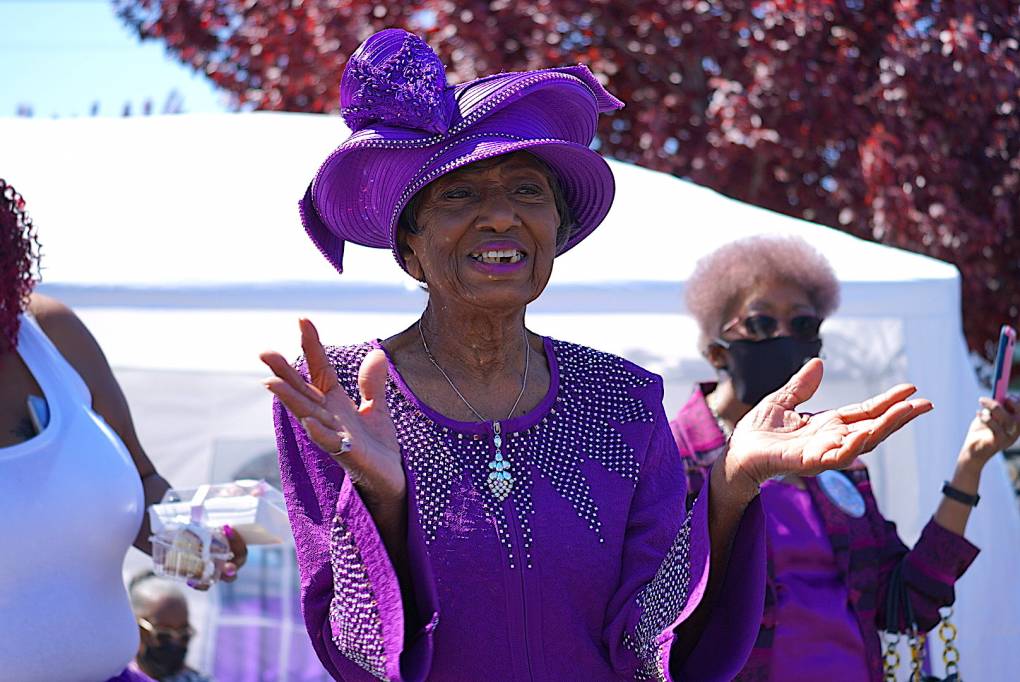
"caption": "Marcella Hubbard smiles as she stands and cheers as people drive by in celebration of her 100th birthday. ",
"description": "Marcella Hubbard smiles as she stands and cheers as people drive by in celebration of her 100th birthday. ",
"title": "Marcella Hubbard smiles as she stands and cheers as people drive by in celebration of her 100th birthday.",
"credit": "Pendarvis Harshaw/KQED",
"status": "inherit",
"altTag": "Marcella Hubbard smiles as she stands and cheers as people drive by in celebration of her 100th birthday.",
"isLoading": false,
"fetchFailed": false
},
"arts_13894689": {
"type": "attachments",
"id": "arts_13894689",
"meta": {
"index": "attachments_1716263798",
"site": "arts",
"id": "13894689",
"found": true
},
"parent": 13894684,
"imgSizes": {
"twentyfourteen-full-width": {
"file": "https://ww2.kqed.org/app/uploads/sites/2/2021/03/Toum.MAIN_-1038x576.jpg",
"width": 1038,
"mimeType": "image/jpeg",
"height": 576
},
"thumbnail": {
"file": "https://ww2.kqed.org/app/uploads/sites/2/2021/03/Toum.MAIN_-160x90.jpg",
"width": 160,
"mimeType": "image/jpeg",
"height": 90
},
"post-thumbnail": {
"file": "https://ww2.kqed.org/app/uploads/sites/2/2021/03/Toum.MAIN_-672x372.jpg",
"width": 672,
"mimeType": "image/jpeg",
"height": 372
},
"kqedFullSize": {
"file": "https://ww2.kqed.org/app/uploads/sites/2/2021/03/Toum.MAIN_.jpg",
"width": 1920,
"height": 1080
},
"large": {
"file": "https://ww2.kqed.org/app/uploads/sites/2/2021/03/Toum.MAIN_-1020x574.jpg",
"width": 1020,
"mimeType": "image/jpeg",
"height": 574
},
"1536x1536": {
"file": "https://ww2.kqed.org/app/uploads/sites/2/2021/03/Toum.MAIN_-1536x864.jpg",
"width": 1536,
"mimeType": "image/jpeg",
"height": 864
},
"medium": {
"file": "https://ww2.kqed.org/app/uploads/sites/2/2021/03/Toum.MAIN_-800x450.jpg",
"width": 800,
"mimeType": "image/jpeg",
"height": 450
},
"medium_large": {
"file": "https://ww2.kqed.org/app/uploads/sites/2/2021/03/Toum.MAIN_-768x432.jpg",
"width": 768,
"mimeType": "image/jpeg",
"height": 432
}
},
"publishDate": 1616777279,
"modified": 1616781528,
"caption": "Every order of shawarma at Shawarmaji comes with the garlicky white sauce known as toum.",
"description": "Every order of shawarma at Shawarmaji comes with the garlicky white sauce known as toum.",
"title": "Toum.MAIN",
"credit": "Rawan Elhalaby",
"status": "inherit",
"altTag": "A spread of dishes from Shawarmaji including colorful pickles and shawarma being dipped into the garlicky white sauce known as toum.",
"isLoading": false,
"fetchFailed": false
},
"arts_13894315": {
"type": "attachments",
"id": "arts_13894315",
"meta": {
"index": "attachments_1716263798",
"site": "arts",
"id": "13894315",
"found": true
},
"parent": 13894169,
"imgSizes": {
"twentyfourteen-full-width": {
"file": "https://ww2.kqed.org/app/uploads/sites/2/2021/03/PunkHouseOakland-1038x576.jpg",
"width": 1038,
"mimeType": "image/jpeg",
"height": 576
},
"thumbnail": {
"file": "https://ww2.kqed.org/app/uploads/sites/2/2021/03/PunkHouseOakland-160x99.jpg",
"width": 160,
"mimeType": "image/jpeg",
"height": 99
},
"post-thumbnail": {
"file": "https://ww2.kqed.org/app/uploads/sites/2/2021/03/PunkHouseOakland-672x372.jpg",
"width": 672,
"mimeType": "image/jpeg",
"height": 372
},
"kqedFullSize": {
"file": "https://ww2.kqed.org/app/uploads/sites/2/2021/03/PunkHouseOakland-scaled-e1616186881703.jpg",
"width": 1920,
"height": 1188
},
"2048x2048": {
"file": "https://ww2.kqed.org/app/uploads/sites/2/2021/03/PunkHouseOakland-2048x1267.jpg",
"width": 2048,
"mimeType": "image/jpeg",
"height": 1267
},
"large": {
"file": "https://ww2.kqed.org/app/uploads/sites/2/2021/03/PunkHouseOakland-1020x631.jpg",
"width": 1020,
"mimeType": "image/jpeg",
"height": 631
},
"1536x1536": {
"file": "https://ww2.kqed.org/app/uploads/sites/2/2021/03/PunkHouseOakland-1536x951.jpg",
"width": 1536,
"mimeType": "image/jpeg",
"height": 951
},
"full-width": {
"file": "https://ww2.kqed.org/app/uploads/sites/2/2021/03/PunkHouseOakland-1920x1188.jpg",
"width": 1920,
"mimeType": "image/jpeg",
"height": 1188
},
"medium": {
"file": "https://ww2.kqed.org/app/uploads/sites/2/2021/03/PunkHouseOakland-800x495.jpg",
"width": 800,
"mimeType": "image/jpeg",
"height": 495
},
"medium_large": {
"file": "https://ww2.kqed.org/app/uploads/sites/2/2021/03/PunkHouseOakland-768x475.jpg",
"width": 768,
"mimeType": "image/jpeg",
"height": 475
}
},
"publishDate": 1616186204,
"modified": 1616523099,
"caption": "(L-R) Orlando and Tanya (photo by Patti Tuori); Mike Matusio, Elizabeth D.",
"description": "(L-R) Orlando and Tanya (photo by Patti Tuori); Mike Matusio, Elizabeth D.",
"title": "Oakland punks in the '90s. (L-R) Orlando and Tanya (photo by Patti Tuori); Mike Matusio, Elizabeth D.",
"credit": "Instagram/@punkhouseoakland",
"status": "inherit",
"altTag": "Oakland punks in the '90s. (L-R) Orlando and Tanya (photo by Patti Tuori); Mike Matusio, Elizabeth D.",
"isLoading": false,
"fetchFailed": false
},
"arts_13894283": {
"type": "attachments",
"id": "arts_13894283",
"meta": {
"index": "attachments_1716263798",
"site": "arts",
"id": "13894283",
"found": true
},
"parent": 13894207,
"imgSizes": {
"twentyfourteen-full-width": {
"file": "https://ww2.kqed.org/app/uploads/sites/2/2021/03/Screen-Shot-2021-03-19-at-6.39.17-AM-1038x576.png",
"width": 1038,
"mimeType": "image/png",
"height": 576
},
"thumbnail": {
"file": "https://ww2.kqed.org/app/uploads/sites/2/2021/03/Screen-Shot-2021-03-19-at-6.39.17-AM-160x86.png",
"width": 160,
"mimeType": "image/png",
"height": 86
},
"post-thumbnail": {
"file": "https://ww2.kqed.org/app/uploads/sites/2/2021/03/Screen-Shot-2021-03-19-at-6.39.17-AM-672x372.png",
"width": 672,
"mimeType": "image/png",
"height": 372
},
"kqedFullSize": {
"file": "https://ww2.kqed.org/app/uploads/sites/2/2021/03/Screen-Shot-2021-03-19-at-6.39.17-AM.png",
"width": 1182,
"height": 638
},
"large": {
"file": "https://ww2.kqed.org/app/uploads/sites/2/2021/03/Screen-Shot-2021-03-19-at-6.39.17-AM-1020x551.png",
"width": 1020,
"mimeType": "image/png",
"height": 551
},
"medium": {
"file": "https://ww2.kqed.org/app/uploads/sites/2/2021/03/Screen-Shot-2021-03-19-at-6.39.17-AM-800x432.png",
"width": 800,
"mimeType": "image/png",
"height": 432
},
"medium_large": {
"file": "https://ww2.kqed.org/app/uploads/sites/2/2021/03/Screen-Shot-2021-03-19-at-6.39.17-AM-768x415.png",
"width": 768,
"mimeType": "image/png",
"height": 415
}
},
"publishDate": 1616162268,
"modified": 1616162328,
"caption": "Baseball players, masked, standing together taking a photo at a Loyal To The Soils baseball clinic held earlier this year. ",
"description": "Baseball players, masked, standing together taking a photo at a Loyal To The Soils baseball clinic held earlier this year. ",
"title": "Baseball players, masked, standing together taking a photo at a Loyal To The Soils baseball clinic held earlier this year.",
"credit": "Courtesy of Loyal To My Soil",
"status": "inherit",
"altTag": "Baseball players, masked, standing together taking a photo at a Loyal To The Soils baseball clinic held earlier this year.",
"isLoading": false,
"fetchFailed": false
},
"arts_13894199": {
"type": "attachments",
"id": "arts_13894199",
"meta": {
"index": "attachments_1716263798",
"site": "arts",
"id": "13894199",
"found": true
},
"parent": 13894197,
"imgSizes": {
"twentyfourteen-full-width": {
"file": "https://ww2.kqed.org/app/uploads/sites/2/2021/03/IMG_5814-1038x576.jpg",
"width": 1038,
"mimeType": "image/jpeg",
"height": 576
},
"thumbnail": {
"file": "https://ww2.kqed.org/app/uploads/sites/2/2021/03/IMG_5814-160x107.jpg",
"width": 160,
"mimeType": "image/jpeg",
"height": 107
},
"post-thumbnail": {
"file": "https://ww2.kqed.org/app/uploads/sites/2/2021/03/IMG_5814-672x372.jpg",
"width": 672,
"mimeType": "image/jpeg",
"height": 372
},
"kqedFullSize": {
"file": "https://ww2.kqed.org/app/uploads/sites/2/2021/03/IMG_5814-scaled.jpg",
"width": 2560,
"height": 1707
},
"2048x2048": {
"file": "https://ww2.kqed.org/app/uploads/sites/2/2021/03/IMG_5814-2048x1365.jpg",
"width": 2048,
"mimeType": "image/jpeg",
"height": 1365
},
"large": {
"file": "https://ww2.kqed.org/app/uploads/sites/2/2021/03/IMG_5814-1020x680.jpg",
"width": 1020,
"mimeType": "image/jpeg",
"height": 680
},
"1536x1536": {
"file": "https://ww2.kqed.org/app/uploads/sites/2/2021/03/IMG_5814-1536x1024.jpg",
"width": 1536,
"mimeType": "image/jpeg",
"height": 1024
},
"full-width": {
"file": "https://ww2.kqed.org/app/uploads/sites/2/2021/03/IMG_5814-1920x1280.jpg",
"width": 1920,
"mimeType": "image/jpeg",
"height": 1280
},
"medium": {
"file": "https://ww2.kqed.org/app/uploads/sites/2/2021/03/IMG_5814-800x533.jpg",
"width": 800,
"mimeType": "image/jpeg",
"height": 533
},
"medium_large": {
"file": "https://ww2.kqed.org/app/uploads/sites/2/2021/03/IMG_5814-768x512.jpg",
"width": 768,
"mimeType": "image/jpeg",
"height": 512
}
},
"publishDate": 1616091085,
"modified": 1616091177,
"caption": "Theo Hollingsworth in character as Sirius Lee, standing with his fingers clasped in front of his chest, while wearing futuristic sunglasses.",
"description": "Theo Hollingsworth in character as Sirius Lee, standing with his fingers clasped in front of his chest, while wearing futuristic sunglasses.",
"title": "Theo Hollingsworth in character as Sirius Lee, standing with his fingers clasped in front of his chest, while wearing futuristic sunglasses.",
"credit": "Spencer Whitney",
"status": "inherit",
"altTag": "Theo Hollingsworth in character as Sirius Lee, standing with his fingers clasped in front of his chest, while wearing futuristic sunglasses.",
"isLoading": false,
"fetchFailed": false
},
"arts_13894253": {
"type": "attachments",
"id": "arts_13894253",
"meta": {
"index": "attachments_1716263798",
"site": "arts",
"id": "13894253",
"found": true
},
"parent": 13894159,
"imgSizes": {
"twentyfourteen-full-width": {
"file": "https://ww2.kqed.org/app/uploads/sites/2/2021/03/DanyelSmith.1-1038x576.jpg",
"width": 1038,
"mimeType": "image/jpeg",
"height": 576
},
"thumbnail": {
"file": "https://ww2.kqed.org/app/uploads/sites/2/2021/03/DanyelSmith.1-160x90.jpg",
"width": 160,
"mimeType": "image/jpeg",
"height": 90
},
"post-thumbnail": {
"file": "https://ww2.kqed.org/app/uploads/sites/2/2021/03/DanyelSmith.1-672x372.jpg",
"width": 672,
"mimeType": "image/jpeg",
"height": 372
},
"kqedFullSize": {
"file": "https://ww2.kqed.org/app/uploads/sites/2/2021/03/DanyelSmith.1.jpg",
"width": 1100,
"height": 619
},
"large": {
"file": "https://ww2.kqed.org/app/uploads/sites/2/2021/03/DanyelSmith.1-1020x574.jpg",
"width": 1020,
"mimeType": "image/jpeg",
"height": 574
},
"medium": {
"file": "https://ww2.kqed.org/app/uploads/sites/2/2021/03/DanyelSmith.1-800x450.jpg",
"width": 800,
"mimeType": "image/jpeg",
"height": 450
},
"medium_large": {
"file": "https://ww2.kqed.org/app/uploads/sites/2/2021/03/DanyelSmith.1-768x432.jpg",
"width": 768,
"mimeType": "image/jpeg",
"height": 432
}
},
"publishDate": 1616104278,
"modified": 1616104336,
"caption": "Danyel Smith at a Vibe Magazine party in New York City in 2008.",
"description": "Danyel Smith at a Vibe Magazine party in New York City in 2008.",
"title": "DanyelSmith.1",
"credit": "Joe Corrigan/Getty Images",
"status": "inherit",
"altTag": "Danyel Smith at a Vibe Magazine party in New York City in 2008.",
"isLoading": false,
"fetchFailed": false
},
"arts_13893998": {
"type": "attachments",
"id": "arts_13893998",
"meta": {
"index": "attachments_1716263798",
"site": "arts",
"id": "13893998",
"found": true
},
"parent": 13893827,
"imgSizes": {
"twentyfourteen-full-width": {
"file": "https://ww2.kqed.org/app/uploads/sites/2/2021/03/Untitled-design-4-1038x576.png",
"width": 1038,
"mimeType": "image/png",
"height": 576
},
"thumbnail": {
"file": "https://ww2.kqed.org/app/uploads/sites/2/2021/03/Untitled-design-4-160x90.png",
"width": 160,
"mimeType": "image/png",
"height": 90
},
"post-thumbnail": {
"file": "https://ww2.kqed.org/app/uploads/sites/2/2021/03/Untitled-design-4-672x372.png",
"width": 672,
"mimeType": "image/png",
"height": 372
},
"kqedFullSize": {
"file": "https://ww2.kqed.org/app/uploads/sites/2/2021/03/Untitled-design-4.png",
"width": 1920,
"height": 1080
},
"large": {
"file": "https://ww2.kqed.org/app/uploads/sites/2/2021/03/Untitled-design-4-1020x574.png",
"width": 1020,
"mimeType": "image/png",
"height": 574
},
"1536x1536": {
"file": "https://ww2.kqed.org/app/uploads/sites/2/2021/03/Untitled-design-4-1536x864.png",
"width": 1536,
"mimeType": "image/png",
"height": 864
},
"medium": {
"file": "https://ww2.kqed.org/app/uploads/sites/2/2021/03/Untitled-design-4-800x450.png",
"width": 800,
"mimeType": "image/png",
"height": 450
},
"medium_large": {
"file": "https://ww2.kqed.org/app/uploads/sites/2/2021/03/Untitled-design-4-768x432.png",
"width": 768,
"mimeType": "image/png",
"height": 432
}
},
"publishDate": 1615830553,
"modified": 1615830594,
"caption": "Jon Warfield Harrison and Alba Roland Mejia.",
"description": "Jon Warfield Harrison and Alba Roland Mejia.",
"title": "Jon and Alba",
"credit": null,
"status": "inherit",
"altTag": "Jon Warfield Harrison and Alba Roland Mejia.",
"isLoading": false,
"fetchFailed": false
},
"arts_13893868": {
"type": "attachments",
"id": "arts_13893868",
"meta": {
"index": "attachments_1716263798",
"site": "arts",
"id": "13893868",
"found": true
},
"parent": 13893831,
"imgSizes": {
"twentyfourteen-full-width": {
"file": "https://ww2.kqed.org/app/uploads/sites/2/2021/03/Youth1-1038x576.jpg",
"width": 1038,
"mimeType": "image/jpeg",
"height": 576
},
"thumbnail": {
"file": "https://ww2.kqed.org/app/uploads/sites/2/2021/03/Youth1-160x107.jpg",
"width": 160,
"mimeType": "image/jpeg",
"height": 107
},
"post-thumbnail": {
"file": "https://ww2.kqed.org/app/uploads/sites/2/2021/03/Youth1-672x372.jpg",
"width": 672,
"mimeType": "image/jpeg",
"height": 372
},
"kqedFullSize": {
"file": "https://ww2.kqed.org/app/uploads/sites/2/2021/03/Youth1-scaled.jpg",
"width": 2560,
"height": 1707
},
"2048x2048": {
"file": "https://ww2.kqed.org/app/uploads/sites/2/2021/03/Youth1-2048x1365.jpg",
"width": 2048,
"mimeType": "image/jpeg",
"height": 1365
},
"large": {
"file": "https://ww2.kqed.org/app/uploads/sites/2/2021/03/Youth1-1020x680.jpg",
"width": 1020,
"mimeType": "image/jpeg",
"height": 680
},
"1536x1536": {
"file": "https://ww2.kqed.org/app/uploads/sites/2/2021/03/Youth1-1536x1024.jpg",
"width": 1536,
"mimeType": "image/jpeg",
"height": 1024
},
"full-width": {
"file": "https://ww2.kqed.org/app/uploads/sites/2/2021/03/Youth1-1920x1280.jpg",
"width": 1920,
"mimeType": "image/jpeg",
"height": 1280
},
"medium": {
"file": "https://ww2.kqed.org/app/uploads/sites/2/2021/03/Youth1-800x533.jpg",
"width": 800,
"mimeType": "image/jpeg",
"height": 533
},
"medium_large": {
"file": "https://ww2.kqed.org/app/uploads/sites/2/2021/03/Youth1-768x512.jpg",
"width": 768,
"mimeType": "image/jpeg",
"height": 512
}
},
"publishDate": 1615494999,
"modified": 1615495127,
"caption": "Youth organizers Charles Knight, Brandon Coles and Imani Snodgrass (L–R) appear at a press conference in June 2020, a week before the vote to eliminate Oakland's school police force.",
"description": "Youth organizers Charles Knight, Brandon Coles and Imani Snodgrass (L–R) appear at a press conference in June 2020, a week before the vote to eliminate Oakland's school police force.",
"title": "Youth1",
"credit": "Courtesy Black Organizing Project",
"status": "inherit",
"altTag": "Youth organizers Charles Knight, Brandon Coles and Imani Snodgrass (L–R) appear at a press conference in June 2020, a week before the vote to eliminate Oakland's school police force.",
"isLoading": false,
"fetchFailed": false
},
"arts_13893724": {
"type": "attachments",
"id": "arts_13893724",
"meta": {
"index": "attachments_1716263798",
"site": "arts",
"id": "13893724",
"found": true
},
"parent": 13893667,
"imgSizes": {
"twentyfourteen-full-width": {
"file": "https://ww2.kqed.org/app/uploads/sites/2/2021/03/slack-imgs-1038x576.jpg",
"width": 1038,
"mimeType": "image/jpeg",
"height": 576
},
"thumbnail": {
"file": "https://ww2.kqed.org/app/uploads/sites/2/2021/03/slack-imgs-160x111.jpg",
"width": 160,
"mimeType": "image/jpeg",
"height": 111
},
"post-thumbnail": {
"file": "https://ww2.kqed.org/app/uploads/sites/2/2021/03/slack-imgs-672x372.jpg",
"width": 672,
"mimeType": "image/jpeg",
"height": 372
},
"kqedFullSize": {
"file": "https://ww2.kqed.org/app/uploads/sites/2/2021/03/slack-imgs.jpg",
"width": 1920,
"height": 1337
},
"large": {
"file": "https://ww2.kqed.org/app/uploads/sites/2/2021/03/slack-imgs-1020x710.jpg",
"width": 1020,
"mimeType": "image/jpeg",
"height": 710
},
"1536x1536": {
"file": "https://ww2.kqed.org/app/uploads/sites/2/2021/03/slack-imgs-1536x1070.jpg",
"width": 1536,
"mimeType": "image/jpeg",
"height": 1070
},
"medium": {
"file": "https://ww2.kqed.org/app/uploads/sites/2/2021/03/slack-imgs-800x557.jpg",
"width": 800,
"mimeType": "image/jpeg",
"height": 557
},
"medium_large": {
"file": "https://ww2.kqed.org/app/uploads/sites/2/2021/03/slack-imgs-768x535.jpg",
"width": 768,
"mimeType": "image/jpeg",
"height": 535
}
},
"publishDate": 1615237412,
"modified": 1615237610,
"caption": "Someone holding a colorful Oakland Public Library card that has the image of a grey heron and a stack of books on it.",
"description": "Someone holding a colorful Oakland Public Library card that has the image of a grey heron and a stack of books on it.",
"title": "Someone holding a colorful Oakland Public Library card that has the image of a grey heron and a stack of books on it.",
"credit": "Courtesy of Christopher Seaman/@sqrlly on Instagram",
"status": "inherit",
"altTag": "Someone holding a colorful Oakland Public Library card that has the image of a grey heron and a stack of books on it.",
"isLoading": false,
"fetchFailed": false
},
"arts_13893545": {
"type": "attachments",
"id": "arts_13893545",
"meta": {
"index": "attachments_1716263798",
"site": "arts",
"id": "13893545",
"found": true
},
"parent": 13893506,
"imgSizes": {
"twentyfourteen-full-width": {
"file": "https://ww2.kqed.org/app/uploads/sites/2/2021/03/IMG_5499-1038x576.jpg",
"width": 1038,
"mimeType": "image/jpeg",
"height": 576
},
"thumbnail": {
"file": "https://ww2.kqed.org/app/uploads/sites/2/2021/03/IMG_5499-160x98.jpg",
"width": 160,
"mimeType": "image/jpeg",
"height": 98
},
"post-thumbnail": {
"file": "https://ww2.kqed.org/app/uploads/sites/2/2021/03/IMG_5499-672x372.jpg",
"width": 672,
"mimeType": "image/jpeg",
"height": 372
},
"kqedFullSize": {
"file": "https://ww2.kqed.org/app/uploads/sites/2/2021/03/IMG_5499.jpg",
"width": 1920,
"height": 1173
},
"large": {
"file": "https://ww2.kqed.org/app/uploads/sites/2/2021/03/IMG_5499-1020x623.jpg",
"width": 1020,
"mimeType": "image/jpeg",
"height": 623
},
"1536x1536": {
"file": "https://ww2.kqed.org/app/uploads/sites/2/2021/03/IMG_5499-1536x938.jpg",
"width": 1536,
"mimeType": "image/jpeg",
"height": 938
},
"medium": {
"file": "https://ww2.kqed.org/app/uploads/sites/2/2021/03/IMG_5499-800x489.jpg",
"width": 800,
"mimeType": "image/jpeg",
"height": 489
},
"medium_large": {
"file": "https://ww2.kqed.org/app/uploads/sites/2/2021/03/IMG_5499-768x469.jpg",
"width": 768,
"mimeType": "image/jpeg",
"height": 469
}
},
"publishDate": 1614807688,
"modified": 1614807782,
"caption": "Complex Oakland owner Oscar Edwards is opening a grocery market next door to his longtime downtown nightclub. He says he wants to highlight Black vendors and make healthy food accessible.",
"description": "Complex Oakland owner Oscar Edwards is opening a grocery market next door to his longtime downtown nightclub. He says he wants to highlight Black vendors and make healthy food accessible.",
"title": "IMG_5499",
"credit": "Nastia Voynovskaya",
"status": "inherit",
"altTag": "A man poses outside of a grocery store that's in the process of being built out.",
"isLoading": false,
"fetchFailed": false
},
"arts_13893118": {
"type": "attachments",
"id": "arts_13893118",
"meta": {
"index": "attachments_1716263798",
"site": "arts",
"id": "13893118",
"found": true
},
"parent": 13893054,
"imgSizes": {
"twentyfourteen-full-width": {
"file": "https://ww2.kqed.org/app/uploads/sites/2/2021/02/Pen_COVER-1038x576.jpg",
"width": 1038,
"mimeType": "image/jpeg",
"height": 576
},
"thumbnail": {
"file": "https://ww2.kqed.org/app/uploads/sites/2/2021/02/Pen_COVER-160x90.jpg",
"width": 160,
"mimeType": "image/jpeg",
"height": 90
},
"post-thumbnail": {
"file": "https://ww2.kqed.org/app/uploads/sites/2/2021/02/Pen_COVER-672x372.jpg",
"width": 672,
"mimeType": "image/jpeg",
"height": 372
},
"kqedFullSize": {
"file": "https://ww2.kqed.org/app/uploads/sites/2/2021/02/Pen_COVER.jpg",
"width": 1920,
"height": 1080
},
"large": {
"file": "https://ww2.kqed.org/app/uploads/sites/2/2021/02/Pen_COVER-1020x574.jpg",
"width": 1020,
"mimeType": "image/jpeg",
"height": 574
},
"1536x1536": {
"file": "https://ww2.kqed.org/app/uploads/sites/2/2021/02/Pen_COVER-1536x864.jpg",
"width": 1536,
"mimeType": "image/jpeg",
"height": 864
},
"medium": {
"file": "https://ww2.kqed.org/app/uploads/sites/2/2021/02/Pen_COVER-800x450.jpg",
"width": 800,
"mimeType": "image/jpeg",
"height": 450
},
"medium_large": {
"file": "https://ww2.kqed.org/app/uploads/sites/2/2021/02/Pen_COVER-768x432.jpg",
"width": 768,
"mimeType": "image/jpeg",
"height": 432
}
},
"publishDate": 1614105404,
"modified": 1614105478,
"caption": "Before becoming a reverend, Cheryl Dawson was a member of the Black Panther Party. Now, she's part of a towering mural in West Oakland paying tribute to the women of the Black Panther Party.",
"description": "Before becoming a reverend, Cheryl Dawson was a member of the Black Panther Party. Now, she's part of a towering mural in West Oakland paying tribute to the women of the Black Panther Party.",
"title": "Pen_COVER",
"credit": "Courtesy Cheryl Dawson",
"status": "inherit",
"altTag": "Before becoming a reverend, Cheryl Dawson was a member of the Black Panther Party. Now, she's part of a towering mural in West Oakland paying tribute to the women of the Black Panther Party.",
"isLoading": false,
"fetchFailed": false
}
},
"audioPlayerReducer": {
"postId": "stream_live",
"isPaused": true,
"isPlaying": false,
"pfsActive": false,
"pledgeModalIsOpen": true,
"playerDrawerIsOpen": false,
"liveAudioPlayStartedAt": 0,
"liveAudioPlayContext": ""
},
"authorsReducer": {
"ralexandra": {
"type": "authors",
"id": "11242",
"meta": {
"index": "authors_1716337520",
"id": "11242",
"found": true
},
"name": "Rae Alexandra",
"firstName": "Rae",
"lastName": "Alexandra",
"slug": "ralexandra",
"email": "ralexandra@kqed.org",
"display_author_email": true,
"staff_mastheads": [
"arts"
],
"title": "Reporter/Producer",
"bio": "Rae Alexandra is a Reporter/Producer for KQED Arts & Culture, and the creator/author of the \u003ca href=\"https://www.kqed.org/arts/program/rebel-girls-from-bay-area-history\">Rebel Girls From Bay Area History\u003c/a> and \u003ca href=\"https://www.kqed.org/bizarrebayarea\">Bizarre Bay Area\u003c/a> series. Her debut book, \u003ca href=\"https://citylights.com/politics-current-events-history/unsung-heroines35-women-who-changed/\">Unsung Heroines: 35 Women Who Changed the Bay Area\u003c/a> was published by City Lights in March 2026. In 2023, Rae was awarded an SPJ Excellence in Journalism Award for Arts & Culture. Rae was born and raised in Wales and subsequently — even after two decades in Northern California — still uses phrases that regularly baffle her coworkers.",
"avatar": "https://secure.gravatar.com/avatar/edfee8176c80cc0a382b051190f5341997df378a934a5774dcb0977732dfd401?s=600&d=blank&r=g",
"twitter": null,
"bluesky": null,
"facebook": null,
"instagram": null,
"linkedin": null,
"sites": [
{
"site": "arts",
"roles": [
"editor"
]
},
{
"site": "news",
"roles": [
"editor"
]
},
{
"site": "pop",
"roles": [
"editor"
]
},
{
"site": "bayareabites",
"roles": [
"editor"
]
},
{
"site": "science",
"roles": [
"editor"
]
}
],
"headData": {
"title": "Rae Alexandra | KQED",
"description": "Reporter/Producer",
"ogImgSrc": "https://secure.gravatar.com/avatar/edfee8176c80cc0a382b051190f5341997df378a934a5774dcb0977732dfd401?s=600&d=blank&r=g",
"twImgSrc": "https://secure.gravatar.com/avatar/edfee8176c80cc0a382b051190f5341997df378a934a5774dcb0977732dfd401?s=600&d=blank&r=g"
},
"isLoading": false,
"link": "/author/ralexandra"
},
"nvoynovskaya": {
"type": "authors",
"id": "11387",
"meta": {
"index": "authors_1716337520",
"id": "11387",
"found": true
},
"name": "Nastia Voynovskaya",
"firstName": "Nastia",
"lastName": "Voynovskaya",
"slug": "nvoynovskaya",
"email": "nvoynovskaya@kqed.org",
"display_author_email": false,
"staff_mastheads": [
"arts"
],
"title": "Editor and reporter",
"bio": "Nastia Voynovskaya is a reporter and editor at KQED Arts & Culture. She's been covering the arts in the Bay Area for over a decade, with a focus on music, queer culture, labor issues and grassroots organizing. She has edited KQED story series such as Trans Bay: A History of San Francisco's Gender-Diverse Community, and co-created KQED's Bay Area hip-hop history project, That's My Word. Nastia's work has been recognized by the Society of Professional Journalists and San Francisco Press Club. She holds a BA in comparative literature from UC Berkeley.",
"avatar": "https://secure.gravatar.com/avatar/5025ee460e5a85d69ca20ea6c6f2f80d7e17795c828f61ea3aecfcd924e9042e?s=600&d=blank&r=g",
"twitter": null,
"bluesky": null,
"facebook": null,
"instagram": "https://www.instagram.com/nananastia/",
"linkedin": null,
"sites": [
{
"site": "arts",
"roles": [
"administrator"
]
},
{
"site": "news",
"roles": [
"editor"
]
},
{
"site": "pop",
"roles": [
"administrator"
]
},
{
"site": "bayareabites",
"roles": [
"editor"
]
},
{
"site": "podcasts",
"roles": [
"editor"
]
},
{
"site": "hiphop",
"roles": [
"editor"
]
}
],
"headData": {
"title": "Nastia Voynovskaya | KQED",
"description": "Editor and reporter",
"ogImgSrc": "https://secure.gravatar.com/avatar/5025ee460e5a85d69ca20ea6c6f2f80d7e17795c828f61ea3aecfcd924e9042e?s=600&d=blank&r=g",
"twImgSrc": "https://secure.gravatar.com/avatar/5025ee460e5a85d69ca20ea6c6f2f80d7e17795c828f61ea3aecfcd924e9042e?s=600&d=blank&r=g"
},
"isLoading": false,
"link": "/author/nvoynovskaya"
},
"ogpenn": {
"type": "authors",
"id": "11491",
"meta": {
"index": "authors_1716337520",
"id": "11491",
"found": true
},
"name": "Pendarvis Harshaw",
"firstName": "Pendarvis",
"lastName": "Harshaw",
"slug": "ogpenn",
"email": "ogpenn@gmail.com",
"display_author_email": false,
"staff_mastheads": [
"arts"
],
"title": "Community Engagement Reporter",
"bio": "Pendarvis Harshaw is an educator, host and writer with KQED Arts.",
"avatar": "https://secure.gravatar.com/avatar/972b77ee8e3f346ae2b00622661187fbfabd059b5693bbdc1475ea7a722fd4cd?s=600&d=blank&r=g",
"twitter": null,
"bluesky": null,
"facebook": null,
"instagram": "ogpenn",
"linkedin": null,
"sites": [
{
"site": "arts",
"roles": [
"administrator"
]
},
{
"site": "news",
"roles": [
"editor"
]
},
{
"site": "bayareabites",
"roles": [
"author"
]
},
{
"site": "hiphop",
"roles": [
"editor"
]
}
],
"headData": {
"title": "Pendarvis Harshaw | KQED",
"description": "Community Engagement Reporter",
"ogImgSrc": "https://secure.gravatar.com/avatar/972b77ee8e3f346ae2b00622661187fbfabd059b5693bbdc1475ea7a722fd4cd?s=600&d=blank&r=g",
"twImgSrc": "https://secure.gravatar.com/avatar/972b77ee8e3f346ae2b00622661187fbfabd059b5693bbdc1475ea7a722fd4cd?s=600&d=blank&r=g"
},
"isLoading": false,
"link": "/author/ogpenn"
},
"mmedina": {
"type": "authors",
"id": "11528",
"meta": {
"index": "authors_1716337520",
"id": "11528",
"found": true
},
"name": "Marisol Medina-Cadena",
"firstName": "Marisol",
"lastName": "Medina-Cadena",
"slug": "mmedina",
"email": "mmedina@KQED.org",
"display_author_email": true,
"staff_mastheads": [],
"title": "Producer, Rightnowish Podcast",
"bio": "Marisol Medina-Cadena is a radio reporter and podcast producer. Before working at KQED, she produced for PBS member station, KCET, in Los Angeles. In 2017, Marisol won an Emmy Award for her work on the televised documentary, \u003cem>City Rising\u003c/em>, examining California's affordable housing crisis and the historical roots of gentrification.",
"avatar": "https://secure.gravatar.com/avatar/6c3db46a1cabb5e1fe9a365b5f4e681e?s=600&d=blank&r=g",
"twitter": "marisolreports",
"facebook": null,
"instagram": null,
"linkedin": null,
"sites": [
{
"site": "arts",
"roles": []
},
{
"site": "news",
"roles": [
"edit_others_posts"
]
}
],
"headData": {
"title": "Marisol Medina-Cadena | KQED",
"description": "Producer, Rightnowish Podcast",
"ogImgSrc": "https://secure.gravatar.com/avatar/6c3db46a1cabb5e1fe9a365b5f4e681e?s=600&d=blank&r=g",
"twImgSrc": "https://secure.gravatar.com/avatar/6c3db46a1cabb5e1fe9a365b5f4e681e?s=600&d=blank&r=g"
},
"isLoading": false,
"link": "/author/mmedina"
},
"sgetachew": {
"type": "authors",
"id": "11734",
"meta": {
"index": "authors_1716337520",
"id": "11734",
"found": true
},
"name": "Samuel Getachew",
"firstName": "Samuel",
"lastName": "Getachew",
"slug": "sgetachew",
"email": "sgetachew@kqed.org",
"display_author_email": false,
"staff_mastheads": [],
"title": "KQED Contributor",
"bio": "\u003cspan style=\"font-weight: 400;\">Samuel Getachew is an 18-year-old poet and writer from Oakland, California. He is the 2019 Oakland Youth Poet Laureate, a 2020 Finalist for National Youth Poet Laureate, and a 4-time YoungArts Winner. His writing has been published in Teen Vogue, the New York Times, the Washington Post, and more. He will attend Yale University in the fall of 2021.\u003c/span>",
"avatar": "https://secure.gravatar.com/avatar/ebad3dcf2295975cfe77698fa670a089?s=600&d=blank&r=g",
"twitter": null,
"facebook": null,
"instagram": null,
"linkedin": null,
"sites": [
{
"site": "arts",
"roles": [
"subscriber"
]
}
],
"headData": {
"title": "Samuel Getachew | KQED",
"description": "KQED Contributor",
"ogImgSrc": "https://secure.gravatar.com/avatar/ebad3dcf2295975cfe77698fa670a089?s=600&d=blank&r=g",
"twImgSrc": "https://secure.gravatar.com/avatar/ebad3dcf2295975cfe77698fa670a089?s=600&d=blank&r=g"
},
"isLoading": false,
"link": "/author/sgetachew"
},
"ltsai": {
"type": "authors",
"id": "11743",
"meta": {
"index": "authors_1716337520",
"id": "11743",
"found": true
},
"name": "Luke Tsai",
"firstName": "Luke",
"lastName": "Tsai",
"slug": "ltsai",
"email": "ltsai@kqed.org",
"display_author_email": true,
"staff_mastheads": [
"arts"
],
"title": "Food Editor",
"bio": "Luke Tsai is KQED's food editor and resident stinky tofu connoisseur. Prior to KQED, he was an editor at Eater SF, \u003cem>San Francisco \u003c/em>magazine, and the \u003cem>East Bay Express\u003c/em>, and his work has also appeared in TASTE, the \u003cem>San Francisco Chronicle\u003c/em>, and the \u003cem>Best Food Writing\u003c/em> anthology. When he isn't writing or editing, you'll find him eating most everything he can get his hands on.",
"avatar": "https://secure.gravatar.com/avatar/1e59b45bf191526e7339d6ba46e33a57b2030d25c27660ecc64ea3cb863e34f7?s=600&d=blank&r=g",
"twitter": "theluketsai",
"bluesky": null,
"facebook": null,
"instagram": null,
"linkedin": null,
"sites": [
{
"site": "",
"roles": [
"editor"
]
},
{
"site": "arts",
"roles": [
"administrator"
]
},
{
"site": "news",
"roles": [
"editor",
"contributor"
]
},
{
"site": "bayareabites",
"roles": [
"editor"
]
},
{
"site": "food",
"roles": [
"editor"
]
}
],
"headData": {
"title": "Luke Tsai | KQED",
"description": "Food Editor",
"ogImgSrc": "https://secure.gravatar.com/avatar/1e59b45bf191526e7339d6ba46e33a57b2030d25c27660ecc64ea3cb863e34f7?s=600&d=blank&r=g",
"twImgSrc": "https://secure.gravatar.com/avatar/1e59b45bf191526e7339d6ba46e33a57b2030d25c27660ecc64ea3cb863e34f7?s=600&d=blank&r=g"
},
"isLoading": false,
"link": "/author/ltsai"
}
},
"pagesReducer": {
"arts_tag_oakland": {
"type": "terms",
"id": "arts_1143",
"meta": {
"index": "terms_1716263798",
"site": "arts",
"id": "1143",
"score": 6.883923
},
"featImg": null,
"name": "Oakland",
"description": null,
"taxonomy": "tag",
"headData": {
"twImgId": null,
"twTitle": null,
"ogTitle": null,
"ogImgId": null,
"twDescription": null,
"description": null,
"title": "Oakland Archives | KQED Arts",
"ogDescription": null
},
"ttid": 692,
"slug": "oakland",
"isLoading": false,
"title": "Oakland",
"pageMeta": {
"site": "arts",
"WpPageTemplate": "page-topic-editorial",
"currentPage": 42
},
"blocks": [
{
"blockName": "kqed/post-list",
"attrs": {
"layout": "cardArticle2",
"query": "posts/arts?tag=oakland",
"seeMore": false,
"paginated": true,
"page": 42
}
},
{
"blockName": "kqed/ad"
}
]
}
},
"pfsSessionReducer": {},
"postsReducer": {
"stream_live": {
"type": "live",
"id": "stream_live",
"audioUrl": "https://streams.kqed.org/kqedradio",
"title": "Live Stream",
"excerpt": "Live Stream information currently unavailable.",
"link": "/radio",
"featImg": "",
"label": {
"name": "KQED Live",
"link": "/"
}
},
"stream_kqedNewscast": {
"type": "posts",
"id": "stream_kqedNewscast",
"audioUrl": "https://www.kqed.org/.stream/anon/radio/RDnews/newscast.mp3?_=1",
"title": "KQED Newscast",
"featImg": "",
"label": {
"name": "88.5 FM",
"link": "/"
}
},
"arts_13895169": {
"type": "posts",
"id": "arts_13895169",
"meta": {
"index": "posts_1716263798",
"site": "arts",
"id": "13895169",
"score": null,
"sort": [
1617642989000
]
},
"guestAuthors": [],
"slug": "a-collective-poem-written-by-oakland-residents-for-national-poetry-month",
"title": "A Collective Poem, Written by Oakland Residents, for National Poetry Month",
"publishDate": 1617642989,
"format": "standard",
"headTitle": "A Collective Poem, Written by Oakland Residents, for National Poetry Month | KQED",
"labelTerm": {
"term": 140,
"site": "arts"
},
"content": "\u003cp>On Sunday morning, I woke up, gathered my superpowers, and added a couple lines to what’s sure to be one of the most Oakland-centric poems ever created.\u003c/p>\n\u003cp>But in order to achieve that status, it’ll take your poetic superpowers as well.\u003c/p>\n\u003cp>Oakland’s \u003ca href=\"http://www.chapter510.org/\" target=\"_blank\" rel=\"noopener noreferrer\">Chapter 510\u003c/a>, an organization that champions literacy—especially for marginalized youth—has partnered with the \u003ca href=\"https://www.oaklandrootssc.com/\" target=\"_blank\" rel=\"noopener noreferrer\">Oakland Roots\u003c/a> soccer club for the second annual “Write Your Roots” event series. It’s a part of the larger \u003ca href=\"https://poets.org/national-poetry-month\" target=\"_blank\" rel=\"noopener noreferrer\">National Poetry Month\u003c/a> celebration.\u003c/p>\n\u003cp>Over the next four weeks, Oakland residents are invited to participate in the \u003ca href=\"https://docs.google.com/forms/d/e/1FAIpQLSc0jSuH8cychLCuA-R1KHVFMl9wyTR02ZxRDY3r9OEaA7cu9Q/viewform\" target=\"_blank\" rel=\"noopener noreferrer\">All-Town Poem\u003c/a> (Spanish version\u003ca href=\"https://docs.google.com/forms/d/e/1FAIpQLSejZkADhUaTJhjfcuUbIkj0QX_usAchhnEai4K0dWDXpX2i0g/viewform\" target=\"_blank\" rel=\"noopener noreferrer\"> here\u003c/a>), where writers can submit an entry on the theme of power at any time. The entries will then be edited and arranged into poem form, with all submissions getting credit by name—or superhero/supershero/supertheyro name, if they so choose.\u003c/p>\n\u003cp>This year’s entries should be a strong follow-up to last year’s effort, which produced the epic poem “\u003ca href=\"https://chapter510.medium.com/because-this-city-english-12579f5fa3a5\" target=\"_blank\" rel=\"noopener noreferrer\">Because This City\u003c/a>.”\u003c/p>\n\u003cp>[ad fullwidth]\u003c/p>\n\u003cp>Chapter 510 Program Manager and Teaching Artist Jahan Khalighi says the overall goal is to create a community-based exercise in creativity, imagination, and power-building. For Khalighi, it’s about looking at “access to inspiration as a basic human right.”\u003c/p>\n\u003cfigure id=\"attachment_13895177\" class=\"wp-caption alignnone\" style=\"max-width: 800px\">\u003cimg loading=\"lazy\" decoding=\"async\" class=\"size-medium wp-image-13895177\" src=\"https://ww2.kqed.org/app/uploads/sites/2/2021/04/Tongo-Elijah-800x533.jpg\" alt=\"San Francisco Poet Laureate Tongo Eisen-Martin stands in the middle of Elijah and Amaya at Oakland's Westlake Middle School\" width=\"800\" height=\"533\" srcset=\"https://cdn.kqed.org/wp-content/uploads/sites/2/2021/04/Tongo-Elijah-800x533.jpg 800w, https://cdn.kqed.org/wp-content/uploads/sites/2/2021/04/Tongo-Elijah-1020x680.jpg 1020w, https://cdn.kqed.org/wp-content/uploads/sites/2/2021/04/Tongo-Elijah-160x107.jpg 160w, https://cdn.kqed.org/wp-content/uploads/sites/2/2021/04/Tongo-Elijah-768x512.jpg 768w, https://cdn.kqed.org/wp-content/uploads/sites/2/2021/04/Tongo-Elijah-1536x1024.jpg 1536w, https://cdn.kqed.org/wp-content/uploads/sites/2/2021/04/Tongo-Elijah-2048x1365.jpg 2048w, https://cdn.kqed.org/wp-content/uploads/sites/2/2021/04/Tongo-Elijah-1920x1280.jpg 1920w\" sizes=\"auto, (max-width: 800px) 100vw, 800px\">\u003cfigcaption class=\"wp-caption-text\">San Francisco Poet Laureate Tongo Eisen-Martin stands between students Elijah and Amaya at Oakland’s Westlake Middle School. \u003ccite>(Robbie Sweeny)\u003c/cite>\u003c/figcaption>\u003c/figure>\n\u003cp>On top of that, each day in April Chapter 510 is posting writing prompts on \u003ca href=\"https://www.instagram.com/chapter510/\" target=\"_blank\" rel=\"noopener noreferrer\">Instagram\u003c/a>, \u003ca href=\"https://twitter.com/chptr510\" target=\"_blank\" rel=\"noopener noreferrer\">Twitter\u003c/a> and \u003ca href=\"https://www.facebook.com/chapter510\" target=\"_blank\" rel=\"noopener noreferrer\">Facebook\u003c/a>. If so moved to share a poem, Chapter 510 encourages people to use the hashtag “\u003ca href=\"https://www.instagram.com/explore/tags/peda2021/\" target=\"_blank\" rel=\"noopener noreferrer\">#Peda2021\u003c/a>” to keep track of all the submissions.\u003c/p>\n\u003cp>In addition, Chapter 510 offers a \u003ca href=\"https://static1.squarespace.com/static/580fe27615d5db24ca661579/t/606655a20a81c439ea07796c/1617319330909/Write+Your+Roos+Lesson+Plans+2021+%283%29.pdf\" target=\"_blank\" rel=\"noopener noreferrer\">poetry curriculum\u003c/a> for educators, optimized for both distanced and in-person classrooms.\u003c/p>\n\u003cp>Lastly, with entertainment venues and community gathering spaces around the Bay Area on the verge of reopening, Chapter 510’s newest location at Swan’s Market is scheduled for a grand opening on April 30.\u003c/p>\n\u003cp>Chapter 510 will culminate the month’s worth of writing with its first city-wide \u003ca href=\"https://www.instagram.com/p/CNGhWHuhgm7/?utm_source=ig_web_copy_link\" target=\"_blank\" rel=\"noopener noreferrer\">Write Your Roots Day\u003c/a>, which Mayor Libby Schaff officially proclaimed just last week.\u003c/p>\n\u003cp>\u003c/p>\n\u003cp>Chapter 510 celebrates Write Your Roots Day on Friday, April 30, at 546 9th Street (at Swan’s Market) from 12pm-6pm. \u003ca href=\"http://www.chapter510.org/events-1/2021/4/30/write-your-roots-all-town-epic-poetry-day\" target=\"_blank\" rel=\"noopener noreferrer\">Details here\u003c/a>.\u003c/p>\n\n",
"blocks": [],
"excerpt": "Chapter 510 invites all Oaklanders to contribute to the poem, focused on the theme of power. ",
"status": "publish",
"parent": 0,
"modified": 1742837930,
"stats": {
"hasAudio": false,
"hasVideo": false,
"hasChartOrMap": false,
"iframeSrcs": [],
"hasGoogleForm": false,
"hasGallery": false,
"hasHearkenModule": false,
"hasPolis": false,
"paragraphCount": 13,
"wordCount": 402
},
"headData": {
"title": "A Collective Poem, Written by Oakland Residents, for National Poetry Month | KQED",
"description": "Chapter 510 invites all Oaklanders to contribute to the poem, focused on the theme of power. ",
"ogTitle": "",
"ogDescription": "",
"ogImgId": "",
"twTitle": "",
"twDescription": "",
"twImgId": "",
"schema": {
"@context": "https://schema.org",
"@type": "Article",
"headline": "A Collective Poem, Written by Oakland Residents, for National Poetry Month",
"datePublished": "2021-04-05T10:16:29-07:00",
"dateModified": "2025-03-24T10:38:50-07:00",
"image": "https://cdn.kqed.org/wp-content/uploads/2020/02/KQED-OG-Image@1x.png"
}
},
"sticky": false,
"templateType": "standard",
"featuredImageType": "standard",
"excludeFromSiteSearch": "Include",
"articleAge": "0",
"path": "/arts/13895169/a-collective-poem-written-by-oakland-residents-for-national-poetry-month",
"audioTrackLength": null,
"parsedContent": [
{
"type": "contentString",
"content": "\u003cdiv class=\"post-body\">\u003cp>\u003cp>On Sunday morning, I woke up, gathered my superpowers, and added a couple lines to what’s sure to be one of the most Oakland-centric poems ever created.\u003c/p>\n\u003cp>But in order to achieve that status, it’ll take your poetic superpowers as well.\u003c/p>\n\u003cp>Oakland’s \u003ca href=\"http://www.chapter510.org/\" target=\"_blank\" rel=\"noopener noreferrer\">Chapter 510\u003c/a>, an organization that champions literacy—especially for marginalized youth—has partnered with the \u003ca href=\"https://www.oaklandrootssc.com/\" target=\"_blank\" rel=\"noopener noreferrer\">Oakland Roots\u003c/a> soccer club for the second annual “Write Your Roots” event series. It’s a part of the larger \u003ca href=\"https://poets.org/national-poetry-month\" target=\"_blank\" rel=\"noopener noreferrer\">National Poetry Month\u003c/a> celebration.\u003c/p>\n\u003cp>Over the next four weeks, Oakland residents are invited to participate in the \u003ca href=\"https://docs.google.com/forms/d/e/1FAIpQLSc0jSuH8cychLCuA-R1KHVFMl9wyTR02ZxRDY3r9OEaA7cu9Q/viewform\" target=\"_blank\" rel=\"noopener noreferrer\">All-Town Poem\u003c/a> (Spanish version\u003ca href=\"https://docs.google.com/forms/d/e/1FAIpQLSejZkADhUaTJhjfcuUbIkj0QX_usAchhnEai4K0dWDXpX2i0g/viewform\" target=\"_blank\" rel=\"noopener noreferrer\"> here\u003c/a>), where writers can submit an entry on the theme of power at any time. The entries will then be edited and arranged into poem form, with all submissions getting credit by name—or superhero/supershero/supertheyro name, if they so choose.\u003c/p>\n\u003cp>This year’s entries should be a strong follow-up to last year’s effort, which produced the epic poem “\u003ca href=\"https://chapter510.medium.com/because-this-city-english-12579f5fa3a5\" target=\"_blank\" rel=\"noopener noreferrer\">Because This City\u003c/a>.”\u003c/p>\n\u003cp>\u003c/p>\u003c/div>",
"attributes": {
"named": {},
"numeric": []
}
},
{
"type": "component",
"content": "",
"name": "ad",
"attributes": {
"named": {
"label": "fullwidth"
},
"numeric": [
"fullwidth"
]
}
},
{
"type": "contentString",
"content": "\u003cdiv class=\"post-body\">\u003cp>\u003c/p>\n\u003cp>Chapter 510 Program Manager and Teaching Artist Jahan Khalighi says the overall goal is to create a community-based exercise in creativity, imagination, and power-building. For Khalighi, it’s about looking at “access to inspiration as a basic human right.”\u003c/p>\n\u003cfigure id=\"attachment_13895177\" class=\"wp-caption alignnone\" style=\"max-width: 800px\">\u003cimg loading=\"lazy\" decoding=\"async\" class=\"size-medium wp-image-13895177\" src=\"https://ww2.kqed.org/app/uploads/sites/2/2021/04/Tongo-Elijah-800x533.jpg\" alt=\"San Francisco Poet Laureate Tongo Eisen-Martin stands in the middle of Elijah and Amaya at Oakland's Westlake Middle School\" width=\"800\" height=\"533\" srcset=\"https://cdn.kqed.org/wp-content/uploads/sites/2/2021/04/Tongo-Elijah-800x533.jpg 800w, https://cdn.kqed.org/wp-content/uploads/sites/2/2021/04/Tongo-Elijah-1020x680.jpg 1020w, https://cdn.kqed.org/wp-content/uploads/sites/2/2021/04/Tongo-Elijah-160x107.jpg 160w, https://cdn.kqed.org/wp-content/uploads/sites/2/2021/04/Tongo-Elijah-768x512.jpg 768w, https://cdn.kqed.org/wp-content/uploads/sites/2/2021/04/Tongo-Elijah-1536x1024.jpg 1536w, https://cdn.kqed.org/wp-content/uploads/sites/2/2021/04/Tongo-Elijah-2048x1365.jpg 2048w, https://cdn.kqed.org/wp-content/uploads/sites/2/2021/04/Tongo-Elijah-1920x1280.jpg 1920w\" sizes=\"auto, (max-width: 800px) 100vw, 800px\">\u003cfigcaption class=\"wp-caption-text\">San Francisco Poet Laureate Tongo Eisen-Martin stands between students Elijah and Amaya at Oakland’s Westlake Middle School. \u003ccite>(Robbie Sweeny)\u003c/cite>\u003c/figcaption>\u003c/figure>\n\u003cp>On top of that, each day in April Chapter 510 is posting writing prompts on \u003ca href=\"https://www.instagram.com/chapter510/\" target=\"_blank\" rel=\"noopener noreferrer\">Instagram\u003c/a>, \u003ca href=\"https://twitter.com/chptr510\" target=\"_blank\" rel=\"noopener noreferrer\">Twitter\u003c/a> and \u003ca href=\"https://www.facebook.com/chapter510\" target=\"_blank\" rel=\"noopener noreferrer\">Facebook\u003c/a>. If so moved to share a poem, Chapter 510 encourages people to use the hashtag “\u003ca href=\"https://www.instagram.com/explore/tags/peda2021/\" target=\"_blank\" rel=\"noopener noreferrer\">#Peda2021\u003c/a>” to keep track of all the submissions.\u003c/p>\n\u003cp>In addition, Chapter 510 offers a \u003ca href=\"https://static1.squarespace.com/static/580fe27615d5db24ca661579/t/606655a20a81c439ea07796c/1617319330909/Write+Your+Roos+Lesson+Plans+2021+%283%29.pdf\" target=\"_blank\" rel=\"noopener noreferrer\">poetry curriculum\u003c/a> for educators, optimized for both distanced and in-person classrooms.\u003c/p>\n\u003cp>Lastly, with entertainment venues and community gathering spaces around the Bay Area on the verge of reopening, Chapter 510’s newest location at Swan’s Market is scheduled for a grand opening on April 30.\u003c/p>\n\u003cp>Chapter 510 will culminate the month’s worth of writing with its first city-wide \u003ca href=\"https://www.instagram.com/p/CNGhWHuhgm7/?utm_source=ig_web_copy_link\" target=\"_blank\" rel=\"noopener noreferrer\">Write Your Roots Day\u003c/a>, which Mayor Libby Schaff officially proclaimed just last week.\u003c/p>\n\u003cp>\u003c/p>\n\u003cp>Chapter 510 celebrates Write Your Roots Day on Friday, April 30, at 546 9th Street (at Swan’s Market) from 12pm-6pm. \u003ca href=\"http://www.chapter510.org/events-1/2021/4/30/write-your-roots-all-town-epic-poetry-day\" target=\"_blank\" rel=\"noopener noreferrer\">Details here\u003c/a>.\u003c/p>\n\n\u003c/div>\u003c/p>",
"attributes": {
"named": {},
"numeric": []
}
}
],
"link": "/arts/13895169/a-collective-poem-written-by-oakland-residents-for-national-poetry-month",
"authors": [
"11491"
],
"programs": [
"arts_140"
],
"categories": [
"arts_1",
"arts_73"
],
"tags": [
"arts_1331",
"arts_10278",
"arts_1630",
"arts_1143",
"arts_22450",
"arts_1496",
"arts_4506"
],
"featImg": "arts_13895173",
"label": "arts_140"
},
"arts_13894885": {
"type": "posts",
"id": "arts_13894885",
"meta": {
"index": "posts_1716263798",
"site": "arts",
"id": "13894885",
"score": null,
"sort": [
1617235760000
]
},
"guestAuthors": [],
"slug": "marcella-hubbards-purple-100th-birthday-celebration",
"title": "Marcella Hubbard's Purple 100th Birthday Celebration",
"publishDate": 1617235760,
"format": "standard",
"headTitle": "Marcella Hubbard’s Purple 100th Birthday Celebration | KQED",
"labelTerm": {
"site": "arts"
},
"content": "\u003cp>\u003cspan style=\"font-size: 4.6875em;float: left;line-height: 0.733em;padding: 0.05em 0.1em 0 0;font-family: times, serif, georgia\">M\u003c/span>arcella Hubbard has a purple house with purple flowers. A purple wardrobe and purple bedding. She used to drive a purple car, and now owns a purple cane.\u003c/p>\n\u003cp>On March 28, 2021, Marcella Hubbard wore all purple as she celebrated her 100th birthday. \u003cimg loading=\"lazy\" decoding=\"async\" class=\"alignright size-thumbnail wp-image-13833985\" src=\"https://ww2.kqed.org/app/uploads/sites/2/2018/05/OGPenn.Cap_-160x184.jpg\" alt=\"\" width=\"160\" height=\"184\" srcset=\"https://cdn.kqed.org/wp-content/uploads/sites/2/2018/05/OGPenn.Cap_-160x184.jpg 160w, https://cdn.kqed.org/wp-content/uploads/sites/2/2018/05/OGPenn.Cap_.jpg 180w\" sizes=\"(max-width: 160px) 100vw, 160px\">\u003c/p>\n\u003cp>To help celebrate the occasion, I rode with my family as my mother (a neighbor of Mrs. Hubbard’s) drove in a procession of cars decorated in plum, grape, and fig colored streamers. Our parade began at Mosswood Park and ended in the parking lot of the New Hope Baptist Church in West Oakland—people honking and waving banners the whole way. Upon arrival, violet ‘Happy Birthday’ balloons were sent sunward, and lavender butterfly-shaped confetti fell to ground.\u003c/p>\n\u003cfigure id=\"attachment_13894891\" class=\"wp-caption alignnone\" style=\"max-width: 800px\">\u003cimg loading=\"lazy\" decoding=\"async\" class=\"size-medium wp-image-13894891\" src=\"https://ww2.kqed.org/app/uploads/sites/2/2021/03/Screen-Shot-2021-03-31-at-10.00.49-AM-800x510.png\" alt=\"A purple "Happy 100th Birthday" banner mounted on the front of Mrs. Hubbard's house \" width=\"800\" height=\"510\" srcset=\"https://cdn.kqed.org/wp-content/uploads/sites/2/2021/03/Screen-Shot-2021-03-31-at-10.00.49-AM-800x510.png 800w, https://cdn.kqed.org/wp-content/uploads/sites/2/2021/03/Screen-Shot-2021-03-31-at-10.00.49-AM-1020x650.png 1020w, https://cdn.kqed.org/wp-content/uploads/sites/2/2021/03/Screen-Shot-2021-03-31-at-10.00.49-AM-160x102.png 160w, https://cdn.kqed.org/wp-content/uploads/sites/2/2021/03/Screen-Shot-2021-03-31-at-10.00.49-AM-768x489.png 768w, https://cdn.kqed.org/wp-content/uploads/sites/2/2021/03/Screen-Shot-2021-03-31-at-10.00.49-AM-1536x979.png 1536w, https://cdn.kqed.org/wp-content/uploads/sites/2/2021/03/Screen-Shot-2021-03-31-at-10.00.49-AM.png 1802w\" sizes=\"(max-width: 800px) 100vw, 800px\">\u003cfigcaption class=\"wp-caption-text\">A purple “Happy 100th Birthday” banner mounted on the front of Mrs. Hubbard’s house \u003ccite>(Pendarvis Harshaw)\u003c/cite>\u003c/figcaption>\u003c/figure>\n\u003cp>Mrs. Hubbard, dressed in the most royal shade of purple you’ve ever seen with a fly hat to boot, stood on the far end of the parking lot waving at people. Around her, family members dressed in periwinkle tutus and pastel shirts passed out cake and packaged lunches to cars passing by.\u003c/p>\n\u003cp>Some folks, like ourselves, stopped to get a few photos and soak in the moment. When face-to-face with the lady of honor, it hit: what do you tell someone who is turning 100?\u003c/p>\n\u003cp>[ad fullwidth]\u003c/p>\n\u003cp>“Happy birthday!” I said, before proceeding to to hide behind my camera and document the occasion.\u003c/p>\n\u003cp>Family members assembled around her. Five generations fluidly moving. No easy feat to get them organized. But in the scope of all that a matriarch and the five generations of her African American family have faced, getting together for a group photo was cake.\u003c/p>\n\u003cfigure id=\"attachment_13894895\" class=\"wp-caption alignnone\" style=\"max-width: 800px\">\u003cimg loading=\"lazy\" decoding=\"async\" class=\"size-medium wp-image-13894895\" src=\"https://ww2.kqed.org/app/uploads/sites/2/2021/03/DSC00086-800x535.jpg\" alt=\"Mrs. Hubbard sits in the center as family members gather around her for a photograph. Almost everyone is wearing purple. \" width=\"800\" height=\"535\" srcset=\"https://cdn.kqed.org/wp-content/uploads/sites/2/2021/03/DSC00086-800x535.jpg 800w, https://cdn.kqed.org/wp-content/uploads/sites/2/2021/03/DSC00086-1020x682.jpg 1020w, https://cdn.kqed.org/wp-content/uploads/sites/2/2021/03/DSC00086-160x107.jpg 160w, https://cdn.kqed.org/wp-content/uploads/sites/2/2021/03/DSC00086-768x513.jpg 768w, https://cdn.kqed.org/wp-content/uploads/sites/2/2021/03/DSC00086-1536x1027.jpg 1536w, https://cdn.kqed.org/wp-content/uploads/sites/2/2021/03/DSC00086.jpg 1616w\" sizes=\"(max-width: 800px) 100vw, 800px\">\u003cfigcaption class=\"wp-caption-text\">Mrs. Hubbard sits in the center as family members gather around her for a photograph. Almost everyone is wearing purple. \u003ccite>(Pendarvis Harshaw)\u003c/cite>\u003c/figcaption>\u003c/figure>\n\u003cp>\u003cspan style=\"font-size: 4.6875em;float: left;line-height: 0.733em;padding: 0.05em 0.1em 0 0;font-family: times, serif, georgia\">M\u003c/span>rs. Hubbard was born in Louisville, Mississippi, on March 28, 1921, the second oldest of a family that would eventually grow to 22 children. Her father, William James Eichelberger, and her mother, Sarah Coleman Eichelberger, had 10 children together before Sarah passed. After her father remarried, he had another dozen children.\u003c/p>\n\u003cp>Mrs. Hubbard worked on the farm, picking cotton as well as flowers—the latter of which planted a seed that’s still yielding fruit to this day.\u003c/p>\n\u003cp>“I just loved to pick violets,” Mrs. Hubbard tells me during a phone call earlier this week. “I just loved the color purple; it comes from the flowers that bloomed in the yard.”\u003c/p>\n\u003cfigure id=\"attachment_13894888\" class=\"wp-caption aligncenter\" style=\"max-width: 800px\">\u003cimg loading=\"lazy\" decoding=\"async\" class=\"size-medium wp-image-13894888\" src=\"https://ww2.kqed.org/app/uploads/sites/2/2021/03/DSC00096-800x535.jpg\" alt='Marcella Hubbard, wearing all purple and a COVID-19 safe protective face shield, sits in front of a huge \"100\" sign as she celebrates her 100th birthday.' width=\"800\" height=\"535\" srcset=\"https://cdn.kqed.org/wp-content/uploads/sites/2/2021/03/DSC00096-800x535.jpg 800w, https://cdn.kqed.org/wp-content/uploads/sites/2/2021/03/DSC00096-1020x682.jpg 1020w, https://cdn.kqed.org/wp-content/uploads/sites/2/2021/03/DSC00096-160x107.jpg 160w, https://cdn.kqed.org/wp-content/uploads/sites/2/2021/03/DSC00096-768x513.jpg 768w, https://cdn.kqed.org/wp-content/uploads/sites/2/2021/03/DSC00096-1536x1027.jpg 1536w, https://cdn.kqed.org/wp-content/uploads/sites/2/2021/03/DSC00096.jpg 1616w\" sizes=\"(max-width: 800px) 100vw, 800px\">\u003cfigcaption class=\"wp-caption-text\">Marcella Hubbard, wearing all purple and a COVID-19 safe protective face shield, sits in front of a huge “100” sign as she celebrates her 100th birthday. \u003ccite>(Pendarvis Harshaw)\u003c/cite>\u003c/figcaption>\u003c/figure>\n\u003cp>In 1943, Mrs. Hubbard came to the Bay Area for the first time, landing a job in a factory in Sausalito during World War II; in 2014 she was honored for her work there as a \u003ca href=\"http://www.winwebnews.com/2018/03/louisville-native-received-rosie.html\" target=\"_blank\" rel=\"noopener noreferrer\">Rosie The Riveter\u003c/a>.\u003c/p>\n\u003cp>In the mid-1900s, she traveled back and forth between the Bay Area and the south, eventually graduating from Mississippi Valley State University with a degree in education. In 1946, she married Rev. B.C. Turnipseed. The two oversaw a church in Mississippi, where equity was preached and voters were registered.\u003c/p>\n\u003cp>In 1963, after her husband died, Marcella and her only child, Angeline Eichelberger West, moved to the Bay Area permanently. First living with family on 60th Street in North Oakland, she eventually bought a home on 63rd Street, where the family has lived since the 1970s.\u003c/p>\n\u003cp>Marcella got re-married, this time to a man by the name of M. L. Hubbard. She worked a number of different jobs: in addition to being an educator, she was a seamstress, a social security administrator, and a longtime employee at a local office for the Internal Revenue Service. Active in her \u003ca href=\"http://www2.oaklandnet.com/oakca1/groups/dhs/documents/marketingmaterial/oak069507.pdf\" target=\"_blank\" rel=\"noopener noreferrer\">North Oakland community\u003c/a>, she was an early pioneer in urban gardening through her involvement with the Golden Gate Community Garden on 62nd Street.\u003c/p>\n\u003cfigure id=\"attachment_13894893\" class=\"wp-caption alignnone\" style=\"max-width: 800px\">\u003cimg loading=\"lazy\" decoding=\"async\" class=\"size-medium wp-image-13894893\" src=\"https://ww2.kqed.org/app/uploads/sites/2/2021/03/DSC00042-800x535.jpg\" alt=\"A pickup truck full of family members drives in the parade to celebrate Marcella Hubbard's 100th birthday. \" width=\"800\" height=\"535\" srcset=\"https://cdn.kqed.org/wp-content/uploads/sites/2/2021/03/DSC00042-800x535.jpg 800w, https://cdn.kqed.org/wp-content/uploads/sites/2/2021/03/DSC00042-1020x682.jpg 1020w, https://cdn.kqed.org/wp-content/uploads/sites/2/2021/03/DSC00042-160x107.jpg 160w, https://cdn.kqed.org/wp-content/uploads/sites/2/2021/03/DSC00042-768x513.jpg 768w, https://cdn.kqed.org/wp-content/uploads/sites/2/2021/03/DSC00042-1536x1027.jpg 1536w, https://cdn.kqed.org/wp-content/uploads/sites/2/2021/03/DSC00042.jpg 1616w\" sizes=\"(max-width: 800px) 100vw, 800px\">\u003cfigcaption class=\"wp-caption-text\">A pickup truck full of family members drives in the parade to celebrate Marcella Hubbard’s 100th birthday. \u003ccite>(Pendarvis Harshaw)\u003c/cite>\u003c/figcaption>\u003c/figure>\n\u003cp>She joined the New Hope Baptist Church in 1964, and through that institution has worked with young folks who were incarcerated at Juvenile Hall, off 150th Avenue in East Oakland.\u003c/p>\n\u003cp>“A lot of time they would bring the boys to the church with them, they’d give them gifts and bibles, and talk to them,” says LaTasha Mitchum, Mrs. Hubbard’s oldest grandchild. “A lot of the boys, once they got out of trouble, they’d come looking for her.”\u003c/p>\n\u003cp>Marcella Hubbard’s life has been so storied that at her 70th birthday party, family members chose parts of her life to depict in theatrical form, according to her youngest grandchild, Rasheeda West-Johnson.\u003c/p>\n\u003cp>“She is walking history,” says Rasheeda during a phone call on Monday. Rasheeda says in her grandmother’s older years, she’s been more transparent about her life’s experiences—especially as they pertain to racism.\u003c/p>\n\u003cfigure id=\"attachment_13894898\" class=\"wp-caption aligncenter\" style=\"max-width: 800px\">\u003cimg loading=\"lazy\" decoding=\"async\" class=\"size-medium wp-image-13894898\" src=\"https://ww2.kqed.org/app/uploads/sites/2/2021/03/DSC00053-800x535.jpg\" alt=\"A car celebrating Marcella Hubbard's 100th birthday crosses Martin Luther King Jr. Way in Oakland.\" width=\"800\" height=\"535\" srcset=\"https://cdn.kqed.org/wp-content/uploads/sites/2/2021/03/DSC00053-800x535.jpg 800w, https://cdn.kqed.org/wp-content/uploads/sites/2/2021/03/DSC00053-1020x682.jpg 1020w, https://cdn.kqed.org/wp-content/uploads/sites/2/2021/03/DSC00053-160x107.jpg 160w, https://cdn.kqed.org/wp-content/uploads/sites/2/2021/03/DSC00053-768x513.jpg 768w, https://cdn.kqed.org/wp-content/uploads/sites/2/2021/03/DSC00053-1536x1027.jpg 1536w, https://cdn.kqed.org/wp-content/uploads/sites/2/2021/03/DSC00053.jpg 1616w\" sizes=\"(max-width: 800px) 100vw, 800px\">\u003cfigcaption class=\"wp-caption-text\">A car celebrating Marcella Hubbard’s 100th birthday crosses Martin Luther King Jr. Way in Oakland. \u003ccite>(Pendarvis Harshaw/KQED)\u003c/cite>\u003c/figcaption>\u003c/figure>\n\u003cp>“I didn’t know that her first husband who was a preacher had to move out of Mississippi where they were because of Jim Crow, and that they were trying to lynch him because the church that they oversaw was trying to preach and teach equal rights,” says Rasheeda.\u003c/p>\n\u003cp>Because her children like to be in “grown folks’ business\u003cem>,” \u003c/em>Rasheeda has been very intentional to have the young ones present when her grandmother feels like talking.\u003c/p>\n\u003cp>“I make sure that the boys are around so that they can get firsthand knowledge of what’s going on,” says Rasheeda, questioning how much society has progressed in the decades since her grandmother was her children’s age. “I don’t even know if you’d call it an evolution… We’re still experiencing a lot of the same things. But for my children, it’s just acknowledging who she is and what she’s gone through. And having the utmost respect for her, because she’s lived a life that’s been extremely full.”\u003c/p>\n\u003cfigure id=\"attachment_13894897\" class=\"wp-caption alignnone\" style=\"max-width: 800px\">\u003cimg loading=\"lazy\" decoding=\"async\" class=\"size-medium wp-image-13894897\" src=\"https://ww2.kqed.org/app/uploads/sites/2/2021/03/DSC00106-800x535.jpg\" alt='A \"Happy Birthday Marcella\" sign mounted in the window of an automobile. ' width=\"800\" height=\"535\" srcset=\"https://cdn.kqed.org/wp-content/uploads/sites/2/2021/03/DSC00106-800x535.jpg 800w, https://cdn.kqed.org/wp-content/uploads/sites/2/2021/03/DSC00106-1020x682.jpg 1020w, https://cdn.kqed.org/wp-content/uploads/sites/2/2021/03/DSC00106-160x107.jpg 160w, https://cdn.kqed.org/wp-content/uploads/sites/2/2021/03/DSC00106-768x513.jpg 768w, https://cdn.kqed.org/wp-content/uploads/sites/2/2021/03/DSC00106-1536x1027.jpg 1536w, https://cdn.kqed.org/wp-content/uploads/sites/2/2021/03/DSC00106.jpg 1616w\" sizes=\"(max-width: 800px) 100vw, 800px\">\u003cfigcaption class=\"wp-caption-text\">A ‘Happy Birthday Marcella’ sign mounted in the window of an automobile. \u003ccite>(Pendarvis Harshaw)\u003c/cite>\u003c/figcaption>\u003c/figure>\n\u003cp>\u003cspan style=\"font-size: 4.6875em;float: left;line-height: 0.733em;padding: 0.05em 0.1em 0 0;font-family: times, serif, georgia\">W\u003c/span>ith COVID-19, the family was concerned that Mrs. Hubbard wasn’t going to be able to have the type of party that she envisioned, as she’s grown accustomed to having sizable celebrations at the end of each decade. But they managed to bring everyone together in the safest fashion possible.\u003c/p>\n\u003cp>Samauri Ware, Mrs. Hubbard’s middle grandchild, says that when they pulled up to the church last Saturday, Mrs. Hubbard kind of “bounced” out of the car. Samauri says, “It was just shocking to me. I was like, ‘She’s excited!'”\u003c/p>\n\u003cp>Up and active is how I’ve usually seen Mrs. Hubbard. Over the years I’ve talked to her through my mom’s backyard fence, as she’s often gardening, growing purple peas, purple greens and, of course, purple flowers.\u003c/p>\n\u003cp>[ad floatright]\u003c/p>\n\u003cp>When we last spoke, she told me she feels great being 100. The key to success? Mrs. Hubbard says, “Well, I try to be an honest person, and I like to work and help others. And I love God.”\u003c/p>\n\n",
"blocks": [],
"excerpt": "From her roots in Mississippi to her time as a Rosie the Riveter in WWII, Marcella Hubbard has led an incredible life.",
"status": "publish",
"parent": 0,
"modified": 1726761089,
"stats": {
"hasAudio": false,
"hasVideo": false,
"hasChartOrMap": false,
"iframeSrcs": [],
"hasGoogleForm": false,
"hasGallery": false,
"hasHearkenModule": false,
"hasPolis": false,
"paragraphCount": 27,
"wordCount": 1286
},
"headData": {
"title": "Marcella Hubbard's Purple 100th Birthday Celebration | KQED",
"description": "From her roots in Mississippi to her time as a Rosie the Riveter in WWII, Marcella Hubbard has led an incredible life.",
"ogTitle": "",
"ogDescription": "",
"ogImgId": "",
"twTitle": "",
"twDescription": "",
"twImgId": "",
"schema": {
"@context": "https://schema.org",
"@type": "Article",
"headline": "Marcella Hubbard's Purple 100th Birthday Celebration",
"datePublished": "2021-03-31T17:09:20-07:00",
"dateModified": "2024-09-19T08:51:29-07:00",
"image": "https://cdn.kqed.org/wp-content/uploads/2020/02/KQED-OG-Image@1x.png"
}
},
"sticky": false,
"templateType": "standard",
"featuredImageType": "standard",
"path": "/arts/13894885/marcella-hubbards-purple-100th-birthday-celebration",
"audioTrackLength": null,
"parsedContent": [
{
"type": "contentString",
"content": "\u003cdiv class=\"post-body\">\u003cp>\u003cp>\u003cspan style=\"font-size: 4.6875em;float: left;line-height: 0.733em;padding: 0.05em 0.1em 0 0;font-family: times, serif, georgia\">M\u003c/span>arcella Hubbard has a purple house with purple flowers. A purple wardrobe and purple bedding. She used to drive a purple car, and now owns a purple cane.\u003c/p>\n\u003cp>On March 28, 2021, Marcella Hubbard wore all purple as she celebrated her 100th birthday. \u003cimg loading=\"lazy\" decoding=\"async\" class=\"alignright size-thumbnail wp-image-13833985\" src=\"https://ww2.kqed.org/app/uploads/sites/2/2018/05/OGPenn.Cap_-160x184.jpg\" alt=\"\" width=\"160\" height=\"184\" srcset=\"https://cdn.kqed.org/wp-content/uploads/sites/2/2018/05/OGPenn.Cap_-160x184.jpg 160w, https://cdn.kqed.org/wp-content/uploads/sites/2/2018/05/OGPenn.Cap_.jpg 180w\" sizes=\"(max-width: 160px) 100vw, 160px\">\u003c/p>\n\u003cp>To help celebrate the occasion, I rode with my family as my mother (a neighbor of Mrs. Hubbard’s) drove in a procession of cars decorated in plum, grape, and fig colored streamers. Our parade began at Mosswood Park and ended in the parking lot of the New Hope Baptist Church in West Oakland—people honking and waving banners the whole way. Upon arrival, violet ‘Happy Birthday’ balloons were sent sunward, and lavender butterfly-shaped confetti fell to ground.\u003c/p>\n\u003cfigure id=\"attachment_13894891\" class=\"wp-caption alignnone\" style=\"max-width: 800px\">\u003cimg loading=\"lazy\" decoding=\"async\" class=\"size-medium wp-image-13894891\" src=\"https://ww2.kqed.org/app/uploads/sites/2/2021/03/Screen-Shot-2021-03-31-at-10.00.49-AM-800x510.png\" alt=\"A purple "Happy 100th Birthday" banner mounted on the front of Mrs. Hubbard's house \" width=\"800\" height=\"510\" srcset=\"https://cdn.kqed.org/wp-content/uploads/sites/2/2021/03/Screen-Shot-2021-03-31-at-10.00.49-AM-800x510.png 800w, https://cdn.kqed.org/wp-content/uploads/sites/2/2021/03/Screen-Shot-2021-03-31-at-10.00.49-AM-1020x650.png 1020w, https://cdn.kqed.org/wp-content/uploads/sites/2/2021/03/Screen-Shot-2021-03-31-at-10.00.49-AM-160x102.png 160w, https://cdn.kqed.org/wp-content/uploads/sites/2/2021/03/Screen-Shot-2021-03-31-at-10.00.49-AM-768x489.png 768w, https://cdn.kqed.org/wp-content/uploads/sites/2/2021/03/Screen-Shot-2021-03-31-at-10.00.49-AM-1536x979.png 1536w, https://cdn.kqed.org/wp-content/uploads/sites/2/2021/03/Screen-Shot-2021-03-31-at-10.00.49-AM.png 1802w\" sizes=\"(max-width: 800px) 100vw, 800px\">\u003cfigcaption class=\"wp-caption-text\">A purple “Happy 100th Birthday” banner mounted on the front of Mrs. Hubbard’s house \u003ccite>(Pendarvis Harshaw)\u003c/cite>\u003c/figcaption>\u003c/figure>\n\u003cp>Mrs. Hubbard, dressed in the most royal shade of purple you’ve ever seen with a fly hat to boot, stood on the far end of the parking lot waving at people. Around her, family members dressed in periwinkle tutus and pastel shirts passed out cake and packaged lunches to cars passing by.\u003c/p>\n\u003cp>Some folks, like ourselves, stopped to get a few photos and soak in the moment. When face-to-face with the lady of honor, it hit: what do you tell someone who is turning 100?\u003c/p>\n\u003cp>\u003c/p>\u003c/div>",
"attributes": {
"named": {},
"numeric": []
}
},
{
"type": "component",
"content": "",
"name": "ad",
"attributes": {
"named": {
"label": "fullwidth"
},
"numeric": [
"fullwidth"
]
}
},
{
"type": "contentString",
"content": "\u003cdiv class=\"post-body\">\u003cp>\u003c/p>\n\u003cp>“Happy birthday!” I said, before proceeding to to hide behind my camera and document the occasion.\u003c/p>\n\u003cp>Family members assembled around her. Five generations fluidly moving. No easy feat to get them organized. But in the scope of all that a matriarch and the five generations of her African American family have faced, getting together for a group photo was cake.\u003c/p>\n\u003cfigure id=\"attachment_13894895\" class=\"wp-caption alignnone\" style=\"max-width: 800px\">\u003cimg loading=\"lazy\" decoding=\"async\" class=\"size-medium wp-image-13894895\" src=\"https://ww2.kqed.org/app/uploads/sites/2/2021/03/DSC00086-800x535.jpg\" alt=\"Mrs. Hubbard sits in the center as family members gather around her for a photograph. Almost everyone is wearing purple. \" width=\"800\" height=\"535\" srcset=\"https://cdn.kqed.org/wp-content/uploads/sites/2/2021/03/DSC00086-800x535.jpg 800w, https://cdn.kqed.org/wp-content/uploads/sites/2/2021/03/DSC00086-1020x682.jpg 1020w, https://cdn.kqed.org/wp-content/uploads/sites/2/2021/03/DSC00086-160x107.jpg 160w, https://cdn.kqed.org/wp-content/uploads/sites/2/2021/03/DSC00086-768x513.jpg 768w, https://cdn.kqed.org/wp-content/uploads/sites/2/2021/03/DSC00086-1536x1027.jpg 1536w, https://cdn.kqed.org/wp-content/uploads/sites/2/2021/03/DSC00086.jpg 1616w\" sizes=\"(max-width: 800px) 100vw, 800px\">\u003cfigcaption class=\"wp-caption-text\">Mrs. Hubbard sits in the center as family members gather around her for a photograph. Almost everyone is wearing purple. \u003ccite>(Pendarvis Harshaw)\u003c/cite>\u003c/figcaption>\u003c/figure>\n\u003cp>\u003cspan style=\"font-size: 4.6875em;float: left;line-height: 0.733em;padding: 0.05em 0.1em 0 0;font-family: times, serif, georgia\">M\u003c/span>rs. Hubbard was born in Louisville, Mississippi, on March 28, 1921, the second oldest of a family that would eventually grow to 22 children. Her father, William James Eichelberger, and her mother, Sarah Coleman Eichelberger, had 10 children together before Sarah passed. After her father remarried, he had another dozen children.\u003c/p>\n\u003cp>Mrs. Hubbard worked on the farm, picking cotton as well as flowers—the latter of which planted a seed that’s still yielding fruit to this day.\u003c/p>\n\u003cp>“I just loved to pick violets,” Mrs. Hubbard tells me during a phone call earlier this week. “I just loved the color purple; it comes from the flowers that bloomed in the yard.”\u003c/p>\n\u003cfigure id=\"attachment_13894888\" class=\"wp-caption aligncenter\" style=\"max-width: 800px\">\u003cimg loading=\"lazy\" decoding=\"async\" class=\"size-medium wp-image-13894888\" src=\"https://ww2.kqed.org/app/uploads/sites/2/2021/03/DSC00096-800x535.jpg\" alt='Marcella Hubbard, wearing all purple and a COVID-19 safe protective face shield, sits in front of a huge \"100\" sign as she celebrates her 100th birthday.' width=\"800\" height=\"535\" srcset=\"https://cdn.kqed.org/wp-content/uploads/sites/2/2021/03/DSC00096-800x535.jpg 800w, https://cdn.kqed.org/wp-content/uploads/sites/2/2021/03/DSC00096-1020x682.jpg 1020w, https://cdn.kqed.org/wp-content/uploads/sites/2/2021/03/DSC00096-160x107.jpg 160w, https://cdn.kqed.org/wp-content/uploads/sites/2/2021/03/DSC00096-768x513.jpg 768w, https://cdn.kqed.org/wp-content/uploads/sites/2/2021/03/DSC00096-1536x1027.jpg 1536w, https://cdn.kqed.org/wp-content/uploads/sites/2/2021/03/DSC00096.jpg 1616w\" sizes=\"(max-width: 800px) 100vw, 800px\">\u003cfigcaption class=\"wp-caption-text\">Marcella Hubbard, wearing all purple and a COVID-19 safe protective face shield, sits in front of a huge “100” sign as she celebrates her 100th birthday. \u003ccite>(Pendarvis Harshaw)\u003c/cite>\u003c/figcaption>\u003c/figure>\n\u003cp>In 1943, Mrs. Hubbard came to the Bay Area for the first time, landing a job in a factory in Sausalito during World War II; in 2014 she was honored for her work there as a \u003ca href=\"http://www.winwebnews.com/2018/03/louisville-native-received-rosie.html\" target=\"_blank\" rel=\"noopener noreferrer\">Rosie The Riveter\u003c/a>.\u003c/p>\n\u003cp>In the mid-1900s, she traveled back and forth between the Bay Area and the south, eventually graduating from Mississippi Valley State University with a degree in education. In 1946, she married Rev. B.C. Turnipseed. The two oversaw a church in Mississippi, where equity was preached and voters were registered.\u003c/p>\n\u003cp>In 1963, after her husband died, Marcella and her only child, Angeline Eichelberger West, moved to the Bay Area permanently. First living with family on 60th Street in North Oakland, she eventually bought a home on 63rd Street, where the family has lived since the 1970s.\u003c/p>\n\u003cp>Marcella got re-married, this time to a man by the name of M. L. Hubbard. She worked a number of different jobs: in addition to being an educator, she was a seamstress, a social security administrator, and a longtime employee at a local office for the Internal Revenue Service. Active in her \u003ca href=\"http://www2.oaklandnet.com/oakca1/groups/dhs/documents/marketingmaterial/oak069507.pdf\" target=\"_blank\" rel=\"noopener noreferrer\">North Oakland community\u003c/a>, she was an early pioneer in urban gardening through her involvement with the Golden Gate Community Garden on 62nd Street.\u003c/p>\n\u003cfigure id=\"attachment_13894893\" class=\"wp-caption alignnone\" style=\"max-width: 800px\">\u003cimg loading=\"lazy\" decoding=\"async\" class=\"size-medium wp-image-13894893\" src=\"https://ww2.kqed.org/app/uploads/sites/2/2021/03/DSC00042-800x535.jpg\" alt=\"A pickup truck full of family members drives in the parade to celebrate Marcella Hubbard's 100th birthday. \" width=\"800\" height=\"535\" srcset=\"https://cdn.kqed.org/wp-content/uploads/sites/2/2021/03/DSC00042-800x535.jpg 800w, https://cdn.kqed.org/wp-content/uploads/sites/2/2021/03/DSC00042-1020x682.jpg 1020w, https://cdn.kqed.org/wp-content/uploads/sites/2/2021/03/DSC00042-160x107.jpg 160w, https://cdn.kqed.org/wp-content/uploads/sites/2/2021/03/DSC00042-768x513.jpg 768w, https://cdn.kqed.org/wp-content/uploads/sites/2/2021/03/DSC00042-1536x1027.jpg 1536w, https://cdn.kqed.org/wp-content/uploads/sites/2/2021/03/DSC00042.jpg 1616w\" sizes=\"(max-width: 800px) 100vw, 800px\">\u003cfigcaption class=\"wp-caption-text\">A pickup truck full of family members drives in the parade to celebrate Marcella Hubbard’s 100th birthday. \u003ccite>(Pendarvis Harshaw)\u003c/cite>\u003c/figcaption>\u003c/figure>\n\u003cp>She joined the New Hope Baptist Church in 1964, and through that institution has worked with young folks who were incarcerated at Juvenile Hall, off 150th Avenue in East Oakland.\u003c/p>\n\u003cp>“A lot of time they would bring the boys to the church with them, they’d give them gifts and bibles, and talk to them,” says LaTasha Mitchum, Mrs. Hubbard’s oldest grandchild. “A lot of the boys, once they got out of trouble, they’d come looking for her.”\u003c/p>\n\u003cp>Marcella Hubbard’s life has been so storied that at her 70th birthday party, family members chose parts of her life to depict in theatrical form, according to her youngest grandchild, Rasheeda West-Johnson.\u003c/p>\n\u003cp>“She is walking history,” says Rasheeda during a phone call on Monday. Rasheeda says in her grandmother’s older years, she’s been more transparent about her life’s experiences—especially as they pertain to racism.\u003c/p>\n\u003cfigure id=\"attachment_13894898\" class=\"wp-caption aligncenter\" style=\"max-width: 800px\">\u003cimg loading=\"lazy\" decoding=\"async\" class=\"size-medium wp-image-13894898\" src=\"https://ww2.kqed.org/app/uploads/sites/2/2021/03/DSC00053-800x535.jpg\" alt=\"A car celebrating Marcella Hubbard's 100th birthday crosses Martin Luther King Jr. Way in Oakland.\" width=\"800\" height=\"535\" srcset=\"https://cdn.kqed.org/wp-content/uploads/sites/2/2021/03/DSC00053-800x535.jpg 800w, https://cdn.kqed.org/wp-content/uploads/sites/2/2021/03/DSC00053-1020x682.jpg 1020w, https://cdn.kqed.org/wp-content/uploads/sites/2/2021/03/DSC00053-160x107.jpg 160w, https://cdn.kqed.org/wp-content/uploads/sites/2/2021/03/DSC00053-768x513.jpg 768w, https://cdn.kqed.org/wp-content/uploads/sites/2/2021/03/DSC00053-1536x1027.jpg 1536w, https://cdn.kqed.org/wp-content/uploads/sites/2/2021/03/DSC00053.jpg 1616w\" sizes=\"(max-width: 800px) 100vw, 800px\">\u003cfigcaption class=\"wp-caption-text\">A car celebrating Marcella Hubbard’s 100th birthday crosses Martin Luther King Jr. Way in Oakland. \u003ccite>(Pendarvis Harshaw/KQED)\u003c/cite>\u003c/figcaption>\u003c/figure>\n\u003cp>“I didn’t know that her first husband who was a preacher had to move out of Mississippi where they were because of Jim Crow, and that they were trying to lynch him because the church that they oversaw was trying to preach and teach equal rights,” says Rasheeda.\u003c/p>\n\u003cp>Because her children like to be in “grown folks’ business\u003cem>,” \u003c/em>Rasheeda has been very intentional to have the young ones present when her grandmother feels like talking.\u003c/p>\n\u003cp>“I make sure that the boys are around so that they can get firsthand knowledge of what’s going on,” says Rasheeda, questioning how much society has progressed in the decades since her grandmother was her children’s age. “I don’t even know if you’d call it an evolution… We’re still experiencing a lot of the same things. But for my children, it’s just acknowledging who she is and what she’s gone through. And having the utmost respect for her, because she’s lived a life that’s been extremely full.”\u003c/p>\n\u003cfigure id=\"attachment_13894897\" class=\"wp-caption alignnone\" style=\"max-width: 800px\">\u003cimg loading=\"lazy\" decoding=\"async\" class=\"size-medium wp-image-13894897\" src=\"https://ww2.kqed.org/app/uploads/sites/2/2021/03/DSC00106-800x535.jpg\" alt='A \"Happy Birthday Marcella\" sign mounted in the window of an automobile. ' width=\"800\" height=\"535\" srcset=\"https://cdn.kqed.org/wp-content/uploads/sites/2/2021/03/DSC00106-800x535.jpg 800w, https://cdn.kqed.org/wp-content/uploads/sites/2/2021/03/DSC00106-1020x682.jpg 1020w, https://cdn.kqed.org/wp-content/uploads/sites/2/2021/03/DSC00106-160x107.jpg 160w, https://cdn.kqed.org/wp-content/uploads/sites/2/2021/03/DSC00106-768x513.jpg 768w, https://cdn.kqed.org/wp-content/uploads/sites/2/2021/03/DSC00106-1536x1027.jpg 1536w, https://cdn.kqed.org/wp-content/uploads/sites/2/2021/03/DSC00106.jpg 1616w\" sizes=\"(max-width: 800px) 100vw, 800px\">\u003cfigcaption class=\"wp-caption-text\">A ‘Happy Birthday Marcella’ sign mounted in the window of an automobile. \u003ccite>(Pendarvis Harshaw)\u003c/cite>\u003c/figcaption>\u003c/figure>\n\u003cp>\u003cspan style=\"font-size: 4.6875em;float: left;line-height: 0.733em;padding: 0.05em 0.1em 0 0;font-family: times, serif, georgia\">W\u003c/span>ith COVID-19, the family was concerned that Mrs. Hubbard wasn’t going to be able to have the type of party that she envisioned, as she’s grown accustomed to having sizable celebrations at the end of each decade. But they managed to bring everyone together in the safest fashion possible.\u003c/p>\n\u003cp>Samauri Ware, Mrs. Hubbard’s middle grandchild, says that when they pulled up to the church last Saturday, Mrs. Hubbard kind of “bounced” out of the car. Samauri says, “It was just shocking to me. I was like, ‘She’s excited!'”\u003c/p>\n\u003cp>Up and active is how I’ve usually seen Mrs. Hubbard. Over the years I’ve talked to her through my mom’s backyard fence, as she’s often gardening, growing purple peas, purple greens and, of course, purple flowers.\u003c/p>\n\u003cp>\u003c/p>\u003c/div>",
"attributes": {
"named": {},
"numeric": []
}
},
{
"type": "component",
"content": "",
"name": "ad",
"attributes": {
"named": {
"label": "floatright"
},
"numeric": [
"floatright"
]
}
},
{
"type": "contentString",
"content": "\u003cdiv class=\"post-body\">\u003cp>\u003c/p>\n\u003cp>When we last spoke, she told me she feels great being 100. The key to success? Mrs. Hubbard says, “Well, I try to be an honest person, and I like to work and help others. And I love God.”\u003c/p>\n\n\u003c/div>\u003c/p>",
"attributes": {
"named": {},
"numeric": []
}
}
],
"link": "/arts/13894885/marcella-hubbards-purple-100th-birthday-celebration",
"authors": [
"11491"
],
"categories": [
"arts_1",
"arts_76",
"arts_7862"
],
"tags": [
"arts_10342",
"arts_10278",
"arts_13952",
"arts_1143"
],
"featImg": "arts_13894896",
"label": "arts"
},
"arts_13894684": {
"type": "posts",
"id": "arts_13894684",
"meta": {
"index": "posts_1716263798",
"site": "arts",
"id": "13894684",
"score": null,
"sort": [
1616784484000
]
},
"parent": 0,
"labelTerm": {},
"blocks": [],
"publishDate": 1616784484,
"format": "standard",
"title": "In Praise of the Toum at Oakland's Shawarmaji",
"headTitle": "In Praise of the Toum at Oakland’s Shawarmaji | KQED",
"content": "\u003cp>\u003cspan style=\"font-weight: 400\">I belong to the class of people who will always order the garlickiest, most pungent item on any given restaurant menu—the truly cultured ones who’d double- or triple-dip their bread into the \u003c/span>\u003ca href=\"https://eastbayexpress.com/italian-american-charm-and-garlicky-flavor-bombs-at-trattoria-la-siciliana-1/\">\u003cspan style=\"font-weight: 400\">legendary olio de la mamma\u003c/span>\u003c/a>\u003cspan style=\"font-weight: 400\"> at Berkeley’s Trattoria La Siciliana (\u003c/span>\u003ca href=\"https://www.berkeleyside.com/2020/09/01/trattoria-la-siciliana-to-leave-elmwood-after-23-years-and-join-agrodolce-in-north-berkeley\">\u003cspan style=\"font-weight: 400\">RIP\u003c/span>\u003c/a>\u003cspan style=\"font-weight: 400\">), or who lick up every last speck of garlic-butter sauce on a plate of roast crab at \u003c/span>\u003ca href=\"http://www.ppqcrab.com/\">\u003cspan style=\"font-weight: 400\">PPQ Dungeness Island\u003c/span>\u003c/a>\u003cspan style=\"font-weight: 400\">. When eating Korean barbecue, I’ve been known to monopolize an entire bowl of raw garlic, packing several slivers into every lettuce-wrapped bite. \u003c/span>\u003c/p>\n\u003cp>\u003cspan style=\"font-weight: 400\">Put it this way: If I can’t smell the food on my own breath a half an hour later, does it even count as having eaten? \u003c/span>\u003c/p>\n\u003cp>\u003cspan style=\"font-weight: 400\">It should come as no surprise, then, that I’ve fallen head over heels in love with toum, the intensely garlicky white sauce that comes slathered inside every shawarma wrap at \u003c/span>\u003ca href=\"https://www.theshawarmaji.com/\">\u003cspan style=\"font-weight: 400\">Shawarmaji\u003c/span>\u003c/a>\u003cspan style=\"font-weight: 400\">, chef Mohammed Abutaha’s downtown Oakland emporium of Jordanian spit-grilled chicken and lamb. \u003c/span>\u003ca href=\"https://www.sfchronicle.com/restaurants/article/In-Oakland-the-shawarma-of-a-homesick-15464635.php\">\u003cspan style=\"font-weight: 400\">Shawarmaji’s shawarma is delicious\u003c/span>\u003c/a>\u003cspan style=\"font-weight: 400\">—juicy, tender, crisp at the edges, served inside comically oversized wraps that the chef \u003c/span>\u003ca href=\"https://www.berkeleyside.com/2020/03/09/shawarmaji-wants-you-to-try-shawarma-and-falafel-as-the-jordanians-do\">\u003cspan style=\"font-weight: 400\">likens to a “missle\u003c/span>\u003cspan style=\"font-weight: 400\">.”\u003c/span>\u003c/a> But the toum might have as large a following as the shawarma itself. I started buying an extra eight-ounce tub of the stuff every time I ordered shawarma—mostly, at first, so that I had enough to dip my french fries into. But the sauce is so good, so versatile, and so\u003ci>\u003cspan style=\"font-weight: 400\"> wonderfully\u003c/span>\u003c/i>\u003cspan style=\"font-weight: 400\"> garlicky that my habit has spiraled into a full-blown obsession.\u003c/span>\u003c/p>\n\u003cfigure id=\"attachment_13894690\" class=\"wp-caption aligncenter\" style=\"max-width: 600px\">\u003cimg loading=\"lazy\" decoding=\"async\" class=\"size-full wp-image-13894690\" src=\"https://ww2.kqed.org/app/uploads/sites/2/2021/03/Toum.jpg\" alt=\"A tub of toum from Shawarmaji; the label lists the ingredients: garlic, canola oil, salt, lemon juice\" width=\"600\" height=\"600\" srcset=\"https://cdn.kqed.org/wp-content/uploads/sites/2/2021/03/Toum.jpg 600w, https://cdn.kqed.org/wp-content/uploads/sites/2/2021/03/Toum-160x160.jpg 160w\" sizes=\"(max-width: 600px) 100vw, 600px\">\u003cfigcaption class=\"wp-caption-text\">Customers can purchase Shawarmaji’s toum by the eight-ounce tub. \u003ccite>(Rawan Elhalaby)\u003c/cite>\u003c/figcaption>\u003c/figure>\n\u003cp>\u003cspan style=\"font-weight: 400\">In the past couple of weeks, I’ve used Shawarmaji’s toum as a potent dipping sauce for chicken wings, tater tots, and Detroit-style pizza. I have ladled dollops of it on top of late-night Tostino’s pizza rolls (don’t judge), and I’ve scraped the last dregs of the container into a bowl of eggs before I scrambled them. A little bit goes a long, long way. \u003c/span>\u003c/p>\n\u003cp>\u003cspan style=\"font-weight: 400\">Even within the garlicky landscape of my overall diet, Shawarmaji’s toum stands in a class of its own. Abutaha, who lived in Jordan for 20 years before moving to the Bay Area in 2011, explains that the version he makes is what people in Jordan would call “Syrian toum”—the most old-school, traditional version you can find, essentially. (Within the Arab world, the consensus is that toum originated in Syria, Abutaha says.) There are only four ingredients: garlic, canola oil, salt, and lemon juice. Abutaha puts everything in a giant pot and whirs it together with an immersion blender until it emulsifies into a sauce that’s roughly analogous to Spanish aioli. \u003c/span>\u003c/p>\n\u003cp>[ad fullwidth]\u003c/p>\n\u003cp>\u003cspan style=\"font-weight: 400\">The garlic, of course, is key. According to Abutaha, intense garlickiness is one of the hallmarks of Jordanian cooking, which often features garlic that’s smashed and added to a dish raw for a sharper, more pungent effect than in other garlic-heavy cuisines. For the toum, Abutaha uses a whopping \u003c/span>\u003ci>\u003cspan style=\"font-weight: 400\">18 pounds\u003c/span>\u003c/i>\u003cspan style=\"font-weight: 400\"> of peeled garlic cloves to make a single (46-quart) batch. (By my calculations, that’s something like half a head of garlic you’re eating in every little eight-ounce tub.) And then he goes through multiple batches in the course of a week. \u003c/span>\u003c/p>\n\u003cp>\u003cspan style=\"font-weight: 400\">The end result is about as pure a distillation of garlic flavor as you can find—potent enough to make your eyes water and overwhelm your tastebuds. It’s not subtle. It’s not for everyone. Abutaha recalls that one early customer who wound up leaving a one-star Yelp review: Apparently, they were shocked that their shawarma wrap had any garlic at all.\u003c/span>\u003c/p>\n\u003cfigure id=\"attachment_13894688\" class=\"wp-caption aligncenter\" style=\"max-width: 600px\">\u003cimg loading=\"lazy\" decoding=\"async\" class=\"size-full wp-image-13894688\" src=\"https://ww2.kqed.org/app/uploads/sites/2/2021/03/Toum.Dip_.jpg\" alt=\"A hand dipping a sliced shawarma wrap into white garlic sauce.\" width=\"600\" height=\"800\" srcset=\"https://cdn.kqed.org/wp-content/uploads/sites/2/2021/03/Toum.Dip_.jpg 600w, https://cdn.kqed.org/wp-content/uploads/sites/2/2021/03/Toum.Dip_-160x213.jpg 160w\" sizes=\"(max-width: 600px) 100vw, 600px\">\u003cfigcaption class=\"wp-caption-text\">The toum is the ideal dip for shawarma and french fries—and any number of other foods. \u003ccite>(Rawan Elhalaby)\u003c/cite>\u003c/figcaption>\u003c/figure>\n\u003cp>\u003cspan style=\"font-weight: 400\">Mostly, though, customers have embraced the toum. Abutaha says he opened Shawarmaji because he wanted to help introduce Bay Area diners to traditional Jordanian foods and flavors. But he isn’t a purist. After all, the practice of putting toum on anything and everything is well established in Jordan, too, Abutaha says. Eating toum with french fries “has been a thing” for as long as he can remember; there are entire restaurants built around that theme. Most typically, the sauce is eaten with chicken—any preparation of chicken, well beyond shawarma and kebabs. In Jordan, Abutaha says, even the Popeyes and KFC outlets serve their fried chicken with a side of toum.\u003c/span>\u003c/p>\n\u003cp>\u003cspan style=\"font-weight: 400\">Here in the Bay Area, I’m not alone in exploring the versatility of toum. Abutaha says he’s had customers post pictures of tacos and burritos that they’ve spiked with toum. And he thinks the sauce is particularly delicious slathered on top of a burger patty—there’s a garlic mayo that comes by default on the burgers at Trueburger in Oakland, for instance, that Abutaha says “kind of gives [him] that toum feeling.”\u003c/span>\u003c/p>\n\u003cp>\u003c/p>\n\u003cp>All I know is that I need to head back to Shawarmaji with the quickness: There’s a fried chicken dinner with my name on it this weekend, and I already know what condiment I can’t do without.\u003c/p>\n\n",
"stats": {
"hasVideo": false,
"hasChartOrMap": false,
"hasAudio": false,
"hasPolis": false,
"wordCount": 909,
"hasGoogleForm": false,
"hasGallery": false,
"hasHearkenModule": false,
"iframeSrcs": [],
"paragraphCount": 12
},
"modified": 1705019276,
"excerpt": "For those who love garlicky food, the potent white sauce at this Jordanian shawarma shop is a dream come true.",
"headData": {
"twImgId": "",
"twTitle": "",
"socialTitle": "In Praise of the Toum at Shawarmaji in Oakland %%page%% %%sep%% KQED",
"ogTitle": "",
"ogImgId": "",
"twDescription": "",
"description": "For those who love garlicky food, the potent white sauce at this Jordanian shawarma shop is a dream come true.",
"title": "In Praise of the Toum at Shawarmaji in Oakland | KQED",
"ogDescription": "",
"schema": {
"@context": "https://schema.org",
"@type": "Article",
"headline": "In Praise of the Toum at Oakland's Shawarmaji",
"datePublished": "2021-03-26T11:48:04-07:00",
"dateModified": "2024-01-11T16:27:56-08:00",
"image": "https://cdn.kqed.org/wp-content/uploads/2020/02/KQED-OG-Image@1x.png"
}
},
"guestAuthors": [],
"slug": "toum-shawarmaji-jordanian-restaurant-oakland-garlic-sauce",
"status": "publish",
"sourceUrl": "https://www.kqed.org/arts/category/food",
"templateType": "standard",
"featuredImageType": "standard",
"sticky": false,
"source": "Food",
"path": "/arts/13894684/toum-shawarmaji-jordanian-restaurant-oakland-garlic-sauce",
"audioTrackLength": null,
"parsedContent": [
{
"type": "contentString",
"content": "\u003cdiv class=\"post-body\">\u003cp>\u003cp>\u003cspan style=\"font-weight: 400\">I belong to the class of people who will always order the garlickiest, most pungent item on any given restaurant menu—the truly cultured ones who’d double- or triple-dip their bread into the \u003c/span>\u003ca href=\"https://eastbayexpress.com/italian-american-charm-and-garlicky-flavor-bombs-at-trattoria-la-siciliana-1/\">\u003cspan style=\"font-weight: 400\">legendary olio de la mamma\u003c/span>\u003c/a>\u003cspan style=\"font-weight: 400\"> at Berkeley’s Trattoria La Siciliana (\u003c/span>\u003ca href=\"https://www.berkeleyside.com/2020/09/01/trattoria-la-siciliana-to-leave-elmwood-after-23-years-and-join-agrodolce-in-north-berkeley\">\u003cspan style=\"font-weight: 400\">RIP\u003c/span>\u003c/a>\u003cspan style=\"font-weight: 400\">), or who lick up every last speck of garlic-butter sauce on a plate of roast crab at \u003c/span>\u003ca href=\"http://www.ppqcrab.com/\">\u003cspan style=\"font-weight: 400\">PPQ Dungeness Island\u003c/span>\u003c/a>\u003cspan style=\"font-weight: 400\">. When eating Korean barbecue, I’ve been known to monopolize an entire bowl of raw garlic, packing several slivers into every lettuce-wrapped bite. \u003c/span>\u003c/p>\n\u003cp>\u003cspan style=\"font-weight: 400\">Put it this way: If I can’t smell the food on my own breath a half an hour later, does it even count as having eaten? \u003c/span>\u003c/p>\n\u003cp>\u003cspan style=\"font-weight: 400\">It should come as no surprise, then, that I’ve fallen head over heels in love with toum, the intensely garlicky white sauce that comes slathered inside every shawarma wrap at \u003c/span>\u003ca href=\"https://www.theshawarmaji.com/\">\u003cspan style=\"font-weight: 400\">Shawarmaji\u003c/span>\u003c/a>\u003cspan style=\"font-weight: 400\">, chef Mohammed Abutaha’s downtown Oakland emporium of Jordanian spit-grilled chicken and lamb. \u003c/span>\u003ca href=\"https://www.sfchronicle.com/restaurants/article/In-Oakland-the-shawarma-of-a-homesick-15464635.php\">\u003cspan style=\"font-weight: 400\">Shawarmaji’s shawarma is delicious\u003c/span>\u003c/a>\u003cspan style=\"font-weight: 400\">—juicy, tender, crisp at the edges, served inside comically oversized wraps that the chef \u003c/span>\u003ca href=\"https://www.berkeleyside.com/2020/03/09/shawarmaji-wants-you-to-try-shawarma-and-falafel-as-the-jordanians-do\">\u003cspan style=\"font-weight: 400\">likens to a “missle\u003c/span>\u003cspan style=\"font-weight: 400\">.”\u003c/span>\u003c/a> But the toum might have as large a following as the shawarma itself. I started buying an extra eight-ounce tub of the stuff every time I ordered shawarma—mostly, at first, so that I had enough to dip my french fries into. But the sauce is so good, so versatile, and so\u003ci>\u003cspan style=\"font-weight: 400\"> wonderfully\u003c/span>\u003c/i>\u003cspan style=\"font-weight: 400\"> garlicky that my habit has spiraled into a full-blown obsession.\u003c/span>\u003c/p>\n\u003cfigure id=\"attachment_13894690\" class=\"wp-caption aligncenter\" style=\"max-width: 600px\">\u003cimg loading=\"lazy\" decoding=\"async\" class=\"size-full wp-image-13894690\" src=\"https://ww2.kqed.org/app/uploads/sites/2/2021/03/Toum.jpg\" alt=\"A tub of toum from Shawarmaji; the label lists the ingredients: garlic, canola oil, salt, lemon juice\" width=\"600\" height=\"600\" srcset=\"https://cdn.kqed.org/wp-content/uploads/sites/2/2021/03/Toum.jpg 600w, https://cdn.kqed.org/wp-content/uploads/sites/2/2021/03/Toum-160x160.jpg 160w\" sizes=\"(max-width: 600px) 100vw, 600px\">\u003cfigcaption class=\"wp-caption-text\">Customers can purchase Shawarmaji’s toum by the eight-ounce tub. \u003ccite>(Rawan Elhalaby)\u003c/cite>\u003c/figcaption>\u003c/figure>\n\u003cp>\u003cspan style=\"font-weight: 400\">In the past couple of weeks, I’ve used Shawarmaji’s toum as a potent dipping sauce for chicken wings, tater tots, and Detroit-style pizza. I have ladled dollops of it on top of late-night Tostino’s pizza rolls (don’t judge), and I’ve scraped the last dregs of the container into a bowl of eggs before I scrambled them. A little bit goes a long, long way. \u003c/span>\u003c/p>\n\u003cp>\u003cspan style=\"font-weight: 400\">Even within the garlicky landscape of my overall diet, Shawarmaji’s toum stands in a class of its own. Abutaha, who lived in Jordan for 20 years before moving to the Bay Area in 2011, explains that the version he makes is what people in Jordan would call “Syrian toum”—the most old-school, traditional version you can find, essentially. (Within the Arab world, the consensus is that toum originated in Syria, Abutaha says.) There are only four ingredients: garlic, canola oil, salt, and lemon juice. Abutaha puts everything in a giant pot and whirs it together with an immersion blender until it emulsifies into a sauce that’s roughly analogous to Spanish aioli. \u003c/span>\u003c/p>\n\u003cp>\u003c/p>\u003c/div>",
"attributes": {
"named": {},
"numeric": []
}
},
{
"type": "component",
"content": "",
"name": "ad",
"attributes": {
"named": {
"label": "fullwidth"
},
"numeric": [
"fullwidth"
]
}
},
{
"type": "contentString",
"content": "\u003cdiv class=\"post-body\">\u003cp>\u003c/p>\n\u003cp>\u003cspan style=\"font-weight: 400\">The garlic, of course, is key. According to Abutaha, intense garlickiness is one of the hallmarks of Jordanian cooking, which often features garlic that’s smashed and added to a dish raw for a sharper, more pungent effect than in other garlic-heavy cuisines. For the toum, Abutaha uses a whopping \u003c/span>\u003ci>\u003cspan style=\"font-weight: 400\">18 pounds\u003c/span>\u003c/i>\u003cspan style=\"font-weight: 400\"> of peeled garlic cloves to make a single (46-quart) batch. (By my calculations, that’s something like half a head of garlic you’re eating in every little eight-ounce tub.) And then he goes through multiple batches in the course of a week. \u003c/span>\u003c/p>\n\u003cp>\u003cspan style=\"font-weight: 400\">The end result is about as pure a distillation of garlic flavor as you can find—potent enough to make your eyes water and overwhelm your tastebuds. It’s not subtle. It’s not for everyone. Abutaha recalls that one early customer who wound up leaving a one-star Yelp review: Apparently, they were shocked that their shawarma wrap had any garlic at all.\u003c/span>\u003c/p>\n\u003cfigure id=\"attachment_13894688\" class=\"wp-caption aligncenter\" style=\"max-width: 600px\">\u003cimg loading=\"lazy\" decoding=\"async\" class=\"size-full wp-image-13894688\" src=\"https://ww2.kqed.org/app/uploads/sites/2/2021/03/Toum.Dip_.jpg\" alt=\"A hand dipping a sliced shawarma wrap into white garlic sauce.\" width=\"600\" height=\"800\" srcset=\"https://cdn.kqed.org/wp-content/uploads/sites/2/2021/03/Toum.Dip_.jpg 600w, https://cdn.kqed.org/wp-content/uploads/sites/2/2021/03/Toum.Dip_-160x213.jpg 160w\" sizes=\"(max-width: 600px) 100vw, 600px\">\u003cfigcaption class=\"wp-caption-text\">The toum is the ideal dip for shawarma and french fries—and any number of other foods. \u003ccite>(Rawan Elhalaby)\u003c/cite>\u003c/figcaption>\u003c/figure>\n\u003cp>\u003cspan style=\"font-weight: 400\">Mostly, though, customers have embraced the toum. Abutaha says he opened Shawarmaji because he wanted to help introduce Bay Area diners to traditional Jordanian foods and flavors. But he isn’t a purist. After all, the practice of putting toum on anything and everything is well established in Jordan, too, Abutaha says. Eating toum with french fries “has been a thing” for as long as he can remember; there are entire restaurants built around that theme. Most typically, the sauce is eaten with chicken—any preparation of chicken, well beyond shawarma and kebabs. In Jordan, Abutaha says, even the Popeyes and KFC outlets serve their fried chicken with a side of toum.\u003c/span>\u003c/p>\n\u003cp>\u003cspan style=\"font-weight: 400\">Here in the Bay Area, I’m not alone in exploring the versatility of toum. Abutaha says he’s had customers post pictures of tacos and burritos that they’ve spiked with toum. And he thinks the sauce is particularly delicious slathered on top of a burger patty—there’s a garlic mayo that comes by default on the burgers at Trueburger in Oakland, for instance, that Abutaha says “kind of gives [him] that toum feeling.”\u003c/span>\u003c/p>\n\u003cp>\u003c/p>\n\u003cp>All I know is that I need to head back to Shawarmaji with the quickness: There’s a fried chicken dinner with my name on it this weekend, and I already know what condiment I can’t do without.\u003c/p>\n\n\u003c/div>\u003c/p>",
"attributes": {
"named": {},
"numeric": []
}
}
],
"link": "/arts/13894684/toum-shawarmaji-jordanian-restaurant-oakland-garlic-sauce",
"authors": [
"11743"
],
"categories": [
"arts_1",
"arts_12276"
],
"tags": [
"arts_10278",
"arts_1297",
"arts_1143"
],
"featImg": "arts_13894689",
"label": "source_arts_13894684"
},
"arts_13894169": {
"type": "posts",
"id": "arts_13894169",
"meta": {
"index": "posts_1716263798",
"site": "arts",
"id": "13894169",
"score": null,
"sort": [
1616451568000
]
},
"guestAuthors": [],
"slug": "punk-house-oakland-captures-a-bay-area-subculture-like-never-before",
"title": "‘Punk House Oakland’ Captures a Bay Area Subculture Like Never Before",
"publishDate": 1616451568,
"format": "standard",
"headTitle": "‘Punk House Oakland’ Captures a Bay Area Subculture Like Never Before | KQED",
"labelTerm": {
"site": "arts"
},
"content": "\u003cp>The network of punk houses that thrived in Oakland and Berkeley in the late ’90s and early 2000s was the result of a perfect storm. Large rentable homes in ungentrified neighborhoods. Gangs of scrappy, creative kids who didn’t mind sleeping three to a room. Plus, of course, a punk scene that was still dominating Bay Area music. The conditions were ripe to create a much-treasured moment in time for everyone who went through those houses. [aside postid='arts_13871151']\u003c/p>\n\u003cp>For many folks who lived in and frequented them, punk house memories now are nebulous—misty snapshots of sights, smells, fights and oh-so-many \u003cem>feelings\u003c/em>. The scraps likely piece together into a fairly short mental highlights reel. Because not only did everything happen pre-camera phone and before social media, punks on a budget just didn’t take many photos back then. (You had to pay to get them developed, after all.)\u003c/p>\n\u003cp>But on March 6, that changed. After digging out old photos for a friend’s birthday, Elizabeth Whitney—herself an occupant of three different East Bay punk houses in the ’90s and 2000s—decided, on a whim, to throw some pics up online. “I just thought, ‘God,’” Whitney tells KQED Arts, “‘I get to look at all these awesome pictures all the time and the people that are in them don’t get to share them with me.’ So I went on a three-hour late-night bender of loading them all.”\u003c/p>\n\u003cp>\u003cimg loading=\"lazy\" decoding=\"async\" class=\"size-medium wp-image-13895166 aligncenter\" src=\"https://ww2.kqed.org/app/uploads/sites/2/2021/03/punk-house-indoors-800x800.jpg\" alt=\"\" width=\"800\" height=\"800\" srcset=\"https://cdn.kqed.org/wp-content/uploads/sites/2/2021/03/punk-house-indoors-800x800.jpg 800w, https://cdn.kqed.org/wp-content/uploads/sites/2/2021/03/punk-house-indoors-1020x1020.jpg 1020w, https://cdn.kqed.org/wp-content/uploads/sites/2/2021/03/punk-house-indoors-160x160.jpg 160w, https://cdn.kqed.org/wp-content/uploads/sites/2/2021/03/punk-house-indoors-768x768.jpg 768w, https://cdn.kqed.org/wp-content/uploads/sites/2/2021/03/punk-house-indoors-1536x1536.jpg 1536w, https://cdn.kqed.org/wp-content/uploads/sites/2/2021/03/punk-house-indoors-2048x2048.jpg 2048w, https://cdn.kqed.org/wp-content/uploads/sites/2/2021/03/punk-house-indoors-1920x1920.jpg 1920w\" sizes=\"(max-width: 800px) 100vw, 800px\">\u003c/p>\n\u003cp>Whitney started a brand new Instagram account she decided to call, simply, \u003ca href=\"https://www.instagram.com/punkhouseoakland/\" target=\"_blank\" rel=\"noopener noreferrer\">@PunkHouseOakland\u003c/a>. Within a few hours and a handful of tags, the new account wasn’t just being warmly received, it was blowing up. Whitney was quickly bombarded with photos from other former punk house kids. Some were old friends, some were strangers. It didn’t matter. Despite the years since the punk house peak, and the dispersal (and many deaths) of people in the scene, the DIY collective mentality of old quickly sprang back to life.\u003c/p>\n\u003cp>[ad fullwidth]\u003c/p>\n\u003cp>In the weeks since, Whitney—who now owns and runs a pilates and yoga studio in Brooklyn—has received so many hundreds of photos to share, she’s currently struggling to clear the backlog of submissions.\u003c/p>\n\u003cp>\u003cimg loading=\"lazy\" decoding=\"async\" class=\"alignnone size-medium wp-image-13895167\" src=\"https://ww2.kqed.org/app/uploads/sites/2/2021/03/punk-house-outdoors-800x800.jpg\" alt=\"\" width=\"800\" height=\"800\" srcset=\"https://cdn.kqed.org/wp-content/uploads/sites/2/2021/03/punk-house-outdoors-800x800.jpg 800w, https://cdn.kqed.org/wp-content/uploads/sites/2/2021/03/punk-house-outdoors-1020x1020.jpg 1020w, https://cdn.kqed.org/wp-content/uploads/sites/2/2021/03/punk-house-outdoors-160x160.jpg 160w, https://cdn.kqed.org/wp-content/uploads/sites/2/2021/03/punk-house-outdoors-768x768.jpg 768w, https://cdn.kqed.org/wp-content/uploads/sites/2/2021/03/punk-house-outdoors-1536x1536.jpg 1536w, https://cdn.kqed.org/wp-content/uploads/sites/2/2021/03/punk-house-outdoors-2048x2048.jpg 2048w, https://cdn.kqed.org/wp-content/uploads/sites/2/2021/03/punk-house-outdoors-1920x1920.jpg 1920w\" sizes=\"(max-width: 800px) 100vw, 800px\">\u003c/p>\n\u003cp>“It’s been truly joyous and incredible to witness,” she says. “To have other people fill in the gaps of my memory, to have us celebrate and tell stories about each other—it’s been really reparative and healing. And so many people have reached out saying the same thing—that they’ve found people they thought they lost, or they healed some old wounds, or reconnected in some way.”\u003c/p>\n\u003cp>“Also,” Whitney continues, “in this time where physicality or intimacy with a large group of people is a really scary thing, there is, like, a deep yearning ache inside me when I look at how close we were. I can’t imagine I’m the only one. [We were all] just kissing, and on top of each other, and laying around holding each other, and dancing.”\u003c/p>\n\u003cfigure id=\"attachment_13894328\" class=\"wp-caption aligncenter\" style=\"max-width: 800px\">\u003cimg loading=\"lazy\" decoding=\"async\" class=\"size-medium wp-image-13894328\" src=\"https://ww2.kqed.org/app/uploads/sites/2/2021/03/hugs-800x495.jpg\" alt=\"Three pairs of hugging friends. (L-R) Nipple and Hilary; Julie and Heiko; Marc and Forest.\" width=\"800\" height=\"495\" srcset=\"https://cdn.kqed.org/wp-content/uploads/sites/2/2021/03/hugs-800x495.jpg 800w, https://cdn.kqed.org/wp-content/uploads/sites/2/2021/03/hugs-1020x631.jpg 1020w, https://cdn.kqed.org/wp-content/uploads/sites/2/2021/03/hugs-160x99.jpg 160w, https://cdn.kqed.org/wp-content/uploads/sites/2/2021/03/hugs-768x475.jpg 768w, https://cdn.kqed.org/wp-content/uploads/sites/2/2021/03/hugs-1536x951.jpg 1536w, https://cdn.kqed.org/wp-content/uploads/sites/2/2021/03/hugs-2048x1267.jpg 2048w, https://cdn.kqed.org/wp-content/uploads/sites/2/2021/03/hugs-1920x1188.jpg 1920w\" sizes=\"(max-width: 800px) 100vw, 800px\">\u003cfigcaption class=\"wp-caption-text\">(L-R) Nipple and Hilary; Julie and Heiko; Marc and Forest.\u003c/figcaption>\u003c/figure>\n\u003cp>“We were so deeply alive,” Whitney says. “In our suffering, in our love for each other, in the things we were creating, in the things we despised. Just so, so much passion. And basically just trying to live life like it was our last day on Earth, every single day.”\u003c/p>\n\u003cp>In true punk rock fashion, Whitney doesn’t edit any of the content she receives. She just throws up the photos and asks followers to tag the people they recognize. Together for the first time, these photos act as a time machine for those who were there. And for those who weren’t, the collection offers a look inside punk houses—a lifestyle almost impossible to completely convey with just words.\u003c/p>\n\u003cp>“For me, seeing a true punk house for the first time, it was just mayhem,” Whitney recalls. “People lived under stairs, in the laundry room, in shacks out back, in vans in the driveway, it was just jam-packed. So many people and constant rotation of out-of-town travelers. I cannot overstate how in love I was with the scariness, craziness and feral wildness that existed in everyday life. Just complete wide-eyed wonder and awe that you could live this way, with no rules.”\u003c/p>\n\u003cfigure id=\"attachment_13894317\" class=\"wp-caption aligncenter\" style=\"max-width: 800px\">\u003cimg loading=\"lazy\" decoding=\"async\" class=\"size-medium wp-image-13894317\" src=\"https://ww2.kqed.org/app/uploads/sites/2/2021/03/Sleeping-quarters-800x800.jpg\" alt=\"Some examples of punk house sleeping quarters. Top row: (L) Nate and Hilary, couch nappers. Bottom row: "Nobunny's room" and Seth.\" width=\"800\" height=\"800\">\u003cfigcaption class=\"wp-caption-text\">Some examples of punk house sleeping quarters. Top row: (L) Nate and Hilary, (R) couch nappers. Bottom row: (L) “Nobunny’s room” and (R) Seth. \u003ccite>(Instagram/@punkhouseoakland)\u003c/cite>\u003c/figcaption>\u003c/figure>\n\u003cp>As expected with a scene rooted in punk, music looms large across the pictures pouring in. Photos include \u003ca href=\"https://www.instagram.com/p/CMkdaj5hKo7/\" target=\"_blank\" rel=\"noopener noreferrer\">backyard\u003c/a> and \u003ca href=\"https://www.instagram.com/p/CMe37exhhkw/\" target=\"_blank\" rel=\"noopener noreferrer\">basement shows\u003c/a>, and a multitude of underground bands, local and otherwise. You can spot members of Green Day, AFI, Pinhead Gunpowder, Screw 32, Avail, Los Crudos, One Man Army, The PeeChees, Black Fork, Talk is Poison, The Criminals, El Dopa, Defiance, The Enemies, Behead the Prophet, The Shattered, Logical Nonsense and many more.\u003c/p>\n\u003cp>Sometimes, it’s the more obscure bands that are the most fun to look back on.\u003c/p>\n\u003cp>\u003cimg loading=\"lazy\" decoding=\"async\" class=\"size-medium wp-image-13895162 aligncenter\" src=\"https://ww2.kqed.org/app/uploads/sites/2/2021/03/Screen-Shot-2021-04-02-at-5.01.11-PM-800x352.png\" alt=\"\" width=\"800\" height=\"352\" srcset=\"https://cdn.kqed.org/wp-content/uploads/sites/2/2021/03/Screen-Shot-2021-04-02-at-5.01.11-PM-800x352.png 800w, https://cdn.kqed.org/wp-content/uploads/sites/2/2021/03/Screen-Shot-2021-04-02-at-5.01.11-PM-1020x449.png 1020w, https://cdn.kqed.org/wp-content/uploads/sites/2/2021/03/Screen-Shot-2021-04-02-at-5.01.11-PM-160x70.png 160w, https://cdn.kqed.org/wp-content/uploads/sites/2/2021/03/Screen-Shot-2021-04-02-at-5.01.11-PM-768x338.png 768w, https://cdn.kqed.org/wp-content/uploads/sites/2/2021/03/Screen-Shot-2021-04-02-at-5.01.11-PM-1536x676.png 1536w, https://cdn.kqed.org/wp-content/uploads/sites/2/2021/03/Screen-Shot-2021-04-02-at-5.01.11-PM-2048x901.png 2048w, https://cdn.kqed.org/wp-content/uploads/sites/2/2021/03/Screen-Shot-2021-04-02-at-5.01.11-PM-1920x845.png 1920w\" sizes=\"(max-width: 800px) 100vw, 800px\">\u003c/p>\n\u003cp>But the account is just as likely to include photos of scene kids carving pumpkins, doing each other’s hair, chilling with \u003ca href=\"https://www.instagram.com/p/CMdZrqMhk_z/\" target=\"_blank\" rel=\"noopener noreferrer\">pets\u003c/a> (including \u003ca href=\"https://www.instagram.com/p/CMdZmxYB83E/\" target=\"_blank\" rel=\"noopener noreferrer\">baby raccoons\u003c/a>!), hanging \u003ca href=\"https://www.instagram.com/p/CMgEFvehc10/\" target=\"_blank\" rel=\"noopener noreferrer\">on the front porch\u003c/a>, in the \u003ca href=\"https://www.instagram.com/p/CMfW1hUhIiO/\" target=\"_blank\" rel=\"noopener noreferrer\">backyard\u003c/a>, and also playing \u003ca href=\"https://www.instagram.com/p/CMf5HrRBu6M/\" target=\"_blank\" rel=\"noopener noreferrer\">dress up\u003c/a>. (There is \u003cem>a lot\u003c/em> of \u003ca href=\"https://www.instagram.com/p/CMf9x_eB_a7/\" target=\"_blank\" rel=\"noopener noreferrer\">dress up\u003c/a>.) One photo recently emerged of a bunch of \u003ca href=\"https://www.instagram.com/p/CMn4XRxBc-a/\" target=\"_blank\" rel=\"noopener noreferrer\">punks working in a call center\u003c/a>, all lined up in cubicles. (Whitney says “75% of all punks in the Bay” worked in telemarketing at the time.)\u003c/p>\n\u003cp>It’s impossible to tell the story of Oakland punk houses, however, without including the fact that this was a scene in which a lot of people died way too young. Whitney handles this simply but effectively, by including an ‘RIP’ next to anyone in the photos who’s no longer alive.\u003c/p>\n\u003cp>“Maybe this was punk everywhere,” Whitney explains, “but Oakland punk houses were, for the most part, made up of people that maybe had experienced some not great things in our early lives. We were coming together in some sort of sleep-away camp orphanage to create our own families, with our own rules and morals and infrastructures. And within those structures, there was a sense of being allowed to be what you were.”\u003c/p>\n\u003cp>“But in that scene,” she continues, “there just wasn’t an infrastructure for aging, or getting older in a tenable way that looked cool, where we could all stay together. No one knew how to do it. A lot of people partied too hard, and it was really intense. I think a lot of people didn’t know how to stay in the scene and not self-destruct.”\u003c/p>\n\u003cfigure id=\"attachment_13894333\" class=\"wp-caption alignnone\" style=\"max-width: 800px\">\u003cimg loading=\"lazy\" decoding=\"async\" class=\"size-medium wp-image-13894333\" src=\"https://ww2.kqed.org/app/uploads/sites/2/2021/03/RIP-800x371.jpg\" alt=\"Elizabeth Whitney adds 'RIP' whenever captioning pictures of punk house regulars who are no longer alive. Like (L-R): Heiko Schrepel, Shelly Skelley, Freud Reia and 'Dead Boy'.\" width=\"800\" height=\"371\" srcset=\"https://cdn.kqed.org/wp-content/uploads/sites/2/2021/03/RIP-800x371.jpg 800w, https://cdn.kqed.org/wp-content/uploads/sites/2/2021/03/RIP-1020x473.jpg 1020w, https://cdn.kqed.org/wp-content/uploads/sites/2/2021/03/RIP-160x74.jpg 160w, https://cdn.kqed.org/wp-content/uploads/sites/2/2021/03/RIP-768x356.jpg 768w, https://cdn.kqed.org/wp-content/uploads/sites/2/2021/03/RIP-1536x713.jpg 1536w, https://cdn.kqed.org/wp-content/uploads/sites/2/2021/03/RIP-2048x951.jpg 2048w, https://cdn.kqed.org/wp-content/uploads/sites/2/2021/03/RIP-1920x891.jpg 1920w\" sizes=\"(max-width: 800px) 100vw, 800px\">\u003cfigcaption class=\"wp-caption-text\">Elizabeth Whitney adds ‘RIP’ whenever captioning pictures of punk house regulars who are no longer alive. Like (L-R): Heiko Schrepel, Shelly Skelley, Freud Reia and ‘Dead Boy’. \u003ccite>(Instagram/@punkhouseoakland)\u003c/cite>\u003c/figcaption>\u003c/figure>\n\u003cp>The heightened sense of mortality also influenced Whitney’s desire to start the account. “I wanted us not just to celebrate and tell stories at funerals,” she says. “I want the people I love and admire, and the people that touched my life in some way—I want them to know it. And I’m watching that spread now in just the raddest way.”\u003c/p>\n\u003cp>\u003cimg loading=\"lazy\" decoding=\"async\" class=\"aligncenter size-medium wp-image-12127869\" src=\"https://ww2.kqed.org/arts/wp-content/uploads/sites/2/2016/09/Q.Logo_.Break_-800x78.jpg\" alt=\"\" width=\"800\" height=\"78\" srcset=\"https://cdn.kqed.org/wp-content/uploads/sites/2/2016/09/Q.Logo_.Break_.jpg 800w, https://cdn.kqed.org/wp-content/uploads/sites/2/2016/09/Q.Logo_.Break_-400x39.jpg 400w, https://cdn.kqed.org/wp-content/uploads/sites/2/2016/09/Q.Logo_.Break_-768x75.jpg 768w\" sizes=\"(max-width: 800px) 100vw, 800px\">\u003c/p>\n\u003cp>[ad floatright]\u003c/p>\n\u003cp>\u003cem>\u003ca href=\"https://www.instagram.com/punkhouseoakland/\" target=\"_blank\" rel=\"noopener noreferrer\">Punk House Oakland\u003c/a> can be found on Instagram and is accepting photo submissions on an ongoing basis. It has already inspired a spin-off account—\u003ca href=\"https://www.instagram.com/punkhousechicago/\" target=\"_blank\" rel=\"noopener noreferrer\">@punkhousechicago\u003c/a>—and Elizabeth Whitney hopes it will inspire more.\u003c/em>\u003c/p>\n\n",
"blocks": [],
"excerpt": "The account captures the legendary (and almost undocumented) network of East Bay punk houses during the late ’90s and early 2000s.",
"status": "publish",
"parent": 0,
"modified": 1726771288,
"stats": {
"hasAudio": false,
"hasVideo": false,
"hasChartOrMap": false,
"iframeSrcs": [],
"hasGoogleForm": false,
"hasGallery": false,
"hasHearkenModule": false,
"hasPolis": false,
"paragraphCount": 24,
"wordCount": 1328
},
"headData": {
"title": "‘Punk House Oakland’ Captures a Bay Area Subculture Like Never Before | KQED",
"description": "The account captures the legendary (and almost undocumented) network of East Bay punk houses during the late ’90s and early 2000s.",
"ogTitle": "",
"ogDescription": "",
"ogImgId": "",
"twTitle": "",
"twDescription": "",
"twImgId": "",
"schema": {
"@context": "https://schema.org",
"@type": "Article",
"headline": "‘Punk House Oakland’ Captures a Bay Area Subculture Like Never Before",
"datePublished": "2021-03-22T15:19:28-07:00",
"dateModified": "2024-09-19T11:41:28-07:00",
"image": "https://cdn.kqed.org/wp-content/uploads/2020/02/KQED-OG-Image@1x.png"
}
},
"audioUrl": "https://www.kqed.org/.stream/anon/radio/RDnews/2021/04/AlexandraPunkHouses.mp3",
"sticky": false,
"templateType": "standard",
"featuredImageType": "standard",
"path": "/arts/13894169/punk-house-oakland-captures-a-bay-area-subculture-like-never-before",
"audioTrackLength": null,
"parsedContent": [
{
"type": "contentString",
"content": "\u003cdiv class=\"post-body\">\u003cp>\u003cp>The network of punk houses that thrived in Oakland and Berkeley in the late ’90s and early 2000s was the result of a perfect storm. Large rentable homes in ungentrified neighborhoods. Gangs of scrappy, creative kids who didn’t mind sleeping three to a room. Plus, of course, a punk scene that was still dominating Bay Area music. The conditions were ripe to create a much-treasured moment in time for everyone who went through those houses. \u003c/p>\u003c/div>",
"attributes": {
"named": {},
"numeric": []
}
},
{
"type": "component",
"content": "",
"name": "aside",
"attributes": {
"named": {
"postid": "arts_13871151",
"label": ""
},
"numeric": []
}
},
{
"type": "contentString",
"content": "\u003cdiv class=\"post-body\">\u003cp>\u003c/p>\n\u003cp>For many folks who lived in and frequented them, punk house memories now are nebulous—misty snapshots of sights, smells, fights and oh-so-many \u003cem>feelings\u003c/em>. The scraps likely piece together into a fairly short mental highlights reel. Because not only did everything happen pre-camera phone and before social media, punks on a budget just didn’t take many photos back then. (You had to pay to get them developed, after all.)\u003c/p>\n\u003cp>But on March 6, that changed. After digging out old photos for a friend’s birthday, Elizabeth Whitney—herself an occupant of three different East Bay punk houses in the ’90s and 2000s—decided, on a whim, to throw some pics up online. “I just thought, ‘God,’” Whitney tells KQED Arts, “‘I get to look at all these awesome pictures all the time and the people that are in them don’t get to share them with me.’ So I went on a three-hour late-night bender of loading them all.”\u003c/p>\n\u003cp>\u003cimg loading=\"lazy\" decoding=\"async\" class=\"size-medium wp-image-13895166 aligncenter\" src=\"https://ww2.kqed.org/app/uploads/sites/2/2021/03/punk-house-indoors-800x800.jpg\" alt=\"\" width=\"800\" height=\"800\" srcset=\"https://cdn.kqed.org/wp-content/uploads/sites/2/2021/03/punk-house-indoors-800x800.jpg 800w, https://cdn.kqed.org/wp-content/uploads/sites/2/2021/03/punk-house-indoors-1020x1020.jpg 1020w, https://cdn.kqed.org/wp-content/uploads/sites/2/2021/03/punk-house-indoors-160x160.jpg 160w, https://cdn.kqed.org/wp-content/uploads/sites/2/2021/03/punk-house-indoors-768x768.jpg 768w, https://cdn.kqed.org/wp-content/uploads/sites/2/2021/03/punk-house-indoors-1536x1536.jpg 1536w, https://cdn.kqed.org/wp-content/uploads/sites/2/2021/03/punk-house-indoors-2048x2048.jpg 2048w, https://cdn.kqed.org/wp-content/uploads/sites/2/2021/03/punk-house-indoors-1920x1920.jpg 1920w\" sizes=\"(max-width: 800px) 100vw, 800px\">\u003c/p>\n\u003cp>Whitney started a brand new Instagram account she decided to call, simply, \u003ca href=\"https://www.instagram.com/punkhouseoakland/\" target=\"_blank\" rel=\"noopener noreferrer\">@PunkHouseOakland\u003c/a>. Within a few hours and a handful of tags, the new account wasn’t just being warmly received, it was blowing up. Whitney was quickly bombarded with photos from other former punk house kids. Some were old friends, some were strangers. It didn’t matter. Despite the years since the punk house peak, and the dispersal (and many deaths) of people in the scene, the DIY collective mentality of old quickly sprang back to life.\u003c/p>\n\u003cp>\u003c/p>\u003c/div>",
"attributes": {
"named": {},
"numeric": []
}
},
{
"type": "component",
"content": "",
"name": "ad",
"attributes": {
"named": {
"label": "fullwidth"
},
"numeric": [
"fullwidth"
]
}
},
{
"type": "contentString",
"content": "\u003cdiv class=\"post-body\">\u003cp>\u003c/p>\n\u003cp>In the weeks since, Whitney—who now owns and runs a pilates and yoga studio in Brooklyn—has received so many hundreds of photos to share, she’s currently struggling to clear the backlog of submissions.\u003c/p>\n\u003cp>\u003cimg loading=\"lazy\" decoding=\"async\" class=\"alignnone size-medium wp-image-13895167\" src=\"https://ww2.kqed.org/app/uploads/sites/2/2021/03/punk-house-outdoors-800x800.jpg\" alt=\"\" width=\"800\" height=\"800\" srcset=\"https://cdn.kqed.org/wp-content/uploads/sites/2/2021/03/punk-house-outdoors-800x800.jpg 800w, https://cdn.kqed.org/wp-content/uploads/sites/2/2021/03/punk-house-outdoors-1020x1020.jpg 1020w, https://cdn.kqed.org/wp-content/uploads/sites/2/2021/03/punk-house-outdoors-160x160.jpg 160w, https://cdn.kqed.org/wp-content/uploads/sites/2/2021/03/punk-house-outdoors-768x768.jpg 768w, https://cdn.kqed.org/wp-content/uploads/sites/2/2021/03/punk-house-outdoors-1536x1536.jpg 1536w, https://cdn.kqed.org/wp-content/uploads/sites/2/2021/03/punk-house-outdoors-2048x2048.jpg 2048w, https://cdn.kqed.org/wp-content/uploads/sites/2/2021/03/punk-house-outdoors-1920x1920.jpg 1920w\" sizes=\"(max-width: 800px) 100vw, 800px\">\u003c/p>\n\u003cp>“It’s been truly joyous and incredible to witness,” she says. “To have other people fill in the gaps of my memory, to have us celebrate and tell stories about each other—it’s been really reparative and healing. And so many people have reached out saying the same thing—that they’ve found people they thought they lost, or they healed some old wounds, or reconnected in some way.”\u003c/p>\n\u003cp>“Also,” Whitney continues, “in this time where physicality or intimacy with a large group of people is a really scary thing, there is, like, a deep yearning ache inside me when I look at how close we were. I can’t imagine I’m the only one. [We were all] just kissing, and on top of each other, and laying around holding each other, and dancing.”\u003c/p>\n\u003cfigure id=\"attachment_13894328\" class=\"wp-caption aligncenter\" style=\"max-width: 800px\">\u003cimg loading=\"lazy\" decoding=\"async\" class=\"size-medium wp-image-13894328\" src=\"https://ww2.kqed.org/app/uploads/sites/2/2021/03/hugs-800x495.jpg\" alt=\"Three pairs of hugging friends. (L-R) Nipple and Hilary; Julie and Heiko; Marc and Forest.\" width=\"800\" height=\"495\" srcset=\"https://cdn.kqed.org/wp-content/uploads/sites/2/2021/03/hugs-800x495.jpg 800w, https://cdn.kqed.org/wp-content/uploads/sites/2/2021/03/hugs-1020x631.jpg 1020w, https://cdn.kqed.org/wp-content/uploads/sites/2/2021/03/hugs-160x99.jpg 160w, https://cdn.kqed.org/wp-content/uploads/sites/2/2021/03/hugs-768x475.jpg 768w, https://cdn.kqed.org/wp-content/uploads/sites/2/2021/03/hugs-1536x951.jpg 1536w, https://cdn.kqed.org/wp-content/uploads/sites/2/2021/03/hugs-2048x1267.jpg 2048w, https://cdn.kqed.org/wp-content/uploads/sites/2/2021/03/hugs-1920x1188.jpg 1920w\" sizes=\"(max-width: 800px) 100vw, 800px\">\u003cfigcaption class=\"wp-caption-text\">(L-R) Nipple and Hilary; Julie and Heiko; Marc and Forest.\u003c/figcaption>\u003c/figure>\n\u003cp>“We were so deeply alive,” Whitney says. “In our suffering, in our love for each other, in the things we were creating, in the things we despised. Just so, so much passion. And basically just trying to live life like it was our last day on Earth, every single day.”\u003c/p>\n\u003cp>In true punk rock fashion, Whitney doesn’t edit any of the content she receives. She just throws up the photos and asks followers to tag the people they recognize. Together for the first time, these photos act as a time machine for those who were there. And for those who weren’t, the collection offers a look inside punk houses—a lifestyle almost impossible to completely convey with just words.\u003c/p>\n\u003cp>“For me, seeing a true punk house for the first time, it was just mayhem,” Whitney recalls. “People lived under stairs, in the laundry room, in shacks out back, in vans in the driveway, it was just jam-packed. So many people and constant rotation of out-of-town travelers. I cannot overstate how in love I was with the scariness, craziness and feral wildness that existed in everyday life. Just complete wide-eyed wonder and awe that you could live this way, with no rules.”\u003c/p>\n\u003cfigure id=\"attachment_13894317\" class=\"wp-caption aligncenter\" style=\"max-width: 800px\">\u003cimg loading=\"lazy\" decoding=\"async\" class=\"size-medium wp-image-13894317\" src=\"https://ww2.kqed.org/app/uploads/sites/2/2021/03/Sleeping-quarters-800x800.jpg\" alt=\"Some examples of punk house sleeping quarters. Top row: (L) Nate and Hilary, couch nappers. Bottom row: "Nobunny's room" and Seth.\" width=\"800\" height=\"800\">\u003cfigcaption class=\"wp-caption-text\">Some examples of punk house sleeping quarters. Top row: (L) Nate and Hilary, (R) couch nappers. Bottom row: (L) “Nobunny’s room” and (R) Seth. \u003ccite>(Instagram/@punkhouseoakland)\u003c/cite>\u003c/figcaption>\u003c/figure>\n\u003cp>As expected with a scene rooted in punk, music looms large across the pictures pouring in. Photos include \u003ca href=\"https://www.instagram.com/p/CMkdaj5hKo7/\" target=\"_blank\" rel=\"noopener noreferrer\">backyard\u003c/a> and \u003ca href=\"https://www.instagram.com/p/CMe37exhhkw/\" target=\"_blank\" rel=\"noopener noreferrer\">basement shows\u003c/a>, and a multitude of underground bands, local and otherwise. You can spot members of Green Day, AFI, Pinhead Gunpowder, Screw 32, Avail, Los Crudos, One Man Army, The PeeChees, Black Fork, Talk is Poison, The Criminals, El Dopa, Defiance, The Enemies, Behead the Prophet, The Shattered, Logical Nonsense and many more.\u003c/p>\n\u003cp>Sometimes, it’s the more obscure bands that are the most fun to look back on.\u003c/p>\n\u003cp>\u003cimg loading=\"lazy\" decoding=\"async\" class=\"size-medium wp-image-13895162 aligncenter\" src=\"https://ww2.kqed.org/app/uploads/sites/2/2021/03/Screen-Shot-2021-04-02-at-5.01.11-PM-800x352.png\" alt=\"\" width=\"800\" height=\"352\" srcset=\"https://cdn.kqed.org/wp-content/uploads/sites/2/2021/03/Screen-Shot-2021-04-02-at-5.01.11-PM-800x352.png 800w, https://cdn.kqed.org/wp-content/uploads/sites/2/2021/03/Screen-Shot-2021-04-02-at-5.01.11-PM-1020x449.png 1020w, https://cdn.kqed.org/wp-content/uploads/sites/2/2021/03/Screen-Shot-2021-04-02-at-5.01.11-PM-160x70.png 160w, https://cdn.kqed.org/wp-content/uploads/sites/2/2021/03/Screen-Shot-2021-04-02-at-5.01.11-PM-768x338.png 768w, https://cdn.kqed.org/wp-content/uploads/sites/2/2021/03/Screen-Shot-2021-04-02-at-5.01.11-PM-1536x676.png 1536w, https://cdn.kqed.org/wp-content/uploads/sites/2/2021/03/Screen-Shot-2021-04-02-at-5.01.11-PM-2048x901.png 2048w, https://cdn.kqed.org/wp-content/uploads/sites/2/2021/03/Screen-Shot-2021-04-02-at-5.01.11-PM-1920x845.png 1920w\" sizes=\"(max-width: 800px) 100vw, 800px\">\u003c/p>\n\u003cp>But the account is just as likely to include photos of scene kids carving pumpkins, doing each other’s hair, chilling with \u003ca href=\"https://www.instagram.com/p/CMdZrqMhk_z/\" target=\"_blank\" rel=\"noopener noreferrer\">pets\u003c/a> (including \u003ca href=\"https://www.instagram.com/p/CMdZmxYB83E/\" target=\"_blank\" rel=\"noopener noreferrer\">baby raccoons\u003c/a>!), hanging \u003ca href=\"https://www.instagram.com/p/CMgEFvehc10/\" target=\"_blank\" rel=\"noopener noreferrer\">on the front porch\u003c/a>, in the \u003ca href=\"https://www.instagram.com/p/CMfW1hUhIiO/\" target=\"_blank\" rel=\"noopener noreferrer\">backyard\u003c/a>, and also playing \u003ca href=\"https://www.instagram.com/p/CMf5HrRBu6M/\" target=\"_blank\" rel=\"noopener noreferrer\">dress up\u003c/a>. (There is \u003cem>a lot\u003c/em> of \u003ca href=\"https://www.instagram.com/p/CMf9x_eB_a7/\" target=\"_blank\" rel=\"noopener noreferrer\">dress up\u003c/a>.) One photo recently emerged of a bunch of \u003ca href=\"https://www.instagram.com/p/CMn4XRxBc-a/\" target=\"_blank\" rel=\"noopener noreferrer\">punks working in a call center\u003c/a>, all lined up in cubicles. (Whitney says “75% of all punks in the Bay” worked in telemarketing at the time.)\u003c/p>\n\u003cp>It’s impossible to tell the story of Oakland punk houses, however, without including the fact that this was a scene in which a lot of people died way too young. Whitney handles this simply but effectively, by including an ‘RIP’ next to anyone in the photos who’s no longer alive.\u003c/p>\n\u003cp>“Maybe this was punk everywhere,” Whitney explains, “but Oakland punk houses were, for the most part, made up of people that maybe had experienced some not great things in our early lives. We were coming together in some sort of sleep-away camp orphanage to create our own families, with our own rules and morals and infrastructures. And within those structures, there was a sense of being allowed to be what you were.”\u003c/p>\n\u003cp>“But in that scene,” she continues, “there just wasn’t an infrastructure for aging, or getting older in a tenable way that looked cool, where we could all stay together. No one knew how to do it. A lot of people partied too hard, and it was really intense. I think a lot of people didn’t know how to stay in the scene and not self-destruct.”\u003c/p>\n\u003cfigure id=\"attachment_13894333\" class=\"wp-caption alignnone\" style=\"max-width: 800px\">\u003cimg loading=\"lazy\" decoding=\"async\" class=\"size-medium wp-image-13894333\" src=\"https://ww2.kqed.org/app/uploads/sites/2/2021/03/RIP-800x371.jpg\" alt=\"Elizabeth Whitney adds 'RIP' whenever captioning pictures of punk house regulars who are no longer alive. Like (L-R): Heiko Schrepel, Shelly Skelley, Freud Reia and 'Dead Boy'.\" width=\"800\" height=\"371\" srcset=\"https://cdn.kqed.org/wp-content/uploads/sites/2/2021/03/RIP-800x371.jpg 800w, https://cdn.kqed.org/wp-content/uploads/sites/2/2021/03/RIP-1020x473.jpg 1020w, https://cdn.kqed.org/wp-content/uploads/sites/2/2021/03/RIP-160x74.jpg 160w, https://cdn.kqed.org/wp-content/uploads/sites/2/2021/03/RIP-768x356.jpg 768w, https://cdn.kqed.org/wp-content/uploads/sites/2/2021/03/RIP-1536x713.jpg 1536w, https://cdn.kqed.org/wp-content/uploads/sites/2/2021/03/RIP-2048x951.jpg 2048w, https://cdn.kqed.org/wp-content/uploads/sites/2/2021/03/RIP-1920x891.jpg 1920w\" sizes=\"(max-width: 800px) 100vw, 800px\">\u003cfigcaption class=\"wp-caption-text\">Elizabeth Whitney adds ‘RIP’ whenever captioning pictures of punk house regulars who are no longer alive. Like (L-R): Heiko Schrepel, Shelly Skelley, Freud Reia and ‘Dead Boy’. \u003ccite>(Instagram/@punkhouseoakland)\u003c/cite>\u003c/figcaption>\u003c/figure>\n\u003cp>The heightened sense of mortality also influenced Whitney’s desire to start the account. “I wanted us not just to celebrate and tell stories at funerals,” she says. “I want the people I love and admire, and the people that touched my life in some way—I want them to know it. And I’m watching that spread now in just the raddest way.”\u003c/p>\n\u003cp>\u003cimg loading=\"lazy\" decoding=\"async\" class=\"aligncenter size-medium wp-image-12127869\" src=\"https://ww2.kqed.org/arts/wp-content/uploads/sites/2/2016/09/Q.Logo_.Break_-800x78.jpg\" alt=\"\" width=\"800\" height=\"78\" srcset=\"https://cdn.kqed.org/wp-content/uploads/sites/2/2016/09/Q.Logo_.Break_.jpg 800w, https://cdn.kqed.org/wp-content/uploads/sites/2/2016/09/Q.Logo_.Break_-400x39.jpg 400w, https://cdn.kqed.org/wp-content/uploads/sites/2/2016/09/Q.Logo_.Break_-768x75.jpg 768w\" sizes=\"(max-width: 800px) 100vw, 800px\">\u003c/p>\n\u003cp>\u003c/p>\u003c/div>",
"attributes": {
"named": {},
"numeric": []
}
},
{
"type": "component",
"content": "",
"name": "ad",
"attributes": {
"named": {
"label": "floatright"
},
"numeric": [
"floatright"
]
}
},
{
"type": "contentString",
"content": "\u003cdiv class=\"post-body\">\u003cp>\u003c/p>\n\u003cp>\u003cem>\u003ca href=\"https://www.instagram.com/punkhouseoakland/\" target=\"_blank\" rel=\"noopener noreferrer\">Punk House Oakland\u003c/a> can be found on Instagram and is accepting photo submissions on an ongoing basis. It has already inspired a spin-off account—\u003ca href=\"https://www.instagram.com/punkhousechicago/\" target=\"_blank\" rel=\"noopener noreferrer\">@punkhousechicago\u003c/a>—and Elizabeth Whitney hopes it will inspire more.\u003c/em>\u003c/p>\n\n\u003c/div>\u003c/p>",
"attributes": {
"named": {},
"numeric": []
}
}
],
"link": "/arts/13894169/punk-house-oakland-captures-a-bay-area-subculture-like-never-before",
"authors": [
"11242"
],
"categories": [
"arts_1",
"arts_75"
],
"tags": [
"arts_8054",
"arts_1779",
"arts_5569",
"arts_10342",
"arts_2098",
"arts_1143",
"arts_913"
],
"featImg": "arts_13894315",
"label": "arts"
},
"arts_13894207": {
"type": "posts",
"id": "arts_13894207",
"meta": {
"index": "posts_1716263798",
"site": "arts",
"id": "13894207",
"score": null,
"sort": [
1616189755000
]
},
"parent": 0,
"labelTerm": {
"site": "arts",
"term": 140
},
"blocks": [],
"publishDate": 1616189755,
"format": "standard",
"title": "MLB Ballplayers Tyson and Joe Ross Host Free Baseball Clinic in Oakland",
"headTitle": "MLB Ballplayers Tyson and Joe Ross Host Free Baseball Clinic in Oakland | KQED",
"content": "\u003cp>It’s officially springtime, and you know what that means: in addition to butterflies, sunshine and allergies, it’s time for baseball.\u003c/p>\n\u003cp>On Sunday, March 28, \u003ca href=\"https://loyal-to-my-soil-llc.myshopify.com/\" target=\"_blank\" rel=\"noopener noreferrer\">Loyal To My Soil\u003c/a>, a Bay Area organization building community through baseball, offers a free baseball clinic. All young people age eight and older are welcome, from 11am–1pm, at the Carter Gilman Sports Complex’s Greenman Field in East Oakland.\u003c/p>\n\u003cp>Loyal To My Soil, founded by Oakland-bred professional ballplayers (and brothers) Tyson Ross and Joe Ross, threw its inaugural event earlier this year. The 40 young athletes in attendance received advice from seasoned former pros Shooty Babitt, Bip Roberts and legendary pitcher Vida Blue.\u003c/p>\n\u003cp>The goal of the series of clinics is to keep baseball alive in the minds of young folks in Oakland, where the history of baseball—specifically the \u003ca href=\"https://www.kqed.org/arts/13839115/on-fifty-years-of-the-oakland-as\" target=\"_blank\" rel=\"noopener noreferrer\">history of Black baseball players\u003c/a>—is one of the richest to be found in any city in America. Tyson Ross says the idea came to him last year, and with the assistance of national organizations like \u003ca href=\"https://theplayersalliance.com/\" target=\"_blank\" rel=\"noopener noreferrer\">The Players Alliance\u003c/a>, he sees it as a way to make a change in Oakland and beyond, both on and off of the diamond.\u003c/p>\n\u003cp>\u003cimg loading=\"lazy\" decoding=\"async\" class=\"aligncenter size-full wp-image-12904247\" src=\"https://ww2.kqed.org/app/uploads/sites/2/2017/03/Q.Logo_.Break_-400x39.jpg\" alt=\"\" width=\"400\" height=\"39\" srcset=\"https://cdn.kqed.org/wp-content/uploads/sites/2/2017/03/Q.Logo_.Break_-400x39.jpg 400w, https://cdn.kqed.org/wp-content/uploads/sites/2/2017/03/Q.Logo_.Break_-400x39-160x16.jpg 160w, https://cdn.kqed.org/wp-content/uploads/sites/2/2017/03/Q.Logo_.Break_-400x39-240x23.jpg 240w, https://cdn.kqed.org/wp-content/uploads/sites/2/2017/03/Q.Logo_.Break_-400x39-375x37.jpg 375w\" sizes=\"(max-width: 400px) 100vw, 400px\">\u003c/p>\n\u003cp>[ad fullwidth]\u003c/p>\n\u003cp>\u003c/p>\n\u003cp>\u003cem>The second Loyal To My Soil baseball clinic takes place Sunday, March 28, at the Carter Gilman Sports Complex’s Greenman Field in East Oakland. Registration not required. \u003ca href=\"https://twitter.com/TysonRoss/status/1369435587225255938\" target=\"_blank\" rel=\"noopener noreferrer\">Details here\u003c/a>.\u003c/em>\u003c/p>\n\n",
"stats": {
"hasVideo": false,
"hasChartOrMap": false,
"hasAudio": false,
"hasPolis": false,
"wordCount": 238,
"hasGoogleForm": false,
"hasGallery": false,
"hasHearkenModule": false,
"iframeSrcs": [],
"paragraphCount": 8
},
"modified": 1705019312,
"excerpt": "Loyal To My Soil aims to keep the spirit of baseball—and especially Black baseball—alive in the Town.",
"headData": {
"twImgId": "",
"twTitle": "",
"ogTitle": "",
"ogImgId": "",
"twDescription": "",
"description": "Loyal To My Soil aims to keep the spirit of baseball—and especially Black baseball—alive in the Town.",
"title": "MLB Ballplayers Tyson and Joe Ross Host Free Baseball Clinic in Oakland | KQED",
"ogDescription": "",
"schema": {
"@context": "https://schema.org",
"@type": "Article",
"headline": "MLB Ballplayers Tyson and Joe Ross Host Free Baseball Clinic in Oakland",
"datePublished": "2021-03-19T14:35:55-07:00",
"dateModified": "2024-01-11T16:28:32-08:00",
"image": "https://cdn.kqed.org/wp-content/uploads/2020/02/KQED-OG-Image@1x.png"
}
},
"guestAuthors": [],
"slug": "mlb-ballplayers-tyson-and-joe-ross-host-free-baseball-clinic-in-oakland",
"status": "publish",
"templateType": "standard",
"featuredImageType": "standard",
"sticky": false,
"WpOldSlug": "former-mlb-ballplayers-tyson-and-joe-ross-host-free-baseball-clinic-in-oakland",
"path": "/arts/13894207/mlb-ballplayers-tyson-and-joe-ross-host-free-baseball-clinic-in-oakland",
"audioTrackLength": null,
"parsedContent": [
{
"type": "contentString",
"content": "\u003cdiv class=\"post-body\">\u003cp>\u003cp>It’s officially springtime, and you know what that means: in addition to butterflies, sunshine and allergies, it’s time for baseball.\u003c/p>\n\u003cp>On Sunday, March 28, \u003ca href=\"https://loyal-to-my-soil-llc.myshopify.com/\" target=\"_blank\" rel=\"noopener noreferrer\">Loyal To My Soil\u003c/a>, a Bay Area organization building community through baseball, offers a free baseball clinic. All young people age eight and older are welcome, from 11am–1pm, at the Carter Gilman Sports Complex’s Greenman Field in East Oakland.\u003c/p>\n\u003cp>Loyal To My Soil, founded by Oakland-bred professional ballplayers (and brothers) Tyson Ross and Joe Ross, threw its inaugural event earlier this year. The 40 young athletes in attendance received advice from seasoned former pros Shooty Babitt, Bip Roberts and legendary pitcher Vida Blue.\u003c/p>\n\u003cp>The goal of the series of clinics is to keep baseball alive in the minds of young folks in Oakland, where the history of baseball—specifically the \u003ca href=\"https://www.kqed.org/arts/13839115/on-fifty-years-of-the-oakland-as\" target=\"_blank\" rel=\"noopener noreferrer\">history of Black baseball players\u003c/a>—is one of the richest to be found in any city in America. Tyson Ross says the idea came to him last year, and with the assistance of national organizations like \u003ca href=\"https://theplayersalliance.com/\" target=\"_blank\" rel=\"noopener noreferrer\">The Players Alliance\u003c/a>, he sees it as a way to make a change in Oakland and beyond, both on and off of the diamond.\u003c/p>\n\u003cp>\u003cimg loading=\"lazy\" decoding=\"async\" class=\"aligncenter size-full wp-image-12904247\" src=\"https://ww2.kqed.org/app/uploads/sites/2/2017/03/Q.Logo_.Break_-400x39.jpg\" alt=\"\" width=\"400\" height=\"39\" srcset=\"https://cdn.kqed.org/wp-content/uploads/sites/2/2017/03/Q.Logo_.Break_-400x39.jpg 400w, https://cdn.kqed.org/wp-content/uploads/sites/2/2017/03/Q.Logo_.Break_-400x39-160x16.jpg 160w, https://cdn.kqed.org/wp-content/uploads/sites/2/2017/03/Q.Logo_.Break_-400x39-240x23.jpg 240w, https://cdn.kqed.org/wp-content/uploads/sites/2/2017/03/Q.Logo_.Break_-400x39-375x37.jpg 375w\" sizes=\"(max-width: 400px) 100vw, 400px\">\u003c/p>\n\u003cp>\u003c/p>\u003c/div>",
"attributes": {
"named": {},
"numeric": []
}
},
{
"type": "component",
"content": "",
"name": "ad",
"attributes": {
"named": {
"label": "fullwidth"
},
"numeric": [
"fullwidth"
]
}
},
{
"type": "contentString",
"content": "\u003cdiv class=\"post-body\">\u003cp>\u003c/p>\n\u003cp>\u003c/p>\n\u003cp>\u003cem>The second Loyal To My Soil baseball clinic takes place Sunday, March 28, at the Carter Gilman Sports Complex’s Greenman Field in East Oakland. Registration not required. \u003ca href=\"https://twitter.com/TysonRoss/status/1369435587225255938\" target=\"_blank\" rel=\"noopener noreferrer\">Details here\u003c/a>.\u003c/em>\u003c/p>\n\n\u003c/div>\u003c/p>",
"attributes": {
"named": {},
"numeric": []
}
}
],
"link": "/arts/13894207/mlb-ballplayers-tyson-and-joe-ross-host-free-baseball-clinic-in-oakland",
"authors": [
"11491"
],
"programs": [
"arts_140"
],
"categories": [
"arts_1",
"arts_13238"
],
"tags": [
"arts_10092",
"arts_1143",
"arts_1551",
"arts_4506"
],
"featImg": "arts_13894283",
"label": "arts_140"
},
"arts_13894197": {
"type": "posts",
"id": "arts_13894197",
"meta": {
"index": "posts_1716263798",
"site": "arts",
"id": "13894197",
"score": null,
"sort": [
1616148006000
]
},
"parent": 0,
"labelTerm": {},
"blocks": [],
"publishDate": 1616148006,
"format": "standard",
"title": "Reel Talk: Geeking Out on Time Travel with Theo Hollingsworth",
"headTitle": "Reel Talk: Geeking Out on Time Travel with Theo Hollingsworth | KQED",
"content": "\u003cp>\u003cstrong>\u003cem>Over 4 weeks, Rightnowish is looking at filmmaking in the Bay Area. Learn more about the series \u003ca href=\"https://www.kqed.org/arts/13893541/reel-talk-filmmaking-in-the-bay-area-rightnowish\">here\u003c/a>.\u003c/em>\u003c/strong>\u003c/p>\n\u003cp>\u003c!-- iframe plugin v.4.3 wordpress.org/plugins/iframe/ -->\u003cbr>\n\u003ciframe loading=\"lazy\" frameborder=\"0\" height=\"200\" scrolling=\"no\" src=\"https://playlist.megaphone.fm?e=KQINC2903107781&light=true\" width=\"100%\" class=\"iframe-class\">\u003c/iframe>\u003c/p>\n\u003cp>Oakland-based filmmaker \u003ca href=\"https://www.instagram.com/teddy_ruxpin/\" target=\"_blank\" rel=\"noopener noreferrer\">Theo Hollingsworth\u003c/a> knows about nerds. Back when he attended Howard University, he was given the nickname “spoken nerd” because of his personality and passion for poetry.\u003c/p>\n\u003cp>More recently, Hollingsworth’s independently produced comedic sci-fi series, \u003ca href=\"https://www.theohollingsworth.com/sirius-lee\" target=\"_blank\" rel=\"noopener noreferrer\">\u003cem>Sirius Lee: The Problematic Time Transplant\u003c/em>\u003c/a>, dives into its own nerdom with quantum physics while addressing outdated perspectives on masculinity, gentrification and much more.\u003c/p>\n\u003cp>Hollingsworth, who grew up in Michigan, Tennessee and New York, has called the Bay Area home for nearly a decade. Currently an employee at Pixar, Hollingsworth has taken it upon himself to get ingrained in the community by doing production gigs with organizations like the \u003ca href=\"https://www.mandelagrocery.coop/\" target=\"_blank\" rel=\"noopener noreferrer\">Mandela Grocery Cooperative\u003c/a> and \u003ca href=\"https://www.baycat.org/\" target=\"_blank\" rel=\"noopener noreferrer\">BAYCAT\u003c/a>. With his latest series, Hollingsworth brings local businesses and Bay Area actors into the production process, telling a wacky fictional story that’s rooted in true community support.\u003c/p>\n\u003cp>https://www.instagram.com/p/CMVxybbBsd1/?utm_source=ig_web_copy_link\u003c/p>\n\u003cp>\u003cstrong>Below are lightly edited excerpts of my conversation with Theo Hollingsworth.\u003c/strong>\u003c/p>\n\u003cp>\u003cem>Pen: Your latest project, Sirius Lee: The Problematic Time Transplant, bring us into that, what’s it all about?\u003c/em>\u003c/p>\n\u003cp>Theo: It’s really about a quantum physicist / rapper / martial arts expert from the 80s… 1980 specifically, messing around with his gadgets and opens up a time portal and ends up transporting 40 years into the future. So he’s in Oakland where he’s from originally, but he’s 40 years transplanted from his time.\u003c/p>\n\u003cp>Theo: The story is how do I get back to my time? But along the way, he enlisted the help of a roommate and his long lost son, his estranged son, Junior.\u003c/p>\n\u003cp>Theo: He’s problematic as the title indicates, it’s not like he’s a bad guy, by any means. But he’s got some outdated thoughts. He thinks all drugs are bad. So reefer is bad. He’s also kind of a guy who’s like maybe got some backwards ideas around masculinity, you know, so they got to update him on that. So, it’s kind of like a story about catching him up, fitting him in to help him get back to his time.\u003c/p>\n\u003cp>\u003cem>Pen: The references, as you said, are problematic, at the time in the 1980s was one thing and then talking about in 2020 is a different thing.\u003c/em>\u003c/p>\n\u003cp>Theo: Exactly. Yeah, man. I mean, O.J. Simpson was a freaking hero. And then when he finds out about OJ Simpson… No one would have told you anything bad about Bill Cosby or O.J. Simpson in 1980…. That’s what they wanted you to be! If you wanted to make it as a Black man in America, it’s like, yo, these are your models, now go! Right? And so it’s a hard pill to swallow. But he swallows it.\u003c/p>\n\u003cp>\u003cem>Pen: I know nerdy stuff is incorporated into a lot of things that you produce and it’s also very Black. I’ve seen the rise in the popularity of Blerd’s in pop culture. What is a blerd to you and why is it seemingly more popular now?\u003c/em>\u003c/p>\n\u003cp>Theo: Basically a blerd, which I totally I ride with, is a black nerd. And the reason why I think that is, is popular is because of how voracious of an appetite Black folks have for social media. It’s just so easy now to showcase your nerdy ass sense of humor or your nerdy ass interest in comic books or sci fi or whatever. And when you put that out there, people tend to gravitate toward you. So yeah, I’m happy to be a part of it. I’m on all these Facebook groups and I’m like maybe i’m not a nerd ? There’s levels to this shit … I’m like the level two / three nerd.\u003c/p>\n\u003cp>Theo: You know, I always compare this series, Sirius Lee, The Problematic Time Transplant, it’s really like Austin Powers, meets the last OG in Brooklyn. Right… When white people are weird, like, they don’t think that Michael Myers is a nerd… It’s just whenever Black people do something that isn’t traditionally what you see them doing, it’s like, oh, he’s a nerd! It’s like nah, I’m goofy… I’m a goof! But does that necessarily make me a nerd? I don’t know.\u003c/p>\n\u003cp>\u003cem>Pen: I wonder if it’s because of stereotypes of how African Americans have been depicted in films before, and this is contrary to the stereotypes, on the far other end of the spectrum, right? This isn’t gangster so it’s definitely nerd!\u003c/em>\u003c/p>\n\u003cp>Theo: Yeah, I’m definitely not gangster.\u003c/p>\n\u003cp>\u003cem>Pen: Def a cool nerd, I can vouch for that.\u003c/em>\u003c/p>\n\u003cp>\u003cimg loading=\"lazy\" decoding=\"async\" class=\"aligncenter size-full wp-image-12127869\" src=\"https://ww2.kqed.org/app/uploads/sites/2/2016/09/Q.Logo_.Break_.jpg\" alt=\"\" width=\"800\" height=\"78\" srcset=\"https://cdn.kqed.org/wp-content/uploads/sites/2/2016/09/Q.Logo_.Break_.jpg 800w, https://cdn.kqed.org/wp-content/uploads/sites/2/2016/09/Q.Logo_.Break_-400x39.jpg 400w, https://cdn.kqed.org/wp-content/uploads/sites/2/2016/09/Q.Logo_.Break_-768x75.jpg 768w\" sizes=\"(max-width: 800px) 100vw, 800px\">\u003c/p>\n\u003cp>\u003cstrong>\u003cem>Rightnowish is an arts and culture podcast produced at KQED. Listen to it wherever you get your podcasts or click the play button at the top of this page and subscribe to the show on \u003ca href=\"https://www.npr.org/podcasts/721590300/rightnowish\">NPR One\u003c/a>, \u003ca href=\"https://open.spotify.com/show/7kEJuafTzTVan7B78ttz1I\">Spotify\u003c/a>, \u003ca href=\"https://podcasts.apple.com/us/podcast/rightnowish/id1482187648\">Apple Podcasts\u003c/a>, \u003ca href=\"https://tunein.com/podcasts/Arts--Culture-Podcasts/Rightnowish-p1258245/\">TuneIn\u003c/a>, \u003ca href=\"https://www.stitcher.com/podcast/kqed/rightnowish\">Stitcher\u003c/a> or wherever you get your podcasts. \u003c/em>\u003c/strong>\u003c/p>\n\u003cp>[ad fullwidth]\u003c/p>\n\u003cp>\u003c/p>\n",
"stats": {
"hasVideo": false,
"hasChartOrMap": false,
"hasAudio": true,
"hasPolis": false,
"wordCount": 905,
"hasGoogleForm": false,
"hasGallery": false,
"hasHearkenModule": false,
"iframeSrcs": [],
"paragraphCount": 22
},
"modified": 1705019319,
"excerpt": "For the nerds, the 80s babies, and the dream chasers: here's Theo Hollingsworth's story. ",
"headData": {
"twImgId": "",
"twTitle": "",
"ogTitle": "",
"ogImgId": "",
"twDescription": "",
"description": "For the nerds, the 80s babies, and the dream chasers: here's Theo Hollingsworth's story. ",
"title": "Reel Talk: Geeking Out on Time Travel with Theo Hollingsworth | KQED",
"ogDescription": "",
"schema": {
"@context": "https://schema.org",
"@type": "Article",
"headline": "Reel Talk: Geeking Out on Time Travel with Theo Hollingsworth",
"datePublished": "2021-03-19T03:00:06-07:00",
"dateModified": "2024-01-11T16:28:39-08:00",
"image": "https://cdn.kqed.org/wp-content/uploads/2020/02/KQED-OG-Image@1x.png"
}
},
"guestAuthors": [],
"slug": "rightnowish-reel-talk-theo-hollingsworth",
"status": "publish",
"sourceUrl": "https://www.kqed.org/podcasts/rightnowish",
"audioUrl": "https://www.podtrac.com/pts/redirect.mp3/traffic.megaphone.fm/KQINC2903107781.mp3?updated=1616104649",
"excludeFromSiteSearch": "Include",
"sticky": false,
"source": "Rightnowish",
"path": "/arts/13894197/rightnowish-reel-talk-theo-hollingsworth",
"audioTrackLength": null,
"parsedContent": [
{
"type": "contentString",
"content": "\u003cdiv class=\"post-body\">\u003cp>\u003cp>\u003cstrong>\u003cem>Over 4 weeks, Rightnowish is looking at filmmaking in the Bay Area. Learn more about the series \u003ca href=\"https://www.kqed.org/arts/13893541/reel-talk-filmmaking-in-the-bay-area-rightnowish\">here\u003c/a>.\u003c/em>\u003c/strong>\u003c/p>\n\u003cp>\u003c!-- iframe plugin v.4.3 wordpress.org/plugins/iframe/ -->\u003cbr>\n\u003ciframe loading=\"lazy\" frameborder=\"0\" height=\"200\" scrolling=\"no\" src=\"https://playlist.megaphone.fm?e=KQINC2903107781&light=true\" width=\"100%\" class=\"iframe-class\">\u003c/iframe>\u003c/p>\n\u003cp>Oakland-based filmmaker \u003ca href=\"https://www.instagram.com/teddy_ruxpin/\" target=\"_blank\" rel=\"noopener noreferrer\">Theo Hollingsworth\u003c/a> knows about nerds. Back when he attended Howard University, he was given the nickname “spoken nerd” because of his personality and passion for poetry.\u003c/p>\n\u003cp>More recently, Hollingsworth’s independently produced comedic sci-fi series, \u003ca href=\"https://www.theohollingsworth.com/sirius-lee\" target=\"_blank\" rel=\"noopener noreferrer\">\u003cem>Sirius Lee: The Problematic Time Transplant\u003c/em>\u003c/a>, dives into its own nerdom with quantum physics while addressing outdated perspectives on masculinity, gentrification and much more.\u003c/p>\n\u003cp>Hollingsworth, who grew up in Michigan, Tennessee and New York, has called the Bay Area home for nearly a decade. Currently an employee at Pixar, Hollingsworth has taken it upon himself to get ingrained in the community by doing production gigs with organizations like the \u003ca href=\"https://www.mandelagrocery.coop/\" target=\"_blank\" rel=\"noopener noreferrer\">Mandela Grocery Cooperative\u003c/a> and \u003ca href=\"https://www.baycat.org/\" target=\"_blank\" rel=\"noopener noreferrer\">BAYCAT\u003c/a>. With his latest series, Hollingsworth brings local businesses and Bay Area actors into the production process, telling a wacky fictional story that’s rooted in true community support.\u003c/p>\u003c/p>\u003c/div>",
"attributes": {
"named": {},
"numeric": []
}
},
{
"type": "component",
"content": "",
"name": "instagramLink",
"attributes": {
"named": {
"instagramUrl": "https://www.instagram.com/p/CMVxybbBsd1/?utm_source=ig_web_copy_link"
},
"numeric": []
}
},
{
"type": "contentString",
"content": "\u003cdiv class=\"post-body\">\u003cp>\u003cp>\u003cstrong>Below are lightly edited excerpts of my conversation with Theo Hollingsworth.\u003c/strong>\u003c/p>\n\u003cp>\u003cem>Pen: Your latest project, Sirius Lee: The Problematic Time Transplant, bring us into that, what’s it all about?\u003c/em>\u003c/p>\n\u003cp>Theo: It’s really about a quantum physicist / rapper / martial arts expert from the 80s… 1980 specifically, messing around with his gadgets and opens up a time portal and ends up transporting 40 years into the future. So he’s in Oakland where he’s from originally, but he’s 40 years transplanted from his time.\u003c/p>\n\u003cp>Theo: The story is how do I get back to my time? But along the way, he enlisted the help of a roommate and his long lost son, his estranged son, Junior.\u003c/p>\n\u003cp>Theo: He’s problematic as the title indicates, it’s not like he’s a bad guy, by any means. But he’s got some outdated thoughts. He thinks all drugs are bad. So reefer is bad. He’s also kind of a guy who’s like maybe got some backwards ideas around masculinity, you know, so they got to update him on that. So, it’s kind of like a story about catching him up, fitting him in to help him get back to his time.\u003c/p>\n\u003cp>\u003cem>Pen: The references, as you said, are problematic, at the time in the 1980s was one thing and then talking about in 2020 is a different thing.\u003c/em>\u003c/p>\n\u003cp>Theo: Exactly. Yeah, man. I mean, O.J. Simpson was a freaking hero. And then when he finds out about OJ Simpson… No one would have told you anything bad about Bill Cosby or O.J. Simpson in 1980…. That’s what they wanted you to be! If you wanted to make it as a Black man in America, it’s like, yo, these are your models, now go! Right? And so it’s a hard pill to swallow. But he swallows it.\u003c/p>\n\u003cp>\u003cem>Pen: I know nerdy stuff is incorporated into a lot of things that you produce and it’s also very Black. I’ve seen the rise in the popularity of Blerd’s in pop culture. What is a blerd to you and why is it seemingly more popular now?\u003c/em>\u003c/p>\n\u003cp>Theo: Basically a blerd, which I totally I ride with, is a black nerd. And the reason why I think that is, is popular is because of how voracious of an appetite Black folks have for social media. It’s just so easy now to showcase your nerdy ass sense of humor or your nerdy ass interest in comic books or sci fi or whatever. And when you put that out there, people tend to gravitate toward you. So yeah, I’m happy to be a part of it. I’m on all these Facebook groups and I’m like maybe i’m not a nerd ? There’s levels to this shit … I’m like the level two / three nerd.\u003c/p>\n\u003cp>Theo: You know, I always compare this series, Sirius Lee, The Problematic Time Transplant, it’s really like Austin Powers, meets the last OG in Brooklyn. Right… When white people are weird, like, they don’t think that Michael Myers is a nerd… It’s just whenever Black people do something that isn’t traditionally what you see them doing, it’s like, oh, he’s a nerd! It’s like nah, I’m goofy… I’m a goof! But does that necessarily make me a nerd? I don’t know.\u003c/p>\n\u003cp>\u003cem>Pen: I wonder if it’s because of stereotypes of how African Americans have been depicted in films before, and this is contrary to the stereotypes, on the far other end of the spectrum, right? This isn’t gangster so it’s definitely nerd!\u003c/em>\u003c/p>\n\u003cp>Theo: Yeah, I’m definitely not gangster.\u003c/p>\n\u003cp>\u003cem>Pen: Def a cool nerd, I can vouch for that.\u003c/em>\u003c/p>\n\u003cp>\u003cimg loading=\"lazy\" decoding=\"async\" class=\"aligncenter size-full wp-image-12127869\" src=\"https://ww2.kqed.org/app/uploads/sites/2/2016/09/Q.Logo_.Break_.jpg\" alt=\"\" width=\"800\" height=\"78\" srcset=\"https://cdn.kqed.org/wp-content/uploads/sites/2/2016/09/Q.Logo_.Break_.jpg 800w, https://cdn.kqed.org/wp-content/uploads/sites/2/2016/09/Q.Logo_.Break_-400x39.jpg 400w, https://cdn.kqed.org/wp-content/uploads/sites/2/2016/09/Q.Logo_.Break_-768x75.jpg 768w\" sizes=\"(max-width: 800px) 100vw, 800px\">\u003c/p>\n\u003cp>\u003cstrong>\u003cem>Rightnowish is an arts and culture podcast produced at KQED. Listen to it wherever you get your podcasts or click the play button at the top of this page and subscribe to the show on \u003ca href=\"https://www.npr.org/podcasts/721590300/rightnowish\">NPR One\u003c/a>, \u003ca href=\"https://open.spotify.com/show/7kEJuafTzTVan7B78ttz1I\">Spotify\u003c/a>, \u003ca href=\"https://podcasts.apple.com/us/podcast/rightnowish/id1482187648\">Apple Podcasts\u003c/a>, \u003ca href=\"https://tunein.com/podcasts/Arts--Culture-Podcasts/Rightnowish-p1258245/\">TuneIn\u003c/a>, \u003ca href=\"https://www.stitcher.com/podcast/kqed/rightnowish\">Stitcher\u003c/a> or wherever you get your podcasts. \u003c/em>\u003c/strong>\u003c/p>\n\u003cp>\u003c/p>\u003c/div>",
"attributes": {
"named": {},
"numeric": []
}
},
{
"type": "component",
"content": "",
"name": "ad",
"attributes": {
"named": {
"label": "fullwidth"
},
"numeric": [
"fullwidth"
]
}
},
{
"type": "contentString",
"content": "\u003cdiv class=\"post-body\">\u003cp>\u003c/p>\n\u003cp>\u003c/p>\n\u003c/div>\u003c/p>",
"attributes": {
"named": {},
"numeric": []
}
}
],
"link": "/arts/13894197/rightnowish-reel-talk-theo-hollingsworth",
"authors": [
"11491",
"11528"
],
"programs": [
"arts_8720"
],
"categories": [
"arts_1",
"arts_21759"
],
"tags": [
"arts_1118",
"arts_1143",
"arts_1900",
"arts_6764"
],
"featImg": "arts_13894199",
"label": "source_arts_13894197"
},
"arts_13894159": {
"type": "posts",
"id": "arts_13894159",
"meta": {
"index": "posts_1716263798",
"site": "arts",
"id": "13894159",
"score": null,
"sort": [
1616104487000
]
},
"guestAuthors": [],
"slug": "from-oakland-to-black-girl-songbook-danyel-smith-stays-true-to-the-town",
"title": "From Oakland to 'Black Girl Songbook,' Danyel Smith Stays True to the Town",
"publishDate": 1616104487,
"format": "standard",
"headTitle": "From Oakland to ‘Black Girl Songbook,’ Danyel Smith Stays True to the Town | KQED",
"labelTerm": {
"site": "arts"
},
"content": "\u003cp>\u003cspan style=\"font-size: 4.6875em;float: left;line-height: 0.733em;padding: 0.05em 0.1em 0 0;font-family: times, serif, georgia\">D\u003c/span>anyel Smith, one of the premier writers on American culture over the past three decades, tells me the goal of her new podcast series \u003ca href=\"https://open.spotify.com/show/20Ifo2kqrmLweDY87KC0dr\" target=\"_blank\" rel=\"noopener noreferrer\">\u003cem>Black Girl Songbook\u003c/em>\u003c/a> is best exemplified by something that happened in a recent episode.\u003cimg loading=\"lazy\" decoding=\"async\" class=\"alignright size-thumbnail wp-image-13833985\" src=\"https://ww2.kqed.org/app/uploads/sites/2/2018/05/OGPenn.Cap_-160x184.jpg\" alt=\"\" width=\"160\" height=\"184\" srcset=\"https://cdn.kqed.org/wp-content/uploads/sites/2/2018/05/OGPenn.Cap_-160x184.jpg 160w, https://cdn.kqed.org/wp-content/uploads/sites/2/2018/05/OGPenn.Cap_.jpg 180w\" sizes=\"(max-width: 160px) 100vw, 160px\">\u003c/p>\n\u003cp>Last week’s chapter, “\u003ca href=\"https://open.spotify.com/show/20Ifo2kqrmLweDY87KC0dr?si=ya5JzRYZQk25gTBnXJULCg\" target=\"_blank\" rel=\"noopener noreferrer\">The Diss-Education of Lauryn Hill\u003c/a>,” took listeners into the world of diss tracks through Smith’s appreciation of Lauryn Hill’s classic “Lost Ones.” As a bit of an aside, Smith asks one of her guests, legendary lyricist MC Lyte, if her speaking voice is the same as her regular voice.\u003c/p>\n\u003cp>MC Lyte tells Smith no—that she only uses her real voice when she’s at home, in the company of family. Lyte, the voice of so many big-name events, commercials, and classic songs, says no one had ever asked her that before.\u003c/p>\n\u003cp>“No one ever asks Black women questions,” says Smith, who boasts a resume showing she knows a thing or two about asking questions. She’s served as editor-at-large at Time Inc., editor at Billboard, and twice as the editor-in-chief of Vibe, where she was both the first African-American and first woman to hold that position.\u003c/p>\n\u003cp>Smith has made a career out of asking athletes, entertainers and specifically Black women in hip-hop and R&B the questions no one else asks them. And with her latest endeavor, as well as her forthcoming book \u003cem>\u003ca href=\"https://www.amazon.com/Shine-Bright-Personal-History-Black/dp/0593132718\" target=\"_blank\" rel=\"noopener noreferrer\">Shine Bright: A Personal History of Black Women in Pop\u003c/a>,\u003c/em> she’s looking to ask more questions and share some of her own stories.\u003c/p>\n\u003cp>[ad fullwidth]\u003c/p>\n\u003cp>https://www.instagram.com/p/BUErg6Shwrz/\u003c/p>\n\u003cp>\u003cspan style=\"font-size: 4.6875em;float: left;line-height: 0.733em;padding: 0.05em 0.1em 0 0;font-family: times, serif, georgia\">S\u003c/span>mith’s story, like most good stories, begins in Oakland.\u003c/p>\n\u003cp>Smith attended Bella Vista Elementary School, and took summer school classes at my own alma mater, Edna M. Brewer Middle School (formerly McChesney Junior High). And though she moved to Los Angeles for high school, she says, the lessons she learned in the Town stayed with her to this day.\u003c/p>\n\u003cp>Growing up, Smith lived across the street from Highland Hospital, on Vallecito Place. Smith also spent time on 31st Street, 13th Avenue and East 24th Street in a neighborhood alternately known as the Twomps, Rollin’ Twenties or Murder Dubbs. That’s the same neighborhood that brought the world longtime journalist and MTV host \u003ca href=\"https://vimeo.com/193387173\" target=\"_blank\" rel=\"noopener noreferrer\">Sway Calloway\u003c/a>.\u003c/p>\n\u003cp>“First of all,” Smith says to me in that tone that’s both joyous and serious, “Sway’s mom and my mom knew each other at Fremont High School.”\u003c/p>\n\u003cp>Smith sincerely values her Oakland roots. On one episode of \u003cem>Black Girl Songbook\u003c/em> she mentions picking blackberries in her great-grandparents’ backyard on 83rd Avenue near East 14th Street. She remembers complaining, “But gram, there’s wasps!”—and getting the advice from her elder, “Well, move quickly.”\u003c/p>\n\u003cp>https://www.instagram.com/p/BCvWCrbyxzT/\u003c/p>\n\u003cp>In addition to family, she soaked up culture from the community. “\u003ca href=\"https://www.kqed.org/arts/13877570/a-tribute-to-soul-beat-tv-the-black-owned-network-of-east-oakland\" target=\"_blank\" rel=\"noopener noreferrer\">SoulBeat\u003c/a> was a lifeline,” Smith says, audibly clapping against a hard surface in the background as she references the old music videos and small-business commercials the Black-owned television station used to air. “It was A. Life. Line.”\u003c/p>\n\u003cp>A music fanatic since the time she saw the Jackson Five perform at the Circle Star Theatre in San Carlos as a kid, Smith eventually gravitated toward hip-hop, which was coming of age just as she was.\u003c/p>\n\u003cp>While San Francisco’s KMEL was pivoting from being an “album oriented rock” radio station to an “urban” station, Smith found culture in the margins: on late-night pirate radio stations and at clubs like the Stargaze in Fremont.\u003c/p>\n\u003cp>During her first stint in college at UC Berkeley, Smith tells me, she’d sweat out the entirety of her hairdo while dancing at parties where a guy named DJ Davey D was on the ones and twos. “All of (Davey D’s) community work over the years is legendary,” says Smith of KPFA’s \u003ca href=\"https://kpfa.org/program/hard-knock-radio/\" target=\"_blank\" rel=\"noopener noreferrer\">Hard Knock Radio\u003c/a> host Davey D. “But let’s not forget that he really did have a reputation in the ’80s for DJing the best parties in all of the Bay Area.”\u003c/p>\n\u003cp>Smith knows about partying. “Back then, I was running around with Digital Underground… I was in these streets,” says Smith, laughing after stressing \u003cem>streets\u003c/em> and bringing back that joyous-yet-serious tone. “People are always like, ‘You were friends with 2Pac?’ I’m like, ‘I was actually friends with \u003cem>Tupac Shakur\u003c/em>.'”\u003c/p>\n\u003cfigure id=\"attachment_13894182\" class=\"wp-caption aligncenter\" style=\"max-width: 250px\">\u003cimg loading=\"lazy\" decoding=\"async\" class=\"size-full wp-image-13894182\" src=\"https://ww2.kqed.org/app/uploads/sites/2/2021/03/download-1.jpg\" alt=\"Danyel Smith sits on a coastline, hair blowing in the wind, as she looks into the camera. Photo taken at Oak Bluffs, MA in 1993.\" width=\"250\" height=\"333\" srcset=\"https://cdn.kqed.org/wp-content/uploads/sites/2/2021/03/download-1.jpg 250w, https://cdn.kqed.org/wp-content/uploads/sites/2/2021/03/download-1-160x213.jpg 160w\" sizes=\"(max-width: 250px) 100vw, 250px\">\u003cfigcaption class=\"wp-caption-text\">Danyel Smith sits on a coastline, hair blowing in the wind, as she looks into the camera. Photo taken at Oak Bluffs, MA in 1993. \u003ccite>(Carl Posey)\u003c/cite>\u003c/figcaption>\u003c/figure>\n\u003cp>\u003cspan style=\"font-size: 4.6875em;float: left;line-height: 0.733em;padding: 0.05em 0.1em 0 0;font-family: times, serif, georgia\">A\u003c/span>s a self-described creative Black girl with hustle, Smith worked at a copy store on Oakland’s Piedmont Avenue when she was younger, and later at a more posh position at Saks Fifth Avenue in San Francisco. But writing was calling her.\u003c/p>\n\u003cp>“I got into journalism because of the murder rate in Oakland,” says Smith, speaking candidly about what was happening around her in 1992—the drugs and violence—and how that year became known for the \u003ca href=\"https://crime-data-explorer.fr.cloud.gov/explorer/agency/CA0010900/crime\" target=\"_blank\" rel=\"noopener noreferrer\">highest number of homicides\u003c/a> Oakland has ever tallied. “I was so tired of the local news counting murders like people were animals,” says Smith.\u003c/p>\n\u003cp>With the assistance of former \u003cem>San Francisco Bay Guardian\u003c/em> Arts Editor Tommy Tompkins and former \u003cem>SF Weekly\u003c/em> Music Editor \u003ca href=\"https://www.npr.org/people/140955737/ann-powers\" target=\"_blank\" rel=\"noopener noreferrer\">Ann K. Powers,\u003c/a> she got into the game. “This was when the alternative weeklies of the Bay Area were very helpful,” says Smith, also shouting out \u003cem>LA Weekly\u003c/em> and New York’s \u003cem>Village Voice\u003c/em>. “In many cases, they extended a hand to people of color to get them started writing. I miss those days.”\u003c/p>\n\u003cp>Smith’s call up to the major leagues came through Bill Adler, founding member of Def Jam, longtime journalist and namesake of the \u003ca href=\"https://digital.library.cornell.edu/catalog?f%5Bcollection_tesim%5D%5B%5D=Adler+Hip+Hop+Archive\" target=\"_blank\" rel=\"noopener noreferrer\">Adler Hip-Hop Archive\u003c/a> at Cornell University. He informed Smith of an opening for the R&B Editor at \u003cem>Billboard\u003c/em>. Smith says she went to Oakland’s MacArthur-Broadway Mall (where Kaiser now stands) and got a suit that couldn’t have cost more than $40. “I made up my mind that I was going to get that job,” Smith recalls. “And that’s all she wrote.”\u003c/p>\n\u003cp>In all actuality, she was just getting started writing.\u003c/p>\n\u003cfigure id=\"attachment_13894183\" class=\"wp-caption aligncenter\" style=\"max-width: 800px\">\u003cimg loading=\"lazy\" decoding=\"async\" class=\"size-medium wp-image-13894183\" src=\"https://ww2.kqed.org/app/uploads/sites/2/2021/03/download-2-800x951.jpg\" alt=\"Inside of the NYC Billboard offices in 1993 as Boyz II Men (and friends) pose with Billboard's R&B editor Danyel Smith (center) and R&B/Hip Hop Charts Director Terri Rossi.\" width=\"800\" height=\"951\" srcset=\"https://cdn.kqed.org/wp-content/uploads/sites/2/2021/03/download-2-800x951.jpg 800w, https://cdn.kqed.org/wp-content/uploads/sites/2/2021/03/download-2-1020x1212.jpg 1020w, https://cdn.kqed.org/wp-content/uploads/sites/2/2021/03/download-2-160x190.jpg 160w, https://cdn.kqed.org/wp-content/uploads/sites/2/2021/03/download-2-768x913.jpg 768w, https://cdn.kqed.org/wp-content/uploads/sites/2/2021/03/download-2.jpg 1077w\" sizes=\"(max-width: 800px) 100vw, 800px\">\u003cfigcaption class=\"wp-caption-text\">Inside of the NYC Billboard offices in 1993 as Boyz II Men (and friends) pose with Billboard’s R&B editor Danyel Smith (center) and R&B/Hip Hop Charts Director Terri Rossi. \u003ccite>(Courtesy of Danyel Smith)\u003c/cite>\u003c/figcaption>\u003c/figure>\n\u003cp>\u003cspan style=\"font-size: 4.6875em;float: left;line-height: 0.733em;padding: 0.05em 0.1em 0 0;font-family: times, serif, georgia\">S\u003c/span>mith landed big-name interviews with figures like \u003ca href=\"https://books.google.com/books?id=QCgEAAAAMBAJ&pg=PT15&lpg=PT15&dq=danyel+smith+Wesley+Snipes+billboard&source=bl&ots=Cw7IY0bx88&sig=ACfU3U01hWwrbxfYqzB72IPogFG4ONajLw&hl=en&sa=X&ved=2ahUKEwjeqY-6_LjvAhVFDDQIHRLrA0kQ6AEwEnoECAQQAw#v=onepage&q=danyel%20smith%20Wesley%20Snipes%20billboard&f=false\" target=\"_blank\" rel=\"noopener noreferrer\">Wesley Snipes,\u003c/a> and was one of the earliest reporters to investigate what eventually proved to be sex crimes committed by \u003ca href=\"https://books.google.com/books?id=dywEAAAAMBAJ&lpg=PA53&vq=kelly&pg=PA52#v=onepage&q&f=false\" target=\"_blank\" rel=\"noopener noreferrer\">R. Kelly\u003c/a>.\u003c/p>\n\u003cp>While Smith held her own, she admits she was “unpolished.” She took notes on how other women carried themselves and dressed, while at the same time, “I brought Oakland with me to every meeting. Good, bad, or otherwise.”\u003c/p>\n\u003cp>Smith tells me about a time an unnamed male boss told her he’d thought she was going to be too hood for the job. “But it seems like you’re doing OK,” Smith recalls him saying. It motivated Smith to dive deeper into her work. She credits a number of women, mentors, who took her under their wing and told her “not to drink out of the finger bowl at Mr. Chow’s.”\u003c/p>\n\u003cp>Because I’m looking clueless while hearing the story, Smith tells me a “finger bowl” is a little fancy container full of warm water for washing your hands at the table. \u003ca href=\"https://www.imdb.com/name/nm2312380/bio\" target=\"_blank\" rel=\"noopener noreferrer\">Cassandra Mills\u003c/a>, the highly regarded manager, higher-up at Giant Records and force behind the success of the \u003cem>New Jack City\u003c/em> soundtrack, had to give Smith a gentle touch on the wrist to tell her not to drink it. “It had a lemon in it,” says Smith. “I was like, ‘Oh, lemon tea for me!’”\u003c/p>\n\u003cp>Years later, she’s not embarrassed about the interaction. “There’s no shame in not coming up around stuff like that,” says Smith, who knows others who’ve had to acclimate to the different world of Manhattan. “I married a guy, Ell, he’s from the projects in Queens. We’ll get through this together.”\u003c/p>\n\u003cp>Ell—or \u003ca href=\"https://twitter.com/ElliottWilson?ref_src=twsrc%5Egoogle%7Ctwcamp%5Eserp%7Ctwgr%5Eauthor\" target=\"_blank\" rel=\"noopener noreferrer\">Elliott Wilson\u003c/a>, often referred to as the “GOAT” of hip-hop journalism—is the founder of Rap Radar and Chief Content Officer at Tidal.\u003c/p>\n\u003cp>Smith is transparent about their relationship: Wilson is her second husband, and their bond is a product of her taking time to heal from past relationships, Smith says, as well her being intentional about the things she truly wanted in life.\u003c/p>\n\u003cp>In her mid-30s, Smith took time away from work, went back to school and earned her undergraduate and masters degrees and also published a novel, \u003ca href=\"https://www.amazon.com/More-Like-Wrestling-Danyel-Smith/dp/0609809938\">\u003ci>More Like Wrestling,\u003c/i>\u003c/a> which is set in Oakland. She says one day she was at a friend’s birthday party and saw someone she’d known for a while, but had never looked at in \u003cem>that way\u003c/em>.\u003c/p>\n\u003cp>Smith and Wilson have now been married for 16 years.\u003c/p>\n\u003cp>http://www.instagram.com/p/3xkmu4Sx53/\u003c/p>\n\u003cp>\u003cspan style=\"font-size: 4.6875em;float: left;line-height: 0.733em;padding: 0.05em 0.1em 0 0;font-family: times, serif, georgia\">T\u003c/span>hrough my conversation with Smith, and in listening to her podcast, it’s become pretty clear just how important relationships are to the stories she tells.\u003c/p>\n\u003cp>So far this season, she’s covered her relationship to Whitney Houston as a fan, Whitney’s romantic relationship with Bobby Brown, the sisterhood-esque relationship between Natalie Cole and Whitney Houston, and the familial relationship of Natalie Cole and her father, Nat King Cole.\u003c/p>\n\u003cp>Looking back at her work, it’s a mechanism Smith has used in multiple ways. In retelling the story of a \u003ca href=\"https://www.youtube.com/watch?v=M7r8T0e5icU\">confrontation with Foxy Brown,\u003c/a> she focused on a friendship that shouldn’t have been. \u003ca href=\"https://theundefeated.com/features/simone-biles-most-dominant-athlete-of-2018/\" target=\"_blank\" rel=\"noopener noreferrer\">In writing about Simone Biles\u003c/a>, she focused on the gymnast’s relationship to her sport, as well as other elite athletes. And in one of her more moving pieces, Smith writes candidly about her relationship with herself, as she juxtaposes \u003ca href=\"https://www.npr.org/2020/11/11/933080759/sade-saves-lovers-rock-20th-career-retrospective\" target=\"_blank\" rel=\"noopener noreferrer\">her own growth with Sade’s musical catalog\u003c/a>.\u003c/p>\n\u003cp>“The definition of love in a relationship,” Smith says, “is contributing to the other person’s growth.”\u003c/p>\n\u003cp>Of course, she says, taking care of the other person and staying romantic are in the mix, but “if you’re going to be with a person a long time, you have to be into that person growing into who they’re going to be,” says Smith, “and they have to be into you growing into who you are going to be.”\u003c/p>\n\u003cp>The same philosophy on relationships continually shows up in her work: as the culture has grown, so has she.\u003c/p>\n\u003cp>“I’ve always felt that hip-hop, when I got into it, it was still a subculture,” Smith says. “It wasn’t getting the credit that it deserved for changing culture and changing the world.”\u003c/p>\n\u003cp>[ad floatright]\u003c/p>\n\u003cp>And as hip-hop, and for that matter Black American entertainment as a whole, continues to get its due credit for changing the world, so too should its key purveyors.\u003c/p>\n\n",
"blocks": [],
"excerpt": "The journalist and podcast host talks about being shaped by Oakland's 1990s hip-hop community. ",
"status": "publish",
"parent": 0,
"modified": 1726761107,
"stats": {
"hasAudio": false,
"hasVideo": false,
"hasChartOrMap": false,
"iframeSrcs": [],
"hasGoogleForm": false,
"hasGallery": false,
"hasHearkenModule": false,
"hasPolis": false,
"paragraphCount": 39,
"wordCount": 1960
},
"headData": {
"title": "From Oakland to 'Black Girl Songbook,' Danyel Smith Stays True to the Town | KQED",
"description": "The journalist and podcast host talks about being shaped by Oakland's 1990s hip-hop community. ",
"ogTitle": "",
"ogDescription": "",
"ogImgId": "",
"twTitle": "",
"twDescription": "",
"twImgId": "",
"schema": {
"@context": "https://schema.org",
"@type": "Article",
"headline": "From Oakland to 'Black Girl Songbook,' Danyel Smith Stays True to the Town",
"datePublished": "2021-03-18T14:54:47-07:00",
"dateModified": "2024-09-19T08:51:47-07:00",
"image": "https://cdn.kqed.org/wp-content/uploads/2020/02/KQED-OG-Image@1x.png"
}
},
"sticky": false,
"templateType": "standard",
"featuredImageType": "standard",
"path": "/arts/13894159/from-oakland-to-black-girl-songbook-danyel-smith-stays-true-to-the-town",
"audioTrackLength": null,
"parsedContent": [
{
"type": "contentString",
"content": "\u003cdiv class=\"post-body\">\u003cp>\u003cp>\u003cspan style=\"font-size: 4.6875em;float: left;line-height: 0.733em;padding: 0.05em 0.1em 0 0;font-family: times, serif, georgia\">D\u003c/span>anyel Smith, one of the premier writers on American culture over the past three decades, tells me the goal of her new podcast series \u003ca href=\"https://open.spotify.com/show/20Ifo2kqrmLweDY87KC0dr\" target=\"_blank\" rel=\"noopener noreferrer\">\u003cem>Black Girl Songbook\u003c/em>\u003c/a> is best exemplified by something that happened in a recent episode.\u003cimg loading=\"lazy\" decoding=\"async\" class=\"alignright size-thumbnail wp-image-13833985\" src=\"https://ww2.kqed.org/app/uploads/sites/2/2018/05/OGPenn.Cap_-160x184.jpg\" alt=\"\" width=\"160\" height=\"184\" srcset=\"https://cdn.kqed.org/wp-content/uploads/sites/2/2018/05/OGPenn.Cap_-160x184.jpg 160w, https://cdn.kqed.org/wp-content/uploads/sites/2/2018/05/OGPenn.Cap_.jpg 180w\" sizes=\"(max-width: 160px) 100vw, 160px\">\u003c/p>\n\u003cp>Last week’s chapter, “\u003ca href=\"https://open.spotify.com/show/20Ifo2kqrmLweDY87KC0dr?si=ya5JzRYZQk25gTBnXJULCg\" target=\"_blank\" rel=\"noopener noreferrer\">The Diss-Education of Lauryn Hill\u003c/a>,” took listeners into the world of diss tracks through Smith’s appreciation of Lauryn Hill’s classic “Lost Ones.” As a bit of an aside, Smith asks one of her guests, legendary lyricist MC Lyte, if her speaking voice is the same as her regular voice.\u003c/p>\n\u003cp>MC Lyte tells Smith no—that she only uses her real voice when she’s at home, in the company of family. Lyte, the voice of so many big-name events, commercials, and classic songs, says no one had ever asked her that before.\u003c/p>\n\u003cp>“No one ever asks Black women questions,” says Smith, who boasts a resume showing she knows a thing or two about asking questions. She’s served as editor-at-large at Time Inc., editor at Billboard, and twice as the editor-in-chief of Vibe, where she was both the first African-American and first woman to hold that position.\u003c/p>\n\u003cp>Smith has made a career out of asking athletes, entertainers and specifically Black women in hip-hop and R&B the questions no one else asks them. And with her latest endeavor, as well as her forthcoming book \u003cem>\u003ca href=\"https://www.amazon.com/Shine-Bright-Personal-History-Black/dp/0593132718\" target=\"_blank\" rel=\"noopener noreferrer\">Shine Bright: A Personal History of Black Women in Pop\u003c/a>,\u003c/em> she’s looking to ask more questions and share some of her own stories.\u003c/p>\n\u003cp>\u003c/p>\u003c/div>",
"attributes": {
"named": {},
"numeric": []
}
},
{
"type": "component",
"content": "",
"name": "ad",
"attributes": {
"named": {
"label": "fullwidth"
},
"numeric": [
"fullwidth"
]
}
},
{
"type": "contentString",
"content": "\u003cdiv class=\"post-body\">\u003cp>\u003c/p>\u003c/p>\u003c/div>",
"attributes": {
"named": {},
"numeric": []
}
},
{
"type": "component",
"content": "",
"name": "instagramLink",
"attributes": {
"named": {
"instagramUrl": "https://www.instagram.com/p/BUErg6Shwrz/"
},
"numeric": []
}
},
{
"type": "contentString",
"content": "\u003cdiv class=\"post-body\">\u003cp>\u003cp>\u003cspan style=\"font-size: 4.6875em;float: left;line-height: 0.733em;padding: 0.05em 0.1em 0 0;font-family: times, serif, georgia\">S\u003c/span>mith’s story, like most good stories, begins in Oakland.\u003c/p>\n\u003cp>Smith attended Bella Vista Elementary School, and took summer school classes at my own alma mater, Edna M. Brewer Middle School (formerly McChesney Junior High). And though she moved to Los Angeles for high school, she says, the lessons she learned in the Town stayed with her to this day.\u003c/p>\n\u003cp>Growing up, Smith lived across the street from Highland Hospital, on Vallecito Place. Smith also spent time on 31st Street, 13th Avenue and East 24th Street in a neighborhood alternately known as the Twomps, Rollin’ Twenties or Murder Dubbs. That’s the same neighborhood that brought the world longtime journalist and MTV host \u003ca href=\"https://vimeo.com/193387173\" target=\"_blank\" rel=\"noopener noreferrer\">Sway Calloway\u003c/a>.\u003c/p>\n\u003cp>“First of all,” Smith says to me in that tone that’s both joyous and serious, “Sway’s mom and my mom knew each other at Fremont High School.”\u003c/p>\n\u003cp>Smith sincerely values her Oakland roots. On one episode of \u003cem>Black Girl Songbook\u003c/em> she mentions picking blackberries in her great-grandparents’ backyard on 83rd Avenue near East 14th Street. She remembers complaining, “But gram, there’s wasps!”—and getting the advice from her elder, “Well, move quickly.”\u003c/p>\u003c/p>\u003c/div>",
"attributes": {
"named": {},
"numeric": []
}
},
{
"type": "component",
"content": "",
"name": "instagramLink",
"attributes": {
"named": {
"instagramUrl": "https://www.instagram.com/p/BCvWCrbyxzT/"
},
"numeric": []
}
},
{
"type": "contentString",
"content": "\u003cdiv class=\"post-body\">\u003cp>\u003cp>In addition to family, she soaked up culture from the community. “\u003ca href=\"https://www.kqed.org/arts/13877570/a-tribute-to-soul-beat-tv-the-black-owned-network-of-east-oakland\" target=\"_blank\" rel=\"noopener noreferrer\">SoulBeat\u003c/a> was a lifeline,” Smith says, audibly clapping against a hard surface in the background as she references the old music videos and small-business commercials the Black-owned television station used to air. “It was A. Life. Line.”\u003c/p>\n\u003cp>A music fanatic since the time she saw the Jackson Five perform at the Circle Star Theatre in San Carlos as a kid, Smith eventually gravitated toward hip-hop, which was coming of age just as she was.\u003c/p>\n\u003cp>While San Francisco’s KMEL was pivoting from being an “album oriented rock” radio station to an “urban” station, Smith found culture in the margins: on late-night pirate radio stations and at clubs like the Stargaze in Fremont.\u003c/p>\n\u003cp>During her first stint in college at UC Berkeley, Smith tells me, she’d sweat out the entirety of her hairdo while dancing at parties where a guy named DJ Davey D was on the ones and twos. “All of (Davey D’s) community work over the years is legendary,” says Smith of KPFA’s \u003ca href=\"https://kpfa.org/program/hard-knock-radio/\" target=\"_blank\" rel=\"noopener noreferrer\">Hard Knock Radio\u003c/a> host Davey D. “But let’s not forget that he really did have a reputation in the ’80s for DJing the best parties in all of the Bay Area.”\u003c/p>\n\u003cp>Smith knows about partying. “Back then, I was running around with Digital Underground… I was in these streets,” says Smith, laughing after stressing \u003cem>streets\u003c/em> and bringing back that joyous-yet-serious tone. “People are always like, ‘You were friends with 2Pac?’ I’m like, ‘I was actually friends with \u003cem>Tupac Shakur\u003c/em>.'”\u003c/p>\n\u003cfigure id=\"attachment_13894182\" class=\"wp-caption aligncenter\" style=\"max-width: 250px\">\u003cimg loading=\"lazy\" decoding=\"async\" class=\"size-full wp-image-13894182\" src=\"https://ww2.kqed.org/app/uploads/sites/2/2021/03/download-1.jpg\" alt=\"Danyel Smith sits on a coastline, hair blowing in the wind, as she looks into the camera. Photo taken at Oak Bluffs, MA in 1993.\" width=\"250\" height=\"333\" srcset=\"https://cdn.kqed.org/wp-content/uploads/sites/2/2021/03/download-1.jpg 250w, https://cdn.kqed.org/wp-content/uploads/sites/2/2021/03/download-1-160x213.jpg 160w\" sizes=\"(max-width: 250px) 100vw, 250px\">\u003cfigcaption class=\"wp-caption-text\">Danyel Smith sits on a coastline, hair blowing in the wind, as she looks into the camera. Photo taken at Oak Bluffs, MA in 1993. \u003ccite>(Carl Posey)\u003c/cite>\u003c/figcaption>\u003c/figure>\n\u003cp>\u003cspan style=\"font-size: 4.6875em;float: left;line-height: 0.733em;padding: 0.05em 0.1em 0 0;font-family: times, serif, georgia\">A\u003c/span>s a self-described creative Black girl with hustle, Smith worked at a copy store on Oakland’s Piedmont Avenue when she was younger, and later at a more posh position at Saks Fifth Avenue in San Francisco. But writing was calling her.\u003c/p>\n\u003cp>“I got into journalism because of the murder rate in Oakland,” says Smith, speaking candidly about what was happening around her in 1992—the drugs and violence—and how that year became known for the \u003ca href=\"https://crime-data-explorer.fr.cloud.gov/explorer/agency/CA0010900/crime\" target=\"_blank\" rel=\"noopener noreferrer\">highest number of homicides\u003c/a> Oakland has ever tallied. “I was so tired of the local news counting murders like people were animals,” says Smith.\u003c/p>\n\u003cp>With the assistance of former \u003cem>San Francisco Bay Guardian\u003c/em> Arts Editor Tommy Tompkins and former \u003cem>SF Weekly\u003c/em> Music Editor \u003ca href=\"https://www.npr.org/people/140955737/ann-powers\" target=\"_blank\" rel=\"noopener noreferrer\">Ann K. Powers,\u003c/a> she got into the game. “This was when the alternative weeklies of the Bay Area were very helpful,” says Smith, also shouting out \u003cem>LA Weekly\u003c/em> and New York’s \u003cem>Village Voice\u003c/em>. “In many cases, they extended a hand to people of color to get them started writing. I miss those days.”\u003c/p>\n\u003cp>Smith’s call up to the major leagues came through Bill Adler, founding member of Def Jam, longtime journalist and namesake of the \u003ca href=\"https://digital.library.cornell.edu/catalog?f%5Bcollection_tesim%5D%5B%5D=Adler+Hip+Hop+Archive\" target=\"_blank\" rel=\"noopener noreferrer\">Adler Hip-Hop Archive\u003c/a> at Cornell University. He informed Smith of an opening for the R&B Editor at \u003cem>Billboard\u003c/em>. Smith says she went to Oakland’s MacArthur-Broadway Mall (where Kaiser now stands) and got a suit that couldn’t have cost more than $40. “I made up my mind that I was going to get that job,” Smith recalls. “And that’s all she wrote.”\u003c/p>\n\u003cp>In all actuality, she was just getting started writing.\u003c/p>\n\u003cfigure id=\"attachment_13894183\" class=\"wp-caption aligncenter\" style=\"max-width: 800px\">\u003cimg loading=\"lazy\" decoding=\"async\" class=\"size-medium wp-image-13894183\" src=\"https://ww2.kqed.org/app/uploads/sites/2/2021/03/download-2-800x951.jpg\" alt=\"Inside of the NYC Billboard offices in 1993 as Boyz II Men (and friends) pose with Billboard's R&B editor Danyel Smith (center) and R&B/Hip Hop Charts Director Terri Rossi.\" width=\"800\" height=\"951\" srcset=\"https://cdn.kqed.org/wp-content/uploads/sites/2/2021/03/download-2-800x951.jpg 800w, https://cdn.kqed.org/wp-content/uploads/sites/2/2021/03/download-2-1020x1212.jpg 1020w, https://cdn.kqed.org/wp-content/uploads/sites/2/2021/03/download-2-160x190.jpg 160w, https://cdn.kqed.org/wp-content/uploads/sites/2/2021/03/download-2-768x913.jpg 768w, https://cdn.kqed.org/wp-content/uploads/sites/2/2021/03/download-2.jpg 1077w\" sizes=\"(max-width: 800px) 100vw, 800px\">\u003cfigcaption class=\"wp-caption-text\">Inside of the NYC Billboard offices in 1993 as Boyz II Men (and friends) pose with Billboard’s R&B editor Danyel Smith (center) and R&B/Hip Hop Charts Director Terri Rossi. \u003ccite>(Courtesy of Danyel Smith)\u003c/cite>\u003c/figcaption>\u003c/figure>\n\u003cp>\u003cspan style=\"font-size: 4.6875em;float: left;line-height: 0.733em;padding: 0.05em 0.1em 0 0;font-family: times, serif, georgia\">S\u003c/span>mith landed big-name interviews with figures like \u003ca href=\"https://books.google.com/books?id=QCgEAAAAMBAJ&pg=PT15&lpg=PT15&dq=danyel+smith+Wesley+Snipes+billboard&source=bl&ots=Cw7IY0bx88&sig=ACfU3U01hWwrbxfYqzB72IPogFG4ONajLw&hl=en&sa=X&ved=2ahUKEwjeqY-6_LjvAhVFDDQIHRLrA0kQ6AEwEnoECAQQAw#v=onepage&q=danyel%20smith%20Wesley%20Snipes%20billboard&f=false\" target=\"_blank\" rel=\"noopener noreferrer\">Wesley Snipes,\u003c/a> and was one of the earliest reporters to investigate what eventually proved to be sex crimes committed by \u003ca href=\"https://books.google.com/books?id=dywEAAAAMBAJ&lpg=PA53&vq=kelly&pg=PA52#v=onepage&q&f=false\" target=\"_blank\" rel=\"noopener noreferrer\">R. Kelly\u003c/a>.\u003c/p>\n\u003cp>While Smith held her own, she admits she was “unpolished.” She took notes on how other women carried themselves and dressed, while at the same time, “I brought Oakland with me to every meeting. Good, bad, or otherwise.”\u003c/p>\n\u003cp>Smith tells me about a time an unnamed male boss told her he’d thought she was going to be too hood for the job. “But it seems like you’re doing OK,” Smith recalls him saying. It motivated Smith to dive deeper into her work. She credits a number of women, mentors, who took her under their wing and told her “not to drink out of the finger bowl at Mr. Chow’s.”\u003c/p>\n\u003cp>Because I’m looking clueless while hearing the story, Smith tells me a “finger bowl” is a little fancy container full of warm water for washing your hands at the table. \u003ca href=\"https://www.imdb.com/name/nm2312380/bio\" target=\"_blank\" rel=\"noopener noreferrer\">Cassandra Mills\u003c/a>, the highly regarded manager, higher-up at Giant Records and force behind the success of the \u003cem>New Jack City\u003c/em> soundtrack, had to give Smith a gentle touch on the wrist to tell her not to drink it. “It had a lemon in it,” says Smith. “I was like, ‘Oh, lemon tea for me!’”\u003c/p>\n\u003cp>Years later, she’s not embarrassed about the interaction. “There’s no shame in not coming up around stuff like that,” says Smith, who knows others who’ve had to acclimate to the different world of Manhattan. “I married a guy, Ell, he’s from the projects in Queens. We’ll get through this together.”\u003c/p>\n\u003cp>Ell—or \u003ca href=\"https://twitter.com/ElliottWilson?ref_src=twsrc%5Egoogle%7Ctwcamp%5Eserp%7Ctwgr%5Eauthor\" target=\"_blank\" rel=\"noopener noreferrer\">Elliott Wilson\u003c/a>, often referred to as the “GOAT” of hip-hop journalism—is the founder of Rap Radar and Chief Content Officer at Tidal.\u003c/p>\n\u003cp>Smith is transparent about their relationship: Wilson is her second husband, and their bond is a product of her taking time to heal from past relationships, Smith says, as well her being intentional about the things she truly wanted in life.\u003c/p>\n\u003cp>In her mid-30s, Smith took time away from work, went back to school and earned her undergraduate and masters degrees and also published a novel, \u003ca href=\"https://www.amazon.com/More-Like-Wrestling-Danyel-Smith/dp/0609809938\">\u003ci>More Like Wrestling,\u003c/i>\u003c/a> which is set in Oakland. She says one day she was at a friend’s birthday party and saw someone she’d known for a while, but had never looked at in \u003cem>that way\u003c/em>.\u003c/p>\n\u003cp>Smith and Wilson have now been married for 16 years.\u003c/p>\u003c/p>\u003c/div>",
"attributes": {
"named": {},
"numeric": []
}
},
{
"type": "component",
"content": "",
"name": "instagramLink",
"attributes": {
"named": {
"instagramUrl": "http://www.instagram.com/p/3xkmu4Sx53/"
},
"numeric": []
}
},
{
"type": "contentString",
"content": "\u003cdiv class=\"post-body\">\u003cp>\u003cp>\u003cspan style=\"font-size: 4.6875em;float: left;line-height: 0.733em;padding: 0.05em 0.1em 0 0;font-family: times, serif, georgia\">T\u003c/span>hrough my conversation with Smith, and in listening to her podcast, it’s become pretty clear just how important relationships are to the stories she tells.\u003c/p>\n\u003cp>So far this season, she’s covered her relationship to Whitney Houston as a fan, Whitney’s romantic relationship with Bobby Brown, the sisterhood-esque relationship between Natalie Cole and Whitney Houston, and the familial relationship of Natalie Cole and her father, Nat King Cole.\u003c/p>\n\u003cp>Looking back at her work, it’s a mechanism Smith has used in multiple ways. In retelling the story of a \u003ca href=\"https://www.youtube.com/watch?v=M7r8T0e5icU\">confrontation with Foxy Brown,\u003c/a> she focused on a friendship that shouldn’t have been. \u003ca href=\"https://theundefeated.com/features/simone-biles-most-dominant-athlete-of-2018/\" target=\"_blank\" rel=\"noopener noreferrer\">In writing about Simone Biles\u003c/a>, she focused on the gymnast’s relationship to her sport, as well as other elite athletes. And in one of her more moving pieces, Smith writes candidly about her relationship with herself, as she juxtaposes \u003ca href=\"https://www.npr.org/2020/11/11/933080759/sade-saves-lovers-rock-20th-career-retrospective\" target=\"_blank\" rel=\"noopener noreferrer\">her own growth with Sade’s musical catalog\u003c/a>.\u003c/p>\n\u003cp>“The definition of love in a relationship,” Smith says, “is contributing to the other person’s growth.”\u003c/p>\n\u003cp>Of course, she says, taking care of the other person and staying romantic are in the mix, but “if you’re going to be with a person a long time, you have to be into that person growing into who they’re going to be,” says Smith, “and they have to be into you growing into who you are going to be.”\u003c/p>\n\u003cp>The same philosophy on relationships continually shows up in her work: as the culture has grown, so has she.\u003c/p>\n\u003cp>“I’ve always felt that hip-hop, when I got into it, it was still a subculture,” Smith says. “It wasn’t getting the credit that it deserved for changing culture and changing the world.”\u003c/p>\n\u003cp>\u003c/p>\u003c/div>",
"attributes": {
"named": {},
"numeric": []
}
},
{
"type": "component",
"content": "",
"name": "ad",
"attributes": {
"named": {
"label": "floatright"
},
"numeric": [
"floatright"
]
}
},
{
"type": "contentString",
"content": "\u003cdiv class=\"post-body\">\u003cp>\u003c/p>\n\u003cp>And as hip-hop, and for that matter Black American entertainment as a whole, continues to get its due credit for changing the world, so too should its key purveyors.\u003c/p>\n\n\u003c/div>\u003c/p>",
"attributes": {
"named": {},
"numeric": []
}
}
],
"link": "/arts/13894159/from-oakland-to-black-girl-songbook-danyel-smith-stays-true-to-the-town",
"authors": [
"11491"
],
"categories": [
"arts_1",
"arts_73",
"arts_69"
],
"tags": [
"arts_7711",
"arts_10342",
"arts_10278",
"arts_831",
"arts_2640",
"arts_1143",
"arts_3837",
"arts_4136",
"arts_4269"
],
"featImg": "arts_13894253",
"label": "arts"
},
"arts_13893827": {
"type": "posts",
"id": "arts_13893827",
"meta": {
"index": "posts_1716263798",
"site": "arts",
"id": "13893827",
"score": null,
"sort": [
1615546847000
]
},
"parent": 0,
"labelTerm": {},
"blocks": [],
"publishDate": 1615546847,
"format": "standard",
"title": "Reel Talk: Jon and Alba on the 'Heartbeat' of Film",
"headTitle": "Reel Talk: Jon and Alba on the ‘Heartbeat’ of Film | KQED",
"content": "\u003cp>\u003cem>\u003cstrong>Over a span of 4 weeks, Rightnowish is looking at filmmaking in the Bay Area. \u003ca href=\"https://www.kqed.org/arts/13893541/reel-talk-filmmaking-in-the-bay-area-rightnowish\">Learn more about the series here\u003c/a>.\u003c/strong>\u003c/em>\u003c/p>\n\u003cp>\u003c!-- iframe plugin v.4.3 wordpress.org/plugins/iframe/ -->\u003cbr>\n\u003ciframe loading=\"lazy\" frameborder=\"0\" height=\"200\" scrolling=\"no\" src=\"https://playlist.megaphone.fm?e=KQINC4172072923&light=true\" width=\"100%\" class=\"iframe-class\">\u003c/iframe>\u003c/p>\n\u003cp>San Francisco State graduates \u003ca href=\"https://www.instagram.com/albogold/\" target=\"_blank\" rel=\"noopener noreferrer\">Alba Roland Mejia\u003c/a> and \u003ca href=\"https://www.instagram.com/jonharrisonsb/\" target=\"_blank\" rel=\"noopener noreferrer\">Jon Warfield Harrison\u003c/a> are in the early stages of their careers as filmmakers, but their work is already being supported by the likes of \u003ca href=\"https://www.instagram.com/j0in_the_m0vement_c0aliti0n/\" target=\"_blank\" rel=\"noopener noreferrer\">Join The Movement Coalition\u003c/a>, \u003ca href=\"https://www.instagram.com/oaklandish/\" target=\"_blank\" rel=\"noopener noreferrer\">Oaklandish,\u003c/a> Marshawn Lynch’s \u003ca href=\"https://www.instagram.com/beastmodestore/\" target=\"_blank\" rel=\"noopener noreferrer\">Beastmode\u003c/a>, and \u003ca href=\"https://www.instagram.com/p/CLXSVvPHyNL/?utm_source=ig_web_copy_link\" target=\"_blank\" rel=\"noopener noreferrer\">Kodak\u003c/a>.\u003c/p>\n\u003cp>Alba and Jon have released a handful of short films which are artistic, a bit experimental and occasionally include a dash of science fiction.\u003c/p>\n\u003cp>https://vimeo.com/449524937\u003c/p>\n\u003cp>Their first collaboration,\u003ca href=\"https://www.myownmeccafilm.com/\" target=\"_blank\" rel=\"noopener noreferrer\">\u003cem> My Own Mecca\u003c/em>\u003c/a>, looks at a day in the life of a young man at a crossroads, learning to navigate relationships, rent and the world around him. Their most recent work, \u003ca href=\"https://vimeo.com/509851626\" target=\"_blank\" rel=\"noopener noreferrer\">\u003cem>Blackness is Everything\u003c/em>\u003c/a>, is an experimental film that features the faces and talents of some pretty well-known Bay Area-based Black artists. The short film, made possible with the support of \u003ca href=\"https://www.baycat.org/\" target=\"_blank\" rel=\"noopener noreferrer\">BAYCAT\u003c/a>, debuted in February and made for a quality visual experience in the middle of Black History Month.\u003c/p>\n\u003cp>https://vimeo.com/509851626\u003c/p>\n\u003cp>But behind the scenes is the real story: Alba and Jon have come together to create a working relationship that’s balanced and productive, and evidently this workflow rubs off on the people around them.\u003c/p>\n\u003cp>In this episode, we discuss how the filmmakers work together to build suspense in their stories, pray to film gods that their scenes are captured correctly and collaborate with the community to create cinema.\u003c/p>\n\u003cp>\u003cstrong>Below are lightly edited excerpts of my conversation with Alba Roland Mejia and Jon Warfield Harrison.\u003c/strong>\u003c/p>\n\u003cp>\u003cem>Pen: What was the first piece that you two collaborated on?\u003c/em>\u003c/p>\n\u003cp>Jon: We did My Own Mecca together…\u003c/p>\n\u003cp>Alba: Basically it’s a day in the life of a young Black man in the Bay Area… how he understands who he is in his reality. It’s about the microaggressions that we don’t really talk about too much. It’s about the issues that we have within our household or within our friendships. And being in situations in which we’re supposed to feel safe and we don’t.\u003c/p>\n\u003cp>\u003cem>Pen: How do you make those moments so big and intense? Like, I’m nervous and squeamish watching ’em. How did you do that?\u003c/em>\u003c/p>\n\u003cp>Alba: [The two characters] have this tendency to battle for dominance. And there’s these subtle digs that they do with each other in order to determine who is in control of the conversation, even though they’re both friends and they both genuinely love each other.\u003c/p>\n\u003cp>Jon: If you’re just talking to somebody or in a tense situation… It’s hard to maintain that eye contact because you feel that intensity. And I feel like through the film, we’re able to really capture those moments of the glare that they have towards each other. But through the editing, we’re able to let it sit there for a few seconds and you really absorb that intensity.\u003c/p>\n\u003cp>\u003cem>Pen: Jon, why did you feel pulled to shoot on film?\u003c/em>\u003c/p>\n\u003cp>Jon: Just the fact that celluloid is like a physical thing you can hold in your hand… when it’s in the camera, it’s physically capturing that light onto it. So it’s truly there in that moment with you and it’s never going to be the same. So it’s almost like a living organism with you capturing this story and like ingraining in it physically in this earth. Through the years, it’s been getting better and better for darker skin tones as well.\u003c/p>\n\u003cp>Alba: He said it was like a living organism… I hadn’t experienced it before. When the camera is on and rolling, you can hear it breathing as if it was like a heartbeat right next to your face.\u003c/p>\n\u003cp>\u003cem>Pen: How does it feel to have a tag team partner as a director and a cinematographer… do you feel like your wide receiver and quarterback? Are you coach and offensive coordinator?\u003c/em>\u003c/p>\n\u003cp>Alba: I wouldn’t even say it’s like a quarterback and a receiver, I would say it’s like a tag team wrestling match. We both got a common goal and we take turns and we know each other’s strengths.\u003c/p>\n\u003cp>Alba: For example, this most recent project that we’re working on, \u003cem>Blackness is Everything\u003c/em>, there was something that I kind of just threw at them, like, oh, I want to shoot slow motion on film in black and white. And he did the research to make sure that he knew before coming to set how many stops the lighting needs to be to be in slow motion and in black and white, because all these things matter, all these little details matter. Something I didn’t realize. I just know what I wanted it to feel like. And John knows how to make it happen.\u003c/p>\n\u003cp>\u003cem>Pen: Was there a moment that stands out to you like that just extremely fun, chaotic thing that happened on either of the sets that you worked on together?\u003c/em>\u003c/p>\n\u003cp>Alba: Our first day of shooting My Own Mecca, we had about 30 folks and we’re in West Oakland. It’s a big group of people. So naturally, the whole community, one by one, would come out to us… stop the whole production, ask what we’re doing, introduce themselves, tell us about their life. I love that. It did stop production quite a bit, but I loved how interested and open and receptive they were to us.\u003c/p>\n\u003cp>Jon: Some of those people who came up, they ended up staying in the background of the film. And I remember I was just sitting back there, hands on my hips, watching everything. And it was just beautiful to see, like a collaboration between like 25 different humans, and then all these people in the background we didn’t even really know, just coming together to make a movie in Oakland.\u003c/p>\n\u003cp>\u003cimg loading=\"lazy\" decoding=\"async\" class=\"aligncenter size-full wp-image-12127869\" src=\"https://ww2.kqed.org/app/uploads/sites/2/2016/09/Q.Logo_.Break_.jpg\" alt=\"\" width=\"800\" height=\"78\" srcset=\"https://cdn.kqed.org/wp-content/uploads/sites/2/2016/09/Q.Logo_.Break_.jpg 800w, https://cdn.kqed.org/wp-content/uploads/sites/2/2016/09/Q.Logo_.Break_-400x39.jpg 400w, https://cdn.kqed.org/wp-content/uploads/sites/2/2016/09/Q.Logo_.Break_-768x75.jpg 768w\" sizes=\"(max-width: 800px) 100vw, 800px\">\u003c/p>\n\u003cp>\u003cstrong>\u003cem>Rightnowish is an arts and culture podcast produced at KQED. Listen to it wherever you get your podcasts or click the play button at the top of this page and subscribe to the show on \u003ca href=\"https://www.npr.org/podcasts/721590300/rightnowish\">NPR One\u003c/a>, \u003ca href=\"https://open.spotify.com/show/7kEJuafTzTVan7B78ttz1I\">Spotify\u003c/a>, \u003ca href=\"https://podcasts.apple.com/us/podcast/rightnowish/id1482187648\">Apple Podcasts\u003c/a>, \u003ca href=\"https://tunein.com/podcasts/Arts--Culture-Podcasts/Rightnowish-p1258245/\">TuneIn\u003c/a>, \u003ca href=\"https://www.stitcher.com/podcast/kqed/rightnowish\">Stitcher\u003c/a> or wherever you get your podcasts. \u003c/em>\u003c/strong>\u003c/p>\n\u003cp>[ad fullwidth]\u003c/p>\n\u003cp>[ad floatright]\u003c/p>\n",
"stats": {
"hasVideo": false,
"hasChartOrMap": false,
"hasAudio": true,
"hasPolis": false,
"wordCount": 1091,
"hasGoogleForm": false,
"hasGallery": false,
"hasHearkenModule": false,
"iframeSrcs": [],
"paragraphCount": 27
},
"modified": 1705019363,
"excerpt": "Jon Warfield Harrison and Alba Roland Mejia on praying to the film Gods and listening to the heartbeat of film.",
"headData": {
"twImgId": "",
"twTitle": "",
"ogTitle": "",
"ogImgId": "",
"twDescription": "",
"description": "Jon Warfield Harrison and Alba Roland Mejia on praying to the film Gods and listening to the heartbeat of film.",
"title": "Reel Talk: Jon and Alba on the 'Heartbeat' of Film | KQED",
"ogDescription": "",
"schema": {
"@context": "https://schema.org",
"@type": "Article",
"headline": "Reel Talk: Jon and Alba on the 'Heartbeat' of Film",
"datePublished": "2021-03-12T03:00:47-08:00",
"dateModified": "2024-01-11T16:29:23-08:00",
"image": "https://cdn.kqed.org/wp-content/uploads/2020/02/KQED-OG-Image@1x.png"
}
},
"guestAuthors": [],
"slug": "rightnowish-reel-talk-alba-and-jon",
"status": "publish",
"sourceUrl": "https://www.kqed.org/podcasts/rightnowish",
"audioUrl": "https://www.podtrac.com/pts/redirect.mp3/traffic.megaphone.fm/KQINC4172072923.mp3?updated=1615504325",
"excludeFromSiteSearch": "Include",
"sticky": false,
"source": "Rightnowish",
"path": "/arts/13893827/rightnowish-reel-talk-alba-and-jon",
"audioTrackLength": null,
"parsedContent": [
{
"type": "contentString",
"content": "\u003cdiv class=\"post-body\">\u003cp>\u003cp>\u003cem>\u003cstrong>Over a span of 4 weeks, Rightnowish is looking at filmmaking in the Bay Area. \u003ca href=\"https://www.kqed.org/arts/13893541/reel-talk-filmmaking-in-the-bay-area-rightnowish\">Learn more about the series here\u003c/a>.\u003c/strong>\u003c/em>\u003c/p>\n\u003cp>\u003c!-- iframe plugin v.4.3 wordpress.org/plugins/iframe/ -->\u003cbr>\n\u003ciframe loading=\"lazy\" frameborder=\"0\" height=\"200\" scrolling=\"no\" src=\"https://playlist.megaphone.fm?e=KQINC4172072923&light=true\" width=\"100%\" class=\"iframe-class\">\u003c/iframe>\u003c/p>\n\u003cp>San Francisco State graduates \u003ca href=\"https://www.instagram.com/albogold/\" target=\"_blank\" rel=\"noopener noreferrer\">Alba Roland Mejia\u003c/a> and \u003ca href=\"https://www.instagram.com/jonharrisonsb/\" target=\"_blank\" rel=\"noopener noreferrer\">Jon Warfield Harrison\u003c/a> are in the early stages of their careers as filmmakers, but their work is already being supported by the likes of \u003ca href=\"https://www.instagram.com/j0in_the_m0vement_c0aliti0n/\" target=\"_blank\" rel=\"noopener noreferrer\">Join The Movement Coalition\u003c/a>, \u003ca href=\"https://www.instagram.com/oaklandish/\" target=\"_blank\" rel=\"noopener noreferrer\">Oaklandish,\u003c/a> Marshawn Lynch’s \u003ca href=\"https://www.instagram.com/beastmodestore/\" target=\"_blank\" rel=\"noopener noreferrer\">Beastmode\u003c/a>, and \u003ca href=\"https://www.instagram.com/p/CLXSVvPHyNL/?utm_source=ig_web_copy_link\" target=\"_blank\" rel=\"noopener noreferrer\">Kodak\u003c/a>.\u003c/p>\n\u003cp>Alba and Jon have released a handful of short films which are artistic, a bit experimental and occasionally include a dash of science fiction.\u003c/p>\u003c/p>\u003c/div>",
"attributes": {
"named": {},
"numeric": []
}
},
{
"type": "component",
"content": "",
"name": "vimeoLink",
"attributes": {
"named": {
"vimeoId": "449524937"
},
"numeric": []
}
},
{
"type": "contentString",
"content": "\u003cdiv class=\"post-body\">\u003cp>\u003cp>Their first collaboration,\u003ca href=\"https://www.myownmeccafilm.com/\" target=\"_blank\" rel=\"noopener noreferrer\">\u003cem> My Own Mecca\u003c/em>\u003c/a>, looks at a day in the life of a young man at a crossroads, learning to navigate relationships, rent and the world around him. Their most recent work, \u003ca href=\"https://vimeo.com/509851626\" target=\"_blank\" rel=\"noopener noreferrer\">\u003cem>Blackness is Everything\u003c/em>\u003c/a>, is an experimental film that features the faces and talents of some pretty well-known Bay Area-based Black artists. The short film, made possible with the support of \u003ca href=\"https://www.baycat.org/\" target=\"_blank\" rel=\"noopener noreferrer\">BAYCAT\u003c/a>, debuted in February and made for a quality visual experience in the middle of Black History Month.\u003c/p>\u003c/p>\u003c/div>",
"attributes": {
"named": {},
"numeric": []
}
},
{
"type": "component",
"content": "",
"name": "vimeoLink",
"attributes": {
"named": {
"vimeoId": "509851626"
},
"numeric": []
}
},
{
"type": "contentString",
"content": "\u003cdiv class=\"post-body\">\u003cp>\u003cp>But behind the scenes is the real story: Alba and Jon have come together to create a working relationship that’s balanced and productive, and evidently this workflow rubs off on the people around them.\u003c/p>\n\u003cp>In this episode, we discuss how the filmmakers work together to build suspense in their stories, pray to film gods that their scenes are captured correctly and collaborate with the community to create cinema.\u003c/p>\n\u003cp>\u003cstrong>Below are lightly edited excerpts of my conversation with Alba Roland Mejia and Jon Warfield Harrison.\u003c/strong>\u003c/p>\n\u003cp>\u003cem>Pen: What was the first piece that you two collaborated on?\u003c/em>\u003c/p>\n\u003cp>Jon: We did My Own Mecca together…\u003c/p>\n\u003cp>Alba: Basically it’s a day in the life of a young Black man in the Bay Area… how he understands who he is in his reality. It’s about the microaggressions that we don’t really talk about too much. It’s about the issues that we have within our household or within our friendships. And being in situations in which we’re supposed to feel safe and we don’t.\u003c/p>\n\u003cp>\u003cem>Pen: How do you make those moments so big and intense? Like, I’m nervous and squeamish watching ’em. How did you do that?\u003c/em>\u003c/p>\n\u003cp>Alba: [The two characters] have this tendency to battle for dominance. And there’s these subtle digs that they do with each other in order to determine who is in control of the conversation, even though they’re both friends and they both genuinely love each other.\u003c/p>\n\u003cp>Jon: If you’re just talking to somebody or in a tense situation… It’s hard to maintain that eye contact because you feel that intensity. And I feel like through the film, we’re able to really capture those moments of the glare that they have towards each other. But through the editing, we’re able to let it sit there for a few seconds and you really absorb that intensity.\u003c/p>\n\u003cp>\u003cem>Pen: Jon, why did you feel pulled to shoot on film?\u003c/em>\u003c/p>\n\u003cp>Jon: Just the fact that celluloid is like a physical thing you can hold in your hand… when it’s in the camera, it’s physically capturing that light onto it. So it’s truly there in that moment with you and it’s never going to be the same. So it’s almost like a living organism with you capturing this story and like ingraining in it physically in this earth. Through the years, it’s been getting better and better for darker skin tones as well.\u003c/p>\n\u003cp>Alba: He said it was like a living organism… I hadn’t experienced it before. When the camera is on and rolling, you can hear it breathing as if it was like a heartbeat right next to your face.\u003c/p>\n\u003cp>\u003cem>Pen: How does it feel to have a tag team partner as a director and a cinematographer… do you feel like your wide receiver and quarterback? Are you coach and offensive coordinator?\u003c/em>\u003c/p>\n\u003cp>Alba: I wouldn’t even say it’s like a quarterback and a receiver, I would say it’s like a tag team wrestling match. We both got a common goal and we take turns and we know each other’s strengths.\u003c/p>\n\u003cp>Alba: For example, this most recent project that we’re working on, \u003cem>Blackness is Everything\u003c/em>, there was something that I kind of just threw at them, like, oh, I want to shoot slow motion on film in black and white. And he did the research to make sure that he knew before coming to set how many stops the lighting needs to be to be in slow motion and in black and white, because all these things matter, all these little details matter. Something I didn’t realize. I just know what I wanted it to feel like. And John knows how to make it happen.\u003c/p>\n\u003cp>\u003cem>Pen: Was there a moment that stands out to you like that just extremely fun, chaotic thing that happened on either of the sets that you worked on together?\u003c/em>\u003c/p>\n\u003cp>Alba: Our first day of shooting My Own Mecca, we had about 30 folks and we’re in West Oakland. It’s a big group of people. So naturally, the whole community, one by one, would come out to us… stop the whole production, ask what we’re doing, introduce themselves, tell us about their life. I love that. It did stop production quite a bit, but I loved how interested and open and receptive they were to us.\u003c/p>\n\u003cp>Jon: Some of those people who came up, they ended up staying in the background of the film. And I remember I was just sitting back there, hands on my hips, watching everything. And it was just beautiful to see, like a collaboration between like 25 different humans, and then all these people in the background we didn’t even really know, just coming together to make a movie in Oakland.\u003c/p>\n\u003cp>\u003cimg loading=\"lazy\" decoding=\"async\" class=\"aligncenter size-full wp-image-12127869\" src=\"https://ww2.kqed.org/app/uploads/sites/2/2016/09/Q.Logo_.Break_.jpg\" alt=\"\" width=\"800\" height=\"78\" srcset=\"https://cdn.kqed.org/wp-content/uploads/sites/2/2016/09/Q.Logo_.Break_.jpg 800w, https://cdn.kqed.org/wp-content/uploads/sites/2/2016/09/Q.Logo_.Break_-400x39.jpg 400w, https://cdn.kqed.org/wp-content/uploads/sites/2/2016/09/Q.Logo_.Break_-768x75.jpg 768w\" sizes=\"(max-width: 800px) 100vw, 800px\">\u003c/p>\n\u003cp>\u003cstrong>\u003cem>Rightnowish is an arts and culture podcast produced at KQED. Listen to it wherever you get your podcasts or click the play button at the top of this page and subscribe to the show on \u003ca href=\"https://www.npr.org/podcasts/721590300/rightnowish\">NPR One\u003c/a>, \u003ca href=\"https://open.spotify.com/show/7kEJuafTzTVan7B78ttz1I\">Spotify\u003c/a>, \u003ca href=\"https://podcasts.apple.com/us/podcast/rightnowish/id1482187648\">Apple Podcasts\u003c/a>, \u003ca href=\"https://tunein.com/podcasts/Arts--Culture-Podcasts/Rightnowish-p1258245/\">TuneIn\u003c/a>, \u003ca href=\"https://www.stitcher.com/podcast/kqed/rightnowish\">Stitcher\u003c/a> or wherever you get your podcasts. \u003c/em>\u003c/strong>\u003c/p>\n\u003cp>\u003c/p>\u003c/div>",
"attributes": {
"named": {},
"numeric": []
}
},
{
"type": "component",
"content": "",
"name": "ad",
"attributes": {
"named": {
"label": "fullwidth"
},
"numeric": [
"fullwidth"
]
}
},
{
"type": "contentString",
"content": "\u003cdiv class=\"post-body\">\u003cp>\u003c/p>\n\u003cp>\u003c/p>\u003c/div>",
"attributes": {
"named": {},
"numeric": []
}
},
{
"type": "component",
"content": "",
"name": "ad",
"attributes": {
"named": {
"label": "floatright"
},
"numeric": [
"floatright"
]
}
},
{
"type": "contentString",
"content": "\u003cdiv class=\"post-body\">\u003cp>\u003c/p>\n\u003c/div>\u003c/p>",
"attributes": {
"named": {},
"numeric": []
}
}
],
"link": "/arts/13893827/rightnowish-reel-talk-alba-and-jon",
"authors": [
"11491",
"11528"
],
"programs": [
"arts_8720"
],
"categories": [
"arts_1",
"arts_74",
"arts_21759"
],
"tags": [
"arts_1118",
"arts_977",
"arts_3852",
"arts_13678",
"arts_1143",
"arts_6764",
"arts_9510",
"arts_4506"
],
"featImg": "arts_13893998",
"label": "source_arts_13893827"
},
"arts_13893831": {
"type": "posts",
"id": "arts_13893831",
"meta": {
"index": "posts_1716263798",
"site": "arts",
"id": "13893831",
"score": null,
"sort": [
1615497304000
]
},
"guestAuthors": [],
"slug": "oakland-eliminated-its-school-police-force-so-what-happens-now",
"title": "Oakland Eliminated its School Police Force—So What Happens Now?",
"publishDate": 1615497304,
"format": "standard",
"headTitle": "Oakland Eliminated its School Police Force—So What Happens Now? | KQED",
"labelTerm": {
"site": "arts"
},
"content": "\u003cp>Amidst last year’s nationwide protests against police brutality and systemic racism, all eyes turned to Oakland as the Black Organizing Project (BOP) won a battle almost a decade in the making.\u003c/p>\n\u003cp>Passing the \u003ca href=\"https://www.kqed.org/news/11826192/after-abolishing-school-police-oakland-wants-to-reimagine-safety-in-education\" rel=\"noopener noreferrer\" target=\"_blank\">George Floyd Resolution\u003c/a> unanimously on June 24, the Oakland School Board committed to entirely eliminating the Oakland School Police Department (OSPD) and reinvesting its $6 million budget into a new safety plan focused on supporting students and fighting the school-to-prison pipeline.\u003c/p>\n\u003cp>Nine months later, Oakland is at the forefront of a nationwide movement as an ever-increasing number of jurisdictions are similarly deciding to decrease or eliminate school police, \u003ca href=\"https://public.tableau.com/profile/jeremy.kittredge#!/vizhome/SROUpdate/Sheet2\" rel=\"noopener noreferrer\" target=\"_blank\">according to the Justice Policy Institute\u003c/a>. Last month, Los Angeles student activists and community members emerged victorious as the Board of Education voted to cut a third of Los Angeles School Police Department’s officers, ban the use of pepper spray on students, and reinvest some of the department’s funding to improve the education of Black students. Seattle, Denver, Minneapolis and Portland have all taken \u003ca href=\"https://www.nytimes.com/2021/02/17/us/los-angeles-school-police.html\" rel=\"noopener noreferrer\" target=\"_blank\">steps to redirect school police funding\u003c/a> as well.[aside postID='news_11823700']\u003c/p>\n\u003cp>Yet even as organizers in Oakland celebrate, they do so with the knowledge that this is not a conclusive triumph but rather the start of a new and long undertaking. BOP communications director Jasmine Williams says the group foresees the implementation of the George Floyd Resolution being a two- to three-year process. “But also noting that this has been hundreds of years of systemic oppression and very apparent anti-Blackness within school spaces,” she adds. “We know that beyond three years there’s going to be work that needs to be done.” \u003c/p>\n\u003cp>And therein lies the largest disconnect between sensational headlines about major structural changes and the real work that goes into implementing them. The Minneapolis City Council attracted viral attention last summer when they pledged to dismantle the police department that killed George Floyd—a \u003ca href=\"https://www.nytimes.com/2020/09/26/us/politics/minneapolis-defund-police.html\" rel=\"noopener noreferrer\" target=\"_blank\">commitment that fell flat just months later\u003c/a>. But the BOP is in this for the long haul, and Oakland schools are serving as a case study for how defunding and abolition efforts can actually achieve their goals. \u003c/p>\n\u003cfigure id=\"attachment_13893870\" class=\"wp-caption aligncenter\" style=\"max-width: 800px\">\u003cimg loading=\"lazy\" decoding=\"async\" src=\"https://ww2.kqed.org/app/uploads/sites/2/2021/03/GettyImages-1258685113-800x534.jpg\" alt=\"Protesters hold signs in support of defunding the police on July 25, 2020 in Oakland, California. \" width=\"800\" height=\"534\" class=\"size-medium wp-image-13893870\" srcset=\"https://cdn.kqed.org/wp-content/uploads/sites/2/2021/03/GettyImages-1258685113-800x534.jpg 800w, https://cdn.kqed.org/wp-content/uploads/sites/2/2021/03/GettyImages-1258685113-1020x680.jpg 1020w, https://cdn.kqed.org/wp-content/uploads/sites/2/2021/03/GettyImages-1258685113-160x107.jpg 160w, https://cdn.kqed.org/wp-content/uploads/sites/2/2021/03/GettyImages-1258685113-768x512.jpg 768w, https://cdn.kqed.org/wp-content/uploads/sites/2/2021/03/GettyImages-1258685113.jpg 1024w\" sizes=\"(max-width: 800px) 100vw, 800px\">\u003cfigcaption class=\"wp-caption-text\">Protesters hold signs in support of defunding the police on July 25, 2020 in Oakland, California. \u003ccite>(Natasha Moustache/Getty Images)\u003c/cite>\u003c/figcaption>\u003c/figure>\n\u003ch2>What Will Replace School Police?\u003c/h2>\n\u003cp>The first and latest phase of the new safety plan to replace the OSPD was approved in December, with six of seven board members voting in favor and outgoing District 3 Director Jumoke Hinton Hodge abstaining. Key to the new plan is a policy for responding to mental health emergencies, in which social workers or psychologists will work with a student experiencing a mental health crisis rather than an OSPD officer. \u003c/p>\n\u003cp>[ad fullwidth]\u003c/p>\n\u003cp>The new plan also calls for the establishment of a Culture and Climate Department, which will transition school security officers who are currently employed by the department but are not sworn police officers. School security officers will be retrained to mediate conflicts using restorative justice practices and to build relationships with students. (As of 2020, the Oakland School Police Department employed a police chief, seven officers and two sergeants, as well as 47 unarmed school security officers.)\u003c/p>\n\u003cp>Under the new plan, Oakland Police Department officers would still be called in certain situations, including bomb threats, active shooters, physical and sexual assaults, and medical emergencies. Those officers are employed by the city and not the district—a caveat that raised many concerns from school officials, educators, and school board members, particularly Director Hinton Hodge. \u003c/p>\n\u003ch2>Lingering Differences\u003c/h2>\n\u003cp>Last March, a group of 28 school staff and board members wrote a letter in opposition to the BOP’s proposals. “Unlike OPD officers, who come with guns, OUSD police officers come trained with de-escalation and restorative practices. They know our schools, leaders and families and treat our students with the respect and empathy that they deserve,” \u003ca href=\"https://assets.documentcloud.org/documents/6956646/Principals-Oppose-to-Eliminating-Police.pdf\" rel=\"noopener noreferrer\" target=\"_blank\">they wrote\u003c/a>.\u003c/p>\n\u003cp>The BOP is more than aware of these concerns. “In 2017, we had data that showed school police being called on students over 6,000 times by administrators. And so in response to that, we created the Black Sanctuary Pledge that we administered to teachers and school site staff that said, ‘I pledge not to call police, ICE, or Homeland Security on Black and brown students for nonviolent issues,’” says BOP Communications Director Jasmine Williams. “Through this strategy that we primarily spearheaded with the Oakland Education Association, we were able to struggle through authentic conversations.” [aside PostID='news_11826192']\u003c/p>\n\u003cp>“We know that teachers are coming into this space ultimately wanting to support students and families… But unintentionally or intentionally, they can also be complicit in the school-to-prison pipeline, if they continue to call police on students,” she adds. “What we found from those conversations was that teachers were struggling with that too. They don’t really want to call the police, but they don’t have anyone else to call. They had no teacher’s aide for support, or there were barely any counselors on campus.” \u003c/p>\n\u003cp>On June 10, a different group of 45 school administrators released their own letter, in support of the efforts to eliminate the OSPD. “We seek to provide young people with access and opportunity; the OUSD Police Department offers neither, and its continued existence is funded at the expense of programs far better suited to attending to the academic, social, and health-related needs of our young people,” reads the \u003ca href=\"https://assets.documentcloud.org/documents/6956650/Defund-OUSD-PD-Principals-Letter.pdf\" rel=\"noopener noreferrer\" target=\"_blank\">second letter\u003c/a>. “Some will say that the OUSD Police Department is necessary because it is used. When school leaders are given only a hammer, they will treat every problem like a nail.”\u003c/p>\n\u003cp>The group addressed concerns brought up by the first letter, which were similar to those of Director Hinton Hodge. “If, as has been asserted elsewhere, OPD is unable to provide adequate service to our schools, then this represents a further call for action and change. We should not subsidize these perceived shortcomings at the expense of our school communities,” they wrote. “Allyship requires commitment. Values, like dreams, must be upheld lest they be deferred.”\u003c/p>\n\u003cp>Director Gary Yee is one of three remaining members on an otherwise entirely newly elected school board who was part of the unanimous vote to eliminate the OSPD, and is one of the four board members who had voted against such proposals last March. He says his reservations came from a lack of a safety plan to replace the department at the time.\u003c/p>\n\u003cp>“There may have been some cases in which it may have been unnecessary to call the school police, but it was probably easier than to find the appropriate department or staff member to respond quickly to an emergency,” Yee said, echoing the sentiments of the second letter. To abolish the department would “require a retraining of the school site administration who didn’t know who to refer different kinds of incidents to. And we have that plan developed now.”\u003c/p>\n\u003cp>“In the arguments in favor of disbanding the school police department, I did not hear any kind of direct descriptions of incompetence or hostility or anything by our police force. I just want to underscore that I think our Oakland school police actually performed very professionally,” Yee adds. “This is not a criticism of them as people. But it’s more the system-wide resetting of the means by which we intervene in situations where in the past we’ve called the police.”\u003c/p>\n\u003cfigure id=\"attachment_13893866\" class=\"wp-caption aligncenter\" style=\"max-width: 800px\">\u003cimg loading=\"lazy\" decoding=\"async\" src=\"https://ww2.kqed.org/app/uploads/sites/2/2021/03/GettyImages-919093364-1-1020x568-1-800x445.jpg\" alt=\"Oakland School Police chief Jeff Godown (R) talks with Oakland Unified School District staff during an active shooter training in 2018. \" width=\"800\" height=\"445\" class=\"size-medium wp-image-13893866\" srcset=\"https://cdn.kqed.org/wp-content/uploads/sites/2/2021/03/GettyImages-919093364-1-1020x568-1-800x445.jpg 800w, https://cdn.kqed.org/wp-content/uploads/sites/2/2021/03/GettyImages-919093364-1-1020x568-1-160x89.jpg 160w, https://cdn.kqed.org/wp-content/uploads/sites/2/2021/03/GettyImages-919093364-1-1020x568-1-768x428.jpg 768w, https://cdn.kqed.org/wp-content/uploads/sites/2/2021/03/GettyImages-919093364-1-1020x568-1.jpg 1020w\" sizes=\"(max-width: 800px) 100vw, 800px\">\u003cfigcaption class=\"wp-caption-text\">Oakland School Police chief Jeff Godown (R) talks with Oakland Unified School District staff during an active shooter training in 2018. \u003ccite>(Justin Sullivan/Getty Images)\u003c/cite>\u003c/figcaption>\u003c/figure>\n\u003ch2>No Official Layoff Date Given for School Officers\u003c/h2>\n\u003cp>Despite the deadline set forth by the George Floyd Resolution to eliminate the department by Jan. 1, 2021, district officers remained employed by OUSD. As of last December, $2.8 million of the former OSPD budget was to be invested in the new programs set out by the safety plan, including trainings and the new culture and climate positions. The remaining $3.4 million of the \u003ca href=\"https://oaklandside.org/2020/12/10/new-safety-plan-maps-the-future-of-oakland-schools-without-a-police-department/\" rel=\"noopener noreferrer\" target=\"_blank\">approximately $6.2 million OSPD budget\u003c/a> was expected to be paid out in salaries and other compensation to officers, according to \u003ca href=\"https://oaklandside.org/2020/12/10/new-safety-plan-maps-the-future-of-oakland-schools-without-a-police-department/\" rel=\"noopener noreferrer\" target=\"_blank\">a report\u003c/a> in Oaklandside.\u003c/p>\n\u003cp>OUSD officials declined to give KQED an official layoff date or confirm updated salary figures as of March, making for an unusual situation where school police are being paid for not working in schools without official explanation. However, police union disputes have disrupted district decisions before. A 2002 decision to eliminate the department and reassign its responsibilities to OPD, due to budget cuts, was reversed in a 2005 court ruling which determined that the union representing OSPD officers was not given sufficient opportunity to negotiate the terms of that transition. \u003c/p>\n\u003cp>Former OSPD chief Jeff Godown, who declined KQED’s request for comment, was supportive of the efforts to eliminate the department last summer. He has now been tasked with dismantling the department and getting rid of its cars, weapons, and equipment. \u003c/p>\n\u003ch2>Even in Distance Learning, School Police Intervene\n\u003ch2>\n\u003c/h2>\u003c/h2>\u003cp>Despite OUSD and many other districts across the nation projecting the continuation of distanced learning for the remainder of this school year, the issues of policing in schools haven’t disappeared with online class. During the pandemic, students in states like \u003ca href=\"https://www.washingtonpost.com/nation/2020/09/08/black-student-suspended-police-toy-gun/\" rel=\"noopener noreferrer\" target=\"_blank\">Colorado\u003c/a>, \u003ca href=\"https://www.northjersey.com/story/news/bergen/edgewater/2020/09/11/edgewater-nj-police-called-after-student-had-nerf-gun-during-zoom-class/3468499001/\" rel=\"noopener noreferrer\" target=\"_blank\">New Jersey\u003c/a> and \u003ca href=\"https://foxbaltimore.com/news/project-baltimore/police-search-baltimore-county-house-over-bb-gun-in-virtual-class\" rel=\"noopener noreferrer\" target=\"_blank\">Maryland\u003c/a> have seen police show up at their doors because of toy guns seen by their teachers in Zoom class, and a 15-year-old girl was \u003ca href=\"https://www.propublica.org/article/a-teenager-didnt-do-her-online-schoolwork-so-a-judge-sent-her-to-juvenile-detention\" rel=\"noopener noreferrer\" target=\"_blank\">sent back to juvenile detention\u003c/a> for missing online assignments in Michigan last July.\u003c/p>\n\u003cp>“They’re not on campus, but the policing of students and of Black and brown students in particular still happens. We still see cases over 2020 of students being detained for not turning in assignments or getting policed for not attending their virtual class,” says Williams. “Our fight has always been against the policing and surveillance and criminalization culture that contributes to this toxicity in school environments.” \u003c/p>\n\u003cp>[ad floatright]\u003c/p>\n\u003cp>The George Floyd Resolution is the genesis of the latest chapter of that fight in Oakland, and now time will tell if the district can live up to its commitments. If they do, their success may serve as a nationwide example for what it truly means to reimagine safety and take real steps towards dismantling structures that criminalize students across the country.\u003c/p>\n\n",
"blocks": [],
"excerpt": "While officers remain employed, an plan to replace school police could take years to implement—but young Black organizers in Oakland are up for the task.",
"status": "publish",
"parent": 0,
"modified": 1726761124,
"stats": {
"hasAudio": false,
"hasVideo": false,
"hasChartOrMap": false,
"iframeSrcs": [],
"hasGoogleForm": false,
"hasGallery": false,
"hasHearkenModule": false,
"hasPolis": false,
"paragraphCount": 24,
"wordCount": 1767
},
"headData": {
"title": "Oakland Eliminated its School Police Force—So What Happens Now? | KQED",
"description": "While officers remain employed, an plan to replace school police could take years to implement—but young Black organizers in Oakland are up for the task.",
"ogTitle": "",
"ogDescription": "",
"ogImgId": "",
"twTitle": "",
"twDescription": "",
"twImgId": "",
"schema": {
"@context": "https://schema.org",
"@type": "Article",
"headline": "Oakland Eliminated its School Police Force—So What Happens Now?",
"datePublished": "2021-03-11T13:15:04-08:00",
"dateModified": "2024-09-19T08:52:04-07:00",
"image": "https://cdn.kqed.org/wp-content/uploads/2020/02/KQED-OG-Image@1x.png"
}
},
"sticky": false,
"templateType": "standard",
"featuredImageType": "standard",
"path": "/arts/13893831/oakland-eliminated-its-school-police-force-so-what-happens-now",
"audioTrackLength": null,
"parsedContent": [
{
"type": "contentString",
"content": "\u003cdiv class=\"post-body\">\u003cp>\u003cp>Amidst last year’s nationwide protests against police brutality and systemic racism, all eyes turned to Oakland as the Black Organizing Project (BOP) won a battle almost a decade in the making.\u003c/p>\n\u003cp>Passing the \u003ca href=\"https://www.kqed.org/news/11826192/after-abolishing-school-police-oakland-wants-to-reimagine-safety-in-education\" rel=\"noopener noreferrer\" target=\"_blank\">George Floyd Resolution\u003c/a> unanimously on June 24, the Oakland School Board committed to entirely eliminating the Oakland School Police Department (OSPD) and reinvesting its $6 million budget into a new safety plan focused on supporting students and fighting the school-to-prison pipeline.\u003c/p>\n\u003cp>Nine months later, Oakland is at the forefront of a nationwide movement as an ever-increasing number of jurisdictions are similarly deciding to decrease or eliminate school police, \u003ca href=\"https://public.tableau.com/profile/jeremy.kittredge#!/vizhome/SROUpdate/Sheet2\" rel=\"noopener noreferrer\" target=\"_blank\">according to the Justice Policy Institute\u003c/a>. Last month, Los Angeles student activists and community members emerged victorious as the Board of Education voted to cut a third of Los Angeles School Police Department’s officers, ban the use of pepper spray on students, and reinvest some of the department’s funding to improve the education of Black students. Seattle, Denver, Minneapolis and Portland have all taken \u003ca href=\"https://www.nytimes.com/2021/02/17/us/los-angeles-school-police.html\" rel=\"noopener noreferrer\" target=\"_blank\">steps to redirect school police funding\u003c/a> as well.\u003c/p>\u003c/div>",
"attributes": {
"named": {},
"numeric": []
}
},
{
"type": "component",
"content": "",
"name": "aside",
"attributes": {
"named": {
"postid": "news_11823700",
"label": ""
},
"numeric": []
}
},
{
"type": "contentString",
"content": "\u003cdiv class=\"post-body\">\u003cp>\u003c/p>\n\u003cp>Yet even as organizers in Oakland celebrate, they do so with the knowledge that this is not a conclusive triumph but rather the start of a new and long undertaking. BOP communications director Jasmine Williams says the group foresees the implementation of the George Floyd Resolution being a two- to three-year process. “But also noting that this has been hundreds of years of systemic oppression and very apparent anti-Blackness within school spaces,” she adds. “We know that beyond three years there’s going to be work that needs to be done.” \u003c/p>\n\u003cp>And therein lies the largest disconnect between sensational headlines about major structural changes and the real work that goes into implementing them. The Minneapolis City Council attracted viral attention last summer when they pledged to dismantle the police department that killed George Floyd—a \u003ca href=\"https://www.nytimes.com/2020/09/26/us/politics/minneapolis-defund-police.html\" rel=\"noopener noreferrer\" target=\"_blank\">commitment that fell flat just months later\u003c/a>. But the BOP is in this for the long haul, and Oakland schools are serving as a case study for how defunding and abolition efforts can actually achieve their goals. \u003c/p>\n\u003cfigure id=\"attachment_13893870\" class=\"wp-caption aligncenter\" style=\"max-width: 800px\">\u003cimg loading=\"lazy\" decoding=\"async\" src=\"https://ww2.kqed.org/app/uploads/sites/2/2021/03/GettyImages-1258685113-800x534.jpg\" alt=\"Protesters hold signs in support of defunding the police on July 25, 2020 in Oakland, California. \" width=\"800\" height=\"534\" class=\"size-medium wp-image-13893870\" srcset=\"https://cdn.kqed.org/wp-content/uploads/sites/2/2021/03/GettyImages-1258685113-800x534.jpg 800w, https://cdn.kqed.org/wp-content/uploads/sites/2/2021/03/GettyImages-1258685113-1020x680.jpg 1020w, https://cdn.kqed.org/wp-content/uploads/sites/2/2021/03/GettyImages-1258685113-160x107.jpg 160w, https://cdn.kqed.org/wp-content/uploads/sites/2/2021/03/GettyImages-1258685113-768x512.jpg 768w, https://cdn.kqed.org/wp-content/uploads/sites/2/2021/03/GettyImages-1258685113.jpg 1024w\" sizes=\"(max-width: 800px) 100vw, 800px\">\u003cfigcaption class=\"wp-caption-text\">Protesters hold signs in support of defunding the police on July 25, 2020 in Oakland, California. \u003ccite>(Natasha Moustache/Getty Images)\u003c/cite>\u003c/figcaption>\u003c/figure>\n\u003ch2>What Will Replace School Police?\u003c/h2>\n\u003cp>The first and latest phase of the new safety plan to replace the OSPD was approved in December, with six of seven board members voting in favor and outgoing District 3 Director Jumoke Hinton Hodge abstaining. Key to the new plan is a policy for responding to mental health emergencies, in which social workers or psychologists will work with a student experiencing a mental health crisis rather than an OSPD officer. \u003c/p>\n\u003cp>\u003c/p>\u003c/div>",
"attributes": {
"named": {},
"numeric": []
}
},
{
"type": "component",
"content": "",
"name": "ad",
"attributes": {
"named": {
"label": "fullwidth"
},
"numeric": [
"fullwidth"
]
}
},
{
"type": "contentString",
"content": "\u003cdiv class=\"post-body\">\u003cp>\u003c/p>\n\u003cp>The new plan also calls for the establishment of a Culture and Climate Department, which will transition school security officers who are currently employed by the department but are not sworn police officers. School security officers will be retrained to mediate conflicts using restorative justice practices and to build relationships with students. (As of 2020, the Oakland School Police Department employed a police chief, seven officers and two sergeants, as well as 47 unarmed school security officers.)\u003c/p>\n\u003cp>Under the new plan, Oakland Police Department officers would still be called in certain situations, including bomb threats, active shooters, physical and sexual assaults, and medical emergencies. Those officers are employed by the city and not the district—a caveat that raised many concerns from school officials, educators, and school board members, particularly Director Hinton Hodge. \u003c/p>\n\u003ch2>Lingering Differences\u003c/h2>\n\u003cp>Last March, a group of 28 school staff and board members wrote a letter in opposition to the BOP’s proposals. “Unlike OPD officers, who come with guns, OUSD police officers come trained with de-escalation and restorative practices. They know our schools, leaders and families and treat our students with the respect and empathy that they deserve,” \u003ca href=\"https://assets.documentcloud.org/documents/6956646/Principals-Oppose-to-Eliminating-Police.pdf\" rel=\"noopener noreferrer\" target=\"_blank\">they wrote\u003c/a>.\u003c/p>\n\u003cp>The BOP is more than aware of these concerns. “In 2017, we had data that showed school police being called on students over 6,000 times by administrators. And so in response to that, we created the Black Sanctuary Pledge that we administered to teachers and school site staff that said, ‘I pledge not to call police, ICE, or Homeland Security on Black and brown students for nonviolent issues,’” says BOP Communications Director Jasmine Williams. “Through this strategy that we primarily spearheaded with the Oakland Education Association, we were able to struggle through authentic conversations.” \u003c/p>\u003c/div>",
"attributes": {
"named": {},
"numeric": []
}
},
{
"type": "component",
"content": "",
"name": "aside",
"attributes": {
"named": {
"postid": "news_11826192",
"label": ""
},
"numeric": []
}
},
{
"type": "contentString",
"content": "\u003cdiv class=\"post-body\">\u003cp>\u003c/p>\n\u003cp>“We know that teachers are coming into this space ultimately wanting to support students and families… But unintentionally or intentionally, they can also be complicit in the school-to-prison pipeline, if they continue to call police on students,” she adds. “What we found from those conversations was that teachers were struggling with that too. They don’t really want to call the police, but they don’t have anyone else to call. They had no teacher’s aide for support, or there were barely any counselors on campus.” \u003c/p>\n\u003cp>On June 10, a different group of 45 school administrators released their own letter, in support of the efforts to eliminate the OSPD. “We seek to provide young people with access and opportunity; the OUSD Police Department offers neither, and its continued existence is funded at the expense of programs far better suited to attending to the academic, social, and health-related needs of our young people,” reads the \u003ca href=\"https://assets.documentcloud.org/documents/6956650/Defund-OUSD-PD-Principals-Letter.pdf\" rel=\"noopener noreferrer\" target=\"_blank\">second letter\u003c/a>. “Some will say that the OUSD Police Department is necessary because it is used. When school leaders are given only a hammer, they will treat every problem like a nail.”\u003c/p>\n\u003cp>The group addressed concerns brought up by the first letter, which were similar to those of Director Hinton Hodge. “If, as has been asserted elsewhere, OPD is unable to provide adequate service to our schools, then this represents a further call for action and change. We should not subsidize these perceived shortcomings at the expense of our school communities,” they wrote. “Allyship requires commitment. Values, like dreams, must be upheld lest they be deferred.”\u003c/p>\n\u003cp>Director Gary Yee is one of three remaining members on an otherwise entirely newly elected school board who was part of the unanimous vote to eliminate the OSPD, and is one of the four board members who had voted against such proposals last March. He says his reservations came from a lack of a safety plan to replace the department at the time.\u003c/p>\n\u003cp>“There may have been some cases in which it may have been unnecessary to call the school police, but it was probably easier than to find the appropriate department or staff member to respond quickly to an emergency,” Yee said, echoing the sentiments of the second letter. To abolish the department would “require a retraining of the school site administration who didn’t know who to refer different kinds of incidents to. And we have that plan developed now.”\u003c/p>\n\u003cp>“In the arguments in favor of disbanding the school police department, I did not hear any kind of direct descriptions of incompetence or hostility or anything by our police force. I just want to underscore that I think our Oakland school police actually performed very professionally,” Yee adds. “This is not a criticism of them as people. But it’s more the system-wide resetting of the means by which we intervene in situations where in the past we’ve called the police.”\u003c/p>\n\u003cfigure id=\"attachment_13893866\" class=\"wp-caption aligncenter\" style=\"max-width: 800px\">\u003cimg loading=\"lazy\" decoding=\"async\" src=\"https://ww2.kqed.org/app/uploads/sites/2/2021/03/GettyImages-919093364-1-1020x568-1-800x445.jpg\" alt=\"Oakland School Police chief Jeff Godown (R) talks with Oakland Unified School District staff during an active shooter training in 2018. \" width=\"800\" height=\"445\" class=\"size-medium wp-image-13893866\" srcset=\"https://cdn.kqed.org/wp-content/uploads/sites/2/2021/03/GettyImages-919093364-1-1020x568-1-800x445.jpg 800w, https://cdn.kqed.org/wp-content/uploads/sites/2/2021/03/GettyImages-919093364-1-1020x568-1-160x89.jpg 160w, https://cdn.kqed.org/wp-content/uploads/sites/2/2021/03/GettyImages-919093364-1-1020x568-1-768x428.jpg 768w, https://cdn.kqed.org/wp-content/uploads/sites/2/2021/03/GettyImages-919093364-1-1020x568-1.jpg 1020w\" sizes=\"(max-width: 800px) 100vw, 800px\">\u003cfigcaption class=\"wp-caption-text\">Oakland School Police chief Jeff Godown (R) talks with Oakland Unified School District staff during an active shooter training in 2018. \u003ccite>(Justin Sullivan/Getty Images)\u003c/cite>\u003c/figcaption>\u003c/figure>\n\u003ch2>No Official Layoff Date Given for School Officers\u003c/h2>\n\u003cp>Despite the deadline set forth by the George Floyd Resolution to eliminate the department by Jan. 1, 2021, district officers remained employed by OUSD. As of last December, $2.8 million of the former OSPD budget was to be invested in the new programs set out by the safety plan, including trainings and the new culture and climate positions. The remaining $3.4 million of the \u003ca href=\"https://oaklandside.org/2020/12/10/new-safety-plan-maps-the-future-of-oakland-schools-without-a-police-department/\" rel=\"noopener noreferrer\" target=\"_blank\">approximately $6.2 million OSPD budget\u003c/a> was expected to be paid out in salaries and other compensation to officers, according to \u003ca href=\"https://oaklandside.org/2020/12/10/new-safety-plan-maps-the-future-of-oakland-schools-without-a-police-department/\" rel=\"noopener noreferrer\" target=\"_blank\">a report\u003c/a> in Oaklandside.\u003c/p>\n\u003cp>OUSD officials declined to give KQED an official layoff date or confirm updated salary figures as of March, making for an unusual situation where school police are being paid for not working in schools without official explanation. However, police union disputes have disrupted district decisions before. A 2002 decision to eliminate the department and reassign its responsibilities to OPD, due to budget cuts, was reversed in a 2005 court ruling which determined that the union representing OSPD officers was not given sufficient opportunity to negotiate the terms of that transition. \u003c/p>\n\u003cp>Former OSPD chief Jeff Godown, who declined KQED’s request for comment, was supportive of the efforts to eliminate the department last summer. He has now been tasked with dismantling the department and getting rid of its cars, weapons, and equipment. \u003c/p>\n\u003ch2>Even in Distance Learning, School Police Intervene\n\u003ch2>\n\u003c/h2>\u003c/h2>\u003cp>Despite OUSD and many other districts across the nation projecting the continuation of distanced learning for the remainder of this school year, the issues of policing in schools haven’t disappeared with online class. During the pandemic, students in states like \u003ca href=\"https://www.washingtonpost.com/nation/2020/09/08/black-student-suspended-police-toy-gun/\" rel=\"noopener noreferrer\" target=\"_blank\">Colorado\u003c/a>, \u003ca href=\"https://www.northjersey.com/story/news/bergen/edgewater/2020/09/11/edgewater-nj-police-called-after-student-had-nerf-gun-during-zoom-class/3468499001/\" rel=\"noopener noreferrer\" target=\"_blank\">New Jersey\u003c/a> and \u003ca href=\"https://foxbaltimore.com/news/project-baltimore/police-search-baltimore-county-house-over-bb-gun-in-virtual-class\" rel=\"noopener noreferrer\" target=\"_blank\">Maryland\u003c/a> have seen police show up at their doors because of toy guns seen by their teachers in Zoom class, and a 15-year-old girl was \u003ca href=\"https://www.propublica.org/article/a-teenager-didnt-do-her-online-schoolwork-so-a-judge-sent-her-to-juvenile-detention\" rel=\"noopener noreferrer\" target=\"_blank\">sent back to juvenile detention\u003c/a> for missing online assignments in Michigan last July.\u003c/p>\n\u003cp>“They’re not on campus, but the policing of students and of Black and brown students in particular still happens. We still see cases over 2020 of students being detained for not turning in assignments or getting policed for not attending their virtual class,” says Williams. “Our fight has always been against the policing and surveillance and criminalization culture that contributes to this toxicity in school environments.” \u003c/p>\n\u003cp>\u003c/p>\u003c/div>",
"attributes": {
"named": {},
"numeric": []
}
},
{
"type": "component",
"content": "",
"name": "ad",
"attributes": {
"named": {
"label": "floatright"
},
"numeric": [
"floatright"
]
}
},
{
"type": "contentString",
"content": "\u003cdiv class=\"post-body\">\u003cp>\u003c/p>\n\u003cp>The George Floyd Resolution is the genesis of the latest chapter of that fight in Oakland, and now time will tell if the district can live up to its commitments. If they do, their success may serve as a nationwide example for what it truly means to reimagine safety and take real steps towards dismantling structures that criminalize students across the country.\u003c/p>\n\n\u003c/div>\u003c/p>",
"attributes": {
"named": {},
"numeric": []
}
}
],
"link": "/arts/13893831/oakland-eliminated-its-school-police-force-so-what-happens-now",
"authors": [
"11734"
],
"categories": [
"arts_1"
],
"tags": [
"arts_10342",
"arts_10278",
"arts_11163",
"arts_1143",
"arts_7292",
"arts_4730",
"arts_9159"
],
"featImg": "arts_13893868",
"label": "arts"
},
"arts_13893667": {
"type": "posts",
"id": "arts_13893667",
"meta": {
"index": "posts_1716263798",
"site": "arts",
"id": "13893667",
"score": null,
"sort": [
1615238526000
]
},
"parent": 0,
"labelTerm": {
"site": "arts"
},
"blocks": [],
"publishDate": 1615238526,
"format": "standard",
"title": "Moriah Ulinskas’ Genealogical Research Sets the Record Straight",
"headTitle": "Moriah Ulinskas’ Genealogical Research Sets the Record Straight | KQED",
"content": "\u003cp>An evening of scientific storytelling promises to set the record straight.\u003c/p>\n\u003cp>On March 10, Dorothy Lazard, the head librarian at Oakland Public Library’s History Center, presents “\u003ca href=\"https://oaklandlibrary.org/events/main-library/revisiting-historical-narratives-through-genealogical-research\" target=\"_blank\" rel=\"noopener noreferrer\">Revisiting Historical Narratives Through Genealogical Research\u003c/a>” with public historian Moriah Ulinskas. [aside postid='arts_13875177']\u003c/p>\n\u003cp>Ulinskas, a PhD candidate at the University of California at Santa Barbara, identifies as an “\u003ca href=\"https://www.history.ucsb.edu/graduate-student/mulinskas/\" target=\"_blank\" rel=\"noopener noreferrer\">activist archivist\u003c/a>.”\u003c/p>\n\u003cp>Her past work includes working as the director of the preservation program at the \u003ca href=\"https://www.bavc.org/preserve-media\" target=\"_blank\" rel=\"noopener noreferrer\" data-content=\"https://www.bavc.org/preserve-media\" data-type=\"external\">Bay Area Video Coalition\u003c/a> (BAVC), where she worked on creating the open-source software for audiovisual preservationists,\u003ca href=\"https://github.com/bavc/qctools\" target=\"_blank\" rel=\"noopener noreferrer\"> OCTOOLS\u003c/a>.\u003c/p>\n\u003cfigure id=\"attachment_13893723\" class=\"wp-caption alignnone\" style=\"max-width: 800px\">\u003cimg loading=\"lazy\" decoding=\"async\" class=\"size-medium wp-image-13893723\" src=\"https://ww2.kqed.org/app/uploads/sites/2/2021/03/14022306_10153967306912736_3117993422770494441_n-800x798.jpg\" alt=\"A black and white portrait of activist archivist, Moriah Ulinskas\" width=\"800\" height=\"798\" srcset=\"https://cdn.kqed.org/wp-content/uploads/sites/2/2021/03/14022306_10153967306912736_3117993422770494441_n-800x798.jpg 800w, https://cdn.kqed.org/wp-content/uploads/sites/2/2021/03/14022306_10153967306912736_3117993422770494441_n-160x160.jpg 160w, https://cdn.kqed.org/wp-content/uploads/sites/2/2021/03/14022306_10153967306912736_3117993422770494441_n-768x766.jpg 768w, https://cdn.kqed.org/wp-content/uploads/sites/2/2021/03/14022306_10153967306912736_3117993422770494441_n.jpg 960w\" sizes=\"(max-width: 800px) 100vw, 800px\">\u003cfigcaption class=\"wp-caption-text\">A black and white portrait of activist archivist, Moriah Ulinskas \u003ccite>(Via Moriah Ulinskas)\u003c/cite>\u003c/figcaption>\u003c/figure>\n\u003cp>For Wednesday’s event, Ulinskas’ presentation will include addressing the outdated \u003ca href=\"https://en.wikipedia.org/wiki/Great_man_theory#:~:text=The%20great%20man%20theory%20is,leadership%20abilities%20or%20divine%20inspiration%2C\" target=\"_blank\" rel=\"noopener noreferrer\">Great Man Theory\u003c/a> of the 19th century, as well as discussing genealogical research that aims to “diversify historical narratives on American cities in the post-World War II era.”\u003c/p>\n\u003cp>[ad fullwidth]\u003c/p>\n\u003cp>Whether you’re interested in archives and genealogy or are just another member of the \u003ca href=\"https://twitter.com/search?q=%23DorothyLazardFanClub&src=typed_query\" target=\"_blank\" rel=\"noopener noreferrer\">#DorothyLazardFanClub, \u003c/a>this sounds like a quality time.\u003c/p>\n\u003cp>\u003c/p>\n\u003cp>This is a free online event that will take place on Zoom at 6pm. \u003ca href=\"https://oaklandlibrary.org/events/main-library/revisiting-historical-narratives-through-genealogical-research\" target=\"_blank\" rel=\"noopener noreferrer\">Click here\u003c/a> for more information.\u003c/p>\n\n",
"stats": {
"hasVideo": false,
"hasChartOrMap": false,
"hasAudio": false,
"hasPolis": false,
"wordCount": 197,
"hasGoogleForm": false,
"hasGallery": false,
"hasHearkenModule": false,
"iframeSrcs": [],
"paragraphCount": 9
},
"modified": 1705019383,
"excerpt": "In a virtual event from the Oakland Public Library on March 10, the historian debunks the Great Man Theory and other falsehoods. ",
"headData": {
"twImgId": "",
"twTitle": "",
"ogTitle": "",
"ogImgId": "",
"twDescription": "",
"description": "In a virtual event from the Oakland Public Library on March 10, the historian debunks the Great Man Theory and other falsehoods. ",
"title": "Moriah Ulinskas’ Genealogical Research Sets the Record Straight | KQED",
"ogDescription": "",
"schema": {
"@context": "https://schema.org",
"@type": "Article",
"headline": "Moriah Ulinskas’ Genealogical Research Sets the Record Straight",
"datePublished": "2021-03-08T13:22:06-08:00",
"dateModified": "2024-01-11T16:29:43-08:00",
"image": "https://cdn.kqed.org/wp-content/uploads/2020/02/KQED-OG-Image@1x.png"
}
},
"guestAuthors": [],
"slug": "moriah-ulinskas-genealogical-research-sets-the-record-straight",
"status": "publish",
"templateType": "standard",
"featuredImageType": "standard",
"sticky": false,
"path": "/arts/13893667/moriah-ulinskas-genealogical-research-sets-the-record-straight",
"audioTrackLength": null,
"parsedContent": [
{
"type": "contentString",
"content": "\u003cdiv class=\"post-body\">\u003cp>\u003cp>An evening of scientific storytelling promises to set the record straight.\u003c/p>\n\u003cp>On March 10, Dorothy Lazard, the head librarian at Oakland Public Library’s History Center, presents “\u003ca href=\"https://oaklandlibrary.org/events/main-library/revisiting-historical-narratives-through-genealogical-research\" target=\"_blank\" rel=\"noopener noreferrer\">Revisiting Historical Narratives Through Genealogical Research\u003c/a>” with public historian Moriah Ulinskas. \u003c/p>\u003c/div>",
"attributes": {
"named": {},
"numeric": []
}
},
{
"type": "component",
"content": "",
"name": "aside",
"attributes": {
"named": {
"postid": "arts_13875177",
"label": ""
},
"numeric": []
}
},
{
"type": "contentString",
"content": "\u003cdiv class=\"post-body\">\u003cp>\u003c/p>\n\u003cp>Ulinskas, a PhD candidate at the University of California at Santa Barbara, identifies as an “\u003ca href=\"https://www.history.ucsb.edu/graduate-student/mulinskas/\" target=\"_blank\" rel=\"noopener noreferrer\">activist archivist\u003c/a>.”\u003c/p>\n\u003cp>Her past work includes working as the director of the preservation program at the \u003ca href=\"https://www.bavc.org/preserve-media\" target=\"_blank\" rel=\"noopener noreferrer\" data-content=\"https://www.bavc.org/preserve-media\" data-type=\"external\">Bay Area Video Coalition\u003c/a> (BAVC), where she worked on creating the open-source software for audiovisual preservationists,\u003ca href=\"https://github.com/bavc/qctools\" target=\"_blank\" rel=\"noopener noreferrer\"> OCTOOLS\u003c/a>.\u003c/p>\n\u003cfigure id=\"attachment_13893723\" class=\"wp-caption alignnone\" style=\"max-width: 800px\">\u003cimg loading=\"lazy\" decoding=\"async\" class=\"size-medium wp-image-13893723\" src=\"https://ww2.kqed.org/app/uploads/sites/2/2021/03/14022306_10153967306912736_3117993422770494441_n-800x798.jpg\" alt=\"A black and white portrait of activist archivist, Moriah Ulinskas\" width=\"800\" height=\"798\" srcset=\"https://cdn.kqed.org/wp-content/uploads/sites/2/2021/03/14022306_10153967306912736_3117993422770494441_n-800x798.jpg 800w, https://cdn.kqed.org/wp-content/uploads/sites/2/2021/03/14022306_10153967306912736_3117993422770494441_n-160x160.jpg 160w, https://cdn.kqed.org/wp-content/uploads/sites/2/2021/03/14022306_10153967306912736_3117993422770494441_n-768x766.jpg 768w, https://cdn.kqed.org/wp-content/uploads/sites/2/2021/03/14022306_10153967306912736_3117993422770494441_n.jpg 960w\" sizes=\"(max-width: 800px) 100vw, 800px\">\u003cfigcaption class=\"wp-caption-text\">A black and white portrait of activist archivist, Moriah Ulinskas \u003ccite>(Via Moriah Ulinskas)\u003c/cite>\u003c/figcaption>\u003c/figure>\n\u003cp>For Wednesday’s event, Ulinskas’ presentation will include addressing the outdated \u003ca href=\"https://en.wikipedia.org/wiki/Great_man_theory#:~:text=The%20great%20man%20theory%20is,leadership%20abilities%20or%20divine%20inspiration%2C\" target=\"_blank\" rel=\"noopener noreferrer\">Great Man Theory\u003c/a> of the 19th century, as well as discussing genealogical research that aims to “diversify historical narratives on American cities in the post-World War II era.”\u003c/p>\n\u003cp>\u003c/p>\u003c/div>",
"attributes": {
"named": {},
"numeric": []
}
},
{
"type": "component",
"content": "",
"name": "ad",
"attributes": {
"named": {
"label": "fullwidth"
},
"numeric": [
"fullwidth"
]
}
},
{
"type": "contentString",
"content": "\u003cdiv class=\"post-body\">\u003cp>\u003c/p>\n\u003cp>Whether you’re interested in archives and genealogy or are just another member of the \u003ca href=\"https://twitter.com/search?q=%23DorothyLazardFanClub&src=typed_query\" target=\"_blank\" rel=\"noopener noreferrer\">#DorothyLazardFanClub, \u003c/a>this sounds like a quality time.\u003c/p>\n\u003cp>\u003c/p>\n\u003cp>This is a free online event that will take place on Zoom at 6pm. \u003ca href=\"https://oaklandlibrary.org/events/main-library/revisiting-historical-narratives-through-genealogical-research\" target=\"_blank\" rel=\"noopener noreferrer\">Click here\u003c/a> for more information.\u003c/p>\n\n\u003c/div>\u003c/p>",
"attributes": {
"named": {},
"numeric": []
}
}
],
"link": "/arts/13893667/moriah-ulinskas-genealogical-research-sets-the-record-straight",
"authors": [
"11491"
],
"categories": [
"arts_1"
],
"tags": [
"arts_10278",
"arts_2640",
"arts_1143",
"arts_585"
],
"featImg": "arts_13893724",
"label": "arts"
},
"arts_13893506": {
"type": "posts",
"id": "arts_13893506",
"meta": {
"index": "posts_1716263798",
"site": "arts",
"id": "13893506",
"score": null,
"sort": [
1614817670000
]
},
"parent": 0,
"labelTerm": {
"site": "arts"
},
"blocks": [],
"publishDate": 1614817670,
"format": "standard",
"title": "From Nightclub to Grocery Store: Complex Oakland Wants to Make Healthy Food Inclusive",
"headTitle": "From Nightclub to Grocery Store: Complex Oakland Wants to Make Healthy Food Inclusive | KQED",
"content": "\u003cp>An episode of \u003ca href=\"https://variety.com/2021/music/news/hip-hop-uncovered-fx-hulu-series-1234919918/\" target=\"_blank\" rel=\"noopener noreferrer\">\u003cem>Hip-Hop Uncovered\u003c/em>\u003c/a> about Nipsey Hussle plays in \u003ca href=\"https://complexoakland.com/\" target=\"_blank\" rel=\"noopener noreferrer\">Complex\u003c/a>’s \u003ca href=\"http://www.trapkitchenoakland.com/\" target=\"_blank\" rel=\"noopener noreferrer\">Trap Kitchen\u003c/a> restaurant on a recent Tuesday afternoon while owner Oscar Edwards meets downstairs with a worker-owner of the \u003ca href=\"https://www.mandelagrocery.coop/\" target=\"_blank\" rel=\"noopener noreferrer\">Mandela Grocery Cooperative\u003c/a>. Edwards is getting ready to open a small market in the space next door to his downtown Oakland nightclub, partly inspired by Mandela and its introduction of healthy, affordable options to its West Oakland neighborhood. Instead of treating each other as competitors, the small business owners recognize that now is the time for Black entrepreneurs to lift each other up—much like the community-focused strategy that Hussle describes on the TV screen.\u003c/p>\n\u003cp>“Most grocery stores are not owned by people of color. We frequent them a lot and spend our dollars there, but it’s not owned by us,” Edwards says. “So my whole thing is to bring that ownership back around so that the dollar circulates and we keep investing into our community.”\u003c/p>\n\u003cp>Edwards’ new \u003ca href=\"https://www.instagram.com/fourteenthstreetmarket/\" target=\"_blank\" rel=\"noopener noreferrer\">14th Street Market\u003c/a> promises to bring some life back to a city center that has been devastated by the pandemic, with numerous bars, restaurants and music venues either permanently closed or sitting empty until it’s safe to reopen. The idea came to Edwards last June, when he realized that hip-hop concerts in his large, antique ballroom would be on hold indefinitely after taking up most of his attention for the last 10 years. [aside postid='arts_13893043']\u003c/p>\n\u003cp>“Since we haven’t been doing events, the pandemic has given me time to shift my focus on different things and different avenues, to see what’s going on and be more present in the world,” Edwards says.\u003c/p>\n\u003cp>After eight months of filing permits and scouting vendors, 14th Street Market is almost ready to open its doors, with a soft launch planned for March 6. The shop, located in a former gym, aims to be inclusive and reach a variety of audiences: fresh produce, baked goods, natural skincare products and health food essentials will sit beside corner store staples like chips and lottery tickets. Edwards also plans a mixture of grab-and-go meals and pantry items to please workers on lunch breaks and grocery shoppers alike.\u003c/p>\n\u003cp>[ad fullwidth]\u003c/p>\n\u003cp>In addition to catering to the people living in the new apartment tower down the street, “I also wanted to make sure we help the low-income community down here—to have the stuff they need, plus give them healthy options they may have not thought of,” Edwards explains, adding that the store will accept EBT and SNAP cards.\u003c/p>\n\u003cp>“With all this homelessness, and the pandemic and a lot of people losing their jobs, you have a lot of people on government assistance,” he adds. “So you have to be able to reach out and help those people too, but also give them all those options. Take some of this healthy stuff and get your body right.” [aside postid='arts_13883580']\u003c/p>\n\u003cp>Important to Edwards, too, is a focus on local Black vendors, whose products 14th Street Market will showcase in special displays. The city has designated 14th Street as the \u003ca href=\"http://www.bambdcdc.com/\" target=\"_blank\" rel=\"noopener noreferrer\">Black Arts Movement Business District\u003c/a>, and Edwards says he wants to do his part in fostering that support system.\u003c/p>\n\u003cp>“If you’re a Black purveyor and you’re just trying to get your stuff out there, I’m all about networking with people,” Edwards says. “So if you have that, come see me, let me know, and I’d love to see your product and get it on my shelf—and if it’s not my shelf, somebody else’s shelf.”\u003c/p>\n\u003cp>Fard Bey co-owns \u003ca href=\"https://www.facebook.com/peachandpastryyourfamilybakery\" target=\"_blank\" rel=\"noopener noreferrer\">Peach and Pastry Your Family Bakery\u003c/a> in Pinole and helps his mom run the \u003ca href=\"https://www.waytolifefoods.com/\" target=\"_blank\" rel=\"noopener noreferrer\">Way to Life\u003c/a> granola company. He says Edwards has been a longtime supporter of his booth at the Old Oakland farmers market. They share a vision of making healthy eating accessible; soon, Bey will stock the 14th Street Market shelves with his vegan and gluten-free sweets. “When I started doing farmers markets, my idea was making cupcakes and all the pretty treats,” Bey says. “But I saw how rare it was to … create products that were good and healthy, especially to give children those options.”\u003c/p>\n\u003cp>https://www.instagram.com/p/CJ4q0-ajY2U/\u003c/p>\n\u003cp>Starting a new venture during the pandemic isn’t easy, and Edwards says he’s grateful to his supportive landlord, who has worked with him to make his plans financially feasible. He hopes 14th Street Market, along with his restaurant Trap Kitchen, will help keep Complex afloat until shows can resume again. Prior to the pandemic, the club was a hub for local rap pillars like Keak da Sneak and Kamaiyah, and also booked other genres and big-name touring acts.\u003c/p>\n\u003cp>Though the \u003ca href=\"https://www.kqed.org/arts/13890679/save-our-stages-act-included-in-stimulus-package-promises-relief-for-venues\" target=\"_blank\" rel=\"noopener noreferrer\">Save Our Stages Act\u003c/a> passed in the December federal stimulus package, Edwards still hasn’t seen any of the promised grant funding for independent music venues, and he isn’t holding out for it either. “The problem with that is they said it passed … but other than one Zoom call, we have no other details, and it’s March,” Edwards says.[aside postid='arts_13892809']\u003c/p>\n\u003cp>Edwards is part of the advocacy group \u003ca href=\"http://eastbayvenuecoalition.com/\" target=\"_blank\" rel=\"noopener noreferrer\">East Bay Venue Coalition\u003c/a>, which includes a variety of nightlife destinations, from prestigious concert halls like the Fox Theater to eclectic dive bar \u003ca href=\"https://www.kqed.org/arts/13892809/after-five-decades-of-shows-elis-mile-high-club-keeps-the-party-going-on-patreon\" target=\"_blank\" rel=\"noopener noreferrer\">Eli’s Mile High Club\u003c/a>. Now that the Biden administration has announced sufficient vaccine supply to inoculate most American adults against COVID-19 by May, the East Bay Venue Coalition’s focus has been making sure small businesses are ready to meet demand once it’s safe to go out again.\u003c/p>\n\u003cp>\u003c/p>\n\u003cp>Hopefully soon, 14th Street will come alive with the return of concert-goers and office workers, as well as people looking for jobs after a long period of unemployment. Complex and 14th Street Market want to be ready for them. As Edwards puts it, “The more people we can help, the better.”\u003c/p>\n\n",
"stats": {
"hasVideo": false,
"hasChartOrMap": false,
"hasAudio": false,
"hasPolis": false,
"wordCount": 1040,
"hasGoogleForm": false,
"hasGallery": false,
"hasHearkenModule": false,
"iframeSrcs": [],
"paragraphCount": 16
},
"modified": 1705019398,
"excerpt": "The nightclub is opening a grocery market next door to showcase Black-owned products and promote healthy eating. ",
"headData": {
"twImgId": "",
"twTitle": "",
"ogTitle": "",
"ogImgId": "",
"twDescription": "",
"description": "The nightclub is opening a grocery market next door to showcase Black-owned products and promote healthy eating. ",
"title": "From Nightclub to Grocery Store: Complex Oakland Wants to Make Healthy Food Inclusive | KQED",
"ogDescription": "",
"schema": {
"@context": "https://schema.org",
"@type": "Article",
"headline": "From Nightclub to Grocery Store: Complex Oakland Wants to Make Healthy Food Inclusive",
"datePublished": "2021-03-03T16:27:50-08:00",
"dateModified": "2024-01-11T16:29:58-08:00",
"image": "https://cdn.kqed.org/wp-content/uploads/2020/02/KQED-OG-Image@1x.png"
}
},
"guestAuthors": [],
"slug": "from-nightclub-to-grocery-store-complex-oakland-wants-to-make-healthy-food-inclusive",
"status": "publish",
"templateType": "standard",
"featuredImageType": "standard",
"sticky": false,
"path": "/arts/13893506/from-nightclub-to-grocery-store-complex-oakland-wants-to-make-healthy-food-inclusive",
"audioTrackLength": null,
"parsedContent": [
{
"type": "contentString",
"content": "\u003cdiv class=\"post-body\">\u003cp>\u003cp>An episode of \u003ca href=\"https://variety.com/2021/music/news/hip-hop-uncovered-fx-hulu-series-1234919918/\" target=\"_blank\" rel=\"noopener noreferrer\">\u003cem>Hip-Hop Uncovered\u003c/em>\u003c/a> about Nipsey Hussle plays in \u003ca href=\"https://complexoakland.com/\" target=\"_blank\" rel=\"noopener noreferrer\">Complex\u003c/a>’s \u003ca href=\"http://www.trapkitchenoakland.com/\" target=\"_blank\" rel=\"noopener noreferrer\">Trap Kitchen\u003c/a> restaurant on a recent Tuesday afternoon while owner Oscar Edwards meets downstairs with a worker-owner of the \u003ca href=\"https://www.mandelagrocery.coop/\" target=\"_blank\" rel=\"noopener noreferrer\">Mandela Grocery Cooperative\u003c/a>. Edwards is getting ready to open a small market in the space next door to his downtown Oakland nightclub, partly inspired by Mandela and its introduction of healthy, affordable options to its West Oakland neighborhood. Instead of treating each other as competitors, the small business owners recognize that now is the time for Black entrepreneurs to lift each other up—much like the community-focused strategy that Hussle describes on the TV screen.\u003c/p>\n\u003cp>“Most grocery stores are not owned by people of color. We frequent them a lot and spend our dollars there, but it’s not owned by us,” Edwards says. “So my whole thing is to bring that ownership back around so that the dollar circulates and we keep investing into our community.”\u003c/p>\n\u003cp>Edwards’ new \u003ca href=\"https://www.instagram.com/fourteenthstreetmarket/\" target=\"_blank\" rel=\"noopener noreferrer\">14th Street Market\u003c/a> promises to bring some life back to a city center that has been devastated by the pandemic, with numerous bars, restaurants and music venues either permanently closed or sitting empty until it’s safe to reopen. The idea came to Edwards last June, when he realized that hip-hop concerts in his large, antique ballroom would be on hold indefinitely after taking up most of his attention for the last 10 years. \u003c/p>\u003c/div>",
"attributes": {
"named": {},
"numeric": []
}
},
{
"type": "component",
"content": "",
"name": "aside",
"attributes": {
"named": {
"postid": "arts_13893043",
"label": ""
},
"numeric": []
}
},
{
"type": "contentString",
"content": "\u003cdiv class=\"post-body\">\u003cp>\u003c/p>\n\u003cp>“Since we haven’t been doing events, the pandemic has given me time to shift my focus on different things and different avenues, to see what’s going on and be more present in the world,” Edwards says.\u003c/p>\n\u003cp>After eight months of filing permits and scouting vendors, 14th Street Market is almost ready to open its doors, with a soft launch planned for March 6. The shop, located in a former gym, aims to be inclusive and reach a variety of audiences: fresh produce, baked goods, natural skincare products and health food essentials will sit beside corner store staples like chips and lottery tickets. Edwards also plans a mixture of grab-and-go meals and pantry items to please workers on lunch breaks and grocery shoppers alike.\u003c/p>\n\u003cp>\u003c/p>\u003c/div>",
"attributes": {
"named": {},
"numeric": []
}
},
{
"type": "component",
"content": "",
"name": "ad",
"attributes": {
"named": {
"label": "fullwidth"
},
"numeric": [
"fullwidth"
]
}
},
{
"type": "contentString",
"content": "\u003cdiv class=\"post-body\">\u003cp>\u003c/p>\n\u003cp>In addition to catering to the people living in the new apartment tower down the street, “I also wanted to make sure we help the low-income community down here—to have the stuff they need, plus give them healthy options they may have not thought of,” Edwards explains, adding that the store will accept EBT and SNAP cards.\u003c/p>\n\u003cp>“With all this homelessness, and the pandemic and a lot of people losing their jobs, you have a lot of people on government assistance,” he adds. “So you have to be able to reach out and help those people too, but also give them all those options. Take some of this healthy stuff and get your body right.” \u003c/p>\u003c/div>",
"attributes": {
"named": {},
"numeric": []
}
},
{
"type": "component",
"content": "",
"name": "aside",
"attributes": {
"named": {
"postid": "arts_13883580",
"label": ""
},
"numeric": []
}
},
{
"type": "contentString",
"content": "\u003cdiv class=\"post-body\">\u003cp>\u003c/p>\n\u003cp>Important to Edwards, too, is a focus on local Black vendors, whose products 14th Street Market will showcase in special displays. The city has designated 14th Street as the \u003ca href=\"http://www.bambdcdc.com/\" target=\"_blank\" rel=\"noopener noreferrer\">Black Arts Movement Business District\u003c/a>, and Edwards says he wants to do his part in fostering that support system.\u003c/p>\n\u003cp>“If you’re a Black purveyor and you’re just trying to get your stuff out there, I’m all about networking with people,” Edwards says. “So if you have that, come see me, let me know, and I’d love to see your product and get it on my shelf—and if it’s not my shelf, somebody else’s shelf.”\u003c/p>\n\u003cp>Fard Bey co-owns \u003ca href=\"https://www.facebook.com/peachandpastryyourfamilybakery\" target=\"_blank\" rel=\"noopener noreferrer\">Peach and Pastry Your Family Bakery\u003c/a> in Pinole and helps his mom run the \u003ca href=\"https://www.waytolifefoods.com/\" target=\"_blank\" rel=\"noopener noreferrer\">Way to Life\u003c/a> granola company. He says Edwards has been a longtime supporter of his booth at the Old Oakland farmers market. They share a vision of making healthy eating accessible; soon, Bey will stock the 14th Street Market shelves with his vegan and gluten-free sweets. “When I started doing farmers markets, my idea was making cupcakes and all the pretty treats,” Bey says. “But I saw how rare it was to … create products that were good and healthy, especially to give children those options.”\u003c/p>\u003c/p>\u003c/div>",
"attributes": {
"named": {},
"numeric": []
}
},
{
"type": "component",
"content": "",
"name": "instagramLink",
"attributes": {
"named": {
"instagramUrl": "https://www.instagram.com/p/CJ4q0-ajY2U/"
},
"numeric": []
}
},
{
"type": "contentString",
"content": "\u003cdiv class=\"post-body\">\u003cp>\u003cp>Starting a new venture during the pandemic isn’t easy, and Edwards says he’s grateful to his supportive landlord, who has worked with him to make his plans financially feasible. He hopes 14th Street Market, along with his restaurant Trap Kitchen, will help keep Complex afloat until shows can resume again. Prior to the pandemic, the club was a hub for local rap pillars like Keak da Sneak and Kamaiyah, and also booked other genres and big-name touring acts.\u003c/p>\n\u003cp>Though the \u003ca href=\"https://www.kqed.org/arts/13890679/save-our-stages-act-included-in-stimulus-package-promises-relief-for-venues\" target=\"_blank\" rel=\"noopener noreferrer\">Save Our Stages Act\u003c/a> passed in the December federal stimulus package, Edwards still hasn’t seen any of the promised grant funding for independent music venues, and he isn’t holding out for it either. “The problem with that is they said it passed … but other than one Zoom call, we have no other details, and it’s March,” Edwards says.\u003c/p>\u003c/div>",
"attributes": {
"named": {},
"numeric": []
}
},
{
"type": "component",
"content": "",
"name": "aside",
"attributes": {
"named": {
"postid": "arts_13892809",
"label": ""
},
"numeric": []
}
},
{
"type": "contentString",
"content": "\u003cdiv class=\"post-body\">\u003cp>\u003c/p>\n\u003cp>Edwards is part of the advocacy group \u003ca href=\"http://eastbayvenuecoalition.com/\" target=\"_blank\" rel=\"noopener noreferrer\">East Bay Venue Coalition\u003c/a>, which includes a variety of nightlife destinations, from prestigious concert halls like the Fox Theater to eclectic dive bar \u003ca href=\"https://www.kqed.org/arts/13892809/after-five-decades-of-shows-elis-mile-high-club-keeps-the-party-going-on-patreon\" target=\"_blank\" rel=\"noopener noreferrer\">Eli’s Mile High Club\u003c/a>. Now that the Biden administration has announced sufficient vaccine supply to inoculate most American adults against COVID-19 by May, the East Bay Venue Coalition’s focus has been making sure small businesses are ready to meet demand once it’s safe to go out again.\u003c/p>\n\u003cp>\u003c/p>\n\u003cp>Hopefully soon, 14th Street will come alive with the return of concert-goers and office workers, as well as people looking for jobs after a long period of unemployment. Complex and 14th Street Market want to be ready for them. As Edwards puts it, “The more people we can help, the better.”\u003c/p>\n\n\u003c/div>\u003c/p>",
"attributes": {
"named": {},
"numeric": []
}
}
],
"link": "/arts/13893506/from-nightclub-to-grocery-store-complex-oakland-wants-to-make-healthy-food-inclusive",
"authors": [
"11387"
],
"categories": [
"arts_1"
],
"tags": [
"arts_10278",
"arts_11080",
"arts_5351",
"arts_1143"
],
"featImg": "arts_13893545",
"label": "arts"
},
"arts_13893054": {
"type": "posts",
"id": "arts_13893054",
"meta": {
"index": "posts_1716263798",
"site": "arts",
"id": "13893054",
"score": null,
"sort": [
1614125263000
]
},
"guestAuthors": [],
"slug": "the-black-panther-party-and-the-rev-cheryl-dawson",
"title": "The Black Panther Party and the Rev. Cheryl Dawson",
"publishDate": 1614125263,
"format": "standard",
"headTitle": "The Black Panther Party and the Rev. Cheryl Dawson | KQED",
"labelTerm": {},
"content": "\u003cp>\u003cspan style=\"font-size: 4.6875em;float: left;line-height: 0.733em;padding: 0.05em 0.1em 0 0;font-family: times, serif, georgia\">T\u003c/span>he sun shined down on West Oakland last Wednesday as I was greeted with a warm, welcoming, COVID-cautious elbow bump from Ericka Huggins.\u003cimg loading=\"lazy\" decoding=\"async\" class=\"alignright size-thumbnail wp-image-13833985\" src=\"https://ww2.kqed.org/app/uploads/sites/2/2018/05/OGPenn.Cap_-160x184.jpg\" alt=\"\" width=\"160\" height=\"184\" srcset=\"https://cdn.kqed.org/wp-content/uploads/sites/2/2018/05/OGPenn.Cap_-160x184.jpg 160w, https://cdn.kqed.org/wp-content/uploads/sites/2/2018/05/OGPenn.Cap_.jpg 180w\" sizes=\"(max-width: 160px) 100vw, 160px\">\u003c/p>\n\u003cp>Huggins, the former director of the Black Panther Party’s Oakland Community School, stood masked among a scattered crowd of people on the 1.3-mile stretch of greenway that bisects Mandela Parkway in West Oakland. It’s here that the Cypress Structure collapsed in the ’89 quake—and also where two months prior in that same year, Black Panther Party cofounder Dr. Huey P. Newton was shot and killed just a few blocks away.\u003c/p>\n\u003cp>And yet—as I overheard one person say during Wednesday’s gathering—“this isn’t where he died, this is where he \u003cem>lived\u003c/em>.”\u003c/p>\n\u003cp>Last Wednesday, Feb. 17, would’ve been Dr. Newton’s 79th birthday. To help celebrate were newly minted street signs on a three-block section of 9th Street, now officially rechristened Dr. Huey P. Newton Way.\u003c/p>\n\u003cp>After Fredrika Newton, Dr. Newton’s widow and president of the \u003ca href=\"https://hueypnewtonfoundation.org/\">Dr. Huey P. Newton Foundation\u003c/a>, ceremoniously removed the cloth that covered the new street sign on 9th Street and Mandela Parkway, the crowd made its way to the intersection of 9th and Center Streets. That’s where a freshly painted mural dedicated to the women of the Black Panther Party now radiates from the broad side of a two-story Victorian home.\u003c/p>\n\u003cfigure id=\"attachment_13893058\" class=\"wp-caption alignnone\" style=\"max-width: 800px\">\u003cimg loading=\"lazy\" decoding=\"async\" class=\"size-medium wp-image-13893058\" src=\"https://ww2.kqed.org/app/uploads/sites/2/2021/02/IMG_3053-800x600.jpg\" alt=\"A two-story home on Center street and 9th street in West Oakland is now home to a mural dedicated to the women of the Black Panther Party. Artwork by Rachel Wolfe-Goldsmith. \" width=\"800\" height=\"600\" srcset=\"https://cdn.kqed.org/wp-content/uploads/sites/2/2021/02/IMG_3053-800x600.jpg 800w, https://cdn.kqed.org/wp-content/uploads/sites/2/2021/02/IMG_3053-1020x765.jpg 1020w, https://cdn.kqed.org/wp-content/uploads/sites/2/2021/02/IMG_3053-160x120.jpg 160w, https://cdn.kqed.org/wp-content/uploads/sites/2/2021/02/IMG_3053-768x576.jpg 768w, https://cdn.kqed.org/wp-content/uploads/sites/2/2021/02/IMG_3053.jpg 1024w\" sizes=\"(max-width: 800px) 100vw, 800px\">\u003cfigcaption class=\"wp-caption-text\">A two-story home on Center street and 9th Street in West Oakland is now home to a mural dedicated to the women of the Black Panther Party. Artwork by Rachel Wolfe-Goldsmith. \u003ccite>(Pendarvis Harshaw)\u003c/cite>\u003c/figcaption>\u003c/figure>\n\u003cp>Lead artist \u003ca href=\"https://www.instagram.com/wolfe_.pack/\" target=\"_blank\" rel=\"noopener noreferrer\">Rachel Wolfe-Goldsmith\u003c/a> worked with other artists and community members on \u003ca href=\"https://linktr.ee/westoaklandmuralproject\" target=\"_blank\" rel=\"noopener noreferrer\">the #SayHerName: Women of the Black Panther Party Mural Project\u003c/a>, an initiative spearheaded by homeowner \u003ca href=\"https://www.instagram.com/missjilie/\" target=\"_blank\" rel=\"noopener noreferrer\">JiLchristina Vest\u003c/a> that honors the names of the largely overlooked women of the Black Panther Party. Towering images of women supplying groceries and carrying guns, drawn from photos taken by \u003ca href=\"https://stephenshames.com/projects/black-panther-party/\" target=\"_blank\" rel=\"noopener noreferrer\">Stephen Shames\u003c/a>, are accompanied by the written names of over 250 women—all former Panthers.\u003c/p>\n\u003cp>[ad fullwidth]\u003c/p>\n\u003cp>There aren’t that many public displays honoring the Black Panthers in Oakland. The new mural and street signs join a meager collection: a \u003ca href=\"https://localwiki.org/oakland/Black_Panther_Party\" target=\"_blank\" rel=\"noopener noreferrer\">small sign\u003c/a> on the corner of 55th and Market Streets, a \u003ca href=\"https://www.kqed.org/arts/13851520/rightnowish-refa-one-spraypaint-in-hand-honors-west-oaklands-history\" target=\"_blank\" rel=\"noopener noreferrer\">mural\u003c/a> on 14th and Peralta Streets, the \u003ca href=\"https://www.merritt.edu/student-life/hue-p-newton-lounge/\" target=\"_blank\" rel=\"noopener noreferrer\">Huey P. Newton Lounge\u003c/a> at Merritt College and \u003ca href=\"https://www.npr.org/2018/04/06/600055767/bobby-hutton-the-killing-that-catapulted-the-black-panthers-to-fame\" target=\"_blank\" rel=\"noopener noreferrer\">Lil Bobby Hutton Grove\u003c/a> in DeFremery Park.\u003c/p>\n\u003cp>But countless Panther flags, shirts, and tattoos on the skin of the people in this community all stand as evidence of a widely-known fact: this is Panther territory.\u003c/p>\n\u003cfigure id=\"attachment_13893145\" class=\"wp-caption aligncenter\" style=\"max-width: 800px\">\u003cimg loading=\"lazy\" decoding=\"async\" class=\"size-medium wp-image-13893145\" src=\"https://ww2.kqed.org/app/uploads/sites/2/2021/02/FreeHuey.Black_.Panthers-800x524.jpg\" alt=\"Two men hold a 'Free Huey' banner at the newly christened Huey P. Newton Way in West Oakland, Feb. 17, 2021. \" width=\"800\" height=\"524\" srcset=\"https://cdn.kqed.org/wp-content/uploads/sites/2/2021/02/FreeHuey.Black_.Panthers-800x524.jpg 800w, https://cdn.kqed.org/wp-content/uploads/sites/2/2021/02/FreeHuey.Black_.Panthers-1020x668.jpg 1020w, https://cdn.kqed.org/wp-content/uploads/sites/2/2021/02/FreeHuey.Black_.Panthers-160x105.jpg 160w, https://cdn.kqed.org/wp-content/uploads/sites/2/2021/02/FreeHuey.Black_.Panthers-768x503.jpg 768w, https://cdn.kqed.org/wp-content/uploads/sites/2/2021/02/FreeHuey.Black_.Panthers-1536x1006.jpg 1536w, https://cdn.kqed.org/wp-content/uploads/sites/2/2021/02/FreeHuey.Black_.Panthers.jpg 1920w\" sizes=\"(max-width: 800px) 100vw, 800px\">\u003cfigcaption class=\"wp-caption-text\">Two men hold a ‘Free Huey’ banner at the newly christened Huey P. Newton Way in West Oakland, Feb. 17, 2021. \u003ccite>(Pendarvis Harshaw/KQED)\u003c/cite>\u003c/figcaption>\u003c/figure>\n\u003cp>\u003cspan style=\"font-size: 4.6875em;float: left;line-height: 0.733em;padding: 0.05em 0.1em 0 0;font-family: times, serif, georgia\">E\u003c/span>ven beyond Oakland’s city limits, the Black Panther Party is once again in the larger public consciousness.\u003c/p>\n\u003cp>Shaka King’s recently released film \u003ca href=\"https://www.kqed.org/arts/13892640/director-shaka-kings-long-journey-to-judas-and-the-black-messiah\" target=\"_blank\" rel=\"noopener noreferrer\">\u003ci>Judas and the Black Messiah\u003c/i>\u003c/a> has reinvigorated people’s interest in the life, politics, and assassination of the Illinois Black Panther Party chapter’s chairman, Fred Hampton. (The film is told from the perspective of William O’Neal, the informant who assisted the FBI in bringing Hampton down.)\u003c/p>\n\u003cp>But well before \u003cem>Judas and the Black Messiah\u003c/em>, and the murals and new signage in Oakland, the legacy of the Party and the individuals involved has long been a personal interest of mine.\u003c/p>\n\u003cp>I once held back childlike excitement when Ericka Huggins and archivist Lisbet Tellefsen allowed me to look through the \u003ca href=\"https://archive.curbed.com/2016/6/29/12010106/black-panther-school-mova-oakland\" target=\"_blank\" rel=\"noopener noreferrer\">old photos of the Black Panther’s Oakland Community School\u003c/a>. And I defeated pterodactyl-sized stomach butterflies of nervousness before asking Fredrika Newton \u003ca href=\"https://www.kqed.org/arts/13874735/fredrika-newton-huey-p-revolutionary-love\" target=\"_blank\" rel=\"noopener noreferrer\">intimate questions about her relationship with Dr. Newton\u003c/a>.[aside postID='arts_13874735']\u003c/p>\n\u003cp>I’ve talked to educational counselor and former Panther\u003ca href=\"https://ogtoldme.tumblr.com/post/68941837393/sometimes-we-devalue-ourselves-we-dont-really\" target=\"_blank\" rel=\"noopener noreferrer\"> Massai Minters\u003c/a> at UCLA’s Campbell Hall where Bunchy Carter and John Huggins were assassinated, attended an event at Merritt College where famed Black Panther Party illustrator \u003ca href=\"https://ogtoldme.tumblr.com/post/77494359367/culture-is-a-weapon-emory-douglas-emory\" target=\"_blank\" rel=\"noopener noreferrer\">Emory Douglas\u003c/a> spoke about his book \u003cem>Black Panther: The Revolutionary Art of Emory Douglas\u003c/em>, and even sat in a small apartment with a sick \u003ca href=\"https://ogtoldme.tumblr.com/post/49263235572/when-asked-what-guidance-he-would-give-to-a-young\" target=\"_blank\" rel=\"noopener noreferrer\">Ronald “Elder” Freeman\u003c/a>, discussing how to address the ills of society while simultaneously looking for his medicine. Elder has since passed, but his words linger.\u003c/p>\n\u003cp>Through these interactions, as well as reading books and watching documentaries, I’ve gained a certain understanding about the Panthers: terrorized by the government, stigmatized by the media, and loved by the people (well, \u003cem>some\u003c/em> of the people). The Panthers fought to save their community from the failures of a capitalist system, while simultaneously dealing with their own personal issues—issues that were largely the byproducts of a capitalist system.\u003c/p>\n\u003cp>Beyond the legacy of the Black Panther Party as a whole, I often think about the stories of the individual people involved. People whose stories haven’t been fully told. People like the Rev. Cheryl Dawson.\u003c/p>\n\u003cfigure id=\"attachment_13893142\" class=\"wp-caption aligncenter\" style=\"max-width: 800px\">\u003cimg loading=\"lazy\" decoding=\"async\" class=\"size-medium wp-image-13893142\" src=\"https://ww2.kqed.org/app/uploads/sites/2/2021/02/CherylDawson.2021-800x600.jpg\" alt=\"Rev. Cheryl Dawson.\" width=\"800\" height=\"600\" srcset=\"https://cdn.kqed.org/wp-content/uploads/sites/2/2021/02/CherylDawson.2021-800x600.jpg 800w, https://cdn.kqed.org/wp-content/uploads/sites/2/2021/02/CherylDawson.2021-1020x765.jpg 1020w, https://cdn.kqed.org/wp-content/uploads/sites/2/2021/02/CherylDawson.2021-160x120.jpg 160w, https://cdn.kqed.org/wp-content/uploads/sites/2/2021/02/CherylDawson.2021-768x576.jpg 768w, https://cdn.kqed.org/wp-content/uploads/sites/2/2021/02/CherylDawson.2021.jpg 1280w\" sizes=\"(max-width: 800px) 100vw, 800px\">\u003cfigcaption class=\"wp-caption-text\">The Rev. Cheryl Dawson. \u003ccite>(Courtesy Cheryl Dawson.)\u003c/cite>\u003c/figcaption>\u003c/figure>\n\u003cp>\u003cspan style=\"font-size: 4.6875em;float: left;line-height: 0.733em;padding: 0.05em 0.1em 0 0;font-family: times, serif, georgia\">“I\u003c/span> took the political structure that I learned in the Party, and combined it with the information that I had about womanist theory and I took that work to the Congo—the Democratic Republic of the Congo—did I tell you about that?” Dawson asks me over the phone.\u003c/p>\n\u003cp>I tell her that during our two previous conversations she hadn’t mentioned that, so I’m glad she called back.\u003c/p>\n\u003cp>She tells me that about a decade ago she led empowerment workshops with women in Uganda and Haiti as well, using principles she developed when she was selling copies of the Black Panther Party newspaper on the corner of Alcatraz Avenue and Adeline Street in Berkeley back in the day.\u003c/p>\n\u003cp>In an earlier conversation, she mentions another chapter in her life that was also heavily influenced by her time with the Party.[aside postID='arts_13884294']\u003c/p>\n\u003cp>Starting in the early ’80s Dawson worked in and out of prisons, developing programs for women who are incarcerated. She spent the final decade of her career working as the Rehabilitation Services Coordinator in the San Francisco County Sheriff Office’s Women’s Resource Center. That’s where she implemented a curriculum to empower women through lectures, through the use of popular media to inspire critical thinking, and by asking class attendees to reflect on “\u003ca href=\"http://ww.sfsheriff.com/newsletter_june2017.html\" target=\"_blank\" rel=\"noopener noreferrer\">their own cultural experiences and injustices\u003c/a>”. Upon leaving her position last year, the San Francisco Sheriff’s Department honored her commitment to the work by naming Dec. 20 “Rev. Cheryl Dawson Day.”\u003c/p>\n\u003cp>I couldn’t help but wonder: \u003ci>How do you pivot from working for a revolutionary liberation organization to working for the very institution that incarcerates people?\u003c/i>\u003c/p>\n\u003cp>“I was working in the same sacred spaces,” explains Dawson. “The same tight corners, the same buried holes in the ground that I had tested, and walked in, and helped raise people up from when I was working in the Party … The pain that women wore in the prison is the same pain that I saw in the community from which they had come.”\u003c/p>\n\u003cp>Simply put, Dawson saw the position as an opportunity to get deeper into the system and make a change from within.\u003c/p>\n\u003cfigure id=\"attachment_13893149\" class=\"wp-caption aligncenter\" style=\"max-width: 600px\">\u003cimg loading=\"lazy\" decoding=\"async\" class=\"size-full wp-image-13893149\" src=\"https://ww2.kqed.org/app/uploads/sites/2/2021/02/CherylDawson.1970s.jpg\" alt=\"Cheryl Dawson in the 1970s. \" width=\"600\" height=\"800\" srcset=\"https://cdn.kqed.org/wp-content/uploads/sites/2/2021/02/CherylDawson.1970s.jpg 600w, https://cdn.kqed.org/wp-content/uploads/sites/2/2021/02/CherylDawson.1970s-160x213.jpg 160w\" sizes=\"(max-width: 600px) 100vw, 600px\">\u003cfigcaption class=\"wp-caption-text\">Cheryl Dawson in the 1980s. \u003ccite>(Courtesy Rev. Cheryl Dawson)\u003c/cite>\u003c/figcaption>\u003c/figure>\n\u003cp>As a consultant at the federal prison in Dublin, she recalls sitting outside of solitary confinement, kneeling down on the cement floor, and talking through the slit in the steel door where the food was passed through. “I was trying to get a glimpse of the woman I was talking to,” says Dawson. “To just hold her gaze for a moment and try to give her hope for tomorrow.”\u003c/p>\n\u003cp>She did this work while continuing to face “that same deep intimate pain” that she experienced as a young girl; the pain that pushed her to join the Party in the first place.\u003c/p>\n\u003cp>As a child, Dawson lived in \u003ca href=\"https://universityvillage.berkeley.edu/about/village-history\" target=\"_blank\" rel=\"noopener noreferrer\">Codornices Village\u003c/a>, a housing project on land leased from UC Berkeley to house wartime workers and their families in the 40s, many of them African American. It’s no coincidence that in the 1960s, when the housing projects were closed and the property was returned to UC Berkeley, \u003ca href=\"http://www.bayareacensus.ca.gov/cities/Albany50.htm\" target=\"_blank\" rel=\"noopener noreferrer\">the “Negro” population\u003c/a> of Albany went from 1,778 people in 1950 down to just 75 people in 1960.\u003c/p>\n\u003cp>Afterward, Dawson spent some time in Oakland, but Berkeley was her home. She lived one block to the white side of the city’s racial housing dividing line, formerly known as Grove street (now Martin Luther King Jr. Boulevard).\u003c/p>\n\u003cp>At Berkeley’s Longfellow Elementary School, despite being in the Black neighborhood of South Berkeley, she saw racism firsthand. In class, Dawson says, she and the other Black kids were routinely overlooked when they raised their hands and over-punished when they got in trouble.\u003c/p>\n\u003cfigure id=\"attachment_13893150\" class=\"wp-caption aligncenter\" style=\"max-width: 600px\">\u003cimg loading=\"lazy\" decoding=\"async\" class=\"size-full wp-image-13893150\" src=\"https://ww2.kqed.org/app/uploads/sites/2/2021/02/CherylDawson.Wicker.jpg\" alt=\"Cheryl Dawson in the 1970s.\" width=\"600\" height=\"832\" srcset=\"https://cdn.kqed.org/wp-content/uploads/sites/2/2021/02/CherylDawson.Wicker.jpg 600w, https://cdn.kqed.org/wp-content/uploads/sites/2/2021/02/CherylDawson.Wicker-160x222.jpg 160w\" sizes=\"(max-width: 600px) 100vw, 600px\">\u003cfigcaption class=\"wp-caption-text\">Cheryl Dawson in the 1970s. \u003ccite>(Courtesy Rev. Cheryl Dawson)\u003c/cite>\u003c/figcaption>\u003c/figure>\n\u003cp>She says a brother as dark as she was once got in trouble, and a white teacher grabbed him by the scruff of his neck and put him under one of those old-fashioned wooden desks. The teacher then sat down and scooted her chair in. “She pinned him in like he was a dog or cat or something,” says Dawson. “The only thing he could do is look out from under the desk.”\u003c/p>\n\u003cp>The memory of the disobedient boy and the heavy-handed punishment stuck with her. Shortly afterward she learned about social workers, and how they helped people; especially people who looked like her. “At a very young age,” says Dawson, “I had a desire to do that, it was stamped in my heart. Unbeknownst to me, it would continue to manifest for the remainder of my life.”\u003c/p>\n\u003cp>She went on to attend Willard Junior High, which was much whiter, and well above the racial dividing line. After attending Berkeley High for the majority of her high school years, she graduated from Oakland Tech and went on to Cal State East Bay.\u003c/p>\n\u003cp>While she was in college, Dawson was invited to an event at Oakland City College where Black Panther Party for Self-Defense co-founder Bobby Seale was speaking. And the rest was history.\u003c/p>\n\u003cfigure id=\"attachment_13893143\" class=\"wp-caption aligncenter\" style=\"max-width: 800px\">\u003cimg loading=\"lazy\" decoding=\"async\" class=\"size-medium wp-image-13893143\" src=\"https://ww2.kqed.org/app/uploads/sites/2/2021/02/CherylDawson-800x532.jpg\" alt=\"Cheryl Dawson, seen here with her family.\" width=\"800\" height=\"532\" srcset=\"https://cdn.kqed.org/wp-content/uploads/sites/2/2021/02/CherylDawson-800x532.jpg 800w, https://cdn.kqed.org/wp-content/uploads/sites/2/2021/02/CherylDawson-1020x678.jpg 1020w, https://cdn.kqed.org/wp-content/uploads/sites/2/2021/02/CherylDawson-160x106.jpg 160w, https://cdn.kqed.org/wp-content/uploads/sites/2/2021/02/CherylDawson-768x510.jpg 768w, https://cdn.kqed.org/wp-content/uploads/sites/2/2021/02/CherylDawson-1536x1021.jpg 1536w, https://cdn.kqed.org/wp-content/uploads/sites/2/2021/02/CherylDawson.jpg 1920w\" sizes=\"(max-width: 800px) 100vw, 800px\">\u003cfigcaption class=\"wp-caption-text\">Cheryl Dawson, seen here with her children. \u003ccite>(Courtesy Cheryl Dawson)\u003c/cite>\u003c/figcaption>\u003c/figure>\n\u003cp>\u003cspan style=\"font-size: 4.6875em;float: left;line-height: 0.733em;padding: 0.05em 0.1em 0 0;font-family: times, serif, georgia\">R\u003c/span>ev. Dawson has no issue discussing details of her time in the Party, like bundling up her infant daughter at the early hour of “can’t see in the morning” so they could get to the Panther headquarters, serve the people and take political classes, only to return home at “can’t see at night.”\u003c/p>\n\u003cp>But what stands out from our conversation is Dawson periodically pausing to ask her grandchildren to “be careful while you’re doing that.”\u003c/p>\n\u003cp>Community service starts at home.\u003c/p>\n\u003cp>Dawson tells me she’s inspired by her great uncle, who left the south on a flatbed truck after being chased by the Klan. Once he settled in California, he sent for his sister, Dawson’s grandmother. Not too long after arriving in the Bay Area, Dawson’s grandmother and grandfather were wed through a marriage broker in West Oakland.[aside postID='arts_13825847']\u003c/p>\n\u003cp>Speaking highly of her four children, Dawson proudly mentions that two of her sons chose to change their names upon adulthood in an effort to shed their slave names.\u003c/p>\n\u003cp>Dawson holds a master’s degree in womanist theology from the American Baptist Seminary at UC Berkeley’s Graduate Theological Union, as well as an M.A. in women’s spirituality from San Francisco’s California Institute of Integral Studies. She was ordained as a reverend about five years ago, at the same place she served: the historic Beth Eden Baptist Church in West Oakland.\u003c/p>\n\u003cp>She tells me she just recently returned to the church, as nowadays spends most of her time with the grandchildren I heard in the background on our calls. And of course, she plans to take them to see the new mural featuring images of her comrades in West Oakland.\u003c/p>\n\u003cp>“The mural brings us from the margins to the center,” says Dawson of the artwork’s significance. “To turn the light on and say: I see you. And to further extend my view of connectivity and say, ‘I see you, because you are me.’ Just that alone is life-saving. And that’s what we were about in the Party: \u003cem>saving the lives of our people.\u003c/em>”\u003c/p>\n\u003cp>\u003cimg loading=\"lazy\" decoding=\"async\" class=\"aligncenter size-medium wp-image-12127869\" src=\"https://ww2.kqed.org/app/uploads/sites/2/2016/09/Q.Logo_.Break_-800x78.jpg\" alt=\"\" width=\"800\" height=\"78\" srcset=\"https://cdn.kqed.org/wp-content/uploads/sites/2/2016/09/Q.Logo_.Break_.jpg 800w, https://cdn.kqed.org/wp-content/uploads/sites/2/2016/09/Q.Logo_.Break_-400x39.jpg 400w, https://cdn.kqed.org/wp-content/uploads/sites/2/2016/09/Q.Logo_.Break_-768x75.jpg 768w\" sizes=\"(max-width: 800px) 100vw, 800px\">\u003c/p>\n\u003cp>\u003cem>The Rev. Cheryl Dawson recently spoke about her experiences with the Black Panther Party on the KQED podcast The Bay. \u003ca href=\"https://www.kqed.org/news/11858928/west-oakland-mural-honors-women-of-black-panther-party\" target=\"_blank\" rel=\"noopener noreferrer\">Hear it here\u003c/a>. \u003c/em>\u003c/p>\n\u003cp>[ad floatright]\u003c/p>\n\u003cp>\u003cem>As part of ‘The Black Panther Party Celebration of Activism,’ Pendarvis Harshaw interviews Ryan Coogler, Marshawn Lynch, Marcus Roberts, Charles D. King and Josh Johnson, to be broadcast on Facebook Live and YouTube on Wednesday, Feb. 24, at noon PST. \u003ca href=\"https://www.oaklandrootssc.com/news_article/show/1146959\" target=\"_blank\" rel=\"noopener noreferrer\">Details here\u003c/a>. \u003c/em>\u003c/p>\n\n",
"blocks": [],
"excerpt": "A new mural in West Oakland honors the women of the Black Panther Party—and Rev. Cheryl Dawson is one of them.",
"status": "publish",
"parent": 0,
"modified": 1726761144,
"stats": {
"hasAudio": false,
"hasVideo": false,
"hasChartOrMap": false,
"iframeSrcs": [],
"hasGoogleForm": false,
"hasGallery": false,
"hasHearkenModule": false,
"hasPolis": false,
"paragraphCount": 45,
"wordCount": 2200
},
"headData": {
"title": "The Black Panther Party and the Rev. Cheryl Dawson | KQED",
"description": "A new mural in West Oakland honors the women of the Black Panther Party—and Rev. Cheryl Dawson is one of them.",
"ogTitle": "",
"ogDescription": "",
"ogImgId": "",
"twTitle": "",
"twDescription": "",
"twImgId": "",
"schema": {
"@context": "https://schema.org",
"@type": "Article",
"headline": "The Black Panther Party and the Rev. Cheryl Dawson",
"datePublished": "2021-02-23T16:07:43-08:00",
"dateModified": "2024-09-19T08:52:24-07:00",
"image": "https://cdn.kqed.org/wp-content/uploads/2020/02/KQED-OG-Image@1x.png"
}
},
"source": "Commentary",
"sourceUrl": "https://www.kqed.org/artscommentary",
"sticky": false,
"templateType": "standard",
"featuredImageType": "standard",
"excludeFromSiteSearch": "Include",
"articleAge": "0",
"path": "/arts/13893054/the-black-panther-party-and-the-rev-cheryl-dawson",
"audioTrackLength": null,
"parsedContent": [
{
"type": "contentString",
"content": "\u003cdiv class=\"post-body\">\u003cp>\u003cp>\u003cspan style=\"font-size: 4.6875em;float: left;line-height: 0.733em;padding: 0.05em 0.1em 0 0;font-family: times, serif, georgia\">T\u003c/span>he sun shined down on West Oakland last Wednesday as I was greeted with a warm, welcoming, COVID-cautious elbow bump from Ericka Huggins.\u003cimg loading=\"lazy\" decoding=\"async\" class=\"alignright size-thumbnail wp-image-13833985\" src=\"https://ww2.kqed.org/app/uploads/sites/2/2018/05/OGPenn.Cap_-160x184.jpg\" alt=\"\" width=\"160\" height=\"184\" srcset=\"https://cdn.kqed.org/wp-content/uploads/sites/2/2018/05/OGPenn.Cap_-160x184.jpg 160w, https://cdn.kqed.org/wp-content/uploads/sites/2/2018/05/OGPenn.Cap_.jpg 180w\" sizes=\"(max-width: 160px) 100vw, 160px\">\u003c/p>\n\u003cp>Huggins, the former director of the Black Panther Party’s Oakland Community School, stood masked among a scattered crowd of people on the 1.3-mile stretch of greenway that bisects Mandela Parkway in West Oakland. It’s here that the Cypress Structure collapsed in the ’89 quake—and also where two months prior in that same year, Black Panther Party cofounder Dr. Huey P. Newton was shot and killed just a few blocks away.\u003c/p>\n\u003cp>And yet—as I overheard one person say during Wednesday’s gathering—“this isn’t where he died, this is where he \u003cem>lived\u003c/em>.”\u003c/p>\n\u003cp>Last Wednesday, Feb. 17, would’ve been Dr. Newton’s 79th birthday. To help celebrate were newly minted street signs on a three-block section of 9th Street, now officially rechristened Dr. Huey P. Newton Way.\u003c/p>\n\u003cp>After Fredrika Newton, Dr. Newton’s widow and president of the \u003ca href=\"https://hueypnewtonfoundation.org/\">Dr. Huey P. Newton Foundation\u003c/a>, ceremoniously removed the cloth that covered the new street sign on 9th Street and Mandela Parkway, the crowd made its way to the intersection of 9th and Center Streets. That’s where a freshly painted mural dedicated to the women of the Black Panther Party now radiates from the broad side of a two-story Victorian home.\u003c/p>\n\u003cfigure id=\"attachment_13893058\" class=\"wp-caption alignnone\" style=\"max-width: 800px\">\u003cimg loading=\"lazy\" decoding=\"async\" class=\"size-medium wp-image-13893058\" src=\"https://ww2.kqed.org/app/uploads/sites/2/2021/02/IMG_3053-800x600.jpg\" alt=\"A two-story home on Center street and 9th street in West Oakland is now home to a mural dedicated to the women of the Black Panther Party. Artwork by Rachel Wolfe-Goldsmith. \" width=\"800\" height=\"600\" srcset=\"https://cdn.kqed.org/wp-content/uploads/sites/2/2021/02/IMG_3053-800x600.jpg 800w, https://cdn.kqed.org/wp-content/uploads/sites/2/2021/02/IMG_3053-1020x765.jpg 1020w, https://cdn.kqed.org/wp-content/uploads/sites/2/2021/02/IMG_3053-160x120.jpg 160w, https://cdn.kqed.org/wp-content/uploads/sites/2/2021/02/IMG_3053-768x576.jpg 768w, https://cdn.kqed.org/wp-content/uploads/sites/2/2021/02/IMG_3053.jpg 1024w\" sizes=\"(max-width: 800px) 100vw, 800px\">\u003cfigcaption class=\"wp-caption-text\">A two-story home on Center street and 9th Street in West Oakland is now home to a mural dedicated to the women of the Black Panther Party. Artwork by Rachel Wolfe-Goldsmith. \u003ccite>(Pendarvis Harshaw)\u003c/cite>\u003c/figcaption>\u003c/figure>\n\u003cp>Lead artist \u003ca href=\"https://www.instagram.com/wolfe_.pack/\" target=\"_blank\" rel=\"noopener noreferrer\">Rachel Wolfe-Goldsmith\u003c/a> worked with other artists and community members on \u003ca href=\"https://linktr.ee/westoaklandmuralproject\" target=\"_blank\" rel=\"noopener noreferrer\">the #SayHerName: Women of the Black Panther Party Mural Project\u003c/a>, an initiative spearheaded by homeowner \u003ca href=\"https://www.instagram.com/missjilie/\" target=\"_blank\" rel=\"noopener noreferrer\">JiLchristina Vest\u003c/a> that honors the names of the largely overlooked women of the Black Panther Party. Towering images of women supplying groceries and carrying guns, drawn from photos taken by \u003ca href=\"https://stephenshames.com/projects/black-panther-party/\" target=\"_blank\" rel=\"noopener noreferrer\">Stephen Shames\u003c/a>, are accompanied by the written names of over 250 women—all former Panthers.\u003c/p>\n\u003cp>\u003c/p>\u003c/div>",
"attributes": {
"named": {},
"numeric": []
}
},
{
"type": "component",
"content": "",
"name": "ad",
"attributes": {
"named": {
"label": "fullwidth"
},
"numeric": [
"fullwidth"
]
}
},
{
"type": "contentString",
"content": "\u003cdiv class=\"post-body\">\u003cp>\u003c/p>\n\u003cp>There aren’t that many public displays honoring the Black Panthers in Oakland. The new mural and street signs join a meager collection: a \u003ca href=\"https://localwiki.org/oakland/Black_Panther_Party\" target=\"_blank\" rel=\"noopener noreferrer\">small sign\u003c/a> on the corner of 55th and Market Streets, a \u003ca href=\"https://www.kqed.org/arts/13851520/rightnowish-refa-one-spraypaint-in-hand-honors-west-oaklands-history\" target=\"_blank\" rel=\"noopener noreferrer\">mural\u003c/a> on 14th and Peralta Streets, the \u003ca href=\"https://www.merritt.edu/student-life/hue-p-newton-lounge/\" target=\"_blank\" rel=\"noopener noreferrer\">Huey P. Newton Lounge\u003c/a> at Merritt College and \u003ca href=\"https://www.npr.org/2018/04/06/600055767/bobby-hutton-the-killing-that-catapulted-the-black-panthers-to-fame\" target=\"_blank\" rel=\"noopener noreferrer\">Lil Bobby Hutton Grove\u003c/a> in DeFremery Park.\u003c/p>\n\u003cp>But countless Panther flags, shirts, and tattoos on the skin of the people in this community all stand as evidence of a widely-known fact: this is Panther territory.\u003c/p>\n\u003cfigure id=\"attachment_13893145\" class=\"wp-caption aligncenter\" style=\"max-width: 800px\">\u003cimg loading=\"lazy\" decoding=\"async\" class=\"size-medium wp-image-13893145\" src=\"https://ww2.kqed.org/app/uploads/sites/2/2021/02/FreeHuey.Black_.Panthers-800x524.jpg\" alt=\"Two men hold a 'Free Huey' banner at the newly christened Huey P. Newton Way in West Oakland, Feb. 17, 2021. \" width=\"800\" height=\"524\" srcset=\"https://cdn.kqed.org/wp-content/uploads/sites/2/2021/02/FreeHuey.Black_.Panthers-800x524.jpg 800w, https://cdn.kqed.org/wp-content/uploads/sites/2/2021/02/FreeHuey.Black_.Panthers-1020x668.jpg 1020w, https://cdn.kqed.org/wp-content/uploads/sites/2/2021/02/FreeHuey.Black_.Panthers-160x105.jpg 160w, https://cdn.kqed.org/wp-content/uploads/sites/2/2021/02/FreeHuey.Black_.Panthers-768x503.jpg 768w, https://cdn.kqed.org/wp-content/uploads/sites/2/2021/02/FreeHuey.Black_.Panthers-1536x1006.jpg 1536w, https://cdn.kqed.org/wp-content/uploads/sites/2/2021/02/FreeHuey.Black_.Panthers.jpg 1920w\" sizes=\"(max-width: 800px) 100vw, 800px\">\u003cfigcaption class=\"wp-caption-text\">Two men hold a ‘Free Huey’ banner at the newly christened Huey P. Newton Way in West Oakland, Feb. 17, 2021. \u003ccite>(Pendarvis Harshaw/KQED)\u003c/cite>\u003c/figcaption>\u003c/figure>\n\u003cp>\u003cspan style=\"font-size: 4.6875em;float: left;line-height: 0.733em;padding: 0.05em 0.1em 0 0;font-family: times, serif, georgia\">E\u003c/span>ven beyond Oakland’s city limits, the Black Panther Party is once again in the larger public consciousness.\u003c/p>\n\u003cp>Shaka King’s recently released film \u003ca href=\"https://www.kqed.org/arts/13892640/director-shaka-kings-long-journey-to-judas-and-the-black-messiah\" target=\"_blank\" rel=\"noopener noreferrer\">\u003ci>Judas and the Black Messiah\u003c/i>\u003c/a> has reinvigorated people’s interest in the life, politics, and assassination of the Illinois Black Panther Party chapter’s chairman, Fred Hampton. (The film is told from the perspective of William O’Neal, the informant who assisted the FBI in bringing Hampton down.)\u003c/p>\n\u003cp>But well before \u003cem>Judas and the Black Messiah\u003c/em>, and the murals and new signage in Oakland, the legacy of the Party and the individuals involved has long been a personal interest of mine.\u003c/p>\n\u003cp>I once held back childlike excitement when Ericka Huggins and archivist Lisbet Tellefsen allowed me to look through the \u003ca href=\"https://archive.curbed.com/2016/6/29/12010106/black-panther-school-mova-oakland\" target=\"_blank\" rel=\"noopener noreferrer\">old photos of the Black Panther’s Oakland Community School\u003c/a>. And I defeated pterodactyl-sized stomach butterflies of nervousness before asking Fredrika Newton \u003ca href=\"https://www.kqed.org/arts/13874735/fredrika-newton-huey-p-revolutionary-love\" target=\"_blank\" rel=\"noopener noreferrer\">intimate questions about her relationship with Dr. Newton\u003c/a>.\u003c/p>\u003c/div>",
"attributes": {
"named": {},
"numeric": []
}
},
{
"type": "component",
"content": "",
"name": "aside",
"attributes": {
"named": {
"postid": "arts_13874735",
"label": ""
},
"numeric": []
}
},
{
"type": "contentString",
"content": "\u003cdiv class=\"post-body\">\u003cp>\u003c/p>\n\u003cp>I’ve talked to educational counselor and former Panther\u003ca href=\"https://ogtoldme.tumblr.com/post/68941837393/sometimes-we-devalue-ourselves-we-dont-really\" target=\"_blank\" rel=\"noopener noreferrer\"> Massai Minters\u003c/a> at UCLA’s Campbell Hall where Bunchy Carter and John Huggins were assassinated, attended an event at Merritt College where famed Black Panther Party illustrator \u003ca href=\"https://ogtoldme.tumblr.com/post/77494359367/culture-is-a-weapon-emory-douglas-emory\" target=\"_blank\" rel=\"noopener noreferrer\">Emory Douglas\u003c/a> spoke about his book \u003cem>Black Panther: The Revolutionary Art of Emory Douglas\u003c/em>, and even sat in a small apartment with a sick \u003ca href=\"https://ogtoldme.tumblr.com/post/49263235572/when-asked-what-guidance-he-would-give-to-a-young\" target=\"_blank\" rel=\"noopener noreferrer\">Ronald “Elder” Freeman\u003c/a>, discussing how to address the ills of society while simultaneously looking for his medicine. Elder has since passed, but his words linger.\u003c/p>\n\u003cp>Through these interactions, as well as reading books and watching documentaries, I’ve gained a certain understanding about the Panthers: terrorized by the government, stigmatized by the media, and loved by the people (well, \u003cem>some\u003c/em> of the people). The Panthers fought to save their community from the failures of a capitalist system, while simultaneously dealing with their own personal issues—issues that were largely the byproducts of a capitalist system.\u003c/p>\n\u003cp>Beyond the legacy of the Black Panther Party as a whole, I often think about the stories of the individual people involved. People whose stories haven’t been fully told. People like the Rev. Cheryl Dawson.\u003c/p>\n\u003cfigure id=\"attachment_13893142\" class=\"wp-caption aligncenter\" style=\"max-width: 800px\">\u003cimg loading=\"lazy\" decoding=\"async\" class=\"size-medium wp-image-13893142\" src=\"https://ww2.kqed.org/app/uploads/sites/2/2021/02/CherylDawson.2021-800x600.jpg\" alt=\"Rev. Cheryl Dawson.\" width=\"800\" height=\"600\" srcset=\"https://cdn.kqed.org/wp-content/uploads/sites/2/2021/02/CherylDawson.2021-800x600.jpg 800w, https://cdn.kqed.org/wp-content/uploads/sites/2/2021/02/CherylDawson.2021-1020x765.jpg 1020w, https://cdn.kqed.org/wp-content/uploads/sites/2/2021/02/CherylDawson.2021-160x120.jpg 160w, https://cdn.kqed.org/wp-content/uploads/sites/2/2021/02/CherylDawson.2021-768x576.jpg 768w, https://cdn.kqed.org/wp-content/uploads/sites/2/2021/02/CherylDawson.2021.jpg 1280w\" sizes=\"(max-width: 800px) 100vw, 800px\">\u003cfigcaption class=\"wp-caption-text\">The Rev. Cheryl Dawson. \u003ccite>(Courtesy Cheryl Dawson.)\u003c/cite>\u003c/figcaption>\u003c/figure>\n\u003cp>\u003cspan style=\"font-size: 4.6875em;float: left;line-height: 0.733em;padding: 0.05em 0.1em 0 0;font-family: times, serif, georgia\">“I\u003c/span> took the political structure that I learned in the Party, and combined it with the information that I had about womanist theory and I took that work to the Congo—the Democratic Republic of the Congo—did I tell you about that?” Dawson asks me over the phone.\u003c/p>\n\u003cp>I tell her that during our two previous conversations she hadn’t mentioned that, so I’m glad she called back.\u003c/p>\n\u003cp>She tells me that about a decade ago she led empowerment workshops with women in Uganda and Haiti as well, using principles she developed when she was selling copies of the Black Panther Party newspaper on the corner of Alcatraz Avenue and Adeline Street in Berkeley back in the day.\u003c/p>\n\u003cp>In an earlier conversation, she mentions another chapter in her life that was also heavily influenced by her time with the Party.\u003c/p>\u003c/div>",
"attributes": {
"named": {},
"numeric": []
}
},
{
"type": "component",
"content": "",
"name": "aside",
"attributes": {
"named": {
"postid": "arts_13884294",
"label": ""
},
"numeric": []
}
},
{
"type": "contentString",
"content": "\u003cdiv class=\"post-body\">\u003cp>\u003c/p>\n\u003cp>Starting in the early ’80s Dawson worked in and out of prisons, developing programs for women who are incarcerated. She spent the final decade of her career working as the Rehabilitation Services Coordinator in the San Francisco County Sheriff Office’s Women’s Resource Center. That’s where she implemented a curriculum to empower women through lectures, through the use of popular media to inspire critical thinking, and by asking class attendees to reflect on “\u003ca href=\"http://ww.sfsheriff.com/newsletter_june2017.html\" target=\"_blank\" rel=\"noopener noreferrer\">their own cultural experiences and injustices\u003c/a>”. Upon leaving her position last year, the San Francisco Sheriff’s Department honored her commitment to the work by naming Dec. 20 “Rev. Cheryl Dawson Day.”\u003c/p>\n\u003cp>I couldn’t help but wonder: \u003ci>How do you pivot from working for a revolutionary liberation organization to working for the very institution that incarcerates people?\u003c/i>\u003c/p>\n\u003cp>“I was working in the same sacred spaces,” explains Dawson. “The same tight corners, the same buried holes in the ground that I had tested, and walked in, and helped raise people up from when I was working in the Party … The pain that women wore in the prison is the same pain that I saw in the community from which they had come.”\u003c/p>\n\u003cp>Simply put, Dawson saw the position as an opportunity to get deeper into the system and make a change from within.\u003c/p>\n\u003cfigure id=\"attachment_13893149\" class=\"wp-caption aligncenter\" style=\"max-width: 600px\">\u003cimg loading=\"lazy\" decoding=\"async\" class=\"size-full wp-image-13893149\" src=\"https://ww2.kqed.org/app/uploads/sites/2/2021/02/CherylDawson.1970s.jpg\" alt=\"Cheryl Dawson in the 1970s. \" width=\"600\" height=\"800\" srcset=\"https://cdn.kqed.org/wp-content/uploads/sites/2/2021/02/CherylDawson.1970s.jpg 600w, https://cdn.kqed.org/wp-content/uploads/sites/2/2021/02/CherylDawson.1970s-160x213.jpg 160w\" sizes=\"(max-width: 600px) 100vw, 600px\">\u003cfigcaption class=\"wp-caption-text\">Cheryl Dawson in the 1980s. \u003ccite>(Courtesy Rev. Cheryl Dawson)\u003c/cite>\u003c/figcaption>\u003c/figure>\n\u003cp>As a consultant at the federal prison in Dublin, she recalls sitting outside of solitary confinement, kneeling down on the cement floor, and talking through the slit in the steel door where the food was passed through. “I was trying to get a glimpse of the woman I was talking to,” says Dawson. “To just hold her gaze for a moment and try to give her hope for tomorrow.”\u003c/p>\n\u003cp>She did this work while continuing to face “that same deep intimate pain” that she experienced as a young girl; the pain that pushed her to join the Party in the first place.\u003c/p>\n\u003cp>As a child, Dawson lived in \u003ca href=\"https://universityvillage.berkeley.edu/about/village-history\" target=\"_blank\" rel=\"noopener noreferrer\">Codornices Village\u003c/a>, a housing project on land leased from UC Berkeley to house wartime workers and their families in the 40s, many of them African American. It’s no coincidence that in the 1960s, when the housing projects were closed and the property was returned to UC Berkeley, \u003ca href=\"http://www.bayareacensus.ca.gov/cities/Albany50.htm\" target=\"_blank\" rel=\"noopener noreferrer\">the “Negro” population\u003c/a> of Albany went from 1,778 people in 1950 down to just 75 people in 1960.\u003c/p>\n\u003cp>Afterward, Dawson spent some time in Oakland, but Berkeley was her home. She lived one block to the white side of the city’s racial housing dividing line, formerly known as Grove street (now Martin Luther King Jr. Boulevard).\u003c/p>\n\u003cp>At Berkeley’s Longfellow Elementary School, despite being in the Black neighborhood of South Berkeley, she saw racism firsthand. In class, Dawson says, she and the other Black kids were routinely overlooked when they raised their hands and over-punished when they got in trouble.\u003c/p>\n\u003cfigure id=\"attachment_13893150\" class=\"wp-caption aligncenter\" style=\"max-width: 600px\">\u003cimg loading=\"lazy\" decoding=\"async\" class=\"size-full wp-image-13893150\" src=\"https://ww2.kqed.org/app/uploads/sites/2/2021/02/CherylDawson.Wicker.jpg\" alt=\"Cheryl Dawson in the 1970s.\" width=\"600\" height=\"832\" srcset=\"https://cdn.kqed.org/wp-content/uploads/sites/2/2021/02/CherylDawson.Wicker.jpg 600w, https://cdn.kqed.org/wp-content/uploads/sites/2/2021/02/CherylDawson.Wicker-160x222.jpg 160w\" sizes=\"(max-width: 600px) 100vw, 600px\">\u003cfigcaption class=\"wp-caption-text\">Cheryl Dawson in the 1970s. \u003ccite>(Courtesy Rev. Cheryl Dawson)\u003c/cite>\u003c/figcaption>\u003c/figure>\n\u003cp>She says a brother as dark as she was once got in trouble, and a white teacher grabbed him by the scruff of his neck and put him under one of those old-fashioned wooden desks. The teacher then sat down and scooted her chair in. “She pinned him in like he was a dog or cat or something,” says Dawson. “The only thing he could do is look out from under the desk.”\u003c/p>\n\u003cp>The memory of the disobedient boy and the heavy-handed punishment stuck with her. Shortly afterward she learned about social workers, and how they helped people; especially people who looked like her. “At a very young age,” says Dawson, “I had a desire to do that, it was stamped in my heart. Unbeknownst to me, it would continue to manifest for the remainder of my life.”\u003c/p>\n\u003cp>She went on to attend Willard Junior High, which was much whiter, and well above the racial dividing line. After attending Berkeley High for the majority of her high school years, she graduated from Oakland Tech and went on to Cal State East Bay.\u003c/p>\n\u003cp>While she was in college, Dawson was invited to an event at Oakland City College where Black Panther Party for Self-Defense co-founder Bobby Seale was speaking. And the rest was history.\u003c/p>\n\u003cfigure id=\"attachment_13893143\" class=\"wp-caption aligncenter\" style=\"max-width: 800px\">\u003cimg loading=\"lazy\" decoding=\"async\" class=\"size-medium wp-image-13893143\" src=\"https://ww2.kqed.org/app/uploads/sites/2/2021/02/CherylDawson-800x532.jpg\" alt=\"Cheryl Dawson, seen here with her family.\" width=\"800\" height=\"532\" srcset=\"https://cdn.kqed.org/wp-content/uploads/sites/2/2021/02/CherylDawson-800x532.jpg 800w, https://cdn.kqed.org/wp-content/uploads/sites/2/2021/02/CherylDawson-1020x678.jpg 1020w, https://cdn.kqed.org/wp-content/uploads/sites/2/2021/02/CherylDawson-160x106.jpg 160w, https://cdn.kqed.org/wp-content/uploads/sites/2/2021/02/CherylDawson-768x510.jpg 768w, https://cdn.kqed.org/wp-content/uploads/sites/2/2021/02/CherylDawson-1536x1021.jpg 1536w, https://cdn.kqed.org/wp-content/uploads/sites/2/2021/02/CherylDawson.jpg 1920w\" sizes=\"(max-width: 800px) 100vw, 800px\">\u003cfigcaption class=\"wp-caption-text\">Cheryl Dawson, seen here with her children. \u003ccite>(Courtesy Cheryl Dawson)\u003c/cite>\u003c/figcaption>\u003c/figure>\n\u003cp>\u003cspan style=\"font-size: 4.6875em;float: left;line-height: 0.733em;padding: 0.05em 0.1em 0 0;font-family: times, serif, georgia\">R\u003c/span>ev. Dawson has no issue discussing details of her time in the Party, like bundling up her infant daughter at the early hour of “can’t see in the morning” so they could get to the Panther headquarters, serve the people and take political classes, only to return home at “can’t see at night.”\u003c/p>\n\u003cp>But what stands out from our conversation is Dawson periodically pausing to ask her grandchildren to “be careful while you’re doing that.”\u003c/p>\n\u003cp>Community service starts at home.\u003c/p>\n\u003cp>Dawson tells me she’s inspired by her great uncle, who left the south on a flatbed truck after being chased by the Klan. Once he settled in California, he sent for his sister, Dawson’s grandmother. Not too long after arriving in the Bay Area, Dawson’s grandmother and grandfather were wed through a marriage broker in West Oakland.\u003c/p>\u003c/div>",
"attributes": {
"named": {},
"numeric": []
}
},
{
"type": "component",
"content": "",
"name": "aside",
"attributes": {
"named": {
"postid": "arts_13825847",
"label": ""
},
"numeric": []
}
},
{
"type": "contentString",
"content": "\u003cdiv class=\"post-body\">\u003cp>\u003c/p>\n\u003cp>Speaking highly of her four children, Dawson proudly mentions that two of her sons chose to change their names upon adulthood in an effort to shed their slave names.\u003c/p>\n\u003cp>Dawson holds a master’s degree in womanist theology from the American Baptist Seminary at UC Berkeley’s Graduate Theological Union, as well as an M.A. in women’s spirituality from San Francisco’s California Institute of Integral Studies. She was ordained as a reverend about five years ago, at the same place she served: the historic Beth Eden Baptist Church in West Oakland.\u003c/p>\n\u003cp>She tells me she just recently returned to the church, as nowadays spends most of her time with the grandchildren I heard in the background on our calls. And of course, she plans to take them to see the new mural featuring images of her comrades in West Oakland.\u003c/p>\n\u003cp>“The mural brings us from the margins to the center,” says Dawson of the artwork’s significance. “To turn the light on and say: I see you. And to further extend my view of connectivity and say, ‘I see you, because you are me.’ Just that alone is life-saving. And that’s what we were about in the Party: \u003cem>saving the lives of our people.\u003c/em>”\u003c/p>\n\u003cp>\u003cimg loading=\"lazy\" decoding=\"async\" class=\"aligncenter size-medium wp-image-12127869\" src=\"https://ww2.kqed.org/app/uploads/sites/2/2016/09/Q.Logo_.Break_-800x78.jpg\" alt=\"\" width=\"800\" height=\"78\" srcset=\"https://cdn.kqed.org/wp-content/uploads/sites/2/2016/09/Q.Logo_.Break_.jpg 800w, https://cdn.kqed.org/wp-content/uploads/sites/2/2016/09/Q.Logo_.Break_-400x39.jpg 400w, https://cdn.kqed.org/wp-content/uploads/sites/2/2016/09/Q.Logo_.Break_-768x75.jpg 768w\" sizes=\"(max-width: 800px) 100vw, 800px\">\u003c/p>\n\u003cp>\u003cem>The Rev. Cheryl Dawson recently spoke about her experiences with the Black Panther Party on the KQED podcast The Bay. \u003ca href=\"https://www.kqed.org/news/11858928/west-oakland-mural-honors-women-of-black-panther-party\" target=\"_blank\" rel=\"noopener noreferrer\">Hear it here\u003c/a>. \u003c/em>\u003c/p>\n\u003cp>\u003c/p>\u003c/div>",
"attributes": {
"named": {},
"numeric": []
}
},
{
"type": "component",
"content": "",
"name": "ad",
"attributes": {
"named": {
"label": "floatright"
},
"numeric": [
"floatright"
]
}
},
{
"type": "contentString",
"content": "\u003cdiv class=\"post-body\">\u003cp>\u003c/p>\n\u003cp>\u003cem>As part of ‘The Black Panther Party Celebration of Activism,’ Pendarvis Harshaw interviews Ryan Coogler, Marshawn Lynch, Marcus Roberts, Charles D. King and Josh Johnson, to be broadcast on Facebook Live and YouTube on Wednesday, Feb. 24, at noon PST. \u003ca href=\"https://www.oaklandrootssc.com/news_article/show/1146959\" target=\"_blank\" rel=\"noopener noreferrer\">Details here\u003c/a>. \u003c/em>\u003c/p>\n\n\u003c/div>\u003c/p>",
"attributes": {
"named": {},
"numeric": []
}
}
],
"link": "/arts/13893054/the-black-panther-party-and-the-rev-cheryl-dawson",
"authors": [
"11491"
],
"categories": [
"arts_1",
"arts_2303",
"arts_7862"
],
"tags": [
"arts_6775",
"arts_1346",
"arts_2767",
"arts_10342",
"arts_10278",
"arts_977",
"arts_8926",
"arts_1143",
"arts_13556",
"arts_2533"
],
"featImg": "arts_13893118",
"label": "source_arts_13893054"
}
},
"podcastsReducer": {
"isFetching": false,
"fetchFailed": false,
"hasFetched": false,
"podcasts": {}
},
"radioProgramsReducer": {
"isFetching": false,
"fetchFailed": false,
"hasFetched": false,
"radioPrograms": {}
},
"programsReducer": {
"all-things-considered": {
"id": "all-things-considered",
"title": "All Things Considered",
"info": "Every weekday, \u003cem>All Things Considered\u003c/em> hosts Robert Siegel, Audie Cornish, Ari Shapiro, and Kelly McEvers present the program's trademark mix of news, interviews, commentaries, reviews, and offbeat features. Michel Martin hosts on the weekends.",
"airtime": "MON-FRI 1pm-2pm, 4:30pm-6:30pm\u003cbr />SAT-SUN 5pm-6pm",
"imageSrc": "https://cdn.kqed.org/wp-content/uploads/2024/04/All-Things-Considered-Podcast-Tile-360x360-1.jpg",
"officialWebsiteLink": "https://www.npr.org/programs/all-things-considered/",
"meta": {
"site": "news",
"source": "npr"
},
"link": "/radio/program/all-things-considered"
},
"american-suburb-podcast": {
"id": "american-suburb-podcast",
"title": "American Suburb: The Podcast",
"tagline": "The flip side of gentrification, told through one town",
"info": "Gentrification is changing cities across America, forcing people from neighborhoods they have long called home. Call them the displaced. Now those priced out of the Bay Area are looking for a better life in an unlikely place. American Suburb follows this migration to one California town along the Delta, 45 miles from San Francisco. But is this once sleepy suburb ready for them?",
"imageSrc": "https://cdn.kqed.org/wp-content/uploads/2024/04/American-Suburb-Podcast-Tile-703x703-1.jpg",
"officialWebsiteLink": "/news/series/american-suburb-podcast",
"meta": {
"site": "news",
"source": "kqed",
"order": 19
},
"link": "/news/series/american-suburb-podcast/",
"subscribe": {
"npr": "https://rpb3r.app.goo.gl/RBrW",
"apple": "https://itunes.apple.com/WebObjects/MZStore.woa/wa/viewPodcast?mt=2&id=1287748328",
"tuneIn": "https://tunein.com/radio/American-Suburb-p1086805/",
"rss": "https://ww2.kqed.org/news/series/american-suburb-podcast/feed/podcast",
"google": "https://podcasts.google.com/feed/aHR0cHM6Ly9mZWVkcy5tZWdhcGhvbmUuZm0vS1FJTkMzMDExODgxNjA5"
}
},
"baycurious": {
"id": "baycurious",
"title": "Bay Curious",
"tagline": "Exploring the Bay Area, one question at a time",
"info": "KQED’s new podcast, Bay Curious, gets to the bottom of the mysteries — both profound and peculiar — that give the Bay Area its unique identity. And we’ll do it with your help! You ask the questions. You decide what Bay Curious investigates. And you join us on the journey to find the answers.",
"imageSrc": "https://cdn.kqed.org/wp-content/uploads/2024/04/Bay-Curious-Podcast-Tile-703x703-1.jpg",
"imageAlt": "KQED Bay Curious",
"officialWebsiteLink": "/news/series/baycurious",
"meta": {
"site": "news",
"source": "kqed",
"order": 3
},
"link": "/podcasts/baycurious",
"subscribe": {
"apple": "https://podcasts.apple.com/us/podcast/bay-curious/id1172473406",
"npr": "https://www.npr.org/podcasts/500557090/bay-curious",
"rss": "https://ww2.kqed.org/news/category/bay-curious-podcast/feed/podcast",
"amazon": "https://music.amazon.com/podcasts/9a90d476-aa04-455d-9a4c-0871ed6216d4/bay-curious",
"stitcher": "https://www.stitcher.com/podcast/kqed/bay-curious",
"spotify": "https://open.spotify.com/show/6O76IdmhixfijmhTZLIJ8k"
}
},
"bbc-world-service": {
"id": "bbc-world-service",
"title": "BBC World Service",
"info": "The day's top stories from BBC News compiled twice daily in the week, once at weekends.",
"airtime": "MON-FRI 9pm-10pm, TUE-FRI 1am-2am",
"imageSrc": "https://cdn.kqed.org/wp-content/uploads/2024/04/BBC-World-Service-Podcast-Tile-360x360-1.jpg",
"officialWebsiteLink": "https://www.bbc.co.uk/sounds/play/live:bbc_world_service",
"meta": {
"site": "news",
"source": "BBC World Service"
},
"link": "/radio/program/bbc-world-service",
"subscribe": {
"apple": "https://itunes.apple.com/us/podcast/global-news-podcast/id135067274?mt=2",
"tuneIn": "https://tunein.com/radio/BBC-World-Service-p455581/",
"rss": "https://podcasts.files.bbci.co.uk/p02nq0gn.rss"
}
},
"californiareport": {
"id": "californiareport",
"title": "The California Report",
"tagline": "California, day by day",
"info": "KQED’s statewide radio news program providing daily coverage of issues, trends and public policy decisions.",
"imageSrc": "https://cdn.kqed.org/wp-content/uploads/2024/04/The-California-Report-Podcast-Tile-703x703-1.jpg",
"imageAlt": "KQED The California Report",
"officialWebsiteLink": "/californiareport",
"meta": {
"site": "news",
"source": "kqed",
"order": 8
},
"link": "/californiareport",
"subscribe": {
"apple": "https://podcasts.apple.com/us/podcast/kqeds-the-california-report/id79681292",
"amazon": "https://music.amazon.com/podcasts/26099305-72af-4542-9dde-ac1807fe36d5/kqed-s-the-california-report",
"npr": "https://www.npr.org/podcasts/432285393/the-california-report",
"stitcher": "https://www.stitcher.com/podcast/kqedfm-kqeds-the-california-report-podcast-8838",
"rss": "https://ww2.kqed.org/news/tag/tcram/feed/podcast"
}
},
"californiareportmagazine": {
"id": "californiareportmagazine",
"title": "The California Report Magazine",
"tagline": "Your state, your stories",
"info": "Every week, The California Report Magazine takes you on a road trip for the ears: to visit the places and meet the people who make California unique. The in-depth storytelling podcast from the California Report.",
"airtime": "FRI 4:30pm-5pm, 6:30pm-7pm, 11pm-11:30pm",
"imageSrc": "https://cdn.kqed.org/wp-content/uploads/2024/04/The-California-Report-Magazine-Podcast-Tile-703x703-1.jpg",
"imageAlt": "KQED The California Report Magazine",
"officialWebsiteLink": "/californiareportmagazine",
"meta": {
"site": "news",
"source": "kqed",
"order": 10
},
"link": "/californiareportmagazine",
"subscribe": {
"apple": "https://podcasts.apple.com/us/podcast/the-california-report-magazine/id1314750545",
"google": "https://podcasts.google.com/feed/aHR0cHM6Ly9mZWVkcy5tZWdhcGhvbmUuZm0vS1FJTkM3NjkwNjk1OTAz",
"npr": "https://www.npr.org/podcasts/564733126/the-california-report-magazine",
"stitcher": "https://www.stitcher.com/podcast/kqed/the-california-report-magazine",
"rss": "https://ww2.kqed.org/news/tag/tcrmag/feed/podcast"
}
},
"city-arts": {
"id": "city-arts",
"title": "City Arts & Lectures",
"info": "A one-hour radio program to hear celebrated writers, artists and thinkers address contemporary ideas and values, often discussing the creative process. Please note: tapes or transcripts are not available",
"imageSrc": "https://ww2.kqed.org/radio/wp-content/uploads/sites/50/2018/05/cityartsandlecture-300x300.jpg",
"officialWebsiteLink": "https://www.cityarts.net/",
"airtime": "SUN 1pm-2pm, TUE 10pm, WED 1am",
"meta": {
"site": "news",
"source": "City Arts & Lectures"
},
"link": "https://www.cityarts.net",
"subscribe": {
"tuneIn": "https://tunein.com/radio/City-Arts-and-Lectures-p692/",
"rss": "https://www.cityarts.net/feed/"
}
},
"closealltabs": {
"id": "closealltabs",
"title": "Close All Tabs",
"tagline": "Your irreverent guide to the trends redefining our world",
"info": "Close All Tabs breaks down how digital culture shapes our world through thoughtful insights and irreverent humor.",
"imageSrc": "https://cdn.kqed.org/wp-content/uploads/2025/02/CAT_2_Tile-scaled.jpg",
"imageAlt": "KQED Close All Tabs",
"officialWebsiteLink": "/podcasts/closealltabs",
"meta": {
"site": "news",
"source": "kqed",
"order": 1
},
"link": "/podcasts/closealltabs",
"subscribe": {
"apple": "https://podcasts.apple.com/us/podcast/close-all-tabs/id214663465",
"rss": "https://feeds.megaphone.fm/KQINC6993880386",
"amazon": "https://music.amazon.com/podcasts/92d9d4ac-67a3-4eed-b10a-fb45d45b1ef2/close-all-tabs",
"spotify": "https://open.spotify.com/show/6LAJFHnGK1pYXYzv6SIol6?si=deb0cae19813417c"
}
},
"code-switch-life-kit": {
"id": "code-switch-life-kit",
"title": "Code Switch / Life Kit",
"info": "\u003cem>Code Switch\u003c/em>, which listeners will hear in the first part of the hour, has fearless and much-needed conversations about race. Hosted by journalists of color, the show tackles the subject of race head-on, exploring how it impacts every part of society — from politics and pop culture to history, sports and more.\u003cbr />\u003cbr />\u003cem>Life Kit\u003c/em>, which will be in the second part of the hour, guides you through spaces and feelings no one prepares you for — from finances to mental health, from workplace microaggressions to imposter syndrome, from relationships to parenting. The show features experts with real world experience and shares their knowledge. Because everyone needs a little help being human.\u003cbr />\u003cbr />\u003ca href=\"https://www.npr.org/podcasts/510312/codeswitch\">\u003cem>Code Switch\u003c/em> offical site and podcast\u003c/a>\u003cbr />\u003ca href=\"https://www.npr.org/lifekit\">\u003cem>Life Kit\u003c/em> offical site and podcast\u003c/a>\u003cbr />",
"airtime": "SUN 9pm-10pm",
"imageSrc": "https://cdn.kqed.org/wp-content/uploads/2024/04/Code-Switch-Life-Kit-Podcast-Tile-360x360-1.jpg",
"meta": {
"site": "radio",
"source": "npr"
},
"link": "/radio/program/code-switch-life-kit",
"subscribe": {
"apple": "https://podcasts.apple.com/podcast/1112190608?mt=2&at=11l79Y&ct=nprdirectory",
"google": "https://podcasts.google.com/feed/aHR0cHM6Ly93d3cubnByLm9yZy9yc3MvcG9kY2FzdC5waHA_aWQ9NTEwMzEy",
"spotify": "https://open.spotify.com/show/3bExJ9JQpkwNhoHvaIIuyV",
"rss": "https://feeds.npr.org/510312/podcast.xml"
}
},
"commonwealth-club": {
"id": "commonwealth-club",
"title": "Commonwealth Club of California Podcast",
"info": "The Commonwealth Club of California is the nation's oldest and largest public affairs forum. As a non-partisan forum, The Club brings to the public airwaves diverse viewpoints on important topics. The Club's weekly radio broadcast - the oldest in the U.S., dating back to 1924 - is carried across the nation on public radio stations and is now podcasting. Our website archive features audio of our recent programs, as well as selected speeches from our long and distinguished history. This podcast feed is usually updated twice a week and is always un-edited.",
"airtime": "THU 10pm, FRI 1am",
"imageSrc": "https://cdn.kqed.org/wp-content/uploads/2024/04/Commonwealth-Club-Podcast-Tile-360x360-1.jpg",
"officialWebsiteLink": "https://www.commonwealthclub.org/podcasts",
"meta": {
"site": "news",
"source": "Commonwealth Club of California"
},
"link": "/radio/program/commonwealth-club",
"subscribe": {
"apple": "https://itunes.apple.com/us/podcast/commonwealth-club-of-california-podcast/id976334034?mt=2",
"google": "https://podcasts.google.com/feed/aHR0cDovL3d3dy5jb21tb253ZWFsdGhjbHViLm9yZy9hdWRpby9wb2RjYXN0L3dlZWtseS54bWw",
"tuneIn": "https://tunein.com/radio/Commonwealth-Club-of-California-p1060/"
}
},
"forum": {
"id": "forum",
"title": "Forum",
"tagline": "The conversation starts here",
"info": "KQED’s live call-in program discussing local, state, national and international issues, as well as in-depth interviews.",
"airtime": "MON-FRI 9am-11am, 10pm-11pm",
"imageSrc": "https://cdn.kqed.org/wp-content/uploads/2024/04/Forum-Podcast-Tile-703x703-1.jpg",
"imageAlt": "KQED Forum with Mina Kim and Alexis Madrigal",
"officialWebsiteLink": "/forum",
"meta": {
"site": "news",
"source": "kqed",
"order": 9
},
"link": "/forum",
"subscribe": {
"apple": "https://podcasts.apple.com/us/podcast/kqeds-forum/id73329719",
"google": "https://podcasts.google.com/feed/aHR0cHM6Ly9mZWVkcy5tZWdhcGhvbmUuZm0vS1FJTkM5NTU3MzgxNjMz",
"npr": "https://www.npr.org/podcasts/432307980/forum",
"stitcher": "https://www.stitcher.com/podcast/kqedfm-kqeds-forum-podcast",
"rss": "https://feeds.megaphone.fm/KQINC9557381633"
}
},
"freakonomics-radio": {
"id": "freakonomics-radio",
"title": "Freakonomics Radio",
"info": "Freakonomics Radio is a one-hour award-winning podcast and public-radio project hosted by Stephen Dubner, with co-author Steve Levitt as a regular guest. It is produced in partnership with WNYC.",
"imageSrc": "https://ww2.kqed.org/news/wp-content/uploads/sites/10/2018/05/freakonomicsRadio.png",
"officialWebsiteLink": "http://freakonomics.com/",
"airtime": "SUN 1am-2am, SAT 3pm-4pm",
"meta": {
"site": "radio",
"source": "WNYC"
},
"link": "/radio/program/freakonomics-radio",
"subscribe": {
"npr": "https://rpb3r.app.goo.gl/4s8b",
"apple": "https://itunes.apple.com/us/podcast/freakonomics-radio/id354668519",
"tuneIn": "https://tunein.com/podcasts/WNYC-Podcasts/Freakonomics-Radio-p272293/",
"rss": "https://feeds.feedburner.com/freakonomicsradio"
}
},
"fresh-air": {
"id": "fresh-air",
"title": "Fresh Air",
"info": "Hosted by Terry Gross, \u003cem>Fresh Air from WHYY\u003c/em> is the Peabody Award-winning weekday magazine of contemporary arts and issues. One of public radio's most popular programs, Fresh Air features intimate conversations with today's biggest luminaries.",
"airtime": "MON-FRI 7pm-8pm",
"imageSrc": "https://cdn.kqed.org/wp-content/uploads/2024/04/Fresh-Air-Podcast-Tile-360x360-1.jpg",
"officialWebsiteLink": "https://www.npr.org/programs/fresh-air/",
"meta": {
"site": "radio",
"source": "npr"
},
"link": "/radio/program/fresh-air",
"subscribe": {
"npr": "https://rpb3r.app.goo.gl/4s8b",
"apple": "https://itunes.apple.com/WebObjects/MZStore.woa/wa/viewPodcast?s=143441&mt=2&id=214089682&at=11l79Y&ct=nprdirectory",
"tuneIn": "https://tunein.com/radio/Fresh-Air-p17/",
"rss": "https://feeds.npr.org/381444908/podcast.xml"
}
},
"here-and-now": {
"id": "here-and-now",
"title": "Here & Now",
"info": "A live production of NPR and WBUR Boston, in collaboration with stations across the country, Here & Now reflects the fluid world of news as it's happening in the middle of the day, with timely, in-depth news, interviews and conversation. Hosted by Robin Young, Jeremy Hobson and Tonya Mosley.",
"airtime": "MON-THU 11am-12pm",
"imageSrc": "https://cdn.kqed.org/wp-content/uploads/2024/04/Here-And-Now-Podcast-Tile-360x360-1.jpg",
"officialWebsiteLink": "http://www.wbur.org/hereandnow",
"meta": {
"site": "news",
"source": "npr"
},
"link": "/radio/program/here-and-now",
"subsdcribe": {
"apple": "https://itunes.apple.com/WebObjects/MZStore.woa/wa/viewPodcast?mt=2&id=426698661",
"tuneIn": "https://tunein.com/radio/Here--Now-p211/",
"rss": "https://feeds.npr.org/510051/podcast.xml"
}
},
"hidden-brain": {
"id": "hidden-brain",
"title": "Hidden Brain",
"info": "Shankar Vedantam uses science and storytelling to reveal the unconscious patterns that drive human behavior, shape our choices and direct our relationships.",
"imageSrc": "https://ww2.kqed.org/radio/wp-content/uploads/sites/50/2018/05/hiddenbrain.jpg",
"officialWebsiteLink": "https://www.npr.org/series/423302056/hidden-brain",
"airtime": "SUN 7pm-8pm",
"meta": {
"site": "news",
"source": "NPR"
},
"link": "/radio/program/hidden-brain",
"subscribe": {
"apple": "https://itunes.apple.com/us/podcast/hidden-brain/id1028908750?mt=2",
"tuneIn": "https://tunein.com/podcasts/Science-Podcasts/Hidden-Brain-p787503/",
"rss": "https://feeds.npr.org/510308/podcast.xml"
}
},
"how-i-built-this": {
"id": "how-i-built-this",
"title": "How I Built This with Guy Raz",
"info": "Guy Raz dives into the stories behind some of the world's best known companies. How I Built This weaves a narrative journey about innovators, entrepreneurs and idealists—and the movements they built.",
"imageSrc": "https://ww2.kqed.org/news/wp-content/uploads/sites/10/2018/05/howIBuiltThis.png",
"officialWebsiteLink": "https://www.npr.org/podcasts/510313/how-i-built-this",
"airtime": "SUN 7:30pm-8pm",
"meta": {
"site": "news",
"source": "npr"
},
"link": "/radio/program/how-i-built-this",
"subscribe": {
"npr": "https://rpb3r.app.goo.gl/3zxy",
"apple": "https://itunes.apple.com/us/podcast/how-i-built-this-with-guy-raz/id1150510297?mt=2",
"tuneIn": "https://tunein.com/podcasts/Arts--Culture-Podcasts/How-I-Built-This-p910896/",
"rss": "https://feeds.npr.org/510313/podcast.xml"
}
},
"hyphenacion": {
"id": "hyphenacion",
"title": "Hyphenación",
"tagline": "Where conversation and cultura meet",
"info": "What kind of no sabo word is Hyphenación? For us, it’s about living within a hyphenation. Like being a third-gen Mexican-American from the Texas border now living that Bay Area Chicano life. Like Xorje! Each week we bring together a couple of hyphenated Latinos to talk all about personal life choices: family, careers, relationships, belonging … everything is on the table. ",
"imageSrc": "https://cdn.kqed.org/wp-content/uploads/2025/03/Hyphenacion_FinalAssets_PodcastTile.png",
"imageAlt": "KQED Hyphenación",
"officialWebsiteLink": "/podcasts/hyphenacion",
"meta": {
"site": "news",
"source": "kqed",
"order": 15
},
"link": "/podcasts/hyphenacion",
"subscribe": {
"apple": "https://podcasts.apple.com/us/podcast/hyphenaci%C3%B3n/id1191591838",
"spotify": "https://open.spotify.com/show/2p3Fifq96nw9BPcmFdIq0o?si=39209f7b25774f38",
"youtube": "https://www.youtube.com/c/kqedarts",
"amazon": "https://music.amazon.com/podcasts/6c3dd23c-93fb-4aab-97ba-1725fa6315f1/hyphenaci%C3%B3n",
"rss": "https://feeds.megaphone.fm/KQINC2275451163"
}
},
"jerrybrown": {
"id": "jerrybrown",
"title": "The Political Mind of Jerry Brown",
"tagline": "Lessons from a lifetime in politics",
"info": "The Political Mind of Jerry Brown brings listeners the wisdom of the former Governor, Mayor, and presidential candidate. Scott Shafer interviewed Brown for more than 40 hours, covering the former governor's life and half-century in the political game – and Brown has some lessons he'd like to share. ",
"imageSrc": "https://cdn.kqed.org/wp-content/uploads/2024/04/The-Political-Mind-of-Jerry-Brown-Podcast-Tile-703x703-1.jpg",
"imageAlt": "KQED The Political Mind of Jerry Brown",
"officialWebsiteLink": "/podcasts/jerrybrown",
"meta": {
"site": "news",
"source": "kqed",
"order": 18
},
"link": "/podcasts/jerrybrown",
"subscribe": {
"npr": "https://www.npr.org/podcasts/790253322/the-political-mind-of-jerry-brown",
"apple": "https://itunes.apple.com/us/podcast/id1492194549",
"rss": "https://ww2.kqed.org/news/series/jerrybrown/feed/podcast/",
"tuneIn": "http://tun.in/pjGcK",
"stitcher": "https://www.stitcher.com/podcast/kqed/the-political-mind-of-jerry-brown",
"spotify": "https://open.spotify.com/show/54C1dmuyFyKMFttY6X2j6r?si=K8SgRCoISNK6ZbjpXrX5-w",
"amazon": "https://music.amazon.com/podcasts/44420f75-3b0e-4301-ab3b-16da6b09e543/the-political-mind-of-jerry-brown"
}
},
"latino-usa": {
"id": "latino-usa",
"title": "Latino USA",
"airtime": "MON 1am-2am, SUN 6pm-7pm",
"info": "Latino USA, the radio journal of news and culture, is the only national, English-language radio program produced from a Latino perspective.",
"imageSrc": "https://ww2.kqed.org/radio/wp-content/uploads/sites/50/2018/04/latinoUsa.jpg",
"officialWebsiteLink": "http://latinousa.org/",
"meta": {
"site": "news",
"source": "npr"
},
"link": "/radio/program/latino-usa",
"subscribe": {
"npr": "https://rpb3r.app.goo.gl/xtTd",
"apple": "https://itunes.apple.com/WebObjects/MZStore.woa/wa/viewPodcast?s=143441&mt=2&id=79681317&at=11l79Y&ct=nprdirectory",
"tuneIn": "https://tunein.com/radio/Latino-USA-p621/",
"rss": "https://feeds.npr.org/510016/podcast.xml"
}
},
"marketplace": {
"id": "marketplace",
"title": "Marketplace",
"info": "Our flagship program, helmed by Kai Ryssdal, examines what the day in money delivered, through stories, conversations, newsworthy numbers and more. Updated Monday through Friday at about 3:30 p.m. PT.",
"airtime": "MON-FRI 4pm-4:30pm, MON-WED 6:30pm-7pm",
"imageSrc": "https://cdn.kqed.org/wp-content/uploads/2024/04/Marketplace-Podcast-Tile-360x360-1.jpg",
"officialWebsiteLink": "https://www.marketplace.org/",
"meta": {
"site": "news",
"source": "American Public Media"
},
"link": "/radio/program/marketplace",
"subscribe": {
"apple": "https://itunes.apple.com/WebObjects/MZStore.woa/wa/viewPodcast?s=143441&mt=2&id=201853034&at=11l79Y&ct=nprdirectory",
"tuneIn": "https://tunein.com/radio/APM-Marketplace-p88/",
"rss": "https://feeds.publicradio.org/public_feeds/marketplace-pm/rss/rss"
}
},
"masters-of-scale": {
"id": "masters-of-scale",
"title": "Masters of Scale",
"info": "Masters of Scale is an original podcast in which LinkedIn co-founder and Greylock Partner Reid Hoffman sets out to describe and prove theories that explain how great entrepreneurs take their companies from zero to a gazillion in ingenious fashion.",
"airtime": "Every other Wednesday June 12 through October 16 at 8pm (repeats Thursdays at 2am)",
"imageSrc": "https://cdn.kqed.org/wp-content/uploads/2024/04/Masters-of-Scale-Podcast-Tile-360x360-1.jpg",
"officialWebsiteLink": "https://mastersofscale.com/",
"meta": {
"site": "radio",
"source": "WaitWhat"
},
"link": "/radio/program/masters-of-scale",
"subscribe": {
"apple": "http://mastersofscale.app.link/",
"rss": "https://rss.art19.com/masters-of-scale"
}
},
"mindshift": {
"id": "mindshift",
"title": "MindShift",
"tagline": "A podcast about the future of learning and how we raise our kids",
"info": "The MindShift podcast explores the innovations in education that are shaping how kids learn. Hosts Ki Sung and Katrina Schwartz introduce listeners to educators, researchers, parents and students who are developing effective ways to improve how kids learn. We cover topics like how fed-up administrators are developing surprising tactics to deal with classroom disruptions; how listening to podcasts are helping kids develop reading skills; the consequences of overparenting; and why interdisciplinary learning can engage students on all ends of the traditional achievement spectrum. This podcast is part of the MindShift education site, a division of KQED News. KQED is an NPR/PBS member station based in San Francisco. You can also visit the MindShift website for episodes and supplemental blog posts or tweet us \u003ca href=\"https://twitter.com/MindShiftKQED\">@MindShiftKQED\u003c/a> or visit us at \u003ca href=\"/mindshift\">MindShift.KQED.org\u003c/a>",
"imageSrc": "https://cdn.kqed.org/wp-content/uploads/2024/04/Mindshift-Podcast-Tile-703x703-1.jpg",
"imageAlt": "KQED MindShift: How We Will Learn",
"officialWebsiteLink": "/mindshift/",
"meta": {
"site": "news",
"source": "kqed",
"order": 12
},
"link": "/podcasts/mindshift",
"subscribe": {
"apple": "https://podcasts.apple.com/us/podcast/mindshift-podcast/id1078765985",
"google": "https://podcasts.google.com/feed/aHR0cHM6Ly9mZWVkcy5tZWdhcGhvbmUuZm0vS1FJTkM1NzY0NjAwNDI5",
"npr": "https://www.npr.org/podcasts/464615685/mind-shift-podcast",
"stitcher": "https://www.stitcher.com/podcast/kqed/stories-teachers-share",
"spotify": "https://open.spotify.com/show/0MxSpNYZKNprFLCl7eEtyx"
}
},
"morning-edition": {
"id": "morning-edition",
"title": "Morning Edition",
"info": "\u003cem>Morning Edition\u003c/em> takes listeners around the country and the world with multi-faceted stories and commentaries every weekday. Hosts Steve Inskeep, David Greene and Rachel Martin bring you the latest breaking news and features to prepare you for the day.",
"airtime": "MON-FRI 3am-9am",
"imageSrc": "https://cdn.kqed.org/wp-content/uploads/2024/04/Morning-Edition-Podcast-Tile-360x360-1.jpg",
"officialWebsiteLink": "https://www.npr.org/programs/morning-edition/",
"meta": {
"site": "news",
"source": "npr"
},
"link": "/radio/program/morning-edition"
},
"onourwatch": {
"id": "onourwatch",
"title": "On Our Watch",
"tagline": "Deeply-reported investigative journalism",
"info": "For decades, the process for how police police themselves has been inconsistent – if not opaque. In some states, like California, these proceedings were completely hidden. After a new police transparency law unsealed scores of internal affairs files, our reporters set out to examine these cases and the shadow world of police discipline. On Our Watch brings listeners into the rooms where officers are questioned and witnesses are interrogated to find out who this system is really protecting. Is it the officers, or the public they've sworn to serve?",
"imageSrc": "https://cdn.kqed.org/wp-content/uploads/2024/04/On-Our-Watch-Podcast-Tile-703x703-1.jpg",
"imageAlt": "On Our Watch from NPR and KQED",
"officialWebsiteLink": "/podcasts/onourwatch",
"meta": {
"site": "news",
"source": "kqed",
"order": 11
},
"link": "/podcasts/onourwatch",
"subscribe": {
"apple": "https://podcasts.apple.com/podcast/id1567098962",
"google": "https://podcasts.google.com/feed/aHR0cHM6Ly9mZWVkcy5ucHIub3JnLzUxMDM2MC9wb2RjYXN0LnhtbD9zYz1nb29nbGVwb2RjYXN0cw",
"npr": "https://rpb3r.app.goo.gl/onourwatch",
"spotify": "https://open.spotify.com/show/0OLWoyizopu6tY1XiuX70x",
"tuneIn": "https://tunein.com/radio/On-Our-Watch-p1436229/",
"stitcher": "https://www.stitcher.com/show/on-our-watch",
"rss": "https://feeds.npr.org/510360/podcast.xml"
}
},
"on-the-media": {
"id": "on-the-media",
"title": "On The Media",
"info": "Our weekly podcast explores how the media 'sausage' is made, casts an incisive eye on fluctuations in the marketplace of ideas, and examines threats to the freedom of information and expression in America and abroad. For one hour a week, the show tries to lift the veil from the process of \"making media,\" especially news media, because it's through that lens that we see the world and the world sees us",
"airtime": "SUN 2pm-3pm, MON 12am-1am",
"imageSrc": "https://ww2.kqed.org/radio/wp-content/uploads/sites/50/2018/04/onTheMedia.png",
"officialWebsiteLink": "https://www.wnycstudios.org/shows/otm",
"meta": {
"site": "news",
"source": "wnyc"
},
"link": "/radio/program/on-the-media",
"subscribe": {
"apple": "https://itunes.apple.com/us/podcast/on-the-media/id73330715?mt=2",
"tuneIn": "https://tunein.com/radio/On-the-Media-p69/",
"rss": "http://feeds.wnyc.org/onthemedia"
}
},
"pbs-newshour": {
"id": "pbs-newshour",
"title": "PBS NewsHour",
"info": "Analysis, background reports and updates from the PBS NewsHour putting today's news in context.",
"airtime": "MON-FRI 3pm-4pm",
"imageSrc": "https://cdn.kqed.org/wp-content/uploads/2024/04/PBS-News-Hour-Podcast-Tile-360x360-1.jpg",
"officialWebsiteLink": "https://www.pbs.org/newshour/",
"meta": {
"site": "news",
"source": "pbs"
},
"link": "/radio/program/pbs-newshour",
"subscribe": {
"apple": "https://itunes.apple.com/us/podcast/pbs-newshour-full-show/id394432287?mt=2",
"tuneIn": "https://tunein.com/radio/PBS-NewsHour---Full-Show-p425698/",
"rss": "https://www.pbs.org/newshour/feeds/rss/podcasts/show"
}
},
"perspectives": {
"id": "perspectives",
"title": "Perspectives",
"tagline": "KQED's series of daily listener commentaries since 1991",
"info": "KQED's series of daily listener commentaries since 1991.",
"imageSrc": "https://cdn.kqed.org/wp-content/uploads/2025/01/Perspectives_Tile_Final.jpg",
"imageAlt": "KQED Perspectives",
"officialWebsiteLink": "/perspectives/",
"meta": {
"site": "radio",
"source": "kqed",
"order": 14
},
"link": "/perspectives",
"subscribe": {
"apple": "https://podcasts.apple.com/us/podcast/id73801135",
"npr": "https://www.npr.org/podcasts/432309616/perspectives",
"rss": "https://ww2.kqed.org/perspectives/category/perspectives/feed/",
"google": "https://podcasts.google.com/feed/aHR0cHM6Ly93dzIua3FlZC5vcmcvcGVyc3BlY3RpdmVzL2NhdGVnb3J5L3BlcnNwZWN0aXZlcy9mZWVkLw"
}
},
"planet-money": {
"id": "planet-money",
"title": "Planet Money",
"info": "The economy explained. Imagine you could call up a friend and say, Meet me at the bar and tell me what's going on with the economy. Now imagine that's actually a fun evening.",
"airtime": "SUN 3pm-4pm",
"imageSrc": "https://ww2.kqed.org/radio/wp-content/uploads/sites/50/2018/04/planetmoney.jpg",
"officialWebsiteLink": "https://www.npr.org/sections/money/",
"meta": {
"site": "news",
"source": "npr"
},
"link": "/radio/program/planet-money",
"subscribe": {
"npr": "https://rpb3r.app.goo.gl/M4f5",
"apple": "https://itunes.apple.com/us/podcast/planet-money/id290783428?mt=2",
"tuneIn": "https://tunein.com/podcasts/Business--Economics-Podcasts/Planet-Money-p164680/",
"rss": "https://feeds.npr.org/510289/podcast.xml"
}
},
"politicalbreakdown": {
"id": "politicalbreakdown",
"title": "Political Breakdown",
"tagline": "Politics from a personal perspective",
"info": "Political Breakdown is a new series that explores the political intersection of California and the nation. Each week hosts Scott Shafer and Marisa Lagos are joined with a new special guest to unpack politics -- with personality — and offer an insider’s glimpse at how politics happens.",
"airtime": "THU 6:30pm-7pm",
"imageSrc": "https://cdn.kqed.org/wp-content/uploads/2024/04/Political-Breakdown-2024-Podcast-Tile-703x703-1.jpg",
"imageAlt": "KQED Political Breakdown",
"officialWebsiteLink": "/podcasts/politicalbreakdown",
"meta": {
"site": "radio",
"source": "kqed",
"order": 5
},
"link": "/podcasts/politicalbreakdown",
"subscribe": {
"apple": "https://podcasts.apple.com/us/podcast/political-breakdown/id1327641087",
"amazon": "https://music.amazon.com/podcasts/e0c2d153-ad36-4c8d-901d-f1da6a724824/political-breakdown",
"npr": "https://www.npr.org/podcasts/572155894/political-breakdown",
"stitcher": "https://www.stitcher.com/podcast/kqed/political-breakdown",
"spotify": "https://open.spotify.com/show/07RVyIjIdk2WDuVehvBMoN",
"rss": "https://ww2.kqed.org/news/tag/political-breakdown/feed/podcast"
}
},
"possible": {
"id": "possible",
"title": "Possible",
"info": "Possible is hosted by entrepreneur Reid Hoffman and writer Aria Finger. Together in Possible, Hoffman and Finger lead enlightening discussions about building a brighter collective future. The show features interviews with visionary guests like Trevor Noah, Sam Altman and Janette Sadik-Khan. Possible paints an optimistic portrait of the world we can create through science, policy, business, art and our shared humanity. It asks: What if everything goes right for once? How can we get there? Each episode also includes a short fiction story generated by advanced AI GPT-4, serving as a thought-provoking springboard to speculate how humanity could leverage technology for good.",
"airtime": "SUN 2pm",
"imageSrc": "https://cdn.kqed.org/wp-content/uploads/2024/04/Possible-Podcast-Tile-360x360-1.jpg",
"officialWebsiteLink": "https://www.possible.fm/",
"meta": {
"site": "news",
"source": "Possible"
},
"link": "/radio/program/possible",
"subscribe": {
"apple": "https://podcasts.apple.com/us/podcast/possible/id1677184070",
"spotify": "https://open.spotify.com/show/730YpdUSNlMyPQwNnyjp4k"
}
},
"pri-the-world": {
"id": "pri-the-world",
"title": "PRI's The World: Latest Edition",
"info": "Each weekday, host Marco Werman and his team of producers bring you the world's most interesting stories in an hour of radio that reminds us just how small our planet really is.",
"airtime": "MON-FRI 2pm-3pm",
"imageSrc": "https://cdn.kqed.org/wp-content/uploads/2024/04/The-World-Podcast-Tile-360x360-1.jpg",
"officialWebsiteLink": "https://www.pri.org/programs/the-world",
"meta": {
"site": "news",
"source": "PRI"
},
"link": "/radio/program/pri-the-world",
"subscribe": {
"apple": "https://itunes.apple.com/us/podcast/pris-the-world-latest-edition/id278196007?mt=2",
"tuneIn": "https://tunein.com/podcasts/News--Politics-Podcasts/PRIs-The-World-p24/",
"rss": "http://feeds.feedburner.com/pri/theworld"
}
},
"radiolab": {
"id": "radiolab",
"title": "Radiolab",
"info": "A two-time Peabody Award-winner, Radiolab is an investigation told through sounds and stories, and centered around one big idea. In the Radiolab world, information sounds like music and science and culture collide. Hosted by Jad Abumrad and Robert Krulwich, the show is designed for listeners who demand skepticism, but appreciate wonder. WNYC Studios is the producer of other leading podcasts including Freakonomics Radio, Death, Sex & Money, On the Media and many more.",
"airtime": "SUN 12am-1am, SAT 2pm-3pm",
"imageSrc": "https://ww2.kqed.org/radio/wp-content/uploads/sites/50/2018/04/radiolab1400.png",
"officialWebsiteLink": "https://www.wnycstudios.org/shows/radiolab/",
"meta": {
"site": "science",
"source": "WNYC"
},
"link": "/radio/program/radiolab",
"subscribe": {
"apple": "https://itunes.apple.com/us/podcast/radiolab/id152249110?mt=2",
"tuneIn": "https://tunein.com/radio/RadioLab-p68032/",
"rss": "https://feeds.wnyc.org/radiolab"
}
},
"reveal": {
"id": "reveal",
"title": "Reveal",
"info": "Created by The Center for Investigative Reporting and PRX, Reveal is public radios first one-hour weekly radio show and podcast dedicated to investigative reporting. Credible, fact based and without a partisan agenda, Reveal combines the power and artistry of driveway moment storytelling with data-rich reporting on critically important issues. The result is stories that inform and inspire, arming our listeners with information to right injustices, hold the powerful accountable and improve lives.Reveal is hosted by Al Letson and showcases the award-winning work of CIR and newsrooms large and small across the nation. In a radio and podcast market crowded with choices, Reveal focuses on important and often surprising stories that illuminate the world for our listeners.",
"airtime": "SAT 4pm-5pm",
"imageSrc": "https://ww2.kqed.org/radio/wp-content/uploads/sites/50/2018/04/reveal300px.png",
"officialWebsiteLink": "https://www.revealnews.org/episodes/",
"meta": {
"site": "news",
"source": "npr"
},
"link": "/radio/program/reveal",
"subscribe": {
"apple": "https://itunes.apple.com/us/podcast/reveal/id886009669",
"tuneIn": "https://tunein.com/radio/Reveal-p679597/",
"rss": "http://feeds.revealradio.org/revealpodcast"
}
},
"rightnowish": {
"id": "rightnowish",
"title": "Rightnowish",
"tagline": "Art is where you find it",
"info": "Rightnowish digs into life in the Bay Area right now… ish. Journalist Pendarvis Harshaw takes us to galleries painted on the sides of liquor stores in West Oakland. We'll dance in warehouses in the Bayview, make smoothies with kids in South Berkeley, and listen to classical music in a 1984 Cutlass Supreme in Richmond. Every week, Pen talks to movers and shakers about how the Bay Area shapes what they create, and how they shape the place we call home.",
"imageSrc": "https://cdn.kqed.org/wp-content/uploads/2024/04/Rightnowish-Podcast-Tile-500x500-1.jpg",
"imageAlt": "KQED Rightnowish with Pendarvis Harshaw",
"officialWebsiteLink": "/podcasts/rightnowish",
"meta": {
"site": "arts",
"source": "kqed",
"order": 16
},
"link": "/podcasts/rightnowish",
"subscribe": {
"npr": "https://www.npr.org/podcasts/721590300/rightnowish",
"rss": "https://ww2.kqed.org/arts/programs/rightnowish/feed/podcast",
"apple": "https://podcasts.apple.com/us/podcast/rightnowish/id1482187648",
"stitcher": "https://www.stitcher.com/podcast/kqed/rightnowish",
"google": "https://podcasts.google.com/feed/aHR0cHM6Ly9mZWVkcy5tZWdhcGhvbmUuZm0vS1FJTkMxMjU5MTY3NDc4",
"spotify": "https://open.spotify.com/show/7kEJuafTzTVan7B78ttz1I"
}
},
"science-friday": {
"id": "science-friday",
"title": "Science Friday",
"info": "Science Friday is a weekly science talk show, broadcast live over public radio stations nationwide. Each week, the show focuses on science topics that are in the news and tries to bring an educated, balanced discussion to bear on the scientific issues at hand. Panels of expert guests join host Ira Flatow, a veteran science journalist, to discuss science and to take questions from listeners during the call-in portion of the program.",
"airtime": "FRI 11am-1pm",
"imageSrc": "https://cdn.kqed.org/wp-content/uploads/2024/04/Science-Friday-Podcast-Tile-360x360-1.jpg",
"officialWebsiteLink": "https://www.wnycstudios.org/shows/science-friday",
"meta": {
"site": "news",
"source": "npr"
},
"link": "/radio/program/science-friday",
"subscribe": {
"apple": "https://itunes.apple.com/WebObjects/MZStore.woa/wa/viewPodcast?s=143441&mt=2&id=73329284&at=11l79Y&ct=nprdirectory",
"tuneIn": "https://tunein.com/radio/Science-Friday-p394/",
"rss": "http://feeds.wnyc.org/science-friday"
}
},
"snap-judgment": {
"id": "snap-judgment",
"title": "Snap Judgment",
"tagline": "Real stories with killer beats",
"info": "The Snap Judgment radio show and podcast mixes real stories with killer beats to produce cinematic, dramatic radio. Snap's musical brand of storytelling dares listeners to see the world through the eyes of another. This is storytelling... with a BEAT!! Snap first aired on public radio stations nationwide in July 2010. Today, Snap Judgment airs on over 450 public radio stations and is brought to the airwaves by KQED & PRX.",
"airtime": "SAT 1pm-2pm, 9pm-10pm",
"imageSrc": "https://cdn.kqed.org/wp-content/uploads/2024/05/Snap-Judgment-Podcast-Tile-703x703-1.jpg",
"imageAlt": "KQED Snap Judgment",
"officialWebsiteLink": "https://snapjudgment.org",
"meta": {
"site": "arts",
"source": "kqed",
"order": 4
},
"link": "https://snapjudgment.org",
"subscribe": {
"apple": "https://podcasts.apple.com/us/podcast/snap-judgment/id283657561",
"npr": "https://www.npr.org/podcasts/449018144/snap-judgment",
"stitcher": "https://www.pandora.com/podcast/snap-judgment/PC:241?source=stitcher-sunset",
"spotify": "https://open.spotify.com/show/3Cct7ZWmxHNAtLgBTqjC5v",
"rss": "https://snap.feed.snapjudgment.org/"
}
},
"soldout": {
"id": "soldout",
"title": "SOLD OUT: Rethinking Housing in America",
"tagline": "A new future for housing",
"info": "Sold Out: Rethinking Housing in America",
"imageSrc": "https://cdn.kqed.org/wp-content/uploads/2024/04/Sold-Out-Podcast-Tile-703x703-1.jpg",
"imageAlt": "KQED Sold Out: Rethinking Housing in America",
"officialWebsiteLink": "/podcasts/soldout",
"meta": {
"site": "news",
"source": "kqed",
"order": 13
},
"link": "/podcasts/soldout",
"subscribe": {
"npr": "https://www.npr.org/podcasts/911586047/s-o-l-d-o-u-t-a-new-future-for-housing",
"apple": "https://podcasts.apple.com/us/podcast/introducing-sold-out-rethinking-housing-in-america/id1531354937",
"rss": "https://feeds.megaphone.fm/soldout",
"spotify": "https://open.spotify.com/show/38dTBSk2ISFoPiyYNoKn1X",
"stitcher": "https://www.stitcher.com/podcast/kqed/sold-out-rethinking-housing-in-america",
"tunein": "https://tunein.com/radio/SOLD-OUT-Rethinking-Housing-in-America-p1365871/"
}
},
"spooked": {
"id": "spooked",
"title": "Spooked",
"tagline": "True-life supernatural stories",
"info": "",
"imageSrc": "https://cdn.kqed.org/wp-content/uploads/2024/10/Spooked-Podcast-Tile-703x703-1.jpg",
"imageAlt": "KQED Spooked",
"officialWebsiteLink": "https://spookedpodcast.org/",
"meta": {
"site": "news",
"source": "kqed",
"order": 7
},
"link": "https://spookedpodcast.org/",
"subscribe": {
"apple": "https://podcasts.apple.com/us/podcast/spooked/id1279361017",
"npr": "https://www.npr.org/podcasts/549547848/snap-judgment-presents-spooked",
"spotify": "https://open.spotify.com/show/76571Rfl3m7PLJQZKQIGCT",
"rss": "https://feeds.simplecast.com/TBotaapn"
}
},
"tech-nation": {
"id": "tech-nation",
"title": "Tech Nation Radio Podcast",
"info": "Tech Nation is a weekly public radio program, hosted by Dr. Moira Gunn. Founded in 1993, it has grown from a simple interview show to a multi-faceted production, featuring conversations with noted technology and science leaders, and a weekly science and technology-related commentary.",
"airtime": "FRI 10pm",
"imageSrc": "https://cdn.kqed.org/wp-content/uploads/2024/04/Tech-Nation-Radio-Podcast-Tile-360x360-1.jpg",
"officialWebsiteLink": "http://technation.podomatic.com/",
"meta": {
"site": "science",
"source": "Tech Nation Media"
},
"link": "/radio/program/tech-nation",
"subscribe": {
"rss": "https://technation.podomatic.com/rss2.xml"
}
},
"ted-radio-hour": {
"id": "ted-radio-hour",
"title": "TED Radio Hour",
"info": "The TED Radio Hour is a journey through fascinating ideas, astonishing inventions, fresh approaches to old problems, and new ways to think and create.",
"airtime": "SUN 3pm-4pm, SAT 10pm-11pm",
"imageSrc": "https://ww2.kqed.org/radio/wp-content/uploads/sites/50/2018/04/tedRadioHour.jpg",
"officialWebsiteLink": "https://www.npr.org/programs/ted-radio-hour/?showDate=2018-06-22",
"meta": {
"site": "news",
"source": "npr"
},
"link": "/radio/program/ted-radio-hour",
"subscribe": {
"npr": "https://rpb3r.app.goo.gl/8vsS",
"apple": "https://itunes.apple.com/WebObjects/MZStore.woa/wa/viewPodcast?s=143441&mt=2&id=523121474&at=11l79Y&ct=nprdirectory",
"tuneIn": "https://tunein.com/radio/TED-Radio-Hour-p418021/",
"rss": "https://feeds.npr.org/510298/podcast.xml"
}
},
"thebay": {
"id": "thebay",
"title": "The Bay",
"tagline": "Local news to keep you rooted",
"info": "Host Devin Katayama walks you through the biggest story of the day with reporters and newsmakers.",
"imageSrc": "https://cdn.kqed.org/wp-content/uploads/2024/04/The-Bay-Podcast-Tile-703x703-1.jpg",
"imageAlt": "KQED The Bay",
"officialWebsiteLink": "/podcasts/thebay",
"meta": {
"site": "radio",
"source": "kqed",
"order": 2
},
"link": "/podcasts/thebay",
"subscribe": {
"apple": "https://podcasts.apple.com/us/podcast/the-bay/id1350043452",
"amazon": "https://music.amazon.com/podcasts/d800ea4c-7a2c-42f2-b861-edaf78a5db0b/the-bay",
"npr": "https://www.npr.org/podcasts/586725995/the-bay",
"stitcher": "https://www.stitcher.com/podcast/kqed/the-bay",
"spotify": "https://open.spotify.com/show/4BIKBKIujizLHlIlBNaAqQ",
"rss": "https://feeds.megaphone.fm/KQINC8259786327"
}
},
"thelatest": {
"id": "thelatest",
"title": "The Latest",
"tagline": "Trusted local news in real time",
"info": "",
"imageSrc": "https://cdn.kqed.org/wp-content/uploads/2025/05/The-Latest-2025-Podcast-Tile-703x703-1.jpg",
"imageAlt": "KQED The Latest",
"officialWebsiteLink": "/thelatest",
"meta": {
"site": "news",
"source": "kqed",
"order": 6
},
"link": "/thelatest",
"subscribe": {
"apple": "https://podcasts.apple.com/us/podcast/the-latest-from-kqed/id1197721799",
"npr": "https://www.npr.org/podcasts/1257949365/the-latest-from-k-q-e-d",
"spotify": "https://open.spotify.com/show/5KIIXMgM9GTi5AepwOYvIZ?si=bd3053fec7244dba",
"rss": "https://feeds.megaphone.fm/KQINC9137121918"
}
},
"theleap": {
"id": "theleap",
"title": "The Leap",
"tagline": "What if you closed your eyes, and jumped?",
"info": "Stories about people making dramatic, risky changes, told by award-winning public radio reporter Judy Campbell.",
"imageSrc": "https://cdn.kqed.org/wp-content/uploads/2024/04/The-Leap-Podcast-Tile-703x703-1.jpg",
"imageAlt": "KQED The Leap",
"officialWebsiteLink": "/podcasts/theleap",
"meta": {
"site": "news",
"source": "kqed",
"order": 17
},
"link": "/podcasts/theleap",
"subscribe": {
"apple": "https://podcasts.apple.com/us/podcast/the-leap/id1046668171",
"npr": "https://www.npr.org/podcasts/447248267/the-leap",
"stitcher": "https://www.stitcher.com/podcast/kqed/the-leap",
"spotify": "https://open.spotify.com/show/3sSlVHHzU0ytLwuGs1SD1U",
"rss": "https://ww2.kqed.org/news/programs/the-leap/feed/podcast"
}
},
"the-moth-radio-hour": {
"id": "the-moth-radio-hour",
"title": "The Moth Radio Hour",
"info": "Since its launch in 1997, The Moth has presented thousands of true stories, told live and without notes, to standing-room-only crowds worldwide. Moth storytellers stand alone, under a spotlight, with only a microphone and a roomful of strangers. The storyteller and the audience embark on a high-wire act of shared experience which is both terrifying and exhilarating. Since 2008, The Moth podcast has featured many of our favorite stories told live on Moth stages around the country. For information on all of our programs and live events, visit themoth.org.",
"airtime": "SAT 8pm-9pm and SUN 11am-12pm",
"imageSrc": "https://ww2.kqed.org/radio/wp-content/uploads/sites/50/2018/04/theMoth.jpg",
"officialWebsiteLink": "https://themoth.org/",
"meta": {
"site": "arts",
"source": "prx"
},
"link": "/radio/program/the-moth-radio-hour",
"subscribe": {
"apple": "https://itunes.apple.com/us/podcast/the-moth-podcast/id275699983?mt=2",
"tuneIn": "https://tunein.com/radio/The-Moth-p273888/",
"rss": "http://feeds.themoth.org/themothpodcast"
}
},
"the-new-yorker-radio-hour": {
"id": "the-new-yorker-radio-hour",
"title": "The New Yorker Radio Hour",
"info": "The New Yorker Radio Hour is a weekly program presented by the magazine's editor, David Remnick, and produced by WNYC Studios and The New Yorker. Each episode features a diverse mix of interviews, profiles, storytelling, and an occasional burst of humor inspired by the magazine, and shaped by its writers, artists, and editors. This isn't a radio version of a magazine, but something all its own, reflecting the rich possibilities of audio storytelling and conversation. Theme music for the show was composed and performed by Merrill Garbus of tUnE-YArDs.",
"airtime": "SAT 10am-11am",
"imageSrc": "https://cdn.kqed.org/wp-content/uploads/2024/04/The-New-Yorker-Podcast-Tile-360x360-1.jpg",
"officialWebsiteLink": "https://www.wnycstudios.org/shows/tnyradiohour",
"meta": {
"site": "arts",
"source": "WNYC"
},
"link": "/radio/program/the-new-yorker-radio-hour",
"subscribe": {
"apple": "https://itunes.apple.com/us/podcast/id1050430296",
"tuneIn": "https://tunein.com/podcasts/WNYC-Podcasts/New-Yorker-Radio-Hour-p803804/",
"rss": "https://feeds.feedburner.com/newyorkerradiohour"
}
},
"the-sam-sanders-show": {
"id": "the-sam-sanders-show",
"title": "The Sam Sanders Show",
"info": "One of public radio's most dynamic voices, Sam Sanders helped launch The NPR Politics Podcast and hosted NPR's hit show It's Been A Minute. Now, the award-winning host returns with something brand new, The Sam Sanders Show. Every week, Sam Sanders and friends dig into the culture that shapes our lives: what's driving the biggest trends, how artists really think, and even the memes you can't stop scrolling past. Sam is beloved for his way of unpacking the world and bringing you up close to fresh currents and engaging conversations. The Sam Sanders Show is smart, funny and always a good time.",
"airtime": "FRI 12-1pm AND SAT 11am-12pm",
"imageSrc": "https://cdn.kqed.org/wp-content/uploads/2025/11/The-Sam-Sanders-Show-Podcast-Tile-400x400-1.jpg",
"officialWebsiteLink": "https://www.kcrw.com/shows/the-sam-sanders-show/latest",
"meta": {
"site": "arts",
"source": "KCRW"
},
"link": "https://www.kcrw.com/shows/the-sam-sanders-show/latest",
"subscribe": {
"rss": "https://feed.cdnstream1.com/zjb/feed/download/ac/28/59/ac28594c-e1d0-4231-8728-61865cdc80e8.xml"
}
},
"the-splendid-table": {
"id": "the-splendid-table",
"title": "The Splendid Table",
"info": "\u003cem>The Splendid Table\u003c/em> hosts our nation's conversations about cooking, sustainability and food culture.",
"imageSrc": "https://cdn.kqed.org/wp-content/uploads/2024/04/The-Splendid-Table-Podcast-Tile-360x360-1.jpg",
"officialWebsiteLink": "https://www.splendidtable.org/",
"airtime": "SUN 10-11 pm",
"meta": {
"site": "radio",
"source": "npr"
},
"link": "/radio/program/the-splendid-table"
},
"this-american-life": {
"id": "this-american-life",
"title": "This American Life",
"info": "This American Life is a weekly public radio show, heard by 2.2 million people on more than 500 stations. Another 2.5 million people download the weekly podcast. It is hosted by Ira Glass, produced in collaboration with Chicago Public Media, delivered to stations by PRX The Public Radio Exchange, and has won all of the major broadcasting awards.",
"airtime": "SAT 12pm-1pm, 7pm-8pm",
"imageSrc": "https://ww2.kqed.org/radio/wp-content/uploads/sites/50/2018/04/thisAmericanLife.png",
"officialWebsiteLink": "https://www.thisamericanlife.org/",
"meta": {
"site": "news",
"source": "wbez"
},
"link": "/radio/program/this-american-life",
"subscribe": {
"apple": "https://itunes.apple.com/WebObjects/MZStore.woa/wa/viewPodcast?s=143441&mt=2&id=201671138&at=11l79Y&ct=nprdirectory",
"rss": "https://www.thisamericanlife.org/podcast/rss.xml"
}
},
"tinydeskradio": {
"id": "tinydeskradio",
"title": "Tiny Desk Radio",
"info": "We're bringing the best of Tiny Desk to the airwaves, only on public radio.",
"airtime": "SUN 8pm and SAT 9pm",
"imageSrc": "https://cdn.kqed.org/wp-content/uploads/2025/04/300x300-For-Member-Station-Logo-Tiny-Desk-Radio-@2x.png",
"officialWebsiteLink": "https://www.npr.org/series/g-s1-52030/tiny-desk-radio",
"meta": {
"site": "news",
"source": "npr"
},
"link": "/radio/program/tinydeskradio",
"subscribe": {
"rss": "https://feeds.npr.org/g-s1-52030/rss.xml"
}
},
"wait-wait-dont-tell-me": {
"id": "wait-wait-dont-tell-me",
"title": "Wait Wait... Don't Tell Me!",
"info": "Peter Sagal and Bill Kurtis host the weekly NPR News quiz show alongside some of the best and brightest news and entertainment personalities.",
"airtime": "SUN 10am-11am, SAT 11am-12pm, SAT 6pm-7pm",
"imageSrc": "https://cdn.kqed.org/wp-content/uploads/2024/04/Wait-Wait-Podcast-Tile-300x300-1.jpg",
"officialWebsiteLink": "https://www.npr.org/programs/wait-wait-dont-tell-me/",
"meta": {
"site": "news",
"source": "npr"
},
"link": "/radio/program/wait-wait-dont-tell-me",
"subscribe": {
"npr": "https://rpb3r.app.goo.gl/Xogv",
"apple": "https://itunes.apple.com/WebObjects/MZStore.woa/wa/viewPodcast?s=143441&mt=2&id=121493804&at=11l79Y&ct=nprdirectory",
"tuneIn": "https://tunein.com/radio/Wait-Wait-Dont-Tell-Me-p46/",
"rss": "https://feeds.npr.org/344098539/podcast.xml"
}
},
"weekend-edition-saturday": {
"id": "weekend-edition-saturday",
"title": "Weekend Edition Saturday",
"info": "Weekend Edition Saturday wraps up the week's news and offers a mix of analysis and features on a wide range of topics, including arts, sports, entertainment, and human interest stories. The two-hour program is hosted by NPR's Peabody Award-winning Scott Simon.",
"airtime": "SAT 5am-10am",
"imageSrc": "https://cdn.kqed.org/wp-content/uploads/2024/04/Weekend-Edition-Podcast-Tile-360x360-1.jpg",
"officialWebsiteLink": "https://www.npr.org/programs/weekend-edition-saturday/",
"meta": {
"site": "news",
"source": "npr"
},
"link": "/radio/program/weekend-edition-saturday"
},
"weekend-edition-sunday": {
"id": "weekend-edition-sunday",
"title": "Weekend Edition Sunday",
"info": "Weekend Edition Sunday features interviews with newsmakers, artists, scientists, politicians, musicians, writers, theologians and historians. The program has covered news events from Nelson Mandela's 1990 release from a South African prison to the capture of Saddam Hussein.",
"airtime": "SUN 5am-10am",
"imageSrc": "https://cdn.kqed.org/wp-content/uploads/2024/04/Weekend-Edition-Podcast-Tile-360x360-1.jpg",
"officialWebsiteLink": "https://www.npr.org/programs/weekend-edition-sunday/",
"meta": {
"site": "news",
"source": "npr"
},
"link": "/radio/program/weekend-edition-sunday"
}
},
"racesReducer": {},
"racesGenElectionReducer": {},
"racesGenElection2026Reducer": {},
"radioSchedulesReducer": {},
"listsReducer": {
"posts/arts?tag=oakland": {
"isFetching": false,
"latestQuery": {
"from": 492,
"size": 12
},
"vitalsOnly": false,
"totalRequested": 12,
"isLoading": false,
"isLoadingMore": true,
"total": {
"value": 791,
"relation": "eq"
},
"items": [
"arts_13895169",
"arts_13894885",
"arts_13894684",
"arts_13894169",
"arts_13894207",
"arts_13894197",
"arts_13894159",
"arts_13893827",
"arts_13893831",
"arts_13893667",
"arts_13893506",
"arts_13893054"
],
"complete": true
}
},
"recallGuideReducer": {
"intros": {},
"policy": {},
"candidates": {}
},
"savedArticleReducer": {
"articles": [],
"status": {}
},
"newslettersReducer": {
"isFetching": false,
"fetchFailed": false,
"hasFetched": false,
"newsletters": {},
"isSubscribing": false,
"isUnsubscribing": false,
"subscribedNewsletters": {}
},
"termsReducer": {
"about": {
"name": "About",
"type": "terms",
"id": "about",
"slug": "about",
"link": "/about",
"taxonomy": "site"
},
"arts": {
"name": "Arts & Culture",
"grouping": [
"arts",
"pop",
"trulyca"
],
"description": "KQED Arts provides daily in-depth coverage of the Bay Area's music, art, film, performing arts, literature and arts news, as well as cultural commentary and criticism.",
"type": "terms",
"id": "arts",
"slug": "arts",
"link": "/arts",
"taxonomy": "site"
},
"artschool": {
"name": "Art School",
"parent": "arts",
"type": "terms",
"id": "artschool",
"slug": "artschool",
"link": "/artschool",
"taxonomy": "site"
},
"bayareabites": {
"name": "KQED food",
"grouping": [
"food",
"bayareabites",
"checkplease"
],
"parent": "food",
"type": "terms",
"id": "bayareabites",
"slug": "bayareabites",
"link": "/food",
"taxonomy": "site"
},
"bayareahiphop": {
"name": "Bay Area Hiphop",
"type": "terms",
"id": "bayareahiphop",
"slug": "bayareahiphop",
"link": "/bayareahiphop",
"taxonomy": "site"
},
"campaign21": {
"name": "Campaign 21",
"type": "terms",
"id": "campaign21",
"slug": "campaign21",
"link": "/campaign21",
"taxonomy": "site"
},
"careers": {
"name": "Careers",
"type": "terms",
"id": "careers",
"slug": "careers",
"link": "/careers",
"taxonomy": "site"
},
"checkplease": {
"name": "KQED food",
"grouping": [
"food",
"bayareabites",
"checkplease"
],
"parent": "food",
"type": "terms",
"id": "checkplease",
"slug": "checkplease",
"link": "/food",
"taxonomy": "site"
},
"education": {
"name": "Education",
"grouping": [
"education"
],
"type": "terms",
"id": "education",
"slug": "education",
"link": "/education",
"taxonomy": "site"
},
"elections": {
"name": "Elections",
"type": "terms",
"id": "elections",
"slug": "elections",
"link": "/elections",
"taxonomy": "site"
},
"events": {
"name": "Events",
"type": "terms",
"id": "events",
"slug": "events",
"link": "/events",
"taxonomy": "site"
},
"event": {
"name": "Event",
"alias": "events",
"type": "terms",
"id": "event",
"slug": "event",
"link": "/event",
"taxonomy": "site"
},
"filmschoolshorts": {
"name": "Film School Shorts",
"type": "terms",
"id": "filmschoolshorts",
"slug": "filmschoolshorts",
"link": "/filmschoolshorts",
"taxonomy": "site"
},
"food": {
"name": "KQED food",
"grouping": [
"food",
"bayareabites",
"checkplease"
],
"type": "terms",
"id": "food",
"slug": "food",
"link": "/food",
"taxonomy": "site"
},
"forum": {
"name": "Forum",
"relatedContentQuery": "posts/forum?",
"parent": "news",
"type": "terms",
"id": "forum",
"slug": "forum",
"link": "/forum",
"taxonomy": "site"
},
"futureofyou": {
"name": "Future of You",
"grouping": [
"science",
"futureofyou"
],
"parent": "science",
"type": "terms",
"id": "futureofyou",
"slug": "futureofyou",
"link": "/futureofyou",
"taxonomy": "site"
},
"jpepinheart": {
"name": "KQED food",
"relatedContentQuery": "posts/food,bayareabites,checkplease",
"parent": "food",
"type": "terms",
"id": "jpepinheart",
"slug": "jpepinheart",
"link": "/food",
"taxonomy": "site"
},
"liveblog": {
"name": "Live Blog",
"type": "terms",
"id": "liveblog",
"slug": "liveblog",
"link": "/liveblog",
"taxonomy": "site"
},
"livetv": {
"name": "Live TV",
"parent": "tv",
"type": "terms",
"id": "livetv",
"slug": "livetv",
"link": "/livetv",
"taxonomy": "site"
},
"lowdown": {
"name": "The Lowdown",
"relatedContentQuery": "posts/lowdown?",
"parent": "news",
"type": "terms",
"id": "lowdown",
"slug": "lowdown",
"link": "/lowdown",
"taxonomy": "site"
},
"mindshift": {
"name": "Mindshift",
"parent": "news",
"description": "MindShift explores the future of education by highlighting the innovative – and sometimes counterintuitive – ways educators and parents are helping all children succeed.",
"type": "terms",
"id": "mindshift",
"slug": "mindshift",
"link": "/mindshift",
"taxonomy": "site"
},
"news": {
"name": "News",
"grouping": [
"news",
"forum"
],
"type": "terms",
"id": "news",
"slug": "news",
"link": "/news",
"taxonomy": "site"
},
"newsletters": {
"name": "newsletters",
"type": "terms",
"id": "newsletters",
"slug": "newsletters",
"link": "/newsletters",
"taxonomy": "site"
},
"perspectives": {
"name": "Perspectives",
"parent": "radio",
"type": "terms",
"id": "perspectives",
"slug": "perspectives",
"link": "/perspectives",
"taxonomy": "site"
},
"podcasts": {
"name": "Podcasts",
"type": "terms",
"id": "podcasts",
"slug": "podcasts",
"link": "/podcasts",
"taxonomy": "site"
},
"pop": {
"name": "Pop",
"parent": "arts",
"type": "terms",
"id": "pop",
"slug": "pop",
"link": "/pop",
"taxonomy": "site"
},
"pressroom": {
"name": "Pressroom",
"type": "terms",
"id": "pressroom",
"slug": "pressroom",
"link": "/pressroom",
"taxonomy": "site"
},
"quest": {
"name": "Quest",
"parent": "science",
"type": "terms",
"id": "quest",
"slug": "quest",
"link": "/quest",
"taxonomy": "site"
},
"radio": {
"name": "Radio",
"grouping": [
"forum",
"perspectives"
],
"description": "Listen to KQED Public Radio – home of Forum and The California Report – on 88.5 FM in San Francisco, 89.3 FM in Sacramento, 88.3 FM in Santa Rosa and 88.1 FM in Martinez.",
"type": "terms",
"id": "radio",
"slug": "radio",
"link": "/radio",
"taxonomy": "site"
},
"root": {
"name": "KQED",
"image": "https://ww2.kqed.org/app/uploads/2020/02/KQED-OG-Image@1x.png",
"imageWidth": 1200,
"imageHeight": 630,
"headData": {
"title": "KQED | News, Radio, Podcasts, TV | Public Media for Northern California",
"description": "KQED provides public radio, television, and independent reporting on issues that matter to the Bay Area. We’re the NPR and PBS member station for Northern California."
},
"type": "terms",
"id": "root",
"slug": "root",
"link": "/root",
"taxonomy": "site"
},
"science": {
"name": "Science",
"grouping": [
"science",
"futureofyou"
],
"description": "KQED Science brings you award-winning science and environment coverage from the Bay Area and beyond.",
"type": "terms",
"id": "science",
"slug": "science",
"link": "/science",
"taxonomy": "site"
},
"stateofhealth": {
"name": "State of Health",
"parent": "science",
"type": "terms",
"id": "stateofhealth",
"slug": "stateofhealth",
"link": "/stateofhealth",
"taxonomy": "site"
},
"support": {
"name": "Support",
"type": "terms",
"id": "support",
"slug": "support",
"link": "/support",
"taxonomy": "site"
},
"thedolist": {
"name": "The Do List",
"parent": "arts",
"type": "terms",
"id": "thedolist",
"slug": "thedolist",
"link": "/thedolist",
"taxonomy": "site"
},
"trulyca": {
"name": "Truly CA",
"grouping": [
"arts",
"pop",
"trulyca"
],
"parent": "arts",
"type": "terms",
"id": "trulyca",
"slug": "trulyca",
"link": "/trulyca",
"taxonomy": "site"
},
"tv": {
"name": "TV",
"type": "terms",
"id": "tv",
"slug": "tv",
"link": "/tv",
"taxonomy": "site"
},
"voterguide": {
"name": "Voter Guide",
"parent": "elections",
"alias": "elections",
"type": "terms",
"id": "voterguide",
"slug": "voterguide",
"link": "/voterguide",
"taxonomy": "site"
},
"guiaelectoral": {
"name": "Guia Electoral",
"parent": "elections",
"alias": "elections",
"type": "terms",
"id": "guiaelectoral",
"slug": "guiaelectoral",
"link": "/guiaelectoral",
"taxonomy": "site"
},
"arts_tag_oakland": {
"isLoading": true
},
"arts_1143": {
"type": "terms",
"id": "arts_1143",
"meta": {
"index": "terms_1716263798",
"site": "arts",
"id": "1143",
"found": true
},
"relationships": {},
"featImg": null,
"name": "Oakland",
"description": null,
"taxonomy": "tag",
"headData": {
"twImgId": null,
"twTitle": null,
"ogTitle": null,
"ogImgId": null,
"twDescription": null,
"description": null,
"title": "Oakland Archives | KQED Arts",
"ogDescription": null
},
"ttid": 692,
"slug": "oakland",
"isLoading": false,
"link": "/arts/tag/oakland"
},
"source_arts_13894684": {
"type": "terms",
"id": "source_arts_13894684",
"meta": {
"override": true
},
"name": "Food",
"link": "https://www.kqed.org/arts/category/food",
"isLoading": false
},
"source_arts_13894197": {
"type": "terms",
"id": "source_arts_13894197",
"meta": {
"override": true
},
"name": "Rightnowish",
"link": "https://www.kqed.org/podcasts/rightnowish",
"isLoading": false
},
"source_arts_13893827": {
"type": "terms",
"id": "source_arts_13893827",
"meta": {
"override": true
},
"name": "Rightnowish",
"link": "https://www.kqed.org/podcasts/rightnowish",
"isLoading": false
},
"source_arts_13893054": {
"type": "terms",
"id": "source_arts_13893054",
"meta": {
"override": true
},
"name": "Commentary",
"link": "https://www.kqed.org/artscommentary",
"isLoading": false
},
"arts_140": {
"type": "terms",
"id": "arts_140",
"meta": {
"index": "terms_1716263798",
"site": "arts",
"id": "140",
"found": true
},
"relationships": {},
"name": "The Do List",
"slug": "the-do-list",
"taxonomy": "program",
"description": null,
"featImg": "https://cdn.kqed.org/wp-content/uploads/sites/2/2015/11/The-Do-LIst-logo-2014-horizontal-015.png",
"headData": {
"title": "The Do List Archives | KQED Arts",
"description": null,
"ogTitle": null,
"ogDescription": null,
"ogImgId": null,
"twTitle": null,
"twDescription": null,
"twImgId": null
},
"ttid": 141,
"isLoading": false,
"link": "/arts/program/the-do-list"
},
"arts_1": {
"type": "terms",
"id": "arts_1",
"meta": {
"index": "terms_1716263798",
"site": "arts",
"id": "1",
"found": true
},
"relationships": {},
"featImg": null,
"name": "Arts",
"description": null,
"taxonomy": "category",
"headData": {
"twImgId": null,
"twTitle": null,
"ogTitle": null,
"ogImgId": null,
"twDescription": null,
"description": null,
"title": "Arts Archives | KQED Arts",
"ogDescription": null
},
"ttid": 1,
"slug": "arts",
"isLoading": false,
"link": "/arts/category/arts"
},
"arts_73": {
"type": "terms",
"id": "arts_73",
"meta": {
"index": "terms_1716263798",
"site": "arts",
"id": "73",
"found": true
},
"relationships": {},
"featImg": null,
"name": "Books",
"description": null,
"taxonomy": "category",
"headData": {
"twImgId": null,
"twTitle": null,
"ogTitle": null,
"ogImgId": null,
"twDescription": null,
"description": null,
"title": "Books Archives | KQED Arts",
"ogDescription": null
},
"ttid": 74,
"slug": "literature",
"isLoading": false,
"link": "/arts/category/literature"
},
"arts_1331": {
"type": "terms",
"id": "arts_1331",
"meta": {
"index": "terms_1716263798",
"site": "arts",
"id": "1331",
"found": true
},
"relationships": {},
"featImg": null,
"name": "bay area",
"description": null,
"taxonomy": "tag",
"headData": {
"twImgId": null,
"twTitle": null,
"ogTitle": null,
"ogImgId": null,
"twDescription": null,
"description": null,
"title": "bay area Archives | KQED Arts",
"ogDescription": null
},
"ttid": 1343,
"slug": "bay-area",
"isLoading": false,
"link": "/arts/tag/bay-area"
},
"arts_10278": {
"type": "terms",
"id": "arts_10278",
"meta": {
"index": "terms_1716263798",
"site": "arts",
"id": "10278",
"found": true
},
"relationships": {},
"featImg": null,
"name": "featured-arts",
"description": null,
"taxonomy": "tag",
"headData": {
"twImgId": null,
"twTitle": null,
"ogTitle": null,
"ogImgId": null,
"twDescription": null,
"description": null,
"title": "featured-arts Archives | KQED Arts",
"ogDescription": null
},
"ttid": 10290,
"slug": "featured-arts",
"isLoading": false,
"link": "/arts/tag/featured-arts"
},
"arts_1630": {
"type": "terms",
"id": "arts_1630",
"meta": {
"index": "terms_1716263798",
"site": "arts",
"id": "1630",
"found": true
},
"relationships": {},
"featImg": null,
"name": "Libby Schaaf",
"description": null,
"taxonomy": "tag",
"headData": {
"twImgId": null,
"twTitle": null,
"ogTitle": null,
"ogImgId": null,
"twDescription": null,
"description": null,
"title": "Libby Schaaf Archives | KQED Arts",
"ogDescription": null
},
"ttid": 1642,
"slug": "libby-schaaf",
"isLoading": false,
"link": "/arts/tag/libby-schaaf"
},
"arts_22450": {
"type": "terms",
"id": "arts_22450",
"meta": {
"index": "terms_1716263798",
"site": "arts",
"id": "22450",
"found": true
},
"relationships": {},
"name": "Oakland Roots",
"slug": "oakland-roots",
"taxonomy": "tag",
"description": null,
"featImg": null,
"headData": {
"title": "Oakland Roots | KQED Arts",
"description": null,
"ogTitle": null,
"ogDescription": null,
"ogImgId": null,
"twTitle": null,
"twDescription": null,
"twImgId": null
},
"ttid": 22462,
"isLoading": false,
"link": "/arts/tag/oakland-roots"
},
"arts_1496": {
"type": "terms",
"id": "arts_1496",
"meta": {
"index": "terms_1716263798",
"site": "arts",
"id": "1496",
"found": true
},
"relationships": {},
"featImg": null,
"name": "Poetry",
"description": null,
"taxonomy": "tag",
"headData": {
"twImgId": null,
"twTitle": null,
"ogTitle": null,
"ogImgId": null,
"twDescription": null,
"description": null,
"title": "Poetry Archives | KQED Arts",
"ogDescription": null
},
"ttid": 1508,
"slug": "poetry",
"isLoading": false,
"link": "/arts/tag/poetry"
},
"arts_4506": {
"type": "terms",
"id": "arts_4506",
"meta": {
"index": "terms_1716263798",
"site": "arts",
"id": "4506",
"found": true
},
"relationships": {},
"featImg": null,
"name": "Sports",
"description": null,
"taxonomy": "tag",
"headData": {
"twImgId": null,
"twTitle": null,
"ogTitle": null,
"ogImgId": null,
"twDescription": null,
"description": null,
"title": "Sports Archives | KQED Arts",
"ogDescription": null
},
"ttid": 4518,
"slug": "sports",
"isLoading": false,
"link": "/arts/tag/sports"
},
"arts_76": {
"type": "terms",
"id": "arts_76",
"meta": {
"index": "terms_1716263798",
"site": "arts",
"id": "76",
"found": true
},
"relationships": {},
"featImg": null,
"name": "Fashion/Design",
"description": null,
"taxonomy": "category",
"headData": {
"twImgId": null,
"twTitle": null,
"ogTitle": null,
"ogImgId": null,
"twDescription": null,
"description": null,
"title": "Fashion/Design Archives | KQED Arts",
"ogDescription": null
},
"ttid": 77,
"slug": "design",
"isLoading": false,
"link": "/arts/category/design"
},
"arts_7862": {
"type": "terms",
"id": "arts_7862",
"meta": {
"index": "terms_1716263798",
"site": "arts",
"id": "7862",
"found": true
},
"relationships": {},
"featImg": null,
"name": "History",
"description": null,
"taxonomy": "category",
"headData": {
"twImgId": null,
"twTitle": null,
"ogTitle": null,
"ogImgId": null,
"twDescription": null,
"description": null,
"title": "History Archives | KQED Arts",
"ogDescription": null
},
"ttid": 7874,
"slug": "history",
"isLoading": false,
"link": "/arts/category/history"
},
"arts_10342": {
"type": "terms",
"id": "arts_10342",
"meta": {
"index": "terms_1716263798",
"site": "arts",
"id": "10342",
"found": true
},
"relationships": {},
"featImg": null,
"name": "editorspick",
"description": null,
"taxonomy": "tag",
"headData": {
"twImgId": null,
"twTitle": null,
"ogTitle": null,
"ogImgId": null,
"twDescription": null,
"description": null,
"title": "editorspick Archives | KQED Arts",
"ogDescription": null
},
"ttid": 10354,
"slug": "editorspick",
"isLoading": false,
"link": "/arts/tag/editorspick"
},
"arts_13952": {
"type": "terms",
"id": "arts_13952",
"meta": {
"index": "terms_1716263798",
"site": "arts",
"id": "13952",
"found": true
},
"relationships": {},
"featImg": null,
"name": "great migration",
"description": null,
"taxonomy": "tag",
"headData": {
"twImgId": null,
"twTitle": null,
"ogTitle": null,
"ogImgId": null,
"twDescription": null,
"description": null,
"title": "great migration Archives | KQED Arts",
"ogDescription": null
},
"ttid": 13964,
"slug": "great-migration",
"isLoading": false,
"link": "/arts/tag/great-migration"
},
"arts_12276": {
"type": "terms",
"id": "arts_12276",
"meta": {
"index": "terms_1716263798",
"site": "arts",
"id": "12276",
"found": true
},
"relationships": {},
"featImg": null,
"name": "Food",
"description": null,
"taxonomy": "category",
"headData": {
"twImgId": null,
"twTitle": null,
"ogTitle": null,
"ogImgId": null,
"twDescription": null,
"description": "Explore the Bay Area culinary scene through KQED's food stories, recipes, dining experiences, and stories from the diverse tastemakers that define the Bay's cuisines.",
"title": "Bay Area Food Archives, Articles, News, and Reviews | KQED",
"ogDescription": null
},
"ttid": 12288,
"slug": "food",
"isLoading": false,
"link": "/arts/category/food"
},
"arts_1297": {
"type": "terms",
"id": "arts_1297",
"meta": {
"index": "terms_1716263798",
"site": "arts",
"id": "1297",
"found": true
},
"relationships": {},
"featImg": null,
"name": "food",
"description": null,
"taxonomy": "tag",
"headData": {
"twImgId": null,
"twTitle": null,
"ogTitle": null,
"ogImgId": null,
"twDescription": null,
"description": null,
"title": "food Archives | KQED Arts",
"ogDescription": null
},
"ttid": 1309,
"slug": "food",
"isLoading": false,
"link": "/arts/tag/food"
},
"arts_75": {
"type": "terms",
"id": "arts_75",
"meta": {
"index": "terms_1716263798",
"site": "arts",
"id": "75",
"found": true
},
"relationships": {},
"featImg": null,
"name": "Pop Culture",
"description": null,
"taxonomy": "category",
"headData": {
"twImgId": null,
"twTitle": null,
"ogTitle": null,
"ogImgId": null,
"twDescription": null,
"description": null,
"title": "Pop Culture Archives | KQED Arts",
"ogDescription": null
},
"ttid": 76,
"slug": "popculture",
"isLoading": false,
"link": "/arts/category/popculture"
},
"arts_8054": {
"type": "terms",
"id": "arts_8054",
"meta": {
"index": "terms_1716263798",
"site": "arts",
"id": "8054",
"found": true
},
"relationships": {},
"featImg": null,
"name": "1990s",
"description": null,
"taxonomy": "tag",
"headData": {
"twImgId": null,
"twTitle": null,
"ogTitle": null,
"ogImgId": null,
"twDescription": null,
"description": null,
"title": "1990s Archives | KQED Arts",
"ogDescription": null
},
"ttid": 8066,
"slug": "1990s",
"isLoading": false,
"link": "/arts/tag/1990s"
},
"arts_1779": {
"type": "terms",
"id": "arts_1779",
"meta": {
"index": "terms_1716263798",
"site": "arts",
"id": "1779",
"found": true
},
"relationships": {},
"featImg": null,
"name": "diy",
"description": null,
"taxonomy": "tag",
"headData": {
"twImgId": null,
"twTitle": null,
"ogTitle": null,
"ogImgId": null,
"twDescription": null,
"description": null,
"title": "diy Archives | KQED Arts",
"ogDescription": null
},
"ttid": 1791,
"slug": "diy",
"isLoading": false,
"link": "/arts/tag/diy"
},
"arts_5569": {
"type": "terms",
"id": "arts_5569",
"meta": {
"index": "terms_1716263798",
"site": "arts",
"id": "5569",
"found": true
},
"relationships": {},
"featImg": null,
"name": "east bay",
"description": null,
"taxonomy": "tag",
"headData": {
"twImgId": null,
"twTitle": null,
"ogTitle": null,
"ogImgId": null,
"twDescription": null,
"description": null,
"title": "east bay Archives | KQED Arts",
"ogDescription": null
},
"ttid": 5581,
"slug": "east-bay",
"isLoading": false,
"link": "/arts/tag/east-bay"
},
"arts_2098": {
"type": "terms",
"id": "arts_2098",
"meta": {
"index": "terms_1716263798",
"site": "arts",
"id": "2098",
"found": true
},
"relationships": {},
"featImg": null,
"name": "instagram",
"description": null,
"taxonomy": "tag",
"headData": {
"twImgId": null,
"twTitle": null,
"ogTitle": null,
"ogImgId": null,
"twDescription": null,
"description": null,
"title": "instagram Archives | KQED Arts",
"ogDescription": null
},
"ttid": 2110,
"slug": "instagram",
"isLoading": false,
"link": "/arts/tag/instagram"
},
"arts_913": {
"type": "terms",
"id": "arts_913",
"meta": {
"index": "terms_1716263798",
"site": "arts",
"id": "913",
"found": true
},
"relationships": {},
"featImg": null,
"name": "punk",
"description": null,
"taxonomy": "tag",
"headData": {
"twImgId": null,
"twTitle": null,
"ogTitle": null,
"ogImgId": null,
"twDescription": null,
"description": null,
"title": "punk Archives | KQED Arts",
"ogDescription": null
},
"ttid": 931,
"slug": "punk",
"isLoading": false,
"link": "/arts/tag/punk"
},
"arts_13238": {
"type": "terms",
"id": "arts_13238",
"meta": {
"index": "terms_1716263798",
"site": "arts",
"id": "13238",
"found": true
},
"relationships": {},
"featImg": null,
"name": "Sports",
"description": null,
"taxonomy": "category",
"headData": {
"twImgId": null,
"twTitle": null,
"ogTitle": null,
"ogImgId": null,
"twDescription": null,
"description": null,
"title": "Sports Archives | KQED Arts",
"ogDescription": null
},
"ttid": 13250,
"slug": "sports",
"isLoading": false,
"link": "/arts/category/sports"
},
"arts_10092": {
"type": "terms",
"id": "arts_10092",
"meta": {
"index": "terms_1716263798",
"site": "arts",
"id": "10092",
"found": true
},
"relationships": {},
"featImg": null,
"name": "Baseball",
"description": null,
"taxonomy": "tag",
"headData": {
"twImgId": null,
"twTitle": null,
"ogTitle": null,
"ogImgId": null,
"twDescription": null,
"description": null,
"title": "Baseball Archives | KQED Arts",
"ogDescription": null
},
"ttid": 10104,
"slug": "baseball",
"isLoading": false,
"link": "/arts/tag/baseball"
},
"arts_1551": {
"type": "terms",
"id": "arts_1551",
"meta": {
"index": "terms_1716263798",
"site": "arts",
"id": "1551",
"found": true
},
"relationships": {},
"featImg": null,
"name": "oakland a's",
"description": null,
"taxonomy": "tag",
"headData": {
"twImgId": null,
"twTitle": null,
"ogTitle": null,
"ogImgId": null,
"twDescription": null,
"description": null,
"title": "oakland a's Archives | KQED Arts",
"ogDescription": null
},
"ttid": 1563,
"slug": "oakland-as",
"isLoading": false,
"link": "/arts/tag/oakland-as"
},
"arts_8720": {
"type": "terms",
"id": "arts_8720",
"meta": {
"index": "terms_1716263798",
"site": "arts",
"id": "8720",
"found": true
},
"relationships": {},
"featImg": null,
"name": "Rightnowish",
"description": null,
"taxonomy": "program",
"headData": {
"twImgId": null,
"twTitle": null,
"ogTitle": null,
"ogImgId": null,
"twDescription": null,
"description": null,
"title": "Rightnowish Archives | KQED Arts",
"ogDescription": null
},
"ttid": 8732,
"slug": "rightnowish",
"isLoading": false,
"link": "/arts/program/rightnowish"
},
"arts_21759": {
"type": "terms",
"id": "arts_21759",
"meta": {
"index": "terms_1716263798",
"site": "arts",
"id": "21759",
"found": true
},
"relationships": {},
"featImg": null,
"name": "Podcast",
"description": null,
"taxonomy": "category",
"headData": {
"twImgId": null,
"twTitle": null,
"ogTitle": null,
"ogImgId": null,
"twDescription": null,
"description": null,
"title": "Podcast Archives | KQED Arts",
"ogDescription": null
},
"ttid": 21771,
"slug": "podcast",
"isLoading": false,
"link": "/arts/category/podcast"
},
"arts_1118": {
"type": "terms",
"id": "arts_1118",
"meta": {
"index": "terms_1716263798",
"site": "arts",
"id": "1118",
"found": true
},
"relationships": {},
"featImg": null,
"name": "featured",
"description": null,
"taxonomy": "tag",
"headData": {
"twImgId": null,
"twTitle": null,
"ogTitle": null,
"ogImgId": null,
"twDescription": null,
"description": null,
"title": "featured Archives | KQED Arts",
"ogDescription": null
},
"ttid": 1135,
"slug": "featured",
"isLoading": false,
"link": "/arts/tag/featured"
},
"arts_1900": {
"type": "terms",
"id": "arts_1900",
"meta": {
"index": "terms_1716263798",
"site": "arts",
"id": "1900",
"found": true
},
"relationships": {},
"featImg": null,
"name": "pixar",
"description": null,
"taxonomy": "tag",
"headData": {
"twImgId": null,
"twTitle": null,
"ogTitle": null,
"ogImgId": null,
"twDescription": null,
"description": null,
"title": "pixar Archives | KQED Arts",
"ogDescription": null
},
"ttid": 1912,
"slug": "pixar",
"isLoading": false,
"link": "/arts/tag/pixar"
},
"arts_6764": {
"type": "terms",
"id": "arts_6764",
"meta": {
"index": "terms_1716263798",
"site": "arts",
"id": "6764",
"found": true
},
"relationships": {},
"featImg": "https://ww2.kqed.org/app/uploads/sites/2/2019/02/Rightnowish-Link-for-Social.jpg",
"name": "Rightnowish",
"description": "Art is where you find it. Each week, follow lifelong Oaklander, Pendarvis Harshaw, on a brief but memorable trip through the Bay Area’s creative hubs. ",
"taxonomy": "tag",
"headData": {
"twImgId": null,
"twTitle": null,
"ogTitle": null,
"ogImgId": null,
"twDescription": null,
"description": "Art is where you find it. Each week, follow lifelong Oaklander, Pendarvis Harshaw, on a brief but memorable trip through the Bay Area’s creative hubs.",
"title": "Rightnowish Archives | KQED Arts",
"ogDescription": null
},
"ttid": 6776,
"slug": "rightnowish",
"isLoading": false,
"link": "/arts/tag/rightnowish"
},
"arts_69": {
"type": "terms",
"id": "arts_69",
"meta": {
"index": "terms_1716263798",
"site": "arts",
"id": "69",
"found": true
},
"relationships": {},
"featImg": null,
"name": "Music",
"description": null,
"taxonomy": "category",
"headData": {
"twImgId": null,
"twTitle": null,
"ogTitle": null,
"ogImgId": null,
"twDescription": null,
"description": null,
"title": "Music Archives | KQED Arts",
"ogDescription": null
},
"ttid": 70,
"slug": "music",
"isLoading": false,
"link": "/arts/category/music"
},
"arts_7711": {
"type": "terms",
"id": "arts_7711",
"meta": {
"index": "terms_1716263798",
"site": "arts",
"id": "7711",
"found": true
},
"relationships": {},
"featImg": null,
"name": "Davey D",
"description": null,
"taxonomy": "tag",
"headData": {
"twImgId": null,
"twTitle": null,
"ogTitle": null,
"ogImgId": null,
"twDescription": null,
"description": null,
"title": "Davey D Archives | KQED Arts",
"ogDescription": null
},
"ttid": 7723,
"slug": "davey-d",
"isLoading": false,
"link": "/arts/tag/davey-d"
},
"arts_831": {
"type": "terms",
"id": "arts_831",
"meta": {
"index": "terms_1716263798",
"site": "arts",
"id": "831",
"found": true
},
"relationships": {},
"featImg": null,
"name": "Hip Hop",
"description": null,
"taxonomy": "tag",
"headData": {
"twImgId": null,
"twTitle": null,
"socialTitle": "Fresh Off the Streets: Get Amped by the Bay's Hottest Hip-Hop Stories",
"ogTitle": null,
"ogImgId": null,
"twDescription": null,
"description": "Discover rising stars, hidden gems, and live events that'll keep your head nodding. Find your next favorite local hip hop artist right here.",
"metaRobotsNoIndex": "index",
"title": "Fresh Off the Streets: Get Amped by the Bay's Hottest Hip-Hop Stories",
"ogDescription": null
},
"ttid": 849,
"slug": "hip-hop",
"isLoading": false,
"link": "/arts/tag/hip-hop"
},
"arts_2640": {
"type": "terms",
"id": "arts_2640",
"meta": {
"index": "terms_1716263798",
"site": "arts",
"id": "2640",
"found": true
},
"relationships": {},
"featImg": null,
"name": "history",
"description": null,
"taxonomy": "tag",
"headData": {
"twImgId": null,
"twTitle": null,
"ogTitle": null,
"ogImgId": null,
"twDescription": null,
"description": null,
"title": "history Archives | KQED Arts",
"ogDescription": null
},
"ttid": 2652,
"slug": "history",
"isLoading": false,
"link": "/arts/tag/history"
},
"arts_3837": {
"type": "terms",
"id": "arts_3837",
"meta": {
"index": "terms_1716263798",
"site": "arts",
"id": "3837",
"found": true
},
"relationships": {},
"featImg": null,
"name": "podcasts",
"description": null,
"taxonomy": "tag",
"headData": {
"twImgId": null,
"twTitle": null,
"ogTitle": null,
"ogImgId": null,
"twDescription": null,
"description": null,
"title": "podcasts Archives | KQED Arts",
"ogDescription": null
},
"ttid": 3849,
"slug": "podcasts",
"isLoading": false,
"link": "/arts/tag/podcasts"
},
"arts_4136": {
"type": "terms",
"id": "arts_4136",
"meta": {
"index": "terms_1716263798",
"site": "arts",
"id": "4136",
"found": true
},
"relationships": {},
"featImg": null,
"name": "Spotify",
"description": null,
"taxonomy": "tag",
"headData": {
"twImgId": null,
"twTitle": null,
"ogTitle": null,
"ogImgId": null,
"twDescription": null,
"description": null,
"title": "Spotify Archives | KQED Arts",
"ogDescription": null
},
"ttid": 4148,
"slug": "spotify",
"isLoading": false,
"link": "/arts/tag/spotify"
},
"arts_4269": {
"type": "terms",
"id": "arts_4269",
"meta": {
"index": "terms_1716263798",
"site": "arts",
"id": "4269",
"found": true
},
"relationships": {},
"featImg": null,
"name": "tupac shakur",
"description": null,
"taxonomy": "tag",
"headData": {
"twImgId": null,
"twTitle": null,
"ogTitle": null,
"ogImgId": null,
"twDescription": null,
"description": null,
"title": "tupac shakur Archives | KQED Arts",
"ogDescription": null
},
"ttid": 4281,
"slug": "tupac-shakur",
"isLoading": false,
"link": "/arts/tag/tupac-shakur"
},
"arts_74": {
"type": "terms",
"id": "arts_74",
"meta": {
"index": "terms_1716263798",
"site": "arts",
"id": "74",
"found": true
},
"relationships": {},
"featImg": null,
"name": "Movies",
"description": null,
"taxonomy": "category",
"headData": {
"twImgId": null,
"twTitle": null,
"ogTitle": null,
"ogImgId": null,
"twDescription": null,
"description": null,
"title": "Movies Archives | KQED Arts",
"ogDescription": null
},
"ttid": 75,
"slug": "movies",
"isLoading": false,
"link": "/arts/category/movies"
},
"arts_977": {
"type": "terms",
"id": "arts_977",
"meta": {
"index": "terms_1716263798",
"site": "arts",
"id": "977",
"found": true
},
"relationships": {},
"name": "Film",
"slug": "film",
"taxonomy": "tag",
"description": null,
"featImg": null,
"headData": {
"title": "Film Archives | KQED Arts",
"description": null,
"ogTitle": null,
"ogDescription": null,
"ogImgId": null,
"twTitle": null,
"twDescription": null,
"twImgId": null
},
"ttid": 995,
"isLoading": false,
"link": "/arts/tag/film"
},
"arts_3852": {
"type": "terms",
"id": "arts_3852",
"meta": {
"index": "terms_1716263798",
"site": "arts",
"id": "3852",
"found": true
},
"relationships": {},
"featImg": null,
"name": "filmmaking",
"description": null,
"taxonomy": "tag",
"headData": {
"twImgId": null,
"twTitle": null,
"ogTitle": null,
"ogImgId": null,
"twDescription": null,
"description": null,
"title": "filmmaking Archives | KQED Arts",
"ogDescription": null
},
"ttid": 3864,
"slug": "filmmaking",
"isLoading": false,
"link": "/arts/tag/filmmaking"
},
"arts_13678": {
"type": "terms",
"id": "arts_13678",
"meta": {
"index": "terms_1716263798",
"site": "arts",
"id": "13678",
"found": true
},
"relationships": {},
"featImg": null,
"name": "Jon Warfield Harrison",
"description": null,
"taxonomy": "tag",
"headData": {
"twImgId": null,
"twTitle": null,
"ogTitle": null,
"ogImgId": null,
"twDescription": null,
"description": null,
"title": "Jon Warfield Harrison Archives | KQED Arts",
"ogDescription": null
},
"ttid": 13690,
"slug": "jon-warfield-harrison",
"isLoading": false,
"link": "/arts/tag/jon-warfield-harrison"
},
"arts_9510": {
"type": "terms",
"id": "arts_9510",
"meta": {
"index": "terms_1716263798",
"site": "arts",
"id": "9510",
"found": true
},
"relationships": {},
"featImg": null,
"name": "sfsu",
"description": null,
"taxonomy": "tag",
"headData": {
"twImgId": null,
"twTitle": null,
"ogTitle": null,
"ogImgId": null,
"twDescription": null,
"description": null,
"title": "sfsu Archives | KQED Arts",
"ogDescription": null
},
"ttid": 9522,
"slug": "sfsu",
"isLoading": false,
"link": "/arts/tag/sfsu"
},
"arts_11163": {
"type": "terms",
"id": "arts_11163",
"meta": {
"index": "terms_1716263798",
"site": "arts",
"id": "11163",
"found": true
},
"relationships": {},
"featImg": null,
"name": "george floyd",
"description": null,
"taxonomy": "tag",
"headData": {
"twImgId": null,
"twTitle": null,
"ogTitle": null,
"ogImgId": null,
"twDescription": null,
"description": null,
"title": "george floyd Archives | KQED Arts",
"ogDescription": null
},
"ttid": 11175,
"slug": "george-floyd",
"isLoading": false,
"link": "/arts/tag/george-floyd"
},
"arts_7292": {
"type": "terms",
"id": "arts_7292",
"meta": {
"index": "terms_1716263798",
"site": "arts",
"id": "7292",
"found": true
},
"relationships": {},
"featImg": null,
"name": "OUSD",
"description": null,
"taxonomy": "tag",
"headData": {
"twImgId": null,
"twTitle": null,
"ogTitle": null,
"ogImgId": null,
"twDescription": null,
"description": null,
"title": "OUSD Archives | KQED Arts",
"ogDescription": null
},
"ttid": 7304,
"slug": "ousd",
"isLoading": false,
"link": "/arts/tag/ousd"
},
"arts_4730": {
"type": "terms",
"id": "arts_4730",
"meta": {
"index": "terms_1716263798",
"site": "arts",
"id": "4730",
"found": true
},
"relationships": {},
"featImg": null,
"name": "police",
"description": null,
"taxonomy": "tag",
"headData": {
"twImgId": null,
"twTitle": null,
"ogTitle": null,
"ogImgId": null,
"twDescription": null,
"description": null,
"title": "police Archives | KQED Arts",
"ogDescription": null
},
"ttid": 4742,
"slug": "police",
"isLoading": false,
"link": "/arts/tag/police"
},
"arts_9159": {
"type": "terms",
"id": "arts_9159",
"meta": {
"index": "terms_1716263798",
"site": "arts",
"id": "9159",
"found": true
},
"relationships": {},
"featImg": null,
"name": "schools",
"description": null,
"taxonomy": "tag",
"headData": {
"twImgId": null,
"twTitle": null,
"ogTitle": null,
"ogImgId": null,
"twDescription": null,
"description": null,
"title": "schools Archives | KQED Arts",
"ogDescription": null
},
"ttid": 9171,
"slug": "schools",
"isLoading": false,
"link": "/arts/tag/schools"
},
"arts_585": {
"type": "terms",
"id": "arts_585",
"meta": {
"index": "terms_1716263798",
"site": "arts",
"id": "585",
"found": true
},
"relationships": {},
"featImg": null,
"name": "thedolist",
"description": null,
"taxonomy": "tag",
"headData": {
"twImgId": null,
"twTitle": null,
"ogTitle": null,
"ogImgId": null,
"twDescription": null,
"description": null,
"title": "thedolist Archives | KQED Arts",
"ogDescription": null
},
"ttid": 590,
"slug": "thedolist",
"isLoading": false,
"link": "/arts/tag/thedolist"
},
"arts_11080": {
"type": "terms",
"id": "arts_11080",
"meta": {
"index": "terms_1716263798",
"site": "arts",
"id": "11080",
"found": true
},
"relationships": {},
"featImg": null,
"name": "independent venues",
"description": null,
"taxonomy": "tag",
"headData": {
"twImgId": null,
"twTitle": null,
"ogTitle": null,
"ogImgId": null,
"twDescription": null,
"description": null,
"title": "independent venues Archives | KQED Arts",
"ogDescription": null
},
"ttid": 11092,
"slug": "independent-venues",
"isLoading": false,
"link": "/arts/tag/independent-venues"
},
"arts_5351": {
"type": "terms",
"id": "arts_5351",
"meta": {
"index": "terms_1716263798",
"site": "arts",
"id": "5351",
"found": true
},
"relationships": {},
"featImg": null,
"name": "nightlife",
"description": null,
"taxonomy": "tag",
"headData": {
"twImgId": null,
"twTitle": null,
"ogTitle": null,
"ogImgId": null,
"twDescription": null,
"description": null,
"title": "nightlife Archives | KQED Arts",
"ogDescription": null
},
"ttid": 5363,
"slug": "nightlife",
"isLoading": false,
"link": "/arts/tag/nightlife"
},
"arts_2303": {
"type": "terms",
"id": "arts_2303",
"meta": {
"index": "terms_1716263798",
"site": "arts",
"id": "2303",
"found": true
},
"relationships": {},
"featImg": null,
"name": "Commentary",
"description": null,
"taxonomy": "category",
"headData": {
"twImgId": null,
"twTitle": null,
"ogTitle": null,
"ogImgId": null,
"twDescription": null,
"description": null,
"title": "Commentary Archives | KQED Arts",
"ogDescription": null
},
"ttid": 2315,
"slug": "commentary",
"isLoading": false,
"link": "/arts/category/commentary"
},
"arts_6775": {
"type": "terms",
"id": "arts_6775",
"meta": {
"index": "terms_1716263798",
"site": "arts",
"id": "6775",
"found": true
},
"relationships": {},
"featImg": null,
"name": "black panther party",
"description": null,
"taxonomy": "tag",
"headData": {
"twImgId": null,
"twTitle": null,
"ogTitle": null,
"ogImgId": null,
"twDescription": null,
"description": null,
"title": "black panther party Archives | KQED Arts",
"ogDescription": null
},
"ttid": 6787,
"slug": "black-panther-party",
"isLoading": false,
"link": "/arts/tag/black-panther-party"
},
"arts_1346": {
"type": "terms",
"id": "arts_1346",
"meta": {
"index": "terms_1716263798",
"site": "arts",
"id": "1346",
"found": true
},
"relationships": {},
"featImg": null,
"name": "Black Panthers",
"description": null,
"taxonomy": "tag",
"headData": {
"twImgId": null,
"twTitle": null,
"ogTitle": null,
"ogImgId": null,
"twDescription": null,
"description": null,
"title": "Black Panthers Archives | KQED Arts",
"ogDescription": null
},
"ttid": 1358,
"slug": "black-panthers",
"isLoading": false,
"link": "/arts/tag/black-panthers"
},
"arts_2767": {
"type": "terms",
"id": "arts_2767",
"meta": {
"index": "terms_1716263798",
"site": "arts",
"id": "2767",
"found": true
},
"relationships": {},
"featImg": null,
"name": "commentary",
"description": null,
"taxonomy": "tag",
"headData": {
"twImgId": null,
"twTitle": null,
"ogTitle": null,
"ogImgId": null,
"twDescription": null,
"description": null,
"title": "commentary Archives | KQED Arts",
"ogDescription": null
},
"ttid": 2779,
"slug": "commentary",
"isLoading": false,
"link": "/arts/tag/commentary"
},
"arts_8926": {
"type": "terms",
"id": "arts_8926",
"meta": {
"index": "terms_1716263798",
"site": "arts",
"id": "8926",
"found": true
},
"relationships": {},
"featImg": null,
"name": "Fredrika Newton",
"description": null,
"taxonomy": "tag",
"headData": {
"twImgId": null,
"twTitle": null,
"ogTitle": null,
"ogImgId": null,
"twDescription": null,
"description": null,
"title": "Fredrika Newton Archives | KQED Arts",
"ogDescription": null
},
"ttid": 8938,
"slug": "fredrika-newton",
"isLoading": false,
"link": "/arts/tag/fredrika-newton"
},
"arts_13556": {
"type": "terms",
"id": "arts_13556",
"meta": {
"index": "terms_1716263798",
"site": "arts",
"id": "13556",
"found": true
},
"relationships": {},
"featImg": null,
"name": "Rachel Wolfe Goldsmith",
"description": null,
"taxonomy": "tag",
"headData": {
"twImgId": null,
"twTitle": null,
"ogTitle": null,
"ogImgId": null,
"twDescription": null,
"description": null,
"title": "Rachel Wolfe Goldsmith Archives | KQED Arts",
"ogDescription": null
},
"ttid": 13568,
"slug": "rachel-wolfe-goldsmith",
"isLoading": false,
"link": "/arts/tag/rachel-wolfe-goldsmith"
},
"arts_2533": {
"type": "terms",
"id": "arts_2533",
"meta": {
"index": "terms_1716263798",
"site": "arts",
"id": "2533",
"found": true
},
"relationships": {},
"featImg": null,
"name": "West Oakland",
"description": null,
"taxonomy": "tag",
"headData": {
"twImgId": null,
"twTitle": null,
"ogTitle": null,
"ogImgId": null,
"twDescription": null,
"description": null,
"title": "West Oakland Archives | KQED Arts",
"ogDescription": null
},
"ttid": 2545,
"slug": "west-oakland",
"isLoading": false,
"link": "/arts/tag/west-oakland"
}
},
"userPermissionsReducer": {
"wpLoggedIn": false
},
"eventsReducer": {},
"fssReducer": {},
"tvDailyScheduleReducer": {},
"tvWeeklyScheduleReducer": {},
"tvPrimetimeScheduleReducer": {},
"tvMonthlyScheduleReducer": {},
"userAccountReducer": {
"user": {
"email": null,
"emailStatus": "EMAIL_UNVALIDATED",
"loggedStatus": "LOGGED_OUT",
"loggingChecked": false,
"articles": [],
"firstName": null,
"lastName": null,
"phoneNumber": null,
"fetchingMembership": false,
"membershipError": false,
"memberships": [
{
"id": null,
"startDate": null,
"firstName": null,
"lastName": null,
"familyNumber": null,
"memberNumber": null,
"memberSince": null,
"expirationDate": null,
"pfsEligible": false,
"isSustaining": false,
"membershipLevel": "Prospect",
"membershipStatus": "Non Member",
"lastGiftDate": null,
"renewalDate": null,
"lastDonationAmount": null
}
]
},
"authModal": {
"isOpen": false,
"view": "LANDING_VIEW"
},
"error": null
},
"youthMediaReducer": {},
"checkPleaseReducer": {
"filterData": {
"region": {
"key": "Restaurant Region",
"filters": [
"Any Region"
]
},
"cuisine": {
"key": "Restaurant Cuisine",
"filters": [
"Any Cuisine"
]
}
},
"restaurantDataById": {},
"restaurantIdsSorted": [],
"error": null
},
"userAgentReducer": {
"userAgent": "Mozilla/5.0 AppleWebKit/537.36 (KHTML, like Gecko; compatible; ClaudeBot/1.0; +claudebot@anthropic.com)",
"isBot": true
}
}