window.__IS_SSR__=true
window.__INITIAL_STATE__={
"attachmentsReducer": {
"audio_0": {
"type": "attachments",
"id": "audio_0",
"imgSizes": {
"kqedFullSize": {
"file": "https://ww2.kqed.org/news/wp-content/themes/KQED-unified/img/audio_bgs/background0.jpg"
}
}
},
"audio_1": {
"type": "attachments",
"id": "audio_1",
"imgSizes": {
"kqedFullSize": {
"file": "https://ww2.kqed.org/news/wp-content/themes/KQED-unified/img/audio_bgs/background1.jpg"
}
}
},
"audio_2": {
"type": "attachments",
"id": "audio_2",
"imgSizes": {
"kqedFullSize": {
"file": "https://ww2.kqed.org/news/wp-content/themes/KQED-unified/img/audio_bgs/background2.jpg"
}
}
},
"audio_3": {
"type": "attachments",
"id": "audio_3",
"imgSizes": {
"kqedFullSize": {
"file": "https://ww2.kqed.org/news/wp-content/themes/KQED-unified/img/audio_bgs/background3.jpg"
}
}
},
"audio_4": {
"type": "attachments",
"id": "audio_4",
"imgSizes": {
"kqedFullSize": {
"file": "https://ww2.kqed.org/news/wp-content/themes/KQED-unified/img/audio_bgs/background4.jpg"
}
}
},
"placeholder": {
"type": "attachments",
"id": "placeholder",
"imgSizes": {
"thumbnail": {
"file": "https://cdn.kqed.org/wp-content/uploads/2024/12/KQED-Default-Image-816638274-2000x1333-1-160x107.jpg",
"width": 160,
"height": 107,
"mimeType": "image/jpeg"
},
"medium": {
"file": "https://cdn.kqed.org/wp-content/uploads/2024/12/KQED-Default-Image-816638274-2000x1333-1-800x533.jpg",
"width": 800,
"height": 533,
"mimeType": "image/jpeg"
},
"medium_large": {
"file": "https://cdn.kqed.org/wp-content/uploads/2024/12/KQED-Default-Image-816638274-2000x1333-1-768x512.jpg",
"width": 768,
"height": 512,
"mimeType": "image/jpeg"
},
"large": {
"file": "https://cdn.kqed.org/wp-content/uploads/2024/12/KQED-Default-Image-816638274-2000x1333-1-1020x680.jpg",
"width": 1020,
"height": 680,
"mimeType": "image/jpeg"
},
"1536x1536": {
"file": "https://cdn.kqed.org/wp-content/uploads/2024/12/KQED-Default-Image-816638274-2000x1333-1-1536x1024.jpg",
"width": 1536,
"height": 1024,
"mimeType": "image/jpeg"
},
"fd-lrg": {
"file": "https://cdn.kqed.org/wp-content/uploads/2024/12/KQED-Default-Image-816638274-2000x1333-1-1536x1024.jpg",
"width": 1536,
"height": 1024,
"mimeType": "image/jpeg"
},
"fd-med": {
"file": "https://cdn.kqed.org/wp-content/uploads/2024/12/KQED-Default-Image-816638274-2000x1333-1-1020x680.jpg",
"width": 1020,
"height": 680,
"mimeType": "image/jpeg"
},
"fd-sm": {
"file": "https://cdn.kqed.org/wp-content/uploads/2024/12/KQED-Default-Image-816638274-2000x1333-1-800x533.jpg",
"width": 800,
"height": 533,
"mimeType": "image/jpeg"
},
"post-thumbnail": {
"file": "https://cdn.kqed.org/wp-content/uploads/2024/12/KQED-Default-Image-816638274-2000x1333-1-672x372.jpg",
"width": 672,
"height": 372,
"mimeType": "image/jpeg"
},
"twentyfourteen-full-width": {
"file": "https://cdn.kqed.org/wp-content/uploads/2024/12/KQED-Default-Image-816638274-2000x1333-1-1038x576.jpg",
"width": 1038,
"height": 576,
"mimeType": "image/jpeg"
},
"xxsmall": {
"file": "https://cdn.kqed.org/wp-content/uploads/2024/12/KQED-Default-Image-816638274-2000x1333-1-160x107.jpg",
"width": 160,
"height": 107,
"mimeType": "image/jpeg"
},
"xsmall": {
"file": "https://cdn.kqed.org/wp-content/uploads/2024/12/KQED-Default-Image-816638274-2000x1333-1-672x372.jpg",
"width": 672,
"height": 372,
"mimeType": "image/jpeg"
},
"small": {
"file": "https://cdn.kqed.org/wp-content/uploads/2024/12/KQED-Default-Image-816638274-2000x1333-1-672x372.jpg",
"width": 672,
"height": 372,
"mimeType": "image/jpeg"
},
"xlarge": {
"file": "https://cdn.kqed.org/wp-content/uploads/2024/12/KQED-Default-Image-816638274-2000x1333-1-1020x680.jpg",
"width": 1020,
"height": 680,
"mimeType": "image/jpeg"
},
"full-width": {
"file": "https://cdn.kqed.org/wp-content/uploads/2024/12/KQED-Default-Image-816638274-2000x1333-1-1920x1280.jpg",
"width": 1920,
"height": 1280,
"mimeType": "image/jpeg"
},
"guest-author-32": {
"file": "https://cdn.kqed.org/wp-content/uploads/2025/01/KQED-Default-Image-816638274-1333x1333-1-160x160.jpg",
"width": 32,
"height": 32,
"mimeType": "image/jpeg"
},
"guest-author-50": {
"file": "https://cdn.kqed.org/wp-content/uploads/2025/01/KQED-Default-Image-816638274-1333x1333-1-160x160.jpg",
"width": 50,
"height": 50,
"mimeType": "image/jpeg"
},
"guest-author-64": {
"file": "https://cdn.kqed.org/wp-content/uploads/2025/01/KQED-Default-Image-816638274-1333x1333-1-160x160.jpg",
"width": 64,
"height": 64,
"mimeType": "image/jpeg"
},
"guest-author-96": {
"file": "https://cdn.kqed.org/wp-content/uploads/2025/01/KQED-Default-Image-816638274-1333x1333-1-160x160.jpg",
"width": 96,
"height": 96,
"mimeType": "image/jpeg"
},
"guest-author-128": {
"file": "https://cdn.kqed.org/wp-content/uploads/2025/01/KQED-Default-Image-816638274-1333x1333-1-160x160.jpg",
"width": 128,
"height": 128,
"mimeType": "image/jpeg"
},
"detail": {
"file": "https://cdn.kqed.org/wp-content/uploads/2025/01/KQED-Default-Image-816638274-1333x1333-1-160x160.jpg",
"width": 160,
"height": 160,
"mimeType": "image/jpeg"
},
"kqedFullSize": {
"file": "https://cdn.kqed.org/wp-content/uploads/2024/12/KQED-Default-Image-816638274-2000x1333-1.jpg",
"width": 2000,
"height": 1333
}
}
},
"arts_13991405": {
"type": "attachments",
"id": "arts_13991405",
"meta": {
"index": "attachments_1716263798",
"site": "arts",
"id": "13991405",
"found": true
},
"title": "260706-StatuesinSFToppled-05-BL",
"publishDate": 1783471288,
"status": "inherit",
"parent": 0,
"modified": 1783484944,
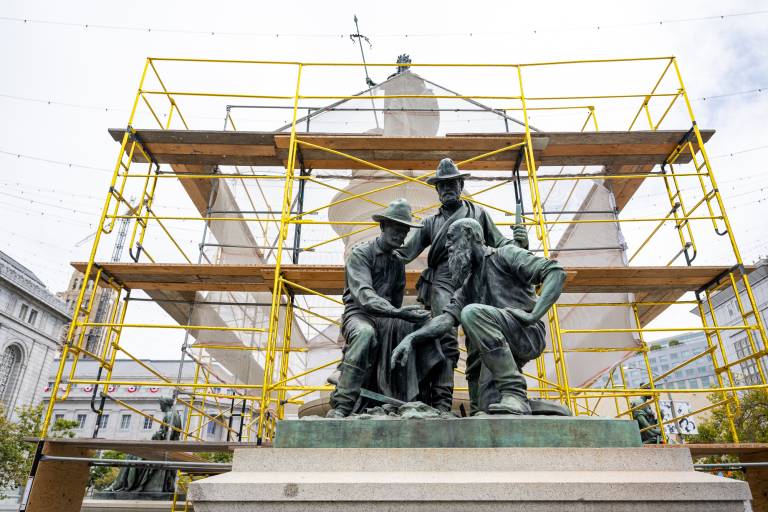
"caption": "Kaleb Duarte's 'Embassy of the Refugee' surrounds the 'Pioneer Monument' in San Francisco's Civic Center on July 6, 2026. The artwork uses scaffolding, plywood, netting and performance to highlight the experiences of undocumented migrants.",
"credit": "Beth LaBerge/KQED",
"altTag": "gold-covered scaffolding behind bronze statue of three miners",
"description": null,
"imgSizes": {
"thumbnail": {
"file": "https://cdn.kqed.org/wp-content/uploads/sites/2/2026/07/260706-StatuesinSFToppled-05-BL-160x107.jpg",
"width": 160,
"height": 107,
"mimeType": "image/jpeg"
},
"medium_large": {
"file": "https://cdn.kqed.org/wp-content/uploads/sites/2/2026/07/260706-StatuesinSFToppled-05-BL-768x512.jpg",
"width": 768,
"height": 512,
"mimeType": "image/jpeg"
},
"1536x1536": {
"file": "https://cdn.kqed.org/wp-content/uploads/sites/2/2026/07/260706-StatuesinSFToppled-05-BL-1536x1024.jpg",
"width": 1536,
"height": 1024,
"mimeType": "image/jpeg"
},
"post-thumbnail": {
"file": "https://cdn.kqed.org/wp-content/uploads/sites/2/2026/07/260706-StatuesinSFToppled-05-BL-672x372.jpg",
"width": 672,
"height": 372,
"mimeType": "image/jpeg"
},
"twentyfourteen-full-width": {
"file": "https://cdn.kqed.org/wp-content/uploads/sites/2/2026/07/260706-StatuesinSFToppled-05-BL-1038x576.jpg",
"width": 1038,
"height": 576,
"mimeType": "image/jpeg"
},
"npr-cds-wide": {
"file": "https://cdn.kqed.org/wp-content/uploads/sites/2/2026/07/260706-StatuesinSFToppled-05-BL-1200x675.jpg",
"width": 1200,
"height": 675,
"mimeType": "image/jpeg"
},
"npr-cds-square": {
"file": "https://cdn.kqed.org/wp-content/uploads/sites/2/2026/07/260706-StatuesinSFToppled-05-BL-600x600.jpg",
"width": 600,
"height": 600,
"mimeType": "image/jpeg"
},
"kqedFullSize": {
"file": "https://cdn.kqed.org/wp-content/uploads/sites/2/2026/07/260706-StatuesinSFToppled-05-BL.jpg",
"width": 2000,
"height": 1333
}
},
"isLoading": false,
"fetchFailed": false
},
"arts_13991304": {
"type": "attachments",
"id": "arts_13991304",
"meta": {
"index": "attachments_1716263798",
"site": "arts",
"id": "13991304",
"found": true
},
"title": "DAVID_AND_REED_BOWMAN",
"publishDate": 1783043880,
"status": "inherit",
"parent": 13991283,
"modified": 1783043988,
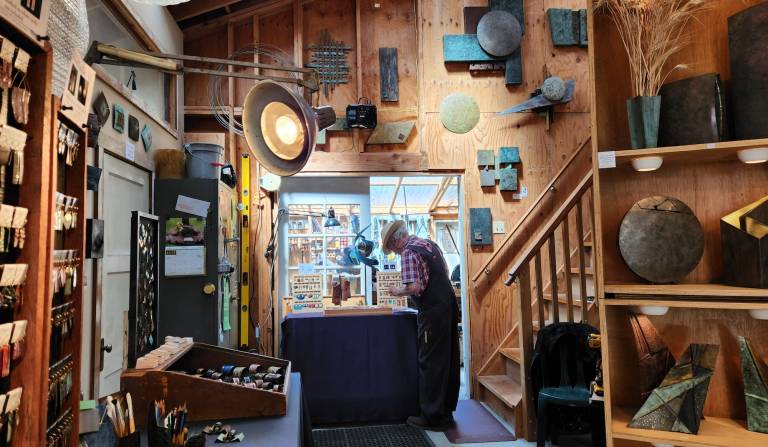
"caption": "The David M. Bowman Studio in Berkeley — one of 13 Bay Area studios opening their doors for National Craft Weekend.",
"credit": "Courtesy of David and Reed Bowman",
"altTag": "A white-haired man wearing coveralls and a checkered shirt stands looking closely at a table of displayed jewelry. He is inside a studio with wooden walls that are covered in abstract geometric art. Shelves of vases stand close to the camera, opposite a wall of neatly displayed earrings. To the right of the man are stairs leading up.",
"description": null,
"imgSizes": {
"thumbnail": {
"file": "https://cdn.kqed.org/wp-content/uploads/sites/2/2026/07/DAVID_AND_REED_BOWMAN-160x93.jpg",
"width": 160,
"height": 93,
"mimeType": "image/jpeg"
},
"medium_large": {
"file": "https://cdn.kqed.org/wp-content/uploads/sites/2/2026/07/DAVID_AND_REED_BOWMAN-768x447.jpg",
"width": 768,
"height": 447,
"mimeType": "image/jpeg"
},
"1536x1536": {
"file": "https://cdn.kqed.org/wp-content/uploads/sites/2/2026/07/DAVID_AND_REED_BOWMAN-1536x894.jpg",
"width": 1536,
"height": 894,
"mimeType": "image/jpeg"
},
"post-thumbnail": {
"file": "https://cdn.kqed.org/wp-content/uploads/sites/2/2026/07/DAVID_AND_REED_BOWMAN-672x372.jpg",
"width": 672,
"height": 372,
"mimeType": "image/jpeg"
},
"twentyfourteen-full-width": {
"file": "https://cdn.kqed.org/wp-content/uploads/sites/2/2026/07/DAVID_AND_REED_BOWMAN-1038x576.jpg",
"width": 1038,
"height": 576,
"mimeType": "image/jpeg"
},
"npr-cds-wide": {
"file": "https://cdn.kqed.org/wp-content/uploads/sites/2/2026/07/DAVID_AND_REED_BOWMAN-1200x675.jpg",
"width": 1200,
"height": 675,
"mimeType": "image/jpeg"
},
"npr-cds-square": {
"file": "https://cdn.kqed.org/wp-content/uploads/sites/2/2026/07/DAVID_AND_REED_BOWMAN-600x600.jpg",
"width": 600,
"height": 600,
"mimeType": "image/jpeg"
},
"kqedFullSize": {
"file": "https://cdn.kqed.org/wp-content/uploads/sites/2/2026/07/DAVID_AND_REED_BOWMAN.jpg",
"width": 2000,
"height": 1164
}
},
"isLoading": false,
"fetchFailed": false
},
"arts_13991258": {
"type": "attachments",
"id": "arts_13991258",
"meta": {
"index": "attachments_1716263798",
"site": "arts",
"id": "13991258",
"found": true
},
"title": "The Plenary_Illuminations_Credit_ Kathleen Sheffer_5",
"publishDate": 1782934483,
"status": "inherit",
"parent": 13991246,
"modified": 1782934616,
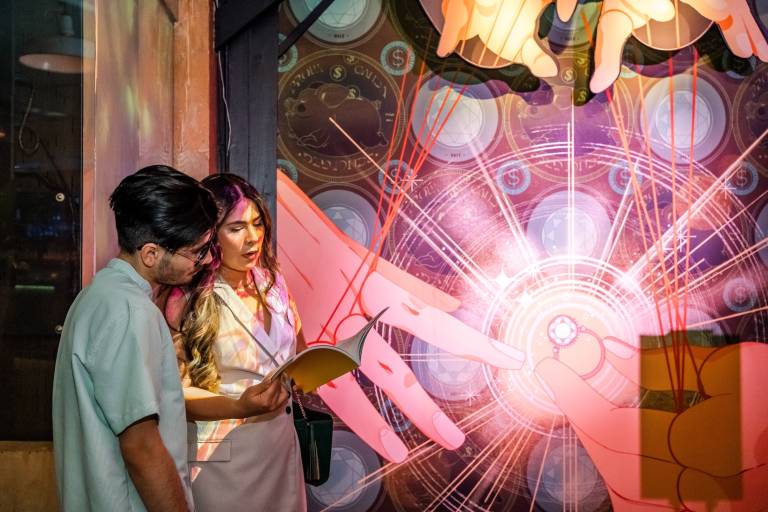
"caption": "The Plenary, Co., a nonprofit that uses art and science to inspire people to get involved in their communities, organized Future of Us Festival with a crew of interdisciplinary collaborators.",
"credit": "Kathleen Sheffer",
"altTag": null,
"description": null,
"imgSizes": {
"thumbnail": {
"file": "https://cdn.kqed.org/wp-content/uploads/sites/2/2026/07/The-Plenary_Illuminations_Credit_-Kathleen-Sheffer_5-160x107.jpg",
"width": 160,
"height": 107,
"mimeType": "image/jpeg"
},
"medium_large": {
"file": "https://cdn.kqed.org/wp-content/uploads/sites/2/2026/07/The-Plenary_Illuminations_Credit_-Kathleen-Sheffer_5-768x512.jpg",
"width": 768,
"height": 512,
"mimeType": "image/jpeg"
},
"1536x1536": {
"file": "https://cdn.kqed.org/wp-content/uploads/sites/2/2026/07/The-Plenary_Illuminations_Credit_-Kathleen-Sheffer_5-1536x1024.jpg",
"width": 1536,
"height": 1024,
"mimeType": "image/jpeg"
},
"post-thumbnail": {
"file": "https://cdn.kqed.org/wp-content/uploads/sites/2/2026/07/The-Plenary_Illuminations_Credit_-Kathleen-Sheffer_5-672x372.jpg",
"width": 672,
"height": 372,
"mimeType": "image/jpeg"
},
"twentyfourteen-full-width": {
"file": "https://cdn.kqed.org/wp-content/uploads/sites/2/2026/07/The-Plenary_Illuminations_Credit_-Kathleen-Sheffer_5-1038x576.jpg",
"width": 1038,
"height": 576,
"mimeType": "image/jpeg"
},
"npr-cds-wide": {
"file": "https://cdn.kqed.org/wp-content/uploads/sites/2/2026/07/The-Plenary_Illuminations_Credit_-Kathleen-Sheffer_5-1200x675.jpg",
"width": 1200,
"height": 675,
"mimeType": "image/jpeg"
},
"npr-cds-square": {
"file": "https://cdn.kqed.org/wp-content/uploads/sites/2/2026/07/The-Plenary_Illuminations_Credit_-Kathleen-Sheffer_5-600x600.jpg",
"width": 600,
"height": 600,
"mimeType": "image/jpeg"
},
"kqedFullSize": {
"file": "https://cdn.kqed.org/wp-content/uploads/sites/2/2026/07/The-Plenary_Illuminations_Credit_-Kathleen-Sheffer_5.jpg",
"width": 2000,
"height": 1333
}
},
"isLoading": false,
"fetchFailed": false
},
"arts_13990924": {
"type": "attachments",
"id": "arts_13990924",
"meta": {
"index": "attachments_1716263798",
"site": "arts",
"id": "13990924",
"found": true
},
"title": "1977_2021_HASSINGER_Tree-Duet-I_2000",
"publishDate": 1781829373,
"status": "inherit",
"parent": 13990908,
"modified": 1781830674,
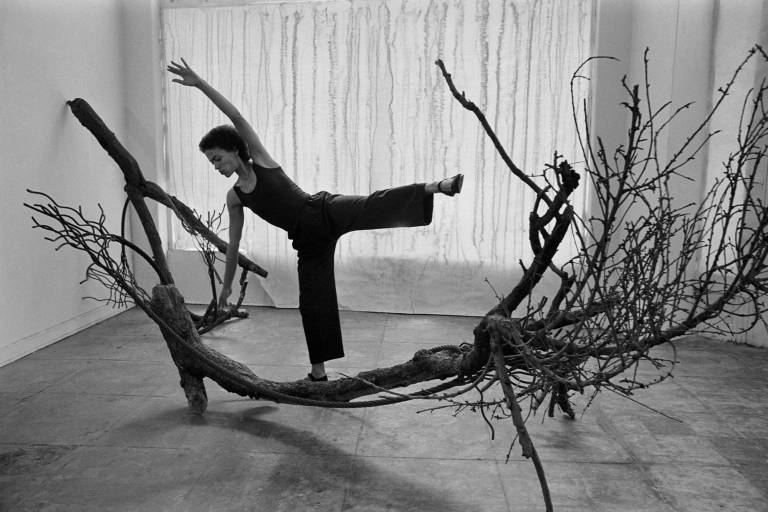
"caption": "Maren Hassinger, documentation of performance 'Tree Duet I,' at 5617 San Vicente Blvd., Los Angeles, c. 1974.",
"credit": "Courtesy of Susan Inglett Gallery, NYC; Photo by Adam Avila",
"altTag": "black-and-white image of Black woman posing with leg and arm raised to mimic large tree branch she stands on",
"description": null,
"imgSizes": {
"thumbnail": {
"file": "https://cdn.kqed.org/wp-content/uploads/sites/2/2026/06/1977_2021_HASSINGER_Tree-Duet-I_2000-160x107.jpg",
"width": 160,
"height": 107,
"mimeType": "image/jpeg"
},
"medium_large": {
"file": "https://cdn.kqed.org/wp-content/uploads/sites/2/2026/06/1977_2021_HASSINGER_Tree-Duet-I_2000-768x512.jpg",
"width": 768,
"height": 512,
"mimeType": "image/jpeg"
},
"1536x1536": {
"file": "https://cdn.kqed.org/wp-content/uploads/sites/2/2026/06/1977_2021_HASSINGER_Tree-Duet-I_2000-1536x1024.jpg",
"width": 1536,
"height": 1024,
"mimeType": "image/jpeg"
},
"post-thumbnail": {
"file": "https://cdn.kqed.org/wp-content/uploads/sites/2/2026/06/1977_2021_HASSINGER_Tree-Duet-I_2000-672x372.jpg",
"width": 672,
"height": 372,
"mimeType": "image/jpeg"
},
"twentyfourteen-full-width": {
"file": "https://cdn.kqed.org/wp-content/uploads/sites/2/2026/06/1977_2021_HASSINGER_Tree-Duet-I_2000-1038x576.jpg",
"width": 1038,
"height": 576,
"mimeType": "image/jpeg"
},
"npr-cds-wide": {
"file": "https://cdn.kqed.org/wp-content/uploads/sites/2/2026/06/1977_2021_HASSINGER_Tree-Duet-I_2000-1200x675.jpg",
"width": 1200,
"height": 675,
"mimeType": "image/jpeg"
},
"npr-cds-square": {
"file": "https://cdn.kqed.org/wp-content/uploads/sites/2/2026/06/1977_2021_HASSINGER_Tree-Duet-I_2000-600x600.jpg",
"width": 600,
"height": 600,
"mimeType": "image/jpeg"
},
"kqedFullSize": {
"file": "https://cdn.kqed.org/wp-content/uploads/sites/2/2026/06/1977_2021_HASSINGER_Tree-Duet-I_2000.jpg",
"width": 2000,
"height": 1333
}
},
"isLoading": false,
"fetchFailed": false
},
"arts_13990886": {
"type": "attachments",
"id": "arts_13990886",
"meta": {
"index": "attachments_1716263798",
"site": "arts",
"id": "13990886",
"found": true
},
"title": "260617-LADYPINKCLARIONALLEY00318_TV-KQED",
"publishDate": 1781812645,
"status": "inherit",
"parent": 0,
"modified": 1781812705,
"caption": "Carey Deeter from the Graffiti Camp for Girls collaborates on a sketch design for a graffiti art piece on Clarion Alley in San Francisco on June 17, 2026.",
"credit": "Tâm Vũ/KQED",
"altTag": null,
"description": null,
"imgSizes": {
"thumbnail": {
"file": "https://cdn.kqed.org/wp-content/uploads/sites/2/2026/06/260617-LADYPINKCLARIONALLEY00318_TV-KQED-160x107.jpg",
"width": 160,
"height": 107,
"mimeType": "image/jpeg"
},
"medium_large": {
"file": "https://cdn.kqed.org/wp-content/uploads/sites/2/2026/06/260617-LADYPINKCLARIONALLEY00318_TV-KQED-768x512.jpg",
"width": 768,
"height": 512,
"mimeType": "image/jpeg"
},
"1536x1536": {
"file": "https://cdn.kqed.org/wp-content/uploads/sites/2/2026/06/260617-LADYPINKCLARIONALLEY00318_TV-KQED-1536x1024.jpg",
"width": 1536,
"height": 1024,
"mimeType": "image/jpeg"
},
"post-thumbnail": {
"file": "https://cdn.kqed.org/wp-content/uploads/sites/2/2026/06/260617-LADYPINKCLARIONALLEY00318_TV-KQED-672x372.jpg",
"width": 672,
"height": 372,
"mimeType": "image/jpeg"
},
"twentyfourteen-full-width": {
"file": "https://cdn.kqed.org/wp-content/uploads/sites/2/2026/06/260617-LADYPINKCLARIONALLEY00318_TV-KQED-1038x576.jpg",
"width": 1038,
"height": 576,
"mimeType": "image/jpeg"
},
"npr-cds-wide": {
"file": "https://cdn.kqed.org/wp-content/uploads/sites/2/2026/06/260617-LADYPINKCLARIONALLEY00318_TV-KQED-1200x675.jpg",
"width": 1200,
"height": 675,
"mimeType": "image/jpeg"
},
"npr-cds-square": {
"file": "https://cdn.kqed.org/wp-content/uploads/sites/2/2026/06/260617-LADYPINKCLARIONALLEY00318_TV-KQED-600x600.jpg",
"width": 600,
"height": 600,
"mimeType": "image/jpeg"
},
"kqedFullSize": {
"file": "https://cdn.kqed.org/wp-content/uploads/sites/2/2026/06/260617-LADYPINKCLARIONALLEY00318_TV-KQED.jpg",
"width": 2000,
"height": 1333
}
},
"isLoading": false,
"fetchFailed": false
},
"arts_13990844": {
"type": "attachments",
"id": "arts_13990844",
"meta": {
"index": "attachments_1716263798",
"site": "arts",
"id": "13990844",
"found": true
},
"title": "The-Dome-Space_2_2000",
"publishDate": 1781722488,
"status": "inherit",
"parent": 13990843,
"modified": 1781722820,
"caption": "An artist in the early days of The Dome.",
"credit": "Photo by Marilyn Levine; courtesy of Clay Jensen",
"altTag": "old snapshot of smiling woman in large material-filled studio space, piano in foreground",
"description": null,
"imgSizes": {
"thumbnail": {
"file": "https://cdn.kqed.org/wp-content/uploads/sites/2/2026/06/The-Dome-Space_2_2000-160x108.jpg",
"width": 160,
"height": 108,
"mimeType": "image/jpeg"
},
"medium_large": {
"file": "https://cdn.kqed.org/wp-content/uploads/sites/2/2026/06/The-Dome-Space_2_2000-768x517.jpg",
"width": 768,
"height": 517,
"mimeType": "image/jpeg"
},
"1536x1536": {
"file": "https://cdn.kqed.org/wp-content/uploads/sites/2/2026/06/The-Dome-Space_2_2000-1536x1034.jpg",
"width": 1536,
"height": 1034,
"mimeType": "image/jpeg"
},
"post-thumbnail": {
"file": "https://cdn.kqed.org/wp-content/uploads/sites/2/2026/06/The-Dome-Space_2_2000-672x372.jpg",
"width": 672,
"height": 372,
"mimeType": "image/jpeg"
},
"twentyfourteen-full-width": {
"file": "https://cdn.kqed.org/wp-content/uploads/sites/2/2026/06/The-Dome-Space_2_2000-1038x576.jpg",
"width": 1038,
"height": 576,
"mimeType": "image/jpeg"
},
"npr-cds-wide": {
"file": "https://cdn.kqed.org/wp-content/uploads/sites/2/2026/06/The-Dome-Space_2_2000-1200x675.jpg",
"width": 1200,
"height": 675,
"mimeType": "image/jpeg"
},
"npr-cds-square": {
"file": "https://cdn.kqed.org/wp-content/uploads/sites/2/2026/06/The-Dome-Space_2_2000-600x600.jpg",
"width": 600,
"height": 600,
"mimeType": "image/jpeg"
},
"kqedFullSize": {
"file": "https://cdn.kqed.org/wp-content/uploads/sites/2/2026/06/The-Dome-Space_2_2000.jpg",
"width": 2000,
"height": 1346
}
},
"isLoading": false,
"fetchFailed": false
},
"arts_13990737": {
"type": "attachments",
"id": "arts_13990737",
"meta": {
"index": "attachments_1716263798",
"site": "arts",
"id": "13990737",
"found": true
},
"title": "AP26163354537272",
"publishDate": 1781277971,
"status": "inherit",
"parent": 13990732,
"modified": 1781278039,
"caption": "British artist David Hockney poses as he unveils his painting 'Bigger Trees Near Water', the largest painting ever shown at the Royal Academy's Summer Exhibition, London, Friday, May 25, 2007. ",
"credit": "AP Photo/Sang Tan",
"altTag": "A man in a suit leans on a cane in front of a painting of trees",
"description": null,
"imgSizes": {
"thumbnail": {
"file": "https://cdn.kqed.org/wp-content/uploads/sites/2/2026/06/AP26163354537272-160x103.jpg",
"width": 160,
"height": 103,
"mimeType": "image/jpeg"
},
"medium_large": {
"file": "https://cdn.kqed.org/wp-content/uploads/sites/2/2026/06/AP26163354537272-768x496.jpg",
"width": 768,
"height": 496,
"mimeType": "image/jpeg"
},
"1536x1536": {
"file": "https://cdn.kqed.org/wp-content/uploads/sites/2/2026/06/AP26163354537272-1536x991.jpg",
"width": 1536,
"height": 991,
"mimeType": "image/jpeg"
},
"post-thumbnail": {
"file": "https://cdn.kqed.org/wp-content/uploads/sites/2/2026/06/AP26163354537272-672x372.jpg",
"width": 672,
"height": 372,
"mimeType": "image/jpeg"
},
"twentyfourteen-full-width": {
"file": "https://cdn.kqed.org/wp-content/uploads/sites/2/2026/06/AP26163354537272-1038x576.jpg",
"width": 1038,
"height": 576,
"mimeType": "image/jpeg"
},
"npr-cds-wide": {
"file": "https://cdn.kqed.org/wp-content/uploads/sites/2/2026/06/AP26163354537272-1200x675.jpg",
"width": 1200,
"height": 675,
"mimeType": "image/jpeg"
},
"npr-cds-square": {
"file": "https://cdn.kqed.org/wp-content/uploads/sites/2/2026/06/AP26163354537272-600x600.jpg",
"width": 600,
"height": 600,
"mimeType": "image/jpeg"
},
"kqedFullSize": {
"file": "https://cdn.kqed.org/wp-content/uploads/sites/2/2026/06/AP26163354537272.jpg",
"width": 2000,
"height": 1291
}
},
"isLoading": false,
"fetchFailed": false
},
"arts_13990571": {
"type": "attachments",
"id": "arts_13990571",
"meta": {
"index": "attachments_1716263798",
"site": "arts",
"id": "13990571",
"found": true
},
"title": "20260605_SCRAPNewBuilding_GC-12_qed",
"publishDate": 1780971973,
"status": "inherit",
"parent": 0,
"modified": 1780973893,
"caption": "From left, William Barros, depot manager, and Danielle Grant, managing director, pose for a photo in front of SCRAP’s new location on June 5, 2026.",
"credit": "Gina Castro for KQED",
"altTag": "two people stand behind chainlink fence with \"scrap\" sign",
"description": null,
"imgSizes": {
"thumbnail": {
"file": "https://cdn.kqed.org/wp-content/uploads/sites/2/2026/06/20260605_SCRAPNewBuilding_GC-12_qed-160x107.jpg",
"width": 160,
"height": 107,
"mimeType": "image/jpeg"
},
"medium_large": {
"file": "https://cdn.kqed.org/wp-content/uploads/sites/2/2026/06/20260605_SCRAPNewBuilding_GC-12_qed-768x512.jpg",
"width": 768,
"height": 512,
"mimeType": "image/jpeg"
},
"1536x1536": {
"file": "https://cdn.kqed.org/wp-content/uploads/sites/2/2026/06/20260605_SCRAPNewBuilding_GC-12_qed-1536x1024.jpg",
"width": 1536,
"height": 1024,
"mimeType": "image/jpeg"
},
"post-thumbnail": {
"file": "https://cdn.kqed.org/wp-content/uploads/sites/2/2026/06/20260605_SCRAPNewBuilding_GC-12_qed-672x372.jpg",
"width": 672,
"height": 372,
"mimeType": "image/jpeg"
},
"twentyfourteen-full-width": {
"file": "https://cdn.kqed.org/wp-content/uploads/sites/2/2026/06/20260605_SCRAPNewBuilding_GC-12_qed-1038x576.jpg",
"width": 1038,
"height": 576,
"mimeType": "image/jpeg"
},
"npr-cds-wide": {
"file": "https://cdn.kqed.org/wp-content/uploads/sites/2/2026/06/20260605_SCRAPNewBuilding_GC-12_qed-1200x675.jpg",
"width": 1200,
"height": 675,
"mimeType": "image/jpeg"
},
"npr-cds-square": {
"file": "https://cdn.kqed.org/wp-content/uploads/sites/2/2026/06/20260605_SCRAPNewBuilding_GC-12_qed-600x600.jpg",
"width": 600,
"height": 600,
"mimeType": "image/jpeg"
},
"kqedFullSize": {
"file": "https://cdn.kqed.org/wp-content/uploads/sites/2/2026/06/20260605_SCRAPNewBuilding_GC-12_qed.jpg",
"width": 2000,
"height": 1333
}
},
"isLoading": false,
"fetchFailed": false
},
"arts_13989977": {
"type": "attachments",
"id": "arts_13989977",
"meta": {
"index": "attachments_1716263798",
"site": "arts",
"id": "13989977",
"found": true
},
"title": "01_Santa-Cruz-(Holy-Cross)_2000",
"publishDate": 1779231223,
"status": "inherit",
"parent": 13989957,
"modified": 1779231348,
"caption": "Incocenio Jiménez Chino, 'Santa Cruz (Holy Cross),' 1970; acrylic on handmade amate, 17 x 25 inches.",
"credit": "Courtesy of Denise Padovani & Stephen Heafey",
"altTag": "detailed drawing of people processing through village, colorful touches",
"description": null,
"imgSizes": {
"thumbnail": {
"file": "https://cdn.kqed.org/wp-content/uploads/sites/2/2026/05/01_Santa-Cruz-Holy-Cross_2000-160x108.jpg",
"width": 160,
"height": 108,
"mimeType": "image/jpeg"
},
"medium_large": {
"file": "https://cdn.kqed.org/wp-content/uploads/sites/2/2026/05/01_Santa-Cruz-Holy-Cross_2000-768x516.jpg",
"width": 768,
"height": 516,
"mimeType": "image/jpeg"
},
"1536x1536": {
"file": "https://cdn.kqed.org/wp-content/uploads/sites/2/2026/05/01_Santa-Cruz-Holy-Cross_2000-1536x1032.jpg",
"width": 1536,
"height": 1032,
"mimeType": "image/jpeg"
},
"post-thumbnail": {
"file": "https://cdn.kqed.org/wp-content/uploads/sites/2/2026/05/01_Santa-Cruz-Holy-Cross_2000-672x372.jpg",
"width": 672,
"height": 372,
"mimeType": "image/jpeg"
},
"twentyfourteen-full-width": {
"file": "https://cdn.kqed.org/wp-content/uploads/sites/2/2026/05/01_Santa-Cruz-Holy-Cross_2000-1038x576.jpg",
"width": 1038,
"height": 576,
"mimeType": "image/jpeg"
},
"npr-cds-wide": {
"file": "https://cdn.kqed.org/wp-content/uploads/sites/2/2026/05/01_Santa-Cruz-Holy-Cross_2000-1200x675.jpg",
"width": 1200,
"height": 675,
"mimeType": "image/jpeg"
},
"npr-cds-square": {
"file": "https://cdn.kqed.org/wp-content/uploads/sites/2/2026/05/01_Santa-Cruz-Holy-Cross_2000-600x600.jpg",
"width": 600,
"height": 600,
"mimeType": "image/jpeg"
},
"kqedFullSize": {
"file": "https://cdn.kqed.org/wp-content/uploads/sites/2/2026/05/01_Santa-Cruz-Holy-Cross_2000.jpg",
"width": 2000,
"height": 1344
}
},
"isLoading": false,
"fetchFailed": false
},
"arts_13989585": {
"type": "attachments",
"id": "arts_13989585",
"meta": {
"index": "attachments_1716263798",
"site": "arts",
"id": "13989585",
"found": true
},
"title": "FT-NDT-04_2000",
"publishDate": 1778719218,
"status": "inherit",
"parent": 13989580,
"modified": 1778719793,
"caption": "Grupo Artista Telar Maya Mam, who will show woven textiles, tools of backstrap weaving, photography and installation at EastSide Art Alliance.",
"credit": "Photo by Scott Tsuchitani; Courtesy of NAKA Dance Theater",
"altTag": "group of women laying down with heads together, wearing embroidered colorful shirts",
"description": null,
"imgSizes": {
"thumbnail": {
"file": "https://cdn.kqed.org/wp-content/uploads/sites/2/2026/05/FT-NDT-04_2000-160x128.jpg",
"width": 160,
"height": 128,
"mimeType": "image/jpeg"
},
"medium_large": {
"file": "https://cdn.kqed.org/wp-content/uploads/sites/2/2026/05/FT-NDT-04_2000-768x614.jpg",
"width": 768,
"height": 614,
"mimeType": "image/jpeg"
},
"1536x1536": {
"file": "https://cdn.kqed.org/wp-content/uploads/sites/2/2026/05/FT-NDT-04_2000-1536x1229.jpg",
"width": 1536,
"height": 1229,
"mimeType": "image/jpeg"
},
"post-thumbnail": {
"file": "https://cdn.kqed.org/wp-content/uploads/sites/2/2026/05/FT-NDT-04_2000-672x372.jpg",
"width": 672,
"height": 372,
"mimeType": "image/jpeg"
},
"twentyfourteen-full-width": {
"file": "https://cdn.kqed.org/wp-content/uploads/sites/2/2026/05/FT-NDT-04_2000-1038x576.jpg",
"width": 1038,
"height": 576,
"mimeType": "image/jpeg"
},
"npr-cds-wide": {
"file": "https://cdn.kqed.org/wp-content/uploads/sites/2/2026/05/FT-NDT-04_2000-1200x675.jpg",
"width": 1200,
"height": 675,
"mimeType": "image/jpeg"
},
"npr-cds-square": {
"file": "https://cdn.kqed.org/wp-content/uploads/sites/2/2026/05/FT-NDT-04_2000-600x600.jpg",
"width": 600,
"height": 600,
"mimeType": "image/jpeg"
},
"kqedFullSize": {
"file": "https://cdn.kqed.org/wp-content/uploads/sites/2/2026/05/FT-NDT-04_2000.jpg",
"width": 2000,
"height": 1600
}
},
"isLoading": false,
"fetchFailed": false
},
"arts_13989488": {
"type": "attachments",
"id": "arts_13989488",
"meta": {
"index": "attachments_1716263798",
"site": "arts",
"id": "13989488",
"found": true
},
"title": "IMG_4177-cropped",
"publishDate": 1778605064,
"status": "inherit",
"parent": 13989428,
"modified": 1778605178,
"caption": "The cover of ‘Love Conquers All’ by Janell Grace and Malik Glass, illustrated by Eli Beaird. ",
"credit": "Courtesy of Love Conquers All",
"altTag": null,
"description": null,
"imgSizes": {
"thumbnail": {
"file": "https://cdn.kqed.org/wp-content/uploads/sites/2/2026/05/IMG_4177-cropped-160x90.jpg",
"width": 160,
"height": 90,
"mimeType": "image/jpeg"
},
"medium_large": {
"file": "https://cdn.kqed.org/wp-content/uploads/sites/2/2026/05/IMG_4177-cropped-768x432.jpg",
"width": 768,
"height": 432,
"mimeType": "image/jpeg"
},
"post-thumbnail": {
"file": "https://cdn.kqed.org/wp-content/uploads/sites/2/2026/05/IMG_4177-cropped-672x372.jpg",
"width": 672,
"height": 372,
"mimeType": "image/jpeg"
},
"npr-cds-square": {
"file": "https://cdn.kqed.org/wp-content/uploads/sites/2/2026/05/IMG_4177-cropped-600x466.jpg",
"width": 600,
"height": 466,
"mimeType": "image/jpeg"
},
"kqedFullSize": {
"file": "https://cdn.kqed.org/wp-content/uploads/sites/2/2026/05/IMG_4177-cropped.jpg",
"width": 828,
"height": 466
}
},
"isLoading": false,
"fetchFailed": false
},
"arts_13989242": {
"type": "attachments",
"id": "arts_13989242",
"meta": {
"index": "attachments_1716263798",
"site": "arts",
"id": "13989242",
"found": true
},
"title": "02-FG_Slice-of-the-Pie_Larry-Sultan_Untitled-from-the-seriest-Swimers,-1978-82_2000",
"publishDate": 1778130051,
"status": "inherit",
"parent": 13989193,
"modified": 1778130119,
"caption": "Larry Sultan, 'Untitled,' from the series 'Swimmers,' 1978–82;\npigment print.",
"credit": "Courtesy Casemore Gallery and Estate of Larry Sultan",
"altTag": "underwater image of adult arms and swimming child",
"description": null,
"imgSizes": {
"thumbnail": {
"file": "https://cdn.kqed.org/wp-content/uploads/sites/2/2026/05/02-FG_Slice-of-the-Pie_Larry-Sultan_Untitled-from-the-seriest-Swimers-1978-82_2000-160x103.jpg",
"width": 160,
"height": 103,
"mimeType": "image/jpeg"
},
"medium_large": {
"file": "https://cdn.kqed.org/wp-content/uploads/sites/2/2026/05/02-FG_Slice-of-the-Pie_Larry-Sultan_Untitled-from-the-seriest-Swimers-1978-82_2000-768x497.jpg",
"width": 768,
"height": 497,
"mimeType": "image/jpeg"
},
"1536x1536": {
"file": "https://cdn.kqed.org/wp-content/uploads/sites/2/2026/05/02-FG_Slice-of-the-Pie_Larry-Sultan_Untitled-from-the-seriest-Swimers-1978-82_2000-1536x993.jpg",
"width": 1536,
"height": 993,
"mimeType": "image/jpeg"
},
"post-thumbnail": {
"file": "https://cdn.kqed.org/wp-content/uploads/sites/2/2026/05/02-FG_Slice-of-the-Pie_Larry-Sultan_Untitled-from-the-seriest-Swimers-1978-82_2000-672x372.jpg",
"width": 672,
"height": 372,
"mimeType": "image/jpeg"
},
"twentyfourteen-full-width": {
"file": "https://cdn.kqed.org/wp-content/uploads/sites/2/2026/05/02-FG_Slice-of-the-Pie_Larry-Sultan_Untitled-from-the-seriest-Swimers-1978-82_2000-1038x576.jpg",
"width": 1038,
"height": 576,
"mimeType": "image/jpeg"
},
"npr-cds-wide": {
"file": "https://cdn.kqed.org/wp-content/uploads/sites/2/2026/05/02-FG_Slice-of-the-Pie_Larry-Sultan_Untitled-from-the-seriest-Swimers-1978-82_2000-1200x675.jpg",
"width": 1200,
"height": 675,
"mimeType": "image/jpeg"
},
"npr-cds-square": {
"file": "https://cdn.kqed.org/wp-content/uploads/sites/2/2026/05/02-FG_Slice-of-the-Pie_Larry-Sultan_Untitled-from-the-seriest-Swimers-1978-82_2000-600x600.jpg",
"width": 600,
"height": 600,
"mimeType": "image/jpeg"
},
"kqedFullSize": {
"file": "https://cdn.kqed.org/wp-content/uploads/sites/2/2026/05/02-FG_Slice-of-the-Pie_Larry-Sultan_Untitled-from-the-seriest-Swimers-1978-82_2000.jpg",
"width": 2000,
"height": 1293
}
},
"isLoading": false,
"fetchFailed": false
}
},
"audioPlayerReducer": {
"postId": "stream_live",
"isPaused": true,
"isPlaying": false,
"pfsActive": false,
"pledgeModalIsOpen": true,
"playerDrawerIsOpen": false,
"liveAudioPlayStartedAt": 0,
"liveAudioPlayContext": ""
},
"authorsReducer": {
"byline_arts_13990732": {
"type": "authors",
"id": "byline_arts_13990732",
"meta": {
"override": true
},
"slug": "byline_arts_13990732",
"name": "Jill Lawless, Associated Press",
"isLoading": false
},
"byline_arts_13989957": {
"type": "authors",
"id": "byline_arts_13989957",
"meta": {
"override": true
},
"slug": "byline_arts_13989957",
"name": "Brian Karl",
"isLoading": false
},
"shotchkiss": {
"type": "authors",
"id": "61",
"meta": {
"index": "authors_1716337520",
"id": "61",
"found": true
},
"name": "Sarah Hotchkiss",
"firstName": "Sarah",
"lastName": "Hotchkiss",
"slug": "shotchkiss",
"email": "shotchkiss@kqed.org",
"display_author_email": true,
"staff_mastheads": [
"arts"
],
"title": "Senior Editor",
"bio": "Sarah Hotchkiss is a San Francisco \u003ca href=\"http://www.sarahhotchkiss.com\">artist\u003c/a> and arts writer. In 2019, she received the Dorothea & Leo Rabkin Foundation grant for visual art journalism and in 2020 she received a Society of Professional Journalists, Northern California award for excellence in arts and culture reporting.",
"avatar": "https://secure.gravatar.com/avatar/bc662df144b3d27fd8b1b6f1c2a420d34e91e53154d411bb7ad353cc8b6cea8d?s=600&d=blank&r=g",
"twitter": null,
"bluesky": null,
"facebook": null,
"instagram": null,
"linkedin": null,
"sites": [
{
"site": "",
"roles": [
"editor"
]
},
{
"site": "arts",
"roles": [
"Contributor",
"administrator"
]
},
{
"site": "artschool",
"roles": [
"administrator"
]
},
{
"site": "news",
"roles": [
"editor"
]
},
{
"site": "pop",
"roles": [
"administrator"
]
},
{
"site": "bayareabites",
"roles": [
"editor"
]
},
{
"site": "spark",
"roles": [
"editor"
]
},
{
"site": "checkplease",
"roles": [
"editor"
]
}
],
"headData": {
"title": "Sarah Hotchkiss | KQED",
"description": "Senior Editor",
"ogImgSrc": "https://secure.gravatar.com/avatar/bc662df144b3d27fd8b1b6f1c2a420d34e91e53154d411bb7ad353cc8b6cea8d?s=600&d=blank&r=g",
"twImgSrc": "https://secure.gravatar.com/avatar/bc662df144b3d27fd8b1b6f1c2a420d34e91e53154d411bb7ad353cc8b6cea8d?s=600&d=blank&r=g"
},
"isLoading": false,
"link": "/author/shotchkiss"
},
"ralexandra": {
"type": "authors",
"id": "11242",
"meta": {
"index": "authors_1716337520",
"id": "11242",
"found": true
},
"name": "Rae Alexandra",
"firstName": "Rae",
"lastName": "Alexandra",
"slug": "ralexandra",
"email": "ralexandra@kqed.org",
"display_author_email": true,
"staff_mastheads": [],
"title": "Reporter/Producer",
"bio": "Rae Alexandra is a Reporter/Producer for KQED Arts & Culture, and the creator/author of the \u003ca href=\"https://www.kqed.org/arts/program/rebel-girls-from-bay-area-history\">Rebel Girls From Bay Area History\u003c/a> and \u003ca href=\"https://www.kqed.org/bizarrebayarea\">Bizarre Bay Area\u003c/a> series. Her debut book, \u003ca href=\"https://citylights.com/politics-current-events-history/unsung-heroines35-women-who-changed/\">Unsung Heroines: 35 Women Who Changed the Bay Area\u003c/a> was published by City Lights in March 2026. In 2023, Rae was awarded an SPJ Excellence in Journalism Award for Arts & Culture. Rae was born and raised in Wales and subsequently — even after two decades in Northern California — still uses phrases that regularly baffle her coworkers.",
"avatar": "https://secure.gravatar.com/avatar/edfee8176c80cc0a382b051190f5341997df378a934a5774dcb0977732dfd401?s=600&d=blank&r=g",
"twitter": null,
"bluesky": null,
"facebook": null,
"instagram": null,
"linkedin": null,
"sites": [
{
"site": "arts",
"roles": [
"subscriber"
]
},
{
"site": "news",
"roles": [
"subscriber"
]
},
{
"site": "pop",
"roles": [
"subscriber"
]
},
{
"site": "bayareabites",
"roles": [
"subscriber"
]
},
{
"site": "science",
"roles": [
"subscriber"
]
}
],
"headData": {
"title": "Rae Alexandra | KQED",
"description": "Reporter/Producer",
"ogImgSrc": "https://secure.gravatar.com/avatar/edfee8176c80cc0a382b051190f5341997df378a934a5774dcb0977732dfd401?s=600&d=blank&r=g",
"twImgSrc": "https://secure.gravatar.com/avatar/edfee8176c80cc0a382b051190f5341997df378a934a5774dcb0977732dfd401?s=600&d=blank&r=g"
},
"isLoading": false,
"link": "/author/ralexandra"
},
"nvoynovskaya": {
"type": "authors",
"id": "11387",
"meta": {
"index": "authors_1716337520",
"id": "11387",
"found": true
},
"name": "Nastia Voynovskaya",
"firstName": "Nastia",
"lastName": "Voynovskaya",
"slug": "nvoynovskaya",
"email": "nvoynovskaya@kqed.org",
"display_author_email": false,
"staff_mastheads": [
"arts"
],
"title": "Editor and reporter",
"bio": "Nastia Voynovskaya is a reporter, editor and host at KQED Arts & Culture. She's been covering the arts in the Bay Area for over a decade, with a focus on music, queer culture, labor issues and grassroots organizing. She has edited KQED story series such as Trans Bay: A History of San Francisco's Gender-Diverse Community, and co-created KQED's Bay Area hip-hop history project, That's My Word. Nastia's work has been recognized by the Society of Professional Journalists and San Francisco Press Club. She regularly appears on podcasts and radio programs, including NPR's All Songs Considered, and hosts live events where music, culture and conversation meet.",
"avatar": "https://secure.gravatar.com/avatar/5025ee460e5a85d69ca20ea6c6f2f80d7e17795c828f61ea3aecfcd924e9042e?s=600&d=blank&r=g",
"twitter": null,
"bluesky": null,
"facebook": null,
"instagram": "https://www.instagram.com/nananastia/",
"linkedin": null,
"sites": [
{
"site": "",
"roles": [
"editor"
]
},
{
"site": "arts",
"roles": [
"administrator"
]
},
{
"site": "news",
"roles": [
"editor"
]
},
{
"site": "pop",
"roles": [
"administrator"
]
},
{
"site": "bayareabites",
"roles": [
"editor"
]
},
{
"site": "podcasts",
"roles": [
"editor"
]
},
{
"site": "hiphop",
"roles": [
"editor"
]
}
],
"headData": {
"title": "Nastia Voynovskaya | KQED",
"description": "Editor and reporter",
"ogImgSrc": "https://secure.gravatar.com/avatar/5025ee460e5a85d69ca20ea6c6f2f80d7e17795c828f61ea3aecfcd924e9042e?s=600&d=blank&r=g",
"twImgSrc": "https://secure.gravatar.com/avatar/5025ee460e5a85d69ca20ea6c6f2f80d7e17795c828f61ea3aecfcd924e9042e?s=600&d=blank&r=g"
},
"isLoading": false,
"link": "/author/nvoynovskaya"
},
"mblue": {
"type": "authors",
"id": "11917",
"meta": {
"index": "authors_1716337520",
"id": "11917",
"found": true
},
"name": "Max Blue",
"firstName": "Max",
"lastName": "Blue",
"slug": "mblue",
"email": "maxbluewriter@gmail.com",
"display_author_email": false,
"staff_mastheads": [],
"title": "KQED Contributor",
"bio": "Max Blue has contributed art criticism and reporting to Artsy, Cultured and Hyperallergic, among others. His short fiction has appeared in The MacGuffin and North Dakota Quarterly, among others. He lives in San Francisco.",
"avatar": "https://secure.gravatar.com/avatar/cf3bc08316ae54aaf34b606edc5721301b3306703234df5bee49a54e69d29843?s=600&d=blank&r=g",
"twitter": null,
"bluesky": null,
"facebook": null,
"instagram": "maxblueofficial",
"linkedin": null,
"sites": [
{
"site": "arts",
"roles": [
"contributor"
]
}
],
"headData": {
"title": "Max Blue | KQED",
"description": "KQED Contributor",
"ogImgSrc": "https://secure.gravatar.com/avatar/cf3bc08316ae54aaf34b606edc5721301b3306703234df5bee49a54e69d29843?s=600&d=blank&r=g",
"twImgSrc": "https://secure.gravatar.com/avatar/cf3bc08316ae54aaf34b606edc5721301b3306703234df5bee49a54e69d29843?s=600&d=blank&r=g"
},
"isLoading": false,
"link": "/author/mblue"
},
"jmelido": {
"type": "authors",
"id": "11972",
"meta": {
"index": "authors_1716337520",
"id": "11972",
"found": true
},
"name": "Janea Melido",
"firstName": "Janea",
"lastName": "Melido",
"slug": "jmelido",
"email": "jmelido@kqed.org",
"display_author_email": true,
"staff_mastheads": [
"arts"
],
"title": "Contributor, KQED Arts & Culture",
"bio": "Janea Melido holds a Bachelor of Arts in English and minor in Ethnic Studies from the University of Portland. She's drawn to the quiet power of everyday stories, especially ones that often go overlooked. When she's not reporting, she enjoys cutting up her old print stories and making collages out of them. She served as an intern for KQED Arts & Culture in 2025–26.",
"avatar": "https://secure.gravatar.com/avatar/a29821c5951064ade16b01245ce4604a599e1d4609df1ff590a8de6c7728826a?s=600&d=blank&r=g",
"twitter": null,
"bluesky": null,
"facebook": null,
"instagram": null,
"linkedin": null,
"sites": [
{
"site": "arts",
"roles": [
"contributor"
]
}
],
"headData": {
"title": "Janea Melido | KQED",
"description": "Contributor, KQED Arts & Culture",
"ogImgSrc": "https://secure.gravatar.com/avatar/a29821c5951064ade16b01245ce4604a599e1d4609df1ff590a8de6c7728826a?s=600&d=blank&r=g",
"twImgSrc": "https://secure.gravatar.com/avatar/a29821c5951064ade16b01245ce4604a599e1d4609df1ff590a8de6c7728826a?s=600&d=blank&r=g"
},
"isLoading": false,
"link": "/author/jmelido"
}
},
"pagesReducer": {
"arts_category_visualarts": {
"type": "terms",
"id": "arts_70",
"meta": {
"index": "terms_1716263798",
"site": "arts",
"id": "70",
"score": 14.406744
},
"featImg": null,
"name": "Visual Arts",
"description": null,
"taxonomy": "category",
"headData": {
"twImgId": null,
"twTitle": null,
"ogTitle": null,
"ogImgId": null,
"twDescription": null,
"description": null,
"title": "Visual Arts Archives | KQED Arts",
"ogDescription": null
},
"ttid": 71,
"slug": "visualarts",
"isLoading": false,
"title": "Visual Arts",
"pageMeta": {
"site": "arts",
"WpPageTemplate": "page-topic-editorial",
"currentPage": 3
},
"blocks": [
{
"blockName": "kqed/post-list",
"attrs": {
"layout": "cardArticle2",
"query": "posts/arts?category=visualarts",
"seeMore": false,
"paginated": true,
"page": 3
}
},
{
"blockName": "kqed/ad"
}
]
}
},
"pfsSessionReducer": {},
"postsReducer": {
"stream_live": {
"type": "live",
"id": "stream_live",
"audioUrl": "https://streams.kqed.org/kqedradio",
"title": "Live Stream",
"excerpt": "Live Stream information currently unavailable.",
"link": "/radio",
"featImg": "",
"label": {
"name": "KQED Live",
"link": "/"
}
},
"stream_kqedNewscast": {
"type": "posts",
"id": "stream_kqedNewscast",
"audioUrl": "https://www.kqed.org/.stream/anon/radio/RDnews/newscast.mp3?_=1",
"title": "KQED Newscast",
"featImg": "",
"label": {
"name": "88.5 FM",
"link": "/"
}
},
"arts_13991360": {
"type": "posts",
"id": "arts_13991360",
"meta": {
"index": "posts_1716263798",
"site": "arts",
"id": "13991360",
"score": null,
"sort": [
1783515600000
]
},
"guestAuthors": [],
"slug": "new-monuments-san-francisco-shaping-legacy-sfac",
"title": "In San Francisco, a Reckoning With Toppled Statues Gives Rise to New Monuments",
"publishDate": 1783515600,
"format": "standard",
"headTitle": "In San Francisco, a Reckoning With Toppled Statues Gives Rise to New Monuments | KQED",
"labelTerm": {
"site": "arts"
},
"content": "\u003cp>In the weeks of protests following the murder of George Floyd, monuments across the country became the focus of intense, righteous energy. For too long, the demonstrators argued, these representations of oppression and violence — sometimes, of outright sedition — had presided over public spaces, warping our understanding of America’s past.\u003c/p>\n\n\n\n\u003cp>In some instances, the statues had been the subject of years of organizing and petitions for removal, to no avail. So in 2020, people \u003ca href=\"https://www.kqed.org/news/11824381/historical-figures-reassessed-after-george-floyds-death\">took matters into their own hands\u003c/a>, either tagging the monuments’ pedestals, pouring red paint on them or toppling the statues altogether. \u003c/p>\n\n\n\n\n\n\u003cp>It was these actions — and the physical danger to those doing the toppling — that led the San Francisco Arts Commission (SFAC) to preemptively remove the \u003ca href=\"https://www.kqed.org/news/11825103/san-francisco-removes-controversial-christopher-columbus-statue-on-telegraph-hill\">Christopher Columbus statue\u003c/a> from the base of Coit Tower on June 18, 2020. The following day, \u003ca href=\"https://www.kqed.org/news/11826151/how-do-we-heal-toppling-the-myth-of-junipero-serra\">protesters pulled down three statues\u003c/a> in Golden Gate Park’s Music Concourse: monuments to Francis Scott Key, Junípero Serra and Ulysses S. Grant.\u003c/p>\n\n\n\n\u003cp>While the plinths have stood empty, the SFAC has engaged in an unprecedented effort to truly reckon with the city’s monuments. Over the past six years, the agency has deeply researched all 105 monuments in San Francisco’s Civic Art Collection, holding community meetings and soliciting feedback. In 2025, the SFAC released a \u003ca href=\"https://media.api.sf.gov/documents/SL_Audit_Final_Report_Tear_Sheets_Web_05052025.pdf\">521-page audit report\u003c/a>.\u003cbr>\u003cbr>Now, as its final act, the \u003ca href=\"https://www.sf.gov/shaping-legacy\">Shaping Legacy project\u003c/a> has commissioned five artists and collaboratives to create temporary monuments to subjects of their choice.\u003c/p>\n\n\n\n\u003cp>Instead of nativist leaders or military victories, these artworks celebrate refugees, paleteros, garment and shipyard workers, and families of the Great Migration. Currently playing out as installations and events, and spreading from Civic Center to Hunters Point, these pieces of public art challenge the very notion of what San Francisco’s future monuments can be. \u003c/p>\n\n\n\n\u003cfigure class=\"wp-block-image size-full\">\u003cimg loading=\"lazy\" decoding=\"async\" width=\"2560\" height=\"1176\" src=\"https://cdn.kqed.org/wp-content/uploads/sites/2/2026/07/KalebDuarte_CourtesyPhotos_Diptych-scaled.jpg\" alt=\"man wraps metal scaffolding in gold mylar, group poses on scaffolding\" class=\"wp-image-13991396\" srcset=\"https://cdn.kqed.org/wp-content/uploads/sites/2/2026/07/KalebDuarte_CourtesyPhotos_Diptych-scaled.jpg 2560w, https://cdn.kqed.org/wp-content/uploads/sites/2/2026/07/KalebDuarte_CourtesyPhotos_Diptych-2000x919.jpg 2000w, https://cdn.kqed.org/wp-content/uploads/sites/2/2026/07/KalebDuarte_CourtesyPhotos_Diptych-160x73.jpg 160w, https://cdn.kqed.org/wp-content/uploads/sites/2/2026/07/KalebDuarte_CourtesyPhotos_Diptych-768x353.jpg 768w, https://cdn.kqed.org/wp-content/uploads/sites/2/2026/07/KalebDuarte_CourtesyPhotos_Diptych-1536x706.jpg 1536w, https://cdn.kqed.org/wp-content/uploads/sites/2/2026/07/KalebDuarte_CourtesyPhotos_Diptych-2048x941.jpg 2048w\" sizes=\"auto, (max-width: 2560px) 100vw, 2560px\">\u003cfigcaption class=\"wp-element-caption\">A team of artist ambassadors works on ‘Embassy of the Refugee’ in San Francisco’s Fulton Plaza. (Courtesy of Kaleb Duarte)\u003c/figcaption>\u003c/figure>\n\n\n\n\u003ch2 class=\"wp-block-heading\">\u003cstrong>A monument to invisible labor\u003c/strong>\u003c/h2>\n\n\n\n\u003cp>The Civic Center is home to nearly a quarter of the city’s monuments, the most prominent of which sits between the main library and the Asian Art Museum. Created in 1894 by sculptor Frank Happersberger, the \u003cem>Pioneer Monument\u003c/em> tells a selective and glorified story of California’s founding, illustrated by the white Americans (plus a few Spanish and Mexican leaders) who conquered the land and its Indigenous people. \u003c/p>\n\n\n\n\u003cp>[ad fullwidth]\u003c/p>\n\u003cp>For decades, Native American activists called for the removal of one especially offensive component of the monument. \u003cem>Early Days\u003c/em> depicted Junípero Serra “converting” a supine Indigenous man (depicted as a Plains Indian). A triumphant vaquero stood by with his arm raised.\u003cem> \u003c/em>\u003c/p>\n\n\n\n\u003cp>In 2018, after successful lobbying, \u003ca href=\"https://www.kqed.org/arts/13840748/early-days-statue-in-sf-deemed-racist-will-be-removed-following-re-vote\">\u003cem>Early Days\u003c/em> was removed\u003c/a>. Even so, according to a 2023 community survey by the Monuments and Memorials Advisory Committee (MMAC, a precursor to the Shaping Legacy project), the \u003cem>Pioneer Monument\u003c/em> remains one of the city’s least-liked monuments.\u003c/p>\n\n\n\n\u003cp>The site’s contentious history provides a rare opportunity for an artist to confront such historical symbols of power. And \u003ca href=\"https://www.calebduarte.org/\">Kaleb Duarte\u003c/a> is up to the task.\u003c/p>\n\n\n\n\u003cp>Currently, a delicate scaffolding and scrim sits around the center of the \u003cem>Pioneer Monument\u003c/em>, obscuring the view of its bronze reliefs. Since early June, Duarte and a team of “artist ambassadors” have been working on site, covering the metal poles of the scaffolding with strips of gold mylar. They are, in effect, gilding the structure. The piece, titled \u003cem>Embassy of the Refuge\u003c/em>e, is part of an ongoing series.\u003c/p>\n\n\n\n\u003cp>“The scaffold is an ugly thing that you try to not look at when you’re looking at architecture,” Duarte says on a windy farmers market day, “but I think it represents the worker and the forgotten.” Duarte’s collaborators are from Guatemala, Honduras, El Salvador and Mexico; the participants have been in the United States anywhere from two to 15 years. \u003c/p>\n\n\n\n\u003cfigure class=\"wp-block-image size-full\">\u003cimg loading=\"lazy\" decoding=\"async\" width=\"2000\" height=\"1333\" src=\"https://cdn.kqed.org/wp-content/uploads/sites/2/2026/07/KalebDuarte_CourtesyPhotos_5.jpg\" alt=\"two people stand on scaffolding beside bronze statue\" class=\"wp-image-13991394\" srcset=\"https://cdn.kqed.org/wp-content/uploads/sites/2/2026/07/KalebDuarte_CourtesyPhotos_5.jpg 2000w, https://cdn.kqed.org/wp-content/uploads/sites/2/2026/07/KalebDuarte_CourtesyPhotos_5-160x107.jpg 160w, https://cdn.kqed.org/wp-content/uploads/sites/2/2026/07/KalebDuarte_CourtesyPhotos_5-768x512.jpg 768w, https://cdn.kqed.org/wp-content/uploads/sites/2/2026/07/KalebDuarte_CourtesyPhotos_5-1536x1024.jpg 1536w\" sizes=\"auto, (max-width: 2000px) 100vw, 2000px\">\u003cfigcaption class=\"wp-element-caption\">Artist ambassadors work on ‘Embassy of the Refugee’ in Fulton Plaza. (Courtesy of Kaleb Duarte)\u003c/figcaption>\u003c/figure>\n\n\n\n\u003cp>In outdoor workshops, the group has discussed memories of home next to the installation, recording these histories as a way of documenting the Bay Area’s larger immigrant and refugee networks. The gold mylar, which flutters in the plaza’s always-present breeze, references the emergency blankets used at detention centers. Turning “a symbol of potential trauma into something beautiful,” as Duarte says, is one of the piece’s many acts of transformation.\u003c/p>\n\n\n\n\u003cp>In keeping with the idea of a living, active monument, \u003cem>Embassy of the Refugee\u003c/em> will host performances on July 25 by Guatemala-based artists Regina José Galindo and Marilyn Boror Bor (Maya-Kaqchikel), along with Duarte’s frequent collaborator Mia Eve Rollow.\u003c/p>\n\n\n\n\u003cp>Within the scaffolding, a ghostly mesh tent echoes both refugee tents and the pediment of City Hall. “The idea of home and house is carried by the body and by memory, not by architecture,” Duarte says, gesturing at the \u003cem>Pioneer Monument\u003c/em>. “Memory is always in movement, rather than these solid structures that force us to remember certain things. They don’t really engage us.”\u003c/p>\n\n\n\n\u003ch2 class=\"wp-block-heading\">\u003cstrong>‘More work to be done’\u003c/strong>\u003c/h2>\n\n\n\n\u003cp>By design, most monuments are built to withstand the ravages of time, even as the world shifts radically around them. It takes events like the 2020 topplings to shift a city’s inertia into action. \u003c/p>\n\n\n\n\u003cp>Shortly after the removal of the Golden Gate Park statues, Mayor London Breed called on the SFAC and other city agencies to change the guidelines around monuments “to reflect the values of the city.” In May 2023, the MMAC’s \u003ca href=\"https://media.api.sf.gov/documents/SF_MMAC_Final_Report_2023.pdf\">final report\u003c/a> made recommendations for evaluating the collection further, while noting, hopefully, that “this is the beginning phase of a larger process; there is more work to be done.”\u003c/p>\n\n\n\n\u003cp>“The city loves reports,” says Angela Carrier, Shaping Legacy’s senior project manager. Normally, she explains, that MMAC report might have just sat there, inert. But a $3 million \u003ca href=\"https://www.mellon.org/news/monuments-project-giving-exceeds-150-million\">Mellon Foundation grant\u003c/a> meant the city could actually implement some of the MMAC recommendations. \u003c/p>\n\n\n\n\u003cfigure class=\"wp-block-image size-full\">\u003cimg loading=\"lazy\" decoding=\"async\" width=\"2000\" height=\"1333\" src=\"https://cdn.kqed.org/wp-content/uploads/sites/2/2026/07/260706-StatuesinSFToppled-10-BL.jpg\" alt=\"gold covered metal posts of scaffolding in front of a stone plinth\" class=\"wp-image-13991401\" srcset=\"https://cdn.kqed.org/wp-content/uploads/sites/2/2026/07/260706-StatuesinSFToppled-10-BL.jpg 2000w, https://cdn.kqed.org/wp-content/uploads/sites/2/2026/07/260706-StatuesinSFToppled-10-BL-160x107.jpg 160w, https://cdn.kqed.org/wp-content/uploads/sites/2/2026/07/260706-StatuesinSFToppled-10-BL-768x512.jpg 768w, https://cdn.kqed.org/wp-content/uploads/sites/2/2026/07/260706-StatuesinSFToppled-10-BL-1536x1024.jpg 1536w\" sizes=\"auto, (max-width: 2000px) 100vw, 2000px\">\u003cfigcaption class=\"wp-element-caption\">‘Embassy of the Refugee’ sits around the ‘Pioneer Monument,’ created in 1894 by sculptor Frank Happersberger and funded by James Lick. (Beth LaBerge/KQED)\u003c/figcaption>\u003c/figure>\n\n\n\n\u003cp>Shaping Legacy’s first step was to truly audit the San Francisco’s 105 monuments: what do they commemorate, who paid for their construction, what was the context of their creation? “‘We don’t know what we don’t know,’ is what my colleague Allison Cummings says often,” Carrier says.\u003c/p>\n\n\n\n\u003cp>The audit found that 41 of the city’s monuments pre-dated the SFAC, which was established by city charter in 1932. Another 46 entered the Civic Art Collection as gifts from wealthy donors or organized civic groups. Only 18 monuments were explicitly commissioned or acquired by the city. A whopping 77% of the city’s monuments were made by male artists.\u003c/p>\n\n\n\n\u003cp>Then, the work shifted to the present: “Who’s here now? What’s our new understanding of these monuments and the power and public memory at play?” Carrier says. Partnering with the community organizations Gray Area, 500 Capp Street, the Samoan Community Development Center and the Tenderloin Museum, Shaping Legacy funded artist-led film screenings, walking tours, discussions and performances across the city. \u003c/p>\n\n\n\n\u003cp>This year, further collaborations with SOMA Pilipinas, the California Migration Museum and Shaping San Francisco have addressed some of the city’s most contentious sites: the Dewey Monument in Union Square, the now-empty plinth of Christopher Columbus, and the trio of sculptures toppled in Golden Gate Park.\u003c/p>\n\n\n\n\u003cp>Ultimately, the SFAC will make recommendations about the future of these sites, and how the city should consider the removal, relocation or destruction of monuments moving forward. One of the crucial findings from the Shaping Legacy audit is that the public is far more interested in the creation of new work than the removal of existing statues. \u003c/p>\n\n\n\n\u003cp>“New monuments have the opportunity to tell the complete story of San Francisco by memorializing stories previously untold and marginalized,” the report states. “New monuments can also be an opportunity for community empowerment, celebration and joy.”\u003c/p>\n\n\n\n\u003cfigure class=\"wp-block-image size-full\">\u003cimg loading=\"lazy\" decoding=\"async\" width=\"2000\" height=\"1333\" src=\"https://cdn.kqed.org/wp-content/uploads/sites/2/2026/07/070726-StatuesinSFToppled-01-BL.jpg\" alt=\"man in glasses on stool in painting studio with artworks behind him\" class=\"wp-image-13991399\" srcset=\"https://cdn.kqed.org/wp-content/uploads/sites/2/2026/07/070726-StatuesinSFToppled-01-BL.jpg 2000w, https://cdn.kqed.org/wp-content/uploads/sites/2/2026/07/070726-StatuesinSFToppled-01-BL-160x107.jpg 160w, https://cdn.kqed.org/wp-content/uploads/sites/2/2026/07/070726-StatuesinSFToppled-01-BL-768x512.jpg 768w, https://cdn.kqed.org/wp-content/uploads/sites/2/2026/07/070726-StatuesinSFToppled-01-BL-1536x1024.jpg 1536w\" sizes=\"auto, (max-width: 2000px) 100vw, 2000px\">\u003cfigcaption class=\"wp-element-caption\">Adrián Arias sits in his studio in Oakland on July 7, 2026. (Beth LaBerge/KQED)\u003c/figcaption>\u003c/figure>\n\n\n\n\u003ch2 class=\"wp-block-heading\">\u003cstrong>Memorializing the everyday\u003c/strong>\u003c/h2>\n\n\n\n\u003cp>It’s difficult to find something more joyful than \u003ca href=\"https://adrianarias.com/\">Adrián Arias\u003c/a>’ enthusiasm for paletas. The Shaping Legacy grantee has built a roving, multifaceted homage to the paleteros and paleteras who trace a “sweet route” through the Mission District.\u003c/p>\n\n\n\n\u003cp>\u003cem>A Sweet Route\u003c/em> kicked off during Carnaval with a small army of paleteros handing out free treats, as they rolled down the parade route. At their center was Arias’ sculpture of eight-foot-tall vibrantly painted paleta. “It was a very happy moment for everybody,” he says. “And a very special recognition for immigrant workers.”\u003c/p>\n\n\n\n\u003cp>The celebrations continued on June 20 with a music- and dance-fueled walk from the 24th Street BART Plaza to Parque Niños Unidos, where the Oakland band LoCura and Anaís Azul performed the specially commissioned (and very catchy) song “\u003ca href=\"https://locuramusica.bandcamp.com/track/paleter\">Paleter@\u003c/a>.” A painted wooden monument to two local paleteros now stands in the park, watching over playing children. On Aug. 2, the project will move, with equal fanfare, to Potrero del Sol.\u003c/p>\n\n\n\n\u003cfigure class=\"wp-block-image size-full\">\u003cimg loading=\"lazy\" decoding=\"async\" width=\"2560\" height=\"1132\" src=\"https://cdn.kqed.org/wp-content/uploads/sites/2/2026/07/AdrianArias_CourtesyPhotos_A-Sweet-Route-part1-Paleta-at-carnaval-Diptych-scaled.jpg\" alt=\"\" class=\"wp-image-13991397\" srcset=\"https://cdn.kqed.org/wp-content/uploads/sites/2/2026/07/AdrianArias_CourtesyPhotos_A-Sweet-Route-part1-Paleta-at-carnaval-Diptych-scaled.jpg 2560w, https://cdn.kqed.org/wp-content/uploads/sites/2/2026/07/AdrianArias_CourtesyPhotos_A-Sweet-Route-part1-Paleta-at-carnaval-Diptych-2000x885.jpg 2000w, https://cdn.kqed.org/wp-content/uploads/sites/2/2026/07/AdrianArias_CourtesyPhotos_A-Sweet-Route-part1-Paleta-at-carnaval-Diptych-160x71.jpg 160w, https://cdn.kqed.org/wp-content/uploads/sites/2/2026/07/AdrianArias_CourtesyPhotos_A-Sweet-Route-part1-Paleta-at-carnaval-Diptych-768x340.jpg 768w, https://cdn.kqed.org/wp-content/uploads/sites/2/2026/07/AdrianArias_CourtesyPhotos_A-Sweet-Route-part1-Paleta-at-carnaval-Diptych-1536x679.jpg 1536w, https://cdn.kqed.org/wp-content/uploads/sites/2/2026/07/AdrianArias_CourtesyPhotos_A-Sweet-Route-part1-Paleta-at-carnaval-Diptych-2048x906.jpg 2048w\" sizes=\"auto, (max-width: 2560px) 100vw, 2560px\">\u003cfigcaption class=\"wp-element-caption\">Left: Artist Adrián Arias works on a ‘A Sweet Route: Tribute to Paleteros.’ Right: ‘A Sweet Route’ at the Carnaval parade in San Francisco on May 24, 2026. (Courtesy of Adrián Arias)\u003c/figcaption>\u003c/figure>\n\n\n\n\u003cp>Arias is brimming with ideas for even more temporary monuments, particularly for the Mission, which has no permanent city monuments. “I really like the idea of the ephemeral thing that is a temporary monument moving around,” Arias says. He believes ardently in “recognizing our own heroes in our own neighborhoods.”\u003c/p>\n\n\n\n\u003cp>A hallmark of the five Shaping Legacy artists is a drive toward dispersal — to share their own enthusiasm for their chosen subject with as many members of the public and in as many formats as possible. \u003c/p>\n\n\n\n\u003cp>\u003ca href=\"https://www.instagram.com/sew_frisco/\">Ariana Martinez-Cruz\u003c/a> is currently hard at work on \u003cem>Threaded Histories\u003c/em>, a monument to San Francisco’s garment workers, which will connect the city’s Latino and Chinese immigrant communities through a July 11 mending workshop, a Chinatown-Rose Pak Station information kiosk, a large-scale textile sculpture and the distribution of custom-made patches (among other manifestations).\u003c/p>\n\n\n\n\u003cp>For Martinez-Cruz, a big part of her work is empowering others to see the monumental in their own ordinary actions. \u003c/p>\n\n\n\n\u003cp>“When I do community workshops, at least three if not more people will come to me and say ‘I remember when my mom sewed like this,’” she says. “And then I’m listening to their stories of their loved things that were mended or made for a special occasion. It’s helping people connect to what they didn’t realize was living history in front of them.”\u003c/p>\n\n\n\n\u003cfigure class=\"wp-block-image size-full\">\u003cimg loading=\"lazy\" decoding=\"async\" width=\"2000\" height=\"1333\" src=\"https://cdn.kqed.org/wp-content/uploads/sites/2/2026/07/260706-StatuesinSFToppled-12-BL.jpg\" alt=\"brightly painted wooden monument in park with playground behind\" class=\"wp-image-13991403\" srcset=\"https://cdn.kqed.org/wp-content/uploads/sites/2/2026/07/260706-StatuesinSFToppled-12-BL.jpg 2000w, https://cdn.kqed.org/wp-content/uploads/sites/2/2026/07/260706-StatuesinSFToppled-12-BL-160x107.jpg 160w, https://cdn.kqed.org/wp-content/uploads/sites/2/2026/07/260706-StatuesinSFToppled-12-BL-768x512.jpg 768w, https://cdn.kqed.org/wp-content/uploads/sites/2/2026/07/260706-StatuesinSFToppled-12-BL-1536x1024.jpg 1536w\" sizes=\"auto, (max-width: 2000px) 100vw, 2000px\">\u003cfigcaption class=\"wp-element-caption\">Adrián Arias’ ‘A Sweet Route: Tribute to Paleteros’ at Parque Niños Unidos in the Mission District of San Francisco on July 6, 2026, honors and celebrates immigrant ice cream vendors. (Beth LaBerge/KQED)\u003c/figcaption>\u003c/figure>\n\n\n\n\u003ch2 class=\"wp-block-heading\">\u003cstrong>Monuments to the future\u003c/strong>\u003c/h2>\n\n\n\n\u003cp>The many aspects of the Shaping Legacy commissions fill a timeline that stretches well into October, including forthcoming temporary monuments by \u003ca href=\"https://afatasi.com/\">Afatasi the Artist\u003c/a> and \u003ca href=\"http://www.staceycarter.net/home.html\">Stacey Carter\u003c/a> and a team of collaborators, both in Bayview-Hunters Point. \u003c/p>\n\n\n\n\u003cp>The grant period comes to a close at the end of 2026. Carrier says the project aims to leave the city with real recommendations about the future of its monuments, especially the ones that have been removed from view in recent years. \u003c/p>\n\n\n\n\u003cp>There will be no one-size-fits-all solution, she emphasizes. But so far, public feedback and the current commissions make a very good case for the power of adding even temporary artwork to the city’s so-called “commemorative landscape.” \u003c/p>\n\n\n\n\u003cp>It may take another infusion of non-taxpayer money like the Mellon grant, however, for Shaping Legacy’s final recommendations to be turned into action. The SFAC has limited staffing and funding to continue commissioning temporary artworks.\u003c/p>\n\n\n\n\u003cp>Meanwhile, the desire for more monuments to everyday life and ordinary people is palpable. Arias recalls, “Installing the other day at Parque Niños Unidos, a group of nannies came to me and said, ‘Where will be the monument for nannies?’”\u003c/p>\n\n\n\n\u003chr class=\"wp-block-separator has-alpha-channel-opacity\">\n\n\n\n\u003cp>\u003cem>For the most up-to-date list of Shaping Legacy artworks and events, \u003c/em>\u003ca href=\"https://www.sf.gov/shaping-legacy\">\u003cem>click here\u003c/em>\u003c/a>\u003cem>. \u003c/em>\u003c/p>\n\n\n\n\u003cp>\u003cem>Upcoming events include Ariana Martinez-Cruz’s ‘Threaded Histories’ Community Mending Circle at Cultura y Arte Nativa de las Americas (683 Florida St., San Francisco), on July 11, 12–4 p.m. and a ‘Threaded Histories’ Monument patch distribution and celebration at CANA on July 25, 12–4 p.m.\u003c/em>\u003c/p>\n\n\n\n\u003cp>\u003cem>Kaleb Duarte’s ‘Embassy of the Refugee’ will host performances on July 25 at Fulton Plaza. \u003c/em>\u003c/p>\n\n\n\n\u003cp>\u003cem>Adrián Arias’ ‘A Sweet Route’ will be on view at Parque Niños Unidos (23rd and Treat Streets) through July 20 and will move to Potrero del Sol (Potrero Avenue and 25th Street) for a celebration on Aug. 2.\u003c/em>\u003c/p>\n\n\n\n\u003cp>[ad floatright]\u003c/p>\n\u003cp>\u003cem>Stacey Carter’s ‘CRANE project’ will illuminate the Hunters Point Shipyard Gantry Crane Oct. 9–11 and 16–18.\u003c/em>\u003c/p>\n\n",
"blocks": [
{
"blockName": "core/paragraph",
"attrs": [],
"innerHTML": "\n\u003cp>In the weeks of protests following the murder of George Floyd, monuments across the country became the focus of intense, righteous energy. For too long, the demonstrators argued, these representations of oppression and violence — sometimes, of outright sedition — had presided over public spaces, warping our understanding of America’s past.\u003c/p>\n",
"innerContent": [
"\n\u003cp>In the weeks of protests following the murder of George Floyd, monuments across the country became the focus of intense, righteous energy. For too long, the demonstrators argued, these representations of oppression and violence — sometimes, of outright sedition — had presided over public spaces, warping our understanding of America’s past.\u003c/p>\n"
],
"innerBlocks": []
},
{
"blockName": "core/paragraph",
"attrs": [],
"innerHTML": "\n\u003cp>In some instances, the statues had been the subject of years of organizing and petitions for removal, to no avail. So in 2020, people \u003ca href=\"https://www.kqed.org/news/11824381/historical-figures-reassessed-after-george-floyds-death\">took matters into their own hands\u003c/a>, either tagging the monuments’ pedestals, pouring red paint on them or toppling the statues altogether. \u003c/p>\n",
"innerContent": [
"\n\u003cp>In some instances, the statues had been the subject of years of organizing and petitions for removal, to no avail. So in 2020, people \u003ca href=\"https://www.kqed.org/news/11824381/historical-figures-reassessed-after-george-floyds-death\">took matters into their own hands\u003c/a>, either tagging the monuments’ pedestals, pouring red paint on them or toppling the statues altogether. \u003c/p>\n"
],
"innerBlocks": []
},
{
"blockName": "kqed-v2/related-articles",
"attrs": {
"postIds": [
"news_11825103"
],
"labelWasCleared": true
},
"innerHTML": "",
"innerContent": [],
"innerBlocks": []
},
{
"blockName": "core/paragraph",
"attrs": [],
"innerHTML": "\n\u003cp>It was these actions — and the physical danger to those doing the toppling — that led the San Francisco Arts Commission (SFAC) to preemptively remove the \u003ca href=\"https://www.kqed.org/news/11825103/san-francisco-removes-controversial-christopher-columbus-statue-on-telegraph-hill\">Christopher Columbus statue\u003c/a> from the base of Coit Tower on June 18, 2020. The following day, \u003ca href=\"https://www.kqed.org/news/11826151/how-do-we-heal-toppling-the-myth-of-junipero-serra\">protesters pulled down three statues\u003c/a> in Golden Gate Park’s Music Concourse: monuments to Francis Scott Key, Junípero Serra and Ulysses S. Grant.\u003c/p>\n",
"innerContent": [
"\n\u003cp>It was these actions — and the physical danger to those doing the toppling — that led the San Francisco Arts Commission (SFAC) to preemptively remove the \u003ca href=\"https://www.kqed.org/news/11825103/san-francisco-removes-controversial-christopher-columbus-statue-on-telegraph-hill\">Christopher Columbus statue\u003c/a> from the base of Coit Tower on June 18, 2020. The following day, \u003ca href=\"https://www.kqed.org/news/11826151/how-do-we-heal-toppling-the-myth-of-junipero-serra\">protesters pulled down three statues\u003c/a> in Golden Gate Park’s Music Concourse: monuments to Francis Scott Key, Junípero Serra and Ulysses S. Grant.\u003c/p>\n"
],
"innerBlocks": []
},
{
"blockName": "core/paragraph",
"attrs": [],
"innerHTML": "\n\u003cp>While the plinths have stood empty, the SFAC has engaged in an unprecedented effort to truly reckon with the city’s monuments. Over the past six years, the agency has deeply researched all 105 monuments in San Francisco’s Civic Art Collection, holding community meetings and soliciting feedback. In 2025, the SFAC released a \u003ca href=\"https://media.api.sf.gov/documents/SL_Audit_Final_Report_Tear_Sheets_Web_05052025.pdf\">521-page audit report\u003c/a>.\u003cbr>\u003cbr>Now, as its final act, the \u003ca href=\"https://www.sf.gov/shaping-legacy\">Shaping Legacy project\u003c/a> has commissioned five artists and collaboratives to create temporary monuments to subjects of their choice.\u003c/p>\n",
"innerContent": [
"\n\u003cp>While the plinths have stood empty, the SFAC has engaged in an unprecedented effort to truly reckon with the city’s monuments. Over the past six years, the agency has deeply researched all 105 monuments in San Francisco’s Civic Art Collection, holding community meetings and soliciting feedback. In 2025, the SFAC released a \u003ca href=\"https://media.api.sf.gov/documents/SL_Audit_Final_Report_Tear_Sheets_Web_05052025.pdf\">521-page audit report\u003c/a>.\u003cbr>\u003cbr>Now, as its final act, the \u003ca href=\"https://www.sf.gov/shaping-legacy\">Shaping Legacy project\u003c/a> has commissioned five artists and collaboratives to create temporary monuments to subjects of their choice.\u003c/p>\n"
],
"innerBlocks": []
},
{
"blockName": "core/paragraph",
"attrs": [],
"innerHTML": "\n\u003cp>Instead of nativist leaders or military victories, these artworks celebrate refugees, paleteros, garment and shipyard workers, and families of the Great Migration. Currently playing out as installations and events, and spreading from Civic Center to Hunters Point, these pieces of public art challenge the very notion of what San Francisco’s future monuments can be. \u003c/p>\n",
"innerContent": [
"\n\u003cp>Instead of nativist leaders or military victories, these artworks celebrate refugees, paleteros, garment and shipyard workers, and families of the Great Migration. Currently playing out as installations and events, and spreading from Civic Center to Hunters Point, these pieces of public art challenge the very notion of what San Francisco’s future monuments can be. \u003c/p>\n"
],
"innerBlocks": []
},
{
"blockName": "core/image",
"attrs": {
"id": 13991396,
"sizeSlug": "full",
"linkDestination": "none",
"imageCredit": "Courtesy of Kaleb Duarte",
"srcset": "https://cdn.kqed.org/wp-content/uploads/sites/2/2026/07/KalebDuarte_CourtesyPhotos_Diptych-scaled.jpg 2560w, https://cdn.kqed.org/wp-content/uploads/sites/2/2026/07/KalebDuarte_CourtesyPhotos_Diptych-2000x919.jpg 2000w, https://cdn.kqed.org/wp-content/uploads/sites/2/2026/07/KalebDuarte_CourtesyPhotos_Diptych-160x73.jpg 160w, https://cdn.kqed.org/wp-content/uploads/sites/2/2026/07/KalebDuarte_CourtesyPhotos_Diptych-768x353.jpg 768w, https://cdn.kqed.org/wp-content/uploads/sites/2/2026/07/KalebDuarte_CourtesyPhotos_Diptych-1536x706.jpg 1536w, https://cdn.kqed.org/wp-content/uploads/sites/2/2026/07/KalebDuarte_CourtesyPhotos_Diptych-2048x941.jpg 2048w",
"sizes": "(min-width: 992px) min(100vw, 1536px), (min-width: 768px) min(100vw, 1280px), min(100vw, 1020px)"
},
"innerHTML": "\n\u003cfigure class=\"wp-block-image size-full\">\u003cimg src=\"https://cdn.kqed.org/wp-content/uploads/sites/2/2026/07/KalebDuarte_CourtesyPhotos_Diptych-scaled.jpg\" alt=\"man wraps metal scaffolding in gold mylar, group poses on scaffolding\" class=\"wp-image-13991396\" srcset=\"https://cdn.kqed.org/wp-content/uploads/sites/2/2026/07/KalebDuarte_CourtesyPhotos_Diptych-scaled.jpg 2560w, https://cdn.kqed.org/wp-content/uploads/sites/2/2026/07/KalebDuarte_CourtesyPhotos_Diptych-2000x919.jpg 2000w, https://cdn.kqed.org/wp-content/uploads/sites/2/2026/07/KalebDuarte_CourtesyPhotos_Diptych-160x73.jpg 160w, https://cdn.kqed.org/wp-content/uploads/sites/2/2026/07/KalebDuarte_CourtesyPhotos_Diptych-768x353.jpg 768w, https://cdn.kqed.org/wp-content/uploads/sites/2/2026/07/KalebDuarte_CourtesyPhotos_Diptych-1536x706.jpg 1536w, https://cdn.kqed.org/wp-content/uploads/sites/2/2026/07/KalebDuarte_CourtesyPhotos_Diptych-2048x941.jpg 2048w\" sizes=\"(min-width: 992px) min(100vw, 1536px), (min-width: 768px) min(100vw, 1280px), min(100vw, 1020px)\"/>\u003cfigcaption class=\"wp-element-caption\">A team of artist ambassadors works on ‘Embassy of the Refugee’ in San Francisco’s Fulton Plaza.\u003c/figcaption>\u003c/figure>\n",
"innerContent": [
"\n\u003cfigure class=\"wp-block-image size-full\">\u003cimg src=\"https://cdn.kqed.org/wp-content/uploads/sites/2/2026/07/KalebDuarte_CourtesyPhotos_Diptych-scaled.jpg\" alt=\"man wraps metal scaffolding in gold mylar, group poses on scaffolding\" class=\"wp-image-13991396\"/>\u003cfigcaption class=\"wp-element-caption\">A team of artist ambassadors works on ‘Embassy of the Refugee’ in San Francisco’s Fulton Plaza.\u003c/figcaption>\u003c/figure>\n"
],
"innerBlocks": []
},
{
"blockName": "core/heading",
"attrs": {
"text": "A monument to invisible labor",
"level": 2
},
"innerHTML": "\n\u003ch2 class=\"wp-block-heading\">\u003cstrong>A monument to invisible labor\u003c/strong>\u003c/h2>\n",
"innerContent": [
"\n\u003ch2 class=\"wp-block-heading\">\u003cstrong>A monument to invisible labor\u003c/strong>\u003c/h2>\n"
],
"innerBlocks": []
},
{
"blockName": "core/paragraph",
"attrs": [],
"innerHTML": "\n\u003cp>The Civic Center is home to nearly a quarter of the city’s monuments, the most prominent of which sits between the main library and the Asian Art Museum. Created in 1894 by sculptor Frank Happersberger, the \u003cem>Pioneer Monument\u003c/em> tells a selective and glorified story of California’s founding, illustrated by the white Americans (plus a few Spanish and Mexican leaders) who conquered the land and its Indigenous people. \u003c/p>\n",
"innerContent": [
"\n\u003cp>The Civic Center is home to nearly a quarter of the city’s monuments, the most prominent of which sits between the main library and the Asian Art Museum. Created in 1894 by sculptor Frank Happersberger, the \u003cem>Pioneer Monument\u003c/em> tells a selective and glorified story of California’s founding, illustrated by the white Americans (plus a few Spanish and Mexican leaders) who conquered the land and its Indigenous people. \u003c/p>\n"
],
"innerBlocks": []
},
{
"blockName": "kqed/ad",
"attrs": {
"format": "fullwidth"
},
"innerBlocks": [],
"innerHTML": "",
"innerContent": []
},
{
"blockName": "core/paragraph",
"attrs": [],
"innerHTML": "\n\u003cp>For decades, Native American activists called for the removal of one especially offensive component of the monument. \u003cem>Early Days\u003c/em> depicted Junípero Serra “converting” a supine Indigenous man (depicted as a Plains Indian). A triumphant vaquero stood by with his arm raised.\u003cem> \u003c/em>\u003c/p>\n",
"innerContent": [
"\n\u003cp>For decades, Native American activists called for the removal of one especially offensive component of the monument. \u003cem>Early Days\u003c/em> depicted Junípero Serra “converting” a supine Indigenous man (depicted as a Plains Indian). A triumphant vaquero stood by with his arm raised.\u003cem> \u003c/em>\u003c/p>\n"
],
"innerBlocks": []
},
{
"blockName": "core/paragraph",
"attrs": [],
"innerHTML": "\n\u003cp>In 2018, after successful lobbying, \u003ca href=\"https://www.kqed.org/arts/13840748/early-days-statue-in-sf-deemed-racist-will-be-removed-following-re-vote\">\u003cem>Early Days\u003c/em> was removed\u003c/a>. Even so, according to a 2023 community survey by the Monuments and Memorials Advisory Committee (MMAC, a precursor to the Shaping Legacy project), the \u003cem>Pioneer Monument\u003c/em> remains one of the city’s least-liked monuments.\u003c/p>\n",
"innerContent": [
"\n\u003cp>In 2018, after successful lobbying, \u003ca href=\"https://www.kqed.org/arts/13840748/early-days-statue-in-sf-deemed-racist-will-be-removed-following-re-vote\">\u003cem>Early Days\u003c/em> was removed\u003c/a>. Even so, according to a 2023 community survey by the Monuments and Memorials Advisory Committee (MMAC, a precursor to the Shaping Legacy project), the \u003cem>Pioneer Monument\u003c/em> remains one of the city’s least-liked monuments.\u003c/p>\n"
],
"innerBlocks": []
},
{
"blockName": "core/paragraph",
"attrs": [],
"innerHTML": "\n\u003cp>The site’s contentious history provides a rare opportunity for an artist to confront such historical symbols of power. And \u003ca href=\"https://www.calebduarte.org/\">Kaleb Duarte\u003c/a> is up to the task.\u003c/p>\n",
"innerContent": [
"\n\u003cp>The site’s contentious history provides a rare opportunity for an artist to confront such historical symbols of power. And \u003ca href=\"https://www.calebduarte.org/\">Kaleb Duarte\u003c/a> is up to the task.\u003c/p>\n"
],
"innerBlocks": []
},
{
"blockName": "core/paragraph",
"attrs": [],
"innerHTML": "\n\u003cp>Currently, a delicate scaffolding and scrim sits around the center of the \u003cem>Pioneer Monument\u003c/em>, obscuring the view of its bronze reliefs. Since early June, Duarte and a team of “artist ambassadors” have been working on site, covering the metal poles of the scaffolding with strips of gold mylar. They are, in effect, gilding the structure. The piece, titled \u003cem>Embassy of the Refuge\u003c/em>e, is part of an ongoing series.\u003c/p>\n",
"innerContent": [
"\n\u003cp>Currently, a delicate scaffolding and scrim sits around the center of the \u003cem>Pioneer Monument\u003c/em>, obscuring the view of its bronze reliefs. Since early June, Duarte and a team of “artist ambassadors” have been working on site, covering the metal poles of the scaffolding with strips of gold mylar. They are, in effect, gilding the structure. The piece, titled \u003cem>Embassy of the Refuge\u003c/em>e, is part of an ongoing series.\u003c/p>\n"
],
"innerBlocks": []
},
{
"blockName": "core/paragraph",
"attrs": [],
"innerHTML": "\n\u003cp>“The scaffold is an ugly thing that you try to not look at when you’re looking at architecture,” Duarte says on a windy farmers market day, “but I think it represents the worker and the forgotten.” Duarte’s collaborators are from Guatemala, Honduras, El Salvador and Mexico; the participants have been in the United States anywhere from two to 15 years. \u003c/p>\n",
"innerContent": [
"\n\u003cp>“The scaffold is an ugly thing that you try to not look at when you’re looking at architecture,” Duarte says on a windy farmers market day, “but I think it represents the worker and the forgotten.” Duarte’s collaborators are from Guatemala, Honduras, El Salvador and Mexico; the participants have been in the United States anywhere from two to 15 years. \u003c/p>\n"
],
"innerBlocks": []
},
{
"blockName": "core/image",
"attrs": {
"id": 13991394,
"sizeSlug": "full",
"linkDestination": "none",
"imageCredit": "Courtesy of Kaleb Duarte",
"srcset": "https://cdn.kqed.org/wp-content/uploads/sites/2/2026/07/KalebDuarte_CourtesyPhotos_5.jpg 2000w, https://cdn.kqed.org/wp-content/uploads/sites/2/2026/07/KalebDuarte_CourtesyPhotos_5-160x107.jpg 160w, https://cdn.kqed.org/wp-content/uploads/sites/2/2026/07/KalebDuarte_CourtesyPhotos_5-768x512.jpg 768w, https://cdn.kqed.org/wp-content/uploads/sites/2/2026/07/KalebDuarte_CourtesyPhotos_5-1536x1024.jpg 1536w",
"sizes": "(min-width: 992px) min(100vw, 1536px), (min-width: 768px) min(100vw, 1280px), min(100vw, 1020px)"
},
"innerHTML": "\n\u003cfigure class=\"wp-block-image size-full\">\u003cimg src=\"https://cdn.kqed.org/wp-content/uploads/sites/2/2026/07/KalebDuarte_CourtesyPhotos_5.jpg\" alt=\"two people stand on scaffolding beside bronze statue\" class=\"wp-image-13991394\" srcset=\"https://cdn.kqed.org/wp-content/uploads/sites/2/2026/07/KalebDuarte_CourtesyPhotos_5.jpg 2000w, https://cdn.kqed.org/wp-content/uploads/sites/2/2026/07/KalebDuarte_CourtesyPhotos_5-160x107.jpg 160w, https://cdn.kqed.org/wp-content/uploads/sites/2/2026/07/KalebDuarte_CourtesyPhotos_5-768x512.jpg 768w, https://cdn.kqed.org/wp-content/uploads/sites/2/2026/07/KalebDuarte_CourtesyPhotos_5-1536x1024.jpg 1536w\" sizes=\"(min-width: 992px) min(100vw, 1536px), (min-width: 768px) min(100vw, 1280px), min(100vw, 1020px)\"/>\u003cfigcaption class=\"wp-element-caption\">Artist ambassadors work on ‘Embassy of the Refugee’ in Fulton Plaza.\u003c/figcaption>\u003c/figure>\n",
"innerContent": [
"\n\u003cfigure class=\"wp-block-image size-full\">\u003cimg src=\"https://cdn.kqed.org/wp-content/uploads/sites/2/2026/07/KalebDuarte_CourtesyPhotos_5.jpg\" alt=\"two people stand on scaffolding beside bronze statue\" class=\"wp-image-13991394\"/>\u003cfigcaption class=\"wp-element-caption\">Artist ambassadors work on ‘Embassy of the Refugee’ in Fulton Plaza.\u003c/figcaption>\u003c/figure>\n"
],
"innerBlocks": []
},
{
"blockName": "core/paragraph",
"attrs": [],
"innerHTML": "\n\u003cp>In outdoor workshops, the group has discussed memories of home next to the installation, recording these histories as a way of documenting the Bay Area’s larger immigrant and refugee networks. The gold mylar, which flutters in the plaza’s always-present breeze, references the emergency blankets used at detention centers. Turning “a symbol of potential trauma into something beautiful,” as Duarte says, is one of the piece’s many acts of transformation.\u003c/p>\n",
"innerContent": [
"\n\u003cp>In outdoor workshops, the group has discussed memories of home next to the installation, recording these histories as a way of documenting the Bay Area’s larger immigrant and refugee networks. The gold mylar, which flutters in the plaza’s always-present breeze, references the emergency blankets used at detention centers. Turning “a symbol of potential trauma into something beautiful,” as Duarte says, is one of the piece’s many acts of transformation.\u003c/p>\n"
],
"innerBlocks": []
},
{
"blockName": "core/paragraph",
"attrs": [],
"innerHTML": "\n\u003cp>In keeping with the idea of a living, active monument, \u003cem>Embassy of the Refugee\u003c/em> will host performances on July 25 by Guatemala-based artists Regina José Galindo and Marilyn Boror Bor (Maya-Kaqchikel), along with Duarte’s frequent collaborator Mia Eve Rollow.\u003c/p>\n",
"innerContent": [
"\n\u003cp>In keeping with the idea of a living, active monument, \u003cem>Embassy of the Refugee\u003c/em> will host performances on July 25 by Guatemala-based artists Regina José Galindo and Marilyn Boror Bor (Maya-Kaqchikel), along with Duarte’s frequent collaborator Mia Eve Rollow.\u003c/p>\n"
],
"innerBlocks": []
},
{
"blockName": "core/paragraph",
"attrs": [],
"innerHTML": "\n\u003cp>Within the scaffolding, a ghostly mesh tent echoes both refugee tents and the pediment of City Hall. “The idea of home and house is carried by the body and by memory, not by architecture,” Duarte says, gesturing at the \u003cem>Pioneer Monument\u003c/em>. “Memory is always in movement, rather than these solid structures that force us to remember certain things. They don’t really engage us.”\u003c/p>\n",
"innerContent": [
"\n\u003cp>Within the scaffolding, a ghostly mesh tent echoes both refugee tents and the pediment of City Hall. “The idea of home and house is carried by the body and by memory, not by architecture,” Duarte says, gesturing at the \u003cem>Pioneer Monument\u003c/em>. “Memory is always in movement, rather than these solid structures that force us to remember certain things. They don’t really engage us.”\u003c/p>\n"
],
"innerBlocks": []
},
{
"blockName": "core/heading",
"attrs": {
"text": "‘More work to be done’",
"level": 2
},
"innerHTML": "\n\u003ch2 class=\"wp-block-heading\">\u003cstrong>‘More work to be done’\u003c/strong>\u003c/h2>\n",
"innerContent": [
"\n\u003ch2 class=\"wp-block-heading\">\u003cstrong>‘More work to be done’\u003c/strong>\u003c/h2>\n"
],
"innerBlocks": []
},
{
"blockName": "core/paragraph",
"attrs": [],
"innerHTML": "\n\u003cp>By design, most monuments are built to withstand the ravages of time, even as the world shifts radically around them. It takes events like the 2020 topplings to shift a city’s inertia into action. \u003c/p>\n",
"innerContent": [
"\n\u003cp>By design, most monuments are built to withstand the ravages of time, even as the world shifts radically around them. It takes events like the 2020 topplings to shift a city’s inertia into action. \u003c/p>\n"
],
"innerBlocks": []
},
{
"blockName": "core/paragraph",
"attrs": [],
"innerHTML": "\n\u003cp>Shortly after the removal of the Golden Gate Park statues, Mayor London Breed called on the SFAC and other city agencies to change the guidelines around monuments “to reflect the values of the city.” In May 2023, the MMAC’s \u003ca href=\"https://media.api.sf.gov/documents/SF_MMAC_Final_Report_2023.pdf\">final report\u003c/a> made recommendations for evaluating the collection further, while noting, hopefully, that “this is the beginning phase of a larger process; there is more work to be done.”\u003c/p>\n",
"innerContent": [
"\n\u003cp>Shortly after the removal of the Golden Gate Park statues, Mayor London Breed called on the SFAC and other city agencies to change the guidelines around monuments “to reflect the values of the city.” In May 2023, the MMAC’s \u003ca href=\"https://media.api.sf.gov/documents/SF_MMAC_Final_Report_2023.pdf\">final report\u003c/a> made recommendations for evaluating the collection further, while noting, hopefully, that “this is the beginning phase of a larger process; there is more work to be done.”\u003c/p>\n"
],
"innerBlocks": []
},
{
"blockName": "core/paragraph",
"attrs": [],
"innerHTML": "\n\u003cp>“The city loves reports,” says Angela Carrier, Shaping Legacy’s senior project manager. Normally, she explains, that MMAC report might have just sat there, inert. But a $3 million \u003ca href=\"https://www.mellon.org/news/monuments-project-giving-exceeds-150-million\">Mellon Foundation grant\u003c/a> meant the city could actually implement some of the MMAC recommendations. \u003c/p>\n",
"innerContent": [
"\n\u003cp>“The city loves reports,” says Angela Carrier, Shaping Legacy’s senior project manager. Normally, she explains, that MMAC report might have just sat there, inert. But a $3 million \u003ca href=\"https://www.mellon.org/news/monuments-project-giving-exceeds-150-million\">Mellon Foundation grant\u003c/a> meant the city could actually implement some of the MMAC recommendations. \u003c/p>\n"
],
"innerBlocks": []
},
{
"blockName": "core/image",
"attrs": {
"id": 13991401,
"sizeSlug": "full",
"linkDestination": "none",
"imageCredit": "Beth LaBerge/KQED",
"srcset": "https://cdn.kqed.org/wp-content/uploads/sites/2/2026/07/260706-StatuesinSFToppled-10-BL.jpg 2000w, https://cdn.kqed.org/wp-content/uploads/sites/2/2026/07/260706-StatuesinSFToppled-10-BL-160x107.jpg 160w, https://cdn.kqed.org/wp-content/uploads/sites/2/2026/07/260706-StatuesinSFToppled-10-BL-768x512.jpg 768w, https://cdn.kqed.org/wp-content/uploads/sites/2/2026/07/260706-StatuesinSFToppled-10-BL-1536x1024.jpg 1536w",
"sizes": "(min-width: 992px) min(100vw, 1536px), (min-width: 768px) min(100vw, 1280px), min(100vw, 1020px)"
},
"innerHTML": "\n\u003cfigure class=\"wp-block-image size-full\">\u003cimg src=\"https://cdn.kqed.org/wp-content/uploads/sites/2/2026/07/260706-StatuesinSFToppled-10-BL.jpg\" alt=\"gold covered metal posts of scaffolding in front of a stone plinth\" class=\"wp-image-13991401\" srcset=\"https://cdn.kqed.org/wp-content/uploads/sites/2/2026/07/260706-StatuesinSFToppled-10-BL.jpg 2000w, https://cdn.kqed.org/wp-content/uploads/sites/2/2026/07/260706-StatuesinSFToppled-10-BL-160x107.jpg 160w, https://cdn.kqed.org/wp-content/uploads/sites/2/2026/07/260706-StatuesinSFToppled-10-BL-768x512.jpg 768w, https://cdn.kqed.org/wp-content/uploads/sites/2/2026/07/260706-StatuesinSFToppled-10-BL-1536x1024.jpg 1536w\" sizes=\"(min-width: 992px) min(100vw, 1536px), (min-width: 768px) min(100vw, 1280px), min(100vw, 1020px)\"/>\u003cfigcaption class=\"wp-element-caption\">‘Embassy of the Refugee’ sits around the ‘Pioneer Monument,’ created in 1894 by sculptor Frank Happersberger and funded by James Lick.\u003c/figcaption>\u003c/figure>\n",
"innerContent": [
"\n\u003cfigure class=\"wp-block-image size-full\">\u003cimg src=\"https://cdn.kqed.org/wp-content/uploads/sites/2/2026/07/260706-StatuesinSFToppled-10-BL.jpg\" alt=\"gold covered metal posts of scaffolding in front of a stone plinth\" class=\"wp-image-13991401\"/>\u003cfigcaption class=\"wp-element-caption\">‘Embassy of the Refugee’ sits around the ‘Pioneer Monument,’ created in 1894 by sculptor Frank Happersberger and funded by James Lick.\u003c/figcaption>\u003c/figure>\n"
],
"innerBlocks": []
},
{
"blockName": "core/paragraph",
"attrs": [],
"innerHTML": "\n\u003cp>Shaping Legacy’s first step was to truly audit the San Francisco’s 105 monuments: what do they commemorate, who paid for their construction, what was the context of their creation? “‘We don’t know what we don’t know,’ is what my colleague Allison Cummings says often,” Carrier says.\u003c/p>\n",
"innerContent": [
"\n\u003cp>Shaping Legacy’s first step was to truly audit the San Francisco’s 105 monuments: what do they commemorate, who paid for their construction, what was the context of their creation? “‘We don’t know what we don’t know,’ is what my colleague Allison Cummings says often,” Carrier says.\u003c/p>\n"
],
"innerBlocks": []
},
{
"blockName": "core/paragraph",
"attrs": [],
"innerHTML": "\n\u003cp>The audit found that 41 of the city’s monuments pre-dated the SFAC, which was established by city charter in 1932. Another 46 entered the Civic Art Collection as gifts from wealthy donors or organized civic groups. Only 18 monuments were explicitly commissioned or acquired by the city. A whopping 77% of the city’s monuments were made by male artists.\u003c/p>\n",
"innerContent": [
"\n\u003cp>The audit found that 41 of the city’s monuments pre-dated the SFAC, which was established by city charter in 1932. Another 46 entered the Civic Art Collection as gifts from wealthy donors or organized civic groups. Only 18 monuments were explicitly commissioned or acquired by the city. A whopping 77% of the city’s monuments were made by male artists.\u003c/p>\n"
],
"innerBlocks": []
},
{
"blockName": "core/paragraph",
"attrs": [],
"innerHTML": "\n\u003cp>Then, the work shifted to the present: “Who’s here now? What’s our new understanding of these monuments and the power and public memory at play?” Carrier says. Partnering with the community organizations Gray Area, 500 Capp Street, the Samoan Community Development Center and the Tenderloin Museum, Shaping Legacy funded artist-led film screenings, walking tours, discussions and performances across the city. \u003c/p>\n",
"innerContent": [
"\n\u003cp>Then, the work shifted to the present: “Who’s here now? What’s our new understanding of these monuments and the power and public memory at play?” Carrier says. Partnering with the community organizations Gray Area, 500 Capp Street, the Samoan Community Development Center and the Tenderloin Museum, Shaping Legacy funded artist-led film screenings, walking tours, discussions and performances across the city. \u003c/p>\n"
],
"innerBlocks": []
},
{
"blockName": "core/paragraph",
"attrs": [],
"innerHTML": "\n\u003cp>This year, further collaborations with SOMA Pilipinas, the California Migration Museum and Shaping San Francisco have addressed some of the city’s most contentious sites: the Dewey Monument in Union Square, the now-empty plinth of Christopher Columbus, and the trio of sculptures toppled in Golden Gate Park.\u003c/p>\n",
"innerContent": [
"\n\u003cp>This year, further collaborations with SOMA Pilipinas, the California Migration Museum and Shaping San Francisco have addressed some of the city’s most contentious sites: the Dewey Monument in Union Square, the now-empty plinth of Christopher Columbus, and the trio of sculptures toppled in Golden Gate Park.\u003c/p>\n"
],
"innerBlocks": []
},
{
"blockName": "core/paragraph",
"attrs": [],
"innerHTML": "\n\u003cp>Ultimately, the SFAC will make recommendations about the future of these sites, and how the city should consider the removal, relocation or destruction of monuments moving forward. One of the crucial findings from the Shaping Legacy audit is that the public is far more interested in the creation of new work than the removal of existing statues. \u003c/p>\n",
"innerContent": [
"\n\u003cp>Ultimately, the SFAC will make recommendations about the future of these sites, and how the city should consider the removal, relocation or destruction of monuments moving forward. One of the crucial findings from the Shaping Legacy audit is that the public is far more interested in the creation of new work than the removal of existing statues. \u003c/p>\n"
],
"innerBlocks": []
},
{
"blockName": "core/paragraph",
"attrs": [],
"innerHTML": "\n\u003cp>“New monuments have the opportunity to tell the complete story of San Francisco by memorializing stories previously untold and marginalized,” the report states. “New monuments can also be an opportunity for community empowerment, celebration and joy.”\u003c/p>\n",
"innerContent": [
"\n\u003cp>“New monuments have the opportunity to tell the complete story of San Francisco by memorializing stories previously untold and marginalized,” the report states. “New monuments can also be an opportunity for community empowerment, celebration and joy.”\u003c/p>\n"
],
"innerBlocks": []
},
{
"blockName": "core/image",
"attrs": {
"id": 13991399,
"sizeSlug": "full",
"linkDestination": "none",
"imageCredit": "Beth LaBerge/KQED",
"srcset": "https://cdn.kqed.org/wp-content/uploads/sites/2/2026/07/070726-StatuesinSFToppled-01-BL.jpg 2000w, https://cdn.kqed.org/wp-content/uploads/sites/2/2026/07/070726-StatuesinSFToppled-01-BL-160x107.jpg 160w, https://cdn.kqed.org/wp-content/uploads/sites/2/2026/07/070726-StatuesinSFToppled-01-BL-768x512.jpg 768w, https://cdn.kqed.org/wp-content/uploads/sites/2/2026/07/070726-StatuesinSFToppled-01-BL-1536x1024.jpg 1536w",
"sizes": "(min-width: 992px) min(100vw, 1536px), (min-width: 768px) min(100vw, 1280px), min(100vw, 1020px)"
},
"innerHTML": "\n\u003cfigure class=\"wp-block-image size-full\">\u003cimg src=\"https://cdn.kqed.org/wp-content/uploads/sites/2/2026/07/070726-StatuesinSFToppled-01-BL.jpg\" alt=\"man in glasses on stool in painting studio with artworks behind him\" class=\"wp-image-13991399\" srcset=\"https://cdn.kqed.org/wp-content/uploads/sites/2/2026/07/070726-StatuesinSFToppled-01-BL.jpg 2000w, https://cdn.kqed.org/wp-content/uploads/sites/2/2026/07/070726-StatuesinSFToppled-01-BL-160x107.jpg 160w, https://cdn.kqed.org/wp-content/uploads/sites/2/2026/07/070726-StatuesinSFToppled-01-BL-768x512.jpg 768w, https://cdn.kqed.org/wp-content/uploads/sites/2/2026/07/070726-StatuesinSFToppled-01-BL-1536x1024.jpg 1536w\" sizes=\"(min-width: 992px) min(100vw, 1536px), (min-width: 768px) min(100vw, 1280px), min(100vw, 1020px)\"/>\u003cfigcaption class=\"wp-element-caption\">Adrián Arias sits in his studio in Oakland on July 7, 2026.\u003c/figcaption>\u003c/figure>\n",
"innerContent": [
"\n\u003cfigure class=\"wp-block-image size-full\">\u003cimg src=\"https://cdn.kqed.org/wp-content/uploads/sites/2/2026/07/070726-StatuesinSFToppled-01-BL.jpg\" alt=\"man in glasses on stool in painting studio with artworks behind him\" class=\"wp-image-13991399\"/>\u003cfigcaption class=\"wp-element-caption\">Adrián Arias sits in his studio in Oakland on July 7, 2026.\u003c/figcaption>\u003c/figure>\n"
],
"innerBlocks": []
},
{
"blockName": "core/heading",
"attrs": {
"text": "Memorializing the everyday",
"level": 2
},
"innerHTML": "\n\u003ch2 class=\"wp-block-heading\">\u003cstrong>Memorializing the everyday\u003c/strong>\u003c/h2>\n",
"innerContent": [
"\n\u003ch2 class=\"wp-block-heading\">\u003cstrong>Memorializing the everyday\u003c/strong>\u003c/h2>\n"
],
"innerBlocks": []
},
{
"blockName": "core/paragraph",
"attrs": [],
"innerHTML": "\n\u003cp>It’s difficult to find something more joyful than \u003ca href=\"https://adrianarias.com/\">Adrián Arias\u003c/a>’ enthusiasm for paletas. The Shaping Legacy grantee has built a roving, multifaceted homage to the paleteros and paleteras who trace a “sweet route” through the Mission District.\u003c/p>\n",
"innerContent": [
"\n\u003cp>It’s difficult to find something more joyful than \u003ca href=\"https://adrianarias.com/\">Adrián Arias\u003c/a>’ enthusiasm for paletas. The Shaping Legacy grantee has built a roving, multifaceted homage to the paleteros and paleteras who trace a “sweet route” through the Mission District.\u003c/p>\n"
],
"innerBlocks": []
},
{
"blockName": "core/paragraph",
"attrs": [],
"innerHTML": "\n\u003cp>\u003cem>A Sweet Route\u003c/em> kicked off during Carnaval with a small army of paleteros handing out free treats, as they rolled down the parade route. At their center was Arias’ sculpture of eight-foot-tall vibrantly painted paleta. “It was a very happy moment for everybody,” he says. “And a very special recognition for immigrant workers.”\u003c/p>\n",
"innerContent": [
"\n\u003cp>\u003cem>A Sweet Route\u003c/em> kicked off during Carnaval with a small army of paleteros handing out free treats, as they rolled down the parade route. At their center was Arias’ sculpture of eight-foot-tall vibrantly painted paleta. “It was a very happy moment for everybody,” he says. “And a very special recognition for immigrant workers.”\u003c/p>\n"
],
"innerBlocks": []
},
{
"blockName": "core/paragraph",
"attrs": [],
"innerHTML": "\n\u003cp>The celebrations continued on June 20 with a music- and dance-fueled walk from the 24th Street BART Plaza to Parque Niños Unidos, where the Oakland band LoCura and Anaís Azul performed the specially commissioned (and very catchy) song “\u003ca href=\"https://locuramusica.bandcamp.com/track/paleter\">Paleter@\u003c/a>.” A painted wooden monument to two local paleteros now stands in the park, watching over playing children. On Aug. 2, the project will move, with equal fanfare, to Potrero del Sol.\u003c/p>\n",
"innerContent": [
"\n\u003cp>The celebrations continued on June 20 with a music- and dance-fueled walk from the 24th Street BART Plaza to Parque Niños Unidos, where the Oakland band LoCura and Anaís Azul performed the specially commissioned (and very catchy) song “\u003ca href=\"https://locuramusica.bandcamp.com/track/paleter\">Paleter@\u003c/a>.” A painted wooden monument to two local paleteros now stands in the park, watching over playing children. On Aug. 2, the project will move, with equal fanfare, to Potrero del Sol.\u003c/p>\n"
],
"innerBlocks": []
},
{
"blockName": "core/image",
"attrs": {
"id": 13991397,
"sizeSlug": "full",
"linkDestination": "none",
"imageCredit": "Courtesy of Adrián Arias",
"srcset": "https://cdn.kqed.org/wp-content/uploads/sites/2/2026/07/AdrianArias_CourtesyPhotos_A-Sweet-Route-part1-Paleta-at-carnaval-Diptych-scaled.jpg 2560w, https://cdn.kqed.org/wp-content/uploads/sites/2/2026/07/AdrianArias_CourtesyPhotos_A-Sweet-Route-part1-Paleta-at-carnaval-Diptych-2000x885.jpg 2000w, https://cdn.kqed.org/wp-content/uploads/sites/2/2026/07/AdrianArias_CourtesyPhotos_A-Sweet-Route-part1-Paleta-at-carnaval-Diptych-160x71.jpg 160w, https://cdn.kqed.org/wp-content/uploads/sites/2/2026/07/AdrianArias_CourtesyPhotos_A-Sweet-Route-part1-Paleta-at-carnaval-Diptych-768x340.jpg 768w, https://cdn.kqed.org/wp-content/uploads/sites/2/2026/07/AdrianArias_CourtesyPhotos_A-Sweet-Route-part1-Paleta-at-carnaval-Diptych-1536x679.jpg 1536w, https://cdn.kqed.org/wp-content/uploads/sites/2/2026/07/AdrianArias_CourtesyPhotos_A-Sweet-Route-part1-Paleta-at-carnaval-Diptych-2048x906.jpg 2048w",
"sizes": "(min-width: 992px) min(100vw, 1536px), (min-width: 768px) min(100vw, 1280px), min(100vw, 1020px)"
},
"innerHTML": "\n\u003cfigure class=\"wp-block-image size-full\">\u003cimg src=\"https://cdn.kqed.org/wp-content/uploads/sites/2/2026/07/AdrianArias_CourtesyPhotos_A-Sweet-Route-part1-Paleta-at-carnaval-Diptych-scaled.jpg\" alt=\"\" class=\"wp-image-13991397\" srcset=\"https://cdn.kqed.org/wp-content/uploads/sites/2/2026/07/AdrianArias_CourtesyPhotos_A-Sweet-Route-part1-Paleta-at-carnaval-Diptych-scaled.jpg 2560w, https://cdn.kqed.org/wp-content/uploads/sites/2/2026/07/AdrianArias_CourtesyPhotos_A-Sweet-Route-part1-Paleta-at-carnaval-Diptych-2000x885.jpg 2000w, https://cdn.kqed.org/wp-content/uploads/sites/2/2026/07/AdrianArias_CourtesyPhotos_A-Sweet-Route-part1-Paleta-at-carnaval-Diptych-160x71.jpg 160w, https://cdn.kqed.org/wp-content/uploads/sites/2/2026/07/AdrianArias_CourtesyPhotos_A-Sweet-Route-part1-Paleta-at-carnaval-Diptych-768x340.jpg 768w, https://cdn.kqed.org/wp-content/uploads/sites/2/2026/07/AdrianArias_CourtesyPhotos_A-Sweet-Route-part1-Paleta-at-carnaval-Diptych-1536x679.jpg 1536w, https://cdn.kqed.org/wp-content/uploads/sites/2/2026/07/AdrianArias_CourtesyPhotos_A-Sweet-Route-part1-Paleta-at-carnaval-Diptych-2048x906.jpg 2048w\" sizes=\"(min-width: 992px) min(100vw, 1536px), (min-width: 768px) min(100vw, 1280px), min(100vw, 1020px)\"/>\u003cfigcaption class=\"wp-element-caption\">Left: Artist Adrián Arias works on a ‘A Sweet Route: Tribute to Paleteros.’ Right: ‘A Sweet Route’ at the Carnaval parade in San Francisco on May 24, 2026.\u003c/figcaption>\u003c/figure>\n",
"innerContent": [
"\n\u003cfigure class=\"wp-block-image size-full\">\u003cimg src=\"https://cdn.kqed.org/wp-content/uploads/sites/2/2026/07/AdrianArias_CourtesyPhotos_A-Sweet-Route-part1-Paleta-at-carnaval-Diptych-scaled.jpg\" alt=\"\" class=\"wp-image-13991397\"/>\u003cfigcaption class=\"wp-element-caption\">Left: Artist Adrián Arias works on a ‘A Sweet Route: Tribute to Paleteros.’ Right: ‘A Sweet Route’ at the Carnaval parade in San Francisco on May 24, 2026.\u003c/figcaption>\u003c/figure>\n"
],
"innerBlocks": []
},
{
"blockName": "core/paragraph",
"attrs": [],
"innerHTML": "\n\u003cp>Arias is brimming with ideas for even more temporary monuments, particularly for the Mission, which has no permanent city monuments. “I really like the idea of the ephemeral thing that is a temporary monument moving around,” Arias says. He believes ardently in “recognizing our own heroes in our own neighborhoods.”\u003c/p>\n",
"innerContent": [
"\n\u003cp>Arias is brimming with ideas for even more temporary monuments, particularly for the Mission, which has no permanent city monuments. “I really like the idea of the ephemeral thing that is a temporary monument moving around,” Arias says. He believes ardently in “recognizing our own heroes in our own neighborhoods.”\u003c/p>\n"
],
"innerBlocks": []
},
{
"blockName": "core/paragraph",
"attrs": [],
"innerHTML": "\n\u003cp>A hallmark of the five Shaping Legacy artists is a drive toward dispersal — to share their own enthusiasm for their chosen subject with as many members of the public and in as many formats as possible. \u003c/p>\n",
"innerContent": [
"\n\u003cp>A hallmark of the five Shaping Legacy artists is a drive toward dispersal — to share their own enthusiasm for their chosen subject with as many members of the public and in as many formats as possible. \u003c/p>\n"
],
"innerBlocks": []
},
{
"blockName": "core/paragraph",
"attrs": [],
"innerHTML": "\n\u003cp>\u003ca href=\"https://www.instagram.com/sew_frisco/\">Ariana Martinez-Cruz\u003c/a> is currently hard at work on \u003cem>Threaded Histories\u003c/em>, a monument to San Francisco’s garment workers, which will connect the city’s Latino and Chinese immigrant communities through a July 11 mending workshop, a Chinatown-Rose Pak Station information kiosk, a large-scale textile sculpture and the distribution of custom-made patches (among other manifestations).\u003c/p>\n",
"innerContent": [
"\n\u003cp>\u003ca href=\"https://www.instagram.com/sew_frisco/\">Ariana Martinez-Cruz\u003c/a> is currently hard at work on \u003cem>Threaded Histories\u003c/em>, a monument to San Francisco’s garment workers, which will connect the city’s Latino and Chinese immigrant communities through a July 11 mending workshop, a Chinatown-Rose Pak Station information kiosk, a large-scale textile sculpture and the distribution of custom-made patches (among other manifestations).\u003c/p>\n"
],
"innerBlocks": []
},
{
"blockName": "core/paragraph",
"attrs": [],
"innerHTML": "\n\u003cp>For Martinez-Cruz, a big part of her work is empowering others to see the monumental in their own ordinary actions. \u003c/p>\n",
"innerContent": [
"\n\u003cp>For Martinez-Cruz, a big part of her work is empowering others to see the monumental in their own ordinary actions. \u003c/p>\n"
],
"innerBlocks": []
},
{
"blockName": "core/paragraph",
"attrs": [],
"innerHTML": "\n\u003cp>“When I do community workshops, at least three if not more people will come to me and say ‘I remember when my mom sewed like this,’” she says. “And then I’m listening to their stories of their loved things that were mended or made for a special occasion. It’s helping people connect to what they didn’t realize was living history in front of them.”\u003c/p>\n",
"innerContent": [
"\n\u003cp>“When I do community workshops, at least three if not more people will come to me and say ‘I remember when my mom sewed like this,’” she says. “And then I’m listening to their stories of their loved things that were mended or made for a special occasion. It’s helping people connect to what they didn’t realize was living history in front of them.”\u003c/p>\n"
],
"innerBlocks": []
},
{
"blockName": "core/image",
"attrs": {
"id": 13991403,
"sizeSlug": "full",
"linkDestination": "none",
"imageCredit": "Beth LaBerge/KQED",
"srcset": "https://cdn.kqed.org/wp-content/uploads/sites/2/2026/07/260706-StatuesinSFToppled-12-BL.jpg 2000w, https://cdn.kqed.org/wp-content/uploads/sites/2/2026/07/260706-StatuesinSFToppled-12-BL-160x107.jpg 160w, https://cdn.kqed.org/wp-content/uploads/sites/2/2026/07/260706-StatuesinSFToppled-12-BL-768x512.jpg 768w, https://cdn.kqed.org/wp-content/uploads/sites/2/2026/07/260706-StatuesinSFToppled-12-BL-1536x1024.jpg 1536w",
"sizes": "(min-width: 992px) min(100vw, 1536px), (min-width: 768px) min(100vw, 1280px), min(100vw, 1020px)"
},
"innerHTML": "\n\u003cfigure class=\"wp-block-image size-full\">\u003cimg src=\"https://cdn.kqed.org/wp-content/uploads/sites/2/2026/07/260706-StatuesinSFToppled-12-BL.jpg\" alt=\"brightly painted wooden monument in park with playground behind\" class=\"wp-image-13991403\" srcset=\"https://cdn.kqed.org/wp-content/uploads/sites/2/2026/07/260706-StatuesinSFToppled-12-BL.jpg 2000w, https://cdn.kqed.org/wp-content/uploads/sites/2/2026/07/260706-StatuesinSFToppled-12-BL-160x107.jpg 160w, https://cdn.kqed.org/wp-content/uploads/sites/2/2026/07/260706-StatuesinSFToppled-12-BL-768x512.jpg 768w, https://cdn.kqed.org/wp-content/uploads/sites/2/2026/07/260706-StatuesinSFToppled-12-BL-1536x1024.jpg 1536w\" sizes=\"(min-width: 992px) min(100vw, 1536px), (min-width: 768px) min(100vw, 1280px), min(100vw, 1020px)\"/>\u003cfigcaption class=\"wp-element-caption\">Adrián Arias’ ‘A Sweet Route: Tribute to Paleteros’ at Parque Niños Unidos in the Mission District of San Francisco on July 6, 2026, honors and celebrates immigrant ice cream vendors.\u003c/figcaption>\u003c/figure>\n",
"innerContent": [
"\n\u003cfigure class=\"wp-block-image size-full\">\u003cimg src=\"https://cdn.kqed.org/wp-content/uploads/sites/2/2026/07/260706-StatuesinSFToppled-12-BL.jpg\" alt=\"brightly painted wooden monument in park with playground behind\" class=\"wp-image-13991403\"/>\u003cfigcaption class=\"wp-element-caption\">Adrián Arias’ ‘A Sweet Route: Tribute to Paleteros’ at Parque Niños Unidos in the Mission District of San Francisco on July 6, 2026, honors and celebrates immigrant ice cream vendors.\u003c/figcaption>\u003c/figure>\n"
],
"innerBlocks": []
},
{
"blockName": "core/heading",
"attrs": {
"text": "Monuments to the future",
"level": 2
},
"innerHTML": "\n\u003ch2 class=\"wp-block-heading\">\u003cstrong>Monuments to the future\u003c/strong>\u003c/h2>\n",
"innerContent": [
"\n\u003ch2 class=\"wp-block-heading\">\u003cstrong>Monuments to the future\u003c/strong>\u003c/h2>\n"
],
"innerBlocks": []
},
{
"blockName": "core/paragraph",
"attrs": [],
"innerHTML": "\n\u003cp>The many aspects of the Shaping Legacy commissions fill a timeline that stretches well into October, including forthcoming temporary monuments by \u003ca href=\"https://afatasi.com/\">Afatasi the Artist\u003c/a> and \u003ca href=\"http://www.staceycarter.net/home.html\">Stacey Carter\u003c/a> and a team of collaborators, both in Bayview-Hunters Point. \u003c/p>\n",
"innerContent": [
"\n\u003cp>The many aspects of the Shaping Legacy commissions fill a timeline that stretches well into October, including forthcoming temporary monuments by \u003ca href=\"https://afatasi.com/\">Afatasi the Artist\u003c/a> and \u003ca href=\"http://www.staceycarter.net/home.html\">Stacey Carter\u003c/a> and a team of collaborators, both in Bayview-Hunters Point. \u003c/p>\n"
],
"innerBlocks": []
},
{
"blockName": "core/paragraph",
"attrs": [],
"innerHTML": "\n\u003cp>The grant period comes to a close at the end of 2026. Carrier says the project aims to leave the city with real recommendations about the future of its monuments, especially the ones that have been removed from view in recent years. \u003c/p>\n",
"innerContent": [
"\n\u003cp>The grant period comes to a close at the end of 2026. Carrier says the project aims to leave the city with real recommendations about the future of its monuments, especially the ones that have been removed from view in recent years. \u003c/p>\n"
],
"innerBlocks": []
},
{
"blockName": "core/paragraph",
"attrs": [],
"innerHTML": "\n\u003cp>There will be no one-size-fits-all solution, she emphasizes. But so far, public feedback and the current commissions make a very good case for the power of adding even temporary artwork to the city’s so-called “commemorative landscape.” \u003c/p>\n",
"innerContent": [
"\n\u003cp>There will be no one-size-fits-all solution, she emphasizes. But so far, public feedback and the current commissions make a very good case for the power of adding even temporary artwork to the city’s so-called “commemorative landscape.” \u003c/p>\n"
],
"innerBlocks": []
},
{
"blockName": "core/paragraph",
"attrs": [],
"innerHTML": "\n\u003cp>It may take another infusion of non-taxpayer money like the Mellon grant, however, for Shaping Legacy’s final recommendations to be turned into action. The SFAC has limited staffing and funding to continue commissioning temporary artworks.\u003c/p>\n",
"innerContent": [
"\n\u003cp>It may take another infusion of non-taxpayer money like the Mellon grant, however, for Shaping Legacy’s final recommendations to be turned into action. The SFAC has limited staffing and funding to continue commissioning temporary artworks.\u003c/p>\n"
],
"innerBlocks": []
},
{
"blockName": "core/paragraph",
"attrs": [],
"innerHTML": "\n\u003cp>Meanwhile, the desire for more monuments to everyday life and ordinary people is palpable. Arias recalls, “Installing the other day at Parque Niños Unidos, a group of nannies came to me and said, ‘Where will be the monument for nannies?’”\u003c/p>\n",
"innerContent": [
"\n\u003cp>Meanwhile, the desire for more monuments to everyday life and ordinary people is palpable. Arias recalls, “Installing the other day at Parque Niños Unidos, a group of nannies came to me and said, ‘Where will be the monument for nannies?’”\u003c/p>\n"
],
"innerBlocks": []
},
{
"blockName": "core/separator",
"attrs": [],
"innerHTML": "\n\u003chr class=\"wp-block-separator has-alpha-channel-opacity\"/>\n",
"innerContent": [
"\n\u003chr class=\"wp-block-separator has-alpha-channel-opacity\"/>\n"
],
"innerBlocks": []
},
{
"blockName": "core/paragraph",
"attrs": [],
"innerHTML": "\n\u003cp>\u003cem>For the most up-to-date list of Shaping Legacy artworks and events, \u003c/em>\u003ca href=\"https://www.sf.gov/shaping-legacy\">\u003cem>click here\u003c/em>\u003c/a>\u003cem>. \u003c/em>\u003c/p>\n",
"innerContent": [
"\n\u003cp>\u003cem>For the most up-to-date list of Shaping Legacy artworks and events, \u003c/em>\u003ca href=\"https://www.sf.gov/shaping-legacy\">\u003cem>click here\u003c/em>\u003c/a>\u003cem>. \u003c/em>\u003c/p>\n"
],
"innerBlocks": []
},
{
"blockName": "core/paragraph",
"attrs": [],
"innerHTML": "\n\u003cp>\u003cem>Upcoming events include Ariana Martinez-Cruz’s ‘Threaded Histories’ Community Mending Circle at Cultura y Arte Nativa de las Americas (683 Florida St., San Francisco), on July 11, 12–4 p.m. and a ‘Threaded Histories’ Monument patch distribution and celebration at CANA on July 25, 12–4 p.m.\u003c/em>\u003c/p>\n",
"innerContent": [
"\n\u003cp>\u003cem>Upcoming events include Ariana Martinez-Cruz’s ‘Threaded Histories’ Community Mending Circle at Cultura y Arte Nativa de las Americas (683 Florida St., San Francisco), on July 11, 12–4 p.m. and a ‘Threaded Histories’ Monument patch distribution and celebration at CANA on July 25, 12–4 p.m.\u003c/em>\u003c/p>\n"
],
"innerBlocks": []
},
{
"blockName": "core/paragraph",
"attrs": [],
"innerHTML": "\n\u003cp>\u003cem>Kaleb Duarte’s ‘Embassy of the Refugee’ will host performances on July 25 at Fulton Plaza. \u003c/em>\u003c/p>\n",
"innerContent": [
"\n\u003cp>\u003cem>Kaleb Duarte’s ‘Embassy of the Refugee’ will host performances on July 25 at Fulton Plaza. \u003c/em>\u003c/p>\n"
],
"innerBlocks": []
},
{
"blockName": "core/paragraph",
"attrs": [],
"innerHTML": "\n\u003cp>\u003cem>Adrián Arias’ ‘A Sweet Route’ will be on view at Parque Niños Unidos (23rd and Treat Streets) through July 20 and will move to Potrero del Sol (Potrero Avenue and 25th Street) for a celebration on Aug. 2.\u003c/em>\u003c/p>\n",
"innerContent": [
"\n\u003cp>\u003cem>Adrián Arias’ ‘A Sweet Route’ will be on view at Parque Niños Unidos (23rd and Treat Streets) through July 20 and will move to Potrero del Sol (Potrero Avenue and 25th Street) for a celebration on Aug. 2.\u003c/em>\u003c/p>\n"
],
"innerBlocks": []
},
{
"blockName": "kqed/ad",
"attrs": {
"format": "floatright"
},
"innerBlocks": [],
"innerHTML": "",
"innerContent": []
},
{
"blockName": "core/paragraph",
"attrs": [],
"innerHTML": "\n\u003cp>\u003cem>Stacey Carter’s ‘CRANE project’ will illuminate the Hunters Point Shipyard Gantry Crane Oct. 9–11 and 16–18.\u003c/em>\u003c/p>\n",
"innerContent": [
"\n\u003cp>\u003cem>Stacey Carter’s ‘CRANE project’ will illuminate the Hunters Point Shipyard Gantry Crane Oct. 9–11 and 16–18.\u003c/em>\u003c/p>\n"
],
"innerBlocks": []
}
],
"excerpt": "Artists are creating temporary monuments to ordinary people as part of the Shaping Legacy project.",
"status": "publish",
"parent": 0,
"modified": 1784051715,
"stats": {
"hasAudio": false,
"hasVideo": false,
"hasChartOrMap": false,
"iframeSrcs": [],
"hasGoogleForm": false,
"hasGallery": false,
"hasHearkenModule": false,
"hasPolis": false,
"paragraphCount": 43,
"wordCount": 2319
},
"headData": {
"title": "Artists Are Filling SF With Monuments to Ordinary People | KQED",
"description": "Artists are creating temporary monuments to ordinary people as part of the Shaping Legacy project.",
"ogTitle": "In San Francisco, a Reckoning With Toppled Statues Gives Rise to New Monuments",
"ogDescription": "",
"ogImgId": "",
"twTitle": "In San Francisco, a Reckoning With Toppled Statues Gives Rise to New Monuments",
"twDescription": "",
"twImgId": "",
"socialTitle": "Artists Are Filling SF With Monuments to Ordinary People %%page%% %%sep%% KQED",
"schema": {
"@context": "https://schema.org",
"@type": "Article",
"headline": "In San Francisco, a Reckoning With Toppled Statues Gives Rise to New Monuments",
"datePublished": "2026-07-08T06:00:00-07:00",
"dateModified": "2026-07-14T10:55:15-07:00",
"image": "https://cdn.kqed.org/wp-content/uploads/2020/02/KQED-OG-Image@1x.png"
}
},
"primaryCategory": {
"termId": 1,
"slug": "arts",
"name": "Arts"
},
"audioUrl": "https://traffic.omny.fm/d/clips/0af137ef-751e-4b19-a055-aaef00d2d578/87fdd794-f90e-4280-920f-ab89016e8062/d045e490-bcef-49fd-8f6c-b481016ed17e/audio.mp3",
"sticky": false,
"nprStoryId": "kqed-13991360",
"templateType": "standard",
"featuredImageType": "standard",
"excludeFromSiteSearch": "Include",
"articleAge": "0",
"path": "/arts/13991360/new-monuments-san-francisco-shaping-legacy-sfac",
"audioTrackLength": null,
"parsedContent": [
{
"type": "contentString",
"content": "\u003cdiv class=\"post-body\">\u003cp>\u003cp>In the weeks of protests following the murder of George Floyd, monuments across the country became the focus of intense, righteous energy. For too long, the demonstrators argued, these representations of oppression and violence — sometimes, of outright sedition — had presided over public spaces, warping our understanding of America’s past.\u003c/p>\n\n\n\n\u003cp>In some instances, the statues had been the subject of years of organizing and petitions for removal, to no avail. So in 2020, people \u003ca href=\"https://www.kqed.org/news/11824381/historical-figures-reassessed-after-george-floyds-death\">took matters into their own hands\u003c/a>, either tagging the monuments’ pedestals, pouring red paint on them or toppling the statues altogether. \u003c/p>\n\n\n\n\n\n\u003cp>It was these actions — and the physical danger to those doing the toppling — that led the San Francisco Arts Commission (SFAC) to preemptively remove the \u003ca href=\"https://www.kqed.org/news/11825103/san-francisco-removes-controversial-christopher-columbus-statue-on-telegraph-hill\">Christopher Columbus statue\u003c/a> from the base of Coit Tower on June 18, 2020. The following day, \u003ca href=\"https://www.kqed.org/news/11826151/how-do-we-heal-toppling-the-myth-of-junipero-serra\">protesters pulled down three statues\u003c/a> in Golden Gate Park’s Music Concourse: monuments to Francis Scott Key, Junípero Serra and Ulysses S. Grant.\u003c/p>\n\n\n\n\u003cp>While the plinths have stood empty, the SFAC has engaged in an unprecedented effort to truly reckon with the city’s monuments. Over the past six years, the agency has deeply researched all 105 monuments in San Francisco’s Civic Art Collection, holding community meetings and soliciting feedback. In 2025, the SFAC released a \u003ca href=\"https://media.api.sf.gov/documents/SL_Audit_Final_Report_Tear_Sheets_Web_05052025.pdf\">521-page audit report\u003c/a>.\u003cbr>\u003cbr>Now, as its final act, the \u003ca href=\"https://www.sf.gov/shaping-legacy\">Shaping Legacy project\u003c/a> has commissioned five artists and collaboratives to create temporary monuments to subjects of their choice.\u003c/p>\n\n\n\n\u003cp>Instead of nativist leaders or military victories, these artworks celebrate refugees, paleteros, garment and shipyard workers, and families of the Great Migration. Currently playing out as installations and events, and spreading from Civic Center to Hunters Point, these pieces of public art challenge the very notion of what San Francisco’s future monuments can be. \u003c/p>\n\n\n\n\u003cfigure class=\"wp-block-image size-full\">\u003cimg loading=\"lazy\" decoding=\"async\" width=\"2560\" height=\"1176\" src=\"https://cdn.kqed.org/wp-content/uploads/sites/2/2026/07/KalebDuarte_CourtesyPhotos_Diptych-scaled.jpg\" alt=\"man wraps metal scaffolding in gold mylar, group poses on scaffolding\" class=\"wp-image-13991396\" srcset=\"https://cdn.kqed.org/wp-content/uploads/sites/2/2026/07/KalebDuarte_CourtesyPhotos_Diptych-scaled.jpg 2560w, https://cdn.kqed.org/wp-content/uploads/sites/2/2026/07/KalebDuarte_CourtesyPhotos_Diptych-2000x919.jpg 2000w, https://cdn.kqed.org/wp-content/uploads/sites/2/2026/07/KalebDuarte_CourtesyPhotos_Diptych-160x73.jpg 160w, https://cdn.kqed.org/wp-content/uploads/sites/2/2026/07/KalebDuarte_CourtesyPhotos_Diptych-768x353.jpg 768w, https://cdn.kqed.org/wp-content/uploads/sites/2/2026/07/KalebDuarte_CourtesyPhotos_Diptych-1536x706.jpg 1536w, https://cdn.kqed.org/wp-content/uploads/sites/2/2026/07/KalebDuarte_CourtesyPhotos_Diptych-2048x941.jpg 2048w\" sizes=\"auto, (max-width: 2560px) 100vw, 2560px\">\u003cfigcaption class=\"wp-element-caption\">A team of artist ambassadors works on ‘Embassy of the Refugee’ in San Francisco’s Fulton Plaza. (Courtesy of Kaleb Duarte)\u003c/figcaption>\u003c/figure>\n\n\n\n\u003ch2 class=\"wp-block-heading\">\u003cstrong>A monument to invisible labor\u003c/strong>\u003c/h2>\n\n\n\n\u003cp>The Civic Center is home to nearly a quarter of the city’s monuments, the most prominent of which sits between the main library and the Asian Art Museum. Created in 1894 by sculptor Frank Happersberger, the \u003cem>Pioneer Monument\u003c/em> tells a selective and glorified story of California’s founding, illustrated by the white Americans (plus a few Spanish and Mexican leaders) who conquered the land and its Indigenous people. \u003c/p>\n\n\n\n\u003cp>\u003c/p>\u003c/div>",
"attributes": {
"named": {},
"numeric": []
}
},
{
"type": "component",
"content": "",
"name": "ad",
"attributes": {
"named": {
"label": "fullwidth"
},
"numeric": [
"fullwidth"
]
}
},
{
"type": "contentString",
"content": "\u003cdiv class=\"post-body\">\u003cp>\u003c/p>\n\u003cp>For decades, Native American activists called for the removal of one especially offensive component of the monument. \u003cem>Early Days\u003c/em> depicted Junípero Serra “converting” a supine Indigenous man (depicted as a Plains Indian). A triumphant vaquero stood by with his arm raised.\u003cem> \u003c/em>\u003c/p>\n\n\n\n\u003cp>In 2018, after successful lobbying, \u003ca href=\"https://www.kqed.org/arts/13840748/early-days-statue-in-sf-deemed-racist-will-be-removed-following-re-vote\">\u003cem>Early Days\u003c/em> was removed\u003c/a>. Even so, according to a 2023 community survey by the Monuments and Memorials Advisory Committee (MMAC, a precursor to the Shaping Legacy project), the \u003cem>Pioneer Monument\u003c/em> remains one of the city’s least-liked monuments.\u003c/p>\n\n\n\n\u003cp>The site’s contentious history provides a rare opportunity for an artist to confront such historical symbols of power. And \u003ca href=\"https://www.calebduarte.org/\">Kaleb Duarte\u003c/a> is up to the task.\u003c/p>\n\n\n\n\u003cp>Currently, a delicate scaffolding and scrim sits around the center of the \u003cem>Pioneer Monument\u003c/em>, obscuring the view of its bronze reliefs. Since early June, Duarte and a team of “artist ambassadors” have been working on site, covering the metal poles of the scaffolding with strips of gold mylar. They are, in effect, gilding the structure. The piece, titled \u003cem>Embassy of the Refuge\u003c/em>e, is part of an ongoing series.\u003c/p>\n\n\n\n\u003cp>“The scaffold is an ugly thing that you try to not look at when you’re looking at architecture,” Duarte says on a windy farmers market day, “but I think it represents the worker and the forgotten.” Duarte’s collaborators are from Guatemala, Honduras, El Salvador and Mexico; the participants have been in the United States anywhere from two to 15 years. \u003c/p>\n\n\n\n\u003cfigure class=\"wp-block-image size-full\">\u003cimg loading=\"lazy\" decoding=\"async\" width=\"2000\" height=\"1333\" src=\"https://cdn.kqed.org/wp-content/uploads/sites/2/2026/07/KalebDuarte_CourtesyPhotos_5.jpg\" alt=\"two people stand on scaffolding beside bronze statue\" class=\"wp-image-13991394\" srcset=\"https://cdn.kqed.org/wp-content/uploads/sites/2/2026/07/KalebDuarte_CourtesyPhotos_5.jpg 2000w, https://cdn.kqed.org/wp-content/uploads/sites/2/2026/07/KalebDuarte_CourtesyPhotos_5-160x107.jpg 160w, https://cdn.kqed.org/wp-content/uploads/sites/2/2026/07/KalebDuarte_CourtesyPhotos_5-768x512.jpg 768w, https://cdn.kqed.org/wp-content/uploads/sites/2/2026/07/KalebDuarte_CourtesyPhotos_5-1536x1024.jpg 1536w\" sizes=\"auto, (max-width: 2000px) 100vw, 2000px\">\u003cfigcaption class=\"wp-element-caption\">Artist ambassadors work on ‘Embassy of the Refugee’ in Fulton Plaza. (Courtesy of Kaleb Duarte)\u003c/figcaption>\u003c/figure>\n\n\n\n\u003cp>In outdoor workshops, the group has discussed memories of home next to the installation, recording these histories as a way of documenting the Bay Area’s larger immigrant and refugee networks. The gold mylar, which flutters in the plaza’s always-present breeze, references the emergency blankets used at detention centers. Turning “a symbol of potential trauma into something beautiful,” as Duarte says, is one of the piece’s many acts of transformation.\u003c/p>\n\n\n\n\u003cp>In keeping with the idea of a living, active monument, \u003cem>Embassy of the Refugee\u003c/em> will host performances on July 25 by Guatemala-based artists Regina José Galindo and Marilyn Boror Bor (Maya-Kaqchikel), along with Duarte’s frequent collaborator Mia Eve Rollow.\u003c/p>\n\n\n\n\u003cp>Within the scaffolding, a ghostly mesh tent echoes both refugee tents and the pediment of City Hall. “The idea of home and house is carried by the body and by memory, not by architecture,” Duarte says, gesturing at the \u003cem>Pioneer Monument\u003c/em>. “Memory is always in movement, rather than these solid structures that force us to remember certain things. They don’t really engage us.”\u003c/p>\n\n\n\n\u003ch2 class=\"wp-block-heading\">\u003cstrong>‘More work to be done’\u003c/strong>\u003c/h2>\n\n\n\n\u003cp>By design, most monuments are built to withstand the ravages of time, even as the world shifts radically around them. It takes events like the 2020 topplings to shift a city’s inertia into action. \u003c/p>\n\n\n\n\u003cp>Shortly after the removal of the Golden Gate Park statues, Mayor London Breed called on the SFAC and other city agencies to change the guidelines around monuments “to reflect the values of the city.” In May 2023, the MMAC’s \u003ca href=\"https://media.api.sf.gov/documents/SF_MMAC_Final_Report_2023.pdf\">final report\u003c/a> made recommendations for evaluating the collection further, while noting, hopefully, that “this is the beginning phase of a larger process; there is more work to be done.”\u003c/p>\n\n\n\n\u003cp>“The city loves reports,” says Angela Carrier, Shaping Legacy’s senior project manager. Normally, she explains, that MMAC report might have just sat there, inert. But a $3 million \u003ca href=\"https://www.mellon.org/news/monuments-project-giving-exceeds-150-million\">Mellon Foundation grant\u003c/a> meant the city could actually implement some of the MMAC recommendations. \u003c/p>\n\n\n\n\u003cfigure class=\"wp-block-image size-full\">\u003cimg loading=\"lazy\" decoding=\"async\" width=\"2000\" height=\"1333\" src=\"https://cdn.kqed.org/wp-content/uploads/sites/2/2026/07/260706-StatuesinSFToppled-10-BL.jpg\" alt=\"gold covered metal posts of scaffolding in front of a stone plinth\" class=\"wp-image-13991401\" srcset=\"https://cdn.kqed.org/wp-content/uploads/sites/2/2026/07/260706-StatuesinSFToppled-10-BL.jpg 2000w, https://cdn.kqed.org/wp-content/uploads/sites/2/2026/07/260706-StatuesinSFToppled-10-BL-160x107.jpg 160w, https://cdn.kqed.org/wp-content/uploads/sites/2/2026/07/260706-StatuesinSFToppled-10-BL-768x512.jpg 768w, https://cdn.kqed.org/wp-content/uploads/sites/2/2026/07/260706-StatuesinSFToppled-10-BL-1536x1024.jpg 1536w\" sizes=\"auto, (max-width: 2000px) 100vw, 2000px\">\u003cfigcaption class=\"wp-element-caption\">‘Embassy of the Refugee’ sits around the ‘Pioneer Monument,’ created in 1894 by sculptor Frank Happersberger and funded by James Lick. (Beth LaBerge/KQED)\u003c/figcaption>\u003c/figure>\n\n\n\n\u003cp>Shaping Legacy’s first step was to truly audit the San Francisco’s 105 monuments: what do they commemorate, who paid for their construction, what was the context of their creation? “‘We don’t know what we don’t know,’ is what my colleague Allison Cummings says often,” Carrier says.\u003c/p>\n\n\n\n\u003cp>The audit found that 41 of the city’s monuments pre-dated the SFAC, which was established by city charter in 1932. Another 46 entered the Civic Art Collection as gifts from wealthy donors or organized civic groups. Only 18 monuments were explicitly commissioned or acquired by the city. A whopping 77% of the city’s monuments were made by male artists.\u003c/p>\n\n\n\n\u003cp>Then, the work shifted to the present: “Who’s here now? What’s our new understanding of these monuments and the power and public memory at play?” Carrier says. Partnering with the community organizations Gray Area, 500 Capp Street, the Samoan Community Development Center and the Tenderloin Museum, Shaping Legacy funded artist-led film screenings, walking tours, discussions and performances across the city. \u003c/p>\n\n\n\n\u003cp>This year, further collaborations with SOMA Pilipinas, the California Migration Museum and Shaping San Francisco have addressed some of the city’s most contentious sites: the Dewey Monument in Union Square, the now-empty plinth of Christopher Columbus, and the trio of sculptures toppled in Golden Gate Park.\u003c/p>\n\n\n\n\u003cp>Ultimately, the SFAC will make recommendations about the future of these sites, and how the city should consider the removal, relocation or destruction of monuments moving forward. One of the crucial findings from the Shaping Legacy audit is that the public is far more interested in the creation of new work than the removal of existing statues. \u003c/p>\n\n\n\n\u003cp>“New monuments have the opportunity to tell the complete story of San Francisco by memorializing stories previously untold and marginalized,” the report states. “New monuments can also be an opportunity for community empowerment, celebration and joy.”\u003c/p>\n\n\n\n\u003cfigure class=\"wp-block-image size-full\">\u003cimg loading=\"lazy\" decoding=\"async\" width=\"2000\" height=\"1333\" src=\"https://cdn.kqed.org/wp-content/uploads/sites/2/2026/07/070726-StatuesinSFToppled-01-BL.jpg\" alt=\"man in glasses on stool in painting studio with artworks behind him\" class=\"wp-image-13991399\" srcset=\"https://cdn.kqed.org/wp-content/uploads/sites/2/2026/07/070726-StatuesinSFToppled-01-BL.jpg 2000w, https://cdn.kqed.org/wp-content/uploads/sites/2/2026/07/070726-StatuesinSFToppled-01-BL-160x107.jpg 160w, https://cdn.kqed.org/wp-content/uploads/sites/2/2026/07/070726-StatuesinSFToppled-01-BL-768x512.jpg 768w, https://cdn.kqed.org/wp-content/uploads/sites/2/2026/07/070726-StatuesinSFToppled-01-BL-1536x1024.jpg 1536w\" sizes=\"auto, (max-width: 2000px) 100vw, 2000px\">\u003cfigcaption class=\"wp-element-caption\">Adrián Arias sits in his studio in Oakland on July 7, 2026. (Beth LaBerge/KQED)\u003c/figcaption>\u003c/figure>\n\n\n\n\u003ch2 class=\"wp-block-heading\">\u003cstrong>Memorializing the everyday\u003c/strong>\u003c/h2>\n\n\n\n\u003cp>It’s difficult to find something more joyful than \u003ca href=\"https://adrianarias.com/\">Adrián Arias\u003c/a>’ enthusiasm for paletas. The Shaping Legacy grantee has built a roving, multifaceted homage to the paleteros and paleteras who trace a “sweet route” through the Mission District.\u003c/p>\n\n\n\n\u003cp>\u003cem>A Sweet Route\u003c/em> kicked off during Carnaval with a small army of paleteros handing out free treats, as they rolled down the parade route. At their center was Arias’ sculpture of eight-foot-tall vibrantly painted paleta. “It was a very happy moment for everybody,” he says. “And a very special recognition for immigrant workers.”\u003c/p>\n\n\n\n\u003cp>The celebrations continued on June 20 with a music- and dance-fueled walk from the 24th Street BART Plaza to Parque Niños Unidos, where the Oakland band LoCura and Anaís Azul performed the specially commissioned (and very catchy) song “\u003ca href=\"https://locuramusica.bandcamp.com/track/paleter\">Paleter@\u003c/a>.” A painted wooden monument to two local paleteros now stands in the park, watching over playing children. On Aug. 2, the project will move, with equal fanfare, to Potrero del Sol.\u003c/p>\n\n\n\n\u003cfigure class=\"wp-block-image size-full\">\u003cimg loading=\"lazy\" decoding=\"async\" width=\"2560\" height=\"1132\" src=\"https://cdn.kqed.org/wp-content/uploads/sites/2/2026/07/AdrianArias_CourtesyPhotos_A-Sweet-Route-part1-Paleta-at-carnaval-Diptych-scaled.jpg\" alt=\"\" class=\"wp-image-13991397\" srcset=\"https://cdn.kqed.org/wp-content/uploads/sites/2/2026/07/AdrianArias_CourtesyPhotos_A-Sweet-Route-part1-Paleta-at-carnaval-Diptych-scaled.jpg 2560w, https://cdn.kqed.org/wp-content/uploads/sites/2/2026/07/AdrianArias_CourtesyPhotos_A-Sweet-Route-part1-Paleta-at-carnaval-Diptych-2000x885.jpg 2000w, https://cdn.kqed.org/wp-content/uploads/sites/2/2026/07/AdrianArias_CourtesyPhotos_A-Sweet-Route-part1-Paleta-at-carnaval-Diptych-160x71.jpg 160w, https://cdn.kqed.org/wp-content/uploads/sites/2/2026/07/AdrianArias_CourtesyPhotos_A-Sweet-Route-part1-Paleta-at-carnaval-Diptych-768x340.jpg 768w, https://cdn.kqed.org/wp-content/uploads/sites/2/2026/07/AdrianArias_CourtesyPhotos_A-Sweet-Route-part1-Paleta-at-carnaval-Diptych-1536x679.jpg 1536w, https://cdn.kqed.org/wp-content/uploads/sites/2/2026/07/AdrianArias_CourtesyPhotos_A-Sweet-Route-part1-Paleta-at-carnaval-Diptych-2048x906.jpg 2048w\" sizes=\"auto, (max-width: 2560px) 100vw, 2560px\">\u003cfigcaption class=\"wp-element-caption\">Left: Artist Adrián Arias works on a ‘A Sweet Route: Tribute to Paleteros.’ Right: ‘A Sweet Route’ at the Carnaval parade in San Francisco on May 24, 2026. (Courtesy of Adrián Arias)\u003c/figcaption>\u003c/figure>\n\n\n\n\u003cp>Arias is brimming with ideas for even more temporary monuments, particularly for the Mission, which has no permanent city monuments. “I really like the idea of the ephemeral thing that is a temporary monument moving around,” Arias says. He believes ardently in “recognizing our own heroes in our own neighborhoods.”\u003c/p>\n\n\n\n\u003cp>A hallmark of the five Shaping Legacy artists is a drive toward dispersal — to share their own enthusiasm for their chosen subject with as many members of the public and in as many formats as possible. \u003c/p>\n\n\n\n\u003cp>\u003ca href=\"https://www.instagram.com/sew_frisco/\">Ariana Martinez-Cruz\u003c/a> is currently hard at work on \u003cem>Threaded Histories\u003c/em>, a monument to San Francisco’s garment workers, which will connect the city’s Latino and Chinese immigrant communities through a July 11 mending workshop, a Chinatown-Rose Pak Station information kiosk, a large-scale textile sculpture and the distribution of custom-made patches (among other manifestations).\u003c/p>\n\n\n\n\u003cp>For Martinez-Cruz, a big part of her work is empowering others to see the monumental in their own ordinary actions. \u003c/p>\n\n\n\n\u003cp>“When I do community workshops, at least three if not more people will come to me and say ‘I remember when my mom sewed like this,’” she says. “And then I’m listening to their stories of their loved things that were mended or made for a special occasion. It’s helping people connect to what they didn’t realize was living history in front of them.”\u003c/p>\n\n\n\n\u003cfigure class=\"wp-block-image size-full\">\u003cimg loading=\"lazy\" decoding=\"async\" width=\"2000\" height=\"1333\" src=\"https://cdn.kqed.org/wp-content/uploads/sites/2/2026/07/260706-StatuesinSFToppled-12-BL.jpg\" alt=\"brightly painted wooden monument in park with playground behind\" class=\"wp-image-13991403\" srcset=\"https://cdn.kqed.org/wp-content/uploads/sites/2/2026/07/260706-StatuesinSFToppled-12-BL.jpg 2000w, https://cdn.kqed.org/wp-content/uploads/sites/2/2026/07/260706-StatuesinSFToppled-12-BL-160x107.jpg 160w, https://cdn.kqed.org/wp-content/uploads/sites/2/2026/07/260706-StatuesinSFToppled-12-BL-768x512.jpg 768w, https://cdn.kqed.org/wp-content/uploads/sites/2/2026/07/260706-StatuesinSFToppled-12-BL-1536x1024.jpg 1536w\" sizes=\"auto, (max-width: 2000px) 100vw, 2000px\">\u003cfigcaption class=\"wp-element-caption\">Adrián Arias’ ‘A Sweet Route: Tribute to Paleteros’ at Parque Niños Unidos in the Mission District of San Francisco on July 6, 2026, honors and celebrates immigrant ice cream vendors. (Beth LaBerge/KQED)\u003c/figcaption>\u003c/figure>\n\n\n\n\u003ch2 class=\"wp-block-heading\">\u003cstrong>Monuments to the future\u003c/strong>\u003c/h2>\n\n\n\n\u003cp>The many aspects of the Shaping Legacy commissions fill a timeline that stretches well into October, including forthcoming temporary monuments by \u003ca href=\"https://afatasi.com/\">Afatasi the Artist\u003c/a> and \u003ca href=\"http://www.staceycarter.net/home.html\">Stacey Carter\u003c/a> and a team of collaborators, both in Bayview-Hunters Point. \u003c/p>\n\n\n\n\u003cp>The grant period comes to a close at the end of 2026. Carrier says the project aims to leave the city with real recommendations about the future of its monuments, especially the ones that have been removed from view in recent years. \u003c/p>\n\n\n\n\u003cp>There will be no one-size-fits-all solution, she emphasizes. But so far, public feedback and the current commissions make a very good case for the power of adding even temporary artwork to the city’s so-called “commemorative landscape.” \u003c/p>\n\n\n\n\u003cp>It may take another infusion of non-taxpayer money like the Mellon grant, however, for Shaping Legacy’s final recommendations to be turned into action. The SFAC has limited staffing and funding to continue commissioning temporary artworks.\u003c/p>\n\n\n\n\u003cp>Meanwhile, the desire for more monuments to everyday life and ordinary people is palpable. Arias recalls, “Installing the other day at Parque Niños Unidos, a group of nannies came to me and said, ‘Where will be the monument for nannies?’”\u003c/p>\n\n\n\n\u003chr class=\"wp-block-separator has-alpha-channel-opacity\">\n\n\n\n\u003cp>\u003cem>For the most up-to-date list of Shaping Legacy artworks and events, \u003c/em>\u003ca href=\"https://www.sf.gov/shaping-legacy\">\u003cem>click here\u003c/em>\u003c/a>\u003cem>. \u003c/em>\u003c/p>\n\n\n\n\u003cp>\u003cem>Upcoming events include Ariana Martinez-Cruz’s ‘Threaded Histories’ Community Mending Circle at Cultura y Arte Nativa de las Americas (683 Florida St., San Francisco), on July 11, 12–4 p.m. and a ‘Threaded Histories’ Monument patch distribution and celebration at CANA on July 25, 12–4 p.m.\u003c/em>\u003c/p>\n\n\n\n\u003cp>\u003cem>Kaleb Duarte’s ‘Embassy of the Refugee’ will host performances on July 25 at Fulton Plaza. \u003c/em>\u003c/p>\n\n\n\n\u003cp>\u003cem>Adrián Arias’ ‘A Sweet Route’ will be on view at Parque Niños Unidos (23rd and Treat Streets) through July 20 and will move to Potrero del Sol (Potrero Avenue and 25th Street) for a celebration on Aug. 2.\u003c/em>\u003c/p>\n\n\n\n\u003cp>\u003c/p>\u003c/div>",
"attributes": {
"named": {},
"numeric": []
}
},
{
"type": "component",
"content": "",
"name": "ad",
"attributes": {
"named": {
"label": "floatright"
},
"numeric": [
"floatright"
]
}
},
{
"type": "contentString",
"content": "\u003cdiv class=\"post-body\">\u003cp>\u003c/p>\n\u003cp>\u003cem>Stacey Carter’s ‘CRANE project’ will illuminate the Hunters Point Shipyard Gantry Crane Oct. 9–11 and 16–18.\u003c/em>\u003c/p>\n\n\u003c/div>\u003c/p>",
"attributes": {
"named": {},
"numeric": []
}
}
],
"link": "/arts/13991360/new-monuments-san-francisco-shaping-legacy-sfac",
"authors": [
"61"
],
"categories": [
"arts_1",
"arts_7862",
"arts_235",
"arts_70"
],
"tags": [
"arts_10342",
"arts_10278",
"arts_10422",
"arts_3934",
"arts_2628",
"arts_1146",
"arts_1300"
],
"featImg": "arts_13991405",
"label": "arts"
},
"arts_13991283": {
"type": "posts",
"id": "arts_13991283",
"meta": {
"index": "posts_1716263798",
"site": "arts",
"id": "13991283",
"score": null,
"sort": [
1783364558000
]
},
"guestAuthors": [],
"slug": "bay-area-sf-oakland-open-studios-summer-2026-national-craft-weekend",
"title": "Bay Area Open Studios to Visit During National Craft Weekend",
"publishDate": 1783364558,
"format": "standard",
"headTitle": "Bay Area Open Studios to Visit During National Craft Weekend | KQED",
"labelTerm": {},
"content": "\u003cp>Artisans around the Bay Area are getting ready to open their studios and workshops to the public as part of \u003ca href=\"https://craftcouncil.org/events/national-craft-open-studios-weekend/#ncos_map_tix_jump\">National Craft Open Studios Weekend\u003c/a>. The free \u003ca href=\"https://craftcouncil.org/\">American Craft Council\u003c/a> event will take place in 36 states across the country, with more than 200 organizations participating.\u003c/p>\n\n\n\n\u003cp>Here are the people and places in the Bay taking part on July 18 and 19.\u003c/p>\n\n\n\n\u003ch2 class=\"wp-block-heading\">San Francisco\u003c/h2>\n\n\n\n\u003cp>\u003cstrong>\u003ca href=\"https://www.missioncommunitywoodshop.org/\">Mission Community Woodshop\u003c/a>\u003cbr>(20 Clinton Park)\u003c/strong>\u003c/p>\n\n\n\n\u003cp>Hidden near the corner of Valencia and Duboce, this huge, 5,250-square-foot shop is a woodworker’s dream. The nonprofit, founded by teachers Andrew Salverda and Dan Matz, prides itself on making woodworking accessible for everyone and offers classes on a sliding scale. This is a great opportunity to find out more about machine safety, upcoming workshops and — most importantly of all — the \u003ca href=\"https://www.instagram.com/p/DNRRdnLh4ZF/\">three adorable shop dogs\u003c/a> who will guard you as you learn more.\u003c/p>\n\n\n\n\u003cp>\u003cstrong>\u003ca href=\"https://www.rebekahfrank.com/\">RGF Studio\u003c/a>\u003cbr>(1340 Bryant St.)\u003c/strong>\u003c/p>\n\n\n\n\u003cp>[ad fullwidth]\u003c/p>\n\u003cp>Jeweler, welder, blacksmith and machinist Rebekah Frank is opening her studio doors to share how she turns steel into works of wearable art. Frank, who trained all over the world and has actively attempted to build communities of queer metal artists, is a consciously inclusive teacher. This is, in part, the result of her so often being the only woman in the workshops where she learned her craft. In addition to her jewelry practice, Frank also creates sculptures and monoprints.\u003c/p>\n\n\n\n\u003cp>\u003cstrong>\u003cstrong>\u003ca href=\"https://www.joecunninghamquilts.com/\">\u003cstrong>Rockingstitch Productions, Inc\u003c/strong>.\u003c/a>\u003c/strong>\u003cbr>(1803 Market St.)\u003c/strong>\u003c/p>\n\n\n\n\u003cp>Joe Cunningham’s quilts are literal works of art, made by both hand and machine. Cunningham has been a professional quiltmaker — and author on the subject — for almost half a century. He uses his craft to explore political themes, recall historical events, and as expressions of personal love and loss. His work has been part of the de Young Museum’s permanent collection since 2010, when he was the museum’s artist in residence. Cunningham’s online workshops attract thousands of students; this is a chance to grab a glimpse behind the wadding for free.\u003c/p>\n\n\n\n\u003cfigure class=\"wp-block-image size-full\">\u003cimg loading=\"lazy\" decoding=\"async\" width=\"2000\" height=\"1333\" src=\"https://cdn.kqed.org/wp-content/uploads/sites/2/2026/07/PAMELA_DELUCO.jpg\" alt=\"A woman wearing glasses and an apron, brown hair pulled back into a ponytail, holds a dripping wet wooden rectangular box in front of her. Behind her is a corrugated iron wall, multiple work tables and a black shaggy dog.\" class=\"wp-image-13991301\" srcset=\"https://cdn.kqed.org/wp-content/uploads/sites/2/2026/07/PAMELA_DELUCO.jpg 2000w, https://cdn.kqed.org/wp-content/uploads/sites/2/2026/07/PAMELA_DELUCO-160x107.jpg 160w, https://cdn.kqed.org/wp-content/uploads/sites/2/2026/07/PAMELA_DELUCO-768x512.jpg 768w, https://cdn.kqed.org/wp-content/uploads/sites/2/2026/07/PAMELA_DELUCO-1536x1024.jpg 1536w\" sizes=\"auto, (max-width: 2000px) 100vw, 2000px\">\u003cfigcaption class=\"wp-element-caption\">Pam DeLuco of Shotwell Paper Mill in San Francisco. (Courtesy of Pam DeLuco)\u003c/figcaption>\u003c/figure>\n\n\n\n\u003cp>\u003cstrong>\u003ca href=\"https://shotwellpapermill.com/\">Shotwell Paper Mill\u003c/a>\u003cbr>(305 Shotwell St.)\u003c/strong>\u003c/p>\n\n\n\n\u003cp>If you’ve ever wondered how to make paper from old rags and plants, you’ll want to visit Shotwell Paper Mill. Helmed by textile and fiber artist Pam DeLuco, this Mission District studio collaborates with individuals and organizations alike to make books and tell stories in sustainable ways. The organization is also surprisingly romantic: among many other things, they help couples turn their old clothing into wedding invitations.\u003c/p>\n\n\n\n\u003ch2 class=\"wp-block-heading\">East Bay\u003c/h2>\n\n\n\n\u003cp>\u003cstrong>\u003ca href=\"https://berkeleypotters.com/\">Berkeley Potters Guild\u003c/a>\u003cbr>(731 Jones St., Berkeley)\u003c/strong>\u003c/p>\n\n\n\n\u003cp>Founded 55 years ago, the Berkeley Potters Guild is Northern California’s oldest and largest collective of professional ceramicists. Hidden behind the anonymous blue visage of the Guild’s warehouse are 19 private studios, embracing an eclectic array of aesthetics. Highlights include Julia Kirillova’s whimsical teapots, Carol Valk’s ornithological creations and Niki Shelley’s earthy, minimalist homewares.\u003c/p>\n\n\n\n\u003cp>\u003cstrong>\u003ca href=\"https://www.carolleeshanks.com/\">Carol Lee Shanks\u003c/a>\u003cbr>(3102 Wheeler St., Berkeley)\u003c/strong>\u003c/p>\n\n\n\n\u003cp>Carol Lee Shanks wants the textural clothing she creates to turn the wearer into a living, moving sculpture. Playing with dimension, transparency, volume and lines, Shanks’ handmade creations offer comfort and practicality, as well as a wow factor. The UC Davis graduate treats sewing as a meditative practice. That focus and intentionality is visible in every stitch.\u003c/p>\n\n\n\n\u003cp>\u003cstrong>\u003ca href=\"https://davidmbowman.com/\">David M. Bowman Studio\u003c/a>\u003cbr>(2816 10th St., Berkeley)\u003c/strong>\u003c/p>\n\n\n\n\u003cp>Father and son team David and Reed Bowman work with brass and copper to make a wide variety of unique art pieces, as well as jewelry, vases and other homewares, including clocks and menorahs. David is self-taught, and has been perfecting his craft since 1971. His son Reed’s designs are informed by a UC Berkeley history degree, as well as the Master’s he earned in Medieval Studies. The two operate out of a studio they built behind their homes.\u003c/p>\n\n\n\n\u003cfigure class=\"wp-block-image size-full\">\u003cimg loading=\"lazy\" decoding=\"async\" width=\"2000\" height=\"1433\" src=\"https://cdn.kqed.org/wp-content/uploads/sites/2/2026/07/BRUCE_PIZZICHILLO.jpeg\" alt=\"A middle-aged white man wearing glasses uses a blow torch on an ornate glass ornament attached to the end of a rod. He is seated inside a studio lined with shelves covered with other glass objects. \" class=\"wp-image-13991302\" srcset=\"https://cdn.kqed.org/wp-content/uploads/sites/2/2026/07/BRUCE_PIZZICHILLO.jpeg 2000w, https://cdn.kqed.org/wp-content/uploads/sites/2/2026/07/BRUCE_PIZZICHILLO-160x115.jpeg 160w, https://cdn.kqed.org/wp-content/uploads/sites/2/2026/07/BRUCE_PIZZICHILLO-768x550.jpeg 768w, https://cdn.kqed.org/wp-content/uploads/sites/2/2026/07/BRUCE_PIZZICHILLO-1536x1101.jpeg 1536w\" sizes=\"auto, (max-width: 2000px) 100vw, 2000px\">\u003cfigcaption class=\"wp-element-caption\">Bruce Pizzichillo of Pizzichillo Gordon Glass in Oakland. (Courtesy of Bruce Pizzichillo)\u003c/figcaption>\u003c/figure>\n\n\n\n\u003cp>\u003cstrong>\u003ca href=\"https://www.quepasaglass.com/\">Pizzichillo Gordon Glass\u003c/a>\u003cbr>(2680 Union St., Oakland)\u003c/strong>\u003c/p>\n\n\n\n\u003cp>Glass-blowing duo Bruce Pizzichillo and Dari Gordon have worked together for more than 45 years, combining traditional Venetian techniques with more modern methods. Together, they create striking bowls, vases, jewelry, lighting, as well as abstract, maximalist wall art. Expect fire and intimidating ovens!\u003c/p>\n\n\n\n\u003cp>\u003ca href=\"https://www.facebook.com/SawtoothBuildingArts/\">\u003cstrong>Sawtooth Building Artists\u003c/strong>\u003c/a>\u003cbr>\u003cstrong>(2525 & 2547 8th St., Berkeley)\u003c/strong>\u003c/p>\n\n\n\n\u003cp>Six artists from Sawtooth will be opening their doors, showcasing a colorful array of glassworks, sculpture, jewelry, clothing and fine art. Expect hand-crafted fashions by \u003ca href=\"https://giselleshepatin.com/\">Giselle Shepatin\u003c/a>; Venetian glassworks by \u003ca href=\"http://www.pinzetteglass.com/\">Pinzette\u003c/a>’s Michael Sosin; fantastical figures (and jewelry) conjured by \u003ca href=\"https://www.susanbrooks.com/\">Susan Brooks\u003c/a> and \u003ca href=\"https://www.instagram.com/zaftigjellylady/\">Magical House of Fuff\u003c/a>; \u003ca href=\"https://www.instagram.com/maggiewihnyk/\">Maggie Wihnyk\u003c/a>’s intricately beaded accessories; and multimedia art pieces by Janet Lee Smith’s Transformations Design Studio.\u003c/p>\n\n\n\n\u003cp>\u003cstrong>\u003ca href=\"https://werkshack.com/\">Werkshack\u003c/a>\u003cbr>(481 25th St., Oakland)\u003c/strong>\u003c/p>\n\n\n\n\u003cp>Ten makers share this nonprofit studio, gallery and retail space — and they work in a wide variety of mediums. Don’t miss \u003ca href=\"https://www.hollybobisuthi.com/\">Holly Bobisuthi\u003c/a>’s innovative approach to statement jewelry, \u003ca href=\"https://www.instagram.com/bouquetimprov/\">Sigrid Hubbell\u003c/a>’s botanical sculptures and \u003ca href=\"https://www.thewindinthetrees.net/about\">Olivia A. Carter\u003c/a>’s gorgeous leatherwork.\u003c/p>\n\n\n\n\u003ch2 class=\"wp-block-heading\">North Bay\u003c/h2>\n\n\n\n\u003cp>\u003cstrong>\u003ca href=\"https://maryfassbinder.com/\">Fassbinder Gallery and Atelier\u003c/a>\u003cbr>(110 Purrington Rd., Petaluma)\u003c/strong>\u003c/p>\n\n\n\n\u003cp>Expressionistic landscape artist Mary Fassbinder has been painting the wilds of Northern California — and much further afield (including all 63 National Parks) — since 1994. When not on a hillside with her easel, Fassbender also makes ceramics and Lino-cut prints, and takes portrait commissions for both pets and humans. Her paintings of Bodega Bay, China Camp, Point Reyes, Merced and Marin will be of particular interest to local outdoorsy art lovers.\u003c/p>\n\n\n\n\u003cp>\u003cstrong>\u003ca href=\"https://www.flmceramics.com/\">FLM Ceramics\u003c/a>\u003cbr>(301 2nd St., Petaluma)\u003c/strong>\u003c/p>\n\n\n\n\u003cp>FLM’s geometrically inclined handmade tiles and pottery were born in the mind of Forrest Lesch-Middelton, who calls working with clay “alluring,” “sexy” and “incredibly hard.” Now he shares his business with two fellow potters, Wyatt Amend and Kelly Brothers, along with ceramicist Stephanie LeBaudour. Lesch-Middelton teaches workshops from time to time, and uses creative techniques to create his pottery — including transferring screen-printed images onto pots while he’s still throwing them.\u003c/p>\n\n\n\n\u003cfigure class=\"wp-block-image size-full\">\u003cimg loading=\"lazy\" decoding=\"async\" width=\"2000\" height=\"1401\" src=\"https://cdn.kqed.org/wp-content/uploads/sites/2/2026/07/flm-ceramics.png\" alt=\"Eleven plates featuring geometric patterns in grey and white. \" class=\"wp-image-13991303\" srcset=\"https://cdn.kqed.org/wp-content/uploads/sites/2/2026/07/flm-ceramics.png 2000w, https://cdn.kqed.org/wp-content/uploads/sites/2/2026/07/flm-ceramics-160x112.png 160w, https://cdn.kqed.org/wp-content/uploads/sites/2/2026/07/flm-ceramics-768x538.png 768w, https://cdn.kqed.org/wp-content/uploads/sites/2/2026/07/flm-ceramics-1536x1076.png 1536w\" sizes=\"auto, (max-width: 2000px) 100vw, 2000px\">\u003cfigcaption class=\"wp-element-caption\">Salad plates in varied patterns, by FLM Ceramics. (Courtesy of FLM Ceramics)\u003c/figcaption>\u003c/figure>\n\n\n\n\u003cp>\u003cstrong>\u003ca href=\"https://nicasiowoodworks.com/\">Nicasio Woodworks\u003c/a>\u003cbr>(2000 Nicasio Valley Rd., Nicasio)\u003c/strong>\u003c/p>\n\n\n\n\u003cp>Husband and wife team Barbara Contini and Patrick McDonnell use scavenged wood from downed and discarded trees to make furniture, toys and kitchenware. Contini — a former vice president of the Federal Reserve Bank of San Francisco — recently referred to her business in an interview as a “hobby that has run amok.” Nicasio’s website offers step-by-step guides to carving wood yourself, but you’re sure to learn more by meeting this couple in person.\u003c/p>\n\n\n\n\u003ch2 class=\"wp-block-heading\">South Bay\u003c/h2>\n\n\n\n\u003cp>\u003cstrong>\u003ca href=\"https://harrieteestelberman.com/\">Harriete Estel Berman\u003c/a>\u003cbr>(657 42nd Ave., San Mateo)\u003c/strong>\u003c/p>\n\n\n\n\u003cp>Self-described “recycling evangelist” Harriete Estel Berman takes other people’s trash and turns it into art and jewelry that consistently questions capitalism, patriarchy and the constant onslaught of advertising. She creates from a perspective that embraces both the hardness of a metal workshop and the softness of traditional femininity. This is a great opportunity to explore Berman’s work — and find some of the most spectacular bracelets you’ve ever seen.\u003c/p>\n\n\n\n\u003chr class=\"wp-block-separator has-alpha-channel-opacity\">\n\n\n\n\u003cp>[ad floatright]\u003c/p>\n\u003cp>\u003cem>Attendees of the National Craft Open Studios Weekend are encouraged to \u003ca href=\"https://craftcouncil.org/events/national-craft-open-studios-weekend/#ncos_map_tix_jump\">register in advance\u003c/a>. \u003c/em>\u003c/p>\n\n",
"blocks": [
{
"blockName": "core/paragraph",
"attrs": [],
"innerHTML": "\n\u003cp>Artisans around the Bay Area are getting ready to open their studios and workshops to the public as part of \u003ca href=\"https://craftcouncil.org/events/national-craft-open-studios-weekend/#ncos_map_tix_jump\">National Craft Open Studios Weekend\u003c/a>. The free \u003ca href=\"https://craftcouncil.org/\">American Craft Council\u003c/a> event will take place in 36 states across the country, with more than 200 organizations participating.\u003c/p>\n",
"innerContent": [
"\n\u003cp>Artisans around the Bay Area are getting ready to open their studios and workshops to the public as part of \u003ca href=\"https://craftcouncil.org/events/national-craft-open-studios-weekend/#ncos_map_tix_jump\">National Craft Open Studios Weekend\u003c/a>. The free \u003ca href=\"https://craftcouncil.org/\">American Craft Council\u003c/a> event will take place in 36 states across the country, with more than 200 organizations participating.\u003c/p>\n"
],
"innerBlocks": []
},
{
"blockName": "core/paragraph",
"attrs": [],
"innerHTML": "\n\u003cp>Here are the people and places in the Bay taking part on July 18 and 19.\u003c/p>\n",
"innerContent": [
"\n\u003cp>Here are the people and places in the Bay taking part on July 18 and 19.\u003c/p>\n"
],
"innerBlocks": []
},
{
"blockName": "core/heading",
"attrs": {
"text": "San Francisco",
"level": 2
},
"innerHTML": "\n\u003ch2 class=\"wp-block-heading\">San Francisco\u003c/h2>\n",
"innerContent": [
"\n\u003ch2 class=\"wp-block-heading\">San Francisco\u003c/h2>\n"
],
"innerBlocks": []
},
{
"blockName": "core/paragraph",
"attrs": [],
"innerHTML": "\n\u003cp>\u003cstrong>\u003ca href=\"https://www.missioncommunitywoodshop.org/\">Mission Community Woodshop\u003c/a>\u003cbr>(20 Clinton Park)\u003c/strong>\u003c/p>\n",
"innerContent": [
"\n\u003cp>\u003cstrong>\u003ca href=\"https://www.missioncommunitywoodshop.org/\">Mission Community Woodshop\u003c/a>\u003cbr>(20 Clinton Park)\u003c/strong>\u003c/p>\n"
],
"innerBlocks": []
},
{
"blockName": "core/paragraph",
"attrs": [],
"innerHTML": "\n\u003cp>Hidden near the corner of Valencia and Duboce, this huge, 5,250-square-foot shop is a woodworker’s dream. The nonprofit, founded by teachers Andrew Salverda and Dan Matz, prides itself on making woodworking accessible for everyone and offers classes on a sliding scale. This is a great opportunity to find out more about machine safety, upcoming workshops and — most importantly of all — the \u003ca href=\"https://www.instagram.com/p/DNRRdnLh4ZF/\">three adorable shop dogs\u003c/a> who will guard you as you learn more.\u003c/p>\n",
"innerContent": [
"\n\u003cp>Hidden near the corner of Valencia and Duboce, this huge, 5,250-square-foot shop is a woodworker’s dream. The nonprofit, founded by teachers Andrew Salverda and Dan Matz, prides itself on making woodworking accessible for everyone and offers classes on a sliding scale. This is a great opportunity to find out more about machine safety, upcoming workshops and — most importantly of all — the \u003ca href=\"https://www.instagram.com/p/DNRRdnLh4ZF/\">three adorable shop dogs\u003c/a> who will guard you as you learn more.\u003c/p>\n"
],
"innerBlocks": []
},
{
"blockName": "core/paragraph",
"attrs": [],
"innerHTML": "\n\u003cp>\u003cstrong>\u003ca href=\"https://www.rebekahfrank.com/\">RGF Studio\u003c/a>\u003cbr>(1340 Bryant St.)\u003c/strong>\u003c/p>\n",
"innerContent": [
"\n\u003cp>\u003cstrong>\u003ca href=\"https://www.rebekahfrank.com/\">RGF Studio\u003c/a>\u003cbr>(1340 Bryant St.)\u003c/strong>\u003c/p>\n"
],
"innerBlocks": []
},
{
"blockName": "kqed/ad",
"attrs": {
"format": "fullwidth"
},
"innerBlocks": [],
"innerHTML": "",
"innerContent": []
},
{
"blockName": "core/paragraph",
"attrs": [],
"innerHTML": "\n\u003cp>Jeweler, welder, blacksmith and machinist Rebekah Frank is opening her studio doors to share how she turns steel into works of wearable art. Frank, who trained all over the world and has actively attempted to build communities of queer metal artists, is a consciously inclusive teacher. This is, in part, the result of her so often being the only woman in the workshops where she learned her craft. In addition to her jewelry practice, Frank also creates sculptures and monoprints.\u003c/p>\n",
"innerContent": [
"\n\u003cp>Jeweler, welder, blacksmith and machinist Rebekah Frank is opening her studio doors to share how she turns steel into works of wearable art. Frank, who trained all over the world and has actively attempted to build communities of queer metal artists, is a consciously inclusive teacher. This is, in part, the result of her so often being the only woman in the workshops where she learned her craft. In addition to her jewelry practice, Frank also creates sculptures and monoprints.\u003c/p>\n"
],
"innerBlocks": []
},
{
"blockName": "core/paragraph",
"attrs": [],
"innerHTML": "\n\u003cp>\u003cstrong>\u003cstrong>\u003ca href=\"https://www.joecunninghamquilts.com/\">\u003cstrong>Rockingstitch Productions, Inc\u003c/strong>.\u003c/a>\u003c/strong>\u003cbr>(1803 Market St.)\u003c/strong>\u003c/p>\n",
"innerContent": [
"\n\u003cp>\u003cstrong>\u003cstrong>\u003ca href=\"https://www.joecunninghamquilts.com/\">\u003cstrong>Rockingstitch Productions, Inc\u003c/strong>.\u003c/a>\u003c/strong>\u003cbr>(1803 Market St.)\u003c/strong>\u003c/p>\n"
],
"innerBlocks": []
},
{
"blockName": "core/paragraph",
"attrs": [],
"innerHTML": "\n\u003cp>Joe Cunningham’s quilts are literal works of art, made by both hand and machine. Cunningham has been a professional quiltmaker — and author on the subject — for almost half a century. He uses his craft to explore political themes, recall historical events, and as expressions of personal love and loss. His work has been part of the de Young Museum’s permanent collection since 2010, when he was the museum’s artist in residence. Cunningham’s online workshops attract thousands of students; this is a chance to grab a glimpse behind the wadding for free.\u003c/p>\n",
"innerContent": [
"\n\u003cp>Joe Cunningham’s quilts are literal works of art, made by both hand and machine. Cunningham has been a professional quiltmaker — and author on the subject — for almost half a century. He uses his craft to explore political themes, recall historical events, and as expressions of personal love and loss. His work has been part of the de Young Museum’s permanent collection since 2010, when he was the museum’s artist in residence. Cunningham’s online workshops attract thousands of students; this is a chance to grab a glimpse behind the wadding for free.\u003c/p>\n"
],
"innerBlocks": []
},
{
"blockName": "core/image",
"attrs": {
"id": 13991301,
"sizeSlug": "full",
"linkDestination": "none",
"imageCredit": "Courtesy of Pam DeLuco",
"srcset": "https://cdn.kqed.org/wp-content/uploads/sites/2/2026/07/PAMELA_DELUCO.jpg 2000w, https://cdn.kqed.org/wp-content/uploads/sites/2/2026/07/PAMELA_DELUCO-160x107.jpg 160w, https://cdn.kqed.org/wp-content/uploads/sites/2/2026/07/PAMELA_DELUCO-768x512.jpg 768w, https://cdn.kqed.org/wp-content/uploads/sites/2/2026/07/PAMELA_DELUCO-1536x1024.jpg 1536w",
"sizes": "(min-width: 992px) min(100vw, 1536px), (min-width: 768px) min(100vw, 1280px), min(100vw, 1020px)"
},
"innerHTML": "\n\u003cfigure class=\"wp-block-image size-full\">\u003cimg src=\"https://cdn.kqed.org/wp-content/uploads/sites/2/2026/07/PAMELA_DELUCO.jpg\" alt=\"A woman wearing glasses and an apron, brown hair pulled back into a ponytail, holds a dripping wet wooden rectangular box in front of her. Behind her is a corrugated iron wall, multiple work tables and a black shaggy dog.\" class=\"wp-image-13991301\" srcset=\"https://cdn.kqed.org/wp-content/uploads/sites/2/2026/07/PAMELA_DELUCO.jpg 2000w, https://cdn.kqed.org/wp-content/uploads/sites/2/2026/07/PAMELA_DELUCO-160x107.jpg 160w, https://cdn.kqed.org/wp-content/uploads/sites/2/2026/07/PAMELA_DELUCO-768x512.jpg 768w, https://cdn.kqed.org/wp-content/uploads/sites/2/2026/07/PAMELA_DELUCO-1536x1024.jpg 1536w\" sizes=\"(min-width: 992px) min(100vw, 1536px), (min-width: 768px) min(100vw, 1280px), min(100vw, 1020px)\" />\u003cfigcaption class=\"wp-element-caption\">Pam DeLuco of Shotwell Paper Mill in San Francisco.\u003c/figcaption>\u003c/figure>\n",
"innerContent": [
"\n\u003cfigure class=\"wp-block-image size-full\">\u003cimg src=\"https://cdn.kqed.org/wp-content/uploads/sites/2/2026/07/PAMELA_DELUCO.jpg\" alt=\"A woman wearing glasses and an apron, brown hair pulled back into a ponytail, holds a dripping wet wooden rectangular box in front of her. Behind her is a corrugated iron wall, multiple work tables and a black shaggy dog.\" class=\"wp-image-13991301\" />\u003cfigcaption class=\"wp-element-caption\">Pam DeLuco of Shotwell Paper Mill in San Francisco.\u003c/figcaption>\u003c/figure>\n"
],
"innerBlocks": []
},
{
"blockName": "core/paragraph",
"attrs": [],
"innerHTML": "\n\u003cp>\u003cstrong>\u003ca href=\"https://shotwellpapermill.com/\">Shotwell Paper Mill\u003c/a>\u003cbr>(305 Shotwell St.)\u003c/strong>\u003c/p>\n",
"innerContent": [
"\n\u003cp>\u003cstrong>\u003ca href=\"https://shotwellpapermill.com/\">Shotwell Paper Mill\u003c/a>\u003cbr>(305 Shotwell St.)\u003c/strong>\u003c/p>\n"
],
"innerBlocks": []
},
{
"blockName": "core/paragraph",
"attrs": [],
"innerHTML": "\n\u003cp>If you’ve ever wondered how to make paper from old rags and plants, you’ll want to visit Shotwell Paper Mill. Helmed by textile and fiber artist Pam DeLuco, this Mission District studio collaborates with individuals and organizations alike to make books and tell stories in sustainable ways. The organization is also surprisingly romantic: among many other things, they help couples turn their old clothing into wedding invitations.\u003c/p>\n",
"innerContent": [
"\n\u003cp>If you’ve ever wondered how to make paper from old rags and plants, you’ll want to visit Shotwell Paper Mill. Helmed by textile and fiber artist Pam DeLuco, this Mission District studio collaborates with individuals and organizations alike to make books and tell stories in sustainable ways. The organization is also surprisingly romantic: among many other things, they help couples turn their old clothing into wedding invitations.\u003c/p>\n"
],
"innerBlocks": []
},
{
"blockName": "core/heading",
"attrs": {
"text": "East Bay",
"level": 2
},
"innerHTML": "\n\u003ch2 class=\"wp-block-heading\">East Bay\u003c/h2>\n",
"innerContent": [
"\n\u003ch2 class=\"wp-block-heading\">East Bay\u003c/h2>\n"
],
"innerBlocks": []
},
{
"blockName": "core/paragraph",
"attrs": [],
"innerHTML": "\n\u003cp>\u003cstrong>\u003ca href=\"https://berkeleypotters.com/\">Berkeley Potters Guild\u003c/a>\u003cbr>(731 Jones St., Berkeley)\u003c/strong>\u003c/p>\n",
"innerContent": [
"\n\u003cp>\u003cstrong>\u003ca href=\"https://berkeleypotters.com/\">Berkeley Potters Guild\u003c/a>\u003cbr>(731 Jones St., Berkeley)\u003c/strong>\u003c/p>\n"
],
"innerBlocks": []
},
{
"blockName": "core/paragraph",
"attrs": [],
"innerHTML": "\n\u003cp>Founded 55 years ago, the Berkeley Potters Guild is Northern California’s oldest and largest collective of professional ceramicists. Hidden behind the anonymous blue visage of the Guild’s warehouse are 19 private studios, embracing an eclectic array of aesthetics. Highlights include Julia Kirillova’s whimsical teapots, Carol Valk’s ornithological creations and Niki Shelley’s earthy, minimalist homewares.\u003c/p>\n",
"innerContent": [
"\n\u003cp>Founded 55 years ago, the Berkeley Potters Guild is Northern California’s oldest and largest collective of professional ceramicists. Hidden behind the anonymous blue visage of the Guild’s warehouse are 19 private studios, embracing an eclectic array of aesthetics. Highlights include Julia Kirillova’s whimsical teapots, Carol Valk’s ornithological creations and Niki Shelley’s earthy, minimalist homewares.\u003c/p>\n"
],
"innerBlocks": []
},
{
"blockName": "core/paragraph",
"attrs": [],
"innerHTML": "\n\u003cp>\u003cstrong>\u003ca href=\"https://www.carolleeshanks.com/\">Carol Lee Shanks\u003c/a>\u003cbr>(3102 Wheeler St., Berkeley)\u003c/strong>\u003c/p>\n",
"innerContent": [
"\n\u003cp>\u003cstrong>\u003ca href=\"https://www.carolleeshanks.com/\">Carol Lee Shanks\u003c/a>\u003cbr>(3102 Wheeler St., Berkeley)\u003c/strong>\u003c/p>\n"
],
"innerBlocks": []
},
{
"blockName": "core/paragraph",
"attrs": [],
"innerHTML": "\n\u003cp>Carol Lee Shanks wants the textural clothing she creates to turn the wearer into a living, moving sculpture. Playing with dimension, transparency, volume and lines, Shanks’ handmade creations offer comfort and practicality, as well as a wow factor. The UC Davis graduate treats sewing as a meditative practice. That focus and intentionality is visible in every stitch.\u003c/p>\n",
"innerContent": [
"\n\u003cp>Carol Lee Shanks wants the textural clothing she creates to turn the wearer into a living, moving sculpture. Playing with dimension, transparency, volume and lines, Shanks’ handmade creations offer comfort and practicality, as well as a wow factor. The UC Davis graduate treats sewing as a meditative practice. That focus and intentionality is visible in every stitch.\u003c/p>\n"
],
"innerBlocks": []
},
{
"blockName": "core/paragraph",
"attrs": [],
"innerHTML": "\n\u003cp>\u003cstrong>\u003ca href=\"https://davidmbowman.com/\">David M. Bowman Studio\u003c/a>\u003cbr>(2816 10th St., Berkeley)\u003c/strong>\u003c/p>\n",
"innerContent": [
"\n\u003cp>\u003cstrong>\u003ca href=\"https://davidmbowman.com/\">David M. Bowman Studio\u003c/a>\u003cbr>(2816 10th St., Berkeley)\u003c/strong>\u003c/p>\n"
],
"innerBlocks": []
},
{
"blockName": "core/paragraph",
"attrs": [],
"innerHTML": "\n\u003cp>Father and son team David and Reed Bowman work with brass and copper to make a wide variety of unique art pieces, as well as jewelry, vases and other homewares, including clocks and menorahs. David is self-taught, and has been perfecting his craft since 1971. His son Reed’s designs are informed by a UC Berkeley history degree, as well as the Master’s he earned in Medieval Studies. The two operate out of a studio they built behind their homes.\u003c/p>\n",
"innerContent": [
"\n\u003cp>Father and son team David and Reed Bowman work with brass and copper to make a wide variety of unique art pieces, as well as jewelry, vases and other homewares, including clocks and menorahs. David is self-taught, and has been perfecting his craft since 1971. His son Reed’s designs are informed by a UC Berkeley history degree, as well as the Master’s he earned in Medieval Studies. The two operate out of a studio they built behind their homes.\u003c/p>\n"
],
"innerBlocks": []
},
{
"blockName": "core/image",
"attrs": {
"id": 13991302,
"sizeSlug": "full",
"linkDestination": "none",
"imageCredit": "Courtesy of Bruce Pizzichillo",
"srcset": "https://cdn.kqed.org/wp-content/uploads/sites/2/2026/07/BRUCE_PIZZICHILLO.jpeg 2000w, https://cdn.kqed.org/wp-content/uploads/sites/2/2026/07/BRUCE_PIZZICHILLO-160x115.jpeg 160w, https://cdn.kqed.org/wp-content/uploads/sites/2/2026/07/BRUCE_PIZZICHILLO-768x550.jpeg 768w, https://cdn.kqed.org/wp-content/uploads/sites/2/2026/07/BRUCE_PIZZICHILLO-1536x1101.jpeg 1536w",
"sizes": "(min-width: 992px) min(100vw, 1536px), (min-width: 768px) min(100vw, 1280px), min(100vw, 1020px)"
},
"innerHTML": "\n\u003cfigure class=\"wp-block-image size-full\">\u003cimg src=\"https://cdn.kqed.org/wp-content/uploads/sites/2/2026/07/BRUCE_PIZZICHILLO.jpeg\" alt=\"A middle-aged white man wearing glasses uses a blow torch on an ornate glass ornament attached to the end of a rod. He is seated inside a studio lined with shelves covered with other glass objects. \" class=\"wp-image-13991302\" srcset=\"https://cdn.kqed.org/wp-content/uploads/sites/2/2026/07/BRUCE_PIZZICHILLO.jpeg 2000w, https://cdn.kqed.org/wp-content/uploads/sites/2/2026/07/BRUCE_PIZZICHILLO-160x115.jpeg 160w, https://cdn.kqed.org/wp-content/uploads/sites/2/2026/07/BRUCE_PIZZICHILLO-768x550.jpeg 768w, https://cdn.kqed.org/wp-content/uploads/sites/2/2026/07/BRUCE_PIZZICHILLO-1536x1101.jpeg 1536w\" sizes=\"(min-width: 992px) min(100vw, 1536px), (min-width: 768px) min(100vw, 1280px), min(100vw, 1020px)\" />\u003cfigcaption class=\"wp-element-caption\">Bruce Pizzichillo of Pizzichillo Gordon Glass in Oakland.\u003c/figcaption>\u003c/figure>\n",
"innerContent": [
"\n\u003cfigure class=\"wp-block-image size-full\">\u003cimg src=\"https://cdn.kqed.org/wp-content/uploads/sites/2/2026/07/BRUCE_PIZZICHILLO.jpeg\" alt=\"A middle-aged white man wearing glasses uses a blow torch on an ornate glass ornament attached to the end of a rod. He is seated inside a studio lined with shelves covered with other glass objects. \" class=\"wp-image-13991302\" />\u003cfigcaption class=\"wp-element-caption\">Bruce Pizzichillo of Pizzichillo Gordon Glass in Oakland.\u003c/figcaption>\u003c/figure>\n"
],
"innerBlocks": []
},
{
"blockName": "core/paragraph",
"attrs": [],
"innerHTML": "\n\u003cp>\u003cstrong>\u003ca href=\"https://www.quepasaglass.com/\">Pizzichillo Gordon Glass\u003c/a>\u003cbr>(2680 Union St., Oakland)\u003c/strong>\u003c/p>\n",
"innerContent": [
"\n\u003cp>\u003cstrong>\u003ca href=\"https://www.quepasaglass.com/\">Pizzichillo Gordon Glass\u003c/a>\u003cbr>(2680 Union St., Oakland)\u003c/strong>\u003c/p>\n"
],
"innerBlocks": []
},
{
"blockName": "core/paragraph",
"attrs": [],
"innerHTML": "\n\u003cp>Glass-blowing duo Bruce Pizzichillo and Dari Gordon have worked together for more than 45 years, combining traditional Venetian techniques with more modern methods. Together, they create striking bowls, vases, jewelry, lighting, as well as abstract, maximalist wall art. Expect fire and intimidating ovens!\u003c/p>\n",
"innerContent": [
"\n\u003cp>Glass-blowing duo Bruce Pizzichillo and Dari Gordon have worked together for more than 45 years, combining traditional Venetian techniques with more modern methods. Together, they create striking bowls, vases, jewelry, lighting, as well as abstract, maximalist wall art. Expect fire and intimidating ovens!\u003c/p>\n"
],
"innerBlocks": []
},
{
"blockName": "core/paragraph",
"attrs": [],
"innerHTML": "\n\u003cp>\u003ca href=\"https://www.facebook.com/SawtoothBuildingArts/\">\u003cstrong>Sawtooth Building Artists\u003c/strong>\u003c/a>\u003cbr>\u003cstrong>(2525 & 2547 8th St., Berkeley)\u003c/strong>\u003c/p>\n",
"innerContent": [
"\n\u003cp>\u003ca href=\"https://www.facebook.com/SawtoothBuildingArts/\">\u003cstrong>Sawtooth Building Artists\u003c/strong>\u003c/a>\u003cbr>\u003cstrong>(2525 & 2547 8th St., Berkeley)\u003c/strong>\u003c/p>\n"
],
"innerBlocks": []
},
{
"blockName": "core/paragraph",
"attrs": [],
"innerHTML": "\n\u003cp>Six artists from Sawtooth will be opening their doors, showcasing a colorful array of glassworks, sculpture, jewelry, clothing and fine art. Expect hand-crafted fashions by \u003ca href=\"https://giselleshepatin.com/\">Giselle Shepatin\u003c/a>; Venetian glassworks by \u003ca href=\"http://www.pinzetteglass.com/\">Pinzette\u003c/a>’s Michael Sosin; fantastical figures (and jewelry) conjured by \u003ca href=\"https://www.susanbrooks.com/\">Susan Brooks\u003c/a> and \u003ca href=\"https://www.instagram.com/zaftigjellylady/\">Magical House of Fuff\u003c/a>; \u003ca href=\"https://www.instagram.com/maggiewihnyk/\">Maggie Wihnyk\u003c/a>’s intricately beaded accessories; and multimedia art pieces by Janet Lee Smith’s Transformations Design Studio.\u003c/p>\n",
"innerContent": [
"\n\u003cp>Six artists from Sawtooth will be opening their doors, showcasing a colorful array of glassworks, sculpture, jewelry, clothing and fine art. Expect hand-crafted fashions by \u003ca href=\"https://giselleshepatin.com/\">Giselle Shepatin\u003c/a>; Venetian glassworks by \u003ca href=\"http://www.pinzetteglass.com/\">Pinzette\u003c/a>’s Michael Sosin; fantastical figures (and jewelry) conjured by \u003ca href=\"https://www.susanbrooks.com/\">Susan Brooks\u003c/a> and \u003ca href=\"https://www.instagram.com/zaftigjellylady/\">Magical House of Fuff\u003c/a>; \u003ca href=\"https://www.instagram.com/maggiewihnyk/\">Maggie Wihnyk\u003c/a>’s intricately beaded accessories; and multimedia art pieces by Janet Lee Smith’s Transformations Design Studio.\u003c/p>\n"
],
"innerBlocks": []
},
{
"blockName": "core/paragraph",
"attrs": [],
"innerHTML": "\n\u003cp>\u003cstrong>\u003ca href=\"https://werkshack.com/\">Werkshack\u003c/a>\u003cbr>(481 25th St., Oakland)\u003c/strong>\u003c/p>\n",
"innerContent": [
"\n\u003cp>\u003cstrong>\u003ca href=\"https://werkshack.com/\">Werkshack\u003c/a>\u003cbr>(481 25th St., Oakland)\u003c/strong>\u003c/p>\n"
],
"innerBlocks": []
},
{
"blockName": "core/paragraph",
"attrs": [],
"innerHTML": "\n\u003cp>Ten makers share this nonprofit studio, gallery and retail space — and they work in a wide variety of mediums. Don’t miss \u003ca href=\"https://www.hollybobisuthi.com/\">Holly Bobisuthi\u003c/a>’s innovative approach to statement jewelry, \u003ca href=\"https://www.instagram.com/bouquetimprov/\">Sigrid Hubbell\u003c/a>’s botanical sculptures and \u003ca href=\"https://www.thewindinthetrees.net/about\">Olivia A. Carter\u003c/a>’s gorgeous leatherwork.\u003c/p>\n",
"innerContent": [
"\n\u003cp>Ten makers share this nonprofit studio, gallery and retail space — and they work in a wide variety of mediums. Don’t miss \u003ca href=\"https://www.hollybobisuthi.com/\">Holly Bobisuthi\u003c/a>’s innovative approach to statement jewelry, \u003ca href=\"https://www.instagram.com/bouquetimprov/\">Sigrid Hubbell\u003c/a>’s botanical sculptures and \u003ca href=\"https://www.thewindinthetrees.net/about\">Olivia A. Carter\u003c/a>’s gorgeous leatherwork.\u003c/p>\n"
],
"innerBlocks": []
},
{
"blockName": "core/heading",
"attrs": {
"text": "North Bay",
"level": 2
},
"innerHTML": "\n\u003ch2 class=\"wp-block-heading\">North Bay\u003c/h2>\n",
"innerContent": [
"\n\u003ch2 class=\"wp-block-heading\">North Bay\u003c/h2>\n"
],
"innerBlocks": []
},
{
"blockName": "core/paragraph",
"attrs": [],
"innerHTML": "\n\u003cp>\u003cstrong>\u003ca href=\"https://maryfassbinder.com/\">Fassbinder Gallery and Atelier\u003c/a>\u003cbr>(110 Purrington Rd., Petaluma)\u003c/strong>\u003c/p>\n",
"innerContent": [
"\n\u003cp>\u003cstrong>\u003ca href=\"https://maryfassbinder.com/\">Fassbinder Gallery and Atelier\u003c/a>\u003cbr>(110 Purrington Rd., Petaluma)\u003c/strong>\u003c/p>\n"
],
"innerBlocks": []
},
{
"blockName": "core/paragraph",
"attrs": [],
"innerHTML": "\n\u003cp>Expressionistic landscape artist Mary Fassbinder has been painting the wilds of Northern California — and much further afield (including all 63 National Parks) — since 1994. When not on a hillside with her easel, Fassbender also makes ceramics and Lino-cut prints, and takes portrait commissions for both pets and humans. Her paintings of Bodega Bay, China Camp, Point Reyes, Merced and Marin will be of particular interest to local outdoorsy art lovers.\u003c/p>\n",
"innerContent": [
"\n\u003cp>Expressionistic landscape artist Mary Fassbinder has been painting the wilds of Northern California — and much further afield (including all 63 National Parks) — since 1994. When not on a hillside with her easel, Fassbender also makes ceramics and Lino-cut prints, and takes portrait commissions for both pets and humans. Her paintings of Bodega Bay, China Camp, Point Reyes, Merced and Marin will be of particular interest to local outdoorsy art lovers.\u003c/p>\n"
],
"innerBlocks": []
},
{
"blockName": "core/paragraph",
"attrs": [],
"innerHTML": "\n\u003cp>\u003cstrong>\u003ca href=\"https://www.flmceramics.com/\">FLM Ceramics\u003c/a>\u003cbr>(301 2nd St., Petaluma)\u003c/strong>\u003c/p>\n",
"innerContent": [
"\n\u003cp>\u003cstrong>\u003ca href=\"https://www.flmceramics.com/\">FLM Ceramics\u003c/a>\u003cbr>(301 2nd St., Petaluma)\u003c/strong>\u003c/p>\n"
],
"innerBlocks": []
},
{
"blockName": "core/paragraph",
"attrs": [],
"innerHTML": "\n\u003cp>FLM’s geometrically inclined handmade tiles and pottery were born in the mind of Forrest Lesch-Middelton, who calls working with clay “alluring,” “sexy” and “incredibly hard.” Now he shares his business with two fellow potters, Wyatt Amend and Kelly Brothers, along with ceramicist Stephanie LeBaudour. Lesch-Middelton teaches workshops from time to time, and uses creative techniques to create his pottery — including transferring screen-printed images onto pots while he’s still throwing them.\u003c/p>\n",
"innerContent": [
"\n\u003cp>FLM’s geometrically inclined handmade tiles and pottery were born in the mind of Forrest Lesch-Middelton, who calls working with clay “alluring,” “sexy” and “incredibly hard.” Now he shares his business with two fellow potters, Wyatt Amend and Kelly Brothers, along with ceramicist Stephanie LeBaudour. Lesch-Middelton teaches workshops from time to time, and uses creative techniques to create his pottery — including transferring screen-printed images onto pots while he’s still throwing them.\u003c/p>\n"
],
"innerBlocks": []
},
{
"blockName": "core/image",
"attrs": {
"id": 13991303,
"sizeSlug": "full",
"linkDestination": "none",
"imageCredit": "Courtesy of FLM Ceramics",
"srcset": "https://cdn.kqed.org/wp-content/uploads/sites/2/2026/07/flm-ceramics.png 2000w, https://cdn.kqed.org/wp-content/uploads/sites/2/2026/07/flm-ceramics-160x112.png 160w, https://cdn.kqed.org/wp-content/uploads/sites/2/2026/07/flm-ceramics-768x538.png 768w, https://cdn.kqed.org/wp-content/uploads/sites/2/2026/07/flm-ceramics-1536x1076.png 1536w",
"sizes": "(min-width: 992px) min(100vw, 1536px), (min-width: 768px) min(100vw, 1280px), min(100vw, 1020px)"
},
"innerHTML": "\n\u003cfigure class=\"wp-block-image size-full\">\u003cimg src=\"https://cdn.kqed.org/wp-content/uploads/sites/2/2026/07/flm-ceramics.png\" alt=\"Eleven plates featuring geometric patterns in grey and white. \" class=\"wp-image-13991303\" srcset=\"https://cdn.kqed.org/wp-content/uploads/sites/2/2026/07/flm-ceramics.png 2000w, https://cdn.kqed.org/wp-content/uploads/sites/2/2026/07/flm-ceramics-160x112.png 160w, https://cdn.kqed.org/wp-content/uploads/sites/2/2026/07/flm-ceramics-768x538.png 768w, https://cdn.kqed.org/wp-content/uploads/sites/2/2026/07/flm-ceramics-1536x1076.png 1536w\" sizes=\"(min-width: 992px) min(100vw, 1536px), (min-width: 768px) min(100vw, 1280px), min(100vw, 1020px)\" />\u003cfigcaption class=\"wp-element-caption\">Salad plates in varied patterns, by FLM Ceramics. \u003c/figcaption>\u003c/figure>\n",
"innerContent": [
"\n\u003cfigure class=\"wp-block-image size-full\">\u003cimg src=\"https://cdn.kqed.org/wp-content/uploads/sites/2/2026/07/flm-ceramics.png\" alt=\"Eleven plates featuring geometric patterns in grey and white. \" class=\"wp-image-13991303\" />\u003cfigcaption class=\"wp-element-caption\">Salad plates in varied patterns, by FLM Ceramics. \u003c/figcaption>\u003c/figure>\n"
],
"innerBlocks": []
},
{
"blockName": "core/paragraph",
"attrs": [],
"innerHTML": "\n\u003cp>\u003cstrong>\u003ca href=\"https://nicasiowoodworks.com/\">Nicasio Woodworks\u003c/a>\u003cbr>(2000 Nicasio Valley Rd., Nicasio)\u003c/strong>\u003c/p>\n",
"innerContent": [
"\n\u003cp>\u003cstrong>\u003ca href=\"https://nicasiowoodworks.com/\">Nicasio Woodworks\u003c/a>\u003cbr>(2000 Nicasio Valley Rd., Nicasio)\u003c/strong>\u003c/p>\n"
],
"innerBlocks": []
},
{
"blockName": "core/paragraph",
"attrs": [],
"innerHTML": "\n\u003cp>Husband and wife team Barbara Contini and Patrick McDonnell use scavenged wood from downed and discarded trees to make furniture, toys and kitchenware. Contini — a former vice president of the Federal Reserve Bank of San Francisco — recently referred to her business in an interview as a “hobby that has run amok.” Nicasio’s website offers step-by-step guides to carving wood yourself, but you’re sure to learn more by meeting this couple in person.\u003c/p>\n",
"innerContent": [
"\n\u003cp>Husband and wife team Barbara Contini and Patrick McDonnell use scavenged wood from downed and discarded trees to make furniture, toys and kitchenware. Contini — a former vice president of the Federal Reserve Bank of San Francisco — recently referred to her business in an interview as a “hobby that has run amok.” Nicasio’s website offers step-by-step guides to carving wood yourself, but you’re sure to learn more by meeting this couple in person.\u003c/p>\n"
],
"innerBlocks": []
},
{
"blockName": "core/heading",
"attrs": {
"text": "South Bay",
"level": 2
},
"innerHTML": "\n\u003ch2 class=\"wp-block-heading\">South Bay\u003c/h2>\n",
"innerContent": [
"\n\u003ch2 class=\"wp-block-heading\">South Bay\u003c/h2>\n"
],
"innerBlocks": []
},
{
"blockName": "core/paragraph",
"attrs": [],
"innerHTML": "\n\u003cp>\u003cstrong>\u003ca href=\"https://harrieteestelberman.com/\">Harriete Estel Berman\u003c/a>\u003cbr>(657 42nd Ave., San Mateo)\u003c/strong>\u003c/p>\n",
"innerContent": [
"\n\u003cp>\u003cstrong>\u003ca href=\"https://harrieteestelberman.com/\">Harriete Estel Berman\u003c/a>\u003cbr>(657 42nd Ave., San Mateo)\u003c/strong>\u003c/p>\n"
],
"innerBlocks": []
},
{
"blockName": "core/paragraph",
"attrs": [],
"innerHTML": "\n\u003cp>Self-described “recycling evangelist” Harriete Estel Berman takes other people’s trash and turns it into art and jewelry that consistently questions capitalism, patriarchy and the constant onslaught of advertising. She creates from a perspective that embraces both the hardness of a metal workshop and the softness of traditional femininity. This is a great opportunity to explore Berman’s work — and find some of the most spectacular bracelets you’ve ever seen.\u003c/p>\n",
"innerContent": [
"\n\u003cp>Self-described “recycling evangelist” Harriete Estel Berman takes other people’s trash and turns it into art and jewelry that consistently questions capitalism, patriarchy and the constant onslaught of advertising. She creates from a perspective that embraces both the hardness of a metal workshop and the softness of traditional femininity. This is a great opportunity to explore Berman’s work — and find some of the most spectacular bracelets you’ve ever seen.\u003c/p>\n"
],
"innerBlocks": []
},
{
"blockName": "core/separator",
"attrs": [],
"innerHTML": "\n\u003chr class=\"wp-block-separator has-alpha-channel-opacity\" />\n",
"innerContent": [
"\n\u003chr class=\"wp-block-separator has-alpha-channel-opacity\" />\n"
],
"innerBlocks": []
},
{
"blockName": "kqed/ad",
"attrs": {
"format": "floatright"
},
"innerBlocks": [],
"innerHTML": "",
"innerContent": []
},
{
"blockName": "core/paragraph",
"attrs": [],
"innerHTML": "\n\u003cp>\u003cem>Attendees of the National Craft Open Studios Weekend are encouraged to \u003ca href=\"https://craftcouncil.org/events/national-craft-open-studios-weekend/#ncos_map_tix_jump\">register in advance\u003c/a>. \u003c/em>\u003c/p>\n",
"innerContent": [
"\n\u003cp>\u003cem>Attendees of the National Craft Open Studios Weekend are encouraged to \u003ca href=\"https://craftcouncil.org/events/national-craft-open-studios-weekend/#ncos_map_tix_jump\">register in advance\u003c/a>. \u003c/em>\u003c/p>\n"
],
"innerBlocks": []
}
],
"excerpt": "Learn about the 14 Bay Area studios participating in this free American Craft Council event.",
"status": "publish",
"parent": 0,
"modified": 1784231410,
"stats": {
"hasAudio": false,
"hasVideo": false,
"hasChartOrMap": false,
"iframeSrcs": [],
"hasGoogleForm": false,
"hasGallery": false,
"hasHearkenModule": false,
"hasPolis": false,
"paragraphCount": 33,
"wordCount": 1235
},
"headData": {
"title": "Learn a Craft at These Bay Area Open Studios, Summer ’26 | KQED",
"description": "Learn about the 14 Bay Area studios participating in this free American Craft Council event.",
"ogTitle": "Bay Area Open Studios to Visit During National Craft Weekend",
"ogDescription": "",
"ogImgId": "",
"twTitle": "Bay Area Open Studios to Visit During National Craft Weekend",
"twDescription": "",
"twImgId": "",
"socialTitle": "Learn a Craft at These Bay Area Open Studios, Summer ’26 %%page%% %%sep%% KQED",
"schema": {
"@context": "https://schema.org",
"@type": "Article",
"headline": "Bay Area Open Studios to Visit During National Craft Weekend",
"datePublished": "2026-07-06T12:02:38-07:00",
"dateModified": "2026-07-16T12:50:10-07:00",
"image": "https://cdn.kqed.org/wp-content/uploads/2020/02/KQED-OG-Image@1x.png"
}
},
"primaryCategory": {
"termId": 22313,
"slug": "the-do-list",
"name": "The Do List"
},
"source": "The Do List",
"sourceUrl": "https://www.kqed.org/thedolist",
"sticky": false,
"nprStoryId": "kqed-13991283",
"templateType": "standard",
"featuredImageType": "standard",
"excludeFromSiteSearch": "Include",
"articleAge": "0",
"path": "/arts/13991283/bay-area-sf-oakland-open-studios-summer-2026-national-craft-weekend",
"audioTrackLength": null,
"parsedContent": [
{
"type": "contentString",
"content": "\u003cdiv class=\"post-body\">\u003cp>\u003cp>Artisans around the Bay Area are getting ready to open their studios and workshops to the public as part of \u003ca href=\"https://craftcouncil.org/events/national-craft-open-studios-weekend/#ncos_map_tix_jump\">National Craft Open Studios Weekend\u003c/a>. The free \u003ca href=\"https://craftcouncil.org/\">American Craft Council\u003c/a> event will take place in 36 states across the country, with more than 200 organizations participating.\u003c/p>\n\n\n\n\u003cp>Here are the people and places in the Bay taking part on July 18 and 19.\u003c/p>\n\n\n\n\u003ch2 class=\"wp-block-heading\">San Francisco\u003c/h2>\n\n\n\n\u003cp>\u003cstrong>\u003ca href=\"https://www.missioncommunitywoodshop.org/\">Mission Community Woodshop\u003c/a>\u003cbr>(20 Clinton Park)\u003c/strong>\u003c/p>\n\n\n\n\u003cp>Hidden near the corner of Valencia and Duboce, this huge, 5,250-square-foot shop is a woodworker’s dream. The nonprofit, founded by teachers Andrew Salverda and Dan Matz, prides itself on making woodworking accessible for everyone and offers classes on a sliding scale. This is a great opportunity to find out more about machine safety, upcoming workshops and — most importantly of all — the \u003ca href=\"https://www.instagram.com/p/DNRRdnLh4ZF/\">three adorable shop dogs\u003c/a> who will guard you as you learn more.\u003c/p>\n\n\n\n\u003cp>\u003cstrong>\u003ca href=\"https://www.rebekahfrank.com/\">RGF Studio\u003c/a>\u003cbr>(1340 Bryant St.)\u003c/strong>\u003c/p>\n\n\n\n\u003cp>\u003c/p>\u003c/div>",
"attributes": {
"named": {},
"numeric": []
}
},
{
"type": "component",
"content": "",
"name": "ad",
"attributes": {
"named": {
"label": "fullwidth"
},
"numeric": [
"fullwidth"
]
}
},
{
"type": "contentString",
"content": "\u003cdiv class=\"post-body\">\u003cp>\u003c/p>\n\u003cp>Jeweler, welder, blacksmith and machinist Rebekah Frank is opening her studio doors to share how she turns steel into works of wearable art. Frank, who trained all over the world and has actively attempted to build communities of queer metal artists, is a consciously inclusive teacher. This is, in part, the result of her so often being the only woman in the workshops where she learned her craft. In addition to her jewelry practice, Frank also creates sculptures and monoprints.\u003c/p>\n\n\n\n\u003cp>\u003cstrong>\u003cstrong>\u003ca href=\"https://www.joecunninghamquilts.com/\">\u003cstrong>Rockingstitch Productions, Inc\u003c/strong>.\u003c/a>\u003c/strong>\u003cbr>(1803 Market St.)\u003c/strong>\u003c/p>\n\n\n\n\u003cp>Joe Cunningham’s quilts are literal works of art, made by both hand and machine. Cunningham has been a professional quiltmaker — and author on the subject — for almost half a century. He uses his craft to explore political themes, recall historical events, and as expressions of personal love and loss. His work has been part of the de Young Museum’s permanent collection since 2010, when he was the museum’s artist in residence. Cunningham’s online workshops attract thousands of students; this is a chance to grab a glimpse behind the wadding for free.\u003c/p>\n\n\n\n\u003cfigure class=\"wp-block-image size-full\">\u003cimg loading=\"lazy\" decoding=\"async\" width=\"2000\" height=\"1333\" src=\"https://cdn.kqed.org/wp-content/uploads/sites/2/2026/07/PAMELA_DELUCO.jpg\" alt=\"A woman wearing glasses and an apron, brown hair pulled back into a ponytail, holds a dripping wet wooden rectangular box in front of her. Behind her is a corrugated iron wall, multiple work tables and a black shaggy dog.\" class=\"wp-image-13991301\" srcset=\"https://cdn.kqed.org/wp-content/uploads/sites/2/2026/07/PAMELA_DELUCO.jpg 2000w, https://cdn.kqed.org/wp-content/uploads/sites/2/2026/07/PAMELA_DELUCO-160x107.jpg 160w, https://cdn.kqed.org/wp-content/uploads/sites/2/2026/07/PAMELA_DELUCO-768x512.jpg 768w, https://cdn.kqed.org/wp-content/uploads/sites/2/2026/07/PAMELA_DELUCO-1536x1024.jpg 1536w\" sizes=\"auto, (max-width: 2000px) 100vw, 2000px\">\u003cfigcaption class=\"wp-element-caption\">Pam DeLuco of Shotwell Paper Mill in San Francisco. (Courtesy of Pam DeLuco)\u003c/figcaption>\u003c/figure>\n\n\n\n\u003cp>\u003cstrong>\u003ca href=\"https://shotwellpapermill.com/\">Shotwell Paper Mill\u003c/a>\u003cbr>(305 Shotwell St.)\u003c/strong>\u003c/p>\n\n\n\n\u003cp>If you’ve ever wondered how to make paper from old rags and plants, you’ll want to visit Shotwell Paper Mill. Helmed by textile and fiber artist Pam DeLuco, this Mission District studio collaborates with individuals and organizations alike to make books and tell stories in sustainable ways. The organization is also surprisingly romantic: among many other things, they help couples turn their old clothing into wedding invitations.\u003c/p>\n\n\n\n\u003ch2 class=\"wp-block-heading\">East Bay\u003c/h2>\n\n\n\n\u003cp>\u003cstrong>\u003ca href=\"https://berkeleypotters.com/\">Berkeley Potters Guild\u003c/a>\u003cbr>(731 Jones St., Berkeley)\u003c/strong>\u003c/p>\n\n\n\n\u003cp>Founded 55 years ago, the Berkeley Potters Guild is Northern California’s oldest and largest collective of professional ceramicists. Hidden behind the anonymous blue visage of the Guild’s warehouse are 19 private studios, embracing an eclectic array of aesthetics. Highlights include Julia Kirillova’s whimsical teapots, Carol Valk’s ornithological creations and Niki Shelley’s earthy, minimalist homewares.\u003c/p>\n\n\n\n\u003cp>\u003cstrong>\u003ca href=\"https://www.carolleeshanks.com/\">Carol Lee Shanks\u003c/a>\u003cbr>(3102 Wheeler St., Berkeley)\u003c/strong>\u003c/p>\n\n\n\n\u003cp>Carol Lee Shanks wants the textural clothing she creates to turn the wearer into a living, moving sculpture. Playing with dimension, transparency, volume and lines, Shanks’ handmade creations offer comfort and practicality, as well as a wow factor. The UC Davis graduate treats sewing as a meditative practice. That focus and intentionality is visible in every stitch.\u003c/p>\n\n\n\n\u003cp>\u003cstrong>\u003ca href=\"https://davidmbowman.com/\">David M. Bowman Studio\u003c/a>\u003cbr>(2816 10th St., Berkeley)\u003c/strong>\u003c/p>\n\n\n\n\u003cp>Father and son team David and Reed Bowman work with brass and copper to make a wide variety of unique art pieces, as well as jewelry, vases and other homewares, including clocks and menorahs. David is self-taught, and has been perfecting his craft since 1971. His son Reed’s designs are informed by a UC Berkeley history degree, as well as the Master’s he earned in Medieval Studies. The two operate out of a studio they built behind their homes.\u003c/p>\n\n\n\n\u003cfigure class=\"wp-block-image size-full\">\u003cimg loading=\"lazy\" decoding=\"async\" width=\"2000\" height=\"1433\" src=\"https://cdn.kqed.org/wp-content/uploads/sites/2/2026/07/BRUCE_PIZZICHILLO.jpeg\" alt=\"A middle-aged white man wearing glasses uses a blow torch on an ornate glass ornament attached to the end of a rod. He is seated inside a studio lined with shelves covered with other glass objects. \" class=\"wp-image-13991302\" srcset=\"https://cdn.kqed.org/wp-content/uploads/sites/2/2026/07/BRUCE_PIZZICHILLO.jpeg 2000w, https://cdn.kqed.org/wp-content/uploads/sites/2/2026/07/BRUCE_PIZZICHILLO-160x115.jpeg 160w, https://cdn.kqed.org/wp-content/uploads/sites/2/2026/07/BRUCE_PIZZICHILLO-768x550.jpeg 768w, https://cdn.kqed.org/wp-content/uploads/sites/2/2026/07/BRUCE_PIZZICHILLO-1536x1101.jpeg 1536w\" sizes=\"auto, (max-width: 2000px) 100vw, 2000px\">\u003cfigcaption class=\"wp-element-caption\">Bruce Pizzichillo of Pizzichillo Gordon Glass in Oakland. (Courtesy of Bruce Pizzichillo)\u003c/figcaption>\u003c/figure>\n\n\n\n\u003cp>\u003cstrong>\u003ca href=\"https://www.quepasaglass.com/\">Pizzichillo Gordon Glass\u003c/a>\u003cbr>(2680 Union St., Oakland)\u003c/strong>\u003c/p>\n\n\n\n\u003cp>Glass-blowing duo Bruce Pizzichillo and Dari Gordon have worked together for more than 45 years, combining traditional Venetian techniques with more modern methods. Together, they create striking bowls, vases, jewelry, lighting, as well as abstract, maximalist wall art. Expect fire and intimidating ovens!\u003c/p>\n\n\n\n\u003cp>\u003ca href=\"https://www.facebook.com/SawtoothBuildingArts/\">\u003cstrong>Sawtooth Building Artists\u003c/strong>\u003c/a>\u003cbr>\u003cstrong>(2525 & 2547 8th St., Berkeley)\u003c/strong>\u003c/p>\n\n\n\n\u003cp>Six artists from Sawtooth will be opening their doors, showcasing a colorful array of glassworks, sculpture, jewelry, clothing and fine art. Expect hand-crafted fashions by \u003ca href=\"https://giselleshepatin.com/\">Giselle Shepatin\u003c/a>; Venetian glassworks by \u003ca href=\"http://www.pinzetteglass.com/\">Pinzette\u003c/a>’s Michael Sosin; fantastical figures (and jewelry) conjured by \u003ca href=\"https://www.susanbrooks.com/\">Susan Brooks\u003c/a> and \u003ca href=\"https://www.instagram.com/zaftigjellylady/\">Magical House of Fuff\u003c/a>; \u003ca href=\"https://www.instagram.com/maggiewihnyk/\">Maggie Wihnyk\u003c/a>’s intricately beaded accessories; and multimedia art pieces by Janet Lee Smith’s Transformations Design Studio.\u003c/p>\n\n\n\n\u003cp>\u003cstrong>\u003ca href=\"https://werkshack.com/\">Werkshack\u003c/a>\u003cbr>(481 25th St., Oakland)\u003c/strong>\u003c/p>\n\n\n\n\u003cp>Ten makers share this nonprofit studio, gallery and retail space — and they work in a wide variety of mediums. Don’t miss \u003ca href=\"https://www.hollybobisuthi.com/\">Holly Bobisuthi\u003c/a>’s innovative approach to statement jewelry, \u003ca href=\"https://www.instagram.com/bouquetimprov/\">Sigrid Hubbell\u003c/a>’s botanical sculptures and \u003ca href=\"https://www.thewindinthetrees.net/about\">Olivia A. Carter\u003c/a>’s gorgeous leatherwork.\u003c/p>\n\n\n\n\u003ch2 class=\"wp-block-heading\">North Bay\u003c/h2>\n\n\n\n\u003cp>\u003cstrong>\u003ca href=\"https://maryfassbinder.com/\">Fassbinder Gallery and Atelier\u003c/a>\u003cbr>(110 Purrington Rd., Petaluma)\u003c/strong>\u003c/p>\n\n\n\n\u003cp>Expressionistic landscape artist Mary Fassbinder has been painting the wilds of Northern California — and much further afield (including all 63 National Parks) — since 1994. When not on a hillside with her easel, Fassbender also makes ceramics and Lino-cut prints, and takes portrait commissions for both pets and humans. Her paintings of Bodega Bay, China Camp, Point Reyes, Merced and Marin will be of particular interest to local outdoorsy art lovers.\u003c/p>\n\n\n\n\u003cp>\u003cstrong>\u003ca href=\"https://www.flmceramics.com/\">FLM Ceramics\u003c/a>\u003cbr>(301 2nd St., Petaluma)\u003c/strong>\u003c/p>\n\n\n\n\u003cp>FLM’s geometrically inclined handmade tiles and pottery were born in the mind of Forrest Lesch-Middelton, who calls working with clay “alluring,” “sexy” and “incredibly hard.” Now he shares his business with two fellow potters, Wyatt Amend and Kelly Brothers, along with ceramicist Stephanie LeBaudour. Lesch-Middelton teaches workshops from time to time, and uses creative techniques to create his pottery — including transferring screen-printed images onto pots while he’s still throwing them.\u003c/p>\n\n\n\n\u003cfigure class=\"wp-block-image size-full\">\u003cimg loading=\"lazy\" decoding=\"async\" width=\"2000\" height=\"1401\" src=\"https://cdn.kqed.org/wp-content/uploads/sites/2/2026/07/flm-ceramics.png\" alt=\"Eleven plates featuring geometric patterns in grey and white. \" class=\"wp-image-13991303\" srcset=\"https://cdn.kqed.org/wp-content/uploads/sites/2/2026/07/flm-ceramics.png 2000w, https://cdn.kqed.org/wp-content/uploads/sites/2/2026/07/flm-ceramics-160x112.png 160w, https://cdn.kqed.org/wp-content/uploads/sites/2/2026/07/flm-ceramics-768x538.png 768w, https://cdn.kqed.org/wp-content/uploads/sites/2/2026/07/flm-ceramics-1536x1076.png 1536w\" sizes=\"auto, (max-width: 2000px) 100vw, 2000px\">\u003cfigcaption class=\"wp-element-caption\">Salad plates in varied patterns, by FLM Ceramics. (Courtesy of FLM Ceramics)\u003c/figcaption>\u003c/figure>\n\n\n\n\u003cp>\u003cstrong>\u003ca href=\"https://nicasiowoodworks.com/\">Nicasio Woodworks\u003c/a>\u003cbr>(2000 Nicasio Valley Rd., Nicasio)\u003c/strong>\u003c/p>\n\n\n\n\u003cp>Husband and wife team Barbara Contini and Patrick McDonnell use scavenged wood from downed and discarded trees to make furniture, toys and kitchenware. Contini — a former vice president of the Federal Reserve Bank of San Francisco — recently referred to her business in an interview as a “hobby that has run amok.” Nicasio’s website offers step-by-step guides to carving wood yourself, but you’re sure to learn more by meeting this couple in person.\u003c/p>\n\n\n\n\u003ch2 class=\"wp-block-heading\">South Bay\u003c/h2>\n\n\n\n\u003cp>\u003cstrong>\u003ca href=\"https://harrieteestelberman.com/\">Harriete Estel Berman\u003c/a>\u003cbr>(657 42nd Ave., San Mateo)\u003c/strong>\u003c/p>\n\n\n\n\u003cp>Self-described “recycling evangelist” Harriete Estel Berman takes other people’s trash and turns it into art and jewelry that consistently questions capitalism, patriarchy and the constant onslaught of advertising. She creates from a perspective that embraces both the hardness of a metal workshop and the softness of traditional femininity. This is a great opportunity to explore Berman’s work — and find some of the most spectacular bracelets you’ve ever seen.\u003c/p>\n\n\n\n\u003chr class=\"wp-block-separator has-alpha-channel-opacity\">\n\n\n\n\u003cp>\u003c/p>\u003c/div>",
"attributes": {
"named": {},
"numeric": []
}
},
{
"type": "component",
"content": "",
"name": "ad",
"attributes": {
"named": {
"label": "floatright"
},
"numeric": [
"floatright"
]
}
},
{
"type": "contentString",
"content": "\u003cdiv class=\"post-body\">\u003cp>\u003c/p>\n\u003cp>\u003cem>Attendees of the National Craft Open Studios Weekend are encouraged to \u003ca href=\"https://craftcouncil.org/events/national-craft-open-studios-weekend/#ncos_map_tix_jump\">register in advance\u003c/a>. \u003c/em>\u003c/p>\n\n\u003c/div>\u003c/p>",
"attributes": {
"named": {},
"numeric": []
}
}
],
"link": "/arts/13991283/bay-area-sf-oakland-open-studios-summer-2026-national-craft-weekend",
"authors": [
"11242"
],
"programs": [
"arts_140"
],
"categories": [
"arts_1",
"arts_76",
"arts_22313",
"arts_70"
],
"tags": [
"arts_22642",
"arts_5684",
"arts_10278",
"arts_585"
],
"featImg": "arts_13991304",
"label": "source_arts_13991283"
},
"arts_13991246": {
"type": "posts",
"id": "arts_13991246",
"meta": {
"index": "posts_1716263798",
"site": "arts",
"id": "13991246",
"score": null,
"sort": [
1782938257000
]
},
"guestAuthors": [],
"slug": "future-of-us-festival-4th-july-free-events-san-francisco",
"title": "A Huge, Free ‘Future of Us’ Fest Wants to Spark San Francisco’s Imagination",
"publishDate": 1782938257,
"format": "standard",
"headTitle": "A Huge, Free ‘Future of Us’ Fest Wants to Spark San Francisco’s Imagination | KQED",
"labelTerm": {},
"content": "\u003cp>July 4 will mark 250 years since the United States declared independence from the British crown. But for many Americans facing \u003ca href=\"https://www.kqed.org/news/12078615/how-skyrocketing-housing-costs-and-policy-choices-reshaped-the-bay-area\">widening inequality\u003c/a>, intensified \u003ca href=\"https://www.kqed.org/immigration\">immigration crackdowns\u003c/a> and \u003ca href=\"https://www.theguardian.com/us-news/2026/jun/26/texas-protesters-anti-ice-convictions\">persecution of protesters\u003c/a>, the country’s milestone birthday doesn’t feel like a time for celebration. \u003c/p>\n\n\n\n\u003cp>In San Francisco, a group of artists, scientists and culture workers are launching a festival they hope will inspire everyday people to imagine a better future. On July 4–12, the \u003ca href=\"https://www.future-of-us.com/events\">Future of Us Festival\u003c/a> will bring over 50 interactive, free events — block parties, scavenger hunts, art-making sessions and environmental discussions — to neighborhoods from Bayview to the Richmond District. \u003c/p>\n\n\n\n\u003cp>\u003cstrong>“\u003c/strong>A lot of people in the U.S. aren’t really happy with what’s going on … yet there’s so many incredible people that are here,” says \u003ca href=\"https://www.instagram.com/therealbpatt/\">B Patt\u003c/a>, a musician and founder of the creative agency Nothin But Hits. “What would the future of us look like if the artists, the creative entrepreneurs, the scientists, the people building community — all those who should really be leading the way — were the ones driving?\u003cem>”\u003c/em>\u003c/p>\n\n\n\n\u003cfigure class=\"wp-block-image size-full\">\u003cimg loading=\"lazy\" decoding=\"async\" width=\"2000\" height=\"1333\" src=\"https://cdn.kqed.org/wp-content/uploads/sites/2/2026/07/Copy-of-2026_0303_FutureOfUs_Team_1358.jpg\" alt=\"\" class=\"wp-image-13991249\" srcset=\"https://cdn.kqed.org/wp-content/uploads/sites/2/2026/07/Copy-of-2026_0303_FutureOfUs_Team_1358.jpg 2000w, https://cdn.kqed.org/wp-content/uploads/sites/2/2026/07/Copy-of-2026_0303_FutureOfUs_Team_1358-160x107.jpg 160w, https://cdn.kqed.org/wp-content/uploads/sites/2/2026/07/Copy-of-2026_0303_FutureOfUs_Team_1358-768x512.jpg 768w, https://cdn.kqed.org/wp-content/uploads/sites/2/2026/07/Copy-of-2026_0303_FutureOfUs_Team_1358-1536x1024.jpg 1536w\" sizes=\"auto, (max-width: 2000px) 100vw, 2000px\">\u003cfigcaption class=\"wp-element-caption\">B Patt, Alisa Ahmadian, Louise Wo, Jasmine Hiroko McAdams and Stephanie Fine Sasse (left to right) are some of the organizers of Future of Us Festival. (Courtesy of Future of Us Festival)\u003c/figcaption>\u003c/figure>\n\n\n\n\u003cp>Neuroscientist and experience designer \u003ca href=\"https://stephaniefinesasse.info/about\">Stephanie Fine Sasse\u003c/a>, whose civic engagement nonprofit \u003ca href=\"https://theplenary.co/\">The Plenary, Co.\u003c/a> is the driving force behind Future of Us, teamed up with B Patt and a crew of interdisciplinary collaborators to produce the festival. The organizers also assembled an inaugural cohort of \u003ca href=\"https://www.future-of-us.com/collective\">Future Culture\u003c/a> fellows who’ve spent the past six months strategizing for social change through a variety of fields, including housing, tech and the arts. \u003c/p>\n\n\n\n\u003cp>“We don’t have a lot of opportunities to come together and explore ideas together,” Fine Sasse says. “And we certainly don’t have a lot of opportunities to do that creatively and in community and in multi-sensory ways.”\u003c/p>\n\n\n\n\u003cp>[ad fullwidth]\u003c/p>\n\u003cp>The festival kicks off \u003ca href=\"https://luma.com/future-of-us-250\">July 4 with an all-day block party\u003c/a> at the Pearl, a waterfront venue in the Dogpatch, which includes rooftop concerts from Tiny Desk-winning rapper \u003ca href=\"https://www.kqed.org/arts/tag/ruby-ibarra\">Ruby Ibarra\u003c/a>, hip-hop artist Ian Kelly and violinist Alexandra Santon. The \u003ca href=\"https://luma.com/future-sex-1\">Future of Sex\u003c/a> on July 7 and 8 at the Tenderloin Museum invites attendees to imagine they’re at a meeting of a San Francisco Sex Commission in the 22nd century.\u003c/p>\n\n\n\n\u003cp>On July 7, \u003ca href=\"https://luma.com/dateline\">Dateline 2046\u003c/a> offers interactive activities for youth to imagine their ideal third spaces where they can hang out and build community outside of school. And on July 8, \u003ca href=\"https://luma.com/bay-2051\">Bay City 2051\u003c/a> invites residents of \u003ca href=\"https://www.kqed.org/news/12088662/toxic-land-protest-targets-sf-housing-plans-at-contaminated-hunters-point-naval-shipyard\">Bayview-Hunters Point\u003c/a>, a neighborhood historically plagued by radioactive pollution and racist policies, to imagine what environmental justice would look like 25 years from now. \u003c/p>\n\n\n\n\n\n\u003cp>For her July 9 event \u003ca href=\"https://luma.com/futuretables-sf\">Future Tables\u003c/a>, Future Culture fellow and visual artist Dzigbodi Djugba has designed a ticketed dinner at the San Francisco Museum of Modern Art where 10 artists and culture workers will mingle with 10 people from the tech sector. The idea, through interactive activities and prompts, is to inspire greater understanding of one another. \u003c/p>\n\n\n\n\u003cp>“Let’s go ahead and sit down and talk, all right? Give your perspective, and it’s not meant to be anything argumentative,” says Djugba. “It really is meant to be very imaginative, which is why we put the element of food. I’m Ghanaian, so in my culture, food is a gathering place. It’s where you sit at the table, you just commune and you have sort of a family vibe.”\u003c/p>\n\n\n\n\u003cp>That collaborative spirit — of coming together, engaging in dialogue and envisioning new ways of doing things — runs through the festival’s omnivorous programming. David Dawkins, a visual designer and illustrator who worked on a \u003cem>Hall of Anythings\u003c/em> art exhibit for the July 4 event, hopes the reverberations will last for years to come. For all the talk of San Francisco as a city of innovation and disruption, one that always chases the next Gold Rush, he wants Future of Us to inspire more emphasis on togetherness, mutual respect and care. \u003c/p>\n\n\n\n\u003cp>“The 250 — like, let’s reclaim it,” Dawkins says. “We built this country. Let us rediscover what it means to care for our neighbors and our people and just show up for one another.”\u003c/p>\n\n\n\n\u003chr class=\"wp-block-separator has-alpha-channel-opacity\">\n\n\n\n\u003cp>\u003c/p>\n\u003cp>\u003cem>The Future of Us Festival takes place in San Francisco from July 4–12. \u003ca href=\"https://www.future-of-us.com/events\">Full schedule here\u003c/a>.\u003c/em>\u003c/p>\n\n",
"blocks": [
{
"blockName": "core/paragraph",
"attrs": [],
"innerHTML": "\n\u003cp>July 4 will mark 250 years since the United States declared independence from the British crown. But for many Americans facing \u003ca href=\"https://www.kqed.org/news/12078615/how-skyrocketing-housing-costs-and-policy-choices-reshaped-the-bay-area\">widening inequality\u003c/a>, intensified \u003ca href=\"https://www.kqed.org/immigration\">immigration crackdowns\u003c/a> and \u003ca href=\"https://www.theguardian.com/us-news/2026/jun/26/texas-protesters-anti-ice-convictions\">persecution of protesters\u003c/a>, the country’s milestone birthday doesn’t feel like a time for celebration. \u003c/p>\n",
"innerContent": [
"\n\u003cp>July 4 will mark 250 years since the United States declared independence from the British crown. But for many Americans facing \u003ca href=\"https://www.kqed.org/news/12078615/how-skyrocketing-housing-costs-and-policy-choices-reshaped-the-bay-area\">widening inequality\u003c/a>, intensified \u003ca href=\"https://www.kqed.org/immigration\">immigration crackdowns\u003c/a> and \u003ca href=\"https://www.theguardian.com/us-news/2026/jun/26/texas-protesters-anti-ice-convictions\">persecution of protesters\u003c/a>, the country’s milestone birthday doesn’t feel like a time for celebration. \u003c/p>\n"
],
"innerBlocks": []
},
{
"blockName": "core/paragraph",
"attrs": [],
"innerHTML": "\n\u003cp>In San Francisco, a group of artists, scientists and culture workers are launching a festival they hope will inspire everyday people to imagine a better future. On July 4–12, the \u003ca href=\"https://www.future-of-us.com/events\">Future of Us Festival\u003c/a> will bring over 50 interactive, free events — block parties, scavenger hunts, art-making sessions and environmental discussions — to neighborhoods from Bayview to the Richmond District. \u003c/p>\n",
"innerContent": [
"\n\u003cp>In San Francisco, a group of artists, scientists and culture workers are launching a festival they hope will inspire everyday people to imagine a better future. On July 4–12, the \u003ca href=\"https://www.future-of-us.com/events\">Future of Us Festival\u003c/a> will bring over 50 interactive, free events — block parties, scavenger hunts, art-making sessions and environmental discussions — to neighborhoods from Bayview to the Richmond District. \u003c/p>\n"
],
"innerBlocks": []
},
{
"blockName": "core/paragraph",
"attrs": [],
"innerHTML": "\n\u003cp>\u003cstrong>“\u003c/strong>A lot of people in the U.S. aren’t really happy with what’s going on … yet there’s so many incredible people that are here,” says \u003ca href=\"https://www.instagram.com/therealbpatt/\">B Patt\u003c/a>, a musician and founder of the creative agency Nothin But Hits. “What would the future of us look like if the artists, the creative entrepreneurs, the scientists, the people building community — all those who should really be leading the way — were the ones driving?\u003cem>”\u003c/em>\u003c/p>\n",
"innerContent": [
"\n\u003cp>\u003cstrong>“\u003c/strong>A lot of people in the U.S. aren’t really happy with what’s going on … yet there’s so many incredible people that are here,” says \u003ca href=\"https://www.instagram.com/therealbpatt/\">B Patt\u003c/a>, a musician and founder of the creative agency Nothin But Hits. “What would the future of us look like if the artists, the creative entrepreneurs, the scientists, the people building community — all those who should really be leading the way — were the ones driving?\u003cem>”\u003c/em>\u003c/p>\n"
],
"innerBlocks": []
},
{
"blockName": "core/image",
"attrs": {
"id": 13991249,
"sizeSlug": "full",
"linkDestination": "none",
"imageCredit": "Courtesy of Future of Us Festival",
"srcset": "https://cdn.kqed.org/wp-content/uploads/sites/2/2026/07/Copy-of-2026_0303_FutureOfUs_Team_1358.jpg 2000w, https://cdn.kqed.org/wp-content/uploads/sites/2/2026/07/Copy-of-2026_0303_FutureOfUs_Team_1358-160x107.jpg 160w, https://cdn.kqed.org/wp-content/uploads/sites/2/2026/07/Copy-of-2026_0303_FutureOfUs_Team_1358-768x512.jpg 768w, https://cdn.kqed.org/wp-content/uploads/sites/2/2026/07/Copy-of-2026_0303_FutureOfUs_Team_1358-1536x1024.jpg 1536w",
"sizes": "(min-width: 992px) min(100vw, 1536px), (min-width: 768px) min(100vw, 1280px), min(100vw, 1020px)"
},
"innerHTML": "\n\u003cfigure class=\"wp-block-image size-full\">\u003cimg src=\"https://cdn.kqed.org/wp-content/uploads/sites/2/2026/07/Copy-of-2026_0303_FutureOfUs_Team_1358.jpg\" alt=\"\" class=\"wp-image-13991249\" srcset=\"https://cdn.kqed.org/wp-content/uploads/sites/2/2026/07/Copy-of-2026_0303_FutureOfUs_Team_1358.jpg 2000w, https://cdn.kqed.org/wp-content/uploads/sites/2/2026/07/Copy-of-2026_0303_FutureOfUs_Team_1358-160x107.jpg 160w, https://cdn.kqed.org/wp-content/uploads/sites/2/2026/07/Copy-of-2026_0303_FutureOfUs_Team_1358-768x512.jpg 768w, https://cdn.kqed.org/wp-content/uploads/sites/2/2026/07/Copy-of-2026_0303_FutureOfUs_Team_1358-1536x1024.jpg 1536w\" sizes=\"(min-width: 992px) min(100vw, 1536px), (min-width: 768px) min(100vw, 1280px), min(100vw, 1020px)\" />\u003cfigcaption class=\"wp-element-caption\">B Patt, Alisa Ahmadian, Louise Wo, Jasmine Hiroko McAdams and Stephanie Fine Sasse (left to right) are some of the organizers of Future of Us Festival.\u003c/figcaption>\u003c/figure>\n",
"innerContent": [
"\n\u003cfigure class=\"wp-block-image size-full\">\u003cimg src=\"https://cdn.kqed.org/wp-content/uploads/sites/2/2026/07/Copy-of-2026_0303_FutureOfUs_Team_1358.jpg\" alt=\"\" class=\"wp-image-13991249\" />\u003cfigcaption class=\"wp-element-caption\">B Patt, Alisa Ahmadian, Louise Wo, Jasmine Hiroko McAdams and Stephanie Fine Sasse (left to right) are some of the organizers of Future of Us Festival.\u003c/figcaption>\u003c/figure>\n"
],
"innerBlocks": []
},
{
"blockName": "core/paragraph",
"attrs": [],
"innerHTML": "\n\u003cp>Neuroscientist and experience designer \u003ca href=\"https://stephaniefinesasse.info/about\">Stephanie Fine Sasse\u003c/a>, whose civic engagement nonprofit \u003ca href=\"https://theplenary.co/\">The Plenary, Co.\u003c/a> is the driving force behind Future of Us, teamed up with B Patt and a crew of interdisciplinary collaborators to produce the festival. The organizers also assembled an inaugural cohort of \u003ca href=\"https://www.future-of-us.com/collective\">Future Culture\u003c/a> fellows who’ve spent the past six months strategizing for social change through a variety of fields, including housing, tech and the arts. \u003c/p>\n",
"innerContent": [
"\n\u003cp>Neuroscientist and experience designer \u003ca href=\"https://stephaniefinesasse.info/about\">Stephanie Fine Sasse\u003c/a>, whose civic engagement nonprofit \u003ca href=\"https://theplenary.co/\">The Plenary, Co.\u003c/a> is the driving force behind Future of Us, teamed up with B Patt and a crew of interdisciplinary collaborators to produce the festival. The organizers also assembled an inaugural cohort of \u003ca href=\"https://www.future-of-us.com/collective\">Future Culture\u003c/a> fellows who’ve spent the past six months strategizing for social change through a variety of fields, including housing, tech and the arts. \u003c/p>\n"
],
"innerBlocks": []
},
{
"blockName": "core/paragraph",
"attrs": [],
"innerHTML": "\n\u003cp>“We don’t have a lot of opportunities to come together and explore ideas together,” Fine Sasse says. “And we certainly don’t have a lot of opportunities to do that creatively and in community and in multi-sensory ways.”\u003c/p>\n",
"innerContent": [
"\n\u003cp>“We don’t have a lot of opportunities to come together and explore ideas together,” Fine Sasse says. “And we certainly don’t have a lot of opportunities to do that creatively and in community and in multi-sensory ways.”\u003c/p>\n"
],
"innerBlocks": []
},
{
"blockName": "kqed/ad",
"attrs": {
"format": "fullwidth"
},
"innerBlocks": [],
"innerHTML": "",
"innerContent": []
},
{
"blockName": "core/paragraph",
"attrs": [],
"innerHTML": "\n\u003cp>The festival kicks off \u003ca href=\"https://luma.com/future-of-us-250\">July 4 with an all-day block party\u003c/a> at the Pearl, a waterfront venue in the Dogpatch, which includes rooftop concerts from Tiny Desk-winning rapper \u003ca href=\"https://www.kqed.org/arts/tag/ruby-ibarra\">Ruby Ibarra\u003c/a>, hip-hop artist Ian Kelly and violinist Alexandra Santon. The \u003ca href=\"https://luma.com/future-sex-1\">Future of Sex\u003c/a> on July 7 and 8 at the Tenderloin Museum invites attendees to imagine they’re at a meeting of a San Francisco Sex Commission in the 22nd century.\u003c/p>\n",
"innerContent": [
"\n\u003cp>The festival kicks off \u003ca href=\"https://luma.com/future-of-us-250\">July 4 with an all-day block party\u003c/a> at the Pearl, a waterfront venue in the Dogpatch, which includes rooftop concerts from Tiny Desk-winning rapper \u003ca href=\"https://www.kqed.org/arts/tag/ruby-ibarra\">Ruby Ibarra\u003c/a>, hip-hop artist Ian Kelly and violinist Alexandra Santon. The \u003ca href=\"https://luma.com/future-sex-1\">Future of Sex\u003c/a> on July 7 and 8 at the Tenderloin Museum invites attendees to imagine they’re at a meeting of a San Francisco Sex Commission in the 22nd century.\u003c/p>\n"
],
"innerBlocks": []
},
{
"blockName": "core/paragraph",
"attrs": [],
"innerHTML": "\n\u003cp>On July 7, \u003ca href=\"https://luma.com/dateline\">Dateline 2046\u003c/a> offers interactive activities for youth to imagine their ideal third spaces where they can hang out and build community outside of school. And on July 8, \u003ca href=\"https://luma.com/bay-2051\">Bay City 2051\u003c/a> invites residents of \u003ca href=\"https://www.kqed.org/news/12088662/toxic-land-protest-targets-sf-housing-plans-at-contaminated-hunters-point-naval-shipyard\">Bayview-Hunters Point\u003c/a>, a neighborhood historically plagued by radioactive pollution and racist policies, to imagine what environmental justice would look like 25 years from now. \u003c/p>\n",
"innerContent": [
"\n\u003cp>On July 7, \u003ca href=\"https://luma.com/dateline\">Dateline 2046\u003c/a> offers interactive activities for youth to imagine their ideal third spaces where they can hang out and build community outside of school. And on July 8, \u003ca href=\"https://luma.com/bay-2051\">Bay City 2051\u003c/a> invites residents of \u003ca href=\"https://www.kqed.org/news/12088662/toxic-land-protest-targets-sf-housing-plans-at-contaminated-hunters-point-naval-shipyard\">Bayview-Hunters Point\u003c/a>, a neighborhood historically plagued by radioactive pollution and racist policies, to imagine what environmental justice would look like 25 years from now. \u003c/p>\n"
],
"innerBlocks": []
},
{
"blockName": "kqed-v2/related-articles",
"attrs": {
"postIds": [
"arts_13991214",
"arts_13990563",
"arts_13991136"
],
"label": "More Arts Coverage"
},
"innerHTML": "",
"innerContent": [],
"innerBlocks": []
},
{
"blockName": "core/paragraph",
"attrs": [],
"innerHTML": "\n\u003cp>For her July 9 event \u003ca href=\"https://luma.com/futuretables-sf\">Future Tables\u003c/a>, Future Culture fellow and visual artist Dzigbodi Djugba has designed a ticketed dinner at the San Francisco Museum of Modern Art where 10 artists and culture workers will mingle with 10 people from the tech sector. The idea, through interactive activities and prompts, is to inspire greater understanding of one another. \u003c/p>\n",
"innerContent": [
"\n\u003cp>For her July 9 event \u003ca href=\"https://luma.com/futuretables-sf\">Future Tables\u003c/a>, Future Culture fellow and visual artist Dzigbodi Djugba has designed a ticketed dinner at the San Francisco Museum of Modern Art where 10 artists and culture workers will mingle with 10 people from the tech sector. The idea, through interactive activities and prompts, is to inspire greater understanding of one another. \u003c/p>\n"
],
"innerBlocks": []
},
{
"blockName": "core/paragraph",
"attrs": [],
"innerHTML": "\n\u003cp>“Let’s go ahead and sit down and talk, all right? Give your perspective, and it’s not meant to be anything argumentative,” says Djugba. “It really is meant to be very imaginative, which is why we put the element of food. I’m Ghanaian, so in my culture, food is a gathering place. It’s where you sit at the table, you just commune and you have sort of a family vibe.”\u003c/p>\n",
"innerContent": [
"\n\u003cp>“Let’s go ahead and sit down and talk, all right? Give your perspective, and it’s not meant to be anything argumentative,” says Djugba. “It really is meant to be very imaginative, which is why we put the element of food. I’m Ghanaian, so in my culture, food is a gathering place. It’s where you sit at the table, you just commune and you have sort of a family vibe.”\u003c/p>\n"
],
"innerBlocks": []
},
{
"blockName": "core/paragraph",
"attrs": [],
"innerHTML": "\n\u003cp>That collaborative spirit — of coming together, engaging in dialogue and envisioning new ways of doing things — runs through the festival’s omnivorous programming. David Dawkins, a visual designer and illustrator who worked on a \u003cem>Hall of Anythings\u003c/em> art exhibit for the July 4 event, hopes the reverberations will last for years to come. For all the talk of San Francisco as a city of innovation and disruption, one that always chases the next Gold Rush, he wants Future of Us to inspire more emphasis on togetherness, mutual respect and care. \u003c/p>\n",
"innerContent": [
"\n\u003cp>That collaborative spirit — of coming together, engaging in dialogue and envisioning new ways of doing things — runs through the festival’s omnivorous programming. David Dawkins, a visual designer and illustrator who worked on a \u003cem>Hall of Anythings\u003c/em> art exhibit for the July 4 event, hopes the reverberations will last for years to come. For all the talk of San Francisco as a city of innovation and disruption, one that always chases the next Gold Rush, he wants Future of Us to inspire more emphasis on togetherness, mutual respect and care. \u003c/p>\n"
],
"innerBlocks": []
},
{
"blockName": "core/paragraph",
"attrs": [],
"innerHTML": "\n\u003cp>“The 250 — like, let’s reclaim it,” Dawkins says. “We built this country. Let us rediscover what it means to care for our neighbors and our people and just show up for one another.”\u003c/p>\n",
"innerContent": [
"\n\u003cp>“The 250 — like, let’s reclaim it,” Dawkins says. “We built this country. Let us rediscover what it means to care for our neighbors and our people and just show up for one another.”\u003c/p>\n"
],
"innerBlocks": []
},
{
"blockName": "core/separator",
"attrs": [],
"innerHTML": "\n\u003chr class=\"wp-block-separator has-alpha-channel-opacity\" />\n",
"innerContent": [
"\n\u003chr class=\"wp-block-separator has-alpha-channel-opacity\" />\n"
],
"innerBlocks": []
},
{
"blockName": "kqed/ad",
"attrs": {
"format": "floatright"
},
"innerBlocks": [],
"innerHTML": "",
"innerContent": []
},
{
"blockName": "core/paragraph",
"attrs": [],
"innerHTML": "\n\u003cp>\u003cem>The Future of Us Festival takes place in San Francisco from July 4–12. \u003ca href=\"https://www.future-of-us.com/events\">Full schedule here\u003c/a>.\u003c/em>\u003c/p>\n",
"innerContent": [
"\n\u003cp>\u003cem>The Future of Us Festival takes place in San Francisco from July 4–12. \u003ca href=\"https://www.future-of-us.com/events\">Full schedule here\u003c/a>.\u003c/em>\u003c/p>\n"
],
"innerBlocks": []
}
],
"excerpt": "Quirky, interactive events are meant to bring artists, scientists and everyday people together to dream and play.",
"status": "publish",
"parent": 0,
"modified": 1783008900,
"stats": {
"hasAudio": false,
"hasVideo": false,
"hasChartOrMap": false,
"iframeSrcs": [],
"hasGoogleForm": false,
"hasGallery": false,
"hasHearkenModule": false,
"hasPolis": false,
"paragraphCount": 14,
"wordCount": 776
},
"headData": {
"title": "‘Future of Us’ Brings 60 Free Events to San Francisco | KQED",
"description": "Quirky, interactive events are meant to bring artists, scientists and everyday people together to dream and play.",
"ogTitle": "A Huge, Free ‘Future of Us’ Fest Wants to Spark San Francisco’s Imagination",
"ogDescription": "",
"ogImgId": "",
"twTitle": "A Huge, Free ‘Future of Us’ Fest Wants to Spark San Francisco’s Imagination",
"twDescription": "",
"twImgId": "",
"socialTitle": "‘Future of Us’ Brings 60 Free Events to San Francisco %%page%% %%sep%% KQED",
"schema": {
"@context": "https://schema.org",
"@type": "Article",
"headline": "A Huge, Free ‘Future of Us’ Fest Wants to Spark San Francisco’s Imagination",
"datePublished": "2026-07-01T13:37:37-07:00",
"dateModified": "2026-07-02T09:15:00-07:00",
"image": "https://cdn.kqed.org/wp-content/uploads/2020/02/KQED-OG-Image@1x.png"
}
},
"primaryCategory": {
"termId": 1,
"slug": "arts",
"name": "Arts"
},
"source": "The Do List",
"sourceUrl": "https://www.kqed.org/thedolist",
"sticky": false,
"nprStoryId": "kqed-13991246",
"templateType": "standard",
"featuredImageType": "standard",
"excludeFromSiteSearch": "Include",
"articleAge": "0",
"path": "/arts/13991246/future-of-us-festival-4th-july-free-events-san-francisco",
"audioTrackLength": null,
"parsedContent": [
{
"type": "contentString",
"content": "\u003cdiv class=\"post-body\">\u003cp>\u003cp>July 4 will mark 250 years since the United States declared independence from the British crown. But for many Americans facing \u003ca href=\"https://www.kqed.org/news/12078615/how-skyrocketing-housing-costs-and-policy-choices-reshaped-the-bay-area\">widening inequality\u003c/a>, intensified \u003ca href=\"https://www.kqed.org/immigration\">immigration crackdowns\u003c/a> and \u003ca href=\"https://www.theguardian.com/us-news/2026/jun/26/texas-protesters-anti-ice-convictions\">persecution of protesters\u003c/a>, the country’s milestone birthday doesn’t feel like a time for celebration. \u003c/p>\n\n\n\n\u003cp>In San Francisco, a group of artists, scientists and culture workers are launching a festival they hope will inspire everyday people to imagine a better future. On July 4–12, the \u003ca href=\"https://www.future-of-us.com/events\">Future of Us Festival\u003c/a> will bring over 50 interactive, free events — block parties, scavenger hunts, art-making sessions and environmental discussions — to neighborhoods from Bayview to the Richmond District. \u003c/p>\n\n\n\n\u003cp>\u003cstrong>“\u003c/strong>A lot of people in the U.S. aren’t really happy with what’s going on … yet there’s so many incredible people that are here,” says \u003ca href=\"https://www.instagram.com/therealbpatt/\">B Patt\u003c/a>, a musician and founder of the creative agency Nothin But Hits. “What would the future of us look like if the artists, the creative entrepreneurs, the scientists, the people building community — all those who should really be leading the way — were the ones driving?\u003cem>”\u003c/em>\u003c/p>\n\n\n\n\u003cfigure class=\"wp-block-image size-full\">\u003cimg loading=\"lazy\" decoding=\"async\" width=\"2000\" height=\"1333\" src=\"https://cdn.kqed.org/wp-content/uploads/sites/2/2026/07/Copy-of-2026_0303_FutureOfUs_Team_1358.jpg\" alt=\"\" class=\"wp-image-13991249\" srcset=\"https://cdn.kqed.org/wp-content/uploads/sites/2/2026/07/Copy-of-2026_0303_FutureOfUs_Team_1358.jpg 2000w, https://cdn.kqed.org/wp-content/uploads/sites/2/2026/07/Copy-of-2026_0303_FutureOfUs_Team_1358-160x107.jpg 160w, https://cdn.kqed.org/wp-content/uploads/sites/2/2026/07/Copy-of-2026_0303_FutureOfUs_Team_1358-768x512.jpg 768w, https://cdn.kqed.org/wp-content/uploads/sites/2/2026/07/Copy-of-2026_0303_FutureOfUs_Team_1358-1536x1024.jpg 1536w\" sizes=\"auto, (max-width: 2000px) 100vw, 2000px\">\u003cfigcaption class=\"wp-element-caption\">B Patt, Alisa Ahmadian, Louise Wo, Jasmine Hiroko McAdams and Stephanie Fine Sasse (left to right) are some of the organizers of Future of Us Festival. (Courtesy of Future of Us Festival)\u003c/figcaption>\u003c/figure>\n\n\n\n\u003cp>Neuroscientist and experience designer \u003ca href=\"https://stephaniefinesasse.info/about\">Stephanie Fine Sasse\u003c/a>, whose civic engagement nonprofit \u003ca href=\"https://theplenary.co/\">The Plenary, Co.\u003c/a> is the driving force behind Future of Us, teamed up with B Patt and a crew of interdisciplinary collaborators to produce the festival. The organizers also assembled an inaugural cohort of \u003ca href=\"https://www.future-of-us.com/collective\">Future Culture\u003c/a> fellows who’ve spent the past six months strategizing for social change through a variety of fields, including housing, tech and the arts. \u003c/p>\n\n\n\n\u003cp>“We don’t have a lot of opportunities to come together and explore ideas together,” Fine Sasse says. “And we certainly don’t have a lot of opportunities to do that creatively and in community and in multi-sensory ways.”\u003c/p>\n\n\n\n\u003cp>\u003c/p>\u003c/div>",
"attributes": {
"named": {},
"numeric": []
}
},
{
"type": "component",
"content": "",
"name": "ad",
"attributes": {
"named": {
"label": "fullwidth"
},
"numeric": [
"fullwidth"
]
}
},
{
"type": "contentString",
"content": "\u003cdiv class=\"post-body\">\u003cp>\u003c/p>\n\u003cp>The festival kicks off \u003ca href=\"https://luma.com/future-of-us-250\">July 4 with an all-day block party\u003c/a> at the Pearl, a waterfront venue in the Dogpatch, which includes rooftop concerts from Tiny Desk-winning rapper \u003ca href=\"https://www.kqed.org/arts/tag/ruby-ibarra\">Ruby Ibarra\u003c/a>, hip-hop artist Ian Kelly and violinist Alexandra Santon. The \u003ca href=\"https://luma.com/future-sex-1\">Future of Sex\u003c/a> on July 7 and 8 at the Tenderloin Museum invites attendees to imagine they’re at a meeting of a San Francisco Sex Commission in the 22nd century.\u003c/p>\n\n\n\n\u003cp>On July 7, \u003ca href=\"https://luma.com/dateline\">Dateline 2046\u003c/a> offers interactive activities for youth to imagine their ideal third spaces where they can hang out and build community outside of school. And on July 8, \u003ca href=\"https://luma.com/bay-2051\">Bay City 2051\u003c/a> invites residents of \u003ca href=\"https://www.kqed.org/news/12088662/toxic-land-protest-targets-sf-housing-plans-at-contaminated-hunters-point-naval-shipyard\">Bayview-Hunters Point\u003c/a>, a neighborhood historically plagued by radioactive pollution and racist policies, to imagine what environmental justice would look like 25 years from now. \u003c/p>\n\n\n\n\n\n\u003cp>For her July 9 event \u003ca href=\"https://luma.com/futuretables-sf\">Future Tables\u003c/a>, Future Culture fellow and visual artist Dzigbodi Djugba has designed a ticketed dinner at the San Francisco Museum of Modern Art where 10 artists and culture workers will mingle with 10 people from the tech sector. The idea, through interactive activities and prompts, is to inspire greater understanding of one another. \u003c/p>\n\n\n\n\u003cp>“Let’s go ahead and sit down and talk, all right? Give your perspective, and it’s not meant to be anything argumentative,” says Djugba. “It really is meant to be very imaginative, which is why we put the element of food. I’m Ghanaian, so in my culture, food is a gathering place. It’s where you sit at the table, you just commune and you have sort of a family vibe.”\u003c/p>\n\n\n\n\u003cp>That collaborative spirit — of coming together, engaging in dialogue and envisioning new ways of doing things — runs through the festival’s omnivorous programming. David Dawkins, a visual designer and illustrator who worked on a \u003cem>Hall of Anythings\u003c/em> art exhibit for the July 4 event, hopes the reverberations will last for years to come. For all the talk of San Francisco as a city of innovation and disruption, one that always chases the next Gold Rush, he wants Future of Us to inspire more emphasis on togetherness, mutual respect and care. \u003c/p>\n\n\n\n\u003cp>“The 250 — like, let’s reclaim it,” Dawkins says. “We built this country. Let us rediscover what it means to care for our neighbors and our people and just show up for one another.”\u003c/p>\n\n\n\n\u003chr class=\"wp-block-separator has-alpha-channel-opacity\">\n\n\n\n\u003cp>\u003c/p>\n\u003cp>\u003cem>The Future of Us Festival takes place in San Francisco from July 4–12. \u003ca href=\"https://www.future-of-us.com/events\">Full schedule here\u003c/a>.\u003c/em>\u003c/p>\n\n\u003c/div>\u003c/p>",
"attributes": {
"named": {},
"numeric": []
}
}
],
"link": "/arts/13991246/future-of-us-festival-4th-july-free-events-san-francisco",
"authors": [
"11387"
],
"programs": [
"arts_140"
],
"categories": [
"arts_1",
"arts_69",
"arts_22313",
"arts_70"
],
"tags": [
"arts_4018",
"arts_22068",
"arts_659",
"arts_1146",
"arts_973",
"arts_585"
],
"featImg": "arts_13991258",
"label": "source_arts_13991246"
},
"arts_13990908": {
"type": "posts",
"id": "arts_13990908",
"meta": {
"index": "posts_1716263798",
"site": "arts",
"id": "13990908",
"score": null,
"sort": [
1781831307000
]
},
"guestAuthors": [],
"slug": "maren-hassinger-bampfa-living-moving-growing-review",
"title": "Even When It Stays Still, Maren Hassinger’s Art Is Full of Movement",
"publishDate": 1781831307,
"format": "standard",
"headTitle": "Even When It Stays Still, Maren Hassinger’s Art Is Full of Movement | KQED",
"labelTerm": {},
"content": "\u003cp>During the 55 years of her materially expansive art career, repetition has become one of Maren Hassinger’s most powerful tools. \u003c/p>\n\n\n\n\u003cp>She started multiplying elements of her sculptures early on. In 1972, while still in graduate school at UCLA, she placed four large, loosely tied knots of thick hemp rope on the floor. Eight years later, she made \u003cem>Leaning\u003c/em>, 32 bundles of wire rope arranged at tottering angles. \u003cem>Consolation\u003c/em>, from 1996, is a grid of over 100 sprays of even thinner wire rope, an orderly rendition of ready-to-burst-apart dandelions.\u003c/p>\n\n\n\n\u003cp>There could be something formulaic about repeating a gesture, of making a thing again and again. But in \u003cem>\u003ca href=\"https://bampfa.org/program/maren-hassinger\">Living Moving Growing\u003c/a>\u003c/em>, Hassinger’s retrospective at the \u003ca href=\"https://www.kqed.org/arts/tag/bampfa\">Berkeley Art Museum and Pacific Film Archive\u003c/a>, her version of repetition is organic. What she captures is not the precision of mass-produced metal or plastic, but the proliferation of nature. \u003c/p>\n\n\n\n\u003cfigure class=\"wp-block-image size-full\">\u003cimg loading=\"lazy\" decoding=\"async\" width=\"2000\" height=\"1500\" src=\"https://cdn.kqed.org/wp-content/uploads/sites/2/2026/06/Install_Living-Moving-Growing_2026_024_AMFA_art_2000.jpg\" alt=\"gallery view with many small wire rope bundles in foreground, framed photos and large vinyl on wall behind\" class=\"wp-image-13990927\" srcset=\"https://cdn.kqed.org/wp-content/uploads/sites/2/2026/06/Install_Living-Moving-Growing_2026_024_AMFA_art_2000.jpg 2000w, https://cdn.kqed.org/wp-content/uploads/sites/2/2026/06/Install_Living-Moving-Growing_2026_024_AMFA_art_2000-160x120.jpg 160w, https://cdn.kqed.org/wp-content/uploads/sites/2/2026/06/Install_Living-Moving-Growing_2026_024_AMFA_art_2000-768x576.jpg 768w, https://cdn.kqed.org/wp-content/uploads/sites/2/2026/06/Install_Living-Moving-Growing_2026_024_AMFA_art_2000-1536x1152.jpg 1536w\" sizes=\"auto, (max-width: 2000px) 100vw, 2000px\">\u003cfigcaption class=\"wp-element-caption\">Installation view of ‘Maren Hassinger: Living Moving Growing’ at BAMPFA, with ‘Leaning,’ 1980 in the foreground. (Chris Grunder)\u003c/figcaption>\u003c/figure>\n\n\n\n\u003cp>The exhibition, organized by BAMPFA curators Margot Norton and Anthony Graham, moves mostly chronologically from Hassinger’s early grad school work to the present day, presenting Hassinger’s fluid movement across sculpture, video, installation, performance and public art. The newest element, a participatory piece called \u003cem>\u003ca href=\"https://bampfa.org/event/wrenching-news-workshops\">Wrenching News\u003c/a>\u003c/em> — made from twisted and tied pages of \u003cem>The New York Times\u003c/em> — will grow over the course of the exhibition. \u003c/p>\n\n\n\n\u003cp>In the hands of another artist, Hassinger’s materials (wire rope, tree branches, plastic bags) might feel cold and spare. But in pieces like \u003cem>River\u003c/em>, a 1972 sculpture of steel chains entwined with nautical rope, the heft and scale of the industrial materials demonstrate the sheer physicality of Hassinger’s practice. You can’t see the art without seeing her, as photographed by her friend Adam Avila in the ’70s, unwinding thick cables of wire, crouching by rows of cast plaster, posing with her sculptures as if they’re dance partners.\u003c/p>\n\n\n\n\u003cp>[ad fullwidth]\u003c/p>\n\u003cp>Halfway through the show, duets abound. Recreations of three 1970s sculptures pair tree branches with wire rope. The silvery, bare bark blends with the slightly undulating wire, intermingling and simultaneously underlining their material contrasts. Movement — that the trees once experienced, that went into the making of this work — is never far away. \u003c/p>\n\n\n\n\u003cfigure class=\"wp-block-image size-full\">\u003cimg loading=\"lazy\" decoding=\"async\" width=\"2000\" height=\"1500\" src=\"https://cdn.kqed.org/wp-content/uploads/sites/2/2026/06/Install_Living-Moving-Growing_2026_016_AMFA_art_2000.jpg\" alt=\"installation view with large branch sculpture in foreground, small sticks in left corner and pink plastic bags on back wall\" class=\"wp-image-13990925\" srcset=\"https://cdn.kqed.org/wp-content/uploads/sites/2/2026/06/Install_Living-Moving-Growing_2026_016_AMFA_art_2000.jpg 2000w, https://cdn.kqed.org/wp-content/uploads/sites/2/2026/06/Install_Living-Moving-Growing_2026_016_AMFA_art_2000-160x120.jpg 160w, https://cdn.kqed.org/wp-content/uploads/sites/2/2026/06/Install_Living-Moving-Growing_2026_016_AMFA_art_2000-768x576.jpg 768w, https://cdn.kqed.org/wp-content/uploads/sites/2/2026/06/Install_Living-Moving-Growing_2026_016_AMFA_art_2000-1536x1152.jpg 1536w\" sizes=\"auto, (max-width: 2000px) 100vw, 2000px\">\u003cfigcaption class=\"wp-element-caption\">From left to right: Maren Hassinger, ‘Beach,’ 1980/2025; ‘Pas de Deux,’ 1977/2026; and ‘Love,’ 2008/2026. (Chris Grunder)\u003c/figcaption>\u003c/figure>\n\n\n\n\u003cp>This is especially the case with \u003cem>Beach\u003c/em>, a 1980 piece Hassinger first installed at Linda Goode Bryant’s \u003ca href=\"https://research.moma.org/c.php?g=1409558&p=10437691\">Just Above Midtown Gallery\u003c/a> in New York. A simple, repeated arrangement of angled wooden dowels and irregular plaster bases immediately conjures an image of long grasses blowing in the wind. At BAMPFA, the dowels point the way forward to the next gallery, and to Hassinger’s own move from Los Angeles to the East Coast.\u003c/p>\n\n\n\n\u003cp>Here, color enters Hassinger’s work in the form of pink plastic bags, red crosses made from tape and the dark green of rose leaves affixed, like wallpaper, across two walls of a gallery. \u003cem>Heaven\u003c/em> serves as a backdrop for \u003cem>Beige\u003c/em> (1992) and \u003cem>Green\u003c/em> (1993), Hassinger’s first video works. The former documents the winter landscape seen on her commute across Long Island, the latter, the verdant images of summer.\u003c/p>\n\n\n\n\u003cp>In two other works, Hassinger turns the camera on herself and her family, examining the construction of race (the 16mm film \u003cem>Daily Mask\u003c/em>) and her own complicated family tree (the video \u003cem>Birthright\u003c/em>). The exhibition creates a dark, sequestered corner for visitors to watch these pieces, the pink plastic bags of \u003cem>Love\u003c/em> warming the space.\u003c/p>\n\n\n\n\u003cp>As to lingering: Some of Hassinger’s sculptural works are so large, so stunning, it might be easy to breeze by the much-smaller photographs and ephemera in and around the show’s vitrines. These include images of her Malcolm X-quoting mosaics in the New York City subway; documentation of the 1982 performance \u003cem>Flying\u003c/em>, Hassinger and her Studio Z collaborators smiling, arms spread; and pictures of the artist performing \u003cem>Pink Trash, \u003c/em>dispersing pink-painted detritus across three New York City parks. (\u003ca href=\"https://bampfa.org/event/pink-trash-crescent-lawn-uc-berkeley\">Hassinger will perform \u003cem>Pink Trash\u003c/em>\u003c/a> on the Crescent Lawn, across the street from BAMPFA, on Sept. 20, 2026.)\u003c/p>\n\n\n\n\u003cfigure class=\"wp-block-image size-full\">\u003cimg loading=\"lazy\" decoding=\"async\" width=\"1570\" height=\"1024\" src=\"https://cdn.kqed.org/wp-content/uploads/sites/2/2026/06/1982_HASSINGER_Flying_Documentation-View-5.jpg\" alt=\"\" class=\"wp-image-13990928\" srcset=\"https://cdn.kqed.org/wp-content/uploads/sites/2/2026/06/1982_HASSINGER_Flying_Documentation-View-5.jpg 1570w, https://cdn.kqed.org/wp-content/uploads/sites/2/2026/06/1982_HASSINGER_Flying_Documentation-View-5-160x104.jpg 160w, https://cdn.kqed.org/wp-content/uploads/sites/2/2026/06/1982_HASSINGER_Flying_Documentation-View-5-768x501.jpg 768w, https://cdn.kqed.org/wp-content/uploads/sites/2/2026/06/1982_HASSINGER_Flying_Documentation-View-5-1536x1002.jpg 1536w\" sizes=\"auto, (max-width: 1570px) 100vw, 1570px\">\u003cfigcaption class=\"wp-element-caption\">Maren Hassinger, Juana Nash, Senga Nengudi, Ulysses Jenkins, Franklin Parker, Lofty Amono, “Nastyee,” and N’dugu Jungles, ‘Flying,’ 1982. A performance at the Los Angeles Municipal Art Gallery, Barnsdall Art Park. (Courtesy the artists and Susan Inglett Gallery; Photo by Adam Avila)\u003c/figcaption>\u003c/figure>\n\n\n\n\u003cp>These pieces of documentation depict a deeply collaborative and joyful practice. Even when it’s Hassinger in the frame, we know there’s a photographer on the other side of the lens, making sure this moment — if not this object — is preserved as art history.\u003c/p>\n\n\n\n\u003cp>\u003cem>Living Moving Growing \u003c/em>is the latest in a string of especially strong shows at BAMPFA. The museum is, as executive director Julie Rodrigues Widholm writes in the catalog that accompanies this exhibition, “[committed] to increasing the visibility of influential women artists and generating new scholarship on their work.” \u003c/p>\n\n\n\n\n\n\u003cp>The recent \u003ca href=\"https://www.kqed.org/arts/13986355/theresa-hak-kyung-cha-multiple-offerings-bampfa-review\">Theresa Hak Kyung Cha\u003c/a>, \u003ca href=\"https://bampfa.org/event/wrenching-news-workshops\">Amalia Mesa-Bains\u003c/a> and \u003ca href=\"https://www.kqed.org/arts/13916997/alison-knowles-retrospective-fluxus-bampfa-review\">Alison Knowles\u003c/a> retrospectives were all part of this effort. Even more exciting is the way these shows allow contemporary audiences to plot the connections between artists, thanks to the combined (if perhaps unintentional) efforts of multiple Bay Area institutions. \u003c/p>\n\n\n\n\u003cp>I was delighted, for instance, to see Suzanne Jackson’s name in Hassinger’s chronology. Jackson, the subject of a recent \u003ca href=\"https://www.kqed.org/arts/13982215/sfmoma-suzanne-jackson-what-is-love-review\">San Francisco Museum of Modern Art retrospective\u003c/a>, selected Hassinger as one of 10 artists to receive a public art commission through the Comprehensive Employment and Training Act (CETA), a WPA-style employment program, in 1978. \u003c/p>\n\n\n\n\u003cp>Presenting histories like these highlights not just individual artists’ accomplishments, but their equally important networks of collaboration and support. So many of Hassinger’s works are the result of these types of relationships — artworks made by many bodies and with the help of many hands. \u003cem>Pais/Ascension\u003c/em> (1976/2022) illustrates it perfectly: two wire ropes lean against a wall and towards each other, their ends splaying outward, overlapping and entwining.\u003c/p>\n\n\n\n\u003chr class=\"wp-block-separator has-alpha-channel-opacity\">\n\n\n\n\u003cp>\u003c/p>\n\u003cp>\u003cem>‘\u003ca href=\"https://bampfa.org/program/maren-hassinger\">Maren Hassinger: Living Moving Growing\u003c/a>’ is on view at the Berkeley Art Museum and Pacific Film Archive (2155 Center St., Berkeley) through Nov. 29, 2026.\u003c/em>\u003c/p>\n\n",
"blocks": [
{
"blockName": "core/paragraph",
"attrs": [],
"innerHTML": "\n\u003cp>During the 55 years of her materially expansive art career, repetition has become one of Maren Hassinger’s most powerful tools. \u003c/p>\n",
"innerContent": [
"\n\u003cp>During the 55 years of her materially expansive art career, repetition has become one of Maren Hassinger’s most powerful tools. \u003c/p>\n"
],
"innerBlocks": []
},
{
"blockName": "core/paragraph",
"attrs": [],
"innerHTML": "\n\u003cp>She started multiplying elements of her sculptures early on. In 1972, while still in graduate school at UCLA, she placed four large, loosely tied knots of thick hemp rope on the floor. Eight years later, she made \u003cem>Leaning\u003c/em>, 32 bundles of wire rope arranged at tottering angles. \u003cem>Consolation\u003c/em>, from 1996, is a grid of over 100 sprays of even thinner wire rope, an orderly rendition of ready-to-burst-apart dandelions.\u003c/p>\n",
"innerContent": [
"\n\u003cp>She started multiplying elements of her sculptures early on. In 1972, while still in graduate school at UCLA, she placed four large, loosely tied knots of thick hemp rope on the floor. Eight years later, she made \u003cem>Leaning\u003c/em>, 32 bundles of wire rope arranged at tottering angles. \u003cem>Consolation\u003c/em>, from 1996, is a grid of over 100 sprays of even thinner wire rope, an orderly rendition of ready-to-burst-apart dandelions.\u003c/p>\n"
],
"innerBlocks": []
},
{
"blockName": "core/paragraph",
"attrs": [],
"innerHTML": "\n\u003cp>There could be something formulaic about repeating a gesture, of making a thing again and again. But in \u003cem>\u003ca href=\"https://bampfa.org/program/maren-hassinger\">Living Moving Growing\u003c/a>\u003c/em>, Hassinger’s retrospective at the \u003ca href=\"https://www.kqed.org/arts/tag/bampfa\">Berkeley Art Museum and Pacific Film Archive\u003c/a>, her version of repetition is organic. What she captures is not the precision of mass-produced metal or plastic, but the proliferation of nature. \u003c/p>\n",
"innerContent": [
"\n\u003cp>There could be something formulaic about repeating a gesture, of making a thing again and again. But in \u003cem>\u003ca href=\"https://bampfa.org/program/maren-hassinger\">Living Moving Growing\u003c/a>\u003c/em>, Hassinger’s retrospective at the \u003ca href=\"https://www.kqed.org/arts/tag/bampfa\">Berkeley Art Museum and Pacific Film Archive\u003c/a>, her version of repetition is organic. What she captures is not the precision of mass-produced metal or plastic, but the proliferation of nature. \u003c/p>\n"
],
"innerBlocks": []
},
{
"blockName": "core/image",
"attrs": {
"id": 13990927,
"sizeSlug": "full",
"linkDestination": "none",
"imageCredit": "Chris Grunder",
"srcset": "https://cdn.kqed.org/wp-content/uploads/sites/2/2026/06/Install_Living-Moving-Growing_2026_024_AMFA_art_2000.jpg 2000w, https://cdn.kqed.org/wp-content/uploads/sites/2/2026/06/Install_Living-Moving-Growing_2026_024_AMFA_art_2000-160x120.jpg 160w, https://cdn.kqed.org/wp-content/uploads/sites/2/2026/06/Install_Living-Moving-Growing_2026_024_AMFA_art_2000-768x576.jpg 768w, https://cdn.kqed.org/wp-content/uploads/sites/2/2026/06/Install_Living-Moving-Growing_2026_024_AMFA_art_2000-1536x1152.jpg 1536w",
"sizes": "(min-width: 992px) min(100vw, 1536px), (min-width: 768px) min(100vw, 1280px), min(100vw, 1020px)"
},
"innerHTML": "\n\u003cfigure class=\"wp-block-image size-full\">\u003cimg src=\"https://cdn.kqed.org/wp-content/uploads/sites/2/2026/06/Install_Living-Moving-Growing_2026_024_AMFA_art_2000.jpg\" alt=\"gallery view with many small wire rope bundles in foreground, framed photos and large vinyl on wall behind\" class=\"wp-image-13990927\" srcset=\"https://cdn.kqed.org/wp-content/uploads/sites/2/2026/06/Install_Living-Moving-Growing_2026_024_AMFA_art_2000.jpg 2000w, https://cdn.kqed.org/wp-content/uploads/sites/2/2026/06/Install_Living-Moving-Growing_2026_024_AMFA_art_2000-160x120.jpg 160w, https://cdn.kqed.org/wp-content/uploads/sites/2/2026/06/Install_Living-Moving-Growing_2026_024_AMFA_art_2000-768x576.jpg 768w, https://cdn.kqed.org/wp-content/uploads/sites/2/2026/06/Install_Living-Moving-Growing_2026_024_AMFA_art_2000-1536x1152.jpg 1536w\" sizes=\"(min-width: 992px) min(100vw, 1536px), (min-width: 768px) min(100vw, 1280px), min(100vw, 1020px)\"/>\u003cfigcaption class=\"wp-element-caption\">Installation view of ‘Maren Hassinger: Living Moving Growing’ at BAMPFA, with ‘Leaning,’ 1980 in the foreground.\u003c/figcaption>\u003c/figure>\n",
"innerContent": [
"\n\u003cfigure class=\"wp-block-image size-full\">\u003cimg src=\"https://cdn.kqed.org/wp-content/uploads/sites/2/2026/06/Install_Living-Moving-Growing_2026_024_AMFA_art_2000.jpg\" alt=\"gallery view with many small wire rope bundles in foreground, framed photos and large vinyl on wall behind\" class=\"wp-image-13990927\"/>\u003cfigcaption class=\"wp-element-caption\">Installation view of ‘Maren Hassinger: Living Moving Growing’ at BAMPFA, with ‘Leaning,’ 1980 in the foreground.\u003c/figcaption>\u003c/figure>\n"
],
"innerBlocks": []
},
{
"blockName": "core/paragraph",
"attrs": [],
"innerHTML": "\n\u003cp>The exhibition, organized by BAMPFA curators Margot Norton and Anthony Graham, moves mostly chronologically from Hassinger’s early grad school work to the present day, presenting Hassinger’s fluid movement across sculpture, video, installation, performance and public art. The newest element, a participatory piece called \u003cem>\u003ca href=\"https://bampfa.org/event/wrenching-news-workshops\">Wrenching News\u003c/a>\u003c/em> — made from twisted and tied pages of \u003cem>The New York Times\u003c/em> — will grow over the course of the exhibition. \u003c/p>\n",
"innerContent": [
"\n\u003cp>The exhibition, organized by BAMPFA curators Margot Norton and Anthony Graham, moves mostly chronologically from Hassinger’s early grad school work to the present day, presenting Hassinger’s fluid movement across sculpture, video, installation, performance and public art. The newest element, a participatory piece called \u003cem>\u003ca href=\"https://bampfa.org/event/wrenching-news-workshops\">Wrenching News\u003c/a>\u003c/em> — made from twisted and tied pages of \u003cem>The New York Times\u003c/em> — will grow over the course of the exhibition. \u003c/p>\n"
],
"innerBlocks": []
},
{
"blockName": "core/paragraph",
"attrs": [],
"innerHTML": "\n\u003cp>In the hands of another artist, Hassinger’s materials (wire rope, tree branches, plastic bags) might feel cold and spare. But in pieces like \u003cem>River\u003c/em>, a 1972 sculpture of steel chains entwined with nautical rope, the heft and scale of the industrial materials demonstrate the sheer physicality of Hassinger’s practice. You can’t see the art without seeing her, as photographed by her friend Adam Avila in the ’70s, unwinding thick cables of wire, crouching by rows of cast plaster, posing with her sculptures as if they’re dance partners.\u003c/p>\n",
"innerContent": [
"\n\u003cp>In the hands of another artist, Hassinger’s materials (wire rope, tree branches, plastic bags) might feel cold and spare. But in pieces like \u003cem>River\u003c/em>, a 1972 sculpture of steel chains entwined with nautical rope, the heft and scale of the industrial materials demonstrate the sheer physicality of Hassinger’s practice. You can’t see the art without seeing her, as photographed by her friend Adam Avila in the ’70s, unwinding thick cables of wire, crouching by rows of cast plaster, posing with her sculptures as if they’re dance partners.\u003c/p>\n"
],
"innerBlocks": []
},
{
"blockName": "kqed/ad",
"attrs": {
"format": "fullwidth"
},
"innerBlocks": [],
"innerHTML": "",
"innerContent": []
},
{
"blockName": "core/paragraph",
"attrs": [],
"innerHTML": "\n\u003cp>Halfway through the show, duets abound. Recreations of three 1970s sculptures pair tree branches with wire rope. The silvery, bare bark blends with the slightly undulating wire, intermingling and simultaneously underlining their material contrasts. Movement — that the trees once experienced, that went into the making of this work — is never far away. \u003c/p>\n",
"innerContent": [
"\n\u003cp>Halfway through the show, duets abound. Recreations of three 1970s sculptures pair tree branches with wire rope. The silvery, bare bark blends with the slightly undulating wire, intermingling and simultaneously underlining their material contrasts. Movement — that the trees once experienced, that went into the making of this work — is never far away. \u003c/p>\n"
],
"innerBlocks": []
},
{
"blockName": "core/image",
"attrs": {
"id": 13990925,
"sizeSlug": "full",
"linkDestination": "none",
"imageCredit": "Chris Grunder",
"srcset": "https://cdn.kqed.org/wp-content/uploads/sites/2/2026/06/Install_Living-Moving-Growing_2026_016_AMFA_art_2000.jpg 2000w, https://cdn.kqed.org/wp-content/uploads/sites/2/2026/06/Install_Living-Moving-Growing_2026_016_AMFA_art_2000-160x120.jpg 160w, https://cdn.kqed.org/wp-content/uploads/sites/2/2026/06/Install_Living-Moving-Growing_2026_016_AMFA_art_2000-768x576.jpg 768w, https://cdn.kqed.org/wp-content/uploads/sites/2/2026/06/Install_Living-Moving-Growing_2026_016_AMFA_art_2000-1536x1152.jpg 1536w",
"sizes": "(min-width: 992px) min(100vw, 1536px), (min-width: 768px) min(100vw, 1280px), min(100vw, 1020px)"
},
"innerHTML": "\n\u003cfigure class=\"wp-block-image size-full\">\u003cimg src=\"https://cdn.kqed.org/wp-content/uploads/sites/2/2026/06/Install_Living-Moving-Growing_2026_016_AMFA_art_2000.jpg\" alt=\"installation view with large branch sculpture in foreground, small sticks in left corner and pink plastic bags on back wall\" class=\"wp-image-13990925\" srcset=\"https://cdn.kqed.org/wp-content/uploads/sites/2/2026/06/Install_Living-Moving-Growing_2026_016_AMFA_art_2000.jpg 2000w, https://cdn.kqed.org/wp-content/uploads/sites/2/2026/06/Install_Living-Moving-Growing_2026_016_AMFA_art_2000-160x120.jpg 160w, https://cdn.kqed.org/wp-content/uploads/sites/2/2026/06/Install_Living-Moving-Growing_2026_016_AMFA_art_2000-768x576.jpg 768w, https://cdn.kqed.org/wp-content/uploads/sites/2/2026/06/Install_Living-Moving-Growing_2026_016_AMFA_art_2000-1536x1152.jpg 1536w\" sizes=\"(min-width: 992px) min(100vw, 1536px), (min-width: 768px) min(100vw, 1280px), min(100vw, 1020px)\"/>\u003cfigcaption class=\"wp-element-caption\">From left to right: Maren Hassinger, ‘Beach,’ 1980/2025; ‘Pas de Deux,’ 1977/2026; and ‘Love,’ 2008/2026.\u003c/figcaption>\u003c/figure>\n",
"innerContent": [
"\n\u003cfigure class=\"wp-block-image size-full\">\u003cimg src=\"https://cdn.kqed.org/wp-content/uploads/sites/2/2026/06/Install_Living-Moving-Growing_2026_016_AMFA_art_2000.jpg\" alt=\"installation view with large branch sculpture in foreground, small sticks in left corner and pink plastic bags on back wall\" class=\"wp-image-13990925\"/>\u003cfigcaption class=\"wp-element-caption\">From left to right: Maren Hassinger, ‘Beach,’ 1980/2025; ‘Pas de Deux,’ 1977/2026; and ‘Love,’ 2008/2026.\u003c/figcaption>\u003c/figure>\n"
],
"innerBlocks": []
},
{
"blockName": "core/paragraph",
"attrs": [],
"innerHTML": "\n\u003cp>This is especially the case with \u003cem>Beach\u003c/em>, a 1980 piece Hassinger first installed at Linda Goode Bryant’s \u003ca href=\"https://research.moma.org/c.php?g=1409558&p=10437691\">Just Above Midtown Gallery\u003c/a> in New York. A simple, repeated arrangement of angled wooden dowels and irregular plaster bases immediately conjures an image of long grasses blowing in the wind. At BAMPFA, the dowels point the way forward to the next gallery, and to Hassinger’s own move from Los Angeles to the East Coast.\u003c/p>\n",
"innerContent": [
"\n\u003cp>This is especially the case with \u003cem>Beach\u003c/em>, a 1980 piece Hassinger first installed at Linda Goode Bryant’s \u003ca href=\"https://research.moma.org/c.php?g=1409558&p=10437691\">Just Above Midtown Gallery\u003c/a> in New York. A simple, repeated arrangement of angled wooden dowels and irregular plaster bases immediately conjures an image of long grasses blowing in the wind. At BAMPFA, the dowels point the way forward to the next gallery, and to Hassinger’s own move from Los Angeles to the East Coast.\u003c/p>\n"
],
"innerBlocks": []
},
{
"blockName": "core/paragraph",
"attrs": [],
"innerHTML": "\n\u003cp>Here, color enters Hassinger’s work in the form of pink plastic bags, red crosses made from tape and the dark green of rose leaves affixed, like wallpaper, across two walls of a gallery. \u003cem>Heaven\u003c/em> serves as a backdrop for \u003cem>Beige\u003c/em> (1992) and \u003cem>Green\u003c/em> (1993), Hassinger’s first video works. The former documents the winter landscape seen on her commute across Long Island, the latter, the verdant images of summer.\u003c/p>\n",
"innerContent": [
"\n\u003cp>Here, color enters Hassinger’s work in the form of pink plastic bags, red crosses made from tape and the dark green of rose leaves affixed, like wallpaper, across two walls of a gallery. \u003cem>Heaven\u003c/em> serves as a backdrop for \u003cem>Beige\u003c/em> (1992) and \u003cem>Green\u003c/em> (1993), Hassinger’s first video works. The former documents the winter landscape seen on her commute across Long Island, the latter, the verdant images of summer.\u003c/p>\n"
],
"innerBlocks": []
},
{
"blockName": "core/paragraph",
"attrs": [],
"innerHTML": "\n\u003cp>In two other works, Hassinger turns the camera on herself and her family, examining the construction of race (the 16mm film \u003cem>Daily Mask\u003c/em>) and her own complicated family tree (the video \u003cem>Birthright\u003c/em>). The exhibition creates a dark, sequestered corner for visitors to watch these pieces, the pink plastic bags of \u003cem>Love\u003c/em> warming the space.\u003c/p>\n",
"innerContent": [
"\n\u003cp>In two other works, Hassinger turns the camera on herself and her family, examining the construction of race (the 16mm film \u003cem>Daily Mask\u003c/em>) and her own complicated family tree (the video \u003cem>Birthright\u003c/em>). The exhibition creates a dark, sequestered corner for visitors to watch these pieces, the pink plastic bags of \u003cem>Love\u003c/em> warming the space.\u003c/p>\n"
],
"innerBlocks": []
},
{
"blockName": "core/paragraph",
"attrs": [],
"innerHTML": "\n\u003cp>As to lingering: Some of Hassinger’s sculptural works are so large, so stunning, it might be easy to breeze by the much-smaller photographs and ephemera in and around the show’s vitrines. These include images of her Malcolm X-quoting mosaics in the New York City subway; documentation of the 1982 performance \u003cem>Flying\u003c/em>, Hassinger and her Studio Z collaborators smiling, arms spread; and pictures of the artist performing \u003cem>Pink Trash, \u003c/em>dispersing pink-painted detritus across three New York City parks. (\u003ca href=\"https://bampfa.org/event/pink-trash-crescent-lawn-uc-berkeley\">Hassinger will perform \u003cem>Pink Trash\u003c/em>\u003c/a> on the Crescent Lawn, across the street from BAMPFA, on Sept. 20, 2026.)\u003c/p>\n",
"innerContent": [
"\n\u003cp>As to lingering: Some of Hassinger’s sculptural works are so large, so stunning, it might be easy to breeze by the much-smaller photographs and ephemera in and around the show’s vitrines. These include images of her Malcolm X-quoting mosaics in the New York City subway; documentation of the 1982 performance \u003cem>Flying\u003c/em>, Hassinger and her Studio Z collaborators smiling, arms spread; and pictures of the artist performing \u003cem>Pink Trash, \u003c/em>dispersing pink-painted detritus across three New York City parks. (\u003ca href=\"https://bampfa.org/event/pink-trash-crescent-lawn-uc-berkeley\">Hassinger will perform \u003cem>Pink Trash\u003c/em>\u003c/a> on the Crescent Lawn, across the street from BAMPFA, on Sept. 20, 2026.)\u003c/p>\n"
],
"innerBlocks": []
},
{
"blockName": "core/image",
"attrs": {
"id": 13990928,
"sizeSlug": "full",
"linkDestination": "none",
"imageCredit": "Courtesy the artists and Susan Inglett Gallery; Photo by Adam Avila",
"srcset": "https://cdn.kqed.org/wp-content/uploads/sites/2/2026/06/1982_HASSINGER_Flying_Documentation-View-5.jpg 1570w, https://cdn.kqed.org/wp-content/uploads/sites/2/2026/06/1982_HASSINGER_Flying_Documentation-View-5-160x104.jpg 160w, https://cdn.kqed.org/wp-content/uploads/sites/2/2026/06/1982_HASSINGER_Flying_Documentation-View-5-768x501.jpg 768w, https://cdn.kqed.org/wp-content/uploads/sites/2/2026/06/1982_HASSINGER_Flying_Documentation-View-5-1536x1002.jpg 1536w",
"sizes": "(min-width: 992px) min(100vw, 1536px), (min-width: 768px) min(100vw, 1280px), min(100vw, 1020px)"
},
"innerHTML": "\n\u003cfigure class=\"wp-block-image size-full\">\u003cimg src=\"https://cdn.kqed.org/wp-content/uploads/sites/2/2026/06/1982_HASSINGER_Flying_Documentation-View-5.jpg\" alt=\"\" class=\"wp-image-13990928\" srcset=\"https://cdn.kqed.org/wp-content/uploads/sites/2/2026/06/1982_HASSINGER_Flying_Documentation-View-5.jpg 1570w, https://cdn.kqed.org/wp-content/uploads/sites/2/2026/06/1982_HASSINGER_Flying_Documentation-View-5-160x104.jpg 160w, https://cdn.kqed.org/wp-content/uploads/sites/2/2026/06/1982_HASSINGER_Flying_Documentation-View-5-768x501.jpg 768w, https://cdn.kqed.org/wp-content/uploads/sites/2/2026/06/1982_HASSINGER_Flying_Documentation-View-5-1536x1002.jpg 1536w\" sizes=\"(min-width: 992px) min(100vw, 1536px), (min-width: 768px) min(100vw, 1280px), min(100vw, 1020px)\"/>\u003cfigcaption class=\"wp-element-caption\">Maren Hassinger, Juana Nash, Senga Nengudi, Ulysses Jenkins, Franklin Parker, Lofty Amono, “Nastyee,” and N’dugu Jungles, ‘Flying,’ 1982. A performance at the Los Angeles Municipal Art Gallery, Barnsdall Art Park.\u003c/figcaption>\u003c/figure>\n",
"innerContent": [
"\n\u003cfigure class=\"wp-block-image size-full\">\u003cimg src=\"https://cdn.kqed.org/wp-content/uploads/sites/2/2026/06/1982_HASSINGER_Flying_Documentation-View-5.jpg\" alt=\"\" class=\"wp-image-13990928\"/>\u003cfigcaption class=\"wp-element-caption\">Maren Hassinger, Juana Nash, Senga Nengudi, Ulysses Jenkins, Franklin Parker, Lofty Amono, “Nastyee,” and N’dugu Jungles, ‘Flying,’ 1982. A performance at the Los Angeles Municipal Art Gallery, Barnsdall Art Park.\u003c/figcaption>\u003c/figure>\n"
],
"innerBlocks": []
},
{
"blockName": "core/paragraph",
"attrs": [],
"innerHTML": "\n\u003cp>These pieces of documentation depict a deeply collaborative and joyful practice. Even when it’s Hassinger in the frame, we know there’s a photographer on the other side of the lens, making sure this moment — if not this object — is preserved as art history.\u003c/p>\n",
"innerContent": [
"\n\u003cp>These pieces of documentation depict a deeply collaborative and joyful practice. Even when it’s Hassinger in the frame, we know there’s a photographer on the other side of the lens, making sure this moment — if not this object — is preserved as art history.\u003c/p>\n"
],
"innerBlocks": []
},
{
"blockName": "core/paragraph",
"attrs": [],
"innerHTML": "\n\u003cp>\u003cem>Living Moving Growing \u003c/em>is the latest in a string of especially strong shows at BAMPFA. The museum is, as executive director Julie Rodrigues Widholm writes in the catalog that accompanies this exhibition, “[committed] to increasing the visibility of influential women artists and generating new scholarship on their work.” \u003c/p>\n",
"innerContent": [
"\n\u003cp>\u003cem>Living Moving Growing \u003c/em>is the latest in a string of especially strong shows at BAMPFA. The museum is, as executive director Julie Rodrigues Widholm writes in the catalog that accompanies this exhibition, “[committed] to increasing the visibility of influential women artists and generating new scholarship on their work.” \u003c/p>\n"
],
"innerBlocks": []
},
{
"blockName": "kqed-v2/related-articles",
"attrs": {
"postIds": [
"arts_13989193"
],
"labelWasCleared": true
},
"innerHTML": "",
"innerContent": [],
"innerBlocks": []
},
{
"blockName": "core/paragraph",
"attrs": [],
"innerHTML": "\n\u003cp>The recent \u003ca href=\"https://www.kqed.org/arts/13986355/theresa-hak-kyung-cha-multiple-offerings-bampfa-review\">Theresa Hak Kyung Cha\u003c/a>, \u003ca href=\"https://bampfa.org/event/wrenching-news-workshops\">Amalia Mesa-Bains\u003c/a> and \u003ca href=\"https://www.kqed.org/arts/13916997/alison-knowles-retrospective-fluxus-bampfa-review\">Alison Knowles\u003c/a> retrospectives were all part of this effort. Even more exciting is the way these shows allow contemporary audiences to plot the connections between artists, thanks to the combined (if perhaps unintentional) efforts of multiple Bay Area institutions. \u003c/p>\n",
"innerContent": [
"\n\u003cp>The recent \u003ca href=\"https://www.kqed.org/arts/13986355/theresa-hak-kyung-cha-multiple-offerings-bampfa-review\">Theresa Hak Kyung Cha\u003c/a>, \u003ca href=\"https://bampfa.org/event/wrenching-news-workshops\">Amalia Mesa-Bains\u003c/a> and \u003ca href=\"https://www.kqed.org/arts/13916997/alison-knowles-retrospective-fluxus-bampfa-review\">Alison Knowles\u003c/a> retrospectives were all part of this effort. Even more exciting is the way these shows allow contemporary audiences to plot the connections between artists, thanks to the combined (if perhaps unintentional) efforts of multiple Bay Area institutions. \u003c/p>\n"
],
"innerBlocks": []
},
{
"blockName": "core/paragraph",
"attrs": [],
"innerHTML": "\n\u003cp>I was delighted, for instance, to see Suzanne Jackson’s name in Hassinger’s chronology. Jackson, the subject of a recent \u003ca href=\"https://www.kqed.org/arts/13982215/sfmoma-suzanne-jackson-what-is-love-review\">San Francisco Museum of Modern Art retrospective\u003c/a>, selected Hassinger as one of 10 artists to receive a public art commission through the Comprehensive Employment and Training Act (CETA), a WPA-style employment program, in 1978. \u003c/p>\n",
"innerContent": [
"\n\u003cp>I was delighted, for instance, to see Suzanne Jackson’s name in Hassinger’s chronology. Jackson, the subject of a recent \u003ca href=\"https://www.kqed.org/arts/13982215/sfmoma-suzanne-jackson-what-is-love-review\">San Francisco Museum of Modern Art retrospective\u003c/a>, selected Hassinger as one of 10 artists to receive a public art commission through the Comprehensive Employment and Training Act (CETA), a WPA-style employment program, in 1978. \u003c/p>\n"
],
"innerBlocks": []
},
{
"blockName": "core/paragraph",
"attrs": [],
"innerHTML": "\n\u003cp>Presenting histories like these highlights not just individual artists’ accomplishments, but their equally important networks of collaboration and support. So many of Hassinger’s works are the result of these types of relationships — artworks made by many bodies and with the help of many hands. \u003cem>Pais/Ascension\u003c/em> (1976/2022) illustrates it perfectly: two wire ropes lean against a wall and towards each other, their ends splaying outward, overlapping and entwining.\u003c/p>\n",
"innerContent": [
"\n\u003cp>Presenting histories like these highlights not just individual artists’ accomplishments, but their equally important networks of collaboration and support. So many of Hassinger’s works are the result of these types of relationships — artworks made by many bodies and with the help of many hands. \u003cem>Pais/Ascension\u003c/em> (1976/2022) illustrates it perfectly: two wire ropes lean against a wall and towards each other, their ends splaying outward, overlapping and entwining.\u003c/p>\n"
],
"innerBlocks": []
},
{
"blockName": "core/separator",
"attrs": [],
"innerHTML": "\n\u003chr class=\"wp-block-separator has-alpha-channel-opacity\"/>\n",
"innerContent": [
"\n\u003chr class=\"wp-block-separator has-alpha-channel-opacity\"/>\n"
],
"innerBlocks": []
},
{
"blockName": "kqed/ad",
"attrs": {
"format": "floatright"
},
"innerBlocks": [],
"innerHTML": "",
"innerContent": []
},
{
"blockName": "core/paragraph",
"attrs": [],
"innerHTML": "\n\u003cp>\u003cem>‘\u003ca href=\"https://bampfa.org/program/maren-hassinger\">Maren Hassinger: Living Moving Growing\u003c/a>’ is on view at the Berkeley Art Museum and Pacific Film Archive (2155 Center St., Berkeley) through Nov. 29, 2026.\u003c/em>\u003c/p>\n",
"innerContent": [
"\n\u003cp>\u003cem>‘\u003ca href=\"https://bampfa.org/program/maren-hassinger\">Maren Hassinger: Living Moving Growing\u003c/a>’ is on view at the Berkeley Art Museum and Pacific Film Archive (2155 Center St., Berkeley) through Nov. 29, 2026.\u003c/em>\u003c/p>\n"
],
"innerBlocks": []
}
],
"excerpt": "At BAMPFA, ‘Living Moving Growing’ chronicles over five decades of sculpture, performance, video and public art.",
"status": "publish",
"parent": 0,
"modified": 1781831316,
"stats": {
"hasAudio": false,
"hasVideo": false,
"hasChartOrMap": false,
"iframeSrcs": [],
"hasGoogleForm": false,
"hasGallery": false,
"hasHearkenModule": false,
"hasPolis": false,
"paragraphCount": 18,
"wordCount": 1085
},
"headData": {
"title": "Marin Hassinger at BAMPFA: A Moving Retrospective | KQED",
"description": "At BAMPFA, ‘Living Moving Growing’ chronicles over five decades of sculpture, performance, video and public art.",
"ogTitle": "Even When It Stays Still, Maren Hassinger’s Art Is Full of Movement",
"ogDescription": "",
"ogImgId": "",
"twTitle": "Even When It Stays Still, Maren Hassinger’s Art Is Full of Movement",
"twDescription": "",
"twImgId": "",
"socialTitle": "Marin Hassinger at BAMPFA: A Moving Retrospective %%page%% %%sep%% KQED",
"schema": {
"@context": "https://schema.org",
"@type": "Article",
"headline": "Even When It Stays Still, Maren Hassinger’s Art Is Full of Movement",
"datePublished": "2026-06-18T18:08:27-07:00",
"dateModified": "2026-06-18T18:08:36-07:00",
"image": "https://cdn.kqed.org/wp-content/uploads/2020/02/KQED-OG-Image@1x.png"
}
},
"primaryCategory": {
"termId": 1,
"slug": "arts",
"name": "Arts"
},
"source": "The Do List",
"sourceUrl": "https://www.kqed.org/thedolist",
"sticky": false,
"nprStoryId": "kqed-13990908",
"templateType": "standard",
"featuredImageType": "standard",
"excludeFromSiteSearch": "Include",
"articleAge": "0",
"path": "/arts/13990908/maren-hassinger-bampfa-living-moving-growing-review",
"audioTrackLength": null,
"parsedContent": [
{
"type": "contentString",
"content": "\u003cdiv class=\"post-body\">\u003cp>\u003cp>During the 55 years of her materially expansive art career, repetition has become one of Maren Hassinger’s most powerful tools. \u003c/p>\n\n\n\n\u003cp>She started multiplying elements of her sculptures early on. In 1972, while still in graduate school at UCLA, she placed four large, loosely tied knots of thick hemp rope on the floor. Eight years later, she made \u003cem>Leaning\u003c/em>, 32 bundles of wire rope arranged at tottering angles. \u003cem>Consolation\u003c/em>, from 1996, is a grid of over 100 sprays of even thinner wire rope, an orderly rendition of ready-to-burst-apart dandelions.\u003c/p>\n\n\n\n\u003cp>There could be something formulaic about repeating a gesture, of making a thing again and again. But in \u003cem>\u003ca href=\"https://bampfa.org/program/maren-hassinger\">Living Moving Growing\u003c/a>\u003c/em>, Hassinger’s retrospective at the \u003ca href=\"https://www.kqed.org/arts/tag/bampfa\">Berkeley Art Museum and Pacific Film Archive\u003c/a>, her version of repetition is organic. What she captures is not the precision of mass-produced metal or plastic, but the proliferation of nature. \u003c/p>\n\n\n\n\u003cfigure class=\"wp-block-image size-full\">\u003cimg loading=\"lazy\" decoding=\"async\" width=\"2000\" height=\"1500\" src=\"https://cdn.kqed.org/wp-content/uploads/sites/2/2026/06/Install_Living-Moving-Growing_2026_024_AMFA_art_2000.jpg\" alt=\"gallery view with many small wire rope bundles in foreground, framed photos and large vinyl on wall behind\" class=\"wp-image-13990927\" srcset=\"https://cdn.kqed.org/wp-content/uploads/sites/2/2026/06/Install_Living-Moving-Growing_2026_024_AMFA_art_2000.jpg 2000w, https://cdn.kqed.org/wp-content/uploads/sites/2/2026/06/Install_Living-Moving-Growing_2026_024_AMFA_art_2000-160x120.jpg 160w, https://cdn.kqed.org/wp-content/uploads/sites/2/2026/06/Install_Living-Moving-Growing_2026_024_AMFA_art_2000-768x576.jpg 768w, https://cdn.kqed.org/wp-content/uploads/sites/2/2026/06/Install_Living-Moving-Growing_2026_024_AMFA_art_2000-1536x1152.jpg 1536w\" sizes=\"auto, (max-width: 2000px) 100vw, 2000px\">\u003cfigcaption class=\"wp-element-caption\">Installation view of ‘Maren Hassinger: Living Moving Growing’ at BAMPFA, with ‘Leaning,’ 1980 in the foreground. (Chris Grunder)\u003c/figcaption>\u003c/figure>\n\n\n\n\u003cp>The exhibition, organized by BAMPFA curators Margot Norton and Anthony Graham, moves mostly chronologically from Hassinger’s early grad school work to the present day, presenting Hassinger’s fluid movement across sculpture, video, installation, performance and public art. The newest element, a participatory piece called \u003cem>\u003ca href=\"https://bampfa.org/event/wrenching-news-workshops\">Wrenching News\u003c/a>\u003c/em> — made from twisted and tied pages of \u003cem>The New York Times\u003c/em> — will grow over the course of the exhibition. \u003c/p>\n\n\n\n\u003cp>In the hands of another artist, Hassinger’s materials (wire rope, tree branches, plastic bags) might feel cold and spare. But in pieces like \u003cem>River\u003c/em>, a 1972 sculpture of steel chains entwined with nautical rope, the heft and scale of the industrial materials demonstrate the sheer physicality of Hassinger’s practice. You can’t see the art without seeing her, as photographed by her friend Adam Avila in the ’70s, unwinding thick cables of wire, crouching by rows of cast plaster, posing with her sculptures as if they’re dance partners.\u003c/p>\n\n\n\n\u003cp>\u003c/p>\u003c/div>",
"attributes": {
"named": {},
"numeric": []
}
},
{
"type": "component",
"content": "",
"name": "ad",
"attributes": {
"named": {
"label": "fullwidth"
},
"numeric": [
"fullwidth"
]
}
},
{
"type": "contentString",
"content": "\u003cdiv class=\"post-body\">\u003cp>\u003c/p>\n\u003cp>Halfway through the show, duets abound. Recreations of three 1970s sculptures pair tree branches with wire rope. The silvery, bare bark blends with the slightly undulating wire, intermingling and simultaneously underlining their material contrasts. Movement — that the trees once experienced, that went into the making of this work — is never far away. \u003c/p>\n\n\n\n\u003cfigure class=\"wp-block-image size-full\">\u003cimg loading=\"lazy\" decoding=\"async\" width=\"2000\" height=\"1500\" src=\"https://cdn.kqed.org/wp-content/uploads/sites/2/2026/06/Install_Living-Moving-Growing_2026_016_AMFA_art_2000.jpg\" alt=\"installation view with large branch sculpture in foreground, small sticks in left corner and pink plastic bags on back wall\" class=\"wp-image-13990925\" srcset=\"https://cdn.kqed.org/wp-content/uploads/sites/2/2026/06/Install_Living-Moving-Growing_2026_016_AMFA_art_2000.jpg 2000w, https://cdn.kqed.org/wp-content/uploads/sites/2/2026/06/Install_Living-Moving-Growing_2026_016_AMFA_art_2000-160x120.jpg 160w, https://cdn.kqed.org/wp-content/uploads/sites/2/2026/06/Install_Living-Moving-Growing_2026_016_AMFA_art_2000-768x576.jpg 768w, https://cdn.kqed.org/wp-content/uploads/sites/2/2026/06/Install_Living-Moving-Growing_2026_016_AMFA_art_2000-1536x1152.jpg 1536w\" sizes=\"auto, (max-width: 2000px) 100vw, 2000px\">\u003cfigcaption class=\"wp-element-caption\">From left to right: Maren Hassinger, ‘Beach,’ 1980/2025; ‘Pas de Deux,’ 1977/2026; and ‘Love,’ 2008/2026. (Chris Grunder)\u003c/figcaption>\u003c/figure>\n\n\n\n\u003cp>This is especially the case with \u003cem>Beach\u003c/em>, a 1980 piece Hassinger first installed at Linda Goode Bryant’s \u003ca href=\"https://research.moma.org/c.php?g=1409558&p=10437691\">Just Above Midtown Gallery\u003c/a> in New York. A simple, repeated arrangement of angled wooden dowels and irregular plaster bases immediately conjures an image of long grasses blowing in the wind. At BAMPFA, the dowels point the way forward to the next gallery, and to Hassinger’s own move from Los Angeles to the East Coast.\u003c/p>\n\n\n\n\u003cp>Here, color enters Hassinger’s work in the form of pink plastic bags, red crosses made from tape and the dark green of rose leaves affixed, like wallpaper, across two walls of a gallery. \u003cem>Heaven\u003c/em> serves as a backdrop for \u003cem>Beige\u003c/em> (1992) and \u003cem>Green\u003c/em> (1993), Hassinger’s first video works. The former documents the winter landscape seen on her commute across Long Island, the latter, the verdant images of summer.\u003c/p>\n\n\n\n\u003cp>In two other works, Hassinger turns the camera on herself and her family, examining the construction of race (the 16mm film \u003cem>Daily Mask\u003c/em>) and her own complicated family tree (the video \u003cem>Birthright\u003c/em>). The exhibition creates a dark, sequestered corner for visitors to watch these pieces, the pink plastic bags of \u003cem>Love\u003c/em> warming the space.\u003c/p>\n\n\n\n\u003cp>As to lingering: Some of Hassinger’s sculptural works are so large, so stunning, it might be easy to breeze by the much-smaller photographs and ephemera in and around the show’s vitrines. These include images of her Malcolm X-quoting mosaics in the New York City subway; documentation of the 1982 performance \u003cem>Flying\u003c/em>, Hassinger and her Studio Z collaborators smiling, arms spread; and pictures of the artist performing \u003cem>Pink Trash, \u003c/em>dispersing pink-painted detritus across three New York City parks. (\u003ca href=\"https://bampfa.org/event/pink-trash-crescent-lawn-uc-berkeley\">Hassinger will perform \u003cem>Pink Trash\u003c/em>\u003c/a> on the Crescent Lawn, across the street from BAMPFA, on Sept. 20, 2026.)\u003c/p>\n\n\n\n\u003cfigure class=\"wp-block-image size-full\">\u003cimg loading=\"lazy\" decoding=\"async\" width=\"1570\" height=\"1024\" src=\"https://cdn.kqed.org/wp-content/uploads/sites/2/2026/06/1982_HASSINGER_Flying_Documentation-View-5.jpg\" alt=\"\" class=\"wp-image-13990928\" srcset=\"https://cdn.kqed.org/wp-content/uploads/sites/2/2026/06/1982_HASSINGER_Flying_Documentation-View-5.jpg 1570w, https://cdn.kqed.org/wp-content/uploads/sites/2/2026/06/1982_HASSINGER_Flying_Documentation-View-5-160x104.jpg 160w, https://cdn.kqed.org/wp-content/uploads/sites/2/2026/06/1982_HASSINGER_Flying_Documentation-View-5-768x501.jpg 768w, https://cdn.kqed.org/wp-content/uploads/sites/2/2026/06/1982_HASSINGER_Flying_Documentation-View-5-1536x1002.jpg 1536w\" sizes=\"auto, (max-width: 1570px) 100vw, 1570px\">\u003cfigcaption class=\"wp-element-caption\">Maren Hassinger, Juana Nash, Senga Nengudi, Ulysses Jenkins, Franklin Parker, Lofty Amono, “Nastyee,” and N’dugu Jungles, ‘Flying,’ 1982. A performance at the Los Angeles Municipal Art Gallery, Barnsdall Art Park. (Courtesy the artists and Susan Inglett Gallery; Photo by Adam Avila)\u003c/figcaption>\u003c/figure>\n\n\n\n\u003cp>These pieces of documentation depict a deeply collaborative and joyful practice. Even when it’s Hassinger in the frame, we know there’s a photographer on the other side of the lens, making sure this moment — if not this object — is preserved as art history.\u003c/p>\n\n\n\n\u003cp>\u003cem>Living Moving Growing \u003c/em>is the latest in a string of especially strong shows at BAMPFA. The museum is, as executive director Julie Rodrigues Widholm writes in the catalog that accompanies this exhibition, “[committed] to increasing the visibility of influential women artists and generating new scholarship on their work.” \u003c/p>\n\n\n\n\n\n\u003cp>The recent \u003ca href=\"https://www.kqed.org/arts/13986355/theresa-hak-kyung-cha-multiple-offerings-bampfa-review\">Theresa Hak Kyung Cha\u003c/a>, \u003ca href=\"https://bampfa.org/event/wrenching-news-workshops\">Amalia Mesa-Bains\u003c/a> and \u003ca href=\"https://www.kqed.org/arts/13916997/alison-knowles-retrospective-fluxus-bampfa-review\">Alison Knowles\u003c/a> retrospectives were all part of this effort. Even more exciting is the way these shows allow contemporary audiences to plot the connections between artists, thanks to the combined (if perhaps unintentional) efforts of multiple Bay Area institutions. \u003c/p>\n\n\n\n\u003cp>I was delighted, for instance, to see Suzanne Jackson’s name in Hassinger’s chronology. Jackson, the subject of a recent \u003ca href=\"https://www.kqed.org/arts/13982215/sfmoma-suzanne-jackson-what-is-love-review\">San Francisco Museum of Modern Art retrospective\u003c/a>, selected Hassinger as one of 10 artists to receive a public art commission through the Comprehensive Employment and Training Act (CETA), a WPA-style employment program, in 1978. \u003c/p>\n\n\n\n\u003cp>Presenting histories like these highlights not just individual artists’ accomplishments, but their equally important networks of collaboration and support. So many of Hassinger’s works are the result of these types of relationships — artworks made by many bodies and with the help of many hands. \u003cem>Pais/Ascension\u003c/em> (1976/2022) illustrates it perfectly: two wire ropes lean against a wall and towards each other, their ends splaying outward, overlapping and entwining.\u003c/p>\n\n\n\n\u003chr class=\"wp-block-separator has-alpha-channel-opacity\">\n\n\n\n\u003cp>\u003c/p>\n\u003cp>\u003cem>‘\u003ca href=\"https://bampfa.org/program/maren-hassinger\">Maren Hassinger: Living Moving Growing\u003c/a>’ is on view at the Berkeley Art Museum and Pacific Film Archive (2155 Center St., Berkeley) through Nov. 29, 2026.\u003c/em>\u003c/p>\n\n\u003c/div>\u003c/p>",
"attributes": {
"named": {},
"numeric": []
}
}
],
"link": "/arts/13990908/maren-hassinger-bampfa-living-moving-growing-review",
"authors": [
"61"
],
"programs": [
"arts_140"
],
"categories": [
"arts_1",
"arts_22313",
"arts_70"
],
"tags": [
"arts_2227",
"arts_1270",
"arts_10278",
"arts_769",
"arts_585"
],
"featImg": "arts_13990924",
"label": "source_arts_13990908"
},
"arts_13990890": {
"type": "posts",
"id": "arts_13990890",
"meta": {
"index": "posts_1716263798",
"site": "arts",
"id": "13990890",
"score": null,
"sort": [
1781814380000
]
},
"guestAuthors": [],
"slug": "lady-pink-clarion-alley-graffiti-camp-for-girls-san-francisco",
"title": "A New York Graffiti Legend Is in Clarion Alley This Week",
"publishDate": 1781814380,
"format": "standard",
"headTitle": "A New York Graffiti Legend Is in Clarion Alley This Week | KQED",
"labelTerm": {
"site": "arts"
},
"content": "\u003cp>It’s Wednesday afternoon in \u003ca href=\"https://www.kqed.org/arts/tag/san-francisco\">San Francisco\u003c/a>’s Clarion Alley, and eight girls are hovering over a folding table scattered with paint pens. Discussing a mural design for an adjacent wall, they hatch a plan to paint “San Francisco,” surrounded by symbols that represent the city.\u003c/p>\n\n\n\n\u003cp>Nearby stands Lady Pink, a legend in the New York \u003ca href=\"https://www.kqed.org/arts/tag/graffiti\">graffiti\u003c/a> and street art scene, who’s here to mentor the young girls on the mural. In the 1970s and 1980s, Lady Pink was the first woman in graffiti to make a national name for herself, and in the process carved out space for other women in the male-dominated field.\u003c/p>\n\n\n\n\u003cp>Today, she’s lending her skills and expertise to the students of \u003ca href=\"https://www.instagram.com/graffiticampforgirls/?hl=en\">Graffiti Camp for Girls\u003c/a> as they take on their first mural-sized project.\u003c/p>\n\n\n\n\u003cfigure class=\"wp-block-image size-full\">\u003cimg loading=\"lazy\" decoding=\"async\" width=\"2000\" height=\"1333\" src=\"https://cdn.kqed.org/wp-content/uploads/sites/2/2026/06/260617-LADYPINKCLARIONALLEY00582_TV-KQED.jpg\" alt=\"\" class=\"wp-image-13990889\" srcset=\"https://cdn.kqed.org/wp-content/uploads/sites/2/2026/06/260617-LADYPINKCLARIONALLEY00582_TV-KQED.jpg 2000w, https://cdn.kqed.org/wp-content/uploads/sites/2/2026/06/260617-LADYPINKCLARIONALLEY00582_TV-KQED-160x107.jpg 160w, https://cdn.kqed.org/wp-content/uploads/sites/2/2026/06/260617-LADYPINKCLARIONALLEY00582_TV-KQED-768x512.jpg 768w, https://cdn.kqed.org/wp-content/uploads/sites/2/2026/06/260617-LADYPINKCLARIONALLEY00582_TV-KQED-1536x1024.jpg 1536w\" sizes=\"auto, (max-width: 2000px) 100vw, 2000px\">\u003cfigcaption class=\"wp-element-caption\">Graffiti artist Lady Pink poses for a portrait on Clarion Alley in San Francisco on June 17, 2026. (Tâm Vũ/KQED)\u003c/figcaption>\u003c/figure>\n\n\n\n\u003cp>“It’s important to hand down our craft to the youth,” Lady Pink tells KQED in the alley, during a break “They don’t teach mural painting in schools so much. They teach painting, but they don’t teach mural painting. So, we’ll get a big wall and we’ll let the kids express themselves in a giant size.”\u003c/p>\n\n\n\n\u003cp>Once the mural is completed, it will be unveiled at an event on Friday, June 19, from 4–5 p.m. in Clarion Alley. Lady Pink, who starred in the groundbreaking 1982 hip-hop film \u003cem>Wild Style\u003c/em>, will be present for a meet and greet.\u003c/p>\n\n\n\n\u003cp>[ad fullwidth]\u003c/p>\n\u003cp>Now in its 10th year, Graffiti Camp for Girls is led and founded by Nina Wright, known as local artist \u003ca href=\"https://www.instagram.com/girlmobb/?hl=en\">Girl Mobb\u003c/a>. Her goal is to equip young girls with street art skills and the basics of spray painting safely, with respirator masks, while giving them the space to create public art.\u003c/p>\n\n\n\n\u003cfigure class=\"wp-block-image size-full\">\u003cimg loading=\"lazy\" decoding=\"async\" width=\"2000\" height=\"1333\" src=\"https://cdn.kqed.org/wp-content/uploads/sites/2/2026/06/260617-LADYPINKCLARIONALLEY00545_TV-KQED.jpg\" alt=\"\" class=\"wp-image-13990888\" srcset=\"https://cdn.kqed.org/wp-content/uploads/sites/2/2026/06/260617-LADYPINKCLARIONALLEY00545_TV-KQED.jpg 2000w, https://cdn.kqed.org/wp-content/uploads/sites/2/2026/06/260617-LADYPINKCLARIONALLEY00545_TV-KQED-160x107.jpg 160w, https://cdn.kqed.org/wp-content/uploads/sites/2/2026/06/260617-LADYPINKCLARIONALLEY00545_TV-KQED-768x512.jpg 768w, https://cdn.kqed.org/wp-content/uploads/sites/2/2026/06/260617-LADYPINKCLARIONALLEY00545_TV-KQED-1536x1024.jpg 1536w\" sizes=\"auto, (max-width: 2000px) 100vw, 2000px\">\u003cfigcaption class=\"wp-element-caption\">Nina Wright (center) laughs with the students from the Graffiti Camp for Girls on Clarion Alley in San Francisco on June 17, 2026. (Tâm Vũ/KQED)\u003c/figcaption>\u003c/figure>\n\n\n\n\u003cp>For 16-year-old participant Aaliyah Garcia, the camp offers her a crucial outlet as she continues to “expand her creativity.” Though she has been drawing and painting for as long as she can remember, she had no experience with spray painting prior to this week’s session.\u003c/p>\n\n\n\n\u003cp>“I’m excited to have my art up in the world for everyone to see,” Garcia says. (The mural is scheduled to stay up in Clarion Alley for at least five years.)\u003c/p>\n\n\n\n\n\n\u003cp>After a few days of participants getting the hang of graffiti basics and learning new skills with lettering, Lady Pink arrived Wednesday to offer insight on large-scale painting. Her role, she emphasizes, is to push young people in the right direction rather than influencing their art. \u003c/p>\n\n\n\n\u003cp>“Kids love to paint big, they love to paint in the street,” Lady Pink says. “They don’t like to run from the police nearly as much as we did.”\u003cbr>\u003cbr>While Lady Pink came up in an outlaw era of unsanctioned graffiti, the opportunity for today’s youth to utilize “permission walls” and learn to express themselves is “absolutely priceless,” she says.\u003c/p>\n\n\n\n\u003cp>“I love to see the confidence and the growth in the kids when they do something,” she adds.\u003c/p>\n\n\n\n\u003cfigure class=\"wp-block-image size-full\">\u003cimg loading=\"lazy\" decoding=\"async\" width=\"2000\" height=\"1333\" src=\"https://cdn.kqed.org/wp-content/uploads/sites/2/2026/06/260617-LADYPINKCLARIONALLEY00487_TV-KQED.jpg\" alt=\"\" class=\"wp-image-13990887\" srcset=\"https://cdn.kqed.org/wp-content/uploads/sites/2/2026/06/260617-LADYPINKCLARIONALLEY00487_TV-KQED.jpg 2000w, https://cdn.kqed.org/wp-content/uploads/sites/2/2026/06/260617-LADYPINKCLARIONALLEY00487_TV-KQED-160x107.jpg 160w, https://cdn.kqed.org/wp-content/uploads/sites/2/2026/06/260617-LADYPINKCLARIONALLEY00487_TV-KQED-768x512.jpg 768w, https://cdn.kqed.org/wp-content/uploads/sites/2/2026/06/260617-LADYPINKCLARIONALLEY00487_TV-KQED-1536x1024.jpg 1536w\" sizes=\"auto, (max-width: 2000px) 100vw, 2000px\">\u003cfigcaption class=\"wp-element-caption\">Lady Pink, a graffiti artist, helps young girls develop their mural design at the Graffiti Camp for Girls on Clarion Alley in San Francisco on June 17, 2026. (Tâm Vũ/KQED)\u003c/figcaption>\u003c/figure>\n\n\n\n\u003cp>After just a few hours under Lady Pink’s guidance, 13-year-old Carey Deeter felt that confidence developing.\u003c/p>\n\n\n\n\u003cp>Deeter had joined the camp because of her admiration for street art across the city, and while at first she’d been slower and more controlled with the spray paint, she learned to follow Lady Pink’s advice to “just get it done, don’t overthink it.”\u003c/p>\n\n\n\n\u003cp>“Once you get the hang of it, you can basically do whatever you want,” Deeter says. “It’s very easy to control and stuff. It’s very freeing.”\u003c/p>\n\n\n\n\u003chr class=\"wp-block-separator has-alpha-channel-opacity\">\n\n\n\n\u003cp>\u003c/p>\n\u003cp>\u003cem>A mural unveiling and meet-and-greet with Lady Pink takes place on Friday, June 19, from 4-5 p.m. in Clarion Alley in San Francisco. \u003c/em>\u003ca href=\"https://www.instagram.com/p/DZGj4OLTPB6/?hl=en\">\u003cem>Details and more information here\u003c/em>\u003c/a>\u003cem>. \u003c/em>\u003c/p>\n\n",
"blocks": [
{
"blockName": "core/paragraph",
"attrs": [],
"innerHTML": "\n\u003cp>It’s Wednesday afternoon in \u003ca href=\"https://www.kqed.org/arts/tag/san-francisco\">San Francisco\u003c/a>’s Clarion Alley, and eight girls are hovering over a folding table scattered with paint pens. Discussing a mural design for an adjacent wall, they hatch a plan to paint “San Francisco,” surrounded by symbols that represent the city.\u003c/p>\n",
"innerContent": [
"\n\u003cp>It’s Wednesday afternoon in \u003ca href=\"https://www.kqed.org/arts/tag/san-francisco\">San Francisco\u003c/a>’s Clarion Alley, and eight girls are hovering over a folding table scattered with paint pens. Discussing a mural design for an adjacent wall, they hatch a plan to paint “San Francisco,” surrounded by symbols that represent the city.\u003c/p>\n"
],
"innerBlocks": []
},
{
"blockName": "core/paragraph",
"attrs": [],
"innerHTML": "\n\u003cp>Nearby stands Lady Pink, a legend in the New York \u003ca href=\"https://www.kqed.org/arts/tag/graffiti\">graffiti\u003c/a> and street art scene, who’s here to mentor the young girls on the mural. In the 1970s and 1980s, Lady Pink was the first woman in graffiti to make a national name for herself, and in the process carved out space for other women in the male-dominated field.\u003c/p>\n",
"innerContent": [
"\n\u003cp>Nearby stands Lady Pink, a legend in the New York \u003ca href=\"https://www.kqed.org/arts/tag/graffiti\">graffiti\u003c/a> and street art scene, who’s here to mentor the young girls on the mural. In the 1970s and 1980s, Lady Pink was the first woman in graffiti to make a national name for herself, and in the process carved out space for other women in the male-dominated field.\u003c/p>\n"
],
"innerBlocks": []
},
{
"blockName": "core/paragraph",
"attrs": [],
"innerHTML": "\n\u003cp>Today, she’s lending her skills and expertise to the students of \u003ca href=\"https://www.instagram.com/graffiticampforgirls/?hl=en\">Graffiti Camp for Girls\u003c/a> as they take on their first mural-sized project.\u003c/p>\n",
"innerContent": [
"\n\u003cp>Today, she’s lending her skills and expertise to the students of \u003ca href=\"https://www.instagram.com/graffiticampforgirls/?hl=en\">Graffiti Camp for Girls\u003c/a> as they take on their first mural-sized project.\u003c/p>\n"
],
"innerBlocks": []
},
{
"blockName": "core/image",
"attrs": {
"id": 13990889,
"sizeSlug": "full",
"linkDestination": "none",
"imageCredit": "Tâm Vũ/KQED",
"srcset": "https://cdn.kqed.org/wp-content/uploads/sites/2/2026/06/260617-LADYPINKCLARIONALLEY00582_TV-KQED.jpg 2000w, https://cdn.kqed.org/wp-content/uploads/sites/2/2026/06/260617-LADYPINKCLARIONALLEY00582_TV-KQED-160x107.jpg 160w, https://cdn.kqed.org/wp-content/uploads/sites/2/2026/06/260617-LADYPINKCLARIONALLEY00582_TV-KQED-768x512.jpg 768w, https://cdn.kqed.org/wp-content/uploads/sites/2/2026/06/260617-LADYPINKCLARIONALLEY00582_TV-KQED-1536x1024.jpg 1536w",
"sizes": "(min-width: 992px) min(100vw, 1536px), (min-width: 768px) min(100vw, 1280px), min(100vw, 1020px)"
},
"innerHTML": "\n\u003cfigure class=\"wp-block-image size-full\">\u003cimg src=\"https://cdn.kqed.org/wp-content/uploads/sites/2/2026/06/260617-LADYPINKCLARIONALLEY00582_TV-KQED.jpg\" alt=\"\" class=\"wp-image-13990889\" srcset=\"https://cdn.kqed.org/wp-content/uploads/sites/2/2026/06/260617-LADYPINKCLARIONALLEY00582_TV-KQED.jpg 2000w, https://cdn.kqed.org/wp-content/uploads/sites/2/2026/06/260617-LADYPINKCLARIONALLEY00582_TV-KQED-160x107.jpg 160w, https://cdn.kqed.org/wp-content/uploads/sites/2/2026/06/260617-LADYPINKCLARIONALLEY00582_TV-KQED-768x512.jpg 768w, https://cdn.kqed.org/wp-content/uploads/sites/2/2026/06/260617-LADYPINKCLARIONALLEY00582_TV-KQED-1536x1024.jpg 1536w\" sizes=\"(min-width: 992px) min(100vw, 1536px), (min-width: 768px) min(100vw, 1280px), min(100vw, 1020px)\"/>\u003cfigcaption class=\"wp-element-caption\">Graffiti artist Lady Pink poses for a portrait on Clarion Alley in San Francisco on June 17, 2026.\u003c/figcaption>\u003c/figure>\n",
"innerContent": [
"\n\u003cfigure class=\"wp-block-image size-full\">\u003cimg src=\"https://cdn.kqed.org/wp-content/uploads/sites/2/2026/06/260617-LADYPINKCLARIONALLEY00582_TV-KQED.jpg\" alt=\"\" class=\"wp-image-13990889\"/>\u003cfigcaption class=\"wp-element-caption\">Graffiti artist Lady Pink poses for a portrait on Clarion Alley in San Francisco on June 17, 2026.\u003c/figcaption>\u003c/figure>\n"
],
"innerBlocks": []
},
{
"blockName": "core/paragraph",
"attrs": [],
"innerHTML": "\n\u003cp>“It’s important to hand down our craft to the youth,” Lady Pink tells KQED in the alley, during a break “They don’t teach mural painting in schools so much. They teach painting, but they don’t teach mural painting. So, we’ll get a big wall and we’ll let the kids express themselves in a giant size.”\u003c/p>\n",
"innerContent": [
"\n\u003cp>“It’s important to hand down our craft to the youth,” Lady Pink tells KQED in the alley, during a break “They don’t teach mural painting in schools so much. They teach painting, but they don’t teach mural painting. So, we’ll get a big wall and we’ll let the kids express themselves in a giant size.”\u003c/p>\n"
],
"innerBlocks": []
},
{
"blockName": "core/paragraph",
"attrs": [],
"innerHTML": "\n\u003cp>Once the mural is completed, it will be unveiled at an event on Friday, June 19, from 4–5 p.m. in Clarion Alley. Lady Pink, who starred in the groundbreaking 1982 hip-hop film \u003cem>Wild Style\u003c/em>, will be present for a meet and greet.\u003c/p>\n",
"innerContent": [
"\n\u003cp>Once the mural is completed, it will be unveiled at an event on Friday, June 19, from 4–5 p.m. in Clarion Alley. Lady Pink, who starred in the groundbreaking 1982 hip-hop film \u003cem>Wild Style\u003c/em>, will be present for a meet and greet.\u003c/p>\n"
],
"innerBlocks": []
},
{
"blockName": "kqed/ad",
"attrs": {
"format": "fullwidth"
},
"innerBlocks": [],
"innerHTML": "",
"innerContent": []
},
{
"blockName": "core/paragraph",
"attrs": [],
"innerHTML": "\n\u003cp>Now in its 10th year, Graffiti Camp for Girls is led and founded by Nina Wright, known as local artist \u003ca href=\"https://www.instagram.com/girlmobb/?hl=en\">Girl Mobb\u003c/a>. Her goal is to equip young girls with street art skills and the basics of spray painting safely, with respirator masks, while giving them the space to create public art.\u003c/p>\n",
"innerContent": [
"\n\u003cp>Now in its 10th year, Graffiti Camp for Girls is led and founded by Nina Wright, known as local artist \u003ca href=\"https://www.instagram.com/girlmobb/?hl=en\">Girl Mobb\u003c/a>. Her goal is to equip young girls with street art skills and the basics of spray painting safely, with respirator masks, while giving them the space to create public art.\u003c/p>\n"
],
"innerBlocks": []
},
{
"blockName": "core/image",
"attrs": {
"id": 13990888,
"sizeSlug": "full",
"linkDestination": "none",
"imageCredit": "Tâm Vũ/KQED",
"srcset": "https://cdn.kqed.org/wp-content/uploads/sites/2/2026/06/260617-LADYPINKCLARIONALLEY00545_TV-KQED.jpg 2000w, https://cdn.kqed.org/wp-content/uploads/sites/2/2026/06/260617-LADYPINKCLARIONALLEY00545_TV-KQED-160x107.jpg 160w, https://cdn.kqed.org/wp-content/uploads/sites/2/2026/06/260617-LADYPINKCLARIONALLEY00545_TV-KQED-768x512.jpg 768w, https://cdn.kqed.org/wp-content/uploads/sites/2/2026/06/260617-LADYPINKCLARIONALLEY00545_TV-KQED-1536x1024.jpg 1536w",
"sizes": "(min-width: 992px) min(100vw, 1536px), (min-width: 768px) min(100vw, 1280px), min(100vw, 1020px)"
},
"innerHTML": "\n\u003cfigure class=\"wp-block-image size-full\">\u003cimg src=\"https://cdn.kqed.org/wp-content/uploads/sites/2/2026/06/260617-LADYPINKCLARIONALLEY00545_TV-KQED.jpg\" alt=\"\" class=\"wp-image-13990888\" srcset=\"https://cdn.kqed.org/wp-content/uploads/sites/2/2026/06/260617-LADYPINKCLARIONALLEY00545_TV-KQED.jpg 2000w, https://cdn.kqed.org/wp-content/uploads/sites/2/2026/06/260617-LADYPINKCLARIONALLEY00545_TV-KQED-160x107.jpg 160w, https://cdn.kqed.org/wp-content/uploads/sites/2/2026/06/260617-LADYPINKCLARIONALLEY00545_TV-KQED-768x512.jpg 768w, https://cdn.kqed.org/wp-content/uploads/sites/2/2026/06/260617-LADYPINKCLARIONALLEY00545_TV-KQED-1536x1024.jpg 1536w\" sizes=\"(min-width: 992px) min(100vw, 1536px), (min-width: 768px) min(100vw, 1280px), min(100vw, 1020px)\"/>\u003cfigcaption class=\"wp-element-caption\">Nina Wright (center) laughs with the students from the Graffiti Camp for Girls on Clarion Alley in San Francisco on June 17, 2026.\u003c/figcaption>\u003c/figure>\n",
"innerContent": [
"\n\u003cfigure class=\"wp-block-image size-full\">\u003cimg src=\"https://cdn.kqed.org/wp-content/uploads/sites/2/2026/06/260617-LADYPINKCLARIONALLEY00545_TV-KQED.jpg\" alt=\"\" class=\"wp-image-13990888\"/>\u003cfigcaption class=\"wp-element-caption\">Nina Wright (center) laughs with the students from the Graffiti Camp for Girls on Clarion Alley in San Francisco on June 17, 2026.\u003c/figcaption>\u003c/figure>\n"
],
"innerBlocks": []
},
{
"blockName": "core/paragraph",
"attrs": [],
"innerHTML": "\n\u003cp>For 16-year-old participant Aaliyah Garcia, the camp offers her a crucial outlet as she continues to “expand her creativity.” Though she has been drawing and painting for as long as she can remember, she had no experience with spray painting prior to this week’s session.\u003c/p>\n",
"innerContent": [
"\n\u003cp>For 16-year-old participant Aaliyah Garcia, the camp offers her a crucial outlet as she continues to “expand her creativity.” Though she has been drawing and painting for as long as she can remember, she had no experience with spray painting prior to this week’s session.\u003c/p>\n"
],
"innerBlocks": []
},
{
"blockName": "core/paragraph",
"attrs": [],
"innerHTML": "\n\u003cp>“I’m excited to have my art up in the world for everyone to see,” Garcia says. (The mural is scheduled to stay up in Clarion Alley for at least five years.)\u003c/p>\n",
"innerContent": [
"\n\u003cp>“I’m excited to have my art up in the world for everyone to see,” Garcia says. (The mural is scheduled to stay up in Clarion Alley for at least five years.)\u003c/p>\n"
],
"innerBlocks": []
},
{
"blockName": "kqed-v2/related-articles",
"attrs": {
"postIds": [
"arts_13983670"
],
"labelWasCleared": true,
"maxPosts": 1,
"showImages": false
},
"innerHTML": "",
"innerContent": [],
"innerBlocks": []
},
{
"blockName": "core/paragraph",
"attrs": [],
"innerHTML": "\n\u003cp>After a few days of participants getting the hang of graffiti basics and learning new skills with lettering, Lady Pink arrived Wednesday to offer insight on large-scale painting. Her role, she emphasizes, is to push young people in the right direction rather than influencing their art. \u003c/p>\n",
"innerContent": [
"\n\u003cp>After a few days of participants getting the hang of graffiti basics and learning new skills with lettering, Lady Pink arrived Wednesday to offer insight on large-scale painting. Her role, she emphasizes, is to push young people in the right direction rather than influencing their art. \u003c/p>\n"
],
"innerBlocks": []
},
{
"blockName": "core/paragraph",
"attrs": [],
"innerHTML": "\n\u003cp>“Kids love to paint big, they love to paint in the street,” Lady Pink says. “They don’t like to run from the police nearly as much as we did.”\u003cbr>\u003cbr>While Lady Pink came up in an outlaw era of unsanctioned graffiti, the opportunity for today’s youth to utilize “permission walls” and learn to express themselves is “absolutely priceless,” she says.\u003c/p>\n",
"innerContent": [
"\n\u003cp>“Kids love to paint big, they love to paint in the street,” Lady Pink says. “They don’t like to run from the police nearly as much as we did.”\u003cbr>\u003cbr>While Lady Pink came up in an outlaw era of unsanctioned graffiti, the opportunity for today’s youth to utilize “permission walls” and learn to express themselves is “absolutely priceless,” she says.\u003c/p>\n"
],
"innerBlocks": []
},
{
"blockName": "core/paragraph",
"attrs": [],
"innerHTML": "\n\u003cp>“I love to see the confidence and the growth in the kids when they do something,” she adds.\u003c/p>\n",
"innerContent": [
"\n\u003cp>“I love to see the confidence and the growth in the kids when they do something,” she adds.\u003c/p>\n"
],
"innerBlocks": []
},
{
"blockName": "core/image",
"attrs": {
"id": 13990887,
"sizeSlug": "full",
"linkDestination": "none",
"imageCredit": "Tâm Vũ/KQED",
"srcset": "https://cdn.kqed.org/wp-content/uploads/sites/2/2026/06/260617-LADYPINKCLARIONALLEY00487_TV-KQED.jpg 2000w, https://cdn.kqed.org/wp-content/uploads/sites/2/2026/06/260617-LADYPINKCLARIONALLEY00487_TV-KQED-160x107.jpg 160w, https://cdn.kqed.org/wp-content/uploads/sites/2/2026/06/260617-LADYPINKCLARIONALLEY00487_TV-KQED-768x512.jpg 768w, https://cdn.kqed.org/wp-content/uploads/sites/2/2026/06/260617-LADYPINKCLARIONALLEY00487_TV-KQED-1536x1024.jpg 1536w",
"sizes": "(min-width: 992px) min(100vw, 1536px), (min-width: 768px) min(100vw, 1280px), min(100vw, 1020px)"
},
"innerHTML": "\n\u003cfigure class=\"wp-block-image size-full\">\u003cimg src=\"https://cdn.kqed.org/wp-content/uploads/sites/2/2026/06/260617-LADYPINKCLARIONALLEY00487_TV-KQED.jpg\" alt=\"\" class=\"wp-image-13990887\" srcset=\"https://cdn.kqed.org/wp-content/uploads/sites/2/2026/06/260617-LADYPINKCLARIONALLEY00487_TV-KQED.jpg 2000w, https://cdn.kqed.org/wp-content/uploads/sites/2/2026/06/260617-LADYPINKCLARIONALLEY00487_TV-KQED-160x107.jpg 160w, https://cdn.kqed.org/wp-content/uploads/sites/2/2026/06/260617-LADYPINKCLARIONALLEY00487_TV-KQED-768x512.jpg 768w, https://cdn.kqed.org/wp-content/uploads/sites/2/2026/06/260617-LADYPINKCLARIONALLEY00487_TV-KQED-1536x1024.jpg 1536w\" sizes=\"(min-width: 992px) min(100vw, 1536px), (min-width: 768px) min(100vw, 1280px), min(100vw, 1020px)\"/>\u003cfigcaption class=\"wp-element-caption\">Lady Pink, a graffiti artist, helps young girls develop their mural design at the Graffiti Camp for Girls on Clarion Alley in San Francisco on June 17, 2026.\u003c/figcaption>\u003c/figure>\n",
"innerContent": [
"\n\u003cfigure class=\"wp-block-image size-full\">\u003cimg src=\"https://cdn.kqed.org/wp-content/uploads/sites/2/2026/06/260617-LADYPINKCLARIONALLEY00487_TV-KQED.jpg\" alt=\"\" class=\"wp-image-13990887\"/>\u003cfigcaption class=\"wp-element-caption\">Lady Pink, a graffiti artist, helps young girls develop their mural design at the Graffiti Camp for Girls on Clarion Alley in San Francisco on June 17, 2026.\u003c/figcaption>\u003c/figure>\n"
],
"innerBlocks": []
},
{
"blockName": "core/paragraph",
"attrs": [],
"innerHTML": "\n\u003cp>After just a few hours under Lady Pink’s guidance, 13-year-old Carey Deeter felt that confidence developing.\u003c/p>\n",
"innerContent": [
"\n\u003cp>After just a few hours under Lady Pink’s guidance, 13-year-old Carey Deeter felt that confidence developing.\u003c/p>\n"
],
"innerBlocks": []
},
{
"blockName": "core/paragraph",
"attrs": [],
"innerHTML": "\n\u003cp>Deeter had joined the camp because of her admiration for street art across the city, and while at first she’d been slower and more controlled with the spray paint, she learned to follow Lady Pink’s advice to “just get it done, don’t overthink it.”\u003c/p>\n",
"innerContent": [
"\n\u003cp>Deeter had joined the camp because of her admiration for street art across the city, and while at first she’d been slower and more controlled with the spray paint, she learned to follow Lady Pink’s advice to “just get it done, don’t overthink it.”\u003c/p>\n"
],
"innerBlocks": []
},
{
"blockName": "core/paragraph",
"attrs": [],
"innerHTML": "\n\u003cp>“Once you get the hang of it, you can basically do whatever you want,” Deeter says. “It’s very easy to control and stuff. It’s very freeing.”\u003c/p>\n",
"innerContent": [
"\n\u003cp>“Once you get the hang of it, you can basically do whatever you want,” Deeter says. “It’s very easy to control and stuff. It’s very freeing.”\u003c/p>\n"
],
"innerBlocks": []
},
{
"blockName": "core/separator",
"attrs": [],
"innerHTML": "\n\u003chr class=\"wp-block-separator has-alpha-channel-opacity\"/>\n",
"innerContent": [
"\n\u003chr class=\"wp-block-separator has-alpha-channel-opacity\"/>\n"
],
"innerBlocks": []
},
{
"blockName": "kqed/ad",
"attrs": {
"format": "floatright"
},
"innerBlocks": [],
"innerHTML": "",
"innerContent": []
},
{
"blockName": "core/paragraph",
"attrs": [],
"innerHTML": "\n\u003cp>\u003cem>A mural unveiling and meet-and-greet with Lady Pink takes place on Friday, June 19, from 4-5 p.m. in Clarion Alley in San Francisco. \u003c/em>\u003ca href=\"https://www.instagram.com/p/DZGj4OLTPB6/?hl=en\">\u003cem>Details and more information here\u003c/em>\u003c/a>\u003cem>. \u003c/em>\u003c/p>\n",
"innerContent": [
"\n\u003cp>\u003cem>A mural unveiling and meet-and-greet with Lady Pink takes place on Friday, June 19, from 4-5 p.m. in Clarion Alley in San Francisco. \u003c/em>\u003ca href=\"https://www.instagram.com/p/DZGj4OLTPB6/?hl=en\">\u003cem>Details and more information here\u003c/em>\u003c/a>\u003cem>. \u003c/em>\u003c/p>\n"
],
"innerBlocks": []
}
],
"excerpt": "Lady Pink arrived in San Francisco to mentor today’s young girls on a new mural.",
"status": "publish",
"parent": 0,
"modified": 1781816135,
"stats": {
"hasAudio": false,
"hasVideo": false,
"hasChartOrMap": false,
"iframeSrcs": [],
"hasGoogleForm": false,
"hasGallery": false,
"hasHearkenModule": false,
"hasPolis": false,
"paragraphCount": 17,
"wordCount": 759
},
"headData": {
"title": "Lady Pink, Legend of NYC Graffiti, Visits San Francisco | KQED",
"description": "The star of ‘Wild Style’ arrived in San Francisco to mentor today’s young girls on a new mural.",
"ogTitle": "A New York Graffiti Legend Is in Clarion Alley This Week",
"ogDescription": "Lady Pink arrived in San Francisco to mentor today’s young girls on a new mural.",
"ogImgId": "",
"twTitle": "A New York Graffiti Legend Is in Clarion Alley This Week",
"twDescription": "Lady Pink arrived in San Francisco to mentor today’s young girls on a new mural.",
"twImgId": "",
"socialTitle": "Lady Pink, Legend of NYC Graffiti, Visits San Francisco %%page%% %%sep%% KQED",
"socialDescription": "The star of ‘Wild Style’ arrived in San Francisco to mentor today’s young girls on a new mural.",
"schema": {
"@context": "https://schema.org",
"@type": "Article",
"headline": "A New York Graffiti Legend Is in Clarion Alley This Week",
"datePublished": "2026-06-18T13:26:20-07:00",
"dateModified": "2026-06-18T13:55:35-07:00",
"image": "https://cdn.kqed.org/wp-content/uploads/2020/02/KQED-OG-Image@1x.png"
}
},
"primaryCategory": {
"termId": 1,
"slug": "arts",
"name": "Arts"
},
"sticky": false,
"nprStoryId": "kqed-13990890",
"templateType": "standard",
"featuredImageType": "standard",
"excludeFromSiteSearch": "Include",
"articleAge": "0",
"path": "/arts/13990890/lady-pink-clarion-alley-graffiti-camp-for-girls-san-francisco",
"audioTrackLength": null,
"parsedContent": [
{
"type": "contentString",
"content": "\u003cdiv class=\"post-body\">\u003cp>\u003cp>It’s Wednesday afternoon in \u003ca href=\"https://www.kqed.org/arts/tag/san-francisco\">San Francisco\u003c/a>’s Clarion Alley, and eight girls are hovering over a folding table scattered with paint pens. Discussing a mural design for an adjacent wall, they hatch a plan to paint “San Francisco,” surrounded by symbols that represent the city.\u003c/p>\n\n\n\n\u003cp>Nearby stands Lady Pink, a legend in the New York \u003ca href=\"https://www.kqed.org/arts/tag/graffiti\">graffiti\u003c/a> and street art scene, who’s here to mentor the young girls on the mural. In the 1970s and 1980s, Lady Pink was the first woman in graffiti to make a national name for herself, and in the process carved out space for other women in the male-dominated field.\u003c/p>\n\n\n\n\u003cp>Today, she’s lending her skills and expertise to the students of \u003ca href=\"https://www.instagram.com/graffiticampforgirls/?hl=en\">Graffiti Camp for Girls\u003c/a> as they take on their first mural-sized project.\u003c/p>\n\n\n\n\u003cfigure class=\"wp-block-image size-full\">\u003cimg loading=\"lazy\" decoding=\"async\" width=\"2000\" height=\"1333\" src=\"https://cdn.kqed.org/wp-content/uploads/sites/2/2026/06/260617-LADYPINKCLARIONALLEY00582_TV-KQED.jpg\" alt=\"\" class=\"wp-image-13990889\" srcset=\"https://cdn.kqed.org/wp-content/uploads/sites/2/2026/06/260617-LADYPINKCLARIONALLEY00582_TV-KQED.jpg 2000w, https://cdn.kqed.org/wp-content/uploads/sites/2/2026/06/260617-LADYPINKCLARIONALLEY00582_TV-KQED-160x107.jpg 160w, https://cdn.kqed.org/wp-content/uploads/sites/2/2026/06/260617-LADYPINKCLARIONALLEY00582_TV-KQED-768x512.jpg 768w, https://cdn.kqed.org/wp-content/uploads/sites/2/2026/06/260617-LADYPINKCLARIONALLEY00582_TV-KQED-1536x1024.jpg 1536w\" sizes=\"auto, (max-width: 2000px) 100vw, 2000px\">\u003cfigcaption class=\"wp-element-caption\">Graffiti artist Lady Pink poses for a portrait on Clarion Alley in San Francisco on June 17, 2026. (Tâm Vũ/KQED)\u003c/figcaption>\u003c/figure>\n\n\n\n\u003cp>“It’s important to hand down our craft to the youth,” Lady Pink tells KQED in the alley, during a break “They don’t teach mural painting in schools so much. They teach painting, but they don’t teach mural painting. So, we’ll get a big wall and we’ll let the kids express themselves in a giant size.”\u003c/p>\n\n\n\n\u003cp>Once the mural is completed, it will be unveiled at an event on Friday, June 19, from 4–5 p.m. in Clarion Alley. Lady Pink, who starred in the groundbreaking 1982 hip-hop film \u003cem>Wild Style\u003c/em>, will be present for a meet and greet.\u003c/p>\n\n\n\n\u003cp>\u003c/p>\u003c/div>",
"attributes": {
"named": {},
"numeric": []
}
},
{
"type": "component",
"content": "",
"name": "ad",
"attributes": {
"named": {
"label": "fullwidth"
},
"numeric": [
"fullwidth"
]
}
},
{
"type": "contentString",
"content": "\u003cdiv class=\"post-body\">\u003cp>\u003c/p>\n\u003cp>Now in its 10th year, Graffiti Camp for Girls is led and founded by Nina Wright, known as local artist \u003ca href=\"https://www.instagram.com/girlmobb/?hl=en\">Girl Mobb\u003c/a>. Her goal is to equip young girls with street art skills and the basics of spray painting safely, with respirator masks, while giving them the space to create public art.\u003c/p>\n\n\n\n\u003cfigure class=\"wp-block-image size-full\">\u003cimg loading=\"lazy\" decoding=\"async\" width=\"2000\" height=\"1333\" src=\"https://cdn.kqed.org/wp-content/uploads/sites/2/2026/06/260617-LADYPINKCLARIONALLEY00545_TV-KQED.jpg\" alt=\"\" class=\"wp-image-13990888\" srcset=\"https://cdn.kqed.org/wp-content/uploads/sites/2/2026/06/260617-LADYPINKCLARIONALLEY00545_TV-KQED.jpg 2000w, https://cdn.kqed.org/wp-content/uploads/sites/2/2026/06/260617-LADYPINKCLARIONALLEY00545_TV-KQED-160x107.jpg 160w, https://cdn.kqed.org/wp-content/uploads/sites/2/2026/06/260617-LADYPINKCLARIONALLEY00545_TV-KQED-768x512.jpg 768w, https://cdn.kqed.org/wp-content/uploads/sites/2/2026/06/260617-LADYPINKCLARIONALLEY00545_TV-KQED-1536x1024.jpg 1536w\" sizes=\"auto, (max-width: 2000px) 100vw, 2000px\">\u003cfigcaption class=\"wp-element-caption\">Nina Wright (center) laughs with the students from the Graffiti Camp for Girls on Clarion Alley in San Francisco on June 17, 2026. (Tâm Vũ/KQED)\u003c/figcaption>\u003c/figure>\n\n\n\n\u003cp>For 16-year-old participant Aaliyah Garcia, the camp offers her a crucial outlet as she continues to “expand her creativity.” Though she has been drawing and painting for as long as she can remember, she had no experience with spray painting prior to this week’s session.\u003c/p>\n\n\n\n\u003cp>“I’m excited to have my art up in the world for everyone to see,” Garcia says. (The mural is scheduled to stay up in Clarion Alley for at least five years.)\u003c/p>\n\n\n\n\n\n\u003cp>After a few days of participants getting the hang of graffiti basics and learning new skills with lettering, Lady Pink arrived Wednesday to offer insight on large-scale painting. Her role, she emphasizes, is to push young people in the right direction rather than influencing their art. \u003c/p>\n\n\n\n\u003cp>“Kids love to paint big, they love to paint in the street,” Lady Pink says. “They don’t like to run from the police nearly as much as we did.”\u003cbr>\u003cbr>While Lady Pink came up in an outlaw era of unsanctioned graffiti, the opportunity for today’s youth to utilize “permission walls” and learn to express themselves is “absolutely priceless,” she says.\u003c/p>\n\n\n\n\u003cp>“I love to see the confidence and the growth in the kids when they do something,” she adds.\u003c/p>\n\n\n\n\u003cfigure class=\"wp-block-image size-full\">\u003cimg loading=\"lazy\" decoding=\"async\" width=\"2000\" height=\"1333\" src=\"https://cdn.kqed.org/wp-content/uploads/sites/2/2026/06/260617-LADYPINKCLARIONALLEY00487_TV-KQED.jpg\" alt=\"\" class=\"wp-image-13990887\" srcset=\"https://cdn.kqed.org/wp-content/uploads/sites/2/2026/06/260617-LADYPINKCLARIONALLEY00487_TV-KQED.jpg 2000w, https://cdn.kqed.org/wp-content/uploads/sites/2/2026/06/260617-LADYPINKCLARIONALLEY00487_TV-KQED-160x107.jpg 160w, https://cdn.kqed.org/wp-content/uploads/sites/2/2026/06/260617-LADYPINKCLARIONALLEY00487_TV-KQED-768x512.jpg 768w, https://cdn.kqed.org/wp-content/uploads/sites/2/2026/06/260617-LADYPINKCLARIONALLEY00487_TV-KQED-1536x1024.jpg 1536w\" sizes=\"auto, (max-width: 2000px) 100vw, 2000px\">\u003cfigcaption class=\"wp-element-caption\">Lady Pink, a graffiti artist, helps young girls develop their mural design at the Graffiti Camp for Girls on Clarion Alley in San Francisco on June 17, 2026. (Tâm Vũ/KQED)\u003c/figcaption>\u003c/figure>\n\n\n\n\u003cp>After just a few hours under Lady Pink’s guidance, 13-year-old Carey Deeter felt that confidence developing.\u003c/p>\n\n\n\n\u003cp>Deeter had joined the camp because of her admiration for street art across the city, and while at first she’d been slower and more controlled with the spray paint, she learned to follow Lady Pink’s advice to “just get it done, don’t overthink it.”\u003c/p>\n\n\n\n\u003cp>“Once you get the hang of it, you can basically do whatever you want,” Deeter says. “It’s very easy to control and stuff. It’s very freeing.”\u003c/p>\n\n\n\n\u003chr class=\"wp-block-separator has-alpha-channel-opacity\">\n\n\n\n\u003cp>\u003c/p>\n\u003cp>\u003cem>A mural unveiling and meet-and-greet with Lady Pink takes place on Friday, June 19, from 4-5 p.m. in Clarion Alley in San Francisco. \u003c/em>\u003ca href=\"https://www.instagram.com/p/DZGj4OLTPB6/?hl=en\">\u003cem>Details and more information here\u003c/em>\u003c/a>\u003cem>. \u003c/em>\u003c/p>\n\n\u003c/div>\u003c/p>",
"attributes": {
"named": {},
"numeric": []
}
}
],
"link": "/arts/13990890/lady-pink-clarion-alley-graffiti-camp-for-girls-san-francisco",
"authors": [
"11972"
],
"categories": [
"arts_1",
"arts_69",
"arts_70"
],
"tags": [
"arts_10278",
"arts_903",
"arts_22664",
"arts_1257",
"arts_1737",
"arts_1146"
],
"featImg": "arts_13990886",
"label": "arts"
},
"arts_13990843": {
"type": "posts",
"id": "arts_13990843",
"meta": {
"index": "posts_1716263798",
"site": "arts",
"id": "13990843",
"score": null,
"sort": [
1781724011000
]
},
"guestAuthors": [],
"slug": "the-dome-show-di-rosa-sf-live-work-oakland-artist-housing",
"title": "The Dome Exemplifies the Kind of Artistic Community the Bay Area Needs Now",
"publishDate": 1781724011,
"format": "standard",
"headTitle": "The Dome Exemplifies the Kind of Artistic Community the Bay Area Needs Now | KQED",
"labelTerm": {
"site": "arts"
},
"content": "\u003cp>Bay Area artists’ studios and homes feel like they’re getting smaller all the time. The region seems ever-contracting, squeezing out and closing off its artistic community — even as it expands upward through \u003ca href=\"https://www.kqed.org/arts/13987491/thee-parkside-closing-san-francisco-potrero-hill\">new-build condos\u003c/a> and outward through virtual vistas. Tracing the evolution of art made inside Bay Area homes is to trace the material minimization of artists and their practices.\u003c/p>\n\n\n\n\u003cp>\u003ca href=\"https://www.dirosaart.org/2026/03/the-dome-show\">\u003cem>The Dome Show\u003c/em>\u003c/a> at di Rosa SF celebrates the 50th anniversary of the titular Oakland artist \u003ca href=\"https://www.thedomecenter.org/\">live/work community\u003c/a> at a time when the solutions it models may be more relevant than ever. Founded in 1976 by ceramics artist \u003ca href=\"https://americanart.si.edu/artist/peter-voulkos-5183\">Peter Voulkos\u003c/a> (1924–2002) in response to the rising cost of living in San Francisco, The Dome has remained a hub for creative energy and community.\u003c/p>\n\n\n\n\u003cp>The exhibition features 14 artists, including Voulkos and other founding members, as well as current residents and artists like Clay Jensen, who has maintained a studio there since 1976.\u003c/p>\n\n\n\n\u003cfigure class=\"wp-block-image size-full\">\u003cimg loading=\"lazy\" decoding=\"async\" width=\"2000\" height=\"1333\" src=\"https://cdn.kqed.org/wp-content/uploads/sites/2/2026/06/The-Dome-Show_2_2000.jpg\" alt=\"gallery view with sculptures on floor and paintings on walls\" class=\"wp-image-13990845\" srcset=\"https://cdn.kqed.org/wp-content/uploads/sites/2/2026/06/The-Dome-Show_2_2000.jpg 2000w, https://cdn.kqed.org/wp-content/uploads/sites/2/2026/06/The-Dome-Show_2_2000-160x107.jpg 160w, https://cdn.kqed.org/wp-content/uploads/sites/2/2026/06/The-Dome-Show_2_2000-768x512.jpg 768w, https://cdn.kqed.org/wp-content/uploads/sites/2/2026/06/The-Dome-Show_2_2000-1536x1024.jpg 1536w\" sizes=\"auto, (max-width: 2000px) 100vw, 2000px\">\u003cfigcaption class=\"wp-element-caption\">Installation view of ‘The Dome Show’ at di Rosa SF. (di Rosa)\u003c/figcaption>\u003c/figure>\n\n\n\n\u003cp>“The purchase of the building was an insight into Peter’s intelligence,” Jensen tells KQED. “For those who are directly involved in the physical arts, it’s always been difficult to find a space big enough to work and live in.”\u003c/p>\n\n\n\n\u003cp>The Dome was, at its inception, the first live/work space in Oakland, though even then it was illegal to live in a commercial building. The workaround came as a direct result of Voulkos’ ceramics practice — the large-scale gas kilns at The Dome had to be monitored 24 hours a day, so early residents were considered “kiln technicians.”\u003c/p>\n\n\n\n\u003cp>[ad fullwidth]\u003c/p>\n\u003cp>Today, The Dome houses 14 studios, some shared, seven of which are live-in, with monthly rents ranging from $742 for a roughly 800-square foot studio to $2,100 for a 2,500-square foot live-work space. It’s a simple premise: when artists have less rent to worry about, their practice can take precedence. \u003c/p>\n\n\n\n\u003cp>“Limits of affordability force artists to be driven by a profit motive which limits periods of play and research,” di Rosa’s curator Twyla Ruby explains.\u003c/p>\n\n\n\n\u003cp>In the di Rosa exhibition, Voulkos’ bronze and stoneware sculptures exemplify the scale and imaginative benefits of working in an accommodating space. The strange, dome-like structures with gnarled chimneys look almost like kilns morphing from the gallery’s cement floor. Bella Feldman and Tom Holland’s large-scale aluminum, steel and wood sculptures also make the argument for taking up space.\u003c/p>\n\n\n\n\u003cfigure class=\"wp-block-image size-full\">\u003cimg loading=\"lazy\" decoding=\"async\" width=\"2000\" height=\"1500\" src=\"https://cdn.kqed.org/wp-content/uploads/sites/2/2026/06/The-Dome-Show_12_2000.jpg\" alt=\"sculptures embedded with photographs sitting on pedestal\" class=\"wp-image-13990846\" srcset=\"https://cdn.kqed.org/wp-content/uploads/sites/2/2026/06/The-Dome-Show_12_2000.jpg 2000w, https://cdn.kqed.org/wp-content/uploads/sites/2/2026/06/The-Dome-Show_12_2000-160x120.jpg 160w, https://cdn.kqed.org/wp-content/uploads/sites/2/2026/06/The-Dome-Show_12_2000-768x576.jpg 768w, https://cdn.kqed.org/wp-content/uploads/sites/2/2026/06/The-Dome-Show_12_2000-1536x1152.jpg 1536w\" sizes=\"auto, (max-width: 2000px) 100vw, 2000px\">\u003cfigcaption class=\"wp-element-caption\">Installation view of Takming Chuang’s work in ‘The Dome Show’ at di Rosa SF. (di Rosa)\u003c/figcaption>\u003c/figure>\n\n\n\n\u003cp>For multimedia artist \u003ca href=\"https://takmingchuang.com/\">Takming Chuang\u003c/a>, the increased studio space The Dome gave him was practice-altering. He moved into a studio at The Dome in March 2020, after completing a Headlands Center for the Arts graduate fellowship.\u003c/p>\n\n\n\n\u003cp>“I was quite depressed when I was searching for studio spaces in San Francisco,” Chuang says.\u003c/p>\n\n\n\n\u003cp>Most studios he looked at cost at least $500 dollars for just a small corner in a shared space. At home, he was painting in the living room he shared with his partner and roommates. Thanks to the ample studio he now splits with ceramics artist \u003ca href=\"https://luisdcasas.com/\">Luis Casas\u003c/a> at The Dome, Chuang has been able to fully embrace large-scale, multimedia installations, like the one on view at di Rosa.\u003c/p>\n\n\n\n\u003cp>Chuang’s modular installation \u003cem>Placeholder for Remains\u003c/em> (2026) combines ceramic forms with photographic snapshots. Each individual element is small, but displayed together as a contiguous installation, the work expands, meandering through the gallery and inviting the viewer to move with it.\u003c/p>\n\n\n\n\u003cp>In addition to expanding material possibilities, artist communities can also facilitate a culture of experimentation.\u003c/p>\n\n\n\n\u003cfigure class=\"wp-block-image size-full\">\u003cimg loading=\"lazy\" decoding=\"async\" width=\"2000\" height=\"1346\" src=\"https://cdn.kqed.org/wp-content/uploads/sites/2/2026/06/The-Dome-Space_6_2000.jpg\" alt=\"wide view of person on tall ladder in front of large tapestry in warehouse\" class=\"wp-image-13990847\" srcset=\"https://cdn.kqed.org/wp-content/uploads/sites/2/2026/06/The-Dome-Space_6_2000.jpg 2000w, https://cdn.kqed.org/wp-content/uploads/sites/2/2026/06/The-Dome-Space_6_2000-160x108.jpg 160w, https://cdn.kqed.org/wp-content/uploads/sites/2/2026/06/The-Dome-Space_6_2000-768x517.jpg 768w, https://cdn.kqed.org/wp-content/uploads/sites/2/2026/06/The-Dome-Space_6_2000-1536x1034.jpg 1536w\" sizes=\"auto, (max-width: 2000px) 100vw, 2000px\">\u003cfigcaption class=\"wp-element-caption\">An artist works on a large-scale textile piece in The Dome. (Photo by Marilyn Levine; courtesy of Clay Jensen)\u003c/figcaption>\u003c/figure>\n\n\n\n\u003cp>“The Dome has a very creative, inspirational environment,” multimedia artist \u003ca href=\"https://www.joanngillerman.com/\">JoAnn Gillerman\u003c/a> says, “which creates the space to keep creating and keep being an artist. That’s possibly as important as the physical space. For me, being surrounded by so many wonderful artists is like living with extended family.”\u003c/p>\n\n\n\n\u003cp>Gillerman is another first-generation “Domer,” as she and Jensen call themselves. She’s taught at the \u003ca href=\"https://www.kqed.org/arts/13985413/california-college-of-the-arts-sfai-mills-art-school-closures\">California College of the Arts\u003c/a> since 1976. The Dome is the only place in the Bay Area she’s ever lived.\u003c/p>\n\n\n\n\u003cp>She’s also the only Domer to work in what she calls “electronic arts,” experimenting with analog and digital technology. Her videos on view at di Rosa span the 1970s to now; they were created using a handmade video synthesizer which chops and screws video signals into something like abstract digital painting. \u003cem>Border Eclipse Immersive\u003c/em> (2025–2026) is a VR piece of a solar eclipse taking place at an unnamed border, using the natural analogy to push back against the idea of arbitrary geographic limitations. It’s also a fantasy of infinite space, sort of like The Dome.\u003c/p>\n\n\n\n\u003cp>“I moved in here with just my video synthesizer and a couple of monitors and some cameras,” Gillerman says. “I was in a giant open warehouse with just a little corner where I pirated electricity from the main circuit in the hall, because I moved in before there was electrical or plumbing. The one rule Peter had was that you had to remain a working artist or you’d be booted out.”\u003c/p>\n\n\n\n\n\n\u003cp>As much as it is a mandate, it’s also what The Dome has made possible for its residents over the years. \u003cem>The Dome Show \u003c/em>is a refreshing reminder of the kinds of solutions the Bay Area’s creative community is capable of creating for itself, when corporate greed and municipal regulations don’t get in the way. Ownership, Jensen says, is the key.\u003c/p>\n\n\n\n\u003cp>“Artists come into these tough areas and gentrify them because that’s the place they can afford to live and work,” Jensen says. “As soon as it gets to a point where someone with more money can come in, they’re pushed out unless they can buy the building. Peter was fortunate enough to do that but also smart enough to do that.”\u003c/p>\n\n\n\n\u003cp>Local nonprofits like the\u003ca href=\"https://cast-sf.org/\"> Community Arts Stabilization Trust\u003c/a> and \u003ca href=\"https://www.kqed.org/arts/13989682/artist-housing-advocates-eye-a-once-in-100-year-opportunity\">Artist Space Trust\u003c/a> work in different ways to help individual artists and arts organizations purchase long-term homes. But artists are still waiting on municipalities to support them directly, whether that’s by limiting the power of developers or improving zoning laws that allow live/work spaces to exist. \u003c/p>\n\n\n\n\u003cp>One solution may be for artists to work with local governments directly, instead of relying on developers or the generosity of a single benefactor (like Voulkos). These days, not many artists have that kind of cash.\u003c/p>\n\n\n\n\u003cp>Even so, Ruby is hopeful that The Dome’s by-artists, for-artists model might inspire more artist-led initiatives, especially with the addition of funding from grant programs or city governments.\u003c/p>\n\n\n\n\u003cp>“Maybe the Bay Area could become a policy model when it comes to public financing for artists,” she says.\u003c/p>\n\n\n\n\u003chr class=\"wp-block-separator has-alpha-channel-opacity\">\n\n\n\n\u003cp>[ad floatright]\u003c/p>\n\u003cp>\u003cem>‘\u003ca href=\"https://www.dirosaart.org/2026/03/the-dome-show\">The Dome Show\u003c/a>’ is on view at di Rosa SF (1150 25th St., San Francisco) through Sept. 12, 2026.\u003c/em>\u003c/p>\n\n",
"blocks": [
{
"blockName": "core/paragraph",
"attrs": [],
"innerHTML": "\n\u003cp>Bay Area artists’ studios and homes feel like they’re getting smaller all the time. The region seems ever-contracting, squeezing out and closing off its artistic community — even as it expands upward through \u003ca href=\"https://www.kqed.org/arts/13987491/thee-parkside-closing-san-francisco-potrero-hill\">new-build condos\u003c/a> and outward through virtual vistas. Tracing the evolution of art made inside Bay Area homes is to trace the material minimization of artists and their practices.\u003c/p>\n",
"innerContent": [
"\n\u003cp>Bay Area artists’ studios and homes feel like they’re getting smaller all the time. The region seems ever-contracting, squeezing out and closing off its artistic community — even as it expands upward through \u003ca href=\"https://www.kqed.org/arts/13987491/thee-parkside-closing-san-francisco-potrero-hill\">new-build condos\u003c/a> and outward through virtual vistas. Tracing the evolution of art made inside Bay Area homes is to trace the material minimization of artists and their practices.\u003c/p>\n"
],
"innerBlocks": []
},
{
"blockName": "core/paragraph",
"attrs": [],
"innerHTML": "\n\u003cp>\u003ca href=\"https://www.dirosaart.org/2026/03/the-dome-show\">\u003cem>The Dome Show\u003c/em>\u003c/a> at di Rosa SF celebrates the 50th anniversary of the titular Oakland artist \u003ca href=\"https://www.thedomecenter.org/\">live/work community\u003c/a> at a time when the solutions it models may be more relevant than ever. Founded in 1976 by ceramics artist \u003ca href=\"https://americanart.si.edu/artist/peter-voulkos-5183\">Peter Voulkos\u003c/a> (1924–2002) in response to the rising cost of living in San Francisco, The Dome has remained a hub for creative energy and community.\u003c/p>\n",
"innerContent": [
"\n\u003cp>\u003ca href=\"https://www.dirosaart.org/2026/03/the-dome-show\">\u003cem>The Dome Show\u003c/em>\u003c/a> at di Rosa SF celebrates the 50th anniversary of the titular Oakland artist \u003ca href=\"https://www.thedomecenter.org/\">live/work community\u003c/a> at a time when the solutions it models may be more relevant than ever. Founded in 1976 by ceramics artist \u003ca href=\"https://americanart.si.edu/artist/peter-voulkos-5183\">Peter Voulkos\u003c/a> (1924–2002) in response to the rising cost of living in San Francisco, The Dome has remained a hub for creative energy and community.\u003c/p>\n"
],
"innerBlocks": []
},
{
"blockName": "core/paragraph",
"attrs": [],
"innerHTML": "\n\u003cp>The exhibition features 14 artists, including Voulkos and other founding members, as well as current residents and artists like Clay Jensen, who has maintained a studio there since 1976.\u003c/p>\n",
"innerContent": [
"\n\u003cp>The exhibition features 14 artists, including Voulkos and other founding members, as well as current residents and artists like Clay Jensen, who has maintained a studio there since 1976.\u003c/p>\n"
],
"innerBlocks": []
},
{
"blockName": "core/image",
"attrs": {
"id": 13990845,
"sizeSlug": "full",
"linkDestination": "none",
"imageCredit": "di Rosa",
"srcset": "https://cdn.kqed.org/wp-content/uploads/sites/2/2026/06/The-Dome-Show_2_2000.jpg 2000w, https://cdn.kqed.org/wp-content/uploads/sites/2/2026/06/The-Dome-Show_2_2000-160x107.jpg 160w, https://cdn.kqed.org/wp-content/uploads/sites/2/2026/06/The-Dome-Show_2_2000-768x512.jpg 768w, https://cdn.kqed.org/wp-content/uploads/sites/2/2026/06/The-Dome-Show_2_2000-1536x1024.jpg 1536w",
"sizes": "(min-width: 992px) min(100vw, 1536px), (min-width: 768px) min(100vw, 1280px), min(100vw, 1020px)"
},
"innerHTML": "\n\u003cfigure class=\"wp-block-image size-full\">\u003cimg src=\"https://cdn.kqed.org/wp-content/uploads/sites/2/2026/06/The-Dome-Show_2_2000.jpg\" alt=\"gallery view with sculptures on floor and paintings on walls\" class=\"wp-image-13990845\" srcset=\"https://cdn.kqed.org/wp-content/uploads/sites/2/2026/06/The-Dome-Show_2_2000.jpg 2000w, https://cdn.kqed.org/wp-content/uploads/sites/2/2026/06/The-Dome-Show_2_2000-160x107.jpg 160w, https://cdn.kqed.org/wp-content/uploads/sites/2/2026/06/The-Dome-Show_2_2000-768x512.jpg 768w, https://cdn.kqed.org/wp-content/uploads/sites/2/2026/06/The-Dome-Show_2_2000-1536x1024.jpg 1536w\" sizes=\"(min-width: 992px) min(100vw, 1536px), (min-width: 768px) min(100vw, 1280px), min(100vw, 1020px)\"/>\u003cfigcaption class=\"wp-element-caption\">Installation view of ‘The Dome Show’ at di Rosa SF.\u003c/figcaption>\u003c/figure>\n",
"innerContent": [
"\n\u003cfigure class=\"wp-block-image size-full\">\u003cimg src=\"https://cdn.kqed.org/wp-content/uploads/sites/2/2026/06/The-Dome-Show_2_2000.jpg\" alt=\"gallery view with sculptures on floor and paintings on walls\" class=\"wp-image-13990845\"/>\u003cfigcaption class=\"wp-element-caption\">Installation view of ‘The Dome Show’ at di Rosa SF.\u003c/figcaption>\u003c/figure>\n"
],
"innerBlocks": []
},
{
"blockName": "core/paragraph",
"attrs": [],
"innerHTML": "\n\u003cp>“The purchase of the building was an insight into Peter’s intelligence,” Jensen tells KQED. “For those who are directly involved in the physical arts, it’s always been difficult to find a space big enough to work and live in.”\u003c/p>\n",
"innerContent": [
"\n\u003cp>“The purchase of the building was an insight into Peter’s intelligence,” Jensen tells KQED. “For those who are directly involved in the physical arts, it’s always been difficult to find a space big enough to work and live in.”\u003c/p>\n"
],
"innerBlocks": []
},
{
"blockName": "core/paragraph",
"attrs": [],
"innerHTML": "\n\u003cp>The Dome was, at its inception, the first live/work space in Oakland, though even then it was illegal to live in a commercial building. The workaround came as a direct result of Voulkos’ ceramics practice — the large-scale gas kilns at The Dome had to be monitored 24 hours a day, so early residents were considered “kiln technicians.”\u003c/p>\n",
"innerContent": [
"\n\u003cp>The Dome was, at its inception, the first live/work space in Oakland, though even then it was illegal to live in a commercial building. The workaround came as a direct result of Voulkos’ ceramics practice — the large-scale gas kilns at The Dome had to be monitored 24 hours a day, so early residents were considered “kiln technicians.”\u003c/p>\n"
],
"innerBlocks": []
},
{
"blockName": "kqed/ad",
"attrs": {
"format": "fullwidth"
},
"innerBlocks": [],
"innerHTML": "",
"innerContent": []
},
{
"blockName": "core/paragraph",
"attrs": [],
"innerHTML": "\n\u003cp>Today, The Dome houses 14 studios, some shared, seven of which are live-in, with monthly rents ranging from $742 for a roughly 800-square foot studio to $2,100 for a 2,500-square foot live-work space. It’s a simple premise: when artists have less rent to worry about, their practice can take precedence. \u003c/p>\n",
"innerContent": [
"\n\u003cp>Today, The Dome houses 14 studios, some shared, seven of which are live-in, with monthly rents ranging from $742 for a roughly 800-square foot studio to $2,100 for a 2,500-square foot live-work space. It’s a simple premise: when artists have less rent to worry about, their practice can take precedence. \u003c/p>\n"
],
"innerBlocks": []
},
{
"blockName": "core/paragraph",
"attrs": [],
"innerHTML": "\n\u003cp>“Limits of affordability force artists to be driven by a profit motive which limits periods of play and research,” di Rosa’s curator Twyla Ruby explains.\u003c/p>\n",
"innerContent": [
"\n\u003cp>“Limits of affordability force artists to be driven by a profit motive which limits periods of play and research,” di Rosa’s curator Twyla Ruby explains.\u003c/p>\n"
],
"innerBlocks": []
},
{
"blockName": "core/paragraph",
"attrs": [],
"innerHTML": "\n\u003cp>In the di Rosa exhibition, Voulkos’ bronze and stoneware sculptures exemplify the scale and imaginative benefits of working in an accommodating space. The strange, dome-like structures with gnarled chimneys look almost like kilns morphing from the gallery’s cement floor. Bella Feldman and Tom Holland’s large-scale aluminum, steel and wood sculptures also make the argument for taking up space.\u003c/p>\n",
"innerContent": [
"\n\u003cp>In the di Rosa exhibition, Voulkos’ bronze and stoneware sculptures exemplify the scale and imaginative benefits of working in an accommodating space. The strange, dome-like structures with gnarled chimneys look almost like kilns morphing from the gallery’s cement floor. Bella Feldman and Tom Holland’s large-scale aluminum, steel and wood sculptures also make the argument for taking up space.\u003c/p>\n"
],
"innerBlocks": []
},
{
"blockName": "core/image",
"attrs": {
"id": 13990846,
"sizeSlug": "full",
"linkDestination": "none",
"imageCredit": "di Rosa",
"srcset": "https://cdn.kqed.org/wp-content/uploads/sites/2/2026/06/The-Dome-Show_12_2000.jpg 2000w, https://cdn.kqed.org/wp-content/uploads/sites/2/2026/06/The-Dome-Show_12_2000-160x120.jpg 160w, https://cdn.kqed.org/wp-content/uploads/sites/2/2026/06/The-Dome-Show_12_2000-768x576.jpg 768w, https://cdn.kqed.org/wp-content/uploads/sites/2/2026/06/The-Dome-Show_12_2000-1536x1152.jpg 1536w",
"sizes": "(min-width: 992px) min(100vw, 1536px), (min-width: 768px) min(100vw, 1280px), min(100vw, 1020px)"
},
"innerHTML": "\n\u003cfigure class=\"wp-block-image size-full\">\u003cimg src=\"https://cdn.kqed.org/wp-content/uploads/sites/2/2026/06/The-Dome-Show_12_2000.jpg\" alt=\"sculptures embedded with photographs sitting on pedestal\" class=\"wp-image-13990846\" srcset=\"https://cdn.kqed.org/wp-content/uploads/sites/2/2026/06/The-Dome-Show_12_2000.jpg 2000w, https://cdn.kqed.org/wp-content/uploads/sites/2/2026/06/The-Dome-Show_12_2000-160x120.jpg 160w, https://cdn.kqed.org/wp-content/uploads/sites/2/2026/06/The-Dome-Show_12_2000-768x576.jpg 768w, https://cdn.kqed.org/wp-content/uploads/sites/2/2026/06/The-Dome-Show_12_2000-1536x1152.jpg 1536w\" sizes=\"(min-width: 992px) min(100vw, 1536px), (min-width: 768px) min(100vw, 1280px), min(100vw, 1020px)\"/>\u003cfigcaption class=\"wp-element-caption\">Installation view of Takming Chuang’s work in ‘The Dome Show’ at di Rosa SF.\u003c/figcaption>\u003c/figure>\n",
"innerContent": [
"\n\u003cfigure class=\"wp-block-image size-full\">\u003cimg src=\"https://cdn.kqed.org/wp-content/uploads/sites/2/2026/06/The-Dome-Show_12_2000.jpg\" alt=\"sculptures embedded with photographs sitting on pedestal\" class=\"wp-image-13990846\"/>\u003cfigcaption class=\"wp-element-caption\">Installation view of Takming Chuang’s work in ‘The Dome Show’ at di Rosa SF.\u003c/figcaption>\u003c/figure>\n"
],
"innerBlocks": []
},
{
"blockName": "core/paragraph",
"attrs": [],
"innerHTML": "\n\u003cp>For multimedia artist \u003ca href=\"https://takmingchuang.com/\">Takming Chuang\u003c/a>, the increased studio space The Dome gave him was practice-altering. He moved into a studio at The Dome in March 2020, after completing a Headlands Center for the Arts graduate fellowship.\u003c/p>\n",
"innerContent": [
"\n\u003cp>For multimedia artist \u003ca href=\"https://takmingchuang.com/\">Takming Chuang\u003c/a>, the increased studio space The Dome gave him was practice-altering. He moved into a studio at The Dome in March 2020, after completing a Headlands Center for the Arts graduate fellowship.\u003c/p>\n"
],
"innerBlocks": []
},
{
"blockName": "core/paragraph",
"attrs": [],
"innerHTML": "\n\u003cp>“I was quite depressed when I was searching for studio spaces in San Francisco,” Chuang says.\u003c/p>\n",
"innerContent": [
"\n\u003cp>“I was quite depressed when I was searching for studio spaces in San Francisco,” Chuang says.\u003c/p>\n"
],
"innerBlocks": []
},
{
"blockName": "core/paragraph",
"attrs": [],
"innerHTML": "\n\u003cp>Most studios he looked at cost at least $500 dollars for just a small corner in a shared space. At home, he was painting in the living room he shared with his partner and roommates. Thanks to the ample studio he now splits with ceramics artist \u003ca href=\"https://luisdcasas.com/\">Luis Casas\u003c/a> at The Dome, Chuang has been able to fully embrace large-scale, multimedia installations, like the one on view at di Rosa.\u003c/p>\n",
"innerContent": [
"\n\u003cp>Most studios he looked at cost at least $500 dollars for just a small corner in a shared space. At home, he was painting in the living room he shared with his partner and roommates. Thanks to the ample studio he now splits with ceramics artist \u003ca href=\"https://luisdcasas.com/\">Luis Casas\u003c/a> at The Dome, Chuang has been able to fully embrace large-scale, multimedia installations, like the one on view at di Rosa.\u003c/p>\n"
],
"innerBlocks": []
},
{
"blockName": "core/paragraph",
"attrs": [],
"innerHTML": "\n\u003cp>Chuang’s modular installation \u003cem>Placeholder for Remains\u003c/em> (2026) combines ceramic forms with photographic snapshots. Each individual element is small, but displayed together as a contiguous installation, the work expands, meandering through the gallery and inviting the viewer to move with it.\u003c/p>\n",
"innerContent": [
"\n\u003cp>Chuang’s modular installation \u003cem>Placeholder for Remains\u003c/em> (2026) combines ceramic forms with photographic snapshots. Each individual element is small, but displayed together as a contiguous installation, the work expands, meandering through the gallery and inviting the viewer to move with it.\u003c/p>\n"
],
"innerBlocks": []
},
{
"blockName": "core/paragraph",
"attrs": [],
"innerHTML": "\n\u003cp>In addition to expanding material possibilities, artist communities can also facilitate a culture of experimentation.\u003c/p>\n",
"innerContent": [
"\n\u003cp>In addition to expanding material possibilities, artist communities can also facilitate a culture of experimentation.\u003c/p>\n"
],
"innerBlocks": []
},
{
"blockName": "core/image",
"attrs": {
"id": 13990847,
"sizeSlug": "full",
"linkDestination": "none",
"imageCredit": "Photo by Marilyn Levine; courtesy of Clay Jensen",
"srcset": "https://cdn.kqed.org/wp-content/uploads/sites/2/2026/06/The-Dome-Space_6_2000.jpg 2000w, https://cdn.kqed.org/wp-content/uploads/sites/2/2026/06/The-Dome-Space_6_2000-160x108.jpg 160w, https://cdn.kqed.org/wp-content/uploads/sites/2/2026/06/The-Dome-Space_6_2000-768x517.jpg 768w, https://cdn.kqed.org/wp-content/uploads/sites/2/2026/06/The-Dome-Space_6_2000-1536x1034.jpg 1536w",
"sizes": "(min-width: 992px) min(100vw, 1536px), (min-width: 768px) min(100vw, 1280px), min(100vw, 1020px)"
},
"innerHTML": "\n\u003cfigure class=\"wp-block-image size-full\">\u003cimg src=\"https://cdn.kqed.org/wp-content/uploads/sites/2/2026/06/The-Dome-Space_6_2000.jpg\" alt=\"wide view of person on tall ladder in front of large tapestry in warehouse\" class=\"wp-image-13990847\" srcset=\"https://cdn.kqed.org/wp-content/uploads/sites/2/2026/06/The-Dome-Space_6_2000.jpg 2000w, https://cdn.kqed.org/wp-content/uploads/sites/2/2026/06/The-Dome-Space_6_2000-160x108.jpg 160w, https://cdn.kqed.org/wp-content/uploads/sites/2/2026/06/The-Dome-Space_6_2000-768x517.jpg 768w, https://cdn.kqed.org/wp-content/uploads/sites/2/2026/06/The-Dome-Space_6_2000-1536x1034.jpg 1536w\" sizes=\"(min-width: 992px) min(100vw, 1536px), (min-width: 768px) min(100vw, 1280px), min(100vw, 1020px)\"/>\u003cfigcaption class=\"wp-element-caption\">An artist works on a large-scale textile piece in The Dome.\u003c/figcaption>\u003c/figure>\n",
"innerContent": [
"\n\u003cfigure class=\"wp-block-image size-full\">\u003cimg src=\"https://cdn.kqed.org/wp-content/uploads/sites/2/2026/06/The-Dome-Space_6_2000.jpg\" alt=\"wide view of person on tall ladder in front of large tapestry in warehouse\" class=\"wp-image-13990847\"/>\u003cfigcaption class=\"wp-element-caption\">An artist works on a large-scale textile piece in The Dome.\u003c/figcaption>\u003c/figure>\n"
],
"innerBlocks": []
},
{
"blockName": "core/paragraph",
"attrs": [],
"innerHTML": "\n\u003cp>“The Dome has a very creative, inspirational environment,” multimedia artist \u003ca href=\"https://www.joanngillerman.com/\">JoAnn Gillerman\u003c/a> says, “which creates the space to keep creating and keep being an artist. That’s possibly as important as the physical space. For me, being surrounded by so many wonderful artists is like living with extended family.”\u003c/p>\n",
"innerContent": [
"\n\u003cp>“The Dome has a very creative, inspirational environment,” multimedia artist \u003ca href=\"https://www.joanngillerman.com/\">JoAnn Gillerman\u003c/a> says, “which creates the space to keep creating and keep being an artist. That’s possibly as important as the physical space. For me, being surrounded by so many wonderful artists is like living with extended family.”\u003c/p>\n"
],
"innerBlocks": []
},
{
"blockName": "core/paragraph",
"attrs": [],
"innerHTML": "\n\u003cp>Gillerman is another first-generation “Domer,” as she and Jensen call themselves. She’s taught at the \u003ca href=\"https://www.kqed.org/arts/13985413/california-college-of-the-arts-sfai-mills-art-school-closures\">California College of the Arts\u003c/a> since 1976. The Dome is the only place in the Bay Area she’s ever lived.\u003c/p>\n",
"innerContent": [
"\n\u003cp>Gillerman is another first-generation “Domer,” as she and Jensen call themselves. She’s taught at the \u003ca href=\"https://www.kqed.org/arts/13985413/california-college-of-the-arts-sfai-mills-art-school-closures\">California College of the Arts\u003c/a> since 1976. The Dome is the only place in the Bay Area she’s ever lived.\u003c/p>\n"
],
"innerBlocks": []
},
{
"blockName": "core/paragraph",
"attrs": [],
"innerHTML": "\n\u003cp>She’s also the only Domer to work in what she calls “electronic arts,” experimenting with analog and digital technology. Her videos on view at di Rosa span the 1970s to now; they were created using a handmade video synthesizer which chops and screws video signals into something like abstract digital painting. \u003cem>Border Eclipse Immersive\u003c/em> (2025–2026) is a VR piece of a solar eclipse taking place at an unnamed border, using the natural analogy to push back against the idea of arbitrary geographic limitations. It’s also a fantasy of infinite space, sort of like The Dome.\u003c/p>\n",
"innerContent": [
"\n\u003cp>She’s also the only Domer to work in what she calls “electronic arts,” experimenting with analog and digital technology. Her videos on view at di Rosa span the 1970s to now; they were created using a handmade video synthesizer which chops and screws video signals into something like abstract digital painting. \u003cem>Border Eclipse Immersive\u003c/em> (2025–2026) is a VR piece of a solar eclipse taking place at an unnamed border, using the natural analogy to push back against the idea of arbitrary geographic limitations. It’s also a fantasy of infinite space, sort of like The Dome.\u003c/p>\n"
],
"innerBlocks": []
},
{
"blockName": "core/paragraph",
"attrs": [],
"innerHTML": "\n\u003cp>“I moved in here with just my video synthesizer and a couple of monitors and some cameras,” Gillerman says. “I was in a giant open warehouse with just a little corner where I pirated electricity from the main circuit in the hall, because I moved in before there was electrical or plumbing. The one rule Peter had was that you had to remain a working artist or you’d be booted out.”\u003c/p>\n",
"innerContent": [
"\n\u003cp>“I moved in here with just my video synthesizer and a couple of monitors and some cameras,” Gillerman says. “I was in a giant open warehouse with just a little corner where I pirated electricity from the main circuit in the hall, because I moved in before there was electrical or plumbing. The one rule Peter had was that you had to remain a working artist or you’d be booted out.”\u003c/p>\n"
],
"innerBlocks": []
},
{
"blockName": "kqed-v2/related-articles",
"attrs": {
"postIds": [
"arts_13989682"
],
"labelWasCleared": true
},
"innerHTML": "",
"innerContent": [],
"innerBlocks": []
},
{
"blockName": "core/paragraph",
"attrs": [],
"innerHTML": "\n\u003cp>As much as it is a mandate, it’s also what The Dome has made possible for its residents over the years. \u003cem>The Dome Show \u003c/em>is a refreshing reminder of the kinds of solutions the Bay Area’s creative community is capable of creating for itself, when corporate greed and municipal regulations don’t get in the way. Ownership, Jensen says, is the key.\u003c/p>\n",
"innerContent": [
"\n\u003cp>As much as it is a mandate, it’s also what The Dome has made possible for its residents over the years. \u003cem>The Dome Show \u003c/em>is a refreshing reminder of the kinds of solutions the Bay Area’s creative community is capable of creating for itself, when corporate greed and municipal regulations don’t get in the way. Ownership, Jensen says, is the key.\u003c/p>\n"
],
"innerBlocks": []
},
{
"blockName": "core/paragraph",
"attrs": [],
"innerHTML": "\n\u003cp>“Artists come into these tough areas and gentrify them because that’s the place they can afford to live and work,” Jensen says. “As soon as it gets to a point where someone with more money can come in, they’re pushed out unless they can buy the building. Peter was fortunate enough to do that but also smart enough to do that.”\u003c/p>\n",
"innerContent": [
"\n\u003cp>“Artists come into these tough areas and gentrify them because that’s the place they can afford to live and work,” Jensen says. “As soon as it gets to a point where someone with more money can come in, they’re pushed out unless they can buy the building. Peter was fortunate enough to do that but also smart enough to do that.”\u003c/p>\n"
],
"innerBlocks": []
},
{
"blockName": "core/paragraph",
"attrs": [],
"innerHTML": "\n\u003cp>Local nonprofits like the\u003ca href=\"https://cast-sf.org/\"> Community Arts Stabilization Trust\u003c/a> and \u003ca href=\"https://www.kqed.org/arts/13989682/artist-housing-advocates-eye-a-once-in-100-year-opportunity\">Artist Space Trust\u003c/a> work in different ways to help individual artists and arts organizations purchase long-term homes. But artists are still waiting on municipalities to support them directly, whether that’s by limiting the power of developers or improving zoning laws that allow live/work spaces to exist. \u003c/p>\n",
"innerContent": [
"\n\u003cp>Local nonprofits like the\u003ca href=\"https://cast-sf.org/\"> Community Arts Stabilization Trust\u003c/a> and \u003ca href=\"https://www.kqed.org/arts/13989682/artist-housing-advocates-eye-a-once-in-100-year-opportunity\">Artist Space Trust\u003c/a> work in different ways to help individual artists and arts organizations purchase long-term homes. But artists are still waiting on municipalities to support them directly, whether that’s by limiting the power of developers or improving zoning laws that allow live/work spaces to exist. \u003c/p>\n"
],
"innerBlocks": []
},
{
"blockName": "core/paragraph",
"attrs": [],
"innerHTML": "\n\u003cp>One solution may be for artists to work with local governments directly, instead of relying on developers or the generosity of a single benefactor (like Voulkos). These days, not many artists have that kind of cash.\u003c/p>\n",
"innerContent": [
"\n\u003cp>One solution may be for artists to work with local governments directly, instead of relying on developers or the generosity of a single benefactor (like Voulkos). These days, not many artists have that kind of cash.\u003c/p>\n"
],
"innerBlocks": []
},
{
"blockName": "core/paragraph",
"attrs": [],
"innerHTML": "\n\u003cp>Even so, Ruby is hopeful that The Dome’s by-artists, for-artists model might inspire more artist-led initiatives, especially with the addition of funding from grant programs or city governments.\u003c/p>\n",
"innerContent": [
"\n\u003cp>Even so, Ruby is hopeful that The Dome’s by-artists, for-artists model might inspire more artist-led initiatives, especially with the addition of funding from grant programs or city governments.\u003c/p>\n"
],
"innerBlocks": []
},
{
"blockName": "core/paragraph",
"attrs": [],
"innerHTML": "\n\u003cp>“Maybe the Bay Area could become a policy model when it comes to public financing for artists,” she says.\u003c/p>\n",
"innerContent": [
"\n\u003cp>“Maybe the Bay Area could become a policy model when it comes to public financing for artists,” she says.\u003c/p>\n"
],
"innerBlocks": []
},
{
"blockName": "core/separator",
"attrs": [],
"innerHTML": "\n\u003chr class=\"wp-block-separator has-alpha-channel-opacity\"/>\n",
"innerContent": [
"\n\u003chr class=\"wp-block-separator has-alpha-channel-opacity\"/>\n"
],
"innerBlocks": []
},
{
"blockName": "kqed/ad",
"attrs": {
"format": "floatright"
},
"innerBlocks": [],
"innerHTML": "",
"innerContent": []
},
{
"blockName": "core/paragraph",
"attrs": [],
"innerHTML": "\n\u003cp>\u003cem>‘\u003ca href=\"https://www.dirosaart.org/2026/03/the-dome-show\">The Dome Show\u003c/a>’ is on view at di Rosa SF (1150 25th St., San Francisco) through Sept. 12, 2026.\u003c/em>\u003c/p>\n",
"innerContent": [
"\n\u003cp>\u003cem>‘\u003ca href=\"https://www.dirosaart.org/2026/03/the-dome-show\">The Dome Show\u003c/a>’ is on view at di Rosa SF (1150 25th St., San Francisco) through Sept. 12, 2026.\u003c/em>\u003c/p>\n"
],
"innerBlocks": []
}
],
"excerpt": "A show at di Rosa SF celebrates the past and present artists of Oakland’s first live/work community.",
"status": "publish",
"parent": 0,
"modified": 1781724020,
"stats": {
"hasAudio": false,
"hasVideo": false,
"hasChartOrMap": false,
"iframeSrcs": [],
"hasGoogleForm": false,
"hasGallery": false,
"hasHearkenModule": false,
"hasPolis": false,
"paragraphCount": 26,
"wordCount": 1248
},
"headData": {
"title": "‘The Dome Show’ at di Rosa: 50 Years of Artistic Refuge | KQED",
"description": "A show at di Rosa SF celebrates the past and present artists of Oakland’s first live/work community.",
"ogTitle": "The Dome Exemplifies the Kind of Artistic Community the Bay Area Needs Now",
"ogDescription": "",
"ogImgId": "",
"twTitle": "The Dome Exemplifies the Kind of Artistic Community the Bay Area Needs Now",
"twDescription": "",
"twImgId": "",
"socialTitle": "‘The Dome Show’ at di Rosa: 50 Years of Artistic Refuge %%page%% %%sep%% KQED",
"schema": {
"@context": "https://schema.org",
"@type": "Article",
"headline": "The Dome Exemplifies the Kind of Artistic Community the Bay Area Needs Now",
"datePublished": "2026-06-17T12:20:11-07:00",
"dateModified": "2026-06-17T12:20:20-07:00",
"image": "https://cdn.kqed.org/wp-content/uploads/2020/02/KQED-OG-Image@1x.png"
}
},
"primaryCategory": {
"termId": 1,
"slug": "arts",
"name": "Arts"
},
"sticky": false,
"nprStoryId": "kqed-13990843",
"templateType": "standard",
"featuredImageType": "standard",
"excludeFromSiteSearch": "Include",
"articleAge": "0",
"path": "/arts/13990843/the-dome-show-di-rosa-sf-live-work-oakland-artist-housing",
"audioTrackLength": null,
"parsedContent": [
{
"type": "contentString",
"content": "\u003cdiv class=\"post-body\">\u003cp>\u003cp>Bay Area artists’ studios and homes feel like they’re getting smaller all the time. The region seems ever-contracting, squeezing out and closing off its artistic community — even as it expands upward through \u003ca href=\"https://www.kqed.org/arts/13987491/thee-parkside-closing-san-francisco-potrero-hill\">new-build condos\u003c/a> and outward through virtual vistas. Tracing the evolution of art made inside Bay Area homes is to trace the material minimization of artists and their practices.\u003c/p>\n\n\n\n\u003cp>\u003ca href=\"https://www.dirosaart.org/2026/03/the-dome-show\">\u003cem>The Dome Show\u003c/em>\u003c/a> at di Rosa SF celebrates the 50th anniversary of the titular Oakland artist \u003ca href=\"https://www.thedomecenter.org/\">live/work community\u003c/a> at a time when the solutions it models may be more relevant than ever. Founded in 1976 by ceramics artist \u003ca href=\"https://americanart.si.edu/artist/peter-voulkos-5183\">Peter Voulkos\u003c/a> (1924–2002) in response to the rising cost of living in San Francisco, The Dome has remained a hub for creative energy and community.\u003c/p>\n\n\n\n\u003cp>The exhibition features 14 artists, including Voulkos and other founding members, as well as current residents and artists like Clay Jensen, who has maintained a studio there since 1976.\u003c/p>\n\n\n\n\u003cfigure class=\"wp-block-image size-full\">\u003cimg loading=\"lazy\" decoding=\"async\" width=\"2000\" height=\"1333\" src=\"https://cdn.kqed.org/wp-content/uploads/sites/2/2026/06/The-Dome-Show_2_2000.jpg\" alt=\"gallery view with sculptures on floor and paintings on walls\" class=\"wp-image-13990845\" srcset=\"https://cdn.kqed.org/wp-content/uploads/sites/2/2026/06/The-Dome-Show_2_2000.jpg 2000w, https://cdn.kqed.org/wp-content/uploads/sites/2/2026/06/The-Dome-Show_2_2000-160x107.jpg 160w, https://cdn.kqed.org/wp-content/uploads/sites/2/2026/06/The-Dome-Show_2_2000-768x512.jpg 768w, https://cdn.kqed.org/wp-content/uploads/sites/2/2026/06/The-Dome-Show_2_2000-1536x1024.jpg 1536w\" sizes=\"auto, (max-width: 2000px) 100vw, 2000px\">\u003cfigcaption class=\"wp-element-caption\">Installation view of ‘The Dome Show’ at di Rosa SF. (di Rosa)\u003c/figcaption>\u003c/figure>\n\n\n\n\u003cp>“The purchase of the building was an insight into Peter’s intelligence,” Jensen tells KQED. “For those who are directly involved in the physical arts, it’s always been difficult to find a space big enough to work and live in.”\u003c/p>\n\n\n\n\u003cp>The Dome was, at its inception, the first live/work space in Oakland, though even then it was illegal to live in a commercial building. The workaround came as a direct result of Voulkos’ ceramics practice — the large-scale gas kilns at The Dome had to be monitored 24 hours a day, so early residents were considered “kiln technicians.”\u003c/p>\n\n\n\n\u003cp>\u003c/p>\u003c/div>",
"attributes": {
"named": {},
"numeric": []
}
},
{
"type": "component",
"content": "",
"name": "ad",
"attributes": {
"named": {
"label": "fullwidth"
},
"numeric": [
"fullwidth"
]
}
},
{
"type": "contentString",
"content": "\u003cdiv class=\"post-body\">\u003cp>\u003c/p>\n\u003cp>Today, The Dome houses 14 studios, some shared, seven of which are live-in, with monthly rents ranging from $742 for a roughly 800-square foot studio to $2,100 for a 2,500-square foot live-work space. It’s a simple premise: when artists have less rent to worry about, their practice can take precedence. \u003c/p>\n\n\n\n\u003cp>“Limits of affordability force artists to be driven by a profit motive which limits periods of play and research,” di Rosa’s curator Twyla Ruby explains.\u003c/p>\n\n\n\n\u003cp>In the di Rosa exhibition, Voulkos’ bronze and stoneware sculptures exemplify the scale and imaginative benefits of working in an accommodating space. The strange, dome-like structures with gnarled chimneys look almost like kilns morphing from the gallery’s cement floor. Bella Feldman and Tom Holland’s large-scale aluminum, steel and wood sculptures also make the argument for taking up space.\u003c/p>\n\n\n\n\u003cfigure class=\"wp-block-image size-full\">\u003cimg loading=\"lazy\" decoding=\"async\" width=\"2000\" height=\"1500\" src=\"https://cdn.kqed.org/wp-content/uploads/sites/2/2026/06/The-Dome-Show_12_2000.jpg\" alt=\"sculptures embedded with photographs sitting on pedestal\" class=\"wp-image-13990846\" srcset=\"https://cdn.kqed.org/wp-content/uploads/sites/2/2026/06/The-Dome-Show_12_2000.jpg 2000w, https://cdn.kqed.org/wp-content/uploads/sites/2/2026/06/The-Dome-Show_12_2000-160x120.jpg 160w, https://cdn.kqed.org/wp-content/uploads/sites/2/2026/06/The-Dome-Show_12_2000-768x576.jpg 768w, https://cdn.kqed.org/wp-content/uploads/sites/2/2026/06/The-Dome-Show_12_2000-1536x1152.jpg 1536w\" sizes=\"auto, (max-width: 2000px) 100vw, 2000px\">\u003cfigcaption class=\"wp-element-caption\">Installation view of Takming Chuang’s work in ‘The Dome Show’ at di Rosa SF. (di Rosa)\u003c/figcaption>\u003c/figure>\n\n\n\n\u003cp>For multimedia artist \u003ca href=\"https://takmingchuang.com/\">Takming Chuang\u003c/a>, the increased studio space The Dome gave him was practice-altering. He moved into a studio at The Dome in March 2020, after completing a Headlands Center for the Arts graduate fellowship.\u003c/p>\n\n\n\n\u003cp>“I was quite depressed when I was searching for studio spaces in San Francisco,” Chuang says.\u003c/p>\n\n\n\n\u003cp>Most studios he looked at cost at least $500 dollars for just a small corner in a shared space. At home, he was painting in the living room he shared with his partner and roommates. Thanks to the ample studio he now splits with ceramics artist \u003ca href=\"https://luisdcasas.com/\">Luis Casas\u003c/a> at The Dome, Chuang has been able to fully embrace large-scale, multimedia installations, like the one on view at di Rosa.\u003c/p>\n\n\n\n\u003cp>Chuang’s modular installation \u003cem>Placeholder for Remains\u003c/em> (2026) combines ceramic forms with photographic snapshots. Each individual element is small, but displayed together as a contiguous installation, the work expands, meandering through the gallery and inviting the viewer to move with it.\u003c/p>\n\n\n\n\u003cp>In addition to expanding material possibilities, artist communities can also facilitate a culture of experimentation.\u003c/p>\n\n\n\n\u003cfigure class=\"wp-block-image size-full\">\u003cimg loading=\"lazy\" decoding=\"async\" width=\"2000\" height=\"1346\" src=\"https://cdn.kqed.org/wp-content/uploads/sites/2/2026/06/The-Dome-Space_6_2000.jpg\" alt=\"wide view of person on tall ladder in front of large tapestry in warehouse\" class=\"wp-image-13990847\" srcset=\"https://cdn.kqed.org/wp-content/uploads/sites/2/2026/06/The-Dome-Space_6_2000.jpg 2000w, https://cdn.kqed.org/wp-content/uploads/sites/2/2026/06/The-Dome-Space_6_2000-160x108.jpg 160w, https://cdn.kqed.org/wp-content/uploads/sites/2/2026/06/The-Dome-Space_6_2000-768x517.jpg 768w, https://cdn.kqed.org/wp-content/uploads/sites/2/2026/06/The-Dome-Space_6_2000-1536x1034.jpg 1536w\" sizes=\"auto, (max-width: 2000px) 100vw, 2000px\">\u003cfigcaption class=\"wp-element-caption\">An artist works on a large-scale textile piece in The Dome. (Photo by Marilyn Levine; courtesy of Clay Jensen)\u003c/figcaption>\u003c/figure>\n\n\n\n\u003cp>“The Dome has a very creative, inspirational environment,” multimedia artist \u003ca href=\"https://www.joanngillerman.com/\">JoAnn Gillerman\u003c/a> says, “which creates the space to keep creating and keep being an artist. That’s possibly as important as the physical space. For me, being surrounded by so many wonderful artists is like living with extended family.”\u003c/p>\n\n\n\n\u003cp>Gillerman is another first-generation “Domer,” as she and Jensen call themselves. She’s taught at the \u003ca href=\"https://www.kqed.org/arts/13985413/california-college-of-the-arts-sfai-mills-art-school-closures\">California College of the Arts\u003c/a> since 1976. The Dome is the only place in the Bay Area she’s ever lived.\u003c/p>\n\n\n\n\u003cp>She’s also the only Domer to work in what she calls “electronic arts,” experimenting with analog and digital technology. Her videos on view at di Rosa span the 1970s to now; they were created using a handmade video synthesizer which chops and screws video signals into something like abstract digital painting. \u003cem>Border Eclipse Immersive\u003c/em> (2025–2026) is a VR piece of a solar eclipse taking place at an unnamed border, using the natural analogy to push back against the idea of arbitrary geographic limitations. It’s also a fantasy of infinite space, sort of like The Dome.\u003c/p>\n\n\n\n\u003cp>“I moved in here with just my video synthesizer and a couple of monitors and some cameras,” Gillerman says. “I was in a giant open warehouse with just a little corner where I pirated electricity from the main circuit in the hall, because I moved in before there was electrical or plumbing. The one rule Peter had was that you had to remain a working artist or you’d be booted out.”\u003c/p>\n\n\n\n\n\n\u003cp>As much as it is a mandate, it’s also what The Dome has made possible for its residents over the years. \u003cem>The Dome Show \u003c/em>is a refreshing reminder of the kinds of solutions the Bay Area’s creative community is capable of creating for itself, when corporate greed and municipal regulations don’t get in the way. Ownership, Jensen says, is the key.\u003c/p>\n\n\n\n\u003cp>“Artists come into these tough areas and gentrify them because that’s the place they can afford to live and work,” Jensen says. “As soon as it gets to a point where someone with more money can come in, they’re pushed out unless they can buy the building. Peter was fortunate enough to do that but also smart enough to do that.”\u003c/p>\n\n\n\n\u003cp>Local nonprofits like the\u003ca href=\"https://cast-sf.org/\"> Community Arts Stabilization Trust\u003c/a> and \u003ca href=\"https://www.kqed.org/arts/13989682/artist-housing-advocates-eye-a-once-in-100-year-opportunity\">Artist Space Trust\u003c/a> work in different ways to help individual artists and arts organizations purchase long-term homes. But artists are still waiting on municipalities to support them directly, whether that’s by limiting the power of developers or improving zoning laws that allow live/work spaces to exist. \u003c/p>\n\n\n\n\u003cp>One solution may be for artists to work with local governments directly, instead of relying on developers or the generosity of a single benefactor (like Voulkos). These days, not many artists have that kind of cash.\u003c/p>\n\n\n\n\u003cp>Even so, Ruby is hopeful that The Dome’s by-artists, for-artists model might inspire more artist-led initiatives, especially with the addition of funding from grant programs or city governments.\u003c/p>\n\n\n\n\u003cp>“Maybe the Bay Area could become a policy model when it comes to public financing for artists,” she says.\u003c/p>\n\n\n\n\u003chr class=\"wp-block-separator has-alpha-channel-opacity\">\n\n\n\n\u003cp>\u003c/p>\u003c/div>",
"attributes": {
"named": {},
"numeric": []
}
},
{
"type": "component",
"content": "",
"name": "ad",
"attributes": {
"named": {
"label": "floatright"
},
"numeric": [
"floatright"
]
}
},
{
"type": "contentString",
"content": "\u003cdiv class=\"post-body\">\u003cp>\u003c/p>\n\u003cp>\u003cem>‘\u003ca href=\"https://www.dirosaart.org/2026/03/the-dome-show\">The Dome Show\u003c/a>’ is on view at di Rosa SF (1150 25th St., San Francisco) through Sept. 12, 2026.\u003c/em>\u003c/p>\n\n\u003c/div>\u003c/p>",
"attributes": {
"named": {},
"numeric": []
}
}
],
"link": "/arts/13990843/the-dome-show-di-rosa-sf-live-work-oakland-artist-housing",
"authors": [
"11917"
],
"categories": [
"arts_1",
"arts_7862",
"arts_70"
],
"tags": [
"arts_2225",
"arts_10278",
"arts_1143",
"arts_769"
],
"featImg": "arts_13990844",
"label": "arts"
},
"arts_13990732": {
"type": "posts",
"id": "arts_13990732",
"meta": {
"index": "posts_1716263798",
"site": "arts",
"id": "13990732",
"score": null,
"sort": [
1781278165000
]
},
"guestAuthors": [],
"slug": "david-hockney-dies-at-88",
"title": "David Hockney, Iconic British Artist Known for Colorful Landscapes, Dies at 88",
"publishDate": 1781278165,
"format": "standard",
"headTitle": "David Hockney, Iconic British Artist Known for Colorful Landscapes, Dies at 88 | KQED",
"labelTerm": {
"site": "arts"
},
"content": "\u003cp>\u003ca href=\"https://apnews.com/hub/david-hockney\">David Hockney\u003c/a>, a treasured British artist whose paintings of shimmering pools and colorful iPad drawings became icons of contemporary art, has died, his publicist said Friday. He was 88.\u003c/p>\n\n\n\n\u003cp>Over a seven-decade career, Hockney explored and reimagined classical portraiture, landscape painting and pop art, working in painting, collage, photography and digital drawing.\u003c/p>\n\n\n\n\u003cp>Hockney was born in the north of England but lived much of his life in Southern California, making its \u003ca href=\"https://apnews.com/article/7c3850dfc8eafcb53b1830fbf0c4fc0e\">sun-drenched suburban views\u003c/a> a major motif.\u003c/p>\n\n\n\n\u003cp>Later in life he returned to Europe, finding renewed inspiration in the wooded hills of his native county of Yorkshire and the fields and trees of France’s Normandy region. One of the most popular and critically lauded British artists of his generation, his works sold for \u003ca href=\"https://apnews.com/article/74366762e7d44a5d8e25af8e19e32c6a\">record prices at auction\u003c/a>.\u003c/p>\n\n\n\n\u003cfigure class=\"wp-block-image size-full\">\u003cimg loading=\"lazy\" decoding=\"async\" width=\"2000\" height=\"1254\" src=\"https://cdn.kqed.org/wp-content/uploads/sites/2/2026/06/AP26163360405760.jpg\" alt=\"\" class=\"wp-image-13990738\" srcset=\"https://cdn.kqed.org/wp-content/uploads/sites/2/2026/06/AP26163360405760.jpg 2000w, https://cdn.kqed.org/wp-content/uploads/sites/2/2026/06/AP26163360405760-160x100.jpg 160w, https://cdn.kqed.org/wp-content/uploads/sites/2/2026/06/AP26163360405760-768x482.jpg 768w, https://cdn.kqed.org/wp-content/uploads/sites/2/2026/06/AP26163360405760-1536x963.jpg 1536w\" sizes=\"auto, (max-width: 2000px) 100vw, 2000px\">\u003cfigcaption class=\"wp-element-caption\">British artist David Hockney, stands next to his friend and model Celia Birtwell, in front of one of his most famous works ‘ Mr and Mrs Clark and Percy’ at the National Portrait Gallery in London, Wednesday Oct. 11, 2006. \u003cbr> (AP Photo/Alastair Grant)\u003c/figcaption>\u003c/figure>\n\n\n\n\u003cp>Historian Simon Schama said it’s no mystery why his work is so enduringly appealing.\u003c/p>\n\n\n\n\u003cp>[ad fullwidth]\u003c/p>\n\u003cp>“His work is admired — loved is not too strong a word — by the millions who, worldwide, flock to see it because it presupposes an expectation of pleasure,” Schama wrote in an essay accompanying a 2025 Hockney exhibition in Paris.\u003c/p>\n\n\n\n\u003cp>Hockney’s publicist, Erica Bolton, said he died at his home in London on Thursday, less than a month short of his 89th birthday. She did not give a cause of death.\u003c/p>\n\n\n\n\u003cp>He is survived by his longtime partner Jean-Pierre Gonçalves de Lima; his great-nephew and studio assistant, Richard Hockney; his brothers Philip and John; and numerous nieces, nephews, great-nieces and great-nephews.\u003c/p>\n\n\n\n\u003ch2 class=\"wp-block-heading\">Hockney was an icon of the swinging 60s\u003c/h2>\n\n\n\n\u003cp>With his trademark round glasses and bleached-blond hair, Hockney was a well-known figure in the swinging British and American art scenes of the 1960s, even before he reached the age of 30. His paintings were just as distinctive, many of them creating a dreamlike world of patterned light bouncing off water and windows, and human forms rendered in flattened, simplified shapes in matte acrylic paint.\u003c/p>\n\n\n\n\u003cp>“I’m excited every day,” he told the \u003cem>Los Angeles Times\u003c/em> in 1979. “London has lots of dreary parts but I never find anything dreary in Los Angeles.”\u003c/p>\n\n\n\n\u003cfigure class=\"wp-block-image size-full\">\u003cimg loading=\"lazy\" decoding=\"async\" width=\"2000\" height=\"1333\" src=\"https://cdn.kqed.org/wp-content/uploads/sites/2/2026/06/AP26163353246374.jpg\" alt=\"\" class=\"wp-image-13990736\" srcset=\"https://cdn.kqed.org/wp-content/uploads/sites/2/2026/06/AP26163353246374.jpg 2000w, https://cdn.kqed.org/wp-content/uploads/sites/2/2026/06/AP26163353246374-160x107.jpg 160w, https://cdn.kqed.org/wp-content/uploads/sites/2/2026/06/AP26163353246374-768x512.jpg 768w, https://cdn.kqed.org/wp-content/uploads/sites/2/2026/06/AP26163353246374-1536x1024.jpg 1536w\" sizes=\"auto, (max-width: 2000px) 100vw, 2000px\">\u003cfigcaption class=\"wp-element-caption\">British artist David Hockney poses for photographers in front of his acrylic on canvas “Studio Interior #4” which features as part of the “David Hockney Painting and Photography” exhibition at the Annely Juda Fine Art gallery in London, Thursday, May 14, 2015. (AP Photo/Matt Dunham)\u003c/figcaption>\u003c/figure>\n\n\n\n\u003cp>Hockney was born July 9, 1937, in Bradford, a large industrial city whose chief export was woolen textiles. He spent his first two decades there before going to London’s Royal College of Art. He made an impact even before his graduation, and art dealer John Kasmin took him into his stable of artists in 1961.\u003c/p>\n\n\n\n\u003cp>His artistic influences ranged widely, including Renaissance portraits, 18th-century English artist William Hogarth’s satirical drawings, 19th-century English painter J.M.W. Turner’s landscapes, Pablo Picasso’s experiments in Cubism and 20th-century American pop art.\u003c/p>\n\n\n\n\u003cp>He shared with other pop artists an interest in the polished surface of modern life. And, like Andy Warhol with his Brillo boxes and Campbell’s soup cans, Hockney occasionally incorporated advertising labels, such as a British Typhoo Tea box used in his 1961 “Tea Painting in an Illusionistic Style.”\u003c/p>\n\n\n\n\u003ch2 class=\"wp-block-heading\">He saw success early in his career\u003c/h2>\n\n\n\n\u003cp>He told \u003cem>The New York Times\u003c/em> in 1964 that he enjoyed the burgeoning pop art scene in New York but wasn’t sure he was part of it.\u003c/p>\n\n\n\n\u003cp>“I’m just an ordinary artist,” he said. “I do admire American pop — in fact it seems that everything fresh-looking and vital in England these days has been coming from the U.S.”\u003c/p>\n\n\n\n\u003cp>Nonetheless, he said in 1995 that he still considered himself “very much an artist in the English tradition.”\u003c/p>\n\n\n\n\u003cfigure class=\"wp-block-image size-full\">\u003cimg loading=\"lazy\" decoding=\"async\" width=\"2000\" height=\"1334\" src=\"https://cdn.kqed.org/wp-content/uploads/sites/2/2026/06/AP26163353245716.jpg\" alt=\"\" class=\"wp-image-13990735\" srcset=\"https://cdn.kqed.org/wp-content/uploads/sites/2/2026/06/AP26163353245716.jpg 2000w, https://cdn.kqed.org/wp-content/uploads/sites/2/2026/06/AP26163353245716-160x107.jpg 160w, https://cdn.kqed.org/wp-content/uploads/sites/2/2026/06/AP26163353245716-768x512.jpg 768w, https://cdn.kqed.org/wp-content/uploads/sites/2/2026/06/AP26163353245716-1536x1025.jpg 1536w\" sizes=\"auto, (max-width: 2000px) 100vw, 2000px\">\u003cfigcaption class=\"wp-element-caption\">British artist David Hockney sits in front of The Queen’s Window, a new stained glass window at Westminster Abbey, London, designed by David Hockney and revealed for the first time on Wednesday Sept. 26, 2018. (Victoria Jones/Pool via AP)\u003c/figcaption>\u003c/figure>\n\n\n\n\u003cp>Hockney, who was out as a gay man long before it was common, explored erotic themes, giving youthful male bodies the same tender scrutiny that artists had been giving the female nude for centuries.\u003c/p>\n\n\n\n\u003cp>Early works like “We Two Boys Together Clinging” and “Two Men in a Shower” celebrated gay relationships when homosexuality was still illegal in Britain.\u003c/p>\n\n\n\n\u003cp>Early in his career, two of his drawings were bought for the Museum of Modern Art in New York.\u003c/p>\n\n\n\n\u003cp>“The moment I first sold pictures to earn a living, I felt rich. I’ve been rich ever since,” he told the Associated Press in 1995. “I didn’t have much money but I did what I wanted. … You are a rich man if you do the things you want to do.”\u003c/p>\n\n\n\n\n\n\u003cp>In 2018, his 1972 painting “Portrait of an Artist (Pool with Two Figures)” sold at a Christie’s auction for $90.3 million, at the time a record for a living artist.\u003c/p>\n\n\n\n\u003cp>While many of his best-known paintings had American scenes, he also tackled British subjects. He immortalized his parents in several portraits and his friends Ossie Clark and Celia Birtwell in “Mr. and Mrs. Clark and Percy,” a 1971 portrait voted one of Britain’s greatest paintings in a 2005 BBC poll.\u003c/p>\n\n\n\n\u003ch2 class=\"wp-block-heading\">Hockney’s work went beyond drawing and painting\u003c/h2>\n\n\n\n\u003cp>Like many traditional artists, he considering drawing a fundamental skill and lamented that it wasn’t taught as rigorously as it used to be.\u003c/p>\n\n\n\n\u003cp>“Human beings are the most interesting things we see, so they’re the hardest to draw,” he said in a 1996 AP interview.\u003c/p>\n\n\n\n\u003cp>Hockney also embraced other media, including printmaking, photo collage and video. He contributed costume and set designs for the theater and opera, including a celebrated production of \u003cem>Tristan und Isolde\u003c/em> first staged in 1987 at the Los Angeles Opera.\u003c/p>\n\n\n\n\u003cfigure class=\"wp-block-image size-large\">\u003cimg loading=\"lazy\" decoding=\"async\" width=\"1020\" height=\"625\" src=\"https://cdn.kqed.org/wp-content/uploads/sites/2/2017/12/RS28235_Turandot-Act-I_David-Hockney-set_photo-Cory-Weaver-qut-1020x625.jpg\" alt=\"David Hockney's set design for Act I of SF Opera's "Turandot." In Hockney’s 1993 book "That’s the Way I See It," he wrote "I had seen many productions, most of them kitsch beyond belief, overdone chinoiserie and too many dragons… For the first scene, the city of Peking, I suggested that we take the dragons away and put them into the roofs, in forms that felt like dragons, without specifically looking like them, thus evoking the grotesqueness of the city."\" class=\"wp-image-13816493\" srcset=\"https://cdn.kqed.org/wp-content/uploads/sites/2/2017/12/RS28235_Turandot-Act-I_David-Hockney-set_photo-Cory-Weaver-qut-1020x625.jpg 1020w, https://cdn.kqed.org/wp-content/uploads/sites/2/2017/12/RS28235_Turandot-Act-I_David-Hockney-set_photo-Cory-Weaver-qut-160x98.jpg 160w, https://cdn.kqed.org/wp-content/uploads/sites/2/2017/12/RS28235_Turandot-Act-I_David-Hockney-set_photo-Cory-Weaver-qut-800x490.jpg 800w, https://cdn.kqed.org/wp-content/uploads/sites/2/2017/12/RS28235_Turandot-Act-I_David-Hockney-set_photo-Cory-Weaver-qut-768x471.jpg 768w, https://cdn.kqed.org/wp-content/uploads/sites/2/2017/12/RS28235_Turandot-Act-I_David-Hockney-set_photo-Cory-Weaver-qut.jpg 1920w, https://cdn.kqed.org/wp-content/uploads/sites/2/2017/12/RS28235_Turandot-Act-I_David-Hockney-set_photo-Cory-Weaver-qut-1180x723.jpg 1180w, https://cdn.kqed.org/wp-content/uploads/sites/2/2017/12/RS28235_Turandot-Act-I_David-Hockney-set_photo-Cory-Weaver-qut-960x589.jpg 960w, https://cdn.kqed.org/wp-content/uploads/sites/2/2017/12/RS28235_Turandot-Act-I_David-Hockney-set_photo-Cory-Weaver-qut-240x147.jpg 240w, https://cdn.kqed.org/wp-content/uploads/sites/2/2017/12/RS28235_Turandot-Act-I_David-Hockney-set_photo-Cory-Weaver-qut-375x230.jpg 375w, https://cdn.kqed.org/wp-content/uploads/sites/2/2017/12/RS28235_Turandot-Act-I_David-Hockney-set_photo-Cory-Weaver-qut-520x319.jpg 520w\" sizes=\"auto, (max-width: 1020px) 100vw, 1020px\">\u003cfigcaption class=\"wp-element-caption\">David Hockney’s set design for Act I of Puccini’s ‘Turandot’ at SF Opera, as revived in 2017. (Photo: Courtesy of Cory Weaver)\u003c/figcaption>\u003c/figure>\n\n\n\n\u003cp>When he took up photography, he fused genres, assembling individual photos into elaborate collages like \u003cem>Pearblossom Highway, 11-18th April, 1986\u003c/em>, built up of individual views of a desert highway intersection.\u003c/p>\n\n\n\n\u003cp>“My photographer friends said it was a painting,” Hockney told the AP in 2001. “I said it’s a photograph; I used a camera.”\u003c/p>\n\n\n\n\u003cp>Later \u003ca href=\"https://apnews.com/article/technology-lifestyle-arts-and-entertainment-san-francisco-painting-7add328ef9c245a49d7bbf7ef8a67e6c\">he began to draw on iPads\u003c/a>, which became his favorite tool.\u003c/p>\n\n\n\n\u003cp>In the early 2000s, he looked afresh at the fields and forests of Yorkshire in a series of landscape paintings that combined bold color with minute attention to the texture of snow on a hillside or a blossom on a hawthorn hedge. They featured in a 2017 exhibition at Tate Britain in London that was visited by half a million people and moved to the Pompidou Center in Paris and the Metropolitan Museum of Art in New York.\u003c/p>\n\n\n\n\u003cfigure class=\"wp-block-image size-large\">\u003cimg loading=\"lazy\" decoding=\"async\" width=\"1020\" height=\"573\" src=\"https://cdn.kqed.org/wp-content/uploads/sites/2/2017/03/Untitled.Yosemite-1020x573.jpg\" alt='Detail from \"Untitled No. 2\" from The Yosemite Suite, 2010, by David Hockney.' class=\"wp-image-12939899\" srcset=\"https://cdn.kqed.org/wp-content/uploads/sites/2/2017/03/Untitled.Yosemite-1020x573.jpg 1020w, https://cdn.kqed.org/wp-content/uploads/sites/2/2017/03/Untitled.Yosemite-160x90.jpg 160w, https://cdn.kqed.org/wp-content/uploads/sites/2/2017/03/Untitled.Yosemite-800x450.jpg 800w, https://cdn.kqed.org/wp-content/uploads/sites/2/2017/03/Untitled.Yosemite-768x432.jpg 768w, https://cdn.kqed.org/wp-content/uploads/sites/2/2017/03/Untitled.Yosemite.jpg 1920w, https://cdn.kqed.org/wp-content/uploads/sites/2/2017/03/Untitled.Yosemite-1180x663.jpg 1180w, https://cdn.kqed.org/wp-content/uploads/sites/2/2017/03/Untitled.Yosemite-960x540.jpg 960w, https://cdn.kqed.org/wp-content/uploads/sites/2/2017/03/Untitled.Yosemite-240x135.jpg 240w, https://cdn.kqed.org/wp-content/uploads/sites/2/2017/03/Untitled.Yosemite-375x211.jpg 375w, https://cdn.kqed.org/wp-content/uploads/sites/2/2017/03/Untitled.Yosemite-520x292.jpg 520w\" sizes=\"auto, (max-width: 1020px) 100vw, 1020px\">\u003cfigcaption class=\"wp-element-caption\">Detail from “Untitled No. 2” from The Yosemite Suite, 2010, by David Hockney. (Photo: Courtesy of David Hockney)\u003c/figcaption>\u003c/figure>\n\n\n\n\u003cp>As an early adopter of the digital technology, Hockney regularly visited the Bay Area, where a major, immersive exhibit of his digital work, \u003cem>A Bigger Exhibition\u003c/em>, \u003ca href=\"https://www.kqed.org/arts/127708/now_you_see_him_david_hockney_at_the_de_young\">opened at San Francisco’s de Young Museum\u003c/a> in 2013.\u003c/p>\n\n\n\n\u003cp>Hockney also \u003ca href=\"https://www.kqed.org/arts/12650795/david-hockney-frank-gehry-adopt-the-arts-at-two-east-palo-alto-schools\">‘adopted’ the arts program at Costaño Elemetary School in East Palo Alto\u003c/a> in 2017 as part of an initiative meant to bring more art to disadvantaged communities. “I haven’t been inside a school for 40 years or more, and it’s very nice. The kids give off energy and I get it back,” he said.\u003c/p>\n\n\n\n\u003cp>The following year, Hockney used the English landscape for inspiration in his design for \u003ca href=\"https://apnews.com/arts-and-entertainment-travel-general-news-da006e295c9548aaad50d712ae1a3df7\">a stained-glass window\u003c/a> installed at Westminster Abbey to celebrate the long reign of Queen Elizabeth II.\u003c/p>\n\n\n\n\u003ch2 class=\"wp-block-heading\">He worked right up until his death\u003c/h2>\n\n\n\n\u003cp>In 2019, he moved to Normandy, where during the 2020 coronavirus lockdown he produced joyous iPad drawings of springtime for his friends. His message — “Do remember they can’t cancel the spring” — was emblazoned in neon across the Fondation Louis Vuitton in Paris when it hosted a huge Hockney exhibition that opened in April 2025.\u003c/p>\n\n\n\n\u003cp>Art critic Estelle Lovatt said Hockney “changed how we see the world.”\u003c/p>\n\n\n\n\u003cp>“He was one of the first artists to use a fax machine,” she told the AP. “He was one of the first artists to use the Polaroid camera to make collages. He was one of the first artists to use really, really vibrant colors.”\u003c/p>\n\n\n\n\u003cfigure class=\"wp-block-image size-large\">\u003cimg loading=\"lazy\" decoding=\"async\" width=\"1020\" height=\"576\" src=\"https://cdn.kqed.org/wp-content/uploads/sites/2/2017/01/RS23681_IMG_2683-qut-1020x576.jpg\" alt=\"LA-based David Hockney doesn't have to revisit Costaño-49ers in East Palo Alto. But many of the celebrities engaged by Turnaround Arts: California become attached to the schools they've "adopted."\" class=\"wp-image-12651366\" srcset=\"https://cdn.kqed.org/wp-content/uploads/sites/2/2017/01/RS23681_IMG_2683-qut-1020x576.jpg 1020w, https://cdn.kqed.org/wp-content/uploads/sites/2/2017/01/RS23681_IMG_2683-qut-160x90.jpg 160w, https://cdn.kqed.org/wp-content/uploads/sites/2/2017/01/RS23681_IMG_2683-qut-800x451.jpg 800w, https://cdn.kqed.org/wp-content/uploads/sites/2/2017/01/RS23681_IMG_2683-qut-768x433.jpg 768w, https://cdn.kqed.org/wp-content/uploads/sites/2/2017/01/RS23681_IMG_2683-qut-960x542.jpg 960w, https://cdn.kqed.org/wp-content/uploads/sites/2/2017/01/RS23681_IMG_2683-qut-240x135.jpg 240w, https://cdn.kqed.org/wp-content/uploads/sites/2/2017/01/RS23681_IMG_2683-qut-375x212.jpg 375w, https://cdn.kqed.org/wp-content/uploads/sites/2/2017/01/RS23681_IMG_2683-qut-520x293.jpg 520w, https://cdn.kqed.org/wp-content/uploads/sites/2/2017/01/RS23681_IMG_2683-qut.jpg 1166w\" sizes=\"auto, (max-width: 1020px) 100vw, 1020px\">\u003cfigcaption class=\"wp-element-caption\">David Hockney visits Costaño Elemetary School in East Palo Alto. The artist ‘adopted’ the school and its art program in 2017 as part of a program meant to bring more art to disadvantaged communities. (Photo: Rachael Myrow/KQED)\u003c/figcaption>\u003c/figure>\n\n\n\n\u003cp>An unrepentant cigarette smoker who railed against government anti-smoking rules, Hockney complained when a poster for the 2025 exhibition was banned from the Paris Metro because it showed him holding a cigarette.\u003c/p>\n\n\n\n\u003cp>The announcement of his death from his publicist noted that Hockney was “a committed life-long and defiant smoker, expressing the pleasure in life it brought him. … He smoked up to the end.”\u003c/p>\n\n\n\n\u003cp>Hockney had a minor stroke in 2012 and was \u003ca href=\"https://apnews.com/general-news-travel-and-tourism-0e94799404f447adb1b61d30b047a993\">increasingly deaf\u003c/a> in later years — something he said improved his visual perception.\u003c/p>\n\n\n\n\u003cp>“If you lose one sense, you gain other senses, and I feel I could see space clearer,” he told the AP in 2017.\u003c/p>\n\n\n\n\u003cp>He never stopped working.\u003c/p>\n\n\n\n\u003cp>“It’s my work that keeps me young,” Hockney told \u003cem>The Sun\u003c/em> in 2017. “I’ve been a professional painter for 60 years. Sixty years of getting up every day and doing exactly what I want to do.”\u003c/p>\n\n\n\n\u003cp>[ad floatright]\u003c/p>\n\u003cp>\u003c/p>\n\n",
"blocks": [
{
"blockName": "core/paragraph",
"attrs": [],
"innerHTML": "\n\u003cp>\u003ca href=\"https://apnews.com/hub/david-hockney\">David Hockney\u003c/a>, a treasured British artist whose paintings of shimmering pools and colorful iPad drawings became icons of contemporary art, has died, his publicist said Friday. He was 88.\u003c/p>\n",
"innerContent": [
"\n\u003cp>\u003ca href=\"https://apnews.com/hub/david-hockney\">David Hockney\u003c/a>, a treasured British artist whose paintings of shimmering pools and colorful iPad drawings became icons of contemporary art, has died, his publicist said Friday. He was 88.\u003c/p>\n"
],
"innerBlocks": []
},
{
"blockName": "core/paragraph",
"attrs": [],
"innerHTML": "\n\u003cp>Over a seven-decade career, Hockney explored and reimagined classical portraiture, landscape painting and pop art, working in painting, collage, photography and digital drawing.\u003c/p>\n",
"innerContent": [
"\n\u003cp>Over a seven-decade career, Hockney explored and reimagined classical portraiture, landscape painting and pop art, working in painting, collage, photography and digital drawing.\u003c/p>\n"
],
"innerBlocks": []
},
{
"blockName": "core/paragraph",
"attrs": [],
"innerHTML": "\n\u003cp>Hockney was born in the north of England but lived much of his life in Southern California, making its \u003ca href=\"https://apnews.com/article/7c3850dfc8eafcb53b1830fbf0c4fc0e\">sun-drenched suburban views\u003c/a> a major motif.\u003c/p>\n",
"innerContent": [
"\n\u003cp>Hockney was born in the north of England but lived much of his life in Southern California, making its \u003ca href=\"https://apnews.com/article/7c3850dfc8eafcb53b1830fbf0c4fc0e\">sun-drenched suburban views\u003c/a> a major motif.\u003c/p>\n"
],
"innerBlocks": []
},
{
"blockName": "core/paragraph",
"attrs": [],
"innerHTML": "\n\u003cp>Later in life he returned to Europe, finding renewed inspiration in the wooded hills of his native county of Yorkshire and the fields and trees of France’s Normandy region. One of the most popular and critically lauded British artists of his generation, his works sold for \u003ca href=\"https://apnews.com/article/74366762e7d44a5d8e25af8e19e32c6a\">record prices at auction\u003c/a>.\u003c/p>\n",
"innerContent": [
"\n\u003cp>Later in life he returned to Europe, finding renewed inspiration in the wooded hills of his native county of Yorkshire and the fields and trees of France’s Normandy region. One of the most popular and critically lauded British artists of his generation, his works sold for \u003ca href=\"https://apnews.com/article/74366762e7d44a5d8e25af8e19e32c6a\">record prices at auction\u003c/a>.\u003c/p>\n"
],
"innerBlocks": []
},
{
"blockName": "core/image",
"attrs": {
"id": 13990738,
"sizeSlug": "full",
"linkDestination": "none",
"imageCredit": "AP Photo/Alastair Grant",
"srcset": "https://cdn.kqed.org/wp-content/uploads/sites/2/2026/06/AP26163360405760.jpg 2000w, https://cdn.kqed.org/wp-content/uploads/sites/2/2026/06/AP26163360405760-160x100.jpg 160w, https://cdn.kqed.org/wp-content/uploads/sites/2/2026/06/AP26163360405760-768x482.jpg 768w, https://cdn.kqed.org/wp-content/uploads/sites/2/2026/06/AP26163360405760-1536x963.jpg 1536w",
"sizes": "(min-width: 992px) min(100vw, 1536px), (min-width: 768px) min(100vw, 1280px), min(100vw, 1020px)"
},
"innerHTML": "\n\u003cfigure class=\"wp-block-image size-full\">\u003cimg src=\"https://cdn.kqed.org/wp-content/uploads/sites/2/2026/06/AP26163360405760.jpg\" alt=\"\" class=\"wp-image-13990738\" srcset=\"https://cdn.kqed.org/wp-content/uploads/sites/2/2026/06/AP26163360405760.jpg 2000w, https://cdn.kqed.org/wp-content/uploads/sites/2/2026/06/AP26163360405760-160x100.jpg 160w, https://cdn.kqed.org/wp-content/uploads/sites/2/2026/06/AP26163360405760-768x482.jpg 768w, https://cdn.kqed.org/wp-content/uploads/sites/2/2026/06/AP26163360405760-1536x963.jpg 1536w\" sizes=\"(min-width: 992px) min(100vw, 1536px), (min-width: 768px) min(100vw, 1280px), min(100vw, 1020px)\"/>\u003cfigcaption class=\"wp-element-caption\">British artist David Hockney, stands next to his friend and model Celia Birtwell, in front of one of his most famous works ‘ Mr and Mrs Clark and Percy’ at the National Portrait Gallery in London, Wednesday Oct. 11, 2006. \u003cbr>\u003c/figcaption>\u003c/figure>\n",
"innerContent": [
"\n\u003cfigure class=\"wp-block-image size-full\">\u003cimg src=\"https://cdn.kqed.org/wp-content/uploads/sites/2/2026/06/AP26163360405760.jpg\" alt=\"\" class=\"wp-image-13990738\"/>\u003cfigcaption class=\"wp-element-caption\">British artist David Hockney, stands next to his friend and model Celia Birtwell, in front of one of his most famous works ‘ Mr and Mrs Clark and Percy’ at the National Portrait Gallery in London, Wednesday Oct. 11, 2006. \u003cbr>\u003c/figcaption>\u003c/figure>\n"
],
"innerBlocks": []
},
{
"blockName": "core/paragraph",
"attrs": [],
"innerHTML": "\n\u003cp>Historian Simon Schama said it’s no mystery why his work is so enduringly appealing.\u003c/p>\n",
"innerContent": [
"\n\u003cp>Historian Simon Schama said it’s no mystery why his work is so enduringly appealing.\u003c/p>\n"
],
"innerBlocks": []
},
{
"blockName": "kqed/ad",
"attrs": {
"format": "fullwidth"
},
"innerBlocks": [],
"innerHTML": "",
"innerContent": []
},
{
"blockName": "core/paragraph",
"attrs": [],
"innerHTML": "\n\u003cp>“His work is admired — loved is not too strong a word — by the millions who, worldwide, flock to see it because it presupposes an expectation of pleasure,” Schama wrote in an essay accompanying a 2025 Hockney exhibition in Paris.\u003c/p>\n",
"innerContent": [
"\n\u003cp>“His work is admired — loved is not too strong a word — by the millions who, worldwide, flock to see it because it presupposes an expectation of pleasure,” Schama wrote in an essay accompanying a 2025 Hockney exhibition in Paris.\u003c/p>\n"
],
"innerBlocks": []
},
{
"blockName": "core/paragraph",
"attrs": [],
"innerHTML": "\n\u003cp>Hockney’s publicist, Erica Bolton, said he died at his home in London on Thursday, less than a month short of his 89th birthday. She did not give a cause of death.\u003c/p>\n",
"innerContent": [
"\n\u003cp>Hockney’s publicist, Erica Bolton, said he died at his home in London on Thursday, less than a month short of his 89th birthday. She did not give a cause of death.\u003c/p>\n"
],
"innerBlocks": []
},
{
"blockName": "core/paragraph",
"attrs": [],
"innerHTML": "\n\u003cp>He is survived by his longtime partner Jean-Pierre Gonçalves de Lima; his great-nephew and studio assistant, Richard Hockney; his brothers Philip and John; and numerous nieces, nephews, great-nieces and great-nephews.\u003c/p>\n",
"innerContent": [
"\n\u003cp>He is survived by his longtime partner Jean-Pierre Gonçalves de Lima; his great-nephew and studio assistant, Richard Hockney; his brothers Philip and John; and numerous nieces, nephews, great-nieces and great-nephews.\u003c/p>\n"
],
"innerBlocks": []
},
{
"blockName": "core/heading",
"attrs": {
"text": "Hockney was an icon of the swinging 60s",
"level": 2
},
"innerHTML": "\n\u003ch2 class=\"wp-block-heading\">Hockney was an icon of the swinging 60s\u003c/h2>\n",
"innerContent": [
"\n\u003ch2 class=\"wp-block-heading\">Hockney was an icon of the swinging 60s\u003c/h2>\n"
],
"innerBlocks": []
},
{
"blockName": "core/paragraph",
"attrs": [],
"innerHTML": "\n\u003cp>With his trademark round glasses and bleached-blond hair, Hockney was a well-known figure in the swinging British and American art scenes of the 1960s, even before he reached the age of 30. His paintings were just as distinctive, many of them creating a dreamlike world of patterned light bouncing off water and windows, and human forms rendered in flattened, simplified shapes in matte acrylic paint.\u003c/p>\n",
"innerContent": [
"\n\u003cp>With his trademark round glasses and bleached-blond hair, Hockney was a well-known figure in the swinging British and American art scenes of the 1960s, even before he reached the age of 30. His paintings were just as distinctive, many of them creating a dreamlike world of patterned light bouncing off water and windows, and human forms rendered in flattened, simplified shapes in matte acrylic paint.\u003c/p>\n"
],
"innerBlocks": []
},
{
"blockName": "core/paragraph",
"attrs": [],
"innerHTML": "\n\u003cp>“I’m excited every day,” he told the \u003cem>Los Angeles Times\u003c/em> in 1979. “London has lots of dreary parts but I never find anything dreary in Los Angeles.”\u003c/p>\n",
"innerContent": [
"\n\u003cp>“I’m excited every day,” he told the \u003cem>Los Angeles Times\u003c/em> in 1979. “London has lots of dreary parts but I never find anything dreary in Los Angeles.”\u003c/p>\n"
],
"innerBlocks": []
},
{
"blockName": "core/image",
"attrs": {
"id": 13990736,
"sizeSlug": "full",
"linkDestination": "none",
"imageCredit": "AP Photo/Matt Dunham",
"srcset": "https://cdn.kqed.org/wp-content/uploads/sites/2/2026/06/AP26163353246374.jpg 2000w, https://cdn.kqed.org/wp-content/uploads/sites/2/2026/06/AP26163353246374-160x107.jpg 160w, https://cdn.kqed.org/wp-content/uploads/sites/2/2026/06/AP26163353246374-768x512.jpg 768w, https://cdn.kqed.org/wp-content/uploads/sites/2/2026/06/AP26163353246374-1536x1024.jpg 1536w",
"sizes": "(min-width: 992px) min(100vw, 1536px), (min-width: 768px) min(100vw, 1280px), min(100vw, 1020px)"
},
"innerHTML": "\n\u003cfigure class=\"wp-block-image size-full\">\u003cimg src=\"https://cdn.kqed.org/wp-content/uploads/sites/2/2026/06/AP26163353246374.jpg\" alt=\"\" class=\"wp-image-13990736\" srcset=\"https://cdn.kqed.org/wp-content/uploads/sites/2/2026/06/AP26163353246374.jpg 2000w, https://cdn.kqed.org/wp-content/uploads/sites/2/2026/06/AP26163353246374-160x107.jpg 160w, https://cdn.kqed.org/wp-content/uploads/sites/2/2026/06/AP26163353246374-768x512.jpg 768w, https://cdn.kqed.org/wp-content/uploads/sites/2/2026/06/AP26163353246374-1536x1024.jpg 1536w\" sizes=\"(min-width: 992px) min(100vw, 1536px), (min-width: 768px) min(100vw, 1280px), min(100vw, 1020px)\"/>\u003cfigcaption class=\"wp-element-caption\">British artist David Hockney poses for photographers in front of his acrylic on canvas “Studio Interior #4” which features as part of the “David Hockney Painting and Photography” exhibition at the Annely Juda Fine Art gallery in London, Thursday, May 14, 2015.\u003c/figcaption>\u003c/figure>\n",
"innerContent": [
"\n\u003cfigure class=\"wp-block-image size-full\">\u003cimg src=\"https://cdn.kqed.org/wp-content/uploads/sites/2/2026/06/AP26163353246374.jpg\" alt=\"\" class=\"wp-image-13990736\"/>\u003cfigcaption class=\"wp-element-caption\">British artist David Hockney poses for photographers in front of his acrylic on canvas “Studio Interior #4” which features as part of the “David Hockney Painting and Photography” exhibition at the Annely Juda Fine Art gallery in London, Thursday, May 14, 2015.\u003c/figcaption>\u003c/figure>\n"
],
"innerBlocks": []
},
{
"blockName": "core/paragraph",
"attrs": [],
"innerHTML": "\n\u003cp>Hockney was born July 9, 1937, in Bradford, a large industrial city whose chief export was woolen textiles. He spent his first two decades there before going to London’s Royal College of Art. He made an impact even before his graduation, and art dealer John Kasmin took him into his stable of artists in 1961.\u003c/p>\n",
"innerContent": [
"\n\u003cp>Hockney was born July 9, 1937, in Bradford, a large industrial city whose chief export was woolen textiles. He spent his first two decades there before going to London’s Royal College of Art. He made an impact even before his graduation, and art dealer John Kasmin took him into his stable of artists in 1961.\u003c/p>\n"
],
"innerBlocks": []
},
{
"blockName": "core/paragraph",
"attrs": [],
"innerHTML": "\n\u003cp>His artistic influences ranged widely, including Renaissance portraits, 18th-century English artist William Hogarth’s satirical drawings, 19th-century English painter J.M.W. Turner’s landscapes, Pablo Picasso’s experiments in Cubism and 20th-century American pop art.\u003c/p>\n",
"innerContent": [
"\n\u003cp>His artistic influences ranged widely, including Renaissance portraits, 18th-century English artist William Hogarth’s satirical drawings, 19th-century English painter J.M.W. Turner’s landscapes, Pablo Picasso’s experiments in Cubism and 20th-century American pop art.\u003c/p>\n"
],
"innerBlocks": []
},
{
"blockName": "core/paragraph",
"attrs": [],
"innerHTML": "\n\u003cp>He shared with other pop artists an interest in the polished surface of modern life. And, like Andy Warhol with his Brillo boxes and Campbell’s soup cans, Hockney occasionally incorporated advertising labels, such as a British Typhoo Tea box used in his 1961 “Tea Painting in an Illusionistic Style.”\u003c/p>\n",
"innerContent": [
"\n\u003cp>He shared with other pop artists an interest in the polished surface of modern life. And, like Andy Warhol with his Brillo boxes and Campbell’s soup cans, Hockney occasionally incorporated advertising labels, such as a British Typhoo Tea box used in his 1961 “Tea Painting in an Illusionistic Style.”\u003c/p>\n"
],
"innerBlocks": []
},
{
"blockName": "core/heading",
"attrs": {
"text": "He saw success early in his career",
"level": 2
},
"innerHTML": "\n\u003ch2 class=\"wp-block-heading\">He saw success early in his career\u003c/h2>\n",
"innerContent": [
"\n\u003ch2 class=\"wp-block-heading\">He saw success early in his career\u003c/h2>\n"
],
"innerBlocks": []
},
{
"blockName": "core/paragraph",
"attrs": [],
"innerHTML": "\n\u003cp>He told \u003cem>The New York Times\u003c/em> in 1964 that he enjoyed the burgeoning pop art scene in New York but wasn’t sure he was part of it.\u003c/p>\n",
"innerContent": [
"\n\u003cp>He told \u003cem>The New York Times\u003c/em> in 1964 that he enjoyed the burgeoning pop art scene in New York but wasn’t sure he was part of it.\u003c/p>\n"
],
"innerBlocks": []
},
{
"blockName": "core/paragraph",
"attrs": [],
"innerHTML": "\n\u003cp>“I’m just an ordinary artist,” he said. “I do admire American pop — in fact it seems that everything fresh-looking and vital in England these days has been coming from the U.S.”\u003c/p>\n",
"innerContent": [
"\n\u003cp>“I’m just an ordinary artist,” he said. “I do admire American pop — in fact it seems that everything fresh-looking and vital in England these days has been coming from the U.S.”\u003c/p>\n"
],
"innerBlocks": []
},
{
"blockName": "core/paragraph",
"attrs": [],
"innerHTML": "\n\u003cp>Nonetheless, he said in 1995 that he still considered himself “very much an artist in the English tradition.”\u003c/p>\n",
"innerContent": [
"\n\u003cp>Nonetheless, he said in 1995 that he still considered himself “very much an artist in the English tradition.”\u003c/p>\n"
],
"innerBlocks": []
},
{
"blockName": "core/image",
"attrs": {
"id": 13990735,
"sizeSlug": "full",
"linkDestination": "none",
"imageCredit": "Victoria Jones/Pool via AP",
"srcset": "https://cdn.kqed.org/wp-content/uploads/sites/2/2026/06/AP26163353245716.jpg 2000w, https://cdn.kqed.org/wp-content/uploads/sites/2/2026/06/AP26163353245716-160x107.jpg 160w, https://cdn.kqed.org/wp-content/uploads/sites/2/2026/06/AP26163353245716-768x512.jpg 768w, https://cdn.kqed.org/wp-content/uploads/sites/2/2026/06/AP26163353245716-1536x1025.jpg 1536w",
"sizes": "(min-width: 992px) min(100vw, 1536px), (min-width: 768px) min(100vw, 1280px), min(100vw, 1020px)"
},
"innerHTML": "\n\u003cfigure class=\"wp-block-image size-full\">\u003cimg src=\"https://cdn.kqed.org/wp-content/uploads/sites/2/2026/06/AP26163353245716.jpg\" alt=\"\" class=\"wp-image-13990735\" srcset=\"https://cdn.kqed.org/wp-content/uploads/sites/2/2026/06/AP26163353245716.jpg 2000w, https://cdn.kqed.org/wp-content/uploads/sites/2/2026/06/AP26163353245716-160x107.jpg 160w, https://cdn.kqed.org/wp-content/uploads/sites/2/2026/06/AP26163353245716-768x512.jpg 768w, https://cdn.kqed.org/wp-content/uploads/sites/2/2026/06/AP26163353245716-1536x1025.jpg 1536w\" sizes=\"(min-width: 992px) min(100vw, 1536px), (min-width: 768px) min(100vw, 1280px), min(100vw, 1020px)\"/>\u003cfigcaption class=\"wp-element-caption\">British artist David Hockney sits in front of The Queen’s Window, a new stained glass window at Westminster Abbey, London, designed by David Hockney and revealed for the first time on Wednesday Sept. 26, 2018.\u003c/figcaption>\u003c/figure>\n",
"innerContent": [
"\n\u003cfigure class=\"wp-block-image size-full\">\u003cimg src=\"https://cdn.kqed.org/wp-content/uploads/sites/2/2026/06/AP26163353245716.jpg\" alt=\"\" class=\"wp-image-13990735\"/>\u003cfigcaption class=\"wp-element-caption\">British artist David Hockney sits in front of The Queen’s Window, a new stained glass window at Westminster Abbey, London, designed by David Hockney and revealed for the first time on Wednesday Sept. 26, 2018.\u003c/figcaption>\u003c/figure>\n"
],
"innerBlocks": []
},
{
"blockName": "core/paragraph",
"attrs": [],
"innerHTML": "\n\u003cp>Hockney, who was out as a gay man long before it was common, explored erotic themes, giving youthful male bodies the same tender scrutiny that artists had been giving the female nude for centuries.\u003c/p>\n",
"innerContent": [
"\n\u003cp>Hockney, who was out as a gay man long before it was common, explored erotic themes, giving youthful male bodies the same tender scrutiny that artists had been giving the female nude for centuries.\u003c/p>\n"
],
"innerBlocks": []
},
{
"blockName": "core/paragraph",
"attrs": [],
"innerHTML": "\n\u003cp>Early works like “We Two Boys Together Clinging” and “Two Men in a Shower” celebrated gay relationships when homosexuality was still illegal in Britain.\u003c/p>\n",
"innerContent": [
"\n\u003cp>Early works like “We Two Boys Together Clinging” and “Two Men in a Shower” celebrated gay relationships when homosexuality was still illegal in Britain.\u003c/p>\n"
],
"innerBlocks": []
},
{
"blockName": "core/paragraph",
"attrs": [],
"innerHTML": "\n\u003cp>Early in his career, two of his drawings were bought for the Museum of Modern Art in New York.\u003c/p>\n",
"innerContent": [
"\n\u003cp>Early in his career, two of his drawings were bought for the Museum of Modern Art in New York.\u003c/p>\n"
],
"innerBlocks": []
},
{
"blockName": "core/paragraph",
"attrs": [],
"innerHTML": "\n\u003cp>“The moment I first sold pictures to earn a living, I felt rich. I’ve been rich ever since,” he told the Associated Press in 1995. “I didn’t have much money but I did what I wanted. … You are a rich man if you do the things you want to do.”\u003c/p>\n",
"innerContent": [
"\n\u003cp>“The moment I first sold pictures to earn a living, I felt rich. I’ve been rich ever since,” he told the Associated Press in 1995. “I didn’t have much money but I did what I wanted. … You are a rich man if you do the things you want to do.”\u003c/p>\n"
],
"innerBlocks": []
},
{
"blockName": "kqed-v2/related-articles",
"attrs": {
"postIds": [
"arts_12650795"
],
"labelWasCleared": true,
"maxPosts": 1,
"showImages": false
},
"innerHTML": "",
"innerContent": [],
"innerBlocks": []
},
{
"blockName": "core/paragraph",
"attrs": [],
"innerHTML": "\n\u003cp>In 2018, his 1972 painting “Portrait of an Artist (Pool with Two Figures)” sold at a Christie’s auction for $90.3 million, at the time a record for a living artist.\u003c/p>\n",
"innerContent": [
"\n\u003cp>In 2018, his 1972 painting “Portrait of an Artist (Pool with Two Figures)” sold at a Christie’s auction for $90.3 million, at the time a record for a living artist.\u003c/p>\n"
],
"innerBlocks": []
},
{
"blockName": "core/paragraph",
"attrs": [],
"innerHTML": "\n\u003cp>While many of his best-known paintings had American scenes, he also tackled British subjects. He immortalized his parents in several portraits and his friends Ossie Clark and Celia Birtwell in “Mr. and Mrs. Clark and Percy,” a 1971 portrait voted one of Britain’s greatest paintings in a 2005 BBC poll.\u003c/p>\n",
"innerContent": [
"\n\u003cp>While many of his best-known paintings had American scenes, he also tackled British subjects. He immortalized his parents in several portraits and his friends Ossie Clark and Celia Birtwell in “Mr. and Mrs. Clark and Percy,” a 1971 portrait voted one of Britain’s greatest paintings in a 2005 BBC poll.\u003c/p>\n"
],
"innerBlocks": []
},
{
"blockName": "core/heading",
"attrs": {
"text": "Hockney’s work went beyond drawing and painting",
"level": 2
},
"innerHTML": "\n\u003ch2 class=\"wp-block-heading\">Hockney’s work went beyond drawing and painting\u003c/h2>\n",
"innerContent": [
"\n\u003ch2 class=\"wp-block-heading\">Hockney’s work went beyond drawing and painting\u003c/h2>\n"
],
"innerBlocks": []
},
{
"blockName": "core/paragraph",
"attrs": [],
"innerHTML": "\n\u003cp>Like many traditional artists, he considering drawing a fundamental skill and lamented that it wasn’t taught as rigorously as it used to be.\u003c/p>\n",
"innerContent": [
"\n\u003cp>Like many traditional artists, he considering drawing a fundamental skill and lamented that it wasn’t taught as rigorously as it used to be.\u003c/p>\n"
],
"innerBlocks": []
},
{
"blockName": "core/paragraph",
"attrs": [],
"innerHTML": "\n\u003cp>“Human beings are the most interesting things we see, so they’re the hardest to draw,” he said in a 1996 AP interview.\u003c/p>\n",
"innerContent": [
"\n\u003cp>“Human beings are the most interesting things we see, so they’re the hardest to draw,” he said in a 1996 AP interview.\u003c/p>\n"
],
"innerBlocks": []
},
{
"blockName": "core/paragraph",
"attrs": [],
"innerHTML": "\n\u003cp>Hockney also embraced other media, including printmaking, photo collage and video. He contributed costume and set designs for the theater and opera, including a celebrated production of \u003cem>Tristan und Isolde\u003c/em> first staged in 1987 at the Los Angeles Opera.\u003c/p>\n",
"innerContent": [
"\n\u003cp>Hockney also embraced other media, including printmaking, photo collage and video. He contributed costume and set designs for the theater and opera, including a celebrated production of \u003cem>Tristan und Isolde\u003c/em> first staged in 1987 at the Los Angeles Opera.\u003c/p>\n"
],
"innerBlocks": []
},
{
"blockName": "core/image",
"attrs": {
"id": 13816493,
"sizeSlug": "large",
"linkDestination": "none",
"imageCredit": "Photo: Courtesy of Cory Weaver",
"srcset": "https://cdn.kqed.org/wp-content/uploads/sites/2/2017/12/RS28235_Turandot-Act-I_David-Hockney-set_photo-Cory-Weaver-qut-1020x625.jpg 1020w, https://cdn.kqed.org/wp-content/uploads/sites/2/2017/12/RS28235_Turandot-Act-I_David-Hockney-set_photo-Cory-Weaver-qut-160x98.jpg 160w, https://cdn.kqed.org/wp-content/uploads/sites/2/2017/12/RS28235_Turandot-Act-I_David-Hockney-set_photo-Cory-Weaver-qut-800x490.jpg 800w, https://cdn.kqed.org/wp-content/uploads/sites/2/2017/12/RS28235_Turandot-Act-I_David-Hockney-set_photo-Cory-Weaver-qut-768x471.jpg 768w, https://cdn.kqed.org/wp-content/uploads/sites/2/2017/12/RS28235_Turandot-Act-I_David-Hockney-set_photo-Cory-Weaver-qut.jpg 1920w, https://cdn.kqed.org/wp-content/uploads/sites/2/2017/12/RS28235_Turandot-Act-I_David-Hockney-set_photo-Cory-Weaver-qut-1180x723.jpg 1180w, https://cdn.kqed.org/wp-content/uploads/sites/2/2017/12/RS28235_Turandot-Act-I_David-Hockney-set_photo-Cory-Weaver-qut-960x589.jpg 960w, https://cdn.kqed.org/wp-content/uploads/sites/2/2017/12/RS28235_Turandot-Act-I_David-Hockney-set_photo-Cory-Weaver-qut-240x147.jpg 240w, https://cdn.kqed.org/wp-content/uploads/sites/2/2017/12/RS28235_Turandot-Act-I_David-Hockney-set_photo-Cory-Weaver-qut-375x230.jpg 375w, https://cdn.kqed.org/wp-content/uploads/sites/2/2017/12/RS28235_Turandot-Act-I_David-Hockney-set_photo-Cory-Weaver-qut-520x319.jpg 520w",
"sizes": "(min-width: 992px) min(100vw, 1536px), (min-width: 768px) min(100vw, 1280px), min(100vw, 1020px)"
},
"innerHTML": "\n\u003cfigure class=\"wp-block-image size-large\">\u003cimg src=\"https://cdn.kqed.org/wp-content/uploads/sites/2/2017/12/RS28235_Turandot-Act-I_David-Hockney-set_photo-Cory-Weaver-qut-1020x625.jpg\" alt=\"David Hockney's set design for Act I of SF Opera's "Turandot." In Hockney’s 1993 book "That’s the Way I See It," he wrote "I had seen many productions, most of them kitsch beyond belief, overdone chinoiserie and too many dragons… For the first scene, the city of Peking, I suggested that we take the dragons away and put them into the roofs, in forms that felt like dragons, without specifically looking like them, thus evoking the grotesqueness of the city."\" class=\"wp-image-13816493\" srcset=\"https://cdn.kqed.org/wp-content/uploads/sites/2/2017/12/RS28235_Turandot-Act-I_David-Hockney-set_photo-Cory-Weaver-qut-1020x625.jpg 1020w, https://cdn.kqed.org/wp-content/uploads/sites/2/2017/12/RS28235_Turandot-Act-I_David-Hockney-set_photo-Cory-Weaver-qut-160x98.jpg 160w, https://cdn.kqed.org/wp-content/uploads/sites/2/2017/12/RS28235_Turandot-Act-I_David-Hockney-set_photo-Cory-Weaver-qut-800x490.jpg 800w, https://cdn.kqed.org/wp-content/uploads/sites/2/2017/12/RS28235_Turandot-Act-I_David-Hockney-set_photo-Cory-Weaver-qut-768x471.jpg 768w, https://cdn.kqed.org/wp-content/uploads/sites/2/2017/12/RS28235_Turandot-Act-I_David-Hockney-set_photo-Cory-Weaver-qut.jpg 1920w, https://cdn.kqed.org/wp-content/uploads/sites/2/2017/12/RS28235_Turandot-Act-I_David-Hockney-set_photo-Cory-Weaver-qut-1180x723.jpg 1180w, https://cdn.kqed.org/wp-content/uploads/sites/2/2017/12/RS28235_Turandot-Act-I_David-Hockney-set_photo-Cory-Weaver-qut-960x589.jpg 960w, https://cdn.kqed.org/wp-content/uploads/sites/2/2017/12/RS28235_Turandot-Act-I_David-Hockney-set_photo-Cory-Weaver-qut-240x147.jpg 240w, https://cdn.kqed.org/wp-content/uploads/sites/2/2017/12/RS28235_Turandot-Act-I_David-Hockney-set_photo-Cory-Weaver-qut-375x230.jpg 375w, https://cdn.kqed.org/wp-content/uploads/sites/2/2017/12/RS28235_Turandot-Act-I_David-Hockney-set_photo-Cory-Weaver-qut-520x319.jpg 520w\" sizes=\"(min-width: 992px) min(100vw, 1536px), (min-width: 768px) min(100vw, 1280px), min(100vw, 1020px)\"/>\u003cfigcaption class=\"wp-element-caption\">David Hockney’s set design for Act I of Puccini’s ‘Turandot’ at SF Opera, as revived in 2017. \u003c/figcaption>\u003c/figure>\n",
"innerContent": [
"\n\u003cfigure class=\"wp-block-image size-large\">\u003cimg src=\"https://cdn.kqed.org/wp-content/uploads/sites/2/2017/12/RS28235_Turandot-Act-I_David-Hockney-set_photo-Cory-Weaver-qut-1020x625.jpg\" alt=\"David Hockney's set design for Act I of SF Opera's "Turandot." In Hockney’s 1993 book "That’s the Way I See It," he wrote "I had seen many productions, most of them kitsch beyond belief, overdone chinoiserie and too many dragons… For the first scene, the city of Peking, I suggested that we take the dragons away and put them into the roofs, in forms that felt like dragons, without specifically looking like them, thus evoking the grotesqueness of the city."\" class=\"wp-image-13816493\"/>\u003cfigcaption class=\"wp-element-caption\">David Hockney’s set design for Act I of Puccini’s ‘Turandot’ at SF Opera, as revived in 2017. \u003c/figcaption>\u003c/figure>\n"
],
"innerBlocks": []
},
{
"blockName": "core/paragraph",
"attrs": [],
"innerHTML": "\n\u003cp>When he took up photography, he fused genres, assembling individual photos into elaborate collages like \u003cem>Pearblossom Highway, 11-18th April, 1986\u003c/em>, built up of individual views of a desert highway intersection.\u003c/p>\n",
"innerContent": [
"\n\u003cp>When he took up photography, he fused genres, assembling individual photos into elaborate collages like \u003cem>Pearblossom Highway, 11-18th April, 1986\u003c/em>, built up of individual views of a desert highway intersection.\u003c/p>\n"
],
"innerBlocks": []
},
{
"blockName": "core/paragraph",
"attrs": [],
"innerHTML": "\n\u003cp>“My photographer friends said it was a painting,” Hockney told the AP in 2001. “I said it’s a photograph; I used a camera.”\u003c/p>\n",
"innerContent": [
"\n\u003cp>“My photographer friends said it was a painting,” Hockney told the AP in 2001. “I said it’s a photograph; I used a camera.”\u003c/p>\n"
],
"innerBlocks": []
},
{
"blockName": "core/paragraph",
"attrs": [],
"innerHTML": "\n\u003cp>Later \u003ca href=\"https://apnews.com/article/technology-lifestyle-arts-and-entertainment-san-francisco-painting-7add328ef9c245a49d7bbf7ef8a67e6c\">he began to draw on iPads\u003c/a>, which became his favorite tool.\u003c/p>\n",
"innerContent": [
"\n\u003cp>Later \u003ca href=\"https://apnews.com/article/technology-lifestyle-arts-and-entertainment-san-francisco-painting-7add328ef9c245a49d7bbf7ef8a67e6c\">he began to draw on iPads\u003c/a>, which became his favorite tool.\u003c/p>\n"
],
"innerBlocks": []
},
{
"blockName": "core/paragraph",
"attrs": [],
"innerHTML": "\n\u003cp>In the early 2000s, he looked afresh at the fields and forests of Yorkshire in a series of landscape paintings that combined bold color with minute attention to the texture of snow on a hillside or a blossom on a hawthorn hedge. They featured in a 2017 exhibition at Tate Britain in London that was visited by half a million people and moved to the Pompidou Center in Paris and the Metropolitan Museum of Art in New York.\u003c/p>\n",
"innerContent": [
"\n\u003cp>In the early 2000s, he looked afresh at the fields and forests of Yorkshire in a series of landscape paintings that combined bold color with minute attention to the texture of snow on a hillside or a blossom on a hawthorn hedge. They featured in a 2017 exhibition at Tate Britain in London that was visited by half a million people and moved to the Pompidou Center in Paris and the Metropolitan Museum of Art in New York.\u003c/p>\n"
],
"innerBlocks": []
},
{
"blockName": "core/image",
"attrs": {
"id": 12939899,
"sizeSlug": "large",
"linkDestination": "none",
"imageCredit": "Photo: Courtesy of David Hockney",
"srcset": "https://cdn.kqed.org/wp-content/uploads/sites/2/2017/03/Untitled.Yosemite-1020x573.jpg 1020w, https://cdn.kqed.org/wp-content/uploads/sites/2/2017/03/Untitled.Yosemite-160x90.jpg 160w, https://cdn.kqed.org/wp-content/uploads/sites/2/2017/03/Untitled.Yosemite-800x450.jpg 800w, https://cdn.kqed.org/wp-content/uploads/sites/2/2017/03/Untitled.Yosemite-768x432.jpg 768w, https://cdn.kqed.org/wp-content/uploads/sites/2/2017/03/Untitled.Yosemite.jpg 1920w, https://cdn.kqed.org/wp-content/uploads/sites/2/2017/03/Untitled.Yosemite-1180x663.jpg 1180w, https://cdn.kqed.org/wp-content/uploads/sites/2/2017/03/Untitled.Yosemite-960x540.jpg 960w, https://cdn.kqed.org/wp-content/uploads/sites/2/2017/03/Untitled.Yosemite-240x135.jpg 240w, https://cdn.kqed.org/wp-content/uploads/sites/2/2017/03/Untitled.Yosemite-375x211.jpg 375w, https://cdn.kqed.org/wp-content/uploads/sites/2/2017/03/Untitled.Yosemite-520x292.jpg 520w",
"sizes": "(min-width: 992px) min(100vw, 1536px), (min-width: 768px) min(100vw, 1280px), min(100vw, 1020px)"
},
"innerHTML": "\n\u003cfigure class=\"wp-block-image size-large\">\u003cimg src=\"https://cdn.kqed.org/wp-content/uploads/sites/2/2017/03/Untitled.Yosemite-1020x573.jpg\" alt=\"Detail from "Untitled No. 2" from The Yosemite Suite, 2010, by David Hockney.\" class=\"wp-image-12939899\" srcset=\"https://cdn.kqed.org/wp-content/uploads/sites/2/2017/03/Untitled.Yosemite-1020x573.jpg 1020w, https://cdn.kqed.org/wp-content/uploads/sites/2/2017/03/Untitled.Yosemite-160x90.jpg 160w, https://cdn.kqed.org/wp-content/uploads/sites/2/2017/03/Untitled.Yosemite-800x450.jpg 800w, https://cdn.kqed.org/wp-content/uploads/sites/2/2017/03/Untitled.Yosemite-768x432.jpg 768w, https://cdn.kqed.org/wp-content/uploads/sites/2/2017/03/Untitled.Yosemite.jpg 1920w, https://cdn.kqed.org/wp-content/uploads/sites/2/2017/03/Untitled.Yosemite-1180x663.jpg 1180w, https://cdn.kqed.org/wp-content/uploads/sites/2/2017/03/Untitled.Yosemite-960x540.jpg 960w, https://cdn.kqed.org/wp-content/uploads/sites/2/2017/03/Untitled.Yosemite-240x135.jpg 240w, https://cdn.kqed.org/wp-content/uploads/sites/2/2017/03/Untitled.Yosemite-375x211.jpg 375w, https://cdn.kqed.org/wp-content/uploads/sites/2/2017/03/Untitled.Yosemite-520x292.jpg 520w\" sizes=\"(min-width: 992px) min(100vw, 1536px), (min-width: 768px) min(100vw, 1280px), min(100vw, 1020px)\"/>\u003cfigcaption class=\"wp-element-caption\">Detail from “Untitled No. 2” from The Yosemite Suite, 2010, by David Hockney. \u003c/figcaption>\u003c/figure>\n",
"innerContent": [
"\n\u003cfigure class=\"wp-block-image size-large\">\u003cimg src=\"https://cdn.kqed.org/wp-content/uploads/sites/2/2017/03/Untitled.Yosemite-1020x573.jpg\" alt=\"Detail from "Untitled No. 2" from The Yosemite Suite, 2010, by David Hockney.\" class=\"wp-image-12939899\"/>\u003cfigcaption class=\"wp-element-caption\">Detail from “Untitled No. 2” from The Yosemite Suite, 2010, by David Hockney. \u003c/figcaption>\u003c/figure>\n"
],
"innerBlocks": []
},
{
"blockName": "core/paragraph",
"attrs": [],
"innerHTML": "\n\u003cp>As an early adopter of the digital technology, Hockney regularly visited the Bay Area, where a major, immersive exhibit of his digital work, \u003cem>A Bigger Exhibition\u003c/em>, \u003ca href=\"https://www.kqed.org/arts/127708/now_you_see_him_david_hockney_at_the_de_young\">opened at San Francisco’s de Young Museum\u003c/a> in 2013.\u003c/p>\n",
"innerContent": [
"\n\u003cp>As an early adopter of the digital technology, Hockney regularly visited the Bay Area, where a major, immersive exhibit of his digital work, \u003cem>A Bigger Exhibition\u003c/em>, \u003ca href=\"https://www.kqed.org/arts/127708/now_you_see_him_david_hockney_at_the_de_young\">opened at San Francisco’s de Young Museum\u003c/a> in 2013.\u003c/p>\n"
],
"innerBlocks": []
},
{
"blockName": "core/paragraph",
"attrs": [],
"innerHTML": "\n\u003cp>Hockney also \u003ca href=\"https://www.kqed.org/arts/12650795/david-hockney-frank-gehry-adopt-the-arts-at-two-east-palo-alto-schools\">‘adopted’ the arts program at Costaño Elemetary School in East Palo Alto\u003c/a> in 2017 as part of an initiative meant to bring more art to disadvantaged communities. “I haven’t been inside a school for 40 years or more, and it’s very nice. The kids give off energy and I get it back,” he said.\u003c/p>\n",
"innerContent": [
"\n\u003cp>Hockney also \u003ca href=\"https://www.kqed.org/arts/12650795/david-hockney-frank-gehry-adopt-the-arts-at-two-east-palo-alto-schools\">‘adopted’ the arts program at Costaño Elemetary School in East Palo Alto\u003c/a> in 2017 as part of an initiative meant to bring more art to disadvantaged communities. “I haven’t been inside a school for 40 years or more, and it’s very nice. The kids give off energy and I get it back,” he said.\u003c/p>\n"
],
"innerBlocks": []
},
{
"blockName": "core/paragraph",
"attrs": [],
"innerHTML": "\n\u003cp>The following year, Hockney used the English landscape for inspiration in his design for \u003ca href=\"https://apnews.com/arts-and-entertainment-travel-general-news-da006e295c9548aaad50d712ae1a3df7\">a stained-glass window\u003c/a> installed at Westminster Abbey to celebrate the long reign of Queen Elizabeth II.\u003c/p>\n",
"innerContent": [
"\n\u003cp>The following year, Hockney used the English landscape for inspiration in his design for \u003ca href=\"https://apnews.com/arts-and-entertainment-travel-general-news-da006e295c9548aaad50d712ae1a3df7\">a stained-glass window\u003c/a> installed at Westminster Abbey to celebrate the long reign of Queen Elizabeth II.\u003c/p>\n"
],
"innerBlocks": []
},
{
"blockName": "core/heading",
"attrs": {
"text": "He worked right up until his death",
"level": 2
},
"innerHTML": "\n\u003ch2 class=\"wp-block-heading\">He worked right up until his death\u003c/h2>\n",
"innerContent": [
"\n\u003ch2 class=\"wp-block-heading\">He worked right up until his death\u003c/h2>\n"
],
"innerBlocks": []
},
{
"blockName": "core/paragraph",
"attrs": [],
"innerHTML": "\n\u003cp>In 2019, he moved to Normandy, where during the 2020 coronavirus lockdown he produced joyous iPad drawings of springtime for his friends. His message — “Do remember they can’t cancel the spring” — was emblazoned in neon across the Fondation Louis Vuitton in Paris when it hosted a huge Hockney exhibition that opened in April 2025.\u003c/p>\n",
"innerContent": [
"\n\u003cp>In 2019, he moved to Normandy, where during the 2020 coronavirus lockdown he produced joyous iPad drawings of springtime for his friends. His message — “Do remember they can’t cancel the spring” — was emblazoned in neon across the Fondation Louis Vuitton in Paris when it hosted a huge Hockney exhibition that opened in April 2025.\u003c/p>\n"
],
"innerBlocks": []
},
{
"blockName": "core/paragraph",
"attrs": [],
"innerHTML": "\n\u003cp>Art critic Estelle Lovatt said Hockney “changed how we see the world.”\u003c/p>\n",
"innerContent": [
"\n\u003cp>Art critic Estelle Lovatt said Hockney “changed how we see the world.”\u003c/p>\n"
],
"innerBlocks": []
},
{
"blockName": "core/paragraph",
"attrs": [],
"innerHTML": "\n\u003cp>“He was one of the first artists to use a fax machine,” she told the AP. “He was one of the first artists to use the Polaroid camera to make collages. He was one of the first artists to use really, really vibrant colors.”\u003c/p>\n",
"innerContent": [
"\n\u003cp>“He was one of the first artists to use a fax machine,” she told the AP. “He was one of the first artists to use the Polaroid camera to make collages. He was one of the first artists to use really, really vibrant colors.”\u003c/p>\n"
],
"innerBlocks": []
},
{
"blockName": "core/image",
"attrs": {
"id": 12651366,
"sizeSlug": "large",
"linkDestination": "none",
"imageCredit": "Photo: Rachael Myrow/KQED",
"srcset": "https://cdn.kqed.org/wp-content/uploads/sites/2/2017/01/RS23681_IMG_2683-qut-1020x576.jpg 1020w, https://cdn.kqed.org/wp-content/uploads/sites/2/2017/01/RS23681_IMG_2683-qut-160x90.jpg 160w, https://cdn.kqed.org/wp-content/uploads/sites/2/2017/01/RS23681_IMG_2683-qut-800x451.jpg 800w, https://cdn.kqed.org/wp-content/uploads/sites/2/2017/01/RS23681_IMG_2683-qut-768x433.jpg 768w, https://cdn.kqed.org/wp-content/uploads/sites/2/2017/01/RS23681_IMG_2683-qut-960x542.jpg 960w, https://cdn.kqed.org/wp-content/uploads/sites/2/2017/01/RS23681_IMG_2683-qut-240x135.jpg 240w, https://cdn.kqed.org/wp-content/uploads/sites/2/2017/01/RS23681_IMG_2683-qut-375x212.jpg 375w, https://cdn.kqed.org/wp-content/uploads/sites/2/2017/01/RS23681_IMG_2683-qut-520x293.jpg 520w, https://cdn.kqed.org/wp-content/uploads/sites/2/2017/01/RS23681_IMG_2683-qut.jpg 1166w",
"sizes": "(min-width: 992px) min(100vw, 1536px), (min-width: 768px) min(100vw, 1280px), min(100vw, 1020px)"
},
"innerHTML": "\n\u003cfigure class=\"wp-block-image size-large\">\u003cimg src=\"https://cdn.kqed.org/wp-content/uploads/sites/2/2017/01/RS23681_IMG_2683-qut-1020x576.jpg\" alt=\"LA-based David Hockney doesn't have to revisit Costaño-49ers in East Palo Alto. But many of the celebrities engaged by Turnaround Arts: California become attached to the schools they've "adopted."\" class=\"wp-image-12651366\" srcset=\"https://cdn.kqed.org/wp-content/uploads/sites/2/2017/01/RS23681_IMG_2683-qut-1020x576.jpg 1020w, https://cdn.kqed.org/wp-content/uploads/sites/2/2017/01/RS23681_IMG_2683-qut-160x90.jpg 160w, https://cdn.kqed.org/wp-content/uploads/sites/2/2017/01/RS23681_IMG_2683-qut-800x451.jpg 800w, https://cdn.kqed.org/wp-content/uploads/sites/2/2017/01/RS23681_IMG_2683-qut-768x433.jpg 768w, https://cdn.kqed.org/wp-content/uploads/sites/2/2017/01/RS23681_IMG_2683-qut-960x542.jpg 960w, https://cdn.kqed.org/wp-content/uploads/sites/2/2017/01/RS23681_IMG_2683-qut-240x135.jpg 240w, https://cdn.kqed.org/wp-content/uploads/sites/2/2017/01/RS23681_IMG_2683-qut-375x212.jpg 375w, https://cdn.kqed.org/wp-content/uploads/sites/2/2017/01/RS23681_IMG_2683-qut-520x293.jpg 520w, https://cdn.kqed.org/wp-content/uploads/sites/2/2017/01/RS23681_IMG_2683-qut.jpg 1166w\" sizes=\"(min-width: 992px) min(100vw, 1536px), (min-width: 768px) min(100vw, 1280px), min(100vw, 1020px)\"/>\u003cfigcaption class=\"wp-element-caption\">David Hockney visits Costaño Elemetary School in East Palo Alto. The artist ‘adopted’ the school and its art program in 2017 as part of a program meant to bring more art to disadvantaged communities.\u003c/figcaption>\u003c/figure>\n",
"innerContent": [
"\n\u003cfigure class=\"wp-block-image size-large\">\u003cimg src=\"https://cdn.kqed.org/wp-content/uploads/sites/2/2017/01/RS23681_IMG_2683-qut-1020x576.jpg\" alt=\"LA-based David Hockney doesn't have to revisit Costaño-49ers in East Palo Alto. But many of the celebrities engaged by Turnaround Arts: California become attached to the schools they've "adopted."\" class=\"wp-image-12651366\"/>\u003cfigcaption class=\"wp-element-caption\">David Hockney visits Costaño Elemetary School in East Palo Alto. The artist ‘adopted’ the school and its art program in 2017 as part of a program meant to bring more art to disadvantaged communities.\u003c/figcaption>\u003c/figure>\n"
],
"innerBlocks": []
},
{
"blockName": "core/paragraph",
"attrs": [],
"innerHTML": "\n\u003cp>An unrepentant cigarette smoker who railed against government anti-smoking rules, Hockney complained when a poster for the 2025 exhibition was banned from the Paris Metro because it showed him holding a cigarette.\u003c/p>\n",
"innerContent": [
"\n\u003cp>An unrepentant cigarette smoker who railed against government anti-smoking rules, Hockney complained when a poster for the 2025 exhibition was banned from the Paris Metro because it showed him holding a cigarette.\u003c/p>\n"
],
"innerBlocks": []
},
{
"blockName": "core/paragraph",
"attrs": [],
"innerHTML": "\n\u003cp>The announcement of his death from his publicist noted that Hockney was “a committed life-long and defiant smoker, expressing the pleasure in life it brought him. … He smoked up to the end.”\u003c/p>\n",
"innerContent": [
"\n\u003cp>The announcement of his death from his publicist noted that Hockney was “a committed life-long and defiant smoker, expressing the pleasure in life it brought him. … He smoked up to the end.”\u003c/p>\n"
],
"innerBlocks": []
},
{
"blockName": "core/paragraph",
"attrs": [],
"innerHTML": "\n\u003cp>Hockney had a minor stroke in 2012 and was \u003ca href=\"https://apnews.com/general-news-travel-and-tourism-0e94799404f447adb1b61d30b047a993\">increasingly deaf\u003c/a> in later years — something he said improved his visual perception.\u003c/p>\n",
"innerContent": [
"\n\u003cp>Hockney had a minor stroke in 2012 and was \u003ca href=\"https://apnews.com/general-news-travel-and-tourism-0e94799404f447adb1b61d30b047a993\">increasingly deaf\u003c/a> in later years — something he said improved his visual perception.\u003c/p>\n"
],
"innerBlocks": []
},
{
"blockName": "core/paragraph",
"attrs": [],
"innerHTML": "\n\u003cp>“If you lose one sense, you gain other senses, and I feel I could see space clearer,” he told the AP in 2017.\u003c/p>\n",
"innerContent": [
"\n\u003cp>“If you lose one sense, you gain other senses, and I feel I could see space clearer,” he told the AP in 2017.\u003c/p>\n"
],
"innerBlocks": []
},
{
"blockName": "core/paragraph",
"attrs": [],
"innerHTML": "\n\u003cp>He never stopped working.\u003c/p>\n",
"innerContent": [
"\n\u003cp>He never stopped working.\u003c/p>\n"
],
"innerBlocks": []
},
{
"blockName": "core/paragraph",
"attrs": [],
"innerHTML": "\n\u003cp>“It’s my work that keeps me young,” Hockney told \u003cem>The Sun\u003c/em> in 2017. “I’ve been a professional painter for 60 years. Sixty years of getting up every day and doing exactly what I want to do.”\u003c/p>\n",
"innerContent": [
"\n\u003cp>“It’s my work that keeps me young,” Hockney told \u003cem>The Sun\u003c/em> in 2017. “I’ve been a professional painter for 60 years. Sixty years of getting up every day and doing exactly what I want to do.”\u003c/p>\n"
],
"innerBlocks": []
},
{
"blockName": "kqed/ad",
"attrs": {
"format": "floatright"
},
"innerBlocks": [],
"innerHTML": "",
"innerContent": []
},
{
"blockName": "core/paragraph",
"attrs": [],
"innerHTML": "\n\u003cp>\u003c/p>\n",
"innerContent": [
"\n\u003cp>\u003c/p>\n"
],
"innerBlocks": []
}
],
"excerpt": "An icon of the swinging 1960s, Hockney had recently found inspiration in digital art with an iPad. ",
"status": "publish",
"parent": 0,
"modified": 1781280670,
"stats": {
"hasAudio": false,
"hasVideo": false,
"hasChartOrMap": false,
"iframeSrcs": [],
"hasGoogleForm": false,
"hasGallery": false,
"hasHearkenModule": false,
"hasPolis": false,
"paragraphCount": 44,
"wordCount": 1762
},
"headData": {
"title": "David Hockney, Iconic British Artist Known for Colorful Landscapes, Dies at 88 | KQED",
"description": "An icon of the swinging 1960s, Hockney had recently found inspiration in digital art with an iPad. ",
"ogTitle": "",
"ogDescription": "",
"ogImgId": "",
"twTitle": "",
"twDescription": "",
"twImgId": "",
"schema": {
"@context": "https://schema.org",
"@type": "Article",
"headline": "David Hockney, Iconic British Artist Known for Colorful Landscapes, Dies at 88",
"datePublished": "2026-06-12T08:29:25-07:00",
"dateModified": "2026-06-12T09:11:10-07:00",
"image": "https://cdn.kqed.org/wp-content/uploads/2020/02/KQED-OG-Image@1x.png"
}
},
"primaryCategory": {
"termId": 1,
"slug": "arts",
"name": "Arts"
},
"sticky": false,
"nprByline": "Jill Lawless, Associated Press",
"templateType": "standard",
"featuredImageType": "standard",
"excludeFromSiteSearch": "Include",
"showOnAuthorArchivePages": "No",
"articleAge": "0",
"path": "/arts/13990732/david-hockney-dies-at-88",
"audioTrackLength": null,
"parsedContent": [
{
"type": "contentString",
"content": "\u003cdiv class=\"post-body\">\u003cp>\u003cp>\u003ca href=\"https://apnews.com/hub/david-hockney\">David Hockney\u003c/a>, a treasured British artist whose paintings of shimmering pools and colorful iPad drawings became icons of contemporary art, has died, his publicist said Friday. He was 88.\u003c/p>\n\n\n\n\u003cp>Over a seven-decade career, Hockney explored and reimagined classical portraiture, landscape painting and pop art, working in painting, collage, photography and digital drawing.\u003c/p>\n\n\n\n\u003cp>Hockney was born in the north of England but lived much of his life in Southern California, making its \u003ca href=\"https://apnews.com/article/7c3850dfc8eafcb53b1830fbf0c4fc0e\">sun-drenched suburban views\u003c/a> a major motif.\u003c/p>\n\n\n\n\u003cp>Later in life he returned to Europe, finding renewed inspiration in the wooded hills of his native county of Yorkshire and the fields and trees of France’s Normandy region. One of the most popular and critically lauded British artists of his generation, his works sold for \u003ca href=\"https://apnews.com/article/74366762e7d44a5d8e25af8e19e32c6a\">record prices at auction\u003c/a>.\u003c/p>\n\n\n\n\u003cfigure class=\"wp-block-image size-full\">\u003cimg loading=\"lazy\" decoding=\"async\" width=\"2000\" height=\"1254\" src=\"https://cdn.kqed.org/wp-content/uploads/sites/2/2026/06/AP26163360405760.jpg\" alt=\"\" class=\"wp-image-13990738\" srcset=\"https://cdn.kqed.org/wp-content/uploads/sites/2/2026/06/AP26163360405760.jpg 2000w, https://cdn.kqed.org/wp-content/uploads/sites/2/2026/06/AP26163360405760-160x100.jpg 160w, https://cdn.kqed.org/wp-content/uploads/sites/2/2026/06/AP26163360405760-768x482.jpg 768w, https://cdn.kqed.org/wp-content/uploads/sites/2/2026/06/AP26163360405760-1536x963.jpg 1536w\" sizes=\"auto, (max-width: 2000px) 100vw, 2000px\">\u003cfigcaption class=\"wp-element-caption\">British artist David Hockney, stands next to his friend and model Celia Birtwell, in front of one of his most famous works ‘ Mr and Mrs Clark and Percy’ at the National Portrait Gallery in London, Wednesday Oct. 11, 2006. \u003cbr> (AP Photo/Alastair Grant)\u003c/figcaption>\u003c/figure>\n\n\n\n\u003cp>Historian Simon Schama said it’s no mystery why his work is so enduringly appealing.\u003c/p>\n\n\n\n\u003cp>\u003c/p>\u003c/div>",
"attributes": {
"named": {},
"numeric": []
}
},
{
"type": "component",
"content": "",
"name": "ad",
"attributes": {
"named": {
"label": "fullwidth"
},
"numeric": [
"fullwidth"
]
}
},
{
"type": "contentString",
"content": "\u003cdiv class=\"post-body\">\u003cp>\u003c/p>\n\u003cp>“His work is admired — loved is not too strong a word — by the millions who, worldwide, flock to see it because it presupposes an expectation of pleasure,” Schama wrote in an essay accompanying a 2025 Hockney exhibition in Paris.\u003c/p>\n\n\n\n\u003cp>Hockney’s publicist, Erica Bolton, said he died at his home in London on Thursday, less than a month short of his 89th birthday. She did not give a cause of death.\u003c/p>\n\n\n\n\u003cp>He is survived by his longtime partner Jean-Pierre Gonçalves de Lima; his great-nephew and studio assistant, Richard Hockney; his brothers Philip and John; and numerous nieces, nephews, great-nieces and great-nephews.\u003c/p>\n\n\n\n\u003ch2 class=\"wp-block-heading\">Hockney was an icon of the swinging 60s\u003c/h2>\n\n\n\n\u003cp>With his trademark round glasses and bleached-blond hair, Hockney was a well-known figure in the swinging British and American art scenes of the 1960s, even before he reached the age of 30. His paintings were just as distinctive, many of them creating a dreamlike world of patterned light bouncing off water and windows, and human forms rendered in flattened, simplified shapes in matte acrylic paint.\u003c/p>\n\n\n\n\u003cp>“I’m excited every day,” he told the \u003cem>Los Angeles Times\u003c/em> in 1979. “London has lots of dreary parts but I never find anything dreary in Los Angeles.”\u003c/p>\n\n\n\n\u003cfigure class=\"wp-block-image size-full\">\u003cimg loading=\"lazy\" decoding=\"async\" width=\"2000\" height=\"1333\" src=\"https://cdn.kqed.org/wp-content/uploads/sites/2/2026/06/AP26163353246374.jpg\" alt=\"\" class=\"wp-image-13990736\" srcset=\"https://cdn.kqed.org/wp-content/uploads/sites/2/2026/06/AP26163353246374.jpg 2000w, https://cdn.kqed.org/wp-content/uploads/sites/2/2026/06/AP26163353246374-160x107.jpg 160w, https://cdn.kqed.org/wp-content/uploads/sites/2/2026/06/AP26163353246374-768x512.jpg 768w, https://cdn.kqed.org/wp-content/uploads/sites/2/2026/06/AP26163353246374-1536x1024.jpg 1536w\" sizes=\"auto, (max-width: 2000px) 100vw, 2000px\">\u003cfigcaption class=\"wp-element-caption\">British artist David Hockney poses for photographers in front of his acrylic on canvas “Studio Interior #4” which features as part of the “David Hockney Painting and Photography” exhibition at the Annely Juda Fine Art gallery in London, Thursday, May 14, 2015. (AP Photo/Matt Dunham)\u003c/figcaption>\u003c/figure>\n\n\n\n\u003cp>Hockney was born July 9, 1937, in Bradford, a large industrial city whose chief export was woolen textiles. He spent his first two decades there before going to London’s Royal College of Art. He made an impact even before his graduation, and art dealer John Kasmin took him into his stable of artists in 1961.\u003c/p>\n\n\n\n\u003cp>His artistic influences ranged widely, including Renaissance portraits, 18th-century English artist William Hogarth’s satirical drawings, 19th-century English painter J.M.W. Turner’s landscapes, Pablo Picasso’s experiments in Cubism and 20th-century American pop art.\u003c/p>\n\n\n\n\u003cp>He shared with other pop artists an interest in the polished surface of modern life. And, like Andy Warhol with his Brillo boxes and Campbell’s soup cans, Hockney occasionally incorporated advertising labels, such as a British Typhoo Tea box used in his 1961 “Tea Painting in an Illusionistic Style.”\u003c/p>\n\n\n\n\u003ch2 class=\"wp-block-heading\">He saw success early in his career\u003c/h2>\n\n\n\n\u003cp>He told \u003cem>The New York Times\u003c/em> in 1964 that he enjoyed the burgeoning pop art scene in New York but wasn’t sure he was part of it.\u003c/p>\n\n\n\n\u003cp>“I’m just an ordinary artist,” he said. “I do admire American pop — in fact it seems that everything fresh-looking and vital in England these days has been coming from the U.S.”\u003c/p>\n\n\n\n\u003cp>Nonetheless, he said in 1995 that he still considered himself “very much an artist in the English tradition.”\u003c/p>\n\n\n\n\u003cfigure class=\"wp-block-image size-full\">\u003cimg loading=\"lazy\" decoding=\"async\" width=\"2000\" height=\"1334\" src=\"https://cdn.kqed.org/wp-content/uploads/sites/2/2026/06/AP26163353245716.jpg\" alt=\"\" class=\"wp-image-13990735\" srcset=\"https://cdn.kqed.org/wp-content/uploads/sites/2/2026/06/AP26163353245716.jpg 2000w, https://cdn.kqed.org/wp-content/uploads/sites/2/2026/06/AP26163353245716-160x107.jpg 160w, https://cdn.kqed.org/wp-content/uploads/sites/2/2026/06/AP26163353245716-768x512.jpg 768w, https://cdn.kqed.org/wp-content/uploads/sites/2/2026/06/AP26163353245716-1536x1025.jpg 1536w\" sizes=\"auto, (max-width: 2000px) 100vw, 2000px\">\u003cfigcaption class=\"wp-element-caption\">British artist David Hockney sits in front of The Queen’s Window, a new stained glass window at Westminster Abbey, London, designed by David Hockney and revealed for the first time on Wednesday Sept. 26, 2018. (Victoria Jones/Pool via AP)\u003c/figcaption>\u003c/figure>\n\n\n\n\u003cp>Hockney, who was out as a gay man long before it was common, explored erotic themes, giving youthful male bodies the same tender scrutiny that artists had been giving the female nude for centuries.\u003c/p>\n\n\n\n\u003cp>Early works like “We Two Boys Together Clinging” and “Two Men in a Shower” celebrated gay relationships when homosexuality was still illegal in Britain.\u003c/p>\n\n\n\n\u003cp>Early in his career, two of his drawings were bought for the Museum of Modern Art in New York.\u003c/p>\n\n\n\n\u003cp>“The moment I first sold pictures to earn a living, I felt rich. I’ve been rich ever since,” he told the Associated Press in 1995. “I didn’t have much money but I did what I wanted. … You are a rich man if you do the things you want to do.”\u003c/p>\n\n\n\n\n\n\u003cp>In 2018, his 1972 painting “Portrait of an Artist (Pool with Two Figures)” sold at a Christie’s auction for $90.3 million, at the time a record for a living artist.\u003c/p>\n\n\n\n\u003cp>While many of his best-known paintings had American scenes, he also tackled British subjects. He immortalized his parents in several portraits and his friends Ossie Clark and Celia Birtwell in “Mr. and Mrs. Clark and Percy,” a 1971 portrait voted one of Britain’s greatest paintings in a 2005 BBC poll.\u003c/p>\n\n\n\n\u003ch2 class=\"wp-block-heading\">Hockney’s work went beyond drawing and painting\u003c/h2>\n\n\n\n\u003cp>Like many traditional artists, he considering drawing a fundamental skill and lamented that it wasn’t taught as rigorously as it used to be.\u003c/p>\n\n\n\n\u003cp>“Human beings are the most interesting things we see, so they’re the hardest to draw,” he said in a 1996 AP interview.\u003c/p>\n\n\n\n\u003cp>Hockney also embraced other media, including printmaking, photo collage and video. He contributed costume and set designs for the theater and opera, including a celebrated production of \u003cem>Tristan und Isolde\u003c/em> first staged in 1987 at the Los Angeles Opera.\u003c/p>\n\n\n\n\u003cfigure class=\"wp-block-image size-large\">\u003cimg loading=\"lazy\" decoding=\"async\" width=\"1020\" height=\"625\" src=\"https://cdn.kqed.org/wp-content/uploads/sites/2/2017/12/RS28235_Turandot-Act-I_David-Hockney-set_photo-Cory-Weaver-qut-1020x625.jpg\" alt=\"David Hockney's set design for Act I of SF Opera's "Turandot." In Hockney’s 1993 book "That’s the Way I See It," he wrote "I had seen many productions, most of them kitsch beyond belief, overdone chinoiserie and too many dragons… For the first scene, the city of Peking, I suggested that we take the dragons away and put them into the roofs, in forms that felt like dragons, without specifically looking like them, thus evoking the grotesqueness of the city."\" class=\"wp-image-13816493\" srcset=\"https://cdn.kqed.org/wp-content/uploads/sites/2/2017/12/RS28235_Turandot-Act-I_David-Hockney-set_photo-Cory-Weaver-qut-1020x625.jpg 1020w, https://cdn.kqed.org/wp-content/uploads/sites/2/2017/12/RS28235_Turandot-Act-I_David-Hockney-set_photo-Cory-Weaver-qut-160x98.jpg 160w, https://cdn.kqed.org/wp-content/uploads/sites/2/2017/12/RS28235_Turandot-Act-I_David-Hockney-set_photo-Cory-Weaver-qut-800x490.jpg 800w, https://cdn.kqed.org/wp-content/uploads/sites/2/2017/12/RS28235_Turandot-Act-I_David-Hockney-set_photo-Cory-Weaver-qut-768x471.jpg 768w, https://cdn.kqed.org/wp-content/uploads/sites/2/2017/12/RS28235_Turandot-Act-I_David-Hockney-set_photo-Cory-Weaver-qut.jpg 1920w, https://cdn.kqed.org/wp-content/uploads/sites/2/2017/12/RS28235_Turandot-Act-I_David-Hockney-set_photo-Cory-Weaver-qut-1180x723.jpg 1180w, https://cdn.kqed.org/wp-content/uploads/sites/2/2017/12/RS28235_Turandot-Act-I_David-Hockney-set_photo-Cory-Weaver-qut-960x589.jpg 960w, https://cdn.kqed.org/wp-content/uploads/sites/2/2017/12/RS28235_Turandot-Act-I_David-Hockney-set_photo-Cory-Weaver-qut-240x147.jpg 240w, https://cdn.kqed.org/wp-content/uploads/sites/2/2017/12/RS28235_Turandot-Act-I_David-Hockney-set_photo-Cory-Weaver-qut-375x230.jpg 375w, https://cdn.kqed.org/wp-content/uploads/sites/2/2017/12/RS28235_Turandot-Act-I_David-Hockney-set_photo-Cory-Weaver-qut-520x319.jpg 520w\" sizes=\"auto, (max-width: 1020px) 100vw, 1020px\">\u003cfigcaption class=\"wp-element-caption\">David Hockney’s set design for Act I of Puccini’s ‘Turandot’ at SF Opera, as revived in 2017. (Photo: Courtesy of Cory Weaver)\u003c/figcaption>\u003c/figure>\n\n\n\n\u003cp>When he took up photography, he fused genres, assembling individual photos into elaborate collages like \u003cem>Pearblossom Highway, 11-18th April, 1986\u003c/em>, built up of individual views of a desert highway intersection.\u003c/p>\n\n\n\n\u003cp>“My photographer friends said it was a painting,” Hockney told the AP in 2001. “I said it’s a photograph; I used a camera.”\u003c/p>\n\n\n\n\u003cp>Later \u003ca href=\"https://apnews.com/article/technology-lifestyle-arts-and-entertainment-san-francisco-painting-7add328ef9c245a49d7bbf7ef8a67e6c\">he began to draw on iPads\u003c/a>, which became his favorite tool.\u003c/p>\n\n\n\n\u003cp>In the early 2000s, he looked afresh at the fields and forests of Yorkshire in a series of landscape paintings that combined bold color with minute attention to the texture of snow on a hillside or a blossom on a hawthorn hedge. They featured in a 2017 exhibition at Tate Britain in London that was visited by half a million people and moved to the Pompidou Center in Paris and the Metropolitan Museum of Art in New York.\u003c/p>\n\n\n\n\u003cfigure class=\"wp-block-image size-large\">\u003cimg loading=\"lazy\" decoding=\"async\" width=\"1020\" height=\"573\" src=\"https://cdn.kqed.org/wp-content/uploads/sites/2/2017/03/Untitled.Yosemite-1020x573.jpg\" alt='Detail from \"Untitled No. 2\" from The Yosemite Suite, 2010, by David Hockney.' class=\"wp-image-12939899\" srcset=\"https://cdn.kqed.org/wp-content/uploads/sites/2/2017/03/Untitled.Yosemite-1020x573.jpg 1020w, https://cdn.kqed.org/wp-content/uploads/sites/2/2017/03/Untitled.Yosemite-160x90.jpg 160w, https://cdn.kqed.org/wp-content/uploads/sites/2/2017/03/Untitled.Yosemite-800x450.jpg 800w, https://cdn.kqed.org/wp-content/uploads/sites/2/2017/03/Untitled.Yosemite-768x432.jpg 768w, https://cdn.kqed.org/wp-content/uploads/sites/2/2017/03/Untitled.Yosemite.jpg 1920w, https://cdn.kqed.org/wp-content/uploads/sites/2/2017/03/Untitled.Yosemite-1180x663.jpg 1180w, https://cdn.kqed.org/wp-content/uploads/sites/2/2017/03/Untitled.Yosemite-960x540.jpg 960w, https://cdn.kqed.org/wp-content/uploads/sites/2/2017/03/Untitled.Yosemite-240x135.jpg 240w, https://cdn.kqed.org/wp-content/uploads/sites/2/2017/03/Untitled.Yosemite-375x211.jpg 375w, https://cdn.kqed.org/wp-content/uploads/sites/2/2017/03/Untitled.Yosemite-520x292.jpg 520w\" sizes=\"auto, (max-width: 1020px) 100vw, 1020px\">\u003cfigcaption class=\"wp-element-caption\">Detail from “Untitled No. 2” from The Yosemite Suite, 2010, by David Hockney. (Photo: Courtesy of David Hockney)\u003c/figcaption>\u003c/figure>\n\n\n\n\u003cp>As an early adopter of the digital technology, Hockney regularly visited the Bay Area, where a major, immersive exhibit of his digital work, \u003cem>A Bigger Exhibition\u003c/em>, \u003ca href=\"https://www.kqed.org/arts/127708/now_you_see_him_david_hockney_at_the_de_young\">opened at San Francisco’s de Young Museum\u003c/a> in 2013.\u003c/p>\n\n\n\n\u003cp>Hockney also \u003ca href=\"https://www.kqed.org/arts/12650795/david-hockney-frank-gehry-adopt-the-arts-at-two-east-palo-alto-schools\">‘adopted’ the arts program at Costaño Elemetary School in East Palo Alto\u003c/a> in 2017 as part of an initiative meant to bring more art to disadvantaged communities. “I haven’t been inside a school for 40 years or more, and it’s very nice. The kids give off energy and I get it back,” he said.\u003c/p>\n\n\n\n\u003cp>The following year, Hockney used the English landscape for inspiration in his design for \u003ca href=\"https://apnews.com/arts-and-entertainment-travel-general-news-da006e295c9548aaad50d712ae1a3df7\">a stained-glass window\u003c/a> installed at Westminster Abbey to celebrate the long reign of Queen Elizabeth II.\u003c/p>\n\n\n\n\u003ch2 class=\"wp-block-heading\">He worked right up until his death\u003c/h2>\n\n\n\n\u003cp>In 2019, he moved to Normandy, where during the 2020 coronavirus lockdown he produced joyous iPad drawings of springtime for his friends. His message — “Do remember they can’t cancel the spring” — was emblazoned in neon across the Fondation Louis Vuitton in Paris when it hosted a huge Hockney exhibition that opened in April 2025.\u003c/p>\n\n\n\n\u003cp>Art critic Estelle Lovatt said Hockney “changed how we see the world.”\u003c/p>\n\n\n\n\u003cp>“He was one of the first artists to use a fax machine,” she told the AP. “He was one of the first artists to use the Polaroid camera to make collages. He was one of the first artists to use really, really vibrant colors.”\u003c/p>\n\n\n\n\u003cfigure class=\"wp-block-image size-large\">\u003cimg loading=\"lazy\" decoding=\"async\" width=\"1020\" height=\"576\" src=\"https://cdn.kqed.org/wp-content/uploads/sites/2/2017/01/RS23681_IMG_2683-qut-1020x576.jpg\" alt=\"LA-based David Hockney doesn't have to revisit Costaño-49ers in East Palo Alto. But many of the celebrities engaged by Turnaround Arts: California become attached to the schools they've "adopted."\" class=\"wp-image-12651366\" srcset=\"https://cdn.kqed.org/wp-content/uploads/sites/2/2017/01/RS23681_IMG_2683-qut-1020x576.jpg 1020w, https://cdn.kqed.org/wp-content/uploads/sites/2/2017/01/RS23681_IMG_2683-qut-160x90.jpg 160w, https://cdn.kqed.org/wp-content/uploads/sites/2/2017/01/RS23681_IMG_2683-qut-800x451.jpg 800w, https://cdn.kqed.org/wp-content/uploads/sites/2/2017/01/RS23681_IMG_2683-qut-768x433.jpg 768w, https://cdn.kqed.org/wp-content/uploads/sites/2/2017/01/RS23681_IMG_2683-qut-960x542.jpg 960w, https://cdn.kqed.org/wp-content/uploads/sites/2/2017/01/RS23681_IMG_2683-qut-240x135.jpg 240w, https://cdn.kqed.org/wp-content/uploads/sites/2/2017/01/RS23681_IMG_2683-qut-375x212.jpg 375w, https://cdn.kqed.org/wp-content/uploads/sites/2/2017/01/RS23681_IMG_2683-qut-520x293.jpg 520w, https://cdn.kqed.org/wp-content/uploads/sites/2/2017/01/RS23681_IMG_2683-qut.jpg 1166w\" sizes=\"auto, (max-width: 1020px) 100vw, 1020px\">\u003cfigcaption class=\"wp-element-caption\">David Hockney visits Costaño Elemetary School in East Palo Alto. The artist ‘adopted’ the school and its art program in 2017 as part of a program meant to bring more art to disadvantaged communities. (Photo: Rachael Myrow/KQED)\u003c/figcaption>\u003c/figure>\n\n\n\n\u003cp>An unrepentant cigarette smoker who railed against government anti-smoking rules, Hockney complained when a poster for the 2025 exhibition was banned from the Paris Metro because it showed him holding a cigarette.\u003c/p>\n\n\n\n\u003cp>The announcement of his death from his publicist noted that Hockney was “a committed life-long and defiant smoker, expressing the pleasure in life it brought him. … He smoked up to the end.”\u003c/p>\n\n\n\n\u003cp>Hockney had a minor stroke in 2012 and was \u003ca href=\"https://apnews.com/general-news-travel-and-tourism-0e94799404f447adb1b61d30b047a993\">increasingly deaf\u003c/a> in later years — something he said improved his visual perception.\u003c/p>\n\n\n\n\u003cp>“If you lose one sense, you gain other senses, and I feel I could see space clearer,” he told the AP in 2017.\u003c/p>\n\n\n\n\u003cp>He never stopped working.\u003c/p>\n\n\n\n\u003cp>“It’s my work that keeps me young,” Hockney told \u003cem>The Sun\u003c/em> in 2017. “I’ve been a professional painter for 60 years. Sixty years of getting up every day and doing exactly what I want to do.”\u003c/p>\n\n\n\n\u003cp>\u003c/p>\u003c/div>",
"attributes": {
"named": {},
"numeric": []
}
},
{
"type": "component",
"content": "",
"name": "ad",
"attributes": {
"named": {
"label": "floatright"
},
"numeric": [
"floatright"
]
}
},
{
"type": "contentString",
"content": "\u003cdiv class=\"post-body\">\u003cp>\u003c/p>\n\u003cp>\u003c/p>\n\n\u003c/div>\u003c/p>",
"attributes": {
"named": {},
"numeric": []
}
}
],
"link": "/arts/13990732/david-hockney-dies-at-88",
"authors": [
"byline_arts_13990732"
],
"categories": [
"arts_1",
"arts_1564",
"arts_70"
],
"tags": [
"arts_1210",
"arts_1091",
"arts_21789"
],
"featImg": "arts_13990737",
"label": "arts"
},
"arts_13990563": {
"type": "posts",
"id": "arts_13990563",
"meta": {
"index": "posts_1716263798",
"site": "arts",
"id": "13990563",
"score": null,
"sort": [
1781024400000
]
},
"guestAuthors": [],
"slug": "scrap-bayview-art-supply-store-creative-reuse-new-building",
"title": "San Francisco’s Most Affordable Art Supply Store Is Moving",
"publishDate": 1781024400,
"format": "standard",
"headTitle": "San Francisco’s Most Affordable Art Supply Store Is Moving | KQED",
"labelTerm": {
"site": "arts"
},
"content": "\u003cp>For the first time in its 50-year history, the creative reuse center \u003ca href=\"https://www.scrap-sf.org/home\">SCRAP\u003c/a> will have a permanent home. The arts nonprofit, which operates out of a \u003ca href=\"https://www.kqed.org/news/tag/sfusd\">San Francisco Unified School District\u003c/a> warehouse in the Bayview neighborhood, has purchased a two-story building just a few blocks away, at 141 Industrial St.\u003c/p>\n\n\n\n\u003cp>The move and reopening, scheduled for August, will cap a period of uncertainty for the organization. SCRAP — the Scroungers’ Center for Reusable Art Parts — has long known its days at its current location were numbered.\u003c/p>\n\n\n\n\u003cp>“Anybody that’s been to SCRAP for the last few years, it’s just so obvious that we were busting out of our seams,” said Terry Kochanski, the nonprofit’s executive director since 2019. \u003c/p>\n\n\n\n\u003cp>A larger space might have remained a far-off dream. But in November 2024, a move was all but forced by voters, who approved a $790 million bond measure to fund improvements at SFUSD sites, including creating a central kitchen for student lunches. The site of that planned kitchen is the warehouse where SCRAP currently pays just $1,240 a month for its 7,000 square feet of space. \u003c/p>\n\n\n\n\u003cfigure class=\"wp-block-image size-full\">\u003cimg loading=\"lazy\" decoding=\"async\" width=\"2000\" height=\"1333\" src=\"https://cdn.kqed.org/wp-content/uploads/sites/2/2026/06/20260605_SCRAPNewBuilding_GC-17_qed.jpg\" alt=\"people inside a warehouse surrounded by banners and shelves of art supplies\" class=\"wp-image-13990574\" srcset=\"https://cdn.kqed.org/wp-content/uploads/sites/2/2026/06/20260605_SCRAPNewBuilding_GC-17_qed.jpg 2000w, https://cdn.kqed.org/wp-content/uploads/sites/2/2026/06/20260605_SCRAPNewBuilding_GC-17_qed-160x107.jpg 160w, https://cdn.kqed.org/wp-content/uploads/sites/2/2026/06/20260605_SCRAPNewBuilding_GC-17_qed-768x512.jpg 768w, https://cdn.kqed.org/wp-content/uploads/sites/2/2026/06/20260605_SCRAPNewBuilding_GC-17_qed-1536x1024.jpg 1536w\" sizes=\"auto, (max-width: 2000px) 100vw, 2000px\">\u003cfigcaption class=\"wp-element-caption\">Customers shop at SCRAP, a creative reuse depot, on June 5, 2026. The nonprofit will soon move to a new building. (Gina Castro for KQED)\u003c/figcaption>\u003c/figure>\n\n\n\n\u003cp>So many arts nonprofits in San Francisco have faced similar challenges in recent years: a ticking clock, a tech-inflated real estate market, a strained funding landscape. The details are different, the outcomes familiar — \u003ca href=\"https://www.kqed.org/arts/13985413/california-college-of-the-arts-sfai-mills-art-school-closures\">closure\u003c/a>, \u003ca href=\"https://www.kqed.org/arts/13987725/contemporary-jewish-museum-to-sell-its-downtown-sf-building\">downsizing\u003c/a>, “\u003ca href=\"https://www.kqed.org/arts/13983013/ica-san-francisco-nomadic-museum-cube-sf-art-week\">going nomadic\u003c/a>.” \u003c/p>\n\n\n\n\u003cp>[ad fullwidth]\u003c/p>\n\u003cp>Not SCRAP. Living up to its name, the nonprofit has now achieved the seemingly impossible: purchasing a building and moving on its own terms. \u003c/p>\n\n\n\n\u003ch2 class=\"wp-block-heading\">Scrapper’s delight\u003c/h2>\n\n\n\n\u003cp>Founded in 1976 by Anne Marie Theilen and \u003ca href=\"https://www.kqed.org/arts/tag/ruth-asawa\">Ruth Asawa\u003c/a>, SCRAP was created to support San Francisco’s Neighborhood Arts Program. While grant funding paid for professional artists to teach in public schools, there was no budget for their art supplies. Theilen and Asawa gathered donations and redistributed excess materials (like fabric offcuts and product overruns) across the teachers’ classrooms.\u003c/p>\n\n\n\n\u003cp>Susan Green, 76, relied on SCRAP over two decades ago as a teacher. On a recent visit from Denver for her grandchildren’s high school graduations, she made sure to check in on the depot. “I just love this place. It’s a touchstone place in my life,” she said. “Wherever I go, I have to see what that city is doing. Are they doing anything like this?”\u003c/p>\n\n\n\n\u003cp>These days, SCRAP remains a crucial resource for the region’s art classrooms, hosting \u003ca href=\"https://www.scrap-sf.org/programs/educator-support\">two teacher giveaways\u003c/a> a year. It’s a place where people can take workshops and \u003ca href=\"https://www.scrap-sf.org/workshops\">learn new art skills\u003c/a>. And it’s the most affordable art supply store most artists have ever seen. \u003c/p>\n\n\n\n\u003cfigure class=\"wp-block-image size-full\">\u003cimg loading=\"lazy\" decoding=\"async\" width=\"2000\" height=\"1333\" src=\"https://cdn.kqed.org/wp-content/uploads/sites/2/2026/06/20260605_SCRAPNewBuilding_GC-21_qed.jpg\" alt=\"two people handle jewelry and bags in workshop space\" class=\"wp-image-13990577\" srcset=\"https://cdn.kqed.org/wp-content/uploads/sites/2/2026/06/20260605_SCRAPNewBuilding_GC-21_qed.jpg 2000w, https://cdn.kqed.org/wp-content/uploads/sites/2/2026/06/20260605_SCRAPNewBuilding_GC-21_qed-160x107.jpg 160w, https://cdn.kqed.org/wp-content/uploads/sites/2/2026/06/20260605_SCRAPNewBuilding_GC-21_qed-768x512.jpg 768w, https://cdn.kqed.org/wp-content/uploads/sites/2/2026/06/20260605_SCRAPNewBuilding_GC-21_qed-1536x1024.jpg 1536w\" sizes=\"auto, (max-width: 2000px) 100vw, 2000px\">\u003cfigcaption class=\"wp-element-caption\">From left, Margarita Lopez, creative reuse specialist, and Dalia Gonzalez, assistant depot manager, process donated items for sale at SCRAP. (Gina Castro for KQED)\u003c/figcaption>\u003c/figure>\n\n\n\n\u003cp>SCRAP processes about 1,000 pounds of material a day. Donations pour in by the carload: empty frames, mannequins, buckets of photographs and years’ worth of \u003cem>National Geographics\u003c/em>. Inside, “scrappers” roam the aisles, sifting through piles of ready-to-be-transformed stuff. \u003c/p>\n\n\n\n\u003cp>The nonprofit has grown dramatically in recent years, from an operating budget of $335,789 in 2019 to just over $1 million in 2024, according to tax filings. In 2020 they began sending materials and lesson plans directly to classrooms with the “\u003ca href=\"https://www.scrap-sf.org/programs/scrap-in-a-box\">SCRAP in a Box\u003c/a>” program. SCRAP’s \u003ca href=\"https://www.scrap-sf.org/programs/sustainable-fashion-design\">sustainable fashion design\u003c/a> curriculum, an after-school program for middle and high school students, currently has about 200 participants, and takes place across 10 sites.\u003c/p>\n\n\n\n\u003ch2 class=\"wp-block-heading\">\u003cstrong>Room to grow\u003c/strong>\u003c/h2>\n\n\n\n\u003cp>“We could have looked for five more years and I honestly don’t think we could’ve found a better forever home for SCRAP,” Kochanski said.\u003c/p>\n\n\n\n\u003cp>Located on a triangular lot at the corner of Industrial Street and Quesada Avenue, the site boasts a fenced-in parking lot, a 26,000-square-foot two-story building, and a bit of dirt that Managing Director Danielle Grant is already excited to landscape with drought-resistant plants. \u003c/p>\n\n\n\n\u003cp>On Industrial Street, SCRAP will double its indoor square footage. More space means being able to accept a larger volume and variety of donations — an additional 100 tons per year, they estimate — and more turnover for regulars.\u003c/p>\n\n\n\n\u003cfigure class=\"wp-block-image size-full\">\u003cimg loading=\"lazy\" decoding=\"async\" width=\"2000\" height=\"1333\" src=\"https://cdn.kqed.org/wp-content/uploads/sites/2/2026/06/20260605_SCRAPNewBuilding_GC-1_qed.jpg\" alt=\"person on ladder faces signs over door\" class=\"wp-image-13990567\" srcset=\"https://cdn.kqed.org/wp-content/uploads/sites/2/2026/06/20260605_SCRAPNewBuilding_GC-1_qed.jpg 2000w, https://cdn.kqed.org/wp-content/uploads/sites/2/2026/06/20260605_SCRAPNewBuilding_GC-1_qed-160x107.jpg 160w, https://cdn.kqed.org/wp-content/uploads/sites/2/2026/06/20260605_SCRAPNewBuilding_GC-1_qed-768x512.jpg 768w, https://cdn.kqed.org/wp-content/uploads/sites/2/2026/06/20260605_SCRAPNewBuilding_GC-1_qed-1536x1024.jpg 1536w\" sizes=\"auto, (max-width: 2000px) 100vw, 2000px\">\u003cfigcaption class=\"wp-element-caption\">Lance Bullock, facilities coordinator at SCRAP, hangs a ‘donation intake’ sign at the nonprofit’s new location on June 5, 2026. (Gina Castro for KQED)\u003c/figcaption>\u003c/figure>\n\n\n\n\u003cp>The staff (SCRAP has 20 employees and 150 volunteers a month) hopes the easy parking and more visible location will increase visitor numbers, not just for shopping, but for events and workshops. Already, they’ve been trying to couch fears that a move means fundamental change. Interior signage will remain hand-drawn in blue Sharpie. Containers labeled one thing will still charmingly contain another thing entirely.\u003c/p>\n\n\n\n\u003cp>At the new site, SCRAP will also have space to grow behind the scenes. Instead of just one room for both sorting and workshops — with major reshuffling in between — the new building is a warren of rooms.\u003c/p>\n\n\n\n\u003cp>SCRAP’s current facilities, its home for the past 25 years, are tight, to say the least; office staff work nearly shoulder-to-shoulder. When Kochanski is on site, she’s relegated to the “conference room,” a slightly gussied-up shipping container outside. The current break room is a fridge, a sink and a tiny bit of counter. SCRAP shares one bathroom with the entire SFUSD warehouse.\u003c/p>\n\n\n\n\u003cp>“I mean, in raising money for this capital campaign, it helps when donors are like, ‘Okay let me come talk to you,’” Grant said, gesturing at the conference room, “and they’re like, ‘These people need it.’” \u003c/p>\n\n\n\n\u003cfigure class=\"wp-block-image size-full\">\u003cimg loading=\"lazy\" decoding=\"async\" width=\"2000\" height=\"1333\" src=\"https://cdn.kqed.org/wp-content/uploads/sites/2/2026/06/20260605_SCRAPNewBuilding_GC-22_qed.jpg\" alt=\"South Asian woman stands in office filled with boxes and posters\" class=\"wp-image-13990578\" srcset=\"https://cdn.kqed.org/wp-content/uploads/sites/2/2026/06/20260605_SCRAPNewBuilding_GC-22_qed.jpg 2000w, https://cdn.kqed.org/wp-content/uploads/sites/2/2026/06/20260605_SCRAPNewBuilding_GC-22_qed-160x107.jpg 160w, https://cdn.kqed.org/wp-content/uploads/sites/2/2026/06/20260605_SCRAPNewBuilding_GC-22_qed-768x512.jpg 768w, https://cdn.kqed.org/wp-content/uploads/sites/2/2026/06/20260605_SCRAPNewBuilding_GC-22_qed-1536x1024.jpg 1536w\" sizes=\"auto, (max-width: 2000px) 100vw, 2000px\">\u003cfigcaption class=\"wp-element-caption\">Deeya Laki Rajan, communications and development manager, speaks to a coworker in SCRAP’s offices on June 5, 2026. (Gina Castro for KQED)\u003c/figcaption>\u003c/figure>\n\n\n\n\u003ch2 class=\"wp-block-heading\">\u003cstrong>‘For everyone’\u003c/strong>\u003c/h2>\n\n\n\n\u003cp>SCRAP purchased the new building from the bank for $5.3 million, after the previous owners, Calvary Hill Community Church, went into foreclosure. The church now occupies the building’s second floor as SCRAP’s tenants.\u003c/p>\n\n\n\n\u003cp>SCRAP has entered into a partnership with \u003ca href=\"https://oliverandco.net/\">Oliver & Company\u003c/a>, a local construction and development firm that has helped other nonprofits gradually purchase their buildings. So far, SCRAP has raised over $1.8 million towards a $7.5 million capital campaign. \u003c/p>\n\n\n\n\u003cp>“[The partnership] gives us a huge security blanket,” Kochanski explained. “They are willing to be there for us for five years, for 10 years, for whatever it takes for us to feel comfortable, to pay them off and then to move forward with 100% ownership of the building.”\u003c/p>\n\n\n\n\u003cp>Much work remains to be done at Industrial Street, and SCRAP must be fully out of the old building by the end of July. At a certain point, it will make more sense to give certain things away rather than transport them.\u003c/p>\n\n\n\n\u003cp>“I think we’re gonna have to be aggressive in our generosity,” Depot Manager William Barros said of the move. After all, even free giveaways help spread the practice of creative reuse. \u003c/p>\n\n\n\n\u003cp>[ad floatright]\u003c/p>\n\u003cp>“We say SCRAP is for artists and designers, but really SCRAP is for everyone,” said Deeya Laki Rajan, the nonprofit’s communications and development manager. “If you can imagine that a binder clip can be five other things, that a button can be used in 20 different ways, SCRAP is the place you didn’t know you needed.”\u003c/p>\n\n",
"blocks": [
{
"blockName": "core/paragraph",
"attrs": [],
"innerHTML": "\n\u003cp>For the first time in its 50-year history, the creative reuse center \u003ca href=\"https://www.scrap-sf.org/home\">SCRAP\u003c/a> will have a permanent home. The arts nonprofit, which operates out of a \u003ca href=\"https://www.kqed.org/news/tag/sfusd\">San Francisco Unified School District\u003c/a> warehouse in the Bayview neighborhood, has purchased a two-story building just a few blocks away, at 141 Industrial St.\u003c/p>\n",
"innerContent": [
"\n\u003cp>For the first time in its 50-year history, the creative reuse center \u003ca href=\"https://www.scrap-sf.org/home\">SCRAP\u003c/a> will have a permanent home. The arts nonprofit, which operates out of a \u003ca href=\"https://www.kqed.org/news/tag/sfusd\">San Francisco Unified School District\u003c/a> warehouse in the Bayview neighborhood, has purchased a two-story building just a few blocks away, at 141 Industrial St.\u003c/p>\n"
],
"innerBlocks": []
},
{
"blockName": "core/paragraph",
"attrs": [],
"innerHTML": "\n\u003cp>The move and reopening, scheduled for August, will cap a period of uncertainty for the organization. SCRAP — the Scroungers’ Center for Reusable Art Parts — has long known its days at its current location were numbered.\u003c/p>\n",
"innerContent": [
"\n\u003cp>The move and reopening, scheduled for August, will cap a period of uncertainty for the organization. SCRAP — the Scroungers’ Center for Reusable Art Parts — has long known its days at its current location were numbered.\u003c/p>\n"
],
"innerBlocks": []
},
{
"blockName": "core/paragraph",
"attrs": [],
"innerHTML": "\n\u003cp>“Anybody that’s been to SCRAP for the last few years, it’s just so obvious that we were busting out of our seams,” said Terry Kochanski, the nonprofit’s executive director since 2019. \u003c/p>\n",
"innerContent": [
"\n\u003cp>“Anybody that’s been to SCRAP for the last few years, it’s just so obvious that we were busting out of our seams,” said Terry Kochanski, the nonprofit’s executive director since 2019. \u003c/p>\n"
],
"innerBlocks": []
},
{
"blockName": "core/paragraph",
"attrs": [],
"innerHTML": "\n\u003cp>A larger space might have remained a far-off dream. But in November 2024, a move was all but forced by voters, who approved a $790 million bond measure to fund improvements at SFUSD sites, including creating a central kitchen for student lunches. The site of that planned kitchen is the warehouse where SCRAP currently pays just $1,240 a month for its 7,000 square feet of space. \u003c/p>\n",
"innerContent": [
"\n\u003cp>A larger space might have remained a far-off dream. But in November 2024, a move was all but forced by voters, who approved a $790 million bond measure to fund improvements at SFUSD sites, including creating a central kitchen for student lunches. The site of that planned kitchen is the warehouse where SCRAP currently pays just $1,240 a month for its 7,000 square feet of space. \u003c/p>\n"
],
"innerBlocks": []
},
{
"blockName": "core/image",
"attrs": {
"id": 13990574,
"sizeSlug": "full",
"linkDestination": "none",
"imageCredit": "Gina Castro for KQED",
"srcset": "https://cdn.kqed.org/wp-content/uploads/sites/2/2026/06/20260605_SCRAPNewBuilding_GC-17_qed.jpg 2000w, https://cdn.kqed.org/wp-content/uploads/sites/2/2026/06/20260605_SCRAPNewBuilding_GC-17_qed-160x107.jpg 160w, https://cdn.kqed.org/wp-content/uploads/sites/2/2026/06/20260605_SCRAPNewBuilding_GC-17_qed-768x512.jpg 768w, https://cdn.kqed.org/wp-content/uploads/sites/2/2026/06/20260605_SCRAPNewBuilding_GC-17_qed-1536x1024.jpg 1536w",
"sizes": "(min-width: 992px) min(100vw, 1536px), (min-width: 768px) min(100vw, 1280px), min(100vw, 1020px)"
},
"innerHTML": "\n\u003cfigure class=\"wp-block-image size-full\">\u003cimg src=\"https://cdn.kqed.org/wp-content/uploads/sites/2/2026/06/20260605_SCRAPNewBuilding_GC-17_qed.jpg\" alt=\"people inside a warehouse surrounded by banners and shelves of art supplies\" class=\"wp-image-13990574\" srcset=\"https://cdn.kqed.org/wp-content/uploads/sites/2/2026/06/20260605_SCRAPNewBuilding_GC-17_qed.jpg 2000w, https://cdn.kqed.org/wp-content/uploads/sites/2/2026/06/20260605_SCRAPNewBuilding_GC-17_qed-160x107.jpg 160w, https://cdn.kqed.org/wp-content/uploads/sites/2/2026/06/20260605_SCRAPNewBuilding_GC-17_qed-768x512.jpg 768w, https://cdn.kqed.org/wp-content/uploads/sites/2/2026/06/20260605_SCRAPNewBuilding_GC-17_qed-1536x1024.jpg 1536w\" sizes=\"(min-width: 992px) min(100vw, 1536px), (min-width: 768px) min(100vw, 1280px), min(100vw, 1020px)\"/>\u003cfigcaption class=\"wp-element-caption\">Customers shop at SCRAP, a creative reuse depot, on June 5, 2026. The nonprofit will soon move to a new building.\u003c/figcaption>\u003c/figure>\n",
"innerContent": [
"\n\u003cfigure class=\"wp-block-image size-full\">\u003cimg src=\"https://cdn.kqed.org/wp-content/uploads/sites/2/2026/06/20260605_SCRAPNewBuilding_GC-17_qed.jpg\" alt=\"people inside a warehouse surrounded by banners and shelves of art supplies\" class=\"wp-image-13990574\"/>\u003cfigcaption class=\"wp-element-caption\">Customers shop at SCRAP, a creative reuse depot, on June 5, 2026. The nonprofit will soon move to a new building.\u003c/figcaption>\u003c/figure>\n"
],
"innerBlocks": []
},
{
"blockName": "core/paragraph",
"attrs": [],
"innerHTML": "\n\u003cp>So many arts nonprofits in San Francisco have faced similar challenges in recent years: a ticking clock, a tech-inflated real estate market, a strained funding landscape. The details are different, the outcomes familiar — \u003ca href=\"https://www.kqed.org/arts/13985413/california-college-of-the-arts-sfai-mills-art-school-closures\">closure\u003c/a>, \u003ca href=\"https://www.kqed.org/arts/13987725/contemporary-jewish-museum-to-sell-its-downtown-sf-building\">downsizing\u003c/a>, “\u003ca href=\"https://www.kqed.org/arts/13983013/ica-san-francisco-nomadic-museum-cube-sf-art-week\">going nomadic\u003c/a>.” \u003c/p>\n",
"innerContent": [
"\n\u003cp>So many arts nonprofits in San Francisco have faced similar challenges in recent years: a ticking clock, a tech-inflated real estate market, a strained funding landscape. The details are different, the outcomes familiar — \u003ca href=\"https://www.kqed.org/arts/13985413/california-college-of-the-arts-sfai-mills-art-school-closures\">closure\u003c/a>, \u003ca href=\"https://www.kqed.org/arts/13987725/contemporary-jewish-museum-to-sell-its-downtown-sf-building\">downsizing\u003c/a>, “\u003ca href=\"https://www.kqed.org/arts/13983013/ica-san-francisco-nomadic-museum-cube-sf-art-week\">going nomadic\u003c/a>.” \u003c/p>\n"
],
"innerBlocks": []
},
{
"blockName": "kqed/ad",
"attrs": {
"format": "fullwidth"
},
"innerBlocks": [],
"innerHTML": "",
"innerContent": []
},
{
"blockName": "core/paragraph",
"attrs": [],
"innerHTML": "\n\u003cp>Not SCRAP. Living up to its name, the nonprofit has now achieved the seemingly impossible: purchasing a building and moving on its own terms. \u003c/p>\n",
"innerContent": [
"\n\u003cp>Not SCRAP. Living up to its name, the nonprofit has now achieved the seemingly impossible: purchasing a building and moving on its own terms. \u003c/p>\n"
],
"innerBlocks": []
},
{
"blockName": "core/heading",
"attrs": {
"text": "Scrapper’s delight",
"level": 2
},
"innerHTML": "\n\u003ch2 class=\"wp-block-heading\">Scrapper’s delight\u003c/h2>\n",
"innerContent": [
"\n\u003ch2 class=\"wp-block-heading\">Scrapper’s delight\u003c/h2>\n"
],
"innerBlocks": []
},
{
"blockName": "core/paragraph",
"attrs": [],
"innerHTML": "\n\u003cp>Founded in 1976 by Anne Marie Theilen and \u003ca href=\"https://www.kqed.org/arts/tag/ruth-asawa\">Ruth Asawa\u003c/a>, SCRAP was created to support San Francisco’s Neighborhood Arts Program. While grant funding paid for professional artists to teach in public schools, there was no budget for their art supplies. Theilen and Asawa gathered donations and redistributed excess materials (like fabric offcuts and product overruns) across the teachers’ classrooms.\u003c/p>\n",
"innerContent": [
"\n\u003cp>Founded in 1976 by Anne Marie Theilen and \u003ca href=\"https://www.kqed.org/arts/tag/ruth-asawa\">Ruth Asawa\u003c/a>, SCRAP was created to support San Francisco’s Neighborhood Arts Program. While grant funding paid for professional artists to teach in public schools, there was no budget for their art supplies. Theilen and Asawa gathered donations and redistributed excess materials (like fabric offcuts and product overruns) across the teachers’ classrooms.\u003c/p>\n"
],
"innerBlocks": []
},
{
"blockName": "core/paragraph",
"attrs": [],
"innerHTML": "\n\u003cp>Susan Green, 76, relied on SCRAP over two decades ago as a teacher. On a recent visit from Denver for her grandchildren’s high school graduations, she made sure to check in on the depot. “I just love this place. It’s a touchstone place in my life,” she said. “Wherever I go, I have to see what that city is doing. Are they doing anything like this?”\u003c/p>\n",
"innerContent": [
"\n\u003cp>Susan Green, 76, relied on SCRAP over two decades ago as a teacher. On a recent visit from Denver for her grandchildren’s high school graduations, she made sure to check in on the depot. “I just love this place. It’s a touchstone place in my life,” she said. “Wherever I go, I have to see what that city is doing. Are they doing anything like this?”\u003c/p>\n"
],
"innerBlocks": []
},
{
"blockName": "core/paragraph",
"attrs": [],
"innerHTML": "\n\u003cp>These days, SCRAP remains a crucial resource for the region’s art classrooms, hosting \u003ca href=\"https://www.scrap-sf.org/programs/educator-support\">two teacher giveaways\u003c/a> a year. It’s a place where people can take workshops and \u003ca href=\"https://www.scrap-sf.org/workshops\">learn new art skills\u003c/a>. And it’s the most affordable art supply store most artists have ever seen. \u003c/p>\n",
"innerContent": [
"\n\u003cp>These days, SCRAP remains a crucial resource for the region’s art classrooms, hosting \u003ca href=\"https://www.scrap-sf.org/programs/educator-support\">two teacher giveaways\u003c/a> a year. It’s a place where people can take workshops and \u003ca href=\"https://www.scrap-sf.org/workshops\">learn new art skills\u003c/a>. And it’s the most affordable art supply store most artists have ever seen. \u003c/p>\n"
],
"innerBlocks": []
},
{
"blockName": "core/image",
"attrs": {
"id": 13990577,
"sizeSlug": "full",
"linkDestination": "none",
"imageCredit": "Gina Castro for KQED",
"srcset": "https://cdn.kqed.org/wp-content/uploads/sites/2/2026/06/20260605_SCRAPNewBuilding_GC-21_qed.jpg 2000w, https://cdn.kqed.org/wp-content/uploads/sites/2/2026/06/20260605_SCRAPNewBuilding_GC-21_qed-160x107.jpg 160w, https://cdn.kqed.org/wp-content/uploads/sites/2/2026/06/20260605_SCRAPNewBuilding_GC-21_qed-768x512.jpg 768w, https://cdn.kqed.org/wp-content/uploads/sites/2/2026/06/20260605_SCRAPNewBuilding_GC-21_qed-1536x1024.jpg 1536w",
"sizes": "(min-width: 992px) min(100vw, 1536px), (min-width: 768px) min(100vw, 1280px), min(100vw, 1020px)"
},
"innerHTML": "\n\u003cfigure class=\"wp-block-image size-full\">\u003cimg src=\"https://cdn.kqed.org/wp-content/uploads/sites/2/2026/06/20260605_SCRAPNewBuilding_GC-21_qed.jpg\" alt=\"two people handle jewelry and bags in workshop space\" class=\"wp-image-13990577\" srcset=\"https://cdn.kqed.org/wp-content/uploads/sites/2/2026/06/20260605_SCRAPNewBuilding_GC-21_qed.jpg 2000w, https://cdn.kqed.org/wp-content/uploads/sites/2/2026/06/20260605_SCRAPNewBuilding_GC-21_qed-160x107.jpg 160w, https://cdn.kqed.org/wp-content/uploads/sites/2/2026/06/20260605_SCRAPNewBuilding_GC-21_qed-768x512.jpg 768w, https://cdn.kqed.org/wp-content/uploads/sites/2/2026/06/20260605_SCRAPNewBuilding_GC-21_qed-1536x1024.jpg 1536w\" sizes=\"(min-width: 992px) min(100vw, 1536px), (min-width: 768px) min(100vw, 1280px), min(100vw, 1020px)\"/>\u003cfigcaption class=\"wp-element-caption\">From left, Margarita Lopez, creative reuse specialist, and Dalia Gonzalez, assistant depot manager, process donated items for sale at SCRAP.\u003c/figcaption>\u003c/figure>\n",
"innerContent": [
"\n\u003cfigure class=\"wp-block-image size-full\">\u003cimg src=\"https://cdn.kqed.org/wp-content/uploads/sites/2/2026/06/20260605_SCRAPNewBuilding_GC-21_qed.jpg\" alt=\"two people handle jewelry and bags in workshop space\" class=\"wp-image-13990577\"/>\u003cfigcaption class=\"wp-element-caption\">From left, Margarita Lopez, creative reuse specialist, and Dalia Gonzalez, assistant depot manager, process donated items for sale at SCRAP.\u003c/figcaption>\u003c/figure>\n"
],
"innerBlocks": []
},
{
"blockName": "core/paragraph",
"attrs": [],
"innerHTML": "\n\u003cp>SCRAP processes about 1,000 pounds of material a day. Donations pour in by the carload: empty frames, mannequins, buckets of photographs and years’ worth of \u003cem>National Geographics\u003c/em>. Inside, “scrappers” roam the aisles, sifting through piles of ready-to-be-transformed stuff. \u003c/p>\n",
"innerContent": [
"\n\u003cp>SCRAP processes about 1,000 pounds of material a day. Donations pour in by the carload: empty frames, mannequins, buckets of photographs and years’ worth of \u003cem>National Geographics\u003c/em>. Inside, “scrappers” roam the aisles, sifting through piles of ready-to-be-transformed stuff. \u003c/p>\n"
],
"innerBlocks": []
},
{
"blockName": "core/paragraph",
"attrs": [],
"innerHTML": "\n\u003cp>The nonprofit has grown dramatically in recent years, from an operating budget of $335,789 in 2019 to just over $1 million in 2024, according to tax filings. In 2020 they began sending materials and lesson plans directly to classrooms with the “\u003ca href=\"https://www.scrap-sf.org/programs/scrap-in-a-box\">SCRAP in a Box\u003c/a>” program. SCRAP’s \u003ca href=\"https://www.scrap-sf.org/programs/sustainable-fashion-design\">sustainable fashion design\u003c/a> curriculum, an after-school program for middle and high school students, currently has about 200 participants, and takes place across 10 sites.\u003c/p>\n",
"innerContent": [
"\n\u003cp>The nonprofit has grown dramatically in recent years, from an operating budget of $335,789 in 2019 to just over $1 million in 2024, according to tax filings. In 2020 they began sending materials and lesson plans directly to classrooms with the “\u003ca href=\"https://www.scrap-sf.org/programs/scrap-in-a-box\">SCRAP in a Box\u003c/a>” program. SCRAP’s \u003ca href=\"https://www.scrap-sf.org/programs/sustainable-fashion-design\">sustainable fashion design\u003c/a> curriculum, an after-school program for middle and high school students, currently has about 200 participants, and takes place across 10 sites.\u003c/p>\n"
],
"innerBlocks": []
},
{
"blockName": "core/heading",
"attrs": {
"text": "Room to grow",
"level": 2
},
"innerHTML": "\n\u003ch2 class=\"wp-block-heading\">\u003cstrong>Room to grow\u003c/strong>\u003c/h2>\n",
"innerContent": [
"\n\u003ch2 class=\"wp-block-heading\">\u003cstrong>Room to grow\u003c/strong>\u003c/h2>\n"
],
"innerBlocks": []
},
{
"blockName": "core/paragraph",
"attrs": [],
"innerHTML": "\n\u003cp>“We could have looked for five more years and I honestly don’t think we could’ve found a better forever home for SCRAP,” Kochanski said.\u003c/p>\n",
"innerContent": [
"\n\u003cp>“We could have looked for five more years and I honestly don’t think we could’ve found a better forever home for SCRAP,” Kochanski said.\u003c/p>\n"
],
"innerBlocks": []
},
{
"blockName": "core/paragraph",
"attrs": [],
"innerHTML": "\n\u003cp>Located on a triangular lot at the corner of Industrial Street and Quesada Avenue, the site boasts a fenced-in parking lot, a 26,000-square-foot two-story building, and a bit of dirt that Managing Director Danielle Grant is already excited to landscape with drought-resistant plants. \u003c/p>\n",
"innerContent": [
"\n\u003cp>Located on a triangular lot at the corner of Industrial Street and Quesada Avenue, the site boasts a fenced-in parking lot, a 26,000-square-foot two-story building, and a bit of dirt that Managing Director Danielle Grant is already excited to landscape with drought-resistant plants. \u003c/p>\n"
],
"innerBlocks": []
},
{
"blockName": "core/paragraph",
"attrs": [],
"innerHTML": "\n\u003cp>On Industrial Street, SCRAP will double its indoor square footage. More space means being able to accept a larger volume and variety of donations — an additional 100 tons per year, they estimate — and more turnover for regulars.\u003c/p>\n",
"innerContent": [
"\n\u003cp>On Industrial Street, SCRAP will double its indoor square footage. More space means being able to accept a larger volume and variety of donations — an additional 100 tons per year, they estimate — and more turnover for regulars.\u003c/p>\n"
],
"innerBlocks": []
},
{
"blockName": "core/image",
"attrs": {
"id": 13990567,
"sizeSlug": "full",
"linkDestination": "none",
"imageCredit": "Gina Castro for KQED",
"srcset": "https://cdn.kqed.org/wp-content/uploads/sites/2/2026/06/20260605_SCRAPNewBuilding_GC-1_qed.jpg 2000w, https://cdn.kqed.org/wp-content/uploads/sites/2/2026/06/20260605_SCRAPNewBuilding_GC-1_qed-160x107.jpg 160w, https://cdn.kqed.org/wp-content/uploads/sites/2/2026/06/20260605_SCRAPNewBuilding_GC-1_qed-768x512.jpg 768w, https://cdn.kqed.org/wp-content/uploads/sites/2/2026/06/20260605_SCRAPNewBuilding_GC-1_qed-1536x1024.jpg 1536w",
"sizes": "(min-width: 992px) min(100vw, 1536px), (min-width: 768px) min(100vw, 1280px), min(100vw, 1020px)"
},
"innerHTML": "\n\u003cfigure class=\"wp-block-image size-full\">\u003cimg src=\"https://cdn.kqed.org/wp-content/uploads/sites/2/2026/06/20260605_SCRAPNewBuilding_GC-1_qed.jpg\" alt=\"person on ladder faces signs over door\" class=\"wp-image-13990567\" srcset=\"https://cdn.kqed.org/wp-content/uploads/sites/2/2026/06/20260605_SCRAPNewBuilding_GC-1_qed.jpg 2000w, https://cdn.kqed.org/wp-content/uploads/sites/2/2026/06/20260605_SCRAPNewBuilding_GC-1_qed-160x107.jpg 160w, https://cdn.kqed.org/wp-content/uploads/sites/2/2026/06/20260605_SCRAPNewBuilding_GC-1_qed-768x512.jpg 768w, https://cdn.kqed.org/wp-content/uploads/sites/2/2026/06/20260605_SCRAPNewBuilding_GC-1_qed-1536x1024.jpg 1536w\" sizes=\"(min-width: 992px) min(100vw, 1536px), (min-width: 768px) min(100vw, 1280px), min(100vw, 1020px)\"/>\u003cfigcaption class=\"wp-element-caption\">Lance Bullock, facilities coordinator at SCRAP, hangs a ‘donation intake’ sign at the nonprofit’s new location on June 5, 2026.\u003c/figcaption>\u003c/figure>\n",
"innerContent": [
"\n\u003cfigure class=\"wp-block-image size-full\">\u003cimg src=\"https://cdn.kqed.org/wp-content/uploads/sites/2/2026/06/20260605_SCRAPNewBuilding_GC-1_qed.jpg\" alt=\"person on ladder faces signs over door\" class=\"wp-image-13990567\"/>\u003cfigcaption class=\"wp-element-caption\">Lance Bullock, facilities coordinator at SCRAP, hangs a ‘donation intake’ sign at the nonprofit’s new location on June 5, 2026.\u003c/figcaption>\u003c/figure>\n"
],
"innerBlocks": []
},
{
"blockName": "core/paragraph",
"attrs": [],
"innerHTML": "\n\u003cp>The staff (SCRAP has 20 employees and 150 volunteers a month) hopes the easy parking and more visible location will increase visitor numbers, not just for shopping, but for events and workshops. Already, they’ve been trying to couch fears that a move means fundamental change. Interior signage will remain hand-drawn in blue Sharpie. Containers labeled one thing will still charmingly contain another thing entirely.\u003c/p>\n",
"innerContent": [
"\n\u003cp>The staff (SCRAP has 20 employees and 150 volunteers a month) hopes the easy parking and more visible location will increase visitor numbers, not just for shopping, but for events and workshops. Already, they’ve been trying to couch fears that a move means fundamental change. Interior signage will remain hand-drawn in blue Sharpie. Containers labeled one thing will still charmingly contain another thing entirely.\u003c/p>\n"
],
"innerBlocks": []
},
{
"blockName": "core/paragraph",
"attrs": [],
"innerHTML": "\n\u003cp>At the new site, SCRAP will also have space to grow behind the scenes. Instead of just one room for both sorting and workshops — with major reshuffling in between — the new building is a warren of rooms.\u003c/p>\n",
"innerContent": [
"\n\u003cp>At the new site, SCRAP will also have space to grow behind the scenes. Instead of just one room for both sorting and workshops — with major reshuffling in between — the new building is a warren of rooms.\u003c/p>\n"
],
"innerBlocks": []
},
{
"blockName": "core/paragraph",
"attrs": [],
"innerHTML": "\n\u003cp>SCRAP’s current facilities, its home for the past 25 years, are tight, to say the least; office staff work nearly shoulder-to-shoulder. When Kochanski is on site, she’s relegated to the “conference room,” a slightly gussied-up shipping container outside. The current break room is a fridge, a sink and a tiny bit of counter. SCRAP shares one bathroom with the entire SFUSD warehouse.\u003c/p>\n",
"innerContent": [
"\n\u003cp>SCRAP’s current facilities, its home for the past 25 years, are tight, to say the least; office staff work nearly shoulder-to-shoulder. When Kochanski is on site, she’s relegated to the “conference room,” a slightly gussied-up shipping container outside. The current break room is a fridge, a sink and a tiny bit of counter. SCRAP shares one bathroom with the entire SFUSD warehouse.\u003c/p>\n"
],
"innerBlocks": []
},
{
"blockName": "core/paragraph",
"attrs": [],
"innerHTML": "\n\u003cp>“I mean, in raising money for this capital campaign, it helps when donors are like, ‘Okay let me come talk to you,’” Grant said, gesturing at the conference room, “and they’re like, ‘These people need it.’” \u003c/p>\n",
"innerContent": [
"\n\u003cp>“I mean, in raising money for this capital campaign, it helps when donors are like, ‘Okay let me come talk to you,’” Grant said, gesturing at the conference room, “and they’re like, ‘These people need it.’” \u003c/p>\n"
],
"innerBlocks": []
},
{
"blockName": "core/image",
"attrs": {
"id": 13990578,
"sizeSlug": "full",
"linkDestination": "none",
"imageCredit": "Gina Castro for KQED",
"srcset": "https://cdn.kqed.org/wp-content/uploads/sites/2/2026/06/20260605_SCRAPNewBuilding_GC-22_qed.jpg 2000w, https://cdn.kqed.org/wp-content/uploads/sites/2/2026/06/20260605_SCRAPNewBuilding_GC-22_qed-160x107.jpg 160w, https://cdn.kqed.org/wp-content/uploads/sites/2/2026/06/20260605_SCRAPNewBuilding_GC-22_qed-768x512.jpg 768w, https://cdn.kqed.org/wp-content/uploads/sites/2/2026/06/20260605_SCRAPNewBuilding_GC-22_qed-1536x1024.jpg 1536w",
"sizes": "(min-width: 992px) min(100vw, 1536px), (min-width: 768px) min(100vw, 1280px), min(100vw, 1020px)"
},
"innerHTML": "\n\u003cfigure class=\"wp-block-image size-full\">\u003cimg src=\"https://cdn.kqed.org/wp-content/uploads/sites/2/2026/06/20260605_SCRAPNewBuilding_GC-22_qed.jpg\" alt=\"South Asian woman stands in office filled with boxes and posters\" class=\"wp-image-13990578\" srcset=\"https://cdn.kqed.org/wp-content/uploads/sites/2/2026/06/20260605_SCRAPNewBuilding_GC-22_qed.jpg 2000w, https://cdn.kqed.org/wp-content/uploads/sites/2/2026/06/20260605_SCRAPNewBuilding_GC-22_qed-160x107.jpg 160w, https://cdn.kqed.org/wp-content/uploads/sites/2/2026/06/20260605_SCRAPNewBuilding_GC-22_qed-768x512.jpg 768w, https://cdn.kqed.org/wp-content/uploads/sites/2/2026/06/20260605_SCRAPNewBuilding_GC-22_qed-1536x1024.jpg 1536w\" sizes=\"(min-width: 992px) min(100vw, 1536px), (min-width: 768px) min(100vw, 1280px), min(100vw, 1020px)\"/>\u003cfigcaption class=\"wp-element-caption\">Deeya Laki Rajan, communications and development manager, speaks to a coworker in SCRAP’s offices on June 5, 2026.\u003c/figcaption>\u003c/figure>\n",
"innerContent": [
"\n\u003cfigure class=\"wp-block-image size-full\">\u003cimg src=\"https://cdn.kqed.org/wp-content/uploads/sites/2/2026/06/20260605_SCRAPNewBuilding_GC-22_qed.jpg\" alt=\"South Asian woman stands in office filled with boxes and posters\" class=\"wp-image-13990578\"/>\u003cfigcaption class=\"wp-element-caption\">Deeya Laki Rajan, communications and development manager, speaks to a coworker in SCRAP’s offices on June 5, 2026.\u003c/figcaption>\u003c/figure>\n"
],
"innerBlocks": []
},
{
"blockName": "core/heading",
"attrs": {
"text": "‘For everyone’",
"level": 2
},
"innerHTML": "\n\u003ch2 class=\"wp-block-heading\">\u003cstrong>‘For everyone’\u003c/strong>\u003c/h2>\n",
"innerContent": [
"\n\u003ch2 class=\"wp-block-heading\">\u003cstrong>‘For everyone’\u003c/strong>\u003c/h2>\n"
],
"innerBlocks": []
},
{
"blockName": "core/paragraph",
"attrs": [],
"innerHTML": "\n\u003cp>SCRAP purchased the new building from the bank for $5.3 million, after the previous owners, Calvary Hill Community Church, went into foreclosure. The church now occupies the building’s second floor as SCRAP’s tenants.\u003c/p>\n",
"innerContent": [
"\n\u003cp>SCRAP purchased the new building from the bank for $5.3 million, after the previous owners, Calvary Hill Community Church, went into foreclosure. The church now occupies the building’s second floor as SCRAP’s tenants.\u003c/p>\n"
],
"innerBlocks": []
},
{
"blockName": "core/paragraph",
"attrs": [],
"innerHTML": "\n\u003cp>SCRAP has entered into a partnership with \u003ca href=\"https://oliverandco.net/\">Oliver & Company\u003c/a>, a local construction and development firm that has helped other nonprofits gradually purchase their buildings. So far, SCRAP has raised over $1.8 million towards a $7.5 million capital campaign. \u003c/p>\n",
"innerContent": [
"\n\u003cp>SCRAP has entered into a partnership with \u003ca href=\"https://oliverandco.net/\">Oliver & Company\u003c/a>, a local construction and development firm that has helped other nonprofits gradually purchase their buildings. So far, SCRAP has raised over $1.8 million towards a $7.5 million capital campaign. \u003c/p>\n"
],
"innerBlocks": []
},
{
"blockName": "core/paragraph",
"attrs": [],
"innerHTML": "\n\u003cp>“[The partnership] gives us a huge security blanket,” Kochanski explained. “They are willing to be there for us for five years, for 10 years, for whatever it takes for us to feel comfortable, to pay them off and then to move forward with 100% ownership of the building.”\u003c/p>\n",
"innerContent": [
"\n\u003cp>“[The partnership] gives us a huge security blanket,” Kochanski explained. “They are willing to be there for us for five years, for 10 years, for whatever it takes for us to feel comfortable, to pay them off and then to move forward with 100% ownership of the building.”\u003c/p>\n"
],
"innerBlocks": []
},
{
"blockName": "core/paragraph",
"attrs": [],
"innerHTML": "\n\u003cp>Much work remains to be done at Industrial Street, and SCRAP must be fully out of the old building by the end of July. At a certain point, it will make more sense to give certain things away rather than transport them.\u003c/p>\n",
"innerContent": [
"\n\u003cp>Much work remains to be done at Industrial Street, and SCRAP must be fully out of the old building by the end of July. At a certain point, it will make more sense to give certain things away rather than transport them.\u003c/p>\n"
],
"innerBlocks": []
},
{
"blockName": "core/paragraph",
"attrs": [],
"innerHTML": "\n\u003cp>“I think we’re gonna have to be aggressive in our generosity,” Depot Manager William Barros said of the move. After all, even free giveaways help spread the practice of creative reuse. \u003c/p>\n",
"innerContent": [
"\n\u003cp>“I think we’re gonna have to be aggressive in our generosity,” Depot Manager William Barros said of the move. After all, even free giveaways help spread the practice of creative reuse. \u003c/p>\n"
],
"innerBlocks": []
},
{
"blockName": "kqed/ad",
"attrs": {
"format": "floatright"
},
"innerBlocks": [],
"innerHTML": "",
"innerContent": []
},
{
"blockName": "core/paragraph",
"attrs": [],
"innerHTML": "\n\u003cp>“We say SCRAP is for artists and designers, but really SCRAP is for everyone,” said Deeya Laki Rajan, the nonprofit’s communications and development manager. “If you can imagine that a binder clip can be five other things, that a button can be used in 20 different ways, SCRAP is the place you didn’t know you needed.”\u003c/p>\n",
"innerContent": [
"\n\u003cp>“We say SCRAP is for artists and designers, but really SCRAP is for everyone,” said Deeya Laki Rajan, the nonprofit’s communications and development manager. “If you can imagine that a binder clip can be five other things, that a button can be used in 20 different ways, SCRAP is the place you didn’t know you needed.”\u003c/p>\n"
],
"innerBlocks": []
}
],
"excerpt": "SCRAP, the 50-year-old creative reuse center, will move into a building of its own in August 2026.",
"status": "publish",
"parent": 0,
"modified": 1781215460,
"stats": {
"hasAudio": false,
"hasVideo": false,
"hasChartOrMap": false,
"iframeSrcs": [],
"hasGoogleForm": false,
"hasGallery": false,
"hasHearkenModule": false,
"hasPolis": false,
"paragraphCount": 26,
"wordCount": 1310
},
"headData": {
"title": "SCRAP, San Francisco’s Most Affordable Art Supply Store, Is Moving | KQED",
"description": "The 50-year-old creative reuse center will move into a building of its own in August 2026.",
"ogTitle": "San Francisco’s Most Affordable Art Supply Store Is Moving",
"ogDescription": "",
"ogImgId": "",
"twTitle": "San Francisco’s Most Affordable Art Supply Store Is Moving",
"twDescription": "",
"twImgId": "",
"socialTitle": "SCRAP, San Francisco’s Most Affordable Art Supply Store, Is Moving %%page%% %%sep%% KQED",
"socialDescription": "The 50-year-old creative reuse center will move into a building of its own in August 2026.",
"schema": {
"@context": "https://schema.org",
"@type": "Article",
"headline": "San Francisco’s Most Affordable Art Supply Store Is Moving",
"datePublished": "2026-06-09T10:00:00-07:00",
"dateModified": "2026-06-11T15:04:20-07:00",
"image": "https://cdn.kqed.org/wp-content/uploads/2020/02/KQED-OG-Image@1x.png"
}
},
"primaryCategory": {
"termId": 1,
"slug": "arts",
"name": "Arts"
},
"sticky": false,
"nprStoryId": "kqed-13990563",
"templateType": "standard",
"featuredImageType": "standard",
"excludeFromSiteSearch": "Include",
"articleAge": "0",
"path": "/arts/13990563/scrap-bayview-art-supply-store-creative-reuse-new-building",
"audioTrackLength": null,
"parsedContent": [
{
"type": "contentString",
"content": "\u003cdiv class=\"post-body\">\u003cp>\u003cp>For the first time in its 50-year history, the creative reuse center \u003ca href=\"https://www.scrap-sf.org/home\">SCRAP\u003c/a> will have a permanent home. The arts nonprofit, which operates out of a \u003ca href=\"https://www.kqed.org/news/tag/sfusd\">San Francisco Unified School District\u003c/a> warehouse in the Bayview neighborhood, has purchased a two-story building just a few blocks away, at 141 Industrial St.\u003c/p>\n\n\n\n\u003cp>The move and reopening, scheduled for August, will cap a period of uncertainty for the organization. SCRAP — the Scroungers’ Center for Reusable Art Parts — has long known its days at its current location were numbered.\u003c/p>\n\n\n\n\u003cp>“Anybody that’s been to SCRAP for the last few years, it’s just so obvious that we were busting out of our seams,” said Terry Kochanski, the nonprofit’s executive director since 2019. \u003c/p>\n\n\n\n\u003cp>A larger space might have remained a far-off dream. But in November 2024, a move was all but forced by voters, who approved a $790 million bond measure to fund improvements at SFUSD sites, including creating a central kitchen for student lunches. The site of that planned kitchen is the warehouse where SCRAP currently pays just $1,240 a month for its 7,000 square feet of space. \u003c/p>\n\n\n\n\u003cfigure class=\"wp-block-image size-full\">\u003cimg loading=\"lazy\" decoding=\"async\" width=\"2000\" height=\"1333\" src=\"https://cdn.kqed.org/wp-content/uploads/sites/2/2026/06/20260605_SCRAPNewBuilding_GC-17_qed.jpg\" alt=\"people inside a warehouse surrounded by banners and shelves of art supplies\" class=\"wp-image-13990574\" srcset=\"https://cdn.kqed.org/wp-content/uploads/sites/2/2026/06/20260605_SCRAPNewBuilding_GC-17_qed.jpg 2000w, https://cdn.kqed.org/wp-content/uploads/sites/2/2026/06/20260605_SCRAPNewBuilding_GC-17_qed-160x107.jpg 160w, https://cdn.kqed.org/wp-content/uploads/sites/2/2026/06/20260605_SCRAPNewBuilding_GC-17_qed-768x512.jpg 768w, https://cdn.kqed.org/wp-content/uploads/sites/2/2026/06/20260605_SCRAPNewBuilding_GC-17_qed-1536x1024.jpg 1536w\" sizes=\"auto, (max-width: 2000px) 100vw, 2000px\">\u003cfigcaption class=\"wp-element-caption\">Customers shop at SCRAP, a creative reuse depot, on June 5, 2026. The nonprofit will soon move to a new building. (Gina Castro for KQED)\u003c/figcaption>\u003c/figure>\n\n\n\n\u003cp>So many arts nonprofits in San Francisco have faced similar challenges in recent years: a ticking clock, a tech-inflated real estate market, a strained funding landscape. The details are different, the outcomes familiar — \u003ca href=\"https://www.kqed.org/arts/13985413/california-college-of-the-arts-sfai-mills-art-school-closures\">closure\u003c/a>, \u003ca href=\"https://www.kqed.org/arts/13987725/contemporary-jewish-museum-to-sell-its-downtown-sf-building\">downsizing\u003c/a>, “\u003ca href=\"https://www.kqed.org/arts/13983013/ica-san-francisco-nomadic-museum-cube-sf-art-week\">going nomadic\u003c/a>.” \u003c/p>\n\n\n\n\u003cp>\u003c/p>\u003c/div>",
"attributes": {
"named": {},
"numeric": []
}
},
{
"type": "component",
"content": "",
"name": "ad",
"attributes": {
"named": {
"label": "fullwidth"
},
"numeric": [
"fullwidth"
]
}
},
{
"type": "contentString",
"content": "\u003cdiv class=\"post-body\">\u003cp>\u003c/p>\n\u003cp>Not SCRAP. Living up to its name, the nonprofit has now achieved the seemingly impossible: purchasing a building and moving on its own terms. \u003c/p>\n\n\n\n\u003ch2 class=\"wp-block-heading\">Scrapper’s delight\u003c/h2>\n\n\n\n\u003cp>Founded in 1976 by Anne Marie Theilen and \u003ca href=\"https://www.kqed.org/arts/tag/ruth-asawa\">Ruth Asawa\u003c/a>, SCRAP was created to support San Francisco’s Neighborhood Arts Program. While grant funding paid for professional artists to teach in public schools, there was no budget for their art supplies. Theilen and Asawa gathered donations and redistributed excess materials (like fabric offcuts and product overruns) across the teachers’ classrooms.\u003c/p>\n\n\n\n\u003cp>Susan Green, 76, relied on SCRAP over two decades ago as a teacher. On a recent visit from Denver for her grandchildren’s high school graduations, she made sure to check in on the depot. “I just love this place. It’s a touchstone place in my life,” she said. “Wherever I go, I have to see what that city is doing. Are they doing anything like this?”\u003c/p>\n\n\n\n\u003cp>These days, SCRAP remains a crucial resource for the region’s art classrooms, hosting \u003ca href=\"https://www.scrap-sf.org/programs/educator-support\">two teacher giveaways\u003c/a> a year. It’s a place where people can take workshops and \u003ca href=\"https://www.scrap-sf.org/workshops\">learn new art skills\u003c/a>. And it’s the most affordable art supply store most artists have ever seen. \u003c/p>\n\n\n\n\u003cfigure class=\"wp-block-image size-full\">\u003cimg loading=\"lazy\" decoding=\"async\" width=\"2000\" height=\"1333\" src=\"https://cdn.kqed.org/wp-content/uploads/sites/2/2026/06/20260605_SCRAPNewBuilding_GC-21_qed.jpg\" alt=\"two people handle jewelry and bags in workshop space\" class=\"wp-image-13990577\" srcset=\"https://cdn.kqed.org/wp-content/uploads/sites/2/2026/06/20260605_SCRAPNewBuilding_GC-21_qed.jpg 2000w, https://cdn.kqed.org/wp-content/uploads/sites/2/2026/06/20260605_SCRAPNewBuilding_GC-21_qed-160x107.jpg 160w, https://cdn.kqed.org/wp-content/uploads/sites/2/2026/06/20260605_SCRAPNewBuilding_GC-21_qed-768x512.jpg 768w, https://cdn.kqed.org/wp-content/uploads/sites/2/2026/06/20260605_SCRAPNewBuilding_GC-21_qed-1536x1024.jpg 1536w\" sizes=\"auto, (max-width: 2000px) 100vw, 2000px\">\u003cfigcaption class=\"wp-element-caption\">From left, Margarita Lopez, creative reuse specialist, and Dalia Gonzalez, assistant depot manager, process donated items for sale at SCRAP. (Gina Castro for KQED)\u003c/figcaption>\u003c/figure>\n\n\n\n\u003cp>SCRAP processes about 1,000 pounds of material a day. Donations pour in by the carload: empty frames, mannequins, buckets of photographs and years’ worth of \u003cem>National Geographics\u003c/em>. Inside, “scrappers” roam the aisles, sifting through piles of ready-to-be-transformed stuff. \u003c/p>\n\n\n\n\u003cp>The nonprofit has grown dramatically in recent years, from an operating budget of $335,789 in 2019 to just over $1 million in 2024, according to tax filings. In 2020 they began sending materials and lesson plans directly to classrooms with the “\u003ca href=\"https://www.scrap-sf.org/programs/scrap-in-a-box\">SCRAP in a Box\u003c/a>” program. SCRAP’s \u003ca href=\"https://www.scrap-sf.org/programs/sustainable-fashion-design\">sustainable fashion design\u003c/a> curriculum, an after-school program for middle and high school students, currently has about 200 participants, and takes place across 10 sites.\u003c/p>\n\n\n\n\u003ch2 class=\"wp-block-heading\">\u003cstrong>Room to grow\u003c/strong>\u003c/h2>\n\n\n\n\u003cp>“We could have looked for five more years and I honestly don’t think we could’ve found a better forever home for SCRAP,” Kochanski said.\u003c/p>\n\n\n\n\u003cp>Located on a triangular lot at the corner of Industrial Street and Quesada Avenue, the site boasts a fenced-in parking lot, a 26,000-square-foot two-story building, and a bit of dirt that Managing Director Danielle Grant is already excited to landscape with drought-resistant plants. \u003c/p>\n\n\n\n\u003cp>On Industrial Street, SCRAP will double its indoor square footage. More space means being able to accept a larger volume and variety of donations — an additional 100 tons per year, they estimate — and more turnover for regulars.\u003c/p>\n\n\n\n\u003cfigure class=\"wp-block-image size-full\">\u003cimg loading=\"lazy\" decoding=\"async\" width=\"2000\" height=\"1333\" src=\"https://cdn.kqed.org/wp-content/uploads/sites/2/2026/06/20260605_SCRAPNewBuilding_GC-1_qed.jpg\" alt=\"person on ladder faces signs over door\" class=\"wp-image-13990567\" srcset=\"https://cdn.kqed.org/wp-content/uploads/sites/2/2026/06/20260605_SCRAPNewBuilding_GC-1_qed.jpg 2000w, https://cdn.kqed.org/wp-content/uploads/sites/2/2026/06/20260605_SCRAPNewBuilding_GC-1_qed-160x107.jpg 160w, https://cdn.kqed.org/wp-content/uploads/sites/2/2026/06/20260605_SCRAPNewBuilding_GC-1_qed-768x512.jpg 768w, https://cdn.kqed.org/wp-content/uploads/sites/2/2026/06/20260605_SCRAPNewBuilding_GC-1_qed-1536x1024.jpg 1536w\" sizes=\"auto, (max-width: 2000px) 100vw, 2000px\">\u003cfigcaption class=\"wp-element-caption\">Lance Bullock, facilities coordinator at SCRAP, hangs a ‘donation intake’ sign at the nonprofit’s new location on June 5, 2026. (Gina Castro for KQED)\u003c/figcaption>\u003c/figure>\n\n\n\n\u003cp>The staff (SCRAP has 20 employees and 150 volunteers a month) hopes the easy parking and more visible location will increase visitor numbers, not just for shopping, but for events and workshops. Already, they’ve been trying to couch fears that a move means fundamental change. Interior signage will remain hand-drawn in blue Sharpie. Containers labeled one thing will still charmingly contain another thing entirely.\u003c/p>\n\n\n\n\u003cp>At the new site, SCRAP will also have space to grow behind the scenes. Instead of just one room for both sorting and workshops — with major reshuffling in between — the new building is a warren of rooms.\u003c/p>\n\n\n\n\u003cp>SCRAP’s current facilities, its home for the past 25 years, are tight, to say the least; office staff work nearly shoulder-to-shoulder. When Kochanski is on site, she’s relegated to the “conference room,” a slightly gussied-up shipping container outside. The current break room is a fridge, a sink and a tiny bit of counter. SCRAP shares one bathroom with the entire SFUSD warehouse.\u003c/p>\n\n\n\n\u003cp>“I mean, in raising money for this capital campaign, it helps when donors are like, ‘Okay let me come talk to you,’” Grant said, gesturing at the conference room, “and they’re like, ‘These people need it.’” \u003c/p>\n\n\n\n\u003cfigure class=\"wp-block-image size-full\">\u003cimg loading=\"lazy\" decoding=\"async\" width=\"2000\" height=\"1333\" src=\"https://cdn.kqed.org/wp-content/uploads/sites/2/2026/06/20260605_SCRAPNewBuilding_GC-22_qed.jpg\" alt=\"South Asian woman stands in office filled with boxes and posters\" class=\"wp-image-13990578\" srcset=\"https://cdn.kqed.org/wp-content/uploads/sites/2/2026/06/20260605_SCRAPNewBuilding_GC-22_qed.jpg 2000w, https://cdn.kqed.org/wp-content/uploads/sites/2/2026/06/20260605_SCRAPNewBuilding_GC-22_qed-160x107.jpg 160w, https://cdn.kqed.org/wp-content/uploads/sites/2/2026/06/20260605_SCRAPNewBuilding_GC-22_qed-768x512.jpg 768w, https://cdn.kqed.org/wp-content/uploads/sites/2/2026/06/20260605_SCRAPNewBuilding_GC-22_qed-1536x1024.jpg 1536w\" sizes=\"auto, (max-width: 2000px) 100vw, 2000px\">\u003cfigcaption class=\"wp-element-caption\">Deeya Laki Rajan, communications and development manager, speaks to a coworker in SCRAP’s offices on June 5, 2026. (Gina Castro for KQED)\u003c/figcaption>\u003c/figure>\n\n\n\n\u003ch2 class=\"wp-block-heading\">\u003cstrong>‘For everyone’\u003c/strong>\u003c/h2>\n\n\n\n\u003cp>SCRAP purchased the new building from the bank for $5.3 million, after the previous owners, Calvary Hill Community Church, went into foreclosure. The church now occupies the building’s second floor as SCRAP’s tenants.\u003c/p>\n\n\n\n\u003cp>SCRAP has entered into a partnership with \u003ca href=\"https://oliverandco.net/\">Oliver & Company\u003c/a>, a local construction and development firm that has helped other nonprofits gradually purchase their buildings. So far, SCRAP has raised over $1.8 million towards a $7.5 million capital campaign. \u003c/p>\n\n\n\n\u003cp>“[The partnership] gives us a huge security blanket,” Kochanski explained. “They are willing to be there for us for five years, for 10 years, for whatever it takes for us to feel comfortable, to pay them off and then to move forward with 100% ownership of the building.”\u003c/p>\n\n\n\n\u003cp>Much work remains to be done at Industrial Street, and SCRAP must be fully out of the old building by the end of July. At a certain point, it will make more sense to give certain things away rather than transport them.\u003c/p>\n\n\n\n\u003cp>“I think we’re gonna have to be aggressive in our generosity,” Depot Manager William Barros said of the move. After all, even free giveaways help spread the practice of creative reuse. \u003c/p>\n\n\n\n\u003cp>\u003c/p>\u003c/div>",
"attributes": {
"named": {},
"numeric": []
}
},
{
"type": "component",
"content": "",
"name": "ad",
"attributes": {
"named": {
"label": "floatright"
},
"numeric": [
"floatright"
]
}
},
{
"type": "contentString",
"content": "\u003cdiv class=\"post-body\">\u003cp>\u003c/p>\n\u003cp>“We say SCRAP is for artists and designers, but really SCRAP is for everyone,” said Deeya Laki Rajan, the nonprofit’s communications and development manager. “If you can imagine that a binder clip can be five other things, that a button can be used in 20 different ways, SCRAP is the place you didn’t know you needed.”\u003c/p>\n\n\u003c/div>\u003c/p>",
"attributes": {
"named": {},
"numeric": []
}
}
],
"link": "/arts/13990563/scrap-bayview-art-supply-store-creative-reuse-new-building",
"authors": [
"61"
],
"categories": [
"arts_1",
"arts_235",
"arts_70"
],
"tags": [
"arts_4018",
"arts_10342",
"arts_10278",
"arts_10561",
"arts_1146"
],
"featImg": "arts_13990571",
"label": "arts"
},
"arts_13989957": {
"type": "posts",
"id": "arts_13989957",
"meta": {
"index": "posts_1716263798",
"site": "arts",
"id": "13989957",
"score": null,
"sort": [
1779232862000
]
},
"guestAuthors": [],
"slug": "aztec-stories-in-modern-mexico-bedford-gallery-review-walnut-creek",
"title": "‘Aztec Stories in Modern Mexico’ Brings Vibrant Artwork to Walnut Creek",
"publishDate": 1779232862,
"format": "standard",
"headTitle": "‘Aztec Stories in Modern Mexico’ Brings Vibrant Artwork to Walnut Creek | KQED",
"labelTerm": {},
"content": "\u003cp>A small crowd of near-identical human figures, painted in Day-Glo colors, dance across handmade paper. The figures move in sinuous, stacked rows of flattened perspective, reminiscent of the Mesoamerican codex illustrations that date back centuries, to the Spanish conquistadors’ arrival in what is now Mexico. But this is a work from 1970 by Aztec-Nahua artist Inocencio Jiménez Chino.\u003c/p>\n\n\n\n\u003cp>\u003cem>Santa Cruz \u003c/em>(\u003cem>Holy Cross\u003c/em>) features people in flashy-hued bell-bottoms, smiling with big eyes and even bigger hair. They parade toward a large cross, holding candles, plant fronds and musical instruments, integrating Christian practices with ancestral rituals for crop-nourishing rain.\u003c/p>\n\n\n\n\n\n\u003cp>The painting is part of \u003ca href=\"https://www.bedfordgallery.org/exhibitions/current-season/aztec-stories-in-modern-mexico\">Jiménez Chino’s first-ever retrospective\u003c/a>, currently on view at Walnut Creek’s Bedford Gallery. The show includes dozens of the artist’s exquisite, small-scale paintings and drawings, fantastic portrayals of rural life in the Mexican state of Guerrero, made over the past half century. As the exhibition’s title suggests, \u003cem>Aztec Stories in Modern Mexico \u003c/em>demonstrates a line of cultural resilience dating back to pre-Columbian times, as well as Jiménez Chino’s observations of the cultural possibilities and challenges that continue through the present day.\u003c/p>\n\n\n\n\u003cp>The work began as a creative side gig for Jiménez Chino, a way to engage with expanding tourist hunger for local culture. The self-taught artist initially channeled subject matter and styles from long-standing traditions; he depicted human figures with stereotypical features (all with similarly prominent chins and noses), and adorned artwork borders with intricate geometrics that wouldn’t be out of place on Central American visual art dating back to the 1500s.\u003c/p>\n\n\n\n\u003cp>In \u003cem>Santa Cruz\u003c/em> and other early paintings — 1972’s \u003cem>La sirena: la madre de los peces \u003c/em>(\u003cem>The Mermaid: Mother of the Fish\u003c/em>) and 1979’s \u003cem>Los cazadores \u003c/em>(\u003cem>The Hunters\u003c/em>) — glorious renderings of the sun make it a character itself. Jiménez Chino animates the celestial body as a sort of presiding deity, giving his sun a human face. He dedicates large portions of his compositions to its radiating, golden striations, sometimes set in skies also busy with stars.\u003c/p>\n\n\n\n\u003cfigure class=\"wp-block-gallery has-nested-images columns-default is-cropped wp-block-gallery-3 is-layout-flex wp-block-gallery-is-layout-flex\">\n\u003cfigure class=\"wp-block-image size-large\">\u003cimg loading=\"lazy\" decoding=\"async\" width=\"960\" height=\"1200\" data-id=\"13989980\" src=\"https://cdn.kqed.org/wp-content/uploads/sites/2/2026/05/Inocencio-Jime%CC%81nez-Chino_15_web.jpg\" alt=\"\" class=\"wp-image-13989980\" srcset=\"https://cdn.kqed.org/wp-content/uploads/sites/2/2026/05/Inocencio-Jiménez-Chino_15_web.jpg 960w, https://cdn.kqed.org/wp-content/uploads/sites/2/2026/05/Inocencio-Jiménez-Chino_15_web-160x200.jpg 160w, https://cdn.kqed.org/wp-content/uploads/sites/2/2026/05/Inocencio-Jiménez-Chino_15_web-768x960.jpg 768w\" sizes=\"auto, (max-width: 960px) 100vw, 960px\">\u003cfigcaption class=\"wp-element-caption\">Inocencio Jiménez Chino. (Mariceu Erthal)\u003c/figcaption>\u003c/figure>\n\n\n\n\u003cfigure class=\"wp-block-image size-large\">\u003cimg loading=\"lazy\" decoding=\"async\" width=\"960\" height=\"1200\" data-id=\"13989979\" src=\"https://cdn.kqed.org/wp-content/uploads/sites/2/2026/05/BG260420-Layout-36_web.jpg\" alt=\"\" class=\"wp-image-13989979\" srcset=\"https://cdn.kqed.org/wp-content/uploads/sites/2/2026/05/BG260420-Layout-36_web.jpg 960w, https://cdn.kqed.org/wp-content/uploads/sites/2/2026/05/BG260420-Layout-36_web-160x200.jpg 160w, https://cdn.kqed.org/wp-content/uploads/sites/2/2026/05/BG260420-Layout-36_web-768x960.jpg 768w\" sizes=\"auto, (max-width: 960px) 100vw, 960px\">\u003cfigcaption class=\"wp-element-caption\">Installation view of ‘Aztec Stories in Modern Mexico: An Inocencio Jiménez Chino Retrospective’ at Bedford Gallery. (Shaun Roberts)\u003c/figcaption>\u003c/figure>\n\u003c/figure>\n\n\n\n\u003cp>Over decades of artistic development, Jiménez Chino’s style has evolved to incorporate more varied and realistic human faces and bodies, while continuing to manifest a larger cultural endurance. Through imagery and materials, Jiménez Chino creates work that is rooted in an Aztec-Nahua culture that colonialism attempted to rub out.\u003c/p>\n\n\n\n\u003cp>[ad fullwidth]\u003c/p>\n\u003cp>There’s an unschooled quality to Jiménez Chino’s earliest renderings; they are simple, even childlike, while never defaulting to “rough” or quaint. With his cavalcade of carefully outlined figures and fine attention to both detail and overall composition, he ensures that scene after scene surges to life. In \u003cem>El Festival del Pueblo (The Town Festival)\u003c/em>, a painting from 1987, golden trumpets pop with tints that suggest brash, sculpted sounds emerging from those instruments.\u003c/p>\n\n\n\n\u003cp>His bright acrylic colors (trees in hallucinatory fuchsia pastels or deep, saturated greens; glowing orange and yellow clothing) are most frequently painted onto handmade “amate” paper, traditionally crafted in San Pablito Pahuatlán, in the state of Pueblo. (The material was banned in the era of Spanish colonialism). The distinct amate texture is inviting, with each sheet irregularly shaped by wavy surfaces and edges. The landscapes portrayed suggest antique maps, or portals to some mythical paradise.\u003c/p>\n\n\n\n\u003cp>Part of that feeling comes from the meticulous harmoniousness of Jiménez Chino’s creations. His compositions manage to pack in figures while maintaining spaciousness amid green hills and mountains, startling blue rivers and skies. Fecund landscapes with tidy gardens and larger-than-life animal inhabitants enliven seductively idealized settings. Even in scenes bursting with crowds and momentous events, there’s always a sense that much lies beyond what’s depicted.\u003c/p>\n\n\n\n\u003cfigure class=\"wp-block-image size-full\">\u003cimg loading=\"lazy\" decoding=\"async\" width=\"2000\" height=\"1360\" src=\"https://cdn.kqed.org/wp-content/uploads/sites/2/2026/05/012_Ti%CC%81o-Konejoh-y-la-mun%CC%83eca-de-cera-ilustracio%CC%81n-1-Uncle-Rabbit-the-Wax-Doll_-Plate-1_2000.jpg\" alt=\"\" class=\"wp-image-13989990\" srcset=\"https://cdn.kqed.org/wp-content/uploads/sites/2/2026/05/012_Tío-Konejoh-y-la-muñeca-de-cera-ilustración-1-Uncle-Rabbit-the-Wax-Doll_-Plate-1_2000.jpg 2000w, https://cdn.kqed.org/wp-content/uploads/sites/2/2026/05/012_Tío-Konejoh-y-la-muñeca-de-cera-ilustración-1-Uncle-Rabbit-the-Wax-Doll_-Plate-1_2000-160x109.jpg 160w, https://cdn.kqed.org/wp-content/uploads/sites/2/2026/05/012_Tío-Konejoh-y-la-muñeca-de-cera-ilustración-1-Uncle-Rabbit-the-Wax-Doll_-Plate-1_2000-768x522.jpg 768w, https://cdn.kqed.org/wp-content/uploads/sites/2/2026/05/012_Tío-Konejoh-y-la-muñeca-de-cera-ilustración-1-Uncle-Rabbit-the-Wax-Doll_-Plate-1_2000-1536x1044.jpg 1536w\" sizes=\"auto, (max-width: 2000px) 100vw, 2000px\">\u003cfigcaption class=\"wp-element-caption\">Inocencio Jiménez Chino, ‘Tío Konejoh y la muñeca de cera, ilustración 1’ (Uncle Rabbit & the Wax Doll: Plate 1), 2013; acrylic on handmade amate, 15 x 23 inches. (Courtesy of Catalyst Contemporary)\u003c/figcaption>\u003c/figure>\n\n\n\n\u003cp>Though not as immediately arresting as his more colorful painted work, three prints from a series of Jiménez Chino’s large black ink drawings are also on exhibit. These were part of an Indigenous-organized campaign comprising two dozen Nahuatl-speaking communities along the Balsas River who protested a massive proposed hydroelectric dam in the early 1990s. Their successful opposition to the project was a cultural and political victory, maintaining their territorial rights and their say over local resources. In the series, Jiménez Chino depicts busy scenes of ordinary life alongside determined mass mobilization — \u003cem>Vida en paz y armonía con la naturaleza \u003c/em>(\u003cem>Living in peace and harmony with nature\u003c/em>) and \u003cem>Protesta contra la represa \u003c/em>(\u003cem>Protesting the dam\u003c/em>), respectively.\u003c/p>\n\n\n\n\u003cp>Similarly, other scenes of woe and strife — his 2025 painting \u003cem>Conflicto agrario \u003c/em>(\u003cem>Agrarian Conflict\u003c/em>) regards a land dispute between neighbors — are presented as part of life’s ongoing larger tableaux. Jiménez Chino shows a people pursuing centuries-old forms of livelihood and pleasure, despite the impacts of modernity. His great skill is not in his depictions of the paradisical or of the everyday — it is in his combination of the two in one worldview. \u003c/p>\n\n\n\n\u003chr class=\"wp-block-separator has-alpha-channel-opacity\">\n\n\n\n\u003cp>\u003c/p>\n\u003cp>\u003cem>‘\u003ca href=\"https://www.bedfordgallery.org/exhibitions/current-season/aztec-stories-in-modern-mexico\">Aztec Stories in Modern Mexico: An Inocencio Jiménez Chino Retrospective\u003c/a>’ is on view through June 28, 2026 at the Bedford Gallery at the Lesher Center for the Arts (1601 Civic Dr., Walnut Creek).\u003c/em>\u003c/p>\n\n",
"blocks": [
{
"blockName": "core/paragraph",
"attrs": [],
"innerHTML": "\n\u003cp>A small crowd of near-identical human figures, painted in Day-Glo colors, dance across handmade paper. The figures move in sinuous, stacked rows of flattened perspective, reminiscent of the Mesoamerican codex illustrations that date back centuries, to the Spanish conquistadors’ arrival in what is now Mexico. But this is a work from 1970 by Aztec-Nahua artist Inocencio Jiménez Chino.\u003c/p>\n",
"innerContent": [
"\n\u003cp>A small crowd of near-identical human figures, painted in Day-Glo colors, dance across handmade paper. The figures move in sinuous, stacked rows of flattened perspective, reminiscent of the Mesoamerican codex illustrations that date back centuries, to the Spanish conquistadors’ arrival in what is now Mexico. But this is a work from 1970 by Aztec-Nahua artist Inocencio Jiménez Chino.\u003c/p>\n"
],
"innerBlocks": []
},
{
"blockName": "core/paragraph",
"attrs": [],
"innerHTML": "\n\u003cp>\u003cem>Santa Cruz \u003c/em>(\u003cem>Holy Cross\u003c/em>) features people in flashy-hued bell-bottoms, smiling with big eyes and even bigger hair. They parade toward a large cross, holding candles, plant fronds and musical instruments, integrating Christian practices with ancestral rituals for crop-nourishing rain.\u003c/p>\n",
"innerContent": [
"\n\u003cp>\u003cem>Santa Cruz \u003c/em>(\u003cem>Holy Cross\u003c/em>) features people in flashy-hued bell-bottoms, smiling with big eyes and even bigger hair. They parade toward a large cross, holding candles, plant fronds and musical instruments, integrating Christian practices with ancestral rituals for crop-nourishing rain.\u003c/p>\n"
],
"innerBlocks": []
},
{
"blockName": "kqed-v2/related-articles",
"attrs": {
"postIds": [
"arts_13989193"
],
"labelWasCleared": true,
"showImages": false,
"heroImage": "https://cdn.kqed.org/wp-content/uploads/sites/2/2026/05/02-FG_Slice-of-the-Pie_Larry-Sultan_Untitled-from-the-seriest-Swimers-1978-82_2000-1536x993.jpg",
"heroImageAlt": "underwater view of child and adult limbs",
"heroImageLink": "https://www.kqed.org/arts/13989193/visual-art-summer-guide-2026-museum-gallery-shows"
},
"innerHTML": "",
"innerContent": [],
"innerBlocks": []
},
{
"blockName": "core/paragraph",
"attrs": [],
"innerHTML": "\n\u003cp>The painting is part of \u003ca href=\"https://www.bedfordgallery.org/exhibitions/current-season/aztec-stories-in-modern-mexico\">Jiménez Chino’s first-ever retrospective\u003c/a>, currently on view at Walnut Creek’s Bedford Gallery. The show includes dozens of the artist’s exquisite, small-scale paintings and drawings, fantastic portrayals of rural life in the Mexican state of Guerrero, made over the past half century. As the exhibition’s title suggests, \u003cem>Aztec Stories in Modern Mexico \u003c/em>demonstrates a line of cultural resilience dating back to pre-Columbian times, as well as Jiménez Chino’s observations of the cultural possibilities and challenges that continue through the present day.\u003c/p>\n",
"innerContent": [
"\n\u003cp>The painting is part of \u003ca href=\"https://www.bedfordgallery.org/exhibitions/current-season/aztec-stories-in-modern-mexico\">Jiménez Chino’s first-ever retrospective\u003c/a>, currently on view at Walnut Creek’s Bedford Gallery. The show includes dozens of the artist’s exquisite, small-scale paintings and drawings, fantastic portrayals of rural life in the Mexican state of Guerrero, made over the past half century. As the exhibition’s title suggests, \u003cem>Aztec Stories in Modern Mexico \u003c/em>demonstrates a line of cultural resilience dating back to pre-Columbian times, as well as Jiménez Chino’s observations of the cultural possibilities and challenges that continue through the present day.\u003c/p>\n"
],
"innerBlocks": []
},
{
"blockName": "core/paragraph",
"attrs": [],
"innerHTML": "\n\u003cp>The work began as a creative side gig for Jiménez Chino, a way to engage with expanding tourist hunger for local culture. The self-taught artist initially channeled subject matter and styles from long-standing traditions; he depicted human figures with stereotypical features (all with similarly prominent chins and noses), and adorned artwork borders with intricate geometrics that wouldn’t be out of place on Central American visual art dating back to the 1500s.\u003c/p>\n",
"innerContent": [
"\n\u003cp>The work began as a creative side gig for Jiménez Chino, a way to engage with expanding tourist hunger for local culture. The self-taught artist initially channeled subject matter and styles from long-standing traditions; he depicted human figures with stereotypical features (all with similarly prominent chins and noses), and adorned artwork borders with intricate geometrics that wouldn’t be out of place on Central American visual art dating back to the 1500s.\u003c/p>\n"
],
"innerBlocks": []
},
{
"blockName": "core/paragraph",
"attrs": [],
"innerHTML": "\n\u003cp>In \u003cem>Santa Cruz\u003c/em> and other early paintings — 1972’s \u003cem>La sirena: la madre de los peces \u003c/em>(\u003cem>The Mermaid: Mother of the Fish\u003c/em>) and 1979’s \u003cem>Los cazadores \u003c/em>(\u003cem>The Hunters\u003c/em>) — glorious renderings of the sun make it a character itself. Jiménez Chino animates the celestial body as a sort of presiding deity, giving his sun a human face. He dedicates large portions of his compositions to its radiating, golden striations, sometimes set in skies also busy with stars.\u003c/p>\n",
"innerContent": [
"\n\u003cp>In \u003cem>Santa Cruz\u003c/em> and other early paintings — 1972’s \u003cem>La sirena: la madre de los peces \u003c/em>(\u003cem>The Mermaid: Mother of the Fish\u003c/em>) and 1979’s \u003cem>Los cazadores \u003c/em>(\u003cem>The Hunters\u003c/em>) — glorious renderings of the sun make it a character itself. Jiménez Chino animates the celestial body as a sort of presiding deity, giving his sun a human face. He dedicates large portions of his compositions to its radiating, golden striations, sometimes set in skies also busy with stars.\u003c/p>\n"
],
"innerBlocks": []
},
{
"blockName": "core/gallery",
"attrs": {
"linkTo": "none"
},
"innerHTML": "\n\u003cfigure class=\"wp-block-gallery has-nested-images columns-default is-cropped\">\n\n\u003c/figure>\n",
"innerContent": [
"\n\u003cfigure class=\"wp-block-gallery has-nested-images columns-default is-cropped\">",
null,
"\n\n",
null,
"\u003c/figure>\n"
],
"innerBlocks": [
{
"blockName": "core/image",
"attrs": {
"id": 13989980,
"sizeSlug": "large",
"linkDestination": "none",
"style": {
"color": []
}
},
"innerBlocks": [],
"innerHTML": "\n\u003cfigure class=\"wp-block-image size-large\">\u003cimg src=\"https://cdn.kqed.org/wp-content/uploads/sites/2/2026/05/Inocencio-Jiménez-Chino_15_web.jpg\" alt=\"\" class=\"wp-image-13989980\"/>\u003cfigcaption class=\"wp-element-caption\">Inocencio Jiménez Chino.\u003c/figcaption>\u003c/figure>\n",
"innerContent": [
"\n\u003cfigure class=\"wp-block-image size-large\">\u003cimg src=\"https://cdn.kqed.org/wp-content/uploads/sites/2/2026/05/Inocencio-Jiménez-Chino_15_web.jpg\" alt=\"\" class=\"wp-image-13989980\"/>\u003cfigcaption class=\"wp-element-caption\">Inocencio Jiménez Chino.\u003c/figcaption>\u003c/figure>\n"
]
},
{
"blockName": "core/image",
"attrs": {
"id": 13989979,
"sizeSlug": "large",
"linkDestination": "none"
},
"innerBlocks": [],
"innerHTML": "\n\u003cfigure class=\"wp-block-image size-large\">\u003cimg src=\"https://cdn.kqed.org/wp-content/uploads/sites/2/2026/05/BG260420-Layout-36_web.jpg\" alt=\"\" class=\"wp-image-13989979\"/>\u003cfigcaption class=\"wp-element-caption\">Installation view of ‘Aztec Stories in Modern Mexico: An Inocencio Jiménez Chino Retrospective’ at Bedford Gallery.\u003c/figcaption>\u003c/figure>\n",
"innerContent": [
"\n\u003cfigure class=\"wp-block-image size-large\">\u003cimg src=\"https://cdn.kqed.org/wp-content/uploads/sites/2/2026/05/BG260420-Layout-36_web.jpg\" alt=\"\" class=\"wp-image-13989979\"/>\u003cfigcaption class=\"wp-element-caption\">Installation view of ‘Aztec Stories in Modern Mexico: An Inocencio Jiménez Chino Retrospective’ at Bedford Gallery.\u003c/figcaption>\u003c/figure>\n"
]
}
]
},
{
"blockName": "core/paragraph",
"attrs": [],
"innerHTML": "\n\u003cp>Over decades of artistic development, Jiménez Chino’s style has evolved to incorporate more varied and realistic human faces and bodies, while continuing to manifest a larger cultural endurance. Through imagery and materials, Jiménez Chino creates work that is rooted in an Aztec-Nahua culture that colonialism attempted to rub out.\u003c/p>\n",
"innerContent": [
"\n\u003cp>Over decades of artistic development, Jiménez Chino’s style has evolved to incorporate more varied and realistic human faces and bodies, while continuing to manifest a larger cultural endurance. Through imagery and materials, Jiménez Chino creates work that is rooted in an Aztec-Nahua culture that colonialism attempted to rub out.\u003c/p>\n"
],
"innerBlocks": []
},
{
"blockName": "kqed/ad",
"attrs": {
"format": "fullwidth"
},
"innerBlocks": [],
"innerHTML": "",
"innerContent": []
},
{
"blockName": "core/paragraph",
"attrs": [],
"innerHTML": "\n\u003cp>There’s an unschooled quality to Jiménez Chino’s earliest renderings; they are simple, even childlike, while never defaulting to “rough” or quaint. With his cavalcade of carefully outlined figures and fine attention to both detail and overall composition, he ensures that scene after scene surges to life. In \u003cem>El Festival del Pueblo (The Town Festival)\u003c/em>, a painting from 1987, golden trumpets pop with tints that suggest brash, sculpted sounds emerging from those instruments.\u003c/p>\n",
"innerContent": [
"\n\u003cp>There’s an unschooled quality to Jiménez Chino’s earliest renderings; they are simple, even childlike, while never defaulting to “rough” or quaint. With his cavalcade of carefully outlined figures and fine attention to both detail and overall composition, he ensures that scene after scene surges to life. In \u003cem>El Festival del Pueblo (The Town Festival)\u003c/em>, a painting from 1987, golden trumpets pop with tints that suggest brash, sculpted sounds emerging from those instruments.\u003c/p>\n"
],
"innerBlocks": []
},
{
"blockName": "core/paragraph",
"attrs": [],
"innerHTML": "\n\u003cp>His bright acrylic colors (trees in hallucinatory fuchsia pastels or deep, saturated greens; glowing orange and yellow clothing) are most frequently painted onto handmade “amate” paper, traditionally crafted in San Pablito Pahuatlán, in the state of Pueblo. (The material was banned in the era of Spanish colonialism). The distinct amate texture is inviting, with each sheet irregularly shaped by wavy surfaces and edges. The landscapes portrayed suggest antique maps, or portals to some mythical paradise.\u003c/p>\n",
"innerContent": [
"\n\u003cp>His bright acrylic colors (trees in hallucinatory fuchsia pastels or deep, saturated greens; glowing orange and yellow clothing) are most frequently painted onto handmade “amate” paper, traditionally crafted in San Pablito Pahuatlán, in the state of Pueblo. (The material was banned in the era of Spanish colonialism). The distinct amate texture is inviting, with each sheet irregularly shaped by wavy surfaces and edges. The landscapes portrayed suggest antique maps, or portals to some mythical paradise.\u003c/p>\n"
],
"innerBlocks": []
},
{
"blockName": "core/paragraph",
"attrs": [],
"innerHTML": "\n\u003cp>Part of that feeling comes from the meticulous harmoniousness of Jiménez Chino’s creations. His compositions manage to pack in figures while maintaining spaciousness amid green hills and mountains, startling blue rivers and skies. Fecund landscapes with tidy gardens and larger-than-life animal inhabitants enliven seductively idealized settings. Even in scenes bursting with crowds and momentous events, there’s always a sense that much lies beyond what’s depicted.\u003c/p>\n",
"innerContent": [
"\n\u003cp>Part of that feeling comes from the meticulous harmoniousness of Jiménez Chino’s creations. His compositions manage to pack in figures while maintaining spaciousness amid green hills and mountains, startling blue rivers and skies. Fecund landscapes with tidy gardens and larger-than-life animal inhabitants enliven seductively idealized settings. Even in scenes bursting with crowds and momentous events, there’s always a sense that much lies beyond what’s depicted.\u003c/p>\n"
],
"innerBlocks": []
},
{
"blockName": "core/image",
"attrs": {
"id": 13989990,
"sizeSlug": "full",
"linkDestination": "none",
"imageCredit": "Courtesy of Catalyst Contemporary",
"srcset": "https://cdn.kqed.org/wp-content/uploads/sites/2/2026/05/012_Tío-Konejoh-y-la-muñeca-de-cera-ilustración-1-Uncle-Rabbit-the-Wax-Doll_-Plate-1_2000.jpg 2000w, https://cdn.kqed.org/wp-content/uploads/sites/2/2026/05/012_Tío-Konejoh-y-la-muñeca-de-cera-ilustración-1-Uncle-Rabbit-the-Wax-Doll_-Plate-1_2000-160x109.jpg 160w, https://cdn.kqed.org/wp-content/uploads/sites/2/2026/05/012_Tío-Konejoh-y-la-muñeca-de-cera-ilustración-1-Uncle-Rabbit-the-Wax-Doll_-Plate-1_2000-768x522.jpg 768w, https://cdn.kqed.org/wp-content/uploads/sites/2/2026/05/012_Tío-Konejoh-y-la-muñeca-de-cera-ilustración-1-Uncle-Rabbit-the-Wax-Doll_-Plate-1_2000-1536x1044.jpg 1536w",
"sizes": "(min-width: 992px) min(100vw, 1536px), (min-width: 768px) min(100vw, 1280px), min(100vw, 1020px)"
},
"innerHTML": "\n\u003cfigure class=\"wp-block-image size-full\">\u003cimg src=\"https://cdn.kqed.org/wp-content/uploads/sites/2/2026/05/012_Tío-Konejoh-y-la-muñeca-de-cera-ilustración-1-Uncle-Rabbit-the-Wax-Doll_-Plate-1_2000.jpg\" alt=\"\" class=\"wp-image-13989990\" srcset=\"https://cdn.kqed.org/wp-content/uploads/sites/2/2026/05/012_Tío-Konejoh-y-la-muñeca-de-cera-ilustración-1-Uncle-Rabbit-the-Wax-Doll_-Plate-1_2000.jpg 2000w, https://cdn.kqed.org/wp-content/uploads/sites/2/2026/05/012_Tío-Konejoh-y-la-muñeca-de-cera-ilustración-1-Uncle-Rabbit-the-Wax-Doll_-Plate-1_2000-160x109.jpg 160w, https://cdn.kqed.org/wp-content/uploads/sites/2/2026/05/012_Tío-Konejoh-y-la-muñeca-de-cera-ilustración-1-Uncle-Rabbit-the-Wax-Doll_-Plate-1_2000-768x522.jpg 768w, https://cdn.kqed.org/wp-content/uploads/sites/2/2026/05/012_Tío-Konejoh-y-la-muñeca-de-cera-ilustración-1-Uncle-Rabbit-the-Wax-Doll_-Plate-1_2000-1536x1044.jpg 1536w\" sizes=\"(min-width: 992px) min(100vw, 1536px), (min-width: 768px) min(100vw, 1280px), min(100vw, 1020px)\"/>\u003cfigcaption class=\"wp-element-caption\">Inocencio Jiménez Chino, ‘Tío Konejoh y la muñeca de cera, ilustración 1’ (Uncle Rabbit & the Wax Doll: Plate 1), 2013; acrylic on handmade amate, 15 x 23 inches.\u003c/figcaption>\u003c/figure>\n",
"innerContent": [
"\n\u003cfigure class=\"wp-block-image size-full\">\u003cimg src=\"https://cdn.kqed.org/wp-content/uploads/sites/2/2026/05/012_Tío-Konejoh-y-la-muñeca-de-cera-ilustración-1-Uncle-Rabbit-the-Wax-Doll_-Plate-1_2000.jpg\" alt=\"\" class=\"wp-image-13989990\"/>\u003cfigcaption class=\"wp-element-caption\">Inocencio Jiménez Chino, ‘Tío Konejoh y la muñeca de cera, ilustración 1’ (Uncle Rabbit & the Wax Doll: Plate 1), 2013; acrylic on handmade amate, 15 x 23 inches.\u003c/figcaption>\u003c/figure>\n"
],
"innerBlocks": []
},
{
"blockName": "core/paragraph",
"attrs": [],
"innerHTML": "\n\u003cp>Though not as immediately arresting as his more colorful painted work, three prints from a series of Jiménez Chino’s large black ink drawings are also on exhibit. These were part of an Indigenous-organized campaign comprising two dozen Nahuatl-speaking communities along the Balsas River who protested a massive proposed hydroelectric dam in the early 1990s. Their successful opposition to the project was a cultural and political victory, maintaining their territorial rights and their say over local resources. In the series, Jiménez Chino depicts busy scenes of ordinary life alongside determined mass mobilization — \u003cem>Vida en paz y armonía con la naturaleza \u003c/em>(\u003cem>Living in peace and harmony with nature\u003c/em>) and \u003cem>Protesta contra la represa \u003c/em>(\u003cem>Protesting the dam\u003c/em>), respectively.\u003c/p>\n",
"innerContent": [
"\n\u003cp>Though not as immediately arresting as his more colorful painted work, three prints from a series of Jiménez Chino’s large black ink drawings are also on exhibit. These were part of an Indigenous-organized campaign comprising two dozen Nahuatl-speaking communities along the Balsas River who protested a massive proposed hydroelectric dam in the early 1990s. Their successful opposition to the project was a cultural and political victory, maintaining their territorial rights and their say over local resources. In the series, Jiménez Chino depicts busy scenes of ordinary life alongside determined mass mobilization — \u003cem>Vida en paz y armonía con la naturaleza \u003c/em>(\u003cem>Living in peace and harmony with nature\u003c/em>) and \u003cem>Protesta contra la represa \u003c/em>(\u003cem>Protesting the dam\u003c/em>), respectively.\u003c/p>\n"
],
"innerBlocks": []
},
{
"blockName": "core/paragraph",
"attrs": [],
"innerHTML": "\n\u003cp>Similarly, other scenes of woe and strife — his 2025 painting \u003cem>Conflicto agrario \u003c/em>(\u003cem>Agrarian Conflict\u003c/em>) regards a land dispute between neighbors — are presented as part of life’s ongoing larger tableaux. Jiménez Chino shows a people pursuing centuries-old forms of livelihood and pleasure, despite the impacts of modernity. His great skill is not in his depictions of the paradisical or of the everyday — it is in his combination of the two in one worldview. \u003c/p>\n",
"innerContent": [
"\n\u003cp>Similarly, other scenes of woe and strife — his 2025 painting \u003cem>Conflicto agrario \u003c/em>(\u003cem>Agrarian Conflict\u003c/em>) regards a land dispute between neighbors — are presented as part of life’s ongoing larger tableaux. Jiménez Chino shows a people pursuing centuries-old forms of livelihood and pleasure, despite the impacts of modernity. His great skill is not in his depictions of the paradisical or of the everyday — it is in his combination of the two in one worldview. \u003c/p>\n"
],
"innerBlocks": []
},
{
"blockName": "core/separator",
"attrs": [],
"innerHTML": "\n\u003chr class=\"wp-block-separator has-alpha-channel-opacity\"/>\n",
"innerContent": [
"\n\u003chr class=\"wp-block-separator has-alpha-channel-opacity\"/>\n"
],
"innerBlocks": []
},
{
"blockName": "kqed/ad",
"attrs": {
"format": "floatright"
},
"innerBlocks": [],
"innerHTML": "",
"innerContent": []
},
{
"blockName": "core/paragraph",
"attrs": [],
"innerHTML": "\n\u003cp>\u003cem>‘\u003ca href=\"https://www.bedfordgallery.org/exhibitions/current-season/aztec-stories-in-modern-mexico\">Aztec Stories in Modern Mexico: An Inocencio Jiménez Chino Retrospective\u003c/a>’ is on view through June 28, 2026 at the Bedford Gallery at the Lesher Center for the Arts (1601 Civic Dr., Walnut Creek).\u003c/em>\u003c/p>\n",
"innerContent": [
"\n\u003cp>\u003cem>‘\u003ca href=\"https://www.bedfordgallery.org/exhibitions/current-season/aztec-stories-in-modern-mexico\">Aztec Stories in Modern Mexico: An Inocencio Jiménez Chino Retrospective\u003c/a>’ is on view through June 28, 2026 at the Bedford Gallery at the Lesher Center for the Arts (1601 Civic Dr., Walnut Creek).\u003c/em>\u003c/p>\n"
],
"innerBlocks": []
}
],
"excerpt": "At the Bedford Gallery, Inocencio Jiménez Chino’s first retrospective depicts lush landscapes and daily rural life.",
"status": "publish",
"parent": 0,
"modified": 1779831605,
"stats": {
"hasAudio": false,
"hasVideo": false,
"hasChartOrMap": false,
"iframeSrcs": [],
"hasGoogleForm": false,
"hasGallery": false,
"hasHearkenModule": false,
"hasPolis": false,
"paragraphCount": 14,
"wordCount": 977
},
"headData": {
"title": "Bedford Gallery Shows Exquisite Art from Rural Mexico | KQED",
"description": "At the Bedford Gallery, Inocencio Jiménez Chino’s first retrospective depicts lush landscapes and daily rural life.",
"ogTitle": "‘Aztec Stories in Modern Mexico’ Brings Vibrant Artwork to Walnut Creek",
"ogDescription": "",
"ogImgId": "",
"twTitle": "‘Aztec Stories in Modern Mexico’ Brings Vibrant Artwork to Walnut Creek",
"twDescription": "",
"twImgId": "",
"socialTitle": "Bedford Gallery Shows Exquisite Art from Rural Mexico %%page%% %%sep%% KQED",
"schema": {
"@context": "https://schema.org",
"@type": "Article",
"headline": "‘Aztec Stories in Modern Mexico’ Brings Vibrant Artwork to Walnut Creek",
"datePublished": "2026-05-19T16:21:02-07:00",
"dateModified": "2026-05-26T14:40:05-07:00",
"image": "https://cdn.kqed.org/wp-content/uploads/2020/02/KQED-OG-Image@1x.png"
}
},
"primaryCategory": {
"termId": 1,
"slug": "arts",
"name": "Arts"
},
"source": "The Do List",
"sourceUrl": "https://www.kqed.org/thedolist",
"sticky": false,
"nprByline": "Brian Karl",
"nprStoryId": "kqed-13989957",
"templateType": "standard",
"featuredImageType": "standard",
"excludeFromSiteSearch": "Include",
"showOnAuthorArchivePages": "No",
"articleAge": "0",
"path": "/arts/13989957/aztec-stories-in-modern-mexico-bedford-gallery-review-walnut-creek",
"audioTrackLength": null,
"parsedContent": [
{
"type": "contentString",
"content": "\u003cdiv class=\"post-body\">\u003cp>\u003cp>A small crowd of near-identical human figures, painted in Day-Glo colors, dance across handmade paper. The figures move in sinuous, stacked rows of flattened perspective, reminiscent of the Mesoamerican codex illustrations that date back centuries, to the Spanish conquistadors’ arrival in what is now Mexico. But this is a work from 1970 by Aztec-Nahua artist Inocencio Jiménez Chino.\u003c/p>\n\n\n\n\u003cp>\u003cem>Santa Cruz \u003c/em>(\u003cem>Holy Cross\u003c/em>) features people in flashy-hued bell-bottoms, smiling with big eyes and even bigger hair. They parade toward a large cross, holding candles, plant fronds and musical instruments, integrating Christian practices with ancestral rituals for crop-nourishing rain.\u003c/p>\n\n\n\n\n\n\u003cp>The painting is part of \u003ca href=\"https://www.bedfordgallery.org/exhibitions/current-season/aztec-stories-in-modern-mexico\">Jiménez Chino’s first-ever retrospective\u003c/a>, currently on view at Walnut Creek’s Bedford Gallery. The show includes dozens of the artist’s exquisite, small-scale paintings and drawings, fantastic portrayals of rural life in the Mexican state of Guerrero, made over the past half century. As the exhibition’s title suggests, \u003cem>Aztec Stories in Modern Mexico \u003c/em>demonstrates a line of cultural resilience dating back to pre-Columbian times, as well as Jiménez Chino’s observations of the cultural possibilities and challenges that continue through the present day.\u003c/p>\n\n\n\n\u003cp>The work began as a creative side gig for Jiménez Chino, a way to engage with expanding tourist hunger for local culture. The self-taught artist initially channeled subject matter and styles from long-standing traditions; he depicted human figures with stereotypical features (all with similarly prominent chins and noses), and adorned artwork borders with intricate geometrics that wouldn’t be out of place on Central American visual art dating back to the 1500s.\u003c/p>\n\n\n\n\u003cp>In \u003cem>Santa Cruz\u003c/em> and other early paintings — 1972’s \u003cem>La sirena: la madre de los peces \u003c/em>(\u003cem>The Mermaid: Mother of the Fish\u003c/em>) and 1979’s \u003cem>Los cazadores \u003c/em>(\u003cem>The Hunters\u003c/em>) — glorious renderings of the sun make it a character itself. Jiménez Chino animates the celestial body as a sort of presiding deity, giving his sun a human face. He dedicates large portions of his compositions to its radiating, golden striations, sometimes set in skies also busy with stars.\u003c/p>\n\n\n\n\u003cfigure class=\"wp-block-gallery has-nested-images columns-default is-cropped wp-block-gallery-3 is-layout-flex wp-block-gallery-is-layout-flex\">\n\u003cfigure class=\"wp-block-image size-large\">\u003cimg loading=\"lazy\" decoding=\"async\" width=\"960\" height=\"1200\" data-id=\"13989980\" src=\"https://cdn.kqed.org/wp-content/uploads/sites/2/2026/05/Inocencio-Jime%CC%81nez-Chino_15_web.jpg\" alt=\"\" class=\"wp-image-13989980\" srcset=\"https://cdn.kqed.org/wp-content/uploads/sites/2/2026/05/Inocencio-Jiménez-Chino_15_web.jpg 960w, https://cdn.kqed.org/wp-content/uploads/sites/2/2026/05/Inocencio-Jiménez-Chino_15_web-160x200.jpg 160w, https://cdn.kqed.org/wp-content/uploads/sites/2/2026/05/Inocencio-Jiménez-Chino_15_web-768x960.jpg 768w\" sizes=\"auto, (max-width: 960px) 100vw, 960px\">\u003cfigcaption class=\"wp-element-caption\">Inocencio Jiménez Chino. (Mariceu Erthal)\u003c/figcaption>\u003c/figure>\n\n\n\n\u003cfigure class=\"wp-block-image size-large\">\u003cimg loading=\"lazy\" decoding=\"async\" width=\"960\" height=\"1200\" data-id=\"13989979\" src=\"https://cdn.kqed.org/wp-content/uploads/sites/2/2026/05/BG260420-Layout-36_web.jpg\" alt=\"\" class=\"wp-image-13989979\" srcset=\"https://cdn.kqed.org/wp-content/uploads/sites/2/2026/05/BG260420-Layout-36_web.jpg 960w, https://cdn.kqed.org/wp-content/uploads/sites/2/2026/05/BG260420-Layout-36_web-160x200.jpg 160w, https://cdn.kqed.org/wp-content/uploads/sites/2/2026/05/BG260420-Layout-36_web-768x960.jpg 768w\" sizes=\"auto, (max-width: 960px) 100vw, 960px\">\u003cfigcaption class=\"wp-element-caption\">Installation view of ‘Aztec Stories in Modern Mexico: An Inocencio Jiménez Chino Retrospective’ at Bedford Gallery. (Shaun Roberts)\u003c/figcaption>\u003c/figure>\n\u003c/figure>\n\n\n\n\u003cp>Over decades of artistic development, Jiménez Chino’s style has evolved to incorporate more varied and realistic human faces and bodies, while continuing to manifest a larger cultural endurance. Through imagery and materials, Jiménez Chino creates work that is rooted in an Aztec-Nahua culture that colonialism attempted to rub out.\u003c/p>\n\n\n\n\u003cp>\u003c/p>\u003c/div>",
"attributes": {
"named": {},
"numeric": []
}
},
{
"type": "component",
"content": "",
"name": "ad",
"attributes": {
"named": {
"label": "fullwidth"
},
"numeric": [
"fullwidth"
]
}
},
{
"type": "contentString",
"content": "\u003cdiv class=\"post-body\">\u003cp>\u003c/p>\n\u003cp>There’s an unschooled quality to Jiménez Chino’s earliest renderings; they are simple, even childlike, while never defaulting to “rough” or quaint. With his cavalcade of carefully outlined figures and fine attention to both detail and overall composition, he ensures that scene after scene surges to life. In \u003cem>El Festival del Pueblo (The Town Festival)\u003c/em>, a painting from 1987, golden trumpets pop with tints that suggest brash, sculpted sounds emerging from those instruments.\u003c/p>\n\n\n\n\u003cp>His bright acrylic colors (trees in hallucinatory fuchsia pastels or deep, saturated greens; glowing orange and yellow clothing) are most frequently painted onto handmade “amate” paper, traditionally crafted in San Pablito Pahuatlán, in the state of Pueblo. (The material was banned in the era of Spanish colonialism). The distinct amate texture is inviting, with each sheet irregularly shaped by wavy surfaces and edges. The landscapes portrayed suggest antique maps, or portals to some mythical paradise.\u003c/p>\n\n\n\n\u003cp>Part of that feeling comes from the meticulous harmoniousness of Jiménez Chino’s creations. His compositions manage to pack in figures while maintaining spaciousness amid green hills and mountains, startling blue rivers and skies. Fecund landscapes with tidy gardens and larger-than-life animal inhabitants enliven seductively idealized settings. Even in scenes bursting with crowds and momentous events, there’s always a sense that much lies beyond what’s depicted.\u003c/p>\n\n\n\n\u003cfigure class=\"wp-block-image size-full\">\u003cimg loading=\"lazy\" decoding=\"async\" width=\"2000\" height=\"1360\" src=\"https://cdn.kqed.org/wp-content/uploads/sites/2/2026/05/012_Ti%CC%81o-Konejoh-y-la-mun%CC%83eca-de-cera-ilustracio%CC%81n-1-Uncle-Rabbit-the-Wax-Doll_-Plate-1_2000.jpg\" alt=\"\" class=\"wp-image-13989990\" srcset=\"https://cdn.kqed.org/wp-content/uploads/sites/2/2026/05/012_Tío-Konejoh-y-la-muñeca-de-cera-ilustración-1-Uncle-Rabbit-the-Wax-Doll_-Plate-1_2000.jpg 2000w, https://cdn.kqed.org/wp-content/uploads/sites/2/2026/05/012_Tío-Konejoh-y-la-muñeca-de-cera-ilustración-1-Uncle-Rabbit-the-Wax-Doll_-Plate-1_2000-160x109.jpg 160w, https://cdn.kqed.org/wp-content/uploads/sites/2/2026/05/012_Tío-Konejoh-y-la-muñeca-de-cera-ilustración-1-Uncle-Rabbit-the-Wax-Doll_-Plate-1_2000-768x522.jpg 768w, https://cdn.kqed.org/wp-content/uploads/sites/2/2026/05/012_Tío-Konejoh-y-la-muñeca-de-cera-ilustración-1-Uncle-Rabbit-the-Wax-Doll_-Plate-1_2000-1536x1044.jpg 1536w\" sizes=\"auto, (max-width: 2000px) 100vw, 2000px\">\u003cfigcaption class=\"wp-element-caption\">Inocencio Jiménez Chino, ‘Tío Konejoh y la muñeca de cera, ilustración 1’ (Uncle Rabbit & the Wax Doll: Plate 1), 2013; acrylic on handmade amate, 15 x 23 inches. (Courtesy of Catalyst Contemporary)\u003c/figcaption>\u003c/figure>\n\n\n\n\u003cp>Though not as immediately arresting as his more colorful painted work, three prints from a series of Jiménez Chino’s large black ink drawings are also on exhibit. These were part of an Indigenous-organized campaign comprising two dozen Nahuatl-speaking communities along the Balsas River who protested a massive proposed hydroelectric dam in the early 1990s. Their successful opposition to the project was a cultural and political victory, maintaining their territorial rights and their say over local resources. In the series, Jiménez Chino depicts busy scenes of ordinary life alongside determined mass mobilization — \u003cem>Vida en paz y armonía con la naturaleza \u003c/em>(\u003cem>Living in peace and harmony with nature\u003c/em>) and \u003cem>Protesta contra la represa \u003c/em>(\u003cem>Protesting the dam\u003c/em>), respectively.\u003c/p>\n\n\n\n\u003cp>Similarly, other scenes of woe and strife — his 2025 painting \u003cem>Conflicto agrario \u003c/em>(\u003cem>Agrarian Conflict\u003c/em>) regards a land dispute between neighbors — are presented as part of life’s ongoing larger tableaux. Jiménez Chino shows a people pursuing centuries-old forms of livelihood and pleasure, despite the impacts of modernity. His great skill is not in his depictions of the paradisical or of the everyday — it is in his combination of the two in one worldview. \u003c/p>\n\n\n\n\u003chr class=\"wp-block-separator has-alpha-channel-opacity\">\n\n\n\n\u003cp>\u003c/p>\n\u003cp>\u003cem>‘\u003ca href=\"https://www.bedfordgallery.org/exhibitions/current-season/aztec-stories-in-modern-mexico\">Aztec Stories in Modern Mexico: An Inocencio Jiménez Chino Retrospective\u003c/a>’ is on view through June 28, 2026 at the Bedford Gallery at the Lesher Center for the Arts (1601 Civic Dr., Walnut Creek).\u003c/em>\u003c/p>\n\n\u003c/div>\u003c/p>",
"attributes": {
"named": {},
"numeric": []
}
}
],
"link": "/arts/13989957/aztec-stories-in-modern-mexico-bedford-gallery-review-walnut-creek",
"authors": [
"byline_arts_13989957"
],
"programs": [
"arts_140"
],
"categories": [
"arts_1",
"arts_22313",
"arts_70"
],
"tags": [
"arts_5573",
"arts_769",
"arts_585",
"arts_21957"
],
"featImg": "arts_13989977",
"label": "source_arts_13989957"
},
"arts_13989580": {
"type": "posts",
"id": "arts_13989580",
"meta": {
"index": "posts_1716263798",
"site": "arts",
"id": "13989580",
"score": null,
"sort": [
1778778020000
]
},
"guestAuthors": [],
"slug": "further-triennial-bay-area-arts-grants-community-impact-fund",
"title": "17 Bay Area Arts Groups Receive Grants for Further Triennial Shows",
"publishDate": 1778778020,
"format": "standard",
"headTitle": "17 Bay Area Arts Groups Receive Grants for Further Triennial Shows | KQED",
"labelTerm": {
"site": "arts"
},
"content": "\u003cp>Back in September 2024, when the \u003ca href=\"https://www.kqed.org/arts/13965626/further-triennial-northern-california-visual-art-2027\">Further Triennial\u003c/a> was first announced, the coordinated program of exhibitions and events seemed awfully far away. Now, March 10–June 10, 2027 is just around the corner, and the much-anticipated finer details of this celebration of Bay Area art — past and present — are finally coming into focus.\u003c/p>\n\u003cp>Today, the triennial announced 17 recipients of its Community Impact Fund: grants of $20,000 each for arts organizations with QTBIPOC leadership and operating budgets under $2 million. The funds help ensure that smaller projects and spaces can participate in the triennial, alongside major players like the San Francisco Museum of Modern Art and the Oakland Museum of California.\u003c/p>\n\u003cp>[aside postID='arts_13965626' hero='https://cdn.kqed.org/wp-content/uploads/sites/2/2024/09/20240820_BMalone_FurtherTriennial_COVER-1020x574.jpg']Over \u003ca href=\"https://furthertriennial.org/collaborators/\">80 institutions\u003c/a> are already planning to participate in \u003ci>Around Here\u003c/i>, as the inaugural triennial is titled; the programming will include sites from Santa Cruz to Sacramento.\u003c/p>\n\u003cp>“The Bay Area is home to a remarkable constellation of organizations, many devoted to distinct communities that are working with scarce means,” said Kevin B. Chen in today’s announcement. Chen was one of four jurors who evaluated applications for the Community Impact Fund; final recipients were chosen by a randomized process.\u003c/p>\n\u003cp>“The team behind Further Triennial moves with a keen awareness of this vast cultural ecosystem,” Chen stated, “guided by a commitment to ensure that even those without deep reserves can bring their visions to life.”\u003c/p>\n\u003cp>[ad fullwidth]\u003c/p>\n\u003cp>Awarded projects include a site-specific wheatpaste installation; artists in dialogue with a collection of queer erotic photography; and a celebration of 50 years of Precita Eyes’ neighborhood murals.\u003c/p>\n\u003cfigure id=\"attachment_13989586\" class=\"wp-caption aligncenter\" style=\"max-width: 2000px\">\u003cimg loading=\"lazy\" decoding=\"async\" class=\"size-full wp-image-13989586\" src=\"https://cdn.kqed.org/wp-content/uploads/sites/2/2026/05/FT-SE-1_2000.jpg\" alt=\"galley view with Mission-like structure and cemetery\" width=\"2000\" height=\"1332\" srcset=\"https://cdn.kqed.org/wp-content/uploads/sites/2/2026/05/FT-SE-1_2000.jpg 2000w, https://cdn.kqed.org/wp-content/uploads/sites/2/2026/05/FT-SE-1_2000-160x107.jpg 160w, https://cdn.kqed.org/wp-content/uploads/sites/2/2026/05/FT-SE-1_2000-768x511.jpg 768w, https://cdn.kqed.org/wp-content/uploads/sites/2/2026/05/FT-SE-1_2000-1536x1023.jpg 1536w\" sizes=\"auto, (max-width: 2000px) 100vw, 2000px\">\u003cfigcaption class=\"wp-caption-text\">An installation image of ‘California Mission Daze,’ 1988, to be reimagined for ‘James Luna: Mission Daze (Remezca)’ at Southern Exposure. \u003ccite>(Courtesy of Garth Green Gallery and estate of James Luna)\u003c/cite>\u003c/figcaption>\u003c/figure>\n\u003cp>One of the more ambitious presentations is Southern Exposure’s reimagined display of the show \u003ci>California Mission Daze\u003c/i>, first held in San Diego’s Installation Gallery. The \u003ca href=\"https://www.latimes.com/archives/la-xpm-1988-10-12-ca-3251-story.html\">original 1988 exhibition\u003c/a>, created by artists David Avalos, James Luna and Deborah Small along with historian William Weeks, turned a critical eye to the mission system and its treatment of Indigenous people. (The show took place just after Junípero Serra was beatified by the Catholic church; the Spanish missionary was canonized as a saint in 2015.)\u003c/p>\n\u003cp>EastSide Arts Alliance will host two grant-supported shows. One, presented by NAKA Dance Theater, features the textile art of Indigenous Maya Mam women living in East Oakland. The other is a solo show of work by contemporary local artist \u003ca href=\"https://www.conniezheng.com/\">Connie Zheng\u003c/a>, who will map the grassroots, underground networks created by community-led health programs over the past 60 years.\u003c/p>\n\u003cfigure id=\"attachment_13989587\" class=\"wp-caption aligncenter\" style=\"max-width: 1240px\">\u003cimg loading=\"lazy\" decoding=\"async\" class=\"size-full wp-image-13989587\" src=\"https://cdn.kqed.org/wp-content/uploads/sites/2/2026/05/FT-MSPF-02.jpg\" alt=\"exposed beams with hanging red fabric sculpture underneath\" width=\"1240\" height=\"827\" srcset=\"https://cdn.kqed.org/wp-content/uploads/sites/2/2026/05/FT-MSPF-02.jpg 1240w, https://cdn.kqed.org/wp-content/uploads/sites/2/2026/05/FT-MSPF-02-160x107.jpg 160w, https://cdn.kqed.org/wp-content/uploads/sites/2/2026/05/FT-MSPF-02-768x512.jpg 768w\" sizes=\"auto, (max-width: 1240px) 100vw, 1240px\">\u003cfigcaption class=\"wp-caption-text\">Kerri Conlon, ‘Untitled Canopy,’ 2023; Conlon and Leila Weefur will be part of ‘CHURCH,’ curated by marcella faustini at Minnesota Street Project Foundation. \u003ccite>(Courtesy the artist and Minnesota Street Project Foundation)\u003c/cite>\u003c/figcaption>\u003c/figure>\n\u003cp>Grant recipients include both physical spaces (Santa Cruz’s Indexical, San Francisco’s Root Division) and roving projects like Muni Raised Me, an artist collective responsible for the vibrant, titular \u003ca href=\"https://www.kqed.org/arts/13926133/muni-raised-me-somarts-san-francisco\">SOMArts show in 2023\u003c/a>. (They’re the ones with the tricked-out, decommissioned Muni bus.) For the full list of grantees, see below.\u003c/p>\n\u003ch2>Community Impact Fund grantees\u003c/h2>\n\u003cp>\u003c/p>\n\u003cp>500 Capp Street Foundation\u003cbr>\nBlack Panther Party Museum\u003cbr>\nBob Mizer Museum and Photographic Archives\u003cbr>\nChinese Historical Society of America\u003cbr>\nEastSide Arts Alliance\u003cbr>\nHip Hop For Change\u003cbr>\nIndexical\u003cbr>\nKala Art Institute\u003cbr>\nMinnesota Street Project Foundation\u003cbr>\nMuni Raised Me\u003cbr>\nNAKA Dance Theater\u003cbr>\nPrecita Eyes Muralists\u003cbr>\nRoot Division\u003cbr>\nSanta Cruz Museum of Art & History\u003cbr>\nSlash\u003cbr>\nSmall Press Traffic\u003cbr>\nSouthern Exposure\u003c/p>\n\n",
"blocks": [],
"excerpt": "The triennial, now less than a year away, is taking shape, and $20,000 grants will support programming.",
"status": "publish",
"parent": 0,
"modified": 1778738133,
"stats": {
"hasAudio": false,
"hasVideo": false,
"hasChartOrMap": false,
"iframeSrcs": [],
"hasGoogleForm": false,
"hasGallery": false,
"hasHearkenModule": false,
"hasPolis": false,
"paragraphCount": 12,
"wordCount": 621
},
"headData": {
"title": "17 Arts Orgs Receive Grants for Bay Area-Focused Shows | KQED",
"description": "The triennial, now less than a year away, is taking shape, and $20,000 grants will support programming.",
"ogTitle": "17 Bay Area Arts Orgs Receive Grants for Further Triennial Shows",
"ogDescription": "",
"ogImgId": "",
"twTitle": "17 Bay Area Arts Orgs Receive Grants for Further Triennial Shows",
"twDescription": "",
"twImgId": "",
"socialTitle": "17 Arts Orgs Receive Grants for Bay Area-Focused Shows %%page%% %%sep%% KQED",
"schema": {
"@context": "https://schema.org",
"@type": "Article",
"headline": "17 Bay Area Arts Groups Receive Grants for Further Triennial Shows",
"datePublished": "2026-05-14T10:00:20-07:00",
"dateModified": "2026-05-13T22:55:33-07:00",
"image": "https://cdn.kqed.org/wp-content/uploads/2020/02/KQED-OG-Image@1x.png"
}
},
"primaryCategory": {
"termId": 1,
"slug": "arts",
"name": "Arts"
},
"sticky": false,
"templateType": "standard",
"featuredImageType": "standard",
"excludeFromSiteSearch": "Include",
"articleAge": "0",
"path": "/arts/13989580/further-triennial-bay-area-arts-grants-community-impact-fund",
"audioTrackLength": null,
"parsedContent": [
{
"type": "contentString",
"content": "\u003cdiv class=\"post-body\">\u003cp>\u003cp>Back in September 2024, when the \u003ca href=\"https://www.kqed.org/arts/13965626/further-triennial-northern-california-visual-art-2027\">Further Triennial\u003c/a> was first announced, the coordinated program of exhibitions and events seemed awfully far away. Now, March 10–June 10, 2027 is just around the corner, and the much-anticipated finer details of this celebration of Bay Area art — past and present — are finally coming into focus.\u003c/p>\n\u003cp>Today, the triennial announced 17 recipients of its Community Impact Fund: grants of $20,000 each for arts organizations with QTBIPOC leadership and operating budgets under $2 million. The funds help ensure that smaller projects and spaces can participate in the triennial, alongside major players like the San Francisco Museum of Modern Art and the Oakland Museum of California.\u003c/p>\n\u003cp>\u003c/p>\u003c/div>",
"attributes": {
"named": {},
"numeric": []
}
},
{
"type": "component",
"content": "",
"name": "aside",
"attributes": {
"named": {
"postid": "arts_13965626",
"hero": "https://cdn.kqed.org/wp-content/uploads/sites/2/2024/09/20240820_BMalone_FurtherTriennial_COVER-1020x574.jpg",
"label": ""
},
"numeric": []
}
},
{
"type": "contentString",
"content": "\u003cdiv class=\"post-body\">\u003cp>Over \u003ca href=\"https://furthertriennial.org/collaborators/\">80 institutions\u003c/a> are already planning to participate in \u003ci>Around Here\u003c/i>, as the inaugural triennial is titled; the programming will include sites from Santa Cruz to Sacramento.\u003c/p>\n\u003cp>“The Bay Area is home to a remarkable constellation of organizations, many devoted to distinct communities that are working with scarce means,” said Kevin B. Chen in today’s announcement. Chen was one of four jurors who evaluated applications for the Community Impact Fund; final recipients were chosen by a randomized process.\u003c/p>\n\u003cp>“The team behind Further Triennial moves with a keen awareness of this vast cultural ecosystem,” Chen stated, “guided by a commitment to ensure that even those without deep reserves can bring their visions to life.”\u003c/p>\n\u003cp>\u003c/p>\u003c/div>",
"attributes": {
"named": {},
"numeric": []
}
},
{
"type": "component",
"content": "",
"name": "ad",
"attributes": {
"named": {
"label": "fullwidth"
},
"numeric": [
"fullwidth"
]
}
},
{
"type": "contentString",
"content": "\u003cdiv class=\"post-body\">\u003cp>\u003c/p>\n\u003cp>Awarded projects include a site-specific wheatpaste installation; artists in dialogue with a collection of queer erotic photography; and a celebration of 50 years of Precita Eyes’ neighborhood murals.\u003c/p>\n\u003cfigure id=\"attachment_13989586\" class=\"wp-caption aligncenter\" style=\"max-width: 2000px\">\u003cimg loading=\"lazy\" decoding=\"async\" class=\"size-full wp-image-13989586\" src=\"https://cdn.kqed.org/wp-content/uploads/sites/2/2026/05/FT-SE-1_2000.jpg\" alt=\"galley view with Mission-like structure and cemetery\" width=\"2000\" height=\"1332\" srcset=\"https://cdn.kqed.org/wp-content/uploads/sites/2/2026/05/FT-SE-1_2000.jpg 2000w, https://cdn.kqed.org/wp-content/uploads/sites/2/2026/05/FT-SE-1_2000-160x107.jpg 160w, https://cdn.kqed.org/wp-content/uploads/sites/2/2026/05/FT-SE-1_2000-768x511.jpg 768w, https://cdn.kqed.org/wp-content/uploads/sites/2/2026/05/FT-SE-1_2000-1536x1023.jpg 1536w\" sizes=\"auto, (max-width: 2000px) 100vw, 2000px\">\u003cfigcaption class=\"wp-caption-text\">An installation image of ‘California Mission Daze,’ 1988, to be reimagined for ‘James Luna: Mission Daze (Remezca)’ at Southern Exposure. \u003ccite>(Courtesy of Garth Green Gallery and estate of James Luna)\u003c/cite>\u003c/figcaption>\u003c/figure>\n\u003cp>One of the more ambitious presentations is Southern Exposure’s reimagined display of the show \u003ci>California Mission Daze\u003c/i>, first held in San Diego’s Installation Gallery. The \u003ca href=\"https://www.latimes.com/archives/la-xpm-1988-10-12-ca-3251-story.html\">original 1988 exhibition\u003c/a>, created by artists David Avalos, James Luna and Deborah Small along with historian William Weeks, turned a critical eye to the mission system and its treatment of Indigenous people. (The show took place just after Junípero Serra was beatified by the Catholic church; the Spanish missionary was canonized as a saint in 2015.)\u003c/p>\n\u003cp>EastSide Arts Alliance will host two grant-supported shows. One, presented by NAKA Dance Theater, features the textile art of Indigenous Maya Mam women living in East Oakland. The other is a solo show of work by contemporary local artist \u003ca href=\"https://www.conniezheng.com/\">Connie Zheng\u003c/a>, who will map the grassroots, underground networks created by community-led health programs over the past 60 years.\u003c/p>\n\u003cfigure id=\"attachment_13989587\" class=\"wp-caption aligncenter\" style=\"max-width: 1240px\">\u003cimg loading=\"lazy\" decoding=\"async\" class=\"size-full wp-image-13989587\" src=\"https://cdn.kqed.org/wp-content/uploads/sites/2/2026/05/FT-MSPF-02.jpg\" alt=\"exposed beams with hanging red fabric sculpture underneath\" width=\"1240\" height=\"827\" srcset=\"https://cdn.kqed.org/wp-content/uploads/sites/2/2026/05/FT-MSPF-02.jpg 1240w, https://cdn.kqed.org/wp-content/uploads/sites/2/2026/05/FT-MSPF-02-160x107.jpg 160w, https://cdn.kqed.org/wp-content/uploads/sites/2/2026/05/FT-MSPF-02-768x512.jpg 768w\" sizes=\"auto, (max-width: 1240px) 100vw, 1240px\">\u003cfigcaption class=\"wp-caption-text\">Kerri Conlon, ‘Untitled Canopy,’ 2023; Conlon and Leila Weefur will be part of ‘CHURCH,’ curated by marcella faustini at Minnesota Street Project Foundation. \u003ccite>(Courtesy the artist and Minnesota Street Project Foundation)\u003c/cite>\u003c/figcaption>\u003c/figure>\n\u003cp>Grant recipients include both physical spaces (Santa Cruz’s Indexical, San Francisco’s Root Division) and roving projects like Muni Raised Me, an artist collective responsible for the vibrant, titular \u003ca href=\"https://www.kqed.org/arts/13926133/muni-raised-me-somarts-san-francisco\">SOMArts show in 2023\u003c/a>. (They’re the ones with the tricked-out, decommissioned Muni bus.) For the full list of grantees, see below.\u003c/p>\n\u003ch2>Community Impact Fund grantees\u003c/h2>\n\u003cp>\u003c/p>\n\u003cp>500 Capp Street Foundation\u003cbr>\nBlack Panther Party Museum\u003cbr>\nBob Mizer Museum and Photographic Archives\u003cbr>\nChinese Historical Society of America\u003cbr>\nEastSide Arts Alliance\u003cbr>\nHip Hop For Change\u003cbr>\nIndexical\u003cbr>\nKala Art Institute\u003cbr>\nMinnesota Street Project Foundation\u003cbr>\nMuni Raised Me\u003cbr>\nNAKA Dance Theater\u003cbr>\nPrecita Eyes Muralists\u003cbr>\nRoot Division\u003cbr>\nSanta Cruz Museum of Art & History\u003cbr>\nSlash\u003cbr>\nSmall Press Traffic\u003cbr>\nSouthern Exposure\u003c/p>\n\n\u003c/div>\u003c/p>",
"attributes": {
"named": {},
"numeric": []
}
}
],
"link": "/arts/13989580/further-triennial-bay-area-arts-grants-community-impact-fund",
"authors": [
"61"
],
"categories": [
"arts_1",
"arts_70"
],
"tags": [
"arts_22564",
"arts_10278",
"arts_3590",
"arts_2887"
],
"featImg": "arts_13989585",
"label": "arts"
},
"arts_13989428": {
"type": "posts",
"id": "arts_13989428",
"meta": {
"index": "posts_1716263798",
"site": "arts",
"id": "13989428",
"score": null,
"sort": [
1778605476000
]
},
"guestAuthors": [],
"slug": "love-conquers-all-oakland-comic-book-love-conquers-all-black-mental-health",
"title": "A New Oakland Comic Book Unpacks Black Mental Health",
"publishDate": 1778605476,
"format": "standard",
"headTitle": "A New Oakland Comic Book Unpacks Black Mental Health | KQED",
"labelTerm": {},
"content": "\u003cp>Before she became a screenwriter and author, \u003ca href=\"https://www.nellynellproductions.com/\">Janell Grace\u003c/a> worked as a case manager in juvenile hall, and she saw firsthand the effects that unprocessed trauma had on young people. “I didn’t like how they saw themselves,” she says.\u003c/p>\n\u003cp>Grace wanted to tell a story that could help the youth she worked with dream bigger, so she teamed up with one of her best friends from college, Malik Glass, to write a screenplay for a short film that could help destigmatize mental health. The result was 2022’s \u003ci>Love Conquers All\u003c/i>, which the two writers have turned into a graphic novel in collaboration with illustrator Eli Beaird. The third installment of the book comes out May 16, with a \u003ca href=\"https://www.eventbrite.com/e/love-conquers-all-part-3-book-release-tickets-1983055036998\">release party in Oakland\u003c/a>. [aside postid='arts_13989248']\u003c/p>\n\u003cp>\u003ci>Love Conquers All\u003c/i> tells the story of Kennedy, a young Black man whose family settled in Oakland from New Orleans in the aftermath of Hurricane Katrina. As Kennedy studies to become a chef, he’s grief-stricken from his sister Faith’s death and haunted by memories of their childhood in foster care. Kennedy starts to withdraw, and his girlfriend Rose pressures him to get help.\u003c/p>\n\u003cp>“Before the good happens, the bad has to happen, so you see that transition from him crashing out,” Grace says.\u003c/p>\n\u003cp>The latest edition of \u003ci>Love Conquers All\u003c/i> deals with flashbacks to Kennedy’s brush with gun violence when he was a child, an experience he’s attempting to process in therapy as he navigates a major opportunity that could take his cooking career to the next level.\u003c/p>\n\u003cp>[ad fullwidth]\u003c/p>\n\u003cp>“[We’re] normalizing the fact that people do have issues, and that it’s OK to address it and that, it’s OK to even have doubts if therapy is gonna work,” says Glass, who previously worked as a counselor for young people in a group home.\u003c/p>\n\u003cfigure id=\"attachment_13989433\" class=\"wp-caption alignright\" style=\"max-width: 820px\">\u003cimg loading=\"lazy\" decoding=\"async\" class=\"size-full wp-image-13989433\" src=\"https://cdn.kqed.org/wp-content/uploads/sites/2/2026/05/IMG_4165.jpeg\" alt=\"\" width=\"820\" height=\"679\" srcset=\"https://cdn.kqed.org/wp-content/uploads/sites/2/2026/05/IMG_4165.jpeg 820w, https://cdn.kqed.org/wp-content/uploads/sites/2/2026/05/IMG_4165-160x132.jpeg 160w, https://cdn.kqed.org/wp-content/uploads/sites/2/2026/05/IMG_4165-768x636.jpeg 768w\" sizes=\"auto, (max-width: 820px) 100vw, 820px\">\u003cfigcaption class=\"wp-caption-text\">Authors Janell Grace and Malik Glass (left to right). \u003ccite>(Courtesy of Janell Grace)\u003c/cite>\u003c/figcaption>\u003c/figure>\n\u003cp>Across the three volumes of \u003ci>Love Conquers All\u003c/i>, Grace and Glass explore multiple levels of trauma that can shake one’s foundation. In addition to the personal loss of Kennedy’s sister — which parallels Grace’s own experience of losing a sister of her own — the story also alludes to the global trauma of natural disasters, and the reverberating effects of losing one’s home. After Kennedy’s family is displaced from New Orleans, his parents are in survival mode, putting food on the table by any means necessary.\u003c/p>\n\u003cp>On an even larger scale, the books and short film also allude to generational trauma. In part one, a character recommends a book to Kennedy: \u003ci>Post Traumatic Slave Syndrome\u003c/i> by social work professor Dr. Joy DeGruy, an influential text that unpacks the lasting scars of racist violence. “If you wanna know about Black mental health, read that book,” Grace says. “It gives you a perspective that is not talked about in schools. It’s not talked about amongst our families.” [aside postid='arts_13989273']\u003c/p>\n\u003cp>In addition to independently releasing the \u003ci>Love Conquers All\u003c/i> comic books, Grace and Glass have their sights set on taking Kennedy’s story to a bigger audience: Their ambition is to turn the graphic novel into a live-action TV show set in Oakland, and they’ve already written two episodes.\u003c/p>\n\u003cp>“We just wanna show love for the Bay and its people,” Grace says. “You see TV shows shot in LA, you see TV show shot in New York. Let’s bring a show here and let’s show the people how beautiful and unique the people are in the Bay area.”\u003c/p>\n\u003chr>\n\u003cp>\u003c/p>\n\u003cp>\u003ci>The ‘Love Conquers All’ \u003ca href=\"https://www.eventbrite.com/e/love-conquers-all-part-3-book-release-tickets-1983055036998\">launch party\u003c/a> takes place May 16, 1–5 p.m. at 3235 Grand Ave., Oakland.\u003c/i>\u003c/p>\n\n",
"blocks": [],
"excerpt": "In ‘Love Conquers All,’ a young chef named Kennedy must address past trauma before he can achieve his dreams.",
"status": "publish",
"parent": 0,
"modified": 1778605476,
"stats": {
"hasAudio": false,
"hasVideo": false,
"hasChartOrMap": false,
"iframeSrcs": [],
"hasGoogleForm": false,
"hasGallery": false,
"hasHearkenModule": false,
"hasPolis": false,
"paragraphCount": 13,
"wordCount": 653
},
"headData": {
"title": "A New Oakland Comic Book Unpacks Black Mental Health | KQED",
"description": "In ‘Love Conquers All,’ a young chef named Kennedy must address past trauma before he can achieve his dreams.",
"ogTitle": "",
"ogDescription": "",
"ogImgId": "",
"twTitle": "",
"twDescription": "",
"twImgId": "",
"schema": {
"@context": "https://schema.org",
"@type": "Article",
"headline": "A New Oakland Comic Book Unpacks Black Mental Health",
"datePublished": "2026-05-12T10:04:36-07:00",
"dateModified": "2026-05-12T10:04:36-07:00",
"image": "https://cdn.kqed.org/wp-content/uploads/2020/02/KQED-OG-Image@1x.png"
}
},
"primaryCategory": {
"termId": 1,
"slug": "arts",
"name": "Arts"
},
"source": "The Do List",
"sourceUrl": "https://www.kqed.org/thedolist",
"sticky": false,
"nprStoryId": "kqed-13989428",
"templateType": "standard",
"featuredImageType": "standard",
"excludeFromSiteSearch": "Include",
"articleAge": "0",
"path": "/arts/13989428/love-conquers-all-oakland-comic-book-love-conquers-all-black-mental-health",
"audioTrackLength": null,
"parsedContent": [
{
"type": "contentString",
"content": "\u003cdiv class=\"post-body\">\u003cp>\u003cp>Before she became a screenwriter and author, \u003ca href=\"https://www.nellynellproductions.com/\">Janell Grace\u003c/a> worked as a case manager in juvenile hall, and she saw firsthand the effects that unprocessed trauma had on young people. “I didn’t like how they saw themselves,” she says.\u003c/p>\n\u003cp>Grace wanted to tell a story that could help the youth she worked with dream bigger, so she teamed up with one of her best friends from college, Malik Glass, to write a screenplay for a short film that could help destigmatize mental health. The result was 2022’s \u003ci>Love Conquers All\u003c/i>, which the two writers have turned into a graphic novel in collaboration with illustrator Eli Beaird. The third installment of the book comes out May 16, with a \u003ca href=\"https://www.eventbrite.com/e/love-conquers-all-part-3-book-release-tickets-1983055036998\">release party in Oakland\u003c/a>. \u003c/p>\u003c/div>",
"attributes": {
"named": {},
"numeric": []
}
},
{
"type": "component",
"content": "",
"name": "aside",
"attributes": {
"named": {
"postid": "arts_13989248",
"label": ""
},
"numeric": []
}
},
{
"type": "contentString",
"content": "\u003cdiv class=\"post-body\">\u003cp>\u003c/p>\n\u003cp>\u003ci>Love Conquers All\u003c/i> tells the story of Kennedy, a young Black man whose family settled in Oakland from New Orleans in the aftermath of Hurricane Katrina. As Kennedy studies to become a chef, he’s grief-stricken from his sister Faith’s death and haunted by memories of their childhood in foster care. Kennedy starts to withdraw, and his girlfriend Rose pressures him to get help.\u003c/p>\n\u003cp>“Before the good happens, the bad has to happen, so you see that transition from him crashing out,” Grace says.\u003c/p>\n\u003cp>The latest edition of \u003ci>Love Conquers All\u003c/i> deals with flashbacks to Kennedy’s brush with gun violence when he was a child, an experience he’s attempting to process in therapy as he navigates a major opportunity that could take his cooking career to the next level.\u003c/p>\n\u003cp>\u003c/p>\u003c/div>",
"attributes": {
"named": {},
"numeric": []
}
},
{
"type": "component",
"content": "",
"name": "ad",
"attributes": {
"named": {
"label": "fullwidth"
},
"numeric": [
"fullwidth"
]
}
},
{
"type": "contentString",
"content": "\u003cdiv class=\"post-body\">\u003cp>\u003c/p>\n\u003cp>“[We’re] normalizing the fact that people do have issues, and that it’s OK to address it and that, it’s OK to even have doubts if therapy is gonna work,” says Glass, who previously worked as a counselor for young people in a group home.\u003c/p>\n\u003cfigure id=\"attachment_13989433\" class=\"wp-caption alignright\" style=\"max-width: 820px\">\u003cimg loading=\"lazy\" decoding=\"async\" class=\"size-full wp-image-13989433\" src=\"https://cdn.kqed.org/wp-content/uploads/sites/2/2026/05/IMG_4165.jpeg\" alt=\"\" width=\"820\" height=\"679\" srcset=\"https://cdn.kqed.org/wp-content/uploads/sites/2/2026/05/IMG_4165.jpeg 820w, https://cdn.kqed.org/wp-content/uploads/sites/2/2026/05/IMG_4165-160x132.jpeg 160w, https://cdn.kqed.org/wp-content/uploads/sites/2/2026/05/IMG_4165-768x636.jpeg 768w\" sizes=\"auto, (max-width: 820px) 100vw, 820px\">\u003cfigcaption class=\"wp-caption-text\">Authors Janell Grace and Malik Glass (left to right). \u003ccite>(Courtesy of Janell Grace)\u003c/cite>\u003c/figcaption>\u003c/figure>\n\u003cp>Across the three volumes of \u003ci>Love Conquers All\u003c/i>, Grace and Glass explore multiple levels of trauma that can shake one’s foundation. In addition to the personal loss of Kennedy’s sister — which parallels Grace’s own experience of losing a sister of her own — the story also alludes to the global trauma of natural disasters, and the reverberating effects of losing one’s home. After Kennedy’s family is displaced from New Orleans, his parents are in survival mode, putting food on the table by any means necessary.\u003c/p>\n\u003cp>On an even larger scale, the books and short film also allude to generational trauma. In part one, a character recommends a book to Kennedy: \u003ci>Post Traumatic Slave Syndrome\u003c/i> by social work professor Dr. Joy DeGruy, an influential text that unpacks the lasting scars of racist violence. “If you wanna know about Black mental health, read that book,” Grace says. “It gives you a perspective that is not talked about in schools. It’s not talked about amongst our families.” \u003c/p>\u003c/div>",
"attributes": {
"named": {},
"numeric": []
}
},
{
"type": "component",
"content": "",
"name": "aside",
"attributes": {
"named": {
"postid": "arts_13989273",
"label": ""
},
"numeric": []
}
},
{
"type": "contentString",
"content": "\u003cdiv class=\"post-body\">\u003cp>\u003c/p>\n\u003cp>In addition to independently releasing the \u003ci>Love Conquers All\u003c/i> comic books, Grace and Glass have their sights set on taking Kennedy’s story to a bigger audience: Their ambition is to turn the graphic novel into a live-action TV show set in Oakland, and they’ve already written two episodes.\u003c/p>\n\u003cp>“We just wanna show love for the Bay and its people,” Grace says. “You see TV shows shot in LA, you see TV show shot in New York. Let’s bring a show here and let’s show the people how beautiful and unique the people are in the Bay area.”\u003c/p>\n\u003chr>\n\u003cp>\u003c/p>\n\u003cp>\u003ci>The ‘Love Conquers All’ \u003ca href=\"https://www.eventbrite.com/e/love-conquers-all-part-3-book-release-tickets-1983055036998\">launch party\u003c/a> takes place May 16, 1–5 p.m. at 3235 Grand Ave., Oakland.\u003c/i>\u003c/p>\n\n\u003c/div>\u003c/p>",
"attributes": {
"named": {},
"numeric": []
}
}
],
"link": "/arts/13989428/love-conquers-all-oakland-comic-book-love-conquers-all-black-mental-health",
"authors": [
"11387"
],
"programs": [
"arts_140"
],
"categories": [
"arts_1",
"arts_22313",
"arts_70"
],
"tags": [
"arts_7584",
"arts_10278",
"arts_10629",
"arts_4773",
"arts_1143",
"arts_585"
],
"featImg": "arts_13989488",
"label": "source_arts_13989428"
},
"arts_13989193": {
"type": "posts",
"id": "arts_13989193",
"meta": {
"index": "posts_1716263798",
"site": "arts",
"id": "13989193",
"score": null,
"sort": [
1778508009000
]
},
"guestAuthors": [],
"slug": "visual-art-summer-guide-2026-museum-gallery-shows",
"title": "The 10 Best Museum and Gallery Shows to See in the Bay Area This Summer",
"publishDate": 1778508009,
"format": "aside",
"headTitle": "The 10 Best Museum and Gallery Shows to See in the Bay Area This Summer | KQED",
"labelTerm": {},
"content": "\u003cp>\u003cem>Be sure to check out our full \u003ca href=\"https://www.kqed.org/arts/tag/summer-guide-2026\">2026 Summer Arts Guide to live music, movies, art, theater, festivals and more\u003c/a> in the Bay Area.\u003c/em>\u003c/p>\n\u003cp>Five months into 2026, a lot has happened in the Bay Area’s visual art scene. \u003ca href=\"https://www.kqed.org/arts/13985359/california-college-of-the-arts-closing-vanderbilt-university\">Devastating closures\u003c/a> were \u003ca href=\"https://www.kqed.org/news/12071507/financial-crisis-forces-sfs-mission-cultural-center-for-latino-arts-to-close\">announced\u003c/a>, \u003ca href=\"https://www.betterbayarea.org/rally_for_the_arts_at_city_hall\">rallies\u003c/a> were held, \u003ca href=\"https://www.kqed.org/arts/13986534/somarts-artists-live-here-community-meeting-sf\">artists joined forces\u003c/a> to advocate for community centers and their funding. Oakland hired a \u003ca href=\"https://oaklandside.org/2026/01/27/oakland-names-cultural-affairs-manager-lyz-luke/\">cultural affairs director\u003c/a>. San Francisco hired an \u003ca href=\"https://www.kqed.org/arts/13988903/san-francisco-appoints-matthew-goudeau-to-top-arts-job\">executive director of arts and culture\u003c/a>. Many of us learned about the nuances of \u003ca href=\"https://missionlocal.org/2026/03/daniel-lurie-city-charter-san-francisco-consolidation/\">city charter reform\u003c/a>.\u003c/p>\n\u003cp>All the while, artists continued to plug away in the face of complex bureaucratic shenanigans. And now, we have a summer full of the fruits of their labor: well-deserved museum exhibitions; exciting gallery solos; and residency open houses that offer art-lovers the bragging rights of seeing projects in their early stages. See you out there!\u003c/p>\n\u003cfigure id=\"attachment_13989197\" class=\"wp-caption aligncenter\" style=\"max-width: 1600px\">\u003cimg loading=\"lazy\" decoding=\"async\" src=\"https://cdn.kqed.org/wp-content/uploads/sites/2/2026/05/RMU0229_healers_2026.jpg\" alt=\"abstract muted painting with greenery on two panels\" width=\"1600\" height=\"1200\" class=\"size-full wp-image-13989197\" srcset=\"https://cdn.kqed.org/wp-content/uploads/sites/2/2026/05/RMU0229_healers_2026.jpg 1600w, https://cdn.kqed.org/wp-content/uploads/sites/2/2026/05/RMU0229_healers_2026-160x120.jpg 160w, https://cdn.kqed.org/wp-content/uploads/sites/2/2026/05/RMU0229_healers_2026-768x576.jpg 768w, https://cdn.kqed.org/wp-content/uploads/sites/2/2026/05/RMU0229_healers_2026-1536x1152.jpg 1536w\" sizes=\"auto, (max-width: 1600px) 100vw, 1600px\">\u003cfigcaption class=\"wp-caption-text\">Ranu Mukherjee, ‘healers,’ 2026; Pigment, crystalina, and UV inkjet print on silk sari on linen, 60 x 60 inches. \u003ccite>(Gallery Wendi Norris)\u003c/cite>\u003c/figcaption>\u003c/figure>\n\u003ch2>Ranu Mukherjee, ‘\u003ca href=\"https://gallerywendinorris.com/exhibitions/112-ranu-mukherjee-the-long-middle/\">The Long Middle\u003c/a>’\u003c/h2>\n\u003cp>\u003ci>May 20–July 3, 2026\u003cbr>\nGallery Wendi Norris, San Francisco\u003c/i>\u003c/p>\n\u003cp>\u003ca href=\"https://www.kqed.org/arts/13969590/sf-ballet-curtain-artist-ranu-mukherjee-cool-britannia\">Ranu Mukherjee\u003c/a>, a longtime Bay Area artist and educator who recently decamped to Southern California, returns to San Francisco for her sixth solo show at Gallery Wendi Norris. \u003ci>The Long Middle\u003c/i> will include eight new paintings in Mukherjee’s complex, layered style. Her materials — pigment, crystalina (iridescent glitter), ink, chalk pastel, inkjet print — sit on top of and blend into patterned grounds created with cotton jamdani and silk sari textiles. \u003c/p>\n\u003cp>[ad fullwidth]\u003c/p>\n\u003cp>Her abstract, dreamy renderings of plants, animals and interior spaces convey a sense of constant movement and change. The eye cannot quite fix on a foreground, or an order of operations. Instead, Mukherjee presents fragmented, entropic ecosystems, fitting depictions of our current state of environmental, social and political affairs.\u003c/p>\n\u003cfigure id=\"attachment_13989242\" class=\"wp-caption aligncenter\" style=\"max-width: 2000px\">\u003cimg loading=\"lazy\" decoding=\"async\" src=\"https://cdn.kqed.org/wp-content/uploads/sites/2/2026/05/02-FG_Slice-of-the-Pie_Larry-Sultan_Untitled-from-the-seriest-Swimers-1978-82_2000.jpg\" alt=\"underwater image of adult arms and swimming child\" width=\"2000\" height=\"1293\" class=\"size-full wp-image-13989242\" srcset=\"https://cdn.kqed.org/wp-content/uploads/sites/2/2026/05/02-FG_Slice-of-the-Pie_Larry-Sultan_Untitled-from-the-seriest-Swimers-1978-82_2000.jpg 2000w, https://cdn.kqed.org/wp-content/uploads/sites/2/2026/05/02-FG_Slice-of-the-Pie_Larry-Sultan_Untitled-from-the-seriest-Swimers-1978-82_2000-160x103.jpg 160w, https://cdn.kqed.org/wp-content/uploads/sites/2/2026/05/02-FG_Slice-of-the-Pie_Larry-Sultan_Untitled-from-the-seriest-Swimers-1978-82_2000-768x497.jpg 768w, https://cdn.kqed.org/wp-content/uploads/sites/2/2026/05/02-FG_Slice-of-the-Pie_Larry-Sultan_Untitled-from-the-seriest-Swimers-1978-82_2000-1536x993.jpg 1536w\" sizes=\"auto, (max-width: 2000px) 100vw, 2000px\">\u003cfigcaption class=\"wp-caption-text\">Larry Sultan, ‘Untitled,’ from the series ‘Swimmers,’ 1978–82; pigment print. \u003ccite>(Courtesy Casemore Gallery and Estate of Larry Sultan)\u003c/cite>\u003c/figcaption>\u003c/figure>\n\u003ch2>‘\u003ca href=\"https://fraenkelgallery.com/exhibitions/slice-of-the-pie-2026\">Slice of the Pie: Fourteen Bay Area Galleries & What Makes Them Different\u003c/a>’\u003c/h2>\n\u003cp>\u003ci>May 28–Aug. 15, 2026\u003cbr>\nFraenkel Gallery, San Francisco\u003c/i>\u003c/p>\n\u003cp>After an onslaught of \u003ca href=\"https://www.kqed.org/arts/13984752/jack-fischer-gallery-closing-minnesota-street-project\">gallery closures\u003c/a> in 2025, this generous group exhibition takes stock of the Bay Area’s commercial landscape and finds reason to be optimistic. Featuring the Bay Area’s “most influential and idiosyncratic” art galleries, and displaying more than 40 artists, \u003ci>Slice of the Pie\u003c/i> includes both the time-honored (Crown Point Press, founded in 1962) and the young upstarts (Jonathan Carver Moore, founded in 2023). \u003c/p>\n\u003cp>The very premise of the show reflects the collaboration that has always shaped the Bay Area scene, where chairs are loaned for artist talks, openings are timed to coincide, and gallerists understand they don’t have to exist in a zero-sum game. Come for familiar faces, new artistic discoveries and a heap of wholesomeness that feels very Fraenkel.\u003c/p>\n\u003cfigure id=\"attachment_13989450\" class=\"wp-caption aligncenter\" style=\"max-width: 1333px\">\u003cimg loading=\"lazy\" decoding=\"async\" src=\"https://cdn.kqed.org/wp-content/uploads/sites/2/2026/05/Cathy-Lu_photo-by-David-Torralva_2000.jpg\" alt=\"ceramic sculpture of green-spotted hands with black tubing tangled around\" width=\"1333\" height=\"2000\" class=\"size-full wp-image-13989450\" srcset=\"https://cdn.kqed.org/wp-content/uploads/sites/2/2026/05/Cathy-Lu_photo-by-David-Torralva_2000.jpg 1333w, https://cdn.kqed.org/wp-content/uploads/sites/2/2026/05/Cathy-Lu_photo-by-David-Torralva_2000-160x240.jpg 160w, https://cdn.kqed.org/wp-content/uploads/sites/2/2026/05/Cathy-Lu_photo-by-David-Torralva_2000-768x1152.jpg 768w, https://cdn.kqed.org/wp-content/uploads/sites/2/2026/05/Cathy-Lu_photo-by-David-Torralva_2000-1024x1536.jpg 1024w\" sizes=\"auto, (max-width: 1333px) 100vw, 1333px\">\u003cfigcaption class=\"wp-caption-text\">Cathy Lu, ‘Nuwa with Soy Sauce,’ 2023; Porcelain and glaze, water pump, tubing, soy sauce, gold screws and washers, 48 × 40 × 40 in. \u003ccite>(Photo by David Torralva; Courtesy of the artist)\u003c/cite>\u003c/figcaption>\u003c/figure>\n\u003ch2>‘\u003ca href=\"https://personalspace.space/\">Giant Steps\u003c/a>’\u003c/h2>\n\u003cp>\u003ci>May 31–July 19, 2026\u003cbr>\n\u003ca href=\"https://personalspace.space/\">Personal Space\u003c/a>, Vallejo\u003c/i>\u003c/p>\n\u003cp>For this show, itinerant ceramicist and erstwhile Bay Area denizen \u003ca href=\"https://www.renieldelrosario.com/\">Reniel Del Rosario\u003c/a> gathers artists using clay in a way that makes you question “why do this this way?” (I’m paraphrasing here.) Artists include Fred DeWitt, Sahar Khoury, Cathy Lu and six others making work that joyfully, playfully, precariously stretches the limits of their chosen material. \u003c/p>\n\u003cp>The exhibition is a smaller-scale, more intimate take on \u003ci>\u003ca href=\"https://rcwg.scrippscollege.edu/blog/exhibitions/81st-scripps-college-ceramic-annual-means-to-an-end/\">Means to an End\u003c/a>\u003c/i>, aka the 81st Scripps College Ceramic Annual (the longest continuous exhibition of contemporary ceramics in the country), a maximalist show curated by Del Rosario earlier this year.\u003c/p>\n\u003cfigure id=\"attachment_13989448\" class=\"wp-caption aligncenter\" style=\"max-width: 1777px\">\u003cimg loading=\"lazy\" decoding=\"async\" src=\"https://cdn.kqed.org/wp-content/uploads/sites/2/2026/05/wy_cat-copy_2000.jpg\" alt=\"painting of cat in sunbeam under table\" width=\"1777\" height=\"2000\" class=\"size-full wp-image-13989448\" srcset=\"https://cdn.kqed.org/wp-content/uploads/sites/2/2026/05/wy_cat-copy_2000.jpg 1777w, https://cdn.kqed.org/wp-content/uploads/sites/2/2026/05/wy_cat-copy_2000-160x180.jpg 160w, https://cdn.kqed.org/wp-content/uploads/sites/2/2026/05/wy_cat-copy_2000-768x864.jpg 768w, https://cdn.kqed.org/wp-content/uploads/sites/2/2026/05/wy_cat-copy_2000-1365x1536.jpg 1365w\" sizes=\"auto, (max-width: 1777px) 100vw, 1777px\">\u003cfigcaption class=\"wp-caption-text\">Will Yackulic, ‘Winter Sun,’ 2026; Oil on wood panel, 9 x 7.25 inches framed. \u003ccite>(pt.2)\u003c/cite>\u003c/figcaption>\u003c/figure>\n\u003ch2>\u003ca href=\"https://www.part2gallery.com/upcoming/willyackulic/2026\">Will Yackulic\u003c/a>, ‘A Certain Slant of Light’\u003c/h2>\n\u003cp>\u003ci>June 6–July 18, 2026\u003cbr>\npt.2, Oakland\u003c/i>\u003c/p>\n\u003cp>A friend recently pulled his small, perfect \u003ca href=\"https://www.kqed.org/arts/13935540/will-yackulic-et-al-time-of-my-life\">Will Yackulic\u003c/a> painting out of its wrapping and I have rarely been filled with so much covetous envy. \u003ci>Not fair!\u003c/i> I thought. Then I remembered that my eyeballs would soon be treated to a full show of Yackulic’s satisfyingly rendered, delicate observations of daily life. \u003c/p>\n\u003cp>A poetic sample platter of previous paintings, to whet our collective appetite for June: a grocery display of fruit, drenched in gold; a quickly painted assortment of beach detritus; light falling across the electric blue shadows of a picket fence. \u003c/p>\n\u003cfigure id=\"attachment_13989199\" class=\"wp-caption aligncenter\" style=\"max-width: 1333px\">\u003cimg loading=\"lazy\" decoding=\"async\" src=\"https://cdn.kqed.org/wp-content/uploads/sites/2/2026/05/Demetri_Broxton-02_01-View_1_2000.jpg\" alt=\"beaded artwork of person with hands at head, densely covered in shells and tassels\" width=\"1333\" height=\"2000\" class=\"size-full wp-image-13989199\" srcset=\"https://cdn.kqed.org/wp-content/uploads/sites/2/2026/05/Demetri_Broxton-02_01-View_1_2000.jpg 1333w, https://cdn.kqed.org/wp-content/uploads/sites/2/2026/05/Demetri_Broxton-02_01-View_1_2000-160x240.jpg 160w, https://cdn.kqed.org/wp-content/uploads/sites/2/2026/05/Demetri_Broxton-02_01-View_1_2000-768x1152.jpg 768w, https://cdn.kqed.org/wp-content/uploads/sites/2/2026/05/Demetri_Broxton-02_01-View_1_2000-1024x1536.jpg 1024w\" sizes=\"auto, (max-width: 1333px) 100vw, 1333px\">\u003cfigcaption class=\"wp-caption-text\">Demetri Broxton, ‘Still Waters Run Deep,’ 2025; Japanese & Czech glass beads, sequins, cowrie shells, quartz, pressed glass, wooden beads, brass, silver, rayon chainette, wool, serigraph printed on Japanese sateen cotton, mounted on birch board, 40 x 25 x 1 inches. \u003ccite>(Courtesy of the artist and MoAD)\u003c/cite>\u003c/figcaption>\u003c/figure>\n\u003ch2>Demetri Broxton, ‘\u003ca href=\"https://www.moadsf.org/exhibitions/ancestral-echoes\">Ancestral Echoes — Crops of Empire\u003c/a>’\u003c/h2>\n\u003cp>\u003ci>June 10–Aug. 16, 2026\u003cbr>\nMuseum of the African Diaspora, San Francisco\u003c/i>\u003c/p>\n\u003cp>For a decade, MoAD’s Emerging Artist Program has introduced audiences to Bay Area artists on the cusp of wider recognition. Selected artists get a three-month show at the museum; audiences get to say “we saw them back when.” Next on the schedule (after Jasmine Ross’ photo show \u003ci>\u003ca href=\"https://www.moadsf.org/exhibitions/beauty-plus\">Beauty Plus\u003c/a>\u003c/i>) is Demetri Broxton, a mixed media artist who is also somehow the executive director of the arts nonprofit \u003ca href=\"https://rootdivision.org/\">Root Division\u003c/a>. \u003c/p>\n\u003cp>In group presentations over the past few years, Broxton’s work has stood out for its density and tactility. With \u003ci>Ancestral Echoes\u003c/i>, he adorns archival photographs, printed on fabric, with sequins, beads, shells and tassels. Loosed from history, black-and-white images become ritual objects that shimmer and sparkle, full of the potential for liveliness — or at least sound and movement — once again.\u003c/p>\n\u003cfigure id=\"attachment_13989198\" class=\"wp-caption aligncenter\" style=\"max-width: 1024px\">\u003cimg loading=\"lazy\" decoding=\"async\" src=\"https://cdn.kqed.org/wp-content/uploads/sites/2/2026/05/2_Mildred-Howard-Untitled-1975.-Photo-collage-and-screen-print-on-paper.-Courtesy-of-The-Mildred-Howard-Archive-The-Bancroft-Library-University-of-California-Berkeley_Side1-1024x436.jpg.jpg\" alt=\"image of Black woman collaged onto $100 bill\" width=\"1024\" height=\"436\" class=\"size-full wp-image-13989198\" srcset=\"https://cdn.kqed.org/wp-content/uploads/sites/2/2026/05/2_Mildred-Howard-Untitled-1975.-Photo-collage-and-screen-print-on-paper.-Courtesy-of-The-Mildred-Howard-Archive-The-Bancroft-Library-University-of-California-Berkeley_Side1-1024x436.jpg.jpg 1024w, https://cdn.kqed.org/wp-content/uploads/sites/2/2026/05/2_Mildred-Howard-Untitled-1975.-Photo-collage-and-screen-print-on-paper.-Courtesy-of-The-Mildred-Howard-Archive-The-Bancroft-Library-University-of-California-Berkeley_Side1-1024x436.jpg-160x68.jpg 160w, https://cdn.kqed.org/wp-content/uploads/sites/2/2026/05/2_Mildred-Howard-Untitled-1975.-Photo-collage-and-screen-print-on-paper.-Courtesy-of-The-Mildred-Howard-Archive-The-Bancroft-Library-University-of-California-Berkeley_Side1-1024x436.jpg-768x327.jpg 768w\" sizes=\"auto, (max-width: 1024px) 100vw, 1024px\">\u003cfigcaption class=\"wp-caption-text\">Mildred Howard, ‘Untitled,’ 1975; Photo collage and screen print on paper. \u003ccite>(Courtesy of The Mildred Howard Archive, The Bancroft Library, University of California, Berkeley)\u003c/cite>\u003c/figcaption>\u003c/figure>\n\u003ch2>Mildred Howard, ‘\u003ca href=\"https://museumca.org/on-view/mildred-howard-poetics-of-memory/\">Poetics of Memory\u003c/a>’\u003c/h2>\n\u003cp>\u003ci>June 12–Oct. 11, 2026\u003cbr>\nOakland Museum of California\u003c/i>\u003c/p>\n\u003cp>It seems impossible that this is the first major museum exhibition for local luminary \u003ca href=\"https://www.kqed.org/arts/13965899/mildred-howard-collaborating-with-the-muses-part-one\">Mildred Howard\u003c/a>. And at the same time, thank goodness Howard and us — the current residents of the Bay Area — are here for this! Over the past five decades, Howard has moved between mediums (collage, found-object sculptures, installations, public art), creating a lyrical and materially inventive body of work. Even when artworks come from very personal sources, like a rediscovered 8mm film she shot as a teenager, Howard elegantly abstracts and extrapolates, pulling together both far-reaching histories and present-day realities. Current contender for show of the year.\u003c/p>\n\u003cfigure id=\"attachment_13989217\" class=\"wp-caption aligncenter\" style=\"max-width: 1200px\">\u003cimg loading=\"lazy\" decoding=\"async\" src=\"https://cdn.kqed.org/wp-content/uploads/sites/2/2026/05/Running_Fence_Jean-Claude-Christo.jpg\" alt=\"A tall fence made of white fabric snakes across arid farmland hills\" width=\"1200\" height=\"875\" class=\"size-full wp-image-13989217\" srcset=\"https://cdn.kqed.org/wp-content/uploads/sites/2/2026/05/Running_Fence_Jean-Claude-Christo.jpg 1200w, https://cdn.kqed.org/wp-content/uploads/sites/2/2026/05/Running_Fence_Jean-Claude-Christo-160x117.jpg 160w, https://cdn.kqed.org/wp-content/uploads/sites/2/2026/05/Running_Fence_Jean-Claude-Christo-768x560.jpg 768w\" sizes=\"auto, (max-width: 1200px) 100vw, 1200px\">\u003cfigcaption class=\"wp-caption-text\">‘Running Fence’ spanned more than 20 miles across Sonoma and Marin Counties — and was on view for just two weeks. \u003ccite>(Jean-Claude/Courtesy Museum of Sonoma County)\u003c/cite>\u003c/figcaption>\u003c/figure>\n\u003ch2>Christo and Jeanne-Claude, ‘\u003ca href=\"https://museumsc.org/upcoming-exhibitions/\">Running Fence at 50 Years\u003c/a>’\u003c/h2>\n\u003cp>\u003ci>June 27–Nov. 8, 2026\u003cbr>\nMuseum of Sonoma County, Santa Rosa\u003c/i>\u003c/p>\n\u003cp>The installation is now legendary: the husband-and-wife duo, who had previously wrapped art institutions and monuments, and covered a million square feet of the Australian coast in fabric, worked for four years to erect a 24.5-mile-long fabric fence across the hills of Sonoma and Marin. \u003c/p>\n\u003cp>It took 18 public hearings, three sessions of the Superior Courts of California, a 450-page environmental impact report and the permission of 59 ranchers. (Much of this often-contentious process is documented in the fantastic Maysles brothers’ documentary \u003ci>\u003ca href=\"https://www.criterionchannel.com/running-fence\">Running Fence\u003c/a>\u003c/i>.) Finally, in 1976, the graceful, undulating, white strip of demarcation was installed. It remained on view for just 14 days. The Museum of Sonoma County transports visitors back to this monumental and ephemeral undertaking. And if it all seems like just yesterday, they’re \u003ca href=\"https://form.jotform.com/260627520652151\">currently soliciting\u003c/a> firsthand accounts!\u003c/p>\n\u003cfigure id=\"attachment_13980309\" class=\"wp-caption aligncenter\" style=\"max-width: 2000px\">\u003cimg loading=\"lazy\" decoding=\"async\" src=\"https://cdn.kqed.org/wp-content/uploads/sites/2/2025/08/Spring-Open-House_2025_Photo-by-Tom-Ide_2000.jpg\" alt=\"crowd seated on outdoor steps watching electronic music performance\" width=\"2000\" height=\"1333\" class=\"size-full wp-image-13980309\" srcset=\"https://cdn.kqed.org/wp-content/uploads/sites/2/2025/08/Spring-Open-House_2025_Photo-by-Tom-Ide_2000.jpg 2000w, https://cdn.kqed.org/wp-content/uploads/sites/2/2025/08/Spring-Open-House_2025_Photo-by-Tom-Ide_2000-160x107.jpg 160w, https://cdn.kqed.org/wp-content/uploads/sites/2/2025/08/Spring-Open-House_2025_Photo-by-Tom-Ide_2000-768x512.jpg 768w, https://cdn.kqed.org/wp-content/uploads/sites/2/2025/08/Spring-Open-House_2025_Photo-by-Tom-Ide_2000-1536x1024.jpg 1536w\" sizes=\"auto, (max-width: 2000px) 100vw, 2000px\">\u003cfigcaption class=\"wp-caption-text\">A performance at the Spring Open House 2025 at Headlands Center for the Arts. \u003ccite>(Tom Idle)\u003c/cite>\u003c/figcaption>\u003c/figure>\n\u003ch2>Residency open houses\u003c/h2>\n\u003cp>\u003cb>\u003ca href=\"https://www.headlands.org/event/summer-open-house-2026/\">Summer Open House\u003c/a>\u003c/b>\u003cbr>\n\u003ci>July 19, 12–5 p.m.\u003cbr>\nHeadlands Center for the Arts, Sausalito\u003c/i>\u003c/p>\n\u003cp>\u003cb>\u003ca href=\"https://www.winslowhouseproject.org/visit-1/january-25-en2pw-bkf7d-wbwya-mfwal\">July 2026 Open House\u003c/a>\u003c/b>\u003cbr>\n\u003ci>July 26, 3–7 p.m.\u003cbr>\nWinslow House Project, Vallejo\u003c/i>\u003c/p>\n\u003cp>As much as art benefits from a formal presentation within white walls, there’s something extra special about glimpsing in-progress work at the site of its making. Two local residencies offer opportunities to tour their grounds (one a former military site in the Marin Headlands, the other a grand, historic farmhouse in the heart of Vallejo) and mingle with artists in residence. Expect screenings, performances, tasty foodstuffs and time well spent. \u003c/p>\n\u003cfigure id=\"attachment_13989240\" class=\"wp-caption aligncenter\" style=\"max-width: 2000px\">\u003cimg loading=\"lazy\" decoding=\"async\" src=\"https://cdn.kqed.org/wp-content/uploads/sites/2/2026/05/Marcel-Pardo-Ariza-01_2000.jpg\" alt=\"a spread of socket wrenches arranged in an arc\" width=\"2000\" height=\"1500\" class=\"size-full wp-image-13989240\" srcset=\"https://cdn.kqed.org/wp-content/uploads/sites/2/2026/05/Marcel-Pardo-Ariza-01_2000.jpg 2000w, https://cdn.kqed.org/wp-content/uploads/sites/2/2026/05/Marcel-Pardo-Ariza-01_2000-160x120.jpg 160w, https://cdn.kqed.org/wp-content/uploads/sites/2/2026/05/Marcel-Pardo-Ariza-01_2000-768x576.jpg 768w, https://cdn.kqed.org/wp-content/uploads/sites/2/2026/05/Marcel-Pardo-Ariza-01_2000-1536x1152.jpg 1536w\" sizes=\"auto, (max-width: 2000px) 100vw, 2000px\">\u003cfigcaption class=\"wp-caption-text\">Marcel Pardo Ariza, inspiration image from ‘Las Frutas del Labor,’ 2026. \u003ccite>(Courtesy the artist)\u003c/cite>\u003c/figcaption>\u003c/figure>\n\u003ch2>Marcel Pardo Ariza, ‘\u003ca href=\"https://bampfa.org/program/art-wall-marcel-pardo-ariza-las-frutas-del-labor\">Las Frutas del Labor\u003c/a>’\u003c/h2>\n\u003cp>\u003ci>Aug. 5, 2026–July 11, 2027\u003cbr>\nBerkeley Art Museum and Pacific Film Archive\u003c/i>\u003c/p>\n\u003cp>It’s been 10 years since BAMPFA moved to its Center Street location, and one of the enduring benefits of this site (in addition to easy BART access, red stairwells and great programming), is the museum’s Art Wall. The 63-foot-wide space has hosted \u003ca href=\"https://www.kqed.org/arts/13839094/barbara-stauffacher-solomon-bampfa-art-wall\">urgent statements\u003c/a>, \u003ca href=\"https://bampfa.org/program/art-wall-stephanie-syjuco-present-tense-roll-call\">pointed investigations\u003c/a> and “murals” that stretch \u003ca href=\"https://bampfa.org/program/art-wall-terri-friedman\">well beyond\u003c/a> paint on drywall. \u003c/p>\n\u003cp>[ad floatright]\u003c/p>\n\u003cp>The next installation, an homage to art handlers, comes from Oakland artist \u003ca href=\"https://www.kqed.org/arts/13960325/all-the-nights-we-got-to-dance-is-a-tribute-to-queer-nightlife-in-sf\">Marcel Pardo Ariza\u003c/a>. Together with Ambrose Trataris, Ariza is co-founder of \u003ca href=\"https://www.arthandlxrs.com/\">Arthandlxrs*\u003c/a>, an organization and publication that advocates for marginalized communities within the profession — an often-invisible but vitally important role in the presentation and appreciation of art. Expect some meta-moments; I’m sure BAMPFA art handlers will have their hands (literally) in the mix.\u003c/p>\n\n",
"blocks": [],
"excerpt": "The summer is chock-full of well-deserved museum solos, exciting group shows and residency open houses.",
"status": "publish",
"parent": 0,
"modified": 1778640780,
"stats": {
"hasAudio": false,
"hasVideo": false,
"hasChartOrMap": false,
"iframeSrcs": [],
"hasGoogleForm": false,
"hasGallery": false,
"hasHearkenModule": false,
"hasPolis": false,
"paragraphCount": 31,
"wordCount": 1624
},
"headData": {
"title": "The 10 Best Museum and Gallery Shows to See in the Bay Area This Summer | KQED",
"description": "The summer is chock-full of well-deserved museum solos, exciting group shows and residency open houses.",
"ogTitle": "",
"ogDescription": "",
"ogImgId": "",
"twTitle": "",
"twDescription": "",
"twImgId": "",
"schema": {
"@context": "https://schema.org",
"@type": "Article",
"headline": "The 10 Best Museum and Gallery Shows to See in the Bay Area This Summer",
"datePublished": "2026-05-11T07:00:09-07:00",
"dateModified": "2026-05-12T19:53:00-07:00",
"image": "https://cdn.kqed.org/wp-content/uploads/2020/02/KQED-OG-Image@1x.png"
}
},
"primaryCategory": {
"termId": 1,
"slug": "arts",
"name": "Arts"
},
"source": "Summer Guide 2026 ",
"sourceUrl": "https://www.kqed.org/arts/tag/summer-guide-2026",
"sticky": false,
"nprStoryId": "kqed-13989193",
"templateType": "standard",
"featuredImageType": "standard",
"excludeFromSiteSearch": "Include",
"articleAge": "0",
"path": "/arts/13989193/visual-art-summer-guide-2026-museum-gallery-shows",
"audioTrackLength": null,
"parsedContent": [
{
"type": "contentString",
"content": "\u003cdiv class=\"post-body\">\u003cp>\u003cp>\u003cem>Be sure to check out our full \u003ca href=\"https://www.kqed.org/arts/tag/summer-guide-2026\">2026 Summer Arts Guide to live music, movies, art, theater, festivals and more\u003c/a> in the Bay Area.\u003c/em>\u003c/p>\n\u003cp>Five months into 2026, a lot has happened in the Bay Area’s visual art scene. \u003ca href=\"https://www.kqed.org/arts/13985359/california-college-of-the-arts-closing-vanderbilt-university\">Devastating closures\u003c/a> were \u003ca href=\"https://www.kqed.org/news/12071507/financial-crisis-forces-sfs-mission-cultural-center-for-latino-arts-to-close\">announced\u003c/a>, \u003ca href=\"https://www.betterbayarea.org/rally_for_the_arts_at_city_hall\">rallies\u003c/a> were held, \u003ca href=\"https://www.kqed.org/arts/13986534/somarts-artists-live-here-community-meeting-sf\">artists joined forces\u003c/a> to advocate for community centers and their funding. Oakland hired a \u003ca href=\"https://oaklandside.org/2026/01/27/oakland-names-cultural-affairs-manager-lyz-luke/\">cultural affairs director\u003c/a>. San Francisco hired an \u003ca href=\"https://www.kqed.org/arts/13988903/san-francisco-appoints-matthew-goudeau-to-top-arts-job\">executive director of arts and culture\u003c/a>. Many of us learned about the nuances of \u003ca href=\"https://missionlocal.org/2026/03/daniel-lurie-city-charter-san-francisco-consolidation/\">city charter reform\u003c/a>.\u003c/p>\n\u003cp>All the while, artists continued to plug away in the face of complex bureaucratic shenanigans. And now, we have a summer full of the fruits of their labor: well-deserved museum exhibitions; exciting gallery solos; and residency open houses that offer art-lovers the bragging rights of seeing projects in their early stages. See you out there!\u003c/p>\n\u003cfigure id=\"attachment_13989197\" class=\"wp-caption aligncenter\" style=\"max-width: 1600px\">\u003cimg loading=\"lazy\" decoding=\"async\" src=\"https://cdn.kqed.org/wp-content/uploads/sites/2/2026/05/RMU0229_healers_2026.jpg\" alt=\"abstract muted painting with greenery on two panels\" width=\"1600\" height=\"1200\" class=\"size-full wp-image-13989197\" srcset=\"https://cdn.kqed.org/wp-content/uploads/sites/2/2026/05/RMU0229_healers_2026.jpg 1600w, https://cdn.kqed.org/wp-content/uploads/sites/2/2026/05/RMU0229_healers_2026-160x120.jpg 160w, https://cdn.kqed.org/wp-content/uploads/sites/2/2026/05/RMU0229_healers_2026-768x576.jpg 768w, https://cdn.kqed.org/wp-content/uploads/sites/2/2026/05/RMU0229_healers_2026-1536x1152.jpg 1536w\" sizes=\"auto, (max-width: 1600px) 100vw, 1600px\">\u003cfigcaption class=\"wp-caption-text\">Ranu Mukherjee, ‘healers,’ 2026; Pigment, crystalina, and UV inkjet print on silk sari on linen, 60 x 60 inches. \u003ccite>(Gallery Wendi Norris)\u003c/cite>\u003c/figcaption>\u003c/figure>\n\u003ch2>Ranu Mukherjee, ‘\u003ca href=\"https://gallerywendinorris.com/exhibitions/112-ranu-mukherjee-the-long-middle/\">The Long Middle\u003c/a>’\u003c/h2>\n\u003cp>\u003ci>May 20–July 3, 2026\u003cbr>\nGallery Wendi Norris, San Francisco\u003c/i>\u003c/p>\n\u003cp>\u003ca href=\"https://www.kqed.org/arts/13969590/sf-ballet-curtain-artist-ranu-mukherjee-cool-britannia\">Ranu Mukherjee\u003c/a>, a longtime Bay Area artist and educator who recently decamped to Southern California, returns to San Francisco for her sixth solo show at Gallery Wendi Norris. \u003ci>The Long Middle\u003c/i> will include eight new paintings in Mukherjee’s complex, layered style. Her materials — pigment, crystalina (iridescent glitter), ink, chalk pastel, inkjet print — sit on top of and blend into patterned grounds created with cotton jamdani and silk sari textiles. \u003c/p>\n\u003cp>\u003c/p>\u003c/div>",
"attributes": {
"named": {},
"numeric": []
}
},
{
"type": "component",
"content": "",
"name": "ad",
"attributes": {
"named": {
"label": "fullwidth"
},
"numeric": [
"fullwidth"
]
}
},
{
"type": "contentString",
"content": "\u003cdiv class=\"post-body\">\u003cp>\u003c/p>\n\u003cp>Her abstract, dreamy renderings of plants, animals and interior spaces convey a sense of constant movement and change. The eye cannot quite fix on a foreground, or an order of operations. Instead, Mukherjee presents fragmented, entropic ecosystems, fitting depictions of our current state of environmental, social and political affairs.\u003c/p>\n\u003cfigure id=\"attachment_13989242\" class=\"wp-caption aligncenter\" style=\"max-width: 2000px\">\u003cimg loading=\"lazy\" decoding=\"async\" src=\"https://cdn.kqed.org/wp-content/uploads/sites/2/2026/05/02-FG_Slice-of-the-Pie_Larry-Sultan_Untitled-from-the-seriest-Swimers-1978-82_2000.jpg\" alt=\"underwater image of adult arms and swimming child\" width=\"2000\" height=\"1293\" class=\"size-full wp-image-13989242\" srcset=\"https://cdn.kqed.org/wp-content/uploads/sites/2/2026/05/02-FG_Slice-of-the-Pie_Larry-Sultan_Untitled-from-the-seriest-Swimers-1978-82_2000.jpg 2000w, https://cdn.kqed.org/wp-content/uploads/sites/2/2026/05/02-FG_Slice-of-the-Pie_Larry-Sultan_Untitled-from-the-seriest-Swimers-1978-82_2000-160x103.jpg 160w, https://cdn.kqed.org/wp-content/uploads/sites/2/2026/05/02-FG_Slice-of-the-Pie_Larry-Sultan_Untitled-from-the-seriest-Swimers-1978-82_2000-768x497.jpg 768w, https://cdn.kqed.org/wp-content/uploads/sites/2/2026/05/02-FG_Slice-of-the-Pie_Larry-Sultan_Untitled-from-the-seriest-Swimers-1978-82_2000-1536x993.jpg 1536w\" sizes=\"auto, (max-width: 2000px) 100vw, 2000px\">\u003cfigcaption class=\"wp-caption-text\">Larry Sultan, ‘Untitled,’ from the series ‘Swimmers,’ 1978–82; pigment print. \u003ccite>(Courtesy Casemore Gallery and Estate of Larry Sultan)\u003c/cite>\u003c/figcaption>\u003c/figure>\n\u003ch2>‘\u003ca href=\"https://fraenkelgallery.com/exhibitions/slice-of-the-pie-2026\">Slice of the Pie: Fourteen Bay Area Galleries & What Makes Them Different\u003c/a>’\u003c/h2>\n\u003cp>\u003ci>May 28–Aug. 15, 2026\u003cbr>\nFraenkel Gallery, San Francisco\u003c/i>\u003c/p>\n\u003cp>After an onslaught of \u003ca href=\"https://www.kqed.org/arts/13984752/jack-fischer-gallery-closing-minnesota-street-project\">gallery closures\u003c/a> in 2025, this generous group exhibition takes stock of the Bay Area’s commercial landscape and finds reason to be optimistic. Featuring the Bay Area’s “most influential and idiosyncratic” art galleries, and displaying more than 40 artists, \u003ci>Slice of the Pie\u003c/i> includes both the time-honored (Crown Point Press, founded in 1962) and the young upstarts (Jonathan Carver Moore, founded in 2023). \u003c/p>\n\u003cp>The very premise of the show reflects the collaboration that has always shaped the Bay Area scene, where chairs are loaned for artist talks, openings are timed to coincide, and gallerists understand they don’t have to exist in a zero-sum game. Come for familiar faces, new artistic discoveries and a heap of wholesomeness that feels very Fraenkel.\u003c/p>\n\u003cfigure id=\"attachment_13989450\" class=\"wp-caption aligncenter\" style=\"max-width: 1333px\">\u003cimg loading=\"lazy\" decoding=\"async\" src=\"https://cdn.kqed.org/wp-content/uploads/sites/2/2026/05/Cathy-Lu_photo-by-David-Torralva_2000.jpg\" alt=\"ceramic sculpture of green-spotted hands with black tubing tangled around\" width=\"1333\" height=\"2000\" class=\"size-full wp-image-13989450\" srcset=\"https://cdn.kqed.org/wp-content/uploads/sites/2/2026/05/Cathy-Lu_photo-by-David-Torralva_2000.jpg 1333w, https://cdn.kqed.org/wp-content/uploads/sites/2/2026/05/Cathy-Lu_photo-by-David-Torralva_2000-160x240.jpg 160w, https://cdn.kqed.org/wp-content/uploads/sites/2/2026/05/Cathy-Lu_photo-by-David-Torralva_2000-768x1152.jpg 768w, https://cdn.kqed.org/wp-content/uploads/sites/2/2026/05/Cathy-Lu_photo-by-David-Torralva_2000-1024x1536.jpg 1024w\" sizes=\"auto, (max-width: 1333px) 100vw, 1333px\">\u003cfigcaption class=\"wp-caption-text\">Cathy Lu, ‘Nuwa with Soy Sauce,’ 2023; Porcelain and glaze, water pump, tubing, soy sauce, gold screws and washers, 48 × 40 × 40 in. \u003ccite>(Photo by David Torralva; Courtesy of the artist)\u003c/cite>\u003c/figcaption>\u003c/figure>\n\u003ch2>‘\u003ca href=\"https://personalspace.space/\">Giant Steps\u003c/a>’\u003c/h2>\n\u003cp>\u003ci>May 31–July 19, 2026\u003cbr>\n\u003ca href=\"https://personalspace.space/\">Personal Space\u003c/a>, Vallejo\u003c/i>\u003c/p>\n\u003cp>For this show, itinerant ceramicist and erstwhile Bay Area denizen \u003ca href=\"https://www.renieldelrosario.com/\">Reniel Del Rosario\u003c/a> gathers artists using clay in a way that makes you question “why do this this way?” (I’m paraphrasing here.) Artists include Fred DeWitt, Sahar Khoury, Cathy Lu and six others making work that joyfully, playfully, precariously stretches the limits of their chosen material. \u003c/p>\n\u003cp>The exhibition is a smaller-scale, more intimate take on \u003ci>\u003ca href=\"https://rcwg.scrippscollege.edu/blog/exhibitions/81st-scripps-college-ceramic-annual-means-to-an-end/\">Means to an End\u003c/a>\u003c/i>, aka the 81st Scripps College Ceramic Annual (the longest continuous exhibition of contemporary ceramics in the country), a maximalist show curated by Del Rosario earlier this year.\u003c/p>\n\u003cfigure id=\"attachment_13989448\" class=\"wp-caption aligncenter\" style=\"max-width: 1777px\">\u003cimg loading=\"lazy\" decoding=\"async\" src=\"https://cdn.kqed.org/wp-content/uploads/sites/2/2026/05/wy_cat-copy_2000.jpg\" alt=\"painting of cat in sunbeam under table\" width=\"1777\" height=\"2000\" class=\"size-full wp-image-13989448\" srcset=\"https://cdn.kqed.org/wp-content/uploads/sites/2/2026/05/wy_cat-copy_2000.jpg 1777w, https://cdn.kqed.org/wp-content/uploads/sites/2/2026/05/wy_cat-copy_2000-160x180.jpg 160w, https://cdn.kqed.org/wp-content/uploads/sites/2/2026/05/wy_cat-copy_2000-768x864.jpg 768w, https://cdn.kqed.org/wp-content/uploads/sites/2/2026/05/wy_cat-copy_2000-1365x1536.jpg 1365w\" sizes=\"auto, (max-width: 1777px) 100vw, 1777px\">\u003cfigcaption class=\"wp-caption-text\">Will Yackulic, ‘Winter Sun,’ 2026; Oil on wood panel, 9 x 7.25 inches framed. \u003ccite>(pt.2)\u003c/cite>\u003c/figcaption>\u003c/figure>\n\u003ch2>\u003ca href=\"https://www.part2gallery.com/upcoming/willyackulic/2026\">Will Yackulic\u003c/a>, ‘A Certain Slant of Light’\u003c/h2>\n\u003cp>\u003ci>June 6–July 18, 2026\u003cbr>\npt.2, Oakland\u003c/i>\u003c/p>\n\u003cp>A friend recently pulled his small, perfect \u003ca href=\"https://www.kqed.org/arts/13935540/will-yackulic-et-al-time-of-my-life\">Will Yackulic\u003c/a> painting out of its wrapping and I have rarely been filled with so much covetous envy. \u003ci>Not fair!\u003c/i> I thought. Then I remembered that my eyeballs would soon be treated to a full show of Yackulic’s satisfyingly rendered, delicate observations of daily life. \u003c/p>\n\u003cp>A poetic sample platter of previous paintings, to whet our collective appetite for June: a grocery display of fruit, drenched in gold; a quickly painted assortment of beach detritus; light falling across the electric blue shadows of a picket fence. \u003c/p>\n\u003cfigure id=\"attachment_13989199\" class=\"wp-caption aligncenter\" style=\"max-width: 1333px\">\u003cimg loading=\"lazy\" decoding=\"async\" src=\"https://cdn.kqed.org/wp-content/uploads/sites/2/2026/05/Demetri_Broxton-02_01-View_1_2000.jpg\" alt=\"beaded artwork of person with hands at head, densely covered in shells and tassels\" width=\"1333\" height=\"2000\" class=\"size-full wp-image-13989199\" srcset=\"https://cdn.kqed.org/wp-content/uploads/sites/2/2026/05/Demetri_Broxton-02_01-View_1_2000.jpg 1333w, https://cdn.kqed.org/wp-content/uploads/sites/2/2026/05/Demetri_Broxton-02_01-View_1_2000-160x240.jpg 160w, https://cdn.kqed.org/wp-content/uploads/sites/2/2026/05/Demetri_Broxton-02_01-View_1_2000-768x1152.jpg 768w, https://cdn.kqed.org/wp-content/uploads/sites/2/2026/05/Demetri_Broxton-02_01-View_1_2000-1024x1536.jpg 1024w\" sizes=\"auto, (max-width: 1333px) 100vw, 1333px\">\u003cfigcaption class=\"wp-caption-text\">Demetri Broxton, ‘Still Waters Run Deep,’ 2025; Japanese & Czech glass beads, sequins, cowrie shells, quartz, pressed glass, wooden beads, brass, silver, rayon chainette, wool, serigraph printed on Japanese sateen cotton, mounted on birch board, 40 x 25 x 1 inches. \u003ccite>(Courtesy of the artist and MoAD)\u003c/cite>\u003c/figcaption>\u003c/figure>\n\u003ch2>Demetri Broxton, ‘\u003ca href=\"https://www.moadsf.org/exhibitions/ancestral-echoes\">Ancestral Echoes — Crops of Empire\u003c/a>’\u003c/h2>\n\u003cp>\u003ci>June 10–Aug. 16, 2026\u003cbr>\nMuseum of the African Diaspora, San Francisco\u003c/i>\u003c/p>\n\u003cp>For a decade, MoAD’s Emerging Artist Program has introduced audiences to Bay Area artists on the cusp of wider recognition. Selected artists get a three-month show at the museum; audiences get to say “we saw them back when.” Next on the schedule (after Jasmine Ross’ photo show \u003ci>\u003ca href=\"https://www.moadsf.org/exhibitions/beauty-plus\">Beauty Plus\u003c/a>\u003c/i>) is Demetri Broxton, a mixed media artist who is also somehow the executive director of the arts nonprofit \u003ca href=\"https://rootdivision.org/\">Root Division\u003c/a>. \u003c/p>\n\u003cp>In group presentations over the past few years, Broxton’s work has stood out for its density and tactility. With \u003ci>Ancestral Echoes\u003c/i>, he adorns archival photographs, printed on fabric, with sequins, beads, shells and tassels. Loosed from history, black-and-white images become ritual objects that shimmer and sparkle, full of the potential for liveliness — or at least sound and movement — once again.\u003c/p>\n\u003cfigure id=\"attachment_13989198\" class=\"wp-caption aligncenter\" style=\"max-width: 1024px\">\u003cimg loading=\"lazy\" decoding=\"async\" src=\"https://cdn.kqed.org/wp-content/uploads/sites/2/2026/05/2_Mildred-Howard-Untitled-1975.-Photo-collage-and-screen-print-on-paper.-Courtesy-of-The-Mildred-Howard-Archive-The-Bancroft-Library-University-of-California-Berkeley_Side1-1024x436.jpg.jpg\" alt=\"image of Black woman collaged onto $100 bill\" width=\"1024\" height=\"436\" class=\"size-full wp-image-13989198\" srcset=\"https://cdn.kqed.org/wp-content/uploads/sites/2/2026/05/2_Mildred-Howard-Untitled-1975.-Photo-collage-and-screen-print-on-paper.-Courtesy-of-The-Mildred-Howard-Archive-The-Bancroft-Library-University-of-California-Berkeley_Side1-1024x436.jpg.jpg 1024w, https://cdn.kqed.org/wp-content/uploads/sites/2/2026/05/2_Mildred-Howard-Untitled-1975.-Photo-collage-and-screen-print-on-paper.-Courtesy-of-The-Mildred-Howard-Archive-The-Bancroft-Library-University-of-California-Berkeley_Side1-1024x436.jpg-160x68.jpg 160w, https://cdn.kqed.org/wp-content/uploads/sites/2/2026/05/2_Mildred-Howard-Untitled-1975.-Photo-collage-and-screen-print-on-paper.-Courtesy-of-The-Mildred-Howard-Archive-The-Bancroft-Library-University-of-California-Berkeley_Side1-1024x436.jpg-768x327.jpg 768w\" sizes=\"auto, (max-width: 1024px) 100vw, 1024px\">\u003cfigcaption class=\"wp-caption-text\">Mildred Howard, ‘Untitled,’ 1975; Photo collage and screen print on paper. \u003ccite>(Courtesy of The Mildred Howard Archive, The Bancroft Library, University of California, Berkeley)\u003c/cite>\u003c/figcaption>\u003c/figure>\n\u003ch2>Mildred Howard, ‘\u003ca href=\"https://museumca.org/on-view/mildred-howard-poetics-of-memory/\">Poetics of Memory\u003c/a>’\u003c/h2>\n\u003cp>\u003ci>June 12–Oct. 11, 2026\u003cbr>\nOakland Museum of California\u003c/i>\u003c/p>\n\u003cp>It seems impossible that this is the first major museum exhibition for local luminary \u003ca href=\"https://www.kqed.org/arts/13965899/mildred-howard-collaborating-with-the-muses-part-one\">Mildred Howard\u003c/a>. And at the same time, thank goodness Howard and us — the current residents of the Bay Area — are here for this! Over the past five decades, Howard has moved between mediums (collage, found-object sculptures, installations, public art), creating a lyrical and materially inventive body of work. Even when artworks come from very personal sources, like a rediscovered 8mm film she shot as a teenager, Howard elegantly abstracts and extrapolates, pulling together both far-reaching histories and present-day realities. Current contender for show of the year.\u003c/p>\n\u003cfigure id=\"attachment_13989217\" class=\"wp-caption aligncenter\" style=\"max-width: 1200px\">\u003cimg loading=\"lazy\" decoding=\"async\" src=\"https://cdn.kqed.org/wp-content/uploads/sites/2/2026/05/Running_Fence_Jean-Claude-Christo.jpg\" alt=\"A tall fence made of white fabric snakes across arid farmland hills\" width=\"1200\" height=\"875\" class=\"size-full wp-image-13989217\" srcset=\"https://cdn.kqed.org/wp-content/uploads/sites/2/2026/05/Running_Fence_Jean-Claude-Christo.jpg 1200w, https://cdn.kqed.org/wp-content/uploads/sites/2/2026/05/Running_Fence_Jean-Claude-Christo-160x117.jpg 160w, https://cdn.kqed.org/wp-content/uploads/sites/2/2026/05/Running_Fence_Jean-Claude-Christo-768x560.jpg 768w\" sizes=\"auto, (max-width: 1200px) 100vw, 1200px\">\u003cfigcaption class=\"wp-caption-text\">‘Running Fence’ spanned more than 20 miles across Sonoma and Marin Counties — and was on view for just two weeks. \u003ccite>(Jean-Claude/Courtesy Museum of Sonoma County)\u003c/cite>\u003c/figcaption>\u003c/figure>\n\u003ch2>Christo and Jeanne-Claude, ‘\u003ca href=\"https://museumsc.org/upcoming-exhibitions/\">Running Fence at 50 Years\u003c/a>’\u003c/h2>\n\u003cp>\u003ci>June 27–Nov. 8, 2026\u003cbr>\nMuseum of Sonoma County, Santa Rosa\u003c/i>\u003c/p>\n\u003cp>The installation is now legendary: the husband-and-wife duo, who had previously wrapped art institutions and monuments, and covered a million square feet of the Australian coast in fabric, worked for four years to erect a 24.5-mile-long fabric fence across the hills of Sonoma and Marin. \u003c/p>\n\u003cp>It took 18 public hearings, three sessions of the Superior Courts of California, a 450-page environmental impact report and the permission of 59 ranchers. (Much of this often-contentious process is documented in the fantastic Maysles brothers’ documentary \u003ci>\u003ca href=\"https://www.criterionchannel.com/running-fence\">Running Fence\u003c/a>\u003c/i>.) Finally, in 1976, the graceful, undulating, white strip of demarcation was installed. It remained on view for just 14 days. The Museum of Sonoma County transports visitors back to this monumental and ephemeral undertaking. And if it all seems like just yesterday, they’re \u003ca href=\"https://form.jotform.com/260627520652151\">currently soliciting\u003c/a> firsthand accounts!\u003c/p>\n\u003cfigure id=\"attachment_13980309\" class=\"wp-caption aligncenter\" style=\"max-width: 2000px\">\u003cimg loading=\"lazy\" decoding=\"async\" src=\"https://cdn.kqed.org/wp-content/uploads/sites/2/2025/08/Spring-Open-House_2025_Photo-by-Tom-Ide_2000.jpg\" alt=\"crowd seated on outdoor steps watching electronic music performance\" width=\"2000\" height=\"1333\" class=\"size-full wp-image-13980309\" srcset=\"https://cdn.kqed.org/wp-content/uploads/sites/2/2025/08/Spring-Open-House_2025_Photo-by-Tom-Ide_2000.jpg 2000w, https://cdn.kqed.org/wp-content/uploads/sites/2/2025/08/Spring-Open-House_2025_Photo-by-Tom-Ide_2000-160x107.jpg 160w, https://cdn.kqed.org/wp-content/uploads/sites/2/2025/08/Spring-Open-House_2025_Photo-by-Tom-Ide_2000-768x512.jpg 768w, https://cdn.kqed.org/wp-content/uploads/sites/2/2025/08/Spring-Open-House_2025_Photo-by-Tom-Ide_2000-1536x1024.jpg 1536w\" sizes=\"auto, (max-width: 2000px) 100vw, 2000px\">\u003cfigcaption class=\"wp-caption-text\">A performance at the Spring Open House 2025 at Headlands Center for the Arts. \u003ccite>(Tom Idle)\u003c/cite>\u003c/figcaption>\u003c/figure>\n\u003ch2>Residency open houses\u003c/h2>\n\u003cp>\u003cb>\u003ca href=\"https://www.headlands.org/event/summer-open-house-2026/\">Summer Open House\u003c/a>\u003c/b>\u003cbr>\n\u003ci>July 19, 12–5 p.m.\u003cbr>\nHeadlands Center for the Arts, Sausalito\u003c/i>\u003c/p>\n\u003cp>\u003cb>\u003ca href=\"https://www.winslowhouseproject.org/visit-1/january-25-en2pw-bkf7d-wbwya-mfwal\">July 2026 Open House\u003c/a>\u003c/b>\u003cbr>\n\u003ci>July 26, 3–7 p.m.\u003cbr>\nWinslow House Project, Vallejo\u003c/i>\u003c/p>\n\u003cp>As much as art benefits from a formal presentation within white walls, there’s something extra special about glimpsing in-progress work at the site of its making. Two local residencies offer opportunities to tour their grounds (one a former military site in the Marin Headlands, the other a grand, historic farmhouse in the heart of Vallejo) and mingle with artists in residence. Expect screenings, performances, tasty foodstuffs and time well spent. \u003c/p>\n\u003cfigure id=\"attachment_13989240\" class=\"wp-caption aligncenter\" style=\"max-width: 2000px\">\u003cimg loading=\"lazy\" decoding=\"async\" src=\"https://cdn.kqed.org/wp-content/uploads/sites/2/2026/05/Marcel-Pardo-Ariza-01_2000.jpg\" alt=\"a spread of socket wrenches arranged in an arc\" width=\"2000\" height=\"1500\" class=\"size-full wp-image-13989240\" srcset=\"https://cdn.kqed.org/wp-content/uploads/sites/2/2026/05/Marcel-Pardo-Ariza-01_2000.jpg 2000w, https://cdn.kqed.org/wp-content/uploads/sites/2/2026/05/Marcel-Pardo-Ariza-01_2000-160x120.jpg 160w, https://cdn.kqed.org/wp-content/uploads/sites/2/2026/05/Marcel-Pardo-Ariza-01_2000-768x576.jpg 768w, https://cdn.kqed.org/wp-content/uploads/sites/2/2026/05/Marcel-Pardo-Ariza-01_2000-1536x1152.jpg 1536w\" sizes=\"auto, (max-width: 2000px) 100vw, 2000px\">\u003cfigcaption class=\"wp-caption-text\">Marcel Pardo Ariza, inspiration image from ‘Las Frutas del Labor,’ 2026. \u003ccite>(Courtesy the artist)\u003c/cite>\u003c/figcaption>\u003c/figure>\n\u003ch2>Marcel Pardo Ariza, ‘\u003ca href=\"https://bampfa.org/program/art-wall-marcel-pardo-ariza-las-frutas-del-labor\">Las Frutas del Labor\u003c/a>’\u003c/h2>\n\u003cp>\u003ci>Aug. 5, 2026–July 11, 2027\u003cbr>\nBerkeley Art Museum and Pacific Film Archive\u003c/i>\u003c/p>\n\u003cp>It’s been 10 years since BAMPFA moved to its Center Street location, and one of the enduring benefits of this site (in addition to easy BART access, red stairwells and great programming), is the museum’s Art Wall. The 63-foot-wide space has hosted \u003ca href=\"https://www.kqed.org/arts/13839094/barbara-stauffacher-solomon-bampfa-art-wall\">urgent statements\u003c/a>, \u003ca href=\"https://bampfa.org/program/art-wall-stephanie-syjuco-present-tense-roll-call\">pointed investigations\u003c/a> and “murals” that stretch \u003ca href=\"https://bampfa.org/program/art-wall-terri-friedman\">well beyond\u003c/a> paint on drywall. \u003c/p>\n\u003cp>\u003c/p>\u003c/div>",
"attributes": {
"named": {},
"numeric": []
}
},
{
"type": "component",
"content": "",
"name": "ad",
"attributes": {
"named": {
"label": "floatright"
},
"numeric": [
"floatright"
]
}
},
{
"type": "contentString",
"content": "\u003cdiv class=\"post-body\">\u003cp>\u003c/p>\n\u003cp>The next installation, an homage to art handlers, comes from Oakland artist \u003ca href=\"https://www.kqed.org/arts/13960325/all-the-nights-we-got-to-dance-is-a-tribute-to-queer-nightlife-in-sf\">Marcel Pardo Ariza\u003c/a>. Together with Ambrose Trataris, Ariza is co-founder of \u003ca href=\"https://www.arthandlxrs.com/\">Arthandlxrs*\u003c/a>, an organization and publication that advocates for marginalized communities within the profession — an often-invisible but vitally important role in the presentation and appreciation of art. Expect some meta-moments; I’m sure BAMPFA art handlers will have their hands (literally) in the mix.\u003c/p>\n\n\u003c/div>\u003c/p>",
"attributes": {
"named": {},
"numeric": []
}
}
],
"link": "/arts/13989193/visual-art-summer-guide-2026-museum-gallery-shows",
"authors": [
"61"
],
"categories": [
"arts_1",
"arts_235",
"arts_70"
],
"tags": [
"arts_2227",
"arts_22642",
"arts_10278",
"arts_3740",
"arts_1987",
"arts_21830",
"arts_22232",
"arts_585"
],
"featImg": "arts_13989242",
"label": "source_arts_13989193"
}
},
"podcastsReducer": {
"isFetching": false,
"fetchFailed": false,
"hasFetched": false,
"podcasts": {}
},
"radioProgramsReducer": {
"isFetching": false,
"fetchFailed": false,
"hasFetched": false,
"radioPrograms": {}
},
"radioSearchSegmentsReducer": {},
"programsReducer": {
"all-things-considered": {
"id": "all-things-considered",
"title": "All Things Considered",
"info": "Every weekday, \u003cem>All Things Considered\u003c/em> hosts Robert Siegel, Audie Cornish, Ari Shapiro, and Kelly McEvers present the program's trademark mix of news, interviews, commentaries, reviews, and offbeat features. Michel Martin hosts on the weekends.",
"airtime": "MON-FRI 1pm-2pm, 4:30pm-6:30pm\u003cbr />SAT-SUN 5pm-6pm",
"imageSrc": "https://cdn.kqed.org/wp-content/uploads/2024/04/All-Things-Considered-Podcast-Tile-360x360-1.jpg",
"officialWebsiteLink": "https://www.npr.org/programs/all-things-considered/",
"meta": {
"site": "news",
"source": "npr"
},
"link": "/radio/program/all-things-considered"
},
"american-suburb-podcast": {
"id": "american-suburb-podcast",
"title": "American Suburb: The Podcast",
"tagline": "The flip side of gentrification, told through one town",
"info": "Gentrification is changing cities across America, forcing people from neighborhoods they have long called home. Call them the displaced. Now those priced out of the Bay Area are looking for a better life in an unlikely place. American Suburb follows this migration to one California town along the Delta, 45 miles from San Francisco. But is this once sleepy suburb ready for them?",
"imageSrc": "https://cdn.kqed.org/wp-content/uploads/2024/04/American-Suburb-Podcast-Tile-703x703-1.jpg",
"officialWebsiteLink": "/news/series/american-suburb-podcast",
"meta": {
"site": "news",
"source": "kqed",
"order": 19
},
"link": "/news/series/american-suburb-podcast/",
"subscribe": {
"npr": "https://rpb3r.app.goo.gl/RBrW",
"apple": "https://itunes.apple.com/WebObjects/MZStore.woa/wa/viewPodcast?mt=2&id=1287748328",
"tuneIn": "https://tunein.com/radio/American-Suburb-p1086805/",
"rss": "https://ww2.kqed.org/news/series/american-suburb-podcast/feed/podcast",
"google": "https://podcasts.google.com/feed/aHR0cHM6Ly9mZWVkcy5tZWdhcGhvbmUuZm0vS1FJTkMzMDExODgxNjA5"
}
},
"baycurious": {
"id": "baycurious",
"title": "Bay Curious",
"tagline": "Exploring the Bay Area, one question at a time",
"info": "KQED’s new podcast, Bay Curious, gets to the bottom of the mysteries — both profound and peculiar — that give the Bay Area its unique identity. And we’ll do it with your help! You ask the questions. You decide what Bay Curious investigates. And you join us on the journey to find the answers.",
"imageSrc": "https://cdn.kqed.org/wp-content/uploads/2024/04/Bay-Curious-Podcast-Tile-703x703-1.jpg",
"imageAlt": "KQED Bay Curious",
"officialWebsiteLink": "/news/series/baycurious",
"meta": {
"site": "news",
"source": "kqed",
"order": 3
},
"link": "/podcasts/baycurious",
"subscribe": {
"apple": "https://podcasts.apple.com/us/podcast/bay-curious/id1172473406",
"npr": "https://www.npr.org/podcasts/500557090/bay-curious",
"rss": "https://ww2.kqed.org/news/category/bay-curious-podcast/feed/podcast",
"amazon": "https://music.amazon.com/podcasts/9a90d476-aa04-455d-9a4c-0871ed6216d4/bay-curious",
"stitcher": "https://www.stitcher.com/podcast/kqed/bay-curious",
"spotify": "https://open.spotify.com/show/6O76IdmhixfijmhTZLIJ8k"
}
},
"bbc-world-service": {
"id": "bbc-world-service",
"title": "BBC World Service",
"info": "The day's top stories from BBC News compiled twice daily in the week, once at weekends.",
"airtime": "MON-FRI 9pm-10pm, TUE-FRI 1am-2am",
"imageSrc": "https://cdn.kqed.org/wp-content/uploads/2024/04/BBC-World-Service-Podcast-Tile-360x360-1.jpg",
"officialWebsiteLink": "https://www.bbc.co.uk/sounds/play/live:bbc_world_service",
"meta": {
"site": "news",
"source": "BBC World Service"
},
"link": "/radio/program/bbc-world-service",
"subscribe": {
"apple": "https://itunes.apple.com/us/podcast/global-news-podcast/id135067274?mt=2",
"tuneIn": "https://tunein.com/radio/BBC-World-Service-p455581/",
"rss": "https://podcasts.files.bbci.co.uk/p02nq0gn.rss"
}
},
"californiareport": {
"id": "californiareport",
"title": "The California Report",
"tagline": "California, day by day",
"info": "KQED’s statewide radio news program providing daily coverage of issues, trends and public policy decisions.",
"imageSrc": "https://cdn.kqed.org/wp-content/uploads/2024/04/The-California-Report-Podcast-Tile-703x703-1.jpg",
"imageAlt": "KQED The California Report",
"officialWebsiteLink": "/californiareport",
"meta": {
"site": "news",
"source": "kqed",
"order": 8
},
"link": "/californiareport",
"subscribe": {
"apple": "https://podcasts.apple.com/us/podcast/kqeds-the-california-report/id79681292",
"amazon": "https://music.amazon.com/podcasts/26099305-72af-4542-9dde-ac1807fe36d5/kqed-s-the-california-report",
"npr": "https://www.npr.org/podcasts/432285393/the-california-report",
"stitcher": "https://www.stitcher.com/podcast/kqedfm-kqeds-the-california-report-podcast-8838",
"rss": "https://ww2.kqed.org/news/tag/tcram/feed/podcast"
}
},
"californiareportmagazine": {
"id": "californiareportmagazine",
"title": "The California Report Magazine",
"tagline": "Your state, your stories",
"info": "Every week, The California Report Magazine takes you on a road trip for the ears: to visit the places and meet the people who make California unique. The in-depth storytelling podcast from the California Report.",
"airtime": "FRI 4:30pm-5pm, 6:30pm-7pm, 11pm-11:30pm",
"imageSrc": "https://cdn.kqed.org/wp-content/uploads/2024/04/The-California-Report-Magazine-Podcast-Tile-703x703-1.jpg",
"imageAlt": "KQED The California Report Magazine",
"officialWebsiteLink": "/californiareportmagazine",
"meta": {
"site": "news",
"source": "kqed",
"order": 10
},
"link": "/californiareportmagazine",
"subscribe": {
"apple": "https://podcasts.apple.com/us/podcast/the-california-report-magazine/id1314750545",
"google": "https://podcasts.google.com/feed/aHR0cHM6Ly9mZWVkcy5tZWdhcGhvbmUuZm0vS1FJTkM3NjkwNjk1OTAz",
"npr": "https://www.npr.org/podcasts/564733126/the-california-report-magazine",
"stitcher": "https://www.stitcher.com/podcast/kqed/the-california-report-magazine",
"rss": "https://ww2.kqed.org/news/tag/tcrmag/feed/podcast"
}
},
"city-arts": {
"id": "city-arts",
"title": "City Arts & Lectures",
"info": "A one-hour radio program to hear celebrated writers, artists and thinkers address contemporary ideas and values, often discussing the creative process. Please note: tapes or transcripts are not available",
"imageSrc": "https://ww2.kqed.org/radio/wp-content/uploads/sites/50/2018/05/cityartsandlecture-300x300.jpg",
"officialWebsiteLink": "https://www.cityarts.net/",
"airtime": "SUN 1pm-2pm, TUE 10pm, WED 1am",
"meta": {
"site": "news",
"source": "City Arts & Lectures"
},
"link": "https://www.cityarts.net",
"subscribe": {
"tuneIn": "https://tunein.com/radio/City-Arts-and-Lectures-p692/",
"rss": "https://www.cityarts.net/feed/"
}
},
"closealltabs": {
"id": "closealltabs",
"title": "Close All Tabs",
"tagline": "Your irreverent guide to the trends redefining our world",
"info": "Close All Tabs breaks down how digital culture shapes our world through thoughtful insights and irreverent humor.",
"imageSrc": "https://cdn.kqed.org/wp-content/uploads/2025/02/CAT_2_Tile-scaled.jpg",
"imageAlt": "KQED Close All Tabs",
"officialWebsiteLink": "/podcasts/closealltabs",
"meta": {
"site": "news",
"source": "kqed",
"order": 1
},
"link": "/podcasts/closealltabs",
"subscribe": {
"apple": "https://podcasts.apple.com/us/podcast/close-all-tabs/id214663465",
"rss": "https://feeds.megaphone.fm/KQINC6993880386",
"amazon": "https://music.amazon.com/podcasts/92d9d4ac-67a3-4eed-b10a-fb45d45b1ef2/close-all-tabs",
"spotify": "https://open.spotify.com/show/6LAJFHnGK1pYXYzv6SIol6?si=deb0cae19813417c"
}
},
"code-switch-life-kit": {
"id": "code-switch-life-kit",
"title": "Code Switch / Life Kit",
"info": "\u003cem>Code Switch\u003c/em>, which listeners will hear in the first part of the hour, has fearless and much-needed conversations about race. Hosted by journalists of color, the show tackles the subject of race head-on, exploring how it impacts every part of society — from politics and pop culture to history, sports and more.\u003cbr />\u003cbr />\u003cem>Life Kit\u003c/em>, which will be in the second part of the hour, guides you through spaces and feelings no one prepares you for — from finances to mental health, from workplace microaggressions to imposter syndrome, from relationships to parenting. The show features experts with real world experience and shares their knowledge. Because everyone needs a little help being human.\u003cbr />\u003cbr />\u003ca href=\"https://www.npr.org/podcasts/510312/codeswitch\">\u003cem>Code Switch\u003c/em> offical site and podcast\u003c/a>\u003cbr />\u003ca href=\"https://www.npr.org/lifekit\">\u003cem>Life Kit\u003c/em> offical site and podcast\u003c/a>\u003cbr />",
"airtime": "SUN 9pm-10pm",
"imageSrc": "https://cdn.kqed.org/wp-content/uploads/2024/04/Code-Switch-Life-Kit-Podcast-Tile-360x360-1.jpg",
"meta": {
"site": "radio",
"source": "npr"
},
"link": "/radio/program/code-switch-life-kit",
"subscribe": {
"apple": "https://podcasts.apple.com/podcast/1112190608?mt=2&at=11l79Y&ct=nprdirectory",
"google": "https://podcasts.google.com/feed/aHR0cHM6Ly93d3cubnByLm9yZy9yc3MvcG9kY2FzdC5waHA_aWQ9NTEwMzEy",
"spotify": "https://open.spotify.com/show/3bExJ9JQpkwNhoHvaIIuyV",
"rss": "https://feeds.npr.org/510312/podcast.xml"
}
},
"commonwealth-club": {
"id": "commonwealth-club",
"title": "Commonwealth Club of California Podcast",
"info": "The Commonwealth Club of California is the nation's oldest and largest public affairs forum. As a non-partisan forum, The Club brings to the public airwaves diverse viewpoints on important topics. The Club's weekly radio broadcast - the oldest in the U.S., dating back to 1924 - is carried across the nation on public radio stations and is now podcasting. Our website archive features audio of our recent programs, as well as selected speeches from our long and distinguished history. This podcast feed is usually updated twice a week and is always un-edited.",
"airtime": "THU 10pm, FRI 1am",
"imageSrc": "https://cdn.kqed.org/wp-content/uploads/2024/04/Commonwealth-Club-Podcast-Tile-360x360-1.jpg",
"officialWebsiteLink": "https://www.commonwealthclub.org/podcasts",
"meta": {
"site": "news",
"source": "Commonwealth Club of California"
},
"link": "/radio/program/commonwealth-club",
"subscribe": {
"apple": "https://itunes.apple.com/us/podcast/commonwealth-club-of-california-podcast/id976334034?mt=2",
"google": "https://podcasts.google.com/feed/aHR0cDovL3d3dy5jb21tb253ZWFsdGhjbHViLm9yZy9hdWRpby9wb2RjYXN0L3dlZWtseS54bWw",
"tuneIn": "https://tunein.com/radio/Commonwealth-Club-of-California-p1060/"
}
},
"forum": {
"id": "forum",
"title": "Forum",
"tagline": "The conversation starts here",
"info": "KQED’s live call-in program discussing local, state, national and international issues, as well as in-depth interviews.",
"airtime": "MON-FRI 9am-11am, 10pm-11pm",
"imageSrc": "https://cdn.kqed.org/wp-content/uploads/2024/04/Forum-Podcast-Tile-703x703-1.jpg",
"imageAlt": "KQED Forum with Mina Kim and Alexis Madrigal",
"officialWebsiteLink": "/forum",
"meta": {
"site": "news",
"source": "kqed",
"order": 9
},
"link": "/forum",
"subscribe": {
"apple": "https://podcasts.apple.com/us/podcast/kqeds-forum/id73329719",
"google": "https://podcasts.google.com/feed/aHR0cHM6Ly9mZWVkcy5tZWdhcGhvbmUuZm0vS1FJTkM5NTU3MzgxNjMz",
"npr": "https://www.npr.org/podcasts/432307980/forum",
"stitcher": "https://www.stitcher.com/podcast/kqedfm-kqeds-forum-podcast",
"rss": "https://feeds.megaphone.fm/KQINC9557381633"
}
},
"freakonomics-radio": {
"id": "freakonomics-radio",
"title": "Freakonomics Radio",
"info": "Freakonomics Radio is a one-hour award-winning podcast and public-radio project hosted by Stephen Dubner, with co-author Steve Levitt as a regular guest. It is produced in partnership with WNYC.",
"imageSrc": "https://ww2.kqed.org/news/wp-content/uploads/sites/10/2018/05/freakonomicsRadio.png",
"officialWebsiteLink": "http://freakonomics.com/",
"airtime": "SUN 1am-2am, SAT 3pm-4pm",
"meta": {
"site": "radio",
"source": "WNYC"
},
"link": "/radio/program/freakonomics-radio",
"subscribe": {
"npr": "https://rpb3r.app.goo.gl/4s8b",
"apple": "https://itunes.apple.com/us/podcast/freakonomics-radio/id354668519",
"tuneIn": "https://tunein.com/podcasts/WNYC-Podcasts/Freakonomics-Radio-p272293/",
"rss": "https://feeds.feedburner.com/freakonomicsradio"
}
},
"fresh-air": {
"id": "fresh-air",
"title": "Fresh Air",
"info": "Hosted by Terry Gross, \u003cem>Fresh Air from WHYY\u003c/em> is the Peabody Award-winning weekday magazine of contemporary arts and issues. One of public radio's most popular programs, Fresh Air features intimate conversations with today's biggest luminaries.",
"airtime": "MON-FRI 7pm-8pm",
"imageSrc": "https://cdn.kqed.org/wp-content/uploads/2024/04/Fresh-Air-Podcast-Tile-360x360-1.jpg",
"officialWebsiteLink": "https://www.npr.org/programs/fresh-air/",
"meta": {
"site": "radio",
"source": "npr"
},
"link": "/radio/program/fresh-air",
"subscribe": {
"npr": "https://rpb3r.app.goo.gl/4s8b",
"apple": "https://itunes.apple.com/WebObjects/MZStore.woa/wa/viewPodcast?s=143441&mt=2&id=214089682&at=11l79Y&ct=nprdirectory",
"tuneIn": "https://tunein.com/radio/Fresh-Air-p17/",
"rss": "https://feeds.npr.org/381444908/podcast.xml"
}
},
"here-and-now": {
"id": "here-and-now",
"title": "Here & Now",
"info": "A live production of NPR and WBUR Boston, in collaboration with stations across the country, Here & Now reflects the fluid world of news as it's happening in the middle of the day, with timely, in-depth news, interviews and conversation. Hosted by Robin Young, Jeremy Hobson and Tonya Mosley.",
"airtime": "MON-THU 11am-12pm",
"imageSrc": "https://cdn.kqed.org/wp-content/uploads/2024/04/Here-And-Now-Podcast-Tile-360x360-1.jpg",
"officialWebsiteLink": "http://www.wbur.org/hereandnow",
"meta": {
"site": "news",
"source": "npr"
},
"link": "/radio/program/here-and-now",
"subsdcribe": {
"apple": "https://itunes.apple.com/WebObjects/MZStore.woa/wa/viewPodcast?mt=2&id=426698661",
"tuneIn": "https://tunein.com/radio/Here--Now-p211/",
"rss": "https://feeds.npr.org/510051/podcast.xml"
}
},
"hidden-brain": {
"id": "hidden-brain",
"title": "Hidden Brain",
"info": "Shankar Vedantam uses science and storytelling to reveal the unconscious patterns that drive human behavior, shape our choices and direct our relationships.",
"imageSrc": "https://ww2.kqed.org/radio/wp-content/uploads/sites/50/2018/05/hiddenbrain.jpg",
"officialWebsiteLink": "https://www.npr.org/series/423302056/hidden-brain",
"airtime": "SUN 7pm-8pm",
"meta": {
"site": "news",
"source": "NPR"
},
"link": "/radio/program/hidden-brain",
"subscribe": {
"apple": "https://itunes.apple.com/us/podcast/hidden-brain/id1028908750?mt=2",
"tuneIn": "https://tunein.com/podcasts/Science-Podcasts/Hidden-Brain-p787503/",
"rss": "https://feeds.npr.org/510308/podcast.xml"
}
},
"how-i-built-this": {
"id": "how-i-built-this",
"title": "How I Built This with Guy Raz",
"info": "Guy Raz dives into the stories behind some of the world's best known companies. How I Built This weaves a narrative journey about innovators, entrepreneurs and idealists—and the movements they built.",
"imageSrc": "https://ww2.kqed.org/news/wp-content/uploads/sites/10/2018/05/howIBuiltThis.png",
"officialWebsiteLink": "https://www.npr.org/podcasts/510313/how-i-built-this",
"airtime": "SUN 7:30pm-8pm",
"meta": {
"site": "news",
"source": "npr"
},
"link": "/radio/program/how-i-built-this",
"subscribe": {
"npr": "https://rpb3r.app.goo.gl/3zxy",
"apple": "https://itunes.apple.com/us/podcast/how-i-built-this-with-guy-raz/id1150510297?mt=2",
"tuneIn": "https://tunein.com/podcasts/Arts--Culture-Podcasts/How-I-Built-This-p910896/",
"rss": "https://feeds.npr.org/510313/podcast.xml"
}
},
"hyphenacion": {
"id": "hyphenacion",
"title": "Hyphenación",
"tagline": "Where conversation and cultura meet",
"info": "What kind of no sabo word is Hyphenación? For us, it’s about living within a hyphenation. Like being a third-gen Mexican-American from the Texas border now living that Bay Area Chicano life. Like Xorje! Each week we bring together a couple of hyphenated Latinos to talk all about personal life choices: family, careers, relationships, belonging … everything is on the table. ",
"imageSrc": "https://cdn.kqed.org/wp-content/uploads/2025/03/Hyphenacion_FinalAssets_PodcastTile.png",
"imageAlt": "KQED Hyphenación",
"officialWebsiteLink": "/podcasts/hyphenacion",
"meta": {
"site": "news",
"source": "kqed",
"order": 15
},
"link": "/podcasts/hyphenacion",
"subscribe": {
"apple": "https://podcasts.apple.com/us/podcast/hyphenaci%C3%B3n/id1191591838",
"spotify": "https://open.spotify.com/show/2p3Fifq96nw9BPcmFdIq0o?si=39209f7b25774f38",
"youtube": "https://www.youtube.com/c/kqedarts",
"amazon": "https://music.amazon.com/podcasts/6c3dd23c-93fb-4aab-97ba-1725fa6315f1/hyphenaci%C3%B3n",
"rss": "https://feeds.megaphone.fm/KQINC2275451163"
}
},
"jerrybrown": {
"id": "jerrybrown",
"title": "The Political Mind of Jerry Brown",
"tagline": "Lessons from a lifetime in politics",
"info": "The Political Mind of Jerry Brown brings listeners the wisdom of the former Governor, Mayor, and presidential candidate. Scott Shafer interviewed Brown for more than 40 hours, covering the former governor's life and half-century in the political game – and Brown has some lessons he'd like to share. ",
"imageSrc": "https://cdn.kqed.org/wp-content/uploads/2024/04/The-Political-Mind-of-Jerry-Brown-Podcast-Tile-703x703-1.jpg",
"imageAlt": "KQED The Political Mind of Jerry Brown",
"officialWebsiteLink": "/podcasts/jerrybrown",
"meta": {
"site": "news",
"source": "kqed",
"order": 18
},
"link": "/podcasts/jerrybrown",
"subscribe": {
"npr": "https://www.npr.org/podcasts/790253322/the-political-mind-of-jerry-brown",
"apple": "https://itunes.apple.com/us/podcast/id1492194549",
"rss": "https://ww2.kqed.org/news/series/jerrybrown/feed/podcast/",
"tuneIn": "http://tun.in/pjGcK",
"stitcher": "https://www.stitcher.com/podcast/kqed/the-political-mind-of-jerry-brown",
"spotify": "https://open.spotify.com/show/54C1dmuyFyKMFttY6X2j6r?si=K8SgRCoISNK6ZbjpXrX5-w",
"amazon": "https://music.amazon.com/podcasts/44420f75-3b0e-4301-ab3b-16da6b09e543/the-political-mind-of-jerry-brown"
}
},
"latino-usa": {
"id": "latino-usa",
"title": "Latino USA",
"airtime": "MON 1am-2am, SUN 6pm-7pm",
"info": "Latino USA, the radio journal of news and culture, is the only national, English-language radio program produced from a Latino perspective.",
"imageSrc": "https://ww2.kqed.org/radio/wp-content/uploads/sites/50/2018/04/latinoUsa.jpg",
"officialWebsiteLink": "http://latinousa.org/",
"meta": {
"site": "news",
"source": "npr"
},
"link": "/radio/program/latino-usa",
"subscribe": {
"npr": "https://rpb3r.app.goo.gl/xtTd",
"apple": "https://itunes.apple.com/WebObjects/MZStore.woa/wa/viewPodcast?s=143441&mt=2&id=79681317&at=11l79Y&ct=nprdirectory",
"tuneIn": "https://tunein.com/radio/Latino-USA-p621/",
"rss": "https://feeds.npr.org/510016/podcast.xml"
}
},
"marketplace": {
"id": "marketplace",
"title": "Marketplace",
"info": "Our flagship program, helmed by Kai Ryssdal, examines what the day in money delivered, through stories, conversations, newsworthy numbers and more. Updated Monday through Friday at about 3:30 p.m. PT.",
"airtime": "MON-FRI 4pm-4:30pm, MON-WED 6:30pm-7pm",
"imageSrc": "https://cdn.kqed.org/wp-content/uploads/2024/04/Marketplace-Podcast-Tile-360x360-1.jpg",
"officialWebsiteLink": "https://www.marketplace.org/",
"meta": {
"site": "news",
"source": "American Public Media"
},
"link": "/radio/program/marketplace",
"subscribe": {
"apple": "https://itunes.apple.com/WebObjects/MZStore.woa/wa/viewPodcast?s=143441&mt=2&id=201853034&at=11l79Y&ct=nprdirectory",
"tuneIn": "https://tunein.com/radio/APM-Marketplace-p88/",
"rss": "https://feeds.publicradio.org/public_feeds/marketplace-pm/rss/rss"
}
},
"masters-of-scale": {
"id": "masters-of-scale",
"title": "Masters of Scale",
"info": "Masters of Scale is an original podcast in which LinkedIn co-founder and Greylock Partner Reid Hoffman sets out to describe and prove theories that explain how great entrepreneurs take their companies from zero to a gazillion in ingenious fashion.",
"airtime": "Every other Wednesday June 12 through October 16 at 8pm (repeats Thursdays at 2am)",
"imageSrc": "https://cdn.kqed.org/wp-content/uploads/2024/04/Masters-of-Scale-Podcast-Tile-360x360-1.jpg",
"officialWebsiteLink": "https://mastersofscale.com/",
"meta": {
"site": "radio",
"source": "WaitWhat"
},
"link": "/radio/program/masters-of-scale",
"subscribe": {
"apple": "http://mastersofscale.app.link/",
"rss": "https://rss.art19.com/masters-of-scale"
}
},
"mindshift": {
"id": "mindshift",
"title": "MindShift",
"tagline": "A podcast about the future of learning and how we raise our kids",
"info": "The MindShift podcast explores the innovations in education that are shaping how kids learn. Hosts Ki Sung and Katrina Schwartz introduce listeners to educators, researchers, parents and students who are developing effective ways to improve how kids learn. We cover topics like how fed-up administrators are developing surprising tactics to deal with classroom disruptions; how listening to podcasts are helping kids develop reading skills; the consequences of overparenting; and why interdisciplinary learning can engage students on all ends of the traditional achievement spectrum. This podcast is part of the MindShift education site, a division of KQED News. KQED is an NPR/PBS member station based in San Francisco. You can also visit the MindShift website for episodes and supplemental blog posts or tweet us \u003ca href=\"https://twitter.com/MindShiftKQED\">@MindShiftKQED\u003c/a> or visit us at \u003ca href=\"/mindshift\">MindShift.KQED.org\u003c/a>",
"imageSrc": "https://cdn.kqed.org/wp-content/uploads/2024/04/Mindshift-Podcast-Tile-703x703-1.jpg",
"imageAlt": "KQED MindShift: How We Will Learn",
"officialWebsiteLink": "/mindshift/",
"meta": {
"site": "news",
"source": "kqed",
"order": 12
},
"link": "/podcasts/mindshift",
"subscribe": {
"apple": "https://podcasts.apple.com/us/podcast/mindshift-podcast/id1078765985",
"google": "https://podcasts.google.com/feed/aHR0cHM6Ly9mZWVkcy5tZWdhcGhvbmUuZm0vS1FJTkM1NzY0NjAwNDI5",
"npr": "https://www.npr.org/podcasts/464615685/mind-shift-podcast",
"stitcher": "https://www.stitcher.com/podcast/kqed/stories-teachers-share",
"spotify": "https://open.spotify.com/show/0MxSpNYZKNprFLCl7eEtyx"
}
},
"morning-edition": {
"id": "morning-edition",
"title": "Morning Edition",
"info": "\u003cem>Morning Edition\u003c/em> takes listeners around the country and the world with multi-faceted stories and commentaries every weekday. Hosts Steve Inskeep, David Greene and Rachel Martin bring you the latest breaking news and features to prepare you for the day.",
"airtime": "MON-FRI 3am-9am",
"imageSrc": "https://cdn.kqed.org/wp-content/uploads/2024/04/Morning-Edition-Podcast-Tile-360x360-1.jpg",
"officialWebsiteLink": "https://www.npr.org/programs/morning-edition/",
"meta": {
"site": "news",
"source": "npr"
},
"link": "/radio/program/morning-edition"
},
"onourwatch": {
"id": "onourwatch",
"title": "On Our Watch",
"tagline": "Deeply-reported investigative journalism",
"info": "For decades, the process for how police police themselves has been inconsistent – if not opaque. In some states, like California, these proceedings were completely hidden. After a new police transparency law unsealed scores of internal affairs files, our reporters set out to examine these cases and the shadow world of police discipline. On Our Watch brings listeners into the rooms where officers are questioned and witnesses are interrogated to find out who this system is really protecting. Is it the officers, or the public they've sworn to serve?",
"imageSrc": "https://cdn.kqed.org/wp-content/uploads/2024/04/On-Our-Watch-Podcast-Tile-703x703-1.jpg",
"imageAlt": "On Our Watch from NPR and KQED",
"officialWebsiteLink": "/podcasts/onourwatch",
"meta": {
"site": "news",
"source": "kqed",
"order": 11
},
"link": "/podcasts/onourwatch",
"subscribe": {
"apple": "https://podcasts.apple.com/podcast/id1567098962",
"google": "https://podcasts.google.com/feed/aHR0cHM6Ly9mZWVkcy5ucHIub3JnLzUxMDM2MC9wb2RjYXN0LnhtbD9zYz1nb29nbGVwb2RjYXN0cw",
"npr": "https://rpb3r.app.goo.gl/onourwatch",
"spotify": "https://open.spotify.com/show/0OLWoyizopu6tY1XiuX70x",
"tuneIn": "https://tunein.com/radio/On-Our-Watch-p1436229/",
"stitcher": "https://www.stitcher.com/show/on-our-watch",
"rss": "https://feeds.npr.org/510360/podcast.xml"
}
},
"on-the-media": {
"id": "on-the-media",
"title": "On The Media",
"info": "Our weekly podcast explores how the media 'sausage' is made, casts an incisive eye on fluctuations in the marketplace of ideas, and examines threats to the freedom of information and expression in America and abroad. For one hour a week, the show tries to lift the veil from the process of \"making media,\" especially news media, because it's through that lens that we see the world and the world sees us",
"airtime": "SUN 2pm-3pm, MON 12am-1am",
"imageSrc": "https://ww2.kqed.org/radio/wp-content/uploads/sites/50/2018/04/onTheMedia.png",
"officialWebsiteLink": "https://www.wnycstudios.org/shows/otm",
"meta": {
"site": "news",
"source": "wnyc"
},
"link": "/radio/program/on-the-media",
"subscribe": {
"apple": "https://itunes.apple.com/us/podcast/on-the-media/id73330715?mt=2",
"tuneIn": "https://tunein.com/radio/On-the-Media-p69/",
"rss": "http://feeds.wnyc.org/onthemedia"
}
},
"pbs-newshour": {
"id": "pbs-newshour",
"title": "PBS NewsHour",
"info": "Analysis, background reports and updates from the PBS NewsHour putting today's news in context.",
"airtime": "MON-FRI 3pm-4pm",
"imageSrc": "https://cdn.kqed.org/wp-content/uploads/2024/04/PBS-News-Hour-Podcast-Tile-360x360-1.jpg",
"officialWebsiteLink": "https://www.pbs.org/newshour/",
"meta": {
"site": "news",
"source": "pbs"
},
"link": "/radio/program/pbs-newshour",
"subscribe": {
"apple": "https://itunes.apple.com/us/podcast/pbs-newshour-full-show/id394432287?mt=2",
"tuneIn": "https://tunein.com/radio/PBS-NewsHour---Full-Show-p425698/",
"rss": "https://www.pbs.org/newshour/feeds/rss/podcasts/show"
}
},
"perspectives": {
"id": "perspectives",
"title": "Perspectives",
"tagline": "KQED's series of daily listener commentaries since 1991",
"info": "KQED's series of daily listener commentaries since 1991.",
"imageSrc": "https://cdn.kqed.org/wp-content/uploads/2025/01/Perspectives_Tile_Final.jpg",
"imageAlt": "KQED Perspectives",
"officialWebsiteLink": "/perspectives/",
"meta": {
"site": "radio",
"source": "kqed",
"order": 14
},
"link": "/perspectives",
"subscribe": {
"apple": "https://podcasts.apple.com/us/podcast/id73801135",
"npr": "https://www.npr.org/podcasts/432309616/perspectives",
"rss": "https://ww2.kqed.org/perspectives/category/perspectives/feed/",
"google": "https://podcasts.google.com/feed/aHR0cHM6Ly93dzIua3FlZC5vcmcvcGVyc3BlY3RpdmVzL2NhdGVnb3J5L3BlcnNwZWN0aXZlcy9mZWVkLw"
}
},
"planet-money": {
"id": "planet-money",
"title": "Planet Money",
"info": "The economy explained. Imagine you could call up a friend and say, Meet me at the bar and tell me what's going on with the economy. Now imagine that's actually a fun evening.",
"airtime": "SUN 3pm-4pm",
"imageSrc": "https://ww2.kqed.org/radio/wp-content/uploads/sites/50/2018/04/planetmoney.jpg",
"officialWebsiteLink": "https://www.npr.org/sections/money/",
"meta": {
"site": "news",
"source": "npr"
},
"link": "/radio/program/planet-money",
"subscribe": {
"npr": "https://rpb3r.app.goo.gl/M4f5",
"apple": "https://itunes.apple.com/us/podcast/planet-money/id290783428?mt=2",
"tuneIn": "https://tunein.com/podcasts/Business--Economics-Podcasts/Planet-Money-p164680/",
"rss": "https://feeds.npr.org/510289/podcast.xml"
}
},
"politicalbreakdown": {
"id": "politicalbreakdown",
"title": "Political Breakdown",
"tagline": "Politics from a personal perspective",
"info": "Political Breakdown is a new series that explores the political intersection of California and the nation. Each week hosts Scott Shafer and Marisa Lagos are joined with a new special guest to unpack politics -- with personality — and offer an insider’s glimpse at how politics happens.",
"airtime": "THU 6:30pm-7pm",
"imageSrc": "https://cdn.kqed.org/wp-content/uploads/2024/04/Political-Breakdown-2024-Podcast-Tile-703x703-1.jpg",
"imageAlt": "KQED Political Breakdown",
"officialWebsiteLink": "/podcasts/politicalbreakdown",
"meta": {
"site": "radio",
"source": "kqed",
"order": 5
},
"link": "/podcasts/politicalbreakdown",
"subscribe": {
"apple": "https://podcasts.apple.com/us/podcast/political-breakdown/id1327641087",
"amazon": "https://music.amazon.com/podcasts/e0c2d153-ad36-4c8d-901d-f1da6a724824/political-breakdown",
"npr": "https://www.npr.org/podcasts/572155894/political-breakdown",
"stitcher": "https://www.stitcher.com/podcast/kqed/political-breakdown",
"spotify": "https://open.spotify.com/show/07RVyIjIdk2WDuVehvBMoN",
"rss": "https://ww2.kqed.org/news/tag/political-breakdown/feed/podcast"
}
},
"possible": {
"id": "possible",
"title": "Possible",
"info": "Possible is hosted by entrepreneur Reid Hoffman and writer Aria Finger. Together in Possible, Hoffman and Finger lead enlightening discussions about building a brighter collective future. The show features interviews with visionary guests like Trevor Noah, Sam Altman and Janette Sadik-Khan. Possible paints an optimistic portrait of the world we can create through science, policy, business, art and our shared humanity. It asks: What if everything goes right for once? How can we get there? Each episode also includes a short fiction story generated by advanced AI GPT-4, serving as a thought-provoking springboard to speculate how humanity could leverage technology for good.",
"airtime": "SUN 2pm",
"imageSrc": "https://cdn.kqed.org/wp-content/uploads/2024/04/Possible-Podcast-Tile-360x360-1.jpg",
"officialWebsiteLink": "https://www.possible.fm/",
"meta": {
"site": "news",
"source": "Possible"
},
"link": "/radio/program/possible",
"subscribe": {
"apple": "https://podcasts.apple.com/us/podcast/possible/id1677184070",
"spotify": "https://open.spotify.com/show/730YpdUSNlMyPQwNnyjp4k"
}
},
"pri-the-world": {
"id": "pri-the-world",
"title": "PRI's The World: Latest Edition",
"info": "Each weekday, host Marco Werman and his team of producers bring you the world's most interesting stories in an hour of radio that reminds us just how small our planet really is.",
"airtime": "MON-FRI 2pm-3pm",
"imageSrc": "https://cdn.kqed.org/wp-content/uploads/2024/04/The-World-Podcast-Tile-360x360-1.jpg",
"officialWebsiteLink": "https://www.pri.org/programs/the-world",
"meta": {
"site": "news",
"source": "PRI"
},
"link": "/radio/program/pri-the-world",
"subscribe": {
"apple": "https://itunes.apple.com/us/podcast/pris-the-world-latest-edition/id278196007?mt=2",
"tuneIn": "https://tunein.com/podcasts/News--Politics-Podcasts/PRIs-The-World-p24/",
"rss": "http://feeds.feedburner.com/pri/theworld"
}
},
"radiolab": {
"id": "radiolab",
"title": "Radiolab",
"info": "A two-time Peabody Award-winner, Radiolab is an investigation told through sounds and stories, and centered around one big idea. In the Radiolab world, information sounds like music and science and culture collide. Hosted by Jad Abumrad and Robert Krulwich, the show is designed for listeners who demand skepticism, but appreciate wonder. WNYC Studios is the producer of other leading podcasts including Freakonomics Radio, Death, Sex & Money, On the Media and many more.",
"airtime": "SUN 12am-1am, SAT 2pm-3pm",
"imageSrc": "https://ww2.kqed.org/radio/wp-content/uploads/sites/50/2018/04/radiolab1400.png",
"officialWebsiteLink": "https://www.wnycstudios.org/shows/radiolab/",
"meta": {
"site": "science",
"source": "WNYC"
},
"link": "/radio/program/radiolab",
"subscribe": {
"apple": "https://itunes.apple.com/us/podcast/radiolab/id152249110?mt=2",
"tuneIn": "https://tunein.com/radio/RadioLab-p68032/",
"rss": "https://feeds.wnyc.org/radiolab"
}
},
"reveal": {
"id": "reveal",
"title": "Reveal",
"info": "Created by The Center for Investigative Reporting and PRX, Reveal is public radios first one-hour weekly radio show and podcast dedicated to investigative reporting. Credible, fact based and without a partisan agenda, Reveal combines the power and artistry of driveway moment storytelling with data-rich reporting on critically important issues. The result is stories that inform and inspire, arming our listeners with information to right injustices, hold the powerful accountable and improve lives.Reveal is hosted by Al Letson and showcases the award-winning work of CIR and newsrooms large and small across the nation. In a radio and podcast market crowded with choices, Reveal focuses on important and often surprising stories that illuminate the world for our listeners.",
"airtime": "SAT 4pm-5pm",
"imageSrc": "https://ww2.kqed.org/radio/wp-content/uploads/sites/50/2018/04/reveal300px.png",
"officialWebsiteLink": "https://www.revealnews.org/episodes/",
"meta": {
"site": "news",
"source": "npr"
},
"link": "/radio/program/reveal",
"subscribe": {
"apple": "https://itunes.apple.com/us/podcast/reveal/id886009669",
"tuneIn": "https://tunein.com/radio/Reveal-p679597/",
"rss": "http://feeds.revealradio.org/revealpodcast"
}
},
"rightnowish": {
"id": "rightnowish",
"title": "Rightnowish",
"tagline": "Art is where you find it",
"info": "Rightnowish digs into life in the Bay Area right now… ish. Journalist Pendarvis Harshaw takes us to galleries painted on the sides of liquor stores in West Oakland. We'll dance in warehouses in the Bayview, make smoothies with kids in South Berkeley, and listen to classical music in a 1984 Cutlass Supreme in Richmond. Every week, Pen talks to movers and shakers about how the Bay Area shapes what they create, and how they shape the place we call home.",
"imageSrc": "https://cdn.kqed.org/wp-content/uploads/2024/04/Rightnowish-Podcast-Tile-500x500-1.jpg",
"imageAlt": "KQED Rightnowish with Pendarvis Harshaw",
"officialWebsiteLink": "/podcasts/rightnowish",
"meta": {
"site": "arts",
"source": "kqed",
"order": 16
},
"link": "/podcasts/rightnowish",
"subscribe": {
"npr": "https://www.npr.org/podcasts/721590300/rightnowish",
"rss": "https://ww2.kqed.org/arts/programs/rightnowish/feed/podcast",
"apple": "https://podcasts.apple.com/us/podcast/rightnowish/id1482187648",
"stitcher": "https://www.stitcher.com/podcast/kqed/rightnowish",
"google": "https://podcasts.google.com/feed/aHR0cHM6Ly9mZWVkcy5tZWdhcGhvbmUuZm0vS1FJTkMxMjU5MTY3NDc4",
"spotify": "https://open.spotify.com/show/7kEJuafTzTVan7B78ttz1I"
}
},
"science-friday": {
"id": "science-friday",
"title": "Science Friday",
"info": "Science Friday is a weekly science talk show, broadcast live over public radio stations nationwide. Each week, the show focuses on science topics that are in the news and tries to bring an educated, balanced discussion to bear on the scientific issues at hand. Panels of expert guests join host Ira Flatow, a veteran science journalist, to discuss science and to take questions from listeners during the call-in portion of the program.",
"airtime": "FRI 11am-1pm",
"imageSrc": "https://cdn.kqed.org/wp-content/uploads/2024/04/Science-Friday-Podcast-Tile-360x360-1.jpg",
"officialWebsiteLink": "https://www.wnycstudios.org/shows/science-friday",
"meta": {
"site": "news",
"source": "npr"
},
"link": "/radio/program/science-friday",
"subscribe": {
"apple": "https://itunes.apple.com/WebObjects/MZStore.woa/wa/viewPodcast?s=143441&mt=2&id=73329284&at=11l79Y&ct=nprdirectory",
"tuneIn": "https://tunein.com/radio/Science-Friday-p394/",
"rss": "http://feeds.wnyc.org/science-friday"
}
},
"snap-judgment": {
"id": "snap-judgment",
"title": "Snap Judgment",
"tagline": "Real stories with killer beats",
"info": "The Snap Judgment radio show and podcast mixes real stories with killer beats to produce cinematic, dramatic radio. Snap's musical brand of storytelling dares listeners to see the world through the eyes of another. This is storytelling... with a BEAT!! Snap first aired on public radio stations nationwide in July 2010. Today, Snap Judgment airs on over 450 public radio stations and is brought to the airwaves by KQED & PRX.",
"airtime": "SAT 1pm-2pm, 9pm-10pm",
"imageSrc": "https://cdn.kqed.org/wp-content/uploads/2024/05/Snap-Judgment-Podcast-Tile-703x703-1.jpg",
"imageAlt": "KQED Snap Judgment",
"officialWebsiteLink": "https://snapjudgment.org",
"meta": {
"site": "arts",
"source": "kqed",
"order": 4
},
"link": "https://snapjudgment.org",
"subscribe": {
"apple": "https://podcasts.apple.com/us/podcast/snap-judgment/id283657561",
"npr": "https://www.npr.org/podcasts/449018144/snap-judgment",
"stitcher": "https://www.pandora.com/podcast/snap-judgment/PC:241?source=stitcher-sunset",
"spotify": "https://open.spotify.com/show/3Cct7ZWmxHNAtLgBTqjC5v",
"rss": "https://snap.feed.snapjudgment.org/"
}
},
"soldout": {
"id": "soldout",
"title": "SOLD OUT: Rethinking Housing in America",
"tagline": "A new future for housing",
"info": "Sold Out: Rethinking Housing in America",
"imageSrc": "https://cdn.kqed.org/wp-content/uploads/2024/04/Sold-Out-Podcast-Tile-703x703-1.jpg",
"imageAlt": "KQED Sold Out: Rethinking Housing in America",
"officialWebsiteLink": "/podcasts/soldout",
"meta": {
"site": "news",
"source": "kqed",
"order": 13
},
"link": "/podcasts/soldout",
"subscribe": {
"npr": "https://www.npr.org/podcasts/911586047/s-o-l-d-o-u-t-a-new-future-for-housing",
"apple": "https://podcasts.apple.com/us/podcast/introducing-sold-out-rethinking-housing-in-america/id1531354937",
"rss": "https://feeds.megaphone.fm/soldout",
"spotify": "https://open.spotify.com/show/38dTBSk2ISFoPiyYNoKn1X",
"stitcher": "https://www.stitcher.com/podcast/kqed/sold-out-rethinking-housing-in-america",
"tunein": "https://tunein.com/radio/SOLD-OUT-Rethinking-Housing-in-America-p1365871/"
}
},
"spooked": {
"id": "spooked",
"title": "Spooked",
"tagline": "True-life supernatural stories",
"info": "",
"imageSrc": "https://cdn.kqed.org/wp-content/uploads/2024/10/Spooked-Podcast-Tile-703x703-1.jpg",
"imageAlt": "KQED Spooked",
"officialWebsiteLink": "https://spookedpodcast.org/",
"meta": {
"site": "news",
"source": "kqed",
"order": 7
},
"link": "https://spookedpodcast.org/",
"subscribe": {
"apple": "https://podcasts.apple.com/us/podcast/spooked/id1279361017",
"npr": "https://www.npr.org/podcasts/549547848/snap-judgment-presents-spooked",
"spotify": "https://open.spotify.com/show/76571Rfl3m7PLJQZKQIGCT",
"rss": "https://feeds.simplecast.com/TBotaapn"
}
},
"tech-nation": {
"id": "tech-nation",
"title": "Tech Nation Radio Podcast",
"info": "Tech Nation is a weekly public radio program, hosted by Dr. Moira Gunn. Founded in 1993, it has grown from a simple interview show to a multi-faceted production, featuring conversations with noted technology and science leaders, and a weekly science and technology-related commentary.",
"airtime": "FRI 10pm",
"imageSrc": "https://cdn.kqed.org/wp-content/uploads/2024/04/Tech-Nation-Radio-Podcast-Tile-360x360-1.jpg",
"officialWebsiteLink": "http://technation.podomatic.com/",
"meta": {
"site": "science",
"source": "Tech Nation Media"
},
"link": "/radio/program/tech-nation",
"subscribe": {
"rss": "https://technation.podomatic.com/rss2.xml"
}
},
"ted-radio-hour": {
"id": "ted-radio-hour",
"title": "TED Radio Hour",
"info": "The TED Radio Hour is a journey through fascinating ideas, astonishing inventions, fresh approaches to old problems, and new ways to think and create.",
"airtime": "SUN 3pm-4pm, SAT 10pm-11pm",
"imageSrc": "https://ww2.kqed.org/radio/wp-content/uploads/sites/50/2018/04/tedRadioHour.jpg",
"officialWebsiteLink": "https://www.npr.org/programs/ted-radio-hour/?showDate=2018-06-22",
"meta": {
"site": "news",
"source": "npr"
},
"link": "/radio/program/ted-radio-hour",
"subscribe": {
"npr": "https://rpb3r.app.goo.gl/8vsS",
"apple": "https://itunes.apple.com/WebObjects/MZStore.woa/wa/viewPodcast?s=143441&mt=2&id=523121474&at=11l79Y&ct=nprdirectory",
"tuneIn": "https://tunein.com/radio/TED-Radio-Hour-p418021/",
"rss": "https://feeds.npr.org/510298/podcast.xml"
}
},
"thebay": {
"id": "thebay",
"title": "The Bay",
"tagline": "Local news to keep you rooted",
"info": "Host Devin Katayama walks you through the biggest story of the day with reporters and newsmakers.",
"imageSrc": "https://cdn.kqed.org/wp-content/uploads/2024/04/The-Bay-Podcast-Tile-703x703-1.jpg",
"imageAlt": "KQED The Bay",
"officialWebsiteLink": "/podcasts/thebay",
"meta": {
"site": "radio",
"source": "kqed",
"order": 2
},
"link": "/podcasts/thebay",
"subscribe": {
"apple": "https://podcasts.apple.com/us/podcast/the-bay/id1350043452",
"amazon": "https://music.amazon.com/podcasts/d800ea4c-7a2c-42f2-b861-edaf78a5db0b/the-bay",
"npr": "https://www.npr.org/podcasts/586725995/the-bay",
"stitcher": "https://www.stitcher.com/podcast/kqed/the-bay",
"spotify": "https://open.spotify.com/show/4BIKBKIujizLHlIlBNaAqQ",
"rss": "https://feeds.megaphone.fm/KQINC8259786327"
}
},
"thelatest": {
"id": "thelatest",
"title": "The Latest",
"tagline": "Trusted local news in real time",
"info": "",
"imageSrc": "https://cdn.kqed.org/wp-content/uploads/2025/05/The-Latest-2025-Podcast-Tile-703x703-1.jpg",
"imageAlt": "KQED The Latest",
"officialWebsiteLink": "/thelatest",
"meta": {
"site": "news",
"source": "kqed",
"order": 6
},
"link": "/thelatest",
"subscribe": {
"apple": "https://podcasts.apple.com/us/podcast/the-latest-from-kqed/id1197721799",
"npr": "https://www.npr.org/podcasts/1257949365/the-latest-from-k-q-e-d",
"spotify": "https://open.spotify.com/show/5KIIXMgM9GTi5AepwOYvIZ?si=bd3053fec7244dba",
"rss": "https://feeds.megaphone.fm/KQINC9137121918"
}
},
"theleap": {
"id": "theleap",
"title": "The Leap",
"tagline": "What if you closed your eyes, and jumped?",
"info": "Stories about people making dramatic, risky changes, told by award-winning public radio reporter Judy Campbell.",
"imageSrc": "https://cdn.kqed.org/wp-content/uploads/2024/04/The-Leap-Podcast-Tile-703x703-1.jpg",
"imageAlt": "KQED The Leap",
"officialWebsiteLink": "/podcasts/theleap",
"meta": {
"site": "news",
"source": "kqed",
"order": 17
},
"link": "/podcasts/theleap",
"subscribe": {
"apple": "https://podcasts.apple.com/us/podcast/the-leap/id1046668171",
"npr": "https://www.npr.org/podcasts/447248267/the-leap",
"stitcher": "https://www.stitcher.com/podcast/kqed/the-leap",
"spotify": "https://open.spotify.com/show/3sSlVHHzU0ytLwuGs1SD1U",
"rss": "https://ww2.kqed.org/news/programs/the-leap/feed/podcast"
}
},
"the-moth-radio-hour": {
"id": "the-moth-radio-hour",
"title": "The Moth Radio Hour",
"info": "Since its launch in 1997, The Moth has presented thousands of true stories, told live and without notes, to standing-room-only crowds worldwide. Moth storytellers stand alone, under a spotlight, with only a microphone and a roomful of strangers. The storyteller and the audience embark on a high-wire act of shared experience which is both terrifying and exhilarating. Since 2008, The Moth podcast has featured many of our favorite stories told live on Moth stages around the country. For information on all of our programs and live events, visit themoth.org.",
"airtime": "SAT 8pm-9pm and SUN 11am-12pm",
"imageSrc": "https://ww2.kqed.org/radio/wp-content/uploads/sites/50/2018/04/theMoth.jpg",
"officialWebsiteLink": "https://themoth.org/",
"meta": {
"site": "arts",
"source": "prx"
},
"link": "/radio/program/the-moth-radio-hour",
"subscribe": {
"apple": "https://itunes.apple.com/us/podcast/the-moth-podcast/id275699983?mt=2",
"tuneIn": "https://tunein.com/radio/The-Moth-p273888/",
"rss": "http://feeds.themoth.org/themothpodcast"
}
},
"the-new-yorker-radio-hour": {
"id": "the-new-yorker-radio-hour",
"title": "The New Yorker Radio Hour",
"info": "The New Yorker Radio Hour is a weekly program presented by the magazine's editor, David Remnick, and produced by WNYC Studios and The New Yorker. Each episode features a diverse mix of interviews, profiles, storytelling, and an occasional burst of humor inspired by the magazine, and shaped by its writers, artists, and editors. This isn't a radio version of a magazine, but something all its own, reflecting the rich possibilities of audio storytelling and conversation. Theme music for the show was composed and performed by Merrill Garbus of tUnE-YArDs.",
"airtime": "SAT 10am-11am",
"imageSrc": "https://cdn.kqed.org/wp-content/uploads/2024/04/The-New-Yorker-Podcast-Tile-360x360-1.jpg",
"officialWebsiteLink": "https://www.wnycstudios.org/shows/tnyradiohour",
"meta": {
"site": "arts",
"source": "WNYC"
},
"link": "/radio/program/the-new-yorker-radio-hour",
"subscribe": {
"apple": "https://itunes.apple.com/us/podcast/id1050430296",
"tuneIn": "https://tunein.com/podcasts/WNYC-Podcasts/New-Yorker-Radio-Hour-p803804/",
"rss": "https://feeds.feedburner.com/newyorkerradiohour"
}
},
"the-sam-sanders-show": {
"id": "the-sam-sanders-show",
"title": "The Sam Sanders Show",
"info": "One of public radio's most dynamic voices, Sam Sanders helped launch The NPR Politics Podcast and hosted NPR's hit show It's Been A Minute. Now, the award-winning host returns with something brand new, The Sam Sanders Show. Every week, Sam Sanders and friends dig into the culture that shapes our lives: what's driving the biggest trends, how artists really think, and even the memes you can't stop scrolling past. Sam is beloved for his way of unpacking the world and bringing you up close to fresh currents and engaging conversations. The Sam Sanders Show is smart, funny and always a good time.",
"airtime": "FRI 12-1pm AND SAT 11am-12pm",
"imageSrc": "https://cdn.kqed.org/wp-content/uploads/2025/11/The-Sam-Sanders-Show-Podcast-Tile-400x400-1.jpg",
"officialWebsiteLink": "https://www.kcrw.com/shows/the-sam-sanders-show/latest",
"meta": {
"site": "arts",
"source": "KCRW"
},
"link": "https://www.kcrw.com/shows/the-sam-sanders-show/latest",
"subscribe": {
"rss": "https://feed.cdnstream1.com/zjb/feed/download/ac/28/59/ac28594c-e1d0-4231-8728-61865cdc80e8.xml"
}
},
"the-splendid-table": {
"id": "the-splendid-table",
"title": "The Splendid Table",
"info": "\u003cem>The Splendid Table\u003c/em> hosts our nation's conversations about cooking, sustainability and food culture.",
"imageSrc": "https://cdn.kqed.org/wp-content/uploads/2024/04/The-Splendid-Table-Podcast-Tile-360x360-1.jpg",
"officialWebsiteLink": "https://www.splendidtable.org/",
"airtime": "SUN 10-11 pm",
"meta": {
"site": "radio",
"source": "npr"
},
"link": "/radio/program/the-splendid-table"
},
"this-american-life": {
"id": "this-american-life",
"title": "This American Life",
"info": "This American Life is a weekly public radio show, heard by 2.2 million people on more than 500 stations. Another 2.5 million people download the weekly podcast. It is hosted by Ira Glass, produced in collaboration with Chicago Public Media, delivered to stations by PRX The Public Radio Exchange, and has won all of the major broadcasting awards.",
"airtime": "SAT 12pm-1pm, 7pm-8pm",
"imageSrc": "https://ww2.kqed.org/radio/wp-content/uploads/sites/50/2018/04/thisAmericanLife.png",
"officialWebsiteLink": "https://www.thisamericanlife.org/",
"meta": {
"site": "news",
"source": "wbez"
},
"link": "/radio/program/this-american-life",
"subscribe": {
"apple": "https://itunes.apple.com/WebObjects/MZStore.woa/wa/viewPodcast?s=143441&mt=2&id=201671138&at=11l79Y&ct=nprdirectory",
"rss": "https://www.thisamericanlife.org/podcast/rss.xml"
}
},
"tinydeskradio": {
"id": "tinydeskradio",
"title": "Tiny Desk Radio",
"info": "We're bringing the best of Tiny Desk to the airwaves, only on public radio.",
"airtime": "SUN 8pm and SAT 9pm",
"imageSrc": "https://cdn.kqed.org/wp-content/uploads/2025/04/300x300-For-Member-Station-Logo-Tiny-Desk-Radio-@2x.png",
"officialWebsiteLink": "https://www.npr.org/series/g-s1-52030/tiny-desk-radio",
"meta": {
"site": "news",
"source": "npr"
},
"link": "/radio/program/tinydeskradio",
"subscribe": {
"rss": "https://feeds.npr.org/g-s1-52030/rss.xml"
}
},
"wait-wait-dont-tell-me": {
"id": "wait-wait-dont-tell-me",
"title": "Wait Wait... Don't Tell Me!",
"info": "Peter Sagal and Bill Kurtis host the weekly NPR News quiz show alongside some of the best and brightest news and entertainment personalities.",
"airtime": "SUN 10am-11am, SAT 11am-12pm, SAT 6pm-7pm",
"imageSrc": "https://cdn.kqed.org/wp-content/uploads/2024/04/Wait-Wait-Podcast-Tile-300x300-1.jpg",
"officialWebsiteLink": "https://www.npr.org/programs/wait-wait-dont-tell-me/",
"meta": {
"site": "news",
"source": "npr"
},
"link": "/radio/program/wait-wait-dont-tell-me",
"subscribe": {
"npr": "https://rpb3r.app.goo.gl/Xogv",
"apple": "https://itunes.apple.com/WebObjects/MZStore.woa/wa/viewPodcast?s=143441&mt=2&id=121493804&at=11l79Y&ct=nprdirectory",
"tuneIn": "https://tunein.com/radio/Wait-Wait-Dont-Tell-Me-p46/",
"rss": "https://feeds.npr.org/344098539/podcast.xml"
}
},
"weekend-edition-saturday": {
"id": "weekend-edition-saturday",
"title": "Weekend Edition Saturday",
"info": "Weekend Edition Saturday wraps up the week's news and offers a mix of analysis and features on a wide range of topics, including arts, sports, entertainment, and human interest stories. The two-hour program is hosted by NPR's Peabody Award-winning Scott Simon.",
"airtime": "SAT 5am-10am",
"imageSrc": "https://cdn.kqed.org/wp-content/uploads/2024/04/Weekend-Edition-Podcast-Tile-360x360-1.jpg",
"officialWebsiteLink": "https://www.npr.org/programs/weekend-edition-saturday/",
"meta": {
"site": "news",
"source": "npr"
},
"link": "/radio/program/weekend-edition-saturday"
},
"weekend-edition-sunday": {
"id": "weekend-edition-sunday",
"title": "Weekend Edition Sunday",
"info": "Weekend Edition Sunday features interviews with newsmakers, artists, scientists, politicians, musicians, writers, theologians and historians. The program has covered news events from Nelson Mandela's 1990 release from a South African prison to the capture of Saddam Hussein.",
"airtime": "SUN 5am-10am",
"imageSrc": "https://cdn.kqed.org/wp-content/uploads/2024/04/Weekend-Edition-Podcast-Tile-360x360-1.jpg",
"officialWebsiteLink": "https://www.npr.org/programs/weekend-edition-sunday/",
"meta": {
"site": "news",
"source": "npr"
},
"link": "/radio/program/weekend-edition-sunday"
}
},
"racesReducer": {},
"racesGenElectionReducer": {},
"racesGenElection2026Reducer": {},
"racesGenElection2026PresidentialReducer": {},
"radioSchedulesReducer": {},
"listsReducer": {
"posts/arts?category=visualarts": {
"isFetching": false,
"latestQuery": {
"from": 24,
"size": 12
},
"vitalsOnly": false,
"totalRequested": 12,
"isLoading": false,
"isLoadingMore": true,
"total": {
"value": 2494,
"relation": "eq"
},
"items": [
"arts_13991360",
"arts_13991283",
"arts_13991246",
"arts_13990908",
"arts_13990890",
"arts_13990843",
"arts_13990732",
"arts_13990563",
"arts_13989957",
"arts_13989580",
"arts_13989428",
"arts_13989193"
],
"complete": true
}
},
"recallGuideReducer": {
"intros": {},
"policy": {},
"candidates": {}
},
"savedArticleReducer": {
"articles": [],
"status": {}
},
"newslettersReducer": {
"isFetching": false,
"fetchFailed": false,
"hasFetched": false,
"newsletters": {},
"isSubscribing": false,
"isUnsubscribing": false,
"subscribedNewsletters": {}
},
"termsReducer": {
"about": {
"name": "About",
"type": "terms",
"id": "about",
"slug": "about",
"link": "/about",
"taxonomy": "site"
},
"arts": {
"name": "Arts & Culture",
"grouping": [
"arts",
"pop",
"trulyca"
],
"description": "KQED Arts provides daily in-depth coverage of the Bay Area's music, art, film, performing arts, literature and arts news, as well as cultural commentary and criticism.",
"type": "terms",
"id": "arts",
"slug": "arts",
"link": "/arts",
"taxonomy": "site"
},
"artschool": {
"name": "Art School",
"parent": "arts",
"type": "terms",
"id": "artschool",
"slug": "artschool",
"link": "/artschool",
"taxonomy": "site"
},
"bayareabites": {
"name": "KQED food",
"grouping": [
"food",
"bayareabites",
"checkplease"
],
"parent": "food",
"type": "terms",
"id": "bayareabites",
"slug": "bayareabites",
"link": "/food",
"taxonomy": "site"
},
"bayareahiphop": {
"name": "Bay Area Hiphop",
"type": "terms",
"id": "bayareahiphop",
"slug": "bayareahiphop",
"link": "/bayareahiphop",
"taxonomy": "site"
},
"campaign21": {
"name": "Campaign 21",
"type": "terms",
"id": "campaign21",
"slug": "campaign21",
"link": "/campaign21",
"taxonomy": "site"
},
"careers": {
"name": "Careers",
"type": "terms",
"id": "careers",
"slug": "careers",
"link": "/careers",
"taxonomy": "site"
},
"checkplease": {
"name": "KQED food",
"grouping": [
"food",
"bayareabites",
"checkplease"
],
"parent": "food",
"type": "terms",
"id": "checkplease",
"slug": "checkplease",
"link": "/food",
"taxonomy": "site"
},
"education": {
"name": "Education",
"grouping": [
"education"
],
"type": "terms",
"id": "education",
"slug": "education",
"link": "/education",
"taxonomy": "site"
},
"elections": {
"name": "Elections",
"type": "terms",
"id": "elections",
"slug": "elections",
"link": "/elections",
"taxonomy": "site"
},
"events": {
"name": "Events",
"type": "terms",
"id": "events",
"slug": "events",
"link": "/events",
"taxonomy": "site"
},
"event": {
"name": "Event",
"alias": "events",
"type": "terms",
"id": "event",
"slug": "event",
"link": "/event",
"taxonomy": "site"
},
"filmschoolshorts": {
"name": "Film School Shorts",
"type": "terms",
"id": "filmschoolshorts",
"slug": "filmschoolshorts",
"link": "/filmschoolshorts",
"taxonomy": "site"
},
"food": {
"name": "KQED food",
"grouping": [
"food",
"bayareabites",
"checkplease"
],
"type": "terms",
"id": "food",
"slug": "food",
"link": "/food",
"taxonomy": "site"
},
"forum": {
"name": "Forum",
"relatedContentQuery": "posts/forum?",
"parent": "news",
"type": "terms",
"id": "forum",
"slug": "forum",
"link": "/forum",
"taxonomy": "site"
},
"futureofyou": {
"name": "Future of You",
"grouping": [
"science",
"futureofyou"
],
"parent": "science",
"type": "terms",
"id": "futureofyou",
"slug": "futureofyou",
"link": "/futureofyou",
"taxonomy": "site"
},
"jpepinheart": {
"name": "KQED food",
"relatedContentQuery": "posts/food,bayareabites,checkplease",
"parent": "food",
"type": "terms",
"id": "jpepinheart",
"slug": "jpepinheart",
"link": "/food",
"taxonomy": "site"
},
"liveblog": {
"name": "Live Blog",
"type": "terms",
"id": "liveblog",
"slug": "liveblog",
"link": "/liveblog",
"taxonomy": "site"
},
"livetv": {
"name": "Live TV",
"parent": "tv",
"type": "terms",
"id": "livetv",
"slug": "livetv",
"link": "/livetv",
"taxonomy": "site"
},
"lowdown": {
"name": "The Lowdown",
"relatedContentQuery": "posts/lowdown?",
"parent": "news",
"type": "terms",
"id": "lowdown",
"slug": "lowdown",
"link": "/lowdown",
"taxonomy": "site"
},
"mindshift": {
"name": "Mindshift",
"parent": "news",
"description": "MindShift explores the future of education by highlighting the innovative – and sometimes counterintuitive – ways educators and parents are helping all children succeed.",
"type": "terms",
"id": "mindshift",
"slug": "mindshift",
"link": "/mindshift",
"taxonomy": "site"
},
"news": {
"name": "News",
"grouping": [
"news",
"forum"
],
"type": "terms",
"id": "news",
"slug": "news",
"link": "/news",
"taxonomy": "site"
},
"newsletters": {
"name": "newsletters",
"type": "terms",
"id": "newsletters",
"slug": "newsletters",
"link": "/newsletters",
"taxonomy": "site"
},
"perspectives": {
"name": "Perspectives",
"parent": "radio",
"type": "terms",
"id": "perspectives",
"slug": "perspectives",
"link": "/perspectives",
"taxonomy": "site"
},
"podcasts": {
"name": "Podcasts",
"type": "terms",
"id": "podcasts",
"slug": "podcasts",
"link": "/podcasts",
"taxonomy": "site"
},
"pop": {
"name": "Pop",
"parent": "arts",
"type": "terms",
"id": "pop",
"slug": "pop",
"link": "/pop",
"taxonomy": "site"
},
"pressroom": {
"name": "Pressroom",
"type": "terms",
"id": "pressroom",
"slug": "pressroom",
"link": "/pressroom",
"taxonomy": "site"
},
"quest": {
"name": "Quest",
"parent": "science",
"type": "terms",
"id": "quest",
"slug": "quest",
"link": "/quest",
"taxonomy": "site"
},
"radio": {
"name": "Radio",
"grouping": [
"forum",
"perspectives"
],
"description": "Listen to KQED Public Radio – home of Forum and The California Report – on 88.5 FM in San Francisco, 89.3 FM in Sacramento, 88.3 FM in Santa Rosa and 88.1 FM in Martinez.",
"type": "terms",
"id": "radio",
"slug": "radio",
"link": "/radio",
"taxonomy": "site"
},
"root": {
"name": "KQED",
"image": "https://ww2.kqed.org/app/uploads/2020/02/KQED-OG-Image@1x.png",
"imageWidth": 1200,
"imageHeight": 630,
"headData": {
"title": "KQED | News, Radio, Podcasts, TV | Public Media for Northern California",
"description": "KQED provides public radio, television, and independent reporting on issues that matter to the Bay Area. We’re the NPR and PBS member station for Northern California."
},
"type": "terms",
"id": "root",
"slug": "root",
"link": "/root",
"taxonomy": "site"
},
"science": {
"name": "Science",
"grouping": [
"science",
"futureofyou"
],
"description": "KQED Science brings you award-winning science and environment coverage from the Bay Area and beyond.",
"type": "terms",
"id": "science",
"slug": "science",
"link": "/science",
"taxonomy": "site"
},
"stateofhealth": {
"name": "State of Health",
"parent": "science",
"type": "terms",
"id": "stateofhealth",
"slug": "stateofhealth",
"link": "/stateofhealth",
"taxonomy": "site"
},
"support": {
"name": "Support",
"type": "terms",
"id": "support",
"slug": "support",
"link": "/support",
"taxonomy": "site"
},
"thedolist": {
"name": "The Do List",
"parent": "arts",
"type": "terms",
"id": "thedolist",
"slug": "thedolist",
"link": "/thedolist",
"taxonomy": "site"
},
"trulyca": {
"name": "Truly CA",
"grouping": [
"arts",
"pop",
"trulyca"
],
"parent": "arts",
"type": "terms",
"id": "trulyca",
"slug": "trulyca",
"link": "/trulyca",
"taxonomy": "site"
},
"tv": {
"name": "TV",
"type": "terms",
"id": "tv",
"slug": "tv",
"link": "/tv",
"taxonomy": "site"
},
"voterguide": {
"name": "Voter Guide",
"parent": "elections",
"alias": "elections",
"type": "terms",
"id": "voterguide",
"slug": "voterguide",
"link": "/voterguide",
"taxonomy": "site"
},
"guiaelectoral": {
"name": "Guia Electoral",
"parent": "elections",
"alias": "elections",
"type": "terms",
"id": "guiaelectoral",
"slug": "guiaelectoral",
"link": "/guiaelectoral",
"taxonomy": "site"
},
"arts_category_visualarts": {
"isLoading": true
},
"arts_70": {
"type": "terms",
"id": "arts_70",
"meta": {
"index": "terms_1716263798",
"site": "arts",
"id": "70",
"found": true
},
"relationships": {},
"featImg": null,
"name": "Visual Arts",
"description": null,
"taxonomy": "category",
"headData": {
"twImgId": null,
"twTitle": null,
"ogTitle": null,
"ogImgId": null,
"twDescription": null,
"description": null,
"title": "Visual Arts Archives | KQED Arts",
"ogDescription": null
},
"ttid": 71,
"slug": "visualarts",
"isLoading": false,
"link": "/arts/category/visualarts"
},
"source_arts_13991283": {
"type": "terms",
"id": "source_arts_13991283",
"meta": {
"override": true
},
"name": "The Do List",
"link": "https://www.kqed.org/thedolist",
"isLoading": false
},
"source_arts_13991246": {
"type": "terms",
"id": "source_arts_13991246",
"meta": {
"override": true
},
"name": "The Do List",
"link": "https://www.kqed.org/thedolist",
"isLoading": false
},
"source_arts_13990908": {
"type": "terms",
"id": "source_arts_13990908",
"meta": {
"override": true
},
"name": "The Do List",
"link": "https://www.kqed.org/thedolist",
"isLoading": false
},
"source_arts_13989957": {
"type": "terms",
"id": "source_arts_13989957",
"meta": {
"override": true
},
"name": "The Do List",
"link": "https://www.kqed.org/thedolist",
"isLoading": false
},
"source_arts_13989428": {
"type": "terms",
"id": "source_arts_13989428",
"meta": {
"override": true
},
"name": "The Do List",
"link": "https://www.kqed.org/thedolist",
"isLoading": false
},
"source_arts_13989193": {
"type": "terms",
"id": "source_arts_13989193",
"meta": {
"override": true
},
"name": "Summer Guide 2026 ",
"link": "https://www.kqed.org/arts/tag/summer-guide-2026",
"isLoading": false
},
"arts_1": {
"type": "terms",
"id": "arts_1",
"meta": {
"index": "terms_1716263798",
"site": "arts",
"id": "1",
"found": true
},
"relationships": {},
"featImg": null,
"name": "Arts",
"description": null,
"taxonomy": "category",
"headData": {
"twImgId": null,
"twTitle": null,
"ogTitle": null,
"ogImgId": null,
"twDescription": null,
"description": null,
"title": "Arts Archives | KQED Arts",
"ogDescription": null
},
"ttid": 1,
"slug": "arts",
"isLoading": false,
"link": "/arts/category/arts"
},
"arts_7862": {
"type": "terms",
"id": "arts_7862",
"meta": {
"index": "terms_1716263798",
"site": "arts",
"id": "7862",
"found": true
},
"relationships": {},
"featImg": null,
"name": "History",
"description": null,
"taxonomy": "category",
"headData": {
"twImgId": null,
"twTitle": null,
"ogTitle": null,
"ogImgId": null,
"twDescription": null,
"description": null,
"title": "History Archives | KQED Arts",
"ogDescription": null
},
"ttid": 7874,
"slug": "history",
"isLoading": false,
"link": "/arts/category/history"
},
"arts_235": {
"type": "terms",
"id": "arts_235",
"meta": {
"index": "terms_1716263798",
"site": "arts",
"id": "235",
"found": true
},
"relationships": {},
"featImg": null,
"name": "News",
"description": null,
"taxonomy": "category",
"headData": {
"twImgId": null,
"twTitle": null,
"ogTitle": null,
"ogImgId": null,
"twDescription": null,
"description": null,
"title": "News Archives | KQED Arts",
"ogDescription": null
},
"ttid": 236,
"slug": "news",
"isLoading": false,
"link": "/arts/category/news"
},
"arts_10342": {
"type": "terms",
"id": "arts_10342",
"meta": {
"index": "terms_1716263798",
"site": "arts",
"id": "10342",
"found": true
},
"relationships": {},
"featImg": null,
"name": "editorspick",
"description": null,
"taxonomy": "tag",
"headData": {
"twImgId": null,
"twTitle": null,
"ogTitle": null,
"ogImgId": null,
"twDescription": null,
"description": null,
"title": "editorspick Archives | KQED Arts",
"ogDescription": null
},
"ttid": 10354,
"slug": "editorspick",
"isLoading": false,
"link": "/arts/tag/editorspick"
},
"arts_10278": {
"type": "terms",
"id": "arts_10278",
"meta": {
"index": "terms_1716263798",
"site": "arts",
"id": "10278",
"found": true
},
"relationships": {},
"featImg": null,
"name": "featured-arts",
"description": null,
"taxonomy": "tag",
"headData": {
"twImgId": null,
"twTitle": null,
"ogTitle": null,
"ogImgId": null,
"twDescription": null,
"description": null,
"title": "featured-arts Archives | KQED Arts",
"ogDescription": null
},
"ttid": 10290,
"slug": "featured-arts",
"isLoading": false,
"link": "/arts/tag/featured-arts"
},
"arts_10422": {
"type": "terms",
"id": "arts_10422",
"meta": {
"index": "terms_1716263798",
"site": "arts",
"id": "10422",
"found": true
},
"relationships": {},
"featImg": null,
"name": "featured-news",
"description": null,
"taxonomy": "tag",
"headData": {
"twImgId": null,
"twTitle": null,
"ogTitle": null,
"ogImgId": null,
"twDescription": null,
"description": null,
"title": "featured-news Archives | KQED Arts",
"ogDescription": null
},
"ttid": 10434,
"slug": "featured-news",
"isLoading": false,
"link": "/arts/tag/featured-news"
},
"arts_3934": {
"type": "terms",
"id": "arts_3934",
"meta": {
"index": "terms_1716263798",
"site": "arts",
"id": "3934",
"found": true
},
"relationships": {},
"featImg": null,
"name": "monuments",
"description": null,
"taxonomy": "tag",
"headData": {
"twImgId": null,
"twTitle": null,
"ogTitle": null,
"ogImgId": null,
"twDescription": null,
"description": null,
"title": "monuments Archives | KQED Arts",
"ogDescription": null
},
"ttid": 3946,
"slug": "monuments",
"isLoading": false,
"link": "/arts/tag/monuments"
},
"arts_2628": {
"type": "terms",
"id": "arts_2628",
"meta": {
"index": "terms_1716263798",
"site": "arts",
"id": "2628",
"found": true
},
"relationships": {},
"name": "Public Art",
"slug": "public-art",
"taxonomy": "tag",
"description": null,
"featImg": null,
"headData": {
"title": "Public Art | KQED Arts",
"description": null,
"ogTitle": null,
"ogDescription": null,
"ogImgId": null,
"twTitle": null,
"twDescription": null,
"twImgId": null
},
"ttid": 2640,
"isLoading": false,
"link": "/arts/tag/public-art"
},
"arts_1146": {
"type": "terms",
"id": "arts_1146",
"meta": {
"index": "terms_1716263798",
"site": "arts",
"id": "1146",
"found": true
},
"relationships": {},
"featImg": null,
"name": "San Francisco",
"description": null,
"taxonomy": "tag",
"headData": {
"twImgId": null,
"twTitle": null,
"ogTitle": null,
"ogImgId": null,
"twDescription": null,
"description": null,
"title": "San Francisco Archives | KQED Arts",
"ogDescription": null
},
"ttid": 701,
"slug": "san-francisco",
"isLoading": false,
"link": "/arts/tag/san-francisco"
},
"arts_1300": {
"type": "terms",
"id": "arts_1300",
"meta": {
"index": "terms_1716263798",
"site": "arts",
"id": "1300",
"found": true
},
"relationships": {},
"featImg": null,
"name": "San Francisco Arts Commission",
"description": null,
"taxonomy": "tag",
"headData": {
"twImgId": null,
"twTitle": null,
"ogTitle": null,
"ogImgId": null,
"twDescription": null,
"description": null,
"title": "San Francisco Arts Commission Archives | KQED Arts",
"ogDescription": null
},
"ttid": 1312,
"slug": "san-francisco-arts-commission",
"isLoading": false,
"link": "/arts/tag/san-francisco-arts-commission"
},
"arts_21866": {
"type": "terms",
"id": "arts_21866",
"meta": {
"index": "terms_1716263798",
"site": "arts",
"id": "21866",
"found": true
},
"relationships": {},
"featImg": null,
"name": "Arts and Culture",
"description": null,
"taxonomy": "interest",
"headData": {
"twImgId": null,
"twTitle": null,
"ogTitle": null,
"ogImgId": null,
"twDescription": null,
"description": null,
"title": "Arts and Culture Archives | KQED Arts",
"ogDescription": null
},
"ttid": 21878,
"slug": "arts-and-culture",
"isLoading": false,
"link": "/arts/interest/arts-and-culture"
},
"arts_21863": {
"type": "terms",
"id": "arts_21863",
"meta": {
"index": "terms_1716263798",
"site": "arts",
"id": "21863",
"found": true
},
"relationships": {},
"featImg": null,
"name": "News",
"description": null,
"taxonomy": "interest",
"headData": {
"twImgId": null,
"twTitle": null,
"ogTitle": null,
"ogImgId": null,
"twDescription": null,
"description": null,
"title": "News Archives | KQED Arts",
"ogDescription": null
},
"ttid": 21875,
"slug": "news",
"isLoading": false,
"link": "/arts/interest/news"
},
"arts_21859": {
"type": "terms",
"id": "arts_21859",
"meta": {
"index": "terms_1716263798",
"site": "arts",
"id": "21859",
"found": true
},
"relationships": {},
"featImg": null,
"name": "San Francisco",
"description": null,
"taxonomy": "interest",
"headData": {
"twImgId": null,
"twTitle": null,
"ogTitle": null,
"ogImgId": null,
"twDescription": null,
"description": null,
"title": "San Francisco Archives | KQED Arts",
"ogDescription": null
},
"ttid": 21871,
"slug": "san-francisco",
"isLoading": false,
"link": "/arts/interest/san-francisco"
},
"arts_140": {
"type": "terms",
"id": "arts_140",
"meta": {
"index": "terms_1716263798",
"site": "arts",
"id": "140",
"found": true
},
"relationships": {},
"name": "The Do List",
"slug": "the-do-list",
"taxonomy": "program",
"description": null,
"featImg": "https://cdn.kqed.org/wp-content/uploads/sites/2/2015/11/The-Do-LIst-logo-2014-horizontal-015.png",
"headData": {
"title": "The Do List Archives | KQED Arts",
"description": null,
"ogTitle": null,
"ogDescription": null,
"ogImgId": null,
"twTitle": null,
"twDescription": null,
"twImgId": null
},
"ttid": 141,
"isLoading": false,
"link": "/arts/program/the-do-list"
},
"arts_76": {
"type": "terms",
"id": "arts_76",
"meta": {
"index": "terms_1716263798",
"site": "arts",
"id": "76",
"found": true
},
"relationships": {},
"featImg": null,
"name": "Fashion/Design",
"description": null,
"taxonomy": "category",
"headData": {
"twImgId": null,
"twTitle": null,
"ogTitle": null,
"ogImgId": null,
"twDescription": null,
"description": null,
"title": "Fashion/Design Archives | KQED Arts",
"ogDescription": null
},
"ttid": 77,
"slug": "design",
"isLoading": false,
"link": "/arts/category/design"
},
"arts_22313": {
"type": "terms",
"id": "arts_22313",
"meta": {
"index": "terms_1716263798",
"site": "arts",
"id": "22313",
"found": true
},
"relationships": {},
"name": "The Do List",
"slug": "the-do-list",
"taxonomy": "category",
"description": null,
"featImg": null,
"headData": {
"title": "The Do List | KQED Arts",
"description": null,
"ogTitle": null,
"ogDescription": null,
"ogImgId": null,
"twTitle": null,
"twDescription": null,
"twImgId": null
},
"ttid": 22325,
"isLoading": false,
"link": "/arts/category/the-do-list"
},
"arts_22642": {
"type": "terms",
"id": "arts_22642",
"meta": {
"index": "terms_1716263798",
"site": "arts",
"id": "22642",
"found": true
},
"relationships": {},
"name": "Bay Area Summer Guide 2026",
"slug": "summer-guide-2026",
"taxonomy": "tag",
"description": "Browse our 2026 Bay Area summer guides, including:\r\n\u003cul>\r\n \t\u003cli>\u003ca href=\"https://www.kqed.org/arts/13989330/bay-area-oakland-san-francisco-napa-music-festivals-summer-2026\">Best music festivals\u003c/a>\u003c/li>\r\n \t\u003cli>\u003ca href=\"https://www.kqed.org/arts/13989487/best-plays-musicals-bay-area-oakland-san-francisco-berkeley-2026\">Best plays and musicals\u003c/a>\u003c/li>\r\n \t\u003cli>\u003ca href=\"https://www.kqed.org/arts/13989193/visual-art-summer-guide-2026-museum-gallery-shows\">Best museum and gallery shows\u003c/a>\u003c/li>\r\n \t\u003cli>\u003ca href=\"https://www.kqed.org/arts/13989602/free-concerts-bay-area-summer-best\">Best free concerts\u003c/a>\u003c/li>\r\n\u003c/ul>\r\nSee below for even more ways to enjoy and enrich your summer.",
"featImg": null,
"headData": {
"title": "Bay Area Summer Guide 2026 | KQED Arts",
"description": "Find the best concerts, festivals, plays, art exhibits, film screenings and more this summer in the Bay Area.",
"ogTitle": null,
"ogDescription": null,
"ogImgId": null,
"twTitle": null,
"twDescription": null,
"twImgId": null
},
"ttid": 22654,
"isLoading": false,
"link": "/arts/tag/summer-guide-2026"
},
"arts_5684": {
"type": "terms",
"id": "arts_5684",
"meta": {
"index": "terms_1716263798",
"site": "arts",
"id": "5684",
"found": true
},
"relationships": {},
"featImg": null,
"name": "craft",
"description": null,
"taxonomy": "tag",
"headData": {
"twImgId": null,
"twTitle": null,
"ogTitle": null,
"ogImgId": null,
"twDescription": null,
"description": null,
"title": "craft Archives | KQED Arts",
"ogDescription": null
},
"ttid": 5696,
"slug": "craft",
"isLoading": false,
"link": "/arts/tag/craft"
},
"arts_585": {
"type": "terms",
"id": "arts_585",
"meta": {
"index": "terms_1716263798",
"site": "arts",
"id": "585",
"found": true
},
"relationships": {},
"featImg": null,
"name": "thedolist",
"description": null,
"taxonomy": "tag",
"headData": {
"twImgId": null,
"twTitle": null,
"ogTitle": null,
"ogImgId": null,
"twDescription": null,
"description": null,
"title": "thedolist Archives | KQED Arts",
"ogDescription": null
},
"ttid": 590,
"slug": "thedolist",
"isLoading": false,
"link": "/arts/tag/thedolist"
},
"arts_21870": {
"type": "terms",
"id": "arts_21870",
"meta": {
"index": "terms_1716263798",
"site": "arts",
"id": "21870",
"found": true
},
"relationships": {},
"featImg": null,
"name": "Events",
"description": null,
"taxonomy": "interest",
"headData": {
"twImgId": null,
"twTitle": null,
"ogTitle": null,
"ogImgId": null,
"twDescription": null,
"description": null,
"title": "Events Archives | KQED Arts",
"ogDescription": null
},
"ttid": 21882,
"slug": "events",
"isLoading": false,
"link": "/arts/interest/events"
},
"arts_69": {
"type": "terms",
"id": "arts_69",
"meta": {
"index": "terms_1716263798",
"site": "arts",
"id": "69",
"found": true
},
"relationships": {},
"featImg": null,
"name": "Music",
"description": null,
"taxonomy": "category",
"headData": {
"twImgId": null,
"twTitle": null,
"ogTitle": null,
"ogImgId": null,
"twDescription": null,
"description": null,
"title": "Music Archives | KQED Arts",
"ogDescription": null
},
"ttid": 70,
"slug": "music",
"isLoading": false,
"link": "/arts/category/music"
},
"arts_4018": {
"type": "terms",
"id": "arts_4018",
"meta": {
"index": "terms_1716263798",
"site": "arts",
"id": "4018",
"found": true
},
"relationships": {},
"featImg": null,
"name": "bayview",
"description": null,
"taxonomy": "tag",
"headData": {
"twImgId": null,
"twTitle": null,
"ogTitle": null,
"ogImgId": null,
"twDescription": null,
"description": null,
"title": "bayview Archives | KQED Arts",
"ogDescription": null
},
"ttid": 4030,
"slug": "bayview",
"isLoading": false,
"link": "/arts/tag/bayview"
},
"arts_22068": {
"type": "terms",
"id": "arts_22068",
"meta": {
"index": "terms_1716263798",
"site": "arts",
"id": "22068",
"found": true
},
"relationships": {},
"featImg": null,
"name": "festivals",
"description": null,
"taxonomy": "tag",
"headData": {
"twImgId": null,
"twTitle": null,
"ogTitle": null,
"ogImgId": null,
"twDescription": null,
"description": null,
"title": "festivals Archives | KQED Arts",
"ogDescription": null
},
"ttid": 22080,
"slug": "festivals",
"isLoading": false,
"link": "/arts/tag/festivals"
},
"arts_659": {
"type": "terms",
"id": "arts_659",
"meta": {
"index": "terms_1716263798",
"site": "arts",
"id": "659",
"found": true
},
"relationships": {},
"featImg": null,
"name": "free",
"description": null,
"taxonomy": "tag",
"headData": {
"twImgId": null,
"twTitle": null,
"ogTitle": null,
"ogImgId": null,
"twDescription": null,
"description": null,
"title": "free Archives | KQED Arts",
"ogDescription": null
},
"ttid": 668,
"slug": "free",
"isLoading": false,
"link": "/arts/tag/free"
},
"arts_973": {
"type": "terms",
"id": "arts_973",
"meta": {
"index": "terms_1716263798",
"site": "arts",
"id": "973",
"found": true
},
"relationships": {},
"featImg": null,
"name": "science",
"description": null,
"taxonomy": "tag",
"headData": {
"twImgId": null,
"twTitle": null,
"ogTitle": null,
"ogImgId": null,
"twDescription": null,
"description": null,
"title": "science Archives | KQED Arts",
"ogDescription": null
},
"ttid": 991,
"slug": "science",
"isLoading": false,
"link": "/arts/tag/science"
},
"arts_21879": {
"type": "terms",
"id": "arts_21879",
"meta": {
"index": "terms_1716263798",
"site": "arts",
"id": "21879",
"found": true
},
"relationships": {},
"featImg": null,
"name": "Entertainment",
"description": null,
"taxonomy": "interest",
"headData": {
"twImgId": null,
"twTitle": null,
"ogTitle": null,
"ogImgId": null,
"twDescription": null,
"description": null,
"title": "Entertainment Archives | KQED Arts",
"ogDescription": null
},
"ttid": 21891,
"slug": "entertainment",
"isLoading": false,
"link": "/arts/interest/entertainment"
},
"arts_21867": {
"type": "terms",
"id": "arts_21867",
"meta": {
"index": "terms_1716263798",
"site": "arts",
"id": "21867",
"found": true
},
"relationships": {},
"featImg": null,
"name": "Science",
"description": null,
"taxonomy": "interest",
"headData": {
"twImgId": null,
"twTitle": null,
"ogTitle": null,
"ogImgId": null,
"twDescription": null,
"description": null,
"title": "Science Archives | KQED Arts",
"ogDescription": null
},
"ttid": 21879,
"slug": "science",
"isLoading": false,
"link": "/arts/interest/science"
},
"arts_2227": {
"type": "terms",
"id": "arts_2227",
"meta": {
"index": "terms_1716263798",
"site": "arts",
"id": "2227",
"found": true
},
"relationships": {},
"featImg": null,
"name": "BAMPFA",
"description": null,
"taxonomy": "tag",
"headData": {
"twImgId": null,
"twTitle": null,
"ogTitle": null,
"ogImgId": null,
"twDescription": null,
"description": null,
"title": "BAMPFA Archives | KQED Arts",
"ogDescription": null
},
"ttid": 2239,
"slug": "bampfa",
"isLoading": false,
"link": "/arts/tag/bampfa"
},
"arts_1270": {
"type": "terms",
"id": "arts_1270",
"meta": {
"index": "terms_1716263798",
"site": "arts",
"id": "1270",
"found": true
},
"relationships": {},
"featImg": null,
"name": "Berkeley",
"description": null,
"taxonomy": "tag",
"headData": {
"twImgId": null,
"twTitle": null,
"ogTitle": null,
"ogImgId": null,
"twDescription": null,
"description": null,
"title": "Berkeley Archives | KQED Arts",
"ogDescription": null
},
"ttid": 1282,
"slug": "berkeley",
"isLoading": false,
"link": "/arts/tag/berkeley"
},
"arts_769": {
"type": "terms",
"id": "arts_769",
"meta": {
"index": "terms_1716263798",
"site": "arts",
"id": "769",
"found": true
},
"relationships": {},
"featImg": null,
"name": "review",
"description": null,
"taxonomy": "tag",
"headData": {
"twImgId": null,
"twTitle": null,
"ogTitle": null,
"ogImgId": null,
"twDescription": null,
"description": null,
"title": "review Archives | KQED Arts",
"ogDescription": null
},
"ttid": 787,
"slug": "review",
"isLoading": false,
"link": "/arts/tag/review"
},
"arts_21872": {
"type": "terms",
"id": "arts_21872",
"meta": {
"index": "terms_1716263798",
"site": "arts",
"id": "21872",
"found": true
},
"relationships": {},
"featImg": null,
"name": "Berkeley",
"description": null,
"taxonomy": "interest",
"headData": {
"twImgId": null,
"twTitle": null,
"ogTitle": null,
"ogImgId": null,
"twDescription": null,
"description": null,
"title": "Berkeley Archives | KQED Arts",
"ogDescription": null
},
"ttid": 21884,
"slug": "berkeley",
"isLoading": false,
"link": "/arts/interest/berkeley"
},
"arts_903": {
"type": "terms",
"id": "arts_903",
"meta": {
"index": "terms_1716263798",
"site": "arts",
"id": "903",
"found": true
},
"relationships": {},
"featImg": null,
"name": "graffiti",
"description": null,
"taxonomy": "tag",
"headData": {
"twImgId": null,
"twTitle": null,
"ogTitle": null,
"ogImgId": null,
"twDescription": null,
"description": null,
"title": "graffiti Archives | KQED Arts",
"ogDescription": null
},
"ttid": 921,
"slug": "graffiti",
"isLoading": false,
"link": "/arts/tag/graffiti"
},
"arts_22664": {
"type": "terms",
"id": "arts_22664",
"meta": {
"index": "terms_1716263798",
"site": "arts",
"id": "22664",
"found": true
},
"relationships": {},
"name": "hip-hop",
"slug": "hip-hop-2",
"taxonomy": "tag",
"description": null,
"featImg": null,
"headData": {
"title": "hip-hop | KQED Arts",
"description": null,
"ogTitle": null,
"ogDescription": null,
"ogImgId": null,
"twTitle": null,
"twDescription": null,
"twImgId": null
},
"ttid": 22676,
"isLoading": false,
"link": "/arts/tag/hip-hop-2"
},
"arts_1257": {
"type": "terms",
"id": "arts_1257",
"meta": {
"index": "terms_1716263798",
"site": "arts",
"id": "1257",
"found": true
},
"relationships": {},
"featImg": null,
"name": "Mission District",
"description": null,
"taxonomy": "tag",
"headData": {
"twImgId": null,
"twTitle": null,
"ogTitle": null,
"ogImgId": null,
"twDescription": null,
"description": null,
"title": "Mission District Archives | KQED Arts",
"ogDescription": null
},
"ttid": 1269,
"slug": "mission-district",
"isLoading": false,
"link": "/arts/tag/mission-district"
},
"arts_1737": {
"type": "terms",
"id": "arts_1737",
"meta": {
"index": "terms_1716263798",
"site": "arts",
"id": "1737",
"found": true
},
"relationships": {},
"featImg": null,
"name": "murals",
"description": null,
"taxonomy": "tag",
"headData": {
"twImgId": null,
"twTitle": null,
"ogTitle": null,
"ogImgId": null,
"twDescription": null,
"description": null,
"title": "murals Archives | KQED Arts",
"ogDescription": null
},
"ttid": 1749,
"slug": "murals",
"isLoading": false,
"link": "/arts/tag/murals"
},
"arts_2225": {
"type": "terms",
"id": "arts_2225",
"meta": {
"index": "terms_1716263798",
"site": "arts",
"id": "2225",
"found": true
},
"relationships": {},
"featImg": null,
"name": "di Rosa",
"description": null,
"taxonomy": "tag",
"headData": {
"twImgId": null,
"twTitle": null,
"ogTitle": null,
"ogImgId": null,
"twDescription": null,
"description": null,
"title": "di Rosa Archives | KQED Arts",
"ogDescription": null
},
"ttid": 2237,
"slug": "di-rosa",
"isLoading": false,
"link": "/arts/tag/di-rosa"
},
"arts_1143": {
"type": "terms",
"id": "arts_1143",
"meta": {
"index": "terms_1716263798",
"site": "arts",
"id": "1143",
"found": true
},
"relationships": {},
"featImg": null,
"name": "Oakland",
"description": null,
"taxonomy": "tag",
"headData": {
"twImgId": null,
"twTitle": null,
"ogTitle": null,
"ogImgId": null,
"twDescription": null,
"description": null,
"title": "Oakland Archives | KQED Arts",
"ogDescription": null
},
"ttid": 692,
"slug": "oakland",
"isLoading": false,
"link": "/arts/tag/oakland"
},
"arts_21869": {
"type": "terms",
"id": "arts_21869",
"meta": {
"index": "terms_1716263798",
"site": "arts",
"id": "21869",
"found": true
},
"relationships": {},
"featImg": null,
"name": "Housing",
"description": null,
"taxonomy": "interest",
"headData": {
"twImgId": null,
"twTitle": null,
"ogTitle": null,
"ogImgId": null,
"twDescription": null,
"description": null,
"title": "Housing Archives | KQED Arts",
"ogDescription": null
},
"ttid": 21881,
"slug": "housing",
"isLoading": false,
"link": "/arts/interest/housing"
},
"arts_1564": {
"type": "terms",
"id": "arts_1564",
"meta": {
"index": "terms_1716263798",
"site": "arts",
"id": "1564",
"found": true
},
"relationships": {},
"featImg": null,
"name": "Remembrance",
"description": null,
"taxonomy": "category",
"headData": {
"twImgId": null,
"twTitle": null,
"ogTitle": null,
"ogImgId": null,
"twDescription": null,
"description": null,
"title": "Remembrance Archives | KQED Arts",
"ogDescription": null
},
"ttid": 1576,
"slug": "remembrance",
"isLoading": false,
"link": "/arts/category/remembrance"
},
"arts_1210": {
"type": "terms",
"id": "arts_1210",
"meta": {
"index": "terms_1716263798",
"site": "arts",
"id": "1210",
"found": true
},
"relationships": {},
"featImg": null,
"name": "de Young Museum",
"description": null,
"taxonomy": "tag",
"headData": {
"twImgId": null,
"twTitle": null,
"ogTitle": null,
"ogImgId": null,
"twDescription": null,
"description": null,
"title": "de Young Museum Archives | KQED Arts",
"ogDescription": null
},
"ttid": 1222,
"slug": "de-young-museum",
"isLoading": false,
"link": "/arts/tag/de-young-museum"
},
"arts_1091": {
"type": "terms",
"id": "arts_1091",
"meta": {
"index": "terms_1716263798",
"site": "arts",
"id": "1091",
"found": true
},
"relationships": {},
"featImg": null,
"name": "obit",
"description": null,
"taxonomy": "tag",
"headData": {
"twImgId": null,
"twTitle": null,
"ogTitle": null,
"ogImgId": null,
"twDescription": null,
"description": null,
"title": "obit Archives | KQED Arts",
"ogDescription": null
},
"ttid": 1108,
"slug": "obit",
"isLoading": false,
"link": "/arts/tag/obit"
},
"arts_21789": {
"type": "terms",
"id": "arts_21789",
"meta": {
"index": "terms_1716263798",
"site": "arts",
"id": "21789",
"found": true
},
"relationships": {},
"featImg": null,
"name": "obituary",
"description": null,
"taxonomy": "tag",
"headData": {
"twImgId": null,
"twTitle": null,
"ogTitle": null,
"ogImgId": null,
"twDescription": null,
"description": null,
"title": "obituary Archives | KQED Arts",
"ogDescription": null
},
"ttid": 21801,
"slug": "obituary",
"isLoading": false,
"link": "/arts/tag/obituary"
},
"arts_10561": {
"type": "terms",
"id": "arts_10561",
"meta": {
"index": "terms_1716263798",
"site": "arts",
"id": "10561",
"found": true
},
"relationships": {},
"featImg": null,
"name": "ruth asawa",
"description": null,
"taxonomy": "tag",
"headData": {
"twImgId": null,
"twTitle": null,
"ogTitle": null,
"ogImgId": null,
"twDescription": null,
"description": null,
"title": "ruth asawa Archives | KQED Arts",
"ogDescription": null
},
"ttid": 10573,
"slug": "ruth-asawa",
"isLoading": false,
"link": "/arts/tag/ruth-asawa"
},
"arts_5573": {
"type": "terms",
"id": "arts_5573",
"meta": {
"index": "terms_1716263798",
"site": "arts",
"id": "5573",
"found": true
},
"relationships": {},
"featImg": null,
"name": "mexico",
"description": null,
"taxonomy": "tag",
"headData": {
"twImgId": null,
"twTitle": null,
"ogTitle": null,
"ogImgId": null,
"twDescription": null,
"description": null,
"title": "mexico Archives | KQED Arts",
"ogDescription": null
},
"ttid": 5585,
"slug": "mexico",
"isLoading": false,
"link": "/arts/tag/mexico"
},
"arts_21957": {
"type": "terms",
"id": "arts_21957",
"meta": {
"index": "terms_1716263798",
"site": "arts",
"id": "21957",
"found": true
},
"relationships": {},
"featImg": null,
"name": "Walnut Creek",
"description": null,
"taxonomy": "tag",
"headData": {
"twImgId": null,
"twTitle": null,
"ogTitle": null,
"ogImgId": null,
"twDescription": null,
"description": null,
"title": "Walnut Creek Archives | KQED Arts",
"ogDescription": null
},
"ttid": 21969,
"slug": "walnut-creek",
"isLoading": false,
"link": "/arts/tag/walnut-creek"
},
"arts_21871": {
"type": "terms",
"id": "arts_21871",
"meta": {
"index": "terms_1716263798",
"site": "arts",
"id": "21871",
"found": true
},
"relationships": {},
"featImg": null,
"name": "East Bay",
"description": null,
"taxonomy": "interest",
"headData": {
"twImgId": null,
"twTitle": null,
"ogTitle": null,
"ogImgId": null,
"twDescription": null,
"description": null,
"title": "East Bay Archives | KQED Arts",
"ogDescription": null
},
"ttid": 21883,
"slug": "east-bay",
"isLoading": false,
"link": "/arts/interest/east-bay"
},
"arts_22564": {
"type": "terms",
"id": "arts_22564",
"meta": {
"index": "terms_1716263798",
"site": "arts",
"id": "22564",
"found": true
},
"relationships": {},
"name": "eastside arts alliance",
"slug": "eastside-arts-alliance",
"taxonomy": "tag",
"description": null,
"featImg": null,
"headData": {
"title": "eastside arts alliance | KQED Arts",
"description": null,
"ogTitle": null,
"ogDescription": null,
"ogImgId": null,
"twTitle": null,
"twDescription": null,
"twImgId": null
},
"ttid": 22576,
"isLoading": false,
"link": "/arts/tag/eastside-arts-alliance"
},
"arts_3590": {
"type": "terms",
"id": "arts_3590",
"meta": {
"index": "terms_1716263798",
"site": "arts",
"id": "3590",
"found": true
},
"relationships": {},
"featImg": null,
"name": "grants",
"description": null,
"taxonomy": "tag",
"headData": {
"twImgId": null,
"twTitle": null,
"ogTitle": null,
"ogImgId": null,
"twDescription": null,
"description": null,
"title": "grants Archives | KQED Arts",
"ogDescription": null
},
"ttid": 3602,
"slug": "grants",
"isLoading": false,
"link": "/arts/tag/grants"
},
"arts_2887": {
"type": "terms",
"id": "arts_2887",
"meta": {
"index": "terms_1716263798",
"site": "arts",
"id": "2887",
"found": true
},
"relationships": {},
"featImg": null,
"name": "southern exposure",
"description": null,
"taxonomy": "tag",
"headData": {
"twImgId": null,
"twTitle": null,
"ogTitle": null,
"ogImgId": null,
"twDescription": null,
"description": null,
"title": "southern exposure Archives | KQED Arts",
"ogDescription": null
},
"ttid": 2899,
"slug": "southern-exposure",
"isLoading": false,
"link": "/arts/tag/southern-exposure"
},
"arts_7584": {
"type": "terms",
"id": "arts_7584",
"meta": {
"index": "terms_1716263798",
"site": "arts",
"id": "7584",
"found": true
},
"relationships": {},
"featImg": null,
"name": "comic books",
"description": null,
"taxonomy": "tag",
"headData": {
"twImgId": null,
"twTitle": null,
"ogTitle": null,
"ogImgId": null,
"twDescription": null,
"description": null,
"title": "comic books Archives | KQED Arts",
"ogDescription": null
},
"ttid": 7596,
"slug": "comic-books",
"isLoading": false,
"link": "/arts/tag/comic-books"
},
"arts_10629": {
"type": "terms",
"id": "arts_10629",
"meta": {
"index": "terms_1716263798",
"site": "arts",
"id": "10629",
"found": true
},
"relationships": {},
"name": "Graphic Novels",
"slug": "graphic-novels",
"taxonomy": "tag",
"description": null,
"featImg": null,
"headData": {
"title": "Graphic Novels | KQED Arts",
"description": null,
"ogTitle": null,
"ogDescription": null,
"ogImgId": null,
"twTitle": null,
"twDescription": null,
"twImgId": null
},
"ttid": 10641,
"isLoading": false,
"link": "/arts/tag/graphic-novels"
},
"arts_4773": {
"type": "terms",
"id": "arts_4773",
"meta": {
"index": "terms_1716263798",
"site": "arts",
"id": "4773",
"found": true
},
"relationships": {},
"featImg": null,
"name": "mental health",
"description": null,
"taxonomy": "tag",
"headData": {
"twImgId": null,
"twTitle": null,
"ogTitle": null,
"ogImgId": null,
"twDescription": null,
"description": null,
"title": "mental health Archives | KQED Arts",
"ogDescription": null
},
"ttid": 4785,
"slug": "mental-health",
"isLoading": false,
"link": "/arts/tag/mental-health"
},
"arts_21860": {
"type": "terms",
"id": "arts_21860",
"meta": {
"index": "terms_1716263798",
"site": "arts",
"id": "21860",
"found": true
},
"relationships": {},
"featImg": null,
"name": "Oakland",
"description": null,
"taxonomy": "interest",
"headData": {
"twImgId": null,
"twTitle": null,
"ogTitle": null,
"ogImgId": null,
"twDescription": null,
"description": null,
"title": "Oakland Archives | KQED Arts",
"ogDescription": null
},
"ttid": 21872,
"slug": "oakland",
"isLoading": false,
"link": "/arts/interest/oakland"
},
"arts_3740": {
"type": "terms",
"id": "arts_3740",
"meta": {
"index": "terms_1716263798",
"site": "arts",
"id": "3740",
"found": true
},
"relationships": {},
"featImg": null,
"name": "Fraenkel Gallery",
"description": null,
"taxonomy": "tag",
"headData": {
"twImgId": null,
"twTitle": null,
"ogTitle": null,
"ogImgId": null,
"twDescription": null,
"description": null,
"title": "Fraenkel Gallery Archives | KQED Arts",
"ogDescription": null
},
"ttid": 3752,
"slug": "fraenkel-gallery",
"isLoading": false,
"link": "/arts/tag/fraenkel-gallery"
},
"arts_1987": {
"type": "terms",
"id": "arts_1987",
"meta": {
"index": "terms_1716263798",
"site": "arts",
"id": "1987",
"found": true
},
"relationships": {},
"featImg": null,
"name": "Museum of the African Diaspora",
"description": null,
"taxonomy": "tag",
"headData": {
"twImgId": null,
"twTitle": null,
"ogTitle": null,
"ogImgId": null,
"twDescription": null,
"description": null,
"title": "Museum of the African Diaspora Archives | KQED Arts",
"ogDescription": null
},
"ttid": 1999,
"slug": "museum-of-the-african-diaspora",
"isLoading": false,
"link": "/arts/tag/museum-of-the-african-diaspora"
},
"arts_21830": {
"type": "terms",
"id": "arts_21830",
"meta": {
"index": "terms_1716263798",
"site": "arts",
"id": "21830",
"found": true
},
"relationships": {},
"featImg": null,
"name": "OMCA",
"description": null,
"taxonomy": "tag",
"headData": {
"twImgId": null,
"twTitle": null,
"ogTitle": null,
"ogImgId": null,
"twDescription": null,
"description": null,
"title": "OMCA Archives | KQED Arts",
"ogDescription": null
},
"ttid": 21842,
"slug": "omca",
"isLoading": false,
"link": "/arts/tag/omca"
},
"arts_22232": {
"type": "terms",
"id": "arts_22232",
"meta": {
"index": "terms_1716263798",
"site": "arts",
"id": "22232",
"found": true
},
"relationships": {},
"name": "sonoma county museum",
"slug": "sonoma-county-museum",
"taxonomy": "tag",
"description": null,
"featImg": null,
"headData": {
"title": "sonoma county museum Archives | KQED Arts",
"description": null,
"ogTitle": null,
"ogDescription": null,
"ogImgId": null,
"twTitle": null,
"twDescription": null,
"twImgId": null
},
"ttid": 22244,
"isLoading": false,
"link": "/arts/tag/sonoma-county-museum"
}
},
"userPermissionsReducer": {
"wpLoggedIn": false
},
"eventsReducer": {},
"fssReducer": {},
"tvDailyScheduleReducer": {},
"tvWeeklyScheduleReducer": {},
"tvPrimetimeScheduleReducer": {},
"tvMonthlyScheduleReducer": {},
"userAccountReducer": {
"user": {
"email": null,
"emailStatus": "EMAIL_UNVALIDATED",
"loggedStatus": "LOGGED_OUT",
"loggingChecked": false,
"articles": [],
"firstName": null,
"lastName": null,
"phoneNumber": null,
"fetchingMembership": false,
"membershipError": false,
"memberships": [
{
"id": null,
"startDate": null,
"firstName": null,
"lastName": null,
"familyNumber": null,
"memberNumber": null,
"memberSince": null,
"expirationDate": null,
"pfsEligible": false,
"isSustaining": false,
"membershipLevel": "Prospect",
"membershipStatus": "Non Member",
"lastGiftDate": null,
"renewalDate": null,
"lastDonationAmount": null
}
]
},
"authModal": {
"isOpen": false,
"view": "LANDING_VIEW"
},
"error": null
},
"youthMediaReducer": {},
"checkPleaseReducer": {
"filterData": {
"region": {
"key": "Restaurant Region",
"filters": [
"Any Region"
]
},
"cuisine": {
"key": "Restaurant Cuisine",
"filters": [
"Any Cuisine"
]
}
},
"restaurantDataById": {},
"restaurantIdsSorted": [],
"error": null
},
"userAgentReducer": {
"userAgent": "Mozilla/5.0 AppleWebKit/537.36 (KHTML, like Gecko; compatible; ClaudeBot/1.0; +claudebot@anthropic.com)",
"isBot": true
},
"requestOutcomesReducer": {
"notFound": []
}
}