window.__IS_SSR__=true
window.__INITIAL_STATE__={
"attachmentsReducer": {
"audio_0": {
"type": "attachments",
"id": "audio_0",
"imgSizes": {
"kqedFullSize": {
"file": "https://ww2.kqed.org/news/wp-content/themes/KQED-unified/img/audio_bgs/background0.jpg"
}
}
},
"audio_1": {
"type": "attachments",
"id": "audio_1",
"imgSizes": {
"kqedFullSize": {
"file": "https://ww2.kqed.org/news/wp-content/themes/KQED-unified/img/audio_bgs/background1.jpg"
}
}
},
"audio_2": {
"type": "attachments",
"id": "audio_2",
"imgSizes": {
"kqedFullSize": {
"file": "https://ww2.kqed.org/news/wp-content/themes/KQED-unified/img/audio_bgs/background2.jpg"
}
}
},
"audio_3": {
"type": "attachments",
"id": "audio_3",
"imgSizes": {
"kqedFullSize": {
"file": "https://ww2.kqed.org/news/wp-content/themes/KQED-unified/img/audio_bgs/background3.jpg"
}
}
},
"audio_4": {
"type": "attachments",
"id": "audio_4",
"imgSizes": {
"kqedFullSize": {
"file": "https://ww2.kqed.org/news/wp-content/themes/KQED-unified/img/audio_bgs/background4.jpg"
}
}
},
"placeholder": {
"type": "attachments",
"id": "placeholder",
"imgSizes": {
"thumbnail": {
"file": "https://cdn.kqed.org/wp-content/uploads/2024/12/KQED-Default-Image-816638274-2000x1333-1-160x107.jpg",
"width": 160,
"height": 107,
"mimeType": "image/jpeg"
},
"medium": {
"file": "https://cdn.kqed.org/wp-content/uploads/2024/12/KQED-Default-Image-816638274-2000x1333-1-800x533.jpg",
"width": 800,
"height": 533,
"mimeType": "image/jpeg"
},
"medium_large": {
"file": "https://cdn.kqed.org/wp-content/uploads/2024/12/KQED-Default-Image-816638274-2000x1333-1-768x512.jpg",
"width": 768,
"height": 512,
"mimeType": "image/jpeg"
},
"large": {
"file": "https://cdn.kqed.org/wp-content/uploads/2024/12/KQED-Default-Image-816638274-2000x1333-1-1020x680.jpg",
"width": 1020,
"height": 680,
"mimeType": "image/jpeg"
},
"1536x1536": {
"file": "https://cdn.kqed.org/wp-content/uploads/2024/12/KQED-Default-Image-816638274-2000x1333-1-1536x1024.jpg",
"width": 1536,
"height": 1024,
"mimeType": "image/jpeg"
},
"fd-lrg": {
"file": "https://cdn.kqed.org/wp-content/uploads/2024/12/KQED-Default-Image-816638274-2000x1333-1-1536x1024.jpg",
"width": 1536,
"height": 1024,
"mimeType": "image/jpeg"
},
"fd-med": {
"file": "https://cdn.kqed.org/wp-content/uploads/2024/12/KQED-Default-Image-816638274-2000x1333-1-1020x680.jpg",
"width": 1020,
"height": 680,
"mimeType": "image/jpeg"
},
"fd-sm": {
"file": "https://cdn.kqed.org/wp-content/uploads/2024/12/KQED-Default-Image-816638274-2000x1333-1-800x533.jpg",
"width": 800,
"height": 533,
"mimeType": "image/jpeg"
},
"post-thumbnail": {
"file": "https://cdn.kqed.org/wp-content/uploads/2024/12/KQED-Default-Image-816638274-2000x1333-1-672x372.jpg",
"width": 672,
"height": 372,
"mimeType": "image/jpeg"
},
"twentyfourteen-full-width": {
"file": "https://cdn.kqed.org/wp-content/uploads/2024/12/KQED-Default-Image-816638274-2000x1333-1-1038x576.jpg",
"width": 1038,
"height": 576,
"mimeType": "image/jpeg"
},
"xxsmall": {
"file": "https://cdn.kqed.org/wp-content/uploads/2024/12/KQED-Default-Image-816638274-2000x1333-1-160x107.jpg",
"width": 160,
"height": 107,
"mimeType": "image/jpeg"
},
"xsmall": {
"file": "https://cdn.kqed.org/wp-content/uploads/2024/12/KQED-Default-Image-816638274-2000x1333-1-672x372.jpg",
"width": 672,
"height": 372,
"mimeType": "image/jpeg"
},
"small": {
"file": "https://cdn.kqed.org/wp-content/uploads/2024/12/KQED-Default-Image-816638274-2000x1333-1-672x372.jpg",
"width": 672,
"height": 372,
"mimeType": "image/jpeg"
},
"xlarge": {
"file": "https://cdn.kqed.org/wp-content/uploads/2024/12/KQED-Default-Image-816638274-2000x1333-1-1020x680.jpg",
"width": 1020,
"height": 680,
"mimeType": "image/jpeg"
},
"full-width": {
"file": "https://cdn.kqed.org/wp-content/uploads/2024/12/KQED-Default-Image-816638274-2000x1333-1-1920x1280.jpg",
"width": 1920,
"height": 1280,
"mimeType": "image/jpeg"
},
"guest-author-32": {
"file": "https://cdn.kqed.org/wp-content/uploads/2025/01/KQED-Default-Image-816638274-1333x1333-1-160x160.jpg",
"width": 32,
"height": 32,
"mimeType": "image/jpeg"
},
"guest-author-50": {
"file": "https://cdn.kqed.org/wp-content/uploads/2025/01/KQED-Default-Image-816638274-1333x1333-1-160x160.jpg",
"width": 50,
"height": 50,
"mimeType": "image/jpeg"
},
"guest-author-64": {
"file": "https://cdn.kqed.org/wp-content/uploads/2025/01/KQED-Default-Image-816638274-1333x1333-1-160x160.jpg",
"width": 64,
"height": 64,
"mimeType": "image/jpeg"
},
"guest-author-96": {
"file": "https://cdn.kqed.org/wp-content/uploads/2025/01/KQED-Default-Image-816638274-1333x1333-1-160x160.jpg",
"width": 96,
"height": 96,
"mimeType": "image/jpeg"
},
"guest-author-128": {
"file": "https://cdn.kqed.org/wp-content/uploads/2025/01/KQED-Default-Image-816638274-1333x1333-1-160x160.jpg",
"width": 128,
"height": 128,
"mimeType": "image/jpeg"
},
"detail": {
"file": "https://cdn.kqed.org/wp-content/uploads/2025/01/KQED-Default-Image-816638274-1333x1333-1-160x160.jpg",
"width": 160,
"height": 160,
"mimeType": "image/jpeg"
},
"kqedFullSize": {
"file": "https://cdn.kqed.org/wp-content/uploads/2024/12/KQED-Default-Image-816638274-2000x1333-1.jpg",
"width": 2000,
"height": 1333
}
}
},
"arts_13898176": {
"type": "attachments",
"id": "arts_13898176",
"meta": {
"index": "attachments_1716263798",
"site": "arts",
"id": "13898176",
"found": true
},
"parent": 13898175,
"imgSizes": {
"twentyfourteen-full-width": {
"file": "https://ww2.kqed.org/app/uploads/sites/2/2021/06/gettyimages-517387814-6e7f068c2df707c066d663657a842e0e58693016-1038x576.jpg",
"width": 1038,
"mimeType": "image/jpeg",
"height": 576
},
"thumbnail": {
"file": "https://ww2.kqed.org/app/uploads/sites/2/2021/06/gettyimages-517387814-6e7f068c2df707c066d663657a842e0e58693016-160x120.jpg",
"width": 160,
"mimeType": "image/jpeg",
"height": 120
},
"post-thumbnail": {
"file": "https://ww2.kqed.org/app/uploads/sites/2/2021/06/gettyimages-517387814-6e7f068c2df707c066d663657a842e0e58693016-672x372.jpg",
"width": 672,
"mimeType": "image/jpeg",
"height": 372
},
"kqedFullSize": {
"file": "https://ww2.kqed.org/app/uploads/sites/2/2021/06/gettyimages-517387814-6e7f068c2df707c066d663657a842e0e58693016-scaled-e1622659249650.jpg",
"width": 1920,
"height": 1440
},
"2048x2048": {
"file": "https://ww2.kqed.org/app/uploads/sites/2/2021/06/gettyimages-517387814-6e7f068c2df707c066d663657a842e0e58693016-2048x1536.jpg",
"width": 2048,
"mimeType": "image/jpeg",
"height": 1536
},
"large": {
"file": "https://ww2.kqed.org/app/uploads/sites/2/2021/06/gettyimages-517387814-6e7f068c2df707c066d663657a842e0e58693016-1020x765.jpg",
"width": 1020,
"mimeType": "image/jpeg",
"height": 765
},
"1536x1536": {
"file": "https://ww2.kqed.org/app/uploads/sites/2/2021/06/gettyimages-517387814-6e7f068c2df707c066d663657a842e0e58693016-1536x1152.jpg",
"width": 1536,
"mimeType": "image/jpeg",
"height": 1152
},
"full-width": {
"file": "https://ww2.kqed.org/app/uploads/sites/2/2021/06/gettyimages-517387814-6e7f068c2df707c066d663657a842e0e58693016-1920x1440.jpg",
"width": 1920,
"mimeType": "image/jpeg",
"height": 1440
},
"medium": {
"file": "https://ww2.kqed.org/app/uploads/sites/2/2021/06/gettyimages-517387814-6e7f068c2df707c066d663657a842e0e58693016-800x600.jpg",
"width": 800,
"mimeType": "image/jpeg",
"height": 600
},
"medium_large": {
"file": "https://ww2.kqed.org/app/uploads/sites/2/2021/06/gettyimages-517387814-6e7f068c2df707c066d663657a842e0e58693016-768x576.jpg",
"width": 768,
"mimeType": "image/jpeg",
"height": 576
}
},
"publishDate": 1622658445,
"modified": 1622659321,
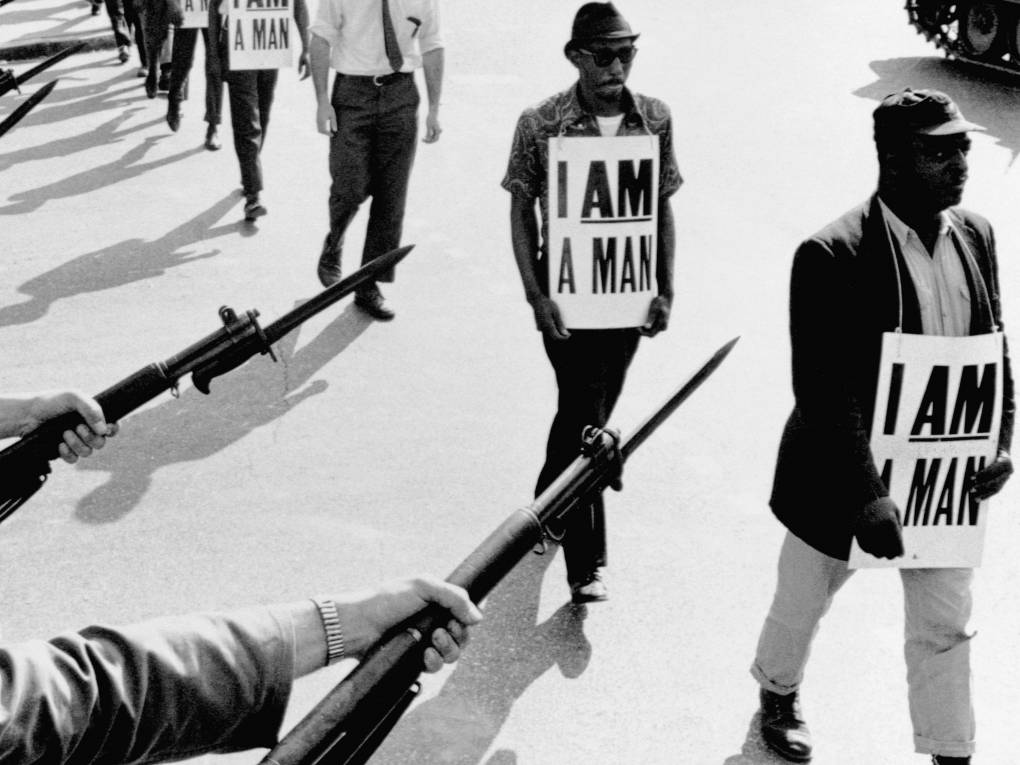
"caption": "Civil Rights activists are blocked by National Guardsmen brandishing bayonets while trying to stage a protest on Beale Street in Memphis, Tenn., in 1968.",
"description": "Civil Rights activists are blocked by National Guardsmen brandishing bayonets while trying to stage a protest on Beale Street in Memphis, Tenn., in 1968.",
"title": "Civil Rights activists are blocked by National Guardsmen brandishing bayonets while trying to stage a protest on Beale Street in Memphis, Tenn., in 1968.",
"credit": "Bettmann/Bettmann Archive",
"status": "inherit",
"altTag": "Civil Rights activists are blocked by National Guardsmen brandishing bayonets while trying to stage a protest on Beale Street in Memphis, Tenn., in 1968.",
"isLoading": false,
"fetchFailed": false
},
"arts_13898109": {
"type": "attachments",
"id": "arts_13898109",
"meta": {
"index": "attachments_1716263798",
"site": "arts",
"id": "13898109",
"found": true
},
"parent": 13898108,
"imgSizes": {
"twentyfourteen-full-width": {
"file": "https://ww2.kqed.org/app/uploads/sites/2/2021/05/1989-004-5-02-scaled-1_wide-d9b6e96ff6380a4d38187cce7cb0c6cf70959ebe-1038x576.jpe",
"width": 1038,
"mimeType": "image/jpeg",
"height": 576
},
"thumbnail": {
"file": "https://ww2.kqed.org/app/uploads/sites/2/2021/05/1989-004-5-02-scaled-1_wide-d9b6e96ff6380a4d38187cce7cb0c6cf70959ebe-160x90.jpe",
"width": 160,
"mimeType": "image/jpeg",
"height": 90
},
"post-thumbnail": {
"file": "https://ww2.kqed.org/app/uploads/sites/2/2021/05/1989-004-5-02-scaled-1_wide-d9b6e96ff6380a4d38187cce7cb0c6cf70959ebe-672x372.jpe",
"width": 672,
"mimeType": "image/jpeg",
"height": 372
},
"kqedFullSize": {
"file": "https://ww2.kqed.org/app/uploads/sites/2/2021/05/1989-004-5-02-scaled-1_wide-d9b6e96ff6380a4d38187cce7cb0c6cf70959ebe-e1622570596888.jpe",
"width": 1920,
"height": 1080
},
"2048x2048": {
"file": "https://ww2.kqed.org/app/uploads/sites/2/2021/05/1989-004-5-02-scaled-1_wide-d9b6e96ff6380a4d38187cce7cb0c6cf70959ebe-2048x1152.jpe",
"width": 2048,
"mimeType": "image/jpeg",
"height": 1152
},
"large": {
"file": "https://ww2.kqed.org/app/uploads/sites/2/2021/05/1989-004-5-02-scaled-1_wide-d9b6e96ff6380a4d38187cce7cb0c6cf70959ebe-1020x574.jpe",
"width": 1020,
"mimeType": "image/jpeg",
"height": 574
},
"1536x1536": {
"file": "https://ww2.kqed.org/app/uploads/sites/2/2021/05/1989-004-5-02-scaled-1_wide-d9b6e96ff6380a4d38187cce7cb0c6cf70959ebe-1536x864.jpe",
"width": 1536,
"mimeType": "image/jpeg",
"height": 864
},
"full-width": {
"file": "https://ww2.kqed.org/app/uploads/sites/2/2021/05/1989-004-5-02-scaled-1_wide-d9b6e96ff6380a4d38187cce7cb0c6cf70959ebe-1920x1080.jpe",
"width": 1920,
"mimeType": "image/jpeg",
"height": 1080
},
"medium": {
"file": "https://ww2.kqed.org/app/uploads/sites/2/2021/05/1989-004-5-02-scaled-1_wide-d9b6e96ff6380a4d38187cce7cb0c6cf70959ebe-800x450.jpe",
"width": 800,
"mimeType": "image/jpeg",
"height": 450
},
"medium_large": {
"file": "https://ww2.kqed.org/app/uploads/sites/2/2021/05/1989-004-5-02-scaled-1_wide-d9b6e96ff6380a4d38187cce7cb0c6cf70959ebe-768x432.jpe",
"width": 768,
"mimeType": "image/jpeg",
"height": 432
}
},
"publishDate": 1622569288,
"modified": 1622570724,
"caption": "Graphic photos of the Tulsa Race Massacre were turned into postcards and distributed by some white people. This one is labeled: \"Little Africa on Fire, Tulsa Race Riot, June 1, 1921.\"",
"description": "Graphic photos of the Tulsa Race Massacre were turned into postcards and distributed by some white people. This one is labeled: \"Little Africa on Fire, Tulsa Race Riot, June 1, 1921.\"",
"title": "Graphic photos of the Tulsa Race Massacre were turned into postcards and distributed by some white people. This one is labeled: \"Little Africa on Fire, Tulsa Race Riot, June 1, 1921.\"",
"credit": "University of Tulsa/McFarlin Library Special Collections",
"status": "inherit",
"altTag": "Graphic photos of the Tulsa Race Massacre were turned into postcards and distributed by some white people. This one is labeled: \"Little Africa on Fire, Tulsa Race Riot, June 1, 1921.\"",
"isLoading": false,
"fetchFailed": false
},
"arts_13898091": {
"type": "attachments",
"id": "arts_13898091",
"meta": {
"index": "attachments_1716263798",
"site": "arts",
"id": "13898091",
"found": true
},
"parent": 13898090,
"imgSizes": {
"twentyfourteen-full-width": {
"file": "https://ww2.kqed.org/app/uploads/sites/2/2021/05/planb-d7-br_0157rt-1_wide-a5391a37c907f332247fe5dc4424ce1674859e4d-1038x576.jpg",
"width": 1038,
"mimeType": "image/jpeg",
"height": 576
},
"thumbnail": {
"file": "https://ww2.kqed.org/app/uploads/sites/2/2021/05/planb-d7-br_0157rt-1_wide-a5391a37c907f332247fe5dc4424ce1674859e4d-160x90.jpg",
"width": 160,
"mimeType": "image/jpeg",
"height": 90
},
"post-thumbnail": {
"file": "https://ww2.kqed.org/app/uploads/sites/2/2021/05/planb-d7-br_0157rt-1_wide-a5391a37c907f332247fe5dc4424ce1674859e4d-672x372.jpg",
"width": 672,
"mimeType": "image/jpeg",
"height": 372
},
"kqedFullSize": {
"file": "https://ww2.kqed.org/app/uploads/sites/2/2021/05/planb-d7-br_0157rt-1_wide-a5391a37c907f332247fe5dc4424ce1674859e4d-scaled-e1622243129446.jpg",
"width": 1920,
"height": 1080
},
"2048x2048": {
"file": "https://ww2.kqed.org/app/uploads/sites/2/2021/05/planb-d7-br_0157rt-1_wide-a5391a37c907f332247fe5dc4424ce1674859e4d-2048x1152.jpg",
"width": 2048,
"mimeType": "image/jpeg",
"height": 1152
},
"large": {
"file": "https://ww2.kqed.org/app/uploads/sites/2/2021/05/planb-d7-br_0157rt-1_wide-a5391a37c907f332247fe5dc4424ce1674859e4d-1020x574.jpg",
"width": 1020,
"mimeType": "image/jpeg",
"height": 574
},
"1536x1536": {
"file": "https://ww2.kqed.org/app/uploads/sites/2/2021/05/planb-d7-br_0157rt-1_wide-a5391a37c907f332247fe5dc4424ce1674859e4d-1536x864.jpg",
"width": 1536,
"mimeType": "image/jpeg",
"height": 864
},
"full-width": {
"file": "https://ww2.kqed.org/app/uploads/sites/2/2021/05/planb-d7-br_0157rt-1_wide-a5391a37c907f332247fe5dc4424ce1674859e4d-1920x1080.jpg",
"width": 1920,
"mimeType": "image/jpeg",
"height": 1080
},
"medium": {
"file": "https://ww2.kqed.org/app/uploads/sites/2/2021/05/planb-d7-br_0157rt-1_wide-a5391a37c907f332247fe5dc4424ce1674859e4d-800x450.jpg",
"width": 800,
"mimeType": "image/jpeg",
"height": 450
},
"medium_large": {
"file": "https://ww2.kqed.org/app/uploads/sites/2/2021/05/planb-d7-br_0157rt-1_wide-a5391a37c907f332247fe5dc4424ce1674859e4d-768x432.jpg",
"width": 768,
"mimeType": "image/jpeg",
"height": 432
}
},
"publishDate": 1622242664,
"modified": 1622243171,
"caption": "Lupe (Victoria Moroles) and Sunny (Kuhoo Verma) are snubbed at the pharmacy when Lupe needs a morning-after pill.",
"description": "Lupe (Victoria Moroles) and Sunny (Kuhoo Verma) are snubbed at the pharmacy when Lupe needs a morning-after pill. ",
"title": "Lupe (Victoria Moroles) and Sunny (Kuhoo Verma) are snubbed at the pharmacy when Lupe needs a morning-after pill.",
"credit": "Brett Roedel/Hulu",
"status": "inherit",
"altTag": "Lupe (Victoria Moroles) and Sunny (Kuhoo Verma) are snubbed at the pharmacy when Lupe needs a morning-after pill.",
"isLoading": false,
"fetchFailed": false
},
"arts_13898086": {
"type": "attachments",
"id": "arts_13898086",
"meta": {
"index": "attachments_1716263798",
"site": "arts",
"id": "13898086",
"found": true
},
"parent": 13898085,
"imgSizes": {
"twentyfourteen-full-width": {
"file": "https://ww2.kqed.org/app/uploads/sites/2/2021/05/54ef35acd285f9af82d77181a776cd8a_4096x2730_06f1b8bd_wide-aedd453069552098f3e9fd00aead94e066502de3-1038x576.jpe",
"width": 1038,
"mimeType": "image/jpeg",
"height": 576
},
"thumbnail": {
"file": "https://ww2.kqed.org/app/uploads/sites/2/2021/05/54ef35acd285f9af82d77181a776cd8a_4096x2730_06f1b8bd_wide-aedd453069552098f3e9fd00aead94e066502de3-160x90.jpe",
"width": 160,
"mimeType": "image/jpeg",
"height": 90
},
"post-thumbnail": {
"file": "https://ww2.kqed.org/app/uploads/sites/2/2021/05/54ef35acd285f9af82d77181a776cd8a_4096x2730_06f1b8bd_wide-aedd453069552098f3e9fd00aead94e066502de3-672x372.jpe",
"width": 672,
"mimeType": "image/jpeg",
"height": 372
},
"kqedFullSize": {
"file": "https://ww2.kqed.org/app/uploads/sites/2/2021/05/54ef35acd285f9af82d77181a776cd8a_4096x2730_06f1b8bd_wide-aedd453069552098f3e9fd00aead94e066502de3-scaled-e1622235945568.jpe",
"width": 1920,
"height": 1080
},
"2048x2048": {
"file": "https://ww2.kqed.org/app/uploads/sites/2/2021/05/54ef35acd285f9af82d77181a776cd8a_4096x2730_06f1b8bd_wide-aedd453069552098f3e9fd00aead94e066502de3-2048x1152.jpe",
"width": 2048,
"mimeType": "image/jpeg",
"height": 1152
},
"large": {
"file": "https://ww2.kqed.org/app/uploads/sites/2/2021/05/54ef35acd285f9af82d77181a776cd8a_4096x2730_06f1b8bd_wide-aedd453069552098f3e9fd00aead94e066502de3-1020x574.jpe",
"width": 1020,
"mimeType": "image/jpeg",
"height": 574
},
"1536x1536": {
"file": "https://ww2.kqed.org/app/uploads/sites/2/2021/05/54ef35acd285f9af82d77181a776cd8a_4096x2730_06f1b8bd_wide-aedd453069552098f3e9fd00aead94e066502de3-1536x864.jpe",
"width": 1536,
"mimeType": "image/jpeg",
"height": 864
},
"full-width": {
"file": "https://ww2.kqed.org/app/uploads/sites/2/2021/05/54ef35acd285f9af82d77181a776cd8a_4096x2730_06f1b8bd_wide-aedd453069552098f3e9fd00aead94e066502de3-1920x1080.jpe",
"width": 1920,
"mimeType": "image/jpeg",
"height": 1080
},
"medium": {
"file": "https://ww2.kqed.org/app/uploads/sites/2/2021/05/54ef35acd285f9af82d77181a776cd8a_4096x2730_06f1b8bd_wide-aedd453069552098f3e9fd00aead94e066502de3-800x450.jpe",
"width": 800,
"mimeType": "image/jpeg",
"height": 450
},
"medium_large": {
"file": "https://ww2.kqed.org/app/uploads/sites/2/2021/05/54ef35acd285f9af82d77181a776cd8a_4096x2730_06f1b8bd_wide-aedd453069552098f3e9fd00aead94e066502de3-768x432.jpe",
"width": 768,
"mimeType": "image/jpeg",
"height": 432
}
},
"publishDate": 1622234834,
"modified": 1622236001,
"caption": "Is Cruella de Vil (Emma Stone) meant to come off as misguided, unhinged or genuinely unscrupulous? A new film tries to suggest a complicated mix of all three and winds up feeling mostly confused.",
"description": "Is Cruella de Vil (Emma Stone) meant to come off as misguided, unhinged or genuinely unscrupulous? A new film tries to suggest a complicated mix of all three and winds up feeling mostly confused.",
"title": "Is Cruella de Vil (Emma Stone) meant to come off as misguided, unhinged or genuinely unscrupulous? A new film tries to suggest a complicated mix of all three and winds up feeling mostly confused.",
"credit": "Disney",
"status": "inherit",
"altTag": "Is Cruella de Vil (Emma Stone) meant to come off as misguided, unhinged or genuinely unscrupulous? A new film tries to suggest a complicated mix of all three and winds up feeling mostly confused.",
"isLoading": false,
"fetchFailed": false
},
"arts_13897993": {
"type": "attachments",
"id": "arts_13897993",
"meta": {
"index": "attachments_1716263798",
"site": "arts",
"id": "13897993",
"found": true
},
"parent": 13897992,
"imgSizes": {
"twentyfourteen-full-width": {
"file": "https://ww2.kqed.org/app/uploads/sites/2/2021/05/gettyimages-1152557230_wide-f12e2f7dc3eebb3b368e475592daea65ea3aed25-1038x576.jpg",
"width": 1038,
"mimeType": "image/jpeg",
"height": 576
},
"thumbnail": {
"file": "https://ww2.kqed.org/app/uploads/sites/2/2021/05/gettyimages-1152557230_wide-f12e2f7dc3eebb3b368e475592daea65ea3aed25-160x90.jpg",
"width": 160,
"mimeType": "image/jpeg",
"height": 90
},
"post-thumbnail": {
"file": "https://ww2.kqed.org/app/uploads/sites/2/2021/05/gettyimages-1152557230_wide-f12e2f7dc3eebb3b368e475592daea65ea3aed25-672x372.jpg",
"width": 672,
"mimeType": "image/jpeg",
"height": 372
},
"kqedFullSize": {
"file": "https://ww2.kqed.org/app/uploads/sites/2/2021/05/gettyimages-1152557230_wide-f12e2f7dc3eebb3b368e475592daea65ea3aed25-scaled-e1622144355949.jpg",
"width": 1920,
"height": 1080
},
"2048x2048": {
"file": "https://ww2.kqed.org/app/uploads/sites/2/2021/05/gettyimages-1152557230_wide-f12e2f7dc3eebb3b368e475592daea65ea3aed25-2048x1152.jpg",
"width": 2048,
"mimeType": "image/jpeg",
"height": 1152
},
"large": {
"file": "https://ww2.kqed.org/app/uploads/sites/2/2021/05/gettyimages-1152557230_wide-f12e2f7dc3eebb3b368e475592daea65ea3aed25-1020x574.jpg",
"width": 1020,
"mimeType": "image/jpeg",
"height": 574
},
"1536x1536": {
"file": "https://ww2.kqed.org/app/uploads/sites/2/2021/05/gettyimages-1152557230_wide-f12e2f7dc3eebb3b368e475592daea65ea3aed25-1536x864.jpg",
"width": 1536,
"mimeType": "image/jpeg",
"height": 864
},
"full-width": {
"file": "https://ww2.kqed.org/app/uploads/sites/2/2021/05/gettyimages-1152557230_wide-f12e2f7dc3eebb3b368e475592daea65ea3aed25-1920x1080.jpg",
"width": 1920,
"mimeType": "image/jpeg",
"height": 1080
},
"medium": {
"file": "https://ww2.kqed.org/app/uploads/sites/2/2021/05/gettyimages-1152557230_wide-f12e2f7dc3eebb3b368e475592daea65ea3aed25-800x450.jpg",
"width": 800,
"mimeType": "image/jpeg",
"height": 450
},
"medium_large": {
"file": "https://ww2.kqed.org/app/uploads/sites/2/2021/05/gettyimages-1152557230_wide-f12e2f7dc3eebb3b368e475592daea65ea3aed25-768x432.jpg",
"width": 768,
"mimeType": "image/jpeg",
"height": 432
}
},
"publishDate": 1622143684,
"modified": 1622144389,
"caption": "Yusef Salaam, shown above in 2019, reflects on his wrongful conviction in the memoir, 'Better, Not Bitter.'",
"description": "Yusef Salaam, member of the Exonerated Five, speaks during the Players Technology Summit in San Francisco, California, U.S., on Thursday, June 27, 2019. Top leaders in the tech community and venture capital met with professional athletes to exchange ideas and share expertise through panels, discussions and interactive networking to help athletes take control of their careers as business professionals. Photographer: David Paul Morris/Bloomberg via Getty Images",
"title": "Yusef Salaam, shown above in 2019, reflects on his wrongful conviction in the memoir, 'Better, Not Bitter.'",
"credit": "David Paul Morris/Bloomberg via Getty Images",
"status": "inherit",
"altTag": "Yusef Salaam, shown above in 2019, reflects on his wrongful conviction in the memoir, 'Better, Not Bitter.'",
"isLoading": false,
"fetchFailed": false
},
"arts_13897710": {
"type": "attachments",
"id": "arts_13897710",
"meta": {
"index": "attachments_1716263798",
"site": "arts",
"id": "13897710",
"found": true
},
"parent": 13897709,
"imgSizes": {
"twentyfourteen-full-width": {
"file": "https://ww2.kqed.org/app/uploads/sites/2/2021/05/mon_sg_305_00026c_wide-74805b6b0fc432a4fafcf9931774ce59e28585d7-1038x576.jpg",
"width": 1038,
"mimeType": "image/jpeg",
"height": 576
},
"thumbnail": {
"file": "https://ww2.kqed.org/app/uploads/sites/2/2021/05/mon_sg_305_00026c_wide-74805b6b0fc432a4fafcf9931774ce59e28585d7-160x90.jpg",
"width": 160,
"mimeType": "image/jpeg",
"height": 90
},
"post-thumbnail": {
"file": "https://ww2.kqed.org/app/uploads/sites/2/2021/05/mon_sg_305_00026c_wide-74805b6b0fc432a4fafcf9931774ce59e28585d7-672x372.jpg",
"width": 672,
"mimeType": "image/jpeg",
"height": 372
},
"kqedFullSize": {
"file": "https://ww2.kqed.org/app/uploads/sites/2/2021/05/mon_sg_305_00026c_wide-74805b6b0fc432a4fafcf9931774ce59e28585d7-scaled-e1621876478862.jpg",
"width": 1920,
"height": 1080
},
"2048x2048": {
"file": "https://ww2.kqed.org/app/uploads/sites/2/2021/05/mon_sg_305_00026c_wide-74805b6b0fc432a4fafcf9931774ce59e28585d7-2048x1152.jpg",
"width": 2048,
"mimeType": "image/jpeg",
"height": 1152
},
"large": {
"file": "https://ww2.kqed.org/app/uploads/sites/2/2021/05/mon_sg_305_00026c_wide-74805b6b0fc432a4fafcf9931774ce59e28585d7-1020x574.jpg",
"width": 1020,
"mimeType": "image/jpeg",
"height": 574
},
"1536x1536": {
"file": "https://ww2.kqed.org/app/uploads/sites/2/2021/05/mon_sg_305_00026c_wide-74805b6b0fc432a4fafcf9931774ce59e28585d7-1536x864.jpg",
"width": 1536,
"mimeType": "image/jpeg",
"height": 864
},
"full-width": {
"file": "https://ww2.kqed.org/app/uploads/sites/2/2021/05/mon_sg_305_00026c_wide-74805b6b0fc432a4fafcf9931774ce59e28585d7-1920x1080.jpg",
"width": 1920,
"mimeType": "image/jpeg",
"height": 1080
},
"medium": {
"file": "https://ww2.kqed.org/app/uploads/sites/2/2021/05/mon_sg_305_00026c_wide-74805b6b0fc432a4fafcf9931774ce59e28585d7-800x450.jpg",
"width": 800,
"mimeType": "image/jpeg",
"height": 450
},
"medium_large": {
"file": "https://ww2.kqed.org/app/uploads/sites/2/2021/05/mon_sg_305_00026c_wide-74805b6b0fc432a4fafcf9931774ce59e28585d7-768x432.jpg",
"width": 768,
"mimeType": "image/jpeg",
"height": 432
}
},
"publishDate": 1621875909,
"modified": 1621876527,
"caption": "Naomi Ackie as Alicia and Lena Waithe as Denise in season 3 of 'Master of None.'",
"description": "Naomi Ackie as Alicia and Lena Waithe as Denise in season 3 of 'Master of None.'",
"title": "Naomi Ackie as Alicia and Lena Waithe as Denise in season 3 of 'Master of None.'",
"credit": "Netflix",
"status": "inherit",
"altTag": "Naomi Ackie as Alicia and Lena Waithe as Denise in season 3 of 'Master of None.'",
"isLoading": false,
"fetchFailed": false
},
"arts_13897670": {
"type": "attachments",
"id": "arts_13897670",
"meta": {
"index": "attachments_1716263798",
"site": "arts",
"id": "13897670",
"found": true
},
"parent": 13897664,
"imgSizes": {
"twentyfourteen-full-width": {
"file": "https://ww2.kqed.org/app/uploads/sites/2/2021/05/Screen-Shot-2021-05-21-at-11.02.16-AM-1038x576.png",
"width": 1038,
"mimeType": "image/png",
"height": 576
},
"thumbnail": {
"file": "https://ww2.kqed.org/app/uploads/sites/2/2021/05/Screen-Shot-2021-05-21-at-11.02.16-AM-160x111.png",
"width": 160,
"mimeType": "image/png",
"height": 111
},
"post-thumbnail": {
"file": "https://ww2.kqed.org/app/uploads/sites/2/2021/05/Screen-Shot-2021-05-21-at-11.02.16-AM-672x372.png",
"width": 672,
"mimeType": "image/png",
"height": 372
},
"kqedFullSize": {
"file": "https://ww2.kqed.org/app/uploads/sites/2/2021/05/Screen-Shot-2021-05-21-at-11.02.16-AM.png",
"width": 2024,
"height": 1402
},
"large": {
"file": "https://ww2.kqed.org/app/uploads/sites/2/2021/05/Screen-Shot-2021-05-21-at-11.02.16-AM-1020x707.png",
"width": 1020,
"mimeType": "image/png",
"height": 707
},
"1536x1536": {
"file": "https://ww2.kqed.org/app/uploads/sites/2/2021/05/Screen-Shot-2021-05-21-at-11.02.16-AM-1536x1064.png",
"width": 1536,
"mimeType": "image/png",
"height": 1064
},
"full-width": {
"file": "https://ww2.kqed.org/app/uploads/sites/2/2021/05/Screen-Shot-2021-05-21-at-11.02.16-AM-1920x1330.png",
"width": 1920,
"mimeType": "image/png",
"height": 1330
},
"medium": {
"file": "https://ww2.kqed.org/app/uploads/sites/2/2021/05/Screen-Shot-2021-05-21-at-11.02.16-AM-800x554.png",
"width": 800,
"mimeType": "image/png",
"height": 554
},
"medium_large": {
"file": "https://ww2.kqed.org/app/uploads/sites/2/2021/05/Screen-Shot-2021-05-21-at-11.02.16-AM-768x532.png",
"width": 768,
"mimeType": "image/png",
"height": 532
}
},
"publishDate": 1621620311,
"modified": 1621620401,
"caption": "David (Clayne Crawford) is a man on the edge in 'The Killing of Two Lovers.'",
"description": "David (Clayne Crawford) is a man on the edge in 'The Killing of Two Lovers.'",
"title": "David (Clayne Crawford) is a man on the edge in 'The Killing of Two Lovers.'",
"credit": "Neon",
"status": "inherit",
"altTag": "David (Clayne Crawford) is a man on the edge in 'The Killing of Two Lovers.'",
"isLoading": false,
"fetchFailed": false
},
"arts_13897635": {
"type": "attachments",
"id": "arts_13897635",
"meta": {
"index": "attachments_1716263798",
"site": "arts",
"id": "13897635",
"found": true
},
"parent": 13897634,
"imgSizes": {
"twentyfourteen-full-width": {
"file": "https://ww2.kqed.org/app/uploads/sites/2/2021/05/draft_oliviarodrigo_pink_v1_wide-b47b769f45ce905f1b89df1021a89f4e4920c360-1038x576.jpg",
"width": 1038,
"mimeType": "image/jpeg",
"height": 576
},
"thumbnail": {
"file": "https://ww2.kqed.org/app/uploads/sites/2/2021/05/draft_oliviarodrigo_pink_v1_wide-b47b769f45ce905f1b89df1021a89f4e4920c360-160x90.jpg",
"width": 160,
"mimeType": "image/jpeg",
"height": 90
},
"post-thumbnail": {
"file": "https://ww2.kqed.org/app/uploads/sites/2/2021/05/draft_oliviarodrigo_pink_v1_wide-b47b769f45ce905f1b89df1021a89f4e4920c360-672x372.jpg",
"width": 672,
"mimeType": "image/jpeg",
"height": 372
},
"kqedFullSize": {
"file": "https://ww2.kqed.org/app/uploads/sites/2/2021/05/draft_oliviarodrigo_pink_v1_wide-b47b769f45ce905f1b89df1021a89f4e4920c360-scaled-e1621620852577.jpg",
"width": 1920,
"height": 1080
},
"2048x2048": {
"file": "https://ww2.kqed.org/app/uploads/sites/2/2021/05/draft_oliviarodrigo_pink_v1_wide-b47b769f45ce905f1b89df1021a89f4e4920c360-2048x1152.jpg",
"width": 2048,
"mimeType": "image/jpeg",
"height": 1152
},
"large": {
"file": "https://ww2.kqed.org/app/uploads/sites/2/2021/05/draft_oliviarodrigo_pink_v1_wide-b47b769f45ce905f1b89df1021a89f4e4920c360-1020x574.jpg",
"width": 1020,
"mimeType": "image/jpeg",
"height": 574
},
"1536x1536": {
"file": "https://ww2.kqed.org/app/uploads/sites/2/2021/05/draft_oliviarodrigo_pink_v1_wide-b47b769f45ce905f1b89df1021a89f4e4920c360-1536x864.jpg",
"width": 1536,
"mimeType": "image/jpeg",
"height": 864
},
"full-width": {
"file": "https://ww2.kqed.org/app/uploads/sites/2/2021/05/draft_oliviarodrigo_pink_v1_wide-b47b769f45ce905f1b89df1021a89f4e4920c360-1920x1080.jpg",
"width": 1920,
"mimeType": "image/jpeg",
"height": 1080
},
"medium": {
"file": "https://ww2.kqed.org/app/uploads/sites/2/2021/05/draft_oliviarodrigo_pink_v1_wide-b47b769f45ce905f1b89df1021a89f4e4920c360-800x450.jpg",
"width": 800,
"mimeType": "image/jpeg",
"height": 450
},
"medium_large": {
"file": "https://ww2.kqed.org/app/uploads/sites/2/2021/05/draft_oliviarodrigo_pink_v1_wide-b47b769f45ce905f1b89df1021a89f4e4920c360-768x432.jpg",
"width": 768,
"mimeType": "image/jpeg",
"height": 432
}
},
"publishDate": 1621611954,
"modified": 1621620884,
"caption": "Olivia Rodrigo's debut album, 'Sour,' is out May 21, less than six months after she shattered streaming records with the breakthrough single \"drivers license.\"",
"description": "Olivia Rodrigo's debut album, 'Sour,' is out May 21, less than six months after she shattered streaming records with the breakthrough single \"drivers license.\"",
"title": "Olivia Rodrigo's debut album, 'Sour,' is out May 21, less than six months after she shattered streaming records with the breakthrough single \"drivers license.\"",
"credit": "Renee Klahr/NPR",
"status": "inherit",
"altTag": "Olivia Rodrigo's debut album, 'Sour,' is out May 21, less than six months after she shattered streaming records with the breakthrough single \"drivers license.\"",
"isLoading": false,
"fetchFailed": false
},
"arts_13897429": {
"type": "attachments",
"id": "arts_13897429",
"meta": {
"index": "attachments_1716263798",
"site": "arts",
"id": "13897429",
"found": true
},
"parent": 13897419,
"imgSizes": {
"twentyfourteen-full-width": {
"file": "https://ww2.kqed.org/app/uploads/sites/2/2021/05/DwayneJohnson_COVER-1038x576.jpg",
"width": 1038,
"mimeType": "image/jpeg",
"height": 576
},
"thumbnail": {
"file": "https://ww2.kqed.org/app/uploads/sites/2/2021/05/DwayneJohnson_COVER-160x90.jpg",
"width": 160,
"mimeType": "image/jpeg",
"height": 90
},
"post-thumbnail": {
"file": "https://ww2.kqed.org/app/uploads/sites/2/2021/05/DwayneJohnson_COVER-672x372.jpg",
"width": 672,
"mimeType": "image/jpeg",
"height": 372
},
"kqedFullSize": {
"file": "https://ww2.kqed.org/app/uploads/sites/2/2021/05/DwayneJohnson_COVER.jpg",
"width": 1920,
"height": 1080
},
"large": {
"file": "https://ww2.kqed.org/app/uploads/sites/2/2021/05/DwayneJohnson_COVER-1020x574.jpg",
"width": 1020,
"mimeType": "image/jpeg",
"height": 574
},
"1536x1536": {
"file": "https://ww2.kqed.org/app/uploads/sites/2/2021/05/DwayneJohnson_COVER-1536x864.jpg",
"width": 1536,
"mimeType": "image/jpeg",
"height": 864
},
"medium": {
"file": "https://ww2.kqed.org/app/uploads/sites/2/2021/05/DwayneJohnson_COVER-800x450.jpg",
"width": 800,
"mimeType": "image/jpeg",
"height": 450
},
"medium_large": {
"file": "https://ww2.kqed.org/app/uploads/sites/2/2021/05/DwayneJohnson_COVER-768x432.jpg",
"width": 768,
"mimeType": "image/jpeg",
"height": 432
}
},
"publishDate": 1621446043,
"modified": 1621446091,
"caption": "Dwayne Johnson speaks at the TCL Chinese Theatre IMAX on December 10, 2019 in Hollywood, California.",
"description": "Dwayne Johnson speaks at the TCL Chinese Theatre IMAX on December 10, 2019 in Hollywood, California.",
"title": "DwayneJohnson_COVER",
"credit": "Photo by Jean Baptiste Lacroix/Getty Images",
"status": "inherit",
"altTag": null,
"isLoading": false,
"fetchFailed": false
},
"arts_13897386": {
"type": "attachments",
"id": "arts_13897386",
"meta": {
"index": "attachments_1716263798",
"site": "arts",
"id": "13897386",
"found": true
},
"parent": 13897324,
"imgSizes": {
"twentyfourteen-full-width": {
"file": "https://ww2.kqed.org/app/uploads/sites/2/2021/05/GettyImages-941610346-1038x576.jpg",
"width": 1038,
"mimeType": "image/jpeg",
"height": 576
},
"thumbnail": {
"file": "https://ww2.kqed.org/app/uploads/sites/2/2021/05/GettyImages-941610346-160x107.jpg",
"width": 160,
"mimeType": "image/jpeg",
"height": 107
},
"post-thumbnail": {
"file": "https://ww2.kqed.org/app/uploads/sites/2/2021/05/GettyImages-941610346-672x372.jpg",
"width": 672,
"mimeType": "image/jpeg",
"height": 372
},
"kqedFullSize": {
"file": "https://ww2.kqed.org/app/uploads/sites/2/2021/05/GettyImages-941610346-scaled.jpg",
"width": 2560,
"height": 1707
},
"2048x2048": {
"file": "https://ww2.kqed.org/app/uploads/sites/2/2021/05/GettyImages-941610346-2048x1365.jpg",
"width": 2048,
"mimeType": "image/jpeg",
"height": 1365
},
"large": {
"file": "https://ww2.kqed.org/app/uploads/sites/2/2021/05/GettyImages-941610346-1020x680.jpg",
"width": 1020,
"mimeType": "image/jpeg",
"height": 680
},
"1536x1536": {
"file": "https://ww2.kqed.org/app/uploads/sites/2/2021/05/GettyImages-941610346-1536x1024.jpg",
"width": 1536,
"mimeType": "image/jpeg",
"height": 1024
},
"full-width": {
"file": "https://ww2.kqed.org/app/uploads/sites/2/2021/05/GettyImages-941610346-1920x1280.jpg",
"width": 1920,
"mimeType": "image/jpeg",
"height": 1280
},
"medium": {
"file": "https://ww2.kqed.org/app/uploads/sites/2/2021/05/GettyImages-941610346-800x533.jpg",
"width": 800,
"mimeType": "image/jpeg",
"height": 533
},
"medium_large": {
"file": "https://ww2.kqed.org/app/uploads/sites/2/2021/05/GettyImages-941610346-768x512.jpg",
"width": 768,
"mimeType": "image/jpeg",
"height": 512
}
},
"publishDate": 1621380239,
"modified": 1621380317,
"caption": "Seth Rogen in 2018. ",
"description": "Seth Rogen in 2018. ",
"title": "Seth Rogen in 2018.",
"credit": "Christopher Polk/Getty Images",
"status": "inherit",
"altTag": "Seth Rogen in 2018.",
"isLoading": false,
"fetchFailed": false
},
"arts_13897375": {
"type": "attachments",
"id": "arts_13897375",
"meta": {
"index": "attachments_1716263798",
"site": "arts",
"id": "13897375",
"found": true
},
"parent": 13897372,
"imgSizes": {
"twentyfourteen-full-width": {
"file": "https://ww2.kqed.org/app/uploads/sites/2/2021/05/GettyImages-182039920-1038x576.jpg",
"width": 1038,
"mimeType": "image/jpeg",
"height": 576
},
"thumbnail": {
"file": "https://ww2.kqed.org/app/uploads/sites/2/2021/05/GettyImages-182039920-160x107.jpg",
"width": 160,
"mimeType": "image/jpeg",
"height": 107
},
"post-thumbnail": {
"file": "https://ww2.kqed.org/app/uploads/sites/2/2021/05/GettyImages-182039920-672x372.jpg",
"width": 672,
"mimeType": "image/jpeg",
"height": 372
},
"kqedFullSize": {
"file": "https://ww2.kqed.org/app/uploads/sites/2/2021/05/GettyImages-182039920-scaled.jpg",
"width": 2560,
"height": 1707
},
"2048x2048": {
"file": "https://ww2.kqed.org/app/uploads/sites/2/2021/05/GettyImages-182039920-2048x1365.jpg",
"width": 2048,
"mimeType": "image/jpeg",
"height": 1365
},
"large": {
"file": "https://ww2.kqed.org/app/uploads/sites/2/2021/05/GettyImages-182039920-1020x680.jpg",
"width": 1020,
"mimeType": "image/jpeg",
"height": 680
},
"1536x1536": {
"file": "https://ww2.kqed.org/app/uploads/sites/2/2021/05/GettyImages-182039920-1536x1024.jpg",
"width": 1536,
"mimeType": "image/jpeg",
"height": 1024
},
"full-width": {
"file": "https://ww2.kqed.org/app/uploads/sites/2/2021/05/GettyImages-182039920-1920x1280.jpg",
"width": 1920,
"mimeType": "image/jpeg",
"height": 1280
},
"medium": {
"file": "https://ww2.kqed.org/app/uploads/sites/2/2021/05/GettyImages-182039920-800x533.jpg",
"width": 800,
"mimeType": "image/jpeg",
"height": 533
},
"medium_large": {
"file": "https://ww2.kqed.org/app/uploads/sites/2/2021/05/GettyImages-182039920-768x512.jpg",
"width": 768,
"mimeType": "image/jpeg",
"height": 512
}
},
"publishDate": 1621378370,
"modified": 1621378492,
"caption": "Charles Grodin attends the world premiere of 'Captain Phillips' in 2013.",
"description": "Charles Grodin attends the world premiere of 'Captain Phillips' in 2013.",
"title": "Charles Grodin attends the world premiere of 'Captain Phillips' in 2013.",
"credit": "Jemal Countess/Getty Images",
"status": "inherit",
"altTag": "Charles Grodin attends the world premiere of 'Captain Phillips' in 2013.",
"isLoading": false,
"fetchFailed": false
},
"arts_13897336": {
"type": "attachments",
"id": "arts_13897336",
"meta": {
"index": "attachments_1716263798",
"site": "arts",
"id": "13897336",
"found": true
},
"parent": 13897329,
"imgSizes": {
"twentyfourteen-full-width": {
"file": "https://ww2.kqed.org/app/uploads/sites/2/2021/05/annie-spratt-5psJeebVp9o-unsplash-1038x576.jpg",
"width": 1038,
"mimeType": "image/jpeg",
"height": 576
},
"thumbnail": {
"file": "https://ww2.kqed.org/app/uploads/sites/2/2021/05/annie-spratt-5psJeebVp9o-unsplash-160x107.jpg",
"width": 160,
"mimeType": "image/jpeg",
"height": 107
},
"post-thumbnail": {
"file": "https://ww2.kqed.org/app/uploads/sites/2/2021/05/annie-spratt-5psJeebVp9o-unsplash-672x372.jpg",
"width": 672,
"mimeType": "image/jpeg",
"height": 372
},
"kqedFullSize": {
"file": "https://ww2.kqed.org/app/uploads/sites/2/2021/05/annie-spratt-5psJeebVp9o-unsplash-scaled.jpg",
"width": 2560,
"height": 1713
},
"2048x2048": {
"file": "https://ww2.kqed.org/app/uploads/sites/2/2021/05/annie-spratt-5psJeebVp9o-unsplash-2048x1370.jpg",
"width": 2048,
"mimeType": "image/jpeg",
"height": 1370
},
"large": {
"file": "https://ww2.kqed.org/app/uploads/sites/2/2021/05/annie-spratt-5psJeebVp9o-unsplash-1020x682.jpg",
"width": 1020,
"mimeType": "image/jpeg",
"height": 682
},
"1536x1536": {
"file": "https://ww2.kqed.org/app/uploads/sites/2/2021/05/annie-spratt-5psJeebVp9o-unsplash-1536x1028.jpg",
"width": 1536,
"mimeType": "image/jpeg",
"height": 1028
},
"full-width": {
"file": "https://ww2.kqed.org/app/uploads/sites/2/2021/05/annie-spratt-5psJeebVp9o-unsplash-1920x1284.jpg",
"width": 1920,
"mimeType": "image/jpeg",
"height": 1284
},
"medium": {
"file": "https://ww2.kqed.org/app/uploads/sites/2/2021/05/annie-spratt-5psJeebVp9o-unsplash-800x535.jpg",
"width": 800,
"mimeType": "image/jpeg",
"height": 535
},
"medium_large": {
"file": "https://ww2.kqed.org/app/uploads/sites/2/2021/05/annie-spratt-5psJeebVp9o-unsplash-768x514.jpg",
"width": 768,
"mimeType": "image/jpeg",
"height": 514
}
},
"publishDate": 1621369082,
"modified": 1621369147,
"caption": null,
"description": null,
"title": "annie-spratt-5psJeebVp9o-unsplash",
"credit": "Annie Spratt/ Unsplash",
"status": "inherit",
"altTag": null,
"isLoading": false,
"fetchFailed": false
}
},
"audioPlayerReducer": {
"postId": "stream_live",
"isPaused": true,
"isPlaying": false,
"pfsActive": false,
"pledgeModalIsOpen": true,
"playerDrawerIsOpen": false,
"liveAudioPlayStartedAt": 0,
"liveAudioPlayContext": ""
},
"authorsReducer": {
"byline_arts_13898175": {
"type": "authors",
"id": "byline_arts_13898175",
"meta": {
"override": true
},
"slug": "byline_arts_13898175",
"name": "Dave Davies",
"isLoading": false
},
"byline_arts_13898108": {
"type": "authors",
"id": "byline_arts_13898108",
"meta": {
"override": true
},
"slug": "byline_arts_13898108",
"name": "Eric Deggans",
"isLoading": false
},
"byline_arts_13898090": {
"type": "authors",
"id": "byline_arts_13898090",
"meta": {
"override": true
},
"slug": "byline_arts_13898090",
"name": "Linda Holmes",
"isLoading": false
},
"byline_arts_13898085": {
"type": "authors",
"id": "byline_arts_13898085",
"meta": {
"override": true
},
"slug": "byline_arts_13898085",
"name": "Justin Chang",
"isLoading": false
},
"byline_arts_13897992": {
"type": "authors",
"id": "byline_arts_13897992",
"meta": {
"override": true
},
"slug": "byline_arts_13897992",
"name": "Terry Gross",
"isLoading": false
},
"byline_arts_13897709": {
"type": "authors",
"id": "byline_arts_13897709",
"meta": {
"override": true
},
"slug": "byline_arts_13897709",
"name": "Eric Deggans",
"isLoading": false
},
"byline_arts_13897664": {
"type": "authors",
"id": "byline_arts_13897664",
"meta": {
"override": true
},
"slug": "byline_arts_13897664",
"name": "Justin Chang",
"isLoading": false
},
"byline_arts_13897634": {
"type": "authors",
"id": "byline_arts_13897634",
"meta": {
"override": true
},
"slug": "byline_arts_13897634",
"name": "Lindsay Zoladz",
"isLoading": false
},
"byline_arts_13897419": {
"type": "authors",
"id": "byline_arts_13897419",
"meta": {
"override": true
},
"slug": "byline_arts_13897419",
"name": "Vanessa Romo",
"isLoading": false
},
"byline_arts_13897324": {
"type": "authors",
"id": "byline_arts_13897324",
"meta": {
"override": true
},
"slug": "byline_arts_13897324",
"name": "Terry Gross",
"isLoading": false
},
"byline_arts_13897372": {
"type": "authors",
"id": "byline_arts_13897372",
"meta": {
"override": true
},
"slug": "byline_arts_13897372",
"name": "Bob Mondello",
"isLoading": false
},
"byline_arts_13897329": {
"type": "authors",
"id": "byline_arts_13897329",
"meta": {
"override": true
},
"slug": "byline_arts_13897329",
"name": "Miles Parks",
"isLoading": false
}
},
"pagesReducer": {
"arts_affiliate_npr": {
"type": "terms",
"id": "arts_137",
"meta": {
"index": "terms_1716263798",
"site": "arts",
"id": "137",
"score": 14.258051
},
"featImg": "https://ww2.kqed.org/app/uploads/sites/2/2014/04/logo-npr-lg1.png",
"name": "NPR",
"description": null,
"taxonomy": "affiliate",
"headData": {
"twImgId": null,
"twTitle": null,
"ogTitle": null,
"ogImgId": null,
"twDescription": null,
"description": null,
"title": "NPR Archives | KQED Arts",
"ogDescription": null
},
"ttid": 138,
"slug": "npr",
"isLoading": false,
"title": "NPR",
"pageMeta": {
"site": "arts",
"WpPageTemplate": "page-topic-editorial",
"currentPage": 79
},
"blocks": [
{
"blockName": "kqed/post-list",
"attrs": {
"layout": "cardArticle2",
"query": "posts/arts?affiliate=npr",
"seeMore": false,
"paginated": true,
"page": 79
}
},
{
"blockName": "kqed/ad"
}
]
}
},
"pfsSessionReducer": {},
"postsReducer": {
"stream_live": {
"type": "live",
"id": "stream_live",
"audioUrl": "https://streams.kqed.org/kqedradio",
"title": "Live Stream",
"excerpt": "Live Stream information currently unavailable.",
"link": "/radio",
"featImg": "",
"label": {
"name": "KQED Live",
"link": "/"
}
},
"stream_kqedNewscast": {
"type": "posts",
"id": "stream_kqedNewscast",
"audioUrl": "https://www.kqed.org/.stream/anon/radio/RDnews/newscast.mp3?_=1",
"title": "KQED Newscast",
"featImg": "",
"label": {
"name": "88.5 FM",
"link": "/"
}
},
"arts_13898175": {
"type": "posts",
"id": "arts_13898175",
"meta": {
"index": "posts_1716263798",
"site": "arts",
"id": "13898175",
"score": null,
"sort": [
1622659484000
]
},
"parent": 0,
"labelTerm": {
"site": "arts",
"term": 137
},
"blocks": [],
"publishDate": 1622659484,
"format": "standard",
"title": "Historian Uncovers the Racist Roots of the 2nd Amendment",
"headTitle": "Historian Uncovers the Racist Roots of the 2nd Amendment | KQED",
"content": "\u003cp>Do Black people have full Second Amendment rights?\u003c/p>\n\u003cp>That’s the question historian Carol Anderson set out to answer after Minnesota police killed \u003ca href=\"https://www.npr.org/sections/thetwo-way/2016/07/07/485066807/police-stop-ends-in-black-mans-death-aftermath-is-livestreamed-online-video\" target=\"_blank\" rel=\"noopener noreferrer\">Philando Castile\u003c/a>, a Black man with a license to carry a gun, during a 2016 traffic stop.\u003c/p>\n\u003cp>“Here was a Black man who was pulled over by the police and the police officer asked to see his identification. Philando Castile, using the NRA guidelines, alerts to the officer that he has a licensed weapon with him,” she says. “[And] the police officer began shooting.”\u003c/p>\n\u003cp>In the 1990s, after the assault on the \u003ca href=\"https://www.npr.org/2013/04/20/178063471/two-decades-later-some-branch-davidians-still-believe\" target=\"_blank\" rel=\"noopener noreferrer\">Branch Davidian compound\u003c/a> in Waco, Texas, the National Rifle Association condemned federal authorities as “jack-booted government thugs.” But Anderson says the organization “went virtually silent” when when it came to Castile’s case, issuing a \u003ca href=\"https://www.facebook.com/NationalRifleAssociation/photos/10154483218346833/\" target=\"_blank\" rel=\"noopener noreferrer\">tepid statement\u003c/a> that did not mention Castile by name.\u003c/p>\n\u003cp>In her new book \u003cem>The Second: Race and Guns in a Fatally Unequal America,\u003c/em> Anderson traces racial distinctions in Americans’ treatment of gun ownership back to the founding of the country and the Second Amendment, which states:\u003c/p>\n\u003cblockquote>\u003cp>“A well-regulated Militia, being necessary to the security of a free State, the right of the people to keep and bear Arms, shall not be infringed.”\u003c/p>\u003c/blockquote>\n\u003cp>The language of the amendment, Anderson says, was crafted to ensure slave owners could quickly crush any rebellion or resistance from those they’d enslaved. And she says the right to bear arms, presumably guaranteed to all citizens, has been repeatedly denied to Black people.\u003c/p>\n\u003cp>[ad fullwidth]\u003c/p>\n\u003cp>“One of the things that I argue throughout this book is that it is just being Black that is the threat. And so when you mix that being Black as the threat with bearing arms, it’s an exponential fear,” she says. “This isn’t an anti-gun or a pro-gun book. This is a book about African Americans’ rights.”\u003c/p>\n\u003cfigure id=\"attachment_13898177\" class=\"wp-caption aligncenter\" style=\"max-width: 500px\">\u003cimg loading=\"lazy\" decoding=\"async\" class=\"size-full wp-image-13898177\" src=\"https://ww2.kqed.org/app/uploads/sites/2/2021/06/9781635574258-2ea460de0e43a1d016ac2f2c3fa40491e0ce53d9.jpg\" alt=\"'The Second: Race and Guns in a Fatally Unequal America,' by Carol Anderson.\" width=\"500\" height=\"375\" srcset=\"https://cdn.kqed.org/wp-content/uploads/sites/2/2021/06/9781635574258-2ea460de0e43a1d016ac2f2c3fa40491e0ce53d9.jpg 500w, https://cdn.kqed.org/wp-content/uploads/sites/2/2021/06/9781635574258-2ea460de0e43a1d016ac2f2c3fa40491e0ce53d9-160x120.jpg 160w\" sizes=\"(max-width: 500px) 100vw, 500px\">\u003cfigcaption class=\"wp-caption-text\">‘The Second: Race and Guns in a Fatally Unequal America,’ by Carol Anderson. \u003ccite>(Bloomsbury Publishing)\u003c/cite>\u003c/figcaption>\u003c/figure>\n\u003chr>\n\u003ch3>\u003cstrong>Interview highlights \u003c/strong>\u003c/h3>\n\u003cp>\u003cstrong>On the crafting of the Second Amendment at the Constitutional Convention \u003c/strong>\u003c/p>\n\u003cp>It was in response to the concerns coming out of the Virginia ratification convention for the Constitution, led by Patrick Henry and George Mason, that a militia that was controlled solely by the federal government would not be there to protect the slave owners from an enslaved uprising. And … James Madison crafted that language in order to mollify the concerns coming out of Virginia and the anti-Federalists, that they would still have full control over their state militias—and those militias were used in order to quell slave revolts. … The Second Amendment really provided the cover, the assurances that Patrick Henry and George Mason needed, that the militias would not be controlled by the federal government, but that they would be controlled by the states and at the beck and call of the states to be able to put down these uprisings.\u003c/p>\n\u003cp>\u003cstrong>On Black peoples’ access to arms after the American Revolution \u003c/strong>\u003c/p>\n\u003cp>You saw incredible restrictions being put in place about limiting access to arms. And this is across the board for free Blacks and, particularly, for the enslaved. And with each uprising, the laws became even more strict, even more definitive about who could and who could not bear arms. And so free Blacks were particularly proscribed. And so we see this, for instance, in Georgia, where Georgia had a law that restricted the carrying of guns.\u003c/p>\n\u003cp>\u003cstrong>On the founding fathers’ fear of a slave revolt, which was stoked by the Haitian revolution \u003c/strong>\u003c/p>\n\u003cp>When Haiti began to overthrow the French colonial masters and were seizing that country for themselves, when Blacks were seizing that country for themselves, the violence of the Haitian revolution, the existence of the Haitian revolution, just sent basically an earthquake of fear throughout the United States. You had George Washington lamenting the violence. You had Thomas Jefferson talking about [how] he was fearful that those ideas over there, if they get here, it’s going to be fire. You had James Madison worried. …\u003c/p>\n\u003cp>[aside postid='arts_13870538']Whites … were fleeing Haiti and were bringing their enslaved populations with them, their enslaved people with them. … [There was a fear that] the ideas that these Black Haitians would have, that somehow those ideas of revolution, those ideas of racial justice, those ideas of freedom and democracy would just metastasize throughout Virginia’s Black enslaved population and cause a revolt. You had that same fear coming out of Baltimore that then began to open up the public armory to whites saying, ‘You are justified in being armed because they’re bringing too many of these Black Haitians, these enslaved Haitians up here who have these ideas that Black people can be free.’\u003c/p>\n\u003cp>\u003cstrong>On how the Black Panthers responded to restrictions in Black people’s ability to bear arms in the 1960s\u003c/strong>\u003c/p>\n\u003cp>What the Black Panthers were dealing with was massive police brutality. Just beating on Black people, killing Black people at will with impunity. And the Panthers decided that they would police the police. Huey P. Newton, who was the co-founder of the Black Panthers along with Bobby Seale, … knew the law and he knew what the law said about being able to open carry weapons and the types of weapons you were able to openly carry and how far you had to stand away from the police arresting somebody or interrogating somebody. … And the police did not like having these aggressive Black men and women doing that work of policing the police. And the response was a thing called the Mulford Act, and the Mulford Act set out to ban open carrying of weapons. And it was drafted by a conservative assemblyman in California with the support and help of an NRA representative and eagerly signed by Gov. Ronald Reagan as a way to make illegal what the Panthers were legally doing.\u003c/p>\n\u003cp>[ad floatright]\u003c/p>\n\u003cp>\u003cem>Sam Briger and Kayla Lattimore produced and edited the audio of this interview. Bridget Bentz, Molly Seavy-Nesper and Meghan Sullivan adapted it for the web.\u003c/em>\u003c/p>\n\u003cdiv class=\"fullattribution\">\u003cem>Copyright 2021 Fresh Air. To see more, visit \u003ca href=\"http://www.npr.org/programs/fresh-air/\" target=\"_blank\" rel=\"noopener noreferrer\">Fresh Air\u003c/a>.\u003cimg decoding=\"async\" src=\"https://www.google-analytics.com/__utm.gif?utmac=UA-5828686-4&utmdt=Historian+Uncovers+The+Racist+Roots+Of+The+2nd+Amendment&utme=8(APIKey)9(MDAxOTAwOTE4MDEyMTkxMDAzNjczZDljZA004)\">\u003c/em>\u003c/div>\n\n",
"stats": {
"hasVideo": false,
"hasChartOrMap": false,
"hasAudio": false,
"hasPolis": false,
"wordCount": 1053,
"hasGoogleForm": false,
"hasGallery": false,
"hasHearkenModule": false,
"iframeSrcs": [],
"paragraphCount": 20
},
"modified": 1705008281,
"excerpt": "Carol Anderson, author of 'The Second,' says the amendment was designed to ensure slave owners could quickly crush rebellions.",
"headData": {
"twImgId": "",
"twTitle": "",
"ogTitle": "",
"ogImgId": "",
"twDescription": "",
"description": "Carol Anderson, author of 'The Second,' says the amendment was designed to ensure slave owners could quickly crush rebellions.",
"title": "Historian Uncovers the Racist Roots of the 2nd Amendment | KQED",
"ogDescription": "",
"schema": {
"@context": "https://schema.org",
"@type": "Article",
"headline": "Historian Uncovers the Racist Roots of the 2nd Amendment",
"datePublished": "2021-06-02T11:44:44-07:00",
"dateModified": "2024-01-11T13:24:41-08:00",
"image": "https://cdn.kqed.org/wp-content/uploads/2020/02/KQED-OG-Image@1x.png"
}
},
"guestAuthors": [],
"slug": "historian-uncovers-the-racist-roots-of-the-2nd-amendment",
"status": "publish",
"nprApiLink": "http://api.npr.org/query?id=1002107670&apiKey=MDAxOTAwOTE4MDEyMTkxMDAzNjczZDljZA004",
"templateType": "standard",
"nprStoryDate": "Wed, 02 Jun 2021 11:40:40 -0400",
"nprLastModifiedDate": "Wed, 02 Jun 2021 11:41:11 -0400",
"featuredImageType": "standard",
"nprHtmlLink": "https://www.npr.org/2021/06/02/1002107670/historian-uncovers-the-racist-roots-of-the-2nd-amendment?ft=nprml&f=1002107670",
"nprAudio": "https://ondemand.npr.org/anon.npr-mp3/npr/fa/2021/06/20210602_fa_01.mp3?orgId=427869011&topicId=1015&d=2124&p=13&story=1002107670&ft=nprml&f=1002107670",
"nprImageAgency": "Bettmann Archive",
"nprAudioM3u": "http://api.npr.org/m3u/11002520291-6ef799.m3u?orgId=427869011&topicId=1015&d=2124&p=13&story=1002107670&ft=nprml&f=1002107670",
"nprStoryId": "1002107670",
"nprByline": "Dave Davies",
"sticky": false,
"nprImageCredit": "Bettmann",
"nprRetrievedStory": "1",
"nprPubDate": "Wed, 02 Jun 2021 13:43:00 -0400",
"path": "/arts/13898175/historian-uncovers-the-racist-roots-of-the-2nd-amendment",
"audioUrl": "https://ondemand.npr.org/anon.npr-mp3/npr/fa/2021/06/20210602_fa_01.mp3?orgId=427869011&topicId=1015&d=2124&p=13&story=1002107670&ft=nprml&f=1002107670",
"audioTrackLength": null,
"parsedContent": [
{
"type": "contentString",
"content": "\u003cdiv class=\"post-body\">\u003cp>\u003cp>Do Black people have full Second Amendment rights?\u003c/p>\n\u003cp>That’s the question historian Carol Anderson set out to answer after Minnesota police killed \u003ca href=\"https://www.npr.org/sections/thetwo-way/2016/07/07/485066807/police-stop-ends-in-black-mans-death-aftermath-is-livestreamed-online-video\" target=\"_blank\" rel=\"noopener noreferrer\">Philando Castile\u003c/a>, a Black man with a license to carry a gun, during a 2016 traffic stop.\u003c/p>\n\u003cp>“Here was a Black man who was pulled over by the police and the police officer asked to see his identification. Philando Castile, using the NRA guidelines, alerts to the officer that he has a licensed weapon with him,” she says. “[And] the police officer began shooting.”\u003c/p>\n\u003cp>In the 1990s, after the assault on the \u003ca href=\"https://www.npr.org/2013/04/20/178063471/two-decades-later-some-branch-davidians-still-believe\" target=\"_blank\" rel=\"noopener noreferrer\">Branch Davidian compound\u003c/a> in Waco, Texas, the National Rifle Association condemned federal authorities as “jack-booted government thugs.” But Anderson says the organization “went virtually silent” when when it came to Castile’s case, issuing a \u003ca href=\"https://www.facebook.com/NationalRifleAssociation/photos/10154483218346833/\" target=\"_blank\" rel=\"noopener noreferrer\">tepid statement\u003c/a> that did not mention Castile by name.\u003c/p>\n\u003cp>In her new book \u003cem>The Second: Race and Guns in a Fatally Unequal America,\u003c/em> Anderson traces racial distinctions in Americans’ treatment of gun ownership back to the founding of the country and the Second Amendment, which states:\u003c/p>\n\u003cblockquote>\u003cp>“A well-regulated Militia, being necessary to the security of a free State, the right of the people to keep and bear Arms, shall not be infringed.”\u003c/p>\u003c/blockquote>\n\u003cp>The language of the amendment, Anderson says, was crafted to ensure slave owners could quickly crush any rebellion or resistance from those they’d enslaved. And she says the right to bear arms, presumably guaranteed to all citizens, has been repeatedly denied to Black people.\u003c/p>\n\u003cp>\u003c/p>\u003c/div>",
"attributes": {
"named": {},
"numeric": []
}
},
{
"type": "component",
"content": "",
"name": "ad",
"attributes": {
"named": {
"label": "fullwidth"
},
"numeric": [
"fullwidth"
]
}
},
{
"type": "contentString",
"content": "\u003cdiv class=\"post-body\">\u003cp>\u003c/p>\n\u003cp>“One of the things that I argue throughout this book is that it is just being Black that is the threat. And so when you mix that being Black as the threat with bearing arms, it’s an exponential fear,” she says. “This isn’t an anti-gun or a pro-gun book. This is a book about African Americans’ rights.”\u003c/p>\n\u003cfigure id=\"attachment_13898177\" class=\"wp-caption aligncenter\" style=\"max-width: 500px\">\u003cimg loading=\"lazy\" decoding=\"async\" class=\"size-full wp-image-13898177\" src=\"https://ww2.kqed.org/app/uploads/sites/2/2021/06/9781635574258-2ea460de0e43a1d016ac2f2c3fa40491e0ce53d9.jpg\" alt=\"'The Second: Race and Guns in a Fatally Unequal America,' by Carol Anderson.\" width=\"500\" height=\"375\" srcset=\"https://cdn.kqed.org/wp-content/uploads/sites/2/2021/06/9781635574258-2ea460de0e43a1d016ac2f2c3fa40491e0ce53d9.jpg 500w, https://cdn.kqed.org/wp-content/uploads/sites/2/2021/06/9781635574258-2ea460de0e43a1d016ac2f2c3fa40491e0ce53d9-160x120.jpg 160w\" sizes=\"(max-width: 500px) 100vw, 500px\">\u003cfigcaption class=\"wp-caption-text\">‘The Second: Race and Guns in a Fatally Unequal America,’ by Carol Anderson. \u003ccite>(Bloomsbury Publishing)\u003c/cite>\u003c/figcaption>\u003c/figure>\n\u003chr>\n\u003ch3>\u003cstrong>Interview highlights \u003c/strong>\u003c/h3>\n\u003cp>\u003cstrong>On the crafting of the Second Amendment at the Constitutional Convention \u003c/strong>\u003c/p>\n\u003cp>It was in response to the concerns coming out of the Virginia ratification convention for the Constitution, led by Patrick Henry and George Mason, that a militia that was controlled solely by the federal government would not be there to protect the slave owners from an enslaved uprising. And … James Madison crafted that language in order to mollify the concerns coming out of Virginia and the anti-Federalists, that they would still have full control over their state militias—and those militias were used in order to quell slave revolts. … The Second Amendment really provided the cover, the assurances that Patrick Henry and George Mason needed, that the militias would not be controlled by the federal government, but that they would be controlled by the states and at the beck and call of the states to be able to put down these uprisings.\u003c/p>\n\u003cp>\u003cstrong>On Black peoples’ access to arms after the American Revolution \u003c/strong>\u003c/p>\n\u003cp>You saw incredible restrictions being put in place about limiting access to arms. And this is across the board for free Blacks and, particularly, for the enslaved. And with each uprising, the laws became even more strict, even more definitive about who could and who could not bear arms. And so free Blacks were particularly proscribed. And so we see this, for instance, in Georgia, where Georgia had a law that restricted the carrying of guns.\u003c/p>\n\u003cp>\u003cstrong>On the founding fathers’ fear of a slave revolt, which was stoked by the Haitian revolution \u003c/strong>\u003c/p>\n\u003cp>When Haiti began to overthrow the French colonial masters and were seizing that country for themselves, when Blacks were seizing that country for themselves, the violence of the Haitian revolution, the existence of the Haitian revolution, just sent basically an earthquake of fear throughout the United States. You had George Washington lamenting the violence. You had Thomas Jefferson talking about [how] he was fearful that those ideas over there, if they get here, it’s going to be fire. You had James Madison worried. …\u003c/p>\n\u003cp>\u003c/p>\u003c/div>",
"attributes": {
"named": {},
"numeric": []
}
},
{
"type": "component",
"content": "",
"name": "aside",
"attributes": {
"named": {
"postid": "arts_13870538",
"label": ""
},
"numeric": []
}
},
{
"type": "contentString",
"content": "\u003cdiv class=\"post-body\">\u003cp>Whites … were fleeing Haiti and were bringing their enslaved populations with them, their enslaved people with them. … [There was a fear that] the ideas that these Black Haitians would have, that somehow those ideas of revolution, those ideas of racial justice, those ideas of freedom and democracy would just metastasize throughout Virginia’s Black enslaved population and cause a revolt. You had that same fear coming out of Baltimore that then began to open up the public armory to whites saying, ‘You are justified in being armed because they’re bringing too many of these Black Haitians, these enslaved Haitians up here who have these ideas that Black people can be free.’\u003c/p>\n\u003cp>\u003cstrong>On how the Black Panthers responded to restrictions in Black people’s ability to bear arms in the 1960s\u003c/strong>\u003c/p>\n\u003cp>What the Black Panthers were dealing with was massive police brutality. Just beating on Black people, killing Black people at will with impunity. And the Panthers decided that they would police the police. Huey P. Newton, who was the co-founder of the Black Panthers along with Bobby Seale, … knew the law and he knew what the law said about being able to open carry weapons and the types of weapons you were able to openly carry and how far you had to stand away from the police arresting somebody or interrogating somebody. … And the police did not like having these aggressive Black men and women doing that work of policing the police. And the response was a thing called the Mulford Act, and the Mulford Act set out to ban open carrying of weapons. And it was drafted by a conservative assemblyman in California with the support and help of an NRA representative and eagerly signed by Gov. Ronald Reagan as a way to make illegal what the Panthers were legally doing.\u003c/p>\n\u003cp>\u003c/p>\u003c/div>",
"attributes": {
"named": {},
"numeric": []
}
},
{
"type": "component",
"content": "",
"name": "ad",
"attributes": {
"named": {
"label": "floatright"
},
"numeric": [
"floatright"
]
}
},
{
"type": "contentString",
"content": "\u003cdiv class=\"post-body\">\u003cp>\u003c/p>\n\u003cp>\u003cem>Sam Briger and Kayla Lattimore produced and edited the audio of this interview. Bridget Bentz, Molly Seavy-Nesper and Meghan Sullivan adapted it for the web.\u003c/em>\u003c/p>\n\u003cdiv class=\"fullattribution\">\u003cem>Copyright 2021 Fresh Air. To see more, visit \u003ca href=\"http://www.npr.org/programs/fresh-air/\" target=\"_blank\" rel=\"noopener noreferrer\">Fresh Air\u003c/a>.\u003cimg decoding=\"async\" src=\"https://www.google-analytics.com/__utm.gif?utmac=UA-5828686-4&utmdt=Historian+Uncovers+The+Racist+Roots+Of+The+2nd+Amendment&utme=8(APIKey)9(MDAxOTAwOTE4MDEyMTkxMDAzNjczZDljZA004)\">\u003c/em>\u003c/div>\n\n\u003c/div>\u003c/p>",
"attributes": {
"named": {},
"numeric": []
}
}
],
"link": "/arts/13898175/historian-uncovers-the-racist-roots-of-the-2nd-amendment",
"authors": [
"byline_arts_13898175"
],
"categories": [
"arts_1",
"arts_73",
"arts_7862"
],
"tags": [
"arts_1346",
"arts_3080",
"arts_7723"
],
"affiliates": [
"arts_137"
],
"featImg": "arts_13898176",
"label": "arts_137"
},
"arts_13898108": {
"type": "posts",
"id": "arts_13898108",
"meta": {
"index": "posts_1716263798",
"site": "arts",
"id": "13898108",
"score": null,
"sort": [
1622571046000
]
},
"parent": 0,
"labelTerm": {
"site": "arts",
"term": 137
},
"blocks": [],
"publishDate": 1622571046,
"format": "standard",
"title": "3 Documentaries You Should Watch About the Tulsa Race Massacre",
"headTitle": "3 Documentaries You Should Watch About the Tulsa Race Massacre | KQED",
"content": "\u003cp>If all you know about the \u003ca href=\"https://www.tulsahistory.org/exhibit/1921-tulsa-race-massacre/\" target=\"_blank\" rel=\"noopener noreferrer\">Tulsa Race Massacre\u003c/a> is the re-creations of the attack featured in HBO series like \u003ca href=\"https://www.npr.org/2019/10/22/771998690/watchmen-creator-damon-lindelof-not-talking-about-race-felt-irresponsible\" target=\"_blank\" rel=\"noopener noreferrer\">\u003cem>Watchmen\u003c/em>\u003c/a> and \u003ca href=\"https://www.npr.org/2021/03/30/982668346/lovecraft-country-creator-aims-to-reclaim-the-horror-genre-for-people-of-color\" target=\"_blank\" rel=\"noopener noreferrer\">\u003cem>Lovecraft Country\u003c/em>\u003c/a>, prepare yourself for a serious education over the next few weeks.\u003c/p>\n\u003cp>Monday marked the 100th anniversary for one of the worst acts of racial violence in American history, the Tulsa Race Massacre. Back in 1921, a mob of white people tore down and burned the Greenwood district of Tulsa, Okla.—a segregated part of the city so prosperous and bustling, it was known as Black Wall Street.\u003c/p>\n\u003cp>[aside postid='arts_13881199']According to some historians, over 1,200 homes and buildings were \u003ca href=\"https://www.tulsalibrary.org/tulsa-race-riot-1921\" target=\"_blank\" rel=\"noopener noreferrer\">destroyed by the violence,\u003c/a> killing between 100 and 300 people. But thanks to white-dominated power structures in the city of Tulsa and state of Oklahoma, news about the massacre was wiped from many official sources for decades (several fans of \u003cem>Watchmen\u003c/em> and \u003cem>Lovecraft Country\u003c/em> have told me they had never heard of the massacre before these fictional TV shows dramatized the attack during their episodes last year and in 2019).\u003c/p>\n\u003cp>All that will likely change over the next week and beyond, as a flood of programs centered on the Tulsa Race Massacre come to television. From enterprise reporting efforts at ABC, CBS and NBC to projects on National Geographic, CNN, The History Channel and PBS, there are a wide array of documentary films and TV programs aimed at reminding Americans just how deadly unchecked racism can be.\u003c/p>\n\u003cp>After watching the films offered by \u003ca href=\"https://www.history.com/specials/tulsa-burning-the-1921-race-massacre\" target=\"_blank\" rel=\"noopener noreferrer\">The History Channel\u003c/a>, \u003ca href=\"https://www.cnn.com/shows/dreamland-cnn-films\" target=\"_blank\" rel=\"noopener noreferrer\">CNN\u003c/a> and \u003ca href=\"https://www.pbs.org/show/tulsa-fire-and-forgotten/\" target=\"_blank\" rel=\"noopener noreferrer\">PBS\u003c/a>, I saw common themes emerge. First was the power of white society to control what history is recognized, to erase uncomfortable truths and resist efforts to dig up the truth (sometimes literally, as when officials ended early attempts to find mass graves of massacre victims in 1999). Several films featured comments from longtime white residents of Tulsa, including its current mayor, G.T. Bynum, who said they didn’t even learn the Tulsa Race Massacre had happened until they were adults.\u003c/p>\n\u003cp>[ad fullwidth]\u003c/p>\n\u003cp>Such insistence on erasing Black pain from a community’s official history creates, by necessity, a shadow history kept among people of color and passed along, often by word of mouth. White America may have tried to forget Tulsa, but the massacre’s details lived in the stories of Black survivors and their descendants, handed down like bitter family heirlooms.\u003c/p>\n\u003cp>(Even worse, for a journalist like me, was to realize the role the media played back then—both in whipping up white fears about Black people through horrifically racist films and newspaper stories, while disappearing news of attacks and lynchings once white people took action.)\u003c/p>\n\u003cp>The second painful truth was the lasting damage such attacks can have on a people. According to CNN’s film, 191 Black-owned businesses stood in the Greenwood district before the massacre, including one of the finest hotels in the country. These days, there are fewer than a dozen Black-owned businesses in that same area, now reduced to a block-long main drag with modest establishments like a barbershop, health clinic and coffee shop.\u003c/p>\n\u003cp>Generations of Black wealth were erased in the massacre. Tulsa’s racial segregation and the struggle of its Black community remains.\u003c/p>\n\u003cp>Some people pop up in multiple documentaries, including the \u003ca href=\"http://robertturnerministries.net/\" target=\"_blank\" rel=\"noopener noreferrer\">Rev. Robert Turner,\u003c/a> the sharp-dressing pastor of Historic Vernon AME Church. His church’s basement hid survivors of the massacre 100 years ago; more recently, Turner is shown regularly visiting Tulsa’s City Hall with a bullhorn, reminding residents of the need for memory and reparations.\u003c/p>\n\u003cp>“Pastoring a church where the members died and the survivors never saw justice, that aggravated my spirit,” Turner says in the \u003ca href=\"https://www.history.com/specials/tulsa-burning-the-1921-race-massacre\" target=\"_blank\" rel=\"noopener noreferrer\">History Channel documentary\u003c/a>. “It’s an embarrassment that we have never had a district attorney investigate the worst crime in this city’s history.”\u003c/p>\n\u003cp>[aside postid='arts_13890558']Historian Hannibal B. Johnson talks about how Black people enslaved by Native Americans were freed and given land, forming the early basis for the Greenwood district’s wealth. And several experts also speak of the effort to find the rumored unmarked mass graves where Black people who were killed in the massacre may have been interred.\u003c/p>\n\u003cp>Most importantly, the films show how history’s broad trends can feed into a singular disaster. As Southern states ratcheted up racialized violence and racially oppressive laws to snatch back Black voting rights, a generation of Black veterans who had served America in World War I were no longer willing to accept the indignities of indiscriminate racial oppression.\u003c/p>\n\u003cp>When a large group of Black people showed up in Tulsa to stop the lynching of a young Black man unfairly accused of sexually assaulting a white female elevator operator—white crowds had been incited by incendiary, \u003ca href=\"https://www.okhistory.org/learn/trm3\" target=\"_blank\" rel=\"noopener noreferrer\">unfair coverage from\u003c/a> \u003cem>The Tulsa Tribune\u003c/em>—a white man tried to grab a gun from a Black man. A struggle ensued, the gun went off, and the white mob had their excuse to obliterate Black Wall Street over two days of brutal violence.\u003c/p>\n\u003cp>Here are capsule reviews of three powerful films I found most compelling, from The History Channel, CNN and PBS. Watch at least one of them to learn the kind of American history that should have been taught in classrooms and from schoolbooks nationwide for the past 100 years.\u003c/p>\n\u003cp>\u003cem>\u003cstrong>Tulsa Burning: The 1921 Race Massacre,\u003c/strong>\u003c/em>\u003cstrong> airing on The History Channel (May 30)\u003c/strong>\u003c/p>\n\u003cp>https://www.youtube.com/watch?v=bHrQouNrzBI&t=1s\u003c/p>\n\u003cp>This is easily the most cinematic of the three documentaries—small surprise, given its pedigree. Co-directed and executive produced by Emmy-winner \u003ca href=\"https://www.npr.org/2018/02/18/586958598/-tell-them-we-are-rising-tackles-impact-of-historically-black-colleges\" target=\"_blank\" rel=\"noopener noreferrer\">Stanley Nelson\u003c/a> (\u003ca href=\"https://www.npr.org/2011/05/05/136025553/freedom-riders-risked-their-lives-for-equality\" target=\"_blank\" rel=\"noopener noreferrer\">\u003cem>Freedom Riders\u003c/em>\u003c/a>), the film is also executive produced by NBA superstar Russell Westbrook, featuring original music from Branford Marsalis. The story begins with words from Rev. Turner’s bullhorn, unspooling into an epic tale of how Black people migrated to Tulsa and built a bustling, successful business district, keeping dollars in the Black community until two days of mob violence destroyed it all. Archival footage of Greenwood, looking impossibly clear and vivid, appears next to photos and inspired commentary from experts like \u003cem>The New York Times\u003c/em> columnist Brent Staples and historian Scott Ellsworth. The result is a detailed, evocative story of the massacre and its connection to modern Tulsa, including a renewed, modern effort to find mass graves. This compelling film is also paired with a six-part podcast produced by The History Channel and WNYC Studios in collaboration with KOSU public radio in Oklahoma, dubbed \u003ca href=\"https://www.wnycstudios.org/podcasts/blindspot\" target=\"_blank\" rel=\"noopener noreferrer\">\u003cem>Blindspot: Tulsa Burning\u003c/em>\u003c/a>.\u003c/p>\n\u003cp>\u003cem>\u003cstrong>Dreamland: The Burning of Black Wall Street, \u003c/strong>\u003c/em>\u003cstrong>debuting on CNN and streaming on HBO Max (May 31)\u003c/strong>\u003c/p>\n\u003cp>https://www.youtube.com/watch?v=bkz0dcqr3w8&t=1s\u003c/p>\n\u003cp>This film features another NBA star, LeBron James, as an executive producer, adding evocative animation sequences to newsreel footage and archival photos to re-create scenes from 100 years ago. CNN’s film traces a history similar to \u003cem>Tulsa Burning\u003c/em>, bringing cameras to modern Tulsa’s modest Greenwood district to show off small businesses continuing a historic legacy, as detailed maps display how much the area has shrunk from its successful heights 100 years ago. While Black people in 1921 enjoyed a community one expert says was like Bourbon Street, Harlem and Washington D.C. rolled into one, racist and resentful white Tulsans used pejorative phrases like “Little Africa” and “N*****town” to describe the area. Named for a popular theater in the Greenwood district, \u003cem>Dreamland\u003c/em> uses actors to read powerful quotes from politicians and publications of the time, including Tulsa’s mayor during the massacre, T. D. Evans, who blamed the Black victims of the attack for “instigating” a “negro uprising.” Rev. Turner also shows up here, pointing out areas in his church’s basement where victims huddled while the top floors of the church were destroyed. “I believe there is no expiration date on morality,” the pastor says, explaining why he remains an aggressive advocate for uncovering the mass graves and finding justice for the city’s Black community.\u003c/p>\n\u003cp>\u003cem>\u003cstrong>Tulsa: The Fire and the Forgotten,\u003c/strong>\u003c/em>\u003cstrong> premiering on PBS (May 31)\u003c/strong>\u003c/p>\n\u003cp>https://www.youtube.com/watch?v=diyUd6vsRV0\u003c/p>\n\u003cp>For a more personal story, consider this film, focused on the work of longtime \u003cem>Washington Post\u003c/em> journalist DeNeen L. Brown, \u003ca href=\"https://www.washingtonpost.com/people/deneen-l-brown/\" target=\"_blank\" rel=\"noopener noreferrer\">whose reporting\u003c/a> on the Tulsa Race Massacre has spread word about the history of the attack. Brown, whose father lives in Tulsa and is a pastor at a Baptist church in town, is shown interviewing descendants of attack victims and experts leading the modern effort to find and exhume unmarked graves. She also serves as a producer on the film, alongside human rights investigator Eric Stover, who is featured in interviews as an expert source; the film is narrated by NPR’s own Michel Martin, weekend host of\u003cem> All Things Considered\u003c/em>. Viewers learn of failed efforts to sue the government for failing to protect the community—descendants were told the statute of limitations had passed. And the film shows how graphic photos of the destruction were turned into postcards and distributed by some white people. Here, the search for evidence of unmarked graves is presented as a bit of a cliffhanger, as experts work to identify likely areas for the remains, hoping to prove they are the discarded bodies of massacre victims. “Oftentimes, Black people are called on camera after something racist occurs to explain racism … to explain what happened,” Brown says in one moment. “But I can’t explain why white people hate Black people so much.”\u003c/p>\n\u003cp>[ad floatright]\u003c/p>\n\u003cp>\u003cem>This story was edited for radio by Nina Gregory, and adapted for the web by Eric Deggans and Petra Mayer.\u003c/em>\u003c/p>\n\u003cdiv class=\"fullattribution\">\u003cem>Copyright 2021 NPR. To see more, visit \u003ca href=\"https://www.npr.org\" target=\"_blank\" rel=\"noopener noreferrer\">NPR\u003c/a>.\u003cimg decoding=\"async\" src=\"https://www.google-analytics.com/__utm.gif?utmac=UA-5828686-4&utmdt=3+Documentaries+You+Should+Watch+About+The+Tulsa+Race+Massacre&utme=8(APIKey)9(MDAxOTAwOTE4MDEyMTkxMDAzNjczZDljZA004)\">\u003c/em>\u003c/div>\n\n",
"stats": {
"hasVideo": true,
"hasChartOrMap": false,
"hasAudio": false,
"hasPolis": false,
"wordCount": 1651,
"hasGoogleForm": false,
"hasGallery": false,
"hasHearkenModule": false,
"iframeSrcs": [],
"paragraphCount": 24
},
"modified": 1705008289,
"excerpt": "Three new documentaries mark the 100th anniversary of one of the worst acts of racial violence in American history. ",
"headData": {
"twImgId": "",
"twTitle": "",
"ogTitle": "",
"ogImgId": "",
"twDescription": "",
"description": "Three new documentaries mark the 100th anniversary of one of the worst acts of racial violence in American history. ",
"title": "3 Documentaries You Should Watch About the Tulsa Race Massacre | KQED",
"ogDescription": "",
"schema": {
"@context": "https://schema.org",
"@type": "Article",
"headline": "3 Documentaries You Should Watch About the Tulsa Race Massacre",
"datePublished": "2021-06-01T11:10:46-07:00",
"dateModified": "2024-01-11T13:24:49-08:00",
"image": "https://cdn.kqed.org/wp-content/uploads/2020/02/KQED-OG-Image@1x.png"
}
},
"guestAuthors": [],
"slug": "3-documentaries-you-should-watch-about-the-tulsa-race-massacre",
"status": "publish",
"nprApiLink": "http://api.npr.org/query?id=1000923192&apiKey=MDAxOTAwOTE4MDEyMTkxMDAzNjczZDljZA004",
"templateType": "standard",
"nprStoryDate": "Sun, 30 May 2021 05:00:00 -0400",
"nprLastModifiedDate": "Sun, 30 May 2021 17:18:27 -0400",
"featuredImageType": "standard",
"nprHtmlLink": "https://www.npr.org/2021/05/30/1000923192/3-documentaries-you-should-watch-about-the-tulsa-race-massacre?ft=nprml&f=1000923192",
"nprAudio": "https://ondemand.npr.org/anon.npr-mp3/npr/atc/2021/05/20210530_atc_3_documentaries_you_should_watch_about_the_tulsa_race_massacre.mp3?orgId=1&topicId=1015&aggIds=1001433852,868567696&d=263&p=2&story=1000923192&ft=nprml&f=1000923192",
"nprImageAgency": "McFarlin Library Special Collections",
"nprAudioM3u": "http://api.npr.org/m3u/11001748895-b33ca1.m3u?orgId=1&topicId=1015&aggIds=1001433852,868567696&d=263&p=2&story=1000923192&ft=nprml&f=1000923192",
"nprStoryId": "1000923192",
"nprByline": "Eric Deggans",
"sticky": false,
"nprImageCredit": "University of Tulsa",
"nprRetrievedStory": "1",
"nprPubDate": "Sun, 30 May 2021 16:54:00 -0400",
"path": "/arts/13898108/3-documentaries-you-should-watch-about-the-tulsa-race-massacre",
"audioUrl": "https://ondemand.npr.org/anon.npr-mp3/npr/atc/2021/05/20210530_atc_3_documentaries_you_should_watch_about_the_tulsa_race_massacre.mp3?orgId=1&topicId=1015&aggIds=1001433852,868567696&d=263&p=2&story=1000923192&ft=nprml&f=1000923192",
"audioTrackLength": null,
"parsedContent": [
{
"type": "contentString",
"content": "\u003cdiv class=\"post-body\">\u003cp>\u003cp>If all you know about the \u003ca href=\"https://www.tulsahistory.org/exhibit/1921-tulsa-race-massacre/\" target=\"_blank\" rel=\"noopener noreferrer\">Tulsa Race Massacre\u003c/a> is the re-creations of the attack featured in HBO series like \u003ca href=\"https://www.npr.org/2019/10/22/771998690/watchmen-creator-damon-lindelof-not-talking-about-race-felt-irresponsible\" target=\"_blank\" rel=\"noopener noreferrer\">\u003cem>Watchmen\u003c/em>\u003c/a> and \u003ca href=\"https://www.npr.org/2021/03/30/982668346/lovecraft-country-creator-aims-to-reclaim-the-horror-genre-for-people-of-color\" target=\"_blank\" rel=\"noopener noreferrer\">\u003cem>Lovecraft Country\u003c/em>\u003c/a>, prepare yourself for a serious education over the next few weeks.\u003c/p>\n\u003cp>Monday marked the 100th anniversary for one of the worst acts of racial violence in American history, the Tulsa Race Massacre. Back in 1921, a mob of white people tore down and burned the Greenwood district of Tulsa, Okla.—a segregated part of the city so prosperous and bustling, it was known as Black Wall Street.\u003c/p>\n\u003cp>\u003c/p>\u003c/div>",
"attributes": {
"named": {},
"numeric": []
}
},
{
"type": "component",
"content": "",
"name": "aside",
"attributes": {
"named": {
"postid": "arts_13881199",
"label": ""
},
"numeric": []
}
},
{
"type": "contentString",
"content": "\u003cdiv class=\"post-body\">\u003cp>According to some historians, over 1,200 homes and buildings were \u003ca href=\"https://www.tulsalibrary.org/tulsa-race-riot-1921\" target=\"_blank\" rel=\"noopener noreferrer\">destroyed by the violence,\u003c/a> killing between 100 and 300 people. But thanks to white-dominated power structures in the city of Tulsa and state of Oklahoma, news about the massacre was wiped from many official sources for decades (several fans of \u003cem>Watchmen\u003c/em> and \u003cem>Lovecraft Country\u003c/em> have told me they had never heard of the massacre before these fictional TV shows dramatized the attack during their episodes last year and in 2019).\u003c/p>\n\u003cp>All that will likely change over the next week and beyond, as a flood of programs centered on the Tulsa Race Massacre come to television. From enterprise reporting efforts at ABC, CBS and NBC to projects on National Geographic, CNN, The History Channel and PBS, there are a wide array of documentary films and TV programs aimed at reminding Americans just how deadly unchecked racism can be.\u003c/p>\n\u003cp>After watching the films offered by \u003ca href=\"https://www.history.com/specials/tulsa-burning-the-1921-race-massacre\" target=\"_blank\" rel=\"noopener noreferrer\">The History Channel\u003c/a>, \u003ca href=\"https://www.cnn.com/shows/dreamland-cnn-films\" target=\"_blank\" rel=\"noopener noreferrer\">CNN\u003c/a> and \u003ca href=\"https://www.pbs.org/show/tulsa-fire-and-forgotten/\" target=\"_blank\" rel=\"noopener noreferrer\">PBS\u003c/a>, I saw common themes emerge. First was the power of white society to control what history is recognized, to erase uncomfortable truths and resist efforts to dig up the truth (sometimes literally, as when officials ended early attempts to find mass graves of massacre victims in 1999). Several films featured comments from longtime white residents of Tulsa, including its current mayor, G.T. Bynum, who said they didn’t even learn the Tulsa Race Massacre had happened until they were adults.\u003c/p>\n\u003cp>\u003c/p>\u003c/div>",
"attributes": {
"named": {},
"numeric": []
}
},
{
"type": "component",
"content": "",
"name": "ad",
"attributes": {
"named": {
"label": "fullwidth"
},
"numeric": [
"fullwidth"
]
}
},
{
"type": "contentString",
"content": "\u003cdiv class=\"post-body\">\u003cp>\u003c/p>\n\u003cp>Such insistence on erasing Black pain from a community’s official history creates, by necessity, a shadow history kept among people of color and passed along, often by word of mouth. White America may have tried to forget Tulsa, but the massacre’s details lived in the stories of Black survivors and their descendants, handed down like bitter family heirlooms.\u003c/p>\n\u003cp>(Even worse, for a journalist like me, was to realize the role the media played back then—both in whipping up white fears about Black people through horrifically racist films and newspaper stories, while disappearing news of attacks and lynchings once white people took action.)\u003c/p>\n\u003cp>The second painful truth was the lasting damage such attacks can have on a people. According to CNN’s film, 191 Black-owned businesses stood in the Greenwood district before the massacre, including one of the finest hotels in the country. These days, there are fewer than a dozen Black-owned businesses in that same area, now reduced to a block-long main drag with modest establishments like a barbershop, health clinic and coffee shop.\u003c/p>\n\u003cp>Generations of Black wealth were erased in the massacre. Tulsa’s racial segregation and the struggle of its Black community remains.\u003c/p>\n\u003cp>Some people pop up in multiple documentaries, including the \u003ca href=\"http://robertturnerministries.net/\" target=\"_blank\" rel=\"noopener noreferrer\">Rev. Robert Turner,\u003c/a> the sharp-dressing pastor of Historic Vernon AME Church. His church’s basement hid survivors of the massacre 100 years ago; more recently, Turner is shown regularly visiting Tulsa’s City Hall with a bullhorn, reminding residents of the need for memory and reparations.\u003c/p>\n\u003cp>“Pastoring a church where the members died and the survivors never saw justice, that aggravated my spirit,” Turner says in the \u003ca href=\"https://www.history.com/specials/tulsa-burning-the-1921-race-massacre\" target=\"_blank\" rel=\"noopener noreferrer\">History Channel documentary\u003c/a>. “It’s an embarrassment that we have never had a district attorney investigate the worst crime in this city’s history.”\u003c/p>\n\u003cp>\u003c/p>\u003c/div>",
"attributes": {
"named": {},
"numeric": []
}
},
{
"type": "component",
"content": "",
"name": "aside",
"attributes": {
"named": {
"postid": "arts_13890558",
"label": ""
},
"numeric": []
}
},
{
"type": "contentString",
"content": "\u003cdiv class=\"post-body\">\u003cp>Historian Hannibal B. Johnson talks about how Black people enslaved by Native Americans were freed and given land, forming the early basis for the Greenwood district’s wealth. And several experts also speak of the effort to find the rumored unmarked mass graves where Black people who were killed in the massacre may have been interred.\u003c/p>\n\u003cp>Most importantly, the films show how history’s broad trends can feed into a singular disaster. As Southern states ratcheted up racialized violence and racially oppressive laws to snatch back Black voting rights, a generation of Black veterans who had served America in World War I were no longer willing to accept the indignities of indiscriminate racial oppression.\u003c/p>\n\u003cp>When a large group of Black people showed up in Tulsa to stop the lynching of a young Black man unfairly accused of sexually assaulting a white female elevator operator—white crowds had been incited by incendiary, \u003ca href=\"https://www.okhistory.org/learn/trm3\" target=\"_blank\" rel=\"noopener noreferrer\">unfair coverage from\u003c/a> \u003cem>The Tulsa Tribune\u003c/em>—a white man tried to grab a gun from a Black man. A struggle ensued, the gun went off, and the white mob had their excuse to obliterate Black Wall Street over two days of brutal violence.\u003c/p>\n\u003cp>Here are capsule reviews of three powerful films I found most compelling, from The History Channel, CNN and PBS. Watch at least one of them to learn the kind of American history that should have been taught in classrooms and from schoolbooks nationwide for the past 100 years.\u003c/p>\n\u003cp>\u003cem>\u003cstrong>Tulsa Burning: The 1921 Race Massacre,\u003c/strong>\u003c/em>\u003cstrong> airing on The History Channel (May 30)\u003c/strong>\u003c/p>\u003c/p>\u003cp>\u003cspan class='utils-parseShortcode-shortcodes-__youtubeShortcode__embedYoutube'>\n \u003cspan class='utils-parseShortcode-shortcodes-__youtubeShortcode__embedYoutubeInside'>\n \u003ciframe\n loading='lazy'\n class='utils-parseShortcode-shortcodes-__youtubeShortcode__youtubePlayer'\n type='text/html'\n src='//www.youtube.com/embed/bHrQouNrzBI'\n title='//www.youtube.com/embed/bHrQouNrzBI'\n allowfullscreen='true'\n style='border:0;'>\u003c/iframe>\n \u003c/span>\n \u003c/span>\u003c/p>\u003cp>\u003cp>This is easily the most cinematic of the three documentaries—small surprise, given its pedigree. Co-directed and executive produced by Emmy-winner \u003ca href=\"https://www.npr.org/2018/02/18/586958598/-tell-them-we-are-rising-tackles-impact-of-historically-black-colleges\" target=\"_blank\" rel=\"noopener noreferrer\">Stanley Nelson\u003c/a> (\u003ca href=\"https://www.npr.org/2011/05/05/136025553/freedom-riders-risked-their-lives-for-equality\" target=\"_blank\" rel=\"noopener noreferrer\">\u003cem>Freedom Riders\u003c/em>\u003c/a>), the film is also executive produced by NBA superstar Russell Westbrook, featuring original music from Branford Marsalis. The story begins with words from Rev. Turner’s bullhorn, unspooling into an epic tale of how Black people migrated to Tulsa and built a bustling, successful business district, keeping dollars in the Black community until two days of mob violence destroyed it all. Archival footage of Greenwood, looking impossibly clear and vivid, appears next to photos and inspired commentary from experts like \u003cem>The New York Times\u003c/em> columnist Brent Staples and historian Scott Ellsworth. The result is a detailed, evocative story of the massacre and its connection to modern Tulsa, including a renewed, modern effort to find mass graves. This compelling film is also paired with a six-part podcast produced by The History Channel and WNYC Studios in collaboration with KOSU public radio in Oklahoma, dubbed \u003ca href=\"https://www.wnycstudios.org/podcasts/blindspot\" target=\"_blank\" rel=\"noopener noreferrer\">\u003cem>Blindspot: Tulsa Burning\u003c/em>\u003c/a>.\u003c/p>\n\u003cp>\u003cem>\u003cstrong>Dreamland: The Burning of Black Wall Street, \u003c/strong>\u003c/em>\u003cstrong>debuting on CNN and streaming on HBO Max (May 31)\u003c/strong>\u003c/p>\u003c/p>\u003cp>\u003cspan class='utils-parseShortcode-shortcodes-__youtubeShortcode__embedYoutube'>\n \u003cspan class='utils-parseShortcode-shortcodes-__youtubeShortcode__embedYoutubeInside'>\n \u003ciframe\n loading='lazy'\n class='utils-parseShortcode-shortcodes-__youtubeShortcode__youtubePlayer'\n type='text/html'\n src='//www.youtube.com/embed/bkz0dcqr3w8'\n title='//www.youtube.com/embed/bkz0dcqr3w8'\n allowfullscreen='true'\n style='border:0;'>\u003c/iframe>\n \u003c/span>\n \u003c/span>\u003c/p>\u003cp>\u003cp>This film features another NBA star, LeBron James, as an executive producer, adding evocative animation sequences to newsreel footage and archival photos to re-create scenes from 100 years ago. CNN’s film traces a history similar to \u003cem>Tulsa Burning\u003c/em>, bringing cameras to modern Tulsa’s modest Greenwood district to show off small businesses continuing a historic legacy, as detailed maps display how much the area has shrunk from its successful heights 100 years ago. While Black people in 1921 enjoyed a community one expert says was like Bourbon Street, Harlem and Washington D.C. rolled into one, racist and resentful white Tulsans used pejorative phrases like “Little Africa” and “N*****town” to describe the area. Named for a popular theater in the Greenwood district, \u003cem>Dreamland\u003c/em> uses actors to read powerful quotes from politicians and publications of the time, including Tulsa’s mayor during the massacre, T. D. Evans, who blamed the Black victims of the attack for “instigating” a “negro uprising.” Rev. Turner also shows up here, pointing out areas in his church’s basement where victims huddled while the top floors of the church were destroyed. “I believe there is no expiration date on morality,” the pastor says, explaining why he remains an aggressive advocate for uncovering the mass graves and finding justice for the city’s Black community.\u003c/p>\n\u003cp>\u003cem>\u003cstrong>Tulsa: The Fire and the Forgotten,\u003c/strong>\u003c/em>\u003cstrong> premiering on PBS (May 31)\u003c/strong>\u003c/p>\u003c/p>\u003cp>\u003cspan class='utils-parseShortcode-shortcodes-__youtubeShortcode__embedYoutube'>\n \u003cspan class='utils-parseShortcode-shortcodes-__youtubeShortcode__embedYoutubeInside'>\n \u003ciframe\n loading='lazy'\n class='utils-parseShortcode-shortcodes-__youtubeShortcode__youtubePlayer'\n type='text/html'\n src='//www.youtube.com/embed/diyUd6vsRV0'\n title='//www.youtube.com/embed/diyUd6vsRV0'\n allowfullscreen='true'\n style='border:0;'>\u003c/iframe>\n \u003c/span>\n \u003c/span>\u003c/p>\u003cp>\u003cp>For a more personal story, consider this film, focused on the work of longtime \u003cem>Washington Post\u003c/em> journalist DeNeen L. Brown, \u003ca href=\"https://www.washingtonpost.com/people/deneen-l-brown/\" target=\"_blank\" rel=\"noopener noreferrer\">whose reporting\u003c/a> on the Tulsa Race Massacre has spread word about the history of the attack. Brown, whose father lives in Tulsa and is a pastor at a Baptist church in town, is shown interviewing descendants of attack victims and experts leading the modern effort to find and exhume unmarked graves. She also serves as a producer on the film, alongside human rights investigator Eric Stover, who is featured in interviews as an expert source; the film is narrated by NPR’s own Michel Martin, weekend host of\u003cem> All Things Considered\u003c/em>. Viewers learn of failed efforts to sue the government for failing to protect the community—descendants were told the statute of limitations had passed. And the film shows how graphic photos of the destruction were turned into postcards and distributed by some white people. Here, the search for evidence of unmarked graves is presented as a bit of a cliffhanger, as experts work to identify likely areas for the remains, hoping to prove they are the discarded bodies of massacre victims. “Oftentimes, Black people are called on camera after something racist occurs to explain racism … to explain what happened,” Brown says in one moment. “But I can’t explain why white people hate Black people so much.”\u003c/p>\n\u003cp>\u003c/p>\u003c/div>",
"attributes": {
"named": {},
"numeric": []
}
},
{
"type": "component",
"content": "",
"name": "ad",
"attributes": {
"named": {
"label": "floatright"
},
"numeric": [
"floatright"
]
}
},
{
"type": "contentString",
"content": "\u003cdiv class=\"post-body\">\u003cp>\u003c/p>\n\u003cp>\u003cem>This story was edited for radio by Nina Gregory, and adapted for the web by Eric Deggans and Petra Mayer.\u003c/em>\u003c/p>\n\u003cdiv class=\"fullattribution\">\u003cem>Copyright 2021 NPR. To see more, visit \u003ca href=\"https://www.npr.org\" target=\"_blank\" rel=\"noopener noreferrer\">NPR\u003c/a>.\u003cimg decoding=\"async\" src=\"https://www.google-analytics.com/__utm.gif?utmac=UA-5828686-4&utmdt=3+Documentaries+You+Should+Watch+About+The+Tulsa+Race+Massacre&utme=8(APIKey)9(MDAxOTAwOTE4MDEyMTkxMDAzNjczZDljZA004)\">\u003c/em>\u003c/div>\n\n\u003c/div>\u003c/p>",
"attributes": {
"named": {},
"numeric": []
}
}
],
"link": "/arts/13898108/3-documentaries-you-should-watch-about-the-tulsa-race-massacre",
"authors": [
"byline_arts_13898108"
],
"categories": [
"arts_1",
"arts_7862",
"arts_990"
],
"tags": [
"arts_14573",
"arts_2640",
"arts_11813",
"arts_4565",
"arts_11204",
"arts_14567"
],
"affiliates": [
"arts_137"
],
"featImg": "arts_13898109",
"label": "arts_137"
},
"arts_13898090": {
"type": "posts",
"id": "arts_13898090",
"meta": {
"index": "posts_1716263798",
"site": "arts",
"id": "13898090",
"score": null,
"sort": [
1622243760000
]
},
"parent": 0,
"labelTerm": {
"site": "arts",
"term": 137
},
"blocks": [],
"publishDate": 1622243760,
"format": "standard",
"title": "'Plan B' is a Winning Comedy Infused With Some Painful Truths",
"headTitle": "‘Plan B’ is a Winning Comedy Infused With Some Painful Truths | KQED",
"content": "\u003cp>Few films walk a tonal tightrope as tricky as the one undertaken by \u003cem>Plan B\u003c/em>, a terrific out-all-night comedy now available on Hulu that manages to combine \u003ca href=\"https://www.npr.org/2019/05/30/728293028/a-wild-night-with-booksmart\" target=\"_blank\" rel=\"noopener noreferrer\">the energy of \u003cem>Booksmart\u003c/em>\u003c/a> with the compassion for teenagers and their parents \u003ca href=\"https://www.npr.org/2018/08/14/638605002/blockers-and-game-night-playing-catch-up-on-comedies-we-missed\" target=\"_blank\" rel=\"noopener noreferrer\">of \u003cem>Blockers\u003c/em>\u003c/a>. It adds, however, a refreshing and rare—at least until recently—willingness to tell a story about one of the things that can genuinely create a desperate situation for a girl this age: access to reproductive health care.\u003c/p>\n\u003cp>In this case, Sunny (Kuhoo Verma) is a South Dakota high school student whose first sexual encounter is unsatisfying and regrettable even before she realizes that a birth-control mishap means she’s at risk of getting pregnant. (It’s worth noting that out of all the birth-control mishaps you’ve seen in movies, this is one of the least shown but most plausible, particularly for teenagers whose sex education has been patchy and incomplete.) She knows her best chance to guard against pregnancy at this point is the morning-after pill (the titular Plan B), but when she goes with her best friend Lupe (Victoria Moroles) to get it, she’s denied by the local pharmacist for the simple reason that he doesn’t wish to give it to her. He explains that under South Dakota law, that means he doesn’t have to—even if she has no other option. “My hands are tied, morally speaking,” he says with a smile.\u003c/p>\n\u003cp>[aside postid='pop_112069']Thus begins a trek to a Planned Parenthood location three hours away in Rapid City, with the girls up against a clock that’s constantly ticking, since Sunny needs to take the pill within a relatively short time. As it does in any good buddy road movie, fate intercedes to throw all kinds of obstacles in front of Sunny and Lupe, from an unexpected encounter with Lupe’s online crush to a guy selling random pills out of a toolbox to problems with the van they’re driving and cell-service dead zones that require them to try to figure out how to read a paper map.\u003c/p>\n\u003cp>Wacky set pieces? Check! A horror send-up as the girls escape a dodgy party house? Check! An encounter with a quirky convenience store clerk (Edi Patterson) who gives incomprehensible directions? Check! These are the things that you expect from a film like this, and it delivers them with style and good humor.\u003c/p>\n\u003cp>https://www.youtube.com/watch?v=spIGWUdCVzA\u003c/p>\n\u003cp>[ad fullwidth]\u003c/p>\n\u003cp>But what a breath of fresh air it is to see all this comfortably alongside such frank consideration of the position in which Sunny finds herself. There’s a smart and understated scene that serves to underscore the fact that because Sunny has to worry about getting pregnant, she doesn’t get to reflect on this sexual experience in the unguarded way the boy who was involved in it does: as a simple matter of whether she regrets it in any personal or moral or ethical sense. Instead, she has to spend her time on concrete problems, like whether she’s going to get pregnant. And as we discover, much of her world has been built to make pregnancy \u003cem>more\u003c/em> likely once she has sex at all. She seems to have had spotty education about birth control for a 17-year-old, she’s unable to get the backup method she asks for, and her relationship with her mother—who could help, if going to her seemed like an option—is complicated by how they both feel about sex.\u003c/p>\n\u003cp>The \u003cem>Plan B \u003c/em>script is from collaborators Prathi Srinivasan and Joshua Levy, who have worked on projects including the YouTube series \u003cem>Bollyweird\u003c/em> (and who both worked on \u003cem>iZombie\u003c/em>). It’s directed by actress Natalie Morales, who also directed the film \u003cem>Language Lessons\u003c/em>, which she and Mark Duplass wrote and starred in together. (Filmed during the pandemic, it won a Narrative Spotlight award at South by Southwest in March and is expected to be released later this year.) The creators and the cast deserve enormous credit for how deftly the broader comedy here is balanced with genuine fear and frustration, and how unexpectedly parts of the film unfold. A lot of it is somehow structurally familiar but specifically surprising.\u003c/p>\n\u003cp>[aside postid='arts_13897161']One example: There is a charmer of a scene in a diner that’s simply a boy and a girl eating and talking, and it advances the plot far less than it infuses the film with a generosity toward everyone in it, not just Sunny and Lupe. There are moments for these girls that are terrible, but also ones that are heartening and touching. And there’s still plenty of time for the raunchy comedy that gives the film its TV-MA rating. (Although as always, the obligatory note: Ratings are chuckle-headed, for the most part! Your teenager would be way better off watching this, for my money, than the countless dopey shootouts that wiggle in under the TV-14/PG-13 banner.)\u003c/p>\n\u003cp>\u003c/p>\n\u003cp>This is a gentle, goofy, sweet \u003cem>and \u003c/em>frank story about the importance of your best friends, the fact that people often love you more than you fear they will, and the concrete consequences of public policy debates that often don’t even include the people who will navigate those consequences. Sunny and Lupe are marvelous and rootable protagonists, and they would be even if the emergency they face seemed fanciful, as it is when people wind up running from criminals or misunderstandings. But, of course, it’s not. And the film is more valuable for it.\u003c/p>\n\u003cdiv class=\"fullattribution\">\u003cem>Copyright 2021 NPR. To see more, visit \u003ca href=\"https://www.npr.org\" target=\"_blank\" rel=\"noopener noreferrer\">NPR\u003c/a>.\u003cimg decoding=\"async\" src=\"https://www.google-analytics.com/__utm.gif?utmac=UA-5828686-4&utmdt=%27Plan+B%27+Is+A+Winning+Comedy+With+Some+Painful+Truths&utme=8(APIKey)9(MDAxOTAwOTE4MDEyMTkxMDAzNjczZDljZA004)\">\u003c/em>\u003c/div>\n\n",
"stats": {
"hasVideo": true,
"hasChartOrMap": false,
"hasAudio": false,
"hasPolis": false,
"wordCount": 970,
"hasGoogleForm": false,
"hasGallery": false,
"hasHearkenModule": false,
"iframeSrcs": [],
"paragraphCount": 10
},
"modified": 1705008291,
"excerpt": "New film 'Plan B' follows two teenagers on a trek to obtain a morning-after pill—it's a tricky balance executed very well. ",
"headData": {
"twImgId": "",
"twTitle": "",
"ogTitle": "",
"ogImgId": "",
"twDescription": "",
"description": "New film 'Plan B' follows two teenagers on a trek to obtain a morning-after pill—it's a tricky balance executed very well. ",
"title": "'Plan B' is a Winning Comedy Infused With Some Painful Truths | KQED",
"ogDescription": "",
"schema": {
"@context": "https://schema.org",
"@type": "Article",
"headline": "'Plan B' is a Winning Comedy Infused With Some Painful Truths",
"datePublished": "2021-05-28T16:16:00-07:00",
"dateModified": "2024-01-11T13:24:51-08:00",
"image": "https://cdn.kqed.org/wp-content/uploads/2020/02/KQED-OG-Image@1x.png"
}
},
"guestAuthors": [],
"slug": "plan-b-is-a-winning-comedy-infused-with-some-painful-truths",
"status": "publish",
"nprApiLink": "http://api.npr.org/query?id=1000975656&apiKey=MDAxOTAwOTE4MDEyMTkxMDAzNjczZDljZA004",
"templateType": "standard",
"nprStoryDate": "Fri, 28 May 2021 05:00:57 -0400",
"nprLastModifiedDate": "Fri, 28 May 2021 05:00:57 -0400",
"featuredImageType": "standard",
"nprHtmlLink": "https://www.npr.org/2021/05/28/1000975656/plan-b-is-a-winning-comedy-with-some-painful-truths?ft=nprml&f=1000975656",
"nprImageAgency": "Hulu",
"nprStoryId": "1000975656",
"nprByline": "Linda Holmes",
"sticky": false,
"nprImageCredit": "Brett Roedel",
"nprRetrievedStory": "1",
"nprPubDate": "Fri, 28 May 2021 05:00:00 -0400",
"path": "/arts/13898090/plan-b-is-a-winning-comedy-infused-with-some-painful-truths",
"audioTrackLength": null,
"parsedContent": [
{
"type": "contentString",
"content": "\u003cdiv class=\"post-body\">\u003cp>\u003cp>Few films walk a tonal tightrope as tricky as the one undertaken by \u003cem>Plan B\u003c/em>, a terrific out-all-night comedy now available on Hulu that manages to combine \u003ca href=\"https://www.npr.org/2019/05/30/728293028/a-wild-night-with-booksmart\" target=\"_blank\" rel=\"noopener noreferrer\">the energy of \u003cem>Booksmart\u003c/em>\u003c/a> with the compassion for teenagers and their parents \u003ca href=\"https://www.npr.org/2018/08/14/638605002/blockers-and-game-night-playing-catch-up-on-comedies-we-missed\" target=\"_blank\" rel=\"noopener noreferrer\">of \u003cem>Blockers\u003c/em>\u003c/a>. It adds, however, a refreshing and rare—at least until recently—willingness to tell a story about one of the things that can genuinely create a desperate situation for a girl this age: access to reproductive health care.\u003c/p>\n\u003cp>In this case, Sunny (Kuhoo Verma) is a South Dakota high school student whose first sexual encounter is unsatisfying and regrettable even before she realizes that a birth-control mishap means she’s at risk of getting pregnant. (It’s worth noting that out of all the birth-control mishaps you’ve seen in movies, this is one of the least shown but most plausible, particularly for teenagers whose sex education has been patchy and incomplete.) She knows her best chance to guard against pregnancy at this point is the morning-after pill (the titular Plan B), but when she goes with her best friend Lupe (Victoria Moroles) to get it, she’s denied by the local pharmacist for the simple reason that he doesn’t wish to give it to her. He explains that under South Dakota law, that means he doesn’t have to—even if she has no other option. “My hands are tied, morally speaking,” he says with a smile.\u003c/p>\n\u003cp>\u003c/p>\u003c/div>",
"attributes": {
"named": {},
"numeric": []
}
},
{
"type": "component",
"content": "",
"name": "aside",
"attributes": {
"named": {
"postid": "pop_112069",
"label": ""
},
"numeric": []
}
},
{
"type": "contentString",
"content": "\u003cdiv class=\"post-body\">\u003cp>Thus begins a trek to a Planned Parenthood location three hours away in Rapid City, with the girls up against a clock that’s constantly ticking, since Sunny needs to take the pill within a relatively short time. As it does in any good buddy road movie, fate intercedes to throw all kinds of obstacles in front of Sunny and Lupe, from an unexpected encounter with Lupe’s online crush to a guy selling random pills out of a toolbox to problems with the van they’re driving and cell-service dead zones that require them to try to figure out how to read a paper map.\u003c/p>\n\u003cp>Wacky set pieces? Check! A horror send-up as the girls escape a dodgy party house? Check! An encounter with a quirky convenience store clerk (Edi Patterson) who gives incomprehensible directions? Check! These are the things that you expect from a film like this, and it delivers them with style and good humor.\u003c/p>\u003c/p>\u003cp>\u003cspan class='utils-parseShortcode-shortcodes-__youtubeShortcode__embedYoutube'>\n \u003cspan class='utils-parseShortcode-shortcodes-__youtubeShortcode__embedYoutubeInside'>\n \u003ciframe\n loading='lazy'\n class='utils-parseShortcode-shortcodes-__youtubeShortcode__youtubePlayer'\n type='text/html'\n src='//www.youtube.com/embed/spIGWUdCVzA'\n title='//www.youtube.com/embed/spIGWUdCVzA'\n allowfullscreen='true'\n style='border:0;'>\u003c/iframe>\n \u003c/span>\n \u003c/span>\u003c/p>\u003cp>\u003cp>\u003c/p>\u003c/div>",
"attributes": {
"named": {},
"numeric": []
}
},
{
"type": "component",
"content": "",
"name": "ad",
"attributes": {
"named": {
"label": "fullwidth"
},
"numeric": [
"fullwidth"
]
}
},
{
"type": "contentString",
"content": "\u003cdiv class=\"post-body\">\u003cp>\u003c/p>\n\u003cp>But what a breath of fresh air it is to see all this comfortably alongside such frank consideration of the position in which Sunny finds herself. There’s a smart and understated scene that serves to underscore the fact that because Sunny has to worry about getting pregnant, she doesn’t get to reflect on this sexual experience in the unguarded way the boy who was involved in it does: as a simple matter of whether she regrets it in any personal or moral or ethical sense. Instead, she has to spend her time on concrete problems, like whether she’s going to get pregnant. And as we discover, much of her world has been built to make pregnancy \u003cem>more\u003c/em> likely once she has sex at all. She seems to have had spotty education about birth control for a 17-year-old, she’s unable to get the backup method she asks for, and her relationship with her mother—who could help, if going to her seemed like an option—is complicated by how they both feel about sex.\u003c/p>\n\u003cp>The \u003cem>Plan B \u003c/em>script is from collaborators Prathi Srinivasan and Joshua Levy, who have worked on projects including the YouTube series \u003cem>Bollyweird\u003c/em> (and who both worked on \u003cem>iZombie\u003c/em>). It’s directed by actress Natalie Morales, who also directed the film \u003cem>Language Lessons\u003c/em>, which she and Mark Duplass wrote and starred in together. (Filmed during the pandemic, it won a Narrative Spotlight award at South by Southwest in March and is expected to be released later this year.) The creators and the cast deserve enormous credit for how deftly the broader comedy here is balanced with genuine fear and frustration, and how unexpectedly parts of the film unfold. A lot of it is somehow structurally familiar but specifically surprising.\u003c/p>\n\u003cp>\u003c/p>\u003c/div>",
"attributes": {
"named": {},
"numeric": []
}
},
{
"type": "component",
"content": "",
"name": "aside",
"attributes": {
"named": {
"postid": "arts_13897161",
"label": ""
},
"numeric": []
}
},
{
"type": "contentString",
"content": "\u003cdiv class=\"post-body\">\u003cp>One example: There is a charmer of a scene in a diner that’s simply a boy and a girl eating and talking, and it advances the plot far less than it infuses the film with a generosity toward everyone in it, not just Sunny and Lupe. There are moments for these girls that are terrible, but also ones that are heartening and touching. And there’s still plenty of time for the raunchy comedy that gives the film its TV-MA rating. (Although as always, the obligatory note: Ratings are chuckle-headed, for the most part! Your teenager would be way better off watching this, for my money, than the countless dopey shootouts that wiggle in under the TV-14/PG-13 banner.)\u003c/p>\n\u003cp>\u003c/p>\n\u003cp>This is a gentle, goofy, sweet \u003cem>and \u003c/em>frank story about the importance of your best friends, the fact that people often love you more than you fear they will, and the concrete consequences of public policy debates that often don’t even include the people who will navigate those consequences. Sunny and Lupe are marvelous and rootable protagonists, and they would be even if the emergency they face seemed fanciful, as it is when people wind up running from criminals or misunderstandings. But, of course, it’s not. And the film is more valuable for it.\u003c/p>\n\u003cdiv class=\"fullattribution\">\u003cem>Copyright 2021 NPR. To see more, visit \u003ca href=\"https://www.npr.org\" target=\"_blank\" rel=\"noopener noreferrer\">NPR\u003c/a>.\u003cimg decoding=\"async\" src=\"https://www.google-analytics.com/__utm.gif?utmac=UA-5828686-4&utmdt=%27Plan+B%27+Is+A+Winning+Comedy+With+Some+Painful+Truths&utme=8(APIKey)9(MDAxOTAwOTE4MDEyMTkxMDAzNjczZDljZA004)\">\u003c/em>\u003c/div>\n\n\u003c/div>\u003c/p>",
"attributes": {
"named": {},
"numeric": []
}
}
],
"link": "/arts/13898090/plan-b-is-a-winning-comedy-infused-with-some-painful-truths",
"authors": [
"byline_arts_13898090"
],
"categories": [
"arts_1",
"arts_74"
],
"tags": [
"arts_9598",
"arts_5234"
],
"affiliates": [
"arts_137"
],
"featImg": "arts_13898091",
"label": "arts_137"
},
"arts_13898085": {
"type": "posts",
"id": "arts_13898085",
"meta": {
"index": "posts_1716263798",
"site": "arts",
"id": "13898085",
"score": null,
"sort": [
1622236506000
]
},
"parent": 0,
"labelTerm": {
"site": "arts",
"term": 137
},
"blocks": [],
"publishDate": 1622236506,
"format": "standard",
"title": "A Kinder 'Cruella'? Film Reimagines the Dalmatian Villain With Spotty Success",
"headTitle": "A Kinder ‘Cruella’? Film Reimagines the Dalmatian Villain With Spotty Success | KQED",
"content": "\u003cp>Chalk it up to our eternal fascination with human evil or to a movie industry that’s short on original ideas, but it seems like almost every classic villain nowadays is guaranteed their own feature-length backstory. The results have been a mixed but not uninteresting bag, and they’ve allowed some fine actors to go entertainingly over-the-top: \u003ca href=\"https://www.npr.org/2014/01/21/264524233/phoenix-to-self-why-am-i-talking-about-this-joaquin-shut-up\" target=\"_blank\" rel=\"noopener noreferrer\">Joaquin Phoenix\u003c/a> won an Oscar for his psychic meltdown as the \u003ca href=\"https://www.npr.org/2019/10/03/765082771/joker-is-wild-ly-dull\" target=\"_blank\" rel=\"noopener noreferrer\">\u003cem>Joker\u003c/em>\u003c/a>, and \u003ca href=\"https://www.npr.org/2019/10/17/770272123/maleficent-mistress-of-evil-clips-angelina-jolie-s-wings\" target=\"_blank\" rel=\"noopener noreferrer\">\u003cem>Maleficent\u003c/em>\u003c/a>, a clever reframing of \u003cem>Sleeping Beauty\u003c/em>, remains one of only a few movies that have put Angelina Jolie’s otherworldly screen presence to effective use.\u003c/p>\n\u003cp>The latest example of this trend is \u003cem>Cruella\u003c/em>, and it’s, well, a mixed but not uninteresting bag. Like \u003cem>Maleficent\u003c/em>, it’s a Disney live-action movie inspired by an earlier Disney animated classic—in this case, \u003cem>One Hundred and One Dalmatians\u003c/em>. It’s set in 1970s London, and it means to show us the youthful origins of Cruella de Vil, that fascist fashionista who kidnapped a litter of Dalmatian puppies and tried to turn them into a spotted fur coat.\u003c/p>\n\u003cp>The thing is, though, that dog killers aren’t the most sympathetic protagonists, and this movie definitely wants us to sympathize. As a result, this Cruella doesn’t really seem evil enough to commit puppycide by movie’s end. She’s presented as a rebel—impatient, perpetually misunderstood and unwilling to play by the rules of a world that casts her aside at every turn.\u003c/p>\n\u003cp>https://www.youtube.com/watch?v=gmRKv7n2If8\u003c/p>\n\u003cp>Cruella is already a mischief maker when we first meet her as a young girl named Estella. Her loving mother tries to put her on the straight and narrow, but after a series of tragic events, Estella is orphaned and left to fend for herself on the streets of London. A few years later, Estella, now played by Emma Stone, is a seasoned grifter committing robberies with her buddies Horace and Jasper. (They’re played by Paul Walter Hauser and Joel Fry.)\u003c/p>\n\u003cp>[ad fullwidth]\u003c/p>\n\u003cp>[aside postid='arts_13896604']Estella has an extraordinary eye for fashion; she sews amazing disguises for herself and her partners in crime, with a bit of inspiration from a vintage store owner, Artie, played by John McCrea. Before long, Estella lucks her way into a job as a designer for the Baroness, an imperious queen of couture who runs the most exclusive fashion label in London.\u003c/p>\n\u003cp>As the Baroness, the great \u003ca href=\"https://www.npr.org/2014/01/09/261044820/not-so-cheery-disposition-emma-thompson-on-poppins-cranky-creator\" target=\"_blank\" rel=\"noopener noreferrer\">Emma Thompson \u003c/a>gives a performance of diabolical wit—she’s half wicked stepmother, half Miranda Priestly from \u003cem>The Devil Wears Prada\u003c/em>. The Baroness brings out a madly competitive streak in Estella, who soon unleashes her pent-up alter ego, Cruella, as a kind of glam-punk performance artist of the fashion world.\u003c/p>\n\u003cp>Determined to upstage her nemesis while still guarding her secret identity as Estella, Cruella begins crashing the Baroness’ galas and parties in attention-grabbing gowns—the work of the brilliant costume designer Jenny Beavan, in her biggest showcase since \u003ca href=\"https://www.npr.org/2015/05/14/406009465/a-visceral-inventive-blockbuster-roars-to-life-in-mad-max-fury-road\" target=\"_blank\" rel=\"noopener noreferrer\">\u003cem>Mad Max: Fury Road\u003c/em>\u003c/a>.\u003c/p>\n\u003cp>The Emma-vs.-Emma matchup is as irresistible onscreen as it must have been on paper. But their rivalry also points out a conceptual weakness in the movie, and perhaps in the ongoing trend of trying to recast villains as sympathetic antiheroes. Thompson’s Baroness is flat-out monstrous in ways that put this Cruella to shame. In a movie that’s supposed to be about the rise of a great villain, the Baroness turns out to be the actual great villain.\u003c/p>\n\u003cp>Nonetheless, Stone gives it her all in a tricky role with echoes of the lowly young woman turned ruthless schemer she played in \u003ca href=\"https://www.npr.org/2018/11/28/670833369/the-favourite-sou-smart-sou-wicked-sou-witty-sou-gououd\" target=\"_blank\" rel=\"noopener noreferrer\">\u003cem>The Favourite\u003c/em>\u003c/a>. Here, she’s frankly more interesting as Estella, smartly biding her time and plotting her next move, than she is as Cruella, who is often upstaged by her own wardrobe. Is Cruella meant to come off as misguided, unhinged or genuinely unscrupulous? The script tries to suggest a complicated mix of all three and winds up feeling mostly confused.\u003c/p>\n\u003cp>\u003c/p>\n\u003cp>[aside postid='arts_13892167']\u003cem>Cruella\u003c/em> was flashily directed by Craig Gillespie, who previously made the darkly comic Tonya Harding biopic \u003ca href=\"https://www.npr.org/2017/12/07/567460570/i-tonya-you-implicated\" target=\"_blank\" rel=\"noopener noreferrer\">\u003cem>I, Tonya\u003c/em>\u003c/a>\u003cem>. \u003c/em>His filmmaking in \u003cem>Cruella\u003c/em> is all on the surface, but that surface is undeniably entertaining. The soaring, whooshing camerawork sometimes seems to be channeling \u003cem>Goodfellas\u003c/em>-era \u003ca href=\"https://www.npr.org/2020/01/15/796276592/can-a-person-change-martin-scorsese-on-gangsters-death-and-redemption\" target=\"_blank\" rel=\"noopener noreferrer\">Martin Scorsese\u003c/a>, and the rebellion-themed soundtrack is crammed with ’60s and ’70s hits from the Rolling Stones, the Doors, The Clash, Blondie and more. \u003cem>Cruella\u003c/em> is much too long and undisciplined at two hours and 14 minutes, but in its best moments, it surges with a rude punk energy. It’s not a bad movie, even if its protagonist isn’t nearly bad enough.\u003c/p>\n\u003cdiv class=\"fullattribution\">\u003cem>Copyright 2021 Fresh Air. To see more, visit \u003ca href=\"http://www.npr.org/programs/fresh-air/\" target=\"_blank\" rel=\"noopener noreferrer\">Fresh Air\u003c/a>.\u003cimg decoding=\"async\" src=\"https://www.google-analytics.com/__utm.gif?utmac=UA-5828686-4&utmdt=A+Kinder+%27Cruella%27%3F+Film+Reimagines+The+Dalmatian+Villain+With+Spotty+Success&utme=8(APIKey)9(MDAxOTAwOTE4MDEyMTkxMDAzNjczZDljZA004)\">\u003c/em>\u003c/div>\n\n",
"stats": {
"hasVideo": true,
"hasChartOrMap": false,
"hasAudio": false,
"hasPolis": false,
"wordCount": 813,
"hasGoogleForm": false,
"hasGallery": false,
"hasHearkenModule": false,
"iframeSrcs": [],
"paragraphCount": 12
},
"modified": 1705008293,
"excerpt": "Emma Stone gives her all in a tricky role as the puppycidal fashionista of Disney's 'Dalmatians' franchise.",
"headData": {
"twImgId": "",
"twTitle": "",
"ogTitle": "",
"ogImgId": "",
"twDescription": "",
"description": "Emma Stone gives her all in a tricky role as the puppycidal fashionista of Disney's 'Dalmatians' franchise.",
"title": "A Kinder 'Cruella'? Film Reimagines the Dalmatian Villain With Spotty Success | KQED",
"ogDescription": "",
"schema": {
"@context": "https://schema.org",
"@type": "Article",
"headline": "A Kinder 'Cruella'? Film Reimagines the Dalmatian Villain With Spotty Success",
"datePublished": "2021-05-28T14:15:06-07:00",
"dateModified": "2024-01-11T13:24:53-08:00",
"image": "https://cdn.kqed.org/wp-content/uploads/2020/02/KQED-OG-Image@1x.png"
}
},
"guestAuthors": [],
"slug": "a-kinder-cruella-film-reimagines-the-dalmatian-villain-with-spotty-success",
"status": "publish",
"nprApiLink": "http://api.npr.org/query?id=1000524948&apiKey=MDAxOTAwOTE4MDEyMTkxMDAzNjczZDljZA004",
"templateType": "standard",
"nprStoryDate": "Fri, 28 May 2021 09:00:23 -0400",
"nprLastModifiedDate": "Fri, 28 May 2021 09:58:54 -0400",
"featuredImageType": "standard",
"nprHtmlLink": "https://www.npr.org/2021/05/28/1000524948/a-kinder-cruella-film-reimagines-the-dalmatian-villain-with-spotty-success?ft=nprml&f=1000524948",
"nprAudio": "https://ondemand.npr.org/anon.npr-mp3/npr/fa/2021/05/20210528_fa_03.mp3?orgId=427869011&topicId=4467349&d=377&p=13&story=1000524948&ft=nprml&f=1000524948",
"nprImageAgency": "Disney",
"nprAudioM3u": "http://api.npr.org/m3u/11001314199-3b6bcc.m3u?orgId=427869011&topicId=4467349&d=377&p=13&story=1000524948&ft=nprml&f=1000524948",
"nprStoryId": "1000524948",
"nprByline": "Justin Chang",
"sticky": false,
"nprRetrievedStory": "1",
"nprPubDate": "Fri, 28 May 2021 13:35:00 -0400",
"path": "/arts/13898085/a-kinder-cruella-film-reimagines-the-dalmatian-villain-with-spotty-success",
"audioUrl": "https://ondemand.npr.org/anon.npr-mp3/npr/fa/2021/05/20210528_fa_03.mp3?orgId=427869011&topicId=4467349&d=377&p=13&story=1000524948&ft=nprml&f=1000524948",
"audioTrackLength": null,
"parsedContent": [
{
"type": "contentString",
"content": "\u003cdiv class=\"post-body\">\u003cp>\u003cp>Chalk it up to our eternal fascination with human evil or to a movie industry that’s short on original ideas, but it seems like almost every classic villain nowadays is guaranteed their own feature-length backstory. The results have been a mixed but not uninteresting bag, and they’ve allowed some fine actors to go entertainingly over-the-top: \u003ca href=\"https://www.npr.org/2014/01/21/264524233/phoenix-to-self-why-am-i-talking-about-this-joaquin-shut-up\" target=\"_blank\" rel=\"noopener noreferrer\">Joaquin Phoenix\u003c/a> won an Oscar for his psychic meltdown as the \u003ca href=\"https://www.npr.org/2019/10/03/765082771/joker-is-wild-ly-dull\" target=\"_blank\" rel=\"noopener noreferrer\">\u003cem>Joker\u003c/em>\u003c/a>, and \u003ca href=\"https://www.npr.org/2019/10/17/770272123/maleficent-mistress-of-evil-clips-angelina-jolie-s-wings\" target=\"_blank\" rel=\"noopener noreferrer\">\u003cem>Maleficent\u003c/em>\u003c/a>, a clever reframing of \u003cem>Sleeping Beauty\u003c/em>, remains one of only a few movies that have put Angelina Jolie’s otherworldly screen presence to effective use.\u003c/p>\n\u003cp>The latest example of this trend is \u003cem>Cruella\u003c/em>, and it’s, well, a mixed but not uninteresting bag. Like \u003cem>Maleficent\u003c/em>, it’s a Disney live-action movie inspired by an earlier Disney animated classic—in this case, \u003cem>One Hundred and One Dalmatians\u003c/em>. It’s set in 1970s London, and it means to show us the youthful origins of Cruella de Vil, that fascist fashionista who kidnapped a litter of Dalmatian puppies and tried to turn them into a spotted fur coat.\u003c/p>\n\u003cp>The thing is, though, that dog killers aren’t the most sympathetic protagonists, and this movie definitely wants us to sympathize. As a result, this Cruella doesn’t really seem evil enough to commit puppycide by movie’s end. She’s presented as a rebel—impatient, perpetually misunderstood and unwilling to play by the rules of a world that casts her aside at every turn.\u003c/p>\u003c/p>\u003cp>\u003cspan class='utils-parseShortcode-shortcodes-__youtubeShortcode__embedYoutube'>\n \u003cspan class='utils-parseShortcode-shortcodes-__youtubeShortcode__embedYoutubeInside'>\n \u003ciframe\n loading='lazy'\n class='utils-parseShortcode-shortcodes-__youtubeShortcode__youtubePlayer'\n type='text/html'\n src='//www.youtube.com/embed/gmRKv7n2If8'\n title='//www.youtube.com/embed/gmRKv7n2If8'\n allowfullscreen='true'\n style='border:0;'>\u003c/iframe>\n \u003c/span>\n \u003c/span>\u003c/p>\u003cp>\u003cp>Cruella is already a mischief maker when we first meet her as a young girl named Estella. Her loving mother tries to put her on the straight and narrow, but after a series of tragic events, Estella is orphaned and left to fend for herself on the streets of London. A few years later, Estella, now played by Emma Stone, is a seasoned grifter committing robberies with her buddies Horace and Jasper. (They’re played by Paul Walter Hauser and Joel Fry.)\u003c/p>\n\u003cp>\u003c/p>\u003c/div>",
"attributes": {
"named": {},
"numeric": []
}
},
{
"type": "component",
"content": "",
"name": "ad",
"attributes": {
"named": {
"label": "fullwidth"
},
"numeric": [
"fullwidth"
]
}
},
{
"type": "contentString",
"content": "\u003cdiv class=\"post-body\">\u003cp>\u003c/p>\n\u003cp>\u003c/p>\u003c/div>",
"attributes": {
"named": {},
"numeric": []
}
},
{
"type": "component",
"content": "",
"name": "aside",
"attributes": {
"named": {
"postid": "arts_13896604",
"label": ""
},
"numeric": []
}
},
{
"type": "contentString",
"content": "\u003cdiv class=\"post-body\">\u003cp>Estella has an extraordinary eye for fashion; she sews amazing disguises for herself and her partners in crime, with a bit of inspiration from a vintage store owner, Artie, played by John McCrea. Before long, Estella lucks her way into a job as a designer for the Baroness, an imperious queen of couture who runs the most exclusive fashion label in London.\u003c/p>\n\u003cp>As the Baroness, the great \u003ca href=\"https://www.npr.org/2014/01/09/261044820/not-so-cheery-disposition-emma-thompson-on-poppins-cranky-creator\" target=\"_blank\" rel=\"noopener noreferrer\">Emma Thompson \u003c/a>gives a performance of diabolical wit—she’s half wicked stepmother, half Miranda Priestly from \u003cem>The Devil Wears Prada\u003c/em>. The Baroness brings out a madly competitive streak in Estella, who soon unleashes her pent-up alter ego, Cruella, as a kind of glam-punk performance artist of the fashion world.\u003c/p>\n\u003cp>Determined to upstage her nemesis while still guarding her secret identity as Estella, Cruella begins crashing the Baroness’ galas and parties in attention-grabbing gowns—the work of the brilliant costume designer Jenny Beavan, in her biggest showcase since \u003ca href=\"https://www.npr.org/2015/05/14/406009465/a-visceral-inventive-blockbuster-roars-to-life-in-mad-max-fury-road\" target=\"_blank\" rel=\"noopener noreferrer\">\u003cem>Mad Max: Fury Road\u003c/em>\u003c/a>.\u003c/p>\n\u003cp>The Emma-vs.-Emma matchup is as irresistible onscreen as it must have been on paper. But their rivalry also points out a conceptual weakness in the movie, and perhaps in the ongoing trend of trying to recast villains as sympathetic antiheroes. Thompson’s Baroness is flat-out monstrous in ways that put this Cruella to shame. In a movie that’s supposed to be about the rise of a great villain, the Baroness turns out to be the actual great villain.\u003c/p>\n\u003cp>Nonetheless, Stone gives it her all in a tricky role with echoes of the lowly young woman turned ruthless schemer she played in \u003ca href=\"https://www.npr.org/2018/11/28/670833369/the-favourite-sou-smart-sou-wicked-sou-witty-sou-gououd\" target=\"_blank\" rel=\"noopener noreferrer\">\u003cem>The Favourite\u003c/em>\u003c/a>. Here, she’s frankly more interesting as Estella, smartly biding her time and plotting her next move, than she is as Cruella, who is often upstaged by her own wardrobe. Is Cruella meant to come off as misguided, unhinged or genuinely unscrupulous? The script tries to suggest a complicated mix of all three and winds up feeling mostly confused.\u003c/p>\n\u003cp>\u003c/p>\n\u003cp>\u003c/p>\u003c/div>",
"attributes": {
"named": {},
"numeric": []
}
},
{
"type": "component",
"content": "",
"name": "aside",
"attributes": {
"named": {
"postid": "arts_13892167",
"label": ""
},
"numeric": []
}
},
{
"type": "contentString",
"content": "\u003cdiv class=\"post-body\">\u003cp>\u003cem>Cruella\u003c/em> was flashily directed by Craig Gillespie, who previously made the darkly comic Tonya Harding biopic \u003ca href=\"https://www.npr.org/2017/12/07/567460570/i-tonya-you-implicated\" target=\"_blank\" rel=\"noopener noreferrer\">\u003cem>I, Tonya\u003c/em>\u003c/a>\u003cem>. \u003c/em>His filmmaking in \u003cem>Cruella\u003c/em> is all on the surface, but that surface is undeniably entertaining. The soaring, whooshing camerawork sometimes seems to be channeling \u003cem>Goodfellas\u003c/em>-era \u003ca href=\"https://www.npr.org/2020/01/15/796276592/can-a-person-change-martin-scorsese-on-gangsters-death-and-redemption\" target=\"_blank\" rel=\"noopener noreferrer\">Martin Scorsese\u003c/a>, and the rebellion-themed soundtrack is crammed with ’60s and ’70s hits from the Rolling Stones, the Doors, The Clash, Blondie and more. \u003cem>Cruella\u003c/em> is much too long and undisciplined at two hours and 14 minutes, but in its best moments, it surges with a rude punk energy. It’s not a bad movie, even if its protagonist isn’t nearly bad enough.\u003c/p>\n\u003cdiv class=\"fullattribution\">\u003cem>Copyright 2021 Fresh Air. To see more, visit \u003ca href=\"http://www.npr.org/programs/fresh-air/\" target=\"_blank\" rel=\"noopener noreferrer\">Fresh Air\u003c/a>.\u003cimg decoding=\"async\" src=\"https://www.google-analytics.com/__utm.gif?utmac=UA-5828686-4&utmdt=A+Kinder+%27Cruella%27%3F+Film+Reimagines+The+Dalmatian+Villain+With+Spotty+Success&utme=8(APIKey)9(MDAxOTAwOTE4MDEyMTkxMDAzNjczZDljZA004)\">\u003c/em>\u003c/div>\n\n\u003c/div>\u003c/p>",
"attributes": {
"named": {},
"numeric": []
}
}
],
"link": "/arts/13898085/a-kinder-cruella-film-reimagines-the-dalmatian-villain-with-spotty-success",
"authors": [
"byline_arts_13898085"
],
"categories": [
"arts_1",
"arts_74"
],
"tags": [
"arts_3114",
"arts_977"
],
"affiliates": [
"arts_137"
],
"featImg": "arts_13898086",
"label": "arts_137"
},
"arts_13897992": {
"type": "posts",
"id": "arts_13897992",
"meta": {
"index": "posts_1716263798",
"site": "arts",
"id": "13897992",
"score": null,
"sort": [
1622144713000
]
},
"parent": 0,
"labelTerm": {
"site": "arts",
"term": 137
},
"blocks": [],
"publishDate": 1622144713,
"format": "standard",
"title": "Central Park 'Exonerated 5' Member Reflects on Freedom and Forgiveness",
"headTitle": "Central Park ‘Exonerated 5’ Member Reflects on Freedom and Forgiveness | KQED",
"content": "\u003cp>In 1989, 15-year-old Yusef Salaam was one of five Black and Latino teenagers who were wrongly accused of assault and rape in the so-called Central Park jogger case.\u003c/p>\n\u003cp>At the time of his 1990 trial, Salaam, then out on bail, felt confident that the truth would come out and that he and the other teens would be proven innocent.\u003c/p>\n\u003cp>“I was on the phone with a friend of mine and I remember someone running up to me, [saying] ‘They got the verdict! They got the verdict!’ ” Salaam says. “And I told the person, ‘Hey, they got the verdict. I’ll see you in a little while. I’ll be right back. I’ll be home.’ And I didn’t come back until seven years later.”\u003c/p>\n\u003cp>[aside postid='arts_13858815']Each of the boys, then known as the “Central Park Five,” was convicted. It wasn’t until 2002—well after Salaam had completed his nearly seven-year prison sentence—that DNA evidence confirmed that they were all innocent. A serial rapist and murderer had acted alone in committing the crime.\u003c/p>\n\u003cp>“When the truth came out, that’s when we got our lives back,” Salaam says. “But for those of us who had five to 10 years prison sentences, we had done all of someone else’s time. … We will never know what our life would have been like had we not gone through this horrible experience.”\u003c/p>\n\u003cp>[ad fullwidth]\u003c/p>\n\u003cp>Salaam now refers to himself, Antron McCray, Kevin Richardson, Raymond Santana and Korey Wise as the Exonerated Five. Their stories were told in a \u003ca href=\"https://www.npr.org/2012/09/08/160795008/tiff-12-the-central-park-five-revisits-a-storm-of-fear\" target=\"_blank\" rel=\"noopener noreferrer\">2012 documentary\u003c/a> by Ken Burns and in the 2019 Netflix series \u003ca href=\"https://www.npr.org/2019/06/01/728237648/horrors-and-humanity-in-ava-duvernays-gripping-when-they-see-us\" target=\"_blank\" rel=\"noopener noreferrer\">\u003cem>When They See Us\u003c/em>\u003c/a>, directed by Ava DuVernay.\u003c/p>\n\u003cp>In the memoir, \u003cem>Better, Not Bitter, \u003c/em>Salaam reflects on his wrongful conviction and his efforts to forgive those responsible for his vilification.\u003c/p>\n\u003cp>“You have to be able to forgive so that you can cut yourself from the ball and chain that’s holding you back,” he says. “It has nothing to do with the individual who harmed you, but everything to do with yourself.”\u003c/p>\n\u003cfigure id=\"attachment_13897994\" class=\"wp-caption aligncenter\" style=\"max-width: 800px\">\u003cimg loading=\"lazy\" decoding=\"async\" class=\"size-medium wp-image-13897994\" src=\"https://ww2.kqed.org/app/uploads/sites/2/2021/05/salaam_custom-415d0ecdaf53c7e35a483a9d6b901f20f893acbf-800x1203.jpg\" alt=\"'Better, Not Bitter: Living on Purpose in the Pursuit of Racial Justice,' by Yusef Salaam.\" width=\"800\" height=\"1203\" srcset=\"https://cdn.kqed.org/wp-content/uploads/sites/2/2021/05/salaam_custom-415d0ecdaf53c7e35a483a9d6b901f20f893acbf-800x1203.jpg 800w, https://cdn.kqed.org/wp-content/uploads/sites/2/2021/05/salaam_custom-415d0ecdaf53c7e35a483a9d6b901f20f893acbf-1020x1533.jpg 1020w, https://cdn.kqed.org/wp-content/uploads/sites/2/2021/05/salaam_custom-415d0ecdaf53c7e35a483a9d6b901f20f893acbf-160x241.jpg 160w, https://cdn.kqed.org/wp-content/uploads/sites/2/2021/05/salaam_custom-415d0ecdaf53c7e35a483a9d6b901f20f893acbf-768x1155.jpg 768w, https://cdn.kqed.org/wp-content/uploads/sites/2/2021/05/salaam_custom-415d0ecdaf53c7e35a483a9d6b901f20f893acbf-1022x1536.jpg 1022w, https://cdn.kqed.org/wp-content/uploads/sites/2/2021/05/salaam_custom-415d0ecdaf53c7e35a483a9d6b901f20f893acbf-1362x2048.jpg 1362w, https://cdn.kqed.org/wp-content/uploads/sites/2/2021/05/salaam_custom-415d0ecdaf53c7e35a483a9d6b901f20f893acbf.jpg 1689w\" sizes=\"(max-width: 800px) 100vw, 800px\">\u003cfigcaption class=\"wp-caption-text\">‘Better, Not Bitter: Living on Purpose in the Pursuit of Racial Justice,’ by Yusef Salaam. \u003ccite>(Grand Central Publishing)\u003c/cite>\u003c/figcaption>\u003c/figure>\n\u003chr>\n\u003ch3>\u003cstrong>Interview highlights \u003c/strong>\u003c/h3>\n\u003cp>\u003cstrong>On how the boys were forced to give false confessions \u003c/strong>\u003c/p>\n\u003cp>I remember when I was [at the precinct] with Korey [Wise] hearing him getting beat up in the next room. I remember hearing him yell out, “OK, OK, I’ll tell you!” And he made, if I’m not mistaken, four completely different confessions, four completely different ones. And the one that he implicated me in, they played at my trial and all we wanted to do was go home. This was a nightmare. We were delirious with hunger. We were delirious, because time was passing and we didn’t know what time it was, just a whole nightmare of the whole situation and I think what happened is, after a certain point, you break and in the breaking point, you say anything that will allow you to get out of that.\u003c/p>\n\u003cp>\u003cstrong>On the advice his mother gave him—which led him to not initially agree to the police’s narrative \u003c/strong>\u003c/p>\n\u003cp>[My mother] told me something that’s very important. And I think that the thing that she told me is something that I tell people often. She said to me, “Stop talking to them.” And then she said to me, “They need you to participate in whatever it is that they’re trying to do. Do not participate. Refuse.” And for me, it was one of the most powerful learning tools that I could ever imagine, because here I was on my own, being told to stand my ground and being told in many ways that it’s on me. “I can’t come into the room with you. I can’t fight for you. You have to fight for yourself. But I need you to know that whatever you do, they’re trying to get you to participate in your own destruction.”\u003c/p>\n\u003cp>\u003cstrong>On being in danger in prison because of how high profile his case was\u003c/strong>\u003c/p>\n\u003cp>I think all throughout our case, there was a knowledge of who we were. It was very difficult for us to hide. I’m saying “hide,” because we wanted to be anonymous, but we had been convicted of this heinous crime. We have been vilified in the media. Over 400 articles [were] written about us within the first few weeks. And our faces were on every single front page of every newspaper in New York City for a very, very long time. So by the time we got to prison, the inmates had already known who we were. …\u003c/p>\n\u003cp>You’re told the worst crime that you can go to prison for is rape. The only crime that trumps rape is child molestation. And then you feel all of the tension, all of the negative [energy] … you feel that, and you’re walking through that in these prisons and here are killers around you. Here are [rapists] around you. Here are child molesters around you, and they want justice. They want to do to you what you have been convicted of.\u003c/p>\n\u003cfigure id=\"attachment_13897995\" class=\"wp-caption aligncenter\" style=\"max-width: 800px\">\u003cimg loading=\"lazy\" decoding=\"async\" class=\"size-medium wp-image-13897995\" src=\"https://ww2.kqed.org/app/uploads/sites/2/2021/05/gettyimages-515328350-c683494613f64d22e90af6dd3dc5450e7371fa55-800x600.jpg\" alt=\"Salaam appears with Rev. Al Sharpton during his 1990 trial.\" width=\"800\" height=\"600\">\u003cfigcaption class=\"wp-caption-text\">Salaam appears with Rev. Al Sharpton during his 1990 trial. \u003ccite>(Bettmann/Bettmann Archive)\u003c/cite>\u003c/figcaption>\u003c/figure>\n\u003cp>\u003cstrong>On his feelings toward the police and prosecutors who put him behind bars\u003c/strong>\u003c/p>\n\u003cp>The overwhelming feeling that I have towards the police and prosecutors is that they knew that we had not done this crime. They knew it, but yet they chose to move forward. They built their careers off of our backs, and the law of karma caught up to them. And they never imagined that they would have to contend with these crimes that they committed—because these are crimes. They’re supposed to be the upholders of law and they have things like prosecutorial immunity. But they were involved in prosecutorial misconduct. No one wants to be in a situation where the people at the highest level in life are the ones who are the most criminal. We want those people to be the most upstanding. They have to hold that truth in their minds and hearts as they move in the justice system because they’re changing people’s lives. … The people who are supposed to uphold the law, it is criminal when they do the exact opposite of that.\u003c/p>\n\u003cp>\u003cstrong>On his healing journey\u003c/strong>\u003c/p>\n\u003cp>[aside postid='arts_111499']We’ve been able to make leaps and bounds in our healing, in our adjustments into society, but at the same time, it’s still there lurking in the background. The awful experience that we should have never gone through is really always the cloud over our heads. But the cool thing about it is that we now know how to deal with those emotions. We now can say, “This is how you get through any prison that you may be going through,” whether you’re physically in bondage or not. Making the choices that are meaningful, taking the time to breathe, meditating, creating vision boards, all of those things are necessary.\u003c/p>\n\u003cp>They say the imagination is the precursor of what’s to come, and so if you can imagine a future that is brighter than the one that you’re growing through—and I’m saying “growing through” on purpose, because when you get to that point, you realize that you’re not just going through something, but that you’re being prepared for greatness, that you need to know the lows in order to appreciate the highs in life. I think that when I look at my story, being able to look at it from the outside gives me the tremendous opportunity to describe in full what it is that I had gone through, and then going back in and being a participant in my growth and development is important because you have to marry those two things together. And it’s that that causes you to step forward with tremendous hope in the future, with tremendous faith in the future, knowing that it can only get better and not get worse.\u003c/p>\n\u003cp>[ad floatright]\u003c/p>\n\u003cp>\u003cem>Sam Briger and Thea Chaloner produced and edited the audio of this interview. Bridget Bentz, Molly Seavy-Nesper and Meghan Sullivan adapted it for the Web.\u003c/em>\u003c/p>\n\u003cdiv class=\"fullattribution\">\u003cem>Copyright 2021 Fresh Air. To see more, visit \u003ca href=\"http://www.npr.org/programs/fresh-air/\" target=\"_blank\" rel=\"noopener noreferrer\">Fresh Air\u003c/a>.\u003cimg decoding=\"async\" src=\"https://www.google-analytics.com/__utm.gif?utmac=UA-5828686-4&utmdt=Central+Park+%27Exonerated+5%27+Member+Reflects+On+Freedom+And+Forgiveness&utme=8(APIKey)9(MDAxOTAwOTE4MDEyMTkxMDAzNjczZDljZA004)\">\u003c/em>\u003c/div>\n\n",
"stats": {
"hasVideo": false,
"hasChartOrMap": false,
"hasAudio": false,
"hasPolis": false,
"wordCount": 1466,
"hasGoogleForm": false,
"hasGallery": false,
"hasHearkenModule": false,
"iframeSrcs": [],
"paragraphCount": 23
},
"modified": 1705008306,
"excerpt": "Yusef Salaam was one of the five boys wrongly convicted in 1990. He tells his story in 'Better, Not Bitter.'",
"headData": {
"twImgId": "",
"twTitle": "",
"ogTitle": "",
"ogImgId": "",
"twDescription": "",
"description": "Yusef Salaam was one of the five boys wrongly convicted in 1990. He tells his story in 'Better, Not Bitter.'",
"title": "Central Park 'Exonerated 5' Member Reflects on Freedom and Forgiveness | KQED",
"ogDescription": "",
"schema": {
"@context": "https://schema.org",
"@type": "Article",
"headline": "Central Park 'Exonerated 5' Member Reflects on Freedom and Forgiveness",
"datePublished": "2021-05-27T12:45:13-07:00",
"dateModified": "2024-01-11T13:25:06-08:00",
"image": "https://cdn.kqed.org/wp-content/uploads/2020/02/KQED-OG-Image@1x.png"
}
},
"guestAuthors": [],
"slug": "central-park-exonerated-5-member-reflects-on-freedom-and-forgiveness",
"status": "publish",
"nprApiLink": "http://api.npr.org/query?id=1000454798&apiKey=MDAxOTAwOTE4MDEyMTkxMDAzNjczZDljZA004",
"templateType": "standard",
"nprStoryDate": "Wed, 26 May 2021 14:06:32 -0400",
"nprLastModifiedDate": "Wed, 26 May 2021 14:13:09 -0400",
"featuredImageType": "standard",
"nprHtmlLink": "https://www.npr.org/2021/05/26/1000454798/central-park-exonerated-5-member-reflects-on-freedom-and-forgiveness?ft=nprml&f=1000454798",
"nprAudio": "https://ondemand.npr.org/anon.npr-mp3/npr/fa/2021/05/20210526_fa_01.mp3?orgId=427869011&topicId=1033&d=2249&p=13&story=1000454798&ft=nprml&f=1000454798",
"nprImageAgency": "Bloomberg via Getty Images",
"nprAudioM3u": "http://api.npr.org/m3u/11000570953-6ef8af.m3u?orgId=427869011&topicId=1033&d=2249&p=13&story=1000454798&ft=nprml&f=1000454798",
"nprStoryId": "1000454798",
"nprByline": "Terry Gross",
"sticky": false,
"nprImageCredit": " David Paul Morris",
"nprRetrievedStory": "1",
"nprPubDate": "Wed, 26 May 2021 14:15:00 -0400",
"path": "/arts/13897992/central-park-exonerated-5-member-reflects-on-freedom-and-forgiveness",
"audioUrl": "https://ondemand.npr.org/anon.npr-mp3/npr/fa/2021/05/20210526_fa_01.mp3?orgId=427869011&topicId=1033&d=2249&p=13&story=1000454798&ft=nprml&f=1000454798",
"audioTrackLength": null,
"parsedContent": [
{
"type": "contentString",
"content": "\u003cdiv class=\"post-body\">\u003cp>\u003cp>In 1989, 15-year-old Yusef Salaam was one of five Black and Latino teenagers who were wrongly accused of assault and rape in the so-called Central Park jogger case.\u003c/p>\n\u003cp>At the time of his 1990 trial, Salaam, then out on bail, felt confident that the truth would come out and that he and the other teens would be proven innocent.\u003c/p>\n\u003cp>“I was on the phone with a friend of mine and I remember someone running up to me, [saying] ‘They got the verdict! They got the verdict!’ ” Salaam says. “And I told the person, ‘Hey, they got the verdict. I’ll see you in a little while. I’ll be right back. I’ll be home.’ And I didn’t come back until seven years later.”\u003c/p>\n\u003cp>\u003c/p>\u003c/div>",
"attributes": {
"named": {},
"numeric": []
}
},
{
"type": "component",
"content": "",
"name": "aside",
"attributes": {
"named": {
"postid": "arts_13858815",
"label": ""
},
"numeric": []
}
},
{
"type": "contentString",
"content": "\u003cdiv class=\"post-body\">\u003cp>Each of the boys, then known as the “Central Park Five,” was convicted. It wasn’t until 2002—well after Salaam had completed his nearly seven-year prison sentence—that DNA evidence confirmed that they were all innocent. A serial rapist and murderer had acted alone in committing the crime.\u003c/p>\n\u003cp>“When the truth came out, that’s when we got our lives back,” Salaam says. “But for those of us who had five to 10 years prison sentences, we had done all of someone else’s time. … We will never know what our life would have been like had we not gone through this horrible experience.”\u003c/p>\n\u003cp>\u003c/p>\u003c/div>",
"attributes": {
"named": {},
"numeric": []
}
},
{
"type": "component",
"content": "",
"name": "ad",
"attributes": {
"named": {
"label": "fullwidth"
},
"numeric": [
"fullwidth"
]
}
},
{
"type": "contentString",
"content": "\u003cdiv class=\"post-body\">\u003cp>\u003c/p>\n\u003cp>Salaam now refers to himself, Antron McCray, Kevin Richardson, Raymond Santana and Korey Wise as the Exonerated Five. Their stories were told in a \u003ca href=\"https://www.npr.org/2012/09/08/160795008/tiff-12-the-central-park-five-revisits-a-storm-of-fear\" target=\"_blank\" rel=\"noopener noreferrer\">2012 documentary\u003c/a> by Ken Burns and in the 2019 Netflix series \u003ca href=\"https://www.npr.org/2019/06/01/728237648/horrors-and-humanity-in-ava-duvernays-gripping-when-they-see-us\" target=\"_blank\" rel=\"noopener noreferrer\">\u003cem>When They See Us\u003c/em>\u003c/a>, directed by Ava DuVernay.\u003c/p>\n\u003cp>In the memoir, \u003cem>Better, Not Bitter, \u003c/em>Salaam reflects on his wrongful conviction and his efforts to forgive those responsible for his vilification.\u003c/p>\n\u003cp>“You have to be able to forgive so that you can cut yourself from the ball and chain that’s holding you back,” he says. “It has nothing to do with the individual who harmed you, but everything to do with yourself.”\u003c/p>\n\u003cfigure id=\"attachment_13897994\" class=\"wp-caption aligncenter\" style=\"max-width: 800px\">\u003cimg loading=\"lazy\" decoding=\"async\" class=\"size-medium wp-image-13897994\" src=\"https://ww2.kqed.org/app/uploads/sites/2/2021/05/salaam_custom-415d0ecdaf53c7e35a483a9d6b901f20f893acbf-800x1203.jpg\" alt=\"'Better, Not Bitter: Living on Purpose in the Pursuit of Racial Justice,' by Yusef Salaam.\" width=\"800\" height=\"1203\" srcset=\"https://cdn.kqed.org/wp-content/uploads/sites/2/2021/05/salaam_custom-415d0ecdaf53c7e35a483a9d6b901f20f893acbf-800x1203.jpg 800w, https://cdn.kqed.org/wp-content/uploads/sites/2/2021/05/salaam_custom-415d0ecdaf53c7e35a483a9d6b901f20f893acbf-1020x1533.jpg 1020w, https://cdn.kqed.org/wp-content/uploads/sites/2/2021/05/salaam_custom-415d0ecdaf53c7e35a483a9d6b901f20f893acbf-160x241.jpg 160w, https://cdn.kqed.org/wp-content/uploads/sites/2/2021/05/salaam_custom-415d0ecdaf53c7e35a483a9d6b901f20f893acbf-768x1155.jpg 768w, https://cdn.kqed.org/wp-content/uploads/sites/2/2021/05/salaam_custom-415d0ecdaf53c7e35a483a9d6b901f20f893acbf-1022x1536.jpg 1022w, https://cdn.kqed.org/wp-content/uploads/sites/2/2021/05/salaam_custom-415d0ecdaf53c7e35a483a9d6b901f20f893acbf-1362x2048.jpg 1362w, https://cdn.kqed.org/wp-content/uploads/sites/2/2021/05/salaam_custom-415d0ecdaf53c7e35a483a9d6b901f20f893acbf.jpg 1689w\" sizes=\"(max-width: 800px) 100vw, 800px\">\u003cfigcaption class=\"wp-caption-text\">‘Better, Not Bitter: Living on Purpose in the Pursuit of Racial Justice,’ by Yusef Salaam. \u003ccite>(Grand Central Publishing)\u003c/cite>\u003c/figcaption>\u003c/figure>\n\u003chr>\n\u003ch3>\u003cstrong>Interview highlights \u003c/strong>\u003c/h3>\n\u003cp>\u003cstrong>On how the boys were forced to give false confessions \u003c/strong>\u003c/p>\n\u003cp>I remember when I was [at the precinct] with Korey [Wise] hearing him getting beat up in the next room. I remember hearing him yell out, “OK, OK, I’ll tell you!” And he made, if I’m not mistaken, four completely different confessions, four completely different ones. And the one that he implicated me in, they played at my trial and all we wanted to do was go home. This was a nightmare. We were delirious with hunger. We were delirious, because time was passing and we didn’t know what time it was, just a whole nightmare of the whole situation and I think what happened is, after a certain point, you break and in the breaking point, you say anything that will allow you to get out of that.\u003c/p>\n\u003cp>\u003cstrong>On the advice his mother gave him—which led him to not initially agree to the police’s narrative \u003c/strong>\u003c/p>\n\u003cp>[My mother] told me something that’s very important. And I think that the thing that she told me is something that I tell people often. She said to me, “Stop talking to them.” And then she said to me, “They need you to participate in whatever it is that they’re trying to do. Do not participate. Refuse.” And for me, it was one of the most powerful learning tools that I could ever imagine, because here I was on my own, being told to stand my ground and being told in many ways that it’s on me. “I can’t come into the room with you. I can’t fight for you. You have to fight for yourself. But I need you to know that whatever you do, they’re trying to get you to participate in your own destruction.”\u003c/p>\n\u003cp>\u003cstrong>On being in danger in prison because of how high profile his case was\u003c/strong>\u003c/p>\n\u003cp>I think all throughout our case, there was a knowledge of who we were. It was very difficult for us to hide. I’m saying “hide,” because we wanted to be anonymous, but we had been convicted of this heinous crime. We have been vilified in the media. Over 400 articles [were] written about us within the first few weeks. And our faces were on every single front page of every newspaper in New York City for a very, very long time. So by the time we got to prison, the inmates had already known who we were. …\u003c/p>\n\u003cp>You’re told the worst crime that you can go to prison for is rape. The only crime that trumps rape is child molestation. And then you feel all of the tension, all of the negative [energy] … you feel that, and you’re walking through that in these prisons and here are killers around you. Here are [rapists] around you. Here are child molesters around you, and they want justice. They want to do to you what you have been convicted of.\u003c/p>\n\u003cfigure id=\"attachment_13897995\" class=\"wp-caption aligncenter\" style=\"max-width: 800px\">\u003cimg loading=\"lazy\" decoding=\"async\" class=\"size-medium wp-image-13897995\" src=\"https://ww2.kqed.org/app/uploads/sites/2/2021/05/gettyimages-515328350-c683494613f64d22e90af6dd3dc5450e7371fa55-800x600.jpg\" alt=\"Salaam appears with Rev. Al Sharpton during his 1990 trial.\" width=\"800\" height=\"600\">\u003cfigcaption class=\"wp-caption-text\">Salaam appears with Rev. Al Sharpton during his 1990 trial. \u003ccite>(Bettmann/Bettmann Archive)\u003c/cite>\u003c/figcaption>\u003c/figure>\n\u003cp>\u003cstrong>On his feelings toward the police and prosecutors who put him behind bars\u003c/strong>\u003c/p>\n\u003cp>The overwhelming feeling that I have towards the police and prosecutors is that they knew that we had not done this crime. They knew it, but yet they chose to move forward. They built their careers off of our backs, and the law of karma caught up to them. And they never imagined that they would have to contend with these crimes that they committed—because these are crimes. They’re supposed to be the upholders of law and they have things like prosecutorial immunity. But they were involved in prosecutorial misconduct. No one wants to be in a situation where the people at the highest level in life are the ones who are the most criminal. We want those people to be the most upstanding. They have to hold that truth in their minds and hearts as they move in the justice system because they’re changing people’s lives. … The people who are supposed to uphold the law, it is criminal when they do the exact opposite of that.\u003c/p>\n\u003cp>\u003cstrong>On his healing journey\u003c/strong>\u003c/p>\n\u003cp>\u003c/p>\u003c/div>",
"attributes": {
"named": {},
"numeric": []
}
},
{
"type": "component",
"content": "",
"name": "aside",
"attributes": {
"named": {
"postid": "arts_111499",
"label": ""
},
"numeric": []
}
},
{
"type": "contentString",
"content": "\u003cdiv class=\"post-body\">\u003cp>We’ve been able to make leaps and bounds in our healing, in our adjustments into society, but at the same time, it’s still there lurking in the background. The awful experience that we should have never gone through is really always the cloud over our heads. But the cool thing about it is that we now know how to deal with those emotions. We now can say, “This is how you get through any prison that you may be going through,” whether you’re physically in bondage or not. Making the choices that are meaningful, taking the time to breathe, meditating, creating vision boards, all of those things are necessary.\u003c/p>\n\u003cp>They say the imagination is the precursor of what’s to come, and so if you can imagine a future that is brighter than the one that you’re growing through—and I’m saying “growing through” on purpose, because when you get to that point, you realize that you’re not just going through something, but that you’re being prepared for greatness, that you need to know the lows in order to appreciate the highs in life. I think that when I look at my story, being able to look at it from the outside gives me the tremendous opportunity to describe in full what it is that I had gone through, and then going back in and being a participant in my growth and development is important because you have to marry those two things together. And it’s that that causes you to step forward with tremendous hope in the future, with tremendous faith in the future, knowing that it can only get better and not get worse.\u003c/p>\n\u003cp>\u003c/p>\u003c/div>",
"attributes": {
"named": {},
"numeric": []
}
},
{
"type": "component",
"content": "",
"name": "ad",
"attributes": {
"named": {
"label": "floatright"
},
"numeric": [
"floatright"
]
}
},
{
"type": "contentString",
"content": "\u003cdiv class=\"post-body\">\u003cp>\u003c/p>\n\u003cp>\u003cem>Sam Briger and Thea Chaloner produced and edited the audio of this interview. Bridget Bentz, Molly Seavy-Nesper and Meghan Sullivan adapted it for the Web.\u003c/em>\u003c/p>\n\u003cdiv class=\"fullattribution\">\u003cem>Copyright 2021 Fresh Air. To see more, visit \u003ca href=\"http://www.npr.org/programs/fresh-air/\" target=\"_blank\" rel=\"noopener noreferrer\">Fresh Air\u003c/a>.\u003cimg decoding=\"async\" src=\"https://www.google-analytics.com/__utm.gif?utmac=UA-5828686-4&utmdt=Central+Park+%27Exonerated+5%27+Member+Reflects+On+Freedom+And+Forgiveness&utme=8(APIKey)9(MDAxOTAwOTE4MDEyMTkxMDAzNjczZDljZA004)\">\u003c/em>\u003c/div>\n\n\u003c/div>\u003c/p>",
"attributes": {
"named": {},
"numeric": []
}
}
],
"link": "/arts/13897992/central-park-exonerated-5-member-reflects-on-freedom-and-forgiveness",
"authors": [
"byline_arts_13897992"
],
"categories": [
"arts_1",
"arts_73"
],
"tags": [
"arts_1526",
"arts_11204"
],
"affiliates": [
"arts_137"
],
"featImg": "arts_13897993",
"label": "arts_137"
},
"arts_13897709": {
"type": "posts",
"id": "arts_13897709",
"meta": {
"index": "posts_1716263798",
"site": "arts",
"id": "13897709",
"score": null,
"sort": [
1621877061000
]
},
"parent": 0,
"labelTerm": {
"site": "arts",
"term": 137
},
"blocks": [],
"publishDate": 1621877061,
"format": "standard",
"title": "New 'Master of None' Season Allows Aziz Ansari to Stay Off-Screen, and Unaccountable",
"headTitle": "New ‘Master of None’ Season Allows Aziz Ansari to Stay Off-Screen, and Unaccountable | KQED",
"content": "\u003cp>First, we must acknowledge that the third season of Netflix’s \u003cem>Master of None\u003c/em>, on some level, feels like a dodge.\u003c/p>\n\u003cp>That’s because this new crop of episodes isn’t focused on the character who dominated the first two seasons of the show; often-hapless actor Dev Shah, played by co-creator, co-writer and director \u003ca href=\"https://www.npr.org/2017/05/24/529815176/aziz-ansari-on-master-of-none-and-how-his-parents-feel-about-acting\" target=\"_blank\" rel=\"noopener noreferrer\">Aziz Ansari.\u003c/a> Instead, the third season highlights the marriage of Dev’s best friend Denise, \u003ca href=\"https://www.npr.org/2017/06/27/534457294/lena-waithe-from-master-of-none\" target=\"_blank\" rel=\"noopener noreferrer\">played by Lena Waithe\u003c/a>—a supporting character featured in the second season episode “Thanksgiving,” which won an Emmy for Outstanding Writing in a Comedy for Waithe and Ansari back in 2017 (Waithe made history as the first Black woman to win in the category).\u003c/p>\n\u003cp>This new season is a pensive, charming, deliberate exploration of how Denise’s marriage was affected by her wife Alicia’s suggestion that they have a baby. Co-written by Waithe and Ansari and directed by Ansari, it talks about success, failure, self-obsession and the masks we often wear in relationships. And it’s a low key, compelling look at an evolving relationship between two strong Black women.\u003c/p>\n\u003cp>[aside postid='pop_98503']But all of that comes with an asterisk, because\u003cem> Master of None\u003c/em>‘s new season drops three years after Ansari \u003ca href=\"https://www.npr.org/2018/01/16/578422491/the-fine-line-between-a-bad-date-and-sexual-assault-two-views-on-aziz-ansari\" target=\"_blank\" rel=\"noopener noreferrer\">was accused of sexual misconduct\u003c/a> by a woman featured in an \u003ca href=\"https://babe.net/2018/01/13/aziz-ansari-28355\" target=\"_blank\" rel=\"noopener noreferrer\">article on Babe.net\u003c/a>, who said he repeatedly pressured her into sexual acts on their only date.\u003c/p>\n\u003cp>It was a jarring allegation, in part, because so much of \u003cem>Master of None\u003c/em> focused on Dev’s attempts to find romance. Worse, the show’s second season ended with Dev pulled into a scandal after his co-host on a food/travel show is accused of sexual harassment. In his 2019 standup comedy special for Netflix, \u003cem>Aziz Ansari: Right Now\u003c/em>, the comic briefly addressed the #metoo-centered furor created by the Babe.net story, saying, “ultimately, I just felt terrible that this person felt this way. And after a year or so, I just hope it was a step forward.”\u003c/p>\n\u003cp>[ad fullwidth]\u003c/p>\n\u003cp>Still, Ansari hasn’t spoken much publicly about the scandal, which led him to duck out of the limelight just after \u003cem>Master of None\u003c/em> had turned him into one of TV’s hottest talents. The five-episode season, titled “Moments in Love,” is out Sunday, about four years after the last season debuted. They feel a bit like the comic’s way of sneaking back into the premium TV universe without really addressing the scandal that led him to leave in the first place.\u003c/p>\n\u003cp>https://www.youtube.com/watch?v=BQqh6yZaRNI\u003c/p>\n\u003cp>Which is a shame, because there is a lot to like in these new episodes. As the season opens, Denise and Alicia are living in a comfortably rustic home outside New York City—bought with the proceeds from Denise’s first book, a \u003cem>New York Times\u003c/em> bestseller.\u003c/p>\n\u003cp>At first glance, they have a perfect life, living in a charming home, gilded with touches of Afrocentric art and home design, nestled in a bucolic setting. Alicia has a Ph.D. in chemistry but hopes to build a career in interior design; Denise is working on a second book, her blunt charm balanced by Alicia’s playful charisma.\u003c/p>\n\u003cp>But Denise is struggling to balance her new fame with writing—she’s smoking a little too much weed and ignoring Alicia in the process. When Dev does show up, he visits their home with a girlfriend who seems a perfect match until their playful banter devolves into a bitter fight, through a clumsy bit of foreshadowing.\u003c/p>\n\u003cp>[aside postid='arts_11204159']Moments later, sitting outside with Denise, Dev reveals his embarrassment over being stuck in a dead-end job after his acting/hosting career collapsed. “We used to have it so good, running around New York, doing whatever we wanted, having fun every day,” Dev tells Denise, sounding a lot like he might be channeling the sentiments of Ansari himself. “I never realized how good I had it.”\u003c/p>\n\u003cp>It’s tough to describe many more details without spoiling important revelations. But British actress Naomi Ackie is a revelation as Alicia, bringing a grounded determination to her efforts to have a baby and build the life she wants. Waithe, whom I have often found a severely limited performer in other roles, does well inhabiting Denise—who seems her fictionalized doppelganger.\u003c/p>\n\u003cp>Still, the connection of the third season’s themes to Ansari’s own personal situation is irritating and persistent. \u003cem>Master of None\u003c/em>‘s creative team may have had valid reasons to wrench the show’s focus over to a supporting character. But in Denise’s rise and fall, the comic seems to be commenting on his own real-life travails in a way that allows him to avoid engaging with onetime fans who might feel betrayed or disappointed by his actions.\u003c/p>\n\u003cp>\u003c/p>\n\u003cp>It’s as if Ansari is hiding behind the power of Denise and Alicia’s story, hoping the response to its quality might blunt any new attempt to cancel or criticize him. But this season of \u003cem>Master of None\u003c/em> deserves better; it shouldn’t come to viewers handicapped by residual ambivalence over a co-creator who has never fully explained himself.\u003c/p>\n\u003cdiv class=\"fullattribution\">\u003cem>Copyright 2021 NPR. To see more, visit \u003ca href=\"https://www.npr.org\" target=\"_blank\" rel=\"noopener noreferrer\">NPR\u003c/a>.\u003cimg decoding=\"async\" src=\"https://www.google-analytics.com/__utm.gif?utmac=UA-5828686-4&utmdt=%27Master+Of+None%27+Returns+With+Mixed+Results+%E2%80%94+And+Unanswered+Questions&utme=8(APIKey)9(MDAxOTAwOTE4MDEyMTkxMDAzNjczZDljZA004)\">\u003c/em>\u003c/div>\n\n",
"stats": {
"hasVideo": true,
"hasChartOrMap": false,
"hasAudio": false,
"hasPolis": false,
"wordCount": 913,
"hasGoogleForm": false,
"hasGallery": false,
"hasHearkenModule": false,
"iframeSrcs": [],
"paragraphCount": 15
},
"modified": 1705008329,
"excerpt": "Season 3 of 'Master of None' dodges questions about star and co-creator Aziz Ansari, by focusing on Lena Waithe's character.",
"headData": {
"twImgId": "",
"twTitle": "",
"ogTitle": "",
"ogImgId": "",
"twDescription": "",
"description": "Season 3 of 'Master of None' dodges questions about star and co-creator Aziz Ansari, by focusing on Lena Waithe's character.",
"title": "New 'Master of None' Season Allows Aziz Ansari to Stay Off-Screen, and Unaccountable | KQED",
"ogDescription": "",
"schema": {
"@context": "https://schema.org",
"@type": "Article",
"headline": "New 'Master of None' Season Allows Aziz Ansari to Stay Off-Screen, and Unaccountable",
"datePublished": "2021-05-24T10:24:21-07:00",
"dateModified": "2024-01-11T13:25:29-08:00",
"image": "https://cdn.kqed.org/wp-content/uploads/2020/02/KQED-OG-Image@1x.png"
}
},
"guestAuthors": [],
"slug": "new-master-of-none-season-allows-aziz-ansari-to-stay-off-screen-and-unaccountable",
"status": "publish",
"nprApiLink": "http://api.npr.org/query?id=998723494&apiKey=MDAxOTAwOTE4MDEyMTkxMDAzNjczZDljZA004",
"templateType": "standard",
"nprByline": "Eric Deggans",
"nprStoryDate": "Sat, 22 May 2021 05:00:02 -0400",
"nprLastModifiedDate": "Sat, 22 May 2021 07:23:50 -0400",
"featuredImageType": "standard",
"sticky": false,
"nprHtmlLink": "https://www.npr.org/2021/05/22/998723494/master-of-none-returns-with-mixed-results-and-unanswered-questions?ft=nprml&f=998723494",
"nprImageAgency": "Netflix",
"nprStoryId": "998723494",
"nprRetrievedStory": "1",
"nprPubDate": "Sat, 22 May 2021 07:23:00 -0400",
"path": "/arts/13897709/new-master-of-none-season-allows-aziz-ansari-to-stay-off-screen-and-unaccountable",
"audioTrackLength": null,
"parsedContent": [
{
"type": "contentString",
"content": "\u003cdiv class=\"post-body\">\u003cp>\u003cp>First, we must acknowledge that the third season of Netflix’s \u003cem>Master of None\u003c/em>, on some level, feels like a dodge.\u003c/p>\n\u003cp>That’s because this new crop of episodes isn’t focused on the character who dominated the first two seasons of the show; often-hapless actor Dev Shah, played by co-creator, co-writer and director \u003ca href=\"https://www.npr.org/2017/05/24/529815176/aziz-ansari-on-master-of-none-and-how-his-parents-feel-about-acting\" target=\"_blank\" rel=\"noopener noreferrer\">Aziz Ansari.\u003c/a> Instead, the third season highlights the marriage of Dev’s best friend Denise, \u003ca href=\"https://www.npr.org/2017/06/27/534457294/lena-waithe-from-master-of-none\" target=\"_blank\" rel=\"noopener noreferrer\">played by Lena Waithe\u003c/a>—a supporting character featured in the second season episode “Thanksgiving,” which won an Emmy for Outstanding Writing in a Comedy for Waithe and Ansari back in 2017 (Waithe made history as the first Black woman to win in the category).\u003c/p>\n\u003cp>This new season is a pensive, charming, deliberate exploration of how Denise’s marriage was affected by her wife Alicia’s suggestion that they have a baby. Co-written by Waithe and Ansari and directed by Ansari, it talks about success, failure, self-obsession and the masks we often wear in relationships. And it’s a low key, compelling look at an evolving relationship between two strong Black women.\u003c/p>\n\u003cp>\u003c/p>\u003c/div>",
"attributes": {
"named": {},
"numeric": []
}
},
{
"type": "component",
"content": "",
"name": "aside",
"attributes": {
"named": {
"postid": "pop_98503",
"label": ""
},
"numeric": []
}
},
{
"type": "contentString",
"content": "\u003cdiv class=\"post-body\">\u003cp>But all of that comes with an asterisk, because\u003cem> Master of None\u003c/em>‘s new season drops three years after Ansari \u003ca href=\"https://www.npr.org/2018/01/16/578422491/the-fine-line-between-a-bad-date-and-sexual-assault-two-views-on-aziz-ansari\" target=\"_blank\" rel=\"noopener noreferrer\">was accused of sexual misconduct\u003c/a> by a woman featured in an \u003ca href=\"https://babe.net/2018/01/13/aziz-ansari-28355\" target=\"_blank\" rel=\"noopener noreferrer\">article on Babe.net\u003c/a>, who said he repeatedly pressured her into sexual acts on their only date.\u003c/p>\n\u003cp>It was a jarring allegation, in part, because so much of \u003cem>Master of None\u003c/em> focused on Dev’s attempts to find romance. Worse, the show’s second season ended with Dev pulled into a scandal after his co-host on a food/travel show is accused of sexual harassment. In his 2019 standup comedy special for Netflix, \u003cem>Aziz Ansari: Right Now\u003c/em>, the comic briefly addressed the #metoo-centered furor created by the Babe.net story, saying, “ultimately, I just felt terrible that this person felt this way. And after a year or so, I just hope it was a step forward.”\u003c/p>\n\u003cp>\u003c/p>\u003c/div>",
"attributes": {
"named": {},
"numeric": []
}
},
{
"type": "component",
"content": "",
"name": "ad",
"attributes": {
"named": {
"label": "fullwidth"
},
"numeric": [
"fullwidth"
]
}
},
{
"type": "contentString",
"content": "\u003cdiv class=\"post-body\">\u003cp>\u003c/p>\n\u003cp>Still, Ansari hasn’t spoken much publicly about the scandal, which led him to duck out of the limelight just after \u003cem>Master of None\u003c/em> had turned him into one of TV’s hottest talents. The five-episode season, titled “Moments in Love,” is out Sunday, about four years after the last season debuted. They feel a bit like the comic’s way of sneaking back into the premium TV universe without really addressing the scandal that led him to leave in the first place.\u003c/p>\u003c/p>\u003cp>\u003cspan class='utils-parseShortcode-shortcodes-__youtubeShortcode__embedYoutube'>\n \u003cspan class='utils-parseShortcode-shortcodes-__youtubeShortcode__embedYoutubeInside'>\n \u003ciframe\n loading='lazy'\n class='utils-parseShortcode-shortcodes-__youtubeShortcode__youtubePlayer'\n type='text/html'\n src='//www.youtube.com/embed/BQqh6yZaRNI'\n title='//www.youtube.com/embed/BQqh6yZaRNI'\n allowfullscreen='true'\n style='border:0;'>\u003c/iframe>\n \u003c/span>\n \u003c/span>\u003c/p>\u003cp>\u003cp>Which is a shame, because there is a lot to like in these new episodes. As the season opens, Denise and Alicia are living in a comfortably rustic home outside New York City—bought with the proceeds from Denise’s first book, a \u003cem>New York Times\u003c/em> bestseller.\u003c/p>\n\u003cp>At first glance, they have a perfect life, living in a charming home, gilded with touches of Afrocentric art and home design, nestled in a bucolic setting. Alicia has a Ph.D. in chemistry but hopes to build a career in interior design; Denise is working on a second book, her blunt charm balanced by Alicia’s playful charisma.\u003c/p>\n\u003cp>But Denise is struggling to balance her new fame with writing—she’s smoking a little too much weed and ignoring Alicia in the process. When Dev does show up, he visits their home with a girlfriend who seems a perfect match until their playful banter devolves into a bitter fight, through a clumsy bit of foreshadowing.\u003c/p>\n\u003cp>\u003c/p>\u003c/div>",
"attributes": {
"named": {},
"numeric": []
}
},
{
"type": "component",
"content": "",
"name": "aside",
"attributes": {
"named": {
"postid": "arts_11204159",
"label": ""
},
"numeric": []
}
},
{
"type": "contentString",
"content": "\u003cdiv class=\"post-body\">\u003cp>Moments later, sitting outside with Denise, Dev reveals his embarrassment over being stuck in a dead-end job after his acting/hosting career collapsed. “We used to have it so good, running around New York, doing whatever we wanted, having fun every day,” Dev tells Denise, sounding a lot like he might be channeling the sentiments of Ansari himself. “I never realized how good I had it.”\u003c/p>\n\u003cp>It’s tough to describe many more details without spoiling important revelations. But British actress Naomi Ackie is a revelation as Alicia, bringing a grounded determination to her efforts to have a baby and build the life she wants. Waithe, whom I have often found a severely limited performer in other roles, does well inhabiting Denise—who seems her fictionalized doppelganger.\u003c/p>\n\u003cp>Still, the connection of the third season’s themes to Ansari’s own personal situation is irritating and persistent. \u003cem>Master of None\u003c/em>‘s creative team may have had valid reasons to wrench the show’s focus over to a supporting character. But in Denise’s rise and fall, the comic seems to be commenting on his own real-life travails in a way that allows him to avoid engaging with onetime fans who might feel betrayed or disappointed by his actions.\u003c/p>\n\u003cp>\u003c/p>\n\u003cp>It’s as if Ansari is hiding behind the power of Denise and Alicia’s story, hoping the response to its quality might blunt any new attempt to cancel or criticize him. But this season of \u003cem>Master of None\u003c/em> deserves better; it shouldn’t come to viewers handicapped by residual ambivalence over a co-creator who has never fully explained himself.\u003c/p>\n\u003cdiv class=\"fullattribution\">\u003cem>Copyright 2021 NPR. To see more, visit \u003ca href=\"https://www.npr.org\" target=\"_blank\" rel=\"noopener noreferrer\">NPR\u003c/a>.\u003cimg decoding=\"async\" src=\"https://www.google-analytics.com/__utm.gif?utmac=UA-5828686-4&utmdt=%27Master+Of+None%27+Returns+With+Mixed+Results+%E2%80%94+And+Unanswered+Questions&utme=8(APIKey)9(MDAxOTAwOTE4MDEyMTkxMDAzNjczZDljZA004)\">\u003c/em>\u003c/div>\n\n\u003c/div>\u003c/p>",
"attributes": {
"named": {},
"numeric": []
}
}
],
"link": "/arts/13897709/new-master-of-none-season-allows-aziz-ansari-to-stay-off-screen-and-unaccountable",
"authors": [
"byline_arts_13897709"
],
"categories": [
"arts_1",
"arts_990"
],
"tags": [
"arts_3324"
],
"affiliates": [
"arts_137"
],
"featImg": "arts_13897710",
"label": "arts_137"
},
"arts_13897664": {
"type": "posts",
"id": "arts_13897664",
"meta": {
"index": "posts_1716263798",
"site": "arts",
"id": "13897664",
"score": null,
"sort": [
1621620458000
]
},
"parent": 0,
"labelTerm": {
"site": "arts",
"term": 137
},
"blocks": [],
"publishDate": 1621620458,
"format": "standard",
"title": "Gripping Marital Drama 'Killing of Two Lovers' is Brooding But Never Dull",
"headTitle": "Gripping Marital Drama ‘Killing of Two Lovers’ is Brooding But Never Dull | KQED",
"content": "\u003cp>Just about every era gets the great end-of-a-marriage movie it deserves, sometimes even more than one. The ’70s gave us \u003cem>Scenes From a Marriage\u003c/em> and \u003cem>Kramer vs. Kramer\u003c/em>; the past decade brought us the Iranian masterpiece \u003ca href=\"https://www.npr.org/2011/12/29/144405416/a-separation-in-tehran-houses-and-hearts-divided\" target=\"_blank\" rel=\"noopener noreferrer\">\u003cem>A Separation\u003c/em> \u003c/a>and, more recently, the justly acclaimed \u003ca href=\"https://www.npr.org/2019/11/14/775397877/a-couple-faces-the-painful-end-of-the-line-in-marriage-story\" target=\"_blank\" rel=\"noopener noreferrer\">\u003cem>Marriage Story\u003c/em>\u003c/a>.\u003c/p>\n\u003cp>While it doesn’t much resemble any of them, \u003cem>The Killing of Two Lovers\u003c/em> belongs in their company. It’s a tense, stripped-down, superbly acted drama about a family at a perilous moment of transition. While the movie is never as brutal as its title might suggest, the threat of brutality seems to loom over every frame.\u003c/p>\n\u003cp>Clayne Crawford and Sepideh Moafi play David and Niki, a small-town Utah couple who have recently agreed to a trial separation. David has moved in with his dad just down the road, close enough to drop in frequently on Niki and their four kids. He’s hoping for a reconciliation so that their family can get back together.\u003c/p>\n\u003cp>But Niki sees the marriage as pretty much over: She and David wed young, right out of high school, and after years of career setbacks, financial difficulties and the many challenges of raising a large family, she’s ready to move on. She’s already moved on, in fact, with a boyfriend named Derek, played by Chris Coy.\u003c/p>\n\u003cp>The terms of David and Niki’s separation allow them to see other people. But that’s small consolation for David, the story’s protagonist, who spends much of his time seething with fury. The movie begins with a scene in which you wonder if he really is going to kill the two lovers, whom he finds sleeping one morning in the bed that he used to share with his wife. Later he quietly stalks Derek around town, armed with a pistol that he looks all too willing to use. In both situations, though, his better judgment prevails and he backs down. David is capable of violence, as Crawford’s tightly wound performance makes clear. But he also turns out to be more complicated than he appears.\u003c/p>\n\u003cp>[ad fullwidth]\u003c/p>\n\u003cp>In fact, the entire situation is more complicated than it appears. At one point David and Niki have an agreed-upon “date night,” and it’s clear from their tender, bittersweet conversation that they still love each other deeply. That doesn’t mean the movie is necessarily rooting for their reunion; while the story isn’t told from Niki’s point of view, Moafi’s smart, empathetic performance ensures that we see her side of it. The break-up is of course hard on the kids, whom David adores and tries to spend as much time with as possible, especially his moody teenage daughter.\u003c/p>\n\u003cp>https://www.youtube.com/watch?v=hqmVhNb6Z18\u003c/p>\n\u003cp>\u003cem>The Killing of Two Lovers\u003c/em> was written and directed by Robert Machoian, a Utah photography professor who’s been making films for more than a decade, sometimes with members of his own family. (Here, his three boys play David’s sons, and his own father plays David’s father.)\u003c/p>\n\u003cp>Machoian’s style is intimate and psychologically raw: Sometimes he and his gifted cinematographer, Oscar Ignacio Jiménez, bring the camera so close that you can see David’s every wrinkle and pore. Sometimes they pull back and position him against the flat Utah landscape, whose stark, wintry beauty seems to reflect his own desolation. The movie sounds even more arresting than it looks; instead of a traditional score, it features a soundscape consisting of everyday noises—like the repeated slamming of a car door—that capture the tedium of David’s routine.\u003c/p>\n\u003cp>All this gives \u003cem>The Killing of Two Lovers\u003c/em> an extraordinary level of moment-to-moment tension even when it seems as though not much is going on. That’s part of the movie’s point: So much of the drama in our lives arises not from major events, but rather from the anguished anticipation of those major events. But while David spends a lot of his time brooding, the story never feels dull or repetitive. It’s mesmerizing to watch him respond in real time to the fraught situation that he and his family have never been through before.\u003c/p>\n\u003cp>\u003c/p>\n\u003cp>I won’t reveal what happens at the end of \u003cem>The Killing of Two Lovers\u003c/em>, except to say that it is credible yet surprising, and likely to fill you with a strange mix of hope and alarm. Machoian knows that when it comes to love and family, life is full of unexpected contradictions—and he’s done a brilliant job of turning those contradictions into art.\u003c/p>\n\u003cdiv class=\"fullattribution\">\u003cem>Copyright 2021 Fresh Air. To see more, visit \u003ca href=\"http://www.npr.org/programs/fresh-air/\" target=\"_blank\" rel=\"noopener noreferrer\">Fresh Air\u003c/a>.\u003cimg decoding=\"async\" src=\"https://www.google-analytics.com/__utm.gif?utmac=UA-5828686-4&utmdt=Gripping+Marital+Drama+%27Killing+Of+Two+Lovers%27+Is+Brooding+But+Never+Dull+&utme=8(APIKey)9(MDAxOTAwOTE4MDEyMTkxMDAzNjczZDljZA004)\">\u003c/em>\u003c/div>\n\n",
"stats": {
"hasVideo": true,
"hasChartOrMap": false,
"hasAudio": false,
"hasPolis": false,
"wordCount": 813,
"hasGoogleForm": false,
"hasGallery": false,
"hasHearkenModule": false,
"iframeSrcs": [],
"paragraphCount": 12
},
"modified": 1705008332,
"excerpt": "Every era has its own great end-of-a-marriage movie. This psychologically raw film, about a small-town Utah couple, is ours.",
"headData": {
"twImgId": "",
"twTitle": "",
"ogTitle": "",
"ogImgId": "",
"twDescription": "",
"description": "Every era has its own great end-of-a-marriage movie. This psychologically raw film, about a small-town Utah couple, is ours.",
"title": "Gripping Marital Drama 'Killing of Two Lovers' is Brooding But Never Dull | KQED",
"ogDescription": "",
"schema": {
"@context": "https://schema.org",
"@type": "Article",
"headline": "Gripping Marital Drama 'Killing of Two Lovers' is Brooding But Never Dull",
"datePublished": "2021-05-21T11:07:38-07:00",
"dateModified": "2024-01-11T13:25:32-08:00",
"image": "https://cdn.kqed.org/wp-content/uploads/2020/02/KQED-OG-Image@1x.png"
}
},
"guestAuthors": [],
"slug": "gripping-marital-drama-killing-of-two-lovers-is-brooding-but-never-dull",
"status": "publish",
"nprApiLink": "http://api.npr.org/query?id=998567237&apiKey=MDAxOTAwOTE4MDEyMTkxMDAzNjczZDljZA004",
"templateType": "standard",
"nprByline": "Justin Chang",
"nprStoryDate": "Fri, 21 May 2021 08:49:19 -0400",
"nprLastModifiedDate": "Fri, 21 May 2021 08:49:19 -0400",
"featuredImageType": "standard",
"sticky": false,
"nprHtmlLink": "https://www.npr.org/2021/05/21/998567237/gripping-marital-drama-killing-of-two-lovers-is-brooding-but-never-dull?ft=nprml&f=998567237",
"nprImageAgency": "Neon",
"nprStoryId": "998567237",
"nprRetrievedStory": "1",
"nprPubDate": "Fri, 21 May 2021 08:49:00 -0400",
"path": "/arts/13897664/gripping-marital-drama-killing-of-two-lovers-is-brooding-but-never-dull",
"audioTrackLength": null,
"parsedContent": [
{
"type": "contentString",
"content": "\u003cdiv class=\"post-body\">\u003cp>\u003cp>Just about every era gets the great end-of-a-marriage movie it deserves, sometimes even more than one. The ’70s gave us \u003cem>Scenes From a Marriage\u003c/em> and \u003cem>Kramer vs. Kramer\u003c/em>; the past decade brought us the Iranian masterpiece \u003ca href=\"https://www.npr.org/2011/12/29/144405416/a-separation-in-tehran-houses-and-hearts-divided\" target=\"_blank\" rel=\"noopener noreferrer\">\u003cem>A Separation\u003c/em> \u003c/a>and, more recently, the justly acclaimed \u003ca href=\"https://www.npr.org/2019/11/14/775397877/a-couple-faces-the-painful-end-of-the-line-in-marriage-story\" target=\"_blank\" rel=\"noopener noreferrer\">\u003cem>Marriage Story\u003c/em>\u003c/a>.\u003c/p>\n\u003cp>While it doesn’t much resemble any of them, \u003cem>The Killing of Two Lovers\u003c/em> belongs in their company. It’s a tense, stripped-down, superbly acted drama about a family at a perilous moment of transition. While the movie is never as brutal as its title might suggest, the threat of brutality seems to loom over every frame.\u003c/p>\n\u003cp>Clayne Crawford and Sepideh Moafi play David and Niki, a small-town Utah couple who have recently agreed to a trial separation. David has moved in with his dad just down the road, close enough to drop in frequently on Niki and their four kids. He’s hoping for a reconciliation so that their family can get back together.\u003c/p>\n\u003cp>But Niki sees the marriage as pretty much over: She and David wed young, right out of high school, and after years of career setbacks, financial difficulties and the many challenges of raising a large family, she’s ready to move on. She’s already moved on, in fact, with a boyfriend named Derek, played by Chris Coy.\u003c/p>\n\u003cp>The terms of David and Niki’s separation allow them to see other people. But that’s small consolation for David, the story’s protagonist, who spends much of his time seething with fury. The movie begins with a scene in which you wonder if he really is going to kill the two lovers, whom he finds sleeping one morning in the bed that he used to share with his wife. Later he quietly stalks Derek around town, armed with a pistol that he looks all too willing to use. In both situations, though, his better judgment prevails and he backs down. David is capable of violence, as Crawford’s tightly wound performance makes clear. But he also turns out to be more complicated than he appears.\u003c/p>\n\u003cp>\u003c/p>\u003c/div>",
"attributes": {
"named": {},
"numeric": []
}
},
{
"type": "component",
"content": "",
"name": "ad",
"attributes": {
"named": {
"label": "fullwidth"
},
"numeric": [
"fullwidth"
]
}
},
{
"type": "contentString",
"content": "\u003cdiv class=\"post-body\">\u003cp>\u003c/p>\n\u003cp>In fact, the entire situation is more complicated than it appears. At one point David and Niki have an agreed-upon “date night,” and it’s clear from their tender, bittersweet conversation that they still love each other deeply. That doesn’t mean the movie is necessarily rooting for their reunion; while the story isn’t told from Niki’s point of view, Moafi’s smart, empathetic performance ensures that we see her side of it. The break-up is of course hard on the kids, whom David adores and tries to spend as much time with as possible, especially his moody teenage daughter.\u003c/p>\u003c/p>\u003cp>\u003cspan class='utils-parseShortcode-shortcodes-__youtubeShortcode__embedYoutube'>\n \u003cspan class='utils-parseShortcode-shortcodes-__youtubeShortcode__embedYoutubeInside'>\n \u003ciframe\n loading='lazy'\n class='utils-parseShortcode-shortcodes-__youtubeShortcode__youtubePlayer'\n type='text/html'\n src='//www.youtube.com/embed/hqmVhNb6Z18'\n title='//www.youtube.com/embed/hqmVhNb6Z18'\n allowfullscreen='true'\n style='border:0;'>\u003c/iframe>\n \u003c/span>\n \u003c/span>\u003c/p>\u003cp>\u003cp>\u003cem>The Killing of Two Lovers\u003c/em> was written and directed by Robert Machoian, a Utah photography professor who’s been making films for more than a decade, sometimes with members of his own family. (Here, his three boys play David’s sons, and his own father plays David’s father.)\u003c/p>\n\u003cp>Machoian’s style is intimate and psychologically raw: Sometimes he and his gifted cinematographer, Oscar Ignacio Jiménez, bring the camera so close that you can see David’s every wrinkle and pore. Sometimes they pull back and position him against the flat Utah landscape, whose stark, wintry beauty seems to reflect his own desolation. The movie sounds even more arresting than it looks; instead of a traditional score, it features a soundscape consisting of everyday noises—like the repeated slamming of a car door—that capture the tedium of David’s routine.\u003c/p>\n\u003cp>All this gives \u003cem>The Killing of Two Lovers\u003c/em> an extraordinary level of moment-to-moment tension even when it seems as though not much is going on. That’s part of the movie’s point: So much of the drama in our lives arises not from major events, but rather from the anguished anticipation of those major events. But while David spends a lot of his time brooding, the story never feels dull or repetitive. It’s mesmerizing to watch him respond in real time to the fraught situation that he and his family have never been through before.\u003c/p>\n\u003cp>\u003c/p>\n\u003cp>I won’t reveal what happens at the end of \u003cem>The Killing of Two Lovers\u003c/em>, except to say that it is credible yet surprising, and likely to fill you with a strange mix of hope and alarm. Machoian knows that when it comes to love and family, life is full of unexpected contradictions—and he’s done a brilliant job of turning those contradictions into art.\u003c/p>\n\u003cdiv class=\"fullattribution\">\u003cem>Copyright 2021 Fresh Air. To see more, visit \u003ca href=\"http://www.npr.org/programs/fresh-air/\" target=\"_blank\" rel=\"noopener noreferrer\">Fresh Air\u003c/a>.\u003cimg decoding=\"async\" src=\"https://www.google-analytics.com/__utm.gif?utmac=UA-5828686-4&utmdt=Gripping+Marital+Drama+%27Killing+Of+Two+Lovers%27+Is+Brooding+But+Never+Dull+&utme=8(APIKey)9(MDAxOTAwOTE4MDEyMTkxMDAzNjczZDljZA004)\">\u003c/em>\u003c/div>\n\n\u003c/div>\u003c/p>",
"attributes": {
"named": {},
"numeric": []
}
}
],
"link": "/arts/13897664/gripping-marital-drama-killing-of-two-lovers-is-brooding-but-never-dull",
"authors": [
"byline_arts_13897664"
],
"categories": [
"arts_1",
"arts_74",
"arts_75"
],
"affiliates": [
"arts_137"
],
"featImg": "arts_13897670",
"label": "arts_137"
},
"arts_13897634": {
"type": "posts",
"id": "arts_13897634",
"meta": {
"index": "posts_1716263798",
"site": "arts",
"id": "13897634",
"score": null,
"sort": [
1621612139000
]
},
"parent": 0,
"labelTerm": {
"site": "arts",
"term": 137
},
"blocks": [],
"publishDate": 1621612139,
"format": "standard",
"title": "On 'Sour,' Olivia Rodrigo is a Lowercase Girl With Caps-Lock Feelings",
"headTitle": "On ‘Sour,’ Olivia Rodrigo is a Lowercase Girl With Caps-Lock Feelings | KQED",
"content": "\u003cp>Lowercase girls tend to fly under the radar by design, but once you start looking you’ll see them \u003ca href=\"https://www.vice.com/en/article/y3z45v/internet-lowercase-spelling-taylor-swift-charli-xcx\" target=\"_blank\" rel=\"noopener noreferrer\">everywhere\u003c/a>. For one thing, they’ve been all over the streaming charts in the past few years: \u003cem>folklore\u003c/em>, \u003cem>evermore\u003c/em>, “thank u, next,” girl in red, mxmtoon, dodie, beabadoobee, \u003cem>how i’m feeling now\u003c/em>, “drivers license,” “deja vu,” “good 4 u”—to name just a few recent, femme-forward musical phenomena that wouldn’t even \u003cem>think\u003c/em> of imposing the tyranny of capital letters on the listener’s imagination.\u003c/p>\n\u003cp>But lowercase girls have been there forever, in the back rows of classrooms and the corners of parties, daydreaming, doodling, stockpiling vivid details and observations in the marble notebooks of their minds—waiting for the precise moment to launch them like a carefully crafted dart that punctures everybody else’s apathy and proves just how sharply she has been paying attention. Some of the best of them never grow out of it. “My only advantage as a reporter,” Joan Didion wrote in 1968, unwittingly describing her own species perfectly, “is that I am so physically small, so temperamentally unobtrusive, and so neurotically inarticulate that people tend to forget that my presence runs counter to their best interests. And it always does.” Beware the lowercase girl. Although she is usually overlooked, underestimated and even ignored, she sometimes turns out to be the one who’s been writing the story all along.\u003c/p>\n\u003cp>Such were the cultural forces that Olivia Rodrigo harnessed, streamlined and gloriously melo-dramatized earlier this year in her breakout single, “drivers license”—stylized all lowercase, because of course. A lifelong Swiftie (almost literally: When Taylor Swift’s self-titled debut album came out, Rodrigo was 3) and the daughter of a therapist, Rodrigo was raised to be the kind of person who didn’t exactly hide her feelings. On the chorus of the song that accelerated her to overnight fame, she saves her most impassioned vocal delivery for what she clearly considers to be her ex’s most grievous crime: \u003cem>Guess you didn’t mean what you wrote in that song about me\u003c/em>. The implication being that in her songs, defiantly, she means every word.\u003c/p>\n\u003cp>https://www.youtube.com/watch?v=ZmDBbnmKpqQ\u003c/p>\n\u003cp>In the last few years, given the success of Billie Eilish’s ASMR jams and Swift’s soft acoustic reveries, it has sometimes felt like pop musicians are playing one big round of the Quiet Game, daring each other into an ever more provocative hush. “drivers license” certainly benefits from that tonal shift, but the most moving thing about the song is actually its careening sense of dynamism, the way it swings repeatedly from a private muttering to a collective, belt-it-out exorcism of the heart. Such is the power of That Bridge. (Perhaps the surest indication of the song’s massive, cross-generational appeal is the fact that its bridge inspired both a TikTok challenge \u003cem>and\u003c/em> an \u003cem>SNL\u003c/em> skit—some kids may have been editing their small-screen video responses to it as their parents watched the episode on some old technological innovation called live TV.) Rodrigo’s songs play out like bottled-up soliloquies rather than two-sided conversations, which gives them the emotional force of someone who has previously felt unheard (by an apathetic boyfriend, or maybe by adult society writ large) finally speaking her mind. And so that bridge exposes the great irony of not only “drivers license,” but the lowercase girl herself. Because on the inside, where all the feelings are, her caps-lock key is JAMMED.\u003c/p>\n\u003cp>[ad fullwidth]\u003c/p>\n\u003cp>“drivers license” would have been a hard act for any new artist to follow, but in the past month, Rodrigo has seized every opportunity to prove that there’s more to her than even that song could fully showcase. The two singles she’s released in the lead-up to her debut album, \u003cem>Sour\u003c/em>, have effortlessly slipped into unexpected genres—who among us could have predicted that the “drivers license” girl would go scorched-earth pop-punk on her third single, or that she’d pull it off?—and both have been sprinkled with striking, cleverly documented observational details. “Trading jackets, laughing ’bout how small it looks on you,” she sings on the hypnotic “deja vu,” as a chorus of backup Olivias exhale a scathing line of canned, can-barely-be-bothered laughter at such a romantic cliché: \u003cem>ha-ha-ha-ha-ha-ha-ha\u003c/em>. “Guess the therapist I found for you, she really helped,” she shrugs on “good 4 u”—one of those kung fu lyrics that cuts its intended target in seven different places before he even realizes he’s bleeding. Rodrigo’s songs have lived-in details to spare, as though she had all this time been assembling a detailed dossier on the emotional minutiae of the teenage experience.\u003c/p>\n\u003cp>The remarkably potent \u003cem>Sour\u003c/em>, out today, plays a similar game of bait-and-switch with expectations. Far from the muted chords of “drivers license”—and \u003cem>worlds\u003c/em> away from the \u003ca href=\"https://www.youtube.com/watch?v=Wc8008B4ENI\" target=\"_blank\" rel=\"noopener noreferrer\">musical-theater sheen\u003c/a> of her songs for Disney+’s \u003cem>High School Musical: The Musical: The Series\u003c/em>—the album’s opening track, “brutal,” crashes in with a torrent of loud, crunchy guitars, overtop of which Rodrigo’s dryly compressed voice lists a seemingly unending string of adolescent neuroses: “And I don’t stick up for myself / I’m anxious and nothing can help / And I wish I’d done this before / And I wish people liked me more.” The \u003cem>and and and and\u003c/em>‘s pile up like a teetering Jenga tower of stress. Rodrigo proved on “good 4 u” that she can do a very effective vocal sneer, and on “brutal” she saves her most caustic one for the adults who insist, in their rose-colored recollections, that their teenage years were the best of their lives. “I’m so sick of 17,” she sighs, “where’s my f****** teenage dream?!” It’s an exhilarating lyric, an expertly calibrated eye roll at anyone over the age of 18—or maybe even at the previous generation’s entire philosophy about how pop music should be made.\u003c/p>\n\u003cp>https://www.youtube.com/watch?v=gNi_6U5Pm_o\u003c/p>\n\u003cp>“I’m very emo,” Rodrigo said in a recent \u003cem>Rolling Stone\u003c/em> video interview, sitting beside her co-writer and producer Dan Nigro. “Dan was in an emo band, and he still tells me I’m emo—that’s how you know you’re \u003cem>really\u003c/em> emo.”\u003c/p>\n\u003cp>Now 39, Nigro used to be the frontman of the Long Island-based band As Tall as Lions, who found moderate success in the booming East Coast emo-punk scene of the early aughts. He might seem an unlikely musical partner for Rodrigo, until you remember that perhaps the most prominent current producer of pop music made by young women, Jack Antonoff, is a veteran of the very same scene. (His first band, New Jersey-based Steel Train, was signed to the beloved, influential pop-punk label Drive-Thru Records.)\u003c/p>\n\u003cp>But as a one-time lowercase girl / emo kid / Drive-Thru Records enthusiast from suburban New Jersey, I \u003cem>do\u003c/em> find it pretty surprising that two of the most successful producers in crafting pop music from a feminine point of view came out of that scene. Because, as I remember all too well, it was a realm almost entirely devoid of women’s voices.\u003c/p>\n\u003cp>[aside postid='arts_13883873']“From my early-to-mid adolescence,” I wrote years ago in a reassessment of this period in my music-obsessed life, “I listened almost exclusively to music made by sad boys.” And it wasn’t just that girls’ perspectives were \u003cem>absent\u003c/em> from this music that I loved so passionately during this confusing and hormonally tumultuous time: The Girl was always the reason the boys were sad. In these songs, she was often actively vilified, blamed for the Lead Singer Boy’s every earthly woe—and not infrequently the star of his violent revenge fantasies. “Even if her plane crashes tonight she’ll find some way to disappoint me,” went a song I can still sing by heart as an adult, “by not burning in the wreckage, or drowning at the bottom of the sea.” This was, to me, romantic, melodramatic, \u003cem>deep\u003c/em>. I doodled lyrics like those on the backs of worksheets, in the margins of my diary. I played guitar—much better than I ever gave myself credit for then—but was too shy to be in a band, so I resorted to playing covers of those sorts of songs alone in my bedroom. Maybe I would have uploaded them to YouTube if it had existed.\u003c/p>\n\u003cp>I gravitated toward emo and punk music because I was seeking out some sort of alternative to life as I knew it, so I think if Olivia Rodrigo had existed when I was a teen I would have at first been a little skeptical of her mainstream popularity, her preternatural poise, her Disney past. But in the end I have to think I would have been pulled in by the oceanic undertow of her music’s subjectivity, an exquisitely detailed, deeply felt, young girl’s perspective that was woefully lacking in the music I listened to when I myself was learning how to parallel park.\u003c/p>\n\u003cp>Nigro’s production style for Rodrigo is both playful and atmospheric, conjuring a kind of dreamy internal space in which it seems like the listener is eavesdropping on the singer’s thoughts and impressions. Seemingly small, intimate moments—an ex sharing a Billy Joel song with his new flame, say, in “deja vu”—are underscored with operatic flair. Though updated for this world of social media surveillance and stream-of-consciousness text messages, this approach isn’t exactly new. It’s basically the foundation of modern pop music as we know it, dating back to the youth-oriented concerns of Brill Building songwriters in the 1950s and the early 1960s girl groups whose adolescent experiences were dramatized into three-minute symphonies thanks to Phil Spector’s “Wall of Sound.”\u003c/p>\n\u003cp>But also: No thanks to Phil Spector. Because his unavoidable centrality in the story of modern pop music also reminds us that it is an industry with a long, troubling history of exploiting—or worse—the affective labor of teenage girls. Accusations of abuse now also loom over the previous generation’s most influential pop hitmaker, Dr. Luke—ironically the architect of so-called “empowering” female-driven millennial pop anthems like “Roar,” “Since U Been Gone” and, yep, f-ing “Teenage Dream.”\u003c/p>\n\u003cp>Rodrigo’s creative partnership with Nigro, though, seems to fit within a newer paradigm of pop star/producer power dynamics. Much like Antonoff’s pairings with some of the artists who have most directly inspired Rodrigo (Swift, Lorde, Lana Del Rey), and even a little like the intimate workings of Eilish’s bedroom pop laboratory with her brother Finneas, Rodrigo and Nigro present their work to the world as the result of a genuine, non-hierarchical collaboration. “I realize I’m okay at navigating my job because I played in a band for 10 years with three other very emotional, crazy people—myself probably being the most emotional crazy of the four of us,” Nigro \u003ca href=\"https://www.vice.com/en/article/dy8qbv/daniel-nigro-drivers-license-olivia-rodrigo-interview\">told\u003c/a> \u003cem>Vice\u003c/em> earlier this year. “Having those experiences with my bandmates has really helped me work with so many different artists, because I’m able to understand what they’re going through and get them to feel open enough to be who they actually are.”\u003c/p>\n\u003cp>But maybe that supposedly “new” paradigm also has crucial antecedents scattered throughout musical history, too. Nigro’s language there bears a striking resemblance to the way Alanis Morissette has described her creative partnership with producer Glen Ballard, with whom she first worked on another album with which \u003cem>Sour\u003c/em> finds cross-generational echoes: \u003cem>Jagged Little Pill\u003c/em>. “glen’s presence with me had no agenda,” Morissette reflected in a 2015 \u003ca href=\"https://alanis.com/news/jagged-little-pill-an-essay\">essay\u003c/a> commemorating the 20th anniversary of that landmark album and written—it must be said—all in lowercase letters. “this presence and this lack of projecting onto me ‘what i should be’ was the ultimate freedom and support i needed to crack open.”\u003c/p>\n\u003cp>In that essay, Morissette acknowledges that part of her success was lucky timing: In the mid-’90s there was suddenly, she writes, “a readiness, perhaps, for people to hear about the underbelly, the true experience of being a young, sensitive, and brave person in a patriarchal world.” That moment proved to be fleeting, though, and by the early aughts and my early teens the mainstream culture had shifted back to its norm of only caring about macho, masculine angst. Any girl trying to use the idioms of punk or emo to express herself—like, say, Avril Lavigne—was immediately regarded as an intruder, a poser or a sell-out until proven otherwise.\u003c/p>\n\u003cp>What I realize when I reflect back on the silent voices of my youth, though, is that we girls had \u003cem>so much\u003c/em> to rage and yell and be sad about—maybe even more than the boys ever did. Because for all the sense of community it gave me in connecting with like-minded friends, the punk and emo scene often still replicated the most misogynistic impulses of the broader culture. Something I have been sitting with for the past few years, and which I have not even known how to begin to process, is that the songwriter and frontman of my favorite emo band—the one who wrote those plane-crash lyrics I sang along to endlessly—was accused of sexual misconduct by girls who, at the time, were about the same age that I was when I idolized him. When I think too hard about that, I want to scream until my lungs explode.\u003c/p>\n\u003cp>https://www.youtube.com/watch?v=cii6ruuycQA\u003c/p>\n\u003cp>Rodrigo and her peers have come of age at a time when a lot of the gender norms that reinforce those exploitative power dynamics are breaking down, in part because most of them grow up with an awareness and acceptance of gender fluidity. Terms like “lowercase girl,” or just “girl,” are more pliable, inviting and optional than they used to be. Some very popular, very emotional musicians have also paved certain paths, whether that’s Swift, Lorde, or Paramore’s Hayley Williams. Even if I didn’t always hear it affirmed in my own adolescence, it’s heartening to now hear Rodrigo asserting, from the top of the charts, that girls have \u003cem>plenty\u003c/em> to be emo about.\u003c/p>\n\u003cp>As \u003cem>Sour\u003c/em> progresses, the ability to feel deeply and express herself becomes Rodrigo’s superpower. “Maybe I’m too emotional, or maybe you never cared at all,” she sings on the searing bridge of “good 4 u.” It’s not her, it’s \u003cem>him\u003c/em>, she concludes, diagnosing an unfeeling ex as acting “like a damn sociopath.” Rodrigo refracts the shattering experience of first heartbreak through a multitude of different moods and genres, and it’s a testament to her transfixing strengths as a songwriter and a vocal performer that it only starts to feel repetitive one song from the end.\u003c/p>\n\u003cp>[aside postid='arts_13896717']Some of the most promising moments on \u003cem>Sour\u003c/em> come when Rodrigo widens her view beyond The Boy or even herself, toward the larger forces keeping kids of her generation feeling so emo. “jealousy, jealousy” fixes its frustration on the picture-perfect distortions of influencer culture: “I kinda wanna throw my phone against the wall,” Rodrigo groans. In response to a culture saturated with quick-fix life hacks, self-help truisms and therapy-speak, Rodrigo is refreshingly good at illuminating the space between what she knows she \u003cem>should\u003c/em> feel and what she actually \u003cem>does\u003c/em> feel. “I know their \u003cem>beauty’s not my lack\u003c/em>,” she sings, harmonizing with herself so that the line sounds like one of those annoyingly tidy Instagram graphics with an inspirational note written in cursive. “Never doubted myself so much, like am I pretty, am I fun, boy?” she sings, airing her insecurities on the stirring “1 step forward, 3 steps back” (a song that interpolates, with permission, the piano riff from Taylor Swift’s “New Year’s Day”—the ultimate baton-pass). “I hate that I give you power over that kind of stuff,” Rodrigo sighs. And yet, how could she not? It’s brutal out there.\u003c/p>\n\u003cp>The final song on \u003cem>Sour\u003c/em> finds one last opportunity to flip expectations. “hope ur ok” is not—as its title might suggest—a feel-good message to the ex of “drivers license,” thus cleanly and cathartically closing the narrative loop. It is instead a series of character sketches of kids Rodrigo once knew well and lost touch with over the years. Each of them carries their own trauma, which Rodrigo sketches in empathetic, economical writing (“he wore long sleeves ’cause of his dad”). The song is sad but hopeful, radically unsettling at times, and almost disarmingly earnest in its benevolently universal well-wishing. Again, Rodrigo plays the girl who’s always been observing everyone around her with a gimlet eye, whether they realized it or not. Maybe, she seems to be concluding on behalf of her much-misunderstood generation, this is a more realistic teenage dream. Not to be ecstatic, euphoric, eternally empowered. Just to be—as Rodrigo puts it in unpresuming lowercase—”ok.”\u003c/p>\n\u003cp>[ad floatright]\u003c/p>\n\u003cp>\u003cem>Lindsay Zoladz is a critic, reporter and essayist living in Brooklyn.\u003c/em>\u003c/p>\n\u003cdiv class=\"fullattribution\">\u003cem>Copyright 2021 NPR. To see more, visit \u003ca href=\"https://www.npr.org\" target=\"_blank\" rel=\"noopener noreferrer\">NPR\u003c/a>.\u003cimg decoding=\"async\" src=\"https://www.google-analytics.com/__utm.gif?utmac=UA-5828686-4&utmdt=On+%27Sour%2C%27+Olivia+Rodrigo+Is+A+Lowercase+Girl+With+Caps-Lock+Feelings&utme=8(APIKey)9(MDAxOTAwOTE4MDEyMTkxMDAzNjczZDljZA004)\">\u003c/em>\u003c/div>\n\n",
"stats": {
"hasVideo": true,
"hasChartOrMap": false,
"hasAudio": false,
"hasPolis": false,
"wordCount": 3119,
"hasGoogleForm": false,
"hasGallery": false,
"hasHearkenModule": false,
"iframeSrcs": [],
"paragraphCount": 24
},
"modified": 1705008341,
"excerpt": "The debut album by the \"drivers license\" phenom plays like one bottled-up soliloquy after another, bursting from a quiet observer who has been paying closer attention than you think.",
"headData": {
"twImgId": "",
"twTitle": "",
"ogTitle": "",
"ogImgId": "",
"twDescription": "",
"description": "The debut album by the "drivers license" phenom plays like one bottled-up soliloquy after another, bursting from a quiet observer who has been paying closer attention than you think.",
"title": "On 'Sour,' Olivia Rodrigo is a Lowercase Girl With Caps-Lock Feelings | KQED",
"ogDescription": "",
"schema": {
"@context": "https://schema.org",
"@type": "Article",
"headline": "On 'Sour,' Olivia Rodrigo is a Lowercase Girl With Caps-Lock Feelings",
"datePublished": "2021-05-21T08:48:59-07:00",
"dateModified": "2024-01-11T13:25:41-08:00",
"image": "https://cdn.kqed.org/wp-content/uploads/2020/02/KQED-OG-Image@1x.png"
}
},
"guestAuthors": [],
"slug": "on-sour-olivia-rodrigo-is-a-lowercase-girl-with-caps-lock-feelings",
"status": "publish",
"nprApiLink": "http://api.npr.org/query?id=998842657&apiKey=MDAxOTAwOTE4MDEyMTkxMDAzNjczZDljZA004",
"templateType": "standard",
"nprStoryDate": "Fri, 21 May 2021 01:00:25 -0400",
"nprLastModifiedDate": "Fri, 21 May 2021 01:00:25 -0400",
"featuredImageType": "standard",
"nprHtmlLink": "https://www.npr.org/2021/05/21/998842657/olivia-rodrigo-sour-drivers-license-debut-album-review?ft=nprml&f=998842657",
"nprImageAgency": "NPR",
"nprStoryId": "998842657",
"nprByline": "Lindsay Zoladz",
"sticky": false,
"nprImageCredit": "Renee Klahr",
"nprRetrievedStory": "1",
"nprPubDate": "Fri, 21 May 2021 01:00:00 -0400",
"path": "/arts/13897634/on-sour-olivia-rodrigo-is-a-lowercase-girl-with-caps-lock-feelings",
"audioTrackLength": null,
"parsedContent": [
{
"type": "contentString",
"content": "\u003cdiv class=\"post-body\">\u003cp>\u003cp>Lowercase girls tend to fly under the radar by design, but once you start looking you’ll see them \u003ca href=\"https://www.vice.com/en/article/y3z45v/internet-lowercase-spelling-taylor-swift-charli-xcx\" target=\"_blank\" rel=\"noopener noreferrer\">everywhere\u003c/a>. For one thing, they’ve been all over the streaming charts in the past few years: \u003cem>folklore\u003c/em>, \u003cem>evermore\u003c/em>, “thank u, next,” girl in red, mxmtoon, dodie, beabadoobee, \u003cem>how i’m feeling now\u003c/em>, “drivers license,” “deja vu,” “good 4 u”—to name just a few recent, femme-forward musical phenomena that wouldn’t even \u003cem>think\u003c/em> of imposing the tyranny of capital letters on the listener’s imagination.\u003c/p>\n\u003cp>But lowercase girls have been there forever, in the back rows of classrooms and the corners of parties, daydreaming, doodling, stockpiling vivid details and observations in the marble notebooks of their minds—waiting for the precise moment to launch them like a carefully crafted dart that punctures everybody else’s apathy and proves just how sharply she has been paying attention. Some of the best of them never grow out of it. “My only advantage as a reporter,” Joan Didion wrote in 1968, unwittingly describing her own species perfectly, “is that I am so physically small, so temperamentally unobtrusive, and so neurotically inarticulate that people tend to forget that my presence runs counter to their best interests. And it always does.” Beware the lowercase girl. Although she is usually overlooked, underestimated and even ignored, she sometimes turns out to be the one who’s been writing the story all along.\u003c/p>\n\u003cp>Such were the cultural forces that Olivia Rodrigo harnessed, streamlined and gloriously melo-dramatized earlier this year in her breakout single, “drivers license”—stylized all lowercase, because of course. A lifelong Swiftie (almost literally: When Taylor Swift’s self-titled debut album came out, Rodrigo was 3) and the daughter of a therapist, Rodrigo was raised to be the kind of person who didn’t exactly hide her feelings. On the chorus of the song that accelerated her to overnight fame, she saves her most impassioned vocal delivery for what she clearly considers to be her ex’s most grievous crime: \u003cem>Guess you didn’t mean what you wrote in that song about me\u003c/em>. The implication being that in her songs, defiantly, she means every word.\u003c/p>\u003c/p>\u003cp>\u003cspan class='utils-parseShortcode-shortcodes-__youtubeShortcode__embedYoutube'>\n \u003cspan class='utils-parseShortcode-shortcodes-__youtubeShortcode__embedYoutubeInside'>\n \u003ciframe\n loading='lazy'\n class='utils-parseShortcode-shortcodes-__youtubeShortcode__youtubePlayer'\n type='text/html'\n src='//www.youtube.com/embed/ZmDBbnmKpqQ'\n title='//www.youtube.com/embed/ZmDBbnmKpqQ'\n allowfullscreen='true'\n style='border:0;'>\u003c/iframe>\n \u003c/span>\n \u003c/span>\u003c/p>\u003cp>\u003cp>In the last few years, given the success of Billie Eilish’s ASMR jams and Swift’s soft acoustic reveries, it has sometimes felt like pop musicians are playing one big round of the Quiet Game, daring each other into an ever more provocative hush. “drivers license” certainly benefits from that tonal shift, but the most moving thing about the song is actually its careening sense of dynamism, the way it swings repeatedly from a private muttering to a collective, belt-it-out exorcism of the heart. Such is the power of That Bridge. (Perhaps the surest indication of the song’s massive, cross-generational appeal is the fact that its bridge inspired both a TikTok challenge \u003cem>and\u003c/em> an \u003cem>SNL\u003c/em> skit—some kids may have been editing their small-screen video responses to it as their parents watched the episode on some old technological innovation called live TV.) Rodrigo’s songs play out like bottled-up soliloquies rather than two-sided conversations, which gives them the emotional force of someone who has previously felt unheard (by an apathetic boyfriend, or maybe by adult society writ large) finally speaking her mind. And so that bridge exposes the great irony of not only “drivers license,” but the lowercase girl herself. Because on the inside, where all the feelings are, her caps-lock key is JAMMED.\u003c/p>\n\u003cp>\u003c/p>\u003c/div>",
"attributes": {
"named": {},
"numeric": []
}
},
{
"type": "component",
"content": "",
"name": "ad",
"attributes": {
"named": {
"label": "fullwidth"
},
"numeric": [
"fullwidth"
]
}
},
{
"type": "contentString",
"content": "\u003cdiv class=\"post-body\">\u003cp>\u003c/p>\n\u003cp>“drivers license” would have been a hard act for any new artist to follow, but in the past month, Rodrigo has seized every opportunity to prove that there’s more to her than even that song could fully showcase. The two singles she’s released in the lead-up to her debut album, \u003cem>Sour\u003c/em>, have effortlessly slipped into unexpected genres—who among us could have predicted that the “drivers license” girl would go scorched-earth pop-punk on her third single, or that she’d pull it off?—and both have been sprinkled with striking, cleverly documented observational details. “Trading jackets, laughing ’bout how small it looks on you,” she sings on the hypnotic “deja vu,” as a chorus of backup Olivias exhale a scathing line of canned, can-barely-be-bothered laughter at such a romantic cliché: \u003cem>ha-ha-ha-ha-ha-ha-ha\u003c/em>. “Guess the therapist I found for you, she really helped,” she shrugs on “good 4 u”—one of those kung fu lyrics that cuts its intended target in seven different places before he even realizes he’s bleeding. Rodrigo’s songs have lived-in details to spare, as though she had all this time been assembling a detailed dossier on the emotional minutiae of the teenage experience.\u003c/p>\n\u003cp>The remarkably potent \u003cem>Sour\u003c/em>, out today, plays a similar game of bait-and-switch with expectations. Far from the muted chords of “drivers license”—and \u003cem>worlds\u003c/em> away from the \u003ca href=\"https://www.youtube.com/watch?v=Wc8008B4ENI\" target=\"_blank\" rel=\"noopener noreferrer\">musical-theater sheen\u003c/a> of her songs for Disney+’s \u003cem>High School Musical: The Musical: The Series\u003c/em>—the album’s opening track, “brutal,” crashes in with a torrent of loud, crunchy guitars, overtop of which Rodrigo’s dryly compressed voice lists a seemingly unending string of adolescent neuroses: “And I don’t stick up for myself / I’m anxious and nothing can help / And I wish I’d done this before / And I wish people liked me more.” The \u003cem>and and and and\u003c/em>‘s pile up like a teetering Jenga tower of stress. Rodrigo proved on “good 4 u” that she can do a very effective vocal sneer, and on “brutal” she saves her most caustic one for the adults who insist, in their rose-colored recollections, that their teenage years were the best of their lives. “I’m so sick of 17,” she sighs, “where’s my f****** teenage dream?!” It’s an exhilarating lyric, an expertly calibrated eye roll at anyone over the age of 18—or maybe even at the previous generation’s entire philosophy about how pop music should be made.\u003c/p>\u003c/p>\u003cp>\u003cspan class='utils-parseShortcode-shortcodes-__youtubeShortcode__embedYoutube'>\n \u003cspan class='utils-parseShortcode-shortcodes-__youtubeShortcode__embedYoutubeInside'>\n \u003ciframe\n loading='lazy'\n class='utils-parseShortcode-shortcodes-__youtubeShortcode__youtubePlayer'\n type='text/html'\n src='//www.youtube.com/embed/gNi_6U5Pm_o'\n title='//www.youtube.com/embed/gNi_6U5Pm_o'\n allowfullscreen='true'\n style='border:0;'>\u003c/iframe>\n \u003c/span>\n \u003c/span>\u003c/p>\u003cp>\u003cp>“I’m very emo,” Rodrigo said in a recent \u003cem>Rolling Stone\u003c/em> video interview, sitting beside her co-writer and producer Dan Nigro. “Dan was in an emo band, and he still tells me I’m emo—that’s how you know you’re \u003cem>really\u003c/em> emo.”\u003c/p>\n\u003cp>Now 39, Nigro used to be the frontman of the Long Island-based band As Tall as Lions, who found moderate success in the booming East Coast emo-punk scene of the early aughts. He might seem an unlikely musical partner for Rodrigo, until you remember that perhaps the most prominent current producer of pop music made by young women, Jack Antonoff, is a veteran of the very same scene. (His first band, New Jersey-based Steel Train, was signed to the beloved, influential pop-punk label Drive-Thru Records.)\u003c/p>\n\u003cp>But as a one-time lowercase girl / emo kid / Drive-Thru Records enthusiast from suburban New Jersey, I \u003cem>do\u003c/em> find it pretty surprising that two of the most successful producers in crafting pop music from a feminine point of view came out of that scene. Because, as I remember all too well, it was a realm almost entirely devoid of women’s voices.\u003c/p>\n\u003cp>\u003c/p>\u003c/div>",
"attributes": {
"named": {},
"numeric": []
}
},
{
"type": "component",
"content": "",
"name": "aside",
"attributes": {
"named": {
"postid": "arts_13883873",
"label": ""
},
"numeric": []
}
},
{
"type": "contentString",
"content": "\u003cdiv class=\"post-body\">\u003cp>“From my early-to-mid adolescence,” I wrote years ago in a reassessment of this period in my music-obsessed life, “I listened almost exclusively to music made by sad boys.” And it wasn’t just that girls’ perspectives were \u003cem>absent\u003c/em> from this music that I loved so passionately during this confusing and hormonally tumultuous time: The Girl was always the reason the boys were sad. In these songs, she was often actively vilified, blamed for the Lead Singer Boy’s every earthly woe—and not infrequently the star of his violent revenge fantasies. “Even if her plane crashes tonight she’ll find some way to disappoint me,” went a song I can still sing by heart as an adult, “by not burning in the wreckage, or drowning at the bottom of the sea.” This was, to me, romantic, melodramatic, \u003cem>deep\u003c/em>. I doodled lyrics like those on the backs of worksheets, in the margins of my diary. I played guitar—much better than I ever gave myself credit for then—but was too shy to be in a band, so I resorted to playing covers of those sorts of songs alone in my bedroom. Maybe I would have uploaded them to YouTube if it had existed.\u003c/p>\n\u003cp>I gravitated toward emo and punk music because I was seeking out some sort of alternative to life as I knew it, so I think if Olivia Rodrigo had existed when I was a teen I would have at first been a little skeptical of her mainstream popularity, her preternatural poise, her Disney past. But in the end I have to think I would have been pulled in by the oceanic undertow of her music’s subjectivity, an exquisitely detailed, deeply felt, young girl’s perspective that was woefully lacking in the music I listened to when I myself was learning how to parallel park.\u003c/p>\n\u003cp>Nigro’s production style for Rodrigo is both playful and atmospheric, conjuring a kind of dreamy internal space in which it seems like the listener is eavesdropping on the singer’s thoughts and impressions. Seemingly small, intimate moments—an ex sharing a Billy Joel song with his new flame, say, in “deja vu”—are underscored with operatic flair. Though updated for this world of social media surveillance and stream-of-consciousness text messages, this approach isn’t exactly new. It’s basically the foundation of modern pop music as we know it, dating back to the youth-oriented concerns of Brill Building songwriters in the 1950s and the early 1960s girl groups whose adolescent experiences were dramatized into three-minute symphonies thanks to Phil Spector’s “Wall of Sound.”\u003c/p>\n\u003cp>But also: No thanks to Phil Spector. Because his unavoidable centrality in the story of modern pop music also reminds us that it is an industry with a long, troubling history of exploiting—or worse—the affective labor of teenage girls. Accusations of abuse now also loom over the previous generation’s most influential pop hitmaker, Dr. Luke—ironically the architect of so-called “empowering” female-driven millennial pop anthems like “Roar,” “Since U Been Gone” and, yep, f-ing “Teenage Dream.”\u003c/p>\n\u003cp>Rodrigo’s creative partnership with Nigro, though, seems to fit within a newer paradigm of pop star/producer power dynamics. Much like Antonoff’s pairings with some of the artists who have most directly inspired Rodrigo (Swift, Lorde, Lana Del Rey), and even a little like the intimate workings of Eilish’s bedroom pop laboratory with her brother Finneas, Rodrigo and Nigro present their work to the world as the result of a genuine, non-hierarchical collaboration. “I realize I’m okay at navigating my job because I played in a band for 10 years with three other very emotional, crazy people—myself probably being the most emotional crazy of the four of us,” Nigro \u003ca href=\"https://www.vice.com/en/article/dy8qbv/daniel-nigro-drivers-license-olivia-rodrigo-interview\">told\u003c/a> \u003cem>Vice\u003c/em> earlier this year. “Having those experiences with my bandmates has really helped me work with so many different artists, because I’m able to understand what they’re going through and get them to feel open enough to be who they actually are.”\u003c/p>\n\u003cp>But maybe that supposedly “new” paradigm also has crucial antecedents scattered throughout musical history, too. Nigro’s language there bears a striking resemblance to the way Alanis Morissette has described her creative partnership with producer Glen Ballard, with whom she first worked on another album with which \u003cem>Sour\u003c/em> finds cross-generational echoes: \u003cem>Jagged Little Pill\u003c/em>. “glen’s presence with me had no agenda,” Morissette reflected in a 2015 \u003ca href=\"https://alanis.com/news/jagged-little-pill-an-essay\">essay\u003c/a> commemorating the 20th anniversary of that landmark album and written—it must be said—all in lowercase letters. “this presence and this lack of projecting onto me ‘what i should be’ was the ultimate freedom and support i needed to crack open.”\u003c/p>\n\u003cp>In that essay, Morissette acknowledges that part of her success was lucky timing: In the mid-’90s there was suddenly, she writes, “a readiness, perhaps, for people to hear about the underbelly, the true experience of being a young, sensitive, and brave person in a patriarchal world.” That moment proved to be fleeting, though, and by the early aughts and my early teens the mainstream culture had shifted back to its norm of only caring about macho, masculine angst. Any girl trying to use the idioms of punk or emo to express herself—like, say, Avril Lavigne—was immediately regarded as an intruder, a poser or a sell-out until proven otherwise.\u003c/p>\n\u003cp>What I realize when I reflect back on the silent voices of my youth, though, is that we girls had \u003cem>so much\u003c/em> to rage and yell and be sad about—maybe even more than the boys ever did. Because for all the sense of community it gave me in connecting with like-minded friends, the punk and emo scene often still replicated the most misogynistic impulses of the broader culture. Something I have been sitting with for the past few years, and which I have not even known how to begin to process, is that the songwriter and frontman of my favorite emo band—the one who wrote those plane-crash lyrics I sang along to endlessly—was accused of sexual misconduct by girls who, at the time, were about the same age that I was when I idolized him. When I think too hard about that, I want to scream until my lungs explode.\u003c/p>\u003c/p>\u003cp>\u003cspan class='utils-parseShortcode-shortcodes-__youtubeShortcode__embedYoutube'>\n \u003cspan class='utils-parseShortcode-shortcodes-__youtubeShortcode__embedYoutubeInside'>\n \u003ciframe\n loading='lazy'\n class='utils-parseShortcode-shortcodes-__youtubeShortcode__youtubePlayer'\n type='text/html'\n src='//www.youtube.com/embed/cii6ruuycQA'\n title='//www.youtube.com/embed/cii6ruuycQA'\n allowfullscreen='true'\n style='border:0;'>\u003c/iframe>\n \u003c/span>\n \u003c/span>\u003c/p>\u003cp>\u003cp>Rodrigo and her peers have come of age at a time when a lot of the gender norms that reinforce those exploitative power dynamics are breaking down, in part because most of them grow up with an awareness and acceptance of gender fluidity. Terms like “lowercase girl,” or just “girl,” are more pliable, inviting and optional than they used to be. Some very popular, very emotional musicians have also paved certain paths, whether that’s Swift, Lorde, or Paramore’s Hayley Williams. Even if I didn’t always hear it affirmed in my own adolescence, it’s heartening to now hear Rodrigo asserting, from the top of the charts, that girls have \u003cem>plenty\u003c/em> to be emo about.\u003c/p>\n\u003cp>As \u003cem>Sour\u003c/em> progresses, the ability to feel deeply and express herself becomes Rodrigo’s superpower. “Maybe I’m too emotional, or maybe you never cared at all,” she sings on the searing bridge of “good 4 u.” It’s not her, it’s \u003cem>him\u003c/em>, she concludes, diagnosing an unfeeling ex as acting “like a damn sociopath.” Rodrigo refracts the shattering experience of first heartbreak through a multitude of different moods and genres, and it’s a testament to her transfixing strengths as a songwriter and a vocal performer that it only starts to feel repetitive one song from the end.\u003c/p>\n\u003cp>\u003c/p>\u003c/div>",
"attributes": {
"named": {},
"numeric": []
}
},
{
"type": "component",
"content": "",
"name": "aside",
"attributes": {
"named": {
"postid": "arts_13896717",
"label": ""
},
"numeric": []
}
},
{
"type": "contentString",
"content": "\u003cdiv class=\"post-body\">\u003cp>Some of the most promising moments on \u003cem>Sour\u003c/em> come when Rodrigo widens her view beyond The Boy or even herself, toward the larger forces keeping kids of her generation feeling so emo. “jealousy, jealousy” fixes its frustration on the picture-perfect distortions of influencer culture: “I kinda wanna throw my phone against the wall,” Rodrigo groans. In response to a culture saturated with quick-fix life hacks, self-help truisms and therapy-speak, Rodrigo is refreshingly good at illuminating the space between what she knows she \u003cem>should\u003c/em> feel and what she actually \u003cem>does\u003c/em> feel. “I know their \u003cem>beauty’s not my lack\u003c/em>,” she sings, harmonizing with herself so that the line sounds like one of those annoyingly tidy Instagram graphics with an inspirational note written in cursive. “Never doubted myself so much, like am I pretty, am I fun, boy?” she sings, airing her insecurities on the stirring “1 step forward, 3 steps back” (a song that interpolates, with permission, the piano riff from Taylor Swift’s “New Year’s Day”—the ultimate baton-pass). “I hate that I give you power over that kind of stuff,” Rodrigo sighs. And yet, how could she not? It’s brutal out there.\u003c/p>\n\u003cp>The final song on \u003cem>Sour\u003c/em> finds one last opportunity to flip expectations. “hope ur ok” is not—as its title might suggest—a feel-good message to the ex of “drivers license,” thus cleanly and cathartically closing the narrative loop. It is instead a series of character sketches of kids Rodrigo once knew well and lost touch with over the years. Each of them carries their own trauma, which Rodrigo sketches in empathetic, economical writing (“he wore long sleeves ’cause of his dad”). The song is sad but hopeful, radically unsettling at times, and almost disarmingly earnest in its benevolently universal well-wishing. Again, Rodrigo plays the girl who’s always been observing everyone around her with a gimlet eye, whether they realized it or not. Maybe, she seems to be concluding on behalf of her much-misunderstood generation, this is a more realistic teenage dream. Not to be ecstatic, euphoric, eternally empowered. Just to be—as Rodrigo puts it in unpresuming lowercase—”ok.”\u003c/p>\n\u003cp>\u003c/p>\u003c/div>",
"attributes": {
"named": {},
"numeric": []
}
},
{
"type": "component",
"content": "",
"name": "ad",
"attributes": {
"named": {
"label": "floatright"
},
"numeric": [
"floatright"
]
}
},
{
"type": "contentString",
"content": "\u003cdiv class=\"post-body\">\u003cp>\u003c/p>\n\u003cp>\u003cem>Lindsay Zoladz is a critic, reporter and essayist living in Brooklyn.\u003c/em>\u003c/p>\n\u003cdiv class=\"fullattribution\">\u003cem>Copyright 2021 NPR. To see more, visit \u003ca href=\"https://www.npr.org\" target=\"_blank\" rel=\"noopener noreferrer\">NPR\u003c/a>.\u003cimg decoding=\"async\" src=\"https://www.google-analytics.com/__utm.gif?utmac=UA-5828686-4&utmdt=On+%27Sour%2C%27+Olivia+Rodrigo+Is+A+Lowercase+Girl+With+Caps-Lock+Feelings&utme=8(APIKey)9(MDAxOTAwOTE4MDEyMTkxMDAzNjczZDljZA004)\">\u003c/em>\u003c/div>\n\n\u003c/div>\u003c/p>",
"attributes": {
"named": {},
"numeric": []
}
}
],
"link": "/arts/13897634/on-sour-olivia-rodrigo-is-a-lowercase-girl-with-caps-lock-feelings",
"authors": [
"byline_arts_13897634"
],
"categories": [
"arts_1",
"arts_69",
"arts_75"
],
"tags": [
"arts_6012",
"arts_8017"
],
"affiliates": [
"arts_137"
],
"featImg": "arts_13897635",
"label": "arts_137"
},
"arts_13897419": {
"type": "posts",
"id": "arts_13897419",
"meta": {
"index": "posts_1716263798",
"site": "arts",
"id": "13897419",
"score": null,
"sort": [
1621450842000
]
},
"parent": 0,
"labelTerm": {
"site": "arts",
"term": 137
},
"blocks": [],
"publishDate": 1621450842,
"format": "standard",
"title": "Movies Bypass Asian and Pacific Islander Actors and Directors, Study Finds",
"headTitle": "Movies Bypass Asian and Pacific Islander Actors and Directors, Study Finds | KQED",
"content": "\u003cp>The actor Dwayne Johnson is not only saving the world driving fastly and furiously, he is apparently also saving Hollywood from largely excluding Asian and Pacific Islander actors from leading roles in movies over the last dozen years, according to a new study. \u003c/p>\n\u003cp>“\u003ca href=\"http://assets.uscannenberg.org/docs/aii_aapi-representation-across-films-2021-05-18.pdf\" target=\"_blank\" rel=\"noopener noreferrer\">The Prevalence and Portrayal of Asian and Pacific Islanders across 1,300 Popular Films\u003c/a>” is another report about the pervasive whiteness of the film industry that arrives in the middle of Asian American and Pacific Islander Heritage Month and amid \u003ca href=\"https://www.npr.org/2021/03/30/982736783/biden-announces-new-steps-to-tackle-anti-asian-violence-and-discrimination\" target=\"_blank\" rel=\"noopener noreferrer\">growing anti-Asian violence\u003c/a> in the U.S. \u003c/p>\n\u003cp>As the title states, the study by Nancy Wang Yuen, Stacy L. Smith and the USC Annenberg Inclusion Initiative analyzed 1,300 top-grossing movies to track representation of API people on both sides of the camera and among company executives from 2007 to 2019. \u003c/p>\n\u003cp>The authors say what they found shows just 44 films—3.4%—featured an API lead or co-lead performer, and only six films were led or co-led by an API woman. Breaking it down further, the group’s work reveals that of those 44 movies, 14 of them starred Johnson. That is a third of the films starring API people. Additionally, nearly 40% of the films reviewed had no API representation at all.\u003c/p>\n\u003cp>“People often ask me whether representations of Asian Americans and Pacific Islanders are improving,” Yuen said. “Unfortunately, when representation looks like tokenism, Hollywood is doing the bare minimum for inclusion.”\u003c/p>\n\u003cp>[ad fullwidth]\u003c/p>\n\u003cp>Yuen noted that in 2019, 30% of API primary and secondary characters were either the only one in a film or never interacted with other API characters. “We need to see more than one API character on screen interacting with one another in meaningful ways,” she said. \u003c/p>\n\u003cp>A little more than 7% of the U.S. population identifies as API and yet, the study, which was partly funded by Amazon Studios and UTA Foundation, shows they are nearly absent from mainstream movies. And a closer look at the characters they do portray presents more disheartening information. Over 41% of API characters in top 2019 films experienced some disparagement, including racist or sexist slurs. And 25% died by the end of the movie. \u003c/p>\n\u003cp>“With the rise of anti-AAPI violence in the United States, on-screen deaths of Asians and Pacific Islander characters are particularly jarring,” Yuen said, adding that the portrayals “can fuel anti-AAPI hate.”\u003c/p>\n\u003cp>Only six of the 1,300 films analyzed featured an API girl or woman as the lead or co-lead. \u003c/p>\n\u003cp>The study follows a \u003ca href=\"https://www.npr.org/2021/05/16/997346466/80-of-asian-americans-say-they-are-discriminated-against\">recent survey\u003c/a> showing that nearly 80% of Asian Americans say they don’t feel respected and are discriminated against by their fellow Americans. In the larger pool of respondents, 42% of those surveyed say they can’t name a single prominent Asian American. \u003c/p>\n\u003cp>Research on film industry executives behind the scenes is also abysmal, according to the report. Less than 4% of the 1,447 directors across the 1,300 top films were API. \u003c/p>\n\u003cp>“Forty-seven of these API directing credits were held by men, and three by women,” the study states. \u003c/p>\n\u003cp>That doesn’t include the recent win by director \u003ca href=\"https://www.npr.org/sections/live-updates-oscars-2021/2021/04/25/988816124/chloe-zhao-is-the-first-woman-of-color-to-win-oscar-for-best-director\" target=\"_blank\" rel=\"noopener noreferrer\">Chloe Zhao\u003c/a>, who this year became the \u003ca href=\"https://womenandhollywood.com/chloe-zhao-makes-history-as-most-awarded-filmmaker-in-a-single-awards-season/\" target=\"_blank\" rel=\"noopener noreferrer\">most decorated filmmaker\u003c/a> in a single awards season and the first Asian woman to win the Academy Award’s best director prize for \u003cem>Nomadland\u003c/em>. Nor does it include the recent accolades for actor Steven Yeun who became the first Asian American man to land a Best Actor nomination, and \u003ca href=\"https://www.npr.org/sections/live-updates-oscars-2021/2021/04/25/989638064/youn-yuh-jung-is-first-korean-to-win-oscar-for-best-supporting-actress\" target=\"_blank\" rel=\"noopener noreferrer\">Yuh-Jung Youn\u003c/a> who took home the Best Supporting Actress trophy, making her only the second Asian actress to win an Oscar. \u003c/p>\n\u003cp>The report notes that “not one API woman received sole directing credit of a live action film across 1,300 of the top-grossing movies from 2007–2019.”\u003c/p>\n\u003cp>Smith, who led the study alongside Yuen, says, “Inclusion of the API community thus far has been little more than lip service. Opening up opportunity behind the camera for the API community and in particular, API women, is essential to seeing more authentic, humanized portrayals on screen.”\u003c/p>\n\u003cp>\u003c/p>\n\u003cp>\u003cem>Copyright 2021 \u003ca href=\"http://npr.org\" rel=\"noopener noreferrer\" target=\"_blank\">NPR\u003c/a>.\u003c/em>\u003c/p>\n\n",
"stats": {
"hasVideo": false,
"hasChartOrMap": false,
"hasAudio": false,
"hasPolis": false,
"wordCount": 706,
"hasGoogleForm": false,
"hasGallery": false,
"hasHearkenModule": false,
"iframeSrcs": [],
"paragraphCount": 18
},
"modified": 1705008355,
"excerpt": "Hollywood’s top grossing films rarely include API roles and when they do actors are cast in stereotypical roles. The exception: Dwayne Johnson, who accounts for a third of all API lead actor roles.",
"headData": {
"twImgId": "",
"twTitle": "",
"ogTitle": "",
"ogImgId": "",
"twDescription": "",
"description": "Hollywood’s top grossing films rarely include API roles and when they do actors are cast in stereotypical roles. The exception: Dwayne Johnson, who accounts for a third of all API lead actor roles.",
"title": "Movies Bypass Asian and Pacific Islander Actors and Directors, Study Finds | KQED",
"ogDescription": "",
"schema": {
"@context": "https://schema.org",
"@type": "Article",
"headline": "Movies Bypass Asian and Pacific Islander Actors and Directors, Study Finds",
"datePublished": "2021-05-19T12:00:42-07:00",
"dateModified": "2024-01-11T13:25:55-08:00",
"image": "https://cdn.kqed.org/wp-content/uploads/2020/02/KQED-OG-Image@1x.png"
}
},
"guestAuthors": [],
"slug": "movies-bypass-asian-and-pacific-islander-actors-and-directors-study-finds",
"status": "publish",
"nprApiLink": "http://api.npr.org/query?id=998075650&apiKey=MDAxOTAwOTE4MDEyMTkxMDAzNjczZDljZA004",
"templateType": "standard",
"nprByline": "Vanessa Romo",
"nprStoryDate": "Tue, 18 May 2021 21:28:37 -0400",
"nprLastModifiedDate": "Tue, 18 May 2021 21:28:58 -0400",
"featuredImageType": "standard",
"sticky": false,
"nprHtmlLink": "https://www.npr.org/2021/05/18/998075650/movies-bypass-asian-and-pacific-islander-actors-and-directors-study-finds?ft=nprml&f=998075650",
"nprStoryId": "998075650",
"nprRetrievedStory": "1",
"nprPubDate": "Tue, 18 May 2021 21:28:00 -0400",
"path": "/arts/13897419/movies-bypass-asian-and-pacific-islander-actors-and-directors-study-finds",
"audioTrackLength": null,
"parsedContent": [
{
"type": "contentString",
"content": "\u003cdiv class=\"post-body\">\u003cp>\u003cp>The actor Dwayne Johnson is not only saving the world driving fastly and furiously, he is apparently also saving Hollywood from largely excluding Asian and Pacific Islander actors from leading roles in movies over the last dozen years, according to a new study. \u003c/p>\n\u003cp>“\u003ca href=\"http://assets.uscannenberg.org/docs/aii_aapi-representation-across-films-2021-05-18.pdf\" target=\"_blank\" rel=\"noopener noreferrer\">The Prevalence and Portrayal of Asian and Pacific Islanders across 1,300 Popular Films\u003c/a>” is another report about the pervasive whiteness of the film industry that arrives in the middle of Asian American and Pacific Islander Heritage Month and amid \u003ca href=\"https://www.npr.org/2021/03/30/982736783/biden-announces-new-steps-to-tackle-anti-asian-violence-and-discrimination\" target=\"_blank\" rel=\"noopener noreferrer\">growing anti-Asian violence\u003c/a> in the U.S. \u003c/p>\n\u003cp>As the title states, the study by Nancy Wang Yuen, Stacy L. Smith and the USC Annenberg Inclusion Initiative analyzed 1,300 top-grossing movies to track representation of API people on both sides of the camera and among company executives from 2007 to 2019. \u003c/p>\n\u003cp>The authors say what they found shows just 44 films—3.4%—featured an API lead or co-lead performer, and only six films were led or co-led by an API woman. Breaking it down further, the group’s work reveals that of those 44 movies, 14 of them starred Johnson. That is a third of the films starring API people. Additionally, nearly 40% of the films reviewed had no API representation at all.\u003c/p>\n\u003cp>“People often ask me whether representations of Asian Americans and Pacific Islanders are improving,” Yuen said. “Unfortunately, when representation looks like tokenism, Hollywood is doing the bare minimum for inclusion.”\u003c/p>\n\u003cp>\u003c/p>\u003c/div>",
"attributes": {
"named": {},
"numeric": []
}
},
{
"type": "component",
"content": "",
"name": "ad",
"attributes": {
"named": {
"label": "fullwidth"
},
"numeric": [
"fullwidth"
]
}
},
{
"type": "contentString",
"content": "\u003cdiv class=\"post-body\">\u003cp>\u003c/p>\n\u003cp>Yuen noted that in 2019, 30% of API primary and secondary characters were either the only one in a film or never interacted with other API characters. “We need to see more than one API character on screen interacting with one another in meaningful ways,” she said. \u003c/p>\n\u003cp>A little more than 7% of the U.S. population identifies as API and yet, the study, which was partly funded by Amazon Studios and UTA Foundation, shows they are nearly absent from mainstream movies. And a closer look at the characters they do portray presents more disheartening information. Over 41% of API characters in top 2019 films experienced some disparagement, including racist or sexist slurs. And 25% died by the end of the movie. \u003c/p>\n\u003cp>“With the rise of anti-AAPI violence in the United States, on-screen deaths of Asians and Pacific Islander characters are particularly jarring,” Yuen said, adding that the portrayals “can fuel anti-AAPI hate.”\u003c/p>\n\u003cp>Only six of the 1,300 films analyzed featured an API girl or woman as the lead or co-lead. \u003c/p>\n\u003cp>The study follows a \u003ca href=\"https://www.npr.org/2021/05/16/997346466/80-of-asian-americans-say-they-are-discriminated-against\">recent survey\u003c/a> showing that nearly 80% of Asian Americans say they don’t feel respected and are discriminated against by their fellow Americans. In the larger pool of respondents, 42% of those surveyed say they can’t name a single prominent Asian American. \u003c/p>\n\u003cp>Research on film industry executives behind the scenes is also abysmal, according to the report. Less than 4% of the 1,447 directors across the 1,300 top films were API. \u003c/p>\n\u003cp>“Forty-seven of these API directing credits were held by men, and three by women,” the study states. \u003c/p>\n\u003cp>That doesn’t include the recent win by director \u003ca href=\"https://www.npr.org/sections/live-updates-oscars-2021/2021/04/25/988816124/chloe-zhao-is-the-first-woman-of-color-to-win-oscar-for-best-director\" target=\"_blank\" rel=\"noopener noreferrer\">Chloe Zhao\u003c/a>, who this year became the \u003ca href=\"https://womenandhollywood.com/chloe-zhao-makes-history-as-most-awarded-filmmaker-in-a-single-awards-season/\" target=\"_blank\" rel=\"noopener noreferrer\">most decorated filmmaker\u003c/a> in a single awards season and the first Asian woman to win the Academy Award’s best director prize for \u003cem>Nomadland\u003c/em>. Nor does it include the recent accolades for actor Steven Yeun who became the first Asian American man to land a Best Actor nomination, and \u003ca href=\"https://www.npr.org/sections/live-updates-oscars-2021/2021/04/25/989638064/youn-yuh-jung-is-first-korean-to-win-oscar-for-best-supporting-actress\" target=\"_blank\" rel=\"noopener noreferrer\">Yuh-Jung Youn\u003c/a> who took home the Best Supporting Actress trophy, making her only the second Asian actress to win an Oscar. \u003c/p>\n\u003cp>The report notes that “not one API woman received sole directing credit of a live action film across 1,300 of the top-grossing movies from 2007–2019.”\u003c/p>\n\u003cp>Smith, who led the study alongside Yuen, says, “Inclusion of the API community thus far has been little more than lip service. Opening up opportunity behind the camera for the API community and in particular, API women, is essential to seeing more authentic, humanized portrayals on screen.”\u003c/p>\n\u003cp>\u003c/p>\n\u003cp>\u003cem>Copyright 2021 \u003ca href=\"http://npr.org\" rel=\"noopener noreferrer\" target=\"_blank\">NPR\u003c/a>.\u003c/em>\u003c/p>\n\n\u003c/div>\u003c/p>",
"attributes": {
"named": {},
"numeric": []
}
}
],
"link": "/arts/13897419/movies-bypass-asian-and-pacific-islander-actors-and-directors-study-finds",
"authors": [
"byline_arts_13897419"
],
"categories": [
"arts_1",
"arts_74"
],
"tags": [
"arts_11007",
"arts_3465"
],
"affiliates": [
"arts_137"
],
"featImg": "arts_13897429",
"label": "arts_137"
},
"arts_13897324": {
"type": "posts",
"id": "arts_13897324",
"meta": {
"index": "posts_1716263798",
"site": "arts",
"id": "13897324",
"score": null,
"sort": [
1621433307000
]
},
"parent": 0,
"labelTerm": {
"site": "arts",
"term": 137
},
"blocks": [],
"publishDate": 1621433307,
"format": "standard",
"title": "Seth Rogen on the Comedy Advice He Got at 12 That He Still Thinks About",
"headTitle": "Seth Rogen on the Comedy Advice He Got at 12 That He Still Thinks About | KQED",
"content": "\u003cp>Growing up, Seth Rogen wasn’t much of a student, but he did like telling jokes. When he was 12, his mother signed him up for a local comedy class. He was the youngest person in the class by far, but that didn’t stop him from performing stand-up in their show, which took place at a lesbian bar.\u003c/p>\n\u003cp>\u003cimg loading=\"lazy\" decoding=\"async\" class=\"size-full wp-image-13897383 alignright\" src=\"https://ww2.kqed.org/app/uploads/sites/2/2021/05/9781984825414.jpg\" alt=\"\" width=\"298\" height=\"450\" srcset=\"https://cdn.kqed.org/wp-content/uploads/sites/2/2021/05/9781984825414.jpg 298w, https://cdn.kqed.org/wp-content/uploads/sites/2/2021/05/9781984825414-160x242.jpg 160w\" sizes=\"(max-width: 298px) 100vw, 298px\">“It always will be a part of my story that the first time I told jokes was in front of about a hundred lesbians,” Rogen says. “Most of my jokes were grandparent-based. … I assumed the lesbians had grandparents just like I did.”\u003c/p>\n\u003cp>Rogen’s set was inspired by his comedy teacher, who taught the class that comedy is pain, and that comics should write material based on the conflicts in their lives. Though he’s moved on from grandparent jokes, his teacher’s advice remains with him.\u003c/p>\n\u003cp>“Entertainment and comedy comes from conflict,” Rogen says. “In general, looking towards that feeling rather than [toward] ‘What do you love? What makes you happy? What’s going great?’ is, for sure, something that I still think about a lot.”\u003c/p>\n\u003cp>Rogen’s film credits include \u003cem>Knocked Up\u003c/em>, \u003cem>Superbad\u003c/em>, \u003cem>Pineapple Express, Steve Jobs \u003c/em>and \u003cem>Long Shot.\u003c/em> In his new memoir, \u003cem>Yearbook\u003c/em>, Rogen shares funny stories of his early years, and his more recent life.\u003c/p>\n\u003chr>\n\u003ch3>Interview highlights\u003c/h3>\n\u003cp>\u003cstrong>On struggling with school as a kid \u003c/strong>\u003c/p>\n\u003cp>[ad fullwidth]\u003c/p>\n\u003cp>I did very bad in school, always. My teachers did not like me. I always was getting kicked out of class in elementary school. I would just get kicked out of class all the time—which is a funny thing when you think about it. That’s how they would just deal with me: It was just like, go stand in the hall alone. I understand why it was maybe the best thing to do with me at that moment. And then in high school, I really just stopped caring about school. And very quickly I was like, this is not going to be my path to success in life. I would say I had a casual relationship with attending high school in general. [Dropping out] felt more like the very expected conclusion of what had been a long downward spiral. It was not surprising that anyone. … No one really tried to convince me to stay or even get a GED. No one in my life was like, “This is going to ruin your life if you drop out of high school!” It was very clear by then that I was highly motivated to do other things—just not academic things.\u003c/p>\n\u003cp>\u003cstrong>On having mild \u003c/strong>\u003ca href=\"https://www.cdc.gov/ncbddd/tourette/\" target=\"_blank\" rel=\"noopener noreferrer\">\u003cstrong>Tourette syndrome\u003c/strong>\u003c/a>\u003cstrong> and finding relief on stage \u003c/strong>\u003c/p>\n\u003cp>[aside postid='pop_5105']What was always interesting is that it would totally go away when I was on stage. I would have a cough. Sometimes I got twitchy, like I would always clear my throat or I’d shake my head or I would flare my nostrils. Those were things I would do a lot. And whenever I went on stage, it completely went away. It never happened when I was on stage, which was always fascinating to me and always kind of showed me that it was not a physical, in the traditional sense, thing that I had. … In some way, my brain was doing it because my brain could stop doing it. And also when I smoked weed, it made it much better. Like, it really kind of relaxed me and put everything at ease a little bit and for sure ease a lot of those symptoms.\u003c/p>\n\u003cp>\u003cstrong>On working with his writing, directing and producing partner Evan Goldberg, and being criticized for having characters in their films be bad influences \u003c/strong>\u003c/p>\n\u003cp>We make R-rated movies, so by nature they’re not something that a lot of young kids can go see on their own without their parents taking them. But, I think that being said, I mean, it’s something that we are more aware of than we used to be, especially now that my friends have kids. There are things that I think when we were younger, honestly looking at movies and things like that, our movies, I think we would justify certain things by saying like, “Well, we’re not condoning this behavior.” Like, sure, the protagonist is doing it, but they are learning a lesson that they shouldn’t do it in the end. But I think over the years I’ve seen more that if your protagonists are doing it, the nuance that maybe they’ve learned a lesson at some point of the movie that they shouldn’t be doing that thing is lost on a lot of people. And most people just take like, “Oh, that’s a cool thing to do!” And so that’s something we’ve grown more aware of over the years, I would say.\u003c/p>\n\u003cp>\u003cstrong>On getting into a car accident (and nearly dying) while on his first date with his now wife \u003c/strong>\u003c/p>\n\u003cp>I think it probably tells you a lot about the other person very fast. I think you could really get a sense for what someone is like after you’ve both almost died, and we really still liked each other. We both dealt with it well, neither of us freaked out. We genuinely cared about the other person’s well-being. … I think it was really something that made us get to know each other much faster than normal dating. It’s like … when you see in an action movie these two people [who] have never met, and then they go through explosions and car chases, and by the end of it, they’re in love. It was like a very kind of lame version of that.\u003c/p>\n\u003cp>\u003c/p>\n\u003cp>\u003cem>Sam Briger and Seth Kelley produced and edited this interview for broadcast. Bridget Bentz, Molly Seavy-Nesper and Petra Mayer adapted it for the Web.\u003c/em>\u003c/p>\n\u003cdiv class=\"fullattribution\">\u003cem>Copyright 2021 Fresh Air. To see more, visit \u003ca href=\"http://www.npr.org/programs/fresh-air/\" target=\"_blank\" rel=\"noopener noreferrer\">Fresh Air\u003c/a>.\u003cimg decoding=\"async\" src=\"https://www.google-analytics.com/__utm.gif?utmac=UA-5828686-4&utmdt=Seth+Rogen+On+The+Comedy+Advice+He+Got+At+12+That+He+Still+Thinks+About+&utme=8(APIKey)9(MDAxOTAwOTE4MDEyMTkxMDAzNjczZDljZA004)\">\u003c/em>\u003c/div>\n\n",
"stats": {
"hasVideo": false,
"hasChartOrMap": false,
"hasAudio": false,
"hasPolis": false,
"wordCount": 1036,
"hasGoogleForm": false,
"hasGallery": false,
"hasHearkenModule": false,
"iframeSrcs": [],
"paragraphCount": 16
},
"modified": 1705008361,
"excerpt": "Rogen's new book of personal essays is 'Yearbook.'",
"headData": {
"twImgId": "",
"twTitle": "",
"ogTitle": "",
"ogImgId": "",
"twDescription": "",
"description": "Rogen's new book of personal essays is 'Yearbook.'",
"title": "Seth Rogen on the Comedy Advice He Got at 12 That He Still Thinks About | KQED",
"ogDescription": "",
"schema": {
"@context": "https://schema.org",
"@type": "Article",
"headline": "Seth Rogen on the Comedy Advice He Got at 12 That He Still Thinks About",
"datePublished": "2021-05-19T07:08:27-07:00",
"dateModified": "2024-01-11T13:26:01-08:00",
"image": "https://cdn.kqed.org/wp-content/uploads/2020/02/KQED-OG-Image@1x.png"
}
},
"guestAuthors": [],
"slug": "seth-rogen-on-the-comedy-advice-he-got-at-12-that-he-still-thinks-about",
"status": "publish",
"nprApiLink": "http://api.npr.org/query?id=997827530&apiKey=MDAxOTAwOTE4MDEyMTkxMDAzNjczZDljZA004",
"templateType": "standard",
"nprStoryDate": "Tue, 18 May 2021 13:14:52 -0400",
"nprLastModifiedDate": "Tue, 18 May 2021 13:17:13 -0400",
"featuredImageType": "standard",
"nprHtmlLink": "https://www.npr.org/2021/05/18/997827530/seth-rogen-on-the-comedy-advice-he-got-at-12-that-he-still-thinks-about?ft=nprml&f=997827530",
"nprAudio": "https://ondemand.npr.org/anon.npr-mp3/npr/fa/2021/05/20210518_fa_01.mp3?orgId=427869011&topicId=1033&d=2643&p=13&story=997827530&ft=nprml&f=997827530",
"nprImageAgency": "WireImage/Getty Images",
"nprAudioM3u": "http://api.npr.org/m3u/1997940468-3e8e50.m3u?orgId=427869011&topicId=1033&d=2643&p=13&story=997827530&ft=nprml&f=997827530",
"nprStoryId": "997827530",
"nprByline": "Terry Gross",
"sticky": false,
"nprImageCredit": "Samir Hussein",
"nprRetrievedStory": "1",
"nprPubDate": "Tue, 18 May 2021 13:39:00 -0400",
"path": "/arts/13897324/seth-rogen-on-the-comedy-advice-he-got-at-12-that-he-still-thinks-about",
"audioUrl": "https://ondemand.npr.org/anon.npr-mp3/npr/fa/2021/05/20210518_fa_01.mp3?orgId=427869011&topicId=1033&d=2643&p=13&story=997827530&ft=nprml&f=997827530",
"audioTrackLength": null,
"parsedContent": [
{
"type": "contentString",
"content": "\u003cdiv class=\"post-body\">\u003cp>\u003cp>Growing up, Seth Rogen wasn’t much of a student, but he did like telling jokes. When he was 12, his mother signed him up for a local comedy class. He was the youngest person in the class by far, but that didn’t stop him from performing stand-up in their show, which took place at a lesbian bar.\u003c/p>\n\u003cp>\u003cimg loading=\"lazy\" decoding=\"async\" class=\"size-full wp-image-13897383 alignright\" src=\"https://ww2.kqed.org/app/uploads/sites/2/2021/05/9781984825414.jpg\" alt=\"\" width=\"298\" height=\"450\" srcset=\"https://cdn.kqed.org/wp-content/uploads/sites/2/2021/05/9781984825414.jpg 298w, https://cdn.kqed.org/wp-content/uploads/sites/2/2021/05/9781984825414-160x242.jpg 160w\" sizes=\"(max-width: 298px) 100vw, 298px\">“It always will be a part of my story that the first time I told jokes was in front of about a hundred lesbians,” Rogen says. “Most of my jokes were grandparent-based. … I assumed the lesbians had grandparents just like I did.”\u003c/p>\n\u003cp>Rogen’s set was inspired by his comedy teacher, who taught the class that comedy is pain, and that comics should write material based on the conflicts in their lives. Though he’s moved on from grandparent jokes, his teacher’s advice remains with him.\u003c/p>\n\u003cp>“Entertainment and comedy comes from conflict,” Rogen says. “In general, looking towards that feeling rather than [toward] ‘What do you love? What makes you happy? What’s going great?’ is, for sure, something that I still think about a lot.”\u003c/p>\n\u003cp>Rogen’s film credits include \u003cem>Knocked Up\u003c/em>, \u003cem>Superbad\u003c/em>, \u003cem>Pineapple Express, Steve Jobs \u003c/em>and \u003cem>Long Shot.\u003c/em> In his new memoir, \u003cem>Yearbook\u003c/em>, Rogen shares funny stories of his early years, and his more recent life.\u003c/p>\n\u003chr>\n\u003ch3>Interview highlights\u003c/h3>\n\u003cp>\u003cstrong>On struggling with school as a kid \u003c/strong>\u003c/p>\n\u003cp>\u003c/p>\u003c/div>",
"attributes": {
"named": {},
"numeric": []
}
},
{
"type": "component",
"content": "",
"name": "ad",
"attributes": {
"named": {
"label": "fullwidth"
},
"numeric": [
"fullwidth"
]
}
},
{
"type": "contentString",
"content": "\u003cdiv class=\"post-body\">\u003cp>\u003c/p>\n\u003cp>I did very bad in school, always. My teachers did not like me. I always was getting kicked out of class in elementary school. I would just get kicked out of class all the time—which is a funny thing when you think about it. That’s how they would just deal with me: It was just like, go stand in the hall alone. I understand why it was maybe the best thing to do with me at that moment. And then in high school, I really just stopped caring about school. And very quickly I was like, this is not going to be my path to success in life. I would say I had a casual relationship with attending high school in general. [Dropping out] felt more like the very expected conclusion of what had been a long downward spiral. It was not surprising that anyone. … No one really tried to convince me to stay or even get a GED. No one in my life was like, “This is going to ruin your life if you drop out of high school!” It was very clear by then that I was highly motivated to do other things—just not academic things.\u003c/p>\n\u003cp>\u003cstrong>On having mild \u003c/strong>\u003ca href=\"https://www.cdc.gov/ncbddd/tourette/\" target=\"_blank\" rel=\"noopener noreferrer\">\u003cstrong>Tourette syndrome\u003c/strong>\u003c/a>\u003cstrong> and finding relief on stage \u003c/strong>\u003c/p>\n\u003cp>\u003c/p>\u003c/div>",
"attributes": {
"named": {},
"numeric": []
}
},
{
"type": "component",
"content": "",
"name": "aside",
"attributes": {
"named": {
"postid": "pop_5105",
"label": ""
},
"numeric": []
}
},
{
"type": "contentString",
"content": "\u003cdiv class=\"post-body\">\u003cp>What was always interesting is that it would totally go away when I was on stage. I would have a cough. Sometimes I got twitchy, like I would always clear my throat or I’d shake my head or I would flare my nostrils. Those were things I would do a lot. And whenever I went on stage, it completely went away. It never happened when I was on stage, which was always fascinating to me and always kind of showed me that it was not a physical, in the traditional sense, thing that I had. … In some way, my brain was doing it because my brain could stop doing it. And also when I smoked weed, it made it much better. Like, it really kind of relaxed me and put everything at ease a little bit and for sure ease a lot of those symptoms.\u003c/p>\n\u003cp>\u003cstrong>On working with his writing, directing and producing partner Evan Goldberg, and being criticized for having characters in their films be bad influences \u003c/strong>\u003c/p>\n\u003cp>We make R-rated movies, so by nature they’re not something that a lot of young kids can go see on their own without their parents taking them. But, I think that being said, I mean, it’s something that we are more aware of than we used to be, especially now that my friends have kids. There are things that I think when we were younger, honestly looking at movies and things like that, our movies, I think we would justify certain things by saying like, “Well, we’re not condoning this behavior.” Like, sure, the protagonist is doing it, but they are learning a lesson that they shouldn’t do it in the end. But I think over the years I’ve seen more that if your protagonists are doing it, the nuance that maybe they’ve learned a lesson at some point of the movie that they shouldn’t be doing that thing is lost on a lot of people. And most people just take like, “Oh, that’s a cool thing to do!” And so that’s something we’ve grown more aware of over the years, I would say.\u003c/p>\n\u003cp>\u003cstrong>On getting into a car accident (and nearly dying) while on his first date with his now wife \u003c/strong>\u003c/p>\n\u003cp>I think it probably tells you a lot about the other person very fast. I think you could really get a sense for what someone is like after you’ve both almost died, and we really still liked each other. We both dealt with it well, neither of us freaked out. We genuinely cared about the other person’s well-being. … I think it was really something that made us get to know each other much faster than normal dating. It’s like … when you see in an action movie these two people [who] have never met, and then they go through explosions and car chases, and by the end of it, they’re in love. It was like a very kind of lame version of that.\u003c/p>\n\u003cp>\u003c/p>\n\u003cp>\u003cem>Sam Briger and Seth Kelley produced and edited this interview for broadcast. Bridget Bentz, Molly Seavy-Nesper and Petra Mayer adapted it for the Web.\u003c/em>\u003c/p>\n\u003cdiv class=\"fullattribution\">\u003cem>Copyright 2021 Fresh Air. To see more, visit \u003ca href=\"http://www.npr.org/programs/fresh-air/\" target=\"_blank\" rel=\"noopener noreferrer\">Fresh Air\u003c/a>.\u003cimg decoding=\"async\" src=\"https://www.google-analytics.com/__utm.gif?utmac=UA-5828686-4&utmdt=Seth+Rogen+On+The+Comedy+Advice+He+Got+At+12+That+He+Still+Thinks+About+&utme=8(APIKey)9(MDAxOTAwOTE4MDEyMTkxMDAzNjczZDljZA004)\">\u003c/em>\u003c/div>\n\n\u003c/div>\u003c/p>",
"attributes": {
"named": {},
"numeric": []
}
}
],
"link": "/arts/13897324/seth-rogen-on-the-comedy-advice-he-got-at-12-that-he-still-thinks-about",
"authors": [
"byline_arts_13897324"
],
"categories": [
"arts_1",
"arts_73",
"arts_74"
],
"tags": [
"arts_549"
],
"affiliates": [
"arts_137"
],
"featImg": "arts_13897386",
"label": "arts_137"
},
"arts_13897372": {
"type": "posts",
"id": "arts_13897372",
"meta": {
"index": "posts_1716263798",
"site": "arts",
"id": "13897372",
"score": null,
"sort": [
1621378683000
]
},
"parent": 0,
"labelTerm": {
"site": "arts",
"term": 137
},
"blocks": [],
"publishDate": 1621378683,
"format": "standard",
"title": "Charles Grodin, Star of 'Beethoven' and 'Midnight Run,' Has Died at 86",
"headTitle": "Charles Grodin, Star of ‘Beethoven’ and ‘Midnight Run,’ Has Died at 86 | KQED",
"content": "\u003cp>Actor Charles Grodin, whose comic characters were almost always hapless, and whose serious characters generally gave that trademark haplessness a sinister twist, died Tuesday of cancer at his home in Wilton, Conn. He was 86.\u003c/p>\n\u003cp>His death, from \u003ca href=\"https://www.npr.org/templates/story/story.php?storyId=99970093\" target=\"_blank\" rel=\"noopener noreferrer\">bone marrow cancer\u003c/a>, was confirmed to NPR by his son, actor Nicholas Grodin.\u003c/p>\n\u003cp>He was the obstetrician who gave \u003cem>Rosemary’s Bab\u003c/em>y to a coven of witches, the dog owner who couldn’t control his enormous Saint Bernard in the \u003cem>Beethoven\u003c/em> movies, and the man who met the girl of his dreams just a little bit late in \u003cem>The Heartbreak Kid. \u003c/em>He was, sad to say, on his honeymoon.\u003c/p>\n\u003cp>https://www.youtube.com/watch?v=5ytlIXSl9GI\u003c/p>\n\u003cp>Grodin credited Elaine May’s direction of \u003ca href=\"https://www.npr.org/templates/story/story.php?storyId=15017471\" target=\"_blank\" rel=\"noopener noreferrer\">\u003cem>The Heartbreak Kid\u003c/em>\u003c/a> with jump-starting his film career in 1972, though he’d made his debut as an uncredited child actor almost two decades earlier in \u003cem>20,000 Leagues Under the Sea.\u003c/em> He became a familiar face in such comedies as \u003cem>Heaven Can Wait \u003c/em>and \u003cem>Midnight Run\u003c/em>, in which he played an accountant pursued by Robert De Niro after having embezzled from the mob.\u003c/p>\n\u003cp>[ad fullwidth]\u003c/p>\n\u003cp>When not working in films, Grodin directed plays on Broadway, including \u003cem>Lovers and Other Strangers \u003c/em>in 1968 and \u003cem>Thieves\u003c/em> in 1974 with Marlo Thomas. And in 1975, he scored a big success opposite Ellen Burstyn as an annual philanderer in the Broadway romantic comedy \u003cem>Same Time, Next Year\u003c/em> (the part went to Alan Alda in the film version).\u003c/p>\n\u003cp>Grodin once described himself as “low-key, but high-strung,” which also described a lot of his characters. And he was so sought after as a talk-show guest on late-night TV (\u003ca href=\"https://www.npr.org/2012/05/13/152496256/johnny-carson-king-of-late-night-a-man-unknown\" target=\"_blank\" rel=\"noopener noreferrer\">Johnny Carson\u003c/a> had him on \u003cem>The Tonight Show\u003c/em> 36 times), he ended up hosting a talk show host himself in the 1990s.\u003c/p>\n\u003cp>His knack for deadpan humor extended to books with titles such as \u003cem>How I Got to Be Whoever it is I Am\u003c/em>.\u003c/p>\n\u003cp>\u003c/p>\n\u003cp>https://www.youtube.com/watch?v=jtA511lb0Sw\u003c/p>\n\u003cdiv class=\"fullattribution\">\u003cem>Copyright 2021 NPR. To see more, visit \u003ca href=\"https://www.npr.org\" target=\"_blank\" rel=\"noopener noreferrer\">NPR\u003c/a>.\u003cimg decoding=\"async\" src=\"https://www.google-analytics.com/__utm.gif?utmac=UA-5828686-4&utmdt=Charles+Grodin%2C+Star+Of+%27Beethoven%27+And+%27Midnight+Run%2C%27+Has+Died+At+86&utme=8(APIKey)9(MDAxOTAwOTE4MDEyMTkxMDAzNjczZDljZA004)\">\u003c/em>\u003c/div>\n\n",
"stats": {
"hasVideo": true,
"hasChartOrMap": false,
"hasAudio": false,
"hasPolis": false,
"wordCount": 344,
"hasGoogleForm": false,
"hasGallery": false,
"hasHearkenModule": false,
"iframeSrcs": [],
"paragraphCount": 9
},
"modified": 1705008364,
"excerpt": "The actor was known for his awkward manner and sharp intelligence. He also wrote commentaries and was a late-night TV favorite.",
"headData": {
"twImgId": "",
"twTitle": "",
"ogTitle": "",
"ogImgId": "",
"twDescription": "",
"description": "The actor was known for his awkward manner and sharp intelligence. He also wrote commentaries and was a late-night TV favorite.",
"title": "Charles Grodin, Star of 'Beethoven' and 'Midnight Run,' Has Died at 86 | KQED",
"ogDescription": "",
"schema": {
"@context": "https://schema.org",
"@type": "Article",
"headline": "Charles Grodin, Star of 'Beethoven' and 'Midnight Run,' Has Died at 86",
"datePublished": "2021-05-18T15:58:03-07:00",
"dateModified": "2024-01-11T13:26:04-08:00",
"image": "https://cdn.kqed.org/wp-content/uploads/2020/02/KQED-OG-Image@1x.png"
}
},
"guestAuthors": [],
"slug": "charles-grodin-star-of-beethoven-and-midnight-run-has-died-at-86",
"status": "publish",
"nprApiLink": "http://api.npr.org/query?id=997968336&apiKey=MDAxOTAwOTE4MDEyMTkxMDAzNjczZDljZA004",
"templateType": "standard",
"nprByline": "Bob Mondello",
"nprStoryDate": "Tue, 18 May 2021 15:13:00 -0400",
"nprLastModifiedDate": "Tue, 18 May 2021 17:51:02 -0400",
"featuredImageType": "standard",
"sticky": false,
"nprHtmlLink": "https://www.npr.org/2021/05/18/997968336/charles-grodin-actor-comedian-and-author-is-dead-at-86?ft=nprml&f=997968336",
"nprStoryId": "997968336",
"nprRetrievedStory": "1",
"nprPubDate": "Tue, 18 May 2021 17:51:00 -0400",
"path": "/arts/13897372/charles-grodin-star-of-beethoven-and-midnight-run-has-died-at-86",
"audioTrackLength": null,
"parsedContent": [
{
"type": "contentString",
"content": "\u003cdiv class=\"post-body\">\u003cp>\u003cp>Actor Charles Grodin, whose comic characters were almost always hapless, and whose serious characters generally gave that trademark haplessness a sinister twist, died Tuesday of cancer at his home in Wilton, Conn. He was 86.\u003c/p>\n\u003cp>His death, from \u003ca href=\"https://www.npr.org/templates/story/story.php?storyId=99970093\" target=\"_blank\" rel=\"noopener noreferrer\">bone marrow cancer\u003c/a>, was confirmed to NPR by his son, actor Nicholas Grodin.\u003c/p>\n\u003cp>He was the obstetrician who gave \u003cem>Rosemary’s Bab\u003c/em>y to a coven of witches, the dog owner who couldn’t control his enormous Saint Bernard in the \u003cem>Beethoven\u003c/em> movies, and the man who met the girl of his dreams just a little bit late in \u003cem>The Heartbreak Kid. \u003c/em>He was, sad to say, on his honeymoon.\u003c/p>\u003c/p>\u003cp>\u003cspan class='utils-parseShortcode-shortcodes-__youtubeShortcode__embedYoutube'>\n \u003cspan class='utils-parseShortcode-shortcodes-__youtubeShortcode__embedYoutubeInside'>\n \u003ciframe\n loading='lazy'\n class='utils-parseShortcode-shortcodes-__youtubeShortcode__youtubePlayer'\n type='text/html'\n src='//www.youtube.com/embed/5ytlIXSl9GI'\n title='//www.youtube.com/embed/5ytlIXSl9GI'\n allowfullscreen='true'\n style='border:0;'>\u003c/iframe>\n \u003c/span>\n \u003c/span>\u003c/p>\u003cp>\u003cp>Grodin credited Elaine May’s direction of \u003ca href=\"https://www.npr.org/templates/story/story.php?storyId=15017471\" target=\"_blank\" rel=\"noopener noreferrer\">\u003cem>The Heartbreak Kid\u003c/em>\u003c/a> with jump-starting his film career in 1972, though he’d made his debut as an uncredited child actor almost two decades earlier in \u003cem>20,000 Leagues Under the Sea.\u003c/em> He became a familiar face in such comedies as \u003cem>Heaven Can Wait \u003c/em>and \u003cem>Midnight Run\u003c/em>, in which he played an accountant pursued by Robert De Niro after having embezzled from the mob.\u003c/p>\n\u003cp>\u003c/p>\u003c/div>",
"attributes": {
"named": {},
"numeric": []
}
},
{
"type": "component",
"content": "",
"name": "ad",
"attributes": {
"named": {
"label": "fullwidth"
},
"numeric": [
"fullwidth"
]
}
},
{
"type": "contentString",
"content": "\u003cdiv class=\"post-body\">\u003cp>\u003c/p>\n\u003cp>When not working in films, Grodin directed plays on Broadway, including \u003cem>Lovers and Other Strangers \u003c/em>in 1968 and \u003cem>Thieves\u003c/em> in 1974 with Marlo Thomas. And in 1975, he scored a big success opposite Ellen Burstyn as an annual philanderer in the Broadway romantic comedy \u003cem>Same Time, Next Year\u003c/em> (the part went to Alan Alda in the film version).\u003c/p>\n\u003cp>Grodin once described himself as “low-key, but high-strung,” which also described a lot of his characters. And he was so sought after as a talk-show guest on late-night TV (\u003ca href=\"https://www.npr.org/2012/05/13/152496256/johnny-carson-king-of-late-night-a-man-unknown\" target=\"_blank\" rel=\"noopener noreferrer\">Johnny Carson\u003c/a> had him on \u003cem>The Tonight Show\u003c/em> 36 times), he ended up hosting a talk show host himself in the 1990s.\u003c/p>\n\u003cp>His knack for deadpan humor extended to books with titles such as \u003cem>How I Got to Be Whoever it is I Am\u003c/em>.\u003c/p>\n\u003cp>\u003c/p>\u003c/p>\u003cp>\u003cspan class='utils-parseShortcode-shortcodes-__youtubeShortcode__embedYoutube'>\n \u003cspan class='utils-parseShortcode-shortcodes-__youtubeShortcode__embedYoutubeInside'>\n \u003ciframe\n loading='lazy'\n class='utils-parseShortcode-shortcodes-__youtubeShortcode__youtubePlayer'\n type='text/html'\n src='//www.youtube.com/embed/jtA511lb0Sw'\n title='//www.youtube.com/embed/jtA511lb0Sw'\n allowfullscreen='true'\n style='border:0;'>\u003c/iframe>\n \u003c/span>\n \u003c/span>\u003c/p>\u003cp>\u003cdiv class=\"fullattribution\">\u003cem>Copyright 2021 NPR. To see more, visit \u003ca href=\"https://www.npr.org\" target=\"_blank\" rel=\"noopener noreferrer\">NPR\u003c/a>.\u003cimg decoding=\"async\" src=\"https://www.google-analytics.com/__utm.gif?utmac=UA-5828686-4&utmdt=Charles+Grodin%2C+Star+Of+%27Beethoven%27+And+%27Midnight+Run%2C%27+Has+Died+At+86&utme=8(APIKey)9(MDAxOTAwOTE4MDEyMTkxMDAzNjczZDljZA004)\">\u003c/em>\u003c/div>\n\n\u003c/div>\u003c/p>",
"attributes": {
"named": {},
"numeric": []
}
}
],
"link": "/arts/13897372/charles-grodin-star-of-beethoven-and-midnight-run-has-died-at-86",
"authors": [
"byline_arts_13897372"
],
"categories": [
"arts_1",
"arts_74",
"arts_1564"
],
"tags": [
"arts_15393"
],
"affiliates": [
"arts_137"
],
"featImg": "arts_13897375",
"label": "arts_137"
},
"arts_13897329": {
"type": "posts",
"id": "arts_13897329",
"meta": {
"index": "posts_1716263798",
"site": "arts",
"id": "13897329",
"score": null,
"sort": [
1621369397000
]
},
"parent": 0,
"labelTerm": {
"site": "arts",
"term": 137
},
"blocks": [],
"publishDate": 1621369397,
"format": "standard",
"title": "Facebook Calls Links to Depression Inconclusive. These Researchers Disagree",
"headTitle": "Facebook Calls Links to Depression Inconclusive. These Researchers Disagree | KQED",
"content": "\u003cp>Rep. Cathy McMorris Rodgers’ biggest fear as a parent isn’t gun violence, or drunk driving, or anything related to the pandemic.\u003c/p>\n\u003cp>It’s social media.\u003c/p>\n\u003cp>And specifically, the new sense of “brokenness” she hears about in children in her district, and nationwide. Teen depression and suicide rates have been \u003ca href=\"https://www.pewresearch.org/fact-tank/2019/07/12/a-growing-number-of-american-teenagers-particularly-girls-are-facing-depression/\" target=\"_blank\" rel=\"noopener noreferrer\">rising for over a decade\u003c/a>, and she sees social apps as a major reason.\u003c/p>\n\u003cp>At a hearing this March on Capitol Hill, the Republican congresswoman from Washington confronted Facebook CEO Mark Zuckerberg, Twitter CEO Jack Dorsey and Google CEO Sundar Pichai with a list of statistics: From 2011 to 2018, \u003ca href=\"https://pubmed.ncbi.nlm.nih.gov/31415993/\" target=\"_blank\" rel=\"noopener noreferrer\">rates\u003c/a> of teen depression increased by more than 60%, and from 2009 to 2015, emergency room admissions for self-harm among 10- to 14-year-old girls \u003ca href=\"https://jamanetwork.com/journals/jama/fullarticle/2664031\" target=\"_blank\" rel=\"noopener noreferrer\">tripled\u003c/a>.\u003c/p>\n\u003cfigure id=\"attachment_13897332\" class=\"wp-caption aligncenter\" style=\"max-width: 800px\">\u003cimg loading=\"lazy\" decoding=\"async\" class=\"size-medium wp-image-13897332\" src=\"https://ww2.kqed.org/app/uploads/sites/2/2021/05/Screen-Shot-2021-05-18-at-12.57.10-PM-800x529.png\" alt=\"Source: CDC National Youth Risk Behavior Surveys.\" width=\"800\" height=\"529\" srcset=\"https://cdn.kqed.org/wp-content/uploads/sites/2/2021/05/Screen-Shot-2021-05-18-at-12.57.10-PM-800x529.png 800w, https://cdn.kqed.org/wp-content/uploads/sites/2/2021/05/Screen-Shot-2021-05-18-at-12.57.10-PM-1020x674.png 1020w, https://cdn.kqed.org/wp-content/uploads/sites/2/2021/05/Screen-Shot-2021-05-18-at-12.57.10-PM-160x106.png 160w, https://cdn.kqed.org/wp-content/uploads/sites/2/2021/05/Screen-Shot-2021-05-18-at-12.57.10-PM-768x508.png 768w, https://cdn.kqed.org/wp-content/uploads/sites/2/2021/05/Screen-Shot-2021-05-18-at-12.57.10-PM-1536x1015.png 1536w, https://cdn.kqed.org/wp-content/uploads/sites/2/2021/05/Screen-Shot-2021-05-18-at-12.57.10-PM.png 1616w\" sizes=\"(max-width: 800px) 100vw, 800px\">\u003cfigcaption class=\"wp-caption-text\">Source: CDC National Youth Risk Behavior Surveys. \u003ccite>(Credit: Zach Levitt/NPR)\u003c/cite>\u003c/figcaption>\u003c/figure>\n\u003cp>“It’s a battle for their development. It’s a battle for their mental health—and ultimately a battle for their safety,” McMorris Rodgers told the tech leaders.\u003c/p>\n\u003cp>[ad fullwidth]\u003c/p>\n\u003cp>But when she pointed a question specifically to Zuckerberg, about whether he acknowledged a connection between children’s declining mental health and social media platforms, he demurred.\u003c/p>\n\u003cp>“I don’t think that the research is conclusive on that,” replied Zuckerberg.\u003c/p>\n\u003cp>It’s a position that he and his company, which is working on expanding its offerings to even younger children, have held for years. But mental health researchers whom NPR spoke with disagree.\u003c/p>\n\u003cp>They describe an increasingly clear correlation between poor mental health outcomes and social media use, and they worry that Facebook (which also owns Instagram and WhatsApp) in particular may be muddying the waters on that connection to protect its public image.\u003c/p>\n\u003cp>[aside postid='arts_13886630']“The correlational evidence showing that there is a link between social media use and depression is pretty definitive at this point,” said Jean Twenge, a psychology professor at San Diego State University. “The largest and most well-conducted studies that we have all show that teens who spend more time on social media are more likely to be depressed or unhappy.”\u003c/p>\n\u003cp>Correlation is not causation, and one area of further study is whether greater social media usage leads to poor mental health outcomes or whether those who are depressed and unhappy are drawn to spend more time on social media. But researchers also worry that not enough government funding is going toward getting objective data to answer these sorts of questions.\u003c/p>\n\u003cp>Facebook also almost certainly knows more than it has publicly revealed about how its products affect people.\u003c/p>\n\u003cp>NPR spoke with Twenge and two other academics whose work has focused on the links between depression and social media use and who say Facebook’s public affairs team reached out to them for the first time ever in recent months for input on internal information related to the issue.\u003c/p>\n\u003cp>The company declined to comment about the meeting requests and about its stance on research about its platforms. But the outreach comes at a pivotal time for Facebook and its plans for growth.\u003c/p>\n\u003cp>Government regulation is \u003ca href=\"https://www.npr.org/2021/03/25/981203566/5-takeaways-from-big-techs-misinformation-hearing\" target=\"_blank\" rel=\"noopener noreferrer\">closer than ever\u003c/a> before, and the issue of children’s mental health is one of the few concerns about Big Tech that Republicans and Democrats seem to agree on.\u003c/p>\n\u003cp>After it was revealed that Facebook was working on a version of Instagram for children under 13, a bipartisan group of 44 attorneys general \u003ca href=\"https://ag.ny.gov/sites/default/files/naag_letter_to_facebook_-_final.pdf\" target=\"_blank\" rel=\"noopener noreferrer\">wrote a letter\u003c/a> to Zuckerberg this month with a simple message: Stop.\u003c/p>\n\u003cp>“Use of social media can be detrimental to the health and well-being of children, who are not equipped to navigate the challenges of having a social media account,” the letter reads. “Further, Facebook has historically failed to protect the welfare of children on its platforms.”\u003c/p>\n\u003cp>Shortly after McMorris Rodgers spoke at the March congressional hearing, Rep. Kathy Castor, a Florida Democrat, asked Zuckerberg whether he was familiar with a \u003ca href=\"https://jamanetwork.com/journals/jamapediatrics/fullarticle/2737909\" target=\"_blank\" rel=\"noopener noreferrer\">2019 study\u003c/a> that found the risk of depression in children rises with each hour spent daily on social media. He said he was not.\u003c/p>\n\u003cp>“You enjoy an outdated liability shield that incentivizes you to look the other way or take half-measures,” Castor said, “while you make billions at the expense of our kids, our health and the truth.”\u003c/p>\n\u003cp>\u003cstrong>Internal “insights”\u003c/strong>\u003c/p>\n\u003cp>Twenge has been studying and writing about technology’s effects on people born between 1995 and 2012 for much of the last decade.\u003c/p>\n\u003cp>[aside postid='arts_13885533']She dubbed the generation “iGen” in a 2017 book that features an abundance of charts showing huge drop-offs in happiness among teens in the last decade compared with previous generations and huge increases in loneliness and suicide risk, especially in teens who are on their phones more than an hour or two a day.\u003c/p>\n\u003cp>And since 2017, those trends have mostly gotten worse.\u003c/p>\n\u003cp>“For depression and anxiety and self-harm, those increases have continued,” Twenge said. “As smartphones became even more pervasive, social media became even more pervasive.”\u003c/p>\n\u003cp>In the four years since her book came out, no one from any of the major social media companies reached out to her.\u003c/p>\n\u003cp>Until about three months ago.\u003c/p>\n\u003cp>“I got an email from someone at Facebook who said they were putting together an advisory panel,” Twenge said.\u003c/p>\n\u003cp>The email came from a lower-level employee at the company on behalf of Heather Moore, a public affairs executive at Facebook who helped create the company’s Oversight Board. (That panel, which is funded by Facebook through a $130 million independent trust, is made up of \u003ca href=\"https://oversightboard.com/meet-the-board/\" target=\"_blank\" rel=\"noopener noreferrer\">20 prominent experts\u003c/a> from around the world.) The board recently announced its biggest decision yet, \u003ca href=\"https://www.npr.org/2021/05/07/994436847/what-we-learned-about-facebook-from-trump-decision\" target=\"_blank\" rel=\"noopener noreferrer\">siding with the company\u003c/a> on its decision to suspend former President Donald Trump from the platform.\u003c/p>\n\u003cp>Two other researchers NPR spoke with say they received a similar meeting request. One did not wish to be named in this story.\u003c/p>\n\u003cp>The request says Facebook is “currently working on speaking with a range of experts who study algorithms and virality,” but it doesn’t specify whether the company is planning to assemble a more organized public- or private-facing group of experts focused on the mental health effects of the platform.\u003c/p>\n\u003cp>Facebook declined to provide more detail about the requests, but a spokesperson did note that a company as large as Facebook reaches out to a variety of subject-matter experts frequently.\u003c/p>\n\u003cp>The email does, however, allude to the company having relevant internal information regarding the mental health effects of its platforms.\u003c/p>\n\u003cp>“The team would like to share some insights about what we’re working on internally and ask for your input,” the email says.\u003c/p>\n\u003cp>In the March hearing on Capitol Hill, Zuckerberg told McMorris Rodgers that the company has specifically researched the mental health effects that his company’s platforms have on children. But when McMorris Rodgers’ staff \u003ca href=\"https://www.reuters.com/article/ctech-us-usa-congress-tech-idCAKBN2BM2UI-OCATC\" target=\"_blank\" rel=\"noopener noreferrer\">followed up\u003c/a> after the hearing, she says the company declined to share any of its research.\u003c/p>\n\u003cp>“I believe that they have done the research. They’re not being transparent,” McMorris Rodgers told NPR in an interview. “They seem to be more concerned about their current business model, and they have become very wealthy under their current business model. But the fact of the matter is we’re seeing more and more evidence … that their current business model is harming our kids.”\u003c/p>\n\u003cp>Generally in response to these kinds of questions, Facebook \u003ca href=\"https://about.fb.com/news/2017/12/hard-questions-is-spending-time-on-social-media-bad-for-us/\" target=\"_blank\" rel=\"noopener noreferrer\">has pointed to research\u003c/a> indicating that poor mental health outcomes like depression stem from how people use the platforms and specifically whether they are “active” users who post and message people or “passive” users who mostly consume content.\u003c/p>\n\u003cp>The implication is that people have control over whether they feel bad from using the platforms, since users have a choice in whether they message their friends on Instagram, for instance, or whether they choose to scroll endlessly.\u003c/p>\n\u003cp>But Melissa Hunt, a psychology professor at the University of Pennsylvania, says it’s not so simple.\u003c/p>\n\u003cp>[aside postid='arts_13867167']The company’s success is dependent on keeping people engaged and selling advertisements based on that engagement, so Facebook, she says, is motivated to create systems that keep people on its platforms no matter the effect to their long-term well-being.\u003c/p>\n\u003cp>Hunt was another one of the researchers who received an inquiry from Facebook about \u003ca href=\"https://penntoday.upenn.edu/news/social-media-use-increases-depression-and-loneliness\" target=\"_blank\" rel=\"noopener noreferrer\">her work\u003c/a> linking social media use and depression.\u003c/p>\n\u003cp>“Basically all of the things that would contribute to these platforms being healthier for people to use, which is basically spend less time, don’t follow strangers, don’t spend time passively scrolling through this random feed that’s being suggested to you,” Hunt says. “That completely undermines their whole business model.”\u003c/p>\n\u003cp>When she got a request for her time from the company, she says she thought about it. Then she also thought about what Facebook is currently valued at: close to a trillion dollars.\u003c/p>\n\u003cp>“I decided that if they were serious about that, they could pay me a nominal consulting fee,” Hunt says. “So I let them know what my consulting fee was. I said I’d be delighted to weigh in and share my expertise with you.”\u003c/p>\n\u003cp>She never heard back.\u003c/p>\n\u003cp>Similarly, Twenge responded to the request from the company and said she was interested in setting up a time to talk, but after a few back-and-forth messages, she has yet to hear back again.\u003c/p>\n\u003cp>Twenge feels strongly that while the research on the psychological impact of social media is relatively new, there are takeaways that can already be drawn, even as some insist on labeling it all “inconclusive.”\u003c/p>\n\u003cp>“It’s similar to the way that climate deniers can point to a few people in that field and say, ‘There’s a few people who still doubt this.’ It’s that false equivalence that happens too often,” Twenge said. “In this case, that small but vocal group has been very skilled at getting that message out, perhaps because these companies are very receptive to it.”\u003c/p>\n\u003cp>\u003cstrong>Questions without answers\u003c/strong>\u003c/p>\n\u003cp>In recent years, \u003ca href=\"https://www.huffpost.com/entry/why-social-media-is-more-_b_11297988\" target=\"_blank\" rel=\"noopener noreferrer\">some\u003c/a> have \u003ca href=\"https://www.businessinsider.com/salesforce-ceo-marc-benioff-said-at-davos-that-facebook-should-be-regulated-like-cigarettes-2018-1\" target=\"_blank\" rel=\"noopener noreferrer\">taken\u003c/a> to comparing social media to something else that previous generations used to fill idle moments to the detriment of their health: smoking cigarettes.\u003c/p>\n\u003cp>After smoking became \u003ca href=\"https://ourworldindata.org/grapher/sales-of-cigarettes-per-adult-per-day?time=1900..2014\" target=\"_blank\" rel=\"noopener noreferrer\">nearly universal\u003c/a>, cigarette companies \u003ca href=\"https://www.npr.org/transcripts/89114979\" target=\"_blank\" rel=\"noopener noreferrer\">famously\u003c/a> muddied the waters on research about how their products were harming people.\u003c/p>\n\u003cp>“Policy making is facilitated by consensus. However, scientific research is characterized by uncertainty,” wrote researcher Lisa Bero in \u003ca href=\"https://www.ncbi.nlm.nih.gov/pmc/articles/PMC1497700/pdf/15842123.pdf\" target=\"_blank\" rel=\"noopener noreferrer\">a paper\u003c/a> about how cigarette companies manipulated research. “It is often to the benefit of interest groups to generate controversy about data because the controversy is likely to slow or prevent regulation of a given product.”\u003c/p>\n\u003cp>But Brian Primack, who leads the College of Education and Health Professions at the University of Arkansas, says comparing the current research situation around social media and cigarettes is too simplistic.\u003c/p>\n\u003cp>Primack used to study tobacco. (“If it kills a lot of people, I want to study it,” he says about how he has chosen what to focus on throughout his career.)\u003c/p>\n\u003cp>Now, he spends his time investigating the effects of social media. And he sees a clear connection between depression and the online platforms.\u003c/p>\n\u003cp>A study \u003ca href=\"https://news.uark.edu/articles/55480/increased-social-media-use-linked-to-developing-depression-research-finds\" target=\"_blank\" rel=\"noopener noreferrer\">he published last year\u003c/a> found that young adults who increased their social media usage over a period of time were also found to be significantly more likely to become depressed over that same time period.\u003c/p>\n\u003cp>[aside postid='arts_13883979']“There is an association between the two,” Primack says. “Just meaning that if you put people into equal buckets in terms of how much social media they use, the people who use the most social media are also the people who are the most depressed.”\u003c/p>\n\u003cp>But unlike cigarettes, which he says have no useful purpose, some people have shown positive health outcomes from using social media.\u003c/p>\n\u003cp>\u003ca href=\"https://www.npr.org/sections/health-shots/2018/06/19/621136346/a-look-at-social-media-finds-some-possible-benefits-for-kids\" target=\"_blank\" rel=\"noopener noreferrer\">Brain development research\u003c/a> in recent years, for instance, found benefits in 9- and 10-year-olds from using social media.\u003c/p>\n\u003cp>“Social media is very heterogeneous. In some kids it can be very beneficial, and in other kids it can be very detrimental,” said the author of that study, Dr. Martin Paulus of the Laureate Institute for Brain Research. “But we still don’t understand which group of kids benefit from it and which group of kids may be harmed by it.”\u003c/p>\n\u003cp>Paulus is not confident the social media companies truly want to get to the bottom of that question either.\u003c/p>\n\u003cp>Several years ago, Paulus gave a presentation at Facebook with a few other researchers who were looking at the effects of social media. He came away from the meeting feeling like the company wasn’t serious about actually having objective research.\u003c/p>\n\u003cp>“It was more like a face-saving activity,” Paulus said. “Those companies, whether it’s Facebook or other companies as well, they say they want research… But they’re not necessarily interested in research that potentially would show that some of the things that they do are bad for kids.”\u003c/p>\n\u003cp>It’s a thorny issue to wade into. The company says that it employs hundreds of researchers and that it also supports efforts like Boston Children’s Hospital’s newly formed \u003ca href=\"https://www.childrenshospital.org/newsroom/news-and-events/2021/digital-wellness-lab-launch\" target=\"_blank\" rel=\"noopener noreferrer\">Digital Wellness Lab\u003c/a> and the Aspen Institute’s \u003ca href=\"https://csreports.aspeninstitute.org/Lessons-in-Loneliness/2020/report\" target=\"_blank\" rel=\"noopener noreferrer\">roundtables on loneliness and technology\u003c/a>.\u003c/p>\n\u003cp>But it has also been criticized for using its platforms for research purposes. In 2012, the company allowed researchers to change what people saw on the platform in order to see how that would affect the nature of what they then chose to post.\u003c/p>\n\u003cp>The \u003ca href=\"https://www.pnas.org/content/111/24/8788.full\" target=\"_blank\" rel=\"noopener noreferrer\">study\u003c/a> did show evidence that people’s moods are affected by what they see other people posting, but some saw the exercise as emotional manipulation, and one of the authors seemed to express \u003ca href=\"https://www.theatlantic.com/technology/archive/2014/06/everything-we-know-about-facebooks-secret-mood-manipulation-experiment/373648/\" target=\"_blank\" rel=\"noopener noreferrer\">regret\u003c/a> about conducting it after the backlash.\u003c/p>\n\u003cp>For a company with one of the largest data troves on the human population, this question of how best to conduct research expands to other sectors too. Disinformation researchers, for instance, have long been frustrated by what the company chooses and chooses not to share.\u003c/p>\n\u003cp>“They could answer questions that we desperately need answered any time they want, and they just won’t do it,” said Ben Scott, executive director at Reset, an initiative aimed at tackling digital threats to democracy. “They’ve chosen, for public relations reasons, not to participate in helping the public interest… And that’s outrageous.”\u003c/p>\n\u003cp>\u003cstrong>“God only knows what it’s doing to our children’s brains”\u003c/strong>\u003c/p>\n\u003cp>The potential dangers of kids spending hours hypnotized by their screens has been apparent essentially since the social media platforms were created.\u003c/p>\n\u003cp>Founding Facebook President Sean Parker once described, in \u003ca href=\"https://www.axios.com/sean-parker-unloads-on-facebook-god-only-knows-what-its-doing-to-our-childrens-brains-1513306792-f855e7b4-4e99-4d60-8d51-2775559c2671.html\" target=\"_blank\" rel=\"noopener noreferrer\">an interview with Axios\u003c/a>, the company’s algorithms as “exploiting a vulnerability in human psychology.”\u003c/p>\n\u003cp>“God only knows what it’s doing to our children’s brains,” Parker said. “The inventors, creators—it’s me, it’s Mark [Zuckerberg], it’s Kevin Systrom on Instagram, it’s all of these people—understood this consciously. And we did it anyway.”\u003c/p>\n\u003cp>The problem is compounded by how little government funding is going toward studying the effects of these platforms, relative to \u003ca href=\"https://www.npr.org/2021/03/05/971767967/trump-is-no-longer-tweeting-but-online-disinformation-isnt-going-away\" target=\"_blank\" rel=\"noopener noreferrer\">how much of each day\u003c/a> many Americans spend engaged with the technology.\u003c/p>\n\u003cp>Funding from the National Institutes of Health (NIH) is mostly focused on curing diseases, but because there is no specific disease officially associated with screen time, experts say it’s difficult to get studies funded by the federal government.\u003c/p>\n\u003cp>In 2019, Sen. Ed Markey, D-Mass., introduced \u003ca href=\"https://www.markey.senate.gov/imo/media/doc/CAMRA%20Act.pdf\" target=\"_blank\" rel=\"noopener noreferrer\">a bill\u003c/a> that would have provided a mechanism for more NIH research on the subject. The legislation had bipartisan co-sponsors and the support of Facebook, but it never made it to a vote.\u003c/p>\n\u003cp>Without more of that sort of research, parents are essentially left in the dark guessing exactly how much is too much for their kids when it comes to their devices.\u003c/p>\n\u003cp>“The truth of it, quite frankly, is we are probably living through one of the biggest natural experiments that we’ve gone through with our kids,” said Paulus.\u003c/p>\n\u003cp>[ad floatright]\u003c/p>\n\u003cp>\u003cem>\u003cstrong>Editor’s note:\u003c/strong>\u003c/em>\u003cem> Facebook is among NPR’s financial supporters.\u003c/em>\u003c/p>\n\u003cdiv class=\"fullattribution\">\u003cem>Copyright 2021 NPR. To see more, visit \u003ca href=\"https://www.npr.org\" target=\"_blank\" rel=\"noopener noreferrer\">NPR\u003c/a>.\u003cimg decoding=\"async\" src=\"https://www.google-analytics.com/__utm.gif?utmac=UA-5828686-4&utmdt=Facebook+Calls+Links+To+Depression+Inconclusive.+These+Researchers+Disagree&utme=8(APIKey)9(MDAxOTAwOTE4MDEyMTkxMDAzNjczZDljZA004)\">\u003c/em>\u003c/div>\n\n",
"stats": {
"hasVideo": false,
"hasChartOrMap": false,
"hasAudio": false,
"hasPolis": false,
"wordCount": 2801,
"hasGoogleForm": false,
"hasGallery": false,
"hasHearkenModule": false,
"iframeSrcs": [],
"paragraphCount": 79
},
"modified": 1705008367,
"excerpt": "Facebook has reached out to a few researchers for input recently, but those researchers are skeptical about Facebook's motivations.",
"headData": {
"twImgId": "",
"twTitle": "",
"ogTitle": "",
"ogImgId": "",
"twDescription": "",
"description": "Facebook has reached out to a few researchers for input recently, but those researchers are skeptical about Facebook's motivations.",
"title": "Facebook Calls Links to Depression Inconclusive. These Researchers Disagree | KQED",
"ogDescription": "",
"schema": {
"@context": "https://schema.org",
"@type": "Article",
"headline": "Facebook Calls Links to Depression Inconclusive. These Researchers Disagree",
"datePublished": "2021-05-18T13:23:17-07:00",
"dateModified": "2024-01-11T13:26:07-08:00",
"image": "https://cdn.kqed.org/wp-content/uploads/2020/02/KQED-OG-Image@1x.png"
}
},
"guestAuthors": [],
"slug": "facebook-calls-links-to-depression-inconclusive-these-researchers-disagree",
"status": "publish",
"nprApiLink": "http://api.npr.org/query?id=990234501&apiKey=MDAxOTAwOTE4MDEyMTkxMDAzNjczZDljZA004",
"templateType": "standard",
"nprStoryDate": "Tue, 18 May 2021 05:13:00 -0400",
"nprLastModifiedDate": "Tue, 18 May 2021 10:37:44 -0400",
"featuredImageType": "standard",
"nprHtmlLink": "https://www.npr.org/2021/05/18/990234501/facebook-calls-links-to-depression-inconclusive-these-researchers-disagree?ft=nprml&f=990234501",
"nprImageAgency": "Bloomberg via Getty Images",
"nprStoryId": "990234501",
"nprByline": "Miles Parks",
"sticky": false,
"nprImageCredit": "Daniel Acker",
"nprRetrievedStory": "1",
"nprPubDate": "Tue, 18 May 2021 10:37:00 -0400",
"path": "/arts/13897329/facebook-calls-links-to-depression-inconclusive-these-researchers-disagree",
"audioTrackLength": null,
"parsedContent": [
{
"type": "contentString",
"content": "\u003cdiv class=\"post-body\">\u003cp>\u003cp>Rep. Cathy McMorris Rodgers’ biggest fear as a parent isn’t gun violence, or drunk driving, or anything related to the pandemic.\u003c/p>\n\u003cp>It’s social media.\u003c/p>\n\u003cp>And specifically, the new sense of “brokenness” she hears about in children in her district, and nationwide. Teen depression and suicide rates have been \u003ca href=\"https://www.pewresearch.org/fact-tank/2019/07/12/a-growing-number-of-american-teenagers-particularly-girls-are-facing-depression/\" target=\"_blank\" rel=\"noopener noreferrer\">rising for over a decade\u003c/a>, and she sees social apps as a major reason.\u003c/p>\n\u003cp>At a hearing this March on Capitol Hill, the Republican congresswoman from Washington confronted Facebook CEO Mark Zuckerberg, Twitter CEO Jack Dorsey and Google CEO Sundar Pichai with a list of statistics: From 2011 to 2018, \u003ca href=\"https://pubmed.ncbi.nlm.nih.gov/31415993/\" target=\"_blank\" rel=\"noopener noreferrer\">rates\u003c/a> of teen depression increased by more than 60%, and from 2009 to 2015, emergency room admissions for self-harm among 10- to 14-year-old girls \u003ca href=\"https://jamanetwork.com/journals/jama/fullarticle/2664031\" target=\"_blank\" rel=\"noopener noreferrer\">tripled\u003c/a>.\u003c/p>\n\u003cfigure id=\"attachment_13897332\" class=\"wp-caption aligncenter\" style=\"max-width: 800px\">\u003cimg loading=\"lazy\" decoding=\"async\" class=\"size-medium wp-image-13897332\" src=\"https://ww2.kqed.org/app/uploads/sites/2/2021/05/Screen-Shot-2021-05-18-at-12.57.10-PM-800x529.png\" alt=\"Source: CDC National Youth Risk Behavior Surveys.\" width=\"800\" height=\"529\" srcset=\"https://cdn.kqed.org/wp-content/uploads/sites/2/2021/05/Screen-Shot-2021-05-18-at-12.57.10-PM-800x529.png 800w, https://cdn.kqed.org/wp-content/uploads/sites/2/2021/05/Screen-Shot-2021-05-18-at-12.57.10-PM-1020x674.png 1020w, https://cdn.kqed.org/wp-content/uploads/sites/2/2021/05/Screen-Shot-2021-05-18-at-12.57.10-PM-160x106.png 160w, https://cdn.kqed.org/wp-content/uploads/sites/2/2021/05/Screen-Shot-2021-05-18-at-12.57.10-PM-768x508.png 768w, https://cdn.kqed.org/wp-content/uploads/sites/2/2021/05/Screen-Shot-2021-05-18-at-12.57.10-PM-1536x1015.png 1536w, https://cdn.kqed.org/wp-content/uploads/sites/2/2021/05/Screen-Shot-2021-05-18-at-12.57.10-PM.png 1616w\" sizes=\"(max-width: 800px) 100vw, 800px\">\u003cfigcaption class=\"wp-caption-text\">Source: CDC National Youth Risk Behavior Surveys. \u003ccite>(Credit: Zach Levitt/NPR)\u003c/cite>\u003c/figcaption>\u003c/figure>\n\u003cp>“It’s a battle for their development. It’s a battle for their mental health—and ultimately a battle for their safety,” McMorris Rodgers told the tech leaders.\u003c/p>\n\u003cp>\u003c/p>\u003c/div>",
"attributes": {
"named": {},
"numeric": []
}
},
{
"type": "component",
"content": "",
"name": "ad",
"attributes": {
"named": {
"label": "fullwidth"
},
"numeric": [
"fullwidth"
]
}
},
{
"type": "contentString",
"content": "\u003cdiv class=\"post-body\">\u003cp>\u003c/p>\n\u003cp>But when she pointed a question specifically to Zuckerberg, about whether he acknowledged a connection between children’s declining mental health and social media platforms, he demurred.\u003c/p>\n\u003cp>“I don’t think that the research is conclusive on that,” replied Zuckerberg.\u003c/p>\n\u003cp>It’s a position that he and his company, which is working on expanding its offerings to even younger children, have held for years. But mental health researchers whom NPR spoke with disagree.\u003c/p>\n\u003cp>They describe an increasingly clear correlation between poor mental health outcomes and social media use, and they worry that Facebook (which also owns Instagram and WhatsApp) in particular may be muddying the waters on that connection to protect its public image.\u003c/p>\n\u003cp>\u003c/p>\u003c/div>",
"attributes": {
"named": {},
"numeric": []
}
},
{
"type": "component",
"content": "",
"name": "aside",
"attributes": {
"named": {
"postid": "arts_13886630",
"label": ""
},
"numeric": []
}
},
{
"type": "contentString",
"content": "\u003cdiv class=\"post-body\">\u003cp>“The correlational evidence showing that there is a link between social media use and depression is pretty definitive at this point,” said Jean Twenge, a psychology professor at San Diego State University. “The largest and most well-conducted studies that we have all show that teens who spend more time on social media are more likely to be depressed or unhappy.”\u003c/p>\n\u003cp>Correlation is not causation, and one area of further study is whether greater social media usage leads to poor mental health outcomes or whether those who are depressed and unhappy are drawn to spend more time on social media. But researchers also worry that not enough government funding is going toward getting objective data to answer these sorts of questions.\u003c/p>\n\u003cp>Facebook also almost certainly knows more than it has publicly revealed about how its products affect people.\u003c/p>\n\u003cp>NPR spoke with Twenge and two other academics whose work has focused on the links between depression and social media use and who say Facebook’s public affairs team reached out to them for the first time ever in recent months for input on internal information related to the issue.\u003c/p>\n\u003cp>The company declined to comment about the meeting requests and about its stance on research about its platforms. But the outreach comes at a pivotal time for Facebook and its plans for growth.\u003c/p>\n\u003cp>Government regulation is \u003ca href=\"https://www.npr.org/2021/03/25/981203566/5-takeaways-from-big-techs-misinformation-hearing\" target=\"_blank\" rel=\"noopener noreferrer\">closer than ever\u003c/a> before, and the issue of children’s mental health is one of the few concerns about Big Tech that Republicans and Democrats seem to agree on.\u003c/p>\n\u003cp>After it was revealed that Facebook was working on a version of Instagram for children under 13, a bipartisan group of 44 attorneys general \u003ca href=\"https://ag.ny.gov/sites/default/files/naag_letter_to_facebook_-_final.pdf\" target=\"_blank\" rel=\"noopener noreferrer\">wrote a letter\u003c/a> to Zuckerberg this month with a simple message: Stop.\u003c/p>\n\u003cp>“Use of social media can be detrimental to the health and well-being of children, who are not equipped to navigate the challenges of having a social media account,” the letter reads. “Further, Facebook has historically failed to protect the welfare of children on its platforms.”\u003c/p>\n\u003cp>Shortly after McMorris Rodgers spoke at the March congressional hearing, Rep. Kathy Castor, a Florida Democrat, asked Zuckerberg whether he was familiar with a \u003ca href=\"https://jamanetwork.com/journals/jamapediatrics/fullarticle/2737909\" target=\"_blank\" rel=\"noopener noreferrer\">2019 study\u003c/a> that found the risk of depression in children rises with each hour spent daily on social media. He said he was not.\u003c/p>\n\u003cp>“You enjoy an outdated liability shield that incentivizes you to look the other way or take half-measures,” Castor said, “while you make billions at the expense of our kids, our health and the truth.”\u003c/p>\n\u003cp>\u003cstrong>Internal “insights”\u003c/strong>\u003c/p>\n\u003cp>Twenge has been studying and writing about technology’s effects on people born between 1995 and 2012 for much of the last decade.\u003c/p>\n\u003cp>\u003c/p>\u003c/div>",
"attributes": {
"named": {},
"numeric": []
}
},
{
"type": "component",
"content": "",
"name": "aside",
"attributes": {
"named": {
"postid": "arts_13885533",
"label": ""
},
"numeric": []
}
},
{
"type": "contentString",
"content": "\u003cdiv class=\"post-body\">\u003cp>She dubbed the generation “iGen” in a 2017 book that features an abundance of charts showing huge drop-offs in happiness among teens in the last decade compared with previous generations and huge increases in loneliness and suicide risk, especially in teens who are on their phones more than an hour or two a day.\u003c/p>\n\u003cp>And since 2017, those trends have mostly gotten worse.\u003c/p>\n\u003cp>“For depression and anxiety and self-harm, those increases have continued,” Twenge said. “As smartphones became even more pervasive, social media became even more pervasive.”\u003c/p>\n\u003cp>In the four years since her book came out, no one from any of the major social media companies reached out to her.\u003c/p>\n\u003cp>Until about three months ago.\u003c/p>\n\u003cp>“I got an email from someone at Facebook who said they were putting together an advisory panel,” Twenge said.\u003c/p>\n\u003cp>The email came from a lower-level employee at the company on behalf of Heather Moore, a public affairs executive at Facebook who helped create the company’s Oversight Board. (That panel, which is funded by Facebook through a $130 million independent trust, is made up of \u003ca href=\"https://oversightboard.com/meet-the-board/\" target=\"_blank\" rel=\"noopener noreferrer\">20 prominent experts\u003c/a> from around the world.) The board recently announced its biggest decision yet, \u003ca href=\"https://www.npr.org/2021/05/07/994436847/what-we-learned-about-facebook-from-trump-decision\" target=\"_blank\" rel=\"noopener noreferrer\">siding with the company\u003c/a> on its decision to suspend former President Donald Trump from the platform.\u003c/p>\n\u003cp>Two other researchers NPR spoke with say they received a similar meeting request. One did not wish to be named in this story.\u003c/p>\n\u003cp>The request says Facebook is “currently working on speaking with a range of experts who study algorithms and virality,” but it doesn’t specify whether the company is planning to assemble a more organized public- or private-facing group of experts focused on the mental health effects of the platform.\u003c/p>\n\u003cp>Facebook declined to provide more detail about the requests, but a spokesperson did note that a company as large as Facebook reaches out to a variety of subject-matter experts frequently.\u003c/p>\n\u003cp>The email does, however, allude to the company having relevant internal information regarding the mental health effects of its platforms.\u003c/p>\n\u003cp>“The team would like to share some insights about what we’re working on internally and ask for your input,” the email says.\u003c/p>\n\u003cp>In the March hearing on Capitol Hill, Zuckerberg told McMorris Rodgers that the company has specifically researched the mental health effects that his company’s platforms have on children. But when McMorris Rodgers’ staff \u003ca href=\"https://www.reuters.com/article/ctech-us-usa-congress-tech-idCAKBN2BM2UI-OCATC\" target=\"_blank\" rel=\"noopener noreferrer\">followed up\u003c/a> after the hearing, she says the company declined to share any of its research.\u003c/p>\n\u003cp>“I believe that they have done the research. They’re not being transparent,” McMorris Rodgers told NPR in an interview. “They seem to be more concerned about their current business model, and they have become very wealthy under their current business model. But the fact of the matter is we’re seeing more and more evidence … that their current business model is harming our kids.”\u003c/p>\n\u003cp>Generally in response to these kinds of questions, Facebook \u003ca href=\"https://about.fb.com/news/2017/12/hard-questions-is-spending-time-on-social-media-bad-for-us/\" target=\"_blank\" rel=\"noopener noreferrer\">has pointed to research\u003c/a> indicating that poor mental health outcomes like depression stem from how people use the platforms and specifically whether they are “active” users who post and message people or “passive” users who mostly consume content.\u003c/p>\n\u003cp>The implication is that people have control over whether they feel bad from using the platforms, since users have a choice in whether they message their friends on Instagram, for instance, or whether they choose to scroll endlessly.\u003c/p>\n\u003cp>But Melissa Hunt, a psychology professor at the University of Pennsylvania, says it’s not so simple.\u003c/p>\n\u003cp>\u003c/p>\u003c/div>",
"attributes": {
"named": {},
"numeric": []
}
},
{
"type": "component",
"content": "",
"name": "aside",
"attributes": {
"named": {
"postid": "arts_13867167",
"label": ""
},
"numeric": []
}
},
{
"type": "contentString",
"content": "\u003cdiv class=\"post-body\">\u003cp>The company’s success is dependent on keeping people engaged and selling advertisements based on that engagement, so Facebook, she says, is motivated to create systems that keep people on its platforms no matter the effect to their long-term well-being.\u003c/p>\n\u003cp>Hunt was another one of the researchers who received an inquiry from Facebook about \u003ca href=\"https://penntoday.upenn.edu/news/social-media-use-increases-depression-and-loneliness\" target=\"_blank\" rel=\"noopener noreferrer\">her work\u003c/a> linking social media use and depression.\u003c/p>\n\u003cp>“Basically all of the things that would contribute to these platforms being healthier for people to use, which is basically spend less time, don’t follow strangers, don’t spend time passively scrolling through this random feed that’s being suggested to you,” Hunt says. “That completely undermines their whole business model.”\u003c/p>\n\u003cp>When she got a request for her time from the company, she says she thought about it. Then she also thought about what Facebook is currently valued at: close to a trillion dollars.\u003c/p>\n\u003cp>“I decided that if they were serious about that, they could pay me a nominal consulting fee,” Hunt says. “So I let them know what my consulting fee was. I said I’d be delighted to weigh in and share my expertise with you.”\u003c/p>\n\u003cp>She never heard back.\u003c/p>\n\u003cp>Similarly, Twenge responded to the request from the company and said she was interested in setting up a time to talk, but after a few back-and-forth messages, she has yet to hear back again.\u003c/p>\n\u003cp>Twenge feels strongly that while the research on the psychological impact of social media is relatively new, there are takeaways that can already be drawn, even as some insist on labeling it all “inconclusive.”\u003c/p>\n\u003cp>“It’s similar to the way that climate deniers can point to a few people in that field and say, ‘There’s a few people who still doubt this.’ It’s that false equivalence that happens too often,” Twenge said. “In this case, that small but vocal group has been very skilled at getting that message out, perhaps because these companies are very receptive to it.”\u003c/p>\n\u003cp>\u003cstrong>Questions without answers\u003c/strong>\u003c/p>\n\u003cp>In recent years, \u003ca href=\"https://www.huffpost.com/entry/why-social-media-is-more-_b_11297988\" target=\"_blank\" rel=\"noopener noreferrer\">some\u003c/a> have \u003ca href=\"https://www.businessinsider.com/salesforce-ceo-marc-benioff-said-at-davos-that-facebook-should-be-regulated-like-cigarettes-2018-1\" target=\"_blank\" rel=\"noopener noreferrer\">taken\u003c/a> to comparing social media to something else that previous generations used to fill idle moments to the detriment of their health: smoking cigarettes.\u003c/p>\n\u003cp>After smoking became \u003ca href=\"https://ourworldindata.org/grapher/sales-of-cigarettes-per-adult-per-day?time=1900..2014\" target=\"_blank\" rel=\"noopener noreferrer\">nearly universal\u003c/a>, cigarette companies \u003ca href=\"https://www.npr.org/transcripts/89114979\" target=\"_blank\" rel=\"noopener noreferrer\">famously\u003c/a> muddied the waters on research about how their products were harming people.\u003c/p>\n\u003cp>“Policy making is facilitated by consensus. However, scientific research is characterized by uncertainty,” wrote researcher Lisa Bero in \u003ca href=\"https://www.ncbi.nlm.nih.gov/pmc/articles/PMC1497700/pdf/15842123.pdf\" target=\"_blank\" rel=\"noopener noreferrer\">a paper\u003c/a> about how cigarette companies manipulated research. “It is often to the benefit of interest groups to generate controversy about data because the controversy is likely to slow or prevent regulation of a given product.”\u003c/p>\n\u003cp>But Brian Primack, who leads the College of Education and Health Professions at the University of Arkansas, says comparing the current research situation around social media and cigarettes is too simplistic.\u003c/p>\n\u003cp>Primack used to study tobacco. (“If it kills a lot of people, I want to study it,” he says about how he has chosen what to focus on throughout his career.)\u003c/p>\n\u003cp>Now, he spends his time investigating the effects of social media. And he sees a clear connection between depression and the online platforms.\u003c/p>\n\u003cp>A study \u003ca href=\"https://news.uark.edu/articles/55480/increased-social-media-use-linked-to-developing-depression-research-finds\" target=\"_blank\" rel=\"noopener noreferrer\">he published last year\u003c/a> found that young adults who increased their social media usage over a period of time were also found to be significantly more likely to become depressed over that same time period.\u003c/p>\n\u003cp>\u003c/p>\u003c/div>",
"attributes": {
"named": {},
"numeric": []
}
},
{
"type": "component",
"content": "",
"name": "aside",
"attributes": {
"named": {
"postid": "arts_13883979",
"label": ""
},
"numeric": []
}
},
{
"type": "contentString",
"content": "\u003cdiv class=\"post-body\">\u003cp>“There is an association between the two,” Primack says. “Just meaning that if you put people into equal buckets in terms of how much social media they use, the people who use the most social media are also the people who are the most depressed.”\u003c/p>\n\u003cp>But unlike cigarettes, which he says have no useful purpose, some people have shown positive health outcomes from using social media.\u003c/p>\n\u003cp>\u003ca href=\"https://www.npr.org/sections/health-shots/2018/06/19/621136346/a-look-at-social-media-finds-some-possible-benefits-for-kids\" target=\"_blank\" rel=\"noopener noreferrer\">Brain development research\u003c/a> in recent years, for instance, found benefits in 9- and 10-year-olds from using social media.\u003c/p>\n\u003cp>“Social media is very heterogeneous. In some kids it can be very beneficial, and in other kids it can be very detrimental,” said the author of that study, Dr. Martin Paulus of the Laureate Institute for Brain Research. “But we still don’t understand which group of kids benefit from it and which group of kids may be harmed by it.”\u003c/p>\n\u003cp>Paulus is not confident the social media companies truly want to get to the bottom of that question either.\u003c/p>\n\u003cp>Several years ago, Paulus gave a presentation at Facebook with a few other researchers who were looking at the effects of social media. He came away from the meeting feeling like the company wasn’t serious about actually having objective research.\u003c/p>\n\u003cp>“It was more like a face-saving activity,” Paulus said. “Those companies, whether it’s Facebook or other companies as well, they say they want research… But they’re not necessarily interested in research that potentially would show that some of the things that they do are bad for kids.”\u003c/p>\n\u003cp>It’s a thorny issue to wade into. The company says that it employs hundreds of researchers and that it also supports efforts like Boston Children’s Hospital’s newly formed \u003ca href=\"https://www.childrenshospital.org/newsroom/news-and-events/2021/digital-wellness-lab-launch\" target=\"_blank\" rel=\"noopener noreferrer\">Digital Wellness Lab\u003c/a> and the Aspen Institute’s \u003ca href=\"https://csreports.aspeninstitute.org/Lessons-in-Loneliness/2020/report\" target=\"_blank\" rel=\"noopener noreferrer\">roundtables on loneliness and technology\u003c/a>.\u003c/p>\n\u003cp>But it has also been criticized for using its platforms for research purposes. In 2012, the company allowed researchers to change what people saw on the platform in order to see how that would affect the nature of what they then chose to post.\u003c/p>\n\u003cp>The \u003ca href=\"https://www.pnas.org/content/111/24/8788.full\" target=\"_blank\" rel=\"noopener noreferrer\">study\u003c/a> did show evidence that people’s moods are affected by what they see other people posting, but some saw the exercise as emotional manipulation, and one of the authors seemed to express \u003ca href=\"https://www.theatlantic.com/technology/archive/2014/06/everything-we-know-about-facebooks-secret-mood-manipulation-experiment/373648/\" target=\"_blank\" rel=\"noopener noreferrer\">regret\u003c/a> about conducting it after the backlash.\u003c/p>\n\u003cp>For a company with one of the largest data troves on the human population, this question of how best to conduct research expands to other sectors too. Disinformation researchers, for instance, have long been frustrated by what the company chooses and chooses not to share.\u003c/p>\n\u003cp>“They could answer questions that we desperately need answered any time they want, and they just won’t do it,” said Ben Scott, executive director at Reset, an initiative aimed at tackling digital threats to democracy. “They’ve chosen, for public relations reasons, not to participate in helping the public interest… And that’s outrageous.”\u003c/p>\n\u003cp>\u003cstrong>“God only knows what it’s doing to our children’s brains”\u003c/strong>\u003c/p>\n\u003cp>The potential dangers of kids spending hours hypnotized by their screens has been apparent essentially since the social media platforms were created.\u003c/p>\n\u003cp>Founding Facebook President Sean Parker once described, in \u003ca href=\"https://www.axios.com/sean-parker-unloads-on-facebook-god-only-knows-what-its-doing-to-our-childrens-brains-1513306792-f855e7b4-4e99-4d60-8d51-2775559c2671.html\" target=\"_blank\" rel=\"noopener noreferrer\">an interview with Axios\u003c/a>, the company’s algorithms as “exploiting a vulnerability in human psychology.”\u003c/p>\n\u003cp>“God only knows what it’s doing to our children’s brains,” Parker said. “The inventors, creators—it’s me, it’s Mark [Zuckerberg], it’s Kevin Systrom on Instagram, it’s all of these people—understood this consciously. And we did it anyway.”\u003c/p>\n\u003cp>The problem is compounded by how little government funding is going toward studying the effects of these platforms, relative to \u003ca href=\"https://www.npr.org/2021/03/05/971767967/trump-is-no-longer-tweeting-but-online-disinformation-isnt-going-away\" target=\"_blank\" rel=\"noopener noreferrer\">how much of each day\u003c/a> many Americans spend engaged with the technology.\u003c/p>\n\u003cp>Funding from the National Institutes of Health (NIH) is mostly focused on curing diseases, but because there is no specific disease officially associated with screen time, experts say it’s difficult to get studies funded by the federal government.\u003c/p>\n\u003cp>In 2019, Sen. Ed Markey, D-Mass., introduced \u003ca href=\"https://www.markey.senate.gov/imo/media/doc/CAMRA%20Act.pdf\" target=\"_blank\" rel=\"noopener noreferrer\">a bill\u003c/a> that would have provided a mechanism for more NIH research on the subject. The legislation had bipartisan co-sponsors and the support of Facebook, but it never made it to a vote.\u003c/p>\n\u003cp>Without more of that sort of research, parents are essentially left in the dark guessing exactly how much is too much for their kids when it comes to their devices.\u003c/p>\n\u003cp>“The truth of it, quite frankly, is we are probably living through one of the biggest natural experiments that we’ve gone through with our kids,” said Paulus.\u003c/p>\n\u003cp>\u003c/p>\u003c/div>",
"attributes": {
"named": {},
"numeric": []
}
},
{
"type": "component",
"content": "",
"name": "ad",
"attributes": {
"named": {
"label": "floatright"
},
"numeric": [
"floatright"
]
}
},
{
"type": "contentString",
"content": "\u003cdiv class=\"post-body\">\u003cp>\u003c/p>\n\u003cp>\u003cem>\u003cstrong>Editor’s note:\u003c/strong>\u003c/em>\u003cem> Facebook is among NPR’s financial supporters.\u003c/em>\u003c/p>\n\u003cdiv class=\"fullattribution\">\u003cem>Copyright 2021 NPR. To see more, visit \u003ca href=\"https://www.npr.org\" target=\"_blank\" rel=\"noopener noreferrer\">NPR\u003c/a>.\u003cimg decoding=\"async\" src=\"https://www.google-analytics.com/__utm.gif?utmac=UA-5828686-4&utmdt=Facebook+Calls+Links+To+Depression+Inconclusive.+These+Researchers+Disagree&utme=8(APIKey)9(MDAxOTAwOTE4MDEyMTkxMDAzNjczZDljZA004)\">\u003c/em>\u003c/div>\n\n\u003c/div>\u003c/p>",
"attributes": {
"named": {},
"numeric": []
}
}
],
"link": "/arts/13897329/facebook-calls-links-to-depression-inconclusive-these-researchers-disagree",
"authors": [
"byline_arts_13897329"
],
"categories": [
"arts_1",
"arts_75"
],
"tags": [
"arts_6325",
"arts_1934",
"arts_2098",
"arts_4773",
"arts_2137",
"arts_1935",
"arts_2391"
],
"affiliates": [
"arts_137"
],
"featImg": "arts_13897336",
"label": "arts_137"
}
},
"podcastsReducer": {
"isFetching": false,
"fetchFailed": false,
"hasFetched": false,
"podcasts": {}
},
"radioProgramsReducer": {
"isFetching": false,
"fetchFailed": false,
"hasFetched": false,
"radioPrograms": {}
},
"radioSearchSegmentsReducer": {},
"programsReducer": {
"all-things-considered": {
"id": "all-things-considered",
"title": "All Things Considered",
"info": "Every weekday, \u003cem>All Things Considered\u003c/em> hosts Robert Siegel, Audie Cornish, Ari Shapiro, and Kelly McEvers present the program's trademark mix of news, interviews, commentaries, reviews, and offbeat features. Michel Martin hosts on the weekends.",
"airtime": "MON-FRI 1pm-2pm, 4:30pm-6:30pm\u003cbr />SAT-SUN 5pm-6pm",
"imageSrc": "https://cdn.kqed.org/wp-content/uploads/2024/04/All-Things-Considered-Podcast-Tile-360x360-1.jpg",
"officialWebsiteLink": "https://www.npr.org/programs/all-things-considered/",
"meta": {
"site": "news",
"source": "npr"
},
"link": "/radio/program/all-things-considered"
},
"american-suburb-podcast": {
"id": "american-suburb-podcast",
"title": "American Suburb: The Podcast",
"tagline": "The flip side of gentrification, told through one town",
"info": "Gentrification is changing cities across America, forcing people from neighborhoods they have long called home. Call them the displaced. Now those priced out of the Bay Area are looking for a better life in an unlikely place. American Suburb follows this migration to one California town along the Delta, 45 miles from San Francisco. But is this once sleepy suburb ready for them?",
"imageSrc": "https://cdn.kqed.org/wp-content/uploads/2024/04/American-Suburb-Podcast-Tile-703x703-1.jpg",
"officialWebsiteLink": "/news/series/american-suburb-podcast",
"meta": {
"site": "news",
"source": "kqed",
"order": 19
},
"link": "/news/series/american-suburb-podcast/",
"subscribe": {
"npr": "https://rpb3r.app.goo.gl/RBrW",
"apple": "https://itunes.apple.com/WebObjects/MZStore.woa/wa/viewPodcast?mt=2&id=1287748328",
"tuneIn": "https://tunein.com/radio/American-Suburb-p1086805/",
"rss": "https://ww2.kqed.org/news/series/american-suburb-podcast/feed/podcast",
"google": "https://podcasts.google.com/feed/aHR0cHM6Ly9mZWVkcy5tZWdhcGhvbmUuZm0vS1FJTkMzMDExODgxNjA5"
}
},
"baycurious": {
"id": "baycurious",
"title": "Bay Curious",
"tagline": "Exploring the Bay Area, one question at a time",
"info": "KQED’s new podcast, Bay Curious, gets to the bottom of the mysteries — both profound and peculiar — that give the Bay Area its unique identity. And we’ll do it with your help! You ask the questions. You decide what Bay Curious investigates. And you join us on the journey to find the answers.",
"imageSrc": "https://cdn.kqed.org/wp-content/uploads/2024/04/Bay-Curious-Podcast-Tile-703x703-1.jpg",
"imageAlt": "KQED Bay Curious",
"officialWebsiteLink": "/news/series/baycurious",
"meta": {
"site": "news",
"source": "kqed",
"order": 3
},
"link": "/podcasts/baycurious",
"subscribe": {
"apple": "https://podcasts.apple.com/us/podcast/bay-curious/id1172473406",
"npr": "https://www.npr.org/podcasts/500557090/bay-curious",
"rss": "https://ww2.kqed.org/news/category/bay-curious-podcast/feed/podcast",
"amazon": "https://music.amazon.com/podcasts/9a90d476-aa04-455d-9a4c-0871ed6216d4/bay-curious",
"stitcher": "https://www.stitcher.com/podcast/kqed/bay-curious",
"spotify": "https://open.spotify.com/show/6O76IdmhixfijmhTZLIJ8k"
}
},
"bbc-world-service": {
"id": "bbc-world-service",
"title": "BBC World Service",
"info": "The day's top stories from BBC News compiled twice daily in the week, once at weekends.",
"airtime": "MON-FRI 9pm-10pm, TUE-FRI 1am-2am",
"imageSrc": "https://cdn.kqed.org/wp-content/uploads/2024/04/BBC-World-Service-Podcast-Tile-360x360-1.jpg",
"officialWebsiteLink": "https://www.bbc.co.uk/sounds/play/live:bbc_world_service",
"meta": {
"site": "news",
"source": "BBC World Service"
},
"link": "/radio/program/bbc-world-service",
"subscribe": {
"apple": "https://itunes.apple.com/us/podcast/global-news-podcast/id135067274?mt=2",
"tuneIn": "https://tunein.com/radio/BBC-World-Service-p455581/",
"rss": "https://podcasts.files.bbci.co.uk/p02nq0gn.rss"
}
},
"californiareport": {
"id": "californiareport",
"title": "The California Report",
"tagline": "California, day by day",
"info": "KQED’s statewide radio news program providing daily coverage of issues, trends and public policy decisions.",
"imageSrc": "https://cdn.kqed.org/wp-content/uploads/2024/04/The-California-Report-Podcast-Tile-703x703-1.jpg",
"imageAlt": "KQED The California Report",
"officialWebsiteLink": "/californiareport",
"meta": {
"site": "news",
"source": "kqed",
"order": 8
},
"link": "/californiareport",
"subscribe": {
"apple": "https://podcasts.apple.com/us/podcast/kqeds-the-california-report/id79681292",
"amazon": "https://music.amazon.com/podcasts/26099305-72af-4542-9dde-ac1807fe36d5/kqed-s-the-california-report",
"npr": "https://www.npr.org/podcasts/432285393/the-california-report",
"stitcher": "https://www.stitcher.com/podcast/kqedfm-kqeds-the-california-report-podcast-8838",
"rss": "https://ww2.kqed.org/news/tag/tcram/feed/podcast"
}
},
"californiareportmagazine": {
"id": "californiareportmagazine",
"title": "The California Report Magazine",
"tagline": "Your state, your stories",
"info": "Every week, The California Report Magazine takes you on a road trip for the ears: to visit the places and meet the people who make California unique. The in-depth storytelling podcast from the California Report.",
"airtime": "FRI 4:30pm-5pm, 6:30pm-7pm, 11pm-11:30pm",
"imageSrc": "https://cdn.kqed.org/wp-content/uploads/2024/04/The-California-Report-Magazine-Podcast-Tile-703x703-1.jpg",
"imageAlt": "KQED The California Report Magazine",
"officialWebsiteLink": "/californiareportmagazine",
"meta": {
"site": "news",
"source": "kqed",
"order": 10
},
"link": "/californiareportmagazine",
"subscribe": {
"apple": "https://podcasts.apple.com/us/podcast/the-california-report-magazine/id1314750545",
"google": "https://podcasts.google.com/feed/aHR0cHM6Ly9mZWVkcy5tZWdhcGhvbmUuZm0vS1FJTkM3NjkwNjk1OTAz",
"npr": "https://www.npr.org/podcasts/564733126/the-california-report-magazine",
"stitcher": "https://www.stitcher.com/podcast/kqed/the-california-report-magazine",
"rss": "https://ww2.kqed.org/news/tag/tcrmag/feed/podcast"
}
},
"city-arts": {
"id": "city-arts",
"title": "City Arts & Lectures",
"info": "A one-hour radio program to hear celebrated writers, artists and thinkers address contemporary ideas and values, often discussing the creative process. Please note: tapes or transcripts are not available",
"imageSrc": "https://ww2.kqed.org/radio/wp-content/uploads/sites/50/2018/05/cityartsandlecture-300x300.jpg",
"officialWebsiteLink": "https://www.cityarts.net/",
"airtime": "SUN 1pm-2pm, TUE 10pm, WED 1am",
"meta": {
"site": "news",
"source": "City Arts & Lectures"
},
"link": "https://www.cityarts.net",
"subscribe": {
"tuneIn": "https://tunein.com/radio/City-Arts-and-Lectures-p692/",
"rss": "https://www.cityarts.net/feed/"
}
},
"closealltabs": {
"id": "closealltabs",
"title": "Close All Tabs",
"tagline": "Your irreverent guide to the trends redefining our world",
"info": "Close All Tabs breaks down how digital culture shapes our world through thoughtful insights and irreverent humor.",
"imageSrc": "https://cdn.kqed.org/wp-content/uploads/2025/02/CAT_2_Tile-scaled.jpg",
"imageAlt": "KQED Close All Tabs",
"officialWebsiteLink": "/podcasts/closealltabs",
"meta": {
"site": "news",
"source": "kqed",
"order": 1
},
"link": "/podcasts/closealltabs",
"subscribe": {
"apple": "https://podcasts.apple.com/us/podcast/close-all-tabs/id214663465",
"rss": "https://feeds.megaphone.fm/KQINC6993880386",
"amazon": "https://music.amazon.com/podcasts/92d9d4ac-67a3-4eed-b10a-fb45d45b1ef2/close-all-tabs",
"spotify": "https://open.spotify.com/show/6LAJFHnGK1pYXYzv6SIol6?si=deb0cae19813417c"
}
},
"code-switch-life-kit": {
"id": "code-switch-life-kit",
"title": "Code Switch / Life Kit",
"info": "\u003cem>Code Switch\u003c/em>, which listeners will hear in the first part of the hour, has fearless and much-needed conversations about race. Hosted by journalists of color, the show tackles the subject of race head-on, exploring how it impacts every part of society — from politics and pop culture to history, sports and more.\u003cbr />\u003cbr />\u003cem>Life Kit\u003c/em>, which will be in the second part of the hour, guides you through spaces and feelings no one prepares you for — from finances to mental health, from workplace microaggressions to imposter syndrome, from relationships to parenting. The show features experts with real world experience and shares their knowledge. Because everyone needs a little help being human.\u003cbr />\u003cbr />\u003ca href=\"https://www.npr.org/podcasts/510312/codeswitch\">\u003cem>Code Switch\u003c/em> offical site and podcast\u003c/a>\u003cbr />\u003ca href=\"https://www.npr.org/lifekit\">\u003cem>Life Kit\u003c/em> offical site and podcast\u003c/a>\u003cbr />",
"airtime": "SUN 9pm-10pm",
"imageSrc": "https://cdn.kqed.org/wp-content/uploads/2024/04/Code-Switch-Life-Kit-Podcast-Tile-360x360-1.jpg",
"meta": {
"site": "radio",
"source": "npr"
},
"link": "/radio/program/code-switch-life-kit",
"subscribe": {
"apple": "https://podcasts.apple.com/podcast/1112190608?mt=2&at=11l79Y&ct=nprdirectory",
"google": "https://podcasts.google.com/feed/aHR0cHM6Ly93d3cubnByLm9yZy9yc3MvcG9kY2FzdC5waHA_aWQ9NTEwMzEy",
"spotify": "https://open.spotify.com/show/3bExJ9JQpkwNhoHvaIIuyV",
"rss": "https://feeds.npr.org/510312/podcast.xml"
}
},
"commonwealth-club": {
"id": "commonwealth-club",
"title": "Commonwealth Club of California Podcast",
"info": "The Commonwealth Club of California is the nation's oldest and largest public affairs forum. As a non-partisan forum, The Club brings to the public airwaves diverse viewpoints on important topics. The Club's weekly radio broadcast - the oldest in the U.S., dating back to 1924 - is carried across the nation on public radio stations and is now podcasting. Our website archive features audio of our recent programs, as well as selected speeches from our long and distinguished history. This podcast feed is usually updated twice a week and is always un-edited.",
"airtime": "THU 10pm, FRI 1am",
"imageSrc": "https://cdn.kqed.org/wp-content/uploads/2024/04/Commonwealth-Club-Podcast-Tile-360x360-1.jpg",
"officialWebsiteLink": "https://www.commonwealthclub.org/podcasts",
"meta": {
"site": "news",
"source": "Commonwealth Club of California"
},
"link": "/radio/program/commonwealth-club",
"subscribe": {
"apple": "https://itunes.apple.com/us/podcast/commonwealth-club-of-california-podcast/id976334034?mt=2",
"google": "https://podcasts.google.com/feed/aHR0cDovL3d3dy5jb21tb253ZWFsdGhjbHViLm9yZy9hdWRpby9wb2RjYXN0L3dlZWtseS54bWw",
"tuneIn": "https://tunein.com/radio/Commonwealth-Club-of-California-p1060/"
}
},
"forum": {
"id": "forum",
"title": "Forum",
"tagline": "The conversation starts here",
"info": "KQED’s live call-in program discussing local, state, national and international issues, as well as in-depth interviews.",
"airtime": "MON-FRI 9am-11am, 10pm-11pm",
"imageSrc": "https://cdn.kqed.org/wp-content/uploads/2024/04/Forum-Podcast-Tile-703x703-1.jpg",
"imageAlt": "KQED Forum with Mina Kim and Alexis Madrigal",
"officialWebsiteLink": "/forum",
"meta": {
"site": "news",
"source": "kqed",
"order": 9
},
"link": "/forum",
"subscribe": {
"apple": "https://podcasts.apple.com/us/podcast/kqeds-forum/id73329719",
"google": "https://podcasts.google.com/feed/aHR0cHM6Ly9mZWVkcy5tZWdhcGhvbmUuZm0vS1FJTkM5NTU3MzgxNjMz",
"npr": "https://www.npr.org/podcasts/432307980/forum",
"stitcher": "https://www.stitcher.com/podcast/kqedfm-kqeds-forum-podcast",
"rss": "https://feeds.megaphone.fm/KQINC9557381633"
}
},
"freakonomics-radio": {
"id": "freakonomics-radio",
"title": "Freakonomics Radio",
"info": "Freakonomics Radio is a one-hour award-winning podcast and public-radio project hosted by Stephen Dubner, with co-author Steve Levitt as a regular guest. It is produced in partnership with WNYC.",
"imageSrc": "https://ww2.kqed.org/news/wp-content/uploads/sites/10/2018/05/freakonomicsRadio.png",
"officialWebsiteLink": "http://freakonomics.com/",
"airtime": "SUN 1am-2am, SAT 3pm-4pm",
"meta": {
"site": "radio",
"source": "WNYC"
},
"link": "/radio/program/freakonomics-radio",
"subscribe": {
"npr": "https://rpb3r.app.goo.gl/4s8b",
"apple": "https://itunes.apple.com/us/podcast/freakonomics-radio/id354668519",
"tuneIn": "https://tunein.com/podcasts/WNYC-Podcasts/Freakonomics-Radio-p272293/",
"rss": "https://feeds.feedburner.com/freakonomicsradio"
}
},
"fresh-air": {
"id": "fresh-air",
"title": "Fresh Air",
"info": "Hosted by Terry Gross, \u003cem>Fresh Air from WHYY\u003c/em> is the Peabody Award-winning weekday magazine of contemporary arts and issues. One of public radio's most popular programs, Fresh Air features intimate conversations with today's biggest luminaries.",
"airtime": "MON-FRI 7pm-8pm",
"imageSrc": "https://cdn.kqed.org/wp-content/uploads/2024/04/Fresh-Air-Podcast-Tile-360x360-1.jpg",
"officialWebsiteLink": "https://www.npr.org/programs/fresh-air/",
"meta": {
"site": "radio",
"source": "npr"
},
"link": "/radio/program/fresh-air",
"subscribe": {
"npr": "https://rpb3r.app.goo.gl/4s8b",
"apple": "https://itunes.apple.com/WebObjects/MZStore.woa/wa/viewPodcast?s=143441&mt=2&id=214089682&at=11l79Y&ct=nprdirectory",
"tuneIn": "https://tunein.com/radio/Fresh-Air-p17/",
"rss": "https://feeds.npr.org/381444908/podcast.xml"
}
},
"here-and-now": {
"id": "here-and-now",
"title": "Here & Now",
"info": "A live production of NPR and WBUR Boston, in collaboration with stations across the country, Here & Now reflects the fluid world of news as it's happening in the middle of the day, with timely, in-depth news, interviews and conversation. Hosted by Robin Young, Jeremy Hobson and Tonya Mosley.",
"airtime": "MON-THU 11am-12pm",
"imageSrc": "https://cdn.kqed.org/wp-content/uploads/2024/04/Here-And-Now-Podcast-Tile-360x360-1.jpg",
"officialWebsiteLink": "http://www.wbur.org/hereandnow",
"meta": {
"site": "news",
"source": "npr"
},
"link": "/radio/program/here-and-now",
"subsdcribe": {
"apple": "https://itunes.apple.com/WebObjects/MZStore.woa/wa/viewPodcast?mt=2&id=426698661",
"tuneIn": "https://tunein.com/radio/Here--Now-p211/",
"rss": "https://feeds.npr.org/510051/podcast.xml"
}
},
"hidden-brain": {
"id": "hidden-brain",
"title": "Hidden Brain",
"info": "Shankar Vedantam uses science and storytelling to reveal the unconscious patterns that drive human behavior, shape our choices and direct our relationships.",
"imageSrc": "https://ww2.kqed.org/radio/wp-content/uploads/sites/50/2018/05/hiddenbrain.jpg",
"officialWebsiteLink": "https://www.npr.org/series/423302056/hidden-brain",
"airtime": "SUN 7pm-8pm",
"meta": {
"site": "news",
"source": "NPR"
},
"link": "/radio/program/hidden-brain",
"subscribe": {
"apple": "https://itunes.apple.com/us/podcast/hidden-brain/id1028908750?mt=2",
"tuneIn": "https://tunein.com/podcasts/Science-Podcasts/Hidden-Brain-p787503/",
"rss": "https://feeds.npr.org/510308/podcast.xml"
}
},
"how-i-built-this": {
"id": "how-i-built-this",
"title": "How I Built This with Guy Raz",
"info": "Guy Raz dives into the stories behind some of the world's best known companies. How I Built This weaves a narrative journey about innovators, entrepreneurs and idealists—and the movements they built.",
"imageSrc": "https://ww2.kqed.org/news/wp-content/uploads/sites/10/2018/05/howIBuiltThis.png",
"officialWebsiteLink": "https://www.npr.org/podcasts/510313/how-i-built-this",
"airtime": "SUN 7:30pm-8pm",
"meta": {
"site": "news",
"source": "npr"
},
"link": "/radio/program/how-i-built-this",
"subscribe": {
"npr": "https://rpb3r.app.goo.gl/3zxy",
"apple": "https://itunes.apple.com/us/podcast/how-i-built-this-with-guy-raz/id1150510297?mt=2",
"tuneIn": "https://tunein.com/podcasts/Arts--Culture-Podcasts/How-I-Built-This-p910896/",
"rss": "https://feeds.npr.org/510313/podcast.xml"
}
},
"hyphenacion": {
"id": "hyphenacion",
"title": "Hyphenación",
"tagline": "Where conversation and cultura meet",
"info": "What kind of no sabo word is Hyphenación? For us, it’s about living within a hyphenation. Like being a third-gen Mexican-American from the Texas border now living that Bay Area Chicano life. Like Xorje! Each week we bring together a couple of hyphenated Latinos to talk all about personal life choices: family, careers, relationships, belonging … everything is on the table. ",
"imageSrc": "https://cdn.kqed.org/wp-content/uploads/2025/03/Hyphenacion_FinalAssets_PodcastTile.png",
"imageAlt": "KQED Hyphenación",
"officialWebsiteLink": "/podcasts/hyphenacion",
"meta": {
"site": "news",
"source": "kqed",
"order": 15
},
"link": "/podcasts/hyphenacion",
"subscribe": {
"apple": "https://podcasts.apple.com/us/podcast/hyphenaci%C3%B3n/id1191591838",
"spotify": "https://open.spotify.com/show/2p3Fifq96nw9BPcmFdIq0o?si=39209f7b25774f38",
"youtube": "https://www.youtube.com/c/kqedarts",
"amazon": "https://music.amazon.com/podcasts/6c3dd23c-93fb-4aab-97ba-1725fa6315f1/hyphenaci%C3%B3n",
"rss": "https://feeds.megaphone.fm/KQINC2275451163"
}
},
"jerrybrown": {
"id": "jerrybrown",
"title": "The Political Mind of Jerry Brown",
"tagline": "Lessons from a lifetime in politics",
"info": "The Political Mind of Jerry Brown brings listeners the wisdom of the former Governor, Mayor, and presidential candidate. Scott Shafer interviewed Brown for more than 40 hours, covering the former governor's life and half-century in the political game – and Brown has some lessons he'd like to share. ",
"imageSrc": "https://cdn.kqed.org/wp-content/uploads/2024/04/The-Political-Mind-of-Jerry-Brown-Podcast-Tile-703x703-1.jpg",
"imageAlt": "KQED The Political Mind of Jerry Brown",
"officialWebsiteLink": "/podcasts/jerrybrown",
"meta": {
"site": "news",
"source": "kqed",
"order": 18
},
"link": "/podcasts/jerrybrown",
"subscribe": {
"npr": "https://www.npr.org/podcasts/790253322/the-political-mind-of-jerry-brown",
"apple": "https://itunes.apple.com/us/podcast/id1492194549",
"rss": "https://ww2.kqed.org/news/series/jerrybrown/feed/podcast/",
"tuneIn": "http://tun.in/pjGcK",
"stitcher": "https://www.stitcher.com/podcast/kqed/the-political-mind-of-jerry-brown",
"spotify": "https://open.spotify.com/show/54C1dmuyFyKMFttY6X2j6r?si=K8SgRCoISNK6ZbjpXrX5-w",
"amazon": "https://music.amazon.com/podcasts/44420f75-3b0e-4301-ab3b-16da6b09e543/the-political-mind-of-jerry-brown"
}
},
"latino-usa": {
"id": "latino-usa",
"title": "Latino USA",
"airtime": "MON 1am-2am, SUN 6pm-7pm",
"info": "Latino USA, the radio journal of news and culture, is the only national, English-language radio program produced from a Latino perspective.",
"imageSrc": "https://ww2.kqed.org/radio/wp-content/uploads/sites/50/2018/04/latinoUsa.jpg",
"officialWebsiteLink": "http://latinousa.org/",
"meta": {
"site": "news",
"source": "npr"
},
"link": "/radio/program/latino-usa",
"subscribe": {
"npr": "https://rpb3r.app.goo.gl/xtTd",
"apple": "https://itunes.apple.com/WebObjects/MZStore.woa/wa/viewPodcast?s=143441&mt=2&id=79681317&at=11l79Y&ct=nprdirectory",
"tuneIn": "https://tunein.com/radio/Latino-USA-p621/",
"rss": "https://feeds.npr.org/510016/podcast.xml"
}
},
"marketplace": {
"id": "marketplace",
"title": "Marketplace",
"info": "Our flagship program, helmed by Kai Ryssdal, examines what the day in money delivered, through stories, conversations, newsworthy numbers and more. Updated Monday through Friday at about 3:30 p.m. PT.",
"airtime": "MON-FRI 4pm-4:30pm, MON-WED 6:30pm-7pm",
"imageSrc": "https://cdn.kqed.org/wp-content/uploads/2024/04/Marketplace-Podcast-Tile-360x360-1.jpg",
"officialWebsiteLink": "https://www.marketplace.org/",
"meta": {
"site": "news",
"source": "American Public Media"
},
"link": "/radio/program/marketplace",
"subscribe": {
"apple": "https://itunes.apple.com/WebObjects/MZStore.woa/wa/viewPodcast?s=143441&mt=2&id=201853034&at=11l79Y&ct=nprdirectory",
"tuneIn": "https://tunein.com/radio/APM-Marketplace-p88/",
"rss": "https://feeds.publicradio.org/public_feeds/marketplace-pm/rss/rss"
}
},
"masters-of-scale": {
"id": "masters-of-scale",
"title": "Masters of Scale",
"info": "Masters of Scale is an original podcast in which LinkedIn co-founder and Greylock Partner Reid Hoffman sets out to describe and prove theories that explain how great entrepreneurs take their companies from zero to a gazillion in ingenious fashion.",
"airtime": "Every other Wednesday June 12 through October 16 at 8pm (repeats Thursdays at 2am)",
"imageSrc": "https://cdn.kqed.org/wp-content/uploads/2024/04/Masters-of-Scale-Podcast-Tile-360x360-1.jpg",
"officialWebsiteLink": "https://mastersofscale.com/",
"meta": {
"site": "radio",
"source": "WaitWhat"
},
"link": "/radio/program/masters-of-scale",
"subscribe": {
"apple": "http://mastersofscale.app.link/",
"rss": "https://rss.art19.com/masters-of-scale"
}
},
"mindshift": {
"id": "mindshift",
"title": "MindShift",
"tagline": "A podcast about the future of learning and how we raise our kids",
"info": "The MindShift podcast explores the innovations in education that are shaping how kids learn. Hosts Ki Sung and Katrina Schwartz introduce listeners to educators, researchers, parents and students who are developing effective ways to improve how kids learn. We cover topics like how fed-up administrators are developing surprising tactics to deal with classroom disruptions; how listening to podcasts are helping kids develop reading skills; the consequences of overparenting; and why interdisciplinary learning can engage students on all ends of the traditional achievement spectrum. This podcast is part of the MindShift education site, a division of KQED News. KQED is an NPR/PBS member station based in San Francisco. You can also visit the MindShift website for episodes and supplemental blog posts or tweet us \u003ca href=\"https://twitter.com/MindShiftKQED\">@MindShiftKQED\u003c/a> or visit us at \u003ca href=\"/mindshift\">MindShift.KQED.org\u003c/a>",
"imageSrc": "https://cdn.kqed.org/wp-content/uploads/2024/04/Mindshift-Podcast-Tile-703x703-1.jpg",
"imageAlt": "KQED MindShift: How We Will Learn",
"officialWebsiteLink": "/mindshift/",
"meta": {
"site": "news",
"source": "kqed",
"order": 12
},
"link": "/podcasts/mindshift",
"subscribe": {
"apple": "https://podcasts.apple.com/us/podcast/mindshift-podcast/id1078765985",
"google": "https://podcasts.google.com/feed/aHR0cHM6Ly9mZWVkcy5tZWdhcGhvbmUuZm0vS1FJTkM1NzY0NjAwNDI5",
"npr": "https://www.npr.org/podcasts/464615685/mind-shift-podcast",
"stitcher": "https://www.stitcher.com/podcast/kqed/stories-teachers-share",
"spotify": "https://open.spotify.com/show/0MxSpNYZKNprFLCl7eEtyx"
}
},
"morning-edition": {
"id": "morning-edition",
"title": "Morning Edition",
"info": "\u003cem>Morning Edition\u003c/em> takes listeners around the country and the world with multi-faceted stories and commentaries every weekday. Hosts Steve Inskeep, David Greene and Rachel Martin bring you the latest breaking news and features to prepare you for the day.",
"airtime": "MON-FRI 3am-9am",
"imageSrc": "https://cdn.kqed.org/wp-content/uploads/2024/04/Morning-Edition-Podcast-Tile-360x360-1.jpg",
"officialWebsiteLink": "https://www.npr.org/programs/morning-edition/",
"meta": {
"site": "news",
"source": "npr"
},
"link": "/radio/program/morning-edition"
},
"onourwatch": {
"id": "onourwatch",
"title": "On Our Watch",
"tagline": "Deeply-reported investigative journalism",
"info": "For decades, the process for how police police themselves has been inconsistent – if not opaque. In some states, like California, these proceedings were completely hidden. After a new police transparency law unsealed scores of internal affairs files, our reporters set out to examine these cases and the shadow world of police discipline. On Our Watch brings listeners into the rooms where officers are questioned and witnesses are interrogated to find out who this system is really protecting. Is it the officers, or the public they've sworn to serve?",
"imageSrc": "https://cdn.kqed.org/wp-content/uploads/2024/04/On-Our-Watch-Podcast-Tile-703x703-1.jpg",
"imageAlt": "On Our Watch from NPR and KQED",
"officialWebsiteLink": "/podcasts/onourwatch",
"meta": {
"site": "news",
"source": "kqed",
"order": 11
},
"link": "/podcasts/onourwatch",
"subscribe": {
"apple": "https://podcasts.apple.com/podcast/id1567098962",
"google": "https://podcasts.google.com/feed/aHR0cHM6Ly9mZWVkcy5ucHIub3JnLzUxMDM2MC9wb2RjYXN0LnhtbD9zYz1nb29nbGVwb2RjYXN0cw",
"npr": "https://rpb3r.app.goo.gl/onourwatch",
"spotify": "https://open.spotify.com/show/0OLWoyizopu6tY1XiuX70x",
"tuneIn": "https://tunein.com/radio/On-Our-Watch-p1436229/",
"stitcher": "https://www.stitcher.com/show/on-our-watch",
"rss": "https://feeds.npr.org/510360/podcast.xml"
}
},
"on-the-media": {
"id": "on-the-media",
"title": "On The Media",
"info": "Our weekly podcast explores how the media 'sausage' is made, casts an incisive eye on fluctuations in the marketplace of ideas, and examines threats to the freedom of information and expression in America and abroad. For one hour a week, the show tries to lift the veil from the process of \"making media,\" especially news media, because it's through that lens that we see the world and the world sees us",
"airtime": "SUN 2pm-3pm, MON 12am-1am",
"imageSrc": "https://ww2.kqed.org/radio/wp-content/uploads/sites/50/2018/04/onTheMedia.png",
"officialWebsiteLink": "https://www.wnycstudios.org/shows/otm",
"meta": {
"site": "news",
"source": "wnyc"
},
"link": "/radio/program/on-the-media",
"subscribe": {
"apple": "https://itunes.apple.com/us/podcast/on-the-media/id73330715?mt=2",
"tuneIn": "https://tunein.com/radio/On-the-Media-p69/",
"rss": "http://feeds.wnyc.org/onthemedia"
}
},
"pbs-newshour": {
"id": "pbs-newshour",
"title": "PBS NewsHour",
"info": "Analysis, background reports and updates from the PBS NewsHour putting today's news in context.",
"airtime": "MON-FRI 3pm-4pm",
"imageSrc": "https://cdn.kqed.org/wp-content/uploads/2024/04/PBS-News-Hour-Podcast-Tile-360x360-1.jpg",
"officialWebsiteLink": "https://www.pbs.org/newshour/",
"meta": {
"site": "news",
"source": "pbs"
},
"link": "/radio/program/pbs-newshour",
"subscribe": {
"apple": "https://itunes.apple.com/us/podcast/pbs-newshour-full-show/id394432287?mt=2",
"tuneIn": "https://tunein.com/radio/PBS-NewsHour---Full-Show-p425698/",
"rss": "https://www.pbs.org/newshour/feeds/rss/podcasts/show"
}
},
"perspectives": {
"id": "perspectives",
"title": "Perspectives",
"tagline": "KQED's series of daily listener commentaries since 1991",
"info": "KQED's series of daily listener commentaries since 1991.",
"imageSrc": "https://cdn.kqed.org/wp-content/uploads/2025/01/Perspectives_Tile_Final.jpg",
"imageAlt": "KQED Perspectives",
"officialWebsiteLink": "/perspectives/",
"meta": {
"site": "radio",
"source": "kqed",
"order": 14
},
"link": "/perspectives",
"subscribe": {
"apple": "https://podcasts.apple.com/us/podcast/id73801135",
"npr": "https://www.npr.org/podcasts/432309616/perspectives",
"rss": "https://ww2.kqed.org/perspectives/category/perspectives/feed/",
"google": "https://podcasts.google.com/feed/aHR0cHM6Ly93dzIua3FlZC5vcmcvcGVyc3BlY3RpdmVzL2NhdGVnb3J5L3BlcnNwZWN0aXZlcy9mZWVkLw"
}
},
"planet-money": {
"id": "planet-money",
"title": "Planet Money",
"info": "The economy explained. Imagine you could call up a friend and say, Meet me at the bar and tell me what's going on with the economy. Now imagine that's actually a fun evening.",
"airtime": "SUN 3pm-4pm",
"imageSrc": "https://ww2.kqed.org/radio/wp-content/uploads/sites/50/2018/04/planetmoney.jpg",
"officialWebsiteLink": "https://www.npr.org/sections/money/",
"meta": {
"site": "news",
"source": "npr"
},
"link": "/radio/program/planet-money",
"subscribe": {
"npr": "https://rpb3r.app.goo.gl/M4f5",
"apple": "https://itunes.apple.com/us/podcast/planet-money/id290783428?mt=2",
"tuneIn": "https://tunein.com/podcasts/Business--Economics-Podcasts/Planet-Money-p164680/",
"rss": "https://feeds.npr.org/510289/podcast.xml"
}
},
"politicalbreakdown": {
"id": "politicalbreakdown",
"title": "Political Breakdown",
"tagline": "Politics from a personal perspective",
"info": "Political Breakdown is a new series that explores the political intersection of California and the nation. Each week hosts Scott Shafer and Marisa Lagos are joined with a new special guest to unpack politics -- with personality — and offer an insider’s glimpse at how politics happens.",
"airtime": "THU 6:30pm-7pm",
"imageSrc": "https://cdn.kqed.org/wp-content/uploads/2024/04/Political-Breakdown-2024-Podcast-Tile-703x703-1.jpg",
"imageAlt": "KQED Political Breakdown",
"officialWebsiteLink": "/podcasts/politicalbreakdown",
"meta": {
"site": "radio",
"source": "kqed",
"order": 5
},
"link": "/podcasts/politicalbreakdown",
"subscribe": {
"apple": "https://podcasts.apple.com/us/podcast/political-breakdown/id1327641087",
"amazon": "https://music.amazon.com/podcasts/e0c2d153-ad36-4c8d-901d-f1da6a724824/political-breakdown",
"npr": "https://www.npr.org/podcasts/572155894/political-breakdown",
"stitcher": "https://www.stitcher.com/podcast/kqed/political-breakdown",
"spotify": "https://open.spotify.com/show/07RVyIjIdk2WDuVehvBMoN",
"rss": "https://ww2.kqed.org/news/tag/political-breakdown/feed/podcast"
}
},
"possible": {
"id": "possible",
"title": "Possible",
"info": "Possible is hosted by entrepreneur Reid Hoffman and writer Aria Finger. Together in Possible, Hoffman and Finger lead enlightening discussions about building a brighter collective future. The show features interviews with visionary guests like Trevor Noah, Sam Altman and Janette Sadik-Khan. Possible paints an optimistic portrait of the world we can create through science, policy, business, art and our shared humanity. It asks: What if everything goes right for once? How can we get there? Each episode also includes a short fiction story generated by advanced AI GPT-4, serving as a thought-provoking springboard to speculate how humanity could leverage technology for good.",
"airtime": "SUN 2pm",
"imageSrc": "https://cdn.kqed.org/wp-content/uploads/2024/04/Possible-Podcast-Tile-360x360-1.jpg",
"officialWebsiteLink": "https://www.possible.fm/",
"meta": {
"site": "news",
"source": "Possible"
},
"link": "/radio/program/possible",
"subscribe": {
"apple": "https://podcasts.apple.com/us/podcast/possible/id1677184070",
"spotify": "https://open.spotify.com/show/730YpdUSNlMyPQwNnyjp4k"
}
},
"pri-the-world": {
"id": "pri-the-world",
"title": "PRI's The World: Latest Edition",
"info": "Each weekday, host Marco Werman and his team of producers bring you the world's most interesting stories in an hour of radio that reminds us just how small our planet really is.",
"airtime": "MON-FRI 2pm-3pm",
"imageSrc": "https://cdn.kqed.org/wp-content/uploads/2024/04/The-World-Podcast-Tile-360x360-1.jpg",
"officialWebsiteLink": "https://www.pri.org/programs/the-world",
"meta": {
"site": "news",
"source": "PRI"
},
"link": "/radio/program/pri-the-world",
"subscribe": {
"apple": "https://itunes.apple.com/us/podcast/pris-the-world-latest-edition/id278196007?mt=2",
"tuneIn": "https://tunein.com/podcasts/News--Politics-Podcasts/PRIs-The-World-p24/",
"rss": "http://feeds.feedburner.com/pri/theworld"
}
},
"radiolab": {
"id": "radiolab",
"title": "Radiolab",
"info": "A two-time Peabody Award-winner, Radiolab is an investigation told through sounds and stories, and centered around one big idea. In the Radiolab world, information sounds like music and science and culture collide. Hosted by Jad Abumrad and Robert Krulwich, the show is designed for listeners who demand skepticism, but appreciate wonder. WNYC Studios is the producer of other leading podcasts including Freakonomics Radio, Death, Sex & Money, On the Media and many more.",
"airtime": "SUN 12am-1am, SAT 2pm-3pm",
"imageSrc": "https://ww2.kqed.org/radio/wp-content/uploads/sites/50/2018/04/radiolab1400.png",
"officialWebsiteLink": "https://www.wnycstudios.org/shows/radiolab/",
"meta": {
"site": "science",
"source": "WNYC"
},
"link": "/radio/program/radiolab",
"subscribe": {
"apple": "https://itunes.apple.com/us/podcast/radiolab/id152249110?mt=2",
"tuneIn": "https://tunein.com/radio/RadioLab-p68032/",
"rss": "https://feeds.wnyc.org/radiolab"
}
},
"reveal": {
"id": "reveal",
"title": "Reveal",
"info": "Created by The Center for Investigative Reporting and PRX, Reveal is public radios first one-hour weekly radio show and podcast dedicated to investigative reporting. Credible, fact based and without a partisan agenda, Reveal combines the power and artistry of driveway moment storytelling with data-rich reporting on critically important issues. The result is stories that inform and inspire, arming our listeners with information to right injustices, hold the powerful accountable and improve lives.Reveal is hosted by Al Letson and showcases the award-winning work of CIR and newsrooms large and small across the nation. In a radio and podcast market crowded with choices, Reveal focuses on important and often surprising stories that illuminate the world for our listeners.",
"airtime": "SAT 4pm-5pm",
"imageSrc": "https://ww2.kqed.org/radio/wp-content/uploads/sites/50/2018/04/reveal300px.png",
"officialWebsiteLink": "https://www.revealnews.org/episodes/",
"meta": {
"site": "news",
"source": "npr"
},
"link": "/radio/program/reveal",
"subscribe": {
"apple": "https://itunes.apple.com/us/podcast/reveal/id886009669",
"tuneIn": "https://tunein.com/radio/Reveal-p679597/",
"rss": "http://feeds.revealradio.org/revealpodcast"
}
},
"rightnowish": {
"id": "rightnowish",
"title": "Rightnowish",
"tagline": "Art is where you find it",
"info": "Rightnowish digs into life in the Bay Area right now… ish. Journalist Pendarvis Harshaw takes us to galleries painted on the sides of liquor stores in West Oakland. We'll dance in warehouses in the Bayview, make smoothies with kids in South Berkeley, and listen to classical music in a 1984 Cutlass Supreme in Richmond. Every week, Pen talks to movers and shakers about how the Bay Area shapes what they create, and how they shape the place we call home.",
"imageSrc": "https://cdn.kqed.org/wp-content/uploads/2024/04/Rightnowish-Podcast-Tile-500x500-1.jpg",
"imageAlt": "KQED Rightnowish with Pendarvis Harshaw",
"officialWebsiteLink": "/podcasts/rightnowish",
"meta": {
"site": "arts",
"source": "kqed",
"order": 16
},
"link": "/podcasts/rightnowish",
"subscribe": {
"npr": "https://www.npr.org/podcasts/721590300/rightnowish",
"rss": "https://ww2.kqed.org/arts/programs/rightnowish/feed/podcast",
"apple": "https://podcasts.apple.com/us/podcast/rightnowish/id1482187648",
"stitcher": "https://www.stitcher.com/podcast/kqed/rightnowish",
"google": "https://podcasts.google.com/feed/aHR0cHM6Ly9mZWVkcy5tZWdhcGhvbmUuZm0vS1FJTkMxMjU5MTY3NDc4",
"spotify": "https://open.spotify.com/show/7kEJuafTzTVan7B78ttz1I"
}
},
"science-friday": {
"id": "science-friday",
"title": "Science Friday",
"info": "Science Friday is a weekly science talk show, broadcast live over public radio stations nationwide. Each week, the show focuses on science topics that are in the news and tries to bring an educated, balanced discussion to bear on the scientific issues at hand. Panels of expert guests join host Ira Flatow, a veteran science journalist, to discuss science and to take questions from listeners during the call-in portion of the program.",
"airtime": "FRI 11am-1pm",
"imageSrc": "https://cdn.kqed.org/wp-content/uploads/2024/04/Science-Friday-Podcast-Tile-360x360-1.jpg",
"officialWebsiteLink": "https://www.wnycstudios.org/shows/science-friday",
"meta": {
"site": "news",
"source": "npr"
},
"link": "/radio/program/science-friday",
"subscribe": {
"apple": "https://itunes.apple.com/WebObjects/MZStore.woa/wa/viewPodcast?s=143441&mt=2&id=73329284&at=11l79Y&ct=nprdirectory",
"tuneIn": "https://tunein.com/radio/Science-Friday-p394/",
"rss": "http://feeds.wnyc.org/science-friday"
}
},
"snap-judgment": {
"id": "snap-judgment",
"title": "Snap Judgment",
"tagline": "Real stories with killer beats",
"info": "The Snap Judgment radio show and podcast mixes real stories with killer beats to produce cinematic, dramatic radio. Snap's musical brand of storytelling dares listeners to see the world through the eyes of another. This is storytelling... with a BEAT!! Snap first aired on public radio stations nationwide in July 2010. Today, Snap Judgment airs on over 450 public radio stations and is brought to the airwaves by KQED & PRX.",
"airtime": "SAT 1pm-2pm, 9pm-10pm",
"imageSrc": "https://cdn.kqed.org/wp-content/uploads/2024/05/Snap-Judgment-Podcast-Tile-703x703-1.jpg",
"imageAlt": "KQED Snap Judgment",
"officialWebsiteLink": "https://snapjudgment.org",
"meta": {
"site": "arts",
"source": "kqed",
"order": 4
},
"link": "https://snapjudgment.org",
"subscribe": {
"apple": "https://podcasts.apple.com/us/podcast/snap-judgment/id283657561",
"npr": "https://www.npr.org/podcasts/449018144/snap-judgment",
"stitcher": "https://www.pandora.com/podcast/snap-judgment/PC:241?source=stitcher-sunset",
"spotify": "https://open.spotify.com/show/3Cct7ZWmxHNAtLgBTqjC5v",
"rss": "https://snap.feed.snapjudgment.org/"
}
},
"soldout": {
"id": "soldout",
"title": "SOLD OUT: Rethinking Housing in America",
"tagline": "A new future for housing",
"info": "Sold Out: Rethinking Housing in America",
"imageSrc": "https://cdn.kqed.org/wp-content/uploads/2024/04/Sold-Out-Podcast-Tile-703x703-1.jpg",
"imageAlt": "KQED Sold Out: Rethinking Housing in America",
"officialWebsiteLink": "/podcasts/soldout",
"meta": {
"site": "news",
"source": "kqed",
"order": 13
},
"link": "/podcasts/soldout",
"subscribe": {
"npr": "https://www.npr.org/podcasts/911586047/s-o-l-d-o-u-t-a-new-future-for-housing",
"apple": "https://podcasts.apple.com/us/podcast/introducing-sold-out-rethinking-housing-in-america/id1531354937",
"rss": "https://feeds.megaphone.fm/soldout",
"spotify": "https://open.spotify.com/show/38dTBSk2ISFoPiyYNoKn1X",
"stitcher": "https://www.stitcher.com/podcast/kqed/sold-out-rethinking-housing-in-america",
"tunein": "https://tunein.com/radio/SOLD-OUT-Rethinking-Housing-in-America-p1365871/"
}
},
"spooked": {
"id": "spooked",
"title": "Spooked",
"tagline": "True-life supernatural stories",
"info": "",
"imageSrc": "https://cdn.kqed.org/wp-content/uploads/2024/10/Spooked-Podcast-Tile-703x703-1.jpg",
"imageAlt": "KQED Spooked",
"officialWebsiteLink": "https://spookedpodcast.org/",
"meta": {
"site": "news",
"source": "kqed",
"order": 7
},
"link": "https://spookedpodcast.org/",
"subscribe": {
"apple": "https://podcasts.apple.com/us/podcast/spooked/id1279361017",
"npr": "https://www.npr.org/podcasts/549547848/snap-judgment-presents-spooked",
"spotify": "https://open.spotify.com/show/76571Rfl3m7PLJQZKQIGCT",
"rss": "https://feeds.simplecast.com/TBotaapn"
}
},
"tech-nation": {
"id": "tech-nation",
"title": "Tech Nation Radio Podcast",
"info": "Tech Nation is a weekly public radio program, hosted by Dr. Moira Gunn. Founded in 1993, it has grown from a simple interview show to a multi-faceted production, featuring conversations with noted technology and science leaders, and a weekly science and technology-related commentary.",
"airtime": "FRI 10pm",
"imageSrc": "https://cdn.kqed.org/wp-content/uploads/2024/04/Tech-Nation-Radio-Podcast-Tile-360x360-1.jpg",
"officialWebsiteLink": "http://technation.podomatic.com/",
"meta": {
"site": "science",
"source": "Tech Nation Media"
},
"link": "/radio/program/tech-nation",
"subscribe": {
"rss": "https://technation.podomatic.com/rss2.xml"
}
},
"ted-radio-hour": {
"id": "ted-radio-hour",
"title": "TED Radio Hour",
"info": "The TED Radio Hour is a journey through fascinating ideas, astonishing inventions, fresh approaches to old problems, and new ways to think and create.",
"airtime": "SUN 3pm-4pm, SAT 10pm-11pm",
"imageSrc": "https://ww2.kqed.org/radio/wp-content/uploads/sites/50/2018/04/tedRadioHour.jpg",
"officialWebsiteLink": "https://www.npr.org/programs/ted-radio-hour/?showDate=2018-06-22",
"meta": {
"site": "news",
"source": "npr"
},
"link": "/radio/program/ted-radio-hour",
"subscribe": {
"npr": "https://rpb3r.app.goo.gl/8vsS",
"apple": "https://itunes.apple.com/WebObjects/MZStore.woa/wa/viewPodcast?s=143441&mt=2&id=523121474&at=11l79Y&ct=nprdirectory",
"tuneIn": "https://tunein.com/radio/TED-Radio-Hour-p418021/",
"rss": "https://feeds.npr.org/510298/podcast.xml"
}
},
"thebay": {
"id": "thebay",
"title": "The Bay",
"tagline": "Local news to keep you rooted",
"info": "Host Devin Katayama walks you through the biggest story of the day with reporters and newsmakers.",
"imageSrc": "https://cdn.kqed.org/wp-content/uploads/2024/04/The-Bay-Podcast-Tile-703x703-1.jpg",
"imageAlt": "KQED The Bay",
"officialWebsiteLink": "/podcasts/thebay",
"meta": {
"site": "radio",
"source": "kqed",
"order": 2
},
"link": "/podcasts/thebay",
"subscribe": {
"apple": "https://podcasts.apple.com/us/podcast/the-bay/id1350043452",
"amazon": "https://music.amazon.com/podcasts/d800ea4c-7a2c-42f2-b861-edaf78a5db0b/the-bay",
"npr": "https://www.npr.org/podcasts/586725995/the-bay",
"stitcher": "https://www.stitcher.com/podcast/kqed/the-bay",
"spotify": "https://open.spotify.com/show/4BIKBKIujizLHlIlBNaAqQ",
"rss": "https://feeds.megaphone.fm/KQINC8259786327"
}
},
"thelatest": {
"id": "thelatest",
"title": "The Latest",
"tagline": "Trusted local news in real time",
"info": "",
"imageSrc": "https://cdn.kqed.org/wp-content/uploads/2025/05/The-Latest-2025-Podcast-Tile-703x703-1.jpg",
"imageAlt": "KQED The Latest",
"officialWebsiteLink": "/thelatest",
"meta": {
"site": "news",
"source": "kqed",
"order": 6
},
"link": "/thelatest",
"subscribe": {
"apple": "https://podcasts.apple.com/us/podcast/the-latest-from-kqed/id1197721799",
"npr": "https://www.npr.org/podcasts/1257949365/the-latest-from-k-q-e-d",
"spotify": "https://open.spotify.com/show/5KIIXMgM9GTi5AepwOYvIZ?si=bd3053fec7244dba",
"rss": "https://feeds.megaphone.fm/KQINC9137121918"
}
},
"theleap": {
"id": "theleap",
"title": "The Leap",
"tagline": "What if you closed your eyes, and jumped?",
"info": "Stories about people making dramatic, risky changes, told by award-winning public radio reporter Judy Campbell.",
"imageSrc": "https://cdn.kqed.org/wp-content/uploads/2024/04/The-Leap-Podcast-Tile-703x703-1.jpg",
"imageAlt": "KQED The Leap",
"officialWebsiteLink": "/podcasts/theleap",
"meta": {
"site": "news",
"source": "kqed",
"order": 17
},
"link": "/podcasts/theleap",
"subscribe": {
"apple": "https://podcasts.apple.com/us/podcast/the-leap/id1046668171",
"npr": "https://www.npr.org/podcasts/447248267/the-leap",
"stitcher": "https://www.stitcher.com/podcast/kqed/the-leap",
"spotify": "https://open.spotify.com/show/3sSlVHHzU0ytLwuGs1SD1U",
"rss": "https://ww2.kqed.org/news/programs/the-leap/feed/podcast"
}
},
"the-moth-radio-hour": {
"id": "the-moth-radio-hour",
"title": "The Moth Radio Hour",
"info": "Since its launch in 1997, The Moth has presented thousands of true stories, told live and without notes, to standing-room-only crowds worldwide. Moth storytellers stand alone, under a spotlight, with only a microphone and a roomful of strangers. The storyteller and the audience embark on a high-wire act of shared experience which is both terrifying and exhilarating. Since 2008, The Moth podcast has featured many of our favorite stories told live on Moth stages around the country. For information on all of our programs and live events, visit themoth.org.",
"airtime": "SAT 8pm-9pm and SUN 11am-12pm",
"imageSrc": "https://ww2.kqed.org/radio/wp-content/uploads/sites/50/2018/04/theMoth.jpg",
"officialWebsiteLink": "https://themoth.org/",
"meta": {
"site": "arts",
"source": "prx"
},
"link": "/radio/program/the-moth-radio-hour",
"subscribe": {
"apple": "https://itunes.apple.com/us/podcast/the-moth-podcast/id275699983?mt=2",
"tuneIn": "https://tunein.com/radio/The-Moth-p273888/",
"rss": "http://feeds.themoth.org/themothpodcast"
}
},
"the-new-yorker-radio-hour": {
"id": "the-new-yorker-radio-hour",
"title": "The New Yorker Radio Hour",
"info": "The New Yorker Radio Hour is a weekly program presented by the magazine's editor, David Remnick, and produced by WNYC Studios and The New Yorker. Each episode features a diverse mix of interviews, profiles, storytelling, and an occasional burst of humor inspired by the magazine, and shaped by its writers, artists, and editors. This isn't a radio version of a magazine, but something all its own, reflecting the rich possibilities of audio storytelling and conversation. Theme music for the show was composed and performed by Merrill Garbus of tUnE-YArDs.",
"airtime": "SAT 10am-11am",
"imageSrc": "https://cdn.kqed.org/wp-content/uploads/2024/04/The-New-Yorker-Podcast-Tile-360x360-1.jpg",
"officialWebsiteLink": "https://www.wnycstudios.org/shows/tnyradiohour",
"meta": {
"site": "arts",
"source": "WNYC"
},
"link": "/radio/program/the-new-yorker-radio-hour",
"subscribe": {
"apple": "https://itunes.apple.com/us/podcast/id1050430296",
"tuneIn": "https://tunein.com/podcasts/WNYC-Podcasts/New-Yorker-Radio-Hour-p803804/",
"rss": "https://feeds.feedburner.com/newyorkerradiohour"
}
},
"the-sam-sanders-show": {
"id": "the-sam-sanders-show",
"title": "The Sam Sanders Show",
"info": "One of public radio's most dynamic voices, Sam Sanders helped launch The NPR Politics Podcast and hosted NPR's hit show It's Been A Minute. Now, the award-winning host returns with something brand new, The Sam Sanders Show. Every week, Sam Sanders and friends dig into the culture that shapes our lives: what's driving the biggest trends, how artists really think, and even the memes you can't stop scrolling past. Sam is beloved for his way of unpacking the world and bringing you up close to fresh currents and engaging conversations. The Sam Sanders Show is smart, funny and always a good time.",
"airtime": "FRI 12-1pm AND SAT 11am-12pm",
"imageSrc": "https://cdn.kqed.org/wp-content/uploads/2025/11/The-Sam-Sanders-Show-Podcast-Tile-400x400-1.jpg",
"officialWebsiteLink": "https://www.kcrw.com/shows/the-sam-sanders-show/latest",
"meta": {
"site": "arts",
"source": "KCRW"
},
"link": "https://www.kcrw.com/shows/the-sam-sanders-show/latest",
"subscribe": {
"rss": "https://feed.cdnstream1.com/zjb/feed/download/ac/28/59/ac28594c-e1d0-4231-8728-61865cdc80e8.xml"
}
},
"the-splendid-table": {
"id": "the-splendid-table",
"title": "The Splendid Table",
"info": "\u003cem>The Splendid Table\u003c/em> hosts our nation's conversations about cooking, sustainability and food culture.",
"imageSrc": "https://cdn.kqed.org/wp-content/uploads/2024/04/The-Splendid-Table-Podcast-Tile-360x360-1.jpg",
"officialWebsiteLink": "https://www.splendidtable.org/",
"airtime": "SUN 10-11 pm",
"meta": {
"site": "radio",
"source": "npr"
},
"link": "/radio/program/the-splendid-table"
},
"this-american-life": {
"id": "this-american-life",
"title": "This American Life",
"info": "This American Life is a weekly public radio show, heard by 2.2 million people on more than 500 stations. Another 2.5 million people download the weekly podcast. It is hosted by Ira Glass, produced in collaboration with Chicago Public Media, delivered to stations by PRX The Public Radio Exchange, and has won all of the major broadcasting awards.",
"airtime": "SAT 12pm-1pm, 7pm-8pm",
"imageSrc": "https://ww2.kqed.org/radio/wp-content/uploads/sites/50/2018/04/thisAmericanLife.png",
"officialWebsiteLink": "https://www.thisamericanlife.org/",
"meta": {
"site": "news",
"source": "wbez"
},
"link": "/radio/program/this-american-life",
"subscribe": {
"apple": "https://itunes.apple.com/WebObjects/MZStore.woa/wa/viewPodcast?s=143441&mt=2&id=201671138&at=11l79Y&ct=nprdirectory",
"rss": "https://www.thisamericanlife.org/podcast/rss.xml"
}
},
"tinydeskradio": {
"id": "tinydeskradio",
"title": "Tiny Desk Radio",
"info": "We're bringing the best of Tiny Desk to the airwaves, only on public radio.",
"airtime": "SUN 8pm and SAT 9pm",
"imageSrc": "https://cdn.kqed.org/wp-content/uploads/2025/04/300x300-For-Member-Station-Logo-Tiny-Desk-Radio-@2x.png",
"officialWebsiteLink": "https://www.npr.org/series/g-s1-52030/tiny-desk-radio",
"meta": {
"site": "news",
"source": "npr"
},
"link": "/radio/program/tinydeskradio",
"subscribe": {
"rss": "https://feeds.npr.org/g-s1-52030/rss.xml"
}
},
"wait-wait-dont-tell-me": {
"id": "wait-wait-dont-tell-me",
"title": "Wait Wait... Don't Tell Me!",
"info": "Peter Sagal and Bill Kurtis host the weekly NPR News quiz show alongside some of the best and brightest news and entertainment personalities.",
"airtime": "SUN 10am-11am, SAT 11am-12pm, SAT 6pm-7pm",
"imageSrc": "https://cdn.kqed.org/wp-content/uploads/2024/04/Wait-Wait-Podcast-Tile-300x300-1.jpg",
"officialWebsiteLink": "https://www.npr.org/programs/wait-wait-dont-tell-me/",
"meta": {
"site": "news",
"source": "npr"
},
"link": "/radio/program/wait-wait-dont-tell-me",
"subscribe": {
"npr": "https://rpb3r.app.goo.gl/Xogv",
"apple": "https://itunes.apple.com/WebObjects/MZStore.woa/wa/viewPodcast?s=143441&mt=2&id=121493804&at=11l79Y&ct=nprdirectory",
"tuneIn": "https://tunein.com/radio/Wait-Wait-Dont-Tell-Me-p46/",
"rss": "https://feeds.npr.org/344098539/podcast.xml"
}
},
"weekend-edition-saturday": {
"id": "weekend-edition-saturday",
"title": "Weekend Edition Saturday",
"info": "Weekend Edition Saturday wraps up the week's news and offers a mix of analysis and features on a wide range of topics, including arts, sports, entertainment, and human interest stories. The two-hour program is hosted by NPR's Peabody Award-winning Scott Simon.",
"airtime": "SAT 5am-10am",
"imageSrc": "https://cdn.kqed.org/wp-content/uploads/2024/04/Weekend-Edition-Podcast-Tile-360x360-1.jpg",
"officialWebsiteLink": "https://www.npr.org/programs/weekend-edition-saturday/",
"meta": {
"site": "news",
"source": "npr"
},
"link": "/radio/program/weekend-edition-saturday"
},
"weekend-edition-sunday": {
"id": "weekend-edition-sunday",
"title": "Weekend Edition Sunday",
"info": "Weekend Edition Sunday features interviews with newsmakers, artists, scientists, politicians, musicians, writers, theologians and historians. The program has covered news events from Nelson Mandela's 1990 release from a South African prison to the capture of Saddam Hussein.",
"airtime": "SUN 5am-10am",
"imageSrc": "https://cdn.kqed.org/wp-content/uploads/2024/04/Weekend-Edition-Podcast-Tile-360x360-1.jpg",
"officialWebsiteLink": "https://www.npr.org/programs/weekend-edition-sunday/",
"meta": {
"site": "news",
"source": "npr"
},
"link": "/radio/program/weekend-edition-sunday"
}
},
"racesReducer": {},
"racesGenElectionReducer": {},
"racesGenElection2026Reducer": {},
"racesGenElection2026PresidentialReducer": {},
"radioSchedulesReducer": {},
"listsReducer": {
"posts/arts?affiliate=npr": {
"isFetching": false,
"latestQuery": {
"from": 936,
"size": 12
},
"vitalsOnly": false,
"totalRequested": 12,
"isLoading": false,
"isLoadingMore": true,
"total": {
"value": 2513,
"relation": "eq"
},
"items": [
"arts_13898175",
"arts_13898108",
"arts_13898090",
"arts_13898085",
"arts_13897992",
"arts_13897709",
"arts_13897664",
"arts_13897634",
"arts_13897419",
"arts_13897324",
"arts_13897372",
"arts_13897329"
],
"complete": true
}
},
"recallGuideReducer": {
"intros": {},
"policy": {},
"candidates": {}
},
"savedArticleReducer": {
"articles": [],
"status": {}
},
"newslettersReducer": {
"isFetching": false,
"fetchFailed": false,
"hasFetched": false,
"newsletters": {},
"isSubscribing": false,
"isUnsubscribing": false,
"subscribedNewsletters": {}
},
"termsReducer": {
"about": {
"name": "About",
"type": "terms",
"id": "about",
"slug": "about",
"link": "/about",
"taxonomy": "site"
},
"arts": {
"name": "Arts & Culture",
"grouping": [
"arts",
"pop",
"trulyca"
],
"description": "KQED Arts provides daily in-depth coverage of the Bay Area's music, art, film, performing arts, literature and arts news, as well as cultural commentary and criticism.",
"type": "terms",
"id": "arts",
"slug": "arts",
"link": "/arts",
"taxonomy": "site"
},
"artschool": {
"name": "Art School",
"parent": "arts",
"type": "terms",
"id": "artschool",
"slug": "artschool",
"link": "/artschool",
"taxonomy": "site"
},
"bayareabites": {
"name": "KQED food",
"grouping": [
"food",
"bayareabites",
"checkplease"
],
"parent": "food",
"type": "terms",
"id": "bayareabites",
"slug": "bayareabites",
"link": "/food",
"taxonomy": "site"
},
"bayareahiphop": {
"name": "Bay Area Hiphop",
"type": "terms",
"id": "bayareahiphop",
"slug": "bayareahiphop",
"link": "/bayareahiphop",
"taxonomy": "site"
},
"campaign21": {
"name": "Campaign 21",
"type": "terms",
"id": "campaign21",
"slug": "campaign21",
"link": "/campaign21",
"taxonomy": "site"
},
"careers": {
"name": "Careers",
"type": "terms",
"id": "careers",
"slug": "careers",
"link": "/careers",
"taxonomy": "site"
},
"checkplease": {
"name": "KQED food",
"grouping": [
"food",
"bayareabites",
"checkplease"
],
"parent": "food",
"type": "terms",
"id": "checkplease",
"slug": "checkplease",
"link": "/food",
"taxonomy": "site"
},
"education": {
"name": "Education",
"grouping": [
"education"
],
"type": "terms",
"id": "education",
"slug": "education",
"link": "/education",
"taxonomy": "site"
},
"elections": {
"name": "Elections",
"type": "terms",
"id": "elections",
"slug": "elections",
"link": "/elections",
"taxonomy": "site"
},
"events": {
"name": "Events",
"type": "terms",
"id": "events",
"slug": "events",
"link": "/events",
"taxonomy": "site"
},
"event": {
"name": "Event",
"alias": "events",
"type": "terms",
"id": "event",
"slug": "event",
"link": "/event",
"taxonomy": "site"
},
"filmschoolshorts": {
"name": "Film School Shorts",
"type": "terms",
"id": "filmschoolshorts",
"slug": "filmschoolshorts",
"link": "/filmschoolshorts",
"taxonomy": "site"
},
"food": {
"name": "KQED food",
"grouping": [
"food",
"bayareabites",
"checkplease"
],
"type": "terms",
"id": "food",
"slug": "food",
"link": "/food",
"taxonomy": "site"
},
"forum": {
"name": "Forum",
"relatedContentQuery": "posts/forum?",
"parent": "news",
"type": "terms",
"id": "forum",
"slug": "forum",
"link": "/forum",
"taxonomy": "site"
},
"futureofyou": {
"name": "Future of You",
"grouping": [
"science",
"futureofyou"
],
"parent": "science",
"type": "terms",
"id": "futureofyou",
"slug": "futureofyou",
"link": "/futureofyou",
"taxonomy": "site"
},
"jpepinheart": {
"name": "KQED food",
"relatedContentQuery": "posts/food,bayareabites,checkplease",
"parent": "food",
"type": "terms",
"id": "jpepinheart",
"slug": "jpepinheart",
"link": "/food",
"taxonomy": "site"
},
"liveblog": {
"name": "Live Blog",
"type": "terms",
"id": "liveblog",
"slug": "liveblog",
"link": "/liveblog",
"taxonomy": "site"
},
"livetv": {
"name": "Live TV",
"parent": "tv",
"type": "terms",
"id": "livetv",
"slug": "livetv",
"link": "/livetv",
"taxonomy": "site"
},
"lowdown": {
"name": "The Lowdown",
"relatedContentQuery": "posts/lowdown?",
"parent": "news",
"type": "terms",
"id": "lowdown",
"slug": "lowdown",
"link": "/lowdown",
"taxonomy": "site"
},
"mindshift": {
"name": "Mindshift",
"parent": "news",
"description": "MindShift explores the future of education by highlighting the innovative – and sometimes counterintuitive – ways educators and parents are helping all children succeed.",
"type": "terms",
"id": "mindshift",
"slug": "mindshift",
"link": "/mindshift",
"taxonomy": "site"
},
"news": {
"name": "News",
"grouping": [
"news",
"forum"
],
"type": "terms",
"id": "news",
"slug": "news",
"link": "/news",
"taxonomy": "site"
},
"newsletters": {
"name": "newsletters",
"type": "terms",
"id": "newsletters",
"slug": "newsletters",
"link": "/newsletters",
"taxonomy": "site"
},
"perspectives": {
"name": "Perspectives",
"parent": "radio",
"type": "terms",
"id": "perspectives",
"slug": "perspectives",
"link": "/perspectives",
"taxonomy": "site"
},
"podcasts": {
"name": "Podcasts",
"type": "terms",
"id": "podcasts",
"slug": "podcasts",
"link": "/podcasts",
"taxonomy": "site"
},
"pop": {
"name": "Pop",
"parent": "arts",
"type": "terms",
"id": "pop",
"slug": "pop",
"link": "/pop",
"taxonomy": "site"
},
"pressroom": {
"name": "Pressroom",
"type": "terms",
"id": "pressroom",
"slug": "pressroom",
"link": "/pressroom",
"taxonomy": "site"
},
"quest": {
"name": "Quest",
"parent": "science",
"type": "terms",
"id": "quest",
"slug": "quest",
"link": "/quest",
"taxonomy": "site"
},
"radio": {
"name": "Radio",
"grouping": [
"forum",
"perspectives"
],
"description": "Listen to KQED Public Radio – home of Forum and The California Report – on 88.5 FM in San Francisco, 89.3 FM in Sacramento, 88.3 FM in Santa Rosa and 88.1 FM in Martinez.",
"type": "terms",
"id": "radio",
"slug": "radio",
"link": "/radio",
"taxonomy": "site"
},
"root": {
"name": "KQED",
"image": "https://ww2.kqed.org/app/uploads/2020/02/KQED-OG-Image@1x.png",
"imageWidth": 1200,
"imageHeight": 630,
"headData": {
"title": "KQED | News, Radio, Podcasts, TV | Public Media for Northern California",
"description": "KQED provides public radio, television, and independent reporting on issues that matter to the Bay Area. We’re the NPR and PBS member station for Northern California."
},
"type": "terms",
"id": "root",
"slug": "root",
"link": "/root",
"taxonomy": "site"
},
"science": {
"name": "Science",
"grouping": [
"science",
"futureofyou"
],
"description": "KQED Science brings you award-winning science and environment coverage from the Bay Area and beyond.",
"type": "terms",
"id": "science",
"slug": "science",
"link": "/science",
"taxonomy": "site"
},
"stateofhealth": {
"name": "State of Health",
"parent": "science",
"type": "terms",
"id": "stateofhealth",
"slug": "stateofhealth",
"link": "/stateofhealth",
"taxonomy": "site"
},
"support": {
"name": "Support",
"type": "terms",
"id": "support",
"slug": "support",
"link": "/support",
"taxonomy": "site"
},
"thedolist": {
"name": "The Do List",
"parent": "arts",
"type": "terms",
"id": "thedolist",
"slug": "thedolist",
"link": "/thedolist",
"taxonomy": "site"
},
"trulyca": {
"name": "Truly CA",
"grouping": [
"arts",
"pop",
"trulyca"
],
"parent": "arts",
"type": "terms",
"id": "trulyca",
"slug": "trulyca",
"link": "/trulyca",
"taxonomy": "site"
},
"tv": {
"name": "TV",
"type": "terms",
"id": "tv",
"slug": "tv",
"link": "/tv",
"taxonomy": "site"
},
"voterguide": {
"name": "Voter Guide",
"parent": "elections",
"alias": "elections",
"type": "terms",
"id": "voterguide",
"slug": "voterguide",
"link": "/voterguide",
"taxonomy": "site"
},
"guiaelectoral": {
"name": "Guia Electoral",
"parent": "elections",
"alias": "elections",
"type": "terms",
"id": "guiaelectoral",
"slug": "guiaelectoral",
"link": "/guiaelectoral",
"taxonomy": "site"
},
"arts_affiliate_npr": {
"isLoading": true
},
"arts_137": {
"type": "terms",
"id": "arts_137",
"meta": {
"index": "terms_1716263798",
"site": "arts",
"id": "137",
"found": true
},
"relationships": {},
"featImg": "https://ww2.kqed.org/app/uploads/sites/2/2014/04/logo-npr-lg1.png",
"name": "NPR",
"description": null,
"taxonomy": "affiliate",
"headData": {
"twImgId": null,
"twTitle": null,
"ogTitle": null,
"ogImgId": null,
"twDescription": null,
"description": null,
"title": "NPR Archives | KQED Arts",
"ogDescription": null
},
"ttid": 138,
"slug": "npr",
"isLoading": false,
"link": "/arts/affiliate/npr"
},
"arts_1": {
"type": "terms",
"id": "arts_1",
"meta": {
"index": "terms_1716263798",
"site": "arts",
"id": "1",
"found": true
},
"relationships": {},
"featImg": null,
"name": "Arts",
"description": null,
"taxonomy": "category",
"headData": {
"twImgId": null,
"twTitle": null,
"ogTitle": null,
"ogImgId": null,
"twDescription": null,
"description": null,
"title": "Arts Archives | KQED Arts",
"ogDescription": null
},
"ttid": 1,
"slug": "arts",
"isLoading": false,
"link": "/arts/category/arts"
},
"arts_73": {
"type": "terms",
"id": "arts_73",
"meta": {
"index": "terms_1716263798",
"site": "arts",
"id": "73",
"found": true
},
"relationships": {},
"featImg": null,
"name": "Books",
"description": null,
"taxonomy": "category",
"headData": {
"twImgId": null,
"twTitle": null,
"ogTitle": null,
"ogImgId": null,
"twDescription": null,
"description": null,
"title": "Books Archives | KQED Arts",
"ogDescription": null
},
"ttid": 74,
"slug": "literature",
"isLoading": false,
"link": "/arts/category/literature"
},
"arts_7862": {
"type": "terms",
"id": "arts_7862",
"meta": {
"index": "terms_1716263798",
"site": "arts",
"id": "7862",
"found": true
},
"relationships": {},
"featImg": null,
"name": "History",
"description": null,
"taxonomy": "category",
"headData": {
"twImgId": null,
"twTitle": null,
"ogTitle": null,
"ogImgId": null,
"twDescription": null,
"description": null,
"title": "History Archives | KQED Arts",
"ogDescription": null
},
"ttid": 7874,
"slug": "history",
"isLoading": false,
"link": "/arts/category/history"
},
"arts_1346": {
"type": "terms",
"id": "arts_1346",
"meta": {
"index": "terms_1716263798",
"site": "arts",
"id": "1346",
"found": true
},
"relationships": {},
"featImg": null,
"name": "Black Panthers",
"description": null,
"taxonomy": "tag",
"headData": {
"twImgId": null,
"twTitle": null,
"ogTitle": null,
"ogImgId": null,
"twDescription": null,
"description": null,
"title": "Black Panthers Archives | KQED Arts",
"ogDescription": null
},
"ttid": 1358,
"slug": "black-panthers",
"isLoading": false,
"link": "/arts/tag/black-panthers"
},
"arts_3080": {
"type": "terms",
"id": "arts_3080",
"meta": {
"index": "terms_1716263798",
"site": "arts",
"id": "3080",
"found": true
},
"relationships": {},
"featImg": null,
"name": "gun control",
"description": null,
"taxonomy": "tag",
"headData": {
"twImgId": null,
"twTitle": null,
"ogTitle": null,
"ogImgId": null,
"twDescription": null,
"description": null,
"title": "gun control Archives | KQED Arts",
"ogDescription": null
},
"ttid": 3092,
"slug": "gun-control",
"isLoading": false,
"link": "/arts/tag/gun-control"
},
"arts_7723": {
"type": "terms",
"id": "arts_7723",
"meta": {
"index": "terms_1716263798",
"site": "arts",
"id": "7723",
"found": true
},
"relationships": {},
"featImg": null,
"name": "slavery",
"description": null,
"taxonomy": "tag",
"headData": {
"twImgId": null,
"twTitle": null,
"ogTitle": null,
"ogImgId": null,
"twDescription": null,
"description": null,
"title": "slavery Archives | KQED Arts",
"ogDescription": null
},
"ttid": 7735,
"slug": "slavery",
"isLoading": false,
"link": "/arts/tag/slavery"
},
"arts_990": {
"type": "terms",
"id": "arts_990",
"meta": {
"index": "terms_1716263798",
"site": "arts",
"id": "990",
"found": true
},
"relationships": {},
"featImg": null,
"name": "TV",
"description": null,
"taxonomy": "category",
"headData": {
"twImgId": null,
"twTitle": null,
"ogTitle": null,
"ogImgId": null,
"twDescription": null,
"description": null,
"title": "TV Archives | KQED Arts",
"ogDescription": null
},
"ttid": 1008,
"slug": "tv",
"isLoading": false,
"link": "/arts/category/tv"
},
"arts_14573": {
"type": "terms",
"id": "arts_14573",
"meta": {
"index": "terms_1716263798",
"site": "arts",
"id": "14573",
"found": true
},
"relationships": {},
"featImg": null,
"name": "Greenwood",
"description": null,
"taxonomy": "tag",
"headData": {
"twImgId": null,
"twTitle": null,
"ogTitle": null,
"ogImgId": null,
"twDescription": null,
"description": null,
"title": "Greenwood Archives | KQED Arts",
"ogDescription": null
},
"ttid": 14585,
"slug": "greenwood",
"isLoading": false,
"link": "/arts/tag/greenwood"
},
"arts_2640": {
"type": "terms",
"id": "arts_2640",
"meta": {
"index": "terms_1716263798",
"site": "arts",
"id": "2640",
"found": true
},
"relationships": {},
"featImg": null,
"name": "history",
"description": null,
"taxonomy": "tag",
"headData": {
"twImgId": null,
"twTitle": null,
"ogTitle": null,
"ogImgId": null,
"twDescription": null,
"description": null,
"title": "history Archives | KQED Arts",
"ogDescription": null
},
"ttid": 2652,
"slug": "history",
"isLoading": false,
"link": "/arts/tag/history"
},
"arts_11813": {
"type": "terms",
"id": "arts_11813",
"meta": {
"index": "terms_1716263798",
"site": "arts",
"id": "11813",
"found": true
},
"relationships": {},
"featImg": null,
"name": "lebron james",
"description": null,
"taxonomy": "tag",
"headData": {
"twImgId": null,
"twTitle": null,
"ogTitle": null,
"ogImgId": null,
"twDescription": null,
"description": null,
"title": "lebron james Archives | KQED Arts",
"ogDescription": null
},
"ttid": 11825,
"slug": "lebron-james",
"isLoading": false,
"link": "/arts/tag/lebron-james"
},
"arts_4565": {
"type": "terms",
"id": "arts_4565",
"meta": {
"index": "terms_1716263798",
"site": "arts",
"id": "4565",
"found": true
},
"relationships": {},
"featImg": null,
"name": "pbs",
"description": null,
"taxonomy": "tag",
"headData": {
"twImgId": null,
"twTitle": null,
"ogTitle": null,
"ogImgId": null,
"twDescription": null,
"description": null,
"title": "pbs Archives | KQED Arts",
"ogDescription": null
},
"ttid": 4577,
"slug": "pbs",
"isLoading": false,
"link": "/arts/tag/pbs"
},
"arts_11204": {
"type": "terms",
"id": "arts_11204",
"meta": {
"index": "terms_1716263798",
"site": "arts",
"id": "11204",
"found": true
},
"relationships": {},
"featImg": null,
"name": "racial justice",
"description": null,
"taxonomy": "tag",
"headData": {
"twImgId": null,
"twTitle": null,
"ogTitle": null,
"ogImgId": null,
"twDescription": null,
"description": null,
"title": "racial justice Archives | KQED Arts",
"ogDescription": null
},
"ttid": 11216,
"slug": "racial-justice",
"isLoading": false,
"link": "/arts/tag/racial-justice"
},
"arts_14567": {
"type": "terms",
"id": "arts_14567",
"meta": {
"index": "terms_1716263798",
"site": "arts",
"id": "14567",
"found": true
},
"relationships": {},
"featImg": null,
"name": "Tulsa Race Massacre",
"description": null,
"taxonomy": "tag",
"headData": {
"twImgId": null,
"twTitle": null,
"ogTitle": null,
"ogImgId": null,
"twDescription": null,
"description": null,
"title": "Tulsa Race Massacre Archives | KQED Arts",
"ogDescription": null
},
"ttid": 14579,
"slug": "tulsa-race-massacre",
"isLoading": false,
"link": "/arts/tag/tulsa-race-massacre"
},
"arts_74": {
"type": "terms",
"id": "arts_74",
"meta": {
"index": "terms_1716263798",
"site": "arts",
"id": "74",
"found": true
},
"relationships": {},
"featImg": null,
"name": "Movies",
"description": null,
"taxonomy": "category",
"headData": {
"twImgId": null,
"twTitle": null,
"ogTitle": null,
"ogImgId": null,
"twDescription": null,
"description": null,
"title": "Movies Archives | KQED Arts",
"ogDescription": null
},
"ttid": 75,
"slug": "movies",
"isLoading": false,
"link": "/arts/category/movies"
},
"arts_9598": {
"type": "terms",
"id": "arts_9598",
"meta": {
"index": "terms_1716263798",
"site": "arts",
"id": "9598",
"found": true
},
"relationships": {},
"featImg": null,
"name": "health",
"description": null,
"taxonomy": "tag",
"headData": {
"twImgId": null,
"twTitle": null,
"ogTitle": null,
"ogImgId": null,
"twDescription": null,
"description": null,
"title": "health Archives | KQED Arts",
"ogDescription": null
},
"ttid": 9610,
"slug": "health",
"isLoading": false,
"link": "/arts/tag/health"
},
"arts_5234": {
"type": "terms",
"id": "arts_5234",
"meta": {
"index": "terms_1716263798",
"site": "arts",
"id": "5234",
"found": true
},
"relationships": {},
"featImg": null,
"name": "Hulu",
"description": null,
"taxonomy": "tag",
"headData": {
"twImgId": null,
"twTitle": null,
"ogTitle": null,
"ogImgId": null,
"twDescription": null,
"description": null,
"title": "Hulu Archives | KQED Arts",
"ogDescription": null
},
"ttid": 5246,
"slug": "hulu",
"isLoading": false,
"link": "/arts/tag/hulu"
},
"arts_3114": {
"type": "terms",
"id": "arts_3114",
"meta": {
"index": "terms_1716263798",
"site": "arts",
"id": "3114",
"found": true
},
"relationships": {},
"featImg": null,
"name": "Disney",
"description": null,
"taxonomy": "tag",
"headData": {
"twImgId": null,
"twTitle": null,
"ogTitle": null,
"ogImgId": null,
"twDescription": null,
"description": null,
"title": "Disney Archives | KQED Arts",
"ogDescription": null
},
"ttid": 3126,
"slug": "disney",
"isLoading": false,
"link": "/arts/tag/disney"
},
"arts_977": {
"type": "terms",
"id": "arts_977",
"meta": {
"index": "terms_1716263798",
"site": "arts",
"id": "977",
"found": true
},
"relationships": {},
"name": "Film",
"slug": "film",
"taxonomy": "tag",
"description": null,
"featImg": null,
"headData": {
"title": "Film Archives | KQED Arts",
"description": null,
"ogTitle": null,
"ogDescription": null,
"ogImgId": null,
"twTitle": null,
"twDescription": null,
"twImgId": null
},
"ttid": 995,
"isLoading": false,
"link": "/arts/tag/film"
},
"arts_1526": {
"type": "terms",
"id": "arts_1526",
"meta": {
"index": "terms_1716263798",
"site": "arts",
"id": "1526",
"found": true
},
"relationships": {},
"featImg": null,
"name": "prison",
"description": null,
"taxonomy": "tag",
"headData": {
"twImgId": null,
"twTitle": null,
"ogTitle": null,
"ogImgId": null,
"twDescription": null,
"description": null,
"title": "prison Archives | KQED Arts",
"ogDescription": null
},
"ttid": 1538,
"slug": "prison",
"isLoading": false,
"link": "/arts/tag/prison"
},
"arts_3324": {
"type": "terms",
"id": "arts_3324",
"meta": {
"index": "terms_1716263798",
"site": "arts",
"id": "3324",
"found": true
},
"relationships": {},
"featImg": null,
"name": "Netflix",
"description": null,
"taxonomy": "tag",
"headData": {
"twImgId": null,
"twTitle": null,
"ogTitle": null,
"ogImgId": null,
"twDescription": null,
"description": null,
"title": "Netflix Archives | KQED Arts",
"ogDescription": null
},
"ttid": 3336,
"slug": "netflix",
"isLoading": false,
"link": "/arts/tag/netflix"
},
"arts_75": {
"type": "terms",
"id": "arts_75",
"meta": {
"index": "terms_1716263798",
"site": "arts",
"id": "75",
"found": true
},
"relationships": {},
"featImg": null,
"name": "Pop Culture",
"description": null,
"taxonomy": "category",
"headData": {
"twImgId": null,
"twTitle": null,
"ogTitle": null,
"ogImgId": null,
"twDescription": null,
"description": null,
"title": "Pop Culture Archives | KQED Arts",
"ogDescription": null
},
"ttid": 76,
"slug": "popculture",
"isLoading": false,
"link": "/arts/category/popculture"
},
"arts_69": {
"type": "terms",
"id": "arts_69",
"meta": {
"index": "terms_1716263798",
"site": "arts",
"id": "69",
"found": true
},
"relationships": {},
"featImg": null,
"name": "Music",
"description": null,
"taxonomy": "category",
"headData": {
"twImgId": null,
"twTitle": null,
"ogTitle": null,
"ogImgId": null,
"twDescription": null,
"description": null,
"title": "Music Archives | KQED Arts",
"ogDescription": null
},
"ttid": 70,
"slug": "music",
"isLoading": false,
"link": "/arts/category/music"
},
"arts_6012": {
"type": "terms",
"id": "arts_6012",
"meta": {
"index": "terms_1716263798",
"site": "arts",
"id": "6012",
"found": true
},
"relationships": {},
"featImg": null,
"name": "pop music",
"description": null,
"taxonomy": "tag",
"headData": {
"twImgId": null,
"twTitle": null,
"ogTitle": null,
"ogImgId": null,
"twDescription": null,
"description": null,
"title": "pop music Archives | KQED Arts",
"ogDescription": null
},
"ttid": 6024,
"slug": "pop-music",
"isLoading": false,
"link": "/arts/tag/pop-music"
},
"arts_8017": {
"type": "terms",
"id": "arts_8017",
"meta": {
"index": "terms_1716263798",
"site": "arts",
"id": "8017",
"found": true
},
"relationships": {},
"featImg": null,
"name": "tiktok",
"description": null,
"taxonomy": "tag",
"headData": {
"twImgId": null,
"twTitle": null,
"ogTitle": null,
"ogImgId": null,
"twDescription": null,
"description": null,
"title": "tiktok Archives | KQED Arts",
"ogDescription": null
},
"ttid": 8029,
"slug": "tiktok",
"isLoading": false,
"link": "/arts/tag/tiktok"
},
"arts_11007": {
"type": "terms",
"id": "arts_11007",
"meta": {
"index": "terms_1716263798",
"site": "arts",
"id": "11007",
"found": true
},
"relationships": {},
"featImg": null,
"name": "AAPI",
"description": null,
"taxonomy": "tag",
"headData": {
"twImgId": null,
"twTitle": null,
"ogTitle": null,
"ogImgId": null,
"twDescription": null,
"description": null,
"title": "AAPI Archives | KQED Arts",
"ogDescription": null
},
"ttid": 11019,
"slug": "aapi",
"isLoading": false,
"link": "/arts/tag/aapi"
},
"arts_3465": {
"type": "terms",
"id": "arts_3465",
"meta": {
"index": "terms_1716263798",
"site": "arts",
"id": "3465",
"found": true
},
"relationships": {},
"featImg": null,
"name": "movies",
"description": null,
"taxonomy": "tag",
"headData": {
"twImgId": null,
"twTitle": null,
"ogTitle": null,
"ogImgId": null,
"twDescription": null,
"description": null,
"title": "movies Archives | KQED Arts",
"ogDescription": null
},
"ttid": 3477,
"slug": "movies",
"isLoading": false,
"link": "/arts/tag/movies"
},
"arts_549": {
"type": "terms",
"id": "arts_549",
"meta": {
"index": "terms_1716263798",
"site": "arts",
"id": "549",
"found": true
},
"relationships": {},
"featImg": null,
"name": "comedy",
"description": null,
"taxonomy": "tag",
"headData": {
"twImgId": null,
"twTitle": null,
"ogTitle": null,
"ogImgId": null,
"twDescription": null,
"description": null,
"title": "comedy Archives | KQED Arts",
"ogDescription": null
},
"ttid": 550,
"slug": "comedy",
"isLoading": false,
"link": "/arts/tag/comedy"
},
"arts_1564": {
"type": "terms",
"id": "arts_1564",
"meta": {
"index": "terms_1716263798",
"site": "arts",
"id": "1564",
"found": true
},
"relationships": {},
"featImg": null,
"name": "Remembrance",
"description": null,
"taxonomy": "category",
"headData": {
"twImgId": null,
"twTitle": null,
"ogTitle": null,
"ogImgId": null,
"twDescription": null,
"description": null,
"title": "Remembrance Archives | KQED Arts",
"ogDescription": null
},
"ttid": 1576,
"slug": "remembrance",
"isLoading": false,
"link": "/arts/category/remembrance"
},
"arts_15393": {
"type": "terms",
"id": "arts_15393",
"meta": {
"index": "terms_1716263798",
"site": "arts",
"id": "15393",
"found": true
},
"relationships": {},
"featImg": null,
"name": "classical",
"description": null,
"taxonomy": "tag",
"headData": {
"twImgId": null,
"twTitle": null,
"ogTitle": null,
"ogImgId": null,
"twDescription": null,
"description": null,
"title": "classical Archives | KQED Arts",
"ogDescription": null
},
"ttid": 15405,
"slug": "classical",
"isLoading": false,
"link": "/arts/tag/classical"
},
"arts_6325": {
"type": "terms",
"id": "arts_6325",
"meta": {
"index": "terms_1716263798",
"site": "arts",
"id": "6325",
"found": true
},
"relationships": {},
"featImg": null,
"name": "depression",
"description": null,
"taxonomy": "tag",
"headData": {
"twImgId": null,
"twTitle": null,
"ogTitle": null,
"ogImgId": null,
"twDescription": null,
"description": null,
"title": "depression Archives | KQED Arts",
"ogDescription": null
},
"ttid": 6337,
"slug": "depression",
"isLoading": false,
"link": "/arts/tag/depression"
},
"arts_1934": {
"type": "terms",
"id": "arts_1934",
"meta": {
"index": "terms_1716263798",
"site": "arts",
"id": "1934",
"found": true
},
"relationships": {},
"featImg": null,
"name": "facebook",
"description": null,
"taxonomy": "tag",
"headData": {
"twImgId": null,
"twTitle": null,
"ogTitle": null,
"ogImgId": null,
"twDescription": null,
"description": null,
"title": "facebook Archives | KQED Arts",
"ogDescription": null
},
"ttid": 1946,
"slug": "facebook",
"isLoading": false,
"link": "/arts/tag/facebook"
},
"arts_2098": {
"type": "terms",
"id": "arts_2098",
"meta": {
"index": "terms_1716263798",
"site": "arts",
"id": "2098",
"found": true
},
"relationships": {},
"featImg": null,
"name": "instagram",
"description": null,
"taxonomy": "tag",
"headData": {
"twImgId": null,
"twTitle": null,
"ogTitle": null,
"ogImgId": null,
"twDescription": null,
"description": null,
"title": "instagram Archives | KQED Arts",
"ogDescription": null
},
"ttid": 2110,
"slug": "instagram",
"isLoading": false,
"link": "/arts/tag/instagram"
},
"arts_4773": {
"type": "terms",
"id": "arts_4773",
"meta": {
"index": "terms_1716263798",
"site": "arts",
"id": "4773",
"found": true
},
"relationships": {},
"featImg": null,
"name": "mental health",
"description": null,
"taxonomy": "tag",
"headData": {
"twImgId": null,
"twTitle": null,
"ogTitle": null,
"ogImgId": null,
"twDescription": null,
"description": null,
"title": "mental health Archives | KQED Arts",
"ogDescription": null
},
"ttid": 4785,
"slug": "mental-health",
"isLoading": false,
"link": "/arts/tag/mental-health"
},
"arts_2137": {
"type": "terms",
"id": "arts_2137",
"meta": {
"index": "terms_1716263798",
"site": "arts",
"id": "2137",
"found": true
},
"relationships": {},
"featImg": null,
"name": "social media",
"description": null,
"taxonomy": "tag",
"headData": {
"twImgId": null,
"twTitle": null,
"ogTitle": null,
"ogImgId": null,
"twDescription": null,
"description": null,
"title": "social media Archives | KQED Arts",
"ogDescription": null
},
"ttid": 2149,
"slug": "social-media",
"isLoading": false,
"link": "/arts/tag/social-media"
},
"arts_1935": {
"type": "terms",
"id": "arts_1935",
"meta": {
"index": "terms_1716263798",
"site": "arts",
"id": "1935",
"found": true
},
"relationships": {},
"featImg": null,
"name": "tech",
"description": null,
"taxonomy": "tag",
"headData": {
"twImgId": null,
"twTitle": null,
"ogTitle": null,
"ogImgId": null,
"twDescription": null,
"description": null,
"title": "tech Archives | KQED Arts",
"ogDescription": null
},
"ttid": 1947,
"slug": "tech",
"isLoading": false,
"link": "/arts/tag/tech"
},
"arts_2391": {
"type": "terms",
"id": "arts_2391",
"meta": {
"index": "terms_1716263798",
"site": "arts",
"id": "2391",
"found": true
},
"relationships": {},
"featImg": null,
"name": "the internet",
"description": null,
"taxonomy": "tag",
"headData": {
"twImgId": null,
"twTitle": null,
"ogTitle": null,
"ogImgId": null,
"twDescription": null,
"description": null,
"title": "the internet Archives | KQED Arts",
"ogDescription": null
},
"ttid": 2403,
"slug": "the-internet",
"isLoading": false,
"link": "/arts/tag/the-internet"
}
},
"userPermissionsReducer": {
"wpLoggedIn": false
},
"eventsReducer": {},
"fssReducer": {},
"tvDailyScheduleReducer": {},
"tvWeeklyScheduleReducer": {},
"tvPrimetimeScheduleReducer": {},
"tvMonthlyScheduleReducer": {},
"userAccountReducer": {
"user": {
"email": null,
"emailStatus": "EMAIL_UNVALIDATED",
"loggedStatus": "LOGGED_OUT",
"loggingChecked": false,
"articles": [],
"firstName": null,
"lastName": null,
"phoneNumber": null,
"fetchingMembership": false,
"membershipError": false,
"memberships": [
{
"id": null,
"startDate": null,
"firstName": null,
"lastName": null,
"familyNumber": null,
"memberNumber": null,
"memberSince": null,
"expirationDate": null,
"pfsEligible": false,
"isSustaining": false,
"membershipLevel": "Prospect",
"membershipStatus": "Non Member",
"lastGiftDate": null,
"renewalDate": null,
"lastDonationAmount": null
}
]
},
"authModal": {
"isOpen": false,
"view": "LANDING_VIEW"
},
"error": null
},
"youthMediaReducer": {},
"checkPleaseReducer": {
"filterData": {
"region": {
"key": "Restaurant Region",
"filters": [
"Any Region"
]
},
"cuisine": {
"key": "Restaurant Cuisine",
"filters": [
"Any Cuisine"
]
}
},
"restaurantDataById": {},
"restaurantIdsSorted": [],
"error": null
},
"userAgentReducer": {
"userAgent": "Mozilla/5.0 AppleWebKit/537.36 (KHTML, like Gecko; compatible; ClaudeBot/1.0; +claudebot@anthropic.com)",
"isBot": true
},
"requestOutcomesReducer": {
"notFound": []
}
}