window.__IS_SSR__=true
window.__INITIAL_STATE__={
"attachmentsReducer": {
"audio_0": {
"type": "attachments",
"id": "audio_0",
"imgSizes": {
"kqedFullSize": {
"file": "https://ww2.kqed.org/news/wp-content/themes/KQED-unified/img/audio_bgs/background0.jpg"
}
}
},
"audio_1": {
"type": "attachments",
"id": "audio_1",
"imgSizes": {
"kqedFullSize": {
"file": "https://ww2.kqed.org/news/wp-content/themes/KQED-unified/img/audio_bgs/background1.jpg"
}
}
},
"audio_2": {
"type": "attachments",
"id": "audio_2",
"imgSizes": {
"kqedFullSize": {
"file": "https://ww2.kqed.org/news/wp-content/themes/KQED-unified/img/audio_bgs/background2.jpg"
}
}
},
"audio_3": {
"type": "attachments",
"id": "audio_3",
"imgSizes": {
"kqedFullSize": {
"file": "https://ww2.kqed.org/news/wp-content/themes/KQED-unified/img/audio_bgs/background3.jpg"
}
}
},
"audio_4": {
"type": "attachments",
"id": "audio_4",
"imgSizes": {
"kqedFullSize": {
"file": "https://ww2.kqed.org/news/wp-content/themes/KQED-unified/img/audio_bgs/background4.jpg"
}
}
},
"placeholder": {
"type": "attachments",
"id": "placeholder",
"imgSizes": {
"thumbnail": {
"file": "https://cdn.kqed.org/wp-content/uploads/2024/12/KQED-Default-Image-816638274-2000x1333-1-160x107.jpg",
"width": 160,
"height": 107,
"mimeType": "image/jpeg"
},
"medium": {
"file": "https://cdn.kqed.org/wp-content/uploads/2024/12/KQED-Default-Image-816638274-2000x1333-1-800x533.jpg",
"width": 800,
"height": 533,
"mimeType": "image/jpeg"
},
"medium_large": {
"file": "https://cdn.kqed.org/wp-content/uploads/2024/12/KQED-Default-Image-816638274-2000x1333-1-768x512.jpg",
"width": 768,
"height": 512,
"mimeType": "image/jpeg"
},
"large": {
"file": "https://cdn.kqed.org/wp-content/uploads/2024/12/KQED-Default-Image-816638274-2000x1333-1-1020x680.jpg",
"width": 1020,
"height": 680,
"mimeType": "image/jpeg"
},
"1536x1536": {
"file": "https://cdn.kqed.org/wp-content/uploads/2024/12/KQED-Default-Image-816638274-2000x1333-1-1536x1024.jpg",
"width": 1536,
"height": 1024,
"mimeType": "image/jpeg"
},
"fd-lrg": {
"file": "https://cdn.kqed.org/wp-content/uploads/2024/12/KQED-Default-Image-816638274-2000x1333-1-1536x1024.jpg",
"width": 1536,
"height": 1024,
"mimeType": "image/jpeg"
},
"fd-med": {
"file": "https://cdn.kqed.org/wp-content/uploads/2024/12/KQED-Default-Image-816638274-2000x1333-1-1020x680.jpg",
"width": 1020,
"height": 680,
"mimeType": "image/jpeg"
},
"fd-sm": {
"file": "https://cdn.kqed.org/wp-content/uploads/2024/12/KQED-Default-Image-816638274-2000x1333-1-800x533.jpg",
"width": 800,
"height": 533,
"mimeType": "image/jpeg"
},
"post-thumbnail": {
"file": "https://cdn.kqed.org/wp-content/uploads/2024/12/KQED-Default-Image-816638274-2000x1333-1-672x372.jpg",
"width": 672,
"height": 372,
"mimeType": "image/jpeg"
},
"twentyfourteen-full-width": {
"file": "https://cdn.kqed.org/wp-content/uploads/2024/12/KQED-Default-Image-816638274-2000x1333-1-1038x576.jpg",
"width": 1038,
"height": 576,
"mimeType": "image/jpeg"
},
"xxsmall": {
"file": "https://cdn.kqed.org/wp-content/uploads/2024/12/KQED-Default-Image-816638274-2000x1333-1-160x107.jpg",
"width": 160,
"height": 107,
"mimeType": "image/jpeg"
},
"xsmall": {
"file": "https://cdn.kqed.org/wp-content/uploads/2024/12/KQED-Default-Image-816638274-2000x1333-1-672x372.jpg",
"width": 672,
"height": 372,
"mimeType": "image/jpeg"
},
"small": {
"file": "https://cdn.kqed.org/wp-content/uploads/2024/12/KQED-Default-Image-816638274-2000x1333-1-672x372.jpg",
"width": 672,
"height": 372,
"mimeType": "image/jpeg"
},
"xlarge": {
"file": "https://cdn.kqed.org/wp-content/uploads/2024/12/KQED-Default-Image-816638274-2000x1333-1-1020x680.jpg",
"width": 1020,
"height": 680,
"mimeType": "image/jpeg"
},
"full-width": {
"file": "https://cdn.kqed.org/wp-content/uploads/2024/12/KQED-Default-Image-816638274-2000x1333-1-1920x1280.jpg",
"width": 1920,
"height": 1280,
"mimeType": "image/jpeg"
},
"guest-author-32": {
"file": "https://cdn.kqed.org/wp-content/uploads/2025/01/KQED-Default-Image-816638274-1333x1333-1-160x160.jpg",
"width": 32,
"height": 32,
"mimeType": "image/jpeg"
},
"guest-author-50": {
"file": "https://cdn.kqed.org/wp-content/uploads/2025/01/KQED-Default-Image-816638274-1333x1333-1-160x160.jpg",
"width": 50,
"height": 50,
"mimeType": "image/jpeg"
},
"guest-author-64": {
"file": "https://cdn.kqed.org/wp-content/uploads/2025/01/KQED-Default-Image-816638274-1333x1333-1-160x160.jpg",
"width": 64,
"height": 64,
"mimeType": "image/jpeg"
},
"guest-author-96": {
"file": "https://cdn.kqed.org/wp-content/uploads/2025/01/KQED-Default-Image-816638274-1333x1333-1-160x160.jpg",
"width": 96,
"height": 96,
"mimeType": "image/jpeg"
},
"guest-author-128": {
"file": "https://cdn.kqed.org/wp-content/uploads/2025/01/KQED-Default-Image-816638274-1333x1333-1-160x160.jpg",
"width": 128,
"height": 128,
"mimeType": "image/jpeg"
},
"detail": {
"file": "https://cdn.kqed.org/wp-content/uploads/2025/01/KQED-Default-Image-816638274-1333x1333-1-160x160.jpg",
"width": 160,
"height": 160,
"mimeType": "image/jpeg"
},
"kqedFullSize": {
"file": "https://cdn.kqed.org/wp-content/uploads/2024/12/KQED-Default-Image-816638274-2000x1333-1.jpg",
"width": 2000,
"height": 1333
}
}
},
"stateofhealth_30826": {
"type": "attachments",
"id": "stateofhealth_30826",
"meta": {
"index": "attachments_1716263798",
"site": "stateofhealth",
"id": "30826",
"found": true
},
"parent": 30805,
"imgSizes": {
"twentyfourteen-full-width": {
"file": "https://ww2.kqed.org/app/uploads/sites/27/2015/05/iStock_000051597320_Large-1038x576.jpg",
"width": 1038,
"mimeType": "image/jpeg",
"height": 576
},
"thumbnail": {
"file": "https://ww2.kqed.org/app/uploads/sites/27/2015/05/iStock_000051597320_Large-400x271.jpg",
"width": 400,
"mimeType": "image/jpeg",
"height": 271
},
"fd-sm": {
"file": "https://ww2.kqed.org/app/uploads/sites/27/2015/05/iStock_000051597320_Large-960x651.jpg",
"width": 960,
"mimeType": "image/jpeg",
"height": 651
},
"post-thumbnail": {
"file": "https://ww2.kqed.org/app/uploads/sites/27/2015/05/iStock_000051597320_Large-672x372.jpg",
"width": 672,
"mimeType": "image/jpeg",
"height": 372
},
"kqedFullSize": {
"file": "https://ww2.kqed.org/app/uploads/sites/27/2015/05/iStock_000051597320_Large-e1432773187185.jpg",
"width": 1919,
"height": 1302
},
"large": {
"file": "https://ww2.kqed.org/app/uploads/sites/27/2015/05/iStock_000051597320_Large-1440x977.jpg",
"width": 1440,
"mimeType": "image/jpeg",
"height": 977
},
"guest-author-96": {
"file": "https://ww2.kqed.org/app/uploads/sites/27/2015/05/iStock_000051597320_Large-96x96.jpg",
"width": 96,
"mimeType": "image/jpeg",
"height": 96
},
"medium": {
"file": "https://ww2.kqed.org/app/uploads/sites/27/2015/05/iStock_000051597320_Large-800x543.jpg",
"width": 800,
"mimeType": "image/jpeg",
"height": 543
},
"guest-author-64": {
"file": "https://ww2.kqed.org/app/uploads/sites/27/2015/05/iStock_000051597320_Large-64x64.jpg",
"width": 64,
"mimeType": "image/jpeg",
"height": 64
},
"guest-author-32": {
"file": "https://ww2.kqed.org/app/uploads/sites/27/2015/05/iStock_000051597320_Large-32x32.jpg",
"width": 32,
"mimeType": "image/jpeg",
"height": 32
},
"fd-med": {
"file": "https://ww2.kqed.org/app/uploads/sites/27/2015/05/iStock_000051597320_Large-1180x800.jpg",
"width": 1180,
"mimeType": "image/jpeg",
"height": 800
},
"detail": {
"file": "https://ww2.kqed.org/app/uploads/sites/27/2015/05/iStock_000051597320_Large-75x75.jpg",
"width": 75,
"mimeType": "image/jpeg",
"height": 75
},
"guest-author-128": {
"file": "https://ww2.kqed.org/app/uploads/sites/27/2015/05/iStock_000051597320_Large-128x128.jpg",
"width": 128,
"mimeType": "image/jpeg",
"height": 128
}
},
"publishDate": 1432773177,
"modified": 1432773200,
"caption": null,
"description": null,
"title": "iStock_000051597320_Large",
"credit": "Getty Images",
"status": "inherit",
"isLoading": false,
"fetchFailed": false
},
"stateofhealth_30429": {
"type": "attachments",
"id": "stateofhealth_30429",
"meta": {
"index": "attachments_1716263798",
"site": "stateofhealth",
"id": "30429",
"found": true
},
"parent": 30425,
"imgSizes": {
"twentyfourteen-full-width": {
"file": "https://ww2.kqed.org/app/uploads/sites/27/2015/05/Screen-Shot-2015-05-26-at-2.34.11-PM-1038x576.png",
"width": 1038,
"mimeType": "image/png",
"height": 576
},
"thumbnail": {
"file": "https://ww2.kqed.org/app/uploads/sites/27/2015/05/Screen-Shot-2015-05-26-at-2.34.11-PM-400x197.png",
"width": 400,
"mimeType": "image/png",
"height": 197
},
"fd-sm": {
"file": "https://ww2.kqed.org/app/uploads/sites/27/2015/05/Screen-Shot-2015-05-26-at-2.34.11-PM-960x473.png",
"width": 960,
"mimeType": "image/png",
"height": 473
},
"post-thumbnail": {
"file": "https://ww2.kqed.org/app/uploads/sites/27/2015/05/Screen-Shot-2015-05-26-at-2.34.11-PM-672x372.png",
"width": 672,
"mimeType": "image/png",
"height": 372
},
"kqedFullSize": {
"file": "https://ww2.kqed.org/app/uploads/sites/27/2015/05/Screen-Shot-2015-05-26-at-2.34.11-PM.png",
"width": 1904,
"height": 939
},
"large": {
"file": "https://ww2.kqed.org/app/uploads/sites/27/2015/05/Screen-Shot-2015-05-26-at-2.34.11-PM-1440x710.png",
"width": 1440,
"mimeType": "image/png",
"height": 710
},
"guest-author-96": {
"file": "https://ww2.kqed.org/app/uploads/sites/27/2015/05/Screen-Shot-2015-05-26-at-2.34.11-PM-96x96.png",
"width": 96,
"mimeType": "image/png",
"height": 96
},
"medium": {
"file": "https://ww2.kqed.org/app/uploads/sites/27/2015/05/Screen-Shot-2015-05-26-at-2.34.11-PM-800x395.png",
"width": 800,
"mimeType": "image/png",
"height": 395
},
"guest-author-64": {
"file": "https://ww2.kqed.org/app/uploads/sites/27/2015/05/Screen-Shot-2015-05-26-at-2.34.11-PM-64x64.png",
"width": 64,
"mimeType": "image/png",
"height": 64
},
"guest-author-32": {
"file": "https://ww2.kqed.org/app/uploads/sites/27/2015/05/Screen-Shot-2015-05-26-at-2.34.11-PM-32x32.png",
"width": 32,
"mimeType": "image/png",
"height": 32
},
"fd-med": {
"file": "https://ww2.kqed.org/app/uploads/sites/27/2015/05/Screen-Shot-2015-05-26-at-2.34.11-PM-1180x582.png",
"width": 1180,
"mimeType": "image/png",
"height": 582
},
"detail": {
"file": "https://ww2.kqed.org/app/uploads/sites/27/2015/05/Screen-Shot-2015-05-26-at-2.34.11-PM-75x75.png",
"width": 75,
"mimeType": "image/png",
"height": 75
},
"guest-author-128": {
"file": "https://ww2.kqed.org/app/uploads/sites/27/2015/05/Screen-Shot-2015-05-26-at-2.34.11-PM-128x128.png",
"width": 128,
"mimeType": "image/png",
"height": 128
}
},
"publishDate": 1432676079,
"modified": 1432676169,
"caption": "The Imperial Valley's first Planned Parenthood clinic is shown on May 5, 2015. The clinic is now open for business, but only on a limited basis.",
"description": "The Imperial Valley's first Planned Parenthood clinic is shown on May 5, 2015. The clinic is now open for business, but only on a limited basis.",
"title": "Screen Shot 2015-05-26 at 2.34.11 PM",
"credit": "Nic McVicker/KPBS",
"status": "inherit",
"isLoading": false,
"fetchFailed": false
},
"stateofhealth_29232": {
"type": "attachments",
"id": "stateofhealth_29232",
"meta": {
"index": "attachments_1716263798",
"site": "stateofhealth",
"id": "29232",
"found": true
},
"parent": 29198,
"imgSizes": {
"twentyfourteen-full-width": {
"file": "https://ww2.kqed.org/app/uploads/sites/27/2015/05/er-asthma-8-1038x576.jpg",
"width": 1038,
"mimeType": "image/jpeg",
"height": 576
},
"thumbnail": {
"file": "https://ww2.kqed.org/app/uploads/sites/27/2015/05/er-asthma-8-400x267.jpg",
"width": 400,
"mimeType": "image/jpeg",
"height": 267
},
"fd-sm": {
"file": "https://ww2.kqed.org/app/uploads/sites/27/2015/05/er-asthma-8-960x641.jpg",
"width": 960,
"mimeType": "image/jpeg",
"height": 641
},
"post-thumbnail": {
"file": "https://ww2.kqed.org/app/uploads/sites/27/2015/05/er-asthma-8-672x372.jpg",
"width": 672,
"mimeType": "image/jpeg",
"height": 372
},
"kqedFullSize": {
"file": "https://ww2.kqed.org/app/uploads/sites/27/2015/05/er-asthma-8-e1432336118626.jpg",
"width": 1919,
"height": 1281
},
"large": {
"file": "https://ww2.kqed.org/app/uploads/sites/27/2015/05/er-asthma-8-1440x961.jpg",
"width": 1440,
"mimeType": "image/jpeg",
"height": 961
},
"guest-author-96": {
"file": "https://ww2.kqed.org/app/uploads/sites/27/2015/05/er-asthma-8-96x96.jpg",
"width": 96,
"mimeType": "image/jpeg",
"height": 96
},
"medium": {
"file": "https://ww2.kqed.org/app/uploads/sites/27/2015/05/er-asthma-8-800x534.jpg",
"width": 800,
"mimeType": "image/jpeg",
"height": 534
},
"guest-author-64": {
"file": "https://ww2.kqed.org/app/uploads/sites/27/2015/05/er-asthma-8-64x64.jpg",
"width": 64,
"mimeType": "image/jpeg",
"height": 64
},
"guest-author-32": {
"file": "https://ww2.kqed.org/app/uploads/sites/27/2015/05/er-asthma-8-32x32.jpg",
"width": 32,
"mimeType": "image/jpeg",
"height": 32
},
"fd-med": {
"file": "https://ww2.kqed.org/app/uploads/sites/27/2015/05/er-asthma-8-1180x788.jpg",
"width": 1180,
"mimeType": "image/jpeg",
"height": 788
},
"detail": {
"file": "https://ww2.kqed.org/app/uploads/sites/27/2015/05/er-asthma-8-75x75.jpg",
"width": 75,
"mimeType": "image/jpeg",
"height": 75
},
"guest-author-128": {
"file": "https://ww2.kqed.org/app/uploads/sites/27/2015/05/er-asthma-8-128x128.jpg",
"width": 128,
"mimeType": "image/jpeg",
"height": 128
}
},
"publishDate": 1432336070,
"modified": 1432336110,
"caption": "Daniel Lee, 5, gets his airway checked during his appointment at the Childrens Hospital of Orange County Breathmobile. Lee’s asthma symptoms prohibit him from playing soccer ",
"description": null,
"title": "er-asthma-8",
"credit": "Heidi de Marco/KHN",
"status": "inherit",
"isLoading": false,
"fetchFailed": false
},
"news_10524383": {
"type": "attachments",
"id": "news_10524383",
"meta": {
"index": "attachments_1716263798",
"site": "news",
"id": "10524383",
"found": true
},
"parent": 10524319,
"imgSizes": {
"twentyfourteen-full-width": {
"file": "https://ww2.kqed.org/app/uploads/sites/10/2015/05/RS15155_Rail-Close-Up-qut-1038x576.jpg",
"width": 1038,
"mimeType": "image/jpeg",
"height": 576
},
"thumbnail": {
"file": "https://ww2.kqed.org/app/uploads/sites/10/2015/05/RS15155_Rail-Close-Up-qut-400x300.jpg",
"width": 400,
"mimeType": "image/jpeg",
"height": 300
},
"fd-sm": {
"file": "https://ww2.kqed.org/app/uploads/sites/10/2015/05/RS15155_Rail-Close-Up-qut-960x720.jpg",
"width": 960,
"mimeType": "image/jpeg",
"height": 720
},
"post-thumbnail": {
"file": "https://ww2.kqed.org/app/uploads/sites/10/2015/05/RS15155_Rail-Close-Up-qut-672x372.jpg",
"width": 672,
"mimeType": "image/jpeg",
"height": 372
},
"kqedFullSize": {
"file": "https://ww2.kqed.org/app/uploads/sites/10/2015/05/RS15155_Rail-Close-Up-qut.jpg",
"width": 1920,
"height": 1440
},
"large": {
"file": "https://ww2.kqed.org/app/uploads/sites/10/2015/05/RS15155_Rail-Close-Up-qut-1440x1080.jpg",
"width": 1440,
"mimeType": "image/jpeg",
"height": 1080
},
"guest-author-96": {
"file": "https://ww2.kqed.org/app/uploads/sites/10/2015/05/RS15155_Rail-Close-Up-qut-96x96.jpg",
"width": 96,
"mimeType": "image/jpeg",
"height": 96
},
"medium": {
"file": "https://ww2.kqed.org/app/uploads/sites/10/2015/05/RS15155_Rail-Close-Up-qut-800x600.jpg",
"width": 800,
"mimeType": "image/jpeg",
"height": 600
},
"guest-author-64": {
"file": "https://ww2.kqed.org/app/uploads/sites/10/2015/05/RS15155_Rail-Close-Up-qut-64x64.jpg",
"width": 64,
"mimeType": "image/jpeg",
"height": 64
},
"guest-author-32": {
"file": "https://ww2.kqed.org/app/uploads/sites/10/2015/05/RS15155_Rail-Close-Up-qut-32x32.jpg",
"width": 32,
"mimeType": "image/jpeg",
"height": 32
},
"fd-med": {
"file": "https://ww2.kqed.org/app/uploads/sites/10/2015/05/RS15155_Rail-Close-Up-qut-1180x885.jpg",
"width": 1180,
"mimeType": "image/jpeg",
"height": 885
},
"detail": {
"file": "https://ww2.kqed.org/app/uploads/sites/10/2015/05/RS15155_Rail-Close-Up-qut-75x75.jpg",
"width": 75,
"mimeType": "image/jpeg",
"height": 75
},
"guest-author-128": {
"file": "https://ww2.kqed.org/app/uploads/sites/10/2015/05/RS15155_Rail-Close-Up-qut-128x128.jpg",
"width": 128,
"mimeType": "image/jpeg",
"height": 128
}
},
"publishDate": 1431540319,
"modified": 1431643526,
"caption": "Suicide by rail is nowhere near the #1 method in the U.S., but that’s cold comfort for commuter rail lines.",
"description": "Suicide by rail is nowhere near the #1 method in the U.S., but that’s cold comfort for commuter rail lines.",
"title": "RS15155_Rail Close Up-qut",
"credit": "Rachael Myrow/KQED",
"status": "inherit",
"isLoading": false,
"fetchFailed": false
},
"stateofhealth_28659": {
"type": "attachments",
"id": "stateofhealth_28659",
"meta": {
"index": "attachments_1716263798",
"site": "stateofhealth",
"id": "28659",
"found": true
},
"parent": 28597,
"imgSizes": {
"twentyfourteen-full-width": {
"file": "https://ww2.kqed.org/app/uploads/sites/27/2015/05/nose-1038x576.jpg",
"width": 1038,
"mimeType": "image/jpeg",
"height": 576
},
"thumbnail": {
"file": "https://ww2.kqed.org/app/uploads/sites/27/2015/05/nose-400x267.jpg",
"width": 400,
"mimeType": "image/jpeg",
"height": 267
},
"fd-sm": {
"file": "https://ww2.kqed.org/app/uploads/sites/27/2015/05/nose-960x640.jpg",
"width": 960,
"mimeType": "image/jpeg",
"height": 640
},
"post-thumbnail": {
"file": "https://ww2.kqed.org/app/uploads/sites/27/2015/05/nose-672x372.jpg",
"width": 672,
"mimeType": "image/jpeg",
"height": 372
},
"kqedFullSize": {
"file": "https://ww2.kqed.org/app/uploads/sites/27/2015/05/nose-e1432154886996.jpg",
"width": 1920,
"height": 1280
},
"large": {
"file": "https://ww2.kqed.org/app/uploads/sites/27/2015/05/nose-1440x960.jpg",
"width": 1440,
"mimeType": "image/jpeg",
"height": 960
},
"guest-author-96": {
"file": "https://ww2.kqed.org/app/uploads/sites/27/2015/05/nose-96x96.jpg",
"width": 96,
"mimeType": "image/jpeg",
"height": 96
},
"medium": {
"file": "https://ww2.kqed.org/app/uploads/sites/27/2015/05/nose-800x533.jpg",
"width": 800,
"mimeType": "image/jpeg",
"height": 533
},
"guest-author-64": {
"file": "https://ww2.kqed.org/app/uploads/sites/27/2015/05/nose-64x64.jpg",
"width": 64,
"mimeType": "image/jpeg",
"height": 64
},
"guest-author-32": {
"file": "https://ww2.kqed.org/app/uploads/sites/27/2015/05/nose-32x32.jpg",
"width": 32,
"mimeType": "image/jpeg",
"height": 32
},
"fd-med": {
"file": "https://ww2.kqed.org/app/uploads/sites/27/2015/05/nose-1180x787.jpg",
"width": 1180,
"mimeType": "image/jpeg",
"height": 787
},
"detail": {
"file": "https://ww2.kqed.org/app/uploads/sites/27/2015/05/nose-75x75.jpg",
"width": 75,
"mimeType": "image/jpeg",
"height": 75
},
"guest-author-128": {
"file": "https://ww2.kqed.org/app/uploads/sites/27/2015/05/nose-128x128.jpg",
"width": 128,
"mimeType": "image/jpeg",
"height": 128
}
},
"publishDate": 1432154757,
"modified": 1432154989,
"caption": "Diane Schoenfeld (left) and her aunt, Lillie Manger, look at old family photos in the dining room of Berkeley's Chaparral House, the nursing home Manger lives in. ",
"description": "Diane Schoenfeld (left) and her aunt, Lillie Manger, look at old family photos in the dining room of Berkeley's Chaparral House, the nursing home Manger lives in. ",
"title": "nose",
"credit": "Rachel Dornhelm/KQED",
"status": "inherit",
"isLoading": false,
"fetchFailed": false
},
"stateofhealth_28360": {
"type": "attachments",
"id": "stateofhealth_28360",
"meta": {
"index": "attachments_1716263798",
"site": "stateofhealth",
"id": "28360",
"found": true
},
"parent": 28347,
"imgSizes": {
"twentyfourteen-full-width": {
"file": "https://ww2.kqed.org/app/uploads/sites/27/2015/05/RS15218_IMG_20150518_133659532-qut-1038x576.jpg",
"width": 1038,
"mimeType": "image/jpeg",
"height": 576
},
"thumbnail": {
"file": "https://ww2.kqed.org/app/uploads/sites/27/2015/05/RS15218_IMG_20150518_133659532-qut-400x225.jpg",
"width": 400,
"mimeType": "image/jpeg",
"height": 225
},
"fd-sm": {
"file": "https://ww2.kqed.org/app/uploads/sites/27/2015/05/RS15218_IMG_20150518_133659532-qut-960x541.jpg",
"width": 960,
"mimeType": "image/jpeg",
"height": 541
},
"post-thumbnail": {
"file": "https://ww2.kqed.org/app/uploads/sites/27/2015/05/RS15218_IMG_20150518_133659532-qut-672x372.jpg",
"width": 672,
"mimeType": "image/jpeg",
"height": 372
},
"kqedFullSize": {
"file": "https://ww2.kqed.org/app/uploads/sites/27/2015/05/RS15218_IMG_20150518_133659532-qut.jpg",
"width": 1920,
"height": 1081
},
"large": {
"file": "https://ww2.kqed.org/app/uploads/sites/27/2015/05/RS15218_IMG_20150518_133659532-qut-1440x811.jpg",
"width": 1440,
"mimeType": "image/jpeg",
"height": 811
},
"guest-author-96": {
"file": "https://ww2.kqed.org/app/uploads/sites/27/2015/05/RS15218_IMG_20150518_133659532-qut-96x96.jpg",
"width": 96,
"mimeType": "image/jpeg",
"height": 96
},
"medium": {
"file": "https://ww2.kqed.org/app/uploads/sites/27/2015/05/RS15218_IMG_20150518_133659532-qut-800x450.jpg",
"width": 800,
"mimeType": "image/jpeg",
"height": 450
},
"guest-author-64": {
"file": "https://ww2.kqed.org/app/uploads/sites/27/2015/05/RS15218_IMG_20150518_133659532-qut-64x64.jpg",
"width": 64,
"mimeType": "image/jpeg",
"height": 64
},
"guest-author-32": {
"file": "https://ww2.kqed.org/app/uploads/sites/27/2015/05/RS15218_IMG_20150518_133659532-qut-32x32.jpg",
"width": 32,
"mimeType": "image/jpeg",
"height": 32
},
"fd-med": {
"file": "https://ww2.kqed.org/app/uploads/sites/27/2015/05/RS15218_IMG_20150518_133659532-qut-1180x664.jpg",
"width": 1180,
"mimeType": "image/jpeg",
"height": 664
},
"detail": {
"file": "https://ww2.kqed.org/app/uploads/sites/27/2015/05/RS15218_IMG_20150518_133659532-qut-75x75.jpg",
"width": 75,
"mimeType": "image/jpeg",
"height": 75
},
"guest-author-128": {
"file": "https://ww2.kqed.org/app/uploads/sites/27/2015/05/RS15218_IMG_20150518_133659532-qut-128x128.jpg",
"width": 128,
"mimeType": "image/jpeg",
"height": 128
}
},
"publishDate": 1432052751,
"modified": 1432076120,
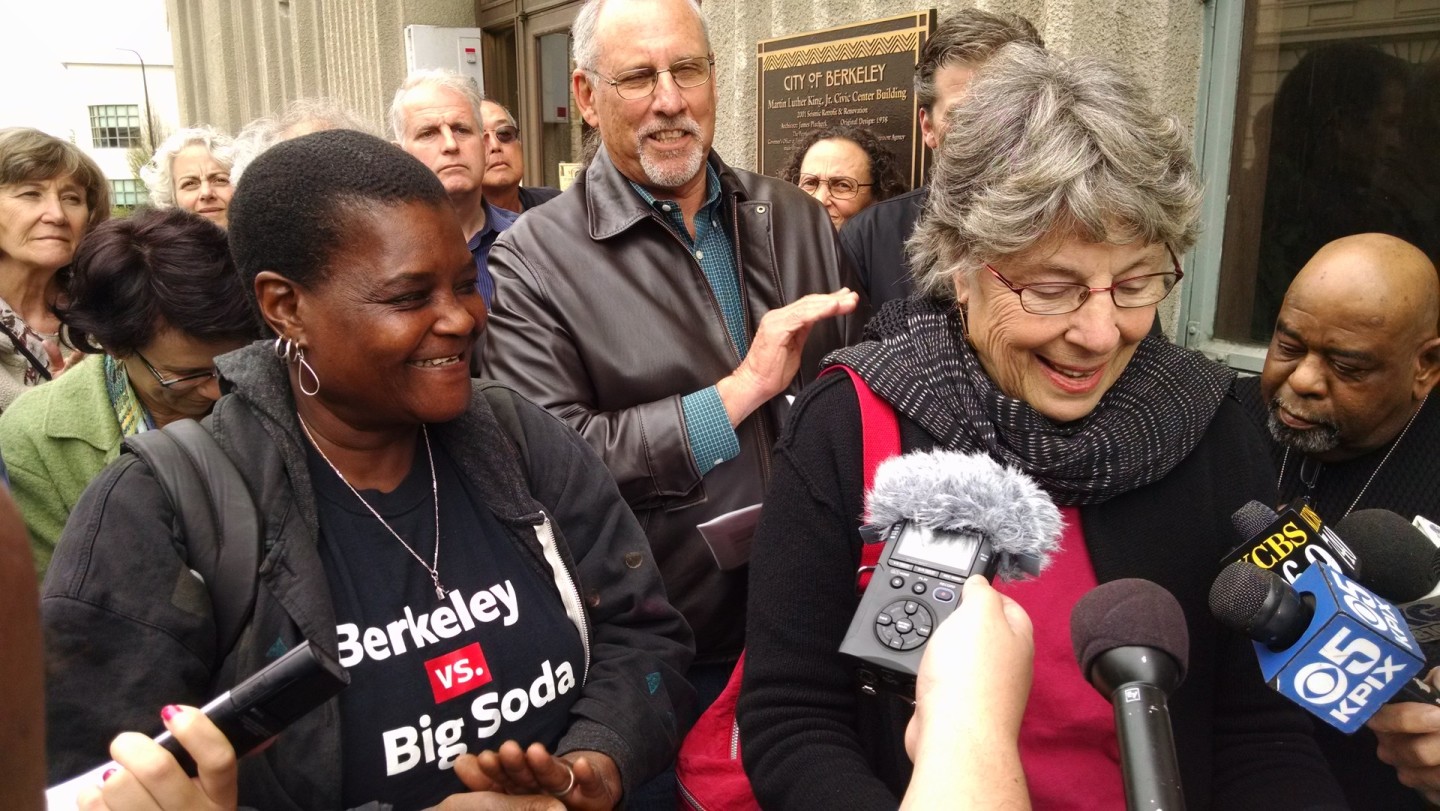
"caption": "Berkeley City Councilwoman Linda Maio (right), with soda tax panel expert Joy Moore (left), announces first month's tax revenue.",
"description": "Berkeley City Councilwoman Linda Maio (right), with soda tax panel expert Joy Moore (left), announces first month's tax revenue.",
"title": "RS15218_IMG_20150518_133659532-qut",
"credit": "Andrew Stelzer/KQED",
"status": "inherit",
"isLoading": false,
"fetchFailed": false
},
"bayareabites_96189": {
"type": "attachments",
"id": "bayareabites_96189",
"meta": {
"index": "attachments_1716263798",
"site": "bayareabites",
"id": "96189",
"found": true
},
"parent": 96187,
"imgSizes": {
"thumbnail": {
"file": "https://ww2.kqed.org/app/uploads/sites/24/2015/05/RT2U1xQ7shZs-GjaUPR-ZFemHQqo4RBIsfQDOOEEFUU5bhmxyqcgNSB-8w99WZDTSsudeg3cXikClO_viH9AMs-400x267.jpeg",
"width": 400,
"mimeType": "image/jpeg",
"height": 267
},
"post-thumbnail": {
"file": "https://ww2.kqed.org/app/uploads/sites/24/2015/05/RT2U1xQ7shZs-GjaUPR-ZFemHQqo4RBIsfQDOOEEFUU5bhmxyqcgNSB-8w99WZDTSsudeg3cXikClO_viH9AMs-672x372.jpeg",
"width": 672,
"mimeType": "image/jpeg",
"height": 372
},
"kqedFullSize": {
"file": "https://ww2.kqed.org/app/uploads/sites/24/2015/05/RT2U1xQ7shZs-GjaUPR-ZFemHQqo4RBIsfQDOOEEFUU5bhmxyqcgNSB-8w99WZDTSsudeg3cXikClO_viH9AMs.jpeg",
"width": 800,
"height": 533
},
"cat_post_thumb_sizecategory-posts-2": {
"file": "https://ww2.kqed.org/app/uploads/sites/24/2015/05/RT2U1xQ7shZs-GjaUPR-ZFemHQqo4RBIsfQDOOEEFUU5bhmxyqcgNSB-8w99WZDTSsudeg3cXikClO_viH9AMs-150x150.jpeg",
"width": 150,
"mimeType": "image/jpeg",
"height": 150
},
"guest-author-96": {
"file": "https://ww2.kqed.org/app/uploads/sites/24/2015/05/RT2U1xQ7shZs-GjaUPR-ZFemHQqo4RBIsfQDOOEEFUU5bhmxyqcgNSB-8w99WZDTSsudeg3cXikClO_viH9AMs-96x96.jpeg",
"width": 96,
"mimeType": "image/jpeg",
"height": 96
},
"medium": {
"file": "https://ww2.kqed.org/app/uploads/sites/24/2015/05/RT2U1xQ7shZs-GjaUPR-ZFemHQqo4RBIsfQDOOEEFUU5bhmxyqcgNSB-8w99WZDTSsudeg3cXikClO_viH9AMs-800x533.jpeg",
"width": 800,
"mimeType": "image/jpeg",
"height": 533
},
"guest-author-64": {
"file": "https://ww2.kqed.org/app/uploads/sites/24/2015/05/RT2U1xQ7shZs-GjaUPR-ZFemHQqo4RBIsfQDOOEEFUU5bhmxyqcgNSB-8w99WZDTSsudeg3cXikClO_viH9AMs-64x64.jpeg",
"width": 64,
"mimeType": "image/jpeg",
"height": 64
},
"detail": {
"file": "https://ww2.kqed.org/app/uploads/sites/24/2015/05/RT2U1xQ7shZs-GjaUPR-ZFemHQqo4RBIsfQDOOEEFUU5bhmxyqcgNSB-8w99WZDTSsudeg3cXikClO_viH9AMs-75x75.jpeg",
"width": 75,
"mimeType": "image/jpeg",
"height": 75
},
"guest-author-32": {
"file": "https://ww2.kqed.org/app/uploads/sites/24/2015/05/RT2U1xQ7shZs-GjaUPR-ZFemHQqo4RBIsfQDOOEEFUU5bhmxyqcgNSB-8w99WZDTSsudeg3cXikClO_viH9AMs-32x32.jpeg",
"width": 32,
"mimeType": "image/jpeg",
"height": 32
},
"guest-author-128": {
"file": "https://ww2.kqed.org/app/uploads/sites/24/2015/05/RT2U1xQ7shZs-GjaUPR-ZFemHQqo4RBIsfQDOOEEFUU5bhmxyqcgNSB-8w99WZDTSsudeg3cXikClO_viH9AMs-128x128.jpeg",
"width": 128,
"mimeType": "image/jpeg",
"height": 128
}
},
"publishDate": 1431712001,
"modified": 1431712028,
"caption": null,
"description": null,
"title": "RT2U1xQ7shZs-GjaUPR-ZFemHQqo4RBIsfQDOOEEFUU5bhmxyqcgNSB-8w99WZDTSsudeg3cXikClO_viH9AMs",
"credit": "Alison Yin",
"status": "inherit",
"isLoading": false,
"fetchFailed": false
},
"stateofhealth_27308": {
"type": "attachments",
"id": "stateofhealth_27308",
"meta": {
"index": "attachments_1716263798",
"site": "stateofhealth",
"id": "27308",
"found": true
},
"parent": 27292,
"imgSizes": {
"twentyfourteen-full-width": {
"file": "https://ww2.kqed.org/app/uploads/sites/27/2015/05/462294288-1038x576.jpg",
"width": 1038,
"mimeType": "image/jpeg",
"height": 576
},
"thumbnail": {
"file": "https://ww2.kqed.org/app/uploads/sites/27/2015/05/462294288-400x276.jpg",
"width": 400,
"mimeType": "image/jpeg",
"height": 276
},
"fd-sm": {
"file": "https://ww2.kqed.org/app/uploads/sites/27/2015/05/462294288-960x662.jpg",
"width": 960,
"mimeType": "image/jpeg",
"height": 662
},
"post-thumbnail": {
"file": "https://ww2.kqed.org/app/uploads/sites/27/2015/05/462294288-672x372.jpg",
"width": 672,
"mimeType": "image/jpeg",
"height": 372
},
"kqedFullSize": {
"file": "https://ww2.kqed.org/app/uploads/sites/27/2015/05/462294288-e1431629128325.jpg",
"width": 1920,
"height": 1324
},
"large": {
"file": "https://ww2.kqed.org/app/uploads/sites/27/2015/05/462294288-1440x993.jpg",
"width": 1440,
"mimeType": "image/jpeg",
"height": 993
},
"guest-author-96": {
"file": "https://ww2.kqed.org/app/uploads/sites/27/2015/05/462294288-96x96.jpg",
"width": 96,
"mimeType": "image/jpeg",
"height": 96
},
"medium": {
"file": "https://ww2.kqed.org/app/uploads/sites/27/2015/05/462294288-800x552.jpg",
"width": 800,
"mimeType": "image/jpeg",
"height": 552
},
"guest-author-64": {
"file": "https://ww2.kqed.org/app/uploads/sites/27/2015/05/462294288-64x64.jpg",
"width": 64,
"mimeType": "image/jpeg",
"height": 64
},
"guest-author-32": {
"file": "https://ww2.kqed.org/app/uploads/sites/27/2015/05/462294288-32x32.jpg",
"width": 32,
"mimeType": "image/jpeg",
"height": 32
},
"fd-med": {
"file": "https://ww2.kqed.org/app/uploads/sites/27/2015/05/462294288-1180x814.jpg",
"width": 1180,
"mimeType": "image/jpeg",
"height": 814
},
"detail": {
"file": "https://ww2.kqed.org/app/uploads/sites/27/2015/05/462294288-75x75.jpg",
"width": 75,
"mimeType": "image/jpeg",
"height": 75
},
"guest-author-128": {
"file": "https://ww2.kqed.org/app/uploads/sites/27/2015/05/462294288-128x128.jpg",
"width": 128,
"mimeType": "image/jpeg",
"height": 128
}
},
"publishDate": 1431629119,
"modified": 1437323370,
"caption": null,
"description": "Measles, vaccine, MMR",
"title": "Large Outbreak Of Measles Reported In California",
"credit": "Justin Sullivan/Getty Images",
"status": "inherit",
"isLoading": false,
"fetchFailed": false
},
"stateofhealth_27368": {
"type": "attachments",
"id": "stateofhealth_27368",
"meta": {
"index": "attachments_1716263798",
"site": "stateofhealth",
"id": "27368",
"found": true
},
"parent": 27292,
"imgSizes": {
"twentyfourteen-full-width": {
"file": "https://ww2.kqed.org/app/uploads/sites/27/2015/05/Pan-1038x576.jpg",
"width": 1038,
"mimeType": "image/jpeg",
"height": 576
},
"thumbnail": {
"file": "https://ww2.kqed.org/app/uploads/sites/27/2015/05/Pan-400x261.jpg",
"width": 400,
"mimeType": "image/jpeg",
"height": 261
},
"fd-sm": {
"file": "https://ww2.kqed.org/app/uploads/sites/27/2015/05/Pan-960x627.jpg",
"width": 960,
"mimeType": "image/jpeg",
"height": 627
},
"post-thumbnail": {
"file": "https://ww2.kqed.org/app/uploads/sites/27/2015/05/Pan-672x372.jpg",
"width": 672,
"mimeType": "image/jpeg",
"height": 372
},
"kqedFullSize": {
"file": "https://ww2.kqed.org/app/uploads/sites/27/2015/05/Pan-e1431647084619.jpg",
"width": 1920,
"height": 1255
},
"large": {
"file": "https://ww2.kqed.org/app/uploads/sites/27/2015/05/Pan-1440x941.jpg",
"width": 1440,
"mimeType": "image/jpeg",
"height": 941
},
"guest-author-96": {
"file": "https://ww2.kqed.org/app/uploads/sites/27/2015/05/Pan-96x96.jpg",
"width": 96,
"mimeType": "image/jpeg",
"height": 96
},
"medium": {
"file": "https://ww2.kqed.org/app/uploads/sites/27/2015/05/Pan-800x523.jpg",
"width": 800,
"mimeType": "image/jpeg",
"height": 523
},
"guest-author-64": {
"file": "https://ww2.kqed.org/app/uploads/sites/27/2015/05/Pan-64x64.jpg",
"width": 64,
"mimeType": "image/jpeg",
"height": 64
},
"guest-author-32": {
"file": "https://ww2.kqed.org/app/uploads/sites/27/2015/05/Pan-32x32.jpg",
"width": 32,
"mimeType": "image/jpeg",
"height": 32
},
"fd-med": {
"file": "https://ww2.kqed.org/app/uploads/sites/27/2015/05/Pan-1180x771.jpg",
"width": 1180,
"mimeType": "image/jpeg",
"height": 771
},
"detail": {
"file": "https://ww2.kqed.org/app/uploads/sites/27/2015/05/Pan-75x75.jpg",
"width": 75,
"mimeType": "image/jpeg",
"height": 75
},
"guest-author-128": {
"file": "https://ww2.kqed.org/app/uploads/sites/27/2015/05/Pan-128x128.jpg",
"width": 128,
"mimeType": "image/jpeg",
"height": 128
}
},
"publishDate": 1431647001,
"modified": 1431647920,
"caption": "Sen. Richard Pan (D-Sacramento) talks to reporters after the Senate approved a bill he co-authored. It would require virtually all children to be vaccinated. ",
"description": null,
"title": "Pan",
"credit": "Pauline Bartolone/Capital Public Radio",
"status": "inherit",
"isLoading": false,
"fetchFailed": false
},
"stateofhealth_27091": {
"type": "attachments",
"id": "stateofhealth_27091",
"meta": {
"index": "attachments_1716263798",
"site": "stateofhealth",
"id": "27091",
"found": true
},
"parent": 26835,
"imgSizes": {
"twentyfourteen-full-width": {
"file": "https://ww2.kqed.org/app/uploads/sites/27/2015/05/2522088210_7e2edfec99_o-1038x576.jpg",
"width": 1038,
"mimeType": "image/jpeg",
"height": 576
},
"thumbnail": {
"file": "https://ww2.kqed.org/app/uploads/sites/27/2015/05/2522088210_7e2edfec99_o-400x207.jpg",
"width": 400,
"mimeType": "image/jpeg",
"height": 207
},
"fd-sm": {
"file": "https://ww2.kqed.org/app/uploads/sites/27/2015/05/2522088210_7e2edfec99_o-960x497.jpg",
"width": 960,
"mimeType": "image/jpeg",
"height": 497
},
"post-thumbnail": {
"file": "https://ww2.kqed.org/app/uploads/sites/27/2015/05/2522088210_7e2edfec99_o-672x372.jpg",
"width": 672,
"mimeType": "image/jpeg",
"height": 372
},
"kqedFullSize": {
"file": "https://ww2.kqed.org/app/uploads/sites/27/2015/05/2522088210_7e2edfec99_o.jpg",
"width": 1589,
"height": 822
},
"large": {
"file": "https://ww2.kqed.org/app/uploads/sites/27/2015/05/2522088210_7e2edfec99_o-1440x745.jpg",
"width": 1440,
"mimeType": "image/jpeg",
"height": 745
},
"guest-author-96": {
"file": "https://ww2.kqed.org/app/uploads/sites/27/2015/05/2522088210_7e2edfec99_o-96x96.jpg",
"width": 96,
"mimeType": "image/jpeg",
"height": 96
},
"medium": {
"file": "https://ww2.kqed.org/app/uploads/sites/27/2015/05/2522088210_7e2edfec99_o-800x414.jpg",
"width": 800,
"mimeType": "image/jpeg",
"height": 414
},
"guest-author-64": {
"file": "https://ww2.kqed.org/app/uploads/sites/27/2015/05/2522088210_7e2edfec99_o-64x64.jpg",
"width": 64,
"mimeType": "image/jpeg",
"height": 64
},
"guest-author-32": {
"file": "https://ww2.kqed.org/app/uploads/sites/27/2015/05/2522088210_7e2edfec99_o-32x32.jpg",
"width": 32,
"mimeType": "image/jpeg",
"height": 32
},
"fd-med": {
"file": "https://ww2.kqed.org/app/uploads/sites/27/2015/05/2522088210_7e2edfec99_o-1180x610.jpg",
"width": 1180,
"mimeType": "image/jpeg",
"height": 610
},
"detail": {
"file": "https://ww2.kqed.org/app/uploads/sites/27/2015/05/2522088210_7e2edfec99_o-75x75.jpg",
"width": 75,
"mimeType": "image/jpeg",
"height": 75
},
"guest-author-128": {
"file": "https://ww2.kqed.org/app/uploads/sites/27/2015/05/2522088210_7e2edfec99_o-128x128.jpg",
"width": 128,
"mimeType": "image/jpeg",
"height": 128
}
},
"publishDate": 1431554288,
"modified": 1431554330,
"caption": null,
"description": "nail salon",
"title": "2522088210_7e2edfec99_o",
"credit": "bettyx1138/via Flickr",
"status": "inherit",
"isLoading": false,
"fetchFailed": false
},
"stateofhealth_26567": {
"type": "attachments",
"id": "stateofhealth_26567",
"meta": {
"index": "attachments_1716263798",
"site": "stateofhealth",
"id": "26567",
"found": true
},
"parent": 25721,
"imgSizes": {
"twentyfourteen-full-width": {
"file": "https://ww2.kqed.org/app/uploads/sites/27/2015/05/RS14070_495311669-1038x576.jpg",
"width": 1038,
"mimeType": "image/jpeg",
"height": 576
},
"thumbnail": {
"file": "https://ww2.kqed.org/app/uploads/sites/27/2015/05/RS14070_495311669-400x285.jpg",
"width": 400,
"mimeType": "image/jpeg",
"height": 285
},
"fd-sm": {
"file": "https://ww2.kqed.org/app/uploads/sites/27/2015/05/RS14070_495311669-960x685.jpg",
"width": 960,
"mimeType": "image/jpeg",
"height": 685
},
"post-thumbnail": {
"file": "https://ww2.kqed.org/app/uploads/sites/27/2015/05/RS14070_495311669-672x372.jpg",
"width": 672,
"mimeType": "image/jpeg",
"height": 372
},
"kqedFullSize": {
"file": "https://ww2.kqed.org/app/uploads/sites/27/2015/05/RS14070_495311669-e1431383620965.jpg",
"width": 1920,
"height": 1369
},
"large": {
"file": "https://ww2.kqed.org/app/uploads/sites/27/2015/05/RS14070_495311669-1440x1027.jpg",
"width": 1440,
"mimeType": "image/jpeg",
"height": 1027
},
"guest-author-96": {
"file": "https://ww2.kqed.org/app/uploads/sites/27/2015/05/RS14070_495311669-96x96.jpg",
"width": 96,
"mimeType": "image/jpeg",
"height": 96
},
"medium": {
"file": "https://ww2.kqed.org/app/uploads/sites/27/2015/05/RS14070_495311669-800x570.jpg",
"width": 800,
"mimeType": "image/jpeg",
"height": 570
},
"guest-author-64": {
"file": "https://ww2.kqed.org/app/uploads/sites/27/2015/05/RS14070_495311669-64x64.jpg",
"width": 64,
"mimeType": "image/jpeg",
"height": 64
},
"guest-author-32": {
"file": "https://ww2.kqed.org/app/uploads/sites/27/2015/05/RS14070_495311669-32x32.jpg",
"width": 32,
"mimeType": "image/jpeg",
"height": 32
},
"fd-med": {
"file": "https://ww2.kqed.org/app/uploads/sites/27/2015/05/RS14070_495311669-1180x841.jpg",
"width": 1180,
"mimeType": "image/jpeg",
"height": 841
},
"detail": {
"file": "https://ww2.kqed.org/app/uploads/sites/27/2015/05/RS14070_495311669-75x75.jpg",
"width": 75,
"mimeType": "image/jpeg",
"height": 75
},
"guest-author-128": {
"file": "https://ww2.kqed.org/app/uploads/sites/27/2015/05/RS14070_495311669-128x128.jpg",
"width": 128,
"mimeType": "image/jpeg",
"height": 128
}
},
"publishDate": 1431383577,
"modified": 1435251228,
"caption": "A dose of measles vaccine. ",
"description": "MIAMI, FL - JUNE 02: A dose of measles vaccine is seen at the Miami Children's Hospital on June 02, 2014 in Miami, Florida. The Centers for Disease Control and Prevention last week announced that in the United States they are seeing the most measles cases in 20 years as they warned clinicians, parents and others to watch for and get vaccinated against the potentially deadly virus. (Photo by Joe Raedle/Getty Images)",
"title": "Center For Disease Control Reports Highest Number Of Measles Cases In 20 Years",
"credit": " Joe Raedle/Getty Images",
"status": "inherit",
"isLoading": false,
"fetchFailed": false
},
"news_10521878": {
"type": "attachments",
"id": "news_10521878",
"meta": {
"index": "attachments_1716263798",
"site": "news",
"id": "10521878",
"found": true
},
"parent": 10521875,
"imgSizes": {
"twentyfourteen-full-width": {
"file": "https://ww2.kqed.org/app/uploads/sites/10/2015/05/6876622854_f7856704d4_o-1024x576.jpg",
"width": 1024,
"mimeType": "image/jpeg",
"height": 576
},
"thumbnail": {
"file": "https://ww2.kqed.org/app/uploads/sites/10/2015/05/6876622854_f7856704d4_o-400x300.jpg",
"width": 400,
"mimeType": "image/jpeg",
"height": 300
},
"fd-sm": {
"file": "https://ww2.kqed.org/app/uploads/sites/10/2015/05/6876622854_f7856704d4_o-960x720.jpg",
"width": 960,
"mimeType": "image/jpeg",
"height": 720
},
"post-thumbnail": {
"file": "https://ww2.kqed.org/app/uploads/sites/10/2015/05/6876622854_f7856704d4_o-672x372.jpg",
"width": 672,
"mimeType": "image/jpeg",
"height": 372
},
"kqedFullSize": {
"file": "https://ww2.kqed.org/app/uploads/sites/10/2015/05/6876622854_f7856704d4_o.jpg",
"width": 1024,
"height": 768
},
"guest-author-96": {
"file": "https://ww2.kqed.org/app/uploads/sites/10/2015/05/6876622854_f7856704d4_o-96x96.jpg",
"width": 96,
"mimeType": "image/jpeg",
"height": 96
},
"medium": {
"file": "https://ww2.kqed.org/app/uploads/sites/10/2015/05/6876622854_f7856704d4_o-800x600.jpg",
"width": 800,
"mimeType": "image/jpeg",
"height": 600
},
"guest-author-64": {
"file": "https://ww2.kqed.org/app/uploads/sites/10/2015/05/6876622854_f7856704d4_o-64x64.jpg",
"width": 64,
"mimeType": "image/jpeg",
"height": 64
},
"detail": {
"file": "https://ww2.kqed.org/app/uploads/sites/10/2015/05/6876622854_f7856704d4_o-75x75.jpg",
"width": 75,
"mimeType": "image/jpeg",
"height": 75
},
"guest-author-32": {
"file": "https://ww2.kqed.org/app/uploads/sites/10/2015/05/6876622854_f7856704d4_o-32x32.jpg",
"width": 32,
"mimeType": "image/jpeg",
"height": 32
},
"guest-author-128": {
"file": "https://ww2.kqed.org/app/uploads/sites/10/2015/05/6876622854_f7856704d4_o-128x128.jpg",
"width": 128,
"mimeType": "image/jpeg",
"height": 128
}
},
"publishDate": 1431366285,
"modified": 1431366557,
"caption": "Carolyn Walworth is a junior at Palo Alto High School (the main building of which is shown here in 2012). After four recent suicides in her school district, she wrote an op-ed about the stress faced by students in the area, which is home to some of the nation's most competitive public high schools.",
"description": "Main building, Palo Alto High School",
"title": "Palo Alto High School",
"credit": "\u003ca href=\"https://flic.kr/p/btEup1\" target=\"_blank\">Ho John Lee/Flickr\u003c/a>",
"status": "inherit",
"isLoading": false,
"fetchFailed": false
}
},
"audioPlayerReducer": {
"postId": "stream_live",
"isPaused": true,
"isPlaying": false,
"pfsActive": false,
"pledgeModalIsOpen": true,
"playerDrawerIsOpen": false,
"liveAudioPlayStartedAt": 0,
"liveAudioPlayContext": ""
},
"authorsReducer": {
"byline_stateofhealth_30425": {
"type": "authors",
"id": "byline_stateofhealth_30425",
"meta": {
"override": true
},
"slug": "byline_stateofhealth_30425",
"name": "Kenny Goldberg, KPBS",
"isLoading": false
},
"byline_stateofhealth_29198": {
"type": "authors",
"id": "byline_stateofhealth_29198",
"meta": {
"override": true
},
"slug": "byline_stateofhealth_29198",
"name": "\u003cstrong>Barbara Feder Ostrov\u003cbr />Kaiser Health News\u003c/strong>",
"isLoading": false
},
"byline_bayareabites_96187": {
"type": "authors",
"id": "byline_bayareabites_96187",
"meta": {
"override": true
},
"slug": "byline_bayareabites_96187",
"name": "Grace Hwang Lynch, \u003ca href=\"http://ww2.kqed.org/bayareabites/author/caamedia/\">CAAM\u003c/a>",
"isLoading": false
},
"byline_stateofhealth_28132": {
"type": "authors",
"id": "byline_stateofhealth_28132",
"meta": {
"override": true
},
"slug": "byline_stateofhealth_28132",
"name": "Michelle Dutro",
"isLoading": false
},
"byline_stateofhealth_25721": {
"type": "authors",
"id": "byline_stateofhealth_25721",
"meta": {
"override": true
},
"slug": "byline_stateofhealth_25721",
"name": "Michaeleen Doucleff, NPR",
"isLoading": false
},
"byline_news_10521875": {
"type": "authors",
"id": "byline_news_10521875",
"meta": {
"override": true
},
"slug": "byline_news_10521875",
"name": "\u003cstrong>\u003ca href=\"http://www.npr.org/people/223448903/arun-rath\" target=\"_blank\">Arun Rath\u003c/a>\u003cbr />NPR\u003c/strong>",
"isLoading": false
},
"andrewstelzer": {
"type": "authors",
"id": "213",
"meta": {
"index": "authors_1716337520",
"id": "213",
"found": true
},
"name": "Andrew Stelzer",
"firstName": "Andrew",
"lastName": "Stelzer",
"slug": "andrewstelzer",
"email": "andrewstelzer@gmail.com",
"display_author_email": false,
"staff_mastheads": [],
"title": null,
"bio": "Andrew Stelzer has been reporting for KQED since 2010, and is a producer at \u003ca href=\"http://www.radioproject.org\" target=\"_blank\">Making Contact\u003c/a> in Oakland.. His work has been featured on programs including \u003ca href=\"http://www.npr.org/templates/story/story.php?storyId=5010\" target=\"_blank\">NPR’s Weekend Edition\u003c/a>, \u003ca href=\"http://www.theworld.org/\" target=\"_blank\">PRI’s The World\u003c/a>, \u003ca href=\"http://www.studio360.org/\" target=\"_blank\">Studio 360\u003c/a>, \u003ca href=\"http://marketplace.publicradio.org/\" target=\"_blank\">Marketplace\u003c/a>,\u003ca href=\"http://www.loe.org/\" target=\"_blank\">Living on Earth\u003c/a>, \u003ca href=\"http://www.onthemedia.org/\" target=\"_blank\">On the Media\u003c/a>, \u003ca href=\"http://www.latinousa.org/index.html\" target=\"_blank\">Latino USA,\u003c/a> \u003ca href=\"http://www.onlyagame.org/\" rel=\"tag\">Only a Game,\u003c/a> \u003ca href=\"http://www.tswi.org/\" target=\"_blank\">Radio Netherlands,\u003c/a> \u003ca href=\"http://worldradio.ch/index.shtml\" target=\"_blank\">World Radio Switzerland,\u003c/a> and \u003ca href=\"http://www.rfi.fr/langues/statiques/rfi_anglais.asp\" target=\"_blank\">Radio France International\u003c/a>. Andrew has written for publications including \u003ca href=\"http://www.inthesetimes.com/site/about/author/2369\" target=\"_blank\">In These Times\u003c/a>, \u003ca href=\"http://www.progressive.org/\" target=\"_blank\">The Progressive\u003c/a>, \u003ca href=\"http://ipsnews.net/\" target=\"_blank\">Interpress Service\u003c/a>, \u003ca href=\"http://www.tampabay.com/\" target=\"_blank\">The St. Petersburg Times\u003c/a>, and \u003ca href=\"http://www.eastbayexpress.com/ebx/Home\" target=\"_blank\">The East Bay Express\u003c/a>.\r\n\r\nAndrew’s work has received numerous awards from the Society of Professional Journalists, the National Lesbian and Gay Journalists Association, and the National Council on Crime and Delinquency.\r\n\r\nHe previously was a reporter at \u003ca href=\"http://www.wmnf.org/\" target=\"_blank\">WMNF\u003c/a> radio in Tampa, FL, and reporter and youth advocate st \u003ca href=\"http://www.kboo.org/\" target=\"_blank\">KBOO \u003c/a> in Portland, Oregon. Andrew has conducted radio production trainings around the world, from Algeria, to New Orleans, to the desert of Southern Jordan.",
"avatar": "https://secure.gravatar.com/avatar/14c7e75469395cb2468d45c9f6896ca9?s=600&d=blank&r=g",
"twitter": null,
"facebook": null,
"instagram": null,
"linkedin": null,
"sites": [
{
"site": "arts",
"roles": [
"contributor"
]
},
{
"site": "news",
"roles": [
"author"
]
},
{
"site": "stateofhealth",
"roles": [
"author"
]
}
],
"headData": {
"title": "Andrew Stelzer | KQED",
"description": null,
"ogImgSrc": "https://secure.gravatar.com/avatar/14c7e75469395cb2468d45c9f6896ca9?s=600&d=blank&r=g",
"twImgSrc": "https://secure.gravatar.com/avatar/14c7e75469395cb2468d45c9f6896ca9?s=600&d=blank&r=g"
},
"isLoading": false,
"link": "/author/andrewstelzer"
},
"lisaaliferis": {
"type": "authors",
"id": "240",
"meta": {
"index": "authors_1716337520",
"id": "240",
"found": true
},
"name": "Lisa Aliferis",
"firstName": "Lisa",
"lastName": "Aliferis",
"slug": "lisaaliferis",
"email": "laliferis@kqed.org",
"display_author_email": false,
"staff_mastheads": [],
"title": "KQED Contributor",
"bio": "Lisa Aliferis is the founding editor of KQED's \u003cem>State of Health\u003c/em> blog. Since 2011, she's been writing and editing stories for the site. Before taking up blogging, she toiled for many years (more than we can count) producing health stories for television, including\u003cem> Dateline NBC\u003c/em> and San Francisco's CBS affiliate, KPIX-TV. She also wrote up a \u003ca title=\"http://www.kqed.org/news/health/obamacare/obamacare-guide.jsp\" href=\"http://www.kqed.org/news/health/obamacare/obamacare-guide.jsp\">handy guide to the Affordable Care Act\u003c/a>, especially for Californians. Her work has been honored for many awards. Most recently she was a finalist for \"Best Topical Reporting\" from the Online News Association. You can follow her on Twitter: \u003ca title=\"https://twitter.com/laliferis\" href=\"https://twitter.com/laliferis\">@laliferis\u003c/a>",
"avatar": "https://secure.gravatar.com/avatar/86c339d5cdcb0dcd2b6cf5d7c3f5886b?s=600&d=mm&r=g",
"twitter": "laliferis",
"facebook": null,
"instagram": null,
"linkedin": null,
"sites": [
{
"site": "news",
"roles": [
"subscriber"
]
},
{
"site": "futureofyou",
"roles": [
"subscriber"
]
},
{
"site": "stateofhealth",
"roles": [
"subscriber"
]
},
{
"site": "science",
"roles": [
"subscriber"
]
},
{
"site": "food",
"roles": []
}
],
"headData": {
"title": "Lisa Aliferis | KQED",
"description": "KQED Contributor",
"ogImgSrc": "https://secure.gravatar.com/avatar/86c339d5cdcb0dcd2b6cf5d7c3f5886b?s=600&d=mm&r=g",
"twImgSrc": "https://secure.gravatar.com/avatar/86c339d5cdcb0dcd2b6cf5d7c3f5886b?s=600&d=mm&r=g"
},
"isLoading": false,
"link": "/author/lisaaliferis"
},
"rachael-myrow": {
"type": "authors",
"id": "251",
"meta": {
"index": "authors_1716337520",
"id": "251",
"found": true
},
"name": "Rachael Myrow",
"firstName": "Rachael",
"lastName": "Myrow",
"slug": "rachael-myrow",
"email": "rmyrow@kqed.org",
"display_author_email": true,
"staff_mastheads": [
"news"
],
"title": "Senior Editor of KQED's Silicon Valley News Desk",
"bio": "• I write and edit stories about how Silicon Valley power and policies shape everyday life in California. I’m also passionate about making Bay Area history and culture more accessible to a broad public. • I’ve been a journalist for most of my life, starting in high school with The Franklin Press in Los Angeles, where I grew up. While earning my first degree in English at UC Berkeley, I got my start in public radio at KALX-FM. After completing a second degree in journalism at Cal, I landed my first professional job at Marketplace, then moved on to KPCC (now LAist), and then KQED, where I hosted The California Report for more than seven years. • My reporting has appeared on NPR, The World, WBUR’s \u003ci>Here & Now\u003c/i>, and the BBC. I also guest host for KQED’s \u003ci>Forum\u003c/i>, as well as the Commonwealth Club in San Francisco. • I speak periodically on media, democracy and technology issues, and do voiceover work for documentaries and educational video projects. • Outside of the studio, you'll find me hiking Bay Area trails and whipping up Insta-ready meals in my kitchen. • I do not accept gifts, money, or favors from anyone connected to my reporting, I don't pay people for information, and I do not support or donate to political causes. • I strive to treat the people I report on with fairness, honesty, and respect. I also recognize there are often multiple sides to a story and work to verify information through multiple sources and documentation. If I get something wrong, I correct it.",
"avatar": "https://secure.gravatar.com/avatar/3ed8a3c5f26025e4a805ba634cda8cd764906b97438a6d9ce216b044e340da4e?s=600&d=blank&r=g",
"twitter": "rachaelmyrow",
"bluesky": null,
"facebook": null,
"instagram": null,
"linkedin": "https://www.linkedin.com/in/rachaelmyrow/",
"sites": [
{
"site": "arts",
"roles": [
"administrator"
]
},
{
"site": "news",
"roles": [
"edit_others_posts",
"editor"
]
},
{
"site": "futureofyou",
"roles": [
"editor"
]
},
{
"site": "bayareabites",
"roles": [
"editor"
]
},
{
"site": "stateofhealth",
"roles": [
"editor"
]
},
{
"site": "science",
"roles": [
"editor"
]
},
{
"site": "food",
"roles": [
"editor"
]
},
{
"site": "forum",
"roles": [
"editor"
]
},
{
"site": "liveblog",
"roles": [
"author"
]
}
],
"headData": {
"title": "Rachael Myrow | KQED",
"description": "Senior Editor of KQED's Silicon Valley News Desk",
"ogImgSrc": "https://secure.gravatar.com/avatar/3ed8a3c5f26025e4a805ba634cda8cd764906b97438a6d9ce216b044e340da4e?s=600&d=blank&r=g",
"twImgSrc": "https://secure.gravatar.com/avatar/3ed8a3c5f26025e4a805ba634cda8cd764906b97438a6d9ce216b044e340da4e?s=600&d=blank&r=g"
},
"isLoading": false,
"link": "/author/rachael-myrow"
},
"racheldornhelm": {
"type": "authors",
"id": "252",
"meta": {
"index": "authors_1716337520",
"id": "252",
"found": true
},
"name": "Rachel Dornhelm",
"firstName": "Rachel",
"lastName": "Dornhelm",
"slug": "racheldornhelm",
"email": "rdornhelm@kqed.org",
"display_author_email": false,
"staff_mastheads": [],
"title": null,
"bio": "\u003cp dir=\"ltr\">Rachel Dornhelm has worked as a reporter, editor and producer in public radio for the last twelve years. She got her start in New York City at WNYC and went on to work with the national business program Marketplace, WBUR’s “On Point” and KQED News in San Francisco. Her work has been honored by the LA Press Club and the SF-Peninsula Press Club.\u003c/p>\r\n\r\nRachel has a BA with honors in anthropology from Rice University and did graduate work at NYU.",
"avatar": "https://secure.gravatar.com/avatar/7eee8d9bf9f919dcc4573841641db363?s=600&d=blank&r=g",
"twitter": null,
"facebook": null,
"instagram": null,
"linkedin": null,
"sites": [
{
"site": "news",
"roles": [
"author"
]
},
{
"site": "stateofhealth",
"roles": [
"author"
]
},
{
"site": "quest",
"roles": [
"subscriber"
]
}
],
"headData": {
"title": "Rachel Dornhelm | KQED",
"description": null,
"ogImgSrc": "https://secure.gravatar.com/avatar/7eee8d9bf9f919dcc4573841641db363?s=600&d=blank&r=g",
"twImgSrc": "https://secure.gravatar.com/avatar/7eee8d9bf9f919dcc4573841641db363?s=600&d=blank&r=g"
},
"isLoading": false,
"link": "/author/racheldornhelm"
}
},
"pagesReducer": {
"stateofhealth_category_place-matters": {
"type": "terms",
"id": "stateofhealth_11",
"meta": {
"index": "terms_1716263798",
"site": "stateofhealth",
"id": "11",
"score": 14.406237
},
"featImg": null,
"name": "Community Health",
"description": "\r\n\r\nFrom rural California to urban neighborhoods, where you live affects your health",
"taxonomy": "category",
"headData": {
"twImgId": null,
"twTitle": null,
"ogTitle": null,
"ogImgId": null,
"twDescription": null,
"description": "From rural California to urban neighborhoods, where you live affects your health",
"title": "Community Health Archives | KQED Arts",
"ogDescription": null
},
"ttid": 11,
"slug": "place-matters",
"isLoading": false,
"title": "Community Health",
"pageMeta": {
"site": "stateofhealth",
"WpPageTemplate": "page-topic-editorial",
"currentPage": 23
},
"blocks": [
{
"blockName": "kqed/company-paragraph",
"content": "\r\n\r\nFrom rural California to urban neighborhoods, where you live affects your health"
},
{
"blockName": "kqed/post-list",
"attrs": {
"layout": "cardArticle2",
"query": "posts/stateofhealth?category=place-matters",
"seeMore": false,
"paginated": true,
"page": 23
}
},
{
"blockName": "kqed/ad"
}
]
}
},
"pfsSessionReducer": {},
"postsReducer": {
"stream_live": {
"type": "live",
"id": "stream_live",
"audioUrl": "https://streams.kqed.org/kqedradio",
"title": "Live Stream",
"excerpt": "Live Stream information currently unavailable.",
"link": "/radio",
"featImg": "",
"label": {
"name": "KQED Live",
"link": "/"
}
},
"stream_kqedNewscast": {
"type": "posts",
"id": "stream_kqedNewscast",
"audioUrl": "https://www.kqed.org/.stream/anon/radio/RDnews/newscast.mp3?_=1",
"title": "KQED Newscast",
"featImg": "",
"label": {
"name": "88.5 FM",
"link": "/"
}
},
"stateofhealth_30805": {
"type": "posts",
"id": "stateofhealth_30805",
"meta": {
"index": "posts_1716263798",
"site": "stateofhealth",
"id": "30805",
"score": null,
"sort": [
1432773211000
]
},
"parent": 0,
"labelTerm": {
"site": "stateofhealth"
},
"blocks": [],
"publishDate": 1432773211,
"format": "standard",
"disqusTitle": "Davis Requires All Restaurants to Offer Milk, Water as First Choice in Kids' Meals",
"title": "Davis Requires All Restaurants to Offer Milk, Water as First Choice in Kids' Meals",
"headTitle": "State of Health | KQED News",
"content": "\u003cp>In what it's calling an effort to \u003ca href=\"http://city-managers-office.cityofdavis.org/housing-and-human-services/kids-meals-beverage-choice-ordinance-information\" target=\"_blank\">encourage healthier options\u003c/a> for children, Davis will require all restaurants in the city to offer milk or water as the first choice for all children's meals.\u003c/p>\n\u003cp>\u003ca href=\"http://city-council.cityofdavis.org/Media/Default/Documents/PDF/CityCouncil/CouncilMeetings/Agendas/20150526/07-Kids-Meal-Beverages.pdf\" target=\"_blank\">An ordinance was passed by the City Council unanimously\u003c/a> on Tuesday night, the Sacramento Bee reports. Parents can still order soda for their children, but they must specifically request it.\u003c/p>\n\u003cp>More from the \u003ca href=\"http://www.sacbee.com/food-drink/article22438713.html\" target=\"_blank\">Bee\u003c/a>:\u003c/p>\n\u003cblockquote>\u003cp>The rule will go into effect on September 1, giving restaurants enough time to notify staff and implement healthy beverage options if they don’t already do so, said Julie Gallelo, executive director of First 5 Yolo, a non-profit organization that pushed for the ordinance starting last fall.\u003c/p>\n\u003cp>The ordinance will affect about 18 restaurants in the city, including both fast food establishments – Taco Bell, Carl’s Jr. and Round Table Pizza – and some local bistros and pubs.\u003c/p>\u003c/blockquote>\n\u003cp>The new ordinance applies to \"a restaurant that sells a children's meal that includes a beverage.\" The default beverage must now be milk or water.\u003c/p>\n\u003cp>Harold Goldstein, executive director of the California Center for Public Health Advocacy -- a longtime foe of sugary drinks -- called the City Council's action \"a bold move.\"\u003c/p>\n\u003cp>[ad fullwidth]\u003c/p>\n\u003cp>\"Parents will now have to ask for soda specifically if they want to serve their children liquid candy instead of a healthy beverage,\" he said in a statement. \"Studies have shown that parents will stick with the healthier option.\"\u003c/p>\n\u003cp>A spokeswoman for CalBev, the trade association for soda and other non-alcoholic beverages companies in California, said the group had no comment on the new ordinance.\u003c/p>\n\u003cp>\u003c/p>\n\u003cp>The Center for Science in the Public Interest, a national advocacy group, \u003ca href=\"http://cspinet.org/new/201505271.html\" target=\"_blank\">also praised the move\u003c/a> and said that many large restaurant chains have already taken soda off kids' menus. These companies include: McDonald's, Burger King, Wendy's, Dairy Queen, Panera, Subway and Chipotle.\u003c/p>\n\n",
"disqusIdentifier": "30805 http://ww2.kqed.org/stateofhealth/?p=30805",
"disqusUrl": "https://ww2.kqed.org/stateofhealth/2015/05/27/davis-requires-all-restaurants-to-offer-milk-water-as-first-choice-in-kids-meals/",
"stats": {
"hasVideo": false,
"hasChartOrMap": false,
"hasAudio": false,
"hasPolis": false,
"wordCount": 320,
"hasGoogleForm": false,
"hasGallery": false,
"hasHearkenModule": false,
"iframeSrcs": [],
"paragraphCount": 12
},
"modified": 1432774137,
"excerpt": "Parents may still order soda for their children, but water and milk are the default choices. ",
"headData": {
"twImgId": "",
"twTitle": "",
"ogTitle": "",
"ogImgId": "",
"twDescription": "",
"description": "Parents may still order soda for their children, but water and milk are the default choices. ",
"title": "Davis Requires All Restaurants to Offer Milk, Water as First Choice in Kids' Meals | KQED",
"ogDescription": "",
"schema": {
"@context": "https://schema.org",
"@type": "Article",
"headline": "Davis Requires All Restaurants to Offer Milk, Water as First Choice in Kids' Meals",
"datePublished": "2015-05-27T17:33:31-07:00",
"dateModified": "2015-05-27T17:48:57-07:00",
"image": "https://cdn.kqed.org/wp-content/uploads/2020/02/KQED-OG-Image@1x.png"
}
},
"guestAuthors": [],
"slug": "davis-requires-all-restaurants-to-offer-milk-water-as-first-choice-in-kids-meals",
"status": "publish",
"path": "/stateofhealth/30805/davis-requires-all-restaurants-to-offer-milk-water-as-first-choice-in-kids-meals",
"audioTrackLength": null,
"parsedContent": [
{
"type": "contentString",
"content": "\u003cdiv class=\"post-body\">\u003cp>\u003cp>In what it's calling an effort to \u003ca href=\"http://city-managers-office.cityofdavis.org/housing-and-human-services/kids-meals-beverage-choice-ordinance-information\" target=\"_blank\">encourage healthier options\u003c/a> for children, Davis will require all restaurants in the city to offer milk or water as the first choice for all children's meals.\u003c/p>\n\u003cp>\u003ca href=\"http://city-council.cityofdavis.org/Media/Default/Documents/PDF/CityCouncil/CouncilMeetings/Agendas/20150526/07-Kids-Meal-Beverages.pdf\" target=\"_blank\">An ordinance was passed by the City Council unanimously\u003c/a> on Tuesday night, the Sacramento Bee reports. Parents can still order soda for their children, but they must specifically request it.\u003c/p>\n\u003cp>More from the \u003ca href=\"http://www.sacbee.com/food-drink/article22438713.html\" target=\"_blank\">Bee\u003c/a>:\u003c/p>\n\u003cblockquote>\u003cp>The rule will go into effect on September 1, giving restaurants enough time to notify staff and implement healthy beverage options if they don’t already do so, said Julie Gallelo, executive director of First 5 Yolo, a non-profit organization that pushed for the ordinance starting last fall.\u003c/p>\n\u003cp>The ordinance will affect about 18 restaurants in the city, including both fast food establishments – Taco Bell, Carl’s Jr. and Round Table Pizza – and some local bistros and pubs.\u003c/p>\u003c/blockquote>\n\u003cp>The new ordinance applies to \"a restaurant that sells a children's meal that includes a beverage.\" The default beverage must now be milk or water.\u003c/p>\n\u003cp>Harold Goldstein, executive director of the California Center for Public Health Advocacy -- a longtime foe of sugary drinks -- called the City Council's action \"a bold move.\"\u003c/p>\n\u003cp>\u003c/p>\u003c/div>",
"attributes": {
"named": {},
"numeric": []
}
},
{
"type": "component",
"content": "",
"name": "ad",
"attributes": {
"named": {
"label": "fullwidth"
},
"numeric": [
"fullwidth"
]
}
},
{
"type": "contentString",
"content": "\u003cdiv class=\"post-body\">\u003cp>\u003c/p>\n\u003cp>\"Parents will now have to ask for soda specifically if they want to serve their children liquid candy instead of a healthy beverage,\" he said in a statement. \"Studies have shown that parents will stick with the healthier option.\"\u003c/p>\n\u003cp>A spokeswoman for CalBev, the trade association for soda and other non-alcoholic beverages companies in California, said the group had no comment on the new ordinance.\u003c/p>\n\u003cp>\u003c/p>\n\u003cp>The Center for Science in the Public Interest, a national advocacy group, \u003ca href=\"http://cspinet.org/new/201505271.html\" target=\"_blank\">also praised the move\u003c/a> and said that many large restaurant chains have already taken soda off kids' menus. These companies include: McDonald's, Burger King, Wendy's, Dairy Queen, Panera, Subway and Chipotle.\u003c/p>\n\n\u003c/div>\u003c/p>",
"attributes": {
"named": {},
"numeric": []
}
}
],
"link": "/stateofhealth/30805/davis-requires-all-restaurants-to-offer-milk-water-as-first-choice-in-kids-meals",
"authors": [
"240"
],
"categories": [
"stateofhealth_11",
"stateofhealth_14"
],
"tags": [
"stateofhealth_96",
"stateofhealth_580"
],
"featImg": "stateofhealth_30826",
"label": "stateofhealth"
},
"stateofhealth_30425": {
"type": "posts",
"id": "stateofhealth_30425",
"meta": {
"index": "posts_1716263798",
"site": "stateofhealth",
"id": "30425",
"score": null,
"sort": [
1432676458000
]
},
"parent": 0,
"labelTerm": {
"site": "stateofhealth"
},
"blocks": [],
"publishDate": 1432676458,
"format": "standard",
"disqusTitle": "Imperial County Divided Over Region's First Planned Parenthood Clinic",
"title": "Imperial County Divided Over Region's First Planned Parenthood Clinic",
"headTitle": "State of Health | KQED News",
"content": "\u003cp>The vast majority of Californians support unrestricted access to abortion and comprehensive sex education in schools.\u003c/p>\n\u003cp>But not in Imperial County, where religious groups have tried to prevent the region’s first Planned Parenthood clinic from opening.\u003c/p>\n\u003cp>Despite considerable opposition, the clinic is now providing care, but only on a limited basis.\u003c/p>\n\u003cp>\u003cstrong>New Clinic Opens\u003c/strong>\u003c/p>\n\u003cp>The new Planned Parenthood clinic sits right next to a Thai restaurant in El Centro, a city of 43,000 people 100 miles east of San Diego, near the Mexico border. Its waiting room is decorated in pastel colors, and all of the signs are in English and Spanish.\u003c/p>\n\u003cp>[ad fullwidth]\u003c/p>\n\u003cp>The clinic has six exam rooms and offers testing for HIV and other sexually transmitted diseases.\u003c/p>\n\u003cp>Maykent Salazar, who works as a promotora, or health educator, for Planned Parenthood, goes door-to-door in Imperial County telling people about the services that are available.\u003c/p>\n\u003cp>Salazar said family planning isn’t usually discussed around here.\u003c/p>\n\u003cp>“ ‘Cause there’s no access,\" she said. \"I mean, we have no clinics where people can talk about what they feel or what they think. It’s just taboo. It’s there, but no one talks about it.”\u003c/p>\n\u003cp>Salazar said people in Imperial County should have the same access to care as any other Californian.\u003c/p>\n\u003cp>“I think we in the Valley all deserve the right to choose what we want to do with our bodies and with our lives — that involves choosing what contraceptives we want to use, choosing if we want to have a baby or if we don’t want to have a baby, and when do we want to have him,\" she said.\u003c/p>\n\u003cp>\u003cstrong>Block That Clinic\u003c/strong>\u003c/p>\n\u003cp>But Planned Parenthood opponents have a totally different view.\u003c/p>\n\u003cp>At a meeting earlier this month of the El Centro City Council, opponents gathered outside and made their voices heard loud and clear.\u003c/p>\n\u003cp>Religious groups held what they called a “baby shower for life.” They collected donations of diapers, baby clothes, and set up anti-abortion displays.\u003c/p>\n\u003cp>Lisa Owens, who works with a Christian ministry called Woven, says she knows that some people believe in a woman’s right to choose to have an abortion.\u003c/p>\n\u003cp>“But that’s not what the Bible says,\" Owens said. \"The Bible says that God gives life and he takes life. And he’s the only one that can, and should.\"\u003c/p>\n\u003cp>\"Amen to that,\" said Chris Nunn. He’s a minister at El Centro’s Christ Community Church.\u003c/p>\n\u003cp>Nunn has urged local lawmakers to keep Planned Parenthood out of the area.\u003c/p>\n\u003cp>He said there’s nothing wrong with a new clinic coming to town.\u003c/p>\n\u003cp>“But Planned Parenthood kind of disguises itself as a clinic, and tries to come in under the guise of a clinic, in order to perform abortions, and prey on our young women,\" Nunn said. \"And that’s really what we have a problem with.”\u003c/p>\n\u003cp>Opponents like Nunn want the El Centro City Council to nullify a recently approved transfer agreement between the clinic and El Centro Regional Medical Center. Such agreements are standard between clinics and hospitals. They allow clinic patients and their records to be transferred should they suddenly need a higher level of care.\u003c/p>\n\u003cp>Nunn said the agreement is discretionary.\u003c/p>\n\u003cp>“That’s what we’re saying -- is that here in the community, that is 70 percent pro-life, is it prudent for our city-owned hospital to agree to a transfer agreement, that their constituents, by and large, would not agree with?\" Nunn said.\u003c/p>\n\u003cp>[soundcloud url=\"https://api.soundcloud.com/tracks/207305268\" params=\"color=ff5500&auto_play=false&hide_related=false&show_comments=true&show_user=true&show_reposts=false\" width=\"100%\" height=\"166\" iframe=\"true\" /]\u003c/p>\n\u003cp>\u003cstrong>City Says It's Doing the Right Thing\u003c/strong>\u003c/p>\n\u003cp>Opponents may not agree with it, but El Centro has no legal right to deny the transfer agreement. That’s the opinion of an independent legal review the city recently obtained.\u003c/p>\n\u003cp>El Centro city manager Ruben Duran said he’s familiar with opponents’ views. After all, in such a small town, he knows most Planned Parenthood critics personally.\u003c/p>\n\u003cp>Nonetheless, Duran said he and other city officials are doing the right thing.\u003c/p>\n\u003cp>“Actually, this goes back to the \u003ca href=\"ftp://www.leginfo.ca.gov/pub/01-02/bill/sen/sb_1301-1350/sb_1301_bill_20020906_chaptered.html\" target=\"_blank\">Reproductive Protection Act\u003c/a>,\" Duran said. \"It says that abortions are allowed in this state, and they are a protected right in this state. We’re following the law.”\u003c/p>\n\u003cp>\u003cstrong>Planned Parenthood Sues City\u003c/strong>\u003c/p>\n\u003cp>But not exactly, argues Planned Parenthood.\u003c/p>\n\u003cp>For now, the clinic can offer all of its services in El Centro except abortions, and the clinic is only allowed to operate 20 hours a week.\u003c/p>\n\u003cp>That’s because while the city has issued an occupancy permit, the city’s fire chief has refused to sign off on the clinic’s final fire safety clearance. The chief said it should be reclassified as an outpatient surgery center, which would require a pricey fire suppression system.\u003c/p>\n\u003cp>The city says it’s seeking guidance from the state on this issue.\u003c/p>\n\u003cp>But Planned Parenthood said it's fed up and is suing the chief and the city. It’s asking a judge to compel the chief to issue the final permit.\u003c/p>\n\u003cp>\u003cstrong>Teen Pregnancy Problem\u003c/strong>\u003c/p>\n\u003cp>In the meantime, 21-year-old Ariana Gonzalez believes Imperial Valley really needs Planned Parenthood.\u003c/p>\n\u003cp>She grew up in El Centro. Gonzalez is expecting her second child; she had her first when she was 16 and still in high school.\u003c/p>\n\u003cp>Gonzalez said it’s about time someone taught local teens the facts of life.\u003c/p>\n\u003cp>“I think education is the key factor in changing behaviors,\" she said. \"If you don’t know, then what’s to prevent you from going out and having unprotected sex?”\u003c/p>\n\u003cp>\u003c/p>\n\u003cp>That’s a big problem in Imperial County, where the teen pregnancy rate is 70 percent higher than the statewide average.\u003c/p>\n\n",
"disqusIdentifier": "30425 http://ww2.kqed.org/stateofhealth/?p=30425",
"disqusUrl": "https://ww2.kqed.org/stateofhealth/2015/05/26/imperial-county-divided-over-regions-first-planned-parenthood-clinic/",
"stats": {
"hasVideo": false,
"hasChartOrMap": false,
"hasAudio": false,
"hasPolis": false,
"wordCount": 1010,
"hasGoogleForm": false,
"hasGallery": false,
"hasHearkenModule": false,
"iframeSrcs": [],
"paragraphCount": 44
},
"modified": 1432677144,
"excerpt": "Despite opposition from religious groups, the clinic is now providing care, but only on a limited basis.",
"headData": {
"twImgId": "",
"twTitle": "",
"ogTitle": "",
"ogImgId": "",
"twDescription": "",
"description": "Despite opposition from religious groups, the clinic is now providing care, but only on a limited basis.",
"title": "Imperial County Divided Over Region's First Planned Parenthood Clinic | KQED",
"ogDescription": "",
"schema": {
"@context": "https://schema.org",
"@type": "Article",
"headline": "Imperial County Divided Over Region's First Planned Parenthood Clinic",
"datePublished": "2015-05-26T14:40:58-07:00",
"dateModified": "2015-05-26T14:52:24-07:00",
"image": "https://cdn.kqed.org/wp-content/uploads/2020/02/KQED-OG-Image@1x.png"
}
},
"guestAuthors": [],
"slug": "imperial-county-divided-over-regions-first-planned-parenthood-clinic",
"status": "publish",
"nprByline": "Kenny Goldberg, KPBS",
"path": "/stateofhealth/30425/imperial-county-divided-over-regions-first-planned-parenthood-clinic",
"audioTrackLength": null,
"parsedContent": [
{
"type": "contentString",
"content": "\u003cdiv class=\"post-body\">\u003cp>\u003cp>The vast majority of Californians support unrestricted access to abortion and comprehensive sex education in schools.\u003c/p>\n\u003cp>But not in Imperial County, where religious groups have tried to prevent the region’s first Planned Parenthood clinic from opening.\u003c/p>\n\u003cp>Despite considerable opposition, the clinic is now providing care, but only on a limited basis.\u003c/p>\n\u003cp>\u003cstrong>New Clinic Opens\u003c/strong>\u003c/p>\n\u003cp>The new Planned Parenthood clinic sits right next to a Thai restaurant in El Centro, a city of 43,000 people 100 miles east of San Diego, near the Mexico border. Its waiting room is decorated in pastel colors, and all of the signs are in English and Spanish.\u003c/p>\n\u003cp>\u003c/p>\u003c/div>",
"attributes": {
"named": {},
"numeric": []
}
},
{
"type": "component",
"content": "",
"name": "ad",
"attributes": {
"named": {
"label": "fullwidth"
},
"numeric": [
"fullwidth"
]
}
},
{
"type": "contentString",
"content": "\u003cdiv class=\"post-body\">\u003cp>\u003c/p>\n\u003cp>The clinic has six exam rooms and offers testing for HIV and other sexually transmitted diseases.\u003c/p>\n\u003cp>Maykent Salazar, who works as a promotora, or health educator, for Planned Parenthood, goes door-to-door in Imperial County telling people about the services that are available.\u003c/p>\n\u003cp>Salazar said family planning isn’t usually discussed around here.\u003c/p>\n\u003cp>“ ‘Cause there’s no access,\" she said. \"I mean, we have no clinics where people can talk about what they feel or what they think. It’s just taboo. It’s there, but no one talks about it.”\u003c/p>\n\u003cp>Salazar said people in Imperial County should have the same access to care as any other Californian.\u003c/p>\n\u003cp>“I think we in the Valley all deserve the right to choose what we want to do with our bodies and with our lives — that involves choosing what contraceptives we want to use, choosing if we want to have a baby or if we don’t want to have a baby, and when do we want to have him,\" she said.\u003c/p>\n\u003cp>\u003cstrong>Block That Clinic\u003c/strong>\u003c/p>\n\u003cp>But Planned Parenthood opponents have a totally different view.\u003c/p>\n\u003cp>At a meeting earlier this month of the El Centro City Council, opponents gathered outside and made their voices heard loud and clear.\u003c/p>\n\u003cp>Religious groups held what they called a “baby shower for life.” They collected donations of diapers, baby clothes, and set up anti-abortion displays.\u003c/p>\n\u003cp>Lisa Owens, who works with a Christian ministry called Woven, says she knows that some people believe in a woman’s right to choose to have an abortion.\u003c/p>\n\u003cp>“But that’s not what the Bible says,\" Owens said. \"The Bible says that God gives life and he takes life. And he’s the only one that can, and should.\"\u003c/p>\n\u003cp>\"Amen to that,\" said Chris Nunn. He’s a minister at El Centro’s Christ Community Church.\u003c/p>\n\u003cp>Nunn has urged local lawmakers to keep Planned Parenthood out of the area.\u003c/p>\n\u003cp>He said there’s nothing wrong with a new clinic coming to town.\u003c/p>\n\u003cp>“But Planned Parenthood kind of disguises itself as a clinic, and tries to come in under the guise of a clinic, in order to perform abortions, and prey on our young women,\" Nunn said. \"And that’s really what we have a problem with.”\u003c/p>\n\u003cp>Opponents like Nunn want the El Centro City Council to nullify a recently approved transfer agreement between the clinic and El Centro Regional Medical Center. Such agreements are standard between clinics and hospitals. They allow clinic patients and their records to be transferred should they suddenly need a higher level of care.\u003c/p>\n\u003cp>Nunn said the agreement is discretionary.\u003c/p>\n\u003cp>“That’s what we’re saying -- is that here in the community, that is 70 percent pro-life, is it prudent for our city-owned hospital to agree to a transfer agreement, that their constituents, by and large, would not agree with?\" Nunn said.\u003c/p>\n\u003cp>\u003c/p>\u003cp>\u003cdiv class='utils-parseShortcode-shortcodes-__shortcodes__shortcodeWrapper'>\n \u003ciframe width='100%' height='166'\n scrolling='no' frameborder='no'\n src='https://w.soundcloud.com/player/?url=https://api.soundcloud.com/tracks/207305268&visual=true&color=ff5500&auto_play=false&hide_related=false&show_comments=true&show_user=true&show_reposts=false'\n title='https://api.soundcloud.com/tracks/207305268'>\n \u003c/iframe>\n \u003c/div>\u003c/p>\u003cp>\u003c/p>\n\u003cp>\u003cstrong>City Says It's Doing the Right Thing\u003c/strong>\u003c/p>\n\u003cp>Opponents may not agree with it, but El Centro has no legal right to deny the transfer agreement. That’s the opinion of an independent legal review the city recently obtained.\u003c/p>\n\u003cp>El Centro city manager Ruben Duran said he’s familiar with opponents’ views. After all, in such a small town, he knows most Planned Parenthood critics personally.\u003c/p>\n\u003cp>Nonetheless, Duran said he and other city officials are doing the right thing.\u003c/p>\n\u003cp>“Actually, this goes back to the \u003ca href=\"ftp://www.leginfo.ca.gov/pub/01-02/bill/sen/sb_1301-1350/sb_1301_bill_20020906_chaptered.html\" target=\"_blank\">Reproductive Protection Act\u003c/a>,\" Duran said. \"It says that abortions are allowed in this state, and they are a protected right in this state. We’re following the law.”\u003c/p>\n\u003cp>\u003cstrong>Planned Parenthood Sues City\u003c/strong>\u003c/p>\n\u003cp>But not exactly, argues Planned Parenthood.\u003c/p>\n\u003cp>For now, the clinic can offer all of its services in El Centro except abortions, and the clinic is only allowed to operate 20 hours a week.\u003c/p>\n\u003cp>That’s because while the city has issued an occupancy permit, the city’s fire chief has refused to sign off on the clinic’s final fire safety clearance. The chief said it should be reclassified as an outpatient surgery center, which would require a pricey fire suppression system.\u003c/p>\n\u003cp>The city says it’s seeking guidance from the state on this issue.\u003c/p>\n\u003cp>But Planned Parenthood said it's fed up and is suing the chief and the city. It’s asking a judge to compel the chief to issue the final permit.\u003c/p>\n\u003cp>\u003cstrong>Teen Pregnancy Problem\u003c/strong>\u003c/p>\n\u003cp>In the meantime, 21-year-old Ariana Gonzalez believes Imperial Valley really needs Planned Parenthood.\u003c/p>\n\u003cp>She grew up in El Centro. Gonzalez is expecting her second child; she had her first when she was 16 and still in high school.\u003c/p>\n\u003cp>Gonzalez said it’s about time someone taught local teens the facts of life.\u003c/p>\n\u003cp>“I think education is the key factor in changing behaviors,\" she said. \"If you don’t know, then what’s to prevent you from going out and having unprotected sex?”\u003c/p>\n\u003cp>\u003c/p>\n\u003cp>That’s a big problem in Imperial County, where the teen pregnancy rate is 70 percent higher than the statewide average.\u003c/p>\n\n\u003c/div>\u003c/p>",
"attributes": {
"named": {},
"numeric": []
}
}
],
"link": "/stateofhealth/30425/imperial-county-divided-over-regions-first-planned-parenthood-clinic",
"authors": [
"byline_stateofhealth_30425"
],
"categories": [
"stateofhealth_11",
"stateofhealth_13"
],
"tags": [
"stateofhealth_160"
],
"featImg": "stateofhealth_30429",
"label": "stateofhealth"
},
"stateofhealth_29198": {
"type": "posts",
"id": "stateofhealth_29198",
"meta": {
"index": "posts_1716263798",
"site": "stateofhealth",
"id": "29198",
"score": null,
"sort": [
1432481401000
]
},
"parent": 0,
"labelTerm": {
"site": "stateofhealth"
},
"blocks": [],
"publishDate": 1432481401,
"format": "standard",
"disqusTitle": "Despite Efforts, ER Visits Spike in California Kids with Asthma",
"title": "Despite Efforts, ER Visits Spike in California Kids with Asthma",
"headTitle": "State of Health | KQED News",
"content": "\u003cp>Children in California increasingly are flocking to emergency rooms for treatment of asthma, despite millions of dollars spent on programs to control the disease.\u003c/p>\n\u003cp>Statewide, the rates of ER visits for asthma symptoms rose by about 18 percent for California children ages 5 to 17 and by 6 percent for children under 5 between 2005 and 2012, according to a Kaiser Health News analysis of the \u003ca href=\"http://www.ehib.org/page.jsp?page_key=124\" target=\"_blank\">latest available rates by county\u003c/a>.\u003c/p>\n\u003cp>In some parts of the state, especially the Central Valley, the increases were far higher. The rate of emergency room visits for children 5 and older more than doubled in rural Madera County and nearly doubled In Merced. In Sacramento County, they rose by 48 percent and in Los Angeles, the largest county in the nation, by 17 percent.\u003c/p>\n\u003cp>All told, more than 72,000 California children under 18 visited the ER for asthma in 2012.\u003c/p>\n\u003cp>\"There's clearly more work to be done if this many kids are going to the emergency department,\" said Anne Kelsey Lamb, director of the Regional Asthma Management and Prevention program of the Oakland-based Public Health Institute. \"We know a lot about what works. We absolutely should be able to reduce the rates we're seeing.\"\u003c/p>\n\u003cp>[ad fullwidth]\u003c/p>\n\u003cp>At the national level, asthma-related emergency room visit rates have declined in recent years, according to federal health data through 2010, the latest available.\u003c/p>\n\u003cp>Although ER visits declined in some counties, including Alameda, San Mateo and Marin, the overall rise in California has frustrated public health experts who have spent millions of dollars and countless hours to improve and expand asthma prevention programs around the state. The state and federal governments alone spend $1.54 million annually on such projects in California, including grants to schools to improve indoor air quality and training community health workers.\u003c/p>\n\u003cp>The good news is fewer kids are actually being admitted into hospitals. Overnight-or-longer stays are \u003ca href=\"http://www.kidsdata.org/topic/239/asthma-hospitalizations/trend#fmt=2298&loc=2&tf=1,73&ch=790&pdist=7\" target=\"_blank\">declining statewide\u003c/a> and nationally. That's due largely to better medicines and more aggressive treatment in the ER, asthma specialists say.\u003c/p>\n\u003cp>The reasons for the increase in ER visits are complex, experts say. They include parents not properly administering medications, poverty and inadequate insurance coverage, persistently high levels of indoor and outdoor pollution in some regions and the limited reach of programs that seek to manage symptoms or prevent them.\u003c/p>\n\u003cfigure id=\"attachment_29220\" class=\"wp-caption alignright\" style=\"max-width: 770px\">\u003cimg class=\"wp-image-29220 size-full\" src=\"http://ww2.kqed.org/stateofhealth/wp-content/uploads/sites/27/2015/05/county-asthma-rates_0-to-4_final_052215_770.jpg\" alt=\"Source: Kaiser Health News\" width=\"770\" height=\"737\" srcset=\"https://ww2.kqed.org/app/uploads/sites/27/2015/05/county-asthma-rates_0-to-4_final_052215_770.jpg 770w, https://ww2.kqed.org/app/uploads/sites/27/2015/05/county-asthma-rates_0-to-4_final_052215_770-400x383.jpg 400w, https://ww2.kqed.org/app/uploads/sites/27/2015/05/county-asthma-rates_0-to-4_final_052215_770-32x32.jpg 32w\" sizes=\"(max-width: 770px) 100vw, 770px\">\u003cfigcaption class=\"wp-caption-text\">Source: Kaiser Health News\u003c/figcaption>\u003c/figure>\n\u003cp>The rising rates don’t seem to reflect an actual increase in the respiratory disease – about 15 percent of California children have been diagnosed with asthma, a number that has remained \u003ca href=\"http://www.kidsdata.org/topic/238/asthma/trend#fmt=97&loc=2&tf=4,77\" target=\"_blank\">fairly steady\u003c/a> since 2001.\u003c/p>\n\u003cfigure id=\"attachment_29221\" class=\"wp-caption alignright\" style=\"max-width: 770px\">\u003ca href=\"http://ww2.kqed.org/stateofhealth/wp-content/uploads/sites/27/2015/05/county-asthma-rates_5-to-17_final_052215_770.jpg\" target=\"_blank\">\u003cimg class=\"wp-image-29221 size-full\" src=\"http://ww2.kqed.org/stateofhealth/wp-content/uploads/sites/27/2015/05/county-asthma-rates_5-to-17_final_052215_770.jpg\" alt=\"county-asthma-rates_5-to-17_final_052215_770\" width=\"770\" height=\"737\" srcset=\"https://ww2.kqed.org/app/uploads/sites/27/2015/05/county-asthma-rates_5-to-17_final_052215_770.jpg 770w, https://ww2.kqed.org/app/uploads/sites/27/2015/05/county-asthma-rates_5-to-17_final_052215_770-400x383.jpg 400w, https://ww2.kqed.org/app/uploads/sites/27/2015/05/county-asthma-rates_5-to-17_final_052215_770-32x32.jpg 32w\" sizes=\"(max-width: 770px) 100vw, 770px\">\u003c/a>\u003cfigcaption class=\"wp-caption-text\">Source: Kaiser Health News\u003c/figcaption>\u003c/figure>\n\u003cp>The rates of ER visits vary widely by county, from a high of 300 visits per 10,000 children under age 5 (Madera County) to a low of 32 (Sutter County) in 2012. Younger children visit the ER at higher rates because they are more likely to have undiagnosed asthma and because their lung function is more difficult to measure, complicating the task of finding the right combination of medicines, Kelsey Lamb said.\u003c/p>\n\u003cp>Some families seek treatment in the ER for symptoms that easily could be dealt with in a clinic because they can’t get a timely doctor's appointment or don't have a regular doctor – especially those without health insurance. Sometimes, a bad cold and flu season can aggravate asthma that is usually well-controlled.\u003c/p>\n\u003cp>Affected children often live in homes with dust, mold or pets, which trigger asthma symptoms. They may need two inhalers – one for school and one for home – but insurance sometimes only pays for one.\u003c/p>\n\u003cp>In the Central Valley, persistent poverty and outdoor air pollution levels combine to produce the highest rates of ER visits for childhood asthma in the state.\u003c/p>\n\u003cp>While particulate matter and ozone air pollution levels \u003ca href=\"http://www.kidsdata.org/topic/525/environment-airquality-ozone/trend#fmt=1086&loc=2,357,364,362,356,354&tf=4,64%20(\" target=\"_blank\">are declining somewhat\u003c/a> in the region, they still can be high enough to trigger asthma attacks, said John Capitman, a California State University-nono public health professor and executive director of the Central Valley Health Policy Institute. In \u003ca href=\"http://www.latimes.com/local/lanow/la-me-clean-air-lungs-children-20150304-story.html#page=1\" target=\"_blank\">Los Angeles\u003c/a>, the same holds true, although particulates are slightly \u003ca href=\"http://www.kidsdata.org/topic/524/environment-airquality/trend#fmt=1087&loc=357,364,362&tf=4,64\" target=\"_blank\">lower than in parts of in the Central Valley\u003c/a>\u003cu>. \u003c/u>\u003c/p>\n\u003cp>Across California, local and regional asthma programs aim to educate families and doctors to help keep kids out of the hospital. In counties including Orange and Los Angeles, medically equipped vans called “Breathmobiles” provide comprehensive care in community settings and ensure children don’t end up repeatedly in the ER.\u003c/p>\n\u003cp>It worked for Daniel Lee, 5, of Buena Park, who was still experiencing severe asthma symptoms after five trips to the ER last year. It turned out the doctors at the hospital had mixed his medications incorrectly -- a common mistake when kids are treated in emergency rooms rather than by asthma-trained pediatricians, said Dr. Olga Guijon, associate medical director of the Breathmobile for Children’s Hospital of Orange County.\u003c/p>\n\u003cfigure id=\"attachment_29214\" class=\"wp-caption alignright\" style=\"max-width: 400px\">\u003ca href=\"http://ww2.kqed.org/stateofhealth/wp-content/uploads/sites/27/2015/05/er-asthma-10-e1432333735519.jpg\" target=\"_blank\">\u003cimg class=\"wp-image-29214 size-thumbnail\" src=\"http://ww2.kqed.org/stateofhealth/wp-content/uploads/sites/27/2015/05/er-asthma-10-400x267.jpg\" alt=\"The Childrens Hospital of Orange County Breathmobile is a mobile asthma clinic dedicated to serving low-income communities in the area. \" width=\"400\" height=\"267\">\u003c/a>\u003cfigcaption class=\"wp-caption-text\">The Childrens Hospital of Orange County Breathmobile is a mobile asthma clinic dedicated to serving low-income communities in the area. \u003ccite>(Photo by Heidi de Marco/KHN)\u003c/cite>\u003c/figcaption>\u003c/figure>\n\u003cp>“All he wants to do is play soccer,” said his mother Young Lee, during a recent visit to the Breathmobile in Anaheim. “But every time he’s running around on the field, he says: ‘I feel weird’. So he has to stop.”\u003c/p>\n\u003cp>\u003cspan style=\"line-height: 1.5\">Daniel has improved drastically after being treated at the Breathmobile and having his medication adjusted, his mother said.\u003c/span>\u003cbr>\nThough often effective, these programs are expensive and can't serve enough children to make a real difference statewide, Capitman said. And health outreach workers have found it difficult to get reimbursed by insurers, including Medi-Cal, for proven strategies including home visits to minimize risks, Capitman said.\u003c/p>\n\u003cp>Dr. Amy Harrison, a pediatric pulmonologist at Children's Hospital Orange County, suggested that the recession had driven some families to her hospital's ER, because they had lost their insurance or had high-deductible insurance that led them to forego prescriptions and regular doctor visits.\u003c/p>\n\u003cp>Because the data don’t extend beyond 2012, it remains unclear how expanded coverage offered since last year under the Affordable Care Act and California's Medicaid program will \u003ca href=\"http://www.vox.com/2015/5/4/8547375/obamacare-emergency-room\" target=\"_blank\">affect emergency room visits\u003c/a>. But experts like Capitman hope to see more funding for programs that manage or prevent asthma symptoms through the Affordable Care Act's \u003ca href=\"http://www.hhs.gov/open/prevention/index.html\" target=\"_blank\">Prevention and Public Health Fund\u003c/a>.\u003c/p>\n\u003cp>Asthma care for kids has improved markedly in recent years, in part because of the wider use of steroid inhalers. Influential asthma management \u003ca href=\"http://www.nhlbi.nih.gov/health-pro/guidelines/current/asthma-guidelines\" target=\"_blank\">guidelines\u003c/a> released in 2007 also have helped.\u003c/p>\n\u003cp>But some families simply don't know how to manage their child's condition at home, or know when to seek medical care before an ER visit becomes necessary, \u003cspan class=\"Apple-style-span\">said Dr. Rami Keisari, medical director of the Pediatric Asthma Disease Management Program at the county-run Santa Clara Valley Medical Center in San Jose\u003cb>.\u003c/b>\u003c/span>\u003c/p>\n\u003cp>\"One of the biggest challenges we have is getting parents to use the medications every day,\" Keisari said. \"We have a really hard time convincing parents that this is a chronic condition.\"\u003c/p>\n\u003cp>Some of the few large counties with declining ER visits have invested heavily in targeting kids who are at risk. Alameda County children who have been treated in ERs are referred to the county's free Asthma Start program, which offers free home visits during which health workers identify asthma triggers, offer education and provide equipment such as spacers and nebulizers – even vacuum cleaners, said program director Brenda Yamashita of the Alameda County Department of Public Health.\u003c/p>\n\u003cp>Parents learn to freeze stuffed animals to kill asthma-triggering dust mites, track their children's symptoms on a calendar, and clean surfaces without bleach, which can aggravate symptoms. Alameda Alliance for Health, the county's public, nonprofit health insurance plan, reimburses Yamashita's program for home visits.\u003c/p>\n\u003cp>For parents in substandard rental housing, staffers call on the county's Healthy Homes department to press landlords to get rid of vermin, fix leaks and address other code violations.\u003c/p>\n\u003cp>In Santa Clara County, Keisari's staff keeps tabs on kids for as long as three years. Every month, a public health nurse calls parents and asks about their children's symptoms and medications.\u003c/p>\n\u003cp>The county's overall child ER visit rates are low compared to other counties. Even so, the number of children the program serves is limited compared to the need. And while the county's asthma ER visit rates declined by 21 percent for children under 5, they rose 12 percent for children aged 5 to 17.\u003c/p>\n\u003cp>[ad floatright]\u003c/p>\n\u003cp>\"We're doing better with all these programs, but is it adequate? No. Every time a kid winds up in the ER with bad exacerbation of asthma, it's a failure,\" said Stanford University child health policy researcher Dr. Paul Wise.\u003c/p>\n\n",
"disqusIdentifier": "29198 http://ww2.kqed.org/stateofhealth/?p=29198",
"disqusUrl": "https://ww2.kqed.org/stateofhealth/2015/05/24/despite-efforts-er-visits-spike-in-california-kids-with-asthma/",
"stats": {
"hasVideo": false,
"hasChartOrMap": false,
"hasAudio": false,
"hasPolis": false,
"wordCount": 1472,
"hasGoogleForm": false,
"hasGallery": false,
"hasHearkenModule": false,
"iframeSrcs": [],
"paragraphCount": 32
},
"modified": 1432922646,
"excerpt": "Statewide, asthma visits to the ER went up 18 percent, and more than doubled in parts of the Central Valley.",
"headData": {
"twImgId": "",
"twTitle": "",
"ogTitle": "",
"ogImgId": "",
"twDescription": "",
"description": "Statewide, asthma visits to the ER went up 18 percent, and more than doubled in parts of the Central Valley.",
"title": "Despite Efforts, ER Visits Spike in California Kids with Asthma | KQED",
"ogDescription": "",
"schema": {
"@context": "https://schema.org",
"@type": "Article",
"headline": "Despite Efforts, ER Visits Spike in California Kids with Asthma",
"datePublished": "2015-05-24T08:30:01-07:00",
"dateModified": "2015-05-29T11:04:06-07:00",
"image": "https://cdn.kqed.org/wp-content/uploads/2020/02/KQED-OG-Image@1x.png"
}
},
"guestAuthors": [],
"slug": "despite-efforts-er-visits-spike-in-california-kids-with-asthma",
"status": "publish",
"nprByline": "\u003cstrong>Barbara Feder Ostrov\u003cbr />Kaiser Health News\u003c/strong>",
"path": "/stateofhealth/29198/despite-efforts-er-visits-spike-in-california-kids-with-asthma",
"audioTrackLength": null,
"parsedContent": [
{
"type": "contentString",
"content": "\u003cdiv class=\"post-body\">\u003cp>\u003cp>Children in California increasingly are flocking to emergency rooms for treatment of asthma, despite millions of dollars spent on programs to control the disease.\u003c/p>\n\u003cp>Statewide, the rates of ER visits for asthma symptoms rose by about 18 percent for California children ages 5 to 17 and by 6 percent for children under 5 between 2005 and 2012, according to a Kaiser Health News analysis of the \u003ca href=\"http://www.ehib.org/page.jsp?page_key=124\" target=\"_blank\">latest available rates by county\u003c/a>.\u003c/p>\n\u003cp>In some parts of the state, especially the Central Valley, the increases were far higher. The rate of emergency room visits for children 5 and older more than doubled in rural Madera County and nearly doubled In Merced. In Sacramento County, they rose by 48 percent and in Los Angeles, the largest county in the nation, by 17 percent.\u003c/p>\n\u003cp>All told, more than 72,000 California children under 18 visited the ER for asthma in 2012.\u003c/p>\n\u003cp>\"There's clearly more work to be done if this many kids are going to the emergency department,\" said Anne Kelsey Lamb, director of the Regional Asthma Management and Prevention program of the Oakland-based Public Health Institute. \"We know a lot about what works. We absolutely should be able to reduce the rates we're seeing.\"\u003c/p>\n\u003cp>\u003c/p>\u003c/div>",
"attributes": {
"named": {},
"numeric": []
}
},
{
"type": "component",
"content": "",
"name": "ad",
"attributes": {
"named": {
"label": "fullwidth"
},
"numeric": [
"fullwidth"
]
}
},
{
"type": "contentString",
"content": "\u003cdiv class=\"post-body\">\u003cp>\u003c/p>\n\u003cp>At the national level, asthma-related emergency room visit rates have declined in recent years, according to federal health data through 2010, the latest available.\u003c/p>\n\u003cp>Although ER visits declined in some counties, including Alameda, San Mateo and Marin, the overall rise in California has frustrated public health experts who have spent millions of dollars and countless hours to improve and expand asthma prevention programs around the state. The state and federal governments alone spend $1.54 million annually on such projects in California, including grants to schools to improve indoor air quality and training community health workers.\u003c/p>\n\u003cp>The good news is fewer kids are actually being admitted into hospitals. Overnight-or-longer stays are \u003ca href=\"http://www.kidsdata.org/topic/239/asthma-hospitalizations/trend#fmt=2298&loc=2&tf=1,73&ch=790&pdist=7\" target=\"_blank\">declining statewide\u003c/a> and nationally. That's due largely to better medicines and more aggressive treatment in the ER, asthma specialists say.\u003c/p>\n\u003cp>The reasons for the increase in ER visits are complex, experts say. They include parents not properly administering medications, poverty and inadequate insurance coverage, persistently high levels of indoor and outdoor pollution in some regions and the limited reach of programs that seek to manage symptoms or prevent them.\u003c/p>\n\u003cfigure id=\"attachment_29220\" class=\"wp-caption alignright\" style=\"max-width: 770px\">\u003cimg class=\"wp-image-29220 size-full\" src=\"http://ww2.kqed.org/stateofhealth/wp-content/uploads/sites/27/2015/05/county-asthma-rates_0-to-4_final_052215_770.jpg\" alt=\"Source: Kaiser Health News\" width=\"770\" height=\"737\" srcset=\"https://ww2.kqed.org/app/uploads/sites/27/2015/05/county-asthma-rates_0-to-4_final_052215_770.jpg 770w, https://ww2.kqed.org/app/uploads/sites/27/2015/05/county-asthma-rates_0-to-4_final_052215_770-400x383.jpg 400w, https://ww2.kqed.org/app/uploads/sites/27/2015/05/county-asthma-rates_0-to-4_final_052215_770-32x32.jpg 32w\" sizes=\"(max-width: 770px) 100vw, 770px\">\u003cfigcaption class=\"wp-caption-text\">Source: Kaiser Health News\u003c/figcaption>\u003c/figure>\n\u003cp>The rising rates don’t seem to reflect an actual increase in the respiratory disease – about 15 percent of California children have been diagnosed with asthma, a number that has remained \u003ca href=\"http://www.kidsdata.org/topic/238/asthma/trend#fmt=97&loc=2&tf=4,77\" target=\"_blank\">fairly steady\u003c/a> since 2001.\u003c/p>\n\u003cfigure id=\"attachment_29221\" class=\"wp-caption alignright\" style=\"max-width: 770px\">\u003ca href=\"http://ww2.kqed.org/stateofhealth/wp-content/uploads/sites/27/2015/05/county-asthma-rates_5-to-17_final_052215_770.jpg\" target=\"_blank\">\u003cimg class=\"wp-image-29221 size-full\" src=\"http://ww2.kqed.org/stateofhealth/wp-content/uploads/sites/27/2015/05/county-asthma-rates_5-to-17_final_052215_770.jpg\" alt=\"county-asthma-rates_5-to-17_final_052215_770\" width=\"770\" height=\"737\" srcset=\"https://ww2.kqed.org/app/uploads/sites/27/2015/05/county-asthma-rates_5-to-17_final_052215_770.jpg 770w, https://ww2.kqed.org/app/uploads/sites/27/2015/05/county-asthma-rates_5-to-17_final_052215_770-400x383.jpg 400w, https://ww2.kqed.org/app/uploads/sites/27/2015/05/county-asthma-rates_5-to-17_final_052215_770-32x32.jpg 32w\" sizes=\"(max-width: 770px) 100vw, 770px\">\u003c/a>\u003cfigcaption class=\"wp-caption-text\">Source: Kaiser Health News\u003c/figcaption>\u003c/figure>\n\u003cp>The rates of ER visits vary widely by county, from a high of 300 visits per 10,000 children under age 5 (Madera County) to a low of 32 (Sutter County) in 2012. Younger children visit the ER at higher rates because they are more likely to have undiagnosed asthma and because their lung function is more difficult to measure, complicating the task of finding the right combination of medicines, Kelsey Lamb said.\u003c/p>\n\u003cp>Some families seek treatment in the ER for symptoms that easily could be dealt with in a clinic because they can’t get a timely doctor's appointment or don't have a regular doctor – especially those without health insurance. Sometimes, a bad cold and flu season can aggravate asthma that is usually well-controlled.\u003c/p>\n\u003cp>Affected children often live in homes with dust, mold or pets, which trigger asthma symptoms. They may need two inhalers – one for school and one for home – but insurance sometimes only pays for one.\u003c/p>\n\u003cp>In the Central Valley, persistent poverty and outdoor air pollution levels combine to produce the highest rates of ER visits for childhood asthma in the state.\u003c/p>\n\u003cp>While particulate matter and ozone air pollution levels \u003ca href=\"http://www.kidsdata.org/topic/525/environment-airquality-ozone/trend#fmt=1086&loc=2,357,364,362,356,354&tf=4,64%20(\" target=\"_blank\">are declining somewhat\u003c/a> in the region, they still can be high enough to trigger asthma attacks, said John Capitman, a California State University-nono public health professor and executive director of the Central Valley Health Policy Institute. In \u003ca href=\"http://www.latimes.com/local/lanow/la-me-clean-air-lungs-children-20150304-story.html#page=1\" target=\"_blank\">Los Angeles\u003c/a>, the same holds true, although particulates are slightly \u003ca href=\"http://www.kidsdata.org/topic/524/environment-airquality/trend#fmt=1087&loc=357,364,362&tf=4,64\" target=\"_blank\">lower than in parts of in the Central Valley\u003c/a>\u003cu>. \u003c/u>\u003c/p>\n\u003cp>Across California, local and regional asthma programs aim to educate families and doctors to help keep kids out of the hospital. In counties including Orange and Los Angeles, medically equipped vans called “Breathmobiles” provide comprehensive care in community settings and ensure children don’t end up repeatedly in the ER.\u003c/p>\n\u003cp>It worked for Daniel Lee, 5, of Buena Park, who was still experiencing severe asthma symptoms after five trips to the ER last year. It turned out the doctors at the hospital had mixed his medications incorrectly -- a common mistake when kids are treated in emergency rooms rather than by asthma-trained pediatricians, said Dr. Olga Guijon, associate medical director of the Breathmobile for Children’s Hospital of Orange County.\u003c/p>\n\u003cfigure id=\"attachment_29214\" class=\"wp-caption alignright\" style=\"max-width: 400px\">\u003ca href=\"http://ww2.kqed.org/stateofhealth/wp-content/uploads/sites/27/2015/05/er-asthma-10-e1432333735519.jpg\" target=\"_blank\">\u003cimg class=\"wp-image-29214 size-thumbnail\" src=\"http://ww2.kqed.org/stateofhealth/wp-content/uploads/sites/27/2015/05/er-asthma-10-400x267.jpg\" alt=\"The Childrens Hospital of Orange County Breathmobile is a mobile asthma clinic dedicated to serving low-income communities in the area. \" width=\"400\" height=\"267\">\u003c/a>\u003cfigcaption class=\"wp-caption-text\">The Childrens Hospital of Orange County Breathmobile is a mobile asthma clinic dedicated to serving low-income communities in the area. \u003ccite>(Photo by Heidi de Marco/KHN)\u003c/cite>\u003c/figcaption>\u003c/figure>\n\u003cp>“All he wants to do is play soccer,” said his mother Young Lee, during a recent visit to the Breathmobile in Anaheim. “But every time he’s running around on the field, he says: ‘I feel weird’. So he has to stop.”\u003c/p>\n\u003cp>\u003cspan style=\"line-height: 1.5\">Daniel has improved drastically after being treated at the Breathmobile and having his medication adjusted, his mother said.\u003c/span>\u003cbr>\nThough often effective, these programs are expensive and can't serve enough children to make a real difference statewide, Capitman said. And health outreach workers have found it difficult to get reimbursed by insurers, including Medi-Cal, for proven strategies including home visits to minimize risks, Capitman said.\u003c/p>\n\u003cp>Dr. Amy Harrison, a pediatric pulmonologist at Children's Hospital Orange County, suggested that the recession had driven some families to her hospital's ER, because they had lost their insurance or had high-deductible insurance that led them to forego prescriptions and regular doctor visits.\u003c/p>\n\u003cp>Because the data don’t extend beyond 2012, it remains unclear how expanded coverage offered since last year under the Affordable Care Act and California's Medicaid program will \u003ca href=\"http://www.vox.com/2015/5/4/8547375/obamacare-emergency-room\" target=\"_blank\">affect emergency room visits\u003c/a>. But experts like Capitman hope to see more funding for programs that manage or prevent asthma symptoms through the Affordable Care Act's \u003ca href=\"http://www.hhs.gov/open/prevention/index.html\" target=\"_blank\">Prevention and Public Health Fund\u003c/a>.\u003c/p>\n\u003cp>Asthma care for kids has improved markedly in recent years, in part because of the wider use of steroid inhalers. Influential asthma management \u003ca href=\"http://www.nhlbi.nih.gov/health-pro/guidelines/current/asthma-guidelines\" target=\"_blank\">guidelines\u003c/a> released in 2007 also have helped.\u003c/p>\n\u003cp>But some families simply don't know how to manage their child's condition at home, or know when to seek medical care before an ER visit becomes necessary, \u003cspan class=\"Apple-style-span\">said Dr. Rami Keisari, medical director of the Pediatric Asthma Disease Management Program at the county-run Santa Clara Valley Medical Center in San Jose\u003cb>.\u003c/b>\u003c/span>\u003c/p>\n\u003cp>\"One of the biggest challenges we have is getting parents to use the medications every day,\" Keisari said. \"We have a really hard time convincing parents that this is a chronic condition.\"\u003c/p>\n\u003cp>Some of the few large counties with declining ER visits have invested heavily in targeting kids who are at risk. Alameda County children who have been treated in ERs are referred to the county's free Asthma Start program, which offers free home visits during which health workers identify asthma triggers, offer education and provide equipment such as spacers and nebulizers – even vacuum cleaners, said program director Brenda Yamashita of the Alameda County Department of Public Health.\u003c/p>\n\u003cp>Parents learn to freeze stuffed animals to kill asthma-triggering dust mites, track their children's symptoms on a calendar, and clean surfaces without bleach, which can aggravate symptoms. Alameda Alliance for Health, the county's public, nonprofit health insurance plan, reimburses Yamashita's program for home visits.\u003c/p>\n\u003cp>For parents in substandard rental housing, staffers call on the county's Healthy Homes department to press landlords to get rid of vermin, fix leaks and address other code violations.\u003c/p>\n\u003cp>In Santa Clara County, Keisari's staff keeps tabs on kids for as long as three years. Every month, a public health nurse calls parents and asks about their children's symptoms and medications.\u003c/p>\n\u003cp>The county's overall child ER visit rates are low compared to other counties. Even so, the number of children the program serves is limited compared to the need. And while the county's asthma ER visit rates declined by 21 percent for children under 5, they rose 12 percent for children aged 5 to 17.\u003c/p>\n\u003cp>\u003c/p>\u003c/div>",
"attributes": {
"named": {},
"numeric": []
}
},
{
"type": "component",
"content": "",
"name": "ad",
"attributes": {
"named": {
"label": "floatright"
},
"numeric": [
"floatright"
]
}
},
{
"type": "contentString",
"content": "\u003cdiv class=\"post-body\">\u003cp>\u003c/p>\n\u003cp>\"We're doing better with all these programs, but is it adequate? No. Every time a kid winds up in the ER with bad exacerbation of asthma, it's a failure,\" said Stanford University child health policy researcher Dr. Paul Wise.\u003c/p>\n\n\u003c/div>\u003c/p>",
"attributes": {
"named": {},
"numeric": []
}
}
],
"link": "/stateofhealth/29198/despite-efforts-er-visits-spike-in-california-kids-with-asthma",
"authors": [
"byline_stateofhealth_29198"
],
"categories": [
"stateofhealth_11",
"stateofhealth_13"
],
"tags": [
"stateofhealth_23",
"stateofhealth_96"
],
"featImg": "stateofhealth_29232",
"label": "stateofhealth"
},
"news_10524319": {
"type": "posts",
"id": "news_10524319",
"meta": {
"index": "posts_1716263798",
"site": "news",
"id": "10524319",
"score": null,
"sort": [
1432126800000
]
},
"parent": 0,
"labelTerm": {
"site": "news",
"term": 6944
},
"blocks": [],
"publishDate": 1432126800,
"format": "standard",
"disqusTitle": "Caltrain, Local Authorities Work to Stop Suicide on the Tracks",
"title": "Caltrain, Local Authorities Work to Stop Suicide on the Tracks",
"headTitle": "News Fix | KQED News",
"content": "\u003cp>Caltrain, the commuter rail service that runs between Santa Clara County and San Francisco, doesn't lead the nation or even the state for suicides on its tracks, but the numbers are troubling enough. There have been 10 suicides already this year. The average for an \u003cem>entire\u003c/em> year is typically 10.\u003c/p>\n\u003cp>Here's a statistic that's just as startling: Last year, Caltrain stopped 40 people from killing themselves on the tracks. For every suicide that does happen, there are four that don't.\u003c/p>\n\u003cp>San Mateo Deputy Sheriff Michael Baron agreed to talk with me at the Palo Alto train station. Many people think of Palo Alto as the nexus of this crisis. There has been a highly publicized cluster of teen suicides here, and there \u003cem>are\u003c/em> more suicides in Palo Alto than in any other city Caltrain serves. Suicides in this city account for 27 percent of the total since 2009, when suicides began to spike on Caltrain tracks in Palo Alto.\u003c/p>\n\u003cp>[soundcloud url=\"https://api.soundcloud.com/tracks/207307745\" params=\"color=ff5500&auto_play=false&hide_related=false&show_comments=true&show_user=true&show_reposts=false\" width=\"100%\" height=\"166\" iframe=\"true\" /]\u003c/p>\n\u003cp>Baron is part of the transit police bureau, whose members show up here and other places along the rails when a call comes in. He's part of the system in place to catch those in distress before they try to kill themselves.\u003c/p>\n\u003cp>[ad fullwidth]\u003c/p>\n\u003cp>Deputies get dispatched if a person is spotted standing at a boarding platform for too long, conspicuously \u003cem>not\u003c/em> catching a train, or smoking cigarette after cigarette near an elevated crossing. The system is waiting in a heightened state of awareness, watching for any sign of suicidal intent, in a way that brings to mind the Homeland Security campaign, “\u003ca href=\"http://www.dhs.gov/see-something-say-something/about-campaign\" target=\"_blank\">If you see something, say something\u003c/a>.”\u003c/p>\n\u003cfigure id=\"attachment_10524385\" class=\"wp-caption aligncenter\" style=\"max-width: 800px\">\u003ca href=\"http://ww2.kqed.org/news/wp-content/uploads/sites/10/2015/05/RS15154_MichaelBaron-qut.jpg\">\u003cimg class=\"wp-image-10524385 size-medium\" src=\"http://ww2.kqed.org/news/wp-content/uploads/sites/10/2015/05/RS15154_MichaelBaron-qut-800x942.jpg\" alt='San Mateo County Deputy Sheriff Michael Baron. \"How many people put themselves in a situation where they could be killed, and then regret it? And I try to impart that to people. It’s kind of sad to think that maybe they’re so convinced that that’s the right solution, and then they don’t have an opportunity to take it back.\" ' width=\"800\" height=\"942\" srcset=\"https://ww2.kqed.org/app/uploads/sites/10/2015/05/RS15154_MichaelBaron-qut-800x942.jpg 800w, https://ww2.kqed.org/app/uploads/sites/10/2015/05/RS15154_MichaelBaron-qut-400x471.jpg 400w, https://ww2.kqed.org/app/uploads/sites/10/2015/05/RS15154_MichaelBaron-qut-1440x1696.jpg 1440w, https://ww2.kqed.org/app/uploads/sites/10/2015/05/RS15154_MichaelBaron-qut-1180x1390.jpg 1180w, https://ww2.kqed.org/app/uploads/sites/10/2015/05/RS15154_MichaelBaron-qut-960x1131.jpg 960w, https://ww2.kqed.org/app/uploads/sites/10/2015/05/RS15154_MichaelBaron-qut.jpg 1920w\" sizes=\"(max-width: 800px) 100vw, 800px\">\u003c/a>\u003cfigcaption class=\"wp-caption-text\">San Mateo County Deputy Sheriff Michael Baron: \"How many people put themselves in a situation where they could be killed, and then regret it? I try to impart that to people. It’s kind of sad to think that maybe they’re so convinced that that’s the right solution, and then they don’t have an opportunity to take it back.\" \u003ccite>(Rachael Myrow/KQED)\u003c/cite>\u003c/figcaption>\u003c/figure>\n\u003cp>\"First, I just try to have some kind of casual conversation with them,\" Baron says, \"so I can establish some kind of rapport. You know? 'Oh hey, I notice you’ve got a Metallica patch on your backpack. You really into the band or what? Have you ever seen them in concert? Oh yeah, they’re really great. I went to a concert several years back and really enjoyed it.' ”\u003c/p>\n\u003cp>By the time a deputy arrives to strike up a conversation, train conductors in the area have already been told to slow down or stop. If it’s determined the person in question \u003cem>is\u003c/em> suicidal, there will be what emergency responders call a \u003ca href=\"http://www.leginfo.ca.gov/cgi-bin/displaycode?section=wic&group=05001-06000&file=5150-5155\" target=\"_blank\">5150\u003c/a>: a three-day involuntary hold and psychiatric evaluation. Family will be notified.\u003c/p>\n\u003cp>Better that, Baron says, than the other kind of notification. \"I tell them, from personal experience, I don’t want to have to tell your parents that you’re dead. There’s someone out there that loves and cares for you, and you will be missed if you’re not here. And that, at least for me, seems like a reason to live.\"\u003c/p>\n\u003cp>By the time somebody is standing near the tracks, he or she is often at the tail end of a long thought process. Some will have planned their deaths for weeks, carefully reviewing train schedules. Others pick the tracks because it’s what’s convenient, close at hand. And maybe they do want to get caught.\u003c/p>\n\u003cp>\"People might come here contemplating suicide and not have the actual plan to carry it out, but maybe their actions are kind of crying for help a little bit,\" Baron says. \"And they go to a place that’s populated, where people might notice them, where we’re out doing station checks or walk-throughs, where we might have a chance to intervene.\"\u003c/p>\n\u003cfigure id=\"attachment_10524387\" class=\"wp-caption aligncenter\" style=\"max-width: 800px\">\u003ca href=\"http://ww2.kqed.org/news/wp-content/uploads/sites/10/2015/05/RS15153_GradeCrossing-qut.jpg\">\u003cimg class=\"size-medium wp-image-10524387\" src=\"http://ww2.kqed.org/news/wp-content/uploads/sites/10/2015/05/RS15153_GradeCrossing-qut-800x600.jpg\" alt=\"If anybody with Caltrain sees somebody on the tracks, trains in the area will be asked to slow or stop. It's a common strategy employed by urban commuter rain lines across the country.\" width=\"800\" height=\"600\" srcset=\"https://ww2.kqed.org/app/uploads/sites/10/2015/05/RS15153_GradeCrossing-qut-800x600.jpg 800w, https://ww2.kqed.org/app/uploads/sites/10/2015/05/RS15153_GradeCrossing-qut-400x300.jpg 400w, https://ww2.kqed.org/app/uploads/sites/10/2015/05/RS15153_GradeCrossing-qut-1440x1080.jpg 1440w, https://ww2.kqed.org/app/uploads/sites/10/2015/05/RS15153_GradeCrossing-qut-1180x885.jpg 1180w, https://ww2.kqed.org/app/uploads/sites/10/2015/05/RS15153_GradeCrossing-qut-960x720.jpg 960w, https://ww2.kqed.org/app/uploads/sites/10/2015/05/RS15153_GradeCrossing-qut.jpg 1920w\" sizes=\"(max-width: 800px) 100vw, 800px\">\u003c/a>\u003cfigcaption class=\"wp-caption-text\">If anybody with Caltrain sees somebody on the tracks, trains in the area will be asked to slow or stop. It's a common strategy employed by urban commuter rain lines across the country. \u003ccite>(Rachael Myrow/KQED)\u003c/cite>\u003c/figcaption>\u003c/figure>\n\u003cp>Young, old. Rich, poor. Day, night. Caltrain hasn’t been able to identify a pattern, other than the easy proximity of its rails and the steady stream of trains between San Francisco and Gilroy.\u003c/p>\n\u003cp>“Rail companies and operators all across the country are grappling with this,\" says \u003cspan class=\"st\">Metrolink spokesman Jeff Lustgarten\u003c/span>. \"Passenger and freight.” The Southern California commuter rail line sees about 15 suicides a year on average.\u003c/p>\n\u003cp>Metrolink operates over 512 route-miles. “We have a very large system, a very open system,\" Lustgarten says. \"We do everything that we can, but it’s a challenge, to say the least. If someone is really determined, they’re going to find a way onto the tracks.”\u003c/p>\n\u003cp>Suicide by rail is nowhere near the No.1 method in the United States. According to the \u003ca href=\"http://www.suicidology.org/Portals/14/docs/Resources/FactSheets/2013datapgsv3.pdf\" target=\"_blank\">American Association of Suicidology\u003c/a>, far more people pick firearms, suffocation or poison -- but that’s cold comfort for urban and suburban commuter rail lines.\u003c/p>\n\u003cp>Metrolink employs the \u003ca href=\"http://metrolinktrains.com/news/news_item/news_id/957.html\" target=\"_blank\">same set \u003c/a>of prevention strategies that Caltrain does. BART recently \u003ca href=\"http://ww2.kqed.org/news/2015/04/14/bart-takes-action-as-suicides-on-system-increase\" target=\"_blank\">moved in the same direction\u003c/a>, boosting its budget for fencing, signs and community outreach with local mental health care providers.\u003c/p>\n\u003cfigure id=\"attachment_10524390\" class=\"wp-caption aligncenter\" style=\"max-width: 800px\">\u003ca href=\"http://ww2.kqed.org/news/wp-content/uploads/sites/10/2015/05/RS15156_There-is-Help-Sign-qut.jpg\">\u003cimg class=\"size-medium wp-image-10524390\" src=\"http://ww2.kqed.org/news/wp-content/uploads/sites/10/2015/05/RS15156_There-is-Help-Sign-qut-800x500.jpg\" alt=\"Hundreds of signs along Caltrain tracks and stations urge people to reach out for support.\" width=\"800\" height=\"500\" srcset=\"https://ww2.kqed.org/app/uploads/sites/10/2015/05/RS15156_There-is-Help-Sign-qut-800x500.jpg 800w, https://ww2.kqed.org/app/uploads/sites/10/2015/05/RS15156_There-is-Help-Sign-qut-400x250.jpg 400w, https://ww2.kqed.org/app/uploads/sites/10/2015/05/RS15156_There-is-Help-Sign-qut-1440x900.jpg 1440w, https://ww2.kqed.org/app/uploads/sites/10/2015/05/RS15156_There-is-Help-Sign-qut-1180x738.jpg 1180w, https://ww2.kqed.org/app/uploads/sites/10/2015/05/RS15156_There-is-Help-Sign-qut-960x600.jpg 960w, https://ww2.kqed.org/app/uploads/sites/10/2015/05/RS15156_There-is-Help-Sign-qut.jpg 1920w\" sizes=\"(max-width: 800px) 100vw, 800px\">\u003c/a>\u003cfigcaption class=\"wp-caption-text\">Signs posted along Caltrain tracks and at stations urge people to reach out for support. \u003ccite>(Mark Hamburg/KQED)\u003c/cite>\u003c/figcaption>\u003c/figure>\n\u003cp>Caltrain has spent $9 million on new fencing over the last decade. But holes can be made in fences, and are regularly made by those seeking to cut across the tracks with greater ease, or homeless people seeking places to camp.\u003c/p>\n\u003cp>Palo Alto has asked Caltrain to: improve the fencing along the 4 miles of tracks that run through the city; install motion-detection cameras to alert Palo Alto's Emergency Operations Center to potential trespassers; and clear trees and shrubs that block visibility along the corridor.\u003c/p>\n\u003cp>\"We've already done the vegetation clearance,\" says Jayme Ackemann, spokeswoman for Caltrain. \"Now we're lining up a contractor to do the fencing.\"\u003c/p>\n\u003cp>Caltrain balked at the city's initial proposal to fully fence the corridor in Palo Alto up to 8 feet. The price tag on that would have been $1.2 million. Both sides eventually agreed to more modest upgrades. As for the cameras, several manufacturers are engaging in a \"proof of concept\" phase, providing free cameras for testing in the hopes they'll win a contract at the end of the process.\u003c/p>\n\u003cp>Stephanie Weisner runs Wellness and Recovery Services at \u003ca href=\"http://www.star-vista.org/\" target=\"_blank\">StarVista\u003c/a>, a San Mateo County nonprofit. Weisner credits Caltrain with sending its employees into the community to participate on boards and committees focused on suicide intervention.\u003c/p>\n\u003cp>\"We have monthly meetings,\" Weisner explains, \"where we all sit around and brainstorm, and we work closely with other counties, including Santa Clara County.\"\u003c/p>\n\u003cp>Does she want more fencing and security cameras? Yes, she says. But she adds that none of that frees the \u003cem>rest of us\u003c/em> from having to pay more attention to the people around us: in school, at work, at home.\u003c/p>\n\u003cp>Weisner says, \"People often give out signs that they’re thinking of really hurting themselves, or taking their lives, and there’s things that we can do -- reducing the stigma around getting mental health services, and encouraging people to reach out for that.\"\u003c/p>\n\u003cp>That's no small challenge. A recent \u003ca href=\"http://www.rand.org/content/dam/rand/pubs/research_reports/RR1000/RR1074/RAND_RR1074.pdf\" target=\"_blank\">Rand survey\u003c/a> of California adults experiencing psychological distress found only 41 percent of those surveyed believe other people are caring and sympathetic to those with mental illnesses -- while 81 percent believe people with mental illness experience high levels of prejudice and discrimination.\u003c/p>\n\u003cp>\"I wish I had a simple answer,\" says Baron. \"If I did, I certainly wouldn’t be keeping it to myself.\"\u003c/p>\n\u003cp>In the meantime, he's on patrol, watching for an opportunity to step in and offer a kind, distracting word that just might stop the awful impulse.\u003c/p>\n\u003cp>[ad floatright]\u003c/p>\n\u003cp>\u003cem>If you're feeling depressed, troubled or suicidal, call 1-800-784-2433 to speak with a crisis counselor.\u003c/em>\u003c/p>\n\u003cfigure id=\"attachment_10524392\" class=\"wp-caption aligncenter\" style=\"max-width: 800px\">\u003ca href=\"http://ww2.kqed.org/news/wp-content/uploads/sites/10/2015/05/RS15152_CaltrainTrain-qut.jpg\">\u003cimg class=\"size-medium wp-image-10524392\" src=\"http://ww2.kqed.org/news/wp-content/uploads/sites/10/2015/05/RS15152_CaltrainTrain-qut-800x600.jpg\" alt=\"In 2011, the Federal Railroad Administration issued new rules requiring railroads to collect and report trespassing fatalities, including suicides. As a result, we know as many as one-third of all trespassing-related deaths are suicides.\" width=\"800\" height=\"600\" srcset=\"https://ww2.kqed.org/app/uploads/sites/10/2015/05/RS15152_CaltrainTrain-qut-800x600.jpg 800w, https://ww2.kqed.org/app/uploads/sites/10/2015/05/RS15152_CaltrainTrain-qut-400x300.jpg 400w, https://ww2.kqed.org/app/uploads/sites/10/2015/05/RS15152_CaltrainTrain-qut-1440x1080.jpg 1440w, https://ww2.kqed.org/app/uploads/sites/10/2015/05/RS15152_CaltrainTrain-qut-1180x885.jpg 1180w, https://ww2.kqed.org/app/uploads/sites/10/2015/05/RS15152_CaltrainTrain-qut-960x720.jpg 960w, https://ww2.kqed.org/app/uploads/sites/10/2015/05/RS15152_CaltrainTrain-qut.jpg 1920w\" sizes=\"(max-width: 800px) 100vw, 800px\">\u003c/a>\u003cfigcaption class=\"wp-caption-text\">In 2011, the Federal Railroad Administration issued new rules requiring railroads to collect and report trespassing fatalities, including suicides. Numbers reported since then show as many as one-third of all trespassing-related deaths nationwide are suicides. \u003ccite>(Rachael Myrow/KQED)\u003c/cite>\u003c/figcaption>\u003c/figure>\n\n",
"disqusIdentifier": "10524319 http://ww2.kqed.org/news/?p=10524319",
"disqusUrl": "https://ww2.kqed.org/news/2015/05/20/stopping-suicide-on-the-caltrain-tracks/",
"stats": {
"hasVideo": false,
"hasChartOrMap": false,
"hasAudio": false,
"hasPolis": false,
"wordCount": 1435,
"hasGoogleForm": false,
"hasGallery": false,
"hasHearkenModule": false,
"iframeSrcs": [],
"paragraphCount": 30
},
"modified": 1432670657,
"excerpt": "Caltrain is watching for the opportunity to catch those thinking of suicide before they try.",
"headData": {
"twImgId": "",
"twTitle": "",
"ogTitle": "",
"ogImgId": "",
"twDescription": "",
"description": "Caltrain is watching for the opportunity to catch those thinking of suicide before they try.",
"title": "Caltrain, Local Authorities Work to Stop Suicide on the Tracks | KQED",
"ogDescription": "",
"schema": {
"@context": "https://schema.org",
"@type": "NewsArticle",
"headline": "Caltrain, Local Authorities Work to Stop Suicide on the Tracks",
"datePublished": "2015-05-20T06:00:00-07:00",
"dateModified": "2015-05-26T13:04:17-07:00",
"image": "https://cdn.kqed.org/wp-content/uploads/2020/02/KQED-OG-Image@1x.png",
"isAccessibleForFree": "True",
"publisher": {
"@type": "NewsMediaOrganization",
"@id": "https://www.kqed.org/#organization",
"name": "KQED",
"logo": "https://cdn.kqed.org/wp-content/uploads/2020/02/KQED-OG-Image@1x.png",
"url": "https://www.kqed.org",
"sameAs": [
"https://www.facebook.com/KQED",
"https://twitter.com/KQED",
"https://www.instagram.com/kqed/",
"https://www.tiktok.com/@kqedofficial",
"https://www.linkedin.com/company/kqed",
"https://www.youtube.com/channel/UCeC0IOo7i1P_61zVUWbJ4nw"
]
}
}
},
"guestAuthors": [],
"slug": "stopping-suicide-on-the-caltrain-tracks",
"status": "publish",
"path": "/news/10524319/stopping-suicide-on-the-caltrain-tracks",
"audioTrackLength": null,
"parsedContent": [
{
"type": "contentString",
"content": "\u003cdiv class=\"post-body\">\u003cp>\u003cp>Caltrain, the commuter rail service that runs between Santa Clara County and San Francisco, doesn't lead the nation or even the state for suicides on its tracks, but the numbers are troubling enough. There have been 10 suicides already this year. The average for an \u003cem>entire\u003c/em> year is typically 10.\u003c/p>\n\u003cp>Here's a statistic that's just as startling: Last year, Caltrain stopped 40 people from killing themselves on the tracks. For every suicide that does happen, there are four that don't.\u003c/p>\n\u003cp>San Mateo Deputy Sheriff Michael Baron agreed to talk with me at the Palo Alto train station. Many people think of Palo Alto as the nexus of this crisis. There has been a highly publicized cluster of teen suicides here, and there \u003cem>are\u003c/em> more suicides in Palo Alto than in any other city Caltrain serves. Suicides in this city account for 27 percent of the total since 2009, when suicides began to spike on Caltrain tracks in Palo Alto.\u003c/p>\n\u003cp>\u003c/p>\u003cp>\u003cdiv class='utils-parseShortcode-shortcodes-__shortcodes__shortcodeWrapper'>\n \u003ciframe width='100%' height='166'\n scrolling='no' frameborder='no'\n src='https://w.soundcloud.com/player/?url=https://api.soundcloud.com/tracks/207307745&visual=true&color=ff5500&auto_play=false&hide_related=false&show_comments=true&show_user=true&show_reposts=false'\n title='https://api.soundcloud.com/tracks/207307745'>\n \u003c/iframe>\n \u003c/div>\u003c/p>\u003cp>\u003c/p>\n\u003cp>Baron is part of the transit police bureau, whose members show up here and other places along the rails when a call comes in. He's part of the system in place to catch those in distress before they try to kill themselves.\u003c/p>\n\u003cp>\u003c/p>\u003c/div>",
"attributes": {
"named": {},
"numeric": []
}
},
{
"type": "component",
"content": "",
"name": "ad",
"attributes": {
"named": {
"label": "fullwidth"
},
"numeric": [
"fullwidth"
]
}
},
{
"type": "contentString",
"content": "\u003cdiv class=\"post-body\">\u003cp>\u003c/p>\n\u003cp>Deputies get dispatched if a person is spotted standing at a boarding platform for too long, conspicuously \u003cem>not\u003c/em> catching a train, or smoking cigarette after cigarette near an elevated crossing. The system is waiting in a heightened state of awareness, watching for any sign of suicidal intent, in a way that brings to mind the Homeland Security campaign, “\u003ca href=\"http://www.dhs.gov/see-something-say-something/about-campaign\" target=\"_blank\">If you see something, say something\u003c/a>.”\u003c/p>\n\u003cfigure id=\"attachment_10524385\" class=\"wp-caption aligncenter\" style=\"max-width: 800px\">\u003ca href=\"http://ww2.kqed.org/news/wp-content/uploads/sites/10/2015/05/RS15154_MichaelBaron-qut.jpg\">\u003cimg class=\"wp-image-10524385 size-medium\" src=\"http://ww2.kqed.org/news/wp-content/uploads/sites/10/2015/05/RS15154_MichaelBaron-qut-800x942.jpg\" alt='San Mateo County Deputy Sheriff Michael Baron. \"How many people put themselves in a situation where they could be killed, and then regret it? And I try to impart that to people. It’s kind of sad to think that maybe they’re so convinced that that’s the right solution, and then they don’t have an opportunity to take it back.\" ' width=\"800\" height=\"942\" srcset=\"https://ww2.kqed.org/app/uploads/sites/10/2015/05/RS15154_MichaelBaron-qut-800x942.jpg 800w, https://ww2.kqed.org/app/uploads/sites/10/2015/05/RS15154_MichaelBaron-qut-400x471.jpg 400w, https://ww2.kqed.org/app/uploads/sites/10/2015/05/RS15154_MichaelBaron-qut-1440x1696.jpg 1440w, https://ww2.kqed.org/app/uploads/sites/10/2015/05/RS15154_MichaelBaron-qut-1180x1390.jpg 1180w, https://ww2.kqed.org/app/uploads/sites/10/2015/05/RS15154_MichaelBaron-qut-960x1131.jpg 960w, https://ww2.kqed.org/app/uploads/sites/10/2015/05/RS15154_MichaelBaron-qut.jpg 1920w\" sizes=\"(max-width: 800px) 100vw, 800px\">\u003c/a>\u003cfigcaption class=\"wp-caption-text\">San Mateo County Deputy Sheriff Michael Baron: \"How many people put themselves in a situation where they could be killed, and then regret it? I try to impart that to people. It’s kind of sad to think that maybe they’re so convinced that that’s the right solution, and then they don’t have an opportunity to take it back.\" \u003ccite>(Rachael Myrow/KQED)\u003c/cite>\u003c/figcaption>\u003c/figure>\n\u003cp>\"First, I just try to have some kind of casual conversation with them,\" Baron says, \"so I can establish some kind of rapport. You know? 'Oh hey, I notice you’ve got a Metallica patch on your backpack. You really into the band or what? Have you ever seen them in concert? Oh yeah, they’re really great. I went to a concert several years back and really enjoyed it.' ”\u003c/p>\n\u003cp>By the time a deputy arrives to strike up a conversation, train conductors in the area have already been told to slow down or stop. If it’s determined the person in question \u003cem>is\u003c/em> suicidal, there will be what emergency responders call a \u003ca href=\"http://www.leginfo.ca.gov/cgi-bin/displaycode?section=wic&group=05001-06000&file=5150-5155\" target=\"_blank\">5150\u003c/a>: a three-day involuntary hold and psychiatric evaluation. Family will be notified.\u003c/p>\n\u003cp>Better that, Baron says, than the other kind of notification. \"I tell them, from personal experience, I don’t want to have to tell your parents that you’re dead. There’s someone out there that loves and cares for you, and you will be missed if you’re not here. And that, at least for me, seems like a reason to live.\"\u003c/p>\n\u003cp>By the time somebody is standing near the tracks, he or she is often at the tail end of a long thought process. Some will have planned their deaths for weeks, carefully reviewing train schedules. Others pick the tracks because it’s what’s convenient, close at hand. And maybe they do want to get caught.\u003c/p>\n\u003cp>\"People might come here contemplating suicide and not have the actual plan to carry it out, but maybe their actions are kind of crying for help a little bit,\" Baron says. \"And they go to a place that’s populated, where people might notice them, where we’re out doing station checks or walk-throughs, where we might have a chance to intervene.\"\u003c/p>\n\u003cfigure id=\"attachment_10524387\" class=\"wp-caption aligncenter\" style=\"max-width: 800px\">\u003ca href=\"http://ww2.kqed.org/news/wp-content/uploads/sites/10/2015/05/RS15153_GradeCrossing-qut.jpg\">\u003cimg class=\"size-medium wp-image-10524387\" src=\"http://ww2.kqed.org/news/wp-content/uploads/sites/10/2015/05/RS15153_GradeCrossing-qut-800x600.jpg\" alt=\"If anybody with Caltrain sees somebody on the tracks, trains in the area will be asked to slow or stop. It's a common strategy employed by urban commuter rain lines across the country.\" width=\"800\" height=\"600\" srcset=\"https://ww2.kqed.org/app/uploads/sites/10/2015/05/RS15153_GradeCrossing-qut-800x600.jpg 800w, https://ww2.kqed.org/app/uploads/sites/10/2015/05/RS15153_GradeCrossing-qut-400x300.jpg 400w, https://ww2.kqed.org/app/uploads/sites/10/2015/05/RS15153_GradeCrossing-qut-1440x1080.jpg 1440w, https://ww2.kqed.org/app/uploads/sites/10/2015/05/RS15153_GradeCrossing-qut-1180x885.jpg 1180w, https://ww2.kqed.org/app/uploads/sites/10/2015/05/RS15153_GradeCrossing-qut-960x720.jpg 960w, https://ww2.kqed.org/app/uploads/sites/10/2015/05/RS15153_GradeCrossing-qut.jpg 1920w\" sizes=\"(max-width: 800px) 100vw, 800px\">\u003c/a>\u003cfigcaption class=\"wp-caption-text\">If anybody with Caltrain sees somebody on the tracks, trains in the area will be asked to slow or stop. It's a common strategy employed by urban commuter rain lines across the country. \u003ccite>(Rachael Myrow/KQED)\u003c/cite>\u003c/figcaption>\u003c/figure>\n\u003cp>Young, old. Rich, poor. Day, night. Caltrain hasn’t been able to identify a pattern, other than the easy proximity of its rails and the steady stream of trains between San Francisco and Gilroy.\u003c/p>\n\u003cp>“Rail companies and operators all across the country are grappling with this,\" says \u003cspan class=\"st\">Metrolink spokesman Jeff Lustgarten\u003c/span>. \"Passenger and freight.” The Southern California commuter rail line sees about 15 suicides a year on average.\u003c/p>\n\u003cp>Metrolink operates over 512 route-miles. “We have a very large system, a very open system,\" Lustgarten says. \"We do everything that we can, but it’s a challenge, to say the least. If someone is really determined, they’re going to find a way onto the tracks.”\u003c/p>\n\u003cp>Suicide by rail is nowhere near the No.1 method in the United States. According to the \u003ca href=\"http://www.suicidology.org/Portals/14/docs/Resources/FactSheets/2013datapgsv3.pdf\" target=\"_blank\">American Association of Suicidology\u003c/a>, far more people pick firearms, suffocation or poison -- but that’s cold comfort for urban and suburban commuter rail lines.\u003c/p>\n\u003cp>Metrolink employs the \u003ca href=\"http://metrolinktrains.com/news/news_item/news_id/957.html\" target=\"_blank\">same set \u003c/a>of prevention strategies that Caltrain does. BART recently \u003ca href=\"http://ww2.kqed.org/news/2015/04/14/bart-takes-action-as-suicides-on-system-increase\" target=\"_blank\">moved in the same direction\u003c/a>, boosting its budget for fencing, signs and community outreach with local mental health care providers.\u003c/p>\n\u003cfigure id=\"attachment_10524390\" class=\"wp-caption aligncenter\" style=\"max-width: 800px\">\u003ca href=\"http://ww2.kqed.org/news/wp-content/uploads/sites/10/2015/05/RS15156_There-is-Help-Sign-qut.jpg\">\u003cimg class=\"size-medium wp-image-10524390\" src=\"http://ww2.kqed.org/news/wp-content/uploads/sites/10/2015/05/RS15156_There-is-Help-Sign-qut-800x500.jpg\" alt=\"Hundreds of signs along Caltrain tracks and stations urge people to reach out for support.\" width=\"800\" height=\"500\" srcset=\"https://ww2.kqed.org/app/uploads/sites/10/2015/05/RS15156_There-is-Help-Sign-qut-800x500.jpg 800w, https://ww2.kqed.org/app/uploads/sites/10/2015/05/RS15156_There-is-Help-Sign-qut-400x250.jpg 400w, https://ww2.kqed.org/app/uploads/sites/10/2015/05/RS15156_There-is-Help-Sign-qut-1440x900.jpg 1440w, https://ww2.kqed.org/app/uploads/sites/10/2015/05/RS15156_There-is-Help-Sign-qut-1180x738.jpg 1180w, https://ww2.kqed.org/app/uploads/sites/10/2015/05/RS15156_There-is-Help-Sign-qut-960x600.jpg 960w, https://ww2.kqed.org/app/uploads/sites/10/2015/05/RS15156_There-is-Help-Sign-qut.jpg 1920w\" sizes=\"(max-width: 800px) 100vw, 800px\">\u003c/a>\u003cfigcaption class=\"wp-caption-text\">Signs posted along Caltrain tracks and at stations urge people to reach out for support. \u003ccite>(Mark Hamburg/KQED)\u003c/cite>\u003c/figcaption>\u003c/figure>\n\u003cp>Caltrain has spent $9 million on new fencing over the last decade. But holes can be made in fences, and are regularly made by those seeking to cut across the tracks with greater ease, or homeless people seeking places to camp.\u003c/p>\n\u003cp>Palo Alto has asked Caltrain to: improve the fencing along the 4 miles of tracks that run through the city; install motion-detection cameras to alert Palo Alto's Emergency Operations Center to potential trespassers; and clear trees and shrubs that block visibility along the corridor.\u003c/p>\n\u003cp>\"We've already done the vegetation clearance,\" says Jayme Ackemann, spokeswoman for Caltrain. \"Now we're lining up a contractor to do the fencing.\"\u003c/p>\n\u003cp>Caltrain balked at the city's initial proposal to fully fence the corridor in Palo Alto up to 8 feet. The price tag on that would have been $1.2 million. Both sides eventually agreed to more modest upgrades. As for the cameras, several manufacturers are engaging in a \"proof of concept\" phase, providing free cameras for testing in the hopes they'll win a contract at the end of the process.\u003c/p>\n\u003cp>Stephanie Weisner runs Wellness and Recovery Services at \u003ca href=\"http://www.star-vista.org/\" target=\"_blank\">StarVista\u003c/a>, a San Mateo County nonprofit. Weisner credits Caltrain with sending its employees into the community to participate on boards and committees focused on suicide intervention.\u003c/p>\n\u003cp>\"We have monthly meetings,\" Weisner explains, \"where we all sit around and brainstorm, and we work closely with other counties, including Santa Clara County.\"\u003c/p>\n\u003cp>Does she want more fencing and security cameras? Yes, she says. But she adds that none of that frees the \u003cem>rest of us\u003c/em> from having to pay more attention to the people around us: in school, at work, at home.\u003c/p>\n\u003cp>Weisner says, \"People often give out signs that they’re thinking of really hurting themselves, or taking their lives, and there’s things that we can do -- reducing the stigma around getting mental health services, and encouraging people to reach out for that.\"\u003c/p>\n\u003cp>That's no small challenge. A recent \u003ca href=\"http://www.rand.org/content/dam/rand/pubs/research_reports/RR1000/RR1074/RAND_RR1074.pdf\" target=\"_blank\">Rand survey\u003c/a> of California adults experiencing psychological distress found only 41 percent of those surveyed believe other people are caring and sympathetic to those with mental illnesses -- while 81 percent believe people with mental illness experience high levels of prejudice and discrimination.\u003c/p>\n\u003cp>\"I wish I had a simple answer,\" says Baron. \"If I did, I certainly wouldn’t be keeping it to myself.\"\u003c/p>\n\u003cp>In the meantime, he's on patrol, watching for an opportunity to step in and offer a kind, distracting word that just might stop the awful impulse.\u003c/p>\n\u003cp>\u003c/p>\u003c/div>",
"attributes": {
"named": {},
"numeric": []
}
},
{
"type": "component",
"content": "",
"name": "ad",
"attributes": {
"named": {
"label": "floatright"
},
"numeric": [
"floatright"
]
}
},
{
"type": "contentString",
"content": "\u003cdiv class=\"post-body\">\u003cp>\u003c/p>\n\u003cp>\u003cem>If you're feeling depressed, troubled or suicidal, call 1-800-784-2433 to speak with a crisis counselor.\u003c/em>\u003c/p>\n\u003cfigure id=\"attachment_10524392\" class=\"wp-caption aligncenter\" style=\"max-width: 800px\">\u003ca href=\"http://ww2.kqed.org/news/wp-content/uploads/sites/10/2015/05/RS15152_CaltrainTrain-qut.jpg\">\u003cimg class=\"size-medium wp-image-10524392\" src=\"http://ww2.kqed.org/news/wp-content/uploads/sites/10/2015/05/RS15152_CaltrainTrain-qut-800x600.jpg\" alt=\"In 2011, the Federal Railroad Administration issued new rules requiring railroads to collect and report trespassing fatalities, including suicides. As a result, we know as many as one-third of all trespassing-related deaths are suicides.\" width=\"800\" height=\"600\" srcset=\"https://ww2.kqed.org/app/uploads/sites/10/2015/05/RS15152_CaltrainTrain-qut-800x600.jpg 800w, https://ww2.kqed.org/app/uploads/sites/10/2015/05/RS15152_CaltrainTrain-qut-400x300.jpg 400w, https://ww2.kqed.org/app/uploads/sites/10/2015/05/RS15152_CaltrainTrain-qut-1440x1080.jpg 1440w, https://ww2.kqed.org/app/uploads/sites/10/2015/05/RS15152_CaltrainTrain-qut-1180x885.jpg 1180w, https://ww2.kqed.org/app/uploads/sites/10/2015/05/RS15152_CaltrainTrain-qut-960x720.jpg 960w, https://ww2.kqed.org/app/uploads/sites/10/2015/05/RS15152_CaltrainTrain-qut.jpg 1920w\" sizes=\"(max-width: 800px) 100vw, 800px\">\u003c/a>\u003cfigcaption class=\"wp-caption-text\">In 2011, the Federal Railroad Administration issued new rules requiring railroads to collect and report trespassing fatalities, including suicides. Numbers reported since then show as many as one-third of all trespassing-related deaths nationwide are suicides. \u003ccite>(Rachael Myrow/KQED)\u003c/cite>\u003c/figcaption>\u003c/figure>\n\n\u003c/div>\u003c/p>",
"attributes": {
"named": {},
"numeric": []
}
}
],
"link": "/news/10524319/stopping-suicide-on-the-caltrain-tracks",
"authors": [
"251"
],
"programs": [
"news_6944"
],
"categories": [
"news_457",
"news_1397"
],
"tags": [
"news_510"
],
"featImg": "news_10524383",
"label": "news_6944"
},
"stateofhealth_28597": {
"type": "posts",
"id": "stateofhealth_28597",
"meta": {
"index": "posts_1716263798",
"site": "stateofhealth",
"id": "28597",
"score": null,
"sort": [
1432142100000
]
},
"parent": 0,
"labelTerm": {
"site": "stateofhealth"
},
"blocks": [],
"publishDate": 1432142100,
"format": "standard",
"disqusTitle": "Calming Dementia Patients -- Without Powerful Drugs",
"title": "Calming Dementia Patients -- Without Powerful Drugs",
"headTitle": "State of Health | KQED News",
"content": "\u003cp class=\"\">Diane Schoenfeld is a weekly visitor at the Chaparral House nursing home in Berkeley.\u003c/p>\n\u003cp class=\"\">\u003cspan class=\"\">She comes every Friday to spend time with her aunt, Lillie Manger.\u003c/span>\u003c/p>\n\u003cp class=\"\">\u003cspan class=\"\">“Hi Aunt Lill!” she says, squatting down next to her aunt’s wheelchair, meeting her at eye level.\u003c/span>\u003c/p>\n\u003cp class=\"\">\u003cspan class=\"\">Manger is 97. She has straight white hair pulled back in a neat bun today. It’s tied with a green scarf, an homage to the dancer she used to be.\u003c/span>\u003c/p>\n\u003cp class=\"\">\u003cspan class=\"\">They go together to the dining room to look over family pictures. Manger needs to be reminded who is in them. Including one of herself.\u003c/span>\u003c/p>\n\u003cp>[ad fullwidth]\u003c/p>\n\u003cp class=\"\">\u003cspan class=\"\">“That’s me?” asks Manger\u003c/span>\u003c/p>\n\u003cp class=\"\">\u003cspan class=\"\">“That’s you,” her niece confirms.\u003c/span>\u003c/p>\n\u003cp class=\"\">\u003cspan class=\"\">“Am I supposed to remember?” says Manger.\u003c/span>\u003c/p>\n\u003cp class=\"\">\u003cspan class=\"\">Schoenfeld smiles at her encouragingly. \u003c/span>\u003cspan class=\"\">“I don’t know if you’re supposed to. It’s OK either way.”\u003c/span>\u003c/p>\n\u003cp class=\"\">\u003cspan class=\"\">Manger has dementia. Schoenfeld is her \"surrogate decision maker\" meaning that, legally, she is the person who makes decisions about Manger's health care. Schoenfeld has filled me in on her story. This is the second nursing home where Manger has lived. The first was 45 minutes away, and Schoenfeld wasn’t able to visit as often. \u003c/span>\u003c/p>\n\u003cp class=\"\">\u003cspan class=\"\">At that first nursing home, staff had recommended antipsychotic sedatives for Manger’s behaviors, like crying out and outbursts. Schoenfeld shared staff notes with me about the recommendations. She says she wasn’t thrilled but agreed. She thought her aunt might get better care, \u003c/span>\u003cspan class=\"\">“rather than (staff) being unhappy with her behavior.”\u003c/span>\u003c/p>\n\u003cp class=\"\">\u003cstrong>\u003cspan class=\"\">Coming Out of a Fog\u003c/span>\u003c/strong>\u003c/p>\n\u003cp class=\"\">\u003cspan class=\"\">Two years later Schoenfeld had moved her aunt to Chaparral House, to have her closer. By this time, Manger appeared to be in a fog. Eventually, Schoenfeld broached the idea of weaning her aunt from the medication with Chaparral House. As soon as they did, she says things turned around. \u003c/span>\u003c/p>\n\u003cp class=\"\">\u003cspan class=\"\">“I could see her personality again, I was so happy,\" Schoenfeld said. \"My sister came to visit and (Lillie) used my sister’s name and clearly recognized her, which we had not seen in the years that she was on the medication. I only wish I had done that sooner.\"\u003c/span>\u003c/p>\n\u003cp class=\"\">\u003cspan class=\"\">Schoenfeld says it just didn’t feel right to have her aunt sedated.\u003c/span>\u003c/p>\n\u003cp class=\"\">\u003cspan class=\"\">“If a baby is crying, I mean most people will go to a baby and comfort them. They won’t try to ignore them and drug them,” she says.\u003c/span>\u003c/p>\n\u003cp class=\"\">\u003cspan class=\"\">[soundcloud url=\"https://api.soundcloud.com/tracks/206401562\" params=\"color=ff5500&auto_play=false&hide_related=false&show_comments=true&show_user=true&show_reposts=false\" width=\"100%\" height=\"166\" iframe=\"true\" /]\u003c/span>\u003c/p>\n\u003cp class=\"\">\u003cspan class=\"\">KJ Page, administrator of Chaparral House, shares that philosophy. Page says in many cases dementia patients came to their facility with a prescription to be given antipsychotics half an hour before bathtime. Then, a number of years ago she read a book called \u003ca href=\"http://bathingwithoutabattle.unc.edu/\" target=\"_blank\">Bathing Without a Battle\u003c/a> about bathing dementia patients and why it can be such a challenge.\u003c/span>\u003c/p>\n\u003cp class=\"\">\u003cspan class=\"\">She asks people to imagine putting yourself in the place of the nursing home resident. “A person they didn’t know, couldn’t recognize, comes to take off their clothes,\" she says. \"Ah! No wonder they’re screaming and fighting and kicking!”\u003c/span>\u003c/p>\n\u003cp class=\"\">\u003cspan class=\"\">Page says after that “Aha!” moment, the staff came to a new agreement. The residents were not out running marathons, for instance, or other sweat-inducing activities, so regular showers weren't necessary. Instead, residents would have a regular caregiver do simple sponge baths. \u003c/span>\u003c/p>\n\u003cp class=\"\">\u003cspan class=\"\">Page says the results inspired further changes.\u003c/span>\u003c/p>\n\u003cp class=\"\">\u003cspan class=\"\">“It just rolled into what else are they fighting for, and why do we need to have a fight?\" Page says, \"What can we do to make it easier for people and the staff? And that’s how we approached it from there on.\"\u003c/span>\u003c/p>\n\u003cp class=\"\">\u003cspan class=\"\">It worked. While Page says antipsychotics do have a place for some people, not one of Chaparral House’s dementia patients is currently taking the medications. \u003c/span>\u003c/p>\n\u003cp class=\"\">\u003cstrong>Grading Nursing Homes on Avoiding Antipsychotic Drugs\u003c/strong>\u003c/p>\n\u003cp class=\"\">\u003cspan class=\"\">Federal Changes Chaparral House's experience is unusual. In California nursing homes, just over 15 percent of dementia patients are on these drugs. That’s far more than advocates say is necessary. But that number is actually down from almost 22 percent just three years ago. That’s when the \u003ca href=\"http://oig.hhs.gov/oei/reports/oei-07-08-00151.pdf\" target=\"_blank\">federal government \u003c/a>began regulating \u003c/span>\u003cspan class=\"\">their use for dementia in nursing homes. This came in response to several studies warning the medicines had \u003ca href=\"http://www.fda.gov/Drugs/DrugSafety/PostmarketDrugSafetyInformationforPatientsandProviders/ucm124830.htm\" target=\"_blank\">serious risks\u003c/a> including, strokes, falls and even death.\u003c/span>\u003c/p>\n\u003cp class=\"\">\u003cspan class=\"\">The new guidelines stipulate that nursing homes are graded on the percent of their dementia patients receiving antipsychotic medications. That figure becomes part of their rating on \u003ca href=\"http://www.medicare.gov/NursingHomeCompare/About/HowWeCalculate.html\" target=\"_blank\">Nursing Home Compare\u003c/a>, a tool from Medicare that helps consumers compare information about nursing homes. \u003c/span>\u003c/p>\n\u003cp class=\"\">\u003cspan class=\"\">The drugs are traditionally deployed to control what is seen as problem behaviors. Reducing the medication requires new approaches and retraining staff to deal with people with dementia. \u003c/span>\u003c/p>\n\u003cp class=\"\">\u003cspan class=\"\">Enter Caroline Stephens, a\u003c/span>\u003cspan class=\"\">ssistant professor at the UCSF school of nursing, who specializes in psychiatric care for the elderly and long term care policy.\u003c/span>\u003c/p>\n\u003cp class=\"\">She says that the new regulations have had a positive impact on staff. \"\u003cspan class=\"\">They’re now realizing we don’t have to reach for the medication and they’re getting to think creatively about what we can do for this resident.\"\u003c/span>\u003c/p>\n\u003cp class=\"\">\u003cstrong>Clinicians Become 'Good Detectives'\u003c/strong>\u003c/p>\n\u003cp class=\"\">\u003cspan class=\"\">I meet Stephens at the Hayward Healthcare & Wellness Center nursing home, where she consults. She helps train nurses and staff on person-centered care, being attentive to the cues that people give and trying to understand what is bothering them, even if they can’t communicate it directly.\u003c/span>\u003c/p>\n\u003cp class=\"\">\u003cspan class=\"\">Stephens tells me the new regulations have given more credence to this medical approach. She describes one of her success stories helping a dementia patient who was always fighting to leave the facility at the end of the day.\u003c/span>\u003c/p>\n\u003cp class=\"\">\u003cspan class=\"\">“They felt they needed to catch the bus, they had to get home because they need to take care of their daughter,” she says.\u003c/span>\u003c/p>\n\u003cp class=\"\">\u003cspan class=\"\">Instead of physically restraining the person or prescribing medication, Stephens says they put a sign on the door that said, simply, \"It’s a holiday; buses aren’t running today.\" The sign worked. The person stopped fighting to leave and there was no need for antipsychotic medication.\u003c/span>\u003c/p>\n\u003cp class=\"\">\u003cspan class=\"\">At another nursing home, Stephens consulted with staff about a resident who was disruptive and constantly wandered at night -- including into other patients’ rooms. He had been given an antipsychotic to control his behavior. But in a deeper look at his background, staff learned that he’d worked as a night security guard for most of his adult life. \u003c/span>\u003c/p>\n\u003cp class=\"\">\u003cspan class=\"\">The staff came up with a new plan. They gave the resident a badge and clipboard and walked with him on an abbreviated set of “evening rounds.” Sure enough, after that he’d willingly go to bed, and they were able to take him off medication.\u003c/span>\u003c/p>\n\u003cp class=\"\">\u003cspan class=\"\">Stephens says when the patients themselves can’t communicate it’s vital to talk to family, to find out what the person did for a living, what they enjoyed in life. \u003c/span>\u003c/p>\n\u003cp class=\"\">\u003cspan class=\"\">\"It is our job as clinicians to be good detectives,” she explains.\u003c/span>\u003c/p>\n\u003cp class=\"\">\u003cspan class=\"\">This is especially important as nursing homes serve an increasingly diverse clientele. Stephens says the nursing home model was built around an older, white, female patient. Today, the demographics have changed.\u003c/span>\u003c/p>\n\u003cp class=\"\">\u003cspan class=\"\">At Hayward Healthcare and Wellness, she says, \"There are probably 15 different racial groups and a minimum of five languages spoken.\"\u003c/span>\u003c/p>\n\u003cp class=\"\">\u003cb>Risk of Cherry-Picking Patients\u003c/b>\u003c/p>\n\u003cp class=\"\">\u003cspan class=\"\">One of the big advocates for the federal regulations was Tony Chicotel, staff attorney with California Advocates for Nursing Home Reform. He welcomes the guidelines, but says he has noticed a concerning unintended consequence. \u003c/span>\u003c/p>\n\u003cp class=\"\">\u003cspan class=\"\">While across the state the overall rate has dropped, he says he has noticed that several hundred nursing homes have rates that have either stayed the same or increased, in some cases almost doubled.\u003c/span>\u003c/p>\n\u003cp class=\"\">\u003cspan class=\"\">Chicotel says that in an effort to decrease their patients on antipsychotics to get better ratings, some facilities may be cherry-picking patients, essentially warehousing the hardest to wean from anti-psychotics in the bleakest facilities.\u003c/span>\u003c/p>\n\u003cp class=\"\">\u003cspan class=\"\">Chicotel says for families and caregivers can look up a nursing home’s antipsychotic drug use rates as well as other drug usage on websites including \u003ca href=\"https://www.medicare.gov/nursinghomecompare/?AspxAutoDetectCookieSupport=1\" target=\"_blank\">Nursing Home Compare\u003c/a>.\u003c/span>\u003c/p>\n\u003cp class=\"\">\u003cspan class=\"\">Still, these guidelines and ratings only cover nursing homes.\u003c/span>\u003c/p>\n\u003cp class=\"\">\u003cspan class=\"\">Chicotel says increasingly he is fielding calls from families worried about the use of antipsychotics in assisted living and home care settings, which don’t fall under the regulations.\u003c/span>\u003c/p>\n\u003cp class=\"\">\u003cspan class=\"\">“We need to be more proactive about trying to get data for assisted living facilities and reconfiguring our message so it’s more applicable to assisted-living facilities,” Chicotel says.\u003c/span>\u003c/p>\n\u003cp class=\"\">\u003cspan class=\"\">It seems likely, though that that is coming. Earlier this year, the GAO released \u003ca href=\"http://www.gao.gov/products/GAO-15-211\" target=\"_blank\">a report\u003c/a> urging HHS to expand their regulation of antipsychotics in dementia patients to settings other than just nursing homes.\u003c/span>\u003c/p>\n\u003cp class=\"\">\u003cspan class=\"\">UCSF professor Stephens says this points to retraining ever more medical professionals in patient-centered care, eliminating the need for patients to be medicated as a form of restraint.\u003c/span>\u003c/p>\n\u003cp class=\"\">\u003cspan class=\"\">“If we can train generalists I think we can make some headway,” she says.\u003c/span>\u003c/p>\n\u003cp class=\"\">\u003cem>\u003cspan class=\"\">Rachel Dornhelm wrote this piece with support from the \u003ca href=\"https://www.geron.org/press-room/journalists-in-aging-fellows-program\" target=\"_blank\">Journalists in Aging Fellows Program\u003c/a> of the Gerontological Society of America and New America Media, sponsored by the AARP.\u003c/span>\u003c/em>\u003c/p>\n\u003cp>[ad floatright]\u003c/p>\n\u003cp> \u003c/p>\n\n",
"disqusIdentifier": "28597 http://ww2.kqed.org/stateofhealth/?p=28597",
"disqusUrl": "https://ww2.kqed.org/stateofhealth/2015/05/20/calming-dementia-patients-without-powerful-drugs/",
"stats": {
"hasVideo": false,
"hasChartOrMap": false,
"hasAudio": false,
"hasPolis": false,
"wordCount": 1628,
"hasGoogleForm": false,
"hasGallery": false,
"hasHearkenModule": false,
"iframeSrcs": [],
"paragraphCount": 2
},
"modified": 1432681465,
"excerpt": "\"I could see her personality again, I was so happy,\" a niece says of her 97-year-old aunt. ",
"headData": {
"twImgId": "",
"twTitle": "",
"ogTitle": "",
"ogImgId": "",
"twDescription": "",
"description": ""I could see her personality again, I was so happy," a niece says of her 97-year-old aunt. ",
"title": "Calming Dementia Patients -- Without Powerful Drugs | KQED",
"ogDescription": "",
"schema": {
"@context": "https://schema.org",
"@type": "Article",
"headline": "Calming Dementia Patients -- Without Powerful Drugs",
"datePublished": "2015-05-20T10:15:00-07:00",
"dateModified": "2015-05-26T16:04:25-07:00",
"image": "https://cdn.kqed.org/wp-content/uploads/2020/02/KQED-OG-Image@1x.png"
}
},
"guestAuthors": [],
"slug": "calming-dementia-patients-without-powerful-drugs",
"status": "publish",
"path": "/stateofhealth/28597/calming-dementia-patients-without-powerful-drugs",
"audioTrackLength": null,
"parsedContent": [
{
"type": "contentString",
"content": "\u003cdiv class=\"post-body\">\u003cp>\u003cp class=\"\">Diane Schoenfeld is a weekly visitor at the Chaparral House nursing home in Berkeley.\u003c/p>\n\u003cp class=\"\">\u003cspan class=\"\">She comes every Friday to spend time with her aunt, Lillie Manger.\u003c/span>\u003c/p>\n\u003cp class=\"\">\u003cspan class=\"\">“Hi Aunt Lill!” she says, squatting down next to her aunt’s wheelchair, meeting her at eye level.\u003c/span>\u003c/p>\n\u003cp class=\"\">\u003cspan class=\"\">Manger is 97. She has straight white hair pulled back in a neat bun today. It’s tied with a green scarf, an homage to the dancer she used to be.\u003c/span>\u003c/p>\n\u003cp class=\"\">\u003cspan class=\"\">They go together to the dining room to look over family pictures. Manger needs to be reminded who is in them. Including one of herself.\u003c/span>\u003c/p>\n\u003cp>\u003c/p>\u003c/div>",
"attributes": {
"named": {},
"numeric": []
}
},
{
"type": "component",
"content": "",
"name": "ad",
"attributes": {
"named": {
"label": "fullwidth"
},
"numeric": [
"fullwidth"
]
}
},
{
"type": "contentString",
"content": "\u003cdiv class=\"post-body\">\u003cp>\u003c/p>\n\u003cp class=\"\">\u003cspan class=\"\">“That’s me?” asks Manger\u003c/span>\u003c/p>\n\u003cp class=\"\">\u003cspan class=\"\">“That’s you,” her niece confirms.\u003c/span>\u003c/p>\n\u003cp class=\"\">\u003cspan class=\"\">“Am I supposed to remember?” says Manger.\u003c/span>\u003c/p>\n\u003cp class=\"\">\u003cspan class=\"\">Schoenfeld smiles at her encouragingly. \u003c/span>\u003cspan class=\"\">“I don’t know if you’re supposed to. It’s OK either way.”\u003c/span>\u003c/p>\n\u003cp class=\"\">\u003cspan class=\"\">Manger has dementia. Schoenfeld is her \"surrogate decision maker\" meaning that, legally, she is the person who makes decisions about Manger's health care. Schoenfeld has filled me in on her story. This is the second nursing home where Manger has lived. The first was 45 minutes away, and Schoenfeld wasn’t able to visit as often. \u003c/span>\u003c/p>\n\u003cp class=\"\">\u003cspan class=\"\">At that first nursing home, staff had recommended antipsychotic sedatives for Manger’s behaviors, like crying out and outbursts. Schoenfeld shared staff notes with me about the recommendations. She says she wasn’t thrilled but agreed. She thought her aunt might get better care, \u003c/span>\u003cspan class=\"\">“rather than (staff) being unhappy with her behavior.”\u003c/span>\u003c/p>\n\u003cp class=\"\">\u003cstrong>\u003cspan class=\"\">Coming Out of a Fog\u003c/span>\u003c/strong>\u003c/p>\n\u003cp class=\"\">\u003cspan class=\"\">Two years later Schoenfeld had moved her aunt to Chaparral House, to have her closer. By this time, Manger appeared to be in a fog. Eventually, Schoenfeld broached the idea of weaning her aunt from the medication with Chaparral House. As soon as they did, she says things turned around. \u003c/span>\u003c/p>\n\u003cp class=\"\">\u003cspan class=\"\">“I could see her personality again, I was so happy,\" Schoenfeld said. \"My sister came to visit and (Lillie) used my sister’s name and clearly recognized her, which we had not seen in the years that she was on the medication. I only wish I had done that sooner.\"\u003c/span>\u003c/p>\n\u003cp class=\"\">\u003cspan class=\"\">Schoenfeld says it just didn’t feel right to have her aunt sedated.\u003c/span>\u003c/p>\n\u003cp class=\"\">\u003cspan class=\"\">“If a baby is crying, I mean most people will go to a baby and comfort them. They won’t try to ignore them and drug them,” she says.\u003c/span>\u003c/p>\n\u003cp class=\"\">\u003cspan class=\"\">\u003c/p>\u003cp>\u003cdiv class='utils-parseShortcode-shortcodes-__shortcodes__shortcodeWrapper'>\n \u003ciframe width='100%' height='166'\n scrolling='no' frameborder='no'\n src='https://w.soundcloud.com/player/?url=https://api.soundcloud.com/tracks/206401562&visual=true&color=ff5500&auto_play=false&hide_related=false&show_comments=true&show_user=true&show_reposts=false'\n title='https://api.soundcloud.com/tracks/206401562'>\n \u003c/iframe>\n \u003c/div>\u003c/p>\u003cp>\u003c/span>\u003c/p>\n\u003cp class=\"\">\u003cspan class=\"\">KJ Page, administrator of Chaparral House, shares that philosophy. Page says in many cases dementia patients came to their facility with a prescription to be given antipsychotics half an hour before bathtime. Then, a number of years ago she read a book called \u003ca href=\"http://bathingwithoutabattle.unc.edu/\" target=\"_blank\">Bathing Without a Battle\u003c/a> about bathing dementia patients and why it can be such a challenge.\u003c/span>\u003c/p>\n\u003cp class=\"\">\u003cspan class=\"\">She asks people to imagine putting yourself in the place of the nursing home resident. “A person they didn’t know, couldn’t recognize, comes to take off their clothes,\" she says. \"Ah! No wonder they’re screaming and fighting and kicking!”\u003c/span>\u003c/p>\n\u003cp class=\"\">\u003cspan class=\"\">Page says after that “Aha!” moment, the staff came to a new agreement. The residents were not out running marathons, for instance, or other sweat-inducing activities, so regular showers weren't necessary. Instead, residents would have a regular caregiver do simple sponge baths. \u003c/span>\u003c/p>\n\u003cp class=\"\">\u003cspan class=\"\">Page says the results inspired further changes.\u003c/span>\u003c/p>\n\u003cp class=\"\">\u003cspan class=\"\">“It just rolled into what else are they fighting for, and why do we need to have a fight?\" Page says, \"What can we do to make it easier for people and the staff? And that’s how we approached it from there on.\"\u003c/span>\u003c/p>\n\u003cp class=\"\">\u003cspan class=\"\">It worked. While Page says antipsychotics do have a place for some people, not one of Chaparral House’s dementia patients is currently taking the medications. \u003c/span>\u003c/p>\n\u003cp class=\"\">\u003cstrong>Grading Nursing Homes on Avoiding Antipsychotic Drugs\u003c/strong>\u003c/p>\n\u003cp class=\"\">\u003cspan class=\"\">Federal Changes Chaparral House's experience is unusual. In California nursing homes, just over 15 percent of dementia patients are on these drugs. That’s far more than advocates say is necessary. But that number is actually down from almost 22 percent just three years ago. That’s when the \u003ca href=\"http://oig.hhs.gov/oei/reports/oei-07-08-00151.pdf\" target=\"_blank\">federal government \u003c/a>began regulating \u003c/span>\u003cspan class=\"\">their use for dementia in nursing homes. This came in response to several studies warning the medicines had \u003ca href=\"http://www.fda.gov/Drugs/DrugSafety/PostmarketDrugSafetyInformationforPatientsandProviders/ucm124830.htm\" target=\"_blank\">serious risks\u003c/a> including, strokes, falls and even death.\u003c/span>\u003c/p>\n\u003cp class=\"\">\u003cspan class=\"\">The new guidelines stipulate that nursing homes are graded on the percent of their dementia patients receiving antipsychotic medications. That figure becomes part of their rating on \u003ca href=\"http://www.medicare.gov/NursingHomeCompare/About/HowWeCalculate.html\" target=\"_blank\">Nursing Home Compare\u003c/a>, a tool from Medicare that helps consumers compare information about nursing homes. \u003c/span>\u003c/p>\n\u003cp class=\"\">\u003cspan class=\"\">The drugs are traditionally deployed to control what is seen as problem behaviors. Reducing the medication requires new approaches and retraining staff to deal with people with dementia. \u003c/span>\u003c/p>\n\u003cp class=\"\">\u003cspan class=\"\">Enter Caroline Stephens, a\u003c/span>\u003cspan class=\"\">ssistant professor at the UCSF school of nursing, who specializes in psychiatric care for the elderly and long term care policy.\u003c/span>\u003c/p>\n\u003cp class=\"\">She says that the new regulations have had a positive impact on staff. \"\u003cspan class=\"\">They’re now realizing we don’t have to reach for the medication and they’re getting to think creatively about what we can do for this resident.\"\u003c/span>\u003c/p>\n\u003cp class=\"\">\u003cstrong>Clinicians Become 'Good Detectives'\u003c/strong>\u003c/p>\n\u003cp class=\"\">\u003cspan class=\"\">I meet Stephens at the Hayward Healthcare & Wellness Center nursing home, where she consults. She helps train nurses and staff on person-centered care, being attentive to the cues that people give and trying to understand what is bothering them, even if they can’t communicate it directly.\u003c/span>\u003c/p>\n\u003cp class=\"\">\u003cspan class=\"\">Stephens tells me the new regulations have given more credence to this medical approach. She describes one of her success stories helping a dementia patient who was always fighting to leave the facility at the end of the day.\u003c/span>\u003c/p>\n\u003cp class=\"\">\u003cspan class=\"\">“They felt they needed to catch the bus, they had to get home because they need to take care of their daughter,” she says.\u003c/span>\u003c/p>\n\u003cp class=\"\">\u003cspan class=\"\">Instead of physically restraining the person or prescribing medication, Stephens says they put a sign on the door that said, simply, \"It’s a holiday; buses aren’t running today.\" The sign worked. The person stopped fighting to leave and there was no need for antipsychotic medication.\u003c/span>\u003c/p>\n\u003cp class=\"\">\u003cspan class=\"\">At another nursing home, Stephens consulted with staff about a resident who was disruptive and constantly wandered at night -- including into other patients’ rooms. He had been given an antipsychotic to control his behavior. But in a deeper look at his background, staff learned that he’d worked as a night security guard for most of his adult life. \u003c/span>\u003c/p>\n\u003cp class=\"\">\u003cspan class=\"\">The staff came up with a new plan. They gave the resident a badge and clipboard and walked with him on an abbreviated set of “evening rounds.” Sure enough, after that he’d willingly go to bed, and they were able to take him off medication.\u003c/span>\u003c/p>\n\u003cp class=\"\">\u003cspan class=\"\">Stephens says when the patients themselves can’t communicate it’s vital to talk to family, to find out what the person did for a living, what they enjoyed in life. \u003c/span>\u003c/p>\n\u003cp class=\"\">\u003cspan class=\"\">\"It is our job as clinicians to be good detectives,” she explains.\u003c/span>\u003c/p>\n\u003cp class=\"\">\u003cspan class=\"\">This is especially important as nursing homes serve an increasingly diverse clientele. Stephens says the nursing home model was built around an older, white, female patient. Today, the demographics have changed.\u003c/span>\u003c/p>\n\u003cp class=\"\">\u003cspan class=\"\">At Hayward Healthcare and Wellness, she says, \"There are probably 15 different racial groups and a minimum of five languages spoken.\"\u003c/span>\u003c/p>\n\u003cp class=\"\">\u003cb>Risk of Cherry-Picking Patients\u003c/b>\u003c/p>\n\u003cp class=\"\">\u003cspan class=\"\">One of the big advocates for the federal regulations was Tony Chicotel, staff attorney with California Advocates for Nursing Home Reform. He welcomes the guidelines, but says he has noticed a concerning unintended consequence. \u003c/span>\u003c/p>\n\u003cp class=\"\">\u003cspan class=\"\">While across the state the overall rate has dropped, he says he has noticed that several hundred nursing homes have rates that have either stayed the same or increased, in some cases almost doubled.\u003c/span>\u003c/p>\n\u003cp class=\"\">\u003cspan class=\"\">Chicotel says that in an effort to decrease their patients on antipsychotics to get better ratings, some facilities may be cherry-picking patients, essentially warehousing the hardest to wean from anti-psychotics in the bleakest facilities.\u003c/span>\u003c/p>\n\u003cp class=\"\">\u003cspan class=\"\">Chicotel says for families and caregivers can look up a nursing home’s antipsychotic drug use rates as well as other drug usage on websites including \u003ca href=\"https://www.medicare.gov/nursinghomecompare/?AspxAutoDetectCookieSupport=1\" target=\"_blank\">Nursing Home Compare\u003c/a>.\u003c/span>\u003c/p>\n\u003cp class=\"\">\u003cspan class=\"\">Still, these guidelines and ratings only cover nursing homes.\u003c/span>\u003c/p>\n\u003cp class=\"\">\u003cspan class=\"\">Chicotel says increasingly he is fielding calls from families worried about the use of antipsychotics in assisted living and home care settings, which don’t fall under the regulations.\u003c/span>\u003c/p>\n\u003cp class=\"\">\u003cspan class=\"\">“We need to be more proactive about trying to get data for assisted living facilities and reconfiguring our message so it’s more applicable to assisted-living facilities,” Chicotel says.\u003c/span>\u003c/p>\n\u003cp class=\"\">\u003cspan class=\"\">It seems likely, though that that is coming. Earlier this year, the GAO released \u003ca href=\"http://www.gao.gov/products/GAO-15-211\" target=\"_blank\">a report\u003c/a> urging HHS to expand their regulation of antipsychotics in dementia patients to settings other than just nursing homes.\u003c/span>\u003c/p>\n\u003cp class=\"\">\u003cspan class=\"\">UCSF professor Stephens says this points to retraining ever more medical professionals in patient-centered care, eliminating the need for patients to be medicated as a form of restraint.\u003c/span>\u003c/p>\n\u003cp class=\"\">\u003cspan class=\"\">“If we can train generalists I think we can make some headway,” she says.\u003c/span>\u003c/p>\n\u003cp class=\"\">\u003cem>\u003cspan class=\"\">Rachel Dornhelm wrote this piece with support from the \u003ca href=\"https://www.geron.org/press-room/journalists-in-aging-fellows-program\" target=\"_blank\">Journalists in Aging Fellows Program\u003c/a> of the Gerontological Society of America and New America Media, sponsored by the AARP.\u003c/span>\u003c/em>\u003c/p>\n\u003cp>\u003c/p>\u003c/div>",
"attributes": {
"named": {},
"numeric": []
}
},
{
"type": "component",
"content": "",
"name": "ad",
"attributes": {
"named": {
"label": "floatright"
},
"numeric": [
"floatright"
]
}
},
{
"type": "contentString",
"content": "\u003cdiv class=\"post-body\">\u003cp>\u003c/p>\n\u003cp> \u003c/p>\n\n\u003c/div>\u003c/p>",
"attributes": {
"named": {},
"numeric": []
}
}
],
"link": "/stateofhealth/28597/calming-dementia-patients-without-powerful-drugs",
"authors": [
"252"
],
"categories": [
"stateofhealth_11",
"stateofhealth_14",
"stateofhealth_13"
],
"featImg": "stateofhealth_28659",
"label": "stateofhealth"
},
"stateofhealth_28347": {
"type": "posts",
"id": "stateofhealth_28347",
"meta": {
"index": "posts_1716263798",
"site": "stateofhealth",
"id": "28347",
"score": null,
"sort": [
1432052873000
]
},
"parent": 0,
"labelTerm": {
"site": "stateofhealth"
},
"blocks": [],
"publishDate": 1432052873,
"format": "standard",
"disqusTitle": "Berkeley Soda Tax Brings in $116,000 in First Month",
"title": "Berkeley Soda Tax Brings in $116,000 in First Month",
"headTitle": "State of Health | KQED News",
"content": "\u003cp>Berkeley’s tax on sugary drinks brought in $116,000 in its first month, in line with projections made before \u003ca href=\"http://ww2.kqed.org/stateofhealth/2014/11/04/will-berkeley-and-san-francisco-soda-tax-measures-set-precedent/\" target=\"_blank\">voters overwhelmingly approved Measure D\u003c/a> last November.\u003c/p>\n\u003cp>“We have delivered for the city of Berkeley,” said Berkeley City CouncilwomanLinda Maio, one of several council members who gathered on the steps of City Hall on Monday to announce the numbers. She estimated that the tax would bring in at least $1.2 million in its first year.\u003c/p>\n\u003cp>The penny-per-ounce tax, the first of its kind in the nation, took effect March 1. It is levied on the distribution of most sugar-sweetened beverages, including sodas and energy drinks.\u003c/p>\n\u003cp>City Councilman Laurie Capitelli said the funds will be used for programs aimed at reducing obesity, poor dental health and diabetes among children.\u003c/p>\n\u003cp>“What we really want to do in 10 years is collect no tax,” Capitelli said. \"We don’t want soda consumed in this community. We don’t want 50 percent of our African-American and Latino children facing diabetes in our lifetime.”\u003c/p>\n\u003cp>[ad fullwidth]\u003c/p>\n\u003cp>The Berkeley City Council has already \u003ca href=\"http://www.ci.berkeley.ca.us/Clerk/City_Council/2015/05_May/Documents/2015-05-12_Item_17_Allocate_%24500,000.aspx\" target=\"_blank\">approved advance funding of $500,000\u003c/a>, and wants half of that to go to the school district's \u003ca href=\"http://www.berkeleyschools.net/gcp/\">nutrition education program\u003c/a>. Tuesday night is \u003ca href=\"http://www.ci.berkeley.ca.us/Clerk/Commissions/Commissions__Sugar-Sweetened_Beverage_Panel_of_Experts.aspx\" target=\"_blank\">the first meeting of an expert panel\u003c/a> -- the Sugar-Sweetened Beverage Product Panel of Experts -- that will advise the City Council on which specific health programs to fund or establish.\u003c/p>\n\u003cp>Panel member Joy Moore, a cooking and gardening instructor at Berkeley Technical Academy, said the rest of the allocated money will be directed to community-based groups and programs, with an emphasis on programs that serve low-income children and people of color.\u003c/p>\n\u003cp>“The place we can make the most difference is in the schools,\" Moore said. “Education is going to be important to everyone because we need all people to implement, to buy into, to understand the dangers that overconsumption of sweetened beverages will do.”\u003c/p>\n\u003cp>The nine-member panel plans to consult with the community and will make recommendations to the City Council by Oct. 1. Local organizations will be able to apply for community-based funds.\u003c/p>\n\u003cp>“We are tired of burying our family members,” said Xavier Morales, executive director of the \u003ca href=\"http://www.lchc.org/\" target=\"_blank\">Latino Coalition for a Healthy California,\u003c/a> and another member of the expert panel. “We have a diabetes crisis in Berkeley.\"\u003c/p>\n\u003cp>He said that having dedicated revenue to fund programs to help people with diabetes or families at high risk \"will really help us in Berkeley.\"\u003c/p>\n\u003cp>\u003ca href=\"http://calbev.org/#!/home\" target=\"_blank\">California Beverage Association\u003c/a> spokesman Roger Salazar, who was standing only a few feet from the jubilant press conference, called the tax measure “very confusing.”\u003c/p>\n\u003cp>“We’ve heard from a lot of grocers, retailers, restaurateurs who want to comply with the measure but can't get real clarity of what it applies to and who it applies to,” Salazar said.\u003c/p>\n\u003cp>During the month of March, 36 entities, mostly larger distributors, paid the tax. Maio said the city is doing person-to-person outreach to inform smaller merchants about how the tax might affect them. Measure D stipulated that the tax take effect on Jan. 1 -- but to give time to businesses to adjust, the council delayed the start date until March 1.\u003c/p>\n\u003cp>“We want to do a truly good job of implementing this, because we know we are being watched very carefully,\" Maio said, \"and that particularly the (soda) industry is watching very carefully. … We want it to work well.”\u003c/p>\n\u003cp>Maio also praised \u003ca href=\"https://aaf1a18515da0e792f78-c27fdabe952dfc357fe25ebf5c8897ee.ssl.cf5.rackcdn.com/1927/dq-response-5-11.pdf?v=1431611387000\" target=\"_blank\">Dairy Queen’s recent decision to remove soda\u003c/a> from its children’s menus — following the lead of Burger King, McDonald's, Wendy’s, Chipotle and Panera.\u003c/p>\n\u003cp>\u003c/p>\n\u003cp>“We think we are at the beginning of a continuum that has to move forward for the health of our kids,” she said.\u003c/p>\n\n",
"disqusIdentifier": "28347 http://ww2.kqed.org/stateofhealth/?p=28347",
"disqusUrl": "https://ww2.kqed.org/stateofhealth/2015/05/19/berkeley-soda-tax-brings-in-116000-in-first-month/",
"stats": {
"hasVideo": false,
"hasChartOrMap": false,
"hasAudio": false,
"hasPolis": false,
"wordCount": 669,
"hasGoogleForm": false,
"hasGallery": false,
"hasHearkenModule": false,
"iframeSrcs": [],
"paragraphCount": 19
},
"modified": 1475177030,
"excerpt": "City Council members say the money will fund programs related to childhood obesity and diabetes. ",
"headData": {
"twImgId": "",
"twTitle": "",
"ogTitle": "",
"ogImgId": "",
"twDescription": "",
"description": "City Council members say the money will fund programs related to childhood obesity and diabetes. ",
"title": "Berkeley Soda Tax Brings in $116,000 in First Month | KQED",
"ogDescription": "",
"schema": {
"@context": "https://schema.org",
"@type": "Article",
"headline": "Berkeley Soda Tax Brings in $116,000 in First Month",
"datePublished": "2015-05-19T09:27:53-07:00",
"dateModified": "2016-09-29T12:23:50-07:00",
"image": "https://cdn.kqed.org/wp-content/uploads/2020/02/KQED-OG-Image@1x.png"
}
},
"guestAuthors": [],
"slug": "berkeley-soda-tax-brings-in-116000-in-first-month",
"status": "publish",
"path": "/stateofhealth/28347/berkeley-soda-tax-brings-in-116000-in-first-month",
"audioTrackLength": null,
"parsedContent": [
{
"type": "contentString",
"content": "\u003cdiv class=\"post-body\">\u003cp>\u003cp>Berkeley’s tax on sugary drinks brought in $116,000 in its first month, in line with projections made before \u003ca href=\"http://ww2.kqed.org/stateofhealth/2014/11/04/will-berkeley-and-san-francisco-soda-tax-measures-set-precedent/\" target=\"_blank\">voters overwhelmingly approved Measure D\u003c/a> last November.\u003c/p>\n\u003cp>“We have delivered for the city of Berkeley,” said Berkeley City CouncilwomanLinda Maio, one of several council members who gathered on the steps of City Hall on Monday to announce the numbers. She estimated that the tax would bring in at least $1.2 million in its first year.\u003c/p>\n\u003cp>The penny-per-ounce tax, the first of its kind in the nation, took effect March 1. It is levied on the distribution of most sugar-sweetened beverages, including sodas and energy drinks.\u003c/p>\n\u003cp>City Councilman Laurie Capitelli said the funds will be used for programs aimed at reducing obesity, poor dental health and diabetes among children.\u003c/p>\n\u003cp>“What we really want to do in 10 years is collect no tax,” Capitelli said. \"We don’t want soda consumed in this community. We don’t want 50 percent of our African-American and Latino children facing diabetes in our lifetime.”\u003c/p>\n\u003cp>\u003c/p>\u003c/div>",
"attributes": {
"named": {},
"numeric": []
}
},
{
"type": "component",
"content": "",
"name": "ad",
"attributes": {
"named": {
"label": "fullwidth"
},
"numeric": [
"fullwidth"
]
}
},
{
"type": "contentString",
"content": "\u003cdiv class=\"post-body\">\u003cp>\u003c/p>\n\u003cp>The Berkeley City Council has already \u003ca href=\"http://www.ci.berkeley.ca.us/Clerk/City_Council/2015/05_May/Documents/2015-05-12_Item_17_Allocate_%24500,000.aspx\" target=\"_blank\">approved advance funding of $500,000\u003c/a>, and wants half of that to go to the school district's \u003ca href=\"http://www.berkeleyschools.net/gcp/\">nutrition education program\u003c/a>. Tuesday night is \u003ca href=\"http://www.ci.berkeley.ca.us/Clerk/Commissions/Commissions__Sugar-Sweetened_Beverage_Panel_of_Experts.aspx\" target=\"_blank\">the first meeting of an expert panel\u003c/a> -- the Sugar-Sweetened Beverage Product Panel of Experts -- that will advise the City Council on which specific health programs to fund or establish.\u003c/p>\n\u003cp>Panel member Joy Moore, a cooking and gardening instructor at Berkeley Technical Academy, said the rest of the allocated money will be directed to community-based groups and programs, with an emphasis on programs that serve low-income children and people of color.\u003c/p>\n\u003cp>“The place we can make the most difference is in the schools,\" Moore said. “Education is going to be important to everyone because we need all people to implement, to buy into, to understand the dangers that overconsumption of sweetened beverages will do.”\u003c/p>\n\u003cp>The nine-member panel plans to consult with the community and will make recommendations to the City Council by Oct. 1. Local organizations will be able to apply for community-based funds.\u003c/p>\n\u003cp>“We are tired of burying our family members,” said Xavier Morales, executive director of the \u003ca href=\"http://www.lchc.org/\" target=\"_blank\">Latino Coalition for a Healthy California,\u003c/a> and another member of the expert panel. “We have a diabetes crisis in Berkeley.\"\u003c/p>\n\u003cp>He said that having dedicated revenue to fund programs to help people with diabetes or families at high risk \"will really help us in Berkeley.\"\u003c/p>\n\u003cp>\u003ca href=\"http://calbev.org/#!/home\" target=\"_blank\">California Beverage Association\u003c/a> spokesman Roger Salazar, who was standing only a few feet from the jubilant press conference, called the tax measure “very confusing.”\u003c/p>\n\u003cp>“We’ve heard from a lot of grocers, retailers, restaurateurs who want to comply with the measure but can't get real clarity of what it applies to and who it applies to,” Salazar said.\u003c/p>\n\u003cp>During the month of March, 36 entities, mostly larger distributors, paid the tax. Maio said the city is doing person-to-person outreach to inform smaller merchants about how the tax might affect them. Measure D stipulated that the tax take effect on Jan. 1 -- but to give time to businesses to adjust, the council delayed the start date until March 1.\u003c/p>\n\u003cp>“We want to do a truly good job of implementing this, because we know we are being watched very carefully,\" Maio said, \"and that particularly the (soda) industry is watching very carefully. … We want it to work well.”\u003c/p>\n\u003cp>Maio also praised \u003ca href=\"https://aaf1a18515da0e792f78-c27fdabe952dfc357fe25ebf5c8897ee.ssl.cf5.rackcdn.com/1927/dq-response-5-11.pdf?v=1431611387000\" target=\"_blank\">Dairy Queen’s recent decision to remove soda\u003c/a> from its children’s menus — following the lead of Burger King, McDonald's, Wendy’s, Chipotle and Panera.\u003c/p>\n\u003cp>\u003c/p>\n\u003cp>“We think we are at the beginning of a continuum that has to move forward for the health of our kids,” she said.\u003c/p>\n\n\u003c/div>\u003c/p>",
"attributes": {
"named": {},
"numeric": []
}
}
],
"link": "/stateofhealth/28347/berkeley-soda-tax-brings-in-116000-in-first-month",
"authors": [
"213"
],
"categories": [
"stateofhealth_11",
"stateofhealth_14",
"stateofhealth_2746"
],
"tags": [
"stateofhealth_2925",
"stateofhealth_75",
"stateofhealth_728"
],
"featImg": "stateofhealth_28360",
"label": "stateofhealth"
},
"bayareabites_96187": {
"type": "posts",
"id": "bayareabites_96187",
"meta": {
"index": "posts_1716263798",
"site": "bayareabites",
"id": "96187",
"score": null,
"sort": [
1431715516000
]
},
"parent": 0,
"labelTerm": {
"site": "bayareabites"
},
"blocks": [],
"publishDate": 1431715516,
"format": "standard",
"disqusTitle": "Food Allergies: A Hidden Danger for Many Asian-American Kids",
"title": "Food Allergies: A Hidden Danger for Many Asian-American Kids",
"headTitle": "Bay Area Bites | KQED Food",
"content": "\u003cp>What better symbol of a Chinese mother’s love than a steaming bowl of homemade soup? Nine years ago, Sharon Wong was trying a magazine recipe for a Southeast Asian-inspired peanut soup in her San Mateo, California kitchen when her two-year-old son walked in the room and started gagging.\u003c/p>\n\u003cp>“I gave him soup to help him feel better,” says Wong. “He ate it and then threw up, and I saw that he was scratching his belly.” She didn’t realize at the time that even before his first sip of the soup, her son was having an anaphylactic reaction: the microscopic particles of peanut proteins released in the air during cooking were causing his throat to swell and close. Fortunately, she called her doctor, who urged her to take her son to an allergist right away.\u003c/p>\n\u003cp>Wong’s son, who is now 11 years old, is one of the 6 million American children affected by food allergies. Asian-American children are 40 percent more likely to suffer from food allergies than the U.S population at large, according to a 2011 report published in the journal Pediatrics, the only American food allergy study which offers statistics specifically on Asian-Americans. On top of that, treating food allergies can present very unique challenges within the Asian-American community.\u003c/p>\n\u003cp>Occasionally, allergic reactions take place so swiftly that they are deadly. Eighteen-year-old BJ Hom of San Jose was the victim of such a reaction in 2008. The Hom family was vacationing in Mexico to celebrate both BJ’s birthday and his high school graduation. But after their first dinner at the resort, something went wrong.\u003c/p>\n\u003cp>“Dad, my throat hurts,” BJ’s father, Brian Hom, recounts his son saying. “Can you get me some cough drops?” While the elder Hom went to the hotel gift shop to buy lozenges, BJ passed out in the lobby. By the time paramedics arrived the teen had died of anaphylactic shock.\u003c/p>\n\u003cfigure id=\"attachment_96190\" class=\"wp-caption aligncenter\" style=\"max-width: 800px\">\u003cimg class=\"size-full wp-image-96190\" src=\"http://ww2.kqed.org/bayareabites/wp-content/uploads/sites/24/2015/05/rt3dGNlh4sB_ocxeyrEnNaPdsgulGQ8Qwuc6BfiIm4M.jpeg\" alt=\"Brian Hom holds a photo of his son BJ Hom, who died from anaphylactic shock. \" width=\"800\" height=\"533\" srcset=\"https://ww2.kqed.org/app/uploads/sites/24/2015/05/rt3dGNlh4sB_ocxeyrEnNaPdsgulGQ8Qwuc6BfiIm4M.jpeg 800w, https://ww2.kqed.org/app/uploads/sites/24/2015/05/rt3dGNlh4sB_ocxeyrEnNaPdsgulGQ8Qwuc6BfiIm4M-400x267.jpeg 400w\" sizes=\"(max-width: 800px) 100vw, 800px\">\u003cfigcaption class=\"wp-caption-text\">Brian Hom holds a photo of his son BJ Hom, who died from anaphylactic shock. \u003ccite>(Alison Yin.)\u003c/cite>\u003c/figcaption>\u003c/figure>\n\u003cp>The Homs knew BJ was allergic to peanuts, but nothing in their meal gave them any indication that traces of the protein might be present. Later conversations with the restaurant’s cook revealed that BJ’s dessert of chocolate mousse contained small amounts of peanuts.\u003c/p>\n\u003cp>[ad fullwidth]\u003c/p>\n\u003cp>“I have a personal vendetta against food allergy,” says Brian Hom. In the seven years since his oldest son’s death, the San Jose father has made a mission of educating people about this commonly misunderstood condition.\u003c/p>\n\u003cp>Hom is especially worried that food allergies are not on the radar in communities of color.\u003c/p>\n\u003cp>“It’s a stereotype that it’s a rich white family thing, that it doesn’t happen to blacks, it doesn’t happen to Asians,” Hom explains. “It doesn’t matter if you’re rich or if you’re poor. The rich might just have more awareness.” Outreach to Asian-Americans is important to Hom, who has appeared on Chinese-language TV to talk about his son’s death.\u003c/p>\n\u003cp>Complicating the education efforts among Asian-Americans is the lack of food allergy data specifically for minorities.\u003c/p>\n\u003cp>“There’s so little done looking at these kids and how they show up with food allergies,” says Dr. Ruchi Gupta, MD, associate professor of pediatrics at Northwestern Medical and the lead researcher for the 2011 Pediatrics study. “Are they allergic to different kinds of foods?”\u003c/p>\n\u003cp>According to Gupta, Asian participants in the survey were 30 percent less likely to be diagnosed for their allergies.\u003c/p>\n\u003cp>“Asian children may have food allergy, but their parents may feel that there’s not anything a doctor can do,” says Gupta, explaining that patients may just avoid an ingredient after a mild reaction, such as a rash or discomfort, instead of seeking medical testing to find out how severe the allergy is or if they are also allergic to other foods.\u003c/p>\n\u003cp>Why are so many Asian-American kids developing food allergies when many of their parents and grandparents never heard of the concept? Studies in the Journal of Allergy and Clinical Immunology report that food allergies have doubled in the United States and the United Kingdom during the past two decades, but historical data from Asia is spottier. A 2013 study published in Asia Pacific Allergy reports that allergy rates in Asia during the most recent decade are increasing, albeit still lower than in Western nations.\u003c/p>\n\u003cp>“It doesn’t seem to have any proclivity towards one ethnicity versus another or one child versus another,” says Kari Nadeau MD ,Ph.D., who is director of the Sean N. Parker Center for Allergy Research at Stanford University (formerly the Stanford Food Allergy Center).\u003c/p>\n\u003cfigure id=\"attachment_96191\" class=\"wp-caption aligncenter\" style=\"max-width: 800px\">\u003cimg class=\"size-full wp-image-96191\" src=\"http://ww2.kqed.org/bayareabites/wp-content/uploads/sites/24/2015/05/f6PyNYubhhtk2tGssgQt84pLGnhRJnBsC7ZHMfFVSbMfejQ9VPiZJGQ1XZ662oRjfyxuMtGcheVd3QjrYsAXkc.jpeg\" alt=\"Brian Hom with son Steven at El Camino Hospital in Mountain View, California.\" width=\"800\" height=\"533\" srcset=\"https://ww2.kqed.org/app/uploads/sites/24/2015/05/f6PyNYubhhtk2tGssgQt84pLGnhRJnBsC7ZHMfFVSbMfejQ9VPiZJGQ1XZ662oRjfyxuMtGcheVd3QjrYsAXkc.jpeg 800w, https://ww2.kqed.org/app/uploads/sites/24/2015/05/f6PyNYubhhtk2tGssgQt84pLGnhRJnBsC7ZHMfFVSbMfejQ9VPiZJGQ1XZ662oRjfyxuMtGcheVd3QjrYsAXkc-400x267.jpeg 400w\" sizes=\"(max-width: 800px) 100vw, 800px\">\u003cfigcaption class=\"wp-caption-text\">Brian Hom with son Steven at El Camino Hospital in Mountain View, California. \u003ccite>(Alison Yin)\u003c/cite>\u003c/figcaption>\u003c/figure>\n\u003cp>A further breakdown of findings published in 2011 Pediatrics reveal that peanuts are the most common allergen among Asian-Americans, as they are among the all American children, although peanut allergies are 30 percent more common among Asian kids. But Asian-American kids are also frequently allergic to foods that are not considered common triggers in the United States. As a result, Asian-American parents may need to be vigilant about accidental exposure to foods that are not generally thought of as allergens.\u003c/p>\n\u003cp>Jeannie Tsai of Mountain View, California has a 4-year-old daughter who is allergic to multiple foods, including shellfish. Seafood stocks or dried shrimp may often be an ingredient in Asian meals, even though they are not visible in the finished dish or noted on the menu.\u003c/p>\n\u003cp>“We went to a Japanese restaurant and my daughter developed hives around her lips after accidentally drinking some miso soup that was cooked with fish bones,” says Tsai.\u003c/p>\n\u003cp>Shellfish allergy is much more common in Asian-Americans than the general population. Breakout data from the 2011 Pediatrics study reveals that Asian-Americans are almost twice as likely to be allergic to shellfish than other Americans, not surprising since the 2013 Asia Pacific Allergy report showed shellfish to be most common food allergen in many of the countries studied, including China, Taiwan and Thailand.\u003c/p>\n\u003cp>Most allergy sufferers, or their parents, have learned to be vigilant about avoiding exposure -- checking labels, packing lunches and avoiding restaurants. Brian Hom has been especially careful about food allergies since BJ’s death, but in 2013, Hom’s youngest son Steven was rushed to the emergency room after eating at a pho shop they’d frequented in the past without problems.\u003c/p>\n\u003cp>“He ate the same thing for years, noodle soup with seafood,” explain Hom. “They changed the recipe, boiling it with peanuts.”\u003c/p>\n\u003cfigure id=\"attachment_96192\" class=\"wp-caption aligncenter\" style=\"max-width: 1024px\">\u003cimg class=\"size-full wp-image-96192\" src=\"http://ww2.kqed.org/bayareabites/wp-content/uploads/sites/24/2015/05/Sharon_Wong_05-1024x682.jpg\" alt=\"Sharon Wong shops for ingredients that won’t set off her kids’ food allergies at Nijiya Market in San Mateo, California.\" width=\"1024\" height=\"682\" srcset=\"https://ww2.kqed.org/app/uploads/sites/24/2015/05/Sharon_Wong_05-1024x682.jpg 1024w, https://ww2.kqed.org/app/uploads/sites/24/2015/05/Sharon_Wong_05-1024x682-400x266.jpg 400w, https://ww2.kqed.org/app/uploads/sites/24/2015/05/Sharon_Wong_05-1024x682-800x533.jpg 800w, https://ww2.kqed.org/app/uploads/sites/24/2015/05/Sharon_Wong_05-1024x682-960x639.jpg 960w\" sizes=\"(max-width: 1024px) 100vw, 1024px\">\u003cfigcaption class=\"wp-caption-text\">Sharon Wong shops for ingredients that won’t set off her kids’ food allergies at Nijiya Market in San Mateo, California. \u003ccite>(Alison Yin)\u003c/cite>\u003c/figcaption>\u003c/figure>\n\u003cp>Food allergies seem especially cruel when people react to beloved traditional foods, causing them to avoid potlucks or family dinners for fear of unknown ingredients or cross-contamination. Cooking at home can even be a challenge. Wong has learned to prepare many Chinese foods that people typically eat at restaurants -- such dan tot egg tarts or leaf-wrapped zhong common to dim sum carts -- because of the danger that a steamer or pot of water may have also been used to cook foods that include peanuts. She reads labels and has even called distributors of packaged foods to inquire about ingredients, which is made difficult because of language barriers.\u003c/p>\n\u003cp>“I speak Cantonese pretty well,” says Wong, a second-generation Chinese-American. “But I don’t know how to read and write. I don’t have the words ‘anaphalaxis’ or ‘cross-contact’ in my vocabulary.”\u003c/p>\n\u003cp>Dr. Jae Rin Park, of West Point, New York, is a nutritional biochemist who is raising three young boys, each with multiple food allergies. Six-year-old Nathan is allergic to soy sauce, making it nearly impossible for his mother to prepare many traditional Korean dishes which she believes are important to maintaining optimal health.\u003c/p>\n\u003cp>“I’ve tried to substitute coconut aminos and Bragg’s liquid aminos, both of which taste bad and nothing like soy sauce and also seem to elicit some kind of reaction in my son,” Park says. “I miss cooking certain dishes like bulgogi or kalbi.”\u003c/p>\n\u003cp>Dietary restrictions can even interfere with religious practices. Chicago resident Sharmila Rao Thakkar’s 7-year-old son is allergic to tree nuts and peanuts, preventing him from participating in the Hindu tradition of prasad, in which worshippers eat a bit of blessed food, usually fruit or the Indian sweet halwah, both which are often combined with nuts.\u003c/p>\n\u003cp>“The priests pass it around and just expect all to take it, like communion,” says Thakkar. Since the prasad often contains allergens, Thakkar does not allow her son to partake, unless she or her mother have prepared it, and she is certain it is free of nuts.\u003c/p>\n\u003cp>\u003cstrong>Avoiding Foods is Not Enough\u003c/strong>\u003c/p>\n\u003cp>“Food allergy is different from lactose intolerance, which is very easy to treat, or celiac disease in which people cannot tolerate wheat,” explains Gupta.\u003c/p>\n\u003cp>For example, The Centers for Disease Control and Prevention reports that 90 percent of East Asians are lactose intolerant; their bodies don’t produce the enzymes to digest milk. The condition may cause discomfort, but can be easily managed by avoiding dairy products or by taking supplements. But for a person who is allergic to dairy, exposure to milk proteins triggers a potentially life-threatening response from the immune system. Stephanie Lau-Chen of Mountain View, California discovered her daughter’s severe allergy when the day care center called to report the 1-year-old looked a little blue after taking a bottle. She rushed the toddler to the emergency room, where doctors gave her a shot of epinephrine, a drug that stops anaphylactic reaction.\u003c/p>\n\u003cp>Lau-Chen has had two other close calls with her daughter, who is now 9 years old.\u003c/p>\n\u003cp>“They’re always accidents,” Lau-Chen says, explaining that along with the incident at day care, her daughter has had two anaphylactic reactions under her own watch. “One time there was a Jamba Juice that we thought was fruit based. Another time was at a friends house and we were passing around drinks to the kids.”\u003c/p>\n\u003cp>While Lau-Chen rushed her daughter to the emergency room after those incidents, she says in hindsight, she should have immediate used an epi-pen, a device that injects epinephrine into the bloodstream to stop the reaction.\u003c/p>\n\u003cp>\u003cstrong>“We’ve Been Eating This for Generations”\u003c/strong>\u003c/p>\n\u003cfigure id=\"attachment_96193\" class=\"wp-caption aligncenter\" style=\"max-width: 800px\">\u003cimg class=\"size-full wp-image-96193\" src=\"http://ww2.kqed.org/bayareabites/wp-content/uploads/sites/24/2015/05/oW2vGg4bOfywvdfLQ4GjAGgfwiGd25BINVBZK_bUfJEHCZb4dgbFaoxnmGL7IQ9edsxRGolomvNldogTkh_BDk.jpeg\" alt=\"Sharon Wong prepares a peanut, tree nut, egg, dairy, and shellfish-free meal for her family.\" width=\"800\" height=\"533\" srcset=\"https://ww2.kqed.org/app/uploads/sites/24/2015/05/oW2vGg4bOfywvdfLQ4GjAGgfwiGd25BINVBZK_bUfJEHCZb4dgbFaoxnmGL7IQ9edsxRGolomvNldogTkh_BDk.jpeg 800w, https://ww2.kqed.org/app/uploads/sites/24/2015/05/oW2vGg4bOfywvdfLQ4GjAGgfwiGd25BINVBZK_bUfJEHCZb4dgbFaoxnmGL7IQ9edsxRGolomvNldogTkh_BDk-400x267.jpeg 400w\" sizes=\"(max-width: 800px) 100vw, 800px\">\u003cfigcaption class=\"wp-caption-text\">Sharon Wong prepares a peanut, tree nut, egg, dairy, and shellfish-free meal for her family. \u003ccite>(Alison Yin)\u003c/cite>\u003c/figcaption>\u003c/figure>\n\u003cp>For many Asian-American parents, one of the most formidable challenges is explaining the dietary restrictions to grandparents, who may be first-generation Americans or never heard of food allergies in their native countries. For immigrant families, in which generations may be separated by language and cultural differences, mealtime plays an especially important role.\u003c/p>\n\u003cp>“There are some unique challenges for Asian American children with food allergies,” says Grace Peace Yu M.D. M.Sc., “Parents and grandparents sometimes show their love through food.”\u003c/p>\n\u003cp>In Dublin, California, Dr. Yu treats many East Asian and South Asian patients in her allergy and immunology practice. She has seen a dangerous trend of patients’ families attempting to ‘cure’ food allergies on their own.\u003c/p>\n\u003cp>“What I’ve seen people do is bring their child back to India and bring them to Ayurvedic treatments,” says Yu. “Some of these treatments involve giving the child allergenic foods, and then have allergic reactions.” Because of the Asian high population in the Bay Area, her employer, the Palo Alto Medical Foundation, provides cultural awareness training for physicians.\u003c/p>\n\u003cp>Doctor’s children are not immune to food allergies, nor to the family tensions they can cause. Dr. Gupta’s research hit home when her own daughter was diagnosed as allergic to nuts, a common ingredient in her family’s Indian foods.\u003c/p>\n\u003cp>“We’ve been eating this for generations and generations,” Gupta’s relatives told her. The co-author of The Food Allergy Experience, Gupta suggests defusing the tension by inviting skeptical grandparents to tag along on doctor’s visits.\u003c/p>\n\u003cp>“Have the physician describe how serious it is to the family member,” advises Gupta. “Don’t put it on yourself. Put it on your doctor.”\u003c/p>\n\u003cp>\u003cstrong>If BJ’s Story Can Help Save a Life\u003c/strong>\u003c/p>\n\u003cp>Like Hom, Wong is also outspoken about food allergy safety, and notes that many of California’s leading food allergy advocates are also Asian-American. In 2014, Wong testified before the California State Senate in favor of SB1266, a bill requiring epi-pens in all public schools. The California measure went even further than the federal law signed by President Obama in 2013, which gave school staff permission to administer epi-pens. While health care groups and allergy advocates backed the bill, teachers unions fought it on the grounds that educators might be forced into administering medication against their will. California lawmakers passed the bill in September 2014, joining five other states in mandating all public schools to carry epinephrine, which can be used on any child having an analphylactic reaction.\u003c/p>\n\u003cfigure id=\"attachment_96194\" class=\"wp-caption aligncenter\" style=\"max-width: 800px\">\u003cimg class=\"size-full wp-image-96194\" src=\"http://ww2.kqed.org/bayareabites/wp-content/uploads/sites/24/2015/05/ABxULt3BrBDkq6cEAUypR_IiBwfunGhf-LgsiYEZFTA56Bz6UANcd2mLoPYC1RlwAewzsQQOkiXDofF-Tbw6r8.jpeg\" alt=\"Steven Hom hold his EpiPen. California lawmakers passed a bill in September 2014, mandating all public schools to carry epinephrine. \" width=\"800\" height=\"533\" srcset=\"https://ww2.kqed.org/app/uploads/sites/24/2015/05/ABxULt3BrBDkq6cEAUypR_IiBwfunGhf-LgsiYEZFTA56Bz6UANcd2mLoPYC1RlwAewzsQQOkiXDofF-Tbw6r8.jpeg 800w, https://ww2.kqed.org/app/uploads/sites/24/2015/05/ABxULt3BrBDkq6cEAUypR_IiBwfunGhf-LgsiYEZFTA56Bz6UANcd2mLoPYC1RlwAewzsQQOkiXDofF-Tbw6r8-400x267.jpeg 400w\" sizes=\"(max-width: 800px) 100vw, 800px\">\u003cfigcaption class=\"wp-caption-text\">Steven Hom hold his EpiPen. California lawmakers passed a bill in September 2014, mandating all public schools to carry epinephrine. \u003ccite>(Alison Yin)\u003c/cite>\u003c/figcaption>\u003c/figure>\n\u003cp>After Wong, a former school teacher, spoke in favor of the bill on a San Francisco TV station, an older relative became concerned about her future job prospects.\u003c/p>\n\u003cp>“In Asian-American culture, there’s a tendency to avoid causing trouble,” says Wong, “But I think when we keep quiet is when we put ourselves at risk.”\u003c/p>\n\u003cp>\u003cstrong>Could a Cure for Food Allergies Be Near?\u003c/strong>\u003c/p>\n\u003cfigure id=\"attachment_96195\" class=\"wp-caption aligncenter\" style=\"max-width: 900px\">\u003cimg class=\"size-full wp-image-96195\" src=\"http://ww2.kqed.org/bayareabites/wp-content/uploads/sites/24/2015/05/Steven_Hom_24.jpg\" alt=\"Physician assistant and clinical manager Tina Dominguez, left, administers a skin test on Steven Hom, 18, for his peanut allergy at El Camino Hospital in Mountain View, Calif., Tuesday, May 20, 2014. Steven has been participating in this study for the last year that is designed to desensitize his immune system to peanuts with an immunotherapy patch.\" width=\"900\" height=\"600\" srcset=\"https://ww2.kqed.org/app/uploads/sites/24/2015/05/Steven_Hom_24.jpg 900w, https://ww2.kqed.org/app/uploads/sites/24/2015/05/Steven_Hom_24-400x267.jpg 400w, https://ww2.kqed.org/app/uploads/sites/24/2015/05/Steven_Hom_24-800x533.jpg 800w\" sizes=\"(max-width: 900px) 100vw, 900px\">\u003cfigcaption class=\"wp-caption-text\">Physician assistant and clinical manager Tina Dominguez, left, administers a skin test on Steven Hom, 18, for his peanut allergy at El Camino Hospital in Mountain View, Calif., Tuesday, May 20, 2014. Steven has been participating in this study for the last year that is designed to desensitize his immune system to peanuts with an immunotherapy patch. \u003ccite>(Alison Yin)\u003c/cite>\u003c/figcaption>\u003c/figure>\n\u003cp>At Stanford University, Kari Nadeau M.D. Ph.D has spent over a decade researching a cure for food allergies. Nadeau’s group, the Sean N. Parker Center for Allergy Research at Stanford University, currently has 13 different clinical trials designed to desensitize the immune system by administering microscopic amounts of allergens through a skin patch.\u003c/p>\n\u003cp>While the treatment may sound similar to Ayurvedic or Chinese medicine practices, Nadeau warns against attempts to treat food allergies outside of a medical environment.\u003c/p>\n\u003cp>“The amount that you have to start with to get someone desensitized is miniscule and safety needs to be carefully watched by trained personnel.” Dr. Nadeau is optimistic about the treatment, although it may be years away from being available to the public. “At the end of the day, there is hope and promise for patients and families with food allergies,” says Nadeau.\u003c/p>\n\u003cp>To date, over 200 people have had their food allergies successfully reversed through the Stanford program.\u003c/p>\n\u003cfigure id=\"attachment_96196\" class=\"wp-caption aligncenter\" style=\"max-width: 900px\">\u003cimg class=\"size-full wp-image-96196\" src=\"http://ww2.kqed.org/bayareabites/wp-content/uploads/sites/24/2015/05/Steven_Hom_18.jpg\" alt=\"Steven Hom, 18, endures a skin test as part of a clinical trial that is designed to desensitize his immune system to his severe peanut allergy with an immunotherapy patch at El Camino Hospital in Mountain View, California on Tuesday, May 20, 2014. \" width=\"900\" height=\"600\" srcset=\"https://ww2.kqed.org/app/uploads/sites/24/2015/05/Steven_Hom_18.jpg 900w, https://ww2.kqed.org/app/uploads/sites/24/2015/05/Steven_Hom_18-400x267.jpg 400w, https://ww2.kqed.org/app/uploads/sites/24/2015/05/Steven_Hom_18-800x533.jpg 800w\" sizes=\"(max-width: 900px) 100vw, 900px\">\u003cfigcaption class=\"wp-caption-text\">Steven Hom, 18, endures a skin test as part of a clinical trial that is designed to desensitize his immune system to his severe peanut allergy with an immunotherapy patch at El Camino Hospital in Mountain View, California on Tuesday, May 20, 2014. \u003ccite>(Alison Yin)\u003c/cite>\u003c/figcaption>\u003c/figure>\n\u003cp>The trial group includes patients of various ethnicities and socio-economic levels, including Sharon Wong’s son, who is beginning to show signs desensitizing to peanuts. Brian Hom’s youngest son Steven also tested the patch for one year, but dropped out of the study due to potential interference from his asthma medication. Hom hopes his son can benefit from immunotherapy in the future, especially since the technology is on the fast track to FDA approval. In the meantime, he continues to advocate, speaking at food allergy conferences and organizing the annual Food Allergy Research and Education (FARE) walk in San Jose. He hopes his story will show other Asian Americans that they are not immune to food allergies.\u003c/p>\n\u003cp>“You know how death is in the Asian community, it’s sacred,” says Hom. “Losing a child is even worse. Take it seriously. Go get checked.”\u003c/p>\n\u003cp>\u003cem>—Grace Hwang Lynch\u003c/em>\u003c/p>\n\u003cp>\u003cem>Grace Hwang Lynch is a San Francisco Bay Area freelance writer specializing in culture and parenting. Her writing has appeared in PBS Parents, Salon, BlogHer, and Library Journal. She also writes the award-winning blog HapaMama: Asian Fusion Family and Food.\u003c/em>\u003c/p>\n\u003cp>This story is a part of \u003ca href=\"http://caamedia.org/offthemenu/\" target=\"_blank\" rel=\"noopener\">Off the Menu: Asian America\u003c/a>, a multimedia project between the \u003ca href=\"https://caamedia.org/\" target=\"_blank\" rel=\"noopener\">Center for Asian American Media\u003c/a> and KQED, featuring a one-hour PBS primetime special by award-winning filmmaker Grace Lee (American Revolutionary: The Evolution of Grace Lee Boggs), original stories and web content.\u003c/p>\n\u003cp>\u003cstrong>Participate in Indian American Food Allergy Survey\u003c/strong>\u003c/p>\n\u003cp>[ad floatright]\u003c/p>\n\u003cp>Dr. Ruchi Gupta is currently leading a pilot project to gather information about food allergies within the Indian American population. The survey aims to gather information about the most common allergens and symptoms within this community. Since the beginning of the year, over 70 participants have taken part in the survey. Gupta hopes the successful completion of this survey will lead to similar surveys within other demographic groups. If you are interested in participating in an online survey about food allergies, email Gupta at RUGupta@luriechildrens.org.\u003c/p>\n\n",
"disqusIdentifier": "96187 http://ww2.kqed.org/bayareabites/?p=96187",
"disqusUrl": "https://ww2.kqed.org/bayareabites/2015/05/15/dangerous-bites-cultural-implications-of-food-allergies/",
"stats": {
"hasVideo": false,
"hasChartOrMap": false,
"hasAudio": false,
"hasPolis": false,
"wordCount": 3006,
"hasGoogleForm": false,
"hasGallery": false,
"hasHearkenModule": false,
"iframeSrcs": [],
"paragraphCount": 59
},
"modified": 1556745407,
"excerpt": "Why are so many Asian-American kids developing food allergies when many of their parents and grandparents never heard of the concept?",
"headData": {
"twImgId": "",
"twTitle": "",
"ogTitle": "",
"ogImgId": "",
"twDescription": "",
"description": "Why are so many Asian-American kids developing food allergies when many of their parents and grandparents never heard of the concept?",
"title": "Food Allergies: A Hidden Danger for Many Asian-American Kids | KQED",
"ogDescription": "",
"schema": {
"@context": "https://schema.org",
"@type": "Article",
"headline": "Food Allergies: A Hidden Danger for Many Asian-American Kids",
"datePublished": "2015-05-15T11:45:16-07:00",
"dateModified": "2019-05-01T14:16:47-07:00",
"image": "https://cdn.kqed.org/wp-content/uploads/2020/02/KQED-OG-Image@1x.png"
}
},
"guestAuthors": [],
"slug": "dangerous-bites-cultural-implications-of-food-allergies",
"status": "publish",
"nprByline": "Grace Hwang Lynch, \u003ca href=\"http://ww2.kqed.org/bayareabites/author/caamedia/\">CAAM\u003c/a>",
"path": "/bayareabites/96187/dangerous-bites-cultural-implications-of-food-allergies",
"audioTrackLength": null,
"parsedContent": [
{
"type": "contentString",
"content": "\u003cdiv class=\"post-body\">\u003cp>\u003cp>What better symbol of a Chinese mother’s love than a steaming bowl of homemade soup? Nine years ago, Sharon Wong was trying a magazine recipe for a Southeast Asian-inspired peanut soup in her San Mateo, California kitchen when her two-year-old son walked in the room and started gagging.\u003c/p>\n\u003cp>“I gave him soup to help him feel better,” says Wong. “He ate it and then threw up, and I saw that he was scratching his belly.” She didn’t realize at the time that even before his first sip of the soup, her son was having an anaphylactic reaction: the microscopic particles of peanut proteins released in the air during cooking were causing his throat to swell and close. Fortunately, she called her doctor, who urged her to take her son to an allergist right away.\u003c/p>\n\u003cp>Wong’s son, who is now 11 years old, is one of the 6 million American children affected by food allergies. Asian-American children are 40 percent more likely to suffer from food allergies than the U.S population at large, according to a 2011 report published in the journal Pediatrics, the only American food allergy study which offers statistics specifically on Asian-Americans. On top of that, treating food allergies can present very unique challenges within the Asian-American community.\u003c/p>\n\u003cp>Occasionally, allergic reactions take place so swiftly that they are deadly. Eighteen-year-old BJ Hom of San Jose was the victim of such a reaction in 2008. The Hom family was vacationing in Mexico to celebrate both BJ’s birthday and his high school graduation. But after their first dinner at the resort, something went wrong.\u003c/p>\n\u003cp>“Dad, my throat hurts,” BJ’s father, Brian Hom, recounts his son saying. “Can you get me some cough drops?” While the elder Hom went to the hotel gift shop to buy lozenges, BJ passed out in the lobby. By the time paramedics arrived the teen had died of anaphylactic shock.\u003c/p>\n\u003cfigure id=\"attachment_96190\" class=\"wp-caption aligncenter\" style=\"max-width: 800px\">\u003cimg class=\"size-full wp-image-96190\" src=\"http://ww2.kqed.org/bayareabites/wp-content/uploads/sites/24/2015/05/rt3dGNlh4sB_ocxeyrEnNaPdsgulGQ8Qwuc6BfiIm4M.jpeg\" alt=\"Brian Hom holds a photo of his son BJ Hom, who died from anaphylactic shock. \" width=\"800\" height=\"533\" srcset=\"https://ww2.kqed.org/app/uploads/sites/24/2015/05/rt3dGNlh4sB_ocxeyrEnNaPdsgulGQ8Qwuc6BfiIm4M.jpeg 800w, https://ww2.kqed.org/app/uploads/sites/24/2015/05/rt3dGNlh4sB_ocxeyrEnNaPdsgulGQ8Qwuc6BfiIm4M-400x267.jpeg 400w\" sizes=\"(max-width: 800px) 100vw, 800px\">\u003cfigcaption class=\"wp-caption-text\">Brian Hom holds a photo of his son BJ Hom, who died from anaphylactic shock. \u003ccite>(Alison Yin.)\u003c/cite>\u003c/figcaption>\u003c/figure>\n\u003cp>The Homs knew BJ was allergic to peanuts, but nothing in their meal gave them any indication that traces of the protein might be present. Later conversations with the restaurant’s cook revealed that BJ’s dessert of chocolate mousse contained small amounts of peanuts.\u003c/p>\n\u003cp>\u003c/p>\u003c/div>",
"attributes": {
"named": {},
"numeric": []
}
},
{
"type": "component",
"content": "",
"name": "ad",
"attributes": {
"named": {
"label": "fullwidth"
},
"numeric": [
"fullwidth"
]
}
},
{
"type": "contentString",
"content": "\u003cdiv class=\"post-body\">\u003cp>\u003c/p>\n\u003cp>“I have a personal vendetta against food allergy,” says Brian Hom. In the seven years since his oldest son’s death, the San Jose father has made a mission of educating people about this commonly misunderstood condition.\u003c/p>\n\u003cp>Hom is especially worried that food allergies are not on the radar in communities of color.\u003c/p>\n\u003cp>“It’s a stereotype that it’s a rich white family thing, that it doesn’t happen to blacks, it doesn’t happen to Asians,” Hom explains. “It doesn’t matter if you’re rich or if you’re poor. The rich might just have more awareness.” Outreach to Asian-Americans is important to Hom, who has appeared on Chinese-language TV to talk about his son’s death.\u003c/p>\n\u003cp>Complicating the education efforts among Asian-Americans is the lack of food allergy data specifically for minorities.\u003c/p>\n\u003cp>“There’s so little done looking at these kids and how they show up with food allergies,” says Dr. Ruchi Gupta, MD, associate professor of pediatrics at Northwestern Medical and the lead researcher for the 2011 Pediatrics study. “Are they allergic to different kinds of foods?”\u003c/p>\n\u003cp>According to Gupta, Asian participants in the survey were 30 percent less likely to be diagnosed for their allergies.\u003c/p>\n\u003cp>“Asian children may have food allergy, but their parents may feel that there’s not anything a doctor can do,” says Gupta, explaining that patients may just avoid an ingredient after a mild reaction, such as a rash or discomfort, instead of seeking medical testing to find out how severe the allergy is or if they are also allergic to other foods.\u003c/p>\n\u003cp>Why are so many Asian-American kids developing food allergies when many of their parents and grandparents never heard of the concept? Studies in the Journal of Allergy and Clinical Immunology report that food allergies have doubled in the United States and the United Kingdom during the past two decades, but historical data from Asia is spottier. A 2013 study published in Asia Pacific Allergy reports that allergy rates in Asia during the most recent decade are increasing, albeit still lower than in Western nations.\u003c/p>\n\u003cp>“It doesn’t seem to have any proclivity towards one ethnicity versus another or one child versus another,” says Kari Nadeau MD ,Ph.D., who is director of the Sean N. Parker Center for Allergy Research at Stanford University (formerly the Stanford Food Allergy Center).\u003c/p>\n\u003cfigure id=\"attachment_96191\" class=\"wp-caption aligncenter\" style=\"max-width: 800px\">\u003cimg class=\"size-full wp-image-96191\" src=\"http://ww2.kqed.org/bayareabites/wp-content/uploads/sites/24/2015/05/f6PyNYubhhtk2tGssgQt84pLGnhRJnBsC7ZHMfFVSbMfejQ9VPiZJGQ1XZ662oRjfyxuMtGcheVd3QjrYsAXkc.jpeg\" alt=\"Brian Hom with son Steven at El Camino Hospital in Mountain View, California.\" width=\"800\" height=\"533\" srcset=\"https://ww2.kqed.org/app/uploads/sites/24/2015/05/f6PyNYubhhtk2tGssgQt84pLGnhRJnBsC7ZHMfFVSbMfejQ9VPiZJGQ1XZ662oRjfyxuMtGcheVd3QjrYsAXkc.jpeg 800w, https://ww2.kqed.org/app/uploads/sites/24/2015/05/f6PyNYubhhtk2tGssgQt84pLGnhRJnBsC7ZHMfFVSbMfejQ9VPiZJGQ1XZ662oRjfyxuMtGcheVd3QjrYsAXkc-400x267.jpeg 400w\" sizes=\"(max-width: 800px) 100vw, 800px\">\u003cfigcaption class=\"wp-caption-text\">Brian Hom with son Steven at El Camino Hospital in Mountain View, California. \u003ccite>(Alison Yin)\u003c/cite>\u003c/figcaption>\u003c/figure>\n\u003cp>A further breakdown of findings published in 2011 Pediatrics reveal that peanuts are the most common allergen among Asian-Americans, as they are among the all American children, although peanut allergies are 30 percent more common among Asian kids. But Asian-American kids are also frequently allergic to foods that are not considered common triggers in the United States. As a result, Asian-American parents may need to be vigilant about accidental exposure to foods that are not generally thought of as allergens.\u003c/p>\n\u003cp>Jeannie Tsai of Mountain View, California has a 4-year-old daughter who is allergic to multiple foods, including shellfish. Seafood stocks or dried shrimp may often be an ingredient in Asian meals, even though they are not visible in the finished dish or noted on the menu.\u003c/p>\n\u003cp>“We went to a Japanese restaurant and my daughter developed hives around her lips after accidentally drinking some miso soup that was cooked with fish bones,” says Tsai.\u003c/p>\n\u003cp>Shellfish allergy is much more common in Asian-Americans than the general population. Breakout data from the 2011 Pediatrics study reveals that Asian-Americans are almost twice as likely to be allergic to shellfish than other Americans, not surprising since the 2013 Asia Pacific Allergy report showed shellfish to be most common food allergen in many of the countries studied, including China, Taiwan and Thailand.\u003c/p>\n\u003cp>Most allergy sufferers, or their parents, have learned to be vigilant about avoiding exposure -- checking labels, packing lunches and avoiding restaurants. Brian Hom has been especially careful about food allergies since BJ’s death, but in 2013, Hom’s youngest son Steven was rushed to the emergency room after eating at a pho shop they’d frequented in the past without problems.\u003c/p>\n\u003cp>“He ate the same thing for years, noodle soup with seafood,” explain Hom. “They changed the recipe, boiling it with peanuts.”\u003c/p>\n\u003cfigure id=\"attachment_96192\" class=\"wp-caption aligncenter\" style=\"max-width: 1024px\">\u003cimg class=\"size-full wp-image-96192\" src=\"http://ww2.kqed.org/bayareabites/wp-content/uploads/sites/24/2015/05/Sharon_Wong_05-1024x682.jpg\" alt=\"Sharon Wong shops for ingredients that won’t set off her kids’ food allergies at Nijiya Market in San Mateo, California.\" width=\"1024\" height=\"682\" srcset=\"https://ww2.kqed.org/app/uploads/sites/24/2015/05/Sharon_Wong_05-1024x682.jpg 1024w, https://ww2.kqed.org/app/uploads/sites/24/2015/05/Sharon_Wong_05-1024x682-400x266.jpg 400w, https://ww2.kqed.org/app/uploads/sites/24/2015/05/Sharon_Wong_05-1024x682-800x533.jpg 800w, https://ww2.kqed.org/app/uploads/sites/24/2015/05/Sharon_Wong_05-1024x682-960x639.jpg 960w\" sizes=\"(max-width: 1024px) 100vw, 1024px\">\u003cfigcaption class=\"wp-caption-text\">Sharon Wong shops for ingredients that won’t set off her kids’ food allergies at Nijiya Market in San Mateo, California. \u003ccite>(Alison Yin)\u003c/cite>\u003c/figcaption>\u003c/figure>\n\u003cp>Food allergies seem especially cruel when people react to beloved traditional foods, causing them to avoid potlucks or family dinners for fear of unknown ingredients or cross-contamination. Cooking at home can even be a challenge. Wong has learned to prepare many Chinese foods that people typically eat at restaurants -- such dan tot egg tarts or leaf-wrapped zhong common to dim sum carts -- because of the danger that a steamer or pot of water may have also been used to cook foods that include peanuts. She reads labels and has even called distributors of packaged foods to inquire about ingredients, which is made difficult because of language barriers.\u003c/p>\n\u003cp>“I speak Cantonese pretty well,” says Wong, a second-generation Chinese-American. “But I don’t know how to read and write. I don’t have the words ‘anaphalaxis’ or ‘cross-contact’ in my vocabulary.”\u003c/p>\n\u003cp>Dr. Jae Rin Park, of West Point, New York, is a nutritional biochemist who is raising three young boys, each with multiple food allergies. Six-year-old Nathan is allergic to soy sauce, making it nearly impossible for his mother to prepare many traditional Korean dishes which she believes are important to maintaining optimal health.\u003c/p>\n\u003cp>“I’ve tried to substitute coconut aminos and Bragg’s liquid aminos, both of which taste bad and nothing like soy sauce and also seem to elicit some kind of reaction in my son,” Park says. “I miss cooking certain dishes like bulgogi or kalbi.”\u003c/p>\n\u003cp>Dietary restrictions can even interfere with religious practices. Chicago resident Sharmila Rao Thakkar’s 7-year-old son is allergic to tree nuts and peanuts, preventing him from participating in the Hindu tradition of prasad, in which worshippers eat a bit of blessed food, usually fruit or the Indian sweet halwah, both which are often combined with nuts.\u003c/p>\n\u003cp>“The priests pass it around and just expect all to take it, like communion,” says Thakkar. Since the prasad often contains allergens, Thakkar does not allow her son to partake, unless she or her mother have prepared it, and she is certain it is free of nuts.\u003c/p>\n\u003cp>\u003cstrong>Avoiding Foods is Not Enough\u003c/strong>\u003c/p>\n\u003cp>“Food allergy is different from lactose intolerance, which is very easy to treat, or celiac disease in which people cannot tolerate wheat,” explains Gupta.\u003c/p>\n\u003cp>For example, The Centers for Disease Control and Prevention reports that 90 percent of East Asians are lactose intolerant; their bodies don’t produce the enzymes to digest milk. The condition may cause discomfort, but can be easily managed by avoiding dairy products or by taking supplements. But for a person who is allergic to dairy, exposure to milk proteins triggers a potentially life-threatening response from the immune system. Stephanie Lau-Chen of Mountain View, California discovered her daughter’s severe allergy when the day care center called to report the 1-year-old looked a little blue after taking a bottle. She rushed the toddler to the emergency room, where doctors gave her a shot of epinephrine, a drug that stops anaphylactic reaction.\u003c/p>\n\u003cp>Lau-Chen has had two other close calls with her daughter, who is now 9 years old.\u003c/p>\n\u003cp>“They’re always accidents,” Lau-Chen says, explaining that along with the incident at day care, her daughter has had two anaphylactic reactions under her own watch. “One time there was a Jamba Juice that we thought was fruit based. Another time was at a friends house and we were passing around drinks to the kids.”\u003c/p>\n\u003cp>While Lau-Chen rushed her daughter to the emergency room after those incidents, she says in hindsight, she should have immediate used an epi-pen, a device that injects epinephrine into the bloodstream to stop the reaction.\u003c/p>\n\u003cp>\u003cstrong>“We’ve Been Eating This for Generations”\u003c/strong>\u003c/p>\n\u003cfigure id=\"attachment_96193\" class=\"wp-caption aligncenter\" style=\"max-width: 800px\">\u003cimg class=\"size-full wp-image-96193\" src=\"http://ww2.kqed.org/bayareabites/wp-content/uploads/sites/24/2015/05/oW2vGg4bOfywvdfLQ4GjAGgfwiGd25BINVBZK_bUfJEHCZb4dgbFaoxnmGL7IQ9edsxRGolomvNldogTkh_BDk.jpeg\" alt=\"Sharon Wong prepares a peanut, tree nut, egg, dairy, and shellfish-free meal for her family.\" width=\"800\" height=\"533\" srcset=\"https://ww2.kqed.org/app/uploads/sites/24/2015/05/oW2vGg4bOfywvdfLQ4GjAGgfwiGd25BINVBZK_bUfJEHCZb4dgbFaoxnmGL7IQ9edsxRGolomvNldogTkh_BDk.jpeg 800w, https://ww2.kqed.org/app/uploads/sites/24/2015/05/oW2vGg4bOfywvdfLQ4GjAGgfwiGd25BINVBZK_bUfJEHCZb4dgbFaoxnmGL7IQ9edsxRGolomvNldogTkh_BDk-400x267.jpeg 400w\" sizes=\"(max-width: 800px) 100vw, 800px\">\u003cfigcaption class=\"wp-caption-text\">Sharon Wong prepares a peanut, tree nut, egg, dairy, and shellfish-free meal for her family. \u003ccite>(Alison Yin)\u003c/cite>\u003c/figcaption>\u003c/figure>\n\u003cp>For many Asian-American parents, one of the most formidable challenges is explaining the dietary restrictions to grandparents, who may be first-generation Americans or never heard of food allergies in their native countries. For immigrant families, in which generations may be separated by language and cultural differences, mealtime plays an especially important role.\u003c/p>\n\u003cp>“There are some unique challenges for Asian American children with food allergies,” says Grace Peace Yu M.D. M.Sc., “Parents and grandparents sometimes show their love through food.”\u003c/p>\n\u003cp>In Dublin, California, Dr. Yu treats many East Asian and South Asian patients in her allergy and immunology practice. She has seen a dangerous trend of patients’ families attempting to ‘cure’ food allergies on their own.\u003c/p>\n\u003cp>“What I’ve seen people do is bring their child back to India and bring them to Ayurvedic treatments,” says Yu. “Some of these treatments involve giving the child allergenic foods, and then have allergic reactions.” Because of the Asian high population in the Bay Area, her employer, the Palo Alto Medical Foundation, provides cultural awareness training for physicians.\u003c/p>\n\u003cp>Doctor’s children are not immune to food allergies, nor to the family tensions they can cause. Dr. Gupta’s research hit home when her own daughter was diagnosed as allergic to nuts, a common ingredient in her family’s Indian foods.\u003c/p>\n\u003cp>“We’ve been eating this for generations and generations,” Gupta’s relatives told her. The co-author of The Food Allergy Experience, Gupta suggests defusing the tension by inviting skeptical grandparents to tag along on doctor’s visits.\u003c/p>\n\u003cp>“Have the physician describe how serious it is to the family member,” advises Gupta. “Don’t put it on yourself. Put it on your doctor.”\u003c/p>\n\u003cp>\u003cstrong>If BJ’s Story Can Help Save a Life\u003c/strong>\u003c/p>\n\u003cp>Like Hom, Wong is also outspoken about food allergy safety, and notes that many of California’s leading food allergy advocates are also Asian-American. In 2014, Wong testified before the California State Senate in favor of SB1266, a bill requiring epi-pens in all public schools. The California measure went even further than the federal law signed by President Obama in 2013, which gave school staff permission to administer epi-pens. While health care groups and allergy advocates backed the bill, teachers unions fought it on the grounds that educators might be forced into administering medication against their will. California lawmakers passed the bill in September 2014, joining five other states in mandating all public schools to carry epinephrine, which can be used on any child having an analphylactic reaction.\u003c/p>\n\u003cfigure id=\"attachment_96194\" class=\"wp-caption aligncenter\" style=\"max-width: 800px\">\u003cimg class=\"size-full wp-image-96194\" src=\"http://ww2.kqed.org/bayareabites/wp-content/uploads/sites/24/2015/05/ABxULt3BrBDkq6cEAUypR_IiBwfunGhf-LgsiYEZFTA56Bz6UANcd2mLoPYC1RlwAewzsQQOkiXDofF-Tbw6r8.jpeg\" alt=\"Steven Hom hold his EpiPen. California lawmakers passed a bill in September 2014, mandating all public schools to carry epinephrine. \" width=\"800\" height=\"533\" srcset=\"https://ww2.kqed.org/app/uploads/sites/24/2015/05/ABxULt3BrBDkq6cEAUypR_IiBwfunGhf-LgsiYEZFTA56Bz6UANcd2mLoPYC1RlwAewzsQQOkiXDofF-Tbw6r8.jpeg 800w, https://ww2.kqed.org/app/uploads/sites/24/2015/05/ABxULt3BrBDkq6cEAUypR_IiBwfunGhf-LgsiYEZFTA56Bz6UANcd2mLoPYC1RlwAewzsQQOkiXDofF-Tbw6r8-400x267.jpeg 400w\" sizes=\"(max-width: 800px) 100vw, 800px\">\u003cfigcaption class=\"wp-caption-text\">Steven Hom hold his EpiPen. California lawmakers passed a bill in September 2014, mandating all public schools to carry epinephrine. \u003ccite>(Alison Yin)\u003c/cite>\u003c/figcaption>\u003c/figure>\n\u003cp>After Wong, a former school teacher, spoke in favor of the bill on a San Francisco TV station, an older relative became concerned about her future job prospects.\u003c/p>\n\u003cp>“In Asian-American culture, there’s a tendency to avoid causing trouble,” says Wong, “But I think when we keep quiet is when we put ourselves at risk.”\u003c/p>\n\u003cp>\u003cstrong>Could a Cure for Food Allergies Be Near?\u003c/strong>\u003c/p>\n\u003cfigure id=\"attachment_96195\" class=\"wp-caption aligncenter\" style=\"max-width: 900px\">\u003cimg class=\"size-full wp-image-96195\" src=\"http://ww2.kqed.org/bayareabites/wp-content/uploads/sites/24/2015/05/Steven_Hom_24.jpg\" alt=\"Physician assistant and clinical manager Tina Dominguez, left, administers a skin test on Steven Hom, 18, for his peanut allergy at El Camino Hospital in Mountain View, Calif., Tuesday, May 20, 2014. Steven has been participating in this study for the last year that is designed to desensitize his immune system to peanuts with an immunotherapy patch.\" width=\"900\" height=\"600\" srcset=\"https://ww2.kqed.org/app/uploads/sites/24/2015/05/Steven_Hom_24.jpg 900w, https://ww2.kqed.org/app/uploads/sites/24/2015/05/Steven_Hom_24-400x267.jpg 400w, https://ww2.kqed.org/app/uploads/sites/24/2015/05/Steven_Hom_24-800x533.jpg 800w\" sizes=\"(max-width: 900px) 100vw, 900px\">\u003cfigcaption class=\"wp-caption-text\">Physician assistant and clinical manager Tina Dominguez, left, administers a skin test on Steven Hom, 18, for his peanut allergy at El Camino Hospital in Mountain View, Calif., Tuesday, May 20, 2014. Steven has been participating in this study for the last year that is designed to desensitize his immune system to peanuts with an immunotherapy patch. \u003ccite>(Alison Yin)\u003c/cite>\u003c/figcaption>\u003c/figure>\n\u003cp>At Stanford University, Kari Nadeau M.D. Ph.D has spent over a decade researching a cure for food allergies. Nadeau’s group, the Sean N. Parker Center for Allergy Research at Stanford University, currently has 13 different clinical trials designed to desensitize the immune system by administering microscopic amounts of allergens through a skin patch.\u003c/p>\n\u003cp>While the treatment may sound similar to Ayurvedic or Chinese medicine practices, Nadeau warns against attempts to treat food allergies outside of a medical environment.\u003c/p>\n\u003cp>“The amount that you have to start with to get someone desensitized is miniscule and safety needs to be carefully watched by trained personnel.” Dr. Nadeau is optimistic about the treatment, although it may be years away from being available to the public. “At the end of the day, there is hope and promise for patients and families with food allergies,” says Nadeau.\u003c/p>\n\u003cp>To date, over 200 people have had their food allergies successfully reversed through the Stanford program.\u003c/p>\n\u003cfigure id=\"attachment_96196\" class=\"wp-caption aligncenter\" style=\"max-width: 900px\">\u003cimg class=\"size-full wp-image-96196\" src=\"http://ww2.kqed.org/bayareabites/wp-content/uploads/sites/24/2015/05/Steven_Hom_18.jpg\" alt=\"Steven Hom, 18, endures a skin test as part of a clinical trial that is designed to desensitize his immune system to his severe peanut allergy with an immunotherapy patch at El Camino Hospital in Mountain View, California on Tuesday, May 20, 2014. \" width=\"900\" height=\"600\" srcset=\"https://ww2.kqed.org/app/uploads/sites/24/2015/05/Steven_Hom_18.jpg 900w, https://ww2.kqed.org/app/uploads/sites/24/2015/05/Steven_Hom_18-400x267.jpg 400w, https://ww2.kqed.org/app/uploads/sites/24/2015/05/Steven_Hom_18-800x533.jpg 800w\" sizes=\"(max-width: 900px) 100vw, 900px\">\u003cfigcaption class=\"wp-caption-text\">Steven Hom, 18, endures a skin test as part of a clinical trial that is designed to desensitize his immune system to his severe peanut allergy with an immunotherapy patch at El Camino Hospital in Mountain View, California on Tuesday, May 20, 2014. \u003ccite>(Alison Yin)\u003c/cite>\u003c/figcaption>\u003c/figure>\n\u003cp>The trial group includes patients of various ethnicities and socio-economic levels, including Sharon Wong’s son, who is beginning to show signs desensitizing to peanuts. Brian Hom’s youngest son Steven also tested the patch for one year, but dropped out of the study due to potential interference from his asthma medication. Hom hopes his son can benefit from immunotherapy in the future, especially since the technology is on the fast track to FDA approval. In the meantime, he continues to advocate, speaking at food allergy conferences and organizing the annual Food Allergy Research and Education (FARE) walk in San Jose. He hopes his story will show other Asian Americans that they are not immune to food allergies.\u003c/p>\n\u003cp>“You know how death is in the Asian community, it’s sacred,” says Hom. “Losing a child is even worse. Take it seriously. Go get checked.”\u003c/p>\n\u003cp>\u003cem>—Grace Hwang Lynch\u003c/em>\u003c/p>\n\u003cp>\u003cem>Grace Hwang Lynch is a San Francisco Bay Area freelance writer specializing in culture and parenting. Her writing has appeared in PBS Parents, Salon, BlogHer, and Library Journal. She also writes the award-winning blog HapaMama: Asian Fusion Family and Food.\u003c/em>\u003c/p>\n\u003cp>This story is a part of \u003ca href=\"http://caamedia.org/offthemenu/\" target=\"_blank\" rel=\"noopener\">Off the Menu: Asian America\u003c/a>, a multimedia project between the \u003ca href=\"https://caamedia.org/\" target=\"_blank\" rel=\"noopener\">Center for Asian American Media\u003c/a> and KQED, featuring a one-hour PBS primetime special by award-winning filmmaker Grace Lee (American Revolutionary: The Evolution of Grace Lee Boggs), original stories and web content.\u003c/p>\n\u003cp>\u003cstrong>Participate in Indian American Food Allergy Survey\u003c/strong>\u003c/p>\n\u003cp>\u003c/p>\u003c/div>",
"attributes": {
"named": {},
"numeric": []
}
},
{
"type": "component",
"content": "",
"name": "ad",
"attributes": {
"named": {
"label": "floatright"
},
"numeric": [
"floatright"
]
}
},
{
"type": "contentString",
"content": "\u003cdiv class=\"post-body\">\u003cp>\u003c/p>\n\u003cp>Dr. Ruchi Gupta is currently leading a pilot project to gather information about food allergies within the Indian American population. The survey aims to gather information about the most common allergens and symptoms within this community. Since the beginning of the year, over 70 participants have taken part in the survey. Gupta hopes the successful completion of this survey will lead to similar surveys within other demographic groups. If you are interested in participating in an online survey about food allergies, email Gupta at RUGupta@luriechildrens.org.\u003c/p>\n\n\u003c/div>\u003c/p>",
"attributes": {
"named": {},
"numeric": []
}
}
],
"link": "/bayareabites/96187/dangerous-bites-cultural-implications-of-food-allergies",
"authors": [
"byline_bayareabites_96187"
],
"categories": [
"bayareabites_2998",
"bayareabites_10028",
"bayareabites_1245",
"bayareabites_1246",
"bayareabites_2035",
"bayareabites_358"
],
"tags": [
"bayareabites_14775"
],
"featImg": "bayareabites_96189",
"label": "bayareabites"
},
"stateofhealth_28132": {
"type": "posts",
"id": "stateofhealth_28132",
"meta": {
"index": "posts_1716263798",
"site": "stateofhealth",
"id": "28132",
"score": null,
"sort": [
1431971210000
]
},
"parent": 0,
"labelTerm": {
"site": "stateofhealth"
},
"blocks": [],
"publishDate": 1431971210,
"format": "standard",
"disqusTitle": "Next Up for Vaccines: Required for California's Child Care Workers?",
"title": "Next Up for Vaccines: Required for California's Child Care Workers?",
"headTitle": "State of Health | KQED News",
"content": "\u003cp>While a move to abolish the vaccine \"personal belief exemption\" has \u003ca href=\"http://ww2.kqed.org/stateofhealth/2015/05/14/california-senate-approves-bill-that-would-end-vaccine-opt-out/\" target=\"_blank\">dominated headlines\u003c/a> in the last weeks across California, two other vaccine-related bills are making their way through the Legislature a bit more quietly. One would require preschool and child care workers to have certain vaccinations; another seeks to improve vaccination rates for 2-year-olds.\u003c/p>\n\u003cp>If\u003ca href=\"http://leginfo.legislature.ca.gov/faces/billHistoryClient.xhtml\" target=\"_blank\"> SB792\u003c/a> becomes law, California will be the first state in the country to require that all preschool and child care workers be immunized against measles, pertussis and the flu.\u003c/p>\n\u003cp>Sen. Tony Mendoza (D-Montebello) says that most people are startled to find out such a mandate is not already in place. \"Most people … say 'We don't do that now?' \" he said. \"So this is something that's needed.\"\u003c/p>\n\u003cp>[contextly_sidebar id=\"3ZiLNP2OfJLo4njF7AQF09RIwVdEuYT2\"]Mendoza says that the bill is designed to protect children who cannot be vaccinated or fully vaccinated because of their age or medical condition. Ensuring that adults in close contact with the children are vaccinated will help protect these children.\u003c/p>\n\u003cp>As the bill currently reads, violations would be a criminal offense. Mendoza says lawmakers are working to change that.\u003c/p>\n\u003cp>[ad fullwidth]\u003c/p>\n\u003cp>Kat DeBurgh is the executive director of the Health Officers Association of California, which sponsored SB792. She said the bill is about disease control.\u003c/p>\n\u003cp>“We certainly aren’t out to arrest people who aren’t vaccinated,” DeBurgh said. “We wanted to make this just like any other violation of code that an inspector would look for. If you don’t remediate, then there is a fine to the day care center.”\u003c/p>\n\u003cp>Child care workers who cannot show proof of vaccination would be given 90 days to comply -- or employers would be required to fire them. If the employer failed to fire an unvaccinated worker, the company would face a fine of $25-$50 per day. The fines would begin after 90 days.\u003c/p>\n\u003cp>Mendoza compared the requirement to tuberculosis tests, which are already required for child care workers.\u003c/p>\n\u003cp>“If you don't come back with proof that you took the [tuberculosis] test and show that you’re negative, you can't come back to work,” he said. “It’s the same.”\u003c/p>\n\u003cp>If the bill becomes law, it would affect more than 300,000 child care workers in more than 40,000 child care centers across the state, according to Community Care Licensing Division of the California Department of Social Services (CDSS).\u003c/p>\n\u003cp>While philosophical and religious exemptions to immunization have been discussed when amending other vaccination bills, Mendoza said, lawmakers drafting SB792 are only allowing for medical exemption.\u003c/p>\n\u003cp>“I haven’t seen any religion against [vaccination,]” Mendoza said. ”If people want to read into their religion in a certain way to make it seem like they're against this as a religious right, I'm not sure how they do that.”\u003c/p>\n\u003cp>Another bill, \u003ca href=\"http://leginfo.legislature.ca.gov/faces/billNavClient.xhtml?bill_id=201520160AB1117\" target=\"_blank\">AB1117,\u003c/a> aims to promote vaccination of 2-year-olds who are insured under Medi-Cal managed care plans. In 2013, 39,000 2-year-olds lacked one or more recommended immunizations.\u003c/p>\n\u003cp>The bill proposes a five-year demonstration project to be reviewed under a contract with the University of California and other researchers. AB1117 is currently on hold in the Assembly suspense file.\u003c/p>\n\u003cp>\u003c/p>\n\u003cp>SB792 was scheduled to be heard by the Senate Appropriations Committee Monday, but since there are few costs associated with the bill, it is likely to bypass Appropriations and head to the Senate floor.\u003c/p>\n\n",
"disqusIdentifier": "28132 http://ww2.kqed.org/stateofhealth/?p=28132",
"disqusUrl": "https://ww2.kqed.org/stateofhealth/2015/05/18/next-up-for-vaccines-required-for-californias-child-care-workers/",
"stats": {
"hasVideo": false,
"hasChartOrMap": false,
"hasAudio": false,
"hasPolis": false,
"wordCount": 592,
"hasGoogleForm": false,
"hasGallery": false,
"hasHearkenModule": false,
"iframeSrcs": [],
"paragraphCount": 18
},
"modified": 1431994781,
"excerpt": "California bill would require that child care workers are vaccinated against measles, pertussis and flu. ",
"headData": {
"twImgId": "",
"twTitle": "",
"ogTitle": "",
"ogImgId": "",
"twDescription": "",
"description": "California bill would require that child care workers are vaccinated against measles, pertussis and flu. ",
"title": "Next Up for Vaccines: Required for California's Child Care Workers? | KQED",
"ogDescription": "",
"schema": {
"@context": "https://schema.org",
"@type": "Article",
"headline": "Next Up for Vaccines: Required for California's Child Care Workers?",
"datePublished": "2015-05-18T10:46:50-07:00",
"dateModified": "2015-05-18T17:19:41-07:00",
"image": "https://cdn.kqed.org/wp-content/uploads/2020/02/KQED-OG-Image@1x.png"
}
},
"guestAuthors": [],
"slug": "next-up-for-vaccines-required-for-californias-child-care-workers",
"status": "publish",
"nprByline": "Michelle Dutro",
"path": "/stateofhealth/28132/next-up-for-vaccines-required-for-californias-child-care-workers",
"audioTrackLength": null,
"parsedContent": [
{
"type": "contentString",
"content": "\u003cdiv class=\"post-body\">\u003cp>\u003cp>While a move to abolish the vaccine \"personal belief exemption\" has \u003ca href=\"http://ww2.kqed.org/stateofhealth/2015/05/14/california-senate-approves-bill-that-would-end-vaccine-opt-out/\" target=\"_blank\">dominated headlines\u003c/a> in the last weeks across California, two other vaccine-related bills are making their way through the Legislature a bit more quietly. One would require preschool and child care workers to have certain vaccinations; another seeks to improve vaccination rates for 2-year-olds.\u003c/p>\n\u003cp>If\u003ca href=\"http://leginfo.legislature.ca.gov/faces/billHistoryClient.xhtml\" target=\"_blank\"> SB792\u003c/a> becomes law, California will be the first state in the country to require that all preschool and child care workers be immunized against measles, pertussis and the flu.\u003c/p>\n\u003cp>Sen. Tony Mendoza (D-Montebello) says that most people are startled to find out such a mandate is not already in place. \"Most people … say 'We don't do that now?' \" he said. \"So this is something that's needed.\"\u003c/p>\n\u003cp>\u003c/p>\u003cp>\u003c/p>\u003cp>Mendoza says that the bill is designed to protect children who cannot be vaccinated or fully vaccinated because of their age or medical condition. Ensuring that adults in close contact with the children are vaccinated will help protect these children.\u003c/p>\n\u003cp>As the bill currently reads, violations would be a criminal offense. Mendoza says lawmakers are working to change that.\u003c/p>\n\u003cp>\u003c/p>\u003c/div>",
"attributes": {
"named": {},
"numeric": []
}
},
{
"type": "component",
"content": "",
"name": "ad",
"attributes": {
"named": {
"label": "fullwidth"
},
"numeric": [
"fullwidth"
]
}
},
{
"type": "contentString",
"content": "\u003cdiv class=\"post-body\">\u003cp>\u003c/p>\n\u003cp>Kat DeBurgh is the executive director of the Health Officers Association of California, which sponsored SB792. She said the bill is about disease control.\u003c/p>\n\u003cp>“We certainly aren’t out to arrest people who aren’t vaccinated,” DeBurgh said. “We wanted to make this just like any other violation of code that an inspector would look for. If you don’t remediate, then there is a fine to the day care center.”\u003c/p>\n\u003cp>Child care workers who cannot show proof of vaccination would be given 90 days to comply -- or employers would be required to fire them. If the employer failed to fire an unvaccinated worker, the company would face a fine of $25-$50 per day. The fines would begin after 90 days.\u003c/p>\n\u003cp>Mendoza compared the requirement to tuberculosis tests, which are already required for child care workers.\u003c/p>\n\u003cp>“If you don't come back with proof that you took the [tuberculosis] test and show that you’re negative, you can't come back to work,” he said. “It’s the same.”\u003c/p>\n\u003cp>If the bill becomes law, it would affect more than 300,000 child care workers in more than 40,000 child care centers across the state, according to Community Care Licensing Division of the California Department of Social Services (CDSS).\u003c/p>\n\u003cp>While philosophical and religious exemptions to immunization have been discussed when amending other vaccination bills, Mendoza said, lawmakers drafting SB792 are only allowing for medical exemption.\u003c/p>\n\u003cp>“I haven’t seen any religion against [vaccination,]” Mendoza said. ”If people want to read into their religion in a certain way to make it seem like they're against this as a religious right, I'm not sure how they do that.”\u003c/p>\n\u003cp>Another bill, \u003ca href=\"http://leginfo.legislature.ca.gov/faces/billNavClient.xhtml?bill_id=201520160AB1117\" target=\"_blank\">AB1117,\u003c/a> aims to promote vaccination of 2-year-olds who are insured under Medi-Cal managed care plans. In 2013, 39,000 2-year-olds lacked one or more recommended immunizations.\u003c/p>\n\u003cp>The bill proposes a five-year demonstration project to be reviewed under a contract with the University of California and other researchers. AB1117 is currently on hold in the Assembly suspense file.\u003c/p>\n\u003cp>\u003c/p>\n\u003cp>SB792 was scheduled to be heard by the Senate Appropriations Committee Monday, but since there are few costs associated with the bill, it is likely to bypass Appropriations and head to the Senate floor.\u003c/p>\n\n\u003c/div>\u003c/p>",
"attributes": {
"named": {},
"numeric": []
}
}
],
"link": "/stateofhealth/28132/next-up-for-vaccines-required-for-californias-child-care-workers",
"authors": [
"byline_stateofhealth_28132"
],
"categories": [
"stateofhealth_11",
"stateofhealth_13"
],
"tags": [
"stateofhealth_96",
"stateofhealth_725"
],
"featImg": "stateofhealth_27308",
"label": "stateofhealth"
},
"stateofhealth_27292": {
"type": "posts",
"id": "stateofhealth_27292",
"meta": {
"index": "posts_1716263798",
"site": "stateofhealth",
"id": "27292",
"score": null,
"sort": [
1431629189000
]
},
"guestAuthors": [],
"slug": "california-senate-approves-bill-that-would-end-vaccine-opt-out",
"title": "California Senate Approves Bill That Would End Vaccine Opt-Out",
"publishDate": 1431629189,
"format": "standard",
"headTitle": "California Senate Approves Bill That Would End Vaccine Opt-Out | KQED",
"labelTerm": {
"site": "stateofhealth"
},
"content": "\u003cp>The state Senate has passed a bill that would require virtually all California schoolchildren to be vaccinated.\u003c/p>\n\u003cp>\u003ca href=\"http://www.leginfo.ca.gov/pub/15-16/bill/sen/sb_0251-0300/sb_277_bill_20150219_introduced.html\" target=\"_blank\" rel=\"noopener\">SB277\u003c/a> would end the “personal belief exemption” that allows parents to opt out of vaccines on behalf of their children and send their kids to school with some vaccinations or none at all. The Senate voted 25-10, mostly on partisan lines, after a long debate Thursday morning.\u003c/p>\n\u003cp>The bill’s co-author, Sen. Richard Pan (D-Sacramento), introduced the bill in the wake of a measles outbreak earlier this year that \u003ca href=\"http://ww2.kqed.org/stateofhealth/2015/01/07/nine-measles-cases-tied-to-disneyland-parks/\" target=\"_blank\" rel=\"noopener\">started at Disneyland\u003c/a>.\u003c/p>\n\u003cp>While statewide vaccination rates are high — over 90 percent — some communities have high rates of children with a personal belief exemption on file with their school districts. In some schools, the rate of personal belief exemptions can be \u003ca href=\"http://ww2.kqed.org/stateofhealth/2015/01/30/look-up-the-vaccine-opt-out-rate-at-your-childs-school/\" target=\"_blank\" rel=\"noopener\">50 percent or much higher\u003c/a>.\u003c/p>\n\u003cp>“When you have pockets of low vaccination,” Pan said, “we need to do more to protect our communities. … This is a matter of public safety.”\u003c/p>\n\u003cp>[ad fullwidth]\u003c/p>\n\u003cp>Several sets of amendments to the bill — including a religious exemption and a requirement to disclose vaccine ingredients — were introduced and then tabled after votes by the full Senate.\u003c/p>\n\u003cp>“Getting a religious exemption is not unreasonable,” said Sen. Joel Anderson, R-San Diego. “Don’t get caught up with zeal. … You can gain more with honey than you can with vinegar.”\u003c/p>\n\u003cp>But Pan said that he had not received any letters from mainstream religious organizations opposing the bill. He and SB277 co-author Ben Allen (D-Santa Monica) have “had our own conversations with religious leaders, including the Catholic Church, and they do not oppose vaccination or this bill,” he said.\u003c/p>\n\u003cp>A religious exemption could become an issue with Gov. Jerry Brown, who \u003ca href=\"http://ww2.kqed.org/stateofhealth/2013/11/11/how-californias-law-to-encourage-vaccination-could-backfire/\" target=\"_blank\" rel=\"noopener\">added a religious exemption in 2012 \u003c/a>when he signed into law another Pan vaccine bill — AB2109, which required those wanting a personal belief exemption to first meet with a health care provider.\u003c/p>\n\u003cp>Pan said he was open to talking with the governor about a religious exemption, but said he had not heard from Brown’s office.\u003c/p>\n\u003cp>If Pan’s bill becomes law, California would become only the third state without both a religious and personal exemption to vaccines. It would mean that children not fully vaccinated against 10 specified diseases could only be home-schooled. The bill applies to all students in public, private and parochial schools.\u003c/p>\n\u003cp>Children who cannot be vaccinated for medical reasons would be able to obtain an exemption. This includes children being treated for cancer or those with a compromised immune system.\u003c/p>\n\u003cp>\u003c/p>\n\u003cp>The bill heads next to the Assembly.\u003c/p>\n\n",
"blocks": [],
"excerpt": "The bill would require virtually all California schoolchildren to be vaccinated against 10 diseases. ",
"status": "publish",
"parent": 0,
"modified": 1721108172,
"stats": {
"hasAudio": false,
"hasVideo": false,
"hasChartOrMap": false,
"iframeSrcs": [],
"hasGoogleForm": false,
"hasGallery": false,
"hasHearkenModule": false,
"hasPolis": false,
"paragraphCount": 15,
"wordCount": 451
},
"headData": {
"title": "California Senate Approves Bill That Would End Vaccine Opt-Out",
"description": "The bill would require virtually all California schoolchildren to be vaccinated against 10 diseases. ",
"ogTitle": "",
"ogDescription": "",
"ogImgId": "",
"twTitle": "",
"twDescription": "",
"twImgId": "",
"schema": {
"@context": "https://schema.org",
"@type": "Article",
"headline": "California Senate Approves Bill That Would End Vaccine Opt-Out",
"datePublished": "2015-05-14T11:46:29-07:00",
"dateModified": "2024-07-15T22:36:12-07:00",
"image": "https://cdn.kqed.org/wp-content/uploads/2020/02/KQED-OG-Image@1x.png"
}
},
"sticky": false,
"path": "/stateofhealth/27292/california-senate-approves-bill-that-would-end-vaccine-opt-out",
"audioTrackLength": null,
"parsedContent": [
{
"type": "contentString",
"content": "\u003cdiv class=\"post-body\">\u003cp>\u003cp>The state Senate has passed a bill that would require virtually all California schoolchildren to be vaccinated.\u003c/p>\n\u003cp>\u003ca href=\"http://www.leginfo.ca.gov/pub/15-16/bill/sen/sb_0251-0300/sb_277_bill_20150219_introduced.html\" target=\"_blank\" rel=\"noopener\">SB277\u003c/a> would end the “personal belief exemption” that allows parents to opt out of vaccines on behalf of their children and send their kids to school with some vaccinations or none at all. The Senate voted 25-10, mostly on partisan lines, after a long debate Thursday morning.\u003c/p>\n\u003cp>The bill’s co-author, Sen. Richard Pan (D-Sacramento), introduced the bill in the wake of a measles outbreak earlier this year that \u003ca href=\"http://ww2.kqed.org/stateofhealth/2015/01/07/nine-measles-cases-tied-to-disneyland-parks/\" target=\"_blank\" rel=\"noopener\">started at Disneyland\u003c/a>.\u003c/p>\n\u003cp>While statewide vaccination rates are high — over 90 percent — some communities have high rates of children with a personal belief exemption on file with their school districts. In some schools, the rate of personal belief exemptions can be \u003ca href=\"http://ww2.kqed.org/stateofhealth/2015/01/30/look-up-the-vaccine-opt-out-rate-at-your-childs-school/\" target=\"_blank\" rel=\"noopener\">50 percent or much higher\u003c/a>.\u003c/p>\n\u003cp>“When you have pockets of low vaccination,” Pan said, “we need to do more to protect our communities. … This is a matter of public safety.”\u003c/p>\n\u003cp>\u003c/p>\u003c/div>",
"attributes": {
"named": {},
"numeric": []
}
},
{
"type": "component",
"content": "",
"name": "ad",
"attributes": {
"named": {
"label": "fullwidth"
},
"numeric": [
"fullwidth"
]
}
},
{
"type": "contentString",
"content": "\u003cdiv class=\"post-body\">\u003cp>\u003c/p>\n\u003cp>Several sets of amendments to the bill — including a religious exemption and a requirement to disclose vaccine ingredients — were introduced and then tabled after votes by the full Senate.\u003c/p>\n\u003cp>“Getting a religious exemption is not unreasonable,” said Sen. Joel Anderson, R-San Diego. “Don’t get caught up with zeal. … You can gain more with honey than you can with vinegar.”\u003c/p>\n\u003cp>But Pan said that he had not received any letters from mainstream religious organizations opposing the bill. He and SB277 co-author Ben Allen (D-Santa Monica) have “had our own conversations with religious leaders, including the Catholic Church, and they do not oppose vaccination or this bill,” he said.\u003c/p>\n\u003cp>A religious exemption could become an issue with Gov. Jerry Brown, who \u003ca href=\"http://ww2.kqed.org/stateofhealth/2013/11/11/how-californias-law-to-encourage-vaccination-could-backfire/\" target=\"_blank\" rel=\"noopener\">added a religious exemption in 2012 \u003c/a>when he signed into law another Pan vaccine bill — AB2109, which required those wanting a personal belief exemption to first meet with a health care provider.\u003c/p>\n\u003cp>Pan said he was open to talking with the governor about a religious exemption, but said he had not heard from Brown’s office.\u003c/p>\n\u003cp>If Pan’s bill becomes law, California would become only the third state without both a religious and personal exemption to vaccines. It would mean that children not fully vaccinated against 10 specified diseases could only be home-schooled. The bill applies to all students in public, private and parochial schools.\u003c/p>\n\u003cp>Children who cannot be vaccinated for medical reasons would be able to obtain an exemption. This includes children being treated for cancer or those with a compromised immune system.\u003c/p>\n\u003cp>\u003c/p>\n\u003cp>The bill heads next to the Assembly.\u003c/p>\n\n\u003c/div>\u003c/p>",
"attributes": {
"named": {},
"numeric": []
}
}
],
"link": "/stateofhealth/27292/california-senate-approves-bill-that-would-end-vaccine-opt-out",
"authors": [
"240"
],
"categories": [
"stateofhealth_11",
"stateofhealth_14"
],
"tags": [
"stateofhealth_618",
"stateofhealth_461",
"stateofhealth_725",
"stateofhealth_31"
],
"featImg": "stateofhealth_27368",
"label": "stateofhealth"
},
"stateofhealth_26835": {
"type": "posts",
"id": "stateofhealth_26835",
"meta": {
"index": "posts_1716263798",
"site": "stateofhealth",
"id": "26835",
"score": null,
"sort": [
1431554448000
]
},
"parent": 0,
"labelTerm": {
"site": "stateofhealth"
},
"blocks": [],
"publishDate": 1431554448,
"format": "standard",
"disqusTitle": "Nail Salons Under Scrutiny in Wake of New York Times Investigation",
"title": "Nail Salons Under Scrutiny in Wake of New York Times Investigation",
"headTitle": "State of Health | KQED News",
"content": "\u003cp>The recent New York Times\u003ca href=\"http://www.nytimes.com/2015/05/10/nyregion/at-nail-salons-in-nyc-manicurists-are-underpaid-and-unprotected.html?_r=1\" target=\"_blank\"> investigation\u003c/a> of grim working conditions in New York-area nail salons focused first on wage violations, and -- in a detailed second part -- on the \u003ca href=\"http://www.nytimes.com/2015/05/11/nyregion/nail-salon-workers-in-nyc-face-hazardous-chemicals.html\" target=\"_blank\">health risks \u003c/a>that some ingredients in nail products pose for those working in salons day in, day out.\u003c/p>\n\u003cp>A limited but growing body of medical research, the Times reported, \"shows a link between the chemicals that make nail products useful — the ingredients that make them chip-resistant and pliable, quick to dry and brightly colored, for example — and serious health problems.\"\u003c/p>\n\u003cp>The Times talked to 125 nail salon workers and found frequent complaints of respiratory problems and nosebleeds. A doctor spoke of seeing women who had symptoms consistent with being smokers, but they were not. Some women reported repeated miscarriages.\u003c/p>\n\u003cp>Regulation around these products is scant -- the federal law regulating cosmetics is about 75 years old. As the Food and Drug Administration (FDA) explains on its \u003ca href=\"http://www.fda.gov/Cosmetics/ResourcesForYou/Consumers/ucm135709.htm\" target=\"_blank\">own website\u003c/a>, \"FDA does not have the legal authority to approve cosmetics before they go on the market.\"\u003c/p>\n\u003cp>In addition to looking at the New York City area, the Times also profiled a program run by Asian Health Services in Oakland, which was taken up in detail by \u003ca href=\"http://www.kqed.org/a/forum/R201505120900\" target=\"_blank\">KQED's \u003cem>Forum\u003c/em> \u003c/a>earlier this week.\u003c/p>\n\u003cp>[ad fullwidth]\u003c/p>\n\u003cp>Julia Liou, of Asian Health Services, called the current set of regulatory laws \"a broken system.\" She outlined \"what we call the toxic trio\" of ingredients in nail products:\u003c/p>\n\u003cul>\n\u003cli>\u003cstrong>Formaldehyde,\u003c/strong> which hardens nail polish. According to the National Cancer Institute, \u003ca href=\"http://www.cancer.gov/cancertopics/causes-prevention/risk/substances/formaldehyde/formaldehyde-fact-sheet\" target=\"_blank\">short-term health effects\u003c/a> include coughing and wheezing, and it has been linked to some cancers.\u003c/li>\n\u003cli>\u003cstrong>Toluene\u003c/strong>, used in the production of polymers that make nail polish. It acts on the \u003ca href=\"http://www.epa.gov/ttnatw01/hlthef/toluene.html\" target=\"_blank\">central nervous system and can cause\u003c/a> headaches, dizziness and nausea.\u003c/li>\n\u003cli>\u003cstrong>Dibutyl phthalate (DBP)\u003c/strong>, which prevents polish from becoming brittle. The state of California has \u003ca href=\"http://oehha.ca.gov/prop65/CRNR_notices/admin_listing/intent_to_list/pdf_zip/10aEWGNRDC_com.pdf\" target=\"_blank\">classified DBP\u003c/a> as a reproductive and developmental toxicant, meaning it's especially dangerous for pregnant women. It has been banned in Europe.\u003c/li>\n\u003c/ul>\n\u003cp>While many manufacturers voluntarily agreed to make their products without these ingredients, plenty are still on the market.\u003c/p>\n\u003cp>Liou is co-founder of the \u003ca href=\"http://www.cahealthynailsalons.org\" target=\"_blank\">California Healthy Nail Salon Collaborative\u003c/a>, which promotes safer products and practices to benefit both workers and consumers. \"There are a set of criteria in order to be designated as a healthy nail salon,\" Liou said. \"And that involves not only health and safety training that the owners and the workers need to participate in, but also that they use safe, less toxic products. There are safer alternatives out there.\"\u003c/p>\n\u003cp>[soundcloud url=\"https://api.soundcloud.com/tracks/205160391\" params=\"color=ff5500&auto_play=false&hide_related=false&show_comments=true&show_user=true&show_reposts=false\" width=\"100%\" height=\"166\" iframe=\"true\" /]\u003c/p>\n\u003cp>Terrena Atchison, who owns a salon in Pacifica, is part of the healthy nail salon program. \"Once we joined the program, we had to get rid of all the toxic products,\" Atchison said. \"That way we can promote a healthier work environment for [the employees] and for me, because I work there, too. ... My employees are happy.\"\u003c/p>\n\u003cp>Improved ventilation and using protective gear are also part of the program. Staff members with the program provide free education and other support to help salon owners adopt all the required practices.\u003c/p>\n\u003cp>The program is limited, but growing. \"Healthy nail salons\" \u003ca href=\"http://www.cahealthynailsalons.org/what-is-hns/find-a-healthy-nail-salon-near-you/\" target=\"_blank\">are found mostly\u003c/a> in the Bay Area and Santa Monica. A caller to \u003cem>Forum\u003c/em> suggested that Yelp include an indication that a nail salon is in the program.\u003c/p>\n\u003cp>In the wake of the Times investigation, New York's governor, Andrew Cuomo, has ordered \u003ca href=\"http://www.nytimes.com/2015/05/11/nyregion/cuomo-orders-emergency-measures-to-protect-workers-at-nail-salons.html\" target=\"_blank\">emergency measures\u003c/a> to protect nail salon workers. But Liou urged a certain degree of caution.\u003c/p>\n\u003cp>\"The last thing we want to do is create this culture fear and … make even more vulnerable the workers that are in these nail salons,\" she said. \"These are immigrant-owned businesses.\"\u003c/p>\n\u003cp>She said consumers should pay attention for any \"egregious issues happening, but at the same time, consumers really help educate workers and owners … and we urge consumers to ask for greater regulations.\"\u003c/p>\n\u003cp>San Francisco filmmakers Diane Griffin and Erica Jordan are putting the finishing touches on a documentary,\u003ca href=\"http://paintednailsmovie.com/#trailer\" target=\"_blank\"> \"Painted Nails\u003c/a>,\" which follows the story of a Vietnamese immigrant who owns a San Francisco nail salon. As she learns of the health risks of chemicals that she works with every day, she becomes an activist and ultimately testifies before Congress.\u003c/p>\n\u003cp>Watch the trailer:\u003c/p>\n\u003cp>[vimeo 19492142 w=640 h=360]\u003c/p>\n\u003cp>\u003c/p>\n\u003cp>\u003ca href=\"https://vimeo.com/19492142\">Painted Nails - Trailer\u003c/a> from \u003ca href=\"https://vimeo.com/digallmedia\">DigAll Media\u003c/a> on \u003ca href=\"https://vimeo.com\">Vimeo\u003c/a>.\u003c/p>\n\n",
"disqusIdentifier": "26835 http://ww2.kqed.org/stateofhealth/?p=26835",
"disqusUrl": "https://ww2.kqed.org/stateofhealth/2015/05/13/nail-salons-under-scrutiny-in-wake-of-new-york-times-investigation/",
"stats": {
"hasVideo": true,
"hasChartOrMap": false,
"hasAudio": false,
"hasPolis": false,
"wordCount": 761,
"hasGoogleForm": false,
"hasGallery": false,
"hasHearkenModule": false,
"iframeSrcs": [],
"paragraphCount": 21
},
"modified": 1431562103,
"excerpt": "There is little regulation of nail products, but a California program is helping salons adopt safer practices.",
"headData": {
"twImgId": "",
"twTitle": "",
"ogTitle": "",
"ogImgId": "",
"twDescription": "",
"description": "There is little regulation of nail products, but a California program is helping salons adopt safer practices.",
"title": "Nail Salons Under Scrutiny in Wake of New York Times Investigation | KQED",
"ogDescription": "",
"schema": {
"@context": "https://schema.org",
"@type": "Article",
"headline": "Nail Salons Under Scrutiny in Wake of New York Times Investigation",
"datePublished": "2015-05-13T15:00:48-07:00",
"dateModified": "2015-05-13T17:08:23-07:00",
"image": "https://cdn.kqed.org/wp-content/uploads/2020/02/KQED-OG-Image@1x.png"
}
},
"guestAuthors": [],
"slug": "nail-salons-under-scrutiny-in-wake-of-new-york-times-investigation",
"status": "publish",
"path": "/stateofhealth/26835/nail-salons-under-scrutiny-in-wake-of-new-york-times-investigation",
"audioTrackLength": null,
"parsedContent": [
{
"type": "contentString",
"content": "\u003cdiv class=\"post-body\">\u003cp>\u003cp>The recent New York Times\u003ca href=\"http://www.nytimes.com/2015/05/10/nyregion/at-nail-salons-in-nyc-manicurists-are-underpaid-and-unprotected.html?_r=1\" target=\"_blank\"> investigation\u003c/a> of grim working conditions in New York-area nail salons focused first on wage violations, and -- in a detailed second part -- on the \u003ca href=\"http://www.nytimes.com/2015/05/11/nyregion/nail-salon-workers-in-nyc-face-hazardous-chemicals.html\" target=\"_blank\">health risks \u003c/a>that some ingredients in nail products pose for those working in salons day in, day out.\u003c/p>\n\u003cp>A limited but growing body of medical research, the Times reported, \"shows a link between the chemicals that make nail products useful — the ingredients that make them chip-resistant and pliable, quick to dry and brightly colored, for example — and serious health problems.\"\u003c/p>\n\u003cp>The Times talked to 125 nail salon workers and found frequent complaints of respiratory problems and nosebleeds. A doctor spoke of seeing women who had symptoms consistent with being smokers, but they were not. Some women reported repeated miscarriages.\u003c/p>\n\u003cp>Regulation around these products is scant -- the federal law regulating cosmetics is about 75 years old. As the Food and Drug Administration (FDA) explains on its \u003ca href=\"http://www.fda.gov/Cosmetics/ResourcesForYou/Consumers/ucm135709.htm\" target=\"_blank\">own website\u003c/a>, \"FDA does not have the legal authority to approve cosmetics before they go on the market.\"\u003c/p>\n\u003cp>In addition to looking at the New York City area, the Times also profiled a program run by Asian Health Services in Oakland, which was taken up in detail by \u003ca href=\"http://www.kqed.org/a/forum/R201505120900\" target=\"_blank\">KQED's \u003cem>Forum\u003c/em> \u003c/a>earlier this week.\u003c/p>\n\u003cp>\u003c/p>\u003c/div>",
"attributes": {
"named": {},
"numeric": []
}
},
{
"type": "component",
"content": "",
"name": "ad",
"attributes": {
"named": {
"label": "fullwidth"
},
"numeric": [
"fullwidth"
]
}
},
{
"type": "contentString",
"content": "\u003cdiv class=\"post-body\">\u003cp>\u003c/p>\n\u003cp>Julia Liou, of Asian Health Services, called the current set of regulatory laws \"a broken system.\" She outlined \"what we call the toxic trio\" of ingredients in nail products:\u003c/p>\n\u003cul>\n\u003cli>\u003cstrong>Formaldehyde,\u003c/strong> which hardens nail polish. According to the National Cancer Institute, \u003ca href=\"http://www.cancer.gov/cancertopics/causes-prevention/risk/substances/formaldehyde/formaldehyde-fact-sheet\" target=\"_blank\">short-term health effects\u003c/a> include coughing and wheezing, and it has been linked to some cancers.\u003c/li>\n\u003cli>\u003cstrong>Toluene\u003c/strong>, used in the production of polymers that make nail polish. It acts on the \u003ca href=\"http://www.epa.gov/ttnatw01/hlthef/toluene.html\" target=\"_blank\">central nervous system and can cause\u003c/a> headaches, dizziness and nausea.\u003c/li>\n\u003cli>\u003cstrong>Dibutyl phthalate (DBP)\u003c/strong>, which prevents polish from becoming brittle. The state of California has \u003ca href=\"http://oehha.ca.gov/prop65/CRNR_notices/admin_listing/intent_to_list/pdf_zip/10aEWGNRDC_com.pdf\" target=\"_blank\">classified DBP\u003c/a> as a reproductive and developmental toxicant, meaning it's especially dangerous for pregnant women. It has been banned in Europe.\u003c/li>\n\u003c/ul>\n\u003cp>While many manufacturers voluntarily agreed to make their products without these ingredients, plenty are still on the market.\u003c/p>\n\u003cp>Liou is co-founder of the \u003ca href=\"http://www.cahealthynailsalons.org\" target=\"_blank\">California Healthy Nail Salon Collaborative\u003c/a>, which promotes safer products and practices to benefit both workers and consumers. \"There are a set of criteria in order to be designated as a healthy nail salon,\" Liou said. \"And that involves not only health and safety training that the owners and the workers need to participate in, but also that they use safe, less toxic products. There are safer alternatives out there.\"\u003c/p>\n\u003cp>\u003c/p>\u003cp>\u003cdiv class='utils-parseShortcode-shortcodes-__shortcodes__shortcodeWrapper'>\n \u003ciframe width='100%' height='166'\n scrolling='no' frameborder='no'\n src='https://w.soundcloud.com/player/?url=https://api.soundcloud.com/tracks/205160391&visual=true&color=ff5500&auto_play=false&hide_related=false&show_comments=true&show_user=true&show_reposts=false'\n title='https://api.soundcloud.com/tracks/205160391'>\n \u003c/iframe>\n \u003c/div>\u003c/p>\u003cp>\u003c/p>\n\u003cp>Terrena Atchison, who owns a salon in Pacifica, is part of the healthy nail salon program. \"Once we joined the program, we had to get rid of all the toxic products,\" Atchison said. \"That way we can promote a healthier work environment for [the employees] and for me, because I work there, too. ... My employees are happy.\"\u003c/p>\n\u003cp>Improved ventilation and using protective gear are also part of the program. Staff members with the program provide free education and other support to help salon owners adopt all the required practices.\u003c/p>\n\u003cp>The program is limited, but growing. \"Healthy nail salons\" \u003ca href=\"http://www.cahealthynailsalons.org/what-is-hns/find-a-healthy-nail-salon-near-you/\" target=\"_blank\">are found mostly\u003c/a> in the Bay Area and Santa Monica. A caller to \u003cem>Forum\u003c/em> suggested that Yelp include an indication that a nail salon is in the program.\u003c/p>\n\u003cp>In the wake of the Times investigation, New York's governor, Andrew Cuomo, has ordered \u003ca href=\"http://www.nytimes.com/2015/05/11/nyregion/cuomo-orders-emergency-measures-to-protect-workers-at-nail-salons.html\" target=\"_blank\">emergency measures\u003c/a> to protect nail salon workers. But Liou urged a certain degree of caution.\u003c/p>\n\u003cp>\"The last thing we want to do is create this culture fear and … make even more vulnerable the workers that are in these nail salons,\" she said. \"These are immigrant-owned businesses.\"\u003c/p>\n\u003cp>She said consumers should pay attention for any \"egregious issues happening, but at the same time, consumers really help educate workers and owners … and we urge consumers to ask for greater regulations.\"\u003c/p>\n\u003cp>San Francisco filmmakers Diane Griffin and Erica Jordan are putting the finishing touches on a documentary,\u003ca href=\"http://paintednailsmovie.com/#trailer\" target=\"_blank\"> \"Painted Nails\u003c/a>,\" which follows the story of a Vietnamese immigrant who owns a San Francisco nail salon. As she learns of the health risks of chemicals that she works with every day, she becomes an activist and ultimately testifies before Congress.\u003c/p>\n\u003cp>Watch the trailer:\u003c/p>\n\u003cp>\u003c/p>\u003c/div>",
"attributes": {
"named": {},
"numeric": []
}
},
{
"type": "component",
"content": "",
"name": "vimeo",
"attributes": {
"named": {
"w": "640",
"h": "360",
"label": "19492142"
},
"numeric": [
"19492142"
]
}
},
{
"type": "contentString",
"content": "\u003cdiv class=\"post-body\">\u003cp>\u003c/p>\n\u003cp>\u003c/p>\n\u003cp>\u003ca href=\"https://vimeo.com/19492142\">Painted Nails - Trailer\u003c/a> from \u003ca href=\"https://vimeo.com/digallmedia\">DigAll Media\u003c/a> on \u003ca href=\"https://vimeo.com\">Vimeo\u003c/a>.\u003c/p>\n\n\u003c/div>\u003c/p>",
"attributes": {
"named": {},
"numeric": []
}
}
],
"link": "/stateofhealth/26835/nail-salons-under-scrutiny-in-wake-of-new-york-times-investigation",
"authors": [
"240"
],
"categories": [
"stateofhealth_11"
],
"featImg": "stateofhealth_27091",
"label": "stateofhealth"
},
"stateofhealth_25721": {
"type": "posts",
"id": "stateofhealth_25721",
"meta": {
"index": "posts_1716263798",
"site": "stateofhealth",
"id": "25721",
"score": null,
"sort": [
1431447553000
]
},
"parent": 0,
"labelTerm": {
"site": "stateofhealth"
},
"blocks": [],
"publishDate": 1431447553,
"format": "standard",
"disqusTitle": "Study: Measles - the Disease - Can Suppress Immunity Up to 3 Years; Highlights Even Greater Benefits of Vaccine",
"title": "Study: Measles - the Disease - Can Suppress Immunity Up to 3 Years; Highlights Even Greater Benefits of Vaccine",
"headTitle": "State of Health | KQED News",
"content": "\u003cp>Back in the 1960s, the U.S. started vaccinating kids for measles. As expected, children stopped getting measles.\u003c/p>\n\u003cp>But something else happened.\u003c/p>\n\u003cp>Childhood deaths from all infectious diseases plummeted. Even deaths from diseases like pneumonia and diarrhea were cut by half.\u003c/p>\n\u003cp>Scientists saw the same phenomenon when the vaccine came to England and parts of Europe. And they see it today when developing countries introduce the vaccine.\u003c/p>\n\u003cp>\"In some developing countries, where infectious diseases are very high, the reduction in mortality has been up to 80 percent,\" says Michael Mina, a postdoc in biology at Princeton University and a medical student at Emory University.\u003c/p>\n\u003cp>[ad fullwidth]\u003c/p>\n\u003cp>\"So it's really been a mystery,\" he says. \"Why do children stop dying at such high rates from all these different infections following introduction of the measles vaccine?\"\u003c/p>\n\u003cp>Mina and his colleagues think they now might have an explanation. And they \u003ca title=\"http://www.sciencemag.org/content/348/6235/694.abstract\" href=\"http://www.sciencemag.org/content/348/6235/694.abstract\" target=\"_blank\">published their evidence \u003c/a>recently in the journal Science.\u003c/p>\n\u003cp>There's an obvious answer to the mystery: Children who get the measles vaccine are probably more likely to get better health care in general — maybe more antibiotics and other vaccines. And it's true that health care in the U.S. has improved since the 1960s.\u003c/p>\n\u003cp>But Mina and his colleagues have found there's more going on than that simple answer.\u003c/p>\n\u003cp>The team obtained epidemiological data from the U.S., Denmark, Wales and England dating back to the 1940s. Using computer models, they found that the number of measles cases in these countries predicted the number of deaths from other infections two to three years later.\u003c/p>\n\u003cp>\"We found measles predisposes children to all other infectious diseases for up to a few years,\" Mina says.\u003c/p>\n\u003cp>And the virus seems to do it in a sneaky way.\u003c/p>\n\u003cp>Like many viruses, measles is known to suppress the immune system for a few weeks after an infection. But previous studies in monkeys have suggested that measles takes this suppression to a whole new level: It erases immune protection to other diseases, Mina says.\u003c/p>\n\u003cp>So what does that mean? Well, say you get the chicken pox when you're 4 years old. Your immune system figures out how to fight it. So you don't get it again. But if you get measles when you're 5 years old, it could wipe out the memory of how to beat back the chicken pox. It's like the immune system has amnesia, Mina says.\u003c/p>\n\u003cp>\"The immune system kind of comes back. The only problem is that it has forgotten what it once knew,\" he says.\u003c/p>\n\u003cp>So after an infection, a child's immune system has to almost start over, rebuilding its immune protection against diseases it has already seen before.\u003c/p>\n\u003cp>This idea of \"immune amnesia\" is still just a hypothesis and needs more testing, says epidemiologist William Moss, who has studied the measles vaccine for more than a decade at Johns Hopkins University.\u003c/p>\n\u003cp>But the new study, he says, provides \"compelling evidence\" that measles affects the immune system for two to three years. That's much longer than previously thought.\u003c/p>\n\u003cp>\"Hence the reduction in overall child mortality that follows measles vaccination is much greater than previously believed,\" says Moss, who wasn't involved in the study.\u003c/p>\n\u003cp>That finding should give parents more motivation to vaccinate their kids, he says. \"I think this paper will provide additional evidence — if it's needed — of the public health benefits of measles vaccine,\" Moss says. \"That's an important message in the U.S. right now and in countries continuing to see measles outbreaks.\"\u003c/p>\n\u003cp>\u003c/p>\n\u003cp>Because if the world can eliminate measles, it will help protect kids from many other infections, too.\u003c/p>\n\n",
"disqusIdentifier": "25721 http://ww2.kqed.org/stateofhealth/?p=25721",
"disqusUrl": "https://ww2.kqed.org/stateofhealth/2015/05/12/measles-can-suppress-immunity-up-to-3-years-increasing-risk-of-other-illnesses/",
"stats": {
"hasVideo": false,
"hasChartOrMap": false,
"hasAudio": false,
"hasPolis": false,
"wordCount": 613,
"hasGoogleForm": false,
"hasGallery": false,
"hasHearkenModule": false,
"iframeSrcs": [],
"paragraphCount": 23
},
"modified": 1431537096,
"excerpt": "When the U.S. introduced the measles vaccine, childhood deaths from all infections plummeted. Scientists think they know why.",
"headData": {
"twImgId": "",
"twTitle": "",
"ogTitle": "",
"ogImgId": "",
"twDescription": "",
"description": "When the U.S. introduced the measles vaccine, childhood deaths from all infections plummeted. Scientists think they know why.",
"title": "Study: Measles - the Disease - Can Suppress Immunity Up to 3 Years; Highlights Even Greater Benefits of Vaccine | KQED",
"ogDescription": "",
"schema": {
"@context": "https://schema.org",
"@type": "Article",
"headline": "Study: Measles - the Disease - Can Suppress Immunity Up to 3 Years; Highlights Even Greater Benefits of Vaccine",
"datePublished": "2015-05-12T09:19:13-07:00",
"dateModified": "2015-05-13T10:11:36-07:00",
"image": "https://cdn.kqed.org/wp-content/uploads/2020/02/KQED-OG-Image@1x.png"
}
},
"guestAuthors": [],
"slug": "measles-can-suppress-immunity-up-to-3-years-increasing-risk-of-other-illnesses",
"status": "publish",
"nprByline": "Michaeleen Doucleff, NPR",
"path": "/stateofhealth/25721/measles-can-suppress-immunity-up-to-3-years-increasing-risk-of-other-illnesses",
"audioTrackLength": null,
"parsedContent": [
{
"type": "contentString",
"content": "\u003cdiv class=\"post-body\">\u003cp>\u003cp>Back in the 1960s, the U.S. started vaccinating kids for measles. As expected, children stopped getting measles.\u003c/p>\n\u003cp>But something else happened.\u003c/p>\n\u003cp>Childhood deaths from all infectious diseases plummeted. Even deaths from diseases like pneumonia and diarrhea were cut by half.\u003c/p>\n\u003cp>Scientists saw the same phenomenon when the vaccine came to England and parts of Europe. And they see it today when developing countries introduce the vaccine.\u003c/p>\n\u003cp>\"In some developing countries, where infectious diseases are very high, the reduction in mortality has been up to 80 percent,\" says Michael Mina, a postdoc in biology at Princeton University and a medical student at Emory University.\u003c/p>\n\u003cp>\u003c/p>\u003c/div>",
"attributes": {
"named": {},
"numeric": []
}
},
{
"type": "component",
"content": "",
"name": "ad",
"attributes": {
"named": {
"label": "fullwidth"
},
"numeric": [
"fullwidth"
]
}
},
{
"type": "contentString",
"content": "\u003cdiv class=\"post-body\">\u003cp>\u003c/p>\n\u003cp>\"So it's really been a mystery,\" he says. \"Why do children stop dying at such high rates from all these different infections following introduction of the measles vaccine?\"\u003c/p>\n\u003cp>Mina and his colleagues think they now might have an explanation. And they \u003ca title=\"http://www.sciencemag.org/content/348/6235/694.abstract\" href=\"http://www.sciencemag.org/content/348/6235/694.abstract\" target=\"_blank\">published their evidence \u003c/a>recently in the journal Science.\u003c/p>\n\u003cp>There's an obvious answer to the mystery: Children who get the measles vaccine are probably more likely to get better health care in general — maybe more antibiotics and other vaccines. And it's true that health care in the U.S. has improved since the 1960s.\u003c/p>\n\u003cp>But Mina and his colleagues have found there's more going on than that simple answer.\u003c/p>\n\u003cp>The team obtained epidemiological data from the U.S., Denmark, Wales and England dating back to the 1940s. Using computer models, they found that the number of measles cases in these countries predicted the number of deaths from other infections two to three years later.\u003c/p>\n\u003cp>\"We found measles predisposes children to all other infectious diseases for up to a few years,\" Mina says.\u003c/p>\n\u003cp>And the virus seems to do it in a sneaky way.\u003c/p>\n\u003cp>Like many viruses, measles is known to suppress the immune system for a few weeks after an infection. But previous studies in monkeys have suggested that measles takes this suppression to a whole new level: It erases immune protection to other diseases, Mina says.\u003c/p>\n\u003cp>So what does that mean? Well, say you get the chicken pox when you're 4 years old. Your immune system figures out how to fight it. So you don't get it again. But if you get measles when you're 5 years old, it could wipe out the memory of how to beat back the chicken pox. It's like the immune system has amnesia, Mina says.\u003c/p>\n\u003cp>\"The immune system kind of comes back. The only problem is that it has forgotten what it once knew,\" he says.\u003c/p>\n\u003cp>So after an infection, a child's immune system has to almost start over, rebuilding its immune protection against diseases it has already seen before.\u003c/p>\n\u003cp>This idea of \"immune amnesia\" is still just a hypothesis and needs more testing, says epidemiologist William Moss, who has studied the measles vaccine for more than a decade at Johns Hopkins University.\u003c/p>\n\u003cp>But the new study, he says, provides \"compelling evidence\" that measles affects the immune system for two to three years. That's much longer than previously thought.\u003c/p>\n\u003cp>\"Hence the reduction in overall child mortality that follows measles vaccination is much greater than previously believed,\" says Moss, who wasn't involved in the study.\u003c/p>\n\u003cp>That finding should give parents more motivation to vaccinate their kids, he says. \"I think this paper will provide additional evidence — if it's needed — of the public health benefits of measles vaccine,\" Moss says. \"That's an important message in the U.S. right now and in countries continuing to see measles outbreaks.\"\u003c/p>\n\u003cp>\u003c/p>\n\u003cp>Because if the world can eliminate measles, it will help protect kids from many other infections, too.\u003c/p>\n\n\u003c/div>\u003c/p>",
"attributes": {
"named": {},
"numeric": []
}
}
],
"link": "/stateofhealth/25721/measles-can-suppress-immunity-up-to-3-years-increasing-risk-of-other-illnesses",
"authors": [
"byline_stateofhealth_25721"
],
"categories": [
"stateofhealth_11"
],
"tags": [
"stateofhealth_726",
"stateofhealth_461",
"stateofhealth_725"
],
"featImg": "stateofhealth_26567",
"label": "stateofhealth"
},
"news_10521875": {
"type": "posts",
"id": "news_10521875",
"meta": {
"index": "posts_1716263798",
"site": "news",
"id": "10521875",
"score": null,
"sort": [
1431366664000
]
},
"parent": 0,
"labelTerm": {
"site": "news",
"term": 6944
},
"blocks": [],
"publishDate": 1431366664,
"format": "standard",
"disqusTitle": "In Palo Alto's High-Pressure Schools, Suicides Lead To Soul-Searching",
"title": "In Palo Alto's High-Pressure Schools, Suicides Lead To Soul-Searching",
"headTitle": "News Fix | KQED News",
"content": "\u003cp>\u003cspan style=\"font-size: 4.6875em;float: left;line-height: 0.733em;padding: 0.05em 0.1em 0 0;font-family: times, serif, georgia\">S\u003c/span>ince October of last year, four teenagers in California's Palo Alto school district have taken their own lives. Tragically, it's not the first cluster of teen suicides this area has seen: In 2009 and 2010, \u003ca href=\"http://www.mercurynews.com/ci_17102093\">five local teenagers\u003c/a> killed themselves by stepping in front of trains, and more suicides followed the next year.\u003c/p>\n\u003cp>\u003c!-- iframe plugin v.4.3 wordpress.org/plugins/iframe/ -->\u003cbr>\n\u003ciframe src=\"http://www.npr.org/player/embed/405694832/405719498\" width=\"100%\" height=\"290\" frameborder=\"0\" scrolling=\"no\" class=\"iframe-class\">\u003c/iframe>\u003c/p>\n\u003cp>Palo Alto, in the heart of Silicon Valley, is home to some of the nation's most competitive public schools. The factors that lead to suicide are extremely complex, and simple lines cannot be drawn between academic stress and young people taking their own lives. But there's been \u003ca href=\"http://www.nytimes.com/2015/04/12/opinion/sunday/frank-bruni-best-brightest-and-saddest.html\">a great deal of soul-searching\u003c/a> about the pressures on high school students in the wake of these deaths.\u003c/p>\n\u003cp>In a March \u003ca href=\"http://www.paloaltoonline.com/news/2015/03/25/guest-opinion-the-sorrows-of-young-palo-altans\">op-ed\u003c/a>, Carolyn Walworth, a junior at Palo Alto High School and a school district student board member, wrote of feeling \"desolate\" and suffering from panic attacks. She made a heartfelt plea for change: \"It is time we wake up to the reality that Palo Alto students teeter on the verge of mental exhaustion every single day,\" she wrote. \"It is time to realize that we work our students to death. ... Effective education does not have to correlate to more stress.\"\u003c/p>\n\u003cp>Speaking with NPR's Arun Rath, Walworth offers a glimpse of life as a Palo Alto student and her hopes for the future.\u003c/p>\n\u003chr>\n\u003ch3>Interview Highlights\u003c/h3>\n\u003cp>\u003cstrong>On reaction to the recent suicides\u003c/strong>\u003c/p>\n\u003cp>[ad fullwidth]\u003c/p>\n\u003cp>It's definitely been very, very upsetting. The school as a whole was in shock, obviously, after the fourth suicide because that just hit so close to home, because the student was from [Palo Alto High School]. ...\u003c/p>\n\u003cp>In a sense we're kind of used to it. And so we're kind of prepared for it and it's almost as if we're expecting these suicides to happen. But that really doesn't diminish the pain that we feel.\u003c/p>\n\u003cp>\u003cstrong>On the pressures students face\u003c/strong>\u003c/p>\n\u003cp>You feel this sense that you're not as good as everyone else or you're not good enough for whatever reason — because you can't get into a certain college or just because your test scores aren't as high as someone else's. You kind of feel you have to be a perfect person. ...\u003c/p>\n\u003cp>Personally, I've experienced around four hours of homework per night. It can be more, though. So it's pretty much a packed day. And then you also throw in extracurriculars. I have a job currently, so I have to factor that into my schedule as well. ... There have been weekends where I've had 15 hours of homework. ...\u003c/p>\n\u003cp>You just hear people talking about grades constantly, and SAT scores — all of that stuff.\u003c/p>\n\u003cp>\u003cstrong>On her hopes for the future\u003cbr>\n\u003c/strong>\u003c/p>\n\u003cp>I definitely want to go to college, and I'm really interested, when I do go to college, in learning for the sake of learning. I'm really excited to get away from Palo Alto and get to explore more what I'm actually interested in, in academia and everything like that.\u003c/p>\n\u003cp>\u003cem>Listen to the full interview at the audio link above.\u003c/em>\u003c/p>\n\u003cdiv class=\"fullattribution\">Copyright 2015 NPR. To see more, visit http://www.npr.org/.\u003cimg src=\"http://www.google-analytics.com/__utm.gif?utmac=UA-5828686-4&utmdt=In+Palo+Alto%27s+High-Pressure+Schools%2C+Suicides+Lead+To+Soul-Searching&utme=8(APIKey)9(MDAxOTAwOTE4MDEyMTkxMDAzNjczZDljZA004)\" alt=\"\">\u003c/div>\n\u003cp>\u003cstrong>Transcript :\u003c/strong>\u003c/p>\n\u003cp>ARUN RATH, HOST:\u003c/p>\n\u003cp>Since October of last year, four teenagers in the Palo Alto School District have taken their own lives. Sitting in the heart of Silicon Valley, Palo Alto is home to some of the nation's most competitive public schools. We need to underscore a very important point here. We cannot draw simple lines between academic success and young people taking their own lives. The factors that lead to suicide are extremely complex.\u003c/p>\n\u003cp>But we can try to understand what it's like for the students. Carolyn Walworth is a high school junior at Palo Alto High School -- the students call it Paly -- and recently, she wrote an editorial about life in the shadow of the recent suicides.\u003c/p>\n\u003cp>CAROLYN WALWORTH: It's definitely been very, very upsetting. The school as a whole was in shock, obviously, after the fourth suicide, because that just hit so close to home since the student was from Paly. And there's also kind of a tone of monotony to the suicides, though, as terrible as that sounds...\u003c/p>\n\u003cp>RATH: Wow.\u003c/p>\n\u003cp>WALWORTH: ... Just because we had a string of suicides earlier -- I think in 2008 or 2009. So in a sense, we're kind of used to it. And so we're kind of prepared for it, and it's almost as if we're expecting these suicides to happen. But yeah, that really doesn't diminish the pain that we feel.\u003c/p>\n\u003cp>RATH: Talk a little bit about this day-to-day stress. I mean, you described basically being in class and having a panic attack.\u003c/p>\n\u003cp>WALWORTH: You feel the sense that you're not as good as everyone else or you're not good enough for whatever reason because you can't get into a certain college or just because your test scores aren't as high as someone else's. Also, yeah, it's just you kind of feel like you have to be a perfect person. You kind of feel like you have to be extremely well-rounded. You have to be really passionate about something.\u003c/p>\n\u003cp>RATH: Can you give us, like, a snapshot of, you know, your day, like, you know, when you get up, your class load, your activities, your homework -- that kind of thing?\u003c/p>\n\u003cp>WALWORTH: So you'll go to school from 8:15 to 3:25, usually. And then you'll pretty much go home. And depending on what courses you're in -- personally, I've experienced around four hours of homework per night. It can be more, though. So it's pretty much a packed day, and then you also kind of throw in extracurriculars. I have a job currently, so I have to, like, factor that into my schedule as well.\u003c/p>\n\u003cp>RATH: And does this bleed into your weekends? I don't want to sound simple, but you're a 17-year-old. Do you have time to have fun?\u003c/p>\n\u003cp>WALWORTH: Most weekends, yeah, I'm doing homework anywhere from, like, four to seven hours per weekend. There've been weekends where I've had 15 hours of homework.\u003c/p>\n\u003cp>RATH: And, you know, as a parent of younger kids, I was kind of horrified to read -- you said that the stress, for you, started in elementary school.\u003c/p>\n\u003cp>WALWORTH: Yeah. So I wouldn't unnecessarily say I felt stressed out in elementary school, but, like, we felt kind of more superior to other students, because we'd be separated into the classes based on our reading abilities. And I guess in middle school, you kind of still have that, with separating students into, like, advanced algebra and, like, less advanced algebra. A lot of the issue there is from the social pressure. Like, any math lane that's not referred to as advanced is usually, like, dubbed the dumb math lane at our schools.\u003c/p>\n\u003cp>RATH: Where does the pressure come from? Is it from the school, from the parents, something broader than that?\u003c/p>\n\u003cp>WALWORTH: The school's not encouraging that we take, like, a million AP classes and get, like, perfect grades. But I do think that the issues that the school, like, contributes to it is that our AP classes are so difficult. We're taking so many difficult advanced courses. In addition to that, you just hear people talking about, like, grades constantly and, like, SAT scores -- just all of that stuff.\u003c/p>\n\u003cp>RATH: You know, a lot of people - I guess, a lot of adults -- kind of romanticize this part of life where you're looking ahead to college, looking forward to the rest of your life. And in this piece, you write that, you know, as you're thinking about the colleges you're trying to get into, you feel desolate.\u003c/p>\n\u003cp>WALWORTH: I would definitely say me feeling desolate comes from me feeling like -- I feel sort of empty on the inside. I don't really know what I want to do. And I mean, that's obviously a teenager problem (laughter), but I feel that even more so just because I don't know what I want to do with my life. I feel like I don't know myself very well 'cause I don't feel like I've had enough time to, you know, have all those social experiences that, like, the typical teenagers go through.\u003c/p>\n\u003cp>RATH: So what do you want to do, Carolyn? Do you want to go to college? Do you want to take a year off?\u003c/p>\n\u003cp>WALWORTH: Yeah, so I definitely want to go to college. And I'm really interested, when I do go to college, in kind of, like, learning for the sake of learning. And so, yeah, I'm really excited to kind of get away from Palo Alto and get to explore more what I'm actually interested in, in academia and everything like that.\u003c/p>\n\u003cp>RATH: Carolyn Walworth is a student at Palo Alto High School. Carolyn, thanks very much.\u003c/p>\n\u003cp>[ad floatright]\u003c/p>\n\u003cp>WALWORTH: Thank you so much for having me. Transcript provided by NPR, Copyright NPR.\u003c/p>\n\n",
"disqusIdentifier": "10521875 http://ww2.kqed.org/news/?p=10521875",
"disqusUrl": "https://ww2.kqed.org/news/2015/05/11/in-palo-altos-high-pressure-schools-suicides-lead-to-soul-searching/",
"stats": {
"hasVideo": false,
"hasChartOrMap": false,
"hasAudio": false,
"hasPolis": false,
"wordCount": 1541,
"hasGoogleForm": false,
"hasGallery": false,
"hasHearkenModule": false,
"iframeSrcs": [],
"paragraphCount": 40
},
"modified": 1431381797,
"excerpt": "High school junior reflects on competitive pressures and reactions to four student deaths since October.",
"headData": {
"twImgId": "",
"twTitle": "",
"ogTitle": "",
"ogImgId": "",
"twDescription": "",
"description": "High school junior reflects on competitive pressures and reactions to four student deaths since October.",
"title": "In Palo Alto's High-Pressure Schools, Suicides Lead To Soul-Searching | KQED",
"ogDescription": "",
"schema": {
"@context": "https://schema.org",
"@type": "NewsArticle",
"headline": "In Palo Alto's High-Pressure Schools, Suicides Lead To Soul-Searching",
"datePublished": "2015-05-11T10:51:04-07:00",
"dateModified": "2015-05-11T15:03:17-07:00",
"image": "https://cdn.kqed.org/wp-content/uploads/2020/02/KQED-OG-Image@1x.png",
"isAccessibleForFree": "True",
"publisher": {
"@type": "NewsMediaOrganization",
"@id": "https://www.kqed.org/#organization",
"name": "KQED",
"logo": "https://cdn.kqed.org/wp-content/uploads/2020/02/KQED-OG-Image@1x.png",
"url": "https://www.kqed.org",
"sameAs": [
"https://www.facebook.com/KQED",
"https://twitter.com/KQED",
"https://www.instagram.com/kqed/",
"https://www.tiktok.com/@kqedofficial",
"https://www.linkedin.com/company/kqed",
"https://www.youtube.com/channel/UCeC0IOo7i1P_61zVUWbJ4nw"
]
}
}
},
"guestAuthors": [],
"slug": "in-palo-altos-high-pressure-schools-suicides-lead-to-soul-searching",
"status": "publish",
"nprApiLink": "http://api.npr.org/query?id=405694832&apiKey=MDAxOTAwOTE4MDEyMTkxMDAzNjczZDljZA004",
"nprByline": "\u003cstrong>\u003ca href=\"http://www.npr.org/people/223448903/arun-rath\" target=\"_blank\">Arun Rath\u003c/a>\u003cbr />NPR\u003c/strong>",
"nprStoryDate": "Sun, 10 May 2015 18:42:00 -0400",
"nprLastModifiedDate": "Mon, 11 May 2015 10:51:07 -0400",
"nprHtmlLink": "http://www.npr.org/2015/05/10/405694832/in-palo-altos-high-pressure-schools-suicides-lead-to-soul-searching?ft=nprml&f=405694832",
"nprAudio": "http://pd.npr.org/anon.npr-mp3/npr/atc/2015/05/20150510_atc_palo_alto_suicides.mp3?orgId=1&topicId=1029&d=254&p=2&story=405694832&t=progseg&e=405677549&seg=4&ft=nprml&f=405694832",
"nprAudioM3u": "http://api.npr.org/m3u/1405719498-576a56.m3u?orgId=1&topicId=1029&d=254&p=2&story=405694832&t=progseg&e=405677549&seg=4&ft=nprml&f=405694832",
"nprStoryId": "405694832",
"nprRetrievedStory": "1",
"nprPubDate": "Mon, 11 May 2015 10:51:00 -0400",
"path": "/news/10521875/in-palo-altos-high-pressure-schools-suicides-lead-to-soul-searching",
"audioUrl": "http://pd.npr.org/anon.npr-mp3/npr/atc/2015/05/20150510_atc_palo_alto_suicides.mp3?orgId=1&topicId=1029&d=254&p=2&story=405694832&t=progseg&e=405677549&seg=4&ft=nprml&f=405694832",
"audioTrackLength": null,
"parsedContent": [
{
"type": "contentString",
"content": "\u003cdiv class=\"post-body\">\u003cp>\u003cp>\u003cspan style=\"font-size: 4.6875em;float: left;line-height: 0.733em;padding: 0.05em 0.1em 0 0;font-family: times, serif, georgia\">S\u003c/span>ince October of last year, four teenagers in California's Palo Alto school district have taken their own lives. Tragically, it's not the first cluster of teen suicides this area has seen: In 2009 and 2010, \u003ca href=\"http://www.mercurynews.com/ci_17102093\">five local teenagers\u003c/a> killed themselves by stepping in front of trains, and more suicides followed the next year.\u003c/p>\n\u003cp>\u003c!-- iframe plugin v.4.3 wordpress.org/plugins/iframe/ -->\u003cbr>\n\u003ciframe src=\"http://www.npr.org/player/embed/405694832/405719498\" width=\"100%\" height=\"290\" frameborder=\"0\" scrolling=\"no\" class=\"iframe-class\">\u003c/iframe>\u003c/p>\n\u003cp>Palo Alto, in the heart of Silicon Valley, is home to some of the nation's most competitive public schools. The factors that lead to suicide are extremely complex, and simple lines cannot be drawn between academic stress and young people taking their own lives. But there's been \u003ca href=\"http://www.nytimes.com/2015/04/12/opinion/sunday/frank-bruni-best-brightest-and-saddest.html\">a great deal of soul-searching\u003c/a> about the pressures on high school students in the wake of these deaths.\u003c/p>\n\u003cp>In a March \u003ca href=\"http://www.paloaltoonline.com/news/2015/03/25/guest-opinion-the-sorrows-of-young-palo-altans\">op-ed\u003c/a>, Carolyn Walworth, a junior at Palo Alto High School and a school district student board member, wrote of feeling \"desolate\" and suffering from panic attacks. She made a heartfelt plea for change: \"It is time we wake up to the reality that Palo Alto students teeter on the verge of mental exhaustion every single day,\" she wrote. \"It is time to realize that we work our students to death. ... Effective education does not have to correlate to more stress.\"\u003c/p>\n\u003cp>Speaking with NPR's Arun Rath, Walworth offers a glimpse of life as a Palo Alto student and her hopes for the future.\u003c/p>\n\u003chr>\n\u003ch3>Interview Highlights\u003c/h3>\n\u003cp>\u003cstrong>On reaction to the recent suicides\u003c/strong>\u003c/p>\n\u003cp>\u003c/p>\u003c/div>",
"attributes": {
"named": {},
"numeric": []
}
},
{
"type": "component",
"content": "",
"name": "ad",
"attributes": {
"named": {
"label": "fullwidth"
},
"numeric": [
"fullwidth"
]
}
},
{
"type": "contentString",
"content": "\u003cdiv class=\"post-body\">\u003cp>\u003c/p>\n\u003cp>It's definitely been very, very upsetting. The school as a whole was in shock, obviously, after the fourth suicide because that just hit so close to home, because the student was from [Palo Alto High School]. ...\u003c/p>\n\u003cp>In a sense we're kind of used to it. And so we're kind of prepared for it and it's almost as if we're expecting these suicides to happen. But that really doesn't diminish the pain that we feel.\u003c/p>\n\u003cp>\u003cstrong>On the pressures students face\u003c/strong>\u003c/p>\n\u003cp>You feel this sense that you're not as good as everyone else or you're not good enough for whatever reason — because you can't get into a certain college or just because your test scores aren't as high as someone else's. You kind of feel you have to be a perfect person. ...\u003c/p>\n\u003cp>Personally, I've experienced around four hours of homework per night. It can be more, though. So it's pretty much a packed day. And then you also throw in extracurriculars. I have a job currently, so I have to factor that into my schedule as well. ... There have been weekends where I've had 15 hours of homework. ...\u003c/p>\n\u003cp>You just hear people talking about grades constantly, and SAT scores — all of that stuff.\u003c/p>\n\u003cp>\u003cstrong>On her hopes for the future\u003cbr>\n\u003c/strong>\u003c/p>\n\u003cp>I definitely want to go to college, and I'm really interested, when I do go to college, in learning for the sake of learning. I'm really excited to get away from Palo Alto and get to explore more what I'm actually interested in, in academia and everything like that.\u003c/p>\n\u003cp>\u003cem>Listen to the full interview at the audio link above.\u003c/em>\u003c/p>\n\u003cdiv class=\"fullattribution\">Copyright 2015 NPR. To see more, visit http://www.npr.org/.\u003cimg src=\"http://www.google-analytics.com/__utm.gif?utmac=UA-5828686-4&utmdt=In+Palo+Alto%27s+High-Pressure+Schools%2C+Suicides+Lead+To+Soul-Searching&utme=8(APIKey)9(MDAxOTAwOTE4MDEyMTkxMDAzNjczZDljZA004)\" alt=\"\">\u003c/div>\n\u003cp>\u003cstrong>Transcript :\u003c/strong>\u003c/p>\n\u003cp>ARUN RATH, HOST:\u003c/p>\n\u003cp>Since October of last year, four teenagers in the Palo Alto School District have taken their own lives. Sitting in the heart of Silicon Valley, Palo Alto is home to some of the nation's most competitive public schools. We need to underscore a very important point here. We cannot draw simple lines between academic success and young people taking their own lives. The factors that lead to suicide are extremely complex.\u003c/p>\n\u003cp>But we can try to understand what it's like for the students. Carolyn Walworth is a high school junior at Palo Alto High School -- the students call it Paly -- and recently, she wrote an editorial about life in the shadow of the recent suicides.\u003c/p>\n\u003cp>CAROLYN WALWORTH: It's definitely been very, very upsetting. The school as a whole was in shock, obviously, after the fourth suicide, because that just hit so close to home since the student was from Paly. And there's also kind of a tone of monotony to the suicides, though, as terrible as that sounds...\u003c/p>\n\u003cp>RATH: Wow.\u003c/p>\n\u003cp>WALWORTH: ... Just because we had a string of suicides earlier -- I think in 2008 or 2009. So in a sense, we're kind of used to it. And so we're kind of prepared for it, and it's almost as if we're expecting these suicides to happen. But yeah, that really doesn't diminish the pain that we feel.\u003c/p>\n\u003cp>RATH: Talk a little bit about this day-to-day stress. I mean, you described basically being in class and having a panic attack.\u003c/p>\n\u003cp>WALWORTH: You feel the sense that you're not as good as everyone else or you're not good enough for whatever reason because you can't get into a certain college or just because your test scores aren't as high as someone else's. Also, yeah, it's just you kind of feel like you have to be a perfect person. You kind of feel like you have to be extremely well-rounded. You have to be really passionate about something.\u003c/p>\n\u003cp>RATH: Can you give us, like, a snapshot of, you know, your day, like, you know, when you get up, your class load, your activities, your homework -- that kind of thing?\u003c/p>\n\u003cp>WALWORTH: So you'll go to school from 8:15 to 3:25, usually. And then you'll pretty much go home. And depending on what courses you're in -- personally, I've experienced around four hours of homework per night. It can be more, though. So it's pretty much a packed day, and then you also kind of throw in extracurriculars. I have a job currently, so I have to, like, factor that into my schedule as well.\u003c/p>\n\u003cp>RATH: And does this bleed into your weekends? I don't want to sound simple, but you're a 17-year-old. Do you have time to have fun?\u003c/p>\n\u003cp>WALWORTH: Most weekends, yeah, I'm doing homework anywhere from, like, four to seven hours per weekend. There've been weekends where I've had 15 hours of homework.\u003c/p>\n\u003cp>RATH: And, you know, as a parent of younger kids, I was kind of horrified to read -- you said that the stress, for you, started in elementary school.\u003c/p>\n\u003cp>WALWORTH: Yeah. So I wouldn't unnecessarily say I felt stressed out in elementary school, but, like, we felt kind of more superior to other students, because we'd be separated into the classes based on our reading abilities. And I guess in middle school, you kind of still have that, with separating students into, like, advanced algebra and, like, less advanced algebra. A lot of the issue there is from the social pressure. Like, any math lane that's not referred to as advanced is usually, like, dubbed the dumb math lane at our schools.\u003c/p>\n\u003cp>RATH: Where does the pressure come from? Is it from the school, from the parents, something broader than that?\u003c/p>\n\u003cp>WALWORTH: The school's not encouraging that we take, like, a million AP classes and get, like, perfect grades. But I do think that the issues that the school, like, contributes to it is that our AP classes are so difficult. We're taking so many difficult advanced courses. In addition to that, you just hear people talking about, like, grades constantly and, like, SAT scores -- just all of that stuff.\u003c/p>\n\u003cp>RATH: You know, a lot of people - I guess, a lot of adults -- kind of romanticize this part of life where you're looking ahead to college, looking forward to the rest of your life. And in this piece, you write that, you know, as you're thinking about the colleges you're trying to get into, you feel desolate.\u003c/p>\n\u003cp>WALWORTH: I would definitely say me feeling desolate comes from me feeling like -- I feel sort of empty on the inside. I don't really know what I want to do. And I mean, that's obviously a teenager problem (laughter), but I feel that even more so just because I don't know what I want to do with my life. I feel like I don't know myself very well 'cause I don't feel like I've had enough time to, you know, have all those social experiences that, like, the typical teenagers go through.\u003c/p>\n\u003cp>RATH: So what do you want to do, Carolyn? Do you want to go to college? Do you want to take a year off?\u003c/p>\n\u003cp>WALWORTH: Yeah, so I definitely want to go to college. And I'm really interested, when I do go to college, in kind of, like, learning for the sake of learning. And so, yeah, I'm really excited to kind of get away from Palo Alto and get to explore more what I'm actually interested in, in academia and everything like that.\u003c/p>\n\u003cp>RATH: Carolyn Walworth is a student at Palo Alto High School. Carolyn, thanks very much.\u003c/p>\n\u003cp>\u003c/p>\u003c/div>",
"attributes": {
"named": {},
"numeric": []
}
},
{
"type": "component",
"content": "",
"name": "ad",
"attributes": {
"named": {
"label": "floatright"
},
"numeric": [
"floatright"
]
}
},
{
"type": "contentString",
"content": "\u003cdiv class=\"post-body\">\u003cp>\u003c/p>\n\u003cp>WALWORTH: Thank you so much for having me. Transcript provided by NPR, Copyright NPR.\u003c/p>\n\n\u003c/div>\u003c/p>",
"attributes": {
"named": {},
"numeric": []
}
}
],
"link": "/news/10521875/in-palo-altos-high-pressure-schools-suicides-lead-to-soul-searching",
"authors": [
"byline_news_10521875"
],
"programs": [
"news_6944"
],
"categories": [
"news_457"
],
"tags": [
"news_803"
],
"featImg": "news_10521878",
"label": "news_6944"
}
},
"podcastsReducer": {
"isFetching": false,
"fetchFailed": false,
"hasFetched": false,
"podcasts": {}
},
"radioProgramsReducer": {
"isFetching": false,
"fetchFailed": false,
"hasFetched": false,
"radioPrograms": {}
},
"radioSearchSegmentsReducer": {},
"programsReducer": {
"all-things-considered": {
"id": "all-things-considered",
"title": "All Things Considered",
"info": "Every weekday, \u003cem>All Things Considered\u003c/em> hosts Robert Siegel, Audie Cornish, Ari Shapiro, and Kelly McEvers present the program's trademark mix of news, interviews, commentaries, reviews, and offbeat features. Michel Martin hosts on the weekends.",
"airtime": "MON-FRI 1pm-2pm, 4:30pm-6:30pm\u003cbr />SAT-SUN 5pm-6pm",
"imageSrc": "https://cdn.kqed.org/wp-content/uploads/2024/04/All-Things-Considered-Podcast-Tile-360x360-1.jpg",
"officialWebsiteLink": "https://www.npr.org/programs/all-things-considered/",
"meta": {
"site": "news",
"source": "npr"
},
"link": "/radio/program/all-things-considered"
},
"american-suburb-podcast": {
"id": "american-suburb-podcast",
"title": "American Suburb: The Podcast",
"tagline": "The flip side of gentrification, told through one town",
"info": "Gentrification is changing cities across America, forcing people from neighborhoods they have long called home. Call them the displaced. Now those priced out of the Bay Area are looking for a better life in an unlikely place. American Suburb follows this migration to one California town along the Delta, 45 miles from San Francisco. But is this once sleepy suburb ready for them?",
"imageSrc": "https://cdn.kqed.org/wp-content/uploads/2024/04/American-Suburb-Podcast-Tile-703x703-1.jpg",
"officialWebsiteLink": "/news/series/american-suburb-podcast",
"meta": {
"site": "news",
"source": "kqed",
"order": 19
},
"link": "/news/series/american-suburb-podcast/",
"subscribe": {
"npr": "https://rpb3r.app.goo.gl/RBrW",
"apple": "https://itunes.apple.com/WebObjects/MZStore.woa/wa/viewPodcast?mt=2&id=1287748328",
"tuneIn": "https://tunein.com/radio/American-Suburb-p1086805/",
"rss": "https://ww2.kqed.org/news/series/american-suburb-podcast/feed/podcast",
"google": "https://podcasts.google.com/feed/aHR0cHM6Ly9mZWVkcy5tZWdhcGhvbmUuZm0vS1FJTkMzMDExODgxNjA5"
}
},
"baycurious": {
"id": "baycurious",
"title": "Bay Curious",
"tagline": "Exploring the Bay Area, one question at a time",
"info": "KQED’s new podcast, Bay Curious, gets to the bottom of the mysteries — both profound and peculiar — that give the Bay Area its unique identity. And we’ll do it with your help! You ask the questions. You decide what Bay Curious investigates. And you join us on the journey to find the answers.",
"imageSrc": "https://cdn.kqed.org/wp-content/uploads/2024/04/Bay-Curious-Podcast-Tile-703x703-1.jpg",
"imageAlt": "KQED Bay Curious",
"officialWebsiteLink": "/news/series/baycurious",
"meta": {
"site": "news",
"source": "kqed",
"order": 3
},
"link": "/podcasts/baycurious",
"subscribe": {
"apple": "https://podcasts.apple.com/us/podcast/bay-curious/id1172473406",
"npr": "https://www.npr.org/podcasts/500557090/bay-curious",
"rss": "https://ww2.kqed.org/news/category/bay-curious-podcast/feed/podcast",
"amazon": "https://music.amazon.com/podcasts/9a90d476-aa04-455d-9a4c-0871ed6216d4/bay-curious",
"stitcher": "https://www.stitcher.com/podcast/kqed/bay-curious",
"spotify": "https://open.spotify.com/show/6O76IdmhixfijmhTZLIJ8k"
}
},
"bbc-world-service": {
"id": "bbc-world-service",
"title": "BBC World Service",
"info": "The day's top stories from BBC News compiled twice daily in the week, once at weekends.",
"airtime": "MON-FRI 9pm-10pm, TUE-FRI 1am-2am",
"imageSrc": "https://cdn.kqed.org/wp-content/uploads/2024/04/BBC-World-Service-Podcast-Tile-360x360-1.jpg",
"officialWebsiteLink": "https://www.bbc.co.uk/sounds/play/live:bbc_world_service",
"meta": {
"site": "news",
"source": "BBC World Service"
},
"link": "/radio/program/bbc-world-service",
"subscribe": {
"apple": "https://itunes.apple.com/us/podcast/global-news-podcast/id135067274?mt=2",
"tuneIn": "https://tunein.com/radio/BBC-World-Service-p455581/",
"rss": "https://podcasts.files.bbci.co.uk/p02nq0gn.rss"
}
},
"californiareport": {
"id": "californiareport",
"title": "The California Report",
"tagline": "California, day by day",
"info": "KQED’s statewide radio news program providing daily coverage of issues, trends and public policy decisions.",
"imageSrc": "https://cdn.kqed.org/wp-content/uploads/2024/04/The-California-Report-Podcast-Tile-703x703-1.jpg",
"imageAlt": "KQED The California Report",
"officialWebsiteLink": "/californiareport",
"meta": {
"site": "news",
"source": "kqed",
"order": 8
},
"link": "/californiareport",
"subscribe": {
"apple": "https://podcasts.apple.com/us/podcast/kqeds-the-california-report/id79681292",
"amazon": "https://music.amazon.com/podcasts/26099305-72af-4542-9dde-ac1807fe36d5/kqed-s-the-california-report",
"npr": "https://www.npr.org/podcasts/432285393/the-california-report",
"stitcher": "https://www.stitcher.com/podcast/kqedfm-kqeds-the-california-report-podcast-8838",
"rss": "https://ww2.kqed.org/news/tag/tcram/feed/podcast"
}
},
"californiareportmagazine": {
"id": "californiareportmagazine",
"title": "The California Report Magazine",
"tagline": "Your state, your stories",
"info": "Every week, The California Report Magazine takes you on a road trip for the ears: to visit the places and meet the people who make California unique. The in-depth storytelling podcast from the California Report.",
"airtime": "FRI 4:30pm-5pm, 6:30pm-7pm, 11pm-11:30pm",
"imageSrc": "https://cdn.kqed.org/wp-content/uploads/2024/04/The-California-Report-Magazine-Podcast-Tile-703x703-1.jpg",
"imageAlt": "KQED The California Report Magazine",
"officialWebsiteLink": "/californiareportmagazine",
"meta": {
"site": "news",
"source": "kqed",
"order": 10
},
"link": "/californiareportmagazine",
"subscribe": {
"apple": "https://podcasts.apple.com/us/podcast/the-california-report-magazine/id1314750545",
"google": "https://podcasts.google.com/feed/aHR0cHM6Ly9mZWVkcy5tZWdhcGhvbmUuZm0vS1FJTkM3NjkwNjk1OTAz",
"npr": "https://www.npr.org/podcasts/564733126/the-california-report-magazine",
"stitcher": "https://www.stitcher.com/podcast/kqed/the-california-report-magazine",
"rss": "https://ww2.kqed.org/news/tag/tcrmag/feed/podcast"
}
},
"city-arts": {
"id": "city-arts",
"title": "City Arts & Lectures",
"info": "A one-hour radio program to hear celebrated writers, artists and thinkers address contemporary ideas and values, often discussing the creative process. Please note: tapes or transcripts are not available",
"imageSrc": "https://ww2.kqed.org/radio/wp-content/uploads/sites/50/2018/05/cityartsandlecture-300x300.jpg",
"officialWebsiteLink": "https://www.cityarts.net/",
"airtime": "SUN 1pm-2pm, TUE 10pm, WED 1am",
"meta": {
"site": "news",
"source": "City Arts & Lectures"
},
"link": "https://www.cityarts.net",
"subscribe": {
"tuneIn": "https://tunein.com/radio/City-Arts-and-Lectures-p692/",
"rss": "https://www.cityarts.net/feed/"
}
},
"closealltabs": {
"id": "closealltabs",
"title": "Close All Tabs",
"tagline": "Your irreverent guide to the trends redefining our world",
"info": "Close All Tabs breaks down how digital culture shapes our world through thoughtful insights and irreverent humor.",
"imageSrc": "https://cdn.kqed.org/wp-content/uploads/2025/02/CAT_2_Tile-scaled.jpg",
"imageAlt": "KQED Close All Tabs",
"officialWebsiteLink": "/podcasts/closealltabs",
"meta": {
"site": "news",
"source": "kqed",
"order": 1
},
"link": "/podcasts/closealltabs",
"subscribe": {
"apple": "https://podcasts.apple.com/us/podcast/close-all-tabs/id214663465",
"rss": "https://feeds.megaphone.fm/KQINC6993880386",
"amazon": "https://music.amazon.com/podcasts/92d9d4ac-67a3-4eed-b10a-fb45d45b1ef2/close-all-tabs",
"spotify": "https://open.spotify.com/show/6LAJFHnGK1pYXYzv6SIol6?si=deb0cae19813417c"
}
},
"code-switch-life-kit": {
"id": "code-switch-life-kit",
"title": "Code Switch / Life Kit",
"info": "\u003cem>Code Switch\u003c/em>, which listeners will hear in the first part of the hour, has fearless and much-needed conversations about race. Hosted by journalists of color, the show tackles the subject of race head-on, exploring how it impacts every part of society — from politics and pop culture to history, sports and more.\u003cbr />\u003cbr />\u003cem>Life Kit\u003c/em>, which will be in the second part of the hour, guides you through spaces and feelings no one prepares you for — from finances to mental health, from workplace microaggressions to imposter syndrome, from relationships to parenting. The show features experts with real world experience and shares their knowledge. Because everyone needs a little help being human.\u003cbr />\u003cbr />\u003ca href=\"https://www.npr.org/podcasts/510312/codeswitch\">\u003cem>Code Switch\u003c/em> offical site and podcast\u003c/a>\u003cbr />\u003ca href=\"https://www.npr.org/lifekit\">\u003cem>Life Kit\u003c/em> offical site and podcast\u003c/a>\u003cbr />",
"airtime": "SUN 9pm-10pm",
"imageSrc": "https://cdn.kqed.org/wp-content/uploads/2024/04/Code-Switch-Life-Kit-Podcast-Tile-360x360-1.jpg",
"meta": {
"site": "radio",
"source": "npr"
},
"link": "/radio/program/code-switch-life-kit",
"subscribe": {
"apple": "https://podcasts.apple.com/podcast/1112190608?mt=2&at=11l79Y&ct=nprdirectory",
"google": "https://podcasts.google.com/feed/aHR0cHM6Ly93d3cubnByLm9yZy9yc3MvcG9kY2FzdC5waHA_aWQ9NTEwMzEy",
"spotify": "https://open.spotify.com/show/3bExJ9JQpkwNhoHvaIIuyV",
"rss": "https://feeds.npr.org/510312/podcast.xml"
}
},
"commonwealth-club": {
"id": "commonwealth-club",
"title": "Commonwealth Club of California Podcast",
"info": "The Commonwealth Club of California is the nation's oldest and largest public affairs forum. As a non-partisan forum, The Club brings to the public airwaves diverse viewpoints on important topics. The Club's weekly radio broadcast - the oldest in the U.S., dating back to 1924 - is carried across the nation on public radio stations and is now podcasting. Our website archive features audio of our recent programs, as well as selected speeches from our long and distinguished history. This podcast feed is usually updated twice a week and is always un-edited.",
"airtime": "THU 10pm, FRI 1am",
"imageSrc": "https://cdn.kqed.org/wp-content/uploads/2024/04/Commonwealth-Club-Podcast-Tile-360x360-1.jpg",
"officialWebsiteLink": "https://www.commonwealthclub.org/podcasts",
"meta": {
"site": "news",
"source": "Commonwealth Club of California"
},
"link": "/radio/program/commonwealth-club",
"subscribe": {
"apple": "https://itunes.apple.com/us/podcast/commonwealth-club-of-california-podcast/id976334034?mt=2",
"google": "https://podcasts.google.com/feed/aHR0cDovL3d3dy5jb21tb253ZWFsdGhjbHViLm9yZy9hdWRpby9wb2RjYXN0L3dlZWtseS54bWw",
"tuneIn": "https://tunein.com/radio/Commonwealth-Club-of-California-p1060/"
}
},
"forum": {
"id": "forum",
"title": "Forum",
"tagline": "The conversation starts here",
"info": "KQED’s live call-in program discussing local, state, national and international issues, as well as in-depth interviews.",
"airtime": "MON-FRI 9am-11am, 10pm-11pm",
"imageSrc": "https://cdn.kqed.org/wp-content/uploads/2024/04/Forum-Podcast-Tile-703x703-1.jpg",
"imageAlt": "KQED Forum with Mina Kim and Alexis Madrigal",
"officialWebsiteLink": "/forum",
"meta": {
"site": "news",
"source": "kqed",
"order": 9
},
"link": "/forum",
"subscribe": {
"apple": "https://podcasts.apple.com/us/podcast/kqeds-forum/id73329719",
"google": "https://podcasts.google.com/feed/aHR0cHM6Ly9mZWVkcy5tZWdhcGhvbmUuZm0vS1FJTkM5NTU3MzgxNjMz",
"npr": "https://www.npr.org/podcasts/432307980/forum",
"stitcher": "https://www.stitcher.com/podcast/kqedfm-kqeds-forum-podcast",
"rss": "https://feeds.megaphone.fm/KQINC9557381633"
}
},
"freakonomics-radio": {
"id": "freakonomics-radio",
"title": "Freakonomics Radio",
"info": "Freakonomics Radio is a one-hour award-winning podcast and public-radio project hosted by Stephen Dubner, with co-author Steve Levitt as a regular guest. It is produced in partnership with WNYC.",
"imageSrc": "https://ww2.kqed.org/news/wp-content/uploads/sites/10/2018/05/freakonomicsRadio.png",
"officialWebsiteLink": "http://freakonomics.com/",
"airtime": "SUN 1am-2am, SAT 3pm-4pm",
"meta": {
"site": "radio",
"source": "WNYC"
},
"link": "/radio/program/freakonomics-radio",
"subscribe": {
"npr": "https://rpb3r.app.goo.gl/4s8b",
"apple": "https://itunes.apple.com/us/podcast/freakonomics-radio/id354668519",
"tuneIn": "https://tunein.com/podcasts/WNYC-Podcasts/Freakonomics-Radio-p272293/",
"rss": "https://feeds.feedburner.com/freakonomicsradio"
}
},
"fresh-air": {
"id": "fresh-air",
"title": "Fresh Air",
"info": "Hosted by Terry Gross, \u003cem>Fresh Air from WHYY\u003c/em> is the Peabody Award-winning weekday magazine of contemporary arts and issues. One of public radio's most popular programs, Fresh Air features intimate conversations with today's biggest luminaries.",
"airtime": "MON-FRI 7pm-8pm",
"imageSrc": "https://cdn.kqed.org/wp-content/uploads/2024/04/Fresh-Air-Podcast-Tile-360x360-1.jpg",
"officialWebsiteLink": "https://www.npr.org/programs/fresh-air/",
"meta": {
"site": "radio",
"source": "npr"
},
"link": "/radio/program/fresh-air",
"subscribe": {
"npr": "https://rpb3r.app.goo.gl/4s8b",
"apple": "https://itunes.apple.com/WebObjects/MZStore.woa/wa/viewPodcast?s=143441&mt=2&id=214089682&at=11l79Y&ct=nprdirectory",
"tuneIn": "https://tunein.com/radio/Fresh-Air-p17/",
"rss": "https://feeds.npr.org/381444908/podcast.xml"
}
},
"here-and-now": {
"id": "here-and-now",
"title": "Here & Now",
"info": "A live production of NPR and WBUR Boston, in collaboration with stations across the country, Here & Now reflects the fluid world of news as it's happening in the middle of the day, with timely, in-depth news, interviews and conversation. Hosted by Robin Young, Jeremy Hobson and Tonya Mosley.",
"airtime": "MON-THU 11am-12pm",
"imageSrc": "https://cdn.kqed.org/wp-content/uploads/2024/04/Here-And-Now-Podcast-Tile-360x360-1.jpg",
"officialWebsiteLink": "http://www.wbur.org/hereandnow",
"meta": {
"site": "news",
"source": "npr"
},
"link": "/radio/program/here-and-now",
"subsdcribe": {
"apple": "https://itunes.apple.com/WebObjects/MZStore.woa/wa/viewPodcast?mt=2&id=426698661",
"tuneIn": "https://tunein.com/radio/Here--Now-p211/",
"rss": "https://feeds.npr.org/510051/podcast.xml"
}
},
"hidden-brain": {
"id": "hidden-brain",
"title": "Hidden Brain",
"info": "Shankar Vedantam uses science and storytelling to reveal the unconscious patterns that drive human behavior, shape our choices and direct our relationships.",
"imageSrc": "https://ww2.kqed.org/radio/wp-content/uploads/sites/50/2018/05/hiddenbrain.jpg",
"officialWebsiteLink": "https://www.npr.org/series/423302056/hidden-brain",
"airtime": "SUN 7pm-8pm",
"meta": {
"site": "news",
"source": "NPR"
},
"link": "/radio/program/hidden-brain",
"subscribe": {
"apple": "https://itunes.apple.com/us/podcast/hidden-brain/id1028908750?mt=2",
"tuneIn": "https://tunein.com/podcasts/Science-Podcasts/Hidden-Brain-p787503/",
"rss": "https://feeds.npr.org/510308/podcast.xml"
}
},
"how-i-built-this": {
"id": "how-i-built-this",
"title": "How I Built This with Guy Raz",
"info": "Guy Raz dives into the stories behind some of the world's best known companies. How I Built This weaves a narrative journey about innovators, entrepreneurs and idealists—and the movements they built.",
"imageSrc": "https://ww2.kqed.org/news/wp-content/uploads/sites/10/2018/05/howIBuiltThis.png",
"officialWebsiteLink": "https://www.npr.org/podcasts/510313/how-i-built-this",
"airtime": "SUN 7:30pm-8pm",
"meta": {
"site": "news",
"source": "npr"
},
"link": "/radio/program/how-i-built-this",
"subscribe": {
"npr": "https://rpb3r.app.goo.gl/3zxy",
"apple": "https://itunes.apple.com/us/podcast/how-i-built-this-with-guy-raz/id1150510297?mt=2",
"tuneIn": "https://tunein.com/podcasts/Arts--Culture-Podcasts/How-I-Built-This-p910896/",
"rss": "https://feeds.npr.org/510313/podcast.xml"
}
},
"hyphenacion": {
"id": "hyphenacion",
"title": "Hyphenación",
"tagline": "Where conversation and cultura meet",
"info": "What kind of no sabo word is Hyphenación? For us, it’s about living within a hyphenation. Like being a third-gen Mexican-American from the Texas border now living that Bay Area Chicano life. Like Xorje! Each week we bring together a couple of hyphenated Latinos to talk all about personal life choices: family, careers, relationships, belonging … everything is on the table. ",
"imageSrc": "https://cdn.kqed.org/wp-content/uploads/2025/03/Hyphenacion_FinalAssets_PodcastTile.png",
"imageAlt": "KQED Hyphenación",
"officialWebsiteLink": "/podcasts/hyphenacion",
"meta": {
"site": "news",
"source": "kqed",
"order": 15
},
"link": "/podcasts/hyphenacion",
"subscribe": {
"apple": "https://podcasts.apple.com/us/podcast/hyphenaci%C3%B3n/id1191591838",
"spotify": "https://open.spotify.com/show/2p3Fifq96nw9BPcmFdIq0o?si=39209f7b25774f38",
"youtube": "https://www.youtube.com/c/kqedarts",
"amazon": "https://music.amazon.com/podcasts/6c3dd23c-93fb-4aab-97ba-1725fa6315f1/hyphenaci%C3%B3n",
"rss": "https://feeds.megaphone.fm/KQINC2275451163"
}
},
"jerrybrown": {
"id": "jerrybrown",
"title": "The Political Mind of Jerry Brown",
"tagline": "Lessons from a lifetime in politics",
"info": "The Political Mind of Jerry Brown brings listeners the wisdom of the former Governor, Mayor, and presidential candidate. Scott Shafer interviewed Brown for more than 40 hours, covering the former governor's life and half-century in the political game – and Brown has some lessons he'd like to share. ",
"imageSrc": "https://cdn.kqed.org/wp-content/uploads/2024/04/The-Political-Mind-of-Jerry-Brown-Podcast-Tile-703x703-1.jpg",
"imageAlt": "KQED The Political Mind of Jerry Brown",
"officialWebsiteLink": "/podcasts/jerrybrown",
"meta": {
"site": "news",
"source": "kqed",
"order": 18
},
"link": "/podcasts/jerrybrown",
"subscribe": {
"npr": "https://www.npr.org/podcasts/790253322/the-political-mind-of-jerry-brown",
"apple": "https://itunes.apple.com/us/podcast/id1492194549",
"rss": "https://ww2.kqed.org/news/series/jerrybrown/feed/podcast/",
"tuneIn": "http://tun.in/pjGcK",
"stitcher": "https://www.stitcher.com/podcast/kqed/the-political-mind-of-jerry-brown",
"spotify": "https://open.spotify.com/show/54C1dmuyFyKMFttY6X2j6r?si=K8SgRCoISNK6ZbjpXrX5-w",
"amazon": "https://music.amazon.com/podcasts/44420f75-3b0e-4301-ab3b-16da6b09e543/the-political-mind-of-jerry-brown"
}
},
"latino-usa": {
"id": "latino-usa",
"title": "Latino USA",
"airtime": "MON 1am-2am, SUN 6pm-7pm",
"info": "Latino USA, the radio journal of news and culture, is the only national, English-language radio program produced from a Latino perspective.",
"imageSrc": "https://ww2.kqed.org/radio/wp-content/uploads/sites/50/2018/04/latinoUsa.jpg",
"officialWebsiteLink": "http://latinousa.org/",
"meta": {
"site": "news",
"source": "npr"
},
"link": "/radio/program/latino-usa",
"subscribe": {
"npr": "https://rpb3r.app.goo.gl/xtTd",
"apple": "https://itunes.apple.com/WebObjects/MZStore.woa/wa/viewPodcast?s=143441&mt=2&id=79681317&at=11l79Y&ct=nprdirectory",
"tuneIn": "https://tunein.com/radio/Latino-USA-p621/",
"rss": "https://feeds.npr.org/510016/podcast.xml"
}
},
"marketplace": {
"id": "marketplace",
"title": "Marketplace",
"info": "Our flagship program, helmed by Kai Ryssdal, examines what the day in money delivered, through stories, conversations, newsworthy numbers and more. Updated Monday through Friday at about 3:30 p.m. PT.",
"airtime": "MON-FRI 4pm-4:30pm, MON-WED 6:30pm-7pm",
"imageSrc": "https://cdn.kqed.org/wp-content/uploads/2024/04/Marketplace-Podcast-Tile-360x360-1.jpg",
"officialWebsiteLink": "https://www.marketplace.org/",
"meta": {
"site": "news",
"source": "American Public Media"
},
"link": "/radio/program/marketplace",
"subscribe": {
"apple": "https://itunes.apple.com/WebObjects/MZStore.woa/wa/viewPodcast?s=143441&mt=2&id=201853034&at=11l79Y&ct=nprdirectory",
"tuneIn": "https://tunein.com/radio/APM-Marketplace-p88/",
"rss": "https://feeds.publicradio.org/public_feeds/marketplace-pm/rss/rss"
}
},
"masters-of-scale": {
"id": "masters-of-scale",
"title": "Masters of Scale",
"info": "Masters of Scale is an original podcast in which LinkedIn co-founder and Greylock Partner Reid Hoffman sets out to describe and prove theories that explain how great entrepreneurs take their companies from zero to a gazillion in ingenious fashion.",
"airtime": "Every other Wednesday June 12 through October 16 at 8pm (repeats Thursdays at 2am)",
"imageSrc": "https://cdn.kqed.org/wp-content/uploads/2024/04/Masters-of-Scale-Podcast-Tile-360x360-1.jpg",
"officialWebsiteLink": "https://mastersofscale.com/",
"meta": {
"site": "radio",
"source": "WaitWhat"
},
"link": "/radio/program/masters-of-scale",
"subscribe": {
"apple": "http://mastersofscale.app.link/",
"rss": "https://rss.art19.com/masters-of-scale"
}
},
"mindshift": {
"id": "mindshift",
"title": "MindShift",
"tagline": "A podcast about the future of learning and how we raise our kids",
"info": "The MindShift podcast explores the innovations in education that are shaping how kids learn. Hosts Ki Sung and Katrina Schwartz introduce listeners to educators, researchers, parents and students who are developing effective ways to improve how kids learn. We cover topics like how fed-up administrators are developing surprising tactics to deal with classroom disruptions; how listening to podcasts are helping kids develop reading skills; the consequences of overparenting; and why interdisciplinary learning can engage students on all ends of the traditional achievement spectrum. This podcast is part of the MindShift education site, a division of KQED News. KQED is an NPR/PBS member station based in San Francisco. You can also visit the MindShift website for episodes and supplemental blog posts or tweet us \u003ca href=\"https://twitter.com/MindShiftKQED\">@MindShiftKQED\u003c/a> or visit us at \u003ca href=\"/mindshift\">MindShift.KQED.org\u003c/a>",
"imageSrc": "https://cdn.kqed.org/wp-content/uploads/2024/04/Mindshift-Podcast-Tile-703x703-1.jpg",
"imageAlt": "KQED MindShift: How We Will Learn",
"officialWebsiteLink": "/mindshift/",
"meta": {
"site": "news",
"source": "kqed",
"order": 12
},
"link": "/podcasts/mindshift",
"subscribe": {
"apple": "https://podcasts.apple.com/us/podcast/mindshift-podcast/id1078765985",
"google": "https://podcasts.google.com/feed/aHR0cHM6Ly9mZWVkcy5tZWdhcGhvbmUuZm0vS1FJTkM1NzY0NjAwNDI5",
"npr": "https://www.npr.org/podcasts/464615685/mind-shift-podcast",
"stitcher": "https://www.stitcher.com/podcast/kqed/stories-teachers-share",
"spotify": "https://open.spotify.com/show/0MxSpNYZKNprFLCl7eEtyx"
}
},
"morning-edition": {
"id": "morning-edition",
"title": "Morning Edition",
"info": "\u003cem>Morning Edition\u003c/em> takes listeners around the country and the world with multi-faceted stories and commentaries every weekday. Hosts Steve Inskeep, David Greene and Rachel Martin bring you the latest breaking news and features to prepare you for the day.",
"airtime": "MON-FRI 3am-9am",
"imageSrc": "https://cdn.kqed.org/wp-content/uploads/2024/04/Morning-Edition-Podcast-Tile-360x360-1.jpg",
"officialWebsiteLink": "https://www.npr.org/programs/morning-edition/",
"meta": {
"site": "news",
"source": "npr"
},
"link": "/radio/program/morning-edition"
},
"onourwatch": {
"id": "onourwatch",
"title": "On Our Watch",
"tagline": "Deeply-reported investigative journalism",
"info": "For decades, the process for how police police themselves has been inconsistent – if not opaque. In some states, like California, these proceedings were completely hidden. After a new police transparency law unsealed scores of internal affairs files, our reporters set out to examine these cases and the shadow world of police discipline. On Our Watch brings listeners into the rooms where officers are questioned and witnesses are interrogated to find out who this system is really protecting. Is it the officers, or the public they've sworn to serve?",
"imageSrc": "https://cdn.kqed.org/wp-content/uploads/2024/04/On-Our-Watch-Podcast-Tile-703x703-1.jpg",
"imageAlt": "On Our Watch from NPR and KQED",
"officialWebsiteLink": "/podcasts/onourwatch",
"meta": {
"site": "news",
"source": "kqed",
"order": 11
},
"link": "/podcasts/onourwatch",
"subscribe": {
"apple": "https://podcasts.apple.com/podcast/id1567098962",
"google": "https://podcasts.google.com/feed/aHR0cHM6Ly9mZWVkcy5ucHIub3JnLzUxMDM2MC9wb2RjYXN0LnhtbD9zYz1nb29nbGVwb2RjYXN0cw",
"npr": "https://rpb3r.app.goo.gl/onourwatch",
"spotify": "https://open.spotify.com/show/0OLWoyizopu6tY1XiuX70x",
"tuneIn": "https://tunein.com/radio/On-Our-Watch-p1436229/",
"stitcher": "https://www.stitcher.com/show/on-our-watch",
"rss": "https://feeds.npr.org/510360/podcast.xml"
}
},
"on-the-media": {
"id": "on-the-media",
"title": "On The Media",
"info": "Our weekly podcast explores how the media 'sausage' is made, casts an incisive eye on fluctuations in the marketplace of ideas, and examines threats to the freedom of information and expression in America and abroad. For one hour a week, the show tries to lift the veil from the process of \"making media,\" especially news media, because it's through that lens that we see the world and the world sees us",
"airtime": "SUN 2pm-3pm, MON 12am-1am",
"imageSrc": "https://ww2.kqed.org/radio/wp-content/uploads/sites/50/2018/04/onTheMedia.png",
"officialWebsiteLink": "https://www.wnycstudios.org/shows/otm",
"meta": {
"site": "news",
"source": "wnyc"
},
"link": "/radio/program/on-the-media",
"subscribe": {
"apple": "https://itunes.apple.com/us/podcast/on-the-media/id73330715?mt=2",
"tuneIn": "https://tunein.com/radio/On-the-Media-p69/",
"rss": "http://feeds.wnyc.org/onthemedia"
}
},
"pbs-newshour": {
"id": "pbs-newshour",
"title": "PBS NewsHour",
"info": "Analysis, background reports and updates from the PBS NewsHour putting today's news in context.",
"airtime": "MON-FRI 3pm-4pm",
"imageSrc": "https://cdn.kqed.org/wp-content/uploads/2024/04/PBS-News-Hour-Podcast-Tile-360x360-1.jpg",
"officialWebsiteLink": "https://www.pbs.org/newshour/",
"meta": {
"site": "news",
"source": "pbs"
},
"link": "/radio/program/pbs-newshour",
"subscribe": {
"apple": "https://itunes.apple.com/us/podcast/pbs-newshour-full-show/id394432287?mt=2",
"tuneIn": "https://tunein.com/radio/PBS-NewsHour---Full-Show-p425698/",
"rss": "https://www.pbs.org/newshour/feeds/rss/podcasts/show"
}
},
"perspectives": {
"id": "perspectives",
"title": "Perspectives",
"tagline": "KQED's series of daily listener commentaries since 1991",
"info": "KQED's series of daily listener commentaries since 1991.",
"imageSrc": "https://cdn.kqed.org/wp-content/uploads/2025/01/Perspectives_Tile_Final.jpg",
"imageAlt": "KQED Perspectives",
"officialWebsiteLink": "/perspectives/",
"meta": {
"site": "radio",
"source": "kqed",
"order": 14
},
"link": "/perspectives",
"subscribe": {
"apple": "https://podcasts.apple.com/us/podcast/id73801135",
"npr": "https://www.npr.org/podcasts/432309616/perspectives",
"rss": "https://ww2.kqed.org/perspectives/category/perspectives/feed/",
"google": "https://podcasts.google.com/feed/aHR0cHM6Ly93dzIua3FlZC5vcmcvcGVyc3BlY3RpdmVzL2NhdGVnb3J5L3BlcnNwZWN0aXZlcy9mZWVkLw"
}
},
"planet-money": {
"id": "planet-money",
"title": "Planet Money",
"info": "The economy explained. Imagine you could call up a friend and say, Meet me at the bar and tell me what's going on with the economy. Now imagine that's actually a fun evening.",
"airtime": "SUN 3pm-4pm",
"imageSrc": "https://ww2.kqed.org/radio/wp-content/uploads/sites/50/2018/04/planetmoney.jpg",
"officialWebsiteLink": "https://www.npr.org/sections/money/",
"meta": {
"site": "news",
"source": "npr"
},
"link": "/radio/program/planet-money",
"subscribe": {
"npr": "https://rpb3r.app.goo.gl/M4f5",
"apple": "https://itunes.apple.com/us/podcast/planet-money/id290783428?mt=2",
"tuneIn": "https://tunein.com/podcasts/Business--Economics-Podcasts/Planet-Money-p164680/",
"rss": "https://feeds.npr.org/510289/podcast.xml"
}
},
"politicalbreakdown": {
"id": "politicalbreakdown",
"title": "Political Breakdown",
"tagline": "Politics from a personal perspective",
"info": "Political Breakdown is a new series that explores the political intersection of California and the nation. Each week hosts Scott Shafer and Marisa Lagos are joined with a new special guest to unpack politics -- with personality — and offer an insider’s glimpse at how politics happens.",
"airtime": "THU 6:30pm-7pm",
"imageSrc": "https://cdn.kqed.org/wp-content/uploads/2024/04/Political-Breakdown-2024-Podcast-Tile-703x703-1.jpg",
"imageAlt": "KQED Political Breakdown",
"officialWebsiteLink": "/podcasts/politicalbreakdown",
"meta": {
"site": "radio",
"source": "kqed",
"order": 5
},
"link": "/podcasts/politicalbreakdown",
"subscribe": {
"apple": "https://podcasts.apple.com/us/podcast/political-breakdown/id1327641087",
"amazon": "https://music.amazon.com/podcasts/e0c2d153-ad36-4c8d-901d-f1da6a724824/political-breakdown",
"npr": "https://www.npr.org/podcasts/572155894/political-breakdown",
"stitcher": "https://www.stitcher.com/podcast/kqed/political-breakdown",
"spotify": "https://open.spotify.com/show/07RVyIjIdk2WDuVehvBMoN",
"rss": "https://ww2.kqed.org/news/tag/political-breakdown/feed/podcast"
}
},
"possible": {
"id": "possible",
"title": "Possible",
"info": "Possible is hosted by entrepreneur Reid Hoffman and writer Aria Finger. Together in Possible, Hoffman and Finger lead enlightening discussions about building a brighter collective future. The show features interviews with visionary guests like Trevor Noah, Sam Altman and Janette Sadik-Khan. Possible paints an optimistic portrait of the world we can create through science, policy, business, art and our shared humanity. It asks: What if everything goes right for once? How can we get there? Each episode also includes a short fiction story generated by advanced AI GPT-4, serving as a thought-provoking springboard to speculate how humanity could leverage technology for good.",
"airtime": "SUN 2pm",
"imageSrc": "https://cdn.kqed.org/wp-content/uploads/2024/04/Possible-Podcast-Tile-360x360-1.jpg",
"officialWebsiteLink": "https://www.possible.fm/",
"meta": {
"site": "news",
"source": "Possible"
},
"link": "/radio/program/possible",
"subscribe": {
"apple": "https://podcasts.apple.com/us/podcast/possible/id1677184070",
"spotify": "https://open.spotify.com/show/730YpdUSNlMyPQwNnyjp4k"
}
},
"pri-the-world": {
"id": "pri-the-world",
"title": "PRI's The World: Latest Edition",
"info": "Each weekday, host Marco Werman and his team of producers bring you the world's most interesting stories in an hour of radio that reminds us just how small our planet really is.",
"airtime": "MON-FRI 2pm-3pm",
"imageSrc": "https://cdn.kqed.org/wp-content/uploads/2024/04/The-World-Podcast-Tile-360x360-1.jpg",
"officialWebsiteLink": "https://www.pri.org/programs/the-world",
"meta": {
"site": "news",
"source": "PRI"
},
"link": "/radio/program/pri-the-world",
"subscribe": {
"apple": "https://itunes.apple.com/us/podcast/pris-the-world-latest-edition/id278196007?mt=2",
"tuneIn": "https://tunein.com/podcasts/News--Politics-Podcasts/PRIs-The-World-p24/",
"rss": "http://feeds.feedburner.com/pri/theworld"
}
},
"radiolab": {
"id": "radiolab",
"title": "Radiolab",
"info": "A two-time Peabody Award-winner, Radiolab is an investigation told through sounds and stories, and centered around one big idea. In the Radiolab world, information sounds like music and science and culture collide. Hosted by Jad Abumrad and Robert Krulwich, the show is designed for listeners who demand skepticism, but appreciate wonder. WNYC Studios is the producer of other leading podcasts including Freakonomics Radio, Death, Sex & Money, On the Media and many more.",
"airtime": "SUN 12am-1am, SAT 2pm-3pm",
"imageSrc": "https://ww2.kqed.org/radio/wp-content/uploads/sites/50/2018/04/radiolab1400.png",
"officialWebsiteLink": "https://www.wnycstudios.org/shows/radiolab/",
"meta": {
"site": "science",
"source": "WNYC"
},
"link": "/radio/program/radiolab",
"subscribe": {
"apple": "https://itunes.apple.com/us/podcast/radiolab/id152249110?mt=2",
"tuneIn": "https://tunein.com/radio/RadioLab-p68032/",
"rss": "https://feeds.wnyc.org/radiolab"
}
},
"reveal": {
"id": "reveal",
"title": "Reveal",
"info": "Created by The Center for Investigative Reporting and PRX, Reveal is public radios first one-hour weekly radio show and podcast dedicated to investigative reporting. Credible, fact based and without a partisan agenda, Reveal combines the power and artistry of driveway moment storytelling with data-rich reporting on critically important issues. The result is stories that inform and inspire, arming our listeners with information to right injustices, hold the powerful accountable and improve lives.Reveal is hosted by Al Letson and showcases the award-winning work of CIR and newsrooms large and small across the nation. In a radio and podcast market crowded with choices, Reveal focuses on important and often surprising stories that illuminate the world for our listeners.",
"airtime": "SAT 4pm-5pm",
"imageSrc": "https://ww2.kqed.org/radio/wp-content/uploads/sites/50/2018/04/reveal300px.png",
"officialWebsiteLink": "https://www.revealnews.org/episodes/",
"meta": {
"site": "news",
"source": "npr"
},
"link": "/radio/program/reveal",
"subscribe": {
"apple": "https://itunes.apple.com/us/podcast/reveal/id886009669",
"tuneIn": "https://tunein.com/radio/Reveal-p679597/",
"rss": "http://feeds.revealradio.org/revealpodcast"
}
},
"rightnowish": {
"id": "rightnowish",
"title": "Rightnowish",
"tagline": "Art is where you find it",
"info": "Rightnowish digs into life in the Bay Area right now… ish. Journalist Pendarvis Harshaw takes us to galleries painted on the sides of liquor stores in West Oakland. We'll dance in warehouses in the Bayview, make smoothies with kids in South Berkeley, and listen to classical music in a 1984 Cutlass Supreme in Richmond. Every week, Pen talks to movers and shakers about how the Bay Area shapes what they create, and how they shape the place we call home.",
"imageSrc": "https://cdn.kqed.org/wp-content/uploads/2024/04/Rightnowish-Podcast-Tile-500x500-1.jpg",
"imageAlt": "KQED Rightnowish with Pendarvis Harshaw",
"officialWebsiteLink": "/podcasts/rightnowish",
"meta": {
"site": "arts",
"source": "kqed",
"order": 16
},
"link": "/podcasts/rightnowish",
"subscribe": {
"npr": "https://www.npr.org/podcasts/721590300/rightnowish",
"rss": "https://ww2.kqed.org/arts/programs/rightnowish/feed/podcast",
"apple": "https://podcasts.apple.com/us/podcast/rightnowish/id1482187648",
"stitcher": "https://www.stitcher.com/podcast/kqed/rightnowish",
"google": "https://podcasts.google.com/feed/aHR0cHM6Ly9mZWVkcy5tZWdhcGhvbmUuZm0vS1FJTkMxMjU5MTY3NDc4",
"spotify": "https://open.spotify.com/show/7kEJuafTzTVan7B78ttz1I"
}
},
"science-friday": {
"id": "science-friday",
"title": "Science Friday",
"info": "Science Friday is a weekly science talk show, broadcast live over public radio stations nationwide. Each week, the show focuses on science topics that are in the news and tries to bring an educated, balanced discussion to bear on the scientific issues at hand. Panels of expert guests join host Ira Flatow, a veteran science journalist, to discuss science and to take questions from listeners during the call-in portion of the program.",
"airtime": "FRI 11am-1pm",
"imageSrc": "https://cdn.kqed.org/wp-content/uploads/2024/04/Science-Friday-Podcast-Tile-360x360-1.jpg",
"officialWebsiteLink": "https://www.wnycstudios.org/shows/science-friday",
"meta": {
"site": "news",
"source": "npr"
},
"link": "/radio/program/science-friday",
"subscribe": {
"apple": "https://itunes.apple.com/WebObjects/MZStore.woa/wa/viewPodcast?s=143441&mt=2&id=73329284&at=11l79Y&ct=nprdirectory",
"tuneIn": "https://tunein.com/radio/Science-Friday-p394/",
"rss": "http://feeds.wnyc.org/science-friday"
}
},
"snap-judgment": {
"id": "snap-judgment",
"title": "Snap Judgment",
"tagline": "Real stories with killer beats",
"info": "The Snap Judgment radio show and podcast mixes real stories with killer beats to produce cinematic, dramatic radio. Snap's musical brand of storytelling dares listeners to see the world through the eyes of another. This is storytelling... with a BEAT!! Snap first aired on public radio stations nationwide in July 2010. Today, Snap Judgment airs on over 450 public radio stations and is brought to the airwaves by KQED & PRX.",
"airtime": "SAT 1pm-2pm, 9pm-10pm",
"imageSrc": "https://cdn.kqed.org/wp-content/uploads/2024/05/Snap-Judgment-Podcast-Tile-703x703-1.jpg",
"imageAlt": "KQED Snap Judgment",
"officialWebsiteLink": "https://snapjudgment.org",
"meta": {
"site": "arts",
"source": "kqed",
"order": 4
},
"link": "https://snapjudgment.org",
"subscribe": {
"apple": "https://podcasts.apple.com/us/podcast/snap-judgment/id283657561",
"npr": "https://www.npr.org/podcasts/449018144/snap-judgment",
"stitcher": "https://www.pandora.com/podcast/snap-judgment/PC:241?source=stitcher-sunset",
"spotify": "https://open.spotify.com/show/3Cct7ZWmxHNAtLgBTqjC5v",
"rss": "https://snap.feed.snapjudgment.org/"
}
},
"soldout": {
"id": "soldout",
"title": "SOLD OUT: Rethinking Housing in America",
"tagline": "A new future for housing",
"info": "Sold Out: Rethinking Housing in America",
"imageSrc": "https://cdn.kqed.org/wp-content/uploads/2024/04/Sold-Out-Podcast-Tile-703x703-1.jpg",
"imageAlt": "KQED Sold Out: Rethinking Housing in America",
"officialWebsiteLink": "/podcasts/soldout",
"meta": {
"site": "news",
"source": "kqed",
"order": 13
},
"link": "/podcasts/soldout",
"subscribe": {
"npr": "https://www.npr.org/podcasts/911586047/s-o-l-d-o-u-t-a-new-future-for-housing",
"apple": "https://podcasts.apple.com/us/podcast/introducing-sold-out-rethinking-housing-in-america/id1531354937",
"rss": "https://feeds.megaphone.fm/soldout",
"spotify": "https://open.spotify.com/show/38dTBSk2ISFoPiyYNoKn1X",
"stitcher": "https://www.stitcher.com/podcast/kqed/sold-out-rethinking-housing-in-america",
"tunein": "https://tunein.com/radio/SOLD-OUT-Rethinking-Housing-in-America-p1365871/"
}
},
"spooked": {
"id": "spooked",
"title": "Spooked",
"tagline": "True-life supernatural stories",
"info": "",
"imageSrc": "https://cdn.kqed.org/wp-content/uploads/2024/10/Spooked-Podcast-Tile-703x703-1.jpg",
"imageAlt": "KQED Spooked",
"officialWebsiteLink": "https://spookedpodcast.org/",
"meta": {
"site": "news",
"source": "kqed",
"order": 7
},
"link": "https://spookedpodcast.org/",
"subscribe": {
"apple": "https://podcasts.apple.com/us/podcast/spooked/id1279361017",
"npr": "https://www.npr.org/podcasts/549547848/snap-judgment-presents-spooked",
"spotify": "https://open.spotify.com/show/76571Rfl3m7PLJQZKQIGCT",
"rss": "https://feeds.simplecast.com/TBotaapn"
}
},
"tech-nation": {
"id": "tech-nation",
"title": "Tech Nation Radio Podcast",
"info": "Tech Nation is a weekly public radio program, hosted by Dr. Moira Gunn. Founded in 1993, it has grown from a simple interview show to a multi-faceted production, featuring conversations with noted technology and science leaders, and a weekly science and technology-related commentary.",
"airtime": "FRI 10pm",
"imageSrc": "https://cdn.kqed.org/wp-content/uploads/2024/04/Tech-Nation-Radio-Podcast-Tile-360x360-1.jpg",
"officialWebsiteLink": "http://technation.podomatic.com/",
"meta": {
"site": "science",
"source": "Tech Nation Media"
},
"link": "/radio/program/tech-nation",
"subscribe": {
"rss": "https://technation.podomatic.com/rss2.xml"
}
},
"ted-radio-hour": {
"id": "ted-radio-hour",
"title": "TED Radio Hour",
"info": "The TED Radio Hour is a journey through fascinating ideas, astonishing inventions, fresh approaches to old problems, and new ways to think and create.",
"airtime": "SUN 3pm-4pm, SAT 10pm-11pm",
"imageSrc": "https://ww2.kqed.org/radio/wp-content/uploads/sites/50/2018/04/tedRadioHour.jpg",
"officialWebsiteLink": "https://www.npr.org/programs/ted-radio-hour/?showDate=2018-06-22",
"meta": {
"site": "news",
"source": "npr"
},
"link": "/radio/program/ted-radio-hour",
"subscribe": {
"npr": "https://rpb3r.app.goo.gl/8vsS",
"apple": "https://itunes.apple.com/WebObjects/MZStore.woa/wa/viewPodcast?s=143441&mt=2&id=523121474&at=11l79Y&ct=nprdirectory",
"tuneIn": "https://tunein.com/radio/TED-Radio-Hour-p418021/",
"rss": "https://feeds.npr.org/510298/podcast.xml"
}
},
"thebay": {
"id": "thebay",
"title": "The Bay",
"tagline": "Local news to keep you rooted",
"info": "Host Devin Katayama walks you through the biggest story of the day with reporters and newsmakers.",
"imageSrc": "https://cdn.kqed.org/wp-content/uploads/2024/04/The-Bay-Podcast-Tile-703x703-1.jpg",
"imageAlt": "KQED The Bay",
"officialWebsiteLink": "/podcasts/thebay",
"meta": {
"site": "radio",
"source": "kqed",
"order": 2
},
"link": "/podcasts/thebay",
"subscribe": {
"apple": "https://podcasts.apple.com/us/podcast/the-bay/id1350043452",
"amazon": "https://music.amazon.com/podcasts/d800ea4c-7a2c-42f2-b861-edaf78a5db0b/the-bay",
"npr": "https://www.npr.org/podcasts/586725995/the-bay",
"stitcher": "https://www.stitcher.com/podcast/kqed/the-bay",
"spotify": "https://open.spotify.com/show/4BIKBKIujizLHlIlBNaAqQ",
"rss": "https://feeds.megaphone.fm/KQINC8259786327"
}
},
"thelatest": {
"id": "thelatest",
"title": "The Latest",
"tagline": "Trusted local news in real time",
"info": "",
"imageSrc": "https://cdn.kqed.org/wp-content/uploads/2025/05/The-Latest-2025-Podcast-Tile-703x703-1.jpg",
"imageAlt": "KQED The Latest",
"officialWebsiteLink": "/thelatest",
"meta": {
"site": "news",
"source": "kqed",
"order": 6
},
"link": "/thelatest",
"subscribe": {
"apple": "https://podcasts.apple.com/us/podcast/the-latest-from-kqed/id1197721799",
"npr": "https://www.npr.org/podcasts/1257949365/the-latest-from-k-q-e-d",
"spotify": "https://open.spotify.com/show/5KIIXMgM9GTi5AepwOYvIZ?si=bd3053fec7244dba",
"rss": "https://feeds.megaphone.fm/KQINC9137121918"
}
},
"theleap": {
"id": "theleap",
"title": "The Leap",
"tagline": "What if you closed your eyes, and jumped?",
"info": "Stories about people making dramatic, risky changes, told by award-winning public radio reporter Judy Campbell.",
"imageSrc": "https://cdn.kqed.org/wp-content/uploads/2024/04/The-Leap-Podcast-Tile-703x703-1.jpg",
"imageAlt": "KQED The Leap",
"officialWebsiteLink": "/podcasts/theleap",
"meta": {
"site": "news",
"source": "kqed",
"order": 17
},
"link": "/podcasts/theleap",
"subscribe": {
"apple": "https://podcasts.apple.com/us/podcast/the-leap/id1046668171",
"npr": "https://www.npr.org/podcasts/447248267/the-leap",
"stitcher": "https://www.stitcher.com/podcast/kqed/the-leap",
"spotify": "https://open.spotify.com/show/3sSlVHHzU0ytLwuGs1SD1U",
"rss": "https://ww2.kqed.org/news/programs/the-leap/feed/podcast"
}
},
"the-moth-radio-hour": {
"id": "the-moth-radio-hour",
"title": "The Moth Radio Hour",
"info": "Since its launch in 1997, The Moth has presented thousands of true stories, told live and without notes, to standing-room-only crowds worldwide. Moth storytellers stand alone, under a spotlight, with only a microphone and a roomful of strangers. The storyteller and the audience embark on a high-wire act of shared experience which is both terrifying and exhilarating. Since 2008, The Moth podcast has featured many of our favorite stories told live on Moth stages around the country. For information on all of our programs and live events, visit themoth.org.",
"airtime": "SAT 8pm-9pm and SUN 11am-12pm",
"imageSrc": "https://ww2.kqed.org/radio/wp-content/uploads/sites/50/2018/04/theMoth.jpg",
"officialWebsiteLink": "https://themoth.org/",
"meta": {
"site": "arts",
"source": "prx"
},
"link": "/radio/program/the-moth-radio-hour",
"subscribe": {
"apple": "https://itunes.apple.com/us/podcast/the-moth-podcast/id275699983?mt=2",
"tuneIn": "https://tunein.com/radio/The-Moth-p273888/",
"rss": "http://feeds.themoth.org/themothpodcast"
}
},
"the-new-yorker-radio-hour": {
"id": "the-new-yorker-radio-hour",
"title": "The New Yorker Radio Hour",
"info": "The New Yorker Radio Hour is a weekly program presented by the magazine's editor, David Remnick, and produced by WNYC Studios and The New Yorker. Each episode features a diverse mix of interviews, profiles, storytelling, and an occasional burst of humor inspired by the magazine, and shaped by its writers, artists, and editors. This isn't a radio version of a magazine, but something all its own, reflecting the rich possibilities of audio storytelling and conversation. Theme music for the show was composed and performed by Merrill Garbus of tUnE-YArDs.",
"airtime": "SAT 10am-11am",
"imageSrc": "https://cdn.kqed.org/wp-content/uploads/2024/04/The-New-Yorker-Podcast-Tile-360x360-1.jpg",
"officialWebsiteLink": "https://www.wnycstudios.org/shows/tnyradiohour",
"meta": {
"site": "arts",
"source": "WNYC"
},
"link": "/radio/program/the-new-yorker-radio-hour",
"subscribe": {
"apple": "https://itunes.apple.com/us/podcast/id1050430296",
"tuneIn": "https://tunein.com/podcasts/WNYC-Podcasts/New-Yorker-Radio-Hour-p803804/",
"rss": "https://feeds.feedburner.com/newyorkerradiohour"
}
},
"the-sam-sanders-show": {
"id": "the-sam-sanders-show",
"title": "The Sam Sanders Show",
"info": "One of public radio's most dynamic voices, Sam Sanders helped launch The NPR Politics Podcast and hosted NPR's hit show It's Been A Minute. Now, the award-winning host returns with something brand new, The Sam Sanders Show. Every week, Sam Sanders and friends dig into the culture that shapes our lives: what's driving the biggest trends, how artists really think, and even the memes you can't stop scrolling past. Sam is beloved for his way of unpacking the world and bringing you up close to fresh currents and engaging conversations. The Sam Sanders Show is smart, funny and always a good time.",
"airtime": "FRI 12-1pm AND SAT 11am-12pm",
"imageSrc": "https://cdn.kqed.org/wp-content/uploads/2025/11/The-Sam-Sanders-Show-Podcast-Tile-400x400-1.jpg",
"officialWebsiteLink": "https://www.kcrw.com/shows/the-sam-sanders-show/latest",
"meta": {
"site": "arts",
"source": "KCRW"
},
"link": "https://www.kcrw.com/shows/the-sam-sanders-show/latest",
"subscribe": {
"rss": "https://feed.cdnstream1.com/zjb/feed/download/ac/28/59/ac28594c-e1d0-4231-8728-61865cdc80e8.xml"
}
},
"the-splendid-table": {
"id": "the-splendid-table",
"title": "The Splendid Table",
"info": "\u003cem>The Splendid Table\u003c/em> hosts our nation's conversations about cooking, sustainability and food culture.",
"imageSrc": "https://cdn.kqed.org/wp-content/uploads/2024/04/The-Splendid-Table-Podcast-Tile-360x360-1.jpg",
"officialWebsiteLink": "https://www.splendidtable.org/",
"airtime": "SUN 10-11 pm",
"meta": {
"site": "radio",
"source": "npr"
},
"link": "/radio/program/the-splendid-table"
},
"this-american-life": {
"id": "this-american-life",
"title": "This American Life",
"info": "This American Life is a weekly public radio show, heard by 2.2 million people on more than 500 stations. Another 2.5 million people download the weekly podcast. It is hosted by Ira Glass, produced in collaboration with Chicago Public Media, delivered to stations by PRX The Public Radio Exchange, and has won all of the major broadcasting awards.",
"airtime": "SAT 12pm-1pm, 7pm-8pm",
"imageSrc": "https://ww2.kqed.org/radio/wp-content/uploads/sites/50/2018/04/thisAmericanLife.png",
"officialWebsiteLink": "https://www.thisamericanlife.org/",
"meta": {
"site": "news",
"source": "wbez"
},
"link": "/radio/program/this-american-life",
"subscribe": {
"apple": "https://itunes.apple.com/WebObjects/MZStore.woa/wa/viewPodcast?s=143441&mt=2&id=201671138&at=11l79Y&ct=nprdirectory",
"rss": "https://www.thisamericanlife.org/podcast/rss.xml"
}
},
"tinydeskradio": {
"id": "tinydeskradio",
"title": "Tiny Desk Radio",
"info": "We're bringing the best of Tiny Desk to the airwaves, only on public radio.",
"airtime": "SUN 8pm and SAT 9pm",
"imageSrc": "https://cdn.kqed.org/wp-content/uploads/2025/04/300x300-For-Member-Station-Logo-Tiny-Desk-Radio-@2x.png",
"officialWebsiteLink": "https://www.npr.org/series/g-s1-52030/tiny-desk-radio",
"meta": {
"site": "news",
"source": "npr"
},
"link": "/radio/program/tinydeskradio",
"subscribe": {
"rss": "https://feeds.npr.org/g-s1-52030/rss.xml"
}
},
"wait-wait-dont-tell-me": {
"id": "wait-wait-dont-tell-me",
"title": "Wait Wait... Don't Tell Me!",
"info": "Peter Sagal and Bill Kurtis host the weekly NPR News quiz show alongside some of the best and brightest news and entertainment personalities.",
"airtime": "SUN 10am-11am, SAT 11am-12pm, SAT 6pm-7pm",
"imageSrc": "https://cdn.kqed.org/wp-content/uploads/2024/04/Wait-Wait-Podcast-Tile-300x300-1.jpg",
"officialWebsiteLink": "https://www.npr.org/programs/wait-wait-dont-tell-me/",
"meta": {
"site": "news",
"source": "npr"
},
"link": "/radio/program/wait-wait-dont-tell-me",
"subscribe": {
"npr": "https://rpb3r.app.goo.gl/Xogv",
"apple": "https://itunes.apple.com/WebObjects/MZStore.woa/wa/viewPodcast?s=143441&mt=2&id=121493804&at=11l79Y&ct=nprdirectory",
"tuneIn": "https://tunein.com/radio/Wait-Wait-Dont-Tell-Me-p46/",
"rss": "https://feeds.npr.org/344098539/podcast.xml"
}
},
"weekend-edition-saturday": {
"id": "weekend-edition-saturday",
"title": "Weekend Edition Saturday",
"info": "Weekend Edition Saturday wraps up the week's news and offers a mix of analysis and features on a wide range of topics, including arts, sports, entertainment, and human interest stories. The two-hour program is hosted by NPR's Peabody Award-winning Scott Simon.",
"airtime": "SAT 5am-10am",
"imageSrc": "https://cdn.kqed.org/wp-content/uploads/2024/04/Weekend-Edition-Podcast-Tile-360x360-1.jpg",
"officialWebsiteLink": "https://www.npr.org/programs/weekend-edition-saturday/",
"meta": {
"site": "news",
"source": "npr"
},
"link": "/radio/program/weekend-edition-saturday"
},
"weekend-edition-sunday": {
"id": "weekend-edition-sunday",
"title": "Weekend Edition Sunday",
"info": "Weekend Edition Sunday features interviews with newsmakers, artists, scientists, politicians, musicians, writers, theologians and historians. The program has covered news events from Nelson Mandela's 1990 release from a South African prison to the capture of Saddam Hussein.",
"airtime": "SUN 5am-10am",
"imageSrc": "https://cdn.kqed.org/wp-content/uploads/2024/04/Weekend-Edition-Podcast-Tile-360x360-1.jpg",
"officialWebsiteLink": "https://www.npr.org/programs/weekend-edition-sunday/",
"meta": {
"site": "news",
"source": "npr"
},
"link": "/radio/program/weekend-edition-sunday"
}
},
"racesReducer": {},
"racesGenElectionReducer": {},
"racesGenElection2026Reducer": {},
"racesGenElection2026PresidentialReducer": {},
"radioSchedulesReducer": {},
"listsReducer": {
"posts/stateofhealth?category=place-matters": {
"isFetching": false,
"latestQuery": {
"from": 264,
"size": 12
},
"vitalsOnly": false,
"totalRequested": 12,
"isLoading": false,
"isLoadingMore": true,
"total": {
"value": 676,
"relation": "eq"
},
"items": [
"stateofhealth_30805",
"stateofhealth_30425",
"stateofhealth_29198",
"news_10524319",
"stateofhealth_28597",
"stateofhealth_28347",
"bayareabites_96187",
"stateofhealth_28132",
"stateofhealth_27292",
"stateofhealth_26835",
"stateofhealth_25721",
"news_10521875"
],
"complete": true
}
},
"recallGuideReducer": {
"intros": {},
"policy": {},
"candidates": {}
},
"savedArticleReducer": {
"articles": [],
"status": {}
},
"newslettersReducer": {
"isFetching": false,
"fetchFailed": false,
"hasFetched": false,
"newsletters": {},
"isSubscribing": false,
"isUnsubscribing": false,
"subscribedNewsletters": {}
},
"termsReducer": {
"about": {
"name": "About",
"type": "terms",
"id": "about",
"slug": "about",
"link": "/about",
"taxonomy": "site"
},
"arts": {
"name": "Arts & Culture",
"grouping": [
"arts",
"pop",
"trulyca"
],
"description": "KQED Arts provides daily in-depth coverage of the Bay Area's music, art, film, performing arts, literature and arts news, as well as cultural commentary and criticism.",
"type": "terms",
"id": "arts",
"slug": "arts",
"link": "/arts",
"taxonomy": "site"
},
"artschool": {
"name": "Art School",
"parent": "arts",
"type": "terms",
"id": "artschool",
"slug": "artschool",
"link": "/artschool",
"taxonomy": "site"
},
"bayareabites": {
"name": "KQED food",
"grouping": [
"food",
"bayareabites",
"checkplease"
],
"parent": "food",
"type": "terms",
"id": "bayareabites",
"slug": "bayareabites",
"link": "/food",
"taxonomy": "site"
},
"bayareahiphop": {
"name": "Bay Area Hiphop",
"type": "terms",
"id": "bayareahiphop",
"slug": "bayareahiphop",
"link": "/bayareahiphop",
"taxonomy": "site"
},
"campaign21": {
"name": "Campaign 21",
"type": "terms",
"id": "campaign21",
"slug": "campaign21",
"link": "/campaign21",
"taxonomy": "site"
},
"careers": {
"name": "Careers",
"type": "terms",
"id": "careers",
"slug": "careers",
"link": "/careers",
"taxonomy": "site"
},
"checkplease": {
"name": "KQED food",
"grouping": [
"food",
"bayareabites",
"checkplease"
],
"parent": "food",
"type": "terms",
"id": "checkplease",
"slug": "checkplease",
"link": "/food",
"taxonomy": "site"
},
"education": {
"name": "Education",
"grouping": [
"education"
],
"type": "terms",
"id": "education",
"slug": "education",
"link": "/education",
"taxonomy": "site"
},
"elections": {
"name": "Elections",
"type": "terms",
"id": "elections",
"slug": "elections",
"link": "/elections",
"taxonomy": "site"
},
"events": {
"name": "Events",
"type": "terms",
"id": "events",
"slug": "events",
"link": "/events",
"taxonomy": "site"
},
"event": {
"name": "Event",
"alias": "events",
"type": "terms",
"id": "event",
"slug": "event",
"link": "/event",
"taxonomy": "site"
},
"filmschoolshorts": {
"name": "Film School Shorts",
"type": "terms",
"id": "filmschoolshorts",
"slug": "filmschoolshorts",
"link": "/filmschoolshorts",
"taxonomy": "site"
},
"food": {
"name": "KQED food",
"grouping": [
"food",
"bayareabites",
"checkplease"
],
"type": "terms",
"id": "food",
"slug": "food",
"link": "/food",
"taxonomy": "site"
},
"forum": {
"name": "Forum",
"relatedContentQuery": "posts/forum?",
"parent": "news",
"type": "terms",
"id": "forum",
"slug": "forum",
"link": "/forum",
"taxonomy": "site"
},
"futureofyou": {
"name": "Future of You",
"grouping": [
"science",
"futureofyou"
],
"parent": "science",
"type": "terms",
"id": "futureofyou",
"slug": "futureofyou",
"link": "/futureofyou",
"taxonomy": "site"
},
"jpepinheart": {
"name": "KQED food",
"relatedContentQuery": "posts/food,bayareabites,checkplease",
"parent": "food",
"type": "terms",
"id": "jpepinheart",
"slug": "jpepinheart",
"link": "/food",
"taxonomy": "site"
},
"liveblog": {
"name": "Live Blog",
"type": "terms",
"id": "liveblog",
"slug": "liveblog",
"link": "/liveblog",
"taxonomy": "site"
},
"livetv": {
"name": "Live TV",
"parent": "tv",
"type": "terms",
"id": "livetv",
"slug": "livetv",
"link": "/livetv",
"taxonomy": "site"
},
"lowdown": {
"name": "The Lowdown",
"relatedContentQuery": "posts/lowdown?",
"parent": "news",
"type": "terms",
"id": "lowdown",
"slug": "lowdown",
"link": "/lowdown",
"taxonomy": "site"
},
"mindshift": {
"name": "Mindshift",
"parent": "news",
"description": "MindShift explores the future of education by highlighting the innovative – and sometimes counterintuitive – ways educators and parents are helping all children succeed.",
"type": "terms",
"id": "mindshift",
"slug": "mindshift",
"link": "/mindshift",
"taxonomy": "site"
},
"news": {
"name": "News",
"grouping": [
"news",
"forum"
],
"type": "terms",
"id": "news",
"slug": "news",
"link": "/news",
"taxonomy": "site"
},
"newsletters": {
"name": "newsletters",
"type": "terms",
"id": "newsletters",
"slug": "newsletters",
"link": "/newsletters",
"taxonomy": "site"
},
"perspectives": {
"name": "Perspectives",
"parent": "radio",
"type": "terms",
"id": "perspectives",
"slug": "perspectives",
"link": "/perspectives",
"taxonomy": "site"
},
"podcasts": {
"name": "Podcasts",
"type": "terms",
"id": "podcasts",
"slug": "podcasts",
"link": "/podcasts",
"taxonomy": "site"
},
"pop": {
"name": "Pop",
"parent": "arts",
"type": "terms",
"id": "pop",
"slug": "pop",
"link": "/pop",
"taxonomy": "site"
},
"pressroom": {
"name": "Pressroom",
"type": "terms",
"id": "pressroom",
"slug": "pressroom",
"link": "/pressroom",
"taxonomy": "site"
},
"quest": {
"name": "Quest",
"parent": "science",
"type": "terms",
"id": "quest",
"slug": "quest",
"link": "/quest",
"taxonomy": "site"
},
"radio": {
"name": "Radio",
"grouping": [
"forum",
"perspectives"
],
"description": "Listen to KQED Public Radio – home of Forum and The California Report – on 88.5 FM in San Francisco, 89.3 FM in Sacramento, 88.3 FM in Santa Rosa and 88.1 FM in Martinez.",
"type": "terms",
"id": "radio",
"slug": "radio",
"link": "/radio",
"taxonomy": "site"
},
"root": {
"name": "KQED",
"image": "https://ww2.kqed.org/app/uploads/2020/02/KQED-OG-Image@1x.png",
"imageWidth": 1200,
"imageHeight": 630,
"headData": {
"title": "KQED | News, Radio, Podcasts, TV | Public Media for Northern California",
"description": "KQED provides public radio, television, and independent reporting on issues that matter to the Bay Area. We’re the NPR and PBS member station for Northern California."
},
"type": "terms",
"id": "root",
"slug": "root",
"link": "/root",
"taxonomy": "site"
},
"science": {
"name": "Science",
"grouping": [
"science",
"futureofyou"
],
"description": "KQED Science brings you award-winning science and environment coverage from the Bay Area and beyond.",
"type": "terms",
"id": "science",
"slug": "science",
"link": "/science",
"taxonomy": "site"
},
"stateofhealth": {
"name": "State of Health",
"parent": "science",
"type": "terms",
"id": "stateofhealth",
"slug": "stateofhealth",
"link": "/stateofhealth",
"taxonomy": "site"
},
"support": {
"name": "Support",
"type": "terms",
"id": "support",
"slug": "support",
"link": "/support",
"taxonomy": "site"
},
"thedolist": {
"name": "The Do List",
"parent": "arts",
"type": "terms",
"id": "thedolist",
"slug": "thedolist",
"link": "/thedolist",
"taxonomy": "site"
},
"trulyca": {
"name": "Truly CA",
"grouping": [
"arts",
"pop",
"trulyca"
],
"parent": "arts",
"type": "terms",
"id": "trulyca",
"slug": "trulyca",
"link": "/trulyca",
"taxonomy": "site"
},
"tv": {
"name": "TV",
"type": "terms",
"id": "tv",
"slug": "tv",
"link": "/tv",
"taxonomy": "site"
},
"voterguide": {
"name": "Voter Guide",
"parent": "elections",
"alias": "elections",
"type": "terms",
"id": "voterguide",
"slug": "voterguide",
"link": "/voterguide",
"taxonomy": "site"
},
"guiaelectoral": {
"name": "Guia Electoral",
"parent": "elections",
"alias": "elections",
"type": "terms",
"id": "guiaelectoral",
"slug": "guiaelectoral",
"link": "/guiaelectoral",
"taxonomy": "site"
},
"stateofhealth_category_place-matters": {
"isLoading": true
},
"stateofhealth_11": {
"type": "terms",
"id": "stateofhealth_11",
"meta": {
"index": "terms_1716263798",
"site": "stateofhealth",
"id": "11",
"found": true
},
"relationships": {},
"featImg": null,
"name": "Community Health",
"description": "\r\n\r\nFrom rural California to urban neighborhoods, where you live affects your health",
"taxonomy": "category",
"headData": {
"twImgId": null,
"twTitle": null,
"ogTitle": null,
"ogImgId": null,
"twDescription": null,
"description": "From rural California to urban neighborhoods, where you live affects your health",
"title": "Community Health Archives | KQED Arts",
"ogDescription": null
},
"ttid": 11,
"slug": "place-matters",
"isLoading": false,
"link": "/stateofhealth/category/place-matters"
},
"stateofhealth_14": {
"type": "terms",
"id": "stateofhealth_14",
"meta": {
"index": "terms_1716263798",
"site": "stateofhealth",
"id": "14",
"found": true
},
"relationships": {},
"featImg": null,
"name": "Policy",
"description": "Actions by people in power – lawmakers, regulators and the like – can make a difference to your health, for better or for worse. We keep you informed",
"taxonomy": "category",
"headData": {
"twImgId": null,
"twTitle": null,
"ogTitle": null,
"ogImgId": null,
"twDescription": null,
"description": "Actions by people in power – lawmakers, regulators and the like – can make a difference to your health, for better or for worse. We keep you informed",
"title": "Policy Archives | KQED Arts",
"ogDescription": null
},
"ttid": 14,
"slug": "policy",
"isLoading": false,
"link": "/stateofhealth/category/policy"
},
"stateofhealth_96": {
"type": "terms",
"id": "stateofhealth_96",
"meta": {
"index": "terms_1716263798",
"site": "stateofhealth",
"id": "96",
"found": true
},
"relationships": {},
"featImg": null,
"name": "Children's Health",
"description": null,
"taxonomy": "tag",
"headData": {
"twImgId": null,
"twTitle": null,
"ogTitle": null,
"ogImgId": null,
"twDescription": null,
"description": null,
"title": "Children's Health Archives | KQED Arts",
"ogDescription": null
},
"ttid": 96,
"slug": "childrens-health",
"isLoading": false,
"link": "/stateofhealth/tag/childrens-health"
},
"stateofhealth_580": {
"type": "terms",
"id": "stateofhealth_580",
"meta": {
"index": "terms_1716263798",
"site": "stateofhealth",
"id": "580",
"found": true
},
"relationships": {},
"featImg": null,
"name": "Soda",
"description": null,
"taxonomy": "tag",
"headData": {
"twImgId": null,
"twTitle": null,
"ogTitle": null,
"ogImgId": null,
"twDescription": null,
"description": null,
"title": "Soda Archives | KQED Arts",
"ogDescription": null
},
"ttid": 581,
"slug": "soda",
"isLoading": false,
"link": "/stateofhealth/tag/soda"
},
"stateofhealth_13": {
"type": "terms",
"id": "stateofhealth_13",
"meta": {
"index": "terms_1716263798",
"site": "stateofhealth",
"id": "13",
"found": true
},
"relationships": {},
"featImg": null,
"name": "Tests & Treatments",
"description": "Information and new research about advances in discovering and treating diseases and conditions.",
"taxonomy": "category",
"headData": {
"twImgId": null,
"twTitle": null,
"ogTitle": null,
"ogImgId": null,
"twDescription": null,
"description": "Information and new research about advances in discovering and treating diseases and conditions.",
"title": "Tests & Treatments Archives | KQED Arts",
"ogDescription": null
},
"ttid": 13,
"slug": "tests-treatments",
"isLoading": false,
"link": "/stateofhealth/category/tests-treatments"
},
"stateofhealth_160": {
"type": "terms",
"id": "stateofhealth_160",
"meta": {
"index": "terms_1716263798",
"site": "stateofhealth",
"id": "160",
"found": true
},
"relationships": {},
"featImg": null,
"name": "Abortion",
"description": null,
"taxonomy": "tag",
"headData": {
"twImgId": null,
"twTitle": null,
"ogTitle": null,
"ogImgId": null,
"twDescription": null,
"description": null,
"title": "Abortion Archives | KQED Arts",
"ogDescription": null
},
"ttid": 160,
"slug": "abortion",
"isLoading": false,
"link": "/stateofhealth/tag/abortion"
},
"stateofhealth_23": {
"type": "terms",
"id": "stateofhealth_23",
"meta": {
"index": "terms_1716263798",
"site": "stateofhealth",
"id": "23",
"found": true
},
"relationships": {},
"featImg": null,
"name": "asthma",
"description": null,
"taxonomy": "tag",
"headData": {
"twImgId": null,
"twTitle": null,
"ogTitle": null,
"ogImgId": null,
"twDescription": null,
"description": null,
"title": "asthma Archives | KQED Arts",
"ogDescription": null
},
"ttid": 23,
"slug": "asthma",
"isLoading": false,
"link": "/stateofhealth/tag/asthma"
},
"news_6944": {
"type": "terms",
"id": "news_6944",
"meta": {
"index": "terms_1716263798",
"site": "news",
"id": "6944",
"found": true
},
"relationships": {},
"featImg": "https://ww2.kqed.org/app/uploads/sites/10/2014/10/News-Fix-Logo-Web-Banners-04.png",
"name": "News Fix",
"description": null,
"taxonomy": "program",
"headData": {
"twImgId": null,
"twTitle": null,
"ogTitle": null,
"ogImgId": null,
"twDescription": null,
"description": "The News Fix is a daily news podcast from KQED that breaks down the latest headlines and provides in-depth analysis of the stories that matter to the Bay Area.",
"title": "News Fix - Daily Dose of Bay Area News | KQED",
"ogDescription": null
},
"ttid": 6968,
"slug": "news-fix",
"isLoading": false,
"link": "/news/program/news-fix"
},
"news_457": {
"type": "terms",
"id": "news_457",
"meta": {
"index": "terms_1716263798",
"site": "news",
"id": "457",
"found": true
},
"relationships": {},
"featImg": null,
"name": "Health",
"description": null,
"taxonomy": "category",
"headData": {
"twImgId": null,
"twTitle": null,
"ogTitle": null,
"ogImgId": null,
"twDescription": null,
"description": null,
"title": "Health Archives | KQED News",
"ogDescription": null
},
"ttid": 16998,
"slug": "health",
"isLoading": false,
"link": "/news/category/health"
},
"news_1397": {
"type": "terms",
"id": "news_1397",
"meta": {
"index": "terms_1716263798",
"site": "news",
"id": "1397",
"found": true
},
"relationships": {},
"featImg": null,
"name": "Transportation",
"description": null,
"taxonomy": "category",
"headData": {
"twImgId": null,
"twTitle": null,
"ogTitle": null,
"ogImgId": null,
"twDescription": null,
"description": null,
"title": "Transportation Archives | KQED News",
"ogDescription": null
},
"ttid": 1409,
"slug": "transportation",
"isLoading": false,
"link": "/news/category/transportation"
},
"news_510": {
"type": "terms",
"id": "news_510",
"meta": {
"index": "terms_1716263798",
"site": "news",
"id": "510",
"found": true
},
"relationships": {},
"featImg": null,
"name": "Caltrain",
"description": null,
"taxonomy": "tag",
"headData": {
"twImgId": null,
"twTitle": null,
"ogTitle": null,
"ogImgId": null,
"twDescription": null,
"description": null,
"title": "Caltrain Archives | KQED News",
"ogDescription": null
},
"ttid": 519,
"slug": "caltrain",
"isLoading": false,
"link": "/news/tag/caltrain"
},
"stateofhealth_2746": {
"type": "terms",
"id": "stateofhealth_2746",
"meta": {
"index": "terms_1716263798",
"site": "stateofhealth",
"id": "2746",
"found": true
},
"relationships": {},
"featImg": null,
"name": "Public Health",
"description": null,
"taxonomy": "category",
"headData": {
"twImgId": null,
"twTitle": null,
"ogTitle": null,
"ogImgId": null,
"twDescription": null,
"description": null,
"title": "Public Health Archives | KQED Arts",
"ogDescription": null
},
"ttid": 2755,
"slug": "public-health",
"isLoading": false,
"link": "/stateofhealth/category/public-health"
},
"stateofhealth_2925": {
"type": "terms",
"id": "stateofhealth_2925",
"meta": {
"index": "terms_1716263798",
"site": "stateofhealth",
"id": "2925",
"found": true
},
"relationships": {},
"featImg": null,
"name": "Election 2016",
"description": null,
"taxonomy": "tag",
"headData": {
"twImgId": null,
"twTitle": null,
"ogTitle": null,
"ogImgId": null,
"twDescription": null,
"description": null,
"title": "Election 2016 Archives | KQED Arts",
"ogDescription": null
},
"ttid": 2934,
"slug": "election-2016",
"isLoading": false,
"link": "/stateofhealth/tag/election-2016"
},
"stateofhealth_75": {
"type": "terms",
"id": "stateofhealth_75",
"meta": {
"index": "terms_1716263798",
"site": "stateofhealth",
"id": "75",
"found": true
},
"relationships": {},
"featImg": null,
"name": "Soda Tax",
"description": null,
"taxonomy": "tag",
"headData": {
"twImgId": null,
"twTitle": null,
"ogTitle": null,
"ogImgId": null,
"twDescription": null,
"description": null,
"title": "Soda Tax Archives | KQED Arts",
"ogDescription": null
},
"ttid": 75,
"slug": "soda-tax",
"isLoading": false,
"link": "/stateofhealth/tag/soda-tax"
},
"stateofhealth_728": {
"type": "terms",
"id": "stateofhealth_728",
"meta": {
"index": "terms_1716263798",
"site": "stateofhealth",
"id": "728",
"found": true
},
"relationships": {},
"featImg": null,
"name": "Sugar-Sweetend Beverage",
"description": null,
"taxonomy": "tag",
"headData": {
"twImgId": null,
"twTitle": null,
"ogTitle": null,
"ogImgId": null,
"twDescription": null,
"description": null,
"title": "Sugar-Sweetend Beverage Archives | KQED Arts",
"ogDescription": null
},
"ttid": 730,
"slug": "sugar-sweetend-beverage",
"isLoading": false,
"link": "/stateofhealth/tag/sugar-sweetend-beverage"
},
"bayareabites_2998": {
"type": "terms",
"id": "bayareabites_2998",
"meta": {
"index": "terms_1716263798",
"site": "bayareabites",
"id": "2998",
"found": true
},
"relationships": {},
"featImg": null,
"name": "asian food and drink",
"description": null,
"taxonomy": "category",
"headData": {
"twImgId": null,
"twTitle": null,
"ogTitle": null,
"ogImgId": null,
"twDescription": null,
"description": null,
"title": "asian food and drink Archives | KQED Bay Area Bites",
"ogDescription": null
},
"ttid": 58,
"slug": "asian-food-and-drink",
"isLoading": false,
"link": "/bayareabites/category/asian-food-and-drink"
},
"bayareabites_10028": {
"type": "terms",
"id": "bayareabites_10028",
"meta": {
"index": "terms_1716263798",
"site": "bayareabites",
"id": "10028",
"found": true
},
"relationships": {},
"featImg": null,
"name": "food news",
"description": null,
"taxonomy": "category",
"headData": {
"twImgId": null,
"twTitle": null,
"ogTitle": null,
"ogImgId": null,
"twDescription": null,
"description": null,
"title": "food news Archives | KQED Bay Area Bites",
"ogDescription": null
},
"ttid": 8301,
"slug": "food-news",
"isLoading": false,
"link": "/bayareabites/category/food-news"
},
"bayareabites_1245": {
"type": "terms",
"id": "bayareabites_1245",
"meta": {
"index": "terms_1716263798",
"site": "bayareabites",
"id": "1245",
"found": true
},
"relationships": {},
"featImg": null,
"name": "health and nutrition",
"description": null,
"taxonomy": "category",
"headData": {
"twImgId": null,
"twTitle": null,
"ogTitle": null,
"ogImgId": null,
"twDescription": null,
"description": null,
"title": "health and nutrition Archives | KQED Bay Area Bites",
"ogDescription": null
},
"ttid": 1078,
"slug": "health-and-nutrition",
"isLoading": false,
"link": "/bayareabites/category/health-and-nutrition"
},
"bayareabites_1246": {
"type": "terms",
"id": "bayareabites_1246",
"meta": {
"index": "terms_1716263798",
"site": "bayareabites",
"id": "1246",
"found": true
},
"relationships": {},
"featImg": null,
"name": "kids and family",
"description": null,
"taxonomy": "category",
"headData": {
"twImgId": null,
"twTitle": null,
"ogTitle": null,
"ogImgId": null,
"twDescription": null,
"description": null,
"title": "kids and family Archives | KQED Bay Area Bites",
"ogDescription": null
},
"ttid": 1085,
"slug": "kids-and-family",
"isLoading": false,
"link": "/bayareabites/category/kids-and-family"
},
"bayareabites_2035": {
"type": "terms",
"id": "bayareabites_2035",
"meta": {
"index": "terms_1716263798",
"site": "bayareabites",
"id": "2035",
"found": true
},
"relationships": {},
"featImg": null,
"name": "politics, activism, food safety",
"description": null,
"taxonomy": "category",
"headData": {
"twImgId": null,
"twTitle": null,
"ogTitle": null,
"ogImgId": null,
"twDescription": null,
"description": null,
"title": "politics, activism, food safety Archives | KQED Bay Area Bites",
"ogDescription": null
},
"ttid": 943,
"slug": "politics-activism-food-safety",
"isLoading": false,
"link": "/bayareabites/category/politics-activism-food-safety"
},
"bayareabites_358": {
"type": "terms",
"id": "bayareabites_358",
"meta": {
"index": "terms_1716263798",
"site": "bayareabites",
"id": "358",
"found": true
},
"relationships": {},
"featImg": null,
"name": "science",
"description": null,
"taxonomy": "category",
"headData": {
"twImgId": null,
"twTitle": null,
"ogTitle": null,
"ogImgId": null,
"twDescription": null,
"description": null,
"title": "science Archives | KQED Bay Area Bites",
"ogDescription": null
},
"ttid": 7943,
"slug": "science",
"isLoading": false,
"link": "/bayareabites/category/science"
},
"bayareabites_14775": {
"type": "terms",
"id": "bayareabites_14775",
"meta": {
"index": "terms_1716263798",
"site": "bayareabites",
"id": "14775",
"found": true
},
"relationships": {},
"featImg": null,
"name": "food news",
"description": null,
"taxonomy": "tag",
"headData": {
"twImgId": null,
"twTitle": null,
"ogTitle": null,
"ogImgId": null,
"twDescription": null,
"description": null,
"title": "food news Archives | KQED Bay Area Bites",
"ogDescription": null
},
"ttid": 4482,
"slug": "food-news",
"isLoading": false,
"link": "/bayareabites/tag/food-news"
},
"stateofhealth_725": {
"type": "terms",
"id": "stateofhealth_725",
"meta": {
"index": "terms_1716263798",
"site": "stateofhealth",
"id": "725",
"found": true
},
"relationships": {},
"featImg": null,
"name": "Vaccine",
"description": null,
"taxonomy": "tag",
"headData": {
"twImgId": null,
"twTitle": null,
"ogTitle": null,
"ogImgId": null,
"twDescription": null,
"description": null,
"title": "Vaccine Archives | KQED Arts",
"ogDescription": null
},
"ttid": 727,
"slug": "vaccine",
"isLoading": false,
"link": "/stateofhealth/tag/vaccine"
},
"stateofhealth_618": {
"type": "terms",
"id": "stateofhealth_618",
"meta": {
"index": "terms_1716263798",
"site": "stateofhealth",
"id": "618",
"found": true
},
"relationships": {},
"featImg": null,
"name": "personal belief exemption",
"description": null,
"taxonomy": "tag",
"headData": {
"twImgId": null,
"twTitle": null,
"ogTitle": null,
"ogImgId": null,
"twDescription": null,
"description": null,
"title": "personal belief exemption Archives | KQED Arts",
"ogDescription": null
},
"ttid": 619,
"slug": "personal-belief-exemption",
"isLoading": false,
"link": "/stateofhealth/tag/personal-belief-exemption"
},
"stateofhealth_461": {
"type": "terms",
"id": "stateofhealth_461",
"meta": {
"index": "terms_1716263798",
"site": "stateofhealth",
"id": "461",
"found": true
},
"relationships": {},
"featImg": null,
"name": "Science",
"description": null,
"taxonomy": "tag",
"headData": {
"twImgId": null,
"twTitle": null,
"ogTitle": null,
"ogImgId": null,
"twDescription": null,
"description": null,
"title": "Science Archives | KQED Arts",
"ogDescription": null
},
"ttid": 462,
"slug": "science",
"isLoading": false,
"link": "/stateofhealth/tag/science"
},
"stateofhealth_31": {
"type": "terms",
"id": "stateofhealth_31",
"meta": {
"index": "terms_1716263798",
"site": "stateofhealth",
"id": "31",
"found": true
},
"relationships": {},
"featImg": null,
"name": "Vaccines",
"description": null,
"taxonomy": "tag",
"headData": {
"twImgId": null,
"twTitle": null,
"ogTitle": null,
"ogImgId": null,
"twDescription": null,
"description": null,
"title": "Vaccines Archives | KQED Arts",
"ogDescription": null
},
"ttid": 31,
"slug": "vaccines",
"isLoading": false,
"link": "/stateofhealth/tag/vaccines"
},
"stateofhealth_726": {
"type": "terms",
"id": "stateofhealth_726",
"meta": {
"index": "terms_1716263798",
"site": "stateofhealth",
"id": "726",
"found": true
},
"relationships": {},
"featImg": null,
"name": "Measles",
"description": null,
"taxonomy": "tag",
"headData": {
"twImgId": null,
"twTitle": null,
"ogTitle": null,
"ogImgId": null,
"twDescription": null,
"description": null,
"title": "Measles Archives | KQED Arts",
"ogDescription": null
},
"ttid": 728,
"slug": "measles",
"isLoading": false,
"link": "/stateofhealth/tag/measles"
},
"news_803": {
"type": "terms",
"id": "news_803",
"meta": {
"index": "terms_1716263798",
"site": "news",
"id": "803",
"found": true
},
"relationships": {},
"featImg": null,
"name": "Palo Alto",
"description": null,
"taxonomy": "tag",
"headData": {
"twImgId": null,
"twTitle": null,
"ogTitle": null,
"ogImgId": null,
"twDescription": null,
"description": null,
"title": "Palo Alto Archives | KQED News",
"ogDescription": null
},
"ttid": 813,
"slug": "palo-alto",
"isLoading": false,
"link": "/news/tag/palo-alto"
}
},
"userPermissionsReducer": {
"wpLoggedIn": false
},
"eventsReducer": {},
"fssReducer": {},
"tvDailyScheduleReducer": {},
"tvWeeklyScheduleReducer": {},
"tvPrimetimeScheduleReducer": {},
"tvMonthlyScheduleReducer": {},
"userAccountReducer": {
"user": {
"email": null,
"emailStatus": "EMAIL_UNVALIDATED",
"loggedStatus": "LOGGED_OUT",
"loggingChecked": false,
"articles": [],
"firstName": null,
"lastName": null,
"phoneNumber": null,
"fetchingMembership": false,
"membershipError": false,
"memberships": [
{
"id": null,
"startDate": null,
"firstName": null,
"lastName": null,
"familyNumber": null,
"memberNumber": null,
"memberSince": null,
"expirationDate": null,
"pfsEligible": false,
"isSustaining": false,
"membershipLevel": "Prospect",
"membershipStatus": "Non Member",
"lastGiftDate": null,
"renewalDate": null,
"lastDonationAmount": null
}
]
},
"authModal": {
"isOpen": false,
"view": "LANDING_VIEW"
},
"error": null
},
"youthMediaReducer": {},
"checkPleaseReducer": {
"filterData": {
"region": {
"key": "Restaurant Region",
"filters": [
"Any Region"
]
},
"cuisine": {
"key": "Restaurant Cuisine",
"filters": [
"Any Cuisine"
]
}
},
"restaurantDataById": {},
"restaurantIdsSorted": [],
"error": null
},
"userAgentReducer": {
"userAgent": "Mozilla/5.0 AppleWebKit/537.36 (KHTML, like Gecko; compatible; ClaudeBot/1.0; +claudebot@anthropic.com)",
"isBot": true
},
"requestOutcomesReducer": {
"notFound": []
}
}