window.__IS_SSR__=true
window.__INITIAL_STATE__={
"attachmentsReducer": {
"audio_0": {
"type": "attachments",
"id": "audio_0",
"imgSizes": {
"kqedFullSize": {
"file": "https://ww2.kqed.org/news/wp-content/themes/KQED-unified/img/audio_bgs/background0.jpg"
}
}
},
"audio_1": {
"type": "attachments",
"id": "audio_1",
"imgSizes": {
"kqedFullSize": {
"file": "https://ww2.kqed.org/news/wp-content/themes/KQED-unified/img/audio_bgs/background1.jpg"
}
}
},
"audio_2": {
"type": "attachments",
"id": "audio_2",
"imgSizes": {
"kqedFullSize": {
"file": "https://ww2.kqed.org/news/wp-content/themes/KQED-unified/img/audio_bgs/background2.jpg"
}
}
},
"audio_3": {
"type": "attachments",
"id": "audio_3",
"imgSizes": {
"kqedFullSize": {
"file": "https://ww2.kqed.org/news/wp-content/themes/KQED-unified/img/audio_bgs/background3.jpg"
}
}
},
"audio_4": {
"type": "attachments",
"id": "audio_4",
"imgSizes": {
"kqedFullSize": {
"file": "https://ww2.kqed.org/news/wp-content/themes/KQED-unified/img/audio_bgs/background4.jpg"
}
}
},
"placeholder": {
"type": "attachments",
"id": "placeholder",
"imgSizes": {
"thumbnail": {
"file": "https://cdn.kqed.org/wp-content/uploads/2024/12/KQED-Default-Image-816638274-2000x1333-1-160x107.jpg",
"width": 160,
"height": 107,
"mimeType": "image/jpeg"
},
"medium": {
"file": "https://cdn.kqed.org/wp-content/uploads/2024/12/KQED-Default-Image-816638274-2000x1333-1-800x533.jpg",
"width": 800,
"height": 533,
"mimeType": "image/jpeg"
},
"medium_large": {
"file": "https://cdn.kqed.org/wp-content/uploads/2024/12/KQED-Default-Image-816638274-2000x1333-1-768x512.jpg",
"width": 768,
"height": 512,
"mimeType": "image/jpeg"
},
"large": {
"file": "https://cdn.kqed.org/wp-content/uploads/2024/12/KQED-Default-Image-816638274-2000x1333-1-1020x680.jpg",
"width": 1020,
"height": 680,
"mimeType": "image/jpeg"
},
"1536x1536": {
"file": "https://cdn.kqed.org/wp-content/uploads/2024/12/KQED-Default-Image-816638274-2000x1333-1-1536x1024.jpg",
"width": 1536,
"height": 1024,
"mimeType": "image/jpeg"
},
"fd-lrg": {
"file": "https://cdn.kqed.org/wp-content/uploads/2024/12/KQED-Default-Image-816638274-2000x1333-1-1536x1024.jpg",
"width": 1536,
"height": 1024,
"mimeType": "image/jpeg"
},
"fd-med": {
"file": "https://cdn.kqed.org/wp-content/uploads/2024/12/KQED-Default-Image-816638274-2000x1333-1-1020x680.jpg",
"width": 1020,
"height": 680,
"mimeType": "image/jpeg"
},
"fd-sm": {
"file": "https://cdn.kqed.org/wp-content/uploads/2024/12/KQED-Default-Image-816638274-2000x1333-1-800x533.jpg",
"width": 800,
"height": 533,
"mimeType": "image/jpeg"
},
"post-thumbnail": {
"file": "https://cdn.kqed.org/wp-content/uploads/2024/12/KQED-Default-Image-816638274-2000x1333-1-672x372.jpg",
"width": 672,
"height": 372,
"mimeType": "image/jpeg"
},
"twentyfourteen-full-width": {
"file": "https://cdn.kqed.org/wp-content/uploads/2024/12/KQED-Default-Image-816638274-2000x1333-1-1038x576.jpg",
"width": 1038,
"height": 576,
"mimeType": "image/jpeg"
},
"xxsmall": {
"file": "https://cdn.kqed.org/wp-content/uploads/2024/12/KQED-Default-Image-816638274-2000x1333-1-160x107.jpg",
"width": 160,
"height": 107,
"mimeType": "image/jpeg"
},
"xsmall": {
"file": "https://cdn.kqed.org/wp-content/uploads/2024/12/KQED-Default-Image-816638274-2000x1333-1-672x372.jpg",
"width": 672,
"height": 372,
"mimeType": "image/jpeg"
},
"small": {
"file": "https://cdn.kqed.org/wp-content/uploads/2024/12/KQED-Default-Image-816638274-2000x1333-1-672x372.jpg",
"width": 672,
"height": 372,
"mimeType": "image/jpeg"
},
"xlarge": {
"file": "https://cdn.kqed.org/wp-content/uploads/2024/12/KQED-Default-Image-816638274-2000x1333-1-1020x680.jpg",
"width": 1020,
"height": 680,
"mimeType": "image/jpeg"
},
"full-width": {
"file": "https://cdn.kqed.org/wp-content/uploads/2024/12/KQED-Default-Image-816638274-2000x1333-1-1920x1280.jpg",
"width": 1920,
"height": 1280,
"mimeType": "image/jpeg"
},
"guest-author-32": {
"file": "https://cdn.kqed.org/wp-content/uploads/2025/01/KQED-Default-Image-816638274-1333x1333-1-160x160.jpg",
"width": 32,
"height": 32,
"mimeType": "image/jpeg"
},
"guest-author-50": {
"file": "https://cdn.kqed.org/wp-content/uploads/2025/01/KQED-Default-Image-816638274-1333x1333-1-160x160.jpg",
"width": 50,
"height": 50,
"mimeType": "image/jpeg"
},
"guest-author-64": {
"file": "https://cdn.kqed.org/wp-content/uploads/2025/01/KQED-Default-Image-816638274-1333x1333-1-160x160.jpg",
"width": 64,
"height": 64,
"mimeType": "image/jpeg"
},
"guest-author-96": {
"file": "https://cdn.kqed.org/wp-content/uploads/2025/01/KQED-Default-Image-816638274-1333x1333-1-160x160.jpg",
"width": 96,
"height": 96,
"mimeType": "image/jpeg"
},
"guest-author-128": {
"file": "https://cdn.kqed.org/wp-content/uploads/2025/01/KQED-Default-Image-816638274-1333x1333-1-160x160.jpg",
"width": 128,
"height": 128,
"mimeType": "image/jpeg"
},
"detail": {
"file": "https://cdn.kqed.org/wp-content/uploads/2025/01/KQED-Default-Image-816638274-1333x1333-1-160x160.jpg",
"width": 160,
"height": 160,
"mimeType": "image/jpeg"
},
"kqedFullSize": {
"file": "https://cdn.kqed.org/wp-content/uploads/2024/12/KQED-Default-Image-816638274-2000x1333-1.jpg",
"width": 2000,
"height": 1333
}
}
},
"science_1973344": {
"type": "attachments",
"id": "science_1973344",
"meta": {
"index": "attachments_1716263798",
"site": "science",
"id": "1973344",
"found": true
},
"parent": 1973339,
"imgSizes": {
"twentyfourteen-full-width": {
"file": "https://ww2.kqed.org/app/uploads/sites/35/2021/03/GettyImages-1164210573-1-1038x576.jpg",
"width": 1038,
"mimeType": "image/jpeg",
"height": 576
},
"thumbnail": {
"file": "https://ww2.kqed.org/app/uploads/sites/35/2021/03/GettyImages-1164210573-1-160x106.jpg",
"width": 160,
"mimeType": "image/jpeg",
"height": 106
},
"post-thumbnail": {
"file": "https://ww2.kqed.org/app/uploads/sites/35/2021/03/GettyImages-1164210573-1-672x372.jpg",
"width": 672,
"mimeType": "image/jpeg",
"height": 372
},
"kqedFullSize": {
"file": "https://ww2.kqed.org/app/uploads/sites/35/2021/03/GettyImages-1164210573-1-scaled.jpg",
"width": 2560,
"height": 1692
},
"2048x2048": {
"file": "https://ww2.kqed.org/app/uploads/sites/35/2021/03/GettyImages-1164210573-1-2048x1354.jpg",
"width": 2048,
"mimeType": "image/jpeg",
"height": 1354
},
"large": {
"file": "https://ww2.kqed.org/app/uploads/sites/35/2021/03/GettyImages-1164210573-1-1020x674.jpg",
"width": 1020,
"mimeType": "image/jpeg",
"height": 674
},
"1536x1536": {
"file": "https://ww2.kqed.org/app/uploads/sites/35/2021/03/GettyImages-1164210573-1-1536x1015.jpg",
"width": 1536,
"mimeType": "image/jpeg",
"height": 1015
},
"full-width": {
"file": "https://ww2.kqed.org/app/uploads/sites/35/2021/03/GettyImages-1164210573-1-1920x1269.jpg",
"width": 1920,
"mimeType": "image/jpeg",
"height": 1269
},
"medium": {
"file": "https://ww2.kqed.org/app/uploads/sites/35/2021/03/GettyImages-1164210573-1-800x529.jpg",
"width": 800,
"mimeType": "image/jpeg",
"height": 529
},
"medium_large": {
"file": "https://ww2.kqed.org/app/uploads/sites/35/2021/03/GettyImages-1164210573-1-768x508.jpg",
"width": 768,
"mimeType": "image/jpeg",
"height": 508
}
},
"publishDate": 1616613567,
"modified": 1616710284,
"caption": "Traffic backs up at the San Francisco-Oakland Bay Bridge toll plaza along Interstate 80 on July 25, 2019, in Oakland, California. ",
"description": null,
"title": "California And Four Big Automakers Make Deal To Reduce Emissions",
"credit": "Justin Sullivan/Getty Images",
"status": "inherit",
"altTag": null,
"isLoading": false,
"fetchFailed": false
},
"science_1973324": {
"type": "attachments",
"id": "science_1973324",
"meta": {
"index": "attachments_1716263798",
"site": "science",
"id": "1973324",
"found": true
},
"parent": 1973320,
"imgSizes": {
"twentyfourteen-full-width": {
"file": "https://ww2.kqed.org/app/uploads/sites/35/2021/03/RS47879_GettyImages-1307489157-qut-1038x576.jpg",
"width": 1038,
"mimeType": "image/jpeg",
"height": 576
},
"thumbnail": {
"file": "https://ww2.kqed.org/app/uploads/sites/35/2021/03/RS47879_GettyImages-1307489157-qut-160x107.jpg",
"width": 160,
"mimeType": "image/jpeg",
"height": 107
},
"post-thumbnail": {
"file": "https://ww2.kqed.org/app/uploads/sites/35/2021/03/RS47879_GettyImages-1307489157-qut-672x372.jpg",
"width": 672,
"mimeType": "image/jpeg",
"height": 372
},
"kqedFullSize": {
"file": "https://ww2.kqed.org/app/uploads/sites/35/2021/03/RS47879_GettyImages-1307489157-qut.jpg",
"width": 1920,
"height": 1280
},
"large": {
"file": "https://ww2.kqed.org/app/uploads/sites/35/2021/03/RS47879_GettyImages-1307489157-qut-1020x680.jpg",
"width": 1020,
"mimeType": "image/jpeg",
"height": 680
},
"1536x1536": {
"file": "https://ww2.kqed.org/app/uploads/sites/35/2021/03/RS47879_GettyImages-1307489157-qut-1536x1024.jpg",
"width": 1536,
"mimeType": "image/jpeg",
"height": 1024
},
"medium": {
"file": "https://ww2.kqed.org/app/uploads/sites/35/2021/03/RS47879_GettyImages-1307489157-qut-800x533.jpg",
"width": 800,
"mimeType": "image/jpeg",
"height": 533
},
"medium_large": {
"file": "https://ww2.kqed.org/app/uploads/sites/35/2021/03/RS47879_GettyImages-1307489157-qut-768x512.jpg",
"width": 768,
"mimeType": "image/jpeg",
"height": 512
}
},
"publishDate": 1616440413,
"modified": 1616708322,
"caption": "California Gov. Gavin Newsom looks on during a news conference after he toured the newly reopened Ruby Bridges Elementary School on March 16, 2021, in Alameda, California. ",
"description": null,
"title": "Governor Gavin Newsom Visits School To Highlight State's Reopening Efforts",
"credit": "Justin Sullivan/Getty Images",
"status": "inherit",
"altTag": null,
"isLoading": false,
"fetchFailed": false
},
"science_1973123": {
"type": "attachments",
"id": "science_1973123",
"meta": {
"index": "attachments_1716263798",
"site": "science",
"id": "1973123",
"found": true
},
"parent": 1973122,
"imgSizes": {
"twentyfourteen-full-width": {
"file": "https://ww2.kqed.org/app/uploads/sites/35/2021/03/gettyimages-1231560467-5091ccb7a28672cdb0154626cfe0d864b7d5bb46-1038x576.jpg",
"width": 1038,
"mimeType": "image/jpeg",
"height": 576
},
"thumbnail": {
"file": "https://ww2.kqed.org/app/uploads/sites/35/2021/03/gettyimages-1231560467-5091ccb7a28672cdb0154626cfe0d864b7d5bb46-160x120.jpg",
"width": 160,
"mimeType": "image/jpeg",
"height": 120
},
"post-thumbnail": {
"file": "https://ww2.kqed.org/app/uploads/sites/35/2021/03/gettyimages-1231560467-5091ccb7a28672cdb0154626cfe0d864b7d5bb46-672x372.jpg",
"width": 672,
"mimeType": "image/jpeg",
"height": 372
},
"kqedFullSize": {
"file": "https://ww2.kqed.org/app/uploads/sites/35/2021/03/gettyimages-1231560467-5091ccb7a28672cdb0154626cfe0d864b7d5bb46-scaled.jpg",
"width": 2560,
"height": 1920
},
"2048x2048": {
"file": "https://ww2.kqed.org/app/uploads/sites/35/2021/03/gettyimages-1231560467-5091ccb7a28672cdb0154626cfe0d864b7d5bb46-2048x1536.jpg",
"width": 2048,
"mimeType": "image/jpeg",
"height": 1536
},
"large": {
"file": "https://ww2.kqed.org/app/uploads/sites/35/2021/03/gettyimages-1231560467-5091ccb7a28672cdb0154626cfe0d864b7d5bb46-1020x765.jpg",
"width": 1020,
"mimeType": "image/jpeg",
"height": 765
},
"1536x1536": {
"file": "https://ww2.kqed.org/app/uploads/sites/35/2021/03/gettyimages-1231560467-5091ccb7a28672cdb0154626cfe0d864b7d5bb46-1536x1152.jpg",
"width": 1536,
"mimeType": "image/jpeg",
"height": 1152
},
"full-width": {
"file": "https://ww2.kqed.org/app/uploads/sites/35/2021/03/gettyimages-1231560467-5091ccb7a28672cdb0154626cfe0d864b7d5bb46-1920x1440.jpg",
"width": 1920,
"mimeType": "image/jpeg",
"height": 1440
},
"medium": {
"file": "https://ww2.kqed.org/app/uploads/sites/35/2021/03/gettyimages-1231560467-5091ccb7a28672cdb0154626cfe0d864b7d5bb46-800x600.jpg",
"width": 800,
"mimeType": "image/jpeg",
"height": 600
},
"medium_large": {
"file": "https://ww2.kqed.org/app/uploads/sites/35/2021/03/gettyimages-1231560467-5091ccb7a28672cdb0154626cfe0d864b7d5bb46-768x576.jpg",
"width": 768,
"mimeType": "image/jpeg",
"height": 576
}
},
"publishDate": 1615229247,
"modified": 1615232040,
"caption": "As the U.S. accelerates its rollout of COVID-19 vaccines, the Centers for Disease Control and Prevention on Monday released new guidance for individuals who have been fully inoculated.",
"description": "THORNTON, CO - MARCH 06: Prepared doses of the Johnson & Johnson COVID-19 vaccine, the newest vaccine approved by the U.S. FDA for emergency use, sit in a box at an event put on by the Thornton Fire Department on March 6, 2021 in Thornton, Colorado. Colorado entered COVID-19 vaccination Phase 1B.3 on Friday, allowing essential grocery and agriculture workers, people over the age of 60 and people with two or more high-risk conditions to receive a vaccine. (Photo by Michael Ciaglo/Getty Images)",
"title": "As the U.S. accelerates its rollout of COVID-19 vaccines, the Centers for Disease Control and Prevention on Monday released new guidance for individuals who have been fully inoculated.",
"credit": "Michael Ciaglo/Getty Images",
"status": "inherit",
"altTag": "Prepared doses of the Johnson & Johnson COVID-19 vaccine, the newest vaccine approved by the U.S. FDA for emergency use, sit in a box at an event put on by the Thornton Fire Department on March 6, 2021 in Thornton, Colorado.",
"isLoading": false,
"fetchFailed": false
},
"science_1972844": {
"type": "attachments",
"id": "science_1972844",
"meta": {
"index": "attachments_1716263798",
"site": "science",
"id": "1972844",
"found": true
},
"parent": 1972824,
"imgSizes": {
"twentyfourteen-full-width": {
"file": "https://ww2.kqed.org/app/uploads/sites/35/2022/02/vaccinations-california-1038x576.jpg",
"width": 1038,
"mimeType": "image/jpeg",
"height": 576
},
"thumbnail": {
"file": "https://ww2.kqed.org/app/uploads/sites/35/2022/02/vaccinations-california-160x107.jpg",
"width": 160,
"mimeType": "image/jpeg",
"height": 107
},
"post-thumbnail": {
"file": "https://ww2.kqed.org/app/uploads/sites/35/2022/02/vaccinations-california-672x372.jpg",
"width": 672,
"mimeType": "image/jpeg",
"height": 372
},
"kqedFullSize": {
"file": "https://ww2.kqed.org/app/uploads/sites/35/2022/02/vaccinations-california-scaled-e1614190946770.jpg",
"width": 1920,
"height": 1280
},
"2048x2048": {
"file": "https://ww2.kqed.org/app/uploads/sites/35/2022/02/vaccinations-california-2048x1365.jpg",
"width": 2048,
"mimeType": "image/jpeg",
"height": 1365
},
"large": {
"file": "https://ww2.kqed.org/app/uploads/sites/35/2022/02/vaccinations-california-1020x680.jpg",
"width": 1020,
"mimeType": "image/jpeg",
"height": 680
},
"1536x1536": {
"file": "https://ww2.kqed.org/app/uploads/sites/35/2022/02/vaccinations-california-1536x1024.jpg",
"width": 1536,
"mimeType": "image/jpeg",
"height": 1024
},
"full-width": {
"file": "https://ww2.kqed.org/app/uploads/sites/35/2022/02/vaccinations-california-1920x1280.jpg",
"width": 1920,
"mimeType": "image/jpeg",
"height": 1280
},
"medium": {
"file": "https://ww2.kqed.org/app/uploads/sites/35/2022/02/vaccinations-california-800x533.jpg",
"width": 800,
"mimeType": "image/jpeg",
"height": 533
},
"medium_large": {
"file": "https://ww2.kqed.org/app/uploads/sites/35/2022/02/vaccinations-california-768x512.jpg",
"width": 768,
"mimeType": "image/jpeg",
"height": 512
}
},
"publishDate": 1613771562,
"modified": 1614296197,
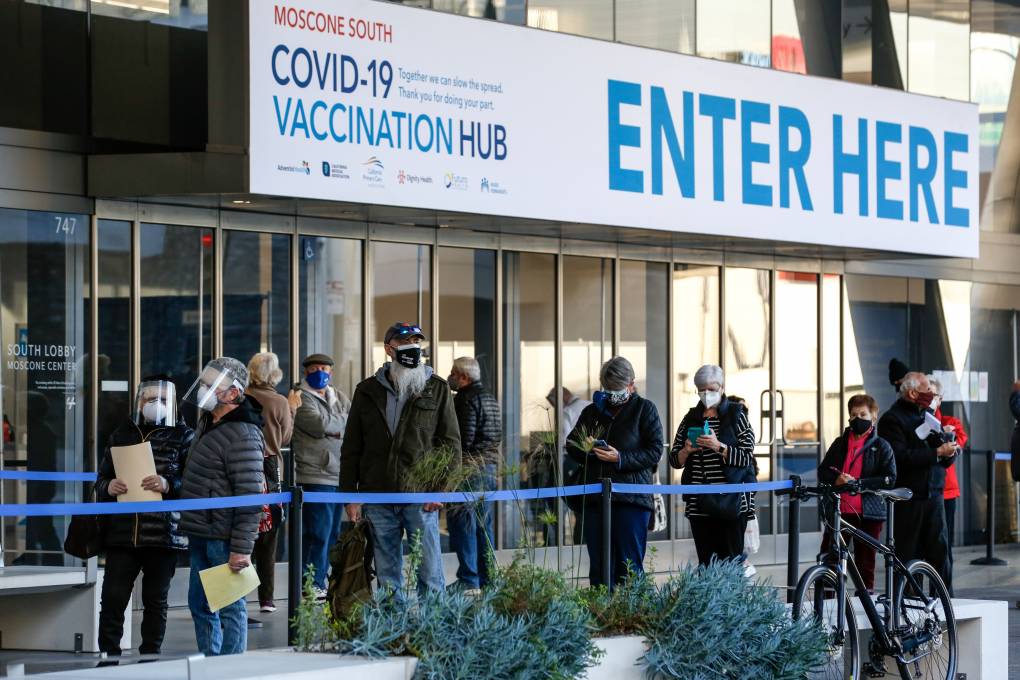
"caption": "People stand in line at the mass vaccination site at San Francisco's Moscone Convention Center. It opened for health care workers and people over 65 on Feb. 5, 2021, in San Francisco. ",
"description": "People stand in line at the mass vaccination site at San Francisco's Moscone Convention Center. It opened for healthcare workers and people over 65 on February 5, 2021 in San Francisco, California. ",
"title": "vaccinations-california",
"credit": "Amy Osborne/AFP via Getty Images",
"status": "inherit",
"altTag": "People stand in line at the mass vaccination site at San Francisco's Moscone Convention Center. It opened for healthcare workers and people over 65 on February 5, 2021 in San Francisco, California.",
"isLoading": false,
"fetchFailed": false
},
"science_1972920": {
"type": "attachments",
"id": "science_1972920",
"meta": {
"index": "attachments_1716263798",
"site": "science",
"id": "1972920",
"found": true
},
"parent": 1972918,
"imgSizes": {
"twentyfourteen-full-width": {
"file": "https://ww2.kqed.org/app/uploads/sites/35/2021/02/RS47378_GettyImages-1230161194-qut-1038x576.jpg",
"width": 1038,
"mimeType": "image/jpeg",
"height": 576
},
"thumbnail": {
"file": "https://ww2.kqed.org/app/uploads/sites/35/2021/02/RS47378_GettyImages-1230161194-qut-160x103.jpg",
"width": 160,
"mimeType": "image/jpeg",
"height": 103
},
"post-thumbnail": {
"file": "https://ww2.kqed.org/app/uploads/sites/35/2021/02/RS47378_GettyImages-1230161194-qut-672x372.jpg",
"width": 672,
"mimeType": "image/jpeg",
"height": 372
},
"kqedFullSize": {
"file": "https://ww2.kqed.org/app/uploads/sites/35/2021/02/RS47378_GettyImages-1230161194-qut.jpg",
"width": 1920,
"height": 1238
},
"large": {
"file": "https://ww2.kqed.org/app/uploads/sites/35/2021/02/RS47378_GettyImages-1230161194-qut-1020x658.jpg",
"width": 1020,
"mimeType": "image/jpeg",
"height": 658
},
"1536x1536": {
"file": "https://ww2.kqed.org/app/uploads/sites/35/2021/02/RS47378_GettyImages-1230161194-qut-1536x990.jpg",
"width": 1536,
"mimeType": "image/jpeg",
"height": 990
},
"medium": {
"file": "https://ww2.kqed.org/app/uploads/sites/35/2021/02/RS47378_GettyImages-1230161194-qut-800x516.jpg",
"width": 800,
"mimeType": "image/jpeg",
"height": 516
},
"medium_large": {
"file": "https://ww2.kqed.org/app/uploads/sites/35/2021/02/RS47378_GettyImages-1230161194-qut-768x495.jpg",
"width": 768,
"mimeType": "image/jpeg",
"height": 495
}
},
"publishDate": 1614189942,
"modified": 1614194751,
"caption": "Nurse Eunice Lee prepares to give UCLA physician Russell Johnson an injection of the COVID-19 vaccine at Ronald Reagan UCLA Medical Center on Dec. 16, 2020, in Westwood, California. ",
"description": null,
"title": "Ronald Reagan UCLA MedicalCenter Administers Its First Covid Vaccines To Hospital Staff",
"credit": "Brian van der Brug-Pool/Getty Images",
"status": "inherit",
"altTag": null,
"isLoading": false,
"fetchFailed": false
},
"science_1964394": {
"type": "attachments",
"id": "science_1964394",
"meta": {
"index": "attachments_1716263798",
"site": "science",
"id": "1964394",
"found": true
},
"parent": 1963889,
"imgSizes": {
"twentyfourteen-full-width": {
"file": "https://ww2.kqed.org/app/uploads/sites/35/2022/05/Bay-Area-coronavirus-stores-1038x576.jpg",
"width": 1038,
"mimeType": "image/jpeg",
"height": 576
},
"thumbnail": {
"file": "https://ww2.kqed.org/app/uploads/sites/35/2022/05/Bay-Area-coronavirus-stores-160x110.jpg",
"width": 160,
"mimeType": "image/jpeg",
"height": 110
},
"post-thumbnail": {
"file": "https://ww2.kqed.org/app/uploads/sites/35/2022/05/Bay-Area-coronavirus-stores-672x372.jpg",
"width": 672,
"mimeType": "image/jpeg",
"height": 372
},
"kqedFullSize": {
"file": "https://ww2.kqed.org/app/uploads/sites/35/2022/05/Bay-Area-coronavirus-stores-e1589527290336.jpg",
"width": 1920,
"height": 1322
},
"large": {
"file": "https://ww2.kqed.org/app/uploads/sites/35/2022/05/Bay-Area-coronavirus-stores-1020x702.jpg",
"width": 1020,
"mimeType": "image/jpeg",
"height": 702
},
"full-width": {
"file": "https://ww2.kqed.org/app/uploads/sites/35/2022/05/Bay-Area-coronavirus-stores-1920x1322.jpg",
"width": 1920,
"mimeType": "image/jpeg",
"height": 1322
},
"medium": {
"file": "https://ww2.kqed.org/app/uploads/sites/35/2022/05/Bay-Area-coronavirus-stores-800x551.jpg",
"width": 800,
"mimeType": "image/jpeg",
"height": 551
},
"medium_large": {
"file": "https://ww2.kqed.org/app/uploads/sites/35/2022/05/Bay-Area-coronavirus-stores-768x529.jpg",
"width": 768,
"mimeType": "image/jpeg",
"height": 529
}
},
"publishDate": 1589527271,
"modified": 1590606827,
"caption": "A doctor with the Haight Ashbury Free Clinic walks by a supportive sign on a boarded-up shop in the Haight Ashbury area of San Francisco on March 17, 2020. ",
"description": null,
"title": "US-VIRUS-HEALTH-EPIDEMIC",
"credit": "Josh Edelson/AFP via Getty Images",
"status": "inherit",
"isLoading": false,
"fetchFailed": false
},
"science_1972642": {
"type": "attachments",
"id": "science_1972642",
"meta": {
"index": "attachments_1716263798",
"site": "science",
"id": "1972642",
"found": true
},
"parent": 1972623,
"imgSizes": {
"twentyfourteen-full-width": {
"file": "https://ww2.kqed.org/app/uploads/sites/35/2021/02/RS47070_GettyImages-1226432152-qut-1038x576.jpg",
"width": 1038,
"mimeType": "image/jpeg",
"height": 576
},
"thumbnail": {
"file": "https://ww2.kqed.org/app/uploads/sites/35/2021/02/RS47070_GettyImages-1226432152-qut-160x105.jpg",
"width": 160,
"mimeType": "image/jpeg",
"height": 105
},
"post-thumbnail": {
"file": "https://ww2.kqed.org/app/uploads/sites/35/2021/02/RS47070_GettyImages-1226432152-qut-672x372.jpg",
"width": 672,
"mimeType": "image/jpeg",
"height": 372
},
"kqedFullSize": {
"file": "https://ww2.kqed.org/app/uploads/sites/35/2021/02/RS47070_GettyImages-1226432152-qut.jpg",
"width": 1920,
"height": 1264
},
"large": {
"file": "https://ww2.kqed.org/app/uploads/sites/35/2021/02/RS47070_GettyImages-1226432152-qut-1020x672.jpg",
"width": 1020,
"mimeType": "image/jpeg",
"height": 672
},
"1536x1536": {
"file": "https://ww2.kqed.org/app/uploads/sites/35/2021/02/RS47070_GettyImages-1226432152-qut-1536x1011.jpg",
"width": 1536,
"mimeType": "image/jpeg",
"height": 1011
},
"medium": {
"file": "https://ww2.kqed.org/app/uploads/sites/35/2021/02/RS47070_GettyImages-1226432152-qut-800x527.jpg",
"width": 800,
"mimeType": "image/jpeg",
"height": 527
},
"medium_large": {
"file": "https://ww2.kqed.org/app/uploads/sites/35/2021/02/RS47070_GettyImages-1226432152-qut-768x506.jpg",
"width": 768,
"mimeType": "image/jpeg",
"height": 506
}
},
"publishDate": 1612554904,
"modified": 1612562021,
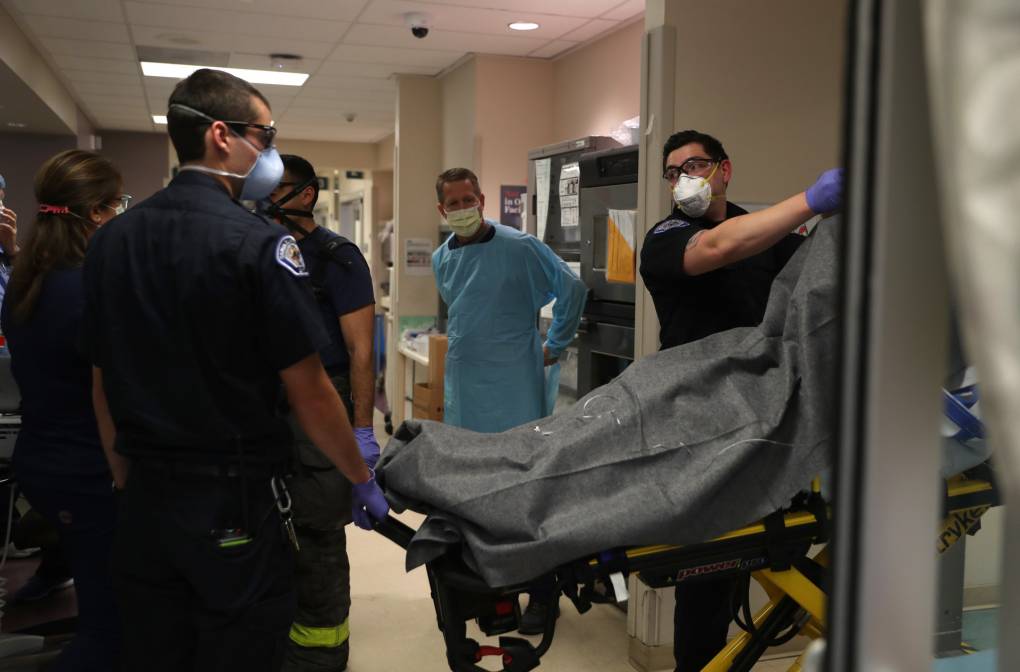
"caption": "Paramedics drop off a patient in the emergency room at Regional Medical Center on May 21, 2020, in San Jose. Front-line workers are continuing to care for COVID-19 patients throughout the San Francisco Bay Area. Paramedics and hospital workers are among those covered under the state's Airborne Transmissible Diseases rule.",
"description": "Paramedics drop off a patient in the emergency room at Regional Medical Center on May 21, 2020 in San Jose. Frontline workers are continuing to care for COVID-19 patients throughout the San Francisco Bay Area. Paramedics and hospital workers are among those covered under the state's Airborne Transmissible Disease rule.",
"title": "Bay Area Hospital Workers On The Frontlines Of COVID-19 Pandemic",
"credit": "Justin Sullivan/Getty Images",
"status": "inherit",
"altTag": "Paramedics drop off a patient in the emergency room at Regional Medical Center on May 21, 2020 in San Jose. Frontline workers are continuing to care for COVID-19 patients throughout the San Francisco Bay Area. Paramedics and hospital workers are among those covered under the state's Airborne Transmissible Disease rule.",
"isLoading": false,
"fetchFailed": false
},
"science_1972628": {
"type": "attachments",
"id": "science_1972628",
"meta": {
"index": "attachments_1716263798",
"site": "science",
"id": "1972628",
"found": true
},
"parent": 1972627,
"imgSizes": {
"twentyfourteen-full-width": {
"file": "https://ww2.kqed.org/app/uploads/sites/35/2021/02/RS47031_GettyImages-1230936684-qut-1038x576.jpg",
"width": 1038,
"mimeType": "image/jpeg",
"height": 576
},
"thumbnail": {
"file": "https://ww2.kqed.org/app/uploads/sites/35/2021/02/RS47031_GettyImages-1230936684-qut-160x105.jpg",
"width": 160,
"mimeType": "image/jpeg",
"height": 105
},
"post-thumbnail": {
"file": "https://ww2.kqed.org/app/uploads/sites/35/2021/02/RS47031_GettyImages-1230936684-qut-672x372.jpg",
"width": 672,
"mimeType": "image/jpeg",
"height": 372
},
"kqedFullSize": {
"file": "https://ww2.kqed.org/app/uploads/sites/35/2021/02/RS47031_GettyImages-1230936684-qut.jpg",
"width": 1703,
"height": 1115
},
"large": {
"file": "https://ww2.kqed.org/app/uploads/sites/35/2021/02/RS47031_GettyImages-1230936684-qut-1020x668.jpg",
"width": 1020,
"mimeType": "image/jpeg",
"height": 668
},
"1536x1536": {
"file": "https://ww2.kqed.org/app/uploads/sites/35/2021/02/RS47031_GettyImages-1230936684-qut-1536x1006.jpg",
"width": 1536,
"mimeType": "image/jpeg",
"height": 1006
},
"medium": {
"file": "https://ww2.kqed.org/app/uploads/sites/35/2021/02/RS47031_GettyImages-1230936684-qut-800x524.jpg",
"width": 800,
"mimeType": "image/jpeg",
"height": 524
},
"medium_large": {
"file": "https://ww2.kqed.org/app/uploads/sites/35/2021/02/RS47031_GettyImages-1230936684-qut-768x503.jpg",
"width": 768,
"mimeType": "image/jpeg",
"height": 503
}
},
"publishDate": 1612473942,
"modified": 1612475937,
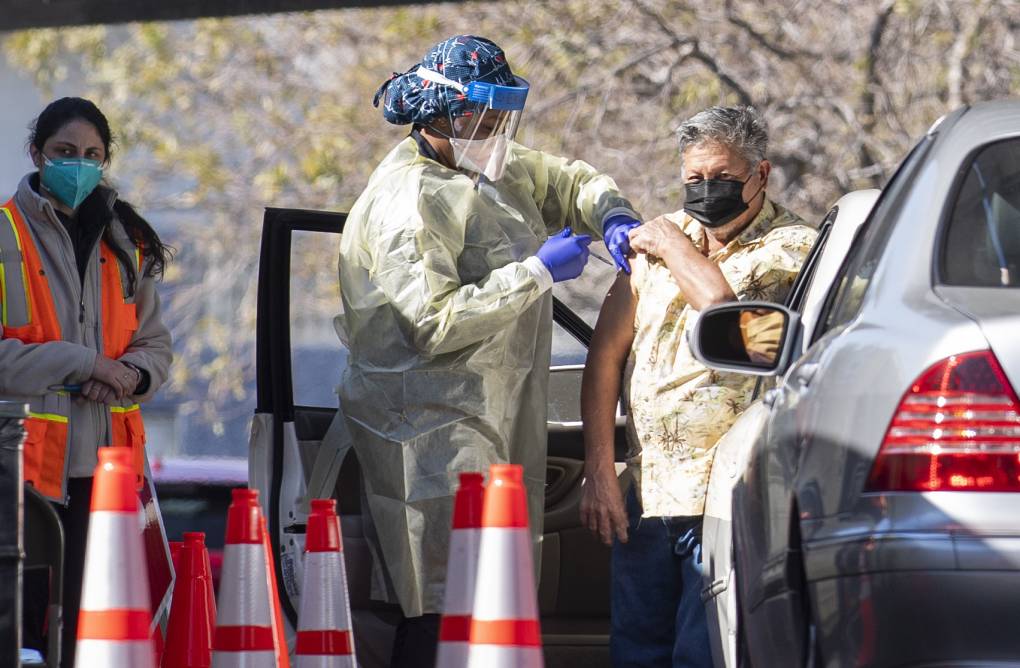
"caption": "A nurse gives a COVID-19 vaccine shot to a patient at the Cal State Northridge COVID-19 vaccination center in Northridge, Calif., on Feb. 2, 2021. ",
"description": null,
"title": "US-HEALTH-VIRUS-VACCINE",
"credit": "Valarie Macon/AFP via Getty Images",
"status": "inherit",
"altTag": null,
"isLoading": false,
"fetchFailed": false
},
"science_1972512": {
"type": "attachments",
"id": "science_1972512",
"meta": {
"index": "attachments_1716263798",
"site": "science",
"id": "1972512",
"found": true
},
"parent": 1972511,
"imgSizes": {
"twentyfourteen-full-width": {
"file": "https://ww2.kqed.org/app/uploads/sites/35/2021/01/GettyImages-1164571026-1600x900-1-1038x576.jpg",
"width": 1038,
"mimeType": "image/jpeg",
"height": 576
},
"thumbnail": {
"file": "https://ww2.kqed.org/app/uploads/sites/35/2021/01/GettyImages-1164571026-1600x900-1-160x90.jpg",
"width": 160,
"mimeType": "image/jpeg",
"height": 90
},
"post-thumbnail": {
"file": "https://ww2.kqed.org/app/uploads/sites/35/2021/01/GettyImages-1164571026-1600x900-1-672x372.jpg",
"width": 672,
"mimeType": "image/jpeg",
"height": 372
},
"kqedFullSize": {
"file": "https://ww2.kqed.org/app/uploads/sites/35/2021/01/GettyImages-1164571026-1600x900-1.jpg",
"width": 1600,
"height": 900
},
"large": {
"file": "https://ww2.kqed.org/app/uploads/sites/35/2021/01/GettyImages-1164571026-1600x900-1-1020x574.jpg",
"width": 1020,
"mimeType": "image/jpeg",
"height": 574
},
"1536x1536": {
"file": "https://ww2.kqed.org/app/uploads/sites/35/2021/01/GettyImages-1164571026-1600x900-1-1536x864.jpg",
"width": 1536,
"mimeType": "image/jpeg",
"height": 864
},
"medium": {
"file": "https://ww2.kqed.org/app/uploads/sites/35/2021/01/GettyImages-1164571026-1600x900-1-800x450.jpg",
"width": 800,
"mimeType": "image/jpeg",
"height": 450
},
"medium_large": {
"file": "https://ww2.kqed.org/app/uploads/sites/35/2021/01/GettyImages-1164571026-1600x900-1-768x432.jpg",
"width": 768,
"mimeType": "image/jpeg",
"height": 432
}
},
"publishDate": 1611952707,
"modified": 1612212153,
"caption": null,
"description": null,
"title": "GettyImages-1164571026-1600x900",
"credit": "Mark Ralston/AFP via Getty Images",
"status": "inherit",
"altTag": null,
"isLoading": false,
"fetchFailed": false
},
"science_1972301": {
"type": "attachments",
"id": "science_1972301",
"meta": {
"index": "attachments_1716263798",
"site": "science",
"id": "1972301",
"found": true
},
"parent": 1972290,
"imgSizes": {
"twentyfourteen-full-width": {
"file": "https://ww2.kqed.org/app/uploads/sites/35/2021/01/RS46652_GettyImages-1230662004-qut-1038x576.jpg",
"width": 1038,
"mimeType": "image/jpeg",
"height": 576
},
"thumbnail": {
"file": "https://ww2.kqed.org/app/uploads/sites/35/2021/01/RS46652_GettyImages-1230662004-qut-160x107.jpg",
"width": 160,
"mimeType": "image/jpeg",
"height": 107
},
"post-thumbnail": {
"file": "https://ww2.kqed.org/app/uploads/sites/35/2021/01/RS46652_GettyImages-1230662004-qut-672x372.jpg",
"width": 672,
"mimeType": "image/jpeg",
"height": 372
},
"kqedFullSize": {
"file": "https://ww2.kqed.org/app/uploads/sites/35/2021/01/RS46652_GettyImages-1230662004-qut.jpg",
"width": 1920,
"height": 1280
},
"large": {
"file": "https://ww2.kqed.org/app/uploads/sites/35/2021/01/RS46652_GettyImages-1230662004-qut-1020x680.jpg",
"width": 1020,
"mimeType": "image/jpeg",
"height": 680
},
"1536x1536": {
"file": "https://ww2.kqed.org/app/uploads/sites/35/2021/01/RS46652_GettyImages-1230662004-qut-1536x1024.jpg",
"width": 1536,
"mimeType": "image/jpeg",
"height": 1024
},
"medium": {
"file": "https://ww2.kqed.org/app/uploads/sites/35/2021/01/RS46652_GettyImages-1230662004-qut-800x533.jpg",
"width": 800,
"mimeType": "image/jpeg",
"height": 533
},
"medium_large": {
"file": "https://ww2.kqed.org/app/uploads/sites/35/2021/01/RS46652_GettyImages-1230662004-qut-768x512.jpg",
"width": 768,
"mimeType": "image/jpeg",
"height": 512
}
},
"publishDate": 1611082620,
"modified": 1611084098,
"caption": "A health care worker greets a motorist at the Southside Church of Christ in Los Angeles on Jan. 18, 2021, as free rapid COVID-19 antibody and PCR tests are administered to local residents in honor of Martin Luther King Jr. Day. ",
"description": null,
"title": "US-HEALTH-VIRUS-TESTING",
"credit": "Ringo Chiu/AFP via Getty Images",
"status": "inherit",
"altTag": null,
"isLoading": false,
"fetchFailed": false
},
"science_1964539": {
"type": "attachments",
"id": "science_1964539",
"meta": {
"index": "attachments_1716263798",
"site": "science",
"id": "1964539",
"found": true
},
"parent": 1964530,
"imgSizes": {
"twentyfourteen-full-width": {
"file": "https://ww2.kqed.org/app/uploads/sites/35/2020/05/KQED-Coronavirus-Updates-1038x576.jpg",
"width": 1038,
"mimeType": "image/jpeg",
"height": 576
},
"thumbnail": {
"file": "https://ww2.kqed.org/app/uploads/sites/35/2020/05/KQED-Coronavirus-Updates-160x84.jpg",
"width": 160,
"mimeType": "image/jpeg",
"height": 84
},
"post-thumbnail": {
"file": "https://ww2.kqed.org/app/uploads/sites/35/2020/05/KQED-Coronavirus-Updates-672x372.jpg",
"width": 672,
"mimeType": "image/jpeg",
"height": 372
},
"kqedFullSize": {
"file": "https://ww2.kqed.org/app/uploads/sites/35/2020/05/KQED-Coronavirus-Updates.jpg",
"width": 1200,
"height": 628
},
"large": {
"file": "https://ww2.kqed.org/app/uploads/sites/35/2020/05/KQED-Coronavirus-Updates-1020x534.jpg",
"width": 1020,
"mimeType": "image/jpeg",
"height": 534
},
"medium": {
"file": "https://ww2.kqed.org/app/uploads/sites/35/2020/05/KQED-Coronavirus-Updates-800x419.jpg",
"width": 800,
"mimeType": "image/jpeg",
"height": 419
},
"medium_large": {
"file": "https://ww2.kqed.org/app/uploads/sites/35/2020/05/KQED-Coronavirus-Updates-768x402.jpg",
"width": 768,
"mimeType": "image/jpeg",
"height": 402
}
},
"publishDate": 1589835805,
"modified": 1597783869,
"caption": null,
"description": null,
"title": "KQED-Coronavirus-Updates",
"credit": null,
"status": "inherit",
"isLoading": false,
"fetchFailed": false
}
},
"audioPlayerReducer": {
"postId": "stream_live",
"isPaused": true,
"isPlaying": false,
"pfsActive": false,
"pledgeModalIsOpen": true,
"playerDrawerIsOpen": false,
"liveAudioPlayStartedAt": 0,
"liveAudioPlayContext": ""
},
"authorsReducer": {
"byline_science_1973320": {
"type": "authors",
"id": "byline_science_1973320",
"meta": {
"override": true
},
"slug": "byline_science_1973320",
"name": "Samantha Young and Angela Hart \u003cbr />Kaiser Health News\u003cbr>",
"isLoading": false
},
"byline_science_1973122": {
"type": "authors",
"id": "byline_science_1973122",
"meta": {
"override": true
},
"slug": "byline_science_1973122",
"name": "Rachel Treisman\u003cbr>NPR",
"isLoading": false
},
"byline_science_1972824": {
"type": "authors",
"id": "byline_science_1972824",
"meta": {
"override": true
},
"slug": "byline_science_1972824",
"name": "Carolina Cuellar, Peter Arcuni",
"isLoading": false
},
"byline_science_1972918": {
"type": "authors",
"id": "byline_science_1972918",
"meta": {
"override": true
},
"slug": "byline_science_1972918",
"name": "Matthew Herper and Helen Branswell \u003cbr />STAT\u003cbr>",
"isLoading": false
},
"byline_science_1972627": {
"type": "authors",
"id": "byline_science_1972627",
"meta": {
"override": true
},
"slug": "byline_science_1972627",
"name": "Helen Branswell \u003cbr />STAT\u003cbr>",
"isLoading": false
},
"byline_science_1972511": {
"type": "authors",
"id": "byline_science_1972511",
"meta": {
"override": true
},
"slug": "byline_science_1972511",
"name": "Matthew Herper \u003cbr />STAT\u003cbr>",
"isLoading": false
},
"byline_science_1972290": {
"type": "authors",
"id": "byline_science_1972290",
"meta": {
"override": true
},
"slug": "byline_science_1972290",
"name": "Andrew Joseph \u003cbr>STAT\u003c/br>",
"isLoading": false
},
"kqedscience": {
"type": "authors",
"id": "6387",
"meta": {
"index": "authors_1716337520",
"id": "6387",
"found": true
},
"name": "KQED Science",
"firstName": "KQED",
"lastName": "Science",
"slug": "kqedscience",
"email": "kqedscience@gmail.com",
"display_author_email": false,
"staff_mastheads": [],
"title": null,
"bio": "KQED Science brings you award-winning science and environment coverage from the Bay Area and beyond by the flagship Northern California PBS and NPR affiliate.",
"avatar": "https://secure.gravatar.com/avatar/5a295ff49cf82a8c0f30937d3f788b2f?s=600&d=blank&r=g",
"twitter": null,
"facebook": null,
"instagram": null,
"linkedin": null,
"sites": [
{
"site": "science",
"roles": [
"contributor"
]
},
{
"site": "quest",
"roles": [
"editor"
]
},
{
"site": "food",
"roles": [
"contributor"
]
}
],
"headData": {
"title": "KQED Science | KQED",
"description": null,
"ogImgSrc": "https://secure.gravatar.com/avatar/5a295ff49cf82a8c0f30937d3f788b2f?s=600&d=blank&r=g",
"twImgSrc": "https://secure.gravatar.com/avatar/5a295ff49cf82a8c0f30937d3f788b2f?s=600&d=blank&r=g"
},
"isLoading": false,
"link": "/author/kqedscience"
},
"mpeterson": {
"type": "authors",
"id": "11223",
"meta": {
"index": "authors_1716337520",
"id": "11223",
"found": true
},
"name": "Molly Peterson",
"firstName": "Molly",
"lastName": "Peterson",
"slug": "mpeterson",
"email": "mpeterson@kqed.org",
"display_author_email": false,
"staff_mastheads": [],
"title": null,
"bio": "Molly Peterson reports for KQED science and news on climate change, catastrophe and risk. Previously she was environment correspondent at Southern California Public Radio. Her work has also appeared at The New York Times, The Guardian, on NPR, at High Country News, on Code Switch, and other national outlets. She has been honored with awards from Public Radio News Directors Incorporated, Investigative Reporters and Editors, the Society for Professional Journalists, the Los Angeles Press Club, and RTNDA Edward R. Murrow awards, among others.",
"avatar": "https://secure.gravatar.com/avatar/7908e2807131f776cc8165c649530b05?s=600&d=blank&r=g",
"twitter": "Mollydacious",
"facebook": null,
"instagram": "https://www.instagram.com/radiomolly/",
"linkedin": null,
"sites": [
{
"site": "news",
"roles": [
"subscriber"
]
},
{
"site": "futureofyou",
"roles": [
"editor"
]
},
{
"site": "science",
"roles": [
"editor"
]
}
],
"headData": {
"title": "Molly Peterson | KQED",
"description": null,
"ogImgSrc": "https://secure.gravatar.com/avatar/7908e2807131f776cc8165c649530b05?s=600&d=blank&r=g",
"twImgSrc": "https://secure.gravatar.com/avatar/7908e2807131f776cc8165c649530b05?s=600&d=blank&r=g"
},
"isLoading": false,
"link": "/author/mpeterson"
},
"kevinstark": {
"type": "authors",
"id": "11608",
"meta": {
"index": "authors_1716337520",
"id": "11608",
"found": true
},
"name": "Kevin Stark",
"firstName": "Kevin",
"lastName": "Stark",
"slug": "kevinstark",
"email": "kstark@kqed.org",
"display_author_email": true,
"staff_mastheads": [
"science"
],
"title": "Senior Editor",
"bio": "Kevin is a senior editor for KQED Science, managing the station's health and climate desks. His journalism career began in the Pacific Northwest, and he later became a lead reporter for the San Francisco Public Press. His work has appeared in Pacific Standard magazine, the Energy News Network, the Center for Investigative Reporting's Reveal and WBEZ in Chicago. Kevin joined KQED in 2019, and has covered issues related to energy, wildfire, climate change and the environment.",
"avatar": "https://secure.gravatar.com/avatar/365aaa4b597d3a8374f67504ff0facd323d7906e8eb4be0a7efd2427408e802c?s=600&d=blank&r=g",
"twitter": "starkkev",
"bluesky": null,
"facebook": null,
"instagram": null,
"linkedin": null,
"sites": [
{
"site": "",
"roles": [
"editor"
]
},
{
"site": "news",
"roles": [
"editor"
]
},
{
"site": "science",
"roles": [
"administrator"
]
}
],
"headData": {
"title": "Kevin Stark | KQED",
"description": "Senior Editor",
"ogImgSrc": "https://secure.gravatar.com/avatar/365aaa4b597d3a8374f67504ff0facd323d7906e8eb4be0a7efd2427408e802c?s=600&d=blank&r=g",
"twImgSrc": "https://secure.gravatar.com/avatar/365aaa4b597d3a8374f67504ff0facd323d7906e8eb4be0a7efd2427408e802c?s=600&d=blank&r=g"
},
"isLoading": false,
"link": "/author/kevinstark"
}
},
"pagesReducer": {
"science_tag_coronavirus": {
"type": "terms",
"id": "science_4329",
"meta": {
"index": "terms_1716263798",
"site": "science",
"id": "4329",
"score": 8.457276
},
"featImg": null,
"name": "Coronavirus",
"description": null,
"taxonomy": "tag",
"headData": {
"twImgId": null,
"twTitle": null,
"ogTitle": null,
"ogImgId": null,
"twDescription": null,
"description": null,
"title": "Coronavirus Archives | KQED Science",
"ogDescription": null
},
"ttid": 4329,
"slug": "coronavirus",
"isLoading": false,
"title": "Coronavirus",
"pageMeta": {
"site": "science",
"WpPageTemplate": "page-topic-editorial",
"currentPage": 3
},
"blocks": [
{
"blockName": "kqed/post-list",
"attrs": {
"layout": "cardArticle2",
"query": "posts/science?tag=coronavirus",
"seeMore": false,
"paginated": true,
"page": 3
}
},
{
"blockName": "kqed/ad"
}
]
}
},
"pfsSessionReducer": {},
"postsReducer": {
"stream_live": {
"type": "live",
"id": "stream_live",
"audioUrl": "https://streams.kqed.org/kqedradio",
"title": "Live Stream",
"excerpt": "Live Stream information currently unavailable.",
"link": "/radio",
"featImg": "",
"label": {
"name": "KQED Live",
"link": "/"
}
},
"stream_kqedNewscast": {
"type": "posts",
"id": "stream_kqedNewscast",
"audioUrl": "https://www.kqed.org/.stream/anon/radio/RDnews/newscast.mp3?_=1",
"title": "KQED Newscast",
"featImg": "",
"label": {
"name": "88.5 FM",
"link": "/"
}
},
"science_1973339": {
"type": "posts",
"id": "science_1973339",
"meta": {
"index": "posts_1716263798",
"site": "science",
"id": "1973339",
"score": null,
"sort": [
1616627918000
]
},
"parent": 0,
"labelTerm": {},
"blocks": [],
"publishDate": 1616627918,
"format": "standard",
"title": "The Pandemic Led to Unprecedented Declines in Carbon Emissions. But That's Over Now",
"headTitle": "The Pandemic Led to Unprecedented Declines in Carbon Emissions. But That’s Over Now | KQED",
"content": "\u003cp class=\"p1\">Last May, when California’s stay-at-home order had forced a huge number of drivers off the road, environmentalists and state officials saw the disappearance of so many automobiles as a window into a world where climate goals would be tantalizingly achievable.\u003c/p>\n\u003cp class=\"p2\">From March to mid-April 2020, total vehicle miles \u003cspan class=\"s1\">declined\u003c/span> by 75%, with a corresponding reduction in planet-warming gases and smog, according to a UC Davis \u003ca href=\"https://roadecology.ucdavis.edu/files/content/projects/COVID_CHIPs_Impacts_updated_430.pdf\" target=\"_blank\" rel=\"noopener noreferrer\">analysis\u003c/a> conducted by \u003cspan class=\"s2\">Fraser Shilling, co-director of the university’s Road Ecology Center. \u003c/span>\u003c/p>\n\u003cp class=\"p2\">\u003cspan class=\"s2\">Reading those stats, Shilling hoped\u003c/span> one of the more positive lessons of the pandemic would be that society could still function as it vastly reduced driving.\u003c/p>\n\u003cp class=\"p1\">“We’re going to learn a lot during this intervening period,” he \u003ca href=\"https://www.kqed.org/science/1963716/coronavirus-forces-huge-number-of-californians-off-road-as-tele-everything-becomes-new-climate-option\" target=\"_blank\" rel=\"noopener noreferrer\">\u003cspan class=\"s1\">told KQED\u003c/span>\u003c/a> in May. “How do we telecommute? How do we arrange our work at home? Our shopping trips? All of our travel in a different way.”\u003c/p>\n\u003cp class=\"p3\">A year ago, Shilling’s “optimistic projection” was that the change in driving behavior would stick, although many of his colleagues disagreed.\u003c/p>\n\u003cp>[ad fullwidth]\u003c/p>\n\u003cp>\u003cspan class=\"s2\">So far, looks like they were right.\u003c/span>\u003c/p>\n\u003cp>By last fall, car traffic in California had rebounded to roughly 90% of where it had been pre-pandemic, and national studies show that truck traffic went up along with the delivery of food, groceries and goods, Shilling says.\u003c/p>\n\u003cp class=\"p4\">“In the depths of the pandemic and the traffic reduction, people were obviously hoarding,” he said. “They stocked up and then they didn’t need to make as many trips, and we had a huge reduction in overall traffic.”\u003c/p>\n\u003cp>But people adjusted, and while there is less traffic than before the pandemic, “we’ve got more of that goods and services delivery going on, and we may even have an increase in pollution and greenhouse gas emissions,” Shilling said.\u003c/p>\n\u003cp class=\"p4\">Last year, emissions declined by nearly 13% in the U.S. and about 7% globally, the largest annual drop in global energy-related carbon dioxide emissions since World War II.\u003c/p>\n\u003cp>The reduction was driven largely by a sharp drop in vehicle traffic during the first half of the year in the early stage of lockdowns, according to an \u003ca href=\"https://www.nature.com/articles/d41586-021-00090-3\" target=\"_blank\" rel=\"noopener noreferrer\">\u003cspan class=\"s1\">estimate\u003c/span>\u003c/a> by the international \u003ca href=\"https://carbonmonitor.org/\" target=\"_blank\" rel=\"noopener noreferrer\">\u003cspan class=\"s1\">Carbon Monitor\u003c/span>\u003c/a> program.\u003c/p>\n\u003cp class=\"p4\">Shilling maintains that if the amount of driving eliminated during the pandemic could be duplicated, it would put California, at least, on track to reach some of its climate goals, not to mention lead to an improvement in air quality.\u003c/p>\n\u003cp class=\"p4\">But that steep curb in global warming emissions started to reverse during the second half of the year, when economic activity began to recover. Global emissions were 2% higher in December 2020 than in the same month a year earlier, according to \u003ca href=\"https://www.iea.org/news/after-steep-drop-in-early-2020-global-carbon-dioxide-emissions-have-rebounded-strongly\" target=\"_blank\" rel=\"noopener noreferrer\">the International Energy Agency\u003c/a>, an intergovernmental energy analysis and policy group.\u003c/p>\n\u003cp> “A lot of people were hurt and died” during the pandemic, said Shilling, whose son had COVID-19. “It affects everybody. What can we get out of it? Learning. A society that doesn’t learn is just going to repeat all of those mistakes.”\u003c/p>\n\u003cp class=\"p2\">Transportation-related emissions, at nearly 50% of California’s total overall, are the top source of greenhouse gas emissions in the state. That’s despite decades of policies meant to reduce pollution from tailpipes.\u003c/p>\n\u003cp>Last summer, in the wake of wildfires driven by extreme heat, Gov. Gavin Newsom ordered California to \u003ca href=\"https://www.kqed.org/science/1969807/california-to-halt-sales-of-new-gas-cars-by-2035\" target=\"_blank\" rel=\"noopener noreferrer\">\u003cspan class=\"s1\">halt\u003c/span>\u003c/a> the sale of new gasoline-powered cars by 2035, in an effort to accelerate the state’s reduction of greenhouse gases.\u003c/p>\n\u003cp>The mass adoption of electric vehicles will surely be needed if California is going to transition from fossil fuels. But \u003ca href=\"https://www.nature.com/articles/s41558-020-00921-7?utm_source=nclimate_etoc&utm_medium=email&utm_campaign=toc_41558_10_12&utm_content=20201201&sap-outbound-id=53AEBD821997012F268251B4E511EE152EB74E4D\" target=\"_blank\" rel=\"noopener noreferrer\">\u003cspan class=\"s1\">studies\u003c/span>\u003c/a> have shown that in order to meet ambitious climate goals, people will also need to drive less during the many years it will take for gas vehicles to disappear from the state’s roads.\u003c/p>\n\u003cp>Kate Gordon, the governor’s top climate adviser, argued Californians should embrace tele-everything in the fight against climate change, using the internet to reduce driving.\u003c/p>\n\u003cp class=\"p2\">Some technology companies are allowing employees to work from home \u003ca href=\"https://www.vox.com/recode/2020/5/21/21266570/facebook-remote-work-from-home-mark-zuckerberg-twitter-covid-19-coronavirus\" target=\"_blank\" rel=\"noopener noreferrer\">\u003cspan class=\"s1\">permanently\u003c/span>\u003c/a>. But many businesses are just now beginning to grapple with what work life could look like after restrictions to prevent the spread of COVID-19 are lifted.\u003c/p>\n\u003cp class=\"p3\">Remote work offered some white-collar workers a chance to live in less crowded cities and towns, with cheaper rents and lower taxes. But people living in the country or in the suburbs drive a lot more —to work, but also to the grocery store and to visit friends.\u003c/p>\n\u003cp>The Bay Area Council recently released a \u003ca href=\"http://www.bayareaeconomy.org/report/remote-work-in-the-bay-area/\" target=\"_blank\" rel=\"noopener noreferrer\">\u003cspan class=\"s1\">study\u003c/span>\u003c/a> showing that 1.79 million jobs, or 45% of the region’s workforce, could be performed from home, a higher proportion than in Los Angeles and other areas of the state.\u003c/p>\n\u003cp>\u003cspan class=\"s2\">“If each of the region’s 1.79 million people employed in a remote eligible job worked outside of the office for just one day per week, over 1 million single-occupancy vehicle trips could be avoided each week — a reduction of 8% based on pre-COVID-19 travel,” the report’s authors wrote. \u003c/span>\u003c/p>\n\u003cp>Should California make a push to increase remote work, issues of equity could emerge. The state suffers from a vast digital divide, with high-speed internet access available in many of the busiest city centers, but not in remote areas in the Central Valley, Inland Empire, and northern part of the state. Also, remote work capability rises as along with pay. Prior to the pandemic, 51% of the Bay Area’s white workforce, which has a higher average income, were employed in potential work-from-home occupations, compared to only 33% of the Black and 30% of the Latinx workforce.\u003c/p>\n\u003cp class=\"p2\">Which experiments in telecommuting will be maintained on a widespread basis is still unknown. Partly because a year after the state first issued a shelter-in-place order, life has changed for a substantial number of people. Where exactly they will live, commute, and work when the pandemic subsides has not come into focus yet.\u003c/p>\n\u003cp class=\"p3\">Last fall, planners at the Metropolitan Transportation Commission debated a measure requiring workers at Bay Area companies with more than 25 employees to work three days a week from home. But Silicon Valley businesses and Bay Area mayors pushed back on the plan, arguing the requirement for employers was too strict, and could decimate public transit ridership, the Mercury News \u003ca href=\"https://www.mercurynews.com/2020/11/20/bay-area-planners-less-remote-work-more-green-commutes/\">\u003cspan class=\"s1\">reported\u003c/span>\u003c/a>.\u003cspan class=\"Apple-converted-space\"> \u003c/span>\u003c/p>\n\u003cp>The group developed a compromise plan that would require larger companies to ensure that 60% of their employees commute using mass transit, bikes or carpools by the year 2035.\u003c/p>\n\u003cp>If adopted, the policy would ask employers to take responsibility for the congestion, air quality, and climate change impacts of their employees as they go to and from work.\u003c/p>\n\u003cp>[ad floatright]\u003c/p>\n\u003cp class=\"p3\">“Without mandating how large employers do that, [the policy] would set the goal, which I think is a very reasonable thing to do,” said Nick Josefowitz, commissioner with the Metropolitan Transportation Commission.\u003c/p>\n\n",
"stats": {
"hasVideo": false,
"hasChartOrMap": false,
"hasAudio": false,
"hasPolis": false,
"wordCount": 1183,
"hasGoogleForm": false,
"hasGallery": false,
"hasHearkenModule": false,
"iframeSrcs": [],
"paragraphCount": 14
},
"modified": 1704846704,
"excerpt": "Last year, emissions declined by nearly 13% in the U.S. and about 7% globally. But the steep drop has started to reverse. ",
"headData": {
"twImgId": "",
"twTitle": "",
"ogTitle": "",
"ogImgId": "",
"twDescription": "",
"description": "Last year, emissions declined by nearly 13% in the U.S. and about 7% globally. But the steep drop has started to reverse. ",
"title": "The Pandemic Led to Unprecedented Declines in Carbon Emissions. But That's Over Now | KQED",
"ogDescription": "",
"schema": {
"@context": "https://schema.org",
"@type": "Article",
"headline": "The Pandemic Led to Unprecedented Declines in Carbon Emissions. But That's Over Now",
"datePublished": "2021-03-24T16:18:38-07:00",
"dateModified": "2024-01-09T16:31:44-08:00",
"image": "https://cdn.kqed.org/wp-content/uploads/2020/02/KQED-OG-Image@1x.png"
}
},
"guestAuthors": [],
"slug": "the-pandemic-led-to-unprecedented-declines-in-carbon-emissions-but-thats-over-now",
"status": "publish",
"sticky": false,
"source": "Climate Change",
"path": "/science/1973339/the-pandemic-led-to-unprecedented-declines-in-carbon-emissions-but-thats-over-now",
"audioTrackLength": null,
"parsedContent": [
{
"type": "contentString",
"content": "\u003cdiv class=\"post-body\">\u003cp>\u003cp class=\"p1\">Last May, when California’s stay-at-home order had forced a huge number of drivers off the road, environmentalists and state officials saw the disappearance of so many automobiles as a window into a world where climate goals would be tantalizingly achievable.\u003c/p>\n\u003cp class=\"p2\">From March to mid-April 2020, total vehicle miles \u003cspan class=\"s1\">declined\u003c/span> by 75%, with a corresponding reduction in planet-warming gases and smog, according to a UC Davis \u003ca href=\"https://roadecology.ucdavis.edu/files/content/projects/COVID_CHIPs_Impacts_updated_430.pdf\" target=\"_blank\" rel=\"noopener noreferrer\">analysis\u003c/a> conducted by \u003cspan class=\"s2\">Fraser Shilling, co-director of the university’s Road Ecology Center. \u003c/span>\u003c/p>\n\u003cp class=\"p2\">\u003cspan class=\"s2\">Reading those stats, Shilling hoped\u003c/span> one of the more positive lessons of the pandemic would be that society could still function as it vastly reduced driving.\u003c/p>\n\u003cp class=\"p1\">“We’re going to learn a lot during this intervening period,” he \u003ca href=\"https://www.kqed.org/science/1963716/coronavirus-forces-huge-number-of-californians-off-road-as-tele-everything-becomes-new-climate-option\" target=\"_blank\" rel=\"noopener noreferrer\">\u003cspan class=\"s1\">told KQED\u003c/span>\u003c/a> in May. “How do we telecommute? How do we arrange our work at home? Our shopping trips? All of our travel in a different way.”\u003c/p>\n\u003cp class=\"p3\">A year ago, Shilling’s “optimistic projection” was that the change in driving behavior would stick, although many of his colleagues disagreed.\u003c/p>\n\u003cp>\u003c/p>\u003c/div>",
"attributes": {
"named": {},
"numeric": []
}
},
{
"type": "component",
"content": "",
"name": "ad",
"attributes": {
"named": {
"label": "fullwidth"
},
"numeric": [
"fullwidth"
]
}
},
{
"type": "contentString",
"content": "\u003cdiv class=\"post-body\">\u003cp>\u003c/p>\n\u003cp>\u003cspan class=\"s2\">So far, looks like they were right.\u003c/span>\u003c/p>\n\u003cp>By last fall, car traffic in California had rebounded to roughly 90% of where it had been pre-pandemic, and national studies show that truck traffic went up along with the delivery of food, groceries and goods, Shilling says.\u003c/p>\n\u003cp class=\"p4\">“In the depths of the pandemic and the traffic reduction, people were obviously hoarding,” he said. “They stocked up and then they didn’t need to make as many trips, and we had a huge reduction in overall traffic.”\u003c/p>\n\u003cp>But people adjusted, and while there is less traffic than before the pandemic, “we’ve got more of that goods and services delivery going on, and we may even have an increase in pollution and greenhouse gas emissions,” Shilling said.\u003c/p>\n\u003cp class=\"p4\">Last year, emissions declined by nearly 13% in the U.S. and about 7% globally, the largest annual drop in global energy-related carbon dioxide emissions since World War II.\u003c/p>\n\u003cp>The reduction was driven largely by a sharp drop in vehicle traffic during the first half of the year in the early stage of lockdowns, according to an \u003ca href=\"https://www.nature.com/articles/d41586-021-00090-3\" target=\"_blank\" rel=\"noopener noreferrer\">\u003cspan class=\"s1\">estimate\u003c/span>\u003c/a> by the international \u003ca href=\"https://carbonmonitor.org/\" target=\"_blank\" rel=\"noopener noreferrer\">\u003cspan class=\"s1\">Carbon Monitor\u003c/span>\u003c/a> program.\u003c/p>\n\u003cp class=\"p4\">Shilling maintains that if the amount of driving eliminated during the pandemic could be duplicated, it would put California, at least, on track to reach some of its climate goals, not to mention lead to an improvement in air quality.\u003c/p>\n\u003cp class=\"p4\">But that steep curb in global warming emissions started to reverse during the second half of the year, when economic activity began to recover. Global emissions were 2% higher in December 2020 than in the same month a year earlier, according to \u003ca href=\"https://www.iea.org/news/after-steep-drop-in-early-2020-global-carbon-dioxide-emissions-have-rebounded-strongly\" target=\"_blank\" rel=\"noopener noreferrer\">the International Energy Agency\u003c/a>, an intergovernmental energy analysis and policy group.\u003c/p>\n\u003cp> “A lot of people were hurt and died” during the pandemic, said Shilling, whose son had COVID-19. “It affects everybody. What can we get out of it? Learning. A society that doesn’t learn is just going to repeat all of those mistakes.”\u003c/p>\n\u003cp class=\"p2\">Transportation-related emissions, at nearly 50% of California’s total overall, are the top source of greenhouse gas emissions in the state. That’s despite decades of policies meant to reduce pollution from tailpipes.\u003c/p>\n\u003cp>Last summer, in the wake of wildfires driven by extreme heat, Gov. Gavin Newsom ordered California to \u003ca href=\"https://www.kqed.org/science/1969807/california-to-halt-sales-of-new-gas-cars-by-2035\" target=\"_blank\" rel=\"noopener noreferrer\">\u003cspan class=\"s1\">halt\u003c/span>\u003c/a> the sale of new gasoline-powered cars by 2035, in an effort to accelerate the state’s reduction of greenhouse gases.\u003c/p>\n\u003cp>The mass adoption of electric vehicles will surely be needed if California is going to transition from fossil fuels. But \u003ca href=\"https://www.nature.com/articles/s41558-020-00921-7?utm_source=nclimate_etoc&utm_medium=email&utm_campaign=toc_41558_10_12&utm_content=20201201&sap-outbound-id=53AEBD821997012F268251B4E511EE152EB74E4D\" target=\"_blank\" rel=\"noopener noreferrer\">\u003cspan class=\"s1\">studies\u003c/span>\u003c/a> have shown that in order to meet ambitious climate goals, people will also need to drive less during the many years it will take for gas vehicles to disappear from the state’s roads.\u003c/p>\n\u003cp>Kate Gordon, the governor’s top climate adviser, argued Californians should embrace tele-everything in the fight against climate change, using the internet to reduce driving.\u003c/p>\n\u003cp class=\"p2\">Some technology companies are allowing employees to work from home \u003ca href=\"https://www.vox.com/recode/2020/5/21/21266570/facebook-remote-work-from-home-mark-zuckerberg-twitter-covid-19-coronavirus\" target=\"_blank\" rel=\"noopener noreferrer\">\u003cspan class=\"s1\">permanently\u003c/span>\u003c/a>. But many businesses are just now beginning to grapple with what work life could look like after restrictions to prevent the spread of COVID-19 are lifted.\u003c/p>\n\u003cp class=\"p3\">Remote work offered some white-collar workers a chance to live in less crowded cities and towns, with cheaper rents and lower taxes. But people living in the country or in the suburbs drive a lot more —to work, but also to the grocery store and to visit friends.\u003c/p>\n\u003cp>The Bay Area Council recently released a \u003ca href=\"http://www.bayareaeconomy.org/report/remote-work-in-the-bay-area/\" target=\"_blank\" rel=\"noopener noreferrer\">\u003cspan class=\"s1\">study\u003c/span>\u003c/a> showing that 1.79 million jobs, or 45% of the region’s workforce, could be performed from home, a higher proportion than in Los Angeles and other areas of the state.\u003c/p>\n\u003cp>\u003cspan class=\"s2\">“If each of the region’s 1.79 million people employed in a remote eligible job worked outside of the office for just one day per week, over 1 million single-occupancy vehicle trips could be avoided each week — a reduction of 8% based on pre-COVID-19 travel,” the report’s authors wrote. \u003c/span>\u003c/p>\n\u003cp>Should California make a push to increase remote work, issues of equity could emerge. The state suffers from a vast digital divide, with high-speed internet access available in many of the busiest city centers, but not in remote areas in the Central Valley, Inland Empire, and northern part of the state. Also, remote work capability rises as along with pay. Prior to the pandemic, 51% of the Bay Area’s white workforce, which has a higher average income, were employed in potential work-from-home occupations, compared to only 33% of the Black and 30% of the Latinx workforce.\u003c/p>\n\u003cp class=\"p2\">Which experiments in telecommuting will be maintained on a widespread basis is still unknown. Partly because a year after the state first issued a shelter-in-place order, life has changed for a substantial number of people. Where exactly they will live, commute, and work when the pandemic subsides has not come into focus yet.\u003c/p>\n\u003cp class=\"p3\">Last fall, planners at the Metropolitan Transportation Commission debated a measure requiring workers at Bay Area companies with more than 25 employees to work three days a week from home. But Silicon Valley businesses and Bay Area mayors pushed back on the plan, arguing the requirement for employers was too strict, and could decimate public transit ridership, the Mercury News \u003ca href=\"https://www.mercurynews.com/2020/11/20/bay-area-planners-less-remote-work-more-green-commutes/\">\u003cspan class=\"s1\">reported\u003c/span>\u003c/a>.\u003cspan class=\"Apple-converted-space\"> \u003c/span>\u003c/p>\n\u003cp>The group developed a compromise plan that would require larger companies to ensure that 60% of their employees commute using mass transit, bikes or carpools by the year 2035.\u003c/p>\n\u003cp>If adopted, the policy would ask employers to take responsibility for the congestion, air quality, and climate change impacts of their employees as they go to and from work.\u003c/p>\n\u003cp>\u003c/p>\u003c/div>",
"attributes": {
"named": {},
"numeric": []
}
},
{
"type": "component",
"content": "",
"name": "ad",
"attributes": {
"named": {
"label": "floatright"
},
"numeric": [
"floatright"
]
}
},
{
"type": "contentString",
"content": "\u003cdiv class=\"post-body\">\u003cp>\u003c/p>\n\u003cp class=\"p3\">“Without mandating how large employers do that, [the policy] would set the goal, which I think is a very reasonable thing to do,” said Nick Josefowitz, commissioner with the Metropolitan Transportation Commission.\u003c/p>\n\n\u003c/div>\u003c/p>",
"attributes": {
"named": {},
"numeric": []
}
}
],
"link": "/science/1973339/the-pandemic-led-to-unprecedented-declines-in-carbon-emissions-but-thats-over-now",
"authors": [
"11608"
],
"categories": [
"science_31",
"science_35",
"science_40",
"science_4450"
],
"tags": [
"science_194",
"science_4329",
"science_4414"
],
"featImg": "science_1973344",
"label": "source_science_1973339"
},
"science_1973320": {
"type": "posts",
"id": "science_1973320",
"meta": {
"index": "posts_1716263798",
"site": "science",
"id": "1973320",
"score": null,
"sort": [
1616445247000
]
},
"parent": 0,
"labelTerm": {},
"blocks": [],
"publishDate": 1616445247,
"format": "standard",
"title": "Newsom Awarded the No-Bid Vaccine Contract to Blue Shield, a Trusted and Generous Supporter",
"headTitle": "Newsom Awarded the No-Bid Vaccine Contract to Blue Shield, a Trusted and Generous Supporter | KQED",
"content": "\u003cp>Gavin Newsom was just making a name for himself as mayor of San Francisco in 2005 when Blue Shield of California wrote him its first major check.\u003c/p>\n\u003cp>The young, business-friendly Democrat had exploded onto the national scene the year before by issuing same-sex marriage licenses in San Francisco, and he was pushing his next big idea, called Project Homeless Connect. The initiative would host bazaar-style events in neighborhoods across the city, linking homeless people to services like food assistance and health care.\u003c/p>\n\u003cp>Newsom needed financial support from businesses, and Blue Shield answered with a $25,000 contribution.\u003c/p>\n\u003cp>Over the next 16 years, as Newsom’s political career flourished, the health insurance behemoth became one of his most generous and trusted supporters. It contributed nearly $23 million to Newsom’s campaigns and special causes, according to a California Healthline analysis of political and charitable contributions. Of that, nearly 90% has funded the homelessness initiatives that critics and allies say are dearest to Newsom’s heart.\u003c/p>\n\u003cp>Newsom, elected governor in 2018, in turn has rewarded Blue Shield and its executives with positions of power during the coronavirus pandemic, which has claimed nearly 56,000 Californians’ lives.\u003c/p>\n\u003cp>[ad fullwidth]\u003c/p>\n\u003cp>Facing \u003ca href=\"https://khn.org/news/article/vaccination-chaos-fuels-push-to-recall-newsom/\" target=\"_blank\" rel=\"noopener noreferrer\">mounting criticism\u003c/a> early this year over the chaotic COVID-19 vaccination rollout and a growing recall effort to remove him from office, Newsom gave the insurer a $15 million, no-bid \u003ca href=\"https://covid19.ca.gov/contracts/\" target=\"_blank\" rel=\"noopener noreferrer\">contract\u003c/a> to take over California’s life-or-death effort to quickly vaccinate its 40 million residents. Last spring, Newsom also enlisted Blue Shield’s CEO, Paul Markovich, to help steer the state’s coronavirus testing strategy, another component of the state’s pandemic response that had \u003ca href=\"https://www.latimes.com/california/story/2020-04-04/gavin-newsom-california-coronavirus-testing-task-force\" target=\"_blank\" rel=\"noopener noreferrer\">faltered\u003c/a>.\u003c/p>\n\u003cp>“Blue Shield responded early and responded often,” and it was among the first to invest in Newsom’s controversial homelessness ideas, said Philip Mangano, who led homelessness policy under former President George W. Bush and now informally advises Newsom. “Gavin understood they could be depended on over the years.”\u003c/p>\n\u003cp>But Newsom’s decision to rely on Blue Shield is backfiring. A growing number of public health officials and lawmakers say Blue Shield isn’t the right choice to coordinate the state’s vaccine distribution. And California’s counties, which are implementing the state’s coronavirus response, simply refuse to sign on with the insurer.\u003c/p>\n\u003cp>Newsom’s political future now hinges, in part, on how quickly Blue Shield — which is still charged with leading how vaccines are allocated — can get shots into Californians’ arms. The Republican-driven recall campaign slams him for his response to the pandemic and for violating his own public health recommendations when he\u003ca href=\"https://www.sfchronicle.com/politics/article/Newsom-attended-French-Laundry-party-with-more-15725393.php\" target=\"_blank\" rel=\"noopener noreferrer\"> dined last fall\u003c/a> at the exclusive French Laundry restaurant in Napa Valley with people from outside his household.\u003c/p>\n\u003cp>Recall organizers say they have submitted 2.1 million signatures, and county election officials have until \u003ca href=\"https://elections.cdn.sos.ca.gov/recalls/newsom-calendar.pdf\" target=\"_blank\" rel=\"noopener noreferrer\">April 29\u003c/a> to certify that at least 1.5 million are valid in order for the state to set a recall election this fall.\u003c/p>\n\u003cp>Newsom did not respond to interview requests.\u003c/p>\n\u003cp>Blue Shield, which has already contributed $269,000 to a political account that Newsom could tap to fight a recall election, also declined multiple interview requests. But in an email, spokesperson Don Campbell said the Oakland-based company regularly supports candidates who share its mission of improving health care access and affordability.\u003c/p>\n\u003cp>“There is no financial or other benefit being bestowed upon, or accrued by, Blue Shield,” Campbell said. “Blue Shield was asked by the state to help with vaccines. Our reward is to help save lives.”\u003c/p>\n\u003cp>\u003cstrong>Blue Shield Invested in Newsom’s Political Career Early\u003c/strong>\u003c/p>\n\u003cp>Blue Shield isn’t alone in donating to the governor and his projects. Other interest groups have given more, such as Silicon Valley’s Facebook and the health care giant Kaiser Permanente, which covers about one-quarter of the state’s population. (KHN is not affiliated with Kaiser Permanente.)\u003c/p>\n\u003cp>Kaiser Permanente is advising Blue Shield on vaccine distribution and has a special agreement with the state to vaccinate Californians — including patients outside its system. Kaiser Permanente also invested in homelessness projects in San Francisco after Newsom got them off the ground, and twice last year responded to Newsom’s pleas for corporate dollars to combat the state’s toughest crises: It gave $25 million to a \u003ca href=\"https://www.gov.ca.gov/2020/10/09/governor-newsom-announces-release-of-147-million-in-fourth-round-of-homekey-awards/\" target=\"_blank\" rel=\"noopener noreferrer\">state homelessness fund\u003c/a> set up by Newsom and $9.75 million to an immigrant COVID relief fund.\u003c/p>\n\u003cp>But unlike Blue Shield, which gave $20 million to the homelessness fund, Kaiser Permanente has never donated to Newsom as a political candidate, according to local and state campaign records. Blue Shield has given to Newsom in every elected office he has held over the past 20 years.\u003c/p>\n\u003cp>“That’s how the game works. It’s just about standard influence peddling,” said David McCuan, a Sonoma State University political scientist. “What’s different here is the degree, or the depth of what [Blue Shield] has done under this governor.”\u003c/p>\n\u003cp>Over time, the company has funded Newsom and his policy initiatives in a way it hasn’t contributed to other politicians at the local or state level, records show, helping elevate him to higher office.\u003c/p>\n\u003cp>Blue Shield wrote its first check to Newsom for $500 in 2002, when the company was based in San Francisco and he was a city supervisor pushing an ambitious social welfare agenda to help both poor people and businesses that were growing impatient with the explosion of homeless people sleeping in front of their establishments and crowding hospital emergency rooms. It was Blue Shield’s only donation to a local political race in California that year, according to records with the secretary of state’s office.\u003c/p>\n\u003cp>After he had ascended to the mayor’s office, 14 of Blue Shield’s top executives, including Markovich, contributed a combined $5,150 — on a single day, Aug. 22, 2007 — according to campaign statements filed with the San Francisco Ethics Commission. The company’s contributions continued when he served as lieutenant governor from 2011 to 2019.\u003c/p>\n\u003cp>But the company’s investment in Newsom soared during the 2018 gubernatorial race. Blue Shield and its executives contributed $71,550 to Newsom’s campaign, and the company partnered with powerful labor unions to form a special committee that allowed them to spend unlimited amounts of money on Newsom’s behalf. Blue Shield chipped in \u003ca href=\"https://cal-access.sos.ca.gov/Campaign/Committees/Detail.aspx?id=1394881\" target=\"_blank\" rel=\"noopener noreferrer\">nearly $1 million\u003c/a> to that effort, and also gave $1 million to a committee formed by health industry groups to defeat one of Newsom’s primary opponents, then-state Treasurer John Chiang.\u003c/p>\n\u003cp>After Newsom won the election, Blue Shield contributed $100,000 to his inauguration celebration and cut a $50,000 check in his name to a charity supporting firefighters.\u003c/p>\n\u003cp>With Newsom in office, Blue Shield focused on again giving to the governor’s deepest passion: homelessness. In January 2020, the same month Newsom promised to dedicate unprecedented resources to combating homelessness, Blue Shield announced its $20 million donation to his homelessness fund, which later transformed into “\u003ca href=\"https://www.bcsh.ca.gov/homekey/\" target=\"_blank\" rel=\"noopener noreferrer\">Project Homekey\u003c/a>.” That initiative is intended to finance the conversion of more than 6,000 hotel rooms across the state into housing units.\u003c/p>\n\u003cp>“No one sector can solve the homelessness crisis alone,” Blue Shield quoted Newsom as saying in its Jan. 17, 2020, \u003ca href=\"https://news.blueshieldca.com/2020/01/17/newsom-homeless\" target=\"_blank\" rel=\"noopener noreferrer\">press release\u003c/a> announcing its donation. “It’s our collective responsibility to meet this moment with bold action and intentional leadership — and that’s exactly what Blue Shield’s leadership is doing.”\u003c/p>\n\u003cp>https://twitter.com/kkellyjanus/status/1222230500800110592?s=20\u003c/p>\n\u003cp>The donation to Project Homekey came shortly before covid derailed Newsom’s sweeping health and homelessness agenda. But Newsom’s confidants say the relationship he forged with Blue Shield assured him that the company could quickly turn around the state’s troubled vaccination program.\u003c/p>\n\u003cp>“Because of their early investment, there was a level of trust — I would even say camaraderie — established going forward,” Mangano said. “Blue Shield took a risk way back when Gavin was becoming mayor. There are other organizations like Kaiser Permanente who have since staked out positions in support, but they weren’t there early and they weren’t the ones taking the greatest risk.”\u003c/p>\n\u003cp>\u003cstrong>Blue Shield Stands to Gain Enormous Prestige\u003c/strong>\u003c/p>\n\u003cp>When Newsom announced that Blue Shield would take over California’s vaccine distribution, he emphasized the job would be in the hands of a nonprofit with an expansive provider network equipped to quickly get vaccines into arms. While it remains a nonprofit, the state\u003ca href=\"https://khn.org/news/blue-shield-of-california-loses-its-state-tax-exemption/\" target=\"_blank\" rel=\"noopener noreferrer\"> stripped\u003c/a> Blue Shield of its tax-exempt status in 2014, alleging it operated much like a\u003ca href=\"https://www.latimes.com/business/la-fi-blue-shield-audit-20150705-story.html\" target=\"_blank\" rel=\"noopener noreferrer\"> for-profit insurance company\u003c/a>.\u003c/p>\n\u003cp>The insurer, which covers about 4 million Californians, took in $21 billion in revenue in 2019, the most recent year for which \u003ca href=\"https://www.blueshieldca.com/about/corporate-info/financial\" target=\"_blank\" rel=\"noopener noreferrer\">data is available\u003c/a>, with net income of slightly more than $573 million. The same year, it paid Markovich $7.5 million, plus benefits.\u003c/p>\n\u003cp>The \u003ca href=\"https://healthinsuranceratings.ncqa.org/2019/HprPlandetails.aspx?id=4\" target=\"_blank\" rel=\"noopener noreferrer\">National Committee for Quality Assurance\u003c/a> has given Blue Shield a poor rating for efficient patient care. And on the chief job Newsom is asking it to do — getting vaccines to patients — Blue Shield is average, ranking 3 out of 5 in the national ranking on flu shots.\u003c/p>\n\u003cp>No other state appears to have delegated the vaccination job to an insurer, said Dr. Georges Benjamin, executive director of the American Public Health Association. And because counties refuse to contract with Blue Shield, the Newsom administration is scrambling to give counties the option to work with the state government instead.\u003c/p>\n\u003cp>A growing number of state and local lawmakers are calling the deal a waste of taxpayer money.\u003c/p>\n\u003cp>“I don’t think having Blue Shield step in is going to get teachers vaccinated any quicker. I don’t think it’s going to get the 70-year-old Black folks vaccinated any quicker,” said state Sen. \u003ca href=\"https://www.sydneykamlager.com/\" target=\"_blank\" rel=\"noopener noreferrer\">Sydney Kamlager, \u003c/a>D-Los Angeles, adding that she has “more faith” in her local public health experts than in Blue Shield. “And they’re not doing it for free.”\u003c/p>\n\u003cp>Newsom has insisted that the insurer won’t be allowed to profit.\u003c/p>\n\u003cp>But critics of the deal argue that even though Blue Shield isn’t technically allowed to make money off vaccinating Californians, the company stands to gain enormous prestige.\u003c/p>\n\u003cp>Since taking over the program on March 1, Markovich has appeared in press conferences and the company has produced slick advertising urging Californians to get vaccinated. In \u003ca href=\"https://youtu.be/fTORbQOZe94\">one ad\u003c/a>, viewers are left with the image of the company’s blue logo on a black screen.\u003c/p>\n\u003cp>“This is not about making money. This is about the marketing opportunity it represents. It’s huge,” said \u003ca href=\"https://www.latimes.com/business/la-fi-blue-shield-employee-suit-20151109-story.html\">Michael Johnson\u003c/a>, a Blue Shield \u003ca href=\"https://nonprofitaccountability.org/about-me\">whistleblower\u003c/a> who left his post as director of public policy in 2015. “The reason Blue Shield has been selected for this is not because of its capabilities, but because of its relationship with Newsom.”\u003c/p>\n\u003cp>\u003cstrong>Methodology\u003c/strong>\u003c/p>\n\u003cp>How California Healthline compiled data about political and charitable spending by Blue Shield of California and Kaiser Permanente:\u003c/p>\n\u003cp>\u003cstrong>Political contributions: \u003c/strong>Blue Shield of California made direct contributions to Gavin Newsom’s personal campaign accounts for every political office he has held since 2002, when he served as a San Francisco supervisor. These contributions can be found on the \u003ca href=\"https://cal-access.sos.ca.gov/Campaign/Candidates/\" target=\"_blank\" rel=\"noopener noreferrer\">California secretary of state’s\u003c/a> website or the \u003ca href=\"https://sfethics.org/disclosures/campaign-finance-disclosure\" target=\"_blank\" rel=\"noopener noreferrer\">San Francisco Ethics Commission\u003c/a> website.\u003c/p>\n\u003cp>Additionally, Blue Shield has given large contributions to a ballot measure account run by the governor called “\u003ca href=\"https://cal-access.sos.ca.gov/Campaign/Committees/Detail.aspx?id=1380675\" target=\"_blank\" rel=\"noopener noreferrer\">Newsom’s Ballot Measure Committee\u003c/a>,” which can accept unlimited amounts of money. Those contributions can be found on the California secretary of state’s website. And Blue Shield made sizable contributions, known as “\u003ca href=\"https://www.fppc.ca.gov/content/dam/fppc/NS-Documents/TAD/Campaign%2520Manuals/Manual_4/Manual_4_Ch_11_IE_Reporting.pdf\" target=\"_blank\" rel=\"noopener noreferrer\">independent expenditures\u003c/a>,” to two ballot measure committees that benefited Newsom’s 2018 gubernatorial bid. One, “Newsom for Governor 2018, Sponsored by Labor Organizations and \u003ca href=\"https://cal-access.sos.ca.gov/Campaign/Committees/Detail.aspx?id=1394881\" target=\"_blank\" rel=\"noopener noreferrer\">Blue Shield of California\u003c/a>,” was also supported by the Service Employees International Union and teachers, police and firefighters unions. The other, “\u003ca href=\"https://cal-access.sos.ca.gov/Campaign/Committees/Detail.aspx?id=1400864\" target=\"_blank\" rel=\"noopener noreferrer\">Chiang for Governor 2018\u003c/a>; Health Care Providers for Fiscal Accountability Opposed to John,” also received contributions from the California Medical Association and California Dental Association.\u003c/p>\n\u003cp>\u003cstrong>Charitable contributions:\u003c/strong> Blue Shield and Kaiser Permanente have made “\u003ca href=\"https://www.fppc.ca.gov/transparency/behested-payments.html\" target=\"_blank\" rel=\"noopener noreferrer\">behested payments\u003c/a>,” which are donations to charities and other nonprofit organizations in elected officials’ names. Blue Shield gave in Newsom’s name to “Project Homeless Connect” while he was mayor and “Project Homekey” as governor.\u003c/p>\n\u003cp>Kaiser Permanente gave to Project Homekey and a state COVID immigrant relief fund in Newsom’s name. Behested payments to state elected officials are disclosed on the California Fair Political Practices Commission website, and behested payments to Newsom when he was mayor are on the San Francisco Ethics Commission website.\u003c/p>\n\u003cp>\u003cem>This story was produced by \u003ca href=\"http://khn.org/\">KHN\u003c/a>, which publishes \u003ca href=\"http://www.californiahealthline.org/\">California Healthline\u003c/a>, an editorially independent service of the \u003ca href=\"http://www.chcf.org/\">California Health Care Foundation\u003c/a>.\u003c/em>\u003c/p>\n\u003cp>[ad floatright]\u003c/p>\n\u003cp>\u003cimg decoding=\"async\" src=\"https://ssl.google-analytics.com/collect?v=1&t=event&ec=Republish&tid=UA-53070700-2&z=1616436837010&cid=1ecd769e-ebb7-4d24-87ee-3bc7e37e40ee&ea=https%3A%2F%2Fkhn.org%2Fnews%2Farticle%2Fblue-shield-spent-years-cultivating-a-relationship-with-newsom-it-got-the-state-vaccine-contract%2F&el=Blue%20Shield%20Spent%20Years%20Cultivating%20a%20Relationship%20with%20Newsom.%20It%20Got%20the%20State%20Vaccine%20Contract.\">\u003c/p>\n\n",
"stats": {
"hasVideo": false,
"hasChartOrMap": false,
"hasAudio": false,
"hasPolis": false,
"wordCount": 2216,
"hasGoogleForm": false,
"hasGallery": false,
"hasHearkenModule": false,
"iframeSrcs": [],
"paragraphCount": 48
},
"modified": 1704846709,
"excerpt": "Blue Shield has contributed $23 million to Newsom’s campaigns and special causes, according to a California Healthline analysis of political and charitable contributions.",
"headData": {
"twImgId": "",
"twTitle": "",
"ogTitle": "",
"ogImgId": "",
"twDescription": "",
"description": "Blue Shield has contributed $23 million to Newsom’s campaigns and special causes, according to a California Healthline analysis of political and charitable contributions.",
"title": "Newsom Awarded the No-Bid Vaccine Contract to Blue Shield, a Trusted and Generous Supporter | KQED",
"ogDescription": "",
"schema": {
"@context": "https://schema.org",
"@type": "Article",
"headline": "Newsom Awarded the No-Bid Vaccine Contract to Blue Shield, a Trusted and Generous Supporter",
"datePublished": "2021-03-22T13:34:07-07:00",
"dateModified": "2024-01-09T16:31:49-08:00",
"image": "https://cdn.kqed.org/wp-content/uploads/2020/02/KQED-OG-Image@1x.png"
}
},
"guestAuthors": [],
"slug": "newsom-awarded-the-no-bid-vaccine-contract-to-blue-shield-a-trusted-and-generous-supporter",
"status": "publish",
"nprByline": "Samantha Young and Angela Hart \u003cbr />Kaiser Health News\u003cbr>",
"sticky": false,
"source": "Kaiser Health News",
"path": "/science/1973320/newsom-awarded-the-no-bid-vaccine-contract-to-blue-shield-a-trusted-and-generous-supporter",
"audioTrackLength": null,
"parsedContent": [
{
"type": "contentString",
"content": "\u003cdiv class=\"post-body\">\u003cp>\u003cp>Gavin Newsom was just making a name for himself as mayor of San Francisco in 2005 when Blue Shield of California wrote him its first major check.\u003c/p>\n\u003cp>The young, business-friendly Democrat had exploded onto the national scene the year before by issuing same-sex marriage licenses in San Francisco, and he was pushing his next big idea, called Project Homeless Connect. The initiative would host bazaar-style events in neighborhoods across the city, linking homeless people to services like food assistance and health care.\u003c/p>\n\u003cp>Newsom needed financial support from businesses, and Blue Shield answered with a $25,000 contribution.\u003c/p>\n\u003cp>Over the next 16 years, as Newsom’s political career flourished, the health insurance behemoth became one of his most generous and trusted supporters. It contributed nearly $23 million to Newsom’s campaigns and special causes, according to a California Healthline analysis of political and charitable contributions. Of that, nearly 90% has funded the homelessness initiatives that critics and allies say are dearest to Newsom’s heart.\u003c/p>\n\u003cp>Newsom, elected governor in 2018, in turn has rewarded Blue Shield and its executives with positions of power during the coronavirus pandemic, which has claimed nearly 56,000 Californians’ lives.\u003c/p>\n\u003cp>\u003c/p>\u003c/div>",
"attributes": {
"named": {},
"numeric": []
}
},
{
"type": "component",
"content": "",
"name": "ad",
"attributes": {
"named": {
"label": "fullwidth"
},
"numeric": [
"fullwidth"
]
}
},
{
"type": "contentString",
"content": "\u003cdiv class=\"post-body\">\u003cp>\u003c/p>\n\u003cp>Facing \u003ca href=\"https://khn.org/news/article/vaccination-chaos-fuels-push-to-recall-newsom/\" target=\"_blank\" rel=\"noopener noreferrer\">mounting criticism\u003c/a> early this year over the chaotic COVID-19 vaccination rollout and a growing recall effort to remove him from office, Newsom gave the insurer a $15 million, no-bid \u003ca href=\"https://covid19.ca.gov/contracts/\" target=\"_blank\" rel=\"noopener noreferrer\">contract\u003c/a> to take over California’s life-or-death effort to quickly vaccinate its 40 million residents. Last spring, Newsom also enlisted Blue Shield’s CEO, Paul Markovich, to help steer the state’s coronavirus testing strategy, another component of the state’s pandemic response that had \u003ca href=\"https://www.latimes.com/california/story/2020-04-04/gavin-newsom-california-coronavirus-testing-task-force\" target=\"_blank\" rel=\"noopener noreferrer\">faltered\u003c/a>.\u003c/p>\n\u003cp>“Blue Shield responded early and responded often,” and it was among the first to invest in Newsom’s controversial homelessness ideas, said Philip Mangano, who led homelessness policy under former President George W. Bush and now informally advises Newsom. “Gavin understood they could be depended on over the years.”\u003c/p>\n\u003cp>But Newsom’s decision to rely on Blue Shield is backfiring. A growing number of public health officials and lawmakers say Blue Shield isn’t the right choice to coordinate the state’s vaccine distribution. And California’s counties, which are implementing the state’s coronavirus response, simply refuse to sign on with the insurer.\u003c/p>\n\u003cp>Newsom’s political future now hinges, in part, on how quickly Blue Shield — which is still charged with leading how vaccines are allocated — can get shots into Californians’ arms. The Republican-driven recall campaign slams him for his response to the pandemic and for violating his own public health recommendations when he\u003ca href=\"https://www.sfchronicle.com/politics/article/Newsom-attended-French-Laundry-party-with-more-15725393.php\" target=\"_blank\" rel=\"noopener noreferrer\"> dined last fall\u003c/a> at the exclusive French Laundry restaurant in Napa Valley with people from outside his household.\u003c/p>\n\u003cp>Recall organizers say they have submitted 2.1 million signatures, and county election officials have until \u003ca href=\"https://elections.cdn.sos.ca.gov/recalls/newsom-calendar.pdf\" target=\"_blank\" rel=\"noopener noreferrer\">April 29\u003c/a> to certify that at least 1.5 million are valid in order for the state to set a recall election this fall.\u003c/p>\n\u003cp>Newsom did not respond to interview requests.\u003c/p>\n\u003cp>Blue Shield, which has already contributed $269,000 to a political account that Newsom could tap to fight a recall election, also declined multiple interview requests. But in an email, spokesperson Don Campbell said the Oakland-based company regularly supports candidates who share its mission of improving health care access and affordability.\u003c/p>\n\u003cp>“There is no financial or other benefit being bestowed upon, or accrued by, Blue Shield,” Campbell said. “Blue Shield was asked by the state to help with vaccines. Our reward is to help save lives.”\u003c/p>\n\u003cp>\u003cstrong>Blue Shield Invested in Newsom’s Political Career Early\u003c/strong>\u003c/p>\n\u003cp>Blue Shield isn’t alone in donating to the governor and his projects. Other interest groups have given more, such as Silicon Valley’s Facebook and the health care giant Kaiser Permanente, which covers about one-quarter of the state’s population. (KHN is not affiliated with Kaiser Permanente.)\u003c/p>\n\u003cp>Kaiser Permanente is advising Blue Shield on vaccine distribution and has a special agreement with the state to vaccinate Californians — including patients outside its system. Kaiser Permanente also invested in homelessness projects in San Francisco after Newsom got them off the ground, and twice last year responded to Newsom’s pleas for corporate dollars to combat the state’s toughest crises: It gave $25 million to a \u003ca href=\"https://www.gov.ca.gov/2020/10/09/governor-newsom-announces-release-of-147-million-in-fourth-round-of-homekey-awards/\" target=\"_blank\" rel=\"noopener noreferrer\">state homelessness fund\u003c/a> set up by Newsom and $9.75 million to an immigrant COVID relief fund.\u003c/p>\n\u003cp>But unlike Blue Shield, which gave $20 million to the homelessness fund, Kaiser Permanente has never donated to Newsom as a political candidate, according to local and state campaign records. Blue Shield has given to Newsom in every elected office he has held over the past 20 years.\u003c/p>\n\u003cp>“That’s how the game works. It’s just about standard influence peddling,” said David McCuan, a Sonoma State University political scientist. “What’s different here is the degree, or the depth of what [Blue Shield] has done under this governor.”\u003c/p>\n\u003cp>Over time, the company has funded Newsom and his policy initiatives in a way it hasn’t contributed to other politicians at the local or state level, records show, helping elevate him to higher office.\u003c/p>\n\u003cp>Blue Shield wrote its first check to Newsom for $500 in 2002, when the company was based in San Francisco and he was a city supervisor pushing an ambitious social welfare agenda to help both poor people and businesses that were growing impatient with the explosion of homeless people sleeping in front of their establishments and crowding hospital emergency rooms. It was Blue Shield’s only donation to a local political race in California that year, according to records with the secretary of state’s office.\u003c/p>\n\u003cp>After he had ascended to the mayor’s office, 14 of Blue Shield’s top executives, including Markovich, contributed a combined $5,150 — on a single day, Aug. 22, 2007 — according to campaign statements filed with the San Francisco Ethics Commission. The company’s contributions continued when he served as lieutenant governor from 2011 to 2019.\u003c/p>\n\u003cp>But the company’s investment in Newsom soared during the 2018 gubernatorial race. Blue Shield and its executives contributed $71,550 to Newsom’s campaign, and the company partnered with powerful labor unions to form a special committee that allowed them to spend unlimited amounts of money on Newsom’s behalf. Blue Shield chipped in \u003ca href=\"https://cal-access.sos.ca.gov/Campaign/Committees/Detail.aspx?id=1394881\" target=\"_blank\" rel=\"noopener noreferrer\">nearly $1 million\u003c/a> to that effort, and also gave $1 million to a committee formed by health industry groups to defeat one of Newsom’s primary opponents, then-state Treasurer John Chiang.\u003c/p>\n\u003cp>After Newsom won the election, Blue Shield contributed $100,000 to his inauguration celebration and cut a $50,000 check in his name to a charity supporting firefighters.\u003c/p>\n\u003cp>With Newsom in office, Blue Shield focused on again giving to the governor’s deepest passion: homelessness. In January 2020, the same month Newsom promised to dedicate unprecedented resources to combating homelessness, Blue Shield announced its $20 million donation to his homelessness fund, which later transformed into “\u003ca href=\"https://www.bcsh.ca.gov/homekey/\" target=\"_blank\" rel=\"noopener noreferrer\">Project Homekey\u003c/a>.” That initiative is intended to finance the conversion of more than 6,000 hotel rooms across the state into housing units.\u003c/p>\n\u003cp>“No one sector can solve the homelessness crisis alone,” Blue Shield quoted Newsom as saying in its Jan. 17, 2020, \u003ca href=\"https://news.blueshieldca.com/2020/01/17/newsom-homeless\" target=\"_blank\" rel=\"noopener noreferrer\">press release\u003c/a> announcing its donation. “It’s our collective responsibility to meet this moment with bold action and intentional leadership — and that’s exactly what Blue Shield’s leadership is doing.”\u003c/p>\u003c/p>\u003c/div>",
"attributes": {
"named": {},
"numeric": []
}
},
{
"type": "component",
"content": "",
"name": "singleTwitterStatus",
"attributes": {
"named": {
"id": "1222230500800110592"
},
"numeric": []
}
},
{
"type": "contentString",
"content": "\u003cdiv class=\"post-body\">\u003cp>\n\u003cp>The donation to Project Homekey came shortly before covid derailed Newsom’s sweeping health and homelessness agenda. But Newsom’s confidants say the relationship he forged with Blue Shield assured him that the company could quickly turn around the state’s troubled vaccination program.\u003c/p>\n\u003cp>“Because of their early investment, there was a level of trust — I would even say camaraderie — established going forward,” Mangano said. “Blue Shield took a risk way back when Gavin was becoming mayor. There are other organizations like Kaiser Permanente who have since staked out positions in support, but they weren’t there early and they weren’t the ones taking the greatest risk.”\u003c/p>\n\u003cp>\u003cstrong>Blue Shield Stands to Gain Enormous Prestige\u003c/strong>\u003c/p>\n\u003cp>When Newsom announced that Blue Shield would take over California’s vaccine distribution, he emphasized the job would be in the hands of a nonprofit with an expansive provider network equipped to quickly get vaccines into arms. While it remains a nonprofit, the state\u003ca href=\"https://khn.org/news/blue-shield-of-california-loses-its-state-tax-exemption/\" target=\"_blank\" rel=\"noopener noreferrer\"> stripped\u003c/a> Blue Shield of its tax-exempt status in 2014, alleging it operated much like a\u003ca href=\"https://www.latimes.com/business/la-fi-blue-shield-audit-20150705-story.html\" target=\"_blank\" rel=\"noopener noreferrer\"> for-profit insurance company\u003c/a>.\u003c/p>\n\u003cp>The insurer, which covers about 4 million Californians, took in $21 billion in revenue in 2019, the most recent year for which \u003ca href=\"https://www.blueshieldca.com/about/corporate-info/financial\" target=\"_blank\" rel=\"noopener noreferrer\">data is available\u003c/a>, with net income of slightly more than $573 million. The same year, it paid Markovich $7.5 million, plus benefits.\u003c/p>\n\u003cp>The \u003ca href=\"https://healthinsuranceratings.ncqa.org/2019/HprPlandetails.aspx?id=4\" target=\"_blank\" rel=\"noopener noreferrer\">National Committee for Quality Assurance\u003c/a> has given Blue Shield a poor rating for efficient patient care. And on the chief job Newsom is asking it to do — getting vaccines to patients — Blue Shield is average, ranking 3 out of 5 in the national ranking on flu shots.\u003c/p>\n\u003cp>No other state appears to have delegated the vaccination job to an insurer, said Dr. Georges Benjamin, executive director of the American Public Health Association. And because counties refuse to contract with Blue Shield, the Newsom administration is scrambling to give counties the option to work with the state government instead.\u003c/p>\n\u003cp>A growing number of state and local lawmakers are calling the deal a waste of taxpayer money.\u003c/p>\n\u003cp>“I don’t think having Blue Shield step in is going to get teachers vaccinated any quicker. I don’t think it’s going to get the 70-year-old Black folks vaccinated any quicker,” said state Sen. \u003ca href=\"https://www.sydneykamlager.com/\" target=\"_blank\" rel=\"noopener noreferrer\">Sydney Kamlager, \u003c/a>D-Los Angeles, adding that she has “more faith” in her local public health experts than in Blue Shield. “And they’re not doing it for free.”\u003c/p>\n\u003cp>Newsom has insisted that the insurer won’t be allowed to profit.\u003c/p>\n\u003cp>But critics of the deal argue that even though Blue Shield isn’t technically allowed to make money off vaccinating Californians, the company stands to gain enormous prestige.\u003c/p>\n\u003cp>Since taking over the program on March 1, Markovich has appeared in press conferences and the company has produced slick advertising urging Californians to get vaccinated. In \u003ca href=\"https://youtu.be/fTORbQOZe94\">one ad\u003c/a>, viewers are left with the image of the company’s blue logo on a black screen.\u003c/p>\n\u003cp>“This is not about making money. This is about the marketing opportunity it represents. It’s huge,” said \u003ca href=\"https://www.latimes.com/business/la-fi-blue-shield-employee-suit-20151109-story.html\">Michael Johnson\u003c/a>, a Blue Shield \u003ca href=\"https://nonprofitaccountability.org/about-me\">whistleblower\u003c/a> who left his post as director of public policy in 2015. “The reason Blue Shield has been selected for this is not because of its capabilities, but because of its relationship with Newsom.”\u003c/p>\n\u003cp>\u003cstrong>Methodology\u003c/strong>\u003c/p>\n\u003cp>How California Healthline compiled data about political and charitable spending by Blue Shield of California and Kaiser Permanente:\u003c/p>\n\u003cp>\u003cstrong>Political contributions: \u003c/strong>Blue Shield of California made direct contributions to Gavin Newsom’s personal campaign accounts for every political office he has held since 2002, when he served as a San Francisco supervisor. These contributions can be found on the \u003ca href=\"https://cal-access.sos.ca.gov/Campaign/Candidates/\" target=\"_blank\" rel=\"noopener noreferrer\">California secretary of state’s\u003c/a> website or the \u003ca href=\"https://sfethics.org/disclosures/campaign-finance-disclosure\" target=\"_blank\" rel=\"noopener noreferrer\">San Francisco Ethics Commission\u003c/a> website.\u003c/p>\n\u003cp>Additionally, Blue Shield has given large contributions to a ballot measure account run by the governor called “\u003ca href=\"https://cal-access.sos.ca.gov/Campaign/Committees/Detail.aspx?id=1380675\" target=\"_blank\" rel=\"noopener noreferrer\">Newsom’s Ballot Measure Committee\u003c/a>,” which can accept unlimited amounts of money. Those contributions can be found on the California secretary of state’s website. And Blue Shield made sizable contributions, known as “\u003ca href=\"https://www.fppc.ca.gov/content/dam/fppc/NS-Documents/TAD/Campaign%2520Manuals/Manual_4/Manual_4_Ch_11_IE_Reporting.pdf\" target=\"_blank\" rel=\"noopener noreferrer\">independent expenditures\u003c/a>,” to two ballot measure committees that benefited Newsom’s 2018 gubernatorial bid. One, “Newsom for Governor 2018, Sponsored by Labor Organizations and \u003ca href=\"https://cal-access.sos.ca.gov/Campaign/Committees/Detail.aspx?id=1394881\" target=\"_blank\" rel=\"noopener noreferrer\">Blue Shield of California\u003c/a>,” was also supported by the Service Employees International Union and teachers, police and firefighters unions. The other, “\u003ca href=\"https://cal-access.sos.ca.gov/Campaign/Committees/Detail.aspx?id=1400864\" target=\"_blank\" rel=\"noopener noreferrer\">Chiang for Governor 2018\u003c/a>; Health Care Providers for Fiscal Accountability Opposed to John,” also received contributions from the California Medical Association and California Dental Association.\u003c/p>\n\u003cp>\u003cstrong>Charitable contributions:\u003c/strong> Blue Shield and Kaiser Permanente have made “\u003ca href=\"https://www.fppc.ca.gov/transparency/behested-payments.html\" target=\"_blank\" rel=\"noopener noreferrer\">behested payments\u003c/a>,” which are donations to charities and other nonprofit organizations in elected officials’ names. Blue Shield gave in Newsom’s name to “Project Homeless Connect” while he was mayor and “Project Homekey” as governor.\u003c/p>\n\u003cp>Kaiser Permanente gave to Project Homekey and a state COVID immigrant relief fund in Newsom’s name. Behested payments to state elected officials are disclosed on the California Fair Political Practices Commission website, and behested payments to Newsom when he was mayor are on the San Francisco Ethics Commission website.\u003c/p>\n\u003cp>\u003cem>This story was produced by \u003ca href=\"http://khn.org/\">KHN\u003c/a>, which publishes \u003ca href=\"http://www.californiahealthline.org/\">California Healthline\u003c/a>, an editorially independent service of the \u003ca href=\"http://www.chcf.org/\">California Health Care Foundation\u003c/a>.\u003c/em>\u003c/p>\n\u003cp>\u003c/p>\u003c/div>",
"attributes": {
"named": {},
"numeric": []
}
},
{
"type": "component",
"content": "",
"name": "ad",
"attributes": {
"named": {
"label": "floatright"
},
"numeric": [
"floatright"
]
}
},
{
"type": "contentString",
"content": "\u003cdiv class=\"post-body\">\u003cp>\u003c/p>\n\u003cp>\u003cimg decoding=\"async\" src=\"https://ssl.google-analytics.com/collect?v=1&t=event&ec=Republish&tid=UA-53070700-2&z=1616436837010&cid=1ecd769e-ebb7-4d24-87ee-3bc7e37e40ee&ea=https%3A%2F%2Fkhn.org%2Fnews%2Farticle%2Fblue-shield-spent-years-cultivating-a-relationship-with-newsom-it-got-the-state-vaccine-contract%2F&el=Blue%20Shield%20Spent%20Years%20Cultivating%20a%20Relationship%20with%20Newsom.%20It%20Got%20the%20State%20Vaccine%20Contract.\">\u003c/p>\n\n\u003c/div>\u003c/p>",
"attributes": {
"named": {},
"numeric": []
}
}
],
"link": "/science/1973320/newsom-awarded-the-no-bid-vaccine-contract-to-blue-shield-a-trusted-and-generous-supporter",
"authors": [
"byline_science_1973320"
],
"categories": [
"science_39",
"science_40",
"science_4450"
],
"tags": [
"science_4329",
"science_4008"
],
"featImg": "science_1973324",
"label": "source_science_1973320"
},
"science_1973122": {
"type": "posts",
"id": "science_1973122",
"meta": {
"index": "posts_1716263798",
"site": "science",
"id": "1973122",
"score": null,
"sort": [
1615232884000
]
},
"guestAuthors": [],
"slug": "cdc-says-its-safe-for-vaccinated-people-to-visit-with-others",
"title": "CDC Gives Green Light for Fully Vaccinated People to Meet Each Other Indoors",
"publishDate": 1615232884,
"format": "standard",
"headTitle": "CDC Gives Green Light for Fully Vaccinated People to Meet Each Other Indoors | KQED",
"labelTerm": {},
"content": "\u003cp>The Centers for Disease Control and Prevention has issued new guidance for vaccinated people, giving the green light to resume some pre-pandemic activities and relax precautions that have been in place.\u003c/p>\n\u003cp>Specifically, \u003ca href=\"https://www.cdc.gov/coronavirus/2019-ncov/vaccines/fully-vaccinated-guidance.html\">the new guidance says\u003c/a> people who are fully vaccinated can visit indoors with other fully vaccinated people without wearing masks or social distancing. People are considered fully vaccinated two weeks after they have gotten the second shot of the Pfizer or Moderna vaccines (or two weeks after receiving the single-dose Johnson & Johnson vaccine).\u003c/p>\n\u003cp>Vaccinated people can also visit, unmasked, with people from another household who are not yet vaccinated, as long as those people are at low risk of serious illness from the virus. However, the agency said, vaccinated people should continue to wear masks when they’re in public, avoid crowds and take other precautions when gathering with unvaccinated people who are at high risk of serious illness from COVID-19.\u003c/p>\n\u003cp>The new guidance also allows fully vaccinated individuals to forgo testing and quarantining following a known COVID-19 exposure, as long as they are not experiencing symptoms.\u003c/p>\n\u003cp>The CDC said this new guidance is a “first step” to returning to everyday activities. There’s accumulating evidence to show that people who are fully vaccinated are less likely to become infected and also “potentially” less likely to spread the virus to others, agency officials wrote in a press release.\u003c/p>\n\u003cp>[ad fullwidth]\u003c/p>\n\u003cp>“We know that people want to get vaccinated so they can get back to doing the things they enjoy with the people they love,” CDC Director Dr. Rochelle Walensky said in a statement about the new guidelines.\u003c/p>\n\u003cp>The new guidance is specific to freedoms that vaccinated people can resume in their own homes, but the agency warns that everyone — even those who are vaccinated — should continue to follow recommended guidelines in public settings, including wearing masks.\u003c/p>\n\u003cp>The CDC is not updating its travel guidance at this time, Walensky said at a White House COVID-19 Response Team briefing on Monday. She stressed that everyone should continue to avoid nonessential trips, regardless of vaccination status. The CDC director cited previous spikes in case counts after surges in travel and the emergence of variants from international locations.\u003c/p>\n\u003cp>Existing travel guidance still applies in the case of fully vaccinated grandparents who are hoping to visit their low-risk family members, Walensky said in response to a reporter’s question.\u003c/p>\n\u003cp>“We would like to give the opportunity to vaccinated grandparents to visit their grandchildren and children who are healthy and who are local, but our travel guidance currently has been unchanged,” she said.\u003c/p>\n\u003cp>The three available vaccines have been proven to protect against severe illness, hospitalization and death from COVID-19, Walensky added. But she said there is still a small risk that vaccinated people could become infected with mild or asymptomatic disease and potentially even pass it on to others who are not vaccinated. She said this remains an ongoing area of research.\u003c/p>\n\u003cp>Walensky said this is the first round of guidance, but more will follow as the science evolves and more people are fully vaccinated.\u003c/p>\n\u003cp>“We believe these recommendations are an important first step in our efforts to resume everyday activities in our communities,” she said. “However, we remain in the midst of a serious pandemic, and still over 90% of our population is not fully vaccinated, though we are working hard to get there.”\u003c/p>\n\u003cp>The Biden administration is working to scale up vaccine manufacturing and distribution and \u003ca href=\"https://www.npr.org/sections/coronavirus-live-updates/2021/03/02/973030394/biden-says-u-s-will-have-vaccine-supply-for-all-adults-by-may-prioritizes-teache\">announced last week\u003c/a> that the country will have enough supply for every adult by the end of May.\u003c/p>\n\u003cp>The country’s seven-day average of daily vaccinations is nearly 2.2 million, and a record-breaking 2.9 million doses were administered on Saturday, according to Andy Slavitt, White House senior adviser on the White House COVID-19 Response Team.\u003c/p>\n\u003cp>Walensky said that as of Monday, about 59 million people in the U.S. have received at least one dose of the COVID-19 vaccine. And about 31 million people — or 9.2% of the U.S. population — are fully vaccinated.\u003c/p>\n\u003cp>Here’s the CDC’s specific guidance for what fully vaccinated people can do:\u003c/p>\n\u003cul>\n\u003cli>Visit with other fully vaccinated people indoors without wearing masks or physical distancing;\u003c/li>\n\u003cli>Visit with unvaccinated people from a single household who are at low risk for severe COVID-19 disease indoors without wearing masks or physical distancing;\u003c/li>\n\u003cli>Refrain from quarantine and testing following a known exposure to COVID-19 if asymptomatic.\u003c/li>\n\u003c/ul>\n\u003cp>\u003c/p>\n\u003cp>The CDC said fully vaccinated people should continue to take these COVID-19 precautions:\u003c/p>\n\u003cul>\n\u003cli>Take precautions in public like wearing a well-fitted mask and physical distancing;\u003c/li>\n\u003cli>Wear masks, practice physical distancing, and adhere to other prevention measures when visiting with unvaccinated people who are at \u003ca href=\"https://www.cdc.gov/coronavirus/2019-ncov/need-extra-precautions/index.html\">increased risk for severe COVID-19\u003c/a> disease or who have an unvaccinated household member who is at increased risk for severe COVID-19 disease;\u003c/li>\n\u003cli>Wear masks, maintain physical distance, and practice other prevention measures when visiting with unvaccinated people from multiple households;\u003c/li>\n\u003cli>Avoid medium- and large-sized in-person gatherings;\u003c/li>\n\u003cli>Get tested if experiencing COVID-19 symptoms;\u003c/li>\n\u003cli>Follow guidance issued by individual employers;\u003c/li>\n\u003cli>Follow CDC and health department travel requirements and recommendations.\u003c/li>\n\u003c/ul>\n\u003cdiv class=\"fullattribution\">Copyright 2021 NPR. To see more, visit https://www.npr.org.\u003cimg decoding=\"async\" src=\"https://www.google-analytics.com/__utm.gif?utmac=UA-5828686-4&utmdt=CDC+Says+It%27s+Safe+For+Vaccinated+People+To+Do+These+Activities&utme=8(APIKey)9(MDAxOTAwOTE4MDEyMTkxMDAzNjczZDljZA004)\">\u003c/div>\n\n",
"blocks": [],
"excerpt": "New guidance from the Centers for Disease Control and Prevention says that people fully vaccinated against COVID-19 can gather indoors in some circumstances but should keep wearing masks in public.",
"status": "publish",
"parent": 0,
"modified": 1725575924,
"stats": {
"hasAudio": false,
"hasVideo": false,
"hasChartOrMap": false,
"iframeSrcs": [],
"hasGoogleForm": false,
"hasGallery": false,
"hasHearkenModule": false,
"hasPolis": false,
"paragraphCount": 20,
"wordCount": 902
},
"headData": {
"title": "CDC Gives Green Light for Fully Vaccinated People to Meet Each Other Indoors | KQED",
"description": "New guidance from the Centers for Disease Control and Prevention says that people fully vaccinated against COVID-19 can gather indoors in some circumstances but should keep wearing masks in public.",
"ogTitle": "",
"ogDescription": "",
"ogImgId": "",
"twTitle": "",
"twDescription": "",
"twImgId": "",
"schema": {
"@context": "https://schema.org",
"@type": "Article",
"headline": "CDC Gives Green Light for Fully Vaccinated People to Meet Each Other Indoors",
"datePublished": "2021-03-08T11:48:04-08:00",
"dateModified": "2024-09-05T15:38:44-07:00",
"image": "https://cdn.kqed.org/wp-content/uploads/2020/02/KQED-OG-Image@1x.png"
}
},
"source": "NPR",
"sticky": false,
"nprImageCredit": "Michael Ciaglo",
"nprByline": "Rachel Treisman\u003cbr>NPR",
"nprImageAgency": "Getty Images",
"nprStoryId": "974783644",
"nprApiLink": "http://api.npr.org/query?id=974783644&apiKey=MDAxOTAwOTE4MDEyMTkxMDAzNjczZDljZA004",
"nprHtmlLink": "https://www.npr.org/sections/coronavirus-live-updates/2021/03/08/974783644/cdc-says-its-safe-for-vaccinated-people-to-do-these-activities?ft=nprml&f=974783644",
"nprRetrievedStory": "1",
"nprPubDate": "Mon, 08 Mar 2021 13:29:00 -0500",
"nprStoryDate": "Mon, 08 Mar 2021 11:08:32 -0500",
"nprLastModifiedDate": "Mon, 08 Mar 2021 13:29:01 -0500",
"path": "/science/1973122/cdc-says-its-safe-for-vaccinated-people-to-visit-with-others",
"audioTrackLength": null,
"parsedContent": [
{
"type": "contentString",
"content": "\u003cdiv class=\"post-body\">\u003cp>\u003cp>The Centers for Disease Control and Prevention has issued new guidance for vaccinated people, giving the green light to resume some pre-pandemic activities and relax precautions that have been in place.\u003c/p>\n\u003cp>Specifically, \u003ca href=\"https://www.cdc.gov/coronavirus/2019-ncov/vaccines/fully-vaccinated-guidance.html\">the new guidance says\u003c/a> people who are fully vaccinated can visit indoors with other fully vaccinated people without wearing masks or social distancing. People are considered fully vaccinated two weeks after they have gotten the second shot of the Pfizer or Moderna vaccines (or two weeks after receiving the single-dose Johnson & Johnson vaccine).\u003c/p>\n\u003cp>Vaccinated people can also visit, unmasked, with people from another household who are not yet vaccinated, as long as those people are at low risk of serious illness from the virus. However, the agency said, vaccinated people should continue to wear masks when they’re in public, avoid crowds and take other precautions when gathering with unvaccinated people who are at high risk of serious illness from COVID-19.\u003c/p>\n\u003cp>The new guidance also allows fully vaccinated individuals to forgo testing and quarantining following a known COVID-19 exposure, as long as they are not experiencing symptoms.\u003c/p>\n\u003cp>The CDC said this new guidance is a “first step” to returning to everyday activities. There’s accumulating evidence to show that people who are fully vaccinated are less likely to become infected and also “potentially” less likely to spread the virus to others, agency officials wrote in a press release.\u003c/p>\n\u003cp>\u003c/p>\u003c/div>",
"attributes": {
"named": {},
"numeric": []
}
},
{
"type": "component",
"content": "",
"name": "ad",
"attributes": {
"named": {
"label": "fullwidth"
},
"numeric": [
"fullwidth"
]
}
},
{
"type": "contentString",
"content": "\u003cdiv class=\"post-body\">\u003cp>\u003c/p>\n\u003cp>“We know that people want to get vaccinated so they can get back to doing the things they enjoy with the people they love,” CDC Director Dr. Rochelle Walensky said in a statement about the new guidelines.\u003c/p>\n\u003cp>The new guidance is specific to freedoms that vaccinated people can resume in their own homes, but the agency warns that everyone — even those who are vaccinated — should continue to follow recommended guidelines in public settings, including wearing masks.\u003c/p>\n\u003cp>The CDC is not updating its travel guidance at this time, Walensky said at a White House COVID-19 Response Team briefing on Monday. She stressed that everyone should continue to avoid nonessential trips, regardless of vaccination status. The CDC director cited previous spikes in case counts after surges in travel and the emergence of variants from international locations.\u003c/p>\n\u003cp>Existing travel guidance still applies in the case of fully vaccinated grandparents who are hoping to visit their low-risk family members, Walensky said in response to a reporter’s question.\u003c/p>\n\u003cp>“We would like to give the opportunity to vaccinated grandparents to visit their grandchildren and children who are healthy and who are local, but our travel guidance currently has been unchanged,” she said.\u003c/p>\n\u003cp>The three available vaccines have been proven to protect against severe illness, hospitalization and death from COVID-19, Walensky added. But she said there is still a small risk that vaccinated people could become infected with mild or asymptomatic disease and potentially even pass it on to others who are not vaccinated. She said this remains an ongoing area of research.\u003c/p>\n\u003cp>Walensky said this is the first round of guidance, but more will follow as the science evolves and more people are fully vaccinated.\u003c/p>\n\u003cp>“We believe these recommendations are an important first step in our efforts to resume everyday activities in our communities,” she said. “However, we remain in the midst of a serious pandemic, and still over 90% of our population is not fully vaccinated, though we are working hard to get there.”\u003c/p>\n\u003cp>The Biden administration is working to scale up vaccine manufacturing and distribution and \u003ca href=\"https://www.npr.org/sections/coronavirus-live-updates/2021/03/02/973030394/biden-says-u-s-will-have-vaccine-supply-for-all-adults-by-may-prioritizes-teache\">announced last week\u003c/a> that the country will have enough supply for every adult by the end of May.\u003c/p>\n\u003cp>The country’s seven-day average of daily vaccinations is nearly 2.2 million, and a record-breaking 2.9 million doses were administered on Saturday, according to Andy Slavitt, White House senior adviser on the White House COVID-19 Response Team.\u003c/p>\n\u003cp>Walensky said that as of Monday, about 59 million people in the U.S. have received at least one dose of the COVID-19 vaccine. And about 31 million people — or 9.2% of the U.S. population — are fully vaccinated.\u003c/p>\n\u003cp>Here’s the CDC’s specific guidance for what fully vaccinated people can do:\u003c/p>\n\u003cul>\n\u003cli>Visit with other fully vaccinated people indoors without wearing masks or physical distancing;\u003c/li>\n\u003cli>Visit with unvaccinated people from a single household who are at low risk for severe COVID-19 disease indoors without wearing masks or physical distancing;\u003c/li>\n\u003cli>Refrain from quarantine and testing following a known exposure to COVID-19 if asymptomatic.\u003c/li>\n\u003c/ul>\n\u003cp>\u003c/p>\n\u003cp>The CDC said fully vaccinated people should continue to take these COVID-19 precautions:\u003c/p>\n\u003cul>\n\u003cli>Take precautions in public like wearing a well-fitted mask and physical distancing;\u003c/li>\n\u003cli>Wear masks, practice physical distancing, and adhere to other prevention measures when visiting with unvaccinated people who are at \u003ca href=\"https://www.cdc.gov/coronavirus/2019-ncov/need-extra-precautions/index.html\">increased risk for severe COVID-19\u003c/a> disease or who have an unvaccinated household member who is at increased risk for severe COVID-19 disease;\u003c/li>\n\u003cli>Wear masks, maintain physical distance, and practice other prevention measures when visiting with unvaccinated people from multiple households;\u003c/li>\n\u003cli>Avoid medium- and large-sized in-person gatherings;\u003c/li>\n\u003cli>Get tested if experiencing COVID-19 symptoms;\u003c/li>\n\u003cli>Follow guidance issued by individual employers;\u003c/li>\n\u003cli>Follow CDC and health department travel requirements and recommendations.\u003c/li>\n\u003c/ul>\n\u003cdiv class=\"fullattribution\">Copyright 2021 NPR. To see more, visit https://www.npr.org.\u003cimg decoding=\"async\" src=\"https://www.google-analytics.com/__utm.gif?utmac=UA-5828686-4&utmdt=CDC+Says+It%27s+Safe+For+Vaccinated+People+To+Do+These+Activities&utme=8(APIKey)9(MDAxOTAwOTE4MDEyMTkxMDAzNjczZDljZA004)\">\u003c/div>\n\n\u003c/div>\u003c/p>",
"attributes": {
"named": {},
"numeric": []
}
}
],
"link": "/science/1973122/cdc-says-its-safe-for-vaccinated-people-to-visit-with-others",
"authors": [
"byline_science_1973122"
],
"categories": [
"science_39",
"science_40",
"science_4450"
],
"tags": [
"science_4329",
"science_4414",
"science_5181"
],
"featImg": "science_1973123",
"label": "source_science_1973122"
},
"science_1972824": {
"type": "posts",
"id": "science_1972824",
"meta": {
"index": "posts_1716263798",
"site": "science",
"id": "1972824",
"score": null,
"sort": [
1614220208000
]
},
"guestAuthors": [],
"slug": "covid-19-vaccine-your-questions-answered",
"title": "Your COVID-19 Vaccine Questions, From Side Effects to Safety",
"publishDate": 1614220208,
"format": "standard",
"headTitle": "Your COVID-19 Vaccine Questions, From Side Effects to Safety | KQED",
"labelTerm": {},
"content": "\u003cp>\u003cem>Updated April 26, 2021, 5:53 p.m.\u003c/em>\u003c/p>\n\u003cp>On Friday, the Centers for Disease Control and Prevention and the Food and Drug Administration \u003ca href=\"https://www.kqed.org/news/11870973/cdc-vaccine-committee-votes-to-recommend-jj-vaccine-use-again\" target=\"_blank\" rel=\"noopener noreferrer\">lifted a 10-day pause\u003c/a> of Johnson & Johnson’s coronavirus vaccine. Bay Area counties followed suit, announcing they would resume using the single-dose shot.\u003c/p>\n\u003cp>Federal officials\u003ca href=\"https://www.nytimes.com/live/2021/04/13/world/johnson-vaccine-blood-clots\" target=\"_blank\" rel=\"noopener noreferrer\"> halted\u003c/a> the use of the Johnson & Johnson vaccine on April 13 “out of an abundance of caution” after a rare type of \u003ca href=\"https://www.scientificamerican.com/article/blood-clots-and-the-johnson-johnson-vaccine-what-we-know-so-far/\" target=\"_blank\" rel=\"noopener noreferrer\">blood clot\u003c/a> showed up in 6 women within about two weeks of receiving the vaccination.\u003c/p>\n\u003cp>“Safety is our top priority. This pause was an example of our extensive safety monitoring working as they were designed to work — identifying even these small number of cases,” said Acting FDA Commissioner Dr. Janet Woodcock in a statement. “We’ve lifted the pause based on the FDA and CDC’s review of all available data and in consultation with medical experts.”\u003c/p>\n\u003cp>On Friday, the CDC updated the total to 15 women, ages 18 to 59, who experienced a combination of rare blood clots and low platelets between 6 and 15 days after vaccination. Over the weekend, UCSF announced that it was treating a male patient in his 30s for the condition, which is known as vaccine-induced thrombotic thrombocytopenia (VITT).\u003c/p>\n\u003cp>[aside postID=news_11869210]In the U.S., roughly eight million people have received the Johnson & Johnson vaccine.\u003c/p>\n\u003cp>“The relative risk is really, really low for these severe blood clots,” said Dr. Catherine Blish, infectious disease specialist at Stanford Medicine. If you develop a severe headache, abdominal pain, leg pain, or shortness of breath within three weeks of receiving the vaccine, seek medical treatment with your health care provider or an urgent care clinic or hospital emergency room, and let the provider know you received the Johnson & Johnson vaccine.\u003c/p>\n\u003cp>The CDC said in a statement earlier this month that one purpose of the pause was to let health care providers know what to do. The usual treatment for blood clots, a blood-thinning medication called heparin, can be dangerous used for this type of clot, and the CDC is alerting health providers to be prepared to offer alternate treatments.\u003c/p>\n\u003cp>[aside postID=news_11855623,news_11861322]We’ve searched for and compiled answers to some of the most frequently asked questions about the vaccine. Our answers come from a \u003ca href=\"https://www.exploratorium.edu/visit/calendar/after-dark-online-covid-catchup?utm_source=Twitter&utm_medium=Social&UTM_campaign=FY21AfterDark\" target=\"_blank\" rel=\"noopener noreferrer\">live Q&A\u003c/a> with the \u003ca href=\"https://www.exploratorium.edu/\" target=\"_blank\" rel=\"noopener noreferrer\">Exploratorium\u003c/a> featuring Dr. Bob Wachter, chair of the UCSF Department of Medicine, and Dr. Kirsten Bibbins-Domingo, chair of the UCSF Department of Epidemiology and Biostatistics. We also consulted the Centers for Disease Control and Prevention, the Food and Drug Administration, the World Health Organization and various other medical associations and journal articles. For those of you who want to dig deeper, we’ve linked to some of those.\u003cbr>\n\u003ca id=\"backtotop\">\u003c/a>\u003cbr>\n\u003cstrong>Jump to a question:\u003c/strong>\u003c/p>\n\u003cul>\n\u003cli>\u003ca href=\"#question1\">How were the vaccines developed so quickly?\u003c/a>\u003c/li>\n\u003cli>\u003ca href=\"#question2\">How do people know the vaccines are safe and effective?\u003c/a>\u003c/li>\n\u003cli>\u003ca href=\"#question3\">What are the possible side effects of getting a vaccine?\u003c/a>\u003c/li>\n\u003cli>\u003ca href=\"#question4\">But the FDA approved this vaccine after two months of observation; isn’t there a chance a really bad side effect could show up much later?\u003c/a>\u003c/li>\n\u003cli>\u003ca href=\"#question11\">Why do you need multiple doses and how long does your immunity last?\u003c/a>\u003c/li>\n\u003cli>\u003ca href=\"#question5\">Do the vaccines give me the virus?\u003c/a>\u003c/li>\n\u003cli>\u003ca href=\"#question6\">Do the vaccines work against the variants?\u003c/a>\u003c/li>\n\u003cli>\u003ca href=\"#question7\">Can you still get and transmit COVID-19 if you’ve been vaccinated?\u003c/a>\u003c/li>\n\u003cli>\u003ca href=\"#question8\">Should you get vaccinated if you’re pregnant or breastfeeding?\u003c/a>\u003c/li>\n\u003cli>\u003ca href=\"#question9\">Were the vaccines tested on racially and ethnically diverse populations? Were they effective for a range of races/ethnicities?\u003c/a>\u003c/li>\n\u003cli>\u003ca href=\"#question10\">What are the differences between the vaccines? Is one better than the others?\u003c/a>\u003c/li>\n\u003cli>\u003ca href=\"#question12\">Are the vaccines safe for all ages? When will children be eligible?\u003c/a>\u003c/li>\n\u003cli>\u003ca href=\"#question13\">Why should people in their 20s and 30s get vaccinated?\u003c/a>\u003c/li>\n\u003cli>\u003ca href=\"#question14\">Should I get vaccinated if I already had COVID-19? And how long should I wait after I’ve had COVID-19 to get it?\u003c/a>\u003c/li>\n\u003cli>\u003ca href=\"#question15\">If I’m vaccinated, can I stop wearing a mask and get close to people again?\u003c/a>\u003c/li>\n\u003cli>\u003ca href=\"#question16\">I am immunosuppressed, should I still get the vaccine?\u003c/a>\u003c/li>\n\u003cli>\u003ca href=\"#question17\">Do the COVID-19 vaccines cause infertility?\u003c/a>\u003c/li>\n\u003cli>\u003ca href=\"#question18\">Does the vaccine allow any authority to track me?\u003c/a>\u003c/li>\n\u003cli>\u003ca href=\"#question19\">How do I get the vaccine?\u003c/a>\u003c/li>\n\u003c/ul>\n\u003cp>\u003ca id=\"question1\">\u003c/a>\u003cstrong>Q: How were the vaccines developed so quickly?\u003c/strong>\u003c/p>\n\u003cp>U.S. government agencies and private companies collaborated on a project called \u003ca href=\"https://www.defense.gov/Explore/Spotlight/Coronavirus/Operation-Warp-Speed/\" target=\"_blank\" rel=\"noopener noreferrer\">Operation Warp Speed\u003c/a> to fast-track the coronavirus vaccine. This accelerated timeline doesn’t mean any steps were skipped in the testing stages for the vaccines. The shortcuts related to funding and to dialogue and planning, which went quickly since everyone had the same goal.\u003c/p>\n\u003cp>Normally, companies hesitate to manufacture a vaccine until they’re in the FDA approval process. It’s a big risk to invest a lot of money in manufacturing without knowing whether the vaccine will be approved. But under Operation Warp Speed, governments pre-paid for the vaccines to eliminate the financial risk for the companies involved. This allowed them to manufacture the vaccine at the same time they were doing the testing. So when the testing was complete, a lot of doses were already available to distribute.\u003c/p>\n\u003cp>Another reason for how quickly these vaccines were developed is that the processes used for making the vaccines aren’t new. mRNA had already been studied for years, and and was being developed for other infectious diseases. Because of this, researchers already knew how to make an mRNA vaccine and could customize development and testing for SARS-CoV-2. Adenovirus vaccines, the method used by Johnson & Johnson, are common.\u003c/p>\n\u003cp>The FDA authorized the emergency use of the Johnson & Johnson vaccine in February.\u003c/p>\n\u003cp>“After a thorough analysis of the data, the FDA’s scientists and physicians have determined that the vaccine meets the FDA’s expectations for safety and effectiveness appropriate for theauthorization of a vaccine for emergency use,” Peter Marks, M.D., Ph.D. and director of the FDA’s Center for Biologics Evaluation and Research said at the time.\u003c/p>\n\u003cp>The FDA paused the use of the Johnson & Johnson vaccine on April 13 to investigate 6 cases in which a rare blood clot developed, out of the roughly 7 million people who’d received the vaccine in the U.S. to that point. Medical experts say that the risk of developing a blood clot from COVID-19 is \u003ca href=\"https://pubmed.ncbi.nlm.nih.gov/33254369/\" target=\"_blank\" rel=\"noopener noreferrer\">50 times higher\u003c/a>.\u003c/p>\n\u003cp>The halt on Johnson & Johnson’s Janssen coronavirus vaccine was lifted 10 days later on April 23 after a review of the initial six cases and 9 additional cases by the FDA and CDC.\u003c/p>\n\u003cp>“We have concluded that the known and potential benefits of the Janssen COVID-19 Vaccine outweigh its known and potential risks in individuals 18 years of age and older,” said Acting FDA Commissioner Dr. Janet Woodcock in a statement. “We are confident that this vaccine continues to meet our standards for safety, effectiveness and quality. We recommend people with questions about which vaccine is right for them have those discussions with their health care provider.”\u003c/p>\n\u003cp>\u003ca href=\"#backtotop\">Back to top\u003c/a>\u003c/p>\n\u003cp>[ad fullwidth]\u003c/p>\n\u003cp>\u003ca id=\"question2\">\u003c/a>\u003cstrong>Q: How do people know the vaccines are safe and effective?\u003c/strong>\u003c/p>\n\u003cp>\u003ca href=\"https://www.pfizer.com/news/press-release/press-release-detail/pfizer-and-biontech-conclude-phase-3-study-covid-19-vaccine\" target=\"_blank\" rel=\"noopener noreferrer\">Pfizer\u003c/a>, \u003ca href=\"https://www.modernatx.com/sites/default/files/content_documents/mRNA-1273-Update-11-16-20-Final.pdf\" target=\"_blank\" rel=\"noopener noreferrer\">Moderna\u003c/a> and \u003ca href=\"https://www.fda.gov/news-events/press-announcements/fda-issues-emergency-use-authorization-third-covid-19-vaccine\" target=\"_blank\" rel=\"noopener noreferrer\">Johnson & Johnson\u003c/a> conducted full trials and \u003ca href=\"https://www.fda.gov/media/143890/download\" target=\"_blank\" rel=\"noopener noreferrer\">didn’t skip any steps\u003c/a> in the stages of testing for the vaccines’ safety and efficacy. The \u003ca href=\"https://media.defense.gov/2020/Aug/13/2002476369/-1/-1/0/200813-D-ZZ999-100.JPG\" target=\"_blank\" rel=\"noopener noreferrer\">stages\u003c/a> included testing in animals and an application for FDA approval to test in humans. Then the drug companies tested the vaccine in a small number of individuals before conducting tests in tens of thousands of people.\u003c/p>\n\u003cp>The only part of this process that was shorter than usual was in how long drug companies observed people for long-term side effects before requesting FDA authorization to distribute the vaccine.\u003c/p>\n\u003cp>“They would normally wait, let’s say, six months after testing of the vaccine,” Wachter said. “They waited two months, and why? Because this was an absolute emergency and a catastrophe. And so in waiting extra months, there would have been hundreds of thousands of people that would have died.”\u003c/p>\n\u003cp>The FDA recently resumed the rollout of the Johnson & Johnson vaccine after a short pause to investigate incidents of a rare blood clot showing up in a small percentage of people in the U.S. who received this vaccine.\u003c/p>\n\u003cp>Experts say a pause like this is normal when a new medication or vaccine becomes available to the public, and does not indicate that the Johnson & Johnson vaccine is dangerous.\u003c/p>\n\u003cp>“The relative risk is really, really low for these severe blood clots,” said Dr. Catherine Blish, infectious disease specialist at Stanford Medicine after the initial reports. “So we’ve had the six cases out of almost seven million vaccines delivered, which is about one in a million. And while this has been hugely controversial, the birth control pills are associated with about one in 1000-100 rate of blood clots.”\u003c/p>\n\u003cp>The FDA was asking for a minimum of 50% efficacy against the coronavirus. After two doses, Pfizer-BioNTech’s vaccine is 95% effective at preventing the symptoms of COVID-19 and Moderna’s is a little over 94%.\u003c/p>\n\u003cp>Johnson & Johnson’s vaccine is about 77% effective in preventing severe/critical COVID-19 occurring at least 14 days after vaccination and 85% effective in preventing severe/critical COVID-19 occurring at least 28 days after vaccination.\u003c/p>\n\u003cp>Those results and the safety records are why the FDA \u003ca href=\"https://www.fda.gov/vaccines-blood-biologics/vaccines/emergency-use-authorization-vaccines-explained#:~:text=An%20Emergency%20Use%20Authorization%20(EUA)%20is%20a%20mechanism%20to%20facilitate,the%20current%20COVID%2D19%20pandemic.\" target=\"_blank\" rel=\"noopener noreferrer\">authorized\u003c/a> the emergency use of these vaccines.\u003c/p>\n\u003cp>\u003ca href=\"#backtotop\">Back to top\u003c/a>\u003c/p>\n\u003cp>\u003ca id=\"question3\">\u003c/a>\u003cstrong>Q: What are the possible side effects of getting a vaccine?\u003c/strong>\u003c/p>\n\u003cp>The possible short-term side effects for all the vaccines include pain, swelling and redness at the injection site, as well as tiredness, chills and headaches. If you get side effects, they would typically start within a day or two of injection and last a few days. The side effects, experts note, are your immune system telling you the vaccine is working and your body is creating antibodies.\u003c/p>\n\u003cp>If you find yourself experiencing these side effects, consult your doctor before taking over-the-counter medication such as ibuprofen, aspirin, antihistamines or acetaminophen. Also, don’t take these medications before you get the vaccine.\u003c/p>\n\u003cp>The CDC reports that a December study found that a small fraction of people — 11.1 recipients per million doses administered — had a severe allergic reaction called anaphylaxis, which can be lethal. The CDC has listed a few allergies that could \u003ca href=\"https://www.cdc.gov/vaccines/covid-19/info-by-product/clinical-considerations.html\" target=\"_blank\" rel=\"noopener noreferrer\">prevent\u003c/a> someone from getting the vaccine. The agency also recommends people get screened for allergies before receiving the vaccine, and that vaccine sites have epinephrine injections available. If you have allergies, you may wish to consult your doctor about the vaccine.\u003c/p>\n\u003cp>There are two systems that allow you or your doctor to report any unusual side effects to officials at the CDC and elsewhere: \u003ca href=\"https://www.cdc.gov/coronavirus/2019-ncov/vaccines/safety/vsafe.html\" target=\"_blank\" rel=\"noopener noreferrer\">V-safe\u003c/a> and \u003ca href=\"https://vaers.hhs.gov/index.html\" target=\"_blank\" rel=\"noopener noreferrer\">VAERS\u003c/a>.\u003c/p>\n\u003cp>In the 15 cases confirmed by the CDC in which blood clots developed, it happened within three weeks after receiving the Johnson & Johnson vaccine. If you develop a severe headache, abdominal pain, leg pain, or shortness of breath within three weeks of receiving the vaccine, seek medical treatment with your health care provider or an urgent care clinic or hospital emergency room, and let the provider know you received the Johnson & Johnson vaccine.\u003c/p>\n\u003cp>\u003ca href=\"#backtotop\">Back to top\u003c/a>\u003c/p>\n\u003cp>\u003ca id=\"question4\">\u003c/a>\u003cstrong>Q: But the FDA approved this vaccine after two months of observation; isn’t there a chance a really bad side effect could show up much later?\u003c/strong>\u003c/p>\n\u003cp>According to experts, says Wachter, in the history of vaccines there have been no instances of a serious, worrisome side effect that didn’t show up in the first two months. So while no one is saying it’s impossible for a long-term side effect to emerge later, both Wachter and Bibbins-Domingo say the risk of that is not even close to the risk of contracting COVID-19 and dying or ending up with long-term physical problems.\u003c/p>\n\u003cp>“It’s certainly not a close call, especially when you look at the surge in California, and also when you look at how much we really are still learning about how much the coronavirus affects the body,” said Bibbins-Domingo. “People should talk to their doctors, they should ask questions, but really the balance is in favor of getting this vaccine.”\u003c/p>\n\u003cp>While regulators don’t yet know whether there’s a link between the vaccine and the extremely rare cases of blood clots. \u003cem>If there is\u003c/em>, it could be an example of the kind of thing that only occurs one in a million times. This type of case, then, typically only shows up once the number of vaccinated people rises above one million.\u003c/p>\n\u003cp>Overall, \u003ca href=\"https://pubmed.ncbi.nlm.nih.gov/23640658/\" target=\"_blank\" rel=\"noopener noreferrer\">many medications\u003c/a> including birth control pills, carry a higher risk for blood clots. And the risk of developing a blood clot from COVID-19 is \u003ca href=\"https://pubmed.ncbi.nlm.nih.gov/33254369/\" target=\"_blank\" rel=\"noopener noreferrer\">50 times higher\u003c/a> than if you get the Johnson and Johnson vaccine.\u003c/p>\n\u003cp>\u003ca href=\"#backtotop\">Back to top\u003c/a>\u003c/p>\n\u003cp>\u003ca id=\"question11\">\u003c/a>\u003cstrong>Q: Why do you need multiple doses for some of the vaccines and how long does your immunity last?\u003c/strong>\u003c/p>\n\u003cp>For the Moderna and Pfizer-BioNTech vaccines, the first dose gives you most of the protection against severe disease, and the second dose takes you all the way there. Plus experts think the second dose may extend how long the vaccine lasts.\u003c/p>\n\u003cp>Fourteen days after your first dose of either vaccine, you are 80% protected on average, says Wachter. In case that makes you think about skipping the second dose, remember that the vaccine trials were two doses, so what we know about how well the vaccine works depends on two doses.\u003c/p>\n\u003cp>Researchers still don’t know exactly how long your immunity will last after receiving both doses. Only a few months of data on the vaccines exist so far. But, says Bibbins-Domingo, there are indications they will provide longer-term immunity.\u003c/p>\n\u003cp>For people who received the Johnson & Johnson single dose vaccine before the FDA halted its use, it becomes more effective after 28 days at preventing severe or critical illness, at 85%; overall protection stays about the same, at 66% after 14 days.\u003c/p>\n\u003cp>\u003ca href=\"#backtotop\">Back to top\u003c/a>\u003c/p>\n\u003cp>\u003ca id=\"question5\">\u003c/a>\u003cstrong>Q: Do the vaccines give me the coronavirus?\u003c/strong>\u003c/p>\n\u003cp>No. None of the vaccines contain live coronavirus or synthetic coronavirus. \u003ca href=\"https://www.cdc.gov/coronavirus/2019-ncov/vaccines/different-vaccines/how-they-work.html\" target=\"_blank\" rel=\"noopener noreferrer\">They train\u003c/a> your immune system to make antibodies against the coronavirus and then disappears. You cannot get COVID-19 from the vaccine. Also, mRNA vaccines do not interact with your DNA because the mRNA does not enter the cell nucleus.\u003c/p>\n\u003cp>The antibodies your immune system creates protect you from the symptoms of COVID-19, especially severe symptoms. It’s important to keep in mind, however, that the time between getting the vaccine and producing these antibodies is \u003ca href=\"https://www.cdc.gov/coronavirus/2019-ncov/vaccines/facts.html\" target=\"_blank\" rel=\"noopener noreferrer\">several weeks\u003c/a>.\u003c/p>\n\u003cp>The mRNA vaccine is the newer technology; Marla Broadfoot, a Ph.D. geneticist who’s also an independent journalist, likes to compare mRNA to scratch paper on which you write a note then throw away when you’re done.\u003c/p>\n\u003cp>“mRNA is a kind of molecular scratch paper that carries these instructions around the cell where they can be used to construct proteins,” she \u003ca href=\"https://healthjournalism.org/blog/2021/02/when-writing-about-sars-cov-2-variants-utilize-metaphors/\" target=\"_blank\" rel=\"noopener noreferrer\">told\u003c/a> the \u003ca href=\"https://healthjournalism.org/\" target=\"_blank\" rel=\"noopener noreferrer\">Association of Health Care Journalists\u003c/a>. “In the case of the COVID-19 vaccines, the mRNA is giving our cells instructions for making the spike protein, a harmless bit of the coronavirus. Our cells recognize the protein as foreign and make antibodies against it and against the virus. In the meantime, the mRNA scratch paper disintegrates.”\u003c/p>\n\u003cp>The Johnson & Johnson vaccine uses a common virus, engineered so it cannot infect you, to prompt your body to make the spike protein and the antibodies against it.\u003c/p>\n\u003cp>\u003ca href=\"#backtotop\">Back to top\u003c/a>\u003c/p>\n\u003cp>\u003ca id=\"question6\">\u003c/a>\u003cstrong>Q: Do the vaccines work against the variants?\u003c/strong>\u003c/p>\n\u003cp>Yes. You may have heard otherwise, but the important point is that the vaccines are highly effective against the variants in preventing severe disease — that is, preventing hospitalizations and deaths. It’s true the vaccines were less \u003cem>potent \u003c/em>against the variants in lab tests, meaning they generated fewer antibodies. However, the vaccines trigger a range of immune responses in addition to antibodies, and the immune response is so robust that it can lose a good bit of potency and still be effective.\u003c/p>\n\u003cp>Experts think a vaccinated person who contracts a variant of the coronavirus may experience mild or moderate symptoms a little more than they would with the original coronavirus.\u003c/p>\n\u003cp>It’s normal for viruses to mutate, and scientists expected it. The important point is that every infection the vaccines prevent denies the coronavirus a chance to mutate further.\u003c/p>\n\u003cp>\u003ca href=\"#backtotop\">Back to top\u003c/a>\u003c/p>\n\u003cp>\u003ca id=\"question7\">\u003c/a>\u003cstrong>Q: Can you still get and transmit COVID-19 if you’ve been vaccinated?\u003c/strong>\u003c/p>\n\u003cp>Initial trials tested vaccines on how effective they are at preventing severe disease. These studies did not examine whether the vaccines prevent infection or transmission of that infection.\u003c/p>\n\u003cp>Early evidence suggests that the Pfizer-BioNTech and Moderna vaccines may be able prevent SARS-CoV-2 infection. A \u003ca href=\"https://www.cdc.gov/media/releases/2021/p0329-COVID-19-Vaccines.html\">recent CDC study\u003c/a> with roughly 4,000 participants showed that mRNA vaccines were effective at preventing coronavirus infections in real-world conditions. Results showed that after partial vaccination, the risk of infection was reduced by 80 percent. Two weeks or more following the second dose of the vaccine, the risk of infection was reduced by 90 percent. More research is needed to confirm these results.\u003c/p>\n\u003cp>Bibbins-Domingo says that all indications are that vaccines have the ability to prevent infection, but this is still being studied. The uncertainty about this is why people who’ve had the vaccine are advised to continue to wear masks and socially distance.\u003c/p>\n\u003cp>\u003ca href=\"#backtotop\">Back to top\u003c/a>\u003c/p>\n\u003cp>\u003ca id=\"question8\">\u003c/a>\u003cstrong>Q: Should you get vaccinated if you’re pregnant or breastfeeding?\u003c/strong>\u003c/p>\n\u003cp>The vaccines were not studied in pregnant and nursing women. Based on the review of the data on how the mRNA vaccines work and on the side effects, says Bibbins-Domingo, medical authorities say pregnant and nursing women should consider getting the vaccine.\u003c/p>\n\u003cp>Pregnant women are at \u003ca href=\"https://www.cdc.gov/coronavirus/2019-ncov/vaccines/recommendations/pregnancy.html\" target=\"_blank\" rel=\"noopener noreferrer\">higher risk\u003c/a> than other women of having severe illness if they contract COVID-19, according to the CDC, and might be at higher risk of preterm birth or other complications.\u003c/p>\n\u003cp>The \u003ca href=\"https://www.who.int/news-room/feature-stories/detail/the-moderna-covid-19-mrna-1273-vaccine-what-you-need-to-know\" target=\"_blank\" rel=\"noopener noreferrer\">World Health Organization\u003c/a> says women who are at high risk of exposure or who have underlying health conditions may receive the vaccine.\u003c/p>\n\u003cp>The \u003ca href=\"https://www.acog.org/clinical/clinical-guidance/practice-advisory/articles/2020/12/vaccinating-pregnant-and-lactating-patients-against-covid-19\" target=\"_blank\" rel=\"noopener noreferrer\">American College of Obstetricians and Gynecologists\u003c/a> and the \u003ca href=\"https://s3.amazonaws.com/cdn.smfm.org/media/2591/SMFM_Vaccine_Statement_12-1-20_(final).pdf\" target=\"_blank\" rel=\"noopener noreferrer\">Society for Maternal-Fetal Medicine \u003c/a>say the vaccine should not be withheld from pregnant women who wish to receive it. Both organizations objected to excluding pregnant and lactating women from the vaccine trials, and they are pressing for future trials to include these groups.\u003c/p>\n\u003cp>\u003ca href=\"#backtotop\">Back to top\u003c/a>\u003c/p>\n\u003cp>\u003ca id=\"question9\">\u003c/a>\u003cstrong>Q: Were the vaccines tested on racially and ethnically diverse populations? Were they effective for a range of races/ethnicities?\u003c/strong>\u003c/p>\n\u003cp>Yes. And yes.\u003c/p>\n\u003cp>The drug companies gathered demographic information from participants in the study. Both of the vaccine clinical trials included a smaller percentage of Blacks and Asians than in the U.S. population and a roughly similar percentage of Latinos. Here’s where you can find the demographic information for \u003ca href=\"https://www.nejm.org/doi/10.1056/NEJMoa2035389\" target=\"_blank\" rel=\"noopener noreferrer\">Moderna’s\u003c/a> vaccine, and for \u003ca href=\"https://www.nejm.org/doi/full/10.1056/NEJMoa2034577\" target=\"_blank\" rel=\"noopener noreferrer\">Pfizer-BioNTech’s\u003c/a>. And here’s the \u003ca href=\"https://www.census.gov/quickfacts/fact/table/US/PST045219\" target=\"_blank\" rel=\"noopener noreferrer\">U.S. population\u003c/a> from the census as of 2019.\u003c/p>\n\u003cp>The coronavirus has hit certain populations much harder: Black, Latino, Indigenous and lower-income people are suffering high rates of COVID-19 and are among the most important groups to be vaccinated. At the same time, says Bibbins-Domingo, they may have serious questions about the vaccines.\u003c/p>\n\u003cp>“Oftentimes these same communities have very legitimate concerns about trusting government, trusting the medical establishment, trusting science, because of historical instances where, really, there is basis for that mistrust,” said Bibbins-Domingo.”\u003c/p>\n\u003cp>The United States’ history of medical exploitation, especially of minorities, includes incidents like the widely condemned \u003ca href=\"https://www.bbc.co.uk/programmes/p013281q\" target=\"_blank\" rel=\"noopener noreferrer\">Tuskegee experiment\u003c/a> on Black men with syphilis, from 1932-1972, and the forced sterilization of \u003ca href=\"https://www.ncbi.nlm.nih.gov/pmc/articles/PMC1449330/\" target=\"_blank\" rel=\"noopener noreferrer\">Latina\u003c/a>, \u003ca href=\"https://ihpi.umich.edu/news/forced-sterilization-policies-us-targeted-minorities-and-those-disabilities-and-lasted-21st\" target=\"_blank\" rel=\"noopener noreferrer\">African American\u003c/a> and \u003ca href=\"https://www.tandfonline.com/doi/abs/10.1080/09612025.2015.1083229?journalCode=rwhr20\" target=\"_blank\" rel=\"noopener noreferrer\">Native American\u003c/a> women as late as the \u003ca href=\"https://www.ncbi.nlm.nih.gov/pmc/articles/PMC1449330/\">1970s\u003c/a>.\u003c/p>\n\u003cp>While there are many examples of racist treatment throughout the history of health care, there are also \u003ca href=\"https://www.kqed.org/news/11861322/were-learning-the-wrong-lessons-from-the-tuskegee-experiment\" target=\"_blank\" rel=\"noopener noreferrer\">failures\u003c/a> in America’s current health care system that reinforce structures of racism and drive distrust. And the country’s immigration debate can also show \u003ca href=\"https://www.theatlantic.com/politics/archive/2010/04/why-can-t-i-micro-chip-an-illegal/340979/\" target=\"_blank\" rel=\"noopener noreferrer\">why it’s hard\u003c/a> for people of color to trust government health projects.\u003c/p>\n\u003cp>Bibbins-Domingo encourages people to seek answers to their questions, particularly from doctors or organizations they trust.\u003c/p>\n\u003cp>Bay Area organizations such as \u003ca href=\"https://rootsclinic.org/\" target=\"_blank\" rel=\"noopener noreferrer\">Roots Community Health Center\u003c/a>, \u003ca href=\"https://chaaweb.org/\" target=\"_blank\" rel=\"noopener noreferrer\">Community Health for Asian Americans\u003c/a>, \u003ca href=\"https://thelatinacenter.org/\" target=\"_blank\" rel=\"noopener noreferrer\">The Latina Center\u003c/a>, and the \u003ca href=\"https://www.nativehealth.org/\" target=\"_blank\" rel=\"noopener noreferrer\">Native American Health Center\u003c/a> serve their communities and understand the historical factors and current struggles that influence perceptions of the health care system.\u003c/p>\n\u003cp>\u003ca href=\"#backtotop\">Back to top\u003c/a>\u003c/p>\n\u003cp>\u003ca id=\"question11\">\u003c/a>\u003cstrong>Q: What are the differences between the vaccines? Is one better than the others?\u003c/strong>\u003c/p>\n\u003cp>The Pfizer-BioNTech and Moderna vaccines are essentially the same; they are both mRNA vaccines, with the same side effects and the same effectiveness. The way they prompt your immune system to respond and make antibodies is the same. The main difference is which fat globule they use to get the mRNA into the cell. Both require two doses.\u003c/p>\n\u003cp>The Johnson & Johnson vaccine uses a different delivery system involving \u003ca href=\"https://www.nytimes.com/interactive/2020/health/johnson-johnson-covid-19-vaccine.html\" target=\"_blank\" rel=\"noopener noreferrer\">a disabled adenovirus\u003c/a> to trigger your immune system to make antibodies against the coronavirus. It requires only on shot. Its use was halted on April 13, 2021, as the CDC and FDA review 6 cases of women who developed blood clots within a couple of weeks of receiving the vaccine.\u003c/p>\n\u003cp>\u003ca href=\"https://www.sccgov.org/sites/covid19/Pages/press-release-03-15-2021-Bay-Area-health-officers-statement-COVID19-vaccine.aspx\" target=\"_blank\" rel=\"noopener noreferrer\">A joint statement\u003c/a> signed by all of the Bay Area’s health officers in March noted that the vaccines are “100 percent effective in preventing deaths from COVID-19. Our collective medical advice is this: the best vaccine is the one you can get the soonest.”\u003c/p>\n\u003cp>\u003ca href=\"#backtotop\">Back to top\u003c/a>\u003c/p>\n\u003cp>\u003ca id=\"question12\">\u003c/a>\u003cstrong>Q: Are the vaccines safe for all ages? When will children be eligible?\u003cbr>\n\u003c/strong>\u003c/p>\n\u003cp>Pfizer-BioNTech’s vaccine was tested and found safe for ages 16 and up. The Moderna vaccine was authorized for ages 18 and up. Before the FDA halted its use, the Johnson & Johnson vaccine was authorized for ages 18 and up.\u003c/p>\n\u003cp>Drug companies have to test the vaccine in an age group before they can show it’s safe for those ages. Pfizer-BioNTech and Moderna are currently testing the vaccine in both young children and adolescents.\u003c/p>\n\u003cp>Pfizer-BioNTech recently announced \u003ca href=\"https://www.businesswire.com/news/home/20210331005503/en/\" target=\"_blank\" rel=\"noopener noreferrer\">results of a Phase 3 clinical trial\u003c/a> that showed the vaccine was effective and well-tolerated in adolescents aged 12-15. However, the vaccine has not yet been authorized by the FDA for use in adolescents.\u003c/p>\n\u003cp>\u003ca href=\"https://www.scientificamerican.com/article/when-will-kids-get-covid-vaccines/\" target=\"_blank\" rel=\"noopener noreferrer\">Some health experts\u003c/a> say vaccines could be authorized for adolescents this summer and for young children in early 2022.\u003c/p>\n\u003cp>For people 65 and older, the risk from COVID-19 is much higher than the risk of the vaccine. Very elderly and frail people with underlying health conditions should be evaluated before receiving the vaccine.\u003c/p>\n\u003cp>\u003ca href=\"#backtotop\">Back to top\u003c/a>\u003c/p>\n\u003cp>\u003ca id=\"question13\">\u003c/a>\u003cstrong>Q: Why should people in their 20s and 30s get vaccinated?\u003c/strong>\u003c/p>\n\u003cp>While young people are less likely to get really sick from COVID-19, they can still get and spread the virus. Also, many young people are in contact with parents, grandparents and others who are older and more at risk. Finally, while the likelihood of a young person getting a serious case requiring hospitalization is lower, some have become seriously ill or died.\u003c/p>\n\u003cp>\u003ca href=\"#backtotop\">Back to top\u003c/a>\u003c/p>\n\u003cp>\u003ca id=\"question14\">\u003c/a>\u003cstrong>Q: Should I get vaccinated if I already had COVID-19? And how long should I wait after I’ve had COVID-19 to get it?\u003c/strong>\u003c/p>\n\u003cp>\u003ca href=\"https://www.cdc.gov/coronavirus/2019-ncov/vaccines/faq.html\" target=\"_blank\" rel=\"noopener noreferrer\">Yes.\u003c/a> The level of protection you receive from the vaccine is higher than what you get from having had COVID-19.\u003c/p>\n\u003cp>According to the \u003ca href=\"https://www.cdc.gov/vaccines/covid-19/info-by-product/clinical-considerations.html\" target=\"_blank\" rel=\"noopener noreferrer\">CDC\u003c/a>, once you’ve recovered and completed your isolation requirements, you can get the vaccine. However, the \u003ca href=\"https://www.cdc.gov/vaccines/covid-19/info-by-product/clinical-considerations.html\" target=\"_blank\" rel=\"noopener noreferrer\">CDC says\u003c/a> people who were treated for COVID-19 with monoclonal antibodies or convalescent plasma should wait 90 days before getting the vaccine.\u003c/p>\n\u003cp>\u003ca href=\"#backtotop\">Back to top\u003c/a>\u003c/p>\n\u003cp>\u003ca id=\"question15\">\u003c/a>\u003cstrong>Q: If I’m vaccinated, can I stop wearing a mask and get close to people again?\u003c/strong>\u003c/p>\n\u003cp>\u003ca href=\"https://www.cdc.gov/coronavirus/2019-ncov/vaccines/faq.html\" target=\"_blank\" rel=\"noopener noreferrer\">No\u003c/a>. Even if you’re vaccinated, you can still get and transmit the disease. Remember, the trials only thoroughly tested how well the vaccine protects against the symptoms of COVID-19. Researchers are still studying whether the vaccine prevents infection and transmission.\u003c/p>\n\u003cp>\u003ca href=\"#backtotop\">Back to top\u003c/a>\u003c/p>\n\u003cp>\u003ca id=\"question16\">\u003c/a>\u003cstrong>Q: I am immunosuppressed; should I still get the vaccine?\u003c/strong>\u003c/p>\n\u003cp>Immunocompromised people are at a higher risk for severe COVID-19. While there is no data on mRNA vaccines in people who are immunocompromised, the \u003ca href=\"https://www.cdc.gov/vaccines/covid-19/info-by-product/clinical-considerations.html\" target=\"_blank\" rel=\"noopener noreferrer\">CDC\u003c/a> does not recommend against it, but does recommend people be counseled.\u003c/p>\n\u003cp>\u003ca href=\"#backtotop\">Back to top\u003c/a>\u003c/p>\n\u003cp>\u003ca id=\"question17\">\u003c/a>\u003cstrong>Q: Do the COVID-19 vaccines cause infertility?\u003c/strong>\u003c/p>\n\u003cp>No. There’s \u003ca href=\"https://www.nytimes.com/2020/12/10/technology/pfizer-vaccine-infertility-disinformation.html\" target=\"_blank\" rel=\"noopener noreferrer\">no evidence\u003c/a> that COVID-19 vaccines cause infertility. In early December, an internet post spread a false rumor about this, but it was proven \u003ca href=\"https://www.politifact.com/factchecks/2020/dec/10/blog-posting/no-pfizers-head-research-didnt-say-covid-19-vaccin/\" target=\"_blank\" rel=\"noopener noreferrer\">to be untrue\u003c/a>.\u003c/p>\n\u003cp>\u003ca href=\"#backtotop\">Back to top\u003c/a>\u003c/p>\n\u003cp>\u003ca id=\"question18\">\u003c/a>\u003cstrong>Q: Does the vaccine allow any authority to track me?\u003c/strong>\u003c/p>\n\u003cp>\u003ca href=\"https://www.reuters.com/article/uk-factcheck-microchip-not-injected-covi/fact-check-covid-19-vaccine-labels-would-not-microchip-or-track-individuals-but-serve-logistical-purpose-idUSKBN28O1TM\" target=\"_blank\" rel=\"noopener noreferrer\">No\u003c/a>. There is a microchip on the syringe’s label (not inside the actual vaccine) that tracks the vaccine’s expiration date and whether it has been used. It does not track who receives the vaccine.\u003c/p>\n\u003cp>\u003ca href=\"#backtotop\">Back to top\u003c/a>\u003c/p>\n\u003cp>\u003ca id=\"question19\">\u003c/a>\u003cstrong>Q: How do I get the vaccine?\u003c/strong>\u003c/p>\n\u003cp>See KQED’s “\u003ca href=\"https://www.kqed.org/news/11855623/where-can-i-get-a-covid-19-vaccine-in-the-bay-area-your-questions-answered\" target=\"_blank\" rel=\"noopener noreferrer\">Where Can I Get a COVID-19 Vaccine in the Bay Area? \u003c/a>” post.\u003c/p>\n\u003cp>California’s \u003ca href=\"https://myturn.ca.gov/\" target=\"_blank\" rel=\"noopener noreferrer\">MyTurn\u003c/a> website will tell you if you’re eligible for the vaccine and when appointments are available. If you’re not eligible, you can register to receive a notification when you become eligible.\u003c/p>\n\u003cp>\u003cstrong>*If you are wondering whether you should get a vaccine, contact your health provider.\u003c/strong>\u003c/p>\n\u003cp>[ad floatright]\u003c/p>\n",
"blocks": [],
"excerpt": "Answers to some of the most frequently asked questions health experts are hearing.",
"status": "publish",
"parent": 0,
"modified": 1727135437,
"stats": {
"hasAudio": false,
"hasVideo": false,
"hasChartOrMap": false,
"iframeSrcs": [],
"hasGoogleForm": false,
"hasGallery": false,
"hasHearkenModule": false,
"hasPolis": false,
"paragraphCount": 119,
"wordCount": 4328
},
"headData": {
"title": "Your COVID-19 Vaccine Questions, From Side Effects to Safety | KQED",
"description": "Answers to some of the most frequently asked questions health experts are hearing.",
"ogTitle": "",
"ogDescription": "",
"ogImgId": "",
"twTitle": "",
"twDescription": "",
"twImgId": "",
"schema": {
"@context": "https://schema.org",
"@type": "Article",
"headline": "Your COVID-19 Vaccine Questions, From Side Effects to Safety",
"datePublished": "2021-02-24T18:30:08-08:00",
"dateModified": "2024-09-23T16:50:37-07:00",
"image": "https://cdn.kqed.org/wp-content/uploads/2020/02/KQED-OG-Image@1x.png"
}
},
"source": "Coronavirus",
"sticky": false,
"nprByline": "Carolina Cuellar, Peter Arcuni",
"path": "/science/1972824/covid-19-vaccine-your-questions-answered",
"audioTrackLength": null,
"parsedContent": [
{
"type": "contentString",
"content": "\u003cdiv class=\"post-body\">\u003cp>\u003cp>\u003cem>Updated April 26, 2021, 5:53 p.m.\u003c/em>\u003c/p>\n\u003cp>On Friday, the Centers for Disease Control and Prevention and the Food and Drug Administration \u003ca href=\"https://www.kqed.org/news/11870973/cdc-vaccine-committee-votes-to-recommend-jj-vaccine-use-again\" target=\"_blank\" rel=\"noopener noreferrer\">lifted a 10-day pause\u003c/a> of Johnson & Johnson’s coronavirus vaccine. Bay Area counties followed suit, announcing they would resume using the single-dose shot.\u003c/p>\n\u003cp>Federal officials\u003ca href=\"https://www.nytimes.com/live/2021/04/13/world/johnson-vaccine-blood-clots\" target=\"_blank\" rel=\"noopener noreferrer\"> halted\u003c/a> the use of the Johnson & Johnson vaccine on April 13 “out of an abundance of caution” after a rare type of \u003ca href=\"https://www.scientificamerican.com/article/blood-clots-and-the-johnson-johnson-vaccine-what-we-know-so-far/\" target=\"_blank\" rel=\"noopener noreferrer\">blood clot\u003c/a> showed up in 6 women within about two weeks of receiving the vaccination.\u003c/p>\n\u003cp>“Safety is our top priority. This pause was an example of our extensive safety monitoring working as they were designed to work — identifying even these small number of cases,” said Acting FDA Commissioner Dr. Janet Woodcock in a statement. “We’ve lifted the pause based on the FDA and CDC’s review of all available data and in consultation with medical experts.”\u003c/p>\n\u003cp>On Friday, the CDC updated the total to 15 women, ages 18 to 59, who experienced a combination of rare blood clots and low platelets between 6 and 15 days after vaccination. Over the weekend, UCSF announced that it was treating a male patient in his 30s for the condition, which is known as vaccine-induced thrombotic thrombocytopenia (VITT).\u003c/p>\n\u003cp>\u003c/p>\u003c/div>",
"attributes": {
"named": {},
"numeric": []
}
},
{
"type": "component",
"content": "",
"name": "aside",
"attributes": {
"named": {
"postid": "news_11869210",
"label": ""
},
"numeric": []
}
},
{
"type": "contentString",
"content": "\u003cdiv class=\"post-body\">\u003cp>In the U.S., roughly eight million people have received the Johnson & Johnson vaccine.\u003c/p>\n\u003cp>“The relative risk is really, really low for these severe blood clots,” said Dr. Catherine Blish, infectious disease specialist at Stanford Medicine. If you develop a severe headache, abdominal pain, leg pain, or shortness of breath within three weeks of receiving the vaccine, seek medical treatment with your health care provider or an urgent care clinic or hospital emergency room, and let the provider know you received the Johnson & Johnson vaccine.\u003c/p>\n\u003cp>The CDC said in a statement earlier this month that one purpose of the pause was to let health care providers know what to do. The usual treatment for blood clots, a blood-thinning medication called heparin, can be dangerous used for this type of clot, and the CDC is alerting health providers to be prepared to offer alternate treatments.\u003c/p>\n\u003cp>\u003c/p>\u003c/div>",
"attributes": {
"named": {},
"numeric": []
}
},
{
"type": "component",
"content": "",
"name": "aside",
"attributes": {
"named": {
"postid": "news_11855623,news_11861322",
"label": ""
},
"numeric": []
}
},
{
"type": "contentString",
"content": "\u003cdiv class=\"post-body\">\u003cp>We’ve searched for and compiled answers to some of the most frequently asked questions about the vaccine. Our answers come from a \u003ca href=\"https://www.exploratorium.edu/visit/calendar/after-dark-online-covid-catchup?utm_source=Twitter&utm_medium=Social&UTM_campaign=FY21AfterDark\" target=\"_blank\" rel=\"noopener noreferrer\">live Q&A\u003c/a> with the \u003ca href=\"https://www.exploratorium.edu/\" target=\"_blank\" rel=\"noopener noreferrer\">Exploratorium\u003c/a> featuring Dr. Bob Wachter, chair of the UCSF Department of Medicine, and Dr. Kirsten Bibbins-Domingo, chair of the UCSF Department of Epidemiology and Biostatistics. We also consulted the Centers for Disease Control and Prevention, the Food and Drug Administration, the World Health Organization and various other medical associations and journal articles. For those of you who want to dig deeper, we’ve linked to some of those.\u003cbr>\n\u003ca id=\"backtotop\">\u003c/a>\u003cbr>\n\u003cstrong>Jump to a question:\u003c/strong>\u003c/p>\n\u003cul>\n\u003cli>\u003ca href=\"#question1\">How were the vaccines developed so quickly?\u003c/a>\u003c/li>\n\u003cli>\u003ca href=\"#question2\">How do people know the vaccines are safe and effective?\u003c/a>\u003c/li>\n\u003cli>\u003ca href=\"#question3\">What are the possible side effects of getting a vaccine?\u003c/a>\u003c/li>\n\u003cli>\u003ca href=\"#question4\">But the FDA approved this vaccine after two months of observation; isn’t there a chance a really bad side effect could show up much later?\u003c/a>\u003c/li>\n\u003cli>\u003ca href=\"#question11\">Why do you need multiple doses and how long does your immunity last?\u003c/a>\u003c/li>\n\u003cli>\u003ca href=\"#question5\">Do the vaccines give me the virus?\u003c/a>\u003c/li>\n\u003cli>\u003ca href=\"#question6\">Do the vaccines work against the variants?\u003c/a>\u003c/li>\n\u003cli>\u003ca href=\"#question7\">Can you still get and transmit COVID-19 if you’ve been vaccinated?\u003c/a>\u003c/li>\n\u003cli>\u003ca href=\"#question8\">Should you get vaccinated if you’re pregnant or breastfeeding?\u003c/a>\u003c/li>\n\u003cli>\u003ca href=\"#question9\">Were the vaccines tested on racially and ethnically diverse populations? Were they effective for a range of races/ethnicities?\u003c/a>\u003c/li>\n\u003cli>\u003ca href=\"#question10\">What are the differences between the vaccines? Is one better than the others?\u003c/a>\u003c/li>\n\u003cli>\u003ca href=\"#question12\">Are the vaccines safe for all ages? When will children be eligible?\u003c/a>\u003c/li>\n\u003cli>\u003ca href=\"#question13\">Why should people in their 20s and 30s get vaccinated?\u003c/a>\u003c/li>\n\u003cli>\u003ca href=\"#question14\">Should I get vaccinated if I already had COVID-19? And how long should I wait after I’ve had COVID-19 to get it?\u003c/a>\u003c/li>\n\u003cli>\u003ca href=\"#question15\">If I’m vaccinated, can I stop wearing a mask and get close to people again?\u003c/a>\u003c/li>\n\u003cli>\u003ca href=\"#question16\">I am immunosuppressed, should I still get the vaccine?\u003c/a>\u003c/li>\n\u003cli>\u003ca href=\"#question17\">Do the COVID-19 vaccines cause infertility?\u003c/a>\u003c/li>\n\u003cli>\u003ca href=\"#question18\">Does the vaccine allow any authority to track me?\u003c/a>\u003c/li>\n\u003cli>\u003ca href=\"#question19\">How do I get the vaccine?\u003c/a>\u003c/li>\n\u003c/ul>\n\u003cp>\u003ca id=\"question1\">\u003c/a>\u003cstrong>Q: How were the vaccines developed so quickly?\u003c/strong>\u003c/p>\n\u003cp>U.S. government agencies and private companies collaborated on a project called \u003ca href=\"https://www.defense.gov/Explore/Spotlight/Coronavirus/Operation-Warp-Speed/\" target=\"_blank\" rel=\"noopener noreferrer\">Operation Warp Speed\u003c/a> to fast-track the coronavirus vaccine. This accelerated timeline doesn’t mean any steps were skipped in the testing stages for the vaccines. The shortcuts related to funding and to dialogue and planning, which went quickly since everyone had the same goal.\u003c/p>\n\u003cp>Normally, companies hesitate to manufacture a vaccine until they’re in the FDA approval process. It’s a big risk to invest a lot of money in manufacturing without knowing whether the vaccine will be approved. But under Operation Warp Speed, governments pre-paid for the vaccines to eliminate the financial risk for the companies involved. This allowed them to manufacture the vaccine at the same time they were doing the testing. So when the testing was complete, a lot of doses were already available to distribute.\u003c/p>\n\u003cp>Another reason for how quickly these vaccines were developed is that the processes used for making the vaccines aren’t new. mRNA had already been studied for years, and and was being developed for other infectious diseases. Because of this, researchers already knew how to make an mRNA vaccine and could customize development and testing for SARS-CoV-2. Adenovirus vaccines, the method used by Johnson & Johnson, are common.\u003c/p>\n\u003cp>The FDA authorized the emergency use of the Johnson & Johnson vaccine in February.\u003c/p>\n\u003cp>“After a thorough analysis of the data, the FDA’s scientists and physicians have determined that the vaccine meets the FDA’s expectations for safety and effectiveness appropriate for theauthorization of a vaccine for emergency use,” Peter Marks, M.D., Ph.D. and director of the FDA’s Center for Biologics Evaluation and Research said at the time.\u003c/p>\n\u003cp>The FDA paused the use of the Johnson & Johnson vaccine on April 13 to investigate 6 cases in which a rare blood clot developed, out of the roughly 7 million people who’d received the vaccine in the U.S. to that point. Medical experts say that the risk of developing a blood clot from COVID-19 is \u003ca href=\"https://pubmed.ncbi.nlm.nih.gov/33254369/\" target=\"_blank\" rel=\"noopener noreferrer\">50 times higher\u003c/a>.\u003c/p>\n\u003cp>The halt on Johnson & Johnson’s Janssen coronavirus vaccine was lifted 10 days later on April 23 after a review of the initial six cases and 9 additional cases by the FDA and CDC.\u003c/p>\n\u003cp>“We have concluded that the known and potential benefits of the Janssen COVID-19 Vaccine outweigh its known and potential risks in individuals 18 years of age and older,” said Acting FDA Commissioner Dr. Janet Woodcock in a statement. “We are confident that this vaccine continues to meet our standards for safety, effectiveness and quality. We recommend people with questions about which vaccine is right for them have those discussions with their health care provider.”\u003c/p>\n\u003cp>\u003ca href=\"#backtotop\">Back to top\u003c/a>\u003c/p>\n\u003cp>\u003c/p>\u003c/div>",
"attributes": {
"named": {},
"numeric": []
}
},
{
"type": "component",
"content": "",
"name": "ad",
"attributes": {
"named": {
"label": "fullwidth"
},
"numeric": [
"fullwidth"
]
}
},
{
"type": "contentString",
"content": "\u003cdiv class=\"post-body\">\u003cp>\u003c/p>\n\u003cp>\u003ca id=\"question2\">\u003c/a>\u003cstrong>Q: How do people know the vaccines are safe and effective?\u003c/strong>\u003c/p>\n\u003cp>\u003ca href=\"https://www.pfizer.com/news/press-release/press-release-detail/pfizer-and-biontech-conclude-phase-3-study-covid-19-vaccine\" target=\"_blank\" rel=\"noopener noreferrer\">Pfizer\u003c/a>, \u003ca href=\"https://www.modernatx.com/sites/default/files/content_documents/mRNA-1273-Update-11-16-20-Final.pdf\" target=\"_blank\" rel=\"noopener noreferrer\">Moderna\u003c/a> and \u003ca href=\"https://www.fda.gov/news-events/press-announcements/fda-issues-emergency-use-authorization-third-covid-19-vaccine\" target=\"_blank\" rel=\"noopener noreferrer\">Johnson & Johnson\u003c/a> conducted full trials and \u003ca href=\"https://www.fda.gov/media/143890/download\" target=\"_blank\" rel=\"noopener noreferrer\">didn’t skip any steps\u003c/a> in the stages of testing for the vaccines’ safety and efficacy. The \u003ca href=\"https://media.defense.gov/2020/Aug/13/2002476369/-1/-1/0/200813-D-ZZ999-100.JPG\" target=\"_blank\" rel=\"noopener noreferrer\">stages\u003c/a> included testing in animals and an application for FDA approval to test in humans. Then the drug companies tested the vaccine in a small number of individuals before conducting tests in tens of thousands of people.\u003c/p>\n\u003cp>The only part of this process that was shorter than usual was in how long drug companies observed people for long-term side effects before requesting FDA authorization to distribute the vaccine.\u003c/p>\n\u003cp>“They would normally wait, let’s say, six months after testing of the vaccine,” Wachter said. “They waited two months, and why? Because this was an absolute emergency and a catastrophe. And so in waiting extra months, there would have been hundreds of thousands of people that would have died.”\u003c/p>\n\u003cp>The FDA recently resumed the rollout of the Johnson & Johnson vaccine after a short pause to investigate incidents of a rare blood clot showing up in a small percentage of people in the U.S. who received this vaccine.\u003c/p>\n\u003cp>Experts say a pause like this is normal when a new medication or vaccine becomes available to the public, and does not indicate that the Johnson & Johnson vaccine is dangerous.\u003c/p>\n\u003cp>“The relative risk is really, really low for these severe blood clots,” said Dr. Catherine Blish, infectious disease specialist at Stanford Medicine after the initial reports. “So we’ve had the six cases out of almost seven million vaccines delivered, which is about one in a million. And while this has been hugely controversial, the birth control pills are associated with about one in 1000-100 rate of blood clots.”\u003c/p>\n\u003cp>The FDA was asking for a minimum of 50% efficacy against the coronavirus. After two doses, Pfizer-BioNTech’s vaccine is 95% effective at preventing the symptoms of COVID-19 and Moderna’s is a little over 94%.\u003c/p>\n\u003cp>Johnson & Johnson’s vaccine is about 77% effective in preventing severe/critical COVID-19 occurring at least 14 days after vaccination and 85% effective in preventing severe/critical COVID-19 occurring at least 28 days after vaccination.\u003c/p>\n\u003cp>Those results and the safety records are why the FDA \u003ca href=\"https://www.fda.gov/vaccines-blood-biologics/vaccines/emergency-use-authorization-vaccines-explained#:~:text=An%20Emergency%20Use%20Authorization%20(EUA)%20is%20a%20mechanism%20to%20facilitate,the%20current%20COVID%2D19%20pandemic.\" target=\"_blank\" rel=\"noopener noreferrer\">authorized\u003c/a> the emergency use of these vaccines.\u003c/p>\n\u003cp>\u003ca href=\"#backtotop\">Back to top\u003c/a>\u003c/p>\n\u003cp>\u003ca id=\"question3\">\u003c/a>\u003cstrong>Q: What are the possible side effects of getting a vaccine?\u003c/strong>\u003c/p>\n\u003cp>The possible short-term side effects for all the vaccines include pain, swelling and redness at the injection site, as well as tiredness, chills and headaches. If you get side effects, they would typically start within a day or two of injection and last a few days. The side effects, experts note, are your immune system telling you the vaccine is working and your body is creating antibodies.\u003c/p>\n\u003cp>If you find yourself experiencing these side effects, consult your doctor before taking over-the-counter medication such as ibuprofen, aspirin, antihistamines or acetaminophen. Also, don’t take these medications before you get the vaccine.\u003c/p>\n\u003cp>The CDC reports that a December study found that a small fraction of people — 11.1 recipients per million doses administered — had a severe allergic reaction called anaphylaxis, which can be lethal. The CDC has listed a few allergies that could \u003ca href=\"https://www.cdc.gov/vaccines/covid-19/info-by-product/clinical-considerations.html\" target=\"_blank\" rel=\"noopener noreferrer\">prevent\u003c/a> someone from getting the vaccine. The agency also recommends people get screened for allergies before receiving the vaccine, and that vaccine sites have epinephrine injections available. If you have allergies, you may wish to consult your doctor about the vaccine.\u003c/p>\n\u003cp>There are two systems that allow you or your doctor to report any unusual side effects to officials at the CDC and elsewhere: \u003ca href=\"https://www.cdc.gov/coronavirus/2019-ncov/vaccines/safety/vsafe.html\" target=\"_blank\" rel=\"noopener noreferrer\">V-safe\u003c/a> and \u003ca href=\"https://vaers.hhs.gov/index.html\" target=\"_blank\" rel=\"noopener noreferrer\">VAERS\u003c/a>.\u003c/p>\n\u003cp>In the 15 cases confirmed by the CDC in which blood clots developed, it happened within three weeks after receiving the Johnson & Johnson vaccine. If you develop a severe headache, abdominal pain, leg pain, or shortness of breath within three weeks of receiving the vaccine, seek medical treatment with your health care provider or an urgent care clinic or hospital emergency room, and let the provider know you received the Johnson & Johnson vaccine.\u003c/p>\n\u003cp>\u003ca href=\"#backtotop\">Back to top\u003c/a>\u003c/p>\n\u003cp>\u003ca id=\"question4\">\u003c/a>\u003cstrong>Q: But the FDA approved this vaccine after two months of observation; isn’t there a chance a really bad side effect could show up much later?\u003c/strong>\u003c/p>\n\u003cp>According to experts, says Wachter, in the history of vaccines there have been no instances of a serious, worrisome side effect that didn’t show up in the first two months. So while no one is saying it’s impossible for a long-term side effect to emerge later, both Wachter and Bibbins-Domingo say the risk of that is not even close to the risk of contracting COVID-19 and dying or ending up with long-term physical problems.\u003c/p>\n\u003cp>“It’s certainly not a close call, especially when you look at the surge in California, and also when you look at how much we really are still learning about how much the coronavirus affects the body,” said Bibbins-Domingo. “People should talk to their doctors, they should ask questions, but really the balance is in favor of getting this vaccine.”\u003c/p>\n\u003cp>While regulators don’t yet know whether there’s a link between the vaccine and the extremely rare cases of blood clots. \u003cem>If there is\u003c/em>, it could be an example of the kind of thing that only occurs one in a million times. This type of case, then, typically only shows up once the number of vaccinated people rises above one million.\u003c/p>\n\u003cp>Overall, \u003ca href=\"https://pubmed.ncbi.nlm.nih.gov/23640658/\" target=\"_blank\" rel=\"noopener noreferrer\">many medications\u003c/a> including birth control pills, carry a higher risk for blood clots. And the risk of developing a blood clot from COVID-19 is \u003ca href=\"https://pubmed.ncbi.nlm.nih.gov/33254369/\" target=\"_blank\" rel=\"noopener noreferrer\">50 times higher\u003c/a> than if you get the Johnson and Johnson vaccine.\u003c/p>\n\u003cp>\u003ca href=\"#backtotop\">Back to top\u003c/a>\u003c/p>\n\u003cp>\u003ca id=\"question11\">\u003c/a>\u003cstrong>Q: Why do you need multiple doses for some of the vaccines and how long does your immunity last?\u003c/strong>\u003c/p>\n\u003cp>For the Moderna and Pfizer-BioNTech vaccines, the first dose gives you most of the protection against severe disease, and the second dose takes you all the way there. Plus experts think the second dose may extend how long the vaccine lasts.\u003c/p>\n\u003cp>Fourteen days after your first dose of either vaccine, you are 80% protected on average, says Wachter. In case that makes you think about skipping the second dose, remember that the vaccine trials were two doses, so what we know about how well the vaccine works depends on two doses.\u003c/p>\n\u003cp>Researchers still don’t know exactly how long your immunity will last after receiving both doses. Only a few months of data on the vaccines exist so far. But, says Bibbins-Domingo, there are indications they will provide longer-term immunity.\u003c/p>\n\u003cp>For people who received the Johnson & Johnson single dose vaccine before the FDA halted its use, it becomes more effective after 28 days at preventing severe or critical illness, at 85%; overall protection stays about the same, at 66% after 14 days.\u003c/p>\n\u003cp>\u003ca href=\"#backtotop\">Back to top\u003c/a>\u003c/p>\n\u003cp>\u003ca id=\"question5\">\u003c/a>\u003cstrong>Q: Do the vaccines give me the coronavirus?\u003c/strong>\u003c/p>\n\u003cp>No. None of the vaccines contain live coronavirus or synthetic coronavirus. \u003ca href=\"https://www.cdc.gov/coronavirus/2019-ncov/vaccines/different-vaccines/how-they-work.html\" target=\"_blank\" rel=\"noopener noreferrer\">They train\u003c/a> your immune system to make antibodies against the coronavirus and then disappears. You cannot get COVID-19 from the vaccine. Also, mRNA vaccines do not interact with your DNA because the mRNA does not enter the cell nucleus.\u003c/p>\n\u003cp>The antibodies your immune system creates protect you from the symptoms of COVID-19, especially severe symptoms. It’s important to keep in mind, however, that the time between getting the vaccine and producing these antibodies is \u003ca href=\"https://www.cdc.gov/coronavirus/2019-ncov/vaccines/facts.html\" target=\"_blank\" rel=\"noopener noreferrer\">several weeks\u003c/a>.\u003c/p>\n\u003cp>The mRNA vaccine is the newer technology; Marla Broadfoot, a Ph.D. geneticist who’s also an independent journalist, likes to compare mRNA to scratch paper on which you write a note then throw away when you’re done.\u003c/p>\n\u003cp>“mRNA is a kind of molecular scratch paper that carries these instructions around the cell where they can be used to construct proteins,” she \u003ca href=\"https://healthjournalism.org/blog/2021/02/when-writing-about-sars-cov-2-variants-utilize-metaphors/\" target=\"_blank\" rel=\"noopener noreferrer\">told\u003c/a> the \u003ca href=\"https://healthjournalism.org/\" target=\"_blank\" rel=\"noopener noreferrer\">Association of Health Care Journalists\u003c/a>. “In the case of the COVID-19 vaccines, the mRNA is giving our cells instructions for making the spike protein, a harmless bit of the coronavirus. Our cells recognize the protein as foreign and make antibodies against it and against the virus. In the meantime, the mRNA scratch paper disintegrates.”\u003c/p>\n\u003cp>The Johnson & Johnson vaccine uses a common virus, engineered so it cannot infect you, to prompt your body to make the spike protein and the antibodies against it.\u003c/p>\n\u003cp>\u003ca href=\"#backtotop\">Back to top\u003c/a>\u003c/p>\n\u003cp>\u003ca id=\"question6\">\u003c/a>\u003cstrong>Q: Do the vaccines work against the variants?\u003c/strong>\u003c/p>\n\u003cp>Yes. You may have heard otherwise, but the important point is that the vaccines are highly effective against the variants in preventing severe disease — that is, preventing hospitalizations and deaths. It’s true the vaccines were less \u003cem>potent \u003c/em>against the variants in lab tests, meaning they generated fewer antibodies. However, the vaccines trigger a range of immune responses in addition to antibodies, and the immune response is so robust that it can lose a good bit of potency and still be effective.\u003c/p>\n\u003cp>Experts think a vaccinated person who contracts a variant of the coronavirus may experience mild or moderate symptoms a little more than they would with the original coronavirus.\u003c/p>\n\u003cp>It’s normal for viruses to mutate, and scientists expected it. The important point is that every infection the vaccines prevent denies the coronavirus a chance to mutate further.\u003c/p>\n\u003cp>\u003ca href=\"#backtotop\">Back to top\u003c/a>\u003c/p>\n\u003cp>\u003ca id=\"question7\">\u003c/a>\u003cstrong>Q: Can you still get and transmit COVID-19 if you’ve been vaccinated?\u003c/strong>\u003c/p>\n\u003cp>Initial trials tested vaccines on how effective they are at preventing severe disease. These studies did not examine whether the vaccines prevent infection or transmission of that infection.\u003c/p>\n\u003cp>Early evidence suggests that the Pfizer-BioNTech and Moderna vaccines may be able prevent SARS-CoV-2 infection. A \u003ca href=\"https://www.cdc.gov/media/releases/2021/p0329-COVID-19-Vaccines.html\">recent CDC study\u003c/a> with roughly 4,000 participants showed that mRNA vaccines were effective at preventing coronavirus infections in real-world conditions. Results showed that after partial vaccination, the risk of infection was reduced by 80 percent. Two weeks or more following the second dose of the vaccine, the risk of infection was reduced by 90 percent. More research is needed to confirm these results.\u003c/p>\n\u003cp>Bibbins-Domingo says that all indications are that vaccines have the ability to prevent infection, but this is still being studied. The uncertainty about this is why people who’ve had the vaccine are advised to continue to wear masks and socially distance.\u003c/p>\n\u003cp>\u003ca href=\"#backtotop\">Back to top\u003c/a>\u003c/p>\n\u003cp>\u003ca id=\"question8\">\u003c/a>\u003cstrong>Q: Should you get vaccinated if you’re pregnant or breastfeeding?\u003c/strong>\u003c/p>\n\u003cp>The vaccines were not studied in pregnant and nursing women. Based on the review of the data on how the mRNA vaccines work and on the side effects, says Bibbins-Domingo, medical authorities say pregnant and nursing women should consider getting the vaccine.\u003c/p>\n\u003cp>Pregnant women are at \u003ca href=\"https://www.cdc.gov/coronavirus/2019-ncov/vaccines/recommendations/pregnancy.html\" target=\"_blank\" rel=\"noopener noreferrer\">higher risk\u003c/a> than other women of having severe illness if they contract COVID-19, according to the CDC, and might be at higher risk of preterm birth or other complications.\u003c/p>\n\u003cp>The \u003ca href=\"https://www.who.int/news-room/feature-stories/detail/the-moderna-covid-19-mrna-1273-vaccine-what-you-need-to-know\" target=\"_blank\" rel=\"noopener noreferrer\">World Health Organization\u003c/a> says women who are at high risk of exposure or who have underlying health conditions may receive the vaccine.\u003c/p>\n\u003cp>The \u003ca href=\"https://www.acog.org/clinical/clinical-guidance/practice-advisory/articles/2020/12/vaccinating-pregnant-and-lactating-patients-against-covid-19\" target=\"_blank\" rel=\"noopener noreferrer\">American College of Obstetricians and Gynecologists\u003c/a> and the \u003ca href=\"https://s3.amazonaws.com/cdn.smfm.org/media/2591/SMFM_Vaccine_Statement_12-1-20_(final).pdf\" target=\"_blank\" rel=\"noopener noreferrer\">Society for Maternal-Fetal Medicine \u003c/a>say the vaccine should not be withheld from pregnant women who wish to receive it. Both organizations objected to excluding pregnant and lactating women from the vaccine trials, and they are pressing for future trials to include these groups.\u003c/p>\n\u003cp>\u003ca href=\"#backtotop\">Back to top\u003c/a>\u003c/p>\n\u003cp>\u003ca id=\"question9\">\u003c/a>\u003cstrong>Q: Were the vaccines tested on racially and ethnically diverse populations? Were they effective for a range of races/ethnicities?\u003c/strong>\u003c/p>\n\u003cp>Yes. And yes.\u003c/p>\n\u003cp>The drug companies gathered demographic information from participants in the study. Both of the vaccine clinical trials included a smaller percentage of Blacks and Asians than in the U.S. population and a roughly similar percentage of Latinos. Here’s where you can find the demographic information for \u003ca href=\"https://www.nejm.org/doi/10.1056/NEJMoa2035389\" target=\"_blank\" rel=\"noopener noreferrer\">Moderna’s\u003c/a> vaccine, and for \u003ca href=\"https://www.nejm.org/doi/full/10.1056/NEJMoa2034577\" target=\"_blank\" rel=\"noopener noreferrer\">Pfizer-BioNTech’s\u003c/a>. And here’s the \u003ca href=\"https://www.census.gov/quickfacts/fact/table/US/PST045219\" target=\"_blank\" rel=\"noopener noreferrer\">U.S. population\u003c/a> from the census as of 2019.\u003c/p>\n\u003cp>The coronavirus has hit certain populations much harder: Black, Latino, Indigenous and lower-income people are suffering high rates of COVID-19 and are among the most important groups to be vaccinated. At the same time, says Bibbins-Domingo, they may have serious questions about the vaccines.\u003c/p>\n\u003cp>“Oftentimes these same communities have very legitimate concerns about trusting government, trusting the medical establishment, trusting science, because of historical instances where, really, there is basis for that mistrust,” said Bibbins-Domingo.”\u003c/p>\n\u003cp>The United States’ history of medical exploitation, especially of minorities, includes incidents like the widely condemned \u003ca href=\"https://www.bbc.co.uk/programmes/p013281q\" target=\"_blank\" rel=\"noopener noreferrer\">Tuskegee experiment\u003c/a> on Black men with syphilis, from 1932-1972, and the forced sterilization of \u003ca href=\"https://www.ncbi.nlm.nih.gov/pmc/articles/PMC1449330/\" target=\"_blank\" rel=\"noopener noreferrer\">Latina\u003c/a>, \u003ca href=\"https://ihpi.umich.edu/news/forced-sterilization-policies-us-targeted-minorities-and-those-disabilities-and-lasted-21st\" target=\"_blank\" rel=\"noopener noreferrer\">African American\u003c/a> and \u003ca href=\"https://www.tandfonline.com/doi/abs/10.1080/09612025.2015.1083229?journalCode=rwhr20\" target=\"_blank\" rel=\"noopener noreferrer\">Native American\u003c/a> women as late as the \u003ca href=\"https://www.ncbi.nlm.nih.gov/pmc/articles/PMC1449330/\">1970s\u003c/a>.\u003c/p>\n\u003cp>While there are many examples of racist treatment throughout the history of health care, there are also \u003ca href=\"https://www.kqed.org/news/11861322/were-learning-the-wrong-lessons-from-the-tuskegee-experiment\" target=\"_blank\" rel=\"noopener noreferrer\">failures\u003c/a> in America’s current health care system that reinforce structures of racism and drive distrust. And the country’s immigration debate can also show \u003ca href=\"https://www.theatlantic.com/politics/archive/2010/04/why-can-t-i-micro-chip-an-illegal/340979/\" target=\"_blank\" rel=\"noopener noreferrer\">why it’s hard\u003c/a> for people of color to trust government health projects.\u003c/p>\n\u003cp>Bibbins-Domingo encourages people to seek answers to their questions, particularly from doctors or organizations they trust.\u003c/p>\n\u003cp>Bay Area organizations such as \u003ca href=\"https://rootsclinic.org/\" target=\"_blank\" rel=\"noopener noreferrer\">Roots Community Health Center\u003c/a>, \u003ca href=\"https://chaaweb.org/\" target=\"_blank\" rel=\"noopener noreferrer\">Community Health for Asian Americans\u003c/a>, \u003ca href=\"https://thelatinacenter.org/\" target=\"_blank\" rel=\"noopener noreferrer\">The Latina Center\u003c/a>, and the \u003ca href=\"https://www.nativehealth.org/\" target=\"_blank\" rel=\"noopener noreferrer\">Native American Health Center\u003c/a> serve their communities and understand the historical factors and current struggles that influence perceptions of the health care system.\u003c/p>\n\u003cp>\u003ca href=\"#backtotop\">Back to top\u003c/a>\u003c/p>\n\u003cp>\u003ca id=\"question11\">\u003c/a>\u003cstrong>Q: What are the differences between the vaccines? Is one better than the others?\u003c/strong>\u003c/p>\n\u003cp>The Pfizer-BioNTech and Moderna vaccines are essentially the same; they are both mRNA vaccines, with the same side effects and the same effectiveness. The way they prompt your immune system to respond and make antibodies is the same. The main difference is which fat globule they use to get the mRNA into the cell. Both require two doses.\u003c/p>\n\u003cp>The Johnson & Johnson vaccine uses a different delivery system involving \u003ca href=\"https://www.nytimes.com/interactive/2020/health/johnson-johnson-covid-19-vaccine.html\" target=\"_blank\" rel=\"noopener noreferrer\">a disabled adenovirus\u003c/a> to trigger your immune system to make antibodies against the coronavirus. It requires only on shot. Its use was halted on April 13, 2021, as the CDC and FDA review 6 cases of women who developed blood clots within a couple of weeks of receiving the vaccine.\u003c/p>\n\u003cp>\u003ca href=\"https://www.sccgov.org/sites/covid19/Pages/press-release-03-15-2021-Bay-Area-health-officers-statement-COVID19-vaccine.aspx\" target=\"_blank\" rel=\"noopener noreferrer\">A joint statement\u003c/a> signed by all of the Bay Area’s health officers in March noted that the vaccines are “100 percent effective in preventing deaths from COVID-19. Our collective medical advice is this: the best vaccine is the one you can get the soonest.”\u003c/p>\n\u003cp>\u003ca href=\"#backtotop\">Back to top\u003c/a>\u003c/p>\n\u003cp>\u003ca id=\"question12\">\u003c/a>\u003cstrong>Q: Are the vaccines safe for all ages? When will children be eligible?\u003cbr>\n\u003c/strong>\u003c/p>\n\u003cp>Pfizer-BioNTech’s vaccine was tested and found safe for ages 16 and up. The Moderna vaccine was authorized for ages 18 and up. Before the FDA halted its use, the Johnson & Johnson vaccine was authorized for ages 18 and up.\u003c/p>\n\u003cp>Drug companies have to test the vaccine in an age group before they can show it’s safe for those ages. Pfizer-BioNTech and Moderna are currently testing the vaccine in both young children and adolescents.\u003c/p>\n\u003cp>Pfizer-BioNTech recently announced \u003ca href=\"https://www.businesswire.com/news/home/20210331005503/en/\" target=\"_blank\" rel=\"noopener noreferrer\">results of a Phase 3 clinical trial\u003c/a> that showed the vaccine was effective and well-tolerated in adolescents aged 12-15. However, the vaccine has not yet been authorized by the FDA for use in adolescents.\u003c/p>\n\u003cp>\u003ca href=\"https://www.scientificamerican.com/article/when-will-kids-get-covid-vaccines/\" target=\"_blank\" rel=\"noopener noreferrer\">Some health experts\u003c/a> say vaccines could be authorized for adolescents this summer and for young children in early 2022.\u003c/p>\n\u003cp>For people 65 and older, the risk from COVID-19 is much higher than the risk of the vaccine. Very elderly and frail people with underlying health conditions should be evaluated before receiving the vaccine.\u003c/p>\n\u003cp>\u003ca href=\"#backtotop\">Back to top\u003c/a>\u003c/p>\n\u003cp>\u003ca id=\"question13\">\u003c/a>\u003cstrong>Q: Why should people in their 20s and 30s get vaccinated?\u003c/strong>\u003c/p>\n\u003cp>While young people are less likely to get really sick from COVID-19, they can still get and spread the virus. Also, many young people are in contact with parents, grandparents and others who are older and more at risk. Finally, while the likelihood of a young person getting a serious case requiring hospitalization is lower, some have become seriously ill or died.\u003c/p>\n\u003cp>\u003ca href=\"#backtotop\">Back to top\u003c/a>\u003c/p>\n\u003cp>\u003ca id=\"question14\">\u003c/a>\u003cstrong>Q: Should I get vaccinated if I already had COVID-19? And how long should I wait after I’ve had COVID-19 to get it?\u003c/strong>\u003c/p>\n\u003cp>\u003ca href=\"https://www.cdc.gov/coronavirus/2019-ncov/vaccines/faq.html\" target=\"_blank\" rel=\"noopener noreferrer\">Yes.\u003c/a> The level of protection you receive from the vaccine is higher than what you get from having had COVID-19.\u003c/p>\n\u003cp>According to the \u003ca href=\"https://www.cdc.gov/vaccines/covid-19/info-by-product/clinical-considerations.html\" target=\"_blank\" rel=\"noopener noreferrer\">CDC\u003c/a>, once you’ve recovered and completed your isolation requirements, you can get the vaccine. However, the \u003ca href=\"https://www.cdc.gov/vaccines/covid-19/info-by-product/clinical-considerations.html\" target=\"_blank\" rel=\"noopener noreferrer\">CDC says\u003c/a> people who were treated for COVID-19 with monoclonal antibodies or convalescent plasma should wait 90 days before getting the vaccine.\u003c/p>\n\u003cp>\u003ca href=\"#backtotop\">Back to top\u003c/a>\u003c/p>\n\u003cp>\u003ca id=\"question15\">\u003c/a>\u003cstrong>Q: If I’m vaccinated, can I stop wearing a mask and get close to people again?\u003c/strong>\u003c/p>\n\u003cp>\u003ca href=\"https://www.cdc.gov/coronavirus/2019-ncov/vaccines/faq.html\" target=\"_blank\" rel=\"noopener noreferrer\">No\u003c/a>. Even if you’re vaccinated, you can still get and transmit the disease. Remember, the trials only thoroughly tested how well the vaccine protects against the symptoms of COVID-19. Researchers are still studying whether the vaccine prevents infection and transmission.\u003c/p>\n\u003cp>\u003ca href=\"#backtotop\">Back to top\u003c/a>\u003c/p>\n\u003cp>\u003ca id=\"question16\">\u003c/a>\u003cstrong>Q: I am immunosuppressed; should I still get the vaccine?\u003c/strong>\u003c/p>\n\u003cp>Immunocompromised people are at a higher risk for severe COVID-19. While there is no data on mRNA vaccines in people who are immunocompromised, the \u003ca href=\"https://www.cdc.gov/vaccines/covid-19/info-by-product/clinical-considerations.html\" target=\"_blank\" rel=\"noopener noreferrer\">CDC\u003c/a> does not recommend against it, but does recommend people be counseled.\u003c/p>\n\u003cp>\u003ca href=\"#backtotop\">Back to top\u003c/a>\u003c/p>\n\u003cp>\u003ca id=\"question17\">\u003c/a>\u003cstrong>Q: Do the COVID-19 vaccines cause infertility?\u003c/strong>\u003c/p>\n\u003cp>No. There’s \u003ca href=\"https://www.nytimes.com/2020/12/10/technology/pfizer-vaccine-infertility-disinformation.html\" target=\"_blank\" rel=\"noopener noreferrer\">no evidence\u003c/a> that COVID-19 vaccines cause infertility. In early December, an internet post spread a false rumor about this, but it was proven \u003ca href=\"https://www.politifact.com/factchecks/2020/dec/10/blog-posting/no-pfizers-head-research-didnt-say-covid-19-vaccin/\" target=\"_blank\" rel=\"noopener noreferrer\">to be untrue\u003c/a>.\u003c/p>\n\u003cp>\u003ca href=\"#backtotop\">Back to top\u003c/a>\u003c/p>\n\u003cp>\u003ca id=\"question18\">\u003c/a>\u003cstrong>Q: Does the vaccine allow any authority to track me?\u003c/strong>\u003c/p>\n\u003cp>\u003ca href=\"https://www.reuters.com/article/uk-factcheck-microchip-not-injected-covi/fact-check-covid-19-vaccine-labels-would-not-microchip-or-track-individuals-but-serve-logistical-purpose-idUSKBN28O1TM\" target=\"_blank\" rel=\"noopener noreferrer\">No\u003c/a>. There is a microchip on the syringe’s label (not inside the actual vaccine) that tracks the vaccine’s expiration date and whether it has been used. It does not track who receives the vaccine.\u003c/p>\n\u003cp>\u003ca href=\"#backtotop\">Back to top\u003c/a>\u003c/p>\n\u003cp>\u003ca id=\"question19\">\u003c/a>\u003cstrong>Q: How do I get the vaccine?\u003c/strong>\u003c/p>\n\u003cp>See KQED’s “\u003ca href=\"https://www.kqed.org/news/11855623/where-can-i-get-a-covid-19-vaccine-in-the-bay-area-your-questions-answered\" target=\"_blank\" rel=\"noopener noreferrer\">Where Can I Get a COVID-19 Vaccine in the Bay Area? \u003c/a>” post.\u003c/p>\n\u003cp>California’s \u003ca href=\"https://myturn.ca.gov/\" target=\"_blank\" rel=\"noopener noreferrer\">MyTurn\u003c/a> website will tell you if you’re eligible for the vaccine and when appointments are available. If you’re not eligible, you can register to receive a notification when you become eligible.\u003c/p>\n\u003cp>\u003cstrong>*If you are wondering whether you should get a vaccine, contact your health provider.\u003c/strong>\u003c/p>\n\u003cp>\u003c/p>\u003c/div>",
"attributes": {
"named": {},
"numeric": []
}
},
{
"type": "component",
"content": "",
"name": "ad",
"attributes": {
"named": {
"label": "floatright"
},
"numeric": [
"floatright"
]
}
},
{
"type": "contentString",
"content": "\u003cdiv class=\"post-body\">\u003cp>\u003c/p>\n\u003c/div>\u003c/p>",
"attributes": {
"named": {},
"numeric": []
}
}
],
"link": "/science/1972824/covid-19-vaccine-your-questions-answered",
"authors": [
"byline_science_1972824"
],
"programs": [
"science_5376"
],
"categories": [
"science_39",
"science_3890",
"science_40",
"science_5141",
"science_43",
"science_4450",
"science_3423"
],
"tags": [
"science_4329",
"science_4368",
"science_4417",
"science_4414",
"science_5181",
"science_410"
],
"featImg": "science_1972844",
"label": "source_science_1972824"
},
"science_1972918": {
"type": "posts",
"id": "science_1972918",
"meta": {
"index": "posts_1716263798",
"site": "science",
"id": "1972918",
"score": null,
"sort": [
1614191845000
]
},
"parent": 0,
"labelTerm": {},
"blocks": [],
"publishDate": 1614191845,
"format": "standard",
"title": "FDA Scientists Endorse Johnson & Johnson Vaccine",
"headTitle": "FDA Scientists Endorse Johnson & Johnson Vaccine | KQED",
"content": "\u003cp>\u003cspan class=\"big-cap-wrap\">\u003cspan class=\"big-cap\">S\u003c/span>\u003c/span>cientists at the Food and Drug Administration said Wednesday that the single-shot COVID-19 vaccine developed by Johnson & Johnson is effective and prevents hospitalizations from the disease.\u003c/p>\n\u003cp>Johnson & Johnson also revealed new, encouraging data showing the vaccine may do a better-than-expected job at protecting patients against new variants of the virus that causes disease. At the same time, FDA experts said the company’s study, results of which were originally made public in a Jan. 29 press release, includes insufficient information to draw conclusions on efficacy in people older than 75.\u003c/p>\n\u003cp>Documents from the FDA scientists, as well as separate documents from Johnson & Johnson, were released ahead of a Friday meeting of an FDA advisory panel in which outside experts will discuss and then vote on the risks and benefits of the new vaccine. The panel, known as the Vaccines and Related Biological Products Advisory Committee, makes recommendations to the FDA; the agency is not required to follow them, but it generally does.\u003c/p>\n\u003cp>The J&J vaccine is the first vaccine to show efficacy given as a single dose. It also does not need to be kept frozen when being shipped, as the vaccines developed by Moderna and the team of Pfizer and BioNTech do. Both of those advantages could be profound when it comes to vaccinating as many people as possible, a key step in slowing the spread of SARS-CoV-2.\u003c/p>\n\u003cp>Overall in the study, the vaccine reduced cases of COVID-19 that were rated as moderate to severe by 66.1% when considering cases occurring at least 28 days after vaccination. There were 193 cases that occurred at least 28 days after vaccination in the placebo group and 66 in the vaccine group. As of Feb. 5, there were seven COVID-19 related deaths in the placebo group and none in the vaccine group.\u003c/p>\n\u003cp>[ad fullwidth]\u003c/p>\n\u003cp>FDA researchers conducted a new analysis of how frequently volunteers in the study were hospitalized for COVID-19. When researchers counted cases 28 days after vaccination, there were zero hospitalizations in the vaccine arm and 16 in the placebo arm. For the full analysis set starting with the first dose, there were six hospitalizations for those who received the vaccine and 42 for those who did not.\u003c/p>\n\u003cp>Johnson & Johnson and the National Institutes of Health initially announced interim results of a 44,325 study testing the vaccine’s efficacy on Jan. 29. At the time, they said the 66% efficacy varied by geography. The vaccine was 72% protective in the U.S., compared to 58% in South Africa, where a new variant of SARS-CoV-2 is circulating.\u003c/p>\n\u003cp>In new documents, Johnson & Johnson said that in South Africa, the vaccine reduced severe or critical COVID-19 by 81.7% starting 28 days after vaccination, but that efficacy against more moderate disease was 64%. But the company said that the vaccine efficacy was not affected by the high prevalence of another variant in Brazil.\u003c/p>\n\u003cp>Unexpected side effects occurred at the same rate overall among volunteers who received the vaccine and placebo — about 0.5%. However, some rare conditions appeared more common with the vaccine. Blood clot-related conditions occurred in 15 volunteers who received the vaccine and 10 who received placebo. Tinnitus, a ringing in the ears, occurred in six volunteers who received the vaccine and none who received placebo. The FDA said it will recommend monitoring for thromboembolic events after an EUA is granted.\u003c/p>\n\u003cp>Expected side effects that are related to the vaccine’s effect were common. Nearly half of volunteers reported injection site pain, 38.9% reported headaches, 38.2% fatigue, and 33% reported muscle aches.\u003c/p>\n\u003cp>Johnson & Johnson also conducted an analysis in 2,650 volunteers looking at whether those who received the vaccine were less likely to test positive for the SARS-CoV-2 virus, which causes COVID-19, without having symptoms. There were 50 such cases in the placebo group compared to 18 among those who received the vaccine, a 65.5% reduction.\u003c/p>\n\u003cp>The United States has purchased 100 million doses of the vaccine, with an option to buy an additional 200 million doses. \u003ca href=\"https://www.jnj.com/johnson-johnson-announces-agreement-with-u-s-government-for-100-million-doses-of-investigational-covid-19-vaccine\" target=\"_blank\" rel=\"noopener noreferrer\">The agreement\u003c/a>, announced last August, netted J&J over $1 billion in a contract with the Biomedical Advanced Research and Development Authority and the Department of Defense.\u003c/p>\n\u003cp>That said, the company currently has a limited number of doses to contribute to the effort to step up the country’s vaccine rollout. It will be April before J&J begins to have substantial amounts of vaccine to feed into the distribution pipeline, Moncef Slaoui, former co-chair of Operation Warp Speed, said earlier this year.\u003c/p>\n\u003cp>However, the company and the NIH said the vaccine was 85% effective at preventing severe disease, with no differences seen across the eight countries included in the study.\u003c/p>\n\u003cp>J&J is also conducting a trial in the United States of a two-dose vaccine, with the doses given eight weeks apart. The results from that 30,000 person trial are not expected until sometime in May.\u003c/p>\n\u003cp>The FDA documents represent the first close look at the data released Jan. 29, and are the result of a three-week effort by FDA scientists to independently evaluate the data generated in the trial. Friday’s panel will provide a deeper look at what those data actually mean.\u003c/p>\n\u003cp>\u003c/p>\n\u003cp>\u003cem>This \u003ca href=\"https://www.statnews.com/2021/02/24/new-data-shed-light-on-efficacy-of-jjs-single-dose-vaccine-against-covid-19/\" target=\"_blank\" rel=\"noopener noreferrer\">story\u003c/a> was originally published by \u003ca href=\"https://www.statnews.com/\" target=\"_blank\" rel=\"noopener noreferrer\">STAT\u003c/a>, an online publication of Boston Globe Media that covers health, medicine, and scientific discovery.\u003c/em>\u003c/p>\n\n",
"stats": {
"hasVideo": false,
"hasChartOrMap": false,
"hasAudio": false,
"hasPolis": false,
"wordCount": 928,
"hasGoogleForm": false,
"hasGallery": false,
"hasHearkenModule": false,
"iframeSrcs": [],
"paragraphCount": 19
},
"modified": 1704846744,
"excerpt": "The company also revealed new, encouraging data showing the vaccine may do a better-than-expected job at protecting patients against variants of the coronavirus.",
"headData": {
"twImgId": "",
"twTitle": "",
"ogTitle": "",
"ogImgId": "",
"twDescription": "",
"description": "The company also revealed new, encouraging data showing the vaccine may do a better-than-expected job at protecting patients against variants of the coronavirus.",
"title": "FDA Scientists Endorse Johnson & Johnson Vaccine | KQED",
"ogDescription": "",
"schema": {
"@context": "https://schema.org",
"@type": "Article",
"headline": "FDA Scientists Endorse Johnson & Johnson Vaccine",
"datePublished": "2021-02-24T10:37:25-08:00",
"dateModified": "2024-01-09T16:32:24-08:00",
"image": "https://cdn.kqed.org/wp-content/uploads/2020/02/KQED-OG-Image@1x.png"
}
},
"guestAuthors": [],
"slug": "fda-scientists-endorse-johnson-johnson-vaccine",
"status": "publish",
"nprByline": "Matthew Herper and Helen Branswell \u003cbr />STAT\u003cbr>",
"sticky": false,
"source": "Coronavirus",
"path": "/science/1972918/fda-scientists-endorse-johnson-johnson-vaccine",
"audioTrackLength": null,
"parsedContent": [
{
"type": "contentString",
"content": "\u003cdiv class=\"post-body\">\u003cp>\u003cp>\u003cspan class=\"big-cap-wrap\">\u003cspan class=\"big-cap\">S\u003c/span>\u003c/span>cientists at the Food and Drug Administration said Wednesday that the single-shot COVID-19 vaccine developed by Johnson & Johnson is effective and prevents hospitalizations from the disease.\u003c/p>\n\u003cp>Johnson & Johnson also revealed new, encouraging data showing the vaccine may do a better-than-expected job at protecting patients against new variants of the virus that causes disease. At the same time, FDA experts said the company’s study, results of which were originally made public in a Jan. 29 press release, includes insufficient information to draw conclusions on efficacy in people older than 75.\u003c/p>\n\u003cp>Documents from the FDA scientists, as well as separate documents from Johnson & Johnson, were released ahead of a Friday meeting of an FDA advisory panel in which outside experts will discuss and then vote on the risks and benefits of the new vaccine. The panel, known as the Vaccines and Related Biological Products Advisory Committee, makes recommendations to the FDA; the agency is not required to follow them, but it generally does.\u003c/p>\n\u003cp>The J&J vaccine is the first vaccine to show efficacy given as a single dose. It also does not need to be kept frozen when being shipped, as the vaccines developed by Moderna and the team of Pfizer and BioNTech do. Both of those advantages could be profound when it comes to vaccinating as many people as possible, a key step in slowing the spread of SARS-CoV-2.\u003c/p>\n\u003cp>Overall in the study, the vaccine reduced cases of COVID-19 that were rated as moderate to severe by 66.1% when considering cases occurring at least 28 days after vaccination. There were 193 cases that occurred at least 28 days after vaccination in the placebo group and 66 in the vaccine group. As of Feb. 5, there were seven COVID-19 related deaths in the placebo group and none in the vaccine group.\u003c/p>\n\u003cp>\u003c/p>\u003c/div>",
"attributes": {
"named": {},
"numeric": []
}
},
{
"type": "component",
"content": "",
"name": "ad",
"attributes": {
"named": {
"label": "fullwidth"
},
"numeric": [
"fullwidth"
]
}
},
{
"type": "contentString",
"content": "\u003cdiv class=\"post-body\">\u003cp>\u003c/p>\n\u003cp>FDA researchers conducted a new analysis of how frequently volunteers in the study were hospitalized for COVID-19. When researchers counted cases 28 days after vaccination, there were zero hospitalizations in the vaccine arm and 16 in the placebo arm. For the full analysis set starting with the first dose, there were six hospitalizations for those who received the vaccine and 42 for those who did not.\u003c/p>\n\u003cp>Johnson & Johnson and the National Institutes of Health initially announced interim results of a 44,325 study testing the vaccine’s efficacy on Jan. 29. At the time, they said the 66% efficacy varied by geography. The vaccine was 72% protective in the U.S., compared to 58% in South Africa, where a new variant of SARS-CoV-2 is circulating.\u003c/p>\n\u003cp>In new documents, Johnson & Johnson said that in South Africa, the vaccine reduced severe or critical COVID-19 by 81.7% starting 28 days after vaccination, but that efficacy against more moderate disease was 64%. But the company said that the vaccine efficacy was not affected by the high prevalence of another variant in Brazil.\u003c/p>\n\u003cp>Unexpected side effects occurred at the same rate overall among volunteers who received the vaccine and placebo — about 0.5%. However, some rare conditions appeared more common with the vaccine. Blood clot-related conditions occurred in 15 volunteers who received the vaccine and 10 who received placebo. Tinnitus, a ringing in the ears, occurred in six volunteers who received the vaccine and none who received placebo. The FDA said it will recommend monitoring for thromboembolic events after an EUA is granted.\u003c/p>\n\u003cp>Expected side effects that are related to the vaccine’s effect were common. Nearly half of volunteers reported injection site pain, 38.9% reported headaches, 38.2% fatigue, and 33% reported muscle aches.\u003c/p>\n\u003cp>Johnson & Johnson also conducted an analysis in 2,650 volunteers looking at whether those who received the vaccine were less likely to test positive for the SARS-CoV-2 virus, which causes COVID-19, without having symptoms. There were 50 such cases in the placebo group compared to 18 among those who received the vaccine, a 65.5% reduction.\u003c/p>\n\u003cp>The United States has purchased 100 million doses of the vaccine, with an option to buy an additional 200 million doses. \u003ca href=\"https://www.jnj.com/johnson-johnson-announces-agreement-with-u-s-government-for-100-million-doses-of-investigational-covid-19-vaccine\" target=\"_blank\" rel=\"noopener noreferrer\">The agreement\u003c/a>, announced last August, netted J&J over $1 billion in a contract with the Biomedical Advanced Research and Development Authority and the Department of Defense.\u003c/p>\n\u003cp>That said, the company currently has a limited number of doses to contribute to the effort to step up the country’s vaccine rollout. It will be April before J&J begins to have substantial amounts of vaccine to feed into the distribution pipeline, Moncef Slaoui, former co-chair of Operation Warp Speed, said earlier this year.\u003c/p>\n\u003cp>However, the company and the NIH said the vaccine was 85% effective at preventing severe disease, with no differences seen across the eight countries included in the study.\u003c/p>\n\u003cp>J&J is also conducting a trial in the United States of a two-dose vaccine, with the doses given eight weeks apart. The results from that 30,000 person trial are not expected until sometime in May.\u003c/p>\n\u003cp>The FDA documents represent the first close look at the data released Jan. 29, and are the result of a three-week effort by FDA scientists to independently evaluate the data generated in the trial. Friday’s panel will provide a deeper look at what those data actually mean.\u003c/p>\n\u003cp>\u003c/p>\n\u003cp>\u003cem>This \u003ca href=\"https://www.statnews.com/2021/02/24/new-data-shed-light-on-efficacy-of-jjs-single-dose-vaccine-against-covid-19/\" target=\"_blank\" rel=\"noopener noreferrer\">story\u003c/a> was originally published by \u003ca href=\"https://www.statnews.com/\" target=\"_blank\" rel=\"noopener noreferrer\">STAT\u003c/a>, an online publication of Boston Globe Media that covers health, medicine, and scientific discovery.\u003c/em>\u003c/p>\n\n\u003c/div>\u003c/p>",
"attributes": {
"named": {},
"numeric": []
}
}
],
"link": "/science/1972918/fda-scientists-endorse-johnson-johnson-vaccine",
"authors": [
"byline_science_1972918"
],
"categories": [
"science_39",
"science_3890",
"science_40",
"science_4450"
],
"tags": [
"science_4329",
"science_4414",
"science_3977",
"science_197"
],
"featImg": "science_1972920",
"label": "source_science_1972918"
},
"science_1963889": {
"type": "posts",
"id": "science_1963889",
"meta": {
"index": "posts_1716263798",
"site": "science",
"id": "1963889",
"score": null,
"sort": [
1614112533000
]
},
"parent": 0,
"labelTerm": {},
"blocks": [],
"publishDate": 1614112533,
"format": "standard",
"title": "COVID-19: Official Risk Level for Each Bay Area County",
"headTitle": "COVID-19: Official Risk Level for Each Bay Area County | KQED",
"content": "\u003cp>\u003cem>Updated April 5, 2021\u003c/em>\u003c/p>\n\u003cp>California uses a four-tier, color-coded \u003ca href=\"https://covid19.ca.gov/safer-economy/\" target=\"_blank\" rel=\"noopener noreferrer\">system\u003c/a> that classifies each county’s coronavirus transmission risk and governs which businesses and activities are allowed in each county. Counties may adopt rules that are more, but not less, restrictive than those prescribed by the state.\u003c/p>\n\u003cp>The colors are purple, red, orange and yellow, in descending order of risk level. The system calibrates the levels based on new cases and the percentage of positive coronavirus tests, as well as a \u003ca href=\"https://www.cdph.ca.gov/Programs/CID/DCDC/Pages/COVID-19/CaliforniaHealthEquityMetric.aspx\" target=\"_blank\" rel=\"noopener noreferrer\">health equity metric\u003c/a> that is intended to eliminate disparities in levels of transmission between different ethnic and socioeconomic communities. The state reviews data and updates the status of the counties every Tuesday. Counties must remain in a colored tier for a minimum of three weeks.\u003c/p>\n\u003cp>\u003c!-- iframe plugin v.4.3 wordpress.org/plugins/iframe/ -->\u003cbr>\n\u003ciframe loading=\"lazy\" src=\"https://public.tableau.com/views/COVID-19Planforreducingcovid-19wregionsmap/planforreducingcovid-19?:showVizHome=no&:embed=true\" width=\"800\" height=\"630\" scrolling=\"yes\" class=\"iframe-class\" frameborder=\"0\">\u003c/iframe>\u003c/p>\n\u003cp>Use the following link to find which categories of businesses and activities are allowed to open under the state’s blueprint:\u003c/p>\n\u003cul>\n\u003cli>\u003ca href=\"https://covid19.ca.gov/safer-economy/\" target=\"_blank\" rel=\"noopener noreferrer\">California Blueprint for a Safer Economy\u003c/a>\u003c/li>\n\u003c/ul>\n\u003cp>Keep in mind that the site notes which categories of businesses and activities are allowed to open, but not if the counties themselves have followed that plan or if they have opted to enact more restrictive rules.\u003c/p>\n\u003cp>To find the specifics of what each county is allowing or prohibiting, use the links below.\u003c/p>\n\u003cp>\u003ca id=\"Alameda\">\u003c/a>\u003cstrong>Alameda\u003c/strong>\u003c/p>\n\u003cp>Risk level: Orage, or moderate, second-safest level\u003c/p>\n\u003cul>\n\u003cli>\u003ca href=\"https://covid-19.acgov.org/index.page\" target=\"_blank\" rel=\"noopener noreferrer\">Alameda County COVID-19 website \u003c/a>– public health orders, \u003ca href=\"https://covid-19.acgov.org/reopening.page?\" target=\"_blank\" rel=\"noopener noreferrer\">openings\u003c/a> at a glance, data, \u003ca href=\"https://covid-19.acgov.org/testing.page\" target=\"_blank\" rel=\"noopener noreferrer\">testing sites\u003c/a> and other information\u003c/li>\n\u003c/ul>\n\u003cp>\u003ca id=\"ContraCosta\">\u003c/a>\u003cstrong>Contra Costa\u003c/strong>\u003c/p>\n\u003cp>Risk level: Red, or substantial, second-riskiest level\u003c/p>\n\u003cul>\n\u003cli>\u003ca href=\"https://www.coronavirus.cchealth.org/\" target=\"_blank\" rel=\"noopener noreferrer\">Contra Costa Health Services coronavirus website\u003c/a> – health orders, data dashboards and other information\u003c/li>\n\u003c/ul>\n\u003cp>\u003ca id=\"Marin\">\u003c/a>\u003cstrong>Marin\u003c/strong>\u003c/p>\n\u003cp>Risk level: Orange, or moderate, second-safest level\u003c/p>\n\u003cul>\n\u003cli>\u003ca href=\"https://coronavirus.marinhhs.org/\" target=\"_blank\" rel=\"noopener noreferrer\">Marin County COVID-19 website\u003c/a> – data, guidance, FAQ and other information\u003c/li>\n\u003c/ul>\n\u003cp>\u003ca id=\"Napa\">\u003c/a>\u003cstrong>Napa\u003c/strong>\u003c/p>\n\u003cp>Risk level: Red, or substantial, second-riskiest level\u003c/p>\n\u003cul>\n\u003cli>\u003ca href=\"https://www.countyofnapa.org/2739/Coronavirus\" target=\"_blank\" rel=\"noopener noreferrer\">Napa County coronavirus website \u003c/a>– public health orders, guidelines, \u003ca href=\"https://infogram.com/resilience-roadmap-1hnq41d9k8rd43z\" target=\"_blank\" rel=\"noopener noreferrer\">resilience road map\u003c/a> and \u003ca href=\"https://legacy.livestories.com/s/v2/coronavirus-report-for-napa-county-ca/9065d62d-f5a6-445f-b2a9-b7cf30b846dd/\" target=\"_blank\" rel=\"noopener noreferrer\">data dashboards\u003c/a>\u003c/li>\n\u003c/ul>\n\u003cp>\u003ca id=\"SanFrancisco\">\u003c/a>\u003cstrong>San Francisco\u003c/strong>\u003c/p>\n\u003cp>Risk level: Orange, or moderate, second-safest level\u003c/p>\n\u003cul>\n\u003cli>\u003ca href=\"https://sf.gov/topics/coronavirus-covid-19\" target=\"_blank\" rel=\"noopener noreferrer\">San Francisco COVID-19 website\u003c/a>\u003c/li>\n\u003cli>\u003ca href=\"https://www.sfdph.org/dph/alerts/coronavirus.asp\">Department of Public Health: COVID-19\u003c/a> – health directives, \u003ca href=\"https://data.sfgov.org/stories/s/San-Francisco-COVID-19-Data-and-Reports/fjki-2fab/\" target=\"_blank\" rel=\"noopener noreferrer\">data dashboards\u003c/a>, guidance and other information\u003c/li>\n\u003c/ul>\n\u003cp>\u003ca id=\"SanMateo\">\u003c/a>\u003cstrong>San Mateo\u003c/strong>\u003c/p>\n\u003cp>Risk level: Orange, or moderate, second-safest level\u003c/p>\n\u003cul>\n\u003cli>\u003ca href=\"https://www.smchealth.org/coronavirus\" target=\"_blank\" rel=\"noopener noreferrer\">San Mateo County coronavirus website\u003c/a> – updates, FAQ, data and other information\u003c/li>\n\u003c/ul>\n\u003cp>\u003ca id=\"SantaClara\">\u003c/a>\u003cstrong>Santa Clara\u003c/strong>\u003c/p>\n\u003cp>Risk level: Orange, or moderate, second-safest level\u003c/p>\n\u003cul>\n\u003cli>\u003ca href=\"https://www.sccgov.org/sites/covid19/Pages/home.aspx\" target=\"_blank\" rel=\"noopener noreferrer\">Santa Clara County COVID-19 website\u003c/a> – public health orders, resources, testing sites, data dashboards and more\u003c/li>\n\u003c/ul>\n\u003cp>\u003ca id=\"Solano\">\u003c/a>\u003cstrong>Solano\u003c/strong>\u003c/p>\n\u003cp>Risk level: Red, or substantial, second-riskiest level\u003c/p>\n\u003cul>\n\u003cli>\u003ca href=\"http://www.solanocounty.com/depts/ph/coronavirus.asp\" target=\"_blank\" rel=\"noopener noreferrer\">Solano County COVID-19 website\u003c/a> – updates, guidance, equity data, \u003ca href=\"https://doitgis.maps.arcgis.com/apps/MapSeries/index.html?appid=055f81e9fe154da5860257e3f2489d67\" target=\"_blank\" rel=\"noopener noreferrer\">dashboards \u003c/a>and other information\u003c/li>\n\u003c/ul>\n\u003cp>\u003ca id=\"Sonoma\">\u003c/a>\u003cstrong>Sonoma\u003c/strong>\u003c/p>\n\u003cp>Risk level: Red, or substantial, second-riskiest level\u003c/p>\n\u003cul>\n\u003cli>\u003ca href=\"https://socoemergency.org/emergency/novel-coronavirus/?src=redstripe\" target=\"_blank\" rel=\"noopener noreferrer\">Sonoma County coronavirus website\u003c/a> – health orders, guidance, \u003ca href=\"https://experience.arcgis.com/experience/1edbb41952a8417385652279305e878d\" target=\"_blank\" rel=\"noopener noreferrer\">data dashboard\u003c/a> and other information\u003c/li>\n\u003c/ul>\n\u003cp> \u003c/p>\n\u003cp>[ad fullwidth]\u003c/p>\n\u003cp>\u003c/p>\n",
"stats": {
"hasVideo": false,
"hasChartOrMap": true,
"hasAudio": false,
"hasPolis": false,
"wordCount": 436,
"hasGoogleForm": false,
"hasGallery": false,
"hasHearkenModule": false,
"iframeSrcs": [
"https://public.tableau.com/views/COVID-19Planforreducingcovid-19wregionsmap/planforreducingcovid-19"
],
"paragraphCount": 27
},
"modified": 1704846747,
"excerpt": "California ranks each county's risk using a four-tier, color-coded system that dictates which businesses and activities can resume. ",
"headData": {
"twImgId": "",
"twTitle": "",
"ogTitle": "",
"ogImgId": "",
"twDescription": "",
"description": "California ranks each county's risk using a four-tier, color-coded system that dictates which businesses and activities can resume. ",
"title": "COVID-19: Official Risk Level for Each Bay Area County | KQED",
"ogDescription": "",
"schema": {
"@context": "https://schema.org",
"@type": "Article",
"headline": "COVID-19: Official Risk Level for Each Bay Area County",
"datePublished": "2021-02-23T12:35:33-08:00",
"dateModified": "2024-01-09T16:32:27-08:00",
"image": "https://cdn.kqed.org/wp-content/uploads/2020/02/KQED-OG-Image@1x.png"
}
},
"guestAuthors": [],
"slug": "coronavirus-some-bay-area-counties-are-about-to-open-up-more-heres-where-your-county-stands",
"status": "publish",
"sticky": false,
"source": "Coronavirus",
"path": "/science/1963889/coronavirus-some-bay-area-counties-are-about-to-open-up-more-heres-where-your-county-stands",
"audioTrackLength": null,
"parsedContent": [
{
"type": "contentString",
"content": "\u003cdiv class=\"post-body\">\u003cp>\u003cp>\u003cem>Updated April 5, 2021\u003c/em>\u003c/p>\n\u003cp>California uses a four-tier, color-coded \u003ca href=\"https://covid19.ca.gov/safer-economy/\" target=\"_blank\" rel=\"noopener noreferrer\">system\u003c/a> that classifies each county’s coronavirus transmission risk and governs which businesses and activities are allowed in each county. Counties may adopt rules that are more, but not less, restrictive than those prescribed by the state.\u003c/p>\n\u003cp>The colors are purple, red, orange and yellow, in descending order of risk level. The system calibrates the levels based on new cases and the percentage of positive coronavirus tests, as well as a \u003ca href=\"https://www.cdph.ca.gov/Programs/CID/DCDC/Pages/COVID-19/CaliforniaHealthEquityMetric.aspx\" target=\"_blank\" rel=\"noopener noreferrer\">health equity metric\u003c/a> that is intended to eliminate disparities in levels of transmission between different ethnic and socioeconomic communities. The state reviews data and updates the status of the counties every Tuesday. Counties must remain in a colored tier for a minimum of three weeks.\u003c/p>\n\u003cp>\u003c!-- iframe plugin v.4.3 wordpress.org/plugins/iframe/ -->\u003cbr>\n\u003ciframe loading=\"lazy\" src=\"https://public.tableau.com/views/COVID-19Planforreducingcovid-19wregionsmap/planforreducingcovid-19?:showVizHome=no&:embed=true\" width=\"800\" height=\"630\" scrolling=\"yes\" class=\"iframe-class\" frameborder=\"0\">\u003c/iframe>\u003c/p>\n\u003cp>Use the following link to find which categories of businesses and activities are allowed to open under the state’s blueprint:\u003c/p>\n\u003cul>\n\u003cli>\u003ca href=\"https://covid19.ca.gov/safer-economy/\" target=\"_blank\" rel=\"noopener noreferrer\">California Blueprint for a Safer Economy\u003c/a>\u003c/li>\n\u003c/ul>\n\u003cp>Keep in mind that the site notes which categories of businesses and activities are allowed to open, but not if the counties themselves have followed that plan or if they have opted to enact more restrictive rules.\u003c/p>\n\u003cp>To find the specifics of what each county is allowing or prohibiting, use the links below.\u003c/p>\n\u003cp>\u003ca id=\"Alameda\">\u003c/a>\u003cstrong>Alameda\u003c/strong>\u003c/p>\n\u003cp>Risk level: Orage, or moderate, second-safest level\u003c/p>\n\u003cul>\n\u003cli>\u003ca href=\"https://covid-19.acgov.org/index.page\" target=\"_blank\" rel=\"noopener noreferrer\">Alameda County COVID-19 website \u003c/a>– public health orders, \u003ca href=\"https://covid-19.acgov.org/reopening.page?\" target=\"_blank\" rel=\"noopener noreferrer\">openings\u003c/a> at a glance, data, \u003ca href=\"https://covid-19.acgov.org/testing.page\" target=\"_blank\" rel=\"noopener noreferrer\">testing sites\u003c/a> and other information\u003c/li>\n\u003c/ul>\n\u003cp>\u003ca id=\"ContraCosta\">\u003c/a>\u003cstrong>Contra Costa\u003c/strong>\u003c/p>\n\u003cp>Risk level: Red, or substantial, second-riskiest level\u003c/p>\n\u003cul>\n\u003cli>\u003ca href=\"https://www.coronavirus.cchealth.org/\" target=\"_blank\" rel=\"noopener noreferrer\">Contra Costa Health Services coronavirus website\u003c/a> – health orders, data dashboards and other information\u003c/li>\n\u003c/ul>\n\u003cp>\u003ca id=\"Marin\">\u003c/a>\u003cstrong>Marin\u003c/strong>\u003c/p>\n\u003cp>Risk level: Orange, or moderate, second-safest level\u003c/p>\n\u003cul>\n\u003cli>\u003ca href=\"https://coronavirus.marinhhs.org/\" target=\"_blank\" rel=\"noopener noreferrer\">Marin County COVID-19 website\u003c/a> – data, guidance, FAQ and other information\u003c/li>\n\u003c/ul>\n\u003cp>\u003ca id=\"Napa\">\u003c/a>\u003cstrong>Napa\u003c/strong>\u003c/p>\n\u003cp>Risk level: Red, or substantial, second-riskiest level\u003c/p>\n\u003cul>\n\u003cli>\u003ca href=\"https://www.countyofnapa.org/2739/Coronavirus\" target=\"_blank\" rel=\"noopener noreferrer\">Napa County coronavirus website \u003c/a>– public health orders, guidelines, \u003ca href=\"https://infogram.com/resilience-roadmap-1hnq41d9k8rd43z\" target=\"_blank\" rel=\"noopener noreferrer\">resilience road map\u003c/a> and \u003ca href=\"https://legacy.livestories.com/s/v2/coronavirus-report-for-napa-county-ca/9065d62d-f5a6-445f-b2a9-b7cf30b846dd/\" target=\"_blank\" rel=\"noopener noreferrer\">data dashboards\u003c/a>\u003c/li>\n\u003c/ul>\n\u003cp>\u003ca id=\"SanFrancisco\">\u003c/a>\u003cstrong>San Francisco\u003c/strong>\u003c/p>\n\u003cp>Risk level: Orange, or moderate, second-safest level\u003c/p>\n\u003cul>\n\u003cli>\u003ca href=\"https://sf.gov/topics/coronavirus-covid-19\" target=\"_blank\" rel=\"noopener noreferrer\">San Francisco COVID-19 website\u003c/a>\u003c/li>\n\u003cli>\u003ca href=\"https://www.sfdph.org/dph/alerts/coronavirus.asp\">Department of Public Health: COVID-19\u003c/a> – health directives, \u003ca href=\"https://data.sfgov.org/stories/s/San-Francisco-COVID-19-Data-and-Reports/fjki-2fab/\" target=\"_blank\" rel=\"noopener noreferrer\">data dashboards\u003c/a>, guidance and other information\u003c/li>\n\u003c/ul>\n\u003cp>\u003ca id=\"SanMateo\">\u003c/a>\u003cstrong>San Mateo\u003c/strong>\u003c/p>\n\u003cp>Risk level: Orange, or moderate, second-safest level\u003c/p>\n\u003cul>\n\u003cli>\u003ca href=\"https://www.smchealth.org/coronavirus\" target=\"_blank\" rel=\"noopener noreferrer\">San Mateo County coronavirus website\u003c/a> – updates, FAQ, data and other information\u003c/li>\n\u003c/ul>\n\u003cp>\u003ca id=\"SantaClara\">\u003c/a>\u003cstrong>Santa Clara\u003c/strong>\u003c/p>\n\u003cp>Risk level: Orange, or moderate, second-safest level\u003c/p>\n\u003cul>\n\u003cli>\u003ca href=\"https://www.sccgov.org/sites/covid19/Pages/home.aspx\" target=\"_blank\" rel=\"noopener noreferrer\">Santa Clara County COVID-19 website\u003c/a> – public health orders, resources, testing sites, data dashboards and more\u003c/li>\n\u003c/ul>\n\u003cp>\u003ca id=\"Solano\">\u003c/a>\u003cstrong>Solano\u003c/strong>\u003c/p>\n\u003cp>Risk level: Red, or substantial, second-riskiest level\u003c/p>\n\u003cul>\n\u003cli>\u003ca href=\"http://www.solanocounty.com/depts/ph/coronavirus.asp\" target=\"_blank\" rel=\"noopener noreferrer\">Solano County COVID-19 website\u003c/a> – updates, guidance, equity data, \u003ca href=\"https://doitgis.maps.arcgis.com/apps/MapSeries/index.html?appid=055f81e9fe154da5860257e3f2489d67\" target=\"_blank\" rel=\"noopener noreferrer\">dashboards \u003c/a>and other information\u003c/li>\n\u003c/ul>\n\u003cp>\u003ca id=\"Sonoma\">\u003c/a>\u003cstrong>Sonoma\u003c/strong>\u003c/p>\n\u003cp>Risk level: Red, or substantial, second-riskiest level\u003c/p>\n\u003cul>\n\u003cli>\u003ca href=\"https://socoemergency.org/emergency/novel-coronavirus/?src=redstripe\" target=\"_blank\" rel=\"noopener noreferrer\">Sonoma County coronavirus website\u003c/a> – health orders, guidance, \u003ca href=\"https://experience.arcgis.com/experience/1edbb41952a8417385652279305e878d\" target=\"_blank\" rel=\"noopener noreferrer\">data dashboard\u003c/a> and other information\u003c/li>\n\u003c/ul>\n\u003cp> \u003c/p>\n\u003cp>\u003c/p>\u003c/div>",
"attributes": {
"named": {},
"numeric": []
}
},
{
"type": "component",
"content": "",
"name": "ad",
"attributes": {
"named": {
"label": "fullwidth"
},
"numeric": [
"fullwidth"
]
}
},
{
"type": "contentString",
"content": "\u003cdiv class=\"post-body\">\u003cp>\u003c/p>\n\u003cp>\u003c/p>\n\u003c/div>\u003c/p>",
"attributes": {
"named": {},
"numeric": []
}
}
],
"link": "/science/1963889/coronavirus-some-bay-area-counties-are-about-to-open-up-more-heres-where-your-county-stands",
"authors": [
"6387"
],
"categories": [
"science_39",
"science_4450"
],
"tags": [
"science_4329",
"science_5181"
],
"featImg": "science_1964394",
"label": "source_science_1963889"
},
"science_1972623": {
"type": "posts",
"id": "science_1972623",
"meta": {
"index": "posts_1716263798",
"site": "science",
"id": "1972623",
"score": null,
"sort": [
1612563979000
]
},
"guestAuthors": [],
"slug": "california-has-a-rule-to-protect-workers-against-pandemics-heres-how-its-not-working",
"title": "California Has a Rule to Protect Workers Against Pandemics. Here’s How It’s (Not) Working",
"publishDate": 1612563979,
"format": "standard",
"headTitle": "California Has a Rule to Protect Workers Against Pandemics. Here’s How It’s (Not) Working | KQED",
"labelTerm": {
"term": 5376,
"site": "science"
},
"content": "\u003cp>A nation-leading workplace safety rule specifically designed to combat the risks of an airborne virus should have been protecting hundreds of thousands of California workers from COVID-19. The Aerosol Transmissible Diseases Standard took effect 12 years ago — and it anticipated a pandemic. But one year into the pandemic, workers say enforcement is mixed, and problems continue. Regulators at Cal/OSHA have issued more citations on this rule in the last five months than they did in the previous five years.\u003c/p>\n\u003ch3>\u003cstrong>Hundreds of Thousands of Workers\u003c/strong>\u003c/h3>\n\u003cp>This rule applies to hospitals and nursing homes, to home health workers and coroners, to jails and ambulance companies: any place where an airborne disease would be expected to appear to catch, hold and spread widely. Employers must have annual training and written plans for exposure. They have to identify activities at work that are high hazard and figure out ways to minimize the risk. They have to have \u003ca href=\"https://www.dir.ca.gov/dosh/dosh_publications/respiratory.pdf\">respiratory protection equipment\u003c/a>, not just N95s, but sometimes powered air-purifying respirator hoods, called PAPR hoods.\u003c/p>\n\u003cp>[pullquote size=medium citation='Johnna Porter, Nurse']‘Every grocery store has plexiglass now for the cashiers. But they can’t do it in a hospital? It’s just so mind-blowing.’[/pullquote]Employees are entitled to medical services like vaccinations and evaluations after someone’s been exposed. And if they get sent home for getting sick on the job, they’re entitled to sick pay.\u003c/p>\n\u003cp>To be clear, the state of California \u003ca href=\"https://www.nelp.org/blog/which-states-cities-have-adopted-comprehensive-covid-19-worker-protections/\">is one of 14 states\u003c/a> that has also passed comprehensive workplace safety standards that apply more broadly to workplaces; they’re called “emergency temporary” standards, even though they’re in effect until 2023 at least. Those separate standards are \u003ca href=\"https://www.natlawreview.com/article/calosha-s-ets-under-scrutiny-california-judge-hears-oral-argument-to-enjoin\">in litigation\u003c/a>, challenged by various trade groups and employers.\u003c/p>\n\u003ch3>\u003cstrong>A Response to Tuberculosis and Pandemics \u003c/strong>\u003c/h3>\n\u003cp>One of the reasons the state wanted to make this rule is because there were tuberculosis outbreaks related to unhoused people in the late 1980s and early ’90s. To this day, homeless populations remain at higher risk for aerosol transmissible disease, including drug-resistant tuberculosis.\u003c/p>\n\u003cp>[ad fullwidth]\u003c/p>\n\u003cp>Since the turn of the century, there have been at least four significant pandemic or epidemic outbreaks. In 2003, \u003ca href=\"https://www.ncbi.nlm.nih.gov/pmc/articles/PMC3329048/\">SARS spread rapidly\u003c/a> from continent to continent, and killed about 10% of the people it infected. In 2009, H1N1, or swine flu, \u003ca href=\"https://www.cdc.gov/flu/pandemic-resources/2009-pandemic-timeline.html\">became the first global flu pandemic in forty years\u003c/a>.\u003c/p>\n\u003cp>That’s when California’s Aerosol Transmissible Diseases rule took effect. The Ebola outbreak from 2014-16 then tested the rule, as cases in Southern California threatened quarantine and testing.\u003c/p>\n\u003ch3>\u003cstrong>A Nation-Leading Rule\u003c/strong>\u003c/h3>\n\u003cp>After the AIDS crisis in the 1980s, California passed \u003ca href=\"https://www.dir.ca.gov/dosh/bloodbornefaq.html\">a rule to protect against bloodborne pathogens\u003c/a>; the idea was to minimize workers’ exposure to droplets of blood. This protection came to be seen as so essential that the federal government made a rule of its own.\u003c/p>\n\u003cp>When the state, employers, and workers’ advocates finished negotiating the rule to protect against airborne disease, and it took effect in 2009, the parties involved thought it was going to be nation-leading, according to Mark Catlin, an industrial hygienist and workplace safety expert who has since retired.\u003c/p>\n\u003cp>But, Catlin says, the state of California lacked the resources to see the rule through completely.\u003c/p>\n\u003cp>“At some point, the state was going to come up with publications and guidance on it, and those got put aside because there wasn’t staff time to work on it,” he said. “And then there’s been a lot of other staffing issues and problems and budget issues within California over the last number of years.”\u003c/p>\n\u003cp>Unlike the CDC, which declared COVID-19 to be an airborne virus in October 2020, \u003ca href=\"https://web.archive.org/web/20200229044706/https://www.dir.ca.gov/DIRNews/2020/2020-08.html\">Cal/OSHA called the coronavirus airborne\u003c/a> for the purpose of regulation months earlier, in February. But it wasn’t until May, after the first surge of the coronavirus had ebbed and the second surge was coming, that Cal/OSHA issued guidance about how to deal with COVID-19 as an airborne virus in the workplace.\u003c/p>\n\u003cp>The first citations for violating that guidance just got released last fall.\u003c/p>\n\u003ch3>\u003cstrong>Violations Are Now Common \u003c/strong>\u003c/h3>\n\u003cp>From late in August 2020 to the beginning of February, Cal/OSHA has \u003ca href=\"https://www.dir.ca.gov/dosh/COVID19citations.html\" target=\"_blank\" rel=\"noopener noreferrer\">issued 42 citations\u003c/a> with violations of this rule, some for tens of thousands of dollars. That represents a third of the COVID-related citations regulators have issued so far.\u003c/p>\n\u003cp>Historically, the state has enforced this rule infrequently, writing up just 31 citations in five years. Two-thirds of the violations came from complaints that somebody made specifically, meaning that a complaint prompted the investigation and a state response.\u003c/p>\n\u003cp>According to Cal/OSHA itself, it can take up to six months to investigate and issue a citation. So what we know about how employers have been protecting workers from exposure to the virus is lagging. But what we do know is that the state has emphasized education rather than punishment for violations during the pandemic.\u003c/p>\n\u003ch3>\u003cstrong>Workers Say the Rule Hasn’t Meant Much\u003c/strong>\u003c/h3>\n\u003cp>California identified the coronavirus as airborne before the federal government did — but that doesn’t mean employers necessarily followed suit.\u003c/p>\n\u003cp>Workers don’t always know about this standard. Some say they haven’t been trained at all, or that their training was minimal.\u003c/p>\n\u003cp>“In the beginning of the pandemic, they kept insisting we don’t wear masks because it might scare the patients, which I thought was really odd,” said Johnna Porter, a nurse at a hospital in West Hills, in Los Angeles County. “Then they kept telling us, no, no, it’s droplet.”\u003c/p>\n\u003cp>Porter says, in the years before the pandemic, she did receive a brief training on aerosol transmissible disease. But she says for months, the hospital didn’t have enough protective gear. And she says her employer, HCA, requires nurses to seek approval to obtain tests, or, now that it’s available, the vaccine.\u003c/p>\n\u003cp>She says she doesn’t trust that her employers are thinking about how to minimize exposure to COVID-19 in the riskiest circumstances. Or even at the nurses’ stations.\u003c/p>\n\u003cp>“They set it up for the cafeteria in a heartbeat to make sure the food doesn’t get contaminated. And every grocery store has plexiglass now for the cashiers,” Porter said. “But they can’t do it in a hospital? It’s just so mind-blowing.”\u003c/p>\n\u003cp>State government’s largest union, SEIU 1000, represents some workers at correctional facilities — not the sworn peace officers, but, for example, people who clean the jails. The union filed a statewide grievance last summer about safety on the job, focused on exactly this rule.\u003c/p>\n\u003cp>SEIU’s Daniel Lunas, says that at first, “the union was very patient and waiting” to see how the state would respond to the pandemic. Then several jails and facilities had horrendous outbreaks.\u003cbr>\nNow, he says, the state’s still lagging on enforcement and it’s affecting how many people are at work.\u003c/p>\n\u003cp>“So that’s still a problem: the fact that we believe there are still people that are showing up to work, who then should not be there because they may have been exposed or maybe already have the virus,” Luna said.\u003c/p>\n\u003cp>So far, the state is basically letting its citations speak for themselves. Cal/OSHA declined written requests for interviews over months. The state’s guidance about how to protect workers \u003ca href=\"https://www.dir.ca.gov/dosh/coronavirus/COVID-19-Interim-Guide-for-Hospital-Workers.html\">is organized by industry\u003c/a>, not by rule, and it has been updated several times since the pandemic began.\u003c/p>\n\u003cp>It’s worth pointing out that employers can — and usually do — appeal citations, and that appeals often lower the fines initially proposed.\u003c/p>\n\u003ch3>\u003cstrong>The COVID-19 Pandemic Tests the Rule\u003c/strong>\u003c/h3>\n\u003cp>Having protective gear on hand matters early in a pandemic. In the early days, when pretty much every hospital and health-related workplace had PPE shortages, employers basically said, what can we do? It’s impossible to do everything.\u003c/p>\n\u003cp>“Oh, you know what? That’s BS,” said Angela Dahlgren, a retired nurse who advocated for the passage of the rule. “I’m trying to be nice. Of course, we can prepare for it.”\u003c/p>\n\u003cp>Nothing requires employers to stockpile PPE. But Dahlgren says employers can think about how to prioritize gear for risky situations, or minimize the number of people at risk in the first place.\u003c/p>\n\u003cp>The point of the rule, she says, is planning ahead, and investing in being ready over time.\u003c/p>\n\u003cp>“You can’t go out and educate everybody overnight. That doesn’t work,” Dahlgren said. “You actually have to have all these regulations and policies in place and follow them.”\u003c/p>\n\u003cp>[ad floatright]\u003c/p>\n\u003cp>How California follows this unique standard now is likely to influence the discussion about COVID-19 workplace safety at the federal level — which is, with the Biden administration, \u003ca href=\"https://www.whitehouse.gov/briefing-room/presidential-actions/2021/01/21/executive-order-protecting-worker-health-and-safety/\">a newly active one\u003c/a>.\u003c/p>\n\n",
"blocks": [],
"excerpt": "Twelve years ago, Cal/OSHA passed a rule aimed at preparing hundreds of thousands of Californians from airborne disease. Why didn't it protect more people? ",
"status": "publish",
"parent": 0,
"modified": 1727135440,
"stats": {
"hasAudio": false,
"hasVideo": false,
"hasChartOrMap": false,
"iframeSrcs": [],
"hasGoogleForm": false,
"hasGallery": false,
"hasHearkenModule": false,
"hasPolis": false,
"paragraphCount": 35,
"wordCount": 1527
},
"headData": {
"title": "California Has a Rule to Protect Workers Against Pandemics. Here’s How It’s (Not) Working | KQED",
"description": "Twelve years ago, Cal/OSHA passed a rule aimed at preparing hundreds of thousands of Californians from airborne disease. Why didn't it protect more people? ",
"ogTitle": "",
"ogDescription": "",
"ogImgId": "",
"twTitle": "",
"twDescription": "",
"twImgId": "",
"schema": {
"@context": "https://schema.org",
"@type": "Article",
"headline": "California Has a Rule to Protect Workers Against Pandemics. Here’s How It’s (Not) Working",
"datePublished": "2021-02-05T14:26:19-08:00",
"dateModified": "2024-09-23T16:50:40-07:00",
"image": "https://cdn.kqed.org/wp-content/uploads/2020/02/KQED-OG-Image@1x.png"
}
},
"audioUrl": "https://traffic.omny.fm/d/clips/0af137ef-751e-4b19-a055-aaef00d2d578/ffca7e9f-6831-41c5-bcaf-aaef00f5a073/9cdb0d6e-3a10-4b81-9dc3-acc30135bf28/audio.mp3",
"sticky": false,
"path": "/science/1972623/california-has-a-rule-to-protect-workers-against-pandemics-heres-how-its-not-working",
"audioDuration": 407000,
"audioTrackLength": null,
"parsedContent": [
{
"type": "contentString",
"content": "\u003cdiv class=\"post-body\">\u003cp>\u003cp>A nation-leading workplace safety rule specifically designed to combat the risks of an airborne virus should have been protecting hundreds of thousands of California workers from COVID-19. The Aerosol Transmissible Diseases Standard took effect 12 years ago — and it anticipated a pandemic. But one year into the pandemic, workers say enforcement is mixed, and problems continue. Regulators at Cal/OSHA have issued more citations on this rule in the last five months than they did in the previous five years.\u003c/p>\n\u003ch3>\u003cstrong>Hundreds of Thousands of Workers\u003c/strong>\u003c/h3>\n\u003cp>This rule applies to hospitals and nursing homes, to home health workers and coroners, to jails and ambulance companies: any place where an airborne disease would be expected to appear to catch, hold and spread widely. Employers must have annual training and written plans for exposure. They have to identify activities at work that are high hazard and figure out ways to minimize the risk. They have to have \u003ca href=\"https://www.dir.ca.gov/dosh/dosh_publications/respiratory.pdf\">respiratory protection equipment\u003c/a>, not just N95s, but sometimes powered air-purifying respirator hoods, called PAPR hoods.\u003c/p>\n\u003cp>\u003c/p>\u003c/div>",
"attributes": {
"named": {},
"numeric": []
}
},
{
"type": "component",
"content": "‘Every grocery store has plexiglass now for the cashiers. But they can’t do it in a hospital? It’s just so mind-blowing.’",
"name": "pullquote",
"attributes": {
"named": {
"size": "medium",
"citation": "Johnna Porter, Nurse",
"label": ""
},
"numeric": []
}
},
{
"type": "contentString",
"content": "\u003cdiv class=\"post-body\">\u003cp>Employees are entitled to medical services like vaccinations and evaluations after someone’s been exposed. And if they get sent home for getting sick on the job, they’re entitled to sick pay.\u003c/p>\n\u003cp>To be clear, the state of California \u003ca href=\"https://www.nelp.org/blog/which-states-cities-have-adopted-comprehensive-covid-19-worker-protections/\">is one of 14 states\u003c/a> that has also passed comprehensive workplace safety standards that apply more broadly to workplaces; they’re called “emergency temporary” standards, even though they’re in effect until 2023 at least. Those separate standards are \u003ca href=\"https://www.natlawreview.com/article/calosha-s-ets-under-scrutiny-california-judge-hears-oral-argument-to-enjoin\">in litigation\u003c/a>, challenged by various trade groups and employers.\u003c/p>\n\u003ch3>\u003cstrong>A Response to Tuberculosis and Pandemics \u003c/strong>\u003c/h3>\n\u003cp>One of the reasons the state wanted to make this rule is because there were tuberculosis outbreaks related to unhoused people in the late 1980s and early ’90s. To this day, homeless populations remain at higher risk for aerosol transmissible disease, including drug-resistant tuberculosis.\u003c/p>\n\u003cp>\u003c/p>\u003c/div>",
"attributes": {
"named": {},
"numeric": []
}
},
{
"type": "component",
"content": "",
"name": "ad",
"attributes": {
"named": {
"label": "fullwidth"
},
"numeric": [
"fullwidth"
]
}
},
{
"type": "contentString",
"content": "\u003cdiv class=\"post-body\">\u003cp>\u003c/p>\n\u003cp>Since the turn of the century, there have been at least four significant pandemic or epidemic outbreaks. In 2003, \u003ca href=\"https://www.ncbi.nlm.nih.gov/pmc/articles/PMC3329048/\">SARS spread rapidly\u003c/a> from continent to continent, and killed about 10% of the people it infected. In 2009, H1N1, or swine flu, \u003ca href=\"https://www.cdc.gov/flu/pandemic-resources/2009-pandemic-timeline.html\">became the first global flu pandemic in forty years\u003c/a>.\u003c/p>\n\u003cp>That’s when California’s Aerosol Transmissible Diseases rule took effect. The Ebola outbreak from 2014-16 then tested the rule, as cases in Southern California threatened quarantine and testing.\u003c/p>\n\u003ch3>\u003cstrong>A Nation-Leading Rule\u003c/strong>\u003c/h3>\n\u003cp>After the AIDS crisis in the 1980s, California passed \u003ca href=\"https://www.dir.ca.gov/dosh/bloodbornefaq.html\">a rule to protect against bloodborne pathogens\u003c/a>; the idea was to minimize workers’ exposure to droplets of blood. This protection came to be seen as so essential that the federal government made a rule of its own.\u003c/p>\n\u003cp>When the state, employers, and workers’ advocates finished negotiating the rule to protect against airborne disease, and it took effect in 2009, the parties involved thought it was going to be nation-leading, according to Mark Catlin, an industrial hygienist and workplace safety expert who has since retired.\u003c/p>\n\u003cp>But, Catlin says, the state of California lacked the resources to see the rule through completely.\u003c/p>\n\u003cp>“At some point, the state was going to come up with publications and guidance on it, and those got put aside because there wasn’t staff time to work on it,” he said. “And then there’s been a lot of other staffing issues and problems and budget issues within California over the last number of years.”\u003c/p>\n\u003cp>Unlike the CDC, which declared COVID-19 to be an airborne virus in October 2020, \u003ca href=\"https://web.archive.org/web/20200229044706/https://www.dir.ca.gov/DIRNews/2020/2020-08.html\">Cal/OSHA called the coronavirus airborne\u003c/a> for the purpose of regulation months earlier, in February. But it wasn’t until May, after the first surge of the coronavirus had ebbed and the second surge was coming, that Cal/OSHA issued guidance about how to deal with COVID-19 as an airborne virus in the workplace.\u003c/p>\n\u003cp>The first citations for violating that guidance just got released last fall.\u003c/p>\n\u003ch3>\u003cstrong>Violations Are Now Common \u003c/strong>\u003c/h3>\n\u003cp>From late in August 2020 to the beginning of February, Cal/OSHA has \u003ca href=\"https://www.dir.ca.gov/dosh/COVID19citations.html\" target=\"_blank\" rel=\"noopener noreferrer\">issued 42 citations\u003c/a> with violations of this rule, some for tens of thousands of dollars. That represents a third of the COVID-related citations regulators have issued so far.\u003c/p>\n\u003cp>Historically, the state has enforced this rule infrequently, writing up just 31 citations in five years. Two-thirds of the violations came from complaints that somebody made specifically, meaning that a complaint prompted the investigation and a state response.\u003c/p>\n\u003cp>According to Cal/OSHA itself, it can take up to six months to investigate and issue a citation. So what we know about how employers have been protecting workers from exposure to the virus is lagging. But what we do know is that the state has emphasized education rather than punishment for violations during the pandemic.\u003c/p>\n\u003ch3>\u003cstrong>Workers Say the Rule Hasn’t Meant Much\u003c/strong>\u003c/h3>\n\u003cp>California identified the coronavirus as airborne before the federal government did — but that doesn’t mean employers necessarily followed suit.\u003c/p>\n\u003cp>Workers don’t always know about this standard. Some say they haven’t been trained at all, or that their training was minimal.\u003c/p>\n\u003cp>“In the beginning of the pandemic, they kept insisting we don’t wear masks because it might scare the patients, which I thought was really odd,” said Johnna Porter, a nurse at a hospital in West Hills, in Los Angeles County. “Then they kept telling us, no, no, it’s droplet.”\u003c/p>\n\u003cp>Porter says, in the years before the pandemic, she did receive a brief training on aerosol transmissible disease. But she says for months, the hospital didn’t have enough protective gear. And she says her employer, HCA, requires nurses to seek approval to obtain tests, or, now that it’s available, the vaccine.\u003c/p>\n\u003cp>She says she doesn’t trust that her employers are thinking about how to minimize exposure to COVID-19 in the riskiest circumstances. Or even at the nurses’ stations.\u003c/p>\n\u003cp>“They set it up for the cafeteria in a heartbeat to make sure the food doesn’t get contaminated. And every grocery store has plexiglass now for the cashiers,” Porter said. “But they can’t do it in a hospital? It’s just so mind-blowing.”\u003c/p>\n\u003cp>State government’s largest union, SEIU 1000, represents some workers at correctional facilities — not the sworn peace officers, but, for example, people who clean the jails. The union filed a statewide grievance last summer about safety on the job, focused on exactly this rule.\u003c/p>\n\u003cp>SEIU’s Daniel Lunas, says that at first, “the union was very patient and waiting” to see how the state would respond to the pandemic. Then several jails and facilities had horrendous outbreaks.\u003cbr>\nNow, he says, the state’s still lagging on enforcement and it’s affecting how many people are at work.\u003c/p>\n\u003cp>“So that’s still a problem: the fact that we believe there are still people that are showing up to work, who then should not be there because they may have been exposed or maybe already have the virus,” Luna said.\u003c/p>\n\u003cp>So far, the state is basically letting its citations speak for themselves. Cal/OSHA declined written requests for interviews over months. The state’s guidance about how to protect workers \u003ca href=\"https://www.dir.ca.gov/dosh/coronavirus/COVID-19-Interim-Guide-for-Hospital-Workers.html\">is organized by industry\u003c/a>, not by rule, and it has been updated several times since the pandemic began.\u003c/p>\n\u003cp>It’s worth pointing out that employers can — and usually do — appeal citations, and that appeals often lower the fines initially proposed.\u003c/p>\n\u003ch3>\u003cstrong>The COVID-19 Pandemic Tests the Rule\u003c/strong>\u003c/h3>\n\u003cp>Having protective gear on hand matters early in a pandemic. In the early days, when pretty much every hospital and health-related workplace had PPE shortages, employers basically said, what can we do? It’s impossible to do everything.\u003c/p>\n\u003cp>“Oh, you know what? That’s BS,” said Angela Dahlgren, a retired nurse who advocated for the passage of the rule. “I’m trying to be nice. Of course, we can prepare for it.”\u003c/p>\n\u003cp>Nothing requires employers to stockpile PPE. But Dahlgren says employers can think about how to prioritize gear for risky situations, or minimize the number of people at risk in the first place.\u003c/p>\n\u003cp>The point of the rule, she says, is planning ahead, and investing in being ready over time.\u003c/p>\n\u003cp>“You can’t go out and educate everybody overnight. That doesn’t work,” Dahlgren said. “You actually have to have all these regulations and policies in place and follow them.”\u003c/p>\n\u003cp>\u003c/p>\u003c/div>",
"attributes": {
"named": {},
"numeric": []
}
},
{
"type": "component",
"content": "",
"name": "ad",
"attributes": {
"named": {
"label": "floatright"
},
"numeric": [
"floatright"
]
}
},
{
"type": "contentString",
"content": "\u003cdiv class=\"post-body\">\u003cp>\u003c/p>\n\u003cp>How California follows this unique standard now is likely to influence the discussion about COVID-19 workplace safety at the federal level — which is, with the Biden administration, \u003ca href=\"https://www.whitehouse.gov/briefing-room/presidential-actions/2021/01/21/executive-order-protecting-worker-health-and-safety/\">a newly active one\u003c/a>.\u003c/p>\n\n\u003c/div>\u003c/p>",
"attributes": {
"named": {},
"numeric": []
}
}
],
"link": "/science/1972623/california-has-a-rule-to-protect-workers-against-pandemics-heres-how-its-not-working",
"authors": [
"11223"
],
"programs": [
"science_5376"
],
"categories": [
"science_39",
"science_40",
"science_5141",
"science_43",
"science_4450",
"science_3423"
],
"tags": [
"science_4329",
"science_4414",
"science_5181"
],
"featImg": "science_1972642",
"label": "science_5376"
},
"science_1972627": {
"type": "posts",
"id": "science_1972627",
"meta": {
"index": "posts_1716263798",
"site": "science",
"id": "1972627",
"score": null,
"sort": [
1612478230000
]
},
"parent": 0,
"labelTerm": {},
"blocks": [],
"publishDate": 1612478230,
"format": "standard",
"title": "The Differences Between the Pfizer, Moderna, and Johnson & Johnson Coronavirus Vaccines Explained",
"headTitle": "The Differences Between the Pfizer, Moderna, and Johnson & Johnson Coronavirus Vaccines Explained | KQED",
"content": "\u003cp>\u003cspan class=\"big-cap-wrap\">\u003cspan class=\"big-cap\">I\u003c/span>\u003c/span>n an ideal world, a pandemic vaccine could be delivered in a single shot, so supplies could be stretched to cover a lot of people. It would trigger no side effect more significant than a sore arm. And it would be easy to ship and store.\u003c/p>\n\u003cp>Soon, it seems, this ideal of a COVID-19 vaccine will be within reach.\u003c/p>\n\u003cp>Last Friday, Johnson & Johnson announced that a one-dose vaccine being developed by its vaccines division, Janssen Pharmaceuticals, \u003ca href=\"https://www.statnews.com/2021/01/29/jj-one-dose-covid-vaccine-is-66-effective-a-weapon-but-not-a-knockout-punch/\" target=\"_blank\" rel=\"noopener noreferrer\">had been shown to be 66% protective\u003c/a> against moderate to severe COVID infection in a multicountry study. But, importantly, it was 85% effective in protecting against severe disease. And there were no hospitalizations or deaths among people in the vaccine arm of a large clinical trial.\u003c/p>\n\u003cp>Overall efficacy varied a bit geographically, especially in South Africa, where a new variant appears to evade to some degree the immunity induced both by infection and by COVID vaccines, which were designed to target earlier strains of the SARS-CoV-2 virus.\u003c/p>\n\u003cp>Johnson & Johnson said it will apply to the Food and Drug Administration for an emergency use authorization this week. That means sometime later this month or early in March its vaccine will likely start to be used in the United States, though the company is not expected to be able to supply substantial numbers of doses until April.\u003c/p>\n\u003cp>[ad fullwidth]\u003c/p>\n\u003cp>Earlier, STAT published a head-to-head comparison of the vaccines developed by \u003ca href=\"https://www.statnews.com/2020/12/11/fda-grants-historic-authorization-to-a-covid-19-vaccine-setting-stage-for-rollout/\" target=\"_blank\" rel=\"noopener noreferrer\">Pfizer and its partner, BioNTech\u003c/a>, and by \u003ca href=\"https://www.statnews.com/2020/12/18/fda-eua-moderna-vaccine-covid19/\" target=\"_blank\" rel=\"noopener noreferrer\">Moderna\u003c/a>, which have been in use in the country since December. We’re updating it here with information about the J&J vaccine, with the caveat that some data from this likely new entry to the U.S. vaccination program haven’t yet been made public.\u003c/p>\n\u003cp>Please note that in the initial rollout of vaccine, individuals are unlikely to be offered a choice of which vaccine they want. Supplies are too scarce. The vaccine available at the place where you are being vaccinated is the one you’ll get.\u003c/p>\n\u003cp>\u003cstrong>Vaccine Types\u003c/strong>\u003c/p>\n\u003cp>The Pfizer and Moderna vaccines are made using messenger RNA, or \u003ca href=\"https://www.statnews.com/2020/10/26/mrna-vaccines-face-their-first-test-in-the-fight-against-covid-19-how-do-they-work/\">mRNA\u003c/a>, a technology that delivers a bit of genetic code to cells — in effect, a recipe to make the surface protein (known as spike) on the SARS-2 virus. The proteins made with the mRNA instructions activate the immune system, teaching it to see the spike protein as foreign and develop antibodies and other immunity weapons with which to fight it.\u003c/p>\n\u003cp>The J&J vaccine uses a different approach to instruct human cells to make the SARS-2 spike protein, which then triggers an immune response. It is what’s known as a viral vectored vaccine. A harmless adenovirus — from a large family of viruses, some of which cause common colds — has been engineered to carry the genetic code for the SARS-2 spike protein. Once the adenovirus enters cells, they use that code to make spike proteins. J&J employs this same approach to make an Ebola vaccine that has been authorized for use by the European Medicines Agency.\u003c/p>\n\u003cp>\u003cstrong>Target Population\u003c/strong>\u003c/p>\n\u003cp>The Pfizer vaccine has been authorized for use for people age 16 and older. Moderna’s has been cleared for use in people 18 and older, though the company is now testing its vaccine in 12- to 17-year-olds. J&J’s vaccine has been tested in people 18 and older, so for the time being, this vaccine won’t be available for use in children and teens under 18 either.\u003c/p>\n\u003cp>\u003cstrong>Vaccine Efficacy\u003c/strong>\u003c/p>\n\u003cp>The Pfizer and Moderna vaccines have shown astonishing — and essentially equivalent — degrees of efficacy, at least in the early stages after vaccination.\u003c/p>\n\u003cp>The Pfizer vaccine showed efficacy of 95% at preventing symptomatic COVID infection after two doses. The vaccine appeared to be more or less equally protective across age groups and racial and ethnic groups.\u003c/p>\n\u003cp>The Moderna vaccine was 94.1% effective at preventing symptomatic COVID-19, after the second dose. The vaccine’s efficacy appeared to be slightly lower in people 65 and older, but during a presentation to the Food and Drug Administration’s advisory committee in December, the company explained that the numbers could have been influenced by the fact there were few cases in that age group in the trial. The vaccine appeared to be equally effective across different ethnic and racial groups.\u003c/p>\n\u003cp>But comparing efficacy in those vaccines to the efficacy of Johnson & Johnson’s is challenging because of differences in the designs of the Phase 3 clinical tests — essentially the trials were testing for different outcomes. Pfizer’s and Moderna’s trials were testing for slightly different criteria, with Pfizer counting cases from seven days after receipt of the second dose of vaccine and Moderna waiting till day 14 to start counting cases. Both tested for any symptomatic COVID infection.\u003c/p>\n\u003cp>J&J, by contrast, sought to determine whether one dose of its vaccine protected against moderate to severe COVID illness — defined as a combination of a positive test and at least one symptom such as shortness of breath, beginning from 14 or 28 days after the single shot. (The company collected data for both.)\u003c/p>\n\u003cp>Because of the difference in the trials, making direct comparisons is a bit like comparing apples and oranges. Additionally, Pfizer and Moderna’s vaccines were tested before the emergence of troubling new variants in Britain, South Africa and Brazil. It’s not entirely clear how well they will work against these mutated viruses.\u003c/p>\n\u003cp>The J&J vaccine was still being tested when the variants were making the rounds. Much of the data generated in the South African arm of the J&J trial involved people who were infected with the variant first seen in South Africa, called B.1.351.\u003c/p>\n\u003cp>The J&J one-dose vaccine was shown to be 66% protective against moderate to severe COVID infections overall from 28 days after injection, though there was variability based on geographic locations. The vaccine was 72% protective in the United States, 66% protective in South America, and 57% protective in South Africa.\u003c/p>\n\u003cp>But the vaccine was shown to be 85% protective against severe disease, with no differences across countries (eight) or regions (three) in the study, nor across age groups among trial participants. And there were no hospitalizations or deaths in the vaccine arm of the trial after the 28-day period in which immunity developed.\u003c/p>\n\u003cp>It’s not yet known if any of these vaccines prevent asymptomatic infection with the SARS-CoV-2 virus. Nor is it known if vaccinated people can transmit the virus if they do become infected but don’t show symptoms.\u003c/p>\n\u003cp>\u003cstrong>Number of Doses/Amounts of Vaccine Per Dose\u003c/strong>\u003c/p>\n\u003cp>Both the Moderna and the Pfizer vaccines require two shots: a priming dose, followed by a booster shot. The interval between Moderna doses is 28 days; for the Pfizer vaccine, it’s 21 days.\u003c/p>\n\u003cp>Each dose of Pfizer’s contains 30 micrograms of vaccine. Moderna went with a much larger dose of vaccine, 100 micrograms. It means the company is using a little more than three times as much vaccine per person as Pfizer is. And yet, they aren’t getting better results. The government’s vaccine development program, formerly called Operation Warp Speed, has asked Moderna to test if it could lower the dosage of its vaccine without eroding the vaccine’s protection.\u003c/p>\n\u003cp>The J&J vaccine is, as mentioned, a single-dose vaccine. The company is also testing a two-dose regimen, with the two shots given eight weeks apart. The results from that 30,000-person trial aren’t expected until sometime in May.\u003c/p>\n\u003cp>\u003cstrong>Side-Effect Profile\u003c/strong>\u003c/p>\n\u003cp>In the vernacular of vaccinology, vaccines that trigger a range of transient side effects in a lot of recipients are known as reactogenic.\u003c/p>\n\u003cp>All of these vaccines — in fact, most if not all the COVID-19 vaccines that have reported data so far — fall into the reactogenic category. The Advisory Committee on Immunization Practices, an expert panel that helps the Centers for Disease Control and Prevention set vaccination policies, has advised hospitals they may want to stagger vaccinations among employees — for instance, don’t vaccinate all emergency room staff at the same time — in case some feel too unwell to work the day after being vaccinated.\u003c/p>\n\u003cp>The most common side effects are injection site pain, fatigue, headache, muscle pain, and joint pain. Some people in the clinical trials have reported fever. Side effects are more common after the second dose; younger adults, who have more robust immune systems, reported more side effects than older adults.\u003c/p>\n\u003cp>To be clear: These side effects are a sign of an immune system kicking into gear. They do not signal that the vaccine is unsafe. To date there are no serious, long-term side effects associated with receipt of these vaccines, which will be closely monitored as their use expands.\u003c/p>\n\u003cp>There have been reports of severe allergic reactions to the mRNA vaccines. Both the Pfizer and Moderna vaccines appear, on rare occasions, to \u003ca href=\"https://www.statnews.com/2021/01/22/cdc-reports-rare-allergic-reactions-to-modernas-covid-19-vaccine/\">trigger anaphylaxis\u003c/a>, a severe and potentially life-threatening reaction. People who develop anaphylaxis must be treated with epinephrine — the drug in EpiPens — and may need to be hospitalized to ensure their airways remain open. The CDC says people should be monitored for 15 minutes after getting a COVID-19 shot, and 30 minutes if they have a history of severe allergies.\u003c/p>\n\u003cp>It will take time to come up with a firm estimate of how frequently this side effect occurs. The most recent data from the CDC suggest that anaphylaxis occurs at a rate of about 2.1 cases per one million doses given of the Moderna vaccine, and 6.2 cases per million doses of the Pfizer. Many of the people who have developed anaphylaxis have a history of severe allergies and some have had previous episodes of anaphylaxis.\u003c/p>\n\u003cp>To date the J&J vaccine has not been associated with anaphylactic reactions.\u003c/p>\n\u003cp>\u003cstrong>Safety for Those Who are Pregnant or Lactating\u003c/strong>\u003c/p>\n\u003cp>None of the vaccines has been tested in these two groups.\u003c/p>\n\u003cp>Moderna has completed animal studies the FDA demanded of manufacturers; these studies look for evidence that the vaccine might harm the pregnancy or the developing fetus. The company said it saw no such signals.\u003c/p>\n\u003cp>Pfizer has only interim data from its animal studies, but said it saw no concerning signs either.\u003c/p>\n\u003cp>The CDC \u003ca href=\"https://www.cdc.gov/coronavirus/2019-ncov/vaccines/recommendations/pregnancy.html\" target=\"_blank\" rel=\"noopener noreferrer\">recommends\u003c/a> until those studies are conducted, the choice of whether to get vaccinated should rest with the person who is pregnant or lactating. This is a more permissive stance than has been taken in some countries, which have said people who are pregnant should not be vaccinated with these vaccines.\u003c/p>\n\u003cp>The J&J vaccine hasn’t yet been through the regulatory process, so it’s too early to say what the FDA and the CDC will recommend. The company plans to include pregnant women in clinical trials in the near future, a spokesman told STAT.\u003c/p>\n\u003cp>\u003cstrong>Storage Requirements\u003c/strong>\u003c/p>\n\u003cp>The mRNA vaccines require an elaborate cold chain, the term used to describe the conditions under which vaccines must be stored during distribution and when they are in the doctors’ offices, pharmacies, or public health clinics where they’ll be administered.\u003c/p>\n\u003cp>The J&J does not, which means this vaccine can be given easily anywhere, once supplies are adequate. Doctors’ offices, pharmacies, mass vaccination sites, public health clinics — this vaccine will be much easier to use. It can be stored for at least three months at the temperature of a regular refrigerator.\u003c/p>\n\u003cp>Of the mRNA vaccines, Moderna’s is far easier to use than Pfizer’s. For starters, Moderna’s must be shipped at -4 Fahrenheit; Pfizer’s must be shipped and stored at -94 Fahrenheit. The former is the temperature of a regular refrigerator freezer; the latter requires special ultracold freezers. Doctors’ offices do not have ultracold freezers; neighborhood pharmacies don’t either.\u003c/p>\n\u003cp>After thawing, a vial of the Pfizer vaccine must be used within five days; Moderna’s is stable at fridge temperature for 30 days and at room temperature for 12 hours. STAT asked J&J how long its vaccine will last once a vial has begun to be used, but so far the company has not provided that information.\u003c/p>\n\u003cp>\u003cstrong>Minimum Purchase Order\u003c/strong>\u003c/p>\n\u003cp>The ultracold storage requirement is not the only challenging aspect of the Pfizer vaccine. The minimum amount of vaccine a location can order is 975 doses. A large teaching hospital might need several of those. But there are plenty of places across the country that don’t need 975 doses to vaccinate the people currently eligible for vaccination — health workers and nursing home residents. This is the vaccine that needs to be kept at -94 F. The minimum order size will limit the locations in which this vaccine can be used.\u003c/p>\n\u003cp>The Moderna vaccine’s minimum order is 100 doses, a much more manageable number.\u003c/p>\n\u003cp>STAT asked J&J what its minimum order will be; it declined to say.\u003c/p>\n\u003cp>The Pfizer vaccine is shipped in six-dose vials. Moderna’s vaccine comes in 10-dose vials. J&J’s vaccine will be packaged in five-dose vials.\u003c/p>\n\u003cp>\u003cstrong>Durability of Protection\u003c/strong>\u003c/p>\n\u003cp>Figuring out how long the protection provided by any of these vaccines will last will take time. It’s going to involve periodic blood draws from some volunteers to see what their antibody levels look like, though a decline in antibody levels doesn’t necessarily equate to loss of protection.\u003c/p>\n\u003cp>But a large part of this work will involve watching for reports that people who were immunized are starting to contract COVID in larger numbers, a development that would probably lead to recommendations to give people booster shots at some yet-to-be-determined interval.\u003c/p>\n\u003cp>[ad floatright]\u003c/p>\n\u003cp>\u003cem>This \u003ca href=\"https://www.statnews.com/2020/01/26/containing-new-coronavirus-may-not-be-feasible-experts-say/?utm_source=STAT+Newsletters&utm_campaign=b4213b1d3b-MR_COPY_02&utm_medium=email&utm_term=0_8cab1d7961-b4213b1d3b-149648249\" target=\"_blank\" rel=\"noopener noreferrer\">story\u003c/a> was originally published by \u003ca href=\"https://www.statnews.com/\" target=\"_blank\" rel=\"noopener noreferrer\">STAT\u003c/a>, an online publication of Boston Globe Media that covers health, medicine, and scientific discovery.\u003c/em>\u003c/p>\n\n",
"stats": {
"hasVideo": false,
"hasChartOrMap": false,
"hasAudio": false,
"hasPolis": false,
"wordCount": 2388,
"hasGoogleForm": false,
"hasGallery": false,
"hasHearkenModule": false,
"iframeSrcs": [],
"paragraphCount": 57
},
"modified": 1704846776,
"excerpt": "A head-to-head comparison of the vaccines.",
"headData": {
"twImgId": "",
"twTitle": "",
"ogTitle": "",
"ogImgId": "",
"twDescription": "",
"description": "A head-to-head comparison of the vaccines.",
"title": "The Differences Between the Pfizer, Moderna, and Johnson & Johnson Coronavirus Vaccines Explained | KQED",
"ogDescription": "",
"schema": {
"@context": "https://schema.org",
"@type": "Article",
"headline": "The Differences Between the Pfizer, Moderna, and Johnson & Johnson Coronavirus Vaccines Explained",
"datePublished": "2021-02-04T14:37:10-08:00",
"dateModified": "2024-01-09T16:32:56-08:00",
"image": "https://cdn.kqed.org/wp-content/uploads/2020/02/KQED-OG-Image@1x.png"
}
},
"guestAuthors": [],
"slug": "the-differences-between-the-pfizer-moderna-and-johnson-johnson-coronavirus-vaccines-explained",
"status": "publish",
"nprByline": "Helen Branswell \u003cbr />STAT\u003cbr>",
"sticky": false,
"source": "STAT",
"path": "/science/1972627/the-differences-between-the-pfizer-moderna-and-johnson-johnson-coronavirus-vaccines-explained",
"audioTrackLength": null,
"parsedContent": [
{
"type": "contentString",
"content": "\u003cdiv class=\"post-body\">\u003cp>\u003cp>\u003cspan class=\"big-cap-wrap\">\u003cspan class=\"big-cap\">I\u003c/span>\u003c/span>n an ideal world, a pandemic vaccine could be delivered in a single shot, so supplies could be stretched to cover a lot of people. It would trigger no side effect more significant than a sore arm. And it would be easy to ship and store.\u003c/p>\n\u003cp>Soon, it seems, this ideal of a COVID-19 vaccine will be within reach.\u003c/p>\n\u003cp>Last Friday, Johnson & Johnson announced that a one-dose vaccine being developed by its vaccines division, Janssen Pharmaceuticals, \u003ca href=\"https://www.statnews.com/2021/01/29/jj-one-dose-covid-vaccine-is-66-effective-a-weapon-but-not-a-knockout-punch/\" target=\"_blank\" rel=\"noopener noreferrer\">had been shown to be 66% protective\u003c/a> against moderate to severe COVID infection in a multicountry study. But, importantly, it was 85% effective in protecting against severe disease. And there were no hospitalizations or deaths among people in the vaccine arm of a large clinical trial.\u003c/p>\n\u003cp>Overall efficacy varied a bit geographically, especially in South Africa, where a new variant appears to evade to some degree the immunity induced both by infection and by COVID vaccines, which were designed to target earlier strains of the SARS-CoV-2 virus.\u003c/p>\n\u003cp>Johnson & Johnson said it will apply to the Food and Drug Administration for an emergency use authorization this week. That means sometime later this month or early in March its vaccine will likely start to be used in the United States, though the company is not expected to be able to supply substantial numbers of doses until April.\u003c/p>\n\u003cp>\u003c/p>\u003c/div>",
"attributes": {
"named": {},
"numeric": []
}
},
{
"type": "component",
"content": "",
"name": "ad",
"attributes": {
"named": {
"label": "fullwidth"
},
"numeric": [
"fullwidth"
]
}
},
{
"type": "contentString",
"content": "\u003cdiv class=\"post-body\">\u003cp>\u003c/p>\n\u003cp>Earlier, STAT published a head-to-head comparison of the vaccines developed by \u003ca href=\"https://www.statnews.com/2020/12/11/fda-grants-historic-authorization-to-a-covid-19-vaccine-setting-stage-for-rollout/\" target=\"_blank\" rel=\"noopener noreferrer\">Pfizer and its partner, BioNTech\u003c/a>, and by \u003ca href=\"https://www.statnews.com/2020/12/18/fda-eua-moderna-vaccine-covid19/\" target=\"_blank\" rel=\"noopener noreferrer\">Moderna\u003c/a>, which have been in use in the country since December. We’re updating it here with information about the J&J vaccine, with the caveat that some data from this likely new entry to the U.S. vaccination program haven’t yet been made public.\u003c/p>\n\u003cp>Please note that in the initial rollout of vaccine, individuals are unlikely to be offered a choice of which vaccine they want. Supplies are too scarce. The vaccine available at the place where you are being vaccinated is the one you’ll get.\u003c/p>\n\u003cp>\u003cstrong>Vaccine Types\u003c/strong>\u003c/p>\n\u003cp>The Pfizer and Moderna vaccines are made using messenger RNA, or \u003ca href=\"https://www.statnews.com/2020/10/26/mrna-vaccines-face-their-first-test-in-the-fight-against-covid-19-how-do-they-work/\">mRNA\u003c/a>, a technology that delivers a bit of genetic code to cells — in effect, a recipe to make the surface protein (known as spike) on the SARS-2 virus. The proteins made with the mRNA instructions activate the immune system, teaching it to see the spike protein as foreign and develop antibodies and other immunity weapons with which to fight it.\u003c/p>\n\u003cp>The J&J vaccine uses a different approach to instruct human cells to make the SARS-2 spike protein, which then triggers an immune response. It is what’s known as a viral vectored vaccine. A harmless adenovirus — from a large family of viruses, some of which cause common colds — has been engineered to carry the genetic code for the SARS-2 spike protein. Once the adenovirus enters cells, they use that code to make spike proteins. J&J employs this same approach to make an Ebola vaccine that has been authorized for use by the European Medicines Agency.\u003c/p>\n\u003cp>\u003cstrong>Target Population\u003c/strong>\u003c/p>\n\u003cp>The Pfizer vaccine has been authorized for use for people age 16 and older. Moderna’s has been cleared for use in people 18 and older, though the company is now testing its vaccine in 12- to 17-year-olds. J&J’s vaccine has been tested in people 18 and older, so for the time being, this vaccine won’t be available for use in children and teens under 18 either.\u003c/p>\n\u003cp>\u003cstrong>Vaccine Efficacy\u003c/strong>\u003c/p>\n\u003cp>The Pfizer and Moderna vaccines have shown astonishing — and essentially equivalent — degrees of efficacy, at least in the early stages after vaccination.\u003c/p>\n\u003cp>The Pfizer vaccine showed efficacy of 95% at preventing symptomatic COVID infection after two doses. The vaccine appeared to be more or less equally protective across age groups and racial and ethnic groups.\u003c/p>\n\u003cp>The Moderna vaccine was 94.1% effective at preventing symptomatic COVID-19, after the second dose. The vaccine’s efficacy appeared to be slightly lower in people 65 and older, but during a presentation to the Food and Drug Administration’s advisory committee in December, the company explained that the numbers could have been influenced by the fact there were few cases in that age group in the trial. The vaccine appeared to be equally effective across different ethnic and racial groups.\u003c/p>\n\u003cp>But comparing efficacy in those vaccines to the efficacy of Johnson & Johnson’s is challenging because of differences in the designs of the Phase 3 clinical tests — essentially the trials were testing for different outcomes. Pfizer’s and Moderna’s trials were testing for slightly different criteria, with Pfizer counting cases from seven days after receipt of the second dose of vaccine and Moderna waiting till day 14 to start counting cases. Both tested for any symptomatic COVID infection.\u003c/p>\n\u003cp>J&J, by contrast, sought to determine whether one dose of its vaccine protected against moderate to severe COVID illness — defined as a combination of a positive test and at least one symptom such as shortness of breath, beginning from 14 or 28 days after the single shot. (The company collected data for both.)\u003c/p>\n\u003cp>Because of the difference in the trials, making direct comparisons is a bit like comparing apples and oranges. Additionally, Pfizer and Moderna’s vaccines were tested before the emergence of troubling new variants in Britain, South Africa and Brazil. It’s not entirely clear how well they will work against these mutated viruses.\u003c/p>\n\u003cp>The J&J vaccine was still being tested when the variants were making the rounds. Much of the data generated in the South African arm of the J&J trial involved people who were infected with the variant first seen in South Africa, called B.1.351.\u003c/p>\n\u003cp>The J&J one-dose vaccine was shown to be 66% protective against moderate to severe COVID infections overall from 28 days after injection, though there was variability based on geographic locations. The vaccine was 72% protective in the United States, 66% protective in South America, and 57% protective in South Africa.\u003c/p>\n\u003cp>But the vaccine was shown to be 85% protective against severe disease, with no differences across countries (eight) or regions (three) in the study, nor across age groups among trial participants. And there were no hospitalizations or deaths in the vaccine arm of the trial after the 28-day period in which immunity developed.\u003c/p>\n\u003cp>It’s not yet known if any of these vaccines prevent asymptomatic infection with the SARS-CoV-2 virus. Nor is it known if vaccinated people can transmit the virus if they do become infected but don’t show symptoms.\u003c/p>\n\u003cp>\u003cstrong>Number of Doses/Amounts of Vaccine Per Dose\u003c/strong>\u003c/p>\n\u003cp>Both the Moderna and the Pfizer vaccines require two shots: a priming dose, followed by a booster shot. The interval between Moderna doses is 28 days; for the Pfizer vaccine, it’s 21 days.\u003c/p>\n\u003cp>Each dose of Pfizer’s contains 30 micrograms of vaccine. Moderna went with a much larger dose of vaccine, 100 micrograms. It means the company is using a little more than three times as much vaccine per person as Pfizer is. And yet, they aren’t getting better results. The government’s vaccine development program, formerly called Operation Warp Speed, has asked Moderna to test if it could lower the dosage of its vaccine without eroding the vaccine’s protection.\u003c/p>\n\u003cp>The J&J vaccine is, as mentioned, a single-dose vaccine. The company is also testing a two-dose regimen, with the two shots given eight weeks apart. The results from that 30,000-person trial aren’t expected until sometime in May.\u003c/p>\n\u003cp>\u003cstrong>Side-Effect Profile\u003c/strong>\u003c/p>\n\u003cp>In the vernacular of vaccinology, vaccines that trigger a range of transient side effects in a lot of recipients are known as reactogenic.\u003c/p>\n\u003cp>All of these vaccines — in fact, most if not all the COVID-19 vaccines that have reported data so far — fall into the reactogenic category. The Advisory Committee on Immunization Practices, an expert panel that helps the Centers for Disease Control and Prevention set vaccination policies, has advised hospitals they may want to stagger vaccinations among employees — for instance, don’t vaccinate all emergency room staff at the same time — in case some feel too unwell to work the day after being vaccinated.\u003c/p>\n\u003cp>The most common side effects are injection site pain, fatigue, headache, muscle pain, and joint pain. Some people in the clinical trials have reported fever. Side effects are more common after the second dose; younger adults, who have more robust immune systems, reported more side effects than older adults.\u003c/p>\n\u003cp>To be clear: These side effects are a sign of an immune system kicking into gear. They do not signal that the vaccine is unsafe. To date there are no serious, long-term side effects associated with receipt of these vaccines, which will be closely monitored as their use expands.\u003c/p>\n\u003cp>There have been reports of severe allergic reactions to the mRNA vaccines. Both the Pfizer and Moderna vaccines appear, on rare occasions, to \u003ca href=\"https://www.statnews.com/2021/01/22/cdc-reports-rare-allergic-reactions-to-modernas-covid-19-vaccine/\">trigger anaphylaxis\u003c/a>, a severe and potentially life-threatening reaction. People who develop anaphylaxis must be treated with epinephrine — the drug in EpiPens — and may need to be hospitalized to ensure their airways remain open. The CDC says people should be monitored for 15 minutes after getting a COVID-19 shot, and 30 minutes if they have a history of severe allergies.\u003c/p>\n\u003cp>It will take time to come up with a firm estimate of how frequently this side effect occurs. The most recent data from the CDC suggest that anaphylaxis occurs at a rate of about 2.1 cases per one million doses given of the Moderna vaccine, and 6.2 cases per million doses of the Pfizer. Many of the people who have developed anaphylaxis have a history of severe allergies and some have had previous episodes of anaphylaxis.\u003c/p>\n\u003cp>To date the J&J vaccine has not been associated with anaphylactic reactions.\u003c/p>\n\u003cp>\u003cstrong>Safety for Those Who are Pregnant or Lactating\u003c/strong>\u003c/p>\n\u003cp>None of the vaccines has been tested in these two groups.\u003c/p>\n\u003cp>Moderna has completed animal studies the FDA demanded of manufacturers; these studies look for evidence that the vaccine might harm the pregnancy or the developing fetus. The company said it saw no such signals.\u003c/p>\n\u003cp>Pfizer has only interim data from its animal studies, but said it saw no concerning signs either.\u003c/p>\n\u003cp>The CDC \u003ca href=\"https://www.cdc.gov/coronavirus/2019-ncov/vaccines/recommendations/pregnancy.html\" target=\"_blank\" rel=\"noopener noreferrer\">recommends\u003c/a> until those studies are conducted, the choice of whether to get vaccinated should rest with the person who is pregnant or lactating. This is a more permissive stance than has been taken in some countries, which have said people who are pregnant should not be vaccinated with these vaccines.\u003c/p>\n\u003cp>The J&J vaccine hasn’t yet been through the regulatory process, so it’s too early to say what the FDA and the CDC will recommend. The company plans to include pregnant women in clinical trials in the near future, a spokesman told STAT.\u003c/p>\n\u003cp>\u003cstrong>Storage Requirements\u003c/strong>\u003c/p>\n\u003cp>The mRNA vaccines require an elaborate cold chain, the term used to describe the conditions under which vaccines must be stored during distribution and when they are in the doctors’ offices, pharmacies, or public health clinics where they’ll be administered.\u003c/p>\n\u003cp>The J&J does not, which means this vaccine can be given easily anywhere, once supplies are adequate. Doctors’ offices, pharmacies, mass vaccination sites, public health clinics — this vaccine will be much easier to use. It can be stored for at least three months at the temperature of a regular refrigerator.\u003c/p>\n\u003cp>Of the mRNA vaccines, Moderna’s is far easier to use than Pfizer’s. For starters, Moderna’s must be shipped at -4 Fahrenheit; Pfizer’s must be shipped and stored at -94 Fahrenheit. The former is the temperature of a regular refrigerator freezer; the latter requires special ultracold freezers. Doctors’ offices do not have ultracold freezers; neighborhood pharmacies don’t either.\u003c/p>\n\u003cp>After thawing, a vial of the Pfizer vaccine must be used within five days; Moderna’s is stable at fridge temperature for 30 days and at room temperature for 12 hours. STAT asked J&J how long its vaccine will last once a vial has begun to be used, but so far the company has not provided that information.\u003c/p>\n\u003cp>\u003cstrong>Minimum Purchase Order\u003c/strong>\u003c/p>\n\u003cp>The ultracold storage requirement is not the only challenging aspect of the Pfizer vaccine. The minimum amount of vaccine a location can order is 975 doses. A large teaching hospital might need several of those. But there are plenty of places across the country that don’t need 975 doses to vaccinate the people currently eligible for vaccination — health workers and nursing home residents. This is the vaccine that needs to be kept at -94 F. The minimum order size will limit the locations in which this vaccine can be used.\u003c/p>\n\u003cp>The Moderna vaccine’s minimum order is 100 doses, a much more manageable number.\u003c/p>\n\u003cp>STAT asked J&J what its minimum order will be; it declined to say.\u003c/p>\n\u003cp>The Pfizer vaccine is shipped in six-dose vials. Moderna’s vaccine comes in 10-dose vials. J&J’s vaccine will be packaged in five-dose vials.\u003c/p>\n\u003cp>\u003cstrong>Durability of Protection\u003c/strong>\u003c/p>\n\u003cp>Figuring out how long the protection provided by any of these vaccines will last will take time. It’s going to involve periodic blood draws from some volunteers to see what their antibody levels look like, though a decline in antibody levels doesn’t necessarily equate to loss of protection.\u003c/p>\n\u003cp>But a large part of this work will involve watching for reports that people who were immunized are starting to contract COVID in larger numbers, a development that would probably lead to recommendations to give people booster shots at some yet-to-be-determined interval.\u003c/p>\n\u003cp>\u003c/p>\u003c/div>",
"attributes": {
"named": {},
"numeric": []
}
},
{
"type": "component",
"content": "",
"name": "ad",
"attributes": {
"named": {
"label": "floatright"
},
"numeric": [
"floatright"
]
}
},
{
"type": "contentString",
"content": "\u003cdiv class=\"post-body\">\u003cp>\u003c/p>\n\u003cp>\u003cem>This \u003ca href=\"https://www.statnews.com/2020/01/26/containing-new-coronavirus-may-not-be-feasible-experts-say/?utm_source=STAT+Newsletters&utm_campaign=b4213b1d3b-MR_COPY_02&utm_medium=email&utm_term=0_8cab1d7961-b4213b1d3b-149648249\" target=\"_blank\" rel=\"noopener noreferrer\">story\u003c/a> was originally published by \u003ca href=\"https://www.statnews.com/\" target=\"_blank\" rel=\"noopener noreferrer\">STAT\u003c/a>, an online publication of Boston Globe Media that covers health, medicine, and scientific discovery.\u003c/em>\u003c/p>\n\n\u003c/div>\u003c/p>",
"attributes": {
"named": {},
"numeric": []
}
}
],
"link": "/science/1972627/the-differences-between-the-pfizer-moderna-and-johnson-johnson-coronavirus-vaccines-explained",
"authors": [
"byline_science_1972627"
],
"categories": [
"science_39",
"science_3890",
"science_40",
"science_4450"
],
"tags": [
"science_4329",
"science_3977"
],
"featImg": "science_1972628",
"label": "source_science_1972627"
},
"science_1972511": {
"type": "posts",
"id": "science_1972511",
"meta": {
"index": "posts_1716263798",
"site": "science",
"id": "1972511",
"score": null,
"sort": [
1611954495000
]
},
"parent": 0,
"labelTerm": {},
"blocks": [],
"publishDate": 1611954495,
"format": "standard",
"title": "Johnson & Johnson's Vaccine Could Set Off a New Phase in the Battle Against COVID-19",
"headTitle": "Johnson & Johnson’s Vaccine Could Set Off a New Phase in the Battle Against COVID-19 | KQED",
"content": "\u003cp>Johnson & Johnson said Friday that its single-dose COVID-19 vaccine reduced rates of moderate and severe disease, but the shot appeared less effective in South Africa, where a \u003ca href=\"https://www.statnews.com/2021/01/28/south-carolina-first-cases-of-south-africa-variant/\" target=\"_blank\" rel=\"noopener noreferrer\">new coronavirus variant\u003c/a> has become common.\u003c/p>\n\u003cp>Overall, the vaccine was 66% effective at preventing moderate to severe disease 28 days after vaccination. But efficacy differed depending on geography. The shot was 72% effective among clinical trial volunteers in the U.S, but 66% among those in Latin America, and just 57% among those in South Africa. Though markedly below the levels seen with the first two authorized COVID-19 vaccines, those rates are above the thresholds originally set by the U.S. Food and Drug Administration for a vaccine to be considered useful.\u003c/p>\n\u003cp>The vaccine reduced severe disease alone by 85%, and prevented COVID-related hospitalization or death, Johnson & Johnson said.\u003c/p>\n\u003cp>“In a pandemic, if you can, with a single-dose vaccine, very quickly eliminate the severe consequences of death, hospitalization, and severe disease, that’s what’s important for society,” Paul Stoffels, the company’s chief scientific officer, told STAT.\u003c/p>\n\u003cp>Eric Topol, director and founder of the Scripps Research Translational Institute, called the results “disappointing,” but added that a vaccine that prevents the most serious outcomes, such as hospitalization and death, is still valuable. “It reinforces how lucky we were that the first two were more effective,” he added.\u003c/p>\n\u003cp>[ad fullwidth]\u003c/p>\n\u003cp>Dr. Anthony Fauci, the director of the National Institute for Allergy and Infectious Diseases, cautioned at a press conference against making too much of comparisons to prior vaccines, calling the result “extraordinarily important,” noting that severe disease was reduced across the board, even in regions where new variants of the virus were common.\u003c/p>\n\u003cp>“So this has really important domestic and global public health implications,” Fauci said, “things that we know about this particular candidate that even add to the importance globally, namely the minimal cold chain requirements, the inexpensive nature of it, the fact that it is one shot and that the company can actually produce in a reasonable period of time, billions of doses.”\u003c/p>\n\u003cp>The results set off a new phase in the battle against the SARS-CoV-2 virus, which causes COVID-19. Different vaccines against the virus are proving to have varying levels of efficacy, but also distinct attributes that could make them more — or less — valuable in certain contexts.\u003c/p>\n\u003cp>Results from the first two authorized vaccines, one from partners Pfizer and BioNtech and a second from Moderna, were considerably stronger, reducing symptomatic infection by about 95%. But those vaccines require two doses. They also come with distribution challenges since they are required to stay at ultra-cold temperatures.\u003c/p>\n\u003cp>The new variant of the virus that was first identified in South Africa, B.1.351, throws another monkey wrench into the equation. It appears to make vaccines less effective. Novavax, another vaccine manufacturer, said Thursday that its \u003ca href=\"https://www.statnews.com/2021/01/28/novavax-says-its-covid-19-vaccine-is-90-effective-but-far-less-so-against-one-variant/\" target=\"_blank\" rel=\"noopener noreferrer\">vaccine was 90% effective\u003c/a> in the U.K. but just 49% effective in South Africa. The existence of such a variant raises the possibility that vaccine makers will have to develop booster shots to protect against it. They might even need to do so regularly, as new strains of the coronavirus emerge.\u003c/p>\n\u003cp>The efficacy of authorized vaccines appears to be somewhat lessened by the B.1.351 strain in test-tube experiments, but have not been put to the test against it yet in clinical research.\u003c/p>\n\u003cp>“The policy implications of having different vaccines with different levels of efficacy are huge,” said Carlos del Rio, a professor of infectious diseases at the Emory University School of Medicine. “To deal with this pandemic and stop the spread, I think you use all the tools in the toolbox.”\u003c/p>\n\u003cp>The J&J results are from an interim analysis of a study of 44,325 volunteers in which 468 symptomatic cases of COVID-19 occurred. They are being unveiled Friday morning at a press conference with the National Institutes of Health, which helped run the study as part of the U.S. vaccine effort, known as Operation Warp Speed. Because the study is still ongoing, the data could still change.\u003c/p>\n\u003cp>Unlike the Pfizer/BioNTech and Moderna vaccines, which are based on a new technology called mRNA that uses the body’s own cells to produce a key viral protein, the J&J vaccine uses a type of virus called an adenovirus to deliver genes that produce those same viral proteins. A similar technology was used in the vaccine developed by Oxford University and AstraZeneca.\u003c/p>\n\u003cp>J&J said that the trial did not result in any significant safety concerns about the vaccine. A case of stroke in one volunteer, which prompted researchers to pause the trial this fall, was determined to be unrelated to the vaccine, Stoffels said. Fevers occurred in 9% of those who received the vaccine, and fevers of more than 104 degrees occured in 0.2% of vaccine recipients. Serious adverse events were more common among those who received a placebo than the vaccine.\u003c/p>\n\u003cp>No matter the age of volunteers in the study, the vaccine appeared to have strong efficacy, Stoffels said. There had been concerns its effectiveness might be less robust in older people.\u003c/p>\n\u003cp>Akiko Iwasaki, a virologist at Yale University, said that the results for both the Novavax and J&J vaccines were strong. She noted that it’s difficult to compare the J&J results to those from other trials, because the earlier trials counted cases of mild COVID-19 whereas the J&J study included only sicker ones.\u003c/p>\n\u003cp>Regardless, Iwasaki emphasized the importance of simply vaccinating as many people as possible, because the current lack of immunity in the majority of the population, and the high number of cases, is giving the virus an opportunity to mutate more often.\u003c/p>\n\u003cp>“We’ve got to get the first dose to as many people as possible,” Iwasaki said. “These variants that are more transmissible and potentially even more lethal are on the rise. I think time is really what we’re fighting against.”\u003c/p>\n\u003cp>Kert Viele, a statistician at Berry Consultants, made a similar point. Approving more vaccines, and expanding global supply, could mean communities reach herd immunity, in which enough people are inoculated against a pathogen to halt chains of transmission. “If we can lower global cases,” Viele said, “we will reduce the emergence rate of all of these strains to everyone’s benefit, and thus the need for such reformulations in the future.”\u003c/p>\n\u003cp>One hope is that the efficacy of the Johnson & Johnson vaccine could rise if it is given as a two-dose regimen. Johnson & Johnson is running another large study, enrolling 30,000 patients, testing two doses of the vaccine given 57 days apart. However, Stoffels said, waiting that long between doses will slow results. He expects results of the two-dose study to read out in the summer or fall.\u003c/p>\n\u003cp>The population in the study was “diverse and broad,” J&J said. Patients came from the U.S. (44%), Central and South America (41%) and South Africa (15%). Women made up 45% of the study, and men 55%. Among participants globally, 59% were white, 45% Hispanic or Latinx, 13% were Black, 6% were Asian and 1% were Native American. Volunteers had health conditions including obesity, type 2 diabetes, hypertension, and HIV.\u003c/p>\n\u003cp>The J&J vaccine will be far easier to distribute than the mRNA vaccines made by Moderna and Pfizer/BioNTech. The vaccine will remain stable for two years at -4 degree Fahrenheit, and will remain stable for up to three months if kept at between 36 degrees and 46 degrees Fahrenheit.\u003c/p>\n\u003cp>Johnson & Johnson expects to file with the FDA for an emergency use authorization in early February, and, assuming the vaccine is authorized, will have some product ready to ship immediately after getting a go-ahead. The company declined to give specifics on how much would be available, except to say it expects to make all of its 2021 supply commitments.\u003c/p>\n\u003cp>[ad floatright]\u003c/p>\n\u003cp>\u003ci>\u003cem>This story was originally published by \u003ca href=\"https://www.statnews.com/2020/08/10/winter-is-coming-as-flu-season-nears-americas-window-of-opportunity-to-beat-back-covid-19-is-narrowing/\" target=\"_blank\" rel=\"noopener noreferrer\">STAT\u003c/a>, an online publication of Boston Globe Media that covers health, medicine, and scientific discovery.\u003c/em>\u003c/i>\u003c/p>\n\n",
"stats": {
"hasVideo": false,
"hasChartOrMap": false,
"hasAudio": false,
"hasPolis": false,
"wordCount": 1399,
"hasGoogleForm": false,
"hasGallery": false,
"hasHearkenModule": false,
"iframeSrcs": [],
"paragraphCount": 27
},
"modified": 1704846790,
"excerpt": "The company's one-dose COVID vaccine is 66% effective, making it a weapon but not a knockout punch.",
"headData": {
"twImgId": "",
"twTitle": "",
"ogTitle": "",
"ogImgId": "",
"twDescription": "",
"description": "The company's one-dose COVID vaccine is 66% effective, making it a weapon but not a knockout punch.",
"title": "Johnson & Johnson's Vaccine Could Set Off a New Phase in the Battle Against COVID-19 | KQED",
"ogDescription": "",
"schema": {
"@context": "https://schema.org",
"@type": "Article",
"headline": "Johnson & Johnson's Vaccine Could Set Off a New Phase in the Battle Against COVID-19",
"datePublished": "2021-01-29T13:08:15-08:00",
"dateModified": "2024-01-09T16:33:10-08:00",
"image": "https://cdn.kqed.org/wp-content/uploads/2020/02/KQED-OG-Image@1x.png"
}
},
"guestAuthors": [],
"slug": "johnson-johnsons-vaccine-could-set-off-a-new-phase-in-the-battle-against-covid-19",
"status": "publish",
"nprByline": "Matthew Herper \u003cbr />STAT\u003cbr>",
"sticky": false,
"source": "STAT",
"path": "/science/1972511/johnson-johnsons-vaccine-could-set-off-a-new-phase-in-the-battle-against-covid-19",
"audioTrackLength": null,
"parsedContent": [
{
"type": "contentString",
"content": "\u003cdiv class=\"post-body\">\u003cp>\u003cp>Johnson & Johnson said Friday that its single-dose COVID-19 vaccine reduced rates of moderate and severe disease, but the shot appeared less effective in South Africa, where a \u003ca href=\"https://www.statnews.com/2021/01/28/south-carolina-first-cases-of-south-africa-variant/\" target=\"_blank\" rel=\"noopener noreferrer\">new coronavirus variant\u003c/a> has become common.\u003c/p>\n\u003cp>Overall, the vaccine was 66% effective at preventing moderate to severe disease 28 days after vaccination. But efficacy differed depending on geography. The shot was 72% effective among clinical trial volunteers in the U.S, but 66% among those in Latin America, and just 57% among those in South Africa. Though markedly below the levels seen with the first two authorized COVID-19 vaccines, those rates are above the thresholds originally set by the U.S. Food and Drug Administration for a vaccine to be considered useful.\u003c/p>\n\u003cp>The vaccine reduced severe disease alone by 85%, and prevented COVID-related hospitalization or death, Johnson & Johnson said.\u003c/p>\n\u003cp>“In a pandemic, if you can, with a single-dose vaccine, very quickly eliminate the severe consequences of death, hospitalization, and severe disease, that’s what’s important for society,” Paul Stoffels, the company’s chief scientific officer, told STAT.\u003c/p>\n\u003cp>Eric Topol, director and founder of the Scripps Research Translational Institute, called the results “disappointing,” but added that a vaccine that prevents the most serious outcomes, such as hospitalization and death, is still valuable. “It reinforces how lucky we were that the first two were more effective,” he added.\u003c/p>\n\u003cp>\u003c/p>\u003c/div>",
"attributes": {
"named": {},
"numeric": []
}
},
{
"type": "component",
"content": "",
"name": "ad",
"attributes": {
"named": {
"label": "fullwidth"
},
"numeric": [
"fullwidth"
]
}
},
{
"type": "contentString",
"content": "\u003cdiv class=\"post-body\">\u003cp>\u003c/p>\n\u003cp>Dr. Anthony Fauci, the director of the National Institute for Allergy and Infectious Diseases, cautioned at a press conference against making too much of comparisons to prior vaccines, calling the result “extraordinarily important,” noting that severe disease was reduced across the board, even in regions where new variants of the virus were common.\u003c/p>\n\u003cp>“So this has really important domestic and global public health implications,” Fauci said, “things that we know about this particular candidate that even add to the importance globally, namely the minimal cold chain requirements, the inexpensive nature of it, the fact that it is one shot and that the company can actually produce in a reasonable period of time, billions of doses.”\u003c/p>\n\u003cp>The results set off a new phase in the battle against the SARS-CoV-2 virus, which causes COVID-19. Different vaccines against the virus are proving to have varying levels of efficacy, but also distinct attributes that could make them more — or less — valuable in certain contexts.\u003c/p>\n\u003cp>Results from the first two authorized vaccines, one from partners Pfizer and BioNtech and a second from Moderna, were considerably stronger, reducing symptomatic infection by about 95%. But those vaccines require two doses. They also come with distribution challenges since they are required to stay at ultra-cold temperatures.\u003c/p>\n\u003cp>The new variant of the virus that was first identified in South Africa, B.1.351, throws another monkey wrench into the equation. It appears to make vaccines less effective. Novavax, another vaccine manufacturer, said Thursday that its \u003ca href=\"https://www.statnews.com/2021/01/28/novavax-says-its-covid-19-vaccine-is-90-effective-but-far-less-so-against-one-variant/\" target=\"_blank\" rel=\"noopener noreferrer\">vaccine was 90% effective\u003c/a> in the U.K. but just 49% effective in South Africa. The existence of such a variant raises the possibility that vaccine makers will have to develop booster shots to protect against it. They might even need to do so regularly, as new strains of the coronavirus emerge.\u003c/p>\n\u003cp>The efficacy of authorized vaccines appears to be somewhat lessened by the B.1.351 strain in test-tube experiments, but have not been put to the test against it yet in clinical research.\u003c/p>\n\u003cp>“The policy implications of having different vaccines with different levels of efficacy are huge,” said Carlos del Rio, a professor of infectious diseases at the Emory University School of Medicine. “To deal with this pandemic and stop the spread, I think you use all the tools in the toolbox.”\u003c/p>\n\u003cp>The J&J results are from an interim analysis of a study of 44,325 volunteers in which 468 symptomatic cases of COVID-19 occurred. They are being unveiled Friday morning at a press conference with the National Institutes of Health, which helped run the study as part of the U.S. vaccine effort, known as Operation Warp Speed. Because the study is still ongoing, the data could still change.\u003c/p>\n\u003cp>Unlike the Pfizer/BioNTech and Moderna vaccines, which are based on a new technology called mRNA that uses the body’s own cells to produce a key viral protein, the J&J vaccine uses a type of virus called an adenovirus to deliver genes that produce those same viral proteins. A similar technology was used in the vaccine developed by Oxford University and AstraZeneca.\u003c/p>\n\u003cp>J&J said that the trial did not result in any significant safety concerns about the vaccine. A case of stroke in one volunteer, which prompted researchers to pause the trial this fall, was determined to be unrelated to the vaccine, Stoffels said. Fevers occurred in 9% of those who received the vaccine, and fevers of more than 104 degrees occured in 0.2% of vaccine recipients. Serious adverse events were more common among those who received a placebo than the vaccine.\u003c/p>\n\u003cp>No matter the age of volunteers in the study, the vaccine appeared to have strong efficacy, Stoffels said. There had been concerns its effectiveness might be less robust in older people.\u003c/p>\n\u003cp>Akiko Iwasaki, a virologist at Yale University, said that the results for both the Novavax and J&J vaccines were strong. She noted that it’s difficult to compare the J&J results to those from other trials, because the earlier trials counted cases of mild COVID-19 whereas the J&J study included only sicker ones.\u003c/p>\n\u003cp>Regardless, Iwasaki emphasized the importance of simply vaccinating as many people as possible, because the current lack of immunity in the majority of the population, and the high number of cases, is giving the virus an opportunity to mutate more often.\u003c/p>\n\u003cp>“We’ve got to get the first dose to as many people as possible,” Iwasaki said. “These variants that are more transmissible and potentially even more lethal are on the rise. I think time is really what we’re fighting against.”\u003c/p>\n\u003cp>Kert Viele, a statistician at Berry Consultants, made a similar point. Approving more vaccines, and expanding global supply, could mean communities reach herd immunity, in which enough people are inoculated against a pathogen to halt chains of transmission. “If we can lower global cases,” Viele said, “we will reduce the emergence rate of all of these strains to everyone’s benefit, and thus the need for such reformulations in the future.”\u003c/p>\n\u003cp>One hope is that the efficacy of the Johnson & Johnson vaccine could rise if it is given as a two-dose regimen. Johnson & Johnson is running another large study, enrolling 30,000 patients, testing two doses of the vaccine given 57 days apart. However, Stoffels said, waiting that long between doses will slow results. He expects results of the two-dose study to read out in the summer or fall.\u003c/p>\n\u003cp>The population in the study was “diverse and broad,” J&J said. Patients came from the U.S. (44%), Central and South America (41%) and South Africa (15%). Women made up 45% of the study, and men 55%. Among participants globally, 59% were white, 45% Hispanic or Latinx, 13% were Black, 6% were Asian and 1% were Native American. Volunteers had health conditions including obesity, type 2 diabetes, hypertension, and HIV.\u003c/p>\n\u003cp>The J&J vaccine will be far easier to distribute than the mRNA vaccines made by Moderna and Pfizer/BioNTech. The vaccine will remain stable for two years at -4 degree Fahrenheit, and will remain stable for up to three months if kept at between 36 degrees and 46 degrees Fahrenheit.\u003c/p>\n\u003cp>Johnson & Johnson expects to file with the FDA for an emergency use authorization in early February, and, assuming the vaccine is authorized, will have some product ready to ship immediately after getting a go-ahead. The company declined to give specifics on how much would be available, except to say it expects to make all of its 2021 supply commitments.\u003c/p>\n\u003cp>\u003c/p>\u003c/div>",
"attributes": {
"named": {},
"numeric": []
}
},
{
"type": "component",
"content": "",
"name": "ad",
"attributes": {
"named": {
"label": "floatright"
},
"numeric": [
"floatright"
]
}
},
{
"type": "contentString",
"content": "\u003cdiv class=\"post-body\">\u003cp>\u003c/p>\n\u003cp>\u003ci>\u003cem>This story was originally published by \u003ca href=\"https://www.statnews.com/2020/08/10/winter-is-coming-as-flu-season-nears-americas-window-of-opportunity-to-beat-back-covid-19-is-narrowing/\" target=\"_blank\" rel=\"noopener noreferrer\">STAT\u003c/a>, an online publication of Boston Globe Media that covers health, medicine, and scientific discovery.\u003c/em>\u003c/i>\u003c/p>\n\n\u003c/div>\u003c/p>",
"attributes": {
"named": {},
"numeric": []
}
}
],
"link": "/science/1972511/johnson-johnsons-vaccine-could-set-off-a-new-phase-in-the-battle-against-covid-19",
"authors": [
"byline_science_1972511"
],
"categories": [
"science_39",
"science_3890",
"science_40",
"science_4450"
],
"tags": [
"science_4329",
"science_3977"
],
"featImg": "science_1972512",
"label": "source_science_1972511"
},
"science_1972290": {
"type": "posts",
"id": "science_1972290",
"meta": {
"index": "posts_1716263798",
"site": "science",
"id": "1972290",
"score": null,
"sort": [
1611082877000
]
},
"parent": 0,
"labelTerm": {},
"blocks": [],
"publishDate": 1611082877,
"format": "standard",
"title": "What We Know and Don't Know About the Coronavirus Variants",
"headTitle": "What We Know and Don’t Know About the Coronavirus Variants | KQED",
"content": "\u003cp>\u003cspan class=\"big-cap-wrap\">\u003cspan class=\"big-cap\">T\u003c/span>\u003c/span>he coronavirus variants are, in a word, confusing.\u003c/p>\n\u003cp>By now, you have likely heard about different variants that first raised trouble in the United Kingdom, South Africa, Brazil, and now maybe California — though the jury is very much out on whether that last one is cause for concern. To make a messy alphabet soup even more jumbled, these variants have unwieldy names, and they each contain mutations with unwieldy names of their own. The result is that people are left trying to differentiate among B.1.1.7 and N501Y and E484K and C-3PO.\u003c/p>\n\u003cp>Wait, sorry, that last one is from “Star Wars.”\u003c/p>\n\u003cp>The point is that all of this is difficult to keep track of, and it will only grow more confusing with more variants likely to turn up. “It’s becoming a mutation-of-the-week game,” said Stephen Goldstein, a coronavirologist at the University of Utah.\u003c/p>\n\u003cp>Below, STAT explains what’s known about the variants, why they’re getting so much attention, and what they mean for the trajectory of the pandemic.\u003c/p>\n\u003cp>[ad fullwidth]\u003c/p>\n\u003cp>\u003cstrong>Why Are Variants Popping Up Now?\u003c/strong>\u003c/p>\n\u003cp>Well, they are and they aren’t.\u003c/p>\n\u003cp>\u003ca href=\"https://www.statnews.com/2020/12/14/portrait-of-the-coronavirus-at-1/\" target=\"_blank\" rel=\"noopener noreferrer\">SARS-CoV-2\u003c/a>, the virus that causes COVID-19, has been mutating all along; that’s just what viruses do. Many of those mutations don’t change the virus substantively, and some might actually be detrimental to the virus, making that variant likely to die out.\u003c/p>\n\u003cp>But every so often, a mutation or combination of mutations will give rise to a new form of the virus with an evolutionary edge, like being able to infect cells better or spread faster. This new variant can outpace earlier iterations of the virus and become dominant.\u003c/p>\n\u003cp>Early on in the pandemic, a mutation known as D614G seems to have given the virus a boost in its infectiousness, and variants with the mutation became the most prevalent around the world.\u003c/p>\n\u003cp>Beyond the fact that the virus is constantly changing, there are other reasons why these “fitter” variants have started to emerge. In the early days of the pandemic, when just about all of us were vulnerable to COVID-19, any infectious variant had a pretty easy time circulating. But as more people in certain areas have become protected — either after an initial infection or vaccination — pressure on the virus has increased. A so-so spreader might no longer be able to find new hosts (that’s us) to infect, but variants with mutations that help them spread can still transmit, and can take off from there.\u003c/p>\n\u003cp>“We’ve reached a point one year on and in certain parts of the world where the density of natural immunity is sufficient so that the variants that have got a fitness advantage … are more likely to emerge and spread,” said Wendy Barclay, the head of infectious diseases at Imperial College London.\u003c/p>\n\u003cp>From the time SARS-2 got on people’s radars in late 2019, it was already quite well-suited to infecting humans, even compared to SARS and MERS, the other coronaviruses that have caused health emergencies in recent decades. But that’s not to say that SARS-2 didn’t have room to improve.\u003c/p>\n\u003cp>“Compared to SARS or MERS, it was already quite capable, but that doesn’t mean that it couldn’t become more capable,” said Kristian Andersen, an infectious diseases expert at Scripps Research Institute. “And that’s what we’re observing now.”\u003c/p>\n\u003cp>\u003ca href=\"https://www.statnews.com/2020/12/21/looming-questions-new-variant-coronavirus/\" target=\"_blank\" rel=\"noopener noreferrer\">The variant that first appeared\u003c/a> in the U.K. — and perhaps others as well — is a bit of a special situation. Most people who have an acute case of COVID-19 will vanquish the virus after a relatively short period of time. But it’s thought that this variant, dubbed B.1.1.7, came from a person who was immunocompromised and had a rare chronic case, essentially providing an incubator for the virus to accrue mutations as it replicated for weeks or months in that person’s body. The virus, the hypothesis goes, then spread from that person to others.\u003c/p>\n\u003cp>\u003cstrong>If the Virus is Changing all the Time, Why are These Variants Setting Off Alarms?\u003c/strong>\u003c/p>\n\u003cp>For now, let’s focus on the variants that emerged first in the U.K., South Africa and Brazil. (There are at least two variants in Brazil scientists are keeping an eye on). These have the most evidence of greater transmissibility or some other characteristic that might be cause for concern. And, what’s more, they share some of the same mutations despite arising independently. To scientists, that’s a clue that the mutations might confer some evolutionary advantage.\u003c/p>\n\u003cp>When scientists assess the impact of a new viral variant, they consider at least three factors: disease severity, protection, and transmissibility.\u003c/p>\n\u003cp>For now, none of the variants seems to change how sick people get with COVID-19.\u003c/p>\n\u003cp>Answering the question of whether people with existing immunity to SARS-2 are still protected — and whether the vaccines still work — is a bit more complicated. Scientists \u003ca href=\"https://www.statnews.com/2021/01/08/pfizer-biontech-vaccine-mutation-contagious/\" target=\"_blank\" rel=\"noopener noreferrer\">are testing vaccines against\u003c/a> the mutations and variants, and results should be available in the coming weeks. But many experts have a fairly optimistic outlook on the vaccine question. The vaccines generate a multipronged immune response that recognizes and targets different parts of the virus; changes caused by one mutation likely won’t make the virus invisible to protective antibodies generated by immunizations. And even if a mutation reduces the vaccines’ effectiveness a bit, the shots have been shown to be so powerful that they should work just fine even if their potency is taken down a notch.\u003c/p>\n\u003cp>Eventually, scientists think, the virus will accumulate the right combination of mutations to warrant updating the vaccines, a not-that-difficult process for vaccine makers. But it doesn’t appear we’re at that point now (though plenty of studies are ongoing, and some are more anxious than others).\u003c/p>\n\u003cp>There are some concerns about people becoming more vulnerable to reinfection with the new variants. In lab experiments, one of the mutations present in the variants identified in South Africa and Brazil, \u003ca href=\"https://www.statnews.com/2021/01/07/coronavirus-mutation-vaccine-strength/\" target=\"_blank\" rel=\"noopener noreferrer\">called E484K\u003c/a>, has helped the virus evade the antibodies generated after an initial infection in some people.\u003c/p>\n\u003cp>On Monday, \u003ca href=\"https://www.youtube.com/watch?v=Ja_tLG8CLAc\" target=\"_blank\" rel=\"noopener noreferrer\">scientists in South Africa\u003c/a> \u003ca href=\"https://www.nicd.ac.za/can-i-be-re-infected-with-the-new-variant-if-ive-had-covid-19/?utm_content=bufferd4649&utm_medium=social&utm_source=twitter.com&utm_campaign=buffer\" target=\"_blank\" rel=\"noopener noreferrer\">reported\u003c/a> that antibodies from some people infected during the country’s first wave failed to recognize the newer variant spreading there now; \u003ca href=\"https://twitter.com/nicd_sa/status/1351210100996845580\" target=\"_blank\" rel=\"noopener noreferrer\">they didn’t have results yet\u003c/a> about its impact on vaccine-elicited antibodies. Separately, in Brazil, surging cases in a region that had already been hit hard by the virus raised worries that a different variant, called P.1, is able to sneak past existing protection and infect people again. (More on that in a second.)\u003c/p>\n\u003cp>When it comes to transmissibility, it seems that these variants do spread more easily — though there are wide-ranging estimates for just how much more infectious they are.\u003c/p>\n\u003cp>\u003cstrong>What Does a More Transmissible Virus Mean?\u003c/strong>\u003c/p>\n\u003cp>Because a more transmissible variant can infect more people more quickly, it leads to more cases overall without mitigation efforts. Even if people individually aren’t likely to get sicker, the result is that there will be \u003ca href=\"https://www.statnews.com/2021/01/14/more-infectious-variants-could-make-things-much-worse/\" target=\"_blank\" rel=\"noopener noreferrer\">more hospitalizations and deaths\u003c/a>. (One caveat: Widespread vaccinations could prevent some of those.)\u003c/p>\n\u003cp>Faster-spreading viruses also require a greater proportion of a population to be protected for herd immunity to be achieved. Vaccine campaigns will have to reach even more people.\u003c/p>\n\u003cp>That also means that more contagious variants can spread in communities that, even if they hadn’t hit herd immunity, had enough immune people to blunt the circulation of SARS-2.\u003c/p>\n\u003cp>The arrival of more transmissible variants is “bad news, because that means some places that had already started to see protective effects become vulnerable again,” said Caitlin Rivers, an infectious diseases epidemiologist at the Johns Hopkins Center for Health Security.\u003c/p>\n\u003cp>\u003cstrong>What’s Happening in Brazil?\u003c/strong>\u003c/p>\n\u003cp>\u003ca href=\"https://science.sciencemag.org/content/371/6526/288\" target=\"_blank\" rel=\"noopener noreferrer\">A recent study estimated\u003c/a> that three-quarters of residents of the city of Manaus, Brazil had been infected by SARS-2 by October. The hope was that this level of protection might act as a buffer against more transmission. But last month, cases started rising in the city and its state of Amazonas, straining local health systems once again.\u003c/p>\n\u003cp>When researchers dug into the viral sequences, they found many cases involved a new variant, called P.1, as \u003ca href=\"https://virological.org/t/genomic-characterisation-of-an-emergent-sars-cov-2-lineage-in-manaus-preliminary-findings/586\" target=\"_blank\" rel=\"noopener noreferrer\">reported last week\u003c/a>. (P.1. has also been identified in people who traveled from Brazil to Japan.) They warned the mutations it contained (including E484K) are “potentially associated with an increase in transmissibility or propensity for re-infection of individuals.”\u003c/p>\n\u003cp>Scientists suspect there are several potential factors at work in Manaus, which could be playing out together. They’re investigating.\u003c/p>\n\u003cp>Maybe P.1 is indeed able to evade some existing immune protection, leaving people more susceptible to reinfection. \u003ca href=\"https://virological.org/t/sars-cov-2-reinfection-by-the-new-variant-of-concern-voc-p-1-in-amazonas-brazil/596\" target=\"_blank\" rel=\"noopener noreferrer\">Scientists on Sunday confirmed\u003c/a> a case of reinfection caused by P.1 in Amazonas.\u003c/p>\n\u003cp>Or perhaps P.1 is so transmissible that it can spread just fine even in communities with 75% protection.\u003c/p>\n\u003cp>Or what if some people in Amazonas who were infected months ago are just generally becoming susceptible again to any form of reinfection, regardless of variants? Though immune responses vary, it’s thought that most people who fend off the virus will have lasting protection for some time — but that it will wane. Already, some reinfections have been reported around the world, without the involvement of more transmissible variants. (It’s thought that reinfections with SARS-2 will generally be milder for most people than their initial case because they still have some immune memory to the virus, even if their systems couldn’t block infection entirely. Scientists will be looking out to see if that holds with different variants.)\u003c/p>\n\u003cp>\u003cstrong>What are Scientists Doing About all This?\u003c/strong>\u003c/p>\n\u003cp>Studying it from all angles. One line of inquiry is examining the effects of mutations in isolation and in concert with the other changes dotting the virus’ RNA genome. Essentially, a mutation on its own may not have much of an impact, but it can help a virus spread better or replicate faster if it’s paired with certain other mutations.\u003c/p>\n\u003cp>Scientists are also on the lookout for other potential variants of concern as they comb through sequencing data. But there’s a sense among some experts that new variants are being announced without much helpful information. Lots of mutations will be discovered; it can take some time to figure out what, if anything, each one means.\u003c/p>\n\u003cp>In California, for example, officials held a press conference Sunday to discuss the L452R variant, which has grown from accounting for 3.8% of samples sequenced in the state in the first half of December to 25.2% of sequences heading into January. “We do not know whether it’s more infectious yet,” UCSF virologist Charles Chiu said, though he added, “it is concerning that it may potentially be more infectious.”\u003c/p>\n\u003cp>Outside experts were quick to say that more evidence is needed before such a claim can be verified. The variant was first seen in California in May, and hovered at low levels while the state was at low levels of virus overall. Then, it started to increase as the \u003ca href=\"https://www.statnews.com/2021/01/15/los-angeles-ambulances-circle-for-hours-icus-full-is-this-what-covid19-has-in-store-for-rest-of-the-country/\" target=\"_blank\" rel=\"noopener noreferrer\">state was suffering from major outbreaks\u003c/a>. This can create the illusion that the variant — because it’s so much more prevalent — was perhaps driving the cases. But without more data, it’s just as likely the variant didn’t cause the wave, but simply “went along for the ride,” Goldstein said.\u003c/p>\n\u003cp>\u003cstrong>And What Can I Do About It?\u003c/strong>\u003c/p>\n\u003cp>Commit to the same precautions that have been recommended for months, experts say. Perhaps invest in a better mask than a fabric face covering. Get vaccinated when you can.\u003c/p>\n\u003cp>Public health authorities have been stressing that the new variants aren’t solely responsible for the raging epidemics happening around the world. The United States has never really had a handle on its epidemic, and the most recent surge in cases was driven not by a more transmissible iteration of the virus, but because of lax policies and a lack of precautions.\u003c/p>\n\u003cp>“It’s too easy to just lay the blame on the variant and say, it’s the virus that did it,” Mike Ryan, the head of the World Health Organization’s emergencies program, said Friday. “Unfortunately, it’s also what we didn’t do that did it, and we have to be able to accept our share individually and as communities, as governments, our share of the responsibility in this virus getting out of control, while recognizing the variants in the virus make it difficult.”\u003c/p>\n\u003cp>The emergence of the variants has given experts a new line of argument in their regular pleas that people and governments should do all they can to drive down transmission generally. Slowing spread can buy time for more people to get vaccinated before one of the more transmissible variants becomes dominant — which could happen in the United States as soon as March, a model released by the Centers for Disease Control and Prevention \u003ca href=\"https://www.statnews.com/2021/01/15/covid19-b117-variant-cdc/\" target=\"_blank\" rel=\"noopener noreferrer\">last week showed\u003c/a>.\u003c/p>\n\u003cp>And the more the virus spreads, the higher likelihood that even fitter variants will emerge. Evolution is driven not only by the environment the virus finds itself in, but also, as Barclay put it, “the number of times you roll the dice.”\u003c/p>\n\u003cp>[ad floatright]\u003c/p>\n\u003cp>\u003cem>Helen Branswell contributed reporting.\u003c/em>\u003c/p>\n\n",
"stats": {
"hasVideo": false,
"hasChartOrMap": false,
"hasAudio": false,
"hasPolis": false,
"wordCount": 2314,
"hasGoogleForm": false,
"hasGallery": false,
"hasHearkenModule": false,
"iframeSrcs": [],
"paragraphCount": 50
},
"modified": 1704846827,
"excerpt": "Here's what’s known about the variants, why they’re getting so much attention, and what they mean for the trajectory of the pandemic.",
"headData": {
"twImgId": "",
"twTitle": "",
"ogTitle": "",
"ogImgId": "",
"twDescription": "",
"description": "Here's what’s known about the variants, why they’re getting so much attention, and what they mean for the trajectory of the pandemic.",
"title": "What We Know and Don't Know About the Coronavirus Variants | KQED",
"ogDescription": "",
"schema": {
"@context": "https://schema.org",
"@type": "Article",
"headline": "What We Know and Don't Know About the Coronavirus Variants",
"datePublished": "2021-01-19T11:01:17-08:00",
"dateModified": "2024-01-09T16:33:47-08:00",
"image": "https://cdn.kqed.org/wp-content/uploads/2020/02/KQED-OG-Image@1x.png"
}
},
"guestAuthors": [],
"slug": "what-we-know-and-what-we-dont-about-the-coronavirus-variants",
"status": "publish",
"nprByline": "Andrew Joseph \u003cbr>STAT\u003c/br>",
"sticky": false,
"source": "STAT",
"path": "/science/1972290/what-we-know-and-what-we-dont-about-the-coronavirus-variants",
"audioTrackLength": null,
"parsedContent": [
{
"type": "contentString",
"content": "\u003cdiv class=\"post-body\">\u003cp>\u003cp>\u003cspan class=\"big-cap-wrap\">\u003cspan class=\"big-cap\">T\u003c/span>\u003c/span>he coronavirus variants are, in a word, confusing.\u003c/p>\n\u003cp>By now, you have likely heard about different variants that first raised trouble in the United Kingdom, South Africa, Brazil, and now maybe California — though the jury is very much out on whether that last one is cause for concern. To make a messy alphabet soup even more jumbled, these variants have unwieldy names, and they each contain mutations with unwieldy names of their own. The result is that people are left trying to differentiate among B.1.1.7 and N501Y and E484K and C-3PO.\u003c/p>\n\u003cp>Wait, sorry, that last one is from “Star Wars.”\u003c/p>\n\u003cp>The point is that all of this is difficult to keep track of, and it will only grow more confusing with more variants likely to turn up. “It’s becoming a mutation-of-the-week game,” said Stephen Goldstein, a coronavirologist at the University of Utah.\u003c/p>\n\u003cp>Below, STAT explains what’s known about the variants, why they’re getting so much attention, and what they mean for the trajectory of the pandemic.\u003c/p>\n\u003cp>\u003c/p>\u003c/div>",
"attributes": {
"named": {},
"numeric": []
}
},
{
"type": "component",
"content": "",
"name": "ad",
"attributes": {
"named": {
"label": "fullwidth"
},
"numeric": [
"fullwidth"
]
}
},
{
"type": "contentString",
"content": "\u003cdiv class=\"post-body\">\u003cp>\u003c/p>\n\u003cp>\u003cstrong>Why Are Variants Popping Up Now?\u003c/strong>\u003c/p>\n\u003cp>Well, they are and they aren’t.\u003c/p>\n\u003cp>\u003ca href=\"https://www.statnews.com/2020/12/14/portrait-of-the-coronavirus-at-1/\" target=\"_blank\" rel=\"noopener noreferrer\">SARS-CoV-2\u003c/a>, the virus that causes COVID-19, has been mutating all along; that’s just what viruses do. Many of those mutations don’t change the virus substantively, and some might actually be detrimental to the virus, making that variant likely to die out.\u003c/p>\n\u003cp>But every so often, a mutation or combination of mutations will give rise to a new form of the virus with an evolutionary edge, like being able to infect cells better or spread faster. This new variant can outpace earlier iterations of the virus and become dominant.\u003c/p>\n\u003cp>Early on in the pandemic, a mutation known as D614G seems to have given the virus a boost in its infectiousness, and variants with the mutation became the most prevalent around the world.\u003c/p>\n\u003cp>Beyond the fact that the virus is constantly changing, there are other reasons why these “fitter” variants have started to emerge. In the early days of the pandemic, when just about all of us were vulnerable to COVID-19, any infectious variant had a pretty easy time circulating. But as more people in certain areas have become protected — either after an initial infection or vaccination — pressure on the virus has increased. A so-so spreader might no longer be able to find new hosts (that’s us) to infect, but variants with mutations that help them spread can still transmit, and can take off from there.\u003c/p>\n\u003cp>“We’ve reached a point one year on and in certain parts of the world where the density of natural immunity is sufficient so that the variants that have got a fitness advantage … are more likely to emerge and spread,” said Wendy Barclay, the head of infectious diseases at Imperial College London.\u003c/p>\n\u003cp>From the time SARS-2 got on people’s radars in late 2019, it was already quite well-suited to infecting humans, even compared to SARS and MERS, the other coronaviruses that have caused health emergencies in recent decades. But that’s not to say that SARS-2 didn’t have room to improve.\u003c/p>\n\u003cp>“Compared to SARS or MERS, it was already quite capable, but that doesn’t mean that it couldn’t become more capable,” said Kristian Andersen, an infectious diseases expert at Scripps Research Institute. “And that’s what we’re observing now.”\u003c/p>\n\u003cp>\u003ca href=\"https://www.statnews.com/2020/12/21/looming-questions-new-variant-coronavirus/\" target=\"_blank\" rel=\"noopener noreferrer\">The variant that first appeared\u003c/a> in the U.K. — and perhaps others as well — is a bit of a special situation. Most people who have an acute case of COVID-19 will vanquish the virus after a relatively short period of time. But it’s thought that this variant, dubbed B.1.1.7, came from a person who was immunocompromised and had a rare chronic case, essentially providing an incubator for the virus to accrue mutations as it replicated for weeks or months in that person’s body. The virus, the hypothesis goes, then spread from that person to others.\u003c/p>\n\u003cp>\u003cstrong>If the Virus is Changing all the Time, Why are These Variants Setting Off Alarms?\u003c/strong>\u003c/p>\n\u003cp>For now, let’s focus on the variants that emerged first in the U.K., South Africa and Brazil. (There are at least two variants in Brazil scientists are keeping an eye on). These have the most evidence of greater transmissibility or some other characteristic that might be cause for concern. And, what’s more, they share some of the same mutations despite arising independently. To scientists, that’s a clue that the mutations might confer some evolutionary advantage.\u003c/p>\n\u003cp>When scientists assess the impact of a new viral variant, they consider at least three factors: disease severity, protection, and transmissibility.\u003c/p>\n\u003cp>For now, none of the variants seems to change how sick people get with COVID-19.\u003c/p>\n\u003cp>Answering the question of whether people with existing immunity to SARS-2 are still protected — and whether the vaccines still work — is a bit more complicated. Scientists \u003ca href=\"https://www.statnews.com/2021/01/08/pfizer-biontech-vaccine-mutation-contagious/\" target=\"_blank\" rel=\"noopener noreferrer\">are testing vaccines against\u003c/a> the mutations and variants, and results should be available in the coming weeks. But many experts have a fairly optimistic outlook on the vaccine question. The vaccines generate a multipronged immune response that recognizes and targets different parts of the virus; changes caused by one mutation likely won’t make the virus invisible to protective antibodies generated by immunizations. And even if a mutation reduces the vaccines’ effectiveness a bit, the shots have been shown to be so powerful that they should work just fine even if their potency is taken down a notch.\u003c/p>\n\u003cp>Eventually, scientists think, the virus will accumulate the right combination of mutations to warrant updating the vaccines, a not-that-difficult process for vaccine makers. But it doesn’t appear we’re at that point now (though plenty of studies are ongoing, and some are more anxious than others).\u003c/p>\n\u003cp>There are some concerns about people becoming more vulnerable to reinfection with the new variants. In lab experiments, one of the mutations present in the variants identified in South Africa and Brazil, \u003ca href=\"https://www.statnews.com/2021/01/07/coronavirus-mutation-vaccine-strength/\" target=\"_blank\" rel=\"noopener noreferrer\">called E484K\u003c/a>, has helped the virus evade the antibodies generated after an initial infection in some people.\u003c/p>\n\u003cp>On Monday, \u003ca href=\"https://www.youtube.com/watch?v=Ja_tLG8CLAc\" target=\"_blank\" rel=\"noopener noreferrer\">scientists in South Africa\u003c/a> \u003ca href=\"https://www.nicd.ac.za/can-i-be-re-infected-with-the-new-variant-if-ive-had-covid-19/?utm_content=bufferd4649&utm_medium=social&utm_source=twitter.com&utm_campaign=buffer\" target=\"_blank\" rel=\"noopener noreferrer\">reported\u003c/a> that antibodies from some people infected during the country’s first wave failed to recognize the newer variant spreading there now; \u003ca href=\"https://twitter.com/nicd_sa/status/1351210100996845580\" target=\"_blank\" rel=\"noopener noreferrer\">they didn’t have results yet\u003c/a> about its impact on vaccine-elicited antibodies. Separately, in Brazil, surging cases in a region that had already been hit hard by the virus raised worries that a different variant, called P.1, is able to sneak past existing protection and infect people again. (More on that in a second.)\u003c/p>\n\u003cp>When it comes to transmissibility, it seems that these variants do spread more easily — though there are wide-ranging estimates for just how much more infectious they are.\u003c/p>\n\u003cp>\u003cstrong>What Does a More Transmissible Virus Mean?\u003c/strong>\u003c/p>\n\u003cp>Because a more transmissible variant can infect more people more quickly, it leads to more cases overall without mitigation efforts. Even if people individually aren’t likely to get sicker, the result is that there will be \u003ca href=\"https://www.statnews.com/2021/01/14/more-infectious-variants-could-make-things-much-worse/\" target=\"_blank\" rel=\"noopener noreferrer\">more hospitalizations and deaths\u003c/a>. (One caveat: Widespread vaccinations could prevent some of those.)\u003c/p>\n\u003cp>Faster-spreading viruses also require a greater proportion of a population to be protected for herd immunity to be achieved. Vaccine campaigns will have to reach even more people.\u003c/p>\n\u003cp>That also means that more contagious variants can spread in communities that, even if they hadn’t hit herd immunity, had enough immune people to blunt the circulation of SARS-2.\u003c/p>\n\u003cp>The arrival of more transmissible variants is “bad news, because that means some places that had already started to see protective effects become vulnerable again,” said Caitlin Rivers, an infectious diseases epidemiologist at the Johns Hopkins Center for Health Security.\u003c/p>\n\u003cp>\u003cstrong>What’s Happening in Brazil?\u003c/strong>\u003c/p>\n\u003cp>\u003ca href=\"https://science.sciencemag.org/content/371/6526/288\" target=\"_blank\" rel=\"noopener noreferrer\">A recent study estimated\u003c/a> that three-quarters of residents of the city of Manaus, Brazil had been infected by SARS-2 by October. The hope was that this level of protection might act as a buffer against more transmission. But last month, cases started rising in the city and its state of Amazonas, straining local health systems once again.\u003c/p>\n\u003cp>When researchers dug into the viral sequences, they found many cases involved a new variant, called P.1, as \u003ca href=\"https://virological.org/t/genomic-characterisation-of-an-emergent-sars-cov-2-lineage-in-manaus-preliminary-findings/586\" target=\"_blank\" rel=\"noopener noreferrer\">reported last week\u003c/a>. (P.1. has also been identified in people who traveled from Brazil to Japan.) They warned the mutations it contained (including E484K) are “potentially associated with an increase in transmissibility or propensity for re-infection of individuals.”\u003c/p>\n\u003cp>Scientists suspect there are several potential factors at work in Manaus, which could be playing out together. They’re investigating.\u003c/p>\n\u003cp>Maybe P.1 is indeed able to evade some existing immune protection, leaving people more susceptible to reinfection. \u003ca href=\"https://virological.org/t/sars-cov-2-reinfection-by-the-new-variant-of-concern-voc-p-1-in-amazonas-brazil/596\" target=\"_blank\" rel=\"noopener noreferrer\">Scientists on Sunday confirmed\u003c/a> a case of reinfection caused by P.1 in Amazonas.\u003c/p>\n\u003cp>Or perhaps P.1 is so transmissible that it can spread just fine even in communities with 75% protection.\u003c/p>\n\u003cp>Or what if some people in Amazonas who were infected months ago are just generally becoming susceptible again to any form of reinfection, regardless of variants? Though immune responses vary, it’s thought that most people who fend off the virus will have lasting protection for some time — but that it will wane. Already, some reinfections have been reported around the world, without the involvement of more transmissible variants. (It’s thought that reinfections with SARS-2 will generally be milder for most people than their initial case because they still have some immune memory to the virus, even if their systems couldn’t block infection entirely. Scientists will be looking out to see if that holds with different variants.)\u003c/p>\n\u003cp>\u003cstrong>What are Scientists Doing About all This?\u003c/strong>\u003c/p>\n\u003cp>Studying it from all angles. One line of inquiry is examining the effects of mutations in isolation and in concert with the other changes dotting the virus’ RNA genome. Essentially, a mutation on its own may not have much of an impact, but it can help a virus spread better or replicate faster if it’s paired with certain other mutations.\u003c/p>\n\u003cp>Scientists are also on the lookout for other potential variants of concern as they comb through sequencing data. But there’s a sense among some experts that new variants are being announced without much helpful information. Lots of mutations will be discovered; it can take some time to figure out what, if anything, each one means.\u003c/p>\n\u003cp>In California, for example, officials held a press conference Sunday to discuss the L452R variant, which has grown from accounting for 3.8% of samples sequenced in the state in the first half of December to 25.2% of sequences heading into January. “We do not know whether it’s more infectious yet,” UCSF virologist Charles Chiu said, though he added, “it is concerning that it may potentially be more infectious.”\u003c/p>\n\u003cp>Outside experts were quick to say that more evidence is needed before such a claim can be verified. The variant was first seen in California in May, and hovered at low levels while the state was at low levels of virus overall. Then, it started to increase as the \u003ca href=\"https://www.statnews.com/2021/01/15/los-angeles-ambulances-circle-for-hours-icus-full-is-this-what-covid19-has-in-store-for-rest-of-the-country/\" target=\"_blank\" rel=\"noopener noreferrer\">state was suffering from major outbreaks\u003c/a>. This can create the illusion that the variant — because it’s so much more prevalent — was perhaps driving the cases. But without more data, it’s just as likely the variant didn’t cause the wave, but simply “went along for the ride,” Goldstein said.\u003c/p>\n\u003cp>\u003cstrong>And What Can I Do About It?\u003c/strong>\u003c/p>\n\u003cp>Commit to the same precautions that have been recommended for months, experts say. Perhaps invest in a better mask than a fabric face covering. Get vaccinated when you can.\u003c/p>\n\u003cp>Public health authorities have been stressing that the new variants aren’t solely responsible for the raging epidemics happening around the world. The United States has never really had a handle on its epidemic, and the most recent surge in cases was driven not by a more transmissible iteration of the virus, but because of lax policies and a lack of precautions.\u003c/p>\n\u003cp>“It’s too easy to just lay the blame on the variant and say, it’s the virus that did it,” Mike Ryan, the head of the World Health Organization’s emergencies program, said Friday. “Unfortunately, it’s also what we didn’t do that did it, and we have to be able to accept our share individually and as communities, as governments, our share of the responsibility in this virus getting out of control, while recognizing the variants in the virus make it difficult.”\u003c/p>\n\u003cp>The emergence of the variants has given experts a new line of argument in their regular pleas that people and governments should do all they can to drive down transmission generally. Slowing spread can buy time for more people to get vaccinated before one of the more transmissible variants becomes dominant — which could happen in the United States as soon as March, a model released by the Centers for Disease Control and Prevention \u003ca href=\"https://www.statnews.com/2021/01/15/covid19-b117-variant-cdc/\" target=\"_blank\" rel=\"noopener noreferrer\">last week showed\u003c/a>.\u003c/p>\n\u003cp>And the more the virus spreads, the higher likelihood that even fitter variants will emerge. Evolution is driven not only by the environment the virus finds itself in, but also, as Barclay put it, “the number of times you roll the dice.”\u003c/p>\n\u003cp>\u003c/p>\u003c/div>",
"attributes": {
"named": {},
"numeric": []
}
},
{
"type": "component",
"content": "",
"name": "ad",
"attributes": {
"named": {
"label": "floatright"
},
"numeric": [
"floatright"
]
}
},
{
"type": "contentString",
"content": "\u003cdiv class=\"post-body\">\u003cp>\u003c/p>\n\u003cp>\u003cem>Helen Branswell contributed reporting.\u003c/em>\u003c/p>\n\n\u003c/div>\u003c/p>",
"attributes": {
"named": {},
"numeric": []
}
}
],
"link": "/science/1972290/what-we-know-and-what-we-dont-about-the-coronavirus-variants",
"authors": [
"byline_science_1972290"
],
"categories": [
"science_39",
"science_3890",
"science_40",
"science_4450"
],
"tags": [
"science_4329",
"science_3977"
],
"featImg": "science_1972301",
"label": "source_science_1972290"
},
"science_1972284": {
"type": "posts",
"id": "science_1972284",
"meta": {
"index": "posts_1716263798",
"site": "science",
"id": "1972284",
"score": null,
"sort": [
1610999870000
]
},
"parent": 0,
"labelTerm": {
"site": "science"
},
"blocks": [],
"publishDate": 1610999870,
"format": "standard",
"title": "Santa Clara Says Vaccine Rollout Hampered by Its Limited Number of Doses",
"headTitle": "Santa Clara Says Vaccine Rollout Hampered by Its Limited Number of Doses | KQED",
"content": "\u003cp class=\"p1\">Officials in Santa Clara County, the most populous county in the Bay Area, say they can’t expand access to the COVID-19 vaccine yet because there’s not enough supply.\u003c/p>\n\u003cp class=\"p1\">“The biggest constraints we are facing right now is the availability of vaccines,” said Dr. Jennifer Tong, associate chief medical officer for Santa Clara Valley Medical Center. “We really need a stable supply to be able to predict our capacity and expand our capacity in the future.”\u003c/p>\n\u003cp class=\"p1\">The vaccine is currently available to any health care provider, front-line worker or otherwise, who lives or works in the county and residents over 75. On Wednesday, Jan. 14, \u003ca href=\"https://thehill.com/policy/healthcare/534137-california-expands-covid-vaccine-eligibility-to-everyone-age-65-and-older\" target=\"_blank\" rel=\"noopener noreferrer\">\u003cspan class=\"s1\">Gov. Gavin Newsom announced\u003c/span>\u003c/a> that statewide eligibility for the vaccine would be expanded to include anyone over 65, but Santa Clara says it can’t accommodate that with its currently dwindling supply.\u003c/p>\n\u003cp class=\"p1\">County Counsel James Williams said public health officials in Santa Clara were relying on the federal government to provide more vaccines to states, but that plan has since fallen apart.\u003c/p>\n\u003cp class=\"p1\">“We learned a few days ago, for example, that the federal government was going to release stockpiles of vaccines that were being held for second doses,” Williams said. “We learned this morning no such stockpile exists.”\u003c/p>\n\u003cp class=\"p1\">Santa Clara Valley Medical Center Hospital and Clinics, the second-largest county-owned health and hospital system in the state, has provided more than 32,300 first doses and more than 6,590 second doses of the COVID-19 vaccine. The medical system currently has five vaccination sites, including two mass-vaccination sites in San Jose on Berger Drive and at the Santa Clara County Fairgrounds. Officials plan to open another mass vaccination site in Mountain View next week.\u003c/p>\n\u003cp class=\"p1\">For more information on vaccination availability in Santa Clara County, visit \u003ca href=\"http://www.sccfreevax.org\" target=\"_blank\" rel=\"noopener noreferrer\">\u003cspan class=\"s1\">www.sccfreevax.org\u003c/span>\u003c/a>.\u003c/p>\n\u003cp>— \u003ca href=\"https://twitter.com/oddity_adhiti\" target=\"_blank\" rel=\"noopener noreferrer\">\u003cem>Adhiti Bandlamudi\u003c/em>\u003c/a>\u003c/p>\n",
"stats": {
"hasVideo": false,
"hasChartOrMap": false,
"hasAudio": false,
"hasPolis": false,
"wordCount": 301,
"hasGoogleForm": false,
"hasGallery": false,
"hasHearkenModule": false,
"iframeSrcs": [],
"paragraphCount": 1
},
"modified": 1704846830,
"excerpt": null,
"headData": {
"twImgId": "",
"twTitle": "",
"ogTitle": "",
"ogImgId": "",
"twDescription": "",
"description": "Officials in Santa Clara County, the most populous county in the Bay Area, say they can’t expand access to the COVID-19 vaccine yet because there’s not enough supply. “The biggest constraints we are facing right now is the availability of vaccines,” said Dr. Jennifer Tong, associate chief medical officer for Santa Clara Valley Medical Center.",
"title": "Santa Clara Says Vaccine Rollout Hampered by Its Limited Number of Doses | KQED",
"ogDescription": "",
"schema": {
"@context": "https://schema.org",
"@type": "Article",
"headline": "Santa Clara Says Vaccine Rollout Hampered by Its Limited Number of Doses",
"datePublished": "2021-01-18T11:57:50-08:00",
"dateModified": "2024-01-09T16:33:50-08:00",
"image": "https://cdn.kqed.org/wp-content/uploads/2020/02/KQED-OG-Image@1x.png"
}
},
"guestAuthors": [],
"slug": "santa-clara-says-vaccine-rollout-hampered-by-its-limited-number-of-doses",
"status": "publish",
"justInHeadline": "Santa Clara says vaccine rollout hampered by its limited number of doses",
"sticky": false,
"path": "/science/1972284/santa-clara-says-vaccine-rollout-hampered-by-its-limited-number-of-doses",
"redirect": {
"type": "internal",
"url": "/coronavirusliveupdates/science/1972284/santa-clara-says-vaccine-rollout-hampered-by-its-limited-number-of-doses"
},
"audioTrackLength": null,
"parsedContent": [
{
"type": "contentString",
"content": "\u003cdiv class=\"post-body\">\u003cp>\u003cp class=\"p1\">Officials in Santa Clara County, the most populous county in the Bay Area, say they can’t expand access to the COVID-19 vaccine yet because there’s not enough supply.\u003c/p>\n\u003cp class=\"p1\">“The biggest constraints we are facing right now is the availability of vaccines,” said Dr. Jennifer Tong, associate chief medical officer for Santa Clara Valley Medical Center. “We really need a stable supply to be able to predict our capacity and expand our capacity in the future.”\u003c/p>\n\u003cp class=\"p1\">The vaccine is currently available to any health care provider, front-line worker or otherwise, who lives or works in the county and residents over 75. On Wednesday, Jan. 14, \u003ca href=\"https://thehill.com/policy/healthcare/534137-california-expands-covid-vaccine-eligibility-to-everyone-age-65-and-older\" target=\"_blank\" rel=\"noopener noreferrer\">\u003cspan class=\"s1\">Gov. Gavin Newsom announced\u003c/span>\u003c/a> that statewide eligibility for the vaccine would be expanded to include anyone over 65, but Santa Clara says it can’t accommodate that with its currently dwindling supply.\u003c/p>\n\u003cp class=\"p1\">County Counsel James Williams said public health officials in Santa Clara were relying on the federal government to provide more vaccines to states, but that plan has since fallen apart.\u003c/p>\n\u003cp class=\"p1\">“We learned a few days ago, for example, that the federal government was going to release stockpiles of vaccines that were being held for second doses,” Williams said. “We learned this morning no such stockpile exists.”\u003c/p>\n\u003cp class=\"p1\">Santa Clara Valley Medical Center Hospital and Clinics, the second-largest county-owned health and hospital system in the state, has provided more than 32,300 first doses and more than 6,590 second doses of the COVID-19 vaccine. The medical system currently has five vaccination sites, including two mass-vaccination sites in San Jose on Berger Drive and at the Santa Clara County Fairgrounds. Officials plan to open another mass vaccination site in Mountain View next week.\u003c/p>\n\u003cp class=\"p1\">For more information on vaccination availability in Santa Clara County, visit \u003ca href=\"http://www.sccfreevax.org\" target=\"_blank\" rel=\"noopener noreferrer\">\u003cspan class=\"s1\">www.sccfreevax.org\u003c/span>\u003c/a>.\u003c/p>\n\u003cp>— \u003ca href=\"https://twitter.com/oddity_adhiti\" target=\"_blank\" rel=\"noopener noreferrer\">\u003cem>Adhiti Bandlamudi\u003c/em>\u003c/a>\u003c/p>\n\u003c/div>\u003c/p>",
"attributes": {
"named": {},
"numeric": []
}
}
],
"link": "/coronavirusliveupdates/science/1972284/santa-clara-says-vaccine-rollout-hampered-by-its-limited-number-of-doses",
"authors": [
"11608"
],
"categories": [
"science_4487"
],
"tags": [
"science_4329",
"science_4477"
],
"featImg": "science_1964539",
"label": "science"
},
"science_1972254": {
"type": "posts",
"id": "science_1972254",
"meta": {
"index": "posts_1716263798",
"site": "science",
"id": "1972254",
"score": null,
"sort": [
1610758884000
]
},
"parent": 0,
"labelTerm": {
"site": "science"
},
"blocks": [],
"publishDate": 1610758884,
"format": "standard",
"title": "San Francisco Plans to Open Three Mass Vaccination Sites",
"headTitle": "San Francisco Plans to Open Three Mass Vaccination Sites | KQED",
"content": "\u003cp>When the coronavirus vaccine is more widely available, San Francisco plans to open three locations for mass distribution, along with smaller satellite facilities across the city, Mayor London Breed said Friday.\u003c/p>\n\u003cp>The vaccine hubs will be located at the Moscone Center in the South of Market neighborhood, the City College of San Francisco Ocean Campus in Ingleside, and the San Francisco Produce Market in Bayview — all neighborhoods with high rates of COVID-19 transmission.\u003c/p>\n\u003cp>The sites could deliver as many as 10,000 doses per day, provided that many were available. Breed said the city is waiting to receive more doses.\u003c/p>\n\u003cp>“The locations are not the problem, it’s the supply,” she said during a livestreamed press conference.\u003c/p>\n\u003cp>“We’re ready for more doses. We need more doses. We’re asking for more doses,” Breed said. “We can ramp up and open these sites the minute we have the vaccines.”\u003c/p>\n\u003cp>The mayor said one of the sites could be open by the end of next week, and the others when the city receives a sufficient supply.\u003c/p>\n\u003cp>Supervisor Matt Haney welcomed the move. He and others have been critical of the city’s distribution plans. The two had a back and forth Friday over Twitter:\u003c/p>\n\u003cp>https://twitter.com/MattHaneySF/status/1350183904334888960?s=20\u003c/p>\n\u003cp>https://twitter.com/MattHaneySF/status/1350188064618942465?s=20\u003c/p>\n\u003cp>The mayor also announced a text message service to notify city residents when it is their turn to get the vaccine. Beginning Tuesday, Jan. 19, city residents can sign up \u003ca href=\"https://sf.gov/get-notified-when-its-your-turn-covid-19-vaccine\">\u003cspan class=\"s1\">here\u003c/span>\u003c/a> to receive a text message notification.\u003c/p>\n\u003cp>— \u003cem>Kevin Stark (\u003ca href=\"https://twitter.com/StarkKev\" target=\"_blank\" rel=\"noopener noreferrer\">@starkkev\u003c/a>)\u003c/em>\u003c/p>\n",
"stats": {
"hasVideo": false,
"hasChartOrMap": false,
"hasAudio": false,
"hasPolis": false,
"wordCount": 267,
"hasGoogleForm": false,
"hasGallery": false,
"hasHearkenModule": false,
"iframeSrcs": [],
"paragraphCount": 9
},
"modified": 1704846833,
"excerpt": "When the coronavirus vaccine is more widely available, San Francisco plans to open three locations for mass distribution, along with smaller satellite facilities across the city, Mayor London Breed said Friday.",
"headData": {
"twImgId": "",
"twTitle": "",
"ogTitle": "",
"ogImgId": "",
"twDescription": "",
"description": "When the coronavirus vaccine is more widely available, San Francisco plans to open three locations for mass distribution, along with smaller satellite facilities across the city, Mayor London Breed said Friday.",
"title": "San Francisco Plans to Open Three Mass Vaccination Sites | KQED",
"ogDescription": "",
"schema": {
"@context": "https://schema.org",
"@type": "Article",
"headline": "San Francisco Plans to Open Three Mass Vaccination Sites",
"datePublished": "2021-01-15T17:01:24-08:00",
"dateModified": "2024-01-09T16:33:53-08:00",
"image": "https://cdn.kqed.org/wp-content/uploads/2020/02/KQED-OG-Image@1x.png"
}
},
"guestAuthors": [],
"slug": "san-francisco-plans-to-open-three-mass-vaccination-sites",
"status": "publish",
"justInHeadline": "San Francisco plans to open three mass vaccination sites",
"sticky": false,
"path": "/science/1972254/san-francisco-plans-to-open-three-mass-vaccination-sites",
"redirect": {
"type": "internal",
"url": "/coronavirusliveupdates/science/1972254/san-francisco-plans-to-open-three-mass-vaccination-sites"
},
"audioTrackLength": null,
"parsedContent": [
{
"type": "contentString",
"content": "\u003cdiv class=\"post-body\">\u003cp>\u003cp>When the coronavirus vaccine is more widely available, San Francisco plans to open three locations for mass distribution, along with smaller satellite facilities across the city, Mayor London Breed said Friday.\u003c/p>\n\u003cp>The vaccine hubs will be located at the Moscone Center in the South of Market neighborhood, the City College of San Francisco Ocean Campus in Ingleside, and the San Francisco Produce Market in Bayview — all neighborhoods with high rates of COVID-19 transmission.\u003c/p>\n\u003cp>The sites could deliver as many as 10,000 doses per day, provided that many were available. Breed said the city is waiting to receive more doses.\u003c/p>\n\u003cp>“The locations are not the problem, it’s the supply,” she said during a livestreamed press conference.\u003c/p>\n\u003cp>“We’re ready for more doses. We need more doses. We’re asking for more doses,” Breed said. “We can ramp up and open these sites the minute we have the vaccines.”\u003c/p>\n\u003cp>The mayor said one of the sites could be open by the end of next week, and the others when the city receives a sufficient supply.\u003c/p>\n\u003cp>Supervisor Matt Haney welcomed the move. He and others have been critical of the city’s distribution plans. The two had a back and forth Friday over Twitter:\u003c/p>\u003c/p>\u003c/div>",
"attributes": {
"named": {},
"numeric": []
}
},
{
"type": "component",
"content": "",
"name": "singleTwitterStatus",
"attributes": {
"named": {
"id": "1350183904334888960"
},
"numeric": []
}
},
{
"type": "contentString",
"content": "\u003cdiv class=\"post-body\">\u003cp>\u003c/p>\u003c/div>",
"attributes": {
"named": {},
"numeric": []
}
},
{
"type": "component",
"content": "",
"name": "singleTwitterStatus",
"attributes": {
"named": {
"id": "1350188064618942465"
},
"numeric": []
}
},
{
"type": "contentString",
"content": "\u003cdiv class=\"post-body\">\u003cp>\n\u003cp>The mayor also announced a text message service to notify city residents when it is their turn to get the vaccine. Beginning Tuesday, Jan. 19, city residents can sign up \u003ca href=\"https://sf.gov/get-notified-when-its-your-turn-covid-19-vaccine\">\u003cspan class=\"s1\">here\u003c/span>\u003c/a> to receive a text message notification.\u003c/p>\n\u003cp>— \u003cem>Kevin Stark (\u003ca href=\"https://twitter.com/StarkKev\" target=\"_blank\" rel=\"noopener noreferrer\">@starkkev\u003c/a>)\u003c/em>\u003c/p>\n\u003c/div>\u003c/p>",
"attributes": {
"named": {},
"numeric": []
}
}
],
"link": "/coronavirusliveupdates/science/1972254/san-francisco-plans-to-open-three-mass-vaccination-sites",
"authors": [
"11608"
],
"categories": [
"science_4487"
],
"tags": [
"science_4329",
"science_4477"
],
"featImg": "science_1964539",
"label": "science"
}
},
"podcastsReducer": {
"isFetching": false,
"fetchFailed": false,
"hasFetched": false,
"podcasts": {}
},
"radioProgramsReducer": {
"isFetching": false,
"fetchFailed": false,
"hasFetched": false,
"radioPrograms": {}
},
"radioSearchSegmentsReducer": {},
"programsReducer": {
"all-things-considered": {
"id": "all-things-considered",
"title": "All Things Considered",
"info": "Every weekday, \u003cem>All Things Considered\u003c/em> hosts Robert Siegel, Audie Cornish, Ari Shapiro, and Kelly McEvers present the program's trademark mix of news, interviews, commentaries, reviews, and offbeat features. Michel Martin hosts on the weekends.",
"airtime": "MON-FRI 1pm-2pm, 4:30pm-6:30pm\u003cbr />SAT-SUN 5pm-6pm",
"imageSrc": "https://cdn.kqed.org/wp-content/uploads/2024/04/All-Things-Considered-Podcast-Tile-360x360-1.jpg",
"officialWebsiteLink": "https://www.npr.org/programs/all-things-considered/",
"meta": {
"site": "news",
"source": "npr"
},
"link": "/radio/program/all-things-considered"
},
"american-suburb-podcast": {
"id": "american-suburb-podcast",
"title": "American Suburb: The Podcast",
"tagline": "The flip side of gentrification, told through one town",
"info": "Gentrification is changing cities across America, forcing people from neighborhoods they have long called home. Call them the displaced. Now those priced out of the Bay Area are looking for a better life in an unlikely place. American Suburb follows this migration to one California town along the Delta, 45 miles from San Francisco. But is this once sleepy suburb ready for them?",
"imageSrc": "https://cdn.kqed.org/wp-content/uploads/2024/04/American-Suburb-Podcast-Tile-703x703-1.jpg",
"officialWebsiteLink": "/news/series/american-suburb-podcast",
"meta": {
"site": "news",
"source": "kqed",
"order": 19
},
"link": "/news/series/american-suburb-podcast/",
"subscribe": {
"npr": "https://rpb3r.app.goo.gl/RBrW",
"apple": "https://itunes.apple.com/WebObjects/MZStore.woa/wa/viewPodcast?mt=2&id=1287748328",
"tuneIn": "https://tunein.com/radio/American-Suburb-p1086805/",
"rss": "https://ww2.kqed.org/news/series/american-suburb-podcast/feed/podcast",
"google": "https://podcasts.google.com/feed/aHR0cHM6Ly9mZWVkcy5tZWdhcGhvbmUuZm0vS1FJTkMzMDExODgxNjA5"
}
},
"baycurious": {
"id": "baycurious",
"title": "Bay Curious",
"tagline": "Exploring the Bay Area, one question at a time",
"info": "KQED’s new podcast, Bay Curious, gets to the bottom of the mysteries — both profound and peculiar — that give the Bay Area its unique identity. And we’ll do it with your help! You ask the questions. You decide what Bay Curious investigates. And you join us on the journey to find the answers.",
"imageSrc": "https://cdn.kqed.org/wp-content/uploads/2024/04/Bay-Curious-Podcast-Tile-703x703-1.jpg",
"imageAlt": "KQED Bay Curious",
"officialWebsiteLink": "/news/series/baycurious",
"meta": {
"site": "news",
"source": "kqed",
"order": 3
},
"link": "/podcasts/baycurious",
"subscribe": {
"apple": "https://podcasts.apple.com/us/podcast/bay-curious/id1172473406",
"npr": "https://www.npr.org/podcasts/500557090/bay-curious",
"rss": "https://ww2.kqed.org/news/category/bay-curious-podcast/feed/podcast",
"amazon": "https://music.amazon.com/podcasts/9a90d476-aa04-455d-9a4c-0871ed6216d4/bay-curious",
"stitcher": "https://www.stitcher.com/podcast/kqed/bay-curious",
"spotify": "https://open.spotify.com/show/6O76IdmhixfijmhTZLIJ8k"
}
},
"bbc-world-service": {
"id": "bbc-world-service",
"title": "BBC World Service",
"info": "The day's top stories from BBC News compiled twice daily in the week, once at weekends.",
"airtime": "MON-FRI 9pm-10pm, TUE-FRI 1am-2am",
"imageSrc": "https://cdn.kqed.org/wp-content/uploads/2024/04/BBC-World-Service-Podcast-Tile-360x360-1.jpg",
"officialWebsiteLink": "https://www.bbc.co.uk/sounds/play/live:bbc_world_service",
"meta": {
"site": "news",
"source": "BBC World Service"
},
"link": "/radio/program/bbc-world-service",
"subscribe": {
"apple": "https://itunes.apple.com/us/podcast/global-news-podcast/id135067274?mt=2",
"tuneIn": "https://tunein.com/radio/BBC-World-Service-p455581/",
"rss": "https://podcasts.files.bbci.co.uk/p02nq0gn.rss"
}
},
"californiareport": {
"id": "californiareport",
"title": "The California Report",
"tagline": "California, day by day",
"info": "KQED’s statewide radio news program providing daily coverage of issues, trends and public policy decisions.",
"imageSrc": "https://cdn.kqed.org/wp-content/uploads/2024/04/The-California-Report-Podcast-Tile-703x703-1.jpg",
"imageAlt": "KQED The California Report",
"officialWebsiteLink": "/californiareport",
"meta": {
"site": "news",
"source": "kqed",
"order": 8
},
"link": "/californiareport",
"subscribe": {
"apple": "https://podcasts.apple.com/us/podcast/kqeds-the-california-report/id79681292",
"amazon": "https://music.amazon.com/podcasts/26099305-72af-4542-9dde-ac1807fe36d5/kqed-s-the-california-report",
"npr": "https://www.npr.org/podcasts/432285393/the-california-report",
"stitcher": "https://www.stitcher.com/podcast/kqedfm-kqeds-the-california-report-podcast-8838",
"rss": "https://ww2.kqed.org/news/tag/tcram/feed/podcast"
}
},
"californiareportmagazine": {
"id": "californiareportmagazine",
"title": "The California Report Magazine",
"tagline": "Your state, your stories",
"info": "Every week, The California Report Magazine takes you on a road trip for the ears: to visit the places and meet the people who make California unique. The in-depth storytelling podcast from the California Report.",
"airtime": "FRI 4:30pm-5pm, 6:30pm-7pm, 11pm-11:30pm",
"imageSrc": "https://cdn.kqed.org/wp-content/uploads/2024/04/The-California-Report-Magazine-Podcast-Tile-703x703-1.jpg",
"imageAlt": "KQED The California Report Magazine",
"officialWebsiteLink": "/californiareportmagazine",
"meta": {
"site": "news",
"source": "kqed",
"order": 10
},
"link": "/californiareportmagazine",
"subscribe": {
"apple": "https://podcasts.apple.com/us/podcast/the-california-report-magazine/id1314750545",
"google": "https://podcasts.google.com/feed/aHR0cHM6Ly9mZWVkcy5tZWdhcGhvbmUuZm0vS1FJTkM3NjkwNjk1OTAz",
"npr": "https://www.npr.org/podcasts/564733126/the-california-report-magazine",
"stitcher": "https://www.stitcher.com/podcast/kqed/the-california-report-magazine",
"rss": "https://ww2.kqed.org/news/tag/tcrmag/feed/podcast"
}
},
"city-arts": {
"id": "city-arts",
"title": "City Arts & Lectures",
"info": "A one-hour radio program to hear celebrated writers, artists and thinkers address contemporary ideas and values, often discussing the creative process. Please note: tapes or transcripts are not available",
"imageSrc": "https://ww2.kqed.org/radio/wp-content/uploads/sites/50/2018/05/cityartsandlecture-300x300.jpg",
"officialWebsiteLink": "https://www.cityarts.net/",
"airtime": "SUN 1pm-2pm, TUE 10pm, WED 1am",
"meta": {
"site": "news",
"source": "City Arts & Lectures"
},
"link": "https://www.cityarts.net",
"subscribe": {
"tuneIn": "https://tunein.com/radio/City-Arts-and-Lectures-p692/",
"rss": "https://www.cityarts.net/feed/"
}
},
"closealltabs": {
"id": "closealltabs",
"title": "Close All Tabs",
"tagline": "Your irreverent guide to the trends redefining our world",
"info": "Close All Tabs breaks down how digital culture shapes our world through thoughtful insights and irreverent humor.",
"imageSrc": "https://cdn.kqed.org/wp-content/uploads/2025/02/CAT_2_Tile-scaled.jpg",
"imageAlt": "KQED Close All Tabs",
"officialWebsiteLink": "/podcasts/closealltabs",
"meta": {
"site": "news",
"source": "kqed",
"order": 1
},
"link": "/podcasts/closealltabs",
"subscribe": {
"apple": "https://podcasts.apple.com/us/podcast/close-all-tabs/id214663465",
"rss": "https://feeds.megaphone.fm/KQINC6993880386",
"amazon": "https://music.amazon.com/podcasts/92d9d4ac-67a3-4eed-b10a-fb45d45b1ef2/close-all-tabs",
"spotify": "https://open.spotify.com/show/6LAJFHnGK1pYXYzv6SIol6?si=deb0cae19813417c"
}
},
"code-switch-life-kit": {
"id": "code-switch-life-kit",
"title": "Code Switch / Life Kit",
"info": "\u003cem>Code Switch\u003c/em>, which listeners will hear in the first part of the hour, has fearless and much-needed conversations about race. Hosted by journalists of color, the show tackles the subject of race head-on, exploring how it impacts every part of society — from politics and pop culture to history, sports and more.\u003cbr />\u003cbr />\u003cem>Life Kit\u003c/em>, which will be in the second part of the hour, guides you through spaces and feelings no one prepares you for — from finances to mental health, from workplace microaggressions to imposter syndrome, from relationships to parenting. The show features experts with real world experience and shares their knowledge. Because everyone needs a little help being human.\u003cbr />\u003cbr />\u003ca href=\"https://www.npr.org/podcasts/510312/codeswitch\">\u003cem>Code Switch\u003c/em> offical site and podcast\u003c/a>\u003cbr />\u003ca href=\"https://www.npr.org/lifekit\">\u003cem>Life Kit\u003c/em> offical site and podcast\u003c/a>\u003cbr />",
"airtime": "SUN 9pm-10pm",
"imageSrc": "https://cdn.kqed.org/wp-content/uploads/2024/04/Code-Switch-Life-Kit-Podcast-Tile-360x360-1.jpg",
"meta": {
"site": "radio",
"source": "npr"
},
"link": "/radio/program/code-switch-life-kit",
"subscribe": {
"apple": "https://podcasts.apple.com/podcast/1112190608?mt=2&at=11l79Y&ct=nprdirectory",
"google": "https://podcasts.google.com/feed/aHR0cHM6Ly93d3cubnByLm9yZy9yc3MvcG9kY2FzdC5waHA_aWQ9NTEwMzEy",
"spotify": "https://open.spotify.com/show/3bExJ9JQpkwNhoHvaIIuyV",
"rss": "https://feeds.npr.org/510312/podcast.xml"
}
},
"commonwealth-club": {
"id": "commonwealth-club",
"title": "Commonwealth Club of California Podcast",
"info": "The Commonwealth Club of California is the nation's oldest and largest public affairs forum. As a non-partisan forum, The Club brings to the public airwaves diverse viewpoints on important topics. The Club's weekly radio broadcast - the oldest in the U.S., dating back to 1924 - is carried across the nation on public radio stations and is now podcasting. Our website archive features audio of our recent programs, as well as selected speeches from our long and distinguished history. This podcast feed is usually updated twice a week and is always un-edited.",
"airtime": "THU 10pm, FRI 1am",
"imageSrc": "https://cdn.kqed.org/wp-content/uploads/2024/04/Commonwealth-Club-Podcast-Tile-360x360-1.jpg",
"officialWebsiteLink": "https://www.commonwealthclub.org/podcasts",
"meta": {
"site": "news",
"source": "Commonwealth Club of California"
},
"link": "/radio/program/commonwealth-club",
"subscribe": {
"apple": "https://itunes.apple.com/us/podcast/commonwealth-club-of-california-podcast/id976334034?mt=2",
"google": "https://podcasts.google.com/feed/aHR0cDovL3d3dy5jb21tb253ZWFsdGhjbHViLm9yZy9hdWRpby9wb2RjYXN0L3dlZWtseS54bWw",
"tuneIn": "https://tunein.com/radio/Commonwealth-Club-of-California-p1060/"
}
},
"forum": {
"id": "forum",
"title": "Forum",
"tagline": "The conversation starts here",
"info": "KQED’s live call-in program discussing local, state, national and international issues, as well as in-depth interviews.",
"airtime": "MON-FRI 9am-11am, 10pm-11pm",
"imageSrc": "https://cdn.kqed.org/wp-content/uploads/2024/04/Forum-Podcast-Tile-703x703-1.jpg",
"imageAlt": "KQED Forum with Mina Kim and Alexis Madrigal",
"officialWebsiteLink": "/forum",
"meta": {
"site": "news",
"source": "kqed",
"order": 9
},
"link": "/forum",
"subscribe": {
"apple": "https://podcasts.apple.com/us/podcast/kqeds-forum/id73329719",
"google": "https://podcasts.google.com/feed/aHR0cHM6Ly9mZWVkcy5tZWdhcGhvbmUuZm0vS1FJTkM5NTU3MzgxNjMz",
"npr": "https://www.npr.org/podcasts/432307980/forum",
"stitcher": "https://www.stitcher.com/podcast/kqedfm-kqeds-forum-podcast",
"rss": "https://feeds.megaphone.fm/KQINC9557381633"
}
},
"freakonomics-radio": {
"id": "freakonomics-radio",
"title": "Freakonomics Radio",
"info": "Freakonomics Radio is a one-hour award-winning podcast and public-radio project hosted by Stephen Dubner, with co-author Steve Levitt as a regular guest. It is produced in partnership with WNYC.",
"imageSrc": "https://ww2.kqed.org/news/wp-content/uploads/sites/10/2018/05/freakonomicsRadio.png",
"officialWebsiteLink": "http://freakonomics.com/",
"airtime": "SUN 1am-2am, SAT 3pm-4pm",
"meta": {
"site": "radio",
"source": "WNYC"
},
"link": "/radio/program/freakonomics-radio",
"subscribe": {
"npr": "https://rpb3r.app.goo.gl/4s8b",
"apple": "https://itunes.apple.com/us/podcast/freakonomics-radio/id354668519",
"tuneIn": "https://tunein.com/podcasts/WNYC-Podcasts/Freakonomics-Radio-p272293/",
"rss": "https://feeds.feedburner.com/freakonomicsradio"
}
},
"fresh-air": {
"id": "fresh-air",
"title": "Fresh Air",
"info": "Hosted by Terry Gross, \u003cem>Fresh Air from WHYY\u003c/em> is the Peabody Award-winning weekday magazine of contemporary arts and issues. One of public radio's most popular programs, Fresh Air features intimate conversations with today's biggest luminaries.",
"airtime": "MON-FRI 7pm-8pm",
"imageSrc": "https://cdn.kqed.org/wp-content/uploads/2024/04/Fresh-Air-Podcast-Tile-360x360-1.jpg",
"officialWebsiteLink": "https://www.npr.org/programs/fresh-air/",
"meta": {
"site": "radio",
"source": "npr"
},
"link": "/radio/program/fresh-air",
"subscribe": {
"npr": "https://rpb3r.app.goo.gl/4s8b",
"apple": "https://itunes.apple.com/WebObjects/MZStore.woa/wa/viewPodcast?s=143441&mt=2&id=214089682&at=11l79Y&ct=nprdirectory",
"tuneIn": "https://tunein.com/radio/Fresh-Air-p17/",
"rss": "https://feeds.npr.org/381444908/podcast.xml"
}
},
"here-and-now": {
"id": "here-and-now",
"title": "Here & Now",
"info": "A live production of NPR and WBUR Boston, in collaboration with stations across the country, Here & Now reflects the fluid world of news as it's happening in the middle of the day, with timely, in-depth news, interviews and conversation. Hosted by Robin Young, Jeremy Hobson and Tonya Mosley.",
"airtime": "MON-THU 11am-12pm",
"imageSrc": "https://cdn.kqed.org/wp-content/uploads/2024/04/Here-And-Now-Podcast-Tile-360x360-1.jpg",
"officialWebsiteLink": "http://www.wbur.org/hereandnow",
"meta": {
"site": "news",
"source": "npr"
},
"link": "/radio/program/here-and-now",
"subsdcribe": {
"apple": "https://itunes.apple.com/WebObjects/MZStore.woa/wa/viewPodcast?mt=2&id=426698661",
"tuneIn": "https://tunein.com/radio/Here--Now-p211/",
"rss": "https://feeds.npr.org/510051/podcast.xml"
}
},
"hidden-brain": {
"id": "hidden-brain",
"title": "Hidden Brain",
"info": "Shankar Vedantam uses science and storytelling to reveal the unconscious patterns that drive human behavior, shape our choices and direct our relationships.",
"imageSrc": "https://ww2.kqed.org/radio/wp-content/uploads/sites/50/2018/05/hiddenbrain.jpg",
"officialWebsiteLink": "https://www.npr.org/series/423302056/hidden-brain",
"airtime": "SUN 7pm-8pm",
"meta": {
"site": "news",
"source": "NPR"
},
"link": "/radio/program/hidden-brain",
"subscribe": {
"apple": "https://itunes.apple.com/us/podcast/hidden-brain/id1028908750?mt=2",
"tuneIn": "https://tunein.com/podcasts/Science-Podcasts/Hidden-Brain-p787503/",
"rss": "https://feeds.npr.org/510308/podcast.xml"
}
},
"how-i-built-this": {
"id": "how-i-built-this",
"title": "How I Built This with Guy Raz",
"info": "Guy Raz dives into the stories behind some of the world's best known companies. How I Built This weaves a narrative journey about innovators, entrepreneurs and idealists—and the movements they built.",
"imageSrc": "https://ww2.kqed.org/news/wp-content/uploads/sites/10/2018/05/howIBuiltThis.png",
"officialWebsiteLink": "https://www.npr.org/podcasts/510313/how-i-built-this",
"airtime": "SUN 7:30pm-8pm",
"meta": {
"site": "news",
"source": "npr"
},
"link": "/radio/program/how-i-built-this",
"subscribe": {
"npr": "https://rpb3r.app.goo.gl/3zxy",
"apple": "https://itunes.apple.com/us/podcast/how-i-built-this-with-guy-raz/id1150510297?mt=2",
"tuneIn": "https://tunein.com/podcasts/Arts--Culture-Podcasts/How-I-Built-This-p910896/",
"rss": "https://feeds.npr.org/510313/podcast.xml"
}
},
"hyphenacion": {
"id": "hyphenacion",
"title": "Hyphenación",
"tagline": "Where conversation and cultura meet",
"info": "What kind of no sabo word is Hyphenación? For us, it’s about living within a hyphenation. Like being a third-gen Mexican-American from the Texas border now living that Bay Area Chicano life. Like Xorje! Each week we bring together a couple of hyphenated Latinos to talk all about personal life choices: family, careers, relationships, belonging … everything is on the table. ",
"imageSrc": "https://cdn.kqed.org/wp-content/uploads/2025/03/Hyphenacion_FinalAssets_PodcastTile.png",
"imageAlt": "KQED Hyphenación",
"officialWebsiteLink": "/podcasts/hyphenacion",
"meta": {
"site": "news",
"source": "kqed",
"order": 15
},
"link": "/podcasts/hyphenacion",
"subscribe": {
"apple": "https://podcasts.apple.com/us/podcast/hyphenaci%C3%B3n/id1191591838",
"spotify": "https://open.spotify.com/show/2p3Fifq96nw9BPcmFdIq0o?si=39209f7b25774f38",
"youtube": "https://www.youtube.com/c/kqedarts",
"amazon": "https://music.amazon.com/podcasts/6c3dd23c-93fb-4aab-97ba-1725fa6315f1/hyphenaci%C3%B3n",
"rss": "https://feeds.megaphone.fm/KQINC2275451163"
}
},
"jerrybrown": {
"id": "jerrybrown",
"title": "The Political Mind of Jerry Brown",
"tagline": "Lessons from a lifetime in politics",
"info": "The Political Mind of Jerry Brown brings listeners the wisdom of the former Governor, Mayor, and presidential candidate. Scott Shafer interviewed Brown for more than 40 hours, covering the former governor's life and half-century in the political game – and Brown has some lessons he'd like to share. ",
"imageSrc": "https://cdn.kqed.org/wp-content/uploads/2024/04/The-Political-Mind-of-Jerry-Brown-Podcast-Tile-703x703-1.jpg",
"imageAlt": "KQED The Political Mind of Jerry Brown",
"officialWebsiteLink": "/podcasts/jerrybrown",
"meta": {
"site": "news",
"source": "kqed",
"order": 18
},
"link": "/podcasts/jerrybrown",
"subscribe": {
"npr": "https://www.npr.org/podcasts/790253322/the-political-mind-of-jerry-brown",
"apple": "https://itunes.apple.com/us/podcast/id1492194549",
"rss": "https://ww2.kqed.org/news/series/jerrybrown/feed/podcast/",
"tuneIn": "http://tun.in/pjGcK",
"stitcher": "https://www.stitcher.com/podcast/kqed/the-political-mind-of-jerry-brown",
"spotify": "https://open.spotify.com/show/54C1dmuyFyKMFttY6X2j6r?si=K8SgRCoISNK6ZbjpXrX5-w",
"amazon": "https://music.amazon.com/podcasts/44420f75-3b0e-4301-ab3b-16da6b09e543/the-political-mind-of-jerry-brown"
}
},
"latino-usa": {
"id": "latino-usa",
"title": "Latino USA",
"airtime": "MON 1am-2am, SUN 6pm-7pm",
"info": "Latino USA, the radio journal of news and culture, is the only national, English-language radio program produced from a Latino perspective.",
"imageSrc": "https://ww2.kqed.org/radio/wp-content/uploads/sites/50/2018/04/latinoUsa.jpg",
"officialWebsiteLink": "http://latinousa.org/",
"meta": {
"site": "news",
"source": "npr"
},
"link": "/radio/program/latino-usa",
"subscribe": {
"npr": "https://rpb3r.app.goo.gl/xtTd",
"apple": "https://itunes.apple.com/WebObjects/MZStore.woa/wa/viewPodcast?s=143441&mt=2&id=79681317&at=11l79Y&ct=nprdirectory",
"tuneIn": "https://tunein.com/radio/Latino-USA-p621/",
"rss": "https://feeds.npr.org/510016/podcast.xml"
}
},
"marketplace": {
"id": "marketplace",
"title": "Marketplace",
"info": "Our flagship program, helmed by Kai Ryssdal, examines what the day in money delivered, through stories, conversations, newsworthy numbers and more. Updated Monday through Friday at about 3:30 p.m. PT.",
"airtime": "MON-FRI 4pm-4:30pm, MON-WED 6:30pm-7pm",
"imageSrc": "https://cdn.kqed.org/wp-content/uploads/2024/04/Marketplace-Podcast-Tile-360x360-1.jpg",
"officialWebsiteLink": "https://www.marketplace.org/",
"meta": {
"site": "news",
"source": "American Public Media"
},
"link": "/radio/program/marketplace",
"subscribe": {
"apple": "https://itunes.apple.com/WebObjects/MZStore.woa/wa/viewPodcast?s=143441&mt=2&id=201853034&at=11l79Y&ct=nprdirectory",
"tuneIn": "https://tunein.com/radio/APM-Marketplace-p88/",
"rss": "https://feeds.publicradio.org/public_feeds/marketplace-pm/rss/rss"
}
},
"masters-of-scale": {
"id": "masters-of-scale",
"title": "Masters of Scale",
"info": "Masters of Scale is an original podcast in which LinkedIn co-founder and Greylock Partner Reid Hoffman sets out to describe and prove theories that explain how great entrepreneurs take their companies from zero to a gazillion in ingenious fashion.",
"airtime": "Every other Wednesday June 12 through October 16 at 8pm (repeats Thursdays at 2am)",
"imageSrc": "https://cdn.kqed.org/wp-content/uploads/2024/04/Masters-of-Scale-Podcast-Tile-360x360-1.jpg",
"officialWebsiteLink": "https://mastersofscale.com/",
"meta": {
"site": "radio",
"source": "WaitWhat"
},
"link": "/radio/program/masters-of-scale",
"subscribe": {
"apple": "http://mastersofscale.app.link/",
"rss": "https://rss.art19.com/masters-of-scale"
}
},
"mindshift": {
"id": "mindshift",
"title": "MindShift",
"tagline": "A podcast about the future of learning and how we raise our kids",
"info": "The MindShift podcast explores the innovations in education that are shaping how kids learn. Hosts Ki Sung and Katrina Schwartz introduce listeners to educators, researchers, parents and students who are developing effective ways to improve how kids learn. We cover topics like how fed-up administrators are developing surprising tactics to deal with classroom disruptions; how listening to podcasts are helping kids develop reading skills; the consequences of overparenting; and why interdisciplinary learning can engage students on all ends of the traditional achievement spectrum. This podcast is part of the MindShift education site, a division of KQED News. KQED is an NPR/PBS member station based in San Francisco. You can also visit the MindShift website for episodes and supplemental blog posts or tweet us \u003ca href=\"https://twitter.com/MindShiftKQED\">@MindShiftKQED\u003c/a> or visit us at \u003ca href=\"/mindshift\">MindShift.KQED.org\u003c/a>",
"imageSrc": "https://cdn.kqed.org/wp-content/uploads/2024/04/Mindshift-Podcast-Tile-703x703-1.jpg",
"imageAlt": "KQED MindShift: How We Will Learn",
"officialWebsiteLink": "/mindshift/",
"meta": {
"site": "news",
"source": "kqed",
"order": 12
},
"link": "/podcasts/mindshift",
"subscribe": {
"apple": "https://podcasts.apple.com/us/podcast/mindshift-podcast/id1078765985",
"google": "https://podcasts.google.com/feed/aHR0cHM6Ly9mZWVkcy5tZWdhcGhvbmUuZm0vS1FJTkM1NzY0NjAwNDI5",
"npr": "https://www.npr.org/podcasts/464615685/mind-shift-podcast",
"stitcher": "https://www.stitcher.com/podcast/kqed/stories-teachers-share",
"spotify": "https://open.spotify.com/show/0MxSpNYZKNprFLCl7eEtyx"
}
},
"morning-edition": {
"id": "morning-edition",
"title": "Morning Edition",
"info": "\u003cem>Morning Edition\u003c/em> takes listeners around the country and the world with multi-faceted stories and commentaries every weekday. Hosts Steve Inskeep, David Greene and Rachel Martin bring you the latest breaking news and features to prepare you for the day.",
"airtime": "MON-FRI 3am-9am",
"imageSrc": "https://cdn.kqed.org/wp-content/uploads/2024/04/Morning-Edition-Podcast-Tile-360x360-1.jpg",
"officialWebsiteLink": "https://www.npr.org/programs/morning-edition/",
"meta": {
"site": "news",
"source": "npr"
},
"link": "/radio/program/morning-edition"
},
"onourwatch": {
"id": "onourwatch",
"title": "On Our Watch",
"tagline": "Deeply-reported investigative journalism",
"info": "For decades, the process for how police police themselves has been inconsistent – if not opaque. In some states, like California, these proceedings were completely hidden. After a new police transparency law unsealed scores of internal affairs files, our reporters set out to examine these cases and the shadow world of police discipline. On Our Watch brings listeners into the rooms where officers are questioned and witnesses are interrogated to find out who this system is really protecting. Is it the officers, or the public they've sworn to serve?",
"imageSrc": "https://cdn.kqed.org/wp-content/uploads/2024/04/On-Our-Watch-Podcast-Tile-703x703-1.jpg",
"imageAlt": "On Our Watch from NPR and KQED",
"officialWebsiteLink": "/podcasts/onourwatch",
"meta": {
"site": "news",
"source": "kqed",
"order": 11
},
"link": "/podcasts/onourwatch",
"subscribe": {
"apple": "https://podcasts.apple.com/podcast/id1567098962",
"google": "https://podcasts.google.com/feed/aHR0cHM6Ly9mZWVkcy5ucHIub3JnLzUxMDM2MC9wb2RjYXN0LnhtbD9zYz1nb29nbGVwb2RjYXN0cw",
"npr": "https://rpb3r.app.goo.gl/onourwatch",
"spotify": "https://open.spotify.com/show/0OLWoyizopu6tY1XiuX70x",
"tuneIn": "https://tunein.com/radio/On-Our-Watch-p1436229/",
"stitcher": "https://www.stitcher.com/show/on-our-watch",
"rss": "https://feeds.npr.org/510360/podcast.xml"
}
},
"on-the-media": {
"id": "on-the-media",
"title": "On The Media",
"info": "Our weekly podcast explores how the media 'sausage' is made, casts an incisive eye on fluctuations in the marketplace of ideas, and examines threats to the freedom of information and expression in America and abroad. For one hour a week, the show tries to lift the veil from the process of \"making media,\" especially news media, because it's through that lens that we see the world and the world sees us",
"airtime": "SUN 2pm-3pm, MON 12am-1am",
"imageSrc": "https://ww2.kqed.org/radio/wp-content/uploads/sites/50/2018/04/onTheMedia.png",
"officialWebsiteLink": "https://www.wnycstudios.org/shows/otm",
"meta": {
"site": "news",
"source": "wnyc"
},
"link": "/radio/program/on-the-media",
"subscribe": {
"apple": "https://itunes.apple.com/us/podcast/on-the-media/id73330715?mt=2",
"tuneIn": "https://tunein.com/radio/On-the-Media-p69/",
"rss": "http://feeds.wnyc.org/onthemedia"
}
},
"pbs-newshour": {
"id": "pbs-newshour",
"title": "PBS NewsHour",
"info": "Analysis, background reports and updates from the PBS NewsHour putting today's news in context.",
"airtime": "MON-FRI 3pm-4pm",
"imageSrc": "https://cdn.kqed.org/wp-content/uploads/2024/04/PBS-News-Hour-Podcast-Tile-360x360-1.jpg",
"officialWebsiteLink": "https://www.pbs.org/newshour/",
"meta": {
"site": "news",
"source": "pbs"
},
"link": "/radio/program/pbs-newshour",
"subscribe": {
"apple": "https://itunes.apple.com/us/podcast/pbs-newshour-full-show/id394432287?mt=2",
"tuneIn": "https://tunein.com/radio/PBS-NewsHour---Full-Show-p425698/",
"rss": "https://www.pbs.org/newshour/feeds/rss/podcasts/show"
}
},
"perspectives": {
"id": "perspectives",
"title": "Perspectives",
"tagline": "KQED's series of daily listener commentaries since 1991",
"info": "KQED's series of daily listener commentaries since 1991.",
"imageSrc": "https://cdn.kqed.org/wp-content/uploads/2025/01/Perspectives_Tile_Final.jpg",
"imageAlt": "KQED Perspectives",
"officialWebsiteLink": "/perspectives/",
"meta": {
"site": "radio",
"source": "kqed",
"order": 14
},
"link": "/perspectives",
"subscribe": {
"apple": "https://podcasts.apple.com/us/podcast/id73801135",
"npr": "https://www.npr.org/podcasts/432309616/perspectives",
"rss": "https://ww2.kqed.org/perspectives/category/perspectives/feed/",
"google": "https://podcasts.google.com/feed/aHR0cHM6Ly93dzIua3FlZC5vcmcvcGVyc3BlY3RpdmVzL2NhdGVnb3J5L3BlcnNwZWN0aXZlcy9mZWVkLw"
}
},
"planet-money": {
"id": "planet-money",
"title": "Planet Money",
"info": "The economy explained. Imagine you could call up a friend and say, Meet me at the bar and tell me what's going on with the economy. Now imagine that's actually a fun evening.",
"airtime": "SUN 3pm-4pm",
"imageSrc": "https://ww2.kqed.org/radio/wp-content/uploads/sites/50/2018/04/planetmoney.jpg",
"officialWebsiteLink": "https://www.npr.org/sections/money/",
"meta": {
"site": "news",
"source": "npr"
},
"link": "/radio/program/planet-money",
"subscribe": {
"npr": "https://rpb3r.app.goo.gl/M4f5",
"apple": "https://itunes.apple.com/us/podcast/planet-money/id290783428?mt=2",
"tuneIn": "https://tunein.com/podcasts/Business--Economics-Podcasts/Planet-Money-p164680/",
"rss": "https://feeds.npr.org/510289/podcast.xml"
}
},
"politicalbreakdown": {
"id": "politicalbreakdown",
"title": "Political Breakdown",
"tagline": "Politics from a personal perspective",
"info": "Political Breakdown is a new series that explores the political intersection of California and the nation. Each week hosts Scott Shafer and Marisa Lagos are joined with a new special guest to unpack politics -- with personality — and offer an insider’s glimpse at how politics happens.",
"airtime": "THU 6:30pm-7pm",
"imageSrc": "https://cdn.kqed.org/wp-content/uploads/2024/04/Political-Breakdown-2024-Podcast-Tile-703x703-1.jpg",
"imageAlt": "KQED Political Breakdown",
"officialWebsiteLink": "/podcasts/politicalbreakdown",
"meta": {
"site": "radio",
"source": "kqed",
"order": 5
},
"link": "/podcasts/politicalbreakdown",
"subscribe": {
"apple": "https://podcasts.apple.com/us/podcast/political-breakdown/id1327641087",
"amazon": "https://music.amazon.com/podcasts/e0c2d153-ad36-4c8d-901d-f1da6a724824/political-breakdown",
"npr": "https://www.npr.org/podcasts/572155894/political-breakdown",
"stitcher": "https://www.stitcher.com/podcast/kqed/political-breakdown",
"spotify": "https://open.spotify.com/show/07RVyIjIdk2WDuVehvBMoN",
"rss": "https://ww2.kqed.org/news/tag/political-breakdown/feed/podcast"
}
},
"possible": {
"id": "possible",
"title": "Possible",
"info": "Possible is hosted by entrepreneur Reid Hoffman and writer Aria Finger. Together in Possible, Hoffman and Finger lead enlightening discussions about building a brighter collective future. The show features interviews with visionary guests like Trevor Noah, Sam Altman and Janette Sadik-Khan. Possible paints an optimistic portrait of the world we can create through science, policy, business, art and our shared humanity. It asks: What if everything goes right for once? How can we get there? Each episode also includes a short fiction story generated by advanced AI GPT-4, serving as a thought-provoking springboard to speculate how humanity could leverage technology for good.",
"airtime": "SUN 2pm",
"imageSrc": "https://cdn.kqed.org/wp-content/uploads/2024/04/Possible-Podcast-Tile-360x360-1.jpg",
"officialWebsiteLink": "https://www.possible.fm/",
"meta": {
"site": "news",
"source": "Possible"
},
"link": "/radio/program/possible",
"subscribe": {
"apple": "https://podcasts.apple.com/us/podcast/possible/id1677184070",
"spotify": "https://open.spotify.com/show/730YpdUSNlMyPQwNnyjp4k"
}
},
"pri-the-world": {
"id": "pri-the-world",
"title": "PRI's The World: Latest Edition",
"info": "Each weekday, host Marco Werman and his team of producers bring you the world's most interesting stories in an hour of radio that reminds us just how small our planet really is.",
"airtime": "MON-FRI 2pm-3pm",
"imageSrc": "https://cdn.kqed.org/wp-content/uploads/2024/04/The-World-Podcast-Tile-360x360-1.jpg",
"officialWebsiteLink": "https://www.pri.org/programs/the-world",
"meta": {
"site": "news",
"source": "PRI"
},
"link": "/radio/program/pri-the-world",
"subscribe": {
"apple": "https://itunes.apple.com/us/podcast/pris-the-world-latest-edition/id278196007?mt=2",
"tuneIn": "https://tunein.com/podcasts/News--Politics-Podcasts/PRIs-The-World-p24/",
"rss": "http://feeds.feedburner.com/pri/theworld"
}
},
"radiolab": {
"id": "radiolab",
"title": "Radiolab",
"info": "A two-time Peabody Award-winner, Radiolab is an investigation told through sounds and stories, and centered around one big idea. In the Radiolab world, information sounds like music and science and culture collide. Hosted by Jad Abumrad and Robert Krulwich, the show is designed for listeners who demand skepticism, but appreciate wonder. WNYC Studios is the producer of other leading podcasts including Freakonomics Radio, Death, Sex & Money, On the Media and many more.",
"airtime": "SUN 12am-1am, SAT 2pm-3pm",
"imageSrc": "https://ww2.kqed.org/radio/wp-content/uploads/sites/50/2018/04/radiolab1400.png",
"officialWebsiteLink": "https://www.wnycstudios.org/shows/radiolab/",
"meta": {
"site": "science",
"source": "WNYC"
},
"link": "/radio/program/radiolab",
"subscribe": {
"apple": "https://itunes.apple.com/us/podcast/radiolab/id152249110?mt=2",
"tuneIn": "https://tunein.com/radio/RadioLab-p68032/",
"rss": "https://feeds.wnyc.org/radiolab"
}
},
"reveal": {
"id": "reveal",
"title": "Reveal",
"info": "Created by The Center for Investigative Reporting and PRX, Reveal is public radios first one-hour weekly radio show and podcast dedicated to investigative reporting. Credible, fact based and without a partisan agenda, Reveal combines the power and artistry of driveway moment storytelling with data-rich reporting on critically important issues. The result is stories that inform and inspire, arming our listeners with information to right injustices, hold the powerful accountable and improve lives.Reveal is hosted by Al Letson and showcases the award-winning work of CIR and newsrooms large and small across the nation. In a radio and podcast market crowded with choices, Reveal focuses on important and often surprising stories that illuminate the world for our listeners.",
"airtime": "SAT 4pm-5pm",
"imageSrc": "https://ww2.kqed.org/radio/wp-content/uploads/sites/50/2018/04/reveal300px.png",
"officialWebsiteLink": "https://www.revealnews.org/episodes/",
"meta": {
"site": "news",
"source": "npr"
},
"link": "/radio/program/reveal",
"subscribe": {
"apple": "https://itunes.apple.com/us/podcast/reveal/id886009669",
"tuneIn": "https://tunein.com/radio/Reveal-p679597/",
"rss": "http://feeds.revealradio.org/revealpodcast"
}
},
"rightnowish": {
"id": "rightnowish",
"title": "Rightnowish",
"tagline": "Art is where you find it",
"info": "Rightnowish digs into life in the Bay Area right now… ish. Journalist Pendarvis Harshaw takes us to galleries painted on the sides of liquor stores in West Oakland. We'll dance in warehouses in the Bayview, make smoothies with kids in South Berkeley, and listen to classical music in a 1984 Cutlass Supreme in Richmond. Every week, Pen talks to movers and shakers about how the Bay Area shapes what they create, and how they shape the place we call home.",
"imageSrc": "https://cdn.kqed.org/wp-content/uploads/2024/04/Rightnowish-Podcast-Tile-500x500-1.jpg",
"imageAlt": "KQED Rightnowish with Pendarvis Harshaw",
"officialWebsiteLink": "/podcasts/rightnowish",
"meta": {
"site": "arts",
"source": "kqed",
"order": 16
},
"link": "/podcasts/rightnowish",
"subscribe": {
"npr": "https://www.npr.org/podcasts/721590300/rightnowish",
"rss": "https://ww2.kqed.org/arts/programs/rightnowish/feed/podcast",
"apple": "https://podcasts.apple.com/us/podcast/rightnowish/id1482187648",
"stitcher": "https://www.stitcher.com/podcast/kqed/rightnowish",
"google": "https://podcasts.google.com/feed/aHR0cHM6Ly9mZWVkcy5tZWdhcGhvbmUuZm0vS1FJTkMxMjU5MTY3NDc4",
"spotify": "https://open.spotify.com/show/7kEJuafTzTVan7B78ttz1I"
}
},
"science-friday": {
"id": "science-friday",
"title": "Science Friday",
"info": "Science Friday is a weekly science talk show, broadcast live over public radio stations nationwide. Each week, the show focuses on science topics that are in the news and tries to bring an educated, balanced discussion to bear on the scientific issues at hand. Panels of expert guests join host Ira Flatow, a veteran science journalist, to discuss science and to take questions from listeners during the call-in portion of the program.",
"airtime": "FRI 11am-1pm",
"imageSrc": "https://cdn.kqed.org/wp-content/uploads/2024/04/Science-Friday-Podcast-Tile-360x360-1.jpg",
"officialWebsiteLink": "https://www.wnycstudios.org/shows/science-friday",
"meta": {
"site": "news",
"source": "npr"
},
"link": "/radio/program/science-friday",
"subscribe": {
"apple": "https://itunes.apple.com/WebObjects/MZStore.woa/wa/viewPodcast?s=143441&mt=2&id=73329284&at=11l79Y&ct=nprdirectory",
"tuneIn": "https://tunein.com/radio/Science-Friday-p394/",
"rss": "http://feeds.wnyc.org/science-friday"
}
},
"snap-judgment": {
"id": "snap-judgment",
"title": "Snap Judgment",
"tagline": "Real stories with killer beats",
"info": "The Snap Judgment radio show and podcast mixes real stories with killer beats to produce cinematic, dramatic radio. Snap's musical brand of storytelling dares listeners to see the world through the eyes of another. This is storytelling... with a BEAT!! Snap first aired on public radio stations nationwide in July 2010. Today, Snap Judgment airs on over 450 public radio stations and is brought to the airwaves by KQED & PRX.",
"airtime": "SAT 1pm-2pm, 9pm-10pm",
"imageSrc": "https://cdn.kqed.org/wp-content/uploads/2024/05/Snap-Judgment-Podcast-Tile-703x703-1.jpg",
"imageAlt": "KQED Snap Judgment",
"officialWebsiteLink": "https://snapjudgment.org",
"meta": {
"site": "arts",
"source": "kqed",
"order": 4
},
"link": "https://snapjudgment.org",
"subscribe": {
"apple": "https://podcasts.apple.com/us/podcast/snap-judgment/id283657561",
"npr": "https://www.npr.org/podcasts/449018144/snap-judgment",
"stitcher": "https://www.pandora.com/podcast/snap-judgment/PC:241?source=stitcher-sunset",
"spotify": "https://open.spotify.com/show/3Cct7ZWmxHNAtLgBTqjC5v",
"rss": "https://snap.feed.snapjudgment.org/"
}
},
"soldout": {
"id": "soldout",
"title": "SOLD OUT: Rethinking Housing in America",
"tagline": "A new future for housing",
"info": "Sold Out: Rethinking Housing in America",
"imageSrc": "https://cdn.kqed.org/wp-content/uploads/2024/04/Sold-Out-Podcast-Tile-703x703-1.jpg",
"imageAlt": "KQED Sold Out: Rethinking Housing in America",
"officialWebsiteLink": "/podcasts/soldout",
"meta": {
"site": "news",
"source": "kqed",
"order": 13
},
"link": "/podcasts/soldout",
"subscribe": {
"npr": "https://www.npr.org/podcasts/911586047/s-o-l-d-o-u-t-a-new-future-for-housing",
"apple": "https://podcasts.apple.com/us/podcast/introducing-sold-out-rethinking-housing-in-america/id1531354937",
"rss": "https://feeds.megaphone.fm/soldout",
"spotify": "https://open.spotify.com/show/38dTBSk2ISFoPiyYNoKn1X",
"stitcher": "https://www.stitcher.com/podcast/kqed/sold-out-rethinking-housing-in-america",
"tunein": "https://tunein.com/radio/SOLD-OUT-Rethinking-Housing-in-America-p1365871/"
}
},
"spooked": {
"id": "spooked",
"title": "Spooked",
"tagline": "True-life supernatural stories",
"info": "",
"imageSrc": "https://cdn.kqed.org/wp-content/uploads/2024/10/Spooked-Podcast-Tile-703x703-1.jpg",
"imageAlt": "KQED Spooked",
"officialWebsiteLink": "https://spookedpodcast.org/",
"meta": {
"site": "news",
"source": "kqed",
"order": 7
},
"link": "https://spookedpodcast.org/",
"subscribe": {
"apple": "https://podcasts.apple.com/us/podcast/spooked/id1279361017",
"npr": "https://www.npr.org/podcasts/549547848/snap-judgment-presents-spooked",
"spotify": "https://open.spotify.com/show/76571Rfl3m7PLJQZKQIGCT",
"rss": "https://feeds.simplecast.com/TBotaapn"
}
},
"tech-nation": {
"id": "tech-nation",
"title": "Tech Nation Radio Podcast",
"info": "Tech Nation is a weekly public radio program, hosted by Dr. Moira Gunn. Founded in 1993, it has grown from a simple interview show to a multi-faceted production, featuring conversations with noted technology and science leaders, and a weekly science and technology-related commentary.",
"airtime": "FRI 10pm",
"imageSrc": "https://cdn.kqed.org/wp-content/uploads/2024/04/Tech-Nation-Radio-Podcast-Tile-360x360-1.jpg",
"officialWebsiteLink": "http://technation.podomatic.com/",
"meta": {
"site": "science",
"source": "Tech Nation Media"
},
"link": "/radio/program/tech-nation",
"subscribe": {
"rss": "https://technation.podomatic.com/rss2.xml"
}
},
"ted-radio-hour": {
"id": "ted-radio-hour",
"title": "TED Radio Hour",
"info": "The TED Radio Hour is a journey through fascinating ideas, astonishing inventions, fresh approaches to old problems, and new ways to think and create.",
"airtime": "SUN 3pm-4pm, SAT 10pm-11pm",
"imageSrc": "https://ww2.kqed.org/radio/wp-content/uploads/sites/50/2018/04/tedRadioHour.jpg",
"officialWebsiteLink": "https://www.npr.org/programs/ted-radio-hour/?showDate=2018-06-22",
"meta": {
"site": "news",
"source": "npr"
},
"link": "/radio/program/ted-radio-hour",
"subscribe": {
"npr": "https://rpb3r.app.goo.gl/8vsS",
"apple": "https://itunes.apple.com/WebObjects/MZStore.woa/wa/viewPodcast?s=143441&mt=2&id=523121474&at=11l79Y&ct=nprdirectory",
"tuneIn": "https://tunein.com/radio/TED-Radio-Hour-p418021/",
"rss": "https://feeds.npr.org/510298/podcast.xml"
}
},
"thebay": {
"id": "thebay",
"title": "The Bay",
"tagline": "Local news to keep you rooted",
"info": "Host Devin Katayama walks you through the biggest story of the day with reporters and newsmakers.",
"imageSrc": "https://cdn.kqed.org/wp-content/uploads/2024/04/The-Bay-Podcast-Tile-703x703-1.jpg",
"imageAlt": "KQED The Bay",
"officialWebsiteLink": "/podcasts/thebay",
"meta": {
"site": "radio",
"source": "kqed",
"order": 2
},
"link": "/podcasts/thebay",
"subscribe": {
"apple": "https://podcasts.apple.com/us/podcast/the-bay/id1350043452",
"amazon": "https://music.amazon.com/podcasts/d800ea4c-7a2c-42f2-b861-edaf78a5db0b/the-bay",
"npr": "https://www.npr.org/podcasts/586725995/the-bay",
"stitcher": "https://www.stitcher.com/podcast/kqed/the-bay",
"spotify": "https://open.spotify.com/show/4BIKBKIujizLHlIlBNaAqQ",
"rss": "https://feeds.megaphone.fm/KQINC8259786327"
}
},
"thelatest": {
"id": "thelatest",
"title": "The Latest",
"tagline": "Trusted local news in real time",
"info": "",
"imageSrc": "https://cdn.kqed.org/wp-content/uploads/2025/05/The-Latest-2025-Podcast-Tile-703x703-1.jpg",
"imageAlt": "KQED The Latest",
"officialWebsiteLink": "/thelatest",
"meta": {
"site": "news",
"source": "kqed",
"order": 6
},
"link": "/thelatest",
"subscribe": {
"apple": "https://podcasts.apple.com/us/podcast/the-latest-from-kqed/id1197721799",
"npr": "https://www.npr.org/podcasts/1257949365/the-latest-from-k-q-e-d",
"spotify": "https://open.spotify.com/show/5KIIXMgM9GTi5AepwOYvIZ?si=bd3053fec7244dba",
"rss": "https://feeds.megaphone.fm/KQINC9137121918"
}
},
"theleap": {
"id": "theleap",
"title": "The Leap",
"tagline": "What if you closed your eyes, and jumped?",
"info": "Stories about people making dramatic, risky changes, told by award-winning public radio reporter Judy Campbell.",
"imageSrc": "https://cdn.kqed.org/wp-content/uploads/2024/04/The-Leap-Podcast-Tile-703x703-1.jpg",
"imageAlt": "KQED The Leap",
"officialWebsiteLink": "/podcasts/theleap",
"meta": {
"site": "news",
"source": "kqed",
"order": 17
},
"link": "/podcasts/theleap",
"subscribe": {
"apple": "https://podcasts.apple.com/us/podcast/the-leap/id1046668171",
"npr": "https://www.npr.org/podcasts/447248267/the-leap",
"stitcher": "https://www.stitcher.com/podcast/kqed/the-leap",
"spotify": "https://open.spotify.com/show/3sSlVHHzU0ytLwuGs1SD1U",
"rss": "https://ww2.kqed.org/news/programs/the-leap/feed/podcast"
}
},
"the-moth-radio-hour": {
"id": "the-moth-radio-hour",
"title": "The Moth Radio Hour",
"info": "Since its launch in 1997, The Moth has presented thousands of true stories, told live and without notes, to standing-room-only crowds worldwide. Moth storytellers stand alone, under a spotlight, with only a microphone and a roomful of strangers. The storyteller and the audience embark on a high-wire act of shared experience which is both terrifying and exhilarating. Since 2008, The Moth podcast has featured many of our favorite stories told live on Moth stages around the country. For information on all of our programs and live events, visit themoth.org.",
"airtime": "SAT 8pm-9pm and SUN 11am-12pm",
"imageSrc": "https://ww2.kqed.org/radio/wp-content/uploads/sites/50/2018/04/theMoth.jpg",
"officialWebsiteLink": "https://themoth.org/",
"meta": {
"site": "arts",
"source": "prx"
},
"link": "/radio/program/the-moth-radio-hour",
"subscribe": {
"apple": "https://itunes.apple.com/us/podcast/the-moth-podcast/id275699983?mt=2",
"tuneIn": "https://tunein.com/radio/The-Moth-p273888/",
"rss": "http://feeds.themoth.org/themothpodcast"
}
},
"the-new-yorker-radio-hour": {
"id": "the-new-yorker-radio-hour",
"title": "The New Yorker Radio Hour",
"info": "The New Yorker Radio Hour is a weekly program presented by the magazine's editor, David Remnick, and produced by WNYC Studios and The New Yorker. Each episode features a diverse mix of interviews, profiles, storytelling, and an occasional burst of humor inspired by the magazine, and shaped by its writers, artists, and editors. This isn't a radio version of a magazine, but something all its own, reflecting the rich possibilities of audio storytelling and conversation. Theme music for the show was composed and performed by Merrill Garbus of tUnE-YArDs.",
"airtime": "SAT 10am-11am",
"imageSrc": "https://cdn.kqed.org/wp-content/uploads/2024/04/The-New-Yorker-Podcast-Tile-360x360-1.jpg",
"officialWebsiteLink": "https://www.wnycstudios.org/shows/tnyradiohour",
"meta": {
"site": "arts",
"source": "WNYC"
},
"link": "/radio/program/the-new-yorker-radio-hour",
"subscribe": {
"apple": "https://itunes.apple.com/us/podcast/id1050430296",
"tuneIn": "https://tunein.com/podcasts/WNYC-Podcasts/New-Yorker-Radio-Hour-p803804/",
"rss": "https://feeds.feedburner.com/newyorkerradiohour"
}
},
"the-sam-sanders-show": {
"id": "the-sam-sanders-show",
"title": "The Sam Sanders Show",
"info": "One of public radio's most dynamic voices, Sam Sanders helped launch The NPR Politics Podcast and hosted NPR's hit show It's Been A Minute. Now, the award-winning host returns with something brand new, The Sam Sanders Show. Every week, Sam Sanders and friends dig into the culture that shapes our lives: what's driving the biggest trends, how artists really think, and even the memes you can't stop scrolling past. Sam is beloved for his way of unpacking the world and bringing you up close to fresh currents and engaging conversations. The Sam Sanders Show is smart, funny and always a good time.",
"airtime": "FRI 12-1pm AND SAT 11am-12pm",
"imageSrc": "https://cdn.kqed.org/wp-content/uploads/2025/11/The-Sam-Sanders-Show-Podcast-Tile-400x400-1.jpg",
"officialWebsiteLink": "https://www.kcrw.com/shows/the-sam-sanders-show/latest",
"meta": {
"site": "arts",
"source": "KCRW"
},
"link": "https://www.kcrw.com/shows/the-sam-sanders-show/latest",
"subscribe": {
"rss": "https://feed.cdnstream1.com/zjb/feed/download/ac/28/59/ac28594c-e1d0-4231-8728-61865cdc80e8.xml"
}
},
"the-splendid-table": {
"id": "the-splendid-table",
"title": "The Splendid Table",
"info": "\u003cem>The Splendid Table\u003c/em> hosts our nation's conversations about cooking, sustainability and food culture.",
"imageSrc": "https://cdn.kqed.org/wp-content/uploads/2024/04/The-Splendid-Table-Podcast-Tile-360x360-1.jpg",
"officialWebsiteLink": "https://www.splendidtable.org/",
"airtime": "SUN 10-11 pm",
"meta": {
"site": "radio",
"source": "npr"
},
"link": "/radio/program/the-splendid-table"
},
"this-american-life": {
"id": "this-american-life",
"title": "This American Life",
"info": "This American Life is a weekly public radio show, heard by 2.2 million people on more than 500 stations. Another 2.5 million people download the weekly podcast. It is hosted by Ira Glass, produced in collaboration with Chicago Public Media, delivered to stations by PRX The Public Radio Exchange, and has won all of the major broadcasting awards.",
"airtime": "SAT 12pm-1pm, 7pm-8pm",
"imageSrc": "https://ww2.kqed.org/radio/wp-content/uploads/sites/50/2018/04/thisAmericanLife.png",
"officialWebsiteLink": "https://www.thisamericanlife.org/",
"meta": {
"site": "news",
"source": "wbez"
},
"link": "/radio/program/this-american-life",
"subscribe": {
"apple": "https://itunes.apple.com/WebObjects/MZStore.woa/wa/viewPodcast?s=143441&mt=2&id=201671138&at=11l79Y&ct=nprdirectory",
"rss": "https://www.thisamericanlife.org/podcast/rss.xml"
}
},
"tinydeskradio": {
"id": "tinydeskradio",
"title": "Tiny Desk Radio",
"info": "We're bringing the best of Tiny Desk to the airwaves, only on public radio.",
"airtime": "SUN 8pm and SAT 9pm",
"imageSrc": "https://cdn.kqed.org/wp-content/uploads/2025/04/300x300-For-Member-Station-Logo-Tiny-Desk-Radio-@2x.png",
"officialWebsiteLink": "https://www.npr.org/series/g-s1-52030/tiny-desk-radio",
"meta": {
"site": "news",
"source": "npr"
},
"link": "/radio/program/tinydeskradio",
"subscribe": {
"rss": "https://feeds.npr.org/g-s1-52030/rss.xml"
}
},
"wait-wait-dont-tell-me": {
"id": "wait-wait-dont-tell-me",
"title": "Wait Wait... Don't Tell Me!",
"info": "Peter Sagal and Bill Kurtis host the weekly NPR News quiz show alongside some of the best and brightest news and entertainment personalities.",
"airtime": "SUN 10am-11am, SAT 11am-12pm, SAT 6pm-7pm",
"imageSrc": "https://cdn.kqed.org/wp-content/uploads/2024/04/Wait-Wait-Podcast-Tile-300x300-1.jpg",
"officialWebsiteLink": "https://www.npr.org/programs/wait-wait-dont-tell-me/",
"meta": {
"site": "news",
"source": "npr"
},
"link": "/radio/program/wait-wait-dont-tell-me",
"subscribe": {
"npr": "https://rpb3r.app.goo.gl/Xogv",
"apple": "https://itunes.apple.com/WebObjects/MZStore.woa/wa/viewPodcast?s=143441&mt=2&id=121493804&at=11l79Y&ct=nprdirectory",
"tuneIn": "https://tunein.com/radio/Wait-Wait-Dont-Tell-Me-p46/",
"rss": "https://feeds.npr.org/344098539/podcast.xml"
}
},
"weekend-edition-saturday": {
"id": "weekend-edition-saturday",
"title": "Weekend Edition Saturday",
"info": "Weekend Edition Saturday wraps up the week's news and offers a mix of analysis and features on a wide range of topics, including arts, sports, entertainment, and human interest stories. The two-hour program is hosted by NPR's Peabody Award-winning Scott Simon.",
"airtime": "SAT 5am-10am",
"imageSrc": "https://cdn.kqed.org/wp-content/uploads/2024/04/Weekend-Edition-Podcast-Tile-360x360-1.jpg",
"officialWebsiteLink": "https://www.npr.org/programs/weekend-edition-saturday/",
"meta": {
"site": "news",
"source": "npr"
},
"link": "/radio/program/weekend-edition-saturday"
},
"weekend-edition-sunday": {
"id": "weekend-edition-sunday",
"title": "Weekend Edition Sunday",
"info": "Weekend Edition Sunday features interviews with newsmakers, artists, scientists, politicians, musicians, writers, theologians and historians. The program has covered news events from Nelson Mandela's 1990 release from a South African prison to the capture of Saddam Hussein.",
"airtime": "SUN 5am-10am",
"imageSrc": "https://cdn.kqed.org/wp-content/uploads/2024/04/Weekend-Edition-Podcast-Tile-360x360-1.jpg",
"officialWebsiteLink": "https://www.npr.org/programs/weekend-edition-sunday/",
"meta": {
"site": "news",
"source": "npr"
},
"link": "/radio/program/weekend-edition-sunday"
}
},
"racesReducer": {},
"racesGenElectionReducer": {},
"racesGenElection2026Reducer": {},
"radioSchedulesReducer": {},
"listsReducer": {
"posts/science?tag=coronavirus": {
"isFetching": false,
"latestQuery": {
"from": 24,
"size": 12
},
"vitalsOnly": false,
"totalRequested": 12,
"isLoading": false,
"isLoadingMore": true,
"total": {
"value": 277,
"relation": "eq"
},
"items": [
"science_1973339",
"science_1973320",
"science_1973122",
"science_1972824",
"science_1972918",
"science_1963889",
"science_1972623",
"science_1972627",
"science_1972511",
"science_1972290",
"science_1972284",
"science_1972254"
],
"complete": true
}
},
"recallGuideReducer": {
"intros": {},
"policy": {},
"candidates": {}
},
"savedArticleReducer": {
"articles": [],
"status": {}
},
"newslettersReducer": {
"isFetching": false,
"fetchFailed": false,
"hasFetched": false,
"newsletters": {},
"isSubscribing": false,
"isUnsubscribing": false,
"subscribedNewsletters": {}
},
"termsReducer": {
"about": {
"name": "About",
"type": "terms",
"id": "about",
"slug": "about",
"link": "/about",
"taxonomy": "site"
},
"arts": {
"name": "Arts & Culture",
"grouping": [
"arts",
"pop",
"trulyca"
],
"description": "KQED Arts provides daily in-depth coverage of the Bay Area's music, art, film, performing arts, literature and arts news, as well as cultural commentary and criticism.",
"type": "terms",
"id": "arts",
"slug": "arts",
"link": "/arts",
"taxonomy": "site"
},
"artschool": {
"name": "Art School",
"parent": "arts",
"type": "terms",
"id": "artschool",
"slug": "artschool",
"link": "/artschool",
"taxonomy": "site"
},
"bayareabites": {
"name": "KQED food",
"grouping": [
"food",
"bayareabites",
"checkplease"
],
"parent": "food",
"type": "terms",
"id": "bayareabites",
"slug": "bayareabites",
"link": "/food",
"taxonomy": "site"
},
"bayareahiphop": {
"name": "Bay Area Hiphop",
"type": "terms",
"id": "bayareahiphop",
"slug": "bayareahiphop",
"link": "/bayareahiphop",
"taxonomy": "site"
},
"campaign21": {
"name": "Campaign 21",
"type": "terms",
"id": "campaign21",
"slug": "campaign21",
"link": "/campaign21",
"taxonomy": "site"
},
"careers": {
"name": "Careers",
"type": "terms",
"id": "careers",
"slug": "careers",
"link": "/careers",
"taxonomy": "site"
},
"checkplease": {
"name": "KQED food",
"grouping": [
"food",
"bayareabites",
"checkplease"
],
"parent": "food",
"type": "terms",
"id": "checkplease",
"slug": "checkplease",
"link": "/food",
"taxonomy": "site"
},
"education": {
"name": "Education",
"grouping": [
"education"
],
"type": "terms",
"id": "education",
"slug": "education",
"link": "/education",
"taxonomy": "site"
},
"elections": {
"name": "Elections",
"type": "terms",
"id": "elections",
"slug": "elections",
"link": "/elections",
"taxonomy": "site"
},
"events": {
"name": "Events",
"type": "terms",
"id": "events",
"slug": "events",
"link": "/events",
"taxonomy": "site"
},
"event": {
"name": "Event",
"alias": "events",
"type": "terms",
"id": "event",
"slug": "event",
"link": "/event",
"taxonomy": "site"
},
"filmschoolshorts": {
"name": "Film School Shorts",
"type": "terms",
"id": "filmschoolshorts",
"slug": "filmschoolshorts",
"link": "/filmschoolshorts",
"taxonomy": "site"
},
"food": {
"name": "KQED food",
"grouping": [
"food",
"bayareabites",
"checkplease"
],
"type": "terms",
"id": "food",
"slug": "food",
"link": "/food",
"taxonomy": "site"
},
"forum": {
"name": "Forum",
"relatedContentQuery": "posts/forum?",
"parent": "news",
"type": "terms",
"id": "forum",
"slug": "forum",
"link": "/forum",
"taxonomy": "site"
},
"futureofyou": {
"name": "Future of You",
"grouping": [
"science",
"futureofyou"
],
"parent": "science",
"type": "terms",
"id": "futureofyou",
"slug": "futureofyou",
"link": "/futureofyou",
"taxonomy": "site"
},
"jpepinheart": {
"name": "KQED food",
"relatedContentQuery": "posts/food,bayareabites,checkplease",
"parent": "food",
"type": "terms",
"id": "jpepinheart",
"slug": "jpepinheart",
"link": "/food",
"taxonomy": "site"
},
"liveblog": {
"name": "Live Blog",
"type": "terms",
"id": "liveblog",
"slug": "liveblog",
"link": "/liveblog",
"taxonomy": "site"
},
"livetv": {
"name": "Live TV",
"parent": "tv",
"type": "terms",
"id": "livetv",
"slug": "livetv",
"link": "/livetv",
"taxonomy": "site"
},
"lowdown": {
"name": "The Lowdown",
"relatedContentQuery": "posts/lowdown?",
"parent": "news",
"type": "terms",
"id": "lowdown",
"slug": "lowdown",
"link": "/lowdown",
"taxonomy": "site"
},
"mindshift": {
"name": "Mindshift",
"parent": "news",
"description": "MindShift explores the future of education by highlighting the innovative – and sometimes counterintuitive – ways educators and parents are helping all children succeed.",
"type": "terms",
"id": "mindshift",
"slug": "mindshift",
"link": "/mindshift",
"taxonomy": "site"
},
"news": {
"name": "News",
"grouping": [
"news",
"forum"
],
"type": "terms",
"id": "news",
"slug": "news",
"link": "/news",
"taxonomy": "site"
},
"newsletters": {
"name": "newsletters",
"type": "terms",
"id": "newsletters",
"slug": "newsletters",
"link": "/newsletters",
"taxonomy": "site"
},
"perspectives": {
"name": "Perspectives",
"parent": "radio",
"type": "terms",
"id": "perspectives",
"slug": "perspectives",
"link": "/perspectives",
"taxonomy": "site"
},
"podcasts": {
"name": "Podcasts",
"type": "terms",
"id": "podcasts",
"slug": "podcasts",
"link": "/podcasts",
"taxonomy": "site"
},
"pop": {
"name": "Pop",
"parent": "arts",
"type": "terms",
"id": "pop",
"slug": "pop",
"link": "/pop",
"taxonomy": "site"
},
"pressroom": {
"name": "Pressroom",
"type": "terms",
"id": "pressroom",
"slug": "pressroom",
"link": "/pressroom",
"taxonomy": "site"
},
"quest": {
"name": "Quest",
"parent": "science",
"type": "terms",
"id": "quest",
"slug": "quest",
"link": "/quest",
"taxonomy": "site"
},
"radio": {
"name": "Radio",
"grouping": [
"forum",
"perspectives"
],
"description": "Listen to KQED Public Radio – home of Forum and The California Report – on 88.5 FM in San Francisco, 89.3 FM in Sacramento, 88.3 FM in Santa Rosa and 88.1 FM in Martinez.",
"type": "terms",
"id": "radio",
"slug": "radio",
"link": "/radio",
"taxonomy": "site"
},
"root": {
"name": "KQED",
"image": "https://ww2.kqed.org/app/uploads/2020/02/KQED-OG-Image@1x.png",
"imageWidth": 1200,
"imageHeight": 630,
"headData": {
"title": "KQED | News, Radio, Podcasts, TV | Public Media for Northern California",
"description": "KQED provides public radio, television, and independent reporting on issues that matter to the Bay Area. We’re the NPR and PBS member station for Northern California."
},
"type": "terms",
"id": "root",
"slug": "root",
"link": "/root",
"taxonomy": "site"
},
"science": {
"name": "Science",
"grouping": [
"science",
"futureofyou"
],
"description": "KQED Science brings you award-winning science and environment coverage from the Bay Area and beyond.",
"type": "terms",
"id": "science",
"slug": "science",
"link": "/science",
"taxonomy": "site"
},
"stateofhealth": {
"name": "State of Health",
"parent": "science",
"type": "terms",
"id": "stateofhealth",
"slug": "stateofhealth",
"link": "/stateofhealth",
"taxonomy": "site"
},
"support": {
"name": "Support",
"type": "terms",
"id": "support",
"slug": "support",
"link": "/support",
"taxonomy": "site"
},
"thedolist": {
"name": "The Do List",
"parent": "arts",
"type": "terms",
"id": "thedolist",
"slug": "thedolist",
"link": "/thedolist",
"taxonomy": "site"
},
"trulyca": {
"name": "Truly CA",
"grouping": [
"arts",
"pop",
"trulyca"
],
"parent": "arts",
"type": "terms",
"id": "trulyca",
"slug": "trulyca",
"link": "/trulyca",
"taxonomy": "site"
},
"tv": {
"name": "TV",
"type": "terms",
"id": "tv",
"slug": "tv",
"link": "/tv",
"taxonomy": "site"
},
"voterguide": {
"name": "Voter Guide",
"parent": "elections",
"alias": "elections",
"type": "terms",
"id": "voterguide",
"slug": "voterguide",
"link": "/voterguide",
"taxonomy": "site"
},
"guiaelectoral": {
"name": "Guia Electoral",
"parent": "elections",
"alias": "elections",
"type": "terms",
"id": "guiaelectoral",
"slug": "guiaelectoral",
"link": "/guiaelectoral",
"taxonomy": "site"
},
"science_tag_coronavirus": {
"isLoading": true
},
"science_4329": {
"type": "terms",
"id": "science_4329",
"meta": {
"index": "terms_1716263798",
"site": "science",
"id": "4329",
"found": true
},
"relationships": {},
"featImg": null,
"name": "Coronavirus",
"description": null,
"taxonomy": "tag",
"headData": {
"twImgId": null,
"twTitle": null,
"ogTitle": null,
"ogImgId": null,
"twDescription": null,
"description": null,
"title": "Coronavirus Archives | KQED Science",
"ogDescription": null
},
"ttid": 4329,
"slug": "coronavirus",
"isLoading": false,
"link": "/science/tag/coronavirus"
},
"source_science_1973339": {
"type": "terms",
"id": "source_science_1973339",
"meta": {
"override": true
},
"name": "Climate Change",
"isLoading": false
},
"source_science_1973320": {
"type": "terms",
"id": "source_science_1973320",
"meta": {
"override": true
},
"name": "Kaiser Health News",
"isLoading": false
},
"source_science_1973122": {
"type": "terms",
"id": "source_science_1973122",
"meta": {
"override": true
},
"name": "NPR",
"isLoading": false
},
"source_science_1972824": {
"type": "terms",
"id": "source_science_1972824",
"meta": {
"override": true
},
"name": "Coronavirus",
"isLoading": false
},
"source_science_1972918": {
"type": "terms",
"id": "source_science_1972918",
"meta": {
"override": true
},
"name": "Coronavirus",
"isLoading": false
},
"source_science_1963889": {
"type": "terms",
"id": "source_science_1963889",
"meta": {
"override": true
},
"name": "Coronavirus",
"isLoading": false
},
"source_science_1972627": {
"type": "terms",
"id": "source_science_1972627",
"meta": {
"override": true
},
"name": "STAT",
"isLoading": false
},
"source_science_1972511": {
"type": "terms",
"id": "source_science_1972511",
"meta": {
"override": true
},
"name": "STAT",
"isLoading": false
},
"source_science_1972290": {
"type": "terms",
"id": "source_science_1972290",
"meta": {
"override": true
},
"name": "STAT",
"isLoading": false
},
"science_31": {
"type": "terms",
"id": "science_31",
"meta": {
"index": "terms_1716263798",
"site": "science",
"id": "31",
"found": true
},
"relationships": {},
"featImg": null,
"name": "Climate",
"description": null,
"taxonomy": "category",
"headData": {
"twImgId": null,
"twTitle": null,
"ogTitle": null,
"ogImgId": null,
"twDescription": null,
"description": null,
"title": "Climate Archives | KQED Science",
"ogDescription": null
},
"ttid": 33,
"slug": "climate",
"isLoading": false,
"link": "/science/category/climate"
},
"science_35": {
"type": "terms",
"id": "science_35",
"meta": {
"index": "terms_1716263798",
"site": "science",
"id": "35",
"found": true
},
"relationships": {},
"featImg": null,
"name": "Environment",
"description": null,
"taxonomy": "category",
"headData": {
"twImgId": null,
"twTitle": null,
"ogTitle": null,
"ogImgId": null,
"twDescription": null,
"description": null,
"title": "Environment Archives | KQED Science",
"ogDescription": null
},
"ttid": 37,
"slug": "environment",
"isLoading": false,
"link": "/science/category/environment"
},
"science_40": {
"type": "terms",
"id": "science_40",
"meta": {
"index": "terms_1716263798",
"site": "science",
"id": "40",
"found": true
},
"relationships": {},
"featImg": null,
"name": "News",
"description": null,
"taxonomy": "category",
"headData": {
"twImgId": null,
"twTitle": null,
"ogTitle": null,
"ogImgId": null,
"twDescription": null,
"description": null,
"title": "News Archives | KQED Science",
"ogDescription": null
},
"ttid": 42,
"slug": "news",
"isLoading": false,
"link": "/science/category/news"
},
"science_4450": {
"type": "terms",
"id": "science_4450",
"meta": {
"index": "terms_1716263798",
"site": "science",
"id": "4450",
"found": true
},
"relationships": {},
"featImg": null,
"name": "Science",
"description": null,
"taxonomy": "category",
"headData": {
"twImgId": null,
"twTitle": null,
"ogTitle": null,
"ogImgId": null,
"twDescription": null,
"description": null,
"title": "Science Archives | KQED Science",
"ogDescription": null
},
"ttid": 4450,
"slug": "science",
"isLoading": false,
"link": "/science/category/science"
},
"science_194": {
"type": "terms",
"id": "science_194",
"meta": {
"index": "terms_1716263798",
"site": "science",
"id": "194",
"found": true
},
"relationships": {},
"featImg": null,
"name": "climate change",
"description": null,
"taxonomy": "tag",
"headData": {
"twImgId": null,
"twTitle": null,
"ogTitle": null,
"ogImgId": null,
"twDescription": null,
"description": null,
"title": "climate change Archives | KQED Science",
"ogDescription": null
},
"ttid": 198,
"slug": "climate-change",
"isLoading": false,
"link": "/science/tag/climate-change"
},
"science_4414": {
"type": "terms",
"id": "science_4414",
"meta": {
"index": "terms_1716263798",
"site": "science",
"id": "4414",
"found": true
},
"relationships": {},
"featImg": null,
"name": "featured-science",
"description": null,
"taxonomy": "tag",
"headData": {
"twImgId": null,
"twTitle": null,
"ogTitle": null,
"ogImgId": null,
"twDescription": null,
"description": null,
"title": "featured-science Archives | KQED Science",
"ogDescription": null
},
"ttid": 4414,
"slug": "featured-science",
"isLoading": false,
"link": "/science/tag/featured-science"
},
"science_39": {
"type": "terms",
"id": "science_39",
"meta": {
"index": "terms_1716263798",
"site": "science",
"id": "39",
"found": true
},
"relationships": {},
"featImg": null,
"name": "Health",
"description": null,
"taxonomy": "category",
"headData": {
"twImgId": null,
"twTitle": null,
"ogTitle": null,
"ogImgId": null,
"twDescription": null,
"description": null,
"title": "Health Archives | KQED Science",
"ogDescription": null
},
"ttid": 41,
"slug": "health",
"isLoading": false,
"link": "/science/category/health"
},
"science_4008": {
"type": "terms",
"id": "science_4008",
"meta": {
"index": "terms_1716263798",
"site": "science",
"id": "4008",
"found": true
},
"relationships": {},
"featImg": null,
"name": "Gov. Gavin Newsom",
"description": null,
"taxonomy": "tag",
"headData": {
"twImgId": null,
"twTitle": null,
"ogTitle": null,
"ogImgId": null,
"twDescription": null,
"description": null,
"title": "Gov. Gavin Newsom Archives | KQED Science",
"ogDescription": null
},
"ttid": 4008,
"slug": "gov-gavin-newsom",
"isLoading": false,
"link": "/science/tag/gov-gavin-newsom"
},
"science_5181": {
"type": "terms",
"id": "science_5181",
"meta": {
"index": "terms_1716263798",
"site": "science",
"id": "5181",
"found": true
},
"relationships": {},
"featImg": null,
"name": "health",
"description": null,
"taxonomy": "tag",
"headData": {
"twImgId": null,
"twTitle": null,
"ogTitle": null,
"ogImgId": null,
"twDescription": null,
"description": null,
"title": "health Archives | KQED Science",
"ogDescription": null
},
"ttid": 5181,
"slug": "health",
"isLoading": false,
"link": "/science/tag/health"
},
"science_5376": {
"type": "terms",
"id": "science_5376",
"meta": {
"index": "terms_1716263798",
"site": "science",
"id": "5376",
"found": true
},
"relationships": {},
"name": "Science Podcast",
"slug": "science-podcast",
"taxonomy": "program",
"description": null,
"featImg": null,
"headData": {
"title": "Science Podcast | KQED Science",
"description": null,
"ogTitle": null,
"ogDescription": null,
"ogImgId": null,
"twTitle": null,
"twDescription": null,
"twImgId": null
},
"ttid": 5376,
"isLoading": false,
"link": "/science/program/science-podcast"
},
"science_3890": {
"type": "terms",
"id": "science_3890",
"meta": {
"index": "terms_1716263798",
"site": "science",
"id": "3890",
"found": true
},
"relationships": {},
"featImg": null,
"name": "Medical Science",
"description": null,
"taxonomy": "category",
"headData": {
"twImgId": null,
"twTitle": null,
"ogTitle": null,
"ogImgId": null,
"twDescription": null,
"description": null,
"title": "Medical Science Archives | KQED Science",
"ogDescription": null
},
"ttid": 3890,
"slug": "medical-science",
"isLoading": false,
"link": "/science/category/medical-science"
},
"science_5141": {
"type": "terms",
"id": "science_5141",
"meta": {
"index": "terms_1716263798",
"site": "science",
"id": "5141",
"found": true
},
"relationships": {},
"featImg": null,
"name": "Podcast",
"description": null,
"taxonomy": "category",
"headData": {
"twImgId": null,
"twTitle": null,
"ogTitle": null,
"ogImgId": null,
"twDescription": null,
"description": null,
"title": "Podcast Archives | KQED Science",
"ogDescription": null
},
"ttid": 5141,
"slug": "podcast",
"isLoading": false,
"link": "/science/category/podcast"
},
"science_43": {
"type": "terms",
"id": "science_43",
"meta": {
"index": "terms_1716263798",
"site": "science",
"id": "43",
"found": true
},
"relationships": {},
"featImg": null,
"name": "Radio",
"description": null,
"taxonomy": "category",
"headData": {
"twImgId": null,
"twTitle": null,
"ogTitle": null,
"ogImgId": null,
"twDescription": null,
"description": null,
"title": "Radio Archives | KQED Science",
"ogDescription": null
},
"ttid": 45,
"slug": "radio",
"isLoading": false,
"link": "/science/category/radio"
},
"science_3423": {
"type": "terms",
"id": "science_3423",
"meta": {
"index": "terms_1716263798",
"site": "science",
"id": "3423",
"found": true
},
"relationships": {},
"featImg": null,
"name": "Science Podcast",
"description": null,
"taxonomy": "category",
"headData": {
"twImgId": null,
"twTitle": null,
"socialTitle": "Bay Area Science: Stories & Insights with KQED's Science Podcasts",
"ogTitle": null,
"ogImgId": null,
"twDescription": null,
"description": "Our captivating podcasts take you on a journey through the Bay Area's vibrant scientific landscape. Discover groundbreaking research & hear expert insights.",
"title": "Bay Area Science: Stories & Insights with KQED's Science Podcasts",
"ogDescription": null
},
"ttid": 3423,
"slug": "science-podcast",
"isLoading": false,
"link": "/science/category/science-podcast"
},
"science_4368": {
"type": "terms",
"id": "science_4368",
"meta": {
"index": "terms_1716263798",
"site": "science",
"id": "4368",
"found": true
},
"relationships": {},
"featImg": null,
"name": "COVID-19",
"description": null,
"taxonomy": "tag",
"headData": {
"twImgId": null,
"twTitle": null,
"ogTitle": null,
"ogImgId": null,
"twDescription": null,
"description": null,
"title": "COVID-19 Archives | KQED Science",
"ogDescription": null
},
"ttid": 4368,
"slug": "covid-19",
"isLoading": false,
"link": "/science/tag/covid-19"
},
"science_4417": {
"type": "terms",
"id": "science_4417",
"meta": {
"index": "terms_1716263798",
"site": "science",
"id": "4417",
"found": true
},
"relationships": {},
"featImg": null,
"name": "featured-news",
"description": null,
"taxonomy": "tag",
"headData": {
"twImgId": null,
"twTitle": null,
"ogTitle": null,
"ogImgId": null,
"twDescription": null,
"description": null,
"title": "featured-news Archives | KQED Science",
"ogDescription": null
},
"ttid": 4417,
"slug": "featured-news",
"isLoading": false,
"link": "/science/tag/featured-news"
},
"science_410": {
"type": "terms",
"id": "science_410",
"meta": {
"index": "terms_1716263798",
"site": "science",
"id": "410",
"found": true
},
"relationships": {},
"featImg": null,
"name": "vaccines",
"description": null,
"taxonomy": "tag",
"headData": {
"twImgId": null,
"twTitle": null,
"ogTitle": null,
"ogImgId": null,
"twDescription": null,
"description": null,
"title": "vaccines Archives | KQED Science",
"ogDescription": null
},
"ttid": 416,
"slug": "vaccines",
"isLoading": false,
"link": "/science/tag/vaccines"
},
"science_3977": {
"type": "terms",
"id": "science_3977",
"meta": {
"index": "terms_1716263798",
"site": "science",
"id": "3977",
"found": true
},
"relationships": {},
"featImg": null,
"name": "STAT",
"description": null,
"taxonomy": "tag",
"headData": {
"twImgId": null,
"twTitle": null,
"ogTitle": null,
"ogImgId": null,
"twDescription": null,
"description": null,
"title": "STAT Archives | KQED Science",
"ogDescription": null
},
"ttid": 3977,
"slug": "stat",
"isLoading": false,
"link": "/science/tag/stat"
},
"science_197": {
"type": "terms",
"id": "science_197",
"meta": {
"index": "terms_1716263798",
"site": "science",
"id": "197",
"found": true
},
"relationships": {},
"featImg": null,
"name": "vaccine",
"description": null,
"taxonomy": "tag",
"headData": {
"twImgId": null,
"twTitle": null,
"ogTitle": null,
"ogImgId": null,
"twDescription": null,
"description": null,
"title": "vaccine Archives | KQED Science",
"ogDescription": null
},
"ttid": 201,
"slug": "vaccine",
"isLoading": false,
"link": "/science/tag/vaccine"
},
"science_4487": {
"type": "terms",
"id": "science_4487",
"meta": {
"index": "terms_1716263798",
"site": "science",
"id": "4487",
"found": true
},
"relationships": {},
"featImg": null,
"name": "Live Updates",
"description": null,
"taxonomy": "category",
"headData": {
"twImgId": null,
"twTitle": null,
"ogTitle": null,
"ogImgId": null,
"twDescription": null,
"description": null,
"title": "Live Updates Archives | KQED Science",
"ogDescription": null
},
"ttid": 4487,
"slug": "live-updates",
"isLoading": false,
"link": "/science/category/live-updates"
},
"science_4477": {
"type": "terms",
"id": "science_4477",
"meta": {
"index": "terms_1716263798",
"site": "science",
"id": "4477",
"found": true
},
"relationships": {},
"featImg": null,
"name": "liveupdates",
"description": null,
"taxonomy": "tag",
"headData": {
"twImgId": null,
"twTitle": null,
"ogTitle": null,
"ogImgId": null,
"twDescription": null,
"description": null,
"title": "liveupdates Archives | KQED Science",
"ogDescription": null
},
"ttid": 4477,
"slug": "liveupdates",
"isLoading": false,
"link": "/science/tag/liveupdates"
}
},
"userPermissionsReducer": {
"wpLoggedIn": false
},
"eventsReducer": {},
"fssReducer": {},
"tvDailyScheduleReducer": {},
"tvWeeklyScheduleReducer": {},
"tvPrimetimeScheduleReducer": {},
"tvMonthlyScheduleReducer": {},
"userAccountReducer": {
"user": {
"email": null,
"emailStatus": "EMAIL_UNVALIDATED",
"loggedStatus": "LOGGED_OUT",
"loggingChecked": false,
"articles": [],
"firstName": null,
"lastName": null,
"phoneNumber": null,
"fetchingMembership": false,
"membershipError": false,
"memberships": [
{
"id": null,
"startDate": null,
"firstName": null,
"lastName": null,
"familyNumber": null,
"memberNumber": null,
"memberSince": null,
"expirationDate": null,
"pfsEligible": false,
"isSustaining": false,
"membershipLevel": "Prospect",
"membershipStatus": "Non Member",
"lastGiftDate": null,
"renewalDate": null,
"lastDonationAmount": null
}
]
},
"authModal": {
"isOpen": false,
"view": "LANDING_VIEW"
},
"error": null
},
"youthMediaReducer": {},
"checkPleaseReducer": {
"filterData": {
"region": {
"key": "Restaurant Region",
"filters": [
"Any Region"
]
},
"cuisine": {
"key": "Restaurant Cuisine",
"filters": [
"Any Cuisine"
]
}
},
"restaurantDataById": {},
"restaurantIdsSorted": [],
"error": null
},
"userAgentReducer": {
"userAgent": "Mozilla/5.0 AppleWebKit/537.36 (KHTML, like Gecko; compatible; ClaudeBot/1.0; +claudebot@anthropic.com)",
"isBot": true
},
"requestOutcomesReducer": {
"notFound": []
}
}