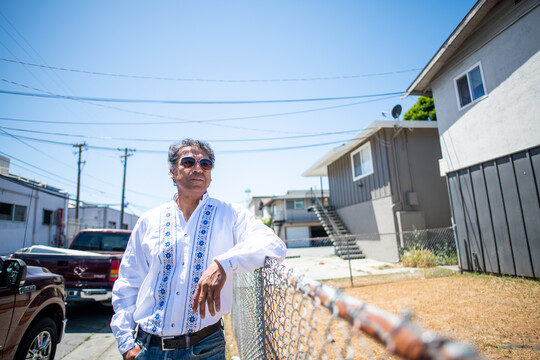
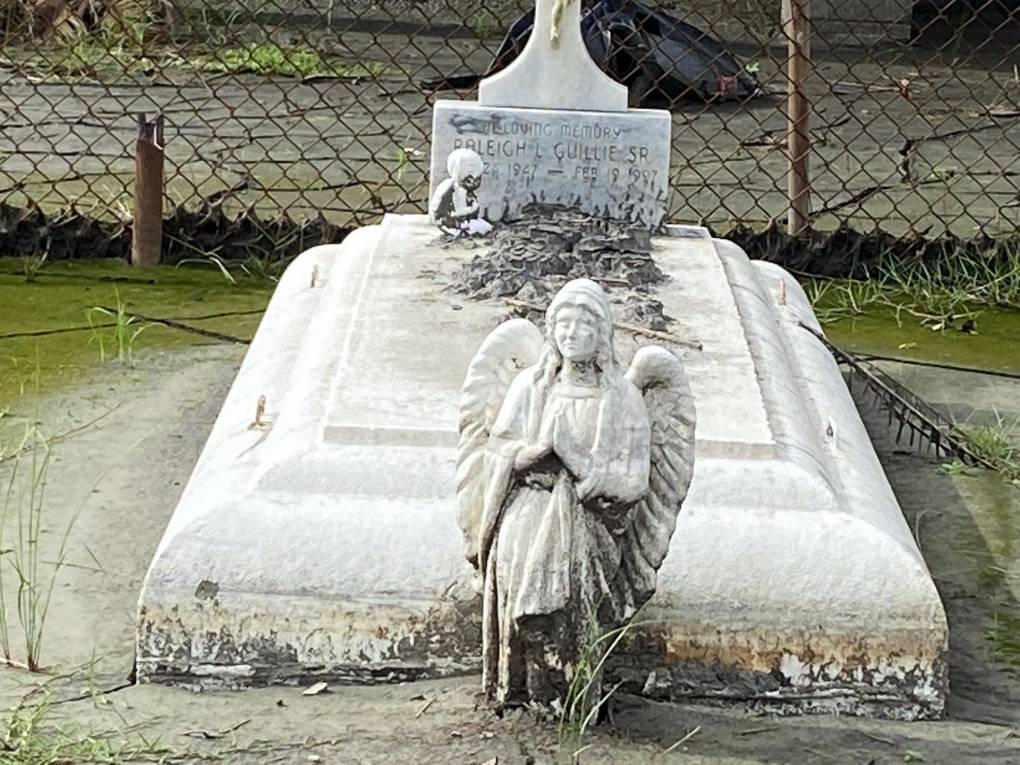
window.__IS_SSR__=true
window.__INITIAL_STATE__={
"attachmentsReducer": {
"audio_0": {
"type": "attachments",
"id": "audio_0",
"imgSizes": {
"kqedFullSize": {
"file": "https://ww2.kqed.org/news/wp-content/themes/KQED-unified/img/audio_bgs/background0.jpg"
}
}
},
"audio_1": {
"type": "attachments",
"id": "audio_1",
"imgSizes": {
"kqedFullSize": {
"file": "https://ww2.kqed.org/news/wp-content/themes/KQED-unified/img/audio_bgs/background1.jpg"
}
}
},
"audio_2": {
"type": "attachments",
"id": "audio_2",
"imgSizes": {
"kqedFullSize": {
"file": "https://ww2.kqed.org/news/wp-content/themes/KQED-unified/img/audio_bgs/background2.jpg"
}
}
},
"audio_3": {
"type": "attachments",
"id": "audio_3",
"imgSizes": {
"kqedFullSize": {
"file": "https://ww2.kqed.org/news/wp-content/themes/KQED-unified/img/audio_bgs/background3.jpg"
}
}
},
"audio_4": {
"type": "attachments",
"id": "audio_4",
"imgSizes": {
"kqedFullSize": {
"file": "https://ww2.kqed.org/news/wp-content/themes/KQED-unified/img/audio_bgs/background4.jpg"
}
}
},
"placeholder": {
"type": "attachments",
"id": "placeholder",
"imgSizes": {
"thumbnail": {
"file": "https://cdn.kqed.org/wp-content/uploads/2024/12/KQED-Default-Image-816638274-2000x1333-1-160x107.jpg",
"width": 160,
"height": 107,
"mimeType": "image/jpeg"
},
"medium": {
"file": "https://cdn.kqed.org/wp-content/uploads/2024/12/KQED-Default-Image-816638274-2000x1333-1-800x533.jpg",
"width": 800,
"height": 533,
"mimeType": "image/jpeg"
},
"medium_large": {
"file": "https://cdn.kqed.org/wp-content/uploads/2024/12/KQED-Default-Image-816638274-2000x1333-1-768x512.jpg",
"width": 768,
"height": 512,
"mimeType": "image/jpeg"
},
"large": {
"file": "https://cdn.kqed.org/wp-content/uploads/2024/12/KQED-Default-Image-816638274-2000x1333-1-1020x680.jpg",
"width": 1020,
"height": 680,
"mimeType": "image/jpeg"
},
"1536x1536": {
"file": "https://cdn.kqed.org/wp-content/uploads/2024/12/KQED-Default-Image-816638274-2000x1333-1-1536x1024.jpg",
"width": 1536,
"height": 1024,
"mimeType": "image/jpeg"
},
"fd-lrg": {
"file": "https://cdn.kqed.org/wp-content/uploads/2024/12/KQED-Default-Image-816638274-2000x1333-1-1536x1024.jpg",
"width": 1536,
"height": 1024,
"mimeType": "image/jpeg"
},
"fd-med": {
"file": "https://cdn.kqed.org/wp-content/uploads/2024/12/KQED-Default-Image-816638274-2000x1333-1-1020x680.jpg",
"width": 1020,
"height": 680,
"mimeType": "image/jpeg"
},
"fd-sm": {
"file": "https://cdn.kqed.org/wp-content/uploads/2024/12/KQED-Default-Image-816638274-2000x1333-1-800x533.jpg",
"width": 800,
"height": 533,
"mimeType": "image/jpeg"
},
"post-thumbnail": {
"file": "https://cdn.kqed.org/wp-content/uploads/2024/12/KQED-Default-Image-816638274-2000x1333-1-672x372.jpg",
"width": 672,
"height": 372,
"mimeType": "image/jpeg"
},
"twentyfourteen-full-width": {
"file": "https://cdn.kqed.org/wp-content/uploads/2024/12/KQED-Default-Image-816638274-2000x1333-1-1038x576.jpg",
"width": 1038,
"height": 576,
"mimeType": "image/jpeg"
},
"xxsmall": {
"file": "https://cdn.kqed.org/wp-content/uploads/2024/12/KQED-Default-Image-816638274-2000x1333-1-160x107.jpg",
"width": 160,
"height": 107,
"mimeType": "image/jpeg"
},
"xsmall": {
"file": "https://cdn.kqed.org/wp-content/uploads/2024/12/KQED-Default-Image-816638274-2000x1333-1-672x372.jpg",
"width": 672,
"height": 372,
"mimeType": "image/jpeg"
},
"small": {
"file": "https://cdn.kqed.org/wp-content/uploads/2024/12/KQED-Default-Image-816638274-2000x1333-1-672x372.jpg",
"width": 672,
"height": 372,
"mimeType": "image/jpeg"
},
"xlarge": {
"file": "https://cdn.kqed.org/wp-content/uploads/2024/12/KQED-Default-Image-816638274-2000x1333-1-1020x680.jpg",
"width": 1020,
"height": 680,
"mimeType": "image/jpeg"
},
"full-width": {
"file": "https://cdn.kqed.org/wp-content/uploads/2024/12/KQED-Default-Image-816638274-2000x1333-1-1920x1280.jpg",
"width": 1920,
"height": 1280,
"mimeType": "image/jpeg"
},
"guest-author-32": {
"file": "https://cdn.kqed.org/wp-content/uploads/2025/01/KQED-Default-Image-816638274-1333x1333-1-160x160.jpg",
"width": 32,
"height": 32,
"mimeType": "image/jpeg"
},
"guest-author-50": {
"file": "https://cdn.kqed.org/wp-content/uploads/2025/01/KQED-Default-Image-816638274-1333x1333-1-160x160.jpg",
"width": 50,
"height": 50,
"mimeType": "image/jpeg"
},
"guest-author-64": {
"file": "https://cdn.kqed.org/wp-content/uploads/2025/01/KQED-Default-Image-816638274-1333x1333-1-160x160.jpg",
"width": 64,
"height": 64,
"mimeType": "image/jpeg"
},
"guest-author-96": {
"file": "https://cdn.kqed.org/wp-content/uploads/2025/01/KQED-Default-Image-816638274-1333x1333-1-160x160.jpg",
"width": 96,
"height": 96,
"mimeType": "image/jpeg"
},
"guest-author-128": {
"file": "https://cdn.kqed.org/wp-content/uploads/2025/01/KQED-Default-Image-816638274-1333x1333-1-160x160.jpg",
"width": 128,
"height": 128,
"mimeType": "image/jpeg"
},
"detail": {
"file": "https://cdn.kqed.org/wp-content/uploads/2025/01/KQED-Default-Image-816638274-1333x1333-1-160x160.jpg",
"width": 160,
"height": 160,
"mimeType": "image/jpeg"
},
"kqedFullSize": {
"file": "https://cdn.kqed.org/wp-content/uploads/2024/12/KQED-Default-Image-816638274-2000x1333-1.jpg",
"width": 2000,
"height": 1333
}
}
},
"science_1977892": {
"type": "attachments",
"id": "science_1977892",
"meta": {
"index": "attachments_1716263798",
"site": "science",
"id": "1977892",
"found": true
},
"parent": 1977890,
"imgSizes": {
"twentyfourteen-full-width": {
"file": "https://ww2.kqed.org/app/uploads/sites/35/2021/12/Newark-Main-Photos-1038x576.jpg",
"width": 1038,
"mimeType": "image/jpeg",
"height": 576
},
"thumbnail": {
"file": "https://ww2.kqed.org/app/uploads/sites/35/2021/12/Newark-Main-Photos-160x107.jpg",
"width": 160,
"mimeType": "image/jpeg",
"height": 107
},
"post-thumbnail": {
"file": "https://ww2.kqed.org/app/uploads/sites/35/2021/12/Newark-Main-Photos-672x372.jpg",
"width": 672,
"mimeType": "image/jpeg",
"height": 372
},
"kqedFullSize": {
"file": "https://ww2.kqed.org/app/uploads/sites/35/2021/12/Newark-Main-Photos-scaled.jpg",
"width": 2560,
"height": 1707
},
"2048x2048": {
"file": "https://ww2.kqed.org/app/uploads/sites/35/2021/12/Newark-Main-Photos-2048x1365.jpg",
"width": 2048,
"mimeType": "image/jpeg",
"height": 1365
},
"large": {
"file": "https://ww2.kqed.org/app/uploads/sites/35/2021/12/Newark-Main-Photos-1020x680.jpg",
"width": 1020,
"mimeType": "image/jpeg",
"height": 680
},
"1536x1536": {
"file": "https://ww2.kqed.org/app/uploads/sites/35/2021/12/Newark-Main-Photos-1536x1024.jpg",
"width": 1536,
"mimeType": "image/jpeg",
"height": 1024
},
"full-width": {
"file": "https://ww2.kqed.org/app/uploads/sites/35/2021/12/Newark-Main-Photos-1920x1280.jpg",
"width": 1920,
"mimeType": "image/jpeg",
"height": 1280
},
"medium": {
"file": "https://ww2.kqed.org/app/uploads/sites/35/2021/12/Newark-Main-Photos-800x533.jpg",
"width": 800,
"mimeType": "image/jpeg",
"height": 533
},
"medium_large": {
"file": "https://ww2.kqed.org/app/uploads/sites/35/2021/12/Newark-Main-Photos-768x512.jpg",
"width": 768,
"mimeType": "image/jpeg",
"height": 512
}
},
"publishDate": 1639086143,
"modified": 1639425896,
"caption": "A wetland along the edge of the city of Newark. ",
"description": null,
"title": "Newark Aerial",
"credit": "Courtesy of Citizens Committee to Complete the Refuge's Derell Licht/Creative Commons",
"status": "inherit",
"altTag": "a green marsh connected to salt ponds with houses, bay water and coastal hills in the background.",
"isLoading": false,
"fetchFailed": false
},
"science_1977350": {
"type": "attachments",
"id": "science_1977350",
"meta": {
"index": "attachments_1716263798",
"site": "science",
"id": "1977350",
"found": true
},
"parent": 1977314,
"imgSizes": {
"twentyfourteen-full-width": {
"file": "https://ww2.kqed.org/app/uploads/sites/35/2021/10/RS52174_GettyImages-1168690975-qut-1038x576.jpg",
"width": 1038,
"mimeType": "image/jpeg",
"height": 576
},
"thumbnail": {
"file": "https://ww2.kqed.org/app/uploads/sites/35/2021/10/RS52174_GettyImages-1168690975-qut-160x106.jpg",
"width": 160,
"mimeType": "image/jpeg",
"height": 106
},
"post-thumbnail": {
"file": "https://ww2.kqed.org/app/uploads/sites/35/2021/10/RS52174_GettyImages-1168690975-qut-672x372.jpg",
"width": 672,
"mimeType": "image/jpeg",
"height": 372
},
"kqedFullSize": {
"file": "https://ww2.kqed.org/app/uploads/sites/35/2021/10/RS52174_GettyImages-1168690975-qut.jpg",
"width": 1920,
"height": 1277
},
"large": {
"file": "https://ww2.kqed.org/app/uploads/sites/35/2021/10/RS52174_GettyImages-1168690975-qut-1020x678.jpg",
"width": 1020,
"mimeType": "image/jpeg",
"height": 678
},
"1536x1536": {
"file": "https://ww2.kqed.org/app/uploads/sites/35/2021/10/RS52174_GettyImages-1168690975-qut-1536x1022.jpg",
"width": 1536,
"mimeType": "image/jpeg",
"height": 1022
},
"medium": {
"file": "https://ww2.kqed.org/app/uploads/sites/35/2021/10/RS52174_GettyImages-1168690975-qut-800x532.jpg",
"width": 800,
"mimeType": "image/jpeg",
"height": 532
},
"medium_large": {
"file": "https://ww2.kqed.org/app/uploads/sites/35/2021/10/RS52174_GettyImages-1168690975-qut-768x511.jpg",
"width": 768,
"mimeType": "image/jpeg",
"height": 511
}
},
"publishDate": 1635444926,
"modified": 1639164519,
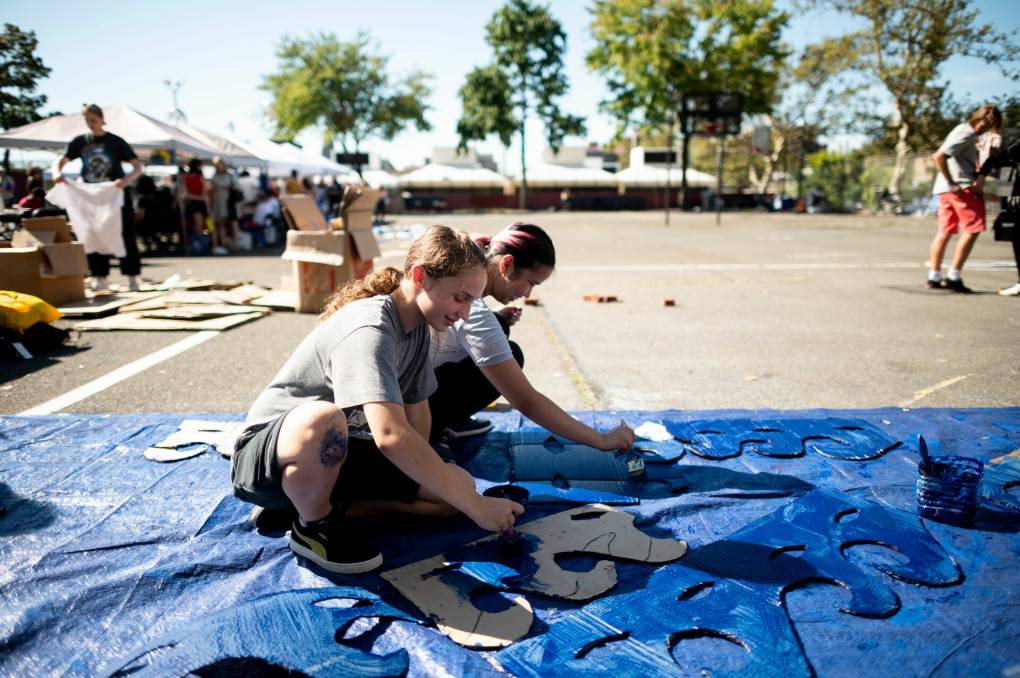
"caption": "Nora Gell paints waves on paper as she takes part in an event to make art for the September 20 Youth Climate Strike on Sept. 15, 2019, in New York City. ",
"description": null,
"title": "US-CLIMATE-YOUTH-STRIKE-ART-environment",
"credit": "Johannes Eisele/AFP via Getty Images",
"status": "inherit",
"altTag": "two children cut out waves on asphalt court outside",
"isLoading": false,
"fetchFailed": false
},
"science_1977851": {
"type": "attachments",
"id": "science_1977851",
"meta": {
"index": "attachments_1716263798",
"site": "science",
"id": "1977851",
"found": true
},
"parent": 1977842,
"imgSizes": {
"twentyfourteen-full-width": {
"file": "https://ww2.kqed.org/app/uploads/sites/35/2021/12/sf_ferrygateg-1038x576.jpg",
"width": 1038,
"mimeType": "image/jpeg",
"height": 576
},
"thumbnail": {
"file": "https://ww2.kqed.org/app/uploads/sites/35/2021/12/sf_ferrygateg-160x107.jpg",
"width": 160,
"mimeType": "image/jpeg",
"height": 107
},
"post-thumbnail": {
"file": "https://ww2.kqed.org/app/uploads/sites/35/2021/12/sf_ferrygateg-672x372.jpg",
"width": 672,
"mimeType": "image/jpeg",
"height": 372
},
"kqedFullSize": {
"file": "https://ww2.kqed.org/app/uploads/sites/35/2021/12/sf_ferrygateg.jpg",
"width": 2000,
"height": 1333
},
"large": {
"file": "https://ww2.kqed.org/app/uploads/sites/35/2021/12/sf_ferrygateg-1020x680.jpg",
"width": 1020,
"mimeType": "image/jpeg",
"height": 680
},
"1536x1536": {
"file": "https://ww2.kqed.org/app/uploads/sites/35/2021/12/sf_ferrygateg-1536x1024.jpg",
"width": 1536,
"mimeType": "image/jpeg",
"height": 1024
},
"full-width": {
"file": "https://ww2.kqed.org/app/uploads/sites/35/2021/12/sf_ferrygateg-1920x1280.jpg",
"width": 1920,
"mimeType": "image/jpeg",
"height": 1280
},
"medium": {
"file": "https://ww2.kqed.org/app/uploads/sites/35/2021/12/sf_ferrygateg-800x533.jpg",
"width": 800,
"mimeType": "image/jpeg",
"height": 533
},
"medium_large": {
"file": "https://ww2.kqed.org/app/uploads/sites/35/2021/12/sf_ferrygateg-768x512.jpg",
"width": 768,
"mimeType": "image/jpeg",
"height": 512
}
},
"publishDate": 1638577317,
"modified": 1638583111,
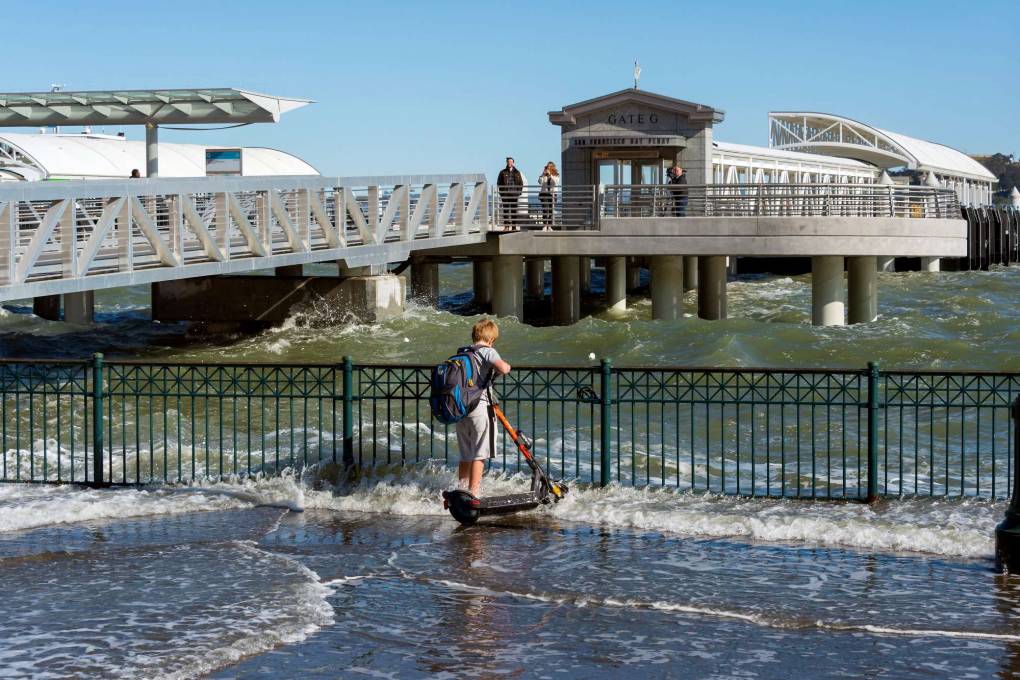
"caption": "King tides at Ferry Gate G in San Francisco.",
"description": "King Tides at Ferry Gate G in San Francisco, Calif.",
"title": "sf_ferrygateg",
"credit": "Courtesy of the California King Tides Project",
"status": "inherit",
"altTag": "Bay waves wash over San Francisco's Embarcadero as a young boy stands ankle deep, watching the waves.",
"isLoading": false,
"fetchFailed": false
},
"science_1977761": {
"type": "attachments",
"id": "science_1977761",
"meta": {
"index": "attachments_1716263798",
"site": "science",
"id": "1977761",
"found": true
},
"parent": 1977748,
"imgSizes": {
"twentyfourteen-full-width": {
"file": "https://ww2.kqed.org/app/uploads/sites/35/2021/11/003_SanFrancisco_YouthClimateStrike_10292021-1038x576.jpg",
"width": 1038,
"mimeType": "image/jpeg",
"height": 576
},
"thumbnail": {
"file": "https://ww2.kqed.org/app/uploads/sites/35/2021/11/003_SanFrancisco_YouthClimateStrike_10292021-160x107.jpg",
"width": 160,
"mimeType": "image/jpeg",
"height": 107
},
"post-thumbnail": {
"file": "https://ww2.kqed.org/app/uploads/sites/35/2021/11/003_SanFrancisco_YouthClimateStrike_10292021-672x372.jpg",
"width": 672,
"mimeType": "image/jpeg",
"height": 372
},
"kqedFullSize": {
"file": "https://ww2.kqed.org/app/uploads/sites/35/2021/11/003_SanFrancisco_YouthClimateStrike_10292021.jpg",
"width": 1920,
"height": 1280
},
"large": {
"file": "https://ww2.kqed.org/app/uploads/sites/35/2021/11/003_SanFrancisco_YouthClimateStrike_10292021-1020x680.jpg",
"width": 1020,
"mimeType": "image/jpeg",
"height": 680
},
"1536x1536": {
"file": "https://ww2.kqed.org/app/uploads/sites/35/2021/11/003_SanFrancisco_YouthClimateStrike_10292021-1536x1024.jpg",
"width": 1536,
"mimeType": "image/jpeg",
"height": 1024
},
"medium": {
"file": "https://ww2.kqed.org/app/uploads/sites/35/2021/11/003_SanFrancisco_YouthClimateStrike_10292021-800x533.jpg",
"width": 800,
"mimeType": "image/jpeg",
"height": 533
},
"medium_large": {
"file": "https://ww2.kqed.org/app/uploads/sites/35/2021/11/003_SanFrancisco_YouthClimateStrike_10292021-768x512.jpg",
"width": 768,
"mimeType": "image/jpeg",
"height": 512
}
},
"publishDate": 1637367641,
"modified": 1637448130,
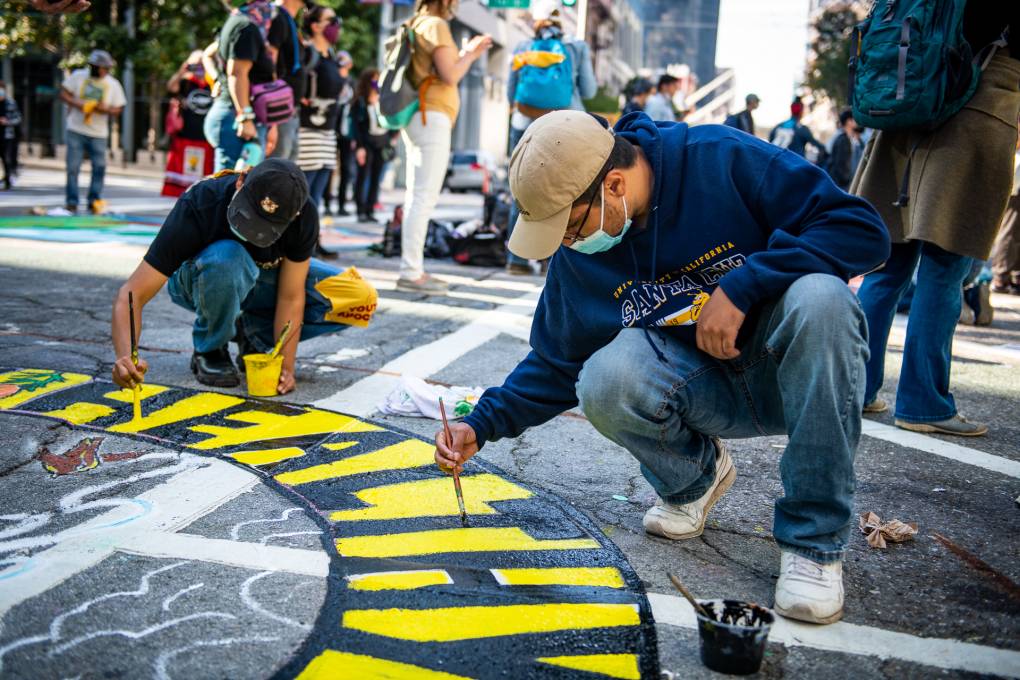
"caption": "Richmond's Marco Lemus from Urban Tilth paints a mural on the 400 block of Howard Street in San Francisco on Oct. 29, 2021, as part of a climate strike connected with the Glasgow climate summit.",
"description": null,
"title": "003_SanFrancisco_YouthClimateStrike_10292021",
"credit": "Beth Laberge/KQED",
"status": "inherit",
"altTag": "A man with jeans and a blue hooded sweatshirt paints a yellow mural on the street.",
"isLoading": false,
"fetchFailed": false
},
"science_1977718": {
"type": "attachments",
"id": "science_1977718",
"meta": {
"index": "attachments_1716263798",
"site": "science",
"id": "1977718",
"found": true
},
"parent": 1977717,
"imgSizes": {
"twentyfourteen-full-width": {
"file": "https://ww2.kqed.org/app/uploads/sites/35/2021/11/ap21316460645092-00d68393d024da766bd7eceed010afa68b74eb3a-1038x576.jpg",
"width": 1038,
"mimeType": "image/jpeg",
"height": 576
},
"thumbnail": {
"file": "https://ww2.kqed.org/app/uploads/sites/35/2021/11/ap21316460645092-00d68393d024da766bd7eceed010afa68b74eb3a-160x120.jpg",
"width": 160,
"mimeType": "image/jpeg",
"height": 120
},
"post-thumbnail": {
"file": "https://ww2.kqed.org/app/uploads/sites/35/2021/11/ap21316460645092-00d68393d024da766bd7eceed010afa68b74eb3a-672x372.jpg",
"width": 672,
"mimeType": "image/jpeg",
"height": 372
},
"kqedFullSize": {
"file": "https://ww2.kqed.org/app/uploads/sites/35/2021/11/ap21316460645092-00d68393d024da766bd7eceed010afa68b74eb3a-scaled.jpg",
"width": 2560,
"height": 1920
},
"2048x2048": {
"file": "https://ww2.kqed.org/app/uploads/sites/35/2021/11/ap21316460645092-00d68393d024da766bd7eceed010afa68b74eb3a-2048x1536.jpg",
"width": 2048,
"mimeType": "image/jpeg",
"height": 1536
},
"large": {
"file": "https://ww2.kqed.org/app/uploads/sites/35/2021/11/ap21316460645092-00d68393d024da766bd7eceed010afa68b74eb3a-1020x765.jpg",
"width": 1020,
"mimeType": "image/jpeg",
"height": 765
},
"1536x1536": {
"file": "https://ww2.kqed.org/app/uploads/sites/35/2021/11/ap21316460645092-00d68393d024da766bd7eceed010afa68b74eb3a-1536x1152.jpg",
"width": 1536,
"mimeType": "image/jpeg",
"height": 1152
},
"full-width": {
"file": "https://ww2.kqed.org/app/uploads/sites/35/2021/11/ap21316460645092-00d68393d024da766bd7eceed010afa68b74eb3a-1920x1440.jpg",
"width": 1920,
"mimeType": "image/jpeg",
"height": 1440
},
"medium": {
"file": "https://ww2.kqed.org/app/uploads/sites/35/2021/11/ap21316460645092-00d68393d024da766bd7eceed010afa68b74eb3a-800x600.jpg",
"width": 800,
"mimeType": "image/jpeg",
"height": 600
},
"medium_large": {
"file": "https://ww2.kqed.org/app/uploads/sites/35/2021/11/ap21316460645092-00d68393d024da766bd7eceed010afa68b74eb3a-768x576.jpg",
"width": 768,
"mimeType": "image/jpeg",
"height": 576
}
},
"publishDate": 1636738981,
"modified": 1636739135,
"caption": "Climate activists hold a demonstration through the venue of the COP26 U.N. Climate Summit in Glasgow, Scotland, Friday, Nov. 12, 2021. Negotiators from almost 200 nations were making a fresh push Friday to reach agreements on a series of key issues that would allow them to call this year's U.N. climate talks a success. ",
"description": null,
"title": null,
"credit": "Alastair Grant/AP Photo via NPR",
"status": "inherit",
"altTag": "Three mask wearing climate activists grip a red velvet rope. One holds up a sign that says \"keep 1.5C alive.\"",
"isLoading": false,
"fetchFailed": false
},
"science_1977693": {
"type": "attachments",
"id": "science_1977693",
"meta": {
"index": "attachments_1716263798",
"site": "science",
"id": "1977693",
"found": true
},
"parent": 1977690,
"imgSizes": {
"twentyfourteen-full-width": {
"file": "https://ww2.kqed.org/app/uploads/sites/35/2021/11/RS52427_GettyImages-1235004302-qut-1-1038x576.jpg",
"width": 1038,
"mimeType": "image/jpeg",
"height": 576
},
"thumbnail": {
"file": "https://ww2.kqed.org/app/uploads/sites/35/2021/11/RS52427_GettyImages-1235004302-qut-1-160x107.jpg",
"width": 160,
"mimeType": "image/jpeg",
"height": 107
},
"post-thumbnail": {
"file": "https://ww2.kqed.org/app/uploads/sites/35/2021/11/RS52427_GettyImages-1235004302-qut-1-672x372.jpg",
"width": 672,
"mimeType": "image/jpeg",
"height": 372
},
"kqedFullSize": {
"file": "https://ww2.kqed.org/app/uploads/sites/35/2021/11/RS52427_GettyImages-1235004302-qut-1.jpg",
"width": 1920,
"height": 1280
},
"large": {
"file": "https://ww2.kqed.org/app/uploads/sites/35/2021/11/RS52427_GettyImages-1235004302-qut-1-1020x680.jpg",
"width": 1020,
"mimeType": "image/jpeg",
"height": 680
},
"1536x1536": {
"file": "https://ww2.kqed.org/app/uploads/sites/35/2021/11/RS52427_GettyImages-1235004302-qut-1-1536x1024.jpg",
"width": 1536,
"mimeType": "image/jpeg",
"height": 1024
},
"medium": {
"file": "https://ww2.kqed.org/app/uploads/sites/35/2021/11/RS52427_GettyImages-1235004302-qut-1-800x533.jpg",
"width": 800,
"mimeType": "image/jpeg",
"height": 533
},
"medium_large": {
"file": "https://ww2.kqed.org/app/uploads/sites/35/2021/11/RS52427_GettyImages-1235004302-qut-1-768x512.jpg",
"width": 768,
"mimeType": "image/jpeg",
"height": 512
}
},
"publishDate": 1636503652,
"modified": 1636503830,
"caption": "Jorge Meza and Stacie Mims, on an outing to pose for pregnancy portraits, walk near a closure sign as the Angeles National Forest, along with all national forests in California, is closed due to dangerous wildfire conditions on September 1, 2021 in Altadena, California. ",
"description": "Jorge Meza and Stacie Mims, on an outing to pose for pregnancy portraits, walk near a closure sign as the Angeles National Forest, along with all national forests in California, is closed due to dangerous wildfire conditions on September 1, 2021 in Altadena, California. ",
"title": "All National Forests In California Closed Due To Fire Threat",
"credit": "David McNew/Getty Images",
"status": "inherit",
"altTag": "A man and pregnant woman wearing dressy black clothing are walking near a sign in the Angeles National Forest that reads Forest Closed Due to Fire Danger. The couple were on an outing to pose for pregnancy photos.",
"isLoading": false,
"fetchFailed": false
},
"science_1977675": {
"type": "attachments",
"id": "science_1977675",
"meta": {
"index": "attachments_1716263798",
"site": "science",
"id": "1977675",
"found": true
},
"parent": 1977672,
"imgSizes": {
"twentyfourteen-full-width": {
"file": "https://ww2.kqed.org/app/uploads/sites/35/2021/11/RS52246_029_SanFrancisco_YouthClimateStrike_10292021-qut-1038x576.jpg",
"width": 1038,
"mimeType": "image/jpeg",
"height": 576
},
"thumbnail": {
"file": "https://ww2.kqed.org/app/uploads/sites/35/2021/11/RS52246_029_SanFrancisco_YouthClimateStrike_10292021-qut-160x107.jpg",
"width": 160,
"mimeType": "image/jpeg",
"height": 107
},
"post-thumbnail": {
"file": "https://ww2.kqed.org/app/uploads/sites/35/2021/11/RS52246_029_SanFrancisco_YouthClimateStrike_10292021-qut-672x372.jpg",
"width": 672,
"mimeType": "image/jpeg",
"height": 372
},
"kqedFullSize": {
"file": "https://ww2.kqed.org/app/uploads/sites/35/2021/11/RS52246_029_SanFrancisco_YouthClimateStrike_10292021-qut.jpg",
"width": 1920,
"height": 1280
},
"large": {
"file": "https://ww2.kqed.org/app/uploads/sites/35/2021/11/RS52246_029_SanFrancisco_YouthClimateStrike_10292021-qut-1020x680.jpg",
"width": 1020,
"mimeType": "image/jpeg",
"height": 680
},
"1536x1536": {
"file": "https://ww2.kqed.org/app/uploads/sites/35/2021/11/RS52246_029_SanFrancisco_YouthClimateStrike_10292021-qut-1536x1024.jpg",
"width": 1536,
"mimeType": "image/jpeg",
"height": 1024
},
"medium": {
"file": "https://ww2.kqed.org/app/uploads/sites/35/2021/11/RS52246_029_SanFrancisco_YouthClimateStrike_10292021-qut-800x533.jpg",
"width": 800,
"mimeType": "image/jpeg",
"height": 533
},
"medium_large": {
"file": "https://ww2.kqed.org/app/uploads/sites/35/2021/11/RS52246_029_SanFrancisco_YouthClimateStrike_10292021-qut-768x512.jpg",
"width": 768,
"mimeType": "image/jpeg",
"height": 512
}
},
"publishDate": 1636420630,
"modified": 1636420753,
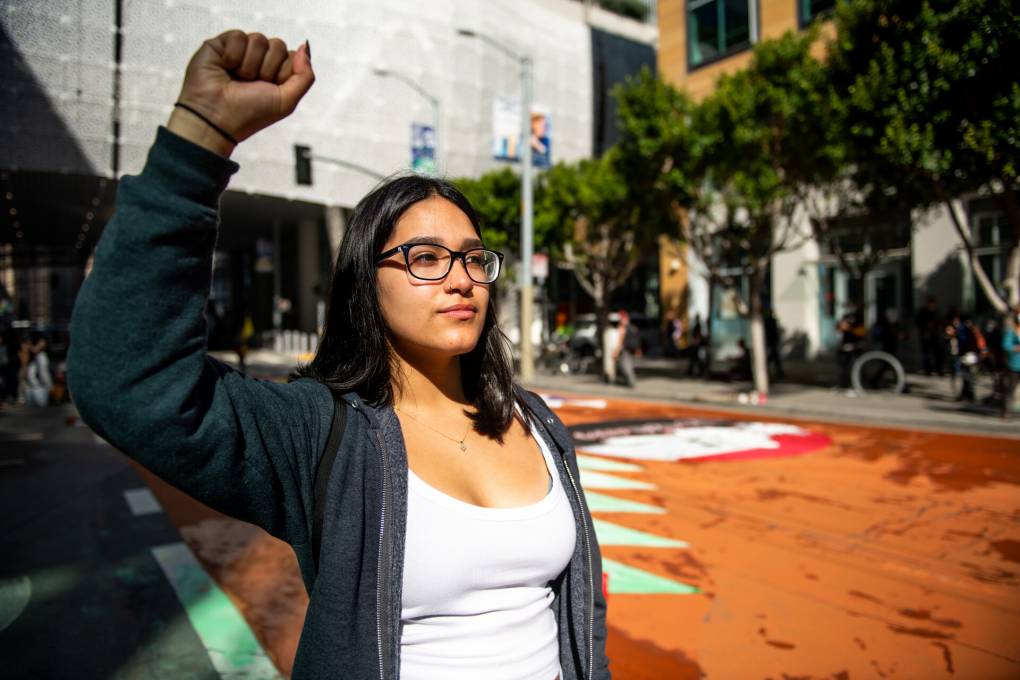
"caption": "Lizbeth Ibarra raises her fist after a youth-led climate march through downtown San Francisco on Oct. 29, 2021.",
"description": null,
"title": "RS52246_029_SanFrancisco_YouthClimateStrike_10292021-qut",
"credit": "Beth LaBerge/KQED",
"status": "inherit",
"altTag": "A young woman raises her fist in the air. She has black hair to her shoulders and is wearing a white tank top and a gray zip up sweatshirt.",
"isLoading": false,
"fetchFailed": false
},
"science_1977623": {
"type": "attachments",
"id": "science_1977623",
"meta": {
"index": "attachments_1716263798",
"site": "science",
"id": "1977623",
"found": true
},
"parent": 1977622,
"imgSizes": {
"twentyfourteen-full-width": {
"file": "https://ww2.kqed.org/app/uploads/sites/35/2021/11/ap166954525142_wide-2eed4e06c9baff6831c8a253c0641e8ca0523479-1038x576.jpg",
"width": 1038,
"mimeType": "image/jpeg",
"height": 576
},
"thumbnail": {
"file": "https://ww2.kqed.org/app/uploads/sites/35/2021/11/ap166954525142_wide-2eed4e06c9baff6831c8a253c0641e8ca0523479-160x90.jpg",
"width": 160,
"mimeType": "image/jpeg",
"height": 90
},
"post-thumbnail": {
"file": "https://ww2.kqed.org/app/uploads/sites/35/2021/11/ap166954525142_wide-2eed4e06c9baff6831c8a253c0641e8ca0523479-672x372.jpg",
"width": 672,
"mimeType": "image/jpeg",
"height": 372
},
"kqedFullSize": {
"file": "https://ww2.kqed.org/app/uploads/sites/35/2021/11/ap166954525142_wide-2eed4e06c9baff6831c8a253c0641e8ca0523479-scaled.jpg",
"width": 2560,
"height": 1440
},
"2048x2048": {
"file": "https://ww2.kqed.org/app/uploads/sites/35/2021/11/ap166954525142_wide-2eed4e06c9baff6831c8a253c0641e8ca0523479-2048x1152.jpg",
"width": 2048,
"mimeType": "image/jpeg",
"height": 1152
},
"large": {
"file": "https://ww2.kqed.org/app/uploads/sites/35/2021/11/ap166954525142_wide-2eed4e06c9baff6831c8a253c0641e8ca0523479-1020x574.jpg",
"width": 1020,
"mimeType": "image/jpeg",
"height": 574
},
"1536x1536": {
"file": "https://ww2.kqed.org/app/uploads/sites/35/2021/11/ap166954525142_wide-2eed4e06c9baff6831c8a253c0641e8ca0523479-1536x864.jpg",
"width": 1536,
"mimeType": "image/jpeg",
"height": 864
},
"full-width": {
"file": "https://ww2.kqed.org/app/uploads/sites/35/2021/11/ap166954525142_wide-2eed4e06c9baff6831c8a253c0641e8ca0523479-1920x1080.jpg",
"width": 1920,
"mimeType": "image/jpeg",
"height": 1080
},
"medium": {
"file": "https://ww2.kqed.org/app/uploads/sites/35/2021/11/ap166954525142_wide-2eed4e06c9baff6831c8a253c0641e8ca0523479-800x450.jpg",
"width": 800,
"mimeType": "image/jpeg",
"height": 450
},
"medium_large": {
"file": "https://ww2.kqed.org/app/uploads/sites/35/2021/11/ap166954525142_wide-2eed4e06c9baff6831c8a253c0641e8ca0523479-768x432.jpg",
"width": 768,
"mimeType": "image/jpeg",
"height": 432
}
},
"publishDate": 1636134615,
"modified": 1636135335,
"caption": "Smoke rises from a brick kiln on the outskirts of Gauhati, India, Monday, Jan. 26, 2015. ",
"description": null,
"title": "A power plant stock releases smoke into a hazy, yellow sky. The sun appears in the sky and reflects off a lake in the foreground.",
"credit": "Anupam Nath/AP Photo via NPR",
"status": "inherit",
"altTag": null,
"isLoading": false,
"fetchFailed": false
},
"science_1977595": {
"type": "attachments",
"id": "science_1977595",
"meta": {
"index": "attachments_1716263798",
"site": "science",
"id": "1977595",
"found": true
},
"parent": 1977594,
"imgSizes": {
"twentyfourteen-full-width": {
"file": "https://ww2.kqed.org/app/uploads/sites/35/2021/11/RS52390_GettyImages-1344261855-qut-1038x576.jpg",
"width": 1038,
"mimeType": "image/jpeg",
"height": 576
},
"thumbnail": {
"file": "https://ww2.kqed.org/app/uploads/sites/35/2021/11/RS52390_GettyImages-1344261855-qut-160x107.jpg",
"width": 160,
"mimeType": "image/jpeg",
"height": 107
},
"post-thumbnail": {
"file": "https://ww2.kqed.org/app/uploads/sites/35/2021/11/RS52390_GettyImages-1344261855-qut-672x372.jpg",
"width": 672,
"mimeType": "image/jpeg",
"height": 372
},
"kqedFullSize": {
"file": "https://ww2.kqed.org/app/uploads/sites/35/2021/11/RS52390_GettyImages-1344261855-qut.jpg",
"width": 1920,
"height": 1279
},
"large": {
"file": "https://ww2.kqed.org/app/uploads/sites/35/2021/11/RS52390_GettyImages-1344261855-qut-1020x679.jpg",
"width": 1020,
"mimeType": "image/jpeg",
"height": 679
},
"1536x1536": {
"file": "https://ww2.kqed.org/app/uploads/sites/35/2021/11/RS52390_GettyImages-1344261855-qut-1536x1023.jpg",
"width": 1536,
"mimeType": "image/jpeg",
"height": 1023
},
"medium": {
"file": "https://ww2.kqed.org/app/uploads/sites/35/2021/11/RS52390_GettyImages-1344261855-qut-800x533.jpg",
"width": 800,
"mimeType": "image/jpeg",
"height": 533
},
"medium_large": {
"file": "https://ww2.kqed.org/app/uploads/sites/35/2021/11/RS52390_GettyImages-1344261855-qut-768x512.jpg",
"width": 768,
"mimeType": "image/jpeg",
"height": 512
}
},
"publishDate": 1636064589,
"modified": 1636064697,
"caption": "Ugandan Climate activist Vanessa Nakate speaks during the climate strike march on October 1, 2021 in Milan, Italy. On the sidelines of various pre-COP26 summits, students, young activists and civil society marched for action against climate change.",
"description": "Ugandan Climate activist Vanessa Nakate speaks during the climate strike march on October 1, 2021 in Milan, Italy. On the sidelines of various pre-COP26 summits, students, young activists and civil society marched for action against climate change.",
"title": "Fridays For Future Holds Climate Strike March In Milan",
"credit": "Stefano Guidi/Getty Images",
"status": "inherit",
"altTag": null,
"isLoading": false,
"fetchFailed": false
},
"science_1977541": {
"type": "attachments",
"id": "science_1977541",
"meta": {
"index": "attachments_1716263798",
"site": "science",
"id": "1977541",
"found": true
},
"parent": 1977533,
"imgSizes": {
"thumbnail": {
"file": "https://ww2.kqed.org/app/uploads/sites/35/2021/11/RS49257_012_NorthFairOaks_ClimateListening_05102021-sfi-160x107.jpg",
"width": 160,
"mimeType": "image/jpeg",
"height": 107
},
"kqedFullSize": {
"file": "https://ww2.kqed.org/app/uploads/sites/35/2021/11/RS49257_012_NorthFairOaks_ClimateListening_05102021-sfi.jpg",
"width": 540,
"height": 360
}
},
"publishDate": 1635976220,
"modified": 1635986089,
"caption": "Ever Rodriguez stands near an apartment building with few trees in North Fair Oaks on May 10, 2021.",
"description": null,
"title": "RS49257_012_NorthFairOaks_ClimateListening_05102021-sfi",
"credit": "Beth Leberge/KQED",
"status": "inherit",
"altTag": "A man stands against a chain fence. He's wearing a white shirt with two long, blue stripes and dark sunglasses.",
"isLoading": false,
"fetchFailed": false
},
"science_1977496": {
"type": "attachments",
"id": "science_1977496",
"meta": {
"index": "attachments_1716263798",
"site": "science",
"id": "1977496",
"found": true
},
"parent": 1977456,
"imgSizes": {
"twentyfourteen-full-width": {
"file": "https://ww2.kqed.org/app/uploads/sites/35/2021/11/RS52353_CLIMATE-MIGRATION-Angel-in-mud-Lafitte-qut-1038x576.jpg",
"width": 1038,
"mimeType": "image/jpeg",
"height": 576
},
"thumbnail": {
"file": "https://ww2.kqed.org/app/uploads/sites/35/2021/11/RS52353_CLIMATE-MIGRATION-Angel-in-mud-Lafitte-qut-160x120.jpg",
"width": 160,
"mimeType": "image/jpeg",
"height": 120
},
"post-thumbnail": {
"file": "https://ww2.kqed.org/app/uploads/sites/35/2021/11/RS52353_CLIMATE-MIGRATION-Angel-in-mud-Lafitte-qut-672x372.jpg",
"width": 672,
"mimeType": "image/jpeg",
"height": 372
},
"kqedFullSize": {
"file": "https://ww2.kqed.org/app/uploads/sites/35/2021/11/RS52353_CLIMATE-MIGRATION-Angel-in-mud-Lafitte-qut.jpg",
"width": 1920,
"height": 1440
},
"large": {
"file": "https://ww2.kqed.org/app/uploads/sites/35/2021/11/RS52353_CLIMATE-MIGRATION-Angel-in-mud-Lafitte-qut-1020x765.jpg",
"width": 1020,
"mimeType": "image/jpeg",
"height": 765
},
"1536x1536": {
"file": "https://ww2.kqed.org/app/uploads/sites/35/2021/11/RS52353_CLIMATE-MIGRATION-Angel-in-mud-Lafitte-qut-1536x1152.jpg",
"width": 1536,
"mimeType": "image/jpeg",
"height": 1152
},
"medium": {
"file": "https://ww2.kqed.org/app/uploads/sites/35/2021/11/RS52353_CLIMATE-MIGRATION-Angel-in-mud-Lafitte-qut-800x600.jpg",
"width": 800,
"mimeType": "image/jpeg",
"height": 600
},
"medium_large": {
"file": "https://ww2.kqed.org/app/uploads/sites/35/2021/11/RS52353_CLIMATE-MIGRATION-Angel-in-mud-Lafitte-qut-768x576.jpg",
"width": 768,
"mimeType": "image/jpeg",
"height": 576
}
},
"publishDate": 1635963575,
"modified": 1635977050,
"caption": "A cemetery in lower Lafitte, Louisiana, is covered with nearly a foot of marsh mud after Hurricane Ida struck the area on Aug. 29, 2021. Several of the caskets washed up and broke open during the storm. ",
"description": null,
"title": "RS52353_CLIMATE MIGRATION Angel in mud Lafitte-qut",
"credit": "Dianna Hunt/Indian Country Today",
"status": "inherit",
"altTag": "A white stone angel covered in black moss sits in front of a grave site covered in mud.",
"isLoading": false,
"fetchFailed": false
},
"science_1977441": {
"type": "attachments",
"id": "science_1977441",
"meta": {
"index": "attachments_1716263798",
"site": "science",
"id": "1977441",
"found": true
},
"parent": 1977423,
"imgSizes": {
"twentyfourteen-full-width": {
"file": "https://ww2.kqed.org/app/uploads/sites/35/2021/11/RS52310_Giant-Sequoia_NPS-qut-1038x576.jpg",
"width": 1038,
"mimeType": "image/jpeg",
"height": 576
},
"thumbnail": {
"file": "https://ww2.kqed.org/app/uploads/sites/35/2021/11/RS52310_Giant-Sequoia_NPS-qut-160x107.jpg",
"width": 160,
"mimeType": "image/jpeg",
"height": 107
},
"post-thumbnail": {
"file": "https://ww2.kqed.org/app/uploads/sites/35/2021/11/RS52310_Giant-Sequoia_NPS-qut-672x372.jpg",
"width": 672,
"mimeType": "image/jpeg",
"height": 372
},
"kqedFullSize": {
"file": "https://ww2.kqed.org/app/uploads/sites/35/2021/11/RS52310_Giant-Sequoia_NPS-qut.jpg",
"width": 1920,
"height": 1280
},
"large": {
"file": "https://ww2.kqed.org/app/uploads/sites/35/2021/11/RS52310_Giant-Sequoia_NPS-qut-1020x680.jpg",
"width": 1020,
"mimeType": "image/jpeg",
"height": 680
},
"1536x1536": {
"file": "https://ww2.kqed.org/app/uploads/sites/35/2021/11/RS52310_Giant-Sequoia_NPS-qut-1536x1024.jpg",
"width": 1536,
"mimeType": "image/jpeg",
"height": 1024
},
"medium": {
"file": "https://ww2.kqed.org/app/uploads/sites/35/2021/11/RS52310_Giant-Sequoia_NPS-qut-800x533.jpg",
"width": 800,
"mimeType": "image/jpeg",
"height": 533
},
"medium_large": {
"file": "https://ww2.kqed.org/app/uploads/sites/35/2021/11/RS52310_Giant-Sequoia_NPS-qut-768x512.jpg",
"width": 768,
"mimeType": "image/jpeg",
"height": 512
}
},
"publishDate": 1635886626,
"modified": 1635886878,
"caption": "The base of a giant sequoia in Sequoia and Kings Canyon National Parks. These trees evolved to survive wildfire, but high-intensity wildfires last year are estimated to have killed thousands of giant sequoias.",
"description": "The base of a giant sequoia in Sequoia and Kings Canyon National Parks. These trees evolved to survive wildfire, but high-intensity wildfires last year are estimated to have killed thousands of giant sequoias.",
"title": "RS52310_Giant Sequoia_NPS-qut",
"credit": "Kiel Maddox/National Park Service",
"status": "inherit",
"altTag": "The massive base of a giant sequoia tree in Sequoia and Kings Canyon National Parks.",
"isLoading": false,
"fetchFailed": false
}
},
"audioPlayerReducer": {
"postId": "stream_live",
"isPaused": true,
"isPlaying": false,
"pfsActive": false,
"pledgeModalIsOpen": true,
"playerDrawerIsOpen": false,
"liveAudioPlayStartedAt": 0,
"liveAudioPlayContext": ""
},
"authorsReducer": {
"byline_science_1977717": {
"type": "authors",
"id": "byline_science_1977717",
"meta": {
"override": true
},
"slug": "byline_science_1977717",
"name": "Jeff Brady and Lauren Sommer \u003cbr />NPR\u003cbr>",
"isLoading": false
},
"byline_science_1977690": {
"type": "authors",
"id": "byline_science_1977690",
"meta": {
"override": true
},
"slug": "byline_science_1977690",
"name": "Cara Korte, CBS News",
"isLoading": false
},
"byline_science_1977622": {
"type": "authors",
"id": "byline_science_1977622",
"meta": {
"override": true
},
"slug": "byline_science_1977622",
"name": "Scott Neuman and Dan Charles \u003cbr />NPR\u003cbr>",
"isLoading": false
},
"byline_science_1977594": {
"type": "authors",
"id": "byline_science_1977594",
"meta": {
"override": true
},
"slug": "byline_science_1977594",
"name": " Breanna Draxler, YES! Magazine",
"isLoading": false
},
"byline_science_1977456": {
"type": "authors",
"id": "byline_science_1977456",
"meta": {
"override": true
},
"slug": "byline_science_1977456",
"name": "Dianna Hunt, Joaqlin Estus and Richard Arlin Walker \u003cbr>Indian Country Today\u003c/br>",
"isLoading": false
},
"byline_science_1977423": {
"type": "authors",
"id": "byline_science_1977423",
"meta": {
"override": true
},
"slug": "byline_science_1977423",
"name": "Covering Climate Now",
"isLoading": false
},
"lklivans": {
"type": "authors",
"id": "8648",
"meta": {
"index": "authors_1716337520",
"id": "8648",
"found": true
},
"name": "Laura Klivans",
"firstName": "Laura",
"lastName": "Klivans",
"slug": "lklivans",
"email": "lklivans@kqed.org",
"display_author_email": true,
"staff_mastheads": [
"news",
"science"
],
"title": "Reporter",
"bio": "Laura Klivans is an award-winning science reporter for KQED News, where she covers climate change with an eye on both groundbreaking progress and gaps in action. She is the former host of KQED's blockbuster video series about tiny, amazing animals, \u003cem>Deep Look\u003c/em>. Her work reaches national audiences through NPR, \u003cem>Here & Now, \u003c/em>PRI, and other major outlets. \r\n\r\nLaura’s won five Northern California Area Emmy Awards for Deep Look and First Place in the Greater Bay Area Journalism Awards for a podcast exploring how one Oakland neighborhood teamed up to reduce planet-heating pollution.\r\n\r\nBeyond her reporting, she hosts and moderates events. In the past, she taught audio storytelling at the UC Berkeley Graduate School of Journalism, led international education programs, worked with immigrants and refugees along the Thai-Burmese border, taught high schoolers sex ed, and was an actress. \r\n\r\nShe's a former UC Berkeley Human Rights Fellow, USC Center for Health Journalism's California Fellow and Coro Fellow in Public Affairs. Laura has a master’s in journalism from UC Berkeley, a master’s in education from Harvard, and an undergraduate degree from Northwestern University.\r\n\r\nShe loves trying to riddle the meaning out of vanity license plates.",
"avatar": "https://secure.gravatar.com/avatar/2d2ecd1550a494cc10ad4a503406965585902124739e775a9b3817eebf1d88be?s=600&d=blank&r=g",
"twitter": "lauraklivans",
"bluesky": null,
"facebook": null,
"instagram": null,
"linkedin": null,
"sites": [
{
"site": "news",
"roles": [
"editor"
]
},
{
"site": "stateofhealth",
"roles": [
"contributor",
"editor"
]
},
{
"site": "science",
"roles": [
"editor"
]
},
{
"site": "forum",
"roles": [
"editor"
]
}
],
"headData": {
"title": "Laura Klivans | KQED",
"description": "Reporter",
"ogImgSrc": "https://secure.gravatar.com/avatar/2d2ecd1550a494cc10ad4a503406965585902124739e775a9b3817eebf1d88be?s=600&d=blank&r=g",
"twImgSrc": "https://secure.gravatar.com/avatar/2d2ecd1550a494cc10ad4a503406965585902124739e775a9b3817eebf1d88be?s=600&d=blank&r=g"
},
"isLoading": false,
"link": "/author/lklivans"
},
"rdillon": {
"type": "authors",
"id": "11495",
"meta": {
"index": "authors_1716337520",
"id": "11495",
"found": true
},
"name": "Raquel Maria Dillon",
"firstName": "Raquel Maria",
"lastName": "Dillon",
"slug": "rdillon",
"email": "rdillon@kqed.org",
"display_author_email": false,
"staff_mastheads": [],
"title": null,
"bio": "Raquel Maria Dillon was a reporter and host for KQED News. Previously, she produced the daily statewide California Report, edited newscasts, and covered health and education stories. Before returning to the Bay Area in 2016, she worked in Los Angeles as a wire reporter and one-woman-band video journalist for the Associated Press, where she shot, edited and reported breaking news and features across the West. Her work has appeared online and in print around the globe, and also on NPR’s Morning Edition, All Things Considered, Here and Now, Marketplace, On The Media, and Studio 360. She previously edited and mentored up-and-coming reporters at KALW, produced social videos for Timeline.com, and was a local TV news videographer for KTVU and digital producer for KNTV. She got her start as a Radio News Trainee at KQED, produced a weekly public affairs roundtable show for OPB, and covered health and politics at New Hampshire Public Radio. She has a BA in political science from Barnard College and a MA in video journalism from UC Berkeley, where she was awarded the Faith Fancher Scholarship and a Student Emmy. She has received numerous local awards from the Associated Press and the Society of Professional Journalists.",
"avatar": "https://secure.gravatar.com/avatar/b8e02ae982913d0950df605910267c1b?s=600&d=blank&r=g",
"twitter": "RaquelMDillon",
"facebook": null,
"instagram": null,
"linkedin": null,
"sites": [
{
"site": "news",
"roles": [
"subscriber"
]
},
{
"site": "stateofhealth",
"roles": [
"editor"
]
},
{
"site": "science",
"roles": [
"editor"
]
},
{
"site": "forum",
"roles": [
"editor"
]
}
],
"headData": {
"title": "Raquel Maria Dillon | KQED",
"description": null,
"ogImgSrc": "https://secure.gravatar.com/avatar/b8e02ae982913d0950df605910267c1b?s=600&d=blank&r=g",
"twImgSrc": "https://secure.gravatar.com/avatar/b8e02ae982913d0950df605910267c1b?s=600&d=blank&r=g"
},
"isLoading": false,
"link": "/author/rdillon"
},
"eromero": {
"type": "authors",
"id": "11746",
"meta": {
"index": "authors_1716337520",
"id": "11746",
"found": true
},
"name": "Ezra David Romero",
"firstName": "Ezra David",
"lastName": "Romero",
"slug": "eromero",
"email": "eromero@kqed.org",
"display_author_email": true,
"staff_mastheads": [
"news",
"science"
],
"title": "Climate Reporter",
"bio": "Ezra David Romero is a climate reporter for KQED News. He covers the absence and excess of water in the Bay Area — think sea level rise, flooding and drought. For nearly a decade he’s covered how warming temperatures are altering the lives of Californians. He’s reported on farmers worried their pistachio trees aren’t getting enough sleep, families desperate for water, scientists studying dying giant sequoias, and alongside firefighters containing wildfires. His work has appeared on local stations across California and nationally on public radio shows like Morning Edition, Here and Now, All Things Considered and Science Friday. ",
"avatar": "https://secure.gravatar.com/avatar/c76404d287c10ed40224227551ac36e24352c7306f106632caf6fead76f8801f?s=600&d=blank&r=g",
"twitter": "ezraromero",
"bluesky": null,
"facebook": null,
"instagram": null,
"linkedin": null,
"sites": [
{
"site": "arts",
"roles": [
"editor"
]
},
{
"site": "news",
"roles": [
"editor"
]
},
{
"site": "science",
"roles": [
"editor"
]
},
{
"site": "liveblog",
"roles": [
"author"
]
}
],
"headData": {
"title": "Ezra David Romero | KQED",
"description": "Climate Reporter",
"ogImgSrc": "https://secure.gravatar.com/avatar/c76404d287c10ed40224227551ac36e24352c7306f106632caf6fead76f8801f?s=600&d=blank&r=g",
"twImgSrc": "https://secure.gravatar.com/avatar/c76404d287c10ed40224227551ac36e24352c7306f106632caf6fead76f8801f?s=600&d=blank&r=g"
},
"isLoading": false,
"link": "/author/eromero"
}
},
"pagesReducer": {
"science_tag_climate-change": {
"type": "terms",
"id": "science_194",
"meta": {
"index": "terms_1716263798",
"site": "science",
"id": "194",
"score": 7.946677
},
"featImg": null,
"name": "climate change",
"description": null,
"taxonomy": "tag",
"headData": {
"twImgId": null,
"twTitle": null,
"ogTitle": null,
"ogImgId": null,
"twDescription": null,
"description": null,
"title": "climate change Archives | KQED Science",
"ogDescription": null
},
"ttid": 198,
"slug": "climate-change",
"isLoading": false,
"title": "climate change",
"pageMeta": {
"site": "science",
"WpPageTemplate": "page-topic-editorial",
"currentPage": 17
},
"blocks": [
{
"blockName": "kqed/post-list",
"attrs": {
"layout": "cardArticle2",
"query": "posts/science?tag=climate-change",
"seeMore": false,
"paginated": true,
"page": 17
}
},
{
"blockName": "kqed/ad"
}
]
}
},
"pfsSessionReducer": {},
"postsReducer": {
"stream_live": {
"type": "live",
"id": "stream_live",
"audioUrl": "https://streams.kqed.org/kqedradio",
"title": "Live Stream",
"excerpt": "Live Stream information currently unavailable.",
"link": "/radio",
"featImg": "",
"label": {
"name": "KQED Live",
"link": "/"
}
},
"stream_kqedNewscast": {
"type": "posts",
"id": "stream_kqedNewscast",
"audioUrl": "https://www.kqed.org/.stream/anon/radio/RDnews/newscast.mp3?_=1",
"title": "KQED Newscast",
"featImg": "",
"label": {
"name": "88.5 FM",
"link": "/"
}
},
"science_1977890": {
"type": "posts",
"id": "science_1977890",
"meta": {
"index": "posts_1716263798",
"site": "science",
"id": "1977890",
"score": null,
"sort": [
1639437994000
]
},
"parent": 0,
"labelTerm": {},
"blocks": [],
"publishDate": 1639437994,
"format": "image",
"title": "The Bay Is Rising. Newark Residents Wonder Why The City Plans to Develop Its Shoreline",
"headTitle": "The Bay Is Rising. Newark Residents Wonder Why The City Plans to Develop Its Shoreline | KQED",
"content": "\u003cp>Newark Vice Mayor Mike Bucci sat behind a wood-paneled council dais, a sinking feeling growing in his gut as he scribbled notes.\u003c/p>\n\u003cp>The council was discussing \u003ca href=\"https://www.newark.org/departments/community-development/specific-plans-master-plans/area-3-and-4-specific-plan-project\" target=\"_blank\" rel=\"noopener noreferrer\">Sanctuary West\u003c/a>, a nearly three-decade-old plan from Mountain View-based The Sobrato Organization to bring badly needed housing to the city.\u003c/p>\n\u003cp>[pullquote size='medium' align='right' citation='Jana Sokale, Citizens Committee to Complete the Refuge']“You build here now, and I’m not sure you’ll have a house to leave to your kids. I’m not sure you’ll be able to get flood insurance because it’s going to be the front-line property at risk.” [/pullquote]\u003c/p>\n\u003cp>Newark — a Bay Area enclave of fewer than 50,000 people — is located on the east side of the Dumbarton Bridge near Fremont in Alameda County, a place that has \u003ca href=\"https://www.vitalsigns.mtc.ca.gov/housing-production#chart-1\">struggled\u003c/a> \u003ca href=\"https://www.vitalsigns.mtc.ca.gov/housing-production#chart-1\">mightily\u003c/a> to build new housing even as costs have skyrocketed.\u003c/p>\n\u003cp>Sanctuary West could help by adding hundreds of new tract homes, but the project is controversial because they would be built within a federal flood zone along fragile wetlands on the city’s western shore. Climate models show this area underwater in just a few decades as warming temperatures push bay water higher.\u003c/p>\n\u003cp>[ad fullwidth]\u003c/p>\n\u003cp>Bucci supported the project in the past, but at this City Council meeting late in 2019, dozens of residents pressed him to reconsider, saying the land should be preserved.\u003c/p>\n\u003cp>“I have concerns about houses being out there and what may happen to them thirty, forty or fifty years down the road,” Bucci said in a recent interview with KQED.\u003c/p>\n\u003cfigure id=\"attachment_1977896\" class=\"wp-caption aligncenter\" style=\"max-width: 640px\">\u003cimg loading=\"lazy\" decoding=\"async\" class=\"size-large wp-image-1977896\" src=\"https://ww2.kqed.org/app/uploads/sites/35/2021/12/Newark-Council-2019-1020x682.jpg\" alt=\"\" width=\"640\" height=\"428\" srcset=\"https://cdn.kqed.org/wp-content/uploads/sites/35/2021/12/Newark-Council-2019-1020x682.jpg 1020w, https://cdn.kqed.org/wp-content/uploads/sites/35/2021/12/Newark-Council-2019-800x535.jpg 800w, https://cdn.kqed.org/wp-content/uploads/sites/35/2021/12/Newark-Council-2019-160x107.jpg 160w, https://cdn.kqed.org/wp-content/uploads/sites/35/2021/12/Newark-Council-2019-768x513.jpg 768w, https://cdn.kqed.org/wp-content/uploads/sites/35/2021/12/Newark-Council-2019-1536x1027.jpg 1536w, https://cdn.kqed.org/wp-content/uploads/sites/35/2021/12/Newark-Council-2019.jpg 1616w\" sizes=\"(max-width: 640px) 100vw, 640px\">\u003cfigcaption class=\"wp-caption-text\">In Dec. 2019 Newark residents and environmental advocates asked the city council to further review the potential housing. \u003ccite>(Courtesy of Citizens Committee to Complete the Refuge Spokesperson Josh Sonnenfeld)\u003c/cite>\u003c/figcaption>\u003c/figure>\n\u003cp>\u003ca href=\"https://opc.ca.gov/webmaster/ftp/pdf/agenda_items/20180314/Item3_Exhibit-A_OPC_SLR_Guidance-rd3.pdf\" target=\"_blank\" rel=\"noopener noreferrer\">Scientists project \u003c/a>seas could rise by at least 1 foot by 2030 and as much as 7 feet by 2100 because global emissions are still increasing — the higher level could overwhelm the homes with water.\u003c/p>\n\u003cp>“You have a unique opportunity here to become a beacon, a shining light to show how local planning can adapt to the new, very real, and very dangerous threat of global warming,” longtime resident Mari Miller said during the standing-room-only winter public meeting.\u003c/p>\n\u003cp>At the gathering, Bucci urged the city to further examine the new climate projections (his fellow council members argued the issue had already been reviewed and litigated, and the city \u003ca href=\"https://www.bizjournals.com/sanfrancisco/news/2019/11/15/newark-approves-469-homes.html\" target=\"_blank\" rel=\"noopener noreferrer\">approved\u003c/a> the project).\u003c/p>\n\u003ch3>‘There’s nothing that we could do’\u003c/h3>\n\u003cp>Usually, the state oversees development along the San Francisco Bay shoreline. But Larry Goldzband, executive director of the Bay Conservation and Development Commission, or BCDC, says the developers found a loophole to avoid these regulations, strategically moving the project outside the agency’s purview: 100 feet from the water’s edge.\u003c/p>\n\u003cp>“The developer looked at BCDC and said, ‘I’m going to move the project out of your jurisdiction.’ There’s nothing that [we] can do with regard to that development project,” he said.\u003c/p>\n\u003cp>After the city approved the project, the \u003ca href=\"https://savenewarkwetlands.org/\" target=\"_blank\" rel=\"noopener noreferrer\">Citizens Committee to Complete the Refuge\u003c/a> and other environmentalists sued, arguing the sea level rise protections weren’t strong enough; the lawsuit created the latest wrinkle in the circuitous planning process.\u003c/p>\n\u003cp>“You build here now, and I’m not sure you’ll have a house to leave to your kids,” said Jana Sokale, a committee member. “I’m not sure you’ll be able to get flood insurance because it’s going to be the frontline property at risk.”\u003c/p>\n\u003cp>California’s 1st District Court of Appeal heard arguments on Dec. 7 and will make a determination within the next 90 days.\u003c/p>\n\u003ch3>Newark’s plan\u003c/h3>\n\u003cp>If built, Sanctuary West will add 469 single-family market-rate homes on four elevated peninsulas adjacent to a wetland near the Don Edwards San Francisco Bay National Wildlife Refuge. Each house would range between 3,600 to 5,000 square feet.\u003c/p>\n\u003cp>Developers plan to drive in around 100,000 truckloads of dirt to raise the homes above potential stormwaters. Then line the banks with rocks to protect houses from waves, said \u003ca href=\"https://www.sobrato.com/people/tim-steele/\">Tim\u003c/a> \u003ca href=\"https://www.sobrato.com/people/tim-steele/\">Steele\u003c/a>, senior vice president for real estate for The Sobrato Organization.\u003c/p>\n\u003cp>Sanctuary West will be “higher than a lot of homes that are currently built in the city” and “not be the first ones that will be impacted by any kind of sea level rise,” he said.\u003c/p>\n\u003cfigure id=\"attachment_1977933\" class=\"wp-caption alignright\" style=\"max-width: 800px\">\u003cimg loading=\"lazy\" decoding=\"async\" class=\"wp-image-1977933 size-full\" src=\"https://ww2.kqed.org/app/uploads/sites/35/2021/12/SLR2100_Newark_V05.gif\" alt=\"\" width=\"800\" height=\"1067\">\u003cfigcaption class=\"wp-caption-text\">Flood estimates are approximations — 2050/1.6 ft rise plus a 20-year storm; 2100/4.9 ft rise plus a 20-year storm. More information about the flood data is found in this \u003ca href=\"https://www.kqed.org/science/1973624/maps-see-which-bay-area-locations-are-at-risk-from-rising-seas\" target=\"_blank\" rel=\"noopener noreferrer\">post\u003c/a>. Development layout derived from city planning \u003ca href=\"https://www.newark.org/home/showpublisheddocument/5267/637037295441930000\" target=\"_blank\" rel=\"noopener noreferrer\">documents\u003c/a> and doesn’t show potential future elevation changes.\u003c/figcaption>\u003c/figure>\n\u003cp>The city declined an interview on the proposal because of the active lawsuit. In an emailed statement, Newark Mayor Alan L. Nagy said the city is committed to protecting its shoreline from sea level rise. Their planning documents consider a 50-year life for Sanctuary West, and say it will have “sufficient protection from 100-year flood events” within that time frame.\u003c/p>\n\u003cp>Sanctuary West “will not be adversely impacted by predicted global climate change and sea level rise,” Nagy said.\u003c/p>\n\u003cp>City staff examined the project several times. A 2014 \u003ca href=\"https://www.newark.org/home/showpublisheddocument/4773/636863371395100000\" target=\"_blank\" rel=\"noopener noreferrer\">draft environmental review\u003c/a> shows the entire development flooding with a foot of water in high sea level rise scenarios that assume global emissions continue increasing. Another \u003ca href=\"https://www.newark.org/home/showpublisheddocument/182/636502333562270000\" target=\"_blank\" rel=\"noopener noreferrer\">review\u003c/a> in 2015 mined multiple state and global climate modeling surveys.\u003c/p>\n\u003cp>In 2019, the city reexamined the project again, running it through a state \u003ca href=\"https://www.newark.org/home/showpublisheddocument/5267/637037295441930000\" target=\"_blank\" rel=\"noopener noreferrer\">checklist\u003c/a> to considered flooding and a range of sea level rise projections.\u003c/p>\n\u003cp>After all that, the city settled on what its \u003ca href=\"https://www.newark.org/home/showpublisheddocument/5281/637037297707300000\" target=\"_blank\" rel=\"noopener noreferrer\">documents\u003c/a> describe as a “low risk aversion” and “adaptive” strategy to protect the homes from rising tides. Newark assumes emissions will continue climbing and the bay will rise up to 1.9 feet by the year 2070 and plans to elevate the homes above this level.\u003c/p>\n\u003cp>The city will wait and see how to protect the homes beyond then, or if bay waters rise higher, faster — while statistically less likely, model scenarios show sea level rise could be more than twice as much by then.\u003c/p>\n\u003cp>Its documents do suggest punting the protective work onto the region, noting that an “earthen levee or structural floodwall” could be “more appropriate” as part of a “area-wide” solution, although it doesn’t say who’d pay for this.\u003c/p>\n\u003cp>Steele, with the developer, says he’s confident in a plan that raises the homes up — protecting them for now — and that leaves a door open to future engineering work.\u003c/p>\n\u003cp>“I’m not suggesting sea level rise is not going to happen, or it’s not going to impact the way we live,” he said.\u003c/p>\n\u003ch3>Studies warn of extreme flooding and the danger of poor planning\u003c/h3>\n\u003cp>\u003cspan style=\"font-weight: 400\">\u003cspan style=\"font-size: small\">\u003cem>Use your mouse to move different directions on the map. Use the + and – signs to zoom in and out. Click on the magnifying glass at the bottom to search for a specific address. Click on the down arrow top right of the legend to remove it. Sources: USGS, OCOF, Pacific Institute\u003c/em>\u003c/span>\u003cbr>\n\u003c!-- iframe plugin v.4.3 wordpress.org/plugins/iframe/ -->\u003cbr>\n\u003ciframe loading=\"lazy\" src=\"https://kqed.carto.com/u/kqednews/builder/f31503f8-3f13-48ef-bcff-2c2db612ae2c/embed\" width=\"100%\" height=\"500\" scrolling=\"yes\" class=\"iframe-class\" frameborder=\"0\">\u003c/iframe>\u003cbr>\n\u003c/span>\u003c/p>\n\u003cp>California’s Legislative Analyst’s Office’s \u003ca href=\"https://lao.ca.gov/Publications/Report/4261\" target=\"_blank\" rel=\"noopener noreferrer\">2020 analysis\u003c/a> of sea level rise studies explained that cities like Newark need to consider storms, king tides, or El Niño events pushing water levels even higher than rising tides alone.\u003c/p>\n\u003cp>In the most recent United Nations climate report published last summer, scientists \u003ca href=\"https://www.ipcc.ch/2021/08/09/ar6-wg1-20210809-pr/\">noted\u003c/a> that low-lying cities like Newark will see “more frequent and severe flooding.” Plus, bad storms that used to occur occasionally could happen every year.\u003c/p>\n\u003cp>\u003ca href=\"https://www.nature.com/articles/nature08471\" target=\"_blank\" rel=\"noopener noreferrer\">Model studies\u003c/a> show a more extreme scenario: ice sheets collapsing at the poles. That could mean “the California coast could experience over 10 feet of SLR by 2100,” according to the state’s analysis. These extreme scenarios are uncertain, but scientists say they are possible.\u003c/p>\n\u003cp>“This goes beyond the scope of what we’ve thought about in planning horizons in terms of the magnitude of change that we’d be facing as a region,” said \u003ca href=\"https://ce.berkeley.edu/people/faculty/stacey\">Mark Stacey\u003c/a>, a UC Berkeley environmental engineer. He says such a large increase would require a “complete rethinking” of life along the San Francisco Bay.\u003c/p>\n\u003cp>Sanctuary West could help fill in the gap for much-needed housing in the Bay Area, but scientists like\u003ca href=\"http://www.des.ucdavis.edu/faculty/lubell/\"> Mark Lubell\u003c/a>, who studies sea level rise and governance at UC Davis, say the proposed site “is a terrible place to put a development.”\u003c/p>\n\u003cp>“I think we should definitely be looking at alternative locations for regional economic development that are not in hazard areas, wetland areas or watersheds,” he said.\u003c/p>\n\u003ch3>Marshes aren’t static\u003c/h3>\n\u003cp>Sanctuary West could harm one of the only natural flood protections left in the Bay Area: wetlands.\u003c/p>\n\u003cp>Only about \u003ca href=\"https://journals.plos.org/plosone/article?id=10.1371/journal.pone.0027388\" target=\"_blank\" rel=\"noopener noreferrer\">10% of the original marsh\u003c/a> area remains in San Francisco Bay. \u003ca href=\"https://www.spur.org/about/staff/laura-feinstein\" target=\"_blank\" rel=\"noopener noreferrer\">Laura Feinstein\u003c/a>, sustainability and resilience policy director for the urban think tank SPUR, says upland areas are even more rare. That’s because cities like Newark have built right up to the border of sensitive marsh ecosystems.\u003c/p>\n\u003cfigure id=\"attachment_1977918\" class=\"wp-caption aligncenter\" style=\"max-width: 640px\">\u003cimg loading=\"lazy\" decoding=\"async\" class=\"wp-image-1977918 size-large\" src=\"https://ww2.kqed.org/app/uploads/sites/35/2021/12/RS51303_IMG_8912_Edit-qut-1020x680.jpg\" alt=\"Green marsh in the distance, foregrounded by water and yellowing marshland. A white bird sits on a fence post. \" width=\"640\" height=\"427\" srcset=\"https://cdn.kqed.org/wp-content/uploads/sites/35/2021/12/RS51303_IMG_8912_Edit-qut-1020x680.jpg 1020w, https://cdn.kqed.org/wp-content/uploads/sites/35/2021/12/RS51303_IMG_8912_Edit-qut-800x533.jpg 800w, https://cdn.kqed.org/wp-content/uploads/sites/35/2021/12/RS51303_IMG_8912_Edit-qut-160x107.jpg 160w, https://cdn.kqed.org/wp-content/uploads/sites/35/2021/12/RS51303_IMG_8912_Edit-qut-768x512.jpg 768w, https://cdn.kqed.org/wp-content/uploads/sites/35/2021/12/RS51303_IMG_8912_Edit-qut-1536x1024.jpg 1536w, https://cdn.kqed.org/wp-content/uploads/sites/35/2021/12/RS51303_IMG_8912_Edit-qut.jpg 1920w\" sizes=\"(max-width: 640px) 100vw, 640px\">\u003cfigcaption class=\"wp-caption-text\">The wetlands near Newark, photographed in the afternoon on August 13, 2021. (Joyce Tsai/KQED)\u003c/figcaption>\u003c/figure>\n\u003cp>Feinstein says cities should preserve upland areas because these spaces will become the wetlands of the future.\u003c/p>\n\u003cp>“If we let marshes do their thing, and they have the right conditions and enough sediment available, as sea level rises, they will gradually move uphill,” she said.\u003c/p>\n\u003cp>In a recent \u003ca href=\"https://www.spur.org/publications/spur-report/2021-10-21/water-growing-bay-area\" target=\"_blank\" rel=\"noopener noreferrer\">study\u003c/a>, her group concluded that by maximizing infill, converting homes into duplexes, triplexes and adding accessory dwelling units, the Bay Area could address the housing crisis without building in areas vulnerable to flooding.\u003c/p>\n\u003cp>“There is room in Newark and other adjacent cities to add new housing, it’s just that it should be put in the existing urban footprint,” she said.\u003c/p>\n\u003ch3>A regulatory marsh\u003c/h3>\n\u003cp>The first avenue for people who have reservations about projects like Sanctuary West is to contest projects publicly at City Council meetings and public hearings. Since public outreach by environmental groups hasn’t had the desired effect in Newark, residents and advocates can sue.\u003c/p>\n\u003cp>But if lawsuits prove futile in preventing Sanctuary West from becoming a reality, advocates against the housing development will have to trust the permitting process.\u003c/p>\n\u003cfigure id=\"attachment_1977912\" class=\"wp-caption alignright\" style=\"max-width: 540px\">\u003cimg loading=\"lazy\" decoding=\"async\" class=\"wp-image-1977912 size-full\" src=\"https://ww2.kqed.org/app/uploads/sites/35/2021/12/RS51305_IMG_8820_Edit-sfi.jpg\" alt=\"A woman with gray, shoulder-length hair wears a green sweater and silver binoculars around her neck. A wetland and powerlines are in the background against blue skies. \" width=\"540\" height=\"360\" srcset=\"https://cdn.kqed.org/wp-content/uploads/sites/35/2021/12/RS51305_IMG_8820_Edit-sfi.jpg 540w, https://cdn.kqed.org/wp-content/uploads/sites/35/2021/12/RS51305_IMG_8820_Edit-sfi-160x107.jpg 160w\" sizes=\"(max-width: 540px) 100vw, 540px\">\u003cfigcaption class=\"wp-caption-text\">Jana Sokale is a Newark resident and leader of the Citizens Committee to Complete the Refuge. (Joyce Tsai/KQED)\u003c/figcaption>\u003c/figure>\n\u003cp>While BCDC no longer has jurisdiction over Sanctuary West, officials at the \u003ca href=\"https://www.waterboards.ca.gov/sanfranciscobay/\">San Francisco Bay Regional Water Quality Control Board\u003c/a> say they will make it difficult for developers to build on the wetlands in Newark.\u003c/p>\n\u003cp>In a letter to the developer from May 2020, the board said the 1.6 million cubic yards of dirt needed to raise the potential homes out of the floodplain will impact the wetlands and “alter the existing wetland hydrology.”\u003c/p>\n\u003cp>The board is also concerned over “repeated claims the project does not have the potential to impact water quality or to result in discharges” of everything from fill to heavy metals to oil, and says the city used “out of date or inadequate information to minimize” Sanctuary West’s environmental impact. In the letter to the developer, board officials said the project would have direct and indirect water impacts. They said the project would disrupt endangered species, recreation and wildlife habitat.\u003c/p>\n\u003cp>Even though the agency has significant concerns over how the project will alter the ecosystem, it can’t altogether reject it, said \u003ca href=\"https://agency.calepa.ca.gov/StaffDirectory/detail.asp?UID=63534&BDO=7&VW=DET\" target=\"_blank\" rel=\"noopener noreferrer\">Xavier Fernandez\u003c/a>, planning manager for the board. He says the agency can make permitting very costly from a developer’s point of view.\u003c/p>\n\u003cp>“What we would like them to do is to move it back as far as possible or not build it at all, and coordinate with adjacent communities in order to collectively come up with a plan for protecting that region,” he said.\u003c/p>\n\u003ch3>Grappling with climate change in real time\u003c/h3>\n\u003cp>\u003ca href=\"https://www.linkedin.com/in/michelle-hummel-531a2458/\" target=\"_blank\" rel=\"noopener noreferrer\">Michelle Hummel,\u003c/a> an assistant professor at the University of Texas at Arlington who studies the impact of sea level rise on the bay extensively, says cities, agencies, and developers are paying mind to the outcome of the Newark debate.\u003c/p>\n\u003cp>“There needs to be clear guidelines about how we want to move forward locally and regionally,” she said, especially for development in vulnerable coastal margins between the bay and existing development.\u003c/p>\n\u003cp>“There’s not really a clear understanding of whether or not this project can go through, and people are kind of just stalling right now,” she added.\u003c/p>\n\u003cp>\u003cspan style=\"font-weight: 400\">[pullquote size='medium' align='right' citation='Mike Bucci']“It’s scary to think that a small town like ours is on the frontline of that battle.”” [/pullquote]\u003c/span>\u003c/p>\n\u003cp>Hummel says if the region’s piecemeal approach to addressing sea level rise continues on a development by development basis, eventually, the bay could see cumulative impacts as water floods neighborhoods, businesses and infrastructure.\u003c/p>\n\u003cp>She says what happens in Newark could “set the stage for how these types of projects are visualized and approved in the future.”\u003c/p>\n\u003cfigure id=\"attachment_1977913\" class=\"wp-caption alignright\" style=\"max-width: 2560px\">\u003cimg loading=\"lazy\" decoding=\"async\" class=\"size-full wp-image-1977913\" src=\"https://ww2.kqed.org/app/uploads/sites/35/2021/12/Newark-Second-Aerial-Photo-scaled.jpg\" alt=\"\" width=\"2560\" height=\"1707\" srcset=\"https://cdn.kqed.org/wp-content/uploads/sites/35/2021/12/Newark-Second-Aerial-Photo-scaled.jpg 2560w, https://cdn.kqed.org/wp-content/uploads/sites/35/2021/12/Newark-Second-Aerial-Photo-800x533.jpg 800w, https://cdn.kqed.org/wp-content/uploads/sites/35/2021/12/Newark-Second-Aerial-Photo-1020x680.jpg 1020w, https://cdn.kqed.org/wp-content/uploads/sites/35/2021/12/Newark-Second-Aerial-Photo-160x107.jpg 160w, https://cdn.kqed.org/wp-content/uploads/sites/35/2021/12/Newark-Second-Aerial-Photo-768x512.jpg 768w, https://cdn.kqed.org/wp-content/uploads/sites/35/2021/12/Newark-Second-Aerial-Photo-1536x1024.jpg 1536w, https://cdn.kqed.org/wp-content/uploads/sites/35/2021/12/Newark-Second-Aerial-Photo-2048x1365.jpg 2048w, https://cdn.kqed.org/wp-content/uploads/sites/35/2021/12/Newark-Second-Aerial-Photo-1920x1280.jpg 1920w\" sizes=\"(max-width: 2560px) 100vw, 2560px\">\u003cfigcaption class=\"wp-caption-text\">The area Sanctuary West would sit within is a mosaic of wetlands and upland habitat. A slough runs through the area connecting it to the bay. \u003ccite>(Courtesy of Citizens Committee to Complete the Refuge's Derell Licht/Creative Commons)\u003c/cite>\u003c/figcaption>\u003c/figure>\n\u003cp>The state wants to close regulatory gaps, like the one Sanctuary West exposed. BCDC’s new regional sea level rise adaptation plan, \u003ca href=\"https://www.bayadapt.org/\">Bay Adapt,\u003c/a> includes a potential fix and is a \u003ca href=\"https://www.bayadapt.org/jointplatform/\">road map\u003c/a> for agencies and cities to create new policies to interpret the effects of climate change better. This could include expanding BCDC’s jurisdiction beyond 100 feet from the shoreline. But that requires regional collaboration and legislation, which could take years.\u003c/p>\n\u003cp>“It’s part of a bigger conversation; it’s assessing sort of the whole web of regulation and then seeing what the solutions are for filling that in,” said \u003ca href=\"http://www.adaptingtorisingtides.org/help-desk/\">Dana Brechwald\u003c/a>, BCDC’s Adapting to Rising Tides Program manager.\u003c/p>\n\u003cp>And among all the regulatory confusion is a question: Should the Bay Area further develop its shoreline when climate models show the water will continually rise?\u003c/p>\n\u003cp>For Newark’s youngest City Council member, the answer is simple.\u003c/p>\n\u003cp>“It’s no,” Bucci said.\u003c/p>\n\u003cp>He is apprehensive a catastrophic flood could happen in Newark because he lived through a flood in the ’90s.\u003c/p>\n\u003cp>[ad floatright]\u003c/p>\n\u003cp>“My entire street flooded up to the lawns,” he remembered. “What happens when those events come around again, and how bad is it going to be? It’s scary to think that a small town like ours is on the frontline of that battle.”\u003c/p>\n\n",
"stats": {
"hasVideo": false,
"hasChartOrMap": true,
"hasAudio": false,
"hasPolis": false,
"wordCount": 2537,
"hasGoogleForm": false,
"hasGallery": false,
"hasHearkenModule": false,
"iframeSrcs": [
"https://kqed.carto.com/u/kqednews/builder/f31503f8-3f13-48ef-bcff-2c2db612ae2c/embed"
],
"paragraphCount": 62
},
"modified": 1704846349,
"excerpt": "The city of Newark is clashing with environmentalists over a housing plan that would develop along its wetlands, a natural protection from rising seas. ",
"headData": {
"twImgId": "",
"twTitle": "",
"ogTitle": "",
"ogImgId": "",
"twDescription": "",
"description": "The city of Newark is clashing with environmentalists over a housing plan that would develop along its wetlands, a natural protection from rising seas. ",
"title": "The Bay Is Rising. Newark Residents Wonder Why The City Plans to Develop Its Shoreline | KQED",
"ogDescription": "",
"schema": {
"@context": "https://schema.org",
"@type": "Article",
"headline": "The Bay Is Rising. Newark Residents Wonder Why The City Plans to Develop Its Shoreline",
"datePublished": "2021-12-13T15:26:34-08:00",
"dateModified": "2024-01-09T16:25:49-08:00",
"image": "https://cdn.kqed.org/wp-content/uploads/2020/02/KQED-OG-Image@1x.png"
}
},
"guestAuthors": [],
"slug": "the-bay-is-rising-newark-residents-wonder-why-the-city-plans-to-develop-its-shoreline",
"status": "publish",
"audioUrl": "https://traffic.omny.fm/d/clips/0af137ef-751e-4b19-a055-aaef00d2d578/ffca7e9f-6831-41c5-bcaf-aaef00f5a073/1a35d1b7-fd1b-419b-b766-ade80136e8c9/audio.mp3",
"excludeFromSiteSearch": "Include",
"sticky": false,
"source": "Climate Change",
"path": "/science/1977890/the-bay-is-rising-newark-residents-wonder-why-the-city-plans-to-develop-its-shoreline",
"audioTrackLength": null,
"parsedContent": [
{
"type": "contentString",
"content": "\u003cdiv class=\"post-body\">\u003cp>\u003cp>Newark Vice Mayor Mike Bucci sat behind a wood-paneled council dais, a sinking feeling growing in his gut as he scribbled notes.\u003c/p>\n\u003cp>The council was discussing \u003ca href=\"https://www.newark.org/departments/community-development/specific-plans-master-plans/area-3-and-4-specific-plan-project\" target=\"_blank\" rel=\"noopener noreferrer\">Sanctuary West\u003c/a>, a nearly three-decade-old plan from Mountain View-based The Sobrato Organization to bring badly needed housing to the city.\u003c/p>\n\u003cp>\u003c/p>\u003c/div>",
"attributes": {
"named": {},
"numeric": []
}
},
{
"type": "component",
"content": "“You build here now, and I’m not sure you’ll have a house to leave to your kids. I’m not sure you’ll be able to get flood insurance because it’s going to be the front-line property at risk.” ",
"name": "pullquote",
"attributes": {
"named": {
"size": "medium",
"align": "right",
"citation": "Jana Sokale, Citizens Committee to Complete the Refuge",
"label": ""
},
"numeric": []
}
},
{
"type": "contentString",
"content": "\u003cdiv class=\"post-body\">\u003cp>\u003c/p>\n\u003cp>Newark — a Bay Area enclave of fewer than 50,000 people — is located on the east side of the Dumbarton Bridge near Fremont in Alameda County, a place that has \u003ca href=\"https://www.vitalsigns.mtc.ca.gov/housing-production#chart-1\">struggled\u003c/a> \u003ca href=\"https://www.vitalsigns.mtc.ca.gov/housing-production#chart-1\">mightily\u003c/a> to build new housing even as costs have skyrocketed.\u003c/p>\n\u003cp>Sanctuary West could help by adding hundreds of new tract homes, but the project is controversial because they would be built within a federal flood zone along fragile wetlands on the city’s western shore. Climate models show this area underwater in just a few decades as warming temperatures push bay water higher.\u003c/p>\n\u003cp>\u003c/p>\u003c/div>",
"attributes": {
"named": {},
"numeric": []
}
},
{
"type": "component",
"content": "",
"name": "ad",
"attributes": {
"named": {
"label": "fullwidth"
},
"numeric": [
"fullwidth"
]
}
},
{
"type": "contentString",
"content": "\u003cdiv class=\"post-body\">\u003cp>\u003c/p>\n\u003cp>Bucci supported the project in the past, but at this City Council meeting late in 2019, dozens of residents pressed him to reconsider, saying the land should be preserved.\u003c/p>\n\u003cp>“I have concerns about houses being out there and what may happen to them thirty, forty or fifty years down the road,” Bucci said in a recent interview with KQED.\u003c/p>\n\u003cfigure id=\"attachment_1977896\" class=\"wp-caption aligncenter\" style=\"max-width: 640px\">\u003cimg loading=\"lazy\" decoding=\"async\" class=\"size-large wp-image-1977896\" src=\"https://ww2.kqed.org/app/uploads/sites/35/2021/12/Newark-Council-2019-1020x682.jpg\" alt=\"\" width=\"640\" height=\"428\" srcset=\"https://cdn.kqed.org/wp-content/uploads/sites/35/2021/12/Newark-Council-2019-1020x682.jpg 1020w, https://cdn.kqed.org/wp-content/uploads/sites/35/2021/12/Newark-Council-2019-800x535.jpg 800w, https://cdn.kqed.org/wp-content/uploads/sites/35/2021/12/Newark-Council-2019-160x107.jpg 160w, https://cdn.kqed.org/wp-content/uploads/sites/35/2021/12/Newark-Council-2019-768x513.jpg 768w, https://cdn.kqed.org/wp-content/uploads/sites/35/2021/12/Newark-Council-2019-1536x1027.jpg 1536w, https://cdn.kqed.org/wp-content/uploads/sites/35/2021/12/Newark-Council-2019.jpg 1616w\" sizes=\"(max-width: 640px) 100vw, 640px\">\u003cfigcaption class=\"wp-caption-text\">In Dec. 2019 Newark residents and environmental advocates asked the city council to further review the potential housing. \u003ccite>(Courtesy of Citizens Committee to Complete the Refuge Spokesperson Josh Sonnenfeld)\u003c/cite>\u003c/figcaption>\u003c/figure>\n\u003cp>\u003ca href=\"https://opc.ca.gov/webmaster/ftp/pdf/agenda_items/20180314/Item3_Exhibit-A_OPC_SLR_Guidance-rd3.pdf\" target=\"_blank\" rel=\"noopener noreferrer\">Scientists project \u003c/a>seas could rise by at least 1 foot by 2030 and as much as 7 feet by 2100 because global emissions are still increasing — the higher level could overwhelm the homes with water.\u003c/p>\n\u003cp>“You have a unique opportunity here to become a beacon, a shining light to show how local planning can adapt to the new, very real, and very dangerous threat of global warming,” longtime resident Mari Miller said during the standing-room-only winter public meeting.\u003c/p>\n\u003cp>At the gathering, Bucci urged the city to further examine the new climate projections (his fellow council members argued the issue had already been reviewed and litigated, and the city \u003ca href=\"https://www.bizjournals.com/sanfrancisco/news/2019/11/15/newark-approves-469-homes.html\" target=\"_blank\" rel=\"noopener noreferrer\">approved\u003c/a> the project).\u003c/p>\n\u003ch3>‘There’s nothing that we could do’\u003c/h3>\n\u003cp>Usually, the state oversees development along the San Francisco Bay shoreline. But Larry Goldzband, executive director of the Bay Conservation and Development Commission, or BCDC, says the developers found a loophole to avoid these regulations, strategically moving the project outside the agency’s purview: 100 feet from the water’s edge.\u003c/p>\n\u003cp>“The developer looked at BCDC and said, ‘I’m going to move the project out of your jurisdiction.’ There’s nothing that [we] can do with regard to that development project,” he said.\u003c/p>\n\u003cp>After the city approved the project, the \u003ca href=\"https://savenewarkwetlands.org/\" target=\"_blank\" rel=\"noopener noreferrer\">Citizens Committee to Complete the Refuge\u003c/a> and other environmentalists sued, arguing the sea level rise protections weren’t strong enough; the lawsuit created the latest wrinkle in the circuitous planning process.\u003c/p>\n\u003cp>“You build here now, and I’m not sure you’ll have a house to leave to your kids,” said Jana Sokale, a committee member. “I’m not sure you’ll be able to get flood insurance because it’s going to be the frontline property at risk.”\u003c/p>\n\u003cp>California’s 1st District Court of Appeal heard arguments on Dec. 7 and will make a determination within the next 90 days.\u003c/p>\n\u003ch3>Newark’s plan\u003c/h3>\n\u003cp>If built, Sanctuary West will add 469 single-family market-rate homes on four elevated peninsulas adjacent to a wetland near the Don Edwards San Francisco Bay National Wildlife Refuge. Each house would range between 3,600 to 5,000 square feet.\u003c/p>\n\u003cp>Developers plan to drive in around 100,000 truckloads of dirt to raise the homes above potential stormwaters. Then line the banks with rocks to protect houses from waves, said \u003ca href=\"https://www.sobrato.com/people/tim-steele/\">Tim\u003c/a> \u003ca href=\"https://www.sobrato.com/people/tim-steele/\">Steele\u003c/a>, senior vice president for real estate for The Sobrato Organization.\u003c/p>\n\u003cp>Sanctuary West will be “higher than a lot of homes that are currently built in the city” and “not be the first ones that will be impacted by any kind of sea level rise,” he said.\u003c/p>\n\u003cfigure id=\"attachment_1977933\" class=\"wp-caption alignright\" style=\"max-width: 800px\">\u003cimg loading=\"lazy\" decoding=\"async\" class=\"wp-image-1977933 size-full\" src=\"https://ww2.kqed.org/app/uploads/sites/35/2021/12/SLR2100_Newark_V05.gif\" alt=\"\" width=\"800\" height=\"1067\">\u003cfigcaption class=\"wp-caption-text\">Flood estimates are approximations — 2050/1.6 ft rise plus a 20-year storm; 2100/4.9 ft rise plus a 20-year storm. More information about the flood data is found in this \u003ca href=\"https://www.kqed.org/science/1973624/maps-see-which-bay-area-locations-are-at-risk-from-rising-seas\" target=\"_blank\" rel=\"noopener noreferrer\">post\u003c/a>. Development layout derived from city planning \u003ca href=\"https://www.newark.org/home/showpublisheddocument/5267/637037295441930000\" target=\"_blank\" rel=\"noopener noreferrer\">documents\u003c/a> and doesn’t show potential future elevation changes.\u003c/figcaption>\u003c/figure>\n\u003cp>The city declined an interview on the proposal because of the active lawsuit. In an emailed statement, Newark Mayor Alan L. Nagy said the city is committed to protecting its shoreline from sea level rise. Their planning documents consider a 50-year life for Sanctuary West, and say it will have “sufficient protection from 100-year flood events” within that time frame.\u003c/p>\n\u003cp>Sanctuary West “will not be adversely impacted by predicted global climate change and sea level rise,” Nagy said.\u003c/p>\n\u003cp>City staff examined the project several times. A 2014 \u003ca href=\"https://www.newark.org/home/showpublisheddocument/4773/636863371395100000\" target=\"_blank\" rel=\"noopener noreferrer\">draft environmental review\u003c/a> shows the entire development flooding with a foot of water in high sea level rise scenarios that assume global emissions continue increasing. Another \u003ca href=\"https://www.newark.org/home/showpublisheddocument/182/636502333562270000\" target=\"_blank\" rel=\"noopener noreferrer\">review\u003c/a> in 2015 mined multiple state and global climate modeling surveys.\u003c/p>\n\u003cp>In 2019, the city reexamined the project again, running it through a state \u003ca href=\"https://www.newark.org/home/showpublisheddocument/5267/637037295441930000\" target=\"_blank\" rel=\"noopener noreferrer\">checklist\u003c/a> to considered flooding and a range of sea level rise projections.\u003c/p>\n\u003cp>After all that, the city settled on what its \u003ca href=\"https://www.newark.org/home/showpublisheddocument/5281/637037297707300000\" target=\"_blank\" rel=\"noopener noreferrer\">documents\u003c/a> describe as a “low risk aversion” and “adaptive” strategy to protect the homes from rising tides. Newark assumes emissions will continue climbing and the bay will rise up to 1.9 feet by the year 2070 and plans to elevate the homes above this level.\u003c/p>\n\u003cp>The city will wait and see how to protect the homes beyond then, or if bay waters rise higher, faster — while statistically less likely, model scenarios show sea level rise could be more than twice as much by then.\u003c/p>\n\u003cp>Its documents do suggest punting the protective work onto the region, noting that an “earthen levee or structural floodwall” could be “more appropriate” as part of a “area-wide” solution, although it doesn’t say who’d pay for this.\u003c/p>\n\u003cp>Steele, with the developer, says he’s confident in a plan that raises the homes up — protecting them for now — and that leaves a door open to future engineering work.\u003c/p>\n\u003cp>“I’m not suggesting sea level rise is not going to happen, or it’s not going to impact the way we live,” he said.\u003c/p>\n\u003ch3>Studies warn of extreme flooding and the danger of poor planning\u003c/h3>\n\u003cp>\u003cspan style=\"font-weight: 400\">\u003cspan style=\"font-size: small\">\u003cem>Use your mouse to move different directions on the map. Use the + and – signs to zoom in and out. Click on the magnifying glass at the bottom to search for a specific address. Click on the down arrow top right of the legend to remove it. Sources: USGS, OCOF, Pacific Institute\u003c/em>\u003c/span>\u003cbr>\n\u003c!-- iframe plugin v.4.3 wordpress.org/plugins/iframe/ -->\u003cbr>\n\u003ciframe loading=\"lazy\" src=\"https://kqed.carto.com/u/kqednews/builder/f31503f8-3f13-48ef-bcff-2c2db612ae2c/embed\" width=\"100%\" height=\"500\" scrolling=\"yes\" class=\"iframe-class\" frameborder=\"0\">\u003c/iframe>\u003cbr>\n\u003c/span>\u003c/p>\n\u003cp>California’s Legislative Analyst’s Office’s \u003ca href=\"https://lao.ca.gov/Publications/Report/4261\" target=\"_blank\" rel=\"noopener noreferrer\">2020 analysis\u003c/a> of sea level rise studies explained that cities like Newark need to consider storms, king tides, or El Niño events pushing water levels even higher than rising tides alone.\u003c/p>\n\u003cp>In the most recent United Nations climate report published last summer, scientists \u003ca href=\"https://www.ipcc.ch/2021/08/09/ar6-wg1-20210809-pr/\">noted\u003c/a> that low-lying cities like Newark will see “more frequent and severe flooding.” Plus, bad storms that used to occur occasionally could happen every year.\u003c/p>\n\u003cp>\u003ca href=\"https://www.nature.com/articles/nature08471\" target=\"_blank\" rel=\"noopener noreferrer\">Model studies\u003c/a> show a more extreme scenario: ice sheets collapsing at the poles. That could mean “the California coast could experience over 10 feet of SLR by 2100,” according to the state’s analysis. These extreme scenarios are uncertain, but scientists say they are possible.\u003c/p>\n\u003cp>“This goes beyond the scope of what we’ve thought about in planning horizons in terms of the magnitude of change that we’d be facing as a region,” said \u003ca href=\"https://ce.berkeley.edu/people/faculty/stacey\">Mark Stacey\u003c/a>, a UC Berkeley environmental engineer. He says such a large increase would require a “complete rethinking” of life along the San Francisco Bay.\u003c/p>\n\u003cp>Sanctuary West could help fill in the gap for much-needed housing in the Bay Area, but scientists like\u003ca href=\"http://www.des.ucdavis.edu/faculty/lubell/\"> Mark Lubell\u003c/a>, who studies sea level rise and governance at UC Davis, say the proposed site “is a terrible place to put a development.”\u003c/p>\n\u003cp>“I think we should definitely be looking at alternative locations for regional economic development that are not in hazard areas, wetland areas or watersheds,” he said.\u003c/p>\n\u003ch3>Marshes aren’t static\u003c/h3>\n\u003cp>Sanctuary West could harm one of the only natural flood protections left in the Bay Area: wetlands.\u003c/p>\n\u003cp>Only about \u003ca href=\"https://journals.plos.org/plosone/article?id=10.1371/journal.pone.0027388\" target=\"_blank\" rel=\"noopener noreferrer\">10% of the original marsh\u003c/a> area remains in San Francisco Bay. \u003ca href=\"https://www.spur.org/about/staff/laura-feinstein\" target=\"_blank\" rel=\"noopener noreferrer\">Laura Feinstein\u003c/a>, sustainability and resilience policy director for the urban think tank SPUR, says upland areas are even more rare. That’s because cities like Newark have built right up to the border of sensitive marsh ecosystems.\u003c/p>\n\u003cfigure id=\"attachment_1977918\" class=\"wp-caption aligncenter\" style=\"max-width: 640px\">\u003cimg loading=\"lazy\" decoding=\"async\" class=\"wp-image-1977918 size-large\" src=\"https://ww2.kqed.org/app/uploads/sites/35/2021/12/RS51303_IMG_8912_Edit-qut-1020x680.jpg\" alt=\"Green marsh in the distance, foregrounded by water and yellowing marshland. A white bird sits on a fence post. \" width=\"640\" height=\"427\" srcset=\"https://cdn.kqed.org/wp-content/uploads/sites/35/2021/12/RS51303_IMG_8912_Edit-qut-1020x680.jpg 1020w, https://cdn.kqed.org/wp-content/uploads/sites/35/2021/12/RS51303_IMG_8912_Edit-qut-800x533.jpg 800w, https://cdn.kqed.org/wp-content/uploads/sites/35/2021/12/RS51303_IMG_8912_Edit-qut-160x107.jpg 160w, https://cdn.kqed.org/wp-content/uploads/sites/35/2021/12/RS51303_IMG_8912_Edit-qut-768x512.jpg 768w, https://cdn.kqed.org/wp-content/uploads/sites/35/2021/12/RS51303_IMG_8912_Edit-qut-1536x1024.jpg 1536w, https://cdn.kqed.org/wp-content/uploads/sites/35/2021/12/RS51303_IMG_8912_Edit-qut.jpg 1920w\" sizes=\"(max-width: 640px) 100vw, 640px\">\u003cfigcaption class=\"wp-caption-text\">The wetlands near Newark, photographed in the afternoon on August 13, 2021. (Joyce Tsai/KQED)\u003c/figcaption>\u003c/figure>\n\u003cp>Feinstein says cities should preserve upland areas because these spaces will become the wetlands of the future.\u003c/p>\n\u003cp>“If we let marshes do their thing, and they have the right conditions and enough sediment available, as sea level rises, they will gradually move uphill,” she said.\u003c/p>\n\u003cp>In a recent \u003ca href=\"https://www.spur.org/publications/spur-report/2021-10-21/water-growing-bay-area\" target=\"_blank\" rel=\"noopener noreferrer\">study\u003c/a>, her group concluded that by maximizing infill, converting homes into duplexes, triplexes and adding accessory dwelling units, the Bay Area could address the housing crisis without building in areas vulnerable to flooding.\u003c/p>\n\u003cp>“There is room in Newark and other adjacent cities to add new housing, it’s just that it should be put in the existing urban footprint,” she said.\u003c/p>\n\u003ch3>A regulatory marsh\u003c/h3>\n\u003cp>The first avenue for people who have reservations about projects like Sanctuary West is to contest projects publicly at City Council meetings and public hearings. Since public outreach by environmental groups hasn’t had the desired effect in Newark, residents and advocates can sue.\u003c/p>\n\u003cp>But if lawsuits prove futile in preventing Sanctuary West from becoming a reality, advocates against the housing development will have to trust the permitting process.\u003c/p>\n\u003cfigure id=\"attachment_1977912\" class=\"wp-caption alignright\" style=\"max-width: 540px\">\u003cimg loading=\"lazy\" decoding=\"async\" class=\"wp-image-1977912 size-full\" src=\"https://ww2.kqed.org/app/uploads/sites/35/2021/12/RS51305_IMG_8820_Edit-sfi.jpg\" alt=\"A woman with gray, shoulder-length hair wears a green sweater and silver binoculars around her neck. A wetland and powerlines are in the background against blue skies. \" width=\"540\" height=\"360\" srcset=\"https://cdn.kqed.org/wp-content/uploads/sites/35/2021/12/RS51305_IMG_8820_Edit-sfi.jpg 540w, https://cdn.kqed.org/wp-content/uploads/sites/35/2021/12/RS51305_IMG_8820_Edit-sfi-160x107.jpg 160w\" sizes=\"(max-width: 540px) 100vw, 540px\">\u003cfigcaption class=\"wp-caption-text\">Jana Sokale is a Newark resident and leader of the Citizens Committee to Complete the Refuge. (Joyce Tsai/KQED)\u003c/figcaption>\u003c/figure>\n\u003cp>While BCDC no longer has jurisdiction over Sanctuary West, officials at the \u003ca href=\"https://www.waterboards.ca.gov/sanfranciscobay/\">San Francisco Bay Regional Water Quality Control Board\u003c/a> say they will make it difficult for developers to build on the wetlands in Newark.\u003c/p>\n\u003cp>In a letter to the developer from May 2020, the board said the 1.6 million cubic yards of dirt needed to raise the potential homes out of the floodplain will impact the wetlands and “alter the existing wetland hydrology.”\u003c/p>\n\u003cp>The board is also concerned over “repeated claims the project does not have the potential to impact water quality or to result in discharges” of everything from fill to heavy metals to oil, and says the city used “out of date or inadequate information to minimize” Sanctuary West’s environmental impact. In the letter to the developer, board officials said the project would have direct and indirect water impacts. They said the project would disrupt endangered species, recreation and wildlife habitat.\u003c/p>\n\u003cp>Even though the agency has significant concerns over how the project will alter the ecosystem, it can’t altogether reject it, said \u003ca href=\"https://agency.calepa.ca.gov/StaffDirectory/detail.asp?UID=63534&BDO=7&VW=DET\" target=\"_blank\" rel=\"noopener noreferrer\">Xavier Fernandez\u003c/a>, planning manager for the board. He says the agency can make permitting very costly from a developer’s point of view.\u003c/p>\n\u003cp>“What we would like them to do is to move it back as far as possible or not build it at all, and coordinate with adjacent communities in order to collectively come up with a plan for protecting that region,” he said.\u003c/p>\n\u003ch3>Grappling with climate change in real time\u003c/h3>\n\u003cp>\u003ca href=\"https://www.linkedin.com/in/michelle-hummel-531a2458/\" target=\"_blank\" rel=\"noopener noreferrer\">Michelle Hummel,\u003c/a> an assistant professor at the University of Texas at Arlington who studies the impact of sea level rise on the bay extensively, says cities, agencies, and developers are paying mind to the outcome of the Newark debate.\u003c/p>\n\u003cp>“There needs to be clear guidelines about how we want to move forward locally and regionally,” she said, especially for development in vulnerable coastal margins between the bay and existing development.\u003c/p>\n\u003cp>“There’s not really a clear understanding of whether or not this project can go through, and people are kind of just stalling right now,” she added.\u003c/p>\n\u003cp>\u003cspan style=\"font-weight: 400\">\u003c/p>\u003c/div>",
"attributes": {
"named": {},
"numeric": []
}
},
{
"type": "component",
"content": "“It’s scary to think that a small town like ours is on the frontline of that battle.”” ",
"name": "pullquote",
"attributes": {
"named": {
"size": "medium",
"align": "right",
"citation": "Mike Bucci",
"label": ""
},
"numeric": []
}
},
{
"type": "contentString",
"content": "\u003cdiv class=\"post-body\">\u003cp>\u003c/span>\u003c/p>\n\u003cp>Hummel says if the region’s piecemeal approach to addressing sea level rise continues on a development by development basis, eventually, the bay could see cumulative impacts as water floods neighborhoods, businesses and infrastructure.\u003c/p>\n\u003cp>She says what happens in Newark could “set the stage for how these types of projects are visualized and approved in the future.”\u003c/p>\n\u003cfigure id=\"attachment_1977913\" class=\"wp-caption alignright\" style=\"max-width: 2560px\">\u003cimg loading=\"lazy\" decoding=\"async\" class=\"size-full wp-image-1977913\" src=\"https://ww2.kqed.org/app/uploads/sites/35/2021/12/Newark-Second-Aerial-Photo-scaled.jpg\" alt=\"\" width=\"2560\" height=\"1707\" srcset=\"https://cdn.kqed.org/wp-content/uploads/sites/35/2021/12/Newark-Second-Aerial-Photo-scaled.jpg 2560w, https://cdn.kqed.org/wp-content/uploads/sites/35/2021/12/Newark-Second-Aerial-Photo-800x533.jpg 800w, https://cdn.kqed.org/wp-content/uploads/sites/35/2021/12/Newark-Second-Aerial-Photo-1020x680.jpg 1020w, https://cdn.kqed.org/wp-content/uploads/sites/35/2021/12/Newark-Second-Aerial-Photo-160x107.jpg 160w, https://cdn.kqed.org/wp-content/uploads/sites/35/2021/12/Newark-Second-Aerial-Photo-768x512.jpg 768w, https://cdn.kqed.org/wp-content/uploads/sites/35/2021/12/Newark-Second-Aerial-Photo-1536x1024.jpg 1536w, https://cdn.kqed.org/wp-content/uploads/sites/35/2021/12/Newark-Second-Aerial-Photo-2048x1365.jpg 2048w, https://cdn.kqed.org/wp-content/uploads/sites/35/2021/12/Newark-Second-Aerial-Photo-1920x1280.jpg 1920w\" sizes=\"(max-width: 2560px) 100vw, 2560px\">\u003cfigcaption class=\"wp-caption-text\">The area Sanctuary West would sit within is a mosaic of wetlands and upland habitat. A slough runs through the area connecting it to the bay. \u003ccite>(Courtesy of Citizens Committee to Complete the Refuge's Derell Licht/Creative Commons)\u003c/cite>\u003c/figcaption>\u003c/figure>\n\u003cp>The state wants to close regulatory gaps, like the one Sanctuary West exposed. BCDC’s new regional sea level rise adaptation plan, \u003ca href=\"https://www.bayadapt.org/\">Bay Adapt,\u003c/a> includes a potential fix and is a \u003ca href=\"https://www.bayadapt.org/jointplatform/\">road map\u003c/a> for agencies and cities to create new policies to interpret the effects of climate change better. This could include expanding BCDC’s jurisdiction beyond 100 feet from the shoreline. But that requires regional collaboration and legislation, which could take years.\u003c/p>\n\u003cp>“It’s part of a bigger conversation; it’s assessing sort of the whole web of regulation and then seeing what the solutions are for filling that in,” said \u003ca href=\"http://www.adaptingtorisingtides.org/help-desk/\">Dana Brechwald\u003c/a>, BCDC’s Adapting to Rising Tides Program manager.\u003c/p>\n\u003cp>And among all the regulatory confusion is a question: Should the Bay Area further develop its shoreline when climate models show the water will continually rise?\u003c/p>\n\u003cp>For Newark’s youngest City Council member, the answer is simple.\u003c/p>\n\u003cp>“It’s no,” Bucci said.\u003c/p>\n\u003cp>He is apprehensive a catastrophic flood could happen in Newark because he lived through a flood in the ’90s.\u003c/p>\n\u003cp>\u003c/p>\u003c/div>",
"attributes": {
"named": {},
"numeric": []
}
},
{
"type": "component",
"content": "",
"name": "ad",
"attributes": {
"named": {
"label": "floatright"
},
"numeric": [
"floatright"
]
}
},
{
"type": "contentString",
"content": "\u003cdiv class=\"post-body\">\u003cp>\u003c/p>\n\u003cp>“My entire street flooded up to the lawns,” he remembered. “What happens when those events come around again, and how bad is it going to be? It’s scary to think that a small town like ours is on the frontline of that battle.”\u003c/p>\n\n\u003c/div>\u003c/p>",
"attributes": {
"named": {},
"numeric": []
}
}
],
"link": "/science/1977890/the-bay-is-rising-newark-residents-wonder-why-the-city-plans-to-develop-its-shoreline",
"authors": [
"11746"
],
"categories": [
"science_31",
"science_35",
"science_40",
"science_4450",
"science_98"
],
"tags": [
"science_856",
"science_194",
"science_192",
"science_4414",
"science_3779",
"science_206"
],
"featImg": "science_1977892",
"label": "source_science_1977890"
},
"science_1977844": {
"type": "posts",
"id": "science_1977844",
"meta": {
"index": "posts_1716263798",
"site": "science",
"id": "1977844",
"score": null,
"sort": [
1639144817000
]
},
"parent": 0,
"labelTerm": {},
"blocks": [],
"publishDate": 1639144817,
"format": "audio",
"title": "I'm Ready to Act on Climate. Do I Start Big or Small?",
"headTitle": "I’m Ready to Act on Climate. Do I Start Big or Small? | KQED",
"content": "\u003cp>It’s an all-hands-on-deck decade for the climate. But before you roll up your sleeves, you may be wondering just where to start.\u003c/p>\n\u003cp>Do you begin at home, by reducing your personal contributions to global warming, like flying less, driving less or eating less meat? Or do you start on the larger, systems level, by pushing for better public transit options, electric vehicle charging infrastructure and other policy changes?\u003c/p>\n\u003cp>The debate is active in the climate community, too, so let’s go through the arguments on both sides.\u003c/p>\n\u003ch3>The argument for systems change: Climate change is a math problem\u003c/h3>\n\u003cp>Many of the causes of greenhouse gases are outside of individual control, like where your energy comes from, how good public transit is where you live or how much housing is available near where you work, potentially forcing you into a car for a long commute.\u003c/p>\n\u003cp>Let’s say you want to bike to work instead of driving, but your city has unsafe streets for bikes, and no bike lanes. You’ll make the safe choice and drive. The work is to push the city to create more bike accessibility — a change at a systems level — so you can then make a change individually.\u003c/p>\n\u003cp>[ad fullwidth]\u003c/p>\n\u003cp>As climate writer and activist Bill McKibben said on the podcast \u003ca href=\"https://www.degreespod.com/episodes/episode-01\" target=\"_blank\" rel=\"noopener noreferrer\">A Matter of Degrees\u003c/a>, “Climate change is a math problem, and the numbers are very large.”\u003c/p>\n\u003cp>The U.S. emitted the equivalent of \u003ca href=\"https://cfpub.epa.gov/ghgdata/inventoryexplorer/#allsectors/allsectors/allgas/gas/all\" target=\"_blank\" rel=\"noopener noreferrer\">6.6 billion metric tons of carbon dioxide in 2019\u003c/a>, roughly 11% of global emissions, and equal to the annual output of \u003ca href=\"https://www.epa.gov/energy/greenhouse-gas-equivalencies-calculator\" target=\"_blank\" rel=\"noopener noreferrer\">1,653 coal-fired power plants\u003c/a>. The average American \u003ca href=\"https://essd.copernicus.org/articles/11/1783/2019/essd-11-1783-2019.html\" target=\"_blank\" rel=\"noopener noreferrer\">emits about 16 metric tons a year\u003c/a>. Changing your behavior, even if done perfectly, is just a drop in the bucket.\u003c/p>\n\u003cp>There’s also the question of time. Gradual, individual behavior change would have been helpful if we had decades, advocates say, but our timeline to avert the worst impacts of climate change is short. Organizations like the World Resources Institute argue that the U.S. \u003ca href=\"https://www.wri.org/insights/5-reasons-us-should-cut-its-ghg-emissions-half-2030\" target=\"_blank\" rel=\"noopener noreferrer\">must reduce emissions by half by 2030\u003c/a>.\u003c/p>\n\u003cp>“So job one is to organize, job two is to organize your friends and neighbors and job three is to organize. And if you have some energy left over after that, by all means, check out every light bulb in your house,” McKibben said.\u003c/p>\n\u003ch3>Keep big polluters on the hook, activists say\u003c/h3>\n\u003cp>Climate activists argue that a fixation on individual actions alone lets major polluters, \u003ca href=\"https://www.tandfonline.com/doi/pdf/10.1080/09644016.2020.1863703\" target=\"_blank\" rel=\"noopener noreferrer\">who obscured the threat of warming for decades\u003c/a>, off the hook.\u003c/p>\n\u003cp>An investigation from \u003ca href=\"https://insideclimatenews.org/project/exxon-the-road-not-taken/\" target=\"_blank\" rel=\"noopener noreferrer\">Inside Climate News\u003c/a> found that the Exxon Mobil Corp. pioneered climate change research and warned top executives of possible catastrophe from global warming, but that the company later funded climate change denial groups that led efforts to block solutions (\u003ca href=\"http://www.exxonmobilperspectives.com/2015/10/21/when-it-comes-to-climate-change-read-the-documents/\">the company pushed back on the investigation\u003c/a>, saying the reporters “cherry-picked” statements from documents).\u003c/p>\n\u003cp>Oil and gas company \u003ca href=\"https://mashable.com/feature/carbon-footprint-pr-campaign-sham\" target=\"_blank\" rel=\"noopener noreferrer\">BP circulated the phrase “carbon footprint” in the 2000s\u003c/a>, according to reporting from Mark Kaufman in Mashable. He writes that the company “popularized the term” with a calculator that could “assess how their normal daily life — going to work, buying food, and (gasp) traveling — is largely responsible for heating the globe.”\u003c/p>\n\u003cp>Science historian \u003ca href=\"https://news.harvard.edu/gazette/story/2021/09/oil-companies-discourage-climate-action-study-says/\" target=\"_blank\" rel=\"noopener noreferrer\">Geoffrey Supran\u003c/a> argues this was a strategy to turn the blame away from the company, and onto individuals (the company disagrees; spokesperson Josh Hicks told KQED in a statement that BP takes responsibility for their emissions and plans to hit a net zero emissions target by 2050).\u003c/p>\n\u003ch3>This is not a game of who’s more righteous\u003c/h3>\n\u003cp>Focusing on individual actions can quickly turn into a holier-than-thou competition with others, and who wants to feel judged?\u003c/p>\n\u003cp>And as Michael Mann argues in his book “\u003ca href=\"https://www.publicaffairsbooks.com/titles/michael-e-mann/the-new-climate-war/9781541758223/\" target=\"_blank\" rel=\"noopener noreferrer\">The New Climate War\u003c/a>,” the idea of what some see as personal sacrifice may further push moderates and conservatives away from climate action.\u003c/p>\n\u003ch3>The argument for individual changes\u003c/h3>\n\u003cp>“If you live in a rich country, and especially the richer you are, your individual actions really matter,” climate scientist Kimberly Nicholas writes in her book “\u003ca href=\"https://www.penguinrandomhouse.com/books/665274/under-the-sky-we-make-by-kimberly-nicholas-phd/\" target=\"_blank\" rel=\"noopener noreferrer\">Under the Sky We Make\u003c/a>.” They matter both in reducing carbon, and in changing the perception of the good life from one that uses excessive carbon to one that does not.\u003c/p>\n\u003cp>More than \u003ca href=\"https://pubs.acs.org/doi/10.1021/es803496a\">70% of global greenhouse gas pollution can be traced\u003c/a> to how people get around, their diet, and the heating and cooling of homes.\u003c/p>\n\u003cp>The richest 10% of Americans, who have annual household incomes of above $201,000, \u003ca href=\"https://www.kch.tul.cz/sedlbauer/clanek15.pdf\" target=\"_blank\" rel=\"noopener noreferrer\">emitted 50 metric tons of carbon in 2015, according to a study from European economists\u003c/a>; that’s roughly equivalent to the energy needed to power nine standard homes for a year. Much of these planet-warming gases came from travel by plane.\u003c/p>\n\u003cp>To keep warming in check at 1.5 degrees Celsius, each person’s carbon emissions would need to fall to \u003ca href=\"https://www.aalto.fi/en/department-of-design/15-degree-lifestyles\" target=\"_blank\" rel=\"noopener noreferrer\">2.5 metric tons\u003c/a> by 2030. And research shows \u003ca href=\"https://www.sitra.fi/en/publications/pathways-to-1-5-degree-lifestyles-by-2030/#towards-1-5-degree-lifestyles\">this is an achievable goal\u003c/a> with a \u003ca href=\"https://theconversation.com/how-10-billion-people-could-live-well-by-2050-using-as-much-energy-as-we-did-60-years-ago-146896\" target=\"_blank\" rel=\"noopener noreferrer\">good standard of living \u003c/a>for people (meaning decently sized homes with heating and cooling, hot water, washing machines, refrigerators and access to health care and public transit).\u003c/p>\n\u003ch3>Aligning your actions and values\u003c/h3>\n\u003cp>Environmental psychologist Renée Lertzman says most people participate in a system that worsens climate change, and are aware of the impact of those changes, and that can create stress, or “psychological pain” (even if your contribution to the problem is far less than an executive at a fossil fuel company, for example). That pain, she says, can lead a person to step away from taking action on climate.\u003c/p>\n\u003cp>Aligning your actions with your climate values can help to reduce that pain, and build momentum to catalyze you into larger actions.\u003c/p>\n\u003cp>When you couple individual action with \u003cem>talking \u003c/em>about why you’re doing what you’re doing, you have the potential to create a change larger than yourself.\u003c/p>\n\u003cp>Research from Yale’s climate change and communication program shows that the majority of people who care about climate change \u003ca href=\"https://climatecommunication.yale.edu/publications/climate-spiral-silence-america/\" target=\"_blank\" rel=\"noopener noreferrer\">rarely or never talk about it with family and friends\u003c/a>, often assuming there are more people who deny climate change than there actually are.\u003c/p>\n\u003cp>When changes become a social norm, it becomes more attractive for politicians and companies to take action.\u003c/p>\n\u003cp>Research shows \u003ca href=\"https://www.science.org/doi/abs/10.1126/science.aas8827\" target=\"_blank\" rel=\"noopener noreferrer\">just 25% of a population is needed to create a “tipping point”\u003c/a> change in popular opinion. \u003ca href=\"https://www.science.org/doi/abs/10.1126/science.aas8827\"> \u003c/a>\u003c/p>\n\u003ch3>So which side wins? Well, both\u003c/h3>\n\u003cp>Larger greenhouse gas emission reductions are possible through changing systems, but it’s valuable for individuals to make personal changes, too, especially in wealthy countries like the U.S.\u003c/p>\n\u003cp>And it matters which actions you take, as research shows that some actions, like calling your representative and cutting down on driving, are far more effective than others, like fretting about your plastic straw. Read more about\u003ca href=\"https://www.kqed.org/science/1977314/climate-change-is-here-its-bad-heres-what-you-can-do\"> how to take the most effective actions to address climate change\u003c/a>.\u003c/p>\n\u003cp>Climate scientist Mann writes in his book that the debate between systems vs. individual change is being exploited by companies to create a rift among those with a common goal: reducing greenhouse gas emissions.\u003c/p>\n\u003cp>What’s important is to remember that everyone who is working to make a change is on the same team, regardless of where they start.\u003c/p>\n\u003cp>[ad floatright]\u003c/p>\n\u003cp>[hearken src=\"https://modules.wearehearken.com/kqed/embed/8818.js\"]\u003c/p>\n\n",
"stats": {
"hasVideo": false,
"hasChartOrMap": false,
"hasAudio": false,
"hasPolis": false,
"wordCount": 1250,
"hasGoogleForm": false,
"hasGallery": false,
"hasHearkenModule": true,
"iframeSrcs": [],
"paragraphCount": 32
},
"modified": 1704846351,
"excerpt": "Here are the arguments for just where to focus your climate-conscious energy: systems change or individual action.",
"headData": {
"twImgId": "",
"twTitle": "",
"ogTitle": "",
"ogImgId": "",
"twDescription": "",
"description": "Here are the arguments for just where to focus your climate-conscious energy: systems change or individual action.",
"title": "I'm Ready to Act on Climate. Do I Start Big or Small? | KQED",
"ogDescription": "",
"schema": {
"@context": "https://schema.org",
"@type": "Article",
"headline": "I'm Ready to Act on Climate. Do I Start Big or Small?",
"datePublished": "2021-12-10T06:00:17-08:00",
"dateModified": "2024-01-09T16:25:51-08:00",
"image": "https://cdn.kqed.org/wp-content/uploads/2020/02/KQED-OG-Image@1x.png"
}
},
"guestAuthors": [],
"slug": "im-ready-to-act-on-climate-do-i-start-big-or-small",
"status": "publish",
"audioUrl": "https://traffic.omny.fm/d/clips/0af137ef-751e-4b19-a055-aaef00d2d578/ffca7e9f-6831-4[…]f-aaef00f5a073/02bec670-c269-4b5e-87bc-adf80138f085/audio.mp3",
"excludeFromSiteSearch": "Include",
"sticky": false,
"source": "Climate Change",
"path": "/science/1977844/im-ready-to-act-on-climate-do-i-start-big-or-small",
"audioTrackLength": null,
"parsedContent": [
{
"type": "contentString",
"content": "\u003cdiv class=\"post-body\">\u003cp>\u003cp>It’s an all-hands-on-deck decade for the climate. But before you roll up your sleeves, you may be wondering just where to start.\u003c/p>\n\u003cp>Do you begin at home, by reducing your personal contributions to global warming, like flying less, driving less or eating less meat? Or do you start on the larger, systems level, by pushing for better public transit options, electric vehicle charging infrastructure and other policy changes?\u003c/p>\n\u003cp>The debate is active in the climate community, too, so let’s go through the arguments on both sides.\u003c/p>\n\u003ch3>The argument for systems change: Climate change is a math problem\u003c/h3>\n\u003cp>Many of the causes of greenhouse gases are outside of individual control, like where your energy comes from, how good public transit is where you live or how much housing is available near where you work, potentially forcing you into a car for a long commute.\u003c/p>\n\u003cp>Let’s say you want to bike to work instead of driving, but your city has unsafe streets for bikes, and no bike lanes. You’ll make the safe choice and drive. The work is to push the city to create more bike accessibility — a change at a systems level — so you can then make a change individually.\u003c/p>\n\u003cp>\u003c/p>\u003c/div>",
"attributes": {
"named": {},
"numeric": []
}
},
{
"type": "component",
"content": "",
"name": "ad",
"attributes": {
"named": {
"label": "fullwidth"
},
"numeric": [
"fullwidth"
]
}
},
{
"type": "contentString",
"content": "\u003cdiv class=\"post-body\">\u003cp>\u003c/p>\n\u003cp>As climate writer and activist Bill McKibben said on the podcast \u003ca href=\"https://www.degreespod.com/episodes/episode-01\" target=\"_blank\" rel=\"noopener noreferrer\">A Matter of Degrees\u003c/a>, “Climate change is a math problem, and the numbers are very large.”\u003c/p>\n\u003cp>The U.S. emitted the equivalent of \u003ca href=\"https://cfpub.epa.gov/ghgdata/inventoryexplorer/#allsectors/allsectors/allgas/gas/all\" target=\"_blank\" rel=\"noopener noreferrer\">6.6 billion metric tons of carbon dioxide in 2019\u003c/a>, roughly 11% of global emissions, and equal to the annual output of \u003ca href=\"https://www.epa.gov/energy/greenhouse-gas-equivalencies-calculator\" target=\"_blank\" rel=\"noopener noreferrer\">1,653 coal-fired power plants\u003c/a>. The average American \u003ca href=\"https://essd.copernicus.org/articles/11/1783/2019/essd-11-1783-2019.html\" target=\"_blank\" rel=\"noopener noreferrer\">emits about 16 metric tons a year\u003c/a>. Changing your behavior, even if done perfectly, is just a drop in the bucket.\u003c/p>\n\u003cp>There’s also the question of time. Gradual, individual behavior change would have been helpful if we had decades, advocates say, but our timeline to avert the worst impacts of climate change is short. Organizations like the World Resources Institute argue that the U.S. \u003ca href=\"https://www.wri.org/insights/5-reasons-us-should-cut-its-ghg-emissions-half-2030\" target=\"_blank\" rel=\"noopener noreferrer\">must reduce emissions by half by 2030\u003c/a>.\u003c/p>\n\u003cp>“So job one is to organize, job two is to organize your friends and neighbors and job three is to organize. And if you have some energy left over after that, by all means, check out every light bulb in your house,” McKibben said.\u003c/p>\n\u003ch3>Keep big polluters on the hook, activists say\u003c/h3>\n\u003cp>Climate activists argue that a fixation on individual actions alone lets major polluters, \u003ca href=\"https://www.tandfonline.com/doi/pdf/10.1080/09644016.2020.1863703\" target=\"_blank\" rel=\"noopener noreferrer\">who obscured the threat of warming for decades\u003c/a>, off the hook.\u003c/p>\n\u003cp>An investigation from \u003ca href=\"https://insideclimatenews.org/project/exxon-the-road-not-taken/\" target=\"_blank\" rel=\"noopener noreferrer\">Inside Climate News\u003c/a> found that the Exxon Mobil Corp. pioneered climate change research and warned top executives of possible catastrophe from global warming, but that the company later funded climate change denial groups that led efforts to block solutions (\u003ca href=\"http://www.exxonmobilperspectives.com/2015/10/21/when-it-comes-to-climate-change-read-the-documents/\">the company pushed back on the investigation\u003c/a>, saying the reporters “cherry-picked” statements from documents).\u003c/p>\n\u003cp>Oil and gas company \u003ca href=\"https://mashable.com/feature/carbon-footprint-pr-campaign-sham\" target=\"_blank\" rel=\"noopener noreferrer\">BP circulated the phrase “carbon footprint” in the 2000s\u003c/a>, according to reporting from Mark Kaufman in Mashable. He writes that the company “popularized the term” with a calculator that could “assess how their normal daily life — going to work, buying food, and (gasp) traveling — is largely responsible for heating the globe.”\u003c/p>\n\u003cp>Science historian \u003ca href=\"https://news.harvard.edu/gazette/story/2021/09/oil-companies-discourage-climate-action-study-says/\" target=\"_blank\" rel=\"noopener noreferrer\">Geoffrey Supran\u003c/a> argues this was a strategy to turn the blame away from the company, and onto individuals (the company disagrees; spokesperson Josh Hicks told KQED in a statement that BP takes responsibility for their emissions and plans to hit a net zero emissions target by 2050).\u003c/p>\n\u003ch3>This is not a game of who’s more righteous\u003c/h3>\n\u003cp>Focusing on individual actions can quickly turn into a holier-than-thou competition with others, and who wants to feel judged?\u003c/p>\n\u003cp>And as Michael Mann argues in his book “\u003ca href=\"https://www.publicaffairsbooks.com/titles/michael-e-mann/the-new-climate-war/9781541758223/\" target=\"_blank\" rel=\"noopener noreferrer\">The New Climate War\u003c/a>,” the idea of what some see as personal sacrifice may further push moderates and conservatives away from climate action.\u003c/p>\n\u003ch3>The argument for individual changes\u003c/h3>\n\u003cp>“If you live in a rich country, and especially the richer you are, your individual actions really matter,” climate scientist Kimberly Nicholas writes in her book “\u003ca href=\"https://www.penguinrandomhouse.com/books/665274/under-the-sky-we-make-by-kimberly-nicholas-phd/\" target=\"_blank\" rel=\"noopener noreferrer\">Under the Sky We Make\u003c/a>.” They matter both in reducing carbon, and in changing the perception of the good life from one that uses excessive carbon to one that does not.\u003c/p>\n\u003cp>More than \u003ca href=\"https://pubs.acs.org/doi/10.1021/es803496a\">70% of global greenhouse gas pollution can be traced\u003c/a> to how people get around, their diet, and the heating and cooling of homes.\u003c/p>\n\u003cp>The richest 10% of Americans, who have annual household incomes of above $201,000, \u003ca href=\"https://www.kch.tul.cz/sedlbauer/clanek15.pdf\" target=\"_blank\" rel=\"noopener noreferrer\">emitted 50 metric tons of carbon in 2015, according to a study from European economists\u003c/a>; that’s roughly equivalent to the energy needed to power nine standard homes for a year. Much of these planet-warming gases came from travel by plane.\u003c/p>\n\u003cp>To keep warming in check at 1.5 degrees Celsius, each person’s carbon emissions would need to fall to \u003ca href=\"https://www.aalto.fi/en/department-of-design/15-degree-lifestyles\" target=\"_blank\" rel=\"noopener noreferrer\">2.5 metric tons\u003c/a> by 2030. And research shows \u003ca href=\"https://www.sitra.fi/en/publications/pathways-to-1-5-degree-lifestyles-by-2030/#towards-1-5-degree-lifestyles\">this is an achievable goal\u003c/a> with a \u003ca href=\"https://theconversation.com/how-10-billion-people-could-live-well-by-2050-using-as-much-energy-as-we-did-60-years-ago-146896\" target=\"_blank\" rel=\"noopener noreferrer\">good standard of living \u003c/a>for people (meaning decently sized homes with heating and cooling, hot water, washing machines, refrigerators and access to health care and public transit).\u003c/p>\n\u003ch3>Aligning your actions and values\u003c/h3>\n\u003cp>Environmental psychologist Renée Lertzman says most people participate in a system that worsens climate change, and are aware of the impact of those changes, and that can create stress, or “psychological pain” (even if your contribution to the problem is far less than an executive at a fossil fuel company, for example). That pain, she says, can lead a person to step away from taking action on climate.\u003c/p>\n\u003cp>Aligning your actions with your climate values can help to reduce that pain, and build momentum to catalyze you into larger actions.\u003c/p>\n\u003cp>When you couple individual action with \u003cem>talking \u003c/em>about why you’re doing what you’re doing, you have the potential to create a change larger than yourself.\u003c/p>\n\u003cp>Research from Yale’s climate change and communication program shows that the majority of people who care about climate change \u003ca href=\"https://climatecommunication.yale.edu/publications/climate-spiral-silence-america/\" target=\"_blank\" rel=\"noopener noreferrer\">rarely or never talk about it with family and friends\u003c/a>, often assuming there are more people who deny climate change than there actually are.\u003c/p>\n\u003cp>When changes become a social norm, it becomes more attractive for politicians and companies to take action.\u003c/p>\n\u003cp>Research shows \u003ca href=\"https://www.science.org/doi/abs/10.1126/science.aas8827\" target=\"_blank\" rel=\"noopener noreferrer\">just 25% of a population is needed to create a “tipping point”\u003c/a> change in popular opinion. \u003ca href=\"https://www.science.org/doi/abs/10.1126/science.aas8827\"> \u003c/a>\u003c/p>\n\u003ch3>So which side wins? Well, both\u003c/h3>\n\u003cp>Larger greenhouse gas emission reductions are possible through changing systems, but it’s valuable for individuals to make personal changes, too, especially in wealthy countries like the U.S.\u003c/p>\n\u003cp>And it matters which actions you take, as research shows that some actions, like calling your representative and cutting down on driving, are far more effective than others, like fretting about your plastic straw. Read more about\u003ca href=\"https://www.kqed.org/science/1977314/climate-change-is-here-its-bad-heres-what-you-can-do\"> how to take the most effective actions to address climate change\u003c/a>.\u003c/p>\n\u003cp>Climate scientist Mann writes in his book that the debate between systems vs. individual change is being exploited by companies to create a rift among those with a common goal: reducing greenhouse gas emissions.\u003c/p>\n\u003cp>What’s important is to remember that everyone who is working to make a change is on the same team, regardless of where they start.\u003c/p>\n\u003cp>\u003c/p>\u003c/div>",
"attributes": {
"named": {},
"numeric": []
}
},
{
"type": "component",
"content": "",
"name": "ad",
"attributes": {
"named": {
"label": "floatright"
},
"numeric": [
"floatright"
]
}
},
{
"type": "contentString",
"content": "\u003cdiv class=\"post-body\">\u003cp>\u003c/p>\n\u003cp>\u003c/p>\u003c/div>",
"attributes": {
"named": {},
"numeric": []
}
},
{
"type": "component",
"content": "",
"name": "hearken",
"attributes": {
"named": {
"src": "https://modules.wearehearken.com/kqed/embed/8818.js",
"label": ""
},
"numeric": []
}
},
{
"type": "contentString",
"content": "\u003cdiv class=\"post-body\">\u003cp>\u003c/p>\n\n\u003c/div>\u003c/p>",
"attributes": {
"named": {},
"numeric": []
}
}
],
"link": "/science/1977844/im-ready-to-act-on-climate-do-i-start-big-or-small",
"authors": [
"8648"
],
"categories": [
"science_31",
"science_35",
"science_40",
"science_4450"
],
"tags": [
"science_765",
"science_4790",
"science_194",
"science_4414",
"science_554"
],
"featImg": "science_1977350",
"label": "source_science_1977844"
},
"science_1977842": {
"type": "posts",
"id": "science_1977842",
"meta": {
"index": "posts_1716263798",
"site": "science",
"id": "1977842",
"score": null,
"sort": [
1638583495000
]
},
"guestAuthors": [],
"slug": "bay-area-king-tide-floods-foreshadow-future-climate-risk",
"title": "Bay Area King Tide Floods Foreshadow Future Climate Risk",
"publishDate": 1638583495,
"format": "standard",
"headTitle": "Bay Area King Tide Floods Foreshadow Future Climate Risk | KQED",
"labelTerm": {
"site": "science"
},
"content": "\u003cp>\u003cspan style=\"font-weight: 400\">This weekend, the dramatic winter tides known as king tides may flood the shoreline around San Francisco Bay, offering photographers some amazing shots and foreshadowing what rising seas could be like across the Bay Area because of human-caused climate change. \u003c/span>\u003c/p>\n\u003cp>\u003cspan style=\"font-weight: 400\">San Francisco Bay has already risen about eight inches since the mid-1800s. Over the next 20 to 30 years, seas could rise by about a foot along the California coast, says \u003c/span>\u003ca href=\"https://science.jpl.nasa.gov/people/hamlington/\">\u003cspan style=\"font-weight: 400\">Ben Hamlington\u003c/span>\u003c/a>\u003cspan style=\"font-weight: 400\">, NASA’s Sea Level Change Team leader.\u003c/span>\u003c/p>\n\u003cp>\u003cspan style=\"font-weight: 400\">“These king tide events really do give us an idea of what we might be seeing in the not-too-distant future,” he said. “This will be our new baseline.”\u003c/span>\u003c/p>\n\u003cp>https://twitter.com/KQEDnews/status/1466897533561565186\u003c/p>\n\u003cp>\u003cspan style=\"font-weight: 400\">King tides, which happen every winter, produce both the highest and the lowest tides of the year. Ocean levels fluctuate when the moon and Earth orbit close to the sun. This natural occurrence increases gravitational pull on the ocean. When a winter storm \u003c/span>\u003ca href=\"https://oceanservice.noaa.gov/news/dec15/california-flooding.html\">\u003cspan style=\"font-weight: 400\">coincides\u003c/span>\u003c/a>\u003cspan style=\"font-weight: 400\"> with a king tide event in an El Niño year, water levels and flooding can be even higher. \u003c/span>\u003c/p>\n\u003cp>[ad fullwidth]\u003c/p>\n\u003cp>\u003cspan style=\"font-weight: 400\">Hamlington says small floods today could become extreme floods in just a few decades. \u003c/span>\u003cspan style=\"font-weight: 400\">But how far inland the seas reach after 2050, he says, is up to humans and whether we dramatically reduce or stop relying on fossil fuels, which, when burned, emit gases that warm the atmosphere. \u003c/span>\u003c/p>\n\u003cp>\u003cspan style=\"font-weight: 400\">“These very big increases in sea level rise become more of a concern if we continue down a bad path in terms of emissions,” he said. \u003c/span>\u003c/p>\n\u003cp>https://twitter.com/KJBaylor/status/1466859178798968833?s=20\u003c/p>\n\u003cp>\u003cspan style=\"font-weight: 400\">This weekend and on Jan. 1-3, king tides in the Bay Area could be as high as 7 feet and flood low-lying communities and tourist areas. The National Weather Service has issued a \u003c/span>\u003ca href=\"https://www.weather.gov/wwamap/wwatxtget.php?cwa=sto&wwa=all\">\u003cspan style=\"font-weight: 400\">coastal flood advisory\u003c/span>\u003c/a>\u003cspan style=\"font-weight: 400\"> from Friday through Sunday afternoon. Hamlington says tides will be about a foot higher, and lower, than they normally would be. \u003c/span>\u003c/p>\n\u003cp>\u003cspan style=\"font-weight: 400\">The \u003c/span>\u003ca href=\"https://www.coastal.ca.gov/kingtides/learn.html\">\u003cspan style=\"font-weight: 400\">California King Tides Project\u003c/span>\u003c/a>\u003cspan style=\"font-weight: 400\"> encourages people to send photos of the high tides as part of an ongoing citizen science project. Manager Annie Kohut Frankel says the images will help planners, researchers and communicators understand current coastal vulnerabilities and how severe sea level rise could inundate areas around the bay in the coming decades. \u003c/span>\u003c/p>\n\u003cp>\u003cspan style=\"font-weight: 400\">“If you go out during these high tides, and you see a beach that’s underwater or a trail or road that’s flooded, you can picture the water being at least that high every single day in the not-too-distant future,” she said. \u003c/span>\u003c/p>\n\u003cp>\u003cspan style=\"font-weight: 400\">During king tides, flooding may intensify all around the Bay Area; the tides often flood parts of San Francisco’s Embarcadero, where water splashes over the sea wall. Last October an atmospheric river inundated parts of the Embarcadero, says Matt Wickens, an engineer for the Port of San Francisco Waterfront Resilience Program.\u003c/span>\u003c/p>\n\u003cp>https://twitter.com/burritojustice/status/1466453394818617349?s=20\u003c/p>\n\u003cp>\u003cspan style=\"font-weight: 400\">“There were places on our waterfront where we just couldn’t get water from land out to the bay fast enough, and it resulted in flooding,” Wickens said of efforts to pump water from streets.\u003c/span>\u003c/p>\n\u003cp>\u003cspan style=\"font-weight: 400\">But what he’s worried about is a king tide aggravated by a big storm or an atmospheric river, which he says is a combination we haven’t yet seen in the Bay Area.\u003c/span>\u003c/p>\n\u003cp>\u003c/p>\n\u003cp>\u003cspan style=\"font-weight: 400\">In November, the SF Port Commission released a \u003c/span>\u003ca href=\"https://sfport.com/files/2021-11/11092021_Item%2010A%20Waterfront%20Resilience%20Program%20Update_final_0.pdf\">\u003cspan style=\"font-weight: 400\">report\u003c/span>\u003c/a>\u003cspan style=\"font-weight: 400\"> saying the city will need to raise parts of the Embarcadero between 2 and 7 feet to forestall flooding as the climate emergency continues. The port may detail a series of projects as early as next year to respond to sea level rise and prepare for earthquakes. \u003c/span>\u003c/p>\n\n",
"blocks": [],
"excerpt": "Keep your eye on the ocean this weekend if you go out to photograph the king tides — and take a look at what could be the future in a warming world.",
"status": "publish",
"parent": 0,
"modified": 1725577024,
"stats": {
"hasAudio": false,
"hasVideo": false,
"hasChartOrMap": false,
"iframeSrcs": [],
"hasGoogleForm": false,
"hasGallery": false,
"hasHearkenModule": false,
"hasPolis": false,
"paragraphCount": 15,
"wordCount": 637
},
"headData": {
"title": "Bay Area King Tide Floods Foreshadow Future Climate Risk | KQED",
"description": "Keep your eye on the ocean this weekend if you go out to photograph the king tides — and take a look at what could be the future in a warming world.",
"ogTitle": "",
"ogDescription": "",
"ogImgId": "",
"twTitle": "",
"twDescription": "",
"twImgId": "",
"schema": {
"@context": "https://schema.org",
"@type": "Article",
"headline": "Bay Area King Tide Floods Foreshadow Future Climate Risk",
"datePublished": "2021-12-03T18:04:55-08:00",
"dateModified": "2024-09-05T15:57:04-07:00",
"image": "https://cdn.kqed.org/wp-content/uploads/2020/02/KQED-OG-Image@1x.png"
}
},
"sticky": false,
"excludeFromSiteSearch": "Include",
"path": "/science/1977842/bay-area-king-tide-floods-foreshadow-future-climate-risk",
"audioTrackLength": null,
"parsedContent": [
{
"type": "contentString",
"content": "\u003cdiv class=\"post-body\">\u003cp>\u003cp>\u003cspan style=\"font-weight: 400\">This weekend, the dramatic winter tides known as king tides may flood the shoreline around San Francisco Bay, offering photographers some amazing shots and foreshadowing what rising seas could be like across the Bay Area because of human-caused climate change. \u003c/span>\u003c/p>\n\u003cp>\u003cspan style=\"font-weight: 400\">San Francisco Bay has already risen about eight inches since the mid-1800s. Over the next 20 to 30 years, seas could rise by about a foot along the California coast, says \u003c/span>\u003ca href=\"https://science.jpl.nasa.gov/people/hamlington/\">\u003cspan style=\"font-weight: 400\">Ben Hamlington\u003c/span>\u003c/a>\u003cspan style=\"font-weight: 400\">, NASA’s Sea Level Change Team leader.\u003c/span>\u003c/p>\n\u003cp>\u003cspan style=\"font-weight: 400\">“These king tide events really do give us an idea of what we might be seeing in the not-too-distant future,” he said. “This will be our new baseline.”\u003c/span>\u003c/p>\u003c/p>\u003c/div>",
"attributes": {
"named": {},
"numeric": []
}
},
{
"type": "component",
"content": "",
"name": "singleTwitterStatus",
"attributes": {
"named": {
"id": "1466897533561565186"
},
"numeric": []
}
},
{
"type": "contentString",
"content": "\u003cdiv class=\"post-body\">\u003cp>\n\u003cp>\u003cspan style=\"font-weight: 400\">King tides, which happen every winter, produce both the highest and the lowest tides of the year. Ocean levels fluctuate when the moon and Earth orbit close to the sun. This natural occurrence increases gravitational pull on the ocean. When a winter storm \u003c/span>\u003ca href=\"https://oceanservice.noaa.gov/news/dec15/california-flooding.html\">\u003cspan style=\"font-weight: 400\">coincides\u003c/span>\u003c/a>\u003cspan style=\"font-weight: 400\"> with a king tide event in an El Niño year, water levels and flooding can be even higher. \u003c/span>\u003c/p>\n\u003cp>\u003c/p>\u003c/div>",
"attributes": {
"named": {},
"numeric": []
}
},
{
"type": "component",
"content": "",
"name": "ad",
"attributes": {
"named": {
"label": "fullwidth"
},
"numeric": [
"fullwidth"
]
}
},
{
"type": "contentString",
"content": "\u003cdiv class=\"post-body\">\u003cp>\u003c/p>\n\u003cp>\u003cspan style=\"font-weight: 400\">Hamlington says small floods today could become extreme floods in just a few decades. \u003c/span>\u003cspan style=\"font-weight: 400\">But how far inland the seas reach after 2050, he says, is up to humans and whether we dramatically reduce or stop relying on fossil fuels, which, when burned, emit gases that warm the atmosphere. \u003c/span>\u003c/p>\n\u003cp>\u003cspan style=\"font-weight: 400\">“These very big increases in sea level rise become more of a concern if we continue down a bad path in terms of emissions,” he said. \u003c/span>\u003c/p>\u003c/p>\u003c/div>",
"attributes": {
"named": {},
"numeric": []
}
},
{
"type": "component",
"content": "",
"name": "singleTwitterStatus",
"attributes": {
"named": {
"id": "1466859178798968833"
},
"numeric": []
}
},
{
"type": "contentString",
"content": "\u003cdiv class=\"post-body\">\u003cp>\n\u003cp>\u003cspan style=\"font-weight: 400\">This weekend and on Jan. 1-3, king tides in the Bay Area could be as high as 7 feet and flood low-lying communities and tourist areas. The National Weather Service has issued a \u003c/span>\u003ca href=\"https://www.weather.gov/wwamap/wwatxtget.php?cwa=sto&wwa=all\">\u003cspan style=\"font-weight: 400\">coastal flood advisory\u003c/span>\u003c/a>\u003cspan style=\"font-weight: 400\"> from Friday through Sunday afternoon. Hamlington says tides will be about a foot higher, and lower, than they normally would be. \u003c/span>\u003c/p>\n\u003cp>\u003cspan style=\"font-weight: 400\">The \u003c/span>\u003ca href=\"https://www.coastal.ca.gov/kingtides/learn.html\">\u003cspan style=\"font-weight: 400\">California King Tides Project\u003c/span>\u003c/a>\u003cspan style=\"font-weight: 400\"> encourages people to send photos of the high tides as part of an ongoing citizen science project. Manager Annie Kohut Frankel says the images will help planners, researchers and communicators understand current coastal vulnerabilities and how severe sea level rise could inundate areas around the bay in the coming decades. \u003c/span>\u003c/p>\n\u003cp>\u003cspan style=\"font-weight: 400\">“If you go out during these high tides, and you see a beach that’s underwater or a trail or road that’s flooded, you can picture the water being at least that high every single day in the not-too-distant future,” she said. \u003c/span>\u003c/p>\n\u003cp>\u003cspan style=\"font-weight: 400\">During king tides, flooding may intensify all around the Bay Area; the tides often flood parts of San Francisco’s Embarcadero, where water splashes over the sea wall. Last October an atmospheric river inundated parts of the Embarcadero, says Matt Wickens, an engineer for the Port of San Francisco Waterfront Resilience Program.\u003c/span>\u003c/p>\u003c/p>\u003c/div>",
"attributes": {
"named": {},
"numeric": []
}
},
{
"type": "component",
"content": "",
"name": "singleTwitterStatus",
"attributes": {
"named": {
"id": "1466453394818617349"
},
"numeric": []
}
},
{
"type": "contentString",
"content": "\u003cdiv class=\"post-body\">\u003cp>\n\u003cp>\u003cspan style=\"font-weight: 400\">“There were places on our waterfront where we just couldn’t get water from land out to the bay fast enough, and it resulted in flooding,” Wickens said of efforts to pump water from streets.\u003c/span>\u003c/p>\n\u003cp>\u003cspan style=\"font-weight: 400\">But what he’s worried about is a king tide aggravated by a big storm or an atmospheric river, which he says is a combination we haven’t yet seen in the Bay Area.\u003c/span>\u003c/p>\n\u003cp>\u003c/p>\n\u003cp>\u003cspan style=\"font-weight: 400\">In November, the SF Port Commission released a \u003c/span>\u003ca href=\"https://sfport.com/files/2021-11/11092021_Item%2010A%20Waterfront%20Resilience%20Program%20Update_final_0.pdf\">\u003cspan style=\"font-weight: 400\">report\u003c/span>\u003c/a>\u003cspan style=\"font-weight: 400\"> saying the city will need to raise parts of the Embarcadero between 2 and 7 feet to forestall flooding as the climate emergency continues. The port may detail a series of projects as early as next year to respond to sea level rise and prepare for earthquakes. \u003c/span>\u003c/p>\n\n\u003c/div>\u003c/p>",
"attributes": {
"named": {},
"numeric": []
}
}
],
"link": "/science/1977842/bay-area-king-tide-floods-foreshadow-future-climate-risk",
"authors": [
"11746"
],
"categories": [
"science_31",
"science_40",
"science_2873",
"science_4450",
"science_98"
],
"tags": [
"science_194",
"science_4417",
"science_1241",
"science_206"
],
"featImg": "science_1977851",
"label": "science"
},
"science_1977748": {
"type": "posts",
"id": "science_1977748",
"meta": {
"index": "posts_1716263798",
"site": "science",
"id": "1977748",
"score": null,
"sort": [
1637589601000
]
},
"parent": 0,
"labelTerm": {},
"blocks": [],
"publishDate": 1637589601,
"format": "audio",
"title": "'Rolling Deep': Here's How Latinos Are Reshaping California Environmentalism",
"headTitle": "‘Rolling Deep’: Here’s How Latinos Are Reshaping California Environmentalism | KQED",
"content": "\u003cp>Latino power players stacked the California delegation at this month’s \u003ca href=\"https://apnews.com/article/climate-business-europe-united-kingdom-scotland-459b7ca49f7a55736db4ff0206c42d60\" target=\"_blank\" rel=\"noopener noreferrer\">U.N. climate meeting in Glasgow\u003c/a>, which concluded last week.\u003c/p>\n\u003cp>“California is rolling deep, as they say,” said Assemblyman Eddie Garcia, who represents the Coachella Valley.\u003c/p>\n\u003cp>He was one of the state’s Latino elected officials high on the state’s delegate list, along with Lauren Sanchez, the governor’s senior climate adviser and Senate Majority Whip Lena Gonzalez; many Latino researchers like Michael Méndez, an environmental planner from UC Irvine, attended, as well as, activists, organizers and protesters.\u003c/p>\n\u003cp>This is not your abuelita’s environmental movement, attendees of the conference told KQED. Young Latino climate activists demand swift action, while leaders of organizations embrace a broader definition of environmentalism.\u003c/p>\n\u003cp>The focus of this movement, they say, is on how the planet impacts people — especially health, opportunities and environmental justice.\u003c/p>\n\u003cp>[ad fullwidth]\u003c/p>\n\u003cp>“As an immigrant and a person of Mexican heritage, I felt really proud,” said Alvaro Sanchez, vice president of policy at the Greenlining Institute.\u003c/p>\n\u003ch3>Rings of power\u003c/h3>\n\u003cp>The setup at the U.N.’s annual Conference of the Parties is organized around concentric circles.\u003c/p>\n\u003cp>At the center of this year’s gathering, countries hashed out details of a new climate change agreement. While some countries committed to more ambitious cuts to heat-trapping pollution, others did not agree to rein in emissions fast enough for the world to avoid the worst damage from climate-driven disasters, \u003ca href=\"https://www.npr.org/2021/11/13/1055542738/cop26-climate-summit-final-decision\">NPR reported\u003c/a>.\u003c/p>\n\u003cp>States like California were not involved in those negotiations. But credentialed insiders were allowed access to an inner circle, what attendees call the “blue zone.”\u003c/p>\n\u003cp>The next circle is the “green zone.” It’s designed to provide limited access and is where experts and advocates lobby and network.\u003c/p>\n\u003cp>Beyond the official conference and outside the secure area, protesters demonstrate to be heard.\u003c/p>\n\u003cp>“The idea is that when people are coming in through the blue zone, they see all this advocacy,” said Marce Gutiérrez-Graudiņš, COP veteran and founder of the San Francisco-based ocean conservation group \u003ca href=\"https://azul.org/en/who-are-we/\">Azul.\u003c/a>\u003c/p>\n\u003ch3>The view from the blue zone\u003c/h3>\n\u003cp>Legislators, scientists and big names in the climate world are in the blue zone — as are thousands of people who want to get close to them for some face time. State policymakers are always much in demand by their counterparts from municipal and regional governments at these meetings.\u003c/p>\n\u003cp>Garcia had access to the blue zone as a member of the state’s official delegation. He said California is an international model for climate policy, adding that the state’s “role at this conference is to continue to be a global leader in climate change.”\u003c/p>\n\u003cp>Assembly Speaker Anthony Rendon makes the case that California is where new ideas get tested in the real world, proof positive that cutting emissions won’t destroy the economy.\u003c/p>\n\u003cp>The state generates climate solutions, like electric vehicles, regulations on power plant emissions and original research into the consequences of a warming climate.\u003c/p>\n\u003cp>But, Rendon said, the California model is not perfect and needs improvement. Millions of Californians drive cars and run air conditioners, producing planet-warming emissions just like other industrialized economies.\u003c/p>\n\u003cp>“We need to tell the story of what we’ve done,” Rendon said. “But I think we need to do more. [California’s emissions reductions] have not been as as aggressive as I would like them to be.”\u003c/p>\n\u003ch3>The view from the green zone\u003c/h3>\n\u003cp>Sure, California has lots of ideas to share, the Greenlining Institute’s Sanchez said, but it’s also an oil-producing state where some residents — especially working-class people of color — suffer from extreme heat and air pollution.\u003c/p>\n\u003cp>“We see over and over again that people of color are very concerned about climate, that people of color want government to take action on climate,” he said.\u003c/p>\n\u003cp>Sanchez attended previous COPs as a guest of the state delegation, but watched this one from home.\u003c/p>\n\u003cp>He and other environmental groups are working with a new generation of climate activists who value rules to protect public health and equal access to nature over traditional conversation priorities, like \u003ca href=\"https://www.kqed.org/science/1956446/state-park-plan-is-conservationists-dream-but-reformers-want-focus-on-park-poor-neighborhoods\" target=\"_blank\" rel=\"noopener noreferrer\">expanded wilderness protections.\u003c/a>\u003c/p>\n\u003cp>“When we talk about climate, we’re also talking about access to technology and economic opportunity,” he said.\u003c/p>\n\u003cp>Sanchez emigrated from Mexico City as a child. He and Gutiérrez-Graudiņš both described being shaped by the experience of coming up as the only person of color in the room in California’s traditional environmental organizations.\u003c/p>\n\u003cp>“It’s so frustrating when I’m in environmental spaces where it’s mostly dominated by white people,” Sanchez said. “It feels isolating to me as a Latino. Often still to this day I’m one of very few people of color in the space.”\u003c/p>\n\u003cp>Gutiérrez-Graudiņš said the environmental movement will have failed if Latinos, who are 40% of the state’s population, continue to feel this way. But some movement organizers just don’t get it.\u003c/p>\n\u003cp>“Folks would have meetings in a yacht club in Orange County and wonder why no more people came in,” she said. “There was a lot of like, Hey Marcela, can you bring some like Latinos for this? As if I had baskets of people.”\u003c/p>\n\u003ch3>The view outside the rings from the streets\u003c/h3>\n\u003cp>Marco Lemus, a food justice organizer with Richmond’s \u003ca href=\"https://urbantilth.org/\" target=\"_blank\" rel=\"noopener noreferrer\">Urban Tilth\u003c/a>, attended a \u003ca href=\"https://www.kqed.org/news/11894453/youth-environmental-activists-call-out-funders-of-climate-chaos\"> recent climate protest\u003c/a> in San Francisco. He also attended the Glasgow meeting, demonstrating in the streets\u003c/p>\n\u003cp>His goal was to “highlight that the climate crisis is a product of our systems” and to make a point that “it’s not something that we can just grow our way out of.”\u003c/p>\n\u003cp>Lemus grew up in the shadow of Richmond’s refineries. He said he doesn’t trust that anyone at COP had his interests in mind. That’s why he preferred to get involved in climate justice through direct action.\u003c/p>\n\u003cp>To Lemus, California is not the model. It’s where city kids get asthma and farmworkers die of heat exhaustion. He worries that his generation will spend their whole lives dealing with climate-driven disasters.\u003c/p>\n\u003cp>That’s why Lemus got on his first international plane trip to protest at COP26.\u003c/p>\n\u003cp>Violeta Vasquez, 24, has no interest in international climate conferences. She said the diplomats, politicians and experts at COP should go back to their hometowns and look at what helps the communities, including Latinos most affected by climate change and the fossil fuel industries.\u003c/p>\n\u003cp>Her activism lives closer to her San Francisco home, at \u003ca href=\"https://www.podersf.org/event/crocker-farm-collective-gardening/\" target=\"_blank\" rel=\"noopener noreferrer\">Hummingbird Farm\u003c/a>, a project of \u003ca href=\"https://www.podersf.org/\" target=\"_blank\" rel=\"noopener noreferrer\">PODER\u003c/a> in the Crocker-Amazon neighborhood.\u003c/p>\n\u003cp>Last week, she and a friend moved mulch there, bundling stalks of \u003ca href=\"https://www.britannica.com/plant/teosinte\" target=\"_blank\" rel=\"noopener noreferrer\">teosinte\u003c/a>, a wild ancestor of maize that native peoples of Southern Mexico \u003ca href=\"https://www.nature.com/subjects/plant-domestication\" target=\"_blank\" rel=\"noopener noreferrer\">domesticated\u003c/a> many years ago. She looks to Indigenous peoples who built civilizations around corn, and whose traditions are still celebrated by Mexican Americans,\u003c/p>\n\u003cp>“Indigenous peoples since before colonization have always been very acutely aware of our relationship between humans and Earth, of needing to live in a harmonious way,” she said.\u003c/p>\n\u003cp>She says whether it’s through direct action or community gardening, the most effective strategy is one that builds a constituency and demands urgent action.\u003c/p>\n\u003cp>Sanchez agrees: “At the end of the day, it doesn’t matter whether you’re in Sacramento or at COP. It’s the political capital that you have behind your advocacy that’s going to make a difference,” he said.\u003c/p>\n\u003cp>[ad floatright]\u003c/p>\n\u003cp>He appreciates the energy of young organizers because it keeps the pressure on the decision-makers. And that’s the goal that Latino climate activists all share.\u003c/p>\n\n",
"stats": {
"hasVideo": false,
"hasChartOrMap": false,
"hasAudio": false,
"hasPolis": false,
"wordCount": 1344,
"hasGoogleForm": false,
"hasGallery": false,
"hasHearkenModule": false,
"iframeSrcs": [],
"paragraphCount": 41
},
"modified": 1704846360,
"excerpt": "Latino power players stacked the California delegation at this month's U.N. climate meeting in Glasgow.",
"headData": {
"twImgId": "",
"twTitle": "",
"ogTitle": "",
"ogImgId": "",
"twDescription": "",
"description": "Latino power players stacked the California delegation at this month's U.N. climate meeting in Glasgow.",
"title": "'Rolling Deep': Here's How Latinos Are Reshaping California Environmentalism | KQED",
"ogDescription": "",
"schema": {
"@context": "https://schema.org",
"@type": "Article",
"headline": "'Rolling Deep': Here's How Latinos Are Reshaping California Environmentalism",
"datePublished": "2021-11-22T06:00:01-08:00",
"dateModified": "2024-01-09T16:26:00-08:00",
"image": "https://cdn.kqed.org/wp-content/uploads/2020/02/KQED-OG-Image@1x.png"
}
},
"guestAuthors": [],
"slug": "rolling-deep-heres-how-latinos-are-reshaping-california-environmentalism",
"status": "publish",
"audioUrl": "https://www.kqed.org/.stream/anon/radio/tcr/2021/11/CALatinosatCOP26RMD211111.mp3",
"excludeFromSiteSearch": "Include",
"sticky": false,
"source": "Climate Change",
"path": "/science/1977748/rolling-deep-heres-how-latinos-are-reshaping-california-environmentalism",
"audioTrackLength": null,
"parsedContent": [
{
"type": "contentString",
"content": "\u003cdiv class=\"post-body\">\u003cp>\u003cp>Latino power players stacked the California delegation at this month’s \u003ca href=\"https://apnews.com/article/climate-business-europe-united-kingdom-scotland-459b7ca49f7a55736db4ff0206c42d60\" target=\"_blank\" rel=\"noopener noreferrer\">U.N. climate meeting in Glasgow\u003c/a>, which concluded last week.\u003c/p>\n\u003cp>“California is rolling deep, as they say,” said Assemblyman Eddie Garcia, who represents the Coachella Valley.\u003c/p>\n\u003cp>He was one of the state’s Latino elected officials high on the state’s delegate list, along with Lauren Sanchez, the governor’s senior climate adviser and Senate Majority Whip Lena Gonzalez; many Latino researchers like Michael Méndez, an environmental planner from UC Irvine, attended, as well as, activists, organizers and protesters.\u003c/p>\n\u003cp>This is not your abuelita’s environmental movement, attendees of the conference told KQED. Young Latino climate activists demand swift action, while leaders of organizations embrace a broader definition of environmentalism.\u003c/p>\n\u003cp>The focus of this movement, they say, is on how the planet impacts people — especially health, opportunities and environmental justice.\u003c/p>\n\u003cp>\u003c/p>\u003c/div>",
"attributes": {
"named": {},
"numeric": []
}
},
{
"type": "component",
"content": "",
"name": "ad",
"attributes": {
"named": {
"label": "fullwidth"
},
"numeric": [
"fullwidth"
]
}
},
{
"type": "contentString",
"content": "\u003cdiv class=\"post-body\">\u003cp>\u003c/p>\n\u003cp>“As an immigrant and a person of Mexican heritage, I felt really proud,” said Alvaro Sanchez, vice president of policy at the Greenlining Institute.\u003c/p>\n\u003ch3>Rings of power\u003c/h3>\n\u003cp>The setup at the U.N.’s annual Conference of the Parties is organized around concentric circles.\u003c/p>\n\u003cp>At the center of this year’s gathering, countries hashed out details of a new climate change agreement. While some countries committed to more ambitious cuts to heat-trapping pollution, others did not agree to rein in emissions fast enough for the world to avoid the worst damage from climate-driven disasters, \u003ca href=\"https://www.npr.org/2021/11/13/1055542738/cop26-climate-summit-final-decision\">NPR reported\u003c/a>.\u003c/p>\n\u003cp>States like California were not involved in those negotiations. But credentialed insiders were allowed access to an inner circle, what attendees call the “blue zone.”\u003c/p>\n\u003cp>The next circle is the “green zone.” It’s designed to provide limited access and is where experts and advocates lobby and network.\u003c/p>\n\u003cp>Beyond the official conference and outside the secure area, protesters demonstrate to be heard.\u003c/p>\n\u003cp>“The idea is that when people are coming in through the blue zone, they see all this advocacy,” said Marce Gutiérrez-Graudiņš, COP veteran and founder of the San Francisco-based ocean conservation group \u003ca href=\"https://azul.org/en/who-are-we/\">Azul.\u003c/a>\u003c/p>\n\u003ch3>The view from the blue zone\u003c/h3>\n\u003cp>Legislators, scientists and big names in the climate world are in the blue zone — as are thousands of people who want to get close to them for some face time. State policymakers are always much in demand by their counterparts from municipal and regional governments at these meetings.\u003c/p>\n\u003cp>Garcia had access to the blue zone as a member of the state’s official delegation. He said California is an international model for climate policy, adding that the state’s “role at this conference is to continue to be a global leader in climate change.”\u003c/p>\n\u003cp>Assembly Speaker Anthony Rendon makes the case that California is where new ideas get tested in the real world, proof positive that cutting emissions won’t destroy the economy.\u003c/p>\n\u003cp>The state generates climate solutions, like electric vehicles, regulations on power plant emissions and original research into the consequences of a warming climate.\u003c/p>\n\u003cp>But, Rendon said, the California model is not perfect and needs improvement. Millions of Californians drive cars and run air conditioners, producing planet-warming emissions just like other industrialized economies.\u003c/p>\n\u003cp>“We need to tell the story of what we’ve done,” Rendon said. “But I think we need to do more. [California’s emissions reductions] have not been as as aggressive as I would like them to be.”\u003c/p>\n\u003ch3>The view from the green zone\u003c/h3>\n\u003cp>Sure, California has lots of ideas to share, the Greenlining Institute’s Sanchez said, but it’s also an oil-producing state where some residents — especially working-class people of color — suffer from extreme heat and air pollution.\u003c/p>\n\u003cp>“We see over and over again that people of color are very concerned about climate, that people of color want government to take action on climate,” he said.\u003c/p>\n\u003cp>Sanchez attended previous COPs as a guest of the state delegation, but watched this one from home.\u003c/p>\n\u003cp>He and other environmental groups are working with a new generation of climate activists who value rules to protect public health and equal access to nature over traditional conversation priorities, like \u003ca href=\"https://www.kqed.org/science/1956446/state-park-plan-is-conservationists-dream-but-reformers-want-focus-on-park-poor-neighborhoods\" target=\"_blank\" rel=\"noopener noreferrer\">expanded wilderness protections.\u003c/a>\u003c/p>\n\u003cp>“When we talk about climate, we’re also talking about access to technology and economic opportunity,” he said.\u003c/p>\n\u003cp>Sanchez emigrated from Mexico City as a child. He and Gutiérrez-Graudiņš both described being shaped by the experience of coming up as the only person of color in the room in California’s traditional environmental organizations.\u003c/p>\n\u003cp>“It’s so frustrating when I’m in environmental spaces where it’s mostly dominated by white people,” Sanchez said. “It feels isolating to me as a Latino. Often still to this day I’m one of very few people of color in the space.”\u003c/p>\n\u003cp>Gutiérrez-Graudiņš said the environmental movement will have failed if Latinos, who are 40% of the state’s population, continue to feel this way. But some movement organizers just don’t get it.\u003c/p>\n\u003cp>“Folks would have meetings in a yacht club in Orange County and wonder why no more people came in,” she said. “There was a lot of like, Hey Marcela, can you bring some like Latinos for this? As if I had baskets of people.”\u003c/p>\n\u003ch3>The view outside the rings from the streets\u003c/h3>\n\u003cp>Marco Lemus, a food justice organizer with Richmond’s \u003ca href=\"https://urbantilth.org/\" target=\"_blank\" rel=\"noopener noreferrer\">Urban Tilth\u003c/a>, attended a \u003ca href=\"https://www.kqed.org/news/11894453/youth-environmental-activists-call-out-funders-of-climate-chaos\"> recent climate protest\u003c/a> in San Francisco. He also attended the Glasgow meeting, demonstrating in the streets\u003c/p>\n\u003cp>His goal was to “highlight that the climate crisis is a product of our systems” and to make a point that “it’s not something that we can just grow our way out of.”\u003c/p>\n\u003cp>Lemus grew up in the shadow of Richmond’s refineries. He said he doesn’t trust that anyone at COP had his interests in mind. That’s why he preferred to get involved in climate justice through direct action.\u003c/p>\n\u003cp>To Lemus, California is not the model. It’s where city kids get asthma and farmworkers die of heat exhaustion. He worries that his generation will spend their whole lives dealing with climate-driven disasters.\u003c/p>\n\u003cp>That’s why Lemus got on his first international plane trip to protest at COP26.\u003c/p>\n\u003cp>Violeta Vasquez, 24, has no interest in international climate conferences. She said the diplomats, politicians and experts at COP should go back to their hometowns and look at what helps the communities, including Latinos most affected by climate change and the fossil fuel industries.\u003c/p>\n\u003cp>Her activism lives closer to her San Francisco home, at \u003ca href=\"https://www.podersf.org/event/crocker-farm-collective-gardening/\" target=\"_blank\" rel=\"noopener noreferrer\">Hummingbird Farm\u003c/a>, a project of \u003ca href=\"https://www.podersf.org/\" target=\"_blank\" rel=\"noopener noreferrer\">PODER\u003c/a> in the Crocker-Amazon neighborhood.\u003c/p>\n\u003cp>Last week, she and a friend moved mulch there, bundling stalks of \u003ca href=\"https://www.britannica.com/plant/teosinte\" target=\"_blank\" rel=\"noopener noreferrer\">teosinte\u003c/a>, a wild ancestor of maize that native peoples of Southern Mexico \u003ca href=\"https://www.nature.com/subjects/plant-domestication\" target=\"_blank\" rel=\"noopener noreferrer\">domesticated\u003c/a> many years ago. She looks to Indigenous peoples who built civilizations around corn, and whose traditions are still celebrated by Mexican Americans,\u003c/p>\n\u003cp>“Indigenous peoples since before colonization have always been very acutely aware of our relationship between humans and Earth, of needing to live in a harmonious way,” she said.\u003c/p>\n\u003cp>She says whether it’s through direct action or community gardening, the most effective strategy is one that builds a constituency and demands urgent action.\u003c/p>\n\u003cp>Sanchez agrees: “At the end of the day, it doesn’t matter whether you’re in Sacramento or at COP. It’s the political capital that you have behind your advocacy that’s going to make a difference,” he said.\u003c/p>\n\u003cp>\u003c/p>\u003c/div>",
"attributes": {
"named": {},
"numeric": []
}
},
{
"type": "component",
"content": "",
"name": "ad",
"attributes": {
"named": {
"label": "floatright"
},
"numeric": [
"floatright"
]
}
},
{
"type": "contentString",
"content": "\u003cdiv class=\"post-body\">\u003cp>\u003c/p>\n\u003cp>He appreciates the energy of young organizers because it keeps the pressure on the decision-makers. And that’s the goal that Latino climate activists all share.\u003c/p>\n\n\u003c/div>\u003c/p>",
"attributes": {
"named": {},
"numeric": []
}
}
],
"link": "/science/1977748/rolling-deep-heres-how-latinos-are-reshaping-california-environmentalism",
"authors": [
"11495"
],
"categories": [
"science_31",
"science_35",
"science_40",
"science_4450"
],
"tags": [
"science_194",
"science_4789",
"science_4414"
],
"featImg": "science_1977761",
"label": "source_science_1977748"
},
"science_1977717": {
"type": "posts",
"id": "science_1977717",
"meta": {
"index": "posts_1716263798",
"site": "science",
"id": "1977717",
"score": null,
"sort": [
1636747378000
]
},
"parent": 0,
"labelTerm": {},
"blocks": [],
"publishDate": 1636747378,
"format": "standard",
"title": "COP26 Negotiators Debating Agreement Calling For an End to Coal and Fossil Fuel Subsidies",
"headTitle": "COP26 Negotiators Debating Agreement Calling For an End to Coal and Fossil Fuel Subsidies | KQED",
"content": "\u003cp>As the United Nations climate summit enters its last hours, there is modest progress on reducing reliance on fossil fuels and giving aid to countries most at risk from extreme weather. But stubborn divisions over the details of key issues remain.\u003c/p>\n\u003cp>In what would be a first in decades of such negotiations, nations could call for an end to using coal and subsidizing fossil fuels. Despite some weaker language, those two elements remain in the most recent draft being circulated for consensus agreement among the more than 100 participating countries.\u003c/p>\n\u003cp>The summit in Glasgow, Scotland, is scheduled to end Friday, but could extend into the weekend as negotiators try to nail down agreement on a range of thorny issues for their final statement.\u003c/p>\n\u003cp>Still, it appears that the conference, known as COP26, is set to fall far short of its overall goal of keeping global warming from rising more than 1.5 degrees Celsius, or 2.7 degrees Fahrenheit. In an \u003ca href=\"https://www.npr.org/2021/11/11/1054772983/antonio-guterres-cop26-climate-change\" target=\"_blank\" rel=\"noopener noreferrer\">interview with the Associated Press\u003c/a>, United Nations Secretary-General Antonio Guterres says that goal is “on life support.” Beyond 1.5 degrees Celsius of warming, scientists say the world faces catastrophic and potentially irreversible damage from extreme heat, drought, and flooding.\u003c/p>\n\u003cp>No COP agreement until now has even mentioned fossil fuels, the main source of climate-warming emissions. Having that in the final text would be a breakthrough. But negotiators have struggled to find language acceptable to all countries, especially those with significant fossil fuel reserves.\u003c/p>\n\u003cp>[ad fullwidth]\u003c/p>\n\u003cp>An earlier version of the agreement called on countries to “accelerate the phasing out of coal and subsidies for fossil fuel.” The new language calls for “the phaseout of unabated coal power and of inefficient subsidies for fossil fuels.”\u003c/p>\n\u003cp>The term “unabated” would make room for carbon capture systems on coal-fired power plants, like \u003ca href=\"https://gizmodo.com/the-only-carbon-capture-plant-in-the-u-s-just-closed-1846177778\" target=\"_blank\" rel=\"noopener noreferrer\">one in Texas\u003c/a>. While that one technically worked, it shut down because it was unprofitable. And “inefficient subsidies” leaves room for countries that subsidize energy for low-income residents, but also countries that want to continue subsidizing fossil fuel companies.\u003c/p>\n\u003cp>“The fact that we’ve got the phaseout of fossil fuel subsidies and the phaseout of coal in the text is really new and important,” says Helen Mountford with World Resources Institute.\u003c/p>\n\u003cp>But other environmental groups that want to see more dramatic action, including a \u003ca href=\"https://fossilfueltreaty.org/\" target=\"_blank\" rel=\"noopener noreferrer\">fossil fuel non-proliferation treaty\u003c/a>, are upset by the change. “The credibility of these talks is in question if landmark language around fossil fuels gives them a lifeline through carbon capture technologies and continued subsidies,” says Jean Su with the Center for Biological Diversity.\u003c/p>\n\u003cp>Activists from developing countries also are critical of how negotiations among the nearly 200 nations are shaping up.\u003c/p>\n\u003ch3>\u003cstrong>“Humanity will not be saved by promises”\u003c/strong>\u003c/h3>\n\u003cp>An activist from Uganda gave voice Thursday to the fears many have that the Glasgow summit will amount to just another series of pledges, without urgent action driving them.\u003c/p>\n\u003cp>“Humanity will not be saved by promises,” Vanessa Nakate \u003ca href=\"https://www.youtube.com/watch?v=cuuOts3jL3I&ab_channel=Rappler\" target=\"_blank\" rel=\"noopener noreferrer\">told\u003c/a> political and business leaders gathered at the summit. “We must reduce global CO2 emissions by somewhere between 7% to 11% this year, and next year, and every year after year, until we get to zero.”\u003c/p>\n\u003cp>Nakate said if countries fail to meet goals set in the 2015 Paris climate agreement, heat stress will hurt people where she lives because temperatures will be too hot and extreme, reaching temperatures that “the human body cannot cool itself by sweating,” she said.\u003c/p>\n\u003cp>Secretary-General Guterres also put pressure on countries Thursday, urging them “to pick up the pace.”\u003c/p>\n\u003cp>Guterres did praise an \u003ca href=\"https://www.state.gov/u-s-china-joint-glasgow-declaration-on-enhancing-climate-action-in-the-2020s/\" target=\"_blank\" rel=\"noopener noreferrer\">agreement\u003c/a> between the U.S. and China to work together on cutting emissions, reaffirming their commitments to keep global warming well below 2 degrees Celsius and aiming for 1.5 degrees.\u003c/p>\n\u003cp>That agreement focused on methane, which is a much more potent greenhouse gas than carbon dioxide, though it does not stay in the atmosphere as long. \u003ca href=\"https://www.epa.gov/gmi/importance-methane\" target=\"_blank\" rel=\"noopener noreferrer\">Scientists say\u003c/a> reducing methane pollution now could quickly rein in some global warming.\u003c/p>\n\u003cp>Last week the Biden administration \u003ca href=\"https://www.npr.org/2021/11/02/1051302469/biden-proposes-new-rules-to-cut-climate-warming-methane-emissions\" target=\"_blank\" rel=\"noopener noreferrer\">proposed stricter regulations\u003c/a> on oil and gas companies to reduce methane emissions. Under the new agreement with the US, China says it intends to develop a “National Action Plan on methane, aiming to achieve a significant effect on methane emissions control and reductions in the 2020s.”\u003c/p>\n\u003cp>Both countries say they’ll meet in the first half of next year to nail down specifics. Guterres called this an important step. But he warned that “promises ring hollow when the fossil fuels industry still receives \u003ca href=\"https://www.imf.org/en/Topics/climate-change/energy-subsidies\" target=\"_blank\" rel=\"noopener noreferrer\">trillions in subsidies\u003c/a>, as measured by the IMF [International Monetary Fund]. Or when countries are still building coal plants,” said Guterres.\u003c/p>\n\u003cp>The U.S. Special Presidential Envoy for Climate John Kerry defended the agreement in an \u003ca href=\"https://www.npr.org/2021/11/11/1054648598/u-s-and-china-announce-surprise-climate-agreement-at-cop26-summit\" target=\"_blank\" rel=\"noopener noreferrer\">interview with NPR\u003c/a>, saying it’s “bigger than some people think.” If the U.S. and China reach their goal of reducing methane emissions 30% by 2030, Kerry says “that is the equivalent of taking all the cars in the world, all of the trucks in the world, all of the airplanes in the world, all ships in the world, down to zero.”\u003c/p>\n\u003ch3>\u003cstrong>Calls for wealthier nations to take more responsibility\u003c/strong>\u003c/h3>\n\u003cp>The high stakes if countries fail to act boldly was on display in dramatic ways during this summit.\u003c/p>\n\u003cp>The foreign minister of Tuvalu, a Pacific island nation, \u003ca href=\"https://youtu.be/9EkSrtlapZQ\" target=\"_blank\" rel=\"noopener noreferrer\">delivered his speech\u003c/a> knee-deep in water to show how the rising ocean already affects his country. “Climate change and sea level rise are deadly and existential threats to Tuvalu,” said Simon Kofe.\u003c/p>\n\u003cp>In the final days of negotiations, nations still aren’t seeing eye to eye on the issue of climate finance, a $100 billion fund for developing countries. Wealthier countries promised to deliver that amount annually by 2020, an acknowledgment that they are responsible for the bulk of climate-warming emissions over the past century and a half.\u003c/p>\n\u003cp>The funds help vulnerable countries reduce their emissions with renewable energy and cleaner transportation, as well as help them prepare communities for climate impacts, like extreme storms and floods. The latest draft agreement expresses “deep regret” that richer countries \u003ca href=\"https://www.npr.org/sections/goatsandsoda/2021/11/10/1052926511/this-kenyan-family-got-solar-power-high-level-climate-talks-determine-who-else-w\" target=\"_blank\" rel=\"noopener noreferrer\">so far have fallen short of that goal\u003c/a>.\u003c/p>\n\u003cp>Several new funding commitments were announced in Glasgow, and wealthier countries say they’ll reach the $100 billion mark in 2022 or 2023. But developing countries say much of that has been in the form of loans instead of grants, putting an added burden on nations to pay it back.\u003c/p>\n\u003cp>Developing countries estimate climate-related damage will hit $5-to-9 trillion dollars by 2030 and are pushing for more details about what the next funding goal will be. They want to see more transparency about where climate finance is coming from, as well as assurances that much of it will be offered as grants.\u003c/p>\n\u003cp>“The level of ambition on climate finance required is simply not there yet,” says Fekadu Beyene of Ethiopia, representing a group of the 46 poorest countries at the talks. “Vulnerable countries are already experiencing devastating impacts at 1.1 degrees Celsius of warming and are struggling to recover. We cannot expect to build resilience to the impacts we will feel at 1.5 degrees Celsius without additional resources.”\u003c/p>\n\u003cp>Developing countries are also pushing for compensation for the increasing damage that climate change is already causing. They’re seeking a dedicated “loss and damage” fund, which could be used by countries struggling to rebuild after disasters. \u003ca href=\"https://www.gov.scot/news/scotland-to-boost-climate-funding/\">Scotland announced the first contribution\u003c/a>, 2 million pounds, at the Glasgow summit. But other wealthier countries, including the U.S., are wary of being held liable for climate change damages and oppose creating a separate fund.\u003c/p>\n\u003ch3>\u003cstrong>Countries are headed toward “catastrophic climate change”\u003c/strong>\u003c/h3>\n\u003cp>The modest progress made so far may be the best that can be expected from an international negotiation process where every country must agree on a final statement. But the scientific reality of a warming climate is unforgiving, and demands swifter action.\u003c/p>\n\u003cp>The group Climate Action Tracker \u003ca href=\"https://www.npr.org/2021/11/09/1053875461/glasgow-climate-pledges-are-lip-service-without-far-more-aggressive-plans\" target=\"_blank\" rel=\"noopener noreferrer\">earlier this week\u003c/a> factored in new pledges countries had made so far to cut heat-trapping emissions. It found that even if everyone kept their most ambitious promises, warming would still be 1.8 degrees Celsius, which is above the 1.5 degree goal. When analysts mapped out what countries are actually doing now, the picture was bleaker.\u003c/p>\n\u003cp>“With all the policies that are currently implemented, our temperature estimate is 2.7 degrees” of warming, said Niklas Höhne, founding partner of NewClimate Institute. “That is catastrophic climate change. It’s a situation that we simply cannot handle.”\u003c/p>\n\u003cp>Höhne was among those in Glasgow who said leaders must go back home and put practices in place to meet the promises they’ve made to each other.\u003c/p>\n\u003cp>[ad floatright]\u003c/p>\n\u003cp>In the U.S. President Biden has proposed an aggressive climate plan that aims to meet the goals of the Paris agreement, but much of the legislation needed to implement it is \u003ca href=\"https://www.npr.org/2021/11/05/1052206451/house-is-poised-for-a-vote-on-its-spending-plan-but-hurdles-remain\" target=\"_blank\" rel=\"noopener noreferrer\">stalled in Congress\u003c/a>.\u003c/p>\n\u003cdiv class=\"fullattribution\">Copyright 2021 NPR. To see more, visit https://www.npr.org.\u003cimg decoding=\"async\" src=\"https://www.google-analytics.com/__utm.gif?utmac=UA-5828686-4&utmdt=In+a+first%2C+U.N.+climate+agreement+could+include+the+words+%27coal%27+and+%27fossil+fuels%27&utme=8(APIKey)9(MDAxOTAwOTE4MDEyMTkxMDAzNjczZDljZA004)\">\u003c/div>\n\n",
"stats": {
"hasVideo": false,
"hasChartOrMap": false,
"hasAudio": false,
"hasPolis": false,
"wordCount": 1558,
"hasGoogleForm": false,
"hasGallery": false,
"hasHearkenModule": false,
"iframeSrcs": [],
"paragraphCount": 34
},
"modified": 1704846365,
"excerpt": "The U.N. Secretary-General warns the main goal of limiting global warming is \"on life support.\" But Glasgow negotiators are making modest progress in their final hours.",
"headData": {
"twImgId": "",
"twTitle": "",
"ogTitle": "",
"ogImgId": "",
"twDescription": "",
"description": "The U.N. Secretary-General warns the main goal of limiting global warming is "on life support." But Glasgow negotiators are making modest progress in their final hours.",
"title": "COP26 Negotiators Debating Agreement Calling For an End to Coal and Fossil Fuel Subsidies | KQED",
"ogDescription": "",
"schema": {
"@context": "https://schema.org",
"@type": "Article",
"headline": "COP26 Negotiators Debating Agreement Calling For an End to Coal and Fossil Fuel Subsidies",
"datePublished": "2021-11-12T12:02:58-08:00",
"dateModified": "2024-01-09T16:26:05-08:00",
"image": "https://cdn.kqed.org/wp-content/uploads/2020/02/KQED-OG-Image@1x.png"
}
},
"guestAuthors": [],
"slug": "cop26-negotiators-debating-agreement-calling-for-an-end-to-coal-and-fossil-fuel-subsidies",
"status": "publish",
"nprApiLink": "http://api.npr.org/query?id=1055055724&apiKey=MDAxOTAwOTE4MDEyMTkxMDAzNjczZDljZA004",
"nprStoryDate": "Fri, 12 Nov 2021 10:46:17 -0500",
"excludeFromSiteSearch": "Include",
"nprLastModifiedDate": "Fri, 12 Nov 2021 11:00:01 -0500",
"nprHtmlLink": "https://www.npr.org/2021/11/12/1055055724/in-a-first-u-n-climate-agreement-could-include-the-words-coal-and-fossil-fuels?ft=nprml&f=1055055724",
"nprImageAgency": "AP",
"source": "NPR",
"nprStoryId": "1055055724",
"nprByline": "Jeff Brady and Lauren Sommer \u003cbr />NPR\u003cbr>",
"sticky": false,
"nprImageCredit": "Alastair Grant",
"nprRetrievedStory": "1",
"nprPubDate": "Fri, 12 Nov 2021 11:00:00 -0500",
"path": "/science/1977717/cop26-negotiators-debating-agreement-calling-for-an-end-to-coal-and-fossil-fuel-subsidies",
"audioTrackLength": null,
"parsedContent": [
{
"type": "contentString",
"content": "\u003cdiv class=\"post-body\">\u003cp>\u003cp>As the United Nations climate summit enters its last hours, there is modest progress on reducing reliance on fossil fuels and giving aid to countries most at risk from extreme weather. But stubborn divisions over the details of key issues remain.\u003c/p>\n\u003cp>In what would be a first in decades of such negotiations, nations could call for an end to using coal and subsidizing fossil fuels. Despite some weaker language, those two elements remain in the most recent draft being circulated for consensus agreement among the more than 100 participating countries.\u003c/p>\n\u003cp>The summit in Glasgow, Scotland, is scheduled to end Friday, but could extend into the weekend as negotiators try to nail down agreement on a range of thorny issues for their final statement.\u003c/p>\n\u003cp>Still, it appears that the conference, known as COP26, is set to fall far short of its overall goal of keeping global warming from rising more than 1.5 degrees Celsius, or 2.7 degrees Fahrenheit. In an \u003ca href=\"https://www.npr.org/2021/11/11/1054772983/antonio-guterres-cop26-climate-change\" target=\"_blank\" rel=\"noopener noreferrer\">interview with the Associated Press\u003c/a>, United Nations Secretary-General Antonio Guterres says that goal is “on life support.” Beyond 1.5 degrees Celsius of warming, scientists say the world faces catastrophic and potentially irreversible damage from extreme heat, drought, and flooding.\u003c/p>\n\u003cp>No COP agreement until now has even mentioned fossil fuels, the main source of climate-warming emissions. Having that in the final text would be a breakthrough. But negotiators have struggled to find language acceptable to all countries, especially those with significant fossil fuel reserves.\u003c/p>\n\u003cp>\u003c/p>\u003c/div>",
"attributes": {
"named": {},
"numeric": []
}
},
{
"type": "component",
"content": "",
"name": "ad",
"attributes": {
"named": {
"label": "fullwidth"
},
"numeric": [
"fullwidth"
]
}
},
{
"type": "contentString",
"content": "\u003cdiv class=\"post-body\">\u003cp>\u003c/p>\n\u003cp>An earlier version of the agreement called on countries to “accelerate the phasing out of coal and subsidies for fossil fuel.” The new language calls for “the phaseout of unabated coal power and of inefficient subsidies for fossil fuels.”\u003c/p>\n\u003cp>The term “unabated” would make room for carbon capture systems on coal-fired power plants, like \u003ca href=\"https://gizmodo.com/the-only-carbon-capture-plant-in-the-u-s-just-closed-1846177778\" target=\"_blank\" rel=\"noopener noreferrer\">one in Texas\u003c/a>. While that one technically worked, it shut down because it was unprofitable. And “inefficient subsidies” leaves room for countries that subsidize energy for low-income residents, but also countries that want to continue subsidizing fossil fuel companies.\u003c/p>\n\u003cp>“The fact that we’ve got the phaseout of fossil fuel subsidies and the phaseout of coal in the text is really new and important,” says Helen Mountford with World Resources Institute.\u003c/p>\n\u003cp>But other environmental groups that want to see more dramatic action, including a \u003ca href=\"https://fossilfueltreaty.org/\" target=\"_blank\" rel=\"noopener noreferrer\">fossil fuel non-proliferation treaty\u003c/a>, are upset by the change. “The credibility of these talks is in question if landmark language around fossil fuels gives them a lifeline through carbon capture technologies and continued subsidies,” says Jean Su with the Center for Biological Diversity.\u003c/p>\n\u003cp>Activists from developing countries also are critical of how negotiations among the nearly 200 nations are shaping up.\u003c/p>\n\u003ch3>\u003cstrong>“Humanity will not be saved by promises”\u003c/strong>\u003c/h3>\n\u003cp>An activist from Uganda gave voice Thursday to the fears many have that the Glasgow summit will amount to just another series of pledges, without urgent action driving them.\u003c/p>\n\u003cp>“Humanity will not be saved by promises,” Vanessa Nakate \u003ca href=\"https://www.youtube.com/watch?v=cuuOts3jL3I&ab_channel=Rappler\" target=\"_blank\" rel=\"noopener noreferrer\">told\u003c/a> political and business leaders gathered at the summit. “We must reduce global CO2 emissions by somewhere between 7% to 11% this year, and next year, and every year after year, until we get to zero.”\u003c/p>\n\u003cp>Nakate said if countries fail to meet goals set in the 2015 Paris climate agreement, heat stress will hurt people where she lives because temperatures will be too hot and extreme, reaching temperatures that “the human body cannot cool itself by sweating,” she said.\u003c/p>\n\u003cp>Secretary-General Guterres also put pressure on countries Thursday, urging them “to pick up the pace.”\u003c/p>\n\u003cp>Guterres did praise an \u003ca href=\"https://www.state.gov/u-s-china-joint-glasgow-declaration-on-enhancing-climate-action-in-the-2020s/\" target=\"_blank\" rel=\"noopener noreferrer\">agreement\u003c/a> between the U.S. and China to work together on cutting emissions, reaffirming their commitments to keep global warming well below 2 degrees Celsius and aiming for 1.5 degrees.\u003c/p>\n\u003cp>That agreement focused on methane, which is a much more potent greenhouse gas than carbon dioxide, though it does not stay in the atmosphere as long. \u003ca href=\"https://www.epa.gov/gmi/importance-methane\" target=\"_blank\" rel=\"noopener noreferrer\">Scientists say\u003c/a> reducing methane pollution now could quickly rein in some global warming.\u003c/p>\n\u003cp>Last week the Biden administration \u003ca href=\"https://www.npr.org/2021/11/02/1051302469/biden-proposes-new-rules-to-cut-climate-warming-methane-emissions\" target=\"_blank\" rel=\"noopener noreferrer\">proposed stricter regulations\u003c/a> on oil and gas companies to reduce methane emissions. Under the new agreement with the US, China says it intends to develop a “National Action Plan on methane, aiming to achieve a significant effect on methane emissions control and reductions in the 2020s.”\u003c/p>\n\u003cp>Both countries say they’ll meet in the first half of next year to nail down specifics. Guterres called this an important step. But he warned that “promises ring hollow when the fossil fuels industry still receives \u003ca href=\"https://www.imf.org/en/Topics/climate-change/energy-subsidies\" target=\"_blank\" rel=\"noopener noreferrer\">trillions in subsidies\u003c/a>, as measured by the IMF [International Monetary Fund]. Or when countries are still building coal plants,” said Guterres.\u003c/p>\n\u003cp>The U.S. Special Presidential Envoy for Climate John Kerry defended the agreement in an \u003ca href=\"https://www.npr.org/2021/11/11/1054648598/u-s-and-china-announce-surprise-climate-agreement-at-cop26-summit\" target=\"_blank\" rel=\"noopener noreferrer\">interview with NPR\u003c/a>, saying it’s “bigger than some people think.” If the U.S. and China reach their goal of reducing methane emissions 30% by 2030, Kerry says “that is the equivalent of taking all the cars in the world, all of the trucks in the world, all of the airplanes in the world, all ships in the world, down to zero.”\u003c/p>\n\u003ch3>\u003cstrong>Calls for wealthier nations to take more responsibility\u003c/strong>\u003c/h3>\n\u003cp>The high stakes if countries fail to act boldly was on display in dramatic ways during this summit.\u003c/p>\n\u003cp>The foreign minister of Tuvalu, a Pacific island nation, \u003ca href=\"https://youtu.be/9EkSrtlapZQ\" target=\"_blank\" rel=\"noopener noreferrer\">delivered his speech\u003c/a> knee-deep in water to show how the rising ocean already affects his country. “Climate change and sea level rise are deadly and existential threats to Tuvalu,” said Simon Kofe.\u003c/p>\n\u003cp>In the final days of negotiations, nations still aren’t seeing eye to eye on the issue of climate finance, a $100 billion fund for developing countries. Wealthier countries promised to deliver that amount annually by 2020, an acknowledgment that they are responsible for the bulk of climate-warming emissions over the past century and a half.\u003c/p>\n\u003cp>The funds help vulnerable countries reduce their emissions with renewable energy and cleaner transportation, as well as help them prepare communities for climate impacts, like extreme storms and floods. The latest draft agreement expresses “deep regret” that richer countries \u003ca href=\"https://www.npr.org/sections/goatsandsoda/2021/11/10/1052926511/this-kenyan-family-got-solar-power-high-level-climate-talks-determine-who-else-w\" target=\"_blank\" rel=\"noopener noreferrer\">so far have fallen short of that goal\u003c/a>.\u003c/p>\n\u003cp>Several new funding commitments were announced in Glasgow, and wealthier countries say they’ll reach the $100 billion mark in 2022 or 2023. But developing countries say much of that has been in the form of loans instead of grants, putting an added burden on nations to pay it back.\u003c/p>\n\u003cp>Developing countries estimate climate-related damage will hit $5-to-9 trillion dollars by 2030 and are pushing for more details about what the next funding goal will be. They want to see more transparency about where climate finance is coming from, as well as assurances that much of it will be offered as grants.\u003c/p>\n\u003cp>“The level of ambition on climate finance required is simply not there yet,” says Fekadu Beyene of Ethiopia, representing a group of the 46 poorest countries at the talks. “Vulnerable countries are already experiencing devastating impacts at 1.1 degrees Celsius of warming and are struggling to recover. We cannot expect to build resilience to the impacts we will feel at 1.5 degrees Celsius without additional resources.”\u003c/p>\n\u003cp>Developing countries are also pushing for compensation for the increasing damage that climate change is already causing. They’re seeking a dedicated “loss and damage” fund, which could be used by countries struggling to rebuild after disasters. \u003ca href=\"https://www.gov.scot/news/scotland-to-boost-climate-funding/\">Scotland announced the first contribution\u003c/a>, 2 million pounds, at the Glasgow summit. But other wealthier countries, including the U.S., are wary of being held liable for climate change damages and oppose creating a separate fund.\u003c/p>\n\u003ch3>\u003cstrong>Countries are headed toward “catastrophic climate change”\u003c/strong>\u003c/h3>\n\u003cp>The modest progress made so far may be the best that can be expected from an international negotiation process where every country must agree on a final statement. But the scientific reality of a warming climate is unforgiving, and demands swifter action.\u003c/p>\n\u003cp>The group Climate Action Tracker \u003ca href=\"https://www.npr.org/2021/11/09/1053875461/glasgow-climate-pledges-are-lip-service-without-far-more-aggressive-plans\" target=\"_blank\" rel=\"noopener noreferrer\">earlier this week\u003c/a> factored in new pledges countries had made so far to cut heat-trapping emissions. It found that even if everyone kept their most ambitious promises, warming would still be 1.8 degrees Celsius, which is above the 1.5 degree goal. When analysts mapped out what countries are actually doing now, the picture was bleaker.\u003c/p>\n\u003cp>“With all the policies that are currently implemented, our temperature estimate is 2.7 degrees” of warming, said Niklas Höhne, founding partner of NewClimate Institute. “That is catastrophic climate change. It’s a situation that we simply cannot handle.”\u003c/p>\n\u003cp>Höhne was among those in Glasgow who said leaders must go back home and put practices in place to meet the promises they’ve made to each other.\u003c/p>\n\u003cp>\u003c/p>\u003c/div>",
"attributes": {
"named": {},
"numeric": []
}
},
{
"type": "component",
"content": "",
"name": "ad",
"attributes": {
"named": {
"label": "floatright"
},
"numeric": [
"floatright"
]
}
},
{
"type": "contentString",
"content": "\u003cdiv class=\"post-body\">\u003cp>\u003c/p>\n\u003cp>In the U.S. President Biden has proposed an aggressive climate plan that aims to meet the goals of the Paris agreement, but much of the legislation needed to implement it is \u003ca href=\"https://www.npr.org/2021/11/05/1052206451/house-is-poised-for-a-vote-on-its-spending-plan-but-hurdles-remain\" target=\"_blank\" rel=\"noopener noreferrer\">stalled in Congress\u003c/a>.\u003c/p>\n\u003cdiv class=\"fullattribution\">Copyright 2021 NPR. To see more, visit https://www.npr.org.\u003cimg decoding=\"async\" src=\"https://www.google-analytics.com/__utm.gif?utmac=UA-5828686-4&utmdt=In+a+first%2C+U.N.+climate+agreement+could+include+the+words+%27coal%27+and+%27fossil+fuels%27&utme=8(APIKey)9(MDAxOTAwOTE4MDEyMTkxMDAzNjczZDljZA004)\">\u003c/div>\n\n\u003c/div>\u003c/p>",
"attributes": {
"named": {},
"numeric": []
}
}
],
"link": "/science/1977717/cop26-negotiators-debating-agreement-calling-for-an-end-to-coal-and-fossil-fuel-subsidies",
"authors": [
"byline_science_1977717"
],
"categories": [
"science_31",
"science_35",
"science_40",
"science_4450"
],
"tags": [
"science_194",
"science_4789",
"science_4414",
"science_2936"
],
"featImg": "science_1977718",
"label": "source_science_1977717"
},
"science_1977690": {
"type": "posts",
"id": "science_1977690",
"meta": {
"index": "posts_1716263798",
"site": "science",
"id": "1977690",
"score": null,
"sort": [
1636506378000
]
},
"parent": 0,
"labelTerm": {
"site": "science"
},
"blocks": [],
"publishDate": 1636506378,
"format": "standard",
"title": "Pregnancy and Climate Change: COP26 Looks at What's at Stake for Women",
"headTitle": "Pregnancy and Climate Change: COP26 Looks at What’s at Stake for Women | KQED",
"content": "\u003cp>World leaders turned their focus to gender Tuesday at the U.N. global climate summit in Glasgow, Scotland. Globally, women are more vulnerable to the effects of climate change than men, as they make up a majority of the world’s poor and depend most on natural resources, according to the U.N.’s Intergovernmental Panel on Climate Change. In the United States, one subgroup of women are particularly at risk: pregnant women.\u003c/p>\n\u003cp>\u003ca href=\"https://ww2.kqed.org/app/uploads/sites/35/2021/11/ccnow_logo.jpg\">\u003cimg loading=\"lazy\" decoding=\"async\" src=\"https://ww2.kqed.org/app/uploads/sites/35/2021/11/ccnow_logo-160x160.jpg\" alt=\"\" width=\"160\" height=\"160\" class=\"alignright size-thumbnail wp-image-1977443\" srcset=\"https://cdn.kqed.org/wp-content/uploads/sites/35/2021/11/ccnow_logo-160x160.jpg 160w, https://cdn.kqed.org/wp-content/uploads/sites/35/2021/11/ccnow_logo-800x800.jpg 800w, https://cdn.kqed.org/wp-content/uploads/sites/35/2021/11/ccnow_logo-1020x1020.jpg 1020w, https://cdn.kqed.org/wp-content/uploads/sites/35/2021/11/ccnow_logo-768x768.jpg 768w, https://cdn.kqed.org/wp-content/uploads/sites/35/2021/11/ccnow_logo.jpg 1069w\" sizes=\"(max-width: 160px) 100vw, 160px\">\u003c/a>As global temperatures and emissions rise, so does the impact of climate change on public health. More pollutants from automobiles, fossil fuel plants and smoke from wildfires degrades air quality. This means at-risk populations, such as pregnant women and developing fetuses, are more likely to suffer from cardiac disease, respiratory disease and stress on mental health.\u003c/p>\n\u003cp>Climate-related exacerbation of air pollution and heat exposure significantly increases the risk to maternal, fetal and infant health, according to a 2020 JAMA Network review that assessed more than 32 million U.S. births.\u003c/p>\n\u003cp>[pullquote size='small' align='left' citation='Kelly Davis\u003cbr>National Birth Equity Collaborative']‘Pregnancy is a natural stress test. So if folks are already stressed through environmental racism, environmental injustice, their stress is only exacerbated during the very fragile time of pregnancy and childbirth.’[/pullquote] For the first time in the U.S., researchers found consistent evidence that pollution in the air, and heat, affect pregnancy outcomes including stillbirth, low birth weight and preterm delivery rates, said Rupa Basu, head of the air and climate epidemiology section of the California Environmental Protection Agency and co-author of the JAMA study.\u003c/p>\n\u003cp>Microscopic air pollutants have the ability to go deep into a mother’s lungs, Basu said, threatening her pulmonary health. Pollutants can cross into the placenta, leading to inflammation that can cause gestational diabetes or preeclampsia. Extreme heat can stress the mother and trigger reactions from dizziness to cardiac arrest.\u003c/p>\n\u003cp>[ad fullwidth]\u003c/p>\n\u003cp>The review also confirmed that the mothers most threatened are those with asthma and minorities, especially Black women. \u003c/p>\n\u003cp>“Pregnancy is a natural stress test. So if folks are already stressed through environmental racism, environmental injustice, their stress is only exacerbated during the very fragile time of pregnancy and childbirth,” said Kelly Davis, chief of birth equity innovation at the National Birth Equity Collaborative, a reproductive justice non-profit. \u003c/p>\n\u003cp>National and international climate discussions, like the U.N. summit, overlook the immediate needs of marginalized communities, Davis told CBS News. \u003c/p>\n\u003cp>“Oftentimes, climate change [goals are] so lofty and all of these things are important, but they erase the emergency and environmental concerns that Black women and pregnant people are facing every day,” she said. \u003c/p>\n\u003cp>Black and Indigenous women in the U.S. are two to three times more likely to die from pregnancy-related causes than white women, according to the Centers for Disease Control and Prevention.\u003c/p>\n\u003cp>Climate threats only exacerbate that pre-existing maternal health crisis in the U.S. and yet few people know about the danger, said Skye Wheeler, senior researcher of the Women’s Rights Division at Human Rights Watch. \u003c/p>\n\u003cp>There is more public information about protecting pets from extreme heat than there is about pregnant women, according to the most recent Human Rights Watch review of 105 official heat safety web pages, climate action plans and sustainability initiatives for 18 major US cities, including the 15 most populous, totaling 32 million people. \u003c/p>\n\u003cp>Only two of the reviewed documents — from Chicago and Philadelphia — explicitly addressed the danger heat poses during pregnancy. Since the review was conducted in August 2020, New York City has added the group to a list of vulnerable populations. Concerns about the dangers of heat for pets were found 37 times in the literature.\u003c/p>\n\u003cp>Rising temperatures put extra stress on a mother and fetus. A 2020 Harvard study found a link between gestational diabetes and extreme heat. This summer, the American College of Obstetricians and Gynecologists issued guidance on the link between extreme temperatures and irregular birth outcomes. \u003c/p>\n\u003cp>Even a hurricane can put expectant mothers under enough added stress that the weather can lead to higher rates of preterm births. \u003c/p>\n\u003cp>President Joe Biden’s Build Back Better plan includes legislation to address the link between climate threats and pregnancy. Representative Lauren Underwood, a Democrat from Illinois, has introduced legislation that would help educate medical professionals and patients on climate-change related risks for pregnant people. \u003c/p>\n\u003cp>\u003c/p>\n\u003cp>\u003cem>This \u003ca href=\"https://www.cbsnews.com/news/pregnancy-women-fetuses-risks-climate-change/\" rel=\"noopener noreferrer\" target=\"_blank\">story\u003c/a> originally appeared on the website of \u003ca href=\"https://www.cbsnews.com/\" rel=\"noopener noreferrer\" target=\"_blank\">CBS News\u003c/a> and is part of Covering Climate Now, a global journalism collaboration strengthening coverage of the climate story.\u003c/em>\u003c/p>\n\n",
"stats": {
"hasVideo": false,
"hasChartOrMap": false,
"hasAudio": false,
"hasPolis": false,
"wordCount": 766,
"hasGoogleForm": false,
"hasGallery": false,
"hasHearkenModule": false,
"iframeSrcs": [],
"paragraphCount": 19
},
"modified": 1704846369,
"excerpt": "Pregnant people who are Black and Indigenous, and those with asthma, are most at risk from pollution and wildfire smoke.",
"headData": {
"twImgId": "",
"twTitle": "",
"ogTitle": "",
"ogImgId": "",
"twDescription": "",
"description": "Pregnant people who are Black and Indigenous, and those with asthma, are most at risk from pollution and wildfire smoke.",
"title": "Pregnancy and Climate Change: COP26 Looks at What's at Stake for Women | KQED",
"ogDescription": "",
"schema": {
"@context": "https://schema.org",
"@type": "Article",
"headline": "Pregnancy and Climate Change: COP26 Looks at What's at Stake for Women",
"datePublished": "2021-11-09T17:06:18-08:00",
"dateModified": "2024-01-09T16:26:09-08:00",
"image": "https://cdn.kqed.org/wp-content/uploads/2020/02/KQED-OG-Image@1x.png"
}
},
"guestAuthors": [],
"slug": "pregnancy-and-climate-change-cop26-looks-at-whats-at-stake-for-women",
"status": "publish",
"nprByline": "Cara Korte, CBS News",
"excludeFromSiteSearch": "Include",
"sticky": false,
"path": "/science/1977690/pregnancy-and-climate-change-cop26-looks-at-whats-at-stake-for-women",
"audioTrackLength": null,
"parsedContent": [
{
"type": "contentString",
"content": "\u003cdiv class=\"post-body\">\u003cp>\u003cp>World leaders turned their focus to gender Tuesday at the U.N. global climate summit in Glasgow, Scotland. Globally, women are more vulnerable to the effects of climate change than men, as they make up a majority of the world’s poor and depend most on natural resources, according to the U.N.’s Intergovernmental Panel on Climate Change. In the United States, one subgroup of women are particularly at risk: pregnant women.\u003c/p>\n\u003cp>\u003ca href=\"https://ww2.kqed.org/app/uploads/sites/35/2021/11/ccnow_logo.jpg\">\u003cimg loading=\"lazy\" decoding=\"async\" src=\"https://ww2.kqed.org/app/uploads/sites/35/2021/11/ccnow_logo-160x160.jpg\" alt=\"\" width=\"160\" height=\"160\" class=\"alignright size-thumbnail wp-image-1977443\" srcset=\"https://cdn.kqed.org/wp-content/uploads/sites/35/2021/11/ccnow_logo-160x160.jpg 160w, https://cdn.kqed.org/wp-content/uploads/sites/35/2021/11/ccnow_logo-800x800.jpg 800w, https://cdn.kqed.org/wp-content/uploads/sites/35/2021/11/ccnow_logo-1020x1020.jpg 1020w, https://cdn.kqed.org/wp-content/uploads/sites/35/2021/11/ccnow_logo-768x768.jpg 768w, https://cdn.kqed.org/wp-content/uploads/sites/35/2021/11/ccnow_logo.jpg 1069w\" sizes=\"(max-width: 160px) 100vw, 160px\">\u003c/a>As global temperatures and emissions rise, so does the impact of climate change on public health. More pollutants from automobiles, fossil fuel plants and smoke from wildfires degrades air quality. This means at-risk populations, such as pregnant women and developing fetuses, are more likely to suffer from cardiac disease, respiratory disease and stress on mental health.\u003c/p>\n\u003cp>Climate-related exacerbation of air pollution and heat exposure significantly increases the risk to maternal, fetal and infant health, according to a 2020 JAMA Network review that assessed more than 32 million U.S. births.\u003c/p>\n\u003cp>\u003c/p>\u003c/div>",
"attributes": {
"named": {},
"numeric": []
}
},
{
"type": "component",
"content": "‘Pregnancy is a natural stress test. So if folks are already stressed through environmental racism, environmental injustice, their stress is only exacerbated during the very fragile time of pregnancy and childbirth.’",
"name": "pullquote",
"attributes": {
"named": {
"size": "small",
"align": "left",
"citation": "Kelly Davis\u003cbr>National Birth Equity Collaborative",
"label": ""
},
"numeric": []
}
},
{
"type": "contentString",
"content": "\u003cdiv class=\"post-body\">\u003cp> For the first time in the U.S., researchers found consistent evidence that pollution in the air, and heat, affect pregnancy outcomes including stillbirth, low birth weight and preterm delivery rates, said Rupa Basu, head of the air and climate epidemiology section of the California Environmental Protection Agency and co-author of the JAMA study.\u003c/p>\n\u003cp>Microscopic air pollutants have the ability to go deep into a mother’s lungs, Basu said, threatening her pulmonary health. Pollutants can cross into the placenta, leading to inflammation that can cause gestational diabetes or preeclampsia. Extreme heat can stress the mother and trigger reactions from dizziness to cardiac arrest.\u003c/p>\n\u003cp>\u003c/p>\u003c/div>",
"attributes": {
"named": {},
"numeric": []
}
},
{
"type": "component",
"content": "",
"name": "ad",
"attributes": {
"named": {
"label": "fullwidth"
},
"numeric": [
"fullwidth"
]
}
},
{
"type": "contentString",
"content": "\u003cdiv class=\"post-body\">\u003cp>\u003c/p>\n\u003cp>The review also confirmed that the mothers most threatened are those with asthma and minorities, especially Black women. \u003c/p>\n\u003cp>“Pregnancy is a natural stress test. So if folks are already stressed through environmental racism, environmental injustice, their stress is only exacerbated during the very fragile time of pregnancy and childbirth,” said Kelly Davis, chief of birth equity innovation at the National Birth Equity Collaborative, a reproductive justice non-profit. \u003c/p>\n\u003cp>National and international climate discussions, like the U.N. summit, overlook the immediate needs of marginalized communities, Davis told CBS News. \u003c/p>\n\u003cp>“Oftentimes, climate change [goals are] so lofty and all of these things are important, but they erase the emergency and environmental concerns that Black women and pregnant people are facing every day,” she said. \u003c/p>\n\u003cp>Black and Indigenous women in the U.S. are two to three times more likely to die from pregnancy-related causes than white women, according to the Centers for Disease Control and Prevention.\u003c/p>\n\u003cp>Climate threats only exacerbate that pre-existing maternal health crisis in the U.S. and yet few people know about the danger, said Skye Wheeler, senior researcher of the Women’s Rights Division at Human Rights Watch. \u003c/p>\n\u003cp>There is more public information about protecting pets from extreme heat than there is about pregnant women, according to the most recent Human Rights Watch review of 105 official heat safety web pages, climate action plans and sustainability initiatives for 18 major US cities, including the 15 most populous, totaling 32 million people. \u003c/p>\n\u003cp>Only two of the reviewed documents — from Chicago and Philadelphia — explicitly addressed the danger heat poses during pregnancy. Since the review was conducted in August 2020, New York City has added the group to a list of vulnerable populations. Concerns about the dangers of heat for pets were found 37 times in the literature.\u003c/p>\n\u003cp>Rising temperatures put extra stress on a mother and fetus. A 2020 Harvard study found a link between gestational diabetes and extreme heat. This summer, the American College of Obstetricians and Gynecologists issued guidance on the link between extreme temperatures and irregular birth outcomes. \u003c/p>\n\u003cp>Even a hurricane can put expectant mothers under enough added stress that the weather can lead to higher rates of preterm births. \u003c/p>\n\u003cp>President Joe Biden’s Build Back Better plan includes legislation to address the link between climate threats and pregnancy. Representative Lauren Underwood, a Democrat from Illinois, has introduced legislation that would help educate medical professionals and patients on climate-change related risks for pregnant people. \u003c/p>\n\u003cp>\u003c/p>\n\u003cp>\u003cem>This \u003ca href=\"https://www.cbsnews.com/news/pregnancy-women-fetuses-risks-climate-change/\" rel=\"noopener noreferrer\" target=\"_blank\">story\u003c/a> originally appeared on the website of \u003ca href=\"https://www.cbsnews.com/\" rel=\"noopener noreferrer\" target=\"_blank\">CBS News\u003c/a> and is part of Covering Climate Now, a global journalism collaboration strengthening coverage of the climate story.\u003c/em>\u003c/p>\n\n\u003c/div>\u003c/p>",
"attributes": {
"named": {},
"numeric": []
}
}
],
"link": "/science/1977690/pregnancy-and-climate-change-cop26-looks-at-whats-at-stake-for-women",
"authors": [
"byline_science_1977690"
],
"categories": [
"science_31",
"science_39",
"science_40",
"science_4450"
],
"tags": [
"science_194",
"science_4414",
"science_5181",
"science_3693"
],
"featImg": "science_1977693",
"label": "science"
},
"science_1977672": {
"type": "posts",
"id": "science_1977672",
"meta": {
"index": "posts_1716263798",
"site": "science",
"id": "1977672",
"score": null,
"sort": [
1636497398000
]
},
"parent": 0,
"labelTerm": {},
"blocks": [],
"publishDate": 1636497398,
"format": "standard",
"title": "'Everyone Belongs in This Movement': Youth vs. Apocalypse's Lizbeth Ibarra on COP26 and Climate Activism",
"headTitle": "‘Everyone Belongs in This Movement’: Youth vs. Apocalypse’s Lizbeth Ibarra on COP26 and Climate Activism | KQED",
"content": "\u003cp>\u003cstrong>\u003cem>The COP26 climate conference is underway in Glasgow, Scotland. Here in the Bay Area, KQED’s climate reporters are talking with locals who are working on solutions.\u003c/em>\u003c/strong>\u003c/p>\n\u003cp>Lizbeth Ibarra says the climate change movement needs to embrace the energy of young people of color who’ve experienced pollution, heat and other impacts of climate change.\u003c/p>\n\u003cp>Ibarra is a leader with \u003ca href=\"https://www.youthvsapocalypse.org/\" target=\"_blank\" rel=\"noopener noreferrer\">\u003cspan class=\"s1\">Youth vs. Apocalypse\u003c/span>\u003c/a>, a Bay Area group founded to fight environmental racism and climate change. She says the environmental movement needs to be more inclusive, and put the needs of vulnerable communities first.\u003c/p>\n\u003cp>The 17-year-old learned about the group at school and joined immediately.\u003c/p>\n\u003cp>“For the first time, I felt seen, like this was a movement for me,” she said at a \u003ca href=\"https://www.kqed.org/news/11894453/youth-environmental-activists-call-out-funders-of-climate-chaos\" target=\"_blank\" rel=\"noopener noreferrer\">\u003cspan class=\"s1\">recent protest\u003c/span>\u003c/a> in front of the San Francisco headquarters of investment management company BlackRock.\u003c/p>\n\u003cp>[ad fullwidth]\u003c/p>\n\u003cp>KQED climate reporter Raquel Maria Dillon interviewed Ibarra about how she sees the climate change activists shifting their focus to health and people, and scrutinizing the systems of power that allow the exploitation of nature for profit.\u003c/p>\n\u003cp>This interview has been lightly edited for length and clarity.\u003c/p>\n\u003ch3>Why did you get involved in climate activism?\u003c/h3>\n\u003cp>Growing up, any time I heard about climate change and climate justice on news, social media or any kind of outlet, I never really saw people that looked like me — [people who are] poor, low income, Black, indigenous or people of color.\u003c/p>\n\u003cp>I saw upper-middle class people. I saw white people who were talking about the planet and the animals, but they weren’t necessarily talking about the people being impacted, like my community of Richmond.\u003c/p>\n\u003cp>Climate justice is not just about the planet, it’s about all of the people living on the planet. Everything is intersected and interconnected, so you can’t be talking about one issue without talking about all of the others.\u003c/p>\n\u003ch3>How has fossil fuel production affected you personally?\u003c/h3>\n\u003cp>I live in Richmond, where we have the Chevron refinery right in our backyards, and I’ve lived with this refinery my entire life, and I’m used to consistent flaring, oil spills, explosions, terrible air quality and all of this. It affects me personally.\u003c/p>\n\u003ch3>Are you hopeful about the big conference in Scotland?\u003c/h3>\n\u003cp>These people are in huge positions of power. They can make the decision on whether people in my community deserve the right to breathe clean air and the right to a better quality of life. They have the power to make a lot of changes.\u003c/p>\n\u003cp>Climate justice is forever a part of my life, and it should be part of everyone’s life. Everyone has a moral obligation to be a part of the movement. [Climate change] is something that impacts everyone and will impact everyone, in one way or another.\u003c/p>\n\u003cp>\u003c/p>\n\u003cp>When thinking about climate justice, you can’t speak on it without speaking on racial justice, economic justice, gender justice and all of these other systems of oppression that have [helped create] the issues that we’re facing, including climate change. Everyone belongs in this movement. Even if you feel like you don’t know [the right] terms, or you feel like you don’t belong. Just know, that you do and it needs to include everyone.\u003c/p>\n\n",
"stats": {
"hasVideo": false,
"hasChartOrMap": false,
"hasAudio": false,
"hasPolis": false,
"wordCount": 557,
"hasGoogleForm": false,
"hasGallery": false,
"hasHearkenModule": false,
"iframeSrcs": [],
"paragraphCount": 16
},
"modified": 1704846370,
"excerpt": "The COP26 climate conference is underway in Glasgow, Scotland. Here in the Bay Area, KQED’s climate reporters are talking with locals who are working on solutions.",
"headData": {
"twImgId": "",
"twTitle": "",
"ogTitle": "",
"ogImgId": "",
"twDescription": "",
"description": "The COP26 climate conference is underway in Glasgow, Scotland. Here in the Bay Area, KQED’s climate reporters are talking with locals who are working on solutions.",
"title": "'Everyone Belongs in This Movement': Youth vs. Apocalypse's Lizbeth Ibarra on COP26 and Climate Activism | KQED",
"ogDescription": "",
"schema": {
"@context": "https://schema.org",
"@type": "Article",
"headline": "'Everyone Belongs in This Movement': Youth vs. Apocalypse's Lizbeth Ibarra on COP26 and Climate Activism",
"datePublished": "2021-11-09T14:36:38-08:00",
"dateModified": "2024-01-09T16:26:10-08:00",
"image": "https://cdn.kqed.org/wp-content/uploads/2020/02/KQED-OG-Image@1x.png"
}
},
"guestAuthors": [],
"slug": "everyone-belongs-in-this-movement-youth-vs-apocalypses-lizbeth-ibarra-on-cop26-and-climate-activism",
"status": "publish",
"excludeFromSiteSearch": "Include",
"sticky": false,
"source": "Climate Change",
"path": "/science/1977672/everyone-belongs-in-this-movement-youth-vs-apocalypses-lizbeth-ibarra-on-cop26-and-climate-activism",
"audioTrackLength": null,
"parsedContent": [
{
"type": "contentString",
"content": "\u003cdiv class=\"post-body\">\u003cp>\u003cp>\u003cstrong>\u003cem>The COP26 climate conference is underway in Glasgow, Scotland. Here in the Bay Area, KQED’s climate reporters are talking with locals who are working on solutions.\u003c/em>\u003c/strong>\u003c/p>\n\u003cp>Lizbeth Ibarra says the climate change movement needs to embrace the energy of young people of color who’ve experienced pollution, heat and other impacts of climate change.\u003c/p>\n\u003cp>Ibarra is a leader with \u003ca href=\"https://www.youthvsapocalypse.org/\" target=\"_blank\" rel=\"noopener noreferrer\">\u003cspan class=\"s1\">Youth vs. Apocalypse\u003c/span>\u003c/a>, a Bay Area group founded to fight environmental racism and climate change. She says the environmental movement needs to be more inclusive, and put the needs of vulnerable communities first.\u003c/p>\n\u003cp>The 17-year-old learned about the group at school and joined immediately.\u003c/p>\n\u003cp>“For the first time, I felt seen, like this was a movement for me,” she said at a \u003ca href=\"https://www.kqed.org/news/11894453/youth-environmental-activists-call-out-funders-of-climate-chaos\" target=\"_blank\" rel=\"noopener noreferrer\">\u003cspan class=\"s1\">recent protest\u003c/span>\u003c/a> in front of the San Francisco headquarters of investment management company BlackRock.\u003c/p>\n\u003cp>\u003c/p>\u003c/div>",
"attributes": {
"named": {},
"numeric": []
}
},
{
"type": "component",
"content": "",
"name": "ad",
"attributes": {
"named": {
"label": "fullwidth"
},
"numeric": [
"fullwidth"
]
}
},
{
"type": "contentString",
"content": "\u003cdiv class=\"post-body\">\u003cp>\u003c/p>\n\u003cp>KQED climate reporter Raquel Maria Dillon interviewed Ibarra about how she sees the climate change activists shifting their focus to health and people, and scrutinizing the systems of power that allow the exploitation of nature for profit.\u003c/p>\n\u003cp>This interview has been lightly edited for length and clarity.\u003c/p>\n\u003ch3>Why did you get involved in climate activism?\u003c/h3>\n\u003cp>Growing up, any time I heard about climate change and climate justice on news, social media or any kind of outlet, I never really saw people that looked like me — [people who are] poor, low income, Black, indigenous or people of color.\u003c/p>\n\u003cp>I saw upper-middle class people. I saw white people who were talking about the planet and the animals, but they weren’t necessarily talking about the people being impacted, like my community of Richmond.\u003c/p>\n\u003cp>Climate justice is not just about the planet, it’s about all of the people living on the planet. Everything is intersected and interconnected, so you can’t be talking about one issue without talking about all of the others.\u003c/p>\n\u003ch3>How has fossil fuel production affected you personally?\u003c/h3>\n\u003cp>I live in Richmond, where we have the Chevron refinery right in our backyards, and I’ve lived with this refinery my entire life, and I’m used to consistent flaring, oil spills, explosions, terrible air quality and all of this. It affects me personally.\u003c/p>\n\u003ch3>Are you hopeful about the big conference in Scotland?\u003c/h3>\n\u003cp>These people are in huge positions of power. They can make the decision on whether people in my community deserve the right to breathe clean air and the right to a better quality of life. They have the power to make a lot of changes.\u003c/p>\n\u003cp>Climate justice is forever a part of my life, and it should be part of everyone’s life. Everyone has a moral obligation to be a part of the movement. [Climate change] is something that impacts everyone and will impact everyone, in one way or another.\u003c/p>\n\u003cp>\u003c/p>\n\u003cp>When thinking about climate justice, you can’t speak on it without speaking on racial justice, economic justice, gender justice and all of these other systems of oppression that have [helped create] the issues that we’re facing, including climate change. Everyone belongs in this movement. Even if you feel like you don’t know [the right] terms, or you feel like you don’t belong. Just know, that you do and it needs to include everyone.\u003c/p>\n\n\u003c/div>\u003c/p>",
"attributes": {
"named": {},
"numeric": []
}
}
],
"link": "/science/1977672/everyone-belongs-in-this-movement-youth-vs-apocalypses-lizbeth-ibarra-on-cop26-and-climate-activism",
"authors": [
"11495"
],
"categories": [
"science_31",
"science_35",
"science_40"
],
"tags": [
"science_194",
"science_4789",
"science_192"
],
"featImg": "science_1977675",
"label": "source_science_1977672"
},
"science_1977622": {
"type": "posts",
"id": "science_1977622",
"meta": {
"index": "posts_1716263798",
"site": "science",
"id": "1977622",
"score": null,
"sort": [
1636142165000
]
},
"parent": 0,
"labelTerm": {},
"blocks": [],
"publishDate": 1636142165,
"format": "standard",
"title": "If Countries Keep Their Climate Pledges, It Could Limit Global Temperature Rise",
"headTitle": "If Countries Keep Their Climate Pledges, It Could Limit Global Temperature Rise | KQED",
"content": "\u003cp>If nations honor their latest pledges to reduce greenhouse gas emissions, the rise in average global temperatures by the end of the century could be held to 1.8 degrees Celsius, a new analysis by International Energy Agency says.\u003c/p>\n\u003cp>That’s short of a goal set by world leaders six years ago, but far less than the trajectory that the planet is on today, says the agency, part of the Organization for Economic Cooperation and Development.\u003c/p>\n\u003cp>The \u003ca href=\"https://www.iea.org/commentaries/cop26-climate-pledges-could-help-limit-global-warming-to-1-8-c-but-implementing-them-will-be-the-key\">IEA’s new analysis\u003c/a> includes promises made just this week at the COP26 \u003ca href=\"https://www.npr.org/series/1048515317/cop26\">U.N. climate conference\u003c/a> in Glasgow, Scotland. Many countries at the ongoing conference have pledged to eliminate carbon emissions by 2050 and dozens have said they \u003ca href=\"https://www.npr.org/2021/11/02/1051302469/biden-proposes-new-rules-to-cut-climate-warming-methane-emissions\">will cut releases of methane\u003c/a> — an even more potent greenhouse gas — by nearly a third.\u003c/p>\n\u003cp>An independent group called Climate Action Tracker \u003ca href=\"https://climateactiontracker.org/global/temperatures/\">estimates\u003c/a> that under current policies, the planet is likely to warm by between 2.7 and 3.1 degrees Celsius (4.8 to 5.6 degrees Fahrenheit), compared to pre-industrial times. That’s higher than the aim of 1.5 degrees C (2.7 degrees F) rise agreed to in the 2015 Paris Climate Agreement and seen as necessary to avoid the most catastrophic consequences of climate change.\u003c/p>\n\u003cp>Ahead of the summit in Scotland, known as the Conference of Parties, or COP26, the International Energy Agency had forecast that if countries were able to fulfill their pledges on climate action made up to that point, average global temperatures by the end of the century would rise by 2.1 degrees Celsius (3.8 Fahrenheit) from preindustrial times.\u003c/p>\n\u003cp>[ad fullwidth]\u003c/p>\n\u003cp>“Since mid-October, however, more countries have been raising their ambitions,” the IEA report says. “Indian Prime Minister Narendra Modi strengthened the country’s 2030 targets, and pledged to hit net zero emissions by 2070. Several other large economies have also announced pledges to reach net zero emissions.”\u003c/p>\n\u003cp>The analysis also factored in commitments from China — which in recent years has surpassed the U.S. as the world’s largest polluter — as well as the commitment by more than 100 countries to cut their emissions of methane by 30%.\u003c/p>\n\u003cp>In a \u003ca href=\"https://twitter.com/fbirol/status/1456186835097501698\">tweet\u003c/a>, IEA Executive Director Fatih Birol said the results signal a “big step forward,” but cautioned that much more is needed.\u003c/p>\n\u003ch3>Carrying out the climate pledges is key\u003c/h3>\n\u003cp>The announcement was met with substantial skepticism, though, because for this optimistic scenario to occur, countries would actually have to carry out their pledges. Many of the world’s biggest polluters have failed to honor their past pledges, and carrying out these promises will be a huge challenge.\u003c/p>\n\u003cp>Several big countries, such as Australia and Russia, have yet to say how they will go about cutting their emissions and the Biden administration’s proposals to reduce U.S. output still need approval from a deeply divided Congress.\u003c/p>\n\u003cp>John Kerry, the U.S. presidential special envoy for climate, said he was “surprised” by the IEA estimate. He said it’s encouraging, but shows how important it will be for countries to fulfill their promises. “Implementation, that is the key,” he said at a news conference.\u003c/p>\n\u003cp>The World Resources Institute, a nonprofit climate policy think tank, cautions that holding temperature rise to 1.8 C is possible if everything falls into place. But it also suggested that a number of the net-zero carbon emission targets recently pledged lack credibility.\u003c/p>\n\u003cp>Meanwhile, a separate analysis by Australian scientists which has not yet been peer reviewed, predicts warming of 1.9 degrees C (3.4 degrees Fahrenheit) if current commitments are kept.\u003c/p>\n\u003cp>“We are now in a slightly more positive outlook for the future,” said University of Melbourne climate scientist Malte Meinshausen, according to \u003ca href=\"https://apnews.com/article/climate-science-paris-scotland-glasgow-f981ede6c751f319176267f0123f9602\">The Associated Press.\u003c/a> He said that the more optimistic assessment comes mostly as a result of new long-term pledges made by India and China.\u003c/p>\n\u003cp>“It’s still a long way away from 1.5 degrees,” Meinshausen acknowledged, adding, “We know that some of the ecosystems are going to suffer.”\u003c/p>\n\u003cp>\u003c/p>\n\u003cp>“It is just scraping below 2 degrees. So therefore there’s a lot more to be done,” he said.\u003c/p>\n\u003cdiv class=\"fullattribution\">Copyright 2021 NPR. To see more, visit https://www.npr.org.\u003cimg decoding=\"async\" src=\"https://www.google-analytics.com/__utm.gif?utmac=UA-5828686-4&utmdt=Latest+climate+pledges+could+limit+global+temperature+rise%2C+a+new+report+says&utme=8(APIKey)9(MDAxOTAwOTE4MDEyMTkxMDAzNjczZDljZA004)\">\u003c/div>\n\n",
"stats": {
"hasVideo": false,
"hasChartOrMap": false,
"hasAudio": false,
"hasPolis": false,
"wordCount": 729,
"hasGoogleForm": false,
"hasGallery": false,
"hasHearkenModule": false,
"iframeSrcs": [],
"paragraphCount": 18
},
"modified": 1704846376,
"excerpt": "The International Energy Agency says that if nations honor their latest pledges to reduce greenhouse gas emissions, global temperatures could be held to 1.8 degrees Celsius above preindustrial levels.",
"headData": {
"twImgId": "",
"twTitle": "",
"ogTitle": "",
"ogImgId": "",
"twDescription": "",
"description": "The International Energy Agency says that if nations honor their latest pledges to reduce greenhouse gas emissions, global temperatures could be held to 1.8 degrees Celsius above preindustrial levels.",
"title": "If Countries Keep Their Climate Pledges, It Could Limit Global Temperature Rise | KQED",
"ogDescription": "",
"schema": {
"@context": "https://schema.org",
"@type": "Article",
"headline": "If Countries Keep Their Climate Pledges, It Could Limit Global Temperature Rise",
"datePublished": "2021-11-05T12:56:05-07:00",
"dateModified": "2024-01-09T16:26:16-08:00",
"image": "https://cdn.kqed.org/wp-content/uploads/2020/02/KQED-OG-Image@1x.png"
}
},
"guestAuthors": [],
"slug": "if-countries-keep-their-climate-pledges-it-could-limit-global-temperature-rise",
"status": "publish",
"nprApiLink": "http://api.npr.org/query?id=1052682152&apiKey=MDAxOTAwOTE4MDEyMTkxMDAzNjczZDljZA004",
"nprStoryDate": "Fri, 05 Nov 2021 11:23:43 -0400",
"excludeFromSiteSearch": "Include",
"nprLastModifiedDate": "Fri, 05 Nov 2021 11:39:02 -0400",
"nprHtmlLink": "https://www.npr.org/2021/11/05/1052682152/cop26-climate-pledges-iea-temperature-rise-carbon?ft=nprml&f=1052682152",
"nprImageAgency": "AP",
"source": "NPR",
"nprStoryId": "1052682152",
"nprByline": "Scott Neuman and Dan Charles \u003cbr />NPR\u003cbr>",
"sticky": false,
"nprImageCredit": "Anupam Nath",
"nprRetrievedStory": "1",
"nprPubDate": "Fri, 05 Nov 2021 11:39:00 -0400",
"path": "/science/1977622/if-countries-keep-their-climate-pledges-it-could-limit-global-temperature-rise",
"audioTrackLength": null,
"parsedContent": [
{
"type": "contentString",
"content": "\u003cdiv class=\"post-body\">\u003cp>\u003cp>If nations honor their latest pledges to reduce greenhouse gas emissions, the rise in average global temperatures by the end of the century could be held to 1.8 degrees Celsius, a new analysis by International Energy Agency says.\u003c/p>\n\u003cp>That’s short of a goal set by world leaders six years ago, but far less than the trajectory that the planet is on today, says the agency, part of the Organization for Economic Cooperation and Development.\u003c/p>\n\u003cp>The \u003ca href=\"https://www.iea.org/commentaries/cop26-climate-pledges-could-help-limit-global-warming-to-1-8-c-but-implementing-them-will-be-the-key\">IEA’s new analysis\u003c/a> includes promises made just this week at the COP26 \u003ca href=\"https://www.npr.org/series/1048515317/cop26\">U.N. climate conference\u003c/a> in Glasgow, Scotland. Many countries at the ongoing conference have pledged to eliminate carbon emissions by 2050 and dozens have said they \u003ca href=\"https://www.npr.org/2021/11/02/1051302469/biden-proposes-new-rules-to-cut-climate-warming-methane-emissions\">will cut releases of methane\u003c/a> — an even more potent greenhouse gas — by nearly a third.\u003c/p>\n\u003cp>An independent group called Climate Action Tracker \u003ca href=\"https://climateactiontracker.org/global/temperatures/\">estimates\u003c/a> that under current policies, the planet is likely to warm by between 2.7 and 3.1 degrees Celsius (4.8 to 5.6 degrees Fahrenheit), compared to pre-industrial times. That’s higher than the aim of 1.5 degrees C (2.7 degrees F) rise agreed to in the 2015 Paris Climate Agreement and seen as necessary to avoid the most catastrophic consequences of climate change.\u003c/p>\n\u003cp>Ahead of the summit in Scotland, known as the Conference of Parties, or COP26, the International Energy Agency had forecast that if countries were able to fulfill their pledges on climate action made up to that point, average global temperatures by the end of the century would rise by 2.1 degrees Celsius (3.8 Fahrenheit) from preindustrial times.\u003c/p>\n\u003cp>\u003c/p>\u003c/div>",
"attributes": {
"named": {},
"numeric": []
}
},
{
"type": "component",
"content": "",
"name": "ad",
"attributes": {
"named": {
"label": "fullwidth"
},
"numeric": [
"fullwidth"
]
}
},
{
"type": "contentString",
"content": "\u003cdiv class=\"post-body\">\u003cp>\u003c/p>\n\u003cp>“Since mid-October, however, more countries have been raising their ambitions,” the IEA report says. “Indian Prime Minister Narendra Modi strengthened the country’s 2030 targets, and pledged to hit net zero emissions by 2070. Several other large economies have also announced pledges to reach net zero emissions.”\u003c/p>\n\u003cp>The analysis also factored in commitments from China — which in recent years has surpassed the U.S. as the world’s largest polluter — as well as the commitment by more than 100 countries to cut their emissions of methane by 30%.\u003c/p>\n\u003cp>In a \u003ca href=\"https://twitter.com/fbirol/status/1456186835097501698\">tweet\u003c/a>, IEA Executive Director Fatih Birol said the results signal a “big step forward,” but cautioned that much more is needed.\u003c/p>\n\u003ch3>Carrying out the climate pledges is key\u003c/h3>\n\u003cp>The announcement was met with substantial skepticism, though, because for this optimistic scenario to occur, countries would actually have to carry out their pledges. Many of the world’s biggest polluters have failed to honor their past pledges, and carrying out these promises will be a huge challenge.\u003c/p>\n\u003cp>Several big countries, such as Australia and Russia, have yet to say how they will go about cutting their emissions and the Biden administration’s proposals to reduce U.S. output still need approval from a deeply divided Congress.\u003c/p>\n\u003cp>John Kerry, the U.S. presidential special envoy for climate, said he was “surprised” by the IEA estimate. He said it’s encouraging, but shows how important it will be for countries to fulfill their promises. “Implementation, that is the key,” he said at a news conference.\u003c/p>\n\u003cp>The World Resources Institute, a nonprofit climate policy think tank, cautions that holding temperature rise to 1.8 C is possible if everything falls into place. But it also suggested that a number of the net-zero carbon emission targets recently pledged lack credibility.\u003c/p>\n\u003cp>Meanwhile, a separate analysis by Australian scientists which has not yet been peer reviewed, predicts warming of 1.9 degrees C (3.4 degrees Fahrenheit) if current commitments are kept.\u003c/p>\n\u003cp>“We are now in a slightly more positive outlook for the future,” said University of Melbourne climate scientist Malte Meinshausen, according to \u003ca href=\"https://apnews.com/article/climate-science-paris-scotland-glasgow-f981ede6c751f319176267f0123f9602\">The Associated Press.\u003c/a> He said that the more optimistic assessment comes mostly as a result of new long-term pledges made by India and China.\u003c/p>\n\u003cp>“It’s still a long way away from 1.5 degrees,” Meinshausen acknowledged, adding, “We know that some of the ecosystems are going to suffer.”\u003c/p>\n\u003cp>\u003c/p>\n\u003cp>“It is just scraping below 2 degrees. So therefore there’s a lot more to be done,” he said.\u003c/p>\n\u003cdiv class=\"fullattribution\">Copyright 2021 NPR. To see more, visit https://www.npr.org.\u003cimg decoding=\"async\" src=\"https://www.google-analytics.com/__utm.gif?utmac=UA-5828686-4&utmdt=Latest+climate+pledges+could+limit+global+temperature+rise%2C+a+new+report+says&utme=8(APIKey)9(MDAxOTAwOTE4MDEyMTkxMDAzNjczZDljZA004)\">\u003c/div>\n\n\u003c/div>\u003c/p>",
"attributes": {
"named": {},
"numeric": []
}
}
],
"link": "/science/1977622/if-countries-keep-their-climate-pledges-it-could-limit-global-temperature-rise",
"authors": [
"byline_science_1977622"
],
"categories": [
"science_31",
"science_35",
"science_40",
"science_4450"
],
"tags": [
"science_194",
"science_4789",
"science_2936"
],
"featImg": "science_1977623",
"label": "source_science_1977622"
},
"science_1977594": {
"type": "posts",
"id": "science_1977594",
"meta": {
"index": "posts_1716263798",
"site": "science",
"id": "1977594",
"score": null,
"sort": [
1636069322000
]
},
"parent": 0,
"labelTerm": {
"site": "science"
},
"blocks": [],
"publishDate": 1636069322,
"format": "standard",
"title": "'No Nonsense' Ugandan Climate Activist Centers African Voices at COP26",
"headTitle": "‘No Nonsense’ Ugandan Climate Activist Centers African Voices at COP26 | KQED",
"content": "\u003cp>\u003cem>This \u003ca href=\"https://www.yesmagazine.org/environment/2021/11/02/vanessa-nakate-climate-activism\" rel=\"noopener noreferrer\" target=\"_blank\">story\u003c/a> originally appeared in \u003ca href=\"https://www.yesmagazine.org/\" rel=\"noopener noreferrer\" target=\"_blank\">YES! magazine\u003c/a> and is part of Covering Climate Now, a global journalism collaboration strengthening coverage of the climate story.\u003c/em>\u003c/p>\n\u003cp>When I started reading Vanessa Nakate’s new book, \u003ca href=\"https://www.hmhbooks.com/shop/books/a-bigger-picture/9780358654506\" target=\"_blank\" rel=\"noreferrer noopener\">\u003cem>A Bigger Picture\u003c/em>\u003c/a> (HarperCollins 2021), I didn’t immediately understand the connection between the title and \u003ca href=\"https://apnews.com/article/us-news-sally-buzbee-race-and-ethnicity-greta-thunberg-business-6a853a81f34164ab85713e68a889976d\" target=\"_blank\" rel=\"noreferrer noopener\">the event that first introduced me\u003c/a> to the Ugandan climate activist. It was January 2020 at the World Economic Forum in Davos, Switzerland. She and four other youth activists were there to encourage attendees to take the climate crisis seriously. The five activists gave a press conference and posed for pictures. But when the Associated Press story came out, Nakate had been cropped from the photo.\u003c/p>\n\u003cp>\u003ca href=\"https://ww2.kqed.org/app/uploads/sites/35/2019/09/Covering-Climate-Now-Logo.png\">\u003cimg loading=\"lazy\" decoding=\"async\" src=\"https://ww2.kqed.org/app/uploads/sites/35/2019/09/Covering-Climate-Now-Logo-160x160.png\" alt=\"\" width=\"160\" height=\"160\" class=\"alignright size-thumbnail wp-image-1947420\" srcset=\"https://cdn.kqed.org/wp-content/uploads/sites/35/2019/09/Covering-Climate-Now-Logo-160x160.png 160w, https://cdn.kqed.org/wp-content/uploads/sites/35/2019/09/Covering-Climate-Now-Logo-800x799.png 800w, https://cdn.kqed.org/wp-content/uploads/sites/35/2019/09/Covering-Climate-Now-Logo-768x767.png 768w, https://cdn.kqed.org/wp-content/uploads/sites/35/2019/09/Covering-Climate-Now-Logo-1020x1019.png 1020w, https://cdn.kqed.org/wp-content/uploads/sites/35/2019/09/Covering-Climate-Now-Logo.png 1116w\" sizes=\"(max-width: 160px) 100vw, 160px\">\u003c/a>“As I looked at the image,” the 24-year-old Nakate writes in the introduction to her book, “it became impossible to ignore that of the five women who’d posed for that photo, I was the only one who wasn’t from Europe and the only one who was Black. They hadn’t just cropped me out, I realized. They’d cropped out a whole continent.”\u003c/p>\n\u003cp>So even though Nakate shares that she had felt great trepidation and timidity organizing climate strikes in the Ugandan capital of Kampala and attending international climate conferences in the previous year, it was this singular “error of judgement” and the resulting backlash that galvanized her resolve to act on climate justice.\u003c/p>\n\u003cp>“Being cropped out of that photo changed the course of my activism and my life,” she writes. “It reframed my thoughts about race, gender, equity, and climate justice; and it led to the words you’re now reading.”\u003c/p>\n\u003cp>https://youtu.be/bXH–TDGId8\u003c/p>\n\u003cp>The authenticity of Nakate’s voice and her no-nonsense tone are among the many things I really appreciated about the 200-page memoir/manifesto on her fight to widen the metaphorical frame and bring more African voices into the global climate conversation. And it’s why I wanted to talk with her further. \u003c/p>\n\u003cp>So, as has become customary for both journalism and climate organizing alike in 2021, she and I met on Zoom to talk about where her activism has taken her in 2021 and how she’s feeling as the much-anticipated global climate conference known as COP26 kicks off in Glasgow.\u003c/p>\n\u003cp>For starters, I wanted to know how optimistic she was about COP26.\u003c/p>\n\u003cp>“I am not in the minds of leaders right now, but I want to really hope that they rise up for the people and the planet,” she says. “And I just hope that \u003ca href=\"https://www.cnn.com/videos/world/2021/11/03/amanpour-vanessa-nakate-cop26-climate-crisis.cnn\" rel=\"noopener noreferrer\" target=\"_blank\">their words really match their actions\u003c/a>.”\u003c/p>\n\u003cp>[pullquote align='right' size='small' citation='Vanessa Nakate, Ugandan climate activist']‘I think that every activist understands the solutions that they need in their communities. And they don’t really just understand these solutions, they implement them, regardless of how small or big their resources are.’[/pullquote]That’s one of her central criticisms of much of the global climate action—or inaction—she’s witnessed in her time as an activist: Leaders making promises about \u003ca href=\"https://www.climatechangenews.com/2021/04/06/south-africa-sets-tighten-2030-emissions-target/\" target=\"_blank\" rel=\"noreferrer noopener\">going net-zero by 2050\u003c/a>, let’s say, but then turning around and continuing to extract fossil fuels or build new \u003ca href=\"https://www.bloomberg.com/news/articles/2021-09-21/s-africa-challenged-over-plans-for-new-coal-fired-power-plants\" target=\"_blank\" rel=\"noreferrer noopener\">coal or gas power plants\u003c/a>. Because climate change is not some future inevitability for her. It’s her everyday experience in Kampala, on the continent facing some of the most brutal impacts of climate change—\u003ca href=\"https://www.unocha.org/southern-and-eastern-africa-rosea/cyclones-idai-and-kenneth\" target=\"_blank\" rel=\"noreferrer noopener\">violent cyclones\u003c/a>, \u003ca href=\"https://www.aljazeera.com/news/2021/9/3/madagascar-is-on-brink-of-first-climate-induced-famine-un-warns#:~:text=The%20island%20nation%20of%20Madagascar,and%20wild%20leaves%20to%20survive.&text=Drought%20effects%20have%20also%20led,in%20the%20most%20populated%20provinces.\" target=\"_blank\" rel=\"noreferrer noopener\">extreme drought\u003c/a>, \u003ca href=\"https://www.bbc.com/news/world-africa-54433904\" target=\"_blank\" rel=\"noreferrer noopener\">massive flooding\u003c/a>, \u003ca href=\"https://eos.org/articles/landslides-mar-the-pearl-of-africa\" target=\"_blank\" rel=\"noreferrer noopener\">deadly landslides\u003c/a>, and \u003ca href=\"https://www.weforum.org/agenda/2020/06/locusts-africa-hunger-famine-covid-19/\" target=\"_blank\" rel=\"noreferrer noopener\">famine-inducing locusts\u003c/a>—while only having \u003ca href=\"https://ourworldindata.org/contributed-most-global-co2\" target=\"_blank\" rel=\"noreferrer noopener\">contributed 3%\u003c/a> of global CO\u003csub>2\u003c/sub> emissions.\u003c/p>\n\u003cp>“The already-existing inequalities are fueled by the climate crisis, and this is leaving more Black people, more Indigenous communities, more people of color being exposed to these climate disasters,” Nakate tells me, “putting them on the front lines of these climate disasters, putting them at the front lines of air pollution, water pollution, putting them at the front lines of exploitation.”\u003c/p>\n\u003cp>In college, she started learning about climate change and realizing the massive economic and racial gap between those causing the crisis and those suffering from it. With this awareness, and the knowledge of how little it was being talked about in Uganda, she says she couldn’t \u003cem>not\u003c/em> do something about it. That’s also why she says we can’t talk about climate justice without talking about racial and gender justice—without talking to the people living on the front lines of this present climate crisis.\u003c/p>\n\u003cp>“And yet,” I ask her, “how many of those people on the front lines are going to be attending COP26?”\u003c/p>\n\u003cp>Her reply is frank, though not defeated: “While these communities are on the front lines of the climate crisis, they are, first of all, not on the front pages of the world’s newspapers. Their stories are not being told. … Their stories are not being amplified.”\u003c/p>\n\u003cfigure id=\"attachment_1977599\" class=\"wp-caption alignleft\" style=\"max-width: 800px\">\u003ca href=\"https://ww2.kqed.org/app/uploads/sites/35/2021/11/RS52389_GettyImages-1236271491-qut.jpg\">\u003cimg loading=\"lazy\" decoding=\"async\" src=\"https://ww2.kqed.org/app/uploads/sites/35/2021/11/RS52389_GettyImages-1236271491-qut-800x480.jpg\" alt=\"Scotland's First Minister Nicola Sturgeon poses for a photograph during her meeting with climate activists Vanessa Nakate of Uganda and Greta Thunberg of Sweden, during the COP26 UN Climate Change Conference on November 1, 2021 in Glasgow, United Kingdom. The conference will run from 31 October for two weeks, finishing on 12 November. It was meant to take place in 2020 but was delayed due to the Covid-19 pandemic.\" width=\"800\" height=\"480\" class=\"size-medium wp-image-1977599\" srcset=\"https://cdn.kqed.org/wp-content/uploads/sites/35/2021/11/RS52389_GettyImages-1236271491-qut-800x480.jpg 800w, https://cdn.kqed.org/wp-content/uploads/sites/35/2021/11/RS52389_GettyImages-1236271491-qut-1020x612.jpg 1020w, https://cdn.kqed.org/wp-content/uploads/sites/35/2021/11/RS52389_GettyImages-1236271491-qut-160x96.jpg 160w, https://cdn.kqed.org/wp-content/uploads/sites/35/2021/11/RS52389_GettyImages-1236271491-qut-768x461.jpg 768w, https://cdn.kqed.org/wp-content/uploads/sites/35/2021/11/RS52389_GettyImages-1236271491-qut-1536x922.jpg 1536w, https://cdn.kqed.org/wp-content/uploads/sites/35/2021/11/RS52389_GettyImages-1236271491-qut.jpg 1920w\" sizes=\"(max-width: 800px) 100vw, 800px\">\u003c/a>\u003cfigcaption class=\"wp-caption-text\">Scotland’s First Minister Nicola Sturgeon (C) poses for a photograph during her meeting with climate activists Vanessa Nakate (R) and Greta Thunberg during the COP26 UN Climate Change Conference on November 1, 2021 in Glasgow, United Kingdom. The conference will run from 31 October for two weeks, finishing on 12 November. It was meant to take place in 2020 but was delayed due to the Covid-19 pandemic. \u003ccite>(Andy Buchanan - Pool/Getty Images)\u003c/cite>\u003c/figcaption>\u003c/figure>\n\u003cp>And that, she says, is a problem for the climate crisis worldwide. The people in these communities aren’t just victims; they are also the ones actively surviving and adapting to disaster after human-caused climate disaster. So until their voices are included and elevated in climate conversations, the needed progress on climate action will remain out of reach. It’s one of the reasons Nakate felt compelled to write a book that would elevate the voices of African climate activists specifically.\u003c/p>\n\u003cp>Nakate very intentionally uses the word “yet” when she writes of the future she envisions: “We aren’t (yet) in the decision-making forums. We don’t (yet) make the rules or (yet) have the votes to determine whether to continue with fossil-fuel financing or change.”\u003c/p>\n\u003cp>But she is actively works to change these facts.\u003c/p>\n\u003cp>“While we recognize and see how the climate crisis really impacts women and girls in different parts of the world,” she tells me, “we should also recognize how powerful it would be to put more girls in school and ensure that more girls finished school, and how powerful it would be to empower more women, because in the end, it will give all of us a lifeline.”\u003c/p>\n\u003cp>https://youtu.be/zkwEQPzNyeE\u003c/p>\n\u003cp>In her book, Nakate discusses gender equity and the importance of access to education at length. She contrasts the way messages are received depending on who is delivering them: If a man stands up for something he believes in, he’s commanding; if a woman does the same, she’s considered irrational and shrill. A man expressing himself on a topic is considered passionate, whereas a woman doing the same is seen as bossy or overly emotional.\u003c/p>\n\u003cp>Especially in Uganda, women and girls are encouraged to be silent, under the guise of maintaining their dignity and self-respect. Nakate knew she would receive pushback for going against this cultural norm, standing on busy street corners with handmade signs about stopping the climate crisis. And she did, both in person and on social media. People accused her of using her climate activism as a front for prostitution, finding a husband, or selling drugs.\u003c/p>\n\u003cp>But the harmful comments she’s received have only compelled her to continue her work toward gender equity (and block social media users more freely). That’s because Nakate believes equipping women and girls with the information, knowledge, and skills to handle climate issues will not only reduce existing inequalities, but will also help all of humanity reduce greenhouse gases and build climate resilience.\u003c/p>\n\u003cp>That’s why she dedicates much of her energy to a project supporting Ugandan schools by installing solar panels and clean cookstoves. Having electricity and clean air is life-changing for the students at these schools, especially female students. And she says it’s no accident that youth, and young women in particular, are leading many of the world’s climate justice movements.\u003c/p>\n\u003cp>“I think that every activist understands the solutions that they need in their communities,” Nakate tells me. “And they don’t really just understand these solutions, they implement them, regardless of how small or big their resources are.”\u003c/p>\n\u003cp>In this way, she discounts moonshot climate solutions or future technologies that promise to almost magically offset past emissions, though at great cost. Instead, she focuses on current climate solutions that are “actionable, scalable, and holistic,” and aims to amplify actions taking place at the community level. These are the conversations and projects and relationships that inspire her ongoing climate activism.\u003c/p>\n\u003cp>\u003ca href=\"https://www.yesmagazine.org/environment/2021/11/02/vanessa-nakate-book-climate-movement-global-south\" target=\"_blank\" rel=\"noreferrer noopener\">\u003cem>Read an excerpt from Vanessa Nakate’s book, \u003c/em>A Bigger Picture: My Fight to Bring a New African Voice to the Climate Crisis.\u003c/a>\u003c/p>\n\u003cp>“It can be really tough to see that the kind of future that you want seems really far away,” Nakate says. “Especially with the actions of the leaders, it can be quite frustrating to see inaction and disasters continue to happen.”\u003c/p>\n\u003cp>To counter this, she says she chooses to see the ways people are driving solutions in their own communities and changing people’s lives right now. Her book looks at the work of fellow youth climate activists across Uganda and beyond. She lifts up the voices and actions that inspire her. “Look for the light in the present,” she says.\u003c/p>\n\u003cp>Nakate also points to her faith as a major motivator because she says it allows her to believe in something that she has not yet seen. “I just keep believing that the power of the people will win in the end, and the actions of the people will win in the end. I think that kind of belief for a sustainable world, and the belief that it’s actually possible, is something that really keeps me going.”\u003c/p>\n\u003cp>In the book’s final chapter, Nakate offers guidance to help readers turn these ideas into their own personal forms of activism. It’s hard not to feel as if a better world is possible when she writes, “Every activist has a story to tell; every story has a solution to give; and every solution has a life to change.”\u003c/p>\n\u003cp>[ad fullwidth]\u003c/p>\n\u003cp>[ad floatright]\u003c/p>\n",
"stats": {
"hasVideo": false,
"hasChartOrMap": false,
"hasAudio": false,
"hasPolis": false,
"wordCount": 1832,
"hasGoogleForm": false,
"hasGallery": false,
"hasHearkenModule": false,
"iframeSrcs": [],
"paragraphCount": 31
},
"modified": 1704846377,
"excerpt": "Vanessa Nakate points out that people on the front lines of the climate emergency are not on the front pages of world newspapers. She's at COP26 to tell their stories.",
"headData": {
"twImgId": "",
"twTitle": "",
"ogTitle": "",
"ogImgId": "",
"twDescription": "",
"description": "Vanessa Nakate points out that people on the front lines of the climate emergency are not on the front pages of world newspapers. She's at COP26 to tell their stories.",
"title": "'No Nonsense' Ugandan Climate Activist Centers African Voices at COP26 | KQED",
"ogDescription": "",
"schema": {
"@context": "https://schema.org",
"@type": "Article",
"headline": "'No Nonsense' Ugandan Climate Activist Centers African Voices at COP26",
"datePublished": "2021-11-04T16:42:02-07:00",
"dateModified": "2024-01-09T16:26:17-08:00",
"image": "https://cdn.kqed.org/wp-content/uploads/2020/02/KQED-OG-Image@1x.png"
}
},
"guestAuthors": [],
"slug": "no-nonsense-ugandan-climate-activist-centers-african-voices-at-cop26",
"status": "publish",
"nprByline": " Breanna Draxler, YES! Magazine",
"excludeFromSiteSearch": "Include",
"sticky": false,
"path": "/science/1977594/no-nonsense-ugandan-climate-activist-centers-african-voices-at-cop26",
"audioTrackLength": null,
"parsedContent": [
{
"type": "contentString",
"content": "\u003cdiv class=\"post-body\">\u003cp>\u003cp>\u003cem>This \u003ca href=\"https://www.yesmagazine.org/environment/2021/11/02/vanessa-nakate-climate-activism\" rel=\"noopener noreferrer\" target=\"_blank\">story\u003c/a> originally appeared in \u003ca href=\"https://www.yesmagazine.org/\" rel=\"noopener noreferrer\" target=\"_blank\">YES! magazine\u003c/a> and is part of Covering Climate Now, a global journalism collaboration strengthening coverage of the climate story.\u003c/em>\u003c/p>\n\u003cp>When I started reading Vanessa Nakate’s new book, \u003ca href=\"https://www.hmhbooks.com/shop/books/a-bigger-picture/9780358654506\" target=\"_blank\" rel=\"noreferrer noopener\">\u003cem>A Bigger Picture\u003c/em>\u003c/a> (HarperCollins 2021), I didn’t immediately understand the connection between the title and \u003ca href=\"https://apnews.com/article/us-news-sally-buzbee-race-and-ethnicity-greta-thunberg-business-6a853a81f34164ab85713e68a889976d\" target=\"_blank\" rel=\"noreferrer noopener\">the event that first introduced me\u003c/a> to the Ugandan climate activist. It was January 2020 at the World Economic Forum in Davos, Switzerland. She and four other youth activists were there to encourage attendees to take the climate crisis seriously. The five activists gave a press conference and posed for pictures. But when the Associated Press story came out, Nakate had been cropped from the photo.\u003c/p>\n\u003cp>\u003ca href=\"https://ww2.kqed.org/app/uploads/sites/35/2019/09/Covering-Climate-Now-Logo.png\">\u003cimg loading=\"lazy\" decoding=\"async\" src=\"https://ww2.kqed.org/app/uploads/sites/35/2019/09/Covering-Climate-Now-Logo-160x160.png\" alt=\"\" width=\"160\" height=\"160\" class=\"alignright size-thumbnail wp-image-1947420\" srcset=\"https://cdn.kqed.org/wp-content/uploads/sites/35/2019/09/Covering-Climate-Now-Logo-160x160.png 160w, https://cdn.kqed.org/wp-content/uploads/sites/35/2019/09/Covering-Climate-Now-Logo-800x799.png 800w, https://cdn.kqed.org/wp-content/uploads/sites/35/2019/09/Covering-Climate-Now-Logo-768x767.png 768w, https://cdn.kqed.org/wp-content/uploads/sites/35/2019/09/Covering-Climate-Now-Logo-1020x1019.png 1020w, https://cdn.kqed.org/wp-content/uploads/sites/35/2019/09/Covering-Climate-Now-Logo.png 1116w\" sizes=\"(max-width: 160px) 100vw, 160px\">\u003c/a>“As I looked at the image,” the 24-year-old Nakate writes in the introduction to her book, “it became impossible to ignore that of the five women who’d posed for that photo, I was the only one who wasn’t from Europe and the only one who was Black. They hadn’t just cropped me out, I realized. They’d cropped out a whole continent.”\u003c/p>\n\u003cp>So even though Nakate shares that she had felt great trepidation and timidity organizing climate strikes in the Ugandan capital of Kampala and attending international climate conferences in the previous year, it was this singular “error of judgement” and the resulting backlash that galvanized her resolve to act on climate justice.\u003c/p>\n\u003cp>“Being cropped out of that photo changed the course of my activism and my life,” she writes. “It reframed my thoughts about race, gender, equity, and climate justice; and it led to the words you’re now reading.”\u003c/p>\u003c/p>\u003cp>\u003cspan class='utils-parseShortcode-shortcodes-__youtubeShortcode__embedYoutube'>\n \u003cspan class='utils-parseShortcode-shortcodes-__youtubeShortcode__embedYoutubeInside'>\n \u003ciframe\n loading='lazy'\n class='utils-parseShortcode-shortcodes-__youtubeShortcode__youtubePlayer'\n type='text/html'\n src='//www.youtube.com/embed/bXH'\n title='//www.youtube.com/embed/bXH'\n allowfullscreen='true'\n style='border:0;'>\u003c/iframe>\n \u003c/span>\n \u003c/span>\u003c/p>\u003cp>\u003cp>The authenticity of Nakate’s voice and her no-nonsense tone are among the many things I really appreciated about the 200-page memoir/manifesto on her fight to widen the metaphorical frame and bring more African voices into the global climate conversation. And it’s why I wanted to talk with her further. \u003c/p>\n\u003cp>So, as has become customary for both journalism and climate organizing alike in 2021, she and I met on Zoom to talk about where her activism has taken her in 2021 and how she’s feeling as the much-anticipated global climate conference known as COP26 kicks off in Glasgow.\u003c/p>\n\u003cp>For starters, I wanted to know how optimistic she was about COP26.\u003c/p>\n\u003cp>“I am not in the minds of leaders right now, but I want to really hope that they rise up for the people and the planet,” she says. “And I just hope that \u003ca href=\"https://www.cnn.com/videos/world/2021/11/03/amanpour-vanessa-nakate-cop26-climate-crisis.cnn\" rel=\"noopener noreferrer\" target=\"_blank\">their words really match their actions\u003c/a>.”\u003c/p>\n\u003cp>\u003c/p>\u003c/div>",
"attributes": {
"named": {},
"numeric": []
}
},
{
"type": "component",
"content": "‘I think that every activist understands the solutions that they need in their communities. And they don’t really just understand these solutions, they implement them, regardless of how small or big their resources are.’",
"name": "pullquote",
"attributes": {
"named": {
"align": "right",
"size": "small",
"citation": "Vanessa Nakate, Ugandan climate activist",
"label": ""
},
"numeric": []
}
},
{
"type": "contentString",
"content": "\u003cdiv class=\"post-body\">\u003cp>That’s one of her central criticisms of much of the global climate action—or inaction—she’s witnessed in her time as an activist: Leaders making promises about \u003ca href=\"https://www.climatechangenews.com/2021/04/06/south-africa-sets-tighten-2030-emissions-target/\" target=\"_blank\" rel=\"noreferrer noopener\">going net-zero by 2050\u003c/a>, let’s say, but then turning around and continuing to extract fossil fuels or build new \u003ca href=\"https://www.bloomberg.com/news/articles/2021-09-21/s-africa-challenged-over-plans-for-new-coal-fired-power-plants\" target=\"_blank\" rel=\"noreferrer noopener\">coal or gas power plants\u003c/a>. Because climate change is not some future inevitability for her. It’s her everyday experience in Kampala, on the continent facing some of the most brutal impacts of climate change—\u003ca href=\"https://www.unocha.org/southern-and-eastern-africa-rosea/cyclones-idai-and-kenneth\" target=\"_blank\" rel=\"noreferrer noopener\">violent cyclones\u003c/a>, \u003ca href=\"https://www.aljazeera.com/news/2021/9/3/madagascar-is-on-brink-of-first-climate-induced-famine-un-warns#:~:text=The%20island%20nation%20of%20Madagascar,and%20wild%20leaves%20to%20survive.&text=Drought%20effects%20have%20also%20led,in%20the%20most%20populated%20provinces.\" target=\"_blank\" rel=\"noreferrer noopener\">extreme drought\u003c/a>, \u003ca href=\"https://www.bbc.com/news/world-africa-54433904\" target=\"_blank\" rel=\"noreferrer noopener\">massive flooding\u003c/a>, \u003ca href=\"https://eos.org/articles/landslides-mar-the-pearl-of-africa\" target=\"_blank\" rel=\"noreferrer noopener\">deadly landslides\u003c/a>, and \u003ca href=\"https://www.weforum.org/agenda/2020/06/locusts-africa-hunger-famine-covid-19/\" target=\"_blank\" rel=\"noreferrer noopener\">famine-inducing locusts\u003c/a>—while only having \u003ca href=\"https://ourworldindata.org/contributed-most-global-co2\" target=\"_blank\" rel=\"noreferrer noopener\">contributed 3%\u003c/a> of global CO\u003csub>2\u003c/sub> emissions.\u003c/p>\n\u003cp>“The already-existing inequalities are fueled by the climate crisis, and this is leaving more Black people, more Indigenous communities, more people of color being exposed to these climate disasters,” Nakate tells me, “putting them on the front lines of these climate disasters, putting them at the front lines of air pollution, water pollution, putting them at the front lines of exploitation.”\u003c/p>\n\u003cp>In college, she started learning about climate change and realizing the massive economic and racial gap between those causing the crisis and those suffering from it. With this awareness, and the knowledge of how little it was being talked about in Uganda, she says she couldn’t \u003cem>not\u003c/em> do something about it. That’s also why she says we can’t talk about climate justice without talking about racial and gender justice—without talking to the people living on the front lines of this present climate crisis.\u003c/p>\n\u003cp>“And yet,” I ask her, “how many of those people on the front lines are going to be attending COP26?”\u003c/p>\n\u003cp>Her reply is frank, though not defeated: “While these communities are on the front lines of the climate crisis, they are, first of all, not on the front pages of the world’s newspapers. Their stories are not being told. … Their stories are not being amplified.”\u003c/p>\n\u003cfigure id=\"attachment_1977599\" class=\"wp-caption alignleft\" style=\"max-width: 800px\">\u003ca href=\"https://ww2.kqed.org/app/uploads/sites/35/2021/11/RS52389_GettyImages-1236271491-qut.jpg\">\u003cimg loading=\"lazy\" decoding=\"async\" src=\"https://ww2.kqed.org/app/uploads/sites/35/2021/11/RS52389_GettyImages-1236271491-qut-800x480.jpg\" alt=\"Scotland's First Minister Nicola Sturgeon poses for a photograph during her meeting with climate activists Vanessa Nakate of Uganda and Greta Thunberg of Sweden, during the COP26 UN Climate Change Conference on November 1, 2021 in Glasgow, United Kingdom. The conference will run from 31 October for two weeks, finishing on 12 November. It was meant to take place in 2020 but was delayed due to the Covid-19 pandemic.\" width=\"800\" height=\"480\" class=\"size-medium wp-image-1977599\" srcset=\"https://cdn.kqed.org/wp-content/uploads/sites/35/2021/11/RS52389_GettyImages-1236271491-qut-800x480.jpg 800w, https://cdn.kqed.org/wp-content/uploads/sites/35/2021/11/RS52389_GettyImages-1236271491-qut-1020x612.jpg 1020w, https://cdn.kqed.org/wp-content/uploads/sites/35/2021/11/RS52389_GettyImages-1236271491-qut-160x96.jpg 160w, https://cdn.kqed.org/wp-content/uploads/sites/35/2021/11/RS52389_GettyImages-1236271491-qut-768x461.jpg 768w, https://cdn.kqed.org/wp-content/uploads/sites/35/2021/11/RS52389_GettyImages-1236271491-qut-1536x922.jpg 1536w, https://cdn.kqed.org/wp-content/uploads/sites/35/2021/11/RS52389_GettyImages-1236271491-qut.jpg 1920w\" sizes=\"(max-width: 800px) 100vw, 800px\">\u003c/a>\u003cfigcaption class=\"wp-caption-text\">Scotland’s First Minister Nicola Sturgeon (C) poses for a photograph during her meeting with climate activists Vanessa Nakate (R) and Greta Thunberg during the COP26 UN Climate Change Conference on November 1, 2021 in Glasgow, United Kingdom. The conference will run from 31 October for two weeks, finishing on 12 November. It was meant to take place in 2020 but was delayed due to the Covid-19 pandemic. \u003ccite>(Andy Buchanan - Pool/Getty Images)\u003c/cite>\u003c/figcaption>\u003c/figure>\n\u003cp>And that, she says, is a problem for the climate crisis worldwide. The people in these communities aren’t just victims; they are also the ones actively surviving and adapting to disaster after human-caused climate disaster. So until their voices are included and elevated in climate conversations, the needed progress on climate action will remain out of reach. It’s one of the reasons Nakate felt compelled to write a book that would elevate the voices of African climate activists specifically.\u003c/p>\n\u003cp>Nakate very intentionally uses the word “yet” when she writes of the future she envisions: “We aren’t (yet) in the decision-making forums. We don’t (yet) make the rules or (yet) have the votes to determine whether to continue with fossil-fuel financing or change.”\u003c/p>\n\u003cp>But she is actively works to change these facts.\u003c/p>\n\u003cp>“While we recognize and see how the climate crisis really impacts women and girls in different parts of the world,” she tells me, “we should also recognize how powerful it would be to put more girls in school and ensure that more girls finished school, and how powerful it would be to empower more women, because in the end, it will give all of us a lifeline.”\u003c/p>\u003c/p>\u003cp>\u003cspan class='utils-parseShortcode-shortcodes-__youtubeShortcode__embedYoutube'>\n \u003cspan class='utils-parseShortcode-shortcodes-__youtubeShortcode__embedYoutubeInside'>\n \u003ciframe\n loading='lazy'\n class='utils-parseShortcode-shortcodes-__youtubeShortcode__youtubePlayer'\n type='text/html'\n src='//www.youtube.com/embed/zkwEQPzNyeE'\n title='//www.youtube.com/embed/zkwEQPzNyeE'\n allowfullscreen='true'\n style='border:0;'>\u003c/iframe>\n \u003c/span>\n \u003c/span>\u003c/p>\u003cp>\u003cp>In her book, Nakate discusses gender equity and the importance of access to education at length. She contrasts the way messages are received depending on who is delivering them: If a man stands up for something he believes in, he’s commanding; if a woman does the same, she’s considered irrational and shrill. A man expressing himself on a topic is considered passionate, whereas a woman doing the same is seen as bossy or overly emotional.\u003c/p>\n\u003cp>Especially in Uganda, women and girls are encouraged to be silent, under the guise of maintaining their dignity and self-respect. Nakate knew she would receive pushback for going against this cultural norm, standing on busy street corners with handmade signs about stopping the climate crisis. And she did, both in person and on social media. People accused her of using her climate activism as a front for prostitution, finding a husband, or selling drugs.\u003c/p>\n\u003cp>But the harmful comments she’s received have only compelled her to continue her work toward gender equity (and block social media users more freely). That’s because Nakate believes equipping women and girls with the information, knowledge, and skills to handle climate issues will not only reduce existing inequalities, but will also help all of humanity reduce greenhouse gases and build climate resilience.\u003c/p>\n\u003cp>That’s why she dedicates much of her energy to a project supporting Ugandan schools by installing solar panels and clean cookstoves. Having electricity and clean air is life-changing for the students at these schools, especially female students. And she says it’s no accident that youth, and young women in particular, are leading many of the world’s climate justice movements.\u003c/p>\n\u003cp>“I think that every activist understands the solutions that they need in their communities,” Nakate tells me. “And they don’t really just understand these solutions, they implement them, regardless of how small or big their resources are.”\u003c/p>\n\u003cp>In this way, she discounts moonshot climate solutions or future technologies that promise to almost magically offset past emissions, though at great cost. Instead, she focuses on current climate solutions that are “actionable, scalable, and holistic,” and aims to amplify actions taking place at the community level. These are the conversations and projects and relationships that inspire her ongoing climate activism.\u003c/p>\n\u003cp>\u003ca href=\"https://www.yesmagazine.org/environment/2021/11/02/vanessa-nakate-book-climate-movement-global-south\" target=\"_blank\" rel=\"noreferrer noopener\">\u003cem>Read an excerpt from Vanessa Nakate’s book, \u003c/em>A Bigger Picture: My Fight to Bring a New African Voice to the Climate Crisis.\u003c/a>\u003c/p>\n\u003cp>“It can be really tough to see that the kind of future that you want seems really far away,” Nakate says. “Especially with the actions of the leaders, it can be quite frustrating to see inaction and disasters continue to happen.”\u003c/p>\n\u003cp>To counter this, she says she chooses to see the ways people are driving solutions in their own communities and changing people’s lives right now. Her book looks at the work of fellow youth climate activists across Uganda and beyond. She lifts up the voices and actions that inspire her. “Look for the light in the present,” she says.\u003c/p>\n\u003cp>Nakate also points to her faith as a major motivator because she says it allows her to believe in something that she has not yet seen. “I just keep believing that the power of the people will win in the end, and the actions of the people will win in the end. I think that kind of belief for a sustainable world, and the belief that it’s actually possible, is something that really keeps me going.”\u003c/p>\n\u003cp>In the book’s final chapter, Nakate offers guidance to help readers turn these ideas into their own personal forms of activism. It’s hard not to feel as if a better world is possible when she writes, “Every activist has a story to tell; every story has a solution to give; and every solution has a life to change.”\u003c/p>\n\u003cp>\u003c/p>\u003c/div>",
"attributes": {
"named": {},
"numeric": []
}
},
{
"type": "component",
"content": "",
"name": "ad",
"attributes": {
"named": {
"label": "fullwidth"
},
"numeric": [
"fullwidth"
]
}
},
{
"type": "contentString",
"content": "\u003cdiv class=\"post-body\">\u003cp>\u003c/p>\n\u003cp>\u003c/p>\u003c/div>",
"attributes": {
"named": {},
"numeric": []
}
},
{
"type": "component",
"content": "",
"name": "ad",
"attributes": {
"named": {
"label": "floatright"
},
"numeric": [
"floatright"
]
}
},
{
"type": "contentString",
"content": "\u003cdiv class=\"post-body\">\u003cp>\u003c/p>\n\u003c/div>\u003c/p>",
"attributes": {
"named": {},
"numeric": []
}
}
],
"link": "/science/1977594/no-nonsense-ugandan-climate-activist-centers-african-voices-at-cop26",
"authors": [
"byline_science_1977594"
],
"categories": [
"science_31",
"science_40",
"science_4450"
],
"tags": [
"science_194",
"science_4789"
],
"featImg": "science_1977595",
"label": "science"
},
"science_1977533": {
"type": "posts",
"id": "science_1977533",
"meta": {
"index": "posts_1716263798",
"site": "science",
"id": "1977533",
"score": null,
"sort": [
1636047544000
]
},
"parent": 0,
"labelTerm": {},
"blocks": [],
"publishDate": 1636047544,
"format": "standard",
"title": "A Climate Ambassador on Every Block: How One South Bay Community Is Preparing for Heat, Smoke and Floods",
"headTitle": "A Climate Ambassador on Every Block: How One South Bay Community Is Preparing for Heat, Smoke and Floods | KQED",
"content": "\u003cp>\u003cstrong>\u003cem>The COP26 climate conference is underway in Glasgow, Scotland. Here in the Bay Area, KQED’s climate reporters are talking with locals who are working on solutions.\u003c/em>\u003c/strong>\u003c/p>\n\u003cp>Ever Rodriguez wants a climate ambassador on every block of North Fair Oaks.\u003c/p>\n\u003cp>His idea is to bolster the community’s resilience to climate-driven natural disasters like wildfire smoke, excessive heat and floods.[aside postID='science_1975422']\u003c/p>\n\u003cp>“Our ultimate goal is to unify our community,” said Rodriguez, president of the nonprofit \u003ca href=\"https://northfoca.org/\" target=\"_blank\" rel=\"noopener noreferrer\">North Fair Oaks Community Alliance\u003c/a> and a member of the \u003ca href=\"https://cmo.smcgov.org/north-fair-oaks-community-council-meeting-agendasminutes\" target=\"_blank\" rel=\"noopener noreferrer\">North Fair Oaks Community Council.\u003c/a> “Climate change is going to affect everyone regardless of their socioeconomic status, language or culture.”\u003c/p>\n\u003cp>He and other community leaders will start recruiting climate ambassadors to help residents stockpile sandbags, locate nearby cooling centers and help install air purifiers as early as next year.\u003c/p>\n\u003cp>[ad fullwidth]\u003c/p>\n\u003cp>Rodriguez says the community — an unincorporated area near Redwood City in San Mateo County — needs this kind of support.\u003c/p>\n\u003cp>A few weeks back, the Bay Area ping-ponged from severe drought conditions to flooding rains during an atmospheric river storm — the kind of whiplash that climate scientists \u003ca href=\"https://weatherwest.com/archives/6252\" target=\"_blank\" rel=\"noopener noreferrer\">warn is a hallmark of a warming\u003c/a> California.\u003c/p>\n\u003cp>As the streets of North Fair Oaks filled with rainwater, Rodriguez said the \u003ca href=\"https://northfoca.org/bat/\">Block Action Teams\u003c/a> would have proved helpful.\u003c/p>\n\u003cp>“It was something that I haven’t seen before in the nearly 30 years that I’ve been living here,” he said. “I arrived at the conclusion that this must be the effect of climate change. I’ve also experienced the smokey, extra-hot days that we experienced last year from the surrounding fires; and then again this year.”\u003c/p>\n\u003cp>“I wish our plan was already in effect,” he said. “I was the only one around cleaning out the debris. The county systems can be overwhelmed very easily, and they may not respond by the time you need them. It’s better to have residents prepared.”\u003c/p>\n\u003cp>KQED climate reporter Ezra David Romero interviewed Rodriguez about how he’s preparing his community for the effects of climate change through his organization’s program.\u003c/p>\n\u003cfigure id=\"attachment_1977542\" class=\"wp-caption alignnone\" style=\"max-width: 540px\">\u003cimg loading=\"lazy\" decoding=\"async\" class=\"wp-image-1977542 size-full\" src=\"https://ww2.kqed.org/app/uploads/sites/35/2021/11/RS49250_005_NorthFairOaks_ClimateListening_05102021-sfi.jpg\" alt=\"A woman with a red and blue mask holds a pink umbrella while speaking to another woman who wears a purple shirt and a red, sun visor. \" width=\"540\" height=\"360\" srcset=\"https://cdn.kqed.org/wp-content/uploads/sites/35/2021/11/RS49250_005_NorthFairOaks_ClimateListening_05102021-sfi.jpg 540w, https://cdn.kqed.org/wp-content/uploads/sites/35/2021/11/RS49250_005_NorthFairOaks_ClimateListening_05102021-sfi-160x107.jpg 160w\" sizes=\"(max-width: 540px) 100vw, 540px\">\u003cfigcaption class=\"wp-caption-text\">Amelia Estebez holds an umbrella to shield herself from the sun while she speaks with Alicia Montano in North Fair Oaks on May 10, 2021. \u003ccite>(Beth LeBerge/KQED)\u003c/cite>\u003c/figcaption>\u003c/figure>\n\u003cp>The following has been edited for length and clarity.\u003c/p>\n\u003cp>\u003cstrong>What’s the climate problem you’re trying to solve here in North Fair Oaks?\u003c/strong>\u003c/p>\n\u003cp>The problem that I’m trying to prevent is the vulnerability in this community. This is a community that is working class, predominantly Latino, up to 75%. Considering that the most vulnerable individuals are the ones that are going to be facing the worst results from climate change, that’s really where my focus is.\u003c/p>\n\u003cp>\u003cstrong>How do you want to help North Fair Oaks prepare for future climate-related emergencies?\u003c/strong>\u003c/p>\n\u003cp>We want to identify one neighbor per block that can become a leader and represent that block and be in communication with the surrounding residents. We have an interactive map that will allow residents to see who is their block leader and how many residents from their block are participating already.\u003c/p>\n\u003cp>\u003cstrong>What brought you to climate work?\u003c/strong>\u003c/p>\n\u003cp>It was my concern about the lack of bicycle lanes in North Fair Oaks. I was looking for better ways to transport myself to work. That was when I decided to go to the supervisor’s office hours and I started asking those questions.\u003c/p>\n\u003cp>Back then, climate change wasn’t really a thing. At least, I wasn’t doing it for those reasons. But I saw it coming because it is obvious that the more cars you produce, the more fuel you’re going to need and we are seeing the results as the climate changes.\u003c/p>\n\u003cp>\u003cstrong>Do you think the work at COP26 will help North Fair Oaks?\u003c/strong>\u003c/p>\n\u003cp>I hope so. The U.S. and other nations are leaders. My hope is that if many world organizations and entire countries implement the changes that are needed to benefit and rescue our environment, that ideology will trickle down eventually to small communities such as North Fair Oaks.\u003c/p>\n\u003cp>\u003c/p>\n\u003cp>Raising awareness at the community level is also very important, regardless of what happens on the world stage. I think all communities need to start mobilizing and doing something. Whether that is to prevent disasters, to respond better, or to change the way we are doing things to benefit our environment.\u003c/p>\n\n",
"stats": {
"hasVideo": false,
"hasChartOrMap": false,
"hasAudio": false,
"hasPolis": false,
"wordCount": 763,
"hasGoogleForm": false,
"hasGallery": false,
"hasHearkenModule": false,
"iframeSrcs": [],
"paragraphCount": 24
},
"modified": 1704846379,
"excerpt": "The COP26 climate conference is underway in Glasgow, Scotland.\r\nHere in the Bay, KQED’s climate reporters are talking with locals who are working on solutions. ",
"headData": {
"twImgId": "",
"twTitle": "",
"ogTitle": "",
"ogImgId": "",
"twDescription": "",
"description": "The COP26 climate conference is underway in Glasgow, Scotland.\r\nHere in the Bay, KQED’s climate reporters are talking with locals who are working on solutions. ",
"title": "A Climate Ambassador on Every Block: How One South Bay Community Is Preparing for Heat, Smoke and Floods | KQED",
"ogDescription": "",
"schema": {
"@context": "https://schema.org",
"@type": "Article",
"headline": "A Climate Ambassador on Every Block: How One South Bay Community Is Preparing for Heat, Smoke and Floods",
"datePublished": "2021-11-04T10:39:04-07:00",
"dateModified": "2024-01-09T16:26:19-08:00",
"image": "https://cdn.kqed.org/wp-content/uploads/2020/02/KQED-OG-Image@1x.png"
}
},
"guestAuthors": [],
"slug": "a-climate-ambassador-on-every-block-how-one-south-bay-community-is-preparing-for-heat-smoke-and-floods",
"status": "publish",
"audioUrl": "https://traffic.omny.fm/d/clips/0af137ef-751e-4b19-a055-aaef00d2d578/ffca7e9f-6831-4[…]f-aaef00f5a073/375ffa4e-531e-452f-a725-add4011e1e57/audio.mp3",
"excludeFromSiteSearch": "Include",
"sticky": false,
"source": "Climate Change",
"path": "/science/1977533/a-climate-ambassador-on-every-block-how-one-south-bay-community-is-preparing-for-heat-smoke-and-floods",
"audioTrackLength": null,
"parsedContent": [
{
"type": "contentString",
"content": "\u003cdiv class=\"post-body\">\u003cp>\u003cp>\u003cstrong>\u003cem>The COP26 climate conference is underway in Glasgow, Scotland. Here in the Bay Area, KQED’s climate reporters are talking with locals who are working on solutions.\u003c/em>\u003c/strong>\u003c/p>\n\u003cp>Ever Rodriguez wants a climate ambassador on every block of North Fair Oaks.\u003c/p>\n\u003cp>His idea is to bolster the community’s resilience to climate-driven natural disasters like wildfire smoke, excessive heat and floods.\u003c/p>\u003c/div>",
"attributes": {
"named": {},
"numeric": []
}
},
{
"type": "component",
"content": "",
"name": "aside",
"attributes": {
"named": {
"postid": "science_1975422",
"label": ""
},
"numeric": []
}
},
{
"type": "contentString",
"content": "\u003cdiv class=\"post-body\">\u003cp>\u003c/p>\n\u003cp>“Our ultimate goal is to unify our community,” said Rodriguez, president of the nonprofit \u003ca href=\"https://northfoca.org/\" target=\"_blank\" rel=\"noopener noreferrer\">North Fair Oaks Community Alliance\u003c/a> and a member of the \u003ca href=\"https://cmo.smcgov.org/north-fair-oaks-community-council-meeting-agendasminutes\" target=\"_blank\" rel=\"noopener noreferrer\">North Fair Oaks Community Council.\u003c/a> “Climate change is going to affect everyone regardless of their socioeconomic status, language or culture.”\u003c/p>\n\u003cp>He and other community leaders will start recruiting climate ambassadors to help residents stockpile sandbags, locate nearby cooling centers and help install air purifiers as early as next year.\u003c/p>\n\u003cp>\u003c/p>\u003c/div>",
"attributes": {
"named": {},
"numeric": []
}
},
{
"type": "component",
"content": "",
"name": "ad",
"attributes": {
"named": {
"label": "fullwidth"
},
"numeric": [
"fullwidth"
]
}
},
{
"type": "contentString",
"content": "\u003cdiv class=\"post-body\">\u003cp>\u003c/p>\n\u003cp>Rodriguez says the community — an unincorporated area near Redwood City in San Mateo County — needs this kind of support.\u003c/p>\n\u003cp>A few weeks back, the Bay Area ping-ponged from severe drought conditions to flooding rains during an atmospheric river storm — the kind of whiplash that climate scientists \u003ca href=\"https://weatherwest.com/archives/6252\" target=\"_blank\" rel=\"noopener noreferrer\">warn is a hallmark of a warming\u003c/a> California.\u003c/p>\n\u003cp>As the streets of North Fair Oaks filled with rainwater, Rodriguez said the \u003ca href=\"https://northfoca.org/bat/\">Block Action Teams\u003c/a> would have proved helpful.\u003c/p>\n\u003cp>“It was something that I haven’t seen before in the nearly 30 years that I’ve been living here,” he said. “I arrived at the conclusion that this must be the effect of climate change. I’ve also experienced the smokey, extra-hot days that we experienced last year from the surrounding fires; and then again this year.”\u003c/p>\n\u003cp>“I wish our plan was already in effect,” he said. “I was the only one around cleaning out the debris. The county systems can be overwhelmed very easily, and they may not respond by the time you need them. It’s better to have residents prepared.”\u003c/p>\n\u003cp>KQED climate reporter Ezra David Romero interviewed Rodriguez about how he’s preparing his community for the effects of climate change through his organization’s program.\u003c/p>\n\u003cfigure id=\"attachment_1977542\" class=\"wp-caption alignnone\" style=\"max-width: 540px\">\u003cimg loading=\"lazy\" decoding=\"async\" class=\"wp-image-1977542 size-full\" src=\"https://ww2.kqed.org/app/uploads/sites/35/2021/11/RS49250_005_NorthFairOaks_ClimateListening_05102021-sfi.jpg\" alt=\"A woman with a red and blue mask holds a pink umbrella while speaking to another woman who wears a purple shirt and a red, sun visor. \" width=\"540\" height=\"360\" srcset=\"https://cdn.kqed.org/wp-content/uploads/sites/35/2021/11/RS49250_005_NorthFairOaks_ClimateListening_05102021-sfi.jpg 540w, https://cdn.kqed.org/wp-content/uploads/sites/35/2021/11/RS49250_005_NorthFairOaks_ClimateListening_05102021-sfi-160x107.jpg 160w\" sizes=\"(max-width: 540px) 100vw, 540px\">\u003cfigcaption class=\"wp-caption-text\">Amelia Estebez holds an umbrella to shield herself from the sun while she speaks with Alicia Montano in North Fair Oaks on May 10, 2021. \u003ccite>(Beth LeBerge/KQED)\u003c/cite>\u003c/figcaption>\u003c/figure>\n\u003cp>The following has been edited for length and clarity.\u003c/p>\n\u003cp>\u003cstrong>What’s the climate problem you’re trying to solve here in North Fair Oaks?\u003c/strong>\u003c/p>\n\u003cp>The problem that I’m trying to prevent is the vulnerability in this community. This is a community that is working class, predominantly Latino, up to 75%. Considering that the most vulnerable individuals are the ones that are going to be facing the worst results from climate change, that’s really where my focus is.\u003c/p>\n\u003cp>\u003cstrong>How do you want to help North Fair Oaks prepare for future climate-related emergencies?\u003c/strong>\u003c/p>\n\u003cp>We want to identify one neighbor per block that can become a leader and represent that block and be in communication with the surrounding residents. We have an interactive map that will allow residents to see who is their block leader and how many residents from their block are participating already.\u003c/p>\n\u003cp>\u003cstrong>What brought you to climate work?\u003c/strong>\u003c/p>\n\u003cp>It was my concern about the lack of bicycle lanes in North Fair Oaks. I was looking for better ways to transport myself to work. That was when I decided to go to the supervisor’s office hours and I started asking those questions.\u003c/p>\n\u003cp>Back then, climate change wasn’t really a thing. At least, I wasn’t doing it for those reasons. But I saw it coming because it is obvious that the more cars you produce, the more fuel you’re going to need and we are seeing the results as the climate changes.\u003c/p>\n\u003cp>\u003cstrong>Do you think the work at COP26 will help North Fair Oaks?\u003c/strong>\u003c/p>\n\u003cp>I hope so. The U.S. and other nations are leaders. My hope is that if many world organizations and entire countries implement the changes that are needed to benefit and rescue our environment, that ideology will trickle down eventually to small communities such as North Fair Oaks.\u003c/p>\n\u003cp>\u003c/p>\n\u003cp>Raising awareness at the community level is also very important, regardless of what happens on the world stage. I think all communities need to start mobilizing and doing something. Whether that is to prevent disasters, to respond better, or to change the way we are doing things to benefit our environment.\u003c/p>\n\n\u003c/div>\u003c/p>",
"attributes": {
"named": {},
"numeric": []
}
}
],
"link": "/science/1977533/a-climate-ambassador-on-every-block-how-one-south-bay-community-is-preparing-for-heat-smoke-and-floods",
"authors": [
"11746"
],
"categories": [
"science_31",
"science_40",
"science_4450"
],
"tags": [
"science_194",
"science_572",
"science_4414",
"science_3448",
"science_3693"
],
"featImg": "science_1977541",
"label": "source_science_1977533"
},
"science_1977456": {
"type": "posts",
"id": "science_1977456",
"meta": {
"index": "posts_1716263798",
"site": "science",
"id": "1977456",
"score": null,
"sort": [
1635980184000
]
},
"parent": 0,
"labelTerm": {},
"blocks": [],
"publishDate": 1635980184,
"format": "image",
"title": "Native American People Tell Stories of Climate Loss and Resilience",
"headTitle": "Native American People Tell Stories of Climate Loss and Resilience | KQED",
"content": "\u003cp>\u003cem>This story originally appeared in \u003ca href=\"https://indiancountrytoday.com/\" target=\"_blank\" rel=\"noopener noreferrer\">Indian Country Today\u003c/a>, and is part of a Covering Climate Now reporting series on climate migration called “\u003ca href=\"https://coveringclimatenow.org/flight-for-their-lives/\" target=\"_blank\" rel=\"noopener noreferrer\">Flight for Their Lives\u003c/a>.” CCNow is a global journalism collaboration strengthening coverage of the climate story.\u003c/em>\u003c/p>\n\u003cp>\u003cstrong>Jump to:\u003c/strong>\u003c/p>\n\u003cul>\n\u003cli>\u003ca href=\"#recovery\">Focusing on recovery\u003c/a>\u003c/li>\n\u003cli>\u003ca href=\"#tradition\">Holding on to traditions\u003c/a>\u003c/li>\n\u003cli>\u003ca href=\"#Northwest\">Northwestern territories\u003c/a>\u003c/li>\n\u003cli>\u003ca href=\"#support\">How to support local tribes\u003c/a>\u003c/li>\n\u003c/ul>\n\u003cp>The blades of grass are just beginning to push through the thick, marsh mud in Russell Rodriguez’s yard as the mid-October sun beats down on southeastern Louisiana.\u003cbr>\n\u003ca href=\"https://ww2.kqed.org/app/uploads/sites/35/2021/11/ccnow_logo.jpg\">\u003cimg loading=\"lazy\" decoding=\"async\" class=\"alignright size-thumbnail wp-image-1977443\" src=\"https://ww2.kqed.org/app/uploads/sites/35/2021/11/ccnow_logo-160x160.jpg\" alt=\"\" width=\"160\" height=\"160\" srcset=\"https://cdn.kqed.org/wp-content/uploads/sites/35/2021/11/ccnow_logo-160x160.jpg 160w, https://cdn.kqed.org/wp-content/uploads/sites/35/2021/11/ccnow_logo-800x800.jpg 800w, https://cdn.kqed.org/wp-content/uploads/sites/35/2021/11/ccnow_logo-1020x1020.jpg 1020w, https://cdn.kqed.org/wp-content/uploads/sites/35/2021/11/ccnow_logo-768x768.jpg 768w, https://cdn.kqed.org/wp-content/uploads/sites/35/2021/11/ccnow_logo.jpg 1069w\" sizes=\"(max-width: 160px) 100vw, 160px\">\u003c/a>A bald eagle soars high above the tall trees. Morning rays glimmer off the rippling waters of nearby Barataria Bayou as it pushes toward the Gulf of Mexico.\u003c/p>\n\u003cp>It would be idyllic if not for the widespread destruction.\u003c/p>\n\u003cp>Homes are wrecked, pushed off their pylons and shattered. Fishing boats are upended onto dry land. Coffins washed out of local cemeteries sit cracked open, the bones inside still waiting to be claimed.\u003c/p>\n\u003cp>It’s more than Rodriguez can take. After decades in lower Lafitte about 65 miles south of New Orleans, he and his wife are leaving their home and their neighbors of the \u003ca href=\"https://unitedhoumanation.org/\" target=\"_blank\" rel=\"noopener noreferrer\">United Houma Nation\u003c/a> for higher ground.\u003c/p>\n\u003cp>[pullquote size='small' align='right' citation='August “Cocoa” Creppel Chief of the United Houma Nation ']‘It’s very hard. This is where they were born and raised. This is where their parents were, our grandparents. It’s causing us to lose our way of life, living on the bayou. It’s hard to see the elders move away.’[/pullquote]“It’s a life-changing event,” said Rodriguez, a Houma citizen. “I don’t like the idea of having to leave but I don’t want to go through another storm. Climate change is definitely causing this. People who deny that need a lesson in science.”\u003c/p>\n\u003cp>Rodriguez is among tens of thousands of tribal citizens across Indian Country forced to choose between staying in their ancestral lands or moving out to protect themselves from the devastation wreaked by climate change.\u003c/p>\n\u003cp>Indigenous peoples along coastal areas and waterways across the United States from Alaska to Florida and California to Maine are facing floods, rising sea levels, coastal erosion and increasingly powerful hurricanes.\u003c/p>\n\u003cp>[aside postID='science_1973196']Those in the Southwest and Plains have been hit with unprecedented drought, wildfires, heat, lowered water tables and depleted waterways. They’re all facing loss of habitat and a reduction in traditional food sources for people, livestock and wildlife.\u003c/p>\n\u003cp>And migration has already begun, with at least a half-dozen tribal communities formally deciding to relocate to higher ground. For others, the migration out is more subtle, coming quietly and without fanfare as the realities of climate change reach Indigenous homes and livelihoods, Indian Country Today found in an informal survey of tribal nations across the United States.\u003c/p>\n\u003cp>The impact on Indigenous cultures, histories and languages is immeasurable.\u003c/p>\n\u003cp>In the \u003ca href=\"https://www.facebook.com/TheOfficialUnitedHoumaNation\" target=\"_blank\" rel=\"noopener noreferrer\">Houma Nation\u003c/a>, elders who can’t afford the emotional or financial toll of rebuilding are among those most likely to move away, creating a void that can’t be filled, Houma Chief August “Cocoa” Creppel said.\u003c/p>\n\u003cp>“It’s very hard,” Creppel said. “This is where they were born and raised. This is where their parents were, our grandparents. It’s causing us to lose our way of life, living on the bayou.\u003c/p>\n\u003cp>“It’s hard to see the elders move away.”\u003c/p>\n\u003ch3>Louisiana\u003c/h3>\n\u003cp>The Houma Nation has no official tribal territories, but its 19,000 citizens are concentrated in southeastern Louisiana in six parishes, the Louisiana equivalent of counties. Most live in the areas around the towns of Dulac, Jean Lafitte and Houma, named in the 1830s for the tribe.\u003c/p>\n\u003cfigure id=\"attachment_1977474\" class=\"wp-caption alignleft\" style=\"max-width: 380px\">\u003ca href=\"https://ww2.kqed.org/app/uploads/sites/35/2021/11/RS52319_Houma_Family-Graves-qut.jpg\">\u003cimg loading=\"lazy\" decoding=\"async\" class=\"wp-image-1977474 size-full\" src=\"https://ww2.kqed.org/app/uploads/sites/35/2021/11/RS52319_Houma_Family-Graves-qut.jpg\" alt=\"A man with a red polo shirt stands next to a cross with two black square plaques. \" width=\"380\" height=\"285\" srcset=\"https://cdn.kqed.org/wp-content/uploads/sites/35/2021/11/RS52319_Houma_Family-Graves-qut.jpg 380w, https://cdn.kqed.org/wp-content/uploads/sites/35/2021/11/RS52319_Houma_Family-Graves-qut-160x120.jpg 160w\" sizes=\"(max-width: 380px) 100vw, 380px\">\u003c/a>\u003cfigcaption class=\"wp-caption-text\">August “Cocoa” Creppel, chief of the United Houma Nation in Louisiana, stands near family graves at a historic cemetery built around Houma burial mounds in the town of Jean Lafitte on the banks of Barataria Bayou. The tribe has a long history in southern Louisiana but the devastation caused by climate change is driving some tribal citizens out of their homelands. \u003ccite>(Dianna Hunt/Indian Country Today)\u003c/cite>\u003c/figcaption>\u003c/figure>\n\u003cul>\n\u003cli style=\"list-style-type: none\">\n\u003cul>Nearly 11,000 of the Houma Nation’s citizens suffered damage when Hurricane Ida pushed ashore near Port Fourchon, Louisiana, on Aug. 29 — 16 years to the day that Hurricane Katrina struck the Louisiana coast, Creppel said.\u003c/ul>\n\u003c/li>\n\u003c/ul>\n\u003cp>It is one of the worst storms on record to hit the United States, and the worst to hit Louisiana, surpassing Katrina with 150-mph winds, a 12- to 14-foot storm surge and more than 15 inches of rain in some areas.\u003c/p>\n\u003cp>More than six weeks after Ida moved through, sounds of rebuilding can be heard among the wreckage, but many homes appear too shattered to be salvaged.\u003c/p>\n\u003cp>Rodriguez’s home is among those shuttered, with a power boat sitting askew in the drying mud under the battered carport. He and his wife, Judith, purchased the home in 1995, and had it raised onto pylons more than eight feet above ground after Katrina flooded the area in 2005.\u003c/p>\n\u003cp>The home took on more than two feet of water during Hurricane Ida, nonetheless, and now sits just a few feet above the layers of mud brought in by the storm. It remains without electricity.\u003c/p>\n\u003cfigure id=\"attachment_1977476\" class=\"wp-caption aligncenter\" style=\"max-width: 1920px\">\u003ca href=\"https://ww2.kqed.org/app/uploads/sites/35/2021/11/RS52320_climate-migration-rodriguez-home-lafitte-qut.jpg\">\u003cimg loading=\"lazy\" decoding=\"async\" class=\"wp-image-1977476 size-full\" src=\"https://ww2.kqed.org/app/uploads/sites/35/2021/11/RS52320_climate-migration-rodriguez-home-lafitte-qut.jpg\" alt=\"A white home elevated by wood beams with a garage port in the foreground and a yard that's been covered in mud. \" width=\"1920\" height=\"1440\" srcset=\"https://cdn.kqed.org/wp-content/uploads/sites/35/2021/11/RS52320_climate-migration-rodriguez-home-lafitte-qut.jpg 1920w, https://cdn.kqed.org/wp-content/uploads/sites/35/2021/11/RS52320_climate-migration-rodriguez-home-lafitte-qut-800x600.jpg 800w, https://cdn.kqed.org/wp-content/uploads/sites/35/2021/11/RS52320_climate-migration-rodriguez-home-lafitte-qut-1020x765.jpg 1020w, https://cdn.kqed.org/wp-content/uploads/sites/35/2021/11/RS52320_climate-migration-rodriguez-home-lafitte-qut-160x120.jpg 160w, https://cdn.kqed.org/wp-content/uploads/sites/35/2021/11/RS52320_climate-migration-rodriguez-home-lafitte-qut-768x576.jpg 768w, https://cdn.kqed.org/wp-content/uploads/sites/35/2021/11/RS52320_climate-migration-rodriguez-home-lafitte-qut-1536x1152.jpg 1536w\" sizes=\"(max-width: 1920px) 100vw, 1920px\">\u003c/a>\u003cfigcaption class=\"wp-caption-text\">Russell Rodriguez, an elder of the United Houma Nation, has decided he can’t return to his home in the lower Lafitte area of southern Louisiana. Hurricane Ida, which came ashore on August 29, 2021, sent floodwaters more than two feet deep into the home and deposited several feet of marsh mud throughout the community. “I can’t do this anymore,” he said. \u003ccite>(Dianna Hunt/Indian Country Today)\u003c/cite>\u003c/figcaption>\u003c/figure>\n\u003cp>Rodriguez, 73, and his wife, who is a few years older, fled before the storm arrived and have spent weeks living miles away, first with family and then in motels. They travel back periodically to survey the damage.\u003c/p>\n\u003cp>“It’s a long commute,” he said. “I’m just not able to deal with the heat as well as I used to.”\u003c/p>\n\u003cp>The Houma area is facing the same problems that have caused devastation in other communities in southern Louisiana. Barrier islands that once slowed storms as they moved onshore are vanishing, victims of erosion and rising sea levels. Man-made channels in the marsh grasses provide access for oil workers but allow the Gulf saltwater to push farther inland and with greater force. Rains are now torrential.\u003c/p>\n\u003cp>Citizens of other Louisiana tribes are also making plans to move out. Southeast of Houma, the Isle de Jean Charles Band of Biloxi-Chitimacha-Choctaw Indian Tribe has been hit repeatedly with hurricanes, and took another hit from Hurricane Ida. Tribal citizens have lived for generations on the narrow island in the bayous of Terrebonne Parish.\u003c/p>\n\u003cp>\u003ca id=\"support\">\u003c/a>[aside label='How to support local tribes' link1='https://sogoreate-landtrust.org/,Sogorea Te Land Trust, facilitating the return of Indigenous land to Indigenous peoples through a voluntary annual land tax' link2='http://www.muwekma.org/,Muwekma Ohlone Tribe, Ohlone tribal lineages original to much of what is known as the Bay Area' link3='https://www.ramaytush.org/,The Association of Ramaytush Ohlone, the original peoples of what is known as the San Francisco peninsula' link4='http://californiavalleymiwok.us/,The California Valley Miwok Tribe, the original peoples of the north-central valley, from the coast to the Sierra Nevada' link5='https://native-land.ca/,Learn Whose Land You Live On']\u003c/p>\n\u003cp>The Isle de Jean Charles Band joined with the Houma Nation in proposing resettlement off the island, saying the destruction posed an existential threat to their communities and culture. Since 1955, Isle de Jean Charles has lost 98 percent of its land mass and at least 75 percent of its residents, according to a 2020 Government Accountability Office report.\u003c/p>\n\u003cp>The state, with federal funding, has purchased 515 acres in Shriever, Louisiana, about 40 miles north on the mainland, to relocate tribal citizens. About 15-20 houses are now under construction, and 39 families are expected to be moved in by spring, Chief Albert Naquin told Indian Country Today.\u003c/p>\n\u003cp>Citizens of the nearby Pointe-au-Chien Indian Tribe, who live along a bayou of the same name, also faced destruction from Ida, as did Grand Isle, a barrier island that has repeatedly been battered by storms. The Pointe-au-Chien citizens are also considering whether to relocate.\u003c/p>\n\u003cp>Some tribal citizens, however, aren’t waiting to make the move.\u003c/p>\n\u003cp>Naquin said he left Isle de Jean Charles for the next town over after Hurricane Carmen struck in 1974 because he could no longer get to work. Many are now packing up and leaving their homes behind in shambles after Ida.\u003c/p>\n\u003cp>“People have left by force or by choice,” Naquin said.\u003c/p>\n\u003ch3>Alaska\u003c/h3>\n\u003cp>Nearly 5,000 miles from southern Louisiana, climate change is destroying the Yup’ik village of Newtok in southwestern Alaska.\u003c/p>\n\u003cp>Newtok once sat on high ground, protected from storms by sea ice. The frozen ground, permafrost, held firm. Now, the ground melts and slumps, and wave action and storm surge wash away the soil. The village has already lost a mile of land to erosion. Barges can no longer land, and the river is approaching the runway used by small planes to bring supplies.\u003c/p>\n\u003cp>The village is located between two rivers, the Newtok and the Ninglik, near where they enter the Bering Sea. The village has flooded several times in the past decade, and in September 2005, a fall storm caused floodwaters to surround the village on all sides, making it an island.\u003c/p>\n\u003cp>Erosion in 2021 has been particularly bad, as the crumbling shoreline has allowed the river to move even closer to the community, said Tribal Administrator Phillip Carl.\u003c/p>\n\u003cfigure id=\"attachment_1977470\" class=\"wp-caption aligncenter\" style=\"max-width: 1240px\">\u003ca href=\"https://ww2.kqed.org/app/uploads/sites/35/2021/11/RS52316_shoreline-change-qut.jpg\">\u003cimg loading=\"lazy\" decoding=\"async\" class=\"wp-image-1977470 size-full\" src=\"https://ww2.kqed.org/app/uploads/sites/35/2021/11/RS52316_shoreline-change-qut.jpg\" alt=\"Side-by-side images compare shorelines from 2007 and 2019, with the later shoreline eroded away. \" width=\"1240\" height=\"374\" srcset=\"https://cdn.kqed.org/wp-content/uploads/sites/35/2021/11/RS52316_shoreline-change-qut.jpg 1240w, https://cdn.kqed.org/wp-content/uploads/sites/35/2021/11/RS52316_shoreline-change-qut-800x241.jpg 800w, https://cdn.kqed.org/wp-content/uploads/sites/35/2021/11/RS52316_shoreline-change-qut-1020x308.jpg 1020w, https://cdn.kqed.org/wp-content/uploads/sites/35/2021/11/RS52316_shoreline-change-qut-160x48.jpg 160w, https://cdn.kqed.org/wp-content/uploads/sites/35/2021/11/RS52316_shoreline-change-qut-768x232.jpg 768w\" sizes=\"(max-width: 1240px) 100vw, 1240px\">\u003c/a>\u003cfigcaption class=\"wp-caption-text\">The Alaska Native village of Newtok is facing imminent destruction from erosion and rising levels. The shoreline is losing as many as 100 feet a year, as shown by this 2019 map comparison. \u003ccite>(Federal Emergency Management Agency/Government Accountability Office)\u003c/cite>\u003c/figcaption>\u003c/figure>\n\u003cp>“We must have lost … probably about 100 feet,” Carl said. “The school’s water plant is the closest to the erosion. It must be like about 190 feet (away from the current shoreline).”\u003c/p>\n\u003cp>Carl said the village had not yet faced high winds this fall but they were expected to hit soon.\u003c/p>\n\u003cp>“There’s one power pole that’s about to go over,” he said. The one house served by the power pole will be abandoned.\u003c/p>\n\u003cp>Alaska is among the states hardest hit by climate change, with at least 31 Native communities threatened with destruction within the next 25 years because of flooding and erosion, according to assessments by the U.S. Army Corps of Engineers and the GAO.\u003c/p>\n\u003cp>Newtok is one of four Alaska Native villages identified as being at risk for “imminent destruction,” meaning they are expected to become uninhabitable within the next five years, according to the government reports.\u003c/p>\n\u003cp>Of the four — Newtok, Kivalina, Shishmaref and Shaktoolik — only Newtok has made substantial progress in relocating its residents.\u003c/p>\n\u003cp>Newtok began planning to move in the 1990s, getting small grants here and there for studies. It picked a site and negotiated a land swap with the U.S. Fish and Wildlife Service that was approved by Congress in 2003.\u003c/p>\n\u003cp>The swap allows the eventual relocation of the village’s 350 or so residents to Mertarvik, which means “fresh water,” a site on Nelson Island about nine miles away or 25 minutes by boat. Mertarvik is within the tribe’s traditional lands and provides access to subsistence resources. It’s also resistant to erosion.\u003c/p>\n\u003cp>As of December 2019, construction had been completed on a quarry, landfill, barge landing, temporary airstrip, roads, power plant, fuel storage, treatment plants for water and wastewater, and 21 homes, the GAO reported.\u003c/p>\n\u003cp>At least 135 people have already made the move. The rest were forced to stay behind until more homes are built.\u003c/p>\n\u003cp>[pullquote size='small' citation='Michael Williams Sr. Chief of the Akiak Native Community.']‘The permafrost is receding and it’s getting thinner and thinner. Our Chinook returns have been low and our chum didn’t come back this year. The last five, 10 years, we’ve experienced real hot summers, a lack of rain, a lack of snow in the headwaters, and a lack of ice. The thickness of the (river) ice needs to be about seven feet. It’s been less than three feet.’[/pullquote]Other threatened villages in Alaska are also making plans to move. About 370 miles north of Newtok in the Inupiat village of Shishmaref, residents voted in 2016 to relocate their community because of erosion and flooding attributed to climate change.\u003c/p>\n\u003cp>Shishmaref sits on Sarichef Island, a barrier island that is a quarter-mile wide and three miles long in the Chukchi Sea just outside the Arctic Circle.\u003c/p>\n\u003cp>State and federal agencies have spent an estimated $25 million since 2004 to expand and reinforce a seawall in an attempt to hold back the sea, yet Shishmaref continues to lose about three to five feet of shoreline to erosion each year, according to a report by the nonprofit Climate Adaptation Knowledge Exchange. Several homes and the National Guard Armory have already been moved inland because of erosion.\u003c/p>\n\u003cp>It will be a painful move. Inupiat people have lived on the island for at least 4,000 years and ancestors’ remains are interred in a cemetery there. Relocation is in the planning stages and costs have yet to be determined, according to the Shishmaref Strategic Management Plan.\u003c/p>\n\u003cp>About 35 miles east of Newtok, the Yup’ik village of Akiak is also fighting erosion. The tribe recently moved six homes being undermined by the Kuskokwim River, said Michael Williams Sr., chief of the Akiak Native Community.\u003c/p>\n\u003cp>“We’re assessing a few more homes and structures, and if they are within 200 feet from the river, we want to consider moving them,” Williams said.\u003c/p>\n\u003cp>“The permafrost is receding and it’s getting thinner and thinner,” he said. “Our Chinook returns have been low and our chum didn’t come back this year. The last five, 10 years, we’ve experienced real hot summers, a lack of rain, a lack of snow in the headwaters, and a lack of ice. The thickness of the (river) ice needs to be about seven feet. It’s been less than three feet.”\u003c/p>\n\u003cp>Warmer temperatures have meant warmer water. Dead fish have been found on the Tanana River and changes in caribou migration present new challenges for subsistence hunters, he said.\u003c/p>\n\u003cp>Williams, 69, said the conditions he’s seeing are all new — conditions not known to his grandparents and great-grandparents.\u003c/p>\n\u003cp>“The warming is tremendous,” he said.\u003c/p>\n\u003cp>In the northern Inupiat village of Kivalina, the community voted to relocate off the barrier island where it now sits on the Chukchi Sea, 83 miles inside the Arctic Circle.\u003c/p>\n\u003cp>Officials haven’t yet been able to find a suitable site with good hunting, fishing and water, however. One site chosen in 2000 was deemed by the Army Corps of Engineers to be too at risk to adverse effects of climate change.\u003c/p>\n\u003cp>Relocation of the entire community is out of reach for years to come, so residents are trying to adapt, Tribal Administrator Millie Hawley said.\u003c/p>\n\u003cp>An evacuation road was completed in November 2020, and a school and community center will come next on the mainland near the village.\u003c/p>\n\u003cp>“We’ve got to live with what we’ve got,” she said. “Where are we going to go? We live on an island. The nearest village is 70 miles away.”\u003c/p>\n\u003ch3>\u003ca id=\"Northwest\">\u003c/a>Northwestern territories\u003c/h3>\n\u003cp>There’s a sense of urgency in the Quinault Nation community of Taholah in northwest Washington state.\u003c/p>\n\u003cfigure id=\"attachment_1977468\" class=\"wp-caption aligncenter\" style=\"max-width: 1123px\">\u003ca href=\"https://ww2.kqed.org/app/uploads/sites/35/2021/11/RS52315_Quinalt-Nation-flooding-qut.jpg\">\u003cimg loading=\"lazy\" decoding=\"async\" class=\"wp-image-1977468 size-full\" src=\"https://ww2.kqed.org/app/uploads/sites/35/2021/11/RS52315_Quinalt-Nation-flooding-qut.jpg\" alt=\"A dark colored car with red running lights drives down a flooded street, overcast with gray fog. \" width=\"1123\" height=\"608\" srcset=\"https://cdn.kqed.org/wp-content/uploads/sites/35/2021/11/RS52315_Quinalt-Nation-flooding-qut.jpg 1123w, https://cdn.kqed.org/wp-content/uploads/sites/35/2021/11/RS52315_Quinalt-Nation-flooding-qut-800x433.jpg 800w, https://cdn.kqed.org/wp-content/uploads/sites/35/2021/11/RS52315_Quinalt-Nation-flooding-qut-1020x552.jpg 1020w, https://cdn.kqed.org/wp-content/uploads/sites/35/2021/11/RS52315_Quinalt-Nation-flooding-qut-160x87.jpg 160w, https://cdn.kqed.org/wp-content/uploads/sites/35/2021/11/RS52315_Quinalt-Nation-flooding-qut-768x416.jpg 768w\" sizes=\"(max-width: 1123px) 100vw, 1123px\">\u003c/a>\u003cfigcaption class=\"wp-caption-text\">The Quinault Nation community of Taholah was flooded in January 2021 when the ocean breached a seawall. The tribe is in the process of relocating to higher ground because of problems caused by climate change. \u003ccite>(Photo by Larry Workman, Quinault Nation)\u003c/cite>\u003c/figcaption>\u003c/figure>\n\u003cp>Taholah was flooded in January 2021 when the ocean breached a seawall, and models prepared by the state Department of Natural Resources show the community is at risk of a potential tsunami 40-50 feet deep. The encroaching ocean has washed away chunks of the coastline, and water levels are expected to rise more than 2.5 feet by 2100.\u003c/p>\n\u003cp>Construction is underway to build a new Upper Village at a higher elevation about a half-mile away from the existing village center, beyond the expected reach of rising seas and tsunamis.\u003c/p>\n\u003cp>Quinault hopes to have its new village complete in 2030, with a variety of housing types, a K-12 school, a park, trails, a community center and offices for tribal government and emergency services. Construction on a new school is set to begin in early 2022.\u003c/p>\n\u003cp>The infrastructure costs alone — for communications, roads and utilities — are estimated at more than $50 million.\u003c/p>\n\u003cp>A bill now pending in Congress would contribute about $500,000 to help the tribe with infrastructure costs. The bill also includes about $1.5 million in funding for the Quileute Tribe in La Push, Washington.\u003c/p>\n\u003cp>The Quileutes have also sustained heavy flooding, rising sea levels and erosion, and are at increased risk of a tsunami. The tribe has decided to relocate to higher ground about 2.5 miles away, and construction of a new school is underway.\u003c/p>\n\u003cp>Still, some will remain behind at the lower village, where the Quileute people have harvested fish and shellfish and hunted off the coast of northwest Washington for centuries.\u003c/p>\n\u003cp>Other tribes in the western and northwestern United States are also being affected by climate change, but have not yet made the decision to relocate tribal operations. No one knows, however, how many citizens may have slipped away quietly to areas less at risk of devastation.\u003c/p>\n\u003cp>In Oregon and Idaho, five tribal nations that make up the Upper Snake River Tribes Foundation — Burns Paiute Tribe, Fort McDermitt Paiute and Shoshone Tribes, Shoshone-Bannock Tribes of Fort Hall, and Shoshone-Paiute Tribes of Duck Valley — have documented shifts in species and habitats driven by increasing temperatures and changing precipitation patterns.\u003c/p>\n\u003cp>In northeastern Oregon, the Confederated Tribes of the Umatilla Indian Reservation report that traditional foods — what they call First Foods — are being affected by warming temperatures.\u003c/p>\n\u003cp>In Montana, three tribes banded together in August to save homes, lives and cultural sites as wildfires fueled by hot, dry conditions burned nearly 200,000 acres. Hundreds of families in the Flathead Indian Reservation, the Fort Belknap Indian Community and the Northern Cheyenne Indian Reservation were evacuated.\u003c/p>\n\u003cp>And in California’s Kern Valley, heat and drought are affecting the Tubatulabal Tribe’s access to traditional foods, as well as their overall quality of life. The air this year was thick with smoke from fires in the drought-parched region, tribal Chairman Robert Gomez said.\u003c/p>\n\u003cp>“We had fire after fire and the smoke was terrible,” he said. “We had 67 days with temperatures over 100 in the county.”\u003c/p>\n\u003ch3>Southwestern droughts\u003c/h3>\n\u003cp>Hopi elder Vernon Masayesva didn’t want to miss the final katsina dance last July, when tribal lands were “bone dry” in the midst of unprecedented drought. The ceremonial dance brings prayers for rain.\u003c/p>\n\u003cp>“It’s very important in our community,” he said. “I wanted to hear the final prayer.”\u003c/p>\n\u003cp>Just before the dance began, however, a deluge erupted. Pouring rains created rivers through the streets, and the village plaza turned into a lake. Some homes in lower-lying areas were flooded.\u003c/p>\n\u003cp>“There was a huge storm,” he said. “A cloudburst. I’ve never seen anything like it.”\u003c/p>\n\u003cp>Masayesva decided to leave before flooding got worse, but his daughters stayed behind to wait it out. The clouds parted just in time for the last dance. The rains had stopped.\u003c/p>\n\u003cp>It was a spiritual moment for many, though the unexpected rains meant different things to different people. For some, they were a blessing, a sign that prayers for rain had been answered; for others, they served as a warning that Hopis and others need to change their ways.\u003c/p>\n\u003cp>“You can take it both ways,” he said. “This is what the ceremony was all about, about rain .. (But) it’s a signal from Mother Earth that mankind needs to settle down. It’s a world out of balance.”\u003c/p>\n\u003cfigure id=\"attachment_1977466\" class=\"wp-caption alignleft\" style=\"max-width: 380px\">\u003ca href=\"https://ww2.kqed.org/app/uploads/sites/35/2021/11/RS52314_Angelo-Baca-qut.jpg\">\u003cimg loading=\"lazy\" decoding=\"async\" class=\"wp-image-1977466 size-full\" src=\"https://ww2.kqed.org/app/uploads/sites/35/2021/11/RS52314_Angelo-Baca-qut.jpg\" alt=\"A black-haired man with a blue button down shirt, gray jeans, and orange shoes squats low towards sandy ground above the green shoots of young plants. \" width=\"380\" height=\"507\" srcset=\"https://cdn.kqed.org/wp-content/uploads/sites/35/2021/11/RS52314_Angelo-Baca-qut.jpg 380w, https://cdn.kqed.org/wp-content/uploads/sites/35/2021/11/RS52314_Angelo-Baca-qut-160x213.jpg 160w\" sizes=\"(max-width: 380px) 100vw, 380px\">\u003c/a>\u003cfigcaption class=\"wp-caption-text\">Angelo Baca, a Utah runner who is Diné and Hopi, says he has seen the impact of climate change while running in his homelands. Farmers are struggling to grow corn in the unprecedented drought brought on by climate change. \u003ccite>(Photo courtesy of Angelo Baca)\u003c/cite>\u003c/figcaption>\u003c/figure>\n\u003cul>\n\u003cli style=\"list-style-type: none\">\n\u003cul>Water is at the heart of climate change in the southwestern United States, where the Hopi, Navajo, Pueblos and other tribes have lived for generations. Water and rain are growing scarce, leaving corn to die in the fields, causing sheep and wildlife to forage farther for food and drink, and forcing families to wait in lines to get water for their homes.\u003c/ul>\n\u003c/li>\n\u003c/ul>\n\u003cp>The smell of smoke from wildfires fueled by the hot, dry conditions is all-too-familiar for Indigenous people in the region.\u003c/p>\n\u003cp>Sometimes the drought is followed by torrential rains before the dry heat takes a grip again on local Indigenous communities, affecting their families, cultures and traditions.\u003c/p>\n\u003cp>Masayesva, a former chairman of the Hopi Tribe, is from the village of Hotevilla. He said he is not aware of tribal citizens migrating away from the homelands because of climate change. They have been leaving for decades for other reasons.\u003c/p>\n\u003cp>“There are many Hopi families that have left but it was way before this climate situation,” he said. “It was these people who wanted good-paying jobs. There’s none on the rez. They wanted their kids to go to the best schools. Our schools are in really bad conditions. For those kinds of reasons, many have left a long time ago.”\u003c/p>\n\u003cp>But they don’t stay away too long, he said.\u003c/p>\n\u003cp>“They don’t permanently leave,” he said. “They have clan homes. Ceremony – that brings them all back.”\u003c/p>\n\u003ch3>Southeastern, East Coast communities\u003c/h3>\n\u003cp>The Seminole Tribe of Florida is among dozens of tribes across the southeastern United States and East Coast that are facing devastating impacts of climate change.\u003c/p>\n\u003cp>Increasingly powerful hurricanes, rising sea levels and erosion coupled with heat and periodic drought are threatening the Seminole homelands that have sustained their people for centuries.\u003c/p>\n\u003cp>“The Seminoles’ home in the low-lying Everglades is critically threatened by climate change,” according to a recent report on the looming disintegration of the historic Egmont Key, an offshore island near Tampa Bay where Seminoles were temporarily locked up while waiting to be shipped west.\u003c/p>\n\u003cp>The Seminole Tribe, which oversees six tribal territories with about 5,000 citizens, stretches from southern Florida northward in the Florida Everglades and in areas near Lake Okeechobee.\u003c/p>\n\u003cp>The tribe, owner of a restaurant and hotel empire that includes Hard Rock and Seminole gaming, recently hired its first climate resiliency officer, Jill Horwitz, to build a local program that combines traditional knowledge with science. The tribe is also working with state officials to draft a response plan to climate change.\u003c/p>\n\u003cp>[pullquote size='small' align='left' citation='Dr. Ryan E. Emanuel Lumbee citizen and professor at North Carolina State University']‘We value those swamps and we value those wetlands. The flooding makes it difficult for us to stay close to our waters. Our ancestors fished, boated, relied on the water a lot more than we do now … We (now) have a hard time forming bonds with the rivers and swamps.’[/pullquote]“Climate change touches all of us, and we each have a role,” Horwitz said.\u003c/p>\n\u003cp>Horwitz said tribal lands — already subject to hurricanes and other storms — have been prone to shifts between drought and flooding in recent years. But she’s not aware of citizens who have decided to leave the area because of climate change.\u003c/p>\n\u003cp>“No residents have needed to relocate due to sea-level rise,” she said.\u003c/p>\n\u003cp>Other tribes in the southeastern United States are feeling the effects. The Lumbee Tribe of North Carolina, which has a long history with the Lumbee River and the upland coastal plains, is facing increasing flooding and unprecedented hurricanes.\u003c/p>\n\u003cp>The state-recognized tribe, with about 60,000 citizens, is the largest in the eastern United States, and most of its tribal citizens live within or near the Lumbee River watershed, according to a 2018 study of the impact of climate change on the Lumbee by Dr. Ryan E. Emanuel, a Lumbee citizen and professor at North Carolina State University who is moving next year to Duke University’s Nicholas School of the Environment in Durham.\u003c/p>\n\u003cp>The tribe does not have tribal lands, though thousands of citizens are private landowners within the watershed.\u003c/p>\n\u003cp>“The Lumbee Tribe has strong historical, cultural, and socioeconomic ties to the Lumbee River, and climate change has the potential to modify hydrological and ecological conditions along the river, across its connected wetlands, and within its watershed in ways that have serious implications for the tribe,” Emanuel concluded in the study, which was published in the Journal of Contemporary Water Research & Education.\u003c/p>\n\u003cp>The impact will be felt on hunting, fishing, foraging, basket-making, pottery, medicinal plants and religion.\u003c/p>\n\u003cp>“We value those swamps and we value those wetlands,” Emanuel told Indian Country Today. “The flooding makes it difficult for us to stay close to our waters. Our ancestors fished, boated, relied on the water a lot more than we do now … We (now) have a hard time forming bonds with the rivers and swamps.”\u003c/p>\n\u003cp>Migration is happening slowly, as people move out of flood-prone areas. Some property owners were bought out of their homes after Hurricanes Matthew and Florence in 2016 and 2018, he said. Others are making the move quietly on their own.\u003c/p>\n\u003cp>“I don’t see evidence of large-scale migrations of Lumbee people out of our homelands, and that is because the floods, even though they have been traumatic in recent years, are localized,” he said. “You’re seeing piecemeal movement of people who live in the lowest-lying areas who are moving to higher ground.”\u003c/p>\n\u003cp>Emanuel grew up in Charlotte, North Carolina, but his parents grew up in Robeson County, the heart of Lumbee country. His family has close ties to the area.\u003c/p>\n\u003cp>“My grandmother, my aunts, uncles, cousins, all lived in the Lumbee community,” he said.\u003c/p>\n\u003cp>Climate change is looming, however. The Lumbee Tribe recently passed a resolution calling for research into flooding and the impacts on tribal territories, he said.\u003c/p>\n\u003cp>“The tribal council passing this resolution means they’re ready to take a more proactive stance,” he said. “It signals to me that they’re starting to look ahead.”\u003c/p>\n\u003ch3>Focusing on \u003ca id=\"recovery\">\u003c/a>recovery\u003c/h3>\n\u003cp>Back in Louisiana, jars of peanut butter and canned goods are stacked along the halls at the United Houma Nation’s new tribal administration building, as workers help citizens stock up on supplies and apply for aid.\u003c/p>\n\u003cp>[aside postID='news_11848769']The building, a former nursing home recently donated to the tribe, was being renovated for its new use this summer when the storm hit. The new sheetrock is now torn out and the inside walls are mostly stripped to the studs. The tribe had insurance, however, unlike many of its citizens.\u003c/p>\n\u003cp>Renovation plans may be altered to allow the building to serve as a shelter for residents when the next storm hits, said Tribal Administrator Lanor Curole. A back-up generator is also being added to the plan.\u003c/p>\n\u003cp>Creppel, the Houma chief, said he is working to provide support in whatever capacity is needed — for tribal citizens who are staying, those who are leaving, and those who haven’t made up their mind.\u003c/p>\n\u003cp>“The hardest thing about being chief — 11,000 of my people were affected by the hurricane and in just a matter of hours, their lives have changed,” he said. “People ask, ‘Why do y’all stay there?’ If it wasn’t for hurricane season, it would be paradise.”\u003c/p>\n\u003cp>The Houma Nation is the largest state-recognized tribe in Louisiana, but without federal recognition it is not eligible for certain federal disaster relief funds. It’s a sore subject, and the tribe is fighting once again for federal recognition.\u003c/p>\n\u003cp>Creppel said some people can’t afford to move. Others can’t afford to rebuild. Many tribal citizens make their livings off the water, and lost both their house and their boat. Those who still can fish have nowhere to sell their catch, since the local seafood distributors were also damaged in the storm.\u003c/p>\n\u003cp>“People heal physically but not emotionally,” he said.\u003c/p>\n\u003cfigure id=\"attachment_1977464\" class=\"wp-caption alignright\" style=\"max-width: 380px\">\u003ca href=\"https://ww2.kqed.org/app/uploads/sites/35/2021/11/RS52313_Louise-Billiot_Houma-qut.jpg\">\u003cimg loading=\"lazy\" decoding=\"async\" class=\"wp-image-1977464 size-full\" src=\"https://ww2.kqed.org/app/uploads/sites/35/2021/11/RS52313_Louise-Billiot_Houma-qut.jpg\" alt='A woman with black and gray hair, square dark-rimmed glasses, and a merlot-colored shirt that says \"property of Houma Nation\" in capital letters. ' width=\"380\" height=\"452\" srcset=\"https://cdn.kqed.org/wp-content/uploads/sites/35/2021/11/RS52313_Louise-Billiot_Houma-qut.jpg 380w, https://cdn.kqed.org/wp-content/uploads/sites/35/2021/11/RS52313_Louise-Billiot_Houma-qut-160x190.jpg 160w\" sizes=\"(max-width: 380px) 100vw, 380px\">\u003c/a>\u003cfigcaption class=\"wp-caption-text\">Louise Billiot, a citizen of the Houma Tribal Nation, works as a counselor for the tribe, helping others get aid after Hurricane Ida struck the area in Aug. 29, 2021. (Photo by Dianna Hunt/Indian Country Today) \u003ccite>(Photo by Dianna Hunt/Indian Country Today)\u003c/cite>\u003c/figcaption>\u003c/figure>\n\u003cp>At tribal headquarters, counselor Louise Billiot, a Houma citizen, helps residents with their applications before taking a visitor on a tour down the bayou south of Houma in Dulac, where she grew up.\u003c/p>\n\u003cp>She’s seen the climate migration first-hand. After Hurricanes Katrina and Gustav, many residents fled from Dulac to the Ashland area, where a large mobile home community sprung up with housing for more than 100 families.\u003c/p>\n\u003cp>Many of those homes were destroyed in Ida, leaving residents to decide once again whether to move.\u003c/p>\n\u003cp>“We had a large migration after Katrina and Gustav,” Billiot said. “Now this hurricane has just devastated this community.\u003c/p>\n\u003cp>“It wasn’t high enough.”\u003c/p>\n\u003cp>The impact on the tribe has been devastating, she said.\u003c/p>\n\u003cp>“Years ago, we were a community, a close-knit tribal community,” she said. “What has happened, with the weather and the devastation of the hurricanes, is it has relocated us. We’re not practicing our culture as much. We’re losing that —I don’t want to say Indian-ness — but we’re losing a lot.”\u003c/p>\n\u003cp>In lower Lafitte, The \u003ca target=\"_blank\" rel=\"noopener noreferrer\">United Friendship\u003c/a> nonprofit organization has set up a tent to distribute food and bottled iced tea, toilet paper and other supplies.\u003c/p>\n\u003cp>Gregory Creppel, a Houma citizen and cousin to the chief, and his wife, Lisa, started the nonprofit to serve the community. They set up the tent in lower Lafitte because no one else was providing help to the area, he said.\u003c/p>\n\u003cp>The tent sits just steps away from a community cemetery that was pounded in the storm. Some of the coffins washed out of their crypts, toppled and cracked open in the floodwaters. The same marsh mud that Gregory Creppel’s grandmother used to mold into clay ovens now coats them all.\u003c/p>\n\u003cfigure id=\"attachment_1977461\" class=\"wp-caption aligncenter\" style=\"max-width: 1240px\">\u003ca href=\"https://ww2.kqed.org/app/uploads/sites/35/2021/11/RS52312_United-Friendship-qut.jpg\">\u003cimg loading=\"lazy\" decoding=\"async\" class=\"wp-image-1977461 size-full\" src=\"https://ww2.kqed.org/app/uploads/sites/35/2021/11/RS52312_United-Friendship-qut.jpg\" alt='Four people stand together under a banner that says \"the united friendship\" with prints of two black birds. ' width=\"1240\" height=\"930\" srcset=\"https://cdn.kqed.org/wp-content/uploads/sites/35/2021/11/RS52312_United-Friendship-qut.jpg 1240w, https://cdn.kqed.org/wp-content/uploads/sites/35/2021/11/RS52312_United-Friendship-qut-800x600.jpg 800w, https://cdn.kqed.org/wp-content/uploads/sites/35/2021/11/RS52312_United-Friendship-qut-1020x765.jpg 1020w, https://cdn.kqed.org/wp-content/uploads/sites/35/2021/11/RS52312_United-Friendship-qut-160x120.jpg 160w, https://cdn.kqed.org/wp-content/uploads/sites/35/2021/11/RS52312_United-Friendship-qut-768x576.jpg 768w\" sizes=\"(max-width: 1240px) 100vw, 1240px\">\u003c/a>\u003cfigcaption class=\"wp-caption-text\">The United Friendship nonprofit organization hands out supplies from a tent in the lower Lafitte area of southern Louisiana to United Houma Nation citizens and others in the aftermath of Hurricane Ida, which struck the area on Aug. 29, 2021. Shown here in October 2021 are, from left, organization founders Gregory Creppel, Houma, and his wife Lisa; Houma trigal representative Gretchen Billiot Boudreaux; and Houma Chief August “Cocoa” Creppel. \u003ccite>(Dianna Hunt/Indian Country Today)\u003c/cite>\u003c/figcaption>\u003c/figure>\n\u003cp>Gretchen Billiot Boudreaux, the tribal council member who represents the area, is helping hand out the supplies. She understands the dilemma many citizens are facing.\u003c/p>\n\u003cp>“Half of the people can’t afford to come back,” she said. “They’re wondering, ‘What else do I do? Where do I go?’ Now our kids don’t get to know the history that these elders could have taught them.”\u003c/p>\n\u003cp>A Red Cross van stakes a spot near The United Friendship tent to hand out meals of homemade jambalaya. A sparse but steady stream of residents move in for a hot meal.\u003c/p>\n\u003cp>Rodriguez and his wife are not among them, however. They are now house-hunting for a place closer to New Orleans, either behind a protection levee or at an elevation high enough they won’t need one.\u003c/p>\n\u003cp>“It’s a hard decision to make,” Rodriguez said. “But it’s going to have to be that way. It’s diminishing returns.”\u003c/p>\n\u003ch3>Holding on to \u003ca id=\"tradition\">\u003c/a>traditions\u003c/h3>\n\u003cp>Not everyone in lower Lafitte, however, is packing up to leave.\u003c/p>\n\u003cp>Giovanni R. “Jay” Santini, the oldest citizen of the Houma Nation in the area, said he is not leaving the bayou lands where he has lived for most of his 86 years. He grew up there, and his mother taught him traditional ways, including how to make huts from palmetto leaves.\u003c/p>\n\u003cp>He’s fished, driven boats, worked as a carpenter, and lived off the land.\u003c/p>\n\u003cp>“I made my whole living here,” he told Indian Country Today. “I used to hunt alligators. We’d trap muskrat. Fish, catfish. I picked black moss and green moss for a living. I fished for a living. There ain’t nothing I didn’t do.”\u003c/p>\n\u003cfigure id=\"attachment_1977458\" class=\"wp-caption aligncenter\" style=\"max-width: 1240px\">\u003ca href=\"https://ww2.kqed.org/app/uploads/sites/35/2021/11/RS52311_Jay-Santini_Houma-qut.jpg\">\u003cimg loading=\"lazy\" decoding=\"async\" class=\"wp-image-1977458 size-full\" src=\"https://ww2.kqed.org/app/uploads/sites/35/2021/11/RS52311_Jay-Santini_Houma-qut.jpg\" alt=\"A man stands on the steps outside of a bright blue house, on the second floor landing.\" width=\"1240\" height=\"930\" srcset=\"https://cdn.kqed.org/wp-content/uploads/sites/35/2021/11/RS52311_Jay-Santini_Houma-qut.jpg 1240w, https://cdn.kqed.org/wp-content/uploads/sites/35/2021/11/RS52311_Jay-Santini_Houma-qut-800x600.jpg 800w, https://cdn.kqed.org/wp-content/uploads/sites/35/2021/11/RS52311_Jay-Santini_Houma-qut-1020x765.jpg 1020w, https://cdn.kqed.org/wp-content/uploads/sites/35/2021/11/RS52311_Jay-Santini_Houma-qut-160x120.jpg 160w, https://cdn.kqed.org/wp-content/uploads/sites/35/2021/11/RS52311_Jay-Santini_Houma-qut-768x576.jpg 768w\" sizes=\"(max-width: 1240px) 100vw, 1240px\">\u003c/a>\u003cfigcaption class=\"wp-caption-text\">United Houma Nation elder Giovanni R. “Jay” Santini, 86, stands outside the home he built by hand 50 years ago in the lower Lafitte area of southern Louisiana, says he will make repairs once again after Hurricane Ida moved through the area on Aug. 29, 2021. Some Houma citizens have already decided to leave the area rather than face the effects of coastal erosion and flooding caused by climate change. \u003ccite>(Photo by Dianna Hunt/Indian Country Today)\u003c/cite>\u003c/figcaption>\u003c/figure>\n\u003cp>His sturdy, bright blue home, built by his own hands about 50 years ago, towers above many in the neighborhood. He’s had damage five times in those years, and raised his home more than 10 feet after Hurricane Rita struck in 2005.\u003c/p>\n\u003cp>This time, with Ida, his home didn’t take on water but he had roof damage that allowed water to come into some of the rooms. The electricity still runs, however, which means air conditioning, and a blue tarp covers the damaged sections of roof.\u003c/p>\n\u003cp>For now, he’s fighting with government officials to dredge the mud out of the ditch along the street so the winter rains will drain properly. A sign posted at the top of his front stairs sends the message.\u003c/p>\n\u003cp>“86 years old,” it reads. “Looks like I have 2 dig my own ditch. HELP.”\u003c/p>\n\u003cp>But he knows others are facing ruination. Some residents are focused on restoring their capsized boats before they can make their homes livable again.\u003c/p>\n\u003cp>“It hurts,” he said. “It hurts just to look at all the houses that are destroyed completely. People don’t have nothing at all to start with. At least I was blessed. I’ve got a house with four walls and a roof. I’ve got something to come back to. Some people don’t have nothing at all.\u003c/p>\n\u003cp>“Just looking at the place will make you cry,” he said.\u003c/p>\n\u003cp>He knows the loss of tribal citizens in the community, particularly elders, can cripple the cultural and historic connections to the land for others. But he understands why some can’t return.\u003c/p>\n\u003cp>“I feel sorry for them,” he said. “I know they love the place over here.”\u003c/p>\n\u003cp>\u003cem>Contributors to this story also include Carina Dominguez, Mary Annette Pember and Sandra Hale Schulman.\u003c/em>\u003c/p>\n\u003cp>\u003cem>\u003ca href=\"https://indiancountrytoday.com/\" target=\"_blank\" rel=\"noopener noreferrer\">Indian Country Today\u003c/a> is a nonprofit news organization that covers the Indigenous world with a daily digital platform and weekday broadcast with international viewership.\u003c/em>\u003c/p>\n\u003cp>[ad fullwidth]\u003c/p>\n\u003cp>[ad floatright]\u003c/p>\n",
"stats": {
"hasVideo": false,
"hasChartOrMap": false,
"hasAudio": false,
"hasPolis": false,
"wordCount": 6092,
"hasGoogleForm": false,
"hasGallery": false,
"hasHearkenModule": false,
"iframeSrcs": [],
"paragraphCount": 147
},
"modified": 1704846382,
"excerpt": "Indigenous peoples across the U.S. are deciding whether to leave ancestral territories or hold onto their homelands as climate change brings floods, drought and erosion.",
"headData": {
"twImgId": "",
"twTitle": "",
"ogTitle": "",
"ogImgId": "",
"twDescription": "",
"description": "Indigenous peoples across the U.S. are deciding whether to leave ancestral territories or hold onto their homelands as climate change brings floods, drought and erosion.",
"title": "Native American People Tell Stories of Climate Loss and Resilience | KQED",
"ogDescription": "",
"schema": {
"@context": "https://schema.org",
"@type": "Article",
"headline": "Native American People Tell Stories of Climate Loss and Resilience",
"datePublished": "2021-11-03T15:56:24-07:00",
"dateModified": "2024-01-09T16:26:22-08:00",
"image": "https://cdn.kqed.org/wp-content/uploads/2020/02/KQED-OG-Image@1x.png"
}
},
"guestAuthors": [],
"slug": "native-american-people-tell-stories-of-climate-loss-and-resilience",
"status": "publish",
"nprByline": "Dianna Hunt, Joaqlin Estus and Richard Arlin Walker \u003cbr>Indian Country Today\u003c/br>",
"excludeFromSiteSearch": "Include",
"sticky": false,
"source": "Indian Country Today",
"path": "/science/1977456/native-american-people-tell-stories-of-climate-loss-and-resilience",
"audioTrackLength": null,
"parsedContent": [
{
"type": "contentString",
"content": "\u003cdiv class=\"post-body\">\u003cp>\u003cp>\u003cem>This story originally appeared in \u003ca href=\"https://indiancountrytoday.com/\" target=\"_blank\" rel=\"noopener noreferrer\">Indian Country Today\u003c/a>, and is part of a Covering Climate Now reporting series on climate migration called “\u003ca href=\"https://coveringclimatenow.org/flight-for-their-lives/\" target=\"_blank\" rel=\"noopener noreferrer\">Flight for Their Lives\u003c/a>.” CCNow is a global journalism collaboration strengthening coverage of the climate story.\u003c/em>\u003c/p>\n\u003cp>\u003cstrong>Jump to:\u003c/strong>\u003c/p>\n\u003cul>\n\u003cli>\u003ca href=\"#recovery\">Focusing on recovery\u003c/a>\u003c/li>\n\u003cli>\u003ca href=\"#tradition\">Holding on to traditions\u003c/a>\u003c/li>\n\u003cli>\u003ca href=\"#Northwest\">Northwestern territories\u003c/a>\u003c/li>\n\u003cli>\u003ca href=\"#support\">How to support local tribes\u003c/a>\u003c/li>\n\u003c/ul>\n\u003cp>The blades of grass are just beginning to push through the thick, marsh mud in Russell Rodriguez’s yard as the mid-October sun beats down on southeastern Louisiana.\u003cbr>\n\u003ca href=\"https://ww2.kqed.org/app/uploads/sites/35/2021/11/ccnow_logo.jpg\">\u003cimg loading=\"lazy\" decoding=\"async\" class=\"alignright size-thumbnail wp-image-1977443\" src=\"https://ww2.kqed.org/app/uploads/sites/35/2021/11/ccnow_logo-160x160.jpg\" alt=\"\" width=\"160\" height=\"160\" srcset=\"https://cdn.kqed.org/wp-content/uploads/sites/35/2021/11/ccnow_logo-160x160.jpg 160w, https://cdn.kqed.org/wp-content/uploads/sites/35/2021/11/ccnow_logo-800x800.jpg 800w, https://cdn.kqed.org/wp-content/uploads/sites/35/2021/11/ccnow_logo-1020x1020.jpg 1020w, https://cdn.kqed.org/wp-content/uploads/sites/35/2021/11/ccnow_logo-768x768.jpg 768w, https://cdn.kqed.org/wp-content/uploads/sites/35/2021/11/ccnow_logo.jpg 1069w\" sizes=\"(max-width: 160px) 100vw, 160px\">\u003c/a>A bald eagle soars high above the tall trees. Morning rays glimmer off the rippling waters of nearby Barataria Bayou as it pushes toward the Gulf of Mexico.\u003c/p>\n\u003cp>It would be idyllic if not for the widespread destruction.\u003c/p>\n\u003cp>Homes are wrecked, pushed off their pylons and shattered. Fishing boats are upended onto dry land. Coffins washed out of local cemeteries sit cracked open, the bones inside still waiting to be claimed.\u003c/p>\n\u003cp>It’s more than Rodriguez can take. After decades in lower Lafitte about 65 miles south of New Orleans, he and his wife are leaving their home and their neighbors of the \u003ca href=\"https://unitedhoumanation.org/\" target=\"_blank\" rel=\"noopener noreferrer\">United Houma Nation\u003c/a> for higher ground.\u003c/p>\n\u003cp>\u003c/p>\u003c/div>",
"attributes": {
"named": {},
"numeric": []
}
},
{
"type": "component",
"content": "‘It’s very hard. This is where they were born and raised. This is where their parents were, our grandparents. It’s causing us to lose our way of life, living on the bayou. It’s hard to see the elders move away.’",
"name": "pullquote",
"attributes": {
"named": {
"size": "small",
"align": "right",
"citation": "August “Cocoa” Creppel Chief of the United Houma Nation ",
"label": ""
},
"numeric": []
}
},
{
"type": "contentString",
"content": "\u003cdiv class=\"post-body\">\u003cp>“It’s a life-changing event,” said Rodriguez, a Houma citizen. “I don’t like the idea of having to leave but I don’t want to go through another storm. Climate change is definitely causing this. People who deny that need a lesson in science.”\u003c/p>\n\u003cp>Rodriguez is among tens of thousands of tribal citizens across Indian Country forced to choose between staying in their ancestral lands or moving out to protect themselves from the devastation wreaked by climate change.\u003c/p>\n\u003cp>Indigenous peoples along coastal areas and waterways across the United States from Alaska to Florida and California to Maine are facing floods, rising sea levels, coastal erosion and increasingly powerful hurricanes.\u003c/p>\n\u003cp>\u003c/p>\u003c/div>",
"attributes": {
"named": {},
"numeric": []
}
},
{
"type": "component",
"content": "",
"name": "aside",
"attributes": {
"named": {
"postid": "science_1973196",
"label": ""
},
"numeric": []
}
},
{
"type": "contentString",
"content": "\u003cdiv class=\"post-body\">\u003cp>Those in the Southwest and Plains have been hit with unprecedented drought, wildfires, heat, lowered water tables and depleted waterways. They’re all facing loss of habitat and a reduction in traditional food sources for people, livestock and wildlife.\u003c/p>\n\u003cp>And migration has already begun, with at least a half-dozen tribal communities formally deciding to relocate to higher ground. For others, the migration out is more subtle, coming quietly and without fanfare as the realities of climate change reach Indigenous homes and livelihoods, Indian Country Today found in an informal survey of tribal nations across the United States.\u003c/p>\n\u003cp>The impact on Indigenous cultures, histories and languages is immeasurable.\u003c/p>\n\u003cp>In the \u003ca href=\"https://www.facebook.com/TheOfficialUnitedHoumaNation\" target=\"_blank\" rel=\"noopener noreferrer\">Houma Nation\u003c/a>, elders who can’t afford the emotional or financial toll of rebuilding are among those most likely to move away, creating a void that can’t be filled, Houma Chief August “Cocoa” Creppel said.\u003c/p>\n\u003cp>“It’s very hard,” Creppel said. “This is where they were born and raised. This is where their parents were, our grandparents. It’s causing us to lose our way of life, living on the bayou.\u003c/p>\n\u003cp>“It’s hard to see the elders move away.”\u003c/p>\n\u003ch3>Louisiana\u003c/h3>\n\u003cp>The Houma Nation has no official tribal territories, but its 19,000 citizens are concentrated in southeastern Louisiana in six parishes, the Louisiana equivalent of counties. Most live in the areas around the towns of Dulac, Jean Lafitte and Houma, named in the 1830s for the tribe.\u003c/p>\n\u003cfigure id=\"attachment_1977474\" class=\"wp-caption alignleft\" style=\"max-width: 380px\">\u003ca href=\"https://ww2.kqed.org/app/uploads/sites/35/2021/11/RS52319_Houma_Family-Graves-qut.jpg\">\u003cimg loading=\"lazy\" decoding=\"async\" class=\"wp-image-1977474 size-full\" src=\"https://ww2.kqed.org/app/uploads/sites/35/2021/11/RS52319_Houma_Family-Graves-qut.jpg\" alt=\"A man with a red polo shirt stands next to a cross with two black square plaques. \" width=\"380\" height=\"285\" srcset=\"https://cdn.kqed.org/wp-content/uploads/sites/35/2021/11/RS52319_Houma_Family-Graves-qut.jpg 380w, https://cdn.kqed.org/wp-content/uploads/sites/35/2021/11/RS52319_Houma_Family-Graves-qut-160x120.jpg 160w\" sizes=\"(max-width: 380px) 100vw, 380px\">\u003c/a>\u003cfigcaption class=\"wp-caption-text\">August “Cocoa” Creppel, chief of the United Houma Nation in Louisiana, stands near family graves at a historic cemetery built around Houma burial mounds in the town of Jean Lafitte on the banks of Barataria Bayou. The tribe has a long history in southern Louisiana but the devastation caused by climate change is driving some tribal citizens out of their homelands. \u003ccite>(Dianna Hunt/Indian Country Today)\u003c/cite>\u003c/figcaption>\u003c/figure>\n\u003cul>\n\u003cli style=\"list-style-type: none\">\n\u003cul>Nearly 11,000 of the Houma Nation’s citizens suffered damage when Hurricane Ida pushed ashore near Port Fourchon, Louisiana, on Aug. 29 — 16 years to the day that Hurricane Katrina struck the Louisiana coast, Creppel said.\u003c/ul>\n\u003c/li>\n\u003c/ul>\n\u003cp>It is one of the worst storms on record to hit the United States, and the worst to hit Louisiana, surpassing Katrina with 150-mph winds, a 12- to 14-foot storm surge and more than 15 inches of rain in some areas.\u003c/p>\n\u003cp>More than six weeks after Ida moved through, sounds of rebuilding can be heard among the wreckage, but many homes appear too shattered to be salvaged.\u003c/p>\n\u003cp>Rodriguez’s home is among those shuttered, with a power boat sitting askew in the drying mud under the battered carport. He and his wife, Judith, purchased the home in 1995, and had it raised onto pylons more than eight feet above ground after Katrina flooded the area in 2005.\u003c/p>\n\u003cp>The home took on more than two feet of water during Hurricane Ida, nonetheless, and now sits just a few feet above the layers of mud brought in by the storm. It remains without electricity.\u003c/p>\n\u003cfigure id=\"attachment_1977476\" class=\"wp-caption aligncenter\" style=\"max-width: 1920px\">\u003ca href=\"https://ww2.kqed.org/app/uploads/sites/35/2021/11/RS52320_climate-migration-rodriguez-home-lafitte-qut.jpg\">\u003cimg loading=\"lazy\" decoding=\"async\" class=\"wp-image-1977476 size-full\" src=\"https://ww2.kqed.org/app/uploads/sites/35/2021/11/RS52320_climate-migration-rodriguez-home-lafitte-qut.jpg\" alt=\"A white home elevated by wood beams with a garage port in the foreground and a yard that's been covered in mud. \" width=\"1920\" height=\"1440\" srcset=\"https://cdn.kqed.org/wp-content/uploads/sites/35/2021/11/RS52320_climate-migration-rodriguez-home-lafitte-qut.jpg 1920w, https://cdn.kqed.org/wp-content/uploads/sites/35/2021/11/RS52320_climate-migration-rodriguez-home-lafitte-qut-800x600.jpg 800w, https://cdn.kqed.org/wp-content/uploads/sites/35/2021/11/RS52320_climate-migration-rodriguez-home-lafitte-qut-1020x765.jpg 1020w, https://cdn.kqed.org/wp-content/uploads/sites/35/2021/11/RS52320_climate-migration-rodriguez-home-lafitte-qut-160x120.jpg 160w, https://cdn.kqed.org/wp-content/uploads/sites/35/2021/11/RS52320_climate-migration-rodriguez-home-lafitte-qut-768x576.jpg 768w, https://cdn.kqed.org/wp-content/uploads/sites/35/2021/11/RS52320_climate-migration-rodriguez-home-lafitte-qut-1536x1152.jpg 1536w\" sizes=\"(max-width: 1920px) 100vw, 1920px\">\u003c/a>\u003cfigcaption class=\"wp-caption-text\">Russell Rodriguez, an elder of the United Houma Nation, has decided he can’t return to his home in the lower Lafitte area of southern Louisiana. Hurricane Ida, which came ashore on August 29, 2021, sent floodwaters more than two feet deep into the home and deposited several feet of marsh mud throughout the community. “I can’t do this anymore,” he said. \u003ccite>(Dianna Hunt/Indian Country Today)\u003c/cite>\u003c/figcaption>\u003c/figure>\n\u003cp>Rodriguez, 73, and his wife, who is a few years older, fled before the storm arrived and have spent weeks living miles away, first with family and then in motels. They travel back periodically to survey the damage.\u003c/p>\n\u003cp>“It’s a long commute,” he said. “I’m just not able to deal with the heat as well as I used to.”\u003c/p>\n\u003cp>The Houma area is facing the same problems that have caused devastation in other communities in southern Louisiana. Barrier islands that once slowed storms as they moved onshore are vanishing, victims of erosion and rising sea levels. Man-made channels in the marsh grasses provide access for oil workers but allow the Gulf saltwater to push farther inland and with greater force. Rains are now torrential.\u003c/p>\n\u003cp>Citizens of other Louisiana tribes are also making plans to move out. Southeast of Houma, the Isle de Jean Charles Band of Biloxi-Chitimacha-Choctaw Indian Tribe has been hit repeatedly with hurricanes, and took another hit from Hurricane Ida. Tribal citizens have lived for generations on the narrow island in the bayous of Terrebonne Parish.\u003c/p>\n\u003cp>\u003ca id=\"support\">\u003c/a>\u003c/p>\u003c/div>",
"attributes": {
"named": {},
"numeric": []
}
},
{
"type": "component",
"content": "",
"name": "aside",
"attributes": {
"named": {
"label": "How to support local tribes ",
"link1": "https://sogoreate-landtrust.org/,Sogorea Te Land Trust, facilitating the return of Indigenous land to Indigenous peoples through a voluntary annual land tax",
"link2": "http://www.muwekma.org/,Muwekma Ohlone Tribe, Ohlone tribal lineages original to much of what is known as the Bay Area",
"link3": "https://www.ramaytush.org/,The Association of Ramaytush Ohlone, the original peoples of what is known as the San Francisco peninsula",
"link4": "http://californiavalleymiwok.us/,The California Valley Miwok Tribe, the original peoples of the north-central valley, from the coast to the Sierra Nevada",
"link5": "https://native-land.ca/,Learn Whose Land You Live On"
},
"numeric": []
}
},
{
"type": "contentString",
"content": "\u003cdiv class=\"post-body\">\u003cp>\u003c/p>\n\u003cp>The Isle de Jean Charles Band joined with the Houma Nation in proposing resettlement off the island, saying the destruction posed an existential threat to their communities and culture. Since 1955, Isle de Jean Charles has lost 98 percent of its land mass and at least 75 percent of its residents, according to a 2020 Government Accountability Office report.\u003c/p>\n\u003cp>The state, with federal funding, has purchased 515 acres in Shriever, Louisiana, about 40 miles north on the mainland, to relocate tribal citizens. About 15-20 houses are now under construction, and 39 families are expected to be moved in by spring, Chief Albert Naquin told Indian Country Today.\u003c/p>\n\u003cp>Citizens of the nearby Pointe-au-Chien Indian Tribe, who live along a bayou of the same name, also faced destruction from Ida, as did Grand Isle, a barrier island that has repeatedly been battered by storms. The Pointe-au-Chien citizens are also considering whether to relocate.\u003c/p>\n\u003cp>Some tribal citizens, however, aren’t waiting to make the move.\u003c/p>\n\u003cp>Naquin said he left Isle de Jean Charles for the next town over after Hurricane Carmen struck in 1974 because he could no longer get to work. Many are now packing up and leaving their homes behind in shambles after Ida.\u003c/p>\n\u003cp>“People have left by force or by choice,” Naquin said.\u003c/p>\n\u003ch3>Alaska\u003c/h3>\n\u003cp>Nearly 5,000 miles from southern Louisiana, climate change is destroying the Yup’ik village of Newtok in southwestern Alaska.\u003c/p>\n\u003cp>Newtok once sat on high ground, protected from storms by sea ice. The frozen ground, permafrost, held firm. Now, the ground melts and slumps, and wave action and storm surge wash away the soil. The village has already lost a mile of land to erosion. Barges can no longer land, and the river is approaching the runway used by small planes to bring supplies.\u003c/p>\n\u003cp>The village is located between two rivers, the Newtok and the Ninglik, near where they enter the Bering Sea. The village has flooded several times in the past decade, and in September 2005, a fall storm caused floodwaters to surround the village on all sides, making it an island.\u003c/p>\n\u003cp>Erosion in 2021 has been particularly bad, as the crumbling shoreline has allowed the river to move even closer to the community, said Tribal Administrator Phillip Carl.\u003c/p>\n\u003cfigure id=\"attachment_1977470\" class=\"wp-caption aligncenter\" style=\"max-width: 1240px\">\u003ca href=\"https://ww2.kqed.org/app/uploads/sites/35/2021/11/RS52316_shoreline-change-qut.jpg\">\u003cimg loading=\"lazy\" decoding=\"async\" class=\"wp-image-1977470 size-full\" src=\"https://ww2.kqed.org/app/uploads/sites/35/2021/11/RS52316_shoreline-change-qut.jpg\" alt=\"Side-by-side images compare shorelines from 2007 and 2019, with the later shoreline eroded away. \" width=\"1240\" height=\"374\" srcset=\"https://cdn.kqed.org/wp-content/uploads/sites/35/2021/11/RS52316_shoreline-change-qut.jpg 1240w, https://cdn.kqed.org/wp-content/uploads/sites/35/2021/11/RS52316_shoreline-change-qut-800x241.jpg 800w, https://cdn.kqed.org/wp-content/uploads/sites/35/2021/11/RS52316_shoreline-change-qut-1020x308.jpg 1020w, https://cdn.kqed.org/wp-content/uploads/sites/35/2021/11/RS52316_shoreline-change-qut-160x48.jpg 160w, https://cdn.kqed.org/wp-content/uploads/sites/35/2021/11/RS52316_shoreline-change-qut-768x232.jpg 768w\" sizes=\"(max-width: 1240px) 100vw, 1240px\">\u003c/a>\u003cfigcaption class=\"wp-caption-text\">The Alaska Native village of Newtok is facing imminent destruction from erosion and rising levels. The shoreline is losing as many as 100 feet a year, as shown by this 2019 map comparison. \u003ccite>(Federal Emergency Management Agency/Government Accountability Office)\u003c/cite>\u003c/figcaption>\u003c/figure>\n\u003cp>“We must have lost … probably about 100 feet,” Carl said. “The school’s water plant is the closest to the erosion. It must be like about 190 feet (away from the current shoreline).”\u003c/p>\n\u003cp>Carl said the village had not yet faced high winds this fall but they were expected to hit soon.\u003c/p>\n\u003cp>“There’s one power pole that’s about to go over,” he said. The one house served by the power pole will be abandoned.\u003c/p>\n\u003cp>Alaska is among the states hardest hit by climate change, with at least 31 Native communities threatened with destruction within the next 25 years because of flooding and erosion, according to assessments by the U.S. Army Corps of Engineers and the GAO.\u003c/p>\n\u003cp>Newtok is one of four Alaska Native villages identified as being at risk for “imminent destruction,” meaning they are expected to become uninhabitable within the next five years, according to the government reports.\u003c/p>\n\u003cp>Of the four — Newtok, Kivalina, Shishmaref and Shaktoolik — only Newtok has made substantial progress in relocating its residents.\u003c/p>\n\u003cp>Newtok began planning to move in the 1990s, getting small grants here and there for studies. It picked a site and negotiated a land swap with the U.S. Fish and Wildlife Service that was approved by Congress in 2003.\u003c/p>\n\u003cp>The swap allows the eventual relocation of the village’s 350 or so residents to Mertarvik, which means “fresh water,” a site on Nelson Island about nine miles away or 25 minutes by boat. Mertarvik is within the tribe’s traditional lands and provides access to subsistence resources. It’s also resistant to erosion.\u003c/p>\n\u003cp>As of December 2019, construction had been completed on a quarry, landfill, barge landing, temporary airstrip, roads, power plant, fuel storage, treatment plants for water and wastewater, and 21 homes, the GAO reported.\u003c/p>\n\u003cp>At least 135 people have already made the move. The rest were forced to stay behind until more homes are built.\u003c/p>\n\u003cp>\u003c/p>\u003c/div>",
"attributes": {
"named": {},
"numeric": []
}
},
{
"type": "component",
"content": "‘The permafrost is receding and it’s getting thinner and thinner. Our Chinook returns have been low and our chum didn’t come back this year. The last five, 10 years, we’ve experienced real hot summers, a lack of rain, a lack of snow in the headwaters, and a lack of ice. The thickness of the (river) ice needs to be about seven feet. It’s been less than three feet.’",
"name": "pullquote",
"attributes": {
"named": {
"size": "small",
"citation": "Michael Williams Sr. Chief of the Akiak Native Community.",
"label": ""
},
"numeric": []
}
},
{
"type": "contentString",
"content": "\u003cdiv class=\"post-body\">\u003cp>Other threatened villages in Alaska are also making plans to move. About 370 miles north of Newtok in the Inupiat village of Shishmaref, residents voted in 2016 to relocate their community because of erosion and flooding attributed to climate change.\u003c/p>\n\u003cp>Shishmaref sits on Sarichef Island, a barrier island that is a quarter-mile wide and three miles long in the Chukchi Sea just outside the Arctic Circle.\u003c/p>\n\u003cp>State and federal agencies have spent an estimated $25 million since 2004 to expand and reinforce a seawall in an attempt to hold back the sea, yet Shishmaref continues to lose about three to five feet of shoreline to erosion each year, according to a report by the nonprofit Climate Adaptation Knowledge Exchange. Several homes and the National Guard Armory have already been moved inland because of erosion.\u003c/p>\n\u003cp>It will be a painful move. Inupiat people have lived on the island for at least 4,000 years and ancestors’ remains are interred in a cemetery there. Relocation is in the planning stages and costs have yet to be determined, according to the Shishmaref Strategic Management Plan.\u003c/p>\n\u003cp>About 35 miles east of Newtok, the Yup’ik village of Akiak is also fighting erosion. The tribe recently moved six homes being undermined by the Kuskokwim River, said Michael Williams Sr., chief of the Akiak Native Community.\u003c/p>\n\u003cp>“We’re assessing a few more homes and structures, and if they are within 200 feet from the river, we want to consider moving them,” Williams said.\u003c/p>\n\u003cp>“The permafrost is receding and it’s getting thinner and thinner,” he said. “Our Chinook returns have been low and our chum didn’t come back this year. The last five, 10 years, we’ve experienced real hot summers, a lack of rain, a lack of snow in the headwaters, and a lack of ice. The thickness of the (river) ice needs to be about seven feet. It’s been less than three feet.”\u003c/p>\n\u003cp>Warmer temperatures have meant warmer water. Dead fish have been found on the Tanana River and changes in caribou migration present new challenges for subsistence hunters, he said.\u003c/p>\n\u003cp>Williams, 69, said the conditions he’s seeing are all new — conditions not known to his grandparents and great-grandparents.\u003c/p>\n\u003cp>“The warming is tremendous,” he said.\u003c/p>\n\u003cp>In the northern Inupiat village of Kivalina, the community voted to relocate off the barrier island where it now sits on the Chukchi Sea, 83 miles inside the Arctic Circle.\u003c/p>\n\u003cp>Officials haven’t yet been able to find a suitable site with good hunting, fishing and water, however. One site chosen in 2000 was deemed by the Army Corps of Engineers to be too at risk to adverse effects of climate change.\u003c/p>\n\u003cp>Relocation of the entire community is out of reach for years to come, so residents are trying to adapt, Tribal Administrator Millie Hawley said.\u003c/p>\n\u003cp>An evacuation road was completed in November 2020, and a school and community center will come next on the mainland near the village.\u003c/p>\n\u003cp>“We’ve got to live with what we’ve got,” she said. “Where are we going to go? We live on an island. The nearest village is 70 miles away.”\u003c/p>\n\u003ch3>\u003ca id=\"Northwest\">\u003c/a>Northwestern territories\u003c/h3>\n\u003cp>There’s a sense of urgency in the Quinault Nation community of Taholah in northwest Washington state.\u003c/p>\n\u003cfigure id=\"attachment_1977468\" class=\"wp-caption aligncenter\" style=\"max-width: 1123px\">\u003ca href=\"https://ww2.kqed.org/app/uploads/sites/35/2021/11/RS52315_Quinalt-Nation-flooding-qut.jpg\">\u003cimg loading=\"lazy\" decoding=\"async\" class=\"wp-image-1977468 size-full\" src=\"https://ww2.kqed.org/app/uploads/sites/35/2021/11/RS52315_Quinalt-Nation-flooding-qut.jpg\" alt=\"A dark colored car with red running lights drives down a flooded street, overcast with gray fog. \" width=\"1123\" height=\"608\" srcset=\"https://cdn.kqed.org/wp-content/uploads/sites/35/2021/11/RS52315_Quinalt-Nation-flooding-qut.jpg 1123w, https://cdn.kqed.org/wp-content/uploads/sites/35/2021/11/RS52315_Quinalt-Nation-flooding-qut-800x433.jpg 800w, https://cdn.kqed.org/wp-content/uploads/sites/35/2021/11/RS52315_Quinalt-Nation-flooding-qut-1020x552.jpg 1020w, https://cdn.kqed.org/wp-content/uploads/sites/35/2021/11/RS52315_Quinalt-Nation-flooding-qut-160x87.jpg 160w, https://cdn.kqed.org/wp-content/uploads/sites/35/2021/11/RS52315_Quinalt-Nation-flooding-qut-768x416.jpg 768w\" sizes=\"(max-width: 1123px) 100vw, 1123px\">\u003c/a>\u003cfigcaption class=\"wp-caption-text\">The Quinault Nation community of Taholah was flooded in January 2021 when the ocean breached a seawall. The tribe is in the process of relocating to higher ground because of problems caused by climate change. \u003ccite>(Photo by Larry Workman, Quinault Nation)\u003c/cite>\u003c/figcaption>\u003c/figure>\n\u003cp>Taholah was flooded in January 2021 when the ocean breached a seawall, and models prepared by the state Department of Natural Resources show the community is at risk of a potential tsunami 40-50 feet deep. The encroaching ocean has washed away chunks of the coastline, and water levels are expected to rise more than 2.5 feet by 2100.\u003c/p>\n\u003cp>Construction is underway to build a new Upper Village at a higher elevation about a half-mile away from the existing village center, beyond the expected reach of rising seas and tsunamis.\u003c/p>\n\u003cp>Quinault hopes to have its new village complete in 2030, with a variety of housing types, a K-12 school, a park, trails, a community center and offices for tribal government and emergency services. Construction on a new school is set to begin in early 2022.\u003c/p>\n\u003cp>The infrastructure costs alone — for communications, roads and utilities — are estimated at more than $50 million.\u003c/p>\n\u003cp>A bill now pending in Congress would contribute about $500,000 to help the tribe with infrastructure costs. The bill also includes about $1.5 million in funding for the Quileute Tribe in La Push, Washington.\u003c/p>\n\u003cp>The Quileutes have also sustained heavy flooding, rising sea levels and erosion, and are at increased risk of a tsunami. The tribe has decided to relocate to higher ground about 2.5 miles away, and construction of a new school is underway.\u003c/p>\n\u003cp>Still, some will remain behind at the lower village, where the Quileute people have harvested fish and shellfish and hunted off the coast of northwest Washington for centuries.\u003c/p>\n\u003cp>Other tribes in the western and northwestern United States are also being affected by climate change, but have not yet made the decision to relocate tribal operations. No one knows, however, how many citizens may have slipped away quietly to areas less at risk of devastation.\u003c/p>\n\u003cp>In Oregon and Idaho, five tribal nations that make up the Upper Snake River Tribes Foundation — Burns Paiute Tribe, Fort McDermitt Paiute and Shoshone Tribes, Shoshone-Bannock Tribes of Fort Hall, and Shoshone-Paiute Tribes of Duck Valley — have documented shifts in species and habitats driven by increasing temperatures and changing precipitation patterns.\u003c/p>\n\u003cp>In northeastern Oregon, the Confederated Tribes of the Umatilla Indian Reservation report that traditional foods — what they call First Foods — are being affected by warming temperatures.\u003c/p>\n\u003cp>In Montana, three tribes banded together in August to save homes, lives and cultural sites as wildfires fueled by hot, dry conditions burned nearly 200,000 acres. Hundreds of families in the Flathead Indian Reservation, the Fort Belknap Indian Community and the Northern Cheyenne Indian Reservation were evacuated.\u003c/p>\n\u003cp>And in California’s Kern Valley, heat and drought are affecting the Tubatulabal Tribe’s access to traditional foods, as well as their overall quality of life. The air this year was thick with smoke from fires in the drought-parched region, tribal Chairman Robert Gomez said.\u003c/p>\n\u003cp>“We had fire after fire and the smoke was terrible,” he said. “We had 67 days with temperatures over 100 in the county.”\u003c/p>\n\u003ch3>Southwestern droughts\u003c/h3>\n\u003cp>Hopi elder Vernon Masayesva didn’t want to miss the final katsina dance last July, when tribal lands were “bone dry” in the midst of unprecedented drought. The ceremonial dance brings prayers for rain.\u003c/p>\n\u003cp>“It’s very important in our community,” he said. “I wanted to hear the final prayer.”\u003c/p>\n\u003cp>Just before the dance began, however, a deluge erupted. Pouring rains created rivers through the streets, and the village plaza turned into a lake. Some homes in lower-lying areas were flooded.\u003c/p>\n\u003cp>“There was a huge storm,” he said. “A cloudburst. I’ve never seen anything like it.”\u003c/p>\n\u003cp>Masayesva decided to leave before flooding got worse, but his daughters stayed behind to wait it out. The clouds parted just in time for the last dance. The rains had stopped.\u003c/p>\n\u003cp>It was a spiritual moment for many, though the unexpected rains meant different things to different people. For some, they were a blessing, a sign that prayers for rain had been answered; for others, they served as a warning that Hopis and others need to change their ways.\u003c/p>\n\u003cp>“You can take it both ways,” he said. “This is what the ceremony was all about, about rain .. (But) it’s a signal from Mother Earth that mankind needs to settle down. It’s a world out of balance.”\u003c/p>\n\u003cfigure id=\"attachment_1977466\" class=\"wp-caption alignleft\" style=\"max-width: 380px\">\u003ca href=\"https://ww2.kqed.org/app/uploads/sites/35/2021/11/RS52314_Angelo-Baca-qut.jpg\">\u003cimg loading=\"lazy\" decoding=\"async\" class=\"wp-image-1977466 size-full\" src=\"https://ww2.kqed.org/app/uploads/sites/35/2021/11/RS52314_Angelo-Baca-qut.jpg\" alt=\"A black-haired man with a blue button down shirt, gray jeans, and orange shoes squats low towards sandy ground above the green shoots of young plants. \" width=\"380\" height=\"507\" srcset=\"https://cdn.kqed.org/wp-content/uploads/sites/35/2021/11/RS52314_Angelo-Baca-qut.jpg 380w, https://cdn.kqed.org/wp-content/uploads/sites/35/2021/11/RS52314_Angelo-Baca-qut-160x213.jpg 160w\" sizes=\"(max-width: 380px) 100vw, 380px\">\u003c/a>\u003cfigcaption class=\"wp-caption-text\">Angelo Baca, a Utah runner who is Diné and Hopi, says he has seen the impact of climate change while running in his homelands. Farmers are struggling to grow corn in the unprecedented drought brought on by climate change. \u003ccite>(Photo courtesy of Angelo Baca)\u003c/cite>\u003c/figcaption>\u003c/figure>\n\u003cul>\n\u003cli style=\"list-style-type: none\">\n\u003cul>Water is at the heart of climate change in the southwestern United States, where the Hopi, Navajo, Pueblos and other tribes have lived for generations. Water and rain are growing scarce, leaving corn to die in the fields, causing sheep and wildlife to forage farther for food and drink, and forcing families to wait in lines to get water for their homes.\u003c/ul>\n\u003c/li>\n\u003c/ul>\n\u003cp>The smell of smoke from wildfires fueled by the hot, dry conditions is all-too-familiar for Indigenous people in the region.\u003c/p>\n\u003cp>Sometimes the drought is followed by torrential rains before the dry heat takes a grip again on local Indigenous communities, affecting their families, cultures and traditions.\u003c/p>\n\u003cp>Masayesva, a former chairman of the Hopi Tribe, is from the village of Hotevilla. He said he is not aware of tribal citizens migrating away from the homelands because of climate change. They have been leaving for decades for other reasons.\u003c/p>\n\u003cp>“There are many Hopi families that have left but it was way before this climate situation,” he said. “It was these people who wanted good-paying jobs. There’s none on the rez. They wanted their kids to go to the best schools. Our schools are in really bad conditions. For those kinds of reasons, many have left a long time ago.”\u003c/p>\n\u003cp>But they don’t stay away too long, he said.\u003c/p>\n\u003cp>“They don’t permanently leave,” he said. “They have clan homes. Ceremony – that brings them all back.”\u003c/p>\n\u003ch3>Southeastern, East Coast communities\u003c/h3>\n\u003cp>The Seminole Tribe of Florida is among dozens of tribes across the southeastern United States and East Coast that are facing devastating impacts of climate change.\u003c/p>\n\u003cp>Increasingly powerful hurricanes, rising sea levels and erosion coupled with heat and periodic drought are threatening the Seminole homelands that have sustained their people for centuries.\u003c/p>\n\u003cp>“The Seminoles’ home in the low-lying Everglades is critically threatened by climate change,” according to a recent report on the looming disintegration of the historic Egmont Key, an offshore island near Tampa Bay where Seminoles were temporarily locked up while waiting to be shipped west.\u003c/p>\n\u003cp>The Seminole Tribe, which oversees six tribal territories with about 5,000 citizens, stretches from southern Florida northward in the Florida Everglades and in areas near Lake Okeechobee.\u003c/p>\n\u003cp>The tribe, owner of a restaurant and hotel empire that includes Hard Rock and Seminole gaming, recently hired its first climate resiliency officer, Jill Horwitz, to build a local program that combines traditional knowledge with science. The tribe is also working with state officials to draft a response plan to climate change.\u003c/p>\n\u003cp>\u003c/p>\u003c/div>",
"attributes": {
"named": {},
"numeric": []
}
},
{
"type": "component",
"content": "‘We value those swamps and we value those wetlands. The flooding makes it difficult for us to stay close to our waters. Our ancestors fished, boated, relied on the water a lot more than we do now … We (now) have a hard time forming bonds with the rivers and swamps.’",
"name": "pullquote",
"attributes": {
"named": {
"size": "small",
"align": "left",
"citation": "Dr. Ryan E. Emanuel Lumbee citizen and professor at North Carolina State University",
"label": ""
},
"numeric": []
}
},
{
"type": "contentString",
"content": "\u003cdiv class=\"post-body\">\u003cp>“Climate change touches all of us, and we each have a role,” Horwitz said.\u003c/p>\n\u003cp>Horwitz said tribal lands — already subject to hurricanes and other storms — have been prone to shifts between drought and flooding in recent years. But she’s not aware of citizens who have decided to leave the area because of climate change.\u003c/p>\n\u003cp>“No residents have needed to relocate due to sea-level rise,” she said.\u003c/p>\n\u003cp>Other tribes in the southeastern United States are feeling the effects. The Lumbee Tribe of North Carolina, which has a long history with the Lumbee River and the upland coastal plains, is facing increasing flooding and unprecedented hurricanes.\u003c/p>\n\u003cp>The state-recognized tribe, with about 60,000 citizens, is the largest in the eastern United States, and most of its tribal citizens live within or near the Lumbee River watershed, according to a 2018 study of the impact of climate change on the Lumbee by Dr. Ryan E. Emanuel, a Lumbee citizen and professor at North Carolina State University who is moving next year to Duke University’s Nicholas School of the Environment in Durham.\u003c/p>\n\u003cp>The tribe does not have tribal lands, though thousands of citizens are private landowners within the watershed.\u003c/p>\n\u003cp>“The Lumbee Tribe has strong historical, cultural, and socioeconomic ties to the Lumbee River, and climate change has the potential to modify hydrological and ecological conditions along the river, across its connected wetlands, and within its watershed in ways that have serious implications for the tribe,” Emanuel concluded in the study, which was published in the Journal of Contemporary Water Research & Education.\u003c/p>\n\u003cp>The impact will be felt on hunting, fishing, foraging, basket-making, pottery, medicinal plants and religion.\u003c/p>\n\u003cp>“We value those swamps and we value those wetlands,” Emanuel told Indian Country Today. “The flooding makes it difficult for us to stay close to our waters. Our ancestors fished, boated, relied on the water a lot more than we do now … We (now) have a hard time forming bonds with the rivers and swamps.”\u003c/p>\n\u003cp>Migration is happening slowly, as people move out of flood-prone areas. Some property owners were bought out of their homes after Hurricanes Matthew and Florence in 2016 and 2018, he said. Others are making the move quietly on their own.\u003c/p>\n\u003cp>“I don’t see evidence of large-scale migrations of Lumbee people out of our homelands, and that is because the floods, even though they have been traumatic in recent years, are localized,” he said. “You’re seeing piecemeal movement of people who live in the lowest-lying areas who are moving to higher ground.”\u003c/p>\n\u003cp>Emanuel grew up in Charlotte, North Carolina, but his parents grew up in Robeson County, the heart of Lumbee country. His family has close ties to the area.\u003c/p>\n\u003cp>“My grandmother, my aunts, uncles, cousins, all lived in the Lumbee community,” he said.\u003c/p>\n\u003cp>Climate change is looming, however. The Lumbee Tribe recently passed a resolution calling for research into flooding and the impacts on tribal territories, he said.\u003c/p>\n\u003cp>“The tribal council passing this resolution means they’re ready to take a more proactive stance,” he said. “It signals to me that they’re starting to look ahead.”\u003c/p>\n\u003ch3>Focusing on \u003ca id=\"recovery\">\u003c/a>recovery\u003c/h3>\n\u003cp>Back in Louisiana, jars of peanut butter and canned goods are stacked along the halls at the United Houma Nation’s new tribal administration building, as workers help citizens stock up on supplies and apply for aid.\u003c/p>\n\u003cp>\u003c/p>\u003c/div>",
"attributes": {
"named": {},
"numeric": []
}
},
{
"type": "component",
"content": "",
"name": "aside",
"attributes": {
"named": {
"postid": "news_11848769",
"label": ""
},
"numeric": []
}
},
{
"type": "contentString",
"content": "\u003cdiv class=\"post-body\">\u003cp>The building, a former nursing home recently donated to the tribe, was being renovated for its new use this summer when the storm hit. The new sheetrock is now torn out and the inside walls are mostly stripped to the studs. The tribe had insurance, however, unlike many of its citizens.\u003c/p>\n\u003cp>Renovation plans may be altered to allow the building to serve as a shelter for residents when the next storm hits, said Tribal Administrator Lanor Curole. A back-up generator is also being added to the plan.\u003c/p>\n\u003cp>Creppel, the Houma chief, said he is working to provide support in whatever capacity is needed — for tribal citizens who are staying, those who are leaving, and those who haven’t made up their mind.\u003c/p>\n\u003cp>“The hardest thing about being chief — 11,000 of my people were affected by the hurricane and in just a matter of hours, their lives have changed,” he said. “People ask, ‘Why do y’all stay there?’ If it wasn’t for hurricane season, it would be paradise.”\u003c/p>\n\u003cp>The Houma Nation is the largest state-recognized tribe in Louisiana, but without federal recognition it is not eligible for certain federal disaster relief funds. It’s a sore subject, and the tribe is fighting once again for federal recognition.\u003c/p>\n\u003cp>Creppel said some people can’t afford to move. Others can’t afford to rebuild. Many tribal citizens make their livings off the water, and lost both their house and their boat. Those who still can fish have nowhere to sell their catch, since the local seafood distributors were also damaged in the storm.\u003c/p>\n\u003cp>“People heal physically but not emotionally,” he said.\u003c/p>\n\u003cfigure id=\"attachment_1977464\" class=\"wp-caption alignright\" style=\"max-width: 380px\">\u003ca href=\"https://ww2.kqed.org/app/uploads/sites/35/2021/11/RS52313_Louise-Billiot_Houma-qut.jpg\">\u003cimg loading=\"lazy\" decoding=\"async\" class=\"wp-image-1977464 size-full\" src=\"https://ww2.kqed.org/app/uploads/sites/35/2021/11/RS52313_Louise-Billiot_Houma-qut.jpg\" alt='A woman with black and gray hair, square dark-rimmed glasses, and a merlot-colored shirt that says \"property of Houma Nation\" in capital letters. ' width=\"380\" height=\"452\" srcset=\"https://cdn.kqed.org/wp-content/uploads/sites/35/2021/11/RS52313_Louise-Billiot_Houma-qut.jpg 380w, https://cdn.kqed.org/wp-content/uploads/sites/35/2021/11/RS52313_Louise-Billiot_Houma-qut-160x190.jpg 160w\" sizes=\"(max-width: 380px) 100vw, 380px\">\u003c/a>\u003cfigcaption class=\"wp-caption-text\">Louise Billiot, a citizen of the Houma Tribal Nation, works as a counselor for the tribe, helping others get aid after Hurricane Ida struck the area in Aug. 29, 2021. (Photo by Dianna Hunt/Indian Country Today) \u003ccite>(Photo by Dianna Hunt/Indian Country Today)\u003c/cite>\u003c/figcaption>\u003c/figure>\n\u003cp>At tribal headquarters, counselor Louise Billiot, a Houma citizen, helps residents with their applications before taking a visitor on a tour down the bayou south of Houma in Dulac, where she grew up.\u003c/p>\n\u003cp>She’s seen the climate migration first-hand. After Hurricanes Katrina and Gustav, many residents fled from Dulac to the Ashland area, where a large mobile home community sprung up with housing for more than 100 families.\u003c/p>\n\u003cp>Many of those homes were destroyed in Ida, leaving residents to decide once again whether to move.\u003c/p>\n\u003cp>“We had a large migration after Katrina and Gustav,” Billiot said. “Now this hurricane has just devastated this community.\u003c/p>\n\u003cp>“It wasn’t high enough.”\u003c/p>\n\u003cp>The impact on the tribe has been devastating, she said.\u003c/p>\n\u003cp>“Years ago, we were a community, a close-knit tribal community,” she said. “What has happened, with the weather and the devastation of the hurricanes, is it has relocated us. We’re not practicing our culture as much. We’re losing that —I don’t want to say Indian-ness — but we’re losing a lot.”\u003c/p>\n\u003cp>In lower Lafitte, The \u003ca target=\"_blank\" rel=\"noopener noreferrer\">United Friendship\u003c/a> nonprofit organization has set up a tent to distribute food and bottled iced tea, toilet paper and other supplies.\u003c/p>\n\u003cp>Gregory Creppel, a Houma citizen and cousin to the chief, and his wife, Lisa, started the nonprofit to serve the community. They set up the tent in lower Lafitte because no one else was providing help to the area, he said.\u003c/p>\n\u003cp>The tent sits just steps away from a community cemetery that was pounded in the storm. Some of the coffins washed out of their crypts, toppled and cracked open in the floodwaters. The same marsh mud that Gregory Creppel’s grandmother used to mold into clay ovens now coats them all.\u003c/p>\n\u003cfigure id=\"attachment_1977461\" class=\"wp-caption aligncenter\" style=\"max-width: 1240px\">\u003ca href=\"https://ww2.kqed.org/app/uploads/sites/35/2021/11/RS52312_United-Friendship-qut.jpg\">\u003cimg loading=\"lazy\" decoding=\"async\" class=\"wp-image-1977461 size-full\" src=\"https://ww2.kqed.org/app/uploads/sites/35/2021/11/RS52312_United-Friendship-qut.jpg\" alt='Four people stand together under a banner that says \"the united friendship\" with prints of two black birds. ' width=\"1240\" height=\"930\" srcset=\"https://cdn.kqed.org/wp-content/uploads/sites/35/2021/11/RS52312_United-Friendship-qut.jpg 1240w, https://cdn.kqed.org/wp-content/uploads/sites/35/2021/11/RS52312_United-Friendship-qut-800x600.jpg 800w, https://cdn.kqed.org/wp-content/uploads/sites/35/2021/11/RS52312_United-Friendship-qut-1020x765.jpg 1020w, https://cdn.kqed.org/wp-content/uploads/sites/35/2021/11/RS52312_United-Friendship-qut-160x120.jpg 160w, https://cdn.kqed.org/wp-content/uploads/sites/35/2021/11/RS52312_United-Friendship-qut-768x576.jpg 768w\" sizes=\"(max-width: 1240px) 100vw, 1240px\">\u003c/a>\u003cfigcaption class=\"wp-caption-text\">The United Friendship nonprofit organization hands out supplies from a tent in the lower Lafitte area of southern Louisiana to United Houma Nation citizens and others in the aftermath of Hurricane Ida, which struck the area on Aug. 29, 2021. Shown here in October 2021 are, from left, organization founders Gregory Creppel, Houma, and his wife Lisa; Houma trigal representative Gretchen Billiot Boudreaux; and Houma Chief August “Cocoa” Creppel. \u003ccite>(Dianna Hunt/Indian Country Today)\u003c/cite>\u003c/figcaption>\u003c/figure>\n\u003cp>Gretchen Billiot Boudreaux, the tribal council member who represents the area, is helping hand out the supplies. She understands the dilemma many citizens are facing.\u003c/p>\n\u003cp>“Half of the people can’t afford to come back,” she said. “They’re wondering, ‘What else do I do? Where do I go?’ Now our kids don’t get to know the history that these elders could have taught them.”\u003c/p>\n\u003cp>A Red Cross van stakes a spot near The United Friendship tent to hand out meals of homemade jambalaya. A sparse but steady stream of residents move in for a hot meal.\u003c/p>\n\u003cp>Rodriguez and his wife are not among them, however. They are now house-hunting for a place closer to New Orleans, either behind a protection levee or at an elevation high enough they won’t need one.\u003c/p>\n\u003cp>“It’s a hard decision to make,” Rodriguez said. “But it’s going to have to be that way. It’s diminishing returns.”\u003c/p>\n\u003ch3>Holding on to \u003ca id=\"tradition\">\u003c/a>traditions\u003c/h3>\n\u003cp>Not everyone in lower Lafitte, however, is packing up to leave.\u003c/p>\n\u003cp>Giovanni R. “Jay” Santini, the oldest citizen of the Houma Nation in the area, said he is not leaving the bayou lands where he has lived for most of his 86 years. He grew up there, and his mother taught him traditional ways, including how to make huts from palmetto leaves.\u003c/p>\n\u003cp>He’s fished, driven boats, worked as a carpenter, and lived off the land.\u003c/p>\n\u003cp>“I made my whole living here,” he told Indian Country Today. “I used to hunt alligators. We’d trap muskrat. Fish, catfish. I picked black moss and green moss for a living. I fished for a living. There ain’t nothing I didn’t do.”\u003c/p>\n\u003cfigure id=\"attachment_1977458\" class=\"wp-caption aligncenter\" style=\"max-width: 1240px\">\u003ca href=\"https://ww2.kqed.org/app/uploads/sites/35/2021/11/RS52311_Jay-Santini_Houma-qut.jpg\">\u003cimg loading=\"lazy\" decoding=\"async\" class=\"wp-image-1977458 size-full\" src=\"https://ww2.kqed.org/app/uploads/sites/35/2021/11/RS52311_Jay-Santini_Houma-qut.jpg\" alt=\"A man stands on the steps outside of a bright blue house, on the second floor landing.\" width=\"1240\" height=\"930\" srcset=\"https://cdn.kqed.org/wp-content/uploads/sites/35/2021/11/RS52311_Jay-Santini_Houma-qut.jpg 1240w, https://cdn.kqed.org/wp-content/uploads/sites/35/2021/11/RS52311_Jay-Santini_Houma-qut-800x600.jpg 800w, https://cdn.kqed.org/wp-content/uploads/sites/35/2021/11/RS52311_Jay-Santini_Houma-qut-1020x765.jpg 1020w, https://cdn.kqed.org/wp-content/uploads/sites/35/2021/11/RS52311_Jay-Santini_Houma-qut-160x120.jpg 160w, https://cdn.kqed.org/wp-content/uploads/sites/35/2021/11/RS52311_Jay-Santini_Houma-qut-768x576.jpg 768w\" sizes=\"(max-width: 1240px) 100vw, 1240px\">\u003c/a>\u003cfigcaption class=\"wp-caption-text\">United Houma Nation elder Giovanni R. “Jay” Santini, 86, stands outside the home he built by hand 50 years ago in the lower Lafitte area of southern Louisiana, says he will make repairs once again after Hurricane Ida moved through the area on Aug. 29, 2021. Some Houma citizens have already decided to leave the area rather than face the effects of coastal erosion and flooding caused by climate change. \u003ccite>(Photo by Dianna Hunt/Indian Country Today)\u003c/cite>\u003c/figcaption>\u003c/figure>\n\u003cp>His sturdy, bright blue home, built by his own hands about 50 years ago, towers above many in the neighborhood. He’s had damage five times in those years, and raised his home more than 10 feet after Hurricane Rita struck in 2005.\u003c/p>\n\u003cp>This time, with Ida, his home didn’t take on water but he had roof damage that allowed water to come into some of the rooms. The electricity still runs, however, which means air conditioning, and a blue tarp covers the damaged sections of roof.\u003c/p>\n\u003cp>For now, he’s fighting with government officials to dredge the mud out of the ditch along the street so the winter rains will drain properly. A sign posted at the top of his front stairs sends the message.\u003c/p>\n\u003cp>“86 years old,” it reads. “Looks like I have 2 dig my own ditch. HELP.”\u003c/p>\n\u003cp>But he knows others are facing ruination. Some residents are focused on restoring their capsized boats before they can make their homes livable again.\u003c/p>\n\u003cp>“It hurts,” he said. “It hurts just to look at all the houses that are destroyed completely. People don’t have nothing at all to start with. At least I was blessed. I’ve got a house with four walls and a roof. I’ve got something to come back to. Some people don’t have nothing at all.\u003c/p>\n\u003cp>“Just looking at the place will make you cry,” he said.\u003c/p>\n\u003cp>He knows the loss of tribal citizens in the community, particularly elders, can cripple the cultural and historic connections to the land for others. But he understands why some can’t return.\u003c/p>\n\u003cp>“I feel sorry for them,” he said. “I know they love the place over here.”\u003c/p>\n\u003cp>\u003cem>Contributors to this story also include Carina Dominguez, Mary Annette Pember and Sandra Hale Schulman.\u003c/em>\u003c/p>\n\u003cp>\u003cem>\u003ca href=\"https://indiancountrytoday.com/\" target=\"_blank\" rel=\"noopener noreferrer\">Indian Country Today\u003c/a> is a nonprofit news organization that covers the Indigenous world with a daily digital platform and weekday broadcast with international viewership.\u003c/em>\u003c/p>\n\u003cp>\u003c/p>\u003c/div>",
"attributes": {
"named": {},
"numeric": []
}
},
{
"type": "component",
"content": "",
"name": "ad",
"attributes": {
"named": {
"label": "fullwidth"
},
"numeric": [
"fullwidth"
]
}
},
{
"type": "contentString",
"content": "\u003cdiv class=\"post-body\">\u003cp>\u003c/p>\n\u003cp>\u003c/p>\u003c/div>",
"attributes": {
"named": {},
"numeric": []
}
},
{
"type": "component",
"content": "",
"name": "ad",
"attributes": {
"named": {
"label": "floatright"
},
"numeric": [
"floatright"
]
}
},
{
"type": "contentString",
"content": "\u003cdiv class=\"post-body\">\u003cp>\u003c/p>\n\u003c/div>\u003c/p>",
"attributes": {
"named": {},
"numeric": []
}
}
],
"link": "/science/1977456/native-american-people-tell-stories-of-climate-loss-and-resilience",
"authors": [
"byline_science_1977456"
],
"categories": [
"science_31",
"science_40",
"science_4450"
],
"tags": [
"science_194",
"science_4203"
],
"featImg": "science_1977496",
"label": "source_science_1977456"
},
"science_1977423": {
"type": "posts",
"id": "science_1977423",
"meta": {
"index": "posts_1716263798",
"site": "science",
"id": "1977423",
"score": null,
"sort": [
1635888371000
]
},
"guestAuthors": [],
"slug": "straight-talk-on-temperature-heres-what-1-5-degrees-c-means",
"title": "Straight Talk on Temperature: Here's What 1.5 Degrees C Means",
"publishDate": 1635888371,
"format": "standard",
"headTitle": "Straight Talk on Temperature: Here’s What 1.5 Degrees C Means | KQED",
"labelTerm": {},
"content": "\u003cp>\u003cem>This story is part of Covering Climate Now, a global journalism collaboration strengthening coverage of the climate story.\u003c/em>\u003c/p>\n\u003cp>\u003ca href=\"https://ww2.kqed.org/app/uploads/sites/35/2021/11/ccnow_logo.jpg\">\u003cimg loading=\"lazy\" decoding=\"async\" src=\"https://ww2.kqed.org/app/uploads/sites/35/2021/11/ccnow_logo-160x160.jpg\" alt=\"\" width=\"160\" height=\"160\" class=\"alignright size-thumbnail wp-image-1977443\" srcset=\"https://cdn.kqed.org/wp-content/uploads/sites/35/2021/11/ccnow_logo-160x160.jpg 160w, https://cdn.kqed.org/wp-content/uploads/sites/35/2021/11/ccnow_logo-800x800.jpg 800w, https://cdn.kqed.org/wp-content/uploads/sites/35/2021/11/ccnow_logo-1020x1020.jpg 1020w, https://cdn.kqed.org/wp-content/uploads/sites/35/2021/11/ccnow_logo-768x768.jpg 768w, https://cdn.kqed.org/wp-content/uploads/sites/35/2021/11/ccnow_logo.jpg 1069w\" sizes=\"(max-width: 160px) 100vw, 160px\">\u003c/a>We are 1.1 degrees Celsius above pre-industrial levels now. Capping average global temperature at 1.5 degrees C (equivalent to 2.7 degrees Fahrenheit) is within our grasp, but it will be hard, and the window is closing. As journalists we must get this story right for our audiences. They need to understand that global temperature rise can still be stopped before it reaches a catastrophic level — that doing or not doing so is a choice governments are making. This explainer covers the importance of 1.5 degrees C, the forces standing in the way of achieving it, and what it means to live in a 1.5 degrees C, or even warmer, world. It also includes some questions to prompt story ideas and short resource lists for your reference.\u003c/p>\n\u003ch3>Why is 1.5 degrees C such an important target?\u003c/h3>\n\u003cp>[aside label='Resources' link1='https://www.ipcc.ch/report/ar6/wg1/,IPCC: The Latest Science on Climate Change' link2='https://www.ucsusa.org/climate/solutions,Climate Solutions (from the Union of Concerned Scientists, a nonprofit advocating for science in public policy)']Since the Paris Agreement was signed at COP21 in 2015, scientists have become more certain that 2 degrees C of average global temperature rise above pre-industrial levels would be cataclysmic — and that even 1.5 degrees C will be no walk in the park. The record heat that scorched the Pacific Northwest in 2021? Such heat waves are now happening \u003ca href=\"https://www.eenews.net/articles/ipcc-window-closing-to-stop-worst-effects-of-climate-change/\" rel=\"noopener noreferrer\" target=\"_blank\">five times more often\u003c/a> after “only” 1.1 degrees C of temperature rise than they did historically, according to the UN Intergovernmental Panel on Climate Change’s “Sixth Assessment Report,” released in August 2021.\u003c/p>\n\u003cp>At 2 degrees C, similar heatwaves would occur 14 times more often and the historic ‘Black Summer’ fires that ravaged Australia in 2019 to 2020 would happen four times as often. Hitting 2 degrees C would also mean the loss of 99% of coral reefs — the base of the marine food chain — and assure the irreversible loss of the West Antarctic ice sheet, eventually causing 5 meters (roughly 16 feet) of sea level rise, enough to inundate large portions of many coastal cities around the world.\u003c/p>\n\u003cp>[aside postID='forum_2010101886270']So 1.5 degrees C is the essential target. That said, 1.5 degrees C is not a cliff; civilization does not automatically expire if temperatures exceed that threshold. Rather, every tenth of a degree beyond 1.5 degrees C makes climate damages that much greater and the overall crisis harder to contain. \u003c/p>\n\u003cp>[ad fullwidth]\u003c/p>\n\u003cp>“When you get above about a degree-and-a-half, these effects start to go non-linear,” said Michael Oppenheimer, the Albert G. Milbank professor of Geosciences and International Affairs at Princeton University. “It becomes very, very difficult for humans to catch up, to adjust. And basically, there’s a risk that the climate spins out of control, beyond our ability to adjust and adapt to it.”\u003c/p>\n\u003cp>[aside label='Resources' link1='https://interactive-atlas.ipcc.ch/,IPCC: Explore Possible Climate Futures at +1.5 C, +2.0 C, and More' link2='https://drawdown.org/solutions/,Climate Solutions (from Project Drawdown, non-profit dedicated to cutting carbon emissions)']\u003c/p>\n\u003ch3>What will it take to limit average global temperature rise to 1.5 degrees C?\u003c/h3>\n\u003cp>The good news is that IPCC scientists and most experts say humanity has nearly all the knowledge and tools needed to limit temperature rise to 1.5 degrees C. The challenges are not primarily technological; they are political and economic.\u003c/p>\n\u003cp>To cap global temperature rise there are two chief imperatives, experts have concluded: First, the global economy must quit oil, gas, and coal rapidly and shift to solar, wind, and other non-carbon energy sources. Second, humans must end deforestation, much of which is driven by industrial agriculture’s desire to expand beef, soy, and palm oil production.\u003c/p>\n\u003ch3>Imperative 1: Energy\u003c/h3>\n\u003cp>[aside postID='science_1976869' label='Here's What's Inside Newsom's Whopping $15 Billion Climate Plan']Coal has been the main driver of global warming since it began fueling the Industrial Revolution in Great Britain 250 years ago. Today, coal must be phased out, starting immediately and around the world, to keep the 1.5 degrees C target within reach. Scientists estimate that 90% of today’s coal reserves must be left in the ground, according to a 2021 study in Nature. The International Energy Agency (IEA) has declared that the 1.5 degrees C temperature limit also requires that no new coal-fired power plants be built. Existing plants should quickly shift to solar and wind, augmented by reducing electricity demand through better energy efficiency in buildings and machinery (which also saves money and produces more jobs). The benefits of energy efficiency are an essential tool for slashing emissions while boosting the economy — and should be explained to the public in more depth.\u003c/p>\n\u003cp>Oil and gas must follow the same script as coal, though in their case 60% of reserves must be left in the ground. The IEA further emphasizes that point, stating in 2021 that meeting the 1.5 degrees C goal requires that no new fossil fuel infrastructure be built anywhere on Earth. That means no exploring for additional reserves, no new oil fields, no pipelines, no liquid gas export terminals, etc.\u003c/p>\n\u003cp>To prevent the world economy, which currently relies on fossil fuels for 80% of its energy, from collapsing in the process, demand for these fuels must be radically reduced. Transportation in particular must transform: Vehicles must be powered by electricity, not gasoline, and driving needs to become less necessary by redesigning cities and suburbs so residents can meet their needs with mass transit, biking, walking, etc.\u003c/p>\n\u003cp>Another way of describing the stages of this energy transition comes from the nonpartisan research agency, Carbon Tracker: “The world needs to decarbonize electricity, electrify everything it can, and use some variant of hydrogen for the rest.”\u003c/p>\n\u003ch3>Imperative 2: Deforestation\u003c/h3>\n\u003cp>The link between the food and forestry sectors is critical: A major reason the world’s forests are felled at such catastrophic rates is to grow more food products, especially beef, soy, and palm oil. Forests must be left intact so they continue to extract CO2 from the atmosphere via photosynthesis and store it in trees and soil. Alas, so much of the Amazon rainforest has been leveled that much has flipped from being a carbon sink that stores CO2 to a carbon source that emits it. Because deforestation is largely driven by a push to raise cattle and other foods, some scientists suggest that people change their diets to consume less meat. But as with calls to take the bus rather than drive a car, such individual lifestyle changes cannot fix the underlying problem as long as the global economic system demands endless growth and government policies make destroying the climate more profitable than protecting it.\u003c/p>\n\u003ch3>Be cautious about “net zero” pledges\u003c/h3>\n\u003cp>[aside label='Resources' link1='https://www.iea.org/reports/net-zero-by-2050,Net Zero By 2050: A Roadmap for the Global Energy Sector (from the International Energy Agency, an autonomous intergovernmental agency)' link2='https://www.zerotracker.net/,Net Zero Tracker (a collaboration of research institutes and think tanks)']Beware of climate greenwashing about both energy and forests — that is, rhetorical promises by governments, corporations, or banks that claim to solve the crisis but may or may not measure up in practice. The concept of “net zero emissions” demands special attention.\u003c/p>\n\u003cp>“Net zero” means that a given country or company will reduce emissions but not to absolute zero; rather, some emissions will continue, but they will be “offset” by countervailing measures that extract carbon from the atmosphere so the net result is zero emissions. Examples of these countervailing measures include planting trees and restoring wetlands; both draw CO2 out of the air through photosynthesis. With CO2 atmospheric concentrations currently at 414 parts per million and rising, some CO2 extraction will be needed to return concentrations to the 350 ppm or lower needed to stabilize earth’s climate.\u003c/p>\n\u003cp>“Net zero” is not necessarily a dodge, but offsets have a spotty record of achievement. For example: Were the promised trees actually planted? Did they survive and for how long? Were those wetlands truly restored, or only slated to be restored? Offsets also raise environmental justice concerns, for even authentic offsets in one part of the world can enable factories to keep operating in another part of the world, polluting the local environment of residents who often are poor or people of color.\u003c/p>\n\u003cp>Many net-zero commitments by governments and businesses cite 2050 as the year when net zero will be reached. Indeed, roughly 80% of the world economy is now covered by commitments of net zero by 2050. It’s important to report those commitments with a degree of skepticism: 2050 is far enough off that bold claims might seem possible, but those claims are only credible if they include real (i.e., non-offsets) and substantial emissions reductions during the next 10 years. To test the validity of net-zero 2050 pledges, journalists should check whether such commitments carry an action plan that credibly cuts emissions in half by 2030. That’s essential, scientists say, to hitting 1.5 degrees C. Promising that emissions will end by 2050 is easy for today’s politicians and corporate leaders, but that goal is only reachable if actual emissions fall by half in the next decade.\u003c/p>\n\u003ch3>How did we get here?\u003c/h3>\n\u003cp>It will undeniably be difficult to cut emissions as much and as fast as science says is necessary, and the main reason why is that humanity waited so long to start the job. Had we begun 30 years ago, as scientists and advocates were urging, we’d be most of the way there by now. And the main reason we waited so long is that some very rich and powerful economic and political interests knew climate action would interfere with their profits and privilege.\u003c/p>\n\u003cp>Investigative journalism has documented that Exxon and other fossil fuel companies knew by the late 1970s — because their own scientists were telling them — that climate change was real, caused by burning fossil fuels, and threatened to end civilization as we know it. Nevertheless, the companies chose to lie to the public, policymakers, and the press to thwart climate action. Recently, the companies have shifted from outright climate denial — no longer tenable in the face of so much extreme weather — to its more presentable cousin, climate delay. But climate delay is just as lethal, precisely because 40 years of failing to act has left zero time for further delay.\u003c/p>\n\u003cp>Fossil fuel companies now face dozens of lawsuits from governments and civil society groups demanding compensation for the climate damages the companies’ lying helped cause.\u003c/p>\n\u003ch3>How do we live with 1.5 degrees C?\u003c/h3>\n\u003cp>As the extreme weather in recent years has shown, climate impacts are punishing even after “only” 1.1 degrees C of temperature rise. This is especially so for the roughly two billion people who live in the (usually poorer) countries most vulnerable to climate change. Temperatures and impacts are bound to increase in the years ahead, if only because humanity can’t halt emissions overnight.\u003c/p>\n\u003cp>Hence, the need for what climate experts call “adaptation”: actions to reduce one’s vulnerability to the impacts of climate change. Examples of adaptation include when a community builds sea walls to protect against hurricanes, when a homeowner plants trees around the house to shade it from extra heat, and when a farmer shifts from growing almonds and alfalfa to less thirsty crops. By contrast, “mitigation” refers to actions to limit global temperature rise, such as replacing a coal-fired power plant with a wind turbine or installing more efficient appliances, windows, and insulation to reduce the amount of energy a household uses.\u003c/p>\n\u003cp>Adaptation has never gotten the attention mitigation gets, perhaps because it was assumed, wrongly, that the rich could adapt relatively easily to rising temperatures. For example, the British government spent roughly $3 billion dollars to build the Thames Barrier, a set of massive floodgates downriver from central London, to protect the city from North Sea storm surges. But in fact, adaptation and mitigation are twin imperatives: Mitigation is essential to limit temperature rise to an amount humans can survive, but adaptation is no less essential; because we’ve waited so long, stronger climate impacts are now unavoidable, and the only way to survive them is to prepare.\u003c/p>\n\u003cp>Some of the best climate adaptation research and practice happens to be found in two of the most vulnerable countries on earth: The Netherlands and Bangladesh. The former is rich, the latter not, illustrating that wealth alone is not decisive. More important is that a country starts adapting now, rather than waiting until climate impacts engulf it.\u003c/p>\n\u003cp>Examples of successful adaptation abound (see CCNow executive director Mark Hertsgaard’s book “HOT: Living Through the Next Fifty Years on Earth” for specifics), but they all cost money, which is where the contrast between rich and poor does have meaning. A low-income country such as Bangladesh simply does not have the financial means as the wealthy Netherlands to adapt to a changing climate and its worsening impacts.\u003c/p>\n\u003cp>Which is why the issue of climate adaptation will arise at COP26 mainly in regards to the $100 billion in annual aid that rich countries have pledged to provide to poor countries. This pledge, enshrined in the 2015 Paris Agreement, is supposed to subsidize both mitigation and adaptation efforts in poor countries. Independent experts calculate that poor countries need much more than that; meanwhile, rich countries have not provided even that much. \u003ca href=\"https://oxfamilibrary.openrepository.com/bitstream/handle/10546/621066/bp-climate-finance-shadow-report-2020-201020-en.pdf\" rel=\"noopener noreferrer\" target=\"_blank\">An analysis\u003c/a> by the anti-poverty NGO Oxfam found that in 2018 (the last year with reliable data), climate aid was roughly $20 to $22 billion.\u003c/p>\n\u003cp>Developing countries \u003ca href=\"https://www.devex.com/news/climate-vulnerable-nations-demand-urgent-boost-for-delayed-funds-100331\" rel=\"noopener noreferrer\" target=\"_blank\">have warned\u003c/a> in the lead-up to COP26 that there will be no deal if rich countries don’t deliver a credible plan to deliver the $100 billion in annual aid.\u003c/p>\n\u003cp>[aside label='Resources' link1='https://unfccc.int/topics/climate-finance/the-big-picture/climate-finance-in-the-negotiations,Climate Finance in the Negotiations (from the United Nations)' link2='https://www.imf.org/en/Publications/WP/Issues/2021/09/23/Still-Not-Getting-Energy-Prices-Right-A-Global-and-Country-Update-of-Fossil-Fuel-Subsidies-466004,Still Not Getting Energy Prices Right: A Global and Country Update of Fossil Fuel Subsidies (from the International Monetary Fund)']\u003cstrong>How Do We Pay for 1.5C?\u003c/strong>\u003c/p>\n\u003cp>Money is at the heart of the climate emergency and its solutions. This is true both of public money (i.e., government) and private money (i.e., banks and investors). For many years, most public and private money incentivized climate-destructive activities. At the moment, the world’s governments provide roughly $5.9 trillion a year in subsidies for fossil fuels, according to the International Monetary Fund. The vast majority of governments’ stimulus spending to revive Covid-battered economies has reinforced the status quo rather than boosted the zero-carbon activities necessary to ensure a climate-safe future. The challenge now is to halt spending that harms the climate and redirect it to things that help it.\u003c/p>\n\u003cp>Judging from the Paris climate summit’s impact, COP26 also could have a profound influence on global money flows. The Paris Agreement’s pledge to transition the global economy to “net zero” emissions by 2050 sent a powerful message that public and private sector leaders have taken to heart. Three quarters of the coal plants planned or being built at the time of the Paris Agreement have been scrapped. That’s partly because solar and other alternative sources were becoming cheaper. But it’s also because government planners and private investors read the writing on the wall after Paris: Coal could only survive with massive state subsidies, and governments facing widespread concerns about climate change were unlikely to keep providing those subsidies.\u003c/p>\n\u003cp>A similar dynamic is playing out around fossil fuels in general. Mark Carney, the UN Special Envoy on Climate Action and Finance, was the head of the Bank of England in 2014 when he began warning about a “carbon bubble” that could crash the global economy. Preventing catastrophic climate change, Carney pointed out, required leaving most of fossil fuel reserves in the ground. But those reserves were (and still are) counted as wealth in the stock holdings of investors; leaving them unburned would render trillions of dollars of invested wealth worthless. That could spark a global financial crisis as destructive as the one unleashed when the housing bubble burst in 2008.\u003c/p>\n\u003cp>Some of the world’s richest investors have accordingly begun distancing themselves from fossil fuels. BlackRock, the largest money-manager on earth, said in 2020 that it would shun fossil fuels and assume the world economy was moving towards alignment with the Paris Agreement.\u003c/p>\n\u003cp>[ad floatright]\u003c/p>\n\u003cp>Now that smart money is abandoning fossil fuels, two big questions are coming into focus: How much of the market will follow? And will enough money flow to the climate-friendly technologies and practices needed to defuse the climate emergency? Again, much will depend on how strong a message emerges from COP26. Journalists should monitor what governments say they will and won’t spend on climate action — not just in fiscal budgets but also through central banks. Also key is what governments will do to encourage private banks and investors to stop funding climate destruction and instead finance climate solutions.\u003c/p>\n\n",
"blocks": [],
"excerpt": "You're hearing it all over the news this week -- the urgency of keeping global warming to 1.5 degrees Celsius. Here's why.",
"status": "publish",
"parent": 0,
"modified": 1725577027,
"stats": {
"hasAudio": false,
"hasVideo": false,
"hasChartOrMap": false,
"iframeSrcs": [],
"hasGoogleForm": false,
"hasGallery": false,
"hasHearkenModule": false,
"hasPolis": false,
"paragraphCount": 36,
"wordCount": 2998
},
"headData": {
"title": "Straight Talk on Temperature: Here's What 1.5 Degrees C Means | KQED",
"description": "You're hearing it all over the news this week -- the urgency of keeping global warming to 1.5 degrees Celsius. Here's why.",
"ogTitle": "",
"ogDescription": "",
"ogImgId": "",
"twTitle": "",
"twDescription": "",
"twImgId": "",
"schema": {
"@context": "https://schema.org",
"@type": "Article",
"headline": "Straight Talk on Temperature: Here's What 1.5 Degrees C Means",
"datePublished": "2021-11-02T14:26:11-07:00",
"dateModified": "2024-09-05T15:57:07-07:00",
"image": "https://cdn.kqed.org/wp-content/uploads/2020/02/KQED-OG-Image@1x.png"
}
},
"source": "Climate Change",
"sticky": false,
"nprByline": "Covering Climate Now",
"excludeFromSiteSearch": "Include",
"path": "/science/1977423/straight-talk-on-temperature-heres-what-1-5-degrees-c-means",
"audioTrackLength": null,
"parsedContent": [
{
"type": "contentString",
"content": "\u003cdiv class=\"post-body\">\u003cp>\u003cp>\u003cem>This story is part of Covering Climate Now, a global journalism collaboration strengthening coverage of the climate story.\u003c/em>\u003c/p>\n\u003cp>\u003ca href=\"https://ww2.kqed.org/app/uploads/sites/35/2021/11/ccnow_logo.jpg\">\u003cimg loading=\"lazy\" decoding=\"async\" src=\"https://ww2.kqed.org/app/uploads/sites/35/2021/11/ccnow_logo-160x160.jpg\" alt=\"\" width=\"160\" height=\"160\" class=\"alignright size-thumbnail wp-image-1977443\" srcset=\"https://cdn.kqed.org/wp-content/uploads/sites/35/2021/11/ccnow_logo-160x160.jpg 160w, https://cdn.kqed.org/wp-content/uploads/sites/35/2021/11/ccnow_logo-800x800.jpg 800w, https://cdn.kqed.org/wp-content/uploads/sites/35/2021/11/ccnow_logo-1020x1020.jpg 1020w, https://cdn.kqed.org/wp-content/uploads/sites/35/2021/11/ccnow_logo-768x768.jpg 768w, https://cdn.kqed.org/wp-content/uploads/sites/35/2021/11/ccnow_logo.jpg 1069w\" sizes=\"(max-width: 160px) 100vw, 160px\">\u003c/a>We are 1.1 degrees Celsius above pre-industrial levels now. Capping average global temperature at 1.5 degrees C (equivalent to 2.7 degrees Fahrenheit) is within our grasp, but it will be hard, and the window is closing. As journalists we must get this story right for our audiences. They need to understand that global temperature rise can still be stopped before it reaches a catastrophic level — that doing or not doing so is a choice governments are making. This explainer covers the importance of 1.5 degrees C, the forces standing in the way of achieving it, and what it means to live in a 1.5 degrees C, or even warmer, world. It also includes some questions to prompt story ideas and short resource lists for your reference.\u003c/p>\n\u003ch3>Why is 1.5 degrees C such an important target?\u003c/h3>\n\u003cp>\u003c/p>\u003c/div>",
"attributes": {
"named": {},
"numeric": []
}
},
{
"type": "component",
"content": "",
"name": "aside",
"attributes": {
"named": {
"label": "Resources ",
"link1": "https://www.ipcc.ch/report/ar6/wg1/,IPCC: The Latest Science on Climate Change",
"link2": "https://www.ucsusa.org/climate/solutions,Climate Solutions (from the Union of Concerned Scientists, a nonprofit advocating for science in public policy)"
},
"numeric": []
}
},
{
"type": "contentString",
"content": "\u003cdiv class=\"post-body\">\u003cp>Since the Paris Agreement was signed at COP21 in 2015, scientists have become more certain that 2 degrees C of average global temperature rise above pre-industrial levels would be cataclysmic — and that even 1.5 degrees C will be no walk in the park. The record heat that scorched the Pacific Northwest in 2021? Such heat waves are now happening \u003ca href=\"https://www.eenews.net/articles/ipcc-window-closing-to-stop-worst-effects-of-climate-change/\" rel=\"noopener noreferrer\" target=\"_blank\">five times more often\u003c/a> after “only” 1.1 degrees C of temperature rise than they did historically, according to the UN Intergovernmental Panel on Climate Change’s “Sixth Assessment Report,” released in August 2021.\u003c/p>\n\u003cp>At 2 degrees C, similar heatwaves would occur 14 times more often and the historic ‘Black Summer’ fires that ravaged Australia in 2019 to 2020 would happen four times as often. Hitting 2 degrees C would also mean the loss of 99% of coral reefs — the base of the marine food chain — and assure the irreversible loss of the West Antarctic ice sheet, eventually causing 5 meters (roughly 16 feet) of sea level rise, enough to inundate large portions of many coastal cities around the world.\u003c/p>\n\u003cp>\u003c/p>\u003c/div>",
"attributes": {
"named": {},
"numeric": []
}
},
{
"type": "component",
"content": "",
"name": "aside",
"attributes": {
"named": {
"postid": "forum_2010101886270",
"label": ""
},
"numeric": []
}
},
{
"type": "contentString",
"content": "\u003cdiv class=\"post-body\">\u003cp>So 1.5 degrees C is the essential target. That said, 1.5 degrees C is not a cliff; civilization does not automatically expire if temperatures exceed that threshold. Rather, every tenth of a degree beyond 1.5 degrees C makes climate damages that much greater and the overall crisis harder to contain. \u003c/p>\n\u003cp>\u003c/p>\u003c/div>",
"attributes": {
"named": {},
"numeric": []
}
},
{
"type": "component",
"content": "",
"name": "ad",
"attributes": {
"named": {
"label": "fullwidth"
},
"numeric": [
"fullwidth"
]
}
},
{
"type": "contentString",
"content": "\u003cdiv class=\"post-body\">\u003cp>\u003c/p>\n\u003cp>“When you get above about a degree-and-a-half, these effects start to go non-linear,” said Michael Oppenheimer, the Albert G. Milbank professor of Geosciences and International Affairs at Princeton University. “It becomes very, very difficult for humans to catch up, to adjust. And basically, there’s a risk that the climate spins out of control, beyond our ability to adjust and adapt to it.”\u003c/p>\n\u003cp>\u003c/p>\u003c/div>",
"attributes": {
"named": {},
"numeric": []
}
},
{
"type": "component",
"content": "",
"name": "aside",
"attributes": {
"named": {
"label": "Resources ",
"link1": "https://interactive-atlas.ipcc.ch/,IPCC: Explore Possible Climate Futures at +1.5 C, +2.0 C, and More",
"link2": "https://drawdown.org/solutions/,Climate Solutions (from Project Drawdown, non-profit dedicated to cutting carbon emissions)"
},
"numeric": []
}
},
{
"type": "contentString",
"content": "\u003cdiv class=\"post-body\">\u003cp>\u003c/p>\n\u003ch3>What will it take to limit average global temperature rise to 1.5 degrees C?\u003c/h3>\n\u003cp>The good news is that IPCC scientists and most experts say humanity has nearly all the knowledge and tools needed to limit temperature rise to 1.5 degrees C. The challenges are not primarily technological; they are political and economic.\u003c/p>\n\u003cp>To cap global temperature rise there are two chief imperatives, experts have concluded: First, the global economy must quit oil, gas, and coal rapidly and shift to solar, wind, and other non-carbon energy sources. Second, humans must end deforestation, much of which is driven by industrial agriculture’s desire to expand beef, soy, and palm oil production.\u003c/p>\n\u003ch3>Imperative 1: Energy\u003c/h3>\n\u003cp>\u003c/p>\u003c/div>",
"attributes": {
"named": {},
"numeric": []
}
},
{
"type": "component",
"content": "",
"name": "aside",
"attributes": {
"named": {
"postid": "science_1976869",
"label": "label='Here's What's Inside Newsom's Whopping $15 Billion Climate Plan'"
},
"numeric": [
"label='Here's",
"What's",
"Inside",
"Newsom's",
"Whopping",
"$15",
"Billion",
"Climate",
"Plan'"
]
}
},
{
"type": "contentString",
"content": "\u003cdiv class=\"post-body\">\u003cp>Coal has been the main driver of global warming since it began fueling the Industrial Revolution in Great Britain 250 years ago. Today, coal must be phased out, starting immediately and around the world, to keep the 1.5 degrees C target within reach. Scientists estimate that 90% of today’s coal reserves must be left in the ground, according to a 2021 study in Nature. The International Energy Agency (IEA) has declared that the 1.5 degrees C temperature limit also requires that no new coal-fired power plants be built. Existing plants should quickly shift to solar and wind, augmented by reducing electricity demand through better energy efficiency in buildings and machinery (which also saves money and produces more jobs). The benefits of energy efficiency are an essential tool for slashing emissions while boosting the economy — and should be explained to the public in more depth.\u003c/p>\n\u003cp>Oil and gas must follow the same script as coal, though in their case 60% of reserves must be left in the ground. The IEA further emphasizes that point, stating in 2021 that meeting the 1.5 degrees C goal requires that no new fossil fuel infrastructure be built anywhere on Earth. That means no exploring for additional reserves, no new oil fields, no pipelines, no liquid gas export terminals, etc.\u003c/p>\n\u003cp>To prevent the world economy, which currently relies on fossil fuels for 80% of its energy, from collapsing in the process, demand for these fuels must be radically reduced. Transportation in particular must transform: Vehicles must be powered by electricity, not gasoline, and driving needs to become less necessary by redesigning cities and suburbs so residents can meet their needs with mass transit, biking, walking, etc.\u003c/p>\n\u003cp>Another way of describing the stages of this energy transition comes from the nonpartisan research agency, Carbon Tracker: “The world needs to decarbonize electricity, electrify everything it can, and use some variant of hydrogen for the rest.”\u003c/p>\n\u003ch3>Imperative 2: Deforestation\u003c/h3>\n\u003cp>The link between the food and forestry sectors is critical: A major reason the world’s forests are felled at such catastrophic rates is to grow more food products, especially beef, soy, and palm oil. Forests must be left intact so they continue to extract CO2 from the atmosphere via photosynthesis and store it in trees and soil. Alas, so much of the Amazon rainforest has been leveled that much has flipped from being a carbon sink that stores CO2 to a carbon source that emits it. Because deforestation is largely driven by a push to raise cattle and other foods, some scientists suggest that people change their diets to consume less meat. But as with calls to take the bus rather than drive a car, such individual lifestyle changes cannot fix the underlying problem as long as the global economic system demands endless growth and government policies make destroying the climate more profitable than protecting it.\u003c/p>\n\u003ch3>Be cautious about “net zero” pledges\u003c/h3>\n\u003cp>\u003c/p>\u003c/div>",
"attributes": {
"named": {},
"numeric": []
}
},
{
"type": "component",
"content": "",
"name": "aside",
"attributes": {
"named": {
"label": "Resources ",
"link1": "https://www.iea.org/reports/net-zero-by-2050,Net Zero By 2050: A Roadmap for the Global Energy Sector (from the International Energy Agency, an autonomous intergovernmental agency)",
"link2": "https://www.zerotracker.net/,Net Zero Tracker (a collaboration of research institutes and think tanks)"
},
"numeric": []
}
},
{
"type": "contentString",
"content": "\u003cdiv class=\"post-body\">\u003cp>Beware of climate greenwashing about both energy and forests — that is, rhetorical promises by governments, corporations, or banks that claim to solve the crisis but may or may not measure up in practice. The concept of “net zero emissions” demands special attention.\u003c/p>\n\u003cp>“Net zero” means that a given country or company will reduce emissions but not to absolute zero; rather, some emissions will continue, but they will be “offset” by countervailing measures that extract carbon from the atmosphere so the net result is zero emissions. Examples of these countervailing measures include planting trees and restoring wetlands; both draw CO2 out of the air through photosynthesis. With CO2 atmospheric concentrations currently at 414 parts per million and rising, some CO2 extraction will be needed to return concentrations to the 350 ppm or lower needed to stabilize earth’s climate.\u003c/p>\n\u003cp>“Net zero” is not necessarily a dodge, but offsets have a spotty record of achievement. For example: Were the promised trees actually planted? Did they survive and for how long? Were those wetlands truly restored, or only slated to be restored? Offsets also raise environmental justice concerns, for even authentic offsets in one part of the world can enable factories to keep operating in another part of the world, polluting the local environment of residents who often are poor or people of color.\u003c/p>\n\u003cp>Many net-zero commitments by governments and businesses cite 2050 as the year when net zero will be reached. Indeed, roughly 80% of the world economy is now covered by commitments of net zero by 2050. It’s important to report those commitments with a degree of skepticism: 2050 is far enough off that bold claims might seem possible, but those claims are only credible if they include real (i.e., non-offsets) and substantial emissions reductions during the next 10 years. To test the validity of net-zero 2050 pledges, journalists should check whether such commitments carry an action plan that credibly cuts emissions in half by 2030. That’s essential, scientists say, to hitting 1.5 degrees C. Promising that emissions will end by 2050 is easy for today’s politicians and corporate leaders, but that goal is only reachable if actual emissions fall by half in the next decade.\u003c/p>\n\u003ch3>How did we get here?\u003c/h3>\n\u003cp>It will undeniably be difficult to cut emissions as much and as fast as science says is necessary, and the main reason why is that humanity waited so long to start the job. Had we begun 30 years ago, as scientists and advocates were urging, we’d be most of the way there by now. And the main reason we waited so long is that some very rich and powerful economic and political interests knew climate action would interfere with their profits and privilege.\u003c/p>\n\u003cp>Investigative journalism has documented that Exxon and other fossil fuel companies knew by the late 1970s — because their own scientists were telling them — that climate change was real, caused by burning fossil fuels, and threatened to end civilization as we know it. Nevertheless, the companies chose to lie to the public, policymakers, and the press to thwart climate action. Recently, the companies have shifted from outright climate denial — no longer tenable in the face of so much extreme weather — to its more presentable cousin, climate delay. But climate delay is just as lethal, precisely because 40 years of failing to act has left zero time for further delay.\u003c/p>\n\u003cp>Fossil fuel companies now face dozens of lawsuits from governments and civil society groups demanding compensation for the climate damages the companies’ lying helped cause.\u003c/p>\n\u003ch3>How do we live with 1.5 degrees C?\u003c/h3>\n\u003cp>As the extreme weather in recent years has shown, climate impacts are punishing even after “only” 1.1 degrees C of temperature rise. This is especially so for the roughly two billion people who live in the (usually poorer) countries most vulnerable to climate change. Temperatures and impacts are bound to increase in the years ahead, if only because humanity can’t halt emissions overnight.\u003c/p>\n\u003cp>Hence, the need for what climate experts call “adaptation”: actions to reduce one’s vulnerability to the impacts of climate change. Examples of adaptation include when a community builds sea walls to protect against hurricanes, when a homeowner plants trees around the house to shade it from extra heat, and when a farmer shifts from growing almonds and alfalfa to less thirsty crops. By contrast, “mitigation” refers to actions to limit global temperature rise, such as replacing a coal-fired power plant with a wind turbine or installing more efficient appliances, windows, and insulation to reduce the amount of energy a household uses.\u003c/p>\n\u003cp>Adaptation has never gotten the attention mitigation gets, perhaps because it was assumed, wrongly, that the rich could adapt relatively easily to rising temperatures. For example, the British government spent roughly $3 billion dollars to build the Thames Barrier, a set of massive floodgates downriver from central London, to protect the city from North Sea storm surges. But in fact, adaptation and mitigation are twin imperatives: Mitigation is essential to limit temperature rise to an amount humans can survive, but adaptation is no less essential; because we’ve waited so long, stronger climate impacts are now unavoidable, and the only way to survive them is to prepare.\u003c/p>\n\u003cp>Some of the best climate adaptation research and practice happens to be found in two of the most vulnerable countries on earth: The Netherlands and Bangladesh. The former is rich, the latter not, illustrating that wealth alone is not decisive. More important is that a country starts adapting now, rather than waiting until climate impacts engulf it.\u003c/p>\n\u003cp>Examples of successful adaptation abound (see CCNow executive director Mark Hertsgaard’s book “HOT: Living Through the Next Fifty Years on Earth” for specifics), but they all cost money, which is where the contrast between rich and poor does have meaning. A low-income country such as Bangladesh simply does not have the financial means as the wealthy Netherlands to adapt to a changing climate and its worsening impacts.\u003c/p>\n\u003cp>Which is why the issue of climate adaptation will arise at COP26 mainly in regards to the $100 billion in annual aid that rich countries have pledged to provide to poor countries. This pledge, enshrined in the 2015 Paris Agreement, is supposed to subsidize both mitigation and adaptation efforts in poor countries. Independent experts calculate that poor countries need much more than that; meanwhile, rich countries have not provided even that much. \u003ca href=\"https://oxfamilibrary.openrepository.com/bitstream/handle/10546/621066/bp-climate-finance-shadow-report-2020-201020-en.pdf\" rel=\"noopener noreferrer\" target=\"_blank\">An analysis\u003c/a> by the anti-poverty NGO Oxfam found that in 2018 (the last year with reliable data), climate aid was roughly $20 to $22 billion.\u003c/p>\n\u003cp>Developing countries \u003ca href=\"https://www.devex.com/news/climate-vulnerable-nations-demand-urgent-boost-for-delayed-funds-100331\" rel=\"noopener noreferrer\" target=\"_blank\">have warned\u003c/a> in the lead-up to COP26 that there will be no deal if rich countries don’t deliver a credible plan to deliver the $100 billion in annual aid.\u003c/p>\n\u003cp>\u003c/p>\u003c/div>",
"attributes": {
"named": {},
"numeric": []
}
},
{
"type": "component",
"content": "",
"name": "aside",
"attributes": {
"named": {
"label": "Resources ",
"link1": "https://unfccc.int/topics/climate-finance/the-big-picture/climate-finance-in-the-negotiations,Climate Finance in the Negotiations (from the United Nations)",
"link2": "https://www.imf.org/en/Publications/WP/Issues/2021/09/23/Still-Not-Getting-Energy-Prices-Right-A-Global-and-Country-Update-of-Fossil-Fuel-Subsidies-466004,Still Not Getting Energy Prices Right: A Global and Country Update of Fossil Fuel Subsidies (from the International Monetary Fund)"
},
"numeric": []
}
},
{
"type": "contentString",
"content": "\u003cdiv class=\"post-body\">\u003cp>\u003cstrong>How Do We Pay for 1.5C?\u003c/strong>\u003c/p>\n\u003cp>Money is at the heart of the climate emergency and its solutions. This is true both of public money (i.e., government) and private money (i.e., banks and investors). For many years, most public and private money incentivized climate-destructive activities. At the moment, the world’s governments provide roughly $5.9 trillion a year in subsidies for fossil fuels, according to the International Monetary Fund. The vast majority of governments’ stimulus spending to revive Covid-battered economies has reinforced the status quo rather than boosted the zero-carbon activities necessary to ensure a climate-safe future. The challenge now is to halt spending that harms the climate and redirect it to things that help it.\u003c/p>\n\u003cp>Judging from the Paris climate summit’s impact, COP26 also could have a profound influence on global money flows. The Paris Agreement’s pledge to transition the global economy to “net zero” emissions by 2050 sent a powerful message that public and private sector leaders have taken to heart. Three quarters of the coal plants planned or being built at the time of the Paris Agreement have been scrapped. That’s partly because solar and other alternative sources were becoming cheaper. But it’s also because government planners and private investors read the writing on the wall after Paris: Coal could only survive with massive state subsidies, and governments facing widespread concerns about climate change were unlikely to keep providing those subsidies.\u003c/p>\n\u003cp>A similar dynamic is playing out around fossil fuels in general. Mark Carney, the UN Special Envoy on Climate Action and Finance, was the head of the Bank of England in 2014 when he began warning about a “carbon bubble” that could crash the global economy. Preventing catastrophic climate change, Carney pointed out, required leaving most of fossil fuel reserves in the ground. But those reserves were (and still are) counted as wealth in the stock holdings of investors; leaving them unburned would render trillions of dollars of invested wealth worthless. That could spark a global financial crisis as destructive as the one unleashed when the housing bubble burst in 2008.\u003c/p>\n\u003cp>Some of the world’s richest investors have accordingly begun distancing themselves from fossil fuels. BlackRock, the largest money-manager on earth, said in 2020 that it would shun fossil fuels and assume the world economy was moving towards alignment with the Paris Agreement.\u003c/p>\n\u003cp>\u003c/p>\u003c/div>",
"attributes": {
"named": {},
"numeric": []
}
},
{
"type": "component",
"content": "",
"name": "ad",
"attributes": {
"named": {
"label": "floatright"
},
"numeric": [
"floatright"
]
}
},
{
"type": "contentString",
"content": "\u003cdiv class=\"post-body\">\u003cp>\u003c/p>\n\u003cp>Now that smart money is abandoning fossil fuels, two big questions are coming into focus: How much of the market will follow? And will enough money flow to the climate-friendly technologies and practices needed to defuse the climate emergency? Again, much will depend on how strong a message emerges from COP26. Journalists should monitor what governments say they will and won’t spend on climate action — not just in fiscal budgets but also through central banks. Also key is what governments will do to encourage private banks and investors to stop funding climate destruction and instead finance climate solutions.\u003c/p>\n\n\u003c/div>\u003c/p>",
"attributes": {
"named": {},
"numeric": []
}
}
],
"link": "/science/1977423/straight-talk-on-temperature-heres-what-1-5-degrees-c-means",
"authors": [
"byline_science_1977423"
],
"categories": [
"science_31",
"science_35",
"science_40",
"science_4450"
],
"tags": [
"science_194",
"science_4789",
"science_4203"
],
"featImg": "science_1977441",
"label": "source_science_1977423"
}
},
"podcastsReducer": {
"isFetching": false,
"fetchFailed": false,
"hasFetched": false,
"podcasts": {}
},
"radioProgramsReducer": {
"isFetching": false,
"fetchFailed": false,
"hasFetched": false,
"radioPrograms": {}
},
"radioSearchSegmentsReducer": {},
"programsReducer": {
"all-things-considered": {
"id": "all-things-considered",
"title": "All Things Considered",
"info": "Every weekday, \u003cem>All Things Considered\u003c/em> hosts Robert Siegel, Audie Cornish, Ari Shapiro, and Kelly McEvers present the program's trademark mix of news, interviews, commentaries, reviews, and offbeat features. Michel Martin hosts on the weekends.",
"airtime": "MON-FRI 1pm-2pm, 4:30pm-6:30pm\u003cbr />SAT-SUN 5pm-6pm",
"imageSrc": "https://cdn.kqed.org/wp-content/uploads/2024/04/All-Things-Considered-Podcast-Tile-360x360-1.jpg",
"officialWebsiteLink": "https://www.npr.org/programs/all-things-considered/",
"meta": {
"site": "news",
"source": "npr"
},
"link": "/radio/program/all-things-considered"
},
"american-suburb-podcast": {
"id": "american-suburb-podcast",
"title": "American Suburb: The Podcast",
"tagline": "The flip side of gentrification, told through one town",
"info": "Gentrification is changing cities across America, forcing people from neighborhoods they have long called home. Call them the displaced. Now those priced out of the Bay Area are looking for a better life in an unlikely place. American Suburb follows this migration to one California town along the Delta, 45 miles from San Francisco. But is this once sleepy suburb ready for them?",
"imageSrc": "https://cdn.kqed.org/wp-content/uploads/2024/04/American-Suburb-Podcast-Tile-703x703-1.jpg",
"officialWebsiteLink": "/news/series/american-suburb-podcast",
"meta": {
"site": "news",
"source": "kqed",
"order": 19
},
"link": "/news/series/american-suburb-podcast/",
"subscribe": {
"npr": "https://rpb3r.app.goo.gl/RBrW",
"apple": "https://itunes.apple.com/WebObjects/MZStore.woa/wa/viewPodcast?mt=2&id=1287748328",
"tuneIn": "https://tunein.com/radio/American-Suburb-p1086805/",
"rss": "https://ww2.kqed.org/news/series/american-suburb-podcast/feed/podcast",
"google": "https://podcasts.google.com/feed/aHR0cHM6Ly9mZWVkcy5tZWdhcGhvbmUuZm0vS1FJTkMzMDExODgxNjA5"
}
},
"baycurious": {
"id": "baycurious",
"title": "Bay Curious",
"tagline": "Exploring the Bay Area, one question at a time",
"info": "KQED’s new podcast, Bay Curious, gets to the bottom of the mysteries — both profound and peculiar — that give the Bay Area its unique identity. And we’ll do it with your help! You ask the questions. You decide what Bay Curious investigates. And you join us on the journey to find the answers.",
"imageSrc": "https://cdn.kqed.org/wp-content/uploads/2024/04/Bay-Curious-Podcast-Tile-703x703-1.jpg",
"imageAlt": "KQED Bay Curious",
"officialWebsiteLink": "/news/series/baycurious",
"meta": {
"site": "news",
"source": "kqed",
"order": 3
},
"link": "/podcasts/baycurious",
"subscribe": {
"apple": "https://podcasts.apple.com/us/podcast/bay-curious/id1172473406",
"npr": "https://www.npr.org/podcasts/500557090/bay-curious",
"rss": "https://ww2.kqed.org/news/category/bay-curious-podcast/feed/podcast",
"amazon": "https://music.amazon.com/podcasts/9a90d476-aa04-455d-9a4c-0871ed6216d4/bay-curious",
"stitcher": "https://www.stitcher.com/podcast/kqed/bay-curious",
"spotify": "https://open.spotify.com/show/6O76IdmhixfijmhTZLIJ8k"
}
},
"bbc-world-service": {
"id": "bbc-world-service",
"title": "BBC World Service",
"info": "The day's top stories from BBC News compiled twice daily in the week, once at weekends.",
"airtime": "MON-FRI 9pm-10pm, TUE-FRI 1am-2am",
"imageSrc": "https://cdn.kqed.org/wp-content/uploads/2024/04/BBC-World-Service-Podcast-Tile-360x360-1.jpg",
"officialWebsiteLink": "https://www.bbc.co.uk/sounds/play/live:bbc_world_service",
"meta": {
"site": "news",
"source": "BBC World Service"
},
"link": "/radio/program/bbc-world-service",
"subscribe": {
"apple": "https://itunes.apple.com/us/podcast/global-news-podcast/id135067274?mt=2",
"tuneIn": "https://tunein.com/radio/BBC-World-Service-p455581/",
"rss": "https://podcasts.files.bbci.co.uk/p02nq0gn.rss"
}
},
"californiareport": {
"id": "californiareport",
"title": "The California Report",
"tagline": "California, day by day",
"info": "KQED’s statewide radio news program providing daily coverage of issues, trends and public policy decisions.",
"imageSrc": "https://cdn.kqed.org/wp-content/uploads/2024/04/The-California-Report-Podcast-Tile-703x703-1.jpg",
"imageAlt": "KQED The California Report",
"officialWebsiteLink": "/californiareport",
"meta": {
"site": "news",
"source": "kqed",
"order": 8
},
"link": "/californiareport",
"subscribe": {
"apple": "https://podcasts.apple.com/us/podcast/kqeds-the-california-report/id79681292",
"amazon": "https://music.amazon.com/podcasts/26099305-72af-4542-9dde-ac1807fe36d5/kqed-s-the-california-report",
"npr": "https://www.npr.org/podcasts/432285393/the-california-report",
"stitcher": "https://www.stitcher.com/podcast/kqedfm-kqeds-the-california-report-podcast-8838",
"rss": "https://ww2.kqed.org/news/tag/tcram/feed/podcast"
}
},
"californiareportmagazine": {
"id": "californiareportmagazine",
"title": "The California Report Magazine",
"tagline": "Your state, your stories",
"info": "Every week, The California Report Magazine takes you on a road trip for the ears: to visit the places and meet the people who make California unique. The in-depth storytelling podcast from the California Report.",
"airtime": "FRI 4:30pm-5pm, 6:30pm-7pm, 11pm-11:30pm",
"imageSrc": "https://cdn.kqed.org/wp-content/uploads/2024/04/The-California-Report-Magazine-Podcast-Tile-703x703-1.jpg",
"imageAlt": "KQED The California Report Magazine",
"officialWebsiteLink": "/californiareportmagazine",
"meta": {
"site": "news",
"source": "kqed",
"order": 10
},
"link": "/californiareportmagazine",
"subscribe": {
"apple": "https://podcasts.apple.com/us/podcast/the-california-report-magazine/id1314750545",
"google": "https://podcasts.google.com/feed/aHR0cHM6Ly9mZWVkcy5tZWdhcGhvbmUuZm0vS1FJTkM3NjkwNjk1OTAz",
"npr": "https://www.npr.org/podcasts/564733126/the-california-report-magazine",
"stitcher": "https://www.stitcher.com/podcast/kqed/the-california-report-magazine",
"rss": "https://ww2.kqed.org/news/tag/tcrmag/feed/podcast"
}
},
"city-arts": {
"id": "city-arts",
"title": "City Arts & Lectures",
"info": "A one-hour radio program to hear celebrated writers, artists and thinkers address contemporary ideas and values, often discussing the creative process. Please note: tapes or transcripts are not available",
"imageSrc": "https://ww2.kqed.org/radio/wp-content/uploads/sites/50/2018/05/cityartsandlecture-300x300.jpg",
"officialWebsiteLink": "https://www.cityarts.net/",
"airtime": "SUN 1pm-2pm, TUE 10pm, WED 1am",
"meta": {
"site": "news",
"source": "City Arts & Lectures"
},
"link": "https://www.cityarts.net",
"subscribe": {
"tuneIn": "https://tunein.com/radio/City-Arts-and-Lectures-p692/",
"rss": "https://www.cityarts.net/feed/"
}
},
"closealltabs": {
"id": "closealltabs",
"title": "Close All Tabs",
"tagline": "Your irreverent guide to the trends redefining our world",
"info": "Close All Tabs breaks down how digital culture shapes our world through thoughtful insights and irreverent humor.",
"imageSrc": "https://cdn.kqed.org/wp-content/uploads/2025/02/CAT_2_Tile-scaled.jpg",
"imageAlt": "KQED Close All Tabs",
"officialWebsiteLink": "/podcasts/closealltabs",
"meta": {
"site": "news",
"source": "kqed",
"order": 1
},
"link": "/podcasts/closealltabs",
"subscribe": {
"apple": "https://podcasts.apple.com/us/podcast/close-all-tabs/id214663465",
"rss": "https://feeds.megaphone.fm/KQINC6993880386",
"amazon": "https://music.amazon.com/podcasts/92d9d4ac-67a3-4eed-b10a-fb45d45b1ef2/close-all-tabs",
"spotify": "https://open.spotify.com/show/6LAJFHnGK1pYXYzv6SIol6?si=deb0cae19813417c"
}
},
"code-switch-life-kit": {
"id": "code-switch-life-kit",
"title": "Code Switch / Life Kit",
"info": "\u003cem>Code Switch\u003c/em>, which listeners will hear in the first part of the hour, has fearless and much-needed conversations about race. Hosted by journalists of color, the show tackles the subject of race head-on, exploring how it impacts every part of society — from politics and pop culture to history, sports and more.\u003cbr />\u003cbr />\u003cem>Life Kit\u003c/em>, which will be in the second part of the hour, guides you through spaces and feelings no one prepares you for — from finances to mental health, from workplace microaggressions to imposter syndrome, from relationships to parenting. The show features experts with real world experience and shares their knowledge. Because everyone needs a little help being human.\u003cbr />\u003cbr />\u003ca href=\"https://www.npr.org/podcasts/510312/codeswitch\">\u003cem>Code Switch\u003c/em> offical site and podcast\u003c/a>\u003cbr />\u003ca href=\"https://www.npr.org/lifekit\">\u003cem>Life Kit\u003c/em> offical site and podcast\u003c/a>\u003cbr />",
"airtime": "SUN 9pm-10pm",
"imageSrc": "https://cdn.kqed.org/wp-content/uploads/2024/04/Code-Switch-Life-Kit-Podcast-Tile-360x360-1.jpg",
"meta": {
"site": "radio",
"source": "npr"
},
"link": "/radio/program/code-switch-life-kit",
"subscribe": {
"apple": "https://podcasts.apple.com/podcast/1112190608?mt=2&at=11l79Y&ct=nprdirectory",
"google": "https://podcasts.google.com/feed/aHR0cHM6Ly93d3cubnByLm9yZy9yc3MvcG9kY2FzdC5waHA_aWQ9NTEwMzEy",
"spotify": "https://open.spotify.com/show/3bExJ9JQpkwNhoHvaIIuyV",
"rss": "https://feeds.npr.org/510312/podcast.xml"
}
},
"commonwealth-club": {
"id": "commonwealth-club",
"title": "Commonwealth Club of California Podcast",
"info": "The Commonwealth Club of California is the nation's oldest and largest public affairs forum. As a non-partisan forum, The Club brings to the public airwaves diverse viewpoints on important topics. The Club's weekly radio broadcast - the oldest in the U.S., dating back to 1924 - is carried across the nation on public radio stations and is now podcasting. Our website archive features audio of our recent programs, as well as selected speeches from our long and distinguished history. This podcast feed is usually updated twice a week and is always un-edited.",
"airtime": "THU 10pm, FRI 1am",
"imageSrc": "https://cdn.kqed.org/wp-content/uploads/2024/04/Commonwealth-Club-Podcast-Tile-360x360-1.jpg",
"officialWebsiteLink": "https://www.commonwealthclub.org/podcasts",
"meta": {
"site": "news",
"source": "Commonwealth Club of California"
},
"link": "/radio/program/commonwealth-club",
"subscribe": {
"apple": "https://itunes.apple.com/us/podcast/commonwealth-club-of-california-podcast/id976334034?mt=2",
"google": "https://podcasts.google.com/feed/aHR0cDovL3d3dy5jb21tb253ZWFsdGhjbHViLm9yZy9hdWRpby9wb2RjYXN0L3dlZWtseS54bWw",
"tuneIn": "https://tunein.com/radio/Commonwealth-Club-of-California-p1060/"
}
},
"forum": {
"id": "forum",
"title": "Forum",
"tagline": "The conversation starts here",
"info": "KQED’s live call-in program discussing local, state, national and international issues, as well as in-depth interviews.",
"airtime": "MON-FRI 9am-11am, 10pm-11pm",
"imageSrc": "https://cdn.kqed.org/wp-content/uploads/2024/04/Forum-Podcast-Tile-703x703-1.jpg",
"imageAlt": "KQED Forum with Mina Kim and Alexis Madrigal",
"officialWebsiteLink": "/forum",
"meta": {
"site": "news",
"source": "kqed",
"order": 9
},
"link": "/forum",
"subscribe": {
"apple": "https://podcasts.apple.com/us/podcast/kqeds-forum/id73329719",
"google": "https://podcasts.google.com/feed/aHR0cHM6Ly9mZWVkcy5tZWdhcGhvbmUuZm0vS1FJTkM5NTU3MzgxNjMz",
"npr": "https://www.npr.org/podcasts/432307980/forum",
"stitcher": "https://www.stitcher.com/podcast/kqedfm-kqeds-forum-podcast",
"rss": "https://feeds.megaphone.fm/KQINC9557381633"
}
},
"freakonomics-radio": {
"id": "freakonomics-radio",
"title": "Freakonomics Radio",
"info": "Freakonomics Radio is a one-hour award-winning podcast and public-radio project hosted by Stephen Dubner, with co-author Steve Levitt as a regular guest. It is produced in partnership with WNYC.",
"imageSrc": "https://ww2.kqed.org/news/wp-content/uploads/sites/10/2018/05/freakonomicsRadio.png",
"officialWebsiteLink": "http://freakonomics.com/",
"airtime": "SUN 1am-2am, SAT 3pm-4pm",
"meta": {
"site": "radio",
"source": "WNYC"
},
"link": "/radio/program/freakonomics-radio",
"subscribe": {
"npr": "https://rpb3r.app.goo.gl/4s8b",
"apple": "https://itunes.apple.com/us/podcast/freakonomics-radio/id354668519",
"tuneIn": "https://tunein.com/podcasts/WNYC-Podcasts/Freakonomics-Radio-p272293/",
"rss": "https://feeds.feedburner.com/freakonomicsradio"
}
},
"fresh-air": {
"id": "fresh-air",
"title": "Fresh Air",
"info": "Hosted by Terry Gross, \u003cem>Fresh Air from WHYY\u003c/em> is the Peabody Award-winning weekday magazine of contemporary arts and issues. One of public radio's most popular programs, Fresh Air features intimate conversations with today's biggest luminaries.",
"airtime": "MON-FRI 7pm-8pm",
"imageSrc": "https://cdn.kqed.org/wp-content/uploads/2024/04/Fresh-Air-Podcast-Tile-360x360-1.jpg",
"officialWebsiteLink": "https://www.npr.org/programs/fresh-air/",
"meta": {
"site": "radio",
"source": "npr"
},
"link": "/radio/program/fresh-air",
"subscribe": {
"npr": "https://rpb3r.app.goo.gl/4s8b",
"apple": "https://itunes.apple.com/WebObjects/MZStore.woa/wa/viewPodcast?s=143441&mt=2&id=214089682&at=11l79Y&ct=nprdirectory",
"tuneIn": "https://tunein.com/radio/Fresh-Air-p17/",
"rss": "https://feeds.npr.org/381444908/podcast.xml"
}
},
"here-and-now": {
"id": "here-and-now",
"title": "Here & Now",
"info": "A live production of NPR and WBUR Boston, in collaboration with stations across the country, Here & Now reflects the fluid world of news as it's happening in the middle of the day, with timely, in-depth news, interviews and conversation. Hosted by Robin Young, Jeremy Hobson and Tonya Mosley.",
"airtime": "MON-THU 11am-12pm",
"imageSrc": "https://cdn.kqed.org/wp-content/uploads/2024/04/Here-And-Now-Podcast-Tile-360x360-1.jpg",
"officialWebsiteLink": "http://www.wbur.org/hereandnow",
"meta": {
"site": "news",
"source": "npr"
},
"link": "/radio/program/here-and-now",
"subsdcribe": {
"apple": "https://itunes.apple.com/WebObjects/MZStore.woa/wa/viewPodcast?mt=2&id=426698661",
"tuneIn": "https://tunein.com/radio/Here--Now-p211/",
"rss": "https://feeds.npr.org/510051/podcast.xml"
}
},
"hidden-brain": {
"id": "hidden-brain",
"title": "Hidden Brain",
"info": "Shankar Vedantam uses science and storytelling to reveal the unconscious patterns that drive human behavior, shape our choices and direct our relationships.",
"imageSrc": "https://ww2.kqed.org/radio/wp-content/uploads/sites/50/2018/05/hiddenbrain.jpg",
"officialWebsiteLink": "https://www.npr.org/series/423302056/hidden-brain",
"airtime": "SUN 7pm-8pm",
"meta": {
"site": "news",
"source": "NPR"
},
"link": "/radio/program/hidden-brain",
"subscribe": {
"apple": "https://itunes.apple.com/us/podcast/hidden-brain/id1028908750?mt=2",
"tuneIn": "https://tunein.com/podcasts/Science-Podcasts/Hidden-Brain-p787503/",
"rss": "https://feeds.npr.org/510308/podcast.xml"
}
},
"how-i-built-this": {
"id": "how-i-built-this",
"title": "How I Built This with Guy Raz",
"info": "Guy Raz dives into the stories behind some of the world's best known companies. How I Built This weaves a narrative journey about innovators, entrepreneurs and idealists—and the movements they built.",
"imageSrc": "https://ww2.kqed.org/news/wp-content/uploads/sites/10/2018/05/howIBuiltThis.png",
"officialWebsiteLink": "https://www.npr.org/podcasts/510313/how-i-built-this",
"airtime": "SUN 7:30pm-8pm",
"meta": {
"site": "news",
"source": "npr"
},
"link": "/radio/program/how-i-built-this",
"subscribe": {
"npr": "https://rpb3r.app.goo.gl/3zxy",
"apple": "https://itunes.apple.com/us/podcast/how-i-built-this-with-guy-raz/id1150510297?mt=2",
"tuneIn": "https://tunein.com/podcasts/Arts--Culture-Podcasts/How-I-Built-This-p910896/",
"rss": "https://feeds.npr.org/510313/podcast.xml"
}
},
"hyphenacion": {
"id": "hyphenacion",
"title": "Hyphenación",
"tagline": "Where conversation and cultura meet",
"info": "What kind of no sabo word is Hyphenación? For us, it’s about living within a hyphenation. Like being a third-gen Mexican-American from the Texas border now living that Bay Area Chicano life. Like Xorje! Each week we bring together a couple of hyphenated Latinos to talk all about personal life choices: family, careers, relationships, belonging … everything is on the table. ",
"imageSrc": "https://cdn.kqed.org/wp-content/uploads/2025/03/Hyphenacion_FinalAssets_PodcastTile.png",
"imageAlt": "KQED Hyphenación",
"officialWebsiteLink": "/podcasts/hyphenacion",
"meta": {
"site": "news",
"source": "kqed",
"order": 15
},
"link": "/podcasts/hyphenacion",
"subscribe": {
"apple": "https://podcasts.apple.com/us/podcast/hyphenaci%C3%B3n/id1191591838",
"spotify": "https://open.spotify.com/show/2p3Fifq96nw9BPcmFdIq0o?si=39209f7b25774f38",
"youtube": "https://www.youtube.com/c/kqedarts",
"amazon": "https://music.amazon.com/podcasts/6c3dd23c-93fb-4aab-97ba-1725fa6315f1/hyphenaci%C3%B3n",
"rss": "https://feeds.megaphone.fm/KQINC2275451163"
}
},
"jerrybrown": {
"id": "jerrybrown",
"title": "The Political Mind of Jerry Brown",
"tagline": "Lessons from a lifetime in politics",
"info": "The Political Mind of Jerry Brown brings listeners the wisdom of the former Governor, Mayor, and presidential candidate. Scott Shafer interviewed Brown for more than 40 hours, covering the former governor's life and half-century in the political game – and Brown has some lessons he'd like to share. ",
"imageSrc": "https://cdn.kqed.org/wp-content/uploads/2024/04/The-Political-Mind-of-Jerry-Brown-Podcast-Tile-703x703-1.jpg",
"imageAlt": "KQED The Political Mind of Jerry Brown",
"officialWebsiteLink": "/podcasts/jerrybrown",
"meta": {
"site": "news",
"source": "kqed",
"order": 18
},
"link": "/podcasts/jerrybrown",
"subscribe": {
"npr": "https://www.npr.org/podcasts/790253322/the-political-mind-of-jerry-brown",
"apple": "https://itunes.apple.com/us/podcast/id1492194549",
"rss": "https://ww2.kqed.org/news/series/jerrybrown/feed/podcast/",
"tuneIn": "http://tun.in/pjGcK",
"stitcher": "https://www.stitcher.com/podcast/kqed/the-political-mind-of-jerry-brown",
"spotify": "https://open.spotify.com/show/54C1dmuyFyKMFttY6X2j6r?si=K8SgRCoISNK6ZbjpXrX5-w",
"amazon": "https://music.amazon.com/podcasts/44420f75-3b0e-4301-ab3b-16da6b09e543/the-political-mind-of-jerry-brown"
}
},
"latino-usa": {
"id": "latino-usa",
"title": "Latino USA",
"airtime": "MON 1am-2am, SUN 6pm-7pm",
"info": "Latino USA, the radio journal of news and culture, is the only national, English-language radio program produced from a Latino perspective.",
"imageSrc": "https://ww2.kqed.org/radio/wp-content/uploads/sites/50/2018/04/latinoUsa.jpg",
"officialWebsiteLink": "http://latinousa.org/",
"meta": {
"site": "news",
"source": "npr"
},
"link": "/radio/program/latino-usa",
"subscribe": {
"npr": "https://rpb3r.app.goo.gl/xtTd",
"apple": "https://itunes.apple.com/WebObjects/MZStore.woa/wa/viewPodcast?s=143441&mt=2&id=79681317&at=11l79Y&ct=nprdirectory",
"tuneIn": "https://tunein.com/radio/Latino-USA-p621/",
"rss": "https://feeds.npr.org/510016/podcast.xml"
}
},
"marketplace": {
"id": "marketplace",
"title": "Marketplace",
"info": "Our flagship program, helmed by Kai Ryssdal, examines what the day in money delivered, through stories, conversations, newsworthy numbers and more. Updated Monday through Friday at about 3:30 p.m. PT.",
"airtime": "MON-FRI 4pm-4:30pm, MON-WED 6:30pm-7pm",
"imageSrc": "https://cdn.kqed.org/wp-content/uploads/2024/04/Marketplace-Podcast-Tile-360x360-1.jpg",
"officialWebsiteLink": "https://www.marketplace.org/",
"meta": {
"site": "news",
"source": "American Public Media"
},
"link": "/radio/program/marketplace",
"subscribe": {
"apple": "https://itunes.apple.com/WebObjects/MZStore.woa/wa/viewPodcast?s=143441&mt=2&id=201853034&at=11l79Y&ct=nprdirectory",
"tuneIn": "https://tunein.com/radio/APM-Marketplace-p88/",
"rss": "https://feeds.publicradio.org/public_feeds/marketplace-pm/rss/rss"
}
},
"masters-of-scale": {
"id": "masters-of-scale",
"title": "Masters of Scale",
"info": "Masters of Scale is an original podcast in which LinkedIn co-founder and Greylock Partner Reid Hoffman sets out to describe and prove theories that explain how great entrepreneurs take their companies from zero to a gazillion in ingenious fashion.",
"airtime": "Every other Wednesday June 12 through October 16 at 8pm (repeats Thursdays at 2am)",
"imageSrc": "https://cdn.kqed.org/wp-content/uploads/2024/04/Masters-of-Scale-Podcast-Tile-360x360-1.jpg",
"officialWebsiteLink": "https://mastersofscale.com/",
"meta": {
"site": "radio",
"source": "WaitWhat"
},
"link": "/radio/program/masters-of-scale",
"subscribe": {
"apple": "http://mastersofscale.app.link/",
"rss": "https://rss.art19.com/masters-of-scale"
}
},
"mindshift": {
"id": "mindshift",
"title": "MindShift",
"tagline": "A podcast about the future of learning and how we raise our kids",
"info": "The MindShift podcast explores the innovations in education that are shaping how kids learn. Hosts Ki Sung and Katrina Schwartz introduce listeners to educators, researchers, parents and students who are developing effective ways to improve how kids learn. We cover topics like how fed-up administrators are developing surprising tactics to deal with classroom disruptions; how listening to podcasts are helping kids develop reading skills; the consequences of overparenting; and why interdisciplinary learning can engage students on all ends of the traditional achievement spectrum. This podcast is part of the MindShift education site, a division of KQED News. KQED is an NPR/PBS member station based in San Francisco. You can also visit the MindShift website for episodes and supplemental blog posts or tweet us \u003ca href=\"https://twitter.com/MindShiftKQED\">@MindShiftKQED\u003c/a> or visit us at \u003ca href=\"/mindshift\">MindShift.KQED.org\u003c/a>",
"imageSrc": "https://cdn.kqed.org/wp-content/uploads/2024/04/Mindshift-Podcast-Tile-703x703-1.jpg",
"imageAlt": "KQED MindShift: How We Will Learn",
"officialWebsiteLink": "/mindshift/",
"meta": {
"site": "news",
"source": "kqed",
"order": 12
},
"link": "/podcasts/mindshift",
"subscribe": {
"apple": "https://podcasts.apple.com/us/podcast/mindshift-podcast/id1078765985",
"google": "https://podcasts.google.com/feed/aHR0cHM6Ly9mZWVkcy5tZWdhcGhvbmUuZm0vS1FJTkM1NzY0NjAwNDI5",
"npr": "https://www.npr.org/podcasts/464615685/mind-shift-podcast",
"stitcher": "https://www.stitcher.com/podcast/kqed/stories-teachers-share",
"spotify": "https://open.spotify.com/show/0MxSpNYZKNprFLCl7eEtyx"
}
},
"morning-edition": {
"id": "morning-edition",
"title": "Morning Edition",
"info": "\u003cem>Morning Edition\u003c/em> takes listeners around the country and the world with multi-faceted stories and commentaries every weekday. Hosts Steve Inskeep, David Greene and Rachel Martin bring you the latest breaking news and features to prepare you for the day.",
"airtime": "MON-FRI 3am-9am",
"imageSrc": "https://cdn.kqed.org/wp-content/uploads/2024/04/Morning-Edition-Podcast-Tile-360x360-1.jpg",
"officialWebsiteLink": "https://www.npr.org/programs/morning-edition/",
"meta": {
"site": "news",
"source": "npr"
},
"link": "/radio/program/morning-edition"
},
"onourwatch": {
"id": "onourwatch",
"title": "On Our Watch",
"tagline": "Deeply-reported investigative journalism",
"info": "For decades, the process for how police police themselves has been inconsistent – if not opaque. In some states, like California, these proceedings were completely hidden. After a new police transparency law unsealed scores of internal affairs files, our reporters set out to examine these cases and the shadow world of police discipline. On Our Watch brings listeners into the rooms where officers are questioned and witnesses are interrogated to find out who this system is really protecting. Is it the officers, or the public they've sworn to serve?",
"imageSrc": "https://cdn.kqed.org/wp-content/uploads/2024/04/On-Our-Watch-Podcast-Tile-703x703-1.jpg",
"imageAlt": "On Our Watch from NPR and KQED",
"officialWebsiteLink": "/podcasts/onourwatch",
"meta": {
"site": "news",
"source": "kqed",
"order": 11
},
"link": "/podcasts/onourwatch",
"subscribe": {
"apple": "https://podcasts.apple.com/podcast/id1567098962",
"google": "https://podcasts.google.com/feed/aHR0cHM6Ly9mZWVkcy5ucHIub3JnLzUxMDM2MC9wb2RjYXN0LnhtbD9zYz1nb29nbGVwb2RjYXN0cw",
"npr": "https://rpb3r.app.goo.gl/onourwatch",
"spotify": "https://open.spotify.com/show/0OLWoyizopu6tY1XiuX70x",
"tuneIn": "https://tunein.com/radio/On-Our-Watch-p1436229/",
"stitcher": "https://www.stitcher.com/show/on-our-watch",
"rss": "https://feeds.npr.org/510360/podcast.xml"
}
},
"on-the-media": {
"id": "on-the-media",
"title": "On The Media",
"info": "Our weekly podcast explores how the media 'sausage' is made, casts an incisive eye on fluctuations in the marketplace of ideas, and examines threats to the freedom of information and expression in America and abroad. For one hour a week, the show tries to lift the veil from the process of \"making media,\" especially news media, because it's through that lens that we see the world and the world sees us",
"airtime": "SUN 2pm-3pm, MON 12am-1am",
"imageSrc": "https://ww2.kqed.org/radio/wp-content/uploads/sites/50/2018/04/onTheMedia.png",
"officialWebsiteLink": "https://www.wnycstudios.org/shows/otm",
"meta": {
"site": "news",
"source": "wnyc"
},
"link": "/radio/program/on-the-media",
"subscribe": {
"apple": "https://itunes.apple.com/us/podcast/on-the-media/id73330715?mt=2",
"tuneIn": "https://tunein.com/radio/On-the-Media-p69/",
"rss": "http://feeds.wnyc.org/onthemedia"
}
},
"pbs-newshour": {
"id": "pbs-newshour",
"title": "PBS NewsHour",
"info": "Analysis, background reports and updates from the PBS NewsHour putting today's news in context.",
"airtime": "MON-FRI 3pm-4pm",
"imageSrc": "https://cdn.kqed.org/wp-content/uploads/2024/04/PBS-News-Hour-Podcast-Tile-360x360-1.jpg",
"officialWebsiteLink": "https://www.pbs.org/newshour/",
"meta": {
"site": "news",
"source": "pbs"
},
"link": "/radio/program/pbs-newshour",
"subscribe": {
"apple": "https://itunes.apple.com/us/podcast/pbs-newshour-full-show/id394432287?mt=2",
"tuneIn": "https://tunein.com/radio/PBS-NewsHour---Full-Show-p425698/",
"rss": "https://www.pbs.org/newshour/feeds/rss/podcasts/show"
}
},
"perspectives": {
"id": "perspectives",
"title": "Perspectives",
"tagline": "KQED's series of daily listener commentaries since 1991",
"info": "KQED's series of daily listener commentaries since 1991.",
"imageSrc": "https://cdn.kqed.org/wp-content/uploads/2025/01/Perspectives_Tile_Final.jpg",
"imageAlt": "KQED Perspectives",
"officialWebsiteLink": "/perspectives/",
"meta": {
"site": "radio",
"source": "kqed",
"order": 14
},
"link": "/perspectives",
"subscribe": {
"apple": "https://podcasts.apple.com/us/podcast/id73801135",
"npr": "https://www.npr.org/podcasts/432309616/perspectives",
"rss": "https://ww2.kqed.org/perspectives/category/perspectives/feed/",
"google": "https://podcasts.google.com/feed/aHR0cHM6Ly93dzIua3FlZC5vcmcvcGVyc3BlY3RpdmVzL2NhdGVnb3J5L3BlcnNwZWN0aXZlcy9mZWVkLw"
}
},
"planet-money": {
"id": "planet-money",
"title": "Planet Money",
"info": "The economy explained. Imagine you could call up a friend and say, Meet me at the bar and tell me what's going on with the economy. Now imagine that's actually a fun evening.",
"airtime": "SUN 3pm-4pm",
"imageSrc": "https://ww2.kqed.org/radio/wp-content/uploads/sites/50/2018/04/planetmoney.jpg",
"officialWebsiteLink": "https://www.npr.org/sections/money/",
"meta": {
"site": "news",
"source": "npr"
},
"link": "/radio/program/planet-money",
"subscribe": {
"npr": "https://rpb3r.app.goo.gl/M4f5",
"apple": "https://itunes.apple.com/us/podcast/planet-money/id290783428?mt=2",
"tuneIn": "https://tunein.com/podcasts/Business--Economics-Podcasts/Planet-Money-p164680/",
"rss": "https://feeds.npr.org/510289/podcast.xml"
}
},
"politicalbreakdown": {
"id": "politicalbreakdown",
"title": "Political Breakdown",
"tagline": "Politics from a personal perspective",
"info": "Political Breakdown is a new series that explores the political intersection of California and the nation. Each week hosts Scott Shafer and Marisa Lagos are joined with a new special guest to unpack politics -- with personality — and offer an insider’s glimpse at how politics happens.",
"airtime": "THU 6:30pm-7pm",
"imageSrc": "https://cdn.kqed.org/wp-content/uploads/2024/04/Political-Breakdown-2024-Podcast-Tile-703x703-1.jpg",
"imageAlt": "KQED Political Breakdown",
"officialWebsiteLink": "/podcasts/politicalbreakdown",
"meta": {
"site": "radio",
"source": "kqed",
"order": 5
},
"link": "/podcasts/politicalbreakdown",
"subscribe": {
"apple": "https://podcasts.apple.com/us/podcast/political-breakdown/id1327641087",
"amazon": "https://music.amazon.com/podcasts/e0c2d153-ad36-4c8d-901d-f1da6a724824/political-breakdown",
"npr": "https://www.npr.org/podcasts/572155894/political-breakdown",
"stitcher": "https://www.stitcher.com/podcast/kqed/political-breakdown",
"spotify": "https://open.spotify.com/show/07RVyIjIdk2WDuVehvBMoN",
"rss": "https://ww2.kqed.org/news/tag/political-breakdown/feed/podcast"
}
},
"possible": {
"id": "possible",
"title": "Possible",
"info": "Possible is hosted by entrepreneur Reid Hoffman and writer Aria Finger. Together in Possible, Hoffman and Finger lead enlightening discussions about building a brighter collective future. The show features interviews with visionary guests like Trevor Noah, Sam Altman and Janette Sadik-Khan. Possible paints an optimistic portrait of the world we can create through science, policy, business, art and our shared humanity. It asks: What if everything goes right for once? How can we get there? Each episode also includes a short fiction story generated by advanced AI GPT-4, serving as a thought-provoking springboard to speculate how humanity could leverage technology for good.",
"airtime": "SUN 2pm",
"imageSrc": "https://cdn.kqed.org/wp-content/uploads/2024/04/Possible-Podcast-Tile-360x360-1.jpg",
"officialWebsiteLink": "https://www.possible.fm/",
"meta": {
"site": "news",
"source": "Possible"
},
"link": "/radio/program/possible",
"subscribe": {
"apple": "https://podcasts.apple.com/us/podcast/possible/id1677184070",
"spotify": "https://open.spotify.com/show/730YpdUSNlMyPQwNnyjp4k"
}
},
"pri-the-world": {
"id": "pri-the-world",
"title": "PRI's The World: Latest Edition",
"info": "Each weekday, host Marco Werman and his team of producers bring you the world's most interesting stories in an hour of radio that reminds us just how small our planet really is.",
"airtime": "MON-FRI 2pm-3pm",
"imageSrc": "https://cdn.kqed.org/wp-content/uploads/2024/04/The-World-Podcast-Tile-360x360-1.jpg",
"officialWebsiteLink": "https://www.pri.org/programs/the-world",
"meta": {
"site": "news",
"source": "PRI"
},
"link": "/radio/program/pri-the-world",
"subscribe": {
"apple": "https://itunes.apple.com/us/podcast/pris-the-world-latest-edition/id278196007?mt=2",
"tuneIn": "https://tunein.com/podcasts/News--Politics-Podcasts/PRIs-The-World-p24/",
"rss": "http://feeds.feedburner.com/pri/theworld"
}
},
"radiolab": {
"id": "radiolab",
"title": "Radiolab",
"info": "A two-time Peabody Award-winner, Radiolab is an investigation told through sounds and stories, and centered around one big idea. In the Radiolab world, information sounds like music and science and culture collide. Hosted by Jad Abumrad and Robert Krulwich, the show is designed for listeners who demand skepticism, but appreciate wonder. WNYC Studios is the producer of other leading podcasts including Freakonomics Radio, Death, Sex & Money, On the Media and many more.",
"airtime": "SUN 12am-1am, SAT 2pm-3pm",
"imageSrc": "https://ww2.kqed.org/radio/wp-content/uploads/sites/50/2018/04/radiolab1400.png",
"officialWebsiteLink": "https://www.wnycstudios.org/shows/radiolab/",
"meta": {
"site": "science",
"source": "WNYC"
},
"link": "/radio/program/radiolab",
"subscribe": {
"apple": "https://itunes.apple.com/us/podcast/radiolab/id152249110?mt=2",
"tuneIn": "https://tunein.com/radio/RadioLab-p68032/",
"rss": "https://feeds.wnyc.org/radiolab"
}
},
"reveal": {
"id": "reveal",
"title": "Reveal",
"info": "Created by The Center for Investigative Reporting and PRX, Reveal is public radios first one-hour weekly radio show and podcast dedicated to investigative reporting. Credible, fact based and without a partisan agenda, Reveal combines the power and artistry of driveway moment storytelling with data-rich reporting on critically important issues. The result is stories that inform and inspire, arming our listeners with information to right injustices, hold the powerful accountable and improve lives.Reveal is hosted by Al Letson and showcases the award-winning work of CIR and newsrooms large and small across the nation. In a radio and podcast market crowded with choices, Reveal focuses on important and often surprising stories that illuminate the world for our listeners.",
"airtime": "SAT 4pm-5pm",
"imageSrc": "https://ww2.kqed.org/radio/wp-content/uploads/sites/50/2018/04/reveal300px.png",
"officialWebsiteLink": "https://www.revealnews.org/episodes/",
"meta": {
"site": "news",
"source": "npr"
},
"link": "/radio/program/reveal",
"subscribe": {
"apple": "https://itunes.apple.com/us/podcast/reveal/id886009669",
"tuneIn": "https://tunein.com/radio/Reveal-p679597/",
"rss": "http://feeds.revealradio.org/revealpodcast"
}
},
"rightnowish": {
"id": "rightnowish",
"title": "Rightnowish",
"tagline": "Art is where you find it",
"info": "Rightnowish digs into life in the Bay Area right now… ish. Journalist Pendarvis Harshaw takes us to galleries painted on the sides of liquor stores in West Oakland. We'll dance in warehouses in the Bayview, make smoothies with kids in South Berkeley, and listen to classical music in a 1984 Cutlass Supreme in Richmond. Every week, Pen talks to movers and shakers about how the Bay Area shapes what they create, and how they shape the place we call home.",
"imageSrc": "https://cdn.kqed.org/wp-content/uploads/2024/04/Rightnowish-Podcast-Tile-500x500-1.jpg",
"imageAlt": "KQED Rightnowish with Pendarvis Harshaw",
"officialWebsiteLink": "/podcasts/rightnowish",
"meta": {
"site": "arts",
"source": "kqed",
"order": 16
},
"link": "/podcasts/rightnowish",
"subscribe": {
"npr": "https://www.npr.org/podcasts/721590300/rightnowish",
"rss": "https://ww2.kqed.org/arts/programs/rightnowish/feed/podcast",
"apple": "https://podcasts.apple.com/us/podcast/rightnowish/id1482187648",
"stitcher": "https://www.stitcher.com/podcast/kqed/rightnowish",
"google": "https://podcasts.google.com/feed/aHR0cHM6Ly9mZWVkcy5tZWdhcGhvbmUuZm0vS1FJTkMxMjU5MTY3NDc4",
"spotify": "https://open.spotify.com/show/7kEJuafTzTVan7B78ttz1I"
}
},
"science-friday": {
"id": "science-friday",
"title": "Science Friday",
"info": "Science Friday is a weekly science talk show, broadcast live over public radio stations nationwide. Each week, the show focuses on science topics that are in the news and tries to bring an educated, balanced discussion to bear on the scientific issues at hand. Panels of expert guests join host Ira Flatow, a veteran science journalist, to discuss science and to take questions from listeners during the call-in portion of the program.",
"airtime": "FRI 11am-1pm",
"imageSrc": "https://cdn.kqed.org/wp-content/uploads/2024/04/Science-Friday-Podcast-Tile-360x360-1.jpg",
"officialWebsiteLink": "https://www.wnycstudios.org/shows/science-friday",
"meta": {
"site": "news",
"source": "npr"
},
"link": "/radio/program/science-friday",
"subscribe": {
"apple": "https://itunes.apple.com/WebObjects/MZStore.woa/wa/viewPodcast?s=143441&mt=2&id=73329284&at=11l79Y&ct=nprdirectory",
"tuneIn": "https://tunein.com/radio/Science-Friday-p394/",
"rss": "http://feeds.wnyc.org/science-friday"
}
},
"snap-judgment": {
"id": "snap-judgment",
"title": "Snap Judgment",
"tagline": "Real stories with killer beats",
"info": "The Snap Judgment radio show and podcast mixes real stories with killer beats to produce cinematic, dramatic radio. Snap's musical brand of storytelling dares listeners to see the world through the eyes of another. This is storytelling... with a BEAT!! Snap first aired on public radio stations nationwide in July 2010. Today, Snap Judgment airs on over 450 public radio stations and is brought to the airwaves by KQED & PRX.",
"airtime": "SAT 1pm-2pm, 9pm-10pm",
"imageSrc": "https://cdn.kqed.org/wp-content/uploads/2024/05/Snap-Judgment-Podcast-Tile-703x703-1.jpg",
"imageAlt": "KQED Snap Judgment",
"officialWebsiteLink": "https://snapjudgment.org",
"meta": {
"site": "arts",
"source": "kqed",
"order": 4
},
"link": "https://snapjudgment.org",
"subscribe": {
"apple": "https://podcasts.apple.com/us/podcast/snap-judgment/id283657561",
"npr": "https://www.npr.org/podcasts/449018144/snap-judgment",
"stitcher": "https://www.pandora.com/podcast/snap-judgment/PC:241?source=stitcher-sunset",
"spotify": "https://open.spotify.com/show/3Cct7ZWmxHNAtLgBTqjC5v",
"rss": "https://snap.feed.snapjudgment.org/"
}
},
"soldout": {
"id": "soldout",
"title": "SOLD OUT: Rethinking Housing in America",
"tagline": "A new future for housing",
"info": "Sold Out: Rethinking Housing in America",
"imageSrc": "https://cdn.kqed.org/wp-content/uploads/2024/04/Sold-Out-Podcast-Tile-703x703-1.jpg",
"imageAlt": "KQED Sold Out: Rethinking Housing in America",
"officialWebsiteLink": "/podcasts/soldout",
"meta": {
"site": "news",
"source": "kqed",
"order": 13
},
"link": "/podcasts/soldout",
"subscribe": {
"npr": "https://www.npr.org/podcasts/911586047/s-o-l-d-o-u-t-a-new-future-for-housing",
"apple": "https://podcasts.apple.com/us/podcast/introducing-sold-out-rethinking-housing-in-america/id1531354937",
"rss": "https://feeds.megaphone.fm/soldout",
"spotify": "https://open.spotify.com/show/38dTBSk2ISFoPiyYNoKn1X",
"stitcher": "https://www.stitcher.com/podcast/kqed/sold-out-rethinking-housing-in-america",
"tunein": "https://tunein.com/radio/SOLD-OUT-Rethinking-Housing-in-America-p1365871/"
}
},
"spooked": {
"id": "spooked",
"title": "Spooked",
"tagline": "True-life supernatural stories",
"info": "",
"imageSrc": "https://cdn.kqed.org/wp-content/uploads/2024/10/Spooked-Podcast-Tile-703x703-1.jpg",
"imageAlt": "KQED Spooked",
"officialWebsiteLink": "https://spookedpodcast.org/",
"meta": {
"site": "news",
"source": "kqed",
"order": 7
},
"link": "https://spookedpodcast.org/",
"subscribe": {
"apple": "https://podcasts.apple.com/us/podcast/spooked/id1279361017",
"npr": "https://www.npr.org/podcasts/549547848/snap-judgment-presents-spooked",
"spotify": "https://open.spotify.com/show/76571Rfl3m7PLJQZKQIGCT",
"rss": "https://feeds.simplecast.com/TBotaapn"
}
},
"tech-nation": {
"id": "tech-nation",
"title": "Tech Nation Radio Podcast",
"info": "Tech Nation is a weekly public radio program, hosted by Dr. Moira Gunn. Founded in 1993, it has grown from a simple interview show to a multi-faceted production, featuring conversations with noted technology and science leaders, and a weekly science and technology-related commentary.",
"airtime": "FRI 10pm",
"imageSrc": "https://cdn.kqed.org/wp-content/uploads/2024/04/Tech-Nation-Radio-Podcast-Tile-360x360-1.jpg",
"officialWebsiteLink": "http://technation.podomatic.com/",
"meta": {
"site": "science",
"source": "Tech Nation Media"
},
"link": "/radio/program/tech-nation",
"subscribe": {
"rss": "https://technation.podomatic.com/rss2.xml"
}
},
"ted-radio-hour": {
"id": "ted-radio-hour",
"title": "TED Radio Hour",
"info": "The TED Radio Hour is a journey through fascinating ideas, astonishing inventions, fresh approaches to old problems, and new ways to think and create.",
"airtime": "SUN 3pm-4pm, SAT 10pm-11pm",
"imageSrc": "https://ww2.kqed.org/radio/wp-content/uploads/sites/50/2018/04/tedRadioHour.jpg",
"officialWebsiteLink": "https://www.npr.org/programs/ted-radio-hour/?showDate=2018-06-22",
"meta": {
"site": "news",
"source": "npr"
},
"link": "/radio/program/ted-radio-hour",
"subscribe": {
"npr": "https://rpb3r.app.goo.gl/8vsS",
"apple": "https://itunes.apple.com/WebObjects/MZStore.woa/wa/viewPodcast?s=143441&mt=2&id=523121474&at=11l79Y&ct=nprdirectory",
"tuneIn": "https://tunein.com/radio/TED-Radio-Hour-p418021/",
"rss": "https://feeds.npr.org/510298/podcast.xml"
}
},
"thebay": {
"id": "thebay",
"title": "The Bay",
"tagline": "Local news to keep you rooted",
"info": "Host Devin Katayama walks you through the biggest story of the day with reporters and newsmakers.",
"imageSrc": "https://cdn.kqed.org/wp-content/uploads/2024/04/The-Bay-Podcast-Tile-703x703-1.jpg",
"imageAlt": "KQED The Bay",
"officialWebsiteLink": "/podcasts/thebay",
"meta": {
"site": "radio",
"source": "kqed",
"order": 2
},
"link": "/podcasts/thebay",
"subscribe": {
"apple": "https://podcasts.apple.com/us/podcast/the-bay/id1350043452",
"amazon": "https://music.amazon.com/podcasts/d800ea4c-7a2c-42f2-b861-edaf78a5db0b/the-bay",
"npr": "https://www.npr.org/podcasts/586725995/the-bay",
"stitcher": "https://www.stitcher.com/podcast/kqed/the-bay",
"spotify": "https://open.spotify.com/show/4BIKBKIujizLHlIlBNaAqQ",
"rss": "https://feeds.megaphone.fm/KQINC8259786327"
}
},
"thelatest": {
"id": "thelatest",
"title": "The Latest",
"tagline": "Trusted local news in real time",
"info": "",
"imageSrc": "https://cdn.kqed.org/wp-content/uploads/2025/05/The-Latest-2025-Podcast-Tile-703x703-1.jpg",
"imageAlt": "KQED The Latest",
"officialWebsiteLink": "/thelatest",
"meta": {
"site": "news",
"source": "kqed",
"order": 6
},
"link": "/thelatest",
"subscribe": {
"apple": "https://podcasts.apple.com/us/podcast/the-latest-from-kqed/id1197721799",
"npr": "https://www.npr.org/podcasts/1257949365/the-latest-from-k-q-e-d",
"spotify": "https://open.spotify.com/show/5KIIXMgM9GTi5AepwOYvIZ?si=bd3053fec7244dba",
"rss": "https://feeds.megaphone.fm/KQINC9137121918"
}
},
"theleap": {
"id": "theleap",
"title": "The Leap",
"tagline": "What if you closed your eyes, and jumped?",
"info": "Stories about people making dramatic, risky changes, told by award-winning public radio reporter Judy Campbell.",
"imageSrc": "https://cdn.kqed.org/wp-content/uploads/2024/04/The-Leap-Podcast-Tile-703x703-1.jpg",
"imageAlt": "KQED The Leap",
"officialWebsiteLink": "/podcasts/theleap",
"meta": {
"site": "news",
"source": "kqed",
"order": 17
},
"link": "/podcasts/theleap",
"subscribe": {
"apple": "https://podcasts.apple.com/us/podcast/the-leap/id1046668171",
"npr": "https://www.npr.org/podcasts/447248267/the-leap",
"stitcher": "https://www.stitcher.com/podcast/kqed/the-leap",
"spotify": "https://open.spotify.com/show/3sSlVHHzU0ytLwuGs1SD1U",
"rss": "https://ww2.kqed.org/news/programs/the-leap/feed/podcast"
}
},
"the-moth-radio-hour": {
"id": "the-moth-radio-hour",
"title": "The Moth Radio Hour",
"info": "Since its launch in 1997, The Moth has presented thousands of true stories, told live and without notes, to standing-room-only crowds worldwide. Moth storytellers stand alone, under a spotlight, with only a microphone and a roomful of strangers. The storyteller and the audience embark on a high-wire act of shared experience which is both terrifying and exhilarating. Since 2008, The Moth podcast has featured many of our favorite stories told live on Moth stages around the country. For information on all of our programs and live events, visit themoth.org.",
"airtime": "SAT 8pm-9pm and SUN 11am-12pm",
"imageSrc": "https://ww2.kqed.org/radio/wp-content/uploads/sites/50/2018/04/theMoth.jpg",
"officialWebsiteLink": "https://themoth.org/",
"meta": {
"site": "arts",
"source": "prx"
},
"link": "/radio/program/the-moth-radio-hour",
"subscribe": {
"apple": "https://itunes.apple.com/us/podcast/the-moth-podcast/id275699983?mt=2",
"tuneIn": "https://tunein.com/radio/The-Moth-p273888/",
"rss": "http://feeds.themoth.org/themothpodcast"
}
},
"the-new-yorker-radio-hour": {
"id": "the-new-yorker-radio-hour",
"title": "The New Yorker Radio Hour",
"info": "The New Yorker Radio Hour is a weekly program presented by the magazine's editor, David Remnick, and produced by WNYC Studios and The New Yorker. Each episode features a diverse mix of interviews, profiles, storytelling, and an occasional burst of humor inspired by the magazine, and shaped by its writers, artists, and editors. This isn't a radio version of a magazine, but something all its own, reflecting the rich possibilities of audio storytelling and conversation. Theme music for the show was composed and performed by Merrill Garbus of tUnE-YArDs.",
"airtime": "SAT 10am-11am",
"imageSrc": "https://cdn.kqed.org/wp-content/uploads/2024/04/The-New-Yorker-Podcast-Tile-360x360-1.jpg",
"officialWebsiteLink": "https://www.wnycstudios.org/shows/tnyradiohour",
"meta": {
"site": "arts",
"source": "WNYC"
},
"link": "/radio/program/the-new-yorker-radio-hour",
"subscribe": {
"apple": "https://itunes.apple.com/us/podcast/id1050430296",
"tuneIn": "https://tunein.com/podcasts/WNYC-Podcasts/New-Yorker-Radio-Hour-p803804/",
"rss": "https://feeds.feedburner.com/newyorkerradiohour"
}
},
"the-sam-sanders-show": {
"id": "the-sam-sanders-show",
"title": "The Sam Sanders Show",
"info": "One of public radio's most dynamic voices, Sam Sanders helped launch The NPR Politics Podcast and hosted NPR's hit show It's Been A Minute. Now, the award-winning host returns with something brand new, The Sam Sanders Show. Every week, Sam Sanders and friends dig into the culture that shapes our lives: what's driving the biggest trends, how artists really think, and even the memes you can't stop scrolling past. Sam is beloved for his way of unpacking the world and bringing you up close to fresh currents and engaging conversations. The Sam Sanders Show is smart, funny and always a good time.",
"airtime": "FRI 12-1pm AND SAT 11am-12pm",
"imageSrc": "https://cdn.kqed.org/wp-content/uploads/2025/11/The-Sam-Sanders-Show-Podcast-Tile-400x400-1.jpg",
"officialWebsiteLink": "https://www.kcrw.com/shows/the-sam-sanders-show/latest",
"meta": {
"site": "arts",
"source": "KCRW"
},
"link": "https://www.kcrw.com/shows/the-sam-sanders-show/latest",
"subscribe": {
"rss": "https://feed.cdnstream1.com/zjb/feed/download/ac/28/59/ac28594c-e1d0-4231-8728-61865cdc80e8.xml"
}
},
"the-splendid-table": {
"id": "the-splendid-table",
"title": "The Splendid Table",
"info": "\u003cem>The Splendid Table\u003c/em> hosts our nation's conversations about cooking, sustainability and food culture.",
"imageSrc": "https://cdn.kqed.org/wp-content/uploads/2024/04/The-Splendid-Table-Podcast-Tile-360x360-1.jpg",
"officialWebsiteLink": "https://www.splendidtable.org/",
"airtime": "SUN 10-11 pm",
"meta": {
"site": "radio",
"source": "npr"
},
"link": "/radio/program/the-splendid-table"
},
"this-american-life": {
"id": "this-american-life",
"title": "This American Life",
"info": "This American Life is a weekly public radio show, heard by 2.2 million people on more than 500 stations. Another 2.5 million people download the weekly podcast. It is hosted by Ira Glass, produced in collaboration with Chicago Public Media, delivered to stations by PRX The Public Radio Exchange, and has won all of the major broadcasting awards.",
"airtime": "SAT 12pm-1pm, 7pm-8pm",
"imageSrc": "https://ww2.kqed.org/radio/wp-content/uploads/sites/50/2018/04/thisAmericanLife.png",
"officialWebsiteLink": "https://www.thisamericanlife.org/",
"meta": {
"site": "news",
"source": "wbez"
},
"link": "/radio/program/this-american-life",
"subscribe": {
"apple": "https://itunes.apple.com/WebObjects/MZStore.woa/wa/viewPodcast?s=143441&mt=2&id=201671138&at=11l79Y&ct=nprdirectory",
"rss": "https://www.thisamericanlife.org/podcast/rss.xml"
}
},
"tinydeskradio": {
"id": "tinydeskradio",
"title": "Tiny Desk Radio",
"info": "We're bringing the best of Tiny Desk to the airwaves, only on public radio.",
"airtime": "SUN 8pm and SAT 9pm",
"imageSrc": "https://cdn.kqed.org/wp-content/uploads/2025/04/300x300-For-Member-Station-Logo-Tiny-Desk-Radio-@2x.png",
"officialWebsiteLink": "https://www.npr.org/series/g-s1-52030/tiny-desk-radio",
"meta": {
"site": "news",
"source": "npr"
},
"link": "/radio/program/tinydeskradio",
"subscribe": {
"rss": "https://feeds.npr.org/g-s1-52030/rss.xml"
}
},
"wait-wait-dont-tell-me": {
"id": "wait-wait-dont-tell-me",
"title": "Wait Wait... Don't Tell Me!",
"info": "Peter Sagal and Bill Kurtis host the weekly NPR News quiz show alongside some of the best and brightest news and entertainment personalities.",
"airtime": "SUN 10am-11am, SAT 11am-12pm, SAT 6pm-7pm",
"imageSrc": "https://cdn.kqed.org/wp-content/uploads/2024/04/Wait-Wait-Podcast-Tile-300x300-1.jpg",
"officialWebsiteLink": "https://www.npr.org/programs/wait-wait-dont-tell-me/",
"meta": {
"site": "news",
"source": "npr"
},
"link": "/radio/program/wait-wait-dont-tell-me",
"subscribe": {
"npr": "https://rpb3r.app.goo.gl/Xogv",
"apple": "https://itunes.apple.com/WebObjects/MZStore.woa/wa/viewPodcast?s=143441&mt=2&id=121493804&at=11l79Y&ct=nprdirectory",
"tuneIn": "https://tunein.com/radio/Wait-Wait-Dont-Tell-Me-p46/",
"rss": "https://feeds.npr.org/344098539/podcast.xml"
}
},
"weekend-edition-saturday": {
"id": "weekend-edition-saturday",
"title": "Weekend Edition Saturday",
"info": "Weekend Edition Saturday wraps up the week's news and offers a mix of analysis and features on a wide range of topics, including arts, sports, entertainment, and human interest stories. The two-hour program is hosted by NPR's Peabody Award-winning Scott Simon.",
"airtime": "SAT 5am-10am",
"imageSrc": "https://cdn.kqed.org/wp-content/uploads/2024/04/Weekend-Edition-Podcast-Tile-360x360-1.jpg",
"officialWebsiteLink": "https://www.npr.org/programs/weekend-edition-saturday/",
"meta": {
"site": "news",
"source": "npr"
},
"link": "/radio/program/weekend-edition-saturday"
},
"weekend-edition-sunday": {
"id": "weekend-edition-sunday",
"title": "Weekend Edition Sunday",
"info": "Weekend Edition Sunday features interviews with newsmakers, artists, scientists, politicians, musicians, writers, theologians and historians. The program has covered news events from Nelson Mandela's 1990 release from a South African prison to the capture of Saddam Hussein.",
"airtime": "SUN 5am-10am",
"imageSrc": "https://cdn.kqed.org/wp-content/uploads/2024/04/Weekend-Edition-Podcast-Tile-360x360-1.jpg",
"officialWebsiteLink": "https://www.npr.org/programs/weekend-edition-sunday/",
"meta": {
"site": "news",
"source": "npr"
},
"link": "/radio/program/weekend-edition-sunday"
}
},
"racesReducer": {},
"racesGenElectionReducer": {},
"racesGenElection2026Reducer": {},
"radioSchedulesReducer": {},
"listsReducer": {
"posts/science?tag=climate-change": {
"isFetching": false,
"latestQuery": {
"from": 192,
"size": 12
},
"vitalsOnly": false,
"totalRequested": 12,
"isLoading": false,
"isLoadingMore": true,
"total": {
"value": 634,
"relation": "eq"
},
"items": [
"science_1977890",
"science_1977844",
"science_1977842",
"science_1977748",
"science_1977717",
"science_1977690",
"science_1977672",
"science_1977622",
"science_1977594",
"science_1977533",
"science_1977456",
"science_1977423"
],
"complete": true
}
},
"recallGuideReducer": {
"intros": {},
"policy": {},
"candidates": {}
},
"savedArticleReducer": {
"articles": [],
"status": {}
},
"newslettersReducer": {
"isFetching": false,
"fetchFailed": false,
"hasFetched": false,
"newsletters": {},
"isSubscribing": false,
"isUnsubscribing": false,
"subscribedNewsletters": {}
},
"termsReducer": {
"about": {
"name": "About",
"type": "terms",
"id": "about",
"slug": "about",
"link": "/about",
"taxonomy": "site"
},
"arts": {
"name": "Arts & Culture",
"grouping": [
"arts",
"pop",
"trulyca"
],
"description": "KQED Arts provides daily in-depth coverage of the Bay Area's music, art, film, performing arts, literature and arts news, as well as cultural commentary and criticism.",
"type": "terms",
"id": "arts",
"slug": "arts",
"link": "/arts",
"taxonomy": "site"
},
"artschool": {
"name": "Art School",
"parent": "arts",
"type": "terms",
"id": "artschool",
"slug": "artschool",
"link": "/artschool",
"taxonomy": "site"
},
"bayareabites": {
"name": "KQED food",
"grouping": [
"food",
"bayareabites",
"checkplease"
],
"parent": "food",
"type": "terms",
"id": "bayareabites",
"slug": "bayareabites",
"link": "/food",
"taxonomy": "site"
},
"bayareahiphop": {
"name": "Bay Area Hiphop",
"type": "terms",
"id": "bayareahiphop",
"slug": "bayareahiphop",
"link": "/bayareahiphop",
"taxonomy": "site"
},
"campaign21": {
"name": "Campaign 21",
"type": "terms",
"id": "campaign21",
"slug": "campaign21",
"link": "/campaign21",
"taxonomy": "site"
},
"careers": {
"name": "Careers",
"type": "terms",
"id": "careers",
"slug": "careers",
"link": "/careers",
"taxonomy": "site"
},
"checkplease": {
"name": "KQED food",
"grouping": [
"food",
"bayareabites",
"checkplease"
],
"parent": "food",
"type": "terms",
"id": "checkplease",
"slug": "checkplease",
"link": "/food",
"taxonomy": "site"
},
"education": {
"name": "Education",
"grouping": [
"education"
],
"type": "terms",
"id": "education",
"slug": "education",
"link": "/education",
"taxonomy": "site"
},
"elections": {
"name": "Elections",
"type": "terms",
"id": "elections",
"slug": "elections",
"link": "/elections",
"taxonomy": "site"
},
"events": {
"name": "Events",
"type": "terms",
"id": "events",
"slug": "events",
"link": "/events",
"taxonomy": "site"
},
"event": {
"name": "Event",
"alias": "events",
"type": "terms",
"id": "event",
"slug": "event",
"link": "/event",
"taxonomy": "site"
},
"filmschoolshorts": {
"name": "Film School Shorts",
"type": "terms",
"id": "filmschoolshorts",
"slug": "filmschoolshorts",
"link": "/filmschoolshorts",
"taxonomy": "site"
},
"food": {
"name": "KQED food",
"grouping": [
"food",
"bayareabites",
"checkplease"
],
"type": "terms",
"id": "food",
"slug": "food",
"link": "/food",
"taxonomy": "site"
},
"forum": {
"name": "Forum",
"relatedContentQuery": "posts/forum?",
"parent": "news",
"type": "terms",
"id": "forum",
"slug": "forum",
"link": "/forum",
"taxonomy": "site"
},
"futureofyou": {
"name": "Future of You",
"grouping": [
"science",
"futureofyou"
],
"parent": "science",
"type": "terms",
"id": "futureofyou",
"slug": "futureofyou",
"link": "/futureofyou",
"taxonomy": "site"
},
"jpepinheart": {
"name": "KQED food",
"relatedContentQuery": "posts/food,bayareabites,checkplease",
"parent": "food",
"type": "terms",
"id": "jpepinheart",
"slug": "jpepinheart",
"link": "/food",
"taxonomy": "site"
},
"liveblog": {
"name": "Live Blog",
"type": "terms",
"id": "liveblog",
"slug": "liveblog",
"link": "/liveblog",
"taxonomy": "site"
},
"livetv": {
"name": "Live TV",
"parent": "tv",
"type": "terms",
"id": "livetv",
"slug": "livetv",
"link": "/livetv",
"taxonomy": "site"
},
"lowdown": {
"name": "The Lowdown",
"relatedContentQuery": "posts/lowdown?",
"parent": "news",
"type": "terms",
"id": "lowdown",
"slug": "lowdown",
"link": "/lowdown",
"taxonomy": "site"
},
"mindshift": {
"name": "Mindshift",
"parent": "news",
"description": "MindShift explores the future of education by highlighting the innovative – and sometimes counterintuitive – ways educators and parents are helping all children succeed.",
"type": "terms",
"id": "mindshift",
"slug": "mindshift",
"link": "/mindshift",
"taxonomy": "site"
},
"news": {
"name": "News",
"grouping": [
"news",
"forum"
],
"type": "terms",
"id": "news",
"slug": "news",
"link": "/news",
"taxonomy": "site"
},
"newsletters": {
"name": "newsletters",
"type": "terms",
"id": "newsletters",
"slug": "newsletters",
"link": "/newsletters",
"taxonomy": "site"
},
"perspectives": {
"name": "Perspectives",
"parent": "radio",
"type": "terms",
"id": "perspectives",
"slug": "perspectives",
"link": "/perspectives",
"taxonomy": "site"
},
"podcasts": {
"name": "Podcasts",
"type": "terms",
"id": "podcasts",
"slug": "podcasts",
"link": "/podcasts",
"taxonomy": "site"
},
"pop": {
"name": "Pop",
"parent": "arts",
"type": "terms",
"id": "pop",
"slug": "pop",
"link": "/pop",
"taxonomy": "site"
},
"pressroom": {
"name": "Pressroom",
"type": "terms",
"id": "pressroom",
"slug": "pressroom",
"link": "/pressroom",
"taxonomy": "site"
},
"quest": {
"name": "Quest",
"parent": "science",
"type": "terms",
"id": "quest",
"slug": "quest",
"link": "/quest",
"taxonomy": "site"
},
"radio": {
"name": "Radio",
"grouping": [
"forum",
"perspectives"
],
"description": "Listen to KQED Public Radio – home of Forum and The California Report – on 88.5 FM in San Francisco, 89.3 FM in Sacramento, 88.3 FM in Santa Rosa and 88.1 FM in Martinez.",
"type": "terms",
"id": "radio",
"slug": "radio",
"link": "/radio",
"taxonomy": "site"
},
"root": {
"name": "KQED",
"image": "https://ww2.kqed.org/app/uploads/2020/02/KQED-OG-Image@1x.png",
"imageWidth": 1200,
"imageHeight": 630,
"headData": {
"title": "KQED | News, Radio, Podcasts, TV | Public Media for Northern California",
"description": "KQED provides public radio, television, and independent reporting on issues that matter to the Bay Area. We’re the NPR and PBS member station for Northern California."
},
"type": "terms",
"id": "root",
"slug": "root",
"link": "/root",
"taxonomy": "site"
},
"science": {
"name": "Science",
"grouping": [
"science",
"futureofyou"
],
"description": "KQED Science brings you award-winning science and environment coverage from the Bay Area and beyond.",
"type": "terms",
"id": "science",
"slug": "science",
"link": "/science",
"taxonomy": "site"
},
"stateofhealth": {
"name": "State of Health",
"parent": "science",
"type": "terms",
"id": "stateofhealth",
"slug": "stateofhealth",
"link": "/stateofhealth",
"taxonomy": "site"
},
"support": {
"name": "Support",
"type": "terms",
"id": "support",
"slug": "support",
"link": "/support",
"taxonomy": "site"
},
"thedolist": {
"name": "The Do List",
"parent": "arts",
"type": "terms",
"id": "thedolist",
"slug": "thedolist",
"link": "/thedolist",
"taxonomy": "site"
},
"trulyca": {
"name": "Truly CA",
"grouping": [
"arts",
"pop",
"trulyca"
],
"parent": "arts",
"type": "terms",
"id": "trulyca",
"slug": "trulyca",
"link": "/trulyca",
"taxonomy": "site"
},
"tv": {
"name": "TV",
"type": "terms",
"id": "tv",
"slug": "tv",
"link": "/tv",
"taxonomy": "site"
},
"voterguide": {
"name": "Voter Guide",
"parent": "elections",
"alias": "elections",
"type": "terms",
"id": "voterguide",
"slug": "voterguide",
"link": "/voterguide",
"taxonomy": "site"
},
"guiaelectoral": {
"name": "Guia Electoral",
"parent": "elections",
"alias": "elections",
"type": "terms",
"id": "guiaelectoral",
"slug": "guiaelectoral",
"link": "/guiaelectoral",
"taxonomy": "site"
},
"science_tag_climate-change": {
"isLoading": true
},
"science_194": {
"type": "terms",
"id": "science_194",
"meta": {
"index": "terms_1716263798",
"site": "science",
"id": "194",
"found": true
},
"relationships": {},
"featImg": null,
"name": "climate change",
"description": null,
"taxonomy": "tag",
"headData": {
"twImgId": null,
"twTitle": null,
"ogTitle": null,
"ogImgId": null,
"twDescription": null,
"description": null,
"title": "climate change Archives | KQED Science",
"ogDescription": null
},
"ttid": 198,
"slug": "climate-change",
"isLoading": false,
"link": "/science/tag/climate-change"
},
"source_science_1977890": {
"type": "terms",
"id": "source_science_1977890",
"meta": {
"override": true
},
"name": "Climate Change",
"isLoading": false
},
"source_science_1977844": {
"type": "terms",
"id": "source_science_1977844",
"meta": {
"override": true
},
"name": "Climate Change",
"isLoading": false
},
"source_science_1977748": {
"type": "terms",
"id": "source_science_1977748",
"meta": {
"override": true
},
"name": "Climate Change",
"isLoading": false
},
"source_science_1977717": {
"type": "terms",
"id": "source_science_1977717",
"meta": {
"override": true
},
"name": "NPR",
"isLoading": false
},
"source_science_1977672": {
"type": "terms",
"id": "source_science_1977672",
"meta": {
"override": true
},
"name": "Climate Change",
"isLoading": false
},
"source_science_1977622": {
"type": "terms",
"id": "source_science_1977622",
"meta": {
"override": true
},
"name": "NPR",
"isLoading": false
},
"source_science_1977533": {
"type": "terms",
"id": "source_science_1977533",
"meta": {
"override": true
},
"name": "Climate Change",
"isLoading": false
},
"source_science_1977456": {
"type": "terms",
"id": "source_science_1977456",
"meta": {
"override": true
},
"name": "Indian Country Today",
"isLoading": false
},
"source_science_1977423": {
"type": "terms",
"id": "source_science_1977423",
"meta": {
"override": true
},
"name": "Climate Change",
"isLoading": false
},
"science_31": {
"type": "terms",
"id": "science_31",
"meta": {
"index": "terms_1716263798",
"site": "science",
"id": "31",
"found": true
},
"relationships": {},
"featImg": null,
"name": "Climate",
"description": null,
"taxonomy": "category",
"headData": {
"twImgId": null,
"twTitle": null,
"ogTitle": null,
"ogImgId": null,
"twDescription": null,
"description": null,
"title": "Climate Archives | KQED Science",
"ogDescription": null
},
"ttid": 33,
"slug": "climate",
"isLoading": false,
"link": "/science/category/climate"
},
"science_35": {
"type": "terms",
"id": "science_35",
"meta": {
"index": "terms_1716263798",
"site": "science",
"id": "35",
"found": true
},
"relationships": {},
"featImg": null,
"name": "Environment",
"description": null,
"taxonomy": "category",
"headData": {
"twImgId": null,
"twTitle": null,
"ogTitle": null,
"ogImgId": null,
"twDescription": null,
"description": null,
"title": "Environment Archives | KQED Science",
"ogDescription": null
},
"ttid": 37,
"slug": "environment",
"isLoading": false,
"link": "/science/category/environment"
},
"science_40": {
"type": "terms",
"id": "science_40",
"meta": {
"index": "terms_1716263798",
"site": "science",
"id": "40",
"found": true
},
"relationships": {},
"featImg": null,
"name": "News",
"description": null,
"taxonomy": "category",
"headData": {
"twImgId": null,
"twTitle": null,
"ogTitle": null,
"ogImgId": null,
"twDescription": null,
"description": null,
"title": "News Archives | KQED Science",
"ogDescription": null
},
"ttid": 42,
"slug": "news",
"isLoading": false,
"link": "/science/category/news"
},
"science_4450": {
"type": "terms",
"id": "science_4450",
"meta": {
"index": "terms_1716263798",
"site": "science",
"id": "4450",
"found": true
},
"relationships": {},
"featImg": null,
"name": "Science",
"description": null,
"taxonomy": "category",
"headData": {
"twImgId": null,
"twTitle": null,
"ogTitle": null,
"ogImgId": null,
"twDescription": null,
"description": null,
"title": "Science Archives | KQED Science",
"ogDescription": null
},
"ttid": 4450,
"slug": "science",
"isLoading": false,
"link": "/science/category/science"
},
"science_98": {
"type": "terms",
"id": "science_98",
"meta": {
"index": "terms_1716263798",
"site": "science",
"id": "98",
"found": true
},
"relationships": {},
"featImg": null,
"name": "Water",
"description": null,
"taxonomy": "category",
"headData": {
"twImgId": null,
"twTitle": null,
"ogTitle": null,
"ogImgId": null,
"twDescription": null,
"description": null,
"title": "Water Archives | KQED Science",
"ogDescription": null
},
"ttid": 102,
"slug": "water",
"isLoading": false,
"link": "/science/category/water"
},
"science_856": {
"type": "terms",
"id": "science_856",
"meta": {
"index": "terms_1716263798",
"site": "science",
"id": "856",
"found": true
},
"relationships": {},
"featImg": null,
"name": "bay area",
"description": null,
"taxonomy": "tag",
"headData": {
"twImgId": null,
"twTitle": null,
"ogTitle": null,
"ogImgId": null,
"twDescription": null,
"description": null,
"title": "bay area Archives | KQED Science",
"ogDescription": null
},
"ttid": 862,
"slug": "bay-area",
"isLoading": false,
"link": "/science/tag/bay-area"
},
"science_192": {
"type": "terms",
"id": "science_192",
"meta": {
"index": "terms_1716263798",
"site": "science",
"id": "192",
"found": true
},
"relationships": {},
"featImg": null,
"name": "environment",
"description": null,
"taxonomy": "tag",
"headData": {
"twImgId": null,
"twTitle": null,
"ogTitle": null,
"ogImgId": null,
"twDescription": null,
"description": null,
"title": "environment Archives | KQED Science",
"ogDescription": null
},
"ttid": 196,
"slug": "environment-2",
"isLoading": false,
"link": "/science/tag/environment-2"
},
"science_4414": {
"type": "terms",
"id": "science_4414",
"meta": {
"index": "terms_1716263798",
"site": "science",
"id": "4414",
"found": true
},
"relationships": {},
"featImg": null,
"name": "featured-science",
"description": null,
"taxonomy": "tag",
"headData": {
"twImgId": null,
"twTitle": null,
"ogTitle": null,
"ogImgId": null,
"twDescription": null,
"description": null,
"title": "featured-science Archives | KQED Science",
"ogDescription": null
},
"ttid": 4414,
"slug": "featured-science",
"isLoading": false,
"link": "/science/tag/featured-science"
},
"science_3779": {
"type": "terms",
"id": "science_3779",
"meta": {
"index": "terms_1716263798",
"site": "science",
"id": "3779",
"found": true
},
"relationships": {},
"featImg": null,
"name": "housing",
"description": null,
"taxonomy": "tag",
"headData": {
"twImgId": null,
"twTitle": null,
"ogTitle": null,
"ogImgId": null,
"twDescription": null,
"description": null,
"title": "housing Archives | KQED Science",
"ogDescription": null
},
"ttid": 3779,
"slug": "housing",
"isLoading": false,
"link": "/science/tag/housing"
},
"science_206": {
"type": "terms",
"id": "science_206",
"meta": {
"index": "terms_1716263798",
"site": "science",
"id": "206",
"found": true
},
"relationships": {},
"featImg": null,
"name": "sea level rise",
"description": null,
"taxonomy": "tag",
"headData": {
"twImgId": null,
"twTitle": null,
"ogTitle": null,
"ogImgId": null,
"twDescription": null,
"description": null,
"title": "sea level rise Archives | KQED Science",
"ogDescription": null
},
"ttid": 210,
"slug": "sea-level-rise",
"isLoading": false,
"link": "/science/tag/sea-level-rise"
},
"science_765": {
"type": "terms",
"id": "science_765",
"meta": {
"index": "terms_1716263798",
"site": "science",
"id": "765",
"found": true
},
"relationships": {},
"featImg": null,
"name": "carbon",
"description": null,
"taxonomy": "tag",
"headData": {
"twImgId": null,
"twTitle": null,
"ogTitle": null,
"ogImgId": null,
"twDescription": null,
"description": null,
"title": "carbon Archives | KQED Science",
"ogDescription": null
},
"ttid": 772,
"slug": "carbon",
"isLoading": false,
"link": "/science/tag/carbon"
},
"science_4790": {
"type": "terms",
"id": "science_4790",
"meta": {
"index": "terms_1716263798",
"site": "science",
"id": "4790",
"found": true
},
"relationships": {},
"featImg": null,
"name": "climate action",
"description": null,
"taxonomy": "tag",
"headData": {
"twImgId": null,
"twTitle": null,
"ogTitle": null,
"ogImgId": null,
"twDescription": null,
"description": null,
"title": "climate action Archives | KQED Science",
"ogDescription": null
},
"ttid": 4790,
"slug": "climate-action",
"isLoading": false,
"link": "/science/tag/climate-action"
},
"science_554": {
"type": "terms",
"id": "science_554",
"meta": {
"index": "terms_1716263798",
"site": "science",
"id": "554",
"found": true
},
"relationships": {},
"featImg": null,
"name": "pollution",
"description": null,
"taxonomy": "tag",
"headData": {
"twImgId": null,
"twTitle": null,
"ogTitle": null,
"ogImgId": null,
"twDescription": null,
"description": null,
"title": "pollution Archives | KQED Science",
"ogDescription": null
},
"ttid": 560,
"slug": "pollution",
"isLoading": false,
"link": "/science/tag/pollution"
},
"science_2873": {
"type": "terms",
"id": "science_2873",
"meta": {
"index": "terms_1716263798",
"site": "science",
"id": "2873",
"found": true
},
"relationships": {},
"featImg": null,
"name": "Oceans",
"description": null,
"taxonomy": "category",
"headData": {
"twImgId": null,
"twTitle": null,
"ogTitle": null,
"ogImgId": null,
"twDescription": null,
"description": null,
"title": "Oceans Archives | KQED Science",
"ogDescription": null
},
"ttid": 2873,
"slug": "oceans",
"isLoading": false,
"link": "/science/category/oceans"
},
"science_4417": {
"type": "terms",
"id": "science_4417",
"meta": {
"index": "terms_1716263798",
"site": "science",
"id": "4417",
"found": true
},
"relationships": {},
"featImg": null,
"name": "featured-news",
"description": null,
"taxonomy": "tag",
"headData": {
"twImgId": null,
"twTitle": null,
"ogTitle": null,
"ogImgId": null,
"twDescription": null,
"description": null,
"title": "featured-news Archives | KQED Science",
"ogDescription": null
},
"ttid": 4417,
"slug": "featured-news",
"isLoading": false,
"link": "/science/tag/featured-news"
},
"science_1241": {
"type": "terms",
"id": "science_1241",
"meta": {
"index": "terms_1716263798",
"site": "science",
"id": "1241",
"found": true
},
"relationships": {},
"featImg": null,
"name": "king tides",
"description": null,
"taxonomy": "tag",
"headData": {
"twImgId": null,
"twTitle": null,
"ogTitle": null,
"ogImgId": null,
"twDescription": null,
"description": null,
"title": "king tides Archives | KQED Science",
"ogDescription": null
},
"ttid": 1250,
"slug": "king-tides",
"isLoading": false,
"link": "/science/tag/king-tides"
},
"science_4789": {
"type": "terms",
"id": "science_4789",
"meta": {
"index": "terms_1716263798",
"site": "science",
"id": "4789",
"found": true
},
"relationships": {},
"featImg": null,
"name": "COP26",
"description": null,
"taxonomy": "tag",
"headData": {
"twImgId": null,
"twTitle": null,
"ogTitle": null,
"ogImgId": null,
"twDescription": null,
"description": null,
"title": "COP26 Archives | KQED Science",
"ogDescription": null
},
"ttid": 4789,
"slug": "cop26",
"isLoading": false,
"link": "/science/tag/cop26"
},
"science_2936": {
"type": "terms",
"id": "science_2936",
"meta": {
"index": "terms_1716263798",
"site": "science",
"id": "2936",
"found": true
},
"relationships": {},
"featImg": null,
"name": "NPR",
"description": null,
"taxonomy": "tag",
"headData": {
"twImgId": null,
"twTitle": null,
"ogTitle": null,
"ogImgId": null,
"twDescription": null,
"description": null,
"title": "NPR Archives | KQED Science",
"ogDescription": null
},
"ttid": 2936,
"slug": "npr",
"isLoading": false,
"link": "/science/tag/npr"
},
"science_39": {
"type": "terms",
"id": "science_39",
"meta": {
"index": "terms_1716263798",
"site": "science",
"id": "39",
"found": true
},
"relationships": {},
"featImg": null,
"name": "Health",
"description": null,
"taxonomy": "category",
"headData": {
"twImgId": null,
"twTitle": null,
"ogTitle": null,
"ogImgId": null,
"twDescription": null,
"description": null,
"title": "Health Archives | KQED Science",
"ogDescription": null
},
"ttid": 41,
"slug": "health",
"isLoading": false,
"link": "/science/category/health"
},
"science_5181": {
"type": "terms",
"id": "science_5181",
"meta": {
"index": "terms_1716263798",
"site": "science",
"id": "5181",
"found": true
},
"relationships": {},
"featImg": null,
"name": "health",
"description": null,
"taxonomy": "tag",
"headData": {
"twImgId": null,
"twTitle": null,
"ogTitle": null,
"ogImgId": null,
"twDescription": null,
"description": null,
"title": "health Archives | KQED Science",
"ogDescription": null
},
"ttid": 5181,
"slug": "health",
"isLoading": false,
"link": "/science/tag/health"
},
"science_3693": {
"type": "terms",
"id": "science_3693",
"meta": {
"index": "terms_1716263798",
"site": "science",
"id": "3693",
"found": true
},
"relationships": {},
"featImg": null,
"name": "wildfire smoke",
"description": null,
"taxonomy": "tag",
"headData": {
"twImgId": null,
"twTitle": null,
"ogTitle": null,
"ogImgId": null,
"twDescription": null,
"description": null,
"title": "wildfire smoke Archives | KQED Science",
"ogDescription": null
},
"ttid": 3693,
"slug": "wildfire-smoke",
"isLoading": false,
"link": "/science/tag/wildfire-smoke"
},
"science_572": {
"type": "terms",
"id": "science_572",
"meta": {
"index": "terms_1716263798",
"site": "science",
"id": "572",
"found": true
},
"relationships": {},
"featImg": null,
"name": "drought",
"description": null,
"taxonomy": "tag",
"headData": {
"twImgId": null,
"twTitle": null,
"ogTitle": null,
"ogImgId": null,
"twDescription": null,
"description": null,
"title": "drought Archives | KQED Science",
"ogDescription": null
},
"ttid": 578,
"slug": "drought",
"isLoading": false,
"link": "/science/tag/drought"
},
"science_3448": {
"type": "terms",
"id": "science_3448",
"meta": {
"index": "terms_1716263798",
"site": "science",
"id": "3448",
"found": true
},
"relationships": {},
"featImg": null,
"name": "flood",
"description": null,
"taxonomy": "tag",
"headData": {
"twImgId": null,
"twTitle": null,
"ogTitle": null,
"ogImgId": null,
"twDescription": null,
"description": null,
"title": "flood Archives | KQED Science",
"ogDescription": null
},
"ttid": 3448,
"slug": "flood",
"isLoading": false,
"link": "/science/tag/flood"
},
"science_4203": {
"type": "terms",
"id": "science_4203",
"meta": {
"index": "terms_1716263798",
"site": "science",
"id": "4203",
"found": true
},
"relationships": {},
"featImg": null,
"name": "Covering Climate Now",
"description": null,
"taxonomy": "tag",
"headData": {
"twImgId": null,
"twTitle": null,
"ogTitle": null,
"ogImgId": null,
"twDescription": null,
"description": null,
"title": "Covering Climate Now Archives | KQED Science",
"ogDescription": null
},
"ttid": 4203,
"slug": "covering-climate-now",
"isLoading": false,
"link": "/science/tag/covering-climate-now"
}
},
"userPermissionsReducer": {
"wpLoggedIn": false
},
"eventsReducer": {},
"fssReducer": {},
"tvDailyScheduleReducer": {},
"tvWeeklyScheduleReducer": {},
"tvPrimetimeScheduleReducer": {},
"tvMonthlyScheduleReducer": {},
"userAccountReducer": {
"user": {
"email": null,
"emailStatus": "EMAIL_UNVALIDATED",
"loggedStatus": "LOGGED_OUT",
"loggingChecked": false,
"articles": [],
"firstName": null,
"lastName": null,
"phoneNumber": null,
"fetchingMembership": false,
"membershipError": false,
"memberships": [
{
"id": null,
"startDate": null,
"firstName": null,
"lastName": null,
"familyNumber": null,
"memberNumber": null,
"memberSince": null,
"expirationDate": null,
"pfsEligible": false,
"isSustaining": false,
"membershipLevel": "Prospect",
"membershipStatus": "Non Member",
"lastGiftDate": null,
"renewalDate": null,
"lastDonationAmount": null
}
]
},
"authModal": {
"isOpen": false,
"view": "LANDING_VIEW"
},
"error": null
},
"youthMediaReducer": {},
"checkPleaseReducer": {
"filterData": {
"region": {
"key": "Restaurant Region",
"filters": [
"Any Region"
]
},
"cuisine": {
"key": "Restaurant Cuisine",
"filters": [
"Any Cuisine"
]
}
},
"restaurantDataById": {},
"restaurantIdsSorted": [],
"error": null
},
"userAgentReducer": {
"userAgent": "Mozilla/5.0 AppleWebKit/537.36 (KHTML, like Gecko; compatible; ClaudeBot/1.0; +claudebot@anthropic.com)",
"isBot": true
},
"requestOutcomesReducer": {
"notFound": []
}
}