window.__IS_SSR__=true
window.__INITIAL_STATE__={
"attachmentsReducer": {
"audio_0": {
"type": "attachments",
"id": "audio_0",
"imgSizes": {
"kqedFullSize": {
"file": "https://ww2.kqed.org/news/wp-content/themes/KQED-unified/img/audio_bgs/background0.jpg"
}
}
},
"audio_1": {
"type": "attachments",
"id": "audio_1",
"imgSizes": {
"kqedFullSize": {
"file": "https://ww2.kqed.org/news/wp-content/themes/KQED-unified/img/audio_bgs/background1.jpg"
}
}
},
"audio_2": {
"type": "attachments",
"id": "audio_2",
"imgSizes": {
"kqedFullSize": {
"file": "https://ww2.kqed.org/news/wp-content/themes/KQED-unified/img/audio_bgs/background2.jpg"
}
}
},
"audio_3": {
"type": "attachments",
"id": "audio_3",
"imgSizes": {
"kqedFullSize": {
"file": "https://ww2.kqed.org/news/wp-content/themes/KQED-unified/img/audio_bgs/background3.jpg"
}
}
},
"audio_4": {
"type": "attachments",
"id": "audio_4",
"imgSizes": {
"kqedFullSize": {
"file": "https://ww2.kqed.org/news/wp-content/themes/KQED-unified/img/audio_bgs/background4.jpg"
}
}
},
"placeholder": {
"type": "attachments",
"id": "placeholder",
"imgSizes": {
"thumbnail": {
"file": "https://cdn.kqed.org/wp-content/uploads/2024/12/KQED-Default-Image-816638274-2000x1333-1-160x107.jpg",
"width": 160,
"height": 107,
"mimeType": "image/jpeg"
},
"medium": {
"file": "https://cdn.kqed.org/wp-content/uploads/2024/12/KQED-Default-Image-816638274-2000x1333-1-800x533.jpg",
"width": 800,
"height": 533,
"mimeType": "image/jpeg"
},
"medium_large": {
"file": "https://cdn.kqed.org/wp-content/uploads/2024/12/KQED-Default-Image-816638274-2000x1333-1-768x512.jpg",
"width": 768,
"height": 512,
"mimeType": "image/jpeg"
},
"large": {
"file": "https://cdn.kqed.org/wp-content/uploads/2024/12/KQED-Default-Image-816638274-2000x1333-1-1020x680.jpg",
"width": 1020,
"height": 680,
"mimeType": "image/jpeg"
},
"1536x1536": {
"file": "https://cdn.kqed.org/wp-content/uploads/2024/12/KQED-Default-Image-816638274-2000x1333-1-1536x1024.jpg",
"width": 1536,
"height": 1024,
"mimeType": "image/jpeg"
},
"fd-lrg": {
"file": "https://cdn.kqed.org/wp-content/uploads/2024/12/KQED-Default-Image-816638274-2000x1333-1-1536x1024.jpg",
"width": 1536,
"height": 1024,
"mimeType": "image/jpeg"
},
"fd-med": {
"file": "https://cdn.kqed.org/wp-content/uploads/2024/12/KQED-Default-Image-816638274-2000x1333-1-1020x680.jpg",
"width": 1020,
"height": 680,
"mimeType": "image/jpeg"
},
"fd-sm": {
"file": "https://cdn.kqed.org/wp-content/uploads/2024/12/KQED-Default-Image-816638274-2000x1333-1-800x533.jpg",
"width": 800,
"height": 533,
"mimeType": "image/jpeg"
},
"post-thumbnail": {
"file": "https://cdn.kqed.org/wp-content/uploads/2024/12/KQED-Default-Image-816638274-2000x1333-1-672x372.jpg",
"width": 672,
"height": 372,
"mimeType": "image/jpeg"
},
"twentyfourteen-full-width": {
"file": "https://cdn.kqed.org/wp-content/uploads/2024/12/KQED-Default-Image-816638274-2000x1333-1-1038x576.jpg",
"width": 1038,
"height": 576,
"mimeType": "image/jpeg"
},
"xxsmall": {
"file": "https://cdn.kqed.org/wp-content/uploads/2024/12/KQED-Default-Image-816638274-2000x1333-1-160x107.jpg",
"width": 160,
"height": 107,
"mimeType": "image/jpeg"
},
"xsmall": {
"file": "https://cdn.kqed.org/wp-content/uploads/2024/12/KQED-Default-Image-816638274-2000x1333-1-672x372.jpg",
"width": 672,
"height": 372,
"mimeType": "image/jpeg"
},
"small": {
"file": "https://cdn.kqed.org/wp-content/uploads/2024/12/KQED-Default-Image-816638274-2000x1333-1-672x372.jpg",
"width": 672,
"height": 372,
"mimeType": "image/jpeg"
},
"xlarge": {
"file": "https://cdn.kqed.org/wp-content/uploads/2024/12/KQED-Default-Image-816638274-2000x1333-1-1020x680.jpg",
"width": 1020,
"height": 680,
"mimeType": "image/jpeg"
},
"full-width": {
"file": "https://cdn.kqed.org/wp-content/uploads/2024/12/KQED-Default-Image-816638274-2000x1333-1-1920x1280.jpg",
"width": 1920,
"height": 1280,
"mimeType": "image/jpeg"
},
"guest-author-32": {
"file": "https://cdn.kqed.org/wp-content/uploads/2025/01/KQED-Default-Image-816638274-1333x1333-1-160x160.jpg",
"width": 32,
"height": 32,
"mimeType": "image/jpeg"
},
"guest-author-50": {
"file": "https://cdn.kqed.org/wp-content/uploads/2025/01/KQED-Default-Image-816638274-1333x1333-1-160x160.jpg",
"width": 50,
"height": 50,
"mimeType": "image/jpeg"
},
"guest-author-64": {
"file": "https://cdn.kqed.org/wp-content/uploads/2025/01/KQED-Default-Image-816638274-1333x1333-1-160x160.jpg",
"width": 64,
"height": 64,
"mimeType": "image/jpeg"
},
"guest-author-96": {
"file": "https://cdn.kqed.org/wp-content/uploads/2025/01/KQED-Default-Image-816638274-1333x1333-1-160x160.jpg",
"width": 96,
"height": 96,
"mimeType": "image/jpeg"
},
"guest-author-128": {
"file": "https://cdn.kqed.org/wp-content/uploads/2025/01/KQED-Default-Image-816638274-1333x1333-1-160x160.jpg",
"width": 128,
"height": 128,
"mimeType": "image/jpeg"
},
"detail": {
"file": "https://cdn.kqed.org/wp-content/uploads/2025/01/KQED-Default-Image-816638274-1333x1333-1-160x160.jpg",
"width": 160,
"height": 160,
"mimeType": "image/jpeg"
},
"kqedFullSize": {
"file": "https://cdn.kqed.org/wp-content/uploads/2024/12/KQED-Default-Image-816638274-2000x1333-1.jpg",
"width": 2000,
"height": 1333
}
}
},
"science_1964053": {
"type": "attachments",
"id": "science_1964053",
"meta": {
"index": "attachments_1716263798",
"site": "science",
"id": "1964053",
"found": true
},
"parent": 1964008,
"imgSizes": {
"twentyfourteen-full-width": {
"file": "https://ww2.kqed.org/app/uploads/sites/35/2020/05/RS43165_GettyImages-1218838377-qut-1038x576.jpg",
"width": 1038,
"mimeType": "image/jpeg",
"height": 576
},
"thumbnail": {
"file": "https://ww2.kqed.org/app/uploads/sites/35/2020/05/RS43165_GettyImages-1218838377-qut-160x105.jpg",
"width": 160,
"mimeType": "image/jpeg",
"height": 105
},
"post-thumbnail": {
"file": "https://ww2.kqed.org/app/uploads/sites/35/2020/05/RS43165_GettyImages-1218838377-qut-672x372.jpg",
"width": 672,
"mimeType": "image/jpeg",
"height": 372
},
"kqedFullSize": {
"file": "https://ww2.kqed.org/app/uploads/sites/35/2020/05/RS43165_GettyImages-1218838377-qut.jpg",
"width": 1920,
"height": 1255
},
"large": {
"file": "https://ww2.kqed.org/app/uploads/sites/35/2020/05/RS43165_GettyImages-1218838377-qut-1020x667.jpg",
"width": 1020,
"mimeType": "image/jpeg",
"height": 667
},
"full-width": {
"file": "https://ww2.kqed.org/app/uploads/sites/35/2020/05/RS43165_GettyImages-1218838377-qut-1920x1255.jpg",
"width": 1920,
"mimeType": "image/jpeg",
"height": 1255
},
"medium": {
"file": "https://ww2.kqed.org/app/uploads/sites/35/2020/05/RS43165_GettyImages-1218838377-qut-800x523.jpg",
"width": 800,
"mimeType": "image/jpeg",
"height": 523
},
"medium_large": {
"file": "https://ww2.kqed.org/app/uploads/sites/35/2020/05/RS43165_GettyImages-1218838377-qut-768x502.jpg",
"width": 768,
"mimeType": "image/jpeg",
"height": 502
}
},
"publishDate": 1589245319,
"modified": 1589246530,
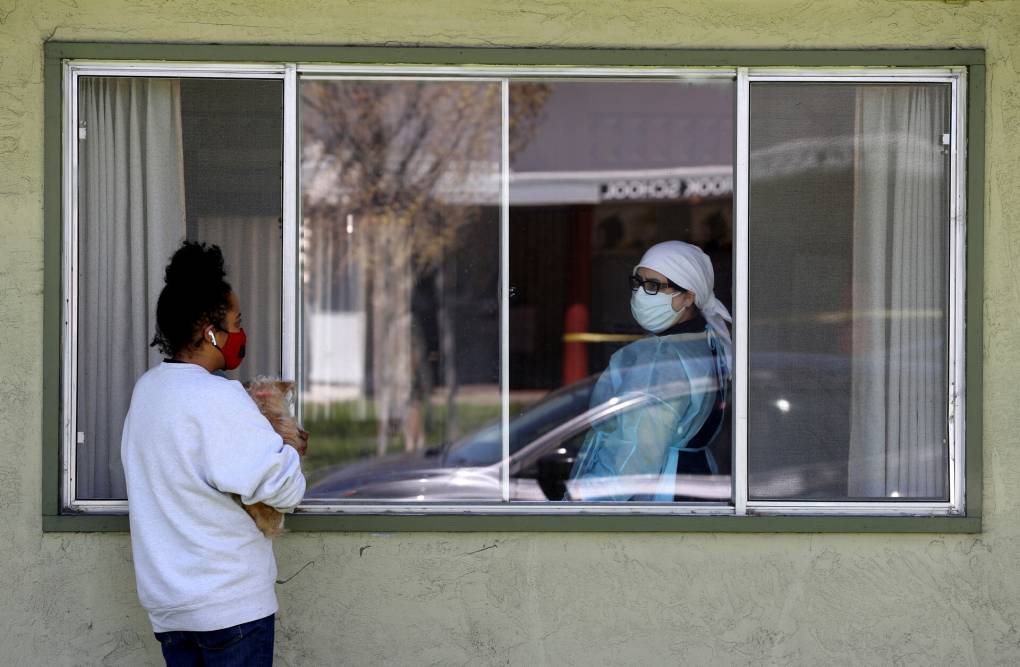
"caption": "Adrina Rodriguez (L) talks with a nurse during a \"window visit\" with her father at the Gateway Care and Rehabilitation Center in Hayward. Alameda County does not currently test all staff and residents at long-term care facilities.",
"description": "Adrina Rodriguez (L) talks with a nurse through a window as she visits her father who is a patient at the Gateway Care and Rehabilitation Center that has tested negative for COVID-19 on April 14, 2020 in Hayward, California. The Gateway Care and Rehabilitation Center remains open after a tenth patient died from COVID-19 complications. (Photo by Justin Sullivan/Getty Images)",
"title": "Hayward, California Nursing Home Sees Cluster Of Coronavirus Cases",
"credit": "Justin Sullivan/Getty Images",
"status": "inherit",
"isLoading": false,
"fetchFailed": false
},
"science_1964533": {
"type": "attachments",
"id": "science_1964533",
"meta": {
"index": "attachments_1716263798",
"site": "science",
"id": "1964533",
"found": true
},
"parent": 1964529,
"imgSizes": {
"thumbnail": {
"file": "https://ww2.kqed.org/app/uploads/sites/35/2020/05/Falconsbandedlegs750-160x107.jpg",
"width": 160,
"mimeType": "image/jpeg",
"height": 107
},
"post-thumbnail": {
"file": "https://ww2.kqed.org/app/uploads/sites/35/2020/05/Falconsbandedlegs750-672x372.jpg",
"width": 672,
"mimeType": "image/jpeg",
"height": 372
},
"kqedFullSize": {
"file": "https://ww2.kqed.org/app/uploads/sites/35/2020/05/Falconsbandedlegs750.jpg",
"width": 750,
"height": 500
}
},
"publishDate": 1589834032,
"modified": 1589834059,
"caption": null,
"description": null,
"title": "Falconsbandedlegs750",
"credit": "Mary Malec/UC Berkeley",
"status": "inherit",
"isLoading": false,
"fetchFailed": false
},
"science_1964516": {
"type": "attachments",
"id": "science_1964516",
"meta": {
"index": "attachments_1716263798",
"site": "science",
"id": "1964516",
"found": true
},
"parent": 1964515,
"imgSizes": {
"twentyfourteen-full-width": {
"file": "https://ww2.kqed.org/app/uploads/sites/35/2020/05/MODERNA-9-1600x900-1038x576.jpg",
"width": 1038,
"mimeType": "image/jpeg",
"height": 576
},
"thumbnail": {
"file": "https://ww2.kqed.org/app/uploads/sites/35/2020/05/MODERNA-9-1600x900-160x90.jpg",
"width": 160,
"mimeType": "image/jpeg",
"height": 90
},
"post-thumbnail": {
"file": "https://ww2.kqed.org/app/uploads/sites/35/2020/05/MODERNA-9-1600x900-672x372.jpg",
"width": 672,
"mimeType": "image/jpeg",
"height": 372
},
"kqedFullSize": {
"file": "https://ww2.kqed.org/app/uploads/sites/35/2020/05/MODERNA-9-1600x900.jpg",
"width": 1600,
"height": 900
},
"large": {
"file": "https://ww2.kqed.org/app/uploads/sites/35/2020/05/MODERNA-9-1600x900-1020x574.jpg",
"width": 1020,
"mimeType": "image/jpeg",
"height": 574
},
"medium": {
"file": "https://ww2.kqed.org/app/uploads/sites/35/2020/05/MODERNA-9-1600x900-800x450.jpg",
"width": 800,
"mimeType": "image/jpeg",
"height": 450
},
"medium_large": {
"file": "https://ww2.kqed.org/app/uploads/sites/35/2020/05/MODERNA-9-1600x900-768x432.jpg",
"width": 768,
"mimeType": "image/jpeg",
"height": 432
}
},
"publishDate": 1589822081,
"modified": 1589822093,
"caption": null,
"description": null,
"title": "MODERNA-9-1600x900",
"credit": "ALEX HOGAN/STAT",
"status": "inherit",
"isLoading": false,
"fetchFailed": false
},
"science_1956452": {
"type": "attachments",
"id": "science_1956452",
"meta": {
"index": "attachments_1716263798",
"site": "science",
"id": "1956452",
"found": true
},
"parent": 1956446,
"imgSizes": {
"twentyfourteen-full-width": {
"file": "https://ww2.kqed.org/app/uploads/sites/35/2020/02/N3-Ranch-_-Photography-67-1280x852-1038x576.jpeg",
"width": 1038,
"mimeType": "image/jpeg",
"height": 576
},
"thumbnail": {
"file": "https://ww2.kqed.org/app/uploads/sites/35/2020/02/N3-Ranch-_-Photography-67-1280x852-160x107.jpeg",
"width": 160,
"mimeType": "image/jpeg",
"height": 107
},
"post-thumbnail": {
"file": "https://ww2.kqed.org/app/uploads/sites/35/2020/02/N3-Ranch-_-Photography-67-1280x852-672x372.jpeg",
"width": 672,
"mimeType": "image/jpeg",
"height": 372
},
"kqedFullSize": {
"file": "https://ww2.kqed.org/app/uploads/sites/35/2020/02/N3-Ranch-_-Photography-67-1280x852.jpeg",
"width": 1280,
"height": 852
},
"large": {
"file": "https://ww2.kqed.org/app/uploads/sites/35/2020/02/N3-Ranch-_-Photography-67-1280x852-1020x679.jpeg",
"width": 1020,
"mimeType": "image/jpeg",
"height": 679
},
"medium": {
"file": "https://ww2.kqed.org/app/uploads/sites/35/2020/02/N3-Ranch-_-Photography-67-1280x852-800x533.jpeg",
"width": 800,
"mimeType": "image/jpeg",
"height": 533
},
"medium_large": {
"file": "https://ww2.kqed.org/app/uploads/sites/35/2020/02/N3-Ranch-_-Photography-67-1280x852-768x511.jpeg",
"width": 768,
"mimeType": "image/jpeg",
"height": 511
}
},
"publishDate": 1580774505,
"modified": 1589590145,
"caption": "The N3 Cattle Company Ranch in Livermore, 45 miles east of San Francisco, is a possible location for the first new state park in a decade.",
"description": null,
"title": "N3-Ranch-_-Photography-67-1280x852",
"credit": "California Outdoor Properties",
"status": "inherit",
"isLoading": false,
"fetchFailed": false
},
"science_1964353": {
"type": "attachments",
"id": "science_1964353",
"meta": {
"index": "attachments_1716263798",
"site": "science",
"id": "1964353",
"found": true
},
"parent": 1964349,
"imgSizes": {
"twentyfourteen-full-width": {
"file": "https://ww2.kqed.org/app/uploads/sites/35/2020/05/RS43189_GettyImages-1692720-qut-1038x576.jpg",
"width": 1038,
"mimeType": "image/jpeg",
"height": 576
},
"thumbnail": {
"file": "https://ww2.kqed.org/app/uploads/sites/35/2020/05/RS43189_GettyImages-1692720-qut-160x104.jpg",
"width": 160,
"mimeType": "image/jpeg",
"height": 104
},
"post-thumbnail": {
"file": "https://ww2.kqed.org/app/uploads/sites/35/2020/05/RS43189_GettyImages-1692720-qut-672x372.jpg",
"width": 672,
"mimeType": "image/jpeg",
"height": 372
},
"kqedFullSize": {
"file": "https://ww2.kqed.org/app/uploads/sites/35/2020/05/RS43189_GettyImages-1692720-qut.jpg",
"width": 1920,
"height": 1251
},
"large": {
"file": "https://ww2.kqed.org/app/uploads/sites/35/2020/05/RS43189_GettyImages-1692720-qut-1020x665.jpg",
"width": 1020,
"mimeType": "image/jpeg",
"height": 665
},
"full-width": {
"file": "https://ww2.kqed.org/app/uploads/sites/35/2020/05/RS43189_GettyImages-1692720-qut-1920x1251.jpg",
"width": 1920,
"mimeType": "image/jpeg",
"height": 1251
},
"medium": {
"file": "https://ww2.kqed.org/app/uploads/sites/35/2020/05/RS43189_GettyImages-1692720-qut-800x521.jpg",
"width": 800,
"mimeType": "image/jpeg",
"height": 521
},
"medium_large": {
"file": "https://ww2.kqed.org/app/uploads/sites/35/2020/05/RS43189_GettyImages-1692720-qut-768x500.jpg",
"width": 768,
"mimeType": "image/jpeg",
"height": 500
}
},
"publishDate": 1589497525,
"modified": 1589497578,
"caption": "A rain-soaked Interstate 10 as a storm passes over the state on December 17, 2002 near Palm Springs, California. ",
"description": null,
"title": "Storm Eases Over Windfarms",
"credit": "Photo by David McNew/Getty Images",
"status": "inherit",
"isLoading": false,
"fetchFailed": false
},
"science_1964272": {
"type": "attachments",
"id": "science_1964272",
"meta": {
"index": "attachments_1716263798",
"site": "science",
"id": "1964272",
"found": true
},
"parent": 1964257,
"imgSizes": {
"twentyfourteen-full-width": {
"file": "https://ww2.kqed.org/app/uploads/sites/35/2029/05/Coronavirus-Testing-California-1038x576.jpg",
"width": 1038,
"mimeType": "image/jpeg",
"height": 576
},
"thumbnail": {
"file": "https://ww2.kqed.org/app/uploads/sites/35/2029/05/Coronavirus-Testing-California-160x138.jpg",
"width": 160,
"mimeType": "image/jpeg",
"height": 138
},
"post-thumbnail": {
"file": "https://ww2.kqed.org/app/uploads/sites/35/2029/05/Coronavirus-Testing-California-672x372.jpg",
"width": 672,
"mimeType": "image/jpeg",
"height": 372
},
"kqedFullSize": {
"file": "https://ww2.kqed.org/app/uploads/sites/35/2029/05/Coronavirus-Testing-California.jpg",
"width": 1376,
"height": 1190
},
"large": {
"file": "https://ww2.kqed.org/app/uploads/sites/35/2029/05/Coronavirus-Testing-California-1020x882.jpg",
"width": 1020,
"mimeType": "image/jpeg",
"height": 882
},
"medium": {
"file": "https://ww2.kqed.org/app/uploads/sites/35/2029/05/Coronavirus-Testing-California-800x692.jpg",
"width": 800,
"mimeType": "image/jpeg",
"height": 692
},
"medium_large": {
"file": "https://ww2.kqed.org/app/uploads/sites/35/2029/05/Coronavirus-Testing-California-768x664.jpg",
"width": 768,
"mimeType": "image/jpeg",
"height": 664
}
},
"publishDate": 1589411278,
"modified": 1589411278,
"caption": null,
"description": null,
"title": "Coronavirus Testing California",
"credit": null,
"status": "inherit",
"isLoading": false,
"fetchFailed": false
},
"science_1964095": {
"type": "attachments",
"id": "science_1964095",
"meta": {
"index": "attachments_1716263798",
"site": "science",
"id": "1964095",
"found": true
},
"parent": 1964094,
"imgSizes": {
"twentyfourteen-full-width": {
"file": "https://ww2.kqed.org/app/uploads/sites/35/2020/05/RS43166_GettyImages-1206847094-qut-1038x576.jpg",
"width": 1038,
"mimeType": "image/jpeg",
"height": 576
},
"thumbnail": {
"file": "https://ww2.kqed.org/app/uploads/sites/35/2020/05/RS43166_GettyImages-1206847094-qut-160x98.jpg",
"width": 160,
"mimeType": "image/jpeg",
"height": 98
},
"post-thumbnail": {
"file": "https://ww2.kqed.org/app/uploads/sites/35/2020/05/RS43166_GettyImages-1206847094-qut-672x372.jpg",
"width": 672,
"mimeType": "image/jpeg",
"height": 372
},
"kqedFullSize": {
"file": "https://ww2.kqed.org/app/uploads/sites/35/2020/05/RS43166_GettyImages-1206847094-qut.jpg",
"width": 1920,
"height": 1173
},
"large": {
"file": "https://ww2.kqed.org/app/uploads/sites/35/2020/05/RS43166_GettyImages-1206847094-qut-1020x623.jpg",
"width": 1020,
"mimeType": "image/jpeg",
"height": 623
},
"full-width": {
"file": "https://ww2.kqed.org/app/uploads/sites/35/2020/05/RS43166_GettyImages-1206847094-qut-1920x1173.jpg",
"width": 1920,
"mimeType": "image/jpeg",
"height": 1173
},
"medium": {
"file": "https://ww2.kqed.org/app/uploads/sites/35/2020/05/RS43166_GettyImages-1206847094-qut-800x489.jpg",
"width": 800,
"mimeType": "image/jpeg",
"height": 489
},
"medium_large": {
"file": "https://ww2.kqed.org/app/uploads/sites/35/2020/05/RS43166_GettyImages-1206847094-qut-768x469.jpg",
"width": 768,
"mimeType": "image/jpeg",
"height": 469
}
},
"publishDate": 1589315872,
"modified": 1589315952,
"caption": "Medical workers at Kaiser Permanente French Campus test a patient for the novel coronavirus on March 12, 2020. ",
"description": null,
"title": "RS43166_GettyImages-1206847094-qut",
"credit": "JOSH EDELSON/AFP via Getty Images",
"status": "inherit",
"isLoading": false,
"fetchFailed": false
},
"science_1964143": {
"type": "attachments",
"id": "science_1964143",
"meta": {
"index": "attachments_1716263798",
"site": "science",
"id": "1964143",
"found": true
},
"parent": 1964122,
"imgSizes": {
"twentyfourteen-full-width": {
"file": "https://ww2.kqed.org/app/uploads/sites/35/2020/05/RS43167_Foulquié_amplexus-qut-1038x576.jpg",
"width": 1038,
"mimeType": "image/jpeg",
"height": 576
},
"thumbnail": {
"file": "https://ww2.kqed.org/app/uploads/sites/35/2020/05/RS43167_Foulquié_amplexus-qut-160x107.jpg",
"width": 160,
"mimeType": "image/jpeg",
"height": 107
},
"post-thumbnail": {
"file": "https://ww2.kqed.org/app/uploads/sites/35/2020/05/RS43167_Foulquié_amplexus-qut-672x372.jpg",
"width": 672,
"mimeType": "image/jpeg",
"height": 372
},
"kqedFullSize": {
"file": "https://ww2.kqed.org/app/uploads/sites/35/2020/05/RS43167_Foulquié_amplexus-qut.jpg",
"width": 1920,
"height": 1280
},
"large": {
"file": "https://ww2.kqed.org/app/uploads/sites/35/2020/05/RS43167_Foulquié_amplexus-qut-1020x680.jpg",
"width": 1020,
"mimeType": "image/jpeg",
"height": 680
},
"full-width": {
"file": "https://ww2.kqed.org/app/uploads/sites/35/2020/05/RS43167_Foulquié_amplexus-qut-1920x1280.jpg",
"width": 1920,
"mimeType": "image/jpeg",
"height": 1280
},
"medium": {
"file": "https://ww2.kqed.org/app/uploads/sites/35/2020/05/RS43167_Foulquié_amplexus-qut-800x533.jpg",
"width": 800,
"mimeType": "image/jpeg",
"height": 533
},
"medium_large": {
"file": "https://ww2.kqed.org/app/uploads/sites/35/2020/05/RS43167_Foulquié_amplexus-qut-768x512.jpg",
"width": 768,
"mimeType": "image/jpeg",
"height": 512
}
},
"publishDate": 1589324422,
"modified": 1589324487,
"caption": "Hold on Tight ",
"description": null,
"title": "RS43167_Foulquié_amplexus-qut",
"credit": "Mathieu Foulquié/Aquatic Life Finalist",
"status": "inherit",
"isLoading": false,
"fetchFailed": false
},
"science_1964207": {
"type": "attachments",
"id": "science_1964207",
"meta": {
"index": "attachments_1716263798",
"site": "science",
"id": "1964207",
"found": true
},
"parent": 1964099,
"imgSizes": {
"twentyfourteen-full-width": {
"file": "https://ww2.kqed.org/app/uploads/sites/35/2020/05/Kids-1038x576.jpg",
"width": 1038,
"mimeType": "image/jpeg",
"height": 576
},
"thumbnail": {
"file": "https://ww2.kqed.org/app/uploads/sites/35/2020/05/Kids-160x90.jpg",
"width": 160,
"mimeType": "image/jpeg",
"height": 90
},
"post-thumbnail": {
"file": "https://ww2.kqed.org/app/uploads/sites/35/2020/05/Kids-672x372.jpg",
"width": 672,
"mimeType": "image/jpeg",
"height": 372
},
"kqedFullSize": {
"file": "https://ww2.kqed.org/app/uploads/sites/35/2020/05/Kids.jpg",
"width": 1920,
"height": 1080
},
"large": {
"file": "https://ww2.kqed.org/app/uploads/sites/35/2020/05/Kids-1020x574.jpg",
"width": 1020,
"mimeType": "image/jpeg",
"height": 574
},
"full-width": {
"file": "https://ww2.kqed.org/app/uploads/sites/35/2020/05/Kids-1920x1080.jpg",
"width": 1920,
"mimeType": "image/jpeg",
"height": 1080
},
"medium": {
"file": "https://ww2.kqed.org/app/uploads/sites/35/2020/05/Kids-800x450.jpg",
"width": 800,
"mimeType": "image/jpeg",
"height": 450
},
"medium_large": {
"file": "https://ww2.kqed.org/app/uploads/sites/35/2020/05/Kids-768x432.jpg",
"width": 768,
"mimeType": "image/jpeg",
"height": 432
}
},
"publishDate": 1589391076,
"modified": 1589391162,
"caption": "Public health officials test children at Garfield Park for the coronavirus.",
"description": null,
"title": "Kids",
"credit": "Mike Kai Chen",
"status": "inherit",
"isLoading": false,
"fetchFailed": false
},
"science_1964108": {
"type": "attachments",
"id": "science_1964108",
"meta": {
"index": "attachments_1716263798",
"site": "science",
"id": "1964108",
"found": true
},
"parent": 1964099,
"imgSizes": {
"twentyfourteen-full-width": {
"file": "https://ww2.kqed.org/app/uploads/sites/35/2020/05/Mission-Testing-2-better-1038x576.jpg",
"width": 1038,
"mimeType": "image/jpeg",
"height": 576
},
"thumbnail": {
"file": "https://ww2.kqed.org/app/uploads/sites/35/2020/05/Mission-Testing-2-better-160x107.jpg",
"width": 160,
"mimeType": "image/jpeg",
"height": 107
},
"post-thumbnail": {
"file": "https://ww2.kqed.org/app/uploads/sites/35/2020/05/Mission-Testing-2-better-672x372.jpg",
"width": 672,
"mimeType": "image/jpeg",
"height": 372
},
"kqedFullSize": {
"file": "https://ww2.kqed.org/app/uploads/sites/35/2020/05/Mission-Testing-2-better.jpg",
"width": 1920,
"height": 1281
},
"large": {
"file": "https://ww2.kqed.org/app/uploads/sites/35/2020/05/Mission-Testing-2-better-1020x681.jpg",
"width": 1020,
"mimeType": "image/jpeg",
"height": 681
},
"full-width": {
"file": "https://ww2.kqed.org/app/uploads/sites/35/2020/05/Mission-Testing-2-better-1920x1281.jpg",
"width": 1920,
"mimeType": "image/jpeg",
"height": 1281
},
"medium": {
"file": "https://ww2.kqed.org/app/uploads/sites/35/2020/05/Mission-Testing-2-better-800x534.jpg",
"width": 800,
"mimeType": "image/jpeg",
"height": 534
},
"medium_large": {
"file": "https://ww2.kqed.org/app/uploads/sites/35/2020/05/Mission-Testing-2-better-768x512.jpg",
"width": 768,
"mimeType": "image/jpeg",
"height": 512
}
},
"publishDate": 1589319811,
"modified": 1589331004,
"caption": "Public health wokers test patients for the coronavirus in Garfield Park in San Francisco. Health officers from Marin, Alameda and Contra Costa counties say supply shortages that impeded expanded testing have been resolved.",
"description": null,
"title": "Mission Testing 2 better",
"credit": "Mike Kai Chen",
"status": "inherit",
"isLoading": false,
"fetchFailed": false
},
"science_1944905": {
"type": "attachments",
"id": "science_1944905",
"meta": {
"index": "attachments_1716263798",
"site": "science",
"id": "1944905",
"found": true
},
"parent": 1944904,
"imgSizes": {
"twentyfourteen-full-width": {
"file": "https://ww2.kqed.org/app/uploads/sites/35/2019/07/KJ_Delta_Aerials_web-1038x576.jpg",
"width": 1038,
"mimeType": "image/jpeg",
"height": 576
},
"thumbnail": {
"file": "https://ww2.kqed.org/app/uploads/sites/35/2019/07/KJ_Delta_Aerials_web-160x89.jpg",
"width": 160,
"mimeType": "image/jpeg",
"height": 89
},
"post-thumbnail": {
"file": "https://ww2.kqed.org/app/uploads/sites/35/2019/07/KJ_Delta_Aerials_web-672x372.jpg",
"width": 672,
"mimeType": "image/jpeg",
"height": 372
},
"kqedFullSize": {
"file": "https://ww2.kqed.org/app/uploads/sites/35/2019/07/KJ_Delta_Aerials_web.jpg",
"width": 1920,
"height": 1072
},
"large": {
"file": "https://ww2.kqed.org/app/uploads/sites/35/2019/07/KJ_Delta_Aerials_web-1020x570.jpg",
"width": 1020,
"mimeType": "image/jpeg",
"height": 570
},
"complete_open_graph": {
"file": "https://ww2.kqed.org/app/uploads/sites/35/2019/07/KJ_Delta_Aerials_web-1200x670.jpg",
"width": 1200,
"mimeType": "image/jpeg",
"height": 670
},
"full-width": {
"file": "https://ww2.kqed.org/app/uploads/sites/35/2019/07/KJ_Delta_Aerials_web-1920x1072.jpg",
"width": 1920,
"mimeType": "image/jpeg",
"height": 1072
},
"medium": {
"file": "https://ww2.kqed.org/app/uploads/sites/35/2019/07/KJ_Delta_Aerials_web-800x447.jpg",
"width": 800,
"mimeType": "image/jpeg",
"height": 447
},
"medium_large": {
"file": "https://ww2.kqed.org/app/uploads/sites/35/2019/07/KJ_Delta_Aerials_web-768x429.jpg",
"width": 768,
"mimeType": "image/jpeg",
"height": 429
}
},
"publishDate": 1562949136,
"modified": 1562949791,
"caption": "The Trump Administration is proposing to send more water to Central Valley farms through the Sacramento-San Joaquin Delta.",
"description": null,
"title": "KJ_Delta_Aerials_web",
"credit": "Ken James / California Department of Water Resources",
"status": "inherit",
"isLoading": false,
"fetchFailed": false
},
"science_1964015": {
"type": "attachments",
"id": "science_1964015",
"meta": {
"index": "attachments_1716263798",
"site": "science",
"id": "1964015",
"found": true
},
"parent": 1964010,
"imgSizes": {
"twentyfourteen-full-width": {
"file": "https://ww2.kqed.org/app/uploads/sites/35/2020/05/Screen-Shot-2020-05-11-at-1.33.06-PM-1038x576.png",
"width": 1038,
"mimeType": "image/png",
"height": 576
},
"thumbnail": {
"file": "https://ww2.kqed.org/app/uploads/sites/35/2020/05/Screen-Shot-2020-05-11-at-1.33.06-PM-160x125.png",
"width": 160,
"mimeType": "image/png",
"height": 125
},
"post-thumbnail": {
"file": "https://ww2.kqed.org/app/uploads/sites/35/2020/05/Screen-Shot-2020-05-11-at-1.33.06-PM-672x372.png",
"width": 672,
"mimeType": "image/png",
"height": 372
},
"kqedFullSize": {
"file": "https://ww2.kqed.org/app/uploads/sites/35/2020/05/Screen-Shot-2020-05-11-at-1.33.06-PM.png",
"width": 1594,
"height": 1246
},
"large": {
"file": "https://ww2.kqed.org/app/uploads/sites/35/2020/05/Screen-Shot-2020-05-11-at-1.33.06-PM-1020x797.png",
"width": 1020,
"mimeType": "image/png",
"height": 797
},
"medium": {
"file": "https://ww2.kqed.org/app/uploads/sites/35/2020/05/Screen-Shot-2020-05-11-at-1.33.06-PM-800x625.png",
"width": 800,
"mimeType": "image/png",
"height": 625
},
"medium_large": {
"file": "https://ww2.kqed.org/app/uploads/sites/35/2020/05/Screen-Shot-2020-05-11-at-1.33.06-PM-768x600.png",
"width": 768,
"mimeType": "image/png",
"height": 600
}
},
"publishDate": 1589229207,
"modified": 1589229348,
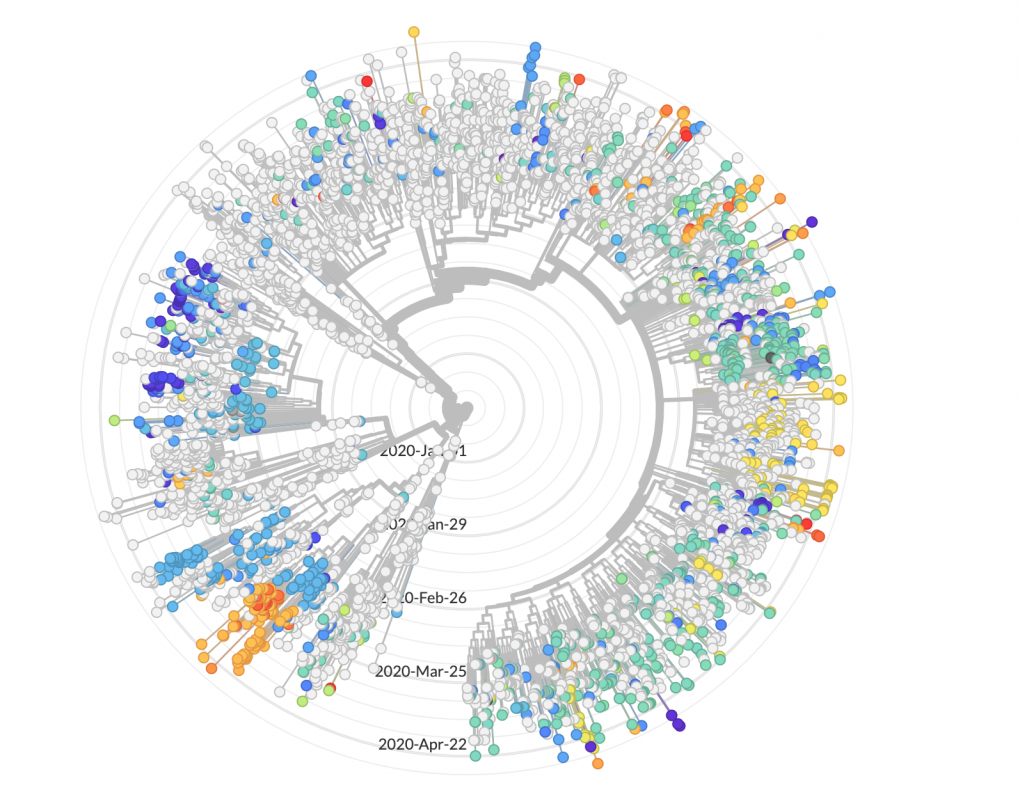
"caption": "Genetic family tree of the novel coronavirus. Colored dots represent cases in North America. ",
"description": null,
"title": "Screen Shot 2020-05-11 at 1.33.06 PM",
"credit": "Screenshot from \u003ca href\"https://nextstrain.org/\">Nextstrain.org\u003c/a>",
"status": "inherit",
"isLoading": false,
"fetchFailed": false
}
},
"audioPlayerReducer": {
"postId": "stream_live",
"isPaused": true,
"isPlaying": false,
"pfsActive": false,
"pledgeModalIsOpen": true,
"playerDrawerIsOpen": false,
"liveAudioPlayStartedAt": 0,
"liveAudioPlayContext": ""
},
"authorsReducer": {
"byline_science_1964515": {
"type": "authors",
"id": "byline_science_1964515",
"meta": {
"override": true
},
"slug": "byline_science_1964515",
"name": "Helen Branswell \u003cbr /> STAT\u003cbr>",
"isLoading": false
},
"byline_science_1964122": {
"type": "authors",
"id": "byline_science_1964122",
"meta": {
"override": true
},
"slug": "byline_science_1964122",
"name": "bioGraphic",
"isLoading": false
},
"byline_science_1964080": {
"type": "authors",
"id": "byline_science_1964080",
"meta": {
"override": true
},
"slug": "byline_science_1964080",
"name": "Associated Press",
"isLoading": false
},
"jbrooks": {
"type": "authors",
"id": "80",
"meta": {
"index": "authors_1716337520",
"id": "80",
"found": true
},
"name": "Jon Brooks",
"firstName": "Jon",
"lastName": "Brooks",
"slug": "jbrooks",
"email": "jbrooks@kqed.org",
"display_author_email": true,
"staff_mastheads": [
"science"
],
"title": "Digital Editor",
"bio": "Jon Brooks is a former Digital Editor for KQED Science. He is the former editor of KQED’s daily news blog, News Fix. In 2014, he won a California Journalism Award for his coverage of ride services like Uber and Lyft and the taxi industry. A veteran blogger, he previously worked for Yahoo! in various news writing and editing roles. Jon is also a playwright whose work has been produced in San Francisco, New York, Italy, and around the U.S. He has written about film for his own blog and studied film at Boston University.",
"avatar": "https://secure.gravatar.com/avatar/98887f7ed1c876ed414d4c915e969584?s=600&d=blank&r=g",
"twitter": "jbrooksfoy",
"facebook": null,
"instagram": null,
"linkedin": null,
"sites": [
{
"site": "arts",
"roles": [
"Contributor",
"editor"
]
},
{
"site": "news",
"roles": [
"author"
]
},
{
"site": "futureofyou",
"roles": [
"administrator"
]
},
{
"site": "mindshift",
"roles": [
"editor"
]
},
{
"site": "stateofhealth",
"roles": [
"editor"
]
},
{
"site": "science",
"roles": [
"administrator"
]
},
{
"site": "quest",
"roles": [
"editor"
]
}
],
"headData": {
"title": "Jon Brooks | KQED",
"description": "Digital Editor",
"ogImgSrc": "https://secure.gravatar.com/avatar/98887f7ed1c876ed414d4c915e969584?s=600&d=blank&r=g",
"twImgSrc": "https://secure.gravatar.com/avatar/98887f7ed1c876ed414d4c915e969584?s=600&d=blank&r=g"
},
"isLoading": false,
"link": "/author/jbrooks"
},
"dventon": {
"type": "authors",
"id": "11088",
"meta": {
"index": "authors_1716337520",
"id": "11088",
"found": true
},
"name": "Danielle Venton",
"firstName": "Danielle",
"lastName": "Venton",
"slug": "dventon",
"email": "dventon@kqed.org",
"display_author_email": true,
"staff_mastheads": [
"science"
],
"title": "Science reporter",
"bio": "Danielle Venton is a reporter for KQED Science. She covers wildfires, space and oceans (though she is prone to sea sickness).\r\n\r\nBefore joining KQED in 2015, Danielle was a staff reporter at KRCB in Sonoma County and a freelancer. She studied science communication at UC Santa Cruz and formerly worked at CERN in Geneva, Switzerland where she wrote about computing. She lives in Sonoma County and enjoys backpacking.",
"avatar": "https://secure.gravatar.com/avatar/37b292b5c40c8d93959c4f48d73b5286f41b7abd8588277e941905a3ed4c801c?s=600&d=blank&r=g",
"twitter": "DanielleVenton",
"bluesky": null,
"facebook": null,
"instagram": null,
"linkedin": null,
"sites": [
{
"site": "arts",
"roles": [
"contributor"
]
},
{
"site": "news",
"roles": [
"editor"
]
},
{
"site": "futureofyou",
"roles": [
"editor"
]
},
{
"site": "science",
"roles": [
"editor"
]
},
{
"site": "liveblog",
"roles": [
"contributor"
]
}
],
"headData": {
"title": "Danielle Venton | KQED",
"description": "Science reporter",
"ogImgSrc": "https://secure.gravatar.com/avatar/37b292b5c40c8d93959c4f48d73b5286f41b7abd8588277e941905a3ed4c801c?s=600&d=blank&r=g",
"twImgSrc": "https://secure.gravatar.com/avatar/37b292b5c40c8d93959c4f48d73b5286f41b7abd8588277e941905a3ed4c801c?s=600&d=blank&r=g"
},
"isLoading": false,
"link": "/author/dventon"
},
"mpeterson": {
"type": "authors",
"id": "11223",
"meta": {
"index": "authors_1716337520",
"id": "11223",
"found": true
},
"name": "Molly Peterson",
"firstName": "Molly",
"lastName": "Peterson",
"slug": "mpeterson",
"email": "mpeterson@kqed.org",
"display_author_email": false,
"staff_mastheads": [],
"title": null,
"bio": "Molly Peterson reports for KQED science and news on climate change, catastrophe and risk. Previously she was environment correspondent at Southern California Public Radio. Her work has also appeared at The New York Times, The Guardian, on NPR, at High Country News, on Code Switch, and other national outlets. She has been honored with awards from Public Radio News Directors Incorporated, Investigative Reporters and Editors, the Society for Professional Journalists, the Los Angeles Press Club, and RTNDA Edward R. Murrow awards, among others.",
"avatar": "https://secure.gravatar.com/avatar/7908e2807131f776cc8165c649530b05?s=600&d=blank&r=g",
"twitter": "Mollydacious",
"facebook": null,
"instagram": "https://www.instagram.com/radiomolly/",
"linkedin": null,
"sites": [
{
"site": "news",
"roles": [
"subscriber"
]
},
{
"site": "futureofyou",
"roles": [
"editor"
]
},
{
"site": "science",
"roles": [
"editor"
]
}
],
"headData": {
"title": "Molly Peterson | KQED",
"description": null,
"ogImgSrc": "https://secure.gravatar.com/avatar/7908e2807131f776cc8165c649530b05?s=600&d=blank&r=g",
"twImgSrc": "https://secure.gravatar.com/avatar/7908e2807131f776cc8165c649530b05?s=600&d=blank&r=g"
},
"isLoading": false,
"link": "/author/mpeterson"
},
"lesleymcclurg": {
"type": "authors",
"id": "11229",
"meta": {
"index": "authors_1716337520",
"id": "11229",
"found": true
},
"name": "Lesley McClurg",
"firstName": "Lesley",
"lastName": "McClurg",
"slug": "lesleymcclurg",
"email": "lmcclurg@KQED.org",
"display_author_email": false,
"staff_mastheads": [
"news",
"science"
],
"title": "KQED Health Correspondent",
"bio": "Lesley McClurg is a health correspondent and fill-in host whose work is regularly rebroadcast on NPR and PBS programs. She’s earned multiple regional Emmy awards, a national and a regional Edward R. Murrow award, and was named Best Beat Reporter by the Association of Health Care Journalists. The Society of Professional Journalists has recognized her work several times, and the Society of Environmental Journalists spotlighted her coverage of California’s historic drought.\r\n\r\nBefore joining KQED in 2016, Lesley covered food and sustainability for Capital Public Radio, environmental issues for Colorado Public Radio, and reported for KUOW and KCTS 9 in Seattle. Away from the newsroom, she loves skiing with her daughter, mountain biking with her partner, and playing with Ollie, the family’s goldendoodle. On deadline, she runs almost entirely on chocolate chips.\r\n\r\n ",
"avatar": "https://secure.gravatar.com/avatar/bab49e972ea10c774fe0f5e29dba1722b158f7c0d58a360923d1389d380b2978?s=600&d=blank&r=g",
"twitter": "lesleywmcclurg",
"bluesky": null,
"facebook": null,
"instagram": null,
"linkedin": null,
"sites": [
{
"site": "arts",
"roles": [
"author"
]
},
{
"site": "news",
"roles": [
"editor"
]
},
{
"site": "futureofyou",
"roles": [
"editor"
]
},
{
"site": "stateofhealth",
"roles": [
"author"
]
},
{
"site": "science",
"roles": [
"editor"
]
},
{
"site": "quest",
"roles": [
"subscriber"
]
},
{
"site": "forum",
"roles": [
"administrator"
]
},
{
"site": "liveblog",
"roles": [
"author"
]
}
],
"headData": {
"title": "Lesley McClurg | KQED",
"description": "KQED Health Correspondent",
"ogImgSrc": "https://secure.gravatar.com/avatar/bab49e972ea10c774fe0f5e29dba1722b158f7c0d58a360923d1389d380b2978?s=600&d=blank&r=g",
"twImgSrc": "https://secure.gravatar.com/avatar/bab49e972ea10c774fe0f5e29dba1722b158f7c0d58a360923d1389d380b2978?s=600&d=blank&r=g"
},
"isLoading": false,
"link": "/author/lesleymcclurg"
},
"parcuni": {
"type": "authors",
"id": "11368",
"meta": {
"index": "authors_1716337520",
"id": "11368",
"found": true
},
"name": "Peter Arcuni",
"firstName": "Peter",
"lastName": "Arcuni",
"slug": "parcuni",
"email": "parcuni@KQED.org",
"display_author_email": false,
"staff_mastheads": [
"science"
],
"title": "Reporter",
"bio": "Peter reports radio and online stories for \u003cem>KQED Science\u003c/em>. His work has also appeared on the \u003cem>The California Report\u003c/em> morning show and \u003cem>KQED News\u003c/em>. His production credits include \u003cem>The California Report, The California Report Magazine\u003c/em> and KQED's local news podcast \u003cem>The Bay\u003c/em>. Other credits include NPR's \u003cem>All Things Considered\u003c/em>, WNYC's \u003cem>Science Friday\u003c/em>, WBUR's \u003cem>Here & Now\u003c/em>, WIRED and SFGate. Peter graduated from Brown University and earned a master's degree in journalism from Stanford. He's covered everything from homelessness to wildfires, health, the environment, arts and Thanksgiving in San Quentin prison. In other lives, he played rock n roll music and studied neuroscience. You can email him at: parcuni@kqed.org",
"avatar": "https://secure.gravatar.com/avatar/d5032f6f27199d478af34ad2e1d98732?s=600&d=blank&r=g",
"twitter": "peterarcuni",
"facebook": null,
"instagram": null,
"linkedin": null,
"sites": [
{
"site": "news",
"roles": [
"editor"
]
},
{
"site": "science",
"roles": [
"editor"
]
}
],
"headData": {
"title": "Peter Arcuni | KQED",
"description": "Reporter",
"ogImgSrc": "https://secure.gravatar.com/avatar/d5032f6f27199d478af34ad2e1d98732?s=600&d=blank&r=g",
"twImgSrc": "https://secure.gravatar.com/avatar/d5032f6f27199d478af34ad2e1d98732?s=600&d=blank&r=g"
},
"isLoading": false,
"link": "/author/parcuni"
},
"thailye": {
"type": "authors",
"id": "11501",
"meta": {
"index": "authors_1716337520",
"id": "11501",
"found": true
},
"name": "Teodros Hailye",
"firstName": "Teodros",
"lastName": "Hailye",
"slug": "thailye",
"email": "thailye@KQED.org",
"display_author_email": false,
"staff_mastheads": [],
"title": "Information Designer",
"bio": null,
"avatar": "https://secure.gravatar.com/avatar/bfb755f5a66ebaccd414e310b7d7c94a?s=600&d=blank&r=g",
"twitter": null,
"facebook": null,
"instagram": null,
"linkedin": null,
"sites": [
{
"site": "science",
"roles": []
}
],
"headData": {
"title": "Teodros Hailye | KQED",
"description": "Information Designer",
"ogImgSrc": "https://secure.gravatar.com/avatar/bfb755f5a66ebaccd414e310b7d7c94a?s=600&d=blank&r=g",
"twImgSrc": "https://secure.gravatar.com/avatar/bfb755f5a66ebaccd414e310b7d7c94a?s=600&d=blank&r=g"
},
"isLoading": false,
"link": "/author/thailye"
},
"kevinstark": {
"type": "authors",
"id": "11608",
"meta": {
"index": "authors_1716337520",
"id": "11608",
"found": true
},
"name": "Kevin Stark",
"firstName": "Kevin",
"lastName": "Stark",
"slug": "kevinstark",
"email": "kstark@kqed.org",
"display_author_email": true,
"staff_mastheads": [
"science"
],
"title": "Senior Editor",
"bio": "Kevin is a senior editor for KQED Science, managing the station's health and climate desks. His journalism career began in the Pacific Northwest, and he later became a lead reporter for the San Francisco Public Press. His work has appeared in Pacific Standard magazine, the Energy News Network, the Center for Investigative Reporting's Reveal and WBEZ in Chicago. Kevin joined KQED in 2019, and has covered issues related to energy, wildfire, climate change and the environment.",
"avatar": "https://secure.gravatar.com/avatar/365aaa4b597d3a8374f67504ff0facd323d7906e8eb4be0a7efd2427408e802c?s=600&d=blank&r=g",
"twitter": "starkkev",
"bluesky": null,
"facebook": null,
"instagram": null,
"linkedin": null,
"sites": [
{
"site": "",
"roles": [
"editor"
]
},
{
"site": "news",
"roles": [
"editor"
]
},
{
"site": "science",
"roles": [
"administrator"
]
}
],
"headData": {
"title": "Kevin Stark | KQED",
"description": "Senior Editor",
"ogImgSrc": "https://secure.gravatar.com/avatar/365aaa4b597d3a8374f67504ff0facd323d7906e8eb4be0a7efd2427408e802c?s=600&d=blank&r=g",
"twImgSrc": "https://secure.gravatar.com/avatar/365aaa4b597d3a8374f67504ff0facd323d7906e8eb4be0a7efd2427408e802c?s=600&d=blank&r=g"
},
"isLoading": false,
"link": "/author/kevinstark"
}
},
"pagesReducer": {
"science_category_news": {
"type": "terms",
"id": "science_40",
"meta": {
"index": "terms_1716263798",
"site": "science",
"id": "40",
"score": 10.813967
},
"featImg": null,
"name": "News",
"description": null,
"taxonomy": "category",
"headData": {
"twImgId": null,
"twTitle": null,
"ogTitle": null,
"ogImgId": null,
"twDescription": null,
"description": null,
"title": "News Archives | KQED Science",
"ogDescription": null
},
"ttid": 42,
"slug": "news",
"isLoading": false,
"title": "News",
"pageMeta": {
"site": "science",
"WpPageTemplate": "page-topic-editorial",
"currentPage": 100
},
"blocks": [
{
"blockName": "kqed/post-list",
"attrs": {
"layout": "cardArticle2",
"query": "posts/science?category=news",
"seeMore": false,
"paginated": true,
"page": 100
}
},
{
"blockName": "kqed/ad"
}
]
}
},
"pfsSessionReducer": {},
"postsReducer": {
"stream_live": {
"type": "live",
"id": "stream_live",
"audioUrl": "https://streams.kqed.org/kqedradio",
"title": "Live Stream",
"excerpt": "Live Stream information currently unavailable.",
"link": "/radio",
"featImg": "",
"label": {
"name": "KQED Live",
"link": "/"
}
},
"stream_kqedNewscast": {
"type": "posts",
"id": "stream_kqedNewscast",
"audioUrl": "https://www.kqed.org/.stream/anon/radio/RDnews/newscast.mp3?_=1",
"title": "KQED Newscast",
"featImg": "",
"label": {
"name": "88.5 FM",
"link": "/"
}
},
"science_1964548": {
"type": "posts",
"id": "science_1964548",
"meta": {
"index": "posts_1716263798",
"site": "science",
"id": "1964548",
"score": null,
"sort": [
1589845354000
]
},
"parent": 0,
"labelTerm": {},
"blocks": [],
"publishDate": 1589845354,
"format": "standard",
"title": "Health Officials Expect More COVID-19 Outbreaks in Nursing Homes",
"headTitle": "Health Officials Expect More COVID-19 Outbreaks in Nursing Homes | KQED",
"content": "\u003cp>Health officials are concerned that as California and the Bay Area begin to loosen shelter-at-home rules, there could be a rising number of COVID-19 outbreaks at nursing homes and assisted living facilities.\u003c/p>\n\u003cp>These long-term care homes have become ground zero in the coronavirus crisis: state data show more than 1,400 people have died of COVID-19 in facilities licensed by the California Department of Public Health and the California Department of Social Services. And state public health officials acknowledge that those totals are likely an undercount.\u003c/p>\n\u003cp>\u003ca href=\"#callout\">Click here if you know someone in a nursing home or assisted facility … share your story!\u003c/a>\u003c/p>\n\u003cp>\u003cspan style=\"font-weight: 400\">KQED’s Ted Goldberg interviewed Science reporter Molly Peterson about the problem. These excerpts have been edited for length and clarity. \u003c/span>\u003c/p>\n\u003cp>\u003cb>Which Bay Area Counties Have Had Serious COVID-19 Outbreaks? \u003c/b>\u003c/p>\n\u003cp>In San Francisco, there was a lot of attention on an early outbreak at Laguna Honda. But other facilities since then, including Central Gardens, have had many more cases.\u003c/p>\n\u003cp>Alameda County had a lot of high-profile nursing home outbreaks, including at Gateway Care and Rehab Center. That’s where the district attorney for Alameda County is investigating at least 13 deaths.\u003c/p>\n\u003cp>There are also problems at assisted living facilities; these are places that aren’t meant to provide health care services, the way that nursing homes do. At one facility in Contra Costa County called The Chateau, there were 74 cases of COVID-19. Meanwhile, in less populated San Mateo County, assisted living facilities have 75 percent more cases of COVID-19 than in Contra Costa.\u003c/p>\n\u003cp>[ad fullwidth]\u003c/p>\n\u003cp>It’s hard to compile accurate information, in part because the county health department in Santa Clara is the only one in the Bay Area that regularly is sharing data about long-term care outbreaks. Santa Clara had a peak of bad outbreaks in late April and early May; it’s declined since then.\u003c/p>\n\u003cp>\u003cb>Why Does the Virus Spread So Easily in Long-term Care Homes?\u003c/b>\u003c/p>\n\u003cp>There’s more touching, there’s more interaction between nurses and patients at a skilled nursing facility because people are there for medical reasons and they’re more fragile.\u003c/p>\n\u003cp>People who are infected but have no symptoms can spread the coronavirus. And public health officials are concerned about transmission among the staff, especially where workers are taking public transit, or where they may be moving among two or three jobs at different facilities.\u003c/p>\n\u003cp>The concern with loosening the stay-at-home orders is that, with more people out in the world, these workers who are traveling on public transit will then be exposed to a higher level of risk.\u003c/p>\n\u003cp>\u003cb>Who’s In Charge of Assisted Living and Nursing Homes? \u003c/b>\u003c/p>\n\u003cp>Both the California Department of Public Health and the Centers for Medicare and Medicaid Services oversee skilled nursing facilities. Assisted living facilities are not considered health care facilities; the Department of Social Services oversees those.\u003c/p>\n\u003cp>Since skilled nursing facilities are more like hospitals, they have more regulations to follow, and can be written up if they don’t comply. In assisted living facilities, there are very few consequences if staff don’t meet the guidelines. For both facilities, counties don’t play a role in overseeing them.\u003c/p>\n\u003cp>\u003cb>How Did Regulators Prepare for the Pandemic? \u003c/b>\u003c/p>\n\u003cp>At the beginning of this crisis, there was a huge concern among regulators that there would be staff absences and that staff themselves would obviously get sick. So there have been some waivers aimed at making it easier for facilities to hire more staff; regulators waived some training requirements and loosened up some background checks.\u003c/p>\n\u003cp>Right now, nobody’s getting in trouble for things that usually would be deficiencies or violations of standards. The goal, regulators say, is to talk to the facilities that they are not physically visiting. Remember, right now regulators and inspectors are not generally going to these facilities, nor are the local advocates from the ombudsman’s office.\u003c/p>\n\u003cp>\u003cb>Why Isn’t Everyone in Long-Term Care Homes Tested, Regardless of Symptoms?\u003c/b>\u003c/p>\n\u003cp>San Francisco mandates testing. That’s just getting off the ground. Alameda County is recommending testing for workers and patients, whether they have symptoms or not.\u003c/p>\n\u003cp>There are two reasons testing isn’t mandatory. One, widespread testing has not been possible for a long time. And two, as Erica Pan, Alameda County’s acting health officer, told me, you want to make sure the tests are useful if you’re going to put people through that. In other words, they want to know there’s a concrete action they can take in response to a positive test. For example, they could recommend workers stay home if they’re positive or you can put COVID-19 patients together and move them away from negative ones.\u003c/p>\n\u003cp>Last, who pays for the testing? Counties have paid for some of it. County health officers say they try to get care homes to pay for their own tests. Industry associations are advocating for more federal aid and more publicly funded tests.\u003c/p>\n\u003cp> \u003c/p>\n\u003ch3>Help KQED Science report on the pandemic!\u003c/h3>\n\u003cp>[hearken src=\"https://modules.wearehearken.com/kqed/embed/5489.js\"]\u003c/p>\n\u003cp>\u003c/p>\n",
"stats": {
"hasVideo": false,
"hasChartOrMap": false,
"hasAudio": false,
"hasPolis": false,
"wordCount": 881,
"hasGoogleForm": false,
"hasGallery": false,
"hasHearkenModule": true,
"iframeSrcs": [],
"paragraphCount": 26
},
"modified": 1704847408,
"excerpt": "As more people begin to move around in public spaces, workers who care for the elderly will be exposed to more risk.",
"headData": {
"twImgId": "",
"twTitle": "",
"ogTitle": "",
"ogImgId": "",
"twDescription": "",
"description": "As more people begin to move around in public spaces, workers who care for the elderly will be exposed to more risk.",
"title": "Health Officials Expect More COVID-19 Outbreaks in Nursing Homes | KQED",
"ogDescription": "",
"schema": {
"@context": "https://schema.org",
"@type": "Article",
"headline": "Health Officials Expect More COVID-19 Outbreaks in Nursing Homes",
"datePublished": "2020-05-18T16:42:34-07:00",
"dateModified": "2024-01-09T16:43:28-08:00",
"image": "https://cdn.kqed.org/wp-content/uploads/2020/02/KQED-OG-Image@1x.png"
}
},
"guestAuthors": [],
"slug": "health-officials-expect-more-covid-19-outbreaks-in-nursing-homes",
"status": "publish",
"audioUrl": "https://traffic.omny.fm/d/clips/0af137ef-751e-4b19-a055-aaef00d2d578/ffca7e9f-6831-41c5-bcaf-aaef00f5a073/7e1c4b11-f23a-49df-a220-abbf012939f9/audio.mp3",
"sticky": false,
"source": "Coronavirus",
"path": "/science/1964548/health-officials-expect-more-covid-19-outbreaks-in-nursing-homes",
"audioTrackLength": null,
"parsedContent": [
{
"type": "contentString",
"content": "\u003cdiv class=\"post-body\">\u003cp>\u003cp>Health officials are concerned that as California and the Bay Area begin to loosen shelter-at-home rules, there could be a rising number of COVID-19 outbreaks at nursing homes and assisted living facilities.\u003c/p>\n\u003cp>These long-term care homes have become ground zero in the coronavirus crisis: state data show more than 1,400 people have died of COVID-19 in facilities licensed by the California Department of Public Health and the California Department of Social Services. And state public health officials acknowledge that those totals are likely an undercount.\u003c/p>\n\u003cp>\u003ca href=\"#callout\">Click here if you know someone in a nursing home or assisted facility … share your story!\u003c/a>\u003c/p>\n\u003cp>\u003cspan style=\"font-weight: 400\">KQED’s Ted Goldberg interviewed Science reporter Molly Peterson about the problem. These excerpts have been edited for length and clarity. \u003c/span>\u003c/p>\n\u003cp>\u003cb>Which Bay Area Counties Have Had Serious COVID-19 Outbreaks? \u003c/b>\u003c/p>\n\u003cp>In San Francisco, there was a lot of attention on an early outbreak at Laguna Honda. But other facilities since then, including Central Gardens, have had many more cases.\u003c/p>\n\u003cp>Alameda County had a lot of high-profile nursing home outbreaks, including at Gateway Care and Rehab Center. That’s where the district attorney for Alameda County is investigating at least 13 deaths.\u003c/p>\n\u003cp>There are also problems at assisted living facilities; these are places that aren’t meant to provide health care services, the way that nursing homes do. At one facility in Contra Costa County called The Chateau, there were 74 cases of COVID-19. Meanwhile, in less populated San Mateo County, assisted living facilities have 75 percent more cases of COVID-19 than in Contra Costa.\u003c/p>\n\u003cp>\u003c/p>\u003c/div>",
"attributes": {
"named": {},
"numeric": []
}
},
{
"type": "component",
"content": "",
"name": "ad",
"attributes": {
"named": {
"label": "fullwidth"
},
"numeric": [
"fullwidth"
]
}
},
{
"type": "contentString",
"content": "\u003cdiv class=\"post-body\">\u003cp>\u003c/p>\n\u003cp>It’s hard to compile accurate information, in part because the county health department in Santa Clara is the only one in the Bay Area that regularly is sharing data about long-term care outbreaks. Santa Clara had a peak of bad outbreaks in late April and early May; it’s declined since then.\u003c/p>\n\u003cp>\u003cb>Why Does the Virus Spread So Easily in Long-term Care Homes?\u003c/b>\u003c/p>\n\u003cp>There’s more touching, there’s more interaction between nurses and patients at a skilled nursing facility because people are there for medical reasons and they’re more fragile.\u003c/p>\n\u003cp>People who are infected but have no symptoms can spread the coronavirus. And public health officials are concerned about transmission among the staff, especially where workers are taking public transit, or where they may be moving among two or three jobs at different facilities.\u003c/p>\n\u003cp>The concern with loosening the stay-at-home orders is that, with more people out in the world, these workers who are traveling on public transit will then be exposed to a higher level of risk.\u003c/p>\n\u003cp>\u003cb>Who’s In Charge of Assisted Living and Nursing Homes? \u003c/b>\u003c/p>\n\u003cp>Both the California Department of Public Health and the Centers for Medicare and Medicaid Services oversee skilled nursing facilities. Assisted living facilities are not considered health care facilities; the Department of Social Services oversees those.\u003c/p>\n\u003cp>Since skilled nursing facilities are more like hospitals, they have more regulations to follow, and can be written up if they don’t comply. In assisted living facilities, there are very few consequences if staff don’t meet the guidelines. For both facilities, counties don’t play a role in overseeing them.\u003c/p>\n\u003cp>\u003cb>How Did Regulators Prepare for the Pandemic? \u003c/b>\u003c/p>\n\u003cp>At the beginning of this crisis, there was a huge concern among regulators that there would be staff absences and that staff themselves would obviously get sick. So there have been some waivers aimed at making it easier for facilities to hire more staff; regulators waived some training requirements and loosened up some background checks.\u003c/p>\n\u003cp>Right now, nobody’s getting in trouble for things that usually would be deficiencies or violations of standards. The goal, regulators say, is to talk to the facilities that they are not physically visiting. Remember, right now regulators and inspectors are not generally going to these facilities, nor are the local advocates from the ombudsman’s office.\u003c/p>\n\u003cp>\u003cb>Why Isn’t Everyone in Long-Term Care Homes Tested, Regardless of Symptoms?\u003c/b>\u003c/p>\n\u003cp>San Francisco mandates testing. That’s just getting off the ground. Alameda County is recommending testing for workers and patients, whether they have symptoms or not.\u003c/p>\n\u003cp>There are two reasons testing isn’t mandatory. One, widespread testing has not been possible for a long time. And two, as Erica Pan, Alameda County’s acting health officer, told me, you want to make sure the tests are useful if you’re going to put people through that. In other words, they want to know there’s a concrete action they can take in response to a positive test. For example, they could recommend workers stay home if they’re positive or you can put COVID-19 patients together and move them away from negative ones.\u003c/p>\n\u003cp>Last, who pays for the testing? Counties have paid for some of it. County health officers say they try to get care homes to pay for their own tests. Industry associations are advocating for more federal aid and more publicly funded tests.\u003c/p>\n\u003cp> \u003c/p>\n\u003ch3>Help KQED Science report on the pandemic!\u003c/h3>\n\u003cp>\u003c/p>\u003c/div>",
"attributes": {
"named": {},
"numeric": []
}
},
{
"type": "component",
"content": "",
"name": "hearken",
"attributes": {
"named": {
"src": "https://modules.wearehearken.com/kqed/embed/5489.js",
"label": ""
},
"numeric": []
}
},
{
"type": "contentString",
"content": "\u003cdiv class=\"post-body\">\u003cp>\u003c/p>\n\u003cp>\u003c/p>\n\u003c/div>\u003c/p>",
"attributes": {
"named": {},
"numeric": []
}
}
],
"link": "/science/1964548/health-officials-expect-more-covid-19-outbreaks-in-nursing-homes",
"authors": [
"11223"
],
"categories": [
"science_39",
"science_3890",
"science_40",
"science_4450"
],
"tags": [
"science_4329",
"science_4414",
"science_5181"
],
"featImg": "science_1964053",
"label": "source_science_1964548"
},
"science_1964529": {
"type": "posts",
"id": "science_1964529",
"meta": {
"index": "posts_1716263798",
"site": "science",
"id": "1964529",
"score": null,
"sort": [
1589837885000
]
},
"parent": 0,
"labelTerm": {},
"blocks": [],
"publishDate": 1589837885,
"format": "aside",
"title": "Voting Is Open To Name Three Peregrine Falcon Chicks at Cal",
"headTitle": "Voting Is Open To Name Three Peregrine Falcon Chicks at Cal | KQED",
"content": "\u003cp>https://www.youtube.com/watch?v=k_ghtsndkf4&feature=youtu.be\u003c/p>\n\u003cp class=\"p1\">Among the finalists in UC Berkeley’s annual competition to name peregrine falcon chicks born atop the Campanile are noteworthy California medical pioneers, iconic state flora, some of the tallest peaks in the Bay Area, and the three spell-casting heroes of Harry Potter.\u003c/p>\n\u003cp>UC Berkeley crowdsourced name ideas using social media accounts set up to promote Annie and Grinnell, the peregrine falcons who made a home on the Campanile in 2016 and began raising chicks there the following year.\u003c/p>\n\u003cp class=\"p1\">In April, two male chicks and one female hatched — every chirp and wing flap captured by Cal Falcon \u003ca href=\"https://calfalcons.berkeley.edu/webcams/\">\u003cspan class=\"s1\">webcams\u003c/span>\u003c/a>, the popular live streaming video cameras trained on the falcons.\u003c/p>\n\u003cp>https://twitter.com/CalFalconCam/status/1262205712689586176?s=20\u003c/p>\n\u003cp>[ad fullwidth]\u003c/p>\n\u003cp class=\"p1\">“It’s pretty much the Chick Show at the tower,” said Sean Peterson, a Berkeley Ph.D. student who runs the \u003ca href=\"https://calfalcons.berkeley.edu/\">\u003cspan class=\"s2\">Cal Falcons social media project\u003c/span>\u003c/a> with Lynn Schofield, in a release. “Annie and Grinnell are both there and keeping their eye on the chicks, but because the chicks aggressively ask for food, even if they’ve eaten, the parents sometimes hide.”\u003c/p>\n\u003cp class=\"p1\">You can vote for your favorite names until noon on Tuesday, May 19 \u003ca href=\"https://calfalcons.berkeley.edu/names/\">\u003cspan class=\"s1\">here\u003c/span>\u003c/a>; the winner will be announced later in the day.\u003c/p>\n\u003cp>\u003c/p>\n\u003cp class=\"p1\">Here are more details on the names, from a university \u003ca href=\"https://news.berkeley.edu/2020/05/15/naming-contest-for-uc-berkeleys-peregrine-falcon-chicks-starts-tomorrow/\">\u003cspan class=\"s1\">release\u003c/span>\u003c/a>:\u003c/p>\n\u003cul class=\"ul1\">\n\u003cli class=\"li5\">\u003cb>Doe, Moffitt and Koshland,\u003c/b> after the campus libraries named for San Francisco financier and philanthropist Charles F. Doe, UC alumnus and Regent James K. Moffitt and immunologist and educator Marian Koshland.\u003c/li>\n\u003cli class=\"li5\">\u003cb>Poppy, Sequoia and Redwood\u003c/b>, for the state flower, the perennial California poppy, and the two official state trees. In 1951, to settle confusion over the California Legislature’s decision in 1937 to name the native redwood as the official state tree, California’s attorney general ruled that Sequoia \u003cem>sempervirens\u003c/em> (coast redwood) and \u003cem>Sequoiadendron giganteum\u003c/em> (giant Sequoia) both qualified for the title.\u003c/li>\n\u003cli class=\"li5\">\u003cb>Ron, Harry and Hermione\u003c/b>, good friends in J.K. Rowling’s Harry Potter series. These names received the top vote among suggestions from children.\u003c/li>\n\u003cli class=\"li5\">\u003cb>Hamilton, Tamalpais and Diablo\u003c/b>, after the three main peaks that surround the Bay Area — Mount Tamalpais to the north, in Marin County; Mount Diablo to the east, in the Diablo Range in Contra Costa County; and Mount Hamilton, to the south, in the Diablo Range in Santa Clara County.\u003c/li>\n\u003cli class=\"li5\">\u003cb>Morgan, Scrivner and Diamond\u003c/b>. Several of these names were suggested by multiple people, as Berkeley is celebrating the 150th anniversary of women being admitted to the university. In 1904, alumna and architect Julia Morgan became the first female licensed architect in California; Rosa Scrivner, Cal’s first female graduate, received her Bachelor of Philosophy in agriculture in 1874; and Marian Diamond, a founder of modern neuroscience and the first to show that the brain can change with experience and improve with enrichment. She was a Berkeley professor emerita when she died in 2017.\u003c/li>\n\u003cli class=\"li5\">\u003cb>Hippocrates, Edward and Florence\u003c/b>, for the Greek physician known as the founder of medicine; Dr. Edward Jenner, founder of the field of virology and a pioneer of the smallpox vaccine; and Florence Nightingale, a nurse and social reformer who raised standards for nursing and educating nurses.\u003c/li>\n\u003c/ul>\n\n",
"stats": {
"hasVideo": true,
"hasChartOrMap": false,
"hasAudio": false,
"hasPolis": false,
"wordCount": 543,
"hasGoogleForm": false,
"hasGallery": false,
"hasHearkenModule": false,
"iframeSrcs": [],
"paragraphCount": 3
},
"modified": 1704847411,
"excerpt": "Poppy, Sequoia, and Redwood? Vote for your favorite names until noon on Tuesday, May 19.",
"headData": {
"twImgId": "",
"twTitle": "",
"ogTitle": "",
"ogImgId": "",
"twDescription": "",
"description": "Poppy, Sequoia, and Redwood? Vote for your favorite names until noon on Tuesday, May 19.",
"title": "Voting Is Open To Name Three Peregrine Falcon Chicks at Cal | KQED",
"ogDescription": "",
"schema": {
"@context": "https://schema.org",
"@type": "Article",
"headline": "Voting Is Open To Name Three Peregrine Falcon Chicks at Cal",
"datePublished": "2020-05-18T14:38:05-07:00",
"dateModified": "2024-01-09T16:43:31-08:00",
"image": "https://cdn.kqed.org/wp-content/uploads/2020/02/KQED-OG-Image@1x.png"
}
},
"guestAuthors": [],
"slug": "voting-is-open-to-name-three-peregrine-falcon-chicks-at-cal",
"status": "publish",
"sticky": false,
"source": "Animals",
"path": "/science/1964529/voting-is-open-to-name-three-peregrine-falcon-chicks-at-cal",
"audioTrackLength": null,
"parsedContent": [
{
"type": "contentString",
"content": "\u003cdiv class=\"post-body\">\u003cp>\u003c/p>\u003cp>\u003cspan class='utils-parseShortcode-shortcodes-__youtubeShortcode__embedYoutube'>\n \u003cspan class='utils-parseShortcode-shortcodes-__youtubeShortcode__embedYoutubeInside'>\n \u003ciframe\n loading='lazy'\n class='utils-parseShortcode-shortcodes-__youtubeShortcode__youtubePlayer'\n type='text/html'\n src='//www.youtube.com/embed/k_ghtsndkf4'\n title='//www.youtube.com/embed/k_ghtsndkf4'\n allowfullscreen='true'\n style='border:0;'>\u003c/iframe>\n \u003c/span>\n \u003c/span>\u003c/p>\u003cp>\u003cp class=\"p1\">Among the finalists in UC Berkeley’s annual competition to name peregrine falcon chicks born atop the Campanile are noteworthy California medical pioneers, iconic state flora, some of the tallest peaks in the Bay Area, and the three spell-casting heroes of Harry Potter.\u003c/p>\n\u003cp>UC Berkeley crowdsourced name ideas using social media accounts set up to promote Annie and Grinnell, the peregrine falcons who made a home on the Campanile in 2016 and began raising chicks there the following year.\u003c/p>\n\u003cp class=\"p1\">In April, two male chicks and one female hatched — every chirp and wing flap captured by Cal Falcon \u003ca href=\"https://calfalcons.berkeley.edu/webcams/\">\u003cspan class=\"s1\">webcams\u003c/span>\u003c/a>, the popular live streaming video cameras trained on the falcons.\u003c/p>\u003c/p>\u003c/div>",
"attributes": {
"named": {},
"numeric": []
}
},
{
"type": "component",
"content": "",
"name": "singleTwitterStatus",
"attributes": {
"named": {
"id": "1262205712689586176"
},
"numeric": []
}
},
{
"type": "contentString",
"content": "\u003cdiv class=\"post-body\">\u003cp>\n\u003cp>\u003c/p>\u003c/div>",
"attributes": {
"named": {},
"numeric": []
}
},
{
"type": "component",
"content": "",
"name": "ad",
"attributes": {
"named": {
"label": "fullwidth"
},
"numeric": [
"fullwidth"
]
}
},
{
"type": "contentString",
"content": "\u003cdiv class=\"post-body\">\u003cp>\u003c/p>\n\u003cp class=\"p1\">“It’s pretty much the Chick Show at the tower,” said Sean Peterson, a Berkeley Ph.D. student who runs the \u003ca href=\"https://calfalcons.berkeley.edu/\">\u003cspan class=\"s2\">Cal Falcons social media project\u003c/span>\u003c/a> with Lynn Schofield, in a release. “Annie and Grinnell are both there and keeping their eye on the chicks, but because the chicks aggressively ask for food, even if they’ve eaten, the parents sometimes hide.”\u003c/p>\n\u003cp class=\"p1\">You can vote for your favorite names until noon on Tuesday, May 19 \u003ca href=\"https://calfalcons.berkeley.edu/names/\">\u003cspan class=\"s1\">here\u003c/span>\u003c/a>; the winner will be announced later in the day.\u003c/p>\n\u003cp>\u003c/p>\n\u003cp class=\"p1\">Here are more details on the names, from a university \u003ca href=\"https://news.berkeley.edu/2020/05/15/naming-contest-for-uc-berkeleys-peregrine-falcon-chicks-starts-tomorrow/\">\u003cspan class=\"s1\">release\u003c/span>\u003c/a>:\u003c/p>\n\u003cul class=\"ul1\">\n\u003cli class=\"li5\">\u003cb>Doe, Moffitt and Koshland,\u003c/b> after the campus libraries named for San Francisco financier and philanthropist Charles F. Doe, UC alumnus and Regent James K. Moffitt and immunologist and educator Marian Koshland.\u003c/li>\n\u003cli class=\"li5\">\u003cb>Poppy, Sequoia and Redwood\u003c/b>, for the state flower, the perennial California poppy, and the two official state trees. In 1951, to settle confusion over the California Legislature’s decision in 1937 to name the native redwood as the official state tree, California’s attorney general ruled that Sequoia \u003cem>sempervirens\u003c/em> (coast redwood) and \u003cem>Sequoiadendron giganteum\u003c/em> (giant Sequoia) both qualified for the title.\u003c/li>\n\u003cli class=\"li5\">\u003cb>Ron, Harry and Hermione\u003c/b>, good friends in J.K. Rowling’s Harry Potter series. These names received the top vote among suggestions from children.\u003c/li>\n\u003cli class=\"li5\">\u003cb>Hamilton, Tamalpais and Diablo\u003c/b>, after the three main peaks that surround the Bay Area — Mount Tamalpais to the north, in Marin County; Mount Diablo to the east, in the Diablo Range in Contra Costa County; and Mount Hamilton, to the south, in the Diablo Range in Santa Clara County.\u003c/li>\n\u003cli class=\"li5\">\u003cb>Morgan, Scrivner and Diamond\u003c/b>. Several of these names were suggested by multiple people, as Berkeley is celebrating the 150th anniversary of women being admitted to the university. In 1904, alumna and architect Julia Morgan became the first female licensed architect in California; Rosa Scrivner, Cal’s first female graduate, received her Bachelor of Philosophy in agriculture in 1874; and Marian Diamond, a founder of modern neuroscience and the first to show that the brain can change with experience and improve with enrichment. She was a Berkeley professor emerita when she died in 2017.\u003c/li>\n\u003cli class=\"li5\">\u003cb>Hippocrates, Edward and Florence\u003c/b>, for the Greek physician known as the founder of medicine; Dr. Edward Jenner, founder of the field of virology and a pioneer of the smallpox vaccine; and Florence Nightingale, a nurse and social reformer who raised standards for nursing and educating nurses.\u003c/li>\n\u003c/ul>\n\n\u003c/div>\u003c/p>",
"attributes": {
"named": {},
"numeric": []
}
}
],
"link": "/science/1964529/voting-is-open-to-name-three-peregrine-falcon-chicks-at-cal",
"authors": [
"11608"
],
"categories": [
"science_2874",
"science_35",
"science_40",
"science_4450"
],
"tags": [
"science_1120"
],
"featImg": "science_1964533",
"label": "source_science_1964529"
},
"science_1964515": {
"type": "posts",
"id": "science_1964515",
"meta": {
"index": "posts_1716263798",
"site": "science",
"id": "1964515",
"score": null,
"sort": [
1589832484000
]
},
"parent": 0,
"labelTerm": {},
"blocks": [],
"publishDate": 1589832484,
"format": "standard",
"title": "Early COVID-19 Vaccine Trial Appears to Show Immune Response in Small Study",
"headTitle": "Early COVID-19 Vaccine Trial Appears to Show Immune Response in Small Study | KQED",
"content": "\u003cp>A candidate vaccine for COVID-19 developed by the drugmaker Moderna appears to generate an immune response similar to the response seen in people who have been infected by the virus and recovered, the company said Monday.\u003c/p>\n\u003cp>In a Phase 1 trial, eight patients who received two doses of the vaccine at the lowest and middle doses tested — 25 and 100 micrograms — developed neutralizing antibodies to the virus at levels similar to people who had recovered from infection, the company said in a statement.\u003c/p>\n\u003cp>The data were limited and from only a small number of participants in the trial, led by the National Institute of Allergy and Infectious Diseases. But they are still likely to be seen as encouraging. Research aimed at developing a vaccine against SARS, a related virus responsible for a 2002-2003 outbreak, showed that neutralizing antibodies \u003ca href=\"https://www.cell.com/cell-host-microbe/fulltext/S1931-3128(20)30246-8\" target=\"_blank\" rel=\"noopener noreferrer\">are pivotal\u003c/a> for achieving protection.\u003c/p>\n\u003cp>Moderna is developing the vaccine in conjunction with the NIAID’s Vaccine Research Center.\u003c/p>\n\u003cp>“These interim Phase 1 data, while early, demonstrate that vaccination with mRNA-1273 elicits an immune response of the magnitude caused by natural infection starting with a dose as low as 25 μg,” said Tal Zaks, Moderna’s chief medical officer.\u003c/p>\n\u003cp>[ad fullwidth]\u003c/p>\n\u003cp>The statement noted that a new arm of the trial is being established to test a 50-microgram dose, which may suggest concern that the 25-microgram dose may be too low.\u003c/p>\n\u003cp>As the vaccine’s developers work to establish a dose, they must balance the need to achieve protection in individuals — including seniors, who are at highest risk in this pandemic but whose immune systems do not respond as well to vaccines — with the goal of using as little vaccine as possible per person to stretch out what will be limited supplies.\u003c/p>\n\u003cp>“I think 25 [micrograms] gets us there, but you always want to have somewhat of a margin,” Zaks told STAT in an interview.\u003c/p>\n\u003cp>“The sense is at the end of the day we’re going to narrow it down on somewhere between 25 and 100,” he said. “It’s going to be really hard math for us.”\u003c/p>\n\u003cp>While some experts wanted more detail before commenting on the data, others saw it as a positive sign for this vaccine.\u003c/p>\n\u003cp>“The neutralizing antibody and safety results from the Phase 1 clinical study are promising for the Moderna mRNA vaccine candidate and supportive to proceed forward with the planned Phase 2 studies,” Robin Robinson, chief scientific officer at RenovaCare, told STAT. Robinson is a former director of the Biomedical Advanced Research and Development Authority.\u003c/p>\n\u003cp>Vaccination with the candidate vaccine, provisionally labeled mRNA-1273, also prevented viral replication in the lungs of mice in preclinical testing, the company’s statement said.\u003c/p>\n\u003cp>A Phase 2 trial has already been given the go-ahead by the Food and Drug Administration. CEO Stéphane Bancel said the company is pushing forward with a Phase 3 trial set to start in July and is ramping up its capacity to manufacture the vaccine.\u003c/p>\n\u003cp>“We are investing to scale up manufacturing so we can maximize the number of doses we can produce to help protect as many people as we can from SARS-CoV-2,” Bancel said, referring to the virus that causes COVID-19.\u003c/p>\n\u003cp>The company’s statement suggested the vaccine was well-tolerated in people who received it in the Phase 1 dosing trial. One of the people in the 100-microgram arm developed redness at the injection site that met the criteria for a \u003ca href=\"https://www.fda.gov/media/84954/download\" target=\"_blank\" rel=\"noopener noreferrer\">Grade 3\u003c/a> adverse event. And three volunteers in the highest dose arm — 250 micrograms — developed Grade 3 systemic reactions after receiving the second of two doses. There were no Grade 4 or life-threatening adverse events recorded in the trial.\u003c/p>\n\u003cp>The early readout included arms of the trial involving people age 18 to 55 years old who received either two doses at the 25 microgram or 100 microgram level or one dose at 250 microgram. There were 45 people involved in these three arms, though neutralizing antibody data are only available at this point for the first four patients each of the 25 microgram and 100 microgram cohorts.\u003c/p>\n\u003cp>People who received two doses at the 25 microgram level developed binding antibodies at levels consistent with those seen in the blood of people who have recovered from COVID-19 infection, the statement said. People who received two doses at 100 microgram had binding antibody levels that “significantly exceeded” the levels seen in the blood of COVID-19 survivors.\u003c/p>\n\u003cp>\u003c/p>\n\u003cp>\u003cem>This \u003ca href=\"https://www.statnews.com/2020/05/18/early-data-show-moderna-covid-19-vaccine-generates-immune-response/\" target=\"_blank\" rel=\"noopener noreferrer\">story\u003c/a> was originally published by \u003ca href=\"https://www.statnews.com/\">STAT\u003c/a>, an online publication of Boston Globe Media that covers health, medicine, and scientific discovery.\u003c/em>\u003c/p>\n\n",
"stats": {
"hasVideo": false,
"hasChartOrMap": false,
"hasAudio": false,
"hasPolis": false,
"wordCount": 808,
"hasGoogleForm": false,
"hasGallery": false,
"hasHearkenModule": false,
"iframeSrcs": [],
"paragraphCount": 20
},
"modified": 1704847414,
"excerpt": "A candidate vaccine for COVID-19 appears to generate an immune response similar to the response seen in people who have recovered from the virus. ",
"headData": {
"twImgId": "",
"twTitle": "",
"ogTitle": "",
"ogImgId": "",
"twDescription": "",
"description": "A candidate vaccine for COVID-19 appears to generate an immune response similar to the response seen in people who have recovered from the virus. ",
"title": "Early COVID-19 Vaccine Trial Appears to Show Immune Response in Small Study | KQED",
"ogDescription": "",
"schema": {
"@context": "https://schema.org",
"@type": "Article",
"headline": "Early COVID-19 Vaccine Trial Appears to Show Immune Response in Small Study",
"datePublished": "2020-05-18T13:08:04-07:00",
"dateModified": "2024-01-09T16:43:34-08:00",
"image": "https://cdn.kqed.org/wp-content/uploads/2020/02/KQED-OG-Image@1x.png"
}
},
"guestAuthors": [],
"slug": "early-covid-19-vaccine-trial-appears-to-show-immune-response-in-small-study",
"status": "publish",
"nprByline": "Helen Branswell \u003cbr /> STAT\u003cbr>",
"sticky": false,
"source": "STAT",
"path": "/science/1964515/early-covid-19-vaccine-trial-appears-to-show-immune-response-in-small-study",
"audioTrackLength": null,
"parsedContent": [
{
"type": "contentString",
"content": "\u003cdiv class=\"post-body\">\u003cp>\u003cp>A candidate vaccine for COVID-19 developed by the drugmaker Moderna appears to generate an immune response similar to the response seen in people who have been infected by the virus and recovered, the company said Monday.\u003c/p>\n\u003cp>In a Phase 1 trial, eight patients who received two doses of the vaccine at the lowest and middle doses tested — 25 and 100 micrograms — developed neutralizing antibodies to the virus at levels similar to people who had recovered from infection, the company said in a statement.\u003c/p>\n\u003cp>The data were limited and from only a small number of participants in the trial, led by the National Institute of Allergy and Infectious Diseases. But they are still likely to be seen as encouraging. Research aimed at developing a vaccine against SARS, a related virus responsible for a 2002-2003 outbreak, showed that neutralizing antibodies \u003ca href=\"https://www.cell.com/cell-host-microbe/fulltext/S1931-3128(20)30246-8\" target=\"_blank\" rel=\"noopener noreferrer\">are pivotal\u003c/a> for achieving protection.\u003c/p>\n\u003cp>Moderna is developing the vaccine in conjunction with the NIAID’s Vaccine Research Center.\u003c/p>\n\u003cp>“These interim Phase 1 data, while early, demonstrate that vaccination with mRNA-1273 elicits an immune response of the magnitude caused by natural infection starting with a dose as low as 25 μg,” said Tal Zaks, Moderna’s chief medical officer.\u003c/p>\n\u003cp>\u003c/p>\u003c/div>",
"attributes": {
"named": {},
"numeric": []
}
},
{
"type": "component",
"content": "",
"name": "ad",
"attributes": {
"named": {
"label": "fullwidth"
},
"numeric": [
"fullwidth"
]
}
},
{
"type": "contentString",
"content": "\u003cdiv class=\"post-body\">\u003cp>\u003c/p>\n\u003cp>The statement noted that a new arm of the trial is being established to test a 50-microgram dose, which may suggest concern that the 25-microgram dose may be too low.\u003c/p>\n\u003cp>As the vaccine’s developers work to establish a dose, they must balance the need to achieve protection in individuals — including seniors, who are at highest risk in this pandemic but whose immune systems do not respond as well to vaccines — with the goal of using as little vaccine as possible per person to stretch out what will be limited supplies.\u003c/p>\n\u003cp>“I think 25 [micrograms] gets us there, but you always want to have somewhat of a margin,” Zaks told STAT in an interview.\u003c/p>\n\u003cp>“The sense is at the end of the day we’re going to narrow it down on somewhere between 25 and 100,” he said. “It’s going to be really hard math for us.”\u003c/p>\n\u003cp>While some experts wanted more detail before commenting on the data, others saw it as a positive sign for this vaccine.\u003c/p>\n\u003cp>“The neutralizing antibody and safety results from the Phase 1 clinical study are promising for the Moderna mRNA vaccine candidate and supportive to proceed forward with the planned Phase 2 studies,” Robin Robinson, chief scientific officer at RenovaCare, told STAT. Robinson is a former director of the Biomedical Advanced Research and Development Authority.\u003c/p>\n\u003cp>Vaccination with the candidate vaccine, provisionally labeled mRNA-1273, also prevented viral replication in the lungs of mice in preclinical testing, the company’s statement said.\u003c/p>\n\u003cp>A Phase 2 trial has already been given the go-ahead by the Food and Drug Administration. CEO Stéphane Bancel said the company is pushing forward with a Phase 3 trial set to start in July and is ramping up its capacity to manufacture the vaccine.\u003c/p>\n\u003cp>“We are investing to scale up manufacturing so we can maximize the number of doses we can produce to help protect as many people as we can from SARS-CoV-2,” Bancel said, referring to the virus that causes COVID-19.\u003c/p>\n\u003cp>The company’s statement suggested the vaccine was well-tolerated in people who received it in the Phase 1 dosing trial. One of the people in the 100-microgram arm developed redness at the injection site that met the criteria for a \u003ca href=\"https://www.fda.gov/media/84954/download\" target=\"_blank\" rel=\"noopener noreferrer\">Grade 3\u003c/a> adverse event. And three volunteers in the highest dose arm — 250 micrograms — developed Grade 3 systemic reactions after receiving the second of two doses. There were no Grade 4 or life-threatening adverse events recorded in the trial.\u003c/p>\n\u003cp>The early readout included arms of the trial involving people age 18 to 55 years old who received either two doses at the 25 microgram or 100 microgram level or one dose at 250 microgram. There were 45 people involved in these three arms, though neutralizing antibody data are only available at this point for the first four patients each of the 25 microgram and 100 microgram cohorts.\u003c/p>\n\u003cp>People who received two doses at the 25 microgram level developed binding antibodies at levels consistent with those seen in the blood of people who have recovered from COVID-19 infection, the statement said. People who received two doses at 100 microgram had binding antibody levels that “significantly exceeded” the levels seen in the blood of COVID-19 survivors.\u003c/p>\n\u003cp>\u003c/p>\n\u003cp>\u003cem>This \u003ca href=\"https://www.statnews.com/2020/05/18/early-data-show-moderna-covid-19-vaccine-generates-immune-response/\" target=\"_blank\" rel=\"noopener noreferrer\">story\u003c/a> was originally published by \u003ca href=\"https://www.statnews.com/\">STAT\u003c/a>, an online publication of Boston Globe Media that covers health, medicine, and scientific discovery.\u003c/em>\u003c/p>\n\n\u003c/div>\u003c/p>",
"attributes": {
"named": {},
"numeric": []
}
}
],
"link": "/science/1964515/early-covid-19-vaccine-trial-appears-to-show-immune-response-in-small-study",
"authors": [
"byline_science_1964515"
],
"categories": [
"science_39",
"science_3890",
"science_40",
"science_4450"
],
"tags": [
"science_4329",
"science_4417",
"science_5181"
],
"featImg": "science_1964516",
"label": "source_science_1964515"
},
"science_1964420": {
"type": "posts",
"id": "science_1964420",
"meta": {
"index": "posts_1716263798",
"site": "science",
"id": "1964420",
"score": null,
"sort": [
1589591329000
]
},
"parent": 0,
"labelTerm": {},
"blocks": [],
"publishDate": 1589591329,
"format": "standard",
"title": "New State Park in East Bay Hangs on ... Barely ... in Newsom Budget",
"headTitle": "New State Park in East Bay Hangs on … Barely … in Newsom Budget | KQED",
"content": "\u003cp class=\"p1\">Gov. Gavin Newsom outlined a revised budget Thursday that shaves \u003ca href=\"https://www.kqed.org/news/11818289/newsoms-revised-budget-cancels-6-billion-in-planned-program-expansions\" target=\"_blank\" rel=\"noopener noreferrer\">\u003cspan class=\"s1\">$19 billion\u003c/span>\u003c/a> from his January proposal, makes painful cuts to \u003ca href=\"https://www.kqed.org/science/1964349/newsom-proposes-huge-cuts-to-environmental-programs-in-latest-budget\" target=\"_blank\" rel=\"noopener noreferrer\">\u003cspan class=\"s1\">environmental priorities\u003c/span>\u003c/a> and \u003ca href=\"https://www.kqed.org/news/11818524/governor-proposes-painful-cuts-to-health-care-programs-to-close-budget-shortfall\" target=\"_blank\" rel=\"noopener noreferrer\">\u003cspan class=\"s1\">health care\u003c/span>\u003c/a>, and \u003ca href=\"https://www.kqed.org/news/11818462/newsoms-budget-puts-new-focus-on-buying-hotels-to-house-homeless\" target=\"_blank\" rel=\"noopener noreferrer\">\u003cspan class=\"s1\">scales back\u003c/span>\u003c/a> a plan to address the housing crisis.\u003c/p>\n\u003cp class=\"p1\">But, Newsom didn’t entirely kill the prospect of state funding for a new park.\u003c/p>\n\u003cp class=\"p1\">The governor hasn’t said where exactly the new park would be — he said the cost of the land might spike if he shared that information — but a group of Bay Area lawmakers \u003ca href=\"https://sd07.senate.ca.gov/news/2020-01-08-17-bay-area-caucus-members-urge-governor-legislative-leaders-provide-funding-acquire\" target=\"_blank\" rel=\"noopener noreferrer\">\u003cspan class=\"s1\">signaled\u003c/span>\u003c/a> it could be a 50,000-acre \u003ca href=\"https://www.californiaoutdoorproperties.com/listing/n3-cattle-company\" target=\"_blank\" rel=\"noopener noreferrer\">\u003cspan class=\"s1\">ranch\u003c/span>\u003c/a> that’s for sale, spanning Santa Clara, Alameda, San Joaquin and Stanislaus counties.\u003c/p>\n\u003cp>If approved, the park outside of Livermore would be the first new park in more than a decade.\u003c/p>\n\u003cp>When Newsom outlined his budget proposal in January, he included $20 million to help secure \u003ca href=\"https://www.kqed.org/science/1956446/state-park-plan-is-conservationists-dream-but-reformers-want-focus-on-park-poor-neighborhoods\" target=\"_blank\" rel=\"noopener noreferrer\">a parks deal\u003c/a>. That was before a statewide stay-at-home order iced the booming California economy.\u003cspan class=\"Apple-converted-space\"> \u003c/span>\u003c/p>\n\u003cp>[ad fullwidth]\u003c/p>\n\u003cp>The governor’s latest budget proposal scales that line item to just $5 million, a\u003cspan class=\"s2\"> fraction of the ranch’s $68 million \u003ca href=\"https://www.californiaoutdoorproperties.com/listing/n3-cattle-company\" target=\"_blank\" rel=\"noopener noreferrer\">\u003cspan class=\"s1\">listing price\u003c/span>\u003c/a>.\u003c/span>\u003c/p>\n\u003cp>But it’s enough money to signal that the state wanted to “keep that opportunity alive,” said Wade Crowfoot, state secretary for Natural Resources, in a phone call with reporters.\u003c/p>\n\u003cp>\u003cspan class=\"s2\">The Nature Conservancy and The Trust for Public Land have pledged a total of $30 million to acquire the ranch.\u003c/span>\u003c/p>\n\u003cp class=\"p4\">“We’re happy that state parks remain a priority for the governor in these challenging times and heartened to see the support the administration continues to give toward parks and nature,” said Jay Ziegler, director of external affairs and policy at The Nature Conservancy in California, in an email.\u003c/p>\n\u003cp>Guillermo Rodriguez, state director of The Trust for Public Land, thanked Newsom for “continued support for expanding state parks” in a similarly measured statement.\u003c/p>\n\u003cp>“We look forward to working with him and the Legislature to ensure more Californians have access to state parks and public lands,” he said.\u003c/p>\n\u003cp class=\"p4\">\u003cspan class=\"s2\">\u003cb>Conservation Groups Will Likely Need to Raise More Money\u003cspan class=\"Apple-converted-space\"> \u003c/span>\u003c/b>\u003c/span>\u003c/p>\n\u003cp>If a deal is to be made, California and the conservation groups will need to drum up more money from foundations and private individuals, or negotiate with the seller.\u003cspan class=\"Apple-converted-space\"> \u003c/span>\u003c/p>\n\u003cp>The ranch has been owned by the Vickers and Naftzger families for nearly a century. Two surviving sisters put the property up for sale in July.\u003cspan class=\"Apple-converted-space\"> \u003c/span>\u003c/p>\n\u003cp>Land broker Todd Renfrew says a potential deal for a new state park is still very much alive, and the owners would prefer to see the land go to a conservation group.\u003c/p>\n\u003cp>“They’d like to see it preserved the way it is,” he said. “You know, it’s been in their family for 85 years and they’d like to see it protected and still have cows running on it, still have hunters hunting on it.”\u003c/p>\n\u003cp>But he acknowledged that the sprawling ranch could go to a private buyer.\u003c/p>\n\u003cp class=\"p1\">“Whether the conservation groups get it or a private buyer gets it, someone is going to buy it,” he said. “There’s that much interest.”\u003c/p>\n\u003cp class=\"p1\">The ranch is mostly undeveloped, but there are 200 miles of private roads that could be transformed into hiking and mountain biking trails, and 14 hunting camps with cabins that could be used as Yosemite-style backpacking huts.\u003c/p>\n\u003cp>Tule elk, deer, quail and other animals roam forests of evergreen and native oak trees, bay laurel, California buckeye, and gray and coulter pine, according to the listing.\u003c/p>\n\u003cp>\u003c/p>\n\u003cp>Newsom’s budget proposal — and the state’s share of park money — must still be approved by lawmakers.\u003c/p>\n\n",
"stats": {
"hasVideo": false,
"hasChartOrMap": false,
"hasAudio": false,
"hasPolis": false,
"wordCount": 629,
"hasGoogleForm": false,
"hasGallery": false,
"hasHearkenModule": false,
"iframeSrcs": [],
"paragraphCount": 16
},
"modified": 1704847416,
"excerpt": "Despite California's economic downturn, the governor signals support for the first new state park in more than a decade.",
"headData": {
"twImgId": "",
"twTitle": "",
"ogTitle": "",
"ogImgId": "",
"twDescription": "",
"description": "Despite California's economic downturn, the governor signals support for the first new state park in more than a decade.",
"title": "New State Park in East Bay Hangs on ... Barely ... in Newsom Budget | KQED",
"ogDescription": "",
"schema": {
"@context": "https://schema.org",
"@type": "Article",
"headline": "New State Park in East Bay Hangs on ... Barely ... in Newsom Budget",
"datePublished": "2020-05-15T18:08:49-07:00",
"dateModified": "2024-01-09T16:43:36-08:00",
"image": "https://cdn.kqed.org/wp-content/uploads/2020/02/KQED-OG-Image@1x.png"
}
},
"guestAuthors": [],
"slug": "new-state-park-in-east-bay-hangs-on-barely-in-newsom-budget",
"status": "publish",
"sticky": false,
"source": "Environment",
"path": "/science/1964420/new-state-park-in-east-bay-hangs-on-barely-in-newsom-budget",
"audioTrackLength": null,
"parsedContent": [
{
"type": "contentString",
"content": "\u003cdiv class=\"post-body\">\u003cp>\u003cp class=\"p1\">Gov. Gavin Newsom outlined a revised budget Thursday that shaves \u003ca href=\"https://www.kqed.org/news/11818289/newsoms-revised-budget-cancels-6-billion-in-planned-program-expansions\" target=\"_blank\" rel=\"noopener noreferrer\">\u003cspan class=\"s1\">$19 billion\u003c/span>\u003c/a> from his January proposal, makes painful cuts to \u003ca href=\"https://www.kqed.org/science/1964349/newsom-proposes-huge-cuts-to-environmental-programs-in-latest-budget\" target=\"_blank\" rel=\"noopener noreferrer\">\u003cspan class=\"s1\">environmental priorities\u003c/span>\u003c/a> and \u003ca href=\"https://www.kqed.org/news/11818524/governor-proposes-painful-cuts-to-health-care-programs-to-close-budget-shortfall\" target=\"_blank\" rel=\"noopener noreferrer\">\u003cspan class=\"s1\">health care\u003c/span>\u003c/a>, and \u003ca href=\"https://www.kqed.org/news/11818462/newsoms-budget-puts-new-focus-on-buying-hotels-to-house-homeless\" target=\"_blank\" rel=\"noopener noreferrer\">\u003cspan class=\"s1\">scales back\u003c/span>\u003c/a> a plan to address the housing crisis.\u003c/p>\n\u003cp class=\"p1\">But, Newsom didn’t entirely kill the prospect of state funding for a new park.\u003c/p>\n\u003cp class=\"p1\">The governor hasn’t said where exactly the new park would be — he said the cost of the land might spike if he shared that information — but a group of Bay Area lawmakers \u003ca href=\"https://sd07.senate.ca.gov/news/2020-01-08-17-bay-area-caucus-members-urge-governor-legislative-leaders-provide-funding-acquire\" target=\"_blank\" rel=\"noopener noreferrer\">\u003cspan class=\"s1\">signaled\u003c/span>\u003c/a> it could be a 50,000-acre \u003ca href=\"https://www.californiaoutdoorproperties.com/listing/n3-cattle-company\" target=\"_blank\" rel=\"noopener noreferrer\">\u003cspan class=\"s1\">ranch\u003c/span>\u003c/a> that’s for sale, spanning Santa Clara, Alameda, San Joaquin and Stanislaus counties.\u003c/p>\n\u003cp>If approved, the park outside of Livermore would be the first new park in more than a decade.\u003c/p>\n\u003cp>When Newsom outlined his budget proposal in January, he included $20 million to help secure \u003ca href=\"https://www.kqed.org/science/1956446/state-park-plan-is-conservationists-dream-but-reformers-want-focus-on-park-poor-neighborhoods\" target=\"_blank\" rel=\"noopener noreferrer\">a parks deal\u003c/a>. That was before a statewide stay-at-home order iced the booming California economy.\u003cspan class=\"Apple-converted-space\"> \u003c/span>\u003c/p>\n\u003cp>\u003c/p>\u003c/div>",
"attributes": {
"named": {},
"numeric": []
}
},
{
"type": "component",
"content": "",
"name": "ad",
"attributes": {
"named": {
"label": "fullwidth"
},
"numeric": [
"fullwidth"
]
}
},
{
"type": "contentString",
"content": "\u003cdiv class=\"post-body\">\u003cp>\u003c/p>\n\u003cp>The governor’s latest budget proposal scales that line item to just $5 million, a\u003cspan class=\"s2\"> fraction of the ranch’s $68 million \u003ca href=\"https://www.californiaoutdoorproperties.com/listing/n3-cattle-company\" target=\"_blank\" rel=\"noopener noreferrer\">\u003cspan class=\"s1\">listing price\u003c/span>\u003c/a>.\u003c/span>\u003c/p>\n\u003cp>But it’s enough money to signal that the state wanted to “keep that opportunity alive,” said Wade Crowfoot, state secretary for Natural Resources, in a phone call with reporters.\u003c/p>\n\u003cp>\u003cspan class=\"s2\">The Nature Conservancy and The Trust for Public Land have pledged a total of $30 million to acquire the ranch.\u003c/span>\u003c/p>\n\u003cp class=\"p4\">“We’re happy that state parks remain a priority for the governor in these challenging times and heartened to see the support the administration continues to give toward parks and nature,” said Jay Ziegler, director of external affairs and policy at The Nature Conservancy in California, in an email.\u003c/p>\n\u003cp>Guillermo Rodriguez, state director of The Trust for Public Land, thanked Newsom for “continued support for expanding state parks” in a similarly measured statement.\u003c/p>\n\u003cp>“We look forward to working with him and the Legislature to ensure more Californians have access to state parks and public lands,” he said.\u003c/p>\n\u003cp class=\"p4\">\u003cspan class=\"s2\">\u003cb>Conservation Groups Will Likely Need to Raise More Money\u003cspan class=\"Apple-converted-space\"> \u003c/span>\u003c/b>\u003c/span>\u003c/p>\n\u003cp>If a deal is to be made, California and the conservation groups will need to drum up more money from foundations and private individuals, or negotiate with the seller.\u003cspan class=\"Apple-converted-space\"> \u003c/span>\u003c/p>\n\u003cp>The ranch has been owned by the Vickers and Naftzger families for nearly a century. Two surviving sisters put the property up for sale in July.\u003cspan class=\"Apple-converted-space\"> \u003c/span>\u003c/p>\n\u003cp>Land broker Todd Renfrew says a potential deal for a new state park is still very much alive, and the owners would prefer to see the land go to a conservation group.\u003c/p>\n\u003cp>“They’d like to see it preserved the way it is,” he said. “You know, it’s been in their family for 85 years and they’d like to see it protected and still have cows running on it, still have hunters hunting on it.”\u003c/p>\n\u003cp>But he acknowledged that the sprawling ranch could go to a private buyer.\u003c/p>\n\u003cp class=\"p1\">“Whether the conservation groups get it or a private buyer gets it, someone is going to buy it,” he said. “There’s that much interest.”\u003c/p>\n\u003cp class=\"p1\">The ranch is mostly undeveloped, but there are 200 miles of private roads that could be transformed into hiking and mountain biking trails, and 14 hunting camps with cabins that could be used as Yosemite-style backpacking huts.\u003c/p>\n\u003cp>Tule elk, deer, quail and other animals roam forests of evergreen and native oak trees, bay laurel, California buckeye, and gray and coulter pine, according to the listing.\u003c/p>\n\u003cp>\u003c/p>\n\u003cp>Newsom’s budget proposal — and the state’s share of park money — must still be approved by lawmakers.\u003c/p>\n\n\u003c/div>\u003c/p>",
"attributes": {
"named": {},
"numeric": []
}
}
],
"link": "/science/1964420/new-state-park-in-east-bay-hangs-on-barely-in-newsom-budget",
"authors": [
"11608"
],
"categories": [
"science_35",
"science_40",
"science_4450"
],
"tags": [
"science_4329",
"science_4414"
],
"featImg": "science_1956452",
"label": "source_science_1964420"
},
"science_1964349": {
"type": "posts",
"id": "science_1964349",
"meta": {
"index": "posts_1716263798",
"site": "science",
"id": "1964349",
"score": null,
"sort": [
1589510064000
]
},
"parent": 0,
"labelTerm": {},
"blocks": [],
"publishDate": 1589510064,
"format": "standard",
"title": "Newsom Proposes Huge Cuts to California Environmental Programs in Latest Budget",
"headTitle": "Newsom Proposes Huge Cuts to California Environmental Programs in Latest Budget | KQED",
"content": "\u003cp class=\"p1\">Gov. Gavin Newsom used his daily coronavirus briefing Thursday to outline an\u003ca href=\"http://www.ebudget.ca.gov/FullBudgetSummary.pdf\"> \u003cspan class=\"s1\">austerity budget\u003c/span>\u003c/a> with deep cuts to cover a massive $54.3 billion deficit.\u003c/p>\n\u003cp class=\"p1\">Newsom’s proposal includes major cuts to environmental programs, including a $681 million slash in spending for environmental protection compared to last year, and a $224 million cut to the state’s natural resources department.\u003c/p>\n\u003cp class=\"p1\">The governor, however, is sticking to a commitment to additional funds for fighting wildfires and is proposing an increase of $90 million for wildfire suppression and readiness.\u003c/p>\n\u003cp class=\"p1\">The budget revision is a far cry from the proposal released in January, when California projected a $5.6 billion surplus and Newsom wanted to spend billions of dollars on new environmental initiatives, including a much-celebrated $20 million for a new state park, the first in a decade.\u003c/p>\n\u003cp class=\"p1\">Newsom also wanted to spend \u003ca href=\"https://news.bloomberglaw.com/environment-and-energy/california-governor-wants-12-5-billion-for-climate-plans-bond\">\u003cspan class=\"s1\">$12.5 billion over five years\u003c/span>\u003c/a> to fight climate change by curbing carbon emissions and building the state’s resilience to wildfires, floods and drought.\u003c/p>\n\u003cp>[ad fullwidth]\u003c/p>\n\u003cp class=\"p1\">But the COVID-19 pandemic and a statewide stay-at-home order meant to slow the spread of the virus has put the state’s revenue outlook in a deep hole.\u003c/p>\n\u003cp class=\"p1\">When asked about the reduction in spending related to the environment, Newsom said cuts to the state Environmental Protection Agency and Natural Resources Agency were necessary. However, he left himself room to negotiate with lawmakers.\u003c/p>\n\u003cp class=\"p1\">“I think we’ve done justice in this budget in terms of protecting those core regulatory constructs as we can,” he said. “That said, I look forward to the give and take with the Legislature and any augmentation, perhaps, that’s needed or any blindspots that our administration put out. And let’s try to fix those as quickly as we can.”\u003c/p>\n\u003cp class=\"p1\">Questions remain as to whether the federal government will help states suffering during the pandemic-induced economic downturn. Newsom and\u003ca href=\"https://www.capradio.org/news/npr/story?storyid=854735065\"> \u003cspan class=\"s1\">House Democrats\u003c/span>\u003c/a> want $1 trillion in aid for California and other states suffering budget shortfalls, part of the Heroes Act to be voted on Friday.\u003c/p>\n\u003cp class=\"p1\">Jared Blumenfeld, secretary of the state’s Environmental Protection Agency, called the cuts painful and said the state is facing many difficult choices. But he called the revised budget “fiscally prudent.”\u003c/p>\n\u003cp class=\"p1\">\u003cb>Cap-and-Trade Cuts\u003c/b>\u003c/p>\n\u003cp class=\"p1\">Newsom’s budget summary outlines “significant uncertainty” in how much money the state’s landmark climate change program will generate through its quarterly auctions.\u003c/p>\n\u003cp class=\"p1\">The cap-and-trade program established caps on emissions and allows businesses to buy and sell credits on a state exchange.\u003c/p>\n\u003cp class=\"p1\">The governor is proposing a $965 million budget for the program, down from $1.4 billion last year.\u003c/p>\n\u003cp class=\"p1\">During his remarks on a conference call with reporters, Blumenfeld noted the plummeting emissions of planet-warming gases during the stay-at-home order.\u003c/p>\n\u003cp class=\"p1\">“The good news is that emissions are decreasing,” Blumenfeld said. “However, there’s a lot of funding that has occurred in the past that may not occur in the future. As a result of that, we are going to have to make hard decisions.”\u003c/p>\n\u003cp class=\"p1\">He said the state will prioritize initiatives to improve air quality in disadvantaged communities, fire prevention, and a program to clean up contaminated drinking water across the state.\u003c/p>\n\u003cp class=\"p1\">\u003cb>Funds for New State Park \u003c/b>\u003c/p>\n\u003cp class=\"p1\">Instead of spending $20 million from a one-time budget surplus to pay for a\u003ca href=\"https://www.kqed.org/science/1956446/state-park-plan-is-conservationists-dream-but-reformers-want-focus-on-park-poor-neighborhoods\"> \u003cspan class=\"s1\">new state park\u003c/span>\u003c/a>\u003cb>, \u003c/b>Newsom now proposes spending just $5 million.\u003c/p>\n\u003cp class=\"p1\">Newsom hasn’t said where the park would be, but Bay Area lawmakers have\u003ca href=\"https://sd07.senate.ca.gov/news/2020-01-08-17-bay-area-caucus-members-urge-governor-legislative-leaders-provide-funding-acquire\"> \u003cspan class=\"s1\">indicated\u003c/span>\u003c/a> it is likely a sprawling 50,000 acre ranch in the East Bay.\u003c/p>\n\u003cp class=\"p1\">The Nature Conservancy and The Trust for Public Land pledged $30 million to acquire the ranch. It’s unclear if the combined money would be enough to purchase the ranch, which is currently listed for $68 million, down from $72 million.\u003c/p>\n\u003cp class=\"p1\">\u003ci>“\u003c/i>We believe this $5 million investment can be helpful to creating a new state park with a set of partners, and we want to keep that opportunity alive,” said Wade Crowfoot, secretary for Natural Resources.\u003c/p>\n\u003cp>Newsom is also proposing cuts to the park’s operating budget and removing a plan for a new grant-funded program to increase equitable access.\u003c/p>\n\u003cp class=\"p1\">“We are pulling back,” Crowfoot said, but added that the state remains committed to working with stakeholders to keep access to parks as a priority.\u003c/p>\n\u003cp class=\"p1\">\u003cb>New Climate Programs Killed\u003c/b>\u003c/p>\n\u003cp class=\"p1\">Gone from the budget are new programs meant to fight climate change. These include a $1 billion green loan fund intended to jumpstart small- and medium-sized climate-friendly businesses like electric vehicle charging stations, renewable energy projects and other programs that have a hard time attracting private capital.\u003c/p>\n\u003cp class=\"p1\">Sponsorship of a $4.75 billion climate bond for wildfire, flood and drought resilience projects across the state has also been eliminated.\u003c/p>\n\u003cp class=\"p1\">Kate Gordon, Newsom’s senior adviser on climate, is hopeful that because California designed the climate bond and the loan programs to leverage private investment, the initiatives could still move forward with support from the federal government, foundations or private investors.\u003c/p>\n\u003cp>\u003c/p>\n\u003cp>Now that Newsom has released his May revision, lawmakers still need to pass the budget. The numbers could change again if the federal government provides relief to California.\u003c/p>\n\n",
"stats": {
"hasVideo": false,
"hasChartOrMap": false,
"hasAudio": false,
"hasPolis": false,
"wordCount": 896,
"hasGoogleForm": false,
"hasGallery": false,
"hasHearkenModule": false,
"iframeSrcs": [],
"paragraphCount": 4
},
"modified": 1704847417,
"excerpt": "Newsom's May budget revise includes major cuts for environmental protection and initiatives.",
"headData": {
"twImgId": "",
"twTitle": "",
"ogTitle": "",
"ogImgId": "",
"twDescription": "",
"description": "Newsom's May budget revise includes major cuts for environmental protection and initiatives.",
"title": "Newsom Proposes Huge Cuts to California Environmental Programs in Latest Budget | KQED",
"ogDescription": "",
"schema": {
"@context": "https://schema.org",
"@type": "Article",
"headline": "Newsom Proposes Huge Cuts to California Environmental Programs in Latest Budget",
"datePublished": "2020-05-14T19:34:24-07:00",
"dateModified": "2024-01-09T16:43:37-08:00",
"image": "https://cdn.kqed.org/wp-content/uploads/2020/02/KQED-OG-Image@1x.png"
}
},
"guestAuthors": [],
"slug": "newsom-proposes-huge-cuts-to-environmental-programs-in-latest-budget",
"status": "publish",
"sticky": false,
"source": "Environment",
"path": "/science/1964349/newsom-proposes-huge-cuts-to-environmental-programs-in-latest-budget",
"audioTrackLength": null,
"parsedContent": [
{
"type": "contentString",
"content": "\u003cdiv class=\"post-body\">\u003cp>\u003cp class=\"p1\">Gov. Gavin Newsom used his daily coronavirus briefing Thursday to outline an\u003ca href=\"http://www.ebudget.ca.gov/FullBudgetSummary.pdf\"> \u003cspan class=\"s1\">austerity budget\u003c/span>\u003c/a> with deep cuts to cover a massive $54.3 billion deficit.\u003c/p>\n\u003cp class=\"p1\">Newsom’s proposal includes major cuts to environmental programs, including a $681 million slash in spending for environmental protection compared to last year, and a $224 million cut to the state’s natural resources department.\u003c/p>\n\u003cp class=\"p1\">The governor, however, is sticking to a commitment to additional funds for fighting wildfires and is proposing an increase of $90 million for wildfire suppression and readiness.\u003c/p>\n\u003cp class=\"p1\">The budget revision is a far cry from the proposal released in January, when California projected a $5.6 billion surplus and Newsom wanted to spend billions of dollars on new environmental initiatives, including a much-celebrated $20 million for a new state park, the first in a decade.\u003c/p>\n\u003cp class=\"p1\">Newsom also wanted to spend \u003ca href=\"https://news.bloomberglaw.com/environment-and-energy/california-governor-wants-12-5-billion-for-climate-plans-bond\">\u003cspan class=\"s1\">$12.5 billion over five years\u003c/span>\u003c/a> to fight climate change by curbing carbon emissions and building the state’s resilience to wildfires, floods and drought.\u003c/p>\n\u003cp>\u003c/p>\u003c/div>",
"attributes": {
"named": {},
"numeric": []
}
},
{
"type": "component",
"content": "",
"name": "ad",
"attributes": {
"named": {
"label": "fullwidth"
},
"numeric": [
"fullwidth"
]
}
},
{
"type": "contentString",
"content": "\u003cdiv class=\"post-body\">\u003cp>\u003c/p>\n\u003cp class=\"p1\">But the COVID-19 pandemic and a statewide stay-at-home order meant to slow the spread of the virus has put the state’s revenue outlook in a deep hole.\u003c/p>\n\u003cp class=\"p1\">When asked about the reduction in spending related to the environment, Newsom said cuts to the state Environmental Protection Agency and Natural Resources Agency were necessary. However, he left himself room to negotiate with lawmakers.\u003c/p>\n\u003cp class=\"p1\">“I think we’ve done justice in this budget in terms of protecting those core regulatory constructs as we can,” he said. “That said, I look forward to the give and take with the Legislature and any augmentation, perhaps, that’s needed or any blindspots that our administration put out. And let’s try to fix those as quickly as we can.”\u003c/p>\n\u003cp class=\"p1\">Questions remain as to whether the federal government will help states suffering during the pandemic-induced economic downturn. Newsom and\u003ca href=\"https://www.capradio.org/news/npr/story?storyid=854735065\"> \u003cspan class=\"s1\">House Democrats\u003c/span>\u003c/a> want $1 trillion in aid for California and other states suffering budget shortfalls, part of the Heroes Act to be voted on Friday.\u003c/p>\n\u003cp class=\"p1\">Jared Blumenfeld, secretary of the state’s Environmental Protection Agency, called the cuts painful and said the state is facing many difficult choices. But he called the revised budget “fiscally prudent.”\u003c/p>\n\u003cp class=\"p1\">\u003cb>Cap-and-Trade Cuts\u003c/b>\u003c/p>\n\u003cp class=\"p1\">Newsom’s budget summary outlines “significant uncertainty” in how much money the state’s landmark climate change program will generate through its quarterly auctions.\u003c/p>\n\u003cp class=\"p1\">The cap-and-trade program established caps on emissions and allows businesses to buy and sell credits on a state exchange.\u003c/p>\n\u003cp class=\"p1\">The governor is proposing a $965 million budget for the program, down from $1.4 billion last year.\u003c/p>\n\u003cp class=\"p1\">During his remarks on a conference call with reporters, Blumenfeld noted the plummeting emissions of planet-warming gases during the stay-at-home order.\u003c/p>\n\u003cp class=\"p1\">“The good news is that emissions are decreasing,” Blumenfeld said. “However, there’s a lot of funding that has occurred in the past that may not occur in the future. As a result of that, we are going to have to make hard decisions.”\u003c/p>\n\u003cp class=\"p1\">He said the state will prioritize initiatives to improve air quality in disadvantaged communities, fire prevention, and a program to clean up contaminated drinking water across the state.\u003c/p>\n\u003cp class=\"p1\">\u003cb>Funds for New State Park \u003c/b>\u003c/p>\n\u003cp class=\"p1\">Instead of spending $20 million from a one-time budget surplus to pay for a\u003ca href=\"https://www.kqed.org/science/1956446/state-park-plan-is-conservationists-dream-but-reformers-want-focus-on-park-poor-neighborhoods\"> \u003cspan class=\"s1\">new state park\u003c/span>\u003c/a>\u003cb>, \u003c/b>Newsom now proposes spending just $5 million.\u003c/p>\n\u003cp class=\"p1\">Newsom hasn’t said where the park would be, but Bay Area lawmakers have\u003ca href=\"https://sd07.senate.ca.gov/news/2020-01-08-17-bay-area-caucus-members-urge-governor-legislative-leaders-provide-funding-acquire\"> \u003cspan class=\"s1\">indicated\u003c/span>\u003c/a> it is likely a sprawling 50,000 acre ranch in the East Bay.\u003c/p>\n\u003cp class=\"p1\">The Nature Conservancy and The Trust for Public Land pledged $30 million to acquire the ranch. It’s unclear if the combined money would be enough to purchase the ranch, which is currently listed for $68 million, down from $72 million.\u003c/p>\n\u003cp class=\"p1\">\u003ci>“\u003c/i>We believe this $5 million investment can be helpful to creating a new state park with a set of partners, and we want to keep that opportunity alive,” said Wade Crowfoot, secretary for Natural Resources.\u003c/p>\n\u003cp>Newsom is also proposing cuts to the park’s operating budget and removing a plan for a new grant-funded program to increase equitable access.\u003c/p>\n\u003cp class=\"p1\">“We are pulling back,” Crowfoot said, but added that the state remains committed to working with stakeholders to keep access to parks as a priority.\u003c/p>\n\u003cp class=\"p1\">\u003cb>New Climate Programs Killed\u003c/b>\u003c/p>\n\u003cp class=\"p1\">Gone from the budget are new programs meant to fight climate change. These include a $1 billion green loan fund intended to jumpstart small- and medium-sized climate-friendly businesses like electric vehicle charging stations, renewable energy projects and other programs that have a hard time attracting private capital.\u003c/p>\n\u003cp class=\"p1\">Sponsorship of a $4.75 billion climate bond for wildfire, flood and drought resilience projects across the state has also been eliminated.\u003c/p>\n\u003cp class=\"p1\">Kate Gordon, Newsom’s senior adviser on climate, is hopeful that because California designed the climate bond and the loan programs to leverage private investment, the initiatives could still move forward with support from the federal government, foundations or private investors.\u003c/p>\n\u003cp>\u003c/p>\n\u003cp>Now that Newsom has released his May revision, lawmakers still need to pass the budget. The numbers could change again if the federal government provides relief to California.\u003c/p>\n\n\u003c/div>\u003c/p>",
"attributes": {
"named": {},
"numeric": []
}
}
],
"link": "/science/1964349/newsom-proposes-huge-cuts-to-environmental-programs-in-latest-budget",
"authors": [
"11608"
],
"categories": [
"science_35",
"science_39",
"science_40",
"science_4450"
],
"tags": [
"science_4329",
"science_4414",
"science_5181"
],
"featImg": "science_1964353",
"label": "source_science_1964349"
},
"science_1964257": {
"type": "posts",
"id": "science_1964257",
"meta": {
"index": "posts_1716263798",
"site": "science",
"id": "1964257",
"score": null,
"sort": [
1589416405000
]
},
"parent": 0,
"labelTerm": {},
"blocks": [],
"publishDate": 1589416405,
"format": "aside",
"title": "Interactive Map: Find Coronavirus Testing Sites Throughout California",
"headTitle": "Interactive Map: Find Coronavirus Testing Sites Throughout California | KQED",
"content": "\u003cp>Coronavirus testing capacity is one criteria for both the state of California and Bay Area counties in determining when and to what degree they will modify their stay-at-home orders to allow for the gradual reopening of businesses, schools and anywhere people congregate and might transmit SARS-CoV-2. With \u003ca href=\"https://www.kqed.org/science/1964106/covid-19-testing-supply-shortages-have-been-resolved-bay-area-health-officers-say\" target=\"_blank\" rel=\"noopener noreferrer\">supply chains improving\u003c/a> and more testing sites coming online, many counties have expanded their test criteria, opening up testing to more people.\u003c/p>\n\u003cp>Last week the state launched an interactive tool to help Californians find a test location near them. You can search for sites by entering your address, city or ZIP code — or use the clickable map. Each location displays who is eligible for a test and other information about the site.\u003c/p>\n\u003chr />\n\u003cp>[IFrameFullWidth src='https://www.arcgis.com/apps/Nearby/index.html?appid=43118dc0d5d348d8ab20a81967a15401' width=\"100%\"]\u003c/p>\n",
"stats": {
"hasVideo": false,
"hasChartOrMap": true,
"hasAudio": false,
"hasPolis": false,
"wordCount": 137,
"hasGoogleForm": false,
"hasGallery": false,
"hasHearkenModule": false,
"iframeSrcs": [
"https://www.arcgis.com/apps/Nearby/index.html"
],
"paragraphCount": 3
},
"modified": 1704847421,
"excerpt": "California has launched an interactive map to help residents find a COVID-19 test site anywhere in the state.",
"headData": {
"twImgId": "",
"twTitle": "",
"ogTitle": "",
"ogImgId": "",
"twDescription": "",
"description": "California has launched an interactive map to help residents find a COVID-19 test site anywhere in the state.",
"title": "Interactive Map: Find Coronavirus Testing Sites Throughout California | KQED",
"ogDescription": "",
"schema": {
"@context": "https://schema.org",
"@type": "Article",
"headline": "Interactive Map: Find Coronavirus Testing Sites Throughout California",
"datePublished": "2020-05-13T17:33:25-07:00",
"dateModified": "2024-01-09T16:43:41-08:00",
"image": "https://cdn.kqed.org/wp-content/uploads/2020/02/KQED-OG-Image@1x.png"
}
},
"guestAuthors": [],
"slug": "interactive-map-find-coronavirus-testing-sites-throughout-california",
"status": "publish",
"sticky": false,
"source": "Coronavirus",
"path": "/science/1964257/interactive-map-find-coronavirus-testing-sites-throughout-california",
"audioTrackLength": null,
"parsedContent": [
{
"type": "contentString",
"content": "\u003cdiv class=\"post-body\">\u003cp>\u003cp>Coronavirus testing capacity is one criteria for both the state of California and Bay Area counties in determining when and to what degree they will modify their stay-at-home orders to allow for the gradual reopening of businesses, schools and anywhere people congregate and might transmit SARS-CoV-2. With \u003ca href=\"https://www.kqed.org/science/1964106/covid-19-testing-supply-shortages-have-been-resolved-bay-area-health-officers-say\" target=\"_blank\" rel=\"noopener noreferrer\">supply chains improving\u003c/a> and more testing sites coming online, many counties have expanded their test criteria, opening up testing to more people.\u003c/p>\n\u003cp>Last week the state launched an interactive tool to help Californians find a test location near them. You can search for sites by entering your address, city or ZIP code — or use the clickable map. Each location displays who is eligible for a test and other information about the site.\u003c/p>\n\u003chr />\n\u003cp>\u003c/p>\u003c/div>",
"attributes": {
"named": {},
"numeric": []
}
},
{
"type": "component",
"content": "",
"name": "IFrameFullWidth",
"attributes": {
"named": {
"src": "https://www.arcgis.com/apps/Nearby/index.html?appid=43118dc0d5d348d8ab20a81967a15401",
"width": "100%",
"label": ""
},
"numeric": []
}
},
{
"type": "contentString",
"content": "\u003cdiv class=\"post-body\">\u003cp>\u003c/p>\n\u003c/div>\u003c/p>",
"attributes": {
"named": {},
"numeric": []
}
}
],
"link": "/science/1964257/interactive-map-find-coronavirus-testing-sites-throughout-california",
"authors": [
"80",
"11368"
],
"categories": [
"science_39",
"science_3890",
"science_40",
"science_4450"
],
"tags": [
"science_4329",
"science_4368",
"science_5181"
],
"featImg": "science_1964272",
"label": "source_science_1964257"
},
"science_1964094": {
"type": "posts",
"id": "science_1964094",
"meta": {
"index": "posts_1716263798",
"site": "science",
"id": "1964094",
"score": null,
"sort": [
1589392884000
]
},
"parent": 0,
"labelTerm": {},
"blocks": [],
"publishDate": 1589392884,
"format": "standard",
"title": "Bay Area Coronavirus Hospitalizations and Cases Appear Flat, Key Metrics for Reopening",
"headTitle": "Bay Area Coronavirus Hospitalizations and Cases Appear Flat, Key Metrics for Reopening | KQED",
"content": "\u003cp>Last week, Gov. Gavin Newsom announced the easing of California’s unprecedented order confining most people to their homes and shutting down all but essential businesses. Now, across much of California, lower-risk manufacturers and retailers such as bookstores, flower shops, and clothing stores are beginning to reopen, while other businesses like restaurants, malls and salons remain closed, awaiting state approval for the next round.\u003c/p>\n\u003cp>In the Bay Area, six counties — Alameda, Contra Costa, Marin, San Francisco, San Mateo and Santa Clara \u003ci>—\u003c/i> as well as the city of Berkeley, remain under a stricter \u003ca href=\"https://www.kqed.org/news/11816872/while-some-california-covid-19-restrictions-ease-most-bay-area-officials-hold-back\" target=\"_blank\" rel=\"noopener noreferrer\">\u003cspan class=\"s1\">regional stay-at-home order\u003c/span>\u003c/a>, while public health officials further build testing and hospital capacity. (San Francisco and Marin are expected to loosen their orders starting May 18 by allowing curbside pickup at retail stores.)\u003c/p>\n\u003cp>County health officials have outlined five “indicators” of progress they are aiming for as they determine when to allow society to reopen further. These include benchmarks for testing, contact tracing and reserves of protective equipment like masks, face shields, gloves and gowns.\u003c/p>\n\u003cp>The Bay Area appears to currently be meeting at least two of the key metrics, one of which calls for the number of new coronavirus cases to flatten or decrease, the other which sets a target of stable or decreasing COVID-19 hospitilizations for 14 consecutive days. COVID-19 is the illness caused by the coronavirus.\u003c/p>\n\u003cp>Here are the number of patients being treated for COVID-19 in Bay Area hospitals from April 24 through May 7. Use the drop-down menu to see the numbers for each Bay Area county.\u003c/p>\n\u003cp>\u003c!-- iframe plugin v.4.3 wordpress.org/plugins/iframe/ -->\u003cbr>\n\u003ciframe loading=\"lazy\" src=\"https://datawrapper.dwcdn.net/CoYe8/15/\" height=\"400\" width=\"100%\" scrolling=\"yes\" class=\"iframe-class\" frameborder=\"0\">\u003c/iframe>\u003c/p>\n\u003cp>Here are the newly identified coronavirus cases from April 30 through May 10. Again, use the drop-down menu to see the numbers for each Bay Area county.\u003c/p>\n\u003cp>\u003c!-- iframe plugin v.4.3 wordpress.org/plugins/iframe/ -->\u003cbr>\n\u003ciframe loading=\"lazy\" src=\"https://datawrapper.dwcdn.net/GqdBB/11/\" height=\"400\" width=\"100%\" scrolling=\"yes\" class=\"iframe-class\" frameborder=\"0\">\u003c/iframe>\u003c/p>\n\u003cp>On Monday, Grant Colfax, director of the San Francisco Department of Public Health, called out hospitalizations as critical in deciding whether to allow some businesses to reopen on Monday, May 18.\u003c/p>\n\u003cp>“We will be keeping a close eye on the data,” he said. “Specifically, we will be looking at hospitalizations of COVID-positive patients as our metric of whether to move forward with expanded curbside pickup and takeout next week. This is a key metric.”\u003c/p>\n\u003cp>He said hospitalizations for COVID-19 in the city have been flat, in the 70-94 range.\u003c/p>\n\u003cp>“If we can keep within the range for the next week, we anticipate allowing the next group of businesses to reopen,” he said. “If we have a sustained increase in hospitalizations, we will evaluate where the new cases are coming from and shift our focus there.”\u003c/p>\n\u003cp>A spike in the number of people entering the hospital system would indicate that the virus gained strength two weeks prior, and that people who are sick with COVID-19 are requiring intensive care.\u003c/p>\n\u003cp>To see updated case counts for all California counties, check out KQED’s \u003ca href=\"https://www.kqed.org/news/11809760/how-many-california-coronavirus-cases-see-latest-numbers-by-county\" target=\"_blank\" rel=\"noopener noreferrer\">California COVID-19 tracker\u003c/a>.\u003c/p>\n\u003cdiv>\n\u003c!-- iframe plugin v.4.3 wordpress.org/plugins/iframe/ -->\u003cbr>\n\u003ciframe loading=\"lazy\" src=\"https://laist.com/projects/2020/coronavirus-tracker/app/california/index.html\" width=\"1000\" height=\"2300\" scrolling=\"yes\" class=\"iframe-class\" frameborder=\"0\">\u003c/iframe>\n\u003c/div>\n\u003cp>[ad fullwidth]\u003c/p>\n\u003cp>\u003c/p>\n",
"stats": {
"hasVideo": false,
"hasChartOrMap": true,
"hasAudio": false,
"hasPolis": false,
"wordCount": 495,
"hasGoogleForm": false,
"hasGallery": false,
"hasHearkenModule": false,
"iframeSrcs": [
"https://datawrapper.dwcdn.net/CoYe8/15/",
"https://datawrapper.dwcdn.net/GqdBB/11/",
"https://laist.com/projects/2020/coronavirus-tracker/app/california/index.html"
],
"paragraphCount": 16
},
"modified": 1704847424,
"excerpt": "The Bay Area appears to currently be meeting two of the key metrics officials are looking at in deciding when to reopen. ",
"headData": {
"twImgId": "",
"twTitle": "",
"ogTitle": "",
"ogImgId": "",
"twDescription": "",
"description": "The Bay Area appears to currently be meeting two of the key metrics officials are looking at in deciding when to reopen. ",
"title": "Bay Area Coronavirus Hospitalizations and Cases Appear Flat, Key Metrics for Reopening | KQED",
"ogDescription": "",
"schema": {
"@context": "https://schema.org",
"@type": "Article",
"headline": "Bay Area Coronavirus Hospitalizations and Cases Appear Flat, Key Metrics for Reopening",
"datePublished": "2020-05-13T11:01:24-07:00",
"dateModified": "2024-01-09T16:43:44-08:00",
"image": "https://cdn.kqed.org/wp-content/uploads/2020/02/KQED-OG-Image@1x.png"
}
},
"guestAuthors": [],
"slug": "bay-area-coronavirus-hospitalizations-and-cases-appear-flat-key-metrics-for-reopening",
"status": "publish",
"sticky": false,
"source": "Coronavirus",
"path": "/science/1964094/bay-area-coronavirus-hospitalizations-and-cases-appear-flat-key-metrics-for-reopening",
"audioTrackLength": null,
"parsedContent": [
{
"type": "contentString",
"content": "\u003cdiv class=\"post-body\">\u003cp>\u003cp>Last week, Gov. Gavin Newsom announced the easing of California’s unprecedented order confining most people to their homes and shutting down all but essential businesses. Now, across much of California, lower-risk manufacturers and retailers such as bookstores, flower shops, and clothing stores are beginning to reopen, while other businesses like restaurants, malls and salons remain closed, awaiting state approval for the next round.\u003c/p>\n\u003cp>In the Bay Area, six counties — Alameda, Contra Costa, Marin, San Francisco, San Mateo and Santa Clara \u003ci>—\u003c/i> as well as the city of Berkeley, remain under a stricter \u003ca href=\"https://www.kqed.org/news/11816872/while-some-california-covid-19-restrictions-ease-most-bay-area-officials-hold-back\" target=\"_blank\" rel=\"noopener noreferrer\">\u003cspan class=\"s1\">regional stay-at-home order\u003c/span>\u003c/a>, while public health officials further build testing and hospital capacity. (San Francisco and Marin are expected to loosen their orders starting May 18 by allowing curbside pickup at retail stores.)\u003c/p>\n\u003cp>County health officials have outlined five “indicators” of progress they are aiming for as they determine when to allow society to reopen further. These include benchmarks for testing, contact tracing and reserves of protective equipment like masks, face shields, gloves and gowns.\u003c/p>\n\u003cp>The Bay Area appears to currently be meeting at least two of the key metrics, one of which calls for the number of new coronavirus cases to flatten or decrease, the other which sets a target of stable or decreasing COVID-19 hospitilizations for 14 consecutive days. COVID-19 is the illness caused by the coronavirus.\u003c/p>\n\u003cp>Here are the number of patients being treated for COVID-19 in Bay Area hospitals from April 24 through May 7. Use the drop-down menu to see the numbers for each Bay Area county.\u003c/p>\n\u003cp>\u003c!-- iframe plugin v.4.3 wordpress.org/plugins/iframe/ -->\u003cbr>\n\u003ciframe loading=\"lazy\" src=\"https://datawrapper.dwcdn.net/CoYe8/15/\" height=\"400\" width=\"100%\" scrolling=\"yes\" class=\"iframe-class\" frameborder=\"0\">\u003c/iframe>\u003c/p>\n\u003cp>Here are the newly identified coronavirus cases from April 30 through May 10. Again, use the drop-down menu to see the numbers for each Bay Area county.\u003c/p>\n\u003cp>\u003c!-- iframe plugin v.4.3 wordpress.org/plugins/iframe/ -->\u003cbr>\n\u003ciframe loading=\"lazy\" src=\"https://datawrapper.dwcdn.net/GqdBB/11/\" height=\"400\" width=\"100%\" scrolling=\"yes\" class=\"iframe-class\" frameborder=\"0\">\u003c/iframe>\u003c/p>\n\u003cp>On Monday, Grant Colfax, director of the San Francisco Department of Public Health, called out hospitalizations as critical in deciding whether to allow some businesses to reopen on Monday, May 18.\u003c/p>\n\u003cp>“We will be keeping a close eye on the data,” he said. “Specifically, we will be looking at hospitalizations of COVID-positive patients as our metric of whether to move forward with expanded curbside pickup and takeout next week. This is a key metric.”\u003c/p>\n\u003cp>He said hospitalizations for COVID-19 in the city have been flat, in the 70-94 range.\u003c/p>\n\u003cp>“If we can keep within the range for the next week, we anticipate allowing the next group of businesses to reopen,” he said. “If we have a sustained increase in hospitalizations, we will evaluate where the new cases are coming from and shift our focus there.”\u003c/p>\n\u003cp>A spike in the number of people entering the hospital system would indicate that the virus gained strength two weeks prior, and that people who are sick with COVID-19 are requiring intensive care.\u003c/p>\n\u003cp>To see updated case counts for all California counties, check out KQED’s \u003ca href=\"https://www.kqed.org/news/11809760/how-many-california-coronavirus-cases-see-latest-numbers-by-county\" target=\"_blank\" rel=\"noopener noreferrer\">California COVID-19 tracker\u003c/a>.\u003c/p>\n\u003cdiv>\n\u003c!-- iframe plugin v.4.3 wordpress.org/plugins/iframe/ -->\u003cbr>\n\u003ciframe loading=\"lazy\" src=\"https://laist.com/projects/2020/coronavirus-tracker/app/california/index.html\" width=\"1000\" height=\"2300\" scrolling=\"yes\" class=\"iframe-class\" frameborder=\"0\">\u003c/iframe>\n\u003c/div>\n\u003cp>\u003c/p>\u003c/div>",
"attributes": {
"named": {},
"numeric": []
}
},
{
"type": "component",
"content": "",
"name": "ad",
"attributes": {
"named": {
"label": "fullwidth"
},
"numeric": [
"fullwidth"
]
}
},
{
"type": "contentString",
"content": "\u003cdiv class=\"post-body\">\u003cp>\u003c/p>\n\u003cp>\u003c/p>\n\u003c/div>\u003c/p>",
"attributes": {
"named": {},
"numeric": []
}
}
],
"link": "/science/1964094/bay-area-coronavirus-hospitalizations-and-cases-appear-flat-key-metrics-for-reopening",
"authors": [
"11608",
"11501"
],
"categories": [
"science_39",
"science_3890",
"science_40",
"science_4450"
],
"tags": [
"science_4329",
"science_4417",
"science_5181"
],
"featImg": "science_1964095",
"label": "source_science_1964094"
},
"science_1964122": {
"type": "posts",
"id": "science_1964122",
"meta": {
"index": "posts_1716263798",
"site": "science",
"id": "1964122",
"score": null,
"sort": [
1589389859000
]
},
"parent": 0,
"labelTerm": {},
"blocks": [],
"publishDate": 1589389859,
"format": "aside",
"title": "See Winning Photos From Cal Academy's Nature and Conservation Photo Competition",
"headTitle": "See Winning Photos From Cal Academy’s Nature and Conservation Photo Competition | KQED",
"content": "\u003cp>Each year, the California Academy of Sciences’ renowned \u003ca href=\"https://www.bigpicturecompetition.org/\" target=\"_blank\" rel=\"noopener noreferrer\">BigPicture Photography Competition\u003c/a> celebrates some of the world’s best photographers and the year’s most striking images. Judged by an esteemed panel of nature and conservation photography experts, including \u003ca href=\"https://www.biographic.com/contributor/suzi-eszterhas/\" target=\"_blank\" rel=\"noopener noreferrer\">Suzi Eszterhas\u003c/a>, \u003ca href=\"https://www.biographic.com/contributor/tony-wu/\" target=\"_blank\" rel=\"noopener noreferrer\">Tony Wu\u003c/a>, and bioGraphic contributing photo editor \u003ca href=\"https://www.biographic.com/contributor/sophie-stafford/\" target=\"_blank\" rel=\"noopener noreferrer\">Sophie Stafford\u003c/a>, the competition’s winning images and finalists highlight Earth’s biodiversity and illustrate the many threats that our planet faces. Each photo, in its own way, inspires viewers to protect and conserve the remarkable diversity of life on Earth.\u003c/p>\n\u003cp>Below, are a few of the winners. You can see more photos on the bioGraphic \u003ca href=\"https://www.biographic.com/the-big-picture-2020/\" target=\"_blank\" rel=\"noopener noreferrer\">site\u003c/a>.\u003c/p>\n\u003cp>\u003cstrong>Hold on Tight \u003c/strong>\u003cstrong>by \u003c/strong>\u003cstrong>Mathieu Foulquié\u003cbr>\n\u003c/strong>\u003cem>Aquatic Life Finalist\u003c/em>\u003c/p>\n\u003cp>\u003cimg loading=\"lazy\" decoding=\"async\" class=\"size-full wp-image-1964143\" src=\"https://ww2.kqed.org/app/uploads/sites/35/2020/05/RS43167_Foulqui%C3%A9_amplexus-qut.jpg\" alt=\"\" width=\"1920\" height=\"1280\">\u003cimg loading=\"lazy\" decoding=\"async\" class=\"alignnone size-full wp-image-1964224\" src=\"https://ww2.kqed.org/app/uploads/sites/35/2020/05/RS43167_Foulquie%CC%81_amplexus-qut-1.jpg\" alt=\"\" width=\"1920\" height=\"1280\" srcset=\"https://cdn.kqed.org/wp-content/uploads/sites/35/2020/05/RS43167_Foulquié_amplexus-qut-1.jpg 1920w, https://cdn.kqed.org/wp-content/uploads/sites/35/2020/05/RS43167_Foulquié_amplexus-qut-1-160x107.jpg 160w, https://cdn.kqed.org/wp-content/uploads/sites/35/2020/05/RS43167_Foulquié_amplexus-qut-1-800x533.jpg 800w, https://cdn.kqed.org/wp-content/uploads/sites/35/2020/05/RS43167_Foulquié_amplexus-qut-1-768x512.jpg 768w, https://cdn.kqed.org/wp-content/uploads/sites/35/2020/05/RS43167_Foulquié_amplexus-qut-1-1020x680.jpg 1020w\" sizes=\"(max-width: 1920px) 100vw, 1920px\">\u003c/p>\n\u003cp>Beneath the turbulence of a small waterfall in France’s Lez River, a male common toad (\u003cem>Bufo bufo\u003c/em>) holds on for dear life. Not his own life, though — the male is helping to ensure his species’ survival by fertilizing his female companion’s eggs as she lays them. Known as amplexus — Latin for “embrace” — this mating behavior is common among amphibians and other animals whose eggs must be fertilized externally. Males temporarily develop glands on their toes, known as nuptial pads, to help them grip the swollen abdomens of the females. Then, as the female releases thousands of eggs in pearly, gelatinous strands, the male coats them with sperm.\u003c/p>\n\u003cp>Scores of toads seeking partners for this ancient dance of procreation are killed each spring by motor vehicles. Fortunately, some European communities have built canals and even enlisted toad-shuttling volunteers to help them cross roads and reach their mates.\u003c/p>\n\u003cp>\u003cstrong>Guardians of the Giraffes \u003c/strong>\u003cstrong>by Ami Vitale\u003cbr>\n\u003c/strong>\u003cem>Photo Story Winner (one of six images)\u003c/em>\u003c/p>\n\u003cp>\u003cem>\u003cimg loading=\"lazy\" decoding=\"async\" class=\"alignnone size-full wp-image-1964144\" src=\"https://ww2.kqed.org/app/uploads/sites/35/2020/05/RS43168_Vitale_giraffe-qut.jpg\" alt=\"\" width=\"1920\" height=\"1278\" srcset=\"https://cdn.kqed.org/wp-content/uploads/sites/35/2020/05/RS43168_Vitale_giraffe-qut.jpg 1920w, https://cdn.kqed.org/wp-content/uploads/sites/35/2020/05/RS43168_Vitale_giraffe-qut-160x107.jpg 160w, https://cdn.kqed.org/wp-content/uploads/sites/35/2020/05/RS43168_Vitale_giraffe-qut-800x533.jpg 800w, https://cdn.kqed.org/wp-content/uploads/sites/35/2020/05/RS43168_Vitale_giraffe-qut-768x511.jpg 768w, https://cdn.kqed.org/wp-content/uploads/sites/35/2020/05/RS43168_Vitale_giraffe-qut-1020x679.jpg 1020w\" sizes=\"(max-width: 1920px) 100vw, 1920px\">\u003c/em>\u003c/p>\n\u003cp>Too often, says Ami Vitale, nature photography excludes the humans whose lives are intertwined with the natural world. Her decadelong project documenting the bonds between Samburu people and wildlife in northern Kenya reverses this oversight, telling the story of how Samburu people became advocates for wild animals and their habitat.\u003c/p>\n\u003cp>For as long as Samburu people have grazed livestock, their livelihood has been seemingly at odds with the elephants, rhinos, giraffes, and other large mammals with whom they share their homeland. But as poachers decimated elephant (\u003cem>Mammalia p\u003c/em>\u003cem>roboscidea)\u003c/em> populations in recent decades, Samburu herders realized their cattle were also suffering. Elephants promote grass growth by clearing brush and small trees, so as their numbers shrink, there’s less grass for cows to graze on. In response, the Samburu launched a sanctuary to rehabilitate orphaned elephants, along with other conservation programs that benefit threatened species like the reticulated giraffe (\u003cem>Giraffa camelopardalis reticulata\u003c/em>), shown here. These efforts are changing long-standing Samburu attitudes toward wildlife, and show how the health of human and animal communities are connected. “Indigenous communities hold the key to saving Africa’s great animals,” says Vitale. “Where these communities are intact, poaching has dramatically decreased.”\u003c/p>\n\u003cp>\u003cstrong>Shelter in Place \u003c/strong>\u003cstrong>by Andy Parkinson\u003c/strong>\u003cbr>\n\u003cem>Grand Prize Winner\u003cbr>\n\u003c/em>\u003c/p>\n\u003cp>\u003cimg loading=\"lazy\" decoding=\"async\" class=\"alignnone size-full wp-image-1964145\" src=\"https://ww2.kqed.org/app/uploads/sites/35/2020/05/RS43169_Parkinson_hare-qut.jpg\" alt=\"\" width=\"1920\" height=\"1379\" srcset=\"https://cdn.kqed.org/wp-content/uploads/sites/35/2020/05/RS43169_Parkinson_hare-qut.jpg 1920w, https://cdn.kqed.org/wp-content/uploads/sites/35/2020/05/RS43169_Parkinson_hare-qut-160x115.jpg 160w, https://cdn.kqed.org/wp-content/uploads/sites/35/2020/05/RS43169_Parkinson_hare-qut-800x575.jpg 800w, https://cdn.kqed.org/wp-content/uploads/sites/35/2020/05/RS43169_Parkinson_hare-qut-768x552.jpg 768w, https://cdn.kqed.org/wp-content/uploads/sites/35/2020/05/RS43169_Parkinson_hare-qut-1020x733.jpg 1020w\" sizes=\"(max-width: 1920px) 100vw, 1920px\">\u003c/p>\n\u003cp>To get this intimate shot of a mountain hare \u003cem>(Lepus timidus)\u003c/em> curled up against a Scottish winter storm, Andy Parkinson endured weeks of ferocious cold and wind that drove shards of ice into his face. Britain’s only native rabbit species, on the other hand, is utterly at home in these inhospitable conditions. Groups of 20 or more hares gather each winter to nibble heather on leeward slopes, where the snow tends to be shallower. Before resting, they jump away from their tracks to confuse predators. And while some ride out storms in burrows or depressions, this female created her own shelter, tucking herself into a ball to conserve heat and minimize exposure to the elements. It’s a nifty strategy for surviving the kind of weather that drives most creatures indoors or underground.\u003c/p>\n\u003cp>Despite their fortitude, mountain hares are Britain’s fastest-declining mammal, due to unregulated hunting and habitat loss. Parkinson hopes that calling attention to these remarkable rabbits will convince legislators to protect them.\u003c/p>\n\u003cp>\u003cstrong>Mushroom Magic \u003c/strong>\u003cstrong>by Agorastos Papatsanis\u003c/strong>\u003cbr>\n\u003cem>Landscapes, Waterscapes, & Flora Finalist\u003c/em>\u003c/p>\n\u003cp>\u003cimg loading=\"lazy\" decoding=\"async\" class=\"alignnone size-full wp-image-1964146\" src=\"https://ww2.kqed.org/app/uploads/sites/35/2020/05/RS43170_Papatsanis_mushroom-qut.jpg\" alt=\"\" width=\"1920\" height=\"1282\" srcset=\"https://cdn.kqed.org/wp-content/uploads/sites/35/2020/05/RS43170_Papatsanis_mushroom-qut.jpg 1920w, https://cdn.kqed.org/wp-content/uploads/sites/35/2020/05/RS43170_Papatsanis_mushroom-qut-160x107.jpg 160w, https://cdn.kqed.org/wp-content/uploads/sites/35/2020/05/RS43170_Papatsanis_mushroom-qut-800x534.jpg 800w, https://cdn.kqed.org/wp-content/uploads/sites/35/2020/05/RS43170_Papatsanis_mushroom-qut-768x513.jpg 768w, https://cdn.kqed.org/wp-content/uploads/sites/35/2020/05/RS43170_Papatsanis_mushroom-qut-1020x681.jpg 1020w\" sizes=\"(max-width: 1920px) 100vw, 1920px\">\u003c/p>\n\u003cp>Despite the ethereal appearance of this photo, these edible mushrooms (\u003cem>Macrolepiota procera\u003c/em>) won’t induce any hallucinations. But that doesn’t mean they aren’t magical. Indeed, the more we learn about mushrooms, the more magic they seem to harbor. From \u003ca href=\"https://link.springer.com/chapter/10.1007/978-3-319-75596-0_10\">helping trees communicate\u003c/a> to \u003ca href=\"https://www.sciencedirect.com/science/article/abs/pii/S0308814613000526\">producing cancer-fighting metabolites\u003c/a>, scientists have only begun to uncover the fantastic features of fungi.\u003c/p>\n\u003cp>At the root of many of these capabilities is the unique role that mushrooms play in the environment. As primary decomposers, mushrooms break down the organic matter of dead plants and animals. In return, the fungi become flush with essential nutrients and minerals, a number of which can confer antioxidant, antimicrobial, and anticancer benefits to humans. This same ability also makes mushrooms \u003ca href=\"https://www.researchgate.net/publication/257992155_Uses_of_mushrooms_in_bioremediation_A_Review\">exceptional environmental remediators\u003c/a>, ingesting the toxins and heavy metals that various industrial practices have leached into the soil.\u003c/p>\n\u003cp>\u003cstrong>Pond Skim \u003c/strong>\u003cstrong>by Piotr Naskrecki\u003c/strong>\u003cbr>\n\u003cem>Winged Life Winner\u003c/em>\u003c/p>\n\u003cp>\u003cimg loading=\"lazy\" decoding=\"async\" class=\"alignnone size-full wp-image-1964148\" src=\"https://ww2.kqed.org/app/uploads/sites/35/2020/05/RS43171_Naskrecki_bat-qut.jpg\" alt=\"\" width=\"1920\" height=\"1281\" srcset=\"https://cdn.kqed.org/wp-content/uploads/sites/35/2020/05/RS43171_Naskrecki_bat-qut.jpg 1920w, https://cdn.kqed.org/wp-content/uploads/sites/35/2020/05/RS43171_Naskrecki_bat-qut-160x107.jpg 160w, https://cdn.kqed.org/wp-content/uploads/sites/35/2020/05/RS43171_Naskrecki_bat-qut-800x534.jpg 800w, https://cdn.kqed.org/wp-content/uploads/sites/35/2020/05/RS43171_Naskrecki_bat-qut-768x512.jpg 768w, https://cdn.kqed.org/wp-content/uploads/sites/35/2020/05/RS43171_Naskrecki_bat-qut-1020x681.jpg 1020w\" sizes=\"(max-width: 1920px) 100vw, 1920px\">\u003c/p>\n\u003cp>In Gorongosa National Park, at the southern tip of Africa’s Great Rift Valley, water breathes with the seasons. Lakes and rivers that overflow during the winter months are reduced to puddles and trickles come summer. For many species — including the Mozambique long-fingered bat (\u003cem>Miniopterus mossambicus\u003c/em>) — the dry season means longer journeys for a much-needed sip of water.\u003c/p>\n\u003cp>As our planet warms and droughts increase in both frequency and intensity, the seasonal oases that bats depend on are drying up. Without adequate water, healthy bats begin to weaken, making them more susceptible to diseases that are already devastating populations around the world. Those that survive are sometimes forced to drink from human-made bodies of water — a boon for bats, but a potential risk for people who drink from those same water sources, since bats carry a host of zoonotic diseases. It’s often at these interspecies interfaces that killers like Ebola and the novel coronavirus emerge.\u003c/p>\n\u003cp>\u003cstrong>Speed and Strategy \u003c/strong>\u003cstrong>by Yi Liu\u003c/strong>\u003cbr>\n\u003cem>Terrestrial Wildlife Winner\u003c/em>\u003c/p>\n\u003cp>\u003cimg loading=\"lazy\" decoding=\"async\" class=\"alignnone size-full wp-image-1964149\" src=\"https://ww2.kqed.org/app/uploads/sites/35/2020/05/RS43172_Liu_cheetah-qut.jpg\" alt=\"\" width=\"1920\" height=\"1080\" srcset=\"https://cdn.kqed.org/wp-content/uploads/sites/35/2020/05/RS43172_Liu_cheetah-qut.jpg 1920w, https://cdn.kqed.org/wp-content/uploads/sites/35/2020/05/RS43172_Liu_cheetah-qut-160x90.jpg 160w, https://cdn.kqed.org/wp-content/uploads/sites/35/2020/05/RS43172_Liu_cheetah-qut-800x450.jpg 800w, https://cdn.kqed.org/wp-content/uploads/sites/35/2020/05/RS43172_Liu_cheetah-qut-768x432.jpg 768w, https://cdn.kqed.org/wp-content/uploads/sites/35/2020/05/RS43172_Liu_cheetah-qut-1020x574.jpg 1020w\" sizes=\"(max-width: 1920px) 100vw, 1920px\">\u003c/p>\n\u003cp>Although they’re the fastest land animals in the world, catching prey is no easy feat for a cheetah (\u003cem>Acinonyx jubatus\u003c/em>). The mostly treeless terrain of the African savanna gives antelopes, impalas, and other ungulates ample time to spot approaching predators, and even a slight head start can be the difference between life and death. To avoid alerting their prey, cheetahs start out hunting low to the ground, where their spotted coat helps them blend into the terrain. When they get within 60 meters (200 feet) of their target, cheetahs accelerate at a blistering pace, reaching 95 kilometers (60 miles) per hour in a matter of seconds. But the feline predators still have to account for the speed of their prey — in this case an impala (\u003cem>Aepyceros melampus\u003c/em>), which can zigzag at upward of 80 kilometers (50 miles) per hour. To close the gap, this cheetah tripped its quarry as it attempted to escape, proving that sometimes, strategy is just as important as speed.\u003c/p>\n\u003cp>\u003cstrong>The Cost of Cats \u003c/strong>\u003cstrong>by Jak Wonderly\u003c/strong>\u003cbr>\n\u003cem>Human/Nature Winner\u003c/em>\u003c/p>\n\u003cp>\u003cimg loading=\"lazy\" decoding=\"async\" class=\"alignnone size-full wp-image-1964151\" src=\"https://ww2.kqed.org/app/uploads/sites/35/2020/05/RS43173_Wonderly_birds-qut.jpg\" alt=\"\" width=\"1920\" height=\"1360\" srcset=\"https://cdn.kqed.org/wp-content/uploads/sites/35/2020/05/RS43173_Wonderly_birds-qut.jpg 1920w, https://cdn.kqed.org/wp-content/uploads/sites/35/2020/05/RS43173_Wonderly_birds-qut-160x113.jpg 160w, https://cdn.kqed.org/wp-content/uploads/sites/35/2020/05/RS43173_Wonderly_birds-qut-800x567.jpg 800w, https://cdn.kqed.org/wp-content/uploads/sites/35/2020/05/RS43173_Wonderly_birds-qut-768x544.jpg 768w, https://cdn.kqed.org/wp-content/uploads/sites/35/2020/05/RS43173_Wonderly_birds-qut-1020x723.jpg 1020w\" sizes=\"(max-width: 1920px) 100vw, 1920px\">\u003c/p>\n\u003cp>Every year, the staff at WildCare, a California animal rescue organization, is tasked with rehabilitating hundreds of birds and other wild animals mauled by outdoor house cats. The 200 pictured here did not survive. “I wanted to create an image to show some of the impacts our pets have on the wildlife around our homes,” says Jak Wonderly.\u003c/p>\n\u003cp>One of those impacts is a world with less birdsong. In the United States alone, more than 2 billion birds are killed by cats annually. Other nations, including Australia and New Zealand, have tried to protect native wildlife by imposing restrictions on cat owners, such as “cat curfews” that require cats to be indoors after dark. But because such measures are unlikely to gain traction in North America, Wonderly took this devastating photo. By illustrating the suffering that free-roaming house cats cause, he hopes to spark discussion about alternative solutions for reducing the death toll caused by our pets.\u003c/p>\n\u003cp>\u003cem>This story comes from \u003ca href=\"http://biographic.com/\" target=\"_blank\" rel=\"noopener noreferrer\">bioGraphic\u003c/a>, an online magazine published by San Francisco’s \u003ca href=\"http://www.calacademy.org/\" target=\"_blank\" rel=\"noopener noreferrer\">California Academy of Sciences\u003c/a>.\u003c/em>\u003c/p>\n\u003cp>[ad fullwidth]\u003c/p>\n\u003cp>[ad floatright]\u003c/p>\n",
"stats": {
"hasVideo": false,
"hasChartOrMap": false,
"hasAudio": false,
"hasPolis": false,
"wordCount": 1369,
"hasGoogleForm": false,
"hasGallery": false,
"hasHearkenModule": false,
"iframeSrcs": [],
"paragraphCount": 32
},
"modified": 1704847426,
"excerpt": "From the beautiful to the bizarre, this photographic showcase of life on Earth shines a light on some of our planet's most amazing species and places.",
"headData": {
"twImgId": "",
"twTitle": "",
"ogTitle": "",
"ogImgId": "",
"twDescription": "",
"description": "From the beautiful to the bizarre, this photographic showcase of life on Earth shines a light on some of our planet's most amazing species and places.",
"title": "See Winning Photos From Cal Academy's Nature and Conservation Photo Competition | KQED",
"ogDescription": "",
"schema": {
"@context": "https://schema.org",
"@type": "Article",
"headline": "See Winning Photos From Cal Academy's Nature and Conservation Photo Competition",
"datePublished": "2020-05-13T10:10:59-07:00",
"dateModified": "2024-01-09T16:43:46-08:00",
"image": "https://cdn.kqed.org/wp-content/uploads/2020/02/KQED-OG-Image@1x.png"
}
},
"guestAuthors": [],
"slug": "see-winning-photos-from-cal-academys-nature-and-conservation-photo-competition",
"status": "publish",
"nprByline": "bioGraphic",
"sticky": false,
"source": "Animals",
"path": "/science/1964122/see-winning-photos-from-cal-academys-nature-and-conservation-photo-competition",
"audioTrackLength": null,
"parsedContent": [
{
"type": "contentString",
"content": "\u003cdiv class=\"post-body\">\u003cp>\u003cp>Each year, the California Academy of Sciences’ renowned \u003ca href=\"https://www.bigpicturecompetition.org/\" target=\"_blank\" rel=\"noopener noreferrer\">BigPicture Photography Competition\u003c/a> celebrates some of the world’s best photographers and the year’s most striking images. Judged by an esteemed panel of nature and conservation photography experts, including \u003ca href=\"https://www.biographic.com/contributor/suzi-eszterhas/\" target=\"_blank\" rel=\"noopener noreferrer\">Suzi Eszterhas\u003c/a>, \u003ca href=\"https://www.biographic.com/contributor/tony-wu/\" target=\"_blank\" rel=\"noopener noreferrer\">Tony Wu\u003c/a>, and bioGraphic contributing photo editor \u003ca href=\"https://www.biographic.com/contributor/sophie-stafford/\" target=\"_blank\" rel=\"noopener noreferrer\">Sophie Stafford\u003c/a>, the competition’s winning images and finalists highlight Earth’s biodiversity and illustrate the many threats that our planet faces. Each photo, in its own way, inspires viewers to protect and conserve the remarkable diversity of life on Earth.\u003c/p>\n\u003cp>Below, are a few of the winners. You can see more photos on the bioGraphic \u003ca href=\"https://www.biographic.com/the-big-picture-2020/\" target=\"_blank\" rel=\"noopener noreferrer\">site\u003c/a>.\u003c/p>\n\u003cp>\u003cstrong>Hold on Tight \u003c/strong>\u003cstrong>by \u003c/strong>\u003cstrong>Mathieu Foulquié\u003cbr>\n\u003c/strong>\u003cem>Aquatic Life Finalist\u003c/em>\u003c/p>\n\u003cp>\u003cimg loading=\"lazy\" decoding=\"async\" class=\"size-full wp-image-1964143\" src=\"https://ww2.kqed.org/app/uploads/sites/35/2020/05/RS43167_Foulqui%C3%A9_amplexus-qut.jpg\" alt=\"\" width=\"1920\" height=\"1280\">\u003cimg loading=\"lazy\" decoding=\"async\" class=\"alignnone size-full wp-image-1964224\" src=\"https://ww2.kqed.org/app/uploads/sites/35/2020/05/RS43167_Foulquie%CC%81_amplexus-qut-1.jpg\" alt=\"\" width=\"1920\" height=\"1280\" srcset=\"https://cdn.kqed.org/wp-content/uploads/sites/35/2020/05/RS43167_Foulquié_amplexus-qut-1.jpg 1920w, https://cdn.kqed.org/wp-content/uploads/sites/35/2020/05/RS43167_Foulquié_amplexus-qut-1-160x107.jpg 160w, https://cdn.kqed.org/wp-content/uploads/sites/35/2020/05/RS43167_Foulquié_amplexus-qut-1-800x533.jpg 800w, https://cdn.kqed.org/wp-content/uploads/sites/35/2020/05/RS43167_Foulquié_amplexus-qut-1-768x512.jpg 768w, https://cdn.kqed.org/wp-content/uploads/sites/35/2020/05/RS43167_Foulquié_amplexus-qut-1-1020x680.jpg 1020w\" sizes=\"(max-width: 1920px) 100vw, 1920px\">\u003c/p>\n\u003cp>Beneath the turbulence of a small waterfall in France’s Lez River, a male common toad (\u003cem>Bufo bufo\u003c/em>) holds on for dear life. Not his own life, though — the male is helping to ensure his species’ survival by fertilizing his female companion’s eggs as she lays them. Known as amplexus — Latin for “embrace” — this mating behavior is common among amphibians and other animals whose eggs must be fertilized externally. Males temporarily develop glands on their toes, known as nuptial pads, to help them grip the swollen abdomens of the females. Then, as the female releases thousands of eggs in pearly, gelatinous strands, the male coats them with sperm.\u003c/p>\n\u003cp>Scores of toads seeking partners for this ancient dance of procreation are killed each spring by motor vehicles. Fortunately, some European communities have built canals and even enlisted toad-shuttling volunteers to help them cross roads and reach their mates.\u003c/p>\n\u003cp>\u003cstrong>Guardians of the Giraffes \u003c/strong>\u003cstrong>by Ami Vitale\u003cbr>\n\u003c/strong>\u003cem>Photo Story Winner (one of six images)\u003c/em>\u003c/p>\n\u003cp>\u003cem>\u003cimg loading=\"lazy\" decoding=\"async\" class=\"alignnone size-full wp-image-1964144\" src=\"https://ww2.kqed.org/app/uploads/sites/35/2020/05/RS43168_Vitale_giraffe-qut.jpg\" alt=\"\" width=\"1920\" height=\"1278\" srcset=\"https://cdn.kqed.org/wp-content/uploads/sites/35/2020/05/RS43168_Vitale_giraffe-qut.jpg 1920w, https://cdn.kqed.org/wp-content/uploads/sites/35/2020/05/RS43168_Vitale_giraffe-qut-160x107.jpg 160w, https://cdn.kqed.org/wp-content/uploads/sites/35/2020/05/RS43168_Vitale_giraffe-qut-800x533.jpg 800w, https://cdn.kqed.org/wp-content/uploads/sites/35/2020/05/RS43168_Vitale_giraffe-qut-768x511.jpg 768w, https://cdn.kqed.org/wp-content/uploads/sites/35/2020/05/RS43168_Vitale_giraffe-qut-1020x679.jpg 1020w\" sizes=\"(max-width: 1920px) 100vw, 1920px\">\u003c/em>\u003c/p>\n\u003cp>Too often, says Ami Vitale, nature photography excludes the humans whose lives are intertwined with the natural world. Her decadelong project documenting the bonds between Samburu people and wildlife in northern Kenya reverses this oversight, telling the story of how Samburu people became advocates for wild animals and their habitat.\u003c/p>\n\u003cp>For as long as Samburu people have grazed livestock, their livelihood has been seemingly at odds with the elephants, rhinos, giraffes, and other large mammals with whom they share their homeland. But as poachers decimated elephant (\u003cem>Mammalia p\u003c/em>\u003cem>roboscidea)\u003c/em> populations in recent decades, Samburu herders realized their cattle were also suffering. Elephants promote grass growth by clearing brush and small trees, so as their numbers shrink, there’s less grass for cows to graze on. In response, the Samburu launched a sanctuary to rehabilitate orphaned elephants, along with other conservation programs that benefit threatened species like the reticulated giraffe (\u003cem>Giraffa camelopardalis reticulata\u003c/em>), shown here. These efforts are changing long-standing Samburu attitudes toward wildlife, and show how the health of human and animal communities are connected. “Indigenous communities hold the key to saving Africa’s great animals,” says Vitale. “Where these communities are intact, poaching has dramatically decreased.”\u003c/p>\n\u003cp>\u003cstrong>Shelter in Place \u003c/strong>\u003cstrong>by Andy Parkinson\u003c/strong>\u003cbr>\n\u003cem>Grand Prize Winner\u003cbr>\n\u003c/em>\u003c/p>\n\u003cp>\u003cimg loading=\"lazy\" decoding=\"async\" class=\"alignnone size-full wp-image-1964145\" src=\"https://ww2.kqed.org/app/uploads/sites/35/2020/05/RS43169_Parkinson_hare-qut.jpg\" alt=\"\" width=\"1920\" height=\"1379\" srcset=\"https://cdn.kqed.org/wp-content/uploads/sites/35/2020/05/RS43169_Parkinson_hare-qut.jpg 1920w, https://cdn.kqed.org/wp-content/uploads/sites/35/2020/05/RS43169_Parkinson_hare-qut-160x115.jpg 160w, https://cdn.kqed.org/wp-content/uploads/sites/35/2020/05/RS43169_Parkinson_hare-qut-800x575.jpg 800w, https://cdn.kqed.org/wp-content/uploads/sites/35/2020/05/RS43169_Parkinson_hare-qut-768x552.jpg 768w, https://cdn.kqed.org/wp-content/uploads/sites/35/2020/05/RS43169_Parkinson_hare-qut-1020x733.jpg 1020w\" sizes=\"(max-width: 1920px) 100vw, 1920px\">\u003c/p>\n\u003cp>To get this intimate shot of a mountain hare \u003cem>(Lepus timidus)\u003c/em> curled up against a Scottish winter storm, Andy Parkinson endured weeks of ferocious cold and wind that drove shards of ice into his face. Britain’s only native rabbit species, on the other hand, is utterly at home in these inhospitable conditions. Groups of 20 or more hares gather each winter to nibble heather on leeward slopes, where the snow tends to be shallower. Before resting, they jump away from their tracks to confuse predators. And while some ride out storms in burrows or depressions, this female created her own shelter, tucking herself into a ball to conserve heat and minimize exposure to the elements. It’s a nifty strategy for surviving the kind of weather that drives most creatures indoors or underground.\u003c/p>\n\u003cp>Despite their fortitude, mountain hares are Britain’s fastest-declining mammal, due to unregulated hunting and habitat loss. Parkinson hopes that calling attention to these remarkable rabbits will convince legislators to protect them.\u003c/p>\n\u003cp>\u003cstrong>Mushroom Magic \u003c/strong>\u003cstrong>by Agorastos Papatsanis\u003c/strong>\u003cbr>\n\u003cem>Landscapes, Waterscapes, & Flora Finalist\u003c/em>\u003c/p>\n\u003cp>\u003cimg loading=\"lazy\" decoding=\"async\" class=\"alignnone size-full wp-image-1964146\" src=\"https://ww2.kqed.org/app/uploads/sites/35/2020/05/RS43170_Papatsanis_mushroom-qut.jpg\" alt=\"\" width=\"1920\" height=\"1282\" srcset=\"https://cdn.kqed.org/wp-content/uploads/sites/35/2020/05/RS43170_Papatsanis_mushroom-qut.jpg 1920w, https://cdn.kqed.org/wp-content/uploads/sites/35/2020/05/RS43170_Papatsanis_mushroom-qut-160x107.jpg 160w, https://cdn.kqed.org/wp-content/uploads/sites/35/2020/05/RS43170_Papatsanis_mushroom-qut-800x534.jpg 800w, https://cdn.kqed.org/wp-content/uploads/sites/35/2020/05/RS43170_Papatsanis_mushroom-qut-768x513.jpg 768w, https://cdn.kqed.org/wp-content/uploads/sites/35/2020/05/RS43170_Papatsanis_mushroom-qut-1020x681.jpg 1020w\" sizes=\"(max-width: 1920px) 100vw, 1920px\">\u003c/p>\n\u003cp>Despite the ethereal appearance of this photo, these edible mushrooms (\u003cem>Macrolepiota procera\u003c/em>) won’t induce any hallucinations. But that doesn’t mean they aren’t magical. Indeed, the more we learn about mushrooms, the more magic they seem to harbor. From \u003ca href=\"https://link.springer.com/chapter/10.1007/978-3-319-75596-0_10\">helping trees communicate\u003c/a> to \u003ca href=\"https://www.sciencedirect.com/science/article/abs/pii/S0308814613000526\">producing cancer-fighting metabolites\u003c/a>, scientists have only begun to uncover the fantastic features of fungi.\u003c/p>\n\u003cp>At the root of many of these capabilities is the unique role that mushrooms play in the environment. As primary decomposers, mushrooms break down the organic matter of dead plants and animals. In return, the fungi become flush with essential nutrients and minerals, a number of which can confer antioxidant, antimicrobial, and anticancer benefits to humans. This same ability also makes mushrooms \u003ca href=\"https://www.researchgate.net/publication/257992155_Uses_of_mushrooms_in_bioremediation_A_Review\">exceptional environmental remediators\u003c/a>, ingesting the toxins and heavy metals that various industrial practices have leached into the soil.\u003c/p>\n\u003cp>\u003cstrong>Pond Skim \u003c/strong>\u003cstrong>by Piotr Naskrecki\u003c/strong>\u003cbr>\n\u003cem>Winged Life Winner\u003c/em>\u003c/p>\n\u003cp>\u003cimg loading=\"lazy\" decoding=\"async\" class=\"alignnone size-full wp-image-1964148\" src=\"https://ww2.kqed.org/app/uploads/sites/35/2020/05/RS43171_Naskrecki_bat-qut.jpg\" alt=\"\" width=\"1920\" height=\"1281\" srcset=\"https://cdn.kqed.org/wp-content/uploads/sites/35/2020/05/RS43171_Naskrecki_bat-qut.jpg 1920w, https://cdn.kqed.org/wp-content/uploads/sites/35/2020/05/RS43171_Naskrecki_bat-qut-160x107.jpg 160w, https://cdn.kqed.org/wp-content/uploads/sites/35/2020/05/RS43171_Naskrecki_bat-qut-800x534.jpg 800w, https://cdn.kqed.org/wp-content/uploads/sites/35/2020/05/RS43171_Naskrecki_bat-qut-768x512.jpg 768w, https://cdn.kqed.org/wp-content/uploads/sites/35/2020/05/RS43171_Naskrecki_bat-qut-1020x681.jpg 1020w\" sizes=\"(max-width: 1920px) 100vw, 1920px\">\u003c/p>\n\u003cp>In Gorongosa National Park, at the southern tip of Africa’s Great Rift Valley, water breathes with the seasons. Lakes and rivers that overflow during the winter months are reduced to puddles and trickles come summer. For many species — including the Mozambique long-fingered bat (\u003cem>Miniopterus mossambicus\u003c/em>) — the dry season means longer journeys for a much-needed sip of water.\u003c/p>\n\u003cp>As our planet warms and droughts increase in both frequency and intensity, the seasonal oases that bats depend on are drying up. Without adequate water, healthy bats begin to weaken, making them more susceptible to diseases that are already devastating populations around the world. Those that survive are sometimes forced to drink from human-made bodies of water — a boon for bats, but a potential risk for people who drink from those same water sources, since bats carry a host of zoonotic diseases. It’s often at these interspecies interfaces that killers like Ebola and the novel coronavirus emerge.\u003c/p>\n\u003cp>\u003cstrong>Speed and Strategy \u003c/strong>\u003cstrong>by Yi Liu\u003c/strong>\u003cbr>\n\u003cem>Terrestrial Wildlife Winner\u003c/em>\u003c/p>\n\u003cp>\u003cimg loading=\"lazy\" decoding=\"async\" class=\"alignnone size-full wp-image-1964149\" src=\"https://ww2.kqed.org/app/uploads/sites/35/2020/05/RS43172_Liu_cheetah-qut.jpg\" alt=\"\" width=\"1920\" height=\"1080\" srcset=\"https://cdn.kqed.org/wp-content/uploads/sites/35/2020/05/RS43172_Liu_cheetah-qut.jpg 1920w, https://cdn.kqed.org/wp-content/uploads/sites/35/2020/05/RS43172_Liu_cheetah-qut-160x90.jpg 160w, https://cdn.kqed.org/wp-content/uploads/sites/35/2020/05/RS43172_Liu_cheetah-qut-800x450.jpg 800w, https://cdn.kqed.org/wp-content/uploads/sites/35/2020/05/RS43172_Liu_cheetah-qut-768x432.jpg 768w, https://cdn.kqed.org/wp-content/uploads/sites/35/2020/05/RS43172_Liu_cheetah-qut-1020x574.jpg 1020w\" sizes=\"(max-width: 1920px) 100vw, 1920px\">\u003c/p>\n\u003cp>Although they’re the fastest land animals in the world, catching prey is no easy feat for a cheetah (\u003cem>Acinonyx jubatus\u003c/em>). The mostly treeless terrain of the African savanna gives antelopes, impalas, and other ungulates ample time to spot approaching predators, and even a slight head start can be the difference between life and death. To avoid alerting their prey, cheetahs start out hunting low to the ground, where their spotted coat helps them blend into the terrain. When they get within 60 meters (200 feet) of their target, cheetahs accelerate at a blistering pace, reaching 95 kilometers (60 miles) per hour in a matter of seconds. But the feline predators still have to account for the speed of their prey — in this case an impala (\u003cem>Aepyceros melampus\u003c/em>), which can zigzag at upward of 80 kilometers (50 miles) per hour. To close the gap, this cheetah tripped its quarry as it attempted to escape, proving that sometimes, strategy is just as important as speed.\u003c/p>\n\u003cp>\u003cstrong>The Cost of Cats \u003c/strong>\u003cstrong>by Jak Wonderly\u003c/strong>\u003cbr>\n\u003cem>Human/Nature Winner\u003c/em>\u003c/p>\n\u003cp>\u003cimg loading=\"lazy\" decoding=\"async\" class=\"alignnone size-full wp-image-1964151\" src=\"https://ww2.kqed.org/app/uploads/sites/35/2020/05/RS43173_Wonderly_birds-qut.jpg\" alt=\"\" width=\"1920\" height=\"1360\" srcset=\"https://cdn.kqed.org/wp-content/uploads/sites/35/2020/05/RS43173_Wonderly_birds-qut.jpg 1920w, https://cdn.kqed.org/wp-content/uploads/sites/35/2020/05/RS43173_Wonderly_birds-qut-160x113.jpg 160w, https://cdn.kqed.org/wp-content/uploads/sites/35/2020/05/RS43173_Wonderly_birds-qut-800x567.jpg 800w, https://cdn.kqed.org/wp-content/uploads/sites/35/2020/05/RS43173_Wonderly_birds-qut-768x544.jpg 768w, https://cdn.kqed.org/wp-content/uploads/sites/35/2020/05/RS43173_Wonderly_birds-qut-1020x723.jpg 1020w\" sizes=\"(max-width: 1920px) 100vw, 1920px\">\u003c/p>\n\u003cp>Every year, the staff at WildCare, a California animal rescue organization, is tasked with rehabilitating hundreds of birds and other wild animals mauled by outdoor house cats. The 200 pictured here did not survive. “I wanted to create an image to show some of the impacts our pets have on the wildlife around our homes,” says Jak Wonderly.\u003c/p>\n\u003cp>One of those impacts is a world with less birdsong. In the United States alone, more than 2 billion birds are killed by cats annually. Other nations, including Australia and New Zealand, have tried to protect native wildlife by imposing restrictions on cat owners, such as “cat curfews” that require cats to be indoors after dark. But because such measures are unlikely to gain traction in North America, Wonderly took this devastating photo. By illustrating the suffering that free-roaming house cats cause, he hopes to spark discussion about alternative solutions for reducing the death toll caused by our pets.\u003c/p>\n\u003cp>\u003cem>This story comes from \u003ca href=\"http://biographic.com/\" target=\"_blank\" rel=\"noopener noreferrer\">bioGraphic\u003c/a>, an online magazine published by San Francisco’s \u003ca href=\"http://www.calacademy.org/\" target=\"_blank\" rel=\"noopener noreferrer\">California Academy of Sciences\u003c/a>.\u003c/em>\u003c/p>\n\u003cp>\u003c/p>\u003c/div>",
"attributes": {
"named": {},
"numeric": []
}
},
{
"type": "component",
"content": "",
"name": "ad",
"attributes": {
"named": {
"label": "fullwidth"
},
"numeric": [
"fullwidth"
]
}
},
{
"type": "contentString",
"content": "\u003cdiv class=\"post-body\">\u003cp>\u003c/p>\n\u003cp>\u003c/p>\u003c/div>",
"attributes": {
"named": {},
"numeric": []
}
},
{
"type": "component",
"content": "",
"name": "ad",
"attributes": {
"named": {
"label": "floatright"
},
"numeric": [
"floatright"
]
}
},
{
"type": "contentString",
"content": "\u003cdiv class=\"post-body\">\u003cp>\u003c/p>\n\u003c/div>\u003c/p>",
"attributes": {
"named": {},
"numeric": []
}
}
],
"link": "/science/1964122/see-winning-photos-from-cal-academys-nature-and-conservation-photo-competition",
"authors": [
"byline_science_1964122"
],
"categories": [
"science_2874",
"science_35",
"science_40",
"science_2873",
"science_4450",
"science_98"
],
"featImg": "science_1964143",
"label": "source_science_1964122"
},
"science_1964099": {
"type": "posts",
"id": "science_1964099",
"meta": {
"index": "posts_1716263798",
"site": "science",
"id": "1964099",
"score": null,
"sort": [
1589388415000
]
},
"parent": 0,
"labelTerm": {},
"blocks": [],
"publishDate": 1589388415,
"format": "audio",
"title": "'First My Sister, Then Her Husband, Then My Niece': Latinos Hit Hard by COVID-19",
"headTitle": "‘First My Sister, Then Her Husband, Then My Niece’: Latinos Hit Hard by COVID-19 | KQED",
"content": "\u003cp>\u003ca href=\"https://www.kqed.org/science/1964618/primero-mi-hermana-luego-su-esposo-luego-mi-sobrina-la-comunidad-latina-es-la-mas-afectada-por-covid-19\" rel=\"noopener noreferrer\" target=\"_blank\">\u003cstrong>Leer en español\u003c/strong>\u003c/a>\u003c/p>\n\u003cp class=\"p1\">As the coronavirus pandemic spreads, it’s exposing class and racial inequities across the U.S.\u003c/p>\n\u003cp class=\"p1\">In California, the virus is hitting Latinos disproportionately hard. The group makes up 39% of the state’s population but 51% of confirmed \u003ca href=\"https://www.cdph.ca.gov/Programs/CID/DCDC/Pages/COVID-19/Race-Ethnicity.aspx\">cases\u003c/a>.\u003c/p>\n\u003cp class=\"p1\">The skewed numbers are even greater in the Bay Area. In San Francisco, Latinos are about \u003ca href=\"https://data.census.gov/cedsci/table?q=San%20Francisco%20County%20%20DP05&g=0500000US06085&tid=ACSDP5Y2018.DP05\">\u003cspan class=\"s1\">15% of the population\u003c/span>\u003c/a> but \u003ca href=\"https://data.sfgov.org/stories/s/w6za-6st8\">\u003cspan class=\"s1\">40% of confirmed COVID-19 cases\u003c/span>\u003c/a>.\u003c/p>\n\u003cp class=\"p1\">Doctors and volunteers recently \u003ca href=\"https://www.ucsf.edu/news/2020/05/417356/initial-results-mission-district-covid-19-testing-announced\">\u003cspan class=\"s1\">tested\u003c/span>\u003c/a> nearly 3,000 people in San Francisco’s dense Mission District for the coronavirus. Three- quarters of the positive cases were men, and 95% were Latino\u003cstrong>.\u003c/strong>\u003c/p>\n\u003cp class=\"p1\">“Zero were white,” says Jon Jacobo, \u003cspan style=\"font-weight: 400;\">chair of the Latino Task Force on COVID-19, a volunteer-run effort operating in conjunction with UCSF\u003c/span>. “Ninety percent of those tested positive said that they did not have the ability to work from home.”\u003c/p>\n\u003cp class=\"p1\">More than half of the positive cases in the Mission were asymptomatic, which means as many as 1 in 50 people living and working in the Mission could be unknowingly spreading the illness to co-workers and family members. \u003cb>\u003c/b>\u003c/p>\n\u003cp>\u003c!-- iframe plugin v.4.3 wordpress.org/plugins/iframe/ -->\u003cbr>\n\u003ciframe loading=\"lazy\" src=\"https://datawrapper.dwcdn.net/XELmo/6/\" height=\"420\" width=\"100%\" scrolling=\"yes\" class=\"iframe-class\" frameborder=\"0\">\u003c/iframe>\u003c/p>\n\u003cp class=\"p1\">\u003cb>Can’t Afford to Shelter In Place\u003c/b>\u003c/p>\n\u003cp class=\"p1\">Two months ago Socorro Diaz stopped cleaning houses in Santa Rosa. She has adhered to the stay-at-home order religiously. But the 39-year-old mother of three can’t afford to shelter any longer.\u003c/p>\n\u003cp class=\"p1\">“I honestly don’t want to work,” said Diaz. “I’m scared to catch the virus. But the bills are piling up. I have to go back to work.”\u003c/p>\n\u003cp class=\"p1\">Each time Diaz leaves the house she’s haunted by what happened to her extended family in Santa Clara County, where the virus spread quickly in a cramped apartment.\u003c/p>\n\u003cp class=\"p1\">A few days after her sister came home from work at an electronics factory, where mask supplies ran short, family members started coughing.\u003c/p>\n\u003cp class=\"p1\">“First my sister, then her husband, then my niece, her husband, her daughter,” says Diaz. “Eventually the whole family.”\u003c/p>\n\u003cp class=\"p1\">All eight family members soon lay in bed with fever, chills and body aches. COVID-19 struck Diaz’s older brother the hardest. Doctors connected him to a ventilator two weeks ago, and they expect he will be in the intensive care unit for at least another two weeks.\u003c/p>\n\u003cp>\u003c!-- iframe plugin v.4.3 wordpress.org/plugins/iframe/ -->\u003cbr>\n\u003ciframe loading=\"lazy\" src=\"https://datawrapper.dwcdn.net/n4jj3/5/\" height=\"275\" width=\"100%\" scrolling=\"yes\" class=\"iframe-class\" frameborder=\"0\">\u003c/iframe>\u003c/p>\n\u003cp class=\"p1\">\u003cstrong>Underlying Health Conditions\u003c/strong>\u003c/p>\n\u003cp class=\"p1\">At San Francisco General Hospital, more than \u003ca href=\"https://sfmayor.org/article/san-francisco-releases-map-coronavirus-impact-zip-code\" target=\"_blank\" rel=\"noopener noreferrer\">80%\u003c/a> of hospitalized coronavirus patients are Latino, who usually make up only about 30% of the patient population in total.\u003c/p>\n\u003cp class=\"p3\">“I think we’re looking primarily at a situation of high-density living conditions and people unfortunately having to be at some higher risk due to jobs, having to move outside the home and having a harder time distancing from others,” says Vivek Jain, an infectious disease specialist at the hospital.\u003c/p>\n\u003cp class=\"p1\">He says many of his Latino patients struggle with underlying health conditions like obesity, asthma, hypertension and diabetes, all of which are risk factors for COVID-19.\u003c/p>\n\u003cp class=\"p1\">Adriana Villatoro Ortez struggles with both asthma and diabetes. During the lockdown, she didn’t venture out of the house except to go to the grocery store. Last month, a few days after shopping for food in San Francisco’s Outer Sunset neighborhood, she started to feel sick. The 62-year-old fought nausea, body aches and a burning pain in her ribs for three days before she eventually rushed to the hospital with a high fever. X-rays and a CT scan revealed inflammation in her lungs and back.\u003c/p>\n\u003cp class=\"p1\">“They gave me a slew of medication,” Ortez said. “Something to regulate my blood pressure, to settle my stomach and something to reduce pain.”\u003c/p>\n\u003cp class=\"p1\">She says overwhelming nausea prevented her from eating or drinking. On the fourth day in the hospital she received a positive COVID-19 test. That same day her blood oxygen levels dropped.\u003c/p>\n\u003cp class=\"p1\">“I thought the virus was going to progress, and I might not make it,” Ortez said.\u003c/p>\n\u003cp class=\"p1\">After nine painful days in the hospital, doctors released her. She’s now slowly recovering at home. Ortez says her stomach still burns from taking numerous medications.\u003c/p>\n\u003cp class=\"p1\">\u003cstrong>Lacking Data\u003c/strong>\u003c/p>\n\u003cp class=\"p1\">In Santa Clara County, Latinos account for about \u003ca href=\"https://data.census.gov/cedsci/table?q=Santa%20Clara%20County%20%20DP05&g=0500000US06085&tid=ACSDP5Y2018.DP05\">\u003cspan class=\"s1\">26% of the population\u003c/span>\u003c/a>, and \u003ca href=\"https://www.sccgov.org/sites/covid19/Pages/dashboard.aspx\">\u003cspan class=\"s1\">38% of confirmed cases.\u003c/span>\u003c/a> In Alameda County, it’s \u003ca href=\"https://data.census.gov/cedsci/table?q=Alameda%20County&g=0500000US06001&tid=ACSDP1Y2018.DP05\">\u003cspan class=\"s1\">22.5% of the population\u003c/span>\u003c/a> and \u003ca href=\"https://ac-hcsa.maps.arcgis.com/apps/opsdashboard/index.html#/1e0ac4385cbe4cc1bffe2cf7f8e7f0d9\">\u003cspan class=\"s1\">38% of cases.\u003c/span>\u003c/a> Along with San Francisco, these three counties have some of the highest numbers and rates of confirmed COVID-19 cases in the Bay Area.\u003c/p>\n\u003cp class=\"p1\">Many health departments in California are not reporting racial demographic information. And when there is data, there are often a lot of unknowns. In San Francisco, Alameda and Santa Clara counties, the ethnicity is unknown for 16% to 20% of coronavirus cases.\u003c/p>\n\u003cp class=\"p3\">“We need a lot more data than we’re getting,” said Dr. Richard Besser, former acting director of the Centers for Disease Control and Prevention, and the director of the Robert Wood Johnson Foundation. “And we need to ensure that in every community we’re not just getting total number of cases, and total number of hospitalizations and deaths, but we’re getting data that’s broken down by race, ethnicity, gender and disability.”\u003c/p>\n\u003cp class=\"p1\">Besser says accurate numbers are necessary for draft policies that protect the most vulnerable populations. He’s urging public officials to ensure protocols are in place like Spanish health messages, masks for returning workers, and diversity among decision-makers.\u003c/p>\n\u003cp class=\"p1\">“My biggest fear is that as we open up the economy, the same groups that have been devastated by this so far are going to continue to be plagued,” stresses Besser. “In America today, your income and the color of your skin are determining how you do in this epidemic and that just shouldn’t be.”\u003c/p>\n\u003cp>[ad fullwidth]\u003c/p>\n\u003cp>\u003c/p>\n",
"stats": {
"hasVideo": false,
"hasChartOrMap": true,
"hasAudio": false,
"hasPolis": false,
"wordCount": 993,
"hasGoogleForm": false,
"hasGallery": false,
"hasHearkenModule": false,
"iframeSrcs": [
"https://datawrapper.dwcdn.net/XELmo/6/",
"https://datawrapper.dwcdn.net/n4jj3/5/"
],
"paragraphCount": 5
},
"modified": 1704847428,
"excerpt": "In California, the virus is hitting Latinos disproportionately hard, and \r\nthe skewed numbers are even greater in the Bay Area.",
"headData": {
"twImgId": "",
"twTitle": "",
"ogTitle": "",
"ogImgId": "",
"twDescription": "",
"description": "In California, the virus is hitting Latinos disproportionately hard, and \r\nthe skewed numbers are even greater in the Bay Area.",
"title": "'First My Sister, Then Her Husband, Then My Niece': Latinos Hit Hard by COVID-19 | KQED",
"ogDescription": "",
"schema": {
"@context": "https://schema.org",
"@type": "Article",
"headline": "'First My Sister, Then Her Husband, Then My Niece': Latinos Hit Hard by COVID-19",
"datePublished": "2020-05-13T09:46:55-07:00",
"dateModified": "2024-01-09T16:43:48-08:00",
"image": "https://cdn.kqed.org/wp-content/uploads/2020/02/KQED-OG-Image@1x.png"
}
},
"guestAuthors": [],
"slug": "first-my-sister-then-her-husband-then-my-niece-latinos-hit-hard-by-covid-19",
"status": "publish",
"audioUrl": "https://traffic.omny.fm/d/clips/0af137ef-751e-4b19-a055-aaef00d2d578/ffca7e9f-6831-41c5-bcaf-aaef00f5a073/cebb46aa-fb53-4624-96ec-abb901298ec3/audio.mp3",
"sticky": false,
"source": "Coronavirus",
"path": "/science/1964099/first-my-sister-then-her-husband-then-my-niece-latinos-hit-hard-by-covid-19",
"audioTrackLength": null,
"parsedContent": [
{
"type": "contentString",
"content": "\u003cdiv class=\"post-body\">\u003cp>\u003cp>\u003ca href=\"https://www.kqed.org/science/1964618/primero-mi-hermana-luego-su-esposo-luego-mi-sobrina-la-comunidad-latina-es-la-mas-afectada-por-covid-19\" rel=\"noopener noreferrer\" target=\"_blank\">\u003cstrong>Leer en español\u003c/strong>\u003c/a>\u003c/p>\n\u003cp class=\"p1\">As the coronavirus pandemic spreads, it’s exposing class and racial inequities across the U.S.\u003c/p>\n\u003cp class=\"p1\">In California, the virus is hitting Latinos disproportionately hard. The group makes up 39% of the state’s population but 51% of confirmed \u003ca href=\"https://www.cdph.ca.gov/Programs/CID/DCDC/Pages/COVID-19/Race-Ethnicity.aspx\">cases\u003c/a>.\u003c/p>\n\u003cp class=\"p1\">The skewed numbers are even greater in the Bay Area. In San Francisco, Latinos are about \u003ca href=\"https://data.census.gov/cedsci/table?q=San%20Francisco%20County%20%20DP05&g=0500000US06085&tid=ACSDP5Y2018.DP05\">\u003cspan class=\"s1\">15% of the population\u003c/span>\u003c/a> but \u003ca href=\"https://data.sfgov.org/stories/s/w6za-6st8\">\u003cspan class=\"s1\">40% of confirmed COVID-19 cases\u003c/span>\u003c/a>.\u003c/p>\n\u003cp class=\"p1\">Doctors and volunteers recently \u003ca href=\"https://www.ucsf.edu/news/2020/05/417356/initial-results-mission-district-covid-19-testing-announced\">\u003cspan class=\"s1\">tested\u003c/span>\u003c/a> nearly 3,000 people in San Francisco’s dense Mission District for the coronavirus. Three- quarters of the positive cases were men, and 95% were Latino\u003cstrong>.\u003c/strong>\u003c/p>\n\u003cp class=\"p1\">“Zero were white,” says Jon Jacobo, \u003cspan style=\"font-weight: 400;\">chair of the Latino Task Force on COVID-19, a volunteer-run effort operating in conjunction with UCSF\u003c/span>. “Ninety percent of those tested positive said that they did not have the ability to work from home.”\u003c/p>\n\u003cp class=\"p1\">More than half of the positive cases in the Mission were asymptomatic, which means as many as 1 in 50 people living and working in the Mission could be unknowingly spreading the illness to co-workers and family members. \u003cb>\u003c/b>\u003c/p>\n\u003cp>\u003c!-- iframe plugin v.4.3 wordpress.org/plugins/iframe/ -->\u003cbr>\n\u003ciframe loading=\"lazy\" src=\"https://datawrapper.dwcdn.net/XELmo/6/\" height=\"420\" width=\"100%\" scrolling=\"yes\" class=\"iframe-class\" frameborder=\"0\">\u003c/iframe>\u003c/p>\n\u003cp class=\"p1\">\u003cb>Can’t Afford to Shelter In Place\u003c/b>\u003c/p>\n\u003cp class=\"p1\">Two months ago Socorro Diaz stopped cleaning houses in Santa Rosa. She has adhered to the stay-at-home order religiously. But the 39-year-old mother of three can’t afford to shelter any longer.\u003c/p>\n\u003cp class=\"p1\">“I honestly don’t want to work,” said Diaz. “I’m scared to catch the virus. But the bills are piling up. I have to go back to work.”\u003c/p>\n\u003cp class=\"p1\">Each time Diaz leaves the house she’s haunted by what happened to her extended family in Santa Clara County, where the virus spread quickly in a cramped apartment.\u003c/p>\n\u003cp class=\"p1\">A few days after her sister came home from work at an electronics factory, where mask supplies ran short, family members started coughing.\u003c/p>\n\u003cp class=\"p1\">“First my sister, then her husband, then my niece, her husband, her daughter,” says Diaz. “Eventually the whole family.”\u003c/p>\n\u003cp class=\"p1\">All eight family members soon lay in bed with fever, chills and body aches. COVID-19 struck Diaz’s older brother the hardest. Doctors connected him to a ventilator two weeks ago, and they expect he will be in the intensive care unit for at least another two weeks.\u003c/p>\n\u003cp>\u003c!-- iframe plugin v.4.3 wordpress.org/plugins/iframe/ -->\u003cbr>\n\u003ciframe loading=\"lazy\" src=\"https://datawrapper.dwcdn.net/n4jj3/5/\" height=\"275\" width=\"100%\" scrolling=\"yes\" class=\"iframe-class\" frameborder=\"0\">\u003c/iframe>\u003c/p>\n\u003cp class=\"p1\">\u003cstrong>Underlying Health Conditions\u003c/strong>\u003c/p>\n\u003cp class=\"p1\">At San Francisco General Hospital, more than \u003ca href=\"https://sfmayor.org/article/san-francisco-releases-map-coronavirus-impact-zip-code\" target=\"_blank\" rel=\"noopener noreferrer\">80%\u003c/a> of hospitalized coronavirus patients are Latino, who usually make up only about 30% of the patient population in total.\u003c/p>\n\u003cp class=\"p3\">“I think we’re looking primarily at a situation of high-density living conditions and people unfortunately having to be at some higher risk due to jobs, having to move outside the home and having a harder time distancing from others,” says Vivek Jain, an infectious disease specialist at the hospital.\u003c/p>\n\u003cp class=\"p1\">He says many of his Latino patients struggle with underlying health conditions like obesity, asthma, hypertension and diabetes, all of which are risk factors for COVID-19.\u003c/p>\n\u003cp class=\"p1\">Adriana Villatoro Ortez struggles with both asthma and diabetes. During the lockdown, she didn’t venture out of the house except to go to the grocery store. Last month, a few days after shopping for food in San Francisco’s Outer Sunset neighborhood, she started to feel sick. The 62-year-old fought nausea, body aches and a burning pain in her ribs for three days before she eventually rushed to the hospital with a high fever. X-rays and a CT scan revealed inflammation in her lungs and back.\u003c/p>\n\u003cp class=\"p1\">“They gave me a slew of medication,” Ortez said. “Something to regulate my blood pressure, to settle my stomach and something to reduce pain.”\u003c/p>\n\u003cp class=\"p1\">She says overwhelming nausea prevented her from eating or drinking. On the fourth day in the hospital she received a positive COVID-19 test. That same day her blood oxygen levels dropped.\u003c/p>\n\u003cp class=\"p1\">“I thought the virus was going to progress, and I might not make it,” Ortez said.\u003c/p>\n\u003cp class=\"p1\">After nine painful days in the hospital, doctors released her. She’s now slowly recovering at home. Ortez says her stomach still burns from taking numerous medications.\u003c/p>\n\u003cp class=\"p1\">\u003cstrong>Lacking Data\u003c/strong>\u003c/p>\n\u003cp class=\"p1\">In Santa Clara County, Latinos account for about \u003ca href=\"https://data.census.gov/cedsci/table?q=Santa%20Clara%20County%20%20DP05&g=0500000US06085&tid=ACSDP5Y2018.DP05\">\u003cspan class=\"s1\">26% of the population\u003c/span>\u003c/a>, and \u003ca href=\"https://www.sccgov.org/sites/covid19/Pages/dashboard.aspx\">\u003cspan class=\"s1\">38% of confirmed cases.\u003c/span>\u003c/a> In Alameda County, it’s \u003ca href=\"https://data.census.gov/cedsci/table?q=Alameda%20County&g=0500000US06001&tid=ACSDP1Y2018.DP05\">\u003cspan class=\"s1\">22.5% of the population\u003c/span>\u003c/a> and \u003ca href=\"https://ac-hcsa.maps.arcgis.com/apps/opsdashboard/index.html#/1e0ac4385cbe4cc1bffe2cf7f8e7f0d9\">\u003cspan class=\"s1\">38% of cases.\u003c/span>\u003c/a> Along with San Francisco, these three counties have some of the highest numbers and rates of confirmed COVID-19 cases in the Bay Area.\u003c/p>\n\u003cp class=\"p1\">Many health departments in California are not reporting racial demographic information. And when there is data, there are often a lot of unknowns. In San Francisco, Alameda and Santa Clara counties, the ethnicity is unknown for 16% to 20% of coronavirus cases.\u003c/p>\n\u003cp class=\"p3\">“We need a lot more data than we’re getting,” said Dr. Richard Besser, former acting director of the Centers for Disease Control and Prevention, and the director of the Robert Wood Johnson Foundation. “And we need to ensure that in every community we’re not just getting total number of cases, and total number of hospitalizations and deaths, but we’re getting data that’s broken down by race, ethnicity, gender and disability.”\u003c/p>\n\u003cp class=\"p1\">Besser says accurate numbers are necessary for draft policies that protect the most vulnerable populations. He’s urging public officials to ensure protocols are in place like Spanish health messages, masks for returning workers, and diversity among decision-makers.\u003c/p>\n\u003cp class=\"p1\">“My biggest fear is that as we open up the economy, the same groups that have been devastated by this so far are going to continue to be plagued,” stresses Besser. “In America today, your income and the color of your skin are determining how you do in this epidemic and that just shouldn’t be.”\u003c/p>\n\u003cp>\u003c/p>\u003c/div>",
"attributes": {
"named": {},
"numeric": []
}
},
{
"type": "component",
"content": "",
"name": "ad",
"attributes": {
"named": {
"label": "fullwidth"
},
"numeric": [
"fullwidth"
]
}
},
{
"type": "contentString",
"content": "\u003cdiv class=\"post-body\">\u003cp>\u003c/p>\n\u003cp>\u003c/p>\n\u003c/div>\u003c/p>",
"attributes": {
"named": {},
"numeric": []
}
}
],
"link": "/science/1964099/first-my-sister-then-her-husband-then-my-niece-latinos-hit-hard-by-covid-19",
"authors": [
"11229"
],
"categories": [
"science_39",
"science_3890",
"science_40",
"science_4450"
],
"tags": [
"science_4329",
"science_4414",
"science_5181"
],
"featImg": "science_1964207",
"label": "source_science_1964099"
},
"science_1964106": {
"type": "posts",
"id": "science_1964106",
"meta": {
"index": "posts_1716263798",
"site": "science",
"id": "1964106",
"score": null,
"sort": [
1589331046000
]
},
"parent": 0,
"labelTerm": {},
"blocks": [],
"publishDate": 1589331046,
"format": "standard",
"title": "COVID-19 Testing Supply Shortages Have Been Resolved, Bay Area Health Officers Say",
"headTitle": "COVID-19 Testing Supply Shortages Have Been Resolved, Bay Area Health Officers Say | KQED",
"content": "\u003cp>With the state of California beginning to loosen restrictions put in place to stop the spread of the coronavirus, six Bay Area counties have adhered to their own relatively stricter stay-at-home order. The counties are monitoring a specific set of \u003ca href=\"https://www.sccgov.org/sites/covid19/Pages/bay-area-health-officer-indicator.aspx?mc_cid=634de84af2&mc_eid=e3e8054959\" target=\"_blank\" rel=\"noopener noreferrer\">metrics\u003c/a> they say will inform the timing of allowing more businesses to open up.\u003c/p>\n\u003cp>Among the key benchmarks health officials are aiming for is widespread testing for the coronavirus that causes COVID-19. The counties say they want to do 200 tests a day per every 100,000 residents.\u003c/p>\n\u003cp>As testing is ramped up in order to meet the goal, some Bay Area health officials say problems with the supply chain that have notoriously limited testing capacity not only in the Bay Area, but around the country, have been largely resolved.\u003c/p>\n\u003cp>This has allowed a number of counties to announce new testing sites in the past week and expand the number of people who qualify for tests. Contra Costa County, for example, has now \u003ca href=\"https://cchealth.org/press-releases/2020/0507-COVID-19-Testing-for-all-County-Residents.php\" target=\"_blank\" rel=\"noopener noreferrer\">opened testing\u003c/a> to all county residents.\u003c/p>\n\u003cp>Last week we asked three Bay Area health officers about the COVID-19 testing supply chain and the status of testing in their jurisdictions. Here’s what they said.\u003c/p>\n\u003cp>[ad fullwidth]\u003c/p>\n\u003cp>\u003cstrong>Dr. Matt Willis, Marin County Public Health Officer:\u003c/strong>\u003c/p>\n\u003cp>Willis says the county has had to overcome several testing supply chain barriers since the start of the pandemic.\u003c/p>\n\u003cp>“One week it was swabs. The next week would be vials. The next week it might be the reagents,” Willis said. “Every week, we’ve had to solve for one issue or another.”\u003c/p>\n\u003cp>He says maintaining enough swabs was the biggest challenge, but that has recently changed.\u003c/p>\n\u003cp>“The supply issues have gotten a lot better just in the last couple weeks,” Willis said. “We did have a period where we had more capacity to test than we had patients to test.\u003c/p>\n\u003cp>“Now that we actually have sufficient supplies, we are fixing the next issue, which is just acquiring the staffing and building the operations to scale up. And that’s the work of the next couple of weeks.”\u003c/p>\n\u003cp>\u003cstrong>Dr. Erica Pan, Alameda County Interim Health Officer:\u003c/strong>\u003c/p>\n\u003cp>Pan says Alameda County has also seen improvement on the testing supply front.\u003c/p>\n\u003cp>“A lot of the resources, things like swabs, are getting to where they need to expand testing within the health care system,” she said. “Then we’re also setting up new test sites. So this is continuing to increase rapidly every week.”\u003c/p>\n\u003cp>Supply chain shortages have limited the number of people who could receive COVID-19 tests, but Pan says having more tests means the criteria for who qualifies for a test can be more inclusive.\u003c/p>\n\u003cp>“Because there weren’t enough testing supplies, people were trying to prioritize [those] at the highest risk for severe disease or highest risk of spreading disease or highest risk of exposure to disease,” she said. “So now that there’s more testing resources, we can offer testing to people who have clinical symptoms that we’re concerned about.”\u003c/p>\n\u003cp>Pan says Alameda County is also focused on expanding testing to reach underserved communities\u003c/p>\n\u003cp>“We certainly want to make sure we’re targeting locations where there hasn’t been much testing,” she said. “Communities where we are concerned there’s higher disease because of health inequities or socioeconomic inequities. We know we’re seeing more Latino cases in our case count. So we want to make sure we’re able to test communities of color.”\u003c/p>\n\u003cp>This week, the county announced four new testing sites to help bridge the gap.\u003c/p>\n\u003cp>\u003cstrong>Dr. Chris Farnitano, Contra Costa County Health Officer:\u003c/strong>\u003c/p>\n\u003cp>Farnitano said shortages of many of the elements required for expanded testing have been cleared up.\u003c/p>\n\u003cp>“Essentially every one of those has gotten much, much better. We have really sufficient PPE, swabs, reagents and machines to run as many tests as we’re able to.”\u003c/p>\n\u003cp>Farnitano says supplies recently increased to the point where some testing sites were seeing a surplus of unused tests.\u003c/p>\n\u003cp>“Right now, both the county and the private partners have test sites that could handle more business than they’re getting,” Farnitano said. “So that’s part of our reason we felt we could open up the testing to anyone who wants testing.”\u003c/p>\n\u003cp>Farnitano says the county health department has seen a spike in the demand for COVID-19 tests since the announcement was made last week.\u003c/p>\n\u003cp>\u003c/p>\n\u003cp>“Our phones are struggling to keep up with all the calls,” he said. “But we’re adding more people to the phones, and once they get through, they are able to schedule appointments the same day or the next day if they want to get a test.”\u003c/p>\n\n",
"stats": {
"hasVideo": false,
"hasChartOrMap": false,
"hasAudio": false,
"hasPolis": false,
"wordCount": 825,
"hasGoogleForm": false,
"hasGallery": false,
"hasHearkenModule": false,
"iframeSrcs": [],
"paragraphCount": 28
},
"modified": 1704847430,
"excerpt": "As Bay Area counties work to ramp up COVID-19 testing, some health officials say problems with the supply chain that limited testing capacity have been largely cleared up.",
"headData": {
"twImgId": "",
"twTitle": "",
"ogTitle": "",
"ogImgId": "",
"twDescription": "",
"description": "As Bay Area counties work to ramp up COVID-19 testing, some health officials say problems with the supply chain that limited testing capacity have been largely cleared up.",
"title": "COVID-19 Testing Supply Shortages Have Been Resolved, Bay Area Health Officers Say | KQED",
"ogDescription": "",
"schema": {
"@context": "https://schema.org",
"@type": "Article",
"headline": "COVID-19 Testing Supply Shortages Have Been Resolved, Bay Area Health Officers Say",
"datePublished": "2020-05-12T17:50:46-07:00",
"dateModified": "2024-01-09T16:43:50-08:00",
"image": "https://cdn.kqed.org/wp-content/uploads/2020/02/KQED-OG-Image@1x.png"
}
},
"guestAuthors": [],
"slug": "covid-19-testing-supply-shortages-have-been-resolved-bay-area-health-officers-say",
"status": "publish",
"audioUrl": "https://traffic.omny.fm/d/clips/0af137ef-751e-4b19-a055-aaef00d2d578/ffca7e9f-6831-41c5-bcaf-aaef00f5a073/9ff9116e-4b0e-46da-b740-abba01312e07/audio.mp3",
"sticky": false,
"source": "Coronavirus",
"path": "/science/1964106/covid-19-testing-supply-shortages-have-been-resolved-bay-area-health-officers-say",
"audioTrackLength": null,
"parsedContent": [
{
"type": "contentString",
"content": "\u003cdiv class=\"post-body\">\u003cp>\u003cp>With the state of California beginning to loosen restrictions put in place to stop the spread of the coronavirus, six Bay Area counties have adhered to their own relatively stricter stay-at-home order. The counties are monitoring a specific set of \u003ca href=\"https://www.sccgov.org/sites/covid19/Pages/bay-area-health-officer-indicator.aspx?mc_cid=634de84af2&mc_eid=e3e8054959\" target=\"_blank\" rel=\"noopener noreferrer\">metrics\u003c/a> they say will inform the timing of allowing more businesses to open up.\u003c/p>\n\u003cp>Among the key benchmarks health officials are aiming for is widespread testing for the coronavirus that causes COVID-19. The counties say they want to do 200 tests a day per every 100,000 residents.\u003c/p>\n\u003cp>As testing is ramped up in order to meet the goal, some Bay Area health officials say problems with the supply chain that have notoriously limited testing capacity not only in the Bay Area, but around the country, have been largely resolved.\u003c/p>\n\u003cp>This has allowed a number of counties to announce new testing sites in the past week and expand the number of people who qualify for tests. Contra Costa County, for example, has now \u003ca href=\"https://cchealth.org/press-releases/2020/0507-COVID-19-Testing-for-all-County-Residents.php\" target=\"_blank\" rel=\"noopener noreferrer\">opened testing\u003c/a> to all county residents.\u003c/p>\n\u003cp>Last week we asked three Bay Area health officers about the COVID-19 testing supply chain and the status of testing in their jurisdictions. Here’s what they said.\u003c/p>\n\u003cp>\u003c/p>\u003c/div>",
"attributes": {
"named": {},
"numeric": []
}
},
{
"type": "component",
"content": "",
"name": "ad",
"attributes": {
"named": {
"label": "fullwidth"
},
"numeric": [
"fullwidth"
]
}
},
{
"type": "contentString",
"content": "\u003cdiv class=\"post-body\">\u003cp>\u003c/p>\n\u003cp>\u003cstrong>Dr. Matt Willis, Marin County Public Health Officer:\u003c/strong>\u003c/p>\n\u003cp>Willis says the county has had to overcome several testing supply chain barriers since the start of the pandemic.\u003c/p>\n\u003cp>“One week it was swabs. The next week would be vials. The next week it might be the reagents,” Willis said. “Every week, we’ve had to solve for one issue or another.”\u003c/p>\n\u003cp>He says maintaining enough swabs was the biggest challenge, but that has recently changed.\u003c/p>\n\u003cp>“The supply issues have gotten a lot better just in the last couple weeks,” Willis said. “We did have a period where we had more capacity to test than we had patients to test.\u003c/p>\n\u003cp>“Now that we actually have sufficient supplies, we are fixing the next issue, which is just acquiring the staffing and building the operations to scale up. And that’s the work of the next couple of weeks.”\u003c/p>\n\u003cp>\u003cstrong>Dr. Erica Pan, Alameda County Interim Health Officer:\u003c/strong>\u003c/p>\n\u003cp>Pan says Alameda County has also seen improvement on the testing supply front.\u003c/p>\n\u003cp>“A lot of the resources, things like swabs, are getting to where they need to expand testing within the health care system,” she said. “Then we’re also setting up new test sites. So this is continuing to increase rapidly every week.”\u003c/p>\n\u003cp>Supply chain shortages have limited the number of people who could receive COVID-19 tests, but Pan says having more tests means the criteria for who qualifies for a test can be more inclusive.\u003c/p>\n\u003cp>“Because there weren’t enough testing supplies, people were trying to prioritize [those] at the highest risk for severe disease or highest risk of spreading disease or highest risk of exposure to disease,” she said. “So now that there’s more testing resources, we can offer testing to people who have clinical symptoms that we’re concerned about.”\u003c/p>\n\u003cp>Pan says Alameda County is also focused on expanding testing to reach underserved communities\u003c/p>\n\u003cp>“We certainly want to make sure we’re targeting locations where there hasn’t been much testing,” she said. “Communities where we are concerned there’s higher disease because of health inequities or socioeconomic inequities. We know we’re seeing more Latino cases in our case count. So we want to make sure we’re able to test communities of color.”\u003c/p>\n\u003cp>This week, the county announced four new testing sites to help bridge the gap.\u003c/p>\n\u003cp>\u003cstrong>Dr. Chris Farnitano, Contra Costa County Health Officer:\u003c/strong>\u003c/p>\n\u003cp>Farnitano said shortages of many of the elements required for expanded testing have been cleared up.\u003c/p>\n\u003cp>“Essentially every one of those has gotten much, much better. We have really sufficient PPE, swabs, reagents and machines to run as many tests as we’re able to.”\u003c/p>\n\u003cp>Farnitano says supplies recently increased to the point where some testing sites were seeing a surplus of unused tests.\u003c/p>\n\u003cp>“Right now, both the county and the private partners have test sites that could handle more business than they’re getting,” Farnitano said. “So that’s part of our reason we felt we could open up the testing to anyone who wants testing.”\u003c/p>\n\u003cp>Farnitano says the county health department has seen a spike in the demand for COVID-19 tests since the announcement was made last week.\u003c/p>\n\u003cp>\u003c/p>\n\u003cp>“Our phones are struggling to keep up with all the calls,” he said. “But we’re adding more people to the phones, and once they get through, they are able to schedule appointments the same day or the next day if they want to get a test.”\u003c/p>\n\n\u003c/div>\u003c/p>",
"attributes": {
"named": {},
"numeric": []
}
}
],
"link": "/science/1964106/covid-19-testing-supply-shortages-have-been-resolved-bay-area-health-officers-say",
"authors": [
"11368"
],
"categories": [
"science_39",
"science_3890",
"science_40",
"science_4450"
],
"tags": [
"science_4329",
"science_4368",
"science_5181"
],
"featImg": "science_1964108",
"label": "source_science_1964106"
},
"science_1964080": {
"type": "posts",
"id": "science_1964080",
"meta": {
"index": "posts_1716263798",
"site": "science",
"id": "1964080",
"score": null,
"sort": [
1589309271000
]
},
"parent": 0,
"labelTerm": {},
"blocks": [],
"publishDate": 1589309271,
"format": "standard",
"title": "Trump's California Water Plan Temporarily Blocked by Federal Judge",
"headTitle": "Trump’s California Water Plan Temporarily Blocked by Federal Judge | KQED",
"content": "\u003cp class=\"Component-root-0-2-42 Component-p-0-2-34\">A federal court on Monday temporarily blocked the Trump administration’s efforts to pump more water to the agricultural Central Valley, which critics said would threaten endangered species and salmon runs.\u003c/p>\n\u003cp class=\"Component-root-0-2-42 Component-p-0-2-34\">A judge issued a preliminary injunction in two lawsuits brought against the administration by California’s Natural Resources Agency and Environmental Protection Agency, and by a half-dozen environmental groups.\u003c/p>\n\u003cp class=\"Component-root-0-2-42 Component-p-0-2-34\">The order bars the U.S. Bureau of Reclamation until May 31 from going ahead with expanding the amount of water it pumps from the San Joaquin Delta through the federal Central Valley Project.\u003c/p>\n\u003cp class=\"Component-root-0-2-42 Component-p-0-2-34\">The suits argued that the exports would cause irreparable harm to species protected by state and federal law.\u003c/p>\n\u003cp class=\"Component-root-0-2-42 Component-p-0-2-34\">President Donald Trump has denounced rules meant to ensure that enough fresh water stayed in rivers and the San Francisco Bay to sustain more than a dozen endangered fish and other native species, which are struggling as agriculture and development diverts more water and land from wildlife.\u003c/p>\n\u003cp>[ad fullwidth]\u003c/p>\n\u003cp class=\"Component-root-0-2-42 Component-p-0-2-34\">But especially in the wake of a long drought, farmers in the Central Valley — a Republican enclave in a Democrat-controlled state — are thirsty for more water. The valley is the heartland for the state’s $50 billion agricultural industry.\u003c/p>\n\u003cp class=\"Component-root-0-2-42 Component-p-0-2-34\">The administration says its proposed changes will allow for more flexibility in water deliveries. In California’s heavily engineered water system, giant state and federal water projects made up of hundreds of miles of pipes, canals, pumps and dams, carry runoff from rain and Sierra Nevada snow melt from north to south — and serve as the field of battle for lawsuits and regional political fights over competing demands for water.\u003c/p>\n\u003cp>\u003c/p>\n\u003cp class=\"Component-root-0-2-42 Component-p-0-2-34\">“Today’s victory is critical, but the fight is not over,” state Attorney General Xavier Becerra said in a statement. “We have the facts, science, and the law behind us, and we look forward to making our case in court.”\u003c/p>\n\n",
"stats": {
"hasVideo": false,
"hasChartOrMap": false,
"hasAudio": false,
"hasPolis": false,
"wordCount": 324,
"hasGoogleForm": false,
"hasGallery": false,
"hasHearkenModule": false,
"iframeSrcs": [],
"paragraphCount": 2
},
"modified": 1704847432,
"excerpt": "A federal court temporarily blocked the Trump administration’s efforts to pump more water to Central Valley farms.",
"headData": {
"twImgId": "",
"twTitle": "",
"ogTitle": "",
"ogImgId": "",
"twDescription": "",
"description": "A federal court temporarily blocked the Trump administration’s efforts to pump more water to Central Valley farms.",
"title": "Trump's California Water Plan Temporarily Blocked by Federal Judge | KQED",
"ogDescription": "",
"schema": {
"@context": "https://schema.org",
"@type": "Article",
"headline": "Trump's California Water Plan Temporarily Blocked by Federal Judge",
"datePublished": "2020-05-12T11:47:51-07:00",
"dateModified": "2024-01-09T16:43:52-08:00",
"image": "https://cdn.kqed.org/wp-content/uploads/2020/02/KQED-OG-Image@1x.png"
}
},
"guestAuthors": [],
"slug": "trumps-california-water-plan-temporarily-blocked-by-federal-judge",
"status": "publish",
"nprByline": "Associated Press",
"sticky": false,
"source": "Associated Press",
"path": "/science/1964080/trumps-california-water-plan-temporarily-blocked-by-federal-judge",
"audioTrackLength": null,
"parsedContent": [
{
"type": "contentString",
"content": "\u003cdiv class=\"post-body\">\u003cp>\u003cp class=\"Component-root-0-2-42 Component-p-0-2-34\">A federal court on Monday temporarily blocked the Trump administration’s efforts to pump more water to the agricultural Central Valley, which critics said would threaten endangered species and salmon runs.\u003c/p>\n\u003cp class=\"Component-root-0-2-42 Component-p-0-2-34\">A judge issued a preliminary injunction in two lawsuits brought against the administration by California’s Natural Resources Agency and Environmental Protection Agency, and by a half-dozen environmental groups.\u003c/p>\n\u003cp class=\"Component-root-0-2-42 Component-p-0-2-34\">The order bars the U.S. Bureau of Reclamation until May 31 from going ahead with expanding the amount of water it pumps from the San Joaquin Delta through the federal Central Valley Project.\u003c/p>\n\u003cp class=\"Component-root-0-2-42 Component-p-0-2-34\">The suits argued that the exports would cause irreparable harm to species protected by state and federal law.\u003c/p>\n\u003cp class=\"Component-root-0-2-42 Component-p-0-2-34\">President Donald Trump has denounced rules meant to ensure that enough fresh water stayed in rivers and the San Francisco Bay to sustain more than a dozen endangered fish and other native species, which are struggling as agriculture and development diverts more water and land from wildlife.\u003c/p>\n\u003cp>\u003c/p>\u003c/div>",
"attributes": {
"named": {},
"numeric": []
}
},
{
"type": "component",
"content": "",
"name": "ad",
"attributes": {
"named": {
"label": "fullwidth"
},
"numeric": [
"fullwidth"
]
}
},
{
"type": "contentString",
"content": "\u003cdiv class=\"post-body\">\u003cp>\u003c/p>\n\u003cp class=\"Component-root-0-2-42 Component-p-0-2-34\">But especially in the wake of a long drought, farmers in the Central Valley — a Republican enclave in a Democrat-controlled state — are thirsty for more water. The valley is the heartland for the state’s $50 billion agricultural industry.\u003c/p>\n\u003cp class=\"Component-root-0-2-42 Component-p-0-2-34\">The administration says its proposed changes will allow for more flexibility in water deliveries. In California’s heavily engineered water system, giant state and federal water projects made up of hundreds of miles of pipes, canals, pumps and dams, carry runoff from rain and Sierra Nevada snow melt from north to south — and serve as the field of battle for lawsuits and regional political fights over competing demands for water.\u003c/p>\n\u003cp>\u003c/p>\n\u003cp class=\"Component-root-0-2-42 Component-p-0-2-34\">“Today’s victory is critical, but the fight is not over,” state Attorney General Xavier Becerra said in a statement. “We have the facts, science, and the law behind us, and we look forward to making our case in court.”\u003c/p>\n\n\u003c/div>\u003c/p>",
"attributes": {
"named": {},
"numeric": []
}
}
],
"link": "/science/1964080/trumps-california-water-plan-temporarily-blocked-by-federal-judge",
"authors": [
"byline_science_1964080"
],
"categories": [
"science_35",
"science_40",
"science_4450",
"science_98"
],
"tags": [
"science_202",
"science_201"
],
"featImg": "science_1944905",
"label": "source_science_1964080"
},
"science_1964010": {
"type": "posts",
"id": "science_1964010",
"meta": {
"index": "posts_1716263798",
"site": "science",
"id": "1964010",
"score": null,
"sort": [
1589288451000
]
},
"guestAuthors": [],
"slug": "big-push-probing-virus-genomes-for-clues-to-contain-covid-19-outbreaks",
"title": "Big Push: Probing Virus Genomes for Clues to Contain COVID-19 Outbreaks",
"publishDate": 1589288451,
"format": "audio",
"headTitle": "Big Push: Probing Virus Genomes for Clues to Contain COVID-19 Outbreaks | KQED",
"labelTerm": {},
"content": "\u003cp>As California cities and counties begin a gradual loosening of restrictions on daily life, researchers around the state and nation are ramping up efforts to track the coronavirus’ evolution. Monitoring changes in its genetic code will help contain the virus on two fronts: pointing toward areas for therapeutic drugs or vaccines to target and aiding the work of disease tracers, as they work to prevent the spread of new outbreaks.\u003c/p>\n\u003cp>At the beginning of this month the Centers for Disease Control and Prevention announced the \u003ca href=\"https://www.cdc.gov/coronavirus/2019-ncov/cases-updates/spheres.html\" target=\"_blank\" rel=\"noopener noreferrer\">formation of a consortium\u003c/a> to expand sequencing of the COVID-19 virus. In California, one federal lab, five campuses in the UC system, along with several biotech companies and nonprofit laboratories are participating in the effort.\u003c/p>\n\u003cp>\u003cstrong>Expanding Early Efforts\u003c/strong>\u003c/p>\n\u003cp>The first \u003ca href=\"https://www.statnews.com/2020/01/24/dna-sleuths-read-coronavirus-genome-tracing-origins-and-mutations/\" target=\"_blank\" rel=\"noopener noreferrer\">readout of the genome\u003c/a> was released on Jan. 10 by scientists in China, just one month after the first report of pneumonia caused by an unknown virus. In the following weeks dozens — and in the following months thousands — of additional genome sequences were added. Online public repositories, such as \u003ca href=\"https://www.gisaid.org/epiflu-applications/next-hcov-19-app/\" target=\"_blank\" rel=\"noopener noreferrer\">GISAID\u003c/a>, illustrate the virus’ spread around the globe (if messily).\u003c/p>\n\u003cp>As viruses spread from person to person, they randomly accumulate mutations. Some scientists informally call these “typos,” as they reflect letters that change in the RNA sequence. Usually it starts with a single typo, but as these are passed on during viral transmission, and new typos accumulate, the virus branches into lineages.\u003c/p>\n\u003cp>[ad fullwidth]\u003c/p>\n\u003cp>[aside postID='science_1963899' label='The Coronavirus Is Mutating. That's Normal. Does That Mean It's More Dangerous?']\u003c/p>\n\u003cp>Genomic sequences suggest that the virus was introduced in the United States via \u003ca href=\"https://www.nytimes.com/interactive/2020/04/30/science/coronavirus-mutations.html\" target=\"_blank\" rel=\"noopener noreferrer\">multiple routes\u003c/a>. Both Washington and California had early outbreaks. But some early California cases do not share the distinctive mutations of those in Washington, and likely arrived in the U.S. separately from China. In New York City, one of the nation’s worst-hit regions, the majority of cases are \u003ca href=\"https://www.nytimes.com/2020/04/08/science/new-york-coronavirus-cases-europe-genomes.html\" target=\"_blank\" rel=\"noopener noreferrer\">most similar\u003c/a> to viruses circulating in Europe.\u003c/p>\n\u003cp>\u003cstrong>Tracking Outbreaks\u003c/strong>\u003c/p>\n\u003cp>As people relax their distancing, new outbreaks are all but assured. This nationwide sequencing effort, participants hope, will help with tracking and point toward undetected pockets of infection.\u003c/p>\n\u003cp>“A lockdown can never be perfect and there will be some pocket somewhere,” warns Peter Forster, a geneticist at University of Cambridge, who has \u003ca href=\"https://www.pnas.org/content/117/17/9241\" target=\"_blank\" rel=\"noopener noreferrer\">published\u003c/a> an analysis looking at genomes of the coronavirus in Europe and around the world.\u003c/p>\n\u003cp>As an example of how this tracing could work, imagine feeling sick and testing positive for the COVID-19 virus. You, or the public health department, alert all of your closest contacts. But to have the best chance of quashing the outbreak, health officials need to know where you got the infection. Here is where genomic sequencing can help.\u003c/p>\n\u003cp>Is your virus most similar to those circulating in New York? If so, perhaps you should tell your cousin who visited from Brooklyn that they should also quarantine for two weeks. Or does your virus have mutations most similar to those seen in Washington state? If so, it may be a different acquaintance, friend, co-worker or family member who should isolate themselves.\u003c/p>\n\u003cp>\u003cstrong>Spotting New Mutations, Guiding New Treatments\u003c/strong>\u003c/p>\n\u003cp>Stacia Wyman is a scientist participating in the CDC consortium at the Innovative Genomics Institute on the UC Berkeley campus, where they are analyzing patient samples for results. For every positive result the lab will try to sequence the genome of the virus in that patient. (In some cases, where the viral load is especially low, the genome cannot be accurately sequenced.) The information will illustrate which areas of the virus mutate quickly and which are slower to change. The slow-changing areas are ripe for attack.\u003c/p>\n\u003cp>“It is typical that in viruses or in genomes in general, even in humans, locations that have a very important function tend to evolve very slowly,” Wyman said.\u003c/p>\n\u003cp>In those certain locations, she says, if a mutation occurs it tends to cause disease or disrupt the function of the organism. (Viruses don’t quite qualify as organisms, but they do have genetic material and if they mutate in the wrong spot, they may not be able to replicate.) Those slow-changing areas are useful for scientists to identify, as they search for effective drugs or vaccines.\u003c/p>\n\u003cp>Drugs operate by taking aim at specific proteins and either interrupt the job they were going to do or mimic their effect. Proteins are the workhorses of the cell, carrying out the tasks of construction, destruction and replication. A gene codes for (in effect, writes the recipe for) a protein. If the gene sequence changes through a mutation, the shape of the resulting protein may also change. A drug targeting that protein may no longer work.\u003c/p>\n\u003cp>“And so when you have a therapy, it’s going to target a specific protein or region of a protein that’s going to target a specific locus [on the genome],” said Wyman. “And you want that to be very steady so that when you are coming up with a therapeutic, it is going to be effective for all individuals.”\u003c/p>\n\u003cp>Despite the steady accumulation of mutations in the genomes of the COVID-19 virus, initial signs are that the virus does \u003ca href=\"https://www.npr.org/2020/03/26/822107691/the-coronavirus-is-mutating-relatively-slowly-which-may-be-good-news\" target=\"_blank\" rel=\"noopener noreferrer\">not mutate too quickly\u003c/a> to be addressed by a vaccine or therapeutic drug.\u003c/p>\n\u003cp>\u003c/p>\n\u003cp>That’s good news for all of us.\u003c/p>\n\n",
"blocks": [],
"excerpt": "Bay Area researchers are joining forces with scientists around the world to trace the evolution of the COVID-19 virus, parsing its genome to contain its spread.\r\n\r\n\r\n\r\n\r\n\r\n\r\n\r\n\r\n\r\n\r\n\r\n\r\n\r\n",
"status": "publish",
"parent": 0,
"modified": 1727135487,
"stats": {
"hasAudio": false,
"hasVideo": false,
"hasChartOrMap": false,
"iframeSrcs": [],
"hasGoogleForm": false,
"hasGallery": false,
"hasHearkenModule": false,
"hasPolis": false,
"paragraphCount": 22,
"wordCount": 905
},
"headData": {
"title": "Big Push: Probing Virus Genomes for Clues to Contain COVID-19 Outbreaks | KQED",
"description": "Bay Area researchers are joining forces with scientists around the world to trace the evolution of the COVID-19 virus, parsing its genome to contain its spread.\r\n\r\n\r\n\r\n\r\n\r\n\r\n\r\n\r\n\r\n\r\n\r\n\r\n\r\n",
"ogTitle": "",
"ogDescription": "",
"ogImgId": "",
"twTitle": "",
"twDescription": "",
"twImgId": "",
"schema": {
"@context": "https://schema.org",
"@type": "Article",
"headline": "Big Push: Probing Virus Genomes for Clues to Contain COVID-19 Outbreaks",
"datePublished": "2020-05-12T06:00:51-07:00",
"dateModified": "2024-09-23T16:51:27-07:00",
"image": "https://cdn.kqed.org/wp-content/uploads/2020/02/KQED-OG-Image@1x.png"
}
},
"source": "Coronavirus",
"audioUrl": "https://traffic.omny.fm/d/clips/0af137ef-751e-4b19-a055-aaef00d2d578/ffca7e9f-6831-41c5-bcaf-aaef00f5a073/1a536b2b-c1b3-4d1f-9749-abb90129593e/audio.mp3",
"sticky": false,
"path": "/science/1964010/big-push-probing-virus-genomes-for-clues-to-contain-covid-19-outbreaks",
"audioDuration": 130000,
"audioTrackLength": null,
"parsedContent": [
{
"type": "contentString",
"content": "\u003cdiv class=\"post-body\">\u003cp>\u003cp>As California cities and counties begin a gradual loosening of restrictions on daily life, researchers around the state and nation are ramping up efforts to track the coronavirus’ evolution. Monitoring changes in its genetic code will help contain the virus on two fronts: pointing toward areas for therapeutic drugs or vaccines to target and aiding the work of disease tracers, as they work to prevent the spread of new outbreaks.\u003c/p>\n\u003cp>At the beginning of this month the Centers for Disease Control and Prevention announced the \u003ca href=\"https://www.cdc.gov/coronavirus/2019-ncov/cases-updates/spheres.html\" target=\"_blank\" rel=\"noopener noreferrer\">formation of a consortium\u003c/a> to expand sequencing of the COVID-19 virus. In California, one federal lab, five campuses in the UC system, along with several biotech companies and nonprofit laboratories are participating in the effort.\u003c/p>\n\u003cp>\u003cstrong>Expanding Early Efforts\u003c/strong>\u003c/p>\n\u003cp>The first \u003ca href=\"https://www.statnews.com/2020/01/24/dna-sleuths-read-coronavirus-genome-tracing-origins-and-mutations/\" target=\"_blank\" rel=\"noopener noreferrer\">readout of the genome\u003c/a> was released on Jan. 10 by scientists in China, just one month after the first report of pneumonia caused by an unknown virus. In the following weeks dozens — and in the following months thousands — of additional genome sequences were added. Online public repositories, such as \u003ca href=\"https://www.gisaid.org/epiflu-applications/next-hcov-19-app/\" target=\"_blank\" rel=\"noopener noreferrer\">GISAID\u003c/a>, illustrate the virus’ spread around the globe (if messily).\u003c/p>\n\u003cp>As viruses spread from person to person, they randomly accumulate mutations. Some scientists informally call these “typos,” as they reflect letters that change in the RNA sequence. Usually it starts with a single typo, but as these are passed on during viral transmission, and new typos accumulate, the virus branches into lineages.\u003c/p>\n\u003cp>\u003c/p>\u003c/div>",
"attributes": {
"named": {},
"numeric": []
}
},
{
"type": "component",
"content": "",
"name": "ad",
"attributes": {
"named": {
"label": "fullwidth"
},
"numeric": [
"fullwidth"
]
}
},
{
"type": "contentString",
"content": "\u003cdiv class=\"post-body\">\u003cp>\u003c/p>\n\u003cp>\u003c/p>\u003c/div>",
"attributes": {
"named": {},
"numeric": []
}
},
{
"type": "component",
"content": "",
"name": "aside",
"attributes": {
"named": {
"postid": "science_1963899",
"label": "label='The Coronavirus Is Mutating. That's Normal. Does That Mean It's More Dangerous?'"
},
"numeric": [
"label='The",
"Coronavirus",
"Is",
"Mutating.",
"That's",
"Normal.",
"Does",
"That",
"Mean",
"It's",
"More",
"Dangerous?'"
]
}
},
{
"type": "contentString",
"content": "\u003cdiv class=\"post-body\">\u003cp>\u003c/p>\n\u003cp>Genomic sequences suggest that the virus was introduced in the United States via \u003ca href=\"https://www.nytimes.com/interactive/2020/04/30/science/coronavirus-mutations.html\" target=\"_blank\" rel=\"noopener noreferrer\">multiple routes\u003c/a>. Both Washington and California had early outbreaks. But some early California cases do not share the distinctive mutations of those in Washington, and likely arrived in the U.S. separately from China. In New York City, one of the nation’s worst-hit regions, the majority of cases are \u003ca href=\"https://www.nytimes.com/2020/04/08/science/new-york-coronavirus-cases-europe-genomes.html\" target=\"_blank\" rel=\"noopener noreferrer\">most similar\u003c/a> to viruses circulating in Europe.\u003c/p>\n\u003cp>\u003cstrong>Tracking Outbreaks\u003c/strong>\u003c/p>\n\u003cp>As people relax their distancing, new outbreaks are all but assured. This nationwide sequencing effort, participants hope, will help with tracking and point toward undetected pockets of infection.\u003c/p>\n\u003cp>“A lockdown can never be perfect and there will be some pocket somewhere,” warns Peter Forster, a geneticist at University of Cambridge, who has \u003ca href=\"https://www.pnas.org/content/117/17/9241\" target=\"_blank\" rel=\"noopener noreferrer\">published\u003c/a> an analysis looking at genomes of the coronavirus in Europe and around the world.\u003c/p>\n\u003cp>As an example of how this tracing could work, imagine feeling sick and testing positive for the COVID-19 virus. You, or the public health department, alert all of your closest contacts. But to have the best chance of quashing the outbreak, health officials need to know where you got the infection. Here is where genomic sequencing can help.\u003c/p>\n\u003cp>Is your virus most similar to those circulating in New York? If so, perhaps you should tell your cousin who visited from Brooklyn that they should also quarantine for two weeks. Or does your virus have mutations most similar to those seen in Washington state? If so, it may be a different acquaintance, friend, co-worker or family member who should isolate themselves.\u003c/p>\n\u003cp>\u003cstrong>Spotting New Mutations, Guiding New Treatments\u003c/strong>\u003c/p>\n\u003cp>Stacia Wyman is a scientist participating in the CDC consortium at the Innovative Genomics Institute on the UC Berkeley campus, where they are analyzing patient samples for results. For every positive result the lab will try to sequence the genome of the virus in that patient. (In some cases, where the viral load is especially low, the genome cannot be accurately sequenced.) The information will illustrate which areas of the virus mutate quickly and which are slower to change. The slow-changing areas are ripe for attack.\u003c/p>\n\u003cp>“It is typical that in viruses or in genomes in general, even in humans, locations that have a very important function tend to evolve very slowly,” Wyman said.\u003c/p>\n\u003cp>In those certain locations, she says, if a mutation occurs it tends to cause disease or disrupt the function of the organism. (Viruses don’t quite qualify as organisms, but they do have genetic material and if they mutate in the wrong spot, they may not be able to replicate.) Those slow-changing areas are useful for scientists to identify, as they search for effective drugs or vaccines.\u003c/p>\n\u003cp>Drugs operate by taking aim at specific proteins and either interrupt the job they were going to do or mimic their effect. Proteins are the workhorses of the cell, carrying out the tasks of construction, destruction and replication. A gene codes for (in effect, writes the recipe for) a protein. If the gene sequence changes through a mutation, the shape of the resulting protein may also change. A drug targeting that protein may no longer work.\u003c/p>\n\u003cp>“And so when you have a therapy, it’s going to target a specific protein or region of a protein that’s going to target a specific locus [on the genome],” said Wyman. “And you want that to be very steady so that when you are coming up with a therapeutic, it is going to be effective for all individuals.”\u003c/p>\n\u003cp>Despite the steady accumulation of mutations in the genomes of the COVID-19 virus, initial signs are that the virus does \u003ca href=\"https://www.npr.org/2020/03/26/822107691/the-coronavirus-is-mutating-relatively-slowly-which-may-be-good-news\" target=\"_blank\" rel=\"noopener noreferrer\">not mutate too quickly\u003c/a> to be addressed by a vaccine or therapeutic drug.\u003c/p>\n\u003cp>\u003c/p>\n\u003cp>That’s good news for all of us.\u003c/p>\n\n\u003c/div>\u003c/p>",
"attributes": {
"named": {},
"numeric": []
}
}
],
"link": "/science/1964010/big-push-probing-virus-genomes-for-clues-to-contain-covid-19-outbreaks",
"authors": [
"11088"
],
"programs": [
"science_5376"
],
"categories": [
"science_3890",
"science_40",
"science_5141",
"science_4450",
"science_3423"
],
"tags": [
"science_4329",
"science_4368",
"science_116",
"science_4417"
],
"featImg": "science_1964015",
"label": "source_science_1964010"
}
},
"podcastsReducer": {
"isFetching": false,
"fetchFailed": false,
"hasFetched": false,
"podcasts": {}
},
"radioProgramsReducer": {
"isFetching": false,
"fetchFailed": false,
"hasFetched": false,
"radioPrograms": {}
},
"radioSearchSegmentsReducer": {},
"programsReducer": {
"all-things-considered": {
"id": "all-things-considered",
"title": "All Things Considered",
"info": "Every weekday, \u003cem>All Things Considered\u003c/em> hosts Robert Siegel, Audie Cornish, Ari Shapiro, and Kelly McEvers present the program's trademark mix of news, interviews, commentaries, reviews, and offbeat features. Michel Martin hosts on the weekends.",
"airtime": "MON-FRI 1pm-2pm, 4:30pm-6:30pm\u003cbr />SAT-SUN 5pm-6pm",
"imageSrc": "https://cdn.kqed.org/wp-content/uploads/2024/04/All-Things-Considered-Podcast-Tile-360x360-1.jpg",
"officialWebsiteLink": "https://www.npr.org/programs/all-things-considered/",
"meta": {
"site": "news",
"source": "npr"
},
"link": "/radio/program/all-things-considered"
},
"american-suburb-podcast": {
"id": "american-suburb-podcast",
"title": "American Suburb: The Podcast",
"tagline": "The flip side of gentrification, told through one town",
"info": "Gentrification is changing cities across America, forcing people from neighborhoods they have long called home. Call them the displaced. Now those priced out of the Bay Area are looking for a better life in an unlikely place. American Suburb follows this migration to one California town along the Delta, 45 miles from San Francisco. But is this once sleepy suburb ready for them?",
"imageSrc": "https://cdn.kqed.org/wp-content/uploads/2024/04/American-Suburb-Podcast-Tile-703x703-1.jpg",
"officialWebsiteLink": "/news/series/american-suburb-podcast",
"meta": {
"site": "news",
"source": "kqed",
"order": 19
},
"link": "/news/series/american-suburb-podcast/",
"subscribe": {
"npr": "https://rpb3r.app.goo.gl/RBrW",
"apple": "https://itunes.apple.com/WebObjects/MZStore.woa/wa/viewPodcast?mt=2&id=1287748328",
"tuneIn": "https://tunein.com/radio/American-Suburb-p1086805/",
"rss": "https://ww2.kqed.org/news/series/american-suburb-podcast/feed/podcast",
"google": "https://podcasts.google.com/feed/aHR0cHM6Ly9mZWVkcy5tZWdhcGhvbmUuZm0vS1FJTkMzMDExODgxNjA5"
}
},
"baycurious": {
"id": "baycurious",
"title": "Bay Curious",
"tagline": "Exploring the Bay Area, one question at a time",
"info": "KQED’s new podcast, Bay Curious, gets to the bottom of the mysteries — both profound and peculiar — that give the Bay Area its unique identity. And we’ll do it with your help! You ask the questions. You decide what Bay Curious investigates. And you join us on the journey to find the answers.",
"imageSrc": "https://cdn.kqed.org/wp-content/uploads/2024/04/Bay-Curious-Podcast-Tile-703x703-1.jpg",
"imageAlt": "KQED Bay Curious",
"officialWebsiteLink": "/news/series/baycurious",
"meta": {
"site": "news",
"source": "kqed",
"order": 3
},
"link": "/podcasts/baycurious",
"subscribe": {
"apple": "https://podcasts.apple.com/us/podcast/bay-curious/id1172473406",
"npr": "https://www.npr.org/podcasts/500557090/bay-curious",
"rss": "https://ww2.kqed.org/news/category/bay-curious-podcast/feed/podcast",
"amazon": "https://music.amazon.com/podcasts/9a90d476-aa04-455d-9a4c-0871ed6216d4/bay-curious",
"stitcher": "https://www.stitcher.com/podcast/kqed/bay-curious",
"spotify": "https://open.spotify.com/show/6O76IdmhixfijmhTZLIJ8k"
}
},
"bbc-world-service": {
"id": "bbc-world-service",
"title": "BBC World Service",
"info": "The day's top stories from BBC News compiled twice daily in the week, once at weekends.",
"airtime": "MON-FRI 9pm-10pm, TUE-FRI 1am-2am",
"imageSrc": "https://cdn.kqed.org/wp-content/uploads/2024/04/BBC-World-Service-Podcast-Tile-360x360-1.jpg",
"officialWebsiteLink": "https://www.bbc.co.uk/sounds/play/live:bbc_world_service",
"meta": {
"site": "news",
"source": "BBC World Service"
},
"link": "/radio/program/bbc-world-service",
"subscribe": {
"apple": "https://itunes.apple.com/us/podcast/global-news-podcast/id135067274?mt=2",
"tuneIn": "https://tunein.com/radio/BBC-World-Service-p455581/",
"rss": "https://podcasts.files.bbci.co.uk/p02nq0gn.rss"
}
},
"californiareport": {
"id": "californiareport",
"title": "The California Report",
"tagline": "California, day by day",
"info": "KQED’s statewide radio news program providing daily coverage of issues, trends and public policy decisions.",
"imageSrc": "https://cdn.kqed.org/wp-content/uploads/2024/04/The-California-Report-Podcast-Tile-703x703-1.jpg",
"imageAlt": "KQED The California Report",
"officialWebsiteLink": "/californiareport",
"meta": {
"site": "news",
"source": "kqed",
"order": 8
},
"link": "/californiareport",
"subscribe": {
"apple": "https://podcasts.apple.com/us/podcast/kqeds-the-california-report/id79681292",
"amazon": "https://music.amazon.com/podcasts/26099305-72af-4542-9dde-ac1807fe36d5/kqed-s-the-california-report",
"npr": "https://www.npr.org/podcasts/432285393/the-california-report",
"stitcher": "https://www.stitcher.com/podcast/kqedfm-kqeds-the-california-report-podcast-8838",
"rss": "https://ww2.kqed.org/news/tag/tcram/feed/podcast"
}
},
"californiareportmagazine": {
"id": "californiareportmagazine",
"title": "The California Report Magazine",
"tagline": "Your state, your stories",
"info": "Every week, The California Report Magazine takes you on a road trip for the ears: to visit the places and meet the people who make California unique. The in-depth storytelling podcast from the California Report.",
"airtime": "FRI 4:30pm-5pm, 6:30pm-7pm, 11pm-11:30pm",
"imageSrc": "https://cdn.kqed.org/wp-content/uploads/2024/04/The-California-Report-Magazine-Podcast-Tile-703x703-1.jpg",
"imageAlt": "KQED The California Report Magazine",
"officialWebsiteLink": "/californiareportmagazine",
"meta": {
"site": "news",
"source": "kqed",
"order": 10
},
"link": "/californiareportmagazine",
"subscribe": {
"apple": "https://podcasts.apple.com/us/podcast/the-california-report-magazine/id1314750545",
"google": "https://podcasts.google.com/feed/aHR0cHM6Ly9mZWVkcy5tZWdhcGhvbmUuZm0vS1FJTkM3NjkwNjk1OTAz",
"npr": "https://www.npr.org/podcasts/564733126/the-california-report-magazine",
"stitcher": "https://www.stitcher.com/podcast/kqed/the-california-report-magazine",
"rss": "https://ww2.kqed.org/news/tag/tcrmag/feed/podcast"
}
},
"city-arts": {
"id": "city-arts",
"title": "City Arts & Lectures",
"info": "A one-hour radio program to hear celebrated writers, artists and thinkers address contemporary ideas and values, often discussing the creative process. Please note: tapes or transcripts are not available",
"imageSrc": "https://ww2.kqed.org/radio/wp-content/uploads/sites/50/2018/05/cityartsandlecture-300x300.jpg",
"officialWebsiteLink": "https://www.cityarts.net/",
"airtime": "SUN 1pm-2pm, TUE 10pm, WED 1am",
"meta": {
"site": "news",
"source": "City Arts & Lectures"
},
"link": "https://www.cityarts.net",
"subscribe": {
"tuneIn": "https://tunein.com/radio/City-Arts-and-Lectures-p692/",
"rss": "https://www.cityarts.net/feed/"
}
},
"closealltabs": {
"id": "closealltabs",
"title": "Close All Tabs",
"tagline": "Your irreverent guide to the trends redefining our world",
"info": "Close All Tabs breaks down how digital culture shapes our world through thoughtful insights and irreverent humor.",
"imageSrc": "https://cdn.kqed.org/wp-content/uploads/2025/02/CAT_2_Tile-scaled.jpg",
"imageAlt": "KQED Close All Tabs",
"officialWebsiteLink": "/podcasts/closealltabs",
"meta": {
"site": "news",
"source": "kqed",
"order": 1
},
"link": "/podcasts/closealltabs",
"subscribe": {
"apple": "https://podcasts.apple.com/us/podcast/close-all-tabs/id214663465",
"rss": "https://feeds.megaphone.fm/KQINC6993880386",
"amazon": "https://music.amazon.com/podcasts/92d9d4ac-67a3-4eed-b10a-fb45d45b1ef2/close-all-tabs",
"spotify": "https://open.spotify.com/show/6LAJFHnGK1pYXYzv6SIol6?si=deb0cae19813417c"
}
},
"code-switch-life-kit": {
"id": "code-switch-life-kit",
"title": "Code Switch / Life Kit",
"info": "\u003cem>Code Switch\u003c/em>, which listeners will hear in the first part of the hour, has fearless and much-needed conversations about race. Hosted by journalists of color, the show tackles the subject of race head-on, exploring how it impacts every part of society — from politics and pop culture to history, sports and more.\u003cbr />\u003cbr />\u003cem>Life Kit\u003c/em>, which will be in the second part of the hour, guides you through spaces and feelings no one prepares you for — from finances to mental health, from workplace microaggressions to imposter syndrome, from relationships to parenting. The show features experts with real world experience and shares their knowledge. Because everyone needs a little help being human.\u003cbr />\u003cbr />\u003ca href=\"https://www.npr.org/podcasts/510312/codeswitch\">\u003cem>Code Switch\u003c/em> offical site and podcast\u003c/a>\u003cbr />\u003ca href=\"https://www.npr.org/lifekit\">\u003cem>Life Kit\u003c/em> offical site and podcast\u003c/a>\u003cbr />",
"airtime": "SUN 9pm-10pm",
"imageSrc": "https://cdn.kqed.org/wp-content/uploads/2024/04/Code-Switch-Life-Kit-Podcast-Tile-360x360-1.jpg",
"meta": {
"site": "radio",
"source": "npr"
},
"link": "/radio/program/code-switch-life-kit",
"subscribe": {
"apple": "https://podcasts.apple.com/podcast/1112190608?mt=2&at=11l79Y&ct=nprdirectory",
"google": "https://podcasts.google.com/feed/aHR0cHM6Ly93d3cubnByLm9yZy9yc3MvcG9kY2FzdC5waHA_aWQ9NTEwMzEy",
"spotify": "https://open.spotify.com/show/3bExJ9JQpkwNhoHvaIIuyV",
"rss": "https://feeds.npr.org/510312/podcast.xml"
}
},
"commonwealth-club": {
"id": "commonwealth-club",
"title": "Commonwealth Club of California Podcast",
"info": "The Commonwealth Club of California is the nation's oldest and largest public affairs forum. As a non-partisan forum, The Club brings to the public airwaves diverse viewpoints on important topics. The Club's weekly radio broadcast - the oldest in the U.S., dating back to 1924 - is carried across the nation on public radio stations and is now podcasting. Our website archive features audio of our recent programs, as well as selected speeches from our long and distinguished history. This podcast feed is usually updated twice a week and is always un-edited.",
"airtime": "THU 10pm, FRI 1am",
"imageSrc": "https://cdn.kqed.org/wp-content/uploads/2024/04/Commonwealth-Club-Podcast-Tile-360x360-1.jpg",
"officialWebsiteLink": "https://www.commonwealthclub.org/podcasts",
"meta": {
"site": "news",
"source": "Commonwealth Club of California"
},
"link": "/radio/program/commonwealth-club",
"subscribe": {
"apple": "https://itunes.apple.com/us/podcast/commonwealth-club-of-california-podcast/id976334034?mt=2",
"google": "https://podcasts.google.com/feed/aHR0cDovL3d3dy5jb21tb253ZWFsdGhjbHViLm9yZy9hdWRpby9wb2RjYXN0L3dlZWtseS54bWw",
"tuneIn": "https://tunein.com/radio/Commonwealth-Club-of-California-p1060/"
}
},
"forum": {
"id": "forum",
"title": "Forum",
"tagline": "The conversation starts here",
"info": "KQED’s live call-in program discussing local, state, national and international issues, as well as in-depth interviews.",
"airtime": "MON-FRI 9am-11am, 10pm-11pm",
"imageSrc": "https://cdn.kqed.org/wp-content/uploads/2024/04/Forum-Podcast-Tile-703x703-1.jpg",
"imageAlt": "KQED Forum with Mina Kim and Alexis Madrigal",
"officialWebsiteLink": "/forum",
"meta": {
"site": "news",
"source": "kqed",
"order": 9
},
"link": "/forum",
"subscribe": {
"apple": "https://podcasts.apple.com/us/podcast/kqeds-forum/id73329719",
"google": "https://podcasts.google.com/feed/aHR0cHM6Ly9mZWVkcy5tZWdhcGhvbmUuZm0vS1FJTkM5NTU3MzgxNjMz",
"npr": "https://www.npr.org/podcasts/432307980/forum",
"stitcher": "https://www.stitcher.com/podcast/kqedfm-kqeds-forum-podcast",
"rss": "https://feeds.megaphone.fm/KQINC9557381633"
}
},
"freakonomics-radio": {
"id": "freakonomics-radio",
"title": "Freakonomics Radio",
"info": "Freakonomics Radio is a one-hour award-winning podcast and public-radio project hosted by Stephen Dubner, with co-author Steve Levitt as a regular guest. It is produced in partnership with WNYC.",
"imageSrc": "https://ww2.kqed.org/news/wp-content/uploads/sites/10/2018/05/freakonomicsRadio.png",
"officialWebsiteLink": "http://freakonomics.com/",
"airtime": "SUN 1am-2am, SAT 3pm-4pm",
"meta": {
"site": "radio",
"source": "WNYC"
},
"link": "/radio/program/freakonomics-radio",
"subscribe": {
"npr": "https://rpb3r.app.goo.gl/4s8b",
"apple": "https://itunes.apple.com/us/podcast/freakonomics-radio/id354668519",
"tuneIn": "https://tunein.com/podcasts/WNYC-Podcasts/Freakonomics-Radio-p272293/",
"rss": "https://feeds.feedburner.com/freakonomicsradio"
}
},
"fresh-air": {
"id": "fresh-air",
"title": "Fresh Air",
"info": "Hosted by Terry Gross, \u003cem>Fresh Air from WHYY\u003c/em> is the Peabody Award-winning weekday magazine of contemporary arts and issues. One of public radio's most popular programs, Fresh Air features intimate conversations with today's biggest luminaries.",
"airtime": "MON-FRI 7pm-8pm",
"imageSrc": "https://cdn.kqed.org/wp-content/uploads/2024/04/Fresh-Air-Podcast-Tile-360x360-1.jpg",
"officialWebsiteLink": "https://www.npr.org/programs/fresh-air/",
"meta": {
"site": "radio",
"source": "npr"
},
"link": "/radio/program/fresh-air",
"subscribe": {
"npr": "https://rpb3r.app.goo.gl/4s8b",
"apple": "https://itunes.apple.com/WebObjects/MZStore.woa/wa/viewPodcast?s=143441&mt=2&id=214089682&at=11l79Y&ct=nprdirectory",
"tuneIn": "https://tunein.com/radio/Fresh-Air-p17/",
"rss": "https://feeds.npr.org/381444908/podcast.xml"
}
},
"here-and-now": {
"id": "here-and-now",
"title": "Here & Now",
"info": "A live production of NPR and WBUR Boston, in collaboration with stations across the country, Here & Now reflects the fluid world of news as it's happening in the middle of the day, with timely, in-depth news, interviews and conversation. Hosted by Robin Young, Jeremy Hobson and Tonya Mosley.",
"airtime": "MON-THU 11am-12pm",
"imageSrc": "https://cdn.kqed.org/wp-content/uploads/2024/04/Here-And-Now-Podcast-Tile-360x360-1.jpg",
"officialWebsiteLink": "http://www.wbur.org/hereandnow",
"meta": {
"site": "news",
"source": "npr"
},
"link": "/radio/program/here-and-now",
"subsdcribe": {
"apple": "https://itunes.apple.com/WebObjects/MZStore.woa/wa/viewPodcast?mt=2&id=426698661",
"tuneIn": "https://tunein.com/radio/Here--Now-p211/",
"rss": "https://feeds.npr.org/510051/podcast.xml"
}
},
"hidden-brain": {
"id": "hidden-brain",
"title": "Hidden Brain",
"info": "Shankar Vedantam uses science and storytelling to reveal the unconscious patterns that drive human behavior, shape our choices and direct our relationships.",
"imageSrc": "https://ww2.kqed.org/radio/wp-content/uploads/sites/50/2018/05/hiddenbrain.jpg",
"officialWebsiteLink": "https://www.npr.org/series/423302056/hidden-brain",
"airtime": "SUN 7pm-8pm",
"meta": {
"site": "news",
"source": "NPR"
},
"link": "/radio/program/hidden-brain",
"subscribe": {
"apple": "https://itunes.apple.com/us/podcast/hidden-brain/id1028908750?mt=2",
"tuneIn": "https://tunein.com/podcasts/Science-Podcasts/Hidden-Brain-p787503/",
"rss": "https://feeds.npr.org/510308/podcast.xml"
}
},
"how-i-built-this": {
"id": "how-i-built-this",
"title": "How I Built This with Guy Raz",
"info": "Guy Raz dives into the stories behind some of the world's best known companies. How I Built This weaves a narrative journey about innovators, entrepreneurs and idealists—and the movements they built.",
"imageSrc": "https://ww2.kqed.org/news/wp-content/uploads/sites/10/2018/05/howIBuiltThis.png",
"officialWebsiteLink": "https://www.npr.org/podcasts/510313/how-i-built-this",
"airtime": "SUN 7:30pm-8pm",
"meta": {
"site": "news",
"source": "npr"
},
"link": "/radio/program/how-i-built-this",
"subscribe": {
"npr": "https://rpb3r.app.goo.gl/3zxy",
"apple": "https://itunes.apple.com/us/podcast/how-i-built-this-with-guy-raz/id1150510297?mt=2",
"tuneIn": "https://tunein.com/podcasts/Arts--Culture-Podcasts/How-I-Built-This-p910896/",
"rss": "https://feeds.npr.org/510313/podcast.xml"
}
},
"hyphenacion": {
"id": "hyphenacion",
"title": "Hyphenación",
"tagline": "Where conversation and cultura meet",
"info": "What kind of no sabo word is Hyphenación? For us, it’s about living within a hyphenation. Like being a third-gen Mexican-American from the Texas border now living that Bay Area Chicano life. Like Xorje! Each week we bring together a couple of hyphenated Latinos to talk all about personal life choices: family, careers, relationships, belonging … everything is on the table. ",
"imageSrc": "https://cdn.kqed.org/wp-content/uploads/2025/03/Hyphenacion_FinalAssets_PodcastTile.png",
"imageAlt": "KQED Hyphenación",
"officialWebsiteLink": "/podcasts/hyphenacion",
"meta": {
"site": "news",
"source": "kqed",
"order": 15
},
"link": "/podcasts/hyphenacion",
"subscribe": {
"apple": "https://podcasts.apple.com/us/podcast/hyphenaci%C3%B3n/id1191591838",
"spotify": "https://open.spotify.com/show/2p3Fifq96nw9BPcmFdIq0o?si=39209f7b25774f38",
"youtube": "https://www.youtube.com/c/kqedarts",
"amazon": "https://music.amazon.com/podcasts/6c3dd23c-93fb-4aab-97ba-1725fa6315f1/hyphenaci%C3%B3n",
"rss": "https://feeds.megaphone.fm/KQINC2275451163"
}
},
"jerrybrown": {
"id": "jerrybrown",
"title": "The Political Mind of Jerry Brown",
"tagline": "Lessons from a lifetime in politics",
"info": "The Political Mind of Jerry Brown brings listeners the wisdom of the former Governor, Mayor, and presidential candidate. Scott Shafer interviewed Brown for more than 40 hours, covering the former governor's life and half-century in the political game – and Brown has some lessons he'd like to share. ",
"imageSrc": "https://cdn.kqed.org/wp-content/uploads/2024/04/The-Political-Mind-of-Jerry-Brown-Podcast-Tile-703x703-1.jpg",
"imageAlt": "KQED The Political Mind of Jerry Brown",
"officialWebsiteLink": "/podcasts/jerrybrown",
"meta": {
"site": "news",
"source": "kqed",
"order": 18
},
"link": "/podcasts/jerrybrown",
"subscribe": {
"npr": "https://www.npr.org/podcasts/790253322/the-political-mind-of-jerry-brown",
"apple": "https://itunes.apple.com/us/podcast/id1492194549",
"rss": "https://ww2.kqed.org/news/series/jerrybrown/feed/podcast/",
"tuneIn": "http://tun.in/pjGcK",
"stitcher": "https://www.stitcher.com/podcast/kqed/the-political-mind-of-jerry-brown",
"spotify": "https://open.spotify.com/show/54C1dmuyFyKMFttY6X2j6r?si=K8SgRCoISNK6ZbjpXrX5-w",
"amazon": "https://music.amazon.com/podcasts/44420f75-3b0e-4301-ab3b-16da6b09e543/the-political-mind-of-jerry-brown"
}
},
"latino-usa": {
"id": "latino-usa",
"title": "Latino USA",
"airtime": "MON 1am-2am, SUN 6pm-7pm",
"info": "Latino USA, the radio journal of news and culture, is the only national, English-language radio program produced from a Latino perspective.",
"imageSrc": "https://ww2.kqed.org/radio/wp-content/uploads/sites/50/2018/04/latinoUsa.jpg",
"officialWebsiteLink": "http://latinousa.org/",
"meta": {
"site": "news",
"source": "npr"
},
"link": "/radio/program/latino-usa",
"subscribe": {
"npr": "https://rpb3r.app.goo.gl/xtTd",
"apple": "https://itunes.apple.com/WebObjects/MZStore.woa/wa/viewPodcast?s=143441&mt=2&id=79681317&at=11l79Y&ct=nprdirectory",
"tuneIn": "https://tunein.com/radio/Latino-USA-p621/",
"rss": "https://feeds.npr.org/510016/podcast.xml"
}
},
"marketplace": {
"id": "marketplace",
"title": "Marketplace",
"info": "Our flagship program, helmed by Kai Ryssdal, examines what the day in money delivered, through stories, conversations, newsworthy numbers and more. Updated Monday through Friday at about 3:30 p.m. PT.",
"airtime": "MON-FRI 4pm-4:30pm, MON-WED 6:30pm-7pm",
"imageSrc": "https://cdn.kqed.org/wp-content/uploads/2024/04/Marketplace-Podcast-Tile-360x360-1.jpg",
"officialWebsiteLink": "https://www.marketplace.org/",
"meta": {
"site": "news",
"source": "American Public Media"
},
"link": "/radio/program/marketplace",
"subscribe": {
"apple": "https://itunes.apple.com/WebObjects/MZStore.woa/wa/viewPodcast?s=143441&mt=2&id=201853034&at=11l79Y&ct=nprdirectory",
"tuneIn": "https://tunein.com/radio/APM-Marketplace-p88/",
"rss": "https://feeds.publicradio.org/public_feeds/marketplace-pm/rss/rss"
}
},
"masters-of-scale": {
"id": "masters-of-scale",
"title": "Masters of Scale",
"info": "Masters of Scale is an original podcast in which LinkedIn co-founder and Greylock Partner Reid Hoffman sets out to describe and prove theories that explain how great entrepreneurs take their companies from zero to a gazillion in ingenious fashion.",
"airtime": "Every other Wednesday June 12 through October 16 at 8pm (repeats Thursdays at 2am)",
"imageSrc": "https://cdn.kqed.org/wp-content/uploads/2024/04/Masters-of-Scale-Podcast-Tile-360x360-1.jpg",
"officialWebsiteLink": "https://mastersofscale.com/",
"meta": {
"site": "radio",
"source": "WaitWhat"
},
"link": "/radio/program/masters-of-scale",
"subscribe": {
"apple": "http://mastersofscale.app.link/",
"rss": "https://rss.art19.com/masters-of-scale"
}
},
"mindshift": {
"id": "mindshift",
"title": "MindShift",
"tagline": "A podcast about the future of learning and how we raise our kids",
"info": "The MindShift podcast explores the innovations in education that are shaping how kids learn. Hosts Ki Sung and Katrina Schwartz introduce listeners to educators, researchers, parents and students who are developing effective ways to improve how kids learn. We cover topics like how fed-up administrators are developing surprising tactics to deal with classroom disruptions; how listening to podcasts are helping kids develop reading skills; the consequences of overparenting; and why interdisciplinary learning can engage students on all ends of the traditional achievement spectrum. This podcast is part of the MindShift education site, a division of KQED News. KQED is an NPR/PBS member station based in San Francisco. You can also visit the MindShift website for episodes and supplemental blog posts or tweet us \u003ca href=\"https://twitter.com/MindShiftKQED\">@MindShiftKQED\u003c/a> or visit us at \u003ca href=\"/mindshift\">MindShift.KQED.org\u003c/a>",
"imageSrc": "https://cdn.kqed.org/wp-content/uploads/2024/04/Mindshift-Podcast-Tile-703x703-1.jpg",
"imageAlt": "KQED MindShift: How We Will Learn",
"officialWebsiteLink": "/mindshift/",
"meta": {
"site": "news",
"source": "kqed",
"order": 12
},
"link": "/podcasts/mindshift",
"subscribe": {
"apple": "https://podcasts.apple.com/us/podcast/mindshift-podcast/id1078765985",
"google": "https://podcasts.google.com/feed/aHR0cHM6Ly9mZWVkcy5tZWdhcGhvbmUuZm0vS1FJTkM1NzY0NjAwNDI5",
"npr": "https://www.npr.org/podcasts/464615685/mind-shift-podcast",
"stitcher": "https://www.stitcher.com/podcast/kqed/stories-teachers-share",
"spotify": "https://open.spotify.com/show/0MxSpNYZKNprFLCl7eEtyx"
}
},
"morning-edition": {
"id": "morning-edition",
"title": "Morning Edition",
"info": "\u003cem>Morning Edition\u003c/em> takes listeners around the country and the world with multi-faceted stories and commentaries every weekday. Hosts Steve Inskeep, David Greene and Rachel Martin bring you the latest breaking news and features to prepare you for the day.",
"airtime": "MON-FRI 3am-9am",
"imageSrc": "https://cdn.kqed.org/wp-content/uploads/2024/04/Morning-Edition-Podcast-Tile-360x360-1.jpg",
"officialWebsiteLink": "https://www.npr.org/programs/morning-edition/",
"meta": {
"site": "news",
"source": "npr"
},
"link": "/radio/program/morning-edition"
},
"onourwatch": {
"id": "onourwatch",
"title": "On Our Watch",
"tagline": "Deeply-reported investigative journalism",
"info": "For decades, the process for how police police themselves has been inconsistent – if not opaque. In some states, like California, these proceedings were completely hidden. After a new police transparency law unsealed scores of internal affairs files, our reporters set out to examine these cases and the shadow world of police discipline. On Our Watch brings listeners into the rooms where officers are questioned and witnesses are interrogated to find out who this system is really protecting. Is it the officers, or the public they've sworn to serve?",
"imageSrc": "https://cdn.kqed.org/wp-content/uploads/2024/04/On-Our-Watch-Podcast-Tile-703x703-1.jpg",
"imageAlt": "On Our Watch from NPR and KQED",
"officialWebsiteLink": "/podcasts/onourwatch",
"meta": {
"site": "news",
"source": "kqed",
"order": 11
},
"link": "/podcasts/onourwatch",
"subscribe": {
"apple": "https://podcasts.apple.com/podcast/id1567098962",
"google": "https://podcasts.google.com/feed/aHR0cHM6Ly9mZWVkcy5ucHIub3JnLzUxMDM2MC9wb2RjYXN0LnhtbD9zYz1nb29nbGVwb2RjYXN0cw",
"npr": "https://rpb3r.app.goo.gl/onourwatch",
"spotify": "https://open.spotify.com/show/0OLWoyizopu6tY1XiuX70x",
"tuneIn": "https://tunein.com/radio/On-Our-Watch-p1436229/",
"stitcher": "https://www.stitcher.com/show/on-our-watch",
"rss": "https://feeds.npr.org/510360/podcast.xml"
}
},
"on-the-media": {
"id": "on-the-media",
"title": "On The Media",
"info": "Our weekly podcast explores how the media 'sausage' is made, casts an incisive eye on fluctuations in the marketplace of ideas, and examines threats to the freedom of information and expression in America and abroad. For one hour a week, the show tries to lift the veil from the process of \"making media,\" especially news media, because it's through that lens that we see the world and the world sees us",
"airtime": "SUN 2pm-3pm, MON 12am-1am",
"imageSrc": "https://ww2.kqed.org/radio/wp-content/uploads/sites/50/2018/04/onTheMedia.png",
"officialWebsiteLink": "https://www.wnycstudios.org/shows/otm",
"meta": {
"site": "news",
"source": "wnyc"
},
"link": "/radio/program/on-the-media",
"subscribe": {
"apple": "https://itunes.apple.com/us/podcast/on-the-media/id73330715?mt=2",
"tuneIn": "https://tunein.com/radio/On-the-Media-p69/",
"rss": "http://feeds.wnyc.org/onthemedia"
}
},
"pbs-newshour": {
"id": "pbs-newshour",
"title": "PBS NewsHour",
"info": "Analysis, background reports and updates from the PBS NewsHour putting today's news in context.",
"airtime": "MON-FRI 3pm-4pm",
"imageSrc": "https://cdn.kqed.org/wp-content/uploads/2024/04/PBS-News-Hour-Podcast-Tile-360x360-1.jpg",
"officialWebsiteLink": "https://www.pbs.org/newshour/",
"meta": {
"site": "news",
"source": "pbs"
},
"link": "/radio/program/pbs-newshour",
"subscribe": {
"apple": "https://itunes.apple.com/us/podcast/pbs-newshour-full-show/id394432287?mt=2",
"tuneIn": "https://tunein.com/radio/PBS-NewsHour---Full-Show-p425698/",
"rss": "https://www.pbs.org/newshour/feeds/rss/podcasts/show"
}
},
"perspectives": {
"id": "perspectives",
"title": "Perspectives",
"tagline": "KQED's series of daily listener commentaries since 1991",
"info": "KQED's series of daily listener commentaries since 1991.",
"imageSrc": "https://cdn.kqed.org/wp-content/uploads/2025/01/Perspectives_Tile_Final.jpg",
"imageAlt": "KQED Perspectives",
"officialWebsiteLink": "/perspectives/",
"meta": {
"site": "radio",
"source": "kqed",
"order": 14
},
"link": "/perspectives",
"subscribe": {
"apple": "https://podcasts.apple.com/us/podcast/id73801135",
"npr": "https://www.npr.org/podcasts/432309616/perspectives",
"rss": "https://ww2.kqed.org/perspectives/category/perspectives/feed/",
"google": "https://podcasts.google.com/feed/aHR0cHM6Ly93dzIua3FlZC5vcmcvcGVyc3BlY3RpdmVzL2NhdGVnb3J5L3BlcnNwZWN0aXZlcy9mZWVkLw"
}
},
"planet-money": {
"id": "planet-money",
"title": "Planet Money",
"info": "The economy explained. Imagine you could call up a friend and say, Meet me at the bar and tell me what's going on with the economy. Now imagine that's actually a fun evening.",
"airtime": "SUN 3pm-4pm",
"imageSrc": "https://ww2.kqed.org/radio/wp-content/uploads/sites/50/2018/04/planetmoney.jpg",
"officialWebsiteLink": "https://www.npr.org/sections/money/",
"meta": {
"site": "news",
"source": "npr"
},
"link": "/radio/program/planet-money",
"subscribe": {
"npr": "https://rpb3r.app.goo.gl/M4f5",
"apple": "https://itunes.apple.com/us/podcast/planet-money/id290783428?mt=2",
"tuneIn": "https://tunein.com/podcasts/Business--Economics-Podcasts/Planet-Money-p164680/",
"rss": "https://feeds.npr.org/510289/podcast.xml"
}
},
"politicalbreakdown": {
"id": "politicalbreakdown",
"title": "Political Breakdown",
"tagline": "Politics from a personal perspective",
"info": "Political Breakdown is a new series that explores the political intersection of California and the nation. Each week hosts Scott Shafer and Marisa Lagos are joined with a new special guest to unpack politics -- with personality — and offer an insider’s glimpse at how politics happens.",
"airtime": "THU 6:30pm-7pm",
"imageSrc": "https://cdn.kqed.org/wp-content/uploads/2024/04/Political-Breakdown-2024-Podcast-Tile-703x703-1.jpg",
"imageAlt": "KQED Political Breakdown",
"officialWebsiteLink": "/podcasts/politicalbreakdown",
"meta": {
"site": "radio",
"source": "kqed",
"order": 5
},
"link": "/podcasts/politicalbreakdown",
"subscribe": {
"apple": "https://podcasts.apple.com/us/podcast/political-breakdown/id1327641087",
"amazon": "https://music.amazon.com/podcasts/e0c2d153-ad36-4c8d-901d-f1da6a724824/political-breakdown",
"npr": "https://www.npr.org/podcasts/572155894/political-breakdown",
"stitcher": "https://www.stitcher.com/podcast/kqed/political-breakdown",
"spotify": "https://open.spotify.com/show/07RVyIjIdk2WDuVehvBMoN",
"rss": "https://ww2.kqed.org/news/tag/political-breakdown/feed/podcast"
}
},
"possible": {
"id": "possible",
"title": "Possible",
"info": "Possible is hosted by entrepreneur Reid Hoffman and writer Aria Finger. Together in Possible, Hoffman and Finger lead enlightening discussions about building a brighter collective future. The show features interviews with visionary guests like Trevor Noah, Sam Altman and Janette Sadik-Khan. Possible paints an optimistic portrait of the world we can create through science, policy, business, art and our shared humanity. It asks: What if everything goes right for once? How can we get there? Each episode also includes a short fiction story generated by advanced AI GPT-4, serving as a thought-provoking springboard to speculate how humanity could leverage technology for good.",
"airtime": "SUN 2pm",
"imageSrc": "https://cdn.kqed.org/wp-content/uploads/2024/04/Possible-Podcast-Tile-360x360-1.jpg",
"officialWebsiteLink": "https://www.possible.fm/",
"meta": {
"site": "news",
"source": "Possible"
},
"link": "/radio/program/possible",
"subscribe": {
"apple": "https://podcasts.apple.com/us/podcast/possible/id1677184070",
"spotify": "https://open.spotify.com/show/730YpdUSNlMyPQwNnyjp4k"
}
},
"pri-the-world": {
"id": "pri-the-world",
"title": "PRI's The World: Latest Edition",
"info": "Each weekday, host Marco Werman and his team of producers bring you the world's most interesting stories in an hour of radio that reminds us just how small our planet really is.",
"airtime": "MON-FRI 2pm-3pm",
"imageSrc": "https://cdn.kqed.org/wp-content/uploads/2024/04/The-World-Podcast-Tile-360x360-1.jpg",
"officialWebsiteLink": "https://www.pri.org/programs/the-world",
"meta": {
"site": "news",
"source": "PRI"
},
"link": "/radio/program/pri-the-world",
"subscribe": {
"apple": "https://itunes.apple.com/us/podcast/pris-the-world-latest-edition/id278196007?mt=2",
"tuneIn": "https://tunein.com/podcasts/News--Politics-Podcasts/PRIs-The-World-p24/",
"rss": "http://feeds.feedburner.com/pri/theworld"
}
},
"radiolab": {
"id": "radiolab",
"title": "Radiolab",
"info": "A two-time Peabody Award-winner, Radiolab is an investigation told through sounds and stories, and centered around one big idea. In the Radiolab world, information sounds like music and science and culture collide. Hosted by Jad Abumrad and Robert Krulwich, the show is designed for listeners who demand skepticism, but appreciate wonder. WNYC Studios is the producer of other leading podcasts including Freakonomics Radio, Death, Sex & Money, On the Media and many more.",
"airtime": "SUN 12am-1am, SAT 2pm-3pm",
"imageSrc": "https://ww2.kqed.org/radio/wp-content/uploads/sites/50/2018/04/radiolab1400.png",
"officialWebsiteLink": "https://www.wnycstudios.org/shows/radiolab/",
"meta": {
"site": "science",
"source": "WNYC"
},
"link": "/radio/program/radiolab",
"subscribe": {
"apple": "https://itunes.apple.com/us/podcast/radiolab/id152249110?mt=2",
"tuneIn": "https://tunein.com/radio/RadioLab-p68032/",
"rss": "https://feeds.wnyc.org/radiolab"
}
},
"reveal": {
"id": "reveal",
"title": "Reveal",
"info": "Created by The Center for Investigative Reporting and PRX, Reveal is public radios first one-hour weekly radio show and podcast dedicated to investigative reporting. Credible, fact based and without a partisan agenda, Reveal combines the power and artistry of driveway moment storytelling with data-rich reporting on critically important issues. The result is stories that inform and inspire, arming our listeners with information to right injustices, hold the powerful accountable and improve lives.Reveal is hosted by Al Letson and showcases the award-winning work of CIR and newsrooms large and small across the nation. In a radio and podcast market crowded with choices, Reveal focuses on important and often surprising stories that illuminate the world for our listeners.",
"airtime": "SAT 4pm-5pm",
"imageSrc": "https://ww2.kqed.org/radio/wp-content/uploads/sites/50/2018/04/reveal300px.png",
"officialWebsiteLink": "https://www.revealnews.org/episodes/",
"meta": {
"site": "news",
"source": "npr"
},
"link": "/radio/program/reveal",
"subscribe": {
"apple": "https://itunes.apple.com/us/podcast/reveal/id886009669",
"tuneIn": "https://tunein.com/radio/Reveal-p679597/",
"rss": "http://feeds.revealradio.org/revealpodcast"
}
},
"rightnowish": {
"id": "rightnowish",
"title": "Rightnowish",
"tagline": "Art is where you find it",
"info": "Rightnowish digs into life in the Bay Area right now… ish. Journalist Pendarvis Harshaw takes us to galleries painted on the sides of liquor stores in West Oakland. We'll dance in warehouses in the Bayview, make smoothies with kids in South Berkeley, and listen to classical music in a 1984 Cutlass Supreme in Richmond. Every week, Pen talks to movers and shakers about how the Bay Area shapes what they create, and how they shape the place we call home.",
"imageSrc": "https://cdn.kqed.org/wp-content/uploads/2024/04/Rightnowish-Podcast-Tile-500x500-1.jpg",
"imageAlt": "KQED Rightnowish with Pendarvis Harshaw",
"officialWebsiteLink": "/podcasts/rightnowish",
"meta": {
"site": "arts",
"source": "kqed",
"order": 16
},
"link": "/podcasts/rightnowish",
"subscribe": {
"npr": "https://www.npr.org/podcasts/721590300/rightnowish",
"rss": "https://ww2.kqed.org/arts/programs/rightnowish/feed/podcast",
"apple": "https://podcasts.apple.com/us/podcast/rightnowish/id1482187648",
"stitcher": "https://www.stitcher.com/podcast/kqed/rightnowish",
"google": "https://podcasts.google.com/feed/aHR0cHM6Ly9mZWVkcy5tZWdhcGhvbmUuZm0vS1FJTkMxMjU5MTY3NDc4",
"spotify": "https://open.spotify.com/show/7kEJuafTzTVan7B78ttz1I"
}
},
"science-friday": {
"id": "science-friday",
"title": "Science Friday",
"info": "Science Friday is a weekly science talk show, broadcast live over public radio stations nationwide. Each week, the show focuses on science topics that are in the news and tries to bring an educated, balanced discussion to bear on the scientific issues at hand. Panels of expert guests join host Ira Flatow, a veteran science journalist, to discuss science and to take questions from listeners during the call-in portion of the program.",
"airtime": "FRI 11am-1pm",
"imageSrc": "https://cdn.kqed.org/wp-content/uploads/2024/04/Science-Friday-Podcast-Tile-360x360-1.jpg",
"officialWebsiteLink": "https://www.wnycstudios.org/shows/science-friday",
"meta": {
"site": "news",
"source": "npr"
},
"link": "/radio/program/science-friday",
"subscribe": {
"apple": "https://itunes.apple.com/WebObjects/MZStore.woa/wa/viewPodcast?s=143441&mt=2&id=73329284&at=11l79Y&ct=nprdirectory",
"tuneIn": "https://tunein.com/radio/Science-Friday-p394/",
"rss": "http://feeds.wnyc.org/science-friday"
}
},
"snap-judgment": {
"id": "snap-judgment",
"title": "Snap Judgment",
"tagline": "Real stories with killer beats",
"info": "The Snap Judgment radio show and podcast mixes real stories with killer beats to produce cinematic, dramatic radio. Snap's musical brand of storytelling dares listeners to see the world through the eyes of another. This is storytelling... with a BEAT!! Snap first aired on public radio stations nationwide in July 2010. Today, Snap Judgment airs on over 450 public radio stations and is brought to the airwaves by KQED & PRX.",
"airtime": "SAT 1pm-2pm, 9pm-10pm",
"imageSrc": "https://cdn.kqed.org/wp-content/uploads/2024/05/Snap-Judgment-Podcast-Tile-703x703-1.jpg",
"imageAlt": "KQED Snap Judgment",
"officialWebsiteLink": "https://snapjudgment.org",
"meta": {
"site": "arts",
"source": "kqed",
"order": 4
},
"link": "https://snapjudgment.org",
"subscribe": {
"apple": "https://podcasts.apple.com/us/podcast/snap-judgment/id283657561",
"npr": "https://www.npr.org/podcasts/449018144/snap-judgment",
"stitcher": "https://www.pandora.com/podcast/snap-judgment/PC:241?source=stitcher-sunset",
"spotify": "https://open.spotify.com/show/3Cct7ZWmxHNAtLgBTqjC5v",
"rss": "https://snap.feed.snapjudgment.org/"
}
},
"soldout": {
"id": "soldout",
"title": "SOLD OUT: Rethinking Housing in America",
"tagline": "A new future for housing",
"info": "Sold Out: Rethinking Housing in America",
"imageSrc": "https://cdn.kqed.org/wp-content/uploads/2024/04/Sold-Out-Podcast-Tile-703x703-1.jpg",
"imageAlt": "KQED Sold Out: Rethinking Housing in America",
"officialWebsiteLink": "/podcasts/soldout",
"meta": {
"site": "news",
"source": "kqed",
"order": 13
},
"link": "/podcasts/soldout",
"subscribe": {
"npr": "https://www.npr.org/podcasts/911586047/s-o-l-d-o-u-t-a-new-future-for-housing",
"apple": "https://podcasts.apple.com/us/podcast/introducing-sold-out-rethinking-housing-in-america/id1531354937",
"rss": "https://feeds.megaphone.fm/soldout",
"spotify": "https://open.spotify.com/show/38dTBSk2ISFoPiyYNoKn1X",
"stitcher": "https://www.stitcher.com/podcast/kqed/sold-out-rethinking-housing-in-america",
"tunein": "https://tunein.com/radio/SOLD-OUT-Rethinking-Housing-in-America-p1365871/"
}
},
"spooked": {
"id": "spooked",
"title": "Spooked",
"tagline": "True-life supernatural stories",
"info": "",
"imageSrc": "https://cdn.kqed.org/wp-content/uploads/2024/10/Spooked-Podcast-Tile-703x703-1.jpg",
"imageAlt": "KQED Spooked",
"officialWebsiteLink": "https://spookedpodcast.org/",
"meta": {
"site": "news",
"source": "kqed",
"order": 7
},
"link": "https://spookedpodcast.org/",
"subscribe": {
"apple": "https://podcasts.apple.com/us/podcast/spooked/id1279361017",
"npr": "https://www.npr.org/podcasts/549547848/snap-judgment-presents-spooked",
"spotify": "https://open.spotify.com/show/76571Rfl3m7PLJQZKQIGCT",
"rss": "https://feeds.simplecast.com/TBotaapn"
}
},
"tech-nation": {
"id": "tech-nation",
"title": "Tech Nation Radio Podcast",
"info": "Tech Nation is a weekly public radio program, hosted by Dr. Moira Gunn. Founded in 1993, it has grown from a simple interview show to a multi-faceted production, featuring conversations with noted technology and science leaders, and a weekly science and technology-related commentary.",
"airtime": "FRI 10pm",
"imageSrc": "https://cdn.kqed.org/wp-content/uploads/2024/04/Tech-Nation-Radio-Podcast-Tile-360x360-1.jpg",
"officialWebsiteLink": "http://technation.podomatic.com/",
"meta": {
"site": "science",
"source": "Tech Nation Media"
},
"link": "/radio/program/tech-nation",
"subscribe": {
"rss": "https://technation.podomatic.com/rss2.xml"
}
},
"ted-radio-hour": {
"id": "ted-radio-hour",
"title": "TED Radio Hour",
"info": "The TED Radio Hour is a journey through fascinating ideas, astonishing inventions, fresh approaches to old problems, and new ways to think and create.",
"airtime": "SUN 3pm-4pm, SAT 10pm-11pm",
"imageSrc": "https://ww2.kqed.org/radio/wp-content/uploads/sites/50/2018/04/tedRadioHour.jpg",
"officialWebsiteLink": "https://www.npr.org/programs/ted-radio-hour/?showDate=2018-06-22",
"meta": {
"site": "news",
"source": "npr"
},
"link": "/radio/program/ted-radio-hour",
"subscribe": {
"npr": "https://rpb3r.app.goo.gl/8vsS",
"apple": "https://itunes.apple.com/WebObjects/MZStore.woa/wa/viewPodcast?s=143441&mt=2&id=523121474&at=11l79Y&ct=nprdirectory",
"tuneIn": "https://tunein.com/radio/TED-Radio-Hour-p418021/",
"rss": "https://feeds.npr.org/510298/podcast.xml"
}
},
"thebay": {
"id": "thebay",
"title": "The Bay",
"tagline": "Local news to keep you rooted",
"info": "Host Devin Katayama walks you through the biggest story of the day with reporters and newsmakers.",
"imageSrc": "https://cdn.kqed.org/wp-content/uploads/2024/04/The-Bay-Podcast-Tile-703x703-1.jpg",
"imageAlt": "KQED The Bay",
"officialWebsiteLink": "/podcasts/thebay",
"meta": {
"site": "radio",
"source": "kqed",
"order": 2
},
"link": "/podcasts/thebay",
"subscribe": {
"apple": "https://podcasts.apple.com/us/podcast/the-bay/id1350043452",
"amazon": "https://music.amazon.com/podcasts/d800ea4c-7a2c-42f2-b861-edaf78a5db0b/the-bay",
"npr": "https://www.npr.org/podcasts/586725995/the-bay",
"stitcher": "https://www.stitcher.com/podcast/kqed/the-bay",
"spotify": "https://open.spotify.com/show/4BIKBKIujizLHlIlBNaAqQ",
"rss": "https://feeds.megaphone.fm/KQINC8259786327"
}
},
"thelatest": {
"id": "thelatest",
"title": "The Latest",
"tagline": "Trusted local news in real time",
"info": "",
"imageSrc": "https://cdn.kqed.org/wp-content/uploads/2025/05/The-Latest-2025-Podcast-Tile-703x703-1.jpg",
"imageAlt": "KQED The Latest",
"officialWebsiteLink": "/thelatest",
"meta": {
"site": "news",
"source": "kqed",
"order": 6
},
"link": "/thelatest",
"subscribe": {
"apple": "https://podcasts.apple.com/us/podcast/the-latest-from-kqed/id1197721799",
"npr": "https://www.npr.org/podcasts/1257949365/the-latest-from-k-q-e-d",
"spotify": "https://open.spotify.com/show/5KIIXMgM9GTi5AepwOYvIZ?si=bd3053fec7244dba",
"rss": "https://feeds.megaphone.fm/KQINC9137121918"
}
},
"theleap": {
"id": "theleap",
"title": "The Leap",
"tagline": "What if you closed your eyes, and jumped?",
"info": "Stories about people making dramatic, risky changes, told by award-winning public radio reporter Judy Campbell.",
"imageSrc": "https://cdn.kqed.org/wp-content/uploads/2024/04/The-Leap-Podcast-Tile-703x703-1.jpg",
"imageAlt": "KQED The Leap",
"officialWebsiteLink": "/podcasts/theleap",
"meta": {
"site": "news",
"source": "kqed",
"order": 17
},
"link": "/podcasts/theleap",
"subscribe": {
"apple": "https://podcasts.apple.com/us/podcast/the-leap/id1046668171",
"npr": "https://www.npr.org/podcasts/447248267/the-leap",
"stitcher": "https://www.stitcher.com/podcast/kqed/the-leap",
"spotify": "https://open.spotify.com/show/3sSlVHHzU0ytLwuGs1SD1U",
"rss": "https://ww2.kqed.org/news/programs/the-leap/feed/podcast"
}
},
"the-moth-radio-hour": {
"id": "the-moth-radio-hour",
"title": "The Moth Radio Hour",
"info": "Since its launch in 1997, The Moth has presented thousands of true stories, told live and without notes, to standing-room-only crowds worldwide. Moth storytellers stand alone, under a spotlight, with only a microphone and a roomful of strangers. The storyteller and the audience embark on a high-wire act of shared experience which is both terrifying and exhilarating. Since 2008, The Moth podcast has featured many of our favorite stories told live on Moth stages around the country. For information on all of our programs and live events, visit themoth.org.",
"airtime": "SAT 8pm-9pm and SUN 11am-12pm",
"imageSrc": "https://ww2.kqed.org/radio/wp-content/uploads/sites/50/2018/04/theMoth.jpg",
"officialWebsiteLink": "https://themoth.org/",
"meta": {
"site": "arts",
"source": "prx"
},
"link": "/radio/program/the-moth-radio-hour",
"subscribe": {
"apple": "https://itunes.apple.com/us/podcast/the-moth-podcast/id275699983?mt=2",
"tuneIn": "https://tunein.com/radio/The-Moth-p273888/",
"rss": "http://feeds.themoth.org/themothpodcast"
}
},
"the-new-yorker-radio-hour": {
"id": "the-new-yorker-radio-hour",
"title": "The New Yorker Radio Hour",
"info": "The New Yorker Radio Hour is a weekly program presented by the magazine's editor, David Remnick, and produced by WNYC Studios and The New Yorker. Each episode features a diverse mix of interviews, profiles, storytelling, and an occasional burst of humor inspired by the magazine, and shaped by its writers, artists, and editors. This isn't a radio version of a magazine, but something all its own, reflecting the rich possibilities of audio storytelling and conversation. Theme music for the show was composed and performed by Merrill Garbus of tUnE-YArDs.",
"airtime": "SAT 10am-11am",
"imageSrc": "https://cdn.kqed.org/wp-content/uploads/2024/04/The-New-Yorker-Podcast-Tile-360x360-1.jpg",
"officialWebsiteLink": "https://www.wnycstudios.org/shows/tnyradiohour",
"meta": {
"site": "arts",
"source": "WNYC"
},
"link": "/radio/program/the-new-yorker-radio-hour",
"subscribe": {
"apple": "https://itunes.apple.com/us/podcast/id1050430296",
"tuneIn": "https://tunein.com/podcasts/WNYC-Podcasts/New-Yorker-Radio-Hour-p803804/",
"rss": "https://feeds.feedburner.com/newyorkerradiohour"
}
},
"the-sam-sanders-show": {
"id": "the-sam-sanders-show",
"title": "The Sam Sanders Show",
"info": "One of public radio's most dynamic voices, Sam Sanders helped launch The NPR Politics Podcast and hosted NPR's hit show It's Been A Minute. Now, the award-winning host returns with something brand new, The Sam Sanders Show. Every week, Sam Sanders and friends dig into the culture that shapes our lives: what's driving the biggest trends, how artists really think, and even the memes you can't stop scrolling past. Sam is beloved for his way of unpacking the world and bringing you up close to fresh currents and engaging conversations. The Sam Sanders Show is smart, funny and always a good time.",
"airtime": "FRI 12-1pm AND SAT 11am-12pm",
"imageSrc": "https://cdn.kqed.org/wp-content/uploads/2025/11/The-Sam-Sanders-Show-Podcast-Tile-400x400-1.jpg",
"officialWebsiteLink": "https://www.kcrw.com/shows/the-sam-sanders-show/latest",
"meta": {
"site": "arts",
"source": "KCRW"
},
"link": "https://www.kcrw.com/shows/the-sam-sanders-show/latest",
"subscribe": {
"rss": "https://feed.cdnstream1.com/zjb/feed/download/ac/28/59/ac28594c-e1d0-4231-8728-61865cdc80e8.xml"
}
},
"the-splendid-table": {
"id": "the-splendid-table",
"title": "The Splendid Table",
"info": "\u003cem>The Splendid Table\u003c/em> hosts our nation's conversations about cooking, sustainability and food culture.",
"imageSrc": "https://cdn.kqed.org/wp-content/uploads/2024/04/The-Splendid-Table-Podcast-Tile-360x360-1.jpg",
"officialWebsiteLink": "https://www.splendidtable.org/",
"airtime": "SUN 10-11 pm",
"meta": {
"site": "radio",
"source": "npr"
},
"link": "/radio/program/the-splendid-table"
},
"this-american-life": {
"id": "this-american-life",
"title": "This American Life",
"info": "This American Life is a weekly public radio show, heard by 2.2 million people on more than 500 stations. Another 2.5 million people download the weekly podcast. It is hosted by Ira Glass, produced in collaboration with Chicago Public Media, delivered to stations by PRX The Public Radio Exchange, and has won all of the major broadcasting awards.",
"airtime": "SAT 12pm-1pm, 7pm-8pm",
"imageSrc": "https://ww2.kqed.org/radio/wp-content/uploads/sites/50/2018/04/thisAmericanLife.png",
"officialWebsiteLink": "https://www.thisamericanlife.org/",
"meta": {
"site": "news",
"source": "wbez"
},
"link": "/radio/program/this-american-life",
"subscribe": {
"apple": "https://itunes.apple.com/WebObjects/MZStore.woa/wa/viewPodcast?s=143441&mt=2&id=201671138&at=11l79Y&ct=nprdirectory",
"rss": "https://www.thisamericanlife.org/podcast/rss.xml"
}
},
"tinydeskradio": {
"id": "tinydeskradio",
"title": "Tiny Desk Radio",
"info": "We're bringing the best of Tiny Desk to the airwaves, only on public radio.",
"airtime": "SUN 8pm and SAT 9pm",
"imageSrc": "https://cdn.kqed.org/wp-content/uploads/2025/04/300x300-For-Member-Station-Logo-Tiny-Desk-Radio-@2x.png",
"officialWebsiteLink": "https://www.npr.org/series/g-s1-52030/tiny-desk-radio",
"meta": {
"site": "news",
"source": "npr"
},
"link": "/radio/program/tinydeskradio",
"subscribe": {
"rss": "https://feeds.npr.org/g-s1-52030/rss.xml"
}
},
"wait-wait-dont-tell-me": {
"id": "wait-wait-dont-tell-me",
"title": "Wait Wait... Don't Tell Me!",
"info": "Peter Sagal and Bill Kurtis host the weekly NPR News quiz show alongside some of the best and brightest news and entertainment personalities.",
"airtime": "SUN 10am-11am, SAT 11am-12pm, SAT 6pm-7pm",
"imageSrc": "https://cdn.kqed.org/wp-content/uploads/2024/04/Wait-Wait-Podcast-Tile-300x300-1.jpg",
"officialWebsiteLink": "https://www.npr.org/programs/wait-wait-dont-tell-me/",
"meta": {
"site": "news",
"source": "npr"
},
"link": "/radio/program/wait-wait-dont-tell-me",
"subscribe": {
"npr": "https://rpb3r.app.goo.gl/Xogv",
"apple": "https://itunes.apple.com/WebObjects/MZStore.woa/wa/viewPodcast?s=143441&mt=2&id=121493804&at=11l79Y&ct=nprdirectory",
"tuneIn": "https://tunein.com/radio/Wait-Wait-Dont-Tell-Me-p46/",
"rss": "https://feeds.npr.org/344098539/podcast.xml"
}
},
"weekend-edition-saturday": {
"id": "weekend-edition-saturday",
"title": "Weekend Edition Saturday",
"info": "Weekend Edition Saturday wraps up the week's news and offers a mix of analysis and features on a wide range of topics, including arts, sports, entertainment, and human interest stories. The two-hour program is hosted by NPR's Peabody Award-winning Scott Simon.",
"airtime": "SAT 5am-10am",
"imageSrc": "https://cdn.kqed.org/wp-content/uploads/2024/04/Weekend-Edition-Podcast-Tile-360x360-1.jpg",
"officialWebsiteLink": "https://www.npr.org/programs/weekend-edition-saturday/",
"meta": {
"site": "news",
"source": "npr"
},
"link": "/radio/program/weekend-edition-saturday"
},
"weekend-edition-sunday": {
"id": "weekend-edition-sunday",
"title": "Weekend Edition Sunday",
"info": "Weekend Edition Sunday features interviews with newsmakers, artists, scientists, politicians, musicians, writers, theologians and historians. The program has covered news events from Nelson Mandela's 1990 release from a South African prison to the capture of Saddam Hussein.",
"airtime": "SUN 5am-10am",
"imageSrc": "https://cdn.kqed.org/wp-content/uploads/2024/04/Weekend-Edition-Podcast-Tile-360x360-1.jpg",
"officialWebsiteLink": "https://www.npr.org/programs/weekend-edition-sunday/",
"meta": {
"site": "news",
"source": "npr"
},
"link": "/radio/program/weekend-edition-sunday"
}
},
"racesReducer": {},
"racesGenElectionReducer": {},
"racesGenElection2026Reducer": {},
"racesGenElection2026PresidentialReducer": {},
"radioSchedulesReducer": {},
"listsReducer": {
"posts/science?category=news": {
"isFetching": false,
"latestQuery": {
"from": 1188,
"size": 12
},
"vitalsOnly": false,
"totalRequested": 12,
"isLoading": false,
"isLoadingMore": true,
"total": {
"value": 3379,
"relation": "eq"
},
"items": [
"science_1964548",
"science_1964529",
"science_1964515",
"science_1964420",
"science_1964349",
"science_1964257",
"science_1964094",
"science_1964122",
"science_1964099",
"science_1964106",
"science_1964080",
"science_1964010"
],
"complete": true
}
},
"recallGuideReducer": {
"intros": {},
"policy": {},
"candidates": {}
},
"savedArticleReducer": {
"articles": [],
"status": {}
},
"newslettersReducer": {
"isFetching": false,
"fetchFailed": false,
"hasFetched": false,
"newsletters": {},
"isSubscribing": false,
"isUnsubscribing": false,
"subscribedNewsletters": {}
},
"termsReducer": {
"about": {
"name": "About",
"type": "terms",
"id": "about",
"slug": "about",
"link": "/about",
"taxonomy": "site"
},
"arts": {
"name": "Arts & Culture",
"grouping": [
"arts",
"pop",
"trulyca"
],
"description": "KQED Arts provides daily in-depth coverage of the Bay Area's music, art, film, performing arts, literature and arts news, as well as cultural commentary and criticism.",
"type": "terms",
"id": "arts",
"slug": "arts",
"link": "/arts",
"taxonomy": "site"
},
"artschool": {
"name": "Art School",
"parent": "arts",
"type": "terms",
"id": "artschool",
"slug": "artschool",
"link": "/artschool",
"taxonomy": "site"
},
"bayareabites": {
"name": "KQED food",
"grouping": [
"food",
"bayareabites",
"checkplease"
],
"parent": "food",
"type": "terms",
"id": "bayareabites",
"slug": "bayareabites",
"link": "/food",
"taxonomy": "site"
},
"bayareahiphop": {
"name": "Bay Area Hiphop",
"type": "terms",
"id": "bayareahiphop",
"slug": "bayareahiphop",
"link": "/bayareahiphop",
"taxonomy": "site"
},
"campaign21": {
"name": "Campaign 21",
"type": "terms",
"id": "campaign21",
"slug": "campaign21",
"link": "/campaign21",
"taxonomy": "site"
},
"careers": {
"name": "Careers",
"type": "terms",
"id": "careers",
"slug": "careers",
"link": "/careers",
"taxonomy": "site"
},
"checkplease": {
"name": "KQED food",
"grouping": [
"food",
"bayareabites",
"checkplease"
],
"parent": "food",
"type": "terms",
"id": "checkplease",
"slug": "checkplease",
"link": "/food",
"taxonomy": "site"
},
"education": {
"name": "Education",
"grouping": [
"education"
],
"type": "terms",
"id": "education",
"slug": "education",
"link": "/education",
"taxonomy": "site"
},
"elections": {
"name": "Elections",
"type": "terms",
"id": "elections",
"slug": "elections",
"link": "/elections",
"taxonomy": "site"
},
"events": {
"name": "Events",
"type": "terms",
"id": "events",
"slug": "events",
"link": "/events",
"taxonomy": "site"
},
"event": {
"name": "Event",
"alias": "events",
"type": "terms",
"id": "event",
"slug": "event",
"link": "/event",
"taxonomy": "site"
},
"filmschoolshorts": {
"name": "Film School Shorts",
"type": "terms",
"id": "filmschoolshorts",
"slug": "filmschoolshorts",
"link": "/filmschoolshorts",
"taxonomy": "site"
},
"food": {
"name": "KQED food",
"grouping": [
"food",
"bayareabites",
"checkplease"
],
"type": "terms",
"id": "food",
"slug": "food",
"link": "/food",
"taxonomy": "site"
},
"forum": {
"name": "Forum",
"relatedContentQuery": "posts/forum?",
"parent": "news",
"type": "terms",
"id": "forum",
"slug": "forum",
"link": "/forum",
"taxonomy": "site"
},
"futureofyou": {
"name": "Future of You",
"grouping": [
"science",
"futureofyou"
],
"parent": "science",
"type": "terms",
"id": "futureofyou",
"slug": "futureofyou",
"link": "/futureofyou",
"taxonomy": "site"
},
"jpepinheart": {
"name": "KQED food",
"relatedContentQuery": "posts/food,bayareabites,checkplease",
"parent": "food",
"type": "terms",
"id": "jpepinheart",
"slug": "jpepinheart",
"link": "/food",
"taxonomy": "site"
},
"liveblog": {
"name": "Live Blog",
"type": "terms",
"id": "liveblog",
"slug": "liveblog",
"link": "/liveblog",
"taxonomy": "site"
},
"livetv": {
"name": "Live TV",
"parent": "tv",
"type": "terms",
"id": "livetv",
"slug": "livetv",
"link": "/livetv",
"taxonomy": "site"
},
"lowdown": {
"name": "The Lowdown",
"relatedContentQuery": "posts/lowdown?",
"parent": "news",
"type": "terms",
"id": "lowdown",
"slug": "lowdown",
"link": "/lowdown",
"taxonomy": "site"
},
"mindshift": {
"name": "Mindshift",
"parent": "news",
"description": "MindShift explores the future of education by highlighting the innovative – and sometimes counterintuitive – ways educators and parents are helping all children succeed.",
"type": "terms",
"id": "mindshift",
"slug": "mindshift",
"link": "/mindshift",
"taxonomy": "site"
},
"news": {
"name": "News",
"grouping": [
"news",
"forum"
],
"type": "terms",
"id": "news",
"slug": "news",
"link": "/news",
"taxonomy": "site"
},
"newsletters": {
"name": "newsletters",
"type": "terms",
"id": "newsletters",
"slug": "newsletters",
"link": "/newsletters",
"taxonomy": "site"
},
"perspectives": {
"name": "Perspectives",
"parent": "radio",
"type": "terms",
"id": "perspectives",
"slug": "perspectives",
"link": "/perspectives",
"taxonomy": "site"
},
"podcasts": {
"name": "Podcasts",
"type": "terms",
"id": "podcasts",
"slug": "podcasts",
"link": "/podcasts",
"taxonomy": "site"
},
"pop": {
"name": "Pop",
"parent": "arts",
"type": "terms",
"id": "pop",
"slug": "pop",
"link": "/pop",
"taxonomy": "site"
},
"pressroom": {
"name": "Pressroom",
"type": "terms",
"id": "pressroom",
"slug": "pressroom",
"link": "/pressroom",
"taxonomy": "site"
},
"quest": {
"name": "Quest",
"parent": "science",
"type": "terms",
"id": "quest",
"slug": "quest",
"link": "/quest",
"taxonomy": "site"
},
"radio": {
"name": "Radio",
"grouping": [
"forum",
"perspectives"
],
"description": "Listen to KQED Public Radio – home of Forum and The California Report – on 88.5 FM in San Francisco, 89.3 FM in Sacramento, 88.3 FM in Santa Rosa and 88.1 FM in Martinez.",
"type": "terms",
"id": "radio",
"slug": "radio",
"link": "/radio",
"taxonomy": "site"
},
"root": {
"name": "KQED",
"image": "https://ww2.kqed.org/app/uploads/2020/02/KQED-OG-Image@1x.png",
"imageWidth": 1200,
"imageHeight": 630,
"headData": {
"title": "KQED | News, Radio, Podcasts, TV | Public Media for Northern California",
"description": "KQED provides public radio, television, and independent reporting on issues that matter to the Bay Area. We’re the NPR and PBS member station for Northern California."
},
"type": "terms",
"id": "root",
"slug": "root",
"link": "/root",
"taxonomy": "site"
},
"science": {
"name": "Science",
"grouping": [
"science",
"futureofyou"
],
"description": "KQED Science brings you award-winning science and environment coverage from the Bay Area and beyond.",
"type": "terms",
"id": "science",
"slug": "science",
"link": "/science",
"taxonomy": "site"
},
"stateofhealth": {
"name": "State of Health",
"parent": "science",
"type": "terms",
"id": "stateofhealth",
"slug": "stateofhealth",
"link": "/stateofhealth",
"taxonomy": "site"
},
"support": {
"name": "Support",
"type": "terms",
"id": "support",
"slug": "support",
"link": "/support",
"taxonomy": "site"
},
"thedolist": {
"name": "The Do List",
"parent": "arts",
"type": "terms",
"id": "thedolist",
"slug": "thedolist",
"link": "/thedolist",
"taxonomy": "site"
},
"trulyca": {
"name": "Truly CA",
"grouping": [
"arts",
"pop",
"trulyca"
],
"parent": "arts",
"type": "terms",
"id": "trulyca",
"slug": "trulyca",
"link": "/trulyca",
"taxonomy": "site"
},
"tv": {
"name": "TV",
"type": "terms",
"id": "tv",
"slug": "tv",
"link": "/tv",
"taxonomy": "site"
},
"voterguide": {
"name": "Voter Guide",
"parent": "elections",
"alias": "elections",
"type": "terms",
"id": "voterguide",
"slug": "voterguide",
"link": "/voterguide",
"taxonomy": "site"
},
"guiaelectoral": {
"name": "Guia Electoral",
"parent": "elections",
"alias": "elections",
"type": "terms",
"id": "guiaelectoral",
"slug": "guiaelectoral",
"link": "/guiaelectoral",
"taxonomy": "site"
},
"science_category_news": {
"isLoading": true
},
"science_40": {
"type": "terms",
"id": "science_40",
"meta": {
"index": "terms_1716263798",
"site": "science",
"id": "40",
"found": true
},
"relationships": {},
"featImg": null,
"name": "News",
"description": null,
"taxonomy": "category",
"headData": {
"twImgId": null,
"twTitle": null,
"ogTitle": null,
"ogImgId": null,
"twDescription": null,
"description": null,
"title": "News Archives | KQED Science",
"ogDescription": null
},
"ttid": 42,
"slug": "news",
"isLoading": false,
"link": "/science/category/news"
},
"source_science_1964548": {
"type": "terms",
"id": "source_science_1964548",
"meta": {
"override": true
},
"name": "Coronavirus",
"isLoading": false
},
"source_science_1964529": {
"type": "terms",
"id": "source_science_1964529",
"meta": {
"override": true
},
"name": "Animals",
"isLoading": false
},
"source_science_1964515": {
"type": "terms",
"id": "source_science_1964515",
"meta": {
"override": true
},
"name": "STAT",
"isLoading": false
},
"source_science_1964420": {
"type": "terms",
"id": "source_science_1964420",
"meta": {
"override": true
},
"name": "Environment",
"isLoading": false
},
"source_science_1964349": {
"type": "terms",
"id": "source_science_1964349",
"meta": {
"override": true
},
"name": "Environment",
"isLoading": false
},
"source_science_1964257": {
"type": "terms",
"id": "source_science_1964257",
"meta": {
"override": true
},
"name": "Coronavirus",
"isLoading": false
},
"source_science_1964094": {
"type": "terms",
"id": "source_science_1964094",
"meta": {
"override": true
},
"name": "Coronavirus",
"isLoading": false
},
"source_science_1964122": {
"type": "terms",
"id": "source_science_1964122",
"meta": {
"override": true
},
"name": "Animals",
"isLoading": false
},
"source_science_1964099": {
"type": "terms",
"id": "source_science_1964099",
"meta": {
"override": true
},
"name": "Coronavirus",
"isLoading": false
},
"source_science_1964106": {
"type": "terms",
"id": "source_science_1964106",
"meta": {
"override": true
},
"name": "Coronavirus",
"isLoading": false
},
"source_science_1964080": {
"type": "terms",
"id": "source_science_1964080",
"meta": {
"override": true
},
"name": "Associated Press",
"isLoading": false
},
"source_science_1964010": {
"type": "terms",
"id": "source_science_1964010",
"meta": {
"override": true
},
"name": "Coronavirus",
"isLoading": false
},
"science_39": {
"type": "terms",
"id": "science_39",
"meta": {
"index": "terms_1716263798",
"site": "science",
"id": "39",
"found": true
},
"relationships": {},
"featImg": null,
"name": "Health",
"description": null,
"taxonomy": "category",
"headData": {
"twImgId": null,
"twTitle": null,
"ogTitle": null,
"ogImgId": null,
"twDescription": null,
"description": null,
"title": "Health Archives | KQED Science",
"ogDescription": null
},
"ttid": 41,
"slug": "health",
"isLoading": false,
"link": "/science/category/health"
},
"science_3890": {
"type": "terms",
"id": "science_3890",
"meta": {
"index": "terms_1716263798",
"site": "science",
"id": "3890",
"found": true
},
"relationships": {},
"featImg": null,
"name": "Medical Science",
"description": null,
"taxonomy": "category",
"headData": {
"twImgId": null,
"twTitle": null,
"ogTitle": null,
"ogImgId": null,
"twDescription": null,
"description": null,
"title": "Medical Science Archives | KQED Science",
"ogDescription": null
},
"ttid": 3890,
"slug": "medical-science",
"isLoading": false,
"link": "/science/category/medical-science"
},
"science_4450": {
"type": "terms",
"id": "science_4450",
"meta": {
"index": "terms_1716263798",
"site": "science",
"id": "4450",
"found": true
},
"relationships": {},
"featImg": null,
"name": "Science",
"description": null,
"taxonomy": "category",
"headData": {
"twImgId": null,
"twTitle": null,
"ogTitle": null,
"ogImgId": null,
"twDescription": null,
"description": null,
"title": "Science Archives | KQED Science",
"ogDescription": null
},
"ttid": 4450,
"slug": "science",
"isLoading": false,
"link": "/science/category/science"
},
"science_4329": {
"type": "terms",
"id": "science_4329",
"meta": {
"index": "terms_1716263798",
"site": "science",
"id": "4329",
"found": true
},
"relationships": {},
"featImg": null,
"name": "Coronavirus",
"description": null,
"taxonomy": "tag",
"headData": {
"twImgId": null,
"twTitle": null,
"ogTitle": null,
"ogImgId": null,
"twDescription": null,
"description": null,
"title": "Coronavirus Archives | KQED Science",
"ogDescription": null
},
"ttid": 4329,
"slug": "coronavirus",
"isLoading": false,
"link": "/science/tag/coronavirus"
},
"science_4414": {
"type": "terms",
"id": "science_4414",
"meta": {
"index": "terms_1716263798",
"site": "science",
"id": "4414",
"found": true
},
"relationships": {},
"featImg": null,
"name": "featured-science",
"description": null,
"taxonomy": "tag",
"headData": {
"twImgId": null,
"twTitle": null,
"ogTitle": null,
"ogImgId": null,
"twDescription": null,
"description": null,
"title": "featured-science Archives | KQED Science",
"ogDescription": null
},
"ttid": 4414,
"slug": "featured-science",
"isLoading": false,
"link": "/science/tag/featured-science"
},
"science_5181": {
"type": "terms",
"id": "science_5181",
"meta": {
"index": "terms_1716263798",
"site": "science",
"id": "5181",
"found": true
},
"relationships": {},
"featImg": null,
"name": "health",
"description": null,
"taxonomy": "tag",
"headData": {
"twImgId": null,
"twTitle": null,
"ogTitle": null,
"ogImgId": null,
"twDescription": null,
"description": null,
"title": "health Archives | KQED Science",
"ogDescription": null
},
"ttid": 5181,
"slug": "health",
"isLoading": false,
"link": "/science/tag/health"
},
"science_2874": {
"type": "terms",
"id": "science_2874",
"meta": {
"index": "terms_1716263798",
"site": "science",
"id": "2874",
"found": true
},
"relationships": {},
"featImg": null,
"name": "Animals",
"description": null,
"taxonomy": "category",
"headData": {
"twImgId": null,
"twTitle": null,
"ogTitle": null,
"ogImgId": null,
"twDescription": null,
"description": null,
"title": "Animals Archives | KQED Science",
"ogDescription": null
},
"ttid": 2874,
"slug": "animals",
"isLoading": false,
"link": "/science/category/animals"
},
"science_35": {
"type": "terms",
"id": "science_35",
"meta": {
"index": "terms_1716263798",
"site": "science",
"id": "35",
"found": true
},
"relationships": {},
"featImg": null,
"name": "Environment",
"description": null,
"taxonomy": "category",
"headData": {
"twImgId": null,
"twTitle": null,
"ogTitle": null,
"ogImgId": null,
"twDescription": null,
"description": null,
"title": "Environment Archives | KQED Science",
"ogDescription": null
},
"ttid": 37,
"slug": "environment",
"isLoading": false,
"link": "/science/category/environment"
},
"science_1120": {
"type": "terms",
"id": "science_1120",
"meta": {
"index": "terms_1716263798",
"site": "science",
"id": "1120",
"found": true
},
"relationships": {},
"featImg": null,
"name": "animals",
"description": null,
"taxonomy": "tag",
"headData": {
"twImgId": null,
"twTitle": null,
"ogTitle": null,
"ogImgId": null,
"twDescription": null,
"description": null,
"title": "animals Archives | KQED Science",
"ogDescription": null
},
"ttid": 1128,
"slug": "animals",
"isLoading": false,
"link": "/science/tag/animals"
},
"science_4417": {
"type": "terms",
"id": "science_4417",
"meta": {
"index": "terms_1716263798",
"site": "science",
"id": "4417",
"found": true
},
"relationships": {},
"featImg": null,
"name": "featured-news",
"description": null,
"taxonomy": "tag",
"headData": {
"twImgId": null,
"twTitle": null,
"ogTitle": null,
"ogImgId": null,
"twDescription": null,
"description": null,
"title": "featured-news Archives | KQED Science",
"ogDescription": null
},
"ttid": 4417,
"slug": "featured-news",
"isLoading": false,
"link": "/science/tag/featured-news"
},
"science_4368": {
"type": "terms",
"id": "science_4368",
"meta": {
"index": "terms_1716263798",
"site": "science",
"id": "4368",
"found": true
},
"relationships": {},
"featImg": null,
"name": "COVID-19",
"description": null,
"taxonomy": "tag",
"headData": {
"twImgId": null,
"twTitle": null,
"ogTitle": null,
"ogImgId": null,
"twDescription": null,
"description": null,
"title": "COVID-19 Archives | KQED Science",
"ogDescription": null
},
"ttid": 4368,
"slug": "covid-19",
"isLoading": false,
"link": "/science/tag/covid-19"
},
"science_2873": {
"type": "terms",
"id": "science_2873",
"meta": {
"index": "terms_1716263798",
"site": "science",
"id": "2873",
"found": true
},
"relationships": {},
"featImg": null,
"name": "Oceans",
"description": null,
"taxonomy": "category",
"headData": {
"twImgId": null,
"twTitle": null,
"ogTitle": null,
"ogImgId": null,
"twDescription": null,
"description": null,
"title": "Oceans Archives | KQED Science",
"ogDescription": null
},
"ttid": 2873,
"slug": "oceans",
"isLoading": false,
"link": "/science/category/oceans"
},
"science_98": {
"type": "terms",
"id": "science_98",
"meta": {
"index": "terms_1716263798",
"site": "science",
"id": "98",
"found": true
},
"relationships": {},
"featImg": null,
"name": "Water",
"description": null,
"taxonomy": "category",
"headData": {
"twImgId": null,
"twTitle": null,
"ogTitle": null,
"ogImgId": null,
"twDescription": null,
"description": null,
"title": "Water Archives | KQED Science",
"ogDescription": null
},
"ttid": 102,
"slug": "water",
"isLoading": false,
"link": "/science/category/water"
},
"science_202": {
"type": "terms",
"id": "science_202",
"meta": {
"index": "terms_1716263798",
"site": "science",
"id": "202",
"found": true
},
"relationships": {},
"featImg": null,
"name": "delta",
"description": null,
"taxonomy": "tag",
"headData": {
"twImgId": null,
"twTitle": null,
"ogTitle": null,
"ogImgId": null,
"twDescription": null,
"description": null,
"title": "delta Archives | KQED Science",
"ogDescription": null
},
"ttid": 206,
"slug": "delta",
"isLoading": false,
"link": "/science/tag/delta"
},
"science_201": {
"type": "terms",
"id": "science_201",
"meta": {
"index": "terms_1716263798",
"site": "science",
"id": "201",
"found": true
},
"relationships": {},
"featImg": null,
"name": "water",
"description": null,
"taxonomy": "tag",
"headData": {
"twImgId": null,
"twTitle": null,
"ogTitle": null,
"ogImgId": null,
"twDescription": null,
"description": null,
"title": "water Archives | KQED Science",
"ogDescription": null
},
"ttid": 205,
"slug": "water-2",
"isLoading": false,
"link": "/science/tag/water-2"
},
"science_5376": {
"type": "terms",
"id": "science_5376",
"meta": {
"index": "terms_1716263798",
"site": "science",
"id": "5376",
"found": true
},
"relationships": {},
"name": "Science Podcast",
"slug": "science-podcast",
"taxonomy": "program",
"description": null,
"featImg": null,
"headData": {
"title": "Science Podcast | KQED Science",
"description": null,
"ogTitle": null,
"ogDescription": null,
"ogImgId": null,
"twTitle": null,
"twDescription": null,
"twImgId": null
},
"ttid": 5376,
"isLoading": false,
"link": "/science/program/science-podcast"
},
"science_5141": {
"type": "terms",
"id": "science_5141",
"meta": {
"index": "terms_1716263798",
"site": "science",
"id": "5141",
"found": true
},
"relationships": {},
"featImg": null,
"name": "Podcast",
"description": null,
"taxonomy": "category",
"headData": {
"twImgId": null,
"twTitle": null,
"ogTitle": null,
"ogImgId": null,
"twDescription": null,
"description": null,
"title": "Podcast Archives | KQED Science",
"ogDescription": null
},
"ttid": 5141,
"slug": "podcast",
"isLoading": false,
"link": "/science/category/podcast"
},
"science_3423": {
"type": "terms",
"id": "science_3423",
"meta": {
"index": "terms_1716263798",
"site": "science",
"id": "3423",
"found": true
},
"relationships": {},
"featImg": null,
"name": "Science Podcast",
"description": null,
"taxonomy": "category",
"headData": {
"twImgId": null,
"twTitle": null,
"socialTitle": "Bay Area Science: Stories & Insights with KQED's Science Podcasts",
"ogTitle": null,
"ogImgId": null,
"twDescription": null,
"description": "Our captivating podcasts take you on a journey through the Bay Area's vibrant scientific landscape. Discover groundbreaking research & hear expert insights.",
"title": "Bay Area Science: Stories & Insights with KQED's Science Podcasts",
"ogDescription": null
},
"ttid": 3423,
"slug": "science-podcast",
"isLoading": false,
"link": "/science/category/science-podcast"
},
"science_116": {
"type": "terms",
"id": "science_116",
"meta": {
"index": "terms_1716263798",
"site": "science",
"id": "116",
"found": true
},
"relationships": {},
"featImg": null,
"name": "evolution",
"description": null,
"taxonomy": "tag",
"headData": {
"twImgId": null,
"twTitle": null,
"ogTitle": null,
"ogImgId": null,
"twDescription": null,
"description": null,
"title": "evolution Archives | KQED Science",
"ogDescription": null
},
"ttid": 120,
"slug": "evolution",
"isLoading": false,
"link": "/science/tag/evolution"
}
},
"userPermissionsReducer": {
"wpLoggedIn": false
},
"eventsReducer": {},
"fssReducer": {},
"tvDailyScheduleReducer": {},
"tvWeeklyScheduleReducer": {},
"tvPrimetimeScheduleReducer": {},
"tvMonthlyScheduleReducer": {},
"userAccountReducer": {
"user": {
"email": null,
"emailStatus": "EMAIL_UNVALIDATED",
"loggedStatus": "LOGGED_OUT",
"loggingChecked": false,
"articles": [],
"firstName": null,
"lastName": null,
"phoneNumber": null,
"fetchingMembership": false,
"membershipError": false,
"memberships": [
{
"id": null,
"startDate": null,
"firstName": null,
"lastName": null,
"familyNumber": null,
"memberNumber": null,
"memberSince": null,
"expirationDate": null,
"pfsEligible": false,
"isSustaining": false,
"membershipLevel": "Prospect",
"membershipStatus": "Non Member",
"lastGiftDate": null,
"renewalDate": null,
"lastDonationAmount": null
}
]
},
"authModal": {
"isOpen": false,
"view": "LANDING_VIEW"
},
"error": null
},
"youthMediaReducer": {},
"checkPleaseReducer": {
"filterData": {
"region": {
"key": "Restaurant Region",
"filters": [
"Any Region"
]
},
"cuisine": {
"key": "Restaurant Cuisine",
"filters": [
"Any Cuisine"
]
}
},
"restaurantDataById": {},
"restaurantIdsSorted": [],
"error": null
},
"userAgentReducer": {
"userAgent": "Mozilla/5.0 AppleWebKit/537.36 (KHTML, like Gecko; compatible; ClaudeBot/1.0; +claudebot@anthropic.com)",
"isBot": true
},
"requestOutcomesReducer": {
"notFound": []
}
}