window.__IS_SSR__=true
window.__INITIAL_STATE__={
"attachmentsReducer": {
"audio_0": {
"type": "attachments",
"id": "audio_0",
"imgSizes": {
"kqedFullSize": {
"file": "https://ww2.kqed.org/news/wp-content/themes/KQED-unified/img/audio_bgs/background0.jpg"
}
}
},
"audio_1": {
"type": "attachments",
"id": "audio_1",
"imgSizes": {
"kqedFullSize": {
"file": "https://ww2.kqed.org/news/wp-content/themes/KQED-unified/img/audio_bgs/background1.jpg"
}
}
},
"audio_2": {
"type": "attachments",
"id": "audio_2",
"imgSizes": {
"kqedFullSize": {
"file": "https://ww2.kqed.org/news/wp-content/themes/KQED-unified/img/audio_bgs/background2.jpg"
}
}
},
"audio_3": {
"type": "attachments",
"id": "audio_3",
"imgSizes": {
"kqedFullSize": {
"file": "https://ww2.kqed.org/news/wp-content/themes/KQED-unified/img/audio_bgs/background3.jpg"
}
}
},
"audio_4": {
"type": "attachments",
"id": "audio_4",
"imgSizes": {
"kqedFullSize": {
"file": "https://ww2.kqed.org/news/wp-content/themes/KQED-unified/img/audio_bgs/background4.jpg"
}
}
},
"placeholder": {
"type": "attachments",
"id": "placeholder",
"imgSizes": {
"thumbnail": {
"file": "https://cdn.kqed.org/wp-content/uploads/2024/12/KQED-Default-Image-816638274-2000x1333-1-160x107.jpg",
"width": 160,
"height": 107,
"mimeType": "image/jpeg"
},
"medium": {
"file": "https://cdn.kqed.org/wp-content/uploads/2024/12/KQED-Default-Image-816638274-2000x1333-1-800x533.jpg",
"width": 800,
"height": 533,
"mimeType": "image/jpeg"
},
"medium_large": {
"file": "https://cdn.kqed.org/wp-content/uploads/2024/12/KQED-Default-Image-816638274-2000x1333-1-768x512.jpg",
"width": 768,
"height": 512,
"mimeType": "image/jpeg"
},
"large": {
"file": "https://cdn.kqed.org/wp-content/uploads/2024/12/KQED-Default-Image-816638274-2000x1333-1-1020x680.jpg",
"width": 1020,
"height": 680,
"mimeType": "image/jpeg"
},
"1536x1536": {
"file": "https://cdn.kqed.org/wp-content/uploads/2024/12/KQED-Default-Image-816638274-2000x1333-1-1536x1024.jpg",
"width": 1536,
"height": 1024,
"mimeType": "image/jpeg"
},
"fd-lrg": {
"file": "https://cdn.kqed.org/wp-content/uploads/2024/12/KQED-Default-Image-816638274-2000x1333-1-1536x1024.jpg",
"width": 1536,
"height": 1024,
"mimeType": "image/jpeg"
},
"fd-med": {
"file": "https://cdn.kqed.org/wp-content/uploads/2024/12/KQED-Default-Image-816638274-2000x1333-1-1020x680.jpg",
"width": 1020,
"height": 680,
"mimeType": "image/jpeg"
},
"fd-sm": {
"file": "https://cdn.kqed.org/wp-content/uploads/2024/12/KQED-Default-Image-816638274-2000x1333-1-800x533.jpg",
"width": 800,
"height": 533,
"mimeType": "image/jpeg"
},
"post-thumbnail": {
"file": "https://cdn.kqed.org/wp-content/uploads/2024/12/KQED-Default-Image-816638274-2000x1333-1-672x372.jpg",
"width": 672,
"height": 372,
"mimeType": "image/jpeg"
},
"twentyfourteen-full-width": {
"file": "https://cdn.kqed.org/wp-content/uploads/2024/12/KQED-Default-Image-816638274-2000x1333-1-1038x576.jpg",
"width": 1038,
"height": 576,
"mimeType": "image/jpeg"
},
"xxsmall": {
"file": "https://cdn.kqed.org/wp-content/uploads/2024/12/KQED-Default-Image-816638274-2000x1333-1-160x107.jpg",
"width": 160,
"height": 107,
"mimeType": "image/jpeg"
},
"xsmall": {
"file": "https://cdn.kqed.org/wp-content/uploads/2024/12/KQED-Default-Image-816638274-2000x1333-1-672x372.jpg",
"width": 672,
"height": 372,
"mimeType": "image/jpeg"
},
"small": {
"file": "https://cdn.kqed.org/wp-content/uploads/2024/12/KQED-Default-Image-816638274-2000x1333-1-672x372.jpg",
"width": 672,
"height": 372,
"mimeType": "image/jpeg"
},
"xlarge": {
"file": "https://cdn.kqed.org/wp-content/uploads/2024/12/KQED-Default-Image-816638274-2000x1333-1-1020x680.jpg",
"width": 1020,
"height": 680,
"mimeType": "image/jpeg"
},
"full-width": {
"file": "https://cdn.kqed.org/wp-content/uploads/2024/12/KQED-Default-Image-816638274-2000x1333-1-1920x1280.jpg",
"width": 1920,
"height": 1280,
"mimeType": "image/jpeg"
},
"guest-author-32": {
"file": "https://cdn.kqed.org/wp-content/uploads/2025/01/KQED-Default-Image-816638274-1333x1333-1-160x160.jpg",
"width": 32,
"height": 32,
"mimeType": "image/jpeg"
},
"guest-author-50": {
"file": "https://cdn.kqed.org/wp-content/uploads/2025/01/KQED-Default-Image-816638274-1333x1333-1-160x160.jpg",
"width": 50,
"height": 50,
"mimeType": "image/jpeg"
},
"guest-author-64": {
"file": "https://cdn.kqed.org/wp-content/uploads/2025/01/KQED-Default-Image-816638274-1333x1333-1-160x160.jpg",
"width": 64,
"height": 64,
"mimeType": "image/jpeg"
},
"guest-author-96": {
"file": "https://cdn.kqed.org/wp-content/uploads/2025/01/KQED-Default-Image-816638274-1333x1333-1-160x160.jpg",
"width": 96,
"height": 96,
"mimeType": "image/jpeg"
},
"guest-author-128": {
"file": "https://cdn.kqed.org/wp-content/uploads/2025/01/KQED-Default-Image-816638274-1333x1333-1-160x160.jpg",
"width": 128,
"height": 128,
"mimeType": "image/jpeg"
},
"detail": {
"file": "https://cdn.kqed.org/wp-content/uploads/2025/01/KQED-Default-Image-816638274-1333x1333-1-160x160.jpg",
"width": 160,
"height": 160,
"mimeType": "image/jpeg"
},
"kqedFullSize": {
"file": "https://cdn.kqed.org/wp-content/uploads/2024/12/KQED-Default-Image-816638274-2000x1333-1.jpg",
"width": 2000,
"height": 1333
}
}
},
"science_1941033": {
"type": "attachments",
"id": "science_1941033",
"meta": {
"index": "attachments_1716263798",
"site": "science",
"id": "1941033",
"found": true
},
"parent": 1941025,
"imgSizes": {
"twentyfourteen-full-width": {
"file": "https://ww2.kqed.org/app/uploads/sites/35/2019/05/amputations-6_1350-1024x576.jpg",
"width": 1024,
"mimeType": "image/jpeg",
"height": 576
},
"thumbnail": {
"file": "https://ww2.kqed.org/app/uploads/sites/35/2019/05/amputations-6_1350-160x107.jpg",
"width": 160,
"mimeType": "image/jpeg",
"height": 107
},
"post-thumbnail": {
"file": "https://ww2.kqed.org/app/uploads/sites/35/2019/05/amputations-6_1350-672x372.jpg",
"width": 672,
"mimeType": "image/jpeg",
"height": 372
},
"kqedFullSize": {
"file": "https://ww2.kqed.org/app/uploads/sites/35/2019/05/amputations-6_1350.jpg",
"width": 1024,
"height": 683
},
"large": {
"file": "https://ww2.kqed.org/app/uploads/sites/35/2019/05/amputations-6_1350-1020x680.jpg",
"width": 1020,
"mimeType": "image/jpeg",
"height": 680
},
"medium": {
"file": "https://ww2.kqed.org/app/uploads/sites/35/2019/05/amputations-6_1350-800x534.jpg",
"width": 800,
"mimeType": "image/jpeg",
"height": 534
},
"medium_large": {
"file": "https://ww2.kqed.org/app/uploads/sites/35/2019/05/amputations-6_1350-768x512.jpg",
"width": 768,
"mimeType": "image/jpeg",
"height": 512
}
},
"publishDate": 1556746627,
"modified": 1556752785,
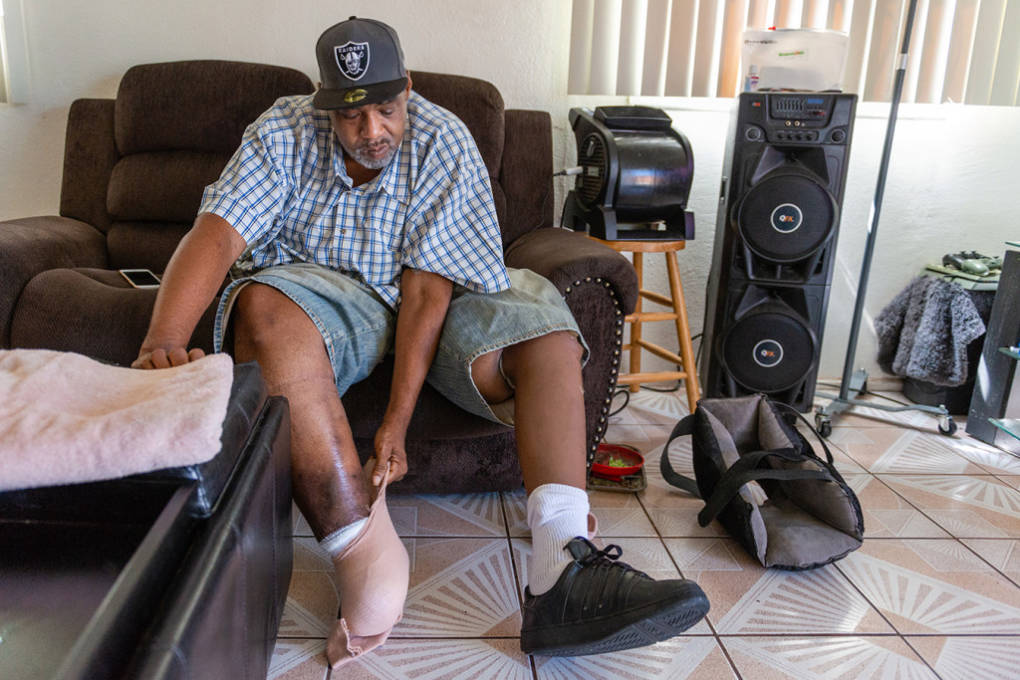
"caption": "Jackson Moss lost part of his right foot due to a complication of diabetes. He is trying to save the rest of it with the help of his wife, Bernadette.",
"description": null,
"title": "diabetic amputations",
"credit": "Heidi de Marco/KHN",
"status": "inherit",
"isLoading": false,
"fetchFailed": false
},
"science_1940830": {
"type": "attachments",
"id": "science_1940830",
"meta": {
"index": "attachments_1716263798",
"site": "science",
"id": "1940830",
"found": true
},
"parent": 1940714,
"imgSizes": {
"thumbnail": {
"file": "https://ww2.kqed.org/app/uploads/sites/35/2019/04/Johanna-Mendoza-and-Bethan-Lamb-2-160x92.jpg",
"width": 160,
"mimeType": "image/jpeg",
"height": 92
},
"kqedFullSize": {
"file": "https://ww2.kqed.org/app/uploads/sites/35/2019/04/Johanna-Mendoza-and-Bethan-Lamb-2.jpg",
"width": 640,
"height": 366
}
},
"publishDate": 1556315060,
"modified": 1556317941,
"caption": null,
"description": null,
"title": "Johanna Mendoza and Bethan Lamb",
"credit": "Courtesy Johanna Mendoza",
"status": "inherit",
"isLoading": false,
"fetchFailed": false
},
"science_1927153": {
"type": "attachments",
"id": "science_1927153",
"meta": {
"index": "attachments_1716263798",
"site": "science",
"id": "1927153",
"found": true
},
"parent": 1927142,
"imgSizes": {
"small": {
"file": "https://ww2.kqed.org/app/uploads/sites/35/2018/07/GettyImages-994931004-520x363.jpg",
"width": 520,
"mimeType": "image/jpeg",
"height": 363
},
"twentyfourteen-full-width": {
"file": "https://ww2.kqed.org/app/uploads/sites/35/2018/07/GettyImages-994931004-1038x576.jpg",
"width": 1038,
"mimeType": "image/jpeg",
"height": 576
},
"thumbnail": {
"file": "https://ww2.kqed.org/app/uploads/sites/35/2018/07/GettyImages-994931004-160x112.jpg",
"width": 160,
"mimeType": "image/jpeg",
"height": 112
},
"fd-sm": {
"file": "https://ww2.kqed.org/app/uploads/sites/35/2018/07/GettyImages-994931004-960x670.jpg",
"width": 960,
"mimeType": "image/jpeg",
"height": 670
},
"post-thumbnail": {
"file": "https://ww2.kqed.org/app/uploads/sites/35/2018/07/GettyImages-994931004-672x372.jpg",
"width": 672,
"mimeType": "image/jpeg",
"height": 372
},
"xsmall": {
"file": "https://ww2.kqed.org/app/uploads/sites/35/2018/07/GettyImages-994931004-375x262.jpg",
"width": 375,
"mimeType": "image/jpeg",
"height": 262
},
"kqedFullSize": {
"file": "https://ww2.kqed.org/app/uploads/sites/35/2018/07/GettyImages-994931004-e1540254135420.jpg",
"width": 1920,
"height": 1341
},
"large": {
"file": "https://ww2.kqed.org/app/uploads/sites/35/2018/07/GettyImages-994931004-1020x712.jpg",
"width": 1020,
"mimeType": "image/jpeg",
"height": 712
},
"xlarge": {
"file": "https://ww2.kqed.org/app/uploads/sites/35/2018/07/GettyImages-994931004-1180x824.jpg",
"width": 1180,
"mimeType": "image/jpeg",
"height": 824
},
"complete_open_graph": {
"file": "https://ww2.kqed.org/app/uploads/sites/35/2018/07/GettyImages-994931004-1200x838.jpg",
"width": 1200,
"mimeType": "image/jpeg",
"height": 838
},
"guest-author-50": {
"file": "https://ww2.kqed.org/app/uploads/sites/35/2018/07/GettyImages-994931004-50x50.jpg",
"width": 50,
"mimeType": "image/jpeg",
"height": 50
},
"guest-author-96": {
"file": "https://ww2.kqed.org/app/uploads/sites/35/2018/07/GettyImages-994931004-96x96.jpg",
"width": 96,
"mimeType": "image/jpeg",
"height": 96
},
"medium": {
"file": "https://ww2.kqed.org/app/uploads/sites/35/2018/07/GettyImages-994931004-800x559.jpg",
"width": 800,
"mimeType": "image/jpeg",
"height": 559
},
"guest-author-64": {
"file": "https://ww2.kqed.org/app/uploads/sites/35/2018/07/GettyImages-994931004-64x64.jpg",
"width": 64,
"mimeType": "image/jpeg",
"height": 64
},
"guest-author-32": {
"file": "https://ww2.kqed.org/app/uploads/sites/35/2018/07/GettyImages-994931004-32x32.jpg",
"width": 32,
"mimeType": "image/jpeg",
"height": 32
},
"fd-lrg": {
"file": "https://ww2.kqed.org/app/uploads/sites/35/2018/07/GettyImages-994931004-1920x1341.jpg",
"width": 1920,
"mimeType": "image/jpeg",
"height": 1341
},
"fd-med": {
"file": "https://ww2.kqed.org/app/uploads/sites/35/2018/07/GettyImages-994931004-1180x824.jpg",
"width": 1180,
"mimeType": "image/jpeg",
"height": 824
},
"full-width": {
"file": "https://ww2.kqed.org/app/uploads/sites/35/2018/07/GettyImages-994931004-1920x1341.jpg",
"width": 1920,
"mimeType": "image/jpeg",
"height": 1341
},
"detail": {
"file": "https://ww2.kqed.org/app/uploads/sites/35/2018/07/GettyImages-994931004-150x150.jpg",
"width": 150,
"mimeType": "image/jpeg",
"height": 150
},
"medium_large": {
"file": "https://ww2.kqed.org/app/uploads/sites/35/2018/07/GettyImages-994931004-768x536.jpg",
"width": 768,
"mimeType": "image/jpeg",
"height": 536
},
"guest-author-128": {
"file": "https://ww2.kqed.org/app/uploads/sites/35/2018/07/GettyImages-994931004-128x128.jpg",
"width": 128,
"mimeType": "image/jpeg",
"height": 128
},
"xxsmall": {
"file": "https://ww2.kqed.org/app/uploads/sites/35/2018/07/GettyImages-994931004-240x168.jpg",
"width": 240,
"mimeType": "image/jpeg",
"height": 168
}
},
"publishDate": 1531252700,
"modified": 1554502993,
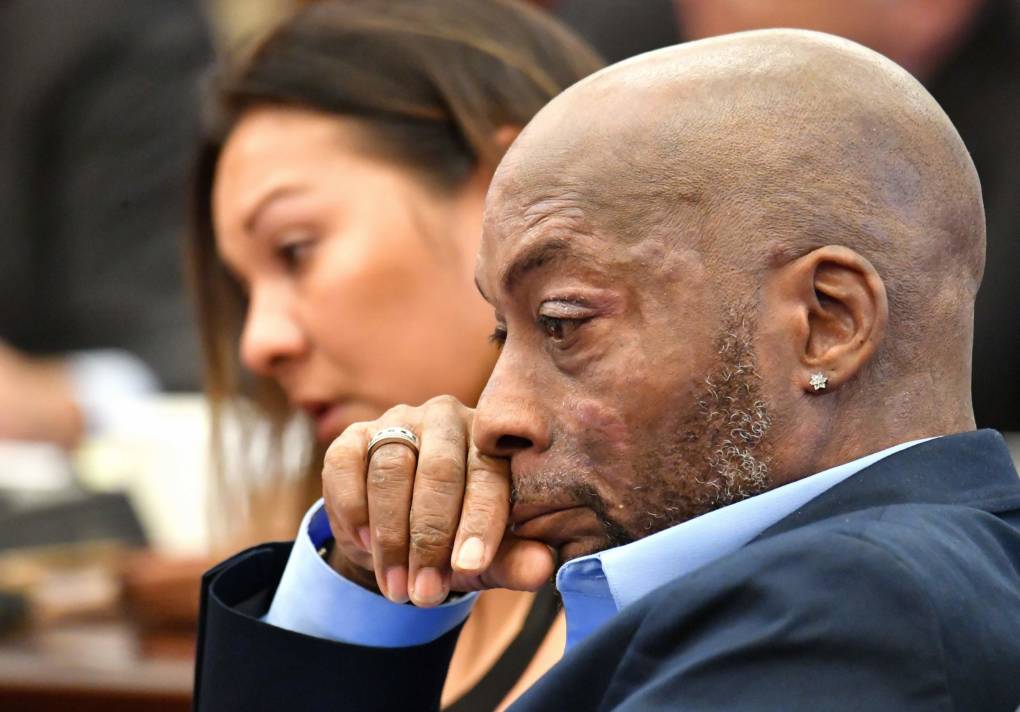
"caption": "Plaintiff Dewayne Johnson sits while his attorney speaks about his condition during the Monsanto trial in San Francisco in July 2018. ",
"description": null,
"title": "US-chemicals-environment-trial-health-cancer-illness",
"credit": "Josh Edelson/AFP/Getty Images",
"status": "inherit",
"isLoading": false,
"fetchFailed": false
},
"science_1939652": {
"type": "attachments",
"id": "science_1939652",
"meta": {
"index": "attachments_1716263798",
"site": "science",
"id": "1939652",
"found": true
},
"parent": 1939607,
"imgSizes": {
"twentyfourteen-full-width": {
"file": "https://ww2.kqed.org/app/uploads/sites/35/2019/03/RS36266_psych-er-3-1-qut-1038x576.jpg",
"width": 1038,
"mimeType": "image/jpeg",
"height": 576
},
"thumbnail": {
"file": "https://ww2.kqed.org/app/uploads/sites/35/2019/03/RS36266_psych-er-3-1-qut-160x107.jpg",
"width": 160,
"mimeType": "image/jpeg",
"height": 107
},
"post-thumbnail": {
"file": "https://ww2.kqed.org/app/uploads/sites/35/2019/03/RS36266_psych-er-3-1-qut-672x372.jpg",
"width": 672,
"mimeType": "image/jpeg",
"height": 372
},
"kqedFullSize": {
"file": "https://ww2.kqed.org/app/uploads/sites/35/2019/03/RS36266_psych-er-3-1-qut.jpg",
"width": 1920,
"height": 1281
},
"large": {
"file": "https://ww2.kqed.org/app/uploads/sites/35/2019/03/RS36266_psych-er-3-1-qut-1020x681.jpg",
"width": 1020,
"mimeType": "image/jpeg",
"height": 681
},
"complete_open_graph": {
"file": "https://ww2.kqed.org/app/uploads/sites/35/2019/03/RS36266_psych-er-3-1-qut-1200x801.jpg",
"width": 1200,
"mimeType": "image/jpeg",
"height": 801
},
"guest-author-50": {
"file": "https://ww2.kqed.org/app/uploads/sites/35/2019/03/RS36266_psych-er-3-1-qut-50x50.jpg",
"width": 50,
"mimeType": "image/jpeg",
"height": 50
},
"guest-author-96": {
"file": "https://ww2.kqed.org/app/uploads/sites/35/2019/03/RS36266_psych-er-3-1-qut-96x96.jpg",
"width": 96,
"mimeType": "image/jpeg",
"height": 96
},
"medium": {
"file": "https://ww2.kqed.org/app/uploads/sites/35/2019/03/RS36266_psych-er-3-1-qut-800x534.jpg",
"width": 800,
"mimeType": "image/jpeg",
"height": 534
},
"guest-author-64": {
"file": "https://ww2.kqed.org/app/uploads/sites/35/2019/03/RS36266_psych-er-3-1-qut-64x64.jpg",
"width": 64,
"mimeType": "image/jpeg",
"height": 64
},
"guest-author-32": {
"file": "https://ww2.kqed.org/app/uploads/sites/35/2019/03/RS36266_psych-er-3-1-qut-32x32.jpg",
"width": 32,
"mimeType": "image/jpeg",
"height": 32
},
"full-width": {
"file": "https://ww2.kqed.org/app/uploads/sites/35/2019/03/RS36266_psych-er-3-1-qut-1920x1281.jpg",
"width": 1920,
"mimeType": "image/jpeg",
"height": 1281
},
"medium_large": {
"file": "https://ww2.kqed.org/app/uploads/sites/35/2019/03/RS36266_psych-er-3-1-qut-768x512.jpg",
"width": 768,
"mimeType": "image/jpeg",
"height": 512
},
"guest-author-128": {
"file": "https://ww2.kqed.org/app/uploads/sites/35/2019/03/RS36266_psych-er-3-1-qut-128x128.jpg",
"width": 128,
"mimeType": "image/jpeg",
"height": 128
}
},
"publishDate": 1553801597,
"modified": 1553801629,
"caption": "A patient arrives at the emergency psychiatric center, part of Providence Little Company of Mary Medical Center San Pedro.",
"description": null,
"title": "RS36266_psych-er-3 (1)-qut",
"credit": "Heidi de Marco/KHN",
"status": "inherit",
"isLoading": false,
"fetchFailed": false
},
"science_1939597": {
"type": "attachments",
"id": "science_1939597",
"meta": {
"index": "attachments_1716263798",
"site": "science",
"id": "1939597",
"found": true
},
"parent": 1939596,
"imgSizes": {
"twentyfourteen-full-width": {
"file": "https://ww2.kqed.org/app/uploads/sites/35/2019/03/genetic-disease-1_enl-b8186dee7548874da14d2ac75ba4c2e35982f084-1038x576.jpg",
"width": 1038,
"mimeType": "image/jpeg",
"height": 576
},
"thumbnail": {
"file": "https://ww2.kqed.org/app/uploads/sites/35/2019/03/genetic-disease-1_enl-b8186dee7548874da14d2ac75ba4c2e35982f084-160x117.jpg",
"width": 160,
"mimeType": "image/jpeg",
"height": 117
},
"post-thumbnail": {
"file": "https://ww2.kqed.org/app/uploads/sites/35/2019/03/genetic-disease-1_enl-b8186dee7548874da14d2ac75ba4c2e35982f084-672x372.jpg",
"width": 672,
"mimeType": "image/jpeg",
"height": 372
},
"kqedFullSize": {
"file": "https://ww2.kqed.org/app/uploads/sites/35/2019/03/genetic-disease-1_enl-b8186dee7548874da14d2ac75ba4c2e35982f084.jpg",
"width": 1935,
"height": 1416
},
"large": {
"file": "https://ww2.kqed.org/app/uploads/sites/35/2019/03/genetic-disease-1_enl-b8186dee7548874da14d2ac75ba4c2e35982f084-1020x746.jpg",
"width": 1020,
"mimeType": "image/jpeg",
"height": 746
},
"complete_open_graph": {
"file": "https://ww2.kqed.org/app/uploads/sites/35/2019/03/genetic-disease-1_enl-b8186dee7548874da14d2ac75ba4c2e35982f084-1200x878.jpg",
"width": 1200,
"mimeType": "image/jpeg",
"height": 878
},
"guest-author-50": {
"file": "https://ww2.kqed.org/app/uploads/sites/35/2019/03/genetic-disease-1_enl-b8186dee7548874da14d2ac75ba4c2e35982f084-50x50.jpg",
"width": 50,
"mimeType": "image/jpeg",
"height": 50
},
"guest-author-96": {
"file": "https://ww2.kqed.org/app/uploads/sites/35/2019/03/genetic-disease-1_enl-b8186dee7548874da14d2ac75ba4c2e35982f084-96x96.jpg",
"width": 96,
"mimeType": "image/jpeg",
"height": 96
},
"medium": {
"file": "https://ww2.kqed.org/app/uploads/sites/35/2019/03/genetic-disease-1_enl-b8186dee7548874da14d2ac75ba4c2e35982f084-800x585.jpg",
"width": 800,
"mimeType": "image/jpeg",
"height": 585
},
"guest-author-64": {
"file": "https://ww2.kqed.org/app/uploads/sites/35/2019/03/genetic-disease-1_enl-b8186dee7548874da14d2ac75ba4c2e35982f084-64x64.jpg",
"width": 64,
"mimeType": "image/jpeg",
"height": 64
},
"guest-author-32": {
"file": "https://ww2.kqed.org/app/uploads/sites/35/2019/03/genetic-disease-1_enl-b8186dee7548874da14d2ac75ba4c2e35982f084-32x32.jpg",
"width": 32,
"mimeType": "image/jpeg",
"height": 32
},
"full-width": {
"file": "https://ww2.kqed.org/app/uploads/sites/35/2019/03/genetic-disease-1_enl-b8186dee7548874da14d2ac75ba4c2e35982f084-1920x1405.jpg",
"width": 1920,
"mimeType": "image/jpeg",
"height": 1405
},
"medium_large": {
"file": "https://ww2.kqed.org/app/uploads/sites/35/2019/03/genetic-disease-1_enl-b8186dee7548874da14d2ac75ba4c2e35982f084-768x562.jpg",
"width": 768,
"mimeType": "image/jpeg",
"height": 562
},
"guest-author-128": {
"file": "https://ww2.kqed.org/app/uploads/sites/35/2019/03/genetic-disease-1_enl-b8186dee7548874da14d2ac75ba4c2e35982f084-128x128.jpg",
"width": 128,
"mimeType": "image/jpeg",
"height": 128
}
},
"publishDate": 1553642623,
"modified": 1553642623,
"caption": null,
"description": "Jonah Reeder prepares a special protein shake that helps him manage a metabolic condition called phenylketonuria.",
"title": "Jonah Reeder prepares a special protein shake that helps him manage a metabolic condition called phenylketonuria.",
"credit": null,
"status": "inherit",
"isLoading": false,
"fetchFailed": false
},
"science_1939439": {
"type": "attachments",
"id": "science_1939439",
"meta": {
"index": "attachments_1716263798",
"site": "science",
"id": "1939439",
"found": true
},
"parent": 1939435,
"imgSizes": {
"twentyfourteen-full-width": {
"file": "https://ww2.kqed.org/app/uploads/sites/35/2019/03/DL606-Head-Lice-marquee_1920-1038x576.jpg",
"width": 1038,
"mimeType": "image/jpeg",
"height": 576
},
"thumbnail": {
"file": "https://ww2.kqed.org/app/uploads/sites/35/2019/03/DL606-Head-Lice-marquee_1920-160x90.jpg",
"width": 160,
"mimeType": "image/jpeg",
"height": 90
},
"post-thumbnail": {
"file": "https://ww2.kqed.org/app/uploads/sites/35/2019/03/DL606-Head-Lice-marquee_1920-672x372.jpg",
"width": 672,
"mimeType": "image/jpeg",
"height": 372
},
"kqedFullSize": {
"file": "https://ww2.kqed.org/app/uploads/sites/35/2019/03/DL606-Head-Lice-marquee_1920.jpg",
"width": 1920,
"height": 1080
},
"large": {
"file": "https://ww2.kqed.org/app/uploads/sites/35/2019/03/DL606-Head-Lice-marquee_1920-1020x574.jpg",
"width": 1020,
"mimeType": "image/jpeg",
"height": 574
},
"complete_open_graph": {
"file": "https://ww2.kqed.org/app/uploads/sites/35/2019/03/DL606-Head-Lice-marquee_1920-1200x675.jpg",
"width": 1200,
"mimeType": "image/jpeg",
"height": 675
},
"guest-author-50": {
"file": "https://ww2.kqed.org/app/uploads/sites/35/2019/03/DL606-Head-Lice-marquee_1920-50x50.jpg",
"width": 50,
"mimeType": "image/jpeg",
"height": 50
},
"guest-author-96": {
"file": "https://ww2.kqed.org/app/uploads/sites/35/2019/03/DL606-Head-Lice-marquee_1920-96x96.jpg",
"width": 96,
"mimeType": "image/jpeg",
"height": 96
},
"medium": {
"file": "https://ww2.kqed.org/app/uploads/sites/35/2019/03/DL606-Head-Lice-marquee_1920-800x450.jpg",
"width": 800,
"mimeType": "image/jpeg",
"height": 450
},
"guest-author-64": {
"file": "https://ww2.kqed.org/app/uploads/sites/35/2019/03/DL606-Head-Lice-marquee_1920-64x64.jpg",
"width": 64,
"mimeType": "image/jpeg",
"height": 64
},
"guest-author-32": {
"file": "https://ww2.kqed.org/app/uploads/sites/35/2019/03/DL606-Head-Lice-marquee_1920-32x32.jpg",
"width": 32,
"mimeType": "image/jpeg",
"height": 32
},
"full-width": {
"file": "https://ww2.kqed.org/app/uploads/sites/35/2019/03/DL606-Head-Lice-marquee_1920-1920x1080.jpg",
"width": 1920,
"mimeType": "image/jpeg",
"height": 1080
},
"medium_large": {
"file": "https://ww2.kqed.org/app/uploads/sites/35/2019/03/DL606-Head-Lice-marquee_1920-768x432.jpg",
"width": 768,
"mimeType": "image/jpeg",
"height": 432
},
"guest-author-128": {
"file": "https://ww2.kqed.org/app/uploads/sites/35/2019/03/DL606-Head-Lice-marquee_1920-128x128.jpg",
"width": 128,
"mimeType": "image/jpeg",
"height": 128
}
},
"publishDate": 1553109891,
"modified": 1553359278,
"caption": "A female adult head louse holds onto human hairs, as it is filmed under a microscope at UC Berkeley. The brown line visible inside the louse is the blood meal it took when it lived on a human host’s scalp.",
"description": null,
"title": "DL606-Head-Lice-marquee_1920",
"credit": "Josh Cassidy/KQED",
"status": "inherit",
"isLoading": false,
"fetchFailed": false
},
"science_1938820": {
"type": "attachments",
"id": "science_1938820",
"meta": {
"index": "attachments_1716263798",
"site": "science",
"id": "1938820",
"found": true
},
"parent": 1938819,
"imgSizes": {
"twentyfourteen-full-width": {
"file": "https://ww2.kqed.org/app/uploads/sites/35/2019/03/gettyimages-83909066-1-00ab3541d3108d282427d934704dfce8f1078075-1038x576.jpg",
"width": 1038,
"mimeType": "image/jpeg",
"height": 576
},
"thumbnail": {
"file": "https://ww2.kqed.org/app/uploads/sites/35/2019/03/gettyimages-83909066-1-00ab3541d3108d282427d934704dfce8f1078075-160x120.jpg",
"width": 160,
"mimeType": "image/jpeg",
"height": 120
},
"post-thumbnail": {
"file": "https://ww2.kqed.org/app/uploads/sites/35/2019/03/gettyimages-83909066-1-00ab3541d3108d282427d934704dfce8f1078075-672x372.jpg",
"width": 672,
"mimeType": "image/jpeg",
"height": 372
},
"kqedFullSize": {
"file": "https://ww2.kqed.org/app/uploads/sites/35/2019/03/gettyimages-83909066-1-00ab3541d3108d282427d934704dfce8f1078075.jpg",
"width": 1878,
"height": 1409
},
"large": {
"file": "https://ww2.kqed.org/app/uploads/sites/35/2019/03/gettyimages-83909066-1-00ab3541d3108d282427d934704dfce8f1078075-1020x765.jpg",
"width": 1020,
"mimeType": "image/jpeg",
"height": 765
},
"complete_open_graph": {
"file": "https://ww2.kqed.org/app/uploads/sites/35/2019/03/gettyimages-83909066-1-00ab3541d3108d282427d934704dfce8f1078075-1200x900.jpg",
"width": 1200,
"mimeType": "image/jpeg",
"height": 900
},
"guest-author-50": {
"file": "https://ww2.kqed.org/app/uploads/sites/35/2019/03/gettyimages-83909066-1-00ab3541d3108d282427d934704dfce8f1078075-50x50.jpg",
"width": 50,
"mimeType": "image/jpeg",
"height": 50
},
"guest-author-96": {
"file": "https://ww2.kqed.org/app/uploads/sites/35/2019/03/gettyimages-83909066-1-00ab3541d3108d282427d934704dfce8f1078075-96x96.jpg",
"width": 96,
"mimeType": "image/jpeg",
"height": 96
},
"medium": {
"file": "https://ww2.kqed.org/app/uploads/sites/35/2019/03/gettyimages-83909066-1-00ab3541d3108d282427d934704dfce8f1078075-800x600.jpg",
"width": 800,
"mimeType": "image/jpeg",
"height": 600
},
"guest-author-64": {
"file": "https://ww2.kqed.org/app/uploads/sites/35/2019/03/gettyimages-83909066-1-00ab3541d3108d282427d934704dfce8f1078075-64x64.jpg",
"width": 64,
"mimeType": "image/jpeg",
"height": 64
},
"guest-author-32": {
"file": "https://ww2.kqed.org/app/uploads/sites/35/2019/03/gettyimages-83909066-1-00ab3541d3108d282427d934704dfce8f1078075-32x32.jpg",
"width": 32,
"mimeType": "image/jpeg",
"height": 32
},
"medium_large": {
"file": "https://ww2.kqed.org/app/uploads/sites/35/2019/03/gettyimages-83909066-1-00ab3541d3108d282427d934704dfce8f1078075-768x576.jpg",
"width": 768,
"mimeType": "image/jpeg",
"height": 576
},
"guest-author-128": {
"file": "https://ww2.kqed.org/app/uploads/sites/35/2019/03/gettyimages-83909066-1-00ab3541d3108d282427d934704dfce8f1078075-128x128.jpg",
"width": 128,
"mimeType": "image/jpeg",
"height": 128
}
},
"publishDate": 1551979627,
"modified": 1551980339,
"caption": "Given supportive, nurturing conditions, highly reactive \"orchid\" children can thrive when tackling challenges, pediatrician and author Thomas Boyce says, especially if they have the comfort of a regular routine.",
"description": "Given supportive, nurturing conditions, highly reactive \"orchid\" children can thrive when tackling challenges, pediatrician and author Thomas Boyce says, especially if they have the comfort of a regular routine.",
"title": "Given supportive, nurturing conditions, highly reactive \"orchid\" children can thrive when tackling challenges, pediatrician and author Thomas Boyce says, especially if they have the comfort of a regular routine.",
"credit": "Michael H/Getty Images",
"status": "inherit",
"isLoading": false,
"fetchFailed": false
},
"science_1938763": {
"type": "attachments",
"id": "science_1938763",
"meta": {
"index": "attachments_1716263798",
"site": "science",
"id": "1938763",
"found": true
},
"parent": 1938753,
"imgSizes": {
"twentyfourteen-full-width": {
"file": "https://ww2.kqed.org/app/uploads/sites/35/2019/03/ketamine-2-1ea0cad420a4f5f45a5b33afa819eee3536fa353-s800-c85-800x576.jpg",
"width": 800,
"mimeType": "image/jpeg",
"height": 576
},
"thumbnail": {
"file": "https://ww2.kqed.org/app/uploads/sites/35/2019/03/ketamine-2-1ea0cad420a4f5f45a5b33afa819eee3536fa353-s800-c85-160x120.jpg",
"width": 160,
"mimeType": "image/jpeg",
"height": 120
},
"post-thumbnail": {
"file": "https://ww2.kqed.org/app/uploads/sites/35/2019/03/ketamine-2-1ea0cad420a4f5f45a5b33afa819eee3536fa353-s800-c85-672x372.jpg",
"width": 672,
"mimeType": "image/jpeg",
"height": 372
},
"kqedFullSize": {
"file": "https://ww2.kqed.org/app/uploads/sites/35/2019/03/ketamine-2-1ea0cad420a4f5f45a5b33afa819eee3536fa353-s800-c85.jpg",
"width": 800,
"height": 599
},
"guest-author-50": {
"file": "https://ww2.kqed.org/app/uploads/sites/35/2019/03/ketamine-2-1ea0cad420a4f5f45a5b33afa819eee3536fa353-s800-c85-50x50.jpg",
"width": 50,
"mimeType": "image/jpeg",
"height": 50
},
"guest-author-96": {
"file": "https://ww2.kqed.org/app/uploads/sites/35/2019/03/ketamine-2-1ea0cad420a4f5f45a5b33afa819eee3536fa353-s800-c85-96x96.jpg",
"width": 96,
"mimeType": "image/jpeg",
"height": 96
},
"medium": {
"file": "https://ww2.kqed.org/app/uploads/sites/35/2019/03/ketamine-2-1ea0cad420a4f5f45a5b33afa819eee3536fa353-s800-c85-800x599.jpg",
"width": 800,
"mimeType": "image/jpeg",
"height": 599
},
"guest-author-64": {
"file": "https://ww2.kqed.org/app/uploads/sites/35/2019/03/ketamine-2-1ea0cad420a4f5f45a5b33afa819eee3536fa353-s800-c85-64x64.jpg",
"width": 64,
"mimeType": "image/jpeg",
"height": 64
},
"guest-author-32": {
"file": "https://ww2.kqed.org/app/uploads/sites/35/2019/03/ketamine-2-1ea0cad420a4f5f45a5b33afa819eee3536fa353-s800-c85-32x32.jpg",
"width": 32,
"mimeType": "image/jpeg",
"height": 32
},
"medium_large": {
"file": "https://ww2.kqed.org/app/uploads/sites/35/2019/03/ketamine-2-1ea0cad420a4f5f45a5b33afa819eee3536fa353-s800-c85-768x575.jpg",
"width": 768,
"mimeType": "image/jpeg",
"height": 575
},
"guest-author-128": {
"file": "https://ww2.kqed.org/app/uploads/sites/35/2019/03/ketamine-2-1ea0cad420a4f5f45a5b33afa819eee3536fa353-s800-c85-128x128.jpg",
"width": 128,
"mimeType": "image/jpeg",
"height": 128
}
},
"publishDate": 1551898290,
"modified": 1551898820,
"caption": "The FDA on Tuesday approved the drug esketamine to treat depression. Johnson & Johnson's Spravato will be administered as a nasal spray.",
"description": null,
"title": "ketamine-2-1ea0cad420a4f5f45a5b33afa819eee3536fa353-s800-c85",
"credit": "Janssen Pharmaceutica",
"status": "inherit",
"isLoading": false,
"fetchFailed": false
},
"science_1938726": {
"type": "attachments",
"id": "science_1938726",
"meta": {
"index": "attachments_1716263798",
"site": "science",
"id": "1938726",
"found": true
},
"parent": 1938724,
"imgSizes": {
"twentyfourteen-full-width": {
"file": "https://ww2.kqed.org/app/uploads/sites/35/2019/03/timbrown-1024x576.jpg",
"width": 1024,
"mimeType": "image/jpeg",
"height": 576
},
"thumbnail": {
"file": "https://ww2.kqed.org/app/uploads/sites/35/2019/03/timbrown-160x90.jpg",
"width": 160,
"mimeType": "image/jpeg",
"height": 90
},
"post-thumbnail": {
"file": "https://ww2.kqed.org/app/uploads/sites/35/2019/03/timbrown-672x372.jpg",
"width": 672,
"mimeType": "image/jpeg",
"height": 372
},
"kqedFullSize": {
"file": "https://ww2.kqed.org/app/uploads/sites/35/2019/03/timbrown.jpg",
"width": 1024,
"height": 576
},
"large": {
"file": "https://ww2.kqed.org/app/uploads/sites/35/2019/03/timbrown-1020x574.jpg",
"width": 1020,
"mimeType": "image/jpeg",
"height": 574
},
"guest-author-50": {
"file": "https://ww2.kqed.org/app/uploads/sites/35/2019/03/timbrown-50x50.jpg",
"width": 50,
"mimeType": "image/jpeg",
"height": 50
},
"guest-author-96": {
"file": "https://ww2.kqed.org/app/uploads/sites/35/2019/03/timbrown-96x96.jpg",
"width": 96,
"mimeType": "image/jpeg",
"height": 96
},
"medium": {
"file": "https://ww2.kqed.org/app/uploads/sites/35/2019/03/timbrown-800x450.jpg",
"width": 800,
"mimeType": "image/jpeg",
"height": 450
},
"guest-author-64": {
"file": "https://ww2.kqed.org/app/uploads/sites/35/2019/03/timbrown-64x64.jpg",
"width": 64,
"mimeType": "image/jpeg",
"height": 64
},
"guest-author-32": {
"file": "https://ww2.kqed.org/app/uploads/sites/35/2019/03/timbrown-32x32.jpg",
"width": 32,
"mimeType": "image/jpeg",
"height": 32
},
"medium_large": {
"file": "https://ww2.kqed.org/app/uploads/sites/35/2019/03/timbrown-768x432.jpg",
"width": 768,
"mimeType": "image/jpeg",
"height": 432
},
"guest-author-128": {
"file": "https://ww2.kqed.org/app/uploads/sites/35/2019/03/timbrown-128x128.jpg",
"width": 128,
"mimeType": "image/jpeg",
"height": 128
}
},
"publishDate": 1551805052,
"modified": 1551805107,
"caption": "Timothy Ray Brown (L), also known as “The Berlin Patient”, considered the first person to be cured of HIV.",
"description": null,
"title": "timbrown",
"credit": "GERARD JULIEN/AFP/GETTYIMAGES",
"status": "inherit",
"isLoading": false,
"fetchFailed": false
},
"science_1938497": {
"type": "attachments",
"id": "science_1938497",
"meta": {
"index": "attachments_1716263798",
"site": "science",
"id": "1938497",
"found": true
},
"parent": 1938496,
"imgSizes": {
"twentyfourteen-full-width": {
"file": "https://ww2.kqed.org/app/uploads/sites/35/2019/02/grandmother-1_enl-9fc121820404197bbae50a16e9363940e4a7e6a3-1038x576.jpe",
"width": 1038,
"mimeType": "image/jpeg",
"height": 576
},
"thumbnail": {
"file": "https://ww2.kqed.org/app/uploads/sites/35/2019/02/grandmother-1_enl-9fc121820404197bbae50a16e9363940e4a7e6a3-160x90.jpe",
"width": 160,
"mimeType": "image/jpeg",
"height": 90
},
"post-thumbnail": {
"file": "https://ww2.kqed.org/app/uploads/sites/35/2019/02/grandmother-1_enl-9fc121820404197bbae50a16e9363940e4a7e6a3-672x372.jpe",
"width": 672,
"mimeType": "image/jpeg",
"height": 372
},
"kqedFullSize": {
"file": "https://ww2.kqed.org/app/uploads/sites/35/2019/02/grandmother-1_enl-9fc121820404197bbae50a16e9363940e4a7e6a3.jpe",
"width": 2048,
"height": 1150
},
"large": {
"file": "https://ww2.kqed.org/app/uploads/sites/35/2019/02/grandmother-1_enl-9fc121820404197bbae50a16e9363940e4a7e6a3-1020x573.jpe",
"width": 1020,
"mimeType": "image/jpeg",
"height": 573
},
"complete_open_graph": {
"file": "https://ww2.kqed.org/app/uploads/sites/35/2019/02/grandmother-1_enl-9fc121820404197bbae50a16e9363940e4a7e6a3-1200x674.jpe",
"width": 1200,
"mimeType": "image/jpeg",
"height": 674
},
"guest-author-50": {
"file": "https://ww2.kqed.org/app/uploads/sites/35/2019/02/grandmother-1_enl-9fc121820404197bbae50a16e9363940e4a7e6a3-50x50.jpe",
"width": 50,
"mimeType": "image/jpeg",
"height": 50
},
"guest-author-96": {
"file": "https://ww2.kqed.org/app/uploads/sites/35/2019/02/grandmother-1_enl-9fc121820404197bbae50a16e9363940e4a7e6a3-96x96.jpe",
"width": 96,
"mimeType": "image/jpeg",
"height": 96
},
"medium": {
"file": "https://ww2.kqed.org/app/uploads/sites/35/2019/02/grandmother-1_enl-9fc121820404197bbae50a16e9363940e4a7e6a3-800x449.jpe",
"width": 800,
"mimeType": "image/jpeg",
"height": 449
},
"guest-author-64": {
"file": "https://ww2.kqed.org/app/uploads/sites/35/2019/02/grandmother-1_enl-9fc121820404197bbae50a16e9363940e4a7e6a3-64x64.jpe",
"width": 64,
"mimeType": "image/jpeg",
"height": 64
},
"guest-author-32": {
"file": "https://ww2.kqed.org/app/uploads/sites/35/2019/02/grandmother-1_enl-9fc121820404197bbae50a16e9363940e4a7e6a3-32x32.jpe",
"width": 32,
"mimeType": "image/jpeg",
"height": 32
},
"full-width": {
"file": "https://ww2.kqed.org/app/uploads/sites/35/2019/02/grandmother-1_enl-9fc121820404197bbae50a16e9363940e4a7e6a3-1920x1078.jpe",
"width": 1920,
"mimeType": "image/jpeg",
"height": 1078
},
"medium_large": {
"file": "https://ww2.kqed.org/app/uploads/sites/35/2019/02/grandmother-1_enl-9fc121820404197bbae50a16e9363940e4a7e6a3-768x431.jpe",
"width": 768,
"mimeType": "image/jpeg",
"height": 431
},
"guest-author-128": {
"file": "https://ww2.kqed.org/app/uploads/sites/35/2019/02/grandmother-1_enl-9fc121820404197bbae50a16e9363940e4a7e6a3-128x128.jpe",
"width": 128,
"mimeType": "image/jpeg",
"height": 128
}
},
"publishDate": 1551300185,
"modified": 1551300897,
"caption": "Two new studies published in the journal Current Biology show the evolutionary benefits of living near your grandmother.",
"description": "Nicole Xu for NPR",
"title": "Nicole Xu for NPR",
"credit": null,
"status": "inherit",
"isLoading": false,
"fetchFailed": false
},
"science_1938486": {
"type": "attachments",
"id": "science_1938486",
"meta": {
"index": "attachments_1716263798",
"site": "science",
"id": "1938486",
"found": true
},
"parent": 1938485,
"imgSizes": {
"twentyfourteen-full-width": {
"file": "https://ww2.kqed.org/app/uploads/sites/35/2019/02/pesticide-2-11_enl-765dfd3a77d0c06d6b75e201aac192c24305a279-1038x576.jpg",
"width": 1038,
"mimeType": "image/jpeg",
"height": 576
},
"thumbnail": {
"file": "https://ww2.kqed.org/app/uploads/sites/35/2019/02/pesticide-2-11_enl-765dfd3a77d0c06d6b75e201aac192c24305a279-160x109.jpg",
"width": 160,
"mimeType": "image/jpeg",
"height": 109
},
"post-thumbnail": {
"file": "https://ww2.kqed.org/app/uploads/sites/35/2019/02/pesticide-2-11_enl-765dfd3a77d0c06d6b75e201aac192c24305a279-672x372.jpg",
"width": 672,
"mimeType": "image/jpeg",
"height": 372
},
"kqedFullSize": {
"file": "https://ww2.kqed.org/app/uploads/sites/35/2019/02/pesticide-2-11_enl-765dfd3a77d0c06d6b75e201aac192c24305a279.jpg",
"width": 2048,
"height": 1395
},
"large": {
"file": "https://ww2.kqed.org/app/uploads/sites/35/2019/02/pesticide-2-11_enl-765dfd3a77d0c06d6b75e201aac192c24305a279-1020x695.jpg",
"width": 1020,
"mimeType": "image/jpeg",
"height": 695
},
"complete_open_graph": {
"file": "https://ww2.kqed.org/app/uploads/sites/35/2019/02/pesticide-2-11_enl-765dfd3a77d0c06d6b75e201aac192c24305a279-1200x817.jpg",
"width": 1200,
"mimeType": "image/jpeg",
"height": 817
},
"guest-author-50": {
"file": "https://ww2.kqed.org/app/uploads/sites/35/2019/02/pesticide-2-11_enl-765dfd3a77d0c06d6b75e201aac192c24305a279-50x50.jpg",
"width": 50,
"mimeType": "image/jpeg",
"height": 50
},
"guest-author-96": {
"file": "https://ww2.kqed.org/app/uploads/sites/35/2019/02/pesticide-2-11_enl-765dfd3a77d0c06d6b75e201aac192c24305a279-96x96.jpg",
"width": 96,
"mimeType": "image/jpeg",
"height": 96
},
"medium": {
"file": "https://ww2.kqed.org/app/uploads/sites/35/2019/02/pesticide-2-11_enl-765dfd3a77d0c06d6b75e201aac192c24305a279-800x545.jpg",
"width": 800,
"mimeType": "image/jpeg",
"height": 545
},
"guest-author-64": {
"file": "https://ww2.kqed.org/app/uploads/sites/35/2019/02/pesticide-2-11_enl-765dfd3a77d0c06d6b75e201aac192c24305a279-64x64.jpg",
"width": 64,
"mimeType": "image/jpeg",
"height": 64
},
"guest-author-32": {
"file": "https://ww2.kqed.org/app/uploads/sites/35/2019/02/pesticide-2-11_enl-765dfd3a77d0c06d6b75e201aac192c24305a279-32x32.jpg",
"width": 32,
"mimeType": "image/jpeg",
"height": 32
},
"full-width": {
"file": "https://ww2.kqed.org/app/uploads/sites/35/2019/02/pesticide-2-11_enl-765dfd3a77d0c06d6b75e201aac192c24305a279-1920x1308.jpg",
"width": 1920,
"mimeType": "image/jpeg",
"height": 1308
},
"medium_large": {
"file": "https://ww2.kqed.org/app/uploads/sites/35/2019/02/pesticide-2-11_enl-765dfd3a77d0c06d6b75e201aac192c24305a279-768x523.jpg",
"width": 768,
"mimeType": "image/jpeg",
"height": 523
},
"guest-author-128": {
"file": "https://ww2.kqed.org/app/uploads/sites/35/2019/02/pesticide-2-11_enl-765dfd3a77d0c06d6b75e201aac192c24305a279-128x128.jpg",
"width": 128,
"mimeType": "image/jpeg",
"height": 128
}
},
"publishDate": 1551298453,
"modified": 1551298970,
"caption": "A pesticide warning sign in an orange grove warns in English and Spanish that the pesticide chlorpyrifos, or Lorsban, has been applied to these orange trees.",
"description": null,
"title": "A pesticide warning sign in an orange grove warns in English and Spanish that the pesticide chlorpyrifos, or Lorsban, has been applied to these orange trees.",
"credit": "Jim West/Science Source",
"status": "inherit",
"isLoading": false,
"fetchFailed": false
},
"science_1934262": {
"type": "attachments",
"id": "science_1934262",
"meta": {
"index": "attachments_1716263798",
"site": "science",
"id": "1934262",
"found": true
},
"parent": 1934110,
"imgSizes": {
"small": {
"file": "https://ww2.kqed.org/app/uploads/sites/35/2018/11/HeatWorker-520x293.jpg",
"width": 520,
"mimeType": "image/jpeg",
"height": 293
},
"twentyfourteen-full-width": {
"file": "https://ww2.kqed.org/app/uploads/sites/35/2018/11/HeatWorker-1038x576.jpg",
"width": 1038,
"mimeType": "image/jpeg",
"height": 576
},
"thumbnail": {
"file": "https://ww2.kqed.org/app/uploads/sites/35/2018/11/HeatWorker-160x90.jpg",
"width": 160,
"mimeType": "image/jpeg",
"height": 90
},
"fd-sm": {
"file": "https://ww2.kqed.org/app/uploads/sites/35/2018/11/HeatWorker-960x540.jpg",
"width": 960,
"mimeType": "image/jpeg",
"height": 540
},
"post-thumbnail": {
"file": "https://ww2.kqed.org/app/uploads/sites/35/2018/11/HeatWorker-672x372.jpg",
"width": 672,
"mimeType": "image/jpeg",
"height": 372
},
"xsmall": {
"file": "https://ww2.kqed.org/app/uploads/sites/35/2018/11/HeatWorker-375x211.jpg",
"width": 375,
"mimeType": "image/jpeg",
"height": 211
},
"kqedFullSize": {
"file": "https://ww2.kqed.org/app/uploads/sites/35/2018/11/HeatWorker.jpg",
"width": 1920,
"height": 1080
},
"large": {
"file": "https://ww2.kqed.org/app/uploads/sites/35/2018/11/HeatWorker-1020x574.jpg",
"width": 1020,
"mimeType": "image/jpeg",
"height": 574
},
"xlarge": {
"file": "https://ww2.kqed.org/app/uploads/sites/35/2018/11/HeatWorker-1180x664.jpg",
"width": 1180,
"mimeType": "image/jpeg",
"height": 664
},
"complete_open_graph": {
"file": "https://ww2.kqed.org/app/uploads/sites/35/2018/11/HeatWorker-1200x675.jpg",
"width": 1200,
"mimeType": "image/jpeg",
"height": 675
},
"guest-author-50": {
"file": "https://ww2.kqed.org/app/uploads/sites/35/2018/11/HeatWorker-50x50.jpg",
"width": 50,
"mimeType": "image/jpeg",
"height": 50
},
"guest-author-96": {
"file": "https://ww2.kqed.org/app/uploads/sites/35/2018/11/HeatWorker-96x96.jpg",
"width": 96,
"mimeType": "image/jpeg",
"height": 96
},
"medium": {
"file": "https://ww2.kqed.org/app/uploads/sites/35/2018/11/HeatWorker-800x450.jpg",
"width": 800,
"mimeType": "image/jpeg",
"height": 450
},
"guest-author-64": {
"file": "https://ww2.kqed.org/app/uploads/sites/35/2018/11/HeatWorker-64x64.jpg",
"width": 64,
"mimeType": "image/jpeg",
"height": 64
},
"guest-author-32": {
"file": "https://ww2.kqed.org/app/uploads/sites/35/2018/11/HeatWorker-32x32.jpg",
"width": 32,
"mimeType": "image/jpeg",
"height": 32
},
"fd-lrg": {
"file": "https://ww2.kqed.org/app/uploads/sites/35/2018/11/HeatWorker-1920x1080.jpg",
"width": 1920,
"mimeType": "image/jpeg",
"height": 1080
},
"fd-med": {
"file": "https://ww2.kqed.org/app/uploads/sites/35/2018/11/HeatWorker-1180x664.jpg",
"width": 1180,
"mimeType": "image/jpeg",
"height": 664
},
"full-width": {
"file": "https://ww2.kqed.org/app/uploads/sites/35/2018/11/HeatWorker-1920x1080.jpg",
"width": 1920,
"mimeType": "image/jpeg",
"height": 1080
},
"detail": {
"file": "https://ww2.kqed.org/app/uploads/sites/35/2018/11/HeatWorker-150x150.jpg",
"width": 150,
"mimeType": "image/jpeg",
"height": 150
},
"medium_large": {
"file": "https://ww2.kqed.org/app/uploads/sites/35/2018/11/HeatWorker-768x432.jpg",
"width": 768,
"mimeType": "image/jpeg",
"height": 432
},
"guest-author-128": {
"file": "https://ww2.kqed.org/app/uploads/sites/35/2018/11/HeatWorker-128x128.jpg",
"width": 128,
"mimeType": "image/jpeg",
"height": 128
},
"xxsmall": {
"file": "https://ww2.kqed.org/app/uploads/sites/35/2018/11/HeatWorker-240x135.jpg",
"width": 240,
"mimeType": "image/jpeg",
"height": 135
}
},
"publishDate": 1542151426,
"modified": 1550875834,
"caption": "At California Cartage near the Port of Long Beach, 68-year-old Jose Rodriguez said it gets so hot inside the shipping containers he unloads that his sweat sizzles on the metal. California will soon regulate heat at workplaces like the warehouse where Rodriguez works.",
"description": null,
"title": "HeatWorker",
"credit": "Molly Peterson/KQED",
"status": "inherit",
"isLoading": false,
"fetchFailed": false
}
},
"audioPlayerReducer": {
"postId": "stream_live",
"isPaused": true,
"isPlaying": false,
"pfsActive": false,
"pledgeModalIsOpen": true,
"playerDrawerIsOpen": false,
"liveAudioPlayStartedAt": 0,
"liveAudioPlayContext": ""
},
"authorsReducer": {
"byline_science_1941025": {
"type": "authors",
"id": "byline_science_1941025",
"meta": {
"override": true
},
"slug": "byline_science_1941025",
"name": "Anna Gorman\u003cbr />Kaiser Health News",
"isLoading": false
},
"byline_science_1940714": {
"type": "authors",
"id": "byline_science_1940714",
"meta": {
"override": true
},
"slug": "byline_science_1940714",
"name": "\u003cstrong>Johanna Mendoza\u003c/strong>",
"isLoading": false
},
"byline_science_1939607": {
"type": "authors",
"id": "byline_science_1939607",
"meta": {
"override": true
},
"slug": "byline_science_1939607",
"name": "\u003cstrong>Anna Gorman\u003cbr>Photos by Heidi de Marco\u003cbr>Kaiser Health News\u003c/strong>",
"isLoading": false
},
"byline_science_1939596": {
"type": "authors",
"id": "byline_science_1939596",
"meta": {
"override": true
},
"slug": "byline_science_1939596",
"name": "\u003cstrong>Rob Stein, NPR\u003c/strong>",
"isLoading": false
},
"byline_science_1938819": {
"type": "authors",
"id": "byline_science_1938819",
"meta": {
"override": true
},
"slug": "byline_science_1938819",
"name": "Dave Davies\u003c/br>NPR",
"isLoading": false
},
"byline_science_1938753": {
"type": "authors",
"id": "byline_science_1938753",
"meta": {
"override": true
},
"slug": "byline_science_1938753",
"name": "Megan Thielking\u003c/br>STAT",
"isLoading": false
},
"byline_science_1938724": {
"type": "authors",
"id": "byline_science_1938724",
"meta": {
"override": true
},
"slug": "byline_science_1938724",
"name": "Kate Sheridan\u003cbr />STAT",
"isLoading": false
},
"byline_science_1938496": {
"type": "authors",
"id": "byline_science_1938496",
"meta": {
"override": true
},
"slug": "byline_science_1938496",
"name": "Jonathan Lambert\u003c/br>NPR",
"isLoading": false
},
"byline_science_1938485": {
"type": "authors",
"id": "byline_science_1938485",
"meta": {
"override": true
},
"slug": "byline_science_1938485",
"name": "Eilís O'Neill\u003cbr/>NPR",
"isLoading": false
},
"gabriela-quiros": {
"type": "authors",
"id": "6186",
"meta": {
"index": "authors_1716337520",
"id": "6186",
"found": true
},
"name": "Gabriela Quirós",
"firstName": "Gabriela",
"lastName": "Quirós",
"slug": "gabriela-quiros",
"email": "gquiros@kqed.org",
"display_author_email": false,
"staff_mastheads": [],
"title": "Supervising Producer",
"bio": "Gabriela Quirós is the \u003cstrong>supervising producer for KQED's web science video series \u003ca href=\"https://www.kqed.org/deeplook\">Deep Look\u003c/a>\u003c/strong>. She joined KQED as a TV producer when its science series QUEST started in 2006 and has covered everything from Alzheimer’s to bee die-offs to dark energy.\r\n\r\nShe won a 2022 AAAS Kavli Science Journalism Award with a team of her Deep Look colleagues. She has won six regional Emmys as a video producer and has shared eight more as the coordinating producer of Deep Look. The episode she produced about \u003ca href=\"https://www.kqed.org/science/728086/how-mosquitoes-use-six-needles-to-suck-your-blood\">How Mosquitoes Use Six Needles to Suck Your Blood\u003c/a> won a Webby \"People's Voice\" award. She has also earned awards from the Jackson Hole Wildlife Film Festival, the Society of Professional Journalists and the Society of Environmental Journalists.\r\n\r\nHer videos for KQED have also aired on NOVA scienceNOW and the PBS NewsHour, and appeared on NPR.org.\r\n\r\nAs an independent filmmaker, she produced and directed the hour-long documentary \u003ca href=\"http://lpbp.org/beautiful-sin-qa-with-producer-gabriela-quiros/\">\u003cem>Beautiful Sin\u003c/em>\u003c/a>, about the surprising story of how Costa Rica became the only country in the world to outlaw in vitro fertilization. The film aired in 2015 on public television stations throughout the U.S., and in Costa Rica.\r\n\r\nShe started her journalism career as a newspaper reporter in Costa Rica, where she grew up. She won the National Science Journalism Award there for a series of articles about organic agriculture, and developed a life-long interest in health reporting. She moved to the Bay Area in 1996 to study documentary filmmaking at the University of California, Berkeley, where she received master’s degrees in journalism and Latin American studies.",
"avatar": "https://secure.gravatar.com/avatar/6d82c20152affd1b434c31a904c40809?s=600&d=blank&r=g",
"twitter": "gabrielaquirosr",
"facebook": null,
"instagram": null,
"linkedin": null,
"sites": [
{
"site": "science",
"roles": []
},
{
"site": "quest",
"roles": [
"ef_view_calendar",
"ef_view_story_budget"
]
}
],
"headData": {
"title": "Gabriela Quirós | KQED",
"description": "Supervising Producer",
"ogImgSrc": "https://secure.gravatar.com/avatar/6d82c20152affd1b434c31a904c40809?s=600&d=blank&r=g",
"twImgSrc": "https://secure.gravatar.com/avatar/6d82c20152affd1b434c31a904c40809?s=600&d=blank&r=g"
},
"isLoading": false,
"link": "/author/gabriela-quiros"
},
"kqedscience": {
"type": "authors",
"id": "6387",
"meta": {
"index": "authors_1716337520",
"id": "6387",
"found": true
},
"name": "KQED Science",
"firstName": "KQED",
"lastName": "Science",
"slug": "kqedscience",
"email": "kqedscience@gmail.com",
"display_author_email": false,
"staff_mastheads": [],
"title": null,
"bio": "KQED Science brings you award-winning science and environment coverage from the Bay Area and beyond by the flagship Northern California PBS and NPR affiliate.",
"avatar": "https://secure.gravatar.com/avatar/5a295ff49cf82a8c0f30937d3f788b2f?s=600&d=blank&r=g",
"twitter": null,
"facebook": null,
"instagram": null,
"linkedin": null,
"sites": [
{
"site": "science",
"roles": [
"contributor"
]
},
{
"site": "quest",
"roles": [
"editor"
]
},
{
"site": "food",
"roles": [
"contributor"
]
}
],
"headData": {
"title": "KQED Science | KQED",
"description": null,
"ogImgSrc": "https://secure.gravatar.com/avatar/5a295ff49cf82a8c0f30937d3f788b2f?s=600&d=blank&r=g",
"twImgSrc": "https://secure.gravatar.com/avatar/5a295ff49cf82a8c0f30937d3f788b2f?s=600&d=blank&r=g"
},
"isLoading": false,
"link": "/author/kqedscience"
},
"mpeterson": {
"type": "authors",
"id": "11223",
"meta": {
"index": "authors_1716337520",
"id": "11223",
"found": true
},
"name": "Molly Peterson",
"firstName": "Molly",
"lastName": "Peterson",
"slug": "mpeterson",
"email": "mpeterson@kqed.org",
"display_author_email": false,
"staff_mastheads": [],
"title": null,
"bio": "Molly Peterson reports for KQED science and news on climate change, catastrophe and risk. Previously she was environment correspondent at Southern California Public Radio. Her work has also appeared at The New York Times, The Guardian, on NPR, at High Country News, on Code Switch, and other national outlets. She has been honored with awards from Public Radio News Directors Incorporated, Investigative Reporters and Editors, the Society for Professional Journalists, the Los Angeles Press Club, and RTNDA Edward R. Murrow awards, among others.",
"avatar": "https://secure.gravatar.com/avatar/7908e2807131f776cc8165c649530b05?s=600&d=blank&r=g",
"twitter": "Mollydacious",
"facebook": null,
"instagram": "https://www.instagram.com/radiomolly/",
"linkedin": null,
"sites": [
{
"site": "news",
"roles": [
"subscriber"
]
},
{
"site": "futureofyou",
"roles": [
"editor"
]
},
{
"site": "science",
"roles": [
"editor"
]
}
],
"headData": {
"title": "Molly Peterson | KQED",
"description": null,
"ogImgSrc": "https://secure.gravatar.com/avatar/7908e2807131f776cc8165c649530b05?s=600&d=blank&r=g",
"twImgSrc": "https://secure.gravatar.com/avatar/7908e2807131f776cc8165c649530b05?s=600&d=blank&r=g"
},
"isLoading": false,
"link": "/author/mpeterson"
}
},
"pagesReducer": {
"science_category_health": {
"type": "terms",
"id": "science_39",
"meta": {
"index": "terms_1716263798",
"site": "science",
"id": "39",
"score": 10.889561
},
"featImg": null,
"name": "Health",
"description": null,
"taxonomy": "category",
"headData": {
"twImgId": null,
"twTitle": null,
"ogTitle": null,
"ogImgId": null,
"twDescription": null,
"description": null,
"title": "Health Archives | KQED Science",
"ogDescription": null
},
"ttid": 41,
"slug": "health",
"isLoading": false,
"title": "Health",
"pageMeta": {
"site": "science",
"WpPageTemplate": "page-topic-editorial",
"currentPage": 41
},
"blocks": [
{
"blockName": "kqed/post-list",
"attrs": {
"layout": "cardArticle2",
"query": "posts/science?category=health",
"seeMore": false,
"paginated": true,
"page": 41
}
},
{
"blockName": "kqed/ad"
}
]
}
},
"pfsSessionReducer": {},
"postsReducer": {
"stream_live": {
"type": "live",
"id": "stream_live",
"audioUrl": "https://streams.kqed.org/kqedradio",
"title": "Live Stream",
"excerpt": "Live Stream information currently unavailable.",
"link": "/radio",
"featImg": "",
"label": {
"name": "KQED Live",
"link": "/"
}
},
"stream_kqedNewscast": {
"type": "posts",
"id": "stream_kqedNewscast",
"audioUrl": "https://www.kqed.org/.stream/anon/radio/RDnews/newscast.mp3?_=1",
"title": "KQED Newscast",
"featImg": "",
"label": {
"name": "88.5 FM",
"link": "/"
}
},
"science_1941025": {
"type": "posts",
"id": "science_1941025",
"meta": {
"index": "posts_1716263798",
"site": "science",
"id": "1941025",
"score": null,
"sort": [
1556814537000
]
},
"parent": 0,
"labelTerm": {},
"blocks": [],
"publishDate": 1556814537,
"format": "standard",
"title": "Amputations for Black and Latino Diabetics a 'Mega-Disparity'",
"headTitle": "Amputations for Black and Latino Diabetics a ‘Mega-Disparity’ | KQED",
"content": "\u003cp>On his regular rounds at the University of Southern California’s Keck Hospital, Dr. David Armstrong lives a brutal injustice of American health care.\u003c/p>\n\u003cp>[pullquote]In California, of the 82,000 diabetic amputations from 2011 to 2017, people who were black or Latino were more than twice as likely as non-Hispanic whites to undergo amputations related to diabetes, a Kaiser Health News analysis found.[/pullquote]Each week, dozens of patients with diabetes come to him with deep wounds, severe infections and poor circulation — debilitating complications of a disease that has spiraled out of control. He works to save their limbs, but sometimes Armstrong and his team must resort to amputation to save the patient, a painful and life-altering measure he knows is nearly always preventable.\u003c/p>\n\u003cp>For decades now, the American medical establishment has known how to manage diabetes. Even as the number of people living with the illness continues to climb — today, estimated at more than 30 million nationwide — the prognosis for those with access to good health care has become far less dire. With the right medication, diet and lifestyle changes, patients can learn to manage their diabetes and lead robust lives.\u003c/p>\n\u003cp>Yet across the country, surgeons still perform tens of thousands of diabetic amputations each year. It’s a drastic procedure that stands as a powerful example of the consequences of being poor, uninsured and cut off from a routine system of quality health care.\u003c/p>\n\u003cp>“Amputations are an unnecessary consequence of this devastating disease,” said Armstrong, professor of surgery at Keck School of Medicine of USC. “It’s an epidemic within an epidemic. And it’s a problem that’s totally ignored.”\u003c/p>\n\u003cp>[ad fullwidth]\u003c/p>\n\u003cp>In California, where doctors performed more than 82,000 diabetic amputations from 2011 to 2017, people who were black or Latino were more than twice as likely as non-Hispanic whites to undergo amputations related to diabetes, a Kaiser Health News analysis found.\u003c/p>\n\u003cp>The pattern is not unique to California. Across the country, studies have shown that diabetic amputations vary significantly not just by race and ethnicity but also by income and geography. Diabetic patients living in communities tat rank in the nation’s bottom quartile by income were nearly 39% more likely to undergo major amputations compared with people living in the highest-income communities, according to one \u003ca href=\"https://journals.plos.org/plosone/article?id=10.1371/journal.pone.0134914\">2015 study\u003c/a>.\u003c/p>\n\u003cp>A \u003ca href=\"https://www.healthaffairs.org/doi/pdf/10.1377/hlthaff.2014.0148\">2014 study\u003c/a> by UCLA researchers found that people with diabetes in poorer neighborhoods in Los Angeles County were twice as likely to have a foot or leg amputated than those in wealthier areas. The difference was more than tenfold in some parts of the county.\u003c/p>\n\u003cp>\u003cimg loading=\"lazy\" decoding=\"async\" class=\"size-medium alignnone\" src=\"https://californiahealthline.org/wp-content/uploads/sites/3/2019/04/california-amputations3.png\" width=\"1024\" height=\"871\">\u003c/p>\n\u003cp>Amputations are considered a “mega-disparity” and dwarf nearly every other health disparity by race and ethnicity, said Dr. Dean Schillinger, a medical professor at the University of California-San Francisco. To begin with, people who are black or Latino are more at risk of diabetes than other groups — a disparity often attributed to socioeconomic factors such as higher rates of poverty and lower levels of education. They also may live in environments with less access to healthy food or places to exercise.\u003c/p>\n\u003cp>Then, among those with the disease, blacks and Latinos often get diagnosed after the disease has taken hold and have more complications, such as amputations. “If you go into low-income African American neighborhoods, it is a war zone,” said Schillinger, former chief of the Diabetes Prevention and Control Program at the California Department of Public Health. “You see people wheeling themselves around in wheelchairs.”\u003c/p>\n\u003cp>Part of the outrage for researchers is that medical science has made so much headway in diabetes treatment. Nationwide, fewer than \u003ca href=\"https://www.ajmc.com/newsroom/diabetic-amputations-may-be-rising-in-the-united-states\">5 adults out of every 1,000 with diabetes\u003c/a> get amputations.\u003c/p>\n\u003cp>But for those who do, the consequences are profound. More than half of amputations in California from 2011 to 2017 occurred among people ages 45 to 64, according to the KHN analysis, meaning many people are left disabled and dependent on others for care during their prime working years.\u003c/p>\n\u003cp>\u003cstrong>From Mother to Son\u003c/strong>\u003c/p>\n\u003cp>Jackson Moss leaned back on his couch and raised his right leg. His wife, Bernadette, sprayed antiseptic on a gaping wound on the sole of his foot before dabbing it with Vaseline and rewrapping it with gauze.\u003c/p>\n\u003cp>A stocky man who used to deliver poultry, Moss, 47, said he had to stop working after his left leg was amputated below the knee about 10 years ago. Later, he lost part of his right foot. With Bernadette’s help, he is trying to save the rest of it.\u003c/p>\n\u003cfigure class=\"wp-caption alignright\" style=\"max-width: 1350px\">\u003cimg loading=\"lazy\" decoding=\"async\" class=\"size-medium\" src=\"https://californiahealthline.org/wp-content/uploads/sites/3/2019/04/amputations-8_1350.jpg\" width=\"1350\" height=\"900\">\u003cfigcaption class=\"wp-caption-text\">Jackson Moss had to stop working after his left leg was amputated below the knee about 10 years ago because of an infected wound that developed in his toe.(Heidi de Marco/California Healthline\u003c/figcaption>\u003c/figure>\n\u003cp>“If I didn’t have my wife, I don’t know where I’d be,” said Moss, who wears a prosthesis on his left leg and uses a wheelchair. “I can’t get around good like I used to.”\u003c/p>\n\u003cp>Moss, who lives in Compton, embodies many of the characteristics of people most likely to get diabetic amputations. He is African American with a relatively low family income: about $30,000 a year from his Social Security disability check and his wife’s job with the county mental health department.\u003c/p>\n\u003cp>Moss has not always received regular medical care. His mother, who also had a leg amputated from diabetes, would take him to the doctor when he was a boy. But he stopped going as an adult. He didn’t have insurance during much of his 20s and 30s. Medical care just wasn’t a priority, he said, until about 25 years ago when his blood sugar shot up so high he passed out at home.\u003c/p>\n\u003cp>After he was diagnosed with Type 2 diabetes, he started seeing a physician more often. He tried to avoid sugar, as his doctor recommended, but bad habits die hard. “It takes a lot to eat right,” he said, “and it costs more.”\u003c/p>\n\u003cp>One day, about 10 years ago, he bumped his toe on the bed. He thought little of it until he developed an infected wound. A fever sent him to the hospital, where his lower leg was removed. A few years later, with his diabetes still poorly controlled, he lost the toes on his other foot.\u003c/p>\n\u003cp>In recent years, Moss and his wife said, health providers have sometimes ignored their concerns. They recalled trips to the emergency room when they had to convince doctors his fever came from a diabetes-related infection. “They wouldn’t take my word,” he said. The couple did not see it as discrimination, more like dismissiveness.\u003c/p>\n\u003cp>Now, Moss goes to a clinic run by Martin Luther King, Jr. Community Hospital, which serves a large Latino and black population in South Los Angeles. On a recent visit, his doctor asked if he was staying off the foot with the wound. “I just get up when I have to go to the restroom and to get in and out of the bed,” Moss responded.\u003c/p>\n\u003cp>Moss hopes someday he will be able to do more — get back to taking his grandsons to Chuck E. Cheese or playing dominoes with friends.\u003c/p>\n\u003cp>“I just sit here all day long,” he said.\u003c/p>\n\u003cfigure class=\"wp-caption alignnone\" style=\"max-width: 1350px\">\u003cimg loading=\"lazy\" decoding=\"async\" class=\"size-medium\" src=\"https://californiahealthline.org/wp-content/uploads/sites/3/2019/04/amputations-9_1350.jpg\" width=\"1350\" height=\"900\">\u003cfigcaption class=\"wp-caption-text\">Moss holds the funeral program for his mother, who also had diabetes.(Heidi de Marco/California Healthline)\u003c/figcaption>\u003c/figure>\n\u003cp>\u003cstrong>‘The Most Shameful Metric’\u003c/strong>\u003c/p>\n\u003cp>Amputations typically start with poorly controlled diabetes, a disease characterized by excess sugar in the blood. Untreated, it can lead to serious complications such as kidney failure and blindness.\u003c/p>\n\u003cp>People with diabetes often have reduced sensation in their feet, as well as poor circulation. \u003ca href=\"http://mr3health.com/wp-content/uploads/2018/10/nejmra1615439.pdf\">As many as one-third\u003c/a> of people with the most common form — Type 2 — develop foot ulcers or a break in the skin that can become infected.\u003c/p>\n\u003cp>Amputations occur after those infections rage out of control and enter the bloodstream or seep deeper into the tissue. People with diabetes often have a condition that makes it harder for blood to circulate and wounds to heal.\u003c/p>\n\u003cp>The circumstances that give rise to amputations are complex and often intertwined: Patients may avoid doctors because their family and friends do, or clinics are too far away. Some may delay medical visits because they don’t trust doctors or have limited insurance. Even when they seek treatment, some find it difficult to take medication as directed, adhere to dietary restrictions or stay off an infected foot.\u003c/p>\n\u003cp>Californians with diabetes who have a regular place to go for health care other than the emergency room are less likely to get amputations, according to an analysis conducted for Kaiser Health News by the UCLA Center for Health Policy Research. If they have a plan to control their diabetes, they also have less chance of amputation.\u003c/p>\n\u003cp>The analysis shows that many amputations could be avoided with better access to care and better disease management, said Ninez Ponce, director of the center.\u003c/p>\n\u003cp>“It’s the most shameful metric we have on quality of care,” Ponce said. “It is a health equity issue. We are a very rich state. We shouldn’t be seeing these diabetic amputations.”\u003c/p>\n\u003cp>An amputation often leads to a cascade of setbacks: more infections, more amputations, decreased mobility, social isolation. \u003ca href=\"https://www.ncbi.nlm.nih.gov/pubmed/26898398\">Research shows\u003c/a> as many as three-quarters of people with diabetes who have had lower-limb amputations die within five years.\u003c/p>\n\u003cfigure class=\"wp-caption alignnone\" style=\"max-width: 1350px\">\u003cimg loading=\"lazy\" decoding=\"async\" class=\"size-medium\" src=\"https://californiahealthline.org/wp-content/uploads/sites/3/2019/04/amputations-11_1350.jpg\" width=\"1350\" height=\"900\">\u003cfigcaption class=\"wp-caption-text\">Patricia Zamora gets ready to clean the wound on her foot on Nov. 1, 2018. Zamora was first diagnosed with gestational diabetes and eventually with conventional Type 2.(Heidi de Marco/California Healthline)\u003c/figcaption>\u003c/figure>\n\u003cp>The health system bears surprisingly large costs for what remains a relatively uncommon problem. A single lower-limb amputation can cost more than $100,000. By far, government programs — Medicaid and Medicare — pay for the most amputations.\u003c/p>\n\u003cp>Experts say the best bet is to intervene well before they become necessary. People with diabetes are “very much in need of the simplest, basic, cost-effective, easy-to-implement treatments,” said Dr. Philip Goodney, director of the Center for the Evaluation of Surgical Care at Dartmouth.\u003c/p>\n\u003cp>Along with basic measures to control diabetes, regular foot exams are key. The Centers for Disease Control and Prevention estimates somewhere between 11% and 28% of people with diabetes get the recommended podiatric care, a yearly foot exam to check for loss of sensation and blood flow. Under federal rules governing Medicaid, the government program for low-income Americans, such care is optional and not covered by every state.\u003c/p>\n\u003cp>California includes it as an optional benefit, limiting access to such care. An \u003ca href=\"http://healthpolicy.ucla.edu/publications/Documents/PDF/2017/podiatricservices-brief-jun2017.pdf\">analysis\u003c/a> by UCLA researchers estimated that the use of preventive podiatric services saved the Medi-Cal system — California’s version of Medicaid — up to $97 million in 2014, based on avoided hospital admissions and amputations, and that savings could be much greater if more patients had access.\u003c/p>\n\u003cp>\u003cstrong>Fighting for Jesse\u003c/strong>\u003c/p>\n\u003cp>Jesse Guerrero is 12, but already knows what diabetes — and amputations — can do to a family. He has seen how life changed since his mom, Patricia Zamora, had her first surgery. She had to stop working as a group home supervisor. They were evicted and eventually moved into his grandmother’s house in Pomona.\u003c/p>\n\u003cp>Now, they stay home a lot more than they used to. “I want her to get better so we can finally go places,” Jesse said.\u003c/p>\n\u003cp>First diagnosed with gestational diabetes, Zamora, 49, eventually was diagnosed with conventional Type 2. Though her mother has diabetes, she said, she didn’t understand the risks.\u003c/p>\n\u003cfigure class=\"wp-caption alignright\" style=\"max-width: 770px\">\u003cimg loading=\"lazy\" decoding=\"async\" class=\"size-medium\" src=\"https://californiahealthline.org/wp-content/uploads/sites/3/2019/04/amputations-10_1350.jpg?w=770&h=513&crop=1\" width=\"770\" height=\"513\">\u003cfigcaption class=\"wp-caption-text\">Jesse Guerrero helps take care of his mom, who has diabetes. “I want her to get better so we can finally go places,” he says.(Heidi de Marco/California Healthline)\u003c/figcaption>\u003c/figure>\n\u003cp>Her serious troubles started in 2014, when she stubbed her big toe and it turned black and purple. When she finally went to an ER, doctors said it had to be amputated. The next year, after another stumble and another infection, doctors removed the remaining toes on her right foot.\u003c/p>\n\u003cp>Now, she is fighting a third wound and risks losing the limb below her knee. She uses a scooter and wears a boot to keep the pressure off.\u003c/p>\n\u003cp>Many days, she wants to give up.\u003c/p>\n\u003cp>“But I can’t,” she said. “I have Jesse.”\u003c/p>\n\u003cp>His health is also a concern. Though only in middle school, Jesse is overweight, putting him at greater risk for Type 2 diabetes. She recently took away his PlayStation and signed him up for flag football so he would be more active.\u003c/p>\n\u003cp>Jesse, too, is scared.\u003c/p>\n\u003cp>“I don’t want to get my foot cut off,” he said. “I’d rather have a full life than a short one.”\u003c/p>\n\u003cp>\u003cstrong>The Gift of Pain\u003c/strong>\u003c/p>\n\u003cp>As hospitals have seen the impacts — and cost — of amputations, some have made efforts to reduce them. Some, like Keck Hospital, have started limb preservation centers, which use cross-disciplinary teams and technology to treat wounds and help patients improve disease management.\u003c/p>\n\u003cp>Even with a team of specialists, however, saving a limb often depends on patients coming in early rather than waiting until their foot has become dangerously infected. But because their sensation is dulled, they often don’t appreciate the danger.\u003c/p>\n\u003cp>“How do you get someone to come in if they don’t have pain?” Armstrong said. “They need the gift of pain.”\u003c/p>\n\u003cp>One of Armstrong’s patients, Cirilo Delgado, has a wound on his heel that could cost him his lower leg. He already lost a toe.\u003c/p>\n\u003cp>Delgado, 41, knew diabetes ran in his family. His father, 68, has diabetes. His mother, who had diabetes and kidney failure, died at 67. His diabetic sister died at 35 of a heart attack, a possible complication of diabetes.\u003c/p>\n\u003cp>“I saw them die young,” he said. “I don’t want to be the next one.”\u003c/p>\n\u003cp>Like Moss, Delgado didn’t always have insurance. And he didn’t seek care for his diabetes until the symptoms got dire.\u003c/p>\n\u003cp>Delgado used to work at a dry cleaning shop but had to stop because he doesn’t have the balance he once did. His blood pressure fluctuates dangerously, and he needs dialysis three times a week for kidney failure. He has moved in with his father, a truck driver who stopped working to help care for him.\u003c/p>\n\u003cp>In November, doctors used a skin flap from his leg to try to heal his latest wound. He’s praying he doesn’t get another.\u003c/p>\n\u003cp>“I know there’s a prosthesis,” he said, “but it’s not the same as a limb.”\u003c/p>\n\u003cp>\u003cem>To see more, visit \u003ca href=\"http://khn.org/\">Kaiser\u003c/a>\u003ca href=\"http://khn.org/\"> Healt\u003c/a>\u003ca href=\"http://khn.org/\">h\u003c/a>\u003ca href=\"http://khn.org/\"> News\u003c/a>, an editorially independent program of the \u003ca href=\"https://www.kff.org/\">Kaiser Family Foundation\u003c/a>.\u003c/em>\u003c/p>\n\u003cp>\u003cem>\u003ca href=\"https://californiahealthline.org\">California Healthline\u003c/a> ethnic media editor Ngoc Nguyen and Kaiser Health News data editor Elizabeth Lucas contributed to this report.\u003c/em>\u003c/p>\n\u003cp>\u003cem>Methodology note: Kaiser Health News analyzed 2011-17 data from California’s Office of Statewide Health Planning and Development (OSHPD) on diabetes patients discharged after lower-limb amputations. OSPHD grouped the amputations into these racial and ethnic categories: white, black, Hispanic and other; and these age groups: under 45, 45-64, 65 and over. To compare amputation rates across groups, KHN calculated crude rates using California population data for each year from the U.S. Census Bureau, and calculated the final age-adjusted rate for each racial/ethnic group using U.S. 2010 population distribution as weights.\u003c/em>\u003c/p>\n\u003cp> \u003c/p>\n\u003cp>[ad floatright]\u003c/p>\n\u003cp> \u003c/p>\n\n",
"stats": {
"hasVideo": false,
"hasChartOrMap": false,
"hasAudio": false,
"hasPolis": false,
"wordCount": 2659,
"hasGoogleForm": false,
"hasGallery": false,
"hasHearkenModule": false,
"iframeSrcs": [],
"paragraphCount": 65
},
"modified": 1704848703,
"excerpt": "Across the country, surgeons still perform tens of thousands of diabetic amputations each year. It’s a drastic procedure that stands as a powerful example of the consequences of being poor, uninsured and cut off from a routine system of quality health care.",
"headData": {
"twImgId": "",
"twTitle": "",
"ogTitle": "",
"ogImgId": "",
"twDescription": "",
"description": "Across the country, surgeons still perform tens of thousands of diabetic amputations each year. It’s a drastic procedure that stands as a powerful example of the consequences of being poor, uninsured and cut off from a routine system of quality health care.",
"title": "Amputations for Black and Latino Diabetics a 'Mega-Disparity' | KQED",
"ogDescription": "",
"schema": {
"@context": "https://schema.org",
"@type": "Article",
"headline": "Amputations for Black and Latino Diabetics a 'Mega-Disparity'",
"datePublished": "2019-05-02T09:28:57-07:00",
"dateModified": "2024-01-09T17:05:03-08:00",
"image": "https://cdn.kqed.org/wp-content/uploads/2020/02/KQED-OG-Image@1x.png"
}
},
"guestAuthors": [],
"slug": "amputations-for-black-and-latino-diabetics-a-mega-disparity",
"status": "publish",
"nprByline": "Anna Gorman\u003cbr />Kaiser Health News",
"sticky": false,
"source": "Kaiser Health News",
"path": "/science/1941025/amputations-for-black-and-latino-diabetics-a-mega-disparity",
"audioTrackLength": null,
"parsedContent": [
{
"type": "contentString",
"content": "\u003cdiv class=\"post-body\">\u003cp>\u003cp>On his regular rounds at the University of Southern California’s Keck Hospital, Dr. David Armstrong lives a brutal injustice of American health care.\u003c/p>\n\u003cp>\u003c/p>\u003c/div>",
"attributes": {
"named": {},
"numeric": []
}
},
{
"type": "component",
"content": "In California, of the 82,000 diabetic amputations from 2011 to 2017, people who were black or Latino were more than twice as likely as non-Hispanic whites to undergo amputations related to diabetes, a Kaiser Health News analysis found.",
"name": "pullquote",
"attributes": {
"named": {
"label": ""
},
"numeric": []
}
},
{
"type": "contentString",
"content": "\u003cdiv class=\"post-body\">\u003cp>Each week, dozens of patients with diabetes come to him with deep wounds, severe infections and poor circulation — debilitating complications of a disease that has spiraled out of control. He works to save their limbs, but sometimes Armstrong and his team must resort to amputation to save the patient, a painful and life-altering measure he knows is nearly always preventable.\u003c/p>\n\u003cp>For decades now, the American medical establishment has known how to manage diabetes. Even as the number of people living with the illness continues to climb — today, estimated at more than 30 million nationwide — the prognosis for those with access to good health care has become far less dire. With the right medication, diet and lifestyle changes, patients can learn to manage their diabetes and lead robust lives.\u003c/p>\n\u003cp>Yet across the country, surgeons still perform tens of thousands of diabetic amputations each year. It’s a drastic procedure that stands as a powerful example of the consequences of being poor, uninsured and cut off from a routine system of quality health care.\u003c/p>\n\u003cp>“Amputations are an unnecessary consequence of this devastating disease,” said Armstrong, professor of surgery at Keck School of Medicine of USC. “It’s an epidemic within an epidemic. And it’s a problem that’s totally ignored.”\u003c/p>\n\u003cp>\u003c/p>\u003c/div>",
"attributes": {
"named": {},
"numeric": []
}
},
{
"type": "component",
"content": "",
"name": "ad",
"attributes": {
"named": {
"label": "fullwidth"
},
"numeric": [
"fullwidth"
]
}
},
{
"type": "contentString",
"content": "\u003cdiv class=\"post-body\">\u003cp>\u003c/p>\n\u003cp>In California, where doctors performed more than 82,000 diabetic amputations from 2011 to 2017, people who were black or Latino were more than twice as likely as non-Hispanic whites to undergo amputations related to diabetes, a Kaiser Health News analysis found.\u003c/p>\n\u003cp>The pattern is not unique to California. Across the country, studies have shown that diabetic amputations vary significantly not just by race and ethnicity but also by income and geography. Diabetic patients living in communities tat rank in the nation’s bottom quartile by income were nearly 39% more likely to undergo major amputations compared with people living in the highest-income communities, according to one \u003ca href=\"https://journals.plos.org/plosone/article?id=10.1371/journal.pone.0134914\">2015 study\u003c/a>.\u003c/p>\n\u003cp>A \u003ca href=\"https://www.healthaffairs.org/doi/pdf/10.1377/hlthaff.2014.0148\">2014 study\u003c/a> by UCLA researchers found that people with diabetes in poorer neighborhoods in Los Angeles County were twice as likely to have a foot or leg amputated than those in wealthier areas. The difference was more than tenfold in some parts of the county.\u003c/p>\n\u003cp>\u003cimg loading=\"lazy\" decoding=\"async\" class=\"size-medium alignnone\" src=\"https://californiahealthline.org/wp-content/uploads/sites/3/2019/04/california-amputations3.png\" width=\"1024\" height=\"871\">\u003c/p>\n\u003cp>Amputations are considered a “mega-disparity” and dwarf nearly every other health disparity by race and ethnicity, said Dr. Dean Schillinger, a medical professor at the University of California-San Francisco. To begin with, people who are black or Latino are more at risk of diabetes than other groups — a disparity often attributed to socioeconomic factors such as higher rates of poverty and lower levels of education. They also may live in environments with less access to healthy food or places to exercise.\u003c/p>\n\u003cp>Then, among those with the disease, blacks and Latinos often get diagnosed after the disease has taken hold and have more complications, such as amputations. “If you go into low-income African American neighborhoods, it is a war zone,” said Schillinger, former chief of the Diabetes Prevention and Control Program at the California Department of Public Health. “You see people wheeling themselves around in wheelchairs.”\u003c/p>\n\u003cp>Part of the outrage for researchers is that medical science has made so much headway in diabetes treatment. Nationwide, fewer than \u003ca href=\"https://www.ajmc.com/newsroom/diabetic-amputations-may-be-rising-in-the-united-states\">5 adults out of every 1,000 with diabetes\u003c/a> get amputations.\u003c/p>\n\u003cp>But for those who do, the consequences are profound. More than half of amputations in California from 2011 to 2017 occurred among people ages 45 to 64, according to the KHN analysis, meaning many people are left disabled and dependent on others for care during their prime working years.\u003c/p>\n\u003cp>\u003cstrong>From Mother to Son\u003c/strong>\u003c/p>\n\u003cp>Jackson Moss leaned back on his couch and raised his right leg. His wife, Bernadette, sprayed antiseptic on a gaping wound on the sole of his foot before dabbing it with Vaseline and rewrapping it with gauze.\u003c/p>\n\u003cp>A stocky man who used to deliver poultry, Moss, 47, said he had to stop working after his left leg was amputated below the knee about 10 years ago. Later, he lost part of his right foot. With Bernadette’s help, he is trying to save the rest of it.\u003c/p>\n\u003cfigure class=\"wp-caption alignright\" style=\"max-width: 1350px\">\u003cimg loading=\"lazy\" decoding=\"async\" class=\"size-medium\" src=\"https://californiahealthline.org/wp-content/uploads/sites/3/2019/04/amputations-8_1350.jpg\" width=\"1350\" height=\"900\">\u003cfigcaption class=\"wp-caption-text\">Jackson Moss had to stop working after his left leg was amputated below the knee about 10 years ago because of an infected wound that developed in his toe.(Heidi de Marco/California Healthline\u003c/figcaption>\u003c/figure>\n\u003cp>“If I didn’t have my wife, I don’t know where I’d be,” said Moss, who wears a prosthesis on his left leg and uses a wheelchair. “I can’t get around good like I used to.”\u003c/p>\n\u003cp>Moss, who lives in Compton, embodies many of the characteristics of people most likely to get diabetic amputations. He is African American with a relatively low family income: about $30,000 a year from his Social Security disability check and his wife’s job with the county mental health department.\u003c/p>\n\u003cp>Moss has not always received regular medical care. His mother, who also had a leg amputated from diabetes, would take him to the doctor when he was a boy. But he stopped going as an adult. He didn’t have insurance during much of his 20s and 30s. Medical care just wasn’t a priority, he said, until about 25 years ago when his blood sugar shot up so high he passed out at home.\u003c/p>\n\u003cp>After he was diagnosed with Type 2 diabetes, he started seeing a physician more often. He tried to avoid sugar, as his doctor recommended, but bad habits die hard. “It takes a lot to eat right,” he said, “and it costs more.”\u003c/p>\n\u003cp>One day, about 10 years ago, he bumped his toe on the bed. He thought little of it until he developed an infected wound. A fever sent him to the hospital, where his lower leg was removed. A few years later, with his diabetes still poorly controlled, he lost the toes on his other foot.\u003c/p>\n\u003cp>In recent years, Moss and his wife said, health providers have sometimes ignored their concerns. They recalled trips to the emergency room when they had to convince doctors his fever came from a diabetes-related infection. “They wouldn’t take my word,” he said. The couple did not see it as discrimination, more like dismissiveness.\u003c/p>\n\u003cp>Now, Moss goes to a clinic run by Martin Luther King, Jr. Community Hospital, which serves a large Latino and black population in South Los Angeles. On a recent visit, his doctor asked if he was staying off the foot with the wound. “I just get up when I have to go to the restroom and to get in and out of the bed,” Moss responded.\u003c/p>\n\u003cp>Moss hopes someday he will be able to do more — get back to taking his grandsons to Chuck E. Cheese or playing dominoes with friends.\u003c/p>\n\u003cp>“I just sit here all day long,” he said.\u003c/p>\n\u003cfigure class=\"wp-caption alignnone\" style=\"max-width: 1350px\">\u003cimg loading=\"lazy\" decoding=\"async\" class=\"size-medium\" src=\"https://californiahealthline.org/wp-content/uploads/sites/3/2019/04/amputations-9_1350.jpg\" width=\"1350\" height=\"900\">\u003cfigcaption class=\"wp-caption-text\">Moss holds the funeral program for his mother, who also had diabetes.(Heidi de Marco/California Healthline)\u003c/figcaption>\u003c/figure>\n\u003cp>\u003cstrong>‘The Most Shameful Metric’\u003c/strong>\u003c/p>\n\u003cp>Amputations typically start with poorly controlled diabetes, a disease characterized by excess sugar in the blood. Untreated, it can lead to serious complications such as kidney failure and blindness.\u003c/p>\n\u003cp>People with diabetes often have reduced sensation in their feet, as well as poor circulation. \u003ca href=\"http://mr3health.com/wp-content/uploads/2018/10/nejmra1615439.pdf\">As many as one-third\u003c/a> of people with the most common form — Type 2 — develop foot ulcers or a break in the skin that can become infected.\u003c/p>\n\u003cp>Amputations occur after those infections rage out of control and enter the bloodstream or seep deeper into the tissue. People with diabetes often have a condition that makes it harder for blood to circulate and wounds to heal.\u003c/p>\n\u003cp>The circumstances that give rise to amputations are complex and often intertwined: Patients may avoid doctors because their family and friends do, or clinics are too far away. Some may delay medical visits because they don’t trust doctors or have limited insurance. Even when they seek treatment, some find it difficult to take medication as directed, adhere to dietary restrictions or stay off an infected foot.\u003c/p>\n\u003cp>Californians with diabetes who have a regular place to go for health care other than the emergency room are less likely to get amputations, according to an analysis conducted for Kaiser Health News by the UCLA Center for Health Policy Research. If they have a plan to control their diabetes, they also have less chance of amputation.\u003c/p>\n\u003cp>The analysis shows that many amputations could be avoided with better access to care and better disease management, said Ninez Ponce, director of the center.\u003c/p>\n\u003cp>“It’s the most shameful metric we have on quality of care,” Ponce said. “It is a health equity issue. We are a very rich state. We shouldn’t be seeing these diabetic amputations.”\u003c/p>\n\u003cp>An amputation often leads to a cascade of setbacks: more infections, more amputations, decreased mobility, social isolation. \u003ca href=\"https://www.ncbi.nlm.nih.gov/pubmed/26898398\">Research shows\u003c/a> as many as three-quarters of people with diabetes who have had lower-limb amputations die within five years.\u003c/p>\n\u003cfigure class=\"wp-caption alignnone\" style=\"max-width: 1350px\">\u003cimg loading=\"lazy\" decoding=\"async\" class=\"size-medium\" src=\"https://californiahealthline.org/wp-content/uploads/sites/3/2019/04/amputations-11_1350.jpg\" width=\"1350\" height=\"900\">\u003cfigcaption class=\"wp-caption-text\">Patricia Zamora gets ready to clean the wound on her foot on Nov. 1, 2018. Zamora was first diagnosed with gestational diabetes and eventually with conventional Type 2.(Heidi de Marco/California Healthline)\u003c/figcaption>\u003c/figure>\n\u003cp>The health system bears surprisingly large costs for what remains a relatively uncommon problem. A single lower-limb amputation can cost more than $100,000. By far, government programs — Medicaid and Medicare — pay for the most amputations.\u003c/p>\n\u003cp>Experts say the best bet is to intervene well before they become necessary. People with diabetes are “very much in need of the simplest, basic, cost-effective, easy-to-implement treatments,” said Dr. Philip Goodney, director of the Center for the Evaluation of Surgical Care at Dartmouth.\u003c/p>\n\u003cp>Along with basic measures to control diabetes, regular foot exams are key. The Centers for Disease Control and Prevention estimates somewhere between 11% and 28% of people with diabetes get the recommended podiatric care, a yearly foot exam to check for loss of sensation and blood flow. Under federal rules governing Medicaid, the government program for low-income Americans, such care is optional and not covered by every state.\u003c/p>\n\u003cp>California includes it as an optional benefit, limiting access to such care. An \u003ca href=\"http://healthpolicy.ucla.edu/publications/Documents/PDF/2017/podiatricservices-brief-jun2017.pdf\">analysis\u003c/a> by UCLA researchers estimated that the use of preventive podiatric services saved the Medi-Cal system — California’s version of Medicaid — up to $97 million in 2014, based on avoided hospital admissions and amputations, and that savings could be much greater if more patients had access.\u003c/p>\n\u003cp>\u003cstrong>Fighting for Jesse\u003c/strong>\u003c/p>\n\u003cp>Jesse Guerrero is 12, but already knows what diabetes — and amputations — can do to a family. He has seen how life changed since his mom, Patricia Zamora, had her first surgery. She had to stop working as a group home supervisor. They were evicted and eventually moved into his grandmother’s house in Pomona.\u003c/p>\n\u003cp>Now, they stay home a lot more than they used to. “I want her to get better so we can finally go places,” Jesse said.\u003c/p>\n\u003cp>First diagnosed with gestational diabetes, Zamora, 49, eventually was diagnosed with conventional Type 2. Though her mother has diabetes, she said, she didn’t understand the risks.\u003c/p>\n\u003cfigure class=\"wp-caption alignright\" style=\"max-width: 770px\">\u003cimg loading=\"lazy\" decoding=\"async\" class=\"size-medium\" src=\"https://californiahealthline.org/wp-content/uploads/sites/3/2019/04/amputations-10_1350.jpg?w=770&h=513&crop=1\" width=\"770\" height=\"513\">\u003cfigcaption class=\"wp-caption-text\">Jesse Guerrero helps take care of his mom, who has diabetes. “I want her to get better so we can finally go places,” he says.(Heidi de Marco/California Healthline)\u003c/figcaption>\u003c/figure>\n\u003cp>Her serious troubles started in 2014, when she stubbed her big toe and it turned black and purple. When she finally went to an ER, doctors said it had to be amputated. The next year, after another stumble and another infection, doctors removed the remaining toes on her right foot.\u003c/p>\n\u003cp>Now, she is fighting a third wound and risks losing the limb below her knee. She uses a scooter and wears a boot to keep the pressure off.\u003c/p>\n\u003cp>Many days, she wants to give up.\u003c/p>\n\u003cp>“But I can’t,” she said. “I have Jesse.”\u003c/p>\n\u003cp>His health is also a concern. Though only in middle school, Jesse is overweight, putting him at greater risk for Type 2 diabetes. She recently took away his PlayStation and signed him up for flag football so he would be more active.\u003c/p>\n\u003cp>Jesse, too, is scared.\u003c/p>\n\u003cp>“I don’t want to get my foot cut off,” he said. “I’d rather have a full life than a short one.”\u003c/p>\n\u003cp>\u003cstrong>The Gift of Pain\u003c/strong>\u003c/p>\n\u003cp>As hospitals have seen the impacts — and cost — of amputations, some have made efforts to reduce them. Some, like Keck Hospital, have started limb preservation centers, which use cross-disciplinary teams and technology to treat wounds and help patients improve disease management.\u003c/p>\n\u003cp>Even with a team of specialists, however, saving a limb often depends on patients coming in early rather than waiting until their foot has become dangerously infected. But because their sensation is dulled, they often don’t appreciate the danger.\u003c/p>\n\u003cp>“How do you get someone to come in if they don’t have pain?” Armstrong said. “They need the gift of pain.”\u003c/p>\n\u003cp>One of Armstrong’s patients, Cirilo Delgado, has a wound on his heel that could cost him his lower leg. He already lost a toe.\u003c/p>\n\u003cp>Delgado, 41, knew diabetes ran in his family. His father, 68, has diabetes. His mother, who had diabetes and kidney failure, died at 67. His diabetic sister died at 35 of a heart attack, a possible complication of diabetes.\u003c/p>\n\u003cp>“I saw them die young,” he said. “I don’t want to be the next one.”\u003c/p>\n\u003cp>Like Moss, Delgado didn’t always have insurance. And he didn’t seek care for his diabetes until the symptoms got dire.\u003c/p>\n\u003cp>Delgado used to work at a dry cleaning shop but had to stop because he doesn’t have the balance he once did. His blood pressure fluctuates dangerously, and he needs dialysis three times a week for kidney failure. He has moved in with his father, a truck driver who stopped working to help care for him.\u003c/p>\n\u003cp>In November, doctors used a skin flap from his leg to try to heal his latest wound. He’s praying he doesn’t get another.\u003c/p>\n\u003cp>“I know there’s a prosthesis,” he said, “but it’s not the same as a limb.”\u003c/p>\n\u003cp>\u003cem>To see more, visit \u003ca href=\"http://khn.org/\">Kaiser\u003c/a>\u003ca href=\"http://khn.org/\"> Healt\u003c/a>\u003ca href=\"http://khn.org/\">h\u003c/a>\u003ca href=\"http://khn.org/\"> News\u003c/a>, an editorially independent program of the \u003ca href=\"https://www.kff.org/\">Kaiser Family Foundation\u003c/a>.\u003c/em>\u003c/p>\n\u003cp>\u003cem>\u003ca href=\"https://californiahealthline.org\">California Healthline\u003c/a> ethnic media editor Ngoc Nguyen and Kaiser Health News data editor Elizabeth Lucas contributed to this report.\u003c/em>\u003c/p>\n\u003cp>\u003cem>Methodology note: Kaiser Health News analyzed 2011-17 data from California’s Office of Statewide Health Planning and Development (OSHPD) on diabetes patients discharged after lower-limb amputations. OSPHD grouped the amputations into these racial and ethnic categories: white, black, Hispanic and other; and these age groups: under 45, 45-64, 65 and over. To compare amputation rates across groups, KHN calculated crude rates using California population data for each year from the U.S. Census Bureau, and calculated the final age-adjusted rate for each racial/ethnic group using U.S. 2010 population distribution as weights.\u003c/em>\u003c/p>\n\u003cp> \u003c/p>\n\u003cp>\u003c/p>\u003c/div>",
"attributes": {
"named": {},
"numeric": []
}
},
{
"type": "component",
"content": "",
"name": "ad",
"attributes": {
"named": {
"label": "floatright"
},
"numeric": [
"floatright"
]
}
},
{
"type": "contentString",
"content": "\u003cdiv class=\"post-body\">\u003cp>\u003c/p>\n\u003cp> \u003c/p>\n\n\u003c/div>\u003c/p>",
"attributes": {
"named": {},
"numeric": []
}
}
],
"link": "/science/1941025/amputations-for-black-and-latino-diabetics-a-mega-disparity",
"authors": [
"byline_science_1941025"
],
"categories": [
"science_39",
"science_40"
],
"tags": [
"science_233",
"science_3838"
],
"featImg": "science_1941033",
"label": "source_science_1941025"
},
"science_1940714": {
"type": "posts",
"id": "science_1940714",
"meta": {
"index": "posts_1716263798",
"site": "science",
"id": "1940714",
"score": null,
"sort": [
1556539228000
]
},
"parent": 0,
"labelTerm": {},
"blocks": [],
"publishDate": 1556539228,
"format": "standard",
"title": "Commentary: Teens Need Information and Guidance About Sex",
"headTitle": "Commentary: Teens Need Information and Guidance About Sex | KQED",
"content": "\u003cp>\u003ci>Editor’s note: The following story was produced by an Ygnacio Valley High School student for \u003c/i>\u003ca href=\"https://ww2.kqed.org/education/2018/04/18/youth-takeover-of-kqed-news-starts-april-23/\" target=\"_blank\" rel=\"noopener\">\u003ci>\u003cspan style=\"font-weight: 400\">Youth Takeover\u003c/span>\u003c/i>\u003c/a> week at KQED.\u003c/p>\n\u003cp>As a teenage girl, I know the feeling of not being able to bring up teen pregnancy or talk about sex-related conversations with my parents. For many, the subject is awkward and uncomfortable.\u003c/p>\n\u003cp>This was the case for me, until this year.\u003c/p>\n\u003cp>Before coming to Ygnacio Valley High School, I was never really educated about sex and how to make educated decisions regarding contraception methods. And yet, my parents expect me not to get pregnant.\u003c/p>\n\u003cp>While I am not worried about getting pregnant, something I have observed is that when it happens, the young woman is usually shamed.\u003c/p>\n\u003cp>Our parents should learn how to normalize sex-related conversations. For example, my friend was having unprotected sex. When I asked her why, she said it was because she’s only 14 and doesn’t think she is able to get pregnant. If she had taken a class or had an adult in her life she could talk to, I think she would make educated decisions.\u003c/p>\n\u003cp>These days teens learn misguided or fictional information on social media, websites, even TV. Most teenagers I know use the pull-out method, not knowing they can still get pregnant or end up with a sexually transmitted infection.\u003c/p>\n\u003cp>Here at Ygnacio Valley High School, I applaud Ms. Lamb’s healthy living class, in which she teaches about safe sex, contraception, consent, sexuality, and sexually transmitted illnesses. As a teenage girl, I wish society would normalize teen sex, so that adults and teens would be able to talk about it with less awkwardness. It would make a huge impact on teen pregnancies. And it helps the boys, too, not just the girls. \u003cspan style=\"font-weight: 400\">From talking with my girlfriends, we’ve realized some teenage boys don’t even know how to put on a condom, so sometimes they say they don’t want to use it. \u003c/span>\u003c/p>\n\u003cp>\u003cspan style=\"font-weight: 400\">My friends and I don’t always have someone to talk with about how to handle a situation like that. Every teen should have at least one individual who can help them through these confusing years. \u003c/span>\u003c/p>\n\u003cp>[ad fullwidth]\u003c/p>\n\u003cp>\u003c/p>\n",
"stats": {
"hasVideo": false,
"hasChartOrMap": false,
"hasAudio": false,
"hasPolis": false,
"wordCount": 376,
"hasGoogleForm": false,
"hasGallery": false,
"hasHearkenModule": false,
"iframeSrcs": [],
"paragraphCount": 11
},
"modified": 1704848718,
"excerpt": "As a teenage girl, I know the feeling of not being able to bring up teen pregnancy or talk about sex-related conversations with my parents. The subject is awkward and uncomfortable for many. This was the case for me, until this year.",
"headData": {
"twImgId": "",
"twTitle": "",
"ogTitle": "",
"ogImgId": "",
"twDescription": "",
"description": "As a teenage girl, I know the feeling of not being able to bring up teen pregnancy or talk about sex-related conversations with my parents. The subject is awkward and uncomfortable for many. This was the case for me, until this year.",
"title": "Commentary: Teens Need Information and Guidance About Sex | KQED",
"ogDescription": "",
"schema": {
"@context": "https://schema.org",
"@type": "Article",
"headline": "Commentary: Teens Need Information and Guidance About Sex",
"datePublished": "2019-04-29T05:00:28-07:00",
"dateModified": "2024-01-09T17:05:18-08:00",
"image": "https://cdn.kqed.org/wp-content/uploads/2020/02/KQED-OG-Image@1x.png"
}
},
"guestAuthors": [],
"slug": "commentary-teens-need-information-and-guidance-on-sex",
"status": "publish",
"templateType": "standard",
"audioUrl": "https://www.kqed.org/.stream/anon/radio/science/2019/04/YTOSexEd.mp3",
"nprByline": "\u003cstrong>Johanna Mendoza\u003c/strong>",
"featuredImageType": "standard",
"sticky": false,
"audioTrackLength": 165,
"source": "Youth Takeover",
"path": "/science/1940714/commentary-teens-need-information-and-guidance-on-sex",
"parsedContent": [
{
"type": "contentString",
"content": "\u003cdiv class=\"post-body\">\u003cp>\u003cp>\u003ci>Editor’s note: The following story was produced by an Ygnacio Valley High School student for \u003c/i>\u003ca href=\"https://ww2.kqed.org/education/2018/04/18/youth-takeover-of-kqed-news-starts-april-23/\" target=\"_blank\" rel=\"noopener\">\u003ci>\u003cspan style=\"font-weight: 400\">Youth Takeover\u003c/span>\u003c/i>\u003c/a> week at KQED.\u003c/p>\n\u003cp>As a teenage girl, I know the feeling of not being able to bring up teen pregnancy or talk about sex-related conversations with my parents. For many, the subject is awkward and uncomfortable.\u003c/p>\n\u003cp>This was the case for me, until this year.\u003c/p>\n\u003cp>Before coming to Ygnacio Valley High School, I was never really educated about sex and how to make educated decisions regarding contraception methods. And yet, my parents expect me not to get pregnant.\u003c/p>\n\u003cp>While I am not worried about getting pregnant, something I have observed is that when it happens, the young woman is usually shamed.\u003c/p>\n\u003cp>Our parents should learn how to normalize sex-related conversations. For example, my friend was having unprotected sex. When I asked her why, she said it was because she’s only 14 and doesn’t think she is able to get pregnant. If she had taken a class or had an adult in her life she could talk to, I think she would make educated decisions.\u003c/p>\n\u003cp>These days teens learn misguided or fictional information on social media, websites, even TV. Most teenagers I know use the pull-out method, not knowing they can still get pregnant or end up with a sexually transmitted infection.\u003c/p>\n\u003cp>Here at Ygnacio Valley High School, I applaud Ms. Lamb’s healthy living class, in which she teaches about safe sex, contraception, consent, sexuality, and sexually transmitted illnesses. As a teenage girl, I wish society would normalize teen sex, so that adults and teens would be able to talk about it with less awkwardness. It would make a huge impact on teen pregnancies. And it helps the boys, too, not just the girls. \u003cspan style=\"font-weight: 400\">From talking with my girlfriends, we’ve realized some teenage boys don’t even know how to put on a condom, so sometimes they say they don’t want to use it. \u003c/span>\u003c/p>\n\u003cp>\u003cspan style=\"font-weight: 400\">My friends and I don’t always have someone to talk with about how to handle a situation like that. Every teen should have at least one individual who can help them through these confusing years. \u003c/span>\u003c/p>\n\u003cp>\u003c/p>\u003c/div>",
"attributes": {
"named": {},
"numeric": []
}
},
{
"type": "component",
"content": "",
"name": "ad",
"attributes": {
"named": {
"label": "fullwidth"
},
"numeric": [
"fullwidth"
]
}
},
{
"type": "contentString",
"content": "\u003cdiv class=\"post-body\">\u003cp>\u003c/p>\n\u003cp>\u003c/p>\n\u003c/div>\u003c/p>",
"attributes": {
"named": {},
"numeric": []
}
}
],
"link": "/science/1940714/commentary-teens-need-information-and-guidance-on-sex",
"authors": [
"byline_science_1940714"
],
"categories": [
"science_39",
"science_40"
],
"tags": [
"science_3833",
"science_3834"
],
"featImg": "science_1940830",
"label": "source_science_1940714"
},
"science_1939949": {
"type": "posts",
"id": "science_1939949",
"meta": {
"index": "posts_1716263798",
"site": "science",
"id": "1939949",
"score": null,
"sort": [
1554706888000
]
},
"parent": 0,
"labelTerm": {
"site": "science"
},
"blocks": [],
"publishDate": 1554706888,
"format": "audio",
"title": "What the Science Says About Monsanto's Beleaguered Weedkiller 'Roundup'",
"headTitle": "What the Science Says About Monsanto’s Beleaguered Weedkiller ‘Roundup’ | KQED",
"content": "\u003cp>When it comes to allegations that the weedkiller Roundup causes cancer, the law is making up its mind faster than science.\u003c/p>\n\u003cp>Hundreds of lawsuits have been brought in state and federal courts against the product’s manufacturer, Monsanto, and its parent company, Bayer, which last year bought the agrochemical giant for around $63 billion. The suits claim that Roundup’s active ingredient, glyphosate, contributes to or causes cancer in people.\u003c/p>\n\u003cp>[pullquote size='medium' align='right']Does glyphosate cause cancer? Scientifically, the evidence is mixed.[/pullquote]In San Francisco Superior Court last year, a jury sided with Dewayne Johnson, a Bay Area groundskeeper with non-Hodgkin’s lymphoma who’d used Roundup extensively in his work. The jury \u003ca href=\"https://www.npr.org/2018/08/10/637722786/jury-awards-terminally-ill-man-289-million-in-lawsuit-against-monsanto\" target=\"_blank\" rel=\"noopener\">awarded\u003c/a> Johnson $289 million, an amount later \u003ca href=\"https://www.npr.org/2018/11/01/662812333/groundskeeper-accepts-reduced-78-million-in-monsanto-cancer-suit\" target=\"_blank\" rel=\"noopener\">reduced\u003c/a> by a judge to about $78 million. In a federal district court last month, another jury concluded that glyphosate significantly contributed to Edwin Hardeman’s cancer diagnosis, \u003ca href=\"https://www.npr.org/2019/03/27/707439575/jury-awards-80-million-in-damages-in-roundup-weed-killer-cancer-trial\" target=\"_blank\" rel=\"noopener\">awarding\u003c/a> him about $80 million. In both cases, Monsanto and Bayer’s lawyers announced they would appeal.\u003c/p>\n\u003cp>The way that the legal process handles the science around glyphosate reveals a tension between the way judges and juries deliberate, and the way scientists do.\u003c/p>\n\u003cp>\u003cb>What’s Roundup?\u003c/b>\u003c/p>\n\u003cp>Roundup is the most widely used agricultural chemical in history. It’s an effective broad-spectrum weedkiller used on both large farms and in suburban backyards.\u003c/p>\n\u003cp>[pullquote size='medium' align='right']\u003ca href=\"mailto:mpeterson@kqed.org\">Email the reporter\u003c/a>[/pullquote]Monsanto has marketed the herbicide since the 1970s. When the company’s exclusive patent ran out in 2000, other companies also began spreading glyphosate, Roundup’s active ingredient, in their own Roundup-style products. So the use of glyphosate has been skyrocketing, and the chemical has been found in common grocery items. \u003cspan style=\"font-weight: 400\">According\u003c/span>\u003cspan style=\"font-weight: 400\"> to the Food and Drug Administration, glyphosate residue levels don’t violate standards set by the Environmental Protection Agency. But the weed killer has been found in almost half of corn, soybean, milk and egg samples, according to the FDA, which last fall \u003c/span>\u003ca href=\"https://www.fda.gov/food/foodborneillnesscontaminants/pesticides/ucm583713.htm\">\u003cspan style=\"font-weight: 400\">said \u003c/span>\u003c/a>\u003cspan style=\"font-weight: 400\">the results of testing for glyphosate in those foods would eventually be posted \u003c/span>\u003ca href=\"https://www.fda.gov/Food/FoodborneIllnessContaminants/Pesticides/ucm2006797.htm\">\u003cspan style=\"font-weight: 400\">here\u003c/span>\u003c/a>\u003cspan style=\"font-weight: 400\">. \u003c/span>\u003c/p>\n\u003cp>\u003cspan style=\"font-weight: 400\">Monsanto likes to say that glyphosate is less toxic than table salt. That’s technically true. Toxicologists measure the point (known as LD50) at which half or more of the people exposed to a substance die from it. Glyphosate has a higher LD50 value than table salt, which means it would take more glyphosate than salt to kill someone in a lab test. \u003c/span>\u003cspan style=\"font-weight: 400\">But that’s not the issue at stake in these court cases, which revolve around whether or not long-term exposure to glyphosate causes cancer.\u003c/span>\u003c/p>\n\u003cp>[ad fullwidth]\u003c/p>\n\u003cp>\u003cb>So \u003cem>does\u003c/em> glyphosate cause cancer?\u003c/b>\u003c/p>\n\u003cp>\u003cspan style=\"font-weight: 400\">Scientifically, the evidence is mixed. \u003c/span>\u003c/p>\n\u003cp>\u003cspan style=\"font-weight: 400\">Animal-based lab studies have shown that rats and mice exposed to glyphosate sometimes get tumors, which can be cancerous. But the tumors that rats and mice got weren’t consistent: They didn’t appear in the same place on every rat; some rats never got them; and the tumors didn’t seem to be dose-dependent. These studies haven’t yet told a clear story about the mechanism for why the tumors, and cancer, show up.\u003c/span>\u003c/p>\n\u003cp>\u003cspan style=\"font-weight: 400\">In humans, research has yet to find a statistically significant connection between cancer and glyphosate — possibly because there isn’t any or maybe because people are exposed to a lot of carcinogens, and generally it’s hard to tease out the effects of just one. So this is an area where opposing experts in court spend a lot of time debating.\u003c/span>\u003c/p>\n\u003cp>Meanwhile, oversight bodies around the world have come down on different sides of the issue. The World Health Organization \u003ca href=\"https://www.iarc.fr/featured-news/media-centre-iarc-news-glyphosate/\">decided\u003c/a> glyphosate was a probable human carcinogen. The European Food Safety Authority \u003ca href=\"https://www.efsa.europa.eu/en/efsajournal/pub/4302\">concluded\u003c/a> that it probably isn’t. In the U.S., the EPA \u003ca href=\"https://www.epa.gov/ingredients-used-pesticide-products/glyphosate\">says\u003c/a> glyphosate “has low toxicity for humans.” But California has \u003ca href=\"https://oehha.ca.gov/proposition-65/chemicals/glyphosate\">listed\u003c/a> glyphosate as a known cancer-causing chemical.\u003c/p>\n\u003cp>\u003cb>What do the people who claim Roundup gave them cancer need to prove to win? \u003c/b>\u003c/p>\n\u003cp>\u003cspan style=\"font-weight: 400\">The lawsuits that courts are considering, in California, in federal courts, and in other states, are civil claims, focused on questions of product liability. The plaintiffs assert that Roundup had a design defect that made them sick, and that its manufacturer had a responsibility to warn them about it. They also claim Monsanto was negligent in selling the weed killer, and that the company violated an implied warranty that the product is safe. \u003c/span>\u003c/p>\n\u003cp>To prove that, plaintiff’s lawyers focus on two questions of causation:\u003c/p>\n\u003cul>\n\u003cli>General causation — the idea that glyphosate causes or contributes to cancer\u003c/li>\n\u003cli>Specific causation — the idea that the glyphosate in Roundup caused or significantly contributed to cancer for each person who says they were wronged.\u003c/li>\n\u003c/ul>\n\u003cp>\u003cb>Well, can the plaintiffs prove that?\u003c/b>\u003c/p>\n\u003cp>\u003cspan style=\"font-weight: 400\">In terms of the law, maybe. \u003c/span>\u003c/p>\n\u003cp>\u003cspan style=\"font-weight: 400\">The way courts and juries look for proof of causation is different from the way scientific research does. Dr. Steven Goodman, who heads the Meta-Research Innovation Center at Stanford, say that “in science you want to make claims that have the appropriate caveats and limitations and cautions and uncertainties, and things move up and down the scale of certainty depending on evidence as it comes in or out.” \u003c/span>\u003c/p>\n\u003cp>\u003cspan style=\"font-weight: 400\">But in the U.S. legal system, decisions are made according to an understanding of science at one moment in time, even though that understanding may evolve. \u003c/span>\u003c/p>\n\u003cp>\u003cspan style=\"font-weight: 400\">Another difference is that in civil cases, the legal standard for liability is a “preponderance of the evidence,” which you can shorthand as a greater than 50 percent chance that something is true. \u003c/span>\u003c/p>\n\u003cp>\u003cspan style=\"font-weight: 400\">Effectively, then, scientific certainty isn’t necessary for legal decisions finding Roundup responsible for cancers. \u003c/span>\u003c/p>\n\u003cp>\u003cspan style=\"font-weight: 400\">“The human studies are not very supportive of the conclusion of causation right now,” says David Faigman, chancellor and dean of the University of California, Hastings College of the Law. \u003c/span>“That’s not to say that they won’t be in the future, but we’re allowing these hundred-million-dollar verdicts on the basis of animal studies for the most part and cell studies, and maybe a little bit with what’s called biological plausibility.”\u003c/p>\n\u003cp>\u003cb>Who decides what science to use in courtrooms?\u003c/b>\u003c/p>\n\u003cp>\u003cspan style=\"font-weight: 400\">In federal courts, judges are gatekeepers for scientific and expert testimony. In deciding what to allow, they use the Federal Rules of Evidence and something called a \u003c/span>\u003ci>\u003cspan style=\"font-weight: 400\">Daubert\u003c/span>\u003c/i>\u003cspan style=\"font-weight: 400\"> test, established in \u003ca href=\"https://supreme.justia.com/cases/federal/us/509/579/\">\u003ci>\u003cspan style=\"font-weight: 400\">Daubert v. Merrell Dow Pharmaceuticals\u003c/span>\u003c/i>\u003c/a>\u003cspan style=\"font-weight: 400\">. The \u003c/span>\u003ci>\u003cspan style=\"font-weight: 400\">Daubert\u003c/span>\u003c/i>\u003cspan style=\"font-weight: 400\"> test uses several factors in assessing scientific evidence, including whether it has “attracted widespread acceptance within a relevant scientific community.”\u003c/span>\u003c/span>\u003c/p>\n\u003cp>\u003cspan style=\"font-weight: 400\">“[Judges] have to examine whether the scientific basis for the offered expert testimony is valid or not valid,” says UC Hastings’ David Faigman. \u003c/span>\u003c/p>\n\u003cp>\u003cspan style=\"font-weight: 400\">Still, judges may decide to interpret that responsibility differently. Federal district Judge Vince Chhabria is overseeing close to 400 cases, and presided over the Hardeman trial that recently wrapped up. During the proceedings, he held a “science week,” in which experts in cancer, toxicology, epidemiology and other specialties \u003c/span>\u003ca href=\"https://www.uscourts.gov/cameras-courts/re-roundup-products-liability-litigation\">\u003cspan style=\"font-weight: 400\">testified\u003c/span>\u003c/a>\u003cspan style=\"font-weight: 400\"> and faced cross examination. In the end, Judge Chhabria divided the civil trial into two parts, asking the jury to first decide whether glyphosate contributed to Hardeman’s cancer, and then to decide on penalties. \u003c/span>\u003c/p>\n\u003cp>\u003cspan style=\"font-weight: 400\">Some state courts follow a similar analysis for expert testimony, but in California the standard is based on older case law, which is more favorable to plaintiffs. That is one reason, says Faigman, that plaintiffs’ attorneys may seek to bring cases here. \u003c/span>\u003c/p>\n\u003cp>\u003cb>Who’s winning?\u003c/b>\u003c/p>\n\u003cp>\u003cspan style=\"font-weight: 400\">So far, not Monsanto, though it’s still early.\u003c/span>\u003c/p>\n\u003cp>\u003cspan style=\"font-weight: 400\">More cases are getting underway. In Alameda County Superior Court, lawyers are presenting evidence about the claims of Alva and Alma Pilliod, who used Roundup on multiple residential properties for nearly 40 years. Next month, another case heads to federal court, and that will also be tried by Judge Chhabria.\u003c/span>\u003c/p>\n\u003cp>\u003cspan style=\"font-weight: 400\">It’s too early to assess the significance of just two jury trials. Still, there’s something to be said for momentum. “There’s no question that this accumulation of judgments matter as a group,” says Faigman. “I think if they were splitting in different directions, then Monsanto might have greater faith that things could turn around for them also, as a group. But right now it doesn’t seem to be going that way.” \u003c/span>\u003c/p>\n\u003cp>[ad floatright]\u003c/p>\n",
"stats": {
"hasVideo": false,
"hasChartOrMap": false,
"hasAudio": false,
"hasPolis": false,
"wordCount": 1423,
"hasGoogleForm": false,
"hasGallery": false,
"hasHearkenModule": false,
"iframeSrcs": [],
"paragraphCount": 34
},
"modified": 1704848753,
"excerpt": "When it comes to allegations that the weedkiller Roundup causes cancer, the law is making up its mind faster than science.",
"headData": {
"twImgId": "",
"twTitle": "",
"ogTitle": "",
"ogImgId": "",
"twDescription": "",
"description": "When it comes to allegations that the weedkiller Roundup causes cancer, the law is making up its mind faster than science.",
"title": "What the Science Says About Monsanto's Beleaguered Weedkiller 'Roundup' | KQED",
"ogDescription": "",
"schema": {
"@context": "https://schema.org",
"@type": "Article",
"headline": "What the Science Says About Monsanto's Beleaguered Weedkiller 'Roundup'",
"datePublished": "2019-04-08T00:01:28-07:00",
"dateModified": "2024-01-09T17:05:53-08:00",
"image": "https://cdn.kqed.org/wp-content/uploads/2020/02/KQED-OG-Image@1x.png"
}
},
"guestAuthors": [],
"slug": "what-the-science-says-about-monsantos-beleaguered-weedkiller-roundup",
"status": "publish",
"audioUrl": "https://www.kqed.org/.stream/anon/radio/science/2019/04/PetersonRoundupScience.mp3",
"sticky": false,
"path": "/science/1939949/what-the-science-says-about-monsantos-beleaguered-weedkiller-roundup",
"audioTrackLength": null,
"parsedContent": [
{
"type": "contentString",
"content": "\u003cdiv class=\"post-body\">\u003cp>\u003cp>When it comes to allegations that the weedkiller Roundup causes cancer, the law is making up its mind faster than science.\u003c/p>\n\u003cp>Hundreds of lawsuits have been brought in state and federal courts against the product’s manufacturer, Monsanto, and its parent company, Bayer, which last year bought the agrochemical giant for around $63 billion. The suits claim that Roundup’s active ingredient, glyphosate, contributes to or causes cancer in people.\u003c/p>\n\u003cp>\u003c/p>\u003c/div>",
"attributes": {
"named": {},
"numeric": []
}
},
{
"type": "component",
"content": "Does glyphosate cause cancer? Scientifically, the evidence is mixed.",
"name": "pullquote",
"attributes": {
"named": {
"size": "medium",
"align": "right",
"label": ""
},
"numeric": []
}
},
{
"type": "contentString",
"content": "\u003cdiv class=\"post-body\">\u003cp>In San Francisco Superior Court last year, a jury sided with Dewayne Johnson, a Bay Area groundskeeper with non-Hodgkin’s lymphoma who’d used Roundup extensively in his work. The jury \u003ca href=\"https://www.npr.org/2018/08/10/637722786/jury-awards-terminally-ill-man-289-million-in-lawsuit-against-monsanto\" target=\"_blank\" rel=\"noopener\">awarded\u003c/a> Johnson $289 million, an amount later \u003ca href=\"https://www.npr.org/2018/11/01/662812333/groundskeeper-accepts-reduced-78-million-in-monsanto-cancer-suit\" target=\"_blank\" rel=\"noopener\">reduced\u003c/a> by a judge to about $78 million. In a federal district court last month, another jury concluded that glyphosate significantly contributed to Edwin Hardeman’s cancer diagnosis, \u003ca href=\"https://www.npr.org/2019/03/27/707439575/jury-awards-80-million-in-damages-in-roundup-weed-killer-cancer-trial\" target=\"_blank\" rel=\"noopener\">awarding\u003c/a> him about $80 million. In both cases, Monsanto and Bayer’s lawyers announced they would appeal.\u003c/p>\n\u003cp>The way that the legal process handles the science around glyphosate reveals a tension between the way judges and juries deliberate, and the way scientists do.\u003c/p>\n\u003cp>\u003cb>What’s Roundup?\u003c/b>\u003c/p>\n\u003cp>Roundup is the most widely used agricultural chemical in history. It’s an effective broad-spectrum weedkiller used on both large farms and in suburban backyards.\u003c/p>\n\u003cp>\u003c/p>\u003c/div>",
"attributes": {
"named": {},
"numeric": []
}
},
{
"type": "component",
"content": "\u003ca href=\"mailto:mpeterson@kqed.org\">Email the reporter\u003c/a>",
"name": "pullquote",
"attributes": {
"named": {
"size": "medium",
"align": "right",
"label": ""
},
"numeric": []
}
},
{
"type": "contentString",
"content": "\u003cdiv class=\"post-body\">\u003cp>Monsanto has marketed the herbicide since the 1970s. When the company’s exclusive patent ran out in 2000, other companies also began spreading glyphosate, Roundup’s active ingredient, in their own Roundup-style products. So the use of glyphosate has been skyrocketing, and the chemical has been found in common grocery items. \u003cspan style=\"font-weight: 400\">According\u003c/span>\u003cspan style=\"font-weight: 400\"> to the Food and Drug Administration, glyphosate residue levels don’t violate standards set by the Environmental Protection Agency. But the weed killer has been found in almost half of corn, soybean, milk and egg samples, according to the FDA, which last fall \u003c/span>\u003ca href=\"https://www.fda.gov/food/foodborneillnesscontaminants/pesticides/ucm583713.htm\">\u003cspan style=\"font-weight: 400\">said \u003c/span>\u003c/a>\u003cspan style=\"font-weight: 400\">the results of testing for glyphosate in those foods would eventually be posted \u003c/span>\u003ca href=\"https://www.fda.gov/Food/FoodborneIllnessContaminants/Pesticides/ucm2006797.htm\">\u003cspan style=\"font-weight: 400\">here\u003c/span>\u003c/a>\u003cspan style=\"font-weight: 400\">. \u003c/span>\u003c/p>\n\u003cp>\u003cspan style=\"font-weight: 400\">Monsanto likes to say that glyphosate is less toxic than table salt. That’s technically true. Toxicologists measure the point (known as LD50) at which half or more of the people exposed to a substance die from it. Glyphosate has a higher LD50 value than table salt, which means it would take more glyphosate than salt to kill someone in a lab test. \u003c/span>\u003cspan style=\"font-weight: 400\">But that’s not the issue at stake in these court cases, which revolve around whether or not long-term exposure to glyphosate causes cancer.\u003c/span>\u003c/p>\n\u003cp>\u003c/p>\u003c/div>",
"attributes": {
"named": {},
"numeric": []
}
},
{
"type": "component",
"content": "",
"name": "ad",
"attributes": {
"named": {
"label": "fullwidth"
},
"numeric": [
"fullwidth"
]
}
},
{
"type": "contentString",
"content": "\u003cdiv class=\"post-body\">\u003cp>\u003c/p>\n\u003cp>\u003cb>So \u003cem>does\u003c/em> glyphosate cause cancer?\u003c/b>\u003c/p>\n\u003cp>\u003cspan style=\"font-weight: 400\">Scientifically, the evidence is mixed. \u003c/span>\u003c/p>\n\u003cp>\u003cspan style=\"font-weight: 400\">Animal-based lab studies have shown that rats and mice exposed to glyphosate sometimes get tumors, which can be cancerous. But the tumors that rats and mice got weren’t consistent: They didn’t appear in the same place on every rat; some rats never got them; and the tumors didn’t seem to be dose-dependent. These studies haven’t yet told a clear story about the mechanism for why the tumors, and cancer, show up.\u003c/span>\u003c/p>\n\u003cp>\u003cspan style=\"font-weight: 400\">In humans, research has yet to find a statistically significant connection between cancer and glyphosate — possibly because there isn’t any or maybe because people are exposed to a lot of carcinogens, and generally it’s hard to tease out the effects of just one. So this is an area where opposing experts in court spend a lot of time debating.\u003c/span>\u003c/p>\n\u003cp>Meanwhile, oversight bodies around the world have come down on different sides of the issue. The World Health Organization \u003ca href=\"https://www.iarc.fr/featured-news/media-centre-iarc-news-glyphosate/\">decided\u003c/a> glyphosate was a probable human carcinogen. The European Food Safety Authority \u003ca href=\"https://www.efsa.europa.eu/en/efsajournal/pub/4302\">concluded\u003c/a> that it probably isn’t. In the U.S., the EPA \u003ca href=\"https://www.epa.gov/ingredients-used-pesticide-products/glyphosate\">says\u003c/a> glyphosate “has low toxicity for humans.” But California has \u003ca href=\"https://oehha.ca.gov/proposition-65/chemicals/glyphosate\">listed\u003c/a> glyphosate as a known cancer-causing chemical.\u003c/p>\n\u003cp>\u003cb>What do the people who claim Roundup gave them cancer need to prove to win? \u003c/b>\u003c/p>\n\u003cp>\u003cspan style=\"font-weight: 400\">The lawsuits that courts are considering, in California, in federal courts, and in other states, are civil claims, focused on questions of product liability. The plaintiffs assert that Roundup had a design defect that made them sick, and that its manufacturer had a responsibility to warn them about it. They also claim Monsanto was negligent in selling the weed killer, and that the company violated an implied warranty that the product is safe. \u003c/span>\u003c/p>\n\u003cp>To prove that, plaintiff’s lawyers focus on two questions of causation:\u003c/p>\n\u003cul>\n\u003cli>General causation — the idea that glyphosate causes or contributes to cancer\u003c/li>\n\u003cli>Specific causation — the idea that the glyphosate in Roundup caused or significantly contributed to cancer for each person who says they were wronged.\u003c/li>\n\u003c/ul>\n\u003cp>\u003cb>Well, can the plaintiffs prove that?\u003c/b>\u003c/p>\n\u003cp>\u003cspan style=\"font-weight: 400\">In terms of the law, maybe. \u003c/span>\u003c/p>\n\u003cp>\u003cspan style=\"font-weight: 400\">The way courts and juries look for proof of causation is different from the way scientific research does. Dr. Steven Goodman, who heads the Meta-Research Innovation Center at Stanford, say that “in science you want to make claims that have the appropriate caveats and limitations and cautions and uncertainties, and things move up and down the scale of certainty depending on evidence as it comes in or out.” \u003c/span>\u003c/p>\n\u003cp>\u003cspan style=\"font-weight: 400\">But in the U.S. legal system, decisions are made according to an understanding of science at one moment in time, even though that understanding may evolve. \u003c/span>\u003c/p>\n\u003cp>\u003cspan style=\"font-weight: 400\">Another difference is that in civil cases, the legal standard for liability is a “preponderance of the evidence,” which you can shorthand as a greater than 50 percent chance that something is true. \u003c/span>\u003c/p>\n\u003cp>\u003cspan style=\"font-weight: 400\">Effectively, then, scientific certainty isn’t necessary for legal decisions finding Roundup responsible for cancers. \u003c/span>\u003c/p>\n\u003cp>\u003cspan style=\"font-weight: 400\">“The human studies are not very supportive of the conclusion of causation right now,” says David Faigman, chancellor and dean of the University of California, Hastings College of the Law. \u003c/span>“That’s not to say that they won’t be in the future, but we’re allowing these hundred-million-dollar verdicts on the basis of animal studies for the most part and cell studies, and maybe a little bit with what’s called biological plausibility.”\u003c/p>\n\u003cp>\u003cb>Who decides what science to use in courtrooms?\u003c/b>\u003c/p>\n\u003cp>\u003cspan style=\"font-weight: 400\">In federal courts, judges are gatekeepers for scientific and expert testimony. In deciding what to allow, they use the Federal Rules of Evidence and something called a \u003c/span>\u003ci>\u003cspan style=\"font-weight: 400\">Daubert\u003c/span>\u003c/i>\u003cspan style=\"font-weight: 400\"> test, established in \u003ca href=\"https://supreme.justia.com/cases/federal/us/509/579/\">\u003ci>\u003cspan style=\"font-weight: 400\">Daubert v. Merrell Dow Pharmaceuticals\u003c/span>\u003c/i>\u003c/a>\u003cspan style=\"font-weight: 400\">. The \u003c/span>\u003ci>\u003cspan style=\"font-weight: 400\">Daubert\u003c/span>\u003c/i>\u003cspan style=\"font-weight: 400\"> test uses several factors in assessing scientific evidence, including whether it has “attracted widespread acceptance within a relevant scientific community.”\u003c/span>\u003c/span>\u003c/p>\n\u003cp>\u003cspan style=\"font-weight: 400\">“[Judges] have to examine whether the scientific basis for the offered expert testimony is valid or not valid,” says UC Hastings’ David Faigman. \u003c/span>\u003c/p>\n\u003cp>\u003cspan style=\"font-weight: 400\">Still, judges may decide to interpret that responsibility differently. Federal district Judge Vince Chhabria is overseeing close to 400 cases, and presided over the Hardeman trial that recently wrapped up. During the proceedings, he held a “science week,” in which experts in cancer, toxicology, epidemiology and other specialties \u003c/span>\u003ca href=\"https://www.uscourts.gov/cameras-courts/re-roundup-products-liability-litigation\">\u003cspan style=\"font-weight: 400\">testified\u003c/span>\u003c/a>\u003cspan style=\"font-weight: 400\"> and faced cross examination. In the end, Judge Chhabria divided the civil trial into two parts, asking the jury to first decide whether glyphosate contributed to Hardeman’s cancer, and then to decide on penalties. \u003c/span>\u003c/p>\n\u003cp>\u003cspan style=\"font-weight: 400\">Some state courts follow a similar analysis for expert testimony, but in California the standard is based on older case law, which is more favorable to plaintiffs. That is one reason, says Faigman, that plaintiffs’ attorneys may seek to bring cases here. \u003c/span>\u003c/p>\n\u003cp>\u003cb>Who’s winning?\u003c/b>\u003c/p>\n\u003cp>\u003cspan style=\"font-weight: 400\">So far, not Monsanto, though it’s still early.\u003c/span>\u003c/p>\n\u003cp>\u003cspan style=\"font-weight: 400\">More cases are getting underway. In Alameda County Superior Court, lawyers are presenting evidence about the claims of Alva and Alma Pilliod, who used Roundup on multiple residential properties for nearly 40 years. Next month, another case heads to federal court, and that will also be tried by Judge Chhabria.\u003c/span>\u003c/p>\n\u003cp>\u003cspan style=\"font-weight: 400\">It’s too early to assess the significance of just two jury trials. Still, there’s something to be said for momentum. “There’s no question that this accumulation of judgments matter as a group,” says Faigman. “I think if they were splitting in different directions, then Monsanto might have greater faith that things could turn around for them also, as a group. But right now it doesn’t seem to be going that way.” \u003c/span>\u003c/p>\n\u003cp>\u003c/p>\u003c/div>",
"attributes": {
"named": {},
"numeric": []
}
},
{
"type": "component",
"content": "",
"name": "ad",
"attributes": {
"named": {
"label": "floatright"
},
"numeric": [
"floatright"
]
}
},
{
"type": "contentString",
"content": "\u003cdiv class=\"post-body\">\u003cp>\u003c/p>\n\u003c/div>\u003c/p>",
"attributes": {
"named": {},
"numeric": []
}
}
],
"link": "/science/1939949/what-the-science-says-about-monsantos-beleaguered-weedkiller-roundup",
"authors": [
"11223"
],
"categories": [
"science_35",
"science_39",
"science_40"
],
"tags": [
"science_3370",
"science_3832",
"science_5198",
"science_3830"
],
"featImg": "science_1927153",
"label": "science"
},
"science_1939607": {
"type": "posts",
"id": "science_1939607",
"meta": {
"index": "posts_1716263798",
"site": "science",
"id": "1939607",
"score": null,
"sort": [
1553805021000
]
},
"parent": 0,
"labelTerm": {},
"blocks": [],
"publishDate": 1553805021,
"format": "image",
"title": "She Was Dancing On The Roof And Talking Gibberish. A Special Kind Of ER Helped Her",
"headTitle": "She Was Dancing On The Roof And Talking Gibberish. A Special Kind Of ER Helped Her | KQED",
"content": "\u003cp>For decades, hospitals have strained to accommodate patients in psychiatric crisis in emergency rooms. The horror stories of failure abound:\u003c/p>\n\u003cp>Patients heavily sedated or shackled to gurneys for days while awaiting placement in a specialized psychiatric hospital, their symptoms exacerbated by the noise and chaos of emergency medicine. Long wait times in crowded ERs for people who show up with serious medical emergencies. High costs for taxpayers, insurers and families as patients languish longer than necessary in the most expensive place to get care.\u003c/p>\n\u003cp>“If you are living with schizophrenia or bipolar disorder, that is a really tough way to begin that road to recovery,” said Dr. Jack Rozel, president of the American Association for Emergency Psychiatry.\u003c/p>\n\u003cfigure id=\"attachment_1939658\" class=\"wp-caption aligncenter\" style=\"max-width: 800px\">\u003ca href=\"https://ww2.kqed.org/science/wp-content/uploads/sites/35/2019/03/RS36267_psych-er-14-qut.jpg\">\u003cimg loading=\"lazy\" decoding=\"async\" class=\"size-medium wp-image-1939658\" src=\"https://ww2.kqed.org/science/wp-content/uploads/sites/35/2019/03/RS36267_psych-er-14-qut-800x534.jpg\" alt=\"\" width=\"800\" height=\"534\" srcset=\"https://cdn.kqed.org/wp-content/uploads/sites/35/2019/03/RS36267_psych-er-14-qut-800x534.jpg 800w, https://cdn.kqed.org/wp-content/uploads/sites/35/2019/03/RS36267_psych-er-14-qut-160x107.jpg 160w, https://cdn.kqed.org/wp-content/uploads/sites/35/2019/03/RS36267_psych-er-14-qut-768x512.jpg 768w, https://cdn.kqed.org/wp-content/uploads/sites/35/2019/03/RS36267_psych-er-14-qut-1020x681.jpg 1020w, https://cdn.kqed.org/wp-content/uploads/sites/35/2019/03/RS36267_psych-er-14-qut-1200x801.jpg 1200w, https://cdn.kqed.org/wp-content/uploads/sites/35/2019/03/RS36267_psych-er-14-qut.jpg 1920w\" sizes=\"(max-width: 800px) 100vw, 800px\">\u003c/a>\u003cfigcaption class=\"wp-caption-text\">Chantelle Unique has been diagnosed with bipolar disorder and schizophrenia. She had been dancing on the roof and speaking gibberish when her mother called 911. Unique says she has had a hard time in regular emergency rooms. “There are a million people,” she says. \u003ccite>(Heidi de Marco/KHN)\u003c/cite>\u003c/figcaption>\u003c/figure>\n\u003cp>In pockets across the country, hospitals are trying something new to address the unique needs of psychiatric patients: opening emergency units specifically designed to help stabilize and treat patients and connect them to longer-term resources and care. These psychiatric ERs aim to address the growing number of patients with mental health conditions who end up hospitalized because traditional emergency rooms don’t have the time or expertise to treat the crisis.\u003c/p>\n\u003cp>The rate of ER visits involving psychoses, bipolar disorder, depression or anxiety \u003ca href=\"https://www.hcup-us.ahrq.gov/reports/statbriefs/sb216-Mental-Substance-Use-Disorder-ED-Visit-Trends.pdf\">jumped more than 50 percent\u003c/a> from 2006 to 2013, according to the federal Agency for Healthcare Research and Quality. Roughly 1 in 8 emergency department visits now stem from mental illness or substance use disorders, the data show.\u003c/p>\n\u003caside class=\"pullquote alignright\">‘The vast majority of psychiatric emergencies can be resolved in less than 24 hours.’\u003ccite>Dr. Scott Zeller, Vituity\u003c/cite>\u003c/aside>\n\u003cp>The psychiatric ERs, staffed with nurses, social workers and psychiatrists, work to treat and release patients in under 24 hours, much as traditional emergency rooms handle physical ailments. Those who are well enough to go home get discharged, while those who need more treatment are admitted to the hospital or transferred to an inpatient facility.\u003c/p>\n\u003cp>There are now roughly 100 such units across the country, said Dr. Scott Zeller, vice president of acute psychiatry at Vituity, a physician-led organization that provides staffing and consulting services to medical centers nationwide.\u003c/p>\n\u003cp>Zeller pioneered the approach while working as chief of psychiatric emergency services at John George Psychiatric Hospital in Alameda County, Calif. Over time, he transformed the center from a traditional ward where restraints were common into one that treated patients in a more supportive, living-room like setting. The results — in terms of both patient outcomes and cost-savings — made Zeller a believer.\u003c/p>\n\u003cfigure id=\"attachment_1939662\" class=\"wp-caption aligncenter\" style=\"max-width: 800px\">\u003ca href=\"https://ww2.kqed.org/science/wp-content/uploads/sites/35/2019/03/RS36271_psych-er-5-qut.jpg\">\u003cimg loading=\"lazy\" decoding=\"async\" class=\"size-medium wp-image-1939662\" src=\"https://ww2.kqed.org/science/wp-content/uploads/sites/35/2019/03/RS36271_psych-er-5-qut-800x534.jpg\" alt=\"\" width=\"800\" height=\"534\" srcset=\"https://cdn.kqed.org/wp-content/uploads/sites/35/2019/03/RS36271_psych-er-5-qut-800x534.jpg 800w, https://cdn.kqed.org/wp-content/uploads/sites/35/2019/03/RS36271_psych-er-5-qut-160x107.jpg 160w, https://cdn.kqed.org/wp-content/uploads/sites/35/2019/03/RS36271_psych-er-5-qut-768x512.jpg 768w, https://cdn.kqed.org/wp-content/uploads/sites/35/2019/03/RS36271_psych-er-5-qut-1020x681.jpg 1020w, https://cdn.kqed.org/wp-content/uploads/sites/35/2019/03/RS36271_psych-er-5-qut-1200x801.jpg 1200w, https://cdn.kqed.org/wp-content/uploads/sites/35/2019/03/RS36271_psych-er-5-qut.jpg 1920w\" sizes=\"(max-width: 800px) 100vw, 800px\">\u003c/a>\u003cfigcaption class=\"wp-caption-text\">Nurse Anya Price, interim clinical supervisor, talks to a new patient about the procedures at a new unit at Providence Little Company of Mary Medical Center San Pedro designed for people in psychiatric crisis. \u003ccite>(Heidi de Marco/KHN)\u003c/cite>\u003c/figcaption>\u003c/figure>\n\u003cp>He is helping design 10 \u003ca href=\"https://www.researchgate.net/publication/329197331_EmPATH_Units_as_a_Solution_for_ED_Psychiatric_Patient_Boarding\">new units\u003c/a>, including in California, Florida, Illinois and Tennessee. Each is distinct, accepting patients in somewhat different circumstances and offering a slightly different range of services.\u003c/p>\n\u003cp>Patients who arrive at an emergency room for psychiatric or substance use disorders are more than twice as likely to be admitted than other patients, federal data show. And yet about 80 percent of the time, Zeller said, patients’ mental health crises can be resolved without a costly inpatient hospital stay. A patient may be having a psychotic episode because he fell off his medications, for example, or having drug-induced hallucinations.\u003c/p>\n\u003cp>“We need to treat people at the emergency level of care,” he said. “The vast majority of psychiatric emergencies can be resolved in less than 24 hours.”\u003c/p>\n\u003cp>\u003cstrong>Nowhere To Hide\u003c/strong>\u003c/p>\n\u003cp>Wearing a hospital gown, Rachel Diamond lay back in her recliner in a spacious room in a relatively new ward at Providence Little Company of Mary Medical Center San Pedro, a hospital near the Port of Los Angeles. Nearby, a few patients slept on identical recliners, draped in soft blankets. Others communed at a kitchen table over microwaved meals. A nurse walked through the locked unit with a rolling cart, dispensing medications.\u003c/p>\n\u003caside class=\"pullquote alignright\">In previous ERs: ‘No one really talked to me. It was like I was a caged animal.’\u003ccite>Rachel Diamond, Torrance\u003c/cite>\u003c/aside>\n\u003cp>Except for a nursing station in the middle of the room, the unit didn’t look much like a health care facility. The room was divided into men’s and women’s sides, with separate TVs. A few smaller rooms — where patients could meet with a psychiatrist or social worker — lined the unit’s edge.\u003c/p>\n\u003cp>Anya Price, interim clinical supervisor and a nurse, said the unit was designed to feel more like a home than a hospital. “We’re operating from an understanding that they’re coming here to get better,” Price said.\u003c/p>\n\u003cp>The open design of the unit, known as the “Outpatient Behavioral Health Center,” allows patients to move freely. Staff said it also helps reduce problems because they can quickly spot a patient who may be getting agitated. Dr. Herbert Harman, a psychiatrist and medical director for the facility, said violence and the need for restraints are rare.\u003c/p>\n\u003cfigure id=\"attachment_1939667\" class=\"wp-caption aligncenter\" style=\"max-width: 800px\">\u003ca href=\"https://ww2.kqed.org/science/wp-content/uploads/sites/35/2019/03/RS36270_psych-er-17-qut.jpg\">\u003cimg loading=\"lazy\" decoding=\"async\" class=\"size-medium wp-image-1939667\" src=\"https://ww2.kqed.org/science/wp-content/uploads/sites/35/2019/03/RS36270_psych-er-17-qut-800x534.jpg\" alt=\"\" width=\"800\" height=\"534\" srcset=\"https://cdn.kqed.org/wp-content/uploads/sites/35/2019/03/RS36270_psych-er-17-qut-800x534.jpg 800w, https://cdn.kqed.org/wp-content/uploads/sites/35/2019/03/RS36270_psych-er-17-qut-160x107.jpg 160w, https://cdn.kqed.org/wp-content/uploads/sites/35/2019/03/RS36270_psych-er-17-qut-768x512.jpg 768w, https://cdn.kqed.org/wp-content/uploads/sites/35/2019/03/RS36270_psych-er-17-qut-1020x681.jpg 1020w, https://cdn.kqed.org/wp-content/uploads/sites/35/2019/03/RS36270_psych-er-17-qut-1200x801.jpg 1200w, https://cdn.kqed.org/wp-content/uploads/sites/35/2019/03/RS36270_psych-er-17-qut.jpg 1920w\" sizes=\"(max-width: 800px) 100vw, 800px\">\u003c/a>\u003cfigcaption class=\"wp-caption-text\">Rachel Diamond says she has been diagnosed with depression and anxiety and has landed in multiple ERs over the past decade when her symptoms spiked out of control. During her stay at Providence Little Company of Mary, which lasted just over a day, she slept, received medications and met with nurses, a social worker and a psychiatrist. \u003ccite>(Heidi de Marco/KHN)\u003c/cite>\u003c/figcaption>\u003c/figure>\n\u003cp>The unit is in a building a short walk from the medical center emergency room. It opened in 2017 and accepts patients from emergency rooms across Los Angeles County once they are deemed stable medically. So far this year, its staff has treated about 400 patients, Price said.\u003c/p>\n\u003cp>One recent morning, the patients included a man in his 40s found on the railroad tracks after an alcohol binge, and a woman with a history of schizophrenia who said she was seeing spirits. Some were there on involuntary holds because authorities had decided they were at risk of hurting themselves or others because of their illness.\u003c/p>\n\u003cp>Diamond, 30, said she has been diagnosed with depression and anxiety and has landed in multiple ERs over the past decade when her symptoms spiked out of control. During those stays, she said, she often felt isolated and in the dark about her treatment. Doctors typically numbed her with medications and consigned her to a guarded room. “No one really talked to me,” said Diamond, who lives in Torrance, Calif. “It was like I was a caged animal.”\u003c/p>\n\u003cfigure id=\"attachment_1939670\" class=\"wp-caption aligncenter\" style=\"max-width: 800px\">\u003ca href=\"https://ww2.kqed.org/science/wp-content/uploads/sites/35/2019/03/RS36273_psych-er-12-qut.jpg\">\u003cimg loading=\"lazy\" decoding=\"async\" class=\"size-medium wp-image-1939670\" src=\"https://ww2.kqed.org/science/wp-content/uploads/sites/35/2019/03/RS36273_psych-er-12-qut-800x534.jpg\" alt=\"\" width=\"800\" height=\"534\" srcset=\"https://cdn.kqed.org/wp-content/uploads/sites/35/2019/03/RS36273_psych-er-12-qut-800x534.jpg 800w, https://cdn.kqed.org/wp-content/uploads/sites/35/2019/03/RS36273_psych-er-12-qut-160x107.jpg 160w, https://cdn.kqed.org/wp-content/uploads/sites/35/2019/03/RS36273_psych-er-12-qut-768x512.jpg 768w, https://cdn.kqed.org/wp-content/uploads/sites/35/2019/03/RS36273_psych-er-12-qut-1020x681.jpg 1020w, https://cdn.kqed.org/wp-content/uploads/sites/35/2019/03/RS36273_psych-er-12-qut-1200x801.jpg 1200w, https://cdn.kqed.org/wp-content/uploads/sites/35/2019/03/RS36273_psych-er-12-qut.jpg 1920w\" sizes=\"(max-width: 800px) 100vw, 800px\">\u003c/a>\u003cfigcaption class=\"wp-caption-text\">Chantelle Unique takes her medication during her stay at a special psychiatric emergency facility at Providence Little Company of Mary Medical Center San Pedro. \u003ccite>(Heidi de Marco/KHN)\u003c/cite>\u003c/figcaption>\u003c/figure>\n\u003cp>She had been living in a car and fighting with her boyfriend in late February when she decided she wanted to end her life. She tried jumping out of a moving car, and when that didn’t work, she grabbed a bottle of pills. She gets help for her mental health issues, but sometimes, she said, the stress becomes too much. This time, she was taken to a hospital emergency room in Torrance before being transferred to the San Pedro unit.\u003c/p>\n\u003cp>During her time in the behavioral health center — about 26 hours — she slept, received medications and met with nurses, a social worker and a psychiatrist. She said it was calmer than a regular ER, and the staff had time to talk, listen and help her through the worst of the crisis.\u003c/p>\n\u003cp>“I genuinely feel better enough to leave,” she said. “I haven’t been able to say that in a while.”\u003c/p>\n\u003cfigure id=\"attachment_1939671\" class=\"wp-caption alignright\" style=\"max-width: 800px\">\u003ca href=\"https://ww2.kqed.org/science/wp-content/uploads/sites/35/2019/03/RS36272_psych-er-9-qut.jpg\">\u003cimg loading=\"lazy\" decoding=\"async\" class=\"size-medium wp-image-1939671\" src=\"https://ww2.kqed.org/science/wp-content/uploads/sites/35/2019/03/RS36272_psych-er-9-qut-800x534.jpg\" alt=\"\" width=\"800\" height=\"534\" srcset=\"https://cdn.kqed.org/wp-content/uploads/sites/35/2019/03/RS36272_psych-er-9-qut-800x534.jpg 800w, https://cdn.kqed.org/wp-content/uploads/sites/35/2019/03/RS36272_psych-er-9-qut-160x107.jpg 160w, https://cdn.kqed.org/wp-content/uploads/sites/35/2019/03/RS36272_psych-er-9-qut-768x512.jpg 768w, https://cdn.kqed.org/wp-content/uploads/sites/35/2019/03/RS36272_psych-er-9-qut-1020x681.jpg 1020w, https://cdn.kqed.org/wp-content/uploads/sites/35/2019/03/RS36272_psych-er-9-qut-1200x801.jpg 1200w, https://cdn.kqed.org/wp-content/uploads/sites/35/2019/03/RS36272_psych-er-9-qut.jpg 1920w\" sizes=\"(max-width: 800px) 100vw, 800px\">\u003c/a>\u003cfigcaption class=\"wp-caption-text\">Anthony Montes eats a snack in the kitchen after arriving at the medical center’s outpatient emergency psychiatric unit, which was designed to feel more like a home than a hospital. “We’re operating from an understanding that they’re coming here to get better,” nurse Anya Price says. \u003ccite>(Heidi de Marco/KHN)\u003c/cite>\u003c/figcaption>\u003c/figure>\n\u003cp>\u003cstrong>A Return On Investment\u003c/strong>\u003c/p>\n\u003cp>Zeller argues that the use of emergency psychiatric clinics is both humane and cost-effective. \u003ca href=\"https://www.ncbi.nlm.nih.gov/pubmed/24578760\">Research\u003c/a> on the Alameda County model found such units can dramatically reduce how long patients spend in medical emergency rooms, and that about three-quarters of patients treated in the units can be discharged to the community rather than to inpatient care. That, Zeller said, can lessen the overwhelming demand for inpatient psychiatric beds and preserve available spots for those who truly require them. The model saves money for hospitals in part because the patients spend less time in emergency care.\u003c/p>\n\u003cp>“The return on investment is exponential,” he said.\u003c/p>\n\u003cp>In Montana, the Billings Clinic opened a psychiatric stabilization unit last April across the street from the traditional ER. Dr. Eric Arzubi, psychiatry department chair, said nearly 10 percent of the visits in the Billings Clinic emergency room involve people in psychiatric crisis. Since the new unit opened, wait times for psychiatric patients have dropped from about 10 hours to four hours, and fewer patients are being admitted to the inpatient unit. Arzubi said his staff isn’t trying to cure people of their mental illness but rather stabilize them and get them the care they need.\u003c/p>\n\u003cp>“Just like in the emergency room, you don’t get comprehensive care,” Arzubi said. “But you can stop the bleeding, you stabilize the patient and get them to the right level of care.”\u003c/p>\n\u003cp>In some cases, that means a transfer to an inpatient facility.\u003c/p>\n\u003cp>Staff at the San Pedro unit decided soon after Chantelle Unique arrived that she would be one of those patients. Unique, who is 23, has been diagnosed with bipolar disorder and schizophrenia. She had been dancing on the roof and speaking gibberish when her mother called 911.\u003c/p>\n\u003cp>Unique said she has had a hard time in regular emergency rooms. “There are a million people,” she said. For most of a morning at the San Pedro facility, she sat calmly watching TV, talking to nurses and eating spaghetti. But at one point, she started pacing and yelling at other patients. Nurses and security guards quickly surrounded her and persuaded her to return to her recliner and take additional medication.\u003c/p>\n\u003cp>Finding an inpatient bed for a patient like Unique with more progressed mental illness is not always easy, said clinical social worker Mark Tawfik. But he’s committed to finding a way. “We have to make sure we find them adequate resources,” he said. “Otherwise, they will come right back.”\u003c/p>\n\u003cp>For Price, the clinical supervisor, even when a patient requires a transfer for more intensive care, there’s satisfaction in knowing that person is headed in the right direction. If Unique hadn’t been brought in, Price said, she would have been out in the community, lost to her delusions, putting herself at risk of accident or arrest.\u003c/p>\n\u003cp>In the unit, staff made sure she was safe, Price said, in addition to providing “a warm bed, some food and some compassion.”\u003c/p>\n\u003cp>\u003cem>\u003ca href=\"http://www.kaiserhealthnews.org/\">Kaiser Health News\u003c/a> (KHN) is a national health policy news service. It is an editorially independent program of the \u003ca href=\"http://www.kff.org/\">Henry J. Kaiser Family Foundation\u003c/a> which is not affiliated with Kaiser Permanente.\u003c/em>\u003c/p>\n\u003cp>[ad fullwidth]\u003c/p>\n\u003cp>[ad floatright]\u003c/p>\n",
"stats": {
"hasVideo": false,
"hasChartOrMap": false,
"hasAudio": false,
"hasPolis": false,
"wordCount": 1945,
"hasGoogleForm": false,
"hasGallery": false,
"hasHearkenModule": false,
"iframeSrcs": [],
"paragraphCount": 36
},
"modified": 1704848765,
"excerpt": "Hospitals around the country are opening emergency units that calmly cater to patients who are experiencing mental health crises.",
"headData": {
"twImgId": "",
"twTitle": "",
"ogTitle": "",
"ogImgId": "",
"twDescription": "",
"description": "Hospitals around the country are opening emergency units that calmly cater to patients who are experiencing mental health crises.",
"title": "She Was Dancing On The Roof And Talking Gibberish. A Special Kind Of ER Helped Her | KQED",
"ogDescription": "",
"schema": {
"@context": "https://schema.org",
"@type": "Article",
"headline": "She Was Dancing On The Roof And Talking Gibberish. A Special Kind Of ER Helped Her",
"datePublished": "2019-03-28T13:30:21-07:00",
"dateModified": "2024-01-09T17:06:05-08:00",
"image": "https://cdn.kqed.org/wp-content/uploads/2020/02/KQED-OG-Image@1x.png"
}
},
"guestAuthors": [],
"slug": "she-was-dancing-on-the-roof-and-talking-gibberish-a-special-kind-of-er-helped-her",
"status": "publish",
"nprByline": "\u003cstrong>Anna Gorman\u003cbr>Photos by Heidi de Marco\u003cbr>Kaiser Health News\u003c/strong>",
"sticky": false,
"source": "Kaiser Health News",
"path": "/science/1939607/she-was-dancing-on-the-roof-and-talking-gibberish-a-special-kind-of-er-helped-her",
"audioTrackLength": null,
"parsedContent": [
{
"type": "contentString",
"content": "\u003cdiv class=\"post-body\">\u003cp>\u003cp>For decades, hospitals have strained to accommodate patients in psychiatric crisis in emergency rooms. The horror stories of failure abound:\u003c/p>\n\u003cp>Patients heavily sedated or shackled to gurneys for days while awaiting placement in a specialized psychiatric hospital, their symptoms exacerbated by the noise and chaos of emergency medicine. Long wait times in crowded ERs for people who show up with serious medical emergencies. High costs for taxpayers, insurers and families as patients languish longer than necessary in the most expensive place to get care.\u003c/p>\n\u003cp>“If you are living with schizophrenia or bipolar disorder, that is a really tough way to begin that road to recovery,” said Dr. Jack Rozel, president of the American Association for Emergency Psychiatry.\u003c/p>\n\u003cfigure id=\"attachment_1939658\" class=\"wp-caption aligncenter\" style=\"max-width: 800px\">\u003ca href=\"https://ww2.kqed.org/science/wp-content/uploads/sites/35/2019/03/RS36267_psych-er-14-qut.jpg\">\u003cimg loading=\"lazy\" decoding=\"async\" class=\"size-medium wp-image-1939658\" src=\"https://ww2.kqed.org/science/wp-content/uploads/sites/35/2019/03/RS36267_psych-er-14-qut-800x534.jpg\" alt=\"\" width=\"800\" height=\"534\" srcset=\"https://cdn.kqed.org/wp-content/uploads/sites/35/2019/03/RS36267_psych-er-14-qut-800x534.jpg 800w, https://cdn.kqed.org/wp-content/uploads/sites/35/2019/03/RS36267_psych-er-14-qut-160x107.jpg 160w, https://cdn.kqed.org/wp-content/uploads/sites/35/2019/03/RS36267_psych-er-14-qut-768x512.jpg 768w, https://cdn.kqed.org/wp-content/uploads/sites/35/2019/03/RS36267_psych-er-14-qut-1020x681.jpg 1020w, https://cdn.kqed.org/wp-content/uploads/sites/35/2019/03/RS36267_psych-er-14-qut-1200x801.jpg 1200w, https://cdn.kqed.org/wp-content/uploads/sites/35/2019/03/RS36267_psych-er-14-qut.jpg 1920w\" sizes=\"(max-width: 800px) 100vw, 800px\">\u003c/a>\u003cfigcaption class=\"wp-caption-text\">Chantelle Unique has been diagnosed with bipolar disorder and schizophrenia. She had been dancing on the roof and speaking gibberish when her mother called 911. Unique says she has had a hard time in regular emergency rooms. “There are a million people,” she says. \u003ccite>(Heidi de Marco/KHN)\u003c/cite>\u003c/figcaption>\u003c/figure>\n\u003cp>In pockets across the country, hospitals are trying something new to address the unique needs of psychiatric patients: opening emergency units specifically designed to help stabilize and treat patients and connect them to longer-term resources and care. These psychiatric ERs aim to address the growing number of patients with mental health conditions who end up hospitalized because traditional emergency rooms don’t have the time or expertise to treat the crisis.\u003c/p>\n\u003cp>The rate of ER visits involving psychoses, bipolar disorder, depression or anxiety \u003ca href=\"https://www.hcup-us.ahrq.gov/reports/statbriefs/sb216-Mental-Substance-Use-Disorder-ED-Visit-Trends.pdf\">jumped more than 50 percent\u003c/a> from 2006 to 2013, according to the federal Agency for Healthcare Research and Quality. Roughly 1 in 8 emergency department visits now stem from mental illness or substance use disorders, the data show.\u003c/p>\n\u003caside class=\"pullquote alignright\">‘The vast majority of psychiatric emergencies can be resolved in less than 24 hours.’\u003ccite>Dr. Scott Zeller, Vituity\u003c/cite>\u003c/aside>\n\u003cp>The psychiatric ERs, staffed with nurses, social workers and psychiatrists, work to treat and release patients in under 24 hours, much as traditional emergency rooms handle physical ailments. Those who are well enough to go home get discharged, while those who need more treatment are admitted to the hospital or transferred to an inpatient facility.\u003c/p>\n\u003cp>There are now roughly 100 such units across the country, said Dr. Scott Zeller, vice president of acute psychiatry at Vituity, a physician-led organization that provides staffing and consulting services to medical centers nationwide.\u003c/p>\n\u003cp>Zeller pioneered the approach while working as chief of psychiatric emergency services at John George Psychiatric Hospital in Alameda County, Calif. Over time, he transformed the center from a traditional ward where restraints were common into one that treated patients in a more supportive, living-room like setting. The results — in terms of both patient outcomes and cost-savings — made Zeller a believer.\u003c/p>\n\u003cfigure id=\"attachment_1939662\" class=\"wp-caption aligncenter\" style=\"max-width: 800px\">\u003ca href=\"https://ww2.kqed.org/science/wp-content/uploads/sites/35/2019/03/RS36271_psych-er-5-qut.jpg\">\u003cimg loading=\"lazy\" decoding=\"async\" class=\"size-medium wp-image-1939662\" src=\"https://ww2.kqed.org/science/wp-content/uploads/sites/35/2019/03/RS36271_psych-er-5-qut-800x534.jpg\" alt=\"\" width=\"800\" height=\"534\" srcset=\"https://cdn.kqed.org/wp-content/uploads/sites/35/2019/03/RS36271_psych-er-5-qut-800x534.jpg 800w, https://cdn.kqed.org/wp-content/uploads/sites/35/2019/03/RS36271_psych-er-5-qut-160x107.jpg 160w, https://cdn.kqed.org/wp-content/uploads/sites/35/2019/03/RS36271_psych-er-5-qut-768x512.jpg 768w, https://cdn.kqed.org/wp-content/uploads/sites/35/2019/03/RS36271_psych-er-5-qut-1020x681.jpg 1020w, https://cdn.kqed.org/wp-content/uploads/sites/35/2019/03/RS36271_psych-er-5-qut-1200x801.jpg 1200w, https://cdn.kqed.org/wp-content/uploads/sites/35/2019/03/RS36271_psych-er-5-qut.jpg 1920w\" sizes=\"(max-width: 800px) 100vw, 800px\">\u003c/a>\u003cfigcaption class=\"wp-caption-text\">Nurse Anya Price, interim clinical supervisor, talks to a new patient about the procedures at a new unit at Providence Little Company of Mary Medical Center San Pedro designed for people in psychiatric crisis. \u003ccite>(Heidi de Marco/KHN)\u003c/cite>\u003c/figcaption>\u003c/figure>\n\u003cp>He is helping design 10 \u003ca href=\"https://www.researchgate.net/publication/329197331_EmPATH_Units_as_a_Solution_for_ED_Psychiatric_Patient_Boarding\">new units\u003c/a>, including in California, Florida, Illinois and Tennessee. Each is distinct, accepting patients in somewhat different circumstances and offering a slightly different range of services.\u003c/p>\n\u003cp>Patients who arrive at an emergency room for psychiatric or substance use disorders are more than twice as likely to be admitted than other patients, federal data show. And yet about 80 percent of the time, Zeller said, patients’ mental health crises can be resolved without a costly inpatient hospital stay. A patient may be having a psychotic episode because he fell off his medications, for example, or having drug-induced hallucinations.\u003c/p>\n\u003cp>“We need to treat people at the emergency level of care,” he said. “The vast majority of psychiatric emergencies can be resolved in less than 24 hours.”\u003c/p>\n\u003cp>\u003cstrong>Nowhere To Hide\u003c/strong>\u003c/p>\n\u003cp>Wearing a hospital gown, Rachel Diamond lay back in her recliner in a spacious room in a relatively new ward at Providence Little Company of Mary Medical Center San Pedro, a hospital near the Port of Los Angeles. Nearby, a few patients slept on identical recliners, draped in soft blankets. Others communed at a kitchen table over microwaved meals. A nurse walked through the locked unit with a rolling cart, dispensing medications.\u003c/p>\n\u003caside class=\"pullquote alignright\">In previous ERs: ‘No one really talked to me. It was like I was a caged animal.’\u003ccite>Rachel Diamond, Torrance\u003c/cite>\u003c/aside>\n\u003cp>Except for a nursing station in the middle of the room, the unit didn’t look much like a health care facility. The room was divided into men’s and women’s sides, with separate TVs. A few smaller rooms — where patients could meet with a psychiatrist or social worker — lined the unit’s edge.\u003c/p>\n\u003cp>Anya Price, interim clinical supervisor and a nurse, said the unit was designed to feel more like a home than a hospital. “We’re operating from an understanding that they’re coming here to get better,” Price said.\u003c/p>\n\u003cp>The open design of the unit, known as the “Outpatient Behavioral Health Center,” allows patients to move freely. Staff said it also helps reduce problems because they can quickly spot a patient who may be getting agitated. Dr. Herbert Harman, a psychiatrist and medical director for the facility, said violence and the need for restraints are rare.\u003c/p>\n\u003cfigure id=\"attachment_1939667\" class=\"wp-caption aligncenter\" style=\"max-width: 800px\">\u003ca href=\"https://ww2.kqed.org/science/wp-content/uploads/sites/35/2019/03/RS36270_psych-er-17-qut.jpg\">\u003cimg loading=\"lazy\" decoding=\"async\" class=\"size-medium wp-image-1939667\" src=\"https://ww2.kqed.org/science/wp-content/uploads/sites/35/2019/03/RS36270_psych-er-17-qut-800x534.jpg\" alt=\"\" width=\"800\" height=\"534\" srcset=\"https://cdn.kqed.org/wp-content/uploads/sites/35/2019/03/RS36270_psych-er-17-qut-800x534.jpg 800w, https://cdn.kqed.org/wp-content/uploads/sites/35/2019/03/RS36270_psych-er-17-qut-160x107.jpg 160w, https://cdn.kqed.org/wp-content/uploads/sites/35/2019/03/RS36270_psych-er-17-qut-768x512.jpg 768w, https://cdn.kqed.org/wp-content/uploads/sites/35/2019/03/RS36270_psych-er-17-qut-1020x681.jpg 1020w, https://cdn.kqed.org/wp-content/uploads/sites/35/2019/03/RS36270_psych-er-17-qut-1200x801.jpg 1200w, https://cdn.kqed.org/wp-content/uploads/sites/35/2019/03/RS36270_psych-er-17-qut.jpg 1920w\" sizes=\"(max-width: 800px) 100vw, 800px\">\u003c/a>\u003cfigcaption class=\"wp-caption-text\">Rachel Diamond says she has been diagnosed with depression and anxiety and has landed in multiple ERs over the past decade when her symptoms spiked out of control. During her stay at Providence Little Company of Mary, which lasted just over a day, she slept, received medications and met with nurses, a social worker and a psychiatrist. \u003ccite>(Heidi de Marco/KHN)\u003c/cite>\u003c/figcaption>\u003c/figure>\n\u003cp>The unit is in a building a short walk from the medical center emergency room. It opened in 2017 and accepts patients from emergency rooms across Los Angeles County once they are deemed stable medically. So far this year, its staff has treated about 400 patients, Price said.\u003c/p>\n\u003cp>One recent morning, the patients included a man in his 40s found on the railroad tracks after an alcohol binge, and a woman with a history of schizophrenia who said she was seeing spirits. Some were there on involuntary holds because authorities had decided they were at risk of hurting themselves or others because of their illness.\u003c/p>\n\u003cp>Diamond, 30, said she has been diagnosed with depression and anxiety and has landed in multiple ERs over the past decade when her symptoms spiked out of control. During those stays, she said, she often felt isolated and in the dark about her treatment. Doctors typically numbed her with medications and consigned her to a guarded room. “No one really talked to me,” said Diamond, who lives in Torrance, Calif. “It was like I was a caged animal.”\u003c/p>\n\u003cfigure id=\"attachment_1939670\" class=\"wp-caption aligncenter\" style=\"max-width: 800px\">\u003ca href=\"https://ww2.kqed.org/science/wp-content/uploads/sites/35/2019/03/RS36273_psych-er-12-qut.jpg\">\u003cimg loading=\"lazy\" decoding=\"async\" class=\"size-medium wp-image-1939670\" src=\"https://ww2.kqed.org/science/wp-content/uploads/sites/35/2019/03/RS36273_psych-er-12-qut-800x534.jpg\" alt=\"\" width=\"800\" height=\"534\" srcset=\"https://cdn.kqed.org/wp-content/uploads/sites/35/2019/03/RS36273_psych-er-12-qut-800x534.jpg 800w, https://cdn.kqed.org/wp-content/uploads/sites/35/2019/03/RS36273_psych-er-12-qut-160x107.jpg 160w, https://cdn.kqed.org/wp-content/uploads/sites/35/2019/03/RS36273_psych-er-12-qut-768x512.jpg 768w, https://cdn.kqed.org/wp-content/uploads/sites/35/2019/03/RS36273_psych-er-12-qut-1020x681.jpg 1020w, https://cdn.kqed.org/wp-content/uploads/sites/35/2019/03/RS36273_psych-er-12-qut-1200x801.jpg 1200w, https://cdn.kqed.org/wp-content/uploads/sites/35/2019/03/RS36273_psych-er-12-qut.jpg 1920w\" sizes=\"(max-width: 800px) 100vw, 800px\">\u003c/a>\u003cfigcaption class=\"wp-caption-text\">Chantelle Unique takes her medication during her stay at a special psychiatric emergency facility at Providence Little Company of Mary Medical Center San Pedro. \u003ccite>(Heidi de Marco/KHN)\u003c/cite>\u003c/figcaption>\u003c/figure>\n\u003cp>She had been living in a car and fighting with her boyfriend in late February when she decided she wanted to end her life. She tried jumping out of a moving car, and when that didn’t work, she grabbed a bottle of pills. She gets help for her mental health issues, but sometimes, she said, the stress becomes too much. This time, she was taken to a hospital emergency room in Torrance before being transferred to the San Pedro unit.\u003c/p>\n\u003cp>During her time in the behavioral health center — about 26 hours — she slept, received medications and met with nurses, a social worker and a psychiatrist. She said it was calmer than a regular ER, and the staff had time to talk, listen and help her through the worst of the crisis.\u003c/p>\n\u003cp>“I genuinely feel better enough to leave,” she said. “I haven’t been able to say that in a while.”\u003c/p>\n\u003cfigure id=\"attachment_1939671\" class=\"wp-caption alignright\" style=\"max-width: 800px\">\u003ca href=\"https://ww2.kqed.org/science/wp-content/uploads/sites/35/2019/03/RS36272_psych-er-9-qut.jpg\">\u003cimg loading=\"lazy\" decoding=\"async\" class=\"size-medium wp-image-1939671\" src=\"https://ww2.kqed.org/science/wp-content/uploads/sites/35/2019/03/RS36272_psych-er-9-qut-800x534.jpg\" alt=\"\" width=\"800\" height=\"534\" srcset=\"https://cdn.kqed.org/wp-content/uploads/sites/35/2019/03/RS36272_psych-er-9-qut-800x534.jpg 800w, https://cdn.kqed.org/wp-content/uploads/sites/35/2019/03/RS36272_psych-er-9-qut-160x107.jpg 160w, https://cdn.kqed.org/wp-content/uploads/sites/35/2019/03/RS36272_psych-er-9-qut-768x512.jpg 768w, https://cdn.kqed.org/wp-content/uploads/sites/35/2019/03/RS36272_psych-er-9-qut-1020x681.jpg 1020w, https://cdn.kqed.org/wp-content/uploads/sites/35/2019/03/RS36272_psych-er-9-qut-1200x801.jpg 1200w, https://cdn.kqed.org/wp-content/uploads/sites/35/2019/03/RS36272_psych-er-9-qut.jpg 1920w\" sizes=\"(max-width: 800px) 100vw, 800px\">\u003c/a>\u003cfigcaption class=\"wp-caption-text\">Anthony Montes eats a snack in the kitchen after arriving at the medical center’s outpatient emergency psychiatric unit, which was designed to feel more like a home than a hospital. “We’re operating from an understanding that they’re coming here to get better,” nurse Anya Price says. \u003ccite>(Heidi de Marco/KHN)\u003c/cite>\u003c/figcaption>\u003c/figure>\n\u003cp>\u003cstrong>A Return On Investment\u003c/strong>\u003c/p>\n\u003cp>Zeller argues that the use of emergency psychiatric clinics is both humane and cost-effective. \u003ca href=\"https://www.ncbi.nlm.nih.gov/pubmed/24578760\">Research\u003c/a> on the Alameda County model found such units can dramatically reduce how long patients spend in medical emergency rooms, and that about three-quarters of patients treated in the units can be discharged to the community rather than to inpatient care. That, Zeller said, can lessen the overwhelming demand for inpatient psychiatric beds and preserve available spots for those who truly require them. The model saves money for hospitals in part because the patients spend less time in emergency care.\u003c/p>\n\u003cp>“The return on investment is exponential,” he said.\u003c/p>\n\u003cp>In Montana, the Billings Clinic opened a psychiatric stabilization unit last April across the street from the traditional ER. Dr. Eric Arzubi, psychiatry department chair, said nearly 10 percent of the visits in the Billings Clinic emergency room involve people in psychiatric crisis. Since the new unit opened, wait times for psychiatric patients have dropped from about 10 hours to four hours, and fewer patients are being admitted to the inpatient unit. Arzubi said his staff isn’t trying to cure people of their mental illness but rather stabilize them and get them the care they need.\u003c/p>\n\u003cp>“Just like in the emergency room, you don’t get comprehensive care,” Arzubi said. “But you can stop the bleeding, you stabilize the patient and get them to the right level of care.”\u003c/p>\n\u003cp>In some cases, that means a transfer to an inpatient facility.\u003c/p>\n\u003cp>Staff at the San Pedro unit decided soon after Chantelle Unique arrived that she would be one of those patients. Unique, who is 23, has been diagnosed with bipolar disorder and schizophrenia. She had been dancing on the roof and speaking gibberish when her mother called 911.\u003c/p>\n\u003cp>Unique said she has had a hard time in regular emergency rooms. “There are a million people,” she said. For most of a morning at the San Pedro facility, she sat calmly watching TV, talking to nurses and eating spaghetti. But at one point, she started pacing and yelling at other patients. Nurses and security guards quickly surrounded her and persuaded her to return to her recliner and take additional medication.\u003c/p>\n\u003cp>Finding an inpatient bed for a patient like Unique with more progressed mental illness is not always easy, said clinical social worker Mark Tawfik. But he’s committed to finding a way. “We have to make sure we find them adequate resources,” he said. “Otherwise, they will come right back.”\u003c/p>\n\u003cp>For Price, the clinical supervisor, even when a patient requires a transfer for more intensive care, there’s satisfaction in knowing that person is headed in the right direction. If Unique hadn’t been brought in, Price said, she would have been out in the community, lost to her delusions, putting herself at risk of accident or arrest.\u003c/p>\n\u003cp>In the unit, staff made sure she was safe, Price said, in addition to providing “a warm bed, some food and some compassion.”\u003c/p>\n\u003cp>\u003cem>\u003ca href=\"http://www.kaiserhealthnews.org/\">Kaiser Health News\u003c/a> (KHN) is a national health policy news service. It is an editorially independent program of the \u003ca href=\"http://www.kff.org/\">Henry J. Kaiser Family Foundation\u003c/a> which is not affiliated with Kaiser Permanente.\u003c/em>\u003c/p>\n\u003cp>\u003c/p>\u003c/div>",
"attributes": {
"named": {},
"numeric": []
}
},
{
"type": "component",
"content": "",
"name": "ad",
"attributes": {
"named": {
"label": "fullwidth"
},
"numeric": [
"fullwidth"
]
}
},
{
"type": "contentString",
"content": "\u003cdiv class=\"post-body\">\u003cp>\u003c/p>\n\u003cp>\u003c/p>\u003c/div>",
"attributes": {
"named": {},
"numeric": []
}
},
{
"type": "component",
"content": "",
"name": "ad",
"attributes": {
"named": {
"label": "floatright"
},
"numeric": [
"floatright"
]
}
},
{
"type": "contentString",
"content": "\u003cdiv class=\"post-body\">\u003cp>\u003c/p>\n\u003c/div>\u003c/p>",
"attributes": {
"named": {},
"numeric": []
}
}
],
"link": "/science/1939607/she-was-dancing-on-the-roof-and-talking-gibberish-a-special-kind-of-er-helped-her",
"authors": [
"byline_science_1939607"
],
"categories": [
"science_39",
"science_40"
],
"tags": [
"science_3370",
"science_3838",
"science_249"
],
"featImg": "science_1939652",
"label": "source_science_1939607"
},
"science_1939596": {
"type": "posts",
"id": "science_1939596",
"meta": {
"index": "posts_1716263798",
"site": "science",
"id": "1939596",
"score": null,
"sort": [
1553691645000
]
},
"parent": 0,
"labelTerm": {},
"blocks": [],
"publishDate": 1553691645,
"format": "standard",
"title": "A Gulp of Genetically Modified Bacteria Might Someday Treat a Range of Illnesses",
"headTitle": "A Gulp of Genetically Modified Bacteria Might Someday Treat a Range of Illnesses | KQED",
"content": "\u003cp>Instead of eating a typical breakfast every day, Jonah Reeder gulps down a special protein shake.\u003c/p>\n\u003cp>“The nutrients in it like to sit at the bottom, so I usually have to shake it up and get all the nutrients from the protein and everything,” says Reeder, 21, of Farmington, Utah, as he shakes a big plastic bottle.\u003c/p>\n\u003caside class=\"pullquote alignright\">‘I think that’s very cool that they found a way to use a natural probiotic that’s found in the digestive tract to help the human body.’\u003ccite>Johah Reeder, Farmington, Utah\u003c/cite>\u003c/aside>\n\u003cp>Reeder was born with a \u003ca href=\"https://ghr.nlm.nih.gov/condition/phenylketonuria\">rare genetic disorder called phenylketonuria\u003c/a>, or PKU. If he eats meat, drinks milk or consumes other common sources of protein, toxic levels of the amino acid phenylalanine could build up in his body and damage his brain.\u003c/p>\n\u003cp>So Reeder gets his protein from the shake, which is rich in other amino acids, vitamins and proteins that don’t contain phenylalanine.\u003c/p>\n\u003cp>“It’s a really healthy drink,” Reeder says. “It’s basically protein, except without phenylalanine.”\u003c/p>\n\u003cp>But Reeder hopes a new approach for treating diseases could help people like him. The idea is to use bacteria that have been genetically modified to do what Reeder’s body can’t — get rid of phenylalanine.\u003c/p>\n\u003cp>“I’m really excited to help out and hopefully find a treatment for PKU,” Reeder said recently, as he prepared to volunteer for a study testing the modified bacteria.\u003c/p>\n\u003cp>The bacteria Reeder is helping test are part of a new field of medical research that has emerged from two realms of biomedical science. One is the study of the \u003ca href=\"https://www.npr.org/series/218987212/microbiome\">human microbiome\u003c/a>, the microbes that inhabit our bodies. The other is synthetic biology, a field that looks at genetically engineering living organisms, including bacteria in the human gut.\u003c/p>\n\u003cp>[ad fullwidth]\u003c/p>\n\u003cp>“It’s a new world of being able to use synthetic biology to program microbes to treat diseases, which I believe is the future,” says \u003ca href=\"https://silver.med.harvard.edu/\">Pamela Silver\u003c/a>, a synthetic biologist at Harvard Medical School in Boston.\u003c/p>\n\u003cp>Scientists hope to genetically modify microbes from the human microbiome to treat a range of diseases, including digestive disorders like \u003ca href=\"https://www.niddk.nih.gov/health-information/digestive-diseases/ulcerative-colitis\">ulcerative colitis \u003c/a>and \u003ca href=\"https://www.cdc.gov/ibd/what-is-IBD.htm\">inflammatory bowel disease\u003c/a>.\u003c/p>\n\u003cp>“Microbes are something that we as synthetic biologists see as highly engineer-able. We understand how to engineer microbes so it seems like the perfect interface between synthetic biology and health,” Silver says.\u003c/p>\n\u003cp>One company, \u003ca href=\"https://www.actobio.com/\">ActoBio Therapeutics \u003c/a>of Ghent, Belgium, has just started using genetically engineered microbes to try to treat \u003ca href=\"https://medlineplus.gov/diabetestype1.html\">Type 1 diabetes\u003c/a>. Another one, \u003ca href=\"https://www.oragenics.com/\">Oragenics of Tampa, Fla.,\u003c/a> is testing a modified bacterium to treat mouth sores caused by cancer chemotherapy. And \u003ca href=\"http://oselinc.com/home/\">Osel\u003c/a> of Mountain View, Calif., hopes engineered microbes could prevent HIV infections.\u003c/p>\n\u003cp>Reeder is helping test modified \u003ca href=\"https://www.cdc.gov/ecoli/index.html\">E. coli\u003c/a> bacteria. While some types of \u003cem>E. coli\u003c/em> can cause serious illness, the \u003cem>E. coli\u003c/em> type being used in the study is found in the human gut.\u003c/p>\n\u003cp>“It is a naturally occurring probiotic bacteria,” says Caroline Kurtz, a scientist at \u003ca href=\"https://www.synlogictx.com/\">Synlogic\u003c/a>, a Cambridge, Mass., biotech company, which created the modified version of the organism.\u003c/p>\n\u003cp>“We can enhance its function by introducing genes [or] by changing genes that are there, and design the cells to either produce something or consume something that may be beneficial for a patient,” Kurtz says.\u003c/p>\n\u003cp>Synlogic has also engineered \u003cem>E. coli\u003c/em> to rid life-threatening levels of ammonia from the bodies of people with \u003ca href=\"https://www.mayoclinic.org/diseases-conditions/cirrhosis/symptoms-causes/syc-20351487\">cirrhosis of the liver\u003c/a>.\u003c/p>\n\u003cp>“This is a really exciting new modality that allows us to think about therapies in a new way and really look at diseases in a whole new way: a living medicine that can respond to its environment,” Kurtz says.\u003c/p>\n\u003cp>Preliminary research involving mice and healthy adults \u003ca href=\"http://stm.sciencemag.org/lookup/doi/10.1126/scitranslmed.aau7975\">published recently\u003c/a> in the journal \u003cem>Science Translational Medicine\u003c/em> indicates Synlogic’s \u003cem>E. coli \u003c/em>are safe and may work. So the company is now testing them in patients with cirrhosis and PKU.\u003c/p>\n\u003cp>Reeder admits he was a little nervous when he first heard about all this.\u003c/p>\n\u003cp>“When you hear about \u003cem>E. coli\u003c/em> you think: sickness, throwing up. So I was a little bit skeptical. I wasn’t sure what to think because I was going to be ingesting \u003cem>E. coli\u003c/em>,” Reeder says.\u003c/p>\n\u003cp>But the more he learned about it, the more excited Reeder got about trying the engineered microbes.\u003c/p>\n\u003cp>“I think that’s very cool that they found a way to use a natural probiotic that’s found in the digestive tract to help the human body,” Reeder says.\u003c/p>\n\u003cp>Reeder spent the weekend in the clinic so doctors could monitor him closely and run tests as he ingested what normally would be dangerous amounts of protein. He then swallowed either the engineered \u003cem>E. coli\u003c/em> or a placebo. He wasn’t told which.\u003c/p>\n\u003cp>“It was liquid solution. It tasted kind of like mint taffy. It was pretty sweet,” he says.\u003c/p>\n\u003cp>Reeder thinks he got the engineered microbes.\u003c/p>\n\u003cp>“I could immediately feel my cognitive abilities falling down after drinking the 20 grams of protein. And then I took the drug and I started feeling a lot better. I obtained more energy and my cognitive abilities got quicker,” he says.\u003c/p>\n\u003cp>“It was really cool to feel that. I could tell it was working. It was pretty cool,” Reeder says.\u003c/p>\n\u003cp>Much more research is needed to know whether genetically engineered microbes are safe and really work. But Synlogic hopes to report results from the cirrhosis and PKU studies later this year.\u003c/p>\n\u003cp>Before any of these experimental treatments could be used routinely, they would have to be reviewed and approved by the Food and Drug Administration. That’s a process that could take years.\u003c/p>\n\u003cdiv class=\"fullattribution\">Copyright 2019 NPR. To see more, visit https://www.npr.org.\u003cimg decoding=\"async\" src=\"https://www.google-analytics.com/__utm.gif?utmac=UA-5828686-4&utmdt=A+Gulp+Of+Genetically+Modified+Bacteria+Might+Someday+Treat+A+Range+Of+Illnesses&utme=8(APIKey)9(MDAxOTAwOTE4MDEyMTkxMDAzNjczZDljZA004)\">\u003c/div>\n\u003cp>\u003c/p>\n",
"stats": {
"hasVideo": false,
"hasChartOrMap": false,
"hasAudio": false,
"hasPolis": false,
"wordCount": 982,
"hasGoogleForm": false,
"hasGallery": false,
"hasHearkenModule": false,
"iframeSrcs": [],
"paragraphCount": 31
},
"modified": 1704848768,
"excerpt": "Researchers think genetically engineered versions of microbes that can live in humans could help treat some rare genetic disorders and perhaps help with Type 1 diabetes, cirrhosis and cancer.",
"headData": {
"twImgId": "",
"twTitle": "",
"ogTitle": "",
"ogImgId": "",
"twDescription": "",
"description": "Researchers think genetically engineered versions of microbes that can live in humans could help treat some rare genetic disorders and perhaps help with Type 1 diabetes, cirrhosis and cancer.",
"title": "A Gulp of Genetically Modified Bacteria Might Someday Treat a Range of Illnesses | KQED",
"ogDescription": "",
"schema": {
"@context": "https://schema.org",
"@type": "Article",
"headline": "A Gulp of Genetically Modified Bacteria Might Someday Treat a Range of Illnesses",
"datePublished": "2019-03-27T06:00:45-07:00",
"dateModified": "2024-01-09T17:06:08-08:00",
"image": "https://cdn.kqed.org/wp-content/uploads/2020/02/KQED-OG-Image@1x.png"
}
},
"guestAuthors": [],
"slug": "a-gulp-of-genetically-modified-bacteria-might-someday-treat-a-range-of-illnesses",
"status": "publish",
"nprApiLink": "http://api.npr.org/query?id=687370312&apiKey=MDAxOTAwOTE4MDEyMTkxMDAzNjczZDljZA004",
"nprStoryDate": "Fri, 08 Mar 2019 05:21:00 -0500",
"nprLastModifiedDate": "Tue, 12 Mar 2019 09:33:44 -0400",
"nprHtmlLink": "https://www.npr.org/sections/health-shots/2019/03/08/687370312/a-gulp-of-genetically-modified-bacteria-might-someday-treat-a-range-of-illnesses?ft=nprml&f=687370312",
"nprAudio": "https://ondemand.npr.org/anon.npr-mp3/npr/me/2019/03/20190308_me_gmo_microbiome.mp3?orgId=1&topicId=1128&d=271&p=3&story=687370312&ft=nprml&f=687370312",
"nprImageAgency": "Julia Ritchey/KUER",
"source": "NPR",
"nprAudioM3u": "http://api.npr.org/m3u/1701443259-f1328d.m3u?orgId=1&topicId=1128&d=271&p=3&story=687370312&ft=nprml&f=687370312",
"nprStoryId": "687370312",
"nprByline": "\u003cstrong>Rob Stein, NPR\u003c/strong>",
"sticky": false,
"audioTrackLength": 272,
"nprRetrievedStory": "1",
"nprPubDate": "Tue, 12 Mar 2019 09:33:00 -0400",
"path": "/science/1939596/a-gulp-of-genetically-modified-bacteria-might-someday-treat-a-range-of-illnesses",
"audioUrl": "https://ondemand.npr.org/anon.npr-mp3/npr/me/2019/03/20190308_me_gmo_microbiome.mp3?orgId=1&topicId=1128&d=271&p=3&story=687370312&ft=nprml&f=687370312",
"parsedContent": [
{
"type": "contentString",
"content": "\u003cdiv class=\"post-body\">\u003cp>\u003cp>Instead of eating a typical breakfast every day, Jonah Reeder gulps down a special protein shake.\u003c/p>\n\u003cp>“The nutrients in it like to sit at the bottom, so I usually have to shake it up and get all the nutrients from the protein and everything,” says Reeder, 21, of Farmington, Utah, as he shakes a big plastic bottle.\u003c/p>\n\u003caside class=\"pullquote alignright\">‘I think that’s very cool that they found a way to use a natural probiotic that’s found in the digestive tract to help the human body.’\u003ccite>Johah Reeder, Farmington, Utah\u003c/cite>\u003c/aside>\n\u003cp>Reeder was born with a \u003ca href=\"https://ghr.nlm.nih.gov/condition/phenylketonuria\">rare genetic disorder called phenylketonuria\u003c/a>, or PKU. If he eats meat, drinks milk or consumes other common sources of protein, toxic levels of the amino acid phenylalanine could build up in his body and damage his brain.\u003c/p>\n\u003cp>So Reeder gets his protein from the shake, which is rich in other amino acids, vitamins and proteins that don’t contain phenylalanine.\u003c/p>\n\u003cp>“It’s a really healthy drink,” Reeder says. “It’s basically protein, except without phenylalanine.”\u003c/p>\n\u003cp>But Reeder hopes a new approach for treating diseases could help people like him. The idea is to use bacteria that have been genetically modified to do what Reeder’s body can’t — get rid of phenylalanine.\u003c/p>\n\u003cp>“I’m really excited to help out and hopefully find a treatment for PKU,” Reeder said recently, as he prepared to volunteer for a study testing the modified bacteria.\u003c/p>\n\u003cp>The bacteria Reeder is helping test are part of a new field of medical research that has emerged from two realms of biomedical science. One is the study of the \u003ca href=\"https://www.npr.org/series/218987212/microbiome\">human microbiome\u003c/a>, the microbes that inhabit our bodies. The other is synthetic biology, a field that looks at genetically engineering living organisms, including bacteria in the human gut.\u003c/p>\n\u003cp>\u003c/p>\u003c/div>",
"attributes": {
"named": {},
"numeric": []
}
},
{
"type": "component",
"content": "",
"name": "ad",
"attributes": {
"named": {
"label": "fullwidth"
},
"numeric": [
"fullwidth"
]
}
},
{
"type": "contentString",
"content": "\u003cdiv class=\"post-body\">\u003cp>\u003c/p>\n\u003cp>“It’s a new world of being able to use synthetic biology to program microbes to treat diseases, which I believe is the future,” says \u003ca href=\"https://silver.med.harvard.edu/\">Pamela Silver\u003c/a>, a synthetic biologist at Harvard Medical School in Boston.\u003c/p>\n\u003cp>Scientists hope to genetically modify microbes from the human microbiome to treat a range of diseases, including digestive disorders like \u003ca href=\"https://www.niddk.nih.gov/health-information/digestive-diseases/ulcerative-colitis\">ulcerative colitis \u003c/a>and \u003ca href=\"https://www.cdc.gov/ibd/what-is-IBD.htm\">inflammatory bowel disease\u003c/a>.\u003c/p>\n\u003cp>“Microbes are something that we as synthetic biologists see as highly engineer-able. We understand how to engineer microbes so it seems like the perfect interface between synthetic biology and health,” Silver says.\u003c/p>\n\u003cp>One company, \u003ca href=\"https://www.actobio.com/\">ActoBio Therapeutics \u003c/a>of Ghent, Belgium, has just started using genetically engineered microbes to try to treat \u003ca href=\"https://medlineplus.gov/diabetestype1.html\">Type 1 diabetes\u003c/a>. Another one, \u003ca href=\"https://www.oragenics.com/\">Oragenics of Tampa, Fla.,\u003c/a> is testing a modified bacterium to treat mouth sores caused by cancer chemotherapy. And \u003ca href=\"http://oselinc.com/home/\">Osel\u003c/a> of Mountain View, Calif., hopes engineered microbes could prevent HIV infections.\u003c/p>\n\u003cp>Reeder is helping test modified \u003ca href=\"https://www.cdc.gov/ecoli/index.html\">E. coli\u003c/a> bacteria. While some types of \u003cem>E. coli\u003c/em> can cause serious illness, the \u003cem>E. coli\u003c/em> type being used in the study is found in the human gut.\u003c/p>\n\u003cp>“It is a naturally occurring probiotic bacteria,” says Caroline Kurtz, a scientist at \u003ca href=\"https://www.synlogictx.com/\">Synlogic\u003c/a>, a Cambridge, Mass., biotech company, which created the modified version of the organism.\u003c/p>\n\u003cp>“We can enhance its function by introducing genes [or] by changing genes that are there, and design the cells to either produce something or consume something that may be beneficial for a patient,” Kurtz says.\u003c/p>\n\u003cp>Synlogic has also engineered \u003cem>E. coli\u003c/em> to rid life-threatening levels of ammonia from the bodies of people with \u003ca href=\"https://www.mayoclinic.org/diseases-conditions/cirrhosis/symptoms-causes/syc-20351487\">cirrhosis of the liver\u003c/a>.\u003c/p>\n\u003cp>“This is a really exciting new modality that allows us to think about therapies in a new way and really look at diseases in a whole new way: a living medicine that can respond to its environment,” Kurtz says.\u003c/p>\n\u003cp>Preliminary research involving mice and healthy adults \u003ca href=\"http://stm.sciencemag.org/lookup/doi/10.1126/scitranslmed.aau7975\">published recently\u003c/a> in the journal \u003cem>Science Translational Medicine\u003c/em> indicates Synlogic’s \u003cem>E. coli \u003c/em>are safe and may work. So the company is now testing them in patients with cirrhosis and PKU.\u003c/p>\n\u003cp>Reeder admits he was a little nervous when he first heard about all this.\u003c/p>\n\u003cp>“When you hear about \u003cem>E. coli\u003c/em> you think: sickness, throwing up. So I was a little bit skeptical. I wasn’t sure what to think because I was going to be ingesting \u003cem>E. coli\u003c/em>,” Reeder says.\u003c/p>\n\u003cp>But the more he learned about it, the more excited Reeder got about trying the engineered microbes.\u003c/p>\n\u003cp>“I think that’s very cool that they found a way to use a natural probiotic that’s found in the digestive tract to help the human body,” Reeder says.\u003c/p>\n\u003cp>Reeder spent the weekend in the clinic so doctors could monitor him closely and run tests as he ingested what normally would be dangerous amounts of protein. He then swallowed either the engineered \u003cem>E. coli\u003c/em> or a placebo. He wasn’t told which.\u003c/p>\n\u003cp>“It was liquid solution. It tasted kind of like mint taffy. It was pretty sweet,” he says.\u003c/p>\n\u003cp>Reeder thinks he got the engineered microbes.\u003c/p>\n\u003cp>“I could immediately feel my cognitive abilities falling down after drinking the 20 grams of protein. And then I took the drug and I started feeling a lot better. I obtained more energy and my cognitive abilities got quicker,” he says.\u003c/p>\n\u003cp>“It was really cool to feel that. I could tell it was working. It was pretty cool,” Reeder says.\u003c/p>\n\u003cp>Much more research is needed to know whether genetically engineered microbes are safe and really work. But Synlogic hopes to report results from the cirrhosis and PKU studies later this year.\u003c/p>\n\u003cp>Before any of these experimental treatments could be used routinely, they would have to be reviewed and approved by the Food and Drug Administration. That’s a process that could take years.\u003c/p>\n\u003cdiv class=\"fullattribution\">Copyright 2019 NPR. To see more, visit https://www.npr.org.\u003cimg decoding=\"async\" src=\"https://www.google-analytics.com/__utm.gif?utmac=UA-5828686-4&utmdt=A+Gulp+Of+Genetically+Modified+Bacteria+Might+Someday+Treat+A+Range+Of+Illnesses&utme=8(APIKey)9(MDAxOTAwOTE4MDEyMTkxMDAzNjczZDljZA004)\">\u003c/div>\n\u003cp>\u003c/p>\n\u003c/div>\u003c/p>",
"attributes": {
"named": {},
"numeric": []
}
}
],
"link": "/science/1939596/a-gulp-of-genetically-modified-bacteria-might-someday-treat-a-range-of-illnesses",
"authors": [
"byline_science_1939596"
],
"categories": [
"science_30",
"science_39",
"science_3890",
"science_40"
],
"tags": [
"science_3370",
"science_3838"
],
"featImg": "science_1939597",
"label": "source_science_1939596"
},
"science_1939435": {
"type": "posts",
"id": "science_1939435",
"meta": {
"index": "posts_1716263798",
"site": "science",
"id": "1939435",
"score": null,
"sort": [
1553605225000
]
},
"guestAuthors": [],
"slug": "how-lice-turn-your-hair-into-their-jungle-gym",
"title": "How Lice Turn Your Hair Into Their Jungle Gym",
"publishDate": 1553605225,
"format": "video",
"headTitle": "How Lice Turn Your Hair Into Their Jungle Gym | KQED",
"labelTerm": {
"term": 1935,
"site": "science"
},
"content": "\u003cp>[dl_subscribe]At the end of spring break, your kids might be bringing back something more than just good memories of that family vacation. Holidays, it turns out, are a time when head lice spread.\u003c/p>\n\u003cp>Anytime kids’ noggins are in direct contact — when they’re sitting or sleeping next to each other — or when parents and children spend time cuddling, lice have a chance to crawl from one head to another.\u003c/p>\n\u003cfigure id=\"attachment_1939532\" class=\"wp-caption aligncenter\" style=\"max-width: 500px\">\u003ca href=\"https://ww2.kqed.org/science/wp-content/uploads/sites/35/2019/03/DL_606HeadLice_LOUSE_CRAWLS_FROM_ONE_HAIR_TO_ANOTHER.gif\">\u003cimg loading=\"lazy\" decoding=\"async\" class=\"size-full wp-image-1939532\" src=\"https://ww2.kqed.org/science/wp-content/uploads/sites/35/2019/03/DL_606HeadLice_LOUSE_CRAWLS_FROM_ONE_HAIR_TO_ANOTHER.gif\" alt=\"\" width=\"500\" height=\"281\">\u003c/a>\u003cfigcaption class=\"wp-caption-text\">Lice can’t fly or jump. They spread by crawling from hair to hair. \u003ccite>(Josh Cassidy/KQED)\u003c/cite>\u003c/figcaption>\u003c/figure>\n\u003cp>After holidays or popular kids’ movies, Melissa Shilliday sees an uptick in business at her \u003ca href=\"https://nitpixies.com/\">NitPixies\u003c/a> hair salons, located in Oakland and San Rafael. At the salons, for $115 per person, a technician will comb lice out with a special metal comb that extracts the tiny insects between its closely spaced teeth. \u003c/p>\n\u003cp>“It’s always slow a couple of weeks before a Pixar movie comes out,” said Shilliday.\u003c/p>\n\u003cfigure id=\"attachment_1939533\" class=\"wp-caption aligncenter\" style=\"max-width: 500px\">\u003ca href=\"https://ww2.kqed.org/science/wp-content/uploads/sites/35/2019/03/DL_606HeadLice_LOUSE_CRAWLS_ON_HAIR_STRAND.gif\">\u003cimg loading=\"lazy\" decoding=\"async\" class=\"size-full wp-image-1939533\" src=\"https://ww2.kqed.org/science/wp-content/uploads/sites/35/2019/03/DL_606HeadLice_LOUSE_CRAWLS_ON_HAIR_STRAND.gif\" alt=\"\" width=\"500\" height=\"281\">\u003c/a>\u003cfigcaption class=\"wp-caption-text\">A head louse uses its claws to speedily crawl along a hair. \u003ccite>(Josh Cassidy/KQED)\u003c/cite>\u003c/figcaption>\u003c/figure>\n\u003cp>Head lice can move only by crawling on hair. They glue their eggs to individual strands, nice and close to the scalp, where the heat helps them hatch. They feed on blood several times a day. And even though head lice can spread by laying their eggs in sports helmets and baseball caps, the main way they get around is by simply crawling from one head to another using scythe-shaped claws.\u003c/p>\n\u003cp>[ad fullwidth]\u003c/p>\n\u003cp>These claws, which are big relative to a louse’s body, work in unison with a small and spiky thumblike part called a spine. With the claw and spine at the end of each of its six legs, a louse grasps a hair strand to hold on tightly, or quickly crawl from hair to hair like a speedy acrobat.\u003c/p>\n\u003cfigure id=\"attachment_1939527\" class=\"wp-caption aligncenter\" style=\"max-width: 1920px\">\u003ca href=\"https://ww2.kqed.org/science/wp-content/uploads/sites/35/2019/03/DL_606HeadLice_CLAW_AND_SPINE_1920.jpg\">\u003cimg loading=\"lazy\" decoding=\"async\" class=\"size-full wp-image-1939527\" src=\"https://ww2.kqed.org/science/wp-content/uploads/sites/35/2019/03/DL_606HeadLice_CLAW_AND_SPINE_1920.jpg\" alt=\"\" width=\"1920\" height=\"1080\" srcset=\"https://cdn.kqed.org/wp-content/uploads/sites/35/2019/03/DL_606HeadLice_CLAW_AND_SPINE_1920.jpg 1920w, https://cdn.kqed.org/wp-content/uploads/sites/35/2019/03/DL_606HeadLice_CLAW_AND_SPINE_1920-160x90.jpg 160w, https://cdn.kqed.org/wp-content/uploads/sites/35/2019/03/DL_606HeadLice_CLAW_AND_SPINE_1920-800x450.jpg 800w, https://cdn.kqed.org/wp-content/uploads/sites/35/2019/03/DL_606HeadLice_CLAW_AND_SPINE_1920-768x432.jpg 768w, https://cdn.kqed.org/wp-content/uploads/sites/35/2019/03/DL_606HeadLice_CLAW_AND_SPINE_1920-1020x574.jpg 1020w, https://cdn.kqed.org/wp-content/uploads/sites/35/2019/03/DL_606HeadLice_CLAW_AND_SPINE_1920-1200x675.jpg 1200w\" sizes=\"auto, (max-width: 1920px) 100vw, 1920px\">\u003c/a>\u003cfigcaption class=\"wp-caption-text\">At the end of each of its six legs, a head louse has a tarsal claw and a spine that it uses to grasp a hair strand to hold on tightly, or to quickly crawl from hair to hair. \u003ccite>(Josh Cassidy/KQED)\u003c/cite>\u003c/figcaption>\u003c/figure>\n\u003cp>Their drive to stay on a human head is strong because after they’re off and lose access to their blood meals, they starve and die within 15 to 24 hours.\u003c/p>\n\u003cp>Lice that live on primates and birds are all very different-looking, adapted to their unique circumstances surviving in their host’s hair or feathers. For example, lice that live in pigeon feathers are long and thin, the better to hide in the feathers’ barbs, where the birds can’t preen them out. On humans and other primates, lice claws have evolved to fit around a strand of hair.\u003c/p>\n\u003cp>“The curvature of it is probably pretty close to the average hair diameter that they would come in contact with for a given species of host,” said biologist \u003ca href=\"https://www.floridamuseum.ufl.edu/mammals/people/faculty/\">David Reed\u003c/a>, who has studied lice and evolution at the Florida Museum of Natural History.\u003c/p>\n\u003cfigure id=\"attachment_1939529\" class=\"wp-caption aligncenter\" style=\"max-width: 1920px\">\u003ca href=\"https://ww2.kqed.org/science/wp-content/uploads/sites/35/2019/03/DL_606HeadLice_HAIR_LOUSE_CLASPS_AROUND_HUMAN_HAIR_W_CLAWS_1920.jpg\">\u003cimg loading=\"lazy\" decoding=\"async\" class=\"size-full wp-image-1939529\" src=\"https://ww2.kqed.org/science/wp-content/uploads/sites/35/2019/03/DL_606HeadLice_HAIR_LOUSE_CLASPS_AROUND_HUMAN_HAIR_W_CLAWS_1920.jpg\" alt=\"\" width=\"1920\" height=\"1080\" srcset=\"https://cdn.kqed.org/wp-content/uploads/sites/35/2019/03/DL_606HeadLice_HAIR_LOUSE_CLASPS_AROUND_HUMAN_HAIR_W_CLAWS_1920.jpg 1920w, https://cdn.kqed.org/wp-content/uploads/sites/35/2019/03/DL_606HeadLice_HAIR_LOUSE_CLASPS_AROUND_HUMAN_HAIR_W_CLAWS_1920-160x90.jpg 160w, https://cdn.kqed.org/wp-content/uploads/sites/35/2019/03/DL_606HeadLice_HAIR_LOUSE_CLASPS_AROUND_HUMAN_HAIR_W_CLAWS_1920-800x450.jpg 800w, https://cdn.kqed.org/wp-content/uploads/sites/35/2019/03/DL_606HeadLice_HAIR_LOUSE_CLASPS_AROUND_HUMAN_HAIR_W_CLAWS_1920-768x432.jpg 768w, https://cdn.kqed.org/wp-content/uploads/sites/35/2019/03/DL_606HeadLice_HAIR_LOUSE_CLASPS_AROUND_HUMAN_HAIR_W_CLAWS_1920-1020x574.jpg 1020w, https://cdn.kqed.org/wp-content/uploads/sites/35/2019/03/DL_606HeadLice_HAIR_LOUSE_CLASPS_AROUND_HUMAN_HAIR_W_CLAWS_1920-1200x675.jpg 1200w\" sizes=\"auto, (max-width: 1920px) 100vw, 1920px\">\u003c/a>\u003cfigcaption class=\"wp-caption-text\">A head louse holds onto a blond hair with three of its six legs. Each leg ends in a claw that fits neatly around the width of a human hair. \u003ccite>(Josh Cassidy/KQED)\u003c/cite>\u003c/figcaption>\u003c/figure>\n\u003cp>The good news is that human head lice can’t really move to other parts of our body or onto our pets. They’re confined to the head.\u003c/p>\n\u003cp>“The claw and spine are adapted to hold a human hair on the scalp,” said medical entomologist \u003ca href=\"https://medicine.ekmd.huji.ac.il/en/publications/researchersPages/pages/kostasm.aspx\">Kosta Mumcuoglu\u003c/a>, who studies lice at the Hebrew University of Jerusalem. “The other hairs of the body are usually too thick for them, and they can’t hold them.”\u003c/p>\n\u003cp>Two other types of lice can live on the human body: the clothing louse, which lives in the clothes of people who can’t change them often enough, and the pubic louse, which spreads during sexual contact.\u003c/p>\n\u003cp>“(The pubic louse) has stronger claws,” said Mumcuoglu, “to catch the thicker hairs of the region.”\u003c/p>\n\u003cp>At NitPixies on a recent morning a mother brought her kindergartner in for treatment. She didn’t want her daughter’s name used, for fear of bullying. She had applied a common insecticide shampoo to the girl’s hair, but the lice were still there and now she wanted a professional at the San Rafael salon to comb them out.\u003c/p>\n\u003cp>Salon manager Losa Aupiu divided the girl’s hair into sections and combed each piece four times with a metal comb, up and down from the root out, to remove lice and eggs. Then she applied a mixture of plant oils that Aupiu said would kill any remaining lice. She sent the mother home with a metal comb and recommended she run it through her daughter’s hair for at least five days to get rid of any remaining eggs. It takes eggs six to nine days to hatch.\u003c/p>\n\u003cfigure id=\"attachment_1939531\" class=\"wp-caption aligncenter\" style=\"max-width: 1920px\">\u003ca href=\"https://ww2.kqed.org/science/wp-content/uploads/sites/35/2019/03/DL_606HeadLice_LOSA_AUPIU_AT_NITPIXIES_USES_NIT_COMB_TO_COMB_LICE_OUT_OF_GIRL_1920.jpg\">\u003cimg loading=\"lazy\" decoding=\"async\" class=\"size-full wp-image-1939531\" src=\"https://ww2.kqed.org/science/wp-content/uploads/sites/35/2019/03/DL_606HeadLice_LOSA_AUPIU_AT_NITPIXIES_USES_NIT_COMB_TO_COMB_LICE_OUT_OF_GIRL_1920.jpg\" alt=\"\" width=\"1920\" height=\"1080\" srcset=\"https://cdn.kqed.org/wp-content/uploads/sites/35/2019/03/DL_606HeadLice_LOSA_AUPIU_AT_NITPIXIES_USES_NIT_COMB_TO_COMB_LICE_OUT_OF_GIRL_1920.jpg 1920w, https://cdn.kqed.org/wp-content/uploads/sites/35/2019/03/DL_606HeadLice_LOSA_AUPIU_AT_NITPIXIES_USES_NIT_COMB_TO_COMB_LICE_OUT_OF_GIRL_1920-160x90.jpg 160w, https://cdn.kqed.org/wp-content/uploads/sites/35/2019/03/DL_606HeadLice_LOSA_AUPIU_AT_NITPIXIES_USES_NIT_COMB_TO_COMB_LICE_OUT_OF_GIRL_1920-800x450.jpg 800w, https://cdn.kqed.org/wp-content/uploads/sites/35/2019/03/DL_606HeadLice_LOSA_AUPIU_AT_NITPIXIES_USES_NIT_COMB_TO_COMB_LICE_OUT_OF_GIRL_1920-768x432.jpg 768w, https://cdn.kqed.org/wp-content/uploads/sites/35/2019/03/DL_606HeadLice_LOSA_AUPIU_AT_NITPIXIES_USES_NIT_COMB_TO_COMB_LICE_OUT_OF_GIRL_1920-1020x574.jpg 1020w, https://cdn.kqed.org/wp-content/uploads/sites/35/2019/03/DL_606HeadLice_LOSA_AUPIU_AT_NITPIXIES_USES_NIT_COMB_TO_COMB_LICE_OUT_OF_GIRL_1920-1200x675.jpg 1200w\" sizes=\"auto, (max-width: 1920px) 100vw, 1920px\">\u003c/a>\u003cfigcaption class=\"wp-caption-text\">Losa Aupiu, manager of the lice-removal salon NitPixies in San Rafael, combs the little pests out of a young client’s hair. \u003ccite>(Josh Cassidy/KQED)\u003c/cite>\u003c/figcaption>\u003c/figure>\n\u003cp>Combing lice out is a laborious, old-fashioned process that has become the last resort for many parents, as lice have become resistant to over-the-counter insecticide shampoos.\u003c/p>\n\u003cp>Between 2013 and 2015, \u003ca href=\"https://www.vasci.umass.edu/research-faculty/john-marshall-clark\">John Clark\u003c/a> and colleagues at the University of Massachusetts Amherst \u003ca href=\"https://www.ncbi.nlm.nih.gov/pmc/articles/PMC4892812/\">tested lice in every state\u003c/a> except West Virginia and Alaska, and found that they had become overwhelmingly resistant to natural insecticides called pyrethrins and their synthetic version, known as pyrethroids, which are used in the most common over-the-counter lice treatments.\u003c/p>\n\u003cfigure id=\"attachment_1939528\" class=\"wp-caption aligncenter\" style=\"max-width: 1920px\">\u003ca href=\"https://ww2.kqed.org/science/wp-content/uploads/sites/35/2019/03/DL_606HeadLice_EGG_1920.jpg\">\u003cimg loading=\"lazy\" decoding=\"async\" class=\"size-full wp-image-1939528\" src=\"https://ww2.kqed.org/science/wp-content/uploads/sites/35/2019/03/DL_606HeadLice_EGG_1920.jpg\" alt=\"\" width=\"1920\" height=\"1080\" srcset=\"https://cdn.kqed.org/wp-content/uploads/sites/35/2019/03/DL_606HeadLice_EGG_1920.jpg 1920w, https://cdn.kqed.org/wp-content/uploads/sites/35/2019/03/DL_606HeadLice_EGG_1920-160x90.jpg 160w, https://cdn.kqed.org/wp-content/uploads/sites/35/2019/03/DL_606HeadLice_EGG_1920-800x450.jpg 800w, https://cdn.kqed.org/wp-content/uploads/sites/35/2019/03/DL_606HeadLice_EGG_1920-768x432.jpg 768w, https://cdn.kqed.org/wp-content/uploads/sites/35/2019/03/DL_606HeadLice_EGG_1920-1020x574.jpg 1020w, https://cdn.kqed.org/wp-content/uploads/sites/35/2019/03/DL_606HeadLice_EGG_1920-1200x675.jpg 1200w\" sizes=\"auto, (max-width: 1920px) 100vw, 1920px\">\u003c/a>\u003cfigcaption class=\"wp-caption-text\">The egg of a head louse is attached to a single hair strand with a glue made out of hard protein. \u003ccite>(Josh Cassidy/KQED)\u003c/cite>\u003c/figcaption>\u003c/figure>\n\u003cp>Other products do still work against lice, though. Prescription treatments that contain the insecticides ivermectin and spinosad are effective, said Clark. They’re prescribed to kill both lice and their eggs. Clark said treatments such as suffocants, which block the lice’s breathing holes, and hot-air devices that dry them up, also work. He added that tea tree oil works both as a repellent and a “pretty good” insecticide. And then there’s combing, which can also get good results, but is demanding.\u003c/p>\n\u003cp>[ad floatright]\u003c/p>\n\u003cp>“It takes time and effort,” he said. “You sort of have to know what you’re doing. And so most people that comb eventually get tired of it and they want something a little bit more simplistic.”\u003c/p>\n\n",
"blocks": [],
"excerpt": "At the end of that family vacation, your kids might bring back more than just good memories.",
"status": "publish",
"parent": 0,
"modified": 1738966217,
"stats": {
"hasAudio": false,
"hasVideo": false,
"hasChartOrMap": false,
"iframeSrcs": [],
"hasGoogleForm": false,
"hasGallery": false,
"hasHearkenModule": false,
"hasPolis": false,
"paragraphCount": 21,
"wordCount": 1100
},
"headData": {
"title": "How Lice Turn Your Hair Into Their Jungle Gym | KQED",
"description": "At the end of that family vacation, your kids might bring back more than just good memories.",
"ogTitle": "",
"ogDescription": "",
"ogImgId": "",
"twTitle": "",
"twDescription": "",
"twImgId": "",
"schema": {
"@context": "https://schema.org",
"@type": "Article",
"headline": "How Lice Turn Your Hair Into Their Jungle Gym",
"datePublished": "2019-03-26T06:00:25-07:00",
"dateModified": "2025-02-07T14:10:17-08:00",
"image": "https://cdn.kqed.org/wp-content/uploads/2020/02/KQED-OG-Image@1x.png"
}
},
"videoEmbed": "https://youtu.be/Yb26BBvAAWU",
"pbsMediaId": "3049182006",
"sticky": false,
"excludeFromSiteSearch": "Include",
"articleAge": "0",
"path": "/science/1939435/how-lice-turn-your-hair-into-their-jungle-gym",
"audioTrackLength": null,
"parsedContent": [
{
"type": "contentString",
"content": "\u003cdiv class=\"post-body\">\u003cp>\u003cp>\u003c/p>\u003c/div>",
"attributes": {
"named": {},
"numeric": []
}
},
{
"type": "component",
"content": "",
"name": "dl_subscribe",
"attributes": {
"named": {
"label": ""
},
"numeric": []
}
},
{
"type": "contentString",
"content": "\u003cdiv class=\"post-body\">\u003cp>At the end of spring break, your kids might be bringing back something more than just good memories of that family vacation. Holidays, it turns out, are a time when head lice spread.\u003c/p>\n\u003cp>Anytime kids’ noggins are in direct contact — when they’re sitting or sleeping next to each other — or when parents and children spend time cuddling, lice have a chance to crawl from one head to another.\u003c/p>\n\u003cfigure id=\"attachment_1939532\" class=\"wp-caption aligncenter\" style=\"max-width: 500px\">\u003ca href=\"https://ww2.kqed.org/science/wp-content/uploads/sites/35/2019/03/DL_606HeadLice_LOUSE_CRAWLS_FROM_ONE_HAIR_TO_ANOTHER.gif\">\u003cimg loading=\"lazy\" decoding=\"async\" class=\"size-full wp-image-1939532\" src=\"https://ww2.kqed.org/science/wp-content/uploads/sites/35/2019/03/DL_606HeadLice_LOUSE_CRAWLS_FROM_ONE_HAIR_TO_ANOTHER.gif\" alt=\"\" width=\"500\" height=\"281\">\u003c/a>\u003cfigcaption class=\"wp-caption-text\">Lice can’t fly or jump. They spread by crawling from hair to hair. \u003ccite>(Josh Cassidy/KQED)\u003c/cite>\u003c/figcaption>\u003c/figure>\n\u003cp>After holidays or popular kids’ movies, Melissa Shilliday sees an uptick in business at her \u003ca href=\"https://nitpixies.com/\">NitPixies\u003c/a> hair salons, located in Oakland and San Rafael. At the salons, for $115 per person, a technician will comb lice out with a special metal comb that extracts the tiny insects between its closely spaced teeth. \u003c/p>\n\u003cp>“It’s always slow a couple of weeks before a Pixar movie comes out,” said Shilliday.\u003c/p>\n\u003cfigure id=\"attachment_1939533\" class=\"wp-caption aligncenter\" style=\"max-width: 500px\">\u003ca href=\"https://ww2.kqed.org/science/wp-content/uploads/sites/35/2019/03/DL_606HeadLice_LOUSE_CRAWLS_ON_HAIR_STRAND.gif\">\u003cimg loading=\"lazy\" decoding=\"async\" class=\"size-full wp-image-1939533\" src=\"https://ww2.kqed.org/science/wp-content/uploads/sites/35/2019/03/DL_606HeadLice_LOUSE_CRAWLS_ON_HAIR_STRAND.gif\" alt=\"\" width=\"500\" height=\"281\">\u003c/a>\u003cfigcaption class=\"wp-caption-text\">A head louse uses its claws to speedily crawl along a hair. \u003ccite>(Josh Cassidy/KQED)\u003c/cite>\u003c/figcaption>\u003c/figure>\n\u003cp>Head lice can move only by crawling on hair. They glue their eggs to individual strands, nice and close to the scalp, where the heat helps them hatch. They feed on blood several times a day. And even though head lice can spread by laying their eggs in sports helmets and baseball caps, the main way they get around is by simply crawling from one head to another using scythe-shaped claws.\u003c/p>\n\u003cp>\u003c/p>\u003c/div>",
"attributes": {
"named": {},
"numeric": []
}
},
{
"type": "component",
"content": "",
"name": "ad",
"attributes": {
"named": {
"label": "fullwidth"
},
"numeric": [
"fullwidth"
]
}
},
{
"type": "contentString",
"content": "\u003cdiv class=\"post-body\">\u003cp>\u003c/p>\n\u003cp>These claws, which are big relative to a louse’s body, work in unison with a small and spiky thumblike part called a spine. With the claw and spine at the end of each of its six legs, a louse grasps a hair strand to hold on tightly, or quickly crawl from hair to hair like a speedy acrobat.\u003c/p>\n\u003cfigure id=\"attachment_1939527\" class=\"wp-caption aligncenter\" style=\"max-width: 1920px\">\u003ca href=\"https://ww2.kqed.org/science/wp-content/uploads/sites/35/2019/03/DL_606HeadLice_CLAW_AND_SPINE_1920.jpg\">\u003cimg loading=\"lazy\" decoding=\"async\" class=\"size-full wp-image-1939527\" src=\"https://ww2.kqed.org/science/wp-content/uploads/sites/35/2019/03/DL_606HeadLice_CLAW_AND_SPINE_1920.jpg\" alt=\"\" width=\"1920\" height=\"1080\" srcset=\"https://cdn.kqed.org/wp-content/uploads/sites/35/2019/03/DL_606HeadLice_CLAW_AND_SPINE_1920.jpg 1920w, https://cdn.kqed.org/wp-content/uploads/sites/35/2019/03/DL_606HeadLice_CLAW_AND_SPINE_1920-160x90.jpg 160w, https://cdn.kqed.org/wp-content/uploads/sites/35/2019/03/DL_606HeadLice_CLAW_AND_SPINE_1920-800x450.jpg 800w, https://cdn.kqed.org/wp-content/uploads/sites/35/2019/03/DL_606HeadLice_CLAW_AND_SPINE_1920-768x432.jpg 768w, https://cdn.kqed.org/wp-content/uploads/sites/35/2019/03/DL_606HeadLice_CLAW_AND_SPINE_1920-1020x574.jpg 1020w, https://cdn.kqed.org/wp-content/uploads/sites/35/2019/03/DL_606HeadLice_CLAW_AND_SPINE_1920-1200x675.jpg 1200w\" sizes=\"auto, (max-width: 1920px) 100vw, 1920px\">\u003c/a>\u003cfigcaption class=\"wp-caption-text\">At the end of each of its six legs, a head louse has a tarsal claw and a spine that it uses to grasp a hair strand to hold on tightly, or to quickly crawl from hair to hair. \u003ccite>(Josh Cassidy/KQED)\u003c/cite>\u003c/figcaption>\u003c/figure>\n\u003cp>Their drive to stay on a human head is strong because after they’re off and lose access to their blood meals, they starve and die within 15 to 24 hours.\u003c/p>\n\u003cp>Lice that live on primates and birds are all very different-looking, adapted to their unique circumstances surviving in their host’s hair or feathers. For example, lice that live in pigeon feathers are long and thin, the better to hide in the feathers’ barbs, where the birds can’t preen them out. On humans and other primates, lice claws have evolved to fit around a strand of hair.\u003c/p>\n\u003cp>“The curvature of it is probably pretty close to the average hair diameter that they would come in contact with for a given species of host,” said biologist \u003ca href=\"https://www.floridamuseum.ufl.edu/mammals/people/faculty/\">David Reed\u003c/a>, who has studied lice and evolution at the Florida Museum of Natural History.\u003c/p>\n\u003cfigure id=\"attachment_1939529\" class=\"wp-caption aligncenter\" style=\"max-width: 1920px\">\u003ca href=\"https://ww2.kqed.org/science/wp-content/uploads/sites/35/2019/03/DL_606HeadLice_HAIR_LOUSE_CLASPS_AROUND_HUMAN_HAIR_W_CLAWS_1920.jpg\">\u003cimg loading=\"lazy\" decoding=\"async\" class=\"size-full wp-image-1939529\" src=\"https://ww2.kqed.org/science/wp-content/uploads/sites/35/2019/03/DL_606HeadLice_HAIR_LOUSE_CLASPS_AROUND_HUMAN_HAIR_W_CLAWS_1920.jpg\" alt=\"\" width=\"1920\" height=\"1080\" srcset=\"https://cdn.kqed.org/wp-content/uploads/sites/35/2019/03/DL_606HeadLice_HAIR_LOUSE_CLASPS_AROUND_HUMAN_HAIR_W_CLAWS_1920.jpg 1920w, https://cdn.kqed.org/wp-content/uploads/sites/35/2019/03/DL_606HeadLice_HAIR_LOUSE_CLASPS_AROUND_HUMAN_HAIR_W_CLAWS_1920-160x90.jpg 160w, https://cdn.kqed.org/wp-content/uploads/sites/35/2019/03/DL_606HeadLice_HAIR_LOUSE_CLASPS_AROUND_HUMAN_HAIR_W_CLAWS_1920-800x450.jpg 800w, https://cdn.kqed.org/wp-content/uploads/sites/35/2019/03/DL_606HeadLice_HAIR_LOUSE_CLASPS_AROUND_HUMAN_HAIR_W_CLAWS_1920-768x432.jpg 768w, https://cdn.kqed.org/wp-content/uploads/sites/35/2019/03/DL_606HeadLice_HAIR_LOUSE_CLASPS_AROUND_HUMAN_HAIR_W_CLAWS_1920-1020x574.jpg 1020w, https://cdn.kqed.org/wp-content/uploads/sites/35/2019/03/DL_606HeadLice_HAIR_LOUSE_CLASPS_AROUND_HUMAN_HAIR_W_CLAWS_1920-1200x675.jpg 1200w\" sizes=\"auto, (max-width: 1920px) 100vw, 1920px\">\u003c/a>\u003cfigcaption class=\"wp-caption-text\">A head louse holds onto a blond hair with three of its six legs. Each leg ends in a claw that fits neatly around the width of a human hair. \u003ccite>(Josh Cassidy/KQED)\u003c/cite>\u003c/figcaption>\u003c/figure>\n\u003cp>The good news is that human head lice can’t really move to other parts of our body or onto our pets. They’re confined to the head.\u003c/p>\n\u003cp>“The claw and spine are adapted to hold a human hair on the scalp,” said medical entomologist \u003ca href=\"https://medicine.ekmd.huji.ac.il/en/publications/researchersPages/pages/kostasm.aspx\">Kosta Mumcuoglu\u003c/a>, who studies lice at the Hebrew University of Jerusalem. “The other hairs of the body are usually too thick for them, and they can’t hold them.”\u003c/p>\n\u003cp>Two other types of lice can live on the human body: the clothing louse, which lives in the clothes of people who can’t change them often enough, and the pubic louse, which spreads during sexual contact.\u003c/p>\n\u003cp>“(The pubic louse) has stronger claws,” said Mumcuoglu, “to catch the thicker hairs of the region.”\u003c/p>\n\u003cp>At NitPixies on a recent morning a mother brought her kindergartner in for treatment. She didn’t want her daughter’s name used, for fear of bullying. She had applied a common insecticide shampoo to the girl’s hair, but the lice were still there and now she wanted a professional at the San Rafael salon to comb them out.\u003c/p>\n\u003cp>Salon manager Losa Aupiu divided the girl’s hair into sections and combed each piece four times with a metal comb, up and down from the root out, to remove lice and eggs. Then she applied a mixture of plant oils that Aupiu said would kill any remaining lice. She sent the mother home with a metal comb and recommended she run it through her daughter’s hair for at least five days to get rid of any remaining eggs. It takes eggs six to nine days to hatch.\u003c/p>\n\u003cfigure id=\"attachment_1939531\" class=\"wp-caption aligncenter\" style=\"max-width: 1920px\">\u003ca href=\"https://ww2.kqed.org/science/wp-content/uploads/sites/35/2019/03/DL_606HeadLice_LOSA_AUPIU_AT_NITPIXIES_USES_NIT_COMB_TO_COMB_LICE_OUT_OF_GIRL_1920.jpg\">\u003cimg loading=\"lazy\" decoding=\"async\" class=\"size-full wp-image-1939531\" src=\"https://ww2.kqed.org/science/wp-content/uploads/sites/35/2019/03/DL_606HeadLice_LOSA_AUPIU_AT_NITPIXIES_USES_NIT_COMB_TO_COMB_LICE_OUT_OF_GIRL_1920.jpg\" alt=\"\" width=\"1920\" height=\"1080\" srcset=\"https://cdn.kqed.org/wp-content/uploads/sites/35/2019/03/DL_606HeadLice_LOSA_AUPIU_AT_NITPIXIES_USES_NIT_COMB_TO_COMB_LICE_OUT_OF_GIRL_1920.jpg 1920w, https://cdn.kqed.org/wp-content/uploads/sites/35/2019/03/DL_606HeadLice_LOSA_AUPIU_AT_NITPIXIES_USES_NIT_COMB_TO_COMB_LICE_OUT_OF_GIRL_1920-160x90.jpg 160w, https://cdn.kqed.org/wp-content/uploads/sites/35/2019/03/DL_606HeadLice_LOSA_AUPIU_AT_NITPIXIES_USES_NIT_COMB_TO_COMB_LICE_OUT_OF_GIRL_1920-800x450.jpg 800w, https://cdn.kqed.org/wp-content/uploads/sites/35/2019/03/DL_606HeadLice_LOSA_AUPIU_AT_NITPIXIES_USES_NIT_COMB_TO_COMB_LICE_OUT_OF_GIRL_1920-768x432.jpg 768w, https://cdn.kqed.org/wp-content/uploads/sites/35/2019/03/DL_606HeadLice_LOSA_AUPIU_AT_NITPIXIES_USES_NIT_COMB_TO_COMB_LICE_OUT_OF_GIRL_1920-1020x574.jpg 1020w, https://cdn.kqed.org/wp-content/uploads/sites/35/2019/03/DL_606HeadLice_LOSA_AUPIU_AT_NITPIXIES_USES_NIT_COMB_TO_COMB_LICE_OUT_OF_GIRL_1920-1200x675.jpg 1200w\" sizes=\"auto, (max-width: 1920px) 100vw, 1920px\">\u003c/a>\u003cfigcaption class=\"wp-caption-text\">Losa Aupiu, manager of the lice-removal salon NitPixies in San Rafael, combs the little pests out of a young client’s hair. \u003ccite>(Josh Cassidy/KQED)\u003c/cite>\u003c/figcaption>\u003c/figure>\n\u003cp>Combing lice out is a laborious, old-fashioned process that has become the last resort for many parents, as lice have become resistant to over-the-counter insecticide shampoos.\u003c/p>\n\u003cp>Between 2013 and 2015, \u003ca href=\"https://www.vasci.umass.edu/research-faculty/john-marshall-clark\">John Clark\u003c/a> and colleagues at the University of Massachusetts Amherst \u003ca href=\"https://www.ncbi.nlm.nih.gov/pmc/articles/PMC4892812/\">tested lice in every state\u003c/a> except West Virginia and Alaska, and found that they had become overwhelmingly resistant to natural insecticides called pyrethrins and their synthetic version, known as pyrethroids, which are used in the most common over-the-counter lice treatments.\u003c/p>\n\u003cfigure id=\"attachment_1939528\" class=\"wp-caption aligncenter\" style=\"max-width: 1920px\">\u003ca href=\"https://ww2.kqed.org/science/wp-content/uploads/sites/35/2019/03/DL_606HeadLice_EGG_1920.jpg\">\u003cimg loading=\"lazy\" decoding=\"async\" class=\"size-full wp-image-1939528\" src=\"https://ww2.kqed.org/science/wp-content/uploads/sites/35/2019/03/DL_606HeadLice_EGG_1920.jpg\" alt=\"\" width=\"1920\" height=\"1080\" srcset=\"https://cdn.kqed.org/wp-content/uploads/sites/35/2019/03/DL_606HeadLice_EGG_1920.jpg 1920w, https://cdn.kqed.org/wp-content/uploads/sites/35/2019/03/DL_606HeadLice_EGG_1920-160x90.jpg 160w, https://cdn.kqed.org/wp-content/uploads/sites/35/2019/03/DL_606HeadLice_EGG_1920-800x450.jpg 800w, https://cdn.kqed.org/wp-content/uploads/sites/35/2019/03/DL_606HeadLice_EGG_1920-768x432.jpg 768w, https://cdn.kqed.org/wp-content/uploads/sites/35/2019/03/DL_606HeadLice_EGG_1920-1020x574.jpg 1020w, https://cdn.kqed.org/wp-content/uploads/sites/35/2019/03/DL_606HeadLice_EGG_1920-1200x675.jpg 1200w\" sizes=\"auto, (max-width: 1920px) 100vw, 1920px\">\u003c/a>\u003cfigcaption class=\"wp-caption-text\">The egg of a head louse is attached to a single hair strand with a glue made out of hard protein. \u003ccite>(Josh Cassidy/KQED)\u003c/cite>\u003c/figcaption>\u003c/figure>\n\u003cp>Other products do still work against lice, though. Prescription treatments that contain the insecticides ivermectin and spinosad are effective, said Clark. They’re prescribed to kill both lice and their eggs. Clark said treatments such as suffocants, which block the lice’s breathing holes, and hot-air devices that dry them up, also work. He added that tea tree oil works both as a repellent and a “pretty good” insecticide. And then there’s combing, which can also get good results, but is demanding.\u003c/p>\n\u003cp>\u003c/p>\u003c/div>",
"attributes": {
"named": {},
"numeric": []
}
},
{
"type": "component",
"content": "",
"name": "ad",
"attributes": {
"named": {
"label": "floatright"
},
"numeric": [
"floatright"
]
}
},
{
"type": "contentString",
"content": "\u003cdiv class=\"post-body\">\u003cp>\u003c/p>\n\u003cp>“It takes time and effort,” he said. “You sort of have to know what you’re doing. And so most people that comb eventually get tired of it and they want something a little bit more simplistic.”\u003c/p>\n\n\u003c/div>\u003c/p>",
"attributes": {
"named": {},
"numeric": []
}
}
],
"link": "/science/1939435/how-lice-turn-your-hair-into-their-jungle-gym",
"authors": [
"6186"
],
"series": [
"science_1935"
],
"categories": [
"science_2874",
"science_39",
"science_86"
],
"tags": [
"science_1970"
],
"featImg": "science_1939439",
"label": "science_1935"
},
"science_1938819": {
"type": "posts",
"id": "science_1938819",
"meta": {
"index": "posts_1716263798",
"site": "science",
"id": "1938819",
"score": null,
"sort": [
1551980825000
]
},
"parent": 0,
"labelTerm": {},
"blocks": [],
"publishDate": 1551980825,
"format": "standard",
"title": "Some Kids Are Just More Sensitive, and Here's the Science to Show It",
"headTitle": "Some Kids Are Just More Sensitive, and Here’s the Science to Show It | KQED",
"content": "\u003cp>Dr. Thomas Boyce, an emeritus professor of pediatrics and psychiatry at the University of California, San Francisco, has treated children who seem to be completely unflappable and unfazed by their surroundings — as well as those who are extremely sensitive to their environments. Over the years, he began to liken these two types of children to two very different flowers: dandelions and orchids.\u003c/p>\n\u003cp>Broadly speaking, says \u003ca href=\"https://profiles.ucsf.edu/tom.boyce\" target=\"_blank\" rel=\"noopener\">Boyce\u003c/a> — who also has spent nearly 40 years studying the human stress response, especially in children — most kids tend to be like dandelions, fairly resilient and able to cope with stress and adversity in their lives. But a minority of kids, those he calls “orchid children,” are more sensitive and biologically reactive to their circumstances, which makes it harder for them to deal with stressful situations.[contextly_sidebar id=”IvCr36i4S1EYhLjR3xMTzjOHrdmBka5u”]\u003c/p>\n\u003cp>Like the flower, Boyce says, “the orchid child is the child who shows great sensitivity and susceptibility to both bad and good environments in which he or she finds herself or himself.”\u003c/p>\n\u003cp>Given supportive, nurturing conditions, orchid children can thrive — especially, Boyce says, if they have the comfort of a regular routine.\u003c/p>\n\u003cp>“Orchid children seem to thrive on having things like dinner every night in the same place at the same time with the same people, having certain kinds of rituals that the family goes through week to week, month to month,” he says. “This kind of routine and sameness of life from day to day, week to week, seems to be something that is helpful to kids with these great susceptibilities.”\u003c/p>\n\u003cp>[ad fullwidth]\u003c/p>\n\u003cp>Boyce’s new book is \u003cem>The Orchid and the Dandelion: Why Some Children Struggle and How All Can Thri\u003c/em>ve\u003cem>. \u003c/em>He appeared this week on \u003ca href=\"https://www.npr.org/programs/fresh-air/2019/03/04/699939149\" target=\"_blank\" rel=\"noopener\">Fresh Air\u003c/a> with host Dave Davies to discuss it.\u003cem>\u003cbr>\n\u003c/em>\u003c/p>\n\u003chr>\n\u003cp>\u003cstrong>Interview highlights:\u003c/strong>\u003c/p>\n\u003cp>\u003cstrong>On the lab test he did to determine if a child is an orchid or a dandelion\u003c/strong>\u003c/p>\n\u003cp>We made an effort to try to understand these individual differences between children in how they respond biologically to mild, common kinds of challenges and stressors, and the way we did that was we brought them into a laboratory setting. We sat them down in front of an examiner — a research assistant that they had not previously met — and we asked them to go through a series of mildly challenging tasks. These were things like recounting a series of digits that the examiner asked them to say and increasing that from first three to four to five digits; having them just engage in a conversation with this examiner, who might ask them about their birthday or presents or something about their family. That, in itself, is a challenge for a young child. Putting a drop of lemon juice on the tongue was another kind of challenge that was evocative of these changes in biological response. …\u003c/p>\n\u003cp>We measured their stress response using the two primary stress response systems in the human brain. [One was] the \u003ca href=\"http://www.yourhormones.info/hormones/cortisol/\" target=\"_blank\" rel=\"noopener\">cortisol system\u003c/a>, which is centered in the hypothalamus of the brain. This is the system that releases the stress hormone cortisol, which has profound effects on both immune function and cardiovascular functioning.\u003c/p>\n\u003cp>And then the second stress response system is the \u003ca href=\"https://faculty.washington.edu/chudler/auto.html\" target=\"_blank\" rel=\"noopener\">autonomic nervous system\u003c/a>, or the “fight-or-flight” system. This is the one that is responsible for the sweaty palms and a little bit of tremulousness, the dilation of the pupils, all of these things that we associate with the fight-or-flight response. So we were monitoring responsivity and both of those systems as the children went through these mildly challenging tasks. …\u003c/p>\n\u003cp>We found that there were huge differences [among] children. There were some children at the high end of the spectrum, who had dramatic reactivity in both the cortisol system and the fight-or-flight system, and there were other children who had almost no biological response to the challenges that we presented to them.\u003c/p>\n\u003cp>\u003cstrong>On how a child’s responsivity to stressors can be connected to physical and emotional behavioral outcomes\u003c/strong>\u003c/p>\n\u003cp>We find in our research that the same kinds of patterns of response are found for both physical illnesses, like severe respiratory disease, pneumonia, asthma and so on, as well as or more [in] emotional behavioral outcomes, like anxiety and depression and externalizing kinds of symptoms. So we believe that the same patterns of susceptibility that we find in the orchid child versus the dandelion child work themselves out not only for physical ailments but also for psychosocial and emotional problems. And we believe that the same kinds of underlying biological processes work for both. …\u003c/p>\n\u003cp>We do know, for example, that these two stress response systems … the cortisol system and the fight-or-flight system, the autonomic nervous system, both of those have powerful effects on the immune system, so they can alter the child’s ability to build an immune defense against viruses and bacteria that he or she may be exposed to. And they have also powerful effects on the cardiovascular system, so [they] could eventually, in adult life, predispose to developing hypertension, high blood pressure or other kinds of cardiovascular risk.\u003c/p>\n\u003cp>\u003cstrong>On how children’s experiences can vary, even within the same family\u003c/strong>\u003c/p>\n\u003cp>The experience of children within a given family, the siblings within a family — although they are being reared with the same parents in the same house in the same neighborhood — they actually have quite different kinds of experiences that depend upon the birth order of the child, the gender of the child, to some extent differences in genetic sequence. It is a way of talking about these dramatic differences that kids from different birth orders and different genders have within a given family.\u003c/p>\n\u003cp>\u003cstrong>On pushing orchid kids to stretch to do new or difficult things\u003c/strong>\u003c/p>\n\u003cp>I think that this is probably the most difficult parenting task in raising an orchid child. The parent of an orchid child needs to walk this very fine line between, on the one hand, not pushing them into circumstances that are really going to overwhelm them and make them greatly fearful, but, on the other hand, not protecting them so much that they don’t have experiences of mastery of these kinds of fearful situations.\u003c/p>\n\u003cp>[ad floatright]\u003c/p>\n\u003cp>\u003cem>Sam Briger and Seth Kelley produced and edited the \u003ca href=\"https://www.npr.org/sections/health-shots/2019/03/04/699979387/is-your-child-an-orchid-or-a-dandelion-unlocking-the-science-of-sensitive-kids\" target=\"_blank\" rel=\"noopener\">audio version\u003c/a> of this interview, which aired on Fresh Air. Bridget Bentz and Molly Seavy-Nesper adapted it for the Web.\u003c/em>\u003c/p>\n\u003cdiv class=\"fullattribution\">\u003cem>Copyright 2019 \u003ca href=\"https://www.npr.org/programs/fresh-air/\" target=\"_blank\" rel=\"noopener\">Fresh Air\u003c/a>.\u003c/em>\u003c/div>\n\n",
"stats": {
"hasVideo": false,
"hasChartOrMap": false,
"hasAudio": false,
"hasPolis": false,
"wordCount": 1090,
"hasGoogleForm": false,
"hasGallery": false,
"hasHearkenModule": false,
"iframeSrcs": [],
"paragraphCount": 22
},
"modified": 1704848815,
"excerpt": "Some kids seem resilient from the start — readily able to cope with stress and adversity. But pediatrician Thomas Boyce says biologically reactive kids need more support to thrive.",
"headData": {
"twImgId": "",
"twTitle": "",
"ogTitle": "",
"ogImgId": "",
"twDescription": "",
"description": "Some kids seem resilient from the start — readily able to cope with stress and adversity. But pediatrician Thomas Boyce says biologically reactive kids need more support to thrive.",
"title": "Some Kids Are Just More Sensitive, and Here's the Science to Show It | KQED",
"ogDescription": "",
"schema": {
"@context": "https://schema.org",
"@type": "Article",
"headline": "Some Kids Are Just More Sensitive, and Here's the Science to Show It",
"datePublished": "2019-03-07T09:47:05-08:00",
"dateModified": "2024-01-09T17:06:55-08:00",
"image": "https://cdn.kqed.org/wp-content/uploads/2020/02/KQED-OG-Image@1x.png"
}
},
"guestAuthors": [],
"slug": "some-kids-are-just-more-sensitive-and-heres-the-science-to-show-it",
"status": "publish",
"nprApiLink": "http://api.npr.org/query?id=699979387&apiKey=MDAxOTAwOTE4MDEyMTkxMDAzNjczZDljZA004",
"nprStoryDate": "Mon, 04 Mar 2019 15:38:00 -0500",
"nprLastModifiedDate": "Mon, 04 Mar 2019 19:34:15 -0500",
"nprHtmlLink": "https://www.npr.org/sections/health-shots/2019/03/04/699979387/is-your-child-an-orchid-or-a-dandelion-unlocking-the-science-of-sensitive-kids?ft=nprml&f=699979387",
"nprAudio": "https://ondemand.npr.org/anon.npr-mp3/npr/fa/2019/03/20190304_fa_01.mp3?orgId=427869011&topicId=1030&d=2191&p=13&story=699979387&ft=nprml&f=699979387",
"nprImageAgency": "Getty Images",
"source": "NPR",
"nprAudioM3u": "http://api.npr.org/m3u/1700126425-86883c.m3u?orgId=427869011&topicId=1030&d=2191&p=13&story=699979387&ft=nprml&f=699979387",
"nprStoryId": "699979387",
"nprByline": "Dave Davies\u003c/br>NPR",
"sticky": false,
"audioTrackLength": 2192,
"nprImageCredit": "Michael H",
"nprRetrievedStory": "1",
"nprPubDate": "Wed, 06 Mar 2019 11:23:00 -0500",
"path": "/science/1938819/some-kids-are-just-more-sensitive-and-heres-the-science-to-show-it",
"audioUrl": "https://ondemand.npr.org/anon.npr-mp3/npr/fa/2019/03/20190304_fa_01.mp3?orgId=427869011&topicId=1030&d=2191&p=13&story=699979387&ft=nprml&f=699979387",
"parsedContent": [
{
"type": "contentString",
"content": "\u003cdiv class=\"post-body\">\u003cp>\u003cp>Dr. Thomas Boyce, an emeritus professor of pediatrics and psychiatry at the University of California, San Francisco, has treated children who seem to be completely unflappable and unfazed by their surroundings — as well as those who are extremely sensitive to their environments. Over the years, he began to liken these two types of children to two very different flowers: dandelions and orchids.\u003c/p>\n\u003cp>Broadly speaking, says \u003ca href=\"https://profiles.ucsf.edu/tom.boyce\" target=\"_blank\" rel=\"noopener\">Boyce\u003c/a> — who also has spent nearly 40 years studying the human stress response, especially in children — most kids tend to be like dandelions, fairly resilient and able to cope with stress and adversity in their lives. But a minority of kids, those he calls “orchid children,” are more sensitive and biologically reactive to their circumstances, which makes it harder for them to deal with stressful situations.\u003c/p>\u003cp>\u003c/p>\u003cp>\u003c/p>\n\u003cp>Like the flower, Boyce says, “the orchid child is the child who shows great sensitivity and susceptibility to both bad and good environments in which he or she finds herself or himself.”\u003c/p>\n\u003cp>Given supportive, nurturing conditions, orchid children can thrive — especially, Boyce says, if they have the comfort of a regular routine.\u003c/p>\n\u003cp>“Orchid children seem to thrive on having things like dinner every night in the same place at the same time with the same people, having certain kinds of rituals that the family goes through week to week, month to month,” he says. “This kind of routine and sameness of life from day to day, week to week, seems to be something that is helpful to kids with these great susceptibilities.”\u003c/p>\n\u003cp>\u003c/p>\u003c/div>",
"attributes": {
"named": {},
"numeric": []
}
},
{
"type": "component",
"content": "",
"name": "ad",
"attributes": {
"named": {
"label": "fullwidth"
},
"numeric": [
"fullwidth"
]
}
},
{
"type": "contentString",
"content": "\u003cdiv class=\"post-body\">\u003cp>\u003c/p>\n\u003cp>Boyce’s new book is \u003cem>The Orchid and the Dandelion: Why Some Children Struggle and How All Can Thri\u003c/em>ve\u003cem>. \u003c/em>He appeared this week on \u003ca href=\"https://www.npr.org/programs/fresh-air/2019/03/04/699939149\" target=\"_blank\" rel=\"noopener\">Fresh Air\u003c/a> with host Dave Davies to discuss it.\u003cem>\u003cbr>\n\u003c/em>\u003c/p>\n\u003chr>\n\u003cp>\u003cstrong>Interview highlights:\u003c/strong>\u003c/p>\n\u003cp>\u003cstrong>On the lab test he did to determine if a child is an orchid or a dandelion\u003c/strong>\u003c/p>\n\u003cp>We made an effort to try to understand these individual differences between children in how they respond biologically to mild, common kinds of challenges and stressors, and the way we did that was we brought them into a laboratory setting. We sat them down in front of an examiner — a research assistant that they had not previously met — and we asked them to go through a series of mildly challenging tasks. These were things like recounting a series of digits that the examiner asked them to say and increasing that from first three to four to five digits; having them just engage in a conversation with this examiner, who might ask them about their birthday or presents or something about their family. That, in itself, is a challenge for a young child. Putting a drop of lemon juice on the tongue was another kind of challenge that was evocative of these changes in biological response. …\u003c/p>\n\u003cp>We measured their stress response using the two primary stress response systems in the human brain. [One was] the \u003ca href=\"http://www.yourhormones.info/hormones/cortisol/\" target=\"_blank\" rel=\"noopener\">cortisol system\u003c/a>, which is centered in the hypothalamus of the brain. This is the system that releases the stress hormone cortisol, which has profound effects on both immune function and cardiovascular functioning.\u003c/p>\n\u003cp>And then the second stress response system is the \u003ca href=\"https://faculty.washington.edu/chudler/auto.html\" target=\"_blank\" rel=\"noopener\">autonomic nervous system\u003c/a>, or the “fight-or-flight” system. This is the one that is responsible for the sweaty palms and a little bit of tremulousness, the dilation of the pupils, all of these things that we associate with the fight-or-flight response. So we were monitoring responsivity and both of those systems as the children went through these mildly challenging tasks. …\u003c/p>\n\u003cp>We found that there were huge differences [among] children. There were some children at the high end of the spectrum, who had dramatic reactivity in both the cortisol system and the fight-or-flight system, and there were other children who had almost no biological response to the challenges that we presented to them.\u003c/p>\n\u003cp>\u003cstrong>On how a child’s responsivity to stressors can be connected to physical and emotional behavioral outcomes\u003c/strong>\u003c/p>\n\u003cp>We find in our research that the same kinds of patterns of response are found for both physical illnesses, like severe respiratory disease, pneumonia, asthma and so on, as well as or more [in] emotional behavioral outcomes, like anxiety and depression and externalizing kinds of symptoms. So we believe that the same patterns of susceptibility that we find in the orchid child versus the dandelion child work themselves out not only for physical ailments but also for psychosocial and emotional problems. And we believe that the same kinds of underlying biological processes work for both. …\u003c/p>\n\u003cp>We do know, for example, that these two stress response systems … the cortisol system and the fight-or-flight system, the autonomic nervous system, both of those have powerful effects on the immune system, so they can alter the child’s ability to build an immune defense against viruses and bacteria that he or she may be exposed to. And they have also powerful effects on the cardiovascular system, so [they] could eventually, in adult life, predispose to developing hypertension, high blood pressure or other kinds of cardiovascular risk.\u003c/p>\n\u003cp>\u003cstrong>On how children’s experiences can vary, even within the same family\u003c/strong>\u003c/p>\n\u003cp>The experience of children within a given family, the siblings within a family — although they are being reared with the same parents in the same house in the same neighborhood — they actually have quite different kinds of experiences that depend upon the birth order of the child, the gender of the child, to some extent differences in genetic sequence. It is a way of talking about these dramatic differences that kids from different birth orders and different genders have within a given family.\u003c/p>\n\u003cp>\u003cstrong>On pushing orchid kids to stretch to do new or difficult things\u003c/strong>\u003c/p>\n\u003cp>I think that this is probably the most difficult parenting task in raising an orchid child. The parent of an orchid child needs to walk this very fine line between, on the one hand, not pushing them into circumstances that are really going to overwhelm them and make them greatly fearful, but, on the other hand, not protecting them so much that they don’t have experiences of mastery of these kinds of fearful situations.\u003c/p>\n\u003cp>\u003c/p>\u003c/div>",
"attributes": {
"named": {},
"numeric": []
}
},
{
"type": "component",
"content": "",
"name": "ad",
"attributes": {
"named": {
"label": "floatright"
},
"numeric": [
"floatright"
]
}
},
{
"type": "contentString",
"content": "\u003cdiv class=\"post-body\">\u003cp>\u003c/p>\n\u003cp>\u003cem>Sam Briger and Seth Kelley produced and edited the \u003ca href=\"https://www.npr.org/sections/health-shots/2019/03/04/699979387/is-your-child-an-orchid-or-a-dandelion-unlocking-the-science-of-sensitive-kids\" target=\"_blank\" rel=\"noopener\">audio version\u003c/a> of this interview, which aired on Fresh Air. Bridget Bentz and Molly Seavy-Nesper adapted it for the Web.\u003c/em>\u003c/p>\n\u003cdiv class=\"fullattribution\">\u003cem>Copyright 2019 \u003ca href=\"https://www.npr.org/programs/fresh-air/\" target=\"_blank\" rel=\"noopener\">Fresh Air\u003c/a>.\u003c/em>\u003c/div>\n\n\u003c/div>\u003c/p>",
"attributes": {
"named": {},
"numeric": []
}
}
],
"link": "/science/1938819/some-kids-are-just-more-sensitive-and-heres-the-science-to-show-it",
"authors": [
"byline_science_1938819"
],
"categories": [
"science_32",
"science_3151",
"science_39",
"science_16",
"science_3890",
"science_40"
],
"tags": [
"science_5181",
"science_3838",
"science_807",
"science_1342",
"science_5155"
],
"featImg": "science_1938820",
"label": "source_science_1938819"
},
"science_1938753": {
"type": "posts",
"id": "science_1938753",
"meta": {
"index": "posts_1716263798",
"site": "science",
"id": "1938753",
"score": null,
"sort": [
1551898675000
]
},
"parent": 0,
"labelTerm": {},
"blocks": [],
"publishDate": 1551898675,
"format": "standard",
"title": "FDA Approves First Major Depression Treatment in Decades",
"headTitle": "FDA Approves First Major Depression Treatment in Decades | KQED",
"content": "\u003cp>The Food and Drug Administration on Tuesday approved esketamine, the first major depression treatment to hit the U.S. market in decades and a new option for patients who haven’t responded to existing therapies.\u003c/p>\n\u003cp>Esketamine — developed by Johnson & Johnson and delivered as a nasal spray — was tested in combination with oral antidepressants in patients with what’s known as treatment-resistant depression. The drug is related to ketamine, a common anesthetic that’s sometimes misused recreationally. Many experts have hailed esketamine as a critical option for patients in dire need of new treatments — particularly because it might \u003ca href=\"https://www.statnews.com/2018/07/03/fast-acting-antidepressants-clinical-trials/\" target=\"_blank\" rel=\"noopener\">work faster\u003c/a> than existing antidepressants.[contextly_sidebar id=”wpaMiTiEavHYfZeJHTCfjFSpMgrPcXap”]\u003c/p>\n\u003cp>“The unmet need is really huge,” said Dr. Husseini Manji, the global head of neuroscience therapeutics at Janssen, the subsidiary of Johnson & Johnson that developed the drug, which will be called Spravato.\u003c/p>\n\u003cp>Janssen said the cost of the treatment will depend on the dose used per session and how many sessions a person will need, both of which can vary. The wholesale acquisition cost: between $590 and $885 per treatment session. That means the wholesale acquisition cost for the first month of treatment — which includes two sessions a week — will range from $4,720 to $6,785.\u003c/p>\n\u003cp>But an approval — and subsequently, anticipated insurance coverage for esketamine — is welcome news for the growing number of patients who have \u003ca href=\"https://www.statnews.com/2018/09/24/ketamine-clinics-severe-depression-treatment/\" target=\"_blank\" rel=\"noopener\">paid thousands of dollars\u003c/a> out of pocket in recent years to receive off-label infusions of ketamine as a treatment for depression.\u003c/p>\n\u003cp>[ad fullwidth]\u003c/p>\n\u003cp>The drug’s labeling will include a warning that patients who take esketamine are at risk for sedation and issues with attention, judgement, and thinking. It will also warn that there is a risk of misuse, abuse, and suicidal thoughts after taking esketamine. Patients who receive the drug will have to be monitored for at least two hours every time they get esketamine.\u003c/p>\n\u003cp>Johnson & Johnson submitted five Phase 3 studies on the drug: three-short term studies, one maintenance study, and a long-term safety study. Aside from the safety study, two of those turned up positive, clinically significant results. One was a randomized trial in adults under age 65 with treatment-resistant depression who were started on an oral antidepressant and esketamine. After a month, roughly 70 percent of patients who received the treatment responded, compared to just over half in a placebo group. An improvement of 50 percent or more on a common depression rating scale was seen as a successful response.\u003c/p>\n\u003cp>The other positive study was a maintenance-of-effect study, in which participants who responded to esketamine in one of the short-term studies were randomly assigned to either keep taking it or be switched to a placebo. The FDA generally wants to see two successful studies for approval — but historically, withdrawal studies haven’t counted toward that total.\u003c/p>\n\u003cp>But the FDA said the evidence — and input from external advisers — played a role in the decision to approve the drug.\u003c/p>\n\u003cp>“Controlled clinical trials that studied the safety and efficacy of this drug, along with careful review through the FDA’s drug approval process including a robust discussion with our external advisory committees, were important to our decision to approve this treatment,” Dr. Tiffany Farchione, acting director of the Division of Psychiatry Products in the FDA’s Center for Drug Evaluation and Research, said in a statement.\u003c/p>\n\u003cp>Not all experts are convinced there was enough data to approve esketamine yet.\u003c/p>\n\u003cp>“The threshold has been two adequate and well-controlled trials. In this case, they only got one,” Dr. Erick Turner, a psychiatrist at Oregon Health and Science University, told STAT in an interview last month. Turner serves on the FDA advisory committee that recommended last month that the FDA approve esketamine, but didn’t take part in that meeting.\u003c/p>\n\u003cp>The committee emphasized the need for a robust strategy to prevent diversion and misuse, given that ketamine is commonly abused. Ketamine is a combination of two enantiomers, or mirror image molecules. Esketamine is what’s known as the s-enantiomer. But the experts generally agreed that the risk of abuse with esketamine seems to be low.\u003c/p>\n\u003cp>“There will be all kinds of monitoring to make sure the drug doesn’t get diverted,” Manji said. That includes strict distribution requirements and a suspicious order monitoring program.\u003c/p>\n\u003cp>The FDA has also expressed concern that patients could be harmed if they experience dissociation, or an out-of-body experience that can leave people less aware of their surroundings. In briefing documents submitted before the advisory committee meeting, the agency also noted six deaths — including three suicides — among patients who were taking the drug. But FDA reviewers said that given that the patients had severe illnesses and there wasn’t a pattern seen in the deaths, it’s “difficult to consider these deaths as drug related.”\u003c/p>\n\u003cp>\u003c/p>\n\u003cp>Johnson & Johnson is also testing esketamine as a treatment for people with depression who are at risk of suicide, and is expected to release results from a study on suicidal patients this year. Allergan is also in the late stages of testing an experimental, fast-acting antidepressant called rapastinel. An Allergan spokesperson said that the company anticipates that the need to monitor patients and restrict activities after rapastinel will be “minimal” compared to the requirements for esketamine. The company also said there seems to be a lower rate of dissociative effects with rapastinel. The drug is being tested alone, in combination with other treatments for major depression, and in patients with depression who are at risk of suicide.\u003c/p>\n\n",
"stats": {
"hasVideo": false,
"hasChartOrMap": false,
"hasAudio": false,
"hasPolis": false,
"wordCount": 963,
"hasGoogleForm": false,
"hasGallery": false,
"hasHearkenModule": false,
"iframeSrcs": [],
"paragraphCount": 18
},
"modified": 1704848819,
"excerpt": "On Tuesday, the Food and Drug Administration approved esketamine, the first major depression treatment to hit the U.S. market in decades.",
"headData": {
"twImgId": "",
"twTitle": "",
"ogTitle": "",
"ogImgId": "",
"twDescription": "",
"description": "On Tuesday, the Food and Drug Administration approved esketamine, the first major depression treatment to hit the U.S. market in decades.",
"title": "FDA Approves First Major Depression Treatment in Decades | KQED",
"ogDescription": "",
"schema": {
"@context": "https://schema.org",
"@type": "Article",
"headline": "FDA Approves First Major Depression Treatment in Decades",
"datePublished": "2019-03-06T10:57:55-08:00",
"dateModified": "2024-01-09T17:06:59-08:00",
"image": "https://cdn.kqed.org/wp-content/uploads/2020/02/KQED-OG-Image@1x.png"
}
},
"guestAuthors": [],
"slug": "fda-approves-first-major-depression-treatment-in-decades",
"status": "publish",
"nprByline": "Megan Thielking\u003c/br>STAT",
"sticky": false,
"source": "Health",
"path": "/science/1938753/fda-approves-first-major-depression-treatment-in-decades",
"audioTrackLength": null,
"parsedContent": [
{
"type": "contentString",
"content": "\u003cdiv class=\"post-body\">\u003cp>\u003cp>The Food and Drug Administration on Tuesday approved esketamine, the first major depression treatment to hit the U.S. market in decades and a new option for patients who haven’t responded to existing therapies.\u003c/p>\n\u003cp>Esketamine — developed by Johnson & Johnson and delivered as a nasal spray — was tested in combination with oral antidepressants in patients with what’s known as treatment-resistant depression. The drug is related to ketamine, a common anesthetic that’s sometimes misused recreationally. Many experts have hailed esketamine as a critical option for patients in dire need of new treatments — particularly because it might \u003ca href=\"https://www.statnews.com/2018/07/03/fast-acting-antidepressants-clinical-trials/\" target=\"_blank\" rel=\"noopener\">work faster\u003c/a> than existing antidepressants.\u003c/p>\u003cp>\u003c/p>\u003cp>\u003c/p>\n\u003cp>“The unmet need is really huge,” said Dr. Husseini Manji, the global head of neuroscience therapeutics at Janssen, the subsidiary of Johnson & Johnson that developed the drug, which will be called Spravato.\u003c/p>\n\u003cp>Janssen said the cost of the treatment will depend on the dose used per session and how many sessions a person will need, both of which can vary. The wholesale acquisition cost: between $590 and $885 per treatment session. That means the wholesale acquisition cost for the first month of treatment — which includes two sessions a week — will range from $4,720 to $6,785.\u003c/p>\n\u003cp>But an approval — and subsequently, anticipated insurance coverage for esketamine — is welcome news for the growing number of patients who have \u003ca href=\"https://www.statnews.com/2018/09/24/ketamine-clinics-severe-depression-treatment/\" target=\"_blank\" rel=\"noopener\">paid thousands of dollars\u003c/a> out of pocket in recent years to receive off-label infusions of ketamine as a treatment for depression.\u003c/p>\n\u003cp>\u003c/p>\u003c/div>",
"attributes": {
"named": {},
"numeric": []
}
},
{
"type": "component",
"content": "",
"name": "ad",
"attributes": {
"named": {
"label": "fullwidth"
},
"numeric": [
"fullwidth"
]
}
},
{
"type": "contentString",
"content": "\u003cdiv class=\"post-body\">\u003cp>\u003c/p>\n\u003cp>The drug’s labeling will include a warning that patients who take esketamine are at risk for sedation and issues with attention, judgement, and thinking. It will also warn that there is a risk of misuse, abuse, and suicidal thoughts after taking esketamine. Patients who receive the drug will have to be monitored for at least two hours every time they get esketamine.\u003c/p>\n\u003cp>Johnson & Johnson submitted five Phase 3 studies on the drug: three-short term studies, one maintenance study, and a long-term safety study. Aside from the safety study, two of those turned up positive, clinically significant results. One was a randomized trial in adults under age 65 with treatment-resistant depression who were started on an oral antidepressant and esketamine. After a month, roughly 70 percent of patients who received the treatment responded, compared to just over half in a placebo group. An improvement of 50 percent or more on a common depression rating scale was seen as a successful response.\u003c/p>\n\u003cp>The other positive study was a maintenance-of-effect study, in which participants who responded to esketamine in one of the short-term studies were randomly assigned to either keep taking it or be switched to a placebo. The FDA generally wants to see two successful studies for approval — but historically, withdrawal studies haven’t counted toward that total.\u003c/p>\n\u003cp>But the FDA said the evidence — and input from external advisers — played a role in the decision to approve the drug.\u003c/p>\n\u003cp>“Controlled clinical trials that studied the safety and efficacy of this drug, along with careful review through the FDA’s drug approval process including a robust discussion with our external advisory committees, were important to our decision to approve this treatment,” Dr. Tiffany Farchione, acting director of the Division of Psychiatry Products in the FDA’s Center for Drug Evaluation and Research, said in a statement.\u003c/p>\n\u003cp>Not all experts are convinced there was enough data to approve esketamine yet.\u003c/p>\n\u003cp>“The threshold has been two adequate and well-controlled trials. In this case, they only got one,” Dr. Erick Turner, a psychiatrist at Oregon Health and Science University, told STAT in an interview last month. Turner serves on the FDA advisory committee that recommended last month that the FDA approve esketamine, but didn’t take part in that meeting.\u003c/p>\n\u003cp>The committee emphasized the need for a robust strategy to prevent diversion and misuse, given that ketamine is commonly abused. Ketamine is a combination of two enantiomers, or mirror image molecules. Esketamine is what’s known as the s-enantiomer. But the experts generally agreed that the risk of abuse with esketamine seems to be low.\u003c/p>\n\u003cp>“There will be all kinds of monitoring to make sure the drug doesn’t get diverted,” Manji said. That includes strict distribution requirements and a suspicious order monitoring program.\u003c/p>\n\u003cp>The FDA has also expressed concern that patients could be harmed if they experience dissociation, or an out-of-body experience that can leave people less aware of their surroundings. In briefing documents submitted before the advisory committee meeting, the agency also noted six deaths — including three suicides — among patients who were taking the drug. But FDA reviewers said that given that the patients had severe illnesses and there wasn’t a pattern seen in the deaths, it’s “difficult to consider these deaths as drug related.”\u003c/p>\n\u003cp>\u003c/p>\n\u003cp>Johnson & Johnson is also testing esketamine as a treatment for people with depression who are at risk of suicide, and is expected to release results from a study on suicidal patients this year. Allergan is also in the late stages of testing an experimental, fast-acting antidepressant called rapastinel. An Allergan spokesperson said that the company anticipates that the need to monitor patients and restrict activities after rapastinel will be “minimal” compared to the requirements for esketamine. The company also said there seems to be a lower rate of dissociative effects with rapastinel. The drug is being tested alone, in combination with other treatments for major depression, and in patients with depression who are at risk of suicide.\u003c/p>\n\n\u003c/div>\u003c/p>",
"attributes": {
"named": {},
"numeric": []
}
}
],
"link": "/science/1938753/fda-approves-first-major-depression-treatment-in-decades",
"authors": [
"byline_science_1938753"
],
"categories": [
"science_39",
"science_16",
"science_3890",
"science_40"
],
"tags": [
"science_1050",
"science_3838",
"science_249"
],
"featImg": "science_1938763",
"label": "source_science_1938753"
},
"science_1938724": {
"type": "posts",
"id": "science_1938724",
"meta": {
"index": "posts_1716263798",
"site": "science",
"id": "1938724",
"score": null,
"sort": [
1551805373000
]
},
"parent": 0,
"labelTerm": {},
"blocks": [],
"publishDate": 1551805373,
"format": "standard",
"title": "Second Patient is Reported Effectively Cured of HIV",
"headTitle": "Second Patient is Reported Effectively Cured of HIV | KQED",
"content": "\u003cp class=\"danger-zone\">For the second time, doctors appear to have put HIV into “sustained remission” with a stem cell transplant — effectively curing the recipient.\u003c/p>\n\u003cp class=\"danger-zone\">Their work, which was published in \u003cem>Nature\u003c/em> and will be presented at the annual Conference on Retroviruses and Opportunistic Infections in Seattle on Tuesday, may encourage scientists working on new gene therapies based on similar principles and give hope to those living with the infection.\u003c/p>\n\u003cp class=\"danger-zone\">The case comes nearly 10 years after Timothy Ray Brown announced he was the so-called “Berlin Patient” — the first person who was functionally cured of HIV and able to stop taking antiretroviral drugs after an intensive round of chemotherapy and radiation and two bone marrow transplants.\u003c/p>\n\u003cp class=\"danger-zone\">The person who received this latest transplant in London has not taken antiretroviral drugs since September 2017; he is not identified in the paper.\u003c/p>\n\u003cp class=\"danger-zone\">“Those of us in the field have been waiting for a second cure via this approach,” said Dr. Keith Jerome, one of the leaders of HIV cure research at the Fred Hutchinson Cancer Research Center. “As long as Timothy Brown was the only [one], we’d have always wondered if there something unique about it.”\u003c/p>\n\u003cp>[ad fullwidth]\u003c/p>\n\u003cp class=\"danger-zone\">Jerome was not involved in the research published Tuesday.\u003c/p>\n\u003cp class=\"danger-zone\">The researchers behind the paper are from an array of British, Spanish, Dutch and Singaporean institutions; the lead author is \u003ca href=\"https://www.ucl.ac.uk/infection-immunity/people/professor-ravindra-gupta\" target=\"_blank\" rel=\"noopener\">Ravindra K. Gupta\u003c/a>, who is affiliated with the University of Cambridge, Imperial College London, and University College London.\u003c/p>\n\u003cp>Experts caution that this news should not be interpreted as having found a cure for everyone with HIV.\u003c/p>\n\u003cp>“It doesn’t change things for the average person with HIV right now,” said Dr. Bruce Walker, the director of the \u003ca href=\"http://www.ragoninstitute.org/\" target=\"_blank\" rel=\"noopener\">Ragon Institute\u003c/a>, a research institute affiliated with Massachusetts General Hospital, Harvard, and MIT that specializes in HIV/AIDS and infectious diseases. (Walker was also uninvolved with the Nature research.) “It does change things in terms of the research agenda, because it further indicates that this is a potentially viable pathway forward to achieve a cure.”\u003c/p>\n\u003cp>That potentially viable pathway runs through a receptor called CCR5. CCR5 is one of a handful of receptors that HIV can use to get into a particular kind of cell.\u003c/p>\n\u003cp>Those cells, called CD4-positive T-cells, are vital to a person’s immune system. “You can sort of think of [these] cells as the generals that are helping to orchestrate an effective defense,” Walker said. “If they’re not there, things tend to go haywire.”\u003c/p>\n\u003cp>Some people have a particular mutation in the genes that encode the CCR5 receptor that prevents the HIV virus from using it to get in to these T-cells — and no entry means no infection.\u003c/p>\n\u003cp>The person whose case is described in Tuesday’s paper got a transplant of the stem cells that produce blood and immune system cells — typically found in a person’s bone marrow — with this mutation from a donor; about \u003ca href=\"https://journals.plos.org/plosbiology/article?id=10.1371/journal.pbio.0030339\" target=\"_blank\" rel=\"noopener\">10 percent of people\u003c/a> in some Northern European countries naturally carry the mutation.\u003c/p>\n\u003cp>Like Timothy Brown, this person’s transplant happened as part of his cancer treatment. After doctors diagnosed him with an advanced case of Hodgkin’s lymphoma, the person went through chemotherapy and a transplant from a donor picked in part for his or her CCR5 mutation.\u003c/p>\n\u003cp>Unlike Brown, though, this person’s cancer treatment didn’t involve full-body radiation, and his chemotherapy was also far gentler. That’s encouraging, but Walker, the Ragon researcher, noted the risks from even this regimen were still too great to offer these kind of stem cell transplants outside of cancer treatment. Given that the life expectancy for people with HIV on antiretroviral medications has increased dramatically — and, \u003ca href=\"https://www.statnews.com/2017/05/10/hiv-life-expectancy-study/\">one study found\u003c/a>, is now a nearly normal one, “there’s a very high bar for subjecting people to any additional risk,” he said. “This wasn’t without risk, but was much less [risky].”\u003c/p>\n\u003cp>The CCR5 mutation’s virus-blocking power can be simulated with a drug. Since 2007, Viiv Healthcare, a joint venture initially formed by Pfizer and GlaxoSmithKline, has marketed a drug, called Selzentry in the United States, that prevents HIV from using the CCR5 receptor by binding to the receptor itself.\u003c/p>\n\u003cp>But that drug has the same issues that most drugs have: it needs to be taken every day. “Just like any other suppressive therapy for HIV, as soon as a person stops taking the drug, the virus comes roaring back,” said Fred Hutchinson’s Jerome. In an ideal world, the treatment for HIV would look more like Luxturna, a recently approved gene therapy for a form of blindness \u003ca href=\"https://www.statnews.com/2018/03/21/gene-therapy-luxturna-launch/\">that’s injected just once\u003c/a> into a person’s eye, and less like Lipitor.\u003c/p>\n\u003cp>“The beauty of a transplantation or a gene therapy approach targeting CCR5 — that’s the kind of thing that looks like you can do it once, and then the person’s cured,” Jerome said. “They don’t need to worry about the virus any more, they don’t need to worry about their access to drugs or remembering to take it every day.”\u003c/p>\n\u003cp>The most infamous gene therapy experiment targeting CCR5 is undoubtedly He Jiankui’s, which \u003ca href=\"https://www.statnews.com/2018/11/26/claim-of-crispred-baby-girls-stuns-genome-editing-summit/\">created human embryos\u003c/a> — and, later, actual children — with a CRISPR-mutated CCR5 gene. His announcement triggered a massive backlash from \u003ca href=\"https://www.statnews.com/2019/01/24/crispr-babies-show-need-for-more-specific-rules/\">scientists, ethicists\u003c/a>, and \u003ca href=\"https://www.statnews.com/2019/02/25/crispr-babies-study-china-government-funding/\">the Chinese government\u003c/a>.\u003c/p>\n\u003cp>Less controversial gene editing work is ongoing, too. Sangamo Therapeutics, for example, is working on genetically editing \u003ca href=\"https://www.sangamo.com/pipeline\" target=\"_blank\" rel=\"noopener\">T-cells and stem cells\u003c/a> to carry the CCR5 mutation. According to the company’s pipeline chart, that treatment is in early-stage clinical trials.\u003c/p>\n\u003cp>Tuesday’s paper — and the concept of using CCR5 as the basis for future treatments — comes with caveats. For one thing, not all HIV viruses use CCR5 receptors to get into a cell; viruses that use other co-receptors exist, though they’re rarer. And even if a treatment can stop the virus from infecting new cells, it tends to linger in previously infected ones.\u003c/p>\n\u003cp>“The virus may still be hiding out someplace and it may come back 10 years from now,” Walker noted. “You can never be absolutely certain that a cure has been achieved.”\u003c/p>\n\u003cp>But to Jerome, the Fred Hutchinson Cancer Research Center researcher, a new report of even an uncertain cure is meaningful. “It’s a reminder about how difficult this challenge is and how difficult this virus is to deal with, but at the same time, it provides hope,” he said.\u003c/p>\n\u003cp>“Now there’s not one, but two people that others living with HIV can look toward for encouragement,” he added.\u003c/p>\n\u003cp>\u003cem>\u003cspan style=\"font-weight: 400\">This \u003ca href=\"https://www.statnews.com/2019/03/04/second-person-effectively-cured-of-hiv/?utm_source=STAT+Newsletters&utm_campaign=68de2d8f55-MR_COPY_08&utm_medium=email&utm_term=0_8cab1d7961-68de2d8f55-149648249\" target=\"_blank\" rel=\"noopener\">story\u003c/a> was originally published by\u003ca href=\"https://www.statnews.com/\" target=\"_blank\" rel=\"noopener\"> STAT\u003c/a>, an online publication of Boston Globe Media that covers health, medicine, and scientific discovery. \u003c/span>\u003c/em>\u003c/p>\n\u003cp>[ad floatright]\u003c/p>\n\u003cp> \u003c/p>\n\n",
"stats": {
"hasVideo": false,
"hasChartOrMap": false,
"hasAudio": false,
"hasPolis": false,
"wordCount": 1201,
"hasGoogleForm": false,
"hasGallery": false,
"hasHearkenModule": false,
"iframeSrcs": [],
"paragraphCount": 20
},
"modified": 1704848821,
"excerpt": "For the second time, doctors appear to have put HIV into “sustained remission” with a stem cell transplant. The treatment comes 10 years after the cure of Timothy Ray Brown, the so-called Berlin Patient, pictured above.",
"headData": {
"twImgId": "",
"twTitle": "",
"ogTitle": "",
"ogImgId": "",
"twDescription": "",
"description": "For the second time, doctors appear to have put HIV into “sustained remission” with a stem cell transplant. The treatment comes 10 years after the cure of Timothy Ray Brown, the so-called Berlin Patient, pictured above.",
"title": "Second Patient is Reported Effectively Cured of HIV | KQED",
"ogDescription": "",
"schema": {
"@context": "https://schema.org",
"@type": "Article",
"headline": "Second Patient is Reported Effectively Cured of HIV",
"datePublished": "2019-03-05T09:02:53-08:00",
"dateModified": "2024-01-09T17:07:01-08:00",
"image": "https://cdn.kqed.org/wp-content/uploads/2020/02/KQED-OG-Image@1x.png"
}
},
"guestAuthors": [],
"slug": "second-patient-is-effectively-cured-of-hiv",
"status": "publish",
"nprByline": "Kate Sheridan\u003cbr />STAT",
"sticky": false,
"source": "STAT",
"path": "/science/1938724/second-patient-is-effectively-cured-of-hiv",
"audioTrackLength": null,
"parsedContent": [
{
"type": "contentString",
"content": "\u003cdiv class=\"post-body\">\u003cp>\u003cp class=\"danger-zone\">For the second time, doctors appear to have put HIV into “sustained remission” with a stem cell transplant — effectively curing the recipient.\u003c/p>\n\u003cp class=\"danger-zone\">Their work, which was published in \u003cem>Nature\u003c/em> and will be presented at the annual Conference on Retroviruses and Opportunistic Infections in Seattle on Tuesday, may encourage scientists working on new gene therapies based on similar principles and give hope to those living with the infection.\u003c/p>\n\u003cp class=\"danger-zone\">The case comes nearly 10 years after Timothy Ray Brown announced he was the so-called “Berlin Patient” — the first person who was functionally cured of HIV and able to stop taking antiretroviral drugs after an intensive round of chemotherapy and radiation and two bone marrow transplants.\u003c/p>\n\u003cp class=\"danger-zone\">The person who received this latest transplant in London has not taken antiretroviral drugs since September 2017; he is not identified in the paper.\u003c/p>\n\u003cp class=\"danger-zone\">“Those of us in the field have been waiting for a second cure via this approach,” said Dr. Keith Jerome, one of the leaders of HIV cure research at the Fred Hutchinson Cancer Research Center. “As long as Timothy Brown was the only [one], we’d have always wondered if there something unique about it.”\u003c/p>\n\u003cp>\u003c/p>\u003c/div>",
"attributes": {
"named": {},
"numeric": []
}
},
{
"type": "component",
"content": "",
"name": "ad",
"attributes": {
"named": {
"label": "fullwidth"
},
"numeric": [
"fullwidth"
]
}
},
{
"type": "contentString",
"content": "\u003cdiv class=\"post-body\">\u003cp>\u003c/p>\n\u003cp class=\"danger-zone\">Jerome was not involved in the research published Tuesday.\u003c/p>\n\u003cp class=\"danger-zone\">The researchers behind the paper are from an array of British, Spanish, Dutch and Singaporean institutions; the lead author is \u003ca href=\"https://www.ucl.ac.uk/infection-immunity/people/professor-ravindra-gupta\" target=\"_blank\" rel=\"noopener\">Ravindra K. Gupta\u003c/a>, who is affiliated with the University of Cambridge, Imperial College London, and University College London.\u003c/p>\n\u003cp>Experts caution that this news should not be interpreted as having found a cure for everyone with HIV.\u003c/p>\n\u003cp>“It doesn’t change things for the average person with HIV right now,” said Dr. Bruce Walker, the director of the \u003ca href=\"http://www.ragoninstitute.org/\" target=\"_blank\" rel=\"noopener\">Ragon Institute\u003c/a>, a research institute affiliated with Massachusetts General Hospital, Harvard, and MIT that specializes in HIV/AIDS and infectious diseases. (Walker was also uninvolved with the Nature research.) “It does change things in terms of the research agenda, because it further indicates that this is a potentially viable pathway forward to achieve a cure.”\u003c/p>\n\u003cp>That potentially viable pathway runs through a receptor called CCR5. CCR5 is one of a handful of receptors that HIV can use to get into a particular kind of cell.\u003c/p>\n\u003cp>Those cells, called CD4-positive T-cells, are vital to a person’s immune system. “You can sort of think of [these] cells as the generals that are helping to orchestrate an effective defense,” Walker said. “If they’re not there, things tend to go haywire.”\u003c/p>\n\u003cp>Some people have a particular mutation in the genes that encode the CCR5 receptor that prevents the HIV virus from using it to get in to these T-cells — and no entry means no infection.\u003c/p>\n\u003cp>The person whose case is described in Tuesday’s paper got a transplant of the stem cells that produce blood and immune system cells — typically found in a person’s bone marrow — with this mutation from a donor; about \u003ca href=\"https://journals.plos.org/plosbiology/article?id=10.1371/journal.pbio.0030339\" target=\"_blank\" rel=\"noopener\">10 percent of people\u003c/a> in some Northern European countries naturally carry the mutation.\u003c/p>\n\u003cp>Like Timothy Brown, this person’s transplant happened as part of his cancer treatment. After doctors diagnosed him with an advanced case of Hodgkin’s lymphoma, the person went through chemotherapy and a transplant from a donor picked in part for his or her CCR5 mutation.\u003c/p>\n\u003cp>Unlike Brown, though, this person’s cancer treatment didn’t involve full-body radiation, and his chemotherapy was also far gentler. That’s encouraging, but Walker, the Ragon researcher, noted the risks from even this regimen were still too great to offer these kind of stem cell transplants outside of cancer treatment. Given that the life expectancy for people with HIV on antiretroviral medications has increased dramatically — and, \u003ca href=\"https://www.statnews.com/2017/05/10/hiv-life-expectancy-study/\">one study found\u003c/a>, is now a nearly normal one, “there’s a very high bar for subjecting people to any additional risk,” he said. “This wasn’t without risk, but was much less [risky].”\u003c/p>\n\u003cp>The CCR5 mutation’s virus-blocking power can be simulated with a drug. Since 2007, Viiv Healthcare, a joint venture initially formed by Pfizer and GlaxoSmithKline, has marketed a drug, called Selzentry in the United States, that prevents HIV from using the CCR5 receptor by binding to the receptor itself.\u003c/p>\n\u003cp>But that drug has the same issues that most drugs have: it needs to be taken every day. “Just like any other suppressive therapy for HIV, as soon as a person stops taking the drug, the virus comes roaring back,” said Fred Hutchinson’s Jerome. In an ideal world, the treatment for HIV would look more like Luxturna, a recently approved gene therapy for a form of blindness \u003ca href=\"https://www.statnews.com/2018/03/21/gene-therapy-luxturna-launch/\">that’s injected just once\u003c/a> into a person’s eye, and less like Lipitor.\u003c/p>\n\u003cp>“The beauty of a transplantation or a gene therapy approach targeting CCR5 — that’s the kind of thing that looks like you can do it once, and then the person’s cured,” Jerome said. “They don’t need to worry about the virus any more, they don’t need to worry about their access to drugs or remembering to take it every day.”\u003c/p>\n\u003cp>The most infamous gene therapy experiment targeting CCR5 is undoubtedly He Jiankui’s, which \u003ca href=\"https://www.statnews.com/2018/11/26/claim-of-crispred-baby-girls-stuns-genome-editing-summit/\">created human embryos\u003c/a> — and, later, actual children — with a CRISPR-mutated CCR5 gene. His announcement triggered a massive backlash from \u003ca href=\"https://www.statnews.com/2019/01/24/crispr-babies-show-need-for-more-specific-rules/\">scientists, ethicists\u003c/a>, and \u003ca href=\"https://www.statnews.com/2019/02/25/crispr-babies-study-china-government-funding/\">the Chinese government\u003c/a>.\u003c/p>\n\u003cp>Less controversial gene editing work is ongoing, too. Sangamo Therapeutics, for example, is working on genetically editing \u003ca href=\"https://www.sangamo.com/pipeline\" target=\"_blank\" rel=\"noopener\">T-cells and stem cells\u003c/a> to carry the CCR5 mutation. According to the company’s pipeline chart, that treatment is in early-stage clinical trials.\u003c/p>\n\u003cp>Tuesday’s paper — and the concept of using CCR5 as the basis for future treatments — comes with caveats. For one thing, not all HIV viruses use CCR5 receptors to get into a cell; viruses that use other co-receptors exist, though they’re rarer. And even if a treatment can stop the virus from infecting new cells, it tends to linger in previously infected ones.\u003c/p>\n\u003cp>“The virus may still be hiding out someplace and it may come back 10 years from now,” Walker noted. “You can never be absolutely certain that a cure has been achieved.”\u003c/p>\n\u003cp>But to Jerome, the Fred Hutchinson Cancer Research Center researcher, a new report of even an uncertain cure is meaningful. “It’s a reminder about how difficult this challenge is and how difficult this virus is to deal with, but at the same time, it provides hope,” he said.\u003c/p>\n\u003cp>“Now there’s not one, but two people that others living with HIV can look toward for encouragement,” he added.\u003c/p>\n\u003cp>\u003cem>\u003cspan style=\"font-weight: 400\">This \u003ca href=\"https://www.statnews.com/2019/03/04/second-person-effectively-cured-of-hiv/?utm_source=STAT+Newsletters&utm_campaign=68de2d8f55-MR_COPY_08&utm_medium=email&utm_term=0_8cab1d7961-68de2d8f55-149648249\" target=\"_blank\" rel=\"noopener\">story\u003c/a> was originally published by\u003ca href=\"https://www.statnews.com/\" target=\"_blank\" rel=\"noopener\"> STAT\u003c/a>, an online publication of Boston Globe Media that covers health, medicine, and scientific discovery. \u003c/span>\u003c/em>\u003c/p>\n\u003cp>\u003c/p>\u003c/div>",
"attributes": {
"named": {},
"numeric": []
}
},
{
"type": "component",
"content": "",
"name": "ad",
"attributes": {
"named": {
"label": "floatright"
},
"numeric": [
"floatright"
]
}
},
{
"type": "contentString",
"content": "\u003cdiv class=\"post-body\">\u003cp>\u003c/p>\n\u003cp> \u003c/p>\n\n\u003c/div>\u003c/p>",
"attributes": {
"named": {},
"numeric": []
}
}
],
"link": "/science/1938724/second-patient-is-effectively-cured-of-hiv",
"authors": [
"byline_science_1938724"
],
"categories": [
"science_39",
"science_3890",
"science_40"
],
"tags": [
"science_3370",
"science_660",
"science_3838"
],
"featImg": "science_1938726",
"label": "source_science_1938724"
},
"science_1938496": {
"type": "posts",
"id": "science_1938496",
"meta": {
"index": "posts_1716263798",
"site": "science",
"id": "1938496",
"score": null,
"sort": [
1551304821000
]
},
"parent": 0,
"labelTerm": {},
"blocks": [],
"publishDate": 1551304821,
"format": "standard",
"title": "Grandmothers May Be Key to Understanding Human Longevity",
"headTitle": "Grandmothers May Be Key to Understanding Human Longevity | KQED",
"content": "\u003cp>Killer whales, Japanese aphids and \u003cem>Homo sapiens\u003c/em> \u003cem>—\u003c/em> they’re among the few organisms whose females live on long past the age of reproduction.\u003c/p>\n\u003cp>Since the name of the evolutionary game is survival and reproduction, the phenomenon begs explanation — why live longer than you can reproduce? In the 1960s, researchers came up with the “grandmother hypothesis” to explain the human side of things. The hypothesis is that the help of grandmothers enables mothers to have more children. So women who had the genetic makeup for longer living would ultimately have more grandchildren carrying their longevity genes. (Sorry, grandfathers, you’re not included in this picture.)\u003c/p>\n\u003cp>\u003ca href=\"https://www.cell.com/current-biology/fulltext/S0960-9822(19)30008-9\" target=\"_blank\" rel=\"noopener\">Two studies\u003c/a> published Thursday in \u003cem>Current Biology\u003c/em> take another look at this hypothesis and add new insights into the role grandmothers play.\u003c/p>\n\u003cp>The first hard evidence for the grandmother hypothesis was gathered by \u003ca href=\"https://faculty.utah.edu/u0030555-KRISTEN_HAWKES/research/index.hml\" target=\"_blank\" rel=\"noopener\">Kristen Hawkes\u003c/a>, an anthropologist at the University of Utah who was studying the Hadza people, a group of hunter-gatherers in northern Tanzania. Hawkes was struck by “how productive these old ladies were” at foraging for food, and she later documented how their help allowed mothers to have more children.\u003c/p>\n\u003cp>If our long post-reproductive lives evolved because of grandmothers, we should be able to find fingerprints of the benefits of grandmothering in many cultures. But the circumstances of modern life differ drastically from those we faced at the beginning of our evolutionary story.\u003c/p>\n\u003cp>[ad fullwidth]\u003c/p>\n\u003cp>The studies in \u003cem>Current Biology\u003c/em> turned to the detailed records of two preindustrial populations, one in what is now Quebec and the other in Finland. The researchers mined these rich databases to quantify the reproductive boost that grandmothers provide and to help us better understand the limits of their help.\u003c/p>\n\u003cp>In 1608, French Catholic priests in what is present-day Quebec began recording every birth, death and marriage in their parish. As settlers continued to arrive, multiply and fill the St. Lawrence Valley, parish records ballooned. “We had the data set of the first French settlers coming off the first boat,” says \u003ca href=\"https://www.ubishops.ca/academic-programs/faculty-of-arts-and-science/natural-sciences-and-mathematics/biological-sciences/faculty/name/patrick-bergeron/\" target=\"_blank\" rel=\"noopener\">Patrick Bergeron\u003c/a>, an evolutionary biologist at Bishop’s University, who co-authored the study.\u003c/p>\n\u003cp>The population was mostly French and mostly farmers and was fairly mobile. That homogeneity helped the researchers isolate the effect of grandmothers and see if it mattered how close, geographically, a daughter was to her mother.\u003c/p>\n\u003cp>Hawkes explains that this approach adds nuance to previous studies of the grandmother hypothesis, which didn’t directly measure proximity. “After all, if you’re in Quebec but your grandma’s in Cleveland, she may not be much help,” she says.\u003c/p>\n\u003cp>\u003ca href=\"http://www.iee.unibe.ch/about_us/team/index_eng.html\" target=\"_blank\" rel=\"noopener\">Sacha Engelhardt\u003c/a>, a postdoctoral researcher at the University of Bern who conducted research for this study at Université de Sherbrooke, looked for groups of sisters in which some left home and others stayed put. If being close to grandma helps, the homebodies should have had more kids than their adventurous sisters.\u003c/p>\n\u003cp>It turned out that staying close to grandma paid off in family size. Women who lived 200 miles from mom had, on average, 1.75 fewer children than their sisters who lived in the same parish as their mother. “Women in those days had a lot of kids, on average almost eight,” says Engelhardt. But times were tough, and about half of a woman’s offspring died before age 15. Such harsh conditions led to a range of reproductive success; the number of grandkids per grandmother in this database ranged from one to 195.\u003c/p>\n\u003cp>Being geographically close to grandma curbed child mortality too and allowed mothers to start having kids at a younger age.\u003c/p>\n\u003cp>Altogether, these results are what you’d expect if the grandmother hypothesis is true. “These results are really interesting,” says Hawkes. “They took a much more fine-grained approach, and it gives us a clearer picture of the effect of grandmothers.”\u003c/p>\n\u003cp>But if grandmas are so beneficial, why don’t they live even longer — long enough to help their great-grandchildren grow up and have kids of their own?\u003c/p>\n\u003cp>To answer that question, you need to consider not only how much help a grandmother can give but also how the opportunity for a grandmother to help changes over time. If a grandmother’s abilities deteriorate with age or if there just aren’t as many grandkids around to help, the evolutionary benefits of living longer might disappear.\u003c/p>\n\u003cp>The second study, conducted by Simon Chapman, a Ph.D. student at the University of Turku in Finland, looked at a database of preindustrial Finns to answer this question. From 1731 to 1895, all births, deaths and marriages were recorded by the state. Finns moved around much less than the French settlers of the previous study, so most grandchildren lived close to their grandparents.\u003c/p>\n\u003cp>In Finland too, the presence of a grandmother boosted a daughter’s total number of offspring. But closer inspection revealed some caveats.\u003c/p>\n\u003cp>The study shows that the opportunity for grandmas to help was not constant over the years. On average, a woman became a grandmother in her 40s, and the number of grandkids she cared for steadily rose, peaking in her early 60s and then diminishing into her mid-70s.\u003c/p>\n\u003cp>Having a grandmother age 50 to 75 increased a toddler’s chance of surviving from age 2 to 5 by 30 percent. But the researchers found that the benefits of having a grandmother petered out after she passed age 75. In fact, the presence of an older paternal grandmother reduced a newborn’s probability of surviving to age 2 by 37 percent.\u003c/p>\n\u003cp>Why? Too many mouths to feed, according to Chapman. “At this time, paternal grandmothers often lived in the same home as their son and may have required extra care,” he says. That may have shifted resources away from younger grandchildren.\u003c/p>\n\u003cp>Chapman says that together, these results help explain why selection has extended human lives past our reproductive prime, but only up to a point. Grandma can help when her grandchildren are growing up and she is likely in her 50s, 60s and early 70s. As both these studies demonstrate, grandmas can make a big difference in these years, and that reproductive boost helps push human life past the normal finish line of old age.\u003c/p>\n\u003cp>But as grandkids grow older, grandma’s help doesn’t have the same impact, and the evolutionary value of living much longer decreases. Chapman found that grandmothers’ mortality rates shoot up just when this dip in opportunity for helping arrives.\u003c/p>\n\u003cp>\u003ca href=\"https://www.rosalynlapier.com/\" target=\"_blank\" rel=\"noopener\">Rosalyn LaPier\u003c/a> is intrigued by the results of these new studies. She examines the benefits of grandmothers on a societal and cultural level. Currently a professor at the University of Montana who studies how indigenous cultures transmit knowledge, LaPier grew up on the Blackfeet reservation in Montana and spent countless afternoons with her grandmother learning about the land and plants that sustain their culture.\u003c/p>\n\u003cp>For most of human history, this kind of knowledge was transmitted orally. “In North American indigenous communities, you see the transmission of agricultural knowledge across generations,” she says. “In many cases from grandmother to grandchild.”\u003c/p>\n\u003cp>[ad floatright]\u003c/p>\n\u003cp>\u003cem>\u003cem>Jonathan Lambert is an intern on NPR’s Science Desk.\u003c/em> \u003cem>You can follow him on Twitter:\u003c/em> \u003ca href=\"https://twitter.com/evolambert\" target=\"_blank\" rel=\"noopener\">@evolambert\u003c/a>\u003c/em>\u003c/p>\n\u003cdiv class=\"fullattribution\">\u003cem>Copyright 2019 \u003ca href=\"https://www.npr.org\" target=\"_blank\" rel=\"noopener\">NPR\u003c/a>.\u003c/em>\u003c/div>\n\n",
"stats": {
"hasVideo": false,
"hasChartOrMap": false,
"hasAudio": false,
"hasPolis": false,
"wordCount": 1231,
"hasGoogleForm": false,
"hasGallery": false,
"hasHearkenModule": false,
"iframeSrcs": [],
"paragraphCount": 27
},
"modified": 1704848829,
"excerpt": "Humans are evolutionary oddballs for living long past our reproductive prime. New research explains how grandmothers might be the reason why.",
"headData": {
"twImgId": "",
"twTitle": "",
"ogTitle": "",
"ogImgId": "",
"twDescription": "",
"description": "Humans are evolutionary oddballs for living long past our reproductive prime. New research explains how grandmothers might be the reason why.",
"title": "Grandmothers May Be Key to Understanding Human Longevity | KQED",
"ogDescription": "",
"schema": {
"@context": "https://schema.org",
"@type": "Article",
"headline": "Grandmothers May Be Key to Understanding Human Longevity",
"datePublished": "2019-02-27T14:00:21-08:00",
"dateModified": "2024-01-09T17:07:09-08:00",
"image": "https://cdn.kqed.org/wp-content/uploads/2020/02/KQED-OG-Image@1x.png"
}
},
"guestAuthors": [],
"slug": "grandmothers-may-be-key-to-understanding-human-longevity",
"status": "publish",
"nprApiLink": "http://api.npr.org/query?id=692088371&apiKey=MDAxOTAwOTE4MDEyMTkxMDAzNjczZDljZA004",
"nprByline": "Jonathan Lambert\u003c/br>NPR",
"nprStoryDate": "Thu, 07 Feb 2019 14:41:00 -0500",
"nprLastModifiedDate": "Fri, 08 Feb 2019 14:53:03 -0500",
"sticky": false,
"nprHtmlLink": "https://www.npr.org/sections/goatsandsoda/2019/02/07/692088371/living-near-your-grandmother-has-evolutionary-benefits?ft=nprml&f=692088371",
"nprImageAgency": "Nicole Xu for NPR",
"source": "Evolution",
"nprStoryId": "692088371",
"nprRetrievedStory": "1",
"nprPubDate": "Fri, 08 Feb 2019 14:53:00 -0500",
"path": "/science/1938496/grandmothers-may-be-key-to-understanding-human-longevity",
"audioTrackLength": null,
"parsedContent": [
{
"type": "contentString",
"content": "\u003cdiv class=\"post-body\">\u003cp>\u003cp>Killer whales, Japanese aphids and \u003cem>Homo sapiens\u003c/em> \u003cem>—\u003c/em> they’re among the few organisms whose females live on long past the age of reproduction.\u003c/p>\n\u003cp>Since the name of the evolutionary game is survival and reproduction, the phenomenon begs explanation — why live longer than you can reproduce? In the 1960s, researchers came up with the “grandmother hypothesis” to explain the human side of things. The hypothesis is that the help of grandmothers enables mothers to have more children. So women who had the genetic makeup for longer living would ultimately have more grandchildren carrying their longevity genes. (Sorry, grandfathers, you’re not included in this picture.)\u003c/p>\n\u003cp>\u003ca href=\"https://www.cell.com/current-biology/fulltext/S0960-9822(19)30008-9\" target=\"_blank\" rel=\"noopener\">Two studies\u003c/a> published Thursday in \u003cem>Current Biology\u003c/em> take another look at this hypothesis and add new insights into the role grandmothers play.\u003c/p>\n\u003cp>The first hard evidence for the grandmother hypothesis was gathered by \u003ca href=\"https://faculty.utah.edu/u0030555-KRISTEN_HAWKES/research/index.hml\" target=\"_blank\" rel=\"noopener\">Kristen Hawkes\u003c/a>, an anthropologist at the University of Utah who was studying the Hadza people, a group of hunter-gatherers in northern Tanzania. Hawkes was struck by “how productive these old ladies were” at foraging for food, and she later documented how their help allowed mothers to have more children.\u003c/p>\n\u003cp>If our long post-reproductive lives evolved because of grandmothers, we should be able to find fingerprints of the benefits of grandmothering in many cultures. But the circumstances of modern life differ drastically from those we faced at the beginning of our evolutionary story.\u003c/p>\n\u003cp>\u003c/p>\u003c/div>",
"attributes": {
"named": {},
"numeric": []
}
},
{
"type": "component",
"content": "",
"name": "ad",
"attributes": {
"named": {
"label": "fullwidth"
},
"numeric": [
"fullwidth"
]
}
},
{
"type": "contentString",
"content": "\u003cdiv class=\"post-body\">\u003cp>\u003c/p>\n\u003cp>The studies in \u003cem>Current Biology\u003c/em> turned to the detailed records of two preindustrial populations, one in what is now Quebec and the other in Finland. The researchers mined these rich databases to quantify the reproductive boost that grandmothers provide and to help us better understand the limits of their help.\u003c/p>\n\u003cp>In 1608, French Catholic priests in what is present-day Quebec began recording every birth, death and marriage in their parish. As settlers continued to arrive, multiply and fill the St. Lawrence Valley, parish records ballooned. “We had the data set of the first French settlers coming off the first boat,” says \u003ca href=\"https://www.ubishops.ca/academic-programs/faculty-of-arts-and-science/natural-sciences-and-mathematics/biological-sciences/faculty/name/patrick-bergeron/\" target=\"_blank\" rel=\"noopener\">Patrick Bergeron\u003c/a>, an evolutionary biologist at Bishop’s University, who co-authored the study.\u003c/p>\n\u003cp>The population was mostly French and mostly farmers and was fairly mobile. That homogeneity helped the researchers isolate the effect of grandmothers and see if it mattered how close, geographically, a daughter was to her mother.\u003c/p>\n\u003cp>Hawkes explains that this approach adds nuance to previous studies of the grandmother hypothesis, which didn’t directly measure proximity. “After all, if you’re in Quebec but your grandma’s in Cleveland, she may not be much help,” she says.\u003c/p>\n\u003cp>\u003ca href=\"http://www.iee.unibe.ch/about_us/team/index_eng.html\" target=\"_blank\" rel=\"noopener\">Sacha Engelhardt\u003c/a>, a postdoctoral researcher at the University of Bern who conducted research for this study at Université de Sherbrooke, looked for groups of sisters in which some left home and others stayed put. If being close to grandma helps, the homebodies should have had more kids than their adventurous sisters.\u003c/p>\n\u003cp>It turned out that staying close to grandma paid off in family size. Women who lived 200 miles from mom had, on average, 1.75 fewer children than their sisters who lived in the same parish as their mother. “Women in those days had a lot of kids, on average almost eight,” says Engelhardt. But times were tough, and about half of a woman’s offspring died before age 15. Such harsh conditions led to a range of reproductive success; the number of grandkids per grandmother in this database ranged from one to 195.\u003c/p>\n\u003cp>Being geographically close to grandma curbed child mortality too and allowed mothers to start having kids at a younger age.\u003c/p>\n\u003cp>Altogether, these results are what you’d expect if the grandmother hypothesis is true. “These results are really interesting,” says Hawkes. “They took a much more fine-grained approach, and it gives us a clearer picture of the effect of grandmothers.”\u003c/p>\n\u003cp>But if grandmas are so beneficial, why don’t they live even longer — long enough to help their great-grandchildren grow up and have kids of their own?\u003c/p>\n\u003cp>To answer that question, you need to consider not only how much help a grandmother can give but also how the opportunity for a grandmother to help changes over time. If a grandmother’s abilities deteriorate with age or if there just aren’t as many grandkids around to help, the evolutionary benefits of living longer might disappear.\u003c/p>\n\u003cp>The second study, conducted by Simon Chapman, a Ph.D. student at the University of Turku in Finland, looked at a database of preindustrial Finns to answer this question. From 1731 to 1895, all births, deaths and marriages were recorded by the state. Finns moved around much less than the French settlers of the previous study, so most grandchildren lived close to their grandparents.\u003c/p>\n\u003cp>In Finland too, the presence of a grandmother boosted a daughter’s total number of offspring. But closer inspection revealed some caveats.\u003c/p>\n\u003cp>The study shows that the opportunity for grandmas to help was not constant over the years. On average, a woman became a grandmother in her 40s, and the number of grandkids she cared for steadily rose, peaking in her early 60s and then diminishing into her mid-70s.\u003c/p>\n\u003cp>Having a grandmother age 50 to 75 increased a toddler’s chance of surviving from age 2 to 5 by 30 percent. But the researchers found that the benefits of having a grandmother petered out after she passed age 75. In fact, the presence of an older paternal grandmother reduced a newborn’s probability of surviving to age 2 by 37 percent.\u003c/p>\n\u003cp>Why? Too many mouths to feed, according to Chapman. “At this time, paternal grandmothers often lived in the same home as their son and may have required extra care,” he says. That may have shifted resources away from younger grandchildren.\u003c/p>\n\u003cp>Chapman says that together, these results help explain why selection has extended human lives past our reproductive prime, but only up to a point. Grandma can help when her grandchildren are growing up and she is likely in her 50s, 60s and early 70s. As both these studies demonstrate, grandmas can make a big difference in these years, and that reproductive boost helps push human life past the normal finish line of old age.\u003c/p>\n\u003cp>But as grandkids grow older, grandma’s help doesn’t have the same impact, and the evolutionary value of living much longer decreases. Chapman found that grandmothers’ mortality rates shoot up just when this dip in opportunity for helping arrives.\u003c/p>\n\u003cp>\u003ca href=\"https://www.rosalynlapier.com/\" target=\"_blank\" rel=\"noopener\">Rosalyn LaPier\u003c/a> is intrigued by the results of these new studies. She examines the benefits of grandmothers on a societal and cultural level. Currently a professor at the University of Montana who studies how indigenous cultures transmit knowledge, LaPier grew up on the Blackfeet reservation in Montana and spent countless afternoons with her grandmother learning about the land and plants that sustain their culture.\u003c/p>\n\u003cp>For most of human history, this kind of knowledge was transmitted orally. “In North American indigenous communities, you see the transmission of agricultural knowledge across generations,” she says. “In many cases from grandmother to grandchild.”\u003c/p>\n\u003cp>\u003c/p>\u003c/div>",
"attributes": {
"named": {},
"numeric": []
}
},
{
"type": "component",
"content": "",
"name": "ad",
"attributes": {
"named": {
"label": "floatright"
},
"numeric": [
"floatright"
]
}
},
{
"type": "contentString",
"content": "\u003cdiv class=\"post-body\">\u003cp>\u003c/p>\n\u003cp>\u003cem>\u003cem>Jonathan Lambert is an intern on NPR’s Science Desk.\u003c/em> \u003cem>You can follow him on Twitter:\u003c/em> \u003ca href=\"https://twitter.com/evolambert\" target=\"_blank\" rel=\"noopener\">@evolambert\u003c/a>\u003c/em>\u003c/p>\n\u003cdiv class=\"fullattribution\">\u003cem>Copyright 2019 \u003ca href=\"https://www.npr.org\" target=\"_blank\" rel=\"noopener\">NPR\u003c/a>.\u003c/em>\u003c/div>\n\n\u003c/div>\u003c/p>",
"attributes": {
"named": {},
"numeric": []
}
}
],
"link": "/science/1938496/grandmothers-may-be-key-to-understanding-human-longevity",
"authors": [
"byline_science_1938496"
],
"categories": [
"science_30",
"science_3151",
"science_39",
"science_16",
"science_3890",
"science_40"
],
"tags": [
"science_116",
"science_3838"
],
"featImg": "science_1938497",
"label": "source_science_1938496"
},
"science_1938485": {
"type": "posts",
"id": "science_1938485",
"meta": {
"index": "posts_1716263798",
"site": "science",
"id": "1938485",
"score": null,
"sort": [
1551299971000
]
},
"parent": 0,
"labelTerm": {},
"blocks": [],
"publishDate": 1551299971,
"format": "standard",
"title": "9th Circuit Court Could Make EPA Ban Toxic Pesticide",
"headTitle": "9th Circuit Court Could Make EPA Ban Toxic Pesticide | KQED",
"content": "\u003cp>Eric Perez and his wife, Mari, live with their five children in the Wenatchee Valley in central Washington state. Their house is just feet from an orchard. A couple of years ago, the kids were having an Easter egg hunt in the yard when they smelled something “plasticky,” Perez remembers — like “rotten eggs.”\u003c/p>\n\u003cp>Perez says they realized the orchard must have been sprayed while the family was away for their Easter lunch.[contextly_sidebar id=”8xy4ziZR6lxYJeZXgfWEDHlXJXjI2x6Z”]\u003c/p>\n\u003cp>Perez says they got stomachaches, started throwing up and having trouble breathing and got diarrhea and scratchy throats.\u003c/p>\n\u003cp>“I think we all went to the doctor,” he remembers.\u003c/p>\n\u003cp>Washington’s Department of Agriculture investigated and found evidence that a pesticide called chlorpyrifos had drifted onto the Perez’s property from the neighboring orchard.\u003c/p>\n\u003cp>[ad fullwidth]\u003c/p>\n\u003cp>Crops like apples, corn, soybeans and Christmas trees are sprayed with chlorpyrifos. The Environmental Protection Agency decided to phase the popular pesticide out of household use back in 2000, but it’s still allowed in agriculture.\u003ca href=\"https://www.law360.com/foodbeverage/articles/1126615/full-9th-circ-to-reconsider-forcing-epa-action-on-pesticide\" target=\"_blank\" rel=\"noopener\"> Now\u003c/a>, the 9th U.S. Circuit Court of Appeals will decide whether the EPA has to ban it.\u003c/p>\n\u003cp>When chlorpyrifos drifts onto farmworkers and rural residents, the immediate symptoms can include “nausea, vomiting, diarrhea, abdominal cramps, muscle weakness, muscle twitching, coughing, wheezing,” says \u003ca href=\"https://deohs.washington.edu/faculty/fenske_richard\" target=\"_blank\" rel=\"noopener\">Richard Fenske\u003c/a>, a University of Washington professor who has studied the chemical.\u003c/p>\n\u003cp>For babies and children, the pesticide can be even more dangerous.\u003c/p>\n\u003cp>“There are developmental effects in children and in the fetus during pregnancy,” he says. “We may see slower learning, not making progress in school as quickly as other students.”\u003c/p>\n\u003cp>Specifically, children with more chlorpyrifos in their blood at birth and in early childhood scored lower on memory, verbal comprehension and reasoning tests. They also had lower IQs and higher rates of attention deficit hyperactivity disorder and impulsive behavior than children exposed to less chlorpyrifos.\u003c/p>\n\u003cp>EPA scientists \u003ca href=\"https://www.npr.org/sections/thesalt/2017/03/29/521898976/will-the-epa-reject-a-pesticide-or-its-own-scientific-evidence\" target=\"_blank\" rel=\"noopener\">recommended a total ban\u003c/a> on the chemical. But in March 2017, President Trump’s new EPA administrator at the time, Scott Pruitt, decided against that.\u003c/p>\n\u003cp>A group of environmental and farmworkers organizations that want a total ban sued the EPA. Last August, a three-judge panel ruled 2-1 that the EPA had to ban chlorpyrifos. But the EPA appealed that decision, and now the full 9th Circuit is reconsidering the ruling.\u003c/p>\n\u003cp>Farmers applaud that decision, saying they need chlorpyrifos.\u003c/p>\n\u003cp>Sean Gilbert is a fifth-generation farmer in Yakima, Washington. He grows apples and other tree fruit. He says he sometimes uses chlorpyrifos in his orchards.\u003c/p>\n\u003cp>“It will primarily go after a pest called scale,” Gilbert says. “Scale irritates the skin of the apple and creates bright red spots on it. It would look like it had the measles.”\u003c/p>\n\u003cp>“Scale, in particular, if left unchecked can kill your tree,” says \u003ca href=\"http://www.tfrec.wsu.edu/pages/ebeers\" target=\"_blank\" rel=\"noopener\">Betsy Beers\u003c/a>, an entomologist at Washington State University who studies pest management. “So it is something that growers have to take very seriously.”\u003c/p>\n\u003cp>Not just apple growers use chlorpyrifos. Christmas tree farmers also depend on the chemical; they use it to kill aphids, which can leave trees black, gnarled and pretty much unsellable.\u003c/p>\n\u003cp>Beers says there are alternatives to chlorpyrifos, but they’re more expensive.\u003c/p>\n\u003cp>“We can’t count on there being an effective replacement coming anytime soon,” she says.\u003c/p>\n\u003cp>It’s unclear how much chlorpyrifos residue remains on fruit and Christmas trees when they reach consumers. One study found chlorpyrifos derivatives in the urine of kids who eat produce that is not labeled organic. But there’s no evidence linking that level of exposure to actual harm.\u003c/p>\n\u003cp>In the Wenatchee Valley, Eric Perez got tired of the pesticide blowing over onto his house.\u003c/p>\n\u003cp>“I saw my kids go to the doctor so many times,” he says. “I failed them as a parent.”\u003c/p>\n\u003cp>He wishes he had said or done more, sooner, to keep the chemical away from his family.\u003c/p>\n\u003cp>A year and a half ago, in September 2017, he bought the orchard next to his house. Now it’s farmed organically.\u003c/p>\n\u003cp>The 9th Circuit is scheduled to hear oral arguments in the case against the EPA on March 25.\u003c/p>\n\u003cp>\u003c/p>\n\u003cp>\u003cem>Tony Schick of Oregon Public Broadcasting contributed to this story.\u003c/em>\u003c/p>\n\u003cdiv class=\"fullattribution\">\u003cem>Copyright 2019 \u003ca href=\"https://www.kuow.org/\" target=\"_blank\" rel=\"noopener\">KUOW\u003c/a>.\u003c/em>\u003c/div>\n\n",
"stats": {
"hasVideo": false,
"hasChartOrMap": false,
"hasAudio": false,
"hasPolis": false,
"wordCount": 729,
"hasGoogleForm": false,
"hasGallery": false,
"hasHearkenModule": false,
"iframeSrcs": [],
"paragraphCount": 28
},
"modified": 1704848830,
"excerpt": "Chlorpyrifos has been linked to developmental delays in kids and other health problems. The EPA is fighting a lower court's ruling that it must ban the pesticide, which farmers say they need.",
"headData": {
"twImgId": "",
"twTitle": "",
"ogTitle": "",
"ogImgId": "",
"twDescription": "",
"description": "Chlorpyrifos has been linked to developmental delays in kids and other health problems. The EPA is fighting a lower court's ruling that it must ban the pesticide, which farmers say they need.",
"title": "9th Circuit Court Could Make EPA Ban Toxic Pesticide | KQED",
"ogDescription": "",
"schema": {
"@context": "https://schema.org",
"@type": "Article",
"headline": "9th Circuit Court Could Make EPA Ban Toxic Pesticide",
"datePublished": "2019-02-27T12:39:31-08:00",
"dateModified": "2024-01-09T17:07:10-08:00",
"image": "https://cdn.kqed.org/wp-content/uploads/2020/02/KQED-OG-Image@1x.png"
}
},
"guestAuthors": [],
"slug": "9th-circuit-court-could-make-epa-ban-toxic-pesticide",
"status": "publish",
"nprApiLink": "http://api.npr.org/query?id=698227414&apiKey=MDAxOTAwOTE4MDEyMTkxMDAzNjczZDljZA004",
"nprByline": "Eilís O'Neill\u003cbr/>NPR",
"nprStoryDate": "Tue, 26 Feb 2019 15:32:09 -0500",
"nprLastModifiedDate": "Tue, 26 Feb 2019 17:26:29 -0500",
"sticky": false,
"nprHtmlLink": "https://www.npr.org/sections/thesalt/2019/02/26/698227414/will-an-appeals-court-make-the-epa-ban-a-pesticide-linked-to-serious-health-risk?ft=nprml&f=698227414",
"nprImageAgency": "Jim West/Science Source",
"source": "NPR",
"nprStoryId": "698227414",
"nprRetrievedStory": "1",
"nprPubDate": "Tue, 26 Feb 2019 17:26:00 -0500",
"path": "/science/1938485/9th-circuit-court-could-make-epa-ban-toxic-pesticide",
"audioTrackLength": null,
"parsedContent": [
{
"type": "contentString",
"content": "\u003cdiv class=\"post-body\">\u003cp>\u003cp>Eric Perez and his wife, Mari, live with their five children in the Wenatchee Valley in central Washington state. Their house is just feet from an orchard. A couple of years ago, the kids were having an Easter egg hunt in the yard when they smelled something “plasticky,” Perez remembers — like “rotten eggs.”\u003c/p>\n\u003cp>Perez says they realized the orchard must have been sprayed while the family was away for their Easter lunch.\u003c/p>\u003cp>\u003c/p>\u003cp>\u003c/p>\n\u003cp>Perez says they got stomachaches, started throwing up and having trouble breathing and got diarrhea and scratchy throats.\u003c/p>\n\u003cp>“I think we all went to the doctor,” he remembers.\u003c/p>\n\u003cp>Washington’s Department of Agriculture investigated and found evidence that a pesticide called chlorpyrifos had drifted onto the Perez’s property from the neighboring orchard.\u003c/p>\n\u003cp>\u003c/p>\u003c/div>",
"attributes": {
"named": {},
"numeric": []
}
},
{
"type": "component",
"content": "",
"name": "ad",
"attributes": {
"named": {
"label": "fullwidth"
},
"numeric": [
"fullwidth"
]
}
},
{
"type": "contentString",
"content": "\u003cdiv class=\"post-body\">\u003cp>\u003c/p>\n\u003cp>Crops like apples, corn, soybeans and Christmas trees are sprayed with chlorpyrifos. The Environmental Protection Agency decided to phase the popular pesticide out of household use back in 2000, but it’s still allowed in agriculture.\u003ca href=\"https://www.law360.com/foodbeverage/articles/1126615/full-9th-circ-to-reconsider-forcing-epa-action-on-pesticide\" target=\"_blank\" rel=\"noopener\"> Now\u003c/a>, the 9th U.S. Circuit Court of Appeals will decide whether the EPA has to ban it.\u003c/p>\n\u003cp>When chlorpyrifos drifts onto farmworkers and rural residents, the immediate symptoms can include “nausea, vomiting, diarrhea, abdominal cramps, muscle weakness, muscle twitching, coughing, wheezing,” says \u003ca href=\"https://deohs.washington.edu/faculty/fenske_richard\" target=\"_blank\" rel=\"noopener\">Richard Fenske\u003c/a>, a University of Washington professor who has studied the chemical.\u003c/p>\n\u003cp>For babies and children, the pesticide can be even more dangerous.\u003c/p>\n\u003cp>“There are developmental effects in children and in the fetus during pregnancy,” he says. “We may see slower learning, not making progress in school as quickly as other students.”\u003c/p>\n\u003cp>Specifically, children with more chlorpyrifos in their blood at birth and in early childhood scored lower on memory, verbal comprehension and reasoning tests. They also had lower IQs and higher rates of attention deficit hyperactivity disorder and impulsive behavior than children exposed to less chlorpyrifos.\u003c/p>\n\u003cp>EPA scientists \u003ca href=\"https://www.npr.org/sections/thesalt/2017/03/29/521898976/will-the-epa-reject-a-pesticide-or-its-own-scientific-evidence\" target=\"_blank\" rel=\"noopener\">recommended a total ban\u003c/a> on the chemical. But in March 2017, President Trump’s new EPA administrator at the time, Scott Pruitt, decided against that.\u003c/p>\n\u003cp>A group of environmental and farmworkers organizations that want a total ban sued the EPA. Last August, a three-judge panel ruled 2-1 that the EPA had to ban chlorpyrifos. But the EPA appealed that decision, and now the full 9th Circuit is reconsidering the ruling.\u003c/p>\n\u003cp>Farmers applaud that decision, saying they need chlorpyrifos.\u003c/p>\n\u003cp>Sean Gilbert is a fifth-generation farmer in Yakima, Washington. He grows apples and other tree fruit. He says he sometimes uses chlorpyrifos in his orchards.\u003c/p>\n\u003cp>“It will primarily go after a pest called scale,” Gilbert says. “Scale irritates the skin of the apple and creates bright red spots on it. It would look like it had the measles.”\u003c/p>\n\u003cp>“Scale, in particular, if left unchecked can kill your tree,” says \u003ca href=\"http://www.tfrec.wsu.edu/pages/ebeers\" target=\"_blank\" rel=\"noopener\">Betsy Beers\u003c/a>, an entomologist at Washington State University who studies pest management. “So it is something that growers have to take very seriously.”\u003c/p>\n\u003cp>Not just apple growers use chlorpyrifos. Christmas tree farmers also depend on the chemical; they use it to kill aphids, which can leave trees black, gnarled and pretty much unsellable.\u003c/p>\n\u003cp>Beers says there are alternatives to chlorpyrifos, but they’re more expensive.\u003c/p>\n\u003cp>“We can’t count on there being an effective replacement coming anytime soon,” she says.\u003c/p>\n\u003cp>It’s unclear how much chlorpyrifos residue remains on fruit and Christmas trees when they reach consumers. One study found chlorpyrifos derivatives in the urine of kids who eat produce that is not labeled organic. But there’s no evidence linking that level of exposure to actual harm.\u003c/p>\n\u003cp>In the Wenatchee Valley, Eric Perez got tired of the pesticide blowing over onto his house.\u003c/p>\n\u003cp>“I saw my kids go to the doctor so many times,” he says. “I failed them as a parent.”\u003c/p>\n\u003cp>He wishes he had said or done more, sooner, to keep the chemical away from his family.\u003c/p>\n\u003cp>A year and a half ago, in September 2017, he bought the orchard next to his house. Now it’s farmed organically.\u003c/p>\n\u003cp>The 9th Circuit is scheduled to hear oral arguments in the case against the EPA on March 25.\u003c/p>\n\u003cp>\u003c/p>\n\u003cp>\u003cem>Tony Schick of Oregon Public Broadcasting contributed to this story.\u003c/em>\u003c/p>\n\u003cdiv class=\"fullattribution\">\u003cem>Copyright 2019 \u003ca href=\"https://www.kuow.org/\" target=\"_blank\" rel=\"noopener\">KUOW\u003c/a>.\u003c/em>\u003c/div>\n\n\u003c/div>\u003c/p>",
"attributes": {
"named": {},
"numeric": []
}
}
],
"link": "/science/1938485/9th-circuit-court-could-make-epa-ban-toxic-pesticide",
"authors": [
"byline_science_1938485"
],
"categories": [
"science_35",
"science_39",
"science_16",
"science_40"
],
"tags": [
"science_392",
"science_2080",
"science_3838",
"science_521"
],
"featImg": "science_1938486",
"label": "source_science_1938485"
},
"science_1938362": {
"type": "posts",
"id": "science_1938362",
"meta": {
"index": "posts_1716263798",
"site": "science",
"id": "1938362",
"score": null,
"sort": [
1551081661000
]
},
"parent": 0,
"labelTerm": {},
"blocks": [],
"publishDate": 1551081661,
"format": "audio",
"title": "New Rule Would Require Employers to Protect Indoor Workers From Heat Illness",
"headTitle": "New Rule Would Require Employers to Protect Indoor Workers From Heat Illness | KQED",
"content": "\u003cp>The last five years have been the hottest on record in California, and state officials say climate change is raising heat-related health and safety concerns for hundreds of thousands of workers.\u003c/p>\n\u003caside class=\"alignright\">\u003cimg loading=\"lazy\" decoding=\"async\" width=\"1020\" height=\"710\" class=\"size-large wp-image-1932919\" src=\"https://ww2.kqed.org/science/wp-content/uploads/sites/35/2018/10/GettyImages-452576530-1020x710.jpg\" srcset=\"https://cdn.kqed.org/wp-content/uploads/sites/35/2018/10/GettyImages-452576530-1020x710.jpg 1020w, https://cdn.kqed.org/wp-content/uploads/sites/35/2018/10/GettyImages-452576530-160x111.jpg 160w, https://cdn.kqed.org/wp-content/uploads/sites/35/2018/10/GettyImages-452576530-800x557.jpg 800w, https://cdn.kqed.org/wp-content/uploads/sites/35/2018/10/GettyImages-452576530-768x535.jpg 768w, https://cdn.kqed.org/wp-content/uploads/sites/35/2018/10/GettyImages-452576530-1200x835.jpg 1200w, https://cdn.kqed.org/wp-content/uploads/sites/35/2018/10/GettyImages-452576530-1920x1336.jpg 1920w, https://cdn.kqed.org/wp-content/uploads/sites/35/2018/10/GettyImages-452576530-1180x821.jpg 1180w, https://cdn.kqed.org/wp-content/uploads/sites/35/2018/10/GettyImages-452576530-960x668.jpg 960w, https://cdn.kqed.org/wp-content/uploads/sites/35/2018/10/GettyImages-452576530-240x167.jpg 240w, https://cdn.kqed.org/wp-content/uploads/sites/35/2018/10/GettyImages-452576530-375x261.jpg 375w, https://cdn.kqed.org/wp-content/uploads/sites/35/2018/10/GettyImages-452576530-520x362.jpg 520w\" sizes=\"(max-width: 1020px) 100vw, 1020px\">\n\u003cul>\n\u003cli>\u003ca href=\"https://www.kqed.org/science/1934110/rising-heat-is-making-workers-sick\" target=\"_blank\" rel=\"noopener\">Rising Heat Is Making Workers Sick, Even Indoors\u003c/a>\u003c/li>\n\u003cli>\u003ca href=\"https://www.kqed.org/science/tag/heat\" target=\"_blank\" rel=\"noopener\">More from KQED’s series on the increasing danger of extreme heat\u003c/a>\u003c/li>\n\u003c/ul>\n\u003c/aside>\n\u003cp>California was the first in the nation to set heat safety limits outdoors, and now workplace regulators have a \u003ca href=\"https://www.dir.ca.gov/dosh/doshreg/Heat-Illness-Prevention-Indoors/\" target=\"_blank\" rel=\"noopener\">new proposal\u003c/a> to keep employees safe indoors as well. These rules would also be the first of their kind in the country.\u003c/p>\n\u003cp>KQED Science reporter Molly Peterson has been investigating climate-driven heat in homes and on the job around California. Her investigation into the heat experienced by 16 workers in workplaces around the state found that they spent nearly half their time on average in heat above the state’s currently proposed heat standard, resulting in fainting spells, heat sickness, unexpected doctors’ visits and lost wages.\u003c/p>\n\u003cp>Here, Peterson breaks down what the state is considering and why.\u003c/p>\n\u003cp>\u003cstrong>Who’s affected by hot workplaces?\u003c/strong>\u003c/p>\n\u003cp>This isn’t just about canneries in the Central Valley and roasting-hot warehouse in San Bernardino. This is about restaurants in the South Bay and factories in the East Bay, and any office building where there’s no air conditioning and the sun gets brutal behind big windows. That could mean a lot of workplaces in Northern California.\u003c/p>\n\u003cp>It might be more obvious to think about workers outdoors, but in recent years there’s been a national movement to recognize the problem of people getting sick and even dying from heat indoors. So all eyes are on how California will deal with the issue.\u003c/p>\n\u003cp>\u003cstrong>What are the state’s workplace regulators (Cal/OSHA, in the Department of Industrial Regulation) considering?\u003c/strong>\u003c/p>\n\u003cp>The \u003ca href=\"https://www.dir.ca.gov/dosh/doshreg/Heat-Illness-Prevention-Indoors/Draft-revisions-Jan-29-2019.pdf\" target=\"_blank\" rel=\"noopener\">latest version\u003c/a> of the proposed rule says that when the heat index is measured at 87 — heat index is temperature modified by humidity — employers must have a plan in place to protect workers. The rule says the best way to protect workers is to cool the workplace itself, and beyond that, to offer workers a break in a cooler location. If those options aren’t feasible, companies may supply their workers with protective gear like water-cooled garments or cooling vests to guard against the heat if it’s going to persist for a long time. Employers also have to measure and keep records about the temperatures indoors.\u003c/p>\n\u003cp>The state had earlier proposed a higher heat index of 90 as the trigger point for mandatory heat safety protection. Advocacy groups used scientific studies and other evidence, as well as data collected by KQED, to \u003ca href=\"https://www.dir.ca.gov/dosh/doshreg/Heat-Illness-Prevention-Indoors/Comments-Oct-24-2018.html\" target=\"_blank\" rel=\"noopener\">argue\u003c/a> that workers would still be at risk for injury at that heat level.\u003c/p>\n\u003cp>“We also know from recorded incidences of heat illness, from OSHA records and studies of those, that people really start to become vulnerable to heat illness at a heat index of around 85 degrees,” says Tim Shadix, attorney for Oakland-based Worksafe.\u003c/p>\n\u003cp>[ad fullwidth]\u003c/p>\n\u003cp>\u003cstrong>How has KQED investigated excessive heat at indoor workplaces?\u003c/strong>\u003c/p>\n\u003cp>We gave out sensors to measure the heat index to 16 workers in the most impacted industries, including garment factories, indoor car washes, a cannery, and, yes, warehouses in the Inland Empire. On average, the workers we talked to spent more than half their time in heat above the state’s currently proposed heat standard; if the rule is adopted, employers would have to take steps to protect every one of them. We’re talking about hourly wage employees without great health care. Worker advocates told us they were surprised at how much of the day workers spent in high heat, even in the morning or late at night.\u003c/p>\n\u003cp>\u003cstrong>What happens now?\u003c/strong>\u003c/p>\n\u003cp>Cal/OSHA finished taking public comments last Friday about its latest draft. The next step is to complete an economic impact analysis and figure out how much it will cost to implement the rule. Eventually, there will be a hearing and a vote.\u003c/p>\n\u003cp>\u003c/p>\n",
"stats": {
"hasVideo": false,
"hasChartOrMap": false,
"hasAudio": false,
"hasPolis": false,
"wordCount": 679,
"hasGoogleForm": false,
"hasGallery": false,
"hasHearkenModule": false,
"iframeSrcs": [],
"paragraphCount": 17
},
"modified": 1704848836,
"excerpt": "A KQED investigation found indoor workers laboring at dangerous temperatures for nearly half their shifts. Reporter Molly Peterson clues us in on what would be first-in-the-nation protections against the rising threat of extreme heat in the era of climate change.",
"headData": {
"twImgId": "",
"twTitle": "",
"ogTitle": "",
"ogImgId": "",
"twDescription": "",
"description": "A KQED investigation found indoor workers laboring at dangerous temperatures for nearly half their shifts. Reporter Molly Peterson clues us in on what would be first-in-the-nation protections against the rising threat of extreme heat in the era of climate change.",
"title": "New Rule Would Require Employers to Protect Indoor Workers From Heat Illness | KQED",
"ogDescription": "",
"schema": {
"@context": "https://schema.org",
"@type": "Article",
"headline": "New Rule Would Require Employers to Protect Indoor Workers From Heat Illness",
"datePublished": "2019-02-25T00:01:01-08:00",
"dateModified": "2024-01-09T17:07:16-08:00",
"image": "https://cdn.kqed.org/wp-content/uploads/2020/02/KQED-OG-Image@1x.png"
}
},
"guestAuthors": [],
"slug": "in-a-hotter-california-employers-may-soon-have-to-protect-workers-indoors",
"status": "publish",
"audioUrl": "https://www.kqed.org/.stream/anon/radio/science/2019/02/PetersonHeatWorkerProtections.mp3",
"sticky": false,
"audioTrackLength": 424,
"source": "Heat",
"path": "/science/1938362/in-a-hotter-california-employers-may-soon-have-to-protect-workers-indoors",
"audioDuration": 442000,
"parsedContent": [
{
"type": "contentString",
"content": "\u003cdiv class=\"post-body\">\u003cp>\u003cp>The last five years have been the hottest on record in California, and state officials say climate change is raising heat-related health and safety concerns for hundreds of thousands of workers.\u003c/p>\n\u003caside class=\"alignright\">\u003cimg loading=\"lazy\" decoding=\"async\" width=\"1020\" height=\"710\" class=\"size-large wp-image-1932919\" src=\"https://ww2.kqed.org/science/wp-content/uploads/sites/35/2018/10/GettyImages-452576530-1020x710.jpg\" srcset=\"https://cdn.kqed.org/wp-content/uploads/sites/35/2018/10/GettyImages-452576530-1020x710.jpg 1020w, https://cdn.kqed.org/wp-content/uploads/sites/35/2018/10/GettyImages-452576530-160x111.jpg 160w, https://cdn.kqed.org/wp-content/uploads/sites/35/2018/10/GettyImages-452576530-800x557.jpg 800w, https://cdn.kqed.org/wp-content/uploads/sites/35/2018/10/GettyImages-452576530-768x535.jpg 768w, https://cdn.kqed.org/wp-content/uploads/sites/35/2018/10/GettyImages-452576530-1200x835.jpg 1200w, https://cdn.kqed.org/wp-content/uploads/sites/35/2018/10/GettyImages-452576530-1920x1336.jpg 1920w, https://cdn.kqed.org/wp-content/uploads/sites/35/2018/10/GettyImages-452576530-1180x821.jpg 1180w, https://cdn.kqed.org/wp-content/uploads/sites/35/2018/10/GettyImages-452576530-960x668.jpg 960w, https://cdn.kqed.org/wp-content/uploads/sites/35/2018/10/GettyImages-452576530-240x167.jpg 240w, https://cdn.kqed.org/wp-content/uploads/sites/35/2018/10/GettyImages-452576530-375x261.jpg 375w, https://cdn.kqed.org/wp-content/uploads/sites/35/2018/10/GettyImages-452576530-520x362.jpg 520w\" sizes=\"(max-width: 1020px) 100vw, 1020px\">\n\u003cul>\n\u003cli>\u003ca href=\"https://www.kqed.org/science/1934110/rising-heat-is-making-workers-sick\" target=\"_blank\" rel=\"noopener\">Rising Heat Is Making Workers Sick, Even Indoors\u003c/a>\u003c/li>\n\u003cli>\u003ca href=\"https://www.kqed.org/science/tag/heat\" target=\"_blank\" rel=\"noopener\">More from KQED’s series on the increasing danger of extreme heat\u003c/a>\u003c/li>\n\u003c/ul>\n\u003c/aside>\n\u003cp>California was the first in the nation to set heat safety limits outdoors, and now workplace regulators have a \u003ca href=\"https://www.dir.ca.gov/dosh/doshreg/Heat-Illness-Prevention-Indoors/\" target=\"_blank\" rel=\"noopener\">new proposal\u003c/a> to keep employees safe indoors as well. These rules would also be the first of their kind in the country.\u003c/p>\n\u003cp>KQED Science reporter Molly Peterson has been investigating climate-driven heat in homes and on the job around California. Her investigation into the heat experienced by 16 workers in workplaces around the state found that they spent nearly half their time on average in heat above the state’s currently proposed heat standard, resulting in fainting spells, heat sickness, unexpected doctors’ visits and lost wages.\u003c/p>\n\u003cp>Here, Peterson breaks down what the state is considering and why.\u003c/p>\n\u003cp>\u003cstrong>Who’s affected by hot workplaces?\u003c/strong>\u003c/p>\n\u003cp>This isn’t just about canneries in the Central Valley and roasting-hot warehouse in San Bernardino. This is about restaurants in the South Bay and factories in the East Bay, and any office building where there’s no air conditioning and the sun gets brutal behind big windows. That could mean a lot of workplaces in Northern California.\u003c/p>\n\u003cp>It might be more obvious to think about workers outdoors, but in recent years there’s been a national movement to recognize the problem of people getting sick and even dying from heat indoors. So all eyes are on how California will deal with the issue.\u003c/p>\n\u003cp>\u003cstrong>What are the state’s workplace regulators (Cal/OSHA, in the Department of Industrial Regulation) considering?\u003c/strong>\u003c/p>\n\u003cp>The \u003ca href=\"https://www.dir.ca.gov/dosh/doshreg/Heat-Illness-Prevention-Indoors/Draft-revisions-Jan-29-2019.pdf\" target=\"_blank\" rel=\"noopener\">latest version\u003c/a> of the proposed rule says that when the heat index is measured at 87 — heat index is temperature modified by humidity — employers must have a plan in place to protect workers. The rule says the best way to protect workers is to cool the workplace itself, and beyond that, to offer workers a break in a cooler location. If those options aren’t feasible, companies may supply their workers with protective gear like water-cooled garments or cooling vests to guard against the heat if it’s going to persist for a long time. Employers also have to measure and keep records about the temperatures indoors.\u003c/p>\n\u003cp>The state had earlier proposed a higher heat index of 90 as the trigger point for mandatory heat safety protection. Advocacy groups used scientific studies and other evidence, as well as data collected by KQED, to \u003ca href=\"https://www.dir.ca.gov/dosh/doshreg/Heat-Illness-Prevention-Indoors/Comments-Oct-24-2018.html\" target=\"_blank\" rel=\"noopener\">argue\u003c/a> that workers would still be at risk for injury at that heat level.\u003c/p>\n\u003cp>“We also know from recorded incidences of heat illness, from OSHA records and studies of those, that people really start to become vulnerable to heat illness at a heat index of around 85 degrees,” says Tim Shadix, attorney for Oakland-based Worksafe.\u003c/p>\n\u003cp>\u003c/p>\u003c/div>",
"attributes": {
"named": {},
"numeric": []
}
},
{
"type": "component",
"content": "",
"name": "ad",
"attributes": {
"named": {
"label": "fullwidth"
},
"numeric": [
"fullwidth"
]
}
},
{
"type": "contentString",
"content": "\u003cdiv class=\"post-body\">\u003cp>\u003c/p>\n\u003cp>\u003cstrong>How has KQED investigated excessive heat at indoor workplaces?\u003c/strong>\u003c/p>\n\u003cp>We gave out sensors to measure the heat index to 16 workers in the most impacted industries, including garment factories, indoor car washes, a cannery, and, yes, warehouses in the Inland Empire. On average, the workers we talked to spent more than half their time in heat above the state’s currently proposed heat standard; if the rule is adopted, employers would have to take steps to protect every one of them. We’re talking about hourly wage employees without great health care. Worker advocates told us they were surprised at how much of the day workers spent in high heat, even in the morning or late at night.\u003c/p>\n\u003cp>\u003cstrong>What happens now?\u003c/strong>\u003c/p>\n\u003cp>Cal/OSHA finished taking public comments last Friday about its latest draft. The next step is to complete an economic impact analysis and figure out how much it will cost to implement the rule. Eventually, there will be a hearing and a vote.\u003c/p>\n\u003cp>\u003c/p>\n\u003c/div>\u003c/p>",
"attributes": {
"named": {},
"numeric": []
}
}
],
"link": "/science/1938362/in-a-hotter-california-employers-may-soon-have-to-protect-workers-indoors",
"authors": [
"6387"
],
"categories": [
"science_31",
"science_35",
"science_39",
"science_40"
],
"tags": [
"science_3841",
"science_194",
"science_3370",
"science_2184",
"science_3830"
],
"featImg": "science_1934262",
"label": "source_science_1938362"
}
},
"podcastsReducer": {
"isFetching": false,
"fetchFailed": false,
"hasFetched": false,
"podcasts": {}
},
"radioProgramsReducer": {
"isFetching": false,
"fetchFailed": false,
"hasFetched": false,
"radioPrograms": {}
},
"radioSearchSegmentsReducer": {},
"programsReducer": {
"all-things-considered": {
"id": "all-things-considered",
"title": "All Things Considered",
"info": "Every weekday, \u003cem>All Things Considered\u003c/em> hosts Robert Siegel, Audie Cornish, Ari Shapiro, and Kelly McEvers present the program's trademark mix of news, interviews, commentaries, reviews, and offbeat features. Michel Martin hosts on the weekends.",
"airtime": "MON-FRI 1pm-2pm, 4:30pm-6:30pm\u003cbr />SAT-SUN 5pm-6pm",
"imageSrc": "https://cdn.kqed.org/wp-content/uploads/2024/04/All-Things-Considered-Podcast-Tile-360x360-1.jpg",
"officialWebsiteLink": "https://www.npr.org/programs/all-things-considered/",
"meta": {
"site": "news",
"source": "npr"
},
"link": "/radio/program/all-things-considered"
},
"american-suburb-podcast": {
"id": "american-suburb-podcast",
"title": "American Suburb: The Podcast",
"tagline": "The flip side of gentrification, told through one town",
"info": "Gentrification is changing cities across America, forcing people from neighborhoods they have long called home. Call them the displaced. Now those priced out of the Bay Area are looking for a better life in an unlikely place. American Suburb follows this migration to one California town along the Delta, 45 miles from San Francisco. But is this once sleepy suburb ready for them?",
"imageSrc": "https://cdn.kqed.org/wp-content/uploads/2024/04/American-Suburb-Podcast-Tile-703x703-1.jpg",
"officialWebsiteLink": "/news/series/american-suburb-podcast",
"meta": {
"site": "news",
"source": "kqed",
"order": 19
},
"link": "/news/series/american-suburb-podcast/",
"subscribe": {
"npr": "https://rpb3r.app.goo.gl/RBrW",
"apple": "https://itunes.apple.com/WebObjects/MZStore.woa/wa/viewPodcast?mt=2&id=1287748328",
"tuneIn": "https://tunein.com/radio/American-Suburb-p1086805/",
"rss": "https://ww2.kqed.org/news/series/american-suburb-podcast/feed/podcast",
"google": "https://podcasts.google.com/feed/aHR0cHM6Ly9mZWVkcy5tZWdhcGhvbmUuZm0vS1FJTkMzMDExODgxNjA5"
}
},
"baycurious": {
"id": "baycurious",
"title": "Bay Curious",
"tagline": "Exploring the Bay Area, one question at a time",
"info": "KQED’s new podcast, Bay Curious, gets to the bottom of the mysteries — both profound and peculiar — that give the Bay Area its unique identity. And we’ll do it with your help! You ask the questions. You decide what Bay Curious investigates. And you join us on the journey to find the answers.",
"imageSrc": "https://cdn.kqed.org/wp-content/uploads/2024/04/Bay-Curious-Podcast-Tile-703x703-1.jpg",
"imageAlt": "KQED Bay Curious",
"officialWebsiteLink": "/news/series/baycurious",
"meta": {
"site": "news",
"source": "kqed",
"order": 3
},
"link": "/podcasts/baycurious",
"subscribe": {
"apple": "https://podcasts.apple.com/us/podcast/bay-curious/id1172473406",
"npr": "https://www.npr.org/podcasts/500557090/bay-curious",
"rss": "https://ww2.kqed.org/news/category/bay-curious-podcast/feed/podcast",
"amazon": "https://music.amazon.com/podcasts/9a90d476-aa04-455d-9a4c-0871ed6216d4/bay-curious",
"stitcher": "https://www.stitcher.com/podcast/kqed/bay-curious",
"spotify": "https://open.spotify.com/show/6O76IdmhixfijmhTZLIJ8k"
}
},
"bbc-world-service": {
"id": "bbc-world-service",
"title": "BBC World Service",
"info": "The day's top stories from BBC News compiled twice daily in the week, once at weekends.",
"airtime": "MON-FRI 9pm-10pm, TUE-FRI 1am-2am",
"imageSrc": "https://cdn.kqed.org/wp-content/uploads/2024/04/BBC-World-Service-Podcast-Tile-360x360-1.jpg",
"officialWebsiteLink": "https://www.bbc.co.uk/sounds/play/live:bbc_world_service",
"meta": {
"site": "news",
"source": "BBC World Service"
},
"link": "/radio/program/bbc-world-service",
"subscribe": {
"apple": "https://itunes.apple.com/us/podcast/global-news-podcast/id135067274?mt=2",
"tuneIn": "https://tunein.com/radio/BBC-World-Service-p455581/",
"rss": "https://podcasts.files.bbci.co.uk/p02nq0gn.rss"
}
},
"californiareport": {
"id": "californiareport",
"title": "The California Report",
"tagline": "California, day by day",
"info": "KQED’s statewide radio news program providing daily coverage of issues, trends and public policy decisions.",
"imageSrc": "https://cdn.kqed.org/wp-content/uploads/2024/04/The-California-Report-Podcast-Tile-703x703-1.jpg",
"imageAlt": "KQED The California Report",
"officialWebsiteLink": "/californiareport",
"meta": {
"site": "news",
"source": "kqed",
"order": 8
},
"link": "/californiareport",
"subscribe": {
"apple": "https://podcasts.apple.com/us/podcast/kqeds-the-california-report/id79681292",
"amazon": "https://music.amazon.com/podcasts/26099305-72af-4542-9dde-ac1807fe36d5/kqed-s-the-california-report",
"npr": "https://www.npr.org/podcasts/432285393/the-california-report",
"stitcher": "https://www.stitcher.com/podcast/kqedfm-kqeds-the-california-report-podcast-8838",
"rss": "https://ww2.kqed.org/news/tag/tcram/feed/podcast"
}
},
"californiareportmagazine": {
"id": "californiareportmagazine",
"title": "The California Report Magazine",
"tagline": "Your state, your stories",
"info": "Every week, The California Report Magazine takes you on a road trip for the ears: to visit the places and meet the people who make California unique. The in-depth storytelling podcast from the California Report.",
"airtime": "FRI 4:30pm-5pm, 6:30pm-7pm, 11pm-11:30pm",
"imageSrc": "https://cdn.kqed.org/wp-content/uploads/2024/04/The-California-Report-Magazine-Podcast-Tile-703x703-1.jpg",
"imageAlt": "KQED The California Report Magazine",
"officialWebsiteLink": "/californiareportmagazine",
"meta": {
"site": "news",
"source": "kqed",
"order": 10
},
"link": "/californiareportmagazine",
"subscribe": {
"apple": "https://podcasts.apple.com/us/podcast/the-california-report-magazine/id1314750545",
"google": "https://podcasts.google.com/feed/aHR0cHM6Ly9mZWVkcy5tZWdhcGhvbmUuZm0vS1FJTkM3NjkwNjk1OTAz",
"npr": "https://www.npr.org/podcasts/564733126/the-california-report-magazine",
"stitcher": "https://www.stitcher.com/podcast/kqed/the-california-report-magazine",
"rss": "https://ww2.kqed.org/news/tag/tcrmag/feed/podcast"
}
},
"city-arts": {
"id": "city-arts",
"title": "City Arts & Lectures",
"info": "A one-hour radio program to hear celebrated writers, artists and thinkers address contemporary ideas and values, often discussing the creative process. Please note: tapes or transcripts are not available",
"imageSrc": "https://ww2.kqed.org/radio/wp-content/uploads/sites/50/2018/05/cityartsandlecture-300x300.jpg",
"officialWebsiteLink": "https://www.cityarts.net/",
"airtime": "SUN 1pm-2pm, TUE 10pm, WED 1am",
"meta": {
"site": "news",
"source": "City Arts & Lectures"
},
"link": "https://www.cityarts.net",
"subscribe": {
"tuneIn": "https://tunein.com/radio/City-Arts-and-Lectures-p692/",
"rss": "https://www.cityarts.net/feed/"
}
},
"closealltabs": {
"id": "closealltabs",
"title": "Close All Tabs",
"tagline": "Your irreverent guide to the trends redefining our world",
"info": "Close All Tabs breaks down how digital culture shapes our world through thoughtful insights and irreverent humor.",
"imageSrc": "https://cdn.kqed.org/wp-content/uploads/2025/02/CAT_2_Tile-scaled.jpg",
"imageAlt": "KQED Close All Tabs",
"officialWebsiteLink": "/podcasts/closealltabs",
"meta": {
"site": "news",
"source": "kqed",
"order": 1
},
"link": "/podcasts/closealltabs",
"subscribe": {
"apple": "https://podcasts.apple.com/us/podcast/close-all-tabs/id214663465",
"rss": "https://feeds.megaphone.fm/KQINC6993880386",
"amazon": "https://music.amazon.com/podcasts/92d9d4ac-67a3-4eed-b10a-fb45d45b1ef2/close-all-tabs",
"spotify": "https://open.spotify.com/show/6LAJFHnGK1pYXYzv6SIol6?si=deb0cae19813417c"
}
},
"code-switch-life-kit": {
"id": "code-switch-life-kit",
"title": "Code Switch / Life Kit",
"info": "\u003cem>Code Switch\u003c/em>, which listeners will hear in the first part of the hour, has fearless and much-needed conversations about race. Hosted by journalists of color, the show tackles the subject of race head-on, exploring how it impacts every part of society — from politics and pop culture to history, sports and more.\u003cbr />\u003cbr />\u003cem>Life Kit\u003c/em>, which will be in the second part of the hour, guides you through spaces and feelings no one prepares you for — from finances to mental health, from workplace microaggressions to imposter syndrome, from relationships to parenting. The show features experts with real world experience and shares their knowledge. Because everyone needs a little help being human.\u003cbr />\u003cbr />\u003ca href=\"https://www.npr.org/podcasts/510312/codeswitch\">\u003cem>Code Switch\u003c/em> offical site and podcast\u003c/a>\u003cbr />\u003ca href=\"https://www.npr.org/lifekit\">\u003cem>Life Kit\u003c/em> offical site and podcast\u003c/a>\u003cbr />",
"airtime": "SUN 9pm-10pm",
"imageSrc": "https://cdn.kqed.org/wp-content/uploads/2024/04/Code-Switch-Life-Kit-Podcast-Tile-360x360-1.jpg",
"meta": {
"site": "radio",
"source": "npr"
},
"link": "/radio/program/code-switch-life-kit",
"subscribe": {
"apple": "https://podcasts.apple.com/podcast/1112190608?mt=2&at=11l79Y&ct=nprdirectory",
"google": "https://podcasts.google.com/feed/aHR0cHM6Ly93d3cubnByLm9yZy9yc3MvcG9kY2FzdC5waHA_aWQ9NTEwMzEy",
"spotify": "https://open.spotify.com/show/3bExJ9JQpkwNhoHvaIIuyV",
"rss": "https://feeds.npr.org/510312/podcast.xml"
}
},
"commonwealth-club": {
"id": "commonwealth-club",
"title": "Commonwealth Club of California Podcast",
"info": "The Commonwealth Club of California is the nation's oldest and largest public affairs forum. As a non-partisan forum, The Club brings to the public airwaves diverse viewpoints on important topics. The Club's weekly radio broadcast - the oldest in the U.S., dating back to 1924 - is carried across the nation on public radio stations and is now podcasting. Our website archive features audio of our recent programs, as well as selected speeches from our long and distinguished history. This podcast feed is usually updated twice a week and is always un-edited.",
"airtime": "THU 10pm, FRI 1am",
"imageSrc": "https://cdn.kqed.org/wp-content/uploads/2024/04/Commonwealth-Club-Podcast-Tile-360x360-1.jpg",
"officialWebsiteLink": "https://www.commonwealthclub.org/podcasts",
"meta": {
"site": "news",
"source": "Commonwealth Club of California"
},
"link": "/radio/program/commonwealth-club",
"subscribe": {
"apple": "https://itunes.apple.com/us/podcast/commonwealth-club-of-california-podcast/id976334034?mt=2",
"google": "https://podcasts.google.com/feed/aHR0cDovL3d3dy5jb21tb253ZWFsdGhjbHViLm9yZy9hdWRpby9wb2RjYXN0L3dlZWtseS54bWw",
"tuneIn": "https://tunein.com/radio/Commonwealth-Club-of-California-p1060/"
}
},
"forum": {
"id": "forum",
"title": "Forum",
"tagline": "The conversation starts here",
"info": "KQED’s live call-in program discussing local, state, national and international issues, as well as in-depth interviews.",
"airtime": "MON-FRI 9am-11am, 10pm-11pm",
"imageSrc": "https://cdn.kqed.org/wp-content/uploads/2024/04/Forum-Podcast-Tile-703x703-1.jpg",
"imageAlt": "KQED Forum with Mina Kim and Alexis Madrigal",
"officialWebsiteLink": "/forum",
"meta": {
"site": "news",
"source": "kqed",
"order": 9
},
"link": "/forum",
"subscribe": {
"apple": "https://podcasts.apple.com/us/podcast/kqeds-forum/id73329719",
"google": "https://podcasts.google.com/feed/aHR0cHM6Ly9mZWVkcy5tZWdhcGhvbmUuZm0vS1FJTkM5NTU3MzgxNjMz",
"npr": "https://www.npr.org/podcasts/432307980/forum",
"stitcher": "https://www.stitcher.com/podcast/kqedfm-kqeds-forum-podcast",
"rss": "https://feeds.megaphone.fm/KQINC9557381633"
}
},
"freakonomics-radio": {
"id": "freakonomics-radio",
"title": "Freakonomics Radio",
"info": "Freakonomics Radio is a one-hour award-winning podcast and public-radio project hosted by Stephen Dubner, with co-author Steve Levitt as a regular guest. It is produced in partnership with WNYC.",
"imageSrc": "https://ww2.kqed.org/news/wp-content/uploads/sites/10/2018/05/freakonomicsRadio.png",
"officialWebsiteLink": "http://freakonomics.com/",
"airtime": "SUN 1am-2am, SAT 3pm-4pm",
"meta": {
"site": "radio",
"source": "WNYC"
},
"link": "/radio/program/freakonomics-radio",
"subscribe": {
"npr": "https://rpb3r.app.goo.gl/4s8b",
"apple": "https://itunes.apple.com/us/podcast/freakonomics-radio/id354668519",
"tuneIn": "https://tunein.com/podcasts/WNYC-Podcasts/Freakonomics-Radio-p272293/",
"rss": "https://feeds.feedburner.com/freakonomicsradio"
}
},
"fresh-air": {
"id": "fresh-air",
"title": "Fresh Air",
"info": "Hosted by Terry Gross, \u003cem>Fresh Air from WHYY\u003c/em> is the Peabody Award-winning weekday magazine of contemporary arts and issues. One of public radio's most popular programs, Fresh Air features intimate conversations with today's biggest luminaries.",
"airtime": "MON-FRI 7pm-8pm",
"imageSrc": "https://cdn.kqed.org/wp-content/uploads/2024/04/Fresh-Air-Podcast-Tile-360x360-1.jpg",
"officialWebsiteLink": "https://www.npr.org/programs/fresh-air/",
"meta": {
"site": "radio",
"source": "npr"
},
"link": "/radio/program/fresh-air",
"subscribe": {
"npr": "https://rpb3r.app.goo.gl/4s8b",
"apple": "https://itunes.apple.com/WebObjects/MZStore.woa/wa/viewPodcast?s=143441&mt=2&id=214089682&at=11l79Y&ct=nprdirectory",
"tuneIn": "https://tunein.com/radio/Fresh-Air-p17/",
"rss": "https://feeds.npr.org/381444908/podcast.xml"
}
},
"here-and-now": {
"id": "here-and-now",
"title": "Here & Now",
"info": "A live production of NPR and WBUR Boston, in collaboration with stations across the country, Here & Now reflects the fluid world of news as it's happening in the middle of the day, with timely, in-depth news, interviews and conversation. Hosted by Robin Young, Jeremy Hobson and Tonya Mosley.",
"airtime": "MON-THU 11am-12pm",
"imageSrc": "https://cdn.kqed.org/wp-content/uploads/2024/04/Here-And-Now-Podcast-Tile-360x360-1.jpg",
"officialWebsiteLink": "http://www.wbur.org/hereandnow",
"meta": {
"site": "news",
"source": "npr"
},
"link": "/radio/program/here-and-now",
"subsdcribe": {
"apple": "https://itunes.apple.com/WebObjects/MZStore.woa/wa/viewPodcast?mt=2&id=426698661",
"tuneIn": "https://tunein.com/radio/Here--Now-p211/",
"rss": "https://feeds.npr.org/510051/podcast.xml"
}
},
"hidden-brain": {
"id": "hidden-brain",
"title": "Hidden Brain",
"info": "Shankar Vedantam uses science and storytelling to reveal the unconscious patterns that drive human behavior, shape our choices and direct our relationships.",
"imageSrc": "https://ww2.kqed.org/radio/wp-content/uploads/sites/50/2018/05/hiddenbrain.jpg",
"officialWebsiteLink": "https://www.npr.org/series/423302056/hidden-brain",
"airtime": "SUN 7pm-8pm",
"meta": {
"site": "news",
"source": "NPR"
},
"link": "/radio/program/hidden-brain",
"subscribe": {
"apple": "https://itunes.apple.com/us/podcast/hidden-brain/id1028908750?mt=2",
"tuneIn": "https://tunein.com/podcasts/Science-Podcasts/Hidden-Brain-p787503/",
"rss": "https://feeds.npr.org/510308/podcast.xml"
}
},
"how-i-built-this": {
"id": "how-i-built-this",
"title": "How I Built This with Guy Raz",
"info": "Guy Raz dives into the stories behind some of the world's best known companies. How I Built This weaves a narrative journey about innovators, entrepreneurs and idealists—and the movements they built.",
"imageSrc": "https://ww2.kqed.org/news/wp-content/uploads/sites/10/2018/05/howIBuiltThis.png",
"officialWebsiteLink": "https://www.npr.org/podcasts/510313/how-i-built-this",
"airtime": "SUN 7:30pm-8pm",
"meta": {
"site": "news",
"source": "npr"
},
"link": "/radio/program/how-i-built-this",
"subscribe": {
"npr": "https://rpb3r.app.goo.gl/3zxy",
"apple": "https://itunes.apple.com/us/podcast/how-i-built-this-with-guy-raz/id1150510297?mt=2",
"tuneIn": "https://tunein.com/podcasts/Arts--Culture-Podcasts/How-I-Built-This-p910896/",
"rss": "https://feeds.npr.org/510313/podcast.xml"
}
},
"hyphenacion": {
"id": "hyphenacion",
"title": "Hyphenación",
"tagline": "Where conversation and cultura meet",
"info": "What kind of no sabo word is Hyphenación? For us, it’s about living within a hyphenation. Like being a third-gen Mexican-American from the Texas border now living that Bay Area Chicano life. Like Xorje! Each week we bring together a couple of hyphenated Latinos to talk all about personal life choices: family, careers, relationships, belonging … everything is on the table. ",
"imageSrc": "https://cdn.kqed.org/wp-content/uploads/2025/03/Hyphenacion_FinalAssets_PodcastTile.png",
"imageAlt": "KQED Hyphenación",
"officialWebsiteLink": "/podcasts/hyphenacion",
"meta": {
"site": "news",
"source": "kqed",
"order": 15
},
"link": "/podcasts/hyphenacion",
"subscribe": {
"apple": "https://podcasts.apple.com/us/podcast/hyphenaci%C3%B3n/id1191591838",
"spotify": "https://open.spotify.com/show/2p3Fifq96nw9BPcmFdIq0o?si=39209f7b25774f38",
"youtube": "https://www.youtube.com/c/kqedarts",
"amazon": "https://music.amazon.com/podcasts/6c3dd23c-93fb-4aab-97ba-1725fa6315f1/hyphenaci%C3%B3n",
"rss": "https://feeds.megaphone.fm/KQINC2275451163"
}
},
"jerrybrown": {
"id": "jerrybrown",
"title": "The Political Mind of Jerry Brown",
"tagline": "Lessons from a lifetime in politics",
"info": "The Political Mind of Jerry Brown brings listeners the wisdom of the former Governor, Mayor, and presidential candidate. Scott Shafer interviewed Brown for more than 40 hours, covering the former governor's life and half-century in the political game – and Brown has some lessons he'd like to share. ",
"imageSrc": "https://cdn.kqed.org/wp-content/uploads/2024/04/The-Political-Mind-of-Jerry-Brown-Podcast-Tile-703x703-1.jpg",
"imageAlt": "KQED The Political Mind of Jerry Brown",
"officialWebsiteLink": "/podcasts/jerrybrown",
"meta": {
"site": "news",
"source": "kqed",
"order": 18
},
"link": "/podcasts/jerrybrown",
"subscribe": {
"npr": "https://www.npr.org/podcasts/790253322/the-political-mind-of-jerry-brown",
"apple": "https://itunes.apple.com/us/podcast/id1492194549",
"rss": "https://ww2.kqed.org/news/series/jerrybrown/feed/podcast/",
"tuneIn": "http://tun.in/pjGcK",
"stitcher": "https://www.stitcher.com/podcast/kqed/the-political-mind-of-jerry-brown",
"spotify": "https://open.spotify.com/show/54C1dmuyFyKMFttY6X2j6r?si=K8SgRCoISNK6ZbjpXrX5-w",
"amazon": "https://music.amazon.com/podcasts/44420f75-3b0e-4301-ab3b-16da6b09e543/the-political-mind-of-jerry-brown"
}
},
"latino-usa": {
"id": "latino-usa",
"title": "Latino USA",
"airtime": "MON 1am-2am, SUN 6pm-7pm",
"info": "Latino USA, the radio journal of news and culture, is the only national, English-language radio program produced from a Latino perspective.",
"imageSrc": "https://ww2.kqed.org/radio/wp-content/uploads/sites/50/2018/04/latinoUsa.jpg",
"officialWebsiteLink": "http://latinousa.org/",
"meta": {
"site": "news",
"source": "npr"
},
"link": "/radio/program/latino-usa",
"subscribe": {
"npr": "https://rpb3r.app.goo.gl/xtTd",
"apple": "https://itunes.apple.com/WebObjects/MZStore.woa/wa/viewPodcast?s=143441&mt=2&id=79681317&at=11l79Y&ct=nprdirectory",
"tuneIn": "https://tunein.com/radio/Latino-USA-p621/",
"rss": "https://feeds.npr.org/510016/podcast.xml"
}
},
"marketplace": {
"id": "marketplace",
"title": "Marketplace",
"info": "Our flagship program, helmed by Kai Ryssdal, examines what the day in money delivered, through stories, conversations, newsworthy numbers and more. Updated Monday through Friday at about 3:30 p.m. PT.",
"airtime": "MON-FRI 4pm-4:30pm, MON-WED 6:30pm-7pm",
"imageSrc": "https://cdn.kqed.org/wp-content/uploads/2024/04/Marketplace-Podcast-Tile-360x360-1.jpg",
"officialWebsiteLink": "https://www.marketplace.org/",
"meta": {
"site": "news",
"source": "American Public Media"
},
"link": "/radio/program/marketplace",
"subscribe": {
"apple": "https://itunes.apple.com/WebObjects/MZStore.woa/wa/viewPodcast?s=143441&mt=2&id=201853034&at=11l79Y&ct=nprdirectory",
"tuneIn": "https://tunein.com/radio/APM-Marketplace-p88/",
"rss": "https://feeds.publicradio.org/public_feeds/marketplace-pm/rss/rss"
}
},
"masters-of-scale": {
"id": "masters-of-scale",
"title": "Masters of Scale",
"info": "Masters of Scale is an original podcast in which LinkedIn co-founder and Greylock Partner Reid Hoffman sets out to describe and prove theories that explain how great entrepreneurs take their companies from zero to a gazillion in ingenious fashion.",
"airtime": "Every other Wednesday June 12 through October 16 at 8pm (repeats Thursdays at 2am)",
"imageSrc": "https://cdn.kqed.org/wp-content/uploads/2024/04/Masters-of-Scale-Podcast-Tile-360x360-1.jpg",
"officialWebsiteLink": "https://mastersofscale.com/",
"meta": {
"site": "radio",
"source": "WaitWhat"
},
"link": "/radio/program/masters-of-scale",
"subscribe": {
"apple": "http://mastersofscale.app.link/",
"rss": "https://rss.art19.com/masters-of-scale"
}
},
"mindshift": {
"id": "mindshift",
"title": "MindShift",
"tagline": "A podcast about the future of learning and how we raise our kids",
"info": "The MindShift podcast explores the innovations in education that are shaping how kids learn. Hosts Ki Sung and Katrina Schwartz introduce listeners to educators, researchers, parents and students who are developing effective ways to improve how kids learn. We cover topics like how fed-up administrators are developing surprising tactics to deal with classroom disruptions; how listening to podcasts are helping kids develop reading skills; the consequences of overparenting; and why interdisciplinary learning can engage students on all ends of the traditional achievement spectrum. This podcast is part of the MindShift education site, a division of KQED News. KQED is an NPR/PBS member station based in San Francisco. You can also visit the MindShift website for episodes and supplemental blog posts or tweet us \u003ca href=\"https://twitter.com/MindShiftKQED\">@MindShiftKQED\u003c/a> or visit us at \u003ca href=\"/mindshift\">MindShift.KQED.org\u003c/a>",
"imageSrc": "https://cdn.kqed.org/wp-content/uploads/2024/04/Mindshift-Podcast-Tile-703x703-1.jpg",
"imageAlt": "KQED MindShift: How We Will Learn",
"officialWebsiteLink": "/mindshift/",
"meta": {
"site": "news",
"source": "kqed",
"order": 12
},
"link": "/podcasts/mindshift",
"subscribe": {
"apple": "https://podcasts.apple.com/us/podcast/mindshift-podcast/id1078765985",
"google": "https://podcasts.google.com/feed/aHR0cHM6Ly9mZWVkcy5tZWdhcGhvbmUuZm0vS1FJTkM1NzY0NjAwNDI5",
"npr": "https://www.npr.org/podcasts/464615685/mind-shift-podcast",
"stitcher": "https://www.stitcher.com/podcast/kqed/stories-teachers-share",
"spotify": "https://open.spotify.com/show/0MxSpNYZKNprFLCl7eEtyx"
}
},
"morning-edition": {
"id": "morning-edition",
"title": "Morning Edition",
"info": "\u003cem>Morning Edition\u003c/em> takes listeners around the country and the world with multi-faceted stories and commentaries every weekday. Hosts Steve Inskeep, David Greene and Rachel Martin bring you the latest breaking news and features to prepare you for the day.",
"airtime": "MON-FRI 3am-9am",
"imageSrc": "https://cdn.kqed.org/wp-content/uploads/2024/04/Morning-Edition-Podcast-Tile-360x360-1.jpg",
"officialWebsiteLink": "https://www.npr.org/programs/morning-edition/",
"meta": {
"site": "news",
"source": "npr"
},
"link": "/radio/program/morning-edition"
},
"onourwatch": {
"id": "onourwatch",
"title": "On Our Watch",
"tagline": "Deeply-reported investigative journalism",
"info": "For decades, the process for how police police themselves has been inconsistent – if not opaque. In some states, like California, these proceedings were completely hidden. After a new police transparency law unsealed scores of internal affairs files, our reporters set out to examine these cases and the shadow world of police discipline. On Our Watch brings listeners into the rooms where officers are questioned and witnesses are interrogated to find out who this system is really protecting. Is it the officers, or the public they've sworn to serve?",
"imageSrc": "https://cdn.kqed.org/wp-content/uploads/2024/04/On-Our-Watch-Podcast-Tile-703x703-1.jpg",
"imageAlt": "On Our Watch from NPR and KQED",
"officialWebsiteLink": "/podcasts/onourwatch",
"meta": {
"site": "news",
"source": "kqed",
"order": 11
},
"link": "/podcasts/onourwatch",
"subscribe": {
"apple": "https://podcasts.apple.com/podcast/id1567098962",
"google": "https://podcasts.google.com/feed/aHR0cHM6Ly9mZWVkcy5ucHIub3JnLzUxMDM2MC9wb2RjYXN0LnhtbD9zYz1nb29nbGVwb2RjYXN0cw",
"npr": "https://rpb3r.app.goo.gl/onourwatch",
"spotify": "https://open.spotify.com/show/0OLWoyizopu6tY1XiuX70x",
"tuneIn": "https://tunein.com/radio/On-Our-Watch-p1436229/",
"stitcher": "https://www.stitcher.com/show/on-our-watch",
"rss": "https://feeds.npr.org/510360/podcast.xml"
}
},
"on-the-media": {
"id": "on-the-media",
"title": "On The Media",
"info": "Our weekly podcast explores how the media 'sausage' is made, casts an incisive eye on fluctuations in the marketplace of ideas, and examines threats to the freedom of information and expression in America and abroad. For one hour a week, the show tries to lift the veil from the process of \"making media,\" especially news media, because it's through that lens that we see the world and the world sees us",
"airtime": "SUN 2pm-3pm, MON 12am-1am",
"imageSrc": "https://ww2.kqed.org/radio/wp-content/uploads/sites/50/2018/04/onTheMedia.png",
"officialWebsiteLink": "https://www.wnycstudios.org/shows/otm",
"meta": {
"site": "news",
"source": "wnyc"
},
"link": "/radio/program/on-the-media",
"subscribe": {
"apple": "https://itunes.apple.com/us/podcast/on-the-media/id73330715?mt=2",
"tuneIn": "https://tunein.com/radio/On-the-Media-p69/",
"rss": "http://feeds.wnyc.org/onthemedia"
}
},
"pbs-newshour": {
"id": "pbs-newshour",
"title": "PBS NewsHour",
"info": "Analysis, background reports and updates from the PBS NewsHour putting today's news in context.",
"airtime": "MON-FRI 3pm-4pm",
"imageSrc": "https://cdn.kqed.org/wp-content/uploads/2024/04/PBS-News-Hour-Podcast-Tile-360x360-1.jpg",
"officialWebsiteLink": "https://www.pbs.org/newshour/",
"meta": {
"site": "news",
"source": "pbs"
},
"link": "/radio/program/pbs-newshour",
"subscribe": {
"apple": "https://itunes.apple.com/us/podcast/pbs-newshour-full-show/id394432287?mt=2",
"tuneIn": "https://tunein.com/radio/PBS-NewsHour---Full-Show-p425698/",
"rss": "https://www.pbs.org/newshour/feeds/rss/podcasts/show"
}
},
"perspectives": {
"id": "perspectives",
"title": "Perspectives",
"tagline": "KQED's series of daily listener commentaries since 1991",
"info": "KQED's series of daily listener commentaries since 1991.",
"imageSrc": "https://cdn.kqed.org/wp-content/uploads/2025/01/Perspectives_Tile_Final.jpg",
"imageAlt": "KQED Perspectives",
"officialWebsiteLink": "/perspectives/",
"meta": {
"site": "radio",
"source": "kqed",
"order": 14
},
"link": "/perspectives",
"subscribe": {
"apple": "https://podcasts.apple.com/us/podcast/id73801135",
"npr": "https://www.npr.org/podcasts/432309616/perspectives",
"rss": "https://ww2.kqed.org/perspectives/category/perspectives/feed/",
"google": "https://podcasts.google.com/feed/aHR0cHM6Ly93dzIua3FlZC5vcmcvcGVyc3BlY3RpdmVzL2NhdGVnb3J5L3BlcnNwZWN0aXZlcy9mZWVkLw"
}
},
"planet-money": {
"id": "planet-money",
"title": "Planet Money",
"info": "The economy explained. Imagine you could call up a friend and say, Meet me at the bar and tell me what's going on with the economy. Now imagine that's actually a fun evening.",
"airtime": "SUN 3pm-4pm",
"imageSrc": "https://ww2.kqed.org/radio/wp-content/uploads/sites/50/2018/04/planetmoney.jpg",
"officialWebsiteLink": "https://www.npr.org/sections/money/",
"meta": {
"site": "news",
"source": "npr"
},
"link": "/radio/program/planet-money",
"subscribe": {
"npr": "https://rpb3r.app.goo.gl/M4f5",
"apple": "https://itunes.apple.com/us/podcast/planet-money/id290783428?mt=2",
"tuneIn": "https://tunein.com/podcasts/Business--Economics-Podcasts/Planet-Money-p164680/",
"rss": "https://feeds.npr.org/510289/podcast.xml"
}
},
"politicalbreakdown": {
"id": "politicalbreakdown",
"title": "Political Breakdown",
"tagline": "Politics from a personal perspective",
"info": "Political Breakdown is a new series that explores the political intersection of California and the nation. Each week hosts Scott Shafer and Marisa Lagos are joined with a new special guest to unpack politics -- with personality — and offer an insider’s glimpse at how politics happens.",
"airtime": "THU 6:30pm-7pm",
"imageSrc": "https://cdn.kqed.org/wp-content/uploads/2024/04/Political-Breakdown-2024-Podcast-Tile-703x703-1.jpg",
"imageAlt": "KQED Political Breakdown",
"officialWebsiteLink": "/podcasts/politicalbreakdown",
"meta": {
"site": "radio",
"source": "kqed",
"order": 5
},
"link": "/podcasts/politicalbreakdown",
"subscribe": {
"apple": "https://podcasts.apple.com/us/podcast/political-breakdown/id1327641087",
"amazon": "https://music.amazon.com/podcasts/e0c2d153-ad36-4c8d-901d-f1da6a724824/political-breakdown",
"npr": "https://www.npr.org/podcasts/572155894/political-breakdown",
"stitcher": "https://www.stitcher.com/podcast/kqed/political-breakdown",
"spotify": "https://open.spotify.com/show/07RVyIjIdk2WDuVehvBMoN",
"rss": "https://ww2.kqed.org/news/tag/political-breakdown/feed/podcast"
}
},
"possible": {
"id": "possible",
"title": "Possible",
"info": "Possible is hosted by entrepreneur Reid Hoffman and writer Aria Finger. Together in Possible, Hoffman and Finger lead enlightening discussions about building a brighter collective future. The show features interviews with visionary guests like Trevor Noah, Sam Altman and Janette Sadik-Khan. Possible paints an optimistic portrait of the world we can create through science, policy, business, art and our shared humanity. It asks: What if everything goes right for once? How can we get there? Each episode also includes a short fiction story generated by advanced AI GPT-4, serving as a thought-provoking springboard to speculate how humanity could leverage technology for good.",
"airtime": "SUN 2pm",
"imageSrc": "https://cdn.kqed.org/wp-content/uploads/2024/04/Possible-Podcast-Tile-360x360-1.jpg",
"officialWebsiteLink": "https://www.possible.fm/",
"meta": {
"site": "news",
"source": "Possible"
},
"link": "/radio/program/possible",
"subscribe": {
"apple": "https://podcasts.apple.com/us/podcast/possible/id1677184070",
"spotify": "https://open.spotify.com/show/730YpdUSNlMyPQwNnyjp4k"
}
},
"pri-the-world": {
"id": "pri-the-world",
"title": "PRI's The World: Latest Edition",
"info": "Each weekday, host Marco Werman and his team of producers bring you the world's most interesting stories in an hour of radio that reminds us just how small our planet really is.",
"airtime": "MON-FRI 2pm-3pm",
"imageSrc": "https://cdn.kqed.org/wp-content/uploads/2024/04/The-World-Podcast-Tile-360x360-1.jpg",
"officialWebsiteLink": "https://www.pri.org/programs/the-world",
"meta": {
"site": "news",
"source": "PRI"
},
"link": "/radio/program/pri-the-world",
"subscribe": {
"apple": "https://itunes.apple.com/us/podcast/pris-the-world-latest-edition/id278196007?mt=2",
"tuneIn": "https://tunein.com/podcasts/News--Politics-Podcasts/PRIs-The-World-p24/",
"rss": "http://feeds.feedburner.com/pri/theworld"
}
},
"radiolab": {
"id": "radiolab",
"title": "Radiolab",
"info": "A two-time Peabody Award-winner, Radiolab is an investigation told through sounds and stories, and centered around one big idea. In the Radiolab world, information sounds like music and science and culture collide. Hosted by Jad Abumrad and Robert Krulwich, the show is designed for listeners who demand skepticism, but appreciate wonder. WNYC Studios is the producer of other leading podcasts including Freakonomics Radio, Death, Sex & Money, On the Media and many more.",
"airtime": "SUN 12am-1am, SAT 2pm-3pm",
"imageSrc": "https://ww2.kqed.org/radio/wp-content/uploads/sites/50/2018/04/radiolab1400.png",
"officialWebsiteLink": "https://www.wnycstudios.org/shows/radiolab/",
"meta": {
"site": "science",
"source": "WNYC"
},
"link": "/radio/program/radiolab",
"subscribe": {
"apple": "https://itunes.apple.com/us/podcast/radiolab/id152249110?mt=2",
"tuneIn": "https://tunein.com/radio/RadioLab-p68032/",
"rss": "https://feeds.wnyc.org/radiolab"
}
},
"reveal": {
"id": "reveal",
"title": "Reveal",
"info": "Created by The Center for Investigative Reporting and PRX, Reveal is public radios first one-hour weekly radio show and podcast dedicated to investigative reporting. Credible, fact based and without a partisan agenda, Reveal combines the power and artistry of driveway moment storytelling with data-rich reporting on critically important issues. The result is stories that inform and inspire, arming our listeners with information to right injustices, hold the powerful accountable and improve lives.Reveal is hosted by Al Letson and showcases the award-winning work of CIR and newsrooms large and small across the nation. In a radio and podcast market crowded with choices, Reveal focuses on important and often surprising stories that illuminate the world for our listeners.",
"airtime": "SAT 4pm-5pm",
"imageSrc": "https://ww2.kqed.org/radio/wp-content/uploads/sites/50/2018/04/reveal300px.png",
"officialWebsiteLink": "https://www.revealnews.org/episodes/",
"meta": {
"site": "news",
"source": "npr"
},
"link": "/radio/program/reveal",
"subscribe": {
"apple": "https://itunes.apple.com/us/podcast/reveal/id886009669",
"tuneIn": "https://tunein.com/radio/Reveal-p679597/",
"rss": "http://feeds.revealradio.org/revealpodcast"
}
},
"rightnowish": {
"id": "rightnowish",
"title": "Rightnowish",
"tagline": "Art is where you find it",
"info": "Rightnowish digs into life in the Bay Area right now… ish. Journalist Pendarvis Harshaw takes us to galleries painted on the sides of liquor stores in West Oakland. We'll dance in warehouses in the Bayview, make smoothies with kids in South Berkeley, and listen to classical music in a 1984 Cutlass Supreme in Richmond. Every week, Pen talks to movers and shakers about how the Bay Area shapes what they create, and how they shape the place we call home.",
"imageSrc": "https://cdn.kqed.org/wp-content/uploads/2024/04/Rightnowish-Podcast-Tile-500x500-1.jpg",
"imageAlt": "KQED Rightnowish with Pendarvis Harshaw",
"officialWebsiteLink": "/podcasts/rightnowish",
"meta": {
"site": "arts",
"source": "kqed",
"order": 16
},
"link": "/podcasts/rightnowish",
"subscribe": {
"npr": "https://www.npr.org/podcasts/721590300/rightnowish",
"rss": "https://ww2.kqed.org/arts/programs/rightnowish/feed/podcast",
"apple": "https://podcasts.apple.com/us/podcast/rightnowish/id1482187648",
"stitcher": "https://www.stitcher.com/podcast/kqed/rightnowish",
"google": "https://podcasts.google.com/feed/aHR0cHM6Ly9mZWVkcy5tZWdhcGhvbmUuZm0vS1FJTkMxMjU5MTY3NDc4",
"spotify": "https://open.spotify.com/show/7kEJuafTzTVan7B78ttz1I"
}
},
"science-friday": {
"id": "science-friday",
"title": "Science Friday",
"info": "Science Friday is a weekly science talk show, broadcast live over public radio stations nationwide. Each week, the show focuses on science topics that are in the news and tries to bring an educated, balanced discussion to bear on the scientific issues at hand. Panels of expert guests join host Ira Flatow, a veteran science journalist, to discuss science and to take questions from listeners during the call-in portion of the program.",
"airtime": "FRI 11am-1pm",
"imageSrc": "https://cdn.kqed.org/wp-content/uploads/2024/04/Science-Friday-Podcast-Tile-360x360-1.jpg",
"officialWebsiteLink": "https://www.wnycstudios.org/shows/science-friday",
"meta": {
"site": "news",
"source": "npr"
},
"link": "/radio/program/science-friday",
"subscribe": {
"apple": "https://itunes.apple.com/WebObjects/MZStore.woa/wa/viewPodcast?s=143441&mt=2&id=73329284&at=11l79Y&ct=nprdirectory",
"tuneIn": "https://tunein.com/radio/Science-Friday-p394/",
"rss": "http://feeds.wnyc.org/science-friday"
}
},
"snap-judgment": {
"id": "snap-judgment",
"title": "Snap Judgment",
"tagline": "Real stories with killer beats",
"info": "The Snap Judgment radio show and podcast mixes real stories with killer beats to produce cinematic, dramatic radio. Snap's musical brand of storytelling dares listeners to see the world through the eyes of another. This is storytelling... with a BEAT!! Snap first aired on public radio stations nationwide in July 2010. Today, Snap Judgment airs on over 450 public radio stations and is brought to the airwaves by KQED & PRX.",
"airtime": "SAT 1pm-2pm, 9pm-10pm",
"imageSrc": "https://cdn.kqed.org/wp-content/uploads/2024/05/Snap-Judgment-Podcast-Tile-703x703-1.jpg",
"imageAlt": "KQED Snap Judgment",
"officialWebsiteLink": "https://snapjudgment.org",
"meta": {
"site": "arts",
"source": "kqed",
"order": 4
},
"link": "https://snapjudgment.org",
"subscribe": {
"apple": "https://podcasts.apple.com/us/podcast/snap-judgment/id283657561",
"npr": "https://www.npr.org/podcasts/449018144/snap-judgment",
"stitcher": "https://www.pandora.com/podcast/snap-judgment/PC:241?source=stitcher-sunset",
"spotify": "https://open.spotify.com/show/3Cct7ZWmxHNAtLgBTqjC5v",
"rss": "https://snap.feed.snapjudgment.org/"
}
},
"soldout": {
"id": "soldout",
"title": "SOLD OUT: Rethinking Housing in America",
"tagline": "A new future for housing",
"info": "Sold Out: Rethinking Housing in America",
"imageSrc": "https://cdn.kqed.org/wp-content/uploads/2024/04/Sold-Out-Podcast-Tile-703x703-1.jpg",
"imageAlt": "KQED Sold Out: Rethinking Housing in America",
"officialWebsiteLink": "/podcasts/soldout",
"meta": {
"site": "news",
"source": "kqed",
"order": 13
},
"link": "/podcasts/soldout",
"subscribe": {
"npr": "https://www.npr.org/podcasts/911586047/s-o-l-d-o-u-t-a-new-future-for-housing",
"apple": "https://podcasts.apple.com/us/podcast/introducing-sold-out-rethinking-housing-in-america/id1531354937",
"rss": "https://feeds.megaphone.fm/soldout",
"spotify": "https://open.spotify.com/show/38dTBSk2ISFoPiyYNoKn1X",
"stitcher": "https://www.stitcher.com/podcast/kqed/sold-out-rethinking-housing-in-america",
"tunein": "https://tunein.com/radio/SOLD-OUT-Rethinking-Housing-in-America-p1365871/"
}
},
"spooked": {
"id": "spooked",
"title": "Spooked",
"tagline": "True-life supernatural stories",
"info": "",
"imageSrc": "https://cdn.kqed.org/wp-content/uploads/2024/10/Spooked-Podcast-Tile-703x703-1.jpg",
"imageAlt": "KQED Spooked",
"officialWebsiteLink": "https://spookedpodcast.org/",
"meta": {
"site": "news",
"source": "kqed",
"order": 7
},
"link": "https://spookedpodcast.org/",
"subscribe": {
"apple": "https://podcasts.apple.com/us/podcast/spooked/id1279361017",
"npr": "https://www.npr.org/podcasts/549547848/snap-judgment-presents-spooked",
"spotify": "https://open.spotify.com/show/76571Rfl3m7PLJQZKQIGCT",
"rss": "https://feeds.simplecast.com/TBotaapn"
}
},
"tech-nation": {
"id": "tech-nation",
"title": "Tech Nation Radio Podcast",
"info": "Tech Nation is a weekly public radio program, hosted by Dr. Moira Gunn. Founded in 1993, it has grown from a simple interview show to a multi-faceted production, featuring conversations with noted technology and science leaders, and a weekly science and technology-related commentary.",
"airtime": "FRI 10pm",
"imageSrc": "https://cdn.kqed.org/wp-content/uploads/2024/04/Tech-Nation-Radio-Podcast-Tile-360x360-1.jpg",
"officialWebsiteLink": "http://technation.podomatic.com/",
"meta": {
"site": "science",
"source": "Tech Nation Media"
},
"link": "/radio/program/tech-nation",
"subscribe": {
"rss": "https://technation.podomatic.com/rss2.xml"
}
},
"ted-radio-hour": {
"id": "ted-radio-hour",
"title": "TED Radio Hour",
"info": "The TED Radio Hour is a journey through fascinating ideas, astonishing inventions, fresh approaches to old problems, and new ways to think and create.",
"airtime": "SUN 3pm-4pm, SAT 10pm-11pm",
"imageSrc": "https://ww2.kqed.org/radio/wp-content/uploads/sites/50/2018/04/tedRadioHour.jpg",
"officialWebsiteLink": "https://www.npr.org/programs/ted-radio-hour/?showDate=2018-06-22",
"meta": {
"site": "news",
"source": "npr"
},
"link": "/radio/program/ted-radio-hour",
"subscribe": {
"npr": "https://rpb3r.app.goo.gl/8vsS",
"apple": "https://itunes.apple.com/WebObjects/MZStore.woa/wa/viewPodcast?s=143441&mt=2&id=523121474&at=11l79Y&ct=nprdirectory",
"tuneIn": "https://tunein.com/radio/TED-Radio-Hour-p418021/",
"rss": "https://feeds.npr.org/510298/podcast.xml"
}
},
"thebay": {
"id": "thebay",
"title": "The Bay",
"tagline": "Local news to keep you rooted",
"info": "Host Devin Katayama walks you through the biggest story of the day with reporters and newsmakers.",
"imageSrc": "https://cdn.kqed.org/wp-content/uploads/2024/04/The-Bay-Podcast-Tile-703x703-1.jpg",
"imageAlt": "KQED The Bay",
"officialWebsiteLink": "/podcasts/thebay",
"meta": {
"site": "radio",
"source": "kqed",
"order": 2
},
"link": "/podcasts/thebay",
"subscribe": {
"apple": "https://podcasts.apple.com/us/podcast/the-bay/id1350043452",
"amazon": "https://music.amazon.com/podcasts/d800ea4c-7a2c-42f2-b861-edaf78a5db0b/the-bay",
"npr": "https://www.npr.org/podcasts/586725995/the-bay",
"stitcher": "https://www.stitcher.com/podcast/kqed/the-bay",
"spotify": "https://open.spotify.com/show/4BIKBKIujizLHlIlBNaAqQ",
"rss": "https://feeds.megaphone.fm/KQINC8259786327"
}
},
"thelatest": {
"id": "thelatest",
"title": "The Latest",
"tagline": "Trusted local news in real time",
"info": "",
"imageSrc": "https://cdn.kqed.org/wp-content/uploads/2025/05/The-Latest-2025-Podcast-Tile-703x703-1.jpg",
"imageAlt": "KQED The Latest",
"officialWebsiteLink": "/thelatest",
"meta": {
"site": "news",
"source": "kqed",
"order": 6
},
"link": "/thelatest",
"subscribe": {
"apple": "https://podcasts.apple.com/us/podcast/the-latest-from-kqed/id1197721799",
"npr": "https://www.npr.org/podcasts/1257949365/the-latest-from-k-q-e-d",
"spotify": "https://open.spotify.com/show/5KIIXMgM9GTi5AepwOYvIZ?si=bd3053fec7244dba",
"rss": "https://feeds.megaphone.fm/KQINC9137121918"
}
},
"theleap": {
"id": "theleap",
"title": "The Leap",
"tagline": "What if you closed your eyes, and jumped?",
"info": "Stories about people making dramatic, risky changes, told by award-winning public radio reporter Judy Campbell.",
"imageSrc": "https://cdn.kqed.org/wp-content/uploads/2024/04/The-Leap-Podcast-Tile-703x703-1.jpg",
"imageAlt": "KQED The Leap",
"officialWebsiteLink": "/podcasts/theleap",
"meta": {
"site": "news",
"source": "kqed",
"order": 17
},
"link": "/podcasts/theleap",
"subscribe": {
"apple": "https://podcasts.apple.com/us/podcast/the-leap/id1046668171",
"npr": "https://www.npr.org/podcasts/447248267/the-leap",
"stitcher": "https://www.stitcher.com/podcast/kqed/the-leap",
"spotify": "https://open.spotify.com/show/3sSlVHHzU0ytLwuGs1SD1U",
"rss": "https://ww2.kqed.org/news/programs/the-leap/feed/podcast"
}
},
"the-moth-radio-hour": {
"id": "the-moth-radio-hour",
"title": "The Moth Radio Hour",
"info": "Since its launch in 1997, The Moth has presented thousands of true stories, told live and without notes, to standing-room-only crowds worldwide. Moth storytellers stand alone, under a spotlight, with only a microphone and a roomful of strangers. The storyteller and the audience embark on a high-wire act of shared experience which is both terrifying and exhilarating. Since 2008, The Moth podcast has featured many of our favorite stories told live on Moth stages around the country. For information on all of our programs and live events, visit themoth.org.",
"airtime": "SAT 8pm-9pm and SUN 11am-12pm",
"imageSrc": "https://ww2.kqed.org/radio/wp-content/uploads/sites/50/2018/04/theMoth.jpg",
"officialWebsiteLink": "https://themoth.org/",
"meta": {
"site": "arts",
"source": "prx"
},
"link": "/radio/program/the-moth-radio-hour",
"subscribe": {
"apple": "https://itunes.apple.com/us/podcast/the-moth-podcast/id275699983?mt=2",
"tuneIn": "https://tunein.com/radio/The-Moth-p273888/",
"rss": "http://feeds.themoth.org/themothpodcast"
}
},
"the-new-yorker-radio-hour": {
"id": "the-new-yorker-radio-hour",
"title": "The New Yorker Radio Hour",
"info": "The New Yorker Radio Hour is a weekly program presented by the magazine's editor, David Remnick, and produced by WNYC Studios and The New Yorker. Each episode features a diverse mix of interviews, profiles, storytelling, and an occasional burst of humor inspired by the magazine, and shaped by its writers, artists, and editors. This isn't a radio version of a magazine, but something all its own, reflecting the rich possibilities of audio storytelling and conversation. Theme music for the show was composed and performed by Merrill Garbus of tUnE-YArDs.",
"airtime": "SAT 10am-11am",
"imageSrc": "https://cdn.kqed.org/wp-content/uploads/2024/04/The-New-Yorker-Podcast-Tile-360x360-1.jpg",
"officialWebsiteLink": "https://www.wnycstudios.org/shows/tnyradiohour",
"meta": {
"site": "arts",
"source": "WNYC"
},
"link": "/radio/program/the-new-yorker-radio-hour",
"subscribe": {
"apple": "https://itunes.apple.com/us/podcast/id1050430296",
"tuneIn": "https://tunein.com/podcasts/WNYC-Podcasts/New-Yorker-Radio-Hour-p803804/",
"rss": "https://feeds.feedburner.com/newyorkerradiohour"
}
},
"the-sam-sanders-show": {
"id": "the-sam-sanders-show",
"title": "The Sam Sanders Show",
"info": "One of public radio's most dynamic voices, Sam Sanders helped launch The NPR Politics Podcast and hosted NPR's hit show It's Been A Minute. Now, the award-winning host returns with something brand new, The Sam Sanders Show. Every week, Sam Sanders and friends dig into the culture that shapes our lives: what's driving the biggest trends, how artists really think, and even the memes you can't stop scrolling past. Sam is beloved for his way of unpacking the world and bringing you up close to fresh currents and engaging conversations. The Sam Sanders Show is smart, funny and always a good time.",
"airtime": "FRI 12-1pm AND SAT 11am-12pm",
"imageSrc": "https://cdn.kqed.org/wp-content/uploads/2025/11/The-Sam-Sanders-Show-Podcast-Tile-400x400-1.jpg",
"officialWebsiteLink": "https://www.kcrw.com/shows/the-sam-sanders-show/latest",
"meta": {
"site": "arts",
"source": "KCRW"
},
"link": "https://www.kcrw.com/shows/the-sam-sanders-show/latest",
"subscribe": {
"rss": "https://feed.cdnstream1.com/zjb/feed/download/ac/28/59/ac28594c-e1d0-4231-8728-61865cdc80e8.xml"
}
},
"the-splendid-table": {
"id": "the-splendid-table",
"title": "The Splendid Table",
"info": "\u003cem>The Splendid Table\u003c/em> hosts our nation's conversations about cooking, sustainability and food culture.",
"imageSrc": "https://cdn.kqed.org/wp-content/uploads/2024/04/The-Splendid-Table-Podcast-Tile-360x360-1.jpg",
"officialWebsiteLink": "https://www.splendidtable.org/",
"airtime": "SUN 10-11 pm",
"meta": {
"site": "radio",
"source": "npr"
},
"link": "/radio/program/the-splendid-table"
},
"this-american-life": {
"id": "this-american-life",
"title": "This American Life",
"info": "This American Life is a weekly public radio show, heard by 2.2 million people on more than 500 stations. Another 2.5 million people download the weekly podcast. It is hosted by Ira Glass, produced in collaboration with Chicago Public Media, delivered to stations by PRX The Public Radio Exchange, and has won all of the major broadcasting awards.",
"airtime": "SAT 12pm-1pm, 7pm-8pm",
"imageSrc": "https://ww2.kqed.org/radio/wp-content/uploads/sites/50/2018/04/thisAmericanLife.png",
"officialWebsiteLink": "https://www.thisamericanlife.org/",
"meta": {
"site": "news",
"source": "wbez"
},
"link": "/radio/program/this-american-life",
"subscribe": {
"apple": "https://itunes.apple.com/WebObjects/MZStore.woa/wa/viewPodcast?s=143441&mt=2&id=201671138&at=11l79Y&ct=nprdirectory",
"rss": "https://www.thisamericanlife.org/podcast/rss.xml"
}
},
"tinydeskradio": {
"id": "tinydeskradio",
"title": "Tiny Desk Radio",
"info": "We're bringing the best of Tiny Desk to the airwaves, only on public radio.",
"airtime": "SUN 8pm and SAT 9pm",
"imageSrc": "https://cdn.kqed.org/wp-content/uploads/2025/04/300x300-For-Member-Station-Logo-Tiny-Desk-Radio-@2x.png",
"officialWebsiteLink": "https://www.npr.org/series/g-s1-52030/tiny-desk-radio",
"meta": {
"site": "news",
"source": "npr"
},
"link": "/radio/program/tinydeskradio",
"subscribe": {
"rss": "https://feeds.npr.org/g-s1-52030/rss.xml"
}
},
"wait-wait-dont-tell-me": {
"id": "wait-wait-dont-tell-me",
"title": "Wait Wait... Don't Tell Me!",
"info": "Peter Sagal and Bill Kurtis host the weekly NPR News quiz show alongside some of the best and brightest news and entertainment personalities.",
"airtime": "SUN 10am-11am, SAT 11am-12pm, SAT 6pm-7pm",
"imageSrc": "https://cdn.kqed.org/wp-content/uploads/2024/04/Wait-Wait-Podcast-Tile-300x300-1.jpg",
"officialWebsiteLink": "https://www.npr.org/programs/wait-wait-dont-tell-me/",
"meta": {
"site": "news",
"source": "npr"
},
"link": "/radio/program/wait-wait-dont-tell-me",
"subscribe": {
"npr": "https://rpb3r.app.goo.gl/Xogv",
"apple": "https://itunes.apple.com/WebObjects/MZStore.woa/wa/viewPodcast?s=143441&mt=2&id=121493804&at=11l79Y&ct=nprdirectory",
"tuneIn": "https://tunein.com/radio/Wait-Wait-Dont-Tell-Me-p46/",
"rss": "https://feeds.npr.org/344098539/podcast.xml"
}
},
"weekend-edition-saturday": {
"id": "weekend-edition-saturday",
"title": "Weekend Edition Saturday",
"info": "Weekend Edition Saturday wraps up the week's news and offers a mix of analysis and features on a wide range of topics, including arts, sports, entertainment, and human interest stories. The two-hour program is hosted by NPR's Peabody Award-winning Scott Simon.",
"airtime": "SAT 5am-10am",
"imageSrc": "https://cdn.kqed.org/wp-content/uploads/2024/04/Weekend-Edition-Podcast-Tile-360x360-1.jpg",
"officialWebsiteLink": "https://www.npr.org/programs/weekend-edition-saturday/",
"meta": {
"site": "news",
"source": "npr"
},
"link": "/radio/program/weekend-edition-saturday"
},
"weekend-edition-sunday": {
"id": "weekend-edition-sunday",
"title": "Weekend Edition Sunday",
"info": "Weekend Edition Sunday features interviews with newsmakers, artists, scientists, politicians, musicians, writers, theologians and historians. The program has covered news events from Nelson Mandela's 1990 release from a South African prison to the capture of Saddam Hussein.",
"airtime": "SUN 5am-10am",
"imageSrc": "https://cdn.kqed.org/wp-content/uploads/2024/04/Weekend-Edition-Podcast-Tile-360x360-1.jpg",
"officialWebsiteLink": "https://www.npr.org/programs/weekend-edition-sunday/",
"meta": {
"site": "news",
"source": "npr"
},
"link": "/radio/program/weekend-edition-sunday"
}
},
"racesReducer": {},
"racesGenElectionReducer": {},
"racesGenElection2026Reducer": {},
"radioSchedulesReducer": {},
"listsReducer": {
"posts/science?category=health": {
"isFetching": false,
"latestQuery": {
"from": 480,
"size": 12
},
"vitalsOnly": false,
"totalRequested": 12,
"isLoading": false,
"isLoadingMore": true,
"total": {
"value": 1299,
"relation": "eq"
},
"items": [
"science_1941025",
"science_1940714",
"science_1939949",
"science_1939607",
"science_1939596",
"science_1939435",
"science_1938819",
"science_1938753",
"science_1938724",
"science_1938496",
"science_1938485",
"science_1938362"
],
"complete": true
}
},
"recallGuideReducer": {
"intros": {},
"policy": {},
"candidates": {}
},
"savedArticleReducer": {
"articles": [],
"status": {}
},
"newslettersReducer": {
"isFetching": false,
"fetchFailed": false,
"hasFetched": false,
"newsletters": {},
"isSubscribing": false,
"isUnsubscribing": false,
"subscribedNewsletters": {}
},
"termsReducer": {
"about": {
"name": "About",
"type": "terms",
"id": "about",
"slug": "about",
"link": "/about",
"taxonomy": "site"
},
"arts": {
"name": "Arts & Culture",
"grouping": [
"arts",
"pop",
"trulyca"
],
"description": "KQED Arts provides daily in-depth coverage of the Bay Area's music, art, film, performing arts, literature and arts news, as well as cultural commentary and criticism.",
"type": "terms",
"id": "arts",
"slug": "arts",
"link": "/arts",
"taxonomy": "site"
},
"artschool": {
"name": "Art School",
"parent": "arts",
"type": "terms",
"id": "artschool",
"slug": "artschool",
"link": "/artschool",
"taxonomy": "site"
},
"bayareabites": {
"name": "KQED food",
"grouping": [
"food",
"bayareabites",
"checkplease"
],
"parent": "food",
"type": "terms",
"id": "bayareabites",
"slug": "bayareabites",
"link": "/food",
"taxonomy": "site"
},
"bayareahiphop": {
"name": "Bay Area Hiphop",
"type": "terms",
"id": "bayareahiphop",
"slug": "bayareahiphop",
"link": "/bayareahiphop",
"taxonomy": "site"
},
"campaign21": {
"name": "Campaign 21",
"type": "terms",
"id": "campaign21",
"slug": "campaign21",
"link": "/campaign21",
"taxonomy": "site"
},
"careers": {
"name": "Careers",
"type": "terms",
"id": "careers",
"slug": "careers",
"link": "/careers",
"taxonomy": "site"
},
"checkplease": {
"name": "KQED food",
"grouping": [
"food",
"bayareabites",
"checkplease"
],
"parent": "food",
"type": "terms",
"id": "checkplease",
"slug": "checkplease",
"link": "/food",
"taxonomy": "site"
},
"education": {
"name": "Education",
"grouping": [
"education"
],
"type": "terms",
"id": "education",
"slug": "education",
"link": "/education",
"taxonomy": "site"
},
"elections": {
"name": "Elections",
"type": "terms",
"id": "elections",
"slug": "elections",
"link": "/elections",
"taxonomy": "site"
},
"events": {
"name": "Events",
"type": "terms",
"id": "events",
"slug": "events",
"link": "/events",
"taxonomy": "site"
},
"event": {
"name": "Event",
"alias": "events",
"type": "terms",
"id": "event",
"slug": "event",
"link": "/event",
"taxonomy": "site"
},
"filmschoolshorts": {
"name": "Film School Shorts",
"type": "terms",
"id": "filmschoolshorts",
"slug": "filmschoolshorts",
"link": "/filmschoolshorts",
"taxonomy": "site"
},
"food": {
"name": "KQED food",
"grouping": [
"food",
"bayareabites",
"checkplease"
],
"type": "terms",
"id": "food",
"slug": "food",
"link": "/food",
"taxonomy": "site"
},
"forum": {
"name": "Forum",
"relatedContentQuery": "posts/forum?",
"parent": "news",
"type": "terms",
"id": "forum",
"slug": "forum",
"link": "/forum",
"taxonomy": "site"
},
"futureofyou": {
"name": "Future of You",
"grouping": [
"science",
"futureofyou"
],
"parent": "science",
"type": "terms",
"id": "futureofyou",
"slug": "futureofyou",
"link": "/futureofyou",
"taxonomy": "site"
},
"jpepinheart": {
"name": "KQED food",
"relatedContentQuery": "posts/food,bayareabites,checkplease",
"parent": "food",
"type": "terms",
"id": "jpepinheart",
"slug": "jpepinheart",
"link": "/food",
"taxonomy": "site"
},
"liveblog": {
"name": "Live Blog",
"type": "terms",
"id": "liveblog",
"slug": "liveblog",
"link": "/liveblog",
"taxonomy": "site"
},
"livetv": {
"name": "Live TV",
"parent": "tv",
"type": "terms",
"id": "livetv",
"slug": "livetv",
"link": "/livetv",
"taxonomy": "site"
},
"lowdown": {
"name": "The Lowdown",
"relatedContentQuery": "posts/lowdown?",
"parent": "news",
"type": "terms",
"id": "lowdown",
"slug": "lowdown",
"link": "/lowdown",
"taxonomy": "site"
},
"mindshift": {
"name": "Mindshift",
"parent": "news",
"description": "MindShift explores the future of education by highlighting the innovative – and sometimes counterintuitive – ways educators and parents are helping all children succeed.",
"type": "terms",
"id": "mindshift",
"slug": "mindshift",
"link": "/mindshift",
"taxonomy": "site"
},
"news": {
"name": "News",
"grouping": [
"news",
"forum"
],
"type": "terms",
"id": "news",
"slug": "news",
"link": "/news",
"taxonomy": "site"
},
"newsletters": {
"name": "newsletters",
"type": "terms",
"id": "newsletters",
"slug": "newsletters",
"link": "/newsletters",
"taxonomy": "site"
},
"perspectives": {
"name": "Perspectives",
"parent": "radio",
"type": "terms",
"id": "perspectives",
"slug": "perspectives",
"link": "/perspectives",
"taxonomy": "site"
},
"podcasts": {
"name": "Podcasts",
"type": "terms",
"id": "podcasts",
"slug": "podcasts",
"link": "/podcasts",
"taxonomy": "site"
},
"pop": {
"name": "Pop",
"parent": "arts",
"type": "terms",
"id": "pop",
"slug": "pop",
"link": "/pop",
"taxonomy": "site"
},
"pressroom": {
"name": "Pressroom",
"type": "terms",
"id": "pressroom",
"slug": "pressroom",
"link": "/pressroom",
"taxonomy": "site"
},
"quest": {
"name": "Quest",
"parent": "science",
"type": "terms",
"id": "quest",
"slug": "quest",
"link": "/quest",
"taxonomy": "site"
},
"radio": {
"name": "Radio",
"grouping": [
"forum",
"perspectives"
],
"description": "Listen to KQED Public Radio – home of Forum and The California Report – on 88.5 FM in San Francisco, 89.3 FM in Sacramento, 88.3 FM in Santa Rosa and 88.1 FM in Martinez.",
"type": "terms",
"id": "radio",
"slug": "radio",
"link": "/radio",
"taxonomy": "site"
},
"root": {
"name": "KQED",
"image": "https://ww2.kqed.org/app/uploads/2020/02/KQED-OG-Image@1x.png",
"imageWidth": 1200,
"imageHeight": 630,
"headData": {
"title": "KQED | News, Radio, Podcasts, TV | Public Media for Northern California",
"description": "KQED provides public radio, television, and independent reporting on issues that matter to the Bay Area. We’re the NPR and PBS member station for Northern California."
},
"type": "terms",
"id": "root",
"slug": "root",
"link": "/root",
"taxonomy": "site"
},
"science": {
"name": "Science",
"grouping": [
"science",
"futureofyou"
],
"description": "KQED Science brings you award-winning science and environment coverage from the Bay Area and beyond.",
"type": "terms",
"id": "science",
"slug": "science",
"link": "/science",
"taxonomy": "site"
},
"stateofhealth": {
"name": "State of Health",
"parent": "science",
"type": "terms",
"id": "stateofhealth",
"slug": "stateofhealth",
"link": "/stateofhealth",
"taxonomy": "site"
},
"support": {
"name": "Support",
"type": "terms",
"id": "support",
"slug": "support",
"link": "/support",
"taxonomy": "site"
},
"thedolist": {
"name": "The Do List",
"parent": "arts",
"type": "terms",
"id": "thedolist",
"slug": "thedolist",
"link": "/thedolist",
"taxonomy": "site"
},
"trulyca": {
"name": "Truly CA",
"grouping": [
"arts",
"pop",
"trulyca"
],
"parent": "arts",
"type": "terms",
"id": "trulyca",
"slug": "trulyca",
"link": "/trulyca",
"taxonomy": "site"
},
"tv": {
"name": "TV",
"type": "terms",
"id": "tv",
"slug": "tv",
"link": "/tv",
"taxonomy": "site"
},
"voterguide": {
"name": "Voter Guide",
"parent": "elections",
"alias": "elections",
"type": "terms",
"id": "voterguide",
"slug": "voterguide",
"link": "/voterguide",
"taxonomy": "site"
},
"guiaelectoral": {
"name": "Guia Electoral",
"parent": "elections",
"alias": "elections",
"type": "terms",
"id": "guiaelectoral",
"slug": "guiaelectoral",
"link": "/guiaelectoral",
"taxonomy": "site"
},
"science_category_health": {
"isLoading": true
},
"science_39": {
"type": "terms",
"id": "science_39",
"meta": {
"index": "terms_1716263798",
"site": "science",
"id": "39",
"found": true
},
"relationships": {},
"featImg": null,
"name": "Health",
"description": null,
"taxonomy": "category",
"headData": {
"twImgId": null,
"twTitle": null,
"ogTitle": null,
"ogImgId": null,
"twDescription": null,
"description": null,
"title": "Health Archives | KQED Science",
"ogDescription": null
},
"ttid": 41,
"slug": "health",
"isLoading": false,
"link": "/science/category/health"
},
"source_science_1941025": {
"type": "terms",
"id": "source_science_1941025",
"meta": {
"override": true
},
"name": "Kaiser Health News",
"isLoading": false
},
"source_science_1940714": {
"type": "terms",
"id": "source_science_1940714",
"meta": {
"override": true
},
"name": "Youth Takeover",
"isLoading": false
},
"source_science_1939607": {
"type": "terms",
"id": "source_science_1939607",
"meta": {
"override": true
},
"name": "Kaiser Health News",
"isLoading": false
},
"source_science_1939596": {
"type": "terms",
"id": "source_science_1939596",
"meta": {
"override": true
},
"name": "NPR",
"isLoading": false
},
"source_science_1938819": {
"type": "terms",
"id": "source_science_1938819",
"meta": {
"override": true
},
"name": "NPR",
"isLoading": false
},
"source_science_1938753": {
"type": "terms",
"id": "source_science_1938753",
"meta": {
"override": true
},
"name": "Health",
"isLoading": false
},
"source_science_1938724": {
"type": "terms",
"id": "source_science_1938724",
"meta": {
"override": true
},
"name": "STAT",
"isLoading": false
},
"source_science_1938496": {
"type": "terms",
"id": "source_science_1938496",
"meta": {
"override": true
},
"name": "Evolution",
"isLoading": false
},
"source_science_1938485": {
"type": "terms",
"id": "source_science_1938485",
"meta": {
"override": true
},
"name": "NPR",
"isLoading": false
},
"source_science_1938362": {
"type": "terms",
"id": "source_science_1938362",
"meta": {
"override": true
},
"name": "Heat",
"isLoading": false
},
"science_40": {
"type": "terms",
"id": "science_40",
"meta": {
"index": "terms_1716263798",
"site": "science",
"id": "40",
"found": true
},
"relationships": {},
"featImg": null,
"name": "News",
"description": null,
"taxonomy": "category",
"headData": {
"twImgId": null,
"twTitle": null,
"ogTitle": null,
"ogImgId": null,
"twDescription": null,
"description": null,
"title": "News Archives | KQED Science",
"ogDescription": null
},
"ttid": 42,
"slug": "news",
"isLoading": false,
"link": "/science/category/news"
},
"science_233": {
"type": "terms",
"id": "science_233",
"meta": {
"index": "terms_1716263798",
"site": "science",
"id": "233",
"found": true
},
"relationships": {},
"featImg": null,
"name": "diabetes",
"description": null,
"taxonomy": "tag",
"headData": {
"twImgId": null,
"twTitle": null,
"ogTitle": null,
"ogImgId": null,
"twDescription": null,
"description": null,
"title": "diabetes Archives | KQED Science",
"ogDescription": null
},
"ttid": 237,
"slug": "diabetes",
"isLoading": false,
"link": "/science/tag/diabetes"
},
"science_3838": {
"type": "terms",
"id": "science_3838",
"meta": {
"index": "terms_1716263798",
"site": "science",
"id": "3838",
"found": true
},
"relationships": {},
"featImg": null,
"name": "ingest",
"description": null,
"taxonomy": "tag",
"headData": {
"twImgId": null,
"twTitle": null,
"ogTitle": null,
"ogImgId": null,
"twDescription": null,
"description": null,
"title": "ingest Archives | KQED Science",
"ogDescription": null
},
"ttid": 3838,
"slug": "ingest",
"isLoading": false,
"link": "/science/tag/ingest"
},
"science_3833": {
"type": "terms",
"id": "science_3833",
"meta": {
"index": "terms_1716263798",
"site": "science",
"id": "3833",
"found": true
},
"relationships": {},
"featImg": null,
"name": "FeatureRadio",
"description": null,
"taxonomy": "tag",
"headData": {
"twImgId": null,
"twTitle": null,
"ogTitle": null,
"ogImgId": null,
"twDescription": null,
"description": null,
"title": "FeatureRadio Archives | KQED Science",
"ogDescription": null
},
"ttid": 3833,
"slug": "featureradio",
"isLoading": false,
"link": "/science/tag/featureradio"
},
"science_3834": {
"type": "terms",
"id": "science_3834",
"meta": {
"index": "terms_1716263798",
"site": "science",
"id": "3834",
"found": true
},
"relationships": {},
"featImg": null,
"name": "Freelance",
"description": null,
"taxonomy": "tag",
"headData": {
"twImgId": null,
"twTitle": null,
"ogTitle": null,
"ogImgId": null,
"twDescription": null,
"description": null,
"title": "Freelance Archives | KQED Science",
"ogDescription": null
},
"ttid": 3834,
"slug": "freelance",
"isLoading": false,
"link": "/science/tag/freelance"
},
"science_35": {
"type": "terms",
"id": "science_35",
"meta": {
"index": "terms_1716263798",
"site": "science",
"id": "35",
"found": true
},
"relationships": {},
"featImg": null,
"name": "Environment",
"description": null,
"taxonomy": "category",
"headData": {
"twImgId": null,
"twTitle": null,
"ogTitle": null,
"ogImgId": null,
"twDescription": null,
"description": null,
"title": "Environment Archives | KQED Science",
"ogDescription": null
},
"ttid": 37,
"slug": "environment",
"isLoading": false,
"link": "/science/category/environment"
},
"science_3370": {
"type": "terms",
"id": "science_3370",
"meta": {
"index": "terms_1716263798",
"site": "science",
"id": "3370",
"found": true
},
"relationships": {},
"featImg": null,
"name": "featured",
"description": null,
"taxonomy": "tag",
"headData": {
"twImgId": null,
"twTitle": null,
"ogTitle": null,
"ogImgId": null,
"twDescription": null,
"description": null,
"title": "featured Archives | KQED Science",
"ogDescription": null
},
"ttid": 3370,
"slug": "featured",
"isLoading": false,
"link": "/science/tag/featured"
},
"science_3832": {
"type": "terms",
"id": "science_3832",
"meta": {
"index": "terms_1716263798",
"site": "science",
"id": "3832",
"found": true
},
"relationships": {},
"featImg": null,
"name": "FeatureText",
"description": null,
"taxonomy": "tag",
"headData": {
"twImgId": null,
"twTitle": null,
"ogTitle": null,
"ogImgId": null,
"twDescription": null,
"description": null,
"title": "FeatureText Archives | KQED Science",
"ogDescription": null
},
"ttid": 3832,
"slug": "featuretext",
"isLoading": false,
"link": "/science/tag/featuretext"
},
"science_5198": {
"type": "terms",
"id": "science_5198",
"meta": {
"index": "terms_1716263798",
"site": "science",
"id": "5198",
"found": true
},
"relationships": {},
"featImg": null,
"name": "Monsanto",
"description": null,
"taxonomy": "tag",
"headData": {
"twImgId": null,
"twTitle": null,
"ogTitle": null,
"ogImgId": null,
"twDescription": null,
"description": null,
"title": "Monsanto Archives | KQED Science",
"ogDescription": null
},
"ttid": 5198,
"slug": "monsanto",
"isLoading": false,
"link": "/science/tag/monsanto"
},
"science_3830": {
"type": "terms",
"id": "science_3830",
"meta": {
"index": "terms_1716263798",
"site": "science",
"id": "3830",
"found": true
},
"relationships": {},
"featImg": null,
"name": "Staff",
"description": null,
"taxonomy": "tag",
"headData": {
"twImgId": null,
"twTitle": null,
"ogTitle": null,
"ogImgId": null,
"twDescription": null,
"description": null,
"title": "Staff Archives | KQED Science",
"ogDescription": null
},
"ttid": 3830,
"slug": "staff",
"isLoading": false,
"link": "/science/tag/staff"
},
"science_249": {
"type": "terms",
"id": "science_249",
"meta": {
"index": "terms_1716263798",
"site": "science",
"id": "249",
"found": true
},
"relationships": {},
"featImg": null,
"name": "mental health",
"description": null,
"taxonomy": "tag",
"headData": {
"twImgId": null,
"twTitle": null,
"ogTitle": null,
"ogImgId": null,
"twDescription": null,
"description": null,
"title": "mental health Archives | KQED Science",
"ogDescription": null
},
"ttid": 253,
"slug": "mental-health",
"isLoading": false,
"link": "/science/tag/mental-health"
},
"science_30": {
"type": "terms",
"id": "science_30",
"meta": {
"index": "terms_1716263798",
"site": "science",
"id": "30",
"found": true
},
"relationships": {},
"featImg": null,
"name": "Biology",
"description": null,
"taxonomy": "category",
"headData": {
"twImgId": null,
"twTitle": null,
"ogTitle": null,
"ogImgId": null,
"twDescription": null,
"description": null,
"title": "Biology Archives | KQED Science",
"ogDescription": null
},
"ttid": 32,
"slug": "biology",
"isLoading": false,
"link": "/science/category/biology"
},
"science_3890": {
"type": "terms",
"id": "science_3890",
"meta": {
"index": "terms_1716263798",
"site": "science",
"id": "3890",
"found": true
},
"relationships": {},
"featImg": null,
"name": "Medical Science",
"description": null,
"taxonomy": "category",
"headData": {
"twImgId": null,
"twTitle": null,
"ogTitle": null,
"ogImgId": null,
"twDescription": null,
"description": null,
"title": "Medical Science Archives | KQED Science",
"ogDescription": null
},
"ttid": 3890,
"slug": "medical-science",
"isLoading": false,
"link": "/science/category/medical-science"
},
"science_1935": {
"type": "terms",
"id": "science_1935",
"meta": {
"index": "terms_1716263798",
"site": "science",
"id": "1935",
"found": true
},
"relationships": {},
"featImg": null,
"name": "Deep Look",
"description": "[youtube https://www.youtube.com/watch?v=mpAc7SyETD4?rel=0&w=640&h=360]\r\n\r\n\u003cbr/>\r\n\r\n\u003ch2>About Deep Look\u003c/h2>\r\n\r\n[dl_subscribe]\r\n\r\n\u003cp>See the unseen at the very edge of our visible world. Get a new perspective on our place in the universe and meet extraordinary new friends. Explore big scientific mysteries by going incredibly small with Deep Look, a new ultra-HD (4K) short video series created by KQED San Francisco and presented by PBS Digital Studios.\u003c/p>\r\n\r\n\u003cp>Don't miss an episode! \u003ca href=\"http://goo.gl/8NwXqt\">SUBSCRIBE to Deep Look on YouTube.\u003c/a>\u003c/p>\r\n",
"taxonomy": "series",
"headData": {
"twImgId": null,
"twTitle": null,
"ogTitle": null,
"ogImgId": null,
"twDescription": null,
"description": "[youtube https://www.youtube.com/watch?v=mpAc7SyETD4?rel=0&w=640&h=360] About Deep Look [dl_subscribe] See the unseen at the very edge of our visible world. Get a new perspective on our place in the universe and meet extraordinary new friends. Explore big scientific mysteries by going incredibly small with Deep Look, a new ultra-HD (4K) short video series created by KQED San Francisco and presented by PBS Digital Studios. Don't miss an episode! SUBSCRIBE to Deep Look on YouTube.",
"title": "Deep Look Archives | KQED Science",
"ogDescription": null
},
"ttid": 1946,
"slug": "deep-look",
"isLoading": false,
"link": "/science/series/deep-look"
},
"science_2874": {
"type": "terms",
"id": "science_2874",
"meta": {
"index": "terms_1716263798",
"site": "science",
"id": "2874",
"found": true
},
"relationships": {},
"featImg": null,
"name": "Animals",
"description": null,
"taxonomy": "category",
"headData": {
"twImgId": null,
"twTitle": null,
"ogTitle": null,
"ogImgId": null,
"twDescription": null,
"description": null,
"title": "Animals Archives | KQED Science",
"ogDescription": null
},
"ttid": 2874,
"slug": "animals",
"isLoading": false,
"link": "/science/category/animals"
},
"science_86": {
"type": "terms",
"id": "science_86",
"meta": {
"index": "terms_1716263798",
"site": "science",
"id": "86",
"found": true
},
"relationships": {},
"featImg": null,
"name": "Video",
"description": null,
"taxonomy": "category",
"headData": {
"twImgId": null,
"twTitle": null,
"ogTitle": null,
"ogImgId": null,
"twDescription": null,
"description": null,
"title": "Video Archives | KQED Science",
"ogDescription": null
},
"ttid": 89,
"slug": "video",
"isLoading": false,
"link": "/science/category/video"
},
"science_1970": {
"type": "terms",
"id": "science_1970",
"meta": {
"index": "terms_1716263798",
"site": "science",
"id": "1970",
"found": true
},
"relationships": {},
"featImg": null,
"name": "deep look",
"description": null,
"taxonomy": "tag",
"headData": {
"twImgId": null,
"twTitle": null,
"ogTitle": null,
"ogImgId": null,
"twDescription": null,
"description": null,
"title": "deep look Archives | KQED Science",
"ogDescription": null
},
"ttid": 1981,
"slug": "deep-look-2",
"isLoading": false,
"link": "/science/tag/deep-look-2"
},
"science_32": {
"type": "terms",
"id": "science_32",
"meta": {
"index": "terms_1716263798",
"site": "science",
"id": "32",
"found": true
},
"relationships": {},
"featImg": null,
"name": "Education",
"description": null,
"taxonomy": "category",
"headData": {
"twImgId": null,
"twTitle": null,
"ogTitle": null,
"ogImgId": null,
"twDescription": null,
"description": null,
"title": "Education Archives | KQED Science",
"ogDescription": null
},
"ttid": 34,
"slug": "education",
"isLoading": false,
"link": "/science/category/education"
},
"science_3151": {
"type": "terms",
"id": "science_3151",
"meta": {
"index": "terms_1716263798",
"site": "science",
"id": "3151",
"found": true
},
"relationships": {},
"featImg": null,
"name": "Future of You",
"description": null,
"taxonomy": "category",
"headData": {
"twImgId": null,
"twTitle": null,
"ogTitle": null,
"ogImgId": null,
"twDescription": null,
"description": null,
"title": "Future of You Archives | KQED Science",
"ogDescription": null
},
"ttid": 3151,
"slug": "future-of-you",
"isLoading": false,
"link": "/science/category/future-of-you"
},
"science_16": {
"type": "terms",
"id": "science_16",
"meta": {
"index": "terms_1716263798",
"site": "science",
"id": "16",
"found": true
},
"relationships": {},
"featImg": null,
"name": "Import",
"description": null,
"taxonomy": "category",
"headData": {
"twImgId": null,
"twTitle": null,
"ogTitle": null,
"ogImgId": null,
"twDescription": null,
"description": null,
"title": "Import Archives | KQED Science",
"ogDescription": null
},
"ttid": 17,
"slug": "import",
"isLoading": false,
"link": "/science/category/import"
},
"science_5181": {
"type": "terms",
"id": "science_5181",
"meta": {
"index": "terms_1716263798",
"site": "science",
"id": "5181",
"found": true
},
"relationships": {},
"featImg": null,
"name": "health",
"description": null,
"taxonomy": "tag",
"headData": {
"twImgId": null,
"twTitle": null,
"ogTitle": null,
"ogImgId": null,
"twDescription": null,
"description": null,
"title": "health Archives | KQED Science",
"ogDescription": null
},
"ttid": 5181,
"slug": "health",
"isLoading": false,
"link": "/science/tag/health"
},
"science_807": {
"type": "terms",
"id": "science_807",
"meta": {
"index": "terms_1716263798",
"site": "science",
"id": "807",
"found": true
},
"relationships": {},
"featImg": null,
"name": "neuroscience",
"description": null,
"taxonomy": "tag",
"headData": {
"twImgId": null,
"twTitle": null,
"ogTitle": null,
"ogImgId": null,
"twDescription": null,
"description": null,
"title": "neuroscience Archives | KQED Science",
"ogDescription": null
},
"ttid": 814,
"slug": "neuroscience",
"isLoading": false,
"link": "/science/tag/neuroscience"
},
"science_1342": {
"type": "terms",
"id": "science_1342",
"meta": {
"index": "terms_1716263798",
"site": "science",
"id": "1342",
"found": true
},
"relationships": {},
"featImg": null,
"name": "psychology",
"description": null,
"taxonomy": "tag",
"headData": {
"twImgId": null,
"twTitle": null,
"ogTitle": null,
"ogImgId": null,
"twDescription": null,
"description": null,
"title": "psychology Archives | KQED Science",
"ogDescription": null
},
"ttid": 1351,
"slug": "psychology",
"isLoading": false,
"link": "/science/tag/psychology"
},
"science_5155": {
"type": "terms",
"id": "science_5155",
"meta": {
"index": "terms_1716263798",
"site": "science",
"id": "5155",
"found": true
},
"relationships": {},
"featImg": null,
"name": "UCSF",
"description": null,
"taxonomy": "tag",
"headData": {
"twImgId": null,
"twTitle": null,
"ogTitle": null,
"ogImgId": null,
"twDescription": null,
"description": null,
"title": "UCSF Archives | KQED Science",
"ogDescription": null
},
"ttid": 5155,
"slug": "ucsf",
"isLoading": false,
"link": "/science/tag/ucsf"
},
"science_1050": {
"type": "terms",
"id": "science_1050",
"meta": {
"index": "terms_1716263798",
"site": "science",
"id": "1050",
"found": true
},
"relationships": {},
"featImg": null,
"name": "FDA",
"description": null,
"taxonomy": "tag",
"headData": {
"twImgId": null,
"twTitle": null,
"ogTitle": null,
"ogImgId": null,
"twDescription": null,
"description": null,
"title": "FDA Archives | KQED Science",
"ogDescription": null
},
"ttid": 1058,
"slug": "fda",
"isLoading": false,
"link": "/science/tag/fda"
},
"science_660": {
"type": "terms",
"id": "science_660",
"meta": {
"index": "terms_1716263798",
"site": "science",
"id": "660",
"found": true
},
"relationships": {},
"featImg": null,
"name": "HIV",
"description": null,
"taxonomy": "tag",
"headData": {
"twImgId": null,
"twTitle": null,
"ogTitle": null,
"ogImgId": null,
"twDescription": null,
"description": null,
"title": "HIV Archives | KQED Science",
"ogDescription": null
},
"ttid": 666,
"slug": "hiv",
"isLoading": false,
"link": "/science/tag/hiv"
},
"science_116": {
"type": "terms",
"id": "science_116",
"meta": {
"index": "terms_1716263798",
"site": "science",
"id": "116",
"found": true
},
"relationships": {},
"featImg": null,
"name": "evolution",
"description": null,
"taxonomy": "tag",
"headData": {
"twImgId": null,
"twTitle": null,
"ogTitle": null,
"ogImgId": null,
"twDescription": null,
"description": null,
"title": "evolution Archives | KQED Science",
"ogDescription": null
},
"ttid": 120,
"slug": "evolution",
"isLoading": false,
"link": "/science/tag/evolution"
},
"science_392": {
"type": "terms",
"id": "science_392",
"meta": {
"index": "terms_1716263798",
"site": "science",
"id": "392",
"found": true
},
"relationships": {},
"featImg": null,
"name": "agriculture",
"description": null,
"taxonomy": "tag",
"headData": {
"twImgId": null,
"twTitle": null,
"ogTitle": null,
"ogImgId": null,
"twDescription": null,
"description": null,
"title": "agriculture Archives | KQED Science",
"ogDescription": null
},
"ttid": 398,
"slug": "agriculture",
"isLoading": false,
"link": "/science/tag/agriculture"
},
"science_2080": {
"type": "terms",
"id": "science_2080",
"meta": {
"index": "terms_1716263798",
"site": "science",
"id": "2080",
"found": true
},
"relationships": {},
"featImg": null,
"name": "EPA",
"description": null,
"taxonomy": "tag",
"headData": {
"twImgId": null,
"twTitle": null,
"ogTitle": null,
"ogImgId": null,
"twDescription": null,
"description": null,
"title": "EPA Archives | KQED Science",
"ogDescription": null
},
"ttid": 2091,
"slug": "epa",
"isLoading": false,
"link": "/science/tag/epa"
},
"science_521": {
"type": "terms",
"id": "science_521",
"meta": {
"index": "terms_1716263798",
"site": "science",
"id": "521",
"found": true
},
"relationships": {},
"featImg": null,
"name": "pesticides",
"description": null,
"taxonomy": "tag",
"headData": {
"twImgId": null,
"twTitle": null,
"ogTitle": null,
"ogImgId": null,
"twDescription": null,
"description": null,
"title": "pesticides Archives | KQED Science",
"ogDescription": null
},
"ttid": 527,
"slug": "pesticides",
"isLoading": false,
"link": "/science/tag/pesticides"
},
"science_31": {
"type": "terms",
"id": "science_31",
"meta": {
"index": "terms_1716263798",
"site": "science",
"id": "31",
"found": true
},
"relationships": {},
"featImg": null,
"name": "Climate",
"description": null,
"taxonomy": "category",
"headData": {
"twImgId": null,
"twTitle": null,
"ogTitle": null,
"ogImgId": null,
"twDescription": null,
"description": null,
"title": "Climate Archives | KQED Science",
"ogDescription": null
},
"ttid": 33,
"slug": "climate",
"isLoading": false,
"link": "/science/category/climate"
},
"science_3841": {
"type": "terms",
"id": "science_3841",
"meta": {
"index": "terms_1716263798",
"site": "science",
"id": "3841",
"found": true
},
"relationships": {},
"featImg": null,
"name": "2way",
"description": null,
"taxonomy": "tag",
"headData": {
"twImgId": null,
"twTitle": null,
"ogTitle": null,
"ogImgId": null,
"twDescription": null,
"description": null,
"title": "2way Archives | KQED Science",
"ogDescription": null
},
"ttid": 3841,
"slug": "2way",
"isLoading": false,
"link": "/science/tag/2way"
},
"science_194": {
"type": "terms",
"id": "science_194",
"meta": {
"index": "terms_1716263798",
"site": "science",
"id": "194",
"found": true
},
"relationships": {},
"featImg": null,
"name": "climate change",
"description": null,
"taxonomy": "tag",
"headData": {
"twImgId": null,
"twTitle": null,
"ogTitle": null,
"ogImgId": null,
"twDescription": null,
"description": null,
"title": "climate change Archives | KQED Science",
"ogDescription": null
},
"ttid": 198,
"slug": "climate-change",
"isLoading": false,
"link": "/science/tag/climate-change"
},
"science_2184": {
"type": "terms",
"id": "science_2184",
"meta": {
"index": "terms_1716263798",
"site": "science",
"id": "2184",
"found": true
},
"relationships": {},
"featImg": null,
"name": "heat",
"description": null,
"taxonomy": "tag",
"headData": {
"twImgId": null,
"twTitle": null,
"ogTitle": null,
"ogImgId": null,
"twDescription": null,
"description": null,
"title": "heat Archives | KQED Science",
"ogDescription": null
},
"ttid": 2196,
"slug": "heat",
"isLoading": false,
"link": "/science/tag/heat"
}
},
"userPermissionsReducer": {
"wpLoggedIn": false
},
"eventsReducer": {},
"fssReducer": {},
"tvDailyScheduleReducer": {},
"tvWeeklyScheduleReducer": {},
"tvPrimetimeScheduleReducer": {},
"tvMonthlyScheduleReducer": {},
"userAccountReducer": {
"user": {
"email": null,
"emailStatus": "EMAIL_UNVALIDATED",
"loggedStatus": "LOGGED_OUT",
"loggingChecked": false,
"articles": [],
"firstName": null,
"lastName": null,
"phoneNumber": null,
"fetchingMembership": false,
"membershipError": false,
"memberships": [
{
"id": null,
"startDate": null,
"firstName": null,
"lastName": null,
"familyNumber": null,
"memberNumber": null,
"memberSince": null,
"expirationDate": null,
"pfsEligible": false,
"isSustaining": false,
"membershipLevel": "Prospect",
"membershipStatus": "Non Member",
"lastGiftDate": null,
"renewalDate": null,
"lastDonationAmount": null
}
]
},
"authModal": {
"isOpen": false,
"view": "LANDING_VIEW"
},
"error": null
},
"youthMediaReducer": {},
"checkPleaseReducer": {
"filterData": {
"region": {
"key": "Restaurant Region",
"filters": [
"Any Region"
]
},
"cuisine": {
"key": "Restaurant Cuisine",
"filters": [
"Any Cuisine"
]
}
},
"restaurantDataById": {},
"restaurantIdsSorted": [],
"error": null
},
"userAgentReducer": {
"userAgent": "Mozilla/5.0 AppleWebKit/537.36 (KHTML, like Gecko; compatible; ClaudeBot/1.0; +claudebot@anthropic.com)",
"isBot": true
},
"requestOutcomesReducer": {
"notFound": []
}
}