window.__IS_SSR__=true
window.__INITIAL_STATE__={
"attachmentsReducer": {
"audio_0": {
"type": "attachments",
"id": "audio_0",
"imgSizes": {
"kqedFullSize": {
"file": "https://ww2.kqed.org/news/wp-content/themes/KQED-unified/img/audio_bgs/background0.jpg"
}
}
},
"audio_1": {
"type": "attachments",
"id": "audio_1",
"imgSizes": {
"kqedFullSize": {
"file": "https://ww2.kqed.org/news/wp-content/themes/KQED-unified/img/audio_bgs/background1.jpg"
}
}
},
"audio_2": {
"type": "attachments",
"id": "audio_2",
"imgSizes": {
"kqedFullSize": {
"file": "https://ww2.kqed.org/news/wp-content/themes/KQED-unified/img/audio_bgs/background2.jpg"
}
}
},
"audio_3": {
"type": "attachments",
"id": "audio_3",
"imgSizes": {
"kqedFullSize": {
"file": "https://ww2.kqed.org/news/wp-content/themes/KQED-unified/img/audio_bgs/background3.jpg"
}
}
},
"audio_4": {
"type": "attachments",
"id": "audio_4",
"imgSizes": {
"kqedFullSize": {
"file": "https://ww2.kqed.org/news/wp-content/themes/KQED-unified/img/audio_bgs/background4.jpg"
}
}
},
"placeholder": {
"type": "attachments",
"id": "placeholder",
"imgSizes": {
"thumbnail": {
"file": "https://cdn.kqed.org/wp-content/uploads/2024/12/KQED-Default-Image-816638274-2000x1333-1-160x107.jpg",
"width": 160,
"height": 107,
"mimeType": "image/jpeg"
},
"medium": {
"file": "https://cdn.kqed.org/wp-content/uploads/2024/12/KQED-Default-Image-816638274-2000x1333-1-800x533.jpg",
"width": 800,
"height": 533,
"mimeType": "image/jpeg"
},
"medium_large": {
"file": "https://cdn.kqed.org/wp-content/uploads/2024/12/KQED-Default-Image-816638274-2000x1333-1-768x512.jpg",
"width": 768,
"height": 512,
"mimeType": "image/jpeg"
},
"large": {
"file": "https://cdn.kqed.org/wp-content/uploads/2024/12/KQED-Default-Image-816638274-2000x1333-1-1020x680.jpg",
"width": 1020,
"height": 680,
"mimeType": "image/jpeg"
},
"1536x1536": {
"file": "https://cdn.kqed.org/wp-content/uploads/2024/12/KQED-Default-Image-816638274-2000x1333-1-1536x1024.jpg",
"width": 1536,
"height": 1024,
"mimeType": "image/jpeg"
},
"fd-lrg": {
"file": "https://cdn.kqed.org/wp-content/uploads/2024/12/KQED-Default-Image-816638274-2000x1333-1-1536x1024.jpg",
"width": 1536,
"height": 1024,
"mimeType": "image/jpeg"
},
"fd-med": {
"file": "https://cdn.kqed.org/wp-content/uploads/2024/12/KQED-Default-Image-816638274-2000x1333-1-1020x680.jpg",
"width": 1020,
"height": 680,
"mimeType": "image/jpeg"
},
"fd-sm": {
"file": "https://cdn.kqed.org/wp-content/uploads/2024/12/KQED-Default-Image-816638274-2000x1333-1-800x533.jpg",
"width": 800,
"height": 533,
"mimeType": "image/jpeg"
},
"post-thumbnail": {
"file": "https://cdn.kqed.org/wp-content/uploads/2024/12/KQED-Default-Image-816638274-2000x1333-1-672x372.jpg",
"width": 672,
"height": 372,
"mimeType": "image/jpeg"
},
"twentyfourteen-full-width": {
"file": "https://cdn.kqed.org/wp-content/uploads/2024/12/KQED-Default-Image-816638274-2000x1333-1-1038x576.jpg",
"width": 1038,
"height": 576,
"mimeType": "image/jpeg"
},
"xxsmall": {
"file": "https://cdn.kqed.org/wp-content/uploads/2024/12/KQED-Default-Image-816638274-2000x1333-1-160x107.jpg",
"width": 160,
"height": 107,
"mimeType": "image/jpeg"
},
"xsmall": {
"file": "https://cdn.kqed.org/wp-content/uploads/2024/12/KQED-Default-Image-816638274-2000x1333-1-672x372.jpg",
"width": 672,
"height": 372,
"mimeType": "image/jpeg"
},
"small": {
"file": "https://cdn.kqed.org/wp-content/uploads/2024/12/KQED-Default-Image-816638274-2000x1333-1-672x372.jpg",
"width": 672,
"height": 372,
"mimeType": "image/jpeg"
},
"xlarge": {
"file": "https://cdn.kqed.org/wp-content/uploads/2024/12/KQED-Default-Image-816638274-2000x1333-1-1020x680.jpg",
"width": 1020,
"height": 680,
"mimeType": "image/jpeg"
},
"full-width": {
"file": "https://cdn.kqed.org/wp-content/uploads/2024/12/KQED-Default-Image-816638274-2000x1333-1-1920x1280.jpg",
"width": 1920,
"height": 1280,
"mimeType": "image/jpeg"
},
"guest-author-32": {
"file": "https://cdn.kqed.org/wp-content/uploads/2025/01/KQED-Default-Image-816638274-1333x1333-1-160x160.jpg",
"width": 32,
"height": 32,
"mimeType": "image/jpeg"
},
"guest-author-50": {
"file": "https://cdn.kqed.org/wp-content/uploads/2025/01/KQED-Default-Image-816638274-1333x1333-1-160x160.jpg",
"width": 50,
"height": 50,
"mimeType": "image/jpeg"
},
"guest-author-64": {
"file": "https://cdn.kqed.org/wp-content/uploads/2025/01/KQED-Default-Image-816638274-1333x1333-1-160x160.jpg",
"width": 64,
"height": 64,
"mimeType": "image/jpeg"
},
"guest-author-96": {
"file": "https://cdn.kqed.org/wp-content/uploads/2025/01/KQED-Default-Image-816638274-1333x1333-1-160x160.jpg",
"width": 96,
"height": 96,
"mimeType": "image/jpeg"
},
"guest-author-128": {
"file": "https://cdn.kqed.org/wp-content/uploads/2025/01/KQED-Default-Image-816638274-1333x1333-1-160x160.jpg",
"width": 128,
"height": 128,
"mimeType": "image/jpeg"
},
"detail": {
"file": "https://cdn.kqed.org/wp-content/uploads/2025/01/KQED-Default-Image-816638274-1333x1333-1-160x160.jpg",
"width": 160,
"height": 160,
"mimeType": "image/jpeg"
},
"kqedFullSize": {
"file": "https://cdn.kqed.org/wp-content/uploads/2024/12/KQED-Default-Image-816638274-2000x1333-1.jpg",
"width": 2000,
"height": 1333
}
}
},
"science_1943827": {
"type": "attachments",
"id": "science_1943827",
"meta": {
"index": "attachments_1716263798",
"site": "science",
"id": "1943827",
"found": true
},
"parent": 1943825,
"imgSizes": {
"twentyfourteen-full-width": {
"file": "https://ww2.kqed.org/app/uploads/sites/35/2019/06/opioid-prescribing-1038x576.jpg",
"width": 1038,
"mimeType": "image/jpeg",
"height": 576
},
"thumbnail": {
"file": "https://ww2.kqed.org/app/uploads/sites/35/2019/06/opioid-prescribing-160x107.jpg",
"width": 160,
"mimeType": "image/jpeg",
"height": 107
},
"post-thumbnail": {
"file": "https://ww2.kqed.org/app/uploads/sites/35/2019/06/opioid-prescribing-672x372.jpg",
"width": 672,
"mimeType": "image/jpeg",
"height": 372
},
"kqedFullSize": {
"file": "https://ww2.kqed.org/app/uploads/sites/35/2019/06/opioid-prescribing.jpg",
"width": 1270,
"height": 846
},
"large": {
"file": "https://ww2.kqed.org/app/uploads/sites/35/2019/06/opioid-prescribing-1020x679.jpg",
"width": 1020,
"mimeType": "image/jpeg",
"height": 679
},
"complete_open_graph": {
"file": "https://ww2.kqed.org/app/uploads/sites/35/2019/06/opioid-prescribing-1200x799.jpg",
"width": 1200,
"mimeType": "image/jpeg",
"height": 799
},
"medium": {
"file": "https://ww2.kqed.org/app/uploads/sites/35/2019/06/opioid-prescribing-800x533.jpg",
"width": 800,
"mimeType": "image/jpeg",
"height": 533
},
"medium_large": {
"file": "https://ww2.kqed.org/app/uploads/sites/35/2019/06/opioid-prescribing-768x512.jpg",
"width": 768,
"mimeType": "image/jpeg",
"height": 512
}
},
"publishDate": 1561395350,
"modified": 1561395390,
"caption": null,
"description": null,
"title": null,
"credit": "Caitlin Hillyard/KHN illustration; Getty Images",
"status": "inherit",
"isLoading": false,
"fetchFailed": false
},
"science_1943580": {
"type": "attachments",
"id": "science_1943580",
"meta": {
"index": "attachments_1716263798",
"site": "science",
"id": "1943580",
"found": true
},
"parent": 1943578,
"imgSizes": {
"twentyfourteen-full-width": {
"file": "https://ww2.kqed.org/app/uploads/sites/35/2019/06/GettyImages-603968516-1038x576.jpg",
"width": 1038,
"mimeType": "image/jpeg",
"height": 576
},
"thumbnail": {
"file": "https://ww2.kqed.org/app/uploads/sites/35/2019/06/GettyImages-603968516-160x106.jpg",
"width": 160,
"mimeType": "image/jpeg",
"height": 106
},
"post-thumbnail": {
"file": "https://ww2.kqed.org/app/uploads/sites/35/2019/06/GettyImages-603968516-672x372.jpg",
"width": 672,
"mimeType": "image/jpeg",
"height": 372
},
"kqedFullSize": {
"file": "https://ww2.kqed.org/app/uploads/sites/35/2019/06/GettyImages-603968516.jpg",
"width": 2048,
"height": 1363
},
"large": {
"file": "https://ww2.kqed.org/app/uploads/sites/35/2019/06/GettyImages-603968516-1020x679.jpg",
"width": 1020,
"mimeType": "image/jpeg",
"height": 679
},
"complete_open_graph": {
"file": "https://ww2.kqed.org/app/uploads/sites/35/2019/06/GettyImages-603968516-1200x799.jpg",
"width": 1200,
"mimeType": "image/jpeg",
"height": 799
},
"full-width": {
"file": "https://ww2.kqed.org/app/uploads/sites/35/2019/06/GettyImages-603968516-1920x1278.jpg",
"width": 1920,
"mimeType": "image/jpeg",
"height": 1278
},
"medium": {
"file": "https://ww2.kqed.org/app/uploads/sites/35/2019/06/GettyImages-603968516-800x532.jpg",
"width": 800,
"mimeType": "image/jpeg",
"height": 532
},
"medium_large": {
"file": "https://ww2.kqed.org/app/uploads/sites/35/2019/06/GettyImages-603968516-768x511.jpg",
"width": 768,
"mimeType": "image/jpeg",
"height": 511
}
},
"publishDate": 1560965989,
"modified": 1560966033,
"caption": "Irrigation water at a cotton field in Porterville, California August 24, 2016. \nAgricultural fertilizers as well as cow manure from dairy farms have led to domestic wells in California's Central Valley having dangerously high levels of nitrates making it unsafe to drink. ",
"description": null,
"title": "GettyImages-603968516",
"credit": "ROBYN BECK/AFP/Getty Images",
"status": "inherit",
"isLoading": false,
"fetchFailed": false
},
"science_1943598": {
"type": "attachments",
"id": "science_1943598",
"meta": {
"index": "attachments_1716263798",
"site": "science",
"id": "1943598",
"found": true
},
"parent": 1943477,
"imgSizes": {
"twentyfourteen-full-width": {
"file": "https://ww2.kqed.org/app/uploads/sites/35/2019/06/Shoe-study-dust-1038x576.jpg",
"width": 1038,
"mimeType": "image/jpeg",
"height": 576
},
"thumbnail": {
"file": "https://ww2.kqed.org/app/uploads/sites/35/2019/06/Shoe-study-dust-160x107.jpg",
"width": 160,
"mimeType": "image/jpeg",
"height": 107
},
"post-thumbnail": {
"file": "https://ww2.kqed.org/app/uploads/sites/35/2019/06/Shoe-study-dust-672x372.jpg",
"width": 672,
"mimeType": "image/jpeg",
"height": 372
},
"kqedFullSize": {
"file": "https://ww2.kqed.org/app/uploads/sites/35/2019/06/Shoe-study-dust.jpg",
"width": 1920,
"height": 1280
},
"large": {
"file": "https://ww2.kqed.org/app/uploads/sites/35/2019/06/Shoe-study-dust-1020x680.jpg",
"width": 1020,
"mimeType": "image/jpeg",
"height": 680
},
"complete_open_graph": {
"file": "https://ww2.kqed.org/app/uploads/sites/35/2019/06/Shoe-study-dust-1200x800.jpg",
"width": 1200,
"mimeType": "image/jpeg",
"height": 800
},
"full-width": {
"file": "https://ww2.kqed.org/app/uploads/sites/35/2019/06/Shoe-study-dust-1920x1280.jpg",
"width": 1920,
"mimeType": "image/jpeg",
"height": 1280
},
"medium": {
"file": "https://ww2.kqed.org/app/uploads/sites/35/2019/06/Shoe-study-dust-800x533.jpg",
"width": 800,
"mimeType": "image/jpeg",
"height": 533
},
"medium_large": {
"file": "https://ww2.kqed.org/app/uploads/sites/35/2019/06/Shoe-study-dust-768x512.jpg",
"width": 768,
"mimeType": "image/jpeg",
"height": 512
}
},
"publishDate": 1560979840,
"modified": 1560979989,
"caption": "Dirty shoes worn indoors are just one factor in making household dust unhealthy.",
"description": null,
"title": "Shoe-study-dust",
"credit": "Maarten Van Damme/Flickr",
"status": "inherit",
"isLoading": false,
"fetchFailed": false
},
"science_1943363": {
"type": "attachments",
"id": "science_1943363",
"meta": {
"index": "attachments_1716263798",
"site": "science",
"id": "1943363",
"found": true
},
"parent": 1943360,
"imgSizes": {
"twentyfourteen-full-width": {
"file": "https://ww2.kqed.org/app/uploads/sites/35/2019/06/RedFlags-1024x576.jpg",
"width": 1024,
"mimeType": "image/jpeg",
"height": 576
},
"thumbnail": {
"file": "https://ww2.kqed.org/app/uploads/sites/35/2019/06/RedFlags-160x107.jpg",
"width": 160,
"mimeType": "image/jpeg",
"height": 107
},
"post-thumbnail": {
"file": "https://ww2.kqed.org/app/uploads/sites/35/2019/06/RedFlags-672x372.jpg",
"width": 672,
"mimeType": "image/jpeg",
"height": 372
},
"kqedFullSize": {
"file": "https://ww2.kqed.org/app/uploads/sites/35/2019/06/RedFlags.jpg",
"width": 1024,
"height": 683
},
"large": {
"file": "https://ww2.kqed.org/app/uploads/sites/35/2019/06/RedFlags-1020x680.jpg",
"width": 1020,
"mimeType": "image/jpeg",
"height": 680
},
"medium": {
"file": "https://ww2.kqed.org/app/uploads/sites/35/2019/06/RedFlags-800x534.jpg",
"width": 800,
"mimeType": "image/jpeg",
"height": 534
},
"medium_large": {
"file": "https://ww2.kqed.org/app/uploads/sites/35/2019/06/RedFlags-768x512.jpg",
"width": 768,
"mimeType": "image/jpeg",
"height": 512
}
},
"publishDate": 1560444548,
"modified": 1560444637,
"caption": null,
"description": null,
"title": "RedFlags",
"credit": "Lydia Zuraw/California Healthline illustration; Getty Images",
"status": "inherit",
"isLoading": false,
"fetchFailed": false
},
"science_1943306": {
"type": "attachments",
"id": "science_1943306",
"meta": {
"index": "attachments_1716263798",
"site": "science",
"id": "1943306",
"found": true
},
"parent": 1943302,
"imgSizes": {
"twentyfourteen-full-width": {
"file": "https://ww2.kqed.org/app/uploads/sites/35/2019/06/GettyImages-693524758-1038x576.jpg",
"width": 1038,
"mimeType": "image/jpeg",
"height": 576
},
"thumbnail": {
"file": "https://ww2.kqed.org/app/uploads/sites/35/2019/06/GettyImages-693524758-160x113.jpg",
"width": 160,
"mimeType": "image/jpeg",
"height": 113
},
"post-thumbnail": {
"file": "https://ww2.kqed.org/app/uploads/sites/35/2019/06/GettyImages-693524758-672x372.jpg",
"width": 672,
"mimeType": "image/jpeg",
"height": 372
},
"kqedFullSize": {
"file": "https://ww2.kqed.org/app/uploads/sites/35/2019/06/GettyImages-693524758.jpg",
"width": 2048,
"height": 1447
},
"large": {
"file": "https://ww2.kqed.org/app/uploads/sites/35/2019/06/GettyImages-693524758-1020x721.jpg",
"width": 1020,
"mimeType": "image/jpeg",
"height": 721
},
"complete_open_graph": {
"file": "https://ww2.kqed.org/app/uploads/sites/35/2019/06/GettyImages-693524758-1200x848.jpg",
"width": 1200,
"mimeType": "image/jpeg",
"height": 848
},
"full-width": {
"file": "https://ww2.kqed.org/app/uploads/sites/35/2019/06/GettyImages-693524758-1920x1357.jpg",
"width": 1920,
"mimeType": "image/jpeg",
"height": 1357
},
"medium": {
"file": "https://ww2.kqed.org/app/uploads/sites/35/2019/06/GettyImages-693524758-800x565.jpg",
"width": 800,
"mimeType": "image/jpeg",
"height": 565
},
"medium_large": {
"file": "https://ww2.kqed.org/app/uploads/sites/35/2019/06/GettyImages-693524758-768x543.jpg",
"width": 768,
"mimeType": "image/jpeg",
"height": 543
}
},
"publishDate": 1560371949,
"modified": 1585618805,
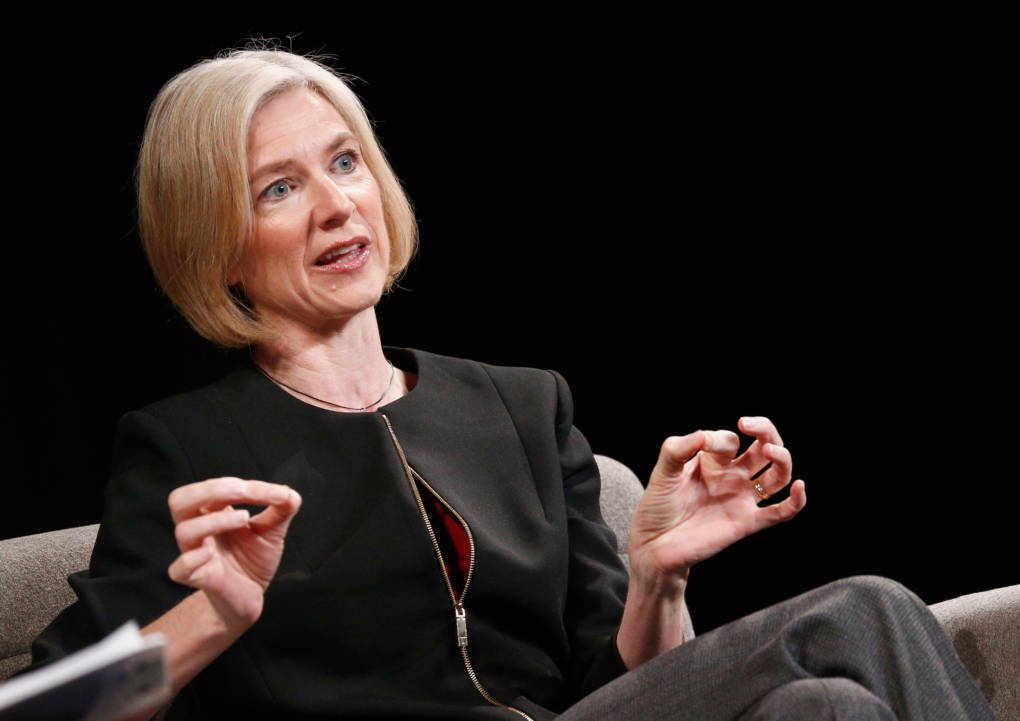
"caption": "Jennifer Doudna (Brian Ach/Getty Images)",
"description": null,
"title": "GettyImages-693524758",
"credit": "Brian Ach/Getty Images",
"status": "inherit",
"isLoading": false,
"fetchFailed": false
},
"science_1942524": {
"type": "attachments",
"id": "science_1942524",
"meta": {
"index": "attachments_1716263798",
"site": "science",
"id": "1942524",
"found": true
},
"parent": 1942520,
"imgSizes": {
"thumbnail": {
"file": "https://ww2.kqed.org/app/uploads/sites/35/2019/05/Saul-and-Stefan-in-Gabon-768x504-160x105.jpg",
"width": 160,
"mimeType": "image/jpeg",
"height": 105
},
"post-thumbnail": {
"file": "https://ww2.kqed.org/app/uploads/sites/35/2019/05/Saul-and-Stefan-in-Gabon-768x504-672x372.jpg",
"width": 672,
"mimeType": "image/jpeg",
"height": 372
},
"kqedFullSize": {
"file": "https://ww2.kqed.org/app/uploads/sites/35/2019/05/Saul-and-Stefan-in-Gabon-768x504.jpg",
"width": 768,
"height": 504
},
"medium_large": {
"file": "https://ww2.kqed.org/app/uploads/sites/35/2019/05/Saul-and-Stefan-in-Gabon-768x504-768x504.jpg",
"width": 768,
"mimeType": "image/jpeg",
"height": 504
}
},
"publishDate": 1559237670,
"modified": 1559238396,
"caption": "Kertesz and Saul Weiner working at a hospital in Gabon in the early 1990s.",
"description": null,
"title": "Saul-and-Stefan-in-Gabon-768x504",
"credit": "Saul Weiner",
"status": "inherit",
"isLoading": false,
"fetchFailed": false
},
"science_1941840": {
"type": "attachments",
"id": "science_1941840",
"meta": {
"index": "attachments_1716263798",
"site": "science",
"id": "1941840",
"found": true
},
"parent": 1941829,
"imgSizes": {
"twentyfourteen-full-width": {
"file": "https://ww2.kqed.org/app/uploads/sites/35/2019/05/04AAB122-1DD8-B71B-0B54651770E72740Original-1038x576.jpg",
"width": 1038,
"mimeType": "image/jpeg",
"height": 576
},
"thumbnail": {
"file": "https://ww2.kqed.org/app/uploads/sites/35/2019/05/04AAB122-1DD8-B71B-0B54651770E72740Original-160x107.jpg",
"width": 160,
"mimeType": "image/jpeg",
"height": 107
},
"post-thumbnail": {
"file": "https://ww2.kqed.org/app/uploads/sites/35/2019/05/04AAB122-1DD8-B71B-0B54651770E72740Original-672x372.jpg",
"width": 672,
"mimeType": "image/jpeg",
"height": 372
},
"kqedFullSize": {
"file": "https://ww2.kqed.org/app/uploads/sites/35/2019/05/04AAB122-1DD8-B71B-0B54651770E72740Original-e1558399333293.jpg",
"width": 1920,
"height": 1285
},
"large": {
"file": "https://ww2.kqed.org/app/uploads/sites/35/2019/05/04AAB122-1DD8-B71B-0B54651770E72740Original-1020x683.jpg",
"width": 1020,
"mimeType": "image/jpeg",
"height": 683
},
"complete_open_graph": {
"file": "https://ww2.kqed.org/app/uploads/sites/35/2019/05/04AAB122-1DD8-B71B-0B54651770E72740Original-1200x803.jpg",
"width": 1200,
"mimeType": "image/jpeg",
"height": 803
},
"full-width": {
"file": "https://ww2.kqed.org/app/uploads/sites/35/2019/05/04AAB122-1DD8-B71B-0B54651770E72740Original-1920x1285.jpg",
"width": 1920,
"mimeType": "image/jpeg",
"height": 1285
},
"medium": {
"file": "https://ww2.kqed.org/app/uploads/sites/35/2019/05/04AAB122-1DD8-B71B-0B54651770E72740Original-800x536.jpg",
"width": 800,
"mimeType": "image/jpeg",
"height": 536
},
"medium_large": {
"file": "https://ww2.kqed.org/app/uploads/sites/35/2019/05/04AAB122-1DD8-B71B-0B54651770E72740Original-768x514.jpg",
"width": 768,
"mimeType": "image/jpeg",
"height": 514
}
},
"publishDate": 1558033110,
"modified": 1558399418,
"caption": "A search and rescue helicopter lands on Half Dome at Yosemite National Park December 29, 2005. ",
"description": null,
"title": "Search and Rescue at Half Dome - Yosemite National Park",
"credit": "NPS/Dave Pope",
"status": "inherit",
"isLoading": false,
"fetchFailed": false
},
"science_1942069": {
"type": "attachments",
"id": "science_1942069",
"meta": {
"index": "attachments_1716263798",
"site": "science",
"id": "1942069",
"found": true
},
"parent": 1942067,
"imgSizes": {
"twentyfourteen-full-width": {
"file": "https://ww2.kqed.org/app/uploads/sites/35/2019/05/LungCancerCell_Wellcome-1024x576-1024x576.jpg",
"width": 1024,
"mimeType": "image/jpeg",
"height": 576
},
"thumbnail": {
"file": "https://ww2.kqed.org/app/uploads/sites/35/2019/05/LungCancerCell_Wellcome-1024x576-160x90.jpg",
"width": 160,
"mimeType": "image/jpeg",
"height": 90
},
"post-thumbnail": {
"file": "https://ww2.kqed.org/app/uploads/sites/35/2019/05/LungCancerCell_Wellcome-1024x576-672x372.jpg",
"width": 672,
"mimeType": "image/jpeg",
"height": 372
},
"kqedFullSize": {
"file": "https://ww2.kqed.org/app/uploads/sites/35/2019/05/LungCancerCell_Wellcome-1024x576-e1558457221964.jpg",
"width": 1024,
"height": 576
},
"large": {
"file": "https://ww2.kqed.org/app/uploads/sites/35/2019/05/LungCancerCell_Wellcome-1024x576-1020x574.jpg",
"width": 1020,
"mimeType": "image/jpeg",
"height": 574
},
"medium": {
"file": "https://ww2.kqed.org/app/uploads/sites/35/2019/05/LungCancerCell_Wellcome-1024x576-800x450.jpg",
"width": 800,
"mimeType": "image/jpeg",
"height": 450
},
"medium_large": {
"file": "https://ww2.kqed.org/app/uploads/sites/35/2019/05/LungCancerCell_Wellcome-1024x576-768x432.jpg",
"width": 768,
"mimeType": "image/jpeg",
"height": 432
}
},
"publishDate": 1558457171,
"modified": 1558457206,
"caption": "Scanning electron micrograph of lung cancer cells.",
"description": null,
"title": "LungCancerCell_Wellcome-1024x576",
"credit": "ANNE WESTON/FRANCIS CRICK INSTITUTE/WELLCOME",
"status": "inherit",
"isLoading": false,
"fetchFailed": false
},
"science_1941925": {
"type": "attachments",
"id": "science_1941925",
"meta": {
"index": "attachments_1716263798",
"site": "science",
"id": "1941925",
"found": true
},
"parent": 1940604,
"imgSizes": {
"twentyfourteen-full-width": {
"file": "https://ww2.kqed.org/app/uploads/sites/35/2019/05/San-Francisco-pollen-1038x576.jpg",
"width": 1038,
"mimeType": "image/jpeg",
"height": 576
},
"thumbnail": {
"file": "https://ww2.kqed.org/app/uploads/sites/35/2019/05/San-Francisco-pollen-160x109.jpg",
"width": 160,
"mimeType": "image/jpeg",
"height": 109
},
"post-thumbnail": {
"file": "https://ww2.kqed.org/app/uploads/sites/35/2019/05/San-Francisco-pollen-672x372.jpg",
"width": 672,
"mimeType": "image/jpeg",
"height": 372
},
"kqedFullSize": {
"file": "https://ww2.kqed.org/app/uploads/sites/35/2019/05/San-Francisco-pollen.jpg",
"width": 1920,
"height": 1305
},
"large": {
"file": "https://ww2.kqed.org/app/uploads/sites/35/2019/05/San-Francisco-pollen-1020x693.jpg",
"width": 1020,
"mimeType": "image/jpeg",
"height": 693
},
"complete_open_graph": {
"file": "https://ww2.kqed.org/app/uploads/sites/35/2019/05/San-Francisco-pollen-1200x816.jpg",
"width": 1200,
"mimeType": "image/jpeg",
"height": 816
},
"full-width": {
"file": "https://ww2.kqed.org/app/uploads/sites/35/2019/05/San-Francisco-pollen-1920x1305.jpg",
"width": 1920,
"mimeType": "image/jpeg",
"height": 1305
},
"medium": {
"file": "https://ww2.kqed.org/app/uploads/sites/35/2019/05/San-Francisco-pollen-800x544.jpg",
"width": 800,
"mimeType": "image/jpeg",
"height": 544
},
"medium_large": {
"file": "https://ww2.kqed.org/app/uploads/sites/35/2019/05/San-Francisco-pollen-768x522.jpg",
"width": 768,
"mimeType": "image/jpeg",
"height": 522
}
},
"publishDate": 1558135555,
"modified": 1558135666,
"caption": "Canyon live oak tree in the San Francisco Botanical Garden on May 17, 2019. ",
"description": null,
"title": "San Francisco pollen",
"credit": "Lindsey Moore/KQED",
"status": "inherit",
"isLoading": false,
"fetchFailed": false
},
"science_1941252": {
"type": "attachments",
"id": "science_1941252",
"meta": {
"index": "attachments_1716263798",
"site": "science",
"id": "1941252",
"found": true
},
"parent": 1941251,
"imgSizes": {
"twentyfourteen-full-width": {
"file": "https://ww2.kqed.org/app/uploads/sites/35/2019/05/dna-pipette-gene-editing-6b1118334ef1833789bfe24e0c42d6e282de57a8-1038x576.jpg",
"width": 1038,
"mimeType": "image/jpeg",
"height": 576
},
"thumbnail": {
"file": "https://ww2.kqed.org/app/uploads/sites/35/2019/05/dna-pipette-gene-editing-6b1118334ef1833789bfe24e0c42d6e282de57a8-160x120.jpg",
"width": 160,
"mimeType": "image/jpeg",
"height": 120
},
"post-thumbnail": {
"file": "https://ww2.kqed.org/app/uploads/sites/35/2019/05/dna-pipette-gene-editing-6b1118334ef1833789bfe24e0c42d6e282de57a8-672x372.jpg",
"width": 672,
"mimeType": "image/jpeg",
"height": 372
},
"kqedFullSize": {
"file": "https://ww2.kqed.org/app/uploads/sites/35/2019/05/dna-pipette-gene-editing-6b1118334ef1833789bfe24e0c42d6e282de57a8-e1557165220459.jpg",
"width": 1920,
"height": 1440
},
"large": {
"file": "https://ww2.kqed.org/app/uploads/sites/35/2019/05/dna-pipette-gene-editing-6b1118334ef1833789bfe24e0c42d6e282de57a8-1020x765.jpg",
"width": 1020,
"mimeType": "image/jpeg",
"height": 765
},
"complete_open_graph": {
"file": "https://ww2.kqed.org/app/uploads/sites/35/2019/05/dna-pipette-gene-editing-6b1118334ef1833789bfe24e0c42d6e282de57a8-1200x900.jpg",
"width": 1200,
"mimeType": "image/jpeg",
"height": 900
},
"full-width": {
"file": "https://ww2.kqed.org/app/uploads/sites/35/2019/05/dna-pipette-gene-editing-6b1118334ef1833789bfe24e0c42d6e282de57a8-1920x1440.jpg",
"width": 1920,
"mimeType": "image/jpeg",
"height": 1440
},
"medium": {
"file": "https://ww2.kqed.org/app/uploads/sites/35/2019/05/dna-pipette-gene-editing-6b1118334ef1833789bfe24e0c42d6e282de57a8-800x600.jpg",
"width": 800,
"mimeType": "image/jpeg",
"height": 600
},
"medium_large": {
"file": "https://ww2.kqed.org/app/uploads/sites/35/2019/05/dna-pipette-gene-editing-6b1118334ef1833789bfe24e0c42d6e282de57a8-768x576.jpg",
"width": 768,
"mimeType": "image/jpeg",
"height": 576
}
},
"publishDate": 1557161079,
"modified": 1557165199,
"caption": "As scientists learn more about the complex way genes combine and work together to create human traits, the idea of 'designer babies' becomes less and less likely.",
"description": "As scientists learn more about the complex way genes combine and work together to create human traits, the idea of \"designer babies\" becomes less and less likely.",
"title": "As scientists learn more about the complex way genes combine and work together to create human traits, the idea of \"designer babies\" becomes less and less likely.",
"credit": "BlackJack3D/Getty",
"status": "inherit",
"isLoading": false,
"fetchFailed": false
},
"science_1941050": {
"type": "attachments",
"id": "science_1941050",
"meta": {
"index": "attachments_1716263798",
"site": "science",
"id": "1941050",
"found": true
},
"parent": 1941045,
"imgSizes": {
"twentyfourteen-full-width": {
"file": "https://ww2.kqed.org/app/uploads/sites/35/2019/05/GettyImages-1088810266-1024x576-1024x576.jpg",
"width": 1024,
"mimeType": "image/jpeg",
"height": 576
},
"thumbnail": {
"file": "https://ww2.kqed.org/app/uploads/sites/35/2019/05/GettyImages-1088810266-1024x576-160x90.jpg",
"width": 160,
"mimeType": "image/jpeg",
"height": 90
},
"post-thumbnail": {
"file": "https://ww2.kqed.org/app/uploads/sites/35/2019/05/GettyImages-1088810266-1024x576-672x372.jpg",
"width": 672,
"mimeType": "image/jpeg",
"height": 372
},
"kqedFullSize": {
"file": "https://ww2.kqed.org/app/uploads/sites/35/2019/05/GettyImages-1088810266-1024x576.jpg",
"width": 1024,
"height": 576
},
"large": {
"file": "https://ww2.kqed.org/app/uploads/sites/35/2019/05/GettyImages-1088810266-1024x576-1020x574.jpg",
"width": 1020,
"mimeType": "image/jpeg",
"height": 574
},
"medium": {
"file": "https://ww2.kqed.org/app/uploads/sites/35/2019/05/GettyImages-1088810266-1024x576-800x450.jpg",
"width": 800,
"mimeType": "image/jpeg",
"height": 450
},
"medium_large": {
"file": "https://ww2.kqed.org/app/uploads/sites/35/2019/05/GettyImages-1088810266-1024x576-768x432.jpg",
"width": 768,
"mimeType": "image/jpeg",
"height": 432
}
},
"publishDate": 1556751390,
"modified": 1556815216,
"caption": "Theranos whistleblowers Erika Cheung and Tyler Shultz. ",
"description": null,
"title": "GettyImages-1088810266-1024x576",
"credit": "Daniel Boczarski/Getty Images for New York Magazine",
"status": "inherit",
"isLoading": false,
"fetchFailed": false
}
},
"audioPlayerReducer": {
"postId": "stream_live",
"isPaused": true,
"isPlaying": false,
"pfsActive": false,
"pledgeModalIsOpen": true,
"playerDrawerIsOpen": false,
"liveAudioPlayStartedAt": 0,
"liveAudioPlayContext": ""
},
"authorsReducer": {
"byline_science_1943825": {
"type": "authors",
"id": "byline_science_1943825",
"meta": {
"override": true
},
"slug": "byline_science_1943825",
"name": "Julie Appleby and Elizabeth Lucas \u003cbr/> Kaiser Health News \u003cbr>",
"isLoading": false
},
"byline_science_1943477": {
"type": "authors",
"id": "byline_science_1943477",
"meta": {
"override": true
},
"slug": "byline_science_1943477",
"name": "Gabriel Filippelli",
"isLoading": false
},
"byline_science_1943360": {
"type": "authors",
"id": "byline_science_1943360",
"meta": {
"override": true
},
"slug": "byline_science_1943360",
"name": "Emmarie Huetteman \u003cbr/> Kaiser Health News",
"isLoading": false
},
"byline_science_1942520": {
"type": "authors",
"id": "byline_science_1942520",
"meta": {
"override": true
},
"slug": "byline_science_1942520",
"name": "Andrew Joseph \u003cbr/> STAT \u003cbr>",
"isLoading": false
},
"byline_science_1942067": {
"type": "authors",
"id": "byline_science_1942067",
"meta": {
"override": true
},
"slug": "byline_science_1942067",
"name": "Casey Ross \u003c/br>STAT\u003cbr>",
"isLoading": false
},
"byline_science_1941251": {
"type": "authors",
"id": "byline_science_1941251",
"meta": {
"override": true
},
"slug": "byline_science_1941251",
"name": "Richard Harris\u003cbr />NPR",
"isLoading": false
},
"byline_science_1941045": {
"type": "authors",
"id": "byline_science_1941045",
"meta": {
"override": true
},
"slug": "byline_science_1941045",
"name": "Rick Berke\u003cbr />STAT",
"isLoading": false
},
"kqedscience": {
"type": "authors",
"id": "6387",
"meta": {
"index": "authors_1716337520",
"id": "6387",
"found": true
},
"name": "KQED Science",
"firstName": "KQED",
"lastName": "Science",
"slug": "kqedscience",
"email": "kqedscience@gmail.com",
"display_author_email": false,
"staff_mastheads": [],
"title": null,
"bio": "KQED Science brings you award-winning science and environment coverage from the Bay Area and beyond by the flagship Northern California PBS and NPR affiliate.",
"avatar": "https://secure.gravatar.com/avatar/5a295ff49cf82a8c0f30937d3f788b2f?s=600&d=blank&r=g",
"twitter": null,
"facebook": null,
"instagram": null,
"linkedin": null,
"sites": [
{
"site": "science",
"roles": [
"contributor"
]
},
{
"site": "quest",
"roles": [
"editor"
]
},
{
"site": "food",
"roles": [
"contributor"
]
}
],
"headData": {
"title": "KQED Science | KQED",
"description": null,
"ogImgSrc": "https://secure.gravatar.com/avatar/5a295ff49cf82a8c0f30937d3f788b2f?s=600&d=blank&r=g",
"twImgSrc": "https://secure.gravatar.com/avatar/5a295ff49cf82a8c0f30937d3f788b2f?s=600&d=blank&r=g"
},
"isLoading": false,
"link": "/author/kqedscience"
},
"kevinstark": {
"type": "authors",
"id": "11608",
"meta": {
"index": "authors_1716337520",
"id": "11608",
"found": true
},
"name": "Kevin Stark",
"firstName": "Kevin",
"lastName": "Stark",
"slug": "kevinstark",
"email": "kstark@kqed.org",
"display_author_email": true,
"staff_mastheads": [
"science"
],
"title": "Senior Editor",
"bio": "Kevin is a senior editor for KQED Science, managing the station's health and climate desks. His journalism career began in the Pacific Northwest, and he later became a lead reporter for the San Francisco Public Press. His work has appeared in Pacific Standard magazine, the Energy News Network, the Center for Investigative Reporting's Reveal and WBEZ in Chicago. Kevin joined KQED in 2019, and has covered issues related to energy, wildfire, climate change and the environment.",
"avatar": "https://secure.gravatar.com/avatar/365aaa4b597d3a8374f67504ff0facd323d7906e8eb4be0a7efd2427408e802c?s=600&d=blank&r=g",
"twitter": "starkkev",
"bluesky": null,
"facebook": null,
"instagram": null,
"linkedin": null,
"sites": [
{
"site": "",
"roles": [
"editor"
]
},
{
"site": "news",
"roles": [
"editor"
]
},
{
"site": "science",
"roles": [
"administrator"
]
}
],
"headData": {
"title": "Kevin Stark | KQED",
"description": "Senior Editor",
"ogImgSrc": "https://secure.gravatar.com/avatar/365aaa4b597d3a8374f67504ff0facd323d7906e8eb4be0a7efd2427408e802c?s=600&d=blank&r=g",
"twImgSrc": "https://secure.gravatar.com/avatar/365aaa4b597d3a8374f67504ff0facd323d7906e8eb4be0a7efd2427408e802c?s=600&d=blank&r=g"
},
"isLoading": false,
"link": "/author/kevinstark"
}
},
"pagesReducer": {
"science_category_health": {
"type": "terms",
"id": "science_39",
"meta": {
"index": "terms_1716263798",
"site": "science",
"id": "39",
"score": 10.889561
},
"featImg": null,
"name": "Health",
"description": null,
"taxonomy": "category",
"headData": {
"twImgId": null,
"twTitle": null,
"ogTitle": null,
"ogImgId": null,
"twDescription": null,
"description": null,
"title": "Health Archives | KQED Science",
"ogDescription": null
},
"ttid": 41,
"slug": "health",
"isLoading": false,
"title": "Health",
"pageMeta": {
"site": "science",
"WpPageTemplate": "page-topic-editorial",
"currentPage": 40
},
"blocks": [
{
"blockName": "kqed/post-list",
"attrs": {
"layout": "cardArticle2",
"query": "posts/science?category=health",
"seeMore": false,
"paginated": true,
"page": 40
}
},
{
"blockName": "kqed/ad"
}
]
}
},
"pfsSessionReducer": {},
"postsReducer": {
"stream_live": {
"type": "live",
"id": "stream_live",
"audioUrl": "https://streams.kqed.org/kqedradio",
"title": "Live Stream",
"excerpt": "Live Stream information currently unavailable.",
"link": "/radio",
"featImg": "",
"label": {
"name": "KQED Live",
"link": "/"
}
},
"stream_kqedNewscast": {
"type": "posts",
"id": "stream_kqedNewscast",
"audioUrl": "https://www.kqed.org/.stream/anon/radio/RDnews/newscast.mp3?_=1",
"title": "KQED Newscast",
"featImg": "",
"label": {
"name": "88.5 FM",
"link": "/"
}
},
"science_1943825": {
"type": "posts",
"id": "science_1943825",
"meta": {
"index": "posts_1716263798",
"site": "science",
"id": "1943825",
"score": null,
"sort": [
1561406860000
]
},
"parent": 0,
"labelTerm": {},
"blocks": [],
"publishDate": 1561406860,
"format": "standard",
"title": "Surgeons Are Still Prescribing Opioids at Alarming Rates",
"headTitle": "Surgeons Are Still Prescribing Opioids at Alarming Rates | KQED",
"content": "\u003cp>As opioid addiction and deadly overdoses escalated into an epidemic across the U.S., thousands of surgeons continued to hand out far more pills than needed for postoperative pain relief, according to a \u003ca href=\"https://khn.org/news/opioid-prescribing/\">Kaiser Health News-Johns Hopkins analysis\u003c/a> of Medicare data.\u003c/p>\n\u003cp>\u003cspan style=\"font-weight: 400\">[pullquote align='right' citation='Dr. Marty Makary, Johns Hopkins']“I think there’s an ‘aha’ moment that many of us in medicine have had or need to have.”[/pullquote]\u003c/span>\u003c/p>\n\u003cp>Many doctors wrote prescriptions for dozens of opioid tablets after surgeries — even for operations that cause most patients relatively little pain, according to the analysis, done in collaboration with researchers at Johns Hopkins Bloomberg School of Public Health. It examined almost 350,000 prescriptions written for patients operated on by nearly 20,000 surgeons from 2011 to 2016 — the latest year for which data are available.\u003c/p>\n\u003cp>Some surgeons wrote prescriptions for more than 100 opioid pills in the week following the surgery. The total amounts often exceeded current guidelines from several academic medical centers, which call for zero to 10 pills for many of the procedures in the analysis, and up to 30 for coronary bypass surgery.\u003c/p>\n\u003cp>While hundreds of state and local lawsuits have been filed against opioid manufacturers, claiming they engaged in aggressive and misleading marketing of these addictive drugs, the role of physicians in contributing to a national tragedy has received less scrutiny. Research shows that a significant portion of people who become addicted to opioids started with a prescription after surgery.\u003c/p>\n\u003cp>[ad fullwidth]\u003c/p>\n\u003cp>In sheer numbers, opioid prescribing in the U.S. \u003ca href=\"https://www.cdc.gov/mmwr/volumes/66/wr/mm6626a4.htm\" target=\"_blank\" rel=\"noopener\">peaked in 2010\u003c/a>, but it remains \u003ca href=\"https://theconversation.com/what-the-us-can-learn-from-other-countries-in-dealing-with-pain-and-the-opioid-crisis-97491\" target=\"_blank\" rel=\"noopener\">among the highest in the world\u003c/a>, according to studies and other data.\u003c/p>\n\u003cp>In 2016, opioids of all kinds were linked to 42,249 deaths, up from the 33,091 reported in 2015. The opioid-related death rate jumped nearly 28% from the year before, \u003ca href=\"https://www.cdc.gov/mmwr/volumes/67/wr/mm6712a1.htm\" target=\"_blank\" rel=\"noopener\">according to the CDC\u003c/a>.\u003c/p>\n\u003cp>Yet long-ingrained and freewheeling prescribing patterns changed little over the six years analyzed. KHN and Johns Hopkins examined the prescribing habits of all U.S. surgeons who frequently perform seven common surgical procedures and found that in the first week after surgery:\u003c/p>\n\u003cp>Coronary artery bypass patients operated on by the highest-prescribing 1% of surgeons filled prescriptions in 2016 exceeding an average of 105 opioid pills.\u003c/p>\n\u003cp>Patients undergoing a far less painful procedure — a lumpectomy to remove a breast tumor — were given an average of 26 pills in 2016 the week after surgery. The highest-prescribing 5% of surgeons prescribed 40 to 70 pills on average.\u003c/p>\n\u003cp>Some knee surgery patients took home more than 100 pills in the week following their surgery.\u003c/p>\n\u003cp>Those amounts — each “pill” in the analysis was the equivalent of 5 milligrams of oxycodone — are many times what is currently recommended by some physician groups to relieve acute pain, which occurs as a result of surgery, accident or injury. The analysis included only patients not prescribed opioids in the year before their operation.\u003c/p>\n\u003cp>“Prescribers should have known better” based on studies and other information available at the time, said Andrew Kolodny, co-director of opioid policy research at Brandeis University and director of the advocacy group Physicians for Responsible Opioid Prescribing.\u003c/p>\n\u003cp>While the dataset included only prescriptions written for patients on Medicare, the findings may well understate the depth of the problem, since doctors are more hesitant to give older patients the powerful painkillers because of their sedating side effects.\u003c/p>\n\u003cp>Surgeons’ prescribing habits are significant because \u003ca href=\"https://jamanetwork.com/journals/jamasurgery/fullarticle/2618383\" target=\"_blank\" rel=\"noopener\">studies show\u003c/a> that 6% of patients who are prescribed opioids after surgery will still be taking them three to six months later, having become dependent. The likelihood of persistent use rises with the number of pills and the length of time opioids are taken during recuperation.\u003c/p>\n\u003cp>Also, unused pills in medicine cabinets can make their way onto the street.\u003c/p>\n\u003cp>Dr. Marty Makary, a surgical oncologist at Johns Hopkins, admits that he too once handed out opioids liberally. Now he is marshaling a campaign to get surgeons to use these powerful painkillers more consciously and sparingly. “I think there’s an ‘aha’ moment that many of us in medicine have had or need to have,” he said.\u003c/p>\n\u003cp>But old habits are hard to kick.\u003c/p>\n\u003cp>KHN contacted dozens of the surgeons who topped the ranks of opioid prescribers in the 2016 database. They hailed from small, community hospitals as well as major academic medical centers. The majority declined to comment, some bristling when questioned.\u003c/p>\n\u003cp>You can search the KHN database by doctor and hospital \u003ca href=\"https://khn.org/news/opioid-prescribing/\" target=\"_blank\" rel=\"noopener\">here.\u003c/a>\u003c/p>\n\u003cp>Some of those surgeons were critical of the analysis, saying it didn’t take into account certain essential factors. For example, it was not possible to determine whether patients had complications or needed higher amounts of pain medication for another reason. And some surgeons had only a handful of patients who filled prescriptions, making for a small sample size.\u003c/p>\n\u003cp>But surgeons also indicated that the way they prescribe pain pills was less than intentional. It was sometimes an outgrowth of computer programs that default to preset amounts following procedures, or practice habits developed before the opioid crisis. Additionally, they blame efforts in the late 1990s and early 2000s that encouraged doctors and hospitals to consider pain as “the fifth vital sign.” A major hospital accrediting group required providers to ask patients how well their pain was treated. Pharmaceutical companies used the fifth vital sign campaign as a way to promote their opioid treatments.\u003c/p>\n\u003cp>Makary, who oversaw the analysis of the Medicare dataset, said that, while opioid prescribing is slowly dropping, to date many surgeons have not paid enough attention to the problem or responded with sufficient urgency.\u003c/p>\n\u003cp>Dr. Audrey Garrett, an oncologic surgeon in Oregon, said she was “surprised” to hear that she was among the top tier of prescribers. She said she planned to re-evaluate her clinic’s automated prescribing program, which is set to order specific amounts of opioids.\u003c/p>\n\u003cp>KHN will analyze data for 2017 and subsequent years when it becomes available to follow how prescribing is changing.\u003c/p>\n\u003cp>\u003cstrong>Prescribing Patterns Highlight What’s At Stake\u003c/strong>\u003c/p>\n\u003cp>The analysis examined prescribing habits after seven common procedures: coronary artery bypass, minimally invasive gallbladder removal, lumpectomy, meniscectomy (which removes part of a torn meniscus in the knee), minimally invasive hysterectomy, open colectomy and prostatectomy.\u003c/p>\n\u003cp>Across the board, the analysis showed that physicians gave a large number of narcotics when fewer pills or alternative medications, including over-the-counter pain relief tablets, could be equally effective, according to recent guidelines from Makary and other academic researchers.\u003c/p>\n\u003cp>On average, from 2011 to 2016, Medicare patients in the analysis took home 48 pills in the week following coronary artery bypass; 31 following laparoscopic gallbladder removal; 28 after a lumpectomy; 41 after meniscectomy; 34 after minimally invasive hysterectomy; 34 after open colon surgery; and 33 after prostatectomy.\u003c/p>\n\u003cp>\u003cimg loading=\"lazy\" decoding=\"async\" class=\"alignnone size-medium wp-image-1943831\" src=\"https://ww2.kqed.org/science/wp-content/uploads/sites/35/2019/06/opioid-prescribing-chart2-800x533.png\" alt=\"\" width=\"800\" height=\"533\" srcset=\"https://cdn.kqed.org/wp-content/uploads/sites/35/2019/06/opioid-prescribing-chart2-800x533.png 800w, https://cdn.kqed.org/wp-content/uploads/sites/35/2019/06/opioid-prescribing-chart2-160x107.png 160w, https://cdn.kqed.org/wp-content/uploads/sites/35/2019/06/opioid-prescribing-chart2-768x512.png 768w, https://cdn.kqed.org/wp-content/uploads/sites/35/2019/06/opioid-prescribing-chart2-1020x679.png 1020w, https://cdn.kqed.org/wp-content/uploads/sites/35/2019/06/opioid-prescribing-chart2-1200x799.png 1200w, https://cdn.kqed.org/wp-content/uploads/sites/35/2019/06/opioid-prescribing-chart2.png 1270w\" sizes=\"(max-width: 800px) 100vw, 800px\">\u003c/p>\n\u003cp>According to \u003ca href=\"https://www.solvethecrisis.org/best-practices\">post-surgical guidelines\u003c/a> spearheaded by Makary for his hospital last year, those surgeries should require at most 30 pills for bypass; 10 pills for minimally invasive gallbladder removal, lumpectomy, minimally invasive hysterectomy and prostatectomy; and eight pills for knee surgery. It has not yet published a guideline for open colon surgery.\u003c/p>\n\u003cp>The Johns Hopkins’ doctors developed their own standards because of a dearth of national guidelines for post-surgical opioids. They arrived at those figures after \u003ca href=\"https://khn.org/news/doling-out-pain-pills-post-surgery-an-ingrown-toenail-not-the-same-as-a-bypass/\">reaching a consensus\u003c/a> among surgeons, nurses, patients and other medical staff on how many pills were needed after particular surgeries.\u003c/p>\n\u003cp>Hoping to reduce overprescribing, Makary is preparing to send letters next month to surgeons around the country who are among the highest opioid prescribers under a grant he received from the Arnold Foundation, a nonprofit group whose focus includes drug price issues. (Kaiser Health News also received funding from the Arnold Foundation.)\u003c/p>\n\u003cp>Even if the prescription numbers have fallen since 2016, the amounts given today are likely still excessive.\u003c/p>\n\u003cp>“When prescribing may have been five to 20 times too high, even a reduction that is quite meaningful still likely reflects overprescribing,” said Dr. Chad Brummett, an anesthesiologist and associate professor at the University of Michigan.\u003c/p>\n\u003cp>Brummett is also co-director of the Michigan Opioid Prescribing Engagement Network, a collaboration of physicians that makes \u003ca href=\"https://www.opioidprescribing.info/\">surgery-specific recommendations\u003c/a>, many of them in the 10- to 20-pill range.\u003c/p>\n\u003cp>“Reducing unnecessary exposure is key to reducing the risk of new addiction,” said former Food and Drug Administration commissioner Scott Gottlieb. In August 2018, when Gottlieb was at the agency’s helm, it commissioned a report from the National Academy of Sciences on how best to set opioid prescribing guidelines for acute pain from specific conditions or surgical procedures. Its findings are expected later this year.\u003c/p>\n\u003cp>“There are still too many 30-tablet prescriptions being written,” said Gottlieb.\u003c/p>\n\u003cp>\u003cstrong>Healers Sowing Disease?\u003c/strong>\u003c/p>\n\u003cp>Naturally, surgeons rankle at the idea that they played a role in the opioid epidemic. But studies raise serious concerns.\u003c/p>\n\u003cp>Transplant surgeon Dr. Michael Engelsbe, director of the Michigan Surgical Quality Collaborative, points to the study showing 6% of post-op patients who get opioids for pain develop long-term dependence. That means a surgeon who does 300 operations a year paves the way for 18 newly dependent people, he said.\u003c/p>\n\u003cp>Many patients do not need the amounts prescribed.\u003c/p>\n\u003cp>Intermountain Healthcare, a not-for-profit system of hospitals, clinics, and doctors in Utah, began surveying patients two years ago to find out how much of their prescribed supply of opioids they actually took following surgery.\u003c/p>\n\u003cp>“Globally, we were overprescribing by 50%,” said Dr. David Hasleton, senior medical director.\u003c/p>\n\u003cp>But Intermountain approached individual doctors carefully. “If you go to a prescriber to say, ‘You are overprescribing,’ it never goes well. A common reaction is, ‘Your data is wrong’ or ‘My patients are different than his,’” said Hasleton.\u003c/p>\n\u003cp>For the analysis, KHN attempted to contact more than 50 surgeons whose 2016 numbers ranked them among the top prescribers in each surgical category.\u003c/p>\n\u003cp>One who did agree to speak was Dr. Daniel J. Waters, who 13 years ago had his chest cut open to remove a tumor, an operation technically similar to what he does for a living: coronary artery bypass.\u003c/p>\n\u003cp>“So I have both the doctor perspective and the patient perspective,” said Waters, who practices in Mason City, Iowa.\u003c/p>\n\u003cp>In 2016, Waters’ Medicare bypass patients who filled their prescriptions took home an average of nearly 157 pills each, according to the KHN-Johns Hopkins analysis.\u003c/p>\n\u003cp>“When I went home from the hospital, 30 would not have been enough,” said Waters of the number recommended by the Hopkins team for that surgery.\u003c/p>\n\u003cp>But he said he has recently curbed his prescribing to 84 pills.\u003c/p>\n\u003cp>Nationally, the average prescription filled for a coronary artery bypass was 49 pills in 2016 and had changed little since 2011, the analysis shows.\u003c/p>\n\u003cp>Others who spoke with KHN said they had developed the habit of prescribing copiously — sometimes giving out multiple opioid prescriptions — because they didn’t want patients to get stuck far from the office or over a weekend with pain or because they were trying to avoid calls from dissatisfied, hurting patients.\u003c/p>\n\u003cp>In the KHN-Johns Hopkins data, the seven patients of Dr. Antonio Santillan-Gomez who filled opioid prescriptions after minimally invasive hysterectomies in 2016 received an average of 77 pills each.\u003c/p>\n\u003cp>A gynecologic oncologist, Santillan-Gomez said: “I’m in San Antonio, and some of my patients come from Laredo or Corpus Christi, so they would have to drive two to three hours for a prescription.”\u003c/p>\n\u003cp>Still, he said, since e-prescribing of opioids became more widespread in the past few years, he and other surgeons in his group have limited prescriptions to 20 to 30 pills and encouraged patients to take Tylenol or other over-the-counter medications if they run out. E-prescribing can not only help track patients getting opioids but also reduce the problem of patients having to drive back to the office to get a written prescription.\u003c/p>\n\u003cp>Dr. Janet Grange, a breast surgeon in Omaha, Neb., said that in her experience, opioid dependence had not been a problem.\u003c/p>\n\u003cp>“I can absolutely tell you I don’t have even 1% who become long-term opioid users,” said Grange.\u003c/p>\n\u003cp>The analysis showed that Grange had 12 opioid-naïve Medicare patients who had a lumpectomy in 2016. Eight of them filled prescriptions for an average of 47 pills per patient.\u003c/p>\n\u003cp>She called Johns Hopkins’ zero-to-10-pill pain-control recommendation following that procedure “miserly.”\u003c/p>\n\u003cp>\u003cstrong>The Pendulum Swings\u003c/strong>\u003c/p>\n\u003cp>Some of the higher-prescribing surgeons in the KHN-Johns Hopkins analysis reflected on their potential contribution to a national catastrophe and are changing their practice.\u003c/p>\n\u003cp>“That is a shocking number,” said oncologist Garrett, speaking of the finding that 6% of patients who go home with opioids will become dependent. “If it’s true, it’s something we need to educate physicians on much earlier in their medical careers.”\u003c/p>\n\u003cp>Garrett, in Eugene, Ore., said she has cut back on the number of pills she gives patients since 2016. The KHN-Johns Hopkins analysis showed that seven of her 13 opioid-naïve Medicare patients undergoing minimally invasive hysterectomies filled a prescription for opioids in 2016. Those patients took home an average of 76 pills each.\u003c/p>\n\u003cp>Johns Hopkins guidelines call for no more than 10 opioid pills following this procedure, while Brummett’s Michigan network recommends no more than 15.\u003c/p>\n\u003cp>Surgeon and researcher Dr. Richard Barth, once a heavy prescriber himself, said that his own experience convinced him that physicians’ preconceptions about how much pain relief is needed are often way off.\u003c/p>\n\u003cp>The analysis showed his lumpectomy patients in 2013 filled an average of 33 pills in the week after surgery. By 2016, that average had dropped to seven pills. Many patients, he said, can do just fine after lumpectomy with over-the-counter medications — and often no opioids at all.\u003c/p>\n\u003cp>The key, he said, is to set patients’ expectations upfront.\u003c/p>\n\u003cp>“I tell them it’s OK to have a little discomfort, that we’re not trying to get to zero pain,” said Barth, who is chief of general surgery at Dartmouth-Hitchcock Medical Center and has published extensively on opioid prescribing.\u003c/p>\n\u003cp>After lumpectomy, “what I recommend is Tylenol and ibuprofen for at least a few days and to use the opioids only if the discomfort isn’t relieved by those.”\u003c/p>\n\u003cp>Indeed, the data analysis showed that a significant number of patients given prescriptions for opioids never filled them because they don’t need that level of pain relief.\u003c/p>\n\u003cp>Between 2011 and 2016, for example, only 62% of lumpectomy patients in the analysis filled prescriptions, similar to hysterectomy patients.\u003c/p>\n\u003cp>In 2016, patients of Dr. Kimberli Cox, a surgeon in Peoria, Ariz., were prescribed about 59 pills in the week following lumpectomy, well above the recommendations from both Johns Hopkins and others.\u003c/p>\n\u003cp>But the KHN-Johns Hopkins analysis of that year’s data shows that half of her patients never filled a painkiller prescription — a fact she acknowledges has changed her thinking.\u003c/p>\n\u003cp>“I am now starting to prescribe less because many patients say, ‘You gave me too many’ or ‘I didn’t fill it,” she said.\u003c/p>\n\u003cp>\u003cem>This story was produced by \u003ca href=\"http://khn.org/\" target=\"_blank\" rel=\"noopener\">Kaiser Health News\u003c/a>, an editorially independent program of the \u003ca href=\"https://www.kff.org/\" target=\"_blank\" rel=\"noopener\">Kaiser Family Foundation\u003c/a>.\u003c/em>\u003c/p>\n\u003cp>[ad floatright]\u003c/p>\n\u003cp>\u003cem>\u003ca href=\"http://www.kaiserhealthnews.org/\" target=\"_blank\" rel=\"noopener\">Kaiser Health News\u003c/a> (KHN) is a national health policy news service. It is an editorially independent program of the \u003ca href=\"http://www.kff.org/\" target=\"_blank\" rel=\"noopener\">Henry J. Kaiser Family Foundation\u003c/a> which is not affiliated with Kaiser Permanente.\u003c/em>\u003c/p>\n\n",
"stats": {
"hasVideo": false,
"hasChartOrMap": false,
"hasAudio": false,
"hasPolis": false,
"wordCount": 2649,
"hasGoogleForm": false,
"hasGallery": false,
"hasHearkenModule": false,
"iframeSrcs": [],
"paragraphCount": 79
},
"modified": 1704848572,
"excerpt": "A new data analysis by Kaiser Health News and Johns Hopkins researchers shows that even as the CDC issued warnings, surgeons handed out many times the number of opioid pills needed for post-op pain.",
"headData": {
"twImgId": "",
"twTitle": "",
"ogTitle": "",
"ogImgId": "",
"twDescription": "",
"description": "A new data analysis by Kaiser Health News and Johns Hopkins researchers shows that even as the CDC issued warnings, surgeons handed out many times the number of opioid pills needed for post-op pain.",
"title": "Surgeons Are Still Prescribing Opioids at Alarming Rates | KQED",
"ogDescription": "",
"schema": {
"@context": "https://schema.org",
"@type": "Article",
"headline": "Surgeons Are Still Prescribing Opioids at Alarming Rates",
"datePublished": "2019-06-24T13:07:40-07:00",
"dateModified": "2024-01-09T17:02:52-08:00",
"image": "https://cdn.kqed.org/wp-content/uploads/2020/02/KQED-OG-Image@1x.png"
}
},
"guestAuthors": [],
"slug": "surgeons-are-still-prescribing-opioids-at-alarming-rates",
"status": "publish",
"nprByline": "Julie Appleby and Elizabeth Lucas \u003cbr/> Kaiser Health News \u003cbr>",
"sticky": false,
"source": "Kaiser Health News",
"path": "/science/1943825/surgeons-are-still-prescribing-opioids-at-alarming-rates",
"audioTrackLength": null,
"parsedContent": [
{
"type": "contentString",
"content": "\u003cdiv class=\"post-body\">\u003cp>\u003cp>As opioid addiction and deadly overdoses escalated into an epidemic across the U.S., thousands of surgeons continued to hand out far more pills than needed for postoperative pain relief, according to a \u003ca href=\"https://khn.org/news/opioid-prescribing/\">Kaiser Health News-Johns Hopkins analysis\u003c/a> of Medicare data.\u003c/p>\n\u003cp>\u003cspan style=\"font-weight: 400\">\u003c/p>\u003c/div>",
"attributes": {
"named": {},
"numeric": []
}
},
{
"type": "component",
"content": "“I think there’s an ‘aha’ moment that many of us in medicine have had or need to have.”",
"name": "pullquote",
"attributes": {
"named": {
"align": "right",
"citation": "Dr. Marty Makary, Johns Hopkins",
"label": ""
},
"numeric": []
}
},
{
"type": "contentString",
"content": "\u003cdiv class=\"post-body\">\u003cp>\u003c/span>\u003c/p>\n\u003cp>Many doctors wrote prescriptions for dozens of opioid tablets after surgeries — even for operations that cause most patients relatively little pain, according to the analysis, done in collaboration with researchers at Johns Hopkins Bloomberg School of Public Health. It examined almost 350,000 prescriptions written for patients operated on by nearly 20,000 surgeons from 2011 to 2016 — the latest year for which data are available.\u003c/p>\n\u003cp>Some surgeons wrote prescriptions for more than 100 opioid pills in the week following the surgery. The total amounts often exceeded current guidelines from several academic medical centers, which call for zero to 10 pills for many of the procedures in the analysis, and up to 30 for coronary bypass surgery.\u003c/p>\n\u003cp>While hundreds of state and local lawsuits have been filed against opioid manufacturers, claiming they engaged in aggressive and misleading marketing of these addictive drugs, the role of physicians in contributing to a national tragedy has received less scrutiny. Research shows that a significant portion of people who become addicted to opioids started with a prescription after surgery.\u003c/p>\n\u003cp>\u003c/p>\u003c/div>",
"attributes": {
"named": {},
"numeric": []
}
},
{
"type": "component",
"content": "",
"name": "ad",
"attributes": {
"named": {
"label": "fullwidth"
},
"numeric": [
"fullwidth"
]
}
},
{
"type": "contentString",
"content": "\u003cdiv class=\"post-body\">\u003cp>\u003c/p>\n\u003cp>In sheer numbers, opioid prescribing in the U.S. \u003ca href=\"https://www.cdc.gov/mmwr/volumes/66/wr/mm6626a4.htm\" target=\"_blank\" rel=\"noopener\">peaked in 2010\u003c/a>, but it remains \u003ca href=\"https://theconversation.com/what-the-us-can-learn-from-other-countries-in-dealing-with-pain-and-the-opioid-crisis-97491\" target=\"_blank\" rel=\"noopener\">among the highest in the world\u003c/a>, according to studies and other data.\u003c/p>\n\u003cp>In 2016, opioids of all kinds were linked to 42,249 deaths, up from the 33,091 reported in 2015. The opioid-related death rate jumped nearly 28% from the year before, \u003ca href=\"https://www.cdc.gov/mmwr/volumes/67/wr/mm6712a1.htm\" target=\"_blank\" rel=\"noopener\">according to the CDC\u003c/a>.\u003c/p>\n\u003cp>Yet long-ingrained and freewheeling prescribing patterns changed little over the six years analyzed. KHN and Johns Hopkins examined the prescribing habits of all U.S. surgeons who frequently perform seven common surgical procedures and found that in the first week after surgery:\u003c/p>\n\u003cp>Coronary artery bypass patients operated on by the highest-prescribing 1% of surgeons filled prescriptions in 2016 exceeding an average of 105 opioid pills.\u003c/p>\n\u003cp>Patients undergoing a far less painful procedure — a lumpectomy to remove a breast tumor — were given an average of 26 pills in 2016 the week after surgery. The highest-prescribing 5% of surgeons prescribed 40 to 70 pills on average.\u003c/p>\n\u003cp>Some knee surgery patients took home more than 100 pills in the week following their surgery.\u003c/p>\n\u003cp>Those amounts — each “pill” in the analysis was the equivalent of 5 milligrams of oxycodone — are many times what is currently recommended by some physician groups to relieve acute pain, which occurs as a result of surgery, accident or injury. The analysis included only patients not prescribed opioids in the year before their operation.\u003c/p>\n\u003cp>“Prescribers should have known better” based on studies and other information available at the time, said Andrew Kolodny, co-director of opioid policy research at Brandeis University and director of the advocacy group Physicians for Responsible Opioid Prescribing.\u003c/p>\n\u003cp>While the dataset included only prescriptions written for patients on Medicare, the findings may well understate the depth of the problem, since doctors are more hesitant to give older patients the powerful painkillers because of their sedating side effects.\u003c/p>\n\u003cp>Surgeons’ prescribing habits are significant because \u003ca href=\"https://jamanetwork.com/journals/jamasurgery/fullarticle/2618383\" target=\"_blank\" rel=\"noopener\">studies show\u003c/a> that 6% of patients who are prescribed opioids after surgery will still be taking them three to six months later, having become dependent. The likelihood of persistent use rises with the number of pills and the length of time opioids are taken during recuperation.\u003c/p>\n\u003cp>Also, unused pills in medicine cabinets can make their way onto the street.\u003c/p>\n\u003cp>Dr. Marty Makary, a surgical oncologist at Johns Hopkins, admits that he too once handed out opioids liberally. Now he is marshaling a campaign to get surgeons to use these powerful painkillers more consciously and sparingly. “I think there’s an ‘aha’ moment that many of us in medicine have had or need to have,” he said.\u003c/p>\n\u003cp>But old habits are hard to kick.\u003c/p>\n\u003cp>KHN contacted dozens of the surgeons who topped the ranks of opioid prescribers in the 2016 database. They hailed from small, community hospitals as well as major academic medical centers. The majority declined to comment, some bristling when questioned.\u003c/p>\n\u003cp>You can search the KHN database by doctor and hospital \u003ca href=\"https://khn.org/news/opioid-prescribing/\" target=\"_blank\" rel=\"noopener\">here.\u003c/a>\u003c/p>\n\u003cp>Some of those surgeons were critical of the analysis, saying it didn’t take into account certain essential factors. For example, it was not possible to determine whether patients had complications or needed higher amounts of pain medication for another reason. And some surgeons had only a handful of patients who filled prescriptions, making for a small sample size.\u003c/p>\n\u003cp>But surgeons also indicated that the way they prescribe pain pills was less than intentional. It was sometimes an outgrowth of computer programs that default to preset amounts following procedures, or practice habits developed before the opioid crisis. Additionally, they blame efforts in the late 1990s and early 2000s that encouraged doctors and hospitals to consider pain as “the fifth vital sign.” A major hospital accrediting group required providers to ask patients how well their pain was treated. Pharmaceutical companies used the fifth vital sign campaign as a way to promote their opioid treatments.\u003c/p>\n\u003cp>Makary, who oversaw the analysis of the Medicare dataset, said that, while opioid prescribing is slowly dropping, to date many surgeons have not paid enough attention to the problem or responded with sufficient urgency.\u003c/p>\n\u003cp>Dr. Audrey Garrett, an oncologic surgeon in Oregon, said she was “surprised” to hear that she was among the top tier of prescribers. She said she planned to re-evaluate her clinic’s automated prescribing program, which is set to order specific amounts of opioids.\u003c/p>\n\u003cp>KHN will analyze data for 2017 and subsequent years when it becomes available to follow how prescribing is changing.\u003c/p>\n\u003cp>\u003cstrong>Prescribing Patterns Highlight What’s At Stake\u003c/strong>\u003c/p>\n\u003cp>The analysis examined prescribing habits after seven common procedures: coronary artery bypass, minimally invasive gallbladder removal, lumpectomy, meniscectomy (which removes part of a torn meniscus in the knee), minimally invasive hysterectomy, open colectomy and prostatectomy.\u003c/p>\n\u003cp>Across the board, the analysis showed that physicians gave a large number of narcotics when fewer pills or alternative medications, including over-the-counter pain relief tablets, could be equally effective, according to recent guidelines from Makary and other academic researchers.\u003c/p>\n\u003cp>On average, from 2011 to 2016, Medicare patients in the analysis took home 48 pills in the week following coronary artery bypass; 31 following laparoscopic gallbladder removal; 28 after a lumpectomy; 41 after meniscectomy; 34 after minimally invasive hysterectomy; 34 after open colon surgery; and 33 after prostatectomy.\u003c/p>\n\u003cp>\u003cimg loading=\"lazy\" decoding=\"async\" class=\"alignnone size-medium wp-image-1943831\" src=\"https://ww2.kqed.org/science/wp-content/uploads/sites/35/2019/06/opioid-prescribing-chart2-800x533.png\" alt=\"\" width=\"800\" height=\"533\" srcset=\"https://cdn.kqed.org/wp-content/uploads/sites/35/2019/06/opioid-prescribing-chart2-800x533.png 800w, https://cdn.kqed.org/wp-content/uploads/sites/35/2019/06/opioid-prescribing-chart2-160x107.png 160w, https://cdn.kqed.org/wp-content/uploads/sites/35/2019/06/opioid-prescribing-chart2-768x512.png 768w, https://cdn.kqed.org/wp-content/uploads/sites/35/2019/06/opioid-prescribing-chart2-1020x679.png 1020w, https://cdn.kqed.org/wp-content/uploads/sites/35/2019/06/opioid-prescribing-chart2-1200x799.png 1200w, https://cdn.kqed.org/wp-content/uploads/sites/35/2019/06/opioid-prescribing-chart2.png 1270w\" sizes=\"(max-width: 800px) 100vw, 800px\">\u003c/p>\n\u003cp>According to \u003ca href=\"https://www.solvethecrisis.org/best-practices\">post-surgical guidelines\u003c/a> spearheaded by Makary for his hospital last year, those surgeries should require at most 30 pills for bypass; 10 pills for minimally invasive gallbladder removal, lumpectomy, minimally invasive hysterectomy and prostatectomy; and eight pills for knee surgery. It has not yet published a guideline for open colon surgery.\u003c/p>\n\u003cp>The Johns Hopkins’ doctors developed their own standards because of a dearth of national guidelines for post-surgical opioids. They arrived at those figures after \u003ca href=\"https://khn.org/news/doling-out-pain-pills-post-surgery-an-ingrown-toenail-not-the-same-as-a-bypass/\">reaching a consensus\u003c/a> among surgeons, nurses, patients and other medical staff on how many pills were needed after particular surgeries.\u003c/p>\n\u003cp>Hoping to reduce overprescribing, Makary is preparing to send letters next month to surgeons around the country who are among the highest opioid prescribers under a grant he received from the Arnold Foundation, a nonprofit group whose focus includes drug price issues. (Kaiser Health News also received funding from the Arnold Foundation.)\u003c/p>\n\u003cp>Even if the prescription numbers have fallen since 2016, the amounts given today are likely still excessive.\u003c/p>\n\u003cp>“When prescribing may have been five to 20 times too high, even a reduction that is quite meaningful still likely reflects overprescribing,” said Dr. Chad Brummett, an anesthesiologist and associate professor at the University of Michigan.\u003c/p>\n\u003cp>Brummett is also co-director of the Michigan Opioid Prescribing Engagement Network, a collaboration of physicians that makes \u003ca href=\"https://www.opioidprescribing.info/\">surgery-specific recommendations\u003c/a>, many of them in the 10- to 20-pill range.\u003c/p>\n\u003cp>“Reducing unnecessary exposure is key to reducing the risk of new addiction,” said former Food and Drug Administration commissioner Scott Gottlieb. In August 2018, when Gottlieb was at the agency’s helm, it commissioned a report from the National Academy of Sciences on how best to set opioid prescribing guidelines for acute pain from specific conditions or surgical procedures. Its findings are expected later this year.\u003c/p>\n\u003cp>“There are still too many 30-tablet prescriptions being written,” said Gottlieb.\u003c/p>\n\u003cp>\u003cstrong>Healers Sowing Disease?\u003c/strong>\u003c/p>\n\u003cp>Naturally, surgeons rankle at the idea that they played a role in the opioid epidemic. But studies raise serious concerns.\u003c/p>\n\u003cp>Transplant surgeon Dr. Michael Engelsbe, director of the Michigan Surgical Quality Collaborative, points to the study showing 6% of post-op patients who get opioids for pain develop long-term dependence. That means a surgeon who does 300 operations a year paves the way for 18 newly dependent people, he said.\u003c/p>\n\u003cp>Many patients do not need the amounts prescribed.\u003c/p>\n\u003cp>Intermountain Healthcare, a not-for-profit system of hospitals, clinics, and doctors in Utah, began surveying patients two years ago to find out how much of their prescribed supply of opioids they actually took following surgery.\u003c/p>\n\u003cp>“Globally, we were overprescribing by 50%,” said Dr. David Hasleton, senior medical director.\u003c/p>\n\u003cp>But Intermountain approached individual doctors carefully. “If you go to a prescriber to say, ‘You are overprescribing,’ it never goes well. A common reaction is, ‘Your data is wrong’ or ‘My patients are different than his,’” said Hasleton.\u003c/p>\n\u003cp>For the analysis, KHN attempted to contact more than 50 surgeons whose 2016 numbers ranked them among the top prescribers in each surgical category.\u003c/p>\n\u003cp>One who did agree to speak was Dr. Daniel J. Waters, who 13 years ago had his chest cut open to remove a tumor, an operation technically similar to what he does for a living: coronary artery bypass.\u003c/p>\n\u003cp>“So I have both the doctor perspective and the patient perspective,” said Waters, who practices in Mason City, Iowa.\u003c/p>\n\u003cp>In 2016, Waters’ Medicare bypass patients who filled their prescriptions took home an average of nearly 157 pills each, according to the KHN-Johns Hopkins analysis.\u003c/p>\n\u003cp>“When I went home from the hospital, 30 would not have been enough,” said Waters of the number recommended by the Hopkins team for that surgery.\u003c/p>\n\u003cp>But he said he has recently curbed his prescribing to 84 pills.\u003c/p>\n\u003cp>Nationally, the average prescription filled for a coronary artery bypass was 49 pills in 2016 and had changed little since 2011, the analysis shows.\u003c/p>\n\u003cp>Others who spoke with KHN said they had developed the habit of prescribing copiously — sometimes giving out multiple opioid prescriptions — because they didn’t want patients to get stuck far from the office or over a weekend with pain or because they were trying to avoid calls from dissatisfied, hurting patients.\u003c/p>\n\u003cp>In the KHN-Johns Hopkins data, the seven patients of Dr. Antonio Santillan-Gomez who filled opioid prescriptions after minimally invasive hysterectomies in 2016 received an average of 77 pills each.\u003c/p>\n\u003cp>A gynecologic oncologist, Santillan-Gomez said: “I’m in San Antonio, and some of my patients come from Laredo or Corpus Christi, so they would have to drive two to three hours for a prescription.”\u003c/p>\n\u003cp>Still, he said, since e-prescribing of opioids became more widespread in the past few years, he and other surgeons in his group have limited prescriptions to 20 to 30 pills and encouraged patients to take Tylenol or other over-the-counter medications if they run out. E-prescribing can not only help track patients getting opioids but also reduce the problem of patients having to drive back to the office to get a written prescription.\u003c/p>\n\u003cp>Dr. Janet Grange, a breast surgeon in Omaha, Neb., said that in her experience, opioid dependence had not been a problem.\u003c/p>\n\u003cp>“I can absolutely tell you I don’t have even 1% who become long-term opioid users,” said Grange.\u003c/p>\n\u003cp>The analysis showed that Grange had 12 opioid-naïve Medicare patients who had a lumpectomy in 2016. Eight of them filled prescriptions for an average of 47 pills per patient.\u003c/p>\n\u003cp>She called Johns Hopkins’ zero-to-10-pill pain-control recommendation following that procedure “miserly.”\u003c/p>\n\u003cp>\u003cstrong>The Pendulum Swings\u003c/strong>\u003c/p>\n\u003cp>Some of the higher-prescribing surgeons in the KHN-Johns Hopkins analysis reflected on their potential contribution to a national catastrophe and are changing their practice.\u003c/p>\n\u003cp>“That is a shocking number,” said oncologist Garrett, speaking of the finding that 6% of patients who go home with opioids will become dependent. “If it’s true, it’s something we need to educate physicians on much earlier in their medical careers.”\u003c/p>\n\u003cp>Garrett, in Eugene, Ore., said she has cut back on the number of pills she gives patients since 2016. The KHN-Johns Hopkins analysis showed that seven of her 13 opioid-naïve Medicare patients undergoing minimally invasive hysterectomies filled a prescription for opioids in 2016. Those patients took home an average of 76 pills each.\u003c/p>\n\u003cp>Johns Hopkins guidelines call for no more than 10 opioid pills following this procedure, while Brummett’s Michigan network recommends no more than 15.\u003c/p>\n\u003cp>Surgeon and researcher Dr. Richard Barth, once a heavy prescriber himself, said that his own experience convinced him that physicians’ preconceptions about how much pain relief is needed are often way off.\u003c/p>\n\u003cp>The analysis showed his lumpectomy patients in 2013 filled an average of 33 pills in the week after surgery. By 2016, that average had dropped to seven pills. Many patients, he said, can do just fine after lumpectomy with over-the-counter medications — and often no opioids at all.\u003c/p>\n\u003cp>The key, he said, is to set patients’ expectations upfront.\u003c/p>\n\u003cp>“I tell them it’s OK to have a little discomfort, that we’re not trying to get to zero pain,” said Barth, who is chief of general surgery at Dartmouth-Hitchcock Medical Center and has published extensively on opioid prescribing.\u003c/p>\n\u003cp>After lumpectomy, “what I recommend is Tylenol and ibuprofen for at least a few days and to use the opioids only if the discomfort isn’t relieved by those.”\u003c/p>\n\u003cp>Indeed, the data analysis showed that a significant number of patients given prescriptions for opioids never filled them because they don’t need that level of pain relief.\u003c/p>\n\u003cp>Between 2011 and 2016, for example, only 62% of lumpectomy patients in the analysis filled prescriptions, similar to hysterectomy patients.\u003c/p>\n\u003cp>In 2016, patients of Dr. Kimberli Cox, a surgeon in Peoria, Ariz., were prescribed about 59 pills in the week following lumpectomy, well above the recommendations from both Johns Hopkins and others.\u003c/p>\n\u003cp>But the KHN-Johns Hopkins analysis of that year’s data shows that half of her patients never filled a painkiller prescription — a fact she acknowledges has changed her thinking.\u003c/p>\n\u003cp>“I am now starting to prescribe less because many patients say, ‘You gave me too many’ or ‘I didn’t fill it,” she said.\u003c/p>\n\u003cp>\u003cem>This story was produced by \u003ca href=\"http://khn.org/\" target=\"_blank\" rel=\"noopener\">Kaiser Health News\u003c/a>, an editorially independent program of the \u003ca href=\"https://www.kff.org/\" target=\"_blank\" rel=\"noopener\">Kaiser Family Foundation\u003c/a>.\u003c/em>\u003c/p>\n\u003cp>\u003c/p>\u003c/div>",
"attributes": {
"named": {},
"numeric": []
}
},
{
"type": "component",
"content": "",
"name": "ad",
"attributes": {
"named": {
"label": "floatright"
},
"numeric": [
"floatright"
]
}
},
{
"type": "contentString",
"content": "\u003cdiv class=\"post-body\">\u003cp>\u003c/p>\n\u003cp>\u003cem>\u003ca href=\"http://www.kaiserhealthnews.org/\" target=\"_blank\" rel=\"noopener\">Kaiser Health News\u003c/a> (KHN) is a national health policy news service. It is an editorially independent program of the \u003ca href=\"http://www.kff.org/\" target=\"_blank\" rel=\"noopener\">Henry J. Kaiser Family Foundation\u003c/a> which is not affiliated with Kaiser Permanente.\u003c/em>\u003c/p>\n\n\u003c/div>\u003c/p>",
"attributes": {
"named": {},
"numeric": []
}
}
],
"link": "/science/1943825/surgeons-are-still-prescribing-opioids-at-alarming-rates",
"authors": [
"byline_science_1943825"
],
"categories": [
"science_39",
"science_3890",
"science_40"
],
"tags": [
"science_3838"
],
"featImg": "science_1943827",
"label": "source_science_1943825"
},
"science_1943578": {
"type": "posts",
"id": "science_1943578",
"meta": {
"index": "posts_1716263798",
"site": "science",
"id": "1943578",
"score": null,
"sort": [
1560974843000
]
},
"guestAuthors": [],
"slug": "climate-funds-for-clean-water-democrats-enviro-groups-are-split",
"title": "Newsom Catches Heat for Using Climate Funds on Drinking Water Plan",
"publishDate": 1560974843,
"format": "standard",
"headTitle": "Newsom Catches Heat for Using Climate Funds on Drinking Water Plan | KQED",
"labelTerm": {},
"content": "\u003cp>California lawmakers are poised to fund the cleanup of dirty drinking water in the state’s poorest communities — a problem most everyone agrees needs to be addressed.\u003c/p>\n\u003cp>[pullquote align=\"right\" citation=\"State Sen. Bob Wieckowski, D-Fremont\" size=\"small\"]‘I would caution that every worthy cause should not be financed through this fund.’[/pullquote] Not everyone, however, agrees on where the money should come from to pay for it.\u003c/p>\n\u003cp>The issue? The Legislature wants to use revenue from California’s cap-and-trade climate change program, which was created to reduce greenhouse gases in the atmosphere by making companies pay for the right to emit them.\u003c/p>\n\u003cp>The money the program generates is required by law to go toward programs that reduce the planet-warming gases. While that mandate hasn’t stopped lawmakers in the past from allocating funds to projects that are, arguably, only marginally related to greenhouse gas reduction, it could leave the funding for water cleanup open to a legal challenge.\u003c/p>\n\u003cp>State attorneys made that clear to the Legislature last year in a legal opinion asserting cap-and trade money can, for the time being, only be spent “for purposes that reasonably relate to the reduction of [greenhouse gas] emissions.”\u003c/p>\n\u003cp>[ad fullwidth]\u003c/p>\n\u003cp>The Legislative Counsel prepared the opinion for state Sen. Bob Wieckowski, the chair of the subcommittee that oversees the cap-and-trade program.\u003c/p>\n\u003cp>He voiced his frustration with the state’s plan to spend the funds on water cleanup on the Senate floor last week, saying it “further weakens the integrity of our Greenhouse Gas Reduction Fund.”\u003c/p>\n\u003cp>“AB 32 requires the Governor and the Legislature to only use revenues from the auctions of Cap and Trade for programs that reduce carbon emissions into our atmosphere,” Wieckowski said. AB 32 is California’s landmark climate change law, which sets targets for reductions in the state’s greenhouse gas emissions.\u003c/p>\n\u003cp>“Obviously, this does not bode well for future GGRF budgets,” he said.\u003c/p>\n\u003cp>\u003cspan style=\"font-weight: 400\">While AB 32 was set to expire in 2020, the \u003c/span>\u003cspan style=\"font-weight: 400\">Legislature\u003c/span>\u003cspan style=\"font-weight: 400\"> passed an \u003c/span>\u003ca href=\"https://www.kqed.org/news/11593491/brown-schwarzenegger-celebrate-extension-of-cap-and-trade\">\u003cspan style=\"font-weight: 400\">extension\u003c/span>\u003c/a> through 2030 \u003cspan style=\"font-weight: 400\">two years ago.\u003c/span>\u003c/p>\n\u003cp>\u003cspan style=\"font-weight: 400\">That bill, AB 398, also removes the limits on how cap-and-trade money is spent \u003c/span>\u003cspan style=\"font-weight: 400\">as of Jan. 1, 2021, according to the Legislative Counsel’s opinion. The analysis attributes the freeing of those funds to the way AB 398 was written and because of its passage by a supermajority, both of which transformed cap-and-trade revenue from a fee, designated for specific use, into a tax, available for general spending. \u003c/span>\u003c/p>\n\u003cp>\u003cspan style=\"font-weight: 400\">Wieckowski said on the Senate floor he was worried about how cap-and-trade money might be “broadened to include other uses” after 2021. \u003c/span>\u003cspan style=\"font-weight: 400\">\u003cbr>\n\u003c/span>\u003cspan style=\"font-weight: 400\">\u003cbr>\n\u003c/span>“I would caution that every worthy cause should not be financed through this fund,” he said. “We have been instructed by the scientific community that our window is closing, and we may even be at the point of no return on permanent, irreversible climate consequences.”\u003c/p>\n\u003cp>But the Newsom administration doesn’t see it that way.\u003c/p>\n\u003cp>Kate Gordon, director of the Governor’s Office of Planning and Research, said it’s time for California to stop thinking about climate issues in a “segregated budget box” with separate policies for reducing emissions and addressing climate impacts.\u003c/p>\n\u003cp>She said the administration is looking to integrate climate considerations into housing, fire management and water policy. “I don’t think that’s a bad thing,” she said.\u003c/p>\n\u003cp>“The governor’s focus on putting new funds into the infill infrastructure fund is a climate policy, because it’s about building housing in denser areas so people drive less,” she said. “That’s climate policy. How do we think about fire management as a climate policy? How do we think about water movement as a climate policy?”\u003c/p>\n\u003cp>\u003cstrong>Clean Drinking Water\u003c/strong>\u003c/p>\n\u003cp>Across California, about a million people lack access to safe drinking water, even though the state has spent $3 billion since 2010 to solve the problem.\u003c/p>\n\u003cp>For years, state lawmakers have fought over plans to address the issue.\u003c/p>\n\u003cp>Earlier this year, Gov. Gavin Newsom proposed a tax on water bills that would fund programs to rebuild broken drinking water infrastructure in some of the state’s poorest communities.\u003c/p>\n\u003cp>But the Legislature didn’t approve the plan, with some lawmakers worried that their constituents wouldn’t accept a new monthly tax given the state’s huge budget surplus. (The political peril entailed in voting for new taxes was driven home last June, when Orange County voters \u003ca href=\"https://voiceofoc.org/2018/06/josh-newman-is-recalled-ending-democrats-supermajority-in-state-senate/\" target=\"_blank\" rel=\"noopener\">recalled\u003c/a> Democratic state Sen. Josh Newman after his vote to increase the gas tax.)\u003c/p>\n\u003cp>So instead of the new water tax, lawmakers crafted a compromise that includes $100 million from cap-and-trade revenue and $33.4 million from the general fund. A trailer bill also seeks to use 5% of the cap-and-trade proceeds, up to $130 million annually, for clean water projects until 2030.\u003c/p>\n\u003cp>Danny Cullenward, an energy economist and a member of the cap-and-trade oversight committee, said the new plan marks a “real shift,” and not for the good.\u003c/p>\n\u003cp>“We are moving towards something that very clearly is not about climate,” he said. “It’s about water quality and it’s about water access. It’s not really about reducing greenhouse gas emissions.”\u003c/p>\n\u003cp>The Newsom administration originally argued the expenditure on the water plan is in compliance with the cap-and-trade directive because trucks will no longer have to deliver bottled water to people whose tap water is undrinkable, and so will reduce emissions.\u003c/p>\n\u003cp>Cullenward, who in addition to being on the cap-and-trade oversight committee is the policy director for the climate group \u003ca href=\"http://www.nearzero.org/\" target=\"_blank\" rel=\"noopener\">Near Zero\u003c/a>, said that’s a stretch.\u003c/p>\n\u003cp>“This is getting much closer to the line, if it’s not over the line,” he said.\u003c/p>\n\u003cp>But Gordon, who also advises Newsom on climate issues, said the water plan would also replace the existing water delivery system with one that’s more energy efficient.\u003c/p>\n\u003cp>“A massive amount of our energy goes into moving water, and making that more efficient would have a huge impact,” she said. “If you’re not resilient, then your systems fall apart. We have a climate impact that’s creating this situation and we need to solve this situation in a way that reduces emissions.”\u003c/p>\n\u003cp>The water expenditure is just the latest appropriation to rile critics of the way cap-and-trade money is spent. Former Gov. Jerry Brown drew \u003ca href=\"https://sacramento.cbslocal.com/2014/01/10/critics-uniting-against-california-high-speed-rail-funding-plan/\" target=\"_blank\" rel=\"noopener\">criticism\u003c/a> when he spent more than $1 billion from the fund on the state’s beleaguered high-speed rail project. More questionable was Brown’s 2013 \u003ca href=\"https://www.eenews.net/stories/1059992624\" target=\"_blank\" rel=\"noopener\">diver\u003c/a>\u003ca href=\"https://www.eenews.net/stories/1059992624\">sion\u003c/a> of $500 million cap-and-trade dollars to help balance the state’s budget, although the money was eventually repaid. Last week the Los Angeles Times published an \u003ca href=\"https://www.latimes.com/opinion/editorials/la-ed-cap-and-trade-safe-drinking-water-budget-20190614-story.html\" target=\"_blank\" rel=\"noopener\">editorial\u003c/a> saying that lawmakers are turning cap-and-trade revenue into a “slush fund.”\u003c/p>\n\u003cp>\u003cstrong>Enviro Groups Split\u003c/strong>\u003c/p>\n\u003cp>The debate over using cap-and-trade funds on clean drinking water has \u003ca href=\"https://calmatters.org/articles/california-clean-drinking-water-funding-greenhouse-gas-fund-climate-change/\">split\u003c/a> \u003ca href=\"https://calmatters.org/articles/california-clean-drinking-water-funding-greenhouse-gas-fund-climate-change/\">the\u003c/a> \u003ca href=\"https://calmatters.org/articles/california-clean-drinking-water-funding-greenhouse-gas-fund-climate-change/\" target=\"_blank\" rel=\"noopener\">environmental\u003c/a> \u003ca href=\"https://calmatters.org/articles/california-clean-drinking-water-funding-greenhouse-gas-fund-climate-change/\">community\u003c/a>.\u003c/p>\n\u003cp>Some of the state’s largest environmental groups, such as the Sierra Club, argue that the program should primarily be used to stave off the worst impacts of climate change by curbing emissions. Kathryn Phillips, director of the Sierra Club California, told \u003ca href=\"https://calmatters.org/articles/california-clean-drinking-water-funding-greenhouse-gas-fund-climate-change/\" target=\"_blank\" rel=\"noopener\">CALmatters\u003c/a> that the money for the water project should have been taken out of the general fund instead of cap-and-trade.\u003c/p>\n\u003cp>But environmental justice groups have fought cap and trade for years, arguing that it allows industry to pay to pollute in communities already burdened with pollution. These groups have also advocated that any funds from the program be used to meet the needs of communities most impacted by dirty air.\u003c/p>\n\u003cp>“That includes places like Fresno and the Central Valley, where they are struggling not only with toxic drinking water, but also some of the worst air quality in the state,” said Marie Choi, spokesperson for Asian Pacific Environmental Network. “For us, solutions aren’t about carbon counting, it’s about making our neighborhoods and people healthy and whole again.”\u003c/p>\n\u003cp>For the last three years, Leadership Counsel for Justice and Accountability, an advocacy group for lower-income communities, pushed state lawmakers to approve a water tax, with the money going to pay for clean water programs in the San Joaquin and Coachella valleys, among other areas.\u003c/p>\n\u003cp>These places are most impacted by the hot, dry conditions exacerbated by climate change, the group argues, and in light of the tax plan’s failure, the group wants to see the current proposal to use cap-and-trade money enacted.\u003c/p>\n\u003cp>“Drought in particular has impacted drinking water quantity and quality,” said Phoebe Seaton, the group’s co-director. “We have seen since the Greenhouse Gas Reduction Fund’s inception the link between drinking water and climate, from an adaptation side and from a climate mitigation side,”\u003c/p>\n\u003cp>When Newsom \u003ca href=\"https://www.kqed.org/science/1941438/millions-for-climate-environmental-priorities-in-newsoms-may-budget\" target=\"_blank\" rel=\"noopener\">presented\u003c/a> his May budget revision, he defended his proposed tax on water bills, saying it would be a “proud day, when the Legislature and the governor can align on providing a basic fundamental right. That’s clean and drinkable water at an affordable price for the most vulnerable Californians.”\u003c/p>\n\u003cp>[ad floatright]\u003c/p>\n\u003cp>But even then, he signaled an openness to alternatives. “I’m not consumed by process, but by outcome,” he said in answer to a reporter’s question. “But we will get to a solution.”\u003c/p>\n\n",
"blocks": [],
"excerpt": "Everyone agrees that California's dirty drinking water is a crisis. Not everyone agrees on how to pay to clean it up. ",
"status": "publish",
"parent": 0,
"modified": 1725578038,
"stats": {
"hasAudio": false,
"hasVideo": false,
"hasChartOrMap": false,
"iframeSrcs": [],
"hasGoogleForm": false,
"hasGallery": false,
"hasHearkenModule": false,
"hasPolis": false,
"paragraphCount": 42,
"wordCount": 1642
},
"headData": {
"title": "Newsom Catches Heat for Using Climate Funds on Drinking Water Plan | KQED",
"description": "Everyone agrees that California's dirty drinking water is a crisis. Not everyone agrees on how to pay to clean it up. ",
"ogTitle": "",
"ogDescription": "",
"ogImgId": "",
"twTitle": "",
"twDescription": "",
"twImgId": "",
"schema": {
"@context": "https://schema.org",
"@type": "Article",
"headline": "Newsom Catches Heat for Using Climate Funds on Drinking Water Plan",
"datePublished": "2019-06-19T13:07:23-07:00",
"dateModified": "2024-09-05T16:13:58-07:00",
"image": "https://cdn.kqed.org/wp-content/uploads/2020/02/KQED-OG-Image@1x.png"
}
},
"source": "Polluted water",
"audioUrl": "https://www.kqed.org/.stream/anon/radio/RDnews/2019/06/CamhiStarkWater.mp3",
"sticky": false,
"path": "/science/1943578/climate-funds-for-clean-water-democrats-enviro-groups-are-split",
"audioTrackLength": null,
"parsedContent": [
{
"type": "contentString",
"content": "\u003cdiv class=\"post-body\">\u003cp>\u003cp>California lawmakers are poised to fund the cleanup of dirty drinking water in the state’s poorest communities — a problem most everyone agrees needs to be addressed.\u003c/p>\n\u003cp>\u003c/p>\u003c/div>",
"attributes": {
"named": {},
"numeric": []
}
},
{
"type": "component",
"content": "‘I would caution that every worthy cause should not be financed through this fund.’",
"name": "pullquote",
"attributes": {
"named": {
"align": "right",
"citation": "State Sen. Bob Wieckowski, D-Fremont",
"size": "small",
"label": ""
},
"numeric": []
}
},
{
"type": "contentString",
"content": "\u003cdiv class=\"post-body\">\u003cp> Not everyone, however, agrees on where the money should come from to pay for it.\u003c/p>\n\u003cp>The issue? The Legislature wants to use revenue from California’s cap-and-trade climate change program, which was created to reduce greenhouse gases in the atmosphere by making companies pay for the right to emit them.\u003c/p>\n\u003cp>The money the program generates is required by law to go toward programs that reduce the planet-warming gases. While that mandate hasn’t stopped lawmakers in the past from allocating funds to projects that are, arguably, only marginally related to greenhouse gas reduction, it could leave the funding for water cleanup open to a legal challenge.\u003c/p>\n\u003cp>State attorneys made that clear to the Legislature last year in a legal opinion asserting cap-and trade money can, for the time being, only be spent “for purposes that reasonably relate to the reduction of [greenhouse gas] emissions.”\u003c/p>\n\u003cp>\u003c/p>\u003c/div>",
"attributes": {
"named": {},
"numeric": []
}
},
{
"type": "component",
"content": "",
"name": "ad",
"attributes": {
"named": {
"label": "fullwidth"
},
"numeric": [
"fullwidth"
]
}
},
{
"type": "contentString",
"content": "\u003cdiv class=\"post-body\">\u003cp>\u003c/p>\n\u003cp>The Legislative Counsel prepared the opinion for state Sen. Bob Wieckowski, the chair of the subcommittee that oversees the cap-and-trade program.\u003c/p>\n\u003cp>He voiced his frustration with the state’s plan to spend the funds on water cleanup on the Senate floor last week, saying it “further weakens the integrity of our Greenhouse Gas Reduction Fund.”\u003c/p>\n\u003cp>“AB 32 requires the Governor and the Legislature to only use revenues from the auctions of Cap and Trade for programs that reduce carbon emissions into our atmosphere,” Wieckowski said. AB 32 is California’s landmark climate change law, which sets targets for reductions in the state’s greenhouse gas emissions.\u003c/p>\n\u003cp>“Obviously, this does not bode well for future GGRF budgets,” he said.\u003c/p>\n\u003cp>\u003cspan style=\"font-weight: 400\">While AB 32 was set to expire in 2020, the \u003c/span>\u003cspan style=\"font-weight: 400\">Legislature\u003c/span>\u003cspan style=\"font-weight: 400\"> passed an \u003c/span>\u003ca href=\"https://www.kqed.org/news/11593491/brown-schwarzenegger-celebrate-extension-of-cap-and-trade\">\u003cspan style=\"font-weight: 400\">extension\u003c/span>\u003c/a> through 2030 \u003cspan style=\"font-weight: 400\">two years ago.\u003c/span>\u003c/p>\n\u003cp>\u003cspan style=\"font-weight: 400\">That bill, AB 398, also removes the limits on how cap-and-trade money is spent \u003c/span>\u003cspan style=\"font-weight: 400\">as of Jan. 1, 2021, according to the Legislative Counsel’s opinion. The analysis attributes the freeing of those funds to the way AB 398 was written and because of its passage by a supermajority, both of which transformed cap-and-trade revenue from a fee, designated for specific use, into a tax, available for general spending. \u003c/span>\u003c/p>\n\u003cp>\u003cspan style=\"font-weight: 400\">Wieckowski said on the Senate floor he was worried about how cap-and-trade money might be “broadened to include other uses” after 2021. \u003c/span>\u003cspan style=\"font-weight: 400\">\u003cbr>\n\u003c/span>\u003cspan style=\"font-weight: 400\">\u003cbr>\n\u003c/span>“I would caution that every worthy cause should not be financed through this fund,” he said. “We have been instructed by the scientific community that our window is closing, and we may even be at the point of no return on permanent, irreversible climate consequences.”\u003c/p>\n\u003cp>But the Newsom administration doesn’t see it that way.\u003c/p>\n\u003cp>Kate Gordon, director of the Governor’s Office of Planning and Research, said it’s time for California to stop thinking about climate issues in a “segregated budget box” with separate policies for reducing emissions and addressing climate impacts.\u003c/p>\n\u003cp>She said the administration is looking to integrate climate considerations into housing, fire management and water policy. “I don’t think that’s a bad thing,” she said.\u003c/p>\n\u003cp>“The governor’s focus on putting new funds into the infill infrastructure fund is a climate policy, because it’s about building housing in denser areas so people drive less,” she said. “That’s climate policy. How do we think about fire management as a climate policy? How do we think about water movement as a climate policy?”\u003c/p>\n\u003cp>\u003cstrong>Clean Drinking Water\u003c/strong>\u003c/p>\n\u003cp>Across California, about a million people lack access to safe drinking water, even though the state has spent $3 billion since 2010 to solve the problem.\u003c/p>\n\u003cp>For years, state lawmakers have fought over plans to address the issue.\u003c/p>\n\u003cp>Earlier this year, Gov. Gavin Newsom proposed a tax on water bills that would fund programs to rebuild broken drinking water infrastructure in some of the state’s poorest communities.\u003c/p>\n\u003cp>But the Legislature didn’t approve the plan, with some lawmakers worried that their constituents wouldn’t accept a new monthly tax given the state’s huge budget surplus. (The political peril entailed in voting for new taxes was driven home last June, when Orange County voters \u003ca href=\"https://voiceofoc.org/2018/06/josh-newman-is-recalled-ending-democrats-supermajority-in-state-senate/\" target=\"_blank\" rel=\"noopener\">recalled\u003c/a> Democratic state Sen. Josh Newman after his vote to increase the gas tax.)\u003c/p>\n\u003cp>So instead of the new water tax, lawmakers crafted a compromise that includes $100 million from cap-and-trade revenue and $33.4 million from the general fund. A trailer bill also seeks to use 5% of the cap-and-trade proceeds, up to $130 million annually, for clean water projects until 2030.\u003c/p>\n\u003cp>Danny Cullenward, an energy economist and a member of the cap-and-trade oversight committee, said the new plan marks a “real shift,” and not for the good.\u003c/p>\n\u003cp>“We are moving towards something that very clearly is not about climate,” he said. “It’s about water quality and it’s about water access. It’s not really about reducing greenhouse gas emissions.”\u003c/p>\n\u003cp>The Newsom administration originally argued the expenditure on the water plan is in compliance with the cap-and-trade directive because trucks will no longer have to deliver bottled water to people whose tap water is undrinkable, and so will reduce emissions.\u003c/p>\n\u003cp>Cullenward, who in addition to being on the cap-and-trade oversight committee is the policy director for the climate group \u003ca href=\"http://www.nearzero.org/\" target=\"_blank\" rel=\"noopener\">Near Zero\u003c/a>, said that’s a stretch.\u003c/p>\n\u003cp>“This is getting much closer to the line, if it’s not over the line,” he said.\u003c/p>\n\u003cp>But Gordon, who also advises Newsom on climate issues, said the water plan would also replace the existing water delivery system with one that’s more energy efficient.\u003c/p>\n\u003cp>“A massive amount of our energy goes into moving water, and making that more efficient would have a huge impact,” she said. “If you’re not resilient, then your systems fall apart. We have a climate impact that’s creating this situation and we need to solve this situation in a way that reduces emissions.”\u003c/p>\n\u003cp>The water expenditure is just the latest appropriation to rile critics of the way cap-and-trade money is spent. Former Gov. Jerry Brown drew \u003ca href=\"https://sacramento.cbslocal.com/2014/01/10/critics-uniting-against-california-high-speed-rail-funding-plan/\" target=\"_blank\" rel=\"noopener\">criticism\u003c/a> when he spent more than $1 billion from the fund on the state’s beleaguered high-speed rail project. More questionable was Brown’s 2013 \u003ca href=\"https://www.eenews.net/stories/1059992624\" target=\"_blank\" rel=\"noopener\">diver\u003c/a>\u003ca href=\"https://www.eenews.net/stories/1059992624\">sion\u003c/a> of $500 million cap-and-trade dollars to help balance the state’s budget, although the money was eventually repaid. Last week the Los Angeles Times published an \u003ca href=\"https://www.latimes.com/opinion/editorials/la-ed-cap-and-trade-safe-drinking-water-budget-20190614-story.html\" target=\"_blank\" rel=\"noopener\">editorial\u003c/a> saying that lawmakers are turning cap-and-trade revenue into a “slush fund.”\u003c/p>\n\u003cp>\u003cstrong>Enviro Groups Split\u003c/strong>\u003c/p>\n\u003cp>The debate over using cap-and-trade funds on clean drinking water has \u003ca href=\"https://calmatters.org/articles/california-clean-drinking-water-funding-greenhouse-gas-fund-climate-change/\">split\u003c/a> \u003ca href=\"https://calmatters.org/articles/california-clean-drinking-water-funding-greenhouse-gas-fund-climate-change/\">the\u003c/a> \u003ca href=\"https://calmatters.org/articles/california-clean-drinking-water-funding-greenhouse-gas-fund-climate-change/\" target=\"_blank\" rel=\"noopener\">environmental\u003c/a> \u003ca href=\"https://calmatters.org/articles/california-clean-drinking-water-funding-greenhouse-gas-fund-climate-change/\">community\u003c/a>.\u003c/p>\n\u003cp>Some of the state’s largest environmental groups, such as the Sierra Club, argue that the program should primarily be used to stave off the worst impacts of climate change by curbing emissions. Kathryn Phillips, director of the Sierra Club California, told \u003ca href=\"https://calmatters.org/articles/california-clean-drinking-water-funding-greenhouse-gas-fund-climate-change/\" target=\"_blank\" rel=\"noopener\">CALmatters\u003c/a> that the money for the water project should have been taken out of the general fund instead of cap-and-trade.\u003c/p>\n\u003cp>But environmental justice groups have fought cap and trade for years, arguing that it allows industry to pay to pollute in communities already burdened with pollution. These groups have also advocated that any funds from the program be used to meet the needs of communities most impacted by dirty air.\u003c/p>\n\u003cp>“That includes places like Fresno and the Central Valley, where they are struggling not only with toxic drinking water, but also some of the worst air quality in the state,” said Marie Choi, spokesperson for Asian Pacific Environmental Network. “For us, solutions aren’t about carbon counting, it’s about making our neighborhoods and people healthy and whole again.”\u003c/p>\n\u003cp>For the last three years, Leadership Counsel for Justice and Accountability, an advocacy group for lower-income communities, pushed state lawmakers to approve a water tax, with the money going to pay for clean water programs in the San Joaquin and Coachella valleys, among other areas.\u003c/p>\n\u003cp>These places are most impacted by the hot, dry conditions exacerbated by climate change, the group argues, and in light of the tax plan’s failure, the group wants to see the current proposal to use cap-and-trade money enacted.\u003c/p>\n\u003cp>“Drought in particular has impacted drinking water quantity and quality,” said Phoebe Seaton, the group’s co-director. “We have seen since the Greenhouse Gas Reduction Fund’s inception the link between drinking water and climate, from an adaptation side and from a climate mitigation side,”\u003c/p>\n\u003cp>When Newsom \u003ca href=\"https://www.kqed.org/science/1941438/millions-for-climate-environmental-priorities-in-newsoms-may-budget\" target=\"_blank\" rel=\"noopener\">presented\u003c/a> his May budget revision, he defended his proposed tax on water bills, saying it would be a “proud day, when the Legislature and the governor can align on providing a basic fundamental right. That’s clean and drinkable water at an affordable price for the most vulnerable Californians.”\u003c/p>\n\u003cp>\u003c/p>\u003c/div>",
"attributes": {
"named": {},
"numeric": []
}
},
{
"type": "component",
"content": "",
"name": "ad",
"attributes": {
"named": {
"label": "floatright"
},
"numeric": [
"floatright"
]
}
},
{
"type": "contentString",
"content": "\u003cdiv class=\"post-body\">\u003cp>\u003c/p>\n\u003cp>But even then, he signaled an openness to alternatives. “I’m not consumed by process, but by outcome,” he said in answer to a reporter’s question. “But we will get to a solution.”\u003c/p>\n\n\u003c/div>\u003c/p>",
"attributes": {
"named": {},
"numeric": []
}
}
],
"link": "/science/1943578/climate-funds-for-clean-water-democrats-enviro-groups-are-split",
"authors": [
"11608"
],
"categories": [
"science_31",
"science_33",
"science_35",
"science_39",
"science_40",
"science_98",
"science_3730"
],
"tags": [
"science_121",
"science_194",
"science_3832",
"science_554",
"science_3830"
],
"featImg": "science_1943580",
"label": "source_science_1943578"
},
"science_1943477": {
"type": "posts",
"id": "science_1943477",
"meta": {
"index": "posts_1716263798",
"site": "science",
"id": "1943477",
"score": null,
"sort": [
1560885396000
]
},
"parent": 0,
"labelTerm": {},
"blocks": [],
"publishDate": 1560885396,
"format": "standard",
"title": "Commentary: The Research Seems Pretty Clear -- Take Your Shoes Off at Home",
"headTitle": "Commentary: The Research Seems Pretty Clear — Take Your Shoes Off at Home | KQED",
"content": "\u003cp>You vacuum it, sweep it and wipe it off your furniture. But do you know what it actually is – and how it may affect your health?\u003c/p>\n\u003cp>[pullquote size='small' align='right']Shoe bottoms are gross: 96% of shoes have traces of feces bacteria on their soles, including the antimicrobial resistant C. diff, and over 90% of these bacteria are transferred to floors. Add in cancer-causing toxins from asphalt road residue and endocrine-disrupting lawn chemicals, and the recommendation becomes even clearer – no outdoor shoes inside.[/pullquote]Don’t feel bad if you’re clueless about your dust. Scientists are not that far ahead of you in terms of understanding the sources and health risks of indoor air and particles.\u003c/p>\n\u003cp>That’s an issue, because people spend a lot of time indoors. Indeed, the average American stays within four walls for \u003ca href=\"https://www.nature.com/articles/7500165\">almost 90% of their day\u003c/a>. So knowing more about how your indoor environment affects your health is vital.\u003c/p>\n\u003cp>To better quantify environmental influences on health, researchers have begun using an\u003ca href=\"https://academic.oup.com/ije/article/41/1/24/650703\">“exposome” approach\u003c/a>, which considers every last environmental exposure an individual experiences over a lifetime. Your own exposome includes everything from secondhand smoke when you were a baby to lead exposure in your childhood to particulate matter if you grew up near a major roadway or industrial facility.\u003c/p>\n\u003cp>Dust is a big component of the exposome. What particles are you inhaling and ingesting as you go about your day?\u003c/p>\n\u003cp>\u003ca href=\"https://scholar.google.com/citations?user=MEp4948AAAAJ&hl=en&oi=ao\">I’m a geochemist\u003c/a>, and my lab studies environmental health at the household level. Along with environmental scientist \u003ca href=\"https://scholar.google.com/citations?user=d_ZBfxYAAAAJ&hl=en&oi=ao\">Mark Taylor\u003c/a> at Macquarie University and other international partners, I’m conducting a research project on the indoor exposome.\u003c/p>\n\u003cp>Instead of dumping their vacuum canister into the trash, citizen-scientists put it into a sealable bag and send it off to our lab for analysis. This project, called \u003ca href=\"https://www.360dustanalysis.com/\">360 Dust Analysis\u003c/a>, is one of a number of recent efforts that are starting to crack the code on indoor dust.\u003c/p>\n\u003cfigure id=\"attachment_1943494\" class=\"wp-caption alignnone\" style=\"max-width: 754px\">\u003cimg loading=\"lazy\" decoding=\"async\" class=\"size-full wp-image-1943494\" src=\"https://ww2.kqed.org/science/wp-content/uploads/sites/35/2019/06/file-20190613-32317-3ujy96.jpg\" alt=\"\" width=\"754\" height=\"566\" srcset=\"https://cdn.kqed.org/wp-content/uploads/sites/35/2019/06/file-20190613-32317-3ujy96.jpg 754w, https://cdn.kqed.org/wp-content/uploads/sites/35/2019/06/file-20190613-32317-3ujy96-160x120.jpg 160w\" sizes=\"(max-width: 754px) 100vw, 754px\">\u003cfigcaption class=\"wp-caption-text\">360 Dust workers unpack a donated sample. \u003ccite>(Gabriel Filippelli/ The Conversation)\u003c/cite>\u003c/figcaption>\u003c/figure>\n\u003cp>\u003cstrong>The Dust Is Coming From Inside\u003c/strong>\u003c/p>\n\u003cp>About one-third of household dust is created inside your home. The components differ depending on the construction and age of your home, the climate and the cleaning and smoking habits of occupants, so there’s no standard formula for dust.\u003c/p>\n\u003cp>First, you and your pets generate some of that detritus. Sloughed off human skin cells are part of the debris. So are \u003ca href=\"https://www.jacionline.org/article/S0091-6749(10)00907-3/fulltext\">pet skin cells\u003c/a>, called dander, and dust mites that feed on skin – both of which are strong human allergens.\u003c/p>\n\u003cp>Overall, you can be sure that \u003ca href=\"http://content.time.com/time/health/article/0,8599,1966870,00.html\">your dust also includes some\u003c/a> decomposed insects, food debris (especially in the kitchen), fibers from carpet, bedding and clothes, and particulate matter from smoking and cooking. We hope our 360 Dust Analysis program will help solve more of the riddle of just what else goes into dust.\u003c/p>\n\u003cp>So far, so gross. And there are humanmade chemicals in the mix as well. For decades, manufacturers have chemically treated clothing and furniture with flame retardants and surface protectants. In fact, for some time, the \u003ca href=\"https://www.cpsc.gov/Business--Manufacturing/Business-Education/Business-Guidance/Childrens-Sleepwear-Regulations\">flame retardants were required by law\u003c/a> in furniture and children’s sleepwear.\u003c/p>\n\u003cp>But then researchers started identifying them in human blood and tissue, and even newborns showed \u003ca href=\"https://pubs.acs.org/doi/10.1021/acs.est.5b01793\">evidence of exposure in utero\u003c/a>. How did these molecules end up in people’s bodies? Mostly via inhalation or ingestion of indoor dust.\u003c/p>\n\u003cp>\u003cstrong>Health Concerns About What We Put in Our Homes\u003c/strong>\u003c/p>\n\u003cp>Here’s one place new science and new techniques are starting to raise serious health red flags. A flurry of research is currently underway to \u003ca href=\"https://www.nature.com/articles/s41370-018-0113-2\">determine the potential toxicity\u003c/a> of these chemicals in the human system. Scientists are also developing new techniques \u003ca href=\"https://www.nature.com/articles/jes20179\">using wearables\u003c/a>, such as \u003ca href=\"https://greensciencepolicy.org/monitoring-chemicals-in-our-environment-with-wristbands/\">silicone wrist bands\u003c/a>, to determine the relationship between these dust sources and how much of them winds up in a person’s body.\u003c/p>\n\u003cp>A pet-free and fiber-free indoor environment would be one way to reduce the amount and potential toxicity of indoor dust. But there’s an additional concern that’s emerged from recent research: the rise of antimicrobial resistance.\u003c/p>\n\u003cp>Research has linked several indoor disinfection products to antimicrobial resistance. At least one study found that elevated levels of triclosan, a common antimicrobial agent in hand soaps, were correlated with high levels of \u003ca href=\"https://pubs.acs.org/doi/10.1021/acs.est.6b00262\">antibiotic-resistant genes in dust\u003c/a>, presumably from bacteria that live in your home and dust. This relationship is due to repeated partial, but not complete, destruction of bacteria and other microbes that go on to grow and proliferate, carrying resistant genes.\u003c/p>\n\u003cfigure id=\"attachment_1943500\" class=\"wp-caption alignnone\" style=\"max-width: 507px\">\u003cimg loading=\"lazy\" decoding=\"async\" class=\"wp-image-1943500 size-full\" src=\"https://ww2.kqed.org/science/wp-content/uploads/sites/35/2019/06/gettyimages-523835605-170667a.jpg\" alt=\"\" width=\"507\" height=\"338\" srcset=\"https://cdn.kqed.org/wp-content/uploads/sites/35/2019/06/gettyimages-523835605-170667a.jpg 507w, https://cdn.kqed.org/wp-content/uploads/sites/35/2019/06/gettyimages-523835605-170667a-160x107.jpg 160w\" sizes=\"(max-width: 507px) 100vw, 507px\">\u003cfigcaption class=\"wp-caption-text\">Young woman cleaning surfaces with green cleaning products. \u003ccite>(heshphoto/Getty Images)\u003c/cite>\u003c/figcaption>\u003c/figure>\n\u003cp>\u003cstrong>The Dust That Comes in From Outside\u003c/strong>\u003c/p>\n\u003cp>To get a full picture of dust sources and hazards, you need to consider the other two-thirds of the indoor dust load, which \u003ca href=\"https://pubs.acs.org/doi/10.1021/es9003735\">actually come from outside\u003c/a>. This dirt and dust is tracked in on shoes and on the feet and fur of pets. It blows in through open windows and doorways and vents. And it \u003ca href=\"https://pubs.acs.org/doi/10.1021/es9003735\">ranges in size and composition\u003c/a> from gritty silt to irritating pollen to the finest of soil particles.\u003c/p>\n\u003cp>One of the most widespread health issues related to outdoor sources is lead. This potent neurotoxin has \u003ca href=\"https://www.elementascience.org/articles/10.12952/journal.elementa.000059/\">accumulated to sometimes extremely high levels\u003c/a> in soils and dust after a century of emissions from industrial sources, vehicles burning leaded gasoline and degraded lead-based paints. The hazard is particularly great in cities and near mining or other industrial point sources of lead.\u003c/p>\n\u003cp>Lead-contaminated soils, and dust generated from them, are tightly linked to \u003ca href=\"https://www.jstor.org/stable/24927721?seq=1#page_scan_tab_contents\">lead poisoning of children\u003c/a>. Owing to their active neural development, \u003ca href=\"https://www.annualreviews.org/doi/10.1146/annurev.med.55.091902.103653\">lead can permanently disable exposed children\u003c/a>.\u003c/p>\n\u003cp>In the drive to prevent lead poisoning, scientists have focused on what they call point sources: relatively easily identifiable things like peeling paint and lead water pipes. Soil and dust exposures are less well known.\u003c/p>\n\u003cp>Researchers have recently found correlations between \u003ca href=\"https://pubs.acs.org/doi/10.1021/es303854c\">lead in air and blood lead levels in children\u003c/a>. Now several lab groups are taking a careful look not just at exposures in outdoor settings but also at how \u003ca href=\"https://pubs.acs.org/doi/10.1021/es9003735\">lead may seep into homes\u003c/a> and become part of the indoor exposome.\u003c/p>\n\u003cp>\u003cstrong>Limit What You Can\u003c/strong>\u003c/p>\n\u003cp>Much as \u003ca href=\"https://science.sciencemag.org/content/187/4176/535\">Freon in refrigerants and other products\u003c/a> caused the \u003ca href=\"https://link.springer.com/chapter/10.1007%2F978-1-4939-6710-0_2\">degradation of Earth’s protective stratospheric ozone layer\u003c/a> and \u003ca href=\"https://www.sciencedirect.com/science/article/pii/S0890623807002377?via%3Dihub\">bisphenol A, a plasticizer used in bottles\u003c/a> and other consumer products ended up in people’s bodies, there’s concern among scientists that “better living through chemistry” might result in a string of \u003ca href=\"https://www.ehn.org/chemical-exposures-are-small-doses-harm-2518446452.html\">unintended human health consequences\u003c/a> in the realm of dust.\u003c/p>\n\u003cp>Taking off outdoor clothing like jackets and adopting a shoeless household policy is one way to reduce indoor exposure to outdoor pollutants. \u003ca href=\"https://www.ciriscience.org/a_96-Study-Reveals-High-Bacteria-Levels-on-Footwear\">Shoe bottoms are gross\u003c/a>: 96% of shoes have traces of feces bacteria on their soles, including the antimicrobial resistant \u003cem>C. diff\u003c/em>, and over 90% of these bacteria are transferred to floors. Add in cancer-causing \u003ca href=\"https://www.tandfonline.com/doi/abs/10.1080/10408444.2018.1528208?journalCode=itxc20\">toxins from asphalt road residue\u003c/a> and \u003ca href=\"https://www.tandfonline.com/doi/full/10.1080/23273747.2016.1148803\">endocrine-disrupting lawn chemicals\u003c/a>, and the recommendation becomes even clearer – no outdoor shoes inside.\u003c/p>\n\u003cp>[ad fullwidth]\u003c/p>\n\u003cp>[ad floatright]\u003c/p>\n",
"stats": {
"hasVideo": false,
"hasChartOrMap": false,
"hasAudio": false,
"hasPolis": false,
"wordCount": 1186,
"hasGoogleForm": false,
"hasGallery": false,
"hasHearkenModule": false,
"iframeSrcs": [],
"paragraphCount": 28
},
"modified": 1704848590,
"excerpt": "What particles in your home's dust are you inhaling and ingesting as you go about your day? Well, it's not a pretty picture ...",
"headData": {
"twImgId": "",
"twTitle": "",
"ogTitle": "",
"ogImgId": "",
"twDescription": "",
"description": "What particles in your home's dust are you inhaling and ingesting as you go about your day? Well, it's not a pretty picture ...",
"title": "Commentary: The Research Seems Pretty Clear -- Take Your Shoes Off at Home | KQED",
"ogDescription": "",
"schema": {
"@context": "https://schema.org",
"@type": "Article",
"headline": "Commentary: The Research Seems Pretty Clear -- Take Your Shoes Off at Home",
"datePublished": "2019-06-18T12:16:36-07:00",
"dateModified": "2024-01-09T17:03:10-08:00",
"image": "https://cdn.kqed.org/wp-content/uploads/2020/02/KQED-OG-Image@1x.png"
}
},
"guestAuthors": [],
"slug": "commentary-the-research-seems-pretty-clear-take-your-shoes-off-at-home",
"status": "publish",
"sourceUrl": "https://theconversation.com/us",
"nprByline": "Gabriel Filippelli",
"sticky": false,
"source": "The Conversation\u003cbr />The Conversation",
"path": "/science/1943477/commentary-the-research-seems-pretty-clear-take-your-shoes-off-at-home",
"audioTrackLength": null,
"parsedContent": [
{
"type": "contentString",
"content": "\u003cdiv class=\"post-body\">\u003cp>\u003cp>You vacuum it, sweep it and wipe it off your furniture. But do you know what it actually is – and how it may affect your health?\u003c/p>\n\u003cp>\u003c/p>\u003c/div>",
"attributes": {
"named": {},
"numeric": []
}
},
{
"type": "component",
"content": "Shoe bottoms are gross: 96% of shoes have traces of feces bacteria on their soles, including the antimicrobial resistant C. diff, and over 90% of these bacteria are transferred to floors. Add in cancer-causing toxins from asphalt road residue and endocrine-disrupting lawn chemicals, and the recommendation becomes even clearer – no outdoor shoes inside.",
"name": "pullquote",
"attributes": {
"named": {
"size": "small",
"align": "right",
"label": ""
},
"numeric": []
}
},
{
"type": "contentString",
"content": "\u003cdiv class=\"post-body\">\u003cp>Don’t feel bad if you’re clueless about your dust. Scientists are not that far ahead of you in terms of understanding the sources and health risks of indoor air and particles.\u003c/p>\n\u003cp>That’s an issue, because people spend a lot of time indoors. Indeed, the average American stays within four walls for \u003ca href=\"https://www.nature.com/articles/7500165\">almost 90% of their day\u003c/a>. So knowing more about how your indoor environment affects your health is vital.\u003c/p>\n\u003cp>To better quantify environmental influences on health, researchers have begun using an\u003ca href=\"https://academic.oup.com/ije/article/41/1/24/650703\">“exposome” approach\u003c/a>, which considers every last environmental exposure an individual experiences over a lifetime. Your own exposome includes everything from secondhand smoke when you were a baby to lead exposure in your childhood to particulate matter if you grew up near a major roadway or industrial facility.\u003c/p>\n\u003cp>Dust is a big component of the exposome. What particles are you inhaling and ingesting as you go about your day?\u003c/p>\n\u003cp>\u003ca href=\"https://scholar.google.com/citations?user=MEp4948AAAAJ&hl=en&oi=ao\">I’m a geochemist\u003c/a>, and my lab studies environmental health at the household level. Along with environmental scientist \u003ca href=\"https://scholar.google.com/citations?user=d_ZBfxYAAAAJ&hl=en&oi=ao\">Mark Taylor\u003c/a> at Macquarie University and other international partners, I’m conducting a research project on the indoor exposome.\u003c/p>\n\u003cp>Instead of dumping their vacuum canister into the trash, citizen-scientists put it into a sealable bag and send it off to our lab for analysis. This project, called \u003ca href=\"https://www.360dustanalysis.com/\">360 Dust Analysis\u003c/a>, is one of a number of recent efforts that are starting to crack the code on indoor dust.\u003c/p>\n\u003cfigure id=\"attachment_1943494\" class=\"wp-caption alignnone\" style=\"max-width: 754px\">\u003cimg loading=\"lazy\" decoding=\"async\" class=\"size-full wp-image-1943494\" src=\"https://ww2.kqed.org/science/wp-content/uploads/sites/35/2019/06/file-20190613-32317-3ujy96.jpg\" alt=\"\" width=\"754\" height=\"566\" srcset=\"https://cdn.kqed.org/wp-content/uploads/sites/35/2019/06/file-20190613-32317-3ujy96.jpg 754w, https://cdn.kqed.org/wp-content/uploads/sites/35/2019/06/file-20190613-32317-3ujy96-160x120.jpg 160w\" sizes=\"(max-width: 754px) 100vw, 754px\">\u003cfigcaption class=\"wp-caption-text\">360 Dust workers unpack a donated sample. \u003ccite>(Gabriel Filippelli/ The Conversation)\u003c/cite>\u003c/figcaption>\u003c/figure>\n\u003cp>\u003cstrong>The Dust Is Coming From Inside\u003c/strong>\u003c/p>\n\u003cp>About one-third of household dust is created inside your home. The components differ depending on the construction and age of your home, the climate and the cleaning and smoking habits of occupants, so there’s no standard formula for dust.\u003c/p>\n\u003cp>First, you and your pets generate some of that detritus. Sloughed off human skin cells are part of the debris. So are \u003ca href=\"https://www.jacionline.org/article/S0091-6749(10)00907-3/fulltext\">pet skin cells\u003c/a>, called dander, and dust mites that feed on skin – both of which are strong human allergens.\u003c/p>\n\u003cp>Overall, you can be sure that \u003ca href=\"http://content.time.com/time/health/article/0,8599,1966870,00.html\">your dust also includes some\u003c/a> decomposed insects, food debris (especially in the kitchen), fibers from carpet, bedding and clothes, and particulate matter from smoking and cooking. We hope our 360 Dust Analysis program will help solve more of the riddle of just what else goes into dust.\u003c/p>\n\u003cp>So far, so gross. And there are humanmade chemicals in the mix as well. For decades, manufacturers have chemically treated clothing and furniture with flame retardants and surface protectants. In fact, for some time, the \u003ca href=\"https://www.cpsc.gov/Business--Manufacturing/Business-Education/Business-Guidance/Childrens-Sleepwear-Regulations\">flame retardants were required by law\u003c/a> in furniture and children’s sleepwear.\u003c/p>\n\u003cp>But then researchers started identifying them in human blood and tissue, and even newborns showed \u003ca href=\"https://pubs.acs.org/doi/10.1021/acs.est.5b01793\">evidence of exposure in utero\u003c/a>. How did these molecules end up in people’s bodies? Mostly via inhalation or ingestion of indoor dust.\u003c/p>\n\u003cp>\u003cstrong>Health Concerns About What We Put in Our Homes\u003c/strong>\u003c/p>\n\u003cp>Here’s one place new science and new techniques are starting to raise serious health red flags. A flurry of research is currently underway to \u003ca href=\"https://www.nature.com/articles/s41370-018-0113-2\">determine the potential toxicity\u003c/a> of these chemicals in the human system. Scientists are also developing new techniques \u003ca href=\"https://www.nature.com/articles/jes20179\">using wearables\u003c/a>, such as \u003ca href=\"https://greensciencepolicy.org/monitoring-chemicals-in-our-environment-with-wristbands/\">silicone wrist bands\u003c/a>, to determine the relationship between these dust sources and how much of them winds up in a person’s body.\u003c/p>\n\u003cp>A pet-free and fiber-free indoor environment would be one way to reduce the amount and potential toxicity of indoor dust. But there’s an additional concern that’s emerged from recent research: the rise of antimicrobial resistance.\u003c/p>\n\u003cp>Research has linked several indoor disinfection products to antimicrobial resistance. At least one study found that elevated levels of triclosan, a common antimicrobial agent in hand soaps, were correlated with high levels of \u003ca href=\"https://pubs.acs.org/doi/10.1021/acs.est.6b00262\">antibiotic-resistant genes in dust\u003c/a>, presumably from bacteria that live in your home and dust. This relationship is due to repeated partial, but not complete, destruction of bacteria and other microbes that go on to grow and proliferate, carrying resistant genes.\u003c/p>\n\u003cfigure id=\"attachment_1943500\" class=\"wp-caption alignnone\" style=\"max-width: 507px\">\u003cimg loading=\"lazy\" decoding=\"async\" class=\"wp-image-1943500 size-full\" src=\"https://ww2.kqed.org/science/wp-content/uploads/sites/35/2019/06/gettyimages-523835605-170667a.jpg\" alt=\"\" width=\"507\" height=\"338\" srcset=\"https://cdn.kqed.org/wp-content/uploads/sites/35/2019/06/gettyimages-523835605-170667a.jpg 507w, https://cdn.kqed.org/wp-content/uploads/sites/35/2019/06/gettyimages-523835605-170667a-160x107.jpg 160w\" sizes=\"(max-width: 507px) 100vw, 507px\">\u003cfigcaption class=\"wp-caption-text\">Young woman cleaning surfaces with green cleaning products. \u003ccite>(heshphoto/Getty Images)\u003c/cite>\u003c/figcaption>\u003c/figure>\n\u003cp>\u003cstrong>The Dust That Comes in From Outside\u003c/strong>\u003c/p>\n\u003cp>To get a full picture of dust sources and hazards, you need to consider the other two-thirds of the indoor dust load, which \u003ca href=\"https://pubs.acs.org/doi/10.1021/es9003735\">actually come from outside\u003c/a>. This dirt and dust is tracked in on shoes and on the feet and fur of pets. It blows in through open windows and doorways and vents. And it \u003ca href=\"https://pubs.acs.org/doi/10.1021/es9003735\">ranges in size and composition\u003c/a> from gritty silt to irritating pollen to the finest of soil particles.\u003c/p>\n\u003cp>One of the most widespread health issues related to outdoor sources is lead. This potent neurotoxin has \u003ca href=\"https://www.elementascience.org/articles/10.12952/journal.elementa.000059/\">accumulated to sometimes extremely high levels\u003c/a> in soils and dust after a century of emissions from industrial sources, vehicles burning leaded gasoline and degraded lead-based paints. The hazard is particularly great in cities and near mining or other industrial point sources of lead.\u003c/p>\n\u003cp>Lead-contaminated soils, and dust generated from them, are tightly linked to \u003ca href=\"https://www.jstor.org/stable/24927721?seq=1#page_scan_tab_contents\">lead poisoning of children\u003c/a>. Owing to their active neural development, \u003ca href=\"https://www.annualreviews.org/doi/10.1146/annurev.med.55.091902.103653\">lead can permanently disable exposed children\u003c/a>.\u003c/p>\n\u003cp>In the drive to prevent lead poisoning, scientists have focused on what they call point sources: relatively easily identifiable things like peeling paint and lead water pipes. Soil and dust exposures are less well known.\u003c/p>\n\u003cp>Researchers have recently found correlations between \u003ca href=\"https://pubs.acs.org/doi/10.1021/es303854c\">lead in air and blood lead levels in children\u003c/a>. Now several lab groups are taking a careful look not just at exposures in outdoor settings but also at how \u003ca href=\"https://pubs.acs.org/doi/10.1021/es9003735\">lead may seep into homes\u003c/a> and become part of the indoor exposome.\u003c/p>\n\u003cp>\u003cstrong>Limit What You Can\u003c/strong>\u003c/p>\n\u003cp>Much as \u003ca href=\"https://science.sciencemag.org/content/187/4176/535\">Freon in refrigerants and other products\u003c/a> caused the \u003ca href=\"https://link.springer.com/chapter/10.1007%2F978-1-4939-6710-0_2\">degradation of Earth’s protective stratospheric ozone layer\u003c/a> and \u003ca href=\"https://www.sciencedirect.com/science/article/pii/S0890623807002377?via%3Dihub\">bisphenol A, a plasticizer used in bottles\u003c/a> and other consumer products ended up in people’s bodies, there’s concern among scientists that “better living through chemistry” might result in a string of \u003ca href=\"https://www.ehn.org/chemical-exposures-are-small-doses-harm-2518446452.html\">unintended human health consequences\u003c/a> in the realm of dust.\u003c/p>\n\u003cp>Taking off outdoor clothing like jackets and adopting a shoeless household policy is one way to reduce indoor exposure to outdoor pollutants. \u003ca href=\"https://www.ciriscience.org/a_96-Study-Reveals-High-Bacteria-Levels-on-Footwear\">Shoe bottoms are gross\u003c/a>: 96% of shoes have traces of feces bacteria on their soles, including the antimicrobial resistant \u003cem>C. diff\u003c/em>, and over 90% of these bacteria are transferred to floors. Add in cancer-causing \u003ca href=\"https://www.tandfonline.com/doi/abs/10.1080/10408444.2018.1528208?journalCode=itxc20\">toxins from asphalt road residue\u003c/a> and \u003ca href=\"https://www.tandfonline.com/doi/full/10.1080/23273747.2016.1148803\">endocrine-disrupting lawn chemicals\u003c/a>, and the recommendation becomes even clearer – no outdoor shoes inside.\u003c/p>\n\u003cp>\u003c/p>\u003c/div>",
"attributes": {
"named": {},
"numeric": []
}
},
{
"type": "component",
"content": "",
"name": "ad",
"attributes": {
"named": {
"label": "fullwidth"
},
"numeric": [
"fullwidth"
]
}
},
{
"type": "contentString",
"content": "\u003cdiv class=\"post-body\">\u003cp>\u003c/p>\n\u003cp>\u003c/p>\u003c/div>",
"attributes": {
"named": {},
"numeric": []
}
},
{
"type": "component",
"content": "",
"name": "ad",
"attributes": {
"named": {
"label": "floatright"
},
"numeric": [
"floatright"
]
}
},
{
"type": "contentString",
"content": "\u003cdiv class=\"post-body\">\u003cp>\u003c/p>\n\u003c/div>\u003c/p>",
"attributes": {
"named": {},
"numeric": []
}
}
],
"link": "/science/1943477/commentary-the-research-seems-pretty-clear-take-your-shoes-off-at-home",
"authors": [
"byline_science_1943477"
],
"categories": [
"science_39",
"science_40"
],
"tags": [
"science_505",
"science_524",
"science_3838"
],
"featImg": "science_1943598",
"label": "source_science_1943477"
},
"science_1943360": {
"type": "posts",
"id": "science_1943360",
"meta": {
"index": "posts_1716263798",
"site": "science",
"id": "1943360",
"score": null,
"sort": [
1560448994000
]
},
"parent": 0,
"labelTerm": {},
"blocks": [],
"publishDate": 1560448994,
"format": "standard",
"title": "Ketamine Cousin Was Approved for Depression Despite Warning Signs",
"headTitle": "Ketamine Cousin Was Approved for Depression Despite Warning Signs | KQED",
"content": "\u003cp>Ketamine is a darling of combat medics and clubgoers, an anesthetic that can quiet your pain without suppressing breathing and a hallucinogenic that can get you high with little risk of a fatal overdose.\u003c/p>\n\u003cp>For some patients, it also has dwelled in the shadows of conventional medicine as a depression treatment — prescribed by their doctors, but not approved for that purpose by the federal agency responsible for determining which treatments are “safe and effective.”\u003c/p>\n\u003cp>That effectively changed in March, when the Food and Drug Administration approved a ketamine cousin called esketamine, taken as a nasal spray, for patients with intractable depression. With that, the esketamine nasal spray, under the brand name Spravato, was introduced as a miracle drug — announced in press releases, celebrated on the evening news and embraced by major health care providers \u003ca href=\"https://www.va.gov/opa/pressrel/pressrelease.cfm?id=5220\" target=\"_blank\" rel=\"noopener\">like the Department of Veterans Affairs\u003c/a>.\u003c/p>\n\u003cp>The problem, critics say, is that the drug’s manufacturer, Janssen, provided the FDA at best modest evidence it worked and then only in limited trials. It presented no information about the safety of Spravato for long-term use beyond 60 weeks. And three patients who received the drug died by suicide during clinical trials, compared with none in the control group, raising red flags Janssen and the FDA dismissed.\u003c/p>\n\u003cp>The FDA, under political pressure to rapidly greenlight drugs that treat life-threatening conditions, approved it anyway. And, though Spravato’s appearance on the market was greeted with public applause, some deep misgivings were expressed at its day-long review meeting and in the agency’s own briefing materials, according to public recordings, documents and interviews with participants, KHN found.\u003c/p>\n\u003cp>[ad fullwidth]\u003c/p>\n\u003cp>Dr. Jess Fiedorowicz, director of the Mood Disorders Center at the University of Iowa and a member of the FDA advisory committee that reviewed the drug, described its benefit as “almost certainly exaggerated” after hearing the evidence.\u003c/p>\n\u003cp>Fiedorowicz said he expected at least a split decision by the committee. “And then it went strongly in favor, which surprised me,” he said in an interview.\u003c/p>\n\u003cp>Esketamine’s trajectory to approval shows — step by step — how drugmakers can take advantage of shortcuts in the FDA process with the agency’s blessing and maneuver through safety and efficacy reviews to bring a lucrative drug to market.\u003c/p>\n\u003cp>Step 1: In late 2013, Janssen got the FDA to designate esketamine a “breakthrough therapy” because it showed the potential to reverse depression rapidly — a holy grail for suicidal patients, such as those in an emergency room. That potential was based on a two-day study during which 30 patients were given esketamine intravenously.\u003c/p>\n\u003cp>\u003ca href=\"https://www.fda.gov/patients/fast-track-breakthrough-therapy-accelerated-approval-priority-review/breakthrough-therapy\" target=\"_blank\" rel=\"noopener\">“Breakthrough therapy” status\u003c/a> puts drugs on a fast track to approval, with more frequent input from the FDA.\u003c/p>\n\u003cp>Step 2: But discussions between regulators and drug manufacturers can affect the amount and quality of evidence required by the agency. In the case of Spravato, they involved questions like, how many drugs must fail before a patient’s depression is considered intractable or “treatment-resistant”? And how many successful clinical trials are necessary for FDA approval?\u003c/p>\n\u003cp>Step 3: Any prior agreements can leave the FDA’s expert advisory committees hamstrung in reaching a verdict. Fiedorowicz abstained on Spravato because, though he considered Janssen’s study design flawed, the FDA had approved it.\u003c/p>\n\u003cp>The expert panel cleared the drug according to the evidence that the agency and Janssen had determined was sufficient. Dr. Matthew Rudorfer, an associate director at the National Institute of Mental Health, concluded that the “benefits outweighed the risks.” Explaining his “yes” vote, he said: “I think we’re all agreeing on the very important, and sometimes life-or-death, risk of inadequately treated depression that factored into my equation.”\u003c/p>\n\u003cp>But others who also voted “yes” were more explicit in their qualms. “I don’t think that we really understand what happens when you take this week after week for weeks and months and years,” said Steven Meisel, the system director of medication safety for Fairview Health Services based in Minneapolis.\u003c/p>\n\u003cp>\u003cstrong>A Nasal Spray Offers a Path to a Patent\u003c/strong>\u003c/p>\n\u003cp>Spravato is available only under supervision at a certified facility, like a doctor’s office, where patients must be monitored for at least two hours after taking the drug to watch for side effects like dizziness, detachment from reality and increased blood pressure, as well as to reduce the risk of abuse. Patients must take it with an oral antidepressant.\u003c/p>\n\u003cp>Despite those requirements, Janssen, part of Johnson & Johnson, defended its new offering. “Until the recent FDA approval of Spravato, health care providers haven’t had any new medication options,” Kristina Chang, a Janssen spokeswoman, wrote in an emailed statement.\u003c/p>\n\u003cp>Esketamine is the first new type of drug approved to treat severe depression in about three decades.\u003c/p>\n\u003cp>Although ketamine has been used off-label for years to treat depression and post-traumatic stress disorder, drugmakers saw little profit in doing the studies to prove to the FDA that it worked for that purpose. But a nasal spray of esketamine, which is derived from ketamine and (in some studies) more potent, could be patented as a new drug.\u003c/p>\n\u003cp>Although Spravato costs more than $4,700 for the first month of treatment (not including the cost of monitoring or the oral antidepressant), insurers are more likely to reimburse for Spravato than for ketamine, since the latter is not approved for depression.\u003c/p>\n\u003cp>Shortly before the committee began voting, a study participant identifying herself only as “Patient 20015525” said: “I am offering real-world proof of efficacy, and that is I am both alive and here today.”\u003c/p>\n\u003cp>The drug did not work “for the majority of people who took it,” Meisel, the medication safety expert, said in an interview. “But for a subset of those for whom it did work, it was dramatic.”\u003c/p>\n\u003cp>\u003cstrong>Concerns About Testing Precedents\u003c/strong>\u003c/p>\n\u003cp>Those considerations apparently helped outweigh several scientific red flags that committee members called out at the hearing.\u003c/p>\n\u003cp>Although the drug had gotten breakthrough status because of its potential for results within 24 hours, the trials were not persuasive enough for the FDA to label it “rapid-acting.”\u003c/p>\n\u003cp>The FDA typically requires that applicants provide at least two clinical trials demonstrating the drug’s efficacy, “\u003ca href=\"https://www.fda.gov/regulatory-information/search-fda-guidance-documents/providing-clinical-evidence-effectiveness-human-drug-and-biological-products\" target=\"_blank\" rel=\"noopener\">each convincing on its own.\u003c/a>” Janssen provided just one successful short-term, double-blind trial of esketamine. Two other trials it ran to test efficacy fell short.\u003c/p>\n\u003cp>To reach the two-trial threshold, the FDA broke its precedent for psychiatric drugs and allowed the company to count a trial conducted to study a different topic: relapse and remission trends. But, by definition, every patient in the trial had already taken and seen improvement from esketamine.\u003c/p>\n\u003cp>What’s more, that single positive efficacy trial showed just a 4-point improvement in depression symptoms compared with the placebo treatment on a 60-point scale some clinicians use to measure depression severity. Some committee members noted the trial wasn’t really blind since participants could recognize they were getting the drug from side effects like a temporary out-of-body sensation.\u003c/p>\n\u003cp>Finally, the FDA lowered the bar for “treatment-resistant depression.” Initially, for inclusion, trial participants would have had to have failed two classes of oral antidepressants.\u003c/p>\n\u003cp>Less than two years later, the FDA loosened that definition, saying a patient needed only to have taken two different pills, no matter the class.\u003c/p>\n\u003cp>Forty-nine of the 227 people who participated in Janssen’s only successful efficacy trial had failed just one class of oral antidepressants. “They weeded out the true treatment-resistant patients,” said Dr. Erick Turner, a former FDA reviewer who serves on the committee but did not attend the meeting.\u003c/p>\n\u003cp>Six participants died during the studies, three by suicide. Janssen and the FDA dismissed the deaths as unrelated to the drug, noting the low number and lack of a pattern among hundreds of participants. They also pointed out that suicidal behavior is associated with severe depression — even though those who had suicidal ideation with some intent to act in the previous six months, or a history of suicidal behavior in the previous year, were excluded from the studies.\u003c/p>\n\u003cp>In \u003ca href=\"https://ajp.psychiatryonline.org/doi/10.1176/appi.ajp.2019.19040423\" target=\"_blank\" rel=\"noopener\">a recent commentary in the American Journal of Psychiatry\u003c/a>, Dr. Alan Schatzberg, a Stanford University researcher who has studied ketamine, suggested there might be a link due to “a protracted withdrawal reaction, as has been reported with opioids,” since ketamine appears to interact with the brain’s opioid receptors.\u003c/p>\n\u003cp>Kim Witczak, the committee’s consumer representative, found Janssen’s conclusion about the suicides unsatisfying. “I just feel like it was kind of a quick brush-over,” Witczak said in an interview. She voted against the drug.\u003c/p>\n\u003cp>\u003cem>This story was produced by \u003ca href=\"http://khn.org/\" target=\"_blank\" rel=\"noopener\">Kaiser Health News\u003c/a>, an editorially independent program of the \u003ca href=\"https://www.kff.org/\" target=\"_blank\" rel=\"noopener\">Kaiser Family Foundation\u003c/a>.\u003c/em>\u003c/p>\n\u003cp>[ad floatright]\u003c/p>\n\u003cp>\u003cem>\u003ca href=\"http://www.kaiserhealthnews.org/\" target=\"_blank\" rel=\"noopener\">Kaiser Health News\u003c/a> (KHN) is a national health policy news service. It is an editorially independent program of the \u003ca href=\"http://www.kff.org/\" target=\"_blank\" rel=\"noopener\">Henry J. Kaiser Family Foundation\u003c/a> which is not affiliated with Kaiser Permanente.\u003c/em>\u003c/p>\n\n",
"stats": {
"hasVideo": false,
"hasChartOrMap": false,
"hasAudio": false,
"hasPolis": false,
"wordCount": 1558,
"hasGoogleForm": false,
"hasGallery": false,
"hasHearkenModule": false,
"iframeSrcs": [],
"paragraphCount": 38
},
"modified": 1704848599,
"excerpt": "The Federal Drug Administration approved a ketamine cousin for patients with intractable depression. But the drug’s manufacturer provided the FDA with only modest evidence it worked.",
"headData": {
"twImgId": "",
"twTitle": "",
"ogTitle": "",
"ogImgId": "",
"twDescription": "",
"description": "The Federal Drug Administration approved a ketamine cousin for patients with intractable depression. But the drug’s manufacturer provided the FDA with only modest evidence it worked.",
"title": "Ketamine Cousin Was Approved for Depression Despite Warning Signs | KQED",
"ogDescription": "",
"schema": {
"@context": "https://schema.org",
"@type": "Article",
"headline": "Ketamine Cousin Was Approved for Depression Despite Warning Signs",
"datePublished": "2019-06-13T11:03:14-07:00",
"dateModified": "2024-01-09T17:03:19-08:00",
"image": "https://cdn.kqed.org/wp-content/uploads/2020/02/KQED-OG-Image@1x.png"
}
},
"guestAuthors": [],
"slug": "ketamine-cousin-approved-by-fda-for-depression-despite-warning-signs",
"status": "publish",
"nprByline": "Emmarie Huetteman \u003cbr/> Kaiser Health News",
"sticky": false,
"source": "Kaiser Health News",
"path": "/science/1943360/ketamine-cousin-approved-by-fda-for-depression-despite-warning-signs",
"audioTrackLength": null,
"parsedContent": [
{
"type": "contentString",
"content": "\u003cdiv class=\"post-body\">\u003cp>\u003cp>Ketamine is a darling of combat medics and clubgoers, an anesthetic that can quiet your pain without suppressing breathing and a hallucinogenic that can get you high with little risk of a fatal overdose.\u003c/p>\n\u003cp>For some patients, it also has dwelled in the shadows of conventional medicine as a depression treatment — prescribed by their doctors, but not approved for that purpose by the federal agency responsible for determining which treatments are “safe and effective.”\u003c/p>\n\u003cp>That effectively changed in March, when the Food and Drug Administration approved a ketamine cousin called esketamine, taken as a nasal spray, for patients with intractable depression. With that, the esketamine nasal spray, under the brand name Spravato, was introduced as a miracle drug — announced in press releases, celebrated on the evening news and embraced by major health care providers \u003ca href=\"https://www.va.gov/opa/pressrel/pressrelease.cfm?id=5220\" target=\"_blank\" rel=\"noopener\">like the Department of Veterans Affairs\u003c/a>.\u003c/p>\n\u003cp>The problem, critics say, is that the drug’s manufacturer, Janssen, provided the FDA at best modest evidence it worked and then only in limited trials. It presented no information about the safety of Spravato for long-term use beyond 60 weeks. And three patients who received the drug died by suicide during clinical trials, compared with none in the control group, raising red flags Janssen and the FDA dismissed.\u003c/p>\n\u003cp>The FDA, under political pressure to rapidly greenlight drugs that treat life-threatening conditions, approved it anyway. And, though Spravato’s appearance on the market was greeted with public applause, some deep misgivings were expressed at its day-long review meeting and in the agency’s own briefing materials, according to public recordings, documents and interviews with participants, KHN found.\u003c/p>\n\u003cp>\u003c/p>\u003c/div>",
"attributes": {
"named": {},
"numeric": []
}
},
{
"type": "component",
"content": "",
"name": "ad",
"attributes": {
"named": {
"label": "fullwidth"
},
"numeric": [
"fullwidth"
]
}
},
{
"type": "contentString",
"content": "\u003cdiv class=\"post-body\">\u003cp>\u003c/p>\n\u003cp>Dr. Jess Fiedorowicz, director of the Mood Disorders Center at the University of Iowa and a member of the FDA advisory committee that reviewed the drug, described its benefit as “almost certainly exaggerated” after hearing the evidence.\u003c/p>\n\u003cp>Fiedorowicz said he expected at least a split decision by the committee. “And then it went strongly in favor, which surprised me,” he said in an interview.\u003c/p>\n\u003cp>Esketamine’s trajectory to approval shows — step by step — how drugmakers can take advantage of shortcuts in the FDA process with the agency’s blessing and maneuver through safety and efficacy reviews to bring a lucrative drug to market.\u003c/p>\n\u003cp>Step 1: In late 2013, Janssen got the FDA to designate esketamine a “breakthrough therapy” because it showed the potential to reverse depression rapidly — a holy grail for suicidal patients, such as those in an emergency room. That potential was based on a two-day study during which 30 patients were given esketamine intravenously.\u003c/p>\n\u003cp>\u003ca href=\"https://www.fda.gov/patients/fast-track-breakthrough-therapy-accelerated-approval-priority-review/breakthrough-therapy\" target=\"_blank\" rel=\"noopener\">“Breakthrough therapy” status\u003c/a> puts drugs on a fast track to approval, with more frequent input from the FDA.\u003c/p>\n\u003cp>Step 2: But discussions between regulators and drug manufacturers can affect the amount and quality of evidence required by the agency. In the case of Spravato, they involved questions like, how many drugs must fail before a patient’s depression is considered intractable or “treatment-resistant”? And how many successful clinical trials are necessary for FDA approval?\u003c/p>\n\u003cp>Step 3: Any prior agreements can leave the FDA’s expert advisory committees hamstrung in reaching a verdict. Fiedorowicz abstained on Spravato because, though he considered Janssen’s study design flawed, the FDA had approved it.\u003c/p>\n\u003cp>The expert panel cleared the drug according to the evidence that the agency and Janssen had determined was sufficient. Dr. Matthew Rudorfer, an associate director at the National Institute of Mental Health, concluded that the “benefits outweighed the risks.” Explaining his “yes” vote, he said: “I think we’re all agreeing on the very important, and sometimes life-or-death, risk of inadequately treated depression that factored into my equation.”\u003c/p>\n\u003cp>But others who also voted “yes” were more explicit in their qualms. “I don’t think that we really understand what happens when you take this week after week for weeks and months and years,” said Steven Meisel, the system director of medication safety for Fairview Health Services based in Minneapolis.\u003c/p>\n\u003cp>\u003cstrong>A Nasal Spray Offers a Path to a Patent\u003c/strong>\u003c/p>\n\u003cp>Spravato is available only under supervision at a certified facility, like a doctor’s office, where patients must be monitored for at least two hours after taking the drug to watch for side effects like dizziness, detachment from reality and increased blood pressure, as well as to reduce the risk of abuse. Patients must take it with an oral antidepressant.\u003c/p>\n\u003cp>Despite those requirements, Janssen, part of Johnson & Johnson, defended its new offering. “Until the recent FDA approval of Spravato, health care providers haven’t had any new medication options,” Kristina Chang, a Janssen spokeswoman, wrote in an emailed statement.\u003c/p>\n\u003cp>Esketamine is the first new type of drug approved to treat severe depression in about three decades.\u003c/p>\n\u003cp>Although ketamine has been used off-label for years to treat depression and post-traumatic stress disorder, drugmakers saw little profit in doing the studies to prove to the FDA that it worked for that purpose. But a nasal spray of esketamine, which is derived from ketamine and (in some studies) more potent, could be patented as a new drug.\u003c/p>\n\u003cp>Although Spravato costs more than $4,700 for the first month of treatment (not including the cost of monitoring or the oral antidepressant), insurers are more likely to reimburse for Spravato than for ketamine, since the latter is not approved for depression.\u003c/p>\n\u003cp>Shortly before the committee began voting, a study participant identifying herself only as “Patient 20015525” said: “I am offering real-world proof of efficacy, and that is I am both alive and here today.”\u003c/p>\n\u003cp>The drug did not work “for the majority of people who took it,” Meisel, the medication safety expert, said in an interview. “But for a subset of those for whom it did work, it was dramatic.”\u003c/p>\n\u003cp>\u003cstrong>Concerns About Testing Precedents\u003c/strong>\u003c/p>\n\u003cp>Those considerations apparently helped outweigh several scientific red flags that committee members called out at the hearing.\u003c/p>\n\u003cp>Although the drug had gotten breakthrough status because of its potential for results within 24 hours, the trials were not persuasive enough for the FDA to label it “rapid-acting.”\u003c/p>\n\u003cp>The FDA typically requires that applicants provide at least two clinical trials demonstrating the drug’s efficacy, “\u003ca href=\"https://www.fda.gov/regulatory-information/search-fda-guidance-documents/providing-clinical-evidence-effectiveness-human-drug-and-biological-products\" target=\"_blank\" rel=\"noopener\">each convincing on its own.\u003c/a>” Janssen provided just one successful short-term, double-blind trial of esketamine. Two other trials it ran to test efficacy fell short.\u003c/p>\n\u003cp>To reach the two-trial threshold, the FDA broke its precedent for psychiatric drugs and allowed the company to count a trial conducted to study a different topic: relapse and remission trends. But, by definition, every patient in the trial had already taken and seen improvement from esketamine.\u003c/p>\n\u003cp>What’s more, that single positive efficacy trial showed just a 4-point improvement in depression symptoms compared with the placebo treatment on a 60-point scale some clinicians use to measure depression severity. Some committee members noted the trial wasn’t really blind since participants could recognize they were getting the drug from side effects like a temporary out-of-body sensation.\u003c/p>\n\u003cp>Finally, the FDA lowered the bar for “treatment-resistant depression.” Initially, for inclusion, trial participants would have had to have failed two classes of oral antidepressants.\u003c/p>\n\u003cp>Less than two years later, the FDA loosened that definition, saying a patient needed only to have taken two different pills, no matter the class.\u003c/p>\n\u003cp>Forty-nine of the 227 people who participated in Janssen’s only successful efficacy trial had failed just one class of oral antidepressants. “They weeded out the true treatment-resistant patients,” said Dr. Erick Turner, a former FDA reviewer who serves on the committee but did not attend the meeting.\u003c/p>\n\u003cp>Six participants died during the studies, three by suicide. Janssen and the FDA dismissed the deaths as unrelated to the drug, noting the low number and lack of a pattern among hundreds of participants. They also pointed out that suicidal behavior is associated with severe depression — even though those who had suicidal ideation with some intent to act in the previous six months, or a history of suicidal behavior in the previous year, were excluded from the studies.\u003c/p>\n\u003cp>In \u003ca href=\"https://ajp.psychiatryonline.org/doi/10.1176/appi.ajp.2019.19040423\" target=\"_blank\" rel=\"noopener\">a recent commentary in the American Journal of Psychiatry\u003c/a>, Dr. Alan Schatzberg, a Stanford University researcher who has studied ketamine, suggested there might be a link due to “a protracted withdrawal reaction, as has been reported with opioids,” since ketamine appears to interact with the brain’s opioid receptors.\u003c/p>\n\u003cp>Kim Witczak, the committee’s consumer representative, found Janssen’s conclusion about the suicides unsatisfying. “I just feel like it was kind of a quick brush-over,” Witczak said in an interview. She voted against the drug.\u003c/p>\n\u003cp>\u003cem>This story was produced by \u003ca href=\"http://khn.org/\" target=\"_blank\" rel=\"noopener\">Kaiser Health News\u003c/a>, an editorially independent program of the \u003ca href=\"https://www.kff.org/\" target=\"_blank\" rel=\"noopener\">Kaiser Family Foundation\u003c/a>.\u003c/em>\u003c/p>\n\u003cp>\u003c/p>\u003c/div>",
"attributes": {
"named": {},
"numeric": []
}
},
{
"type": "component",
"content": "",
"name": "ad",
"attributes": {
"named": {
"label": "floatright"
},
"numeric": [
"floatright"
]
}
},
{
"type": "contentString",
"content": "\u003cdiv class=\"post-body\">\u003cp>\u003c/p>\n\u003cp>\u003cem>\u003ca href=\"http://www.kaiserhealthnews.org/\" target=\"_blank\" rel=\"noopener\">Kaiser Health News\u003c/a> (KHN) is a national health policy news service. It is an editorially independent program of the \u003ca href=\"http://www.kff.org/\" target=\"_blank\" rel=\"noopener\">Henry J. Kaiser Family Foundation\u003c/a> which is not affiliated with Kaiser Permanente.\u003c/em>\u003c/p>\n\n\u003c/div>\u003c/p>",
"attributes": {
"named": {},
"numeric": []
}
}
],
"link": "/science/1943360/ketamine-cousin-approved-by-fda-for-depression-despite-warning-signs",
"authors": [
"byline_science_1943360"
],
"categories": [
"science_39",
"science_3890",
"science_40"
],
"tags": [
"science_1050",
"science_3838"
],
"featImg": "science_1943363",
"label": "source_science_1943360"
},
"science_1943302": {
"type": "posts",
"id": "science_1943302",
"meta": {
"index": "posts_1716263798",
"site": "science",
"id": "1943302",
"score": null,
"sort": [
1560420917000
]
},
"parent": 0,
"labelTerm": {},
"blocks": [],
"publishDate": 1560420917,
"format": "aside",
"title": "UC Partners With Pharmaceutical Giant on $67 Million CRISPR Lab",
"headTitle": "UC Partners With Pharmaceutical Giant on $67 Million CRISPR Lab | KQED",
"content": "\u003cp>The University of California and the British pharmaceutical giant GlaxoSmithKline on Thursday announced plans to build a new $67 million genetics laboratory focused on the gene-editing technology CRISPR.\u003c/p>\n\u003cp>Scientists at what will be called the Laboratory for Genomics Research, to be built over the next five years in San Francisco’s Mission Bay, will explore how genetic mutations cause disease, while developing new gene therapies and other treatments.\u003c/p>\n\u003cp>The study of human genetics has exploded in the last decade, and scientists can now identify mutations in DNA that cause a wide range of disease, from cancer to Huntington’s to muscular dystrophy.\u003c/p>\n\u003cp>“But turning that into an actionable item where you can develop a therapy has been challenging,” said Jonathan Weissman, a biochemist at UCSF. Weissman is designing the laboratory with UC Berkeley’s Jennifer Doudna, a CRISPR pioneer, and Hal Barron, chief science officer and president of GSK.\u003c/p>\n\u003cp>Weissman hopes the lab will enable researchers to more fully understand genetic differences through the advancement of functional genomics — the study of gene relationships and interactions — that relies on CRISPR technology.\u003c/p>\n\u003cp>CRISPR is so powerful because it targets specific genes with precise edits in DNA.\u003c/p>\n\u003cp>\u003cimg loading=\"lazy\" decoding=\"async\" class=\"size-medium wp-image-1943305 alignright\" src=\"https://ww2.kqed.org/science/wp-content/uploads/sites/35/2019/06/DESKTOP_CRISPR_171115-800x531.jpg\" alt=\"\" width=\"800\" height=\"531\" srcset=\"https://cdn.kqed.org/wp-content/uploads/sites/35/2019/06/DESKTOP_CRISPR_171115-800x531.jpg 800w, https://cdn.kqed.org/wp-content/uploads/sites/35/2019/06/DESKTOP_CRISPR_171115-160x106.jpg 160w, https://cdn.kqed.org/wp-content/uploads/sites/35/2019/06/DESKTOP_CRISPR_171115-768x510.jpg 768w, https://cdn.kqed.org/wp-content/uploads/sites/35/2019/06/DESKTOP_CRISPR_171115-1020x677.jpg 1020w, https://cdn.kqed.org/wp-content/uploads/sites/35/2019/06/DESKTOP_CRISPR_171115-1200x797.jpg 1200w, https://cdn.kqed.org/wp-content/uploads/sites/35/2019/06/DESKTOP_CRISPR_171115.jpg 1280w\" sizes=\"(max-width: 800px) 100vw, 800px\">\u003c/p>\n\u003cp>“CRISPR is a great discovery tool that lets us understand why changes in our DNA can cause disease and then give us clues as to how we might be able to intervene to prevent it,” said Weissman.\u003c/p>\n\u003cp>Recent advances in machine learning have given scientists the ability to use powerful computers to analyze the massive amount of data generated by CRISPR applications. The hope is that these supercomputers can help unlock the mysteries of cell biology and rapidly accelerate the discovery of new treatments.\u003c/p>\n\u003cp>“We think that human genetics, functional genomics and machine learning will allow us to identify novel targets that will result in medicines that will have a profound effect ,” said Barron.\u003c/p>\n\u003cp>GSK’s Barron said he hopes the lab will spur advancements in gene therapy at “a pace previously thought impossible.”\u003c/p>\n\u003cp>The lab will employ about 40 people, GSK and UC said, and will be located between UCSF’s Mission Bay campus and the new Warriors \u003ca href=\"http://www.gswconstruction.com/webcam/\">stadium\u003c/a>.\u003c/p>\n\u003cp>\u003cstrong>CRISPR and Ethics\u003c/strong>\u003c/p>\n\u003cp>With CRISPR technology, scientists can modify or add entirely new genes.\u003c/p>\n\u003cp>CRISPR is different from other gene-editing tools in that its applications can alter the DNA of somatic cells and germ cells.\u003c/p>\n\u003cp>Somatic cells are found in organs and tissues and are not passed on through reproduction. Germ cells hold genes that are heritable.\u003c/p>\n\u003cp>Doudna said the focus of the new lab will be on fundamental discovery science, and not on germ cell editing.\u003c/p>\n\u003cfigure id=\"attachment_1943306\" class=\"wp-caption alignright\" style=\"max-width: 800px\">\u003cimg loading=\"lazy\" decoding=\"async\" class=\"size-medium wp-image-1943306\" src=\"https://ww2.kqed.org/science/wp-content/uploads/sites/35/2019/06/GettyImages-693524758-800x565.jpg\" alt=\"\" width=\"800\" height=\"565\" srcset=\"https://cdn.kqed.org/wp-content/uploads/sites/35/2019/06/GettyImages-693524758-800x565.jpg 800w, https://cdn.kqed.org/wp-content/uploads/sites/35/2019/06/GettyImages-693524758-160x113.jpg 160w, https://cdn.kqed.org/wp-content/uploads/sites/35/2019/06/GettyImages-693524758-768x543.jpg 768w, https://cdn.kqed.org/wp-content/uploads/sites/35/2019/06/GettyImages-693524758-1020x721.jpg 1020w, https://cdn.kqed.org/wp-content/uploads/sites/35/2019/06/GettyImages-693524758-1200x848.jpg 1200w, https://cdn.kqed.org/wp-content/uploads/sites/35/2019/06/GettyImages-693524758-1920x1357.jpg 1920w, https://cdn.kqed.org/wp-content/uploads/sites/35/2019/06/GettyImages-693524758.jpg 2048w\" sizes=\"(max-width: 800px) 100vw, 800px\">\u003cfigcaption class=\"wp-caption-text\">Jennifer Doudna will spearhead a new CRISPR lab in the Mission Bay neighborhood of San Francisco. speaks onstage at WIRED Business Conference Presented By Visa At Spring Studios In New York City on June 7, 2017 in New York City. (Photo by Brian Ach/Getty \u003ccite>(Brian Ach/Getty Images)\u003c/cite>\u003c/figcaption>\u003c/figure>\n\u003cp>“I don’t think there’s any intention right now to be editing human embryos in the center,” she said. “I think our goal is actually to work on various kinds of disease-related questions that would be addressable using primary cells and tissues.”\u003c/p>\n\u003cp>Last year, controversy swarmed around He Jiankui, a biochemist with Southern University of Science and Technology in Shenzhen, China, who used CRISPR to perform germline editing to modify genes in a human embryo.\u003c/p>\n\u003cp>At the time, Doudna was one of the scientists who quickly criticized Jiankui, telling NPR that his work is a “break from the cautious and transparent approach of the global scientific community’s application of CRISPR-Cas9 for human germline editing.”\u003c/p>\n\u003cp>Doudna has declared a need to confine the use of gene-editing in human embryos to situations in which there is a clear medical need with zero alternative viable approach.\u003c/p>\n\u003cp>Additionally, Doudna says there’s a lot of fundamental research that needs to be done prior to any use of genome editing for clinical purposes in human embryos. “In that regard, the [lab] will play a very important role in stimulating fundamental, curiosity-driven research that needs to be done,” she said. “It will both advance our understanding of the human genome and we’ll also advance the potential in the power of the technology.”\u003c/p>\n\u003cp>[ad fullwidth]\u003c/p>\n\u003cp>\u003c/p>\n",
"stats": {
"hasVideo": false,
"hasChartOrMap": false,
"hasAudio": false,
"hasPolis": false,
"wordCount": 738,
"hasGoogleForm": false,
"hasGallery": false,
"hasHearkenModule": false,
"iframeSrcs": [],
"paragraphCount": 24
},
"modified": 1704848601,
"excerpt": "The new Laboratory for Genomics Research will focus on studying how genetic mutations cause disease and searching for treatments. ",
"headData": {
"twImgId": "",
"twTitle": "",
"ogTitle": "",
"ogImgId": "",
"twDescription": "",
"description": "The new Laboratory for Genomics Research will focus on studying how genetic mutations cause disease and searching for treatments. ",
"title": "UC Partners With Pharmaceutical Giant on $67 Million CRISPR Lab | KQED",
"ogDescription": "",
"schema": {
"@context": "https://schema.org",
"@type": "Article",
"headline": "UC Partners With Pharmaceutical Giant on $67 Million CRISPR Lab",
"datePublished": "2019-06-13T03:15:17-07:00",
"dateModified": "2024-01-09T17:03:21-08:00",
"image": "https://cdn.kqed.org/wp-content/uploads/2020/02/KQED-OG-Image@1x.png"
}
},
"guestAuthors": [],
"slug": "uc-partners-with-pharmaceutical-giant-on-67-million-crispr-lab",
"status": "publish",
"audioUrl": "https://www.kqed.org/.stream/anon/radio/science/2019/06/StarkUCCrisprLab.mp3",
"sticky": false,
"source": "CRISPR",
"path": "/science/1943302/uc-partners-with-pharmaceutical-giant-on-67-million-crispr-lab",
"audioTrackLength": null,
"parsedContent": [
{
"type": "contentString",
"content": "\u003cdiv class=\"post-body\">\u003cp>\u003cp>The University of California and the British pharmaceutical giant GlaxoSmithKline on Thursday announced plans to build a new $67 million genetics laboratory focused on the gene-editing technology CRISPR.\u003c/p>\n\u003cp>Scientists at what will be called the Laboratory for Genomics Research, to be built over the next five years in San Francisco’s Mission Bay, will explore how genetic mutations cause disease, while developing new gene therapies and other treatments.\u003c/p>\n\u003cp>The study of human genetics has exploded in the last decade, and scientists can now identify mutations in DNA that cause a wide range of disease, from cancer to Huntington’s to muscular dystrophy.\u003c/p>\n\u003cp>“But turning that into an actionable item where you can develop a therapy has been challenging,” said Jonathan Weissman, a biochemist at UCSF. Weissman is designing the laboratory with UC Berkeley’s Jennifer Doudna, a CRISPR pioneer, and Hal Barron, chief science officer and president of GSK.\u003c/p>\n\u003cp>Weissman hopes the lab will enable researchers to more fully understand genetic differences through the advancement of functional genomics — the study of gene relationships and interactions — that relies on CRISPR technology.\u003c/p>\n\u003cp>CRISPR is so powerful because it targets specific genes with precise edits in DNA.\u003c/p>\n\u003cp>\u003cimg loading=\"lazy\" decoding=\"async\" class=\"size-medium wp-image-1943305 alignright\" src=\"https://ww2.kqed.org/science/wp-content/uploads/sites/35/2019/06/DESKTOP_CRISPR_171115-800x531.jpg\" alt=\"\" width=\"800\" height=\"531\" srcset=\"https://cdn.kqed.org/wp-content/uploads/sites/35/2019/06/DESKTOP_CRISPR_171115-800x531.jpg 800w, https://cdn.kqed.org/wp-content/uploads/sites/35/2019/06/DESKTOP_CRISPR_171115-160x106.jpg 160w, https://cdn.kqed.org/wp-content/uploads/sites/35/2019/06/DESKTOP_CRISPR_171115-768x510.jpg 768w, https://cdn.kqed.org/wp-content/uploads/sites/35/2019/06/DESKTOP_CRISPR_171115-1020x677.jpg 1020w, https://cdn.kqed.org/wp-content/uploads/sites/35/2019/06/DESKTOP_CRISPR_171115-1200x797.jpg 1200w, https://cdn.kqed.org/wp-content/uploads/sites/35/2019/06/DESKTOP_CRISPR_171115.jpg 1280w\" sizes=\"(max-width: 800px) 100vw, 800px\">\u003c/p>\n\u003cp>“CRISPR is a great discovery tool that lets us understand why changes in our DNA can cause disease and then give us clues as to how we might be able to intervene to prevent it,” said Weissman.\u003c/p>\n\u003cp>Recent advances in machine learning have given scientists the ability to use powerful computers to analyze the massive amount of data generated by CRISPR applications. The hope is that these supercomputers can help unlock the mysteries of cell biology and rapidly accelerate the discovery of new treatments.\u003c/p>\n\u003cp>“We think that human genetics, functional genomics and machine learning will allow us to identify novel targets that will result in medicines that will have a profound effect ,” said Barron.\u003c/p>\n\u003cp>GSK’s Barron said he hopes the lab will spur advancements in gene therapy at “a pace previously thought impossible.”\u003c/p>\n\u003cp>The lab will employ about 40 people, GSK and UC said, and will be located between UCSF’s Mission Bay campus and the new Warriors \u003ca href=\"http://www.gswconstruction.com/webcam/\">stadium\u003c/a>.\u003c/p>\n\u003cp>\u003cstrong>CRISPR and Ethics\u003c/strong>\u003c/p>\n\u003cp>With CRISPR technology, scientists can modify or add entirely new genes.\u003c/p>\n\u003cp>CRISPR is different from other gene-editing tools in that its applications can alter the DNA of somatic cells and germ cells.\u003c/p>\n\u003cp>Somatic cells are found in organs and tissues and are not passed on through reproduction. Germ cells hold genes that are heritable.\u003c/p>\n\u003cp>Doudna said the focus of the new lab will be on fundamental discovery science, and not on germ cell editing.\u003c/p>\n\u003cfigure id=\"attachment_1943306\" class=\"wp-caption alignright\" style=\"max-width: 800px\">\u003cimg loading=\"lazy\" decoding=\"async\" class=\"size-medium wp-image-1943306\" src=\"https://ww2.kqed.org/science/wp-content/uploads/sites/35/2019/06/GettyImages-693524758-800x565.jpg\" alt=\"\" width=\"800\" height=\"565\" srcset=\"https://cdn.kqed.org/wp-content/uploads/sites/35/2019/06/GettyImages-693524758-800x565.jpg 800w, https://cdn.kqed.org/wp-content/uploads/sites/35/2019/06/GettyImages-693524758-160x113.jpg 160w, https://cdn.kqed.org/wp-content/uploads/sites/35/2019/06/GettyImages-693524758-768x543.jpg 768w, https://cdn.kqed.org/wp-content/uploads/sites/35/2019/06/GettyImages-693524758-1020x721.jpg 1020w, https://cdn.kqed.org/wp-content/uploads/sites/35/2019/06/GettyImages-693524758-1200x848.jpg 1200w, https://cdn.kqed.org/wp-content/uploads/sites/35/2019/06/GettyImages-693524758-1920x1357.jpg 1920w, https://cdn.kqed.org/wp-content/uploads/sites/35/2019/06/GettyImages-693524758.jpg 2048w\" sizes=\"(max-width: 800px) 100vw, 800px\">\u003cfigcaption class=\"wp-caption-text\">Jennifer Doudna will spearhead a new CRISPR lab in the Mission Bay neighborhood of San Francisco. speaks onstage at WIRED Business Conference Presented By Visa At Spring Studios In New York City on June 7, 2017 in New York City. (Photo by Brian Ach/Getty \u003ccite>(Brian Ach/Getty Images)\u003c/cite>\u003c/figcaption>\u003c/figure>\n\u003cp>“I don’t think there’s any intention right now to be editing human embryos in the center,” she said. “I think our goal is actually to work on various kinds of disease-related questions that would be addressable using primary cells and tissues.”\u003c/p>\n\u003cp>Last year, controversy swarmed around He Jiankui, a biochemist with Southern University of Science and Technology in Shenzhen, China, who used CRISPR to perform germline editing to modify genes in a human embryo.\u003c/p>\n\u003cp>At the time, Doudna was one of the scientists who quickly criticized Jiankui, telling NPR that his work is a “break from the cautious and transparent approach of the global scientific community’s application of CRISPR-Cas9 for human germline editing.”\u003c/p>\n\u003cp>Doudna has declared a need to confine the use of gene-editing in human embryos to situations in which there is a clear medical need with zero alternative viable approach.\u003c/p>\n\u003cp>Additionally, Doudna says there’s a lot of fundamental research that needs to be done prior to any use of genome editing for clinical purposes in human embryos. “In that regard, the [lab] will play a very important role in stimulating fundamental, curiosity-driven research that needs to be done,” she said. “It will both advance our understanding of the human genome and we’ll also advance the potential in the power of the technology.”\u003c/p>\n\u003cp>\u003c/p>\u003c/div>",
"attributes": {
"named": {},
"numeric": []
}
},
{
"type": "component",
"content": "",
"name": "ad",
"attributes": {
"named": {
"label": "fullwidth"
},
"numeric": [
"fullwidth"
]
}
},
{
"type": "contentString",
"content": "\u003cdiv class=\"post-body\">\u003cp>\u003c/p>\n\u003cp>\u003c/p>\n\u003c/div>\u003c/p>",
"attributes": {
"named": {},
"numeric": []
}
}
],
"link": "/science/1943302/uc-partners-with-pharmaceutical-giant-on-67-million-crispr-lab",
"authors": [
"11608"
],
"categories": [
"science_30",
"science_29",
"science_39",
"science_3890",
"science_40"
],
"tags": [
"science_1287",
"science_3840",
"science_190",
"science_5155"
],
"featImg": "science_1943306",
"label": "source_science_1943302"
},
"science_1942520": {
"type": "posts",
"id": "science_1942520",
"meta": {
"index": "posts_1716263798",
"site": "science",
"id": "1942520",
"score": null,
"sort": [
1559249849000
]
},
"parent": 0,
"labelTerm": {},
"blocks": [],
"publishDate": 1559249849,
"format": "aside",
"title": "A Doctor's Crusade Against Sharp Limits on Opioids for 'Legacy Patients'",
"headTitle": "A Doctor’s Crusade Against Sharp Limits on Opioids for ‘Legacy Patients’ | KQED",
"content": "\u003cp>About four years ago, Dr. Stefan Kertesz started hearing that patients who had been taking opioid painkillers for years were being taken off their medications. Sometimes it was an aggressive reduction they weren’t on board with, sometimes it was all at once. Clinicians told patients they no longer felt comfortable treating them.\u003c/p>\n\u003cp>\u003cspan style=\"font-weight: 400\"> [pullquote]‘I think I’m particularly provoked by situations where harm is done in the name of helping. What really gets me is when responsible parties say we will protect you, and then they call upon us to harm people.’[/pullquote]\u003c/span>\u003c/p>\n\u003cp>Kertesz, a primary care physician who also specializes in addiction medicine, had not spent his career investigating long-term opioid use or chronic pain. But he grew concerned by the medical community’s efforts to regain control over prescribing patterns after years of lax distribution. Limiting prescriptions for new patients had clear benefits, he thought, but he wondered about the results of reductions among “legacy patients.” Their outcomes weren’t being tracked.\u003c/p>\n\u003cp>Now, Kertesz is a leading advocate against policies that call for \u003ca href=\"https://academic.oup.com/painmedicine/article/20/3/429/5218985\" target=\"_blank\" rel=\"noopener noreferrer\">aggressive reductions\u003c/a> in long-term opioid prescriptions or have resulted in forced cutbacks. He argues that well-intentioned initiatives to avoid the mistakes of the past have introduced new problems. He’s warned that clinicians’ decisions are destabilizing patients’ lives and leaving them in pain — and in some cases could drive patients to obtain opioids illicitly or even take their lives.\u003c/p>\n\u003cp>“I think I’m particularly provoked by situations where harm is done in the name of helping,” Kertesz said. “What really gets me is when responsible parties say we will protect you, and then they call upon us to harm people.”\u003c/p>\n\u003cp>[ad fullwidth]\u003c/p>\n\u003cp>It’s a case that Kertesz, 52, has tried to make with nuance and precision, bounded by an emphasis on the history of overprescribing and the benefits of tapering for patients for whom it works. But against a backdrop of tens of thousands of opioid overdose deaths each year and an ongoing reckoning about the roots of the opioid addiction crisis, it’s the dialectical equivalent of pinning the tail on a bucking bronco. Kertesz’s critics have questioned his motives. He’s heard he’s been called “the candyman.”\u003c/p>\n\u003cfigure id=\"attachment_1942580\" class=\"wp-caption alignright\" style=\"max-width: 615px\">\u003cimg loading=\"lazy\" decoding=\"async\" class=\"size-full wp-image-1942580\" src=\"https://ww2.kqed.org/science/wp-content/uploads/sites/35/2019/05/kertesz2018.png\" alt=\"\" width=\"615\" height=\"567\" srcset=\"https://cdn.kqed.org/wp-content/uploads/sites/35/2019/05/kertesz2018.png 615w, https://cdn.kqed.org/wp-content/uploads/sites/35/2019/05/kertesz2018-160x148.png 160w\" sizes=\"(max-width: 615px) 100vw, 615px\">\u003cfigcaption class=\"wp-caption-text\">Dr. Stefan Kertesz a leading advocate against policies that call for aggressive reductions in long-term opioid prescriptions or have resulted in forced cutbacks. \u003ccite>(University of Alabama at Birmingham)\u003c/cite>\u003c/figcaption>\u003c/figure>\n\u003cp>“I am really worried that people like Stefan Kertesz, who is trying to champion ‘patient-centered care,’ in some ways are feeding into the same misleading messaging rolled out by Purdue [Pharma] and others that not to prescribe opioids is tantamount to torturing patients,” said Dr. Anna Lembke, the medical director of addiction medicine at Stanford.\u003c/p>\n\u003cp>\u003ca href=\"https://www.statnews.com/2017/01/17/chronic-pain-management-opioids/\" rel=\"\">The debate is playing out\u003c/a> as doctors try to move beyond their days of overprescribing while responsibly treating chronic pain. It is also playing out in settings like Kertesz’s office here at a Veterans Affairs clinic, where a patient named Jerry Brown, a 63-year-old former boilermaker and carpenter, recently showed up.\u003c/p>\n\u003cp>Brown had a compressed spinal cord and severe neck pain. For more than a decade, dating back to before he started seeing Kertesz, he had been taking about 300 morphine milligram equivalents (MME) of opioids a day — a dosage equivalent to \u003ca href=\"https://www.cdc.gov/drugoverdose/pdf/calculating_total_daily_dose-a.pdf\" target=\"_blank\" rel=\"noopener noreferrer\">more than three times\u003c/a> the level that clinicians should “avoid or carefully justify,” according to federal officials.\u003c/p>\n\u003cp>Kertesz and Brown tried a 10% dose reduction a few years ago. But Brown became volatile and less active and complained of revived pain, so Kertesz eased back.\u003c/p>\n\u003cp>Kertesz, who treats patients who are or have been homeless, told Brown that he had “incurred risk” with his dose. “Do you know that I wish you hadn’t had your doses increased?” he asked.\u003c/p>\n\u003cp>“Yes,” Brown replied.\u003c/p>\n\u003cp>They could try again to taper the dose to reduce that risk. But Brown had stable housing and activities to keep him busy — he helped his ex-wife out at her home and cleaned up after her Chihuahuas. He had anxiety and sometimes had trouble getting to the clinic because of transportation problems. But there was no evidence he had misused or sold his drugs, or misused other substances.\u003c/p>\n\u003cp>In this case, Kertesz’s takeaway was: “Leave well enough alone.”\u003c/p>\n\u003cp>\u003cspan class=\"big-cap-wrap\">\u003cspan class=\"big-cap\">O\u003c/span>\u003c/span>pioid prescribing has been \u003ca href=\"https://www.cdc.gov/drugoverdose/maps/rxrate-maps.html\" target=\"_blank\" rel=\"noopener noreferrer\">declining since 2012\u003c/a>, though levels remain higher than they were two decades ago. Today, depending on the estimate, anywhere from \u003ca href=\"https://academic.oup.com/painmedicine/article/20/4/724/5301726?utm_content=buffer9586d&utm_medium=social&utm_source=twitter.com&utm_campaign=buffer\" target=\"_blank\" rel=\"noopener noreferrer\">8 million\u003c/a> to \u003ca href=\"https://academic.oup.com/painmedicine/article/20/3/429/5218985\" target=\"_blank\" rel=\"noopener noreferrer\">18 million\u003c/a> Americans take opioids for chronic pain.\u003c/p>\n\u003cp>The interest in reducing their dosages is predicated in part on efforts to minimize patients’ risk of overdose and addiction. But there are other considerations. Enduring opioid use makes people more sensitive to pain, many experts believe. Opioid use has also been associated with anxiety, depression, and other health issues.\u003c/p>\n\u003cp>Plus, as people become dependent, the drugs might just be staving off symptoms of withdrawal that would come without another dose, rather than treating the original source of pain.\u003c/p>\n\u003cp>In short, experts say, long-term opioid use is not good medicine.\u003c/p>\n\u003cp>Kertesz, who is also a professor at the University of Alabama at Birmingham School of Medicine, agrees with all of that. But he believes that lowering dosages will hurt some patients who are leading functional lives on opioids, and that top-down strategies won’t protect them.\u003c/p>\n\u003cp>So, in 2015, when the Centers for Disease Control and Prevention proposed prescribing guidelines for primary care clinicians treating chronic pain, Kertesz grew nervous.\u003c/p>\n\u003cp>\u003ca href=\"https://www.statnews.com/pharmalot/2016/03/15/opioids-painkillers-cdc/\">The guidelines\u003c/a>, a set of \u003ca href=\"https://www.cdc.gov/mmwr/volumes/65/rr/rr6501e1.htm?CDC_AA_refVal=https%3A%2F%2Fwww.cdc.gov%2Fmmwr%2Fvolumes%2F65%2Frr%2Frr6501e1er.htm#contribAff\" target=\"_blank\" rel=\"noopener noreferrer\">measured recommendations\u003c/a> finalized in March 2016, suggested clinicians try other therapies for pain before moving to opioids and prescribe only the lowest effective dose and duration of the drugs. (The guidelines do not apply to end-of-life or cancer care.) For patients on high doses, the guidelines said, “If benefits do not outweigh harms of continued opioid therapy, clinicians should optimize other therapies and work with patients to taper opioids to lower dosages or to taper and discontinue opioids.”\u003c/p>\n\u003cp>“Our day-to-day practice aligns with nearly all principles laid out in the guideline,” Kertesz wrote in \u003ca href=\"https://medium.com/@StefanKertesz/considering-cdc-s-proposed-2016-guideline-for-prescribing-opioids-for-chronic-pain-a-good-start-e7cf22be40cd\" target=\"_blank\" rel=\"noopener noreferrer\">a comment\u003c/a> he submitted on the draft. But he cautioned the voluntary recommendations could be implemented too stringently by others.\u003c/p>\n\u003cp>“This is a guideline like no other … its guidance will affect the immediate well-being of millions of Americans with chronic pain,” he wrote.\u003c/p>\n\u003cp>After the release of the guidelines, Kertesz started seeing ripple effects. In early 2017, federal officials \u003ca href=\"https://www.politico.com/story/2017/03/docs-warn-that-medicare-crackdown-will-hurt-pain-patients-235917\" target=\"_blank\" rel=\"noopener noreferrer\">unveiled a Medicare proposal\u003c/a> that would have blocked prescriptions higher than 90 MME without a special review. Around the same time, the National Committee for Quality Assurance considered docking clinicians’ scores if they had patients on high doses for long periods.\u003c/p>\n\u003cp>Kertesz, other experts, and \u003ca href=\"https://www.medpagetoday.com/meetingcoverage/ama/76256\" target=\"_blank\" rel=\"noopener noreferrer\">some medical societies\u003c/a> protested such proposals, contending they invoked the CDC guidelines while violating them.\u003c/p>\n\u003cfigure id=\"attachment_1942586\" class=\"wp-caption alignright\" style=\"max-width: 800px\">\u003cimg loading=\"lazy\" decoding=\"async\" class=\"size-medium wp-image-1942586\" src=\"https://ww2.kqed.org/science/wp-content/uploads/sites/35/2019/05/GettyImages-678211-800x525.jpg\" alt=\"\" width=\"800\" height=\"525\" srcset=\"https://cdn.kqed.org/wp-content/uploads/sites/35/2019/05/GettyImages-678211-800x525.jpg 800w, https://cdn.kqed.org/wp-content/uploads/sites/35/2019/05/GettyImages-678211-160x105.jpg 160w, https://cdn.kqed.org/wp-content/uploads/sites/35/2019/05/GettyImages-678211-768x504.jpg 768w, https://cdn.kqed.org/wp-content/uploads/sites/35/2019/05/GettyImages-678211-1020x669.jpg 1020w, https://cdn.kqed.org/wp-content/uploads/sites/35/2019/05/GettyImages-678211-1200x787.jpg 1200w, https://cdn.kqed.org/wp-content/uploads/sites/35/2019/05/GettyImages-678211-1920x1260.jpg 1920w, https://cdn.kqed.org/wp-content/uploads/sites/35/2019/05/GettyImages-678211.jpg 2048w\" sizes=\"(max-width: 800px) 100vw, 800px\">\u003cfigcaption class=\"wp-caption-text\">The prescription medicine OxyContin is displayed. \u003ccite>(Darren McCollester/Getty Images)\u003c/cite>\u003c/figcaption>\u003c/figure>\n\u003cp>“Most of us wish to see an evolution toward fewer opioid starts and fewer patients at high doses,” Kertesz and colleagues \u003ca href=\"https://medium.com/@StefanKertesz/an-opioid-quality-metric-based-on-dose-alone-80-professionals-respond-to-ncqa-6f9fbaa2338\" target=\"_blank\" rel=\"noopener noreferrer\">wrote in response\u003c/a> to the NCQA plan. “The proposed NCQA measure indulges no such subtleties.”\u003c/p>\n\u003cp>The discussion overall has been hindered by limited research, including evidence for the benefits of forced tapering. But \u003ca href=\"http://www.ncsl.org/research/health/prescribing-policies-states-confront-opioid-overdose-epidemic.aspx\" target=\"_blank\" rel=\"noopener noreferrer\">as of October 2018\u003c/a>, 33 states had codified some prescription limits into law. Pharmacies and insurers capped prescriptions at 90 MME. Law enforcement agencies warned high prescribers.\u003c/p>\n\u003cp>Some initiatives have focused on avoiding “new starts,” not on tapering legacy patients. But Kertesz and other advocates argued the pressure of all the policies and warnings inculcated an anxiety around prescribing.\u003c/p>\n\u003cp>Chronic pain patients were seen as legally risky and medically complicated, so they had trouble finding providers.\u003c/p>\n\u003cp>Kertesz and his allies raised their concerns in \u003ca href=\"https://www.statnews.com/2017/02/24/opioids-prescribing-limits-pain-patients/\" rel=\"\">the popular\u003c/a> and \u003ca href=\"https://www.ncbi.nlm.nih.gov/pubmed/27858590\" target=\"_blank\" rel=\"noopener noreferrer\">academic presses\u003c/a> and at conferences, building momentum over the years. They collected anecdotes from patients who said they had been harmed in some way by dose reductions or involuntary tapers.\u003c/p>\n\u003cp>“It is imperative that healthcare professionals and administrators realize that the Guideline does not endorse mandated involuntary dose reduction or discontinuation,” read \u003ca href=\"https://docs.google.com/document/d/1RzQDSppUKhjiAsEmhW2WbTXlP5V8vJ4M_vBPQLKhK_8/edit\" target=\"_blank\" rel=\"noopener noreferrer\">a March letter\u003c/a> co-authored by Kertesz calling on the CDC to reiterate its recommendations were not binding. The letter continued: “Patients have endured not only unnecessary suffering, but some have turned to suicide or illicit substance use.”\u003c/p>\n\u003cp>More than 300 patient advocates and experts, including three former White House drug czars, signed it.\u003c/p>\n\u003cp>\u003cspan class=\"big-cap-wrap\">\u003cspan class=\"big-cap\">K\u003c/span>\u003c/span>ertesz sees his advocacy work as an extension of several throughlines in his career. For one, he has patients who have been on opioids for years, and he knows the stress clinicians face when renewing a high-dose prescription. He also has a history of arguing for causes that stretches back to writing op-eds for his high school newspaper in Silicon Valley.\u003c/p>\n\u003cp>But his willingness to take on what he sees as injustices does not mean he feels self-assured about doing so.\u003c/p>\n\u003cp>“Every single bit of it involves ambivalence and driving myself crazy,” he said. “Like, am I making a mistake? Am I going to blow up my career?”\u003c/p>\n\u003cp>When Kertesz thinks, he leans forward and pulls his hair back. His obsessive streak extends to both his career and his personal life. (He’s become a fencing fanatic, having taken up the sport less than six years ago.) When he talks about medicine, he pauses mid-conversation to point out whether his statements are based on randomized trials or his own inference. He can appear scatterbrained and is working with a coach to become more structured.\u003c/p>\n\u003cp>“He’s not like a heroic figure on a horse. He’s more like a neurotic figure on a horse,” said Dr. Saul Weiner of the University of Illinois at Chicago, who became friends with Kertesz while working at a hospital in Gabon during medical school.\u003c/p>\n\u003cp>Having tenure has made Kertesz more comfortable being outspoken. And he feels he may have more credibility than other physicians to make this specific case. He is a primary care physician who cares for people who are homeless and, beyond some former stock ownership, has no ties to drug companies, as opposed to a pain specialist who received research funding from them. (Kertesz \u003ca href=\"https://twitter.com/StefanKertesz/status/1120865642062630912\" target=\"_blank\" rel=\"noopener noreferrer\">noted\u003c/a> that he recently packed his own PB&J for a conference, the implication being he’ll avoid even a pharma-funded sandwich spread.)\u003c/p>\n\u003cfigure id=\"attachment_1942524\" class=\"wp-caption alignright\" style=\"max-width: 768px\">\u003cimg loading=\"lazy\" decoding=\"async\" class=\"wp-image-1942524 size-full\" src=\"https://ww2.kqed.org/science/wp-content/uploads/sites/35/2019/05/Saul-and-Stefan-in-Gabon-768x504.jpg\" alt=\"\" width=\"768\" height=\"504\" srcset=\"https://cdn.kqed.org/wp-content/uploads/sites/35/2019/05/Saul-and-Stefan-in-Gabon-768x504.jpg 768w, https://cdn.kqed.org/wp-content/uploads/sites/35/2019/05/Saul-and-Stefan-in-Gabon-768x504-160x105.jpg 160w\" sizes=\"(max-width: 768px) 100vw, 768px\">\u003cfigcaption class=\"wp-caption-text\">Kertesz and Saul Weiner working at a hospital in Gabon in the early 1990s. \u003ccite>(Saul Weiner)\u003c/cite>\u003c/figcaption>\u003c/figure>\n\u003cp>But other leaders of Health Professionals for Patients in Pain, the group that wrote the March letter calling on the CDC to clarify its guidelines, have projects that are supported by drug companies. They \u003ca href=\"https://healthprofessionalsforpatientsinpain.org/about-us\" target=\"_blank\" rel=\"noopener noreferrer\">disclose as much\u003c/a> on the group’s site, but it’s left the group exposed to the criticism that it’s not wholly removed from the pharmaceutical industry.\u003c/p>\n\u003cp>Kertesz “certainly is very close to people who are being paid by opioid manufacturers,” said Dr. Adriane Fugh-Berman of Georgetown University, who studies the pharma industry’s influence on medicine. “He’s certainly worked with people who have close ties to opioid manufacturers.”\u003c/p>\n\u003cp>Kertesz said that because of the industry’s history of opioid promotion, such criticisms need to be part of the discussion.\u003c/p>\n\u003cp>Fugh-Berman is among the experts who have challenged Kertesz’s most alarming claim: that pain patients are being driven to suicide. They argue advocates are relying on anecdotes more suited to a political candidate’s barnstorming of Iowa than the kind of scientific evidence needed to substantiate claims of a new epidemic. Establishing cause and effect in suicide is complex, and studies have shown \u003ca href=\"https://www.nejm.org/doi/full/10.1056/NEJMra1802148\" target=\"_blank\" rel=\"noopener noreferrer\">an association between opioid use and suicide\u003c/a>.\u003c/p>\n\u003cp>“Where is your evidence of documented suicides from people who are tapered?” Fugh-Berman \u003ca href=\"https://www.youtube.com/watch?v=LR4lpvAZ8sY\" target=\"_blank\" rel=\"noopener noreferrer\">asked Kertesz\u003c/a> following a presentation at a conference last year.\u003c/p>\n\u003cp>Kertesz replied that he had \u003ca href=\"https://www.healthaffairs.org/do/10.1377/hblog20180117.832392/full/\" target=\"_blank\" rel=\"noopener noreferrer\">reviewed medical records\u003c/a> from people who had died by suicide after an opioid reduction. He added a caveat: “You have three things that are potentially simultaneously associated with harm: Pain itself. Opioid dependence, the dependence itself. And the event, however we wish to interpret it clinically — as resurgent pain or untreated opioid dependence — in patients who are having opioids taken away.”\u003c/p>\n\u003cp>Kertesz is now trying to secure funding to study such suicides.\u003c/p>\n\u003cp>Fugh-Berman and Kertesz are often cast as representatives of two fundamentally opposed camps. (Indeed, Stanford’s Lembke and Kertesz are slated \u003ca href=\"https://amersa.org/conference/conference-at-a-glance/\" target=\"_blank\" rel=\"noopener noreferrer\">to square off in a “spicy debate”\u003c/a> at an upcoming medical conference.)\u003c/p>\n\u003cp>Such a framing elides what they agree on. Kertesz emphasizes that opioids were massively overprescribed, that the patients he’s worried about should have never been on these doses, and that many patients will be better off after tapering. Lembke stresses that tapers need to go slowly and that patients should be monitored closely during the process — never pushed out of care.\u003c/p>\n\u003cp>But they disagree on exactly how to go about lowering prescribing and the proportion of patients who can be tapered without compromising quality of life.\u003c/p>\n\u003cp>Lembke argues that top-down policies are required to counter all the incentives clinicians have to keep patients on opioids. She has called for medical centers to establish teams that can guide patients through the process. She also said that some patients should be switched to \u003ca href=\"https://www.statnews.com/2019/04/30/loosen-restrictions-on-prescribing-buprenorphine-addiction-treatment/\">buprenorphine\u003c/a> — an opioid addiction medication that eases withdrawal symptoms — even if they do not meet the diagnosis of opioid use disorder.\u003c/p>\n\u003cp>“To leave them at those doses because it’s too hard, that’s not OK,” she said.\u003c/p>\n\u003cp>Lembke noted that prescription policies typically include exceptions for some patients to remain on high-dose opioids.\u003c/p>\n\u003cp>“There are rare instances where I would agree that maybe the most judicious path is ‘leave well enough alone,’” she said. “But that would be where the patient has to commute four hours to get to my clinic, they have no social support, they have no family, they have no psychological or emotional resources to help them do this hard thing which really from a medical perspective they need to do.”\u003c/p>\n\u003cp>Kertesz takes a different view. He supports doctors who encourage tapers, and \u003ca href=\"https://www.youtube.com/watch?v=u9F-vAVQvGM\" target=\"_blank\" rel=\"noopener noreferrer\">he has spoken\u003c/a> about tapering a patient off her medications against her wishes in one case. But he believes those are choices for clinicians to make, and that overarching policies will lead to mismanaged care.\u003c/p>\n\u003cp>Backing mandatory limits, he said, “assumes that what’s going to happen at the systems level will reflect the best clinician.”\u003c/p>\n\u003cp>\u003cspan class=\"big-cap-wrap\">\u003cspan class=\"big-cap\">L\u003c/span>\u003c/span>ast month, the authors of the CDC guidelines \u003ca href=\"https://www.statnews.com/2019/04/24/cdc-opioid-prescribing-guidelines-misapplied/\">published a paper\u003c/a> that said “some policies and practices purportedly derived from the guideline have in fact been inconsistent with, and often go beyond, its recommendations.” They \u003ca href=\"https://www.nejm.org/doi/full/10.1056/NEJMp1904190?query=featured_home\" target=\"_blank\" rel=\"noopener noreferrer\">called out\u003c/a> “hard limits and abrupt tapering of drug dosages” that their guidance did not endorse.\u003c/p>\n\u003cp>It was what Kertesz and his colleagues had been asking for. But now, they face the more difficult task of \u003ca href=\"https://www.statnews.com/2019/04/26/no-shortcuts-prescribing-opioids-chronic-pain/\" rel=\"\">ensuring every group\u003c/a> that overshot the CDC guidelines corrects course.\u003c/p>\n\u003cp>The national attention Kertesz has received for his efforts felt far removed from the room where he was seeing his patients earlier this month. One was in the midst of a taper experiment, from 40 MME to 35 MME a day. But there was also talk of blood pressure medications and cancer screenings — primary care basics.\u003c/p>\n\u003cp>Then there was Byron, 47. He asked that his last name not be used, but Kertesz and the staff at the clinic called him their Jonah. He had been swallowed up by his addiction and maybe should have died, but here he was, like God had some plan for him.\u003c/p>\n\u003cp>Byron was staying at a recovery home, but he felt listless without the rush of drugs or living on the street, he told Kertesz. Kertesz bumped up his buprenorphine dose, but the existential anguish was a harder problem to address.\u003c/p>\n\u003cp>“At any given moment, any one of us feels unsure about who to be or what to do or how to do it,” Kertesz told him.\u003c/p>\n\u003cp>“You have extra burdens, but you’re not alone,” he continued. “Everyone has times when they don’t have clarity.”\u003c/p>\n\u003cp>[ad floatright]\u003c/p>\n\u003cp>\u003cem>This \u003ca href=\"https://www.statnews.com/2019/05/20/googles-ai-improves-accuracy-of-lung-cancer-diagnosis-study-shows/\">story\u003c/a> was originally published by \u003ca href=\"https://www.statnews.com/\">STAT\u003c/a>, an online publication of Boston Globe Media that covers health, medicine, and scientific discovery.\u003c/em>\u003c/p>\n\n",
"stats": {
"hasVideo": false,
"hasChartOrMap": false,
"hasAudio": false,
"hasPolis": false,
"wordCount": 2860,
"hasGoogleForm": false,
"hasGallery": false,
"hasHearkenModule": false,
"iframeSrcs": [],
"paragraphCount": 64
},
"modified": 1704848645,
"excerpt": "A medical doctor becomes a leading advocate against policies that call for aggressive reductions in long-term opioid prescriptions or have resulted in forced cutbacks. ",
"headData": {
"twImgId": "",
"twTitle": "",
"ogTitle": "",
"ogImgId": "",
"twDescription": "",
"description": "A medical doctor becomes a leading advocate against policies that call for aggressive reductions in long-term opioid prescriptions or have resulted in forced cutbacks. ",
"title": "A Doctor's Crusade Against Sharp Limits on Opioids for 'Legacy Patients' | KQED",
"ogDescription": "",
"schema": {
"@context": "https://schema.org",
"@type": "Article",
"headline": "A Doctor's Crusade Against Sharp Limits on Opioids for 'Legacy Patients'",
"datePublished": "2019-05-30T13:57:29-07:00",
"dateModified": "2024-01-09T17:04:05-08:00",
"image": "https://cdn.kqed.org/wp-content/uploads/2020/02/KQED-OG-Image@1x.png"
}
},
"guestAuthors": [],
"slug": "doctor-says-sharp-limits-on-opioids-hurts-legacy-patients",
"status": "publish",
"nprByline": "Andrew Joseph \u003cbr/> STAT \u003cbr>",
"sticky": false,
"source": "STAT",
"path": "/science/1942520/doctor-says-sharp-limits-on-opioids-hurts-legacy-patients",
"audioTrackLength": null,
"parsedContent": [
{
"type": "contentString",
"content": "\u003cdiv class=\"post-body\">\u003cp>\u003cp>About four years ago, Dr. Stefan Kertesz started hearing that patients who had been taking opioid painkillers for years were being taken off their medications. Sometimes it was an aggressive reduction they weren’t on board with, sometimes it was all at once. Clinicians told patients they no longer felt comfortable treating them.\u003c/p>\n\u003cp>\u003cspan style=\"font-weight: 400\"> \u003c/p>\u003c/div>",
"attributes": {
"named": {},
"numeric": []
}
},
{
"type": "component",
"content": "‘I think I’m particularly provoked by situations where harm is done in the name of helping. What really gets me is when responsible parties say we will protect you, and then they call upon us to harm people.’",
"name": "pullquote",
"attributes": {
"named": {
"label": ""
},
"numeric": []
}
},
{
"type": "contentString",
"content": "\u003cdiv class=\"post-body\">\u003cp>\u003c/span>\u003c/p>\n\u003cp>Kertesz, a primary care physician who also specializes in addiction medicine, had not spent his career investigating long-term opioid use or chronic pain. But he grew concerned by the medical community’s efforts to regain control over prescribing patterns after years of lax distribution. Limiting prescriptions for new patients had clear benefits, he thought, but he wondered about the results of reductions among “legacy patients.” Their outcomes weren’t being tracked.\u003c/p>\n\u003cp>Now, Kertesz is a leading advocate against policies that call for \u003ca href=\"https://academic.oup.com/painmedicine/article/20/3/429/5218985\" target=\"_blank\" rel=\"noopener noreferrer\">aggressive reductions\u003c/a> in long-term opioid prescriptions or have resulted in forced cutbacks. He argues that well-intentioned initiatives to avoid the mistakes of the past have introduced new problems. He’s warned that clinicians’ decisions are destabilizing patients’ lives and leaving them in pain — and in some cases could drive patients to obtain opioids illicitly or even take their lives.\u003c/p>\n\u003cp>“I think I’m particularly provoked by situations where harm is done in the name of helping,” Kertesz said. “What really gets me is when responsible parties say we will protect you, and then they call upon us to harm people.”\u003c/p>\n\u003cp>\u003c/p>\u003c/div>",
"attributes": {
"named": {},
"numeric": []
}
},
{
"type": "component",
"content": "",
"name": "ad",
"attributes": {
"named": {
"label": "fullwidth"
},
"numeric": [
"fullwidth"
]
}
},
{
"type": "contentString",
"content": "\u003cdiv class=\"post-body\">\u003cp>\u003c/p>\n\u003cp>It’s a case that Kertesz, 52, has tried to make with nuance and precision, bounded by an emphasis on the history of overprescribing and the benefits of tapering for patients for whom it works. But against a backdrop of tens of thousands of opioid overdose deaths each year and an ongoing reckoning about the roots of the opioid addiction crisis, it’s the dialectical equivalent of pinning the tail on a bucking bronco. Kertesz’s critics have questioned his motives. He’s heard he’s been called “the candyman.”\u003c/p>\n\u003cfigure id=\"attachment_1942580\" class=\"wp-caption alignright\" style=\"max-width: 615px\">\u003cimg loading=\"lazy\" decoding=\"async\" class=\"size-full wp-image-1942580\" src=\"https://ww2.kqed.org/science/wp-content/uploads/sites/35/2019/05/kertesz2018.png\" alt=\"\" width=\"615\" height=\"567\" srcset=\"https://cdn.kqed.org/wp-content/uploads/sites/35/2019/05/kertesz2018.png 615w, https://cdn.kqed.org/wp-content/uploads/sites/35/2019/05/kertesz2018-160x148.png 160w\" sizes=\"(max-width: 615px) 100vw, 615px\">\u003cfigcaption class=\"wp-caption-text\">Dr. Stefan Kertesz a leading advocate against policies that call for aggressive reductions in long-term opioid prescriptions or have resulted in forced cutbacks. \u003ccite>(University of Alabama at Birmingham)\u003c/cite>\u003c/figcaption>\u003c/figure>\n\u003cp>“I am really worried that people like Stefan Kertesz, who is trying to champion ‘patient-centered care,’ in some ways are feeding into the same misleading messaging rolled out by Purdue [Pharma] and others that not to prescribe opioids is tantamount to torturing patients,” said Dr. Anna Lembke, the medical director of addiction medicine at Stanford.\u003c/p>\n\u003cp>\u003ca href=\"https://www.statnews.com/2017/01/17/chronic-pain-management-opioids/\" rel=\"\">The debate is playing out\u003c/a> as doctors try to move beyond their days of overprescribing while responsibly treating chronic pain. It is also playing out in settings like Kertesz’s office here at a Veterans Affairs clinic, where a patient named Jerry Brown, a 63-year-old former boilermaker and carpenter, recently showed up.\u003c/p>\n\u003cp>Brown had a compressed spinal cord and severe neck pain. For more than a decade, dating back to before he started seeing Kertesz, he had been taking about 300 morphine milligram equivalents (MME) of opioids a day — a dosage equivalent to \u003ca href=\"https://www.cdc.gov/drugoverdose/pdf/calculating_total_daily_dose-a.pdf\" target=\"_blank\" rel=\"noopener noreferrer\">more than three times\u003c/a> the level that clinicians should “avoid or carefully justify,” according to federal officials.\u003c/p>\n\u003cp>Kertesz and Brown tried a 10% dose reduction a few years ago. But Brown became volatile and less active and complained of revived pain, so Kertesz eased back.\u003c/p>\n\u003cp>Kertesz, who treats patients who are or have been homeless, told Brown that he had “incurred risk” with his dose. “Do you know that I wish you hadn’t had your doses increased?” he asked.\u003c/p>\n\u003cp>“Yes,” Brown replied.\u003c/p>\n\u003cp>They could try again to taper the dose to reduce that risk. But Brown had stable housing and activities to keep him busy — he helped his ex-wife out at her home and cleaned up after her Chihuahuas. He had anxiety and sometimes had trouble getting to the clinic because of transportation problems. But there was no evidence he had misused or sold his drugs, or misused other substances.\u003c/p>\n\u003cp>In this case, Kertesz’s takeaway was: “Leave well enough alone.”\u003c/p>\n\u003cp>\u003cspan class=\"big-cap-wrap\">\u003cspan class=\"big-cap\">O\u003c/span>\u003c/span>pioid prescribing has been \u003ca href=\"https://www.cdc.gov/drugoverdose/maps/rxrate-maps.html\" target=\"_blank\" rel=\"noopener noreferrer\">declining since 2012\u003c/a>, though levels remain higher than they were two decades ago. Today, depending on the estimate, anywhere from \u003ca href=\"https://academic.oup.com/painmedicine/article/20/4/724/5301726?utm_content=buffer9586d&utm_medium=social&utm_source=twitter.com&utm_campaign=buffer\" target=\"_blank\" rel=\"noopener noreferrer\">8 million\u003c/a> to \u003ca href=\"https://academic.oup.com/painmedicine/article/20/3/429/5218985\" target=\"_blank\" rel=\"noopener noreferrer\">18 million\u003c/a> Americans take opioids for chronic pain.\u003c/p>\n\u003cp>The interest in reducing their dosages is predicated in part on efforts to minimize patients’ risk of overdose and addiction. But there are other considerations. Enduring opioid use makes people more sensitive to pain, many experts believe. Opioid use has also been associated with anxiety, depression, and other health issues.\u003c/p>\n\u003cp>Plus, as people become dependent, the drugs might just be staving off symptoms of withdrawal that would come without another dose, rather than treating the original source of pain.\u003c/p>\n\u003cp>In short, experts say, long-term opioid use is not good medicine.\u003c/p>\n\u003cp>Kertesz, who is also a professor at the University of Alabama at Birmingham School of Medicine, agrees with all of that. But he believes that lowering dosages will hurt some patients who are leading functional lives on opioids, and that top-down strategies won’t protect them.\u003c/p>\n\u003cp>So, in 2015, when the Centers for Disease Control and Prevention proposed prescribing guidelines for primary care clinicians treating chronic pain, Kertesz grew nervous.\u003c/p>\n\u003cp>\u003ca href=\"https://www.statnews.com/pharmalot/2016/03/15/opioids-painkillers-cdc/\">The guidelines\u003c/a>, a set of \u003ca href=\"https://www.cdc.gov/mmwr/volumes/65/rr/rr6501e1.htm?CDC_AA_refVal=https%3A%2F%2Fwww.cdc.gov%2Fmmwr%2Fvolumes%2F65%2Frr%2Frr6501e1er.htm#contribAff\" target=\"_blank\" rel=\"noopener noreferrer\">measured recommendations\u003c/a> finalized in March 2016, suggested clinicians try other therapies for pain before moving to opioids and prescribe only the lowest effective dose and duration of the drugs. (The guidelines do not apply to end-of-life or cancer care.) For patients on high doses, the guidelines said, “If benefits do not outweigh harms of continued opioid therapy, clinicians should optimize other therapies and work with patients to taper opioids to lower dosages or to taper and discontinue opioids.”\u003c/p>\n\u003cp>“Our day-to-day practice aligns with nearly all principles laid out in the guideline,” Kertesz wrote in \u003ca href=\"https://medium.com/@StefanKertesz/considering-cdc-s-proposed-2016-guideline-for-prescribing-opioids-for-chronic-pain-a-good-start-e7cf22be40cd\" target=\"_blank\" rel=\"noopener noreferrer\">a comment\u003c/a> he submitted on the draft. But he cautioned the voluntary recommendations could be implemented too stringently by others.\u003c/p>\n\u003cp>“This is a guideline like no other … its guidance will affect the immediate well-being of millions of Americans with chronic pain,” he wrote.\u003c/p>\n\u003cp>After the release of the guidelines, Kertesz started seeing ripple effects. In early 2017, federal officials \u003ca href=\"https://www.politico.com/story/2017/03/docs-warn-that-medicare-crackdown-will-hurt-pain-patients-235917\" target=\"_blank\" rel=\"noopener noreferrer\">unveiled a Medicare proposal\u003c/a> that would have blocked prescriptions higher than 90 MME without a special review. Around the same time, the National Committee for Quality Assurance considered docking clinicians’ scores if they had patients on high doses for long periods.\u003c/p>\n\u003cp>Kertesz, other experts, and \u003ca href=\"https://www.medpagetoday.com/meetingcoverage/ama/76256\" target=\"_blank\" rel=\"noopener noreferrer\">some medical societies\u003c/a> protested such proposals, contending they invoked the CDC guidelines while violating them.\u003c/p>\n\u003cfigure id=\"attachment_1942586\" class=\"wp-caption alignright\" style=\"max-width: 800px\">\u003cimg loading=\"lazy\" decoding=\"async\" class=\"size-medium wp-image-1942586\" src=\"https://ww2.kqed.org/science/wp-content/uploads/sites/35/2019/05/GettyImages-678211-800x525.jpg\" alt=\"\" width=\"800\" height=\"525\" srcset=\"https://cdn.kqed.org/wp-content/uploads/sites/35/2019/05/GettyImages-678211-800x525.jpg 800w, https://cdn.kqed.org/wp-content/uploads/sites/35/2019/05/GettyImages-678211-160x105.jpg 160w, https://cdn.kqed.org/wp-content/uploads/sites/35/2019/05/GettyImages-678211-768x504.jpg 768w, https://cdn.kqed.org/wp-content/uploads/sites/35/2019/05/GettyImages-678211-1020x669.jpg 1020w, https://cdn.kqed.org/wp-content/uploads/sites/35/2019/05/GettyImages-678211-1200x787.jpg 1200w, https://cdn.kqed.org/wp-content/uploads/sites/35/2019/05/GettyImages-678211-1920x1260.jpg 1920w, https://cdn.kqed.org/wp-content/uploads/sites/35/2019/05/GettyImages-678211.jpg 2048w\" sizes=\"(max-width: 800px) 100vw, 800px\">\u003cfigcaption class=\"wp-caption-text\">The prescription medicine OxyContin is displayed. \u003ccite>(Darren McCollester/Getty Images)\u003c/cite>\u003c/figcaption>\u003c/figure>\n\u003cp>“Most of us wish to see an evolution toward fewer opioid starts and fewer patients at high doses,” Kertesz and colleagues \u003ca href=\"https://medium.com/@StefanKertesz/an-opioid-quality-metric-based-on-dose-alone-80-professionals-respond-to-ncqa-6f9fbaa2338\" target=\"_blank\" rel=\"noopener noreferrer\">wrote in response\u003c/a> to the NCQA plan. “The proposed NCQA measure indulges no such subtleties.”\u003c/p>\n\u003cp>The discussion overall has been hindered by limited research, including evidence for the benefits of forced tapering. But \u003ca href=\"http://www.ncsl.org/research/health/prescribing-policies-states-confront-opioid-overdose-epidemic.aspx\" target=\"_blank\" rel=\"noopener noreferrer\">as of October 2018\u003c/a>, 33 states had codified some prescription limits into law. Pharmacies and insurers capped prescriptions at 90 MME. Law enforcement agencies warned high prescribers.\u003c/p>\n\u003cp>Some initiatives have focused on avoiding “new starts,” not on tapering legacy patients. But Kertesz and other advocates argued the pressure of all the policies and warnings inculcated an anxiety around prescribing.\u003c/p>\n\u003cp>Chronic pain patients were seen as legally risky and medically complicated, so they had trouble finding providers.\u003c/p>\n\u003cp>Kertesz and his allies raised their concerns in \u003ca href=\"https://www.statnews.com/2017/02/24/opioids-prescribing-limits-pain-patients/\" rel=\"\">the popular\u003c/a> and \u003ca href=\"https://www.ncbi.nlm.nih.gov/pubmed/27858590\" target=\"_blank\" rel=\"noopener noreferrer\">academic presses\u003c/a> and at conferences, building momentum over the years. They collected anecdotes from patients who said they had been harmed in some way by dose reductions or involuntary tapers.\u003c/p>\n\u003cp>“It is imperative that healthcare professionals and administrators realize that the Guideline does not endorse mandated involuntary dose reduction or discontinuation,” read \u003ca href=\"https://docs.google.com/document/d/1RzQDSppUKhjiAsEmhW2WbTXlP5V8vJ4M_vBPQLKhK_8/edit\" target=\"_blank\" rel=\"noopener noreferrer\">a March letter\u003c/a> co-authored by Kertesz calling on the CDC to reiterate its recommendations were not binding. The letter continued: “Patients have endured not only unnecessary suffering, but some have turned to suicide or illicit substance use.”\u003c/p>\n\u003cp>More than 300 patient advocates and experts, including three former White House drug czars, signed it.\u003c/p>\n\u003cp>\u003cspan class=\"big-cap-wrap\">\u003cspan class=\"big-cap\">K\u003c/span>\u003c/span>ertesz sees his advocacy work as an extension of several throughlines in his career. For one, he has patients who have been on opioids for years, and he knows the stress clinicians face when renewing a high-dose prescription. He also has a history of arguing for causes that stretches back to writing op-eds for his high school newspaper in Silicon Valley.\u003c/p>\n\u003cp>But his willingness to take on what he sees as injustices does not mean he feels self-assured about doing so.\u003c/p>\n\u003cp>“Every single bit of it involves ambivalence and driving myself crazy,” he said. “Like, am I making a mistake? Am I going to blow up my career?”\u003c/p>\n\u003cp>When Kertesz thinks, he leans forward and pulls his hair back. His obsessive streak extends to both his career and his personal life. (He’s become a fencing fanatic, having taken up the sport less than six years ago.) When he talks about medicine, he pauses mid-conversation to point out whether his statements are based on randomized trials or his own inference. He can appear scatterbrained and is working with a coach to become more structured.\u003c/p>\n\u003cp>“He’s not like a heroic figure on a horse. He’s more like a neurotic figure on a horse,” said Dr. Saul Weiner of the University of Illinois at Chicago, who became friends with Kertesz while working at a hospital in Gabon during medical school.\u003c/p>\n\u003cp>Having tenure has made Kertesz more comfortable being outspoken. And he feels he may have more credibility than other physicians to make this specific case. He is a primary care physician who cares for people who are homeless and, beyond some former stock ownership, has no ties to drug companies, as opposed to a pain specialist who received research funding from them. (Kertesz \u003ca href=\"https://twitter.com/StefanKertesz/status/1120865642062630912\" target=\"_blank\" rel=\"noopener noreferrer\">noted\u003c/a> that he recently packed his own PB&J for a conference, the implication being he’ll avoid even a pharma-funded sandwich spread.)\u003c/p>\n\u003cfigure id=\"attachment_1942524\" class=\"wp-caption alignright\" style=\"max-width: 768px\">\u003cimg loading=\"lazy\" decoding=\"async\" class=\"wp-image-1942524 size-full\" src=\"https://ww2.kqed.org/science/wp-content/uploads/sites/35/2019/05/Saul-and-Stefan-in-Gabon-768x504.jpg\" alt=\"\" width=\"768\" height=\"504\" srcset=\"https://cdn.kqed.org/wp-content/uploads/sites/35/2019/05/Saul-and-Stefan-in-Gabon-768x504.jpg 768w, https://cdn.kqed.org/wp-content/uploads/sites/35/2019/05/Saul-and-Stefan-in-Gabon-768x504-160x105.jpg 160w\" sizes=\"(max-width: 768px) 100vw, 768px\">\u003cfigcaption class=\"wp-caption-text\">Kertesz and Saul Weiner working at a hospital in Gabon in the early 1990s. \u003ccite>(Saul Weiner)\u003c/cite>\u003c/figcaption>\u003c/figure>\n\u003cp>But other leaders of Health Professionals for Patients in Pain, the group that wrote the March letter calling on the CDC to clarify its guidelines, have projects that are supported by drug companies. They \u003ca href=\"https://healthprofessionalsforpatientsinpain.org/about-us\" target=\"_blank\" rel=\"noopener noreferrer\">disclose as much\u003c/a> on the group’s site, but it’s left the group exposed to the criticism that it’s not wholly removed from the pharmaceutical industry.\u003c/p>\n\u003cp>Kertesz “certainly is very close to people who are being paid by opioid manufacturers,” said Dr. Adriane Fugh-Berman of Georgetown University, who studies the pharma industry’s influence on medicine. “He’s certainly worked with people who have close ties to opioid manufacturers.”\u003c/p>\n\u003cp>Kertesz said that because of the industry’s history of opioid promotion, such criticisms need to be part of the discussion.\u003c/p>\n\u003cp>Fugh-Berman is among the experts who have challenged Kertesz’s most alarming claim: that pain patients are being driven to suicide. They argue advocates are relying on anecdotes more suited to a political candidate’s barnstorming of Iowa than the kind of scientific evidence needed to substantiate claims of a new epidemic. Establishing cause and effect in suicide is complex, and studies have shown \u003ca href=\"https://www.nejm.org/doi/full/10.1056/NEJMra1802148\" target=\"_blank\" rel=\"noopener noreferrer\">an association between opioid use and suicide\u003c/a>.\u003c/p>\n\u003cp>“Where is your evidence of documented suicides from people who are tapered?” Fugh-Berman \u003ca href=\"https://www.youtube.com/watch?v=LR4lpvAZ8sY\" target=\"_blank\" rel=\"noopener noreferrer\">asked Kertesz\u003c/a> following a presentation at a conference last year.\u003c/p>\n\u003cp>Kertesz replied that he had \u003ca href=\"https://www.healthaffairs.org/do/10.1377/hblog20180117.832392/full/\" target=\"_blank\" rel=\"noopener noreferrer\">reviewed medical records\u003c/a> from people who had died by suicide after an opioid reduction. He added a caveat: “You have three things that are potentially simultaneously associated with harm: Pain itself. Opioid dependence, the dependence itself. And the event, however we wish to interpret it clinically — as resurgent pain or untreated opioid dependence — in patients who are having opioids taken away.”\u003c/p>\n\u003cp>Kertesz is now trying to secure funding to study such suicides.\u003c/p>\n\u003cp>Fugh-Berman and Kertesz are often cast as representatives of two fundamentally opposed camps. (Indeed, Stanford’s Lembke and Kertesz are slated \u003ca href=\"https://amersa.org/conference/conference-at-a-glance/\" target=\"_blank\" rel=\"noopener noreferrer\">to square off in a “spicy debate”\u003c/a> at an upcoming medical conference.)\u003c/p>\n\u003cp>Such a framing elides what they agree on. Kertesz emphasizes that opioids were massively overprescribed, that the patients he’s worried about should have never been on these doses, and that many patients will be better off after tapering. Lembke stresses that tapers need to go slowly and that patients should be monitored closely during the process — never pushed out of care.\u003c/p>\n\u003cp>But they disagree on exactly how to go about lowering prescribing and the proportion of patients who can be tapered without compromising quality of life.\u003c/p>\n\u003cp>Lembke argues that top-down policies are required to counter all the incentives clinicians have to keep patients on opioids. She has called for medical centers to establish teams that can guide patients through the process. She also said that some patients should be switched to \u003ca href=\"https://www.statnews.com/2019/04/30/loosen-restrictions-on-prescribing-buprenorphine-addiction-treatment/\">buprenorphine\u003c/a> — an opioid addiction medication that eases withdrawal symptoms — even if they do not meet the diagnosis of opioid use disorder.\u003c/p>\n\u003cp>“To leave them at those doses because it’s too hard, that’s not OK,” she said.\u003c/p>\n\u003cp>Lembke noted that prescription policies typically include exceptions for some patients to remain on high-dose opioids.\u003c/p>\n\u003cp>“There are rare instances where I would agree that maybe the most judicious path is ‘leave well enough alone,’” she said. “But that would be where the patient has to commute four hours to get to my clinic, they have no social support, they have no family, they have no psychological or emotional resources to help them do this hard thing which really from a medical perspective they need to do.”\u003c/p>\n\u003cp>Kertesz takes a different view. He supports doctors who encourage tapers, and \u003ca href=\"https://www.youtube.com/watch?v=u9F-vAVQvGM\" target=\"_blank\" rel=\"noopener noreferrer\">he has spoken\u003c/a> about tapering a patient off her medications against her wishes in one case. But he believes those are choices for clinicians to make, and that overarching policies will lead to mismanaged care.\u003c/p>\n\u003cp>Backing mandatory limits, he said, “assumes that what’s going to happen at the systems level will reflect the best clinician.”\u003c/p>\n\u003cp>\u003cspan class=\"big-cap-wrap\">\u003cspan class=\"big-cap\">L\u003c/span>\u003c/span>ast month, the authors of the CDC guidelines \u003ca href=\"https://www.statnews.com/2019/04/24/cdc-opioid-prescribing-guidelines-misapplied/\">published a paper\u003c/a> that said “some policies and practices purportedly derived from the guideline have in fact been inconsistent with, and often go beyond, its recommendations.” They \u003ca href=\"https://www.nejm.org/doi/full/10.1056/NEJMp1904190?query=featured_home\" target=\"_blank\" rel=\"noopener noreferrer\">called out\u003c/a> “hard limits and abrupt tapering of drug dosages” that their guidance did not endorse.\u003c/p>\n\u003cp>It was what Kertesz and his colleagues had been asking for. But now, they face the more difficult task of \u003ca href=\"https://www.statnews.com/2019/04/26/no-shortcuts-prescribing-opioids-chronic-pain/\" rel=\"\">ensuring every group\u003c/a> that overshot the CDC guidelines corrects course.\u003c/p>\n\u003cp>The national attention Kertesz has received for his efforts felt far removed from the room where he was seeing his patients earlier this month. One was in the midst of a taper experiment, from 40 MME to 35 MME a day. But there was also talk of blood pressure medications and cancer screenings — primary care basics.\u003c/p>\n\u003cp>Then there was Byron, 47. He asked that his last name not be used, but Kertesz and the staff at the clinic called him their Jonah. He had been swallowed up by his addiction and maybe should have died, but here he was, like God had some plan for him.\u003c/p>\n\u003cp>Byron was staying at a recovery home, but he felt listless without the rush of drugs or living on the street, he told Kertesz. Kertesz bumped up his buprenorphine dose, but the existential anguish was a harder problem to address.\u003c/p>\n\u003cp>“At any given moment, any one of us feels unsure about who to be or what to do or how to do it,” Kertesz told him.\u003c/p>\n\u003cp>“You have extra burdens, but you’re not alone,” he continued. “Everyone has times when they don’t have clarity.”\u003c/p>\n\u003cp>\u003c/p>\u003c/div>",
"attributes": {
"named": {},
"numeric": []
}
},
{
"type": "component",
"content": "",
"name": "ad",
"attributes": {
"named": {
"label": "floatright"
},
"numeric": [
"floatright"
]
}
},
{
"type": "contentString",
"content": "\u003cdiv class=\"post-body\">\u003cp>\u003c/p>\n\u003cp>\u003cem>This \u003ca href=\"https://www.statnews.com/2019/05/20/googles-ai-improves-accuracy-of-lung-cancer-diagnosis-study-shows/\">story\u003c/a> was originally published by \u003ca href=\"https://www.statnews.com/\">STAT\u003c/a>, an online publication of Boston Globe Media that covers health, medicine, and scientific discovery.\u003c/em>\u003c/p>\n\n\u003c/div>\u003c/p>",
"attributes": {
"named": {},
"numeric": []
}
}
],
"link": "/science/1942520/doctor-says-sharp-limits-on-opioids-hurts-legacy-patients",
"authors": [
"byline_science_1942520"
],
"categories": [
"science_39",
"science_40"
],
"tags": [
"science_3370",
"science_3838",
"science_3977"
],
"featImg": "science_1942524",
"label": "source_science_1942520"
},
"science_1941829": {
"type": "posts",
"id": "science_1941829",
"meta": {
"index": "posts_1716263798",
"site": "science",
"id": "1941829",
"score": null,
"sort": [
1558464475000
]
},
"parent": 0,
"labelTerm": {
"site": "science"
},
"blocks": [],
"publishDate": 1558464475,
"format": "image",
"title": "The Half Dome Lottery System Was Supposed to Make the Hike Safer. This Study Says It Hasn’t",
"headTitle": "The Half Dome Lottery System Was Supposed to Make the Hike Safer. This Study Says It Hasn’t | KQED",
"content": "\u003cp>Anyone attempting to summit Yosemite National Park’s iconic Half Dome rock formation during the 2000s would have likely found a bottleneck of hikers along the breathtaking final push up a steep incline of sheer granite.\u003cbr>\n[pullquote size='medium' align='right' citation='Susanne Spano, UCSF']‘The permits were put in place for the right reasons — to make it safer for the people that are participating. It just so happens that there is no safety benefit.’[/pullquote]On a busy day, more than 1,000 people made the climb, and park officials worried that so many hikers using the cables put in place to assist their ascent made for dangerous conditions.\u003c/p>\n\u003cp>“This restriction is needed to provide for visitor safety,” the park service wrote at the time in a \u003ca href=\"https://www.nps.gov/yose/planyourvisit/upload/halfdomemanagement.pdf\">\u003cspan style=\"font-weight: 400;\">policy paper\u003c/span>\u003c/a>. The number of daily visitors was subsequently lowered even more, to 300.\u003c/p>\n\u003cp>But an \u003ca href=\"https://www.wemjournal.org/article/S1080-6032(18)30218-7/fulltext\">\u003cspan style=\"font-weight: 400;\">analysis\u003c/span>\u003c/a>\u003cspan style=\"font-weight: 400;\"> of the park’s injury numbers, out this month in the journal \u003c/span>\u003ci>\u003cspan style=\"font-weight: 400;\">Wilderness & Environmental Medicine, \u003c/span>\u003c/i>\u003cspan style=\"font-weight: 400;\">found that the number of accidents involving Half Dome hikers were statistically the same for the five years before and after the park began its permitting policy, despite the fact that up to 66% fewer hikers summited each day. \u003c/span>\u003c/p>\n\u003cp>“Overcrowding does not seem to be the major factor influencing safety,” said Susanne Spano, the study’s lead author and director of the Wilderness Medicine fellowship program at UCSF Fresno. \u003cspan style=\"font-weight: 400;\">“The permits were put in place for the right reasons — to make it safer for the people that are participating. It just so happens that there is no safety benefit.” \u003c/span>\u003c/p>\n\u003cp>\u003cspan style=\"font-weight: 400;\">Researchers found that from 2005 to 2009, before the lottery, Yosemite logged 85 search and rescue incidents, 134 accidents, and 38 major incidents. Between 2011 and 2015, the park saw 54 search and rescue incidents, 156 victims, and 35 major incidents. The park saw a decrease of three deaths, however, from seven to four. \u003c/span>\u003c/p>\n\u003cp>[ad fullwidth]\u003c/p>\n\u003cp>\u003cstrong>Long, Steep\u003c/strong>\u003c/p>\n\u003cp>\u003cspan style=\"font-weight: 400;\">At between 14 to 16 miles round trip\u003cstrong>, \u003c/strong>including roughly 5,000 feet of elevation gain, the trek up Half Dome is one of the longest and steepest single-day hikes in the entire national park system, taking about 12 hours.\u003c/span>\u003cspan style=\"font-weight: 400;\">\u003cbr>\n\u003c/span>\u003cspan style=\"font-weight: 400;\">\u003cbr>\n\u003c/span>\u003cspan style=\"font-weight: 400;\">Additionally, the trailhead is easily accessible by car, which makes it a draw for more inexperienced hikers. Other hikes of similar difficulty, like the summit of nearby Mount Whitney (the tallest mountain in the Sierra), are less frequented, requiring more preparation and time in the backcountry. \u003c/span>\u003c/p>\n\u003cp>One stated reason for initiating the permitting system was the crowding on the incline up the summit. But the study in \u003ci>\u003cspan style=\"font-weight: 400;\">Wilderness & Environmental Medicine \u003c/span>\u003c/i>suggests that hikers are mostly getting hurt on the trail before that final leg, according to John Rose, professor of emergency medicine at the UC Davis Medical Center, who was not involved in the study.\u003c/p>\n\u003cp>“[The research] supports the idea that the problem was probably not related to just having too many people on the cable.” Rose cautioned that the \u003ca href=\"https://www.statsdirect.com/help/basics/prospective.htm\" target=\"_blank\" rel=\"noopener\">retrospective \u003c/a>study’s limitations include a small data set.\u003cspan style=\"font-weight: 400;\">\u003cbr>\n\u003c/span>\u003c/p>\n\u003cp>\u003cspan style=\"font-weight: 400;\">Trailhead quotas are often used in national parks to limit the number of visitors and provide opportunities for solitude, but it’s less common for permit policies to be created in order to protect the health of hikers and backpackers. Spano’s research team is unaware of any other program like Yosemite’s.\u003c/span>\u003cspan style=\"font-weight: 400;\">\u003cbr>\n\u003c/span>\u003cspan style=\"font-weight: 400;\">\u003cbr>\n\u003c/span>\u003cspan style=\"font-weight: 400;\">Still, if people are getting hurt, it’s important to figure out why, and the park should consider additional safety measures, says Kathryn Van Waes, executive director of the American Hiking Society. \u003c/span>\u003c/p>\n\u003cp>\u003cspan style=\"font-weight: 400;\">“It needs to be looked into,” she said, suggesting Yosemite consult safety measures taken by parks with similarly perilous trails. “There are other places with these kinds of dangerous hikes in China, Switzerland and places in South America.” \u003c/span>\u003cspan style=\"font-weight: 400;\">\u003cbr>\n\u003c/span>\u003c/p>\n\u003cp>\u003cspan style=\"font-weight: 400;\">Van Waes suggested that an educational video explaining the dangers of Half Dome , shown as part of the permitting process, could help deter inexperienced hikers. \u003c/span>\u003c/p>\n\u003cp>\u003cspan style=\"font-weight: 400;\">A more extreme measure would be requiring guides to assist with the climb, she said, acknowledging such a measure would be unpopular with visitors and could create liability concerns. \u003c/span>\u003c/p>\n\u003cfigure id=\"attachment_1941842\" class=\"wp-caption aligncenter\" style=\"max-width: 800px\">\u003cimg loading=\"lazy\" decoding=\"async\" class=\"wp-image-1941842 size-medium\" style=\"font-weight: bold; background-color: transparent; color: #767676;\" src=\"https://ww2.kqed.org/science/wp-content/uploads/sites/35/2019/05/3655503955_b3a3fc9015_o-800x600.jpg\" alt=\"\" width=\"800\" height=\"600\" srcset=\"https://cdn.kqed.org/wp-content/uploads/sites/35/2019/05/3655503955_b3a3fc9015_o-800x600.jpg 800w, https://cdn.kqed.org/wp-content/uploads/sites/35/2019/05/3655503955_b3a3fc9015_o-160x120.jpg 160w, https://cdn.kqed.org/wp-content/uploads/sites/35/2019/05/3655503955_b3a3fc9015_o-768x576.jpg 768w, https://cdn.kqed.org/wp-content/uploads/sites/35/2019/05/3655503955_b3a3fc9015_o-1020x765.jpg 1020w, https://cdn.kqed.org/wp-content/uploads/sites/35/2019/05/3655503955_b3a3fc9015_o-1200x900.jpg 1200w, https://cdn.kqed.org/wp-content/uploads/sites/35/2019/05/3655503955_b3a3fc9015_o.jpg 1280w\" sizes=\"(max-width: 800px) 100vw, 800px\">\u003cfigcaption class=\"wp-caption-text\">A warning sign posted on the trek up to Half Dome in Yosemite National Park. (Mike Wexler/Flickr)\u003c/figcaption>\u003c/figure>\n\u003cp>\u003cstrong>A Tough Ticket\u003c/strong>\u003c/p>\n\u003cp>Spano said one thing possibly contributing to Half Dome injuries is “summit fever,” predicated on the difficulty that average hikers have acquiring permits. \u003cspan style=\"font-weight: 400;\">The park issues them through a preseason lottery in March and daily lotteries during hiking season, normally May to October, when the guide cables are up.\u003c/span>\u003c/p>\n\u003cp>\u003cspan style=\"font-weight: 400;\">Now that the opportunity to ascend Half Dome has been curtailed, Spano said, hikers may be pressing on even though they feel fatigued. “You might never have a chance to get back,” she said.\u003c/span>\u003c/p>\n\u003cp>\u003cspan style=\"font-weight: 400;\">In 2017, the success rate for the preseason lottery was as low as 2% for weekend dates and 32% for weekdays, \u003c/span>\u003cspan style=\"font-weight: 400;\">San Francisco Chronicle columnist Tom Stienstra \u003c/span>\u003ca href=\"https://www.sfchronicle.com/travel/article/Yosemite-is-changing-Half-Dome-hiking-permits-13722202.php\">\u003cspan style=\"font-weight: 400;\">reported\u003c/span>\u003c/a>\u003cspan style=\"font-weight: 400;\"> in March. Stienstra said that computer programmers “essentially have rigged the online-permit system.” \u003c/span>\u003cspan style=\"font-weight: 400;\">\u003cbr>\n\u003c/span>\u003cspan style=\"font-weight: 400;\">\u003cbr>\n\u003c/span>\u003cspan style=\"font-weight: 400;\">In 2018, the average success rate improved to 47% on weekdays and 24% on weekends, according to the park’s \u003c/span>\u003cspan style=\"font-weight: 400;\">\u003ca href=\"https://www.nps.gov/yose/planyourvisit/hdpermits.htm\" target=\"_blank\" rel=\"noopener\">lottery statistics\u003c/a>. \u003c/span>This year, the park tinkered with the system in order to curb the selling and transferring of permits, The Mercury News \u003ca href=\"https://www.mercurynews.com/2019/03/13/yosemite-half-dome-permits-available-for-2019/\" target=\"_blank\" rel=\"noopener\">reported\u003c/a>.\u003c/p>\n\u003cp>\u003cspan style=\"font-weight: 400;\">Yosemite officials recommend that Half Dome hikers wear boots with traction, protect themselves from the sun, and drink at least a gallon of water. It’s not common for cell phones to work in the backcountry, even though there is some \u003ca href=\"https://www.nps.gov/yose/planyourvisit/internet.htm\">cell reception in the park\u003c/a>, mostly in Yosemite Valley. The park also suggests a hard-and-fast turnaround time — if you haven’t reached the top by midafternoon, you should reverse course so you aren’t hiking by headlamp in the dark. But bring a light just in case.\u003c/span>\u003cspan style=\"font-weight: 400;\">\u003cbr>\n\u003c/span>\u003c/p>\n\u003cp>\u003cem>This story originally incorrectly cited the study’s injury statistics as parkwide and not limited to the area above Little Yosemite Valley.\u003c/em>\u003c/p>\n\u003cp>\u003c/p>\n",
"stats": {
"hasVideo": false,
"hasChartOrMap": false,
"hasAudio": false,
"hasPolis": false,
"wordCount": 1040,
"hasGoogleForm": false,
"hasGallery": false,
"hasHearkenModule": false,
"iframeSrcs": [],
"paragraphCount": 21
},
"modified": 1704848659,
"excerpt": "In 2010, Yosemite began a permitting lottery for visitors to Half Dome, out of safety concerns due to overcrowding on the trail. But a recent analysis of the park’s injury numbers found that the system did not reduce accidents.",
"headData": {
"twImgId": "",
"twTitle": "",
"ogTitle": "",
"ogImgId": "",
"twDescription": "",
"description": "In 2010, Yosemite began a permitting lottery for visitors to Half Dome, out of safety concerns due to overcrowding on the trail. But a recent analysis of the park’s injury numbers found that the system did not reduce accidents.",
"title": "The Half Dome Lottery System Was Supposed to Make the Hike Safer. This Study Says It Hasn’t | KQED",
"ogDescription": "",
"schema": {
"@context": "https://schema.org",
"@type": "Article",
"headline": "The Half Dome Lottery System Was Supposed to Make the Hike Safer. This Study Says It Hasn’t",
"datePublished": "2019-05-21T11:47:55-07:00",
"dateModified": "2024-01-09T17:04:19-08:00",
"image": "https://cdn.kqed.org/wp-content/uploads/2020/02/KQED-OG-Image@1x.png"
}
},
"guestAuthors": [],
"slug": "the-half-dome-lottery-system-was-supposed-to-make-the-hike-safer-this-study-says-it-hasnt",
"status": "publish",
"audioUrl": "https://www.kqed.org/.stream/anon/radio/tcr/2019/05/HalfdomewilhelmTCRAM.mp3",
"sticky": false,
"audioTrackLength": 150,
"path": "/science/1941829/the-half-dome-lottery-system-was-supposed-to-make-the-hike-safer-this-study-says-it-hasnt",
"audioDuration": 152000,
"parsedContent": [
{
"type": "contentString",
"content": "\u003cdiv class=\"post-body\">\u003cp>\u003cp>Anyone attempting to summit Yosemite National Park’s iconic Half Dome rock formation during the 2000s would have likely found a bottleneck of hikers along the breathtaking final push up a steep incline of sheer granite.\u003cbr>\n\u003c/p>\u003c/div>",
"attributes": {
"named": {},
"numeric": []
}
},
{
"type": "component",
"content": "‘The permits were put in place for the right reasons — to make it safer for the people that are participating. It just so happens that there is no safety benefit.’",
"name": "pullquote",
"attributes": {
"named": {
"size": "medium",
"align": "right",
"citation": "Susanne Spano, UCSF",
"label": ""
},
"numeric": []
}
},
{
"type": "contentString",
"content": "\u003cdiv class=\"post-body\">\u003cp>On a busy day, more than 1,000 people made the climb, and park officials worried that so many hikers using the cables put in place to assist their ascent made for dangerous conditions.\u003c/p>\n\u003cp>“This restriction is needed to provide for visitor safety,” the park service wrote at the time in a \u003ca href=\"https://www.nps.gov/yose/planyourvisit/upload/halfdomemanagement.pdf\">\u003cspan style=\"font-weight: 400;\">policy paper\u003c/span>\u003c/a>. The number of daily visitors was subsequently lowered even more, to 300.\u003c/p>\n\u003cp>But an \u003ca href=\"https://www.wemjournal.org/article/S1080-6032(18)30218-7/fulltext\">\u003cspan style=\"font-weight: 400;\">analysis\u003c/span>\u003c/a>\u003cspan style=\"font-weight: 400;\"> of the park’s injury numbers, out this month in the journal \u003c/span>\u003ci>\u003cspan style=\"font-weight: 400;\">Wilderness & Environmental Medicine, \u003c/span>\u003c/i>\u003cspan style=\"font-weight: 400;\">found that the number of accidents involving Half Dome hikers were statistically the same for the five years before and after the park began its permitting policy, despite the fact that up to 66% fewer hikers summited each day. \u003c/span>\u003c/p>\n\u003cp>“Overcrowding does not seem to be the major factor influencing safety,” said Susanne Spano, the study’s lead author and director of the Wilderness Medicine fellowship program at UCSF Fresno. \u003cspan style=\"font-weight: 400;\">“The permits were put in place for the right reasons — to make it safer for the people that are participating. It just so happens that there is no safety benefit.” \u003c/span>\u003c/p>\n\u003cp>\u003cspan style=\"font-weight: 400;\">Researchers found that from 2005 to 2009, before the lottery, Yosemite logged 85 search and rescue incidents, 134 accidents, and 38 major incidents. Between 2011 and 2015, the park saw 54 search and rescue incidents, 156 victims, and 35 major incidents. The park saw a decrease of three deaths, however, from seven to four. \u003c/span>\u003c/p>\n\u003cp>\u003c/p>\u003c/div>",
"attributes": {
"named": {},
"numeric": []
}
},
{
"type": "component",
"content": "",
"name": "ad",
"attributes": {
"named": {
"label": "fullwidth"
},
"numeric": [
"fullwidth"
]
}
},
{
"type": "contentString",
"content": "\u003cdiv class=\"post-body\">\u003cp>\u003c/p>\n\u003cp>\u003cstrong>Long, Steep\u003c/strong>\u003c/p>\n\u003cp>\u003cspan style=\"font-weight: 400;\">At between 14 to 16 miles round trip\u003cstrong>, \u003c/strong>including roughly 5,000 feet of elevation gain, the trek up Half Dome is one of the longest and steepest single-day hikes in the entire national park system, taking about 12 hours.\u003c/span>\u003cspan style=\"font-weight: 400;\">\u003cbr>\n\u003c/span>\u003cspan style=\"font-weight: 400;\">\u003cbr>\n\u003c/span>\u003cspan style=\"font-weight: 400;\">Additionally, the trailhead is easily accessible by car, which makes it a draw for more inexperienced hikers. Other hikes of similar difficulty, like the summit of nearby Mount Whitney (the tallest mountain in the Sierra), are less frequented, requiring more preparation and time in the backcountry. \u003c/span>\u003c/p>\n\u003cp>One stated reason for initiating the permitting system was the crowding on the incline up the summit. But the study in \u003ci>\u003cspan style=\"font-weight: 400;\">Wilderness & Environmental Medicine \u003c/span>\u003c/i>suggests that hikers are mostly getting hurt on the trail before that final leg, according to John Rose, professor of emergency medicine at the UC Davis Medical Center, who was not involved in the study.\u003c/p>\n\u003cp>“[The research] supports the idea that the problem was probably not related to just having too many people on the cable.” Rose cautioned that the \u003ca href=\"https://www.statsdirect.com/help/basics/prospective.htm\" target=\"_blank\" rel=\"noopener\">retrospective \u003c/a>study’s limitations include a small data set.\u003cspan style=\"font-weight: 400;\">\u003cbr>\n\u003c/span>\u003c/p>\n\u003cp>\u003cspan style=\"font-weight: 400;\">Trailhead quotas are often used in national parks to limit the number of visitors and provide opportunities for solitude, but it’s less common for permit policies to be created in order to protect the health of hikers and backpackers. Spano’s research team is unaware of any other program like Yosemite’s.\u003c/span>\u003cspan style=\"font-weight: 400;\">\u003cbr>\n\u003c/span>\u003cspan style=\"font-weight: 400;\">\u003cbr>\n\u003c/span>\u003cspan style=\"font-weight: 400;\">Still, if people are getting hurt, it’s important to figure out why, and the park should consider additional safety measures, says Kathryn Van Waes, executive director of the American Hiking Society. \u003c/span>\u003c/p>\n\u003cp>\u003cspan style=\"font-weight: 400;\">“It needs to be looked into,” she said, suggesting Yosemite consult safety measures taken by parks with similarly perilous trails. “There are other places with these kinds of dangerous hikes in China, Switzerland and places in South America.” \u003c/span>\u003cspan style=\"font-weight: 400;\">\u003cbr>\n\u003c/span>\u003c/p>\n\u003cp>\u003cspan style=\"font-weight: 400;\">Van Waes suggested that an educational video explaining the dangers of Half Dome , shown as part of the permitting process, could help deter inexperienced hikers. \u003c/span>\u003c/p>\n\u003cp>\u003cspan style=\"font-weight: 400;\">A more extreme measure would be requiring guides to assist with the climb, she said, acknowledging such a measure would be unpopular with visitors and could create liability concerns. \u003c/span>\u003c/p>\n\u003cfigure id=\"attachment_1941842\" class=\"wp-caption aligncenter\" style=\"max-width: 800px\">\u003cimg loading=\"lazy\" decoding=\"async\" class=\"wp-image-1941842 size-medium\" style=\"font-weight: bold; background-color: transparent; color: #767676;\" src=\"https://ww2.kqed.org/science/wp-content/uploads/sites/35/2019/05/3655503955_b3a3fc9015_o-800x600.jpg\" alt=\"\" width=\"800\" height=\"600\" srcset=\"https://cdn.kqed.org/wp-content/uploads/sites/35/2019/05/3655503955_b3a3fc9015_o-800x600.jpg 800w, https://cdn.kqed.org/wp-content/uploads/sites/35/2019/05/3655503955_b3a3fc9015_o-160x120.jpg 160w, https://cdn.kqed.org/wp-content/uploads/sites/35/2019/05/3655503955_b3a3fc9015_o-768x576.jpg 768w, https://cdn.kqed.org/wp-content/uploads/sites/35/2019/05/3655503955_b3a3fc9015_o-1020x765.jpg 1020w, https://cdn.kqed.org/wp-content/uploads/sites/35/2019/05/3655503955_b3a3fc9015_o-1200x900.jpg 1200w, https://cdn.kqed.org/wp-content/uploads/sites/35/2019/05/3655503955_b3a3fc9015_o.jpg 1280w\" sizes=\"(max-width: 800px) 100vw, 800px\">\u003cfigcaption class=\"wp-caption-text\">A warning sign posted on the trek up to Half Dome in Yosemite National Park. (Mike Wexler/Flickr)\u003c/figcaption>\u003c/figure>\n\u003cp>\u003cstrong>A Tough Ticket\u003c/strong>\u003c/p>\n\u003cp>Spano said one thing possibly contributing to Half Dome injuries is “summit fever,” predicated on the difficulty that average hikers have acquiring permits. \u003cspan style=\"font-weight: 400;\">The park issues them through a preseason lottery in March and daily lotteries during hiking season, normally May to October, when the guide cables are up.\u003c/span>\u003c/p>\n\u003cp>\u003cspan style=\"font-weight: 400;\">Now that the opportunity to ascend Half Dome has been curtailed, Spano said, hikers may be pressing on even though they feel fatigued. “You might never have a chance to get back,” she said.\u003c/span>\u003c/p>\n\u003cp>\u003cspan style=\"font-weight: 400;\">In 2017, the success rate for the preseason lottery was as low as 2% for weekend dates and 32% for weekdays, \u003c/span>\u003cspan style=\"font-weight: 400;\">San Francisco Chronicle columnist Tom Stienstra \u003c/span>\u003ca href=\"https://www.sfchronicle.com/travel/article/Yosemite-is-changing-Half-Dome-hiking-permits-13722202.php\">\u003cspan style=\"font-weight: 400;\">reported\u003c/span>\u003c/a>\u003cspan style=\"font-weight: 400;\"> in March. Stienstra said that computer programmers “essentially have rigged the online-permit system.” \u003c/span>\u003cspan style=\"font-weight: 400;\">\u003cbr>\n\u003c/span>\u003cspan style=\"font-weight: 400;\">\u003cbr>\n\u003c/span>\u003cspan style=\"font-weight: 400;\">In 2018, the average success rate improved to 47% on weekdays and 24% on weekends, according to the park’s \u003c/span>\u003cspan style=\"font-weight: 400;\">\u003ca href=\"https://www.nps.gov/yose/planyourvisit/hdpermits.htm\" target=\"_blank\" rel=\"noopener\">lottery statistics\u003c/a>. \u003c/span>This year, the park tinkered with the system in order to curb the selling and transferring of permits, The Mercury News \u003ca href=\"https://www.mercurynews.com/2019/03/13/yosemite-half-dome-permits-available-for-2019/\" target=\"_blank\" rel=\"noopener\">reported\u003c/a>.\u003c/p>\n\u003cp>\u003cspan style=\"font-weight: 400;\">Yosemite officials recommend that Half Dome hikers wear boots with traction, protect themselves from the sun, and drink at least a gallon of water. It’s not common for cell phones to work in the backcountry, even though there is some \u003ca href=\"https://www.nps.gov/yose/planyourvisit/internet.htm\">cell reception in the park\u003c/a>, mostly in Yosemite Valley. The park also suggests a hard-and-fast turnaround time — if you haven’t reached the top by midafternoon, you should reverse course so you aren’t hiking by headlamp in the dark. But bring a light just in case.\u003c/span>\u003cspan style=\"font-weight: 400;\">\u003cbr>\n\u003c/span>\u003c/p>\n\u003cp>\u003cem>This story originally incorrectly cited the study’s injury statistics as parkwide and not limited to the area above Little Yosemite Valley.\u003c/em>\u003c/p>\n\u003cp>\u003c/p>\n\u003c/div>\u003c/p>",
"attributes": {
"named": {},
"numeric": []
}
}
],
"link": "/science/1941829/the-half-dome-lottery-system-was-supposed-to-make-the-hike-safer-this-study-says-it-hasnt",
"authors": [
"11608"
],
"categories": [
"science_35",
"science_39",
"science_40"
],
"tags": [
"science_192",
"science_3832",
"science_3830"
],
"featImg": "science_1941840",
"label": "science"
},
"science_1942067": {
"type": "posts",
"id": "science_1942067",
"meta": {
"index": "posts_1716263798",
"site": "science",
"id": "1942067",
"score": null,
"sort": [
1558463180000
]
},
"parent": 0,
"labelTerm": {},
"blocks": [],
"publishDate": 1558463180,
"format": "standard",
"title": "Google AI Outperforms Radiologists in Lung Cancer Diagnoses: Study",
"headTitle": "Google AI Outperforms Radiologists in Lung Cancer Diagnoses: Study | KQED",
"content": "\u003cp>\u003cspan class=\"big-cap-wrap\">\u003cspan class=\"big-cap\">O\u003c/span>\u003c/span>ne of lung cancer’s most lethal attributes is its ability to trick radiologists. Some nodules appear threatening but turn out to be false positives. Others escape notice entirely, and then spiral without symptoms into metastatic disease.\u003c/p>\n\u003cp class=\"danger-zone\">\u003cspan style=\"font-weight: 400;\">[aside postID='futureofyou_256816' \u003c/span>\u003ci>\u003cspan style=\"font-weight: 400;\">label=\u003c/span>\u003c/i>\u003cspan style=\"font-weight: 400;\">'Has Technology Ruined the Radiology Profession?\u003c/span>\u003cspan style=\"font-weight: 400;\">']\u003c/span>On Monday, however, Google unveiled an artificial intelligence system that — in early testing — demonstrated a remarkable talent for seeing through lung cancer’s disguises.\u003c/p>\n\u003cp class=\"danger-zone\">A \u003ca href=\"http://track.nature.com/track/click/30195101/www.nature.com?p=eyJzIjoicTBxSFlxcFRWaUltRDVsd2FRSGNRRXJNV3JzIiwidiI6MSwicCI6IntcInVcIjozMDE5NTEwMSxcInZcIjoxLFwidXJsXCI6XCJodHRwczpcXFwvXFxcL3d3dy5uYXR1cmUuY29tXFxcL2FydGljbGVzXFxcL3M0MTU5MS0wMTktMDQ0Ny14XCIsXCJpZFwiOlwiZTU3ZWRiYjZkNzc2NDU3Yjg2OThiMDVkMGM1MzgyYmVcIixcInVybF9pZHNcIjpbXCJkYjkwMzZjZDA4Y2JjNGQ3OTdkODVjYjYyOWE4ZWEyZjE1NTNmMzk3XCJdfSJ9\" target=\"_blank\" rel=\"noopener\">study\u003c/a> published in Nature Medicine reported that the algorithm, trained on 42,000 patient CT scans taken during a National Institutes of Health clinical trial, outperformed six radiologists in determining whether patients had cancer. It detected 5% more cancers and cut false positives — when cancer is suspected though a nodule is harmless — by 11% from reviewing a single scan. It performed on par with the radiologists when prior images of patients were also included in the evaluation.\u003c/p>\n\u003cp class=\"\">The results underscore AI’s potential to improve lung cancer screening and help radiologists diagnose malignancies earlier and with greater accuracy — though the research did not show whether the Google system would help patients live longer. Lung cancer is by far the most common killer of Americans among cancers, resulting in about 160,000 deaths in 2018.\u003c/p>\n\u003cp class=\"\">A large \u003ca href=\"https://www.cancer.gov/types/lung/research/nlst\" target=\"_blank\" rel=\"noopener\">NIH study\u003c/a> — the same one that supplied data for Google’s algorithm — established that screening of high-risk patients such as long-term smokers can reduce the risk of death by about 20%, but it also raised concerns about false positives leading to unnecessary testing that can harm patients. It reported that several deaths resulted from false positives that led patients to undergo invasive biopsies and other procedures. Ongoing concerns about the overall accuracy and benefit of screening have led to low rates of such testing. Meanwhile, about 50 percent of lung cancers are diagnosed after they have already spread, when the disease is harder to effectively treat.\u003c/p>\n\u003cp>[ad fullwidth]\u003c/p>\n\u003cp>Experts who were not involved in the study said Google’s system could make screening much more viable.\u003c/p>\n\u003cp>“These people have a technology that will improve the precision of screening tremendously,” said Dr. Otis Brawley, a professor of oncology and epidemiology at Johns Hopkins University and formerly executive vice president of the American Cancer Society. He said he is generally a skeptic of lung cancer screening, but emphasized that Google’s performance in reducing false positives was a significant step forward.\u003c/p>\n\u003cp>“It’s going to prevent more bad things from happening to people who are being screened,” said Brawley, adding that the system’s strong performance in that regard doesn’t necessarily mean it will save more lives from lung cancer.\u003c/p>\n\u003cp>Google’s system will require more rigorous testing — probably a randomized controlled trial — before it could be put into medical practice. The study was limited to patients who had already been treated, so it is impossible to tell whether the system, when used on new patients, will result in more effective care and better outcomes.\u003c/p>\n\u003cp>Google executives acknowledged that point in the study and an accompanying blog post, adding that they are working with clinical partners to further refine and validate the system. “To do a full assessment of this, you have to work with research organizations and run large-scale trials to understand how this technology will work at scale and on broad populations,” said Daniel Tse, a Google product manager who co-authored the study. He added that the company has had pre-submission discussions with the Food and Drug Administration to discuss approval criteria.\u003c/p>\n\u003cp>Google engineers who developed the AI system emphasized that it is not designed to replace radiologists, but to improve their ability to detect nodules and determine if they are dangerous. Existing computer-aided systems separate nodule detection and diagnosis into different tasks. Google’s system performs both functions, honing in on regions of interest within a scan and providing a risk score that indicates whether a given patient’s nodules are cancerous.\u003c/p>\n\u003cp>The system uses \u003ca href=\"https://towardsdatascience.com/simple-introduction-to-convolutional-neural-networks-cdf8d3077bac\" target=\"_blank\" rel=\"noopener\">convolutional neural networks\u003c/a>, a type of AI architecture, to learn the features of malignancy and point out the problematic areas by analyzing three-dimensional CT scans. That task is difficult and time-consuming for radiologists because they cannot examine three-dimensional scans the way a computer can; they must review hundreds of individual slices of the scan to hone in on problems. But the computer can review all the dimensions at once.\u003c/p>\n\u003cp>“We were able to train the [AI models] over the whole scan at a very high resolution,” said Shravya Shetty, a Google engineer and technical lead on the study. “Although radiologists can look at the slices, there are clear advantages to the model here.”\u003c/p>\n\u003cp>The authors reported that the system’s performance remained consistent when it was exposed to patients outside of the NIH dataset on which it was trained. The system reviewed scans of 1,700 patients from Northwestern Memorial HealthCare in Chicago, and produced similar results in classifying nodules and making diagnoses.\u003c/p>\n\u003cp>Experts said the Google software may be particularly useful for general radiologists, who often review patient lung scans in community hospitals in the U.S. Most lack the expertise of thoracic radiologists who specialize in lung disorders and are concentrated at large academic medical centers.\u003c/p>\n\u003cp>“To be able to make screening available to everyone, it can’t just be done by thoracic radiologists. It has to be done by all radiologists,” said Dr. Jorge Gomez, a medical oncologist at Mount Sinai Health System who serves as a national spokesman for the American Lung Association.\u003c/p>\n\u003cp>At Mount Sinai, he said, thoracic radiologists regularly participate in meetings to discuss patient care and point out the specific aspects of scans that indicate why nodules may or may not be malignant.\u003c/p>\n\u003cp>“That’s an incredible resource to have, and computers might be able to do that well,” he said. “This is a very important study that should prompt somebody with very deep pockets to do a randomized trial.”\u003c/p>\n\u003cp>Tse, the Google product manager, said the company is actively pursuing that work. “We are pushing things forward both internally within Google and with our partners,” he said, adding that he could not yet identify the time frame for the follow-up study.\u003c/p>\n\u003cp>[ad floatright]\u003c/p>\n\u003cp>\u003cem>This \u003ca href=\"https://www.statnews.com/2019/05/20/googles-ai-improves-accuracy-of-lung-cancer-diagnosis-study-shows/\">story\u003c/a> was originally published by \u003ca href=\"https://www.statnews.com/\">STAT\u003c/a>, an online publication of Boston Globe Media that covers health, medicine, and scientific discovery.\u003c/em>\u003c/p>\n\n",
"stats": {
"hasVideo": false,
"hasChartOrMap": false,
"hasAudio": false,
"hasPolis": false,
"wordCount": 1107,
"hasGoogleForm": false,
"hasGallery": false,
"hasHearkenModule": false,
"iframeSrcs": [],
"paragraphCount": 18
},
"modified": 1704848661,
"excerpt": "One of lung cancer’s most lethal attributes is its ability to trick radiologists. Google unveiled an artificial intelligence system that — in early testing — demonstrated a remarkable talent for seeing through lung cancer’s disguises.",
"headData": {
"twImgId": "",
"twTitle": "",
"ogTitle": "",
"ogImgId": "",
"twDescription": "",
"description": "One of lung cancer’s most lethal attributes is its ability to trick radiologists. Google unveiled an artificial intelligence system that — in early testing — demonstrated a remarkable talent for seeing through lung cancer’s disguises.",
"title": "Google AI Outperforms Radiologists in Lung Cancer Diagnoses: Study | KQED",
"ogDescription": "",
"schema": {
"@context": "https://schema.org",
"@type": "Article",
"headline": "Google AI Outperforms Radiologists in Lung Cancer Diagnoses: Study",
"datePublished": "2019-05-21T11:26:20-07:00",
"dateModified": "2024-01-09T17:04:21-08:00",
"image": "https://cdn.kqed.org/wp-content/uploads/2020/02/KQED-OG-Image@1x.png"
}
},
"guestAuthors": [],
"slug": "google-ai-outperforms-radiologists-in-lung-cancer-diagnosis-study",
"status": "publish",
"sourceUrl": "https://www.statnews.com/",
"nprByline": "Casey Ross \u003c/br>STAT\u003cbr>",
"sticky": false,
"source": "STAT",
"path": "/science/1942067/google-ai-outperforms-radiologists-in-lung-cancer-diagnosis-study",
"audioTrackLength": null,
"parsedContent": [
{
"type": "contentString",
"content": "\u003cdiv class=\"post-body\">\u003cp>\u003cp>\u003cspan class=\"big-cap-wrap\">\u003cspan class=\"big-cap\">O\u003c/span>\u003c/span>ne of lung cancer’s most lethal attributes is its ability to trick radiologists. Some nodules appear threatening but turn out to be false positives. Others escape notice entirely, and then spiral without symptoms into metastatic disease.\u003c/p>\n\u003cp class=\"danger-zone\">\u003cspan style=\"font-weight: 400;\">\u003c/p>\u003c/div>",
"attributes": {
"named": {},
"numeric": []
}
},
{
"type": "component",
"content": "",
"name": "aside",
"attributes": {
"named": {
"postid": "futureofyou_256816",
"label": "\u003c/span>\u003ci>\u003cspan style=\"font-weight: 400;\">label=\u003c/span>\u003c/i>\u003cspan style=\"font-weight: 400;\">'Has Technology Ruined the Radiology Profession?\u003c/span>\u003cspan style=\"font-weight: 400;\">'"
},
"numeric": [
"\u003c/span>\u003ci>\u003cspan",
"style=\"font-weight:",
"400;\">label=\u003c/span>\u003c/i>\u003cspan",
"style=\"font-weight:",
"400;\">'Has",
"Technology",
"Ruined",
"the",
"Radiology",
"Profession?\u003c/span>\u003cspan",
"style=\"font-weight:",
"400;\">'"
]
}
},
{
"type": "contentString",
"content": "\u003cdiv class=\"post-body\">\u003cp>\u003c/span>On Monday, however, Google unveiled an artificial intelligence system that — in early testing — demonstrated a remarkable talent for seeing through lung cancer’s disguises.\u003c/p>\n\u003cp class=\"danger-zone\">A \u003ca href=\"http://track.nature.com/track/click/30195101/www.nature.com?p=eyJzIjoicTBxSFlxcFRWaUltRDVsd2FRSGNRRXJNV3JzIiwidiI6MSwicCI6IntcInVcIjozMDE5NTEwMSxcInZcIjoxLFwidXJsXCI6XCJodHRwczpcXFwvXFxcL3d3dy5uYXR1cmUuY29tXFxcL2FydGljbGVzXFxcL3M0MTU5MS0wMTktMDQ0Ny14XCIsXCJpZFwiOlwiZTU3ZWRiYjZkNzc2NDU3Yjg2OThiMDVkMGM1MzgyYmVcIixcInVybF9pZHNcIjpbXCJkYjkwMzZjZDA4Y2JjNGQ3OTdkODVjYjYyOWE4ZWEyZjE1NTNmMzk3XCJdfSJ9\" target=\"_blank\" rel=\"noopener\">study\u003c/a> published in Nature Medicine reported that the algorithm, trained on 42,000 patient CT scans taken during a National Institutes of Health clinical trial, outperformed six radiologists in determining whether patients had cancer. It detected 5% more cancers and cut false positives — when cancer is suspected though a nodule is harmless — by 11% from reviewing a single scan. It performed on par with the radiologists when prior images of patients were also included in the evaluation.\u003c/p>\n\u003cp class=\"\">The results underscore AI’s potential to improve lung cancer screening and help radiologists diagnose malignancies earlier and with greater accuracy — though the research did not show whether the Google system would help patients live longer. Lung cancer is by far the most common killer of Americans among cancers, resulting in about 160,000 deaths in 2018.\u003c/p>\n\u003cp class=\"\">A large \u003ca href=\"https://www.cancer.gov/types/lung/research/nlst\" target=\"_blank\" rel=\"noopener\">NIH study\u003c/a> — the same one that supplied data for Google’s algorithm — established that screening of high-risk patients such as long-term smokers can reduce the risk of death by about 20%, but it also raised concerns about false positives leading to unnecessary testing that can harm patients. It reported that several deaths resulted from false positives that led patients to undergo invasive biopsies and other procedures. Ongoing concerns about the overall accuracy and benefit of screening have led to low rates of such testing. Meanwhile, about 50 percent of lung cancers are diagnosed after they have already spread, when the disease is harder to effectively treat.\u003c/p>\n\u003cp>\u003c/p>\u003c/div>",
"attributes": {
"named": {},
"numeric": []
}
},
{
"type": "component",
"content": "",
"name": "ad",
"attributes": {
"named": {
"label": "fullwidth"
},
"numeric": [
"fullwidth"
]
}
},
{
"type": "contentString",
"content": "\u003cdiv class=\"post-body\">\u003cp>\u003c/p>\n\u003cp>Experts who were not involved in the study said Google’s system could make screening much more viable.\u003c/p>\n\u003cp>“These people have a technology that will improve the precision of screening tremendously,” said Dr. Otis Brawley, a professor of oncology and epidemiology at Johns Hopkins University and formerly executive vice president of the American Cancer Society. He said he is generally a skeptic of lung cancer screening, but emphasized that Google’s performance in reducing false positives was a significant step forward.\u003c/p>\n\u003cp>“It’s going to prevent more bad things from happening to people who are being screened,” said Brawley, adding that the system’s strong performance in that regard doesn’t necessarily mean it will save more lives from lung cancer.\u003c/p>\n\u003cp>Google’s system will require more rigorous testing — probably a randomized controlled trial — before it could be put into medical practice. The study was limited to patients who had already been treated, so it is impossible to tell whether the system, when used on new patients, will result in more effective care and better outcomes.\u003c/p>\n\u003cp>Google executives acknowledged that point in the study and an accompanying blog post, adding that they are working with clinical partners to further refine and validate the system. “To do a full assessment of this, you have to work with research organizations and run large-scale trials to understand how this technology will work at scale and on broad populations,” said Daniel Tse, a Google product manager who co-authored the study. He added that the company has had pre-submission discussions with the Food and Drug Administration to discuss approval criteria.\u003c/p>\n\u003cp>Google engineers who developed the AI system emphasized that it is not designed to replace radiologists, but to improve their ability to detect nodules and determine if they are dangerous. Existing computer-aided systems separate nodule detection and diagnosis into different tasks. Google’s system performs both functions, honing in on regions of interest within a scan and providing a risk score that indicates whether a given patient’s nodules are cancerous.\u003c/p>\n\u003cp>The system uses \u003ca href=\"https://towardsdatascience.com/simple-introduction-to-convolutional-neural-networks-cdf8d3077bac\" target=\"_blank\" rel=\"noopener\">convolutional neural networks\u003c/a>, a type of AI architecture, to learn the features of malignancy and point out the problematic areas by analyzing three-dimensional CT scans. That task is difficult and time-consuming for radiologists because they cannot examine three-dimensional scans the way a computer can; they must review hundreds of individual slices of the scan to hone in on problems. But the computer can review all the dimensions at once.\u003c/p>\n\u003cp>“We were able to train the [AI models] over the whole scan at a very high resolution,” said Shravya Shetty, a Google engineer and technical lead on the study. “Although radiologists can look at the slices, there are clear advantages to the model here.”\u003c/p>\n\u003cp>The authors reported that the system’s performance remained consistent when it was exposed to patients outside of the NIH dataset on which it was trained. The system reviewed scans of 1,700 patients from Northwestern Memorial HealthCare in Chicago, and produced similar results in classifying nodules and making diagnoses.\u003c/p>\n\u003cp>Experts said the Google software may be particularly useful for general radiologists, who often review patient lung scans in community hospitals in the U.S. Most lack the expertise of thoracic radiologists who specialize in lung disorders and are concentrated at large academic medical centers.\u003c/p>\n\u003cp>“To be able to make screening available to everyone, it can’t just be done by thoracic radiologists. It has to be done by all radiologists,” said Dr. Jorge Gomez, a medical oncologist at Mount Sinai Health System who serves as a national spokesman for the American Lung Association.\u003c/p>\n\u003cp>At Mount Sinai, he said, thoracic radiologists regularly participate in meetings to discuss patient care and point out the specific aspects of scans that indicate why nodules may or may not be malignant.\u003c/p>\n\u003cp>“That’s an incredible resource to have, and computers might be able to do that well,” he said. “This is a very important study that should prompt somebody with very deep pockets to do a randomized trial.”\u003c/p>\n\u003cp>Tse, the Google product manager, said the company is actively pursuing that work. “We are pushing things forward both internally within Google and with our partners,” he said, adding that he could not yet identify the time frame for the follow-up study.\u003c/p>\n\u003cp>\u003c/p>\u003c/div>",
"attributes": {
"named": {},
"numeric": []
}
},
{
"type": "component",
"content": "",
"name": "ad",
"attributes": {
"named": {
"label": "floatright"
},
"numeric": [
"floatright"
]
}
},
{
"type": "contentString",
"content": "\u003cdiv class=\"post-body\">\u003cp>\u003c/p>\n\u003cp>\u003cem>This \u003ca href=\"https://www.statnews.com/2019/05/20/googles-ai-improves-accuracy-of-lung-cancer-diagnosis-study-shows/\">story\u003c/a> was originally published by \u003ca href=\"https://www.statnews.com/\">STAT\u003c/a>, an online publication of Boston Globe Media that covers health, medicine, and scientific discovery.\u003c/em>\u003c/p>\n\n\u003c/div>\u003c/p>",
"attributes": {
"named": {},
"numeric": []
}
}
],
"link": "/science/1942067/google-ai-outperforms-radiologists-in-lung-cancer-diagnosis-study",
"authors": [
"byline_science_1942067"
],
"categories": [
"science_39",
"science_3890",
"science_40"
],
"tags": [
"science_3838",
"science_3977"
],
"featImg": "science_1942069",
"label": "source_science_1942067"
},
"science_1941908": {
"type": "posts",
"id": "science_1941908",
"meta": {
"index": "posts_1716263798",
"site": "science",
"id": "1941908",
"score": null,
"sort": [
1558335701000
]
},
"parent": 0,
"labelTerm": {},
"blocks": [],
"publishDate": 1558335701,
"format": "standard",
"title": "This Year's Bay Area Pollen Season Is Really Bad. Here's Why",
"headTitle": "This Year’s Bay Area Pollen Season Is Really Bad. Here’s Why | KQED",
"content": "\u003cp>The Bay Area has gotten well and truly soaked this year, with some cities near or already surpassing their average rainfall for the entire water year.\u003c/p>\n\u003cp>[pullquote size='medium' align='right' citation='Dr. Kari Nadeau, Stanford University']‘I’ve seen a lot more people come in with very severe symptoms. People calling me in the middle of the night just saying they can’t stop sneezing, and they can’t stop coughing and having mucus congestion. That is different than 10 years ago.’[/pullquote]But what’s good for our water supply can be a pain in the ear, nose and throat for allergy sufferers. All that rain means more plants growing, which also means more pollen, the fine powder produced by plants’ reproductive organs, called the stamen. Pollen is the cause of most seasonal allergies, and the pollen count indicates how much of it is floating around in the air.\u003c/p>\n\u003cp>“This pollen season was particularly bad because it rained so heavily and abruptly stopped, and everything pollinated,” said Dr. Michelle Huffaker, of the Allergy and Asthma Medical Group of the Bay Area. “We experienced an overlap between trees and grasses, with really high burdens of pollen each. That was particularly bad for folks’ symptoms.”\u003c/p>\n\u003cp>For the \u003ca href=\"https://www.aaaai.org/about-aaaai/newsroom/allergy-statistics\">7.8% of U.S. adults\u003c/a> that suffer from hay fever, that means sneezing, congestion, watery eyes and general discomfort, according to the American Academy of Allergy, Asthma, and Immunology, not to mention legions of sneezing, congested, watery-eyed and generally discomforted sufferers.\u003cbr>\n[aside postID=”science_1940604,science_1930023″ label=”Bay Area Pollen Forecast”[/aside]Daniel Mackey, 56, a resident of San Francisco, has struggled with pollen allergies for 20 years. “I’ve never suffered as badly as I did this year,” Mackey said.\u003c/p>\n\u003cp>Ordinarily, he buys loads of antihistamine when his allergies act up, typically in April. That’s usually enough to keep his symptoms at bay.\u003c/p>\n\u003cp>“This year has been far more difficult,” he said. “It just makes your life unmanageable. It does seem to be getting increasingly worse each year, but this year was particularly bad.”\u003c/p>\n\u003cp>For children with difficult-to-control asthma or people that don’t have access to inhalers, medication and other treatment, a bad reaction could mean a trip to the intensive care unit. Although rare, the most dire allergy attacks can be life-threatening.\u003c/p>\n\u003cp>\u003cstrong>Is Global Warming Making Your Allergies Worse?\u003c/strong>\u003c/p>\n\u003cp>Here’s the long-term outlook: Pollen season is starting earlier and lasting longer. That alone could spell trouble for allergy sufferers. But in addition, plants are producing more pollen, so not only is the season lengthening, it’s also more severe.\u003c/p>\n\u003cp>One reason for this unwelcome shift is that climate change is pushing temperatures higher, according to researcher Lewis Ziska, a plant physiologist with the U.S. Department of Agriculture’s research service.\u003c/p>\n\u003cp>“Bottom line, there is a clear effect of temperature increasing the length of the season but also increasing the intensity,” Ziska said.\u003c/p>\n\u003cp>The negative trend in pollen would seem to extend well beyond the Bay Area, according to a recently published \u003ca href=\"https://www.ncbi.nlm.nih.gov/pubmed/30904111\">retrospective\u003c/a> \u003ca href=\"https://www.ncbi.nlm.nih.gov/pubmed/30904111\">study\u003c/a> \u003ca href=\"https://www.ncbi.nlm.nih.gov/pubmed/30904111\">in\u003c/a> \u003cem>Lancet Planet Health. \u003c/em>The study, on which Ziska was the lead author, analyzed at least 20 years of pollen data from 17 locations across the Northern Hemisphere. Twelve of the 17 areas experienced increases in annual pollen count, and 11 of 17 endured a longer season.\u003c/p>\n\u003cp>Additionally, a 2014 study \u003ca href=\"https://journals.plos.org/plosone/article?id=10.1371/journal.pone.0111712\">published\u003c/a> in the journal \u003cem>PLOS On\u003c/em>e suggested that elevated levels of carbon dioxide can increase the amount of pollen some plants produce, by as much as 50% per flower.\u003c/p>\n\u003cp>The researchers, from Harvard and the University of Massachusetts, Amherst, estimated that grass pollen, the scourge of many Bay Area allergy suffers, will increase by up to 200%.\u003c/p>\n\u003cp>“We are concerned about the future; if we consistently see temperature changes, that [is] going to mean enormous consequences in terms of allergy season and for people’s health,” Ziska said.\u003c/p>\n\u003cp>[ad fullwidth]\u003c/p>\n\u003cp>That future may have already begun, according to Dr. Kari Nadeau, director of the Sean N. Parker Center for Allergy and Asthma Research at Stanford University.\u003c/p>\n\u003cp>“I see both adults and kids,” Nadeau said. “I’ve seen a lot more people come in with very severe symptoms. People calling me in the middle of the night just saying they can’t stop sneezing, and they can’t stop coughing and having mucus congestion. That is different than 10 years ago.”\u003c/p>\n\u003cp>\u003cstrong>Spikes Througout the Year\u003c/strong>\u003c/p>\n\u003cp>The Bay Area experiences three pollen spikes throughout the year, says Nadeau.\u003c/p>\n\u003cp>Juniper bushes and cypress, cedar and other trees release pollen beginning in January.\u003c/p>\n\u003cp>Pollen from annual grasses increases in April and into June, followed by a surge in summer weed pollen\u003cstrong>. \u003c/strong>While the ragweed pollen count jumps during the fall months on the East Coast, it’s not as much of a problem in California.\u003c/p>\n\u003cp>Nadeau added that experts typically know the contours of allergy season, with some variation each year. But even that’s changing. “The problem is there’s more and more of these plants that are now secreting these pollen,” Nadeau said.\u003cstrong>\u003cbr>\n\u003c/strong>\u003cbr>\nSan Francisco resident Mackey said his allergies have put a crimp in what is normally an upbeat time of year.\u003c/p>\n\u003cp>“At the advent of spring, normally people are happy,” he said. “For me, it’s a trial for a few weeks. It’s one of those things that you have to experience to know how debilitating it is.”\u003c/p>\n\u003cp>\u003cem>You can find resources for dealing with hay fever and information about allergies at the \u003c/em>\u003cem>American\u003c/em> \u003cem>Academy\u003c/em> \u003cem>of\u003c/em> \u003cem>Allergy\u003c/em>\u003cem>, \u003c/em>\u003cem>Asthma\u003c/em> \u003cem>and\u003c/em> \u003cem>Immunology’s\u003c/em>\u003cem> \u003ca href=\"https://www.aaaai.org/conditions-and-treatments/Virtual-Allergist\">virtual allergist\u003c/a> and the \u003ca href=\"https://acaai.org/allergies/types/hay-fever-rhinitis\">web site\u003c/a> of the \u003c/em>\u003cem>American\u003c/em> \u003cem>College\u003c/em> \u003cem>of\u003c/em> \u003cem>Allergy,\u003c/em> \u003cem>Asthma,\u003c/em> \u003cem>and\u003c/em> \u003cem>Immunology\u003c/em>\u003cem>.\u003cbr>\n\u003c/em>\u003c/p>\n\u003cp>\u003c/p>\n",
"stats": {
"hasVideo": false,
"hasChartOrMap": false,
"hasAudio": false,
"hasPolis": false,
"wordCount": 996,
"hasGoogleForm": false,
"hasGallery": false,
"hasHearkenModule": false,
"iframeSrcs": [],
"paragraphCount": 26
},
"modified": 1704848668,
"excerpt": "Abundant rain is good for our chronically challenged water supply, but it can be a pain in the ear, nose and throat for allergy sufferers, as more plants means more pollen. And climate change is only making it worse.",
"headData": {
"twImgId": "",
"twTitle": "",
"ogTitle": "",
"ogImgId": "",
"twDescription": "",
"description": "Abundant rain is good for our chronically challenged water supply, but it can be a pain in the ear, nose and throat for allergy sufferers, as more plants means more pollen. And climate change is only making it worse.",
"title": "This Year's Bay Area Pollen Season Is Really Bad. Here's Why | KQED",
"ogDescription": "",
"schema": {
"@context": "https://schema.org",
"@type": "Article",
"headline": "This Year's Bay Area Pollen Season Is Really Bad. Here's Why",
"datePublished": "2019-05-20T00:01:41-07:00",
"dateModified": "2024-01-09T17:04:28-08:00",
"image": "https://cdn.kqed.org/wp-content/uploads/2020/02/KQED-OG-Image@1x.png"
}
},
"guestAuthors": [],
"slug": "this-years-bay-area-pollen-season-is-really-bad-heres-why",
"status": "publish",
"templateType": "standard",
"audioUrl": "https://www.kqed.org/.stream/anon/radio/science/2019/05/WattPollenBSEG190520.mp3",
"featuredImageType": "standard",
"sticky": false,
"audioTrackLength": 292,
"source": "Pollen Season",
"path": "/science/1941908/this-years-bay-area-pollen-season-is-really-bad-heres-why",
"audioDuration": 292000,
"parsedContent": [
{
"type": "contentString",
"content": "\u003cdiv class=\"post-body\">\u003cp>\u003cp>The Bay Area has gotten well and truly soaked this year, with some cities near or already surpassing their average rainfall for the entire water year.\u003c/p>\n\u003cp>\u003c/p>\u003c/div>",
"attributes": {
"named": {},
"numeric": []
}
},
{
"type": "component",
"content": "‘I’ve seen a lot more people come in with very severe symptoms. People calling me in the middle of the night just saying they can’t stop sneezing, and they can’t stop coughing and having mucus congestion. That is different than 10 years ago.’",
"name": "pullquote",
"attributes": {
"named": {
"size": "medium",
"align": "right",
"citation": "Dr. Kari Nadeau, Stanford University",
"label": ""
},
"numeric": []
}
},
{
"type": "contentString",
"content": "\u003cdiv class=\"post-body\">\u003cp>But what’s good for our water supply can be a pain in the ear, nose and throat for allergy sufferers. All that rain means more plants growing, which also means more pollen, the fine powder produced by plants’ reproductive organs, called the stamen. Pollen is the cause of most seasonal allergies, and the pollen count indicates how much of it is floating around in the air.\u003c/p>\n\u003cp>“This pollen season was particularly bad because it rained so heavily and abruptly stopped, and everything pollinated,” said Dr. Michelle Huffaker, of the Allergy and Asthma Medical Group of the Bay Area. “We experienced an overlap between trees and grasses, with really high burdens of pollen each. That was particularly bad for folks’ symptoms.”\u003c/p>\n\u003cp>For the \u003ca href=\"https://www.aaaai.org/about-aaaai/newsroom/allergy-statistics\">7.8% of U.S. adults\u003c/a> that suffer from hay fever, that means sneezing, congestion, watery eyes and general discomfort, according to the American Academy of Allergy, Asthma, and Immunology, not to mention legions of sneezing, congested, watery-eyed and generally discomforted sufferers.\u003cbr>\n\u003c/p>\u003c/div>",
"attributes": {
"named": {},
"numeric": []
}
},
{
"type": "component",
"content": "",
"name": "aside",
"attributes": {
"named": {
"postid": "”science_1940604,science_1930023″",
"label": "Bay Area Pollen Forecast[/aside"
},
"numeric": [
"Area",
"Pollen",
"Forecast”[/aside"
]
}
},
{
"type": "contentString",
"content": "\u003cdiv class=\"post-body\">\u003cp>Daniel Mackey, 56, a resident of San Francisco, has struggled with pollen allergies for 20 years. “I’ve never suffered as badly as I did this year,” Mackey said.\u003c/p>\n\u003cp>Ordinarily, he buys loads of antihistamine when his allergies act up, typically in April. That’s usually enough to keep his symptoms at bay.\u003c/p>\n\u003cp>“This year has been far more difficult,” he said. “It just makes your life unmanageable. It does seem to be getting increasingly worse each year, but this year was particularly bad.”\u003c/p>\n\u003cp>For children with difficult-to-control asthma or people that don’t have access to inhalers, medication and other treatment, a bad reaction could mean a trip to the intensive care unit. Although rare, the most dire allergy attacks can be life-threatening.\u003c/p>\n\u003cp>\u003cstrong>Is Global Warming Making Your Allergies Worse?\u003c/strong>\u003c/p>\n\u003cp>Here’s the long-term outlook: Pollen season is starting earlier and lasting longer. That alone could spell trouble for allergy sufferers. But in addition, plants are producing more pollen, so not only is the season lengthening, it’s also more severe.\u003c/p>\n\u003cp>One reason for this unwelcome shift is that climate change is pushing temperatures higher, according to researcher Lewis Ziska, a plant physiologist with the U.S. Department of Agriculture’s research service.\u003c/p>\n\u003cp>“Bottom line, there is a clear effect of temperature increasing the length of the season but also increasing the intensity,” Ziska said.\u003c/p>\n\u003cp>The negative trend in pollen would seem to extend well beyond the Bay Area, according to a recently published \u003ca href=\"https://www.ncbi.nlm.nih.gov/pubmed/30904111\">retrospective\u003c/a> \u003ca href=\"https://www.ncbi.nlm.nih.gov/pubmed/30904111\">study\u003c/a> \u003ca href=\"https://www.ncbi.nlm.nih.gov/pubmed/30904111\">in\u003c/a> \u003cem>Lancet Planet Health. \u003c/em>The study, on which Ziska was the lead author, analyzed at least 20 years of pollen data from 17 locations across the Northern Hemisphere. Twelve of the 17 areas experienced increases in annual pollen count, and 11 of 17 endured a longer season.\u003c/p>\n\u003cp>Additionally, a 2014 study \u003ca href=\"https://journals.plos.org/plosone/article?id=10.1371/journal.pone.0111712\">published\u003c/a> in the journal \u003cem>PLOS On\u003c/em>e suggested that elevated levels of carbon dioxide can increase the amount of pollen some plants produce, by as much as 50% per flower.\u003c/p>\n\u003cp>The researchers, from Harvard and the University of Massachusetts, Amherst, estimated that grass pollen, the scourge of many Bay Area allergy suffers, will increase by up to 200%.\u003c/p>\n\u003cp>“We are concerned about the future; if we consistently see temperature changes, that [is] going to mean enormous consequences in terms of allergy season and for people’s health,” Ziska said.\u003c/p>\n\u003cp>\u003c/p>\u003c/div>",
"attributes": {
"named": {},
"numeric": []
}
},
{
"type": "component",
"content": "",
"name": "ad",
"attributes": {
"named": {
"label": "fullwidth"
},
"numeric": [
"fullwidth"
]
}
},
{
"type": "contentString",
"content": "\u003cdiv class=\"post-body\">\u003cp>\u003c/p>\n\u003cp>That future may have already begun, according to Dr. Kari Nadeau, director of the Sean N. Parker Center for Allergy and Asthma Research at Stanford University.\u003c/p>\n\u003cp>“I see both adults and kids,” Nadeau said. “I’ve seen a lot more people come in with very severe symptoms. People calling me in the middle of the night just saying they can’t stop sneezing, and they can’t stop coughing and having mucus congestion. That is different than 10 years ago.”\u003c/p>\n\u003cp>\u003cstrong>Spikes Througout the Year\u003c/strong>\u003c/p>\n\u003cp>The Bay Area experiences three pollen spikes throughout the year, says Nadeau.\u003c/p>\n\u003cp>Juniper bushes and cypress, cedar and other trees release pollen beginning in January.\u003c/p>\n\u003cp>Pollen from annual grasses increases in April and into June, followed by a surge in summer weed pollen\u003cstrong>. \u003c/strong>While the ragweed pollen count jumps during the fall months on the East Coast, it’s not as much of a problem in California.\u003c/p>\n\u003cp>Nadeau added that experts typically know the contours of allergy season, with some variation each year. But even that’s changing. “The problem is there’s more and more of these plants that are now secreting these pollen,” Nadeau said.\u003cstrong>\u003cbr>\n\u003c/strong>\u003cbr>\nSan Francisco resident Mackey said his allergies have put a crimp in what is normally an upbeat time of year.\u003c/p>\n\u003cp>“At the advent of spring, normally people are happy,” he said. “For me, it’s a trial for a few weeks. It’s one of those things that you have to experience to know how debilitating it is.”\u003c/p>\n\u003cp>\u003cem>You can find resources for dealing with hay fever and information about allergies at the \u003c/em>\u003cem>American\u003c/em> \u003cem>Academy\u003c/em> \u003cem>of\u003c/em> \u003cem>Allergy\u003c/em>\u003cem>, \u003c/em>\u003cem>Asthma\u003c/em> \u003cem>and\u003c/em> \u003cem>Immunology’s\u003c/em>\u003cem> \u003ca href=\"https://www.aaaai.org/conditions-and-treatments/Virtual-Allergist\">virtual allergist\u003c/a> and the \u003ca href=\"https://acaai.org/allergies/types/hay-fever-rhinitis\">web site\u003c/a> of the \u003c/em>\u003cem>American\u003c/em> \u003cem>College\u003c/em> \u003cem>of\u003c/em> \u003cem>Allergy,\u003c/em> \u003cem>Asthma,\u003c/em> \u003cem>and\u003c/em> \u003cem>Immunology\u003c/em>\u003cem>.\u003cbr>\n\u003c/em>\u003c/p>\n\u003cp>\u003c/p>\n\u003c/div>\u003c/p>",
"attributes": {
"named": {},
"numeric": []
}
}
],
"link": "/science/1941908/this-years-bay-area-pollen-season-is-really-bad-heres-why",
"authors": [
"11608"
],
"categories": [
"science_35",
"science_39",
"science_40"
],
"tags": [
"science_3370",
"science_3832",
"science_3830"
],
"featImg": "science_1941925",
"label": "source_science_1941908"
},
"science_1940604": {
"type": "posts",
"id": "science_1940604",
"meta": {
"index": "posts_1716263798",
"site": "science",
"id": "1940604",
"score": null,
"sort": [
1558335675000
]
},
"parent": 0,
"labelTerm": {
"site": "science"
},
"blocks": [],
"publishDate": 1558335675,
"format": "aside",
"title": "San Francisco Bay Area Pollen Forecast",
"headTitle": "San Francisco Bay Area Pollen Forecast | KQED",
"content": "\u003cp>The 2019 San Francisco Bay Area pollen season has been \u003ca href=\"https://www.kqed.org/science/1941908/this-years-bay-area-pollen-season-is-really-bad-heres-why\" target=\"_blank\" rel=\"noopener noreferrer\">awful\u003c/a>. Below is the forecast for the area’s pollen levels. The information is pulled from \u003ca href=\"https://www.pollen.com/\" target=\"_blank\" rel=\"noopener noreferrer\">Pollen.com\u003c/a>, a website maintained by \u003ca href=\"https://www.iqvia.com/\" target=\"_blank\" rel=\"noopener noreferrer\">IQVIA\u003c/a>, a health care research firm. The site also provides a \u003ca href=\"https://www.pollen.com/forecast/current/pollen/94141\" target=\"_blank\" rel=\"noopener noreferrer\">real-time pollen forecast\u003c/a>. \u003cspan style=\"font-weight: 400\">You can find resources for dealing with hay fever and pollen allergies \u003c/span>\u003cspan style=\"font-weight: 400\">\u003ca href=\"https://www.aaaai.org/conditions-and-treatments/Virtual-Allergist\" target=\"_blank\" rel=\"noopener noreferrer\">here\u003c/a>\u003c/span>\u003cspan style=\"font-weight: 400\"> and \u003ca href=\"https://acaai.org/allergies/types/hay-fever-rhinitis\" target=\"_blank\" rel=\"noopener noreferrer\">here\u003c/a>. \u003c/span>\u003c/p>\n\u003ctable border=\"0\" width=\"98%\" cellspacing=\"0\" cellpadding=\"0\">\n\u003ctbody>\n\u003ctr>\n\u003ctd>\n\u003ctable border=\"0\" width=\"98%\" cellspacing=\"0\" cellpadding=\"0\">\n\u003ctbody>\n\u003ctr>\n\u003ctd>\n\u003c!-- iframe plugin v.4.3 wordpress.org/plugins/iframe/ -->\u003cbr>\n\u003ciframe loading=\"lazy\" src=\"https://datawrapper.dwcdn.net/K0nK9/52/\" height=\"305\" width=\"100%\" scrolling=\"yes\" class=\"iframe-class\" frameborder=\"0\">\u003c/iframe>\n\u003c/td>\n\u003c/tr>\n\u003ctr>\n\u003ctd>\n\u003c!-- iframe plugin v.4.3 wordpress.org/plugins/iframe/ -->\u003cbr>\n\u003ciframe loading=\"lazy\" src=\"https://datawrapper.dwcdn.net/xcGu9/6/\" height=\"100\" width=\"100%\" scrolling=\"yes\" class=\"iframe-class\" frameborder=\"0\">\u003c/iframe>\n\u003c/td>\n\u003c/tr>\n\u003ctr>\n\u003ctd>\n\u003c!-- iframe plugin v.4.3 wordpress.org/plugins/iframe/ -->\u003cbr>\n\u003ciframe loading=\"lazy\" src=\"https://datawrapper.dwcdn.net/A7xl6/40/\" height=\"400\" width=\"100%\" scrolling=\"yes\" class=\"iframe-class\" frameborder=\"0\">\u003c/iframe>\n\u003c/td>\n\u003c/tr>\n\u003c/tbody>\n\u003c/table>\n\u003c/td>\n\u003c/tr>\n\u003c/tbody>\n\u003c/table>\n\u003cp>[ad fullwidth]\u003c/p>\u003cp>\u003c/p>\n",
"stats": {
"hasVideo": false,
"hasChartOrMap": true,
"hasAudio": false,
"hasPolis": false,
"wordCount": 67,
"hasGoogleForm": false,
"hasGallery": false,
"hasHearkenModule": false,
"iframeSrcs": [
"https://datawrapper.dwcdn.net/K0nK9/52/",
"https://datawrapper.dwcdn.net/xcGu9/6/",
"https://datawrapper.dwcdn.net/A7xl6/40/"
],
"paragraphCount": 3
},
"modified": 1704848670,
"excerpt": "The 5-day forecast for pollen levels in the Bay Area, updated daily. ",
"headData": {
"twImgId": "",
"twTitle": "",
"ogTitle": "",
"ogImgId": "",
"twDescription": "",
"description": "The 5-day forecast for pollen levels in the Bay Area, updated daily. ",
"title": "San Francisco Bay Area Pollen Forecast | KQED",
"ogDescription": "",
"schema": {
"@context": "https://schema.org",
"@type": "Article",
"headline": "San Francisco Bay Area Pollen Forecast",
"datePublished": "2019-05-20T00:01:15-07:00",
"dateModified": "2024-01-09T17:04:30-08:00",
"image": "https://cdn.kqed.org/wp-content/uploads/2020/02/KQED-OG-Image@1x.png"
}
},
"guestAuthors": [],
"slug": "san-francisco-bay-area-pollen-forecast",
"status": "publish",
"sticky": false,
"path": "/science/1940604/san-francisco-bay-area-pollen-forecast",
"audioTrackLength": null,
"parsedContent": [
{
"type": "contentString",
"content": "\u003cdiv class=\"post-body\">\u003cp>\u003cp>The 2019 San Francisco Bay Area pollen season has been \u003ca href=\"https://www.kqed.org/science/1941908/this-years-bay-area-pollen-season-is-really-bad-heres-why\" target=\"_blank\" rel=\"noopener noreferrer\">awful\u003c/a>. Below is the forecast for the area’s pollen levels. The information is pulled from \u003ca href=\"https://www.pollen.com/\" target=\"_blank\" rel=\"noopener noreferrer\">Pollen.com\u003c/a>, a website maintained by \u003ca href=\"https://www.iqvia.com/\" target=\"_blank\" rel=\"noopener noreferrer\">IQVIA\u003c/a>, a health care research firm. The site also provides a \u003ca href=\"https://www.pollen.com/forecast/current/pollen/94141\" target=\"_blank\" rel=\"noopener noreferrer\">real-time pollen forecast\u003c/a>. \u003cspan style=\"font-weight: 400\">You can find resources for dealing with hay fever and pollen allergies \u003c/span>\u003cspan style=\"font-weight: 400\">\u003ca href=\"https://www.aaaai.org/conditions-and-treatments/Virtual-Allergist\" target=\"_blank\" rel=\"noopener noreferrer\">here\u003c/a>\u003c/span>\u003cspan style=\"font-weight: 400\"> and \u003ca href=\"https://acaai.org/allergies/types/hay-fever-rhinitis\" target=\"_blank\" rel=\"noopener noreferrer\">here\u003c/a>. \u003c/span>\u003c/p>\n\u003ctable border=\"0\" width=\"98%\" cellspacing=\"0\" cellpadding=\"0\">\n\u003ctbody>\n\u003ctr>\n\u003ctd>\n\u003ctable border=\"0\" width=\"98%\" cellspacing=\"0\" cellpadding=\"0\">\n\u003ctbody>\n\u003ctr>\n\u003ctd>\n\u003c!-- iframe plugin v.4.3 wordpress.org/plugins/iframe/ -->\u003cbr>\n\u003ciframe loading=\"lazy\" src=\"https://datawrapper.dwcdn.net/K0nK9/52/\" height=\"305\" width=\"100%\" scrolling=\"yes\" class=\"iframe-class\" frameborder=\"0\">\u003c/iframe>\n\u003c/td>\n\u003c/tr>\n\u003ctr>\n\u003ctd>\n\u003c!-- iframe plugin v.4.3 wordpress.org/plugins/iframe/ -->\u003cbr>\n\u003ciframe loading=\"lazy\" src=\"https://datawrapper.dwcdn.net/xcGu9/6/\" height=\"100\" width=\"100%\" scrolling=\"yes\" class=\"iframe-class\" frameborder=\"0\">\u003c/iframe>\n\u003c/td>\n\u003c/tr>\n\u003ctr>\n\u003ctd>\n\u003c!-- iframe plugin v.4.3 wordpress.org/plugins/iframe/ -->\u003cbr>\n\u003ciframe loading=\"lazy\" src=\"https://datawrapper.dwcdn.net/A7xl6/40/\" height=\"400\" width=\"100%\" scrolling=\"yes\" class=\"iframe-class\" frameborder=\"0\">\u003c/iframe>\n\u003c/td>\n\u003c/tr>\n\u003c/tbody>\n\u003c/table>\n\u003c/td>\n\u003c/tr>\n\u003c/tbody>\n\u003c/table>\n\u003cp>\u003c/p>\u003c/div>",
"attributes": {
"named": {},
"numeric": []
}
},
{
"type": "component",
"content": "",
"name": "ad",
"attributes": {
"named": {
"label": "fullwidth"
},
"numeric": [
"fullwidth"
]
}
},
{
"type": "contentString",
"content": "\u003cdiv class=\"post-body\">\u003cp>\u003c/p>\u003cp>\u003c/p>\n\u003c/div>\u003c/p>",
"attributes": {
"named": {},
"numeric": []
}
}
],
"link": "/science/1940604/san-francisco-bay-area-pollen-forecast",
"authors": [
"6387"
],
"categories": [
"science_39",
"science_40"
],
"tags": [
"science_3626"
],
"featImg": "science_1941925",
"label": "science"
},
"science_1941251": {
"type": "posts",
"id": "science_1941251",
"meta": {
"index": "posts_1716263798",
"site": "science",
"id": "1941251",
"score": null,
"sort": [
1557176844000
]
},
"parent": 0,
"labelTerm": {},
"blocks": [],
"publishDate": 1557176844,
"format": "standard",
"title": "Worried About 'Designer Babies'? They're Still Only a Fantasy. And That May Never Change",
"headTitle": "Worried About ‘Designer Babies’? They’re Still Only a Fantasy. And That May Never Change | KQED",
"content": "\u003cp>Scientists continue to speak out against the prospect of producing engineered embryos that could lead to “designer babies.”\u003c/p>\n\u003cp>[pullquote align='right']‘You could have done just as well by throwing a dart at the genome and saying, ‘OK, we’re going to look at this gene and see if it’s associated with depression.’[/pullquote]\u003c/p>\n\u003cp>Leaders of the American Society of Gene and Cell Therapy \u003ca href=\"https://www.asgct.org/research/news/april-2019/scientific-leaders-call-for-global-moratorium-on-g\">sent a letter\u003c/a> on April 24 to Alex Azar, the secretary of health and human services, adding their voices to the call for a moratorium on experiments that could alter the genes passed down to future generations.\u003c/p>\n\u003cp>This move follows a \u003ca href=\"https://www.npr.org/sections/health-shots/2019/03/13/701549223/call-for-global-moratorium-on-creating-gene-edited-babies\">widely criticized experiment \u003c/a>in China last year that apparently produced children with edited genomes.\u003c/p>\n\u003cp>The concern is largely ethical. The reality is that biologists probably couldn’t produce designer babies even if they wanted to.\u003c/p>\n\u003cp>[ad fullwidth]\u003c/p>\n\u003cp>It turns out that the genetics underlying desirable traits such as athleticism, intelligence and beauty are so complicated it may not ever be possible to make targeted changes.\u003c/p>\n\u003cp>Back in the day of Gregor Mendel, the monk who modified the traits of the pea plants in his 19th century garden, it seemed that traits were based on simple elements (later dubbed “genes”). But by the 1920s, \u003ca href=\"https://www.ncbi.nlm.nih.gov/pubmed/28987627\">it was becoming clear\u003c/a> that human traits involved many genes acting in concert.\u003c/p>\n\u003cp>Still, during the heyday of the Human Genome Project at the end of the 20th century, hopes were high that common diseases might be explained through the interaction of just a handful of genes. You may recall all those stories about scientists hunting “the gene for” various diseases. Hundreds of scientific papers purported to show strong candidates for these critical genes.\u003c/p>\n\u003cp>British comedian John Cleese poked fun at this idea\u003ca href=\"https://www.youtube.com/watch?v=-M-vnmejwXo&feature=youtu.be\"> in a video skit\u003c/a>, where he pointed on a chart to “the gene which we scientists now know makes us eat coconut ice cream after a fish dinner.”\u003c/p>\n\u003cp>But the scientific effort to find genes for common conditions was largely a flop (with a few notable exceptions, such as Alzheimer’s and breast cancer). For example, hundreds of studies over the years have reportedly found genes associated with schizophrenia.\u003c/p>\n\u003cp>“When we look at the 20 most studied genes investigated for schizophrenia, \u003ca href=\"https://www.biologicalpsychiatryjournal.com/article/S0006-3223(17)31772-9/fulltext\">we find basically no evidence\u003c/a> that any of those are associated at levels greater than we’d expect due to chance,” says \u003ca href=\"https://www.colorado.edu/ibg/matthew-keller\">Matthew Keller\u003c/a> at the University of Colorado.\u003c/p>\n\u003cp>His lab also looked at the early claims for genes linked to depression. \u003ca href=\"https://www.ncbi.nlm.nih.gov/pubmed/30845820\">Those, too, went nowhere\u003c/a>.\u003c/p>\n\u003cp>“You could have done just as well by throwing a dart at the genome and saying, ‘OK, we’re going to look at this gene and see if it’s associated with depression,’ ” he says.\u003c/p>\n\u003cp>Instead, scientists found that thousands upon thousands of genes are associated with common diseases and common traits. And most of them have just a tiny influence on the risk of a disease, often just a small fraction of a percent.\u003c/p>\n\u003cp>Human traits, like height, follow the same story.\u003c/p>\n\u003cp>\u003ca href=\"https://profiles.stanford.edu/jonathan-pritchard\">Jonathan Pritchard\u003c/a>, a Howard Hughes investigator at Stanford University, has looked into the genetics of height, which is one of the most thoroughly studied traits. “It quickly became clear there’s huge numbers of variants that affect height,” he says. “We have estimated that it’s probably something like 100,000 variants across the genome, so most of the genome affects height by a small amount.”\u003c/p>\n\u003cp>A few years ago, he suggested that height and presumably other common traits are “omnigenetic,” meaning they involve all of our genes.\u003c/p>\n\u003cp>If that’s the case, each gene must influence many different traits. A gene linked to height might affect the basic mechanism inside many cells. So editing one gene would affect not only height but who knows what else.\u003c/p>\n\u003cp>Pritchard and his colleagues \u003ca href=\"https://www.cell.com/cell/fulltext/S0092-8674(19)30400-3\">published a paper\u003c/a> Thursday that reveals the nature of the variants related to complex traits like height. The genetic variation isn’t in the genes themselves (the DNA code that tells cells what proteins to produce) but in genetic elements that regulate those genes at the same time they influence other tasks.\u003c/p>\n\u003cp>His findings suggest our genes work as an interconnected network. It’s not a predictable machine as much as it is a flock of starlings, which wheels in the sky based on group dynamics.\u003c/p>\n\u003cp>That phenomenon makes our biology a challenge to understand, let alone engineer, Pritchard says. “We find nature as it is, not really as we wish it to be,” he says, a bit wistfully.\u003c/p>\n\u003cp>Pritchard’s concept of omnigenetics is not wholly accepted by his peers.\u003c/p>\n\u003cp>The logical conclusion is that genetics is “such a mush that we can’t understand it,” says \u003ca href=\"https://www.ebi.ac.uk/about/people/ewan-birney\">Ewan Birney\u003c/a> at the European Bioinformatics Institute. “I find that a bit depressing.”\u003c/p>\n\u003cp>Birney still holds out hope that, as we learn more about genetics, clearer mechanisms will emerge.\u003c/p>\n\u003cp>But in any event, there’s no question that complicated traits involve thousands of genes with multiple purposes.\u003c/p>\n\u003cp>“If anybody thinks we can understand how to change genomes to improve things, they don’t have an appreciation for the lack of knowledge that we have,” Birney says.\u003c/p>\n\u003cp>In the case of \u003ca href=\"https://www.npr.org/sections/health-shots/2018/11/28/671375070/facing-backlash-chinese-scientist-defends-gene-editing-research-on-babies\">the rogue Chinese experiment\u003c/a>, the scientist attempted to edit a gene to create a variant that apparently protects people from HIV infection, resulting in the birth of genetically engineered twins. But going back to the idea that genes all play multiple roles, it’s not clear what else this alteration has done to the children.\u003c/p>\n\u003cp>Birney also notes there’s a big difference between engineering a designer baby with desirable characteristics and fixing a genetic flaw. “We’re much better at understanding when things break, and we call those genetic diseases,” Birney says.\u003c/p>\n\u003cp>There, gene editing could be brought to bear. A broken gene could be edited. But there are other options that carry less risk.\u003c/p>\n\u003cp>There is already an effective technology, called preimplantation genetic diagnosis, which allows doctors to look for these single-gene flaws in fertilized eggs and select only those that are free of the genetic disease to be implanted in the mother’s womb.\u003c/p>\n\u003cp>[ad floatright]\u003c/p>\n\u003cp>This approach is widely regarded as ethical. And the child isn’t a “designer baby,” but ends up with a natural set of genes.\u003c/p>\n\u003cdiv class=\"fullattribution\">Copyright 2019 NPR. To see more, visit https://www.npr.org.\u003cimg decoding=\"async\" src=\"https://www.google-analytics.com/__utm.gif?utmac=UA-5828686-4&utmdt=Why+Making+A+%27Designer+Baby%27+Would+Be+Easier+Said+Than+Done&utme=8(APIKey)9(MDAxOTAwOTE4MDEyMTkxMDAzNjczZDljZA004)\">\u003c/div>\n\n",
"stats": {
"hasVideo": false,
"hasChartOrMap": false,
"hasAudio": false,
"hasPolis": false,
"wordCount": 1112,
"hasGoogleForm": false,
"hasGallery": false,
"hasHearkenModule": false,
"iframeSrcs": [],
"paragraphCount": 33
},
"modified": 1704848691,
"excerpt": "Ethical concerns aside, the genetic ingredients for human traits are so complex that editing a few embryonic genes is unlikely to have much effect — or achieve the fantasy of enhancing humans.",
"headData": {
"twImgId": "",
"twTitle": "",
"ogTitle": "",
"ogImgId": "",
"twDescription": "",
"description": "Ethical concerns aside, the genetic ingredients for human traits are so complex that editing a few embryonic genes is unlikely to have much effect — or achieve the fantasy of enhancing humans.",
"title": "Worried About 'Designer Babies'? They're Still Only a Fantasy. And That May Never Change | KQED",
"ogDescription": "",
"schema": {
"@context": "https://schema.org",
"@type": "Article",
"headline": "Worried About 'Designer Babies'? They're Still Only a Fantasy. And That May Never Change",
"datePublished": "2019-05-06T14:07:24-07:00",
"dateModified": "2024-01-09T17:04:51-08:00",
"image": "https://cdn.kqed.org/wp-content/uploads/2020/02/KQED-OG-Image@1x.png"
}
},
"guestAuthors": [],
"slug": "worried-about-designer-babies-theyre-still-only-a-fantasy-and-that-may-never-change",
"status": "publish",
"nprApiLink": "http://api.npr.org/query?id=719665841&apiKey=MDAxOTAwOTE4MDEyMTkxMDAzNjczZDljZA004",
"nprStoryDate": "Thu, 02 May 2019 15:46:00 -0400",
"nprLastModifiedDate": "Sun, 05 May 2019 20:34:23 -0400",
"nprHtmlLink": "https://www.npr.org/sections/health-shots/2019/05/02/719665841/why-making-a-designer-baby-would-be-easier-said-than-done?ft=nprml&f=719665841",
"nprAudio": "https://ondemand.npr.org/anon.npr-mp3/npr/atc/2019/05/20190502_atc_why_making_a_designer_baby_would_be_easier_said_than_done.mp3?orgId=1&topicId=1128&d=250&p=2&story=719665841&ft=nprml&f=719665841",
"nprImageAgency": "Getty Images",
"source": "NPR",
"nprAudioM3u": "http://api.npr.org/m3u/1719737209-e0624f.m3u?orgId=1&topicId=1128&d=250&p=2&story=719665841&ft=nprml&f=719665841",
"nprStoryId": "719665841",
"nprByline": "Richard Harris\u003cbr />NPR",
"sticky": false,
"audioTrackLength": 250,
"nprImageCredit": "BlackJack3D",
"nprRetrievedStory": "1",
"nprPubDate": "Sun, 05 May 2019 12:34:00 -0400",
"path": "/science/1941251/worried-about-designer-babies-theyre-still-only-a-fantasy-and-that-may-never-change",
"audioUrl": "https://ondemand.npr.org/anon.npr-mp3/npr/atc/2019/05/20190502_atc_why_making_a_designer_baby_would_be_easier_said_than_done.mp3?orgId=1&topicId=1128&d=250&p=2&story=719665841&ft=nprml&f=719665841",
"parsedContent": [
{
"type": "contentString",
"content": "\u003cdiv class=\"post-body\">\u003cp>\u003cp>Scientists continue to speak out against the prospect of producing engineered embryos that could lead to “designer babies.”\u003c/p>\n\u003cp>\u003c/p>\u003c/div>",
"attributes": {
"named": {},
"numeric": []
}
},
{
"type": "component",
"content": "‘You could have done just as well by throwing a dart at the genome and saying, ‘OK, we’re going to look at this gene and see if it’s associated with depression.’",
"name": "pullquote",
"attributes": {
"named": {
"align": "right",
"label": ""
},
"numeric": []
}
},
{
"type": "contentString",
"content": "\u003cdiv class=\"post-body\">\u003cp>\u003c/p>\n\u003cp>Leaders of the American Society of Gene and Cell Therapy \u003ca href=\"https://www.asgct.org/research/news/april-2019/scientific-leaders-call-for-global-moratorium-on-g\">sent a letter\u003c/a> on April 24 to Alex Azar, the secretary of health and human services, adding their voices to the call for a moratorium on experiments that could alter the genes passed down to future generations.\u003c/p>\n\u003cp>This move follows a \u003ca href=\"https://www.npr.org/sections/health-shots/2019/03/13/701549223/call-for-global-moratorium-on-creating-gene-edited-babies\">widely criticized experiment \u003c/a>in China last year that apparently produced children with edited genomes.\u003c/p>\n\u003cp>The concern is largely ethical. The reality is that biologists probably couldn’t produce designer babies even if they wanted to.\u003c/p>\n\u003cp>\u003c/p>\u003c/div>",
"attributes": {
"named": {},
"numeric": []
}
},
{
"type": "component",
"content": "",
"name": "ad",
"attributes": {
"named": {
"label": "fullwidth"
},
"numeric": [
"fullwidth"
]
}
},
{
"type": "contentString",
"content": "\u003cdiv class=\"post-body\">\u003cp>\u003c/p>\n\u003cp>It turns out that the genetics underlying desirable traits such as athleticism, intelligence and beauty are so complicated it may not ever be possible to make targeted changes.\u003c/p>\n\u003cp>Back in the day of Gregor Mendel, the monk who modified the traits of the pea plants in his 19th century garden, it seemed that traits were based on simple elements (later dubbed “genes”). But by the 1920s, \u003ca href=\"https://www.ncbi.nlm.nih.gov/pubmed/28987627\">it was becoming clear\u003c/a> that human traits involved many genes acting in concert.\u003c/p>\n\u003cp>Still, during the heyday of the Human Genome Project at the end of the 20th century, hopes were high that common diseases might be explained through the interaction of just a handful of genes. You may recall all those stories about scientists hunting “the gene for” various diseases. Hundreds of scientific papers purported to show strong candidates for these critical genes.\u003c/p>\n\u003cp>British comedian John Cleese poked fun at this idea\u003ca href=\"https://www.youtube.com/watch?v=-M-vnmejwXo&feature=youtu.be\"> in a video skit\u003c/a>, where he pointed on a chart to “the gene which we scientists now know makes us eat coconut ice cream after a fish dinner.”\u003c/p>\n\u003cp>But the scientific effort to find genes for common conditions was largely a flop (with a few notable exceptions, such as Alzheimer’s and breast cancer). For example, hundreds of studies over the years have reportedly found genes associated with schizophrenia.\u003c/p>\n\u003cp>“When we look at the 20 most studied genes investigated for schizophrenia, \u003ca href=\"https://www.biologicalpsychiatryjournal.com/article/S0006-3223(17)31772-9/fulltext\">we find basically no evidence\u003c/a> that any of those are associated at levels greater than we’d expect due to chance,” says \u003ca href=\"https://www.colorado.edu/ibg/matthew-keller\">Matthew Keller\u003c/a> at the University of Colorado.\u003c/p>\n\u003cp>His lab also looked at the early claims for genes linked to depression. \u003ca href=\"https://www.ncbi.nlm.nih.gov/pubmed/30845820\">Those, too, went nowhere\u003c/a>.\u003c/p>\n\u003cp>“You could have done just as well by throwing a dart at the genome and saying, ‘OK, we’re going to look at this gene and see if it’s associated with depression,’ ” he says.\u003c/p>\n\u003cp>Instead, scientists found that thousands upon thousands of genes are associated with common diseases and common traits. And most of them have just a tiny influence on the risk of a disease, often just a small fraction of a percent.\u003c/p>\n\u003cp>Human traits, like height, follow the same story.\u003c/p>\n\u003cp>\u003ca href=\"https://profiles.stanford.edu/jonathan-pritchard\">Jonathan Pritchard\u003c/a>, a Howard Hughes investigator at Stanford University, has looked into the genetics of height, which is one of the most thoroughly studied traits. “It quickly became clear there’s huge numbers of variants that affect height,” he says. “We have estimated that it’s probably something like 100,000 variants across the genome, so most of the genome affects height by a small amount.”\u003c/p>\n\u003cp>A few years ago, he suggested that height and presumably other common traits are “omnigenetic,” meaning they involve all of our genes.\u003c/p>\n\u003cp>If that’s the case, each gene must influence many different traits. A gene linked to height might affect the basic mechanism inside many cells. So editing one gene would affect not only height but who knows what else.\u003c/p>\n\u003cp>Pritchard and his colleagues \u003ca href=\"https://www.cell.com/cell/fulltext/S0092-8674(19)30400-3\">published a paper\u003c/a> Thursday that reveals the nature of the variants related to complex traits like height. The genetic variation isn’t in the genes themselves (the DNA code that tells cells what proteins to produce) but in genetic elements that regulate those genes at the same time they influence other tasks.\u003c/p>\n\u003cp>His findings suggest our genes work as an interconnected network. It’s not a predictable machine as much as it is a flock of starlings, which wheels in the sky based on group dynamics.\u003c/p>\n\u003cp>That phenomenon makes our biology a challenge to understand, let alone engineer, Pritchard says. “We find nature as it is, not really as we wish it to be,” he says, a bit wistfully.\u003c/p>\n\u003cp>Pritchard’s concept of omnigenetics is not wholly accepted by his peers.\u003c/p>\n\u003cp>The logical conclusion is that genetics is “such a mush that we can’t understand it,” says \u003ca href=\"https://www.ebi.ac.uk/about/people/ewan-birney\">Ewan Birney\u003c/a> at the European Bioinformatics Institute. “I find that a bit depressing.”\u003c/p>\n\u003cp>Birney still holds out hope that, as we learn more about genetics, clearer mechanisms will emerge.\u003c/p>\n\u003cp>But in any event, there’s no question that complicated traits involve thousands of genes with multiple purposes.\u003c/p>\n\u003cp>“If anybody thinks we can understand how to change genomes to improve things, they don’t have an appreciation for the lack of knowledge that we have,” Birney says.\u003c/p>\n\u003cp>In the case of \u003ca href=\"https://www.npr.org/sections/health-shots/2018/11/28/671375070/facing-backlash-chinese-scientist-defends-gene-editing-research-on-babies\">the rogue Chinese experiment\u003c/a>, the scientist attempted to edit a gene to create a variant that apparently protects people from HIV infection, resulting in the birth of genetically engineered twins. But going back to the idea that genes all play multiple roles, it’s not clear what else this alteration has done to the children.\u003c/p>\n\u003cp>Birney also notes there’s a big difference between engineering a designer baby with desirable characteristics and fixing a genetic flaw. “We’re much better at understanding when things break, and we call those genetic diseases,” Birney says.\u003c/p>\n\u003cp>There, gene editing could be brought to bear. A broken gene could be edited. But there are other options that carry less risk.\u003c/p>\n\u003cp>There is already an effective technology, called preimplantation genetic diagnosis, which allows doctors to look for these single-gene flaws in fertilized eggs and select only those that are free of the genetic disease to be implanted in the mother’s womb.\u003c/p>\n\u003cp>\u003c/p>\u003c/div>",
"attributes": {
"named": {},
"numeric": []
}
},
{
"type": "component",
"content": "",
"name": "ad",
"attributes": {
"named": {
"label": "floatright"
},
"numeric": [
"floatright"
]
}
},
{
"type": "contentString",
"content": "\u003cdiv class=\"post-body\">\u003cp>\u003c/p>\n\u003cp>This approach is widely regarded as ethical. And the child isn’t a “designer baby,” but ends up with a natural set of genes.\u003c/p>\n\u003cdiv class=\"fullattribution\">Copyright 2019 NPR. To see more, visit https://www.npr.org.\u003cimg decoding=\"async\" src=\"https://www.google-analytics.com/__utm.gif?utmac=UA-5828686-4&utmdt=Why+Making+A+%27Designer+Baby%27+Would+Be+Easier+Said+Than+Done&utme=8(APIKey)9(MDAxOTAwOTE4MDEyMTkxMDAzNjczZDljZA004)\">\u003c/div>\n\n\u003c/div>\u003c/p>",
"attributes": {
"named": {},
"numeric": []
}
}
],
"link": "/science/1941251/worried-about-designer-babies-theyre-still-only-a-fantasy-and-that-may-never-change",
"authors": [
"byline_science_1941251"
],
"categories": [
"science_30",
"science_39",
"science_3890",
"science_40"
],
"tags": [
"science_3370",
"science_3838"
],
"featImg": "science_1941252",
"label": "source_science_1941251"
},
"science_1941045": {
"type": "posts",
"id": "science_1941045",
"meta": {
"index": "posts_1716263798",
"site": "science",
"id": "1941045",
"score": null,
"sort": [
1556816278000
]
},
"parent": 0,
"labelTerm": {},
"blocks": [],
"publishDate": 1556816278,
"format": "standard",
"title": "Interview: Theranos Whistleblower Erika Cheung Thinks Elizabeth Holmes Should Spend Years in Prison",
"headTitle": "Interview: Theranos Whistleblower Erika Cheung Thinks Elizabeth Holmes Should Spend Years in Prison | KQED",
"content": "\u003cp class=\"danger-zone\">\u003cspan class=\"big-cap-wrap\">\u003cspan class=\"big-cap\">S\u003c/span>\u003c/span>he joined Theranos fresh out of the University of California, Berkeley, a self-described “starry-eyed’’ 22-year-old chemist and biologist who saw Elizabeth Holmes as a role model: the CEO who would revolutionize the blood testing industry.\u003c/p>\n\u003cp>\u003cspan style=\"font-weight: 400;\">[pullquote align='right'] ‘\u003c/span>I think people can be forgiven for mistakes that they’ve made. But at the same time, to set that example, to say that you have lied to your investors, you have lied to your employees, you endangered the lives of tens of thousands of patients. And now, you’re going to just get away with that? What kind of example does that set for other people within this industry?’\u003cspan style=\"font-weight: 400;\">[/pullquote]\u003c/span>\u003c/p>\n\u003cp class=\"danger-zone\">Seven months later, Erika Cheung quit her job as a lab associate at the company and became a disillusioned whistleblower, her life now enveloped by one of the biggest business scandals in American history. She was among those who had made clear to federal regulators that she viewed Holmes as a liar who had put patients at risk. (Holmes, and her company’s former president, Ramesh Balwani, have been \u003ca href=\"https://www.justice.gov/usao-ndca/pr/theranos-founder-and-former-chief-operating-officer-charged-alleged-wire-fraud-schemes\" target=\"_blank\" rel=\"noopener\">indicted on charges of defrauding investors\u003c/a> out of hundreds of millions of dollars as well as deceiving hundreds of patients and doctors.)\u003c/p>\n\u003cp class=\"danger-zone\">In an interview with STAT, Cheung reflected on how she was duped by Holmes, why she believes the disgraced CEO should spend at least five years in prison and how the rifts between her fellow whistleblower Tyler Shultz, and his famous grandfather, George Shultz, went on longer than people know.\u003c/p>\n\u003cp>[aside postid=\"futureofyou_203018\"]Shultz and Cheung, both close friends, have turned their attention since they left Theranos to creating an organization called Ethics in Entrepreneurship in the hope of offering advice for people in the world of technology to sniff out bad players early on. Cheung, now 28, lives in Hong Kong, but was in Boston this week to appear at the Atlantic magazine’s Pulse Summit on Health Care, which was co-sponsored by STAT. Here is a transcript of the interview, which was edited for length and clarity.\u003c/p>\n\u003cp>[ad fullwidth]\u003c/p>\n\u003cp> \u003c/p>\n\u003cp>\u003cstrong>Do you think Elizabeth Holmes should go to jail?\u003c/strong>\u003c/p>\n\u003cp>Yes. I’m not the type of person to want to serially punish someone for something that they’ve done. I think people can be forgiven for mistakes that they’ve made. But at the same time, to set that example, to say that you have lied to your investors, you have lied to your employees, you endangered the lives of tens of thousands of patients. And now, you’re going to just get away with that? What kind of example does that set for other people within this industry? That it’s OK to raise a whole bunch of money, put on this theatrical show and now walk away scot-free, versus the Fyre Festival guy. On a much smaller scale, all these partygoers ended up going to this festival; they were in FEMA tents and everything, he got five to six years. (She was referring to Billy McFarland, the founder of the Fyre Festival, who was recently sentenced to six years in prison for promoting a “luxury music festival’’ that bilked its backers.)\u003c/p>\n\u003cp>\u003cstrong>How long do you want to see her locked up? What would make you feel like she’s paying …\u003c/strong>\u003c/p>\n\u003cp>Her dues? For me, honestly, my only agenda in all of this was for them to stop processing patient samples. Everything beyond that I’m going to leave it up to the justice system. I just wish that she would have the common sense to come forward and apologize. In terms of number of years in prison? Definitely more, I suppose, than the Fyre Festival guy.\u003c/p>\n\u003cp>\u003cstrong>What do you make of her being very public these days, out with her \u003c/strong>\u003ca href=\"https://www.vanityfair.com/news/2019/02/inside-elizabeth-holmess-final-months-at-theranos\" target=\"_blank\" rel=\"noopener\">\u003cstrong>reported fiance\u003c/strong>\u003c/a>\u003cstrong> and her dog?\u003c/strong>\u003c/p>\n\u003cp>It’s just weird. It’s just a bit surreal. When you see someone have this situation and pretend that everything is normal. It’s so bizarre.\u003c/p>\n\u003cp>\u003cstrong>Elizabeth Holmes interviewed you to get the job. Did you think anything was off at the beginning?\u003c/strong>\u003c/p>\n\u003cp>Initially I came in starry-eyed. I admired Elizabeth Holmes. She was this female entrepreneur in biotech. Really what she represented to me was that you could work really hard and get to a position of running your own company. There was something very powerful about the mission she was trying to put forward: making health care accessible, affordable, allowing for price transparency when you get your blood diagnostics. It’s not until you look at her as a character in retrospect that you realize the red flags and warning signs of her behavior and her personality and the kind of act that she put on to be the front face of Theranos.\u003c/p>\n\u003cp>\u003cstrong>When did things turn for you?\u003c/strong>\u003c/p>\n\u003cp>Things started to turn for me about a month, two months in. Initially I started in research and development. When things fail in R&D, that’s fine. That’s expected. But about a month in we were starting to get patients that were rolling in from our Walgreens center in Palo Alto. And I had run this patient sample and before I’d run the patient sample, I was running all these quality controls and they kept failing. And failing. Over and over. I was up until 3 a.m. trying to get quality controls to work and they weren’t working. Things weren’t working all the time. They were deleting data as outliers. Untrained staff were making decisions. Upper level management was saying, “Just get the results out,” at any cost. And get it out quickly.\u003c/p>\n\u003cp>\u003cstrong>The better-known whistleblower, your friend Tyler Shultz, knew Holmes much better through his grandfather. (George Shultz was a former secretary of state and investor and champion of Holmes, who sided with her when his grandson started raising doubts.)\u003c/strong>\u003c/p>\n\u003cp>Tyler was a good contact for me to have because he had direct contact with Elizabeth Holmes because of his grandfather. He was eating Thanksgiving dinner with Elizabeth Holmes.\u003c/p>\n\u003cp>\u003cstrong>Are things OK with Tyler and his grandfather?\u003c/strong>\u003c/p>\n\u003cp>Yes. It took a while. A lot longer than I think people realize. It took quite a while. Until seven months ago. I think his grandfather finally realized the truth. They’re finally getting dinner together.\u003c/p>\n\u003cp>But it’s not what it was. It’s hard, right? For George Shultz, this was a legacy investment in a way. This was one of those last final projects that he was investing in.\u003c/p>\n\u003cp>\u003cstrong>It must have been very painful for Tyler.\u003c/strong>\u003c/p>\n\u003cp>Oh, yeah. Can you imagine? Tyler’s dad too. Tyler’s dad had to be put between his own father and his son. Tyler’s dad supported Tyler but really wanted it to end, all the legal battles.\u003c/p>\n\u003cp>\u003cstrong>Are you surprised by all the sustained publicity over Theranos, the major movie projects?\u003c/strong>\u003c/p>\n\u003cp>Yes. It’s blown up into this big story, this big case. One, she got hyped up to this large degree. She was on Fortune, she was considered the youngest billionaire in the United States. And I think rising to the height of everyone treating her as this celebrity and realizing it was on a basis of lies, and not only that it was a company that was around health care. This was people’s lives. It wasn’t developing an app that was like janky you couldn’t get your pizza delivered on time.\u003c/p>\n\u003cp>\u003cstrong>What’s your sense of whether Elizabeth Holmes knowingly committed fraud or deluded herself about her actions?\u003c/strong>\u003c/p>\n\u003cp>It’s hard when you’re dealing with someone who was clearly delusional to really understand what is going on in their head and what they perceive as reality versus what they’ve sort of imagined. Do I think she was out to scam everybody from the very beginning? At lot of people disagree with me, but I don’t think that was the case. I think she went in, at least initially, with good intentions. But she let her ego get in the way. She was more focused on being the next Steve Jobs of health care.\u003c/p>\n\u003cp>\u003cstrong>People have called her a “psychopath.’’\u003c/strong>\u003c/p>\n\u003cp>I don’t know her well enough. But clearly there’s something not right with her. She’s never made an apology. She’s never come forward to the patients and said, “Hey, I’m sorry.”\u003c/p>\n\u003cp>\u003cstrong>When you say she’s “not right,’’ do you look back at any clues that you didn’t pick up on?\u003c/strong>\u003c/p>\n\u003cp>The secrecy. The extreme amount of paranoia of these big medical diagnostic companies going to come after her and destroy her technology. The fact that before you even go in there and interview you have to sign an NDA. Responding to questions, “Well, until you work for the company, that’s trade secrets.”\u003c/p>\n\u003cp>\u003cstrong>Did you see that during your interview with Holmes?\u003c/strong>\u003c/p>\n\u003cp>She just dodged a lot of questions. Like, “Oh, so what kind of technology are you guys using to run the blood samples?” It would always be the case, “Until you work for the company, those are trade secrets — you’ll be able to find out what we’re working on.”\u003c/p>\n\u003cp>\u003cstrong>What’s the most off-the-wall thing you saw Holmes do?\u003c/strong>\u003c/p>\n\u003cp>The lying. Watching her do an article with Fortune or with Forbes, and it would just be such a different picture, just a wildly different picture of what was going on internally in the company versus what was being portrayed in the media. It was so disparate to the reality: Sitting at your lab bench and going, “What is she talking about?”\u003c/p>\n\u003cp>\u003cstrong>What are you doing now?\u003c/strong>\u003c/p>\n\u003cp>I founded a \u003ca href=\"http://ethicsinentrepreneurship.org/\" target=\"_blank\" rel=\"noopener\">nonprofit\u003c/a> basically focused on preventing major scandals from happening, like Theranos.\u003c/p>\n\u003cp>We’re focused on three different stakeholders: providing resources and tools for entrepreneurs, so that at every stage of development they understand the ethical considerations in building a business and in running a business, from hiring to the culture you implement to building your product. We’re working with ethics departments and seasoned lawyers and compliance officers to basically build out the tools to help entrepreneurs.\u003c/p>\n\u003cp>\u003cstrong>How big is your staff?\u003c/strong>\u003c/p>\n\u003cp>We launched six weeks ago. At the moment we have six people. I’m the only full-time. Tyler is coming on board; he helps with introductions and the strategy of the organization. At this point, we’re self-funded and we’re talking to a few investors.\u003c/p>\n\u003cp>\u003cstrong>What are long-standing consequences of the Theranos saga?\u003c/strong>\u003c/p>\n\u003cp>Investors are very cautious. Is this the next Theranos? A lot of people are very discouraged by this whole scenario. What are the implications of having a strong female founder in biotech being associated with the largest and biggest scandal in Silicon Valley to date? What are the unconscious biases that may go against female founders who are very charismatic, who are very good at selling, in terms of approaching investors or selling to customers?\u003c/p>\n\u003cp>\u003cstrong>Do you think this could happen again?\u003c/strong>\u003c/p>\n\u003cp>Yeah. Maybe not in the same style. A lot of people have been very skeptical of the fireworks and show that Silicon Valley puts on about how they’re going to change the world and make an impact in this very grandiose way without necessarily having the evidence to back up how they’re going to do that.\u003c/p>\n\u003cp>As software in general starts to integrate more into regulated industries, we’re going to have to be on high alert of these types of scenarios happening again.\u003c/p>\n\u003cp>\u003cstrong>Now that Holmes is out of the picture, is there a woman founder in the sciences you admire?\u003c/strong>\u003c/p>\n\u003cp>I like Anne Wojcicki from 23andMe. She’s a very kind, strong female leader. She’s very pragmatic. She’s been able to confront these different challenges of building a tech company in a highly regulated space with a certain level of sensibility about her. It’s not that she gets defeated when regulatory challenges come up.\u003c/p>\n\u003cp>\u003cstrong>Your advice to entrepreneurs to do good in the health space?\u003c/strong>\u003c/p>\n\u003cp>There still is a lot of opportunity to solve a lot of problems in health care. And even though Theranos was how not to do things, there are many good ways to do things well and we’re at an exciting period in this convergence between software and computing power and biology and synthetic biology that really we’re going to start seeing a lot of innovation in the health care space.\u003c/p>\n\u003cp>[ad floatright]\u003c/p>\n\u003cp>This \u003ca href=\"https://www.statnews.com/2019/05/01/from-protegee-to-whistleblower-a-former-theranos-scientist-says-elizabeth-holmes-should-come-forward-and-apologize/\">story\u003c/a> was originally published by \u003ca href=\"https://www.statnews.com\">STAT\u003c/a>, an online publication of Boston Globe Media that covers health, medicine, and scientific discovery.\u003c/p>\n\n",
"stats": {
"hasVideo": false,
"hasChartOrMap": false,
"hasAudio": false,
"hasPolis": false,
"wordCount": 2197,
"hasGoogleForm": false,
"hasGallery": false,
"hasHearkenModule": false,
"iframeSrcs": [],
"paragraphCount": 48
},
"modified": 1704848702,
"excerpt": "In an interview, Elizabeth Cheung reflects on how she went from starry-eyed to disillusioned at Theranos and why she thinks Elizabeth Holmes, the company's disgraced CEO, should spend at least five years in prison.",
"headData": {
"twImgId": "",
"twTitle": "",
"ogTitle": "",
"ogImgId": "",
"twDescription": "",
"description": "In an interview, Elizabeth Cheung reflects on how she went from starry-eyed to disillusioned at Theranos and why she thinks Elizabeth Holmes, the company's disgraced CEO, should spend at least five years in prison.",
"title": "Interview: Theranos Whistleblower Erika Cheung Thinks Elizabeth Holmes Should Spend Years in Prison | KQED",
"ogDescription": "",
"schema": {
"@context": "https://schema.org",
"@type": "Article",
"headline": "Interview: Theranos Whistleblower Erika Cheung Thinks Elizabeth Holmes Should Spend Years in Prison",
"datePublished": "2019-05-02T09:57:58-07:00",
"dateModified": "2024-01-09T17:05:02-08:00",
"image": "https://cdn.kqed.org/wp-content/uploads/2020/02/KQED-OG-Image@1x.png"
}
},
"guestAuthors": [],
"slug": "interview-theranos-whistleblower-erika-cheung-thinks-elizabeth-holmes-should-spend-years-in-prison",
"status": "publish",
"nprByline": "Rick Berke\u003cbr />STAT",
"sticky": false,
"source": "STAT News",
"path": "/science/1941045/interview-theranos-whistleblower-erika-cheung-thinks-elizabeth-holmes-should-spend-years-in-prison",
"audioTrackLength": null,
"parsedContent": [
{
"type": "contentString",
"content": "\u003cdiv class=\"post-body\">\u003cp>\u003cp class=\"danger-zone\">\u003cspan class=\"big-cap-wrap\">\u003cspan class=\"big-cap\">S\u003c/span>\u003c/span>he joined Theranos fresh out of the University of California, Berkeley, a self-described “starry-eyed’’ 22-year-old chemist and biologist who saw Elizabeth Holmes as a role model: the CEO who would revolutionize the blood testing industry.\u003c/p>\n\u003cp>\u003cspan style=\"font-weight: 400;\">\u003c/p>\u003c/div>",
"attributes": {
"named": {},
"numeric": []
}
},
{
"type": "component",
"content": " ‘\u003c/span>I think people can be forgiven for mistakes that they’ve made. But at the same time, to set that example, to say that you have lied to your investors, you have lied to your employees, you endangered the lives of tens of thousands of patients. And now, you’re going to just get away with that? What kind of example does that set for other people within this industry?’\u003cspan style=\"font-weight: 400;\">",
"name": "pullquote",
"attributes": {
"named": {
"align": "right",
"label": ""
},
"numeric": []
}
},
{
"type": "contentString",
"content": "\u003cdiv class=\"post-body\">\u003cp>\u003c/span>\u003c/p>\n\u003cp class=\"danger-zone\">Seven months later, Erika Cheung quit her job as a lab associate at the company and became a disillusioned whistleblower, her life now enveloped by one of the biggest business scandals in American history. She was among those who had made clear to federal regulators that she viewed Holmes as a liar who had put patients at risk. (Holmes, and her company’s former president, Ramesh Balwani, have been \u003ca href=\"https://www.justice.gov/usao-ndca/pr/theranos-founder-and-former-chief-operating-officer-charged-alleged-wire-fraud-schemes\" target=\"_blank\" rel=\"noopener\">indicted on charges of defrauding investors\u003c/a> out of hundreds of millions of dollars as well as deceiving hundreds of patients and doctors.)\u003c/p>\n\u003cp class=\"danger-zone\">In an interview with STAT, Cheung reflected on how she was duped by Holmes, why she believes the disgraced CEO should spend at least five years in prison and how the rifts between her fellow whistleblower Tyler Shultz, and his famous grandfather, George Shultz, went on longer than people know.\u003c/p>\n\u003cp>\u003c/p>\u003c/div>",
"attributes": {
"named": {},
"numeric": []
}
},
{
"type": "component",
"content": "",
"name": "aside",
"attributes": {
"named": {
"postid": "futureofyou_203018",
"label": ""
},
"numeric": []
}
},
{
"type": "contentString",
"content": "\u003cdiv class=\"post-body\">\u003cp>Shultz and Cheung, both close friends, have turned their attention since they left Theranos to creating an organization called Ethics in Entrepreneurship in the hope of offering advice for people in the world of technology to sniff out bad players early on. Cheung, now 28, lives in Hong Kong, but was in Boston this week to appear at the Atlantic magazine’s Pulse Summit on Health Care, which was co-sponsored by STAT. Here is a transcript of the interview, which was edited for length and clarity.\u003c/p>\n\u003cp>\u003c/p>\u003c/div>",
"attributes": {
"named": {},
"numeric": []
}
},
{
"type": "component",
"content": "",
"name": "ad",
"attributes": {
"named": {
"label": "fullwidth"
},
"numeric": [
"fullwidth"
]
}
},
{
"type": "contentString",
"content": "\u003cdiv class=\"post-body\">\u003cp>\u003c/p>\n\u003cp> \u003c/p>\n\u003cp>\u003cstrong>Do you think Elizabeth Holmes should go to jail?\u003c/strong>\u003c/p>\n\u003cp>Yes. I’m not the type of person to want to serially punish someone for something that they’ve done. I think people can be forgiven for mistakes that they’ve made. But at the same time, to set that example, to say that you have lied to your investors, you have lied to your employees, you endangered the lives of tens of thousands of patients. And now, you’re going to just get away with that? What kind of example does that set for other people within this industry? That it’s OK to raise a whole bunch of money, put on this theatrical show and now walk away scot-free, versus the Fyre Festival guy. On a much smaller scale, all these partygoers ended up going to this festival; they were in FEMA tents and everything, he got five to six years. (She was referring to Billy McFarland, the founder of the Fyre Festival, who was recently sentenced to six years in prison for promoting a “luxury music festival’’ that bilked its backers.)\u003c/p>\n\u003cp>\u003cstrong>How long do you want to see her locked up? What would make you feel like she’s paying …\u003c/strong>\u003c/p>\n\u003cp>Her dues? For me, honestly, my only agenda in all of this was for them to stop processing patient samples. Everything beyond that I’m going to leave it up to the justice system. I just wish that she would have the common sense to come forward and apologize. In terms of number of years in prison? Definitely more, I suppose, than the Fyre Festival guy.\u003c/p>\n\u003cp>\u003cstrong>What do you make of her being very public these days, out with her \u003c/strong>\u003ca href=\"https://www.vanityfair.com/news/2019/02/inside-elizabeth-holmess-final-months-at-theranos\" target=\"_blank\" rel=\"noopener\">\u003cstrong>reported fiance\u003c/strong>\u003c/a>\u003cstrong> and her dog?\u003c/strong>\u003c/p>\n\u003cp>It’s just weird. It’s just a bit surreal. When you see someone have this situation and pretend that everything is normal. It’s so bizarre.\u003c/p>\n\u003cp>\u003cstrong>Elizabeth Holmes interviewed you to get the job. Did you think anything was off at the beginning?\u003c/strong>\u003c/p>\n\u003cp>Initially I came in starry-eyed. I admired Elizabeth Holmes. She was this female entrepreneur in biotech. Really what she represented to me was that you could work really hard and get to a position of running your own company. There was something very powerful about the mission she was trying to put forward: making health care accessible, affordable, allowing for price transparency when you get your blood diagnostics. It’s not until you look at her as a character in retrospect that you realize the red flags and warning signs of her behavior and her personality and the kind of act that she put on to be the front face of Theranos.\u003c/p>\n\u003cp>\u003cstrong>When did things turn for you?\u003c/strong>\u003c/p>\n\u003cp>Things started to turn for me about a month, two months in. Initially I started in research and development. When things fail in R&D, that’s fine. That’s expected. But about a month in we were starting to get patients that were rolling in from our Walgreens center in Palo Alto. And I had run this patient sample and before I’d run the patient sample, I was running all these quality controls and they kept failing. And failing. Over and over. I was up until 3 a.m. trying to get quality controls to work and they weren’t working. Things weren’t working all the time. They were deleting data as outliers. Untrained staff were making decisions. Upper level management was saying, “Just get the results out,” at any cost. And get it out quickly.\u003c/p>\n\u003cp>\u003cstrong>The better-known whistleblower, your friend Tyler Shultz, knew Holmes much better through his grandfather. (George Shultz was a former secretary of state and investor and champion of Holmes, who sided with her when his grandson started raising doubts.)\u003c/strong>\u003c/p>\n\u003cp>Tyler was a good contact for me to have because he had direct contact with Elizabeth Holmes because of his grandfather. He was eating Thanksgiving dinner with Elizabeth Holmes.\u003c/p>\n\u003cp>\u003cstrong>Are things OK with Tyler and his grandfather?\u003c/strong>\u003c/p>\n\u003cp>Yes. It took a while. A lot longer than I think people realize. It took quite a while. Until seven months ago. I think his grandfather finally realized the truth. They’re finally getting dinner together.\u003c/p>\n\u003cp>But it’s not what it was. It’s hard, right? For George Shultz, this was a legacy investment in a way. This was one of those last final projects that he was investing in.\u003c/p>\n\u003cp>\u003cstrong>It must have been very painful for Tyler.\u003c/strong>\u003c/p>\n\u003cp>Oh, yeah. Can you imagine? Tyler’s dad too. Tyler’s dad had to be put between his own father and his son. Tyler’s dad supported Tyler but really wanted it to end, all the legal battles.\u003c/p>\n\u003cp>\u003cstrong>Are you surprised by all the sustained publicity over Theranos, the major movie projects?\u003c/strong>\u003c/p>\n\u003cp>Yes. It’s blown up into this big story, this big case. One, she got hyped up to this large degree. She was on Fortune, she was considered the youngest billionaire in the United States. And I think rising to the height of everyone treating her as this celebrity and realizing it was on a basis of lies, and not only that it was a company that was around health care. This was people’s lives. It wasn’t developing an app that was like janky you couldn’t get your pizza delivered on time.\u003c/p>\n\u003cp>\u003cstrong>What’s your sense of whether Elizabeth Holmes knowingly committed fraud or deluded herself about her actions?\u003c/strong>\u003c/p>\n\u003cp>It’s hard when you’re dealing with someone who was clearly delusional to really understand what is going on in their head and what they perceive as reality versus what they’ve sort of imagined. Do I think she was out to scam everybody from the very beginning? At lot of people disagree with me, but I don’t think that was the case. I think she went in, at least initially, with good intentions. But she let her ego get in the way. She was more focused on being the next Steve Jobs of health care.\u003c/p>\n\u003cp>\u003cstrong>People have called her a “psychopath.’’\u003c/strong>\u003c/p>\n\u003cp>I don’t know her well enough. But clearly there’s something not right with her. She’s never made an apology. She’s never come forward to the patients and said, “Hey, I’m sorry.”\u003c/p>\n\u003cp>\u003cstrong>When you say she’s “not right,’’ do you look back at any clues that you didn’t pick up on?\u003c/strong>\u003c/p>\n\u003cp>The secrecy. The extreme amount of paranoia of these big medical diagnostic companies going to come after her and destroy her technology. The fact that before you even go in there and interview you have to sign an NDA. Responding to questions, “Well, until you work for the company, that’s trade secrets.”\u003c/p>\n\u003cp>\u003cstrong>Did you see that during your interview with Holmes?\u003c/strong>\u003c/p>\n\u003cp>She just dodged a lot of questions. Like, “Oh, so what kind of technology are you guys using to run the blood samples?” It would always be the case, “Until you work for the company, those are trade secrets — you’ll be able to find out what we’re working on.”\u003c/p>\n\u003cp>\u003cstrong>What’s the most off-the-wall thing you saw Holmes do?\u003c/strong>\u003c/p>\n\u003cp>The lying. Watching her do an article with Fortune or with Forbes, and it would just be such a different picture, just a wildly different picture of what was going on internally in the company versus what was being portrayed in the media. It was so disparate to the reality: Sitting at your lab bench and going, “What is she talking about?”\u003c/p>\n\u003cp>\u003cstrong>What are you doing now?\u003c/strong>\u003c/p>\n\u003cp>I founded a \u003ca href=\"http://ethicsinentrepreneurship.org/\" target=\"_blank\" rel=\"noopener\">nonprofit\u003c/a> basically focused on preventing major scandals from happening, like Theranos.\u003c/p>\n\u003cp>We’re focused on three different stakeholders: providing resources and tools for entrepreneurs, so that at every stage of development they understand the ethical considerations in building a business and in running a business, from hiring to the culture you implement to building your product. We’re working with ethics departments and seasoned lawyers and compliance officers to basically build out the tools to help entrepreneurs.\u003c/p>\n\u003cp>\u003cstrong>How big is your staff?\u003c/strong>\u003c/p>\n\u003cp>We launched six weeks ago. At the moment we have six people. I’m the only full-time. Tyler is coming on board; he helps with introductions and the strategy of the organization. At this point, we’re self-funded and we’re talking to a few investors.\u003c/p>\n\u003cp>\u003cstrong>What are long-standing consequences of the Theranos saga?\u003c/strong>\u003c/p>\n\u003cp>Investors are very cautious. Is this the next Theranos? A lot of people are very discouraged by this whole scenario. What are the implications of having a strong female founder in biotech being associated with the largest and biggest scandal in Silicon Valley to date? What are the unconscious biases that may go against female founders who are very charismatic, who are very good at selling, in terms of approaching investors or selling to customers?\u003c/p>\n\u003cp>\u003cstrong>Do you think this could happen again?\u003c/strong>\u003c/p>\n\u003cp>Yeah. Maybe not in the same style. A lot of people have been very skeptical of the fireworks and show that Silicon Valley puts on about how they’re going to change the world and make an impact in this very grandiose way without necessarily having the evidence to back up how they’re going to do that.\u003c/p>\n\u003cp>As software in general starts to integrate more into regulated industries, we’re going to have to be on high alert of these types of scenarios happening again.\u003c/p>\n\u003cp>\u003cstrong>Now that Holmes is out of the picture, is there a woman founder in the sciences you admire?\u003c/strong>\u003c/p>\n\u003cp>I like Anne Wojcicki from 23andMe. She’s a very kind, strong female leader. She’s very pragmatic. She’s been able to confront these different challenges of building a tech company in a highly regulated space with a certain level of sensibility about her. It’s not that she gets defeated when regulatory challenges come up.\u003c/p>\n\u003cp>\u003cstrong>Your advice to entrepreneurs to do good in the health space?\u003c/strong>\u003c/p>\n\u003cp>There still is a lot of opportunity to solve a lot of problems in health care. And even though Theranos was how not to do things, there are many good ways to do things well and we’re at an exciting period in this convergence between software and computing power and biology and synthetic biology that really we’re going to start seeing a lot of innovation in the health care space.\u003c/p>\n\u003cp>\u003c/p>\u003c/div>",
"attributes": {
"named": {},
"numeric": []
}
},
{
"type": "component",
"content": "",
"name": "ad",
"attributes": {
"named": {
"label": "floatright"
},
"numeric": [
"floatright"
]
}
},
{
"type": "contentString",
"content": "\u003cdiv class=\"post-body\">\u003cp>\u003c/p>\n\u003cp>This \u003ca href=\"https://www.statnews.com/2019/05/01/from-protegee-to-whistleblower-a-former-theranos-scientist-says-elizabeth-holmes-should-come-forward-and-apologize/\">story\u003c/a> was originally published by \u003ca href=\"https://www.statnews.com\">STAT\u003c/a>, an online publication of Boston Globe Media that covers health, medicine, and scientific discovery.\u003c/p>\n\n\u003c/div>\u003c/p>",
"attributes": {
"named": {},
"numeric": []
}
}
],
"link": "/science/1941045/interview-theranos-whistleblower-erika-cheung-thinks-elizabeth-holmes-should-spend-years-in-prison",
"authors": [
"byline_science_1941045"
],
"categories": [
"science_30",
"science_39",
"science_40"
],
"tags": [
"science_3370",
"science_3838",
"science_3245"
],
"featImg": "science_1941050",
"label": "source_science_1941045"
}
},
"podcastsReducer": {
"isFetching": false,
"fetchFailed": false,
"hasFetched": false,
"podcasts": {}
},
"radioProgramsReducer": {
"isFetching": false,
"fetchFailed": false,
"hasFetched": false,
"radioPrograms": {}
},
"radioSearchSegmentsReducer": {},
"programsReducer": {
"all-things-considered": {
"id": "all-things-considered",
"title": "All Things Considered",
"info": "Every weekday, \u003cem>All Things Considered\u003c/em> hosts Robert Siegel, Audie Cornish, Ari Shapiro, and Kelly McEvers present the program's trademark mix of news, interviews, commentaries, reviews, and offbeat features. Michel Martin hosts on the weekends.",
"airtime": "MON-FRI 1pm-2pm, 4:30pm-6:30pm\u003cbr />SAT-SUN 5pm-6pm",
"imageSrc": "https://cdn.kqed.org/wp-content/uploads/2024/04/All-Things-Considered-Podcast-Tile-360x360-1.jpg",
"officialWebsiteLink": "https://www.npr.org/programs/all-things-considered/",
"meta": {
"site": "news",
"source": "npr"
},
"link": "/radio/program/all-things-considered"
},
"american-suburb-podcast": {
"id": "american-suburb-podcast",
"title": "American Suburb: The Podcast",
"tagline": "The flip side of gentrification, told through one town",
"info": "Gentrification is changing cities across America, forcing people from neighborhoods they have long called home. Call them the displaced. Now those priced out of the Bay Area are looking for a better life in an unlikely place. American Suburb follows this migration to one California town along the Delta, 45 miles from San Francisco. But is this once sleepy suburb ready for them?",
"imageSrc": "https://cdn.kqed.org/wp-content/uploads/2024/04/American-Suburb-Podcast-Tile-703x703-1.jpg",
"officialWebsiteLink": "/news/series/american-suburb-podcast",
"meta": {
"site": "news",
"source": "kqed",
"order": 19
},
"link": "/news/series/american-suburb-podcast/",
"subscribe": {
"npr": "https://rpb3r.app.goo.gl/RBrW",
"apple": "https://itunes.apple.com/WebObjects/MZStore.woa/wa/viewPodcast?mt=2&id=1287748328",
"tuneIn": "https://tunein.com/radio/American-Suburb-p1086805/",
"rss": "https://ww2.kqed.org/news/series/american-suburb-podcast/feed/podcast",
"google": "https://podcasts.google.com/feed/aHR0cHM6Ly9mZWVkcy5tZWdhcGhvbmUuZm0vS1FJTkMzMDExODgxNjA5"
}
},
"baycurious": {
"id": "baycurious",
"title": "Bay Curious",
"tagline": "Exploring the Bay Area, one question at a time",
"info": "KQED’s new podcast, Bay Curious, gets to the bottom of the mysteries — both profound and peculiar — that give the Bay Area its unique identity. And we’ll do it with your help! You ask the questions. You decide what Bay Curious investigates. And you join us on the journey to find the answers.",
"imageSrc": "https://cdn.kqed.org/wp-content/uploads/2024/04/Bay-Curious-Podcast-Tile-703x703-1.jpg",
"imageAlt": "KQED Bay Curious",
"officialWebsiteLink": "/news/series/baycurious",
"meta": {
"site": "news",
"source": "kqed",
"order": 3
},
"link": "/podcasts/baycurious",
"subscribe": {
"apple": "https://podcasts.apple.com/us/podcast/bay-curious/id1172473406",
"npr": "https://www.npr.org/podcasts/500557090/bay-curious",
"rss": "https://ww2.kqed.org/news/category/bay-curious-podcast/feed/podcast",
"amazon": "https://music.amazon.com/podcasts/9a90d476-aa04-455d-9a4c-0871ed6216d4/bay-curious",
"stitcher": "https://www.stitcher.com/podcast/kqed/bay-curious",
"spotify": "https://open.spotify.com/show/6O76IdmhixfijmhTZLIJ8k"
}
},
"bbc-world-service": {
"id": "bbc-world-service",
"title": "BBC World Service",
"info": "The day's top stories from BBC News compiled twice daily in the week, once at weekends.",
"airtime": "MON-FRI 9pm-10pm, TUE-FRI 1am-2am",
"imageSrc": "https://cdn.kqed.org/wp-content/uploads/2024/04/BBC-World-Service-Podcast-Tile-360x360-1.jpg",
"officialWebsiteLink": "https://www.bbc.co.uk/sounds/play/live:bbc_world_service",
"meta": {
"site": "news",
"source": "BBC World Service"
},
"link": "/radio/program/bbc-world-service",
"subscribe": {
"apple": "https://itunes.apple.com/us/podcast/global-news-podcast/id135067274?mt=2",
"tuneIn": "https://tunein.com/radio/BBC-World-Service-p455581/",
"rss": "https://podcasts.files.bbci.co.uk/p02nq0gn.rss"
}
},
"californiareport": {
"id": "californiareport",
"title": "The California Report",
"tagline": "California, day by day",
"info": "KQED’s statewide radio news program providing daily coverage of issues, trends and public policy decisions.",
"imageSrc": "https://cdn.kqed.org/wp-content/uploads/2024/04/The-California-Report-Podcast-Tile-703x703-1.jpg",
"imageAlt": "KQED The California Report",
"officialWebsiteLink": "/californiareport",
"meta": {
"site": "news",
"source": "kqed",
"order": 8
},
"link": "/californiareport",
"subscribe": {
"apple": "https://podcasts.apple.com/us/podcast/kqeds-the-california-report/id79681292",
"amazon": "https://music.amazon.com/podcasts/26099305-72af-4542-9dde-ac1807fe36d5/kqed-s-the-california-report",
"npr": "https://www.npr.org/podcasts/432285393/the-california-report",
"stitcher": "https://www.stitcher.com/podcast/kqedfm-kqeds-the-california-report-podcast-8838",
"rss": "https://ww2.kqed.org/news/tag/tcram/feed/podcast"
}
},
"californiareportmagazine": {
"id": "californiareportmagazine",
"title": "The California Report Magazine",
"tagline": "Your state, your stories",
"info": "Every week, The California Report Magazine takes you on a road trip for the ears: to visit the places and meet the people who make California unique. The in-depth storytelling podcast from the California Report.",
"airtime": "FRI 4:30pm-5pm, 6:30pm-7pm, 11pm-11:30pm",
"imageSrc": "https://cdn.kqed.org/wp-content/uploads/2024/04/The-California-Report-Magazine-Podcast-Tile-703x703-1.jpg",
"imageAlt": "KQED The California Report Magazine",
"officialWebsiteLink": "/californiareportmagazine",
"meta": {
"site": "news",
"source": "kqed",
"order": 10
},
"link": "/californiareportmagazine",
"subscribe": {
"apple": "https://podcasts.apple.com/us/podcast/the-california-report-magazine/id1314750545",
"google": "https://podcasts.google.com/feed/aHR0cHM6Ly9mZWVkcy5tZWdhcGhvbmUuZm0vS1FJTkM3NjkwNjk1OTAz",
"npr": "https://www.npr.org/podcasts/564733126/the-california-report-magazine",
"stitcher": "https://www.stitcher.com/podcast/kqed/the-california-report-magazine",
"rss": "https://ww2.kqed.org/news/tag/tcrmag/feed/podcast"
}
},
"city-arts": {
"id": "city-arts",
"title": "City Arts & Lectures",
"info": "A one-hour radio program to hear celebrated writers, artists and thinkers address contemporary ideas and values, often discussing the creative process. Please note: tapes or transcripts are not available",
"imageSrc": "https://ww2.kqed.org/radio/wp-content/uploads/sites/50/2018/05/cityartsandlecture-300x300.jpg",
"officialWebsiteLink": "https://www.cityarts.net/",
"airtime": "SUN 1pm-2pm, TUE 10pm, WED 1am",
"meta": {
"site": "news",
"source": "City Arts & Lectures"
},
"link": "https://www.cityarts.net",
"subscribe": {
"tuneIn": "https://tunein.com/radio/City-Arts-and-Lectures-p692/",
"rss": "https://www.cityarts.net/feed/"
}
},
"closealltabs": {
"id": "closealltabs",
"title": "Close All Tabs",
"tagline": "Your irreverent guide to the trends redefining our world",
"info": "Close All Tabs breaks down how digital culture shapes our world through thoughtful insights and irreverent humor.",
"imageSrc": "https://cdn.kqed.org/wp-content/uploads/2025/02/CAT_2_Tile-scaled.jpg",
"imageAlt": "KQED Close All Tabs",
"officialWebsiteLink": "/podcasts/closealltabs",
"meta": {
"site": "news",
"source": "kqed",
"order": 1
},
"link": "/podcasts/closealltabs",
"subscribe": {
"apple": "https://podcasts.apple.com/us/podcast/close-all-tabs/id214663465",
"rss": "https://feeds.megaphone.fm/KQINC6993880386",
"amazon": "https://music.amazon.com/podcasts/92d9d4ac-67a3-4eed-b10a-fb45d45b1ef2/close-all-tabs",
"spotify": "https://open.spotify.com/show/6LAJFHnGK1pYXYzv6SIol6?si=deb0cae19813417c"
}
},
"code-switch-life-kit": {
"id": "code-switch-life-kit",
"title": "Code Switch / Life Kit",
"info": "\u003cem>Code Switch\u003c/em>, which listeners will hear in the first part of the hour, has fearless and much-needed conversations about race. Hosted by journalists of color, the show tackles the subject of race head-on, exploring how it impacts every part of society — from politics and pop culture to history, sports and more.\u003cbr />\u003cbr />\u003cem>Life Kit\u003c/em>, which will be in the second part of the hour, guides you through spaces and feelings no one prepares you for — from finances to mental health, from workplace microaggressions to imposter syndrome, from relationships to parenting. The show features experts with real world experience and shares their knowledge. Because everyone needs a little help being human.\u003cbr />\u003cbr />\u003ca href=\"https://www.npr.org/podcasts/510312/codeswitch\">\u003cem>Code Switch\u003c/em> offical site and podcast\u003c/a>\u003cbr />\u003ca href=\"https://www.npr.org/lifekit\">\u003cem>Life Kit\u003c/em> offical site and podcast\u003c/a>\u003cbr />",
"airtime": "SUN 9pm-10pm",
"imageSrc": "https://cdn.kqed.org/wp-content/uploads/2024/04/Code-Switch-Life-Kit-Podcast-Tile-360x360-1.jpg",
"meta": {
"site": "radio",
"source": "npr"
},
"link": "/radio/program/code-switch-life-kit",
"subscribe": {
"apple": "https://podcasts.apple.com/podcast/1112190608?mt=2&at=11l79Y&ct=nprdirectory",
"google": "https://podcasts.google.com/feed/aHR0cHM6Ly93d3cubnByLm9yZy9yc3MvcG9kY2FzdC5waHA_aWQ9NTEwMzEy",
"spotify": "https://open.spotify.com/show/3bExJ9JQpkwNhoHvaIIuyV",
"rss": "https://feeds.npr.org/510312/podcast.xml"
}
},
"commonwealth-club": {
"id": "commonwealth-club",
"title": "Commonwealth Club of California Podcast",
"info": "The Commonwealth Club of California is the nation's oldest and largest public affairs forum. As a non-partisan forum, The Club brings to the public airwaves diverse viewpoints on important topics. The Club's weekly radio broadcast - the oldest in the U.S., dating back to 1924 - is carried across the nation on public radio stations and is now podcasting. Our website archive features audio of our recent programs, as well as selected speeches from our long and distinguished history. This podcast feed is usually updated twice a week and is always un-edited.",
"airtime": "THU 10pm, FRI 1am",
"imageSrc": "https://cdn.kqed.org/wp-content/uploads/2024/04/Commonwealth-Club-Podcast-Tile-360x360-1.jpg",
"officialWebsiteLink": "https://www.commonwealthclub.org/podcasts",
"meta": {
"site": "news",
"source": "Commonwealth Club of California"
},
"link": "/radio/program/commonwealth-club",
"subscribe": {
"apple": "https://itunes.apple.com/us/podcast/commonwealth-club-of-california-podcast/id976334034?mt=2",
"google": "https://podcasts.google.com/feed/aHR0cDovL3d3dy5jb21tb253ZWFsdGhjbHViLm9yZy9hdWRpby9wb2RjYXN0L3dlZWtseS54bWw",
"tuneIn": "https://tunein.com/radio/Commonwealth-Club-of-California-p1060/"
}
},
"forum": {
"id": "forum",
"title": "Forum",
"tagline": "The conversation starts here",
"info": "KQED’s live call-in program discussing local, state, national and international issues, as well as in-depth interviews.",
"airtime": "MON-FRI 9am-11am, 10pm-11pm",
"imageSrc": "https://cdn.kqed.org/wp-content/uploads/2024/04/Forum-Podcast-Tile-703x703-1.jpg",
"imageAlt": "KQED Forum with Mina Kim and Alexis Madrigal",
"officialWebsiteLink": "/forum",
"meta": {
"site": "news",
"source": "kqed",
"order": 9
},
"link": "/forum",
"subscribe": {
"apple": "https://podcasts.apple.com/us/podcast/kqeds-forum/id73329719",
"google": "https://podcasts.google.com/feed/aHR0cHM6Ly9mZWVkcy5tZWdhcGhvbmUuZm0vS1FJTkM5NTU3MzgxNjMz",
"npr": "https://www.npr.org/podcasts/432307980/forum",
"stitcher": "https://www.stitcher.com/podcast/kqedfm-kqeds-forum-podcast",
"rss": "https://feeds.megaphone.fm/KQINC9557381633"
}
},
"freakonomics-radio": {
"id": "freakonomics-radio",
"title": "Freakonomics Radio",
"info": "Freakonomics Radio is a one-hour award-winning podcast and public-radio project hosted by Stephen Dubner, with co-author Steve Levitt as a regular guest. It is produced in partnership with WNYC.",
"imageSrc": "https://ww2.kqed.org/news/wp-content/uploads/sites/10/2018/05/freakonomicsRadio.png",
"officialWebsiteLink": "http://freakonomics.com/",
"airtime": "SUN 1am-2am, SAT 3pm-4pm",
"meta": {
"site": "radio",
"source": "WNYC"
},
"link": "/radio/program/freakonomics-radio",
"subscribe": {
"npr": "https://rpb3r.app.goo.gl/4s8b",
"apple": "https://itunes.apple.com/us/podcast/freakonomics-radio/id354668519",
"tuneIn": "https://tunein.com/podcasts/WNYC-Podcasts/Freakonomics-Radio-p272293/",
"rss": "https://feeds.feedburner.com/freakonomicsradio"
}
},
"fresh-air": {
"id": "fresh-air",
"title": "Fresh Air",
"info": "Hosted by Terry Gross, \u003cem>Fresh Air from WHYY\u003c/em> is the Peabody Award-winning weekday magazine of contemporary arts and issues. One of public radio's most popular programs, Fresh Air features intimate conversations with today's biggest luminaries.",
"airtime": "MON-FRI 7pm-8pm",
"imageSrc": "https://cdn.kqed.org/wp-content/uploads/2024/04/Fresh-Air-Podcast-Tile-360x360-1.jpg",
"officialWebsiteLink": "https://www.npr.org/programs/fresh-air/",
"meta": {
"site": "radio",
"source": "npr"
},
"link": "/radio/program/fresh-air",
"subscribe": {
"npr": "https://rpb3r.app.goo.gl/4s8b",
"apple": "https://itunes.apple.com/WebObjects/MZStore.woa/wa/viewPodcast?s=143441&mt=2&id=214089682&at=11l79Y&ct=nprdirectory",
"tuneIn": "https://tunein.com/radio/Fresh-Air-p17/",
"rss": "https://feeds.npr.org/381444908/podcast.xml"
}
},
"here-and-now": {
"id": "here-and-now",
"title": "Here & Now",
"info": "A live production of NPR and WBUR Boston, in collaboration with stations across the country, Here & Now reflects the fluid world of news as it's happening in the middle of the day, with timely, in-depth news, interviews and conversation. Hosted by Robin Young, Jeremy Hobson and Tonya Mosley.",
"airtime": "MON-THU 11am-12pm",
"imageSrc": "https://cdn.kqed.org/wp-content/uploads/2024/04/Here-And-Now-Podcast-Tile-360x360-1.jpg",
"officialWebsiteLink": "http://www.wbur.org/hereandnow",
"meta": {
"site": "news",
"source": "npr"
},
"link": "/radio/program/here-and-now",
"subsdcribe": {
"apple": "https://itunes.apple.com/WebObjects/MZStore.woa/wa/viewPodcast?mt=2&id=426698661",
"tuneIn": "https://tunein.com/radio/Here--Now-p211/",
"rss": "https://feeds.npr.org/510051/podcast.xml"
}
},
"hidden-brain": {
"id": "hidden-brain",
"title": "Hidden Brain",
"info": "Shankar Vedantam uses science and storytelling to reveal the unconscious patterns that drive human behavior, shape our choices and direct our relationships.",
"imageSrc": "https://ww2.kqed.org/radio/wp-content/uploads/sites/50/2018/05/hiddenbrain.jpg",
"officialWebsiteLink": "https://www.npr.org/series/423302056/hidden-brain",
"airtime": "SUN 7pm-8pm",
"meta": {
"site": "news",
"source": "NPR"
},
"link": "/radio/program/hidden-brain",
"subscribe": {
"apple": "https://itunes.apple.com/us/podcast/hidden-brain/id1028908750?mt=2",
"tuneIn": "https://tunein.com/podcasts/Science-Podcasts/Hidden-Brain-p787503/",
"rss": "https://feeds.npr.org/510308/podcast.xml"
}
},
"how-i-built-this": {
"id": "how-i-built-this",
"title": "How I Built This with Guy Raz",
"info": "Guy Raz dives into the stories behind some of the world's best known companies. How I Built This weaves a narrative journey about innovators, entrepreneurs and idealists—and the movements they built.",
"imageSrc": "https://ww2.kqed.org/news/wp-content/uploads/sites/10/2018/05/howIBuiltThis.png",
"officialWebsiteLink": "https://www.npr.org/podcasts/510313/how-i-built-this",
"airtime": "SUN 7:30pm-8pm",
"meta": {
"site": "news",
"source": "npr"
},
"link": "/radio/program/how-i-built-this",
"subscribe": {
"npr": "https://rpb3r.app.goo.gl/3zxy",
"apple": "https://itunes.apple.com/us/podcast/how-i-built-this-with-guy-raz/id1150510297?mt=2",
"tuneIn": "https://tunein.com/podcasts/Arts--Culture-Podcasts/How-I-Built-This-p910896/",
"rss": "https://feeds.npr.org/510313/podcast.xml"
}
},
"hyphenacion": {
"id": "hyphenacion",
"title": "Hyphenación",
"tagline": "Where conversation and cultura meet",
"info": "What kind of no sabo word is Hyphenación? For us, it’s about living within a hyphenation. Like being a third-gen Mexican-American from the Texas border now living that Bay Area Chicano life. Like Xorje! Each week we bring together a couple of hyphenated Latinos to talk all about personal life choices: family, careers, relationships, belonging … everything is on the table. ",
"imageSrc": "https://cdn.kqed.org/wp-content/uploads/2025/03/Hyphenacion_FinalAssets_PodcastTile.png",
"imageAlt": "KQED Hyphenación",
"officialWebsiteLink": "/podcasts/hyphenacion",
"meta": {
"site": "news",
"source": "kqed",
"order": 15
},
"link": "/podcasts/hyphenacion",
"subscribe": {
"apple": "https://podcasts.apple.com/us/podcast/hyphenaci%C3%B3n/id1191591838",
"spotify": "https://open.spotify.com/show/2p3Fifq96nw9BPcmFdIq0o?si=39209f7b25774f38",
"youtube": "https://www.youtube.com/c/kqedarts",
"amazon": "https://music.amazon.com/podcasts/6c3dd23c-93fb-4aab-97ba-1725fa6315f1/hyphenaci%C3%B3n",
"rss": "https://feeds.megaphone.fm/KQINC2275451163"
}
},
"jerrybrown": {
"id": "jerrybrown",
"title": "The Political Mind of Jerry Brown",
"tagline": "Lessons from a lifetime in politics",
"info": "The Political Mind of Jerry Brown brings listeners the wisdom of the former Governor, Mayor, and presidential candidate. Scott Shafer interviewed Brown for more than 40 hours, covering the former governor's life and half-century in the political game – and Brown has some lessons he'd like to share. ",
"imageSrc": "https://cdn.kqed.org/wp-content/uploads/2024/04/The-Political-Mind-of-Jerry-Brown-Podcast-Tile-703x703-1.jpg",
"imageAlt": "KQED The Political Mind of Jerry Brown",
"officialWebsiteLink": "/podcasts/jerrybrown",
"meta": {
"site": "news",
"source": "kqed",
"order": 18
},
"link": "/podcasts/jerrybrown",
"subscribe": {
"npr": "https://www.npr.org/podcasts/790253322/the-political-mind-of-jerry-brown",
"apple": "https://itunes.apple.com/us/podcast/id1492194549",
"rss": "https://ww2.kqed.org/news/series/jerrybrown/feed/podcast/",
"tuneIn": "http://tun.in/pjGcK",
"stitcher": "https://www.stitcher.com/podcast/kqed/the-political-mind-of-jerry-brown",
"spotify": "https://open.spotify.com/show/54C1dmuyFyKMFttY6X2j6r?si=K8SgRCoISNK6ZbjpXrX5-w",
"amazon": "https://music.amazon.com/podcasts/44420f75-3b0e-4301-ab3b-16da6b09e543/the-political-mind-of-jerry-brown"
}
},
"latino-usa": {
"id": "latino-usa",
"title": "Latino USA",
"airtime": "MON 1am-2am, SUN 6pm-7pm",
"info": "Latino USA, the radio journal of news and culture, is the only national, English-language radio program produced from a Latino perspective.",
"imageSrc": "https://ww2.kqed.org/radio/wp-content/uploads/sites/50/2018/04/latinoUsa.jpg",
"officialWebsiteLink": "http://latinousa.org/",
"meta": {
"site": "news",
"source": "npr"
},
"link": "/radio/program/latino-usa",
"subscribe": {
"npr": "https://rpb3r.app.goo.gl/xtTd",
"apple": "https://itunes.apple.com/WebObjects/MZStore.woa/wa/viewPodcast?s=143441&mt=2&id=79681317&at=11l79Y&ct=nprdirectory",
"tuneIn": "https://tunein.com/radio/Latino-USA-p621/",
"rss": "https://feeds.npr.org/510016/podcast.xml"
}
},
"marketplace": {
"id": "marketplace",
"title": "Marketplace",
"info": "Our flagship program, helmed by Kai Ryssdal, examines what the day in money delivered, through stories, conversations, newsworthy numbers and more. Updated Monday through Friday at about 3:30 p.m. PT.",
"airtime": "MON-FRI 4pm-4:30pm, MON-WED 6:30pm-7pm",
"imageSrc": "https://cdn.kqed.org/wp-content/uploads/2024/04/Marketplace-Podcast-Tile-360x360-1.jpg",
"officialWebsiteLink": "https://www.marketplace.org/",
"meta": {
"site": "news",
"source": "American Public Media"
},
"link": "/radio/program/marketplace",
"subscribe": {
"apple": "https://itunes.apple.com/WebObjects/MZStore.woa/wa/viewPodcast?s=143441&mt=2&id=201853034&at=11l79Y&ct=nprdirectory",
"tuneIn": "https://tunein.com/radio/APM-Marketplace-p88/",
"rss": "https://feeds.publicradio.org/public_feeds/marketplace-pm/rss/rss"
}
},
"masters-of-scale": {
"id": "masters-of-scale",
"title": "Masters of Scale",
"info": "Masters of Scale is an original podcast in which LinkedIn co-founder and Greylock Partner Reid Hoffman sets out to describe and prove theories that explain how great entrepreneurs take their companies from zero to a gazillion in ingenious fashion.",
"airtime": "Every other Wednesday June 12 through October 16 at 8pm (repeats Thursdays at 2am)",
"imageSrc": "https://cdn.kqed.org/wp-content/uploads/2024/04/Masters-of-Scale-Podcast-Tile-360x360-1.jpg",
"officialWebsiteLink": "https://mastersofscale.com/",
"meta": {
"site": "radio",
"source": "WaitWhat"
},
"link": "/radio/program/masters-of-scale",
"subscribe": {
"apple": "http://mastersofscale.app.link/",
"rss": "https://rss.art19.com/masters-of-scale"
}
},
"mindshift": {
"id": "mindshift",
"title": "MindShift",
"tagline": "A podcast about the future of learning and how we raise our kids",
"info": "The MindShift podcast explores the innovations in education that are shaping how kids learn. Hosts Ki Sung and Katrina Schwartz introduce listeners to educators, researchers, parents and students who are developing effective ways to improve how kids learn. We cover topics like how fed-up administrators are developing surprising tactics to deal with classroom disruptions; how listening to podcasts are helping kids develop reading skills; the consequences of overparenting; and why interdisciplinary learning can engage students on all ends of the traditional achievement spectrum. This podcast is part of the MindShift education site, a division of KQED News. KQED is an NPR/PBS member station based in San Francisco. You can also visit the MindShift website for episodes and supplemental blog posts or tweet us \u003ca href=\"https://twitter.com/MindShiftKQED\">@MindShiftKQED\u003c/a> or visit us at \u003ca href=\"/mindshift\">MindShift.KQED.org\u003c/a>",
"imageSrc": "https://cdn.kqed.org/wp-content/uploads/2024/04/Mindshift-Podcast-Tile-703x703-1.jpg",
"imageAlt": "KQED MindShift: How We Will Learn",
"officialWebsiteLink": "/mindshift/",
"meta": {
"site": "news",
"source": "kqed",
"order": 12
},
"link": "/podcasts/mindshift",
"subscribe": {
"apple": "https://podcasts.apple.com/us/podcast/mindshift-podcast/id1078765985",
"google": "https://podcasts.google.com/feed/aHR0cHM6Ly9mZWVkcy5tZWdhcGhvbmUuZm0vS1FJTkM1NzY0NjAwNDI5",
"npr": "https://www.npr.org/podcasts/464615685/mind-shift-podcast",
"stitcher": "https://www.stitcher.com/podcast/kqed/stories-teachers-share",
"spotify": "https://open.spotify.com/show/0MxSpNYZKNprFLCl7eEtyx"
}
},
"morning-edition": {
"id": "morning-edition",
"title": "Morning Edition",
"info": "\u003cem>Morning Edition\u003c/em> takes listeners around the country and the world with multi-faceted stories and commentaries every weekday. Hosts Steve Inskeep, David Greene and Rachel Martin bring you the latest breaking news and features to prepare you for the day.",
"airtime": "MON-FRI 3am-9am",
"imageSrc": "https://cdn.kqed.org/wp-content/uploads/2024/04/Morning-Edition-Podcast-Tile-360x360-1.jpg",
"officialWebsiteLink": "https://www.npr.org/programs/morning-edition/",
"meta": {
"site": "news",
"source": "npr"
},
"link": "/radio/program/morning-edition"
},
"onourwatch": {
"id": "onourwatch",
"title": "On Our Watch",
"tagline": "Deeply-reported investigative journalism",
"info": "For decades, the process for how police police themselves has been inconsistent – if not opaque. In some states, like California, these proceedings were completely hidden. After a new police transparency law unsealed scores of internal affairs files, our reporters set out to examine these cases and the shadow world of police discipline. On Our Watch brings listeners into the rooms where officers are questioned and witnesses are interrogated to find out who this system is really protecting. Is it the officers, or the public they've sworn to serve?",
"imageSrc": "https://cdn.kqed.org/wp-content/uploads/2024/04/On-Our-Watch-Podcast-Tile-703x703-1.jpg",
"imageAlt": "On Our Watch from NPR and KQED",
"officialWebsiteLink": "/podcasts/onourwatch",
"meta": {
"site": "news",
"source": "kqed",
"order": 11
},
"link": "/podcasts/onourwatch",
"subscribe": {
"apple": "https://podcasts.apple.com/podcast/id1567098962",
"google": "https://podcasts.google.com/feed/aHR0cHM6Ly9mZWVkcy5ucHIub3JnLzUxMDM2MC9wb2RjYXN0LnhtbD9zYz1nb29nbGVwb2RjYXN0cw",
"npr": "https://rpb3r.app.goo.gl/onourwatch",
"spotify": "https://open.spotify.com/show/0OLWoyizopu6tY1XiuX70x",
"tuneIn": "https://tunein.com/radio/On-Our-Watch-p1436229/",
"stitcher": "https://www.stitcher.com/show/on-our-watch",
"rss": "https://feeds.npr.org/510360/podcast.xml"
}
},
"on-the-media": {
"id": "on-the-media",
"title": "On The Media",
"info": "Our weekly podcast explores how the media 'sausage' is made, casts an incisive eye on fluctuations in the marketplace of ideas, and examines threats to the freedom of information and expression in America and abroad. For one hour a week, the show tries to lift the veil from the process of \"making media,\" especially news media, because it's through that lens that we see the world and the world sees us",
"airtime": "SUN 2pm-3pm, MON 12am-1am",
"imageSrc": "https://ww2.kqed.org/radio/wp-content/uploads/sites/50/2018/04/onTheMedia.png",
"officialWebsiteLink": "https://www.wnycstudios.org/shows/otm",
"meta": {
"site": "news",
"source": "wnyc"
},
"link": "/radio/program/on-the-media",
"subscribe": {
"apple": "https://itunes.apple.com/us/podcast/on-the-media/id73330715?mt=2",
"tuneIn": "https://tunein.com/radio/On-the-Media-p69/",
"rss": "http://feeds.wnyc.org/onthemedia"
}
},
"pbs-newshour": {
"id": "pbs-newshour",
"title": "PBS NewsHour",
"info": "Analysis, background reports and updates from the PBS NewsHour putting today's news in context.",
"airtime": "MON-FRI 3pm-4pm",
"imageSrc": "https://cdn.kqed.org/wp-content/uploads/2024/04/PBS-News-Hour-Podcast-Tile-360x360-1.jpg",
"officialWebsiteLink": "https://www.pbs.org/newshour/",
"meta": {
"site": "news",
"source": "pbs"
},
"link": "/radio/program/pbs-newshour",
"subscribe": {
"apple": "https://itunes.apple.com/us/podcast/pbs-newshour-full-show/id394432287?mt=2",
"tuneIn": "https://tunein.com/radio/PBS-NewsHour---Full-Show-p425698/",
"rss": "https://www.pbs.org/newshour/feeds/rss/podcasts/show"
}
},
"perspectives": {
"id": "perspectives",
"title": "Perspectives",
"tagline": "KQED's series of daily listener commentaries since 1991",
"info": "KQED's series of daily listener commentaries since 1991.",
"imageSrc": "https://cdn.kqed.org/wp-content/uploads/2025/01/Perspectives_Tile_Final.jpg",
"imageAlt": "KQED Perspectives",
"officialWebsiteLink": "/perspectives/",
"meta": {
"site": "radio",
"source": "kqed",
"order": 14
},
"link": "/perspectives",
"subscribe": {
"apple": "https://podcasts.apple.com/us/podcast/id73801135",
"npr": "https://www.npr.org/podcasts/432309616/perspectives",
"rss": "https://ww2.kqed.org/perspectives/category/perspectives/feed/",
"google": "https://podcasts.google.com/feed/aHR0cHM6Ly93dzIua3FlZC5vcmcvcGVyc3BlY3RpdmVzL2NhdGVnb3J5L3BlcnNwZWN0aXZlcy9mZWVkLw"
}
},
"planet-money": {
"id": "planet-money",
"title": "Planet Money",
"info": "The economy explained. Imagine you could call up a friend and say, Meet me at the bar and tell me what's going on with the economy. Now imagine that's actually a fun evening.",
"airtime": "SUN 3pm-4pm",
"imageSrc": "https://ww2.kqed.org/radio/wp-content/uploads/sites/50/2018/04/planetmoney.jpg",
"officialWebsiteLink": "https://www.npr.org/sections/money/",
"meta": {
"site": "news",
"source": "npr"
},
"link": "/radio/program/planet-money",
"subscribe": {
"npr": "https://rpb3r.app.goo.gl/M4f5",
"apple": "https://itunes.apple.com/us/podcast/planet-money/id290783428?mt=2",
"tuneIn": "https://tunein.com/podcasts/Business--Economics-Podcasts/Planet-Money-p164680/",
"rss": "https://feeds.npr.org/510289/podcast.xml"
}
},
"politicalbreakdown": {
"id": "politicalbreakdown",
"title": "Political Breakdown",
"tagline": "Politics from a personal perspective",
"info": "Political Breakdown is a new series that explores the political intersection of California and the nation. Each week hosts Scott Shafer and Marisa Lagos are joined with a new special guest to unpack politics -- with personality — and offer an insider’s glimpse at how politics happens.",
"airtime": "THU 6:30pm-7pm",
"imageSrc": "https://cdn.kqed.org/wp-content/uploads/2024/04/Political-Breakdown-2024-Podcast-Tile-703x703-1.jpg",
"imageAlt": "KQED Political Breakdown",
"officialWebsiteLink": "/podcasts/politicalbreakdown",
"meta": {
"site": "radio",
"source": "kqed",
"order": 5
},
"link": "/podcasts/politicalbreakdown",
"subscribe": {
"apple": "https://podcasts.apple.com/us/podcast/political-breakdown/id1327641087",
"amazon": "https://music.amazon.com/podcasts/e0c2d153-ad36-4c8d-901d-f1da6a724824/political-breakdown",
"npr": "https://www.npr.org/podcasts/572155894/political-breakdown",
"stitcher": "https://www.stitcher.com/podcast/kqed/political-breakdown",
"spotify": "https://open.spotify.com/show/07RVyIjIdk2WDuVehvBMoN",
"rss": "https://ww2.kqed.org/news/tag/political-breakdown/feed/podcast"
}
},
"possible": {
"id": "possible",
"title": "Possible",
"info": "Possible is hosted by entrepreneur Reid Hoffman and writer Aria Finger. Together in Possible, Hoffman and Finger lead enlightening discussions about building a brighter collective future. The show features interviews with visionary guests like Trevor Noah, Sam Altman and Janette Sadik-Khan. Possible paints an optimistic portrait of the world we can create through science, policy, business, art and our shared humanity. It asks: What if everything goes right for once? How can we get there? Each episode also includes a short fiction story generated by advanced AI GPT-4, serving as a thought-provoking springboard to speculate how humanity could leverage technology for good.",
"airtime": "SUN 2pm",
"imageSrc": "https://cdn.kqed.org/wp-content/uploads/2024/04/Possible-Podcast-Tile-360x360-1.jpg",
"officialWebsiteLink": "https://www.possible.fm/",
"meta": {
"site": "news",
"source": "Possible"
},
"link": "/radio/program/possible",
"subscribe": {
"apple": "https://podcasts.apple.com/us/podcast/possible/id1677184070",
"spotify": "https://open.spotify.com/show/730YpdUSNlMyPQwNnyjp4k"
}
},
"pri-the-world": {
"id": "pri-the-world",
"title": "PRI's The World: Latest Edition",
"info": "Each weekday, host Marco Werman and his team of producers bring you the world's most interesting stories in an hour of radio that reminds us just how small our planet really is.",
"airtime": "MON-FRI 2pm-3pm",
"imageSrc": "https://cdn.kqed.org/wp-content/uploads/2024/04/The-World-Podcast-Tile-360x360-1.jpg",
"officialWebsiteLink": "https://www.pri.org/programs/the-world",
"meta": {
"site": "news",
"source": "PRI"
},
"link": "/radio/program/pri-the-world",
"subscribe": {
"apple": "https://itunes.apple.com/us/podcast/pris-the-world-latest-edition/id278196007?mt=2",
"tuneIn": "https://tunein.com/podcasts/News--Politics-Podcasts/PRIs-The-World-p24/",
"rss": "http://feeds.feedburner.com/pri/theworld"
}
},
"radiolab": {
"id": "radiolab",
"title": "Radiolab",
"info": "A two-time Peabody Award-winner, Radiolab is an investigation told through sounds and stories, and centered around one big idea. In the Radiolab world, information sounds like music and science and culture collide. Hosted by Jad Abumrad and Robert Krulwich, the show is designed for listeners who demand skepticism, but appreciate wonder. WNYC Studios is the producer of other leading podcasts including Freakonomics Radio, Death, Sex & Money, On the Media and many more.",
"airtime": "SUN 12am-1am, SAT 2pm-3pm",
"imageSrc": "https://ww2.kqed.org/radio/wp-content/uploads/sites/50/2018/04/radiolab1400.png",
"officialWebsiteLink": "https://www.wnycstudios.org/shows/radiolab/",
"meta": {
"site": "science",
"source": "WNYC"
},
"link": "/radio/program/radiolab",
"subscribe": {
"apple": "https://itunes.apple.com/us/podcast/radiolab/id152249110?mt=2",
"tuneIn": "https://tunein.com/radio/RadioLab-p68032/",
"rss": "https://feeds.wnyc.org/radiolab"
}
},
"reveal": {
"id": "reveal",
"title": "Reveal",
"info": "Created by The Center for Investigative Reporting and PRX, Reveal is public radios first one-hour weekly radio show and podcast dedicated to investigative reporting. Credible, fact based and without a partisan agenda, Reveal combines the power and artistry of driveway moment storytelling with data-rich reporting on critically important issues. The result is stories that inform and inspire, arming our listeners with information to right injustices, hold the powerful accountable and improve lives.Reveal is hosted by Al Letson and showcases the award-winning work of CIR and newsrooms large and small across the nation. In a radio and podcast market crowded with choices, Reveal focuses on important and often surprising stories that illuminate the world for our listeners.",
"airtime": "SAT 4pm-5pm",
"imageSrc": "https://ww2.kqed.org/radio/wp-content/uploads/sites/50/2018/04/reveal300px.png",
"officialWebsiteLink": "https://www.revealnews.org/episodes/",
"meta": {
"site": "news",
"source": "npr"
},
"link": "/radio/program/reveal",
"subscribe": {
"apple": "https://itunes.apple.com/us/podcast/reveal/id886009669",
"tuneIn": "https://tunein.com/radio/Reveal-p679597/",
"rss": "http://feeds.revealradio.org/revealpodcast"
}
},
"rightnowish": {
"id": "rightnowish",
"title": "Rightnowish",
"tagline": "Art is where you find it",
"info": "Rightnowish digs into life in the Bay Area right now… ish. Journalist Pendarvis Harshaw takes us to galleries painted on the sides of liquor stores in West Oakland. We'll dance in warehouses in the Bayview, make smoothies with kids in South Berkeley, and listen to classical music in a 1984 Cutlass Supreme in Richmond. Every week, Pen talks to movers and shakers about how the Bay Area shapes what they create, and how they shape the place we call home.",
"imageSrc": "https://cdn.kqed.org/wp-content/uploads/2024/04/Rightnowish-Podcast-Tile-500x500-1.jpg",
"imageAlt": "KQED Rightnowish with Pendarvis Harshaw",
"officialWebsiteLink": "/podcasts/rightnowish",
"meta": {
"site": "arts",
"source": "kqed",
"order": 16
},
"link": "/podcasts/rightnowish",
"subscribe": {
"npr": "https://www.npr.org/podcasts/721590300/rightnowish",
"rss": "https://ww2.kqed.org/arts/programs/rightnowish/feed/podcast",
"apple": "https://podcasts.apple.com/us/podcast/rightnowish/id1482187648",
"stitcher": "https://www.stitcher.com/podcast/kqed/rightnowish",
"google": "https://podcasts.google.com/feed/aHR0cHM6Ly9mZWVkcy5tZWdhcGhvbmUuZm0vS1FJTkMxMjU5MTY3NDc4",
"spotify": "https://open.spotify.com/show/7kEJuafTzTVan7B78ttz1I"
}
},
"science-friday": {
"id": "science-friday",
"title": "Science Friday",
"info": "Science Friday is a weekly science talk show, broadcast live over public radio stations nationwide. Each week, the show focuses on science topics that are in the news and tries to bring an educated, balanced discussion to bear on the scientific issues at hand. Panels of expert guests join host Ira Flatow, a veteran science journalist, to discuss science and to take questions from listeners during the call-in portion of the program.",
"airtime": "FRI 11am-1pm",
"imageSrc": "https://cdn.kqed.org/wp-content/uploads/2024/04/Science-Friday-Podcast-Tile-360x360-1.jpg",
"officialWebsiteLink": "https://www.wnycstudios.org/shows/science-friday",
"meta": {
"site": "news",
"source": "npr"
},
"link": "/radio/program/science-friday",
"subscribe": {
"apple": "https://itunes.apple.com/WebObjects/MZStore.woa/wa/viewPodcast?s=143441&mt=2&id=73329284&at=11l79Y&ct=nprdirectory",
"tuneIn": "https://tunein.com/radio/Science-Friday-p394/",
"rss": "http://feeds.wnyc.org/science-friday"
}
},
"snap-judgment": {
"id": "snap-judgment",
"title": "Snap Judgment",
"tagline": "Real stories with killer beats",
"info": "The Snap Judgment radio show and podcast mixes real stories with killer beats to produce cinematic, dramatic radio. Snap's musical brand of storytelling dares listeners to see the world through the eyes of another. This is storytelling... with a BEAT!! Snap first aired on public radio stations nationwide in July 2010. Today, Snap Judgment airs on over 450 public radio stations and is brought to the airwaves by KQED & PRX.",
"airtime": "SAT 1pm-2pm, 9pm-10pm",
"imageSrc": "https://cdn.kqed.org/wp-content/uploads/2024/05/Snap-Judgment-Podcast-Tile-703x703-1.jpg",
"imageAlt": "KQED Snap Judgment",
"officialWebsiteLink": "https://snapjudgment.org",
"meta": {
"site": "arts",
"source": "kqed",
"order": 4
},
"link": "https://snapjudgment.org",
"subscribe": {
"apple": "https://podcasts.apple.com/us/podcast/snap-judgment/id283657561",
"npr": "https://www.npr.org/podcasts/449018144/snap-judgment",
"stitcher": "https://www.pandora.com/podcast/snap-judgment/PC:241?source=stitcher-sunset",
"spotify": "https://open.spotify.com/show/3Cct7ZWmxHNAtLgBTqjC5v",
"rss": "https://snap.feed.snapjudgment.org/"
}
},
"soldout": {
"id": "soldout",
"title": "SOLD OUT: Rethinking Housing in America",
"tagline": "A new future for housing",
"info": "Sold Out: Rethinking Housing in America",
"imageSrc": "https://cdn.kqed.org/wp-content/uploads/2024/04/Sold-Out-Podcast-Tile-703x703-1.jpg",
"imageAlt": "KQED Sold Out: Rethinking Housing in America",
"officialWebsiteLink": "/podcasts/soldout",
"meta": {
"site": "news",
"source": "kqed",
"order": 13
},
"link": "/podcasts/soldout",
"subscribe": {
"npr": "https://www.npr.org/podcasts/911586047/s-o-l-d-o-u-t-a-new-future-for-housing",
"apple": "https://podcasts.apple.com/us/podcast/introducing-sold-out-rethinking-housing-in-america/id1531354937",
"rss": "https://feeds.megaphone.fm/soldout",
"spotify": "https://open.spotify.com/show/38dTBSk2ISFoPiyYNoKn1X",
"stitcher": "https://www.stitcher.com/podcast/kqed/sold-out-rethinking-housing-in-america",
"tunein": "https://tunein.com/radio/SOLD-OUT-Rethinking-Housing-in-America-p1365871/"
}
},
"spooked": {
"id": "spooked",
"title": "Spooked",
"tagline": "True-life supernatural stories",
"info": "",
"imageSrc": "https://cdn.kqed.org/wp-content/uploads/2024/10/Spooked-Podcast-Tile-703x703-1.jpg",
"imageAlt": "KQED Spooked",
"officialWebsiteLink": "https://spookedpodcast.org/",
"meta": {
"site": "news",
"source": "kqed",
"order": 7
},
"link": "https://spookedpodcast.org/",
"subscribe": {
"apple": "https://podcasts.apple.com/us/podcast/spooked/id1279361017",
"npr": "https://www.npr.org/podcasts/549547848/snap-judgment-presents-spooked",
"spotify": "https://open.spotify.com/show/76571Rfl3m7PLJQZKQIGCT",
"rss": "https://feeds.simplecast.com/TBotaapn"
}
},
"tech-nation": {
"id": "tech-nation",
"title": "Tech Nation Radio Podcast",
"info": "Tech Nation is a weekly public radio program, hosted by Dr. Moira Gunn. Founded in 1993, it has grown from a simple interview show to a multi-faceted production, featuring conversations with noted technology and science leaders, and a weekly science and technology-related commentary.",
"airtime": "FRI 10pm",
"imageSrc": "https://cdn.kqed.org/wp-content/uploads/2024/04/Tech-Nation-Radio-Podcast-Tile-360x360-1.jpg",
"officialWebsiteLink": "http://technation.podomatic.com/",
"meta": {
"site": "science",
"source": "Tech Nation Media"
},
"link": "/radio/program/tech-nation",
"subscribe": {
"rss": "https://technation.podomatic.com/rss2.xml"
}
},
"ted-radio-hour": {
"id": "ted-radio-hour",
"title": "TED Radio Hour",
"info": "The TED Radio Hour is a journey through fascinating ideas, astonishing inventions, fresh approaches to old problems, and new ways to think and create.",
"airtime": "SUN 3pm-4pm, SAT 10pm-11pm",
"imageSrc": "https://ww2.kqed.org/radio/wp-content/uploads/sites/50/2018/04/tedRadioHour.jpg",
"officialWebsiteLink": "https://www.npr.org/programs/ted-radio-hour/?showDate=2018-06-22",
"meta": {
"site": "news",
"source": "npr"
},
"link": "/radio/program/ted-radio-hour",
"subscribe": {
"npr": "https://rpb3r.app.goo.gl/8vsS",
"apple": "https://itunes.apple.com/WebObjects/MZStore.woa/wa/viewPodcast?s=143441&mt=2&id=523121474&at=11l79Y&ct=nprdirectory",
"tuneIn": "https://tunein.com/radio/TED-Radio-Hour-p418021/",
"rss": "https://feeds.npr.org/510298/podcast.xml"
}
},
"thebay": {
"id": "thebay",
"title": "The Bay",
"tagline": "Local news to keep you rooted",
"info": "Host Devin Katayama walks you through the biggest story of the day with reporters and newsmakers.",
"imageSrc": "https://cdn.kqed.org/wp-content/uploads/2024/04/The-Bay-Podcast-Tile-703x703-1.jpg",
"imageAlt": "KQED The Bay",
"officialWebsiteLink": "/podcasts/thebay",
"meta": {
"site": "radio",
"source": "kqed",
"order": 2
},
"link": "/podcasts/thebay",
"subscribe": {
"apple": "https://podcasts.apple.com/us/podcast/the-bay/id1350043452",
"amazon": "https://music.amazon.com/podcasts/d800ea4c-7a2c-42f2-b861-edaf78a5db0b/the-bay",
"npr": "https://www.npr.org/podcasts/586725995/the-bay",
"stitcher": "https://www.stitcher.com/podcast/kqed/the-bay",
"spotify": "https://open.spotify.com/show/4BIKBKIujizLHlIlBNaAqQ",
"rss": "https://feeds.megaphone.fm/KQINC8259786327"
}
},
"thelatest": {
"id": "thelatest",
"title": "The Latest",
"tagline": "Trusted local news in real time",
"info": "",
"imageSrc": "https://cdn.kqed.org/wp-content/uploads/2025/05/The-Latest-2025-Podcast-Tile-703x703-1.jpg",
"imageAlt": "KQED The Latest",
"officialWebsiteLink": "/thelatest",
"meta": {
"site": "news",
"source": "kqed",
"order": 6
},
"link": "/thelatest",
"subscribe": {
"apple": "https://podcasts.apple.com/us/podcast/the-latest-from-kqed/id1197721799",
"npr": "https://www.npr.org/podcasts/1257949365/the-latest-from-k-q-e-d",
"spotify": "https://open.spotify.com/show/5KIIXMgM9GTi5AepwOYvIZ?si=bd3053fec7244dba",
"rss": "https://feeds.megaphone.fm/KQINC9137121918"
}
},
"theleap": {
"id": "theleap",
"title": "The Leap",
"tagline": "What if you closed your eyes, and jumped?",
"info": "Stories about people making dramatic, risky changes, told by award-winning public radio reporter Judy Campbell.",
"imageSrc": "https://cdn.kqed.org/wp-content/uploads/2024/04/The-Leap-Podcast-Tile-703x703-1.jpg",
"imageAlt": "KQED The Leap",
"officialWebsiteLink": "/podcasts/theleap",
"meta": {
"site": "news",
"source": "kqed",
"order": 17
},
"link": "/podcasts/theleap",
"subscribe": {
"apple": "https://podcasts.apple.com/us/podcast/the-leap/id1046668171",
"npr": "https://www.npr.org/podcasts/447248267/the-leap",
"stitcher": "https://www.stitcher.com/podcast/kqed/the-leap",
"spotify": "https://open.spotify.com/show/3sSlVHHzU0ytLwuGs1SD1U",
"rss": "https://ww2.kqed.org/news/programs/the-leap/feed/podcast"
}
},
"the-moth-radio-hour": {
"id": "the-moth-radio-hour",
"title": "The Moth Radio Hour",
"info": "Since its launch in 1997, The Moth has presented thousands of true stories, told live and without notes, to standing-room-only crowds worldwide. Moth storytellers stand alone, under a spotlight, with only a microphone and a roomful of strangers. The storyteller and the audience embark on a high-wire act of shared experience which is both terrifying and exhilarating. Since 2008, The Moth podcast has featured many of our favorite stories told live on Moth stages around the country. For information on all of our programs and live events, visit themoth.org.",
"airtime": "SAT 8pm-9pm and SUN 11am-12pm",
"imageSrc": "https://ww2.kqed.org/radio/wp-content/uploads/sites/50/2018/04/theMoth.jpg",
"officialWebsiteLink": "https://themoth.org/",
"meta": {
"site": "arts",
"source": "prx"
},
"link": "/radio/program/the-moth-radio-hour",
"subscribe": {
"apple": "https://itunes.apple.com/us/podcast/the-moth-podcast/id275699983?mt=2",
"tuneIn": "https://tunein.com/radio/The-Moth-p273888/",
"rss": "http://feeds.themoth.org/themothpodcast"
}
},
"the-new-yorker-radio-hour": {
"id": "the-new-yorker-radio-hour",
"title": "The New Yorker Radio Hour",
"info": "The New Yorker Radio Hour is a weekly program presented by the magazine's editor, David Remnick, and produced by WNYC Studios and The New Yorker. Each episode features a diverse mix of interviews, profiles, storytelling, and an occasional burst of humor inspired by the magazine, and shaped by its writers, artists, and editors. This isn't a radio version of a magazine, but something all its own, reflecting the rich possibilities of audio storytelling and conversation. Theme music for the show was composed and performed by Merrill Garbus of tUnE-YArDs.",
"airtime": "SAT 10am-11am",
"imageSrc": "https://cdn.kqed.org/wp-content/uploads/2024/04/The-New-Yorker-Podcast-Tile-360x360-1.jpg",
"officialWebsiteLink": "https://www.wnycstudios.org/shows/tnyradiohour",
"meta": {
"site": "arts",
"source": "WNYC"
},
"link": "/radio/program/the-new-yorker-radio-hour",
"subscribe": {
"apple": "https://itunes.apple.com/us/podcast/id1050430296",
"tuneIn": "https://tunein.com/podcasts/WNYC-Podcasts/New-Yorker-Radio-Hour-p803804/",
"rss": "https://feeds.feedburner.com/newyorkerradiohour"
}
},
"the-sam-sanders-show": {
"id": "the-sam-sanders-show",
"title": "The Sam Sanders Show",
"info": "One of public radio's most dynamic voices, Sam Sanders helped launch The NPR Politics Podcast and hosted NPR's hit show It's Been A Minute. Now, the award-winning host returns with something brand new, The Sam Sanders Show. Every week, Sam Sanders and friends dig into the culture that shapes our lives: what's driving the biggest trends, how artists really think, and even the memes you can't stop scrolling past. Sam is beloved for his way of unpacking the world and bringing you up close to fresh currents and engaging conversations. The Sam Sanders Show is smart, funny and always a good time.",
"airtime": "FRI 12-1pm AND SAT 11am-12pm",
"imageSrc": "https://cdn.kqed.org/wp-content/uploads/2025/11/The-Sam-Sanders-Show-Podcast-Tile-400x400-1.jpg",
"officialWebsiteLink": "https://www.kcrw.com/shows/the-sam-sanders-show/latest",
"meta": {
"site": "arts",
"source": "KCRW"
},
"link": "https://www.kcrw.com/shows/the-sam-sanders-show/latest",
"subscribe": {
"rss": "https://feed.cdnstream1.com/zjb/feed/download/ac/28/59/ac28594c-e1d0-4231-8728-61865cdc80e8.xml"
}
},
"the-splendid-table": {
"id": "the-splendid-table",
"title": "The Splendid Table",
"info": "\u003cem>The Splendid Table\u003c/em> hosts our nation's conversations about cooking, sustainability and food culture.",
"imageSrc": "https://cdn.kqed.org/wp-content/uploads/2024/04/The-Splendid-Table-Podcast-Tile-360x360-1.jpg",
"officialWebsiteLink": "https://www.splendidtable.org/",
"airtime": "SUN 10-11 pm",
"meta": {
"site": "radio",
"source": "npr"
},
"link": "/radio/program/the-splendid-table"
},
"this-american-life": {
"id": "this-american-life",
"title": "This American Life",
"info": "This American Life is a weekly public radio show, heard by 2.2 million people on more than 500 stations. Another 2.5 million people download the weekly podcast. It is hosted by Ira Glass, produced in collaboration with Chicago Public Media, delivered to stations by PRX The Public Radio Exchange, and has won all of the major broadcasting awards.",
"airtime": "SAT 12pm-1pm, 7pm-8pm",
"imageSrc": "https://ww2.kqed.org/radio/wp-content/uploads/sites/50/2018/04/thisAmericanLife.png",
"officialWebsiteLink": "https://www.thisamericanlife.org/",
"meta": {
"site": "news",
"source": "wbez"
},
"link": "/radio/program/this-american-life",
"subscribe": {
"apple": "https://itunes.apple.com/WebObjects/MZStore.woa/wa/viewPodcast?s=143441&mt=2&id=201671138&at=11l79Y&ct=nprdirectory",
"rss": "https://www.thisamericanlife.org/podcast/rss.xml"
}
},
"tinydeskradio": {
"id": "tinydeskradio",
"title": "Tiny Desk Radio",
"info": "We're bringing the best of Tiny Desk to the airwaves, only on public radio.",
"airtime": "SUN 8pm and SAT 9pm",
"imageSrc": "https://cdn.kqed.org/wp-content/uploads/2025/04/300x300-For-Member-Station-Logo-Tiny-Desk-Radio-@2x.png",
"officialWebsiteLink": "https://www.npr.org/series/g-s1-52030/tiny-desk-radio",
"meta": {
"site": "news",
"source": "npr"
},
"link": "/radio/program/tinydeskradio",
"subscribe": {
"rss": "https://feeds.npr.org/g-s1-52030/rss.xml"
}
},
"wait-wait-dont-tell-me": {
"id": "wait-wait-dont-tell-me",
"title": "Wait Wait... Don't Tell Me!",
"info": "Peter Sagal and Bill Kurtis host the weekly NPR News quiz show alongside some of the best and brightest news and entertainment personalities.",
"airtime": "SUN 10am-11am, SAT 11am-12pm, SAT 6pm-7pm",
"imageSrc": "https://cdn.kqed.org/wp-content/uploads/2024/04/Wait-Wait-Podcast-Tile-300x300-1.jpg",
"officialWebsiteLink": "https://www.npr.org/programs/wait-wait-dont-tell-me/",
"meta": {
"site": "news",
"source": "npr"
},
"link": "/radio/program/wait-wait-dont-tell-me",
"subscribe": {
"npr": "https://rpb3r.app.goo.gl/Xogv",
"apple": "https://itunes.apple.com/WebObjects/MZStore.woa/wa/viewPodcast?s=143441&mt=2&id=121493804&at=11l79Y&ct=nprdirectory",
"tuneIn": "https://tunein.com/radio/Wait-Wait-Dont-Tell-Me-p46/",
"rss": "https://feeds.npr.org/344098539/podcast.xml"
}
},
"weekend-edition-saturday": {
"id": "weekend-edition-saturday",
"title": "Weekend Edition Saturday",
"info": "Weekend Edition Saturday wraps up the week's news and offers a mix of analysis and features on a wide range of topics, including arts, sports, entertainment, and human interest stories. The two-hour program is hosted by NPR's Peabody Award-winning Scott Simon.",
"airtime": "SAT 5am-10am",
"imageSrc": "https://cdn.kqed.org/wp-content/uploads/2024/04/Weekend-Edition-Podcast-Tile-360x360-1.jpg",
"officialWebsiteLink": "https://www.npr.org/programs/weekend-edition-saturday/",
"meta": {
"site": "news",
"source": "npr"
},
"link": "/radio/program/weekend-edition-saturday"
},
"weekend-edition-sunday": {
"id": "weekend-edition-sunday",
"title": "Weekend Edition Sunday",
"info": "Weekend Edition Sunday features interviews with newsmakers, artists, scientists, politicians, musicians, writers, theologians and historians. The program has covered news events from Nelson Mandela's 1990 release from a South African prison to the capture of Saddam Hussein.",
"airtime": "SUN 5am-10am",
"imageSrc": "https://cdn.kqed.org/wp-content/uploads/2024/04/Weekend-Edition-Podcast-Tile-360x360-1.jpg",
"officialWebsiteLink": "https://www.npr.org/programs/weekend-edition-sunday/",
"meta": {
"site": "news",
"source": "npr"
},
"link": "/radio/program/weekend-edition-sunday"
}
},
"racesReducer": {},
"racesGenElectionReducer": {},
"racesGenElection2026Reducer": {},
"radioSchedulesReducer": {},
"listsReducer": {
"posts/science?category=health": {
"isFetching": false,
"latestQuery": {
"from": 468,
"size": 12
},
"vitalsOnly": false,
"totalRequested": 12,
"isLoading": false,
"isLoadingMore": true,
"total": {
"value": 1299,
"relation": "eq"
},
"items": [
"science_1943825",
"science_1943578",
"science_1943477",
"science_1943360",
"science_1943302",
"science_1942520",
"science_1941829",
"science_1942067",
"science_1941908",
"science_1940604",
"science_1941251",
"science_1941045"
],
"complete": true
}
},
"recallGuideReducer": {
"intros": {},
"policy": {},
"candidates": {}
},
"savedArticleReducer": {
"articles": [],
"status": {}
},
"newslettersReducer": {
"isFetching": false,
"fetchFailed": false,
"hasFetched": false,
"newsletters": {},
"isSubscribing": false,
"isUnsubscribing": false,
"subscribedNewsletters": {}
},
"termsReducer": {
"about": {
"name": "About",
"type": "terms",
"id": "about",
"slug": "about",
"link": "/about",
"taxonomy": "site"
},
"arts": {
"name": "Arts & Culture",
"grouping": [
"arts",
"pop",
"trulyca"
],
"description": "KQED Arts provides daily in-depth coverage of the Bay Area's music, art, film, performing arts, literature and arts news, as well as cultural commentary and criticism.",
"type": "terms",
"id": "arts",
"slug": "arts",
"link": "/arts",
"taxonomy": "site"
},
"artschool": {
"name": "Art School",
"parent": "arts",
"type": "terms",
"id": "artschool",
"slug": "artschool",
"link": "/artschool",
"taxonomy": "site"
},
"bayareabites": {
"name": "KQED food",
"grouping": [
"food",
"bayareabites",
"checkplease"
],
"parent": "food",
"type": "terms",
"id": "bayareabites",
"slug": "bayareabites",
"link": "/food",
"taxonomy": "site"
},
"bayareahiphop": {
"name": "Bay Area Hiphop",
"type": "terms",
"id": "bayareahiphop",
"slug": "bayareahiphop",
"link": "/bayareahiphop",
"taxonomy": "site"
},
"campaign21": {
"name": "Campaign 21",
"type": "terms",
"id": "campaign21",
"slug": "campaign21",
"link": "/campaign21",
"taxonomy": "site"
},
"careers": {
"name": "Careers",
"type": "terms",
"id": "careers",
"slug": "careers",
"link": "/careers",
"taxonomy": "site"
},
"checkplease": {
"name": "KQED food",
"grouping": [
"food",
"bayareabites",
"checkplease"
],
"parent": "food",
"type": "terms",
"id": "checkplease",
"slug": "checkplease",
"link": "/food",
"taxonomy": "site"
},
"education": {
"name": "Education",
"grouping": [
"education"
],
"type": "terms",
"id": "education",
"slug": "education",
"link": "/education",
"taxonomy": "site"
},
"elections": {
"name": "Elections",
"type": "terms",
"id": "elections",
"slug": "elections",
"link": "/elections",
"taxonomy": "site"
},
"events": {
"name": "Events",
"type": "terms",
"id": "events",
"slug": "events",
"link": "/events",
"taxonomy": "site"
},
"event": {
"name": "Event",
"alias": "events",
"type": "terms",
"id": "event",
"slug": "event",
"link": "/event",
"taxonomy": "site"
},
"filmschoolshorts": {
"name": "Film School Shorts",
"type": "terms",
"id": "filmschoolshorts",
"slug": "filmschoolshorts",
"link": "/filmschoolshorts",
"taxonomy": "site"
},
"food": {
"name": "KQED food",
"grouping": [
"food",
"bayareabites",
"checkplease"
],
"type": "terms",
"id": "food",
"slug": "food",
"link": "/food",
"taxonomy": "site"
},
"forum": {
"name": "Forum",
"relatedContentQuery": "posts/forum?",
"parent": "news",
"type": "terms",
"id": "forum",
"slug": "forum",
"link": "/forum",
"taxonomy": "site"
},
"futureofyou": {
"name": "Future of You",
"grouping": [
"science",
"futureofyou"
],
"parent": "science",
"type": "terms",
"id": "futureofyou",
"slug": "futureofyou",
"link": "/futureofyou",
"taxonomy": "site"
},
"jpepinheart": {
"name": "KQED food",
"relatedContentQuery": "posts/food,bayareabites,checkplease",
"parent": "food",
"type": "terms",
"id": "jpepinheart",
"slug": "jpepinheart",
"link": "/food",
"taxonomy": "site"
},
"liveblog": {
"name": "Live Blog",
"type": "terms",
"id": "liveblog",
"slug": "liveblog",
"link": "/liveblog",
"taxonomy": "site"
},
"livetv": {
"name": "Live TV",
"parent": "tv",
"type": "terms",
"id": "livetv",
"slug": "livetv",
"link": "/livetv",
"taxonomy": "site"
},
"lowdown": {
"name": "The Lowdown",
"relatedContentQuery": "posts/lowdown?",
"parent": "news",
"type": "terms",
"id": "lowdown",
"slug": "lowdown",
"link": "/lowdown",
"taxonomy": "site"
},
"mindshift": {
"name": "Mindshift",
"parent": "news",
"description": "MindShift explores the future of education by highlighting the innovative – and sometimes counterintuitive – ways educators and parents are helping all children succeed.",
"type": "terms",
"id": "mindshift",
"slug": "mindshift",
"link": "/mindshift",
"taxonomy": "site"
},
"news": {
"name": "News",
"grouping": [
"news",
"forum"
],
"type": "terms",
"id": "news",
"slug": "news",
"link": "/news",
"taxonomy": "site"
},
"newsletters": {
"name": "newsletters",
"type": "terms",
"id": "newsletters",
"slug": "newsletters",
"link": "/newsletters",
"taxonomy": "site"
},
"perspectives": {
"name": "Perspectives",
"parent": "radio",
"type": "terms",
"id": "perspectives",
"slug": "perspectives",
"link": "/perspectives",
"taxonomy": "site"
},
"podcasts": {
"name": "Podcasts",
"type": "terms",
"id": "podcasts",
"slug": "podcasts",
"link": "/podcasts",
"taxonomy": "site"
},
"pop": {
"name": "Pop",
"parent": "arts",
"type": "terms",
"id": "pop",
"slug": "pop",
"link": "/pop",
"taxonomy": "site"
},
"pressroom": {
"name": "Pressroom",
"type": "terms",
"id": "pressroom",
"slug": "pressroom",
"link": "/pressroom",
"taxonomy": "site"
},
"quest": {
"name": "Quest",
"parent": "science",
"type": "terms",
"id": "quest",
"slug": "quest",
"link": "/quest",
"taxonomy": "site"
},
"radio": {
"name": "Radio",
"grouping": [
"forum",
"perspectives"
],
"description": "Listen to KQED Public Radio – home of Forum and The California Report – on 88.5 FM in San Francisco, 89.3 FM in Sacramento, 88.3 FM in Santa Rosa and 88.1 FM in Martinez.",
"type": "terms",
"id": "radio",
"slug": "radio",
"link": "/radio",
"taxonomy": "site"
},
"root": {
"name": "KQED",
"image": "https://ww2.kqed.org/app/uploads/2020/02/KQED-OG-Image@1x.png",
"imageWidth": 1200,
"imageHeight": 630,
"headData": {
"title": "KQED | News, Radio, Podcasts, TV | Public Media for Northern California",
"description": "KQED provides public radio, television, and independent reporting on issues that matter to the Bay Area. We’re the NPR and PBS member station for Northern California."
},
"type": "terms",
"id": "root",
"slug": "root",
"link": "/root",
"taxonomy": "site"
},
"science": {
"name": "Science",
"grouping": [
"science",
"futureofyou"
],
"description": "KQED Science brings you award-winning science and environment coverage from the Bay Area and beyond.",
"type": "terms",
"id": "science",
"slug": "science",
"link": "/science",
"taxonomy": "site"
},
"stateofhealth": {
"name": "State of Health",
"parent": "science",
"type": "terms",
"id": "stateofhealth",
"slug": "stateofhealth",
"link": "/stateofhealth",
"taxonomy": "site"
},
"support": {
"name": "Support",
"type": "terms",
"id": "support",
"slug": "support",
"link": "/support",
"taxonomy": "site"
},
"thedolist": {
"name": "The Do List",
"parent": "arts",
"type": "terms",
"id": "thedolist",
"slug": "thedolist",
"link": "/thedolist",
"taxonomy": "site"
},
"trulyca": {
"name": "Truly CA",
"grouping": [
"arts",
"pop",
"trulyca"
],
"parent": "arts",
"type": "terms",
"id": "trulyca",
"slug": "trulyca",
"link": "/trulyca",
"taxonomy": "site"
},
"tv": {
"name": "TV",
"type": "terms",
"id": "tv",
"slug": "tv",
"link": "/tv",
"taxonomy": "site"
},
"voterguide": {
"name": "Voter Guide",
"parent": "elections",
"alias": "elections",
"type": "terms",
"id": "voterguide",
"slug": "voterguide",
"link": "/voterguide",
"taxonomy": "site"
},
"guiaelectoral": {
"name": "Guia Electoral",
"parent": "elections",
"alias": "elections",
"type": "terms",
"id": "guiaelectoral",
"slug": "guiaelectoral",
"link": "/guiaelectoral",
"taxonomy": "site"
},
"science_category_health": {
"isLoading": true
},
"science_39": {
"type": "terms",
"id": "science_39",
"meta": {
"index": "terms_1716263798",
"site": "science",
"id": "39",
"found": true
},
"relationships": {},
"featImg": null,
"name": "Health",
"description": null,
"taxonomy": "category",
"headData": {
"twImgId": null,
"twTitle": null,
"ogTitle": null,
"ogImgId": null,
"twDescription": null,
"description": null,
"title": "Health Archives | KQED Science",
"ogDescription": null
},
"ttid": 41,
"slug": "health",
"isLoading": false,
"link": "/science/category/health"
},
"source_science_1943825": {
"type": "terms",
"id": "source_science_1943825",
"meta": {
"override": true
},
"name": "Kaiser Health News",
"isLoading": false
},
"source_science_1943578": {
"type": "terms",
"id": "source_science_1943578",
"meta": {
"override": true
},
"name": "Polluted water",
"isLoading": false
},
"source_science_1943477": {
"type": "terms",
"id": "source_science_1943477",
"meta": {
"override": true
},
"name": "The Conversation\u003cbr />The Conversation",
"link": "https://theconversation.com/us",
"isLoading": false
},
"source_science_1943360": {
"type": "terms",
"id": "source_science_1943360",
"meta": {
"override": true
},
"name": "Kaiser Health News",
"isLoading": false
},
"source_science_1943302": {
"type": "terms",
"id": "source_science_1943302",
"meta": {
"override": true
},
"name": "CRISPR",
"isLoading": false
},
"source_science_1942520": {
"type": "terms",
"id": "source_science_1942520",
"meta": {
"override": true
},
"name": "STAT",
"isLoading": false
},
"source_science_1942067": {
"type": "terms",
"id": "source_science_1942067",
"meta": {
"override": true
},
"name": "STAT",
"link": "https://www.statnews.com/",
"isLoading": false
},
"source_science_1941908": {
"type": "terms",
"id": "source_science_1941908",
"meta": {
"override": true
},
"name": "Pollen Season",
"isLoading": false
},
"source_science_1941251": {
"type": "terms",
"id": "source_science_1941251",
"meta": {
"override": true
},
"name": "NPR",
"isLoading": false
},
"source_science_1941045": {
"type": "terms",
"id": "source_science_1941045",
"meta": {
"override": true
},
"name": "STAT News",
"isLoading": false
},
"science_3890": {
"type": "terms",
"id": "science_3890",
"meta": {
"index": "terms_1716263798",
"site": "science",
"id": "3890",
"found": true
},
"relationships": {},
"featImg": null,
"name": "Medical Science",
"description": null,
"taxonomy": "category",
"headData": {
"twImgId": null,
"twTitle": null,
"ogTitle": null,
"ogImgId": null,
"twDescription": null,
"description": null,
"title": "Medical Science Archives | KQED Science",
"ogDescription": null
},
"ttid": 3890,
"slug": "medical-science",
"isLoading": false,
"link": "/science/category/medical-science"
},
"science_40": {
"type": "terms",
"id": "science_40",
"meta": {
"index": "terms_1716263798",
"site": "science",
"id": "40",
"found": true
},
"relationships": {},
"featImg": null,
"name": "News",
"description": null,
"taxonomy": "category",
"headData": {
"twImgId": null,
"twTitle": null,
"ogTitle": null,
"ogImgId": null,
"twDescription": null,
"description": null,
"title": "News Archives | KQED Science",
"ogDescription": null
},
"ttid": 42,
"slug": "news",
"isLoading": false,
"link": "/science/category/news"
},
"science_3838": {
"type": "terms",
"id": "science_3838",
"meta": {
"index": "terms_1716263798",
"site": "science",
"id": "3838",
"found": true
},
"relationships": {},
"featImg": null,
"name": "ingest",
"description": null,
"taxonomy": "tag",
"headData": {
"twImgId": null,
"twTitle": null,
"ogTitle": null,
"ogImgId": null,
"twDescription": null,
"description": null,
"title": "ingest Archives | KQED Science",
"ogDescription": null
},
"ttid": 3838,
"slug": "ingest",
"isLoading": false,
"link": "/science/tag/ingest"
},
"science_31": {
"type": "terms",
"id": "science_31",
"meta": {
"index": "terms_1716263798",
"site": "science",
"id": "31",
"found": true
},
"relationships": {},
"featImg": null,
"name": "Climate",
"description": null,
"taxonomy": "category",
"headData": {
"twImgId": null,
"twTitle": null,
"ogTitle": null,
"ogImgId": null,
"twDescription": null,
"description": null,
"title": "Climate Archives | KQED Science",
"ogDescription": null
},
"ttid": 33,
"slug": "climate",
"isLoading": false,
"link": "/science/category/climate"
},
"science_33": {
"type": "terms",
"id": "science_33",
"meta": {
"index": "terms_1716263798",
"site": "science",
"id": "33",
"found": true
},
"relationships": {},
"featImg": null,
"name": "Energy",
"description": null,
"taxonomy": "category",
"headData": {
"twImgId": null,
"twTitle": null,
"ogTitle": null,
"ogImgId": null,
"twDescription": null,
"description": null,
"title": "Energy Archives | KQED Science",
"ogDescription": null
},
"ttid": 35,
"slug": "energy",
"isLoading": false,
"link": "/science/category/energy"
},
"science_35": {
"type": "terms",
"id": "science_35",
"meta": {
"index": "terms_1716263798",
"site": "science",
"id": "35",
"found": true
},
"relationships": {},
"featImg": null,
"name": "Environment",
"description": null,
"taxonomy": "category",
"headData": {
"twImgId": null,
"twTitle": null,
"ogTitle": null,
"ogImgId": null,
"twDescription": null,
"description": null,
"title": "Environment Archives | KQED Science",
"ogDescription": null
},
"ttid": 37,
"slug": "environment",
"isLoading": false,
"link": "/science/category/environment"
},
"science_98": {
"type": "terms",
"id": "science_98",
"meta": {
"index": "terms_1716263798",
"site": "science",
"id": "98",
"found": true
},
"relationships": {},
"featImg": null,
"name": "Water",
"description": null,
"taxonomy": "category",
"headData": {
"twImgId": null,
"twTitle": null,
"ogTitle": null,
"ogImgId": null,
"twDescription": null,
"description": null,
"title": "Water Archives | KQED Science",
"ogDescription": null
},
"ttid": 102,
"slug": "water",
"isLoading": false,
"link": "/science/category/water"
},
"science_3730": {
"type": "terms",
"id": "science_3730",
"meta": {
"index": "terms_1716263798",
"site": "science",
"id": "3730",
"found": true
},
"relationships": {},
"featImg": null,
"name": "Wildfires",
"description": null,
"taxonomy": "category",
"headData": {
"twImgId": null,
"twTitle": null,
"ogTitle": null,
"ogImgId": null,
"twDescription": null,
"description": null,
"title": "Wildfires Archives | KQED Science",
"ogDescription": null
},
"ttid": 3730,
"slug": "wildfires",
"isLoading": false,
"link": "/science/category/wildfires"
},
"science_121": {
"type": "terms",
"id": "science_121",
"meta": {
"index": "terms_1716263798",
"site": "science",
"id": "121",
"found": true
},
"relationships": {},
"featImg": null,
"name": "cap and trade",
"description": null,
"taxonomy": "tag",
"headData": {
"twImgId": null,
"twTitle": null,
"ogTitle": null,
"ogImgId": null,
"twDescription": null,
"description": null,
"title": "cap and trade Archives | KQED Science",
"ogDescription": null
},
"ttid": 125,
"slug": "cap-and-trade",
"isLoading": false,
"link": "/science/tag/cap-and-trade"
},
"science_194": {
"type": "terms",
"id": "science_194",
"meta": {
"index": "terms_1716263798",
"site": "science",
"id": "194",
"found": true
},
"relationships": {},
"featImg": null,
"name": "climate change",
"description": null,
"taxonomy": "tag",
"headData": {
"twImgId": null,
"twTitle": null,
"ogTitle": null,
"ogImgId": null,
"twDescription": null,
"description": null,
"title": "climate change Archives | KQED Science",
"ogDescription": null
},
"ttid": 198,
"slug": "climate-change",
"isLoading": false,
"link": "/science/tag/climate-change"
},
"science_3832": {
"type": "terms",
"id": "science_3832",
"meta": {
"index": "terms_1716263798",
"site": "science",
"id": "3832",
"found": true
},
"relationships": {},
"featImg": null,
"name": "FeatureText",
"description": null,
"taxonomy": "tag",
"headData": {
"twImgId": null,
"twTitle": null,
"ogTitle": null,
"ogImgId": null,
"twDescription": null,
"description": null,
"title": "FeatureText Archives | KQED Science",
"ogDescription": null
},
"ttid": 3832,
"slug": "featuretext",
"isLoading": false,
"link": "/science/tag/featuretext"
},
"science_554": {
"type": "terms",
"id": "science_554",
"meta": {
"index": "terms_1716263798",
"site": "science",
"id": "554",
"found": true
},
"relationships": {},
"featImg": null,
"name": "pollution",
"description": null,
"taxonomy": "tag",
"headData": {
"twImgId": null,
"twTitle": null,
"ogTitle": null,
"ogImgId": null,
"twDescription": null,
"description": null,
"title": "pollution Archives | KQED Science",
"ogDescription": null
},
"ttid": 560,
"slug": "pollution",
"isLoading": false,
"link": "/science/tag/pollution"
},
"science_3830": {
"type": "terms",
"id": "science_3830",
"meta": {
"index": "terms_1716263798",
"site": "science",
"id": "3830",
"found": true
},
"relationships": {},
"featImg": null,
"name": "Staff",
"description": null,
"taxonomy": "tag",
"headData": {
"twImgId": null,
"twTitle": null,
"ogTitle": null,
"ogImgId": null,
"twDescription": null,
"description": null,
"title": "Staff Archives | KQED Science",
"ogDescription": null
},
"ttid": 3830,
"slug": "staff",
"isLoading": false,
"link": "/science/tag/staff"
},
"science_505": {
"type": "terms",
"id": "science_505",
"meta": {
"index": "terms_1716263798",
"site": "science",
"id": "505",
"found": true
},
"relationships": {},
"featImg": null,
"name": "air pollution",
"description": null,
"taxonomy": "tag",
"headData": {
"twImgId": null,
"twTitle": null,
"ogTitle": null,
"ogImgId": null,
"twDescription": null,
"description": null,
"title": "air pollution Archives | KQED Science",
"ogDescription": null
},
"ttid": 511,
"slug": "air-pollution",
"isLoading": false,
"link": "/science/tag/air-pollution"
},
"science_524": {
"type": "terms",
"id": "science_524",
"meta": {
"index": "terms_1716263798",
"site": "science",
"id": "524",
"found": true
},
"relationships": {},
"featImg": null,
"name": "air quality",
"description": null,
"taxonomy": "tag",
"headData": {
"twImgId": null,
"twTitle": null,
"ogTitle": null,
"ogImgId": null,
"twDescription": null,
"description": null,
"title": "air quality Archives | KQED Science",
"ogDescription": null
},
"ttid": 530,
"slug": "air-quality",
"isLoading": false,
"link": "/science/tag/air-quality"
},
"science_1050": {
"type": "terms",
"id": "science_1050",
"meta": {
"index": "terms_1716263798",
"site": "science",
"id": "1050",
"found": true
},
"relationships": {},
"featImg": null,
"name": "FDA",
"description": null,
"taxonomy": "tag",
"headData": {
"twImgId": null,
"twTitle": null,
"ogTitle": null,
"ogImgId": null,
"twDescription": null,
"description": null,
"title": "FDA Archives | KQED Science",
"ogDescription": null
},
"ttid": 1058,
"slug": "fda",
"isLoading": false,
"link": "/science/tag/fda"
},
"science_30": {
"type": "terms",
"id": "science_30",
"meta": {
"index": "terms_1716263798",
"site": "science",
"id": "30",
"found": true
},
"relationships": {},
"featImg": null,
"name": "Biology",
"description": null,
"taxonomy": "category",
"headData": {
"twImgId": null,
"twTitle": null,
"ogTitle": null,
"ogImgId": null,
"twDescription": null,
"description": null,
"title": "Biology Archives | KQED Science",
"ogDescription": null
},
"ttid": 32,
"slug": "biology",
"isLoading": false,
"link": "/science/category/biology"
},
"science_29": {
"type": "terms",
"id": "science_29",
"meta": {
"index": "terms_1716263798",
"site": "science",
"id": "29",
"found": true
},
"relationships": {},
"featImg": null,
"name": "Chemistry",
"description": null,
"taxonomy": "category",
"headData": {
"twImgId": null,
"twTitle": null,
"ogTitle": null,
"ogImgId": null,
"twDescription": null,
"description": null,
"title": "Chemistry Archives | KQED Science",
"ogDescription": null
},
"ttid": 31,
"slug": "chemistry",
"isLoading": false,
"link": "/science/category/chemistry"
},
"science_1287": {
"type": "terms",
"id": "science_1287",
"meta": {
"index": "terms_1716263798",
"site": "science",
"id": "1287",
"found": true
},
"relationships": {},
"featImg": null,
"name": "CRISPR",
"description": null,
"taxonomy": "tag",
"headData": {
"twImgId": null,
"twTitle": null,
"ogTitle": null,
"ogImgId": null,
"twDescription": null,
"description": null,
"title": "CRISPR Archives | KQED Science",
"ogDescription": null
},
"ttid": 1296,
"slug": "crispr",
"isLoading": false,
"link": "/science/tag/crispr"
},
"science_3840": {
"type": "terms",
"id": "science_3840",
"meta": {
"index": "terms_1716263798",
"site": "science",
"id": "3840",
"found": true
},
"relationships": {},
"featImg": null,
"name": "daily",
"description": null,
"taxonomy": "tag",
"headData": {
"twImgId": null,
"twTitle": null,
"ogTitle": null,
"ogImgId": null,
"twDescription": null,
"description": null,
"title": "daily Archives | KQED Science",
"ogDescription": null
},
"ttid": 3840,
"slug": "daily",
"isLoading": false,
"link": "/science/tag/daily"
},
"science_190": {
"type": "terms",
"id": "science_190",
"meta": {
"index": "terms_1716263798",
"site": "science",
"id": "190",
"found": true
},
"relationships": {},
"featImg": null,
"name": "UC Berkeley",
"description": null,
"taxonomy": "tag",
"headData": {
"twImgId": null,
"twTitle": null,
"ogTitle": null,
"ogImgId": null,
"twDescription": null,
"description": null,
"title": "UC Berkeley Archives | KQED Science",
"ogDescription": null
},
"ttid": 194,
"slug": "uc-berkeley",
"isLoading": false,
"link": "/science/tag/uc-berkeley"
},
"science_5155": {
"type": "terms",
"id": "science_5155",
"meta": {
"index": "terms_1716263798",
"site": "science",
"id": "5155",
"found": true
},
"relationships": {},
"featImg": null,
"name": "UCSF",
"description": null,
"taxonomy": "tag",
"headData": {
"twImgId": null,
"twTitle": null,
"ogTitle": null,
"ogImgId": null,
"twDescription": null,
"description": null,
"title": "UCSF Archives | KQED Science",
"ogDescription": null
},
"ttid": 5155,
"slug": "ucsf",
"isLoading": false,
"link": "/science/tag/ucsf"
},
"science_3370": {
"type": "terms",
"id": "science_3370",
"meta": {
"index": "terms_1716263798",
"site": "science",
"id": "3370",
"found": true
},
"relationships": {},
"featImg": null,
"name": "featured",
"description": null,
"taxonomy": "tag",
"headData": {
"twImgId": null,
"twTitle": null,
"ogTitle": null,
"ogImgId": null,
"twDescription": null,
"description": null,
"title": "featured Archives | KQED Science",
"ogDescription": null
},
"ttid": 3370,
"slug": "featured",
"isLoading": false,
"link": "/science/tag/featured"
},
"science_3977": {
"type": "terms",
"id": "science_3977",
"meta": {
"index": "terms_1716263798",
"site": "science",
"id": "3977",
"found": true
},
"relationships": {},
"featImg": null,
"name": "STAT",
"description": null,
"taxonomy": "tag",
"headData": {
"twImgId": null,
"twTitle": null,
"ogTitle": null,
"ogImgId": null,
"twDescription": null,
"description": null,
"title": "STAT Archives | KQED Science",
"ogDescription": null
},
"ttid": 3977,
"slug": "stat",
"isLoading": false,
"link": "/science/tag/stat"
},
"science_192": {
"type": "terms",
"id": "science_192",
"meta": {
"index": "terms_1716263798",
"site": "science",
"id": "192",
"found": true
},
"relationships": {},
"featImg": null,
"name": "environment",
"description": null,
"taxonomy": "tag",
"headData": {
"twImgId": null,
"twTitle": null,
"ogTitle": null,
"ogImgId": null,
"twDescription": null,
"description": null,
"title": "environment Archives | KQED Science",
"ogDescription": null
},
"ttid": 196,
"slug": "environment-2",
"isLoading": false,
"link": "/science/tag/environment-2"
},
"science_3626": {
"type": "terms",
"id": "science_3626",
"meta": {
"index": "terms_1716263798",
"site": "science",
"id": "3626",
"found": true
},
"relationships": {},
"featImg": null,
"name": "data",
"description": null,
"taxonomy": "tag",
"headData": {
"twImgId": null,
"twTitle": null,
"ogTitle": null,
"ogImgId": null,
"twDescription": null,
"description": null,
"title": "data Archives | KQED Science",
"ogDescription": null
},
"ttid": 3626,
"slug": "data",
"isLoading": false,
"link": "/science/tag/data"
},
"science_3245": {
"type": "terms",
"id": "science_3245",
"meta": {
"index": "terms_1716263798",
"site": "science",
"id": "3245",
"found": true
},
"relationships": {},
"featImg": null,
"name": "Theranos",
"description": null,
"taxonomy": "tag",
"headData": {
"twImgId": null,
"twTitle": null,
"ogTitle": null,
"ogImgId": null,
"twDescription": null,
"description": null,
"title": "Theranos Archives | KQED Science",
"ogDescription": null
},
"ttid": 3245,
"slug": "theranos",
"isLoading": false,
"link": "/science/tag/theranos"
}
},
"userPermissionsReducer": {
"wpLoggedIn": false
},
"eventsReducer": {},
"fssReducer": {},
"tvDailyScheduleReducer": {},
"tvWeeklyScheduleReducer": {},
"tvPrimetimeScheduleReducer": {},
"tvMonthlyScheduleReducer": {},
"userAccountReducer": {
"user": {
"email": null,
"emailStatus": "EMAIL_UNVALIDATED",
"loggedStatus": "LOGGED_OUT",
"loggingChecked": false,
"articles": [],
"firstName": null,
"lastName": null,
"phoneNumber": null,
"fetchingMembership": false,
"membershipError": false,
"memberships": [
{
"id": null,
"startDate": null,
"firstName": null,
"lastName": null,
"familyNumber": null,
"memberNumber": null,
"memberSince": null,
"expirationDate": null,
"pfsEligible": false,
"isSustaining": false,
"membershipLevel": "Prospect",
"membershipStatus": "Non Member",
"lastGiftDate": null,
"renewalDate": null,
"lastDonationAmount": null
}
]
},
"authModal": {
"isOpen": false,
"view": "LANDING_VIEW"
},
"error": null
},
"youthMediaReducer": {},
"checkPleaseReducer": {
"filterData": {
"region": {
"key": "Restaurant Region",
"filters": [
"Any Region"
]
},
"cuisine": {
"key": "Restaurant Cuisine",
"filters": [
"Any Cuisine"
]
}
},
"restaurantDataById": {},
"restaurantIdsSorted": [],
"error": null
},
"userAgentReducer": {
"userAgent": "Mozilla/5.0 AppleWebKit/537.36 (KHTML, like Gecko; compatible; ClaudeBot/1.0; +claudebot@anthropic.com)",
"isBot": true
},
"requestOutcomesReducer": {
"notFound": []
}
}