window.__IS_SSR__=true
window.__INITIAL_STATE__={
"attachmentsReducer": {
"audio_0": {
"type": "attachments",
"id": "audio_0",
"imgSizes": {
"kqedFullSize": {
"file": "https://ww2.kqed.org/news/wp-content/themes/KQED-unified/img/audio_bgs/background0.jpg"
}
}
},
"audio_1": {
"type": "attachments",
"id": "audio_1",
"imgSizes": {
"kqedFullSize": {
"file": "https://ww2.kqed.org/news/wp-content/themes/KQED-unified/img/audio_bgs/background1.jpg"
}
}
},
"audio_2": {
"type": "attachments",
"id": "audio_2",
"imgSizes": {
"kqedFullSize": {
"file": "https://ww2.kqed.org/news/wp-content/themes/KQED-unified/img/audio_bgs/background2.jpg"
}
}
},
"audio_3": {
"type": "attachments",
"id": "audio_3",
"imgSizes": {
"kqedFullSize": {
"file": "https://ww2.kqed.org/news/wp-content/themes/KQED-unified/img/audio_bgs/background3.jpg"
}
}
},
"audio_4": {
"type": "attachments",
"id": "audio_4",
"imgSizes": {
"kqedFullSize": {
"file": "https://ww2.kqed.org/news/wp-content/themes/KQED-unified/img/audio_bgs/background4.jpg"
}
}
},
"placeholder": {
"type": "attachments",
"id": "placeholder",
"imgSizes": {
"thumbnail": {
"file": "https://cdn.kqed.org/wp-content/uploads/2024/12/KQED-Default-Image-816638274-2000x1333-1-160x107.jpg",
"width": 160,
"height": 107,
"mimeType": "image/jpeg"
},
"medium": {
"file": "https://cdn.kqed.org/wp-content/uploads/2024/12/KQED-Default-Image-816638274-2000x1333-1-800x533.jpg",
"width": 800,
"height": 533,
"mimeType": "image/jpeg"
},
"medium_large": {
"file": "https://cdn.kqed.org/wp-content/uploads/2024/12/KQED-Default-Image-816638274-2000x1333-1-768x512.jpg",
"width": 768,
"height": 512,
"mimeType": "image/jpeg"
},
"large": {
"file": "https://cdn.kqed.org/wp-content/uploads/2024/12/KQED-Default-Image-816638274-2000x1333-1-1020x680.jpg",
"width": 1020,
"height": 680,
"mimeType": "image/jpeg"
},
"1536x1536": {
"file": "https://cdn.kqed.org/wp-content/uploads/2024/12/KQED-Default-Image-816638274-2000x1333-1-1536x1024.jpg",
"width": 1536,
"height": 1024,
"mimeType": "image/jpeg"
},
"fd-lrg": {
"file": "https://cdn.kqed.org/wp-content/uploads/2024/12/KQED-Default-Image-816638274-2000x1333-1-1536x1024.jpg",
"width": 1536,
"height": 1024,
"mimeType": "image/jpeg"
},
"fd-med": {
"file": "https://cdn.kqed.org/wp-content/uploads/2024/12/KQED-Default-Image-816638274-2000x1333-1-1020x680.jpg",
"width": 1020,
"height": 680,
"mimeType": "image/jpeg"
},
"fd-sm": {
"file": "https://cdn.kqed.org/wp-content/uploads/2024/12/KQED-Default-Image-816638274-2000x1333-1-800x533.jpg",
"width": 800,
"height": 533,
"mimeType": "image/jpeg"
},
"post-thumbnail": {
"file": "https://cdn.kqed.org/wp-content/uploads/2024/12/KQED-Default-Image-816638274-2000x1333-1-672x372.jpg",
"width": 672,
"height": 372,
"mimeType": "image/jpeg"
},
"twentyfourteen-full-width": {
"file": "https://cdn.kqed.org/wp-content/uploads/2024/12/KQED-Default-Image-816638274-2000x1333-1-1038x576.jpg",
"width": 1038,
"height": 576,
"mimeType": "image/jpeg"
},
"xxsmall": {
"file": "https://cdn.kqed.org/wp-content/uploads/2024/12/KQED-Default-Image-816638274-2000x1333-1-160x107.jpg",
"width": 160,
"height": 107,
"mimeType": "image/jpeg"
},
"xsmall": {
"file": "https://cdn.kqed.org/wp-content/uploads/2024/12/KQED-Default-Image-816638274-2000x1333-1-672x372.jpg",
"width": 672,
"height": 372,
"mimeType": "image/jpeg"
},
"small": {
"file": "https://cdn.kqed.org/wp-content/uploads/2024/12/KQED-Default-Image-816638274-2000x1333-1-672x372.jpg",
"width": 672,
"height": 372,
"mimeType": "image/jpeg"
},
"xlarge": {
"file": "https://cdn.kqed.org/wp-content/uploads/2024/12/KQED-Default-Image-816638274-2000x1333-1-1020x680.jpg",
"width": 1020,
"height": 680,
"mimeType": "image/jpeg"
},
"full-width": {
"file": "https://cdn.kqed.org/wp-content/uploads/2024/12/KQED-Default-Image-816638274-2000x1333-1-1920x1280.jpg",
"width": 1920,
"height": 1280,
"mimeType": "image/jpeg"
},
"guest-author-32": {
"file": "https://cdn.kqed.org/wp-content/uploads/2025/01/KQED-Default-Image-816638274-1333x1333-1-160x160.jpg",
"width": 32,
"height": 32,
"mimeType": "image/jpeg"
},
"guest-author-50": {
"file": "https://cdn.kqed.org/wp-content/uploads/2025/01/KQED-Default-Image-816638274-1333x1333-1-160x160.jpg",
"width": 50,
"height": 50,
"mimeType": "image/jpeg"
},
"guest-author-64": {
"file": "https://cdn.kqed.org/wp-content/uploads/2025/01/KQED-Default-Image-816638274-1333x1333-1-160x160.jpg",
"width": 64,
"height": 64,
"mimeType": "image/jpeg"
},
"guest-author-96": {
"file": "https://cdn.kqed.org/wp-content/uploads/2025/01/KQED-Default-Image-816638274-1333x1333-1-160x160.jpg",
"width": 96,
"height": 96,
"mimeType": "image/jpeg"
},
"guest-author-128": {
"file": "https://cdn.kqed.org/wp-content/uploads/2025/01/KQED-Default-Image-816638274-1333x1333-1-160x160.jpg",
"width": 128,
"height": 128,
"mimeType": "image/jpeg"
},
"detail": {
"file": "https://cdn.kqed.org/wp-content/uploads/2025/01/KQED-Default-Image-816638274-1333x1333-1-160x160.jpg",
"width": 160,
"height": 160,
"mimeType": "image/jpeg"
},
"kqedFullSize": {
"file": "https://cdn.kqed.org/wp-content/uploads/2024/12/KQED-Default-Image-816638274-2000x1333-1.jpg",
"width": 2000,
"height": 1333
}
}
},
"science_1969205": {
"type": "attachments",
"id": "science_1969205",
"meta": {
"index": "attachments_1716263798",
"site": "science",
"id": "1969205",
"found": true
},
"parent": 1969199,
"imgSizes": {
"twentyfourteen-full-width": {
"file": "https://ww2.kqed.org/app/uploads/sites/35/2020/09/GettyImages-1214819350-1038x576.jpg",
"width": 1038,
"mimeType": "image/jpeg",
"height": 576
},
"thumbnail": {
"file": "https://ww2.kqed.org/app/uploads/sites/35/2020/09/GettyImages-1214819350-160x107.jpg",
"width": 160,
"mimeType": "image/jpeg",
"height": 107
},
"post-thumbnail": {
"file": "https://ww2.kqed.org/app/uploads/sites/35/2020/09/GettyImages-1214819350-672x372.jpg",
"width": 672,
"mimeType": "image/jpeg",
"height": 372
},
"kqedFullSize": {
"file": "https://ww2.kqed.org/app/uploads/sites/35/2020/09/GettyImages-1214819350-scaled.jpg",
"width": 2560,
"height": 1706
},
"2048x2048": {
"file": "https://ww2.kqed.org/app/uploads/sites/35/2020/09/GettyImages-1214819350-2048x1365.jpg",
"width": 2048,
"mimeType": "image/jpeg",
"height": 1365
},
"large": {
"file": "https://ww2.kqed.org/app/uploads/sites/35/2020/09/GettyImages-1214819350-1020x680.jpg",
"width": 1020,
"mimeType": "image/jpeg",
"height": 680
},
"1536x1536": {
"file": "https://ww2.kqed.org/app/uploads/sites/35/2020/09/GettyImages-1214819350-1536x1024.jpg",
"width": 1536,
"mimeType": "image/jpeg",
"height": 1024
},
"full-width": {
"file": "https://ww2.kqed.org/app/uploads/sites/35/2020/09/GettyImages-1214819350-1920x1280.jpg",
"width": 1920,
"mimeType": "image/jpeg",
"height": 1280
},
"medium": {
"file": "https://ww2.kqed.org/app/uploads/sites/35/2020/09/GettyImages-1214819350-800x533.jpg",
"width": 800,
"mimeType": "image/jpeg",
"height": 533
},
"medium_large": {
"file": "https://ww2.kqed.org/app/uploads/sites/35/2020/09/GettyImages-1214819350-768x512.jpg",
"width": 768,
"mimeType": "image/jpeg",
"height": 512
}
},
"publishDate": 1599150307,
"modified": 1602002937,
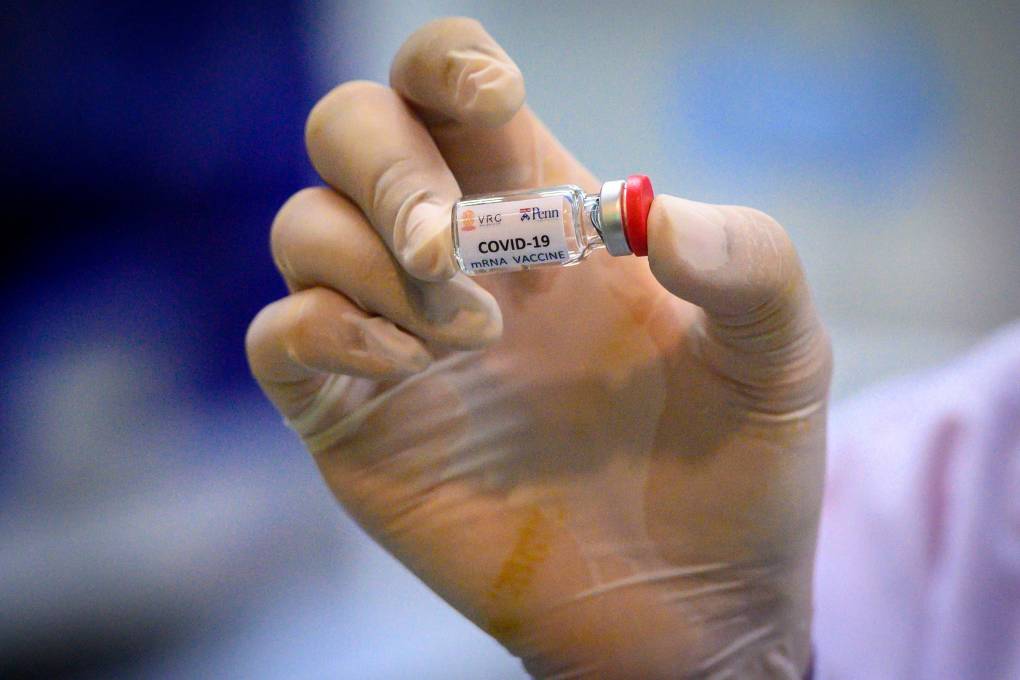
"caption": "A laboratory technician holds a dose of a coronavirus vaccine candidate ready for trial on monkeys at the National Primate Research Center of Thailand at Chulalongkorn University in Saraburi. ",
"description": null,
"title": "THAILAND-HEALTH-VIRUS-ANIMAL-VACCINE",
"credit": "Mladen Antonov/AFP",
"status": "inherit",
"isLoading": false,
"fetchFailed": false
},
"science_1970887": {
"type": "attachments",
"id": "science_1970887",
"meta": {
"index": "attachments_1716263798",
"site": "science",
"id": "1970887",
"found": true
},
"parent": 1970886,
"imgSizes": {
"twentyfourteen-full-width": {
"file": "https://ww2.kqed.org/app/uploads/sites/35/2020/11/GettyImages-1214738416-1038x576.jpg",
"width": 1038,
"mimeType": "image/jpeg",
"height": 576
},
"thumbnail": {
"file": "https://ww2.kqed.org/app/uploads/sites/35/2020/11/GettyImages-1214738416-160x107.jpg",
"width": 160,
"mimeType": "image/jpeg",
"height": 107
},
"post-thumbnail": {
"file": "https://ww2.kqed.org/app/uploads/sites/35/2020/11/GettyImages-1214738416-672x372.jpg",
"width": 672,
"mimeType": "image/jpeg",
"height": 372
},
"kqedFullSize": {
"file": "https://ww2.kqed.org/app/uploads/sites/35/2020/11/GettyImages-1214738416-scaled.jpg",
"width": 2560,
"height": 1713
},
"2048x2048": {
"file": "https://ww2.kqed.org/app/uploads/sites/35/2020/11/GettyImages-1214738416-2048x1370.jpg",
"width": 2048,
"mimeType": "image/jpeg",
"height": 1370
},
"large": {
"file": "https://ww2.kqed.org/app/uploads/sites/35/2020/11/GettyImages-1214738416-1020x682.jpg",
"width": 1020,
"mimeType": "image/jpeg",
"height": 682
},
"1536x1536": {
"file": "https://ww2.kqed.org/app/uploads/sites/35/2020/11/GettyImages-1214738416-1536x1028.jpg",
"width": 1536,
"mimeType": "image/jpeg",
"height": 1028
},
"full-width": {
"file": "https://ww2.kqed.org/app/uploads/sites/35/2020/11/GettyImages-1214738416-1920x1285.jpg",
"width": 1920,
"mimeType": "image/jpeg",
"height": 1285
},
"medium": {
"file": "https://ww2.kqed.org/app/uploads/sites/35/2020/11/GettyImages-1214738416-800x535.jpg",
"width": 800,
"mimeType": "image/jpeg",
"height": 535
},
"medium_large": {
"file": "https://ww2.kqed.org/app/uploads/sites/35/2020/11/GettyImages-1214738416-768x514.jpg",
"width": 768,
"mimeType": "image/jpeg",
"height": 514
}
},
"publishDate": 1604709387,
"modified": 1604964839,
"caption": "One of the lowest-risk ways to gather is outside. Last spring, San Francisco placed circles on the grass at Dolores Park in the city's Mission neighborhood to encourage groups to be socially distanced. ",
"description": "One of the lowest-risk ways to gather is outside. Last spring, San Francisco placed circles on the grass at Dolores Park in the city's Mission neighborhood, to encourage groups to be socially distanced. ",
"title": "coronavirus Dolores Park",
"credit": "Josh Edelson/AFP via Getty Images",
"status": "inherit",
"isLoading": false,
"fetchFailed": false
},
"science_1970773": {
"type": "attachments",
"id": "science_1970773",
"meta": {
"index": "attachments_1716263798",
"site": "science",
"id": "1970773",
"found": true
},
"parent": 1970770,
"imgSizes": {
"twentyfourteen-full-width": {
"file": "https://ww2.kqed.org/app/uploads/sites/35/2020/11/TRUMP_BIDEN_SCIENCE-1600x900-1-1038x576.jpg",
"width": 1038,
"mimeType": "image/jpeg",
"height": 576
},
"thumbnail": {
"file": "https://ww2.kqed.org/app/uploads/sites/35/2020/11/TRUMP_BIDEN_SCIENCE-1600x900-1-160x90.jpg",
"width": 160,
"mimeType": "image/jpeg",
"height": 90
},
"post-thumbnail": {
"file": "https://ww2.kqed.org/app/uploads/sites/35/2020/11/TRUMP_BIDEN_SCIENCE-1600x900-1-672x372.jpg",
"width": 672,
"mimeType": "image/jpeg",
"height": 372
},
"kqedFullSize": {
"file": "https://ww2.kqed.org/app/uploads/sites/35/2020/11/TRUMP_BIDEN_SCIENCE-1600x900-1.jpg",
"width": 1600,
"height": 900
},
"large": {
"file": "https://ww2.kqed.org/app/uploads/sites/35/2020/11/TRUMP_BIDEN_SCIENCE-1600x900-1-1020x574.jpg",
"width": 1020,
"mimeType": "image/jpeg",
"height": 574
},
"1536x1536": {
"file": "https://ww2.kqed.org/app/uploads/sites/35/2020/11/TRUMP_BIDEN_SCIENCE-1600x900-1-1536x864.jpg",
"width": 1536,
"mimeType": "image/jpeg",
"height": 864
},
"medium": {
"file": "https://ww2.kqed.org/app/uploads/sites/35/2020/11/TRUMP_BIDEN_SCIENCE-1600x900-1-800x450.jpg",
"width": 800,
"mimeType": "image/jpeg",
"height": 450
},
"medium_large": {
"file": "https://ww2.kqed.org/app/uploads/sites/35/2020/11/TRUMP_BIDEN_SCIENCE-1600x900-1-768x432.jpg",
"width": 768,
"mimeType": "image/jpeg",
"height": 432
}
},
"publishDate": 1604348048,
"modified": 1604358548,
"caption": null,
"description": null,
"title": "TRUMP_BIDEN_SCIENCE-1600x900",
"credit": "Alex Hogan/STAT",
"status": "inherit",
"isLoading": false,
"fetchFailed": false
},
"science_1970689": {
"type": "attachments",
"id": "science_1970689",
"meta": {
"index": "attachments_1716263798",
"site": "science",
"id": "1970689",
"found": true
},
"parent": 1970688,
"imgSizes": {
"thumbnail": {
"file": "https://ww2.kqed.org/app/uploads/sites/35/2020/10/DSC07654-1-160x95.jpg",
"width": 160,
"mimeType": "image/jpeg",
"height": 95
},
"post-thumbnail": {
"file": "https://ww2.kqed.org/app/uploads/sites/35/2020/10/DSC07654-1-672x372.jpg",
"width": 672,
"mimeType": "image/jpeg",
"height": 372
},
"kqedFullSize": {
"file": "https://ww2.kqed.org/app/uploads/sites/35/2020/10/DSC07654-1.jpg",
"width": 924,
"height": 547
},
"medium": {
"file": "https://ww2.kqed.org/app/uploads/sites/35/2020/10/DSC07654-1-800x474.jpg",
"width": 800,
"mimeType": "image/jpeg",
"height": 474
},
"medium_large": {
"file": "https://ww2.kqed.org/app/uploads/sites/35/2020/10/DSC07654-1-768x455.jpg",
"width": 768,
"mimeType": "image/jpeg",
"height": 455
}
},
"publishDate": 1603733405,
"modified": 1603821996,
"caption": "The smoke wave and pyrocumulus clouds from the East Troublesome Fire on the Front Range of the Colorado Rocky Mountains on Oct. 21, 2020. The prominent peak on the left is Bald Mountain at the south end of Indian Peaks Wilderness. ",
"description": null,
"title": "DSC07654 (1)",
"credit": "Amanda Windischmann/InsideClimate News",
"status": "inherit",
"isLoading": false,
"fetchFailed": false
},
"science_1964431": {
"type": "attachments",
"id": "science_1964431",
"meta": {
"index": "attachments_1716263798",
"site": "science",
"id": "1964431",
"found": true
},
"parent": 1964430,
"imgSizes": {
"twentyfourteen-full-width": {
"file": "https://ww2.kqed.org/app/uploads/sites/35/2020/05/us-map-promo-0510-2fd83dfaf05894d4d11be3843b3fef1cec5c95be-1-1038x576.png",
"width": 1038,
"mimeType": "image/png",
"height": 576
},
"thumbnail": {
"file": "https://ww2.kqed.org/app/uploads/sites/35/2020/05/us-map-promo-0510-2fd83dfaf05894d4d11be3843b3fef1cec5c95be-1-160x120.png",
"width": 160,
"mimeType": "image/png",
"height": 120
},
"post-thumbnail": {
"file": "https://ww2.kqed.org/app/uploads/sites/35/2020/05/us-map-promo-0510-2fd83dfaf05894d4d11be3843b3fef1cec5c95be-1-672x372.png",
"width": 672,
"mimeType": "image/png",
"height": 372
},
"kqedFullSize": {
"file": "https://ww2.kqed.org/app/uploads/sites/35/2020/05/us-map-promo-0510-2fd83dfaf05894d4d11be3843b3fef1cec5c95be-1.png",
"width": 1198,
"height": 898
},
"large": {
"file": "https://ww2.kqed.org/app/uploads/sites/35/2020/05/us-map-promo-0510-2fd83dfaf05894d4d11be3843b3fef1cec5c95be-1-1020x765.png",
"width": 1020,
"mimeType": "image/png",
"height": 765
},
"medium": {
"file": "https://ww2.kqed.org/app/uploads/sites/35/2020/05/us-map-promo-0510-2fd83dfaf05894d4d11be3843b3fef1cec5c95be-1-800x600.png",
"width": 800,
"mimeType": "image/png",
"height": 600
},
"medium_large": {
"file": "https://ww2.kqed.org/app/uploads/sites/35/2020/05/us-map-promo-0510-2fd83dfaf05894d4d11be3843b3fef1cec5c95be-1-768x576.png",
"width": 768,
"mimeType": "image/png",
"height": 576
}
},
"publishDate": 1589582733,
"modified": 1589582733,
"caption": null,
"description": null,
"title": "Chart showing growth of COVID-19 cases in the U.S. as of May 10",
"credit": null,
"status": "inherit",
"isLoading": false,
"fetchFailed": false
},
"science_1970567": {
"type": "attachments",
"id": "science_1970567",
"meta": {
"index": "attachments_1716263798",
"site": "science",
"id": "1970567",
"found": true
},
"parent": 1970565,
"imgSizes": {
"twentyfourteen-full-width": {
"file": "https://ww2.kqed.org/app/uploads/sites/35/2020/10/RS45358_GettyImages-1228305395-qut-1038x576.jpg",
"width": 1038,
"mimeType": "image/jpeg",
"height": 576
},
"thumbnail": {
"file": "https://ww2.kqed.org/app/uploads/sites/35/2020/10/RS45358_GettyImages-1228305395-qut-160x88.jpg",
"width": 160,
"mimeType": "image/jpeg",
"height": 88
},
"post-thumbnail": {
"file": "https://ww2.kqed.org/app/uploads/sites/35/2020/10/RS45358_GettyImages-1228305395-qut-672x372.jpg",
"width": 672,
"mimeType": "image/jpeg",
"height": 372
},
"kqedFullSize": {
"file": "https://ww2.kqed.org/app/uploads/sites/35/2020/10/RS45358_GettyImages-1228305395-qut.jpg",
"width": 1920,
"height": 1060
},
"large": {
"file": "https://ww2.kqed.org/app/uploads/sites/35/2020/10/RS45358_GettyImages-1228305395-qut-1020x563.jpg",
"width": 1020,
"mimeType": "image/jpeg",
"height": 563
},
"1536x1536": {
"file": "https://ww2.kqed.org/app/uploads/sites/35/2020/10/RS45358_GettyImages-1228305395-qut-1536x848.jpg",
"width": 1536,
"mimeType": "image/jpeg",
"height": 848
},
"medium": {
"file": "https://ww2.kqed.org/app/uploads/sites/35/2020/10/RS45358_GettyImages-1228305395-qut-800x442.jpg",
"width": 800,
"mimeType": "image/jpeg",
"height": 442
},
"medium_large": {
"file": "https://ww2.kqed.org/app/uploads/sites/35/2020/10/RS45358_GettyImages-1228305395-qut-768x424.jpg",
"width": 768,
"mimeType": "image/jpeg",
"height": 424
}
},
"publishDate": 1603225959,
"modified": 1603299575,
"caption": "Health care workers and supporters hold candles at a vigil in memory of health care workers who died of COVID-19 on Sept. 1, 2020, in Alhambra, California.",
"description": null,
"title": "US-HEALTH-VIRUS-VIGIL",
"credit": "Frederic J. Brown/AFP via Getty Images",
"status": "inherit",
"isLoading": false,
"fetchFailed": false
},
"science_1970334": {
"type": "attachments",
"id": "science_1970334",
"meta": {
"index": "attachments_1716263798",
"site": "science",
"id": "1970334",
"found": true
},
"parent": 1970329,
"imgSizes": {
"twentyfourteen-full-width": {
"file": "https://ww2.kqed.org/app/uploads/sites/35/2020/10/Facebook-vaccines-1038x576.jpg",
"width": 1038,
"mimeType": "image/jpeg",
"height": 576
},
"thumbnail": {
"file": "https://ww2.kqed.org/app/uploads/sites/35/2020/10/Facebook-vaccines-160x106.jpg",
"width": 160,
"mimeType": "image/jpeg",
"height": 106
},
"post-thumbnail": {
"file": "https://ww2.kqed.org/app/uploads/sites/35/2020/10/Facebook-vaccines-672x372.jpg",
"width": 672,
"mimeType": "image/jpeg",
"height": 372
},
"kqedFullSize": {
"file": "https://ww2.kqed.org/app/uploads/sites/35/2020/10/Facebook-vaccines-scaled-e1602694940514.jpg",
"width": 1920,
"height": 1278
},
"2048x2048": {
"file": "https://ww2.kqed.org/app/uploads/sites/35/2020/10/Facebook-vaccines-2048x1363.jpg",
"width": 2048,
"mimeType": "image/jpeg",
"height": 1363
},
"large": {
"file": "https://ww2.kqed.org/app/uploads/sites/35/2020/10/Facebook-vaccines-1020x679.jpg",
"width": 1020,
"mimeType": "image/jpeg",
"height": 679
},
"1536x1536": {
"file": "https://ww2.kqed.org/app/uploads/sites/35/2020/10/Facebook-vaccines-1536x1022.jpg",
"width": 1536,
"mimeType": "image/jpeg",
"height": 1022
},
"full-width": {
"file": "https://ww2.kqed.org/app/uploads/sites/35/2020/10/Facebook-vaccines-1920x1278.jpg",
"width": 1920,
"mimeType": "image/jpeg",
"height": 1278
},
"medium": {
"file": "https://ww2.kqed.org/app/uploads/sites/35/2020/10/Facebook-vaccines-800x532.jpg",
"width": 800,
"mimeType": "image/jpeg",
"height": 532
},
"medium_large": {
"file": "https://ww2.kqed.org/app/uploads/sites/35/2020/10/Facebook-vaccines-768x511.jpg",
"width": 768,
"mimeType": "image/jpeg",
"height": 511
}
},
"publishDate": 1602694917,
"modified": 1602698571,
"caption": "Demonstrators protest a mandatory flu vaccine order for children in Boston, Massachusetts on Oct. 5, 2020. ",
"description": null,
"title": "US-vaccines-pandemic",
"credit": "Joseph Prezioso/AFP",
"status": "inherit",
"isLoading": false,
"fetchFailed": false
},
"science_1970292": {
"type": "attachments",
"id": "science_1970292",
"meta": {
"index": "attachments_1716263798",
"site": "science",
"id": "1970292",
"found": true
},
"parent": 1970286,
"imgSizes": {
"thumbnail": {
"file": "https://ww2.kqed.org/app/uploads/sites/35/2029/10/cincinnati-barber-pandemic-flu-160x106.jpg",
"width": 160,
"mimeType": "image/jpeg",
"height": 106
},
"post-thumbnail": {
"file": "https://ww2.kqed.org/app/uploads/sites/35/2029/10/cincinnati-barber-pandemic-flu-672x372.jpg",
"width": 672,
"mimeType": "image/jpeg",
"height": 372
},
"kqedFullSize": {
"file": "https://ww2.kqed.org/app/uploads/sites/35/2029/10/cincinnati-barber-pandemic-flu.jpg",
"width": 830,
"height": 550
},
"medium": {
"file": "https://ww2.kqed.org/app/uploads/sites/35/2029/10/cincinnati-barber-pandemic-flu-800x530.jpg",
"width": 800,
"mimeType": "image/jpeg",
"height": 530
},
"medium_large": {
"file": "https://ww2.kqed.org/app/uploads/sites/35/2029/10/cincinnati-barber-pandemic-flu-768x509.jpg",
"width": 768,
"mimeType": "image/jpeg",
"height": 509
}
},
"publishDate": 1602614461,
"modified": 1602622825,
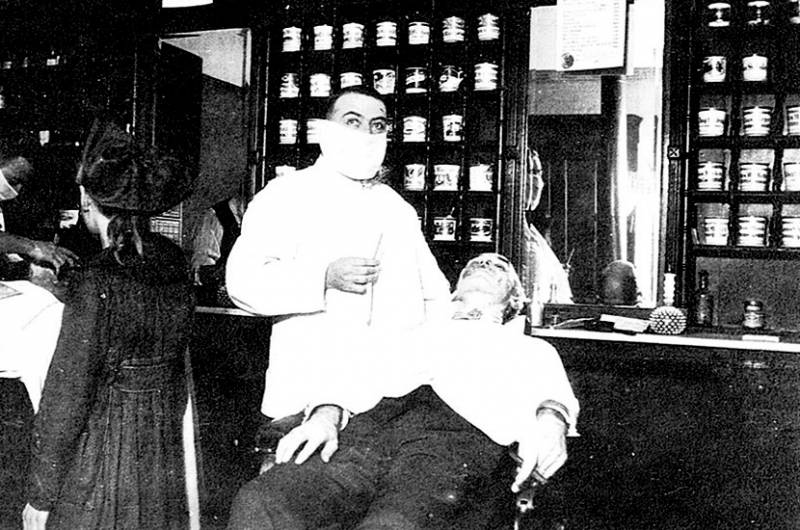
"caption": "A masked barber in Cincinnati gives a customer a shave during the 1918 influenza pandemic.",
"description": null,
"title": "cincinnati-barber-pandemic-flu",
"credit": "Courtesy of U.S. Centers for Disease Control and Prevention",
"status": "inherit",
"isLoading": false,
"fetchFailed": false
},
"science_1970196": {
"type": "attachments",
"id": "science_1970196",
"meta": {
"index": "attachments_1716263798",
"site": "science",
"id": "1970196",
"found": true
},
"parent": 1970180,
"imgSizes": {
"thumbnail": {
"file": "https://ww2.kqed.org/app/uploads/sites/35/2020/10/evangelina-stem-cells-proposition-14-160x90.jpg",
"width": 160,
"mimeType": "image/jpeg",
"height": 90
},
"post-thumbnail": {
"file": "https://ww2.kqed.org/app/uploads/sites/35/2020/10/evangelina-stem-cells-proposition-14-672x372.jpg",
"width": 672,
"mimeType": "image/jpeg",
"height": 372
},
"kqedFullSize": {
"file": "https://ww2.kqed.org/app/uploads/sites/35/2020/10/evangelina-stem-cells-proposition-14.jpg",
"width": 676,
"height": 381
}
},
"publishDate": 1602175040,
"modified": 1602176219,
"caption": "Evangelina Padilla-Vaccaro now cured of 'bubble baby' disease, playing in a public park sometime in the mid 2010s. The bubble around her is for fun, not to keep her separated from others. ",
"description": null,
"title": "evangelina-stem-cells-proposition-14",
"credit": null,
"status": "inherit",
"isLoading": false,
"fetchFailed": false
},
"science_1970169": {
"type": "attachments",
"id": "science_1970169",
"meta": {
"index": "attachments_1716263798",
"site": "science",
"id": "1970169",
"found": true
},
"parent": 1970166,
"imgSizes": {
"twentyfourteen-full-width": {
"file": "https://ww2.kqed.org/app/uploads/sites/35/2020/10/GettyImages-493945408-1038x576.jpg",
"width": 1038,
"mimeType": "image/jpeg",
"height": 576
},
"thumbnail": {
"file": "https://ww2.kqed.org/app/uploads/sites/35/2020/10/GettyImages-493945408-160x97.jpg",
"width": 160,
"mimeType": "image/jpeg",
"height": 97
},
"post-thumbnail": {
"file": "https://ww2.kqed.org/app/uploads/sites/35/2020/10/GettyImages-493945408-672x372.jpg",
"width": 672,
"mimeType": "image/jpeg",
"height": 372
},
"kqedFullSize": {
"file": "https://ww2.kqed.org/app/uploads/sites/35/2020/10/GettyImages-493945408-scaled.jpg",
"width": 2560,
"height": 1558
},
"2048x2048": {
"file": "https://ww2.kqed.org/app/uploads/sites/35/2020/10/GettyImages-493945408-2048x1246.jpg",
"width": 2048,
"mimeType": "image/jpeg",
"height": 1246
},
"large": {
"file": "https://ww2.kqed.org/app/uploads/sites/35/2020/10/GettyImages-493945408-1020x621.jpg",
"width": 1020,
"mimeType": "image/jpeg",
"height": 621
},
"1536x1536": {
"file": "https://ww2.kqed.org/app/uploads/sites/35/2020/10/GettyImages-493945408-1536x935.jpg",
"width": 1536,
"mimeType": "image/jpeg",
"height": 935
},
"full-width": {
"file": "https://ww2.kqed.org/app/uploads/sites/35/2020/10/GettyImages-493945408-1920x1168.jpg",
"width": 1920,
"mimeType": "image/jpeg",
"height": 1168
},
"medium": {
"file": "https://ww2.kqed.org/app/uploads/sites/35/2020/10/GettyImages-493945408-800x487.jpg",
"width": 800,
"mimeType": "image/jpeg",
"height": 487
},
"medium_large": {
"file": "https://ww2.kqed.org/app/uploads/sites/35/2020/10/GettyImages-493945408-768x467.jpg",
"width": 768,
"mimeType": "image/jpeg",
"height": 467
}
},
"publishDate": 1602071846,
"modified": 1602093307,
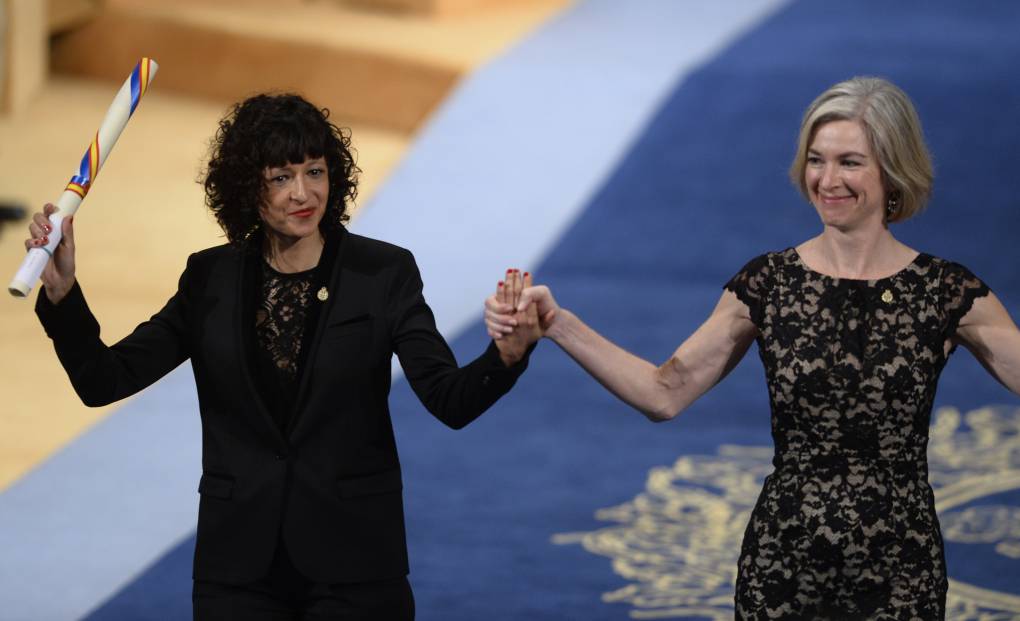
"caption": "Emmanuelle Charpentier. left, of the Max Planck Unit for the Science of Pathogens in Germany, and Jennifer Doudna of UC Berkeley celebrate on the stage after receiving the 2015 Princess of Asturias Award for Technical and Scientific Research from Spain's King Felipe at the Campoamor Theatre in Oviedo, on Oct. 23, 2015. ",
"description": "Emmanuelle Charpentier (L) of the Max Planck Unit for the Science of Pathogens, Germany, Jennifer Doudna of UC Berkeley celebrate on the stage after receiving the 2015 Princess of Asturias Award for Technical and Scientific Research from Spain's King Felipe at the Campoamor Theatre in Oviedo, on October 23, 2015. ",
"title": "SPAIN-ASTURIAS-AWARDS-CHARPENTIER-DOUDNA",
"credit": "Miguel Riopa/AFP via Getty Images",
"status": "inherit",
"isLoading": false,
"fetchFailed": false
},
"science_1970027": {
"type": "attachments",
"id": "science_1970027",
"meta": {
"index": "attachments_1716263798",
"site": "science",
"id": "1970027",
"found": true
},
"parent": 1970025,
"imgSizes": {
"twentyfourteen-full-width": {
"file": "https://ww2.kqed.org/app/uploads/sites/35/2020/10/Trump-coronavirus-covid-1038x576.jpg",
"width": 1038,
"mimeType": "image/jpeg",
"height": 576
},
"thumbnail": {
"file": "https://ww2.kqed.org/app/uploads/sites/35/2020/10/Trump-coronavirus-covid-160x109.jpg",
"width": 160,
"mimeType": "image/jpeg",
"height": 109
},
"post-thumbnail": {
"file": "https://ww2.kqed.org/app/uploads/sites/35/2020/10/Trump-coronavirus-covid-672x372.jpg",
"width": 672,
"mimeType": "image/jpeg",
"height": 372
},
"kqedFullSize": {
"file": "https://ww2.kqed.org/app/uploads/sites/35/2020/10/Trump-coronavirus-covid-scaled-e1601666581469.jpg",
"width": 1920,
"height": 1313
},
"2048x2048": {
"file": "https://ww2.kqed.org/app/uploads/sites/35/2020/10/Trump-coronavirus-covid-2048x1400.jpg",
"width": 2048,
"mimeType": "image/jpeg",
"height": 1400
},
"large": {
"file": "https://ww2.kqed.org/app/uploads/sites/35/2020/10/Trump-coronavirus-covid-1020x697.jpg",
"width": 1020,
"mimeType": "image/jpeg",
"height": 697
},
"1536x1536": {
"file": "https://ww2.kqed.org/app/uploads/sites/35/2020/10/Trump-coronavirus-covid-1536x1050.jpg",
"width": 1536,
"mimeType": "image/jpeg",
"height": 1050
},
"full-width": {
"file": "https://ww2.kqed.org/app/uploads/sites/35/2020/10/Trump-coronavirus-covid-1920x1312.jpg",
"width": 1920,
"mimeType": "image/jpeg",
"height": 1312
},
"medium": {
"file": "https://ww2.kqed.org/app/uploads/sites/35/2020/10/Trump-coronavirus-covid-800x547.jpg",
"width": 800,
"mimeType": "image/jpeg",
"height": 547
},
"medium_large": {
"file": "https://ww2.kqed.org/app/uploads/sites/35/2020/10/Trump-coronavirus-covid-768x525.jpg",
"width": 768,
"mimeType": "image/jpeg",
"height": 525
}
},
"publishDate": 1601666405,
"modified": 1601688338,
"caption": "President Donald Trump tosses a cap to supporters as he arrives for a campaign rally at Duluth International Airport in Minnesota on Sept. 30, 2020. Trump announced on Oct. 2 that he and first lady Melania Trump were both found to have contracted the novel coronavirus. ",
"description": null,
"title": "US-VOTE-HEALTH-VIRUS-TRUMP",
"credit": "Mandel Ngan/AFP via Getty Images",
"status": "inherit",
"isLoading": false,
"fetchFailed": false
},
"science_1970009": {
"type": "attachments",
"id": "science_1970009",
"meta": {
"index": "attachments_1716263798",
"site": "science",
"id": "1970009",
"found": true
},
"parent": 1970006,
"imgSizes": {
"twentyfourteen-full-width": {
"file": "https://ww2.kqed.org/app/uploads/sites/35/2020/10/Image-from-iOS-1038x576.jpg",
"width": 1038,
"mimeType": "image/jpeg",
"height": 576
},
"thumbnail": {
"file": "https://ww2.kqed.org/app/uploads/sites/35/2020/10/Image-from-iOS-160x107.jpg",
"width": 160,
"mimeType": "image/jpeg",
"height": 107
},
"post-thumbnail": {
"file": "https://ww2.kqed.org/app/uploads/sites/35/2020/10/Image-from-iOS-672x372.jpg",
"width": 672,
"mimeType": "image/jpeg",
"height": 372
},
"kqedFullSize": {
"file": "https://ww2.kqed.org/app/uploads/sites/35/2020/10/Image-from-iOS.jpg",
"width": 1620,
"height": 1080
},
"large": {
"file": "https://ww2.kqed.org/app/uploads/sites/35/2020/10/Image-from-iOS-1020x680.jpg",
"width": 1020,
"mimeType": "image/jpeg",
"height": 680
},
"1536x1536": {
"file": "https://ww2.kqed.org/app/uploads/sites/35/2020/10/Image-from-iOS-1536x1024.jpg",
"width": 1536,
"mimeType": "image/jpeg",
"height": 1024
},
"medium": {
"file": "https://ww2.kqed.org/app/uploads/sites/35/2020/10/Image-from-iOS-800x533.jpg",
"width": 800,
"mimeType": "image/jpeg",
"height": 533
},
"medium_large": {
"file": "https://ww2.kqed.org/app/uploads/sites/35/2020/10/Image-from-iOS-768x512.jpg",
"width": 768,
"mimeType": "image/jpeg",
"height": 512
}
},
"publishDate": 1601583061,
"modified": 1601583108,
"caption": "A helicopter drops water on a ridge burning due to the Glass Fire, near Old Lawley Toll Road north of Calistoga on Sept. 30, 2020.",
"description": null,
"title": "Image from iOS",
"credit": "Beth LaBerge/KQED",
"status": "inherit",
"isLoading": false,
"fetchFailed": false
}
},
"audioPlayerReducer": {
"postId": "stream_live",
"isPaused": true,
"isPlaying": false,
"pfsActive": false,
"pledgeModalIsOpen": true,
"playerDrawerIsOpen": false,
"liveAudioPlayStartedAt": 0,
"liveAudioPlayContext": ""
},
"authorsReducer": {
"byline_science_1970770": {
"type": "authors",
"id": "byline_science_1970770",
"meta": {
"override": true
},
"slug": "byline_science_1970770",
"name": "Lev Facher \u003cbr />STAT\u003cbr>",
"isLoading": false
},
"byline_science_1970688": {
"type": "authors",
"id": "byline_science_1970688",
"meta": {
"override": true
},
"slug": "byline_science_1970688",
"name": "Judy Fahys \u003cbr />InsideClimate News",
"isLoading": false
},
"byline_science_1964430": {
"type": "authors",
"id": "byline_science_1964430",
"meta": {
"override": true
},
"slug": "byline_science_1964430",
"name": "Stephanie Adeline, Connie Hanzhang, Jin, Alyson Hurt, Thomas Wilburn, Daniel Wood, Ruth Talbot\u003cbr />NPR",
"isLoading": false
},
"byline_science_1970565": {
"type": "authors",
"id": "byline_science_1970565",
"meta": {
"override": true
},
"slug": "byline_science_1970565",
"name": "Andrew Joseph \u003cbr />STAT",
"isLoading": false
},
"byline_science_1970329": {
"type": "authors",
"id": "byline_science_1970329",
"meta": {
"override": true
},
"slug": "byline_science_1970329",
"name": "Erin Brodwin\u003cbr />STAT",
"isLoading": false
},
"byline_science_1970166": {
"type": "authors",
"id": "byline_science_1970166",
"meta": {
"override": true
},
"slug": "byline_science_1970166",
"name": "David Keyton, Christina Larson and Frank Jordans\u003cbr>Associated Press",
"isLoading": false
},
"kqedscience": {
"type": "authors",
"id": "6387",
"meta": {
"index": "authors_1716337520",
"id": "6387",
"found": true
},
"name": "KQED Science",
"firstName": "KQED",
"lastName": "Science",
"slug": "kqedscience",
"email": "kqedscience@gmail.com",
"display_author_email": false,
"staff_mastheads": [],
"title": null,
"bio": "KQED Science brings you award-winning science and environment coverage from the Bay Area and beyond by the flagship Northern California PBS and NPR affiliate.",
"avatar": "https://secure.gravatar.com/avatar/5a295ff49cf82a8c0f30937d3f788b2f?s=600&d=blank&r=g",
"twitter": null,
"facebook": null,
"instagram": null,
"linkedin": null,
"sites": [
{
"site": "science",
"roles": [
"contributor"
]
},
{
"site": "quest",
"roles": [
"editor"
]
},
{
"site": "food",
"roles": [
"contributor"
]
}
],
"headData": {
"title": "KQED Science | KQED",
"description": null,
"ogImgSrc": "https://secure.gravatar.com/avatar/5a295ff49cf82a8c0f30937d3f788b2f?s=600&d=blank&r=g",
"twImgSrc": "https://secure.gravatar.com/avatar/5a295ff49cf82a8c0f30937d3f788b2f?s=600&d=blank&r=g"
},
"isLoading": false,
"link": "/author/kqedscience"
},
"lklivans": {
"type": "authors",
"id": "8648",
"meta": {
"index": "authors_1716337520",
"id": "8648",
"found": true
},
"name": "Laura Klivans",
"firstName": "Laura",
"lastName": "Klivans",
"slug": "lklivans",
"email": "lklivans@kqed.org",
"display_author_email": true,
"staff_mastheads": [
"news",
"science"
],
"title": "Reporter",
"bio": "Laura Klivans is an award-winning science reporter for KQED News, where she covers climate change with an eye on both groundbreaking progress and gaps in action. She is the former host of KQED's blockbuster video series about tiny, amazing animals, \u003cem>Deep Look\u003c/em>. Her work reaches national audiences through NPR, \u003cem>Here & Now, \u003c/em>PRI, and other major outlets. \r\n\r\nLaura’s won five Northern California Area Emmy Awards for Deep Look and First Place in the Greater Bay Area Journalism Awards for a podcast exploring how one Oakland neighborhood teamed up to reduce planet-heating pollution.\r\n\r\nBeyond her reporting, she hosts and moderates events. In the past, she taught audio storytelling at the UC Berkeley Graduate School of Journalism, led international education programs, worked with immigrants and refugees along the Thai-Burmese border, taught high schoolers sex ed, and was an actress. \r\n\r\nShe's a former UC Berkeley Human Rights Fellow, USC Center for Health Journalism's California Fellow and Coro Fellow in Public Affairs. Laura has a master’s in journalism from UC Berkeley, a master’s in education from Harvard, and an undergraduate degree from Northwestern University.\r\n\r\nShe loves trying to riddle the meaning out of vanity license plates.",
"avatar": "https://secure.gravatar.com/avatar/2d2ecd1550a494cc10ad4a503406965585902124739e775a9b3817eebf1d88be?s=600&d=blank&r=g",
"twitter": "lauraklivans",
"bluesky": null,
"facebook": null,
"instagram": null,
"linkedin": null,
"sites": [
{
"site": "news",
"roles": [
"editor"
]
},
{
"site": "stateofhealth",
"roles": [
"contributor",
"editor"
]
},
{
"site": "science",
"roles": [
"editor"
]
},
{
"site": "forum",
"roles": [
"editor"
]
}
],
"headData": {
"title": "Laura Klivans | KQED",
"description": "Reporter",
"ogImgSrc": "https://secure.gravatar.com/avatar/2d2ecd1550a494cc10ad4a503406965585902124739e775a9b3817eebf1d88be?s=600&d=blank&r=g",
"twImgSrc": "https://secure.gravatar.com/avatar/2d2ecd1550a494cc10ad4a503406965585902124739e775a9b3817eebf1d88be?s=600&d=blank&r=g"
},
"isLoading": false,
"link": "/author/lklivans"
},
"dventon": {
"type": "authors",
"id": "11088",
"meta": {
"index": "authors_1716337520",
"id": "11088",
"found": true
},
"name": "Danielle Venton",
"firstName": "Danielle",
"lastName": "Venton",
"slug": "dventon",
"email": "dventon@kqed.org",
"display_author_email": true,
"staff_mastheads": [
"science"
],
"title": "Science reporter",
"bio": "Danielle Venton is a reporter for KQED Science. She covers wildfires, space and oceans (though she is prone to sea sickness).\r\n\r\nBefore joining KQED in 2015, Danielle was a staff reporter at KRCB in Sonoma County and a freelancer. She studied science communication at UC Santa Cruz and formerly worked at CERN in Geneva, Switzerland where she wrote about computing. She lives in Sonoma County and enjoys backpacking.",
"avatar": "https://secure.gravatar.com/avatar/37b292b5c40c8d93959c4f48d73b5286f41b7abd8588277e941905a3ed4c801c?s=600&d=blank&r=g",
"twitter": "DanielleVenton",
"bluesky": null,
"facebook": null,
"instagram": null,
"linkedin": null,
"sites": [
{
"site": "arts",
"roles": [
"contributor"
]
},
{
"site": "news",
"roles": [
"editor"
]
},
{
"site": "futureofyou",
"roles": [
"editor"
]
},
{
"site": "science",
"roles": [
"editor"
]
},
{
"site": "liveblog",
"roles": [
"contributor"
]
}
],
"headData": {
"title": "Danielle Venton | KQED",
"description": "Science reporter",
"ogImgSrc": "https://secure.gravatar.com/avatar/37b292b5c40c8d93959c4f48d73b5286f41b7abd8588277e941905a3ed4c801c?s=600&d=blank&r=g",
"twImgSrc": "https://secure.gravatar.com/avatar/37b292b5c40c8d93959c4f48d73b5286f41b7abd8588277e941905a3ed4c801c?s=600&d=blank&r=g"
},
"isLoading": false,
"link": "/author/dventon"
},
"lesleymcclurg": {
"type": "authors",
"id": "11229",
"meta": {
"index": "authors_1716337520",
"id": "11229",
"found": true
},
"name": "Lesley McClurg",
"firstName": "Lesley",
"lastName": "McClurg",
"slug": "lesleymcclurg",
"email": "lmcclurg@KQED.org",
"display_author_email": false,
"staff_mastheads": [
"news",
"science"
],
"title": "KQED Health Correspondent",
"bio": "Lesley McClurg is a health correspondent and fill-in host whose work is regularly rebroadcast on NPR and PBS programs. She’s earned multiple regional Emmy awards, a national and a regional Edward R. Murrow award, and was named Best Beat Reporter by the Association of Health Care Journalists. The Society of Professional Journalists has recognized her work several times, and the Society of Environmental Journalists spotlighted her coverage of California’s historic drought.\r\n\r\nBefore joining KQED in 2016, Lesley covered food and sustainability for Capital Public Radio, environmental issues for Colorado Public Radio, and reported for KUOW and KCTS 9 in Seattle. Away from the newsroom, she loves skiing with her daughter, mountain biking with her partner, and playing with Ollie, the family’s goldendoodle. On deadline, she runs almost entirely on chocolate chips.\r\n\r\n ",
"avatar": "https://secure.gravatar.com/avatar/bab49e972ea10c774fe0f5e29dba1722b158f7c0d58a360923d1389d380b2978?s=600&d=blank&r=g",
"twitter": "lesleywmcclurg",
"bluesky": null,
"facebook": null,
"instagram": null,
"linkedin": null,
"sites": [
{
"site": "arts",
"roles": [
"author"
]
},
{
"site": "news",
"roles": [
"editor"
]
},
{
"site": "futureofyou",
"roles": [
"editor"
]
},
{
"site": "stateofhealth",
"roles": [
"author"
]
},
{
"site": "science",
"roles": [
"editor"
]
},
{
"site": "quest",
"roles": [
"subscriber"
]
},
{
"site": "forum",
"roles": [
"administrator"
]
},
{
"site": "liveblog",
"roles": [
"author"
]
}
],
"headData": {
"title": "Lesley McClurg | KQED",
"description": "KQED Health Correspondent",
"ogImgSrc": "https://secure.gravatar.com/avatar/bab49e972ea10c774fe0f5e29dba1722b158f7c0d58a360923d1389d380b2978?s=600&d=blank&r=g",
"twImgSrc": "https://secure.gravatar.com/avatar/bab49e972ea10c774fe0f5e29dba1722b158f7c0d58a360923d1389d380b2978?s=600&d=blank&r=g"
},
"isLoading": false,
"link": "/author/lesleymcclurg"
},
"parcuni": {
"type": "authors",
"id": "11368",
"meta": {
"index": "authors_1716337520",
"id": "11368",
"found": true
},
"name": "Peter Arcuni",
"firstName": "Peter",
"lastName": "Arcuni",
"slug": "parcuni",
"email": "parcuni@KQED.org",
"display_author_email": false,
"staff_mastheads": [
"science"
],
"title": "Reporter",
"bio": "Peter reports radio and online stories for \u003cem>KQED Science\u003c/em>. His work has also appeared on the \u003cem>The California Report\u003c/em> morning show and \u003cem>KQED News\u003c/em>. His production credits include \u003cem>The California Report, The California Report Magazine\u003c/em> and KQED's local news podcast \u003cem>The Bay\u003c/em>. Other credits include NPR's \u003cem>All Things Considered\u003c/em>, WNYC's \u003cem>Science Friday\u003c/em>, WBUR's \u003cem>Here & Now\u003c/em>, WIRED and SFGate. Peter graduated from Brown University and earned a master's degree in journalism from Stanford. He's covered everything from homelessness to wildfires, health, the environment, arts and Thanksgiving in San Quentin prison. In other lives, he played rock n roll music and studied neuroscience. You can email him at: parcuni@kqed.org",
"avatar": "https://secure.gravatar.com/avatar/d5032f6f27199d478af34ad2e1d98732?s=600&d=blank&r=g",
"twitter": "peterarcuni",
"facebook": null,
"instagram": null,
"linkedin": null,
"sites": [
{
"site": "news",
"roles": [
"editor"
]
},
{
"site": "science",
"roles": [
"editor"
]
}
],
"headData": {
"title": "Peter Arcuni | KQED",
"description": "Reporter",
"ogImgSrc": "https://secure.gravatar.com/avatar/d5032f6f27199d478af34ad2e1d98732?s=600&d=blank&r=g",
"twImgSrc": "https://secure.gravatar.com/avatar/d5032f6f27199d478af34ad2e1d98732?s=600&d=blank&r=g"
},
"isLoading": false,
"link": "/author/parcuni"
}
},
"pagesReducer": {
"science_category_health": {
"type": "terms",
"id": "science_39",
"meta": {
"index": "terms_1716263798",
"site": "science",
"id": "39",
"score": 10.889519
},
"featImg": null,
"name": "Health",
"description": null,
"taxonomy": "category",
"headData": {
"twImgId": null,
"twTitle": null,
"ogTitle": null,
"ogImgId": null,
"twDescription": null,
"description": null,
"title": "Health Archives | KQED Science",
"ogDescription": null
},
"ttid": 41,
"slug": "health",
"isLoading": false,
"title": "Health",
"pageMeta": {
"site": "science",
"WpPageTemplate": "page-topic-editorial",
"currentPage": 16
},
"blocks": [
{
"blockName": "kqed/post-list",
"attrs": {
"layout": "cardArticle2",
"query": "posts/science?category=health",
"seeMore": false,
"paginated": true,
"page": 16
}
},
{
"blockName": "kqed/ad"
}
]
}
},
"pfsSessionReducer": {},
"postsReducer": {
"stream_live": {
"type": "live",
"id": "stream_live",
"audioUrl": "https://streams.kqed.org/kqedradio",
"title": "Live Stream",
"excerpt": "Live Stream information currently unavailable.",
"link": "/radio",
"featImg": "",
"label": {
"name": "KQED Live",
"link": "/"
}
},
"stream_kqedNewscast": {
"type": "posts",
"id": "stream_kqedNewscast",
"audioUrl": "https://www.kqed.org/.stream/anon/radio/RDnews/newscast.mp3?_=1",
"title": "KQED Newscast",
"featImg": "",
"label": {
"name": "88.5 FM",
"link": "/"
}
},
"science_1970942": {
"type": "posts",
"id": "science_1970942",
"meta": {
"index": "posts_1716263798",
"site": "science",
"id": "1970942",
"score": null,
"sort": [
1605041295000
]
},
"parent": 0,
"labelTerm": {},
"blocks": [],
"publishDate": 1605041295,
"format": "audio",
"title": "California Doctors Work to Prioritize Who Will Get COVID-19 Vaccine First",
"headTitle": "California Doctors Work to Prioritize Who Will Get COVID-19 Vaccine First | KQED",
"content": "\u003cp>With coronavirus cases surging across the U.S. and ticking higher in California, pharmaceutical company Pfizer’s announcement on Monday about preliminary results showing its COVID-19 vaccine to be more than 90% effective in clinical trials is welcome news.\u003c/p>\n\u003cp>Both Pfizer and Moderna, another pharmaceutical company with a promising vaccine, anticipate they will have millions of doses available before the end of 2020. But those will likely not be enough for everyone who wants a vaccine to get it right away.\u003c/p>\n\u003cp>A panel of experts with the state’s Department of Public Health is working to prioritize who will be first in line to get innoculated when the Food and Drug Administration finally approves a vaccine.\u003c/p>\n\u003cp>KQED’s Raquel Maria Dillon and science reporter \u003cstrong>Laura Klivans\u003c/strong> on Monday discussed what Pfizer’s announcement means and how experts are thinking about just who will get the vaccine when. The following excerpts have been edited for length and clarity.\u003c/p>\n\u003cp>\u003cstrong>Does Pfizer’s announcement mean we’re going to have an approved vaccine very soon? \u003c/strong>\u003c/p>\n\u003cp>[ad fullwidth]\u003c/p>\n\u003cp>Not exactly.\u003c/p>\n\u003cp>Yes, Pfizer is planning to have a limited number of doses by the end of this year. But the FDA has to review the company’s data and decide whether Pfizer has met the requirements for approval.\u003c/p>\n\u003cp>The company has to show that the vaccine prevents or lessens the severity of disease in at least half the people who get the vaccine. Trials must have participants that are diverse in terms of age and race. The company also has to monitor people for at least two months after their last vaccine dose. In the cases of the Pfizer and Moderna vaccines, the two that are furthest along in the United States, both require two doses.\u003c/p>\n\u003cp>\u003cstrong>So where are we in the process?\u003c/strong>\u003c/p>\n\u003cp>Pfizer and Moderna are currently doing phase 3 trials in the U.S. A phase 3 trial involves testing a vaccine in thousands of people. Pfizer’s phase 3 trial, for example, has 44,000 people enrolled, and they may add more. Moderna has 30,000 people enrolled. Both companies started their trials at the end of July.\u003c/p>\n\u003cp>\u003cstrong>We had a lot of issues when it came to getting coronavirus tests out. Will we have similar problems with the vaccine? \u003c/strong>\u003c/p>\n\u003cp>Three experts who spoke on a webinar Monday are all on California’s panel that will make the decisions about who will be eligible to get the COVID-19 vaccine first.\u003c/p>\n\u003cp>“You can imagine, at least at the onset, there will be a severe shortage, which forces us to all consider the question, who should go first for the vaccine?” said Dr. Bernard Lo, professor emeritus at UCSF and a panel member.\u003c/p>\n\u003cp>Lo talked about different categories of people who would make great candidates: elderly residents of nursing homes and folks who work there. Also, home health aides, nurses, doctors, first responders, respiratory technicians, hospital cleaning staff, teachers and other essential workers.\u003c/p>\n\u003cp>“The people who work in particular in meat processing plants,” Lo said. The people who work as “grocery store clerks, as drivers of public transportation.”\u003c/p>\n\u003cp>\u003cstrong>What about populations that have been particularly hard hit, like in Oakland’s Fruitvale neighborhood or San Francisco’s Mission District?\u003c/strong>\u003c/p>\n\u003cp>Lo mentioned this too, that part of distributing the vaccine is prioritizing protection of people who are most at risk. In San Francisco, for example, he pointed out that we see high vulnerability for COVID-19 in the Mission, the Tenderloin, SOMA and Bayview-Hunters Point.\u003c/p>\n\u003cp>Lo pointed out that the \u003ca href=\"https://www.nationalacademies.org/our-work/a-framework-for-equitable-allocation-of-vaccine-for-the-novel-coronavirus\" target=\"_blank\" rel=\"noopener noreferrer\">National Academies of Sciences, Engineering, and Medicine\u003c/a> recommends 25% of vaccines be set aside for vulnerable neighborhoods where there’s a markedly higher rate of infection and death.\u003c/p>\n\u003cp>\u003cstrong>That seems like a lot of high-priority people and competing concerns. When are we going to know who would get the vaccine first?\u003c/strong>\u003c/p>\n\u003cp>\u003c/p>\n\u003cp>The panel said they’re meeting this week to map out a timeline for how they will get all these decisions made and when they’ll notify the public. So we don’t know yet when exactly we’ll learn all of this, but we should know a lot more by the new year.\u003c/p>\n\n",
"stats": {
"hasVideo": false,
"hasChartOrMap": false,
"hasAudio": false,
"hasPolis": false,
"wordCount": 720,
"hasGoogleForm": false,
"hasGallery": false,
"hasHearkenModule": false,
"iframeSrcs": [],
"paragraphCount": 22
},
"modified": 1704846949,
"excerpt": "From nursing home residents to people who work in meat-packing plants, a host of groups may be near the top of the list.",
"headData": {
"twImgId": "",
"twTitle": "",
"ogTitle": "",
"ogImgId": "",
"twDescription": "",
"description": "From nursing home residents to people who work in meat-packing plants, a host of groups may be near the top of the list.",
"title": "California Doctors Work to Prioritize Who Will Get COVID-19 Vaccine First | KQED",
"ogDescription": "",
"schema": {
"@context": "https://schema.org",
"@type": "Article",
"headline": "California Doctors Work to Prioritize Who Will Get COVID-19 Vaccine First",
"datePublished": "2020-11-10T12:48:15-08:00",
"dateModified": "2024-01-09T16:35:49-08:00",
"image": "https://cdn.kqed.org/wp-content/uploads/2020/02/KQED-OG-Image@1x.png"
}
},
"guestAuthors": [],
"slug": "california-doctors-work-to-prioritize-who-will-get-covid-19-vaccine-first",
"status": "publish",
"audioUrl": "https://www.kqed.org/.stream/anon/radio/RDnews/2020/11/KlivansDillonVaccine2Way.mp3",
"sticky": false,
"source": "Coronavirus",
"path": "/science/1970942/california-doctors-work-to-prioritize-who-will-get-covid-19-vaccine-first",
"audioTrackLength": null,
"parsedContent": [
{
"type": "contentString",
"content": "\u003cdiv class=\"post-body\">\u003cp>\u003cp>With coronavirus cases surging across the U.S. and ticking higher in California, pharmaceutical company Pfizer’s announcement on Monday about preliminary results showing its COVID-19 vaccine to be more than 90% effective in clinical trials is welcome news.\u003c/p>\n\u003cp>Both Pfizer and Moderna, another pharmaceutical company with a promising vaccine, anticipate they will have millions of doses available before the end of 2020. But those will likely not be enough for everyone who wants a vaccine to get it right away.\u003c/p>\n\u003cp>A panel of experts with the state’s Department of Public Health is working to prioritize who will be first in line to get innoculated when the Food and Drug Administration finally approves a vaccine.\u003c/p>\n\u003cp>KQED’s Raquel Maria Dillon and science reporter \u003cstrong>Laura Klivans\u003c/strong> on Monday discussed what Pfizer’s announcement means and how experts are thinking about just who will get the vaccine when. The following excerpts have been edited for length and clarity.\u003c/p>\n\u003cp>\u003cstrong>Does Pfizer’s announcement mean we’re going to have an approved vaccine very soon? \u003c/strong>\u003c/p>\n\u003cp>\u003c/p>\u003c/div>",
"attributes": {
"named": {},
"numeric": []
}
},
{
"type": "component",
"content": "",
"name": "ad",
"attributes": {
"named": {
"label": "fullwidth"
},
"numeric": [
"fullwidth"
]
}
},
{
"type": "contentString",
"content": "\u003cdiv class=\"post-body\">\u003cp>\u003c/p>\n\u003cp>Not exactly.\u003c/p>\n\u003cp>Yes, Pfizer is planning to have a limited number of doses by the end of this year. But the FDA has to review the company’s data and decide whether Pfizer has met the requirements for approval.\u003c/p>\n\u003cp>The company has to show that the vaccine prevents or lessens the severity of disease in at least half the people who get the vaccine. Trials must have participants that are diverse in terms of age and race. The company also has to monitor people for at least two months after their last vaccine dose. In the cases of the Pfizer and Moderna vaccines, the two that are furthest along in the United States, both require two doses.\u003c/p>\n\u003cp>\u003cstrong>So where are we in the process?\u003c/strong>\u003c/p>\n\u003cp>Pfizer and Moderna are currently doing phase 3 trials in the U.S. A phase 3 trial involves testing a vaccine in thousands of people. Pfizer’s phase 3 trial, for example, has 44,000 people enrolled, and they may add more. Moderna has 30,000 people enrolled. Both companies started their trials at the end of July.\u003c/p>\n\u003cp>\u003cstrong>We had a lot of issues when it came to getting coronavirus tests out. Will we have similar problems with the vaccine? \u003c/strong>\u003c/p>\n\u003cp>Three experts who spoke on a webinar Monday are all on California’s panel that will make the decisions about who will be eligible to get the COVID-19 vaccine first.\u003c/p>\n\u003cp>“You can imagine, at least at the onset, there will be a severe shortage, which forces us to all consider the question, who should go first for the vaccine?” said Dr. Bernard Lo, professor emeritus at UCSF and a panel member.\u003c/p>\n\u003cp>Lo talked about different categories of people who would make great candidates: elderly residents of nursing homes and folks who work there. Also, home health aides, nurses, doctors, first responders, respiratory technicians, hospital cleaning staff, teachers and other essential workers.\u003c/p>\n\u003cp>“The people who work in particular in meat processing plants,” Lo said. The people who work as “grocery store clerks, as drivers of public transportation.”\u003c/p>\n\u003cp>\u003cstrong>What about populations that have been particularly hard hit, like in Oakland’s Fruitvale neighborhood or San Francisco’s Mission District?\u003c/strong>\u003c/p>\n\u003cp>Lo mentioned this too, that part of distributing the vaccine is prioritizing protection of people who are most at risk. In San Francisco, for example, he pointed out that we see high vulnerability for COVID-19 in the Mission, the Tenderloin, SOMA and Bayview-Hunters Point.\u003c/p>\n\u003cp>Lo pointed out that the \u003ca href=\"https://www.nationalacademies.org/our-work/a-framework-for-equitable-allocation-of-vaccine-for-the-novel-coronavirus\" target=\"_blank\" rel=\"noopener noreferrer\">National Academies of Sciences, Engineering, and Medicine\u003c/a> recommends 25% of vaccines be set aside for vulnerable neighborhoods where there’s a markedly higher rate of infection and death.\u003c/p>\n\u003cp>\u003cstrong>That seems like a lot of high-priority people and competing concerns. When are we going to know who would get the vaccine first?\u003c/strong>\u003c/p>\n\u003cp>\u003c/p>\n\u003cp>The panel said they’re meeting this week to map out a timeline for how they will get all these decisions made and when they’ll notify the public. So we don’t know yet when exactly we’ll learn all of this, but we should know a lot more by the new year.\u003c/p>\n\n\u003c/div>\u003c/p>",
"attributes": {
"named": {},
"numeric": []
}
}
],
"link": "/science/1970942/california-doctors-work-to-prioritize-who-will-get-covid-19-vaccine-first",
"authors": [
"8648"
],
"categories": [
"science_39",
"science_3890",
"science_40"
],
"tags": [
"science_4329",
"science_4368",
"science_2203",
"science_197"
],
"featImg": "science_1969205",
"label": "source_science_1970942"
},
"science_1970886": {
"type": "posts",
"id": "science_1970886",
"meta": {
"index": "posts_1716263798",
"site": "science",
"id": "1970886",
"score": null,
"sort": [
1604908913000
]
},
"parent": 0,
"labelTerm": {},
"blocks": [],
"publishDate": 1604908913,
"format": "standard",
"title": "Visiting Family Over the Holidays? Here's How to Lower Your Risk for COVID-19",
"headTitle": "Visiting Family Over the Holidays? Here’s How to Lower Your Risk for COVID-19 | KQED",
"content": "\u003cp>It’s been months of quarantine and the urge to see friends and family is real, especially as the holidays approach. But as people are considering traveling to spend Christmas or Hanukkah with loved ones, COVID-19 cases are again surging across the U.S.\u003c/p>\n\u003cp>While doctors say there’s no way to completely eliminate the risk of catching or spreading the novel coronavirus when venturing out, there are things you can do to reduce the risk, and all nine Bay Area counties plus the city of Berkeley released \u003ca href=\"https://cchealth.org/press-releases/2020/1109-ABAHO-Holiday-Recommendations.pdf\" target=\"_blank\" rel=\"noopener noreferrer\">recommendations\u003c/a> Monday for doing just that.\u003c/p>\n\u003cp>[pullquote citation='Dr. Yvonne Maldonado, Stanford School of Medicine']‘What I’ve seen in the hospital is we’re just not seeing transmissions if people just wear surgical masks. I’m not talking about N95 or hazmat suits.’ [/pullquote]Along with these recommendations, we consulted public health experts and guidelines from the Centers for Disease Control and Prevention for ways to minimize your travel risk. Think of it as a checklist to help you track your household’s distancing habits and test for leaks in your stay-at-home bubble. You’ll also want to consider the health of the people you’re visiting, how you’ll travel, and getting tested.\u003c/p>\n\u003cp>If it’s been a challenge to follow health recommendations, you’ll want to consider postponing that big trip until you’re more confident you’ve minimized the risks.\u003c/p>\n\u003cp>\u003cstrong>Consider Age and Health\u003c/strong>\u003c/p>\n\u003cp>Age is a major risk factor for the severity of COVID-19. \u003ca href=\"https://www.cdc.gov/coronavirus/2019-ncov/need-extra-precautions/older-adults.html\" target=\"_blank\" rel=\"noopener noreferrer\">CDC guidance\u003c/a> says 8 out of 10 coronavirus deaths have occurred in people age 65 or older, and the greatest risk for serious illness is among those who are at least 85.\u003c/p>\n\u003cp>People of any age with serious medical conditions, including cancer, diabetes and respiratory disease, are also at \u003ca href=\"https://www.cdc.gov/coronavirus/2019-ncov/need-extra-precautions/people-with-medical-conditions.html\" target=\"_blank\" rel=\"noopener noreferrer\">higher risk\u003c/a> for severe cases.\u003c/p>\n\u003cp>[pullquote citation='Dr. R. Sean Morrison, Mount Sinai Health System']‘We’re recommending that older adults avoid contact with children. We want to minimize the risk of that child passing on disease to their grandparents, who are at increased risk.’[/pullquote]If you or the people you plan to visit are elderly or have underlying health problems, consider eating Thanksgiving turkey together on Zoom instead.\u003c/p>\n\u003cp>\u003cstrong>Have You Been Wearing Your Mask?\u003c/strong>\u003c/p>\n\u003cp>The \u003ca href=\"https://www.cdc.gov/coronavirus/2019-ncov/more/scientific-brief-sars-cov-2.html\" target=\"_blank\" rel=\"noopener noreferrer\">CDC now says\u003c/a> the coronavirus can be transmitted by large respiratory droplets at short distances and sometimes by smaller “aerosolized” particles over longer distances. This makes \u003ca href=\"https://www.kqed.org/news/11810490/masks-to-wear-or-not-to-wear-that-is-the-question\" target=\"_blank\" rel=\"noopener noreferrer\">wearing a face covering\u003c/a> over your mouth and nose whenever you’re out in public a key component of \u003ca href=\"https://www.cdc.gov/coronavirus/2019-ncov/prevent-getting-sick/diy-cloth-face-coverings.html\" target=\"_blank\" rel=\"noopener noreferrer\">protecting yourself and others\u003c/a>.\u003c/p>\n\u003cp>“What I’ve seen in the hospital is we’re just not seeing transmissions if people just wear surgical masks. I’m not talking about N95 or hazmat suits,” said Dr. Yvonne Maldonado, professor of pediatrics, epidemiology and population health at the Stanford School of Medicine.\u003c/p>\n\u003cp>Remember, even if you’re scrupulously wearing a mask, if the people you are in close contact with aren’t, your coronavirus risk goes up.\u003c/p>\n\u003cp>\u003cstrong>Remember the 6-Foot Rule\u003c/strong>\u003c/p>\n\u003cp>Health experts say social distancing is \u003ca href=\"https://www.kqed.org/science/1970286/from-condoms-to-coronavirus-masks-harm-reduction-has-worked-to-protect-public-health\" target=\"_blank\" rel=\"noopener noreferrer\">here to stay\u003c/a>, and it’s one of the best ways to \u003ca href=\"https://www.kqed.org/science/1965321/so-whats-going-to-happen-to-bay-area-case-counts-now-medical-experts-weigh-in\" target=\"_blank\" rel=\"noopener noreferrer\">combat the coronavirus\u003c/a>. In addition to wearing your mask, you should keep 6 feet or more from others when at the store, park or other public spaces.\u003c/p>\n\u003cp>Follow the same rule when meeting a friend for a socially distanced picnic.\u003c/p>\n\u003cp>\u003cstrong>Wash Hands Often\u003c/strong>\u003c/p>\n\u003cp>[aside postID=\"news_11846759,science_1960866,science_1967231,science_1962884\" target=_blank]Scientists say \u003ca href=\"https://www.kqed.org/science/1960866/why-washing-your-hands-works-so-well-and-how-to-d%20o-it-right\" target=\"_blank\" rel=\"noopener noreferrer\">washing your hands\u003c/a> for at least 20 seconds is another important way to protect against infection, because soap and water can destroy the virus. If you can’t \u003ca href=\"https://www.cdc.gov/coronavirus/2019-ncov/hcp/hand-hygiene.html\" target=\"_blank\" rel=\"noopener noreferrer\">wash your hands\u003c/a> when you’re outdoors, \u003ca href=\"https://www.cdc.gov/coronavirus/2019-ncov/hcp/hand-hygiene.html\" target=\"_blank\" rel=\"noopener noreferrer\">use a sanitizer\u003c/a> with at least 60% alcohol.\u003c/p>\n\u003cp>\u003cstrong>Limit Your Exposure\u003c/strong>\u003c/p>\n\u003cp>COVID-19 is thought to \u003ca href=\"https://www.cdc.gov/coronavirus/2019-ncov/prevent-getting-sick/how-covid-spreads.html\" target=\"_blank\" rel=\"noopener noreferrer\">spread\u003c/a> mainly through close contact between people. That’s why health experts say to \u003ca href=\"https://www.cdc.gov/coronavirus/2019-ncov/daily-life-coping/deciding-to-go-out.html\" target=\"_blank\" rel=\"noopener noreferrer\">limit\u003c/a> how much exposure you have to people outside of your household.\u003c/p>\n\u003cp>In California, gatherings with people from more than three households are prohibited. State guidance is to limit these events to no more than two hours.\u003c/p>\n\u003cp>Some health officials say if you want to socialize, keep your group to a \u003ca href=\"https://coronavirus.marinhhs.org/sites/default/files/2020-06/fnl_social-bubble-flyers_6-18-20-v2-accessible-1.pdf\" target=\"_blank\" rel=\"noopener noreferrer\">social bubble\u003c/a> of 12 or fewer people, including household members, with everyone agreeing to the same rules.\u003c/p>\n\u003cp>Here are other ways to limit your potential for exposure:\u003c/p>\n\u003cul>\n\u003cli>If possible, \u003ca href=\"https://www.thelancet.com/journals/lancet/article/PIIS0140-6736(20)31200-9/fulltext\" target=\"_blank\" rel=\"noopener noreferrer\">work from home\u003c/a>\u003c/li>\n\u003cli>Avoid mass gatherings\u003c/li>\n\u003cli>Limit the number of outside \u003ca href=\"https://www.cdc.gov/coronavirus/2019-ncov/daily-life-coping/personal-social-activities.html\" target=\"_blank\" rel=\"noopener noreferrer\">visitors\u003c/a> into your home\u003c/li>\n\u003cli>When \u003ca href=\"https://www.fda.gov/food/food-safety-during-emergencies/shopping-food-during-covid-19-pandemic-information-consumers\" target=\"_blank\" rel=\"noopener noreferrer\">shopping for groceries\u003c/a>, make a list to reduce time spent inside and buy extra to limit trips. Or consider a delivery service like Instacart or Good Eggs.\u003c/li>\n\u003c/ul>\n\u003cp>\u003cstrong>While the Risk Is Lower, Children Can Spread the Virus\u003c/strong>\u003c/p>\n\u003cp>Early research suggests kids are at a \u003ca href=\"https://www.kqed.org/science/1966149/weighing-the-risks-of-sending-kids-to-camp-or-day-care-during-the-coronavirus-pandemic\" target=\"_blank\" rel=\"noopener noreferrer\">lower risk\u003c/a> for getting sick and spreading COVID-19 — but this doesn’t mean they are immune. In some cases, children can transmit the disease.\u003c/p>\n\u003cp>“We’re recommending that older adults avoid contact with children,” said Dr. R. Sean Morrison, a geriatrician with Mount Sinai Health System. “We want to minimize the risk of that child passing on disease to their grandparents, who are at increased risk.”\u003c/p>\n\u003cp>If your kids are going in person to school, day care or other group activities, make sure your care provider is taking precautions and following state and local guidelines.\u003c/p>\n\u003cp>\u003cstrong>Consider Outdoor Visits Over Indoor\u003c/strong>\u003c/p>\n\u003cp>The CDC says indoor spaces are more risky than outdoor ones for spreading the virus.\u003c/p>\n\u003cp>If an outdoor meetup is impossible due to weather or other factors and you decide to meet indoors, the CDC recommends you “avoid crowded, poorly ventilated, and fully enclosed indoor spaces. Increase ventilation by opening windows and doors to the extent that is safe and feasible.”\u003c/p>\n\u003cp>\u003cstrong>Choose a Car Ride Over a Flight\u003c/strong>\u003c/p>\n\u003cp>Some health experts say driving is safer than flying, where you’ll be in tight quarters with strangers for hours. But long car trips may require stopping for gas or food, so you’ll still want to take precautions. The recommendations are that you don’t share vehicles with people you don’t live with and that everyone where a mask. You should also open windows to increase air circulation.\u003c/p>\n\u003cp>Before flying, doctors say it’s a good idea to check the airline’s coronavirus policies. Most require passengers to wear a mask, and some limit the number of passengers aboard a flight or block out middle seats. Remember that it’s likely you will be sitting within 6 feet of other people for hours on end, depending on where you’re traveling, plus time in airline terminals that may be more crowded over the holidays.\u003c/p>\n\u003cp>\u003cstrong>Get Tested or Plan to Quarantine\u003c/strong>\u003c/p>\n\u003cp>Health experts say \u003ca href=\"https://www.kqed.org/science/1966181/should-you-get-tested-for-the-coronavirus-what-do-the-results-mean-our-testing-faq\" target=\"_blank\" rel=\"noopener noreferrer\">getting tested\u003c/a>, while not a fail-safe, can give you a measure of confidence. Dr. Bob Wachter, chair of the Department of Medicine at UCSF, says receiving a negative test result before your trip significantly reduces, though doesn’t eliminate, the chance you’ll transmit the coronavirus when traveling.\u003c/p>\n\u003cp>“If I was on the fence about visiting and I had a negative test in the last couple of days, it might get me to leave the fence and go,” Wachter said. “But it would not lead me to give them a hug and a kiss.”\u003c/p>\n\u003cp>A second test four to five days after your journey can help rule out infection during a flight or road trip. Getting a test immediately upon arrival, Wachter says, will likely be too soon for you to test positive. While you wait for the results, doctors recommend keeping your distance from others.\u003c/p>\n\u003cp>If testing isn’t an option and you have the luxury of time, experts say quarantining for 14 days before and after your travel is prudent.\u003c/p>\n\u003cp>[ad fullwidth]\u003c/p>\n\u003cp>\u003cstrong>Monitor Spikes in Cases\u003c/strong>\u003c/p>\n\u003cp>Nonessential travel to or from a place with a high positivity rate is \u003ca href=\"https://www.kqed.org/news/11829403/summer-travel-during-covid-19-in-california-can-i-do-it-safely\" target=\"_blank\" rel=\"noopener noreferrer\">not advised\u003c/a>, and many states and counties have their own rules in place — so you’ll want to check local guidelines before planning a trip.\u003c/p>\n\u003cp>\u003cstrong>Start the Conversation\u003c/strong>\u003c/p>\n\u003cp>Taking basic precautions can go a long way, but there will still be some risk of coronavirus spread when exposing yourself to more people and different environments. Before you travel, take stock of your own habits and have a conversation with your loved ones about the potential risks of getting together.\u003c/p>\n\u003cp>“We can think of transmission risk with a simple phrase: time, space, people, place,” explains Dr. William Miller, an epidemiologist at Ohio State University.\u003c/p>\n\u003cp>Here’s his rule of thumb: The more time you spend and the closer in space you are to any infected people, the higher your risk.\u003c/p>\n\u003cp>Interacting with more people raises your risk, and indoor places are riskier than outdoors.\u003c/p>\n\u003cp>Once you’re confident in your family’s stay-at-home vigilance over the course of 14 days, experts say, it becomes less risky to visit loved ones. You’ll want to be extra cautious during a surge and if your family members are elderly or have health problems.\u003c/p>\n\u003cp>\u003cem>Jon Brooks contributed to this post.\u003c/em>\u003c/p>\n\u003cp>[ad floatright]\u003c/p>\n",
"stats": {
"hasVideo": false,
"hasChartOrMap": false,
"hasAudio": false,
"hasPolis": false,
"wordCount": 1558,
"hasGoogleForm": false,
"hasGallery": false,
"hasHearkenModule": false,
"iframeSrcs": [],
"paragraphCount": 48
},
"modified": 1704846953,
"excerpt": "By now, you're probably familiar with how to lower the risk of transmitting the coronavirus. But a family visit can take some planning. Here's your guide from public health experts and the CDC.",
"headData": {
"twImgId": "",
"twTitle": "",
"ogTitle": "",
"ogImgId": "",
"twDescription": "",
"description": "By now, you're probably familiar with how to lower the risk of transmitting the coronavirus. But a family visit can take some planning. Here's your guide from public health experts and the CDC.",
"title": "Visiting Family Over the Holidays? Here's How to Lower Your Risk for COVID-19 | KQED",
"ogDescription": "",
"schema": {
"@context": "https://schema.org",
"@type": "Article",
"headline": "Visiting Family Over the Holidays? Here's How to Lower Your Risk for COVID-19",
"datePublished": "2020-11-09T00:01:53-08:00",
"dateModified": "2024-01-09T16:35:53-08:00",
"image": "https://cdn.kqed.org/wp-content/uploads/2020/02/KQED-OG-Image@1x.png"
}
},
"guestAuthors": [],
"slug": "visiting-family-over-the-holidays-heres-how-to-lower-your-risk-for-covid-19",
"status": "publish",
"sticky": false,
"source": "Coronavirus",
"path": "/science/1970886/visiting-family-over-the-holidays-heres-how-to-lower-your-risk-for-covid-19",
"audioTrackLength": null,
"parsedContent": [
{
"type": "contentString",
"content": "\u003cdiv class=\"post-body\">\u003cp>\u003cp>It’s been months of quarantine and the urge to see friends and family is real, especially as the holidays approach. But as people are considering traveling to spend Christmas or Hanukkah with loved ones, COVID-19 cases are again surging across the U.S.\u003c/p>\n\u003cp>While doctors say there’s no way to completely eliminate the risk of catching or spreading the novel coronavirus when venturing out, there are things you can do to reduce the risk, and all nine Bay Area counties plus the city of Berkeley released \u003ca href=\"https://cchealth.org/press-releases/2020/1109-ABAHO-Holiday-Recommendations.pdf\" target=\"_blank\" rel=\"noopener noreferrer\">recommendations\u003c/a> Monday for doing just that.\u003c/p>\n\u003cp>\u003c/p>\u003c/div>",
"attributes": {
"named": {},
"numeric": []
}
},
{
"type": "component",
"content": "‘What I’ve seen in the hospital is we’re just not seeing transmissions if people just wear surgical masks. I’m not talking about N95 or hazmat suits.’ ",
"name": "pullquote",
"attributes": {
"named": {
"citation": "Dr. Yvonne Maldonado, Stanford School of Medicine",
"label": ""
},
"numeric": []
}
},
{
"type": "contentString",
"content": "\u003cdiv class=\"post-body\">\u003cp>Along with these recommendations, we consulted public health experts and guidelines from the Centers for Disease Control and Prevention for ways to minimize your travel risk. Think of it as a checklist to help you track your household’s distancing habits and test for leaks in your stay-at-home bubble. You’ll also want to consider the health of the people you’re visiting, how you’ll travel, and getting tested.\u003c/p>\n\u003cp>If it’s been a challenge to follow health recommendations, you’ll want to consider postponing that big trip until you’re more confident you’ve minimized the risks.\u003c/p>\n\u003cp>\u003cstrong>Consider Age and Health\u003c/strong>\u003c/p>\n\u003cp>Age is a major risk factor for the severity of COVID-19. \u003ca href=\"https://www.cdc.gov/coronavirus/2019-ncov/need-extra-precautions/older-adults.html\" target=\"_blank\" rel=\"noopener noreferrer\">CDC guidance\u003c/a> says 8 out of 10 coronavirus deaths have occurred in people age 65 or older, and the greatest risk for serious illness is among those who are at least 85.\u003c/p>\n\u003cp>People of any age with serious medical conditions, including cancer, diabetes and respiratory disease, are also at \u003ca href=\"https://www.cdc.gov/coronavirus/2019-ncov/need-extra-precautions/people-with-medical-conditions.html\" target=\"_blank\" rel=\"noopener noreferrer\">higher risk\u003c/a> for severe cases.\u003c/p>\n\u003cp>\u003c/p>\u003c/div>",
"attributes": {
"named": {},
"numeric": []
}
},
{
"type": "component",
"content": "‘We’re recommending that older adults avoid contact with children. We want to minimize the risk of that child passing on disease to their grandparents, who are at increased risk.’",
"name": "pullquote",
"attributes": {
"named": {
"citation": "Dr. R. Sean Morrison, Mount Sinai Health System",
"label": ""
},
"numeric": []
}
},
{
"type": "contentString",
"content": "\u003cdiv class=\"post-body\">\u003cp>If you or the people you plan to visit are elderly or have underlying health problems, consider eating Thanksgiving turkey together on Zoom instead.\u003c/p>\n\u003cp>\u003cstrong>Have You Been Wearing Your Mask?\u003c/strong>\u003c/p>\n\u003cp>The \u003ca href=\"https://www.cdc.gov/coronavirus/2019-ncov/more/scientific-brief-sars-cov-2.html\" target=\"_blank\" rel=\"noopener noreferrer\">CDC now says\u003c/a> the coronavirus can be transmitted by large respiratory droplets at short distances and sometimes by smaller “aerosolized” particles over longer distances. This makes \u003ca href=\"https://www.kqed.org/news/11810490/masks-to-wear-or-not-to-wear-that-is-the-question\" target=\"_blank\" rel=\"noopener noreferrer\">wearing a face covering\u003c/a> over your mouth and nose whenever you’re out in public a key component of \u003ca href=\"https://www.cdc.gov/coronavirus/2019-ncov/prevent-getting-sick/diy-cloth-face-coverings.html\" target=\"_blank\" rel=\"noopener noreferrer\">protecting yourself and others\u003c/a>.\u003c/p>\n\u003cp>“What I’ve seen in the hospital is we’re just not seeing transmissions if people just wear surgical masks. I’m not talking about N95 or hazmat suits,” said Dr. Yvonne Maldonado, professor of pediatrics, epidemiology and population health at the Stanford School of Medicine.\u003c/p>\n\u003cp>Remember, even if you’re scrupulously wearing a mask, if the people you are in close contact with aren’t, your coronavirus risk goes up.\u003c/p>\n\u003cp>\u003cstrong>Remember the 6-Foot Rule\u003c/strong>\u003c/p>\n\u003cp>Health experts say social distancing is \u003ca href=\"https://www.kqed.org/science/1970286/from-condoms-to-coronavirus-masks-harm-reduction-has-worked-to-protect-public-health\" target=\"_blank\" rel=\"noopener noreferrer\">here to stay\u003c/a>, and it’s one of the best ways to \u003ca href=\"https://www.kqed.org/science/1965321/so-whats-going-to-happen-to-bay-area-case-counts-now-medical-experts-weigh-in\" target=\"_blank\" rel=\"noopener noreferrer\">combat the coronavirus\u003c/a>. In addition to wearing your mask, you should keep 6 feet or more from others when at the store, park or other public spaces.\u003c/p>\n\u003cp>Follow the same rule when meeting a friend for a socially distanced picnic.\u003c/p>\n\u003cp>\u003cstrong>Wash Hands Often\u003c/strong>\u003c/p>\n\u003cp>\u003c/p>\u003c/div>",
"attributes": {
"named": {},
"numeric": []
}
},
{
"type": "component",
"content": "",
"name": "aside",
"attributes": {
"named": {
"postid": "news_11846759,science_1960866,science_1967231,science_1962884",
"target": "_blank",
"label": ""
},
"numeric": []
}
},
{
"type": "contentString",
"content": "\u003cdiv class=\"post-body\">\u003cp>Scientists say \u003ca href=\"https://www.kqed.org/science/1960866/why-washing-your-hands-works-so-well-and-how-to-d%20o-it-right\" target=\"_blank\" rel=\"noopener noreferrer\">washing your hands\u003c/a> for at least 20 seconds is another important way to protect against infection, because soap and water can destroy the virus. If you can’t \u003ca href=\"https://www.cdc.gov/coronavirus/2019-ncov/hcp/hand-hygiene.html\" target=\"_blank\" rel=\"noopener noreferrer\">wash your hands\u003c/a> when you’re outdoors, \u003ca href=\"https://www.cdc.gov/coronavirus/2019-ncov/hcp/hand-hygiene.html\" target=\"_blank\" rel=\"noopener noreferrer\">use a sanitizer\u003c/a> with at least 60% alcohol.\u003c/p>\n\u003cp>\u003cstrong>Limit Your Exposure\u003c/strong>\u003c/p>\n\u003cp>COVID-19 is thought to \u003ca href=\"https://www.cdc.gov/coronavirus/2019-ncov/prevent-getting-sick/how-covid-spreads.html\" target=\"_blank\" rel=\"noopener noreferrer\">spread\u003c/a> mainly through close contact between people. That’s why health experts say to \u003ca href=\"https://www.cdc.gov/coronavirus/2019-ncov/daily-life-coping/deciding-to-go-out.html\" target=\"_blank\" rel=\"noopener noreferrer\">limit\u003c/a> how much exposure you have to people outside of your household.\u003c/p>\n\u003cp>In California, gatherings with people from more than three households are prohibited. State guidance is to limit these events to no more than two hours.\u003c/p>\n\u003cp>Some health officials say if you want to socialize, keep your group to a \u003ca href=\"https://coronavirus.marinhhs.org/sites/default/files/2020-06/fnl_social-bubble-flyers_6-18-20-v2-accessible-1.pdf\" target=\"_blank\" rel=\"noopener noreferrer\">social bubble\u003c/a> of 12 or fewer people, including household members, with everyone agreeing to the same rules.\u003c/p>\n\u003cp>Here are other ways to limit your potential for exposure:\u003c/p>\n\u003cul>\n\u003cli>If possible, \u003ca href=\"https://www.thelancet.com/journals/lancet/article/PIIS0140-6736(20)31200-9/fulltext\" target=\"_blank\" rel=\"noopener noreferrer\">work from home\u003c/a>\u003c/li>\n\u003cli>Avoid mass gatherings\u003c/li>\n\u003cli>Limit the number of outside \u003ca href=\"https://www.cdc.gov/coronavirus/2019-ncov/daily-life-coping/personal-social-activities.html\" target=\"_blank\" rel=\"noopener noreferrer\">visitors\u003c/a> into your home\u003c/li>\n\u003cli>When \u003ca href=\"https://www.fda.gov/food/food-safety-during-emergencies/shopping-food-during-covid-19-pandemic-information-consumers\" target=\"_blank\" rel=\"noopener noreferrer\">shopping for groceries\u003c/a>, make a list to reduce time spent inside and buy extra to limit trips. Or consider a delivery service like Instacart or Good Eggs.\u003c/li>\n\u003c/ul>\n\u003cp>\u003cstrong>While the Risk Is Lower, Children Can Spread the Virus\u003c/strong>\u003c/p>\n\u003cp>Early research suggests kids are at a \u003ca href=\"https://www.kqed.org/science/1966149/weighing-the-risks-of-sending-kids-to-camp-or-day-care-during-the-coronavirus-pandemic\" target=\"_blank\" rel=\"noopener noreferrer\">lower risk\u003c/a> for getting sick and spreading COVID-19 — but this doesn’t mean they are immune. In some cases, children can transmit the disease.\u003c/p>\n\u003cp>“We’re recommending that older adults avoid contact with children,” said Dr. R. Sean Morrison, a geriatrician with Mount Sinai Health System. “We want to minimize the risk of that child passing on disease to their grandparents, who are at increased risk.”\u003c/p>\n\u003cp>If your kids are going in person to school, day care or other group activities, make sure your care provider is taking precautions and following state and local guidelines.\u003c/p>\n\u003cp>\u003cstrong>Consider Outdoor Visits Over Indoor\u003c/strong>\u003c/p>\n\u003cp>The CDC says indoor spaces are more risky than outdoor ones for spreading the virus.\u003c/p>\n\u003cp>If an outdoor meetup is impossible due to weather or other factors and you decide to meet indoors, the CDC recommends you “avoid crowded, poorly ventilated, and fully enclosed indoor spaces. Increase ventilation by opening windows and doors to the extent that is safe and feasible.”\u003c/p>\n\u003cp>\u003cstrong>Choose a Car Ride Over a Flight\u003c/strong>\u003c/p>\n\u003cp>Some health experts say driving is safer than flying, where you’ll be in tight quarters with strangers for hours. But long car trips may require stopping for gas or food, so you’ll still want to take precautions. The recommendations are that you don’t share vehicles with people you don’t live with and that everyone where a mask. You should also open windows to increase air circulation.\u003c/p>\n\u003cp>Before flying, doctors say it’s a good idea to check the airline’s coronavirus policies. Most require passengers to wear a mask, and some limit the number of passengers aboard a flight or block out middle seats. Remember that it’s likely you will be sitting within 6 feet of other people for hours on end, depending on where you’re traveling, plus time in airline terminals that may be more crowded over the holidays.\u003c/p>\n\u003cp>\u003cstrong>Get Tested or Plan to Quarantine\u003c/strong>\u003c/p>\n\u003cp>Health experts say \u003ca href=\"https://www.kqed.org/science/1966181/should-you-get-tested-for-the-coronavirus-what-do-the-results-mean-our-testing-faq\" target=\"_blank\" rel=\"noopener noreferrer\">getting tested\u003c/a>, while not a fail-safe, can give you a measure of confidence. Dr. Bob Wachter, chair of the Department of Medicine at UCSF, says receiving a negative test result before your trip significantly reduces, though doesn’t eliminate, the chance you’ll transmit the coronavirus when traveling.\u003c/p>\n\u003cp>“If I was on the fence about visiting and I had a negative test in the last couple of days, it might get me to leave the fence and go,” Wachter said. “But it would not lead me to give them a hug and a kiss.”\u003c/p>\n\u003cp>A second test four to five days after your journey can help rule out infection during a flight or road trip. Getting a test immediately upon arrival, Wachter says, will likely be too soon for you to test positive. While you wait for the results, doctors recommend keeping your distance from others.\u003c/p>\n\u003cp>If testing isn’t an option and you have the luxury of time, experts say quarantining for 14 days before and after your travel is prudent.\u003c/p>\n\u003cp>\u003c/p>\u003c/div>",
"attributes": {
"named": {},
"numeric": []
}
},
{
"type": "component",
"content": "",
"name": "ad",
"attributes": {
"named": {
"label": "fullwidth"
},
"numeric": [
"fullwidth"
]
}
},
{
"type": "contentString",
"content": "\u003cdiv class=\"post-body\">\u003cp>\u003c/p>\n\u003cp>\u003cstrong>Monitor Spikes in Cases\u003c/strong>\u003c/p>\n\u003cp>Nonessential travel to or from a place with a high positivity rate is \u003ca href=\"https://www.kqed.org/news/11829403/summer-travel-during-covid-19-in-california-can-i-do-it-safely\" target=\"_blank\" rel=\"noopener noreferrer\">not advised\u003c/a>, and many states and counties have their own rules in place — so you’ll want to check local guidelines before planning a trip.\u003c/p>\n\u003cp>\u003cstrong>Start the Conversation\u003c/strong>\u003c/p>\n\u003cp>Taking basic precautions can go a long way, but there will still be some risk of coronavirus spread when exposing yourself to more people and different environments. Before you travel, take stock of your own habits and have a conversation with your loved ones about the potential risks of getting together.\u003c/p>\n\u003cp>“We can think of transmission risk with a simple phrase: time, space, people, place,” explains Dr. William Miller, an epidemiologist at Ohio State University.\u003c/p>\n\u003cp>Here’s his rule of thumb: The more time you spend and the closer in space you are to any infected people, the higher your risk.\u003c/p>\n\u003cp>Interacting with more people raises your risk, and indoor places are riskier than outdoors.\u003c/p>\n\u003cp>Once you’re confident in your family’s stay-at-home vigilance over the course of 14 days, experts say, it becomes less risky to visit loved ones. You’ll want to be extra cautious during a surge and if your family members are elderly or have health problems.\u003c/p>\n\u003cp>\u003cem>Jon Brooks contributed to this post.\u003c/em>\u003c/p>\n\u003cp>\u003c/p>\u003c/div>",
"attributes": {
"named": {},
"numeric": []
}
},
{
"type": "component",
"content": "",
"name": "ad",
"attributes": {
"named": {
"label": "floatright"
},
"numeric": [
"floatright"
]
}
},
{
"type": "contentString",
"content": "\u003cdiv class=\"post-body\">\u003cp>\u003c/p>\n\u003c/div>\u003c/p>",
"attributes": {
"named": {},
"numeric": []
}
}
],
"link": "/science/1970886/visiting-family-over-the-holidays-heres-how-to-lower-your-risk-for-covid-19",
"authors": [
"11368"
],
"categories": [
"science_39",
"science_40",
"science_4450"
],
"tags": [
"science_4329",
"science_4414",
"science_5181"
],
"featImg": "science_1970887",
"label": "source_science_1970886"
},
"science_1970770": {
"type": "posts",
"id": "science_1970770",
"meta": {
"index": "posts_1716263798",
"site": "science",
"id": "1970770",
"score": null,
"sort": [
1604348992000
]
},
"parent": 0,
"labelTerm": {},
"blocks": [],
"publishDate": 1604348992,
"format": "standard",
"title": "Also On the Line This Election: Integrity of U.S. Health Science Institutions",
"headTitle": "Also On the Line This Election: Integrity of U.S. Health Science Institutions | KQED",
"content": "\u003cp>It’s impossible to overstate the impact of Tuesday’s presidential election on the health and science landscape.\u003c/p>\n\u003cp>It’s a contest between a candidate who says he’ll give federal scientists a major say in national policy and a president whose top aides have boasted that he wrested control of the U.S. “back from the doctors” in the early stages of the COVID-19 pandemic. One candidate has made the phrase “trust the scientists” a constant refrain. The other has focused far more on economic indicators than scientific ones — and considered it an insult to suggest that his opponent will “listen to the scientists” in determining pandemic policy.\u003c/p>\n\u003cp>The divergent positions of President Trump and former Vice President Joe Biden on these issues may be central to the outcome of the election and will likely impact every element of the American medical and scientific worlds. Based on the candidates’ own words, interviews with officials in both camps as well as public health experts, STAT outlines eight traditions, institutions, and norms that are on the line in the election.\u003c/p>\n\u003cp>\u003cstrong>Will the World’s Most Storied Public Health Agency Come Out of the Shadows?\u003c/strong>\u003c/p>\n\u003cp>One of the most surprising aspects of the Trump administration’s pandemic response has been its continued \u003ca href=\"https://www.statnews.com/2020/07/13/cdc-apolitical-island-defenseless/\" target=\"_blank\" rel=\"noopener noreferrer\">sidelining\u003c/a> of the Centers for Disease Control and Prevention, the agency typically responsible for responding to infectious disease outbreaks, keeping the public informed, distributing vaccines (when they’re available), and tracking the latest data. This much seems clear: The role and the profile of the CDC would dramatically change if Biden is elected.\u003c/p>\n\u003cp>[ad fullwidth]\u003c/p>\n\u003cp>During Trump’s tenure, the agency has faded from the public eye. Trump has denigrated the CDC director, \u003ca href=\"https://www.statnews.com/2020/04/04/an-interview-with-the-cdc-director-on-coronavirus-masks-and-an-agency-gone-quiet/\" target=\"_blank\" rel=\"noopener noreferrer\">Robert Redfield\u003c/a>, for providing basic information to the public: that masks are a more effective tool than vaccines at stopping coronavirus spread (vaccines, of course, don’t exist yet), and that most Americans might not be able to receive COVID-19 vaccinations until the middle of 2021.\u003c/p>\n\u003cp>Trump has also pushed CDC to the side within Operation Warp Speed, the government’s efforts to manufacture and distribute hundreds of millions of COVID-19 vaccine doses. Instead, the project \u003ca href=\"https://www.statnews.com/2020/09/28/operation-warp-speed-vast-military-involvement/\" target=\"_blank\" rel=\"noopener noreferrer\">relies heavily on military personnel\u003c/a> — and experts say that’s not necessarily a bad thing.\u003c/p>\n\u003cp>Biden has pledged to institute daily pandemic press briefings with public health experts, which presumably would include the CDC. He’s made clear that his administration would place doctors at the center of the federal government’s COVID-19 messaging.\u003c/p>\n\u003cp>It’s an open question, however, whether a President Biden would stay the course or \u003ca href=\"https://www.statnews.com/2020/10/22/slaoui-warp-speed-biden-complicated/\" target=\"_blank\" rel=\"noopener noreferrer\">implement major changes to the Warp Speed\u003c/a> vaccine distribution system.\u003c/p>\n\u003cp>“When you’ve got a question that impinges on science, you listen to the people who know what they’re talking about,” said Ezekiel Emanuel, a physician who was among the Affordable Care Act’s lead architects and a health care adviser to Biden’s campaign. “And I think that’s a characteristic of Joe Biden. He did the [cancer] moonshot. What was the moonshot? The moonshot was to empower and facilitate science. So I think that’s the kind of thing you’re likely to see from him.”\u003c/p>\n\u003cp>Informed health officials say that if Trump is reelected, expect an exodus of talent from the CDC, where many officials find the president’s treatment of the agency inexcusable.\u003c/p>\n\u003cp>\u003cstrong>Will Scientists Have the Last Word?\u003c/strong>\u003c/p>\n\u003cp>Often when leading federal scientists have opportunities to speak publicly about the COVID-19 pandemic, they’re undercut by Trump.\u003c/p>\n\u003cp>The president has \u003ca href=\"https://www.statnews.com/2020/03/20/trump-coronavirus-drug-just-a-feeling/\" target=\"_blank\" rel=\"noopener noreferrer\">directly contradicted Anthony Fauci\u003c/a>, the government’s top infectious disease expert, on the effectiveness of hydroxychloroquine. He’s told reporters that Redfield was “confused” and had “made a mistake” about mask use and vaccine timelines, respectively. At a now-infamous press briefing, he suggested that injecting \u003ca href=\"https://www.statnews.com/2020/06/05/cdc-misusing-bleach-try-kill-coronavirus/\" target=\"_blank\" rel=\"noopener noreferrer\">store-bought disinfectant\u003c/a> or shining ultraviolet rays on skin might be worth examining as COVID-19 treatments. (He later insisted he was joking.)\u003c/p>\n\u003cp>Biden, meanwhile, has pledged his daily COVID-19 briefings will “put scientists and public health officials front and center.” Many Democrats have speculated that he would install Ron Klain as his chief of staff. Klain has no deep background in health and science, but he was respected as President Barack Obama’s “Ebola czar’’ and has the trust of Biden, for whom he served in several senior roles over the years.\u003c/p>\n\u003cp>Trump allies argue that his combativeness is reflective of long-simmering resentment toward “establishment” scientists, and his pushback toward Fauci and Redfield attempts to incorporate the economic and social costs of extended economic slowdowns and social distancing.\u003c/p>\n\u003cp>“It’s above my pay grade, it’s above economists’ pay grade, to weigh the trade-offs between those two positions,” said Katy Talento, an epidemiologist, Trump campaign surrogate, and former Trump health care adviser, who argued Trump hasn’t received appropriate credit for his efforts to balance economic growth and pandemic management. “If this were Barack Obama or Joe Biden weighing these trade-offs, and taking the exact same position the president had taken in practice, you would not have any of the criticism you’re seeing today.”\u003c/p>\n\u003cp>Biden isn’t immune to scientific exaggeration, even if it’s to a lesser degree. Even in the context of the cancer moonshot, he’s pledged that the country will “cure cancer” if he’s elected. (In fact, \u003ca href=\"https://www.statnews.com/2019/06/19/trump-biden-cancer/\" target=\"_blank\" rel=\"noopener noreferrer\">so has Trump\u003c/a>.) Both claims have prompted rebukes from scientists who warn it’s an impossible pledge and stress that cancer, of course, isn’t just a single disease.\u003c/p>\n\u003cp>\u003cstrong>What Does the Future Hold for Anthony Fauci?\u003c/strong>\u003c/p>\n\u003cp>That depends on who is president. Biden has made his respect for Fauci a campaign promise. The former vice president says that if he wins, he would immediately call Fauci, who turns 80 in December, and ask him to continue his government service.\u003c/p>\n\u003cp>By contrast, Trump’s patience with Fauci is wearing thin, as this past weekend made clear. In a \u003ca href=\"https://www.washingtonpost.com/politics/fauci-covid-winter-forecast/2020/10/31/e3970eb0-1b8b-11eb-bb35-2dcfdab0a345_story.html\" target=\"_blank\" rel=\"noopener noreferrer\">Saturday interview with the Washington Post\u003c/a>, Fauci seemed to voice a clear preference for Biden’s public health approach. The former vice president, he said, “is taking [the pandemic] seriously from a public health perspective,” while Trump is “looking at it from a different perspective,” citing the president’s focus on the economy and lifting COVID-19 restrictions.\u003c/p>\n\u003cp>On Sunday, Trump suggested he would fire him after the election. As a crowd at a Pennsylvania rally chanted “Fire Fauci,” Trump \u003ca href=\"https://www.statnews.com/2020/11/02/trump-threatens-to-fire-fauci-after-the-election/\" target=\"_blank\" rel=\"noopener noreferrer\">paused and then responded\u003c/a>: “Don’t tell anybody, but let me wait until after the election … he’s a nice man, but he’s been wrong on a lot.”\u003c/p>\n\u003cp>\u003c!-- iframe plugin v.4.3 wordpress.org/plugins/iframe/ -->\u003cbr>\n\u003ciframe loading=\"lazy\" src=\"//content.jwplatform.com/players/AHF0OrhK-jEuQjxp9.html\" width=\"100%\" height=\"500\" scrolling=\"yes\" class=\"iframe-class\" frameborder=\"0\">\u003c/iframe>\u003c/p>\n\u003cp>Trump has expressed discontent with Fauci all through 2020, but he’s also expressed reluctance to dismiss him (technically, he doesn’t have the authority to do so, though his administration could likely reassign Fauci if it wanted to).\u003c/p>\n\u003cp>“Every time he goes on television, there’s always a bomb,” Trump said on a recent call with campaign staff. “But there’s a bigger bomb if you fire him.”\u003c/p>\n\u003cp>One reading of Trump’s remarks: He recognizes that Fauci is a popular figure nationally, and dismissing him could be harmful politically. But if Trump is reelected, campaign concerns are no longer relevant, and Fauci’s standing in government would be more tenuous than ever before.\u003c/p>\n\u003cp>\u003cstrong>Can We Trust the FDA?\u003c/strong>\u003c/p>\n\u003cp>For most of its 114-year history, the Food and Drug Administration has pronounced drugs safe or unsafe, and for the most part, the public hasn’t thought twice about following the agency’s advice. But the COVID-19 pandemic and highly politicized messaging regarding therapeutic and vaccine approvals has brought an end to that long-held trust. States including California, Washington and New York, fearing a politicized vaccine process, have created independent commissions to review the data underpinning a potential emergency authorization.\u003c/p>\n\u003cp>A similar effort, \u003ca href=\"https://www.statnews.com/2020/09/21/black-doctors-group-creates-panel-to-vet-covid19-vaccines/\" target=\"_blank\" rel=\"noopener noreferrer\">from the National Medical Association\u003c/a>, a professional association of Black doctors, has said it will independently review safety and efficacy data for drugs and vaccines that the FDA authorizes or approves. It’s partly an acknowledgment of the United States’ brutal history of abusing Black participants in medical research or failing to include the Black population in clinical trials altogether. It’s also a response to the Trump administration’s frequent pledges of an imminent vaccine approval and the controversial messaging that accompanied emergency authorizations for potential COVID-19 therapies like convalescent plasma. Whether or not the president has inappropriately leaned on FDA, the agency’s credibility has taken a major hit.\u003c/p>\n\u003cp>Perhaps more remarkably, state governments are forming their own working groups to evaluate vaccine safety in the event of an FDA authorization or approval. California, Washington, Oregon and Nevada have teamed up on one such effort, and New York’s government also announced a similar task force.\u003c/p>\n\u003cp>If he wins, Biden has his work cut out for him if he wants to restore that trust. But his campaign has pledged that the FDA and the federal government’s vaccine efforts would be more broadly transparent with all relevant data and decision-making. And while it’s impossible to erase centuries of justified mistrust, Biden’s campaign has highlighted racial disparities in its health care platform.\u003c/p>\n\u003cp>“If Biden wins, he will need to reassure African Americans that the federal government will limit bias and assure this group that the government will treat medical racism as any other manageable risk factor in vaccine development, testing, and trials,” said Kristie Lipford, an urban studies professor and health disparities researcher at Rhodes College in Memphis, Tennessee.\u003c/p>\n\u003cp>\u003cstrong>Will the U.S. Rejoin the WHO?\u003c/strong>\u003c/p>\n\u003cp>Trump shook the global health world when he began the \u003ca href=\"https://www.statnews.com/2020/07/07/trump-administration-submits-formal-notice-of-withdrawal-from-who/\" target=\"_blank\" rel=\"noopener noreferrer\">process of withdrawing\u003c/a> the United States from World Health Organization membership. For months, he’s blamed the global health agency for failing to demand transparency from China in the pandemic’s early stages and complained that China shoulders a comparatively tiny amount of the WHO’s cost compared to the United States.\u003c/p>\n\u003cp>The WHO hasn’t been immune to criticism from the broader scientific community, but there’s near-consensus among global health experts that a U.S. withdrawal could have major consequences for international research partnerships, coordinated health communication, and even the country’s ability to develop effective \u003ca href=\"https://www.statnews.com/2020/06/29/u-s-withdrawal-from-who-threatens-to-leave-it-flying-blind-on-flu-vaccines/\" target=\"_blank\" rel=\"noopener noreferrer\">flu vaccines\u003c/a>.\u003c/p>\n\u003cp>Biden has said he would reverse the decision to withdraw on his first day in office. By law, Trump had to give one year’s notice, so if Biden is elected, he’d have ample time to prevent the move from going forward.\u003c/p>\n\u003cp>“There was a lot of criticism for the WHO after Ebola, and there’s always going to be criticism because they’re a body of consensus,” said Nahid Bhadelia, an infectious diseases physician and assistant professor at Boston University School of Medicine. “They’ve had issues, but they are the only body that creates a platform for this type of international collaboration in the middle of a pandemic. Rather than investing in and making the WHO better, we’ve actually shot ourselves in the foot, because we’re farther away from this global collaboration.”\u003c/p>\n\u003cp>\u003cstrong>Will the White House Actually Empower its Science Adviser?\u003c/strong>\u003c/p>\n\u003cp>In the Obama administration, White House science adviser and Office of Science and Technology Policy director John Holdren played a central role in many policy decisions, from climate change to artificial intelligence.\u003c/p>\n\u003cp>The office hasn’t received much attention during the Trump administration. The president left the office without a director for nearly two years following his inauguration. Major scientific organizations generally voiced approval for the president’s eventual pick, meteorologist \u003ca href=\"https://www.statnews.com/2018/08/10/ostp-droegemeier-health-research/\" target=\"_blank\" rel=\"noopener noreferrer\">Kelvin Droegemeier\u003c/a>, but have since soured on his two-year tenure, \u003ca href=\"https://www.sciencemag.org/news/2020/10/very-disappointed-trump-s-science-adviser-has-left-us-researchers-wanting-more\" target=\"_blank\" rel=\"noopener noreferrer\">arguing\u003c/a> there is little evidence he has attempted to mitigate Trump’s anti-science tendencies.\u003c/p>\n\u003cp>Perhaps the biggest headlines OSTP has received under Trump were last week, after the office issued a press release trumpeting the administration’s scientific accomplishments that included “Ending the COVID-19 Pandemic.” The obvious mischaracterization was a sign of how far the office has fallen, said Holdren, who added he was confident Biden would quickly install new scientific leadership.\u003c/p>\n\u003cp>“The idea that the administration claimed to have defeated [COVID-19] is emblematic of the kind of preposterous misstatements that continue to issue from this White House,” he said. “The key to ensuring that public policy is informed by up-to-date and authoritative scientific evidence, the key to that is science-savvy leadership at the top.”\u003c/p>\n\u003cp>\u003cstrong>Will Brad Pitt and His Ilk be Front and Center in Public Health Messaging?\u003c/strong>\u003c/p>\n\u003cp>Trump has assigned himself the marquee role of being the frontman on public health. The role of federal officials has been muted. Yes, there’s an ongoing partnership between the Ad Council, the nonprofit that often works with the government on PSA campaigns, and the CDC. But its spots don’t usually appear in prime time, and there hasn’t been much engagement on the part of big-name celebrities.\u003c/p>\n\u003cp>The Trump administration’s recent attempt at a $250 million public outreach campaign to educate the public on COVID-19 — and sell the public on the president’s accomplishments — has failed to recruit celebrities, who feared their participation would be seen as political and pro-Trump.\u003c/p>\n\u003cp>The Biden campaign has hinted that it would revive such a campaign. Given Biden’s long list of celebrity endorsements — last week he aired a prime-time ad voiced by Brad Pitt — that world would be more likely to climb on board, whether or not their participation is viewed as partisan. It’s likely that if Biden wins, his public outreach work could begin even before he takes office, especially if he moves quickly to select heads of health care agencies.\u003c/p>\n\u003cp>“Once you have these appointees, before they take their positions they can publicly start speaking about this,” said Bhadelia. “They’d have a certain amount of credibility.”\u003c/p>\n\u003cp>\u003cstrong>Remember the White House Science Fair?\u003c/strong>\u003c/p>\n\u003cp>While Trump once said he has “a natural instinct for science,’’ it has been obvious for years that he is not a science enthusiast.\u003c/p>\n\u003cp>One of his recent business flops was a \u003ca href=\"https://www.statnews.com/2016/03/02/donald-trump-vitamin-company/\" target=\"_blank\" rel=\"noopener noreferrer\">nutritional supplement company\u003c/a> that attempted to sell customers scientifically dubious urine test kits. He also made it a priority to withdraw the U.S. from the Paris climate accord, over the near-consensus objections of American researchers.\u003c/p>\n\u003cp>But perhaps the most telling example is that Trump discontinued the custom of hosting U.S. Nobel laureates at the White House.\u003c/p>\n\u003cp>The tradition doesn’t exactly date back centuries — it was only a fixture during the administrations of George W. Bush and Barack Obama. But the scientific community viewed the Trump administration’s decision to forgo the event, and the Nobel laureates’ refusal to participate even if they’d been invited, as an early sign that their community and the Trump administration were not copacetic. The same goes for the Trump administration’s failure to follow through on an initial pledge that they’d continue the Obama-era tradition of a White House science fair.\u003c/p>\n\u003cp>Biden hasn’t made it explicit that he’d invite the Nobel laureates back, or that he’d restart the White House Science Fair. But Holdren, Obama’s science adviser, said Biden would be a “science-savvy” leader, and recalled that he, as vice president, frequently lingered after meetings with a White House scientific council.\u003c/p>\n\u003cp>“Almost invariably Vice President Biden would want to stay and continue to interact with this group of eminent scientists and technologists, to pick their brains,” he said.\u003c/p>\n\u003cp>[ad floatright]\u003c/p>\n\u003cp>\u003cem>This story was originally published by \u003ca href=\"https://www.statnews.com/2020/08/10/winter-is-coming-as-flu-season-nears-americas-window-of-opportunity-to-beat-back-covid-19-is-narrowing/\" target=\"_blank\" rel=\"noopener noreferrer\">STAT\u003c/a>, an online publication of Boston Globe Media that covers health, medicine, and scientific discovery.\u003c/em>\u003c/p>\n\n",
"stats": {
"hasVideo": false,
"hasChartOrMap": true,
"hasAudio": false,
"hasPolis": false,
"wordCount": 2790,
"hasGoogleForm": false,
"hasGallery": false,
"hasHearkenModule": false,
"iframeSrcs": [
"//content.jwplatform.com/players/AHF0OrhK-jEuQjxp9.html"
],
"paragraphCount": 57
},
"modified": 1704846965,
"excerpt": "The presidential election is a contest between a candidate who says he’ll give federal scientists a major say in national policy and a president whose top aides have boasted he wrested control “back from the doctors” in the early stages of the pandemic.",
"headData": {
"twImgId": "",
"twTitle": "",
"ogTitle": "",
"ogImgId": "",
"twDescription": "",
"description": "The presidential election is a contest between a candidate who says he’ll give federal scientists a major say in national policy and a president whose top aides have boasted he wrested control “back from the doctors” in the early stages of the pandemic.",
"title": "Also On the Line This Election: Integrity of U.S. Health Science Institutions | KQED",
"ogDescription": "",
"schema": {
"@context": "https://schema.org",
"@type": "Article",
"headline": "Also On the Line This Election: Integrity of U.S. Health Science Institutions",
"datePublished": "2020-11-02T12:29:52-08:00",
"dateModified": "2024-01-09T16:36:05-08:00",
"image": "https://cdn.kqed.org/wp-content/uploads/2020/02/KQED-OG-Image@1x.png"
}
},
"guestAuthors": [],
"slug": "also-on-the-line-this-election-integrity-of-u-s-health-science-institutions",
"status": "publish",
"nprByline": "Lev Facher \u003cbr />STAT\u003cbr>",
"sticky": false,
"source": "STAT",
"path": "/science/1970770/also-on-the-line-this-election-integrity-of-u-s-health-science-institutions",
"audioTrackLength": null,
"parsedContent": [
{
"type": "contentString",
"content": "\u003cdiv class=\"post-body\">\u003cp>\u003cp>It’s impossible to overstate the impact of Tuesday’s presidential election on the health and science landscape.\u003c/p>\n\u003cp>It’s a contest between a candidate who says he’ll give federal scientists a major say in national policy and a president whose top aides have boasted that he wrested control of the U.S. “back from the doctors” in the early stages of the COVID-19 pandemic. One candidate has made the phrase “trust the scientists” a constant refrain. The other has focused far more on economic indicators than scientific ones — and considered it an insult to suggest that his opponent will “listen to the scientists” in determining pandemic policy.\u003c/p>\n\u003cp>The divergent positions of President Trump and former Vice President Joe Biden on these issues may be central to the outcome of the election and will likely impact every element of the American medical and scientific worlds. Based on the candidates’ own words, interviews with officials in both camps as well as public health experts, STAT outlines eight traditions, institutions, and norms that are on the line in the election.\u003c/p>\n\u003cp>\u003cstrong>Will the World’s Most Storied Public Health Agency Come Out of the Shadows?\u003c/strong>\u003c/p>\n\u003cp>One of the most surprising aspects of the Trump administration’s pandemic response has been its continued \u003ca href=\"https://www.statnews.com/2020/07/13/cdc-apolitical-island-defenseless/\" target=\"_blank\" rel=\"noopener noreferrer\">sidelining\u003c/a> of the Centers for Disease Control and Prevention, the agency typically responsible for responding to infectious disease outbreaks, keeping the public informed, distributing vaccines (when they’re available), and tracking the latest data. This much seems clear: The role and the profile of the CDC would dramatically change if Biden is elected.\u003c/p>\n\u003cp>\u003c/p>\u003c/div>",
"attributes": {
"named": {},
"numeric": []
}
},
{
"type": "component",
"content": "",
"name": "ad",
"attributes": {
"named": {
"label": "fullwidth"
},
"numeric": [
"fullwidth"
]
}
},
{
"type": "contentString",
"content": "\u003cdiv class=\"post-body\">\u003cp>\u003c/p>\n\u003cp>During Trump’s tenure, the agency has faded from the public eye. Trump has denigrated the CDC director, \u003ca href=\"https://www.statnews.com/2020/04/04/an-interview-with-the-cdc-director-on-coronavirus-masks-and-an-agency-gone-quiet/\" target=\"_blank\" rel=\"noopener noreferrer\">Robert Redfield\u003c/a>, for providing basic information to the public: that masks are a more effective tool than vaccines at stopping coronavirus spread (vaccines, of course, don’t exist yet), and that most Americans might not be able to receive COVID-19 vaccinations until the middle of 2021.\u003c/p>\n\u003cp>Trump has also pushed CDC to the side within Operation Warp Speed, the government’s efforts to manufacture and distribute hundreds of millions of COVID-19 vaccine doses. Instead, the project \u003ca href=\"https://www.statnews.com/2020/09/28/operation-warp-speed-vast-military-involvement/\" target=\"_blank\" rel=\"noopener noreferrer\">relies heavily on military personnel\u003c/a> — and experts say that’s not necessarily a bad thing.\u003c/p>\n\u003cp>Biden has pledged to institute daily pandemic press briefings with public health experts, which presumably would include the CDC. He’s made clear that his administration would place doctors at the center of the federal government’s COVID-19 messaging.\u003c/p>\n\u003cp>It’s an open question, however, whether a President Biden would stay the course or \u003ca href=\"https://www.statnews.com/2020/10/22/slaoui-warp-speed-biden-complicated/\" target=\"_blank\" rel=\"noopener noreferrer\">implement major changes to the Warp Speed\u003c/a> vaccine distribution system.\u003c/p>\n\u003cp>“When you’ve got a question that impinges on science, you listen to the people who know what they’re talking about,” said Ezekiel Emanuel, a physician who was among the Affordable Care Act’s lead architects and a health care adviser to Biden’s campaign. “And I think that’s a characteristic of Joe Biden. He did the [cancer] moonshot. What was the moonshot? The moonshot was to empower and facilitate science. So I think that’s the kind of thing you’re likely to see from him.”\u003c/p>\n\u003cp>Informed health officials say that if Trump is reelected, expect an exodus of talent from the CDC, where many officials find the president’s treatment of the agency inexcusable.\u003c/p>\n\u003cp>\u003cstrong>Will Scientists Have the Last Word?\u003c/strong>\u003c/p>\n\u003cp>Often when leading federal scientists have opportunities to speak publicly about the COVID-19 pandemic, they’re undercut by Trump.\u003c/p>\n\u003cp>The president has \u003ca href=\"https://www.statnews.com/2020/03/20/trump-coronavirus-drug-just-a-feeling/\" target=\"_blank\" rel=\"noopener noreferrer\">directly contradicted Anthony Fauci\u003c/a>, the government’s top infectious disease expert, on the effectiveness of hydroxychloroquine. He’s told reporters that Redfield was “confused” and had “made a mistake” about mask use and vaccine timelines, respectively. At a now-infamous press briefing, he suggested that injecting \u003ca href=\"https://www.statnews.com/2020/06/05/cdc-misusing-bleach-try-kill-coronavirus/\" target=\"_blank\" rel=\"noopener noreferrer\">store-bought disinfectant\u003c/a> or shining ultraviolet rays on skin might be worth examining as COVID-19 treatments. (He later insisted he was joking.)\u003c/p>\n\u003cp>Biden, meanwhile, has pledged his daily COVID-19 briefings will “put scientists and public health officials front and center.” Many Democrats have speculated that he would install Ron Klain as his chief of staff. Klain has no deep background in health and science, but he was respected as President Barack Obama’s “Ebola czar’’ and has the trust of Biden, for whom he served in several senior roles over the years.\u003c/p>\n\u003cp>Trump allies argue that his combativeness is reflective of long-simmering resentment toward “establishment” scientists, and his pushback toward Fauci and Redfield attempts to incorporate the economic and social costs of extended economic slowdowns and social distancing.\u003c/p>\n\u003cp>“It’s above my pay grade, it’s above economists’ pay grade, to weigh the trade-offs between those two positions,” said Katy Talento, an epidemiologist, Trump campaign surrogate, and former Trump health care adviser, who argued Trump hasn’t received appropriate credit for his efforts to balance economic growth and pandemic management. “If this were Barack Obama or Joe Biden weighing these trade-offs, and taking the exact same position the president had taken in practice, you would not have any of the criticism you’re seeing today.”\u003c/p>\n\u003cp>Biden isn’t immune to scientific exaggeration, even if it’s to a lesser degree. Even in the context of the cancer moonshot, he’s pledged that the country will “cure cancer” if he’s elected. (In fact, \u003ca href=\"https://www.statnews.com/2019/06/19/trump-biden-cancer/\" target=\"_blank\" rel=\"noopener noreferrer\">so has Trump\u003c/a>.) Both claims have prompted rebukes from scientists who warn it’s an impossible pledge and stress that cancer, of course, isn’t just a single disease.\u003c/p>\n\u003cp>\u003cstrong>What Does the Future Hold for Anthony Fauci?\u003c/strong>\u003c/p>\n\u003cp>That depends on who is president. Biden has made his respect for Fauci a campaign promise. The former vice president says that if he wins, he would immediately call Fauci, who turns 80 in December, and ask him to continue his government service.\u003c/p>\n\u003cp>By contrast, Trump’s patience with Fauci is wearing thin, as this past weekend made clear. In a \u003ca href=\"https://www.washingtonpost.com/politics/fauci-covid-winter-forecast/2020/10/31/e3970eb0-1b8b-11eb-bb35-2dcfdab0a345_story.html\" target=\"_blank\" rel=\"noopener noreferrer\">Saturday interview with the Washington Post\u003c/a>, Fauci seemed to voice a clear preference for Biden’s public health approach. The former vice president, he said, “is taking [the pandemic] seriously from a public health perspective,” while Trump is “looking at it from a different perspective,” citing the president’s focus on the economy and lifting COVID-19 restrictions.\u003c/p>\n\u003cp>On Sunday, Trump suggested he would fire him after the election. As a crowd at a Pennsylvania rally chanted “Fire Fauci,” Trump \u003ca href=\"https://www.statnews.com/2020/11/02/trump-threatens-to-fire-fauci-after-the-election/\" target=\"_blank\" rel=\"noopener noreferrer\">paused and then responded\u003c/a>: “Don’t tell anybody, but let me wait until after the election … he’s a nice man, but he’s been wrong on a lot.”\u003c/p>\n\u003cp>\u003c!-- iframe plugin v.4.3 wordpress.org/plugins/iframe/ -->\u003cbr>\n\u003ciframe loading=\"lazy\" src=\"//content.jwplatform.com/players/AHF0OrhK-jEuQjxp9.html\" width=\"100%\" height=\"500\" scrolling=\"yes\" class=\"iframe-class\" frameborder=\"0\">\u003c/iframe>\u003c/p>\n\u003cp>Trump has expressed discontent with Fauci all through 2020, but he’s also expressed reluctance to dismiss him (technically, he doesn’t have the authority to do so, though his administration could likely reassign Fauci if it wanted to).\u003c/p>\n\u003cp>“Every time he goes on television, there’s always a bomb,” Trump said on a recent call with campaign staff. “But there’s a bigger bomb if you fire him.”\u003c/p>\n\u003cp>One reading of Trump’s remarks: He recognizes that Fauci is a popular figure nationally, and dismissing him could be harmful politically. But if Trump is reelected, campaign concerns are no longer relevant, and Fauci’s standing in government would be more tenuous than ever before.\u003c/p>\n\u003cp>\u003cstrong>Can We Trust the FDA?\u003c/strong>\u003c/p>\n\u003cp>For most of its 114-year history, the Food and Drug Administration has pronounced drugs safe or unsafe, and for the most part, the public hasn’t thought twice about following the agency’s advice. But the COVID-19 pandemic and highly politicized messaging regarding therapeutic and vaccine approvals has brought an end to that long-held trust. States including California, Washington and New York, fearing a politicized vaccine process, have created independent commissions to review the data underpinning a potential emergency authorization.\u003c/p>\n\u003cp>A similar effort, \u003ca href=\"https://www.statnews.com/2020/09/21/black-doctors-group-creates-panel-to-vet-covid19-vaccines/\" target=\"_blank\" rel=\"noopener noreferrer\">from the National Medical Association\u003c/a>, a professional association of Black doctors, has said it will independently review safety and efficacy data for drugs and vaccines that the FDA authorizes or approves. It’s partly an acknowledgment of the United States’ brutal history of abusing Black participants in medical research or failing to include the Black population in clinical trials altogether. It’s also a response to the Trump administration’s frequent pledges of an imminent vaccine approval and the controversial messaging that accompanied emergency authorizations for potential COVID-19 therapies like convalescent plasma. Whether or not the president has inappropriately leaned on FDA, the agency’s credibility has taken a major hit.\u003c/p>\n\u003cp>Perhaps more remarkably, state governments are forming their own working groups to evaluate vaccine safety in the event of an FDA authorization or approval. California, Washington, Oregon and Nevada have teamed up on one such effort, and New York’s government also announced a similar task force.\u003c/p>\n\u003cp>If he wins, Biden has his work cut out for him if he wants to restore that trust. But his campaign has pledged that the FDA and the federal government’s vaccine efforts would be more broadly transparent with all relevant data and decision-making. And while it’s impossible to erase centuries of justified mistrust, Biden’s campaign has highlighted racial disparities in its health care platform.\u003c/p>\n\u003cp>“If Biden wins, he will need to reassure African Americans that the federal government will limit bias and assure this group that the government will treat medical racism as any other manageable risk factor in vaccine development, testing, and trials,” said Kristie Lipford, an urban studies professor and health disparities researcher at Rhodes College in Memphis, Tennessee.\u003c/p>\n\u003cp>\u003cstrong>Will the U.S. Rejoin the WHO?\u003c/strong>\u003c/p>\n\u003cp>Trump shook the global health world when he began the \u003ca href=\"https://www.statnews.com/2020/07/07/trump-administration-submits-formal-notice-of-withdrawal-from-who/\" target=\"_blank\" rel=\"noopener noreferrer\">process of withdrawing\u003c/a> the United States from World Health Organization membership. For months, he’s blamed the global health agency for failing to demand transparency from China in the pandemic’s early stages and complained that China shoulders a comparatively tiny amount of the WHO’s cost compared to the United States.\u003c/p>\n\u003cp>The WHO hasn’t been immune to criticism from the broader scientific community, but there’s near-consensus among global health experts that a U.S. withdrawal could have major consequences for international research partnerships, coordinated health communication, and even the country’s ability to develop effective \u003ca href=\"https://www.statnews.com/2020/06/29/u-s-withdrawal-from-who-threatens-to-leave-it-flying-blind-on-flu-vaccines/\" target=\"_blank\" rel=\"noopener noreferrer\">flu vaccines\u003c/a>.\u003c/p>\n\u003cp>Biden has said he would reverse the decision to withdraw on his first day in office. By law, Trump had to give one year’s notice, so if Biden is elected, he’d have ample time to prevent the move from going forward.\u003c/p>\n\u003cp>“There was a lot of criticism for the WHO after Ebola, and there’s always going to be criticism because they’re a body of consensus,” said Nahid Bhadelia, an infectious diseases physician and assistant professor at Boston University School of Medicine. “They’ve had issues, but they are the only body that creates a platform for this type of international collaboration in the middle of a pandemic. Rather than investing in and making the WHO better, we’ve actually shot ourselves in the foot, because we’re farther away from this global collaboration.”\u003c/p>\n\u003cp>\u003cstrong>Will the White House Actually Empower its Science Adviser?\u003c/strong>\u003c/p>\n\u003cp>In the Obama administration, White House science adviser and Office of Science and Technology Policy director John Holdren played a central role in many policy decisions, from climate change to artificial intelligence.\u003c/p>\n\u003cp>The office hasn’t received much attention during the Trump administration. The president left the office without a director for nearly two years following his inauguration. Major scientific organizations generally voiced approval for the president’s eventual pick, meteorologist \u003ca href=\"https://www.statnews.com/2018/08/10/ostp-droegemeier-health-research/\" target=\"_blank\" rel=\"noopener noreferrer\">Kelvin Droegemeier\u003c/a>, but have since soured on his two-year tenure, \u003ca href=\"https://www.sciencemag.org/news/2020/10/very-disappointed-trump-s-science-adviser-has-left-us-researchers-wanting-more\" target=\"_blank\" rel=\"noopener noreferrer\">arguing\u003c/a> there is little evidence he has attempted to mitigate Trump’s anti-science tendencies.\u003c/p>\n\u003cp>Perhaps the biggest headlines OSTP has received under Trump were last week, after the office issued a press release trumpeting the administration’s scientific accomplishments that included “Ending the COVID-19 Pandemic.” The obvious mischaracterization was a sign of how far the office has fallen, said Holdren, who added he was confident Biden would quickly install new scientific leadership.\u003c/p>\n\u003cp>“The idea that the administration claimed to have defeated [COVID-19] is emblematic of the kind of preposterous misstatements that continue to issue from this White House,” he said. “The key to ensuring that public policy is informed by up-to-date and authoritative scientific evidence, the key to that is science-savvy leadership at the top.”\u003c/p>\n\u003cp>\u003cstrong>Will Brad Pitt and His Ilk be Front and Center in Public Health Messaging?\u003c/strong>\u003c/p>\n\u003cp>Trump has assigned himself the marquee role of being the frontman on public health. The role of federal officials has been muted. Yes, there’s an ongoing partnership between the Ad Council, the nonprofit that often works with the government on PSA campaigns, and the CDC. But its spots don’t usually appear in prime time, and there hasn’t been much engagement on the part of big-name celebrities.\u003c/p>\n\u003cp>The Trump administration’s recent attempt at a $250 million public outreach campaign to educate the public on COVID-19 — and sell the public on the president’s accomplishments — has failed to recruit celebrities, who feared their participation would be seen as political and pro-Trump.\u003c/p>\n\u003cp>The Biden campaign has hinted that it would revive such a campaign. Given Biden’s long list of celebrity endorsements — last week he aired a prime-time ad voiced by Brad Pitt — that world would be more likely to climb on board, whether or not their participation is viewed as partisan. It’s likely that if Biden wins, his public outreach work could begin even before he takes office, especially if he moves quickly to select heads of health care agencies.\u003c/p>\n\u003cp>“Once you have these appointees, before they take their positions they can publicly start speaking about this,” said Bhadelia. “They’d have a certain amount of credibility.”\u003c/p>\n\u003cp>\u003cstrong>Remember the White House Science Fair?\u003c/strong>\u003c/p>\n\u003cp>While Trump once said he has “a natural instinct for science,’’ it has been obvious for years that he is not a science enthusiast.\u003c/p>\n\u003cp>One of his recent business flops was a \u003ca href=\"https://www.statnews.com/2016/03/02/donald-trump-vitamin-company/\" target=\"_blank\" rel=\"noopener noreferrer\">nutritional supplement company\u003c/a> that attempted to sell customers scientifically dubious urine test kits. He also made it a priority to withdraw the U.S. from the Paris climate accord, over the near-consensus objections of American researchers.\u003c/p>\n\u003cp>But perhaps the most telling example is that Trump discontinued the custom of hosting U.S. Nobel laureates at the White House.\u003c/p>\n\u003cp>The tradition doesn’t exactly date back centuries — it was only a fixture during the administrations of George W. Bush and Barack Obama. But the scientific community viewed the Trump administration’s decision to forgo the event, and the Nobel laureates’ refusal to participate even if they’d been invited, as an early sign that their community and the Trump administration were not copacetic. The same goes for the Trump administration’s failure to follow through on an initial pledge that they’d continue the Obama-era tradition of a White House science fair.\u003c/p>\n\u003cp>Biden hasn’t made it explicit that he’d invite the Nobel laureates back, or that he’d restart the White House Science Fair. But Holdren, Obama’s science adviser, said Biden would be a “science-savvy” leader, and recalled that he, as vice president, frequently lingered after meetings with a White House scientific council.\u003c/p>\n\u003cp>“Almost invariably Vice President Biden would want to stay and continue to interact with this group of eminent scientists and technologists, to pick their brains,” he said.\u003c/p>\n\u003cp>\u003c/p>\u003c/div>",
"attributes": {
"named": {},
"numeric": []
}
},
{
"type": "component",
"content": "",
"name": "ad",
"attributes": {
"named": {
"label": "floatright"
},
"numeric": [
"floatright"
]
}
},
{
"type": "contentString",
"content": "\u003cdiv class=\"post-body\">\u003cp>\u003c/p>\n\u003cp>\u003cem>This story was originally published by \u003ca href=\"https://www.statnews.com/2020/08/10/winter-is-coming-as-flu-season-nears-americas-window-of-opportunity-to-beat-back-covid-19-is-narrowing/\" target=\"_blank\" rel=\"noopener noreferrer\">STAT\u003c/a>, an online publication of Boston Globe Media that covers health, medicine, and scientific discovery.\u003c/em>\u003c/p>\n\n\u003c/div>\u003c/p>",
"attributes": {
"named": {},
"numeric": []
}
}
],
"link": "/science/1970770/also-on-the-line-this-election-integrity-of-u-s-health-science-institutions",
"authors": [
"byline_science_1970770"
],
"categories": [
"science_39",
"science_40",
"science_4450"
],
"tags": [
"science_4329",
"science_4414"
],
"featImg": "science_1970773",
"label": "source_science_1970770"
},
"science_1970688": {
"type": "posts",
"id": "science_1970688",
"meta": {
"index": "posts_1716263798",
"site": "science",
"id": "1970688",
"score": null,
"sort": [
1603743696000
]
},
"parent": 0,
"labelTerm": {},
"blocks": [],
"publishDate": 1603743696,
"format": "standard",
"title": "Long-Term Health Effects of Wildfire Smoke Feared, With COVID as Wild Card",
"headTitle": "Long-Term Health Effects of Wildfire Smoke Feared, With COVID as Wild Card | KQED",
"content": "\u003cp>Wildfire smoke had choked the mountain valleys of western Montana for nearly two months when a team of university researchers landed in Seeley Lake in the fall of 2017. Students and faculty left their labs behind, headed to the small community and launched a study on how the relentless wildfire smoke was affecting the health of the people breathing it.\u003c/p>\n\u003cp>The \u003ca href=\"https://www.mdpi.com/2305-6304/8/3/53/htm#B16-toxics-08-00053\" target=\"_blank\" rel=\"noopener noreferrer\">results\u003c/a> of their study, published in the journal \u003cem>Toxics\u003c/em> this summer, were stunning. They showed that lung function in the 100 Montanans who participated declined the year after the fires and stayed compromised the year after that, said lead researcher, Christopher T. Migliaccio, whose work at the University of Montana focuses on how environmental factors affect respiratory function and immunity, with an emphasis on wildfire smoke exposures.\u003c/p>\n\u003cp>“Seeing that there is this long-term effect is new,” he said, in telling how the findings showed that short-term symptoms like scratchy throats and persistent coughing were only part of the story.\u003c/p>\n\u003cp>In a year when wildfires have burned 8 million acres across America, findings like these have raised concern to new levels — not only because Colorado and California both suffered through their\u003ca href=\"https://earthobservatory.nasa.gov/images/147443/record-setting-fires-in-colorado-and-california\" target=\"_blank\" rel=\"noopener noreferrer\"> largest fires \u003c/a>in history this year, but also because of the global pandemic.\u003c/p>\n\u003cp>Worry is only growing as the fire season expands into the flu season, and continues to choke the air with wildfire smoke, while the risk of COVID-19 infections swells, too. Roughly 78 million people who live in the smoky West also face heightened health risks from two viruses, the common flu and the strange and unchecked coronavirus that has claimed more than 223,000 American lives in a matter of months.\u003c/p>\n\u003cp>[ad fullwidth]\u003c/p>\n\u003cp>\u003cstrong>Growing Concern About Health Risks From Wildfire Smoke\u003c/strong>\u003c/p>\n\u003cp>More than a dozen studies have emerged from around the world in recent weeks on how air pollution affects COVID-19, but many urgent questions remain. Will I get sicker from the coronavirus because I inhaled so much wildfire smoke for so long? Am I more likely to die from COVID-19 because I live downwind of these massive wildfires? As a coronavirus survivor, am I more vulnerable to wildfire smoke? Does wood smoke harm my health even more than urban pollution?\u003c/p>\n\u003cp>“When it comes to how we might expect wildfire smoke to exacerbate COVID-19 risks, we don’t know yet, since we are just now experiencing our 2020 wildfire season with this new emerging infectious disease,” said Erin Landguth, an associate professor at the Center for Population Health Research at the University of Montana. “However, we have a lot of pieces to this puzzle that warrant concern.”\u003c/p>\n\u003cp dir=\"ltr\">Solid answers about the connection between air pollution and COVID-19 are probably two years away, said C. Arden Pope, a researcher at Brigham Young University who pioneered air pollution epidemiology.\u003c/p>\n\u003cp>But, he added, “It would not surprise me if air pollution contributes to the risk of coronavirus infection.”\u003c/p>\n\u003cdiv class=\"media media-element-container media-image_centered_medium\">\u003cimg loading=\"lazy\" decoding=\"async\" class=\"size-full wp-image-1970690 alignright\" src=\"https://ww2.kqed.org/app/uploads/sites/35/2020/10/PM2.5ExplainerSmoke529px.png\" alt=\"\" width=\"529\" height=\"680\" srcset=\"https://cdn.kqed.org/wp-content/uploads/sites/35/2020/10/PM2.5ExplainerSmoke529px.png 529w, https://cdn.kqed.org/wp-content/uploads/sites/35/2020/10/PM2.5ExplainerSmoke529px-160x206.png 160w\" sizes=\"(max-width: 529px) 100vw, 529px\">\u003c/div>\n\u003cp>Pope’s own research, reported two years ago in the \u003cem>American Journal of Respiratory Critical Care Medicine\u003c/em>, has \u003ca href=\"https://www.atsjournals.org/doi/full/10.1164/rccm.201709-1883OC\" target=\"_blank\" rel=\"noopener noreferrer\">linked \u003c/a>PM2.5 air pollution — particulate matter that is smaller than 2.5 microns, or about 30 times smaller than a human hair — to the influenza virus.\u003c/p>\n\u003cp>And even though that link has been well-established in research, the most prominent study so far linking air pollution with the coronavirus has taken heat, Pope noted. The T.H. Chan School of Public Health at Harvard University last spring \u003ca href=\"https://www.hsph.harvard.edu/c-change/subtopics/coronavirus-and-pollution/\" target=\"_blank\" rel=\"noopener noreferrer\">projected\u003c/a> an 8% increase in mortality for increased pollution concentrations as small as 1 microgram of PM2.5 per cubic meter of air.\u003c/p>\n\u003cp>Since then, other studies have linked higher air pollution exposures to increased severity of COVID-19 infections. But so far, no research specifically ties wildfire smoke exposure to increased infection from the coronavirus or severity of symptoms, scientists told InsideClimate News.\u003c/p>\n\u003cp>\u003cstrong>Air Pollution, Regardless of its Source, Harms Health\u003c/strong>\u003c/p>\n\u003cp dir=\"ltr\">How PM 2.5 makes people sick has been the subject of thousands of studies over decades. These microscopic particles of soot, which come from fossil fuel combustion as well as from burning forests and grasslands, burrow into the sensitive lining of the lungs, triggering heart and lung damage. They also are sometimes small enough to pass into the bloodstream.\u003c/p>\n\u003cp dir=\"ltr\">The World Health Organization blames indoor pollution from burning wood and other fuels used for cooking and heating for 4 million premature deaths a year — just as many as from outdoor pollution sources.\u003c/p>\n\u003cp dir=\"ltr\">Landguth pointed out that groups considered “sensitive” to air pollution make up about 30 percent of the U.S. population. Children under 18, adults over 65, women who are pregnant and those with medical conditions such as heart or lung disease, COPD, asthma, diabetes or compromised immune systems are included in that group. So are those who work outdoors or who have lower socioeconomic status, such as people who are homeless and those with limited access to medical care.\u003c/p>\n\u003cp dir=\"ltr\">A subset of studies has begun drilling down into the health impacts of pollution from wildfires. One was led by Landguth, who reviewed a decade’s worth of data on PM 2.5 from wildfires in Montana and hospitalizations and urgent-care clinic visits for influenza.\u003c/p>\n\u003cp>Past studies of wildfire smoke have focused on acute cardiopulmonary health effects that happen within days or weeks of exposure. Landguth said that’s the timeframe the researchers expected to see increased treatment for flu in this study. Her team, however, was shocked to find \u003ca href=\"https://reader.elsevier.com/reader/sd/pii/S0160412019326935?token=73D3A077751F8235C4B160A8E5876A0E6C06B9170186805735E20068707909ED57F0B514DCBA5D20035335C1ECFB5146\" target=\"_blank\" rel=\"noopener noreferrer\">delayed effects\u003c/a>, as well.\u003c/p>\n\u003cp>After bad summer fire seasons, influenza was three to five times worse during the traditional flu season of fall and winter. After four bad fire years, including 2017, the number of annual flu cases in Montana jumped from the typical 3,000 to around 12,000.\u003c/p>\n\u003cp>“We were just — we couldn’t believe it,” she said, noting that the lag time was months, rather than days or weeks.\u003c/p>\n\u003cp>“We’re furiously pulling in that data right now trying to see if this association is gonna hold across other states [because] wildfire season is a lot longer in California, and it’s different in Oregon and Washington and Colorado,” she said. “We don’t know. We need to investigate that.”\u003c/p>\n\u003cp>Even though there hasn’t been enough time to compile the peer-reviewed research that doctors and public health professionals rely on, the coronavirus-wildfire smoke connections are already seen as significant. The federal Centers for Disease Control and Prevention updated its \u003ca href=\"https://www.cdc.gov/disasters/covid-19/wildfire_smoke_covid-19.html\" target=\"_blank\" rel=\"noopener noreferrer\">coronavirus website\u003c/a> this summer to say that people with COVID-19 are at increased risk from wildfire smoke, Landguth pointed out.\u003c/p>\n\u003cp>“Wildfire smoke can irritate your lungs, cause inflammation, affect your immune system and make you more prone to lung infections, including SARS-CoV-2, the virus that causes COVID-19,” the CDC page says. “Know how wildfire smoke can affect you and your loved ones during the COVID-19 pandemic and what you can do to protect yourselves.”\u003c/p>\n\u003cp>[ad floatright]\u003c/p>\n\u003cp>The size and duration of this summer’s Western wildfires have prompted a growing urgency to find answers to questions about the smoke-pandemic dynamic. But researchers mention longer-term concerns too.\u003c/p>\n\u003cdiv>\n\u003cp>Climate change is increasing the likelihood of wildfire, and the health burden of fire pollution on public health is growing, too. And the addition of the coronavirus to the mix adds still more concern.\u003c/p>\n\u003cp>A \u003ca href=\"https://www.nature.com/articles/s41893-020-00610-5\" target=\"_blank\" rel=\"noopener noreferrer\">study\u003c/a> published this week in \u003cem>Nature Sustainability\u003c/em> underscores the scope of the potential impacts from the converging trends. In it, researchers detailed how the health care costs associated with PM 2.5 from the 2019-20 Australian megafires was nearly $1.4 billion, with 3,230 hospital admissions for cardiovascular and respiratory disorders and 429 premature deaths attributed to the smoke.\u003c/p>\n\u003cp>Marshall Burke, associate professor in Stanford University’s Department of Earth System Science, is \u003ca href=\"http://www.g-feed.com/2020/09/indirect-mortality-from-recent.html\">researching\u003c/a> the overall health costs of exposure to six weeks of smoke from the recent wildfires across the West Coast. Early findings suggest that the smoke impacts are huge, possibly responsible for serious disease or death in thousands of people.\u003c/p>\n\u003cp>“It’s really important in thinking about the overall cost,” he said, “putting a sort of a back of the envelope magnitude, on how large these hidden costs could be.”\u003c/p>\n\u003cp>Burke said he needs to see more data before he would conclude that a bad fire year will cause more severe illness and more frequent death from COVID-19. Studies only suggest “the plausible biological story that exposure to air pollution worsens immune function,” he said.\u003c/p>\n\u003cp>“We’ve seen that it causes you to either be more susceptible to viral infection or more harmed by it if you are exposed or infected,” he said. But “there has not been the smoking gun study that totally proves that true.”\u003c/p>\n\u003cp>Many experts on air pollution and health have been fielding questions about COVID-19 and the wildfire smoke all summer. It’s hard to find the right answer, said \u003ca href=\"https://ehp.niehs.nih.gov/doi/full/10.1289/ehp.1409277\" target=\"_blank\" rel=\"noopener noreferrer\">Colleen E. Reid\u003c/a>, an assistant professor in the department of geography at the University of Colorado in Boulder, who has literally been in the thick of it, as hundreds of thousands of acres burn in her state.\u003c/p>\n\u003cp>“The recommendations we have for protecting health need to be studied more to know what’s really effective,” she said, noting that most recommendations are based on common sense and good judgment.\u003c/p>\n\u003cp>Some are asking how to tell if their cough is from COVID-19 or from breathing wildfire smoke for days. People who live in poorly insulated or leaky homes might seek relief from the heat and smoke at a mall or public library with better ventilation, but that could increase the risk of being exposed to the coronavirus.\u003c/p>\n\u003cp>“We need more evidence,” she said, “about the efficacy of different specific interventions that could protect people from smoke.”\u003c/p>\n\u003cp>Migliaccio, the University of Montana researcher, has also been fielding calls about managing personal risk as coronavirus case rates climb in his state and the flu season picks up. Some of those calls are from the 109 people who participated in the Seeley Lake study two years ago.\u003c/p>\n\u003cp>The pandemic prevented researchers from doing follow-up spirometry tests this summer, he said, so his team hasn’t been able to measure how much those research subjects have healed from the smoke of 2017. Migliaccio said he talks to them about the importance of taking precautions against the flu, such as getting the annual vaccine, as well as the masks and social distancing credited with the spread of COVID-19.\u003c/p>\n\u003cp>“Be even more vigilant” about taking steps against the twin viruses, he said he tells them, “because you’re going to be a little bit compromised, unfortunately.”\u003c/p>\n\u003c/div>\n\n",
"stats": {
"hasVideo": false,
"hasChartOrMap": false,
"hasAudio": false,
"hasPolis": false,
"wordCount": 1848,
"hasGoogleForm": false,
"hasGallery": false,
"hasHearkenModule": false,
"iframeSrcs": [],
"paragraphCount": 35
},
"modified": 1704846971,
"excerpt": "The deadly virus adds new uncertainties, while a growing body of research shows significant and enduring health risks from wildfire smoke.\r\n\r\n",
"headData": {
"twImgId": "",
"twTitle": "",
"ogTitle": "",
"ogImgId": "",
"twDescription": "",
"description": "The deadly virus adds new uncertainties, while a growing body of research shows significant and enduring health risks from wildfire smoke.\r\n\r\n",
"title": "Long-Term Health Effects of Wildfire Smoke Feared, With COVID as Wild Card | KQED",
"ogDescription": "",
"schema": {
"@context": "https://schema.org",
"@type": "Article",
"headline": "Long-Term Health Effects of Wildfire Smoke Feared, With COVID as Wild Card",
"datePublished": "2020-10-26T13:21:36-07:00",
"dateModified": "2024-01-09T16:36:11-08:00",
"image": "https://cdn.kqed.org/wp-content/uploads/2020/02/KQED-OG-Image@1x.png"
}
},
"guestAuthors": [],
"slug": "long-term-health-effects-of-wildfire-smoke-feared-with-covid-as-wild-card",
"status": "publish",
"nprByline": "Judy Fahys \u003cbr />InsideClimate News",
"sticky": false,
"source": "InsideClimate News",
"path": "/science/1970688/long-term-health-effects-of-wildfire-smoke-feared-with-covid-as-wild-card",
"audioTrackLength": null,
"parsedContent": [
{
"type": "contentString",
"content": "\u003cdiv class=\"post-body\">\u003cp>\u003cp>Wildfire smoke had choked the mountain valleys of western Montana for nearly two months when a team of university researchers landed in Seeley Lake in the fall of 2017. Students and faculty left their labs behind, headed to the small community and launched a study on how the relentless wildfire smoke was affecting the health of the people breathing it.\u003c/p>\n\u003cp>The \u003ca href=\"https://www.mdpi.com/2305-6304/8/3/53/htm#B16-toxics-08-00053\" target=\"_blank\" rel=\"noopener noreferrer\">results\u003c/a> of their study, published in the journal \u003cem>Toxics\u003c/em> this summer, were stunning. They showed that lung function in the 100 Montanans who participated declined the year after the fires and stayed compromised the year after that, said lead researcher, Christopher T. Migliaccio, whose work at the University of Montana focuses on how environmental factors affect respiratory function and immunity, with an emphasis on wildfire smoke exposures.\u003c/p>\n\u003cp>“Seeing that there is this long-term effect is new,” he said, in telling how the findings showed that short-term symptoms like scratchy throats and persistent coughing were only part of the story.\u003c/p>\n\u003cp>In a year when wildfires have burned 8 million acres across America, findings like these have raised concern to new levels — not only because Colorado and California both suffered through their\u003ca href=\"https://earthobservatory.nasa.gov/images/147443/record-setting-fires-in-colorado-and-california\" target=\"_blank\" rel=\"noopener noreferrer\"> largest fires \u003c/a>in history this year, but also because of the global pandemic.\u003c/p>\n\u003cp>Worry is only growing as the fire season expands into the flu season, and continues to choke the air with wildfire smoke, while the risk of COVID-19 infections swells, too. Roughly 78 million people who live in the smoky West also face heightened health risks from two viruses, the common flu and the strange and unchecked coronavirus that has claimed more than 223,000 American lives in a matter of months.\u003c/p>\n\u003cp>\u003c/p>\u003c/div>",
"attributes": {
"named": {},
"numeric": []
}
},
{
"type": "component",
"content": "",
"name": "ad",
"attributes": {
"named": {
"label": "fullwidth"
},
"numeric": [
"fullwidth"
]
}
},
{
"type": "contentString",
"content": "\u003cdiv class=\"post-body\">\u003cp>\u003c/p>\n\u003cp>\u003cstrong>Growing Concern About Health Risks From Wildfire Smoke\u003c/strong>\u003c/p>\n\u003cp>More than a dozen studies have emerged from around the world in recent weeks on how air pollution affects COVID-19, but many urgent questions remain. Will I get sicker from the coronavirus because I inhaled so much wildfire smoke for so long? Am I more likely to die from COVID-19 because I live downwind of these massive wildfires? As a coronavirus survivor, am I more vulnerable to wildfire smoke? Does wood smoke harm my health even more than urban pollution?\u003c/p>\n\u003cp>“When it comes to how we might expect wildfire smoke to exacerbate COVID-19 risks, we don’t know yet, since we are just now experiencing our 2020 wildfire season with this new emerging infectious disease,” said Erin Landguth, an associate professor at the Center for Population Health Research at the University of Montana. “However, we have a lot of pieces to this puzzle that warrant concern.”\u003c/p>\n\u003cp dir=\"ltr\">Solid answers about the connection between air pollution and COVID-19 are probably two years away, said C. Arden Pope, a researcher at Brigham Young University who pioneered air pollution epidemiology.\u003c/p>\n\u003cp>But, he added, “It would not surprise me if air pollution contributes to the risk of coronavirus infection.”\u003c/p>\n\u003cdiv class=\"media media-element-container media-image_centered_medium\">\u003cimg loading=\"lazy\" decoding=\"async\" class=\"size-full wp-image-1970690 alignright\" src=\"https://ww2.kqed.org/app/uploads/sites/35/2020/10/PM2.5ExplainerSmoke529px.png\" alt=\"\" width=\"529\" height=\"680\" srcset=\"https://cdn.kqed.org/wp-content/uploads/sites/35/2020/10/PM2.5ExplainerSmoke529px.png 529w, https://cdn.kqed.org/wp-content/uploads/sites/35/2020/10/PM2.5ExplainerSmoke529px-160x206.png 160w\" sizes=\"(max-width: 529px) 100vw, 529px\">\u003c/div>\n\u003cp>Pope’s own research, reported two years ago in the \u003cem>American Journal of Respiratory Critical Care Medicine\u003c/em>, has \u003ca href=\"https://www.atsjournals.org/doi/full/10.1164/rccm.201709-1883OC\" target=\"_blank\" rel=\"noopener noreferrer\">linked \u003c/a>PM2.5 air pollution — particulate matter that is smaller than 2.5 microns, or about 30 times smaller than a human hair — to the influenza virus.\u003c/p>\n\u003cp>And even though that link has been well-established in research, the most prominent study so far linking air pollution with the coronavirus has taken heat, Pope noted. The T.H. Chan School of Public Health at Harvard University last spring \u003ca href=\"https://www.hsph.harvard.edu/c-change/subtopics/coronavirus-and-pollution/\" target=\"_blank\" rel=\"noopener noreferrer\">projected\u003c/a> an 8% increase in mortality for increased pollution concentrations as small as 1 microgram of PM2.5 per cubic meter of air.\u003c/p>\n\u003cp>Since then, other studies have linked higher air pollution exposures to increased severity of COVID-19 infections. But so far, no research specifically ties wildfire smoke exposure to increased infection from the coronavirus or severity of symptoms, scientists told InsideClimate News.\u003c/p>\n\u003cp>\u003cstrong>Air Pollution, Regardless of its Source, Harms Health\u003c/strong>\u003c/p>\n\u003cp dir=\"ltr\">How PM 2.5 makes people sick has been the subject of thousands of studies over decades. These microscopic particles of soot, which come from fossil fuel combustion as well as from burning forests and grasslands, burrow into the sensitive lining of the lungs, triggering heart and lung damage. They also are sometimes small enough to pass into the bloodstream.\u003c/p>\n\u003cp dir=\"ltr\">The World Health Organization blames indoor pollution from burning wood and other fuels used for cooking and heating for 4 million premature deaths a year — just as many as from outdoor pollution sources.\u003c/p>\n\u003cp dir=\"ltr\">Landguth pointed out that groups considered “sensitive” to air pollution make up about 30 percent of the U.S. population. Children under 18, adults over 65, women who are pregnant and those with medical conditions such as heart or lung disease, COPD, asthma, diabetes or compromised immune systems are included in that group. So are those who work outdoors or who have lower socioeconomic status, such as people who are homeless and those with limited access to medical care.\u003c/p>\n\u003cp dir=\"ltr\">A subset of studies has begun drilling down into the health impacts of pollution from wildfires. One was led by Landguth, who reviewed a decade’s worth of data on PM 2.5 from wildfires in Montana and hospitalizations and urgent-care clinic visits for influenza.\u003c/p>\n\u003cp>Past studies of wildfire smoke have focused on acute cardiopulmonary health effects that happen within days or weeks of exposure. Landguth said that’s the timeframe the researchers expected to see increased treatment for flu in this study. Her team, however, was shocked to find \u003ca href=\"https://reader.elsevier.com/reader/sd/pii/S0160412019326935?token=73D3A077751F8235C4B160A8E5876A0E6C06B9170186805735E20068707909ED57F0B514DCBA5D20035335C1ECFB5146\" target=\"_blank\" rel=\"noopener noreferrer\">delayed effects\u003c/a>, as well.\u003c/p>\n\u003cp>After bad summer fire seasons, influenza was three to five times worse during the traditional flu season of fall and winter. After four bad fire years, including 2017, the number of annual flu cases in Montana jumped from the typical 3,000 to around 12,000.\u003c/p>\n\u003cp>“We were just — we couldn’t believe it,” she said, noting that the lag time was months, rather than days or weeks.\u003c/p>\n\u003cp>“We’re furiously pulling in that data right now trying to see if this association is gonna hold across other states [because] wildfire season is a lot longer in California, and it’s different in Oregon and Washington and Colorado,” she said. “We don’t know. We need to investigate that.”\u003c/p>\n\u003cp>Even though there hasn’t been enough time to compile the peer-reviewed research that doctors and public health professionals rely on, the coronavirus-wildfire smoke connections are already seen as significant. The federal Centers for Disease Control and Prevention updated its \u003ca href=\"https://www.cdc.gov/disasters/covid-19/wildfire_smoke_covid-19.html\" target=\"_blank\" rel=\"noopener noreferrer\">coronavirus website\u003c/a> this summer to say that people with COVID-19 are at increased risk from wildfire smoke, Landguth pointed out.\u003c/p>\n\u003cp>“Wildfire smoke can irritate your lungs, cause inflammation, affect your immune system and make you more prone to lung infections, including SARS-CoV-2, the virus that causes COVID-19,” the CDC page says. “Know how wildfire smoke can affect you and your loved ones during the COVID-19 pandemic and what you can do to protect yourselves.”\u003c/p>\n\u003cp>\u003c/p>\u003c/div>",
"attributes": {
"named": {},
"numeric": []
}
},
{
"type": "component",
"content": "",
"name": "ad",
"attributes": {
"named": {
"label": "floatright"
},
"numeric": [
"floatright"
]
}
},
{
"type": "contentString",
"content": "\u003cdiv class=\"post-body\">\u003cp>\u003c/p>\n\u003cp>The size and duration of this summer’s Western wildfires have prompted a growing urgency to find answers to questions about the smoke-pandemic dynamic. But researchers mention longer-term concerns too.\u003c/p>\n\u003cdiv>\n\u003cp>Climate change is increasing the likelihood of wildfire, and the health burden of fire pollution on public health is growing, too. And the addition of the coronavirus to the mix adds still more concern.\u003c/p>\n\u003cp>A \u003ca href=\"https://www.nature.com/articles/s41893-020-00610-5\" target=\"_blank\" rel=\"noopener noreferrer\">study\u003c/a> published this week in \u003cem>Nature Sustainability\u003c/em> underscores the scope of the potential impacts from the converging trends. In it, researchers detailed how the health care costs associated with PM 2.5 from the 2019-20 Australian megafires was nearly $1.4 billion, with 3,230 hospital admissions for cardiovascular and respiratory disorders and 429 premature deaths attributed to the smoke.\u003c/p>\n\u003cp>Marshall Burke, associate professor in Stanford University’s Department of Earth System Science, is \u003ca href=\"http://www.g-feed.com/2020/09/indirect-mortality-from-recent.html\">researching\u003c/a> the overall health costs of exposure to six weeks of smoke from the recent wildfires across the West Coast. Early findings suggest that the smoke impacts are huge, possibly responsible for serious disease or death in thousands of people.\u003c/p>\n\u003cp>“It’s really important in thinking about the overall cost,” he said, “putting a sort of a back of the envelope magnitude, on how large these hidden costs could be.”\u003c/p>\n\u003cp>Burke said he needs to see more data before he would conclude that a bad fire year will cause more severe illness and more frequent death from COVID-19. Studies only suggest “the plausible biological story that exposure to air pollution worsens immune function,” he said.\u003c/p>\n\u003cp>“We’ve seen that it causes you to either be more susceptible to viral infection or more harmed by it if you are exposed or infected,” he said. But “there has not been the smoking gun study that totally proves that true.”\u003c/p>\n\u003cp>Many experts on air pollution and health have been fielding questions about COVID-19 and the wildfire smoke all summer. It’s hard to find the right answer, said \u003ca href=\"https://ehp.niehs.nih.gov/doi/full/10.1289/ehp.1409277\" target=\"_blank\" rel=\"noopener noreferrer\">Colleen E. Reid\u003c/a>, an assistant professor in the department of geography at the University of Colorado in Boulder, who has literally been in the thick of it, as hundreds of thousands of acres burn in her state.\u003c/p>\n\u003cp>“The recommendations we have for protecting health need to be studied more to know what’s really effective,” she said, noting that most recommendations are based on common sense and good judgment.\u003c/p>\n\u003cp>Some are asking how to tell if their cough is from COVID-19 or from breathing wildfire smoke for days. People who live in poorly insulated or leaky homes might seek relief from the heat and smoke at a mall or public library with better ventilation, but that could increase the risk of being exposed to the coronavirus.\u003c/p>\n\u003cp>“We need more evidence,” she said, “about the efficacy of different specific interventions that could protect people from smoke.”\u003c/p>\n\u003cp>Migliaccio, the University of Montana researcher, has also been fielding calls about managing personal risk as coronavirus case rates climb in his state and the flu season picks up. Some of those calls are from the 109 people who participated in the Seeley Lake study two years ago.\u003c/p>\n\u003cp>The pandemic prevented researchers from doing follow-up spirometry tests this summer, he said, so his team hasn’t been able to measure how much those research subjects have healed from the smoke of 2017. Migliaccio said he talks to them about the importance of taking precautions against the flu, such as getting the annual vaccine, as well as the masks and social distancing credited with the spread of COVID-19.\u003c/p>\n\u003cp>“Be even more vigilant” about taking steps against the twin viruses, he said he tells them, “because you’re going to be a little bit compromised, unfortunately.”\u003c/p>\n\u003c/div>\n\n\u003c/div>\u003c/p>",
"attributes": {
"named": {},
"numeric": []
}
}
],
"link": "/science/1970688/long-term-health-effects-of-wildfire-smoke-feared-with-covid-as-wild-card",
"authors": [
"byline_science_1970688"
],
"categories": [
"science_35",
"science_39",
"science_40",
"science_4450",
"science_3730"
],
"tags": [
"science_4329",
"science_4414",
"science_4122",
"science_113"
],
"featImg": "science_1970689",
"label": "source_science_1970688"
},
"science_1964430": {
"type": "posts",
"id": "science_1964430",
"meta": {
"index": "posts_1716263798",
"site": "science",
"id": "1964430",
"score": null,
"sort": [
1603475122000
]
},
"parent": 0,
"labelTerm": {},
"blocks": [],
"publishDate": 1603475122,
"format": "aside",
"title": "Coronavirus Maps: Compare Severity of Outbreak in Each State",
"headTitle": "Coronavirus Maps: Compare Severity of Outbreak in Each State | KQED",
"content": "\u003cdiv id=\"storytext\" class=\"storytext storylocation linkLocation\">\n\u003cdiv id=\"res833624014\" class=\"bucketwrap statichtml\">\n\u003cp id=\"responsive-embed-coronavirus-d3-us-map-20200312-topline\" data-pym-loader=\"\" data-child-src=\"https://apps.npr.org/dailygraphics/graphics/coronavirus-d3-us-map-20200312/topline.html\">Loading…\u003c/p>\n\u003cp>\u003cscript src=\"https://pym.nprapps.org/npr-pym-loader.v2.min.js\">\u003c/script>\u003c/p>\n\u003c/div>\n\u003cp>\u003c!-- END ID=\"RES833624014\" CLASS=\"BUCKETWRAP STATICHTML\" -->\u003c/p>\n\u003cp>More than 8 million people in the U.S. have been infected with the coronavirus and more than 220,000 have died. Tens of thousands of new cases are reported daily nationwide. In the graphics below, explore the trends in your state.\u003c/p>\n\u003cp>View the data via a \u003cstrong>heat map\u003c/strong> (immediately below), \u003ca href=\"#res873434568\">\u003cstrong>curve charts\u003c/strong>\u003c/a>\u003cstrong>,\u003c/strong> a \u003ca href=\"#res818547056\">\u003cstrong>table\u003c/strong>\u003c/a> of state-by-state trends over four weeks, or a\u003ca href=\"#res816753519\"> \u003cstrong>map\u003c/strong>\u003c/a> of total cases and deaths.\u003c/p>\n\u003cdiv id=\"res873431766\" class=\"bucketwrap statichtml\">\n\u003cp id=\"responsive-embed-coronavirus-d3-us-map-20200312-change-map\" data-pym-loader=\"\" data-child-src=\"https://apps.npr.org/dailygraphics/graphics/coronavirus-d3-us-map-20200312/change-map.html\">Loading…\u003c/p>\n\u003cp>\u003cscript src=\"https://pym.nprapps.org/npr-pym-loader.v2.min.js\">\u003c/script>\u003c/p>\n\u003c/div>\n\u003cp>The map above shows the risk of infection in each state based on new daily cases per capita. These color-coded risk levels were developed by \u003ca href=\"https://www.npr.org/sections/health-shots/2020/07/01/885263658/green-yellow-orange-or-red-this-new-tool-shows-covid-19-risk-in-your-county\">a consortium of researchers\u003c/a> and public health experts.\u003c/p>\n\u003cp>\u003ca href=\"https://globalepidemics.org/key-metrics-for-covid-suppression/\">The group advises\u003c/a> states in the red category to issue stay-home orders. Orange states may need to consider stay-home orders, along with increased testing and contact tracing. Yellow states need to keep up social distancing and mask usage, and both yellow and green states should continue testing and contact tracing.\u003ca id=\"curves\" class=\"anchor\">\u003c/a>\u003c/p>\n\u003cdiv id=\"res873434568\" class=\"bucketwrap statichtml\">\n\u003cp id=\"responsive-embed-coronavirus-d3-us-map-20200312-curve-bend\" data-pym-loader=\"\" data-child-src=\"https://apps.npr.org/dailygraphics/graphics/coronavirus-d3-us-map-20200312/curve-bend.html\">Loading…\u003c/p>\n\u003cp>\u003cscript src=\"https://pym.nprapps.org/npr-pym-loader.v2.min.js\">\u003c/script>\u003c/p>\n\u003c/div>\n\u003cp>To compare state outbreaks, the chart above graphs trend lines for average new daily cases and deaths against each state’s totals to date. This type of visualization highlights a state’s daily growth or decline relative to the overall size of its outbreak.\u003c/p>\n\u003cp>When both new and total case and death counts grow quickly, the curves bend upward. As new cases and deaths slow, the curves level or bend down. In New York, the curve rose sharply before reaching over 170,000 total cases in April. Since then, new cases have fallen from about 10,000 per day in mid-April to over 1,000 per day in mid October. \u003ca id=\"map\" class=\"anchor\">\u003c/a>\u003c/p>\n\u003cdiv id=\"res816753519\" class=\"bucketwrap statichtml\">\n\u003cp id=\"responsive-embed-coronavirus-d3-us-map-20200312\" data-pym-loader=\"\" data-child-src=\"https://apps.npr.org/dailygraphics/graphics/coronavirus-d3-us-map-20200312/\">Loading…\u003c/p>\n\u003cp>\u003cscript src=\"https://pym.nprapps.org/npr-pym-loader.v2.min.js\">\u003c/script>\u003c/p>\n\u003c/div>\n\u003cp>Explore the map above to see totals and per capita figures around the country for both new confirmed cases and reported deaths from COVID-19. New York was the original epicenter of the pandemic in the U.S. As of mid October, California, Florida and Texas surpass New York for total cases to date, though New York still has the highest death total.\u003c/p>\n\u003cp>\u003ca href=\"https://www.npr.org/sections/goatsandsoda/2020/03/30/822491838/coronavirus-world-map-tracking-the-spread-of-the-outbreak\">\u003cem>Click here to see a global map\u003c/em>\u003c/a>\u003cem> of confirmed cases and deaths.\u003c/em>\u003c/p>\n\u003cp>\u003ca id=\"table\" class=\"anchor\">\u003c/a> To show trends, the table below shows the change in average new cases per day in each state, week over week for the last 28 days. States marked in shades of red have growing outbreaks; those in shades of green, are declining.\u003c/p>\n\u003cdiv id=\"res818547056\" class=\"bucketwrap statichtml\">\n\u003cp id=\"responsive-embed-coronavirus-d3-us-map-20200312-table\" data-pym-loader=\"\" data-child-src=\"https://apps.npr.org/dailygraphics/graphics/coronavirus-d3-us-map-20200312/table.html\">Loading…\u003c/p>\n\u003cp>\u003cscript src=\"https://pym.nprapps.org/npr-pym-loader.v2.min.js\">\u003c/script>\u003c/p>\n\u003c/div>\n\u003cp>\u003cem>\u003cstrong>Methodology\u003c/strong>\u003c/em>\u003c/p>\n\u003cp>\u003cem>The graphics on this page pull from data compiled by the \u003c/em>\u003ca href=\"https://coronavirus.jhu.edu/map.html\">\u003cem>Center for Systems Science and Engineering at Johns Hopkins University\u003c/em>\u003c/a>\u003cem> from several sources, including the Centers for Disease Control and Prevention; the World Health Organization; national, state and local government health departments; \u003c/em>\u003ca href=\"https://coronavirus.1point3acres.com/\">\u003cem>1point3acres\u003c/em>\u003c/a>\u003cem>; and local media reports. \u003c/em>\u003c/p>\n\u003cp>\u003cem>The JHU team automates its data uploads and regularly checks them for anomalies. This may result in occasional data discrepancies on this page as the JHU team resolves anomalies and updates its feeds. State-by-state recovery data are unavailable at this time. There may be discrepancies between what you see here and what you see on your local health department’s website. Figures shown do not include cases on cruise ships.\u003c/em>\u003c/p>\n\u003cp>\u003cem>Fluctuations in the numbers may happen as health authorities review old cases and or update their methodologies. For example, in early June, Michigan health authorities started including probable cases in its totals. This resulted in a brief spike in the state’s daily numbers until the JHU team was able to reconcile the historical data. On June 25, \u003c/em>\u003ca href=\"https://nj.gov/governor/news/news/562020/approved/20200625a.shtml\">\u003cem>New Jersey\u003c/em>\u003c/a>\u003cem> included 1,854 previously-unreported probable deaths in its totals, resulting in a spike in the state’s daily death numbers. On Sept. 2, Massachusetts \u003c/em>\u003ca href=\"https://www.mass.gov/doc/covid-19-dashboard-september-3-2020/download\">\u003cem>changed its methodology for counting probable cases\u003c/em>\u003c/a>\u003cem>, which lowered its overall case and death numbers. \u003c/em>\u003ca href=\"https://github.com/CSSEGISandData/COVID-19/tree/master/csse_covid_19_data#data-modification-records\">\u003cem>The JHU team maintains a list of such changes.\u003c/em>\u003c/a>\u003c/p>\n\u003cp>\u003cem>This story was originally published on March 16, 2020. Elena Renken was a co-author on that version.\u003c/em>\u003c/p>\n\u003cp>\u003cem>Sean McMinn contributed to and Carmel Wroth edited this story.\u003c/em>\u003c/p>\n\u003cdiv class=\"fullattribution\">Copyright 2020 NPR. To see more, visit https://www.npr.org.\u003cimg decoding=\"async\" src=\"https://www.google-analytics.com/__utm.gif?utmac=UA-5828686-4&utmdt=Coronavirus+Maps%3A+How+Severe+Is+Your+State%27s+Outbreak%3F&utme=8(APIKey)9(MDAxOTAwOTE4MDEyMTkxMDAzNjczZDljZA004)\">\u003c/div>\n\u003c/div>\n\u003cp>[ad fullwidth]\u003c/p>\u003cp>\u003c/p>\n",
"stats": {
"hasVideo": false,
"hasChartOrMap": false,
"hasAudio": false,
"hasPolis": false,
"wordCount": 671,
"hasGoogleForm": false,
"hasGallery": false,
"hasHearkenModule": false,
"iframeSrcs": [],
"paragraphCount": 23
},
"modified": 1704846977,
"excerpt": "NPR's maps and graphics show where COVID-19 is hitting hardest in the U.S., which state outbreaks are growing, and which are leveling off.",
"headData": {
"twImgId": "",
"twTitle": "",
"ogTitle": "",
"ogImgId": "",
"twDescription": "",
"description": "NPR's maps and graphics show where COVID-19 is hitting hardest in the U.S., which state outbreaks are growing, and which are leveling off.",
"title": "Coronavirus Maps: Compare Severity of Outbreak in Each State | KQED",
"ogDescription": "",
"schema": {
"@context": "https://schema.org",
"@type": "Article",
"headline": "Coronavirus Maps: Compare Severity of Outbreak in Each State",
"datePublished": "2020-10-23T10:45:22-07:00",
"dateModified": "2024-01-09T16:36:17-08:00",
"image": "https://cdn.kqed.org/wp-content/uploads/2020/02/KQED-OG-Image@1x.png"
}
},
"guestAuthors": [],
"slug": "coronavirus-maps-how-severe-is-your-states-outbreak",
"status": "publish",
"nprApiLink": "http://api.npr.org/query?id=816707182&apiKey=MDAxOTAwOTE4MDEyMTkxMDAzNjczZDljZA004",
"nprByline": "Stephanie Adeline, Connie Hanzhang, Jin, Alyson Hurt, Thomas Wilburn, Daniel Wood, Ruth Talbot\u003cbr />NPR",
"nprStoryDate": "Fri, 23 Oct 2020 08:55:00 -0400",
"nprLastModifiedDate": "Fri, 23 Oct 2020 08:55:43 -0400",
"sticky": false,
"nprHtmlLink": "https://www.npr.org/sections/health-shots/2020/09/01/816707182/map-tracking-the-spread-of-the-coronavirus-in-the-u-s?ft=nprml&f=816707182",
"nprImageAgency": "NPR",
"nprImageCredit": "Connie Hanzhang Jin",
"source": "Coronavirus",
"nprStoryId": "816707182",
"nprRetrievedStory": "1",
"nprPubDate": "Fri, 23 Oct 2020 08:55:00 -0400",
"path": "/science/1964430/coronavirus-maps-how-severe-is-your-states-outbreak",
"audioTrackLength": null,
"parsedContent": [
{
"type": "contentString",
"content": "\u003cdiv class=\"post-body\">\u003cp>\u003cdiv id=\"storytext\" class=\"storytext storylocation linkLocation\">\n\u003cdiv id=\"res833624014\" class=\"bucketwrap statichtml\">\n\u003cp id=\"responsive-embed-coronavirus-d3-us-map-20200312-topline\" data-pym-loader=\"\" data-child-src=\"https://apps.npr.org/dailygraphics/graphics/coronavirus-d3-us-map-20200312/topline.html\">Loading…\u003c/p>\n\u003cp>\u003cscript src=\"https://pym.nprapps.org/npr-pym-loader.v2.min.js\">\u003c/script>\u003c/p>\n\u003c/div>\n\u003cp>\u003c!-- END ID=\"RES833624014\" CLASS=\"BUCKETWRAP STATICHTML\" -->\u003c/p>\n\u003cp>More than 8 million people in the U.S. have been infected with the coronavirus and more than 220,000 have died. Tens of thousands of new cases are reported daily nationwide. In the graphics below, explore the trends in your state.\u003c/p>\n\u003cp>View the data via a \u003cstrong>heat map\u003c/strong> (immediately below), \u003ca href=\"#res873434568\">\u003cstrong>curve charts\u003c/strong>\u003c/a>\u003cstrong>,\u003c/strong> a \u003ca href=\"#res818547056\">\u003cstrong>table\u003c/strong>\u003c/a> of state-by-state trends over four weeks, or a\u003ca href=\"#res816753519\"> \u003cstrong>map\u003c/strong>\u003c/a> of total cases and deaths.\u003c/p>\n\u003cdiv id=\"res873431766\" class=\"bucketwrap statichtml\">\n\u003cp id=\"responsive-embed-coronavirus-d3-us-map-20200312-change-map\" data-pym-loader=\"\" data-child-src=\"https://apps.npr.org/dailygraphics/graphics/coronavirus-d3-us-map-20200312/change-map.html\">Loading…\u003c/p>\n\u003cp>\u003cscript src=\"https://pym.nprapps.org/npr-pym-loader.v2.min.js\">\u003c/script>\u003c/p>\n\u003c/div>\n\u003cp>The map above shows the risk of infection in each state based on new daily cases per capita. These color-coded risk levels were developed by \u003ca href=\"https://www.npr.org/sections/health-shots/2020/07/01/885263658/green-yellow-orange-or-red-this-new-tool-shows-covid-19-risk-in-your-county\">a consortium of researchers\u003c/a> and public health experts.\u003c/p>\n\u003cp>\u003ca href=\"https://globalepidemics.org/key-metrics-for-covid-suppression/\">The group advises\u003c/a> states in the red category to issue stay-home orders. Orange states may need to consider stay-home orders, along with increased testing and contact tracing. Yellow states need to keep up social distancing and mask usage, and both yellow and green states should continue testing and contact tracing.\u003ca id=\"curves\" class=\"anchor\">\u003c/a>\u003c/p>\n\u003cdiv id=\"res873434568\" class=\"bucketwrap statichtml\">\n\u003cp id=\"responsive-embed-coronavirus-d3-us-map-20200312-curve-bend\" data-pym-loader=\"\" data-child-src=\"https://apps.npr.org/dailygraphics/graphics/coronavirus-d3-us-map-20200312/curve-bend.html\">Loading…\u003c/p>\n\u003cp>\u003cscript src=\"https://pym.nprapps.org/npr-pym-loader.v2.min.js\">\u003c/script>\u003c/p>\n\u003c/div>\n\u003cp>To compare state outbreaks, the chart above graphs trend lines for average new daily cases and deaths against each state’s totals to date. This type of visualization highlights a state’s daily growth or decline relative to the overall size of its outbreak.\u003c/p>\n\u003cp>When both new and total case and death counts grow quickly, the curves bend upward. As new cases and deaths slow, the curves level or bend down. In New York, the curve rose sharply before reaching over 170,000 total cases in April. Since then, new cases have fallen from about 10,000 per day in mid-April to over 1,000 per day in mid October. \u003ca id=\"map\" class=\"anchor\">\u003c/a>\u003c/p>\n\u003cdiv id=\"res816753519\" class=\"bucketwrap statichtml\">\n\u003cp id=\"responsive-embed-coronavirus-d3-us-map-20200312\" data-pym-loader=\"\" data-child-src=\"https://apps.npr.org/dailygraphics/graphics/coronavirus-d3-us-map-20200312/\">Loading…\u003c/p>\n\u003cp>\u003cscript src=\"https://pym.nprapps.org/npr-pym-loader.v2.min.js\">\u003c/script>\u003c/p>\n\u003c/div>\n\u003cp>Explore the map above to see totals and per capita figures around the country for both new confirmed cases and reported deaths from COVID-19. New York was the original epicenter of the pandemic in the U.S. As of mid October, California, Florida and Texas surpass New York for total cases to date, though New York still has the highest death total.\u003c/p>\n\u003cp>\u003ca href=\"https://www.npr.org/sections/goatsandsoda/2020/03/30/822491838/coronavirus-world-map-tracking-the-spread-of-the-outbreak\">\u003cem>Click here to see a global map\u003c/em>\u003c/a>\u003cem> of confirmed cases and deaths.\u003c/em>\u003c/p>\n\u003cp>\u003ca id=\"table\" class=\"anchor\">\u003c/a> To show trends, the table below shows the change in average new cases per day in each state, week over week for the last 28 days. States marked in shades of red have growing outbreaks; those in shades of green, are declining.\u003c/p>\n\u003cdiv id=\"res818547056\" class=\"bucketwrap statichtml\">\n\u003cp id=\"responsive-embed-coronavirus-d3-us-map-20200312-table\" data-pym-loader=\"\" data-child-src=\"https://apps.npr.org/dailygraphics/graphics/coronavirus-d3-us-map-20200312/table.html\">Loading…\u003c/p>\n\u003cp>\u003cscript src=\"https://pym.nprapps.org/npr-pym-loader.v2.min.js\">\u003c/script>\u003c/p>\n\u003c/div>\n\u003cp>\u003cem>\u003cstrong>Methodology\u003c/strong>\u003c/em>\u003c/p>\n\u003cp>\u003cem>The graphics on this page pull from data compiled by the \u003c/em>\u003ca href=\"https://coronavirus.jhu.edu/map.html\">\u003cem>Center for Systems Science and Engineering at Johns Hopkins University\u003c/em>\u003c/a>\u003cem> from several sources, including the Centers for Disease Control and Prevention; the World Health Organization; national, state and local government health departments; \u003c/em>\u003ca href=\"https://coronavirus.1point3acres.com/\">\u003cem>1point3acres\u003c/em>\u003c/a>\u003cem>; and local media reports. \u003c/em>\u003c/p>\n\u003cp>\u003cem>The JHU team automates its data uploads and regularly checks them for anomalies. This may result in occasional data discrepancies on this page as the JHU team resolves anomalies and updates its feeds. State-by-state recovery data are unavailable at this time. There may be discrepancies between what you see here and what you see on your local health department’s website. Figures shown do not include cases on cruise ships.\u003c/em>\u003c/p>\n\u003cp>\u003cem>Fluctuations in the numbers may happen as health authorities review old cases and or update their methodologies. For example, in early June, Michigan health authorities started including probable cases in its totals. This resulted in a brief spike in the state’s daily numbers until the JHU team was able to reconcile the historical data. On June 25, \u003c/em>\u003ca href=\"https://nj.gov/governor/news/news/562020/approved/20200625a.shtml\">\u003cem>New Jersey\u003c/em>\u003c/a>\u003cem> included 1,854 previously-unreported probable deaths in its totals, resulting in a spike in the state’s daily death numbers. On Sept. 2, Massachusetts \u003c/em>\u003ca href=\"https://www.mass.gov/doc/covid-19-dashboard-september-3-2020/download\">\u003cem>changed its methodology for counting probable cases\u003c/em>\u003c/a>\u003cem>, which lowered its overall case and death numbers. \u003c/em>\u003ca href=\"https://github.com/CSSEGISandData/COVID-19/tree/master/csse_covid_19_data#data-modification-records\">\u003cem>The JHU team maintains a list of such changes.\u003c/em>\u003c/a>\u003c/p>\n\u003cp>\u003cem>This story was originally published on March 16, 2020. Elena Renken was a co-author on that version.\u003c/em>\u003c/p>\n\u003cp>\u003cem>Sean McMinn contributed to and Carmel Wroth edited this story.\u003c/em>\u003c/p>\n\u003cdiv class=\"fullattribution\">Copyright 2020 NPR. To see more, visit https://www.npr.org.\u003cimg decoding=\"async\" src=\"https://www.google-analytics.com/__utm.gif?utmac=UA-5828686-4&utmdt=Coronavirus+Maps%3A+How+Severe+Is+Your+State%27s+Outbreak%3F&utme=8(APIKey)9(MDAxOTAwOTE4MDEyMTkxMDAzNjczZDljZA004)\">\u003c/div>\n\u003c/div>\n\u003cp>\u003c/p>\u003c/div>",
"attributes": {
"named": {},
"numeric": []
}
},
{
"type": "component",
"content": "",
"name": "ad",
"attributes": {
"named": {
"label": "fullwidth"
},
"numeric": [
"fullwidth"
]
}
},
{
"type": "contentString",
"content": "\u003cdiv class=\"post-body\">\u003cp>\u003c/p>\u003cp>\u003c/p>\n\u003c/div>\u003c/p>",
"attributes": {
"named": {},
"numeric": []
}
}
],
"link": "/science/1964430/coronavirus-maps-how-severe-is-your-states-outbreak",
"authors": [
"byline_science_1964430"
],
"categories": [
"science_39",
"science_3890",
"science_40",
"science_4450"
],
"tags": [
"science_4329",
"science_4414"
],
"featImg": "science_1964431",
"label": "source_science_1964430"
},
"science_1970565": {
"type": "posts",
"id": "science_1970565",
"meta": {
"index": "posts_1716263798",
"site": "science",
"id": "1970565",
"score": null,
"sort": [
1603230559000
]
},
"parent": 0,
"labelTerm": {},
"blocks": [],
"publishDate": 1603230559,
"format": "standard",
"title": "CDC Reports Nearly 300,000 'Excess Deaths' in the U.S. Amid Pandemic",
"headTitle": "CDC Reports Nearly 300,000 ‘Excess Deaths’ in the U.S. Amid Pandemic | KQED",
"content": "\u003cp>\u003cspan class=\"big-cap-wrap\">\u003cspan class=\"big-cap\">W\u003c/span>\u003c/span>hen there’s a public health crisis or disaster like the coronavirus pandemic, experts know that the official death tally is going to be an undercount by some extent. Some people who die might never have been tested for the disease, for example, and if people die at home without receiving medical care, they might not make it into the confirmed data.\u003c/p>\n\u003cp>To address that, researchers often look to what are called excess deaths — the number of deaths overall during a particular period of time compared to how many people die during the stretch in a normal year.\u003c/p>\n\u003cp>Now, in the most \u003ca href=\"https://www.cdc.gov/mmwr/volumes/69/wr/mm6942e2.htm?s_cid=mm6942e2_w\" target=\"_blank\" rel=\"noopener noreferrer\">updated count to date\u003c/a>, researchers at the Centers for Disease Control and Prevention have found that nearly 300,000 more people in the United States died from late January to early October this year compared to the average number of people who died in recent years. Just two-thirds of those deaths were counted as COVID-19 fatalities, highlighting how the official U.S. death count — now standing at about 220,000 — is not fully inclusive.\u003c/p>\n\u003cp>To be exact, the researchers reported that 299,028 more people died from Jan. 26 to Oct. 3 this year than on average during the same stretch from 2015 to 2019. Excess deaths also occurred at higher rates among Latinx, Asian, American Indian, and Black people than among white people, mirroring the disparities in official U.S. COVID-19 death counts.\u003c/p>\n\u003cp>Most likely, the excess deaths account for some otherwise untallied COVID-19 deaths — those who may have died without being tested or who died at home and whose deaths were not counted as caused by the coronavirus. But the 300,000 number probably also includes people who died because they were scared to seek out medical care because of the pandemic or had their care interrupted, and because of other causes. One limitation of the study, the researchers noted, was that the U.S. population is growing and getting older, so more deaths might have occurred in 2020 versus recent years without a pandemic, making a direct comparison harder.\u003c/p>\n\u003cp>[ad fullwidth]\u003c/p>\n\u003cp>Deaths among white people in 2020 were just 11.9% higher than average years, a much lower increase than deaths among Latinx people (53.6% higher than average), Asian people (36.6% higher), Black people (32.9% higher), and American Indians and Alaska Natives (28.9% higher). “These disproportionate increases among certain racial and ethnic groups are consistent with noted disparities in COVID-19 mortality,” the researchers wrote.\u003c/p>\n\u003cp>There were also differences among different age groups, with the largest increase occurring among people age 25 to 44, who saw excess deaths that were 26.5% higher than average. People 45 to 64 had 14.4% more deaths, while those 65 to 74 had 24.1% more deaths. Deaths among people 75 to 84 were 21.5% higher and 14.7% higher for people 85 and above. Deaths this year for people under 25, however, were 2% below average.\u003c/p>\n\u003cp>\u003c/p>\n\u003cp>\u003cem>This story was originally published by \u003ca href=\"https://www.statnews.com/2020/08/10/winter-is-coming-as-flu-season-nears-americas-window-of-opportunity-to-beat-back-covid-19-is-narrowing/\" target=\"_blank\" rel=\"noopener noreferrer\">STAT\u003c/a>, an online publication of Boston Globe Media that covers health, medicine, and scientific discovery.\u003c/em>\u003c/p>\n\n",
"stats": {
"hasVideo": false,
"hasChartOrMap": false,
"hasAudio": false,
"hasPolis": false,
"wordCount": 528,
"hasGoogleForm": false,
"hasGallery": false,
"hasHearkenModule": false,
"iframeSrcs": [],
"paragraphCount": 10
},
"modified": 1704846985,
"excerpt": "The federal researchers found the highest rates were among people of color. ",
"headData": {
"twImgId": "",
"twTitle": "",
"ogTitle": "",
"ogImgId": "",
"twDescription": "",
"description": "The federal researchers found the highest rates were among people of color. ",
"title": "CDC Reports Nearly 300,000 'Excess Deaths' in the U.S. Amid Pandemic | KQED",
"ogDescription": "",
"schema": {
"@context": "https://schema.org",
"@type": "Article",
"headline": "CDC Reports Nearly 300,000 'Excess Deaths' in the U.S. Amid Pandemic",
"datePublished": "2020-10-20T14:49:19-07:00",
"dateModified": "2024-01-09T16:36:25-08:00",
"image": "https://cdn.kqed.org/wp-content/uploads/2020/02/KQED-OG-Image@1x.png"
}
},
"guestAuthors": [],
"slug": "cdc-reports-nearly-300000-excess-deaths-in-the-u-s-amid-pandemic",
"status": "publish",
"nprByline": "Andrew Joseph \u003cbr />STAT",
"sticky": false,
"source": "STAT",
"path": "/science/1970565/cdc-reports-nearly-300000-excess-deaths-in-the-u-s-amid-pandemic",
"audioTrackLength": null,
"parsedContent": [
{
"type": "contentString",
"content": "\u003cdiv class=\"post-body\">\u003cp>\u003cp>\u003cspan class=\"big-cap-wrap\">\u003cspan class=\"big-cap\">W\u003c/span>\u003c/span>hen there’s a public health crisis or disaster like the coronavirus pandemic, experts know that the official death tally is going to be an undercount by some extent. Some people who die might never have been tested for the disease, for example, and if people die at home without receiving medical care, they might not make it into the confirmed data.\u003c/p>\n\u003cp>To address that, researchers often look to what are called excess deaths — the number of deaths overall during a particular period of time compared to how many people die during the stretch in a normal year.\u003c/p>\n\u003cp>Now, in the most \u003ca href=\"https://www.cdc.gov/mmwr/volumes/69/wr/mm6942e2.htm?s_cid=mm6942e2_w\" target=\"_blank\" rel=\"noopener noreferrer\">updated count to date\u003c/a>, researchers at the Centers for Disease Control and Prevention have found that nearly 300,000 more people in the United States died from late January to early October this year compared to the average number of people who died in recent years. Just two-thirds of those deaths were counted as COVID-19 fatalities, highlighting how the official U.S. death count — now standing at about 220,000 — is not fully inclusive.\u003c/p>\n\u003cp>To be exact, the researchers reported that 299,028 more people died from Jan. 26 to Oct. 3 this year than on average during the same stretch from 2015 to 2019. Excess deaths also occurred at higher rates among Latinx, Asian, American Indian, and Black people than among white people, mirroring the disparities in official U.S. COVID-19 death counts.\u003c/p>\n\u003cp>Most likely, the excess deaths account for some otherwise untallied COVID-19 deaths — those who may have died without being tested or who died at home and whose deaths were not counted as caused by the coronavirus. But the 300,000 number probably also includes people who died because they were scared to seek out medical care because of the pandemic or had their care interrupted, and because of other causes. One limitation of the study, the researchers noted, was that the U.S. population is growing and getting older, so more deaths might have occurred in 2020 versus recent years without a pandemic, making a direct comparison harder.\u003c/p>\n\u003cp>\u003c/p>\u003c/div>",
"attributes": {
"named": {},
"numeric": []
}
},
{
"type": "component",
"content": "",
"name": "ad",
"attributes": {
"named": {
"label": "fullwidth"
},
"numeric": [
"fullwidth"
]
}
},
{
"type": "contentString",
"content": "\u003cdiv class=\"post-body\">\u003cp>\u003c/p>\n\u003cp>Deaths among white people in 2020 were just 11.9% higher than average years, a much lower increase than deaths among Latinx people (53.6% higher than average), Asian people (36.6% higher), Black people (32.9% higher), and American Indians and Alaska Natives (28.9% higher). “These disproportionate increases among certain racial and ethnic groups are consistent with noted disparities in COVID-19 mortality,” the researchers wrote.\u003c/p>\n\u003cp>There were also differences among different age groups, with the largest increase occurring among people age 25 to 44, who saw excess deaths that were 26.5% higher than average. People 45 to 64 had 14.4% more deaths, while those 65 to 74 had 24.1% more deaths. Deaths among people 75 to 84 were 21.5% higher and 14.7% higher for people 85 and above. Deaths this year for people under 25, however, were 2% below average.\u003c/p>\n\u003cp>\u003c/p>\n\u003cp>\u003cem>This story was originally published by \u003ca href=\"https://www.statnews.com/2020/08/10/winter-is-coming-as-flu-season-nears-americas-window-of-opportunity-to-beat-back-covid-19-is-narrowing/\" target=\"_blank\" rel=\"noopener noreferrer\">STAT\u003c/a>, an online publication of Boston Globe Media that covers health, medicine, and scientific discovery.\u003c/em>\u003c/p>\n\n\u003c/div>\u003c/p>",
"attributes": {
"named": {},
"numeric": []
}
}
],
"link": "/science/1970565/cdc-reports-nearly-300000-excess-deaths-in-the-u-s-amid-pandemic",
"authors": [
"byline_science_1970565"
],
"categories": [
"science_39",
"science_3890",
"science_40"
],
"tags": [
"science_4329"
],
"featImg": "science_1970567",
"label": "source_science_1970565"
},
"science_1970329": {
"type": "posts",
"id": "science_1970329",
"meta": {
"index": "posts_1716263798",
"site": "science",
"id": "1970329",
"score": null,
"sort": [
1602695080000
]
},
"parent": 0,
"labelTerm": {},
"blocks": [],
"publishDate": 1602695080,
"format": "standard",
"title": "Facebook Bans Anti-Vaccine Ads but Keeps Pages Where Falsehoods Thrive",
"headTitle": "Facebook Bans Anti-Vaccine Ads but Keeps Pages Where Falsehoods Thrive | KQED",
"content": "\u003cp>Facebook rolled out a new policy on Tuesday aimed at cracking down on vaccine falsehoods, a ballooning problem for the social network as a growing number of users with neutral views about vaccines appear to turn into vocal opponents.\u003c/p>\n\u003cp>The new policy prohibits formal advertisements that discourage people from getting vaccinated, reversing a yearslong trend in which such ads were widely permitted. The site also said it will amplify factual messages from international public health authorities including the World Health Organization, as well as direct users in the U.S. to locations where they can get a flu shot. Those updates follow a number of other features released in recent months in a bid to combat misinformation about the pandemic and vaccines.\u003c/p>\n\u003cp>But the policies released this week and updates issued over the summer do not address Facebook’s most virulent sources of health-related falsehoods: pages and groups. Vaccine misinformation has taken an increasingly strong foothold in those spaces in recent months, with some individuals using them to peddle and profit from falsehoods while flying under the radar of policies designed to police advertisements.\u003c/p>\n\u003cp>Researchers have identified pages and groups — not formal advertisements — as misinformation superspreaders. In \u003ca href=\"https://252f2edd-1c8b-49f5-9bb2-cb57bb47e4ba.filesusr.com/ugd/f4d9b9_7aa1bf9819904295a0493a013b285a6b.pdf\" target=\"_blank\" rel=\"noopener noreferrer\">a July report\u003c/a> assessing anti-vaccine rhetoric on Facebook, the nonprofit Center for Countering Digital Hate concluded that people using pages to make money off of vaccine misinformation had collectively attracted 28 million followers by June 2020. The analysis, which looked at 409 English-language social media accounts, found that such “anti-vaccination entrepreneurs” had seen their followers grow by 854,000 between May and June of 2020.\u003c/p>\n\u003cp>Groups are another large source of fuel for the vaccine misinformation fire. In these spaces, where members come together over a shared love of anything from organic foods to cats, conversations about nearly any subject can rapidly shift into discussions about vaccines, with people opposed to vaccines largely dominating the conversation. With more people physically distancing during the pandemic, more discussions are moving online — giving misinformation a place to thrive.\u003c/p>\n\u003cp>[ad fullwidth]\u003c/p>\n\u003cp>“It’s basically like if you injected adrenaline into them,” Neil Johnson, professor of physics and researcher at the Institute for Data, Democracy & Politics at George Washington University, told STAT in July.\u003c/p>\n\u003cp>In a \u003ca href=\"https://www.nature.com/articles/s41586-020-2281-1\" target=\"_blank\" rel=\"noopener noreferrer\">study published in Nature\u003c/a> in May, Johnson and his colleagues documented a sizable rise between February and October of 2019 in the number of users following Facebook pages that promoted anti-vaccine content. The research turned up a particularly troubling trend: While pages spreading vaccine falsehoods had fewer followers than pages that shared factual vaccine content, pages spreading falsehoods were more numerous, faster-growing, and increasingly more connected to neutral pages where people did not yet have a clear leaning one way or the other. To Johnson, the findings suggested that anti-vaccination rhetoric would dominate online discussion within the decade.\u003c/p>\n\u003cp>The CCDH researchers identified a similar problem among Facebook groups, finding 64 that regularly shared vaccine misinformation. The groups garnered a collective following of 1 million people, and that figure is growing.\u003c/p>\n\u003cp>At a time when much of the world is approaching flu season and the possible rollout of a COVID-19 vaccination, the problem appears increasingly dire.\u003c/p>\n\u003cp>“COVID-19 misinformation is the equivalent of an ideological dirty bomb: It has the capacity to hurt tens of thousands of people when it detonates in the moment that vaccines are available,” Imran Ahmed, founder and chief executive officer of the CCDH, told STAT in July.\u003c/p>\n\u003cp>\u003c/p>\n\u003cp>\u003cem>This story was originally published by \u003ca href=\"https://www.statnews.com/\">STAT\u003c/a>, an online publication of Boston Globe Media that covers health, medicine, and scientific discovery.\u003c/em>\u003c/p>\n\n",
"stats": {
"hasVideo": false,
"hasChartOrMap": false,
"hasAudio": false,
"hasPolis": false,
"wordCount": 615,
"hasGoogleForm": false,
"hasGallery": false,
"hasHearkenModule": false,
"iframeSrcs": [],
"paragraphCount": 13
},
"modified": 1704846995,
"excerpt": "The new policy prohibits formal advertisements that discourage people from getting vaccinated, but does not address Facebook’s most virulent sources of health-related falsehoods: pages and groups.",
"headData": {
"twImgId": "",
"twTitle": "",
"ogTitle": "",
"ogImgId": "",
"twDescription": "",
"description": "The new policy prohibits formal advertisements that discourage people from getting vaccinated, but does not address Facebook’s most virulent sources of health-related falsehoods: pages and groups.",
"title": "Facebook Bans Anti-Vaccine Ads but Keeps Pages Where Falsehoods Thrive | KQED",
"ogDescription": "",
"schema": {
"@context": "https://schema.org",
"@type": "Article",
"headline": "Facebook Bans Anti-Vaccine Ads but Keeps Pages Where Falsehoods Thrive",
"datePublished": "2020-10-14T10:04:40-07:00",
"dateModified": "2024-01-09T16:36:35-08:00",
"image": "https://cdn.kqed.org/wp-content/uploads/2020/02/KQED-OG-Image@1x.png"
}
},
"guestAuthors": [],
"slug": "facebook-bans-anti-vaccine-ads-but-keeps-pages-where-falsehoods-thrive",
"status": "publish",
"nprByline": "Erin Brodwin\u003cbr />STAT",
"sticky": false,
"source": "STAT",
"path": "/science/1970329/facebook-bans-anti-vaccine-ads-but-keeps-pages-where-falsehoods-thrive",
"audioTrackLength": null,
"parsedContent": [
{
"type": "contentString",
"content": "\u003cdiv class=\"post-body\">\u003cp>\u003cp>Facebook rolled out a new policy on Tuesday aimed at cracking down on vaccine falsehoods, a ballooning problem for the social network as a growing number of users with neutral views about vaccines appear to turn into vocal opponents.\u003c/p>\n\u003cp>The new policy prohibits formal advertisements that discourage people from getting vaccinated, reversing a yearslong trend in which such ads were widely permitted. The site also said it will amplify factual messages from international public health authorities including the World Health Organization, as well as direct users in the U.S. to locations where they can get a flu shot. Those updates follow a number of other features released in recent months in a bid to combat misinformation about the pandemic and vaccines.\u003c/p>\n\u003cp>But the policies released this week and updates issued over the summer do not address Facebook’s most virulent sources of health-related falsehoods: pages and groups. Vaccine misinformation has taken an increasingly strong foothold in those spaces in recent months, with some individuals using them to peddle and profit from falsehoods while flying under the radar of policies designed to police advertisements.\u003c/p>\n\u003cp>Researchers have identified pages and groups — not formal advertisements — as misinformation superspreaders. In \u003ca href=\"https://252f2edd-1c8b-49f5-9bb2-cb57bb47e4ba.filesusr.com/ugd/f4d9b9_7aa1bf9819904295a0493a013b285a6b.pdf\" target=\"_blank\" rel=\"noopener noreferrer\">a July report\u003c/a> assessing anti-vaccine rhetoric on Facebook, the nonprofit Center for Countering Digital Hate concluded that people using pages to make money off of vaccine misinformation had collectively attracted 28 million followers by June 2020. The analysis, which looked at 409 English-language social media accounts, found that such “anti-vaccination entrepreneurs” had seen their followers grow by 854,000 between May and June of 2020.\u003c/p>\n\u003cp>Groups are another large source of fuel for the vaccine misinformation fire. In these spaces, where members come together over a shared love of anything from organic foods to cats, conversations about nearly any subject can rapidly shift into discussions about vaccines, with people opposed to vaccines largely dominating the conversation. With more people physically distancing during the pandemic, more discussions are moving online — giving misinformation a place to thrive.\u003c/p>\n\u003cp>\u003c/p>\u003c/div>",
"attributes": {
"named": {},
"numeric": []
}
},
{
"type": "component",
"content": "",
"name": "ad",
"attributes": {
"named": {
"label": "fullwidth"
},
"numeric": [
"fullwidth"
]
}
},
{
"type": "contentString",
"content": "\u003cdiv class=\"post-body\">\u003cp>\u003c/p>\n\u003cp>“It’s basically like if you injected adrenaline into them,” Neil Johnson, professor of physics and researcher at the Institute for Data, Democracy & Politics at George Washington University, told STAT in July.\u003c/p>\n\u003cp>In a \u003ca href=\"https://www.nature.com/articles/s41586-020-2281-1\" target=\"_blank\" rel=\"noopener noreferrer\">study published in Nature\u003c/a> in May, Johnson and his colleagues documented a sizable rise between February and October of 2019 in the number of users following Facebook pages that promoted anti-vaccine content. The research turned up a particularly troubling trend: While pages spreading vaccine falsehoods had fewer followers than pages that shared factual vaccine content, pages spreading falsehoods were more numerous, faster-growing, and increasingly more connected to neutral pages where people did not yet have a clear leaning one way or the other. To Johnson, the findings suggested that anti-vaccination rhetoric would dominate online discussion within the decade.\u003c/p>\n\u003cp>The CCDH researchers identified a similar problem among Facebook groups, finding 64 that regularly shared vaccine misinformation. The groups garnered a collective following of 1 million people, and that figure is growing.\u003c/p>\n\u003cp>At a time when much of the world is approaching flu season and the possible rollout of a COVID-19 vaccination, the problem appears increasingly dire.\u003c/p>\n\u003cp>“COVID-19 misinformation is the equivalent of an ideological dirty bomb: It has the capacity to hurt tens of thousands of people when it detonates in the moment that vaccines are available,” Imran Ahmed, founder and chief executive officer of the CCDH, told STAT in July.\u003c/p>\n\u003cp>\u003c/p>\n\u003cp>\u003cem>This story was originally published by \u003ca href=\"https://www.statnews.com/\">STAT\u003c/a>, an online publication of Boston Globe Media that covers health, medicine, and scientific discovery.\u003c/em>\u003c/p>\n\n\u003c/div>\u003c/p>",
"attributes": {
"named": {},
"numeric": []
}
}
],
"link": "/science/1970329/facebook-bans-anti-vaccine-ads-but-keeps-pages-where-falsehoods-thrive",
"authors": [
"byline_science_1970329"
],
"categories": [
"science_39",
"science_3890",
"science_40",
"science_4450"
],
"tags": [
"science_5181",
"science_410"
],
"featImg": "science_1970334",
"label": "source_science_1970329"
},
"science_1970286": {
"type": "posts",
"id": "science_1970286",
"meta": {
"index": "posts_1716263798",
"site": "science",
"id": "1970286",
"score": null,
"sort": [
1602621007000
]
},
"guestAuthors": [],
"slug": "from-condoms-to-coronavirus-masks-harm-reduction-has-worked-to-protect-public-health",
"title": "From Condoms to Coronavirus Masks, 'Harm Reduction' Has Worked to Protect Public Health",
"publishDate": 1602621007,
"format": "standard",
"headTitle": "From Condoms to Coronavirus Masks, ‘Harm Reduction’ Has Worked to Protect Public Health | KQED",
"labelTerm": {},
"content": "\u003cp class=\"p1\">We’re in the middle of the worst public health crisis in a century, one in which adherence to public health guidelines makes all the difference between an out-of-control pestilence and a serious but containable emergency.\u003c/p>\n\u003cp class=\"p1\">California, at the beginning of the coronavirus pandemic, slowed what looked to be its inexorable spread with an extraordinary yet simple solution:\u003c/p>\n\u003cp class=\"p1\">Shut it all down. \u003ci>Everything\u003c/i>.\u003c/p>\n\u003cp>[pullquote citation='Dr. John Swartzberg, UC Berkeley School of Public Health']‘To get people to change their behavior, to forbid them to do something, is not usually successful.’[/pullquote]\u003c/p>\n\u003cp class=\"p1\">But aside from the economic consequences of sheltering an entire state in place, public health officials were aware of another reason that asking people to remain totally insulated from the dangers of the coronavirus would have diminishing returns:\u003c/p>\n\u003cp class=\"p1\">From a public health perspective, pasting a proverbial big X over something is frequently a losing bet.\u003c/p>\n\u003cp class=\"p3\">“To get people to change their behavior, to forbid them to do something is not usually successful,” said Dr. John Swartzberg, clinical professor emeritus at the UC Berkeley School of Public Health\u003ci>.\u003c/i>\u003c/p>\n\u003cp class=\"p3\">Swartzberg points to the U.S. ban on alcohol, in effect from 1920 to 1933, as a historical example.\u003c/p>\n\u003cfigure id=\"attachment_1970293\" class=\"wp-caption alignright\" style=\"max-width: 600px\">\u003ca href=\"https://ww2.kqed.org/app/uploads/sites/35/2029/10/pandemic-1918-photos.jpg\">\u003cimg loading=\"lazy\" decoding=\"async\" class=\"wp-image-1970293 size-full\" src=\"https://ww2.kqed.org/app/uploads/sites/35/2029/10/pandemic-1918-photos.jpg\" alt=\"\" width=\"600\" height=\"830\" srcset=\"https://cdn.kqed.org/wp-content/uploads/sites/35/2029/10/pandemic-1918-photos.jpg 600w, https://cdn.kqed.org/wp-content/uploads/sites/35/2029/10/pandemic-1918-photos-160x221.jpg 160w\" sizes=\"(max-width: 600px) 100vw, 600px\">\u003c/a>\u003cfigcaption class=\"wp-caption-text\">A streetcar conductor in Seattle won’t allow a passenger aboard without a mask in 1918. \u003ccite>(U.S. National Archives)\u003c/cite>\u003c/figcaption>\u003c/figure>\n\u003cp class=\"p3\">Prohibition, Swartzberg says, was a “puritanical” approach to eradicating real societal ills associated with drinking. But it was ultimately repealed, and it’s widely viewed as a failure due to unintended consequences that included the rise of organized crime through bootlegging and the deaths of people who consumed toxic illegal alcohol.\u003c/p>\n\u003cp class=\"p3\">Today, governments use a well-established strategy called harm reduction to help \u003ca href=\"https://www.ncbi.nlm.nih.gov/pmc/articles/PMC6876518/\">\u003cspan class=\"s1\">mitigate\u003c/span>\u003c/a> the negative effects of not only alcohol but a host of other public health risks, including the spread of COVID-19.\u003c/p>\n\u003cp class=\"p1\">The basic principle behind harm reduction: Don’t tell people they absolutely can’t do something, because it won’t work as well as allowing the behavior, but with added rules to reduce risk.\u003c/p>\n\u003cp class=\"p3\">If Prohibition is a cautionary tale of what happens when harm reduction is left out of the equation, the concept of safer sex is a textbook example of how it can work.\u003c/p>\n\u003cp class=\"p3\">In the earliest days of the HIV crisis, Swartzberg says, health officials promoted an abstinence-only message.\u003c/p>\n\u003cp class=\"p3\">“That clearly didn’t work,” he said, so it was dropped in favor of encouraging people to engage in practices like using condoms and getting tested for the virus.\u003c/p>\n\u003cp class=\"p3\">“We know you’re going to go have sex. But if you’re having sex, here’s what you can do to reduce your risk and your partner’s risk. That was a much more\u003cspan class=\"Apple-converted-space\"> \u003c/span>successful policy. It’s the same thing with what we’re talking about with COVID.”\u003c/p>\n\u003cp class=\"p1\">As scientists continue to work on therapies to address the disease, Bay Area health officials have made one thing clear: Social distancing and masking, ways of reducing risk from the coronavirus, are here to stay for a good while longer. A safe and effective vaccine may be at least several months away; meanwhile all the data has shown that wearing masks and avoiding indoor gatherings are keys to slowing the spread of the disease.\u003c/p>\n\u003cp class=\"p1\">While many months into the crisis people may be suffering mask-wearing and social distancing fatigue, public health experts say the rules are designed to actually allow people more freedom, not less, compared to the constraints of a strict lockdown.\u003c/p>\n\u003cp class=\"p1\">The incremental reopening of different parts of the economy as California counties move through the state’s \u003ca href=\"https://covid19.ca.gov/safer-economy/\">\u003cspan class=\"s1\">risk assessment levels\u003c/span>\u003c/a> is a case in point for how a society can modulate harm reduction in response to changing circumstances. At the highest risk level, the state allows shopping malls to open at 25% capacity; at the next highest, it’s 50%; and at the next, 100%, but with closed common areas and reduced-capacity food courts. In other words, the harm reduction measures ratchet down as the risk subsides.\u003c/p>\n\u003cp>[ad fullwidth]\u003c/p>\n\u003cp class=\"p1\">\u003cb>Buckling Up\u003c/b>\u003c/p>\n\u003cp class=\"p1\">Passing safety laws and getting people to embrace them can take years or even decades. While it’s standard practice now for us to buckle up before pulling out of the driveway, modern automobile seat belts weren’t invented until the 1950s, a half-century after Ford brought motorcars to the masses with the Model T. The idea for retractable belts in passenger cars is credited to a \u003ca href=\"https://jamanetwork.com/journals/jama/article-abstract/302856\">\u003cspan class=\"s1\">neurologist in Pasadena\u003c/span>\u003c/a>, who’d been treating a large number of patients suffering from head traumas sustained in car crashes.\u003c/p>\n\u003cp class=\"p1\">But the U.S. didn’t require car manufacturers to equip vehicles with seat belts until1968. Even then, no law required passengers to wear them. That occurred in the 1980s, when states began mandating people to buckle up or risk a fine.\u003c/p>\n\u003cp class=\"p1\">With COVID-19, Swartzberg says, we can’t afford that long of an adjustment period; people have to embrace harm reduction now to keep the virus from spreading. Most public health officials agree that the lack of consistent messaging from federal leadership about the efficacy of these practices has been a major barrier to fighting the pandemic in the U.S. For example, a \u003cspan class=\"s2\">recently released \u003ca href=\"https://int.nyt.com/data/documenttools/evanega-et-al-coronavirus-misinformation-submitted-07-23-20-1/080839ac0c22bca8/full.pdf\">\u003cspan class=\"s3\">study\u003c/span>\u003c/a> by Cornell University researchers found that President Trump is “likely the \u003ca href=\"https://www.nytimes.com/2020/09/30/us/politics/trump-coronavirus-misinformation.html\">\u003cspan class=\"s3\">largest driver\u003c/span>\u003c/a>” of COVID-19 misinformation. \u003c/span>\u003c/p>\n\u003cp class=\"p1\">\u003cb>Secondhand Smoke\u003c/b>\u003c/p>\n\u003cp class=\"p1\">Some health experts say the lessons learned from anti-tobacco campaigns show that certain strategies may be more effective than others at changing people’s behavior.\u003c/p>\n\u003cp class=\"p1\">Dr. Richard Jackson, professor emeritus at the UCLA Fielding School of Public Health and a former state of California public health officer, says getting to the point where bans were enacted on smoking in public spaces like restaurants, planes and parks took years. What eventually tipped the scales for lawmakers and the American public, Jackson says, was not the message that smoking is bad for you, but rather that lighting up can harm other people.\u003c/p>\n\u003cp class=\"p3\">\u003ci>“\u003c/i>It was when we showed that flight attendants were actually getting sick from being in a confined space with a lot of smokers, that was the beginning,” Jackson said. “But eventually, over time, it led to the ban of indoor smoking\u003ci>.”\u003c/i>\u003c/p>\n\u003cp class=\"p3\">It wasn’t until 1995 that California paved the way for smoking bans when it became the first state to outlaw smoking in indoor workplaces.\u003c/p>\n\u003cp class=\"p3\">Behavioral economists have a name for actions that affect not ourselves but other people or the whole of society: externalities.\u003c/p>\n\u003cp class=\"p3\">Mask wearing can reduce the externalities of leaving your house during the COVID-19 pandemic because studies show that it helps prevent virus transmission to other people, who may not even know they’re contagious.\u003c/p>\n\u003cp class=\"p3\">When it comes to choosing not to wear a mask, Jackson says, a person might argue: “It’s my life, I can take that risk.” But helping them understand that flaunting this precaution can endanger a child, a loved one, an innocent bystander — what Jackson calls “sympathetic victims” — may encourage holdouts to think twice about ignoring public health orders.\u003c/p>\n\u003cp class=\"p3\">\u003cb>Cultural Differences\u003c/b>\u003c/p>\n\u003cp class=\"p3\">The coronavirus pandemic isn’t the first time Americans have been asked to pull masks over their faces, avoid crowds, and subject themselves to a shutdown of parts of the economy to fight a deadly virus.\u003c/p>\n\u003cp class=\"p3\">Doctors prescribed a strikingly similar regimen to fight the 1918 Spanish influenza pandemic, says Dr. Lee Riley, head of the infectious disease and vaccinology division at the UC Berkeley School of Public Health. An estimated 50 million people worldwide and 675,000 in the U.S. died from complications caused by the virus, \u003ca href=\"https://www.cdc.gov/flu/pandemic-resources/1918-commemoration/1918-pandemic-history.htm\">\u003cspan class=\"s1\">according\u003c/span>\u003c/a> to the U.S. Centers for Disease Control and Prevention.\u003c/p>\n\u003cp class=\"p3\">“If you look at some pictures from that period, a lot of people were wearing masks,” Riley said. “They washed their hands, kept social distance, and local governments tried to make sure that people didn’t congregate in large numbers, everything that they’re saying right now.”\u003c/p>\n\u003cp class=\"p3\">Studies suggest public health measures \u003ca href=\"https://www.ncbi.nlm.nih.gov/pmc/articles/PMC1849868/\">\u003cspan class=\"s1\">reduced\u003c/span>\u003c/a> the 1918 flu pandemic \u003ca href=\"https://www.ncbi.nlm.nih.gov/pmc/articles/PMC1849868/\">\u003cspan class=\"s1\">up to 50 \u003c/span>\u003c/a>% in some cities where they were implemented early on.\u003c/p>\n\u003cp class=\"p3\">“That was a big pandemic, almost two years,” Riley said, “And eventually this virus petered out. So the public health measures work.” He added that the pandemic was contained long before the first approved flu vaccine, which was developed in the 1940s.\u003c/p>\n\u003cp class=\"p3\">Riley points out that wearing masks to thwart disease has become the social norm in some countries around the world, particularly in Asia. He grew up in Japan in the 1950s and remembers wearing a mask to elementary school.\u003c/p>\n\u003cp class=\"p3\">Because reliable vaccines to fight influenza or bacterial respiratory diseases didn’t yet exist, wearing a mask was the primary way people kept from getting sick, Riley says. But there was also a cultural incentive.\u003c/p>\n\u003cp class=\"p3\">“There’s a phrase in Japan that was instilled in all little kids: Never cause harm to strangers and your neighbors,” he said. “And so one major driving force why people will wear a mask is not just to protect themselves, but also (to) prevent the transmission.”\u003c/p>\n\u003cp class=\"p3\">Japan, Riley said, is a more socially conscious culture when compared with more individualistic societies in the West. When it comes to fighting the pandemic, he says the U.S. could benefit from this baked-in harm reduction philosophy.\u003c/p>\n\u003cp class=\"p3\">“I think, you know, Americans are not that different from other people when they start really thinking about this.” he said. “And when we have a good leadership model, we can really serve as a model.”\u003c/p>\n\u003cp>\u003cem>Jon Brooks contributed to this report.\u003c/em>\u003c/p>\n\u003cp>[ad floatright]\u003c/p>\n",
"blocks": [],
"excerpt": "From a public health perspective, pasting a proverbial big X over something is frequently a losing bet. The solution: harm reduction, or allowing risky behavior provided that rules are imposed to lessen the chances of injury or illness.",
"status": "publish",
"parent": 0,
"modified": 1727135452,
"stats": {
"hasAudio": false,
"hasVideo": false,
"hasChartOrMap": false,
"iframeSrcs": [],
"hasGoogleForm": false,
"hasGallery": false,
"hasHearkenModule": false,
"hasPolis": false,
"paragraphCount": 4,
"wordCount": 1655
},
"headData": {
"title": "From Condoms to Coronavirus Masks, 'Harm Reduction' Has Worked to Protect Public Health | KQED",
"description": "From a public health perspective, pasting a proverbial big X over something is frequently a losing bet. The solution: harm reduction, or allowing risky behavior provided that rules are imposed to lessen the chances of injury or illness.",
"ogTitle": "",
"ogDescription": "",
"ogImgId": "",
"twTitle": "",
"twDescription": "",
"twImgId": "",
"schema": {
"@context": "https://schema.org",
"@type": "Article",
"headline": "From Condoms to Coronavirus Masks, 'Harm Reduction' Has Worked to Protect Public Health",
"datePublished": "2020-10-13T13:30:07-07:00",
"dateModified": "2024-09-23T16:50:52-07:00",
"image": "https://cdn.kqed.org/wp-content/uploads/2020/02/KQED-OG-Image@1x.png"
}
},
"source": "Coronavirus",
"audioUrl": "https://traffic.omny.fm/d/clips/0af137ef-751e-4b19-a055-aaef00d2d578/ffca7e9f-6831-41c5-bcaf-aaef00f5a073/831c6c0f-b7f0-4108-8d33-ac60011e0654/audio.mp3",
"sticky": false,
"path": "/science/1970286/from-condoms-to-coronavirus-masks-harm-reduction-has-worked-to-protect-public-health",
"audioDuration": 437000,
"audioTrackLength": null,
"parsedContent": [
{
"type": "contentString",
"content": "\u003cdiv class=\"post-body\">\u003cp>\u003cp class=\"p1\">We’re in the middle of the worst public health crisis in a century, one in which adherence to public health guidelines makes all the difference between an out-of-control pestilence and a serious but containable emergency.\u003c/p>\n\u003cp class=\"p1\">California, at the beginning of the coronavirus pandemic, slowed what looked to be its inexorable spread with an extraordinary yet simple solution:\u003c/p>\n\u003cp class=\"p1\">Shut it all down. \u003ci>Everything\u003c/i>.\u003c/p>\n\u003cp>\u003c/p>\u003c/div>",
"attributes": {
"named": {},
"numeric": []
}
},
{
"type": "component",
"content": "‘To get people to change their behavior, to forbid them to do something, is not usually successful.’",
"name": "pullquote",
"attributes": {
"named": {
"citation": "Dr. John Swartzberg, UC Berkeley School of Public Health",
"label": ""
},
"numeric": []
}
},
{
"type": "contentString",
"content": "\u003cdiv class=\"post-body\">\u003cp>\u003c/p>\n\u003cp class=\"p1\">But aside from the economic consequences of sheltering an entire state in place, public health officials were aware of another reason that asking people to remain totally insulated from the dangers of the coronavirus would have diminishing returns:\u003c/p>\n\u003cp class=\"p1\">From a public health perspective, pasting a proverbial big X over something is frequently a losing bet.\u003c/p>\n\u003cp class=\"p3\">“To get people to change their behavior, to forbid them to do something is not usually successful,” said Dr. John Swartzberg, clinical professor emeritus at the UC Berkeley School of Public Health\u003ci>.\u003c/i>\u003c/p>\n\u003cp class=\"p3\">Swartzberg points to the U.S. ban on alcohol, in effect from 1920 to 1933, as a historical example.\u003c/p>\n\u003cfigure id=\"attachment_1970293\" class=\"wp-caption alignright\" style=\"max-width: 600px\">\u003ca href=\"https://ww2.kqed.org/app/uploads/sites/35/2029/10/pandemic-1918-photos.jpg\">\u003cimg loading=\"lazy\" decoding=\"async\" class=\"wp-image-1970293 size-full\" src=\"https://ww2.kqed.org/app/uploads/sites/35/2029/10/pandemic-1918-photos.jpg\" alt=\"\" width=\"600\" height=\"830\" srcset=\"https://cdn.kqed.org/wp-content/uploads/sites/35/2029/10/pandemic-1918-photos.jpg 600w, https://cdn.kqed.org/wp-content/uploads/sites/35/2029/10/pandemic-1918-photos-160x221.jpg 160w\" sizes=\"(max-width: 600px) 100vw, 600px\">\u003c/a>\u003cfigcaption class=\"wp-caption-text\">A streetcar conductor in Seattle won’t allow a passenger aboard without a mask in 1918. \u003ccite>(U.S. National Archives)\u003c/cite>\u003c/figcaption>\u003c/figure>\n\u003cp class=\"p3\">Prohibition, Swartzberg says, was a “puritanical” approach to eradicating real societal ills associated with drinking. But it was ultimately repealed, and it’s widely viewed as a failure due to unintended consequences that included the rise of organized crime through bootlegging and the deaths of people who consumed toxic illegal alcohol.\u003c/p>\n\u003cp class=\"p3\">Today, governments use a well-established strategy called harm reduction to help \u003ca href=\"https://www.ncbi.nlm.nih.gov/pmc/articles/PMC6876518/\">\u003cspan class=\"s1\">mitigate\u003c/span>\u003c/a> the negative effects of not only alcohol but a host of other public health risks, including the spread of COVID-19.\u003c/p>\n\u003cp class=\"p1\">The basic principle behind harm reduction: Don’t tell people they absolutely can’t do something, because it won’t work as well as allowing the behavior, but with added rules to reduce risk.\u003c/p>\n\u003cp class=\"p3\">If Prohibition is a cautionary tale of what happens when harm reduction is left out of the equation, the concept of safer sex is a textbook example of how it can work.\u003c/p>\n\u003cp class=\"p3\">In the earliest days of the HIV crisis, Swartzberg says, health officials promoted an abstinence-only message.\u003c/p>\n\u003cp class=\"p3\">“That clearly didn’t work,” he said, so it was dropped in favor of encouraging people to engage in practices like using condoms and getting tested for the virus.\u003c/p>\n\u003cp class=\"p3\">“We know you’re going to go have sex. But if you’re having sex, here’s what you can do to reduce your risk and your partner’s risk. That was a much more\u003cspan class=\"Apple-converted-space\"> \u003c/span>successful policy. It’s the same thing with what we’re talking about with COVID.”\u003c/p>\n\u003cp class=\"p1\">As scientists continue to work on therapies to address the disease, Bay Area health officials have made one thing clear: Social distancing and masking, ways of reducing risk from the coronavirus, are here to stay for a good while longer. A safe and effective vaccine may be at least several months away; meanwhile all the data has shown that wearing masks and avoiding indoor gatherings are keys to slowing the spread of the disease.\u003c/p>\n\u003cp class=\"p1\">While many months into the crisis people may be suffering mask-wearing and social distancing fatigue, public health experts say the rules are designed to actually allow people more freedom, not less, compared to the constraints of a strict lockdown.\u003c/p>\n\u003cp class=\"p1\">The incremental reopening of different parts of the economy as California counties move through the state’s \u003ca href=\"https://covid19.ca.gov/safer-economy/\">\u003cspan class=\"s1\">risk assessment levels\u003c/span>\u003c/a> is a case in point for how a society can modulate harm reduction in response to changing circumstances. At the highest risk level, the state allows shopping malls to open at 25% capacity; at the next highest, it’s 50%; and at the next, 100%, but with closed common areas and reduced-capacity food courts. In other words, the harm reduction measures ratchet down as the risk subsides.\u003c/p>\n\u003cp>\u003c/p>\u003c/div>",
"attributes": {
"named": {},
"numeric": []
}
},
{
"type": "component",
"content": "",
"name": "ad",
"attributes": {
"named": {
"label": "fullwidth"
},
"numeric": [
"fullwidth"
]
}
},
{
"type": "contentString",
"content": "\u003cdiv class=\"post-body\">\u003cp>\u003c/p>\n\u003cp class=\"p1\">\u003cb>Buckling Up\u003c/b>\u003c/p>\n\u003cp class=\"p1\">Passing safety laws and getting people to embrace them can take years or even decades. While it’s standard practice now for us to buckle up before pulling out of the driveway, modern automobile seat belts weren’t invented until the 1950s, a half-century after Ford brought motorcars to the masses with the Model T. The idea for retractable belts in passenger cars is credited to a \u003ca href=\"https://jamanetwork.com/journals/jama/article-abstract/302856\">\u003cspan class=\"s1\">neurologist in Pasadena\u003c/span>\u003c/a>, who’d been treating a large number of patients suffering from head traumas sustained in car crashes.\u003c/p>\n\u003cp class=\"p1\">But the U.S. didn’t require car manufacturers to equip vehicles with seat belts until1968. Even then, no law required passengers to wear them. That occurred in the 1980s, when states began mandating people to buckle up or risk a fine.\u003c/p>\n\u003cp class=\"p1\">With COVID-19, Swartzberg says, we can’t afford that long of an adjustment period; people have to embrace harm reduction now to keep the virus from spreading. Most public health officials agree that the lack of consistent messaging from federal leadership about the efficacy of these practices has been a major barrier to fighting the pandemic in the U.S. For example, a \u003cspan class=\"s2\">recently released \u003ca href=\"https://int.nyt.com/data/documenttools/evanega-et-al-coronavirus-misinformation-submitted-07-23-20-1/080839ac0c22bca8/full.pdf\">\u003cspan class=\"s3\">study\u003c/span>\u003c/a> by Cornell University researchers found that President Trump is “likely the \u003ca href=\"https://www.nytimes.com/2020/09/30/us/politics/trump-coronavirus-misinformation.html\">\u003cspan class=\"s3\">largest driver\u003c/span>\u003c/a>” of COVID-19 misinformation. \u003c/span>\u003c/p>\n\u003cp class=\"p1\">\u003cb>Secondhand Smoke\u003c/b>\u003c/p>\n\u003cp class=\"p1\">Some health experts say the lessons learned from anti-tobacco campaigns show that certain strategies may be more effective than others at changing people’s behavior.\u003c/p>\n\u003cp class=\"p1\">Dr. Richard Jackson, professor emeritus at the UCLA Fielding School of Public Health and a former state of California public health officer, says getting to the point where bans were enacted on smoking in public spaces like restaurants, planes and parks took years. What eventually tipped the scales for lawmakers and the American public, Jackson says, was not the message that smoking is bad for you, but rather that lighting up can harm other people.\u003c/p>\n\u003cp class=\"p3\">\u003ci>“\u003c/i>It was when we showed that flight attendants were actually getting sick from being in a confined space with a lot of smokers, that was the beginning,” Jackson said. “But eventually, over time, it led to the ban of indoor smoking\u003ci>.”\u003c/i>\u003c/p>\n\u003cp class=\"p3\">It wasn’t until 1995 that California paved the way for smoking bans when it became the first state to outlaw smoking in indoor workplaces.\u003c/p>\n\u003cp class=\"p3\">Behavioral economists have a name for actions that affect not ourselves but other people or the whole of society: externalities.\u003c/p>\n\u003cp class=\"p3\">Mask wearing can reduce the externalities of leaving your house during the COVID-19 pandemic because studies show that it helps prevent virus transmission to other people, who may not even know they’re contagious.\u003c/p>\n\u003cp class=\"p3\">When it comes to choosing not to wear a mask, Jackson says, a person might argue: “It’s my life, I can take that risk.” But helping them understand that flaunting this precaution can endanger a child, a loved one, an innocent bystander — what Jackson calls “sympathetic victims” — may encourage holdouts to think twice about ignoring public health orders.\u003c/p>\n\u003cp class=\"p3\">\u003cb>Cultural Differences\u003c/b>\u003c/p>\n\u003cp class=\"p3\">The coronavirus pandemic isn’t the first time Americans have been asked to pull masks over their faces, avoid crowds, and subject themselves to a shutdown of parts of the economy to fight a deadly virus.\u003c/p>\n\u003cp class=\"p3\">Doctors prescribed a strikingly similar regimen to fight the 1918 Spanish influenza pandemic, says Dr. Lee Riley, head of the infectious disease and vaccinology division at the UC Berkeley School of Public Health. An estimated 50 million people worldwide and 675,000 in the U.S. died from complications caused by the virus, \u003ca href=\"https://www.cdc.gov/flu/pandemic-resources/1918-commemoration/1918-pandemic-history.htm\">\u003cspan class=\"s1\">according\u003c/span>\u003c/a> to the U.S. Centers for Disease Control and Prevention.\u003c/p>\n\u003cp class=\"p3\">“If you look at some pictures from that period, a lot of people were wearing masks,” Riley said. “They washed their hands, kept social distance, and local governments tried to make sure that people didn’t congregate in large numbers, everything that they’re saying right now.”\u003c/p>\n\u003cp class=\"p3\">Studies suggest public health measures \u003ca href=\"https://www.ncbi.nlm.nih.gov/pmc/articles/PMC1849868/\">\u003cspan class=\"s1\">reduced\u003c/span>\u003c/a> the 1918 flu pandemic \u003ca href=\"https://www.ncbi.nlm.nih.gov/pmc/articles/PMC1849868/\">\u003cspan class=\"s1\">up to 50 \u003c/span>\u003c/a>% in some cities where they were implemented early on.\u003c/p>\n\u003cp class=\"p3\">“That was a big pandemic, almost two years,” Riley said, “And eventually this virus petered out. So the public health measures work.” He added that the pandemic was contained long before the first approved flu vaccine, which was developed in the 1940s.\u003c/p>\n\u003cp class=\"p3\">Riley points out that wearing masks to thwart disease has become the social norm in some countries around the world, particularly in Asia. He grew up in Japan in the 1950s and remembers wearing a mask to elementary school.\u003c/p>\n\u003cp class=\"p3\">Because reliable vaccines to fight influenza or bacterial respiratory diseases didn’t yet exist, wearing a mask was the primary way people kept from getting sick, Riley says. But there was also a cultural incentive.\u003c/p>\n\u003cp class=\"p3\">“There’s a phrase in Japan that was instilled in all little kids: Never cause harm to strangers and your neighbors,” he said. “And so one major driving force why people will wear a mask is not just to protect themselves, but also (to) prevent the transmission.”\u003c/p>\n\u003cp class=\"p3\">Japan, Riley said, is a more socially conscious culture when compared with more individualistic societies in the West. When it comes to fighting the pandemic, he says the U.S. could benefit from this baked-in harm reduction philosophy.\u003c/p>\n\u003cp class=\"p3\">“I think, you know, Americans are not that different from other people when they start really thinking about this.” he said. “And when we have a good leadership model, we can really serve as a model.”\u003c/p>\n\u003cp>\u003cem>Jon Brooks contributed to this report.\u003c/em>\u003c/p>\n\u003cp>\u003c/p>\u003c/div>",
"attributes": {
"named": {},
"numeric": []
}
},
{
"type": "component",
"content": "",
"name": "ad",
"attributes": {
"named": {
"label": "floatright"
},
"numeric": [
"floatright"
]
}
},
{
"type": "contentString",
"content": "\u003cdiv class=\"post-body\">\u003cp>\u003c/p>\n\u003c/div>\u003c/p>",
"attributes": {
"named": {},
"numeric": []
}
}
],
"link": "/science/1970286/from-condoms-to-coronavirus-masks-harm-reduction-has-worked-to-protect-public-health",
"authors": [
"11368"
],
"programs": [
"science_5376"
],
"categories": [
"science_39",
"science_3890",
"science_40",
"science_5141",
"science_4450",
"science_3423"
],
"tags": [
"science_4329",
"science_4368",
"science_5181"
],
"featImg": "science_1970292",
"label": "source_science_1970286"
},
"science_1970180": {
"type": "posts",
"id": "science_1970180",
"meta": {
"index": "posts_1716263798",
"site": "science",
"id": "1970180",
"score": null,
"sort": [
1602185027000
]
},
"parent": 0,
"labelTerm": {},
"blocks": [],
"publishDate": 1602185027,
"format": "audio",
"title": "Proposition 14: With Just Handful of Cures, California Stem Cell Agency's Fate Is In Hands of Voters",
"headTitle": "Proposition 14: With Just Handful of Cures, California Stem Cell Agency’s Fate Is In Hands of Voters | KQED",
"content": "\u003cp>\u003cem>A Yes vote authorizes the state to sell $5.5 billion in general obligation bonds primarily for stem cell research and the development of new medical treatments in California. A No vote would mean the state’s stem cell research agency will probably shut down by 2023. \u003c/em>\u003c/p>\n\u003cp>In the ramp-up to the 2004 election, a California TV viewer may have come across the popular actor Michael J. Fox urging her to vote Yes on a state proposition. His voice slurred faintly by Parkinson’s disease, he still sounded wry, boyish and familiar.\u003c/p>\n\u003cp>“My most important role lately is as an advocate for patients and for finding new cures for diseases,” said Fox, eyes level with the camera. “California’s Stem Cell Research Initiative 71 will support research to find cures for diseases that affect millions of people, including cancer, diabetes, Alzheimer’s and Parkinson’s.”\u003c/p>\n\u003cp>https://www.youtube.com/watch?v=fK9Eg0GVl7Q\u003c/p>\n\u003cp>Within that 30-second spot, Fox, diagnosed at age 29 with a neurodegenerative disorder that typically does not strike until after 60, used the word “cures” three times.\u003c/p>\n\u003cp>Proposition 71, which passed with 59% of the vote, authorized the sale of $3 billion in bonds to create an agency that funded stem cell research. The successful campaign grew out of a time, in the early 2000s, when the promise of stem cell and regenerative medicine excited both scientists and the public.\u003c/p>\n\u003cp>Whether the project has lived up to that promise is a matter of opinion. How voters view the record of the agency may go a long way in their decision whether or not to replenish the fund, which is fast running out of money, with an additional $5.5 billion to be raised with new bonds authorized by Proposition 14, now on the ballot.\u003c/p>\n\u003cp>\u003cstrong>President Bush – A ‘Demon’ to Attack\u003c/strong>\u003c/p>\n\u003cp>Scientists since the1800s have known about stem cells, which are not yet dedicated to any particular anatomical function and have the potential to become nerve cells, blood cells, skin cells or any other type. They are found in blastocysts, which are human embryos four to five days after fertilization, and in a few areas, such as bone marrow and gonads, in adults.\u003c/p>\n\u003cp>[emailsignup newslettername='science' align='right']In the late 1990s, researchers developed ways to steer the development of these cells, and the possibilities for improving medicine seemed endless. If malfunctioning cells were at the root of a particular disease, could new healthy cells tailored to the job fix what was wrong? Scientists and many members of the public were eager to find out.\u003c/p>\n\u003cp>Anti-abortion groups, however, a key constituency of President George W. Bush, opposed the research, and in 2001 he limited federal funding to a few existing lines of embryonic stem cells, severely curtailing research.\u003c/p>\n\u003cp>Some in the state of California wanted to get around Bush’s restrictions, and Proposition 71 was born.\u003c/p>\n\u003cp>“(T)hey had this demon they could attack in the campaign — the Bush administration,” said David Jensen, author of “California’s Great Stem Cell Experiment,” who also writes the blog \u003ca href=\"http://californiastemcellreport.blogspot.com/\" target=\"_blank\" rel=\"noopener noreferrer\">California Stem Cell Report\u003c/a>. “They could say, ‘This is a great opportunity, and the only way we’re going to get it done is to do it here in California.'”\u003c/p>\n\u003cp>The measure created the California Institute for Regenerative Medicine. The stem cell research agency is unique in the U.S.\u003c/p>\n\u003cp>“No other state has done this kind of level of funding and focus on this kind of thing,” said Jensen. “It’s a really cutting-edge area of science.”\u003c/p>\n\u003cp>\u003cstrong>A Few Successes\u003c/strong>\u003c/p>\n\u003cp>The pace of innovation has been slower than many hoped. As it turned out, grand discoveries were not around the corner, and to date there is no widespread stem cell treatment approved for the public. To date, CIRM has funded more than 64 trials directly and aided in 31 more. Not all have or will result in treatments.\u003c/p>\n\u003cp>But despite the lack of a marquee cure like one for Alzheimer’s or Parkinson’s, the agency has seen some notable triumphs.\u003c/p>\n\u003cp>“Probably one of the most spectacular successes they have certainly so far,” said Jensen, “is clinical trials that have saved the lives of what they say are 40 children.”\u003c/p>\n\u003cp>Those children were born with severe combined immunodeficiency (SCID), commonly known as “bubble baby syndrome,” a rare, generally fatal condition in which a child is born without a working immune system. An \u003ca href=\"https://blog.cirm.ca.gov/2017/07/25/cirm-funded-life-saving-stem-cell-therapy-gets-nod-of-approval-from-fda/\" target=\"_blank\" rel=\"noopener noreferrer\">FDA-approved\u003c/a> gene therapy that grew out of CIRM-funded research can now cure the disease by taking a patient’s own blood stem cells and modifying them to correct the SCID mutation. The altered cells generate new, healthy blood cells and repair the immune system.\u003c/p>\n\u003cp>The FDA has also approved two drugs for rare blood cancers that were developed with CIRM funds.\u003c/p>\n\u003cp>Sandra Dillon, a graphic designer in San Diego, credits one of the drugs with saving her life. She was diagnosed when she was just 28, in 2006. Her doctors told her they would try to manage her symptoms, but that she was going to get progressively sicker.\u003c/p>\n\u003cp>“Even just the idea of a cure or getting better wasn’t even on the table back then,” said Dillon, who is featured in ads for the Yes on 14 campaign.\u003c/p>\n\u003cp>https://www.youtube.com/watch?v=Fv6FFQ1ez2w\u003c/p>\n\u003cp>“I remember just praying and begging into the universe, please, someone just look at my disease, please someone help, who is going to look at this thing.”\u003c/p>\n\u003cp>By 2010, Dillon was extremely ill. She connected with a doctor at UC San Diego who received early-stage funding from CIRM and told her she could take part in clinical trials.\u003c/p>\n\u003cp>“For the first time, there was this moment of, ‘Oh, my gosh! There are researchers doing something. And it could help me and I can get access to it.’ It was amazing.”\u003c/p>\n\u003cp>The drug received FDA approval in 2019, and today Dillon’s cancer has retreated to the point where she can live a normal life.\u003c/p>\n\u003cp>“I love that I am not tethered to a hospital anymore. I can go out on long backpacking trips and hiking and surfing,” she said. “I am a completely different person with this drug. And I have a whole future ahead of me.”\u003c/p>\n\u003cp>The original funding raised by Proposition 71 is running out. Proposition 14 would authorize the sale of a new bond to refill the agency piggy bank. Gov. Gavin Newsom, the UC Board of Regents, and scores of patient advocacy groups also support the measure.\u003c/p>\n\u003cp>Many newspaper editorial boards, however, oppose the proposition, including the San Francisco Chronicle, Mercury News and Los Angeles Times.\u003c/p>\n\u003cp>Right now the state still owes about $1 billion toward the debt created by Proposition 71. If Proposition 14 passes, the yearly price tag to pay off the new bond would be about $260 million per year for about 30 years.\u003c/p>\n\u003cp>One of the selling points of the original proposition was the potential for the state to earn big money in royalties from the treatments it helped develop, says Jeff Sheehy, an HIV patient advocate and the only CIRM board member to oppose Proposition 14.\u003c/p>\n\u003cp>“The promises were made that this would pay for itself. We would be able to pay back the bonds with the … money we would get from royalties, etc., etc.”\u003c/p>\n\u003cp>That has not worked out as envisioned: CIRM estimates it has received less than $500,000 in royalties. Early this year, Forty Seven, a company whose therapies were heavily funded by CIRM, \u003ca href=\"https://www.gilead.com/news-and-press/press-room/press-releases/2020/3/gilead-to-acquire-forty-seven-for-49-billion\" target=\"_blank\" rel=\"noopener noreferrer\">sold\u003c/a> to Gilead for $4.9 billion. While millions went to various researchers, neither CIRM nor the state of California received anything.\u003c/p>\n\u003cp>“One of the flaws in the original measure is that we [the agency] cannot hold stock in the products that we develop,” says Sheehy. “And that’s because the California Constitution says that the state of California cannot, as a government entity, hold equity.”\u003c/p>\n\u003cp>Proposition 14 makes it impossible for the state to use profits from its investment on, say, schools or other funding priorities. Instead, any royalties earned must be fed back into programs to make CIRM-funded treatments more affordable.\u003c/p>\n\u003cp>“What it does is it basically takes all of our returns that we get from this and gives it back to the pharmaceutical and biotech companies,” said Sheehy. “It becomes just a blatant giveaway to these companies when we should be requiring access and requiring fair pricing.”\u003c/p>\n\u003cp>Sheehy says he supports medical research, but doesn’t like the state going into more debt to pay for it. The greater the state’s obligations in bond money, which has to be paid back with interest, the less there is in the general fund, and Sheehy says the state has more pressing needs than stem cell research — things like housing, education and transportation.\u003c/p>\n\u003cp>“The biggest and perhaps the most compelling reason why I feel so strongly that this is not a good idea is that we simply cannot afford it,” he said. “If we think this is so important,” asks Sheehy, “why don’t we just don’t pay for [this research] out of the general fund? It would be cheaper.”\u003c/p>\n\u003cp>Opponents of Proposition 14 also point to longstanding complaints of conflicts of interest among the agency board. Most of the $3 billion distributed by the agency has gone to institutions with connections to board members. Critics say the structural conflicts of interest between the board and agency are not addressed in the new measure. Proposition 14 would balloon an already huge board of 29 members to 35.\u003c/p>\n\u003cp>Funding needs for stem cell research also are not as acute as they were back in 2004. The federal National Institutes of Health now \u003ca href=\"https://report.nih.gov/categorical_spending.aspx\" target=\"_blank\" rel=\"noopener noreferrer\">funds\u003c/a> some basic stem cell research, spending about $2 billion a year, with $321 million of that going toward human embryonic stem cell research. The Trump administration has not reinstated the ban, but has added lengthy paperwork and review \u003ca href=\"https://www.sciencemag.org/news/2019/07/trump-administration-releases-details-fetal-tissue-restrictions\" rel=\"noopener noreferrer\" target=\"_blank\">requirements\u003c/a>. And private ventures, like nonprofits started by tech billionaires, are pouring more money into biotech.\u003c/p>\n\u003cp>The problem with assuming that, says Melissa King, executive director of Americans for Cures, the stem cell advocacy group behind the “Yes on 14” campaign, is that CIRM fills a neglected funding need.\u003c/p>\n\u003cp>“The NIH does not fund clinical trials at nearly the rate that CIRM can and has been,” King said.\u003c/p>\n\u003cp>She says that’s important because of what she calls the “Valley of Death,” where promising early-stage research frequently fails to translate into promising treatments that can be tested in clinical-stage research. (What works well in a test tube often does not work well in an organism.) This weeding-out process is costly but necessary. And it’s where CIRM focused a lot of its effort.\u003c/p>\n\u003cp>“The first- and maybe even second-phase clinical trials, it’s very difficult to get those funded,” King said. “It is too much of a risk for business to take on on its own. Venture [capital] isn’t going there. Angel [funding] isn’t going there.”\u003c/p>\n\u003cp>What voters have to ask themselves, says writer Jensen, is whether stem cell funding is “a high priority for the state of California? Different people make different judgments about that.”\u003c/p>\n\u003cp>CIRM supporters say if Prop. 14 doesn’t pass, critical research will stall. Others say federal and private funding will step in and fill the gap.\u003c/p>\n\u003cp>Absent new funding, the institute expects it will wind down operations leading to a complete sundown in 2023.\u003c/p>\n\u003cp>[ad fullwidth]\u003c/p>\n\u003cp>[ad floatright]\u003c/p>\n",
"stats": {
"hasVideo": true,
"hasChartOrMap": false,
"hasAudio": false,
"hasPolis": false,
"wordCount": 2008,
"hasGoogleForm": false,
"hasGallery": false,
"hasHearkenModule": false,
"iframeSrcs": [],
"paragraphCount": 49
},
"modified": 1704847006,
"excerpt": "How voters view the record of California's stem cell agency may go a long way in their decision whether or not to replenish a state fund for stem cell research with an additional $5.5 billion.",
"headData": {
"twImgId": "",
"twTitle": "",
"ogTitle": "",
"ogImgId": "",
"twDescription": "",
"description": "How voters view the record of California's stem cell agency may go a long way in their decision whether or not to replenish a state fund for stem cell research with an additional $5.5 billion.",
"title": "Proposition 14: With Just Handful of Cures, California Stem Cell Agency's Fate Is In Hands of Voters | KQED",
"ogDescription": "",
"schema": {
"@context": "https://schema.org",
"@type": "Article",
"headline": "Proposition 14: With Just Handful of Cures, California Stem Cell Agency's Fate Is In Hands of Voters",
"datePublished": "2020-10-08T12:23:47-07:00",
"dateModified": "2024-01-09T16:36:46-08:00",
"image": "https://cdn.kqed.org/wp-content/uploads/2020/02/KQED-OG-Image@1x.png"
}
},
"guestAuthors": [],
"slug": "proposition-14-with-handful-of-cures-calif-stem-cell-agency-has-mixed-record-will-voters-pony-up-another-5-5-billion",
"status": "publish",
"audioUrl": "https://traffic.omny.fm/d/clips/0af137ef-751e-4b19-a055-aaef00d2d578/ffca7e9f-6831-41c5-bcaf-aaef00f5a073/1ed0ad4b-b984-499c-aeaa-ac4b0132a328/audio.mp3",
"sticky": false,
"source": "Election 2020: Proposition 14",
"path": "/science/1970180/proposition-14-with-handful-of-cures-calif-stem-cell-agency-has-mixed-record-will-voters-pony-up-another-5-5-billion",
"audioTrackLength": null,
"parsedContent": [
{
"type": "contentString",
"content": "\u003cdiv class=\"post-body\">\u003cp>\u003cp>\u003cem>A Yes vote authorizes the state to sell $5.5 billion in general obligation bonds primarily for stem cell research and the development of new medical treatments in California. A No vote would mean the state’s stem cell research agency will probably shut down by 2023. \u003c/em>\u003c/p>\n\u003cp>In the ramp-up to the 2004 election, a California TV viewer may have come across the popular actor Michael J. Fox urging her to vote Yes on a state proposition. His voice slurred faintly by Parkinson’s disease, he still sounded wry, boyish and familiar.\u003c/p>\n\u003cp>“My most important role lately is as an advocate for patients and for finding new cures for diseases,” said Fox, eyes level with the camera. “California’s Stem Cell Research Initiative 71 will support research to find cures for diseases that affect millions of people, including cancer, diabetes, Alzheimer’s and Parkinson’s.”\u003c/p>\u003c/p>\u003cp>\u003cspan class='utils-parseShortcode-shortcodes-__youtubeShortcode__embedYoutube'>\n \u003cspan class='utils-parseShortcode-shortcodes-__youtubeShortcode__embedYoutubeInside'>\n \u003ciframe\n loading='lazy'\n class='utils-parseShortcode-shortcodes-__youtubeShortcode__youtubePlayer'\n type='text/html'\n src='//www.youtube.com/embed/fK9Eg0GVl7Q'\n title='//www.youtube.com/embed/fK9Eg0GVl7Q'\n allowfullscreen='true'\n style='border:0;'>\u003c/iframe>\n \u003c/span>\n \u003c/span>\u003c/p>\u003cp>\u003cp>Within that 30-second spot, Fox, diagnosed at age 29 with a neurodegenerative disorder that typically does not strike until after 60, used the word “cures” three times.\u003c/p>\n\u003cp>Proposition 71, which passed with 59% of the vote, authorized the sale of $3 billion in bonds to create an agency that funded stem cell research. The successful campaign grew out of a time, in the early 2000s, when the promise of stem cell and regenerative medicine excited both scientists and the public.\u003c/p>\n\u003cp>Whether the project has lived up to that promise is a matter of opinion. How voters view the record of the agency may go a long way in their decision whether or not to replenish the fund, which is fast running out of money, with an additional $5.5 billion to be raised with new bonds authorized by Proposition 14, now on the ballot.\u003c/p>\n\u003cp>\u003cstrong>President Bush – A ‘Demon’ to Attack\u003c/strong>\u003c/p>\n\u003cp>Scientists since the1800s have known about stem cells, which are not yet dedicated to any particular anatomical function and have the potential to become nerve cells, blood cells, skin cells or any other type. They are found in blastocysts, which are human embryos four to five days after fertilization, and in a few areas, such as bone marrow and gonads, in adults.\u003c/p>\n\u003cp>\u003c/p>\u003c/div>",
"attributes": {
"named": {},
"numeric": []
}
},
{
"type": "component",
"content": "",
"name": "emailsignup",
"attributes": {
"named": {
"newslettername": "science",
"align": "right",
"label": ""
},
"numeric": []
}
},
{
"type": "contentString",
"content": "\u003cdiv class=\"post-body\">\u003cp>In the late 1990s, researchers developed ways to steer the development of these cells, and the possibilities for improving medicine seemed endless. If malfunctioning cells were at the root of a particular disease, could new healthy cells tailored to the job fix what was wrong? Scientists and many members of the public were eager to find out.\u003c/p>\n\u003cp>Anti-abortion groups, however, a key constituency of President George W. Bush, opposed the research, and in 2001 he limited federal funding to a few existing lines of embryonic stem cells, severely curtailing research.\u003c/p>\n\u003cp>Some in the state of California wanted to get around Bush’s restrictions, and Proposition 71 was born.\u003c/p>\n\u003cp>“(T)hey had this demon they could attack in the campaign — the Bush administration,” said David Jensen, author of “California’s Great Stem Cell Experiment,” who also writes the blog \u003ca href=\"http://californiastemcellreport.blogspot.com/\" target=\"_blank\" rel=\"noopener noreferrer\">California Stem Cell Report\u003c/a>. “They could say, ‘This is a great opportunity, and the only way we’re going to get it done is to do it here in California.'”\u003c/p>\n\u003cp>The measure created the California Institute for Regenerative Medicine. The stem cell research agency is unique in the U.S.\u003c/p>\n\u003cp>“No other state has done this kind of level of funding and focus on this kind of thing,” said Jensen. “It’s a really cutting-edge area of science.”\u003c/p>\n\u003cp>\u003cstrong>A Few Successes\u003c/strong>\u003c/p>\n\u003cp>The pace of innovation has been slower than many hoped. As it turned out, grand discoveries were not around the corner, and to date there is no widespread stem cell treatment approved for the public. To date, CIRM has funded more than 64 trials directly and aided in 31 more. Not all have or will result in treatments.\u003c/p>\n\u003cp>But despite the lack of a marquee cure like one for Alzheimer’s or Parkinson’s, the agency has seen some notable triumphs.\u003c/p>\n\u003cp>“Probably one of the most spectacular successes they have certainly so far,” said Jensen, “is clinical trials that have saved the lives of what they say are 40 children.”\u003c/p>\n\u003cp>Those children were born with severe combined immunodeficiency (SCID), commonly known as “bubble baby syndrome,” a rare, generally fatal condition in which a child is born without a working immune system. An \u003ca href=\"https://blog.cirm.ca.gov/2017/07/25/cirm-funded-life-saving-stem-cell-therapy-gets-nod-of-approval-from-fda/\" target=\"_blank\" rel=\"noopener noreferrer\">FDA-approved\u003c/a> gene therapy that grew out of CIRM-funded research can now cure the disease by taking a patient’s own blood stem cells and modifying them to correct the SCID mutation. The altered cells generate new, healthy blood cells and repair the immune system.\u003c/p>\n\u003cp>The FDA has also approved two drugs for rare blood cancers that were developed with CIRM funds.\u003c/p>\n\u003cp>Sandra Dillon, a graphic designer in San Diego, credits one of the drugs with saving her life. She was diagnosed when she was just 28, in 2006. Her doctors told her they would try to manage her symptoms, but that she was going to get progressively sicker.\u003c/p>\n\u003cp>“Even just the idea of a cure or getting better wasn’t even on the table back then,” said Dillon, who is featured in ads for the Yes on 14 campaign.\u003c/p>\u003c/p>\u003cp>\u003cspan class='utils-parseShortcode-shortcodes-__youtubeShortcode__embedYoutube'>\n \u003cspan class='utils-parseShortcode-shortcodes-__youtubeShortcode__embedYoutubeInside'>\n \u003ciframe\n loading='lazy'\n class='utils-parseShortcode-shortcodes-__youtubeShortcode__youtubePlayer'\n type='text/html'\n src='//www.youtube.com/embed/Fv6FFQ1ez2w'\n title='//www.youtube.com/embed/Fv6FFQ1ez2w'\n allowfullscreen='true'\n style='border:0;'>\u003c/iframe>\n \u003c/span>\n \u003c/span>\u003c/p>\u003cp>\u003cp>“I remember just praying and begging into the universe, please, someone just look at my disease, please someone help, who is going to look at this thing.”\u003c/p>\n\u003cp>By 2010, Dillon was extremely ill. She connected with a doctor at UC San Diego who received early-stage funding from CIRM and told her she could take part in clinical trials.\u003c/p>\n\u003cp>“For the first time, there was this moment of, ‘Oh, my gosh! There are researchers doing something. And it could help me and I can get access to it.’ It was amazing.”\u003c/p>\n\u003cp>The drug received FDA approval in 2019, and today Dillon’s cancer has retreated to the point where she can live a normal life.\u003c/p>\n\u003cp>“I love that I am not tethered to a hospital anymore. I can go out on long backpacking trips and hiking and surfing,” she said. “I am a completely different person with this drug. And I have a whole future ahead of me.”\u003c/p>\n\u003cp>The original funding raised by Proposition 71 is running out. Proposition 14 would authorize the sale of a new bond to refill the agency piggy bank. Gov. Gavin Newsom, the UC Board of Regents, and scores of patient advocacy groups also support the measure.\u003c/p>\n\u003cp>Many newspaper editorial boards, however, oppose the proposition, including the San Francisco Chronicle, Mercury News and Los Angeles Times.\u003c/p>\n\u003cp>Right now the state still owes about $1 billion toward the debt created by Proposition 71. If Proposition 14 passes, the yearly price tag to pay off the new bond would be about $260 million per year for about 30 years.\u003c/p>\n\u003cp>One of the selling points of the original proposition was the potential for the state to earn big money in royalties from the treatments it helped develop, says Jeff Sheehy, an HIV patient advocate and the only CIRM board member to oppose Proposition 14.\u003c/p>\n\u003cp>“The promises were made that this would pay for itself. We would be able to pay back the bonds with the … money we would get from royalties, etc., etc.”\u003c/p>\n\u003cp>That has not worked out as envisioned: CIRM estimates it has received less than $500,000 in royalties. Early this year, Forty Seven, a company whose therapies were heavily funded by CIRM, \u003ca href=\"https://www.gilead.com/news-and-press/press-room/press-releases/2020/3/gilead-to-acquire-forty-seven-for-49-billion\" target=\"_blank\" rel=\"noopener noreferrer\">sold\u003c/a> to Gilead for $4.9 billion. While millions went to various researchers, neither CIRM nor the state of California received anything.\u003c/p>\n\u003cp>“One of the flaws in the original measure is that we [the agency] cannot hold stock in the products that we develop,” says Sheehy. “And that’s because the California Constitution says that the state of California cannot, as a government entity, hold equity.”\u003c/p>\n\u003cp>Proposition 14 makes it impossible for the state to use profits from its investment on, say, schools or other funding priorities. Instead, any royalties earned must be fed back into programs to make CIRM-funded treatments more affordable.\u003c/p>\n\u003cp>“What it does is it basically takes all of our returns that we get from this and gives it back to the pharmaceutical and biotech companies,” said Sheehy. “It becomes just a blatant giveaway to these companies when we should be requiring access and requiring fair pricing.”\u003c/p>\n\u003cp>Sheehy says he supports medical research, but doesn’t like the state going into more debt to pay for it. The greater the state’s obligations in bond money, which has to be paid back with interest, the less there is in the general fund, and Sheehy says the state has more pressing needs than stem cell research — things like housing, education and transportation.\u003c/p>\n\u003cp>“The biggest and perhaps the most compelling reason why I feel so strongly that this is not a good idea is that we simply cannot afford it,” he said. “If we think this is so important,” asks Sheehy, “why don’t we just don’t pay for [this research] out of the general fund? It would be cheaper.”\u003c/p>\n\u003cp>Opponents of Proposition 14 also point to longstanding complaints of conflicts of interest among the agency board. Most of the $3 billion distributed by the agency has gone to institutions with connections to board members. Critics say the structural conflicts of interest between the board and agency are not addressed in the new measure. Proposition 14 would balloon an already huge board of 29 members to 35.\u003c/p>\n\u003cp>Funding needs for stem cell research also are not as acute as they were back in 2004. The federal National Institutes of Health now \u003ca href=\"https://report.nih.gov/categorical_spending.aspx\" target=\"_blank\" rel=\"noopener noreferrer\">funds\u003c/a> some basic stem cell research, spending about $2 billion a year, with $321 million of that going toward human embryonic stem cell research. The Trump administration has not reinstated the ban, but has added lengthy paperwork and review \u003ca href=\"https://www.sciencemag.org/news/2019/07/trump-administration-releases-details-fetal-tissue-restrictions\" rel=\"noopener noreferrer\" target=\"_blank\">requirements\u003c/a>. And private ventures, like nonprofits started by tech billionaires, are pouring more money into biotech.\u003c/p>\n\u003cp>The problem with assuming that, says Melissa King, executive director of Americans for Cures, the stem cell advocacy group behind the “Yes on 14” campaign, is that CIRM fills a neglected funding need.\u003c/p>\n\u003cp>“The NIH does not fund clinical trials at nearly the rate that CIRM can and has been,” King said.\u003c/p>\n\u003cp>She says that’s important because of what she calls the “Valley of Death,” where promising early-stage research frequently fails to translate into promising treatments that can be tested in clinical-stage research. (What works well in a test tube often does not work well in an organism.) This weeding-out process is costly but necessary. And it’s where CIRM focused a lot of its effort.\u003c/p>\n\u003cp>“The first- and maybe even second-phase clinical trials, it’s very difficult to get those funded,” King said. “It is too much of a risk for business to take on on its own. Venture [capital] isn’t going there. Angel [funding] isn’t going there.”\u003c/p>\n\u003cp>What voters have to ask themselves, says writer Jensen, is whether stem cell funding is “a high priority for the state of California? Different people make different judgments about that.”\u003c/p>\n\u003cp>CIRM supporters say if Prop. 14 doesn’t pass, critical research will stall. Others say federal and private funding will step in and fill the gap.\u003c/p>\n\u003cp>Absent new funding, the institute expects it will wind down operations leading to a complete sundown in 2023.\u003c/p>\n\u003cp>\u003c/p>\u003c/div>",
"attributes": {
"named": {},
"numeric": []
}
},
{
"type": "component",
"content": "",
"name": "ad",
"attributes": {
"named": {
"label": "fullwidth"
},
"numeric": [
"fullwidth"
]
}
},
{
"type": "contentString",
"content": "\u003cdiv class=\"post-body\">\u003cp>\u003c/p>\n\u003cp>\u003c/p>\u003c/div>",
"attributes": {
"named": {},
"numeric": []
}
},
{
"type": "component",
"content": "",
"name": "ad",
"attributes": {
"named": {
"label": "floatright"
},
"numeric": [
"floatright"
]
}
},
{
"type": "contentString",
"content": "\u003cdiv class=\"post-body\">\u003cp>\u003c/p>\n\u003c/div>\u003c/p>",
"attributes": {
"named": {},
"numeric": []
}
}
],
"link": "/science/1970180/proposition-14-with-handful-of-cures-calif-stem-cell-agency-has-mixed-record-will-voters-pony-up-another-5-5-billion",
"authors": [
"11088"
],
"categories": [
"science_30",
"science_39",
"science_3890",
"science_40",
"science_4450"
],
"tags": [
"science_2006",
"science_4414"
],
"featImg": "science_1970196",
"label": "source_science_1970180"
},
"science_1970166": {
"type": "posts",
"id": "science_1970166",
"meta": {
"index": "posts_1716263798",
"site": "science",
"id": "1970166",
"score": null,
"sort": [
1602072420000
]
},
"parent": 0,
"labelTerm": {},
"blocks": [],
"publishDate": 1602072420,
"format": "standard",
"title": "UC Berkeley's Jennifer Doudna Shares Nobel Prize in Chemistry for CRISPR",
"headTitle": "UC Berkeley’s Jennifer Doudna Shares Nobel Prize in Chemistry for CRISPR | KQED",
"content": "\u003cp>Two scientists won the Nobel Prize in chemistry on Wednesday for developing “molecular scissors” to edit genes, offering the promise of one day curing inherited diseases.\u003c/p>\n\u003cp>Working on opposite sides of the Atlantic, Frenchwoman Emmanuelle Charpentier and American Jennifer A. Doudna came up with a method known as CRISPR-cas9 that can be used to change the DNA of animals, plants and microorganisms. It was only the fourth time that a Nobel in the sciences was awarded exclusively to women, who have long received less recognition for their work than men in the prize’s 119-year history.\u003c/p>\n\u003cp>Charpentier and Doudna’s work allows for laser-sharp snips in the long strings of DNA that make up the “code of life,” enabling scientists to precisely edit specific genes to remove errors that lead to disease in humans — and is already being used for that purpose.\u003c/p>\n\u003cp>“There is enormous power in this genetic tool, which affects us all,” said Claes Gustafsson, chair of the Nobel Committee for Chemistry. “It has not only revolutionized basic science, but also resulted in innovative crops and will lead to groundbreaking new medical treatments.”\u003c/p>\n\u003cp>Gustafsson said that, as a result, any genome can now be edited “to fix genetic damage.”\u003c/p>\n\u003cp>[ad fullwidth]\u003c/p>\n\u003cp>Dr. Francis Collins, who led the drive to map the human genome, said the technology “has changed everything” about how to approach diseases with a genetic cause, such as sickle cell disease.\u003c/p>\n\u003cp>“You can draw a direct line from the success of the human genome project to the power of CRISPR-cas to make changes in the instruction book,” said Collins, director of the National Institutes of Health, which helped fund Doudna’s work.\u003c/p>\n\u003cp>But many also cautioned that the technology raises serious ethical questions and must be used carefully. Much of the world became more aware of CRISPR in 2018, when Chinese scientist He Jiankui revealed he had helped make the world’s first gene-edited babies, to try to engineer resistance to future infection with the AIDS virus. His work was denounced as unsafe human experimentation because of the risk of causing unintended changes that could pass to future generations, and he’s been sentenced to prison in China.\u003c/p>\n\u003cp>In September, an international panel of experts issued a report saying it’s still too soon to try to make genetically edited babies because the science isn’t advanced enough to ensure safety, but they mapped a pathway for countries that want to consider it.\u003c/p>\n\u003cp>“Being able to selectively edit genes means that you are playing God in a way,” said American Chemical Society President Luis Echegoyen, a chemistry professor at the University of Texas El Paso.\u003c/p>\n\u003cp>Charpentier, 51, spoke of the shock of winning.\u003c/p>\n\u003cp>“Strangely enough I was told a number of times (that I’d win), but when it happens you’re very surprised and you feel that it’s not real,” she told reporters by phone from Berlin after the award was announced in Stockholm by the Royal Swedish Academy of Sciences. “But obviously it’s real, so I have to get used to it now.”\u003c/p>\n\u003cp>When asked about the significance of two women winning, Charpentier said that while she considers herself first and foremost a scientist, “it’s reflective of the fact that science becomes more modern and involves more female leaders.”\u003c/p>\n\u003cp>“I do hope that it will remain and even develop more in this direction,” she said, adding that it’s “more cumbersome to be a woman in science than to be a man in science.”\u003c/p>\n\u003cp>Three times a woman has won a Nobel in the sciences by herself; this is the first time an all-female team won a science prize. In 1911, Marie Curie was the sole recipient of the chemistry award, as was Dorothy Crowfoot Hodgkin in 1964. In 1983, Barbara McClintock won the Nobel for medicine.\u003c/p>\n\u003cp>Doudna told The Associated Press of her own surprise — including that she learned she’d won from a reporter.\u003c/p>\n\u003cp>“I literally just found out, I’m in shock,” she said. “I was sound asleep.\u003c/p>\n\u003cp>“My greatest hope is that it’s used for good, to uncover new mysteries in biology and to benefit humankind,” said Doudna, who is affiliated with UC Berkeley and is paid by the Howard Hughes Medical Institute, which also supports AP’s Health and Science Department.\u003c/p>\n\u003cp>The breakthrough research done by Charpentier and Doudna was published in 2012, making the discovery very recent compared to much Nobel-wining research, which is often only honored after decades have passed.\u003c/p>\n\u003cp>Speaking to reporters from the Max Planck Unit for the Science of Pathogens in Berlin, which she leads, Charpentier said despite how recently it was developed, the method is now widely used by scientists researching diseases, developing drugs and engineering new plants.\u003c/p>\n\u003cp>Among the most promising therapies already being developed are for eye diseases and blood disorders, such as sickle cell disease and beta thalassemia, she said. It could also have applications in the growing field of cancer immunotherapy.\u003c/p>\n\u003cp>Developing hardy crops is another promising direction, said Charpentier. “I think this is very important considering the challenge we are facing of climate change,” she said.\u003c/p>\n\u003cp>The Broad Institute at Harvard and MIT have been in a long court fight over patents on CRISPR technology, and many other scientists did important work on it, but Doudna and Charpentier have been most consistently honored with prizes for turning it into an easily usable tool.\u003c/p>\n\u003cp>The prestigious award comes with a gold medal and prize money of 10 million kronor (more than $1.1 million), courtesy of a bequest left more than a century ago by the prize’s creator, Swedish inventor Alfred Nobel. The amount was increased recently to adjust for inflation.\u003c/p>\n\u003cp>On Monday, the Nobel Committee awarded the prize for physiology and medicine for discovering the liver-ravaging hepatitis C virus. Tuesday’s prize for physics honored breakthroughs in understanding the mysteries of cosmic black holes.\u003c/p>\n\u003cp>\u003c/p>\n\u003cp>The other prizes are for outstanding work in the fields of literature, peace and economics.\u003c/p>\n\n",
"stats": {
"hasVideo": false,
"hasChartOrMap": false,
"hasAudio": false,
"hasPolis": false,
"wordCount": 1058,
"hasGoogleForm": false,
"hasGallery": false,
"hasHearkenModule": false,
"iframeSrcs": [],
"paragraphCount": 28
},
"modified": 1704847009,
"excerpt": "Jennifer Doudna and Emmanuelle Charpentier discovered a way to cut into broken genetic material, remove it and replace it. ",
"headData": {
"twImgId": "",
"twTitle": "",
"ogTitle": "",
"ogImgId": "",
"twDescription": "",
"description": "Jennifer Doudna and Emmanuelle Charpentier discovered a way to cut into broken genetic material, remove it and replace it. ",
"title": "UC Berkeley's Jennifer Doudna Shares Nobel Prize in Chemistry for CRISPR | KQED",
"ogDescription": "",
"schema": {
"@context": "https://schema.org",
"@type": "Article",
"headline": "UC Berkeley's Jennifer Doudna Shares Nobel Prize in Chemistry for CRISPR",
"datePublished": "2020-10-07T05:07:00-07:00",
"dateModified": "2024-01-09T16:36:49-08:00",
"image": "https://cdn.kqed.org/wp-content/uploads/2020/02/KQED-OG-Image@1x.png"
}
},
"guestAuthors": [],
"slug": "pioneers-in-genetic-editing-win-nobel-prize-in-chemistry",
"status": "publish",
"nprByline": "David Keyton, Christina Larson and Frank Jordans\u003cbr>Associated Press",
"sticky": false,
"source": "Nobel Prize",
"path": "/science/1970166/pioneers-in-genetic-editing-win-nobel-prize-in-chemistry",
"audioTrackLength": null,
"parsedContent": [
{
"type": "contentString",
"content": "\u003cdiv class=\"post-body\">\u003cp>\u003cp>Two scientists won the Nobel Prize in chemistry on Wednesday for developing “molecular scissors” to edit genes, offering the promise of one day curing inherited diseases.\u003c/p>\n\u003cp>Working on opposite sides of the Atlantic, Frenchwoman Emmanuelle Charpentier and American Jennifer A. Doudna came up with a method known as CRISPR-cas9 that can be used to change the DNA of animals, plants and microorganisms. It was only the fourth time that a Nobel in the sciences was awarded exclusively to women, who have long received less recognition for their work than men in the prize’s 119-year history.\u003c/p>\n\u003cp>Charpentier and Doudna’s work allows for laser-sharp snips in the long strings of DNA that make up the “code of life,” enabling scientists to precisely edit specific genes to remove errors that lead to disease in humans — and is already being used for that purpose.\u003c/p>\n\u003cp>“There is enormous power in this genetic tool, which affects us all,” said Claes Gustafsson, chair of the Nobel Committee for Chemistry. “It has not only revolutionized basic science, but also resulted in innovative crops and will lead to groundbreaking new medical treatments.”\u003c/p>\n\u003cp>Gustafsson said that, as a result, any genome can now be edited “to fix genetic damage.”\u003c/p>\n\u003cp>\u003c/p>\u003c/div>",
"attributes": {
"named": {},
"numeric": []
}
},
{
"type": "component",
"content": "",
"name": "ad",
"attributes": {
"named": {
"label": "fullwidth"
},
"numeric": [
"fullwidth"
]
}
},
{
"type": "contentString",
"content": "\u003cdiv class=\"post-body\">\u003cp>\u003c/p>\n\u003cp>Dr. Francis Collins, who led the drive to map the human genome, said the technology “has changed everything” about how to approach diseases with a genetic cause, such as sickle cell disease.\u003c/p>\n\u003cp>“You can draw a direct line from the success of the human genome project to the power of CRISPR-cas to make changes in the instruction book,” said Collins, director of the National Institutes of Health, which helped fund Doudna’s work.\u003c/p>\n\u003cp>But many also cautioned that the technology raises serious ethical questions and must be used carefully. Much of the world became more aware of CRISPR in 2018, when Chinese scientist He Jiankui revealed he had helped make the world’s first gene-edited babies, to try to engineer resistance to future infection with the AIDS virus. His work was denounced as unsafe human experimentation because of the risk of causing unintended changes that could pass to future generations, and he’s been sentenced to prison in China.\u003c/p>\n\u003cp>In September, an international panel of experts issued a report saying it’s still too soon to try to make genetically edited babies because the science isn’t advanced enough to ensure safety, but they mapped a pathway for countries that want to consider it.\u003c/p>\n\u003cp>“Being able to selectively edit genes means that you are playing God in a way,” said American Chemical Society President Luis Echegoyen, a chemistry professor at the University of Texas El Paso.\u003c/p>\n\u003cp>Charpentier, 51, spoke of the shock of winning.\u003c/p>\n\u003cp>“Strangely enough I was told a number of times (that I’d win), but when it happens you’re very surprised and you feel that it’s not real,” she told reporters by phone from Berlin after the award was announced in Stockholm by the Royal Swedish Academy of Sciences. “But obviously it’s real, so I have to get used to it now.”\u003c/p>\n\u003cp>When asked about the significance of two women winning, Charpentier said that while she considers herself first and foremost a scientist, “it’s reflective of the fact that science becomes more modern and involves more female leaders.”\u003c/p>\n\u003cp>“I do hope that it will remain and even develop more in this direction,” she said, adding that it’s “more cumbersome to be a woman in science than to be a man in science.”\u003c/p>\n\u003cp>Three times a woman has won a Nobel in the sciences by herself; this is the first time an all-female team won a science prize. In 1911, Marie Curie was the sole recipient of the chemistry award, as was Dorothy Crowfoot Hodgkin in 1964. In 1983, Barbara McClintock won the Nobel for medicine.\u003c/p>\n\u003cp>Doudna told The Associated Press of her own surprise — including that she learned she’d won from a reporter.\u003c/p>\n\u003cp>“I literally just found out, I’m in shock,” she said. “I was sound asleep.\u003c/p>\n\u003cp>“My greatest hope is that it’s used for good, to uncover new mysteries in biology and to benefit humankind,” said Doudna, who is affiliated with UC Berkeley and is paid by the Howard Hughes Medical Institute, which also supports AP’s Health and Science Department.\u003c/p>\n\u003cp>The breakthrough research done by Charpentier and Doudna was published in 2012, making the discovery very recent compared to much Nobel-wining research, which is often only honored after decades have passed.\u003c/p>\n\u003cp>Speaking to reporters from the Max Planck Unit for the Science of Pathogens in Berlin, which she leads, Charpentier said despite how recently it was developed, the method is now widely used by scientists researching diseases, developing drugs and engineering new plants.\u003c/p>\n\u003cp>Among the most promising therapies already being developed are for eye diseases and blood disorders, such as sickle cell disease and beta thalassemia, she said. It could also have applications in the growing field of cancer immunotherapy.\u003c/p>\n\u003cp>Developing hardy crops is another promising direction, said Charpentier. “I think this is very important considering the challenge we are facing of climate change,” she said.\u003c/p>\n\u003cp>The Broad Institute at Harvard and MIT have been in a long court fight over patents on CRISPR technology, and many other scientists did important work on it, but Doudna and Charpentier have been most consistently honored with prizes for turning it into an easily usable tool.\u003c/p>\n\u003cp>The prestigious award comes with a gold medal and prize money of 10 million kronor (more than $1.1 million), courtesy of a bequest left more than a century ago by the prize’s creator, Swedish inventor Alfred Nobel. The amount was increased recently to adjust for inflation.\u003c/p>\n\u003cp>On Monday, the Nobel Committee awarded the prize for physiology and medicine for discovering the liver-ravaging hepatitis C virus. Tuesday’s prize for physics honored breakthroughs in understanding the mysteries of cosmic black holes.\u003c/p>\n\u003cp>\u003c/p>\n\u003cp>The other prizes are for outstanding work in the fields of literature, peace and economics.\u003c/p>\n\n\u003c/div>\u003c/p>",
"attributes": {
"named": {},
"numeric": []
}
}
],
"link": "/science/1970166/pioneers-in-genetic-editing-win-nobel-prize-in-chemistry",
"authors": [
"byline_science_1970166"
],
"categories": [
"science_29",
"science_39",
"science_3890",
"science_40"
],
"tags": [
"science_1287",
"science_4414",
"science_5181",
"science_1943"
],
"featImg": "science_1970169",
"label": "source_science_1970166"
},
"science_1970025": {
"type": "posts",
"id": "science_1970025",
"meta": {
"index": "posts_1716263798",
"site": "science",
"id": "1970025",
"score": null,
"sort": [
1601686588000
]
},
"parent": 0,
"labelTerm": {},
"blocks": [],
"publishDate": 1601686588,
"format": "standard",
"title": "What Is the Prognosis for President Trump?",
"headTitle": "What Is the Prognosis for President Trump? | KQED",
"content": "\u003cp>After dismissing the threat of the COVID-19 pandemic for months, President Trump announced \u003ca href=\"https://twitter.com/realDonaldTrump/status/1311892190680014849\" target=\"_blank\" rel=\"noopener noreferrer\">on Twitter\u003c/a> late Thursday night that he and his wife, Melania, had tested positive for the coronavirus that causes the disease. The White House on Friday said Trump is experiencing “mild” symptoms and that he will \u003ca href=\"https://www.npr.org/2020/10/02/919697784/trump-makes-unannounced-visit-to-walter-reed-following-coronavirus-diagnosis\" target=\"_blank\" rel=\"noopener noreferrer\">work \u003c/a>from Walter Reed hospital “for the next few days.”\u003c/p>\n\u003cp>On KQED’s \u003ca href=\"https://www.kqed.org/forum/2010101880055/president-trump-tests-positive-for-coronavirus\" target=\"_blank\" rel=\"noopener noreferrer\">Forum\u003c/a> radio program Friday, \u003cstrong>Dr. Bob Wachter\u003c/strong>, chair of the Department of Medicine at UCSF, spoke with host Michael Krasny about the prognosis for Trump, what therapeutics may be available to him, and an assessment of the president’s response to the pandemic from a public health perspective.\u003c/p>\n\u003cp>The following has been edited for length and clarity.\u003c/p>\n\u003cp>\u003cstrong>What is the prognosis for someone of President Trump’s age, height and weight, and other characteristics?\u003c/strong>\u003c/p>\n\u003cp>\u003cem>Bob Wachter\u003c/em>: As we go through the checkboxes of what would give you a worse prognosis, he checks off many if not all of them. Older is worse than younger, and once you get up to 74 years old, your chance of dying is somewhere around 100 times greater than if you got it in your 20s. But his chances of survival are quite good; from what we know from public information, his chances of dying are about 1 in 20, though that’s probably about 10 times greater than the average person who gets COVID.\u003c/p>\n\u003cp>[pullquote citation=\"Dr. Bob Wachter, UCSF\"]‘As we go through the checkboxes of what would give you a worse prognosis, he checks off many if not all of them. But his chances of survival are quite good.’[/pullquote]Men do almost twice as poorly as women for reasons that aren’t fully understood. He also meets the clinical definition of obesity in terms of his body mass index. That makes his prognosis three times worse than if he wasn’t obese.\u003c/p>\n\u003cp>Whatever other illnesses he has, and they have not been forthcoming about his medical record, that can only add to the negative prognostic signs. He already comes into this with a fair number of points against him.\u003c/p>\n\u003cp>That doesn’t mean he’s likely to do poorly, but the fact that he has symptoms means that he already is not in the best category: About 40% of people who get the coronavirus are asymptomatic through the entire course of the illness; maybe a little bit less than that because some are presymptomatic.\u003c/p>\n\u003cp>You might say, “the symptoms are mild.” Is that reassuring? I would say not at all. Because he gets tested every day, we know he only got it a couple of days ago. So he’s very early in his course. It would be highly surprising for him to be worse than just mildly symptomatic now. And his period of greatest risk will come in the next seven to 10 days or so.\u003c/p>\n\u003cp>\u003cstrong>What therapeutics is President Trump eligible for? Which ones do you think would help?\u003c/strong>\u003c/p>\n\u003cp>There is no proven treatment for early COVID in terms of preventing the illness from getting worse and leading to a shortness of breath or hospitalization or ultimately respiratory failure.\u003c/p>\n\u003cp>[pullquote]‘It would be highly surprising for him to be worse than just mildly symptomatic [at this stage]. His period of greatest risk will come in the next seven to 10 days or so.’[/pullquote]The only treatments that have been approved are ones that we know work for sure, and they’re only given for patients who are sick and are in the hospital. One is an antiviral drug called remdesivir, \u003cb>\u003c/b>generally only available to people who are already sick and in the hospital. The other is an anti-inflammatory medicine called dexamethasone, which is a form of steroid.\u003c/p>\n\u003cp>There’s a set of therapeutics, which have shown promise in early studies, called monoclonal antibodies. They’re essentially an artificial form of antibodies. It’s very expensive, so it won’t be widely used, but giving it to people before they’re sick enough to need to be hospitalized — and it’s too early to be sure about this — lowers the rate of hospitalization and sickness. My guess is that they will figure out a way to get the president one of those drugs, even though it’s not generally available to the public.\u003c/p>\n\u003cp>There was a lot of discussion on Twitter last night about how even though he’s got these negative prognostic signs — his age, his obesity and being male — he’ll also get the best care in the world.\u003c/p>\n\u003cp>[pullquote]‘As people have mapped out what a pandemic would look like over the last 20, 30, 40 years, there was no scenario in which the federal government would have become part of the problem.’[/pullquote]That might make a difference if it turns out these drugs work and he has access to them, whereas the rest of us wouldn’t. But I can tell you that in my experience and in the literature, there’s no great evidence that VIPs do better. And actually, sometimes they do worse because as you remember from \u003ca href=\"https://www.kqed.org/news/42207/steve-jobs-think-different-philosophy-included-approach-to-cancer-treatment\" target=\"_blank\" rel=\"noopener noreferrer\">Steve Jobs\u003c/a>, sometimes they dictate their own care and it’s not evidence-based. Sometimes the care is somewhat chaotic because everybody is falling over themselves to take care of the patient. And so in terms of the VIP stuff, I wouldn’t think that his odds are any better than the average patient coming into the emergency room at UCSF today.\u003c/p>\n\u003cp>\u003cstrong>Can you talk about the rapid tests they use at the White House?\u003c/strong>\u003c/p>\n\u003cp>They are getting better. A new one has just come out, but I don’t think it’s being used yet at the White House. They do have false negatives.\u003c/p>\n\u003cp>It’s unusual, but there have been false positives with that test as well. It happened with Gov. [Mike] DeWine of Ohio. And so the first positive test that came back from the president last night might’ve been the rapid one. But by now, though they’re really not being transparent at all about this, because we could use a lot more information about the test, I assume he’s had the better, PCR test, and that both tests were positive. I don’t think they would have come out publicly unless they confirmed both tests.\u003c/p>\n\u003cp>I think part of the theme here is that in the environment of the White House, where people were being tested every day, they took that, I believe, as reassurance that nobody around the president could have COVID, and it’s OK, therefore, not to follow the public health guidelines. And that clearly was a mistake.\u003c/p>\n\u003cp>[ad fullwidth]\u003c/p>\n\u003cp>\u003cstrong>Joe Biden’s test came back negative. Could it be too early, though, for the test to be definitive?\u003c/strong>\u003c/p>\n\u003cp>The answer is yes. So it will be important that he has follow-up tests. It takes a few days of incubation period for the virus to replicate enough in order to have a positive test. So if the vice president’s exposure was through the debate, having a negative test today is certainly more reassuring than a positive test, but he would not be out of the woods. You’d want to see tests for another several days.\u003c/p>\n\u003cp>Biden’s risk should be extremely low. First of all, he’s been extraordinarily careful for the entire time. In terms of the debate itself, I didn’t see a measurement, but it looked like he was standing 15 to 20 feet away, which is generally, although not 100%, a safe distance.\u003c/p>\n\u003cp>\u003cstrong>What effect do you think this will have on the next planned debates? The next one, conducted in a town hall format, is scheduled for Oct. 15.\u003c/strong>\u003c/p>\n\u003cp>I think they’ll pay more attention to the risk of the virus in any kind of public gathering, so I imagine the rules will be somewhat different in terms of additional spacing. And certainly everybody in the audience will wear masks.\u003c/p>\n\u003cp>You know, it’s a little bit hard to say in terms of future presidential debates, because the president has symptoms now. In general, we say that two weeks after the onset of symptoms, you are no longer infectious, even if you are continuing to test positive.\u003c/p>\n\u003cp>In the beginning, we saw people with persistently positive viral tests for weeks and weeks and wondered if they were still infectious. And the evidence is really quite clear that a couple of weeks out, you’re no longer infectious, even though you may still test positive because you have the virus.\u003c/p>\n\u003cp>But certainly for the next two weeks, the president needs to be in absolutely strict quarantine. It would be public health malpractice to do an in-person debate within a couple of weeks of someone developing the coronavirus.\u003c/p>\n\u003cp>\u003cstrong>In a \u003ca href=\"https://int.nyt.com/data/documenttools/evanega-et-al-coronavirus-misinformation-submitted-07-23-20-1/080839ac0c22bca8/full.pdf\" target=\"_blank\" rel=\"noopener noreferrer\">study\u003c/a> released this week, Cornell University researchers found that President Trump is “likely the \u003ca href=\"https://www.nytimes.com/2020/09/30/us/politics/trump-coronavirus-misinformation.html\" target=\"_blank\" rel=\"noopener noreferrer\">largest driver\u003c/a>” of COVID-19 misinformation. What has been the president’s effect on public health? \u003c/strong>\u003c/p>\n\u003cp>We can feel sympathy for the person and still feel like this pandemic has been mishandled at a national level. And the source of much of that is the president; there’s just no two ways about it.\u003c/p>\n\u003cp>It’s very hard to look at his responses all the way through and see anything good about them. Really, under any estimate that I can come up, with that has cost tens of thousands of lives.\u003c/p>\n\u003cp>We look at San Francisco, which just had its 100th death last week from COVID. If the entire country had our death rate, we would have had 165,000 fewer deaths. In San Francisco, our bodies are exactly the same, and the virus is exactly the same. But in an area where there was good political leadership and where the people wore masks and paid attention to the science, that is the kind of difference that could have been made.\u003c/p>\n\u003cp>I believe that had there been presidential leadership, as I think we would have expected — coming out early saying this is serious, here’s what you need to do, the kind of thing that he obviously knew about according to his \u003ca href=\"https://www.cnn.com/2020/09/09/politics/bob-woodward-rage-book-trump-coronavirus/index.html\" target=\"_blank\" rel=\"noopener noreferrer\">discussions\u003c/a> with Bob Woodward — I believe that we would have had tens of thousands if not 100,000 or more fewer deaths.\u003c/p>\n\u003cp>I try to be fair and say this would have been bad under anyone’s watch. It would’ve been a major challenge to the system, and people would have died. But it didn’t have to be like this and doesn’t have to be like this.\u003c/p>\n\u003cp>You know, as people have mapped out and gamed out what a pandemic would look like over the last 20, 30, 40 years, there was no scenario in which the federal government would have become part of the problem, would have been the source of misinformation, would have shackled the main agency responsible for prevention and educating people about what to do. That was not on the list of things that we needed to worry about.\u003c/p>\n\u003cp>\u003cstrong>What effect do you think President Trump’s contracting the virus will have on public health going forward? \u003c/strong>\u003c/p>\n\u003cp>\u003cb>\u003c/b>If there’s any good that comes out of this, it will be that people who did not take this seriously will take it more seriously. You know, if the president can get it, anybody can get it.\u003c/p>\n\u003cp>There sometimes is this feeling that we’re out of the woods. It’s just clearly not true. The virus hasn’t changed in a material way over the course of eight or nine months, and neither have we. We are all susceptible.\u003c/p>\n\u003cp>What’s remarkable is we know the things that one needs to do to lower your chance of contracting the coronavirus. And unfortunately, the president has doubled down on not doing those things. Obviously we wish him well. But there was a lot of foolish behavior that went into this.\u003c/p>\n\u003cp>A lot will hinge on how he does. If he has a mild case, he may feel a little bit crummy for a few days or a week or so and be back to normal. And you wonder what will come out of the politics of that if he recovers. There is also a decent chance that he will do poorly.\u003c/p>\n\u003cp>\u003cstrong>Can we say that this finally puts to rest the idea that hydroxychloroquine can indeed be a prophylactic? The president took it for weeks and swore by it. \u003c/strong>\u003c/p>\n\u003cp>What puts that idea to rest is the fact that there have been more than a dozen studies on that question. But no, I think it’s hazardous to use single-case patient examples. That’s part of what gets the president in trouble: He sees a case where the patient miraculously got better. And the next thing you know, he’s touting it as a cure. That’s why we need science. The fact that he may have been taking hydroxychloroquine and he still got sick is interesting, but to me not persuasive. What’s persuasive is that it has been massively studied, and the evidence is quite clear that it does not work.\u003c/p>\n\u003cp> \u003c/p>\n\u003cp> \u003c/p>\n\u003cp>[ad floatright]\u003c/p>\n",
"stats": {
"hasVideo": false,
"hasChartOrMap": false,
"hasAudio": false,
"hasPolis": false,
"wordCount": 2277,
"hasGoogleForm": false,
"hasGallery": false,
"hasHearkenModule": false,
"iframeSrcs": [],
"paragraphCount": 43
},
"modified": 1704847015,
"excerpt": "UCSF's Dr. Bob Wachter speaks about the prognosis for Donald Trump, what therapeutics may be available to him, and other questions related to the president's contracting the coronavirus. ",
"headData": {
"twImgId": "",
"twTitle": "",
"ogTitle": "",
"ogImgId": "",
"twDescription": "",
"description": "UCSF's Dr. Bob Wachter speaks about the prognosis for Donald Trump, what therapeutics may be available to him, and other questions related to the president's contracting the coronavirus. ",
"title": "What Is the Prognosis for President Trump? | KQED",
"ogDescription": "",
"schema": {
"@context": "https://schema.org",
"@type": "Article",
"headline": "What Is the Prognosis for President Trump?",
"datePublished": "2020-10-02T17:56:28-07:00",
"dateModified": "2024-01-09T16:36:55-08:00",
"image": "https://cdn.kqed.org/wp-content/uploads/2020/02/KQED-OG-Image@1x.png"
}
},
"guestAuthors": [],
"slug": "what-is-the-prognosis-for-president-trump",
"status": "publish",
"sticky": false,
"source": "Coronavirus",
"path": "/science/1970025/what-is-the-prognosis-for-president-trump",
"audioTrackLength": null,
"parsedContent": [
{
"type": "contentString",
"content": "\u003cdiv class=\"post-body\">\u003cp>\u003cp>After dismissing the threat of the COVID-19 pandemic for months, President Trump announced \u003ca href=\"https://twitter.com/realDonaldTrump/status/1311892190680014849\" target=\"_blank\" rel=\"noopener noreferrer\">on Twitter\u003c/a> late Thursday night that he and his wife, Melania, had tested positive for the coronavirus that causes the disease. The White House on Friday said Trump is experiencing “mild” symptoms and that he will \u003ca href=\"https://www.npr.org/2020/10/02/919697784/trump-makes-unannounced-visit-to-walter-reed-following-coronavirus-diagnosis\" target=\"_blank\" rel=\"noopener noreferrer\">work \u003c/a>from Walter Reed hospital “for the next few days.”\u003c/p>\n\u003cp>On KQED’s \u003ca href=\"https://www.kqed.org/forum/2010101880055/president-trump-tests-positive-for-coronavirus\" target=\"_blank\" rel=\"noopener noreferrer\">Forum\u003c/a> radio program Friday, \u003cstrong>Dr. Bob Wachter\u003c/strong>, chair of the Department of Medicine at UCSF, spoke with host Michael Krasny about the prognosis for Trump, what therapeutics may be available to him, and an assessment of the president’s response to the pandemic from a public health perspective.\u003c/p>\n\u003cp>The following has been edited for length and clarity.\u003c/p>\n\u003cp>\u003cstrong>What is the prognosis for someone of President Trump’s age, height and weight, and other characteristics?\u003c/strong>\u003c/p>\n\u003cp>\u003cem>Bob Wachter\u003c/em>: As we go through the checkboxes of what would give you a worse prognosis, he checks off many if not all of them. Older is worse than younger, and once you get up to 74 years old, your chance of dying is somewhere around 100 times greater than if you got it in your 20s. But his chances of survival are quite good; from what we know from public information, his chances of dying are about 1 in 20, though that’s probably about 10 times greater than the average person who gets COVID.\u003c/p>\n\u003cp>\u003c/p>\u003c/div>",
"attributes": {
"named": {},
"numeric": []
}
},
{
"type": "component",
"content": "‘As we go through the checkboxes of what would give you a worse prognosis, he checks off many if not all of them. But his chances of survival are quite good.’",
"name": "pullquote",
"attributes": {
"named": {
"citation": "Dr. Bob Wachter, UCSF",
"label": ""
},
"numeric": []
}
},
{
"type": "contentString",
"content": "\u003cdiv class=\"post-body\">\u003cp>Men do almost twice as poorly as women for reasons that aren’t fully understood. He also meets the clinical definition of obesity in terms of his body mass index. That makes his prognosis three times worse than if he wasn’t obese.\u003c/p>\n\u003cp>Whatever other illnesses he has, and they have not been forthcoming about his medical record, that can only add to the negative prognostic signs. He already comes into this with a fair number of points against him.\u003c/p>\n\u003cp>That doesn’t mean he’s likely to do poorly, but the fact that he has symptoms means that he already is not in the best category: About 40% of people who get the coronavirus are asymptomatic through the entire course of the illness; maybe a little bit less than that because some are presymptomatic.\u003c/p>\n\u003cp>You might say, “the symptoms are mild.” Is that reassuring? I would say not at all. Because he gets tested every day, we know he only got it a couple of days ago. So he’s very early in his course. It would be highly surprising for him to be worse than just mildly symptomatic now. And his period of greatest risk will come in the next seven to 10 days or so.\u003c/p>\n\u003cp>\u003cstrong>What therapeutics is President Trump eligible for? Which ones do you think would help?\u003c/strong>\u003c/p>\n\u003cp>There is no proven treatment for early COVID in terms of preventing the illness from getting worse and leading to a shortness of breath or hospitalization or ultimately respiratory failure.\u003c/p>\n\u003cp>\u003c/p>\u003c/div>",
"attributes": {
"named": {},
"numeric": []
}
},
{
"type": "component",
"content": "‘It would be highly surprising for him to be worse than just mildly symptomatic [at this stage]. His period of greatest risk will come in the next seven to 10 days or so.’",
"name": "pullquote",
"attributes": {
"named": {
"label": ""
},
"numeric": []
}
},
{
"type": "contentString",
"content": "\u003cdiv class=\"post-body\">\u003cp>The only treatments that have been approved are ones that we know work for sure, and they’re only given for patients who are sick and are in the hospital. One is an antiviral drug called remdesivir, \u003cb>\u003c/b>generally only available to people who are already sick and in the hospital. The other is an anti-inflammatory medicine called dexamethasone, which is a form of steroid.\u003c/p>\n\u003cp>There’s a set of therapeutics, which have shown promise in early studies, called monoclonal antibodies. They’re essentially an artificial form of antibodies. It’s very expensive, so it won’t be widely used, but giving it to people before they’re sick enough to need to be hospitalized — and it’s too early to be sure about this — lowers the rate of hospitalization and sickness. My guess is that they will figure out a way to get the president one of those drugs, even though it’s not generally available to the public.\u003c/p>\n\u003cp>There was a lot of discussion on Twitter last night about how even though he’s got these negative prognostic signs — his age, his obesity and being male — he’ll also get the best care in the world.\u003c/p>\n\u003cp>\u003c/p>\u003c/div>",
"attributes": {
"named": {},
"numeric": []
}
},
{
"type": "component",
"content": "‘As people have mapped out what a pandemic would look like over the last 20, 30, 40 years, there was no scenario in which the federal government would have become part of the problem.’",
"name": "pullquote",
"attributes": {
"named": {
"label": ""
},
"numeric": []
}
},
{
"type": "contentString",
"content": "\u003cdiv class=\"post-body\">\u003cp>That might make a difference if it turns out these drugs work and he has access to them, whereas the rest of us wouldn’t. But I can tell you that in my experience and in the literature, there’s no great evidence that VIPs do better. And actually, sometimes they do worse because as you remember from \u003ca href=\"https://www.kqed.org/news/42207/steve-jobs-think-different-philosophy-included-approach-to-cancer-treatment\" target=\"_blank\" rel=\"noopener noreferrer\">Steve Jobs\u003c/a>, sometimes they dictate their own care and it’s not evidence-based. Sometimes the care is somewhat chaotic because everybody is falling over themselves to take care of the patient. And so in terms of the VIP stuff, I wouldn’t think that his odds are any better than the average patient coming into the emergency room at UCSF today.\u003c/p>\n\u003cp>\u003cstrong>Can you talk about the rapid tests they use at the White House?\u003c/strong>\u003c/p>\n\u003cp>They are getting better. A new one has just come out, but I don’t think it’s being used yet at the White House. They do have false negatives.\u003c/p>\n\u003cp>It’s unusual, but there have been false positives with that test as well. It happened with Gov. [Mike] DeWine of Ohio. And so the first positive test that came back from the president last night might’ve been the rapid one. But by now, though they’re really not being transparent at all about this, because we could use a lot more information about the test, I assume he’s had the better, PCR test, and that both tests were positive. I don’t think they would have come out publicly unless they confirmed both tests.\u003c/p>\n\u003cp>I think part of the theme here is that in the environment of the White House, where people were being tested every day, they took that, I believe, as reassurance that nobody around the president could have COVID, and it’s OK, therefore, not to follow the public health guidelines. And that clearly was a mistake.\u003c/p>\n\u003cp>\u003c/p>\u003c/div>",
"attributes": {
"named": {},
"numeric": []
}
},
{
"type": "component",
"content": "",
"name": "ad",
"attributes": {
"named": {
"label": "fullwidth"
},
"numeric": [
"fullwidth"
]
}
},
{
"type": "contentString",
"content": "\u003cdiv class=\"post-body\">\u003cp>\u003c/p>\n\u003cp>\u003cstrong>Joe Biden’s test came back negative. Could it be too early, though, for the test to be definitive?\u003c/strong>\u003c/p>\n\u003cp>The answer is yes. So it will be important that he has follow-up tests. It takes a few days of incubation period for the virus to replicate enough in order to have a positive test. So if the vice president’s exposure was through the debate, having a negative test today is certainly more reassuring than a positive test, but he would not be out of the woods. You’d want to see tests for another several days.\u003c/p>\n\u003cp>Biden’s risk should be extremely low. First of all, he’s been extraordinarily careful for the entire time. In terms of the debate itself, I didn’t see a measurement, but it looked like he was standing 15 to 20 feet away, which is generally, although not 100%, a safe distance.\u003c/p>\n\u003cp>\u003cstrong>What effect do you think this will have on the next planned debates? The next one, conducted in a town hall format, is scheduled for Oct. 15.\u003c/strong>\u003c/p>\n\u003cp>I think they’ll pay more attention to the risk of the virus in any kind of public gathering, so I imagine the rules will be somewhat different in terms of additional spacing. And certainly everybody in the audience will wear masks.\u003c/p>\n\u003cp>You know, it’s a little bit hard to say in terms of future presidential debates, because the president has symptoms now. In general, we say that two weeks after the onset of symptoms, you are no longer infectious, even if you are continuing to test positive.\u003c/p>\n\u003cp>In the beginning, we saw people with persistently positive viral tests for weeks and weeks and wondered if they were still infectious. And the evidence is really quite clear that a couple of weeks out, you’re no longer infectious, even though you may still test positive because you have the virus.\u003c/p>\n\u003cp>But certainly for the next two weeks, the president needs to be in absolutely strict quarantine. It would be public health malpractice to do an in-person debate within a couple of weeks of someone developing the coronavirus.\u003c/p>\n\u003cp>\u003cstrong>In a \u003ca href=\"https://int.nyt.com/data/documenttools/evanega-et-al-coronavirus-misinformation-submitted-07-23-20-1/080839ac0c22bca8/full.pdf\" target=\"_blank\" rel=\"noopener noreferrer\">study\u003c/a> released this week, Cornell University researchers found that President Trump is “likely the \u003ca href=\"https://www.nytimes.com/2020/09/30/us/politics/trump-coronavirus-misinformation.html\" target=\"_blank\" rel=\"noopener noreferrer\">largest driver\u003c/a>” of COVID-19 misinformation. What has been the president’s effect on public health? \u003c/strong>\u003c/p>\n\u003cp>We can feel sympathy for the person and still feel like this pandemic has been mishandled at a national level. And the source of much of that is the president; there’s just no two ways about it.\u003c/p>\n\u003cp>It’s very hard to look at his responses all the way through and see anything good about them. Really, under any estimate that I can come up, with that has cost tens of thousands of lives.\u003c/p>\n\u003cp>We look at San Francisco, which just had its 100th death last week from COVID. If the entire country had our death rate, we would have had 165,000 fewer deaths. In San Francisco, our bodies are exactly the same, and the virus is exactly the same. But in an area where there was good political leadership and where the people wore masks and paid attention to the science, that is the kind of difference that could have been made.\u003c/p>\n\u003cp>I believe that had there been presidential leadership, as I think we would have expected — coming out early saying this is serious, here’s what you need to do, the kind of thing that he obviously knew about according to his \u003ca href=\"https://www.cnn.com/2020/09/09/politics/bob-woodward-rage-book-trump-coronavirus/index.html\" target=\"_blank\" rel=\"noopener noreferrer\">discussions\u003c/a> with Bob Woodward — I believe that we would have had tens of thousands if not 100,000 or more fewer deaths.\u003c/p>\n\u003cp>I try to be fair and say this would have been bad under anyone’s watch. It would’ve been a major challenge to the system, and people would have died. But it didn’t have to be like this and doesn’t have to be like this.\u003c/p>\n\u003cp>You know, as people have mapped out and gamed out what a pandemic would look like over the last 20, 30, 40 years, there was no scenario in which the federal government would have become part of the problem, would have been the source of misinformation, would have shackled the main agency responsible for prevention and educating people about what to do. That was not on the list of things that we needed to worry about.\u003c/p>\n\u003cp>\u003cstrong>What effect do you think President Trump’s contracting the virus will have on public health going forward? \u003c/strong>\u003c/p>\n\u003cp>\u003cb>\u003c/b>If there’s any good that comes out of this, it will be that people who did not take this seriously will take it more seriously. You know, if the president can get it, anybody can get it.\u003c/p>\n\u003cp>There sometimes is this feeling that we’re out of the woods. It’s just clearly not true. The virus hasn’t changed in a material way over the course of eight or nine months, and neither have we. We are all susceptible.\u003c/p>\n\u003cp>What’s remarkable is we know the things that one needs to do to lower your chance of contracting the coronavirus. And unfortunately, the president has doubled down on not doing those things. Obviously we wish him well. But there was a lot of foolish behavior that went into this.\u003c/p>\n\u003cp>A lot will hinge on how he does. If he has a mild case, he may feel a little bit crummy for a few days or a week or so and be back to normal. And you wonder what will come out of the politics of that if he recovers. There is also a decent chance that he will do poorly.\u003c/p>\n\u003cp>\u003cstrong>Can we say that this finally puts to rest the idea that hydroxychloroquine can indeed be a prophylactic? The president took it for weeks and swore by it. \u003c/strong>\u003c/p>\n\u003cp>What puts that idea to rest is the fact that there have been more than a dozen studies on that question. But no, I think it’s hazardous to use single-case patient examples. That’s part of what gets the president in trouble: He sees a case where the patient miraculously got better. And the next thing you know, he’s touting it as a cure. That’s why we need science. The fact that he may have been taking hydroxychloroquine and he still got sick is interesting, but to me not persuasive. What’s persuasive is that it has been massively studied, and the evidence is quite clear that it does not work.\u003c/p>\n\u003cp> \u003c/p>\n\u003cp> \u003c/p>\n\u003cp>\u003c/p>\u003c/div>",
"attributes": {
"named": {},
"numeric": []
}
},
{
"type": "component",
"content": "",
"name": "ad",
"attributes": {
"named": {
"label": "floatright"
},
"numeric": [
"floatright"
]
}
},
{
"type": "contentString",
"content": "\u003cdiv class=\"post-body\">\u003cp>\u003c/p>\n\u003c/div>\u003c/p>",
"attributes": {
"named": {},
"numeric": []
}
}
],
"link": "/science/1970025/what-is-the-prognosis-for-president-trump",
"authors": [
"6387"
],
"categories": [
"science_39",
"science_3890",
"science_40",
"science_4450"
],
"tags": [
"science_4329",
"science_3221",
"science_4414"
],
"featImg": "science_1970027",
"label": "source_science_1970025"
},
"science_1970006": {
"type": "posts",
"id": "science_1970006",
"meta": {
"index": "posts_1716263798",
"site": "science",
"id": "1970006",
"score": null,
"sort": [
1601587837000
]
},
"parent": 0,
"labelTerm": {},
"blocks": [],
"publishDate": 1601587837,
"format": "audio",
"title": "Filthy Air Likely to Persist Across the Bay Area Through the Weekend",
"headTitle": "Filthy Air Likely to Persist Across the Bay Area Through the Weekend | KQED",
"content": "\u003cp class=\"p1\">Dense smoke from the Glass Fire shrouds Napa, Santa Rosa and St. Helena. Air sensors in these communities are registering hazardous levels, which indicates toxic fumes could provoke health problems in anyone, not only people with sensitive respiratory systems.\u003c/p>\n\u003cp class=\"p1\">Filthy plumes pervade much of the Bay Area. Conditions are rapidly declining in San Francisco and the East Bay, and regulators extended a Spare the Air \u003ca href=\"https://www.sparetheair.org/about/what-is-spare-the-air\">\u003cspan class=\"s1\">alert\u003c/span>\u003c/a> through next Tuesday.\u003c/p>\n\u003cp class=\"p1\">“We are expecting air quality impacts well into early next week from the Glass Fire,” said Kristine Roselius, a spokesperson for the Bay Area Air Quality Management District.\u003c/p>\n\u003cp class=\"p1\">Nasty air is expected to saturate the region Thursday and Friday, and Roselius says she doesn’t expect clear skies until firefighters quell the blaze. The Glass Fire is currently 5% contained.\u003c/p>\n\u003cp class=\"p1\">Doctors say a good rule of thumb is to let your nose lead. If the air smells like a campfire, it’s best to relax indoors with the windows closed. You can even tape the edges to prevent smoke leaks.\u003c/p>\n\u003cp>[ad fullwidth]\u003c/p>\n\u003cp class=\"p1\">Air quality experts recommend turning your air conditioner on recirculate and running an air filter, if possible. Portable HEPA air purifiers can be purchased at hardware stores or online. Alternatively, you can \u003ca href=\"https://www.kqed.org/science/1968863/helping-kids-protect-themselves-from-dirty-air-one-diy-filter-at-a-time\">\u003cspan class=\"s1\">construct your own\u003c/span>\u003c/a> unit out of a box fan, a MERV filter and heavy-duty tape, for about $50. If you must leave the house, an \u003ca href=\"https://www.fda.gov/medical-devices/personal-protective-equipment-infection-control/n95-respirators-surgical-masks-and-face-masks\" target=\"_blank\" rel=\"noopener noreferrer\">N95\u003c/a> mask with an external valve is optimal protection for smoke. To protect others from the coronavirus you need to tape the valve closed or wear a cloth mask on top.\u003c/p>\n\u003cp class=\"p1\">Monitor Bay Area air quality \u003ca href=\"https://www.kqed.org/science/1930023/map-heres-your-daily-air-quality-report-for-the-bay-area\">\u003cspan class=\"s1\">here\u003c/span>\u003c/a>. If you’re prone to refreshing PurpleAir or AirNow throughout the day and the two sites conflict, try a new \u003ca href=\"https://fire.airnow.gov/?lat=37.84704&lng=-122.2770688&zoom=10\">\u003cspan class=\"s1\">fire and smoke map\u003c/span>\u003c/a>\u003cspan class=\"s1\"> that \u003c/span>blends both services. The amalgamation provides readings taken from PurpleAir’s low-cost sensors and those from official government monitoring devices; the circles represent official monitors, the squares indicate PurpleAir sensors, and the triangles show temporary monitors set up by federal agencies.\u003c/p>\n\u003cp>\u003c/p>\n\u003cp class=\"p1\">Tiny particles in wildfire smoke can trigger burning eyes, a scratchy throat, bronchitis and even heart attacks. However, Roselius says the health risks sparked by heat are more perilous than smoke. The forecast calls for toasty temperatures in many parts of the Bay Area over the next few days. If you start to overheat, you can open a window to get some air flow, or depart your home and find relief at a \u003ca class=\"c-link\" href=\"https://www.pge.com/en_US/safety/emergency-preparedness/natural-disaster/heat/cooling-centers.page\" target=\"_blank\" rel=\"noopener noreferrer\" data-stringify-link=\"https://www.pge.com/en_US/safety/emergency-preparedness/natural-disaster/heat/cooling-centers.page\" data-sk=\"tooltip_parent\">public cooling center\u003c/a> nearby.\u003c/p>\n\n",
"stats": {
"hasVideo": false,
"hasChartOrMap": false,
"hasAudio": false,
"hasPolis": false,
"wordCount": 419,
"hasGoogleForm": false,
"hasGallery": false,
"hasHearkenModule": false,
"iframeSrcs": [],
"paragraphCount": 2
},
"modified": 1704847017,
"excerpt": "Smoke gushing from the Glass Fire is enveloping Napa and Sonoma counties in hazardous air quality. ",
"headData": {
"twImgId": "",
"twTitle": "",
"ogTitle": "",
"ogImgId": "",
"twDescription": "",
"description": "Smoke gushing from the Glass Fire is enveloping Napa and Sonoma counties in hazardous air quality. ",
"title": "Filthy Air Likely to Persist Across the Bay Area Through the Weekend | KQED",
"ogDescription": "",
"schema": {
"@context": "https://schema.org",
"@type": "Article",
"headline": "Filthy Air Likely to Persist Across the Bay Area Through the Weekend",
"datePublished": "2020-10-01T14:30:37-07:00",
"dateModified": "2024-01-09T16:36:57-08:00",
"image": "https://cdn.kqed.org/wp-content/uploads/2020/02/KQED-OG-Image@1x.png"
}
},
"guestAuthors": [],
"slug": "filthy-air-likely-to-persist-across-the-bay-area-through-the-weekend",
"status": "publish",
"sticky": false,
"source": "Air Quality",
"path": "/science/1970006/filthy-air-likely-to-persist-across-the-bay-area-through-the-weekend",
"audioTrackLength": null,
"parsedContent": [
{
"type": "contentString",
"content": "\u003cdiv class=\"post-body\">\u003cp>\u003cp class=\"p1\">Dense smoke from the Glass Fire shrouds Napa, Santa Rosa and St. Helena. Air sensors in these communities are registering hazardous levels, which indicates toxic fumes could provoke health problems in anyone, not only people with sensitive respiratory systems.\u003c/p>\n\u003cp class=\"p1\">Filthy plumes pervade much of the Bay Area. Conditions are rapidly declining in San Francisco and the East Bay, and regulators extended a Spare the Air \u003ca href=\"https://www.sparetheair.org/about/what-is-spare-the-air\">\u003cspan class=\"s1\">alert\u003c/span>\u003c/a> through next Tuesday.\u003c/p>\n\u003cp class=\"p1\">“We are expecting air quality impacts well into early next week from the Glass Fire,” said Kristine Roselius, a spokesperson for the Bay Area Air Quality Management District.\u003c/p>\n\u003cp class=\"p1\">Nasty air is expected to saturate the region Thursday and Friday, and Roselius says she doesn’t expect clear skies until firefighters quell the blaze. The Glass Fire is currently 5% contained.\u003c/p>\n\u003cp class=\"p1\">Doctors say a good rule of thumb is to let your nose lead. If the air smells like a campfire, it’s best to relax indoors with the windows closed. You can even tape the edges to prevent smoke leaks.\u003c/p>\n\u003cp>\u003c/p>\u003c/div>",
"attributes": {
"named": {},
"numeric": []
}
},
{
"type": "component",
"content": "",
"name": "ad",
"attributes": {
"named": {
"label": "fullwidth"
},
"numeric": [
"fullwidth"
]
}
},
{
"type": "contentString",
"content": "\u003cdiv class=\"post-body\">\u003cp>\u003c/p>\n\u003cp class=\"p1\">Air quality experts recommend turning your air conditioner on recirculate and running an air filter, if possible. Portable HEPA air purifiers can be purchased at hardware stores or online. Alternatively, you can \u003ca href=\"https://www.kqed.org/science/1968863/helping-kids-protect-themselves-from-dirty-air-one-diy-filter-at-a-time\">\u003cspan class=\"s1\">construct your own\u003c/span>\u003c/a> unit out of a box fan, a MERV filter and heavy-duty tape, for about $50. If you must leave the house, an \u003ca href=\"https://www.fda.gov/medical-devices/personal-protective-equipment-infection-control/n95-respirators-surgical-masks-and-face-masks\" target=\"_blank\" rel=\"noopener noreferrer\">N95\u003c/a> mask with an external valve is optimal protection for smoke. To protect others from the coronavirus you need to tape the valve closed or wear a cloth mask on top.\u003c/p>\n\u003cp class=\"p1\">Monitor Bay Area air quality \u003ca href=\"https://www.kqed.org/science/1930023/map-heres-your-daily-air-quality-report-for-the-bay-area\">\u003cspan class=\"s1\">here\u003c/span>\u003c/a>. If you’re prone to refreshing PurpleAir or AirNow throughout the day and the two sites conflict, try a new \u003ca href=\"https://fire.airnow.gov/?lat=37.84704&lng=-122.2770688&zoom=10\">\u003cspan class=\"s1\">fire and smoke map\u003c/span>\u003c/a>\u003cspan class=\"s1\"> that \u003c/span>blends both services. The amalgamation provides readings taken from PurpleAir’s low-cost sensors and those from official government monitoring devices; the circles represent official monitors, the squares indicate PurpleAir sensors, and the triangles show temporary monitors set up by federal agencies.\u003c/p>\n\u003cp>\u003c/p>\n\u003cp class=\"p1\">Tiny particles in wildfire smoke can trigger burning eyes, a scratchy throat, bronchitis and even heart attacks. However, Roselius says the health risks sparked by heat are more perilous than smoke. The forecast calls for toasty temperatures in many parts of the Bay Area over the next few days. If you start to overheat, you can open a window to get some air flow, or depart your home and find relief at a \u003ca class=\"c-link\" href=\"https://www.pge.com/en_US/safety/emergency-preparedness/natural-disaster/heat/cooling-centers.page\" target=\"_blank\" rel=\"noopener noreferrer\" data-stringify-link=\"https://www.pge.com/en_US/safety/emergency-preparedness/natural-disaster/heat/cooling-centers.page\" data-sk=\"tooltip_parent\">public cooling center\u003c/a> nearby.\u003c/p>\n\n\u003c/div>\u003c/p>",
"attributes": {
"named": {},
"numeric": []
}
}
],
"link": "/science/1970006/filthy-air-likely-to-persist-across-the-bay-area-through-the-weekend",
"authors": [
"11229"
],
"categories": [
"science_35",
"science_39",
"science_40",
"science_4450",
"science_3730"
],
"tags": [
"science_4414",
"science_5181",
"science_113"
],
"featImg": "science_1970009",
"label": "source_science_1970006"
}
},
"podcastsReducer": {
"isFetching": false,
"fetchFailed": false,
"hasFetched": false,
"podcasts": {}
},
"radioProgramsReducer": {
"isFetching": false,
"fetchFailed": false,
"hasFetched": false,
"radioPrograms": {}
},
"radioSearchSegmentsReducer": {},
"programsReducer": {
"all-things-considered": {
"id": "all-things-considered",
"title": "All Things Considered",
"info": "Every weekday, \u003cem>All Things Considered\u003c/em> hosts Robert Siegel, Audie Cornish, Ari Shapiro, and Kelly McEvers present the program's trademark mix of news, interviews, commentaries, reviews, and offbeat features. Michel Martin hosts on the weekends.",
"airtime": "MON-FRI 1pm-2pm, 4:30pm-6:30pm\u003cbr />SAT-SUN 5pm-6pm",
"imageSrc": "https://cdn.kqed.org/wp-content/uploads/2024/04/All-Things-Considered-Podcast-Tile-360x360-1.jpg",
"officialWebsiteLink": "https://www.npr.org/programs/all-things-considered/",
"meta": {
"site": "news",
"source": "npr"
},
"link": "/radio/program/all-things-considered"
},
"american-suburb-podcast": {
"id": "american-suburb-podcast",
"title": "American Suburb: The Podcast",
"tagline": "The flip side of gentrification, told through one town",
"info": "Gentrification is changing cities across America, forcing people from neighborhoods they have long called home. Call them the displaced. Now those priced out of the Bay Area are looking for a better life in an unlikely place. American Suburb follows this migration to one California town along the Delta, 45 miles from San Francisco. But is this once sleepy suburb ready for them?",
"imageSrc": "https://cdn.kqed.org/wp-content/uploads/2024/04/American-Suburb-Podcast-Tile-703x703-1.jpg",
"officialWebsiteLink": "/news/series/american-suburb-podcast",
"meta": {
"site": "news",
"source": "kqed",
"order": 19
},
"link": "/news/series/american-suburb-podcast/",
"subscribe": {
"npr": "https://rpb3r.app.goo.gl/RBrW",
"apple": "https://itunes.apple.com/WebObjects/MZStore.woa/wa/viewPodcast?mt=2&id=1287748328",
"tuneIn": "https://tunein.com/radio/American-Suburb-p1086805/",
"rss": "https://ww2.kqed.org/news/series/american-suburb-podcast/feed/podcast",
"google": "https://podcasts.google.com/feed/aHR0cHM6Ly9mZWVkcy5tZWdhcGhvbmUuZm0vS1FJTkMzMDExODgxNjA5"
}
},
"baycurious": {
"id": "baycurious",
"title": "Bay Curious",
"tagline": "Exploring the Bay Area, one question at a time",
"info": "KQED’s new podcast, Bay Curious, gets to the bottom of the mysteries — both profound and peculiar — that give the Bay Area its unique identity. And we’ll do it with your help! You ask the questions. You decide what Bay Curious investigates. And you join us on the journey to find the answers.",
"imageSrc": "https://cdn.kqed.org/wp-content/uploads/2024/04/Bay-Curious-Podcast-Tile-703x703-1.jpg",
"imageAlt": "KQED Bay Curious",
"officialWebsiteLink": "/news/series/baycurious",
"meta": {
"site": "news",
"source": "kqed",
"order": 3
},
"link": "/podcasts/baycurious",
"subscribe": {
"apple": "https://podcasts.apple.com/us/podcast/bay-curious/id1172473406",
"npr": "https://www.npr.org/podcasts/500557090/bay-curious",
"rss": "https://ww2.kqed.org/news/category/bay-curious-podcast/feed/podcast",
"amazon": "https://music.amazon.com/podcasts/9a90d476-aa04-455d-9a4c-0871ed6216d4/bay-curious",
"stitcher": "https://www.stitcher.com/podcast/kqed/bay-curious",
"spotify": "https://open.spotify.com/show/6O76IdmhixfijmhTZLIJ8k"
}
},
"bbc-world-service": {
"id": "bbc-world-service",
"title": "BBC World Service",
"info": "The day's top stories from BBC News compiled twice daily in the week, once at weekends.",
"airtime": "MON-FRI 9pm-10pm, TUE-FRI 1am-2am",
"imageSrc": "https://cdn.kqed.org/wp-content/uploads/2024/04/BBC-World-Service-Podcast-Tile-360x360-1.jpg",
"officialWebsiteLink": "https://www.bbc.co.uk/sounds/play/live:bbc_world_service",
"meta": {
"site": "news",
"source": "BBC World Service"
},
"link": "/radio/program/bbc-world-service",
"subscribe": {
"apple": "https://itunes.apple.com/us/podcast/global-news-podcast/id135067274?mt=2",
"tuneIn": "https://tunein.com/radio/BBC-World-Service-p455581/",
"rss": "https://podcasts.files.bbci.co.uk/p02nq0gn.rss"
}
},
"californiareport": {
"id": "californiareport",
"title": "The California Report",
"tagline": "California, day by day",
"info": "KQED’s statewide radio news program providing daily coverage of issues, trends and public policy decisions.",
"imageSrc": "https://cdn.kqed.org/wp-content/uploads/2024/04/The-California-Report-Podcast-Tile-703x703-1.jpg",
"imageAlt": "KQED The California Report",
"officialWebsiteLink": "/californiareport",
"meta": {
"site": "news",
"source": "kqed",
"order": 8
},
"link": "/californiareport",
"subscribe": {
"apple": "https://podcasts.apple.com/us/podcast/kqeds-the-california-report/id79681292",
"amazon": "https://music.amazon.com/podcasts/26099305-72af-4542-9dde-ac1807fe36d5/kqed-s-the-california-report",
"npr": "https://www.npr.org/podcasts/432285393/the-california-report",
"stitcher": "https://www.stitcher.com/podcast/kqedfm-kqeds-the-california-report-podcast-8838",
"rss": "https://ww2.kqed.org/news/tag/tcram/feed/podcast"
}
},
"californiareportmagazine": {
"id": "californiareportmagazine",
"title": "The California Report Magazine",
"tagline": "Your state, your stories",
"info": "Every week, The California Report Magazine takes you on a road trip for the ears: to visit the places and meet the people who make California unique. The in-depth storytelling podcast from the California Report.",
"airtime": "FRI 4:30pm-5pm, 6:30pm-7pm, 11pm-11:30pm",
"imageSrc": "https://cdn.kqed.org/wp-content/uploads/2024/04/The-California-Report-Magazine-Podcast-Tile-703x703-1.jpg",
"imageAlt": "KQED The California Report Magazine",
"officialWebsiteLink": "/californiareportmagazine",
"meta": {
"site": "news",
"source": "kqed",
"order": 10
},
"link": "/californiareportmagazine",
"subscribe": {
"apple": "https://podcasts.apple.com/us/podcast/the-california-report-magazine/id1314750545",
"google": "https://podcasts.google.com/feed/aHR0cHM6Ly9mZWVkcy5tZWdhcGhvbmUuZm0vS1FJTkM3NjkwNjk1OTAz",
"npr": "https://www.npr.org/podcasts/564733126/the-california-report-magazine",
"stitcher": "https://www.stitcher.com/podcast/kqed/the-california-report-magazine",
"rss": "https://ww2.kqed.org/news/tag/tcrmag/feed/podcast"
}
},
"city-arts": {
"id": "city-arts",
"title": "City Arts & Lectures",
"info": "A one-hour radio program to hear celebrated writers, artists and thinkers address contemporary ideas and values, often discussing the creative process. Please note: tapes or transcripts are not available",
"imageSrc": "https://ww2.kqed.org/radio/wp-content/uploads/sites/50/2018/05/cityartsandlecture-300x300.jpg",
"officialWebsiteLink": "https://www.cityarts.net/",
"airtime": "SUN 1pm-2pm, TUE 10pm, WED 1am",
"meta": {
"site": "news",
"source": "City Arts & Lectures"
},
"link": "https://www.cityarts.net",
"subscribe": {
"tuneIn": "https://tunein.com/radio/City-Arts-and-Lectures-p692/",
"rss": "https://www.cityarts.net/feed/"
}
},
"closealltabs": {
"id": "closealltabs",
"title": "Close All Tabs",
"tagline": "Your irreverent guide to the trends redefining our world",
"info": "Close All Tabs breaks down how digital culture shapes our world through thoughtful insights and irreverent humor.",
"imageSrc": "https://cdn.kqed.org/wp-content/uploads/2025/02/CAT_2_Tile-scaled.jpg",
"imageAlt": "KQED Close All Tabs",
"officialWebsiteLink": "/podcasts/closealltabs",
"meta": {
"site": "news",
"source": "kqed",
"order": 1
},
"link": "/podcasts/closealltabs",
"subscribe": {
"apple": "https://podcasts.apple.com/us/podcast/close-all-tabs/id214663465",
"rss": "https://feeds.megaphone.fm/KQINC6993880386",
"amazon": "https://music.amazon.com/podcasts/92d9d4ac-67a3-4eed-b10a-fb45d45b1ef2/close-all-tabs",
"spotify": "https://open.spotify.com/show/6LAJFHnGK1pYXYzv6SIol6?si=deb0cae19813417c"
}
},
"code-switch-life-kit": {
"id": "code-switch-life-kit",
"title": "Code Switch / Life Kit",
"info": "\u003cem>Code Switch\u003c/em>, which listeners will hear in the first part of the hour, has fearless and much-needed conversations about race. Hosted by journalists of color, the show tackles the subject of race head-on, exploring how it impacts every part of society — from politics and pop culture to history, sports and more.\u003cbr />\u003cbr />\u003cem>Life Kit\u003c/em>, which will be in the second part of the hour, guides you through spaces and feelings no one prepares you for — from finances to mental health, from workplace microaggressions to imposter syndrome, from relationships to parenting. The show features experts with real world experience and shares their knowledge. Because everyone needs a little help being human.\u003cbr />\u003cbr />\u003ca href=\"https://www.npr.org/podcasts/510312/codeswitch\">\u003cem>Code Switch\u003c/em> offical site and podcast\u003c/a>\u003cbr />\u003ca href=\"https://www.npr.org/lifekit\">\u003cem>Life Kit\u003c/em> offical site and podcast\u003c/a>\u003cbr />",
"airtime": "SUN 9pm-10pm",
"imageSrc": "https://cdn.kqed.org/wp-content/uploads/2024/04/Code-Switch-Life-Kit-Podcast-Tile-360x360-1.jpg",
"meta": {
"site": "radio",
"source": "npr"
},
"link": "/radio/program/code-switch-life-kit",
"subscribe": {
"apple": "https://podcasts.apple.com/podcast/1112190608?mt=2&at=11l79Y&ct=nprdirectory",
"google": "https://podcasts.google.com/feed/aHR0cHM6Ly93d3cubnByLm9yZy9yc3MvcG9kY2FzdC5waHA_aWQ9NTEwMzEy",
"spotify": "https://open.spotify.com/show/3bExJ9JQpkwNhoHvaIIuyV",
"rss": "https://feeds.npr.org/510312/podcast.xml"
}
},
"commonwealth-club": {
"id": "commonwealth-club",
"title": "Commonwealth Club of California Podcast",
"info": "The Commonwealth Club of California is the nation's oldest and largest public affairs forum. As a non-partisan forum, The Club brings to the public airwaves diverse viewpoints on important topics. The Club's weekly radio broadcast - the oldest in the U.S., dating back to 1924 - is carried across the nation on public radio stations and is now podcasting. Our website archive features audio of our recent programs, as well as selected speeches from our long and distinguished history. This podcast feed is usually updated twice a week and is always un-edited.",
"airtime": "THU 10pm, FRI 1am",
"imageSrc": "https://cdn.kqed.org/wp-content/uploads/2024/04/Commonwealth-Club-Podcast-Tile-360x360-1.jpg",
"officialWebsiteLink": "https://www.commonwealthclub.org/podcasts",
"meta": {
"site": "news",
"source": "Commonwealth Club of California"
},
"link": "/radio/program/commonwealth-club",
"subscribe": {
"apple": "https://itunes.apple.com/us/podcast/commonwealth-club-of-california-podcast/id976334034?mt=2",
"google": "https://podcasts.google.com/feed/aHR0cDovL3d3dy5jb21tb253ZWFsdGhjbHViLm9yZy9hdWRpby9wb2RjYXN0L3dlZWtseS54bWw",
"tuneIn": "https://tunein.com/radio/Commonwealth-Club-of-California-p1060/"
}
},
"forum": {
"id": "forum",
"title": "Forum",
"tagline": "The conversation starts here",
"info": "KQED’s live call-in program discussing local, state, national and international issues, as well as in-depth interviews.",
"airtime": "MON-FRI 9am-11am, 10pm-11pm",
"imageSrc": "https://cdn.kqed.org/wp-content/uploads/2024/04/Forum-Podcast-Tile-703x703-1.jpg",
"imageAlt": "KQED Forum with Mina Kim and Alexis Madrigal",
"officialWebsiteLink": "/forum",
"meta": {
"site": "news",
"source": "kqed",
"order": 9
},
"link": "/forum",
"subscribe": {
"apple": "https://podcasts.apple.com/us/podcast/kqeds-forum/id73329719",
"google": "https://podcasts.google.com/feed/aHR0cHM6Ly9mZWVkcy5tZWdhcGhvbmUuZm0vS1FJTkM5NTU3MzgxNjMz",
"npr": "https://www.npr.org/podcasts/432307980/forum",
"stitcher": "https://www.stitcher.com/podcast/kqedfm-kqeds-forum-podcast",
"rss": "https://feeds.megaphone.fm/KQINC9557381633"
}
},
"freakonomics-radio": {
"id": "freakonomics-radio",
"title": "Freakonomics Radio",
"info": "Freakonomics Radio is a one-hour award-winning podcast and public-radio project hosted by Stephen Dubner, with co-author Steve Levitt as a regular guest. It is produced in partnership with WNYC.",
"imageSrc": "https://ww2.kqed.org/news/wp-content/uploads/sites/10/2018/05/freakonomicsRadio.png",
"officialWebsiteLink": "http://freakonomics.com/",
"airtime": "SUN 1am-2am, SAT 3pm-4pm",
"meta": {
"site": "radio",
"source": "WNYC"
},
"link": "/radio/program/freakonomics-radio",
"subscribe": {
"npr": "https://rpb3r.app.goo.gl/4s8b",
"apple": "https://itunes.apple.com/us/podcast/freakonomics-radio/id354668519",
"tuneIn": "https://tunein.com/podcasts/WNYC-Podcasts/Freakonomics-Radio-p272293/",
"rss": "https://feeds.feedburner.com/freakonomicsradio"
}
},
"fresh-air": {
"id": "fresh-air",
"title": "Fresh Air",
"info": "Hosted by Terry Gross, \u003cem>Fresh Air from WHYY\u003c/em> is the Peabody Award-winning weekday magazine of contemporary arts and issues. One of public radio's most popular programs, Fresh Air features intimate conversations with today's biggest luminaries.",
"airtime": "MON-FRI 7pm-8pm",
"imageSrc": "https://cdn.kqed.org/wp-content/uploads/2024/04/Fresh-Air-Podcast-Tile-360x360-1.jpg",
"officialWebsiteLink": "https://www.npr.org/programs/fresh-air/",
"meta": {
"site": "radio",
"source": "npr"
},
"link": "/radio/program/fresh-air",
"subscribe": {
"npr": "https://rpb3r.app.goo.gl/4s8b",
"apple": "https://itunes.apple.com/WebObjects/MZStore.woa/wa/viewPodcast?s=143441&mt=2&id=214089682&at=11l79Y&ct=nprdirectory",
"tuneIn": "https://tunein.com/radio/Fresh-Air-p17/",
"rss": "https://feeds.npr.org/381444908/podcast.xml"
}
},
"here-and-now": {
"id": "here-and-now",
"title": "Here & Now",
"info": "A live production of NPR and WBUR Boston, in collaboration with stations across the country, Here & Now reflects the fluid world of news as it's happening in the middle of the day, with timely, in-depth news, interviews and conversation. Hosted by Robin Young, Jeremy Hobson and Tonya Mosley.",
"airtime": "MON-THU 11am-12pm",
"imageSrc": "https://cdn.kqed.org/wp-content/uploads/2024/04/Here-And-Now-Podcast-Tile-360x360-1.jpg",
"officialWebsiteLink": "http://www.wbur.org/hereandnow",
"meta": {
"site": "news",
"source": "npr"
},
"link": "/radio/program/here-and-now",
"subsdcribe": {
"apple": "https://itunes.apple.com/WebObjects/MZStore.woa/wa/viewPodcast?mt=2&id=426698661",
"tuneIn": "https://tunein.com/radio/Here--Now-p211/",
"rss": "https://feeds.npr.org/510051/podcast.xml"
}
},
"hidden-brain": {
"id": "hidden-brain",
"title": "Hidden Brain",
"info": "Shankar Vedantam uses science and storytelling to reveal the unconscious patterns that drive human behavior, shape our choices and direct our relationships.",
"imageSrc": "https://ww2.kqed.org/radio/wp-content/uploads/sites/50/2018/05/hiddenbrain.jpg",
"officialWebsiteLink": "https://www.npr.org/series/423302056/hidden-brain",
"airtime": "SUN 7pm-8pm",
"meta": {
"site": "news",
"source": "NPR"
},
"link": "/radio/program/hidden-brain",
"subscribe": {
"apple": "https://itunes.apple.com/us/podcast/hidden-brain/id1028908750?mt=2",
"tuneIn": "https://tunein.com/podcasts/Science-Podcasts/Hidden-Brain-p787503/",
"rss": "https://feeds.npr.org/510308/podcast.xml"
}
},
"how-i-built-this": {
"id": "how-i-built-this",
"title": "How I Built This with Guy Raz",
"info": "Guy Raz dives into the stories behind some of the world's best known companies. How I Built This weaves a narrative journey about innovators, entrepreneurs and idealists—and the movements they built.",
"imageSrc": "https://ww2.kqed.org/news/wp-content/uploads/sites/10/2018/05/howIBuiltThis.png",
"officialWebsiteLink": "https://www.npr.org/podcasts/510313/how-i-built-this",
"airtime": "SUN 7:30pm-8pm",
"meta": {
"site": "news",
"source": "npr"
},
"link": "/radio/program/how-i-built-this",
"subscribe": {
"npr": "https://rpb3r.app.goo.gl/3zxy",
"apple": "https://itunes.apple.com/us/podcast/how-i-built-this-with-guy-raz/id1150510297?mt=2",
"tuneIn": "https://tunein.com/podcasts/Arts--Culture-Podcasts/How-I-Built-This-p910896/",
"rss": "https://feeds.npr.org/510313/podcast.xml"
}
},
"hyphenacion": {
"id": "hyphenacion",
"title": "Hyphenación",
"tagline": "Where conversation and cultura meet",
"info": "What kind of no sabo word is Hyphenación? For us, it’s about living within a hyphenation. Like being a third-gen Mexican-American from the Texas border now living that Bay Area Chicano life. Like Xorje! Each week we bring together a couple of hyphenated Latinos to talk all about personal life choices: family, careers, relationships, belonging … everything is on the table. ",
"imageSrc": "https://cdn.kqed.org/wp-content/uploads/2025/03/Hyphenacion_FinalAssets_PodcastTile.png",
"imageAlt": "KQED Hyphenación",
"officialWebsiteLink": "/podcasts/hyphenacion",
"meta": {
"site": "news",
"source": "kqed",
"order": 15
},
"link": "/podcasts/hyphenacion",
"subscribe": {
"apple": "https://podcasts.apple.com/us/podcast/hyphenaci%C3%B3n/id1191591838",
"spotify": "https://open.spotify.com/show/2p3Fifq96nw9BPcmFdIq0o?si=39209f7b25774f38",
"youtube": "https://www.youtube.com/c/kqedarts",
"amazon": "https://music.amazon.com/podcasts/6c3dd23c-93fb-4aab-97ba-1725fa6315f1/hyphenaci%C3%B3n",
"rss": "https://feeds.megaphone.fm/KQINC2275451163"
}
},
"jerrybrown": {
"id": "jerrybrown",
"title": "The Political Mind of Jerry Brown",
"tagline": "Lessons from a lifetime in politics",
"info": "The Political Mind of Jerry Brown brings listeners the wisdom of the former Governor, Mayor, and presidential candidate. Scott Shafer interviewed Brown for more than 40 hours, covering the former governor's life and half-century in the political game – and Brown has some lessons he'd like to share. ",
"imageSrc": "https://cdn.kqed.org/wp-content/uploads/2024/04/The-Political-Mind-of-Jerry-Brown-Podcast-Tile-703x703-1.jpg",
"imageAlt": "KQED The Political Mind of Jerry Brown",
"officialWebsiteLink": "/podcasts/jerrybrown",
"meta": {
"site": "news",
"source": "kqed",
"order": 18
},
"link": "/podcasts/jerrybrown",
"subscribe": {
"npr": "https://www.npr.org/podcasts/790253322/the-political-mind-of-jerry-brown",
"apple": "https://itunes.apple.com/us/podcast/id1492194549",
"rss": "https://ww2.kqed.org/news/series/jerrybrown/feed/podcast/",
"tuneIn": "http://tun.in/pjGcK",
"stitcher": "https://www.stitcher.com/podcast/kqed/the-political-mind-of-jerry-brown",
"spotify": "https://open.spotify.com/show/54C1dmuyFyKMFttY6X2j6r?si=K8SgRCoISNK6ZbjpXrX5-w",
"amazon": "https://music.amazon.com/podcasts/44420f75-3b0e-4301-ab3b-16da6b09e543/the-political-mind-of-jerry-brown"
}
},
"latino-usa": {
"id": "latino-usa",
"title": "Latino USA",
"airtime": "MON 1am-2am, SUN 6pm-7pm",
"info": "Latino USA, the radio journal of news and culture, is the only national, English-language radio program produced from a Latino perspective.",
"imageSrc": "https://ww2.kqed.org/radio/wp-content/uploads/sites/50/2018/04/latinoUsa.jpg",
"officialWebsiteLink": "http://latinousa.org/",
"meta": {
"site": "news",
"source": "npr"
},
"link": "/radio/program/latino-usa",
"subscribe": {
"npr": "https://rpb3r.app.goo.gl/xtTd",
"apple": "https://itunes.apple.com/WebObjects/MZStore.woa/wa/viewPodcast?s=143441&mt=2&id=79681317&at=11l79Y&ct=nprdirectory",
"tuneIn": "https://tunein.com/radio/Latino-USA-p621/",
"rss": "https://feeds.npr.org/510016/podcast.xml"
}
},
"marketplace": {
"id": "marketplace",
"title": "Marketplace",
"info": "Our flagship program, helmed by Kai Ryssdal, examines what the day in money delivered, through stories, conversations, newsworthy numbers and more. Updated Monday through Friday at about 3:30 p.m. PT.",
"airtime": "MON-FRI 4pm-4:30pm, MON-WED 6:30pm-7pm",
"imageSrc": "https://cdn.kqed.org/wp-content/uploads/2024/04/Marketplace-Podcast-Tile-360x360-1.jpg",
"officialWebsiteLink": "https://www.marketplace.org/",
"meta": {
"site": "news",
"source": "American Public Media"
},
"link": "/radio/program/marketplace",
"subscribe": {
"apple": "https://itunes.apple.com/WebObjects/MZStore.woa/wa/viewPodcast?s=143441&mt=2&id=201853034&at=11l79Y&ct=nprdirectory",
"tuneIn": "https://tunein.com/radio/APM-Marketplace-p88/",
"rss": "https://feeds.publicradio.org/public_feeds/marketplace-pm/rss/rss"
}
},
"masters-of-scale": {
"id": "masters-of-scale",
"title": "Masters of Scale",
"info": "Masters of Scale is an original podcast in which LinkedIn co-founder and Greylock Partner Reid Hoffman sets out to describe and prove theories that explain how great entrepreneurs take their companies from zero to a gazillion in ingenious fashion.",
"airtime": "Every other Wednesday June 12 through October 16 at 8pm (repeats Thursdays at 2am)",
"imageSrc": "https://cdn.kqed.org/wp-content/uploads/2024/04/Masters-of-Scale-Podcast-Tile-360x360-1.jpg",
"officialWebsiteLink": "https://mastersofscale.com/",
"meta": {
"site": "radio",
"source": "WaitWhat"
},
"link": "/radio/program/masters-of-scale",
"subscribe": {
"apple": "http://mastersofscale.app.link/",
"rss": "https://rss.art19.com/masters-of-scale"
}
},
"mindshift": {
"id": "mindshift",
"title": "MindShift",
"tagline": "A podcast about the future of learning and how we raise our kids",
"info": "The MindShift podcast explores the innovations in education that are shaping how kids learn. Hosts Ki Sung and Katrina Schwartz introduce listeners to educators, researchers, parents and students who are developing effective ways to improve how kids learn. We cover topics like how fed-up administrators are developing surprising tactics to deal with classroom disruptions; how listening to podcasts are helping kids develop reading skills; the consequences of overparenting; and why interdisciplinary learning can engage students on all ends of the traditional achievement spectrum. This podcast is part of the MindShift education site, a division of KQED News. KQED is an NPR/PBS member station based in San Francisco. You can also visit the MindShift website for episodes and supplemental blog posts or tweet us \u003ca href=\"https://twitter.com/MindShiftKQED\">@MindShiftKQED\u003c/a> or visit us at \u003ca href=\"/mindshift\">MindShift.KQED.org\u003c/a>",
"imageSrc": "https://cdn.kqed.org/wp-content/uploads/2024/04/Mindshift-Podcast-Tile-703x703-1.jpg",
"imageAlt": "KQED MindShift: How We Will Learn",
"officialWebsiteLink": "/mindshift/",
"meta": {
"site": "news",
"source": "kqed",
"order": 12
},
"link": "/podcasts/mindshift",
"subscribe": {
"apple": "https://podcasts.apple.com/us/podcast/mindshift-podcast/id1078765985",
"google": "https://podcasts.google.com/feed/aHR0cHM6Ly9mZWVkcy5tZWdhcGhvbmUuZm0vS1FJTkM1NzY0NjAwNDI5",
"npr": "https://www.npr.org/podcasts/464615685/mind-shift-podcast",
"stitcher": "https://www.stitcher.com/podcast/kqed/stories-teachers-share",
"spotify": "https://open.spotify.com/show/0MxSpNYZKNprFLCl7eEtyx"
}
},
"morning-edition": {
"id": "morning-edition",
"title": "Morning Edition",
"info": "\u003cem>Morning Edition\u003c/em> takes listeners around the country and the world with multi-faceted stories and commentaries every weekday. Hosts Steve Inskeep, David Greene and Rachel Martin bring you the latest breaking news and features to prepare you for the day.",
"airtime": "MON-FRI 3am-9am",
"imageSrc": "https://cdn.kqed.org/wp-content/uploads/2024/04/Morning-Edition-Podcast-Tile-360x360-1.jpg",
"officialWebsiteLink": "https://www.npr.org/programs/morning-edition/",
"meta": {
"site": "news",
"source": "npr"
},
"link": "/radio/program/morning-edition"
},
"onourwatch": {
"id": "onourwatch",
"title": "On Our Watch",
"tagline": "Deeply-reported investigative journalism",
"info": "For decades, the process for how police police themselves has been inconsistent – if not opaque. In some states, like California, these proceedings were completely hidden. After a new police transparency law unsealed scores of internal affairs files, our reporters set out to examine these cases and the shadow world of police discipline. On Our Watch brings listeners into the rooms where officers are questioned and witnesses are interrogated to find out who this system is really protecting. Is it the officers, or the public they've sworn to serve?",
"imageSrc": "https://cdn.kqed.org/wp-content/uploads/2024/04/On-Our-Watch-Podcast-Tile-703x703-1.jpg",
"imageAlt": "On Our Watch from NPR and KQED",
"officialWebsiteLink": "/podcasts/onourwatch",
"meta": {
"site": "news",
"source": "kqed",
"order": 11
},
"link": "/podcasts/onourwatch",
"subscribe": {
"apple": "https://podcasts.apple.com/podcast/id1567098962",
"google": "https://podcasts.google.com/feed/aHR0cHM6Ly9mZWVkcy5ucHIub3JnLzUxMDM2MC9wb2RjYXN0LnhtbD9zYz1nb29nbGVwb2RjYXN0cw",
"npr": "https://rpb3r.app.goo.gl/onourwatch",
"spotify": "https://open.spotify.com/show/0OLWoyizopu6tY1XiuX70x",
"tuneIn": "https://tunein.com/radio/On-Our-Watch-p1436229/",
"stitcher": "https://www.stitcher.com/show/on-our-watch",
"rss": "https://feeds.npr.org/510360/podcast.xml"
}
},
"on-the-media": {
"id": "on-the-media",
"title": "On The Media",
"info": "Our weekly podcast explores how the media 'sausage' is made, casts an incisive eye on fluctuations in the marketplace of ideas, and examines threats to the freedom of information and expression in America and abroad. For one hour a week, the show tries to lift the veil from the process of \"making media,\" especially news media, because it's through that lens that we see the world and the world sees us",
"airtime": "SUN 2pm-3pm, MON 12am-1am",
"imageSrc": "https://ww2.kqed.org/radio/wp-content/uploads/sites/50/2018/04/onTheMedia.png",
"officialWebsiteLink": "https://www.wnycstudios.org/shows/otm",
"meta": {
"site": "news",
"source": "wnyc"
},
"link": "/radio/program/on-the-media",
"subscribe": {
"apple": "https://itunes.apple.com/us/podcast/on-the-media/id73330715?mt=2",
"tuneIn": "https://tunein.com/radio/On-the-Media-p69/",
"rss": "http://feeds.wnyc.org/onthemedia"
}
},
"pbs-newshour": {
"id": "pbs-newshour",
"title": "PBS NewsHour",
"info": "Analysis, background reports and updates from the PBS NewsHour putting today's news in context.",
"airtime": "MON-FRI 3pm-4pm",
"imageSrc": "https://cdn.kqed.org/wp-content/uploads/2024/04/PBS-News-Hour-Podcast-Tile-360x360-1.jpg",
"officialWebsiteLink": "https://www.pbs.org/newshour/",
"meta": {
"site": "news",
"source": "pbs"
},
"link": "/radio/program/pbs-newshour",
"subscribe": {
"apple": "https://itunes.apple.com/us/podcast/pbs-newshour-full-show/id394432287?mt=2",
"tuneIn": "https://tunein.com/radio/PBS-NewsHour---Full-Show-p425698/",
"rss": "https://www.pbs.org/newshour/feeds/rss/podcasts/show"
}
},
"perspectives": {
"id": "perspectives",
"title": "Perspectives",
"tagline": "KQED's series of daily listener commentaries since 1991",
"info": "KQED's series of daily listener commentaries since 1991.",
"imageSrc": "https://cdn.kqed.org/wp-content/uploads/2025/01/Perspectives_Tile_Final.jpg",
"imageAlt": "KQED Perspectives",
"officialWebsiteLink": "/perspectives/",
"meta": {
"site": "radio",
"source": "kqed",
"order": 14
},
"link": "/perspectives",
"subscribe": {
"apple": "https://podcasts.apple.com/us/podcast/id73801135",
"npr": "https://www.npr.org/podcasts/432309616/perspectives",
"rss": "https://ww2.kqed.org/perspectives/category/perspectives/feed/",
"google": "https://podcasts.google.com/feed/aHR0cHM6Ly93dzIua3FlZC5vcmcvcGVyc3BlY3RpdmVzL2NhdGVnb3J5L3BlcnNwZWN0aXZlcy9mZWVkLw"
}
},
"planet-money": {
"id": "planet-money",
"title": "Planet Money",
"info": "The economy explained. Imagine you could call up a friend and say, Meet me at the bar and tell me what's going on with the economy. Now imagine that's actually a fun evening.",
"airtime": "SUN 3pm-4pm",
"imageSrc": "https://ww2.kqed.org/radio/wp-content/uploads/sites/50/2018/04/planetmoney.jpg",
"officialWebsiteLink": "https://www.npr.org/sections/money/",
"meta": {
"site": "news",
"source": "npr"
},
"link": "/radio/program/planet-money",
"subscribe": {
"npr": "https://rpb3r.app.goo.gl/M4f5",
"apple": "https://itunes.apple.com/us/podcast/planet-money/id290783428?mt=2",
"tuneIn": "https://tunein.com/podcasts/Business--Economics-Podcasts/Planet-Money-p164680/",
"rss": "https://feeds.npr.org/510289/podcast.xml"
}
},
"politicalbreakdown": {
"id": "politicalbreakdown",
"title": "Political Breakdown",
"tagline": "Politics from a personal perspective",
"info": "Political Breakdown is a new series that explores the political intersection of California and the nation. Each week hosts Scott Shafer and Marisa Lagos are joined with a new special guest to unpack politics -- with personality — and offer an insider’s glimpse at how politics happens.",
"airtime": "THU 6:30pm-7pm",
"imageSrc": "https://cdn.kqed.org/wp-content/uploads/2024/04/Political-Breakdown-2024-Podcast-Tile-703x703-1.jpg",
"imageAlt": "KQED Political Breakdown",
"officialWebsiteLink": "/podcasts/politicalbreakdown",
"meta": {
"site": "radio",
"source": "kqed",
"order": 5
},
"link": "/podcasts/politicalbreakdown",
"subscribe": {
"apple": "https://podcasts.apple.com/us/podcast/political-breakdown/id1327641087",
"amazon": "https://music.amazon.com/podcasts/e0c2d153-ad36-4c8d-901d-f1da6a724824/political-breakdown",
"npr": "https://www.npr.org/podcasts/572155894/political-breakdown",
"stitcher": "https://www.stitcher.com/podcast/kqed/political-breakdown",
"spotify": "https://open.spotify.com/show/07RVyIjIdk2WDuVehvBMoN",
"rss": "https://ww2.kqed.org/news/tag/political-breakdown/feed/podcast"
}
},
"possible": {
"id": "possible",
"title": "Possible",
"info": "Possible is hosted by entrepreneur Reid Hoffman and writer Aria Finger. Together in Possible, Hoffman and Finger lead enlightening discussions about building a brighter collective future. The show features interviews with visionary guests like Trevor Noah, Sam Altman and Janette Sadik-Khan. Possible paints an optimistic portrait of the world we can create through science, policy, business, art and our shared humanity. It asks: What if everything goes right for once? How can we get there? Each episode also includes a short fiction story generated by advanced AI GPT-4, serving as a thought-provoking springboard to speculate how humanity could leverage technology for good.",
"airtime": "SUN 2pm",
"imageSrc": "https://cdn.kqed.org/wp-content/uploads/2024/04/Possible-Podcast-Tile-360x360-1.jpg",
"officialWebsiteLink": "https://www.possible.fm/",
"meta": {
"site": "news",
"source": "Possible"
},
"link": "/radio/program/possible",
"subscribe": {
"apple": "https://podcasts.apple.com/us/podcast/possible/id1677184070",
"spotify": "https://open.spotify.com/show/730YpdUSNlMyPQwNnyjp4k"
}
},
"pri-the-world": {
"id": "pri-the-world",
"title": "PRI's The World: Latest Edition",
"info": "Each weekday, host Marco Werman and his team of producers bring you the world's most interesting stories in an hour of radio that reminds us just how small our planet really is.",
"airtime": "MON-FRI 2pm-3pm",
"imageSrc": "https://cdn.kqed.org/wp-content/uploads/2024/04/The-World-Podcast-Tile-360x360-1.jpg",
"officialWebsiteLink": "https://www.pri.org/programs/the-world",
"meta": {
"site": "news",
"source": "PRI"
},
"link": "/radio/program/pri-the-world",
"subscribe": {
"apple": "https://itunes.apple.com/us/podcast/pris-the-world-latest-edition/id278196007?mt=2",
"tuneIn": "https://tunein.com/podcasts/News--Politics-Podcasts/PRIs-The-World-p24/",
"rss": "http://feeds.feedburner.com/pri/theworld"
}
},
"radiolab": {
"id": "radiolab",
"title": "Radiolab",
"info": "A two-time Peabody Award-winner, Radiolab is an investigation told through sounds and stories, and centered around one big idea. In the Radiolab world, information sounds like music and science and culture collide. Hosted by Jad Abumrad and Robert Krulwich, the show is designed for listeners who demand skepticism, but appreciate wonder. WNYC Studios is the producer of other leading podcasts including Freakonomics Radio, Death, Sex & Money, On the Media and many more.",
"airtime": "SUN 12am-1am, SAT 2pm-3pm",
"imageSrc": "https://ww2.kqed.org/radio/wp-content/uploads/sites/50/2018/04/radiolab1400.png",
"officialWebsiteLink": "https://www.wnycstudios.org/shows/radiolab/",
"meta": {
"site": "science",
"source": "WNYC"
},
"link": "/radio/program/radiolab",
"subscribe": {
"apple": "https://itunes.apple.com/us/podcast/radiolab/id152249110?mt=2",
"tuneIn": "https://tunein.com/radio/RadioLab-p68032/",
"rss": "https://feeds.wnyc.org/radiolab"
}
},
"reveal": {
"id": "reveal",
"title": "Reveal",
"info": "Created by The Center for Investigative Reporting and PRX, Reveal is public radios first one-hour weekly radio show and podcast dedicated to investigative reporting. Credible, fact based and without a partisan agenda, Reveal combines the power and artistry of driveway moment storytelling with data-rich reporting on critically important issues. The result is stories that inform and inspire, arming our listeners with information to right injustices, hold the powerful accountable and improve lives.Reveal is hosted by Al Letson and showcases the award-winning work of CIR and newsrooms large and small across the nation. In a radio and podcast market crowded with choices, Reveal focuses on important and often surprising stories that illuminate the world for our listeners.",
"airtime": "SAT 4pm-5pm",
"imageSrc": "https://ww2.kqed.org/radio/wp-content/uploads/sites/50/2018/04/reveal300px.png",
"officialWebsiteLink": "https://www.revealnews.org/episodes/",
"meta": {
"site": "news",
"source": "npr"
},
"link": "/radio/program/reveal",
"subscribe": {
"apple": "https://itunes.apple.com/us/podcast/reveal/id886009669",
"tuneIn": "https://tunein.com/radio/Reveal-p679597/",
"rss": "http://feeds.revealradio.org/revealpodcast"
}
},
"rightnowish": {
"id": "rightnowish",
"title": "Rightnowish",
"tagline": "Art is where you find it",
"info": "Rightnowish digs into life in the Bay Area right now… ish. Journalist Pendarvis Harshaw takes us to galleries painted on the sides of liquor stores in West Oakland. We'll dance in warehouses in the Bayview, make smoothies with kids in South Berkeley, and listen to classical music in a 1984 Cutlass Supreme in Richmond. Every week, Pen talks to movers and shakers about how the Bay Area shapes what they create, and how they shape the place we call home.",
"imageSrc": "https://cdn.kqed.org/wp-content/uploads/2024/04/Rightnowish-Podcast-Tile-500x500-1.jpg",
"imageAlt": "KQED Rightnowish with Pendarvis Harshaw",
"officialWebsiteLink": "/podcasts/rightnowish",
"meta": {
"site": "arts",
"source": "kqed",
"order": 16
},
"link": "/podcasts/rightnowish",
"subscribe": {
"npr": "https://www.npr.org/podcasts/721590300/rightnowish",
"rss": "https://ww2.kqed.org/arts/programs/rightnowish/feed/podcast",
"apple": "https://podcasts.apple.com/us/podcast/rightnowish/id1482187648",
"stitcher": "https://www.stitcher.com/podcast/kqed/rightnowish",
"google": "https://podcasts.google.com/feed/aHR0cHM6Ly9mZWVkcy5tZWdhcGhvbmUuZm0vS1FJTkMxMjU5MTY3NDc4",
"spotify": "https://open.spotify.com/show/7kEJuafTzTVan7B78ttz1I"
}
},
"science-friday": {
"id": "science-friday",
"title": "Science Friday",
"info": "Science Friday is a weekly science talk show, broadcast live over public radio stations nationwide. Each week, the show focuses on science topics that are in the news and tries to bring an educated, balanced discussion to bear on the scientific issues at hand. Panels of expert guests join host Ira Flatow, a veteran science journalist, to discuss science and to take questions from listeners during the call-in portion of the program.",
"airtime": "FRI 11am-1pm",
"imageSrc": "https://cdn.kqed.org/wp-content/uploads/2024/04/Science-Friday-Podcast-Tile-360x360-1.jpg",
"officialWebsiteLink": "https://www.wnycstudios.org/shows/science-friday",
"meta": {
"site": "news",
"source": "npr"
},
"link": "/radio/program/science-friday",
"subscribe": {
"apple": "https://itunes.apple.com/WebObjects/MZStore.woa/wa/viewPodcast?s=143441&mt=2&id=73329284&at=11l79Y&ct=nprdirectory",
"tuneIn": "https://tunein.com/radio/Science-Friday-p394/",
"rss": "http://feeds.wnyc.org/science-friday"
}
},
"snap-judgment": {
"id": "snap-judgment",
"title": "Snap Judgment",
"tagline": "Real stories with killer beats",
"info": "The Snap Judgment radio show and podcast mixes real stories with killer beats to produce cinematic, dramatic radio. Snap's musical brand of storytelling dares listeners to see the world through the eyes of another. This is storytelling... with a BEAT!! Snap first aired on public radio stations nationwide in July 2010. Today, Snap Judgment airs on over 450 public radio stations and is brought to the airwaves by KQED & PRX.",
"airtime": "SAT 1pm-2pm, 9pm-10pm",
"imageSrc": "https://cdn.kqed.org/wp-content/uploads/2024/05/Snap-Judgment-Podcast-Tile-703x703-1.jpg",
"imageAlt": "KQED Snap Judgment",
"officialWebsiteLink": "https://snapjudgment.org",
"meta": {
"site": "arts",
"source": "kqed",
"order": 4
},
"link": "https://snapjudgment.org",
"subscribe": {
"apple": "https://podcasts.apple.com/us/podcast/snap-judgment/id283657561",
"npr": "https://www.npr.org/podcasts/449018144/snap-judgment",
"stitcher": "https://www.pandora.com/podcast/snap-judgment/PC:241?source=stitcher-sunset",
"spotify": "https://open.spotify.com/show/3Cct7ZWmxHNAtLgBTqjC5v",
"rss": "https://snap.feed.snapjudgment.org/"
}
},
"soldout": {
"id": "soldout",
"title": "SOLD OUT: Rethinking Housing in America",
"tagline": "A new future for housing",
"info": "Sold Out: Rethinking Housing in America",
"imageSrc": "https://cdn.kqed.org/wp-content/uploads/2024/04/Sold-Out-Podcast-Tile-703x703-1.jpg",
"imageAlt": "KQED Sold Out: Rethinking Housing in America",
"officialWebsiteLink": "/podcasts/soldout",
"meta": {
"site": "news",
"source": "kqed",
"order": 13
},
"link": "/podcasts/soldout",
"subscribe": {
"npr": "https://www.npr.org/podcasts/911586047/s-o-l-d-o-u-t-a-new-future-for-housing",
"apple": "https://podcasts.apple.com/us/podcast/introducing-sold-out-rethinking-housing-in-america/id1531354937",
"rss": "https://feeds.megaphone.fm/soldout",
"spotify": "https://open.spotify.com/show/38dTBSk2ISFoPiyYNoKn1X",
"stitcher": "https://www.stitcher.com/podcast/kqed/sold-out-rethinking-housing-in-america",
"tunein": "https://tunein.com/radio/SOLD-OUT-Rethinking-Housing-in-America-p1365871/"
}
},
"spooked": {
"id": "spooked",
"title": "Spooked",
"tagline": "True-life supernatural stories",
"info": "",
"imageSrc": "https://cdn.kqed.org/wp-content/uploads/2024/10/Spooked-Podcast-Tile-703x703-1.jpg",
"imageAlt": "KQED Spooked",
"officialWebsiteLink": "https://spookedpodcast.org/",
"meta": {
"site": "news",
"source": "kqed",
"order": 7
},
"link": "https://spookedpodcast.org/",
"subscribe": {
"apple": "https://podcasts.apple.com/us/podcast/spooked/id1279361017",
"npr": "https://www.npr.org/podcasts/549547848/snap-judgment-presents-spooked",
"spotify": "https://open.spotify.com/show/76571Rfl3m7PLJQZKQIGCT",
"rss": "https://feeds.simplecast.com/TBotaapn"
}
},
"tech-nation": {
"id": "tech-nation",
"title": "Tech Nation Radio Podcast",
"info": "Tech Nation is a weekly public radio program, hosted by Dr. Moira Gunn. Founded in 1993, it has grown from a simple interview show to a multi-faceted production, featuring conversations with noted technology and science leaders, and a weekly science and technology-related commentary.",
"airtime": "FRI 10pm",
"imageSrc": "https://cdn.kqed.org/wp-content/uploads/2024/04/Tech-Nation-Radio-Podcast-Tile-360x360-1.jpg",
"officialWebsiteLink": "http://technation.podomatic.com/",
"meta": {
"site": "science",
"source": "Tech Nation Media"
},
"link": "/radio/program/tech-nation",
"subscribe": {
"rss": "https://technation.podomatic.com/rss2.xml"
}
},
"ted-radio-hour": {
"id": "ted-radio-hour",
"title": "TED Radio Hour",
"info": "The TED Radio Hour is a journey through fascinating ideas, astonishing inventions, fresh approaches to old problems, and new ways to think and create.",
"airtime": "SUN 3pm-4pm, SAT 10pm-11pm",
"imageSrc": "https://ww2.kqed.org/radio/wp-content/uploads/sites/50/2018/04/tedRadioHour.jpg",
"officialWebsiteLink": "https://www.npr.org/programs/ted-radio-hour/?showDate=2018-06-22",
"meta": {
"site": "news",
"source": "npr"
},
"link": "/radio/program/ted-radio-hour",
"subscribe": {
"npr": "https://rpb3r.app.goo.gl/8vsS",
"apple": "https://itunes.apple.com/WebObjects/MZStore.woa/wa/viewPodcast?s=143441&mt=2&id=523121474&at=11l79Y&ct=nprdirectory",
"tuneIn": "https://tunein.com/radio/TED-Radio-Hour-p418021/",
"rss": "https://feeds.npr.org/510298/podcast.xml"
}
},
"thebay": {
"id": "thebay",
"title": "The Bay",
"tagline": "Local news to keep you rooted",
"info": "Host Devin Katayama walks you through the biggest story of the day with reporters and newsmakers.",
"imageSrc": "https://cdn.kqed.org/wp-content/uploads/2024/04/The-Bay-Podcast-Tile-703x703-1.jpg",
"imageAlt": "KQED The Bay",
"officialWebsiteLink": "/podcasts/thebay",
"meta": {
"site": "radio",
"source": "kqed",
"order": 2
},
"link": "/podcasts/thebay",
"subscribe": {
"apple": "https://podcasts.apple.com/us/podcast/the-bay/id1350043452",
"amazon": "https://music.amazon.com/podcasts/d800ea4c-7a2c-42f2-b861-edaf78a5db0b/the-bay",
"npr": "https://www.npr.org/podcasts/586725995/the-bay",
"stitcher": "https://www.stitcher.com/podcast/kqed/the-bay",
"spotify": "https://open.spotify.com/show/4BIKBKIujizLHlIlBNaAqQ",
"rss": "https://feeds.megaphone.fm/KQINC8259786327"
}
},
"thelatest": {
"id": "thelatest",
"title": "The Latest",
"tagline": "Trusted local news in real time",
"info": "",
"imageSrc": "https://cdn.kqed.org/wp-content/uploads/2025/05/The-Latest-2025-Podcast-Tile-703x703-1.jpg",
"imageAlt": "KQED The Latest",
"officialWebsiteLink": "/thelatest",
"meta": {
"site": "news",
"source": "kqed",
"order": 6
},
"link": "/thelatest",
"subscribe": {
"apple": "https://podcasts.apple.com/us/podcast/the-latest-from-kqed/id1197721799",
"npr": "https://www.npr.org/podcasts/1257949365/the-latest-from-k-q-e-d",
"spotify": "https://open.spotify.com/show/5KIIXMgM9GTi5AepwOYvIZ?si=bd3053fec7244dba",
"rss": "https://feeds.megaphone.fm/KQINC9137121918"
}
},
"theleap": {
"id": "theleap",
"title": "The Leap",
"tagline": "What if you closed your eyes, and jumped?",
"info": "Stories about people making dramatic, risky changes, told by award-winning public radio reporter Judy Campbell.",
"imageSrc": "https://cdn.kqed.org/wp-content/uploads/2024/04/The-Leap-Podcast-Tile-703x703-1.jpg",
"imageAlt": "KQED The Leap",
"officialWebsiteLink": "/podcasts/theleap",
"meta": {
"site": "news",
"source": "kqed",
"order": 17
},
"link": "/podcasts/theleap",
"subscribe": {
"apple": "https://podcasts.apple.com/us/podcast/the-leap/id1046668171",
"npr": "https://www.npr.org/podcasts/447248267/the-leap",
"stitcher": "https://www.stitcher.com/podcast/kqed/the-leap",
"spotify": "https://open.spotify.com/show/3sSlVHHzU0ytLwuGs1SD1U",
"rss": "https://ww2.kqed.org/news/programs/the-leap/feed/podcast"
}
},
"the-moth-radio-hour": {
"id": "the-moth-radio-hour",
"title": "The Moth Radio Hour",
"info": "Since its launch in 1997, The Moth has presented thousands of true stories, told live and without notes, to standing-room-only crowds worldwide. Moth storytellers stand alone, under a spotlight, with only a microphone and a roomful of strangers. The storyteller and the audience embark on a high-wire act of shared experience which is both terrifying and exhilarating. Since 2008, The Moth podcast has featured many of our favorite stories told live on Moth stages around the country. For information on all of our programs and live events, visit themoth.org.",
"airtime": "SAT 8pm-9pm and SUN 11am-12pm",
"imageSrc": "https://ww2.kqed.org/radio/wp-content/uploads/sites/50/2018/04/theMoth.jpg",
"officialWebsiteLink": "https://themoth.org/",
"meta": {
"site": "arts",
"source": "prx"
},
"link": "/radio/program/the-moth-radio-hour",
"subscribe": {
"apple": "https://itunes.apple.com/us/podcast/the-moth-podcast/id275699983?mt=2",
"tuneIn": "https://tunein.com/radio/The-Moth-p273888/",
"rss": "http://feeds.themoth.org/themothpodcast"
}
},
"the-new-yorker-radio-hour": {
"id": "the-new-yorker-radio-hour",
"title": "The New Yorker Radio Hour",
"info": "The New Yorker Radio Hour is a weekly program presented by the magazine's editor, David Remnick, and produced by WNYC Studios and The New Yorker. Each episode features a diverse mix of interviews, profiles, storytelling, and an occasional burst of humor inspired by the magazine, and shaped by its writers, artists, and editors. This isn't a radio version of a magazine, but something all its own, reflecting the rich possibilities of audio storytelling and conversation. Theme music for the show was composed and performed by Merrill Garbus of tUnE-YArDs.",
"airtime": "SAT 10am-11am",
"imageSrc": "https://cdn.kqed.org/wp-content/uploads/2024/04/The-New-Yorker-Podcast-Tile-360x360-1.jpg",
"officialWebsiteLink": "https://www.wnycstudios.org/shows/tnyradiohour",
"meta": {
"site": "arts",
"source": "WNYC"
},
"link": "/radio/program/the-new-yorker-radio-hour",
"subscribe": {
"apple": "https://itunes.apple.com/us/podcast/id1050430296",
"tuneIn": "https://tunein.com/podcasts/WNYC-Podcasts/New-Yorker-Radio-Hour-p803804/",
"rss": "https://feeds.feedburner.com/newyorkerradiohour"
}
},
"the-sam-sanders-show": {
"id": "the-sam-sanders-show",
"title": "The Sam Sanders Show",
"info": "One of public radio's most dynamic voices, Sam Sanders helped launch The NPR Politics Podcast and hosted NPR's hit show It's Been A Minute. Now, the award-winning host returns with something brand new, The Sam Sanders Show. Every week, Sam Sanders and friends dig into the culture that shapes our lives: what's driving the biggest trends, how artists really think, and even the memes you can't stop scrolling past. Sam is beloved for his way of unpacking the world and bringing you up close to fresh currents and engaging conversations. The Sam Sanders Show is smart, funny and always a good time.",
"airtime": "FRI 12-1pm AND SAT 11am-12pm",
"imageSrc": "https://cdn.kqed.org/wp-content/uploads/2025/11/The-Sam-Sanders-Show-Podcast-Tile-400x400-1.jpg",
"officialWebsiteLink": "https://www.kcrw.com/shows/the-sam-sanders-show/latest",
"meta": {
"site": "arts",
"source": "KCRW"
},
"link": "https://www.kcrw.com/shows/the-sam-sanders-show/latest",
"subscribe": {
"rss": "https://feed.cdnstream1.com/zjb/feed/download/ac/28/59/ac28594c-e1d0-4231-8728-61865cdc80e8.xml"
}
},
"the-splendid-table": {
"id": "the-splendid-table",
"title": "The Splendid Table",
"info": "\u003cem>The Splendid Table\u003c/em> hosts our nation's conversations about cooking, sustainability and food culture.",
"imageSrc": "https://cdn.kqed.org/wp-content/uploads/2024/04/The-Splendid-Table-Podcast-Tile-360x360-1.jpg",
"officialWebsiteLink": "https://www.splendidtable.org/",
"airtime": "SUN 10-11 pm",
"meta": {
"site": "radio",
"source": "npr"
},
"link": "/radio/program/the-splendid-table"
},
"this-american-life": {
"id": "this-american-life",
"title": "This American Life",
"info": "This American Life is a weekly public radio show, heard by 2.2 million people on more than 500 stations. Another 2.5 million people download the weekly podcast. It is hosted by Ira Glass, produced in collaboration with Chicago Public Media, delivered to stations by PRX The Public Radio Exchange, and has won all of the major broadcasting awards.",
"airtime": "SAT 12pm-1pm, 7pm-8pm",
"imageSrc": "https://ww2.kqed.org/radio/wp-content/uploads/sites/50/2018/04/thisAmericanLife.png",
"officialWebsiteLink": "https://www.thisamericanlife.org/",
"meta": {
"site": "news",
"source": "wbez"
},
"link": "/radio/program/this-american-life",
"subscribe": {
"apple": "https://itunes.apple.com/WebObjects/MZStore.woa/wa/viewPodcast?s=143441&mt=2&id=201671138&at=11l79Y&ct=nprdirectory",
"rss": "https://www.thisamericanlife.org/podcast/rss.xml"
}
},
"tinydeskradio": {
"id": "tinydeskradio",
"title": "Tiny Desk Radio",
"info": "We're bringing the best of Tiny Desk to the airwaves, only on public radio.",
"airtime": "SUN 8pm and SAT 9pm",
"imageSrc": "https://cdn.kqed.org/wp-content/uploads/2025/04/300x300-For-Member-Station-Logo-Tiny-Desk-Radio-@2x.png",
"officialWebsiteLink": "https://www.npr.org/series/g-s1-52030/tiny-desk-radio",
"meta": {
"site": "news",
"source": "npr"
},
"link": "/radio/program/tinydeskradio",
"subscribe": {
"rss": "https://feeds.npr.org/g-s1-52030/rss.xml"
}
},
"wait-wait-dont-tell-me": {
"id": "wait-wait-dont-tell-me",
"title": "Wait Wait... Don't Tell Me!",
"info": "Peter Sagal and Bill Kurtis host the weekly NPR News quiz show alongside some of the best and brightest news and entertainment personalities.",
"airtime": "SUN 10am-11am, SAT 11am-12pm, SAT 6pm-7pm",
"imageSrc": "https://cdn.kqed.org/wp-content/uploads/2024/04/Wait-Wait-Podcast-Tile-300x300-1.jpg",
"officialWebsiteLink": "https://www.npr.org/programs/wait-wait-dont-tell-me/",
"meta": {
"site": "news",
"source": "npr"
},
"link": "/radio/program/wait-wait-dont-tell-me",
"subscribe": {
"npr": "https://rpb3r.app.goo.gl/Xogv",
"apple": "https://itunes.apple.com/WebObjects/MZStore.woa/wa/viewPodcast?s=143441&mt=2&id=121493804&at=11l79Y&ct=nprdirectory",
"tuneIn": "https://tunein.com/radio/Wait-Wait-Dont-Tell-Me-p46/",
"rss": "https://feeds.npr.org/344098539/podcast.xml"
}
},
"weekend-edition-saturday": {
"id": "weekend-edition-saturday",
"title": "Weekend Edition Saturday",
"info": "Weekend Edition Saturday wraps up the week's news and offers a mix of analysis and features on a wide range of topics, including arts, sports, entertainment, and human interest stories. The two-hour program is hosted by NPR's Peabody Award-winning Scott Simon.",
"airtime": "SAT 5am-10am",
"imageSrc": "https://cdn.kqed.org/wp-content/uploads/2024/04/Weekend-Edition-Podcast-Tile-360x360-1.jpg",
"officialWebsiteLink": "https://www.npr.org/programs/weekend-edition-saturday/",
"meta": {
"site": "news",
"source": "npr"
},
"link": "/radio/program/weekend-edition-saturday"
},
"weekend-edition-sunday": {
"id": "weekend-edition-sunday",
"title": "Weekend Edition Sunday",
"info": "Weekend Edition Sunday features interviews with newsmakers, artists, scientists, politicians, musicians, writers, theologians and historians. The program has covered news events from Nelson Mandela's 1990 release from a South African prison to the capture of Saddam Hussein.",
"airtime": "SUN 5am-10am",
"imageSrc": "https://cdn.kqed.org/wp-content/uploads/2024/04/Weekend-Edition-Podcast-Tile-360x360-1.jpg",
"officialWebsiteLink": "https://www.npr.org/programs/weekend-edition-sunday/",
"meta": {
"site": "news",
"source": "npr"
},
"link": "/radio/program/weekend-edition-sunday"
}
},
"racesReducer": {},
"racesGenElectionReducer": {},
"racesGenElection2026Reducer": {},
"radioSchedulesReducer": {},
"listsReducer": {
"posts/science?category=health": {
"isFetching": false,
"latestQuery": {
"from": 180,
"size": 12
},
"vitalsOnly": false,
"totalRequested": 12,
"isLoading": false,
"isLoadingMore": true,
"total": {
"value": 1299,
"relation": "eq"
},
"items": [
"science_1970942",
"science_1970886",
"science_1970770",
"science_1970688",
"science_1964430",
"science_1970565",
"science_1970329",
"science_1970286",
"science_1970180",
"science_1970166",
"science_1970025",
"science_1970006"
],
"complete": true
}
},
"recallGuideReducer": {
"intros": {},
"policy": {},
"candidates": {}
},
"savedArticleReducer": {
"articles": [],
"status": {}
},
"newslettersReducer": {
"isFetching": false,
"fetchFailed": false,
"hasFetched": false,
"newsletters": {},
"isSubscribing": false,
"isUnsubscribing": false,
"subscribedNewsletters": {}
},
"termsReducer": {
"about": {
"name": "About",
"type": "terms",
"id": "about",
"slug": "about",
"link": "/about",
"taxonomy": "site"
},
"arts": {
"name": "Arts & Culture",
"grouping": [
"arts",
"pop",
"trulyca"
],
"description": "KQED Arts provides daily in-depth coverage of the Bay Area's music, art, film, performing arts, literature and arts news, as well as cultural commentary and criticism.",
"type": "terms",
"id": "arts",
"slug": "arts",
"link": "/arts",
"taxonomy": "site"
},
"artschool": {
"name": "Art School",
"parent": "arts",
"type": "terms",
"id": "artschool",
"slug": "artschool",
"link": "/artschool",
"taxonomy": "site"
},
"bayareabites": {
"name": "KQED food",
"grouping": [
"food",
"bayareabites",
"checkplease"
],
"parent": "food",
"type": "terms",
"id": "bayareabites",
"slug": "bayareabites",
"link": "/food",
"taxonomy": "site"
},
"bayareahiphop": {
"name": "Bay Area Hiphop",
"type": "terms",
"id": "bayareahiphop",
"slug": "bayareahiphop",
"link": "/bayareahiphop",
"taxonomy": "site"
},
"campaign21": {
"name": "Campaign 21",
"type": "terms",
"id": "campaign21",
"slug": "campaign21",
"link": "/campaign21",
"taxonomy": "site"
},
"careers": {
"name": "Careers",
"type": "terms",
"id": "careers",
"slug": "careers",
"link": "/careers",
"taxonomy": "site"
},
"checkplease": {
"name": "KQED food",
"grouping": [
"food",
"bayareabites",
"checkplease"
],
"parent": "food",
"type": "terms",
"id": "checkplease",
"slug": "checkplease",
"link": "/food",
"taxonomy": "site"
},
"education": {
"name": "Education",
"grouping": [
"education"
],
"type": "terms",
"id": "education",
"slug": "education",
"link": "/education",
"taxonomy": "site"
},
"elections": {
"name": "Elections",
"type": "terms",
"id": "elections",
"slug": "elections",
"link": "/elections",
"taxonomy": "site"
},
"events": {
"name": "Events",
"type": "terms",
"id": "events",
"slug": "events",
"link": "/events",
"taxonomy": "site"
},
"event": {
"name": "Event",
"alias": "events",
"type": "terms",
"id": "event",
"slug": "event",
"link": "/event",
"taxonomy": "site"
},
"filmschoolshorts": {
"name": "Film School Shorts",
"type": "terms",
"id": "filmschoolshorts",
"slug": "filmschoolshorts",
"link": "/filmschoolshorts",
"taxonomy": "site"
},
"food": {
"name": "KQED food",
"grouping": [
"food",
"bayareabites",
"checkplease"
],
"type": "terms",
"id": "food",
"slug": "food",
"link": "/food",
"taxonomy": "site"
},
"forum": {
"name": "Forum",
"relatedContentQuery": "posts/forum?",
"parent": "news",
"type": "terms",
"id": "forum",
"slug": "forum",
"link": "/forum",
"taxonomy": "site"
},
"futureofyou": {
"name": "Future of You",
"grouping": [
"science",
"futureofyou"
],
"parent": "science",
"type": "terms",
"id": "futureofyou",
"slug": "futureofyou",
"link": "/futureofyou",
"taxonomy": "site"
},
"jpepinheart": {
"name": "KQED food",
"relatedContentQuery": "posts/food,bayareabites,checkplease",
"parent": "food",
"type": "terms",
"id": "jpepinheart",
"slug": "jpepinheart",
"link": "/food",
"taxonomy": "site"
},
"liveblog": {
"name": "Live Blog",
"type": "terms",
"id": "liveblog",
"slug": "liveblog",
"link": "/liveblog",
"taxonomy": "site"
},
"livetv": {
"name": "Live TV",
"parent": "tv",
"type": "terms",
"id": "livetv",
"slug": "livetv",
"link": "/livetv",
"taxonomy": "site"
},
"lowdown": {
"name": "The Lowdown",
"relatedContentQuery": "posts/lowdown?",
"parent": "news",
"type": "terms",
"id": "lowdown",
"slug": "lowdown",
"link": "/lowdown",
"taxonomy": "site"
},
"mindshift": {
"name": "Mindshift",
"parent": "news",
"description": "MindShift explores the future of education by highlighting the innovative – and sometimes counterintuitive – ways educators and parents are helping all children succeed.",
"type": "terms",
"id": "mindshift",
"slug": "mindshift",
"link": "/mindshift",
"taxonomy": "site"
},
"news": {
"name": "News",
"grouping": [
"news",
"forum"
],
"type": "terms",
"id": "news",
"slug": "news",
"link": "/news",
"taxonomy": "site"
},
"newsletters": {
"name": "newsletters",
"type": "terms",
"id": "newsletters",
"slug": "newsletters",
"link": "/newsletters",
"taxonomy": "site"
},
"perspectives": {
"name": "Perspectives",
"parent": "radio",
"type": "terms",
"id": "perspectives",
"slug": "perspectives",
"link": "/perspectives",
"taxonomy": "site"
},
"podcasts": {
"name": "Podcasts",
"type": "terms",
"id": "podcasts",
"slug": "podcasts",
"link": "/podcasts",
"taxonomy": "site"
},
"pop": {
"name": "Pop",
"parent": "arts",
"type": "terms",
"id": "pop",
"slug": "pop",
"link": "/pop",
"taxonomy": "site"
},
"pressroom": {
"name": "Pressroom",
"type": "terms",
"id": "pressroom",
"slug": "pressroom",
"link": "/pressroom",
"taxonomy": "site"
},
"quest": {
"name": "Quest",
"parent": "science",
"type": "terms",
"id": "quest",
"slug": "quest",
"link": "/quest",
"taxonomy": "site"
},
"radio": {
"name": "Radio",
"grouping": [
"forum",
"perspectives"
],
"description": "Listen to KQED Public Radio – home of Forum and The California Report – on 88.5 FM in San Francisco, 89.3 FM in Sacramento, 88.3 FM in Santa Rosa and 88.1 FM in Martinez.",
"type": "terms",
"id": "radio",
"slug": "radio",
"link": "/radio",
"taxonomy": "site"
},
"root": {
"name": "KQED",
"image": "https://ww2.kqed.org/app/uploads/2020/02/KQED-OG-Image@1x.png",
"imageWidth": 1200,
"imageHeight": 630,
"headData": {
"title": "KQED | News, Radio, Podcasts, TV | Public Media for Northern California",
"description": "KQED provides public radio, television, and independent reporting on issues that matter to the Bay Area. We’re the NPR and PBS member station for Northern California."
},
"type": "terms",
"id": "root",
"slug": "root",
"link": "/root",
"taxonomy": "site"
},
"science": {
"name": "Science",
"grouping": [
"science",
"futureofyou"
],
"description": "KQED Science brings you award-winning science and environment coverage from the Bay Area and beyond.",
"type": "terms",
"id": "science",
"slug": "science",
"link": "/science",
"taxonomy": "site"
},
"stateofhealth": {
"name": "State of Health",
"parent": "science",
"type": "terms",
"id": "stateofhealth",
"slug": "stateofhealth",
"link": "/stateofhealth",
"taxonomy": "site"
},
"support": {
"name": "Support",
"type": "terms",
"id": "support",
"slug": "support",
"link": "/support",
"taxonomy": "site"
},
"thedolist": {
"name": "The Do List",
"parent": "arts",
"type": "terms",
"id": "thedolist",
"slug": "thedolist",
"link": "/thedolist",
"taxonomy": "site"
},
"trulyca": {
"name": "Truly CA",
"grouping": [
"arts",
"pop",
"trulyca"
],
"parent": "arts",
"type": "terms",
"id": "trulyca",
"slug": "trulyca",
"link": "/trulyca",
"taxonomy": "site"
},
"tv": {
"name": "TV",
"type": "terms",
"id": "tv",
"slug": "tv",
"link": "/tv",
"taxonomy": "site"
},
"voterguide": {
"name": "Voter Guide",
"parent": "elections",
"alias": "elections",
"type": "terms",
"id": "voterguide",
"slug": "voterguide",
"link": "/voterguide",
"taxonomy": "site"
},
"guiaelectoral": {
"name": "Guia Electoral",
"parent": "elections",
"alias": "elections",
"type": "terms",
"id": "guiaelectoral",
"slug": "guiaelectoral",
"link": "/guiaelectoral",
"taxonomy": "site"
},
"science_category_health": {
"isLoading": true
},
"science_39": {
"type": "terms",
"id": "science_39",
"meta": {
"index": "terms_1716263798",
"site": "science",
"id": "39",
"found": true
},
"relationships": {},
"featImg": null,
"name": "Health",
"description": null,
"taxonomy": "category",
"headData": {
"twImgId": null,
"twTitle": null,
"ogTitle": null,
"ogImgId": null,
"twDescription": null,
"description": null,
"title": "Health Archives | KQED Science",
"ogDescription": null
},
"ttid": 41,
"slug": "health",
"isLoading": false,
"link": "/science/category/health"
},
"source_science_1970942": {
"type": "terms",
"id": "source_science_1970942",
"meta": {
"override": true
},
"name": "Coronavirus",
"isLoading": false
},
"source_science_1970886": {
"type": "terms",
"id": "source_science_1970886",
"meta": {
"override": true
},
"name": "Coronavirus",
"isLoading": false
},
"source_science_1970770": {
"type": "terms",
"id": "source_science_1970770",
"meta": {
"override": true
},
"name": "STAT",
"isLoading": false
},
"source_science_1970688": {
"type": "terms",
"id": "source_science_1970688",
"meta": {
"override": true
},
"name": "InsideClimate News",
"isLoading": false
},
"source_science_1964430": {
"type": "terms",
"id": "source_science_1964430",
"meta": {
"override": true
},
"name": "Coronavirus",
"isLoading": false
},
"source_science_1970565": {
"type": "terms",
"id": "source_science_1970565",
"meta": {
"override": true
},
"name": "STAT",
"isLoading": false
},
"source_science_1970329": {
"type": "terms",
"id": "source_science_1970329",
"meta": {
"override": true
},
"name": "STAT",
"isLoading": false
},
"source_science_1970286": {
"type": "terms",
"id": "source_science_1970286",
"meta": {
"override": true
},
"name": "Coronavirus",
"isLoading": false
},
"source_science_1970180": {
"type": "terms",
"id": "source_science_1970180",
"meta": {
"override": true
},
"name": "Election 2020: Proposition 14",
"isLoading": false
},
"source_science_1970166": {
"type": "terms",
"id": "source_science_1970166",
"meta": {
"override": true
},
"name": "Nobel Prize",
"isLoading": false
},
"source_science_1970025": {
"type": "terms",
"id": "source_science_1970025",
"meta": {
"override": true
},
"name": "Coronavirus",
"isLoading": false
},
"source_science_1970006": {
"type": "terms",
"id": "source_science_1970006",
"meta": {
"override": true
},
"name": "Air Quality",
"isLoading": false
},
"science_3890": {
"type": "terms",
"id": "science_3890",
"meta": {
"index": "terms_1716263798",
"site": "science",
"id": "3890",
"found": true
},
"relationships": {},
"featImg": null,
"name": "Medical Science",
"description": null,
"taxonomy": "category",
"headData": {
"twImgId": null,
"twTitle": null,
"ogTitle": null,
"ogImgId": null,
"twDescription": null,
"description": null,
"title": "Medical Science Archives | KQED Science",
"ogDescription": null
},
"ttid": 3890,
"slug": "medical-science",
"isLoading": false,
"link": "/science/category/medical-science"
},
"science_40": {
"type": "terms",
"id": "science_40",
"meta": {
"index": "terms_1716263798",
"site": "science",
"id": "40",
"found": true
},
"relationships": {},
"featImg": null,
"name": "News",
"description": null,
"taxonomy": "category",
"headData": {
"twImgId": null,
"twTitle": null,
"ogTitle": null,
"ogImgId": null,
"twDescription": null,
"description": null,
"title": "News Archives | KQED Science",
"ogDescription": null
},
"ttid": 42,
"slug": "news",
"isLoading": false,
"link": "/science/category/news"
},
"science_4329": {
"type": "terms",
"id": "science_4329",
"meta": {
"index": "terms_1716263798",
"site": "science",
"id": "4329",
"found": true
},
"relationships": {},
"featImg": null,
"name": "Coronavirus",
"description": null,
"taxonomy": "tag",
"headData": {
"twImgId": null,
"twTitle": null,
"ogTitle": null,
"ogImgId": null,
"twDescription": null,
"description": null,
"title": "Coronavirus Archives | KQED Science",
"ogDescription": null
},
"ttid": 4329,
"slug": "coronavirus",
"isLoading": false,
"link": "/science/tag/coronavirus"
},
"science_4368": {
"type": "terms",
"id": "science_4368",
"meta": {
"index": "terms_1716263798",
"site": "science",
"id": "4368",
"found": true
},
"relationships": {},
"featImg": null,
"name": "COVID-19",
"description": null,
"taxonomy": "tag",
"headData": {
"twImgId": null,
"twTitle": null,
"ogTitle": null,
"ogImgId": null,
"twDescription": null,
"description": null,
"title": "COVID-19 Archives | KQED Science",
"ogDescription": null
},
"ttid": 4368,
"slug": "covid-19",
"isLoading": false,
"link": "/science/tag/covid-19"
},
"science_2203": {
"type": "terms",
"id": "science_2203",
"meta": {
"index": "terms_1716263798",
"site": "science",
"id": "2203",
"found": true
},
"relationships": {},
"featImg": null,
"name": "Pfizer",
"description": null,
"taxonomy": "tag",
"headData": {
"twImgId": null,
"twTitle": null,
"ogTitle": null,
"ogImgId": null,
"twDescription": null,
"description": null,
"title": "Pfizer Archives | KQED Science",
"ogDescription": null
},
"ttid": 2215,
"slug": "pfizer",
"isLoading": false,
"link": "/science/tag/pfizer"
},
"science_197": {
"type": "terms",
"id": "science_197",
"meta": {
"index": "terms_1716263798",
"site": "science",
"id": "197",
"found": true
},
"relationships": {},
"featImg": null,
"name": "vaccine",
"description": null,
"taxonomy": "tag",
"headData": {
"twImgId": null,
"twTitle": null,
"ogTitle": null,
"ogImgId": null,
"twDescription": null,
"description": null,
"title": "vaccine Archives | KQED Science",
"ogDescription": null
},
"ttid": 201,
"slug": "vaccine",
"isLoading": false,
"link": "/science/tag/vaccine"
},
"science_4450": {
"type": "terms",
"id": "science_4450",
"meta": {
"index": "terms_1716263798",
"site": "science",
"id": "4450",
"found": true
},
"relationships": {},
"featImg": null,
"name": "Science",
"description": null,
"taxonomy": "category",
"headData": {
"twImgId": null,
"twTitle": null,
"ogTitle": null,
"ogImgId": null,
"twDescription": null,
"description": null,
"title": "Science Archives | KQED Science",
"ogDescription": null
},
"ttid": 4450,
"slug": "science",
"isLoading": false,
"link": "/science/category/science"
},
"science_4414": {
"type": "terms",
"id": "science_4414",
"meta": {
"index": "terms_1716263798",
"site": "science",
"id": "4414",
"found": true
},
"relationships": {},
"featImg": null,
"name": "featured-science",
"description": null,
"taxonomy": "tag",
"headData": {
"twImgId": null,
"twTitle": null,
"ogTitle": null,
"ogImgId": null,
"twDescription": null,
"description": null,
"title": "featured-science Archives | KQED Science",
"ogDescription": null
},
"ttid": 4414,
"slug": "featured-science",
"isLoading": false,
"link": "/science/tag/featured-science"
},
"science_5181": {
"type": "terms",
"id": "science_5181",
"meta": {
"index": "terms_1716263798",
"site": "science",
"id": "5181",
"found": true
},
"relationships": {},
"featImg": null,
"name": "health",
"description": null,
"taxonomy": "tag",
"headData": {
"twImgId": null,
"twTitle": null,
"ogTitle": null,
"ogImgId": null,
"twDescription": null,
"description": null,
"title": "health Archives | KQED Science",
"ogDescription": null
},
"ttid": 5181,
"slug": "health",
"isLoading": false,
"link": "/science/tag/health"
},
"science_35": {
"type": "terms",
"id": "science_35",
"meta": {
"index": "terms_1716263798",
"site": "science",
"id": "35",
"found": true
},
"relationships": {},
"featImg": null,
"name": "Environment",
"description": null,
"taxonomy": "category",
"headData": {
"twImgId": null,
"twTitle": null,
"ogTitle": null,
"ogImgId": null,
"twDescription": null,
"description": null,
"title": "Environment Archives | KQED Science",
"ogDescription": null
},
"ttid": 37,
"slug": "environment",
"isLoading": false,
"link": "/science/category/environment"
},
"science_3730": {
"type": "terms",
"id": "science_3730",
"meta": {
"index": "terms_1716263798",
"site": "science",
"id": "3730",
"found": true
},
"relationships": {},
"featImg": null,
"name": "Wildfires",
"description": null,
"taxonomy": "category",
"headData": {
"twImgId": null,
"twTitle": null,
"ogTitle": null,
"ogImgId": null,
"twDescription": null,
"description": null,
"title": "Wildfires Archives | KQED Science",
"ogDescription": null
},
"ttid": 3730,
"slug": "wildfires",
"isLoading": false,
"link": "/science/category/wildfires"
},
"science_4122": {
"type": "terms",
"id": "science_4122",
"meta": {
"index": "terms_1716263798",
"site": "science",
"id": "4122",
"found": true
},
"relationships": {},
"featImg": null,
"name": "InsideClimate News",
"description": null,
"taxonomy": "tag",
"headData": {
"twImgId": null,
"twTitle": null,
"ogTitle": null,
"ogImgId": null,
"twDescription": null,
"description": null,
"title": "InsideClimate News Archives | KQED Science",
"ogDescription": null
},
"ttid": 4122,
"slug": "insideclimate-news",
"isLoading": false,
"link": "/science/tag/insideclimate-news"
},
"science_113": {
"type": "terms",
"id": "science_113",
"meta": {
"index": "terms_1716263798",
"site": "science",
"id": "113",
"found": true
},
"relationships": {},
"featImg": null,
"name": "wildfire",
"description": null,
"taxonomy": "tag",
"headData": {
"twImgId": null,
"twTitle": null,
"ogTitle": null,
"ogImgId": null,
"twDescription": null,
"description": null,
"title": "wildfire Archives | KQED Science",
"ogDescription": null
},
"ttid": 117,
"slug": "wildfire",
"isLoading": false,
"link": "/science/tag/wildfire"
},
"science_410": {
"type": "terms",
"id": "science_410",
"meta": {
"index": "terms_1716263798",
"site": "science",
"id": "410",
"found": true
},
"relationships": {},
"featImg": null,
"name": "vaccines",
"description": null,
"taxonomy": "tag",
"headData": {
"twImgId": null,
"twTitle": null,
"ogTitle": null,
"ogImgId": null,
"twDescription": null,
"description": null,
"title": "vaccines Archives | KQED Science",
"ogDescription": null
},
"ttid": 416,
"slug": "vaccines",
"isLoading": false,
"link": "/science/tag/vaccines"
},
"science_5376": {
"type": "terms",
"id": "science_5376",
"meta": {
"index": "terms_1716263798",
"site": "science",
"id": "5376",
"found": true
},
"relationships": {},
"name": "Science Podcast",
"slug": "science-podcast",
"taxonomy": "program",
"description": null,
"featImg": null,
"headData": {
"title": "Science Podcast | KQED Science",
"description": null,
"ogTitle": null,
"ogDescription": null,
"ogImgId": null,
"twTitle": null,
"twDescription": null,
"twImgId": null
},
"ttid": 5376,
"isLoading": false,
"link": "/science/program/science-podcast"
},
"science_5141": {
"type": "terms",
"id": "science_5141",
"meta": {
"index": "terms_1716263798",
"site": "science",
"id": "5141",
"found": true
},
"relationships": {},
"featImg": null,
"name": "Podcast",
"description": null,
"taxonomy": "category",
"headData": {
"twImgId": null,
"twTitle": null,
"ogTitle": null,
"ogImgId": null,
"twDescription": null,
"description": null,
"title": "Podcast Archives | KQED Science",
"ogDescription": null
},
"ttid": 5141,
"slug": "podcast",
"isLoading": false,
"link": "/science/category/podcast"
},
"science_3423": {
"type": "terms",
"id": "science_3423",
"meta": {
"index": "terms_1716263798",
"site": "science",
"id": "3423",
"found": true
},
"relationships": {},
"featImg": null,
"name": "Science Podcast",
"description": null,
"taxonomy": "category",
"headData": {
"twImgId": null,
"twTitle": null,
"socialTitle": "Bay Area Science: Stories & Insights with KQED's Science Podcasts",
"ogTitle": null,
"ogImgId": null,
"twDescription": null,
"description": "Our captivating podcasts take you on a journey through the Bay Area's vibrant scientific landscape. Discover groundbreaking research & hear expert insights.",
"title": "Bay Area Science: Stories & Insights with KQED's Science Podcasts",
"ogDescription": null
},
"ttid": 3423,
"slug": "science-podcast",
"isLoading": false,
"link": "/science/category/science-podcast"
},
"science_30": {
"type": "terms",
"id": "science_30",
"meta": {
"index": "terms_1716263798",
"site": "science",
"id": "30",
"found": true
},
"relationships": {},
"featImg": null,
"name": "Biology",
"description": null,
"taxonomy": "category",
"headData": {
"twImgId": null,
"twTitle": null,
"ogTitle": null,
"ogImgId": null,
"twDescription": null,
"description": null,
"title": "Biology Archives | KQED Science",
"ogDescription": null
},
"ttid": 32,
"slug": "biology",
"isLoading": false,
"link": "/science/category/biology"
},
"science_2006": {
"type": "terms",
"id": "science_2006",
"meta": {
"index": "terms_1716263798",
"site": "science",
"id": "2006",
"found": true
},
"relationships": {},
"featImg": null,
"name": "election",
"description": null,
"taxonomy": "tag",
"headData": {
"twImgId": null,
"twTitle": null,
"ogTitle": null,
"ogImgId": null,
"twDescription": null,
"description": null,
"title": "election Archives | KQED Science",
"ogDescription": null
},
"ttid": 2017,
"slug": "election",
"isLoading": false,
"link": "/science/tag/election"
},
"science_29": {
"type": "terms",
"id": "science_29",
"meta": {
"index": "terms_1716263798",
"site": "science",
"id": "29",
"found": true
},
"relationships": {},
"featImg": null,
"name": "Chemistry",
"description": null,
"taxonomy": "category",
"headData": {
"twImgId": null,
"twTitle": null,
"ogTitle": null,
"ogImgId": null,
"twDescription": null,
"description": null,
"title": "Chemistry Archives | KQED Science",
"ogDescription": null
},
"ttid": 31,
"slug": "chemistry",
"isLoading": false,
"link": "/science/category/chemistry"
},
"science_1287": {
"type": "terms",
"id": "science_1287",
"meta": {
"index": "terms_1716263798",
"site": "science",
"id": "1287",
"found": true
},
"relationships": {},
"featImg": null,
"name": "CRISPR",
"description": null,
"taxonomy": "tag",
"headData": {
"twImgId": null,
"twTitle": null,
"ogTitle": null,
"ogImgId": null,
"twDescription": null,
"description": null,
"title": "CRISPR Archives | KQED Science",
"ogDescription": null
},
"ttid": 1296,
"slug": "crispr",
"isLoading": false,
"link": "/science/tag/crispr"
},
"science_1943": {
"type": "terms",
"id": "science_1943",
"meta": {
"index": "terms_1716263798",
"site": "science",
"id": "1943",
"found": true
},
"relationships": {},
"featImg": null,
"name": "Nobel Prize",
"description": null,
"taxonomy": "tag",
"headData": {
"twImgId": null,
"twTitle": null,
"ogTitle": null,
"ogImgId": null,
"twDescription": null,
"description": null,
"title": "Nobel Prize Archives | KQED Science",
"ogDescription": null
},
"ttid": 1954,
"slug": "nobel-prize",
"isLoading": false,
"link": "/science/tag/nobel-prize"
},
"science_3221": {
"type": "terms",
"id": "science_3221",
"meta": {
"index": "terms_1716263798",
"site": "science",
"id": "3221",
"found": true
},
"relationships": {},
"featImg": null,
"name": "Donald Trump",
"description": null,
"taxonomy": "tag",
"headData": {
"twImgId": null,
"twTitle": null,
"ogTitle": null,
"ogImgId": null,
"twDescription": null,
"description": null,
"title": "Donald Trump Archives | KQED Science",
"ogDescription": null
},
"ttid": 3221,
"slug": "donald-trump",
"isLoading": false,
"link": "/science/tag/donald-trump"
}
},
"userPermissionsReducer": {
"wpLoggedIn": false
},
"eventsReducer": {},
"fssReducer": {},
"tvDailyScheduleReducer": {},
"tvWeeklyScheduleReducer": {},
"tvPrimetimeScheduleReducer": {},
"tvMonthlyScheduleReducer": {},
"userAccountReducer": {
"user": {
"email": null,
"emailStatus": "EMAIL_UNVALIDATED",
"loggedStatus": "LOGGED_OUT",
"loggingChecked": false,
"articles": [],
"firstName": null,
"lastName": null,
"phoneNumber": null,
"fetchingMembership": false,
"membershipError": false,
"memberships": [
{
"id": null,
"startDate": null,
"firstName": null,
"lastName": null,
"familyNumber": null,
"memberNumber": null,
"memberSince": null,
"expirationDate": null,
"pfsEligible": false,
"isSustaining": false,
"membershipLevel": "Prospect",
"membershipStatus": "Non Member",
"lastGiftDate": null,
"renewalDate": null,
"lastDonationAmount": null
}
]
},
"authModal": {
"isOpen": false,
"view": "LANDING_VIEW"
},
"error": null
},
"youthMediaReducer": {},
"checkPleaseReducer": {
"filterData": {
"region": {
"key": "Restaurant Region",
"filters": [
"Any Region"
]
},
"cuisine": {
"key": "Restaurant Cuisine",
"filters": [
"Any Cuisine"
]
}
},
"restaurantDataById": {},
"restaurantIdsSorted": [],
"error": null
},
"userAgentReducer": {
"userAgent": "Mozilla/5.0 AppleWebKit/537.36 (KHTML, like Gecko; compatible; ClaudeBot/1.0; +claudebot@anthropic.com)",
"isBot": true
},
"requestOutcomesReducer": {
"notFound": []
}
}