window.__IS_SSR__=true
window.__INITIAL_STATE__={
"attachmentsReducer": {
"audio_0": {
"type": "attachments",
"id": "audio_0",
"imgSizes": {
"kqedFullSize": {
"file": "https://ww2.kqed.org/news/wp-content/themes/KQED-unified/img/audio_bgs/background0.jpg"
}
}
},
"audio_1": {
"type": "attachments",
"id": "audio_1",
"imgSizes": {
"kqedFullSize": {
"file": "https://ww2.kqed.org/news/wp-content/themes/KQED-unified/img/audio_bgs/background1.jpg"
}
}
},
"audio_2": {
"type": "attachments",
"id": "audio_2",
"imgSizes": {
"kqedFullSize": {
"file": "https://ww2.kqed.org/news/wp-content/themes/KQED-unified/img/audio_bgs/background2.jpg"
}
}
},
"audio_3": {
"type": "attachments",
"id": "audio_3",
"imgSizes": {
"kqedFullSize": {
"file": "https://ww2.kqed.org/news/wp-content/themes/KQED-unified/img/audio_bgs/background3.jpg"
}
}
},
"audio_4": {
"type": "attachments",
"id": "audio_4",
"imgSizes": {
"kqedFullSize": {
"file": "https://ww2.kqed.org/news/wp-content/themes/KQED-unified/img/audio_bgs/background4.jpg"
}
}
},
"placeholder": {
"type": "attachments",
"id": "placeholder",
"imgSizes": {
"thumbnail": {
"file": "https://cdn.kqed.org/wp-content/uploads/2024/12/KQED-Default-Image-816638274-2000x1333-1-160x107.jpg",
"width": 160,
"height": 107,
"mimeType": "image/jpeg"
},
"medium": {
"file": "https://cdn.kqed.org/wp-content/uploads/2024/12/KQED-Default-Image-816638274-2000x1333-1-800x533.jpg",
"width": 800,
"height": 533,
"mimeType": "image/jpeg"
},
"medium_large": {
"file": "https://cdn.kqed.org/wp-content/uploads/2024/12/KQED-Default-Image-816638274-2000x1333-1-768x512.jpg",
"width": 768,
"height": 512,
"mimeType": "image/jpeg"
},
"large": {
"file": "https://cdn.kqed.org/wp-content/uploads/2024/12/KQED-Default-Image-816638274-2000x1333-1-1020x680.jpg",
"width": 1020,
"height": 680,
"mimeType": "image/jpeg"
},
"1536x1536": {
"file": "https://cdn.kqed.org/wp-content/uploads/2024/12/KQED-Default-Image-816638274-2000x1333-1-1536x1024.jpg",
"width": 1536,
"height": 1024,
"mimeType": "image/jpeg"
},
"fd-lrg": {
"file": "https://cdn.kqed.org/wp-content/uploads/2024/12/KQED-Default-Image-816638274-2000x1333-1-1536x1024.jpg",
"width": 1536,
"height": 1024,
"mimeType": "image/jpeg"
},
"fd-med": {
"file": "https://cdn.kqed.org/wp-content/uploads/2024/12/KQED-Default-Image-816638274-2000x1333-1-1020x680.jpg",
"width": 1020,
"height": 680,
"mimeType": "image/jpeg"
},
"fd-sm": {
"file": "https://cdn.kqed.org/wp-content/uploads/2024/12/KQED-Default-Image-816638274-2000x1333-1-800x533.jpg",
"width": 800,
"height": 533,
"mimeType": "image/jpeg"
},
"post-thumbnail": {
"file": "https://cdn.kqed.org/wp-content/uploads/2024/12/KQED-Default-Image-816638274-2000x1333-1-672x372.jpg",
"width": 672,
"height": 372,
"mimeType": "image/jpeg"
},
"twentyfourteen-full-width": {
"file": "https://cdn.kqed.org/wp-content/uploads/2024/12/KQED-Default-Image-816638274-2000x1333-1-1038x576.jpg",
"width": 1038,
"height": 576,
"mimeType": "image/jpeg"
},
"xxsmall": {
"file": "https://cdn.kqed.org/wp-content/uploads/2024/12/KQED-Default-Image-816638274-2000x1333-1-160x107.jpg",
"width": 160,
"height": 107,
"mimeType": "image/jpeg"
},
"xsmall": {
"file": "https://cdn.kqed.org/wp-content/uploads/2024/12/KQED-Default-Image-816638274-2000x1333-1-672x372.jpg",
"width": 672,
"height": 372,
"mimeType": "image/jpeg"
},
"small": {
"file": "https://cdn.kqed.org/wp-content/uploads/2024/12/KQED-Default-Image-816638274-2000x1333-1-672x372.jpg",
"width": 672,
"height": 372,
"mimeType": "image/jpeg"
},
"xlarge": {
"file": "https://cdn.kqed.org/wp-content/uploads/2024/12/KQED-Default-Image-816638274-2000x1333-1-1020x680.jpg",
"width": 1020,
"height": 680,
"mimeType": "image/jpeg"
},
"full-width": {
"file": "https://cdn.kqed.org/wp-content/uploads/2024/12/KQED-Default-Image-816638274-2000x1333-1-1920x1280.jpg",
"width": 1920,
"height": 1280,
"mimeType": "image/jpeg"
},
"guest-author-32": {
"file": "https://cdn.kqed.org/wp-content/uploads/2025/01/KQED-Default-Image-816638274-1333x1333-1-160x160.jpg",
"width": 32,
"height": 32,
"mimeType": "image/jpeg"
},
"guest-author-50": {
"file": "https://cdn.kqed.org/wp-content/uploads/2025/01/KQED-Default-Image-816638274-1333x1333-1-160x160.jpg",
"width": 50,
"height": 50,
"mimeType": "image/jpeg"
},
"guest-author-64": {
"file": "https://cdn.kqed.org/wp-content/uploads/2025/01/KQED-Default-Image-816638274-1333x1333-1-160x160.jpg",
"width": 64,
"height": 64,
"mimeType": "image/jpeg"
},
"guest-author-96": {
"file": "https://cdn.kqed.org/wp-content/uploads/2025/01/KQED-Default-Image-816638274-1333x1333-1-160x160.jpg",
"width": 96,
"height": 96,
"mimeType": "image/jpeg"
},
"guest-author-128": {
"file": "https://cdn.kqed.org/wp-content/uploads/2025/01/KQED-Default-Image-816638274-1333x1333-1-160x160.jpg",
"width": 128,
"height": 128,
"mimeType": "image/jpeg"
},
"detail": {
"file": "https://cdn.kqed.org/wp-content/uploads/2025/01/KQED-Default-Image-816638274-1333x1333-1-160x160.jpg",
"width": 160,
"height": 160,
"mimeType": "image/jpeg"
},
"kqedFullSize": {
"file": "https://cdn.kqed.org/wp-content/uploads/2024/12/KQED-Default-Image-816638274-2000x1333-1.jpg",
"width": 2000,
"height": 1333
}
}
},
"science_1974391": {
"type": "attachments",
"id": "science_1974391",
"meta": {
"index": "attachments_1716263798",
"site": "science",
"id": "1974391",
"found": true
},
"parent": 1974389,
"imgSizes": {
"twentyfourteen-full-width": {
"file": "https://ww2.kqed.org/app/uploads/sites/35/2021/04/RS48861_GettyImages-177068760-1-qut-1038x576.jpg",
"width": 1038,
"mimeType": "image/jpeg",
"height": 576
},
"thumbnail": {
"file": "https://ww2.kqed.org/app/uploads/sites/35/2021/04/RS48861_GettyImages-177068760-1-qut-160x107.jpg",
"width": 160,
"mimeType": "image/jpeg",
"height": 107
},
"post-thumbnail": {
"file": "https://ww2.kqed.org/app/uploads/sites/35/2021/04/RS48861_GettyImages-177068760-1-qut-672x372.jpg",
"width": 672,
"mimeType": "image/jpeg",
"height": 372
},
"kqedFullSize": {
"file": "https://ww2.kqed.org/app/uploads/sites/35/2021/04/RS48861_GettyImages-177068760-1-qut.jpg",
"width": 1920,
"height": 1281
},
"large": {
"file": "https://ww2.kqed.org/app/uploads/sites/35/2021/04/RS48861_GettyImages-177068760-1-qut-1020x681.jpg",
"width": 1020,
"mimeType": "image/jpeg",
"height": 681
},
"1536x1536": {
"file": "https://ww2.kqed.org/app/uploads/sites/35/2021/04/RS48861_GettyImages-177068760-1-qut-1536x1025.jpg",
"width": 1536,
"mimeType": "image/jpeg",
"height": 1025
},
"medium": {
"file": "https://ww2.kqed.org/app/uploads/sites/35/2021/04/RS48861_GettyImages-177068760-1-qut-800x534.jpg",
"width": 800,
"mimeType": "image/jpeg",
"height": 534
},
"medium_large": {
"file": "https://ww2.kqed.org/app/uploads/sites/35/2021/04/RS48861_GettyImages-177068760-1-qut-768x512.jpg",
"width": 768,
"mimeType": "image/jpeg",
"height": 512
}
},
"publishDate": 1619736287,
"modified": 1620063758,
"caption": "Thick coastal forests with redwood trees can store double the amount of carbon per acre compared to shrubbier, smaller forests in inland areas of California. ",
"description": null,
"title": "Sequoias And Coastal Redwoods Appear To Flourish Despite Climate Change",
"credit": "Justin Sullivan/Getty Images",
"status": "inherit",
"altTag": null,
"isLoading": false,
"fetchFailed": false
},
"science_1948609": {
"type": "attachments",
"id": "science_1948609",
"meta": {
"index": "attachments_1716263798",
"site": "science",
"id": "1948609",
"found": true
},
"parent": 1948604,
"imgSizes": {
"twentyfourteen-full-width": {
"file": "https://ww2.kqed.org/app/uploads/sites/35/2019/10/RS10499_480270735-1038x576.jpg",
"width": 1038,
"mimeType": "image/jpeg",
"height": 576
},
"thumbnail": {
"file": "https://ww2.kqed.org/app/uploads/sites/35/2019/10/RS10499_480270735-160x107.jpg",
"width": 160,
"mimeType": "image/jpeg",
"height": 107
},
"post-thumbnail": {
"file": "https://ww2.kqed.org/app/uploads/sites/35/2019/10/RS10499_480270735-672x372.jpg",
"width": 672,
"mimeType": "image/jpeg",
"height": 372
},
"kqedFullSize": {
"file": "https://ww2.kqed.org/app/uploads/sites/35/2019/10/RS10499_480270735.jpg",
"width": 2048,
"height": 1365
},
"large": {
"file": "https://ww2.kqed.org/app/uploads/sites/35/2019/10/RS10499_480270735-1020x680.jpg",
"width": 1020,
"mimeType": "image/jpeg",
"height": 680
},
"complete_open_graph": {
"file": "https://ww2.kqed.org/app/uploads/sites/35/2019/10/RS10499_480270735-1200x800.jpg",
"width": 1200,
"mimeType": "image/jpeg",
"height": 800
},
"full-width": {
"file": "https://ww2.kqed.org/app/uploads/sites/35/2019/10/RS10499_480270735-1920x1280.jpg",
"width": 1920,
"mimeType": "image/jpeg",
"height": 1280
},
"medium": {
"file": "https://ww2.kqed.org/app/uploads/sites/35/2019/10/RS10499_480270735-800x533.jpg",
"width": 800,
"mimeType": "image/jpeg",
"height": 533
},
"medium_large": {
"file": "https://ww2.kqed.org/app/uploads/sites/35/2019/10/RS10499_480270735-768x512.jpg",
"width": 768,
"mimeType": "image/jpeg",
"height": 512
}
},
"publishDate": 1570222266,
"modified": 1619217069,
"caption": "Pump jacks and wells are seen in an oil field on the Monterey Shale formation where gas and oil extraction using hydraulic fracturing, or fracking, is on the verge of a boom on March 23, 2014, near McKittrick, California.",
"description": null,
"title": "Fracking In California Under Spotlight As Some Local Municipalities Issue Bans",
"credit": "Photo by David McNew/Getty Images",
"status": "inherit",
"altTag": null,
"isLoading": false,
"fetchFailed": false
},
"science_1973997": {
"type": "attachments",
"id": "science_1973997",
"meta": {
"index": "attachments_1716263798",
"site": "science",
"id": "1973997",
"found": true
},
"parent": 0,
"imgSizes": {
"twentyfourteen-full-width": {
"file": "https://ww2.kqed.org/app/uploads/sites/35/2021/04/NASAEarthRise3_1920x1080-1-1038x576.png",
"width": 1038,
"mimeType": "image/png",
"height": 576
},
"thumbnail": {
"file": "https://ww2.kqed.org/app/uploads/sites/35/2021/04/NASAEarthRise3_1920x1080-1-160x90.png",
"width": 160,
"mimeType": "image/png",
"height": 90
},
"post-thumbnail": {
"file": "https://ww2.kqed.org/app/uploads/sites/35/2021/04/NASAEarthRise3_1920x1080-1-672x372.png",
"width": 672,
"mimeType": "image/png",
"height": 372
},
"kqedFullSize": {
"file": "https://ww2.kqed.org/app/uploads/sites/35/2021/04/NASAEarthRise3_1920x1080-1.png",
"width": 1920,
"height": 1080
},
"large": {
"file": "https://ww2.kqed.org/app/uploads/sites/35/2021/04/NASAEarthRise3_1920x1080-1-1020x574.png",
"width": 1020,
"mimeType": "image/png",
"height": 574
},
"1536x1536": {
"file": "https://ww2.kqed.org/app/uploads/sites/35/2021/04/NASAEarthRise3_1920x1080-1-1536x864.png",
"width": 1536,
"mimeType": "image/png",
"height": 864
},
"medium": {
"file": "https://ww2.kqed.org/app/uploads/sites/35/2021/04/NASAEarthRise3_1920x1080-1-800x450.png",
"width": 800,
"mimeType": "image/png",
"height": 450
},
"medium_large": {
"file": "https://ww2.kqed.org/app/uploads/sites/35/2021/04/NASAEarthRise3_1920x1080-1-768x432.png",
"width": 768,
"mimeType": "image/png",
"height": 432
}
},
"publishDate": 1618988447,
"modified": 1619036322,
"caption": "A stunning \"Earth Rise\" photo taken in October 2015 by NASA's Lunar Reconnaissance Orbiter from the spacecraft's vantage point in orbit around the moon. ",
"description": null,
"title": "NASAEarthRise3_1920x1080",
"credit": "NASA/Goddard/Arizona State University",
"status": "inherit",
"altTag": null,
"isLoading": false,
"fetchFailed": false
},
"science_1973282": {
"type": "attachments",
"id": "science_1973282",
"meta": {
"index": "attachments_1716263798",
"site": "science",
"id": "1973282",
"found": true
},
"parent": 1973279,
"imgSizes": {
"twentyfourteen-full-width": {
"file": "https://ww2.kqed.org/app/uploads/sites/35/2021/03/RS47842_GettyImages-81078516-qut-1038x576.jpg",
"width": 1038,
"mimeType": "image/jpeg",
"height": 576
},
"thumbnail": {
"file": "https://ww2.kqed.org/app/uploads/sites/35/2021/03/RS47842_GettyImages-81078516-qut-160x107.jpg",
"width": 160,
"mimeType": "image/jpeg",
"height": 107
},
"post-thumbnail": {
"file": "https://ww2.kqed.org/app/uploads/sites/35/2021/03/RS47842_GettyImages-81078516-qut-672x372.jpg",
"width": 672,
"mimeType": "image/jpeg",
"height": 372
},
"kqedFullSize": {
"file": "https://ww2.kqed.org/app/uploads/sites/35/2021/03/RS47842_GettyImages-81078516-qut.jpg",
"width": 1920,
"height": 1280
},
"large": {
"file": "https://ww2.kqed.org/app/uploads/sites/35/2021/03/RS47842_GettyImages-81078516-qut-1020x680.jpg",
"width": 1020,
"mimeType": "image/jpeg",
"height": 680
},
"1536x1536": {
"file": "https://ww2.kqed.org/app/uploads/sites/35/2021/03/RS47842_GettyImages-81078516-qut-1536x1024.jpg",
"width": 1536,
"mimeType": "image/jpeg",
"height": 1024
},
"medium": {
"file": "https://ww2.kqed.org/app/uploads/sites/35/2021/03/RS47842_GettyImages-81078516-qut-800x533.jpg",
"width": 800,
"mimeType": "image/jpeg",
"height": 533
},
"medium_large": {
"file": "https://ww2.kqed.org/app/uploads/sites/35/2021/03/RS47842_GettyImages-81078516-qut-768x512.jpg",
"width": 768,
"mimeType": "image/jpeg",
"height": 512
}
},
"publishDate": 1615995782,
"modified": 1616010241,
"caption": "Giant wind turbines are powered by strong prevailing winds on May 13, 2008, near Palm Springs, California. ",
"description": null,
"title": "Report Claims 20 Percent Of US's Energy Could Come From Wind Power",
"credit": "David McNew/Getty Images",
"status": "inherit",
"altTag": null,
"isLoading": false,
"fetchFailed": false
},
"science_1936460": {
"type": "attachments",
"id": "science_1936460",
"meta": {
"index": "attachments_1716263798",
"site": "science",
"id": "1936460",
"found": true
},
"parent": 1936450,
"imgSizes": {
"small": {
"file": "https://ww2.kqed.org/app/uploads/sites/35/2019/01/SatherGate-1180x776-520x342.jpg",
"width": 520,
"mimeType": "image/jpeg",
"height": 342
},
"twentyfourteen-full-width": {
"file": "https://ww2.kqed.org/app/uploads/sites/35/2019/01/SatherGate-1180x776-1038x576.jpg",
"width": 1038,
"mimeType": "image/jpeg",
"height": 576
},
"thumbnail": {
"file": "https://ww2.kqed.org/app/uploads/sites/35/2019/01/SatherGate-1180x776-160x105.jpg",
"width": 160,
"mimeType": "image/jpeg",
"height": 105
},
"fd-sm": {
"file": "https://ww2.kqed.org/app/uploads/sites/35/2019/01/SatherGate-1180x776-960x631.jpg",
"width": 960,
"mimeType": "image/jpeg",
"height": 631
},
"post-thumbnail": {
"file": "https://ww2.kqed.org/app/uploads/sites/35/2019/01/SatherGate-1180x776-672x372.jpg",
"width": 672,
"mimeType": "image/jpeg",
"height": 372
},
"xsmall": {
"file": "https://ww2.kqed.org/app/uploads/sites/35/2019/01/SatherGate-1180x776-375x247.jpg",
"width": 375,
"mimeType": "image/jpeg",
"height": 247
},
"kqedFullSize": {
"file": "https://ww2.kqed.org/app/uploads/sites/35/2019/01/SatherGate-1180x776.jpg",
"width": 1180,
"height": 776
},
"large": {
"file": "https://ww2.kqed.org/app/uploads/sites/35/2019/01/SatherGate-1180x776-1020x671.jpg",
"width": 1020,
"mimeType": "image/jpeg",
"height": 671
},
"xlarge": {
"file": "https://ww2.kqed.org/app/uploads/sites/35/2019/01/SatherGate-1180x776-1180x776.jpg",
"width": 1180,
"mimeType": "image/jpeg",
"height": 776
},
"guest-author-50": {
"file": "https://ww2.kqed.org/app/uploads/sites/35/2019/01/SatherGate-1180x776-50x50.jpg",
"width": 50,
"mimeType": "image/jpeg",
"height": 50
},
"guest-author-96": {
"file": "https://ww2.kqed.org/app/uploads/sites/35/2019/01/SatherGate-1180x776-96x96.jpg",
"width": 96,
"mimeType": "image/jpeg",
"height": 96
},
"medium": {
"file": "https://ww2.kqed.org/app/uploads/sites/35/2019/01/SatherGate-1180x776-800x526.jpg",
"width": 800,
"mimeType": "image/jpeg",
"height": 526
},
"guest-author-64": {
"file": "https://ww2.kqed.org/app/uploads/sites/35/2019/01/SatherGate-1180x776-64x64.jpg",
"width": 64,
"mimeType": "image/jpeg",
"height": 64
},
"guest-author-32": {
"file": "https://ww2.kqed.org/app/uploads/sites/35/2019/01/SatherGate-1180x776-32x32.jpg",
"width": 32,
"mimeType": "image/jpeg",
"height": 32
},
"fd-med": {
"file": "https://ww2.kqed.org/app/uploads/sites/35/2019/01/SatherGate-1180x776-1180x776.jpg",
"width": 1180,
"mimeType": "image/jpeg",
"height": 776
},
"detail": {
"file": "https://ww2.kqed.org/app/uploads/sites/35/2019/01/SatherGate-1180x776-150x150.jpg",
"width": 150,
"mimeType": "image/jpeg",
"height": 150
},
"medium_large": {
"file": "https://ww2.kqed.org/app/uploads/sites/35/2019/01/SatherGate-1180x776-768x505.jpg",
"width": 768,
"mimeType": "image/jpeg",
"height": 505
},
"guest-author-128": {
"file": "https://ww2.kqed.org/app/uploads/sites/35/2019/01/SatherGate-1180x776-128x128.jpg",
"width": 128,
"mimeType": "image/jpeg",
"height": 128
},
"xxsmall": {
"file": "https://ww2.kqed.org/app/uploads/sites/35/2019/01/SatherGate-1180x776-240x158.jpg",
"width": 240,
"mimeType": "image/jpeg",
"height": 158
}
},
"publishDate": 1546908550,
"modified": 1614900330,
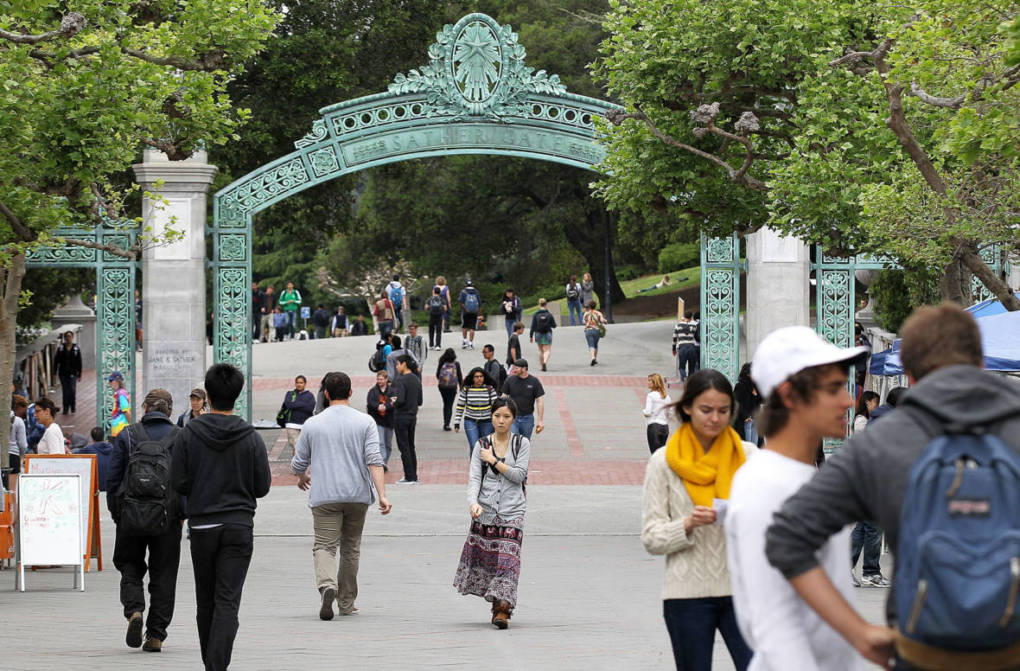
"caption": "Students walk through Sproul Plaza on the UC Berkeley campus.",
"description": null,
"title": null,
"credit": "Justin Sullivan/Getty Images",
"status": "inherit",
"altTag": null,
"isLoading": false,
"fetchFailed": false
},
"science_1972807": {
"type": "attachments",
"id": "science_1972807",
"meta": {
"index": "attachments_1716263798",
"site": "science",
"id": "1972807",
"found": true
},
"parent": 1972802,
"imgSizes": {
"twentyfourteen-full-width": {
"file": "https://ww2.kqed.org/app/uploads/sites/35/2021/02/RS47279_GettyImages-1231222415-qut-1038x576.jpg",
"width": 1038,
"mimeType": "image/jpeg",
"height": 576
},
"thumbnail": {
"file": "https://ww2.kqed.org/app/uploads/sites/35/2021/02/RS47279_GettyImages-1231222415-qut-160x107.jpg",
"width": 160,
"mimeType": "image/jpeg",
"height": 107
},
"post-thumbnail": {
"file": "https://ww2.kqed.org/app/uploads/sites/35/2021/02/RS47279_GettyImages-1231222415-qut-672x372.jpg",
"width": 672,
"mimeType": "image/jpeg",
"height": 372
},
"kqedFullSize": {
"file": "https://ww2.kqed.org/app/uploads/sites/35/2021/02/RS47279_GettyImages-1231222415-qut.jpg",
"width": 1920,
"height": 1280
},
"large": {
"file": "https://ww2.kqed.org/app/uploads/sites/35/2021/02/RS47279_GettyImages-1231222415-qut-1020x680.jpg",
"width": 1020,
"mimeType": "image/jpeg",
"height": 680
},
"1536x1536": {
"file": "https://ww2.kqed.org/app/uploads/sites/35/2021/02/RS47279_GettyImages-1231222415-qut-1536x1024.jpg",
"width": 1536,
"mimeType": "image/jpeg",
"height": 1024
},
"medium": {
"file": "https://ww2.kqed.org/app/uploads/sites/35/2021/02/RS47279_GettyImages-1231222415-qut-800x533.jpg",
"width": 800,
"mimeType": "image/jpeg",
"height": 533
},
"medium_large": {
"file": "https://ww2.kqed.org/app/uploads/sites/35/2021/02/RS47279_GettyImages-1231222415-qut-768x512.jpg",
"width": 768,
"mimeType": "image/jpeg",
"height": 512
}
},
"publishDate": 1613699329,
"modified": 1613783759,
"caption": "A sign states that a Fiesta Mart is closed because of a power outage in Austin, Texas, on Feb. 17, 2021. ",
"description": null,
"title": "Texas Struggles With Unprecedented Cold And Power Outages",
"credit": "Montinique Monroe/Getty Images",
"status": "inherit",
"altTag": null,
"isLoading": false,
"fetchFailed": false
},
"science_1972678": {
"type": "attachments",
"id": "science_1972678",
"meta": {
"index": "attachments_1716263798",
"site": "science",
"id": "1972678",
"found": true
},
"parent": 1972677,
"imgSizes": {
"twentyfourteen-full-width": {
"file": "https://ww2.kqed.org/app/uploads/sites/35/2021/02/RS47133_GettyImages-76412145-1-qut-1038x576.jpg",
"width": 1038,
"mimeType": "image/jpeg",
"height": 576
},
"thumbnail": {
"file": "https://ww2.kqed.org/app/uploads/sites/35/2021/02/RS47133_GettyImages-76412145-1-qut-160x109.jpg",
"width": 160,
"mimeType": "image/jpeg",
"height": 109
},
"post-thumbnail": {
"file": "https://ww2.kqed.org/app/uploads/sites/35/2021/02/RS47133_GettyImages-76412145-1-qut-672x372.jpg",
"width": 672,
"mimeType": "image/jpeg",
"height": 372
},
"kqedFullSize": {
"file": "https://ww2.kqed.org/app/uploads/sites/35/2021/02/RS47133_GettyImages-76412145-1-qut.jpg",
"width": 1920,
"height": 1309
},
"large": {
"file": "https://ww2.kqed.org/app/uploads/sites/35/2021/02/RS47133_GettyImages-76412145-1-qut-1020x695.jpg",
"width": 1020,
"mimeType": "image/jpeg",
"height": 695
},
"1536x1536": {
"file": "https://ww2.kqed.org/app/uploads/sites/35/2021/02/RS47133_GettyImages-76412145-1-qut-1536x1047.jpg",
"width": 1536,
"mimeType": "image/jpeg",
"height": 1047
},
"medium": {
"file": "https://ww2.kqed.org/app/uploads/sites/35/2021/02/RS47133_GettyImages-76412145-1-qut-800x545.jpg",
"width": 800,
"mimeType": "image/jpeg",
"height": 545
},
"medium_large": {
"file": "https://ww2.kqed.org/app/uploads/sites/35/2021/02/RS47133_GettyImages-76412145-1-qut-768x524.jpg",
"width": 768,
"mimeType": "image/jpeg",
"height": 524
}
},
"publishDate": 1612820573,
"modified": 1612906890,
"caption": "The sun shines over towers carrying electrical lines on Aug. 30, 2007, in South San Francisco, Calif. ",
"description": null,
"title": "California Power Grid Strained By Heat Wave",
"credit": "Justin Sullivan/Getty Images)",
"status": "inherit",
"altTag": null,
"isLoading": false,
"fetchFailed": false
},
"science_1972488": {
"type": "attachments",
"id": "science_1972488",
"meta": {
"index": "attachments_1716263798",
"site": "science",
"id": "1972488",
"found": true
},
"parent": 1972486,
"imgSizes": {
"twentyfourteen-full-width": {
"file": "https://ww2.kqed.org/app/uploads/sites/35/2021/01/RS46898_GettyImages-1005341936-qut-1038x576.jpg",
"width": 1038,
"mimeType": "image/jpeg",
"height": 576
},
"thumbnail": {
"file": "https://ww2.kqed.org/app/uploads/sites/35/2021/01/RS46898_GettyImages-1005341936-qut-160x108.jpg",
"width": 160,
"mimeType": "image/jpeg",
"height": 108
},
"post-thumbnail": {
"file": "https://ww2.kqed.org/app/uploads/sites/35/2021/01/RS46898_GettyImages-1005341936-qut-672x372.jpg",
"width": 672,
"mimeType": "image/jpeg",
"height": 372
},
"kqedFullSize": {
"file": "https://ww2.kqed.org/app/uploads/sites/35/2021/01/RS46898_GettyImages-1005341936-qut.jpg",
"width": 1920,
"height": 1299
},
"large": {
"file": "https://ww2.kqed.org/app/uploads/sites/35/2021/01/RS46898_GettyImages-1005341936-qut-1020x690.jpg",
"width": 1020,
"mimeType": "image/jpeg",
"height": 690
},
"1536x1536": {
"file": "https://ww2.kqed.org/app/uploads/sites/35/2021/01/RS46898_GettyImages-1005341936-qut-1536x1039.jpg",
"width": 1536,
"mimeType": "image/jpeg",
"height": 1039
},
"medium": {
"file": "https://ww2.kqed.org/app/uploads/sites/35/2021/01/RS46898_GettyImages-1005341936-qut-800x541.jpg",
"width": 800,
"mimeType": "image/jpeg",
"height": 541
},
"medium_large": {
"file": "https://ww2.kqed.org/app/uploads/sites/35/2021/01/RS46898_GettyImages-1005341936-qut-768x520.jpg",
"width": 768,
"mimeType": "image/jpeg",
"height": 520
}
},
"publishDate": 1611855112,
"modified": 1611865529,
"caption": "A view of a Chevrolet dealership on July 25, 2018, in Colma, Calif. General Motors plans to phase out the manufacturing of gasoline cars and trucks by 2035. ",
"description": null,
"title": "RS46898_GettyImages-1005341936-qut",
"credit": "Justin Sullivan/Getty Images",
"status": "inherit",
"altTag": null,
"isLoading": false,
"fetchFailed": false
},
"science_1972456": {
"type": "attachments",
"id": "science_1972456",
"meta": {
"index": "attachments_1716263798",
"site": "science",
"id": "1972456",
"found": true
},
"parent": 1972448,
"imgSizes": {
"twentyfourteen-full-width": {
"file": "https://ww2.kqed.org/app/uploads/sites/35/2021/01/RS46897_GettyImages-1273191900-qut-1038x576.jpg",
"width": 1038,
"mimeType": "image/jpeg",
"height": 576
},
"thumbnail": {
"file": "https://ww2.kqed.org/app/uploads/sites/35/2021/01/RS46897_GettyImages-1273191900-qut-160x107.jpg",
"width": 160,
"mimeType": "image/jpeg",
"height": 107
},
"post-thumbnail": {
"file": "https://ww2.kqed.org/app/uploads/sites/35/2021/01/RS46897_GettyImages-1273191900-qut-672x372.jpg",
"width": 672,
"mimeType": "image/jpeg",
"height": 372
},
"kqedFullSize": {
"file": "https://ww2.kqed.org/app/uploads/sites/35/2021/01/RS46897_GettyImages-1273191900-qut.jpg",
"width": 1920,
"height": 1280
},
"large": {
"file": "https://ww2.kqed.org/app/uploads/sites/35/2021/01/RS46897_GettyImages-1273191900-qut-1020x680.jpg",
"width": 1020,
"mimeType": "image/jpeg",
"height": 680
},
"1536x1536": {
"file": "https://ww2.kqed.org/app/uploads/sites/35/2021/01/RS46897_GettyImages-1273191900-qut-1536x1024.jpg",
"width": 1536,
"mimeType": "image/jpeg",
"height": 1024
},
"medium": {
"file": "https://ww2.kqed.org/app/uploads/sites/35/2021/01/RS46897_GettyImages-1273191900-qut-800x533.jpg",
"width": 800,
"mimeType": "image/jpeg",
"height": 533
},
"medium_large": {
"file": "https://ww2.kqed.org/app/uploads/sites/35/2021/01/RS46897_GettyImages-1273191900-qut-768x512.jpg",
"width": 768,
"mimeType": "image/jpeg",
"height": 512
}
},
"publishDate": 1611787101,
"modified": 1611787398,
"caption": "A FedEx truck makes deliveries in Manhattan in September 2020. The move from retail stores to online shopping has only grown during the COVID-19 pandemic, when many physical stores have closed. ",
"description": "A FedEx truck makes deliveries in Manhattan in September 2020. The move from retail stores to online shopping has only grown during the COVID-19 pandemic, when many physical stores have closed. ",
"title": "FedEx",
"credit": "Spencer Platt/Getty Images",
"status": "inherit",
"altTag": "A young woman with black hair in a ponytail walks three fluffy dogs on the sidewalk, across a cobbled street from a large FedEx truck. The photo is from New York City, September, 2020. The move from retail stores to online shopping has only grown during the COVID-19 pandemic, when many physical stores have closed.",
"isLoading": false,
"fetchFailed": false
},
"science_1972442": {
"type": "attachments",
"id": "science_1972442",
"meta": {
"index": "attachments_1716263798",
"site": "science",
"id": "1972442",
"found": true
},
"parent": 1972437,
"imgSizes": {
"twentyfourteen-full-width": {
"file": "https://ww2.kqed.org/app/uploads/sites/35/2021/01/RS46896_GettyImages-1230821142-qut-1038x576.jpg",
"width": 1038,
"mimeType": "image/jpeg",
"height": 576
},
"thumbnail": {
"file": "https://ww2.kqed.org/app/uploads/sites/35/2021/01/RS46896_GettyImages-1230821142-qut-160x107.jpg",
"width": 160,
"mimeType": "image/jpeg",
"height": 107
},
"post-thumbnail": {
"file": "https://ww2.kqed.org/app/uploads/sites/35/2021/01/RS46896_GettyImages-1230821142-qut-672x372.jpg",
"width": 672,
"mimeType": "image/jpeg",
"height": 372
},
"kqedFullSize": {
"file": "https://ww2.kqed.org/app/uploads/sites/35/2021/01/RS46896_GettyImages-1230821142-qut.jpg",
"width": 1920,
"height": 1280
},
"large": {
"file": "https://ww2.kqed.org/app/uploads/sites/35/2021/01/RS46896_GettyImages-1230821142-qut-1020x680.jpg",
"width": 1020,
"mimeType": "image/jpeg",
"height": 680
},
"1536x1536": {
"file": "https://ww2.kqed.org/app/uploads/sites/35/2021/01/RS46896_GettyImages-1230821142-qut-1536x1024.jpg",
"width": 1536,
"mimeType": "image/jpeg",
"height": 1024
},
"medium": {
"file": "https://ww2.kqed.org/app/uploads/sites/35/2021/01/RS46896_GettyImages-1230821142-qut-800x533.jpg",
"width": 800,
"mimeType": "image/jpeg",
"height": 533
},
"medium_large": {
"file": "https://ww2.kqed.org/app/uploads/sites/35/2021/01/RS46896_GettyImages-1230821142-qut-768x512.jpg",
"width": 768,
"mimeType": "image/jpeg",
"height": 512
}
},
"publishDate": 1611780876,
"modified": 1619566396,
"caption": "Vice President Kamala Harris and Special Presidential Envoy for Climate John Kerry watch as President Joe Biden signs executive orders after speaking about tackling climate change, creating jobs and restoring scientific integrity on Jan. 27, 2021, in Washington, D.C.",
"description": null,
"title": "RS46896_GettyImages-1230821142-qut",
"credit": "Mandel Ngan/AFP via Getty Images",
"status": "inherit",
"altTag": null,
"isLoading": false,
"fetchFailed": false
},
"science_1972139": {
"type": "attachments",
"id": "science_1972139",
"meta": {
"index": "attachments_1716263798",
"site": "science",
"id": "1972139",
"found": true
},
"title": "California Governor Gavin Newsom And Oakland Mayor Libby Schaaf Speak On State's Actions On Homelessness Crisis",
"publishDate": 1610154874,
"status": "inherit",
"parent": 1972138,
"modified": 1725058031,
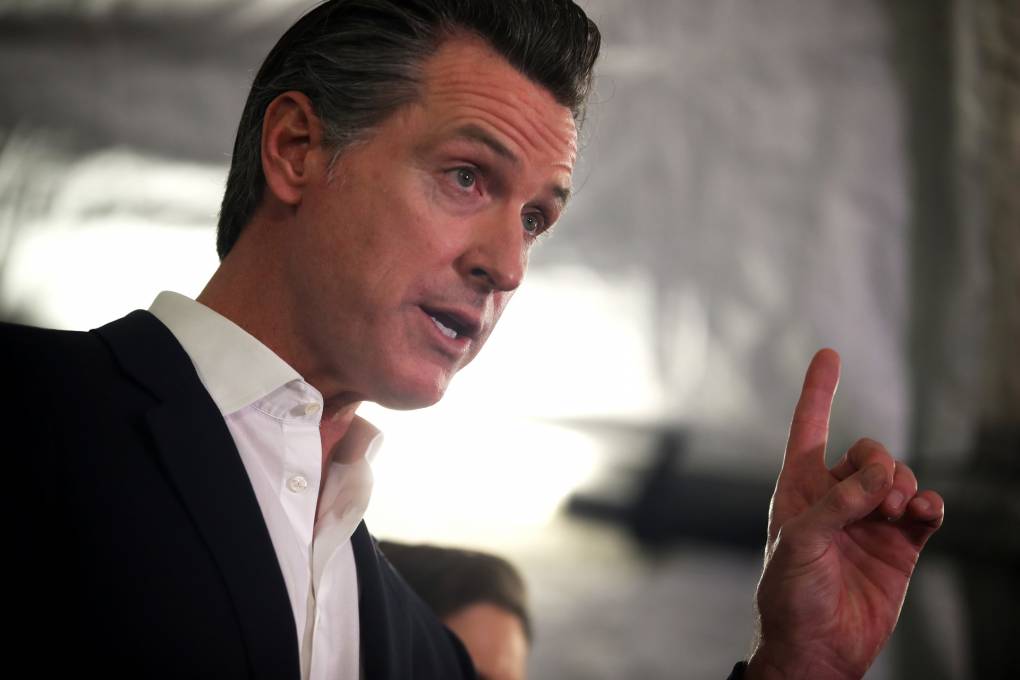
"caption": "California Gov. Gavin Newsom speaks during a news conference about the state's efforts on the homelessness crisis on Jan. 16, 2020, in Oakland. Oakland Mayor Libby Schaaf joined Newsom to announce that Oakland will receive 15 unused FEMA trailers for the city to use as temporary housing and as mobile health and social services clinics for the homeless. Newsom signed an executive order on Jan. 8 to deploy 100 trailers and crisis response teams to areas in need across the state.",
"credit": "Justin Sullivan/Getty Images",
"altTag": null,
"description": null,
"imgSizes": {
"medium": {
"file": "https://cdn.kqed.org/wp-content/uploads/sites/35/2021/01/RS46512_GettyImages-1199995830-qut-800x533.jpg",
"width": 800,
"height": 533,
"mimeType": "image/jpeg"
},
"large": {
"file": "https://cdn.kqed.org/wp-content/uploads/sites/35/2021/01/RS46512_GettyImages-1199995830-qut-1020x680.jpg",
"width": 1020,
"height": 680,
"mimeType": "image/jpeg"
},
"thumbnail": {
"file": "https://cdn.kqed.org/wp-content/uploads/sites/35/2021/01/RS46512_GettyImages-1199995830-qut-160x107.jpg",
"width": 160,
"height": 107,
"mimeType": "image/jpeg"
},
"medium_large": {
"file": "https://cdn.kqed.org/wp-content/uploads/sites/35/2021/01/RS46512_GettyImages-1199995830-qut-768x512.jpg",
"width": 768,
"height": 512,
"mimeType": "image/jpeg"
},
"1536x1536": {
"file": "https://cdn.kqed.org/wp-content/uploads/sites/35/2021/01/RS46512_GettyImages-1199995830-qut-1536x1024.jpg",
"width": 1536,
"height": 1024,
"mimeType": "image/jpeg"
},
"post-thumbnail": {
"file": "https://cdn.kqed.org/wp-content/uploads/sites/35/2021/01/RS46512_GettyImages-1199995830-qut-672x372.jpg",
"width": 672,
"height": 372,
"mimeType": "image/jpeg"
},
"twentyfourteen-full-width": {
"file": "https://cdn.kqed.org/wp-content/uploads/sites/35/2021/01/RS46512_GettyImages-1199995830-qut-1038x576.jpg",
"width": 1038,
"height": 576,
"mimeType": "image/jpeg"
},
"kqedFullSize": {
"file": "https://cdn.kqed.org/wp-content/uploads/sites/35/2021/01/RS46512_GettyImages-1199995830-qut.jpg",
"width": 1920,
"height": 1280
}
},
"isLoading": false,
"fetchFailed": false
},
"science_1972051": {
"type": "attachments",
"id": "science_1972051",
"meta": {
"index": "attachments_1716263798",
"site": "science",
"id": "1972051",
"found": true
},
"parent": 1972044,
"imgSizes": {
"twentyfourteen-full-width": {
"file": "https://ww2.kqed.org/app/uploads/sites/35/2021/01/RS46499_GettyImages-1228523437-qut-1038x576.jpg",
"width": 1038,
"mimeType": "image/jpeg",
"height": 576
},
"thumbnail": {
"file": "https://ww2.kqed.org/app/uploads/sites/35/2021/01/RS46499_GettyImages-1228523437-qut-160x107.jpg",
"width": 160,
"mimeType": "image/jpeg",
"height": 107
},
"post-thumbnail": {
"file": "https://ww2.kqed.org/app/uploads/sites/35/2021/01/RS46499_GettyImages-1228523437-qut-672x372.jpg",
"width": 672,
"mimeType": "image/jpeg",
"height": 372
},
"kqedFullSize": {
"file": "https://ww2.kqed.org/app/uploads/sites/35/2021/01/RS46499_GettyImages-1228523437-qut.jpg",
"width": 1920,
"height": 1281
},
"large": {
"file": "https://ww2.kqed.org/app/uploads/sites/35/2021/01/RS46499_GettyImages-1228523437-qut-1020x681.jpg",
"width": 1020,
"mimeType": "image/jpeg",
"height": 681
},
"1536x1536": {
"file": "https://ww2.kqed.org/app/uploads/sites/35/2021/01/RS46499_GettyImages-1228523437-qut-1536x1025.jpg",
"width": 1536,
"mimeType": "image/jpeg",
"height": 1025
},
"medium": {
"file": "https://ww2.kqed.org/app/uploads/sites/35/2021/01/RS46499_GettyImages-1228523437-qut-800x534.jpg",
"width": 800,
"mimeType": "image/jpeg",
"height": 534
},
"medium_large": {
"file": "https://ww2.kqed.org/app/uploads/sites/35/2021/01/RS46499_GettyImages-1228523437-qut-768x512.jpg",
"width": 768,
"mimeType": "image/jpeg",
"height": 512
}
},
"publishDate": 1609791608,
"modified": 1609883066,
"caption": "A firefighter keeps watch as flames advance along the Western Divide Highway during the SQF Complex Fire on Sept. 14, 2020, near Camp Nelson, California. ",
"description": null,
"title": "Wildfires Burn Thousands Of Acres Across California",
"credit": "David McNew/Getty Images",
"status": "inherit",
"altTag": null,
"isLoading": false,
"fetchFailed": false
}
},
"audioPlayerReducer": {
"postId": "stream_live",
"isPaused": true,
"isPlaying": false,
"pfsActive": false,
"pledgeModalIsOpen": true,
"playerDrawerIsOpen": false,
"liveAudioPlayStartedAt": 0,
"liveAudioPlayContext": ""
},
"authorsReducer": {
"byline_science_1974389": {
"type": "authors",
"id": "byline_science_1974389",
"meta": {
"override": true
},
"slug": "byline_science_1974389",
"name": "Lisa Song, ProPublica, and James Temple, MIT Technology Review",
"isLoading": false
},
"byline_science_1974156": {
"type": "authors",
"id": "byline_science_1974156",
"meta": {
"override": true
},
"slug": "byline_science_1974156",
"name": "Adam Beam, Associated Press\u003cbr> and Ezra David Romero",
"isLoading": false
},
"byline_science_1972437": {
"type": "authors",
"id": "byline_science_1972437",
"meta": {
"override": true
},
"slug": "byline_science_1972437",
"name": "Matthew Daly and Ellen Knickmeyer \u003cbr />AP\u003cbr>",
"isLoading": false
},
"byline_science_1972044": {
"type": "authors",
"id": "byline_science_1972044",
"meta": {
"override": true
},
"slug": "byline_science_1972044",
"name": "Bob Berwyn \u003cbr />InsideClimate News\u003cbr>",
"isLoading": false
},
"sevdaeris": {
"type": "authors",
"id": "6364",
"meta": {
"index": "authors_1716337520",
"id": "6364",
"found": true
},
"name": "Sevda Eris",
"firstName": "Sevda",
"lastName": "Eris",
"slug": "sevdaeris",
"email": "seris@kqed.org",
"display_author_email": false,
"staff_mastheads": [],
"title": "Director of Audience Engagement",
"bio": null,
"avatar": "https://secure.gravatar.com/avatar/c99311b4355095e2f7f01ea8bf8e6fba?s=600&d=mm&r=g",
"twitter": null,
"facebook": null,
"instagram": null,
"linkedin": null,
"sites": [
{
"site": "about",
"roles": []
},
{
"site": "science",
"roles": []
},
{
"site": "pressroom",
"roles": []
}
],
"headData": {
"title": "Sevda Eris | KQED",
"description": "Director of Audience Engagement",
"ogImgSrc": "https://secure.gravatar.com/avatar/c99311b4355095e2f7f01ea8bf8e6fba?s=600&d=mm&r=g",
"twImgSrc": "https://secure.gravatar.com/avatar/c99311b4355095e2f7f01ea8bf8e6fba?s=600&d=mm&r=g"
},
"isLoading": false,
"link": "/author/sevdaeris"
},
"dventon": {
"type": "authors",
"id": "11088",
"meta": {
"index": "authors_1716337520",
"id": "11088",
"found": true
},
"name": "Danielle Venton",
"firstName": "Danielle",
"lastName": "Venton",
"slug": "dventon",
"email": "dventon@kqed.org",
"display_author_email": true,
"staff_mastheads": [
"science"
],
"title": "Science reporter",
"bio": "Danielle Venton is a reporter for KQED Science. She covers wildfires, space and oceans (though she is prone to sea sickness).\r\n\r\nBefore joining KQED in 2015, Danielle was a staff reporter at KRCB in Sonoma County and a freelancer. She studied science communication at UC Santa Cruz and formerly worked at CERN in Geneva, Switzerland where she wrote about computing. She lives in Sonoma County and enjoys backpacking.",
"avatar": "https://secure.gravatar.com/avatar/37b292b5c40c8d93959c4f48d73b5286f41b7abd8588277e941905a3ed4c801c?s=600&d=blank&r=g",
"twitter": "DanielleVenton",
"bluesky": null,
"facebook": null,
"instagram": null,
"linkedin": null,
"sites": [
{
"site": "arts",
"roles": [
"contributor"
]
},
{
"site": "news",
"roles": [
"editor"
]
},
{
"site": "futureofyou",
"roles": [
"editor"
]
},
{
"site": "science",
"roles": [
"editor"
]
},
{
"site": "liveblog",
"roles": [
"contributor"
]
}
],
"headData": {
"title": "Danielle Venton | KQED",
"description": "Science reporter",
"ogImgSrc": "https://secure.gravatar.com/avatar/37b292b5c40c8d93959c4f48d73b5286f41b7abd8588277e941905a3ed4c801c?s=600&d=blank&r=g",
"twImgSrc": "https://secure.gravatar.com/avatar/37b292b5c40c8d93959c4f48d73b5286f41b7abd8588277e941905a3ed4c801c?s=600&d=blank&r=g"
},
"isLoading": false,
"link": "/author/dventon"
},
"mpeterson": {
"type": "authors",
"id": "11223",
"meta": {
"index": "authors_1716337520",
"id": "11223",
"found": true
},
"name": "Molly Peterson",
"firstName": "Molly",
"lastName": "Peterson",
"slug": "mpeterson",
"email": "mpeterson@kqed.org",
"display_author_email": false,
"staff_mastheads": [],
"title": null,
"bio": "Molly Peterson reports for KQED science and news on climate change, catastrophe and risk. Previously she was environment correspondent at Southern California Public Radio. Her work has also appeared at The New York Times, The Guardian, on NPR, at High Country News, on Code Switch, and other national outlets. She has been honored with awards from Public Radio News Directors Incorporated, Investigative Reporters and Editors, the Society for Professional Journalists, the Los Angeles Press Club, and RTNDA Edward R. Murrow awards, among others.",
"avatar": "https://secure.gravatar.com/avatar/7908e2807131f776cc8165c649530b05?s=600&d=blank&r=g",
"twitter": "Mollydacious",
"facebook": null,
"instagram": "https://www.instagram.com/radiomolly/",
"linkedin": null,
"sites": [
{
"site": "news",
"roles": [
"subscriber"
]
},
{
"site": "futureofyou",
"roles": [
"editor"
]
},
{
"site": "science",
"roles": [
"editor"
]
}
],
"headData": {
"title": "Molly Peterson | KQED",
"description": null,
"ogImgSrc": "https://secure.gravatar.com/avatar/7908e2807131f776cc8165c649530b05?s=600&d=blank&r=g",
"twImgSrc": "https://secure.gravatar.com/avatar/7908e2807131f776cc8165c649530b05?s=600&d=blank&r=g"
},
"isLoading": false,
"link": "/author/mpeterson"
},
"kevinstark": {
"type": "authors",
"id": "11608",
"meta": {
"index": "authors_1716337520",
"id": "11608",
"found": true
},
"name": "Kevin Stark",
"firstName": "Kevin",
"lastName": "Stark",
"slug": "kevinstark",
"email": "kstark@kqed.org",
"display_author_email": true,
"staff_mastheads": [
"science"
],
"title": "Senior Editor",
"bio": "Kevin is a senior editor for KQED Science, managing the station's health and climate desks. His journalism career began in the Pacific Northwest, and he later became a lead reporter for the San Francisco Public Press. His work has appeared in Pacific Standard magazine, the Energy News Network, the Center for Investigative Reporting's Reveal and WBEZ in Chicago. Kevin joined KQED in 2019, and has covered issues related to energy, wildfire, climate change and the environment.",
"avatar": "https://secure.gravatar.com/avatar/365aaa4b597d3a8374f67504ff0facd323d7906e8eb4be0a7efd2427408e802c?s=600&d=blank&r=g",
"twitter": "starkkev",
"bluesky": null,
"facebook": null,
"instagram": null,
"linkedin": null,
"sites": [
{
"site": "",
"roles": [
"editor"
]
},
{
"site": "news",
"roles": [
"editor"
]
},
{
"site": "science",
"roles": [
"administrator"
]
}
],
"headData": {
"title": "Kevin Stark | KQED",
"description": "Senior Editor",
"ogImgSrc": "https://secure.gravatar.com/avatar/365aaa4b597d3a8374f67504ff0facd323d7906e8eb4be0a7efd2427408e802c?s=600&d=blank&r=g",
"twImgSrc": "https://secure.gravatar.com/avatar/365aaa4b597d3a8374f67504ff0facd323d7906e8eb4be0a7efd2427408e802c?s=600&d=blank&r=g"
},
"isLoading": false,
"link": "/author/kevinstark"
}
},
"pagesReducer": {
"science_category_energy": {
"type": "terms",
"id": "science_33",
"meta": {
"index": "terms_1716263798",
"site": "science",
"id": "33",
"score": 12.797518
},
"featImg": null,
"name": "Energy",
"description": null,
"taxonomy": "category",
"headData": {
"twImgId": null,
"twTitle": null,
"ogTitle": null,
"ogImgId": null,
"twDescription": null,
"description": null,
"title": "Energy Archives | KQED Science",
"ogDescription": null
},
"ttid": 35,
"slug": "energy",
"isLoading": false,
"title": "Energy",
"pageMeta": {
"site": "science",
"WpPageTemplate": "page-topic-editorial",
"currentPage": 6
},
"blocks": [
{
"blockName": "kqed/post-list",
"attrs": {
"layout": "cardArticle2",
"query": "posts/science?category=energy",
"seeMore": false,
"paginated": true,
"page": 6
}
},
{
"blockName": "kqed/ad"
}
]
}
},
"pfsSessionReducer": {},
"postsReducer": {
"stream_live": {
"type": "live",
"id": "stream_live",
"audioUrl": "https://streams.kqed.org/kqedradio",
"title": "Live Stream",
"excerpt": "Live Stream information currently unavailable.",
"link": "/radio",
"featImg": "",
"label": {
"name": "KQED Live",
"link": "/"
}
},
"stream_kqedNewscast": {
"type": "posts",
"id": "stream_kqedNewscast",
"audioUrl": "https://www.kqed.org/.stream/anon/radio/RDnews/newscast.mp3?_=1",
"title": "KQED Newscast",
"featImg": "",
"label": {
"name": "88.5 FM",
"link": "/"
}
},
"science_1974389": {
"type": "posts",
"id": "science_1974389",
"meta": {
"index": "posts_1716263798",
"site": "science",
"id": "1974389",
"score": null,
"sort": [
1620063016000
]
},
"parent": 0,
"labelTerm": {},
"blocks": [],
"publishDate": 1620063016,
"format": "standard",
"title": "California's Forest Climate Program Could Actually Be Increasing CO2",
"headTitle": "California’s Forest Climate Program Could Actually Be Increasing CO2 | KQED",
"content": "\u003cp>\u003cem>ProPublica is a Pulitzer Prize-winning investigative newsroom. Sign up for \u003ca href=\"https://www.propublica.org/newsletters/the-big-story?source=reprint&placement=top-note\">The Big Story newsletter\u003c/a> to receive stories like this one in your inbox\u003c/em>.\u003c/p>\n\u003cdiv>\n\u003cp>Along the coast of Northern California near the Oregon border, the cool, moist air off the Pacific sustains a strip of temperate rainforests. Soaring redwoods and Douglas firs dominate these thick, wet woodlands, creating a canopy hundreds of feet high.\u003c/p>\n\u003cp>But if you travel inland the mix of trees gradually shifts.\u003c/p>\n\u003cp>[pullquote]New research shows that California’s climate policy created up to 39 million carbon credits that aren’t achieving real carbon savings.[/pullquote]Beyond the crest of the Klamath Mountains, you descend into an evergreen medley of sugar pines, incense cedars and still more Douglas firs. As you continue into the Cascade Range, you pass through sparser forests dominated by Ponderosa pines. These tall, slender trees with prickly cones thrive in the hotter, drier conditions on the eastern side of the state.\u003c/p>\n\u003cp>All trees consume carbon dioxide, releasing the oxygen and storing the carbon in their trunks, branches and roots. Every ton of carbon sequestered in a living tree is a ton that isn’t contributing to climate change. And that thick coastal forest can easily store twice as much carbon per acre as the trees deeper inland.\u003c/p>\n\u003cp>This math is crucial to determining the success of California’s forest offset program, which seeks to reduce carbon emissions by preserving trees. The state established the program a decade ago as part of its efforts to combat climate change.\u003c/p>\n\u003cp>But ecology is messy. The boundaries between forest types are nebulous, and the actual amount of carbon on any given acre depends on local climate conditions, conservation efforts, logging history and more.\u003c/p>\n\u003cp>California’s top climate regulator, the Air Resources Board, glossed over much of this complexity in implementing the state’s program. The agency established fixed boundaries around giant regions, boiling down the carbon stored in a wide mix of tree species into simplified, regional averages.\u003c/p>\n\u003cp>That decision has generated tens of millions of carbon credits with dubious climate value, according to \u003ca href=\"https://carbonplan.org/research/forest-offsets-explainer\" target=\"_blank\" rel=\"noopener noreferrer\">a new analysis\u003c/a> by CarbonPlan, a San Francisco nonprofit that analyzes the scientific integrity of carbon removal efforts.\u003c/p>\n\u003cp>The offset program allows forest owners across the country to earn credits for taking care of their land in ways that store or absorb more carbon, such as reducing logging or thinning out smaller trees and brush to allow for increased overall growth. Each credit represents one metric ton of CO2. Landowners can sell the credits to major polluters in California, typically oil companies and other businesses that want to emit more carbon than otherwise allowed under state law. Each extra ton of carbon emitted by industry is balanced out by an extra ton stored in the forest, allowing net emissions to stay within a cap set by the state.\u003c/p>\n\u003cp>As of last fall, the program had produced some six dozen projects that had generated more than 130 million credits, worth $1.8 billion at recent prices.\u003c/p>\n\u003cp>While calculating the exact amount of carbon saved by preserving forests is complicated, California’s logic for awarding credits is relatively straightforward.\u003c/p>\n\u003cp>The Air Resources Board establishes the average amount of carbon per acre stored in a few forest types spanning large regions of the United States. If you own land that contains more carbon than the regional average, based on a survey of trees on your site, you can get credits for the difference. For example, if your land holds the equivalent of 100 tons of CO2 per acre, and the regional average is 40 tons, you can earn credits for saving 60 tons per acre. (This story will refer to each ton of CO2-equivalent as a ton of “carbon.”) You must also commit to maintaining your forest’s high carbon storage for the next 100 years.\u003c/p>\n\u003cp>These regional averages are meant to represent carbon levels in typical private forests. But the averages are determined from such large areas and such diverse forest types that they can differ dramatically from the carbon stored on lands selected for projects.\u003c/p>\n\u003cp>Project forests that significantly exceed these averages are frequently earning far more credits than the actual carbon benefits they deliver, CarbonPlan found.\u003c/p>\n\u003cp>This design also incentivizes the developers who initiate and lead these projects to specifically look for forest tracts where carbon levels stand out above these averages — either due to the site’s location within a region, its combination of tree species, or both.\u003c/p>\n\u003cp>CarbonPlan estimates the state’s program has generated between 20 million and 39 million credits that don’t achieve real climate benefits. They are, in effect, ghost credits that didn’t preserve additional carbon in forests but did allow polluters to emit far more CO2, equal to the annual emissions of 8.5 million cars at the high end.\u003c/p>\n\u003cp>Those ghost credits represent nearly 1 in 3 credits issued through California’s primary forest offset program, highlighting systemic flaws in the rules and suggesting widespread gaming of the market.\u003c/p>\n\u003cp>“Our work shows that California’s forest offsets program increases greenhouse gas emissions, despite being a large part of the state’s strategy for reducing climate pollution,” said Danny Cullenward, the policy director at CarbonPlan. “The program creates the false appearance of progress when in fact it makes the climate problem worse.”\u003c/p>\n\u003cp>The Air Resources Board defended the program and disputed the central thesis of the study.\u003c/p>\n\u003cp>“We disagree with your statement that landowners or project developers are gaming the system or that there are inflated estimates” of greenhouse gas reductions, Dave Clegern, a spokesperson for the Air Resources Board, said in an email. Each version of the offset rules “went through our robust public regulatory review process,” with input from the forestry industry, academia, government agencies and nonprofits, he added.\u003c/p>\n\u003cp>California’s forest offset program is the largest in the country that is government regulated. Other forest offset programs are voluntary, allowing businesses or individuals to purchase credits to shrink their environmental footprint.\u003c/p>\n\u003cp>CarbonPlan’s study comes days after the \u003ca href=\"https://grist.org/economics/after-a-decade-of-failures-washington-state-passes-a-cap-on-carbon-emissions/\" target=\"_blank\" rel=\"noopener noreferrer\">Washington\u003c/a> state legislature moved a cap-and-trade bill with an offset program to the governor’s desk for approval. \u003ca href=\"https://www.oregon.gov/gov/Pages/carbonpolicy_climatechange.aspx\" target=\"_blank\" rel=\"noopener noreferrer\">Oregon\u003c/a> has also debated in recent months establishing a carbon market program that would emulate California’s policy. In Washington, D.C., the Biden administration has \u003ca href=\"https://joebiden.com/clean-energy/\" target=\"_blank\" rel=\"noopener noreferrer\">signaled growing interest\u003c/a> in harnessing forests and soil to draw down CO2. Businesses, too, increasingly plan to rely heavily on trees to offset their emissions in lieu of the harder task of cutting corporate pollution.\u003c/p>\n\u003cp>Forest offsets have been criticized for a variety of problems, including the risks that the \u003ca href=\"https://grist.org/climate/this-oregon-forest-was-supposed-to-store-carbon-for-100-years-now-its-on-fire/\" target=\"_blank\" rel=\"noopener noreferrer\">carbon reductions will be short-lived\u003c/a>, that carbon savings will be wiped out \u003ca href=\"https://www.technologyreview.com/2019/04/18/65883/californias-cap-and-trade-program-may-vastly-overestimate-emissions-cuts/\" target=\"_blank\" rel=\"noopener noreferrer\">by increased logging elsewhere\u003c/a>, and that the projects are preserving forests \u003ca href=\"https://www.bloomberg.com/features/2020-nature-conservancy-carbon-offsets-trees/\" target=\"_blank\" rel=\"noopener noreferrer\">never in jeopardy of being chopped down\u003c/a>, producing credits that don’t reflect real-world changes in carbon levels.\u003c/p>\n\u003cp>But CarbonPlan’s analysis highlights a different issue, one interlinked with these other problems. Even if everything else about a project were perfect, developers would still be able to undermine the program by exploiting regional averages.\u003c/p>\n\u003cp>Every time a polluter uses a credit that didn’t actually save a ton of carbon, the total amount of emissions goes up.\u003c/p>\n\u003cp>Far from addressing climate change, California’s forest offsets appear to be adding tens of millions of tons of CO2 into the atmosphere on balance, undermining progress on the state’s long-term emissions goals.\u003c/p>\n\u003cp>“When you strip away all the jargon, you’re left with a faulty set of assumptions that leave the door wide open to issuing meaningless offset credits,” said Grayson Badgley, a postdoctoral fellow at Black Rock Forest and Columbia University, and the lead researcher on the study.\u003c/p>\n\u003cp>\u003cstrong>Cherry-Picking\u003c/strong>\u003c/p>\n\u003cp>CarbonPlan provided ProPublica and MIT Technology Review full and exclusive access to their analysis as it was being finalized. As part of that process, the news organizations sent the report to independent experts for review. The organizations also interviewed landowners, industry players and scientists and reviewed hundreds of pages of documents, including the project plans submitted by developers. CarbonPlan collaborated on the study with academic experts from the UC Berkeley, Columbia University and other institutions.\u003c/p>\n\u003cp>The study itself wasn’t designed to assess whether developers or landowners are intentionally cherry-picking sites that stand out from regional averages, stating only that the system “allows for” developers to select such land. But the researchers themselves say that the level of excess crediting and the clustering of projects in certain areas suggest that industry players have gamed the system.\u003c/p>\n\u003cp>One form of cherry-picking identified by the researchers involves geographic boundaries. In the case of Northern California, the state’s offset program established a dividing line that separates that coastal strip of redwoods and Douglas firs from an inland region that spans more than 28,000 square miles.\u003c/p>\n\u003cp>The board’s rules state that tall mixed-conifer forests in the coastal region store an average of 205 tons of carbon per acre. For the neighboring inland region, the agency set the corresponding regional average at 122 tons per acre. The figure is lower because it includes more trees with less carbon, such as Ponderosa pines, which dominate the eastern end of the inland region and are all but absent on the coast.\u003c/p>\n\u003cp>But where the two regions meet, the forest on either side is virtually identical in many places, storing similar amounts of carbon. That means a project developer can earn far more money by choosing a site just east of the border, simply because they can compare the carbon in their forest against a lower regional average. For instance, maintaining a 10,000-acre forest of coastal redwoods and Douglas firs with carbon levels of 200 tons per acre could earn zero credits west of the line, or 624,000 credits east of it. The choice is between no money and more than $8 million.\u003c/p>\n\u003cp>To claim the most credits possible, for the full difference between the carbon on their land and the regional averages, developers or landowners must show that it’s legally and financially feasible to log down to those regional averages. The averages are effectively a stand-in for the way that similar forests are typically managed in an area.\u003c/p>\n\u003cp>A dozen projects are located in Northern California, almost entirely lined up along the western edge of the inland zone where the carbon-rich trees are juxtaposed against the lower regional average.\u003c/p>\n\u003cp>“What we’re seeing is developers are taking advantage of the fact that the big stuff and the scrubby stuff have been averaged together,” Badgley said.\u003c/p>\n\u003cp>Once an offset project developer and landowner decide to work together, the developer will generally shepherd them through the process in exchange for a fee or share of the sales of the credits generated — an arrangement that can be worth millions of dollars.\u003c/p>\n\u003cp>One of the most prolific project developers in the California system is an Australia-based timberlands investment company called New Forests. The company and its affiliates have worked on eight projects located almost entirely along the advantageous side of the border, as well as six elsewhere. CarbonPlan, in a separate analysis done for the news organizations that wasn’t included in the study, found that nearly all earned dubious credits, adding up to as much as $176 million worth.\u003c/p>\n\u003cp>A large share of those credits came from a single project outside California that profited from a glaring mistake in the rules. New Forests’ affiliate, Forest Carbon Partners, helped the Mescalero Apache Tribe develop a forest offset project in New Mexico. The project earned 3.7 million credits worth more than $50 million, largely because it was located in an area where the Air Resources Board had set an erroneously low regional average.\u003c/p>\n\u003cp>Another form of cherry-picking involves tree species: Developers can seek out tracts with particular trees that store far more carbon than the surrounding region.\u003c/p>\n\u003cp>According to the study, one project in Alaska consists almost entirely of giant Sitka spruces, yet the local regional average was calculated from a wide mix of trees, including species like cottonwoods that store far less carbon. The project earned significantly more credits than it should have due to the flaws in the system, the study said. The project owner didn’t return requests for comment.\u003c/p>\n\u003cp>Preserving especially carbon-rich forests is good for the climate, in and of itself. But when the trees in the project area bear little resemblance to the types of trees that went into calculating the regional average, it exaggerates the number of credits at stake, CarbonPlan’s study found.\u003c/p>\n\u003cp>Mark Trexler, a former offsets developer who worked in earlier U.S. and European carbon markets, said the board should have anticipated the perverse incentives created by its program.\u003c/p>\n\u003cp>“When people write offset rules, they always ignore the fact that there are 1,000 smart people next door that will try to game them,” he said. Since the board set up a system that “incentivizes people to find the areas that are high-density, or high-carbon, that’s what they’re going to do.”\u003c/p>\n\u003cp>To estimate the extent of overcrediting in California’s program, CarbonPlan calculated its own version of regional averages for each project. The researchers drew on the same raw data used by the Air Resources Board, but only used data from tree species that more closely resemble the particular mix of trees in each project area.\u003c/p>\n\u003cp>In total, 74 such projects had been established as of September 2020, when CarbonPlan began its research. CarbonPlan was able to study 65 projects that had enough documentation to make analysis possible. All received credits for holding more carbon than the regional average.\u003c/p>\n\u003cp>The researchers found that the vast majority of projects were over-credited, but about a dozen would have received more credits under CarbonPlan’s formula. Those included two New Forests projects, which would have earned as much as an additional 165,000 credits.\u003c/p>\n\u003cp>The news organizations sent officials at the Air Resources Board a copy of the study and its detailed methodology weeks before publication. Clegern declined multiple requests to interview board staff and responded only in writing.\u003c/p>\n\u003cp>He did not address CarbonPlan’s calculations. “We were not given sufficient time to fully analyze an unpublished study and are not commenting further on the authors’ alternative methodology,” he wrote.\u003c/p>\n\u003cp>The outside scientists who reviewed the research on behalf of ProPublica and MIT Technology Review praised the study.\u003c/p>\n\u003cp>“It’s a really analytically robust paper and it answers a really important policy question,” said Daniel Sanchez, who runs the Carbon Removal Laboratory at UC Berkeley. While close observers are well aware of numerous problems with California’s forest offset rules, “they’re revealing a deeper set of serious methodological flaws,” he said.\u003c/p>\n\u003cp>None of the reviewers pointed out any major technical or conceptual flaws with the paper, which has been submitted to a journal for peer review.\u003c/p>\n\u003cp>\u003cstrong>‘A Significant New Commodity Market’\u003c/strong>\u003c/p>\n\u003cp>In early 2015, an offsets nonprofit \u003ca href=\"https://vimeo.com/118731835\" target=\"_blank\" rel=\"noopener noreferrer\">hosted a webinar\u003c/a> highlighting how Native American tribes could participate in California’s program.\u003c/p>\n\u003cp>One speaker was Brian Shillinglaw, a Stanford-trained lawyer and managing director at New Forests who \u003ca href=\"https://newforests.com.au/member/brian-shillinglaw/\" target=\"_blank\" rel=\"noopener noreferrer\">oversees\u003c/a> the company’s U.S. forestry programs. The company manages the sale of carbon credits, \u003ca href=\"https://newforests.com.au/timber-products/\" target=\"_blank\" rel=\"noopener noreferrer\">sells timber\u003c/a> and on behalf of investors manages \u003ca href=\"https://newforests.com.au/new-forests-announces-conversion-of-1-3-billion-australian-forestry-fund-to-long-term-mandate/\" target=\"_blank\" rel=\"noopener noreferrer\">more than 2 million\u003c/a> acres of forests globally, a portfolio it values at more than $4 billion.\u003c/p>\n\u003cp>New Forests also manages its affiliate, \u003ca href=\"https://newforests.com.au/forests-carbon-partners/\" target=\"_blank\" rel=\"noopener noreferrer\">Forest Carbon Partners\u003c/a>, on behalf of an institutional investment client it declined to name. Forest Carbon Partners finances offset projects and \u003ca href=\"https://newforests.com.au/forests-carbon-partners/\" target=\"_blank\" rel=\"noopener noreferrer\">shepherds landowners\u003c/a> through the process of applying for California’s offset program.\u003c/p>\n\u003cp>“The bottom line is the California carbon market has really created a significant new commodity market,” Shillinglaw said during his presentation. He said the program is something “many Native American tribes are very well situated to benefit from, in part due to past conservative stewardship of their forests, which can lead to significant credit yield in the near term.”\u003c/p>\n\u003cp>Translation: Because many tribes have logged less aggressively than their neighbors, their carbon-rich forests were primed for big payouts of credits. Under Shillinglaw, New Forests or Forest Carbon Partners have helped to secure tens of millions of dollars’ worth of credits for native tribes.\u003c/p>\n\u003cp>Among the 13 New Forests projects that CarbonPlan researchers were able to analyze, between 33% and 71% of the credits don’t represent real carbon reductions. That’s nearly 13 million credits at the high end.\u003c/p>\n\u003cp>“Although we cannot prove that New Forests acted deliberately on the basis of our statistical analysis, in our judgment there is no reasonable explanation for these outcomes other than that New Forests knowingly engaged in cherry-picking behavior to take advantage of ecological shortcomings in the forest offset protocol,” said Badgley, the lead researcher.\u003c/p>\n\u003cp>New Forests managed the first official project in California’s program, registering 7,660 acres of forest land on or near the Yurok Reservation, which runs more than 40 miles along the Klamath River near the top of that West Coast cluster of projects. The state issued more than 700,000 credits to the project for its first year, worth $9.6 million at recent rates.\u003c/p>\n\u003cp>State officials have pointed to the tribe’s participation as a triumph of the program. In 2014, the board released \u003ca href=\"https://www.youtube.com/watch?v=xbjmbqTdXN0&feature=youtu.be\" target=\"_blank\" rel=\"noopener noreferrer\">a promotional video\u003c/a> that showed the meticulous work of measuring trees in the Yurok project. James Erler, the tribe’s then-forestry director, explained how offsets enabled the tribe to reduce logging. Near the end of the video, Shillinglaw appears in a sunlit forest, wearing a collared shirt and a New Forests-branded jacket.\u003c/p>\n\u003cp>“It’s a beautiful watershed,” Shillinglaw said over footage of a running stream and an elk standing before a thicket of trees. “This is the Yurok Tribe’s ancestral homeland, and in part due to the carbon market will be managed through a conservation approach.”\u003c/p>\n\u003cp>CarbonPlan estimates the project earned more than half a million ghost credits worth nearly $6.5 million.\u003c/p>\n\u003cp>Here’s why the researchers say it was over credited:\u003c/p>\n\u003cp>The boundary dividing California’s coastal and inland regions runs through the middle of the reservation. The carbon-rich forests on either side of that line are similar, filled with large Douglas firs like most of the coastal region. But more than 99% of the forest designated for preservation falls within the inland zone, where average carbon levels are much lower. The fact that the project was located in the most carbon-rich area of that zone enabled the landowners to earn an exaggerated number of credits.\u003c/p>\n\u003cp>At least one person involved in the Yurok Tribe’s forest offset efforts was aware of how geographical choices swing the credits that can be earned.\u003c/p>\n\u003cp>Erler said during a 2015 presentation at a National Indian Timber Symposium that the tribe had the “distinct pleasure” of having the boundary run through its territory.\u003c/p>\n\u003cp>“You can take the same inventory data and apply it to the California Coast” — the region to the west — “and it doesn’t come out with the same numbers as you do if you cross the street,” Erler said at the conference, captured in \u003ca href=\"https://www.youtube.com/watch?t=924&v=SlDrNcW_g3Q&feature=youtu.be\" target=\"_blank\" rel=\"noopener noreferrer\">a YouTube video\u003c/a> posted to the Intertribal Timber Council’s channel. “Vegetation may be the same, but it changes.”\u003c/p>\n\u003cp>Badgley said that while the researchers can’t speak to the intentions of any actors involved, it’s clear that this project “benefited from over-crediting and that the Yurok Tribe’s forester was aware how the specific aspects of the protocol rules our study criticizes led to beneficial outcomes.”\u003c/p>\n\u003cp>Erler didn’t respond to a list of emailed questions.\u003c/p>\n\u003cp>In an emailed statement, Yurok spokesperson Matt Mais said that the property was the only land the tribe had available to enroll at the time and strongly denied the tribe engaged in any sort of gaming of the system. He didn’t respond before press time to a subsequent inquiry asking why the rest of the tribe’s land wasn’t available for the offset program.\u003c/p>\n\u003cp>Over the last decade or so, the tribe has slowly reacquired tens of thousands of acres of its ancestral territory, in and around the watershed of Blue Creek and other streams that sustain migrating salmon, from the Green Diamond Resource Co., a major Seattle-based timber business. The complex multistep land deals were done in partnership with the nonprofit Western Rivers Conservancy and financed through government grants, philanthropic donations and the sale of the tribe’s offset credits.\u003c/p>\n\u003cp>“As we have recovered additional forestlands, we have enrolled additional acreage in California’s climate programs in support of our Tribe’s strategic goals including protecting salmon habitat, sustaining the revitalization of our cultural lifeways, and facilitating economic self-sufficiency,” Mais wrote.\u003c/p>\n\u003cp>“It’s insulting to claim that the Yurok Tribe has ‘gamed’ or ‘exploited’ California’s climate regulations,” he added. “Equally important, it’s concerning that elite institutions now criticize us for legally and ethically using a program that was created to protect mature forests and then using those funds to purchase and restore more forest land that was, at one point, ours.”\u003c/p>\n\u003cp>New Forests defended its practices in emailed responses to questions, arguing its projects have preserved existing carbon stocks and removed CO2 from the atmosphere through subsequent tree growth “as confirmed via third-party verification.”\u003c/p>\n\u003cp>In a statement, the company said it has worked on projects in numerous areas, not just along the program’s regional boundaries. The company said its projects “have protected and will enhance carbon storage on hundreds of thousands of acres of forests,” adding that one project with the Chugach Alaska Corp. \u003ca href=\"https://www.thecordovatimes.com/2017/01/25/bering-river-coal-field-rights-retired/\" target=\"_blank\" rel=\"noopener noreferrer\">enabled the permanent retirement\u003c/a> of a significant portion of the coal reserves in the Bering River Coal Field in southeastern Alaska.\u003c/p>\n\u003cp>New Forests follows the board’s “scientifically-accepted regulations to both the spirit and letter of the program,” the company said in a subsequent statement. “New Forests is proud of the forest carbon projects we have developed under California’s climate programs — they have generated positive environmental impact and furthered the economic and cultural objectives of the family forest landowners and Native American tribes with whom we have worked.”\u003c/p>\n\u003cp>New Forests didn’t respond to numerous additional inquiries, including direct questions about whether it was gaming the rules of the program.\u003c/p>\n\u003cp>In an emailed response, CarbonPlan stressed that its paper criticizes the design of the program — not the Yurok Tribe or other landowners. Nor does it allege anyone has broken the rules. Its analysis doesn’t consider or depend on the intent of any forest owners, who can benefit from flaws in the rules whether they intended to or even know about them.\u003c/p>\n\u003cp>“We recognize the injustices experienced by the Yurok Tribe, including the seizure of their historical lands by the United States government and its citizens,” the nonprofit stated. “We also recognize the Yurok Tribe’s legitimate interest in securing resources to repurchase lands that previously belonged to the Tribe and its people.”\u003c/p>\n\u003cp>\u003cstrong>An Open Secret\u003c/strong>\u003c/p>\n\u003cp>Chris Field, an environmental studies professor at Stanford University, was co-author of a 2017 study that found California’s program was helping to prevent emissions on balance by reducing logging. About 64% of the 39 projects studied were “being actively logged at or prior to project inception.”\u003c/p>\n\u003cp>Field said the state program is “relatively well-designed to address key issues,” but said it can and should be improved.\u003c/p>\n\u003cp>He added that there are firm limits on the role that offsets can play in California. From now through 2025, state polluters can only buy offsets to cover as much as 4% of their carbon emissions; from 2026 to 2030, that ceiling rises to 6%.\u003c/p>\n\u003cp>But those numbers understate the critical role of offsets in California’s cap-and-trade program, viewed by some as a model for market-based climate policy.\u003c/p>\n\u003cp>Under that program, California sells permits that allow certain industries to emit greenhouse gases, with each permit worth one metric ton of CO2. The state also regularly gives away a certain number of permits to various regulated companies. The total number of permits, called a “cap,” declines over time.\u003c/p>\n\u003cp>Polluters can also purchase permits from other companies with extras to spare, which constitutes the “trade.” Or they can buy carbon offset credits, which cost slightly less than permits.\u003c/p>\n\u003cp>To participate in the offset program, landowners must hire technicians to survey the trees on their land, then take data such as tree type, height and diameter and plug it into equations to estimate the carbon stored per acre.\u003c/p>\n\u003cp>Most of the credits are distributed during the initial stages of a project, which can help to repay setup costs. Projects can also earn additional credits over time as the trees grow and absorb CO2, but those credits accrue slowly, and are dwarfed by the initial credits given to forests with more carbon than the regional average.\u003c/p>\n\u003cp>The type of forest projects that CarbonPlan analyzed account for 68% of all credits issued by the Air Resources Board since the program’s launch, far eclipsing other types of offsets like capturing methane from dairy farms \u003ca href=\"https://www.technologyreview.com/2019/08/26/133261/whoops-californias-carbon-offsets-program-could-extend-the-life-of-coal-mines/\" target=\"_blank\" rel=\"noopener noreferrer\">or coal mines\u003c/a>, CarbonPlan found.\u003c/p>\n\u003cp>Cap and trade is designed to slash the state’s carbon footprint by 236 million tons of CO2 over the next decade, about a third of the cumulative reductions needed to meet the state’s emissions targets over that time.\u003c/p>\n\u003cp>Barbara Haya, who leads the Berkeley Carbon Trading Project at UC-Berkeley and is a co-author of the CarbonPlan study, calculated that up to half of those cap-and-trade emissions cuts could come via offsets.\u003c/p>\n\u003cp>Haya said these cherry-picking practices have been an open secret. The study is “revealing to everyone what a lot of people in the industry understand,” she said.\u003c/p>\n\u003cp>\u003cstrong>Conservation vs. the Climate\u003c/strong>\u003c/p>\n\u003cp>Supporters of forest offsets say no system is perfect, and that focusing solely on the carbon math overlooks the incentives offsets create for protecting forests.\u003c/p>\n\u003cp>Field said offset systems should balance two goals: ensuring real emissions cuts, and creating ways to fund forest conservation. If CarbonPlan’s study shows projects are gravitating toward high-carbon forests, then those are exactly the types of trees you’d want to save “if you have a conservation agenda,” he said.\u003c/p>\n\u003cp>Cody Desautel, president of the Intertribal Timber Council, a Portland-based nonprofit consortium of native tribes, said that offset programs have provided critical financial flexibility for tribes. They’ve allowed them to buy back historic land, build needed infrastructure, create jobs for members or simply save up money for financial security. But above all, they’ve created incentives to manage forests in sustainable ways, he said.\u003c/p>\n\u003cp>“Tribes are very conservation-minded,” said Desautel, who is also the natural resources director for Washington’s Confederated Tribes of the Colville Reservation, which \u003ca href=\"https://www.finitecarbon.com/project/confederated-tribes-colville-reservation/\" target=\"_blank\" rel=\"noopener noreferrer\">operate an offset project\u003c/a> under California’s system. “Their practices are largely based on what’s best for the ecosystem, not what makes the most sense economically. And there’s never been any value to that management approach in the past. These carbon projects provide an opportunity to value that.”\u003c/p>\n\u003cp>He added, “If there’s no value to owning forest land, it probably won’t be forest land long into the future.”\u003c/p>\n\u003cp>The Yurok Tribe’s offset projects have clearly helped in these sorts of ways, even if they didn’t provide the full promised carbon benefit.\u003c/p>\n\u003cp>The tribe \u003ca href=\"https://lostcoastoutpost.com/2019/aug/14/yurok-tribe-acquires-50000-acres-green-diamond-lan/\" target=\"_blank\" rel=\"noopener noreferrer\">has said\u003c/a> it is using the acquired land and funds to restore its old-growth forests, produce traditional foods and basket-weaving materials, create a salmon sanctuary and improve habitat for endangered or culturally important species like the coho salmon, northern spotted owl, blacktailed deer and Roosevelt elk.\u003c/p>\n\u003cp>“Our partnership with New Forests will provide the Tribe with the means to boost biodiversity, accelerate watershed restoration, and increase the abundance of important cultural resources like acorns, huckleberry and hundreds of medicinal plants that thrive in a fully functioning forest ecosystem,” Thomas P. O’Rourke Sr., then-chairman of the Yurok Tribal Council, said \u003ca href=\"https://www.businesswire.com/news/home/20140211005853/en/New-Forests-and-Yurok-Tribe-Register-First-Compliance-Forest-Carbon-Offset-Project-for-California-Carbon-Market\" target=\"_blank\" rel=\"noopener noreferrer\">in a statement\u003c/a> at the time.\u003c/p>\n\u003cp>But if the societal goal is preserving forests, it would be simpler and more effective to describe it accurately and fund it directly, said Haya, the UC Berkeley expert. As soon as these forests get tied up in an offset program, the carbon math does matter, because every additional ton purportedly preserved in trees enables polluters to purchase the right to generate an additional ton of CO2.\u003c/p>\n\u003cp>Forest offsets appeal to the public partly because of what academics call “\u003ca href=\"https://link.springer.com/article/10.1007/s10584-020-02653-1?ArticleAuthorAssignedToIssue_20200806&utm_content=AA_en_06082018&utm_medium=email&utm_source=ArticleAuthorAssignedToIssue&wt_mc=Internal.Event.1.SEM.ArticleAuthorAssignedToIssue\" target=\"_blank\" rel=\"noopener noreferrer\">charismatic carbon\u003c/a>” — they offer a feel-good story of environmental and social good.\u003c/p>\n\u003cp>“Any good conservation advocate would tell you there’s a desperate need for more funding, and we agree entirely,” CarbonPlan’s Cullenward said in an email. The “problem isn’t that conservation is bad, it’s that the system of carbon offsets channels these real needs and sincere hopes into a system that grinds it all up and spits out garbage on the other side.”\u003c/p>\n\u003cp>\u003cstrong>‘The Best Bang for the Buck’\u003c/strong>\u003c/p>\n\u003cp>California’s Air Resources Board approved the forest offset program’s official rules in 2011, after years of discussions with dozens of experts, including government scientists and staff from conservation groups.\u003c/p>\n\u003cp>In adopting it, the agency relied heavily on Climate Action Reserve, a nonprofit that created programs with voluntary offset credits. The nonprofit, which continues to advise the agency, led an effort to calculate regional carbon averages as part of an initiative to update its voluntary offset rules.\u003c/p>\n\u003cp>To do so, the nonprofit used data from the U.S. Forest Service, which surveys tens of thousands of forest plots nationwide. The nonprofit grouped data from different tree species and combined data from various geographic zones into larger regional areas called supersections. This simplification allowed the Climate Action Reserve to create a set of common baselines that estimated the amount of carbon stored in typical privately owned forests. The baselines take into account such forest uses as logging.\u003c/p>\n\u003cp>But the use of these broad averages obscured real differences on the ground. Some industry insiders and researchers began to notice that landowners and developers routinely located their projects in areas where the specific tract of forest differed greatly from the regional averages.\u003c/p>\n\u003cp>Zack Parisa, chief executive of the carbon offsets company SilviaTerra, previously consulted for project developers and landowners enrolling forests in California’s system. But he said he stopped out of frustration, after seeing the ways it was regularly being gamed, including the cherry-picking techniques CarbonPlan highlighted.\u003c/p>\n\u003cp>Parisa said he doesn’t blame landowners or project developers, who are acting out of rational self-interest.\u003c/p>\n\u003cp>“If someone shows up and is offering a contract to buy carbon and it doesn’t require them to change anything about how they manage the forests, that’s free money and they’d be stupid not to take it,” he said.\u003c/p>\n\u003cp>“I’m not hunting for a villain here,” Parisa added. “Of course they look for the best bang for the buck.”\u003c/p>\n\u003cp>In addition to New Forests, other developers also worked on projects where favorable boundaries and forest types boosted the credits that could be earned, according to CarbonPlan. Those include Bluesource and Finite Carbon, which \u003ca href=\"https://www.finitecarbon.com/2020/12/16/bp-acquires-majority-stake-in-largest-us-forest-carbon-offset-developer-finite-carbon/?utm_source=rss&utm_medium=rss&utm_campaign=bp-acquires-majority-stake-in-largest-us-forest-carbon-offset-developer-finite-carbon\" target=\"_blank\" rel=\"noopener noreferrer\">BP purchased a majority stake in\u003c/a> late last year. The researchers found that those two developers’ projects, taken together, generated up to 24 million credits that don’t represent actual carbon reductions.\u003c/p>\n\u003cp>\u003ca href=\"https://www.fia.fs.fed.us/\" target=\"_blank\" rel=\"noopener noreferrer\">New Forests,\u003c/a> Finite Carbon, Bluesource and other subjects of this article were provided the full study and an accompanying paper describing its methods.\u003c/p>\n\u003cp>Finite Carbon declined to address detailed questions, but stressed that the Air Resources Board and an independent auditor found that their projects were in compliance with the rules.\u003c/p>\n\u003cp>In a statement, the company said there were “unanswered questions” about the CarbonPlan study’s methodology, adding, “however we cannot comment further on it as the underlying raw data is not currently available for public review.”\u003c/p>\n\u003cp>Emily Six, the marketing and communications manager for Bluesource, denied the company had gamed the rules in any way.\u003c/p>\n\u003cp>In an email, Six said California’s program actually undercounts the carbon preserved through projects by not crediting the amount stored in other parts of the forest like soil, shrubs and foliage. She also stressed that without offsets, some landowners could have chopped down their forests to carbon levels well below the regional average.\u003c/p>\n\u003cp>“Deliberately overstating climate benefits would run counter to our very purpose for existence,” she wrote. “Bluesource exists to improve the world by improving the environment.”\u003c/p>\n\u003cp>The experts who wrote the original offset rules relied on the only national forest dataset available, from the U.S. Forest Service’s \u003ca href=\"https://www.fia.fs.fed.us/\" target=\"_blank\" rel=\"noopener noreferrer\">Forest Inventory and Analysis Program, said\u003c/a> Constance Best, co-founder of the Pacific Forest Trust. The conservation nonprofit was \u003ca href=\"https://www.pacificforest.org/pacific-forest-trust-honored-by-climate-action-reserve-for-advancing-forests-in-climate-policy/\" target=\"_blank\" rel=\"noopener noreferrer\">closely involved\u003c/a> in the creation of the early program and \u003ca href=\"https://www.pacificforest.org/selling-carbon-offsets/\" target=\"_blank\" rel=\"noopener noreferrer\">participated in it\u003c/a>.\u003c/p>\n\u003cp>Best said it was necessary to create carbon averages for larger regions and forest types because there wasn’t enough fine-grained data to ensure accuracy at highly local levels. She disputed CarbonPlan’s claim that its researchers had created a better way of calculating regional averages, since their method required relying on a smaller number of forest plots.\u003c/p>\n\u003cp>“The reason some super sections are large is to assure the data is more accurate,” Best said in an email. “So their solution creates more problems.”\u003c/p>\n\u003cp>In a separate note, she said: “The paper you shared has a strong editorial bias that undermines its findings and makes me question their data and analysis. It deliberately exaggerates what they present as smoking gun over-credited projects.”\u003c/p>\n\u003cp>In an emailed statement, CarbonPlan acknowledges that using fewer forest plots entails some uncertainty. But the researchers stressed they clearly accounted for it by providing a range of results, and maintained their findings are more accurate because they considered the specific mix of tree species in each project. CarbonPlan also shot back at the allegation of bias: “Having done our work on the basis of extensive public program records, and with fully reproducible methods, data, and code, we are confident that other researchers are capable of judging our paper on its merits.”\u003c/p>\n\u003cp>While the board has updated regional averages based on more recent forest data, \u003ca href=\"https://ww2.arb.ca.gov/sites/default/files/2021-02/tangri_neil_offsets_task_force_letter_020821.pdf\" target=\"_blank\" rel=\"noopener noreferrer\">critics say\u003c/a> efforts to address more fundamental problems \u003ca href=\"https://ww2.arb.ca.gov/sites/default/files/2021-02/nowicki_brian_offsets_task_force_letter_020821.pdf\" target=\"_blank\" rel=\"noopener noreferrer\">have been thwarted\u003c/a>.\u003c/p>\n\u003cp>Researchers and activists also worry about the close ties between the Air Resources Board and the groups that now profit from the program.\u003c/p>\n\u003cp>For example, whenever a landowner wants to enroll a forest tract in California’s program, they open an account at Climate Action Reserve or two other nonprofits that have received the board’s blessing to review the documents.\u003c/p>\n\u003cp>If the project clears the Climate Action Reserve’s review and a subsequent audit by the state board, the nonprofit charges 19 cents for every credit issued. For one of the largest projects in the program, for instance, that would have added up to more than $1 million.\u003c/p>\n\u003cp>It “strikes me as a massive conflict of interest for an organization — whether nonprofit or not — that designed the system to have a financial stake in its operation,” David Victor, a professor at the UC San Diego, who has \u003ca href=\"https://www.nap.edu/read/13023/chapter/21\" target=\"_blank\" rel=\"noopener noreferrer\">closely studied international offset systems\u003c/a>, said in an email. (Victor recently co-authored the book “Making Climate Policy Work” with Cullenward.)\u003c/p>\n\u003cp>“In any other market, putting the market players in charge of key elements of its design would lead to ‘hollers’” over the conflicts of interest, Victor said. With the forest offset program, “everyone seems fine or even happy about the arrangement.”\u003c/p>\n\u003cp>Climate Action Reserve didn’t respond to multiple requests for comment.\u003c/p>\n\u003cp>\u003cstrong>‘Too Good to Be True’\u003c/strong>\u003c/p>\n\u003cp>Hardy, drought-tolerant softwoods like junipers and pinyon pines dominate in the hot, dry landscape of central New Mexico, with smatterings of taller Douglas firs and spruces in the cooler, higher reaches of the mountains.\u003c/p>\n\u003cp>But under the initial rules of California’s program, those forests were considered to contain no carbon whatsoever.\u003c/p>\n\u003cp>The error stemmed from the fact that there was no available Forest Service data in that part of New Mexico when the Climate Action Reserve calculated regional averages, said Olaf Kuegler, a Forest Service statistician who provided technical assistance to the nonprofit on the federal database.\u003c/p>\n\u003cp>Consequently, the Climate Action Reserve set the regional average for an area stretching nearly 34,000 square miles at zero, which meant anyone who owned a few dozen trees could earn carbon credits.\u003c/p>\n\u003cp>Kuegler said he wasn’t aware of the mistake until early or mid-2014, when Air Resources Board employee Barbara Bamberger asked him about it. Bamberger, who leads the board’s work on forest offsets, later highlighted the error during an October 2014 \u003ca href=\"https://americancarbonregistry.org/news-events/events/review-of-us-forestry-compliance-offset-protocol-updates\" target=\"_blank\" rel=\"noopener noreferrer\">webinar\u003c/a> on offsets.\u003c/p>\n\u003cp>During her presentation, Bamberger said the board was updating the regional averages in ways that could lead to major changes in certain areas.\u003c/p>\n\u003cp>“This may be due to the fact that no data existed for some years in the original span from years 2002 to 2006,” \u003ca href=\"https://www.youtube.com/watch?t=2400&v=n92ZsQNKPk4&feature=youtu.be\" target=\"_blank\" rel=\"noopener noreferrer\">she explained\u003c/a>. “For example, in New Mexico data wasn’t collected until the end of that period.”\u003c/p>\n\u003cp>Almost exactly one year after Bamberger’s presentation, New Forests’ affiliate filed the paperwork for a nearly 222,000-acre project in New Mexico, stretching across the Mescalero Apache Tribe’s nearly half-million-acre reservation about ninety minutes west of Roswell. More than a third of the project’s trees were carbon-rich Douglas firs, according to the project’s paperwork. Shillinglaw signed the forms.\u003c/p>\n\u003cp>The erroneously low carbon calculation allowed the developer to claim they could have heavily logged the forest, boosting the amount of credits they could earn.\u003c/p>\n\u003cp>The project earned 3.7 million credits for its first year, worth more than $50 million.\u003c/p>\n\u003cp>When the California board’s updated rules went into effect two weeks later, it set a far higher regional average for most of the project area. If that standard had been in place earlier, it would have eliminated nearly every credit the project earned, CarbonPlan found. The project generated more ghost credits than any other in the nonprofit’s study, based on its more conservative calculations of regional carbon averages.\u003c/p>\n\u003cp>The Mescalero Apache Tribe’s president at the time, Danny Breuninger Sr., said the tribe welcomed the project.\u003c/p>\n\u003cp>“None of us had heard about the carbon credit program, and in a way it sounded too good to be true,” he said. “But it was a great deal. It worked out great for us.”\u003c/p>\n\u003cp>Breuninger referred further questions to the tribe’s current president, Gabe Aguilar. Neither Aguilar nor the tribe’s attorney, Nelva Cervantes, responded to repeated inquiries.\u003c/p>\n\u003cp>In a statement, the Air Resources Board said the project met all the requirements of the program at that time. The fact that the board was in the process of developing new regional averages using data that didn’t previously exist didn’t make the earlier figures “invalid or erroneous,” it added.\u003c/p>\n\u003cp>\u003cstrong>‘A Second Wave of Colonization’\u003c/strong>\u003c/p>\n\u003cp>Ghost credits matter because they allow other companies to purchase the right to continue emitting real greenhouse gases.\u003c/p>\n\u003cp>Credits from the Mescalero Apache Tribe’s project were sold to PG&E, Chevron and a company that drills for oil in Kern County, California, according to the latest figures available.\u003c/p>\n\u003cp>The Yurok Tribe’s 7,660-acre project generated credits that were obtained by a variety of energy companies like Calpine, PG&E and Shell.\u003c/p>\n\u003cp>Some tribal members are \u003ca href=\"https://www.newyorker.com/news/dispatch/how-carbon-trading-became-a-way-of-life-for-californias-yurok-tribe\" target=\"_blank\" rel=\"noopener noreferrer\">deeply uncomfortable\u003c/a> with the idea of selling offsets to companies like this even if they are legitimate, fearing they’re effectively profiting from pollution.\u003c/p>\n\u003cp>The offsets, by definition, allow California companies to continue producing more CO2 than otherwise allowed — as well as the toxic pollutants like soot and heavy metals that frequently accompany such emissions — often near poor neighborhoods. Communities near refineries, cement kilns and power plants have frequently opposed offset programs.\u003c/p>\n\u003cp>Thomas Joseph, an activist and a member of the Hoopa Valley Tribe in California, said offset developers target tribal projects because tribes are in “dire need of revenue” and own vast tracts of mostly intact forest. He said his tribe has resisted multiple pitches from developers. “For us to use this as a means to allow corporations to continue to pollute,” he said, goes “against our cultural values.” He added, “I see it as a second wave of colonization.”\u003c/p>\n\u003cp>Desautel, the Intertribal Timber Council president, sees it differently. When the issue comes up among tribal members, he explains that polluters under cap and trade need to pay either the state for permission to pollute, or landowners through carbon offsets.\u003c/p>\n\u003cp>“The check is getting written one way or the other,” he said. “It’s just a question of where it goes and what’s being accomplished with that funding.”\u003c/p>\n\u003cp>SilviaTerra’s Parisa said that landowners and project developers will continue to respond to the incentives created in the program, in ways that overstate climate progress, until the program itself changes.\u003c/p>\n\u003cp>“We need better rules,” he said. “Let’s make sure the dollars we spend actually change things.\u003c/p>\n\u003cp>“Forests really can be a part of the solution for the climate, but we haven’t gotten it right yet.”\u003c/p>\n\u003c/div>\n\u003cp>\u003ca href=\"http://pixel.propublica.org/pixel.js\">http://pixel.propublica.org/pixel.js\u003c/a>\u003c/p>\n\u003cp>[ad fullwidth]\u003c/p>\u003cp>[ad floatright]\u003c/p>\n",
"stats": {
"hasVideo": false,
"hasChartOrMap": false,
"hasAudio": false,
"hasPolis": false,
"wordCount": 7195,
"hasGoogleForm": false,
"hasGallery": false,
"hasHearkenModule": false,
"iframeSrcs": [],
"paragraphCount": 165
},
"modified": 1704846632,
"excerpt": "New research shows that California’s climate policy created up to 39 million carbon credits that aren’t achieving real carbon savings. But companies can buy these forest offsets to justify polluting more anyway.",
"headData": {
"twImgId": "",
"twTitle": "",
"ogTitle": "",
"ogImgId": "",
"twDescription": "",
"description": "New research shows that California’s climate policy created up to 39 million carbon credits that aren’t achieving real carbon savings. But companies can buy these forest offsets to justify polluting more anyway.",
"title": "California's Forest Climate Program Could Actually Be Increasing CO2 | KQED",
"ogDescription": "",
"schema": {
"@context": "https://schema.org",
"@type": "Article",
"headline": "California's Forest Climate Program Could Actually Be Increasing CO2",
"datePublished": "2021-05-03T10:30:16-07:00",
"dateModified": "2024-01-09T16:30:32-08:00",
"image": "https://cdn.kqed.org/wp-content/uploads/2020/02/KQED-OG-Image@1x.png"
}
},
"guestAuthors": [],
"slug": "californias-forest-climate-program-could-actually-be-increasing-co2",
"status": "publish",
"nprByline": "Lisa Song, ProPublica, and James Temple, MIT Technology Review",
"sticky": false,
"source": "ProPublica",
"path": "/science/1974389/californias-forest-climate-program-could-actually-be-increasing-co2",
"audioTrackLength": null,
"parsedContent": [
{
"type": "contentString",
"content": "\u003cdiv class=\"post-body\">\u003cp>\u003cp>\u003cem>ProPublica is a Pulitzer Prize-winning investigative newsroom. Sign up for \u003ca href=\"https://www.propublica.org/newsletters/the-big-story?source=reprint&placement=top-note\">The Big Story newsletter\u003c/a> to receive stories like this one in your inbox\u003c/em>.\u003c/p>\n\u003cdiv>\n\u003cp>Along the coast of Northern California near the Oregon border, the cool, moist air off the Pacific sustains a strip of temperate rainforests. Soaring redwoods and Douglas firs dominate these thick, wet woodlands, creating a canopy hundreds of feet high.\u003c/p>\n\u003cp>But if you travel inland the mix of trees gradually shifts.\u003c/p>\n\u003cp>\u003c/p>\u003c/div>",
"attributes": {
"named": {},
"numeric": []
}
},
{
"type": "component",
"content": "New research shows that California’s climate policy created up to 39 million carbon credits that aren’t achieving real carbon savings.",
"name": "pullquote",
"attributes": {
"named": {
"label": ""
},
"numeric": []
}
},
{
"type": "contentString",
"content": "\u003cdiv class=\"post-body\">\u003cp>Beyond the crest of the Klamath Mountains, you descend into an evergreen medley of sugar pines, incense cedars and still more Douglas firs. As you continue into the Cascade Range, you pass through sparser forests dominated by Ponderosa pines. These tall, slender trees with prickly cones thrive in the hotter, drier conditions on the eastern side of the state.\u003c/p>\n\u003cp>All trees consume carbon dioxide, releasing the oxygen and storing the carbon in their trunks, branches and roots. Every ton of carbon sequestered in a living tree is a ton that isn’t contributing to climate change. And that thick coastal forest can easily store twice as much carbon per acre as the trees deeper inland.\u003c/p>\n\u003cp>This math is crucial to determining the success of California’s forest offset program, which seeks to reduce carbon emissions by preserving trees. The state established the program a decade ago as part of its efforts to combat climate change.\u003c/p>\n\u003cp>But ecology is messy. The boundaries between forest types are nebulous, and the actual amount of carbon on any given acre depends on local climate conditions, conservation efforts, logging history and more.\u003c/p>\n\u003cp>California’s top climate regulator, the Air Resources Board, glossed over much of this complexity in implementing the state’s program. The agency established fixed boundaries around giant regions, boiling down the carbon stored in a wide mix of tree species into simplified, regional averages.\u003c/p>\n\u003cp>That decision has generated tens of millions of carbon credits with dubious climate value, according to \u003ca href=\"https://carbonplan.org/research/forest-offsets-explainer\" target=\"_blank\" rel=\"noopener noreferrer\">a new analysis\u003c/a> by CarbonPlan, a San Francisco nonprofit that analyzes the scientific integrity of carbon removal efforts.\u003c/p>\n\u003cp>The offset program allows forest owners across the country to earn credits for taking care of their land in ways that store or absorb more carbon, such as reducing logging or thinning out smaller trees and brush to allow for increased overall growth. Each credit represents one metric ton of CO2. Landowners can sell the credits to major polluters in California, typically oil companies and other businesses that want to emit more carbon than otherwise allowed under state law. Each extra ton of carbon emitted by industry is balanced out by an extra ton stored in the forest, allowing net emissions to stay within a cap set by the state.\u003c/p>\n\u003cp>As of last fall, the program had produced some six dozen projects that had generated more than 130 million credits, worth $1.8 billion at recent prices.\u003c/p>\n\u003cp>While calculating the exact amount of carbon saved by preserving forests is complicated, California’s logic for awarding credits is relatively straightforward.\u003c/p>\n\u003cp>The Air Resources Board establishes the average amount of carbon per acre stored in a few forest types spanning large regions of the United States. If you own land that contains more carbon than the regional average, based on a survey of trees on your site, you can get credits for the difference. For example, if your land holds the equivalent of 100 tons of CO2 per acre, and the regional average is 40 tons, you can earn credits for saving 60 tons per acre. (This story will refer to each ton of CO2-equivalent as a ton of “carbon.”) You must also commit to maintaining your forest’s high carbon storage for the next 100 years.\u003c/p>\n\u003cp>These regional averages are meant to represent carbon levels in typical private forests. But the averages are determined from such large areas and such diverse forest types that they can differ dramatically from the carbon stored on lands selected for projects.\u003c/p>\n\u003cp>Project forests that significantly exceed these averages are frequently earning far more credits than the actual carbon benefits they deliver, CarbonPlan found.\u003c/p>\n\u003cp>This design also incentivizes the developers who initiate and lead these projects to specifically look for forest tracts where carbon levels stand out above these averages — either due to the site’s location within a region, its combination of tree species, or both.\u003c/p>\n\u003cp>CarbonPlan estimates the state’s program has generated between 20 million and 39 million credits that don’t achieve real climate benefits. They are, in effect, ghost credits that didn’t preserve additional carbon in forests but did allow polluters to emit far more CO2, equal to the annual emissions of 8.5 million cars at the high end.\u003c/p>\n\u003cp>Those ghost credits represent nearly 1 in 3 credits issued through California’s primary forest offset program, highlighting systemic flaws in the rules and suggesting widespread gaming of the market.\u003c/p>\n\u003cp>“Our work shows that California’s forest offsets program increases greenhouse gas emissions, despite being a large part of the state’s strategy for reducing climate pollution,” said Danny Cullenward, the policy director at CarbonPlan. “The program creates the false appearance of progress when in fact it makes the climate problem worse.”\u003c/p>\n\u003cp>The Air Resources Board defended the program and disputed the central thesis of the study.\u003c/p>\n\u003cp>“We disagree with your statement that landowners or project developers are gaming the system or that there are inflated estimates” of greenhouse gas reductions, Dave Clegern, a spokesperson for the Air Resources Board, said in an email. Each version of the offset rules “went through our robust public regulatory review process,” with input from the forestry industry, academia, government agencies and nonprofits, he added.\u003c/p>\n\u003cp>California’s forest offset program is the largest in the country that is government regulated. Other forest offset programs are voluntary, allowing businesses or individuals to purchase credits to shrink their environmental footprint.\u003c/p>\n\u003cp>CarbonPlan’s study comes days after the \u003ca href=\"https://grist.org/economics/after-a-decade-of-failures-washington-state-passes-a-cap-on-carbon-emissions/\" target=\"_blank\" rel=\"noopener noreferrer\">Washington\u003c/a> state legislature moved a cap-and-trade bill with an offset program to the governor’s desk for approval. \u003ca href=\"https://www.oregon.gov/gov/Pages/carbonpolicy_climatechange.aspx\" target=\"_blank\" rel=\"noopener noreferrer\">Oregon\u003c/a> has also debated in recent months establishing a carbon market program that would emulate California’s policy. In Washington, D.C., the Biden administration has \u003ca href=\"https://joebiden.com/clean-energy/\" target=\"_blank\" rel=\"noopener noreferrer\">signaled growing interest\u003c/a> in harnessing forests and soil to draw down CO2. Businesses, too, increasingly plan to rely heavily on trees to offset their emissions in lieu of the harder task of cutting corporate pollution.\u003c/p>\n\u003cp>Forest offsets have been criticized for a variety of problems, including the risks that the \u003ca href=\"https://grist.org/climate/this-oregon-forest-was-supposed-to-store-carbon-for-100-years-now-its-on-fire/\" target=\"_blank\" rel=\"noopener noreferrer\">carbon reductions will be short-lived\u003c/a>, that carbon savings will be wiped out \u003ca href=\"https://www.technologyreview.com/2019/04/18/65883/californias-cap-and-trade-program-may-vastly-overestimate-emissions-cuts/\" target=\"_blank\" rel=\"noopener noreferrer\">by increased logging elsewhere\u003c/a>, and that the projects are preserving forests \u003ca href=\"https://www.bloomberg.com/features/2020-nature-conservancy-carbon-offsets-trees/\" target=\"_blank\" rel=\"noopener noreferrer\">never in jeopardy of being chopped down\u003c/a>, producing credits that don’t reflect real-world changes in carbon levels.\u003c/p>\n\u003cp>But CarbonPlan’s analysis highlights a different issue, one interlinked with these other problems. Even if everything else about a project were perfect, developers would still be able to undermine the program by exploiting regional averages.\u003c/p>\n\u003cp>Every time a polluter uses a credit that didn’t actually save a ton of carbon, the total amount of emissions goes up.\u003c/p>\n\u003cp>Far from addressing climate change, California’s forest offsets appear to be adding tens of millions of tons of CO2 into the atmosphere on balance, undermining progress on the state’s long-term emissions goals.\u003c/p>\n\u003cp>“When you strip away all the jargon, you’re left with a faulty set of assumptions that leave the door wide open to issuing meaningless offset credits,” said Grayson Badgley, a postdoctoral fellow at Black Rock Forest and Columbia University, and the lead researcher on the study.\u003c/p>\n\u003cp>\u003cstrong>Cherry-Picking\u003c/strong>\u003c/p>\n\u003cp>CarbonPlan provided ProPublica and MIT Technology Review full and exclusive access to their analysis as it was being finalized. As part of that process, the news organizations sent the report to independent experts for review. The organizations also interviewed landowners, industry players and scientists and reviewed hundreds of pages of documents, including the project plans submitted by developers. CarbonPlan collaborated on the study with academic experts from the UC Berkeley, Columbia University and other institutions.\u003c/p>\n\u003cp>The study itself wasn’t designed to assess whether developers or landowners are intentionally cherry-picking sites that stand out from regional averages, stating only that the system “allows for” developers to select such land. But the researchers themselves say that the level of excess crediting and the clustering of projects in certain areas suggest that industry players have gamed the system.\u003c/p>\n\u003cp>One form of cherry-picking identified by the researchers involves geographic boundaries. In the case of Northern California, the state’s offset program established a dividing line that separates that coastal strip of redwoods and Douglas firs from an inland region that spans more than 28,000 square miles.\u003c/p>\n\u003cp>The board’s rules state that tall mixed-conifer forests in the coastal region store an average of 205 tons of carbon per acre. For the neighboring inland region, the agency set the corresponding regional average at 122 tons per acre. The figure is lower because it includes more trees with less carbon, such as Ponderosa pines, which dominate the eastern end of the inland region and are all but absent on the coast.\u003c/p>\n\u003cp>But where the two regions meet, the forest on either side is virtually identical in many places, storing similar amounts of carbon. That means a project developer can earn far more money by choosing a site just east of the border, simply because they can compare the carbon in their forest against a lower regional average. For instance, maintaining a 10,000-acre forest of coastal redwoods and Douglas firs with carbon levels of 200 tons per acre could earn zero credits west of the line, or 624,000 credits east of it. The choice is between no money and more than $8 million.\u003c/p>\n\u003cp>To claim the most credits possible, for the full difference between the carbon on their land and the regional averages, developers or landowners must show that it’s legally and financially feasible to log down to those regional averages. The averages are effectively a stand-in for the way that similar forests are typically managed in an area.\u003c/p>\n\u003cp>A dozen projects are located in Northern California, almost entirely lined up along the western edge of the inland zone where the carbon-rich trees are juxtaposed against the lower regional average.\u003c/p>\n\u003cp>“What we’re seeing is developers are taking advantage of the fact that the big stuff and the scrubby stuff have been averaged together,” Badgley said.\u003c/p>\n\u003cp>Once an offset project developer and landowner decide to work together, the developer will generally shepherd them through the process in exchange for a fee or share of the sales of the credits generated — an arrangement that can be worth millions of dollars.\u003c/p>\n\u003cp>One of the most prolific project developers in the California system is an Australia-based timberlands investment company called New Forests. The company and its affiliates have worked on eight projects located almost entirely along the advantageous side of the border, as well as six elsewhere. CarbonPlan, in a separate analysis done for the news organizations that wasn’t included in the study, found that nearly all earned dubious credits, adding up to as much as $176 million worth.\u003c/p>\n\u003cp>A large share of those credits came from a single project outside California that profited from a glaring mistake in the rules. New Forests’ affiliate, Forest Carbon Partners, helped the Mescalero Apache Tribe develop a forest offset project in New Mexico. The project earned 3.7 million credits worth more than $50 million, largely because it was located in an area where the Air Resources Board had set an erroneously low regional average.\u003c/p>\n\u003cp>Another form of cherry-picking involves tree species: Developers can seek out tracts with particular trees that store far more carbon than the surrounding region.\u003c/p>\n\u003cp>According to the study, one project in Alaska consists almost entirely of giant Sitka spruces, yet the local regional average was calculated from a wide mix of trees, including species like cottonwoods that store far less carbon. The project earned significantly more credits than it should have due to the flaws in the system, the study said. The project owner didn’t return requests for comment.\u003c/p>\n\u003cp>Preserving especially carbon-rich forests is good for the climate, in and of itself. But when the trees in the project area bear little resemblance to the types of trees that went into calculating the regional average, it exaggerates the number of credits at stake, CarbonPlan’s study found.\u003c/p>\n\u003cp>Mark Trexler, a former offsets developer who worked in earlier U.S. and European carbon markets, said the board should have anticipated the perverse incentives created by its program.\u003c/p>\n\u003cp>“When people write offset rules, they always ignore the fact that there are 1,000 smart people next door that will try to game them,” he said. Since the board set up a system that “incentivizes people to find the areas that are high-density, or high-carbon, that’s what they’re going to do.”\u003c/p>\n\u003cp>To estimate the extent of overcrediting in California’s program, CarbonPlan calculated its own version of regional averages for each project. The researchers drew on the same raw data used by the Air Resources Board, but only used data from tree species that more closely resemble the particular mix of trees in each project area.\u003c/p>\n\u003cp>In total, 74 such projects had been established as of September 2020, when CarbonPlan began its research. CarbonPlan was able to study 65 projects that had enough documentation to make analysis possible. All received credits for holding more carbon than the regional average.\u003c/p>\n\u003cp>The researchers found that the vast majority of projects were over-credited, but about a dozen would have received more credits under CarbonPlan’s formula. Those included two New Forests projects, which would have earned as much as an additional 165,000 credits.\u003c/p>\n\u003cp>The news organizations sent officials at the Air Resources Board a copy of the study and its detailed methodology weeks before publication. Clegern declined multiple requests to interview board staff and responded only in writing.\u003c/p>\n\u003cp>He did not address CarbonPlan’s calculations. “We were not given sufficient time to fully analyze an unpublished study and are not commenting further on the authors’ alternative methodology,” he wrote.\u003c/p>\n\u003cp>The outside scientists who reviewed the research on behalf of ProPublica and MIT Technology Review praised the study.\u003c/p>\n\u003cp>“It’s a really analytically robust paper and it answers a really important policy question,” said Daniel Sanchez, who runs the Carbon Removal Laboratory at UC Berkeley. While close observers are well aware of numerous problems with California’s forest offset rules, “they’re revealing a deeper set of serious methodological flaws,” he said.\u003c/p>\n\u003cp>None of the reviewers pointed out any major technical or conceptual flaws with the paper, which has been submitted to a journal for peer review.\u003c/p>\n\u003cp>\u003cstrong>‘A Significant New Commodity Market’\u003c/strong>\u003c/p>\n\u003cp>In early 2015, an offsets nonprofit \u003ca href=\"https://vimeo.com/118731835\" target=\"_blank\" rel=\"noopener noreferrer\">hosted a webinar\u003c/a> highlighting how Native American tribes could participate in California’s program.\u003c/p>\n\u003cp>One speaker was Brian Shillinglaw, a Stanford-trained lawyer and managing director at New Forests who \u003ca href=\"https://newforests.com.au/member/brian-shillinglaw/\" target=\"_blank\" rel=\"noopener noreferrer\">oversees\u003c/a> the company’s U.S. forestry programs. The company manages the sale of carbon credits, \u003ca href=\"https://newforests.com.au/timber-products/\" target=\"_blank\" rel=\"noopener noreferrer\">sells timber\u003c/a> and on behalf of investors manages \u003ca href=\"https://newforests.com.au/new-forests-announces-conversion-of-1-3-billion-australian-forestry-fund-to-long-term-mandate/\" target=\"_blank\" rel=\"noopener noreferrer\">more than 2 million\u003c/a> acres of forests globally, a portfolio it values at more than $4 billion.\u003c/p>\n\u003cp>New Forests also manages its affiliate, \u003ca href=\"https://newforests.com.au/forests-carbon-partners/\" target=\"_blank\" rel=\"noopener noreferrer\">Forest Carbon Partners\u003c/a>, on behalf of an institutional investment client it declined to name. Forest Carbon Partners finances offset projects and \u003ca href=\"https://newforests.com.au/forests-carbon-partners/\" target=\"_blank\" rel=\"noopener noreferrer\">shepherds landowners\u003c/a> through the process of applying for California’s offset program.\u003c/p>\n\u003cp>“The bottom line is the California carbon market has really created a significant new commodity market,” Shillinglaw said during his presentation. He said the program is something “many Native American tribes are very well situated to benefit from, in part due to past conservative stewardship of their forests, which can lead to significant credit yield in the near term.”\u003c/p>\n\u003cp>Translation: Because many tribes have logged less aggressively than their neighbors, their carbon-rich forests were primed for big payouts of credits. Under Shillinglaw, New Forests or Forest Carbon Partners have helped to secure tens of millions of dollars’ worth of credits for native tribes.\u003c/p>\n\u003cp>Among the 13 New Forests projects that CarbonPlan researchers were able to analyze, between 33% and 71% of the credits don’t represent real carbon reductions. That’s nearly 13 million credits at the high end.\u003c/p>\n\u003cp>“Although we cannot prove that New Forests acted deliberately on the basis of our statistical analysis, in our judgment there is no reasonable explanation for these outcomes other than that New Forests knowingly engaged in cherry-picking behavior to take advantage of ecological shortcomings in the forest offset protocol,” said Badgley, the lead researcher.\u003c/p>\n\u003cp>New Forests managed the first official project in California’s program, registering 7,660 acres of forest land on or near the Yurok Reservation, which runs more than 40 miles along the Klamath River near the top of that West Coast cluster of projects. The state issued more than 700,000 credits to the project for its first year, worth $9.6 million at recent rates.\u003c/p>\n\u003cp>State officials have pointed to the tribe’s participation as a triumph of the program. In 2014, the board released \u003ca href=\"https://www.youtube.com/watch?v=xbjmbqTdXN0&feature=youtu.be\" target=\"_blank\" rel=\"noopener noreferrer\">a promotional video\u003c/a> that showed the meticulous work of measuring trees in the Yurok project. James Erler, the tribe’s then-forestry director, explained how offsets enabled the tribe to reduce logging. Near the end of the video, Shillinglaw appears in a sunlit forest, wearing a collared shirt and a New Forests-branded jacket.\u003c/p>\n\u003cp>“It’s a beautiful watershed,” Shillinglaw said over footage of a running stream and an elk standing before a thicket of trees. “This is the Yurok Tribe’s ancestral homeland, and in part due to the carbon market will be managed through a conservation approach.”\u003c/p>\n\u003cp>CarbonPlan estimates the project earned more than half a million ghost credits worth nearly $6.5 million.\u003c/p>\n\u003cp>Here’s why the researchers say it was over credited:\u003c/p>\n\u003cp>The boundary dividing California’s coastal and inland regions runs through the middle of the reservation. The carbon-rich forests on either side of that line are similar, filled with large Douglas firs like most of the coastal region. But more than 99% of the forest designated for preservation falls within the inland zone, where average carbon levels are much lower. The fact that the project was located in the most carbon-rich area of that zone enabled the landowners to earn an exaggerated number of credits.\u003c/p>\n\u003cp>At least one person involved in the Yurok Tribe’s forest offset efforts was aware of how geographical choices swing the credits that can be earned.\u003c/p>\n\u003cp>Erler said during a 2015 presentation at a National Indian Timber Symposium that the tribe had the “distinct pleasure” of having the boundary run through its territory.\u003c/p>\n\u003cp>“You can take the same inventory data and apply it to the California Coast” — the region to the west — “and it doesn’t come out with the same numbers as you do if you cross the street,” Erler said at the conference, captured in \u003ca href=\"https://www.youtube.com/watch?t=924&v=SlDrNcW_g3Q&feature=youtu.be\" target=\"_blank\" rel=\"noopener noreferrer\">a YouTube video\u003c/a> posted to the Intertribal Timber Council’s channel. “Vegetation may be the same, but it changes.”\u003c/p>\n\u003cp>Badgley said that while the researchers can’t speak to the intentions of any actors involved, it’s clear that this project “benefited from over-crediting and that the Yurok Tribe’s forester was aware how the specific aspects of the protocol rules our study criticizes led to beneficial outcomes.”\u003c/p>\n\u003cp>Erler didn’t respond to a list of emailed questions.\u003c/p>\n\u003cp>In an emailed statement, Yurok spokesperson Matt Mais said that the property was the only land the tribe had available to enroll at the time and strongly denied the tribe engaged in any sort of gaming of the system. He didn’t respond before press time to a subsequent inquiry asking why the rest of the tribe’s land wasn’t available for the offset program.\u003c/p>\n\u003cp>Over the last decade or so, the tribe has slowly reacquired tens of thousands of acres of its ancestral territory, in and around the watershed of Blue Creek and other streams that sustain migrating salmon, from the Green Diamond Resource Co., a major Seattle-based timber business. The complex multistep land deals were done in partnership with the nonprofit Western Rivers Conservancy and financed through government grants, philanthropic donations and the sale of the tribe’s offset credits.\u003c/p>\n\u003cp>“As we have recovered additional forestlands, we have enrolled additional acreage in California’s climate programs in support of our Tribe’s strategic goals including protecting salmon habitat, sustaining the revitalization of our cultural lifeways, and facilitating economic self-sufficiency,” Mais wrote.\u003c/p>\n\u003cp>“It’s insulting to claim that the Yurok Tribe has ‘gamed’ or ‘exploited’ California’s climate regulations,” he added. “Equally important, it’s concerning that elite institutions now criticize us for legally and ethically using a program that was created to protect mature forests and then using those funds to purchase and restore more forest land that was, at one point, ours.”\u003c/p>\n\u003cp>New Forests defended its practices in emailed responses to questions, arguing its projects have preserved existing carbon stocks and removed CO2 from the atmosphere through subsequent tree growth “as confirmed via third-party verification.”\u003c/p>\n\u003cp>In a statement, the company said it has worked on projects in numerous areas, not just along the program’s regional boundaries. The company said its projects “have protected and will enhance carbon storage on hundreds of thousands of acres of forests,” adding that one project with the Chugach Alaska Corp. \u003ca href=\"https://www.thecordovatimes.com/2017/01/25/bering-river-coal-field-rights-retired/\" target=\"_blank\" rel=\"noopener noreferrer\">enabled the permanent retirement\u003c/a> of a significant portion of the coal reserves in the Bering River Coal Field in southeastern Alaska.\u003c/p>\n\u003cp>New Forests follows the board’s “scientifically-accepted regulations to both the spirit and letter of the program,” the company said in a subsequent statement. “New Forests is proud of the forest carbon projects we have developed under California’s climate programs — they have generated positive environmental impact and furthered the economic and cultural objectives of the family forest landowners and Native American tribes with whom we have worked.”\u003c/p>\n\u003cp>New Forests didn’t respond to numerous additional inquiries, including direct questions about whether it was gaming the rules of the program.\u003c/p>\n\u003cp>In an emailed response, CarbonPlan stressed that its paper criticizes the design of the program — not the Yurok Tribe or other landowners. Nor does it allege anyone has broken the rules. Its analysis doesn’t consider or depend on the intent of any forest owners, who can benefit from flaws in the rules whether they intended to or even know about them.\u003c/p>\n\u003cp>“We recognize the injustices experienced by the Yurok Tribe, including the seizure of their historical lands by the United States government and its citizens,” the nonprofit stated. “We also recognize the Yurok Tribe’s legitimate interest in securing resources to repurchase lands that previously belonged to the Tribe and its people.”\u003c/p>\n\u003cp>\u003cstrong>An Open Secret\u003c/strong>\u003c/p>\n\u003cp>Chris Field, an environmental studies professor at Stanford University, was co-author of a 2017 study that found California’s program was helping to prevent emissions on balance by reducing logging. About 64% of the 39 projects studied were “being actively logged at or prior to project inception.”\u003c/p>\n\u003cp>Field said the state program is “relatively well-designed to address key issues,” but said it can and should be improved.\u003c/p>\n\u003cp>He added that there are firm limits on the role that offsets can play in California. From now through 2025, state polluters can only buy offsets to cover as much as 4% of their carbon emissions; from 2026 to 2030, that ceiling rises to 6%.\u003c/p>\n\u003cp>But those numbers understate the critical role of offsets in California’s cap-and-trade program, viewed by some as a model for market-based climate policy.\u003c/p>\n\u003cp>Under that program, California sells permits that allow certain industries to emit greenhouse gases, with each permit worth one metric ton of CO2. The state also regularly gives away a certain number of permits to various regulated companies. The total number of permits, called a “cap,” declines over time.\u003c/p>\n\u003cp>Polluters can also purchase permits from other companies with extras to spare, which constitutes the “trade.” Or they can buy carbon offset credits, which cost slightly less than permits.\u003c/p>\n\u003cp>To participate in the offset program, landowners must hire technicians to survey the trees on their land, then take data such as tree type, height and diameter and plug it into equations to estimate the carbon stored per acre.\u003c/p>\n\u003cp>Most of the credits are distributed during the initial stages of a project, which can help to repay setup costs. Projects can also earn additional credits over time as the trees grow and absorb CO2, but those credits accrue slowly, and are dwarfed by the initial credits given to forests with more carbon than the regional average.\u003c/p>\n\u003cp>The type of forest projects that CarbonPlan analyzed account for 68% of all credits issued by the Air Resources Board since the program’s launch, far eclipsing other types of offsets like capturing methane from dairy farms \u003ca href=\"https://www.technologyreview.com/2019/08/26/133261/whoops-californias-carbon-offsets-program-could-extend-the-life-of-coal-mines/\" target=\"_blank\" rel=\"noopener noreferrer\">or coal mines\u003c/a>, CarbonPlan found.\u003c/p>\n\u003cp>Cap and trade is designed to slash the state’s carbon footprint by 236 million tons of CO2 over the next decade, about a third of the cumulative reductions needed to meet the state’s emissions targets over that time.\u003c/p>\n\u003cp>Barbara Haya, who leads the Berkeley Carbon Trading Project at UC-Berkeley and is a co-author of the CarbonPlan study, calculated that up to half of those cap-and-trade emissions cuts could come via offsets.\u003c/p>\n\u003cp>Haya said these cherry-picking practices have been an open secret. The study is “revealing to everyone what a lot of people in the industry understand,” she said.\u003c/p>\n\u003cp>\u003cstrong>Conservation vs. the Climate\u003c/strong>\u003c/p>\n\u003cp>Supporters of forest offsets say no system is perfect, and that focusing solely on the carbon math overlooks the incentives offsets create for protecting forests.\u003c/p>\n\u003cp>Field said offset systems should balance two goals: ensuring real emissions cuts, and creating ways to fund forest conservation. If CarbonPlan’s study shows projects are gravitating toward high-carbon forests, then those are exactly the types of trees you’d want to save “if you have a conservation agenda,” he said.\u003c/p>\n\u003cp>Cody Desautel, president of the Intertribal Timber Council, a Portland-based nonprofit consortium of native tribes, said that offset programs have provided critical financial flexibility for tribes. They’ve allowed them to buy back historic land, build needed infrastructure, create jobs for members or simply save up money for financial security. But above all, they’ve created incentives to manage forests in sustainable ways, he said.\u003c/p>\n\u003cp>“Tribes are very conservation-minded,” said Desautel, who is also the natural resources director for Washington’s Confederated Tribes of the Colville Reservation, which \u003ca href=\"https://www.finitecarbon.com/project/confederated-tribes-colville-reservation/\" target=\"_blank\" rel=\"noopener noreferrer\">operate an offset project\u003c/a> under California’s system. “Their practices are largely based on what’s best for the ecosystem, not what makes the most sense economically. And there’s never been any value to that management approach in the past. These carbon projects provide an opportunity to value that.”\u003c/p>\n\u003cp>He added, “If there’s no value to owning forest land, it probably won’t be forest land long into the future.”\u003c/p>\n\u003cp>The Yurok Tribe’s offset projects have clearly helped in these sorts of ways, even if they didn’t provide the full promised carbon benefit.\u003c/p>\n\u003cp>The tribe \u003ca href=\"https://lostcoastoutpost.com/2019/aug/14/yurok-tribe-acquires-50000-acres-green-diamond-lan/\" target=\"_blank\" rel=\"noopener noreferrer\">has said\u003c/a> it is using the acquired land and funds to restore its old-growth forests, produce traditional foods and basket-weaving materials, create a salmon sanctuary and improve habitat for endangered or culturally important species like the coho salmon, northern spotted owl, blacktailed deer and Roosevelt elk.\u003c/p>\n\u003cp>“Our partnership with New Forests will provide the Tribe with the means to boost biodiversity, accelerate watershed restoration, and increase the abundance of important cultural resources like acorns, huckleberry and hundreds of medicinal plants that thrive in a fully functioning forest ecosystem,” Thomas P. O’Rourke Sr., then-chairman of the Yurok Tribal Council, said \u003ca href=\"https://www.businesswire.com/news/home/20140211005853/en/New-Forests-and-Yurok-Tribe-Register-First-Compliance-Forest-Carbon-Offset-Project-for-California-Carbon-Market\" target=\"_blank\" rel=\"noopener noreferrer\">in a statement\u003c/a> at the time.\u003c/p>\n\u003cp>But if the societal goal is preserving forests, it would be simpler and more effective to describe it accurately and fund it directly, said Haya, the UC Berkeley expert. As soon as these forests get tied up in an offset program, the carbon math does matter, because every additional ton purportedly preserved in trees enables polluters to purchase the right to generate an additional ton of CO2.\u003c/p>\n\u003cp>Forest offsets appeal to the public partly because of what academics call “\u003ca href=\"https://link.springer.com/article/10.1007/s10584-020-02653-1?ArticleAuthorAssignedToIssue_20200806&utm_content=AA_en_06082018&utm_medium=email&utm_source=ArticleAuthorAssignedToIssue&wt_mc=Internal.Event.1.SEM.ArticleAuthorAssignedToIssue\" target=\"_blank\" rel=\"noopener noreferrer\">charismatic carbon\u003c/a>” — they offer a feel-good story of environmental and social good.\u003c/p>\n\u003cp>“Any good conservation advocate would tell you there’s a desperate need for more funding, and we agree entirely,” CarbonPlan’s Cullenward said in an email. The “problem isn’t that conservation is bad, it’s that the system of carbon offsets channels these real needs and sincere hopes into a system that grinds it all up and spits out garbage on the other side.”\u003c/p>\n\u003cp>\u003cstrong>‘The Best Bang for the Buck’\u003c/strong>\u003c/p>\n\u003cp>California’s Air Resources Board approved the forest offset program’s official rules in 2011, after years of discussions with dozens of experts, including government scientists and staff from conservation groups.\u003c/p>\n\u003cp>In adopting it, the agency relied heavily on Climate Action Reserve, a nonprofit that created programs with voluntary offset credits. The nonprofit, which continues to advise the agency, led an effort to calculate regional carbon averages as part of an initiative to update its voluntary offset rules.\u003c/p>\n\u003cp>To do so, the nonprofit used data from the U.S. Forest Service, which surveys tens of thousands of forest plots nationwide. The nonprofit grouped data from different tree species and combined data from various geographic zones into larger regional areas called supersections. This simplification allowed the Climate Action Reserve to create a set of common baselines that estimated the amount of carbon stored in typical privately owned forests. The baselines take into account such forest uses as logging.\u003c/p>\n\u003cp>But the use of these broad averages obscured real differences on the ground. Some industry insiders and researchers began to notice that landowners and developers routinely located their projects in areas where the specific tract of forest differed greatly from the regional averages.\u003c/p>\n\u003cp>Zack Parisa, chief executive of the carbon offsets company SilviaTerra, previously consulted for project developers and landowners enrolling forests in California’s system. But he said he stopped out of frustration, after seeing the ways it was regularly being gamed, including the cherry-picking techniques CarbonPlan highlighted.\u003c/p>\n\u003cp>Parisa said he doesn’t blame landowners or project developers, who are acting out of rational self-interest.\u003c/p>\n\u003cp>“If someone shows up and is offering a contract to buy carbon and it doesn’t require them to change anything about how they manage the forests, that’s free money and they’d be stupid not to take it,” he said.\u003c/p>\n\u003cp>“I’m not hunting for a villain here,” Parisa added. “Of course they look for the best bang for the buck.”\u003c/p>\n\u003cp>In addition to New Forests, other developers also worked on projects where favorable boundaries and forest types boosted the credits that could be earned, according to CarbonPlan. Those include Bluesource and Finite Carbon, which \u003ca href=\"https://www.finitecarbon.com/2020/12/16/bp-acquires-majority-stake-in-largest-us-forest-carbon-offset-developer-finite-carbon/?utm_source=rss&utm_medium=rss&utm_campaign=bp-acquires-majority-stake-in-largest-us-forest-carbon-offset-developer-finite-carbon\" target=\"_blank\" rel=\"noopener noreferrer\">BP purchased a majority stake in\u003c/a> late last year. The researchers found that those two developers’ projects, taken together, generated up to 24 million credits that don’t represent actual carbon reductions.\u003c/p>\n\u003cp>\u003ca href=\"https://www.fia.fs.fed.us/\" target=\"_blank\" rel=\"noopener noreferrer\">New Forests,\u003c/a> Finite Carbon, Bluesource and other subjects of this article were provided the full study and an accompanying paper describing its methods.\u003c/p>\n\u003cp>Finite Carbon declined to address detailed questions, but stressed that the Air Resources Board and an independent auditor found that their projects were in compliance with the rules.\u003c/p>\n\u003cp>In a statement, the company said there were “unanswered questions” about the CarbonPlan study’s methodology, adding, “however we cannot comment further on it as the underlying raw data is not currently available for public review.”\u003c/p>\n\u003cp>Emily Six, the marketing and communications manager for Bluesource, denied the company had gamed the rules in any way.\u003c/p>\n\u003cp>In an email, Six said California’s program actually undercounts the carbon preserved through projects by not crediting the amount stored in other parts of the forest like soil, shrubs and foliage. She also stressed that without offsets, some landowners could have chopped down their forests to carbon levels well below the regional average.\u003c/p>\n\u003cp>“Deliberately overstating climate benefits would run counter to our very purpose for existence,” she wrote. “Bluesource exists to improve the world by improving the environment.”\u003c/p>\n\u003cp>The experts who wrote the original offset rules relied on the only national forest dataset available, from the U.S. Forest Service’s \u003ca href=\"https://www.fia.fs.fed.us/\" target=\"_blank\" rel=\"noopener noreferrer\">Forest Inventory and Analysis Program, said\u003c/a> Constance Best, co-founder of the Pacific Forest Trust. The conservation nonprofit was \u003ca href=\"https://www.pacificforest.org/pacific-forest-trust-honored-by-climate-action-reserve-for-advancing-forests-in-climate-policy/\" target=\"_blank\" rel=\"noopener noreferrer\">closely involved\u003c/a> in the creation of the early program and \u003ca href=\"https://www.pacificforest.org/selling-carbon-offsets/\" target=\"_blank\" rel=\"noopener noreferrer\">participated in it\u003c/a>.\u003c/p>\n\u003cp>Best said it was necessary to create carbon averages for larger regions and forest types because there wasn’t enough fine-grained data to ensure accuracy at highly local levels. She disputed CarbonPlan’s claim that its researchers had created a better way of calculating regional averages, since their method required relying on a smaller number of forest plots.\u003c/p>\n\u003cp>“The reason some super sections are large is to assure the data is more accurate,” Best said in an email. “So their solution creates more problems.”\u003c/p>\n\u003cp>In a separate note, she said: “The paper you shared has a strong editorial bias that undermines its findings and makes me question their data and analysis. It deliberately exaggerates what they present as smoking gun over-credited projects.”\u003c/p>\n\u003cp>In an emailed statement, CarbonPlan acknowledges that using fewer forest plots entails some uncertainty. But the researchers stressed they clearly accounted for it by providing a range of results, and maintained their findings are more accurate because they considered the specific mix of tree species in each project. CarbonPlan also shot back at the allegation of bias: “Having done our work on the basis of extensive public program records, and with fully reproducible methods, data, and code, we are confident that other researchers are capable of judging our paper on its merits.”\u003c/p>\n\u003cp>While the board has updated regional averages based on more recent forest data, \u003ca href=\"https://ww2.arb.ca.gov/sites/default/files/2021-02/tangri_neil_offsets_task_force_letter_020821.pdf\" target=\"_blank\" rel=\"noopener noreferrer\">critics say\u003c/a> efforts to address more fundamental problems \u003ca href=\"https://ww2.arb.ca.gov/sites/default/files/2021-02/nowicki_brian_offsets_task_force_letter_020821.pdf\" target=\"_blank\" rel=\"noopener noreferrer\">have been thwarted\u003c/a>.\u003c/p>\n\u003cp>Researchers and activists also worry about the close ties between the Air Resources Board and the groups that now profit from the program.\u003c/p>\n\u003cp>For example, whenever a landowner wants to enroll a forest tract in California’s program, they open an account at Climate Action Reserve or two other nonprofits that have received the board’s blessing to review the documents.\u003c/p>\n\u003cp>If the project clears the Climate Action Reserve’s review and a subsequent audit by the state board, the nonprofit charges 19 cents for every credit issued. For one of the largest projects in the program, for instance, that would have added up to more than $1 million.\u003c/p>\n\u003cp>It “strikes me as a massive conflict of interest for an organization — whether nonprofit or not — that designed the system to have a financial stake in its operation,” David Victor, a professor at the UC San Diego, who has \u003ca href=\"https://www.nap.edu/read/13023/chapter/21\" target=\"_blank\" rel=\"noopener noreferrer\">closely studied international offset systems\u003c/a>, said in an email. (Victor recently co-authored the book “Making Climate Policy Work” with Cullenward.)\u003c/p>\n\u003cp>“In any other market, putting the market players in charge of key elements of its design would lead to ‘hollers’” over the conflicts of interest, Victor said. With the forest offset program, “everyone seems fine or even happy about the arrangement.”\u003c/p>\n\u003cp>Climate Action Reserve didn’t respond to multiple requests for comment.\u003c/p>\n\u003cp>\u003cstrong>‘Too Good to Be True’\u003c/strong>\u003c/p>\n\u003cp>Hardy, drought-tolerant softwoods like junipers and pinyon pines dominate in the hot, dry landscape of central New Mexico, with smatterings of taller Douglas firs and spruces in the cooler, higher reaches of the mountains.\u003c/p>\n\u003cp>But under the initial rules of California’s program, those forests were considered to contain no carbon whatsoever.\u003c/p>\n\u003cp>The error stemmed from the fact that there was no available Forest Service data in that part of New Mexico when the Climate Action Reserve calculated regional averages, said Olaf Kuegler, a Forest Service statistician who provided technical assistance to the nonprofit on the federal database.\u003c/p>\n\u003cp>Consequently, the Climate Action Reserve set the regional average for an area stretching nearly 34,000 square miles at zero, which meant anyone who owned a few dozen trees could earn carbon credits.\u003c/p>\n\u003cp>Kuegler said he wasn’t aware of the mistake until early or mid-2014, when Air Resources Board employee Barbara Bamberger asked him about it. Bamberger, who leads the board’s work on forest offsets, later highlighted the error during an October 2014 \u003ca href=\"https://americancarbonregistry.org/news-events/events/review-of-us-forestry-compliance-offset-protocol-updates\" target=\"_blank\" rel=\"noopener noreferrer\">webinar\u003c/a> on offsets.\u003c/p>\n\u003cp>During her presentation, Bamberger said the board was updating the regional averages in ways that could lead to major changes in certain areas.\u003c/p>\n\u003cp>“This may be due to the fact that no data existed for some years in the original span from years 2002 to 2006,” \u003ca href=\"https://www.youtube.com/watch?t=2400&v=n92ZsQNKPk4&feature=youtu.be\" target=\"_blank\" rel=\"noopener noreferrer\">she explained\u003c/a>. “For example, in New Mexico data wasn’t collected until the end of that period.”\u003c/p>\n\u003cp>Almost exactly one year after Bamberger’s presentation, New Forests’ affiliate filed the paperwork for a nearly 222,000-acre project in New Mexico, stretching across the Mescalero Apache Tribe’s nearly half-million-acre reservation about ninety minutes west of Roswell. More than a third of the project’s trees were carbon-rich Douglas firs, according to the project’s paperwork. Shillinglaw signed the forms.\u003c/p>\n\u003cp>The erroneously low carbon calculation allowed the developer to claim they could have heavily logged the forest, boosting the amount of credits they could earn.\u003c/p>\n\u003cp>The project earned 3.7 million credits for its first year, worth more than $50 million.\u003c/p>\n\u003cp>When the California board’s updated rules went into effect two weeks later, it set a far higher regional average for most of the project area. If that standard had been in place earlier, it would have eliminated nearly every credit the project earned, CarbonPlan found. The project generated more ghost credits than any other in the nonprofit’s study, based on its more conservative calculations of regional carbon averages.\u003c/p>\n\u003cp>The Mescalero Apache Tribe’s president at the time, Danny Breuninger Sr., said the tribe welcomed the project.\u003c/p>\n\u003cp>“None of us had heard about the carbon credit program, and in a way it sounded too good to be true,” he said. “But it was a great deal. It worked out great for us.”\u003c/p>\n\u003cp>Breuninger referred further questions to the tribe’s current president, Gabe Aguilar. Neither Aguilar nor the tribe’s attorney, Nelva Cervantes, responded to repeated inquiries.\u003c/p>\n\u003cp>In a statement, the Air Resources Board said the project met all the requirements of the program at that time. The fact that the board was in the process of developing new regional averages using data that didn’t previously exist didn’t make the earlier figures “invalid or erroneous,” it added.\u003c/p>\n\u003cp>\u003cstrong>‘A Second Wave of Colonization’\u003c/strong>\u003c/p>\n\u003cp>Ghost credits matter because they allow other companies to purchase the right to continue emitting real greenhouse gases.\u003c/p>\n\u003cp>Credits from the Mescalero Apache Tribe’s project were sold to PG&E, Chevron and a company that drills for oil in Kern County, California, according to the latest figures available.\u003c/p>\n\u003cp>The Yurok Tribe’s 7,660-acre project generated credits that were obtained by a variety of energy companies like Calpine, PG&E and Shell.\u003c/p>\n\u003cp>Some tribal members are \u003ca href=\"https://www.newyorker.com/news/dispatch/how-carbon-trading-became-a-way-of-life-for-californias-yurok-tribe\" target=\"_blank\" rel=\"noopener noreferrer\">deeply uncomfortable\u003c/a> with the idea of selling offsets to companies like this even if they are legitimate, fearing they’re effectively profiting from pollution.\u003c/p>\n\u003cp>The offsets, by definition, allow California companies to continue producing more CO2 than otherwise allowed — as well as the toxic pollutants like soot and heavy metals that frequently accompany such emissions — often near poor neighborhoods. Communities near refineries, cement kilns and power plants have frequently opposed offset programs.\u003c/p>\n\u003cp>Thomas Joseph, an activist and a member of the Hoopa Valley Tribe in California, said offset developers target tribal projects because tribes are in “dire need of revenue” and own vast tracts of mostly intact forest. He said his tribe has resisted multiple pitches from developers. “For us to use this as a means to allow corporations to continue to pollute,” he said, goes “against our cultural values.” He added, “I see it as a second wave of colonization.”\u003c/p>\n\u003cp>Desautel, the Intertribal Timber Council president, sees it differently. When the issue comes up among tribal members, he explains that polluters under cap and trade need to pay either the state for permission to pollute, or landowners through carbon offsets.\u003c/p>\n\u003cp>“The check is getting written one way or the other,” he said. “It’s just a question of where it goes and what’s being accomplished with that funding.”\u003c/p>\n\u003cp>SilviaTerra’s Parisa said that landowners and project developers will continue to respond to the incentives created in the program, in ways that overstate climate progress, until the program itself changes.\u003c/p>\n\u003cp>“We need better rules,” he said. “Let’s make sure the dollars we spend actually change things.\u003c/p>\n\u003cp>“Forests really can be a part of the solution for the climate, but we haven’t gotten it right yet.”\u003c/p>\n\u003c/div>\n\u003cp>\u003ca href=\"http://pixel.propublica.org/pixel.js\">http://pixel.propublica.org/pixel.js\u003c/a>\u003c/p>\n\u003cp>\u003c/p>\u003c/div>",
"attributes": {
"named": {},
"numeric": []
}
},
{
"type": "component",
"content": "",
"name": "ad",
"attributes": {
"named": {
"label": "fullwidth"
},
"numeric": [
"fullwidth"
]
}
},
{
"type": "contentString",
"content": "\u003cdiv class=\"post-body\">\u003cp>\u003c/p>\u003cp>\u003c/p>\u003c/div>",
"attributes": {
"named": {},
"numeric": []
}
},
{
"type": "component",
"content": "",
"name": "ad",
"attributes": {
"named": {
"label": "floatright"
},
"numeric": [
"floatright"
]
}
},
{
"type": "contentString",
"content": "\u003cdiv class=\"post-body\">\u003cp>\u003c/p>\n\u003c/div>\u003c/p>",
"attributes": {
"named": {},
"numeric": []
}
}
],
"link": "/science/1974389/californias-forest-climate-program-could-actually-be-increasing-co2",
"authors": [
"byline_science_1974389"
],
"categories": [
"science_31",
"science_33",
"science_35",
"science_40",
"science_4450"
],
"tags": [
"science_121",
"science_194",
"science_4414"
],
"featImg": "science_1974391",
"label": "source_science_1974389"
},
"science_1974156": {
"type": "posts",
"id": "science_1974156",
"meta": {
"index": "posts_1716263798",
"site": "science",
"id": "1974156",
"score": null,
"sort": [
1619207726000
]
},
"parent": 0,
"labelTerm": {},
"blocks": [],
"publishDate": 1619207726,
"format": "standard",
"title": "Newsom Says He Will Halt New Fracking Permits, Oil Extraction on His Own",
"headTitle": "Newsom Says He Will Halt New Fracking Permits, Oil Extraction on His Own | KQED",
"content": "\u003cp>Gov. Gavin Newsom on Friday said California will stop issuing fracking permits by 2024 and halt all oil extraction by 2045, using his authority to take on the state’s powerful oil and gas industry in a year he will likely face voters in a recall election.\u003c/p>\n\u003cp>If successful, California — the seventh-largest oil-producing state in the nation — would become the largest to ban fracking and likely the first in the world to set a deadline for the end of all oil production.\u003c/p>\n\u003cp>“As we move to swiftly decarbonize our transportation sector and create a healthier future for our children, I’ve made it clear I don’t see a role for fracking in that future and similarly, believe that California needs to move beyond oil,” Newsom said an a \u003ca href=\"https://www.gov.ca.gov/2021/04/23/governor-newsom-takes-action-to-phase-out-oil-extraction-in-california/\">news release\u003c/a>.\u003c/p>\n\u003cp>California was once one of the largest oil-producing states in the nation, with a robust industry centered in the Central Valley just north of Los Angeles. But by 2020, the state’s oil production fell to its lowest level in state history, down 68% from its peak in 1985. Still, the industry employs about 152,000 people and is responsible for $152.3 billion in economic output, according to a 2019 study.\u003c/p>\n\u003cp>“Curbing in-state production through a well-stimulation ban would not change the fact that Californians demand 1.4 million barrels of oil each day,” said Rock Zierman, CEO of the California Independent Petroleum Association. “Instead of meeting our vast needs with California oil produced under the planet’s strictest regulations, we would economically reward foreign regimes who do not share our environmental standards and human rights values.”\u003c/p>\n\u003cp>[ad fullwidth]\u003c/p>\n\u003cp>As the nation’s most populous state with nearly 40 million residents, California does use a lot of oil. But the state has taken steps to curb its demand. Last year, state regulators approved new rules to force automakers to sell more electric work trucks and delivery vans. And in September, Newsom ordered regulators to ban the sale of all new gas-powered cars in the state by 2035.\u003c/p>\n\u003cp>Fracking — short for hydraulic fracturing, the process of extracting oil and gas embedded in rock deep underground — accounts for a small portion of the state’s oil and gas production each year. But environmental advocates have long sought its banishment because of its harmful effects on the environment and public health.\u003c/p>\n\u003cp>Last year, Newsom said he did not have the authority to ban fracking on his own and asked the Legislature to do it instead. Two state senators, both Democrats, tried to do it. But last week their bill died in the Legislature because not enough lawmakers supported it.\u003c/p>\n\u003cp>Now, Newsom says he can do it himself, but it’s unclear what changed his mind. California Natural Resources Secretary Wade Crowfoot said Friday that Newsom believes the best way to ban fracking is to change the law. But, when it became clear that wouldn’t happen, Crowfoot said Newsom “directed us through our regulatory authorities to protect the environment and public safety to end the practice of fracking.”\u003c/p>\n\u003cp>Newsom did temporarily halt new fracking permits in 2019 after he discovered a sharp increase in new permits since he took office, which also prompted him to fire the state’s top oil and gas regulator. That ban lifted in April 2020 after a team of independent scientists reviewed the state’s permitting process.\u003c/p>\n\u003cp>Since taking office, the Newsom administration has issued 291 fracking permits, according to an analysis of state data by FracTracker Alliance, an environmental advocacy group. That group said in the first three months of this year, permit approvals for all types of oil and gas production wells in California have plunged 90%.\u003c/p>\n\u003cp>Still, environmental groups were hoping Newsom would act faster.\u003c/p>\n\u003cp>“It’s historic and globally significant that Gov. Newsom has committed California to phase out fossil fuel production and ban fracking, but we don’t have time for studies and delays,” said Kassie Siegel, director of the Center for Biological Diversity’s Climate Law Institute, in a statement. “Every fracking and drilling permit issued does more damage to our health and climate.”\u003c/p>\n\u003cp>A statement from Alexandra Nagy, California director of Food and Water Watch, echoed that sentiment.\u003c/p>\n\u003cp>“While it is significant that for the first time Gov. Newsom is acknowledging the need to ban fracking and his authority to do it, this announcement is a half measure as it allows continued drilling and fracking for the next two-and-a-half years. It comes after years of pressure and dedicated organizing by thousands of Californians who want a just transition away from fracking now.”\u003c/p>\n\u003cp>The Newsom administration said the state’s rule-making process, while lengthy, is needed to make sure any new rule survives a lawsuit.\u003c/p>\n\u003cp>“We want this prohibition to be durable,” Crowfoot said.\u003c/p>\n\u003cp>The California League of Conservation Voters praised Newsom, saying the announcement “is the consistent leadership our state needs if we stand a chance of preventing major climate catastrophe.”\u003c/p>\n\u003cp>But some in Newsom’s own party were critical, including state Sen. Melissa Hurtado, a Democrat from the Central Valley, who said the fracking ban would lead to higher energy prices that would in turn increase food prices.\u003c/p>\n\u003cp>\u003c/p>\n\u003cp>“The governor’s actions could not come at a worse time for the Central Valley, which is already reeling from a drought that — together with this decision — may cause a national food crisis,” she said.\u003c/p>\n\n",
"stats": {
"hasVideo": false,
"hasChartOrMap": false,
"hasAudio": false,
"hasPolis": false,
"wordCount": 948,
"hasGoogleForm": false,
"hasGallery": false,
"hasHearkenModule": false,
"iframeSrcs": [],
"paragraphCount": 22
},
"modified": 1704846654,
"excerpt": "Gov. Gavin Newsom on Friday said California will stop issuing fracking permits by 2024 and halt all oil extraction by 2045, using his authority to take on the state's powerful oil and gas industry in a year he will likely face voters in a recall election.",
"headData": {
"twImgId": "",
"twTitle": "",
"ogTitle": "",
"ogImgId": "",
"twDescription": "",
"description": "Gov. Gavin Newsom on Friday said California will stop issuing fracking permits by 2024 and halt all oil extraction by 2045, using his authority to take on the state's powerful oil and gas industry in a year he will likely face voters in a recall election.",
"title": "Newsom Says He Will Halt New Fracking Permits, Oil Extraction on His Own | KQED",
"ogDescription": "",
"schema": {
"@context": "https://schema.org",
"@type": "Article",
"headline": "Newsom Says He Will Halt New Fracking Permits, Oil Extraction on His Own",
"datePublished": "2021-04-23T12:55:26-07:00",
"dateModified": "2024-01-09T16:30:54-08:00",
"image": "https://cdn.kqed.org/wp-content/uploads/2020/02/KQED-OG-Image@1x.png"
}
},
"guestAuthors": [],
"slug": "newsom-says-he-will-halt-new-california-fracking-permits-in-2024",
"status": "publish",
"nprByline": "Adam Beam, Associated Press\u003cbr> and Ezra David Romero",
"sticky": false,
"source": "Climate",
"path": "/science/1974156/newsom-says-he-will-halt-new-california-fracking-permits-in-2024",
"audioTrackLength": null,
"parsedContent": [
{
"type": "contentString",
"content": "\u003cdiv class=\"post-body\">\u003cp>\u003cp>Gov. Gavin Newsom on Friday said California will stop issuing fracking permits by 2024 and halt all oil extraction by 2045, using his authority to take on the state’s powerful oil and gas industry in a year he will likely face voters in a recall election.\u003c/p>\n\u003cp>If successful, California — the seventh-largest oil-producing state in the nation — would become the largest to ban fracking and likely the first in the world to set a deadline for the end of all oil production.\u003c/p>\n\u003cp>“As we move to swiftly decarbonize our transportation sector and create a healthier future for our children, I’ve made it clear I don’t see a role for fracking in that future and similarly, believe that California needs to move beyond oil,” Newsom said an a \u003ca href=\"https://www.gov.ca.gov/2021/04/23/governor-newsom-takes-action-to-phase-out-oil-extraction-in-california/\">news release\u003c/a>.\u003c/p>\n\u003cp>California was once one of the largest oil-producing states in the nation, with a robust industry centered in the Central Valley just north of Los Angeles. But by 2020, the state’s oil production fell to its lowest level in state history, down 68% from its peak in 1985. Still, the industry employs about 152,000 people and is responsible for $152.3 billion in economic output, according to a 2019 study.\u003c/p>\n\u003cp>“Curbing in-state production through a well-stimulation ban would not change the fact that Californians demand 1.4 million barrels of oil each day,” said Rock Zierman, CEO of the California Independent Petroleum Association. “Instead of meeting our vast needs with California oil produced under the planet’s strictest regulations, we would economically reward foreign regimes who do not share our environmental standards and human rights values.”\u003c/p>\n\u003cp>\u003c/p>\u003c/div>",
"attributes": {
"named": {},
"numeric": []
}
},
{
"type": "component",
"content": "",
"name": "ad",
"attributes": {
"named": {
"label": "fullwidth"
},
"numeric": [
"fullwidth"
]
}
},
{
"type": "contentString",
"content": "\u003cdiv class=\"post-body\">\u003cp>\u003c/p>\n\u003cp>As the nation’s most populous state with nearly 40 million residents, California does use a lot of oil. But the state has taken steps to curb its demand. Last year, state regulators approved new rules to force automakers to sell more electric work trucks and delivery vans. And in September, Newsom ordered regulators to ban the sale of all new gas-powered cars in the state by 2035.\u003c/p>\n\u003cp>Fracking — short for hydraulic fracturing, the process of extracting oil and gas embedded in rock deep underground — accounts for a small portion of the state’s oil and gas production each year. But environmental advocates have long sought its banishment because of its harmful effects on the environment and public health.\u003c/p>\n\u003cp>Last year, Newsom said he did not have the authority to ban fracking on his own and asked the Legislature to do it instead. Two state senators, both Democrats, tried to do it. But last week their bill died in the Legislature because not enough lawmakers supported it.\u003c/p>\n\u003cp>Now, Newsom says he can do it himself, but it’s unclear what changed his mind. California Natural Resources Secretary Wade Crowfoot said Friday that Newsom believes the best way to ban fracking is to change the law. But, when it became clear that wouldn’t happen, Crowfoot said Newsom “directed us through our regulatory authorities to protect the environment and public safety to end the practice of fracking.”\u003c/p>\n\u003cp>Newsom did temporarily halt new fracking permits in 2019 after he discovered a sharp increase in new permits since he took office, which also prompted him to fire the state’s top oil and gas regulator. That ban lifted in April 2020 after a team of independent scientists reviewed the state’s permitting process.\u003c/p>\n\u003cp>Since taking office, the Newsom administration has issued 291 fracking permits, according to an analysis of state data by FracTracker Alliance, an environmental advocacy group. That group said in the first three months of this year, permit approvals for all types of oil and gas production wells in California have plunged 90%.\u003c/p>\n\u003cp>Still, environmental groups were hoping Newsom would act faster.\u003c/p>\n\u003cp>“It’s historic and globally significant that Gov. Newsom has committed California to phase out fossil fuel production and ban fracking, but we don’t have time for studies and delays,” said Kassie Siegel, director of the Center for Biological Diversity’s Climate Law Institute, in a statement. “Every fracking and drilling permit issued does more damage to our health and climate.”\u003c/p>\n\u003cp>A statement from Alexandra Nagy, California director of Food and Water Watch, echoed that sentiment.\u003c/p>\n\u003cp>“While it is significant that for the first time Gov. Newsom is acknowledging the need to ban fracking and his authority to do it, this announcement is a half measure as it allows continued drilling and fracking for the next two-and-a-half years. It comes after years of pressure and dedicated organizing by thousands of Californians who want a just transition away from fracking now.”\u003c/p>\n\u003cp>The Newsom administration said the state’s rule-making process, while lengthy, is needed to make sure any new rule survives a lawsuit.\u003c/p>\n\u003cp>“We want this prohibition to be durable,” Crowfoot said.\u003c/p>\n\u003cp>The California League of Conservation Voters praised Newsom, saying the announcement “is the consistent leadership our state needs if we stand a chance of preventing major climate catastrophe.”\u003c/p>\n\u003cp>But some in Newsom’s own party were critical, including state Sen. Melissa Hurtado, a Democrat from the Central Valley, who said the fracking ban would lead to higher energy prices that would in turn increase food prices.\u003c/p>\n\u003cp>\u003c/p>\n\u003cp>“The governor’s actions could not come at a worse time for the Central Valley, which is already reeling from a drought that — together with this decision — may cause a national food crisis,” she said.\u003c/p>\n\n\u003c/div>\u003c/p>",
"attributes": {
"named": {},
"numeric": []
}
}
],
"link": "/science/1974156/newsom-says-he-will-halt-new-california-fracking-permits-in-2024",
"authors": [
"byline_science_1974156"
],
"categories": [
"science_33",
"science_40",
"science_4450"
],
"tags": [
"science_429"
],
"featImg": "science_1948609",
"label": "source_science_1974156"
},
"science_1973958": {
"type": "posts",
"id": "science_1973958",
"meta": {
"index": "posts_1716263798",
"site": "science",
"id": "1973958",
"score": null,
"sort": [
1619033520000
]
},
"parent": 0,
"labelTerm": {},
"blocks": [],
"publishDate": 1619033520,
"format": "standard",
"title": "Earth Day 2021: 11 Bay Area Events to Get You Inspired",
"headTitle": "Earth Day 2021: 11 Bay Area Events to Get You Inspired | KQED",
"content": "\u003cp>The first Earth Day, on April 22, 1970, kicked off the modern environmental movement with more than 20 million Americans — 10% of the U.S. population — hitting the streets to demand action against unchecked pollution.\u003c/p>\n\u003cp>Now in its 51st year, the event has transformed into a global movement with participation by more than 1 billion people across 192 countries. This year’s theme is “\u003ca href=\"https://www.earthday.org/toolkit-earth-day-2021-restore-our-earth/\">Restore Our Earth\u003c/a>,” emphasizing the importance of enlisting natural processes, emerging green technologies and innovative thinking to restore ecosystems.\u003c/p>\n\u003cp>Last year, on its 50th anniversary, California EPA Secretary Jared Blumenfeld \u003ca href=\"https://www.kqed.org/science/1962618/has-earth-day-had-any-impact-california-environmental-chief-weighs-in\" target=\"_blank\" rel=\"noopener noreferrer\">said \u003c/a>Earth Day has had “a major impact on policy.”\u003c/p>\n\u003cp>“Back in 1970, we didn’t have the Clean Air Act, we didn’t have the Clean Water Act, we didn’t have any federal legislation, really, relating to the environment,” he said. “And people went out on the streets, made their voices heard.”\u003c/p>\n\u003cp>This year Earth Day will be mainly virtual again. But with the Bay Area slowly opening up, there are some in-person options, too. Just remember to mask up and social distance. Below are a few, mostly Bay Area events to put on your radar:\u003c/p>\n\u003cp>\u003ca href=\"https://www.eventbrite.com/e/celebrate-earth-day-outdoors-with-bandaloop-vertical-dance-open-rehearsal-tickets-150758900931\">\u003cstrong>BANDALOOP\u003c/strong>\u003cbr>\n\u003cstrong>Earth Day Vertical Dance Rehearsal Outdoors\u003c/strong>\u003c/a>\u003cbr>\n\u003cstrong>April 22 – 4-5 p.m., Oakland, In-Person Event\u003c/strong>\u003cbr>\nCelebrate Earth Day with aerial dance company BANDALOOP and special guests as the group unveils excerpts from its newest work, LOOM, weaving performance, research and education around the ancestral power and ecological impacts of textiles past, present and future. Event highlights include: Live music by Ben Juodvalkis, Chibueze Crouch, and Charles Peoples III. Special guest speakers include eco-somatic dance artist and inaugural BANDALOOP Artist-In-Residence Jes DeVille, and Phoenix Armenta from the West Oakland Environmental Indicators Project.\u003c/p>\n\u003cfigure id=\"attachment_1974001\" class=\"wp-caption aligncenter\" style=\"max-width: 800px\">\u003ca href=\"https://ww2.kqed.org/app/uploads/sites/35/2021/04/BandaLoop_Photo-by-Krystal-Harfert.jpg\">\u003cimg loading=\"lazy\" decoding=\"async\" class=\"size-full wp-image-1974001\" src=\"https://ww2.kqed.org/app/uploads/sites/35/2021/04/BandaLoop_Photo-by-Krystal-Harfert.jpg\" alt=\"BANDALOOP dancers perform on side of building in Oakland\" width=\"800\" height=\"445\" srcset=\"https://cdn.kqed.org/wp-content/uploads/sites/35/2021/04/BandaLoop_Photo-by-Krystal-Harfert.jpg 800w, https://cdn.kqed.org/wp-content/uploads/sites/35/2021/04/BandaLoop_Photo-by-Krystal-Harfert-160x89.jpg 160w, https://cdn.kqed.org/wp-content/uploads/sites/35/2021/04/BandaLoop_Photo-by-Krystal-Harfert-768x427.jpg 768w\" sizes=\"(max-width: 800px) 100vw, 800px\">\u003c/a>\u003cfigcaption class=\"wp-caption-text\">BANDALOOP dancers perform on the side of the Breuner building in downtown Oakland. \u003ccite>(Krystal Harfert/BANDALOOP)\u003c/cite>\u003c/figcaption>\u003c/figure>\n\u003cp>\u003ca href=\"https://www.calacademy.org/nightlife/nightschool-earth-day-for-the-people\">\u003cstrong>California Academy of Sciences\u003c/strong>\u003cbr>\n\u003cstrong>NightSchool: Earth Day for the People\u003c/strong>\u003c/a>\u003cbr>\n\u003cstrong>April 22 – 7 p.m., Free Virtual Event\u003c/strong>\u003cbr>\nGet inspired by people and organizations radically changing both the health of the environment and their communities through “greenprint” projects that focus on sustainable development, environmental justice, and remaking the food system. Featured speakers include: Elizabeth Hiroyasu, landscape scientist at The Nature Conservancy of California; Dr. Mónica Ramírez-Andreotta, assistant professor at the University of Arizona and director of Project Harvest; and Ashley Yates, media director for Planting Justice.\u003c/p>\n\u003cp>\u003ca href=\"https://chabotspace.org/calendar/saving-the-dark-movie-and-panel-discussion/\">\u003cstrong>Chabot Space and Science Center\u003c/strong>\u003cbr>\n\u003cstrong>Earth Day Screening: Saving the Dark\u003c/strong>\u003c/a>\u003cbr>\n\u003cstrong>April 23 – 7 p.m., Free Virtual Event\u003c/strong>\u003cbr>\nEnjoy a special screening and discussion of “Saving The Dark,” a documentary about astronomy and light pollution. Event highlights include film producer Sriram Murali, joined by astronomers Richard Ozer and Gerald McKeegan, to discuss the costs of light pollution, including its effects on our health, wildlife and environment.\u003c/p>\n\u003cp>\u003ca href=\"https://www.exploratorium.edu/visit/calendar/after-dark-online-earth-day\">\u003cstrong>The Exploratorium\u003c/strong>\u003cbr>\n\u003cstrong>After Dark Online: Earth Day\u003c/strong>\u003c/a>\u003cbr>\n\u003cstrong>April 22 – 7 p.m., Free Virtual Event \u003c/strong>\u003cbr>\nDiscover the work of local organizations that expose inequitable impacts of climate change and advocate for environmental justice and legislation. Event highlights include: Conversations with youth leaders from Oakland-based Youth vs. Apocalypse and a virtual screening of the short film “My 25: The Ocean Between Us,” a student film that merges memories and reality to tell an intimate story of how our oceans have changed.\u003c/p>\n\u003cp>\u003ca href=\"https://www.parksconservancy.org/events/earth-day-2021\">\u003cstrong>Golden Gate National Parks Conservancy\u003cbr>\nEarth Day Events\u003cbr>\nMake a Monarch Butterfly Kite for Earth Day!\u003c/strong>\u003c/a>\u003cbr>\n\u003cstrong>April 22 – 11 a.m.-12 p.m., Free Virtual Event\u003c/strong>\u003cbr>\nJoin National Park Service Ranger Rebecca Au and Price Sheppy as they take you step by step through building your own monarch butterfly kite to fly on Earth Day. You will also hear stories about the monarch butterfly and find out more about what you can do to help these beautiful animals.\u003c/p>\n\u003cp>\u003ca href=\"https://www.parksconservancy.org/events/earth-day-2021\">\u003cstrong>Monitoring Frogs in the Golden Gate National Recreation Area\u003c/strong>\u003c/a>\u003cbr>\n\u003cstrong>April 23 – Noon-1:30 p.m., Free Virtual Event\u003c/strong>\u003cbr>\nLearn about the common and uncommon frogs you can see in the Golden Gate National Recreation Area. Join the conversation and find out about efforts to reintroduce and monitor the California red-legged frog, a threatened population in the park.\u003c/p>\n\u003cp>\u003ca href=\"https://fortmason.org/event/flix/international-ocean-film-festival-2021-earth-day/\">\u003cstrong>International Ocean Film Festival (IOFF)\u003c/strong>\u003cbr>\n\u003cstrong>Earth Day Drive-in Screening at Fort Mason Center For Arts & Culture\u003c/strong>\u003c/a>\u003cbr>\n\u003cstrong>April 22 – 8:30-10:30 p.m.\u003c/strong>\u003cstrong> Tickets Required, $49 Per Vehicle\u003c/strong>\u003cbr>\nIOFF is presenting a special screening of two of its 2021 award-winning films, “Ocean Souls” and “Whales in a Changing Ocean.” This screening is part of the 18th annual IOFF taking place virtually through May 2, showcasing more than 80 independent films, representing 17 countries, reflecting IOFF’s mission of restoring, protecting and balancing ocean biodiversity through independent films. If you can’t make it to the drive-in, these films are also screening virtually. Check out this year’s festival schedule at \u003ca href=\"http://www.IntlOceanFilmFest.org/\">IntlOceanFilmFest.org\u003c/a>\u003c/p>\n\u003cp>\u003cstrong>\u003ca href=\"https://www.kqed.org/events/146656235749\">KQED\u003cbr>\nOn Common Ground: Hyper-Local Climate Resilience\u003c/a>\u003c/strong>\u003cbr>\n\u003cstrong>April 22 – 6 p.m., Free Virtual Event\u003c/strong>\u003cbr>\nMany people can adapt to climate change via migration, but for some, adaptation means finding the solutions to remain in place. KQED’s senior science editor, Katrin Snow, will moderate a conversation on how resiliency takes hold on a local level in two very different locations, Marin City and the Sierra Nevada. Special guests include: Terrie Harris-Green of Shore Up Marin City; Beth Rose Middleton Manning, professor and department chair of the Native American Studies Department at UC Davis; and guest reporter Janelle Marie Salanga, engagement reporting intern at the College Journalism Network.\u003c/p>\n\u003cp>\u003ca href=\"https://www.nasa.gov/earth-day-2021\">\u003cstrong>National Aeronautics and Space Administration (NASA)\u003c/strong>\u003cbr>\n\u003cstrong>Earth Day 2021\u003c/strong>\u003c/a>\u003cbr>\n\u003cstrong>April 21-23 – Multiday, Free Virtual Events\u003c/strong>\u003cbr>\nWhen you think of NASA, you might think of astronauts and missions to Mars. But NASA also has a variety of missions that focus on studying Earth, from sea level rise to hurricanes. NASA’s three-day Earth Day virtual event extravaganza features: Live presentations and chats with NASA Earth science experts; an interactive kid-friendly science fun zone with coloring and activity sheets; and Meet a Scientist videos. Plus, you can find out how you can be a scientist for NASA. There’s also an online scavenger hunt to kick off #GrowForLaunch, a chance to learn about plants grown in space and how you can start your own “space” garden.\u003c/p>\n\u003cp>\u003ca href=\"https://www.oaklandzoo.org/programs-and-events/earth-day\">\u003cstrong>Oakland Zoo\u003c/strong>\u003cbr>\n\u003cstrong>Earth Day Events\u003c/strong>\u003c/a>\u003cbr>\n\u003cstrong>April 22-25 – 10 a.m.-3:30p.m., Timed Tickets Required, $24-$20, Free Virtual Activities\u003c/strong>\u003cbr>\nCelebrate animals and the planet and learn how to take action against the illegal wildlife trade. All guests must reserve a ticket for a specific date and entry time. Event highlights include an in-person scavenger hunt that will focus on animals that need saving from illegal wildlife trade. The zoo also has several online activities to help you act for the planet from the comfort of your own home, such as learning what plants attract pollinators such as bees, butterflies and hummingbirds.\u003c/p>\n\u003cp>\u003ca href=\"https://browercenter.org/wsff-2021\">\u003cstrong>The David Brower Center\u003c/strong>\u003cbr>\n\u003cstrong>Wild and Scenic Film Festival Earth Day 2021\u003c/strong>\u003c/a>\u003cbr>\n\u003cstrong>April 22 – 7 p.m., Tickets Required, General $25, Student $15, Group Rates Available \u003c/strong>\u003cbr>\nThe Wild and Scenic Film Festival, organized by Citizens Climate Lobby Alameda County, the David Brower Center, Earth Island Institute, Green the Church, and Communities for a Better Environment, is hosting a virtual Earth Day screening with films that tell extraordinary stories of local and global front-line communities fighting for environmental justice and restoration. After the live event on the 22nd, all films will be available on-demand from April 23-27. Included with every ticket is an on-demand bonus session featuring five films about threatened wildlife and efforts to protect their habitats and save them from extinction. Get $5 off with this special code: WSFFDBC.\u003c/p>\n\u003cfigure id=\"attachment_1974013\" class=\"wp-caption aligncenter\" style=\"max-width: 800px\">\u003ca href=\"https://ww2.kqed.org/app/uploads/sites/35/2021/04/EarthDay_WSFF-dbc-page-Elephant-and-Woman-.jpg\">\u003cimg loading=\"lazy\" decoding=\"async\" class=\"size-full wp-image-1974013\" src=\"https://ww2.kqed.org/app/uploads/sites/35/2021/04/EarthDay_WSFF-dbc-page-Elephant-and-Woman-.jpg\" alt=\"earthday_wsf\" width=\"800\" height=\"510\" srcset=\"https://cdn.kqed.org/wp-content/uploads/sites/35/2021/04/EarthDay_WSFF-dbc-page-Elephant-and-Woman-.jpg 800w, https://cdn.kqed.org/wp-content/uploads/sites/35/2021/04/EarthDay_WSFF-dbc-page-Elephant-and-Woman--160x102.jpg 160w, https://cdn.kqed.org/wp-content/uploads/sites/35/2021/04/EarthDay_WSFF-dbc-page-Elephant-and-Woman--768x490.jpg 768w\" sizes=\"(max-width: 800px) 100vw, 800px\">\u003c/a>\u003cfigcaption class=\"wp-caption-text\">Included with every ticket is an on-demand bonus session featuring five amazing films about threatened wildlife and efforts to protect their habitats and save them from extinction. \u003ccite>(Wild and Scenic Film Festival)\u003c/cite>\u003c/figcaption>\u003c/figure>\n\u003cp>Check your local event listings for additional Earth Day related community events in your neighborhood. And be sure to bookmark \u003ca href=\"https://www.bayareascience.org\">bayareascience.org\u003c/a> for year-round science and environment events and festivals. Below is a reminder of a few things you can do to make every day Earth Day, courtesy of the \u003ca href=\"https://oceanservice.noaa.gov/ocean/earthday.html\">National Oceanic and Atmospheric Association\u003c/a>.\u003c/p>\n\u003cp>\u003ca href=\"https://ww2.kqed.org/app/uploads/sites/35/2021/04/Earthday-infographic_NOAA2.jpg\">\u003cimg loading=\"lazy\" decoding=\"async\" class=\"aligncenter size-full wp-image-1974014\" src=\"https://ww2.kqed.org/app/uploads/sites/35/2021/04/Earthday-infographic_NOAA2.jpg\" alt=\"NOAAA\" width=\"800\" height=\"501\" srcset=\"https://cdn.kqed.org/wp-content/uploads/sites/35/2021/04/Earthday-infographic_NOAA2.jpg 800w, https://cdn.kqed.org/wp-content/uploads/sites/35/2021/04/Earthday-infographic_NOAA2-160x100.jpg 160w, https://cdn.kqed.org/wp-content/uploads/sites/35/2021/04/Earthday-infographic_NOAA2-768x481.jpg 768w\" sizes=\"(max-width: 800px) 100vw, 800px\">\u003c/a>\u003c/p>\n\u003cp>[ad fullwidth]\u003c/p>\n\u003cp>[ad floatright]\u003c/p>\n",
"stats": {
"hasVideo": false,
"hasChartOrMap": false,
"hasAudio": false,
"hasPolis": false,
"wordCount": 1413,
"hasGoogleForm": false,
"hasGallery": false,
"hasHearkenModule": false,
"iframeSrcs": [],
"paragraphCount": 20
},
"modified": 1704846664,
"excerpt": "Earth Day is mainly virtual again, but there's still plenty to do and see. Check out KQED Science's event picks this year. ",
"headData": {
"twImgId": "",
"twTitle": "",
"ogTitle": "",
"ogImgId": "",
"twDescription": "",
"description": "Earth Day is mainly virtual again, but there's still plenty to do and see. Check out KQED Science's event picks this year. ",
"title": "Earth Day 2021: 11 Bay Area Events to Get You Inspired | KQED",
"ogDescription": "",
"schema": {
"@context": "https://schema.org",
"@type": "Article",
"headline": "Earth Day 2021: 11 Bay Area Events to Get You Inspired",
"datePublished": "2021-04-21T12:32:00-07:00",
"dateModified": "2024-01-09T16:31:04-08:00",
"image": "https://cdn.kqed.org/wp-content/uploads/2020/02/KQED-OG-Image@1x.png"
}
},
"guestAuthors": [],
"slug": "earth-day-2021-11-bay-area-events-to-get-you-inspired",
"status": "publish",
"sticky": false,
"subhead": "Check out KQED's San Francisco Bay Area Earth Day 2021 event picks and get inspired! Enjoy mainly virtual events from the California Academy of Sciences, the Exploratorium, the Golden Gate National Parks Conservancy, the Oakland Zoo and more!",
"source": "Environment",
"path": "/science/1973958/earth-day-2021-11-bay-area-events-to-get-you-inspired",
"audioTrackLength": null,
"parsedContent": [
{
"type": "contentString",
"content": "\u003cdiv class=\"post-body\">\u003cp>\u003cp>The first Earth Day, on April 22, 1970, kicked off the modern environmental movement with more than 20 million Americans — 10% of the U.S. population — hitting the streets to demand action against unchecked pollution.\u003c/p>\n\u003cp>Now in its 51st year, the event has transformed into a global movement with participation by more than 1 billion people across 192 countries. This year’s theme is “\u003ca href=\"https://www.earthday.org/toolkit-earth-day-2021-restore-our-earth/\">Restore Our Earth\u003c/a>,” emphasizing the importance of enlisting natural processes, emerging green technologies and innovative thinking to restore ecosystems.\u003c/p>\n\u003cp>Last year, on its 50th anniversary, California EPA Secretary Jared Blumenfeld \u003ca href=\"https://www.kqed.org/science/1962618/has-earth-day-had-any-impact-california-environmental-chief-weighs-in\" target=\"_blank\" rel=\"noopener noreferrer\">said \u003c/a>Earth Day has had “a major impact on policy.”\u003c/p>\n\u003cp>“Back in 1970, we didn’t have the Clean Air Act, we didn’t have the Clean Water Act, we didn’t have any federal legislation, really, relating to the environment,” he said. “And people went out on the streets, made their voices heard.”\u003c/p>\n\u003cp>This year Earth Day will be mainly virtual again. But with the Bay Area slowly opening up, there are some in-person options, too. Just remember to mask up and social distance. Below are a few, mostly Bay Area events to put on your radar:\u003c/p>\n\u003cp>\u003ca href=\"https://www.eventbrite.com/e/celebrate-earth-day-outdoors-with-bandaloop-vertical-dance-open-rehearsal-tickets-150758900931\">\u003cstrong>BANDALOOP\u003c/strong>\u003cbr>\n\u003cstrong>Earth Day Vertical Dance Rehearsal Outdoors\u003c/strong>\u003c/a>\u003cbr>\n\u003cstrong>April 22 – 4-5 p.m., Oakland, In-Person Event\u003c/strong>\u003cbr>\nCelebrate Earth Day with aerial dance company BANDALOOP and special guests as the group unveils excerpts from its newest work, LOOM, weaving performance, research and education around the ancestral power and ecological impacts of textiles past, present and future. Event highlights include: Live music by Ben Juodvalkis, Chibueze Crouch, and Charles Peoples III. Special guest speakers include eco-somatic dance artist and inaugural BANDALOOP Artist-In-Residence Jes DeVille, and Phoenix Armenta from the West Oakland Environmental Indicators Project.\u003c/p>\n\u003cfigure id=\"attachment_1974001\" class=\"wp-caption aligncenter\" style=\"max-width: 800px\">\u003ca href=\"https://ww2.kqed.org/app/uploads/sites/35/2021/04/BandaLoop_Photo-by-Krystal-Harfert.jpg\">\u003cimg loading=\"lazy\" decoding=\"async\" class=\"size-full wp-image-1974001\" src=\"https://ww2.kqed.org/app/uploads/sites/35/2021/04/BandaLoop_Photo-by-Krystal-Harfert.jpg\" alt=\"BANDALOOP dancers perform on side of building in Oakland\" width=\"800\" height=\"445\" srcset=\"https://cdn.kqed.org/wp-content/uploads/sites/35/2021/04/BandaLoop_Photo-by-Krystal-Harfert.jpg 800w, https://cdn.kqed.org/wp-content/uploads/sites/35/2021/04/BandaLoop_Photo-by-Krystal-Harfert-160x89.jpg 160w, https://cdn.kqed.org/wp-content/uploads/sites/35/2021/04/BandaLoop_Photo-by-Krystal-Harfert-768x427.jpg 768w\" sizes=\"(max-width: 800px) 100vw, 800px\">\u003c/a>\u003cfigcaption class=\"wp-caption-text\">BANDALOOP dancers perform on the side of the Breuner building in downtown Oakland. \u003ccite>(Krystal Harfert/BANDALOOP)\u003c/cite>\u003c/figcaption>\u003c/figure>\n\u003cp>\u003ca href=\"https://www.calacademy.org/nightlife/nightschool-earth-day-for-the-people\">\u003cstrong>California Academy of Sciences\u003c/strong>\u003cbr>\n\u003cstrong>NightSchool: Earth Day for the People\u003c/strong>\u003c/a>\u003cbr>\n\u003cstrong>April 22 – 7 p.m., Free Virtual Event\u003c/strong>\u003cbr>\nGet inspired by people and organizations radically changing both the health of the environment and their communities through “greenprint” projects that focus on sustainable development, environmental justice, and remaking the food system. Featured speakers include: Elizabeth Hiroyasu, landscape scientist at The Nature Conservancy of California; Dr. Mónica Ramírez-Andreotta, assistant professor at the University of Arizona and director of Project Harvest; and Ashley Yates, media director for Planting Justice.\u003c/p>\n\u003cp>\u003ca href=\"https://chabotspace.org/calendar/saving-the-dark-movie-and-panel-discussion/\">\u003cstrong>Chabot Space and Science Center\u003c/strong>\u003cbr>\n\u003cstrong>Earth Day Screening: Saving the Dark\u003c/strong>\u003c/a>\u003cbr>\n\u003cstrong>April 23 – 7 p.m., Free Virtual Event\u003c/strong>\u003cbr>\nEnjoy a special screening and discussion of “Saving The Dark,” a documentary about astronomy and light pollution. Event highlights include film producer Sriram Murali, joined by astronomers Richard Ozer and Gerald McKeegan, to discuss the costs of light pollution, including its effects on our health, wildlife and environment.\u003c/p>\n\u003cp>\u003ca href=\"https://www.exploratorium.edu/visit/calendar/after-dark-online-earth-day\">\u003cstrong>The Exploratorium\u003c/strong>\u003cbr>\n\u003cstrong>After Dark Online: Earth Day\u003c/strong>\u003c/a>\u003cbr>\n\u003cstrong>April 22 – 7 p.m., Free Virtual Event \u003c/strong>\u003cbr>\nDiscover the work of local organizations that expose inequitable impacts of climate change and advocate for environmental justice and legislation. Event highlights include: Conversations with youth leaders from Oakland-based Youth vs. Apocalypse and a virtual screening of the short film “My 25: The Ocean Between Us,” a student film that merges memories and reality to tell an intimate story of how our oceans have changed.\u003c/p>\n\u003cp>\u003ca href=\"https://www.parksconservancy.org/events/earth-day-2021\">\u003cstrong>Golden Gate National Parks Conservancy\u003cbr>\nEarth Day Events\u003cbr>\nMake a Monarch Butterfly Kite for Earth Day!\u003c/strong>\u003c/a>\u003cbr>\n\u003cstrong>April 22 – 11 a.m.-12 p.m., Free Virtual Event\u003c/strong>\u003cbr>\nJoin National Park Service Ranger Rebecca Au and Price Sheppy as they take you step by step through building your own monarch butterfly kite to fly on Earth Day. You will also hear stories about the monarch butterfly and find out more about what you can do to help these beautiful animals.\u003c/p>\n\u003cp>\u003ca href=\"https://www.parksconservancy.org/events/earth-day-2021\">\u003cstrong>Monitoring Frogs in the Golden Gate National Recreation Area\u003c/strong>\u003c/a>\u003cbr>\n\u003cstrong>April 23 – Noon-1:30 p.m., Free Virtual Event\u003c/strong>\u003cbr>\nLearn about the common and uncommon frogs you can see in the Golden Gate National Recreation Area. Join the conversation and find out about efforts to reintroduce and monitor the California red-legged frog, a threatened population in the park.\u003c/p>\n\u003cp>\u003ca href=\"https://fortmason.org/event/flix/international-ocean-film-festival-2021-earth-day/\">\u003cstrong>International Ocean Film Festival (IOFF)\u003c/strong>\u003cbr>\n\u003cstrong>Earth Day Drive-in Screening at Fort Mason Center For Arts & Culture\u003c/strong>\u003c/a>\u003cbr>\n\u003cstrong>April 22 – 8:30-10:30 p.m.\u003c/strong>\u003cstrong> Tickets Required, $49 Per Vehicle\u003c/strong>\u003cbr>\nIOFF is presenting a special screening of two of its 2021 award-winning films, “Ocean Souls” and “Whales in a Changing Ocean.” This screening is part of the 18th annual IOFF taking place virtually through May 2, showcasing more than 80 independent films, representing 17 countries, reflecting IOFF’s mission of restoring, protecting and balancing ocean biodiversity through independent films. If you can’t make it to the drive-in, these films are also screening virtually. Check out this year’s festival schedule at \u003ca href=\"http://www.IntlOceanFilmFest.org/\">IntlOceanFilmFest.org\u003c/a>\u003c/p>\n\u003cp>\u003cstrong>\u003ca href=\"https://www.kqed.org/events/146656235749\">KQED\u003cbr>\nOn Common Ground: Hyper-Local Climate Resilience\u003c/a>\u003c/strong>\u003cbr>\n\u003cstrong>April 22 – 6 p.m., Free Virtual Event\u003c/strong>\u003cbr>\nMany people can adapt to climate change via migration, but for some, adaptation means finding the solutions to remain in place. KQED’s senior science editor, Katrin Snow, will moderate a conversation on how resiliency takes hold on a local level in two very different locations, Marin City and the Sierra Nevada. Special guests include: Terrie Harris-Green of Shore Up Marin City; Beth Rose Middleton Manning, professor and department chair of the Native American Studies Department at UC Davis; and guest reporter Janelle Marie Salanga, engagement reporting intern at the College Journalism Network.\u003c/p>\n\u003cp>\u003ca href=\"https://www.nasa.gov/earth-day-2021\">\u003cstrong>National Aeronautics and Space Administration (NASA)\u003c/strong>\u003cbr>\n\u003cstrong>Earth Day 2021\u003c/strong>\u003c/a>\u003cbr>\n\u003cstrong>April 21-23 – Multiday, Free Virtual Events\u003c/strong>\u003cbr>\nWhen you think of NASA, you might think of astronauts and missions to Mars. But NASA also has a variety of missions that focus on studying Earth, from sea level rise to hurricanes. NASA’s three-day Earth Day virtual event extravaganza features: Live presentations and chats with NASA Earth science experts; an interactive kid-friendly science fun zone with coloring and activity sheets; and Meet a Scientist videos. Plus, you can find out how you can be a scientist for NASA. There’s also an online scavenger hunt to kick off #GrowForLaunch, a chance to learn about plants grown in space and how you can start your own “space” garden.\u003c/p>\n\u003cp>\u003ca href=\"https://www.oaklandzoo.org/programs-and-events/earth-day\">\u003cstrong>Oakland Zoo\u003c/strong>\u003cbr>\n\u003cstrong>Earth Day Events\u003c/strong>\u003c/a>\u003cbr>\n\u003cstrong>April 22-25 – 10 a.m.-3:30p.m., Timed Tickets Required, $24-$20, Free Virtual Activities\u003c/strong>\u003cbr>\nCelebrate animals and the planet and learn how to take action against the illegal wildlife trade. All guests must reserve a ticket for a specific date and entry time. Event highlights include an in-person scavenger hunt that will focus on animals that need saving from illegal wildlife trade. The zoo also has several online activities to help you act for the planet from the comfort of your own home, such as learning what plants attract pollinators such as bees, butterflies and hummingbirds.\u003c/p>\n\u003cp>\u003ca href=\"https://browercenter.org/wsff-2021\">\u003cstrong>The David Brower Center\u003c/strong>\u003cbr>\n\u003cstrong>Wild and Scenic Film Festival Earth Day 2021\u003c/strong>\u003c/a>\u003cbr>\n\u003cstrong>April 22 – 7 p.m., Tickets Required, General $25, Student $15, Group Rates Available \u003c/strong>\u003cbr>\nThe Wild and Scenic Film Festival, organized by Citizens Climate Lobby Alameda County, the David Brower Center, Earth Island Institute, Green the Church, and Communities for a Better Environment, is hosting a virtual Earth Day screening with films that tell extraordinary stories of local and global front-line communities fighting for environmental justice and restoration. After the live event on the 22nd, all films will be available on-demand from April 23-27. Included with every ticket is an on-demand bonus session featuring five films about threatened wildlife and efforts to protect their habitats and save them from extinction. Get $5 off with this special code: WSFFDBC.\u003c/p>\n\u003cfigure id=\"attachment_1974013\" class=\"wp-caption aligncenter\" style=\"max-width: 800px\">\u003ca href=\"https://ww2.kqed.org/app/uploads/sites/35/2021/04/EarthDay_WSFF-dbc-page-Elephant-and-Woman-.jpg\">\u003cimg loading=\"lazy\" decoding=\"async\" class=\"size-full wp-image-1974013\" src=\"https://ww2.kqed.org/app/uploads/sites/35/2021/04/EarthDay_WSFF-dbc-page-Elephant-and-Woman-.jpg\" alt=\"earthday_wsf\" width=\"800\" height=\"510\" srcset=\"https://cdn.kqed.org/wp-content/uploads/sites/35/2021/04/EarthDay_WSFF-dbc-page-Elephant-and-Woman-.jpg 800w, https://cdn.kqed.org/wp-content/uploads/sites/35/2021/04/EarthDay_WSFF-dbc-page-Elephant-and-Woman--160x102.jpg 160w, https://cdn.kqed.org/wp-content/uploads/sites/35/2021/04/EarthDay_WSFF-dbc-page-Elephant-and-Woman--768x490.jpg 768w\" sizes=\"(max-width: 800px) 100vw, 800px\">\u003c/a>\u003cfigcaption class=\"wp-caption-text\">Included with every ticket is an on-demand bonus session featuring five amazing films about threatened wildlife and efforts to protect their habitats and save them from extinction. \u003ccite>(Wild and Scenic Film Festival)\u003c/cite>\u003c/figcaption>\u003c/figure>\n\u003cp>Check your local event listings for additional Earth Day related community events in your neighborhood. And be sure to bookmark \u003ca href=\"https://www.bayareascience.org\">bayareascience.org\u003c/a> for year-round science and environment events and festivals. Below is a reminder of a few things you can do to make every day Earth Day, courtesy of the \u003ca href=\"https://oceanservice.noaa.gov/ocean/earthday.html\">National Oceanic and Atmospheric Association\u003c/a>.\u003c/p>\n\u003cp>\u003ca href=\"https://ww2.kqed.org/app/uploads/sites/35/2021/04/Earthday-infographic_NOAA2.jpg\">\u003cimg loading=\"lazy\" decoding=\"async\" class=\"aligncenter size-full wp-image-1974014\" src=\"https://ww2.kqed.org/app/uploads/sites/35/2021/04/Earthday-infographic_NOAA2.jpg\" alt=\"NOAAA\" width=\"800\" height=\"501\" srcset=\"https://cdn.kqed.org/wp-content/uploads/sites/35/2021/04/Earthday-infographic_NOAA2.jpg 800w, https://cdn.kqed.org/wp-content/uploads/sites/35/2021/04/Earthday-infographic_NOAA2-160x100.jpg 160w, https://cdn.kqed.org/wp-content/uploads/sites/35/2021/04/Earthday-infographic_NOAA2-768x481.jpg 768w\" sizes=\"(max-width: 800px) 100vw, 800px\">\u003c/a>\u003c/p>\n\u003cp>\u003c/p>\u003c/div>",
"attributes": {
"named": {},
"numeric": []
}
},
{
"type": "component",
"content": "",
"name": "ad",
"attributes": {
"named": {
"label": "fullwidth"
},
"numeric": [
"fullwidth"
]
}
},
{
"type": "contentString",
"content": "\u003cdiv class=\"post-body\">\u003cp>\u003c/p>\n\u003cp>\u003c/p>\u003c/div>",
"attributes": {
"named": {},
"numeric": []
}
},
{
"type": "component",
"content": "",
"name": "ad",
"attributes": {
"named": {
"label": "floatright"
},
"numeric": [
"floatright"
]
}
},
{
"type": "contentString",
"content": "\u003cdiv class=\"post-body\">\u003cp>\u003c/p>\n\u003c/div>\u003c/p>",
"attributes": {
"named": {},
"numeric": []
}
}
],
"link": "/science/1973958/earth-day-2021-11-bay-area-events-to-get-you-inspired",
"authors": [
"6364"
],
"categories": [
"science_2874",
"science_28",
"science_30",
"science_31",
"science_32",
"science_33",
"science_35",
"science_37",
"science_4550",
"science_40",
"science_2873",
"science_4450",
"science_3947",
"science_86",
"science_98"
],
"tags": [
"science_986",
"science_1537",
"science_2694"
],
"featImg": "science_1973997",
"label": "source_science_1973958"
},
"science_1973279": {
"type": "posts",
"id": "science_1973279",
"meta": {
"index": "posts_1716263798",
"site": "science",
"id": "1973279",
"score": null,
"sort": [
1616003049000
]
},
"parent": 0,
"labelTerm": {},
"blocks": [],
"publishDate": 1616003049,
"format": "standard",
"title": "California Cities Are Rushing to Ban Gas in New Homes. But the State Is Moving Slower",
"headTitle": "California Cities Are Rushing to Ban Gas in New Homes. But the State Is Moving Slower | KQED",
"content": "\u003cp class=\"p1\">The push to ban natural gas hookups in newly constructed buildings has mushroomed in California since Berkeley passed the first prohibition in 2019.\u003c/p>\n\u003cp class=\"p1\">Altogether, 21 municipalities in the state have passed measures to require all-electric construction, according to a state \u003ca href=\"https://www.energy.ca.gov/programs-and-topics/programs/building-energy-efficiency-standards/2019-building-energy-efficiency-3\" target=\"_blank\" rel=\"noopener noreferrer\">\u003cspan class=\"s1\">tally\u003c/span>\u003c/a>, while an additional 19 discourage gas hookups.\u003c/p>\n\u003cp>Bay Area cities like San Francisco, Oakland and San Jose have closed the spigot on natural gas by passing electric-only building mandates.\u003c/p>\n\u003cp>Environmentalists have sought to harness the momentum of decarbonization efforts, the declining cost of electric appliances, and the clamoring of Californians for the state to move more rapidly to reduce carbon emissions, which fuel climate change.\u003c/p>\n\u003cp>All last year, the groups blitzed officials at the California Energy Commission in hopes of securing an electrification requirement in this year’s building code update, which goes into effect in January 2023.\u003c/p>\n\u003cp>[ad fullwidth]\u003c/p>\n\u003cp class=\"p1\">Stakeholders began debating the update this month in a series of commission meetings, but a statewide natural gas ban sought by environmental groups appears increasingly unlikely after the commission circulated a proposal indicating a preference for incentivizing electric heat pumps rather than a gas ban.\u003c/p>\n\u003cp class=\"p1\">The commission sent out a \u003ca href=\"https://efiling.energy.ca.gov/GetDocument.aspx?tn=236877&DocumentContentId=70032\" target=\"_blank\" rel=\"noopener noreferrer\">\u003cspan class=\"s1\">summary\u003c/span>\u003c/a> of its planned tweaks and is collecting feedback from environmentalists and industry groups as it prepares to release a draft of its 2022 building code later this month in advance of a month-and-a-half-long rulemaking process. The commission is expected to vote on the plan this summer.\u003c/p>\n\u003cp class=\"p1\">While the summary indicates a willingness by the commission to require electrification for new construction, any new mandate will likely not be included in the building code until 2026 at the earliest.\u003c/p>\n\u003cp class=\"p1\">Under the commission’s proposed plan, new homes must be “electric ready,” which means stoves, furnaces, dryers and other appliances that run on gas must have an electric plug installed within 3 feet, with the home’s electrical panel required to include capacity for the future installation of electric appliances.\u003c/p>\n\u003cp class=\"p1\">Title 24 updates, as the code revisions are known, occur every three years. The 2019 version, which included a requirement that all newly constructed buildings have solar panels, went into effect in 2020, and developers and builders say they are still scrambling to catch up to that particular rule.\u003c/p>\n\u003cp>Meanwhile, a statewide building labor group is opposing a bill from a Silicon Valley lawmaker that would ban natural gas in new state buildings. In an opposition letter, the group called it a “part of a concerted extremist political agenda.”\u003c/p>\n\u003cp>Additional critics of these anti-gas policies include other gas industry \u003ca href=\"https://www.latimes.com/opinion/story/2021-03-06/switching-to-all-electric-homes-in-california-would-be-a-mistake\" target=\"_blank\" rel=\"noopener noreferrer\">groups\u003c/a> as well as Southern California Gas Co. and the California Restaurant Association.\u003c/p>\n\u003cp>\u003cb>Labor Takes Aim at Decarbonization Package\u003c/b>\u003c/p>\n\u003cp>To hear first-term state Sen. David Cortese tell it, when he started on the Santa Clara County Board of Supervisors more than a decade ago, the county wasn’t far into its transition to clean energy.\u003cspan class=\"Apple-converted-space\"> \u003c/span>\u003c/p>\n\u003cp>In fact, every school district in the area had made more progress than at the county level, he says. Santa Clara had no environmental stewardship goals, no big solar farms.\u003c/p>\n\u003cp class=\"p1\">“We didn’t even have one of those [solar pilot projects] in the parking lot,” said Cortese.\u003c/p>\n\u003cp>Things have changed, Santa Clara County \u003ca href=\"https://sanjosespotlight.com/santa-clara-county-lawmakers-declare-a-climate-emergency/\">\u003cspan class=\"s1\">declared\u003c/span>\u003c/a> a climate emergency in 2019 and has built four major solar farms, pushing aggressively toward 100% renewable energy.\u003c/p>\n\u003cp>Cortese says he was able to work quickly passing ambitious climate policies with a five-member Board of Supervisors.\u003c/p>\n\u003cp>“I was the president, but any member could just bring an initiative, any Tuesday,” he said. “We didn’t even have a bill deadline. If I had three votes, which I generally did, we could move something that’s the first of its kind in the nation.”\u003c/p>\n\u003cp>He quickly learned the situation was different in Sacramento.\u003c/p>\n\u003cp>By California tradition, freshman legislators introduce their first bill on their first day, and Cortese figured he’d make a splash with a package of climate bills centered on decarbonization, channeling the progress of cities pushing similar plans.\u003c/p>\n\u003cp>One of the bills, \u003ca href=\"https://leginfo.legislature.ca.gov/faces/billTextClient.xhtml?bill_id=202120220SB30\">\u003cspan class=\"s1\">SB 30\u003c/span>\u003c/a>, would ban natural gas in newly constructed state buildings beginning next year and require the state to have a plan for decarbonizing all of its existing buildings by 2035.\u003c/p>\n\u003cp>Another bill, \u003ca href=\"https://leginfo.legislature.ca.gov/faces/billTextClient.xhtml?bill_id=202120220SB31\" target=\"_blank\" rel=\"noopener noreferrer\">SB 31\u003c/a>, would create new building decarbonization programs with a focus on providing opportunities for low-income customers. \u003ca href=\"https://leginfo.legislature.ca.gov/faces/billTextClient.xhtml?bill_id=202120220SB32\" target=\"_blank\" rel=\"noopener noreferrer\">SB 32\u003c/a> would require cities to update their general plans with defined targets for decarbonization.\u003c/p>\n\u003cp>Passage of the bills would send a market signal that decarbonization in new buildings is a priority, and would allow the state to prove that the economics of making them greener can work before imposing the policy on the private market.\u003c/p>\n\u003cp>Such a small-bore change is too little to meet the climate emergency, environmentalists say: California controls about 16 million square feet of state-owned and leased office space in Sacramento, according to \u003ca href=\"https://www.dgs.ca.gov/RESD/Resources/Page-Content/Real-Estate-Services-Division-Resources-List-Folder/State-Facility-Long-Range-Planning-Study\">\u003cspan class=\"s1\">a 2015 assessment\u003c/span>\u003c/a>, including 24 office buildings.\u003cstrong> \u003c/strong>\u003c/p>\n\u003cp>Yet despite its relatively small scope, Cortese’s plan was met with immediate derision from organized labor.\u003c/p>\n\u003cp>Jeremy Smith, deputy legislative director of the State Building & Construction Trades Council, penned a fiery letter to the Legislature, describing the bills “as part of a concerted extremist political agenda aimed at irresponsibly phasing out natural gas from the state’s already unstable and strained energy portfolio.”\u003c/p>\n\u003cp class=\"p1\">Robbie Hunter, the group’s president, says the opposition stems from a “big problem of imbalance in the state,” pointing to August’s rolling blackouts, when about 800,000 Californians went without power for a few hours during a searing heat wave.\u003c/p>\n\u003cp>Hunter’s analysis is that state officials are squeezing Californians from two sides. On the one hand, California is pushing electric cars and “driving up the need for more electricity,” while at the same time “moving against the requirement of gas turbine plants.”\u003c/p>\n\u003cp>“Consumers drive up the need, while you’re reducing the ability to create an electricity baseload,” he said. “The system is far out of whack.”\u003c/p>\n\u003cp class=\"p1\">Another powerful player, the California Building Industry Association, expressed concern to Cortese about potential impacts on “ratepayers, construction costs and grid reliability,” according to Christopher Ochoa, a senior attorney with the group.\u003c/p>\n\u003cp>“We not only have a climate crisis, we have a housing crisis as well,” he said. “Whether it’s housing inventory, affordability or homelessness. How do you balance the costs?”\u003c/p>\n\u003cp class=\"p1\">\u003cb>‘This is Either a Climate Emergency or It’s Not’ \u003c/b>\u003c/p>\n\u003cp class=\"p1\">While industry groups blame the state’s reliance on renewable energy for last summer’s power outage during a blistering heat wave, a \u003ca href=\"http://www.caiso.com/Documents/Preliminary-Root-Cause-Analysis-Rotating-Outages-August-2020.pdf\">\u003cspan class=\"s1\">postmortem\u003c/span>\u003c/a> conducted by three state agencies attributed\u003cspan class=\"Apple-converted-space\"> \u003c/span>the problem to the failure of energy planners to fully anticipate the impact climate change could have on the grid. The analysis found that the state had not lined up enough resources to meet demand during an event that crippled the entire region.\u003c/p>\n\u003cp>California faces increasing energy challenges and strains on its power grid from many directions — transportation electrification, wildfires, increasing temperatures, fossil fuel plant decommissioning, and the state’s goal for reaching carbon neutrality.\u003c/p>\n\u003cp>Felicia Federico, executive director of the California Center for Sustainable Communities at UCLA, says the state needs to address these challenges holistically rather than cling to fossil fuels, which contribute to the kind of extreme heat that creates disruptions like the one to the grid last summer.\u003c/p>\n\u003cp>She points out that electrification can’t happen overnight given how long it takes for building stock to turn over. “That is why we need aggressive programs starting now,” she wrote in an email.\u003c/p>\n\u003cp>“Building electrification is relatively low-tech compared to other technologies for achieving carbon neutrality — we know how to do it, it’s been done in many places, and it’s a critical element of achieving our carbon neutral goals,” she said.\u003c/p>\n\u003cp class=\"p1\">Cortese was more blunt: “Look, this is either a climate emergency or it’s not. If this isn’t the equivalent of a pandemic happening on the greenhouse gas front, then stop now. But it is a problem. It’s a problem I’m committed to solving. If that’s the case, you can’t kick these things to the next two-year session. Buying time is not a good strategy right now. The good strategy is all hands on deck.”\u003c/p>\n\u003cp>\u003cb>Opposition Letter\u003c/b>\u003c/p>\n\u003cp class=\"p1\">The building trade’s opposition letter arrived within a week of Cortese taking office, and it contained a key mischaracterization of his bill.\u003c/p>\n\u003cp>Smith’s letter said, “This bill would prohibit construction of new state, residential, or commercial buildings that have natural gas connections.” The legislation, however, would only apply to state buildings.\u003c/p>\n\u003cp>Percolating behind Cortese’s bills and Hunter’s opposition letter is the effort to ban gas in the statewide building code.\u003c/p>\n\u003cp class=\"p1\">But energy commission officials and draft documents seem to indicate, a few years after requiring solar panels on new homes, staff aren’t ready to make that move,\u003c/p>\n\u003cp class=\"p1\">The solar mandate went into effect in 2020 for builders that filed for permits last year.\u003c/p>\n\u003cp class=\"p1\">For years before, the state required incremental upgrades to walls, attics, windows and other measures to improve energy efficiency and bring down energy costs.\u003c/p>\n\u003cp>The commission’s latest plan appears to lay similar groundwork for a gas ban later this decade, and key environmental groups who have pushed for a state ban on gas in new buildings seem to accept this gradual timeline.\u003c/p>\n\u003cp class=\"p1\">“This approach is not the all-electric code that the clean buildings coalition, including NRDC, and the hundreds of concerned California residents who have been speaking at public hearings over the last six months have been calling for,” Pierre Delforge, a scientist with the Natural Resources Defense Council, \u003ca href=\"https://www.nrdc.org/experts/pierre-delforge/will-california-lead-pollution-free-construction\">\u003cspan class=\"s1\">wrote\u003c/span>\u003c/a> in a blog post. “But with the right balance of carrots and sticks, it could effectively shift most of new construction toward highly efficient electric heat pumps.”\u003c/p>\n\u003cp>The group sent a \u003ca href=\"https://efiling.energy.ca.gov/GetDocument.aspx?tn=237028&DocumentContentId=70198\" target=\"_blank\" rel=\"noopener noreferrer\">letter\u003c/a> asking the commission to commit to requiring all-electric construction by the year 2025.\u003cspan class=\"Apple-converted-space\"> \u003c/span>\u003cspan class=\"Apple-converted-space\"> \u003c/span>\u003c/p>\n\u003cp>\u003cspan class=\"Apple-converted-space\"> \u003c/span>\u003c/p>\n\u003cp>[ad floatright]\u003c/p>\n\u003cp class=\"p1\">\n\u003c/p>\n",
"stats": {
"hasVideo": false,
"hasChartOrMap": false,
"hasAudio": false,
"hasPolis": false,
"wordCount": 1743,
"hasGoogleForm": false,
"hasGallery": false,
"hasHearkenModule": false,
"iframeSrcs": [],
"paragraphCount": 33
},
"modified": 1704846711,
"excerpt": "A statewide natural gas ban sought by environmental groups appears increasingly unlikely until at least the year 2025.",
"headData": {
"twImgId": "",
"twTitle": "",
"ogTitle": "",
"ogImgId": "",
"twDescription": "",
"description": "A statewide natural gas ban sought by environmental groups appears increasingly unlikely until at least the year 2025.",
"title": "California Cities Are Rushing to Ban Gas in New Homes. But the State Is Moving Slower | KQED",
"ogDescription": "",
"schema": {
"@context": "https://schema.org",
"@type": "Article",
"headline": "California Cities Are Rushing to Ban Gas in New Homes. But the State Is Moving Slower",
"datePublished": "2021-03-17T10:44:09-07:00",
"dateModified": "2024-01-09T16:31:51-08:00",
"image": "https://cdn.kqed.org/wp-content/uploads/2020/02/KQED-OG-Image@1x.png"
}
},
"guestAuthors": [],
"slug": "california-cities-are-rushing-to-ban-gas-in-new-homes-but-the-state-is-moving-slower",
"status": "publish",
"sticky": false,
"source": "Climate Change",
"path": "/science/1973279/california-cities-are-rushing-to-ban-gas-in-new-homes-but-the-state-is-moving-slower",
"audioTrackLength": null,
"parsedContent": [
{
"type": "contentString",
"content": "\u003cdiv class=\"post-body\">\u003cp>\u003cp class=\"p1\">The push to ban natural gas hookups in newly constructed buildings has mushroomed in California since Berkeley passed the first prohibition in 2019.\u003c/p>\n\u003cp class=\"p1\">Altogether, 21 municipalities in the state have passed measures to require all-electric construction, according to a state \u003ca href=\"https://www.energy.ca.gov/programs-and-topics/programs/building-energy-efficiency-standards/2019-building-energy-efficiency-3\" target=\"_blank\" rel=\"noopener noreferrer\">\u003cspan class=\"s1\">tally\u003c/span>\u003c/a>, while an additional 19 discourage gas hookups.\u003c/p>\n\u003cp>Bay Area cities like San Francisco, Oakland and San Jose have closed the spigot on natural gas by passing electric-only building mandates.\u003c/p>\n\u003cp>Environmentalists have sought to harness the momentum of decarbonization efforts, the declining cost of electric appliances, and the clamoring of Californians for the state to move more rapidly to reduce carbon emissions, which fuel climate change.\u003c/p>\n\u003cp>All last year, the groups blitzed officials at the California Energy Commission in hopes of securing an electrification requirement in this year’s building code update, which goes into effect in January 2023.\u003c/p>\n\u003cp>\u003c/p>\u003c/div>",
"attributes": {
"named": {},
"numeric": []
}
},
{
"type": "component",
"content": "",
"name": "ad",
"attributes": {
"named": {
"label": "fullwidth"
},
"numeric": [
"fullwidth"
]
}
},
{
"type": "contentString",
"content": "\u003cdiv class=\"post-body\">\u003cp>\u003c/p>\n\u003cp class=\"p1\">Stakeholders began debating the update this month in a series of commission meetings, but a statewide natural gas ban sought by environmental groups appears increasingly unlikely after the commission circulated a proposal indicating a preference for incentivizing electric heat pumps rather than a gas ban.\u003c/p>\n\u003cp class=\"p1\">The commission sent out a \u003ca href=\"https://efiling.energy.ca.gov/GetDocument.aspx?tn=236877&DocumentContentId=70032\" target=\"_blank\" rel=\"noopener noreferrer\">\u003cspan class=\"s1\">summary\u003c/span>\u003c/a> of its planned tweaks and is collecting feedback from environmentalists and industry groups as it prepares to release a draft of its 2022 building code later this month in advance of a month-and-a-half-long rulemaking process. The commission is expected to vote on the plan this summer.\u003c/p>\n\u003cp class=\"p1\">While the summary indicates a willingness by the commission to require electrification for new construction, any new mandate will likely not be included in the building code until 2026 at the earliest.\u003c/p>\n\u003cp class=\"p1\">Under the commission’s proposed plan, new homes must be “electric ready,” which means stoves, furnaces, dryers and other appliances that run on gas must have an electric plug installed within 3 feet, with the home’s electrical panel required to include capacity for the future installation of electric appliances.\u003c/p>\n\u003cp class=\"p1\">Title 24 updates, as the code revisions are known, occur every three years. The 2019 version, which included a requirement that all newly constructed buildings have solar panels, went into effect in 2020, and developers and builders say they are still scrambling to catch up to that particular rule.\u003c/p>\n\u003cp>Meanwhile, a statewide building labor group is opposing a bill from a Silicon Valley lawmaker that would ban natural gas in new state buildings. In an opposition letter, the group called it a “part of a concerted extremist political agenda.”\u003c/p>\n\u003cp>Additional critics of these anti-gas policies include other gas industry \u003ca href=\"https://www.latimes.com/opinion/story/2021-03-06/switching-to-all-electric-homes-in-california-would-be-a-mistake\" target=\"_blank\" rel=\"noopener noreferrer\">groups\u003c/a> as well as Southern California Gas Co. and the California Restaurant Association.\u003c/p>\n\u003cp>\u003cb>Labor Takes Aim at Decarbonization Package\u003c/b>\u003c/p>\n\u003cp>To hear first-term state Sen. David Cortese tell it, when he started on the Santa Clara County Board of Supervisors more than a decade ago, the county wasn’t far into its transition to clean energy.\u003cspan class=\"Apple-converted-space\"> \u003c/span>\u003c/p>\n\u003cp>In fact, every school district in the area had made more progress than at the county level, he says. Santa Clara had no environmental stewardship goals, no big solar farms.\u003c/p>\n\u003cp class=\"p1\">“We didn’t even have one of those [solar pilot projects] in the parking lot,” said Cortese.\u003c/p>\n\u003cp>Things have changed, Santa Clara County \u003ca href=\"https://sanjosespotlight.com/santa-clara-county-lawmakers-declare-a-climate-emergency/\">\u003cspan class=\"s1\">declared\u003c/span>\u003c/a> a climate emergency in 2019 and has built four major solar farms, pushing aggressively toward 100% renewable energy.\u003c/p>\n\u003cp>Cortese says he was able to work quickly passing ambitious climate policies with a five-member Board of Supervisors.\u003c/p>\n\u003cp>“I was the president, but any member could just bring an initiative, any Tuesday,” he said. “We didn’t even have a bill deadline. If I had three votes, which I generally did, we could move something that’s the first of its kind in the nation.”\u003c/p>\n\u003cp>He quickly learned the situation was different in Sacramento.\u003c/p>\n\u003cp>By California tradition, freshman legislators introduce their first bill on their first day, and Cortese figured he’d make a splash with a package of climate bills centered on decarbonization, channeling the progress of cities pushing similar plans.\u003c/p>\n\u003cp>One of the bills, \u003ca href=\"https://leginfo.legislature.ca.gov/faces/billTextClient.xhtml?bill_id=202120220SB30\">\u003cspan class=\"s1\">SB 30\u003c/span>\u003c/a>, would ban natural gas in newly constructed state buildings beginning next year and require the state to have a plan for decarbonizing all of its existing buildings by 2035.\u003c/p>\n\u003cp>Another bill, \u003ca href=\"https://leginfo.legislature.ca.gov/faces/billTextClient.xhtml?bill_id=202120220SB31\" target=\"_blank\" rel=\"noopener noreferrer\">SB 31\u003c/a>, would create new building decarbonization programs with a focus on providing opportunities for low-income customers. \u003ca href=\"https://leginfo.legislature.ca.gov/faces/billTextClient.xhtml?bill_id=202120220SB32\" target=\"_blank\" rel=\"noopener noreferrer\">SB 32\u003c/a> would require cities to update their general plans with defined targets for decarbonization.\u003c/p>\n\u003cp>Passage of the bills would send a market signal that decarbonization in new buildings is a priority, and would allow the state to prove that the economics of making them greener can work before imposing the policy on the private market.\u003c/p>\n\u003cp>Such a small-bore change is too little to meet the climate emergency, environmentalists say: California controls about 16 million square feet of state-owned and leased office space in Sacramento, according to \u003ca href=\"https://www.dgs.ca.gov/RESD/Resources/Page-Content/Real-Estate-Services-Division-Resources-List-Folder/State-Facility-Long-Range-Planning-Study\">\u003cspan class=\"s1\">a 2015 assessment\u003c/span>\u003c/a>, including 24 office buildings.\u003cstrong> \u003c/strong>\u003c/p>\n\u003cp>Yet despite its relatively small scope, Cortese’s plan was met with immediate derision from organized labor.\u003c/p>\n\u003cp>Jeremy Smith, deputy legislative director of the State Building & Construction Trades Council, penned a fiery letter to the Legislature, describing the bills “as part of a concerted extremist political agenda aimed at irresponsibly phasing out natural gas from the state’s already unstable and strained energy portfolio.”\u003c/p>\n\u003cp class=\"p1\">Robbie Hunter, the group’s president, says the opposition stems from a “big problem of imbalance in the state,” pointing to August’s rolling blackouts, when about 800,000 Californians went without power for a few hours during a searing heat wave.\u003c/p>\n\u003cp>Hunter’s analysis is that state officials are squeezing Californians from two sides. On the one hand, California is pushing electric cars and “driving up the need for more electricity,” while at the same time “moving against the requirement of gas turbine plants.”\u003c/p>\n\u003cp>“Consumers drive up the need, while you’re reducing the ability to create an electricity baseload,” he said. “The system is far out of whack.”\u003c/p>\n\u003cp class=\"p1\">Another powerful player, the California Building Industry Association, expressed concern to Cortese about potential impacts on “ratepayers, construction costs and grid reliability,” according to Christopher Ochoa, a senior attorney with the group.\u003c/p>\n\u003cp>“We not only have a climate crisis, we have a housing crisis as well,” he said. “Whether it’s housing inventory, affordability or homelessness. How do you balance the costs?”\u003c/p>\n\u003cp class=\"p1\">\u003cb>‘This is Either a Climate Emergency or It’s Not’ \u003c/b>\u003c/p>\n\u003cp class=\"p1\">While industry groups blame the state’s reliance on renewable energy for last summer’s power outage during a blistering heat wave, a \u003ca href=\"http://www.caiso.com/Documents/Preliminary-Root-Cause-Analysis-Rotating-Outages-August-2020.pdf\">\u003cspan class=\"s1\">postmortem\u003c/span>\u003c/a> conducted by three state agencies attributed\u003cspan class=\"Apple-converted-space\"> \u003c/span>the problem to the failure of energy planners to fully anticipate the impact climate change could have on the grid. The analysis found that the state had not lined up enough resources to meet demand during an event that crippled the entire region.\u003c/p>\n\u003cp>California faces increasing energy challenges and strains on its power grid from many directions — transportation electrification, wildfires, increasing temperatures, fossil fuel plant decommissioning, and the state’s goal for reaching carbon neutrality.\u003c/p>\n\u003cp>Felicia Federico, executive director of the California Center for Sustainable Communities at UCLA, says the state needs to address these challenges holistically rather than cling to fossil fuels, which contribute to the kind of extreme heat that creates disruptions like the one to the grid last summer.\u003c/p>\n\u003cp>She points out that electrification can’t happen overnight given how long it takes for building stock to turn over. “That is why we need aggressive programs starting now,” she wrote in an email.\u003c/p>\n\u003cp>“Building electrification is relatively low-tech compared to other technologies for achieving carbon neutrality — we know how to do it, it’s been done in many places, and it’s a critical element of achieving our carbon neutral goals,” she said.\u003c/p>\n\u003cp class=\"p1\">Cortese was more blunt: “Look, this is either a climate emergency or it’s not. If this isn’t the equivalent of a pandemic happening on the greenhouse gas front, then stop now. But it is a problem. It’s a problem I’m committed to solving. If that’s the case, you can’t kick these things to the next two-year session. Buying time is not a good strategy right now. The good strategy is all hands on deck.”\u003c/p>\n\u003cp>\u003cb>Opposition Letter\u003c/b>\u003c/p>\n\u003cp class=\"p1\">The building trade’s opposition letter arrived within a week of Cortese taking office, and it contained a key mischaracterization of his bill.\u003c/p>\n\u003cp>Smith’s letter said, “This bill would prohibit construction of new state, residential, or commercial buildings that have natural gas connections.” The legislation, however, would only apply to state buildings.\u003c/p>\n\u003cp>Percolating behind Cortese’s bills and Hunter’s opposition letter is the effort to ban gas in the statewide building code.\u003c/p>\n\u003cp class=\"p1\">But energy commission officials and draft documents seem to indicate, a few years after requiring solar panels on new homes, staff aren’t ready to make that move,\u003c/p>\n\u003cp class=\"p1\">The solar mandate went into effect in 2020 for builders that filed for permits last year.\u003c/p>\n\u003cp class=\"p1\">For years before, the state required incremental upgrades to walls, attics, windows and other measures to improve energy efficiency and bring down energy costs.\u003c/p>\n\u003cp>The commission’s latest plan appears to lay similar groundwork for a gas ban later this decade, and key environmental groups who have pushed for a state ban on gas in new buildings seem to accept this gradual timeline.\u003c/p>\n\u003cp class=\"p1\">“This approach is not the all-electric code that the clean buildings coalition, including NRDC, and the hundreds of concerned California residents who have been speaking at public hearings over the last six months have been calling for,” Pierre Delforge, a scientist with the Natural Resources Defense Council, \u003ca href=\"https://www.nrdc.org/experts/pierre-delforge/will-california-lead-pollution-free-construction\">\u003cspan class=\"s1\">wrote\u003c/span>\u003c/a> in a blog post. “But with the right balance of carrots and sticks, it could effectively shift most of new construction toward highly efficient electric heat pumps.”\u003c/p>\n\u003cp>The group sent a \u003ca href=\"https://efiling.energy.ca.gov/GetDocument.aspx?tn=237028&DocumentContentId=70198\" target=\"_blank\" rel=\"noopener noreferrer\">letter\u003c/a> asking the commission to commit to requiring all-electric construction by the year 2025.\u003cspan class=\"Apple-converted-space\"> \u003c/span>\u003cspan class=\"Apple-converted-space\"> \u003c/span>\u003c/p>\n\u003cp>\u003cspan class=\"Apple-converted-space\"> \u003c/span>\u003c/p>\n\u003cp>\u003c/p>\u003c/div>",
"attributes": {
"named": {},
"numeric": []
}
},
{
"type": "component",
"content": "",
"name": "ad",
"attributes": {
"named": {
"label": "floatright"
},
"numeric": [
"floatright"
]
}
},
{
"type": "contentString",
"content": "\u003cdiv class=\"post-body\">\u003cp>\u003c/p>\n\u003cp class=\"p1\">\n\u003c/p>\n\u003c/div>\u003c/p>",
"attributes": {
"named": {},
"numeric": []
}
}
],
"link": "/science/1973279/california-cities-are-rushing-to-ban-gas-in-new-homes-but-the-state-is-moving-slower",
"authors": [
"11608"
],
"categories": [
"science_31",
"science_33",
"science_35",
"science_40",
"science_4450"
],
"tags": [
"science_194",
"science_4414"
],
"featImg": "science_1973282",
"label": "source_science_1973279"
},
"science_1973061": {
"type": "posts",
"id": "science_1973061",
"meta": {
"index": "posts_1716263798",
"site": "science",
"id": "1973061",
"score": null,
"sort": [
1614886877000
]
},
"parent": 0,
"labelTerm": {},
"blocks": [],
"publishDate": 1614886877,
"format": "aside",
"title": "To Lead Climate Initiatives at Treasury, Biden Turns to Another UC Berkeley Academic",
"headTitle": "To Lead Climate Initiatives at Treasury, Biden Turns to Another UC Berkeley Academic | KQED",
"content": "\u003cfigure id=\"attachment_1973063\" class=\"wp-caption alignright\" style=\"max-width: 310px\">\u003cimg loading=\"lazy\" decoding=\"async\" class=\"wp-image-1973063 size-full\" src=\"https://ww2.kqed.org/app/uploads/sites/35/2021/03/414-90b84363c66233eb859f48c7435fb222.jpg\" alt=\"\" width=\"310\" height=\"310\" srcset=\"https://cdn.kqed.org/wp-content/uploads/sites/35/2021/03/414-90b84363c66233eb859f48c7435fb222.jpg 310w, https://cdn.kqed.org/wp-content/uploads/sites/35/2021/03/414-90b84363c66233eb859f48c7435fb222-160x160.jpg 160w\" sizes=\"(max-width: 310px) 100vw, 310px\">\u003cfigcaption class=\"wp-caption-text\">UC Berkeley’s Catherine Wolfram was tapped by Biden as deputy assistant secretary for climate and energy economics at the U.S. Treasury Department. (Jim Block for UC Berkeley Haas School of Business) \u003ccite>(UC Berkeley Haas School of Business)\u003c/cite>\u003c/figcaption>\u003c/figure>\n\u003cp>President Joe Biden has tapped Catherine Wolfram, a professor and associate dean at the UC Berkeley Haas School of Business, as his latest climate hire.\u003c/p>\n\u003cp>Wolfram is a leading expert on climate change and energy markets. She’ll serve as a deputy assistant secretary for climate and energy economics\u003cspan class=\"s3\">, a newly created position at the Treasury Department.\u003c/span>\u003c/p>\n\u003cp>“It’s fantastic that the Biden Administration is paying so much attention to climate change, and I’m excited to be part of the efforts,” she said in a statement posted to the university’s \u003ca href=\"https://newsroom.haas.berkeley.edu/research/prof-catherine-wolfram-joins-the-us-treasury-department-to-lead-energy-and-climate-change-policy/\">\u003cspan class=\"s5\">website\u003c/span>\u003c/a>. “It’s one thing to sit in your office and write about what policy makers should and shouldn’t do, but I’m really curious to see how these decisions get made in practice.”\u003c/p>\n\u003cp class=\"p1\">Her early academic career examined U.S. regulation of electricity markets. More recently, she’s studied climate change and energy issues in the developing world, particularly in \u003cspan class=\"s6\">sub-Saharan Africa\u003c/span> and India, and leading randomized controlled trials to evaluate energy programs in the U.S., Ghana and Kenya, the university said.\u003c/p>\n\u003cp class=\"p4\">\u003ci>“\u003c/i>Catherine represents the sort of balanced, careful thinking about the environment and the need to address climate change that Biden has been talking about for his whole campaign and his early presidency,” \u003cspan class=\"s7\">Severin Borenstein, faculty director of the Energy Institute at Haas, said.\u003c/span>\u003c/p>\n\u003cp>[ad fullwidth]\u003c/p>\n\u003cp>He described her thinking as needing to take major steps on climate change, but in a cost effective way and with “careful analysis of the impact that these programs have [to] figure out what works, and what doesn’t work as well.”\u003c/p>\n\u003cp>One of her focuses might be how to encourage more sustainable economic development, Bornstein said.\u003c/p>\n\u003cp class=\"p1\">Biden has now picked three women from Berkeley’s business school to staff his Treasury Department: Wolfram, Treasury Secretary Janet Yellen, a professor emerita, and Deputy Assistant Secretary of Capital Access Adair Morse, an associate professor.\u003c/p>\n\u003cp>\u003c/p>\n\u003cp>The university says Wolfram is already working in her new role.\u003c/p>\n\n",
"stats": {
"hasVideo": false,
"hasChartOrMap": false,
"hasAudio": false,
"hasPolis": false,
"wordCount": 385,
"hasGoogleForm": false,
"hasGallery": false,
"hasHearkenModule": false,
"iframeSrcs": [],
"paragraphCount": 8
},
"modified": 1704846732,
"excerpt": "Biden has tapped Catherine Wolfram, a professor and associate dean at the UC Berkeley Haas School of Business, as his latest climate hire. The president has now picked three women from Berkeley’s business school to staff his Treasury Department.\r\n",
"headData": {
"twImgId": "",
"twTitle": "",
"ogTitle": "",
"ogImgId": "",
"twDescription": "",
"description": "Biden has tapped Catherine Wolfram, a professor and associate dean at the UC Berkeley Haas School of Business, as his latest climate hire. The president has now picked three women from Berkeley’s business school to staff his Treasury Department.\r\n",
"title": "To Lead Climate Initiatives at Treasury, Biden Turns to Another UC Berkeley Academic | KQED",
"ogDescription": "",
"schema": {
"@context": "https://schema.org",
"@type": "Article",
"headline": "To Lead Climate Initiatives at Treasury, Biden Turns to Another UC Berkeley Academic",
"datePublished": "2021-03-04T11:41:17-08:00",
"dateModified": "2024-01-09T16:32:12-08:00",
"image": "https://cdn.kqed.org/wp-content/uploads/2020/02/KQED-OG-Image@1x.png"
}
},
"guestAuthors": [],
"slug": "to-lead-climate-initiatives-at-treasury-biden-picks-another-uc-berkeley-academic",
"status": "publish",
"sticky": false,
"source": "Climate Change",
"path": "/science/1973061/to-lead-climate-initiatives-at-treasury-biden-picks-another-uc-berkeley-academic",
"audioTrackLength": null,
"parsedContent": [
{
"type": "contentString",
"content": "\u003cdiv class=\"post-body\">\u003cp>\u003cfigure id=\"attachment_1973063\" class=\"wp-caption alignright\" style=\"max-width: 310px\">\u003cimg loading=\"lazy\" decoding=\"async\" class=\"wp-image-1973063 size-full\" src=\"https://ww2.kqed.org/app/uploads/sites/35/2021/03/414-90b84363c66233eb859f48c7435fb222.jpg\" alt=\"\" width=\"310\" height=\"310\" srcset=\"https://cdn.kqed.org/wp-content/uploads/sites/35/2021/03/414-90b84363c66233eb859f48c7435fb222.jpg 310w, https://cdn.kqed.org/wp-content/uploads/sites/35/2021/03/414-90b84363c66233eb859f48c7435fb222-160x160.jpg 160w\" sizes=\"(max-width: 310px) 100vw, 310px\">\u003cfigcaption class=\"wp-caption-text\">UC Berkeley’s Catherine Wolfram was tapped by Biden as deputy assistant secretary for climate and energy economics at the U.S. Treasury Department. (Jim Block for UC Berkeley Haas School of Business) \u003ccite>(UC Berkeley Haas School of Business)\u003c/cite>\u003c/figcaption>\u003c/figure>\n\u003cp>President Joe Biden has tapped Catherine Wolfram, a professor and associate dean at the UC Berkeley Haas School of Business, as his latest climate hire.\u003c/p>\n\u003cp>Wolfram is a leading expert on climate change and energy markets. She’ll serve as a deputy assistant secretary for climate and energy economics\u003cspan class=\"s3\">, a newly created position at the Treasury Department.\u003c/span>\u003c/p>\n\u003cp>“It’s fantastic that the Biden Administration is paying so much attention to climate change, and I’m excited to be part of the efforts,” she said in a statement posted to the university’s \u003ca href=\"https://newsroom.haas.berkeley.edu/research/prof-catherine-wolfram-joins-the-us-treasury-department-to-lead-energy-and-climate-change-policy/\">\u003cspan class=\"s5\">website\u003c/span>\u003c/a>. “It’s one thing to sit in your office and write about what policy makers should and shouldn’t do, but I’m really curious to see how these decisions get made in practice.”\u003c/p>\n\u003cp class=\"p1\">Her early academic career examined U.S. regulation of electricity markets. More recently, she’s studied climate change and energy issues in the developing world, particularly in \u003cspan class=\"s6\">sub-Saharan Africa\u003c/span> and India, and leading randomized controlled trials to evaluate energy programs in the U.S., Ghana and Kenya, the university said.\u003c/p>\n\u003cp class=\"p4\">\u003ci>“\u003c/i>Catherine represents the sort of balanced, careful thinking about the environment and the need to address climate change that Biden has been talking about for his whole campaign and his early presidency,” \u003cspan class=\"s7\">Severin Borenstein, faculty director of the Energy Institute at Haas, said.\u003c/span>\u003c/p>\n\u003cp>\u003c/p>\u003c/div>",
"attributes": {
"named": {},
"numeric": []
}
},
{
"type": "component",
"content": "",
"name": "ad",
"attributes": {
"named": {
"label": "fullwidth"
},
"numeric": [
"fullwidth"
]
}
},
{
"type": "contentString",
"content": "\u003cdiv class=\"post-body\">\u003cp>\u003c/p>\n\u003cp>He described her thinking as needing to take major steps on climate change, but in a cost effective way and with “careful analysis of the impact that these programs have [to] figure out what works, and what doesn’t work as well.”\u003c/p>\n\u003cp>One of her focuses might be how to encourage more sustainable economic development, Bornstein said.\u003c/p>\n\u003cp class=\"p1\">Biden has now picked three women from Berkeley’s business school to staff his Treasury Department: Wolfram, Treasury Secretary Janet Yellen, a professor emerita, and Deputy Assistant Secretary of Capital Access Adair Morse, an associate professor.\u003c/p>\n\u003cp>\u003c/p>\n\u003cp>The university says Wolfram is already working in her new role.\u003c/p>\n\n\u003c/div>\u003c/p>",
"attributes": {
"named": {},
"numeric": []
}
}
],
"link": "/science/1973061/to-lead-climate-initiatives-at-treasury-biden-picks-another-uc-berkeley-academic",
"authors": [
"11608"
],
"categories": [
"science_31",
"science_33",
"science_35",
"science_40",
"science_4450"
],
"tags": [
"science_1665",
"science_194"
],
"featImg": "science_1936460",
"label": "source_science_1973061"
},
"science_1972802": {
"type": "posts",
"id": "science_1972802",
"meta": {
"index": "posts_1716263798",
"site": "science",
"id": "1972802",
"score": null,
"sort": [
1613765497000
]
},
"parent": 0,
"labelTerm": {},
"blocks": [],
"publishDate": 1613765497,
"format": "standard",
"title": "Texas Froze. California Baked. The Power Failed Because Both States Failed to Plan",
"headTitle": "Texas Froze. California Baked. The Power Failed Because Both States Failed to Plan | KQED",
"content": "\u003cp class=\"p1\">A few weeks after California’s rolling power outages last summer, Republican Congressman Dan Crenshaw of Texas pulled out his iPhone and tapped out a \u003ca href=\"https://twitter.com/DanCrenshawTX/status/1303364789603889154?s=20\">\u003cspan class=\"s1\">political dig\u003c/span>\u003c/a> at the Golden State.\u003c/p>\n\u003cp class=\"p1\">“Alexa, show me what happens when you let Democrats control energy policy,” he tweeted, responding to Los Angeles Mayor Eric Garcetti’s plea for residents to conserve energy by turning off major appliances, as another heat wave had Californians cranking up their air conditioners, driving up electricity demand.\u003c/p>\n\u003cp class=\"p1\">Crenshaw blamed California’s ongoing energy supply problems on its aggressive adoption of solar, wind and other renewable resources.\u003c/p>\n\u003cp class=\"p1\">It’s worth noting California and Texas have very different energy systems. Texans generate about two-thirds of its power from natural gas. The remaining third comes from nuclear, wind, solar and coal. Most of the state’s electricity is managed by a grid operator independent of the rest of the U.S.\u003c/p>\n\u003cp>California, like most states, is different from Texas in that it’s connected to a larger regional grid system by transmission lines that operate as a backup system. When California’s demand outpaces its supply, it’s able to acquire power from its neighbors. And as cold temperatures from the winter storm have frozen most of the country, the grid operator \u003ca href=\"https://twitter.com/California_ISO/status/1361821580246929409?s=20\">\u003cspan class=\"s1\">asked\u003c/span>\u003c/a> Californians to conserve energy to reduce demand on the regional system.\u003c/p>\n\u003cp>[ad fullwidth]\u003c/p>\n\u003cp class=\"p1\">This week, Crenshaw’s witticism, as it were, made the rounds again, a few hours after a frigid winter storm froze many of Texas’ gas wells, forced some of its coal and nuclear plants offline, and iced a portion of its wind turbines, right when demand for heat skyrocketed.\u003c/p>\n\u003cp class=\"p1\">The toll of a widespread power outage in Texas has far surpassed the impact of California’s rolling outages last August, when a heat wave baked the West and pushed California’s grid operators to issue the state’s first rolling blackouts in 19 years.\u003c/p>\n\u003cp>Texas is in its fifth days of outages, though most of the power is now back on. On Tuesday, more than 4 million homes and businesses went without power. The grid operator has restored electricity for some, but millions of people \u003ca href=\"https://www.texastribune.org/2021/02/17/texas-winter-storm-power-outage-ercot/#9497341d-68c4-44f3-8353-0497084ac733\">\u003cspan class=\"s1\">remained\u003c/span>\u003c/a> in the dark on Wednesday and Thursday, the Texas Tribune \u003ca href=\"https://www.texastribune.org/2021/02/18/texas-winter-storm-power-outage-ercot/#e6d981ec-9c22-4dcf-a3b7-d36edc3f8150\">\u003cspan class=\"s1\">reported\u003c/span>\u003c/a>.\u003cspan class=\"Apple-converted-space\"> \u003c/span>Freezing winter conditions continue to affect water infrastructure, and half the state has \u003ca href=\"https://www.texastribune.org/2021/02/18/texas-winter-storm-power-outage-ercot/#58cb6af3-8a8d-46cb-b00c-6c11aafe1fb9\">\u003cspan class=\"s1\">lost access\u003c/span>\u003c/a> to drinking water or is on notice to \u003ca href=\"https://www.texastribune.org/2021/02/17/texas-winter-storm-power-outage-ercot/#91f96083-2e70-423c-ad21-5e7f88c7ff45\">\u003cspan class=\"s1\">boil it\u003c/span>\u003c/a>.\u003c/p>\n\u003cp>\u003cspan class=\"s2\">With Texas officials not able to definitively state when the crisis will end, the political discussion quickly devolved into finger-pointing and a vacuous back-and-forth about whether California’s Democrats or Texas’ Republicans have the better energy strategy. Fox News’ Tucker Carlson actually blamed the Green New Deal.\u003c/span>\u003c/p>\n\u003cp>https://twitter.com/blkahn/status/1361871769511026691?s=20\u003c/p>\n\u003cp>But the problem is much bigger than the components of each state’s energy mix.\u003c/p>\n\u003cp>Energy planners in California and Texas both failed to anticipate power demand, so they were left short on supply. The outages exposed just how vulnerable the two states’ creaky power systems are to extreme weather driven by climate change; both networks are designed to handle spikes in demand but not \u003ca href=\"https://www.nytimes.com/2021/02/16/climate/texas-power-grid-failures.html\">\u003cspan class=\"s1\">wild and unpredictable weather\u003c/span>\u003c/a>.\u003c/p>\n\u003cp>Under the strain caused by severe weather events, the systems in both California and Texas gave way.\u003c/p>\n\u003cp>“There is plenty of blame to go around,” Jesse Jenkins, energy professor at Princeton University, \u003ca href=\"https://www.nytimes.com/2021/02/18/opinion/future-proof-texas-grid.html\">\u003cspan class=\"s1\">wrote\u003c/span>\u003c/a> in the New York Times. “The failure to prepare for this extreme cold is systemic, and the millions of Texans enduring deadly cold and extreme discomfort deserve a closer look at what went wrong, and what to do about it. The lessons can help Americans prepare for the range of extreme weather that a changing climate will bring.”\u003c/p>\n\u003cp>https://twitter.com/JesseJenkins/status/1362526214070665217?s=20\u003c/p>\n\u003cp>Last August, about 800,000 Californians were without power for only a few hours. But it would be many months before investigators could untangle the knot of complicated reasons for the state’s blackout.\u003c/p>\n\u003cp>A preliminary \u003ca href=\"http://www.caiso.com/Documents/Preliminary-Root-Cause-Analysis-Rotating-Outages-August-2020.pdf\">\u003cspan class=\"s1\">root cause analysis\u003c/span>\u003c/a> published in October by three agencies found energy planners didn’t line up the right resources and failed to fully anticipate the impact that climate change could have on the grid, as well as on the demand for energy in California.\u003c/p>\n\u003cp>In Texas, Gov. Greg Abbott has called for emergency reform of the state’s grid operator and a thorough investigation, similar to the postmortem California conducted after its blackout.\u003c/p>\n\u003cp>It’s early days still, but it appears that more than half of the Texas grid operator’s winter generating capacity went down because of the storm. Every energy source used in Texas, from nuclear reactors to wind turbines to gas plants, failed in some way. The state relies on gas for most of its electricity and failures in that system are “the biggest cause of the current outages,” according to Jenkins.\u003c/p>\n\u003cp>Loretta Lynch, former president of the California Public Utilities Commission, told KQED’s Lily Jamali on Tuesday that she blames deregulation and privatization of the energy market for the power outages.\u003c/p>\n\u003cp>“When the power plant generators in Texas have the choice between paying a shareholder dividend and paying to prepare for storms like they’re having now, the power plant owners paid their shareholders, customers be damned,” she said.\u003c/p>\n\u003cp>Lynch says a key problem in Texas is the state’s failure to require maintenance standards for its power plants. In California, where stronger regulations govern the industry, government agencies weren’t enforcing the rules, she said.\u003c/p>\n\u003cp>\u003c/p>\n\u003cp>“What’s happened in Texas is what’s happened in California,” Lynch said. “If you don’t maintain your power plants, they’re not going to operate in conditions when you really need them.”\u003c/p>\n\n",
"stats": {
"hasVideo": false,
"hasChartOrMap": false,
"hasAudio": false,
"hasPolis": false,
"wordCount": 993,
"hasGoogleForm": false,
"hasGallery": false,
"hasHearkenModule": false,
"iframeSrcs": [],
"paragraphCount": 17
},
"modified": 1704846753,
"excerpt": "By failing to anticipate demand brought on by severe weather events, energy planners in Texas as well as last summer in California were left short on supply.",
"headData": {
"twImgId": "",
"twTitle": "",
"ogTitle": "",
"ogImgId": "",
"twDescription": "",
"description": "By failing to anticipate demand brought on by severe weather events, energy planners in Texas as well as last summer in California were left short on supply.",
"title": "Texas Froze. California Baked. The Power Failed Because Both States Failed to Plan | KQED",
"ogDescription": "",
"schema": {
"@context": "https://schema.org",
"@type": "Article",
"headline": "Texas Froze. California Baked. The Power Failed Because Both States Failed to Plan",
"datePublished": "2021-02-19T12:11:37-08:00",
"dateModified": "2024-01-09T16:32:33-08:00",
"image": "https://cdn.kqed.org/wp-content/uploads/2020/02/KQED-OG-Image@1x.png"
}
},
"guestAuthors": [],
"slug": "texas-froze-california-baked-the-power-failed-because-both-states-failed-to-plan",
"status": "publish",
"sticky": false,
"source": "Energy",
"path": "/science/1972802/texas-froze-california-baked-the-power-failed-because-both-states-failed-to-plan",
"audioTrackLength": null,
"parsedContent": [
{
"type": "contentString",
"content": "\u003cdiv class=\"post-body\">\u003cp>\u003cp class=\"p1\">A few weeks after California’s rolling power outages last summer, Republican Congressman Dan Crenshaw of Texas pulled out his iPhone and tapped out a \u003ca href=\"https://twitter.com/DanCrenshawTX/status/1303364789603889154?s=20\">\u003cspan class=\"s1\">political dig\u003c/span>\u003c/a> at the Golden State.\u003c/p>\n\u003cp class=\"p1\">“Alexa, show me what happens when you let Democrats control energy policy,” he tweeted, responding to Los Angeles Mayor Eric Garcetti’s plea for residents to conserve energy by turning off major appliances, as another heat wave had Californians cranking up their air conditioners, driving up electricity demand.\u003c/p>\n\u003cp class=\"p1\">Crenshaw blamed California’s ongoing energy supply problems on its aggressive adoption of solar, wind and other renewable resources.\u003c/p>\n\u003cp class=\"p1\">It’s worth noting California and Texas have very different energy systems. Texans generate about two-thirds of its power from natural gas. The remaining third comes from nuclear, wind, solar and coal. Most of the state’s electricity is managed by a grid operator independent of the rest of the U.S.\u003c/p>\n\u003cp>California, like most states, is different from Texas in that it’s connected to a larger regional grid system by transmission lines that operate as a backup system. When California’s demand outpaces its supply, it’s able to acquire power from its neighbors. And as cold temperatures from the winter storm have frozen most of the country, the grid operator \u003ca href=\"https://twitter.com/California_ISO/status/1361821580246929409?s=20\">\u003cspan class=\"s1\">asked\u003c/span>\u003c/a> Californians to conserve energy to reduce demand on the regional system.\u003c/p>\n\u003cp>\u003c/p>\u003c/div>",
"attributes": {
"named": {},
"numeric": []
}
},
{
"type": "component",
"content": "",
"name": "ad",
"attributes": {
"named": {
"label": "fullwidth"
},
"numeric": [
"fullwidth"
]
}
},
{
"type": "contentString",
"content": "\u003cdiv class=\"post-body\">\u003cp>\u003c/p>\n\u003cp class=\"p1\">This week, Crenshaw’s witticism, as it were, made the rounds again, a few hours after a frigid winter storm froze many of Texas’ gas wells, forced some of its coal and nuclear plants offline, and iced a portion of its wind turbines, right when demand for heat skyrocketed.\u003c/p>\n\u003cp class=\"p1\">The toll of a widespread power outage in Texas has far surpassed the impact of California’s rolling outages last August, when a heat wave baked the West and pushed California’s grid operators to issue the state’s first rolling blackouts in 19 years.\u003c/p>\n\u003cp>Texas is in its fifth days of outages, though most of the power is now back on. On Tuesday, more than 4 million homes and businesses went without power. The grid operator has restored electricity for some, but millions of people \u003ca href=\"https://www.texastribune.org/2021/02/17/texas-winter-storm-power-outage-ercot/#9497341d-68c4-44f3-8353-0497084ac733\">\u003cspan class=\"s1\">remained\u003c/span>\u003c/a> in the dark on Wednesday and Thursday, the Texas Tribune \u003ca href=\"https://www.texastribune.org/2021/02/18/texas-winter-storm-power-outage-ercot/#e6d981ec-9c22-4dcf-a3b7-d36edc3f8150\">\u003cspan class=\"s1\">reported\u003c/span>\u003c/a>.\u003cspan class=\"Apple-converted-space\"> \u003c/span>Freezing winter conditions continue to affect water infrastructure, and half the state has \u003ca href=\"https://www.texastribune.org/2021/02/18/texas-winter-storm-power-outage-ercot/#58cb6af3-8a8d-46cb-b00c-6c11aafe1fb9\">\u003cspan class=\"s1\">lost access\u003c/span>\u003c/a> to drinking water or is on notice to \u003ca href=\"https://www.texastribune.org/2021/02/17/texas-winter-storm-power-outage-ercot/#91f96083-2e70-423c-ad21-5e7f88c7ff45\">\u003cspan class=\"s1\">boil it\u003c/span>\u003c/a>.\u003c/p>\n\u003cp>\u003cspan class=\"s2\">With Texas officials not able to definitively state when the crisis will end, the political discussion quickly devolved into finger-pointing and a vacuous back-and-forth about whether California’s Democrats or Texas’ Republicans have the better energy strategy. Fox News’ Tucker Carlson actually blamed the Green New Deal.\u003c/span>\u003c/p>\u003c/p>\u003c/div>",
"attributes": {
"named": {},
"numeric": []
}
},
{
"type": "component",
"content": "",
"name": "singleTwitterStatus",
"attributes": {
"named": {
"id": "1361871769511026691"
},
"numeric": []
}
},
{
"type": "contentString",
"content": "\u003cdiv class=\"post-body\">\u003cp>\n\u003cp>But the problem is much bigger than the components of each state’s energy mix.\u003c/p>\n\u003cp>Energy planners in California and Texas both failed to anticipate power demand, so they were left short on supply. The outages exposed just how vulnerable the two states’ creaky power systems are to extreme weather driven by climate change; both networks are designed to handle spikes in demand but not \u003ca href=\"https://www.nytimes.com/2021/02/16/climate/texas-power-grid-failures.html\">\u003cspan class=\"s1\">wild and unpredictable weather\u003c/span>\u003c/a>.\u003c/p>\n\u003cp>Under the strain caused by severe weather events, the systems in both California and Texas gave way.\u003c/p>\n\u003cp>“There is plenty of blame to go around,” Jesse Jenkins, energy professor at Princeton University, \u003ca href=\"https://www.nytimes.com/2021/02/18/opinion/future-proof-texas-grid.html\">\u003cspan class=\"s1\">wrote\u003c/span>\u003c/a> in the New York Times. “The failure to prepare for this extreme cold is systemic, and the millions of Texans enduring deadly cold and extreme discomfort deserve a closer look at what went wrong, and what to do about it. The lessons can help Americans prepare for the range of extreme weather that a changing climate will bring.”\u003c/p>\u003c/p>\u003c/div>",
"attributes": {
"named": {},
"numeric": []
}
},
{
"type": "component",
"content": "",
"name": "singleTwitterStatus",
"attributes": {
"named": {
"id": "1362526214070665217"
},
"numeric": []
}
},
{
"type": "contentString",
"content": "\u003cdiv class=\"post-body\">\u003cp>\n\u003cp>Last August, about 800,000 Californians were without power for only a few hours. But it would be many months before investigators could untangle the knot of complicated reasons for the state’s blackout.\u003c/p>\n\u003cp>A preliminary \u003ca href=\"http://www.caiso.com/Documents/Preliminary-Root-Cause-Analysis-Rotating-Outages-August-2020.pdf\">\u003cspan class=\"s1\">root cause analysis\u003c/span>\u003c/a> published in October by three agencies found energy planners didn’t line up the right resources and failed to fully anticipate the impact that climate change could have on the grid, as well as on the demand for energy in California.\u003c/p>\n\u003cp>In Texas, Gov. Greg Abbott has called for emergency reform of the state’s grid operator and a thorough investigation, similar to the postmortem California conducted after its blackout.\u003c/p>\n\u003cp>It’s early days still, but it appears that more than half of the Texas grid operator’s winter generating capacity went down because of the storm. Every energy source used in Texas, from nuclear reactors to wind turbines to gas plants, failed in some way. The state relies on gas for most of its electricity and failures in that system are “the biggest cause of the current outages,” according to Jenkins.\u003c/p>\n\u003cp>Loretta Lynch, former president of the California Public Utilities Commission, told KQED’s Lily Jamali on Tuesday that she blames deregulation and privatization of the energy market for the power outages.\u003c/p>\n\u003cp>“When the power plant generators in Texas have the choice between paying a shareholder dividend and paying to prepare for storms like they’re having now, the power plant owners paid their shareholders, customers be damned,” she said.\u003c/p>\n\u003cp>Lynch says a key problem in Texas is the state’s failure to require maintenance standards for its power plants. In California, where stronger regulations govern the industry, government agencies weren’t enforcing the rules, she said.\u003c/p>\n\u003cp>\u003c/p>\n\u003cp>“What’s happened in Texas is what’s happened in California,” Lynch said. “If you don’t maintain your power plants, they’re not going to operate in conditions when you really need them.”\u003c/p>\n\n\u003c/div>\u003c/p>",
"attributes": {
"named": {},
"numeric": []
}
}
],
"link": "/science/1972802/texas-froze-california-baked-the-power-failed-because-both-states-failed-to-plan",
"authors": [
"11608"
],
"categories": [
"science_31",
"science_33",
"science_35",
"science_40",
"science_4450"
],
"tags": [
"science_194",
"science_134",
"science_4414"
],
"featImg": "science_1972807",
"label": "source_science_1972802"
},
"science_1972677": {
"type": "posts",
"id": "science_1972677",
"meta": {
"index": "posts_1716263798",
"site": "science",
"id": "1972677",
"score": null,
"sort": [
1612821921000
]
},
"parent": 0,
"labelTerm": {
"site": "science"
},
"blocks": [],
"publishDate": 1612821921,
"format": "standard",
"title": "Bay Area Community Power Providers Team Up in Quest for Cheaper Clean Energy",
"headTitle": "Bay Area Community Power Providers Team Up in Quest for Cheaper Clean Energy | KQED",
"content": "\u003cp>A coalition of California community power providers in the Bay Area and beyond are joining forces on bulk purchases of renewable energy.\u003c/p>\n\u003cp>East Bay Community Energy and other community choice aggregators, as the groups are called, buy cleaner power for their customers. Now, eight of these aggregators are combining to procure more clean energy and invest in battery farms, which store excess power harvested from the grid, at what they say will be a better price.\u003c/p>\n\u003cp>The group is already evaluating proposals to procure 500-megawatts of energy storage it hopes to bring online by 2026. That’s enough storage to keep the lights on in a neighborhood like West Oakland, with more than 9,000 homes, for an entire month.\u003c/p>\n\u003cp>The groups are mostly in the Bay Area; other communities like Santa Barbara and Humboldt County are also represented. All together, they cover more than 2.5 million customers and the equivalent of 40% of PG&E’s annual electricity load.\u003c/p>\n\u003cp>Jan Pepper, CEO of Peninsula Clean Energy, said the group’s members are “among the most ambitious [community choice aggregators] in pursuing clean power.”\u003c/p>\n\u003cp>[ad fullwidth]\u003c/p>\n\u003cp>She says the drive toward constant, 100% renewable energy, “won’t be possible without reliable long-term energy storage, so it’s important we are concentrating our early effort toward making that a reality.”\u003c/p>\n\u003cp>The group can bring costs down by leveraging “economies of scale” and by creating “better negotiating power” and shared risk, she said.\u003c/p>\n\u003cp>East Bay Community Energy and Peninsula Clean Energy are joined in the initiative by Central Coast Community Energy, MCE in the North and East Bay, Redwood Coast Energy Authority, San José Clean Energy, Silicon Valley Clean Energy and Sonoma Clean Power.\u003c/p>\n\u003cp>\u003c/p>\n\u003cp>CleanPowerSF, San Francisco’s aggregator, is also pursuing membership.\u003c/p>\n\n",
"stats": {
"hasVideo": false,
"hasChartOrMap": false,
"hasAudio": false,
"hasPolis": false,
"wordCount": 310,
"hasGoogleForm": false,
"hasGallery": false,
"hasHearkenModule": false,
"iframeSrcs": [],
"paragraphCount": 11
},
"modified": 1704846770,
"excerpt": "The group of community choice aggregators is evaluating proposals for a battery project with storage capacity to power a neighborhood the size of West Oakland for a month.",
"headData": {
"twImgId": "",
"twTitle": "",
"ogTitle": "",
"ogImgId": "",
"twDescription": "",
"description": "The group of community choice aggregators is evaluating proposals for a battery project with storage capacity to power a neighborhood the size of West Oakland for a month.",
"title": "Bay Area Community Power Providers Team Up in Quest for Cheaper Clean Energy | KQED",
"ogDescription": "",
"schema": {
"@context": "https://schema.org",
"@type": "Article",
"headline": "Bay Area Community Power Providers Team Up in Quest for Cheaper Clean Energy",
"datePublished": "2021-02-08T14:05:21-08:00",
"dateModified": "2024-01-09T16:32:50-08:00",
"image": "https://cdn.kqed.org/wp-content/uploads/2020/02/KQED-OG-Image@1x.png"
}
},
"guestAuthors": [],
"slug": "hoping-to-buy-cheaper-clean-energy-bay-area-community-power-providers-team-up",
"status": "publish",
"sticky": false,
"path": "/science/1972677/hoping-to-buy-cheaper-clean-energy-bay-area-community-power-providers-team-up",
"audioTrackLength": null,
"parsedContent": [
{
"type": "contentString",
"content": "\u003cdiv class=\"post-body\">\u003cp>\u003cp>A coalition of California community power providers in the Bay Area and beyond are joining forces on bulk purchases of renewable energy.\u003c/p>\n\u003cp>East Bay Community Energy and other community choice aggregators, as the groups are called, buy cleaner power for their customers. Now, eight of these aggregators are combining to procure more clean energy and invest in battery farms, which store excess power harvested from the grid, at what they say will be a better price.\u003c/p>\n\u003cp>The group is already evaluating proposals to procure 500-megawatts of energy storage it hopes to bring online by 2026. That’s enough storage to keep the lights on in a neighborhood like West Oakland, with more than 9,000 homes, for an entire month.\u003c/p>\n\u003cp>The groups are mostly in the Bay Area; other communities like Santa Barbara and Humboldt County are also represented. All together, they cover more than 2.5 million customers and the equivalent of 40% of PG&E’s annual electricity load.\u003c/p>\n\u003cp>Jan Pepper, CEO of Peninsula Clean Energy, said the group’s members are “among the most ambitious [community choice aggregators] in pursuing clean power.”\u003c/p>\n\u003cp>\u003c/p>\u003c/div>",
"attributes": {
"named": {},
"numeric": []
}
},
{
"type": "component",
"content": "",
"name": "ad",
"attributes": {
"named": {
"label": "fullwidth"
},
"numeric": [
"fullwidth"
]
}
},
{
"type": "contentString",
"content": "\u003cdiv class=\"post-body\">\u003cp>\u003c/p>\n\u003cp>She says the drive toward constant, 100% renewable energy, “won’t be possible without reliable long-term energy storage, so it’s important we are concentrating our early effort toward making that a reality.”\u003c/p>\n\u003cp>The group can bring costs down by leveraging “economies of scale” and by creating “better negotiating power” and shared risk, she said.\u003c/p>\n\u003cp>East Bay Community Energy and Peninsula Clean Energy are joined in the initiative by Central Coast Community Energy, MCE in the North and East Bay, Redwood Coast Energy Authority, San José Clean Energy, Silicon Valley Clean Energy and Sonoma Clean Power.\u003c/p>\n\u003cp>\u003c/p>\n\u003cp>CleanPowerSF, San Francisco’s aggregator, is also pursuing membership.\u003c/p>\n\n\u003c/div>\u003c/p>",
"attributes": {
"named": {},
"numeric": []
}
}
],
"link": "/science/1972677/hoping-to-buy-cheaper-clean-energy-bay-area-community-power-providers-team-up",
"authors": [
"11608"
],
"categories": [
"science_31",
"science_33",
"science_35",
"science_40",
"science_4450"
],
"tags": [
"science_194",
"science_134"
],
"featImg": "science_1972678",
"label": "science"
},
"science_1972486": {
"type": "posts",
"id": "science_1972486",
"meta": {
"index": "posts_1716263798",
"site": "science",
"id": "1972486",
"score": null,
"sort": [
1611857352000
]
},
"guestAuthors": [],
"slug": "following-californias-mandate-gm-plans-to-stop-making-gasoline-cars-by-2035",
"title": "GM Sets Goal of Producing Mostly Electric Cars By 2035",
"publishDate": 1611857352,
"format": "standard",
"headTitle": "GM Sets Goal of Producing Mostly Electric Cars By 2035 | KQED",
"labelTerm": {},
"content": "\u003cp class=\"Component-root-0-2-62 Component-p-0-2-53\">General Motors plans to phase out the manufacturing of new gasoline-powered cars, small trucks and SUVs, the company said Thursday.\u003c/p>\n\u003cp>GM’s goal is to make the vast majority of the vehicles it produces electric by the year 2035. It aims to make the entire company, including its operations, carbon neutral five years after that.\u003c/p>\n\u003cp>Chairman and CEO Mary Barra said in a LinkedIn \u003ca href=\"https://www.linkedin.com/pulse/general-motors-intends-lead-auto-industry-world-future-mary-barra?trk=public_profile_article_view\" target=\"_blank\" rel=\"noopener noreferrer\">post\u003c/a> that the company’s “aspiration” is to eliminate all of its tailpipe pollution.\u003c/p>\n\u003cp>\u003cspan style=\"font-weight: 400\">The announcement comes a few months after California \u003ca href=\"https://www.kqed.org/science/1969807/california-to-halt-sales-of-new-gas-cars-by-2035\" target=\"_blank\" rel=\"noopener noreferrer\">banned\u003c/a> the sale of new gasoline-powered vehicles by the same year, 2035, in a bid to encourage automakers to produce more electric cars.\u003c/span>\u003c/p>\n\u003cp>“California’s announcement, as well as other states in the U.S. and other countries, reinforces the commitment that exists for policymakers to do the things that will be necessary to enable this transition,” said Dane Parker, GM’s chief sustainability officer, in an early Thursday morning call with reporters. “And that commitment certainly is an important part of our enthusiasm for being able to make the statements that we’re making today.”\u003c/p>\n\u003cp>[ad fullwidth]\u003c/p>\n\u003cp>\u003cspan style=\"font-weight: 400\">GM, the largest carmaker in the U.S., is an early auto industry major player in following California’s example. Japan and the United Kingdom have made similar pledges, with the U.K.’s predating California. \u003c/span>\u003c/p>\n\u003cp>\u003cspan style=\"font-weight: 400\">The changes are a major shift for the company that a short time ago \u003ca href=\"https://www.nytimes.com/2019/10/28/climate/general-motors-california-emissions-trump.html\" target=\"_blank\" rel=\"noopener noreferrer\">sided with the Trump administration\u003c/a> in its clash with California over pollution standards.\u003c/span>\u003c/p>\n\u003cp>GM \u003ca href=\"https://www.kqed.org/science/1971224/gm-abandons-trumps-battle-with-california-over-clean-car-rules\" target=\"_blank\" rel=\"noopener noreferrer\">abandoned\u003c/a> that battle in November, and the Detroit automaker’s push into electric vehicles has gone into overdrive this year.\u003c/p>\n\u003cp class=\"Component-root-0-2-62 Component-p-0-2-53\">GM has already announced that it will invest $27 billion in electric and autonomous vehicles in the next five years, a 35% increase over plans made before the pandemic. It will offer 30 all-electric models worldwide by the middle of the decade. By the end of 2025, 40% of its U.S. models will be battery electric vehicles. The company plans to include crossovers, SUVs, sedans and trucks in its electric vehicle lineup.\u003c/p>\n\u003cp class=\"Component-root-0-2-62 Component-p-0-2-53\">GM said Thursday that it will source 100% renewable energy to power its U.S. sites by 2030 and global sites by 2035. That’s five years faster than its previously announced global goal.\u003c/p>\n\u003cp class=\"Component-root-0-2-62 Component-p-0-2-53\">And it has a goal of making all new light-duty vehicles, the vast majority of its fleet, fully electric within 14 years. The company will concentrate on offering zero-emissions vehicles in different price ranges. It’s also working with other organizations, including the Environmental Defense Fund, to build out the necessary infrastructure to power its electric vehicles and to promote their use.\u003c/p>\n\u003cp class=\"Component-root-0-2-62 Component-p-0-2-53\">To account for carbon emissions that it cannot eliminate, GM expects to invest in carbon credits or offsets\u003c/p>\n\u003cp class=\"Component-root-0-2-62 Component-p-0-2-53\">The 112-year-old auto giant unveiled a new corporate logo this month to signify its new direction as it openly pivots to electric vehicles. It wants to be seen as a clean vehicle company, rather than a builder of cloud-spewing gas-powered pickups and SUVs.\u003c/p>\n\u003cp class=\"Component-root-0-2-62 Component-p-0-2-53\">GM scrapped its old square blue logo for a lower case gm surrounded by rounded corners and an “m” that looks like an electrical plug.\u003c/p>\n\u003cp class=\"Component-root-0-2-62 Component-p-0-2-53\">It also announced a new partnership with Microsoft this month with hopes of accelerating its rollout of electric, self-driving cars.\u003c/p>\n\u003cp class=\"Component-root-0-2-62 Component-p-0-2-53\">GM’s push for carbon neutrality comes a day after President Biden signed \u003ca class=\"\" href=\"https://www.whitehouse.gov/briefing-room/presidential-actions/2021/01/27/executive-order-on-tackling-the-climate-crisis-at-home-and-abroad/\" target=\"_blank\" rel=\"noopener noreferrer\">executive orders\u003c/a> that include moving to an all-electric federal vehicle fleet. His goal is to transform the nation’s heavily fossil-fuel powered economy into a clean-burning one.\u003c/p>\n\u003cp class=\"Component-root-0-2-62 Component-p-0-2-53\">So far, Wall Street has cheered the shift by GM. Its shares this year have outpaced even high-flying Tesla, rising more than 20% to date. Shares rose almost 2% on Thursday.\u003c/p>\n\u003cp>\u003c/p>\n\u003cp>\u003cem>Michelle Chapman from the Associated Press contributed to this report. \u003c/em>\u003c/p>\n\u003cdiv class=\"ContentView-LeftRail\">\n\u003cdiv class=\"sticky-part\">\n\u003cdiv class=\"RelatedTopics\">\u003c/div>\n\u003c/div>\n\u003c/div>\n\u003cdiv class=\"Article\" data-key=\"article\">\n\u003cp class=\"Component-root-0-2-62 Component-p-0-2-53\">\n\u003c/p>\u003c/div>\n\n",
"blocks": [],
"excerpt": "GM says the vast majority of the vehicles it produces will be electric by the year 2035. It aims to make the entire company, including its operations, carbon neutral five years after that.",
"status": "publish",
"parent": 0,
"modified": 1725577060,
"stats": {
"hasAudio": false,
"hasVideo": false,
"hasChartOrMap": false,
"iframeSrcs": [],
"hasGoogleForm": false,
"hasGallery": false,
"hasHearkenModule": false,
"hasPolis": false,
"paragraphCount": 10,
"wordCount": 664
},
"headData": {
"title": "GM Sets Goal of Producing Mostly Electric Cars By 2035 | KQED",
"description": "GM says the vast majority of the vehicles it produces will be electric by the year 2035. It aims to make the entire company, including its operations, carbon neutral five years after that.",
"ogTitle": "",
"ogDescription": "",
"ogImgId": "",
"twTitle": "",
"twDescription": "",
"twImgId": "",
"schema": {
"@context": "https://schema.org",
"@type": "Article",
"headline": "GM Sets Goal of Producing Mostly Electric Cars By 2035",
"datePublished": "2021-01-28T10:09:12-08:00",
"dateModified": "2024-09-05T15:57:40-07:00",
"image": "https://cdn.kqed.org/wp-content/uploads/2020/02/KQED-OG-Image@1x.png"
}
},
"source": "Climate Change",
"sticky": false,
"path": "/science/1972486/following-californias-mandate-gm-plans-to-stop-making-gasoline-cars-by-2035",
"audioTrackLength": null,
"parsedContent": [
{
"type": "contentString",
"content": "\u003cdiv class=\"post-body\">\u003cp>\u003cp class=\"Component-root-0-2-62 Component-p-0-2-53\">General Motors plans to phase out the manufacturing of new gasoline-powered cars, small trucks and SUVs, the company said Thursday.\u003c/p>\n\u003cp>GM’s goal is to make the vast majority of the vehicles it produces electric by the year 2035. It aims to make the entire company, including its operations, carbon neutral five years after that.\u003c/p>\n\u003cp>Chairman and CEO Mary Barra said in a LinkedIn \u003ca href=\"https://www.linkedin.com/pulse/general-motors-intends-lead-auto-industry-world-future-mary-barra?trk=public_profile_article_view\" target=\"_blank\" rel=\"noopener noreferrer\">post\u003c/a> that the company’s “aspiration” is to eliminate all of its tailpipe pollution.\u003c/p>\n\u003cp>\u003cspan style=\"font-weight: 400\">The announcement comes a few months after California \u003ca href=\"https://www.kqed.org/science/1969807/california-to-halt-sales-of-new-gas-cars-by-2035\" target=\"_blank\" rel=\"noopener noreferrer\">banned\u003c/a> the sale of new gasoline-powered vehicles by the same year, 2035, in a bid to encourage automakers to produce more electric cars.\u003c/span>\u003c/p>\n\u003cp>“California’s announcement, as well as other states in the U.S. and other countries, reinforces the commitment that exists for policymakers to do the things that will be necessary to enable this transition,” said Dane Parker, GM’s chief sustainability officer, in an early Thursday morning call with reporters. “And that commitment certainly is an important part of our enthusiasm for being able to make the statements that we’re making today.”\u003c/p>\n\u003cp>\u003c/p>\u003c/div>",
"attributes": {
"named": {},
"numeric": []
}
},
{
"type": "component",
"content": "",
"name": "ad",
"attributes": {
"named": {
"label": "fullwidth"
},
"numeric": [
"fullwidth"
]
}
},
{
"type": "contentString",
"content": "\u003cdiv class=\"post-body\">\u003cp>\u003c/p>\n\u003cp>\u003cspan style=\"font-weight: 400\">GM, the largest carmaker in the U.S., is an early auto industry major player in following California’s example. Japan and the United Kingdom have made similar pledges, with the U.K.’s predating California. \u003c/span>\u003c/p>\n\u003cp>\u003cspan style=\"font-weight: 400\">The changes are a major shift for the company that a short time ago \u003ca href=\"https://www.nytimes.com/2019/10/28/climate/general-motors-california-emissions-trump.html\" target=\"_blank\" rel=\"noopener noreferrer\">sided with the Trump administration\u003c/a> in its clash with California over pollution standards.\u003c/span>\u003c/p>\n\u003cp>GM \u003ca href=\"https://www.kqed.org/science/1971224/gm-abandons-trumps-battle-with-california-over-clean-car-rules\" target=\"_blank\" rel=\"noopener noreferrer\">abandoned\u003c/a> that battle in November, and the Detroit automaker’s push into electric vehicles has gone into overdrive this year.\u003c/p>\n\u003cp class=\"Component-root-0-2-62 Component-p-0-2-53\">GM has already announced that it will invest $27 billion in electric and autonomous vehicles in the next five years, a 35% increase over plans made before the pandemic. It will offer 30 all-electric models worldwide by the middle of the decade. By the end of 2025, 40% of its U.S. models will be battery electric vehicles. The company plans to include crossovers, SUVs, sedans and trucks in its electric vehicle lineup.\u003c/p>\n\u003cp class=\"Component-root-0-2-62 Component-p-0-2-53\">GM said Thursday that it will source 100% renewable energy to power its U.S. sites by 2030 and global sites by 2035. That’s five years faster than its previously announced global goal.\u003c/p>\n\u003cp class=\"Component-root-0-2-62 Component-p-0-2-53\">And it has a goal of making all new light-duty vehicles, the vast majority of its fleet, fully electric within 14 years. The company will concentrate on offering zero-emissions vehicles in different price ranges. It’s also working with other organizations, including the Environmental Defense Fund, to build out the necessary infrastructure to power its electric vehicles and to promote their use.\u003c/p>\n\u003cp class=\"Component-root-0-2-62 Component-p-0-2-53\">To account for carbon emissions that it cannot eliminate, GM expects to invest in carbon credits or offsets\u003c/p>\n\u003cp class=\"Component-root-0-2-62 Component-p-0-2-53\">The 112-year-old auto giant unveiled a new corporate logo this month to signify its new direction as it openly pivots to electric vehicles. It wants to be seen as a clean vehicle company, rather than a builder of cloud-spewing gas-powered pickups and SUVs.\u003c/p>\n\u003cp class=\"Component-root-0-2-62 Component-p-0-2-53\">GM scrapped its old square blue logo for a lower case gm surrounded by rounded corners and an “m” that looks like an electrical plug.\u003c/p>\n\u003cp class=\"Component-root-0-2-62 Component-p-0-2-53\">It also announced a new partnership with Microsoft this month with hopes of accelerating its rollout of electric, self-driving cars.\u003c/p>\n\u003cp class=\"Component-root-0-2-62 Component-p-0-2-53\">GM’s push for carbon neutrality comes a day after President Biden signed \u003ca class=\"\" href=\"https://www.whitehouse.gov/briefing-room/presidential-actions/2021/01/27/executive-order-on-tackling-the-climate-crisis-at-home-and-abroad/\" target=\"_blank\" rel=\"noopener noreferrer\">executive orders\u003c/a> that include moving to an all-electric federal vehicle fleet. His goal is to transform the nation’s heavily fossil-fuel powered economy into a clean-burning one.\u003c/p>\n\u003cp class=\"Component-root-0-2-62 Component-p-0-2-53\">So far, Wall Street has cheered the shift by GM. Its shares this year have outpaced even high-flying Tesla, rising more than 20% to date. Shares rose almost 2% on Thursday.\u003c/p>\n\u003cp>\u003c/p>\n\u003cp>\u003cem>Michelle Chapman from the Associated Press contributed to this report. \u003c/em>\u003c/p>\n\u003cdiv class=\"ContentView-LeftRail\">\n\u003cdiv class=\"sticky-part\">\n\u003cdiv class=\"RelatedTopics\">\u003c/div>\n\u003c/div>\n\u003c/div>\n\u003cdiv class=\"Article\" data-key=\"article\">\n\u003cp class=\"Component-root-0-2-62 Component-p-0-2-53\">\n\u003c/p>\u003c/div>\n\n\u003c/div>\u003c/p>",
"attributes": {
"named": {},
"numeric": []
}
}
],
"link": "/science/1972486/following-californias-mandate-gm-plans-to-stop-making-gasoline-cars-by-2035",
"authors": [
"11608"
],
"categories": [
"science_31",
"science_33",
"science_35",
"science_40",
"science_4450"
],
"tags": [
"science_194",
"science_4414"
],
"featImg": "science_1972488",
"label": "source_science_1972486"
},
"science_1972448": {
"type": "posts",
"id": "science_1972448",
"meta": {
"index": "posts_1716263798",
"site": "science",
"id": "1972448",
"score": null,
"sort": [
1611806790000
]
},
"parent": 0,
"labelTerm": {
"site": "science"
},
"blocks": [],
"publishDate": 1611806790,
"format": "standard",
"title": "Groundbreaking Bill Would Require Large Companies To Track Carbon Emissions",
"headTitle": "Groundbreaking Bill Would Require Large Companies To Track Carbon Emissions | KQED",
"content": "\u003cp>Large companies doing business in California would have to inventory their carbon emissions and set science-based targets for cutting them, under legislation introduced at the state capitol Wednesday.\u003c/p>\n\u003cp>“If you want to do business in California, the public has a right to know what your carbon footprint is,” says state Sen. Scott Wiener, a San Francisco Democrat. “Climate change is an existential threat for our world, and we are nearing a tipping point where we’re not going to be able to pull back.”\u003c/p>\n\u003cp>The Climate Corporate Accountability Act, or SB 260, would apply to all companies making more than a billion dollars a year and doing business in California, regardless of where the company has headquarters. It would require these businesses to disclose a thorough inventory of their carbon emissions each year. That kind of deep accounting would include:\u003c/p>\n\u003cul>\n\u003cli>Direct emissions, such as burning fossil fuels at a refinery, or emissions from trucks and planes at a freight company;\u003c/li>\n\u003cli>Indirect emissions, caused by, for example, the electricity used to keep lights on in a building; and\u003c/li>\n\u003cli>Harder-to-measure secondary emissions, including the carbon footprint of business travel and employee commutes, and emissions produced in the company’s supply chain.\u003c/li>\n\u003c/ul>\n\u003cp>If the legislation passes, the California Air Resources Board would develop accounting rules giving major corporations three years to be transparent about their climate impacts, and one more year to take action. Companies would then report their carbon inventories annually.\u003c/p>\n\u003cp>Wiener says detailed climate emissions data could enable regulators to enforce limits for ozone, particulate matter, and cancer-causing air pollution.\u003c/p>\n\u003cp>[ad fullwidth]\u003c/p>\n\u003cp>“Once businesses are disclosing their comprehensive carbon footprint, not just their core operations, but also their electricity they’re using, their supply chains, their employee commutes and so forth, it creates accountability,” says Wiener.\u003c/p>\n\u003cp>The legislation comes as major investors and some corporations appear to be shifting attitudes toward accountability, if not transparency, around their contributions to climate change. Not long ago, the chief executive of the world’s biggest investment manager, BlackRock, \u003ca href=\"https://www.nytimes.com/2021/01/26/business/dealbook/larry-fink-letter-blackrock-climate.html\">called on\u003c/a> companies “to disclose a plan for how their business model will be compatible with a net-zero economy,” and \u003ca href=\"https://www.theguardian.com/business/2021/jan/26/asset-manager-blackrock-threatens-to-sell-shares-in-worst-climate-polluters\">threatened\u003c/a> to sell shares in the world’s worst climate polluters.\u003c/p>\n\u003cp>“When you go into fast-food restaurants in California, you know what the calories are, because the state said people have to be able to understand this in order to make decisions in a healthy and open way,” says Michael Schmitz, Carbon Accountable’s co-executive director. “In the climate area the need for that kind of data is the same, and we think that data should be public.”\u003c/p>\n\u003cp>Some sectors of the economy, including large carbon emitters from stationary sources, already disclose some emissions to state regulators, as part of California’s cap-and-trade program. Wiener says the legislation expands on that principle.\u003c/p>\n\u003cp>“Not that many companies do it and they don’t report a broad enough array of their carbon emissions,” Wiener says. “We already have a foundation and we’re building on that and making it more comprehensive and broader.”\u003c/p>\n\u003cp>\u003ca href=\"https://carbonaccountable.org/\">Carbon Accountable\u003c/a>, which worked with Wiener in crafting the legislation, says that as many 1,400 publicly-traded companies and 3,800 private ones might be subject to the proposed requirements, based on Dun & Bradstreet records. That includes a diverse array of companies from Facebook to FedEx.\u003c/p>\n\u003cp>“I think the key thing is making sure that we understand where the emissions are coming from in our goal of getting to zero emissions or carbon neutrality by 2045,” said EPA Secretary Jared Blumenfeld, who added, “we really need to move to an economy-wide program” to achieve that goal.\u003c/p>\n\u003cp>\u003c/p>\n\u003cp>No other state has required either full carbon-footprint transparency of companies, or science-based goals for reducing emissions. Carbon Accountable’s Schmitz says that, according to his research, SB 260 would be the first accountability rule of its kind in the country. The California League of Conservation Voters and Sunrise Bay Area also sponsor the bill.\u003c/p>\n\n",
"stats": {
"hasVideo": false,
"hasChartOrMap": false,
"hasAudio": false,
"hasPolis": false,
"wordCount": 700,
"hasGoogleForm": false,
"hasGallery": false,
"hasHearkenModule": false,
"iframeSrcs": [],
"paragraphCount": 15
},
"modified": 1704846792,
"excerpt": "“If you want to do business in California, the public has a right to know what your carbon footprint is,” says State Senator Scott Wiener, a San Francisco Democrat.",
"headData": {
"twImgId": "",
"twTitle": "",
"ogTitle": "",
"ogImgId": "",
"twDescription": "",
"description": "“If you want to do business in California, the public has a right to know what your carbon footprint is,” says State Senator Scott Wiener, a San Francisco Democrat.",
"title": "Groundbreaking Bill Would Require Large Companies To Track Carbon Emissions | KQED",
"ogDescription": "",
"schema": {
"@context": "https://schema.org",
"@type": "Article",
"headline": "Groundbreaking Bill Would Require Large Companies To Track Carbon Emissions",
"datePublished": "2021-01-27T20:06:30-08:00",
"dateModified": "2024-01-09T16:33:12-08:00",
"image": "https://cdn.kqed.org/wp-content/uploads/2020/02/KQED-OG-Image@1x.png"
}
},
"guestAuthors": [],
"slug": "groundbreaking-bill-would-require-large-companies-to-track-carbon-emissions",
"status": "publish",
"sticky": false,
"path": "/science/1972448/groundbreaking-bill-would-require-large-companies-to-track-carbon-emissions",
"audioTrackLength": null,
"parsedContent": [
{
"type": "contentString",
"content": "\u003cdiv class=\"post-body\">\u003cp>\u003cp>Large companies doing business in California would have to inventory their carbon emissions and set science-based targets for cutting them, under legislation introduced at the state capitol Wednesday.\u003c/p>\n\u003cp>“If you want to do business in California, the public has a right to know what your carbon footprint is,” says state Sen. Scott Wiener, a San Francisco Democrat. “Climate change is an existential threat for our world, and we are nearing a tipping point where we’re not going to be able to pull back.”\u003c/p>\n\u003cp>The Climate Corporate Accountability Act, or SB 260, would apply to all companies making more than a billion dollars a year and doing business in California, regardless of where the company has headquarters. It would require these businesses to disclose a thorough inventory of their carbon emissions each year. That kind of deep accounting would include:\u003c/p>\n\u003cul>\n\u003cli>Direct emissions, such as burning fossil fuels at a refinery, or emissions from trucks and planes at a freight company;\u003c/li>\n\u003cli>Indirect emissions, caused by, for example, the electricity used to keep lights on in a building; and\u003c/li>\n\u003cli>Harder-to-measure secondary emissions, including the carbon footprint of business travel and employee commutes, and emissions produced in the company’s supply chain.\u003c/li>\n\u003c/ul>\n\u003cp>If the legislation passes, the California Air Resources Board would develop accounting rules giving major corporations three years to be transparent about their climate impacts, and one more year to take action. Companies would then report their carbon inventories annually.\u003c/p>\n\u003cp>Wiener says detailed climate emissions data could enable regulators to enforce limits for ozone, particulate matter, and cancer-causing air pollution.\u003c/p>\n\u003cp>\u003c/p>\u003c/div>",
"attributes": {
"named": {},
"numeric": []
}
},
{
"type": "component",
"content": "",
"name": "ad",
"attributes": {
"named": {
"label": "fullwidth"
},
"numeric": [
"fullwidth"
]
}
},
{
"type": "contentString",
"content": "\u003cdiv class=\"post-body\">\u003cp>\u003c/p>\n\u003cp>“Once businesses are disclosing their comprehensive carbon footprint, not just their core operations, but also their electricity they’re using, their supply chains, their employee commutes and so forth, it creates accountability,” says Wiener.\u003c/p>\n\u003cp>The legislation comes as major investors and some corporations appear to be shifting attitudes toward accountability, if not transparency, around their contributions to climate change. Not long ago, the chief executive of the world’s biggest investment manager, BlackRock, \u003ca href=\"https://www.nytimes.com/2021/01/26/business/dealbook/larry-fink-letter-blackrock-climate.html\">called on\u003c/a> companies “to disclose a plan for how their business model will be compatible with a net-zero economy,” and \u003ca href=\"https://www.theguardian.com/business/2021/jan/26/asset-manager-blackrock-threatens-to-sell-shares-in-worst-climate-polluters\">threatened\u003c/a> to sell shares in the world’s worst climate polluters.\u003c/p>\n\u003cp>“When you go into fast-food restaurants in California, you know what the calories are, because the state said people have to be able to understand this in order to make decisions in a healthy and open way,” says Michael Schmitz, Carbon Accountable’s co-executive director. “In the climate area the need for that kind of data is the same, and we think that data should be public.”\u003c/p>\n\u003cp>Some sectors of the economy, including large carbon emitters from stationary sources, already disclose some emissions to state regulators, as part of California’s cap-and-trade program. Wiener says the legislation expands on that principle.\u003c/p>\n\u003cp>“Not that many companies do it and they don’t report a broad enough array of their carbon emissions,” Wiener says. “We already have a foundation and we’re building on that and making it more comprehensive and broader.”\u003c/p>\n\u003cp>\u003ca href=\"https://carbonaccountable.org/\">Carbon Accountable\u003c/a>, which worked with Wiener in crafting the legislation, says that as many 1,400 publicly-traded companies and 3,800 private ones might be subject to the proposed requirements, based on Dun & Bradstreet records. That includes a diverse array of companies from Facebook to FedEx.\u003c/p>\n\u003cp>“I think the key thing is making sure that we understand where the emissions are coming from in our goal of getting to zero emissions or carbon neutrality by 2045,” said EPA Secretary Jared Blumenfeld, who added, “we really need to move to an economy-wide program” to achieve that goal.\u003c/p>\n\u003cp>\u003c/p>\n\u003cp>No other state has required either full carbon-footprint transparency of companies, or science-based goals for reducing emissions. Carbon Accountable’s Schmitz says that, according to his research, SB 260 would be the first accountability rule of its kind in the country. The California League of Conservation Voters and Sunrise Bay Area also sponsor the bill.\u003c/p>\n\n\u003c/div>\u003c/p>",
"attributes": {
"named": {},
"numeric": []
}
}
],
"link": "/science/1972448/groundbreaking-bill-would-require-large-companies-to-track-carbon-emissions",
"authors": [
"11223"
],
"categories": [
"science_31",
"science_33",
"science_35",
"science_40",
"science_4450"
],
"tags": [
"science_182",
"science_4414"
],
"featImg": "science_1972456",
"label": "science"
},
"science_1972437": {
"type": "posts",
"id": "science_1972437",
"meta": {
"index": "posts_1716263798",
"site": "science",
"id": "1972437",
"score": null,
"sort": [
1611790274000
]
},
"guestAuthors": [],
"slug": "we-cant-wait-any-longer-biden-issues-sweeping-executive-orders-on-climate",
"title": "‘We Can’t Wait Any Longer’: Biden Issues Sweeping Executive Orders on Climate",
"publishDate": 1611790274,
"format": "aside",
"headTitle": "‘We Can’t Wait Any Longer’: Biden Issues Sweeping Executive Orders on Climate | KQED",
"labelTerm": {},
"content": "\u003cp class=\"Component-root-0-2-62 Component-p-0-2-53\">https://www.youtube.com/watch?v=2bpSkdYUtNU&feature=emb_logo\u003c/p>\n\u003cp>In the most ambitious U.S. effort to stave off the worst effects of climate change, President Biden issued executive orders Wednesday to cut oil, gas and coal emissions and double energy production from offshore wind turbines.\u003c/p>\n\u003cp class=\"Component-root-0-2-62 Component-p-0-2-53\">The orders target federal subsidies for oil and other fossil fuels and halt new oil and gas leases on federal lands and waters. They also aim to conserve 30% of the country’s lands and ocean waters in the next 10 years and move to an all-electric federal vehicle fleet.\u003c/p>\n\u003cp class=\"Component-root-0-2-62 Component-p-0-2-53\">Biden’s sweeping plan is aimed at slowing human-caused global warming, but it also carries political risk for the president and Democrats as oil- and coal-producing states face job losses from moves to sharply increase U.S. reliance on clean energy such as wind and solar power.\u003c/p>\n\u003cp class=\"Component-root-0-2-62 Component-p-0-2-53\">“We can’t wait any longer″ to address the climate crisis, Biden said at the White House. ”We see with our own eyes. We know it in our bones. It is time to act.″\u003c/p>\n\u003cp>[ad fullwidth]\u003c/p>\n\u003cp class=\"Component-root-0-2-62 Component-p-0-2-53\">He said his orders will “supercharge our administration’s ambitious plan to confront the existential threat of climate change.”\u003c/p>\n\u003cp class=\"Component-root-0-2-62 Component-p-0-2-53\">Biden has set a goal of eliminating pollution from fossil fuel in the power sector by 2035 and from the U.S. economy overall by 2050, speeding what is already a market-driven growth of solar and wind energy and lessening the country’s dependence on oil and gas. The aggressive plan is aimed at slowing human-caused global warming that is magnifying extreme weather events such as deadly wildfires in the West and drenching rains and hurricanes in the East.\u003c/p>\n\u003cp class=\"Component-root-0-2-62 Component-p-0-2-53\">Biden acknowledged the political risk, repeatedly stating that his approach would create jobs in the renewable energy and automotive sectors to offset any losses in oil, coal or natural gas.\u003c/p>\n\u003cp class=\"Component-root-0-2-62 Component-p-0-2-53\">“When I think of climate change and the answers to it, I think of jobs,” Biden said. “We’re going to put people to work. We’re not going to lose jobs. These aren’t pie-in-the-sky dreams. These are concrete actionable solutions. And we know how to do this.”\u003c/p>\n\u003cp class=\"Component-root-0-2-62 Component-p-0-2-53\">In a change from previous administrations of both parties, Biden also is directing agencies to focus help and investment on the low-income and minority communities that live closest to polluting refineries and other hazards, and the oil- and coal-patch towns that face job losses as the U.S. moves to sharply increase its reliance on wind, solar and other other energy sources that do not emit climate-warming greenhouse gases.\u003c/p>\n\u003cp class=\"Component-root-0-2-62 Component-p-0-2-53\">Biden pledged to create up to a million jobs building electric cars, as well as installing solar panels, wind turbines, “capping abandoned walls, reclaiming mines, turning old brownfield sites into the new hubs of economic growth.”\u003c/p>\n\u003cp class=\"Component-root-0-2-62 Component-p-0-2-53\">Even so, Republicans immediately criticized the plan as a job killer.\u003c/p>\n\u003cp class=\"Component-root-0-2-62 Component-p-0-2-53\">“Pie-in-the-sky government mandates and directives that restrict our mining, oil, and gas industries adversely impact our energy security and independence,” said Rep. Cathy McMorris Rodgers of Washington state, the top Republican on the House Energy and Commerce Committee.\u003c/p>\n\u003cp class=\"Component-root-0-2-62 Component-p-0-2-53\">“At a time when millions are struggling due to the COVID-19 pandemic, the last thing Americans need is big government destroying jobs, while costing the economy billions of dollars,” she said.\u003c/p>\n\u003cp class=\"Component-root-0-2-62 Component-p-0-2-53\">Biden also is elevating climate change to a national security priority. The conservation plan would set aside millions of acres for recreation, wildlife and climate efforts by 2030 as part of Biden’s campaign pledge for a $2 trillion program to slow global warming.\u003c/p>\n\u003cp class=\"Component-root-0-2-62 Component-p-0-2-53\">Former President Donald Trump, who ridiculed the science of climate change, withdrew the U.S. from the Paris global climate accord, opened more public lands to coal, gas and oil production and weakened regulation on fossil fuel emissions. Experts say these emissions are heating the Earth’s climate dangerously and worsening floods, droughts and other natural disasters.\u003c/p>\n\u003cp class=\"Component-root-0-2-62 Component-p-0-2-53\">Georgia Tech climate scientist Kim Cobb called the executive orders an “excellent start” for the new administration.\u003c/p>\n\u003cp class=\"Component-root-0-2-62 Component-p-0-2-53\">“If this Day 7 momentum is representative of this administration’s four-year term, there is every reason to believe that we might achieve carbon neutrality sooner than 2050,” even as key roadblocks lie ahead, Cobb said.\u003c/p>\n\u003cp class=\"Component-root-0-2-62 Component-p-0-2-53\">Biden’s actions came as his nominee for energy secretary, former Michigan Gov. Jennifer Granholm, faced deep skepticism from Republicans as she tried to pitch the president’s vision for a green economy.\u003c/p>\n\u003cp class=\"Component-root-0-2-62 Component-p-0-2-53\">“The last Democratic administration went on a regulatory rampage to slow or stop energy production,” said Wyoming Sen. John Barrasso, a leading Republican on the Senate Energy and Natural Resources Committee. “I’m not going to sit idly by … if the Biden administration enforces policies that threaten Wyoming’s economy.”\u003c/p>\n\u003cp class=\"Component-root-0-2-62 Component-p-0-2-53\">Granholm, as the leader of a state devastated by the 2008 recession, said she knew what it was like to “look in the eyes of men and women who have lost their jobs through no fault of their own.” She promoted emerging clean energy technologies, such as battery manufacturing, as an answer for jobs that will be lost as the U.S. transitions away from fossil fuels.\u003c/p>\n\u003cp class=\"Component-root-0-2-62 Component-p-0-2-53\">Granholm and other officials said the investment in cleaner energy nationally will net millions of jobs. But that probably will take years to happen, and the orders will face intense opposition from oil and gas and power plant industries, as well as from many Republican — and Democratic — lawmakers.\u003c/p>\n\u003cp class=\"Component-root-0-2-62 Component-p-0-2-53\">“The environmental left is leading the agenda at the White House when it comes to energy and environment issues,″ said Kathleen Sgamma, president of the Western Energy Alliance, which represents oil and gas drillers in Western states. The group filed a legal challenge soon after Biden signed the orders.\u003c/p>\n\u003cp class=\"Component-root-0-2-62 Component-p-0-2-53\">Biden is seeking to double energy production from offshore wind after the Trump administration slowed permit review of some giant offshore wind turbine projects. Significantly, he is directing agencies to eliminate spending that acts as subsidies for fossil fuel industries.\u003c/p>\n\u003cp class=\"Component-root-0-2-62 Component-p-0-2-53\">“The fossil fuel industry has inflicted tremendous damage on the planet. The administration’s review, if done correctly, will show that filthy fracking and drilling must end for good, everywhere,″ said Kierán Suckling, executive director at the Center for Biological Diversity, an environmental group that has pushed for the drilling pause.\u003c/p>\n\u003cp class=\"Component-root-0-2-62 Component-p-0-2-53\">Oil industry groups said Biden had already eliminated thousands of oil and gas jobs by killing \u003ca class=\"\" href=\"https://apnews.com/article/joe-biden-alberta-2fbcce48372f5c29c3ae6f6f93907a6d\">the Keystone XL oil pipeline\u003c/a> on his first day in office.\u003c/p>\n\u003cp class=\"Component-root-0-2-62 Component-p-0-2-53\">“Do not be fooled, this is a ban” on drilling, said Dan Naatz of the Independent Petroleum Association of America. “The Biden administration’s plan to obliterate the jobs of American oil and gas explorers and producers has been on clear display.”\u003c/p>\n\u003cp class=\"Component-root-0-2-62 Component-p-0-2-53\">The pause in onshore leasing is limited to federal lands and does not affect drilling on private lands, which is largely regulated by states. It also will not affect existing leases and could be further blunted by companies that stockpiled enough drilling permits in Trump’s final months to allow them to keep pumping oil and gas for years.\u003c/p>\n\u003cp class=\"Component-root-0-2-62 Component-p-0-2-53\">The order exempts tribal lands, mainly in the West, that are used for energy production.\u003c/p>\n\u003cp class=\"Component-root-0-2-62 Component-p-0-2-53\">Biden also will direct all U.S. agencies to use science and evidence-based decision-making in federal rule-making and announce a U.S.-hosted climate leaders summit on Earth Day, April 22.\u003c/p>\n\u003cp>[ad floatright]\u003c/p>\n\u003cp>\u003cem>Associated Press writers Alexandra Jaffe and Brian Slodysko contributed to this report.\u003c/em>\u003c/p>\n\n",
"blocks": [],
"excerpt": "President Joe Biden issued executive orders Wednesday to cut oil, gas and coal emissions and double energy production from offshore wind turbines.",
"status": "publish",
"parent": 0,
"modified": 1725577062,
"stats": {
"hasAudio": false,
"hasVideo": false,
"hasChartOrMap": false,
"iframeSrcs": [],
"hasGoogleForm": false,
"hasGallery": false,
"hasHearkenModule": false,
"hasPolis": false,
"paragraphCount": 4,
"wordCount": 1301
},
"headData": {
"title": "‘We Can’t Wait Any Longer’: Biden Issues Sweeping Executive Orders on Climate | KQED",
"description": "President Joe Biden issued executive orders Wednesday to cut oil, gas and coal emissions and double energy production from offshore wind turbines.",
"ogTitle": "",
"ogDescription": "",
"ogImgId": "",
"twTitle": "",
"twDescription": "",
"twImgId": "",
"schema": {
"@context": "https://schema.org",
"@type": "Article",
"headline": "‘We Can’t Wait Any Longer’: Biden Issues Sweeping Executive Orders on Climate",
"datePublished": "2021-01-27T15:31:14-08:00",
"dateModified": "2024-09-05T15:57:42-07:00",
"image": "https://cdn.kqed.org/wp-content/uploads/2020/02/KQED-OG-Image@1x.png"
}
},
"source": "Associated Press",
"sticky": false,
"nprByline": "Matthew Daly and Ellen Knickmeyer \u003cbr />AP\u003cbr>",
"path": "/science/1972437/we-cant-wait-any-longer-biden-issues-sweeping-executive-orders-on-climate",
"audioTrackLength": null,
"parsedContent": [
{
"type": "contentString",
"content": "\u003cdiv class=\"post-body\">\u003cp>\u003c/p>\u003cp>\u003cspan class='utils-parseShortcode-shortcodes-__youtubeShortcode__embedYoutube'>\n \u003cspan class='utils-parseShortcode-shortcodes-__youtubeShortcode__embedYoutubeInside'>\n \u003ciframe\n loading='lazy'\n class='utils-parseShortcode-shortcodes-__youtubeShortcode__youtubePlayer'\n type='text/html'\n src='//www.youtube.com/embed/2bpSkdYUtNU'\n title='//www.youtube.com/embed/2bpSkdYUtNU'\n allowfullscreen='true'\n style='border:0;'>\u003c/iframe>\n \u003c/span>\n \u003c/span>\u003c/p>\u003cp>\u003cp>In the most ambitious U.S. effort to stave off the worst effects of climate change, President Biden issued executive orders Wednesday to cut oil, gas and coal emissions and double energy production from offshore wind turbines.\u003c/p>\n\u003cp class=\"Component-root-0-2-62 Component-p-0-2-53\">The orders target federal subsidies for oil and other fossil fuels and halt new oil and gas leases on federal lands and waters. They also aim to conserve 30% of the country’s lands and ocean waters in the next 10 years and move to an all-electric federal vehicle fleet.\u003c/p>\n\u003cp class=\"Component-root-0-2-62 Component-p-0-2-53\">Biden’s sweeping plan is aimed at slowing human-caused global warming, but it also carries political risk for the president and Democrats as oil- and coal-producing states face job losses from moves to sharply increase U.S. reliance on clean energy such as wind and solar power.\u003c/p>\n\u003cp class=\"Component-root-0-2-62 Component-p-0-2-53\">“We can’t wait any longer″ to address the climate crisis, Biden said at the White House. ”We see with our own eyes. We know it in our bones. It is time to act.″\u003c/p>\n\u003cp>\u003c/p>\u003c/div>",
"attributes": {
"named": {},
"numeric": []
}
},
{
"type": "component",
"content": "",
"name": "ad",
"attributes": {
"named": {
"label": "fullwidth"
},
"numeric": [
"fullwidth"
]
}
},
{
"type": "contentString",
"content": "\u003cdiv class=\"post-body\">\u003cp>\u003c/p>\n\u003cp class=\"Component-root-0-2-62 Component-p-0-2-53\">He said his orders will “supercharge our administration’s ambitious plan to confront the existential threat of climate change.”\u003c/p>\n\u003cp class=\"Component-root-0-2-62 Component-p-0-2-53\">Biden has set a goal of eliminating pollution from fossil fuel in the power sector by 2035 and from the U.S. economy overall by 2050, speeding what is already a market-driven growth of solar and wind energy and lessening the country’s dependence on oil and gas. The aggressive plan is aimed at slowing human-caused global warming that is magnifying extreme weather events such as deadly wildfires in the West and drenching rains and hurricanes in the East.\u003c/p>\n\u003cp class=\"Component-root-0-2-62 Component-p-0-2-53\">Biden acknowledged the political risk, repeatedly stating that his approach would create jobs in the renewable energy and automotive sectors to offset any losses in oil, coal or natural gas.\u003c/p>\n\u003cp class=\"Component-root-0-2-62 Component-p-0-2-53\">“When I think of climate change and the answers to it, I think of jobs,” Biden said. “We’re going to put people to work. We’re not going to lose jobs. These aren’t pie-in-the-sky dreams. These are concrete actionable solutions. And we know how to do this.”\u003c/p>\n\u003cp class=\"Component-root-0-2-62 Component-p-0-2-53\">In a change from previous administrations of both parties, Biden also is directing agencies to focus help and investment on the low-income and minority communities that live closest to polluting refineries and other hazards, and the oil- and coal-patch towns that face job losses as the U.S. moves to sharply increase its reliance on wind, solar and other other energy sources that do not emit climate-warming greenhouse gases.\u003c/p>\n\u003cp class=\"Component-root-0-2-62 Component-p-0-2-53\">Biden pledged to create up to a million jobs building electric cars, as well as installing solar panels, wind turbines, “capping abandoned walls, reclaiming mines, turning old brownfield sites into the new hubs of economic growth.”\u003c/p>\n\u003cp class=\"Component-root-0-2-62 Component-p-0-2-53\">Even so, Republicans immediately criticized the plan as a job killer.\u003c/p>\n\u003cp class=\"Component-root-0-2-62 Component-p-0-2-53\">“Pie-in-the-sky government mandates and directives that restrict our mining, oil, and gas industries adversely impact our energy security and independence,” said Rep. Cathy McMorris Rodgers of Washington state, the top Republican on the House Energy and Commerce Committee.\u003c/p>\n\u003cp class=\"Component-root-0-2-62 Component-p-0-2-53\">“At a time when millions are struggling due to the COVID-19 pandemic, the last thing Americans need is big government destroying jobs, while costing the economy billions of dollars,” she said.\u003c/p>\n\u003cp class=\"Component-root-0-2-62 Component-p-0-2-53\">Biden also is elevating climate change to a national security priority. The conservation plan would set aside millions of acres for recreation, wildlife and climate efforts by 2030 as part of Biden’s campaign pledge for a $2 trillion program to slow global warming.\u003c/p>\n\u003cp class=\"Component-root-0-2-62 Component-p-0-2-53\">Former President Donald Trump, who ridiculed the science of climate change, withdrew the U.S. from the Paris global climate accord, opened more public lands to coal, gas and oil production and weakened regulation on fossil fuel emissions. Experts say these emissions are heating the Earth’s climate dangerously and worsening floods, droughts and other natural disasters.\u003c/p>\n\u003cp class=\"Component-root-0-2-62 Component-p-0-2-53\">Georgia Tech climate scientist Kim Cobb called the executive orders an “excellent start” for the new administration.\u003c/p>\n\u003cp class=\"Component-root-0-2-62 Component-p-0-2-53\">“If this Day 7 momentum is representative of this administration’s four-year term, there is every reason to believe that we might achieve carbon neutrality sooner than 2050,” even as key roadblocks lie ahead, Cobb said.\u003c/p>\n\u003cp class=\"Component-root-0-2-62 Component-p-0-2-53\">Biden’s actions came as his nominee for energy secretary, former Michigan Gov. Jennifer Granholm, faced deep skepticism from Republicans as she tried to pitch the president’s vision for a green economy.\u003c/p>\n\u003cp class=\"Component-root-0-2-62 Component-p-0-2-53\">“The last Democratic administration went on a regulatory rampage to slow or stop energy production,” said Wyoming Sen. John Barrasso, a leading Republican on the Senate Energy and Natural Resources Committee. “I’m not going to sit idly by … if the Biden administration enforces policies that threaten Wyoming’s economy.”\u003c/p>\n\u003cp class=\"Component-root-0-2-62 Component-p-0-2-53\">Granholm, as the leader of a state devastated by the 2008 recession, said she knew what it was like to “look in the eyes of men and women who have lost their jobs through no fault of their own.” She promoted emerging clean energy technologies, such as battery manufacturing, as an answer for jobs that will be lost as the U.S. transitions away from fossil fuels.\u003c/p>\n\u003cp class=\"Component-root-0-2-62 Component-p-0-2-53\">Granholm and other officials said the investment in cleaner energy nationally will net millions of jobs. But that probably will take years to happen, and the orders will face intense opposition from oil and gas and power plant industries, as well as from many Republican — and Democratic — lawmakers.\u003c/p>\n\u003cp class=\"Component-root-0-2-62 Component-p-0-2-53\">“The environmental left is leading the agenda at the White House when it comes to energy and environment issues,″ said Kathleen Sgamma, president of the Western Energy Alliance, which represents oil and gas drillers in Western states. The group filed a legal challenge soon after Biden signed the orders.\u003c/p>\n\u003cp class=\"Component-root-0-2-62 Component-p-0-2-53\">Biden is seeking to double energy production from offshore wind after the Trump administration slowed permit review of some giant offshore wind turbine projects. Significantly, he is directing agencies to eliminate spending that acts as subsidies for fossil fuel industries.\u003c/p>\n\u003cp class=\"Component-root-0-2-62 Component-p-0-2-53\">“The fossil fuel industry has inflicted tremendous damage on the planet. The administration’s review, if done correctly, will show that filthy fracking and drilling must end for good, everywhere,″ said Kierán Suckling, executive director at the Center for Biological Diversity, an environmental group that has pushed for the drilling pause.\u003c/p>\n\u003cp class=\"Component-root-0-2-62 Component-p-0-2-53\">Oil industry groups said Biden had already eliminated thousands of oil and gas jobs by killing \u003ca class=\"\" href=\"https://apnews.com/article/joe-biden-alberta-2fbcce48372f5c29c3ae6f6f93907a6d\">the Keystone XL oil pipeline\u003c/a> on his first day in office.\u003c/p>\n\u003cp class=\"Component-root-0-2-62 Component-p-0-2-53\">“Do not be fooled, this is a ban” on drilling, said Dan Naatz of the Independent Petroleum Association of America. “The Biden administration’s plan to obliterate the jobs of American oil and gas explorers and producers has been on clear display.”\u003c/p>\n\u003cp class=\"Component-root-0-2-62 Component-p-0-2-53\">The pause in onshore leasing is limited to federal lands and does not affect drilling on private lands, which is largely regulated by states. It also will not affect existing leases and could be further blunted by companies that stockpiled enough drilling permits in Trump’s final months to allow them to keep pumping oil and gas for years.\u003c/p>\n\u003cp class=\"Component-root-0-2-62 Component-p-0-2-53\">The order exempts tribal lands, mainly in the West, that are used for energy production.\u003c/p>\n\u003cp class=\"Component-root-0-2-62 Component-p-0-2-53\">Biden also will direct all U.S. agencies to use science and evidence-based decision-making in federal rule-making and announce a U.S.-hosted climate leaders summit on Earth Day, April 22.\u003c/p>\n\u003cp>\u003c/p>\u003c/div>",
"attributes": {
"named": {},
"numeric": []
}
},
{
"type": "component",
"content": "",
"name": "ad",
"attributes": {
"named": {
"label": "floatright"
},
"numeric": [
"floatright"
]
}
},
{
"type": "contentString",
"content": "\u003cdiv class=\"post-body\">\u003cp>\u003c/p>\n\u003cp>\u003cem>Associated Press writers Alexandra Jaffe and Brian Slodysko contributed to this report.\u003c/em>\u003c/p>\n\n\u003c/div>\u003c/p>",
"attributes": {
"named": {},
"numeric": []
}
}
],
"link": "/science/1972437/we-cant-wait-any-longer-biden-issues-sweeping-executive-orders-on-climate",
"authors": [
"byline_science_1972437"
],
"categories": [
"science_31",
"science_33",
"science_35",
"science_40",
"science_4450",
"science_3730"
],
"tags": [
"science_194",
"science_4414"
],
"featImg": "science_1972442",
"label": "source_science_1972437"
},
"science_1972138": {
"type": "posts",
"id": "science_1972138",
"meta": {
"index": "posts_1716263798",
"site": "science",
"id": "1972138",
"score": null,
"sort": [
1610160450000
]
},
"parent": 0,
"labelTerm": {},
"blocks": [],
"publishDate": 1610160450,
"format": "standard",
"title": "Here's How Newsom's Proposing to Spend $4.1 Billion on the Climate and Environment",
"headTitle": "Here’s How Newsom’s Proposing to Spend $4.1 Billion on the Climate and Environment | KQED",
"content": "\u003cp class=\"p1\">The $227 billion budget proposed on Friday by Gov. Gavin Newsom includes $4.1 billion in spending on a suite of environmental initiatives meant to fight climate change, gird California against devastating wildfires, reduce smog, and bolster the adoption of clean vehicles on the state’s roads.\u003c/p>\n\u003cp>Given the pandemic-induced recession, the fact that California has so much to spend on the environment is remarkable, but the \u003ca href=\"https://www.kqed.org/science/1964349/newsom-proposes-huge-cuts-to-environmental-programs-in-latest-budget\" target=\"_blank\" rel=\"noopener noreferrer\">state is looking at a $15 billion surplus\u003c/a> thanks to a progressive tax structure that helped capture huge capital gains generated by a soaring stock market.\u003c/p>\n\u003cp>Only eight months ago, in May, Newsom was \u003ca href=\"https://www.kqed.org/science/1964349/newsom-proposes-huge-cuts-to-environmental-programs-in-latest-budget\">\u003cspan class=\"s1\">forced\u003c/span>\u003c/a> to at least temporarily abandon his biggest climate priorities in order help fill a $54.3 billion deficit.\u003cbr>\n\u003cspan class=\"s2\">\u003cbr>\n\u003c/span>But now the coffers are full enough for the governor to propose his biggest-ticket environmental expenditure, nearly $1.5 billion for the construction of charging stations and electric vehicle incentives in anticipation of a massive amount of new electric cars, trucks and other vehicles roaming state roads.\u003c/p>\n\u003cp>Newsom said he thinks the money could ensure California’s dominance as an EV marketplace. The proposed funding comes after his executive order last year to end the sale of new gasoline-powered cars in the state by the year 2035, a move Newsom says will slash planet-warming emissions by 35%.\u003c/p>\n\u003cp>“We want to accelerate our efforts on alternative fuel vehicles,” Newsom said Friday. “Remember, this is a climate move, not just an economic move, because at the end of the day, it’s about health. It’s about asthma. It’s about dirty air.”\u003c/p>\n\u003cp>[ad fullwidth]\u003c/p>\n\u003cp>The administration says the new spending will create jobs and reduce smog in heavily impacted areas of the state. Newsom wants to leverage private-sector investment to boost these efforts.\u003c/p>\n\u003cp class=\"p1\">“This is where the world is going,” he said. “You want to be big. You’ve got to be big in big things. Nothing bigger than low-carbon, green growth; nothing more impactful.”\u003c/p>\n\u003cp>https://twitter.com/Cal_OPR/status/1347641727662907393?s=20\u003c/p>\n\u003cp>Brian Nowicki, California climate policy director at the Center for Biological Diversity, applauded the investment in emissions-free vehicles, but he said the state “needs to make sure those investments are optimally applied to boost both economic and environmental equality in California’s most polluted and underserved communities.”\u003c/p>\n\u003cp>Newsom is also proposing $384 million to support agricultural programs that sequester carbon and fight climate change, and he wants to spend $300 million from the state’s general fund to pay for toxic waste cleanup in areas facing high public health risks.\u003c/p>\n\u003cp class=\"p1\">Kate Gordon, Newsom’s senior climate policy adviser, said during a press call that the budget “highlights our commitment for a carbon neutral, climate resilient and equitable future.”\u003c/p>\n\u003cp>\u003cstrong>Addressing Wildfires\u003c/strong>\u003c/p>\n\u003cp class=\"p1\">After a devastating wildfire year in which more than 9,000 blazes consumed more than 5 million acres of the state, the governor proposed a billion dollars in new spending on wildfire prevention.\u003c/p>\n\u003cp class=\"p1\">On the press call, Wade Crowfoot, California’s natural resources secretary, says the state is focusing resources on fostering ecological resilience to big fires, by reintroducing managed burns and thinning out forests.\u003c/p>\n\u003cp>“We see the growth of our catastrophic wildfires and climate change and realize that we cannot respond our way out of this crisis,” he said. “We have to do a lot more upfront to build our resilience … and find a way to use ecological fire on the land, and take a lot of actions to protect both our communities and our natural places.”\u003c/p>\n\u003cp class=\"p1\">As part of that plan, Newsom wants to spend $512 million on forest management, which would pay for prescribed fire, fire breaks, home hardening and direct investment in tribes to sustainably manage their land. \u003cspan class=\"s5\">Fuel breaks, strips of land that are altered as a preventative measure to help slow the spread of a fire, were credited with saving lives and homes during this past wildfire season.\u003c/span>\u003c/p>\n\u003cp class=\"p1\">The governor also wants to hire at least 30 more fire crews, with 15 members per crew, and purchase new air tankers, helicopters and equipment.\u003cspan class=\"Apple-converted-space\"> \u003c/span>\u003cspan class=\"s6\">\u003cbr>\n\u003c/span>\u003c/p>\n\u003cp class=\"p1\">State Sen. Bill Dodd, who represents several fire-prone counties, including Sonoma and Napa, said the new budget reflects the importance of investing in prevention.\u003c/p>\n\u003cp class=\"p1\">“The reality is we’re not able to fight these climate-driven fires anywhere near what our expectations were,” he said. “Our experience shows us that we have to do more on prevention. And I believe that this budget does that.” \u003cspan class=\"s4\">\u003cbr>\n\u003c/span>\u003c/p>\n\u003cp>\u003c/p>\n\u003cp class=\"p1\">Environmental groups such as the Save the Redwoods League applauded the proposed focus on prevention and proactive forest management, saying California’s coastal redwood and giant sequoia forests would benefit.\u003c/p>\n\n",
"stats": {
"hasVideo": false,
"hasChartOrMap": false,
"hasAudio": false,
"hasPolis": false,
"wordCount": 808,
"hasGoogleForm": false,
"hasGallery": false,
"hasHearkenModule": false,
"iframeSrcs": [],
"paragraphCount": 11
},
"modified": 1704846844,
"excerpt": "Gov. Gavin Newsom’s $227 billion budget proposal includes $4.1 billion for a suite of environmental initiatives meant to fight climate change, reduce smog, and gird against devastating wildfires.",
"headData": {
"twImgId": "",
"twTitle": "",
"ogTitle": "",
"ogImgId": "",
"twDescription": "",
"description": "Gov. Gavin Newsom’s $227 billion budget proposal includes $4.1 billion for a suite of environmental initiatives meant to fight climate change, reduce smog, and gird against devastating wildfires.",
"title": "Here's How Newsom's Proposing to Spend $4.1 Billion on the Climate and Environment | KQED",
"ogDescription": "",
"schema": {
"@context": "https://schema.org",
"@type": "Article",
"headline": "Here's How Newsom's Proposing to Spend $4.1 Billion on the Climate and Environment",
"datePublished": "2021-01-08T18:47:30-08:00",
"dateModified": "2024-01-09T16:34:04-08:00",
"image": "https://cdn.kqed.org/wp-content/uploads/2020/02/KQED-OG-Image@1x.png"
}
},
"guestAuthors": [],
"slug": "heres-how-newsoms-proposing-to-spend-4-1-billion-on-the-climate-and-environment",
"status": "publish",
"sticky": false,
"source": "Climate change",
"path": "/science/1972138/heres-how-newsoms-proposing-to-spend-4-1-billion-on-the-climate-and-environment",
"audioTrackLength": null,
"parsedContent": [
{
"type": "contentString",
"content": "\u003cdiv class=\"post-body\">\u003cp>\u003cp class=\"p1\">The $227 billion budget proposed on Friday by Gov. Gavin Newsom includes $4.1 billion in spending on a suite of environmental initiatives meant to fight climate change, gird California against devastating wildfires, reduce smog, and bolster the adoption of clean vehicles on the state’s roads.\u003c/p>\n\u003cp>Given the pandemic-induced recession, the fact that California has so much to spend on the environment is remarkable, but the \u003ca href=\"https://www.kqed.org/science/1964349/newsom-proposes-huge-cuts-to-environmental-programs-in-latest-budget\" target=\"_blank\" rel=\"noopener noreferrer\">state is looking at a $15 billion surplus\u003c/a> thanks to a progressive tax structure that helped capture huge capital gains generated by a soaring stock market.\u003c/p>\n\u003cp>Only eight months ago, in May, Newsom was \u003ca href=\"https://www.kqed.org/science/1964349/newsom-proposes-huge-cuts-to-environmental-programs-in-latest-budget\">\u003cspan class=\"s1\">forced\u003c/span>\u003c/a> to at least temporarily abandon his biggest climate priorities in order help fill a $54.3 billion deficit.\u003cbr>\n\u003cspan class=\"s2\">\u003cbr>\n\u003c/span>But now the coffers are full enough for the governor to propose his biggest-ticket environmental expenditure, nearly $1.5 billion for the construction of charging stations and electric vehicle incentives in anticipation of a massive amount of new electric cars, trucks and other vehicles roaming state roads.\u003c/p>\n\u003cp>Newsom said he thinks the money could ensure California’s dominance as an EV marketplace. The proposed funding comes after his executive order last year to end the sale of new gasoline-powered cars in the state by the year 2035, a move Newsom says will slash planet-warming emissions by 35%.\u003c/p>\n\u003cp>“We want to accelerate our efforts on alternative fuel vehicles,” Newsom said Friday. “Remember, this is a climate move, not just an economic move, because at the end of the day, it’s about health. It’s about asthma. It’s about dirty air.”\u003c/p>\n\u003cp>\u003c/p>\u003c/div>",
"attributes": {
"named": {},
"numeric": []
}
},
{
"type": "component",
"content": "",
"name": "ad",
"attributes": {
"named": {
"label": "fullwidth"
},
"numeric": [
"fullwidth"
]
}
},
{
"type": "contentString",
"content": "\u003cdiv class=\"post-body\">\u003cp>\u003c/p>\n\u003cp>The administration says the new spending will create jobs and reduce smog in heavily impacted areas of the state. Newsom wants to leverage private-sector investment to boost these efforts.\u003c/p>\n\u003cp class=\"p1\">“This is where the world is going,” he said. “You want to be big. You’ve got to be big in big things. Nothing bigger than low-carbon, green growth; nothing more impactful.”\u003c/p>\u003c/p>\u003c/div>",
"attributes": {
"named": {},
"numeric": []
}
},
{
"type": "component",
"content": "",
"name": "singleTwitterStatus",
"attributes": {
"named": {
"id": "1347641727662907393"
},
"numeric": []
}
},
{
"type": "contentString",
"content": "\u003cdiv class=\"post-body\">\u003cp>\n\u003cp>Brian Nowicki, California climate policy director at the Center for Biological Diversity, applauded the investment in emissions-free vehicles, but he said the state “needs to make sure those investments are optimally applied to boost both economic and environmental equality in California’s most polluted and underserved communities.”\u003c/p>\n\u003cp>Newsom is also proposing $384 million to support agricultural programs that sequester carbon and fight climate change, and he wants to spend $300 million from the state’s general fund to pay for toxic waste cleanup in areas facing high public health risks.\u003c/p>\n\u003cp class=\"p1\">Kate Gordon, Newsom’s senior climate policy adviser, said during a press call that the budget “highlights our commitment for a carbon neutral, climate resilient and equitable future.”\u003c/p>\n\u003cp>\u003cstrong>Addressing Wildfires\u003c/strong>\u003c/p>\n\u003cp class=\"p1\">After a devastating wildfire year in which more than 9,000 blazes consumed more than 5 million acres of the state, the governor proposed a billion dollars in new spending on wildfire prevention.\u003c/p>\n\u003cp class=\"p1\">On the press call, Wade Crowfoot, California’s natural resources secretary, says the state is focusing resources on fostering ecological resilience to big fires, by reintroducing managed burns and thinning out forests.\u003c/p>\n\u003cp>“We see the growth of our catastrophic wildfires and climate change and realize that we cannot respond our way out of this crisis,” he said. “We have to do a lot more upfront to build our resilience … and find a way to use ecological fire on the land, and take a lot of actions to protect both our communities and our natural places.”\u003c/p>\n\u003cp class=\"p1\">As part of that plan, Newsom wants to spend $512 million on forest management, which would pay for prescribed fire, fire breaks, home hardening and direct investment in tribes to sustainably manage their land. \u003cspan class=\"s5\">Fuel breaks, strips of land that are altered as a preventative measure to help slow the spread of a fire, were credited with saving lives and homes during this past wildfire season.\u003c/span>\u003c/p>\n\u003cp class=\"p1\">The governor also wants to hire at least 30 more fire crews, with 15 members per crew, and purchase new air tankers, helicopters and equipment.\u003cspan class=\"Apple-converted-space\"> \u003c/span>\u003cspan class=\"s6\">\u003cbr>\n\u003c/span>\u003c/p>\n\u003cp class=\"p1\">State Sen. Bill Dodd, who represents several fire-prone counties, including Sonoma and Napa, said the new budget reflects the importance of investing in prevention.\u003c/p>\n\u003cp class=\"p1\">“The reality is we’re not able to fight these climate-driven fires anywhere near what our expectations were,” he said. “Our experience shows us that we have to do more on prevention. And I believe that this budget does that.” \u003cspan class=\"s4\">\u003cbr>\n\u003c/span>\u003c/p>\n\u003cp>\u003c/p>\n\u003cp class=\"p1\">Environmental groups such as the Save the Redwoods League applauded the proposed focus on prevention and proactive forest management, saying California’s coastal redwood and giant sequoia forests would benefit.\u003c/p>\n\n\u003c/div>\u003c/p>",
"attributes": {
"named": {},
"numeric": []
}
}
],
"link": "/science/1972138/heres-how-newsoms-proposing-to-spend-4-1-billion-on-the-climate-and-environment",
"authors": [
"11608",
"11088"
],
"categories": [
"science_31",
"science_33",
"science_40",
"science_4450",
"science_3730"
],
"tags": [
"science_4414"
],
"featImg": "science_1972139",
"label": "source_science_1972138"
},
"science_1972044": {
"type": "posts",
"id": "science_1972044",
"meta": {
"index": "posts_1716263798",
"site": "science",
"id": "1972044",
"score": null,
"sort": [
1609876788000
]
},
"parent": 0,
"labelTerm": {},
"blocks": [],
"publishDate": 1609876788,
"format": "standard",
"title": "Global Warming Could Stop Relatively Quickly If Emissions Go to Zero, Research Suggests",
"headTitle": "Global Warming Could Stop Relatively Quickly If Emissions Go to Zero, Research Suggests | KQED",
"content": "\u003cp>Parts of the world economy may have been on pause during 2020, dampening greenhouse gas emissions for a while. But that didn’t slow the overall buildup of atmospheric carbon dioxide, which reached its \u003ca href=\"https://insideclimatenews.org/news/23112020/covid-19-coronavirus-shutdowns-greenhouse-gas-emissions/\" target=\"_blank\" rel=\"noopener noreferrer\">highest level\u003c/a> in millions of years.\u003c/p>\n\u003cp>If anything, research during the year showed global warming is accelerating. Symptoms of the fever include off-the-charts \u003ca href=\"https://insideclimatenews.org/news/13072020/africa-heat-waves-climate-science/\" target=\"_blank\" rel=\"noopener noreferrer\">heat waves on land\u003c/a> and \u003ca href=\"https://insideclimatenews.org/news/14012020/ocean-heat-2019-warmest-year-argo-hurricanes-corals-marine-animals-heatwaves/\" target=\"_blank\" rel=\"noopener noreferrer\">in the oceans\u003c/a>, and a hyperactive and \u003ca href=\"https://insideclimatenews.org/news/24122020/hurricanes-atlantic-extreme-weather-warming-climate-storms-louisiana-environmental-justice/\" target=\"_blank\" rel=\"noopener noreferrer\">destructive Atlantic hurricane season\u003c/a>.\u003c/p>\n\u003cp>And through November, the last year was on pace to end up as either the hottest, or second-hottest on record for the planet, almost 1 degree Celsius above pre-industrial times, inching closer to the 1.5 degree limit set by the \u003ca href=\"https://insideclimatenews.org/tags/paris-climate-agreement/\" target=\"_blank\" rel=\"noopener noreferrer\">Paris climate agreement\u003c/a>.\u003c/p>\n\u003cp>Here are five aspects of climate change that were new and unexpected in 2020:\u003c/p>\n\u003cp>\u003cstrong>Making it Stop\u003c/strong>\u003c/p>\n\u003cp>Some scientists are punctuating their alarming warnings with hopeful messages because they know that the worst possible outcome is avoidable.\u003c/p>\n\u003cp>Recent research shows that stopping greenhouse gas emissions will break the vicious cycle of warming temperatures, melting ice, wildfires and rising sea levels faster than expected just a few years ago.\u003c/p>\n\u003cp>There is less warming in the pipeline than we thought, said \u003ca href=\"https://twitter.com/Grantham_IC\" target=\"_blank\" rel=\"noopener noreferrer\">Imperial College\u003c/a> (London) climate scientist \u003ca href=\"https://twitter.com/JoeriRogelj\" target=\"_blank\" rel=\"noopener noreferrer\">Joeri Rogelj\u003c/a>, a lead author of the next major climate assessment from the \u003ca href=\"https://twitter.com/IPCC_CH\" target=\"_blank\" rel=\"noopener noreferrer\">Intergovernmental Panel on Climate Change\u003c/a>.\u003c/p>\n\u003cp>“It is our best understanding that, if we bring down CO2 to net zero, the warming will level off. The climate will stabilize within a decade or two,” he said. “There will be very little to no additional warming. Our best estimate is zero.”\u003c/p>\n\u003cp>The widespread idea that decades, or even centuries, of additional warming are already baked into the system, as suggested by previous IPCC reports, were based on an “unfortunate misunderstanding of experiments done with climate models that never assumed zero emissions.”\u003c/p>\n\u003cp>Those models assumed that concentrations of greenhouse gases in the atmosphere would remain constant, that it would take centuries before they decline, said Penn State climate scientist \u003ca href=\"https://twitter.com/MichaelEMann\" target=\"_blank\" rel=\"noopener noreferrer\">Michael Mann\u003c/a>, who discussed the shifting consensus last October during a segment of “60 Minutes” on CBS.\u003c/p>\n\u003cp>The idea that global warming could stop relatively quickly after emissions go to zero was described as a “game-changing new scientific understanding” by \u003ca href=\"https://www.cjr.org/covering_climate_now/michael-mann-60-minutes-emissions-warming.php\" target=\"_blank\" rel=\"noopener noreferrer\">Covering Climate Now\u003c/a>, a collaboration of news organizations covering climate.\u003c/p>\n\u003cp>“This really is true,” Mann said. “It’s a dramatic change in the paradigm that has been lost on many who cover this issue, perhaps because it hasn’t been well explained by the scientific community. It’s an important development that is still under appreciated. It’s definitely the scientific consensus now that warming stabilizes quickly, within 10 years, of emissions going to zero,” he said.\u003c/p>\n\u003cp>\u003cstrong>The La Niña Effect?\u003c/strong>\u003c/p>\n\u003cp>Some scientists noted that the persistent heating came even with the tropical Pacific Ocean tilting toward a cyclical cooling phase that suppresses the global average temperature slightly. November’s warmth across the planet was “stunning, especially considering the ongoing La Niña,” Zack Labe, an atmospheric scientist at Colorado State University, \u003ca href=\"https://twitter.com/ZLabe/status/1338629095630893057\" target=\"_blank\" rel=\"noopener noreferrer\">posted on Twitter\u003c/a>.\u003c/p>\n\u003cp>During La Niña, cooler than average sea surface temperatures spread across a large part of the tropical Pacific. During the warm El Niño phase every few years, it’s the opposite, and that’s usually when global temperatures spike to new records, most recently in 2016.\u003c/p>\n\u003cp>The global climate signal from the cycle usually is strongest about three or four months after the ocean cycle peaks, so the full effect won’t be known until next year, said climate scientist \u003ca href=\"https://twitter.com/rahmstorf\" target=\"_blank\" rel=\"noopener noreferrer\">Stefan Rahmstorf\u003c/a>, with the \u003ca href=\"https://twitter.com/PIK_Climate\" target=\"_blank\" rel=\"noopener noreferrer\">Potsdam Institute for Climate Impact Research\u003c/a>. He said, “2020 may beat 2016 without the extra push from El Niño.”\u003c/p>\n\u003cp>This year’s warming is another sign that “heat being trapped by greenhouse gases” is overwhelming the planet’s natural variability, said Jennifer Francis, a climate scientist with the \u003ca href=\"https://twitter.com/WoodwellClimate\" target=\"_blank\" rel=\"noopener noreferrer\">Woodwell Climate Research Center\u003c/a> in Massachusetts (formerly the Woods Hole Research Center).\u003c/p>\n\u003cp>“I hate to think what the global temperature would have been this year if we’d been in an El Niño rather than La Niña,” she said.\u003c/p>\n\u003cp>[ad fullwidth]\u003c/p>\n\u003cp>\u003cstrong>The Polar Breakdown\u003c/strong>\u003c/p>\n\u003cp>Warming in the Arctic and Antarctic continues to accelerate faster than the global average, scientists reported this year.\u003c/p>\n\u003cp>In September, NASA Earth \u003ca href=\"https://twitter.com/NASAEarth/status/1308107859620700163\" target=\"_blank\" rel=\"noopener noreferrer\">wrote on Twitter\u003c/a> that, “The Arctic region is warming three times as fast as the rest of the planet, with effects beyond the ocean.” In recent years, the rate of Arctic warming was widely reported at twice the global average.\u003c/p>\n\u003cp>And in June, a team of scientists tracked a similar rate of warming in Antarctica. Their research, \u003ca href=\"https://www.nature.com/articles/s41558-020-0815-z\" target=\"_blank\" rel=\"noopener noreferrer\">published in Nature\u003c/a>, found that, since 1989, the average temperature at the South Pole increased about 0.6 degrees Fahrenheit per decade, also three times as fast as the global average.\u003c/p>\n\u003cp>The warming of the polar regions disrupts global climate patterns in ways that can cause more \u003ca href=\"https://insideclimatenews.org/news/29082020/climate-extremes-record-heat-wildfires-hurricane-laura-floods/\" target=\"_blank\" rel=\"noopener noreferrer\">extreme droughts, floods and heat waves\u003c/a>, and \u003ca href=\"https://insideclimatenews.org/todaysnews/27022020/climate-change-pushing-giant-ocean-currents-poleward\" target=\"_blank\" rel=\"noopener noreferrer\">changes in climate-regulating ocean currents\u003c/a>.\u003c/p>\n\u003cp>In a recent \u003ca href=\"https://docs.google.com/forms/d/e/1FAIpQLScD3po0aq0FiqwmDBNL2fCxH7uuUyUpWQDTZyESsPQrhim91w/viewform\" target=\"_blank\" rel=\"noopener noreferrer\">letter\u003c/a> to the incoming Biden administration, 193 Arctic scientists spelled out their growing concerns, including acidification of the Arctic Ocean that threatens U.S. fisheries, and a loss of sea ice that contributes to “persistent heat waves and cold spells, prolonged stormy periods, and extended droughts that greatly worsen Western wildfires.”\u003c/p>\n\u003cp>The rapid Arctic warming has also triggered permafrost thaw that is “now releasing carbon at the same scale as many larger nations,” the scientists wrote. “Rising sea levels from melting glaciers and polar ice sheets have accelerated clear-day flooding and storm damage, especially along the U.S. Eastern and Gulf coasts,” they added.\u003c/p>\n\u003cp>The letter called on President-elect Joe Biden to appoint a U.S. ambassador with a climate mandate to the Arctic Council, as a way of recognizing the “urgency of the threat from a disintegrating Arctic.”\u003c/p>\n\u003cp>\u003cstrong>Swamped by the Seas?\u003c/strong>\u003c/p>\n\u003cp>As polar ice melts more quickly, sea level rise also accelerates. But sea level is complicated, because it \u003ca href=\"https://www.psmsl.org/products/anomalies/\" target=\"_blank\" rel=\"noopener noreferrer\">doesn’t rise at the same rate everywhere, at the same time\u003c/a>. The global average rate recently increased from about 1.3 inches to about 2 inches per decade.\u003c/p>\n\u003cp>In the best-case scenario of reaching the Paris target of capping global warming at 3.6 degrees Fahrenheit, sea level will rise between 1 and 2 feet by 2100, the Intergovernmental Panel on Climate Change warned in a \u003ca href=\"https://www.ipcc.ch/srocc/\" target=\"_blank\" rel=\"noopener noreferrer\">2019 global assessment\u003c/a>.\u003c/p>\n\u003cp>The acceleration could be felt especially strongly along the West Coast, where sea level is starting to rise much faster than in recent years, according to \u003ca href=\"https://twitter.com/NASAClimate\" target=\"_blank\" rel=\"noopener noreferrer\">NASA\u003c/a>.\u003c/p>\n\u003cp>In early November, researchers with the agency said a decadeslong lull in sea level rise is ending. Large-scale changes in the Pacific Ocean are accelerating the inundation of beaches and marshes, as well the erosion of the coastal bluffs where millions of people have built homes and businesses.\u003c/p>\n\u003cp>“We’ve definitely seen an uptick,” said Bill Sweet, a sea level rise expert with the National Oceanic and Atmospheric Administration. “In the next 20 to 30 years, by 2050, sea level will be about a foot higher, compared to 2000. There is going to be more erosion and we’re going to lose beaches,” he said, identifying San Diego and the San Francisco Bay Area as potential trouble spots.\u003c/p>\n\u003cp>A lot of the Bay Area is built on reclaimed low-lying land that is permeable and vulnerable to incoming saltwater that can cause drainage systems to back up and overflow, and interfere with freshwater supplies.\u003c/p>\n\u003cp>“You’re going to see more of what we’re already seeing on the East Coast. San Diego is a stand-out spot already. There’s more nuisance flooding these days, and they’re going to see a jump,” Sweet said. At times, the rising ocean will block roads, start to threaten low-lying properties and commerce and increase erosion, collapsing coastal bluffs and overtopping dunes, he added.\u003c/p>\n\u003cp>\u003cstrong>Climate Justice and Science are Connected\u003c/strong>\u003c/p>\n\u003cp>California, one of the wealthiest parts of the world, may be able to adapt to sea level rise, but it’s a matter of life and death for millions of other people in developing countries with small carbon footprints that contribute little to global warming.\u003c/p>\n\u003cp>But new research in 2020 showed that researchers have done relatively little to study impacts of global warming extremes in areas where the most people are affected. And this year, climate impacts were compounded by the coronavirus pandemic. Together, they affected at least 50 million people worldwide, mostly in developing countries in Asia and Africa, as well as Central America.\u003c/p>\n\u003cp>But the impacts have mostly been measured in the developed world by scientists in wealthier nations, raising a fundamental issue of climate justice in science, said \u003ca href=\"https://twitter.com/ecioxford\" target=\"_blank\" rel=\"noopener noreferrer\">University of Oxford\u003c/a> climate scientist \u003ca href=\"https://twitter.com/FrediOtto\" target=\"_blank\" rel=\"noopener noreferrer\">Fredi Otto\u003c/a>, co-author of a recent \u003ca href=\"https://journals.ametsoc.org/view/journals/bams/101/10/bamsD190317.xml\" target=\"_blank\" rel=\"noopener noreferrer\">study\u003c/a> that outlines the challenges of understanding climate extremes in lower income countries.\u003c/p>\n\u003cp>Soon after starting work on the study, she said, “It became very obvious that scientists research what’s in their backyard, but not in Africa, large parts of Asia, or South America.” As climate extremes intensify, the information gaps become “a lot more obvious,” she said.\u003c/p>\n\u003cp>The reason it’s important is that a lack of accurate information about extreme climate impacts puts more lives at risk, she said. “We don’t know what we need to adapt to and build resilience for … or what should trigger a heat warning,” she added.\u003c/p>\n\u003cdiv class=\"post-author-bio\">\n\u003cdiv class=\"image-holder\">\u003cem>\u003ca href=\"https://insideclimatenews.org/\" target=\"_blank\" rel=\"noopener noreferrer\">InsideClimate News\u003c/a> is a nonprofit, independent news organization that covers climate, energy and the environment. Sign up for the ICN newsletter \u003ca href=\"https://insideclimatenews.org/newsletter\" target=\"_blank\" rel=\"noopener noreferrer\">here\u003c/a>.\u003c/em>\u003c/div>\n\u003c/div>\n\u003cp>[ad floatright]\u003c/p>\n",
"stats": {
"hasVideo": false,
"hasChartOrMap": false,
"hasAudio": false,
"hasPolis": false,
"wordCount": 1707,
"hasGoogleForm": false,
"hasGallery": false,
"hasHearkenModule": false,
"iframeSrcs": [],
"paragraphCount": 43
},
"modified": 1704846851,
"excerpt": "Recent research shows that stopping greenhouse gas emissions will break the vicious cycle of warming temperatures, melting ice, wildfires and rising sea levels faster than expected just a few years ago. That's one of several unexpected developments around climate change last year.",
"headData": {
"twImgId": "",
"twTitle": "",
"ogTitle": "",
"ogImgId": "",
"twDescription": "",
"description": "Recent research shows that stopping greenhouse gas emissions will break the vicious cycle of warming temperatures, melting ice, wildfires and rising sea levels faster than expected just a few years ago. That's one of several unexpected developments around climate change last year.",
"title": "Global Warming Could Stop Relatively Quickly If Emissions Go to Zero, Research Suggests | KQED",
"ogDescription": "",
"schema": {
"@context": "https://schema.org",
"@type": "Article",
"headline": "Global Warming Could Stop Relatively Quickly If Emissions Go to Zero, Research Suggests",
"datePublished": "2021-01-05T11:59:48-08:00",
"dateModified": "2024-01-09T16:34:11-08:00",
"image": "https://cdn.kqed.org/wp-content/uploads/2020/02/KQED-OG-Image@1x.png"
}
},
"guestAuthors": [],
"slug": "research-suggests-global-warming-could-stop-relatively-quickly-if-emissions-go-to-zero",
"status": "publish",
"nprByline": "Bob Berwyn \u003cbr />InsideClimate News\u003cbr>",
"sticky": false,
"source": "InsideClimate News",
"path": "/science/1972044/research-suggests-global-warming-could-stop-relatively-quickly-if-emissions-go-to-zero",
"audioTrackLength": null,
"parsedContent": [
{
"type": "contentString",
"content": "\u003cdiv class=\"post-body\">\u003cp>\u003cp>Parts of the world economy may have been on pause during 2020, dampening greenhouse gas emissions for a while. But that didn’t slow the overall buildup of atmospheric carbon dioxide, which reached its \u003ca href=\"https://insideclimatenews.org/news/23112020/covid-19-coronavirus-shutdowns-greenhouse-gas-emissions/\" target=\"_blank\" rel=\"noopener noreferrer\">highest level\u003c/a> in millions of years.\u003c/p>\n\u003cp>If anything, research during the year showed global warming is accelerating. Symptoms of the fever include off-the-charts \u003ca href=\"https://insideclimatenews.org/news/13072020/africa-heat-waves-climate-science/\" target=\"_blank\" rel=\"noopener noreferrer\">heat waves on land\u003c/a> and \u003ca href=\"https://insideclimatenews.org/news/14012020/ocean-heat-2019-warmest-year-argo-hurricanes-corals-marine-animals-heatwaves/\" target=\"_blank\" rel=\"noopener noreferrer\">in the oceans\u003c/a>, and a hyperactive and \u003ca href=\"https://insideclimatenews.org/news/24122020/hurricanes-atlantic-extreme-weather-warming-climate-storms-louisiana-environmental-justice/\" target=\"_blank\" rel=\"noopener noreferrer\">destructive Atlantic hurricane season\u003c/a>.\u003c/p>\n\u003cp>And through November, the last year was on pace to end up as either the hottest, or second-hottest on record for the planet, almost 1 degree Celsius above pre-industrial times, inching closer to the 1.5 degree limit set by the \u003ca href=\"https://insideclimatenews.org/tags/paris-climate-agreement/\" target=\"_blank\" rel=\"noopener noreferrer\">Paris climate agreement\u003c/a>.\u003c/p>\n\u003cp>Here are five aspects of climate change that were new and unexpected in 2020:\u003c/p>\n\u003cp>\u003cstrong>Making it Stop\u003c/strong>\u003c/p>\n\u003cp>Some scientists are punctuating their alarming warnings with hopeful messages because they know that the worst possible outcome is avoidable.\u003c/p>\n\u003cp>Recent research shows that stopping greenhouse gas emissions will break the vicious cycle of warming temperatures, melting ice, wildfires and rising sea levels faster than expected just a few years ago.\u003c/p>\n\u003cp>There is less warming in the pipeline than we thought, said \u003ca href=\"https://twitter.com/Grantham_IC\" target=\"_blank\" rel=\"noopener noreferrer\">Imperial College\u003c/a> (London) climate scientist \u003ca href=\"https://twitter.com/JoeriRogelj\" target=\"_blank\" rel=\"noopener noreferrer\">Joeri Rogelj\u003c/a>, a lead author of the next major climate assessment from the \u003ca href=\"https://twitter.com/IPCC_CH\" target=\"_blank\" rel=\"noopener noreferrer\">Intergovernmental Panel on Climate Change\u003c/a>.\u003c/p>\n\u003cp>“It is our best understanding that, if we bring down CO2 to net zero, the warming will level off. The climate will stabilize within a decade or two,” he said. “There will be very little to no additional warming. Our best estimate is zero.”\u003c/p>\n\u003cp>The widespread idea that decades, or even centuries, of additional warming are already baked into the system, as suggested by previous IPCC reports, were based on an “unfortunate misunderstanding of experiments done with climate models that never assumed zero emissions.”\u003c/p>\n\u003cp>Those models assumed that concentrations of greenhouse gases in the atmosphere would remain constant, that it would take centuries before they decline, said Penn State climate scientist \u003ca href=\"https://twitter.com/MichaelEMann\" target=\"_blank\" rel=\"noopener noreferrer\">Michael Mann\u003c/a>, who discussed the shifting consensus last October during a segment of “60 Minutes” on CBS.\u003c/p>\n\u003cp>The idea that global warming could stop relatively quickly after emissions go to zero was described as a “game-changing new scientific understanding” by \u003ca href=\"https://www.cjr.org/covering_climate_now/michael-mann-60-minutes-emissions-warming.php\" target=\"_blank\" rel=\"noopener noreferrer\">Covering Climate Now\u003c/a>, a collaboration of news organizations covering climate.\u003c/p>\n\u003cp>“This really is true,” Mann said. “It’s a dramatic change in the paradigm that has been lost on many who cover this issue, perhaps because it hasn’t been well explained by the scientific community. It’s an important development that is still under appreciated. It’s definitely the scientific consensus now that warming stabilizes quickly, within 10 years, of emissions going to zero,” he said.\u003c/p>\n\u003cp>\u003cstrong>The La Niña Effect?\u003c/strong>\u003c/p>\n\u003cp>Some scientists noted that the persistent heating came even with the tropical Pacific Ocean tilting toward a cyclical cooling phase that suppresses the global average temperature slightly. November’s warmth across the planet was “stunning, especially considering the ongoing La Niña,” Zack Labe, an atmospheric scientist at Colorado State University, \u003ca href=\"https://twitter.com/ZLabe/status/1338629095630893057\" target=\"_blank\" rel=\"noopener noreferrer\">posted on Twitter\u003c/a>.\u003c/p>\n\u003cp>During La Niña, cooler than average sea surface temperatures spread across a large part of the tropical Pacific. During the warm El Niño phase every few years, it’s the opposite, and that’s usually when global temperatures spike to new records, most recently in 2016.\u003c/p>\n\u003cp>The global climate signal from the cycle usually is strongest about three or four months after the ocean cycle peaks, so the full effect won’t be known until next year, said climate scientist \u003ca href=\"https://twitter.com/rahmstorf\" target=\"_blank\" rel=\"noopener noreferrer\">Stefan Rahmstorf\u003c/a>, with the \u003ca href=\"https://twitter.com/PIK_Climate\" target=\"_blank\" rel=\"noopener noreferrer\">Potsdam Institute for Climate Impact Research\u003c/a>. He said, “2020 may beat 2016 without the extra push from El Niño.”\u003c/p>\n\u003cp>This year’s warming is another sign that “heat being trapped by greenhouse gases” is overwhelming the planet’s natural variability, said Jennifer Francis, a climate scientist with the \u003ca href=\"https://twitter.com/WoodwellClimate\" target=\"_blank\" rel=\"noopener noreferrer\">Woodwell Climate Research Center\u003c/a> in Massachusetts (formerly the Woods Hole Research Center).\u003c/p>\n\u003cp>“I hate to think what the global temperature would have been this year if we’d been in an El Niño rather than La Niña,” she said.\u003c/p>\n\u003cp>\u003c/p>\u003c/div>",
"attributes": {
"named": {},
"numeric": []
}
},
{
"type": "component",
"content": "",
"name": "ad",
"attributes": {
"named": {
"label": "fullwidth"
},
"numeric": [
"fullwidth"
]
}
},
{
"type": "contentString",
"content": "\u003cdiv class=\"post-body\">\u003cp>\u003c/p>\n\u003cp>\u003cstrong>The Polar Breakdown\u003c/strong>\u003c/p>\n\u003cp>Warming in the Arctic and Antarctic continues to accelerate faster than the global average, scientists reported this year.\u003c/p>\n\u003cp>In September, NASA Earth \u003ca href=\"https://twitter.com/NASAEarth/status/1308107859620700163\" target=\"_blank\" rel=\"noopener noreferrer\">wrote on Twitter\u003c/a> that, “The Arctic region is warming three times as fast as the rest of the planet, with effects beyond the ocean.” In recent years, the rate of Arctic warming was widely reported at twice the global average.\u003c/p>\n\u003cp>And in June, a team of scientists tracked a similar rate of warming in Antarctica. Their research, \u003ca href=\"https://www.nature.com/articles/s41558-020-0815-z\" target=\"_blank\" rel=\"noopener noreferrer\">published in Nature\u003c/a>, found that, since 1989, the average temperature at the South Pole increased about 0.6 degrees Fahrenheit per decade, also three times as fast as the global average.\u003c/p>\n\u003cp>The warming of the polar regions disrupts global climate patterns in ways that can cause more \u003ca href=\"https://insideclimatenews.org/news/29082020/climate-extremes-record-heat-wildfires-hurricane-laura-floods/\" target=\"_blank\" rel=\"noopener noreferrer\">extreme droughts, floods and heat waves\u003c/a>, and \u003ca href=\"https://insideclimatenews.org/todaysnews/27022020/climate-change-pushing-giant-ocean-currents-poleward\" target=\"_blank\" rel=\"noopener noreferrer\">changes in climate-regulating ocean currents\u003c/a>.\u003c/p>\n\u003cp>In a recent \u003ca href=\"https://docs.google.com/forms/d/e/1FAIpQLScD3po0aq0FiqwmDBNL2fCxH7uuUyUpWQDTZyESsPQrhim91w/viewform\" target=\"_blank\" rel=\"noopener noreferrer\">letter\u003c/a> to the incoming Biden administration, 193 Arctic scientists spelled out their growing concerns, including acidification of the Arctic Ocean that threatens U.S. fisheries, and a loss of sea ice that contributes to “persistent heat waves and cold spells, prolonged stormy periods, and extended droughts that greatly worsen Western wildfires.”\u003c/p>\n\u003cp>The rapid Arctic warming has also triggered permafrost thaw that is “now releasing carbon at the same scale as many larger nations,” the scientists wrote. “Rising sea levels from melting glaciers and polar ice sheets have accelerated clear-day flooding and storm damage, especially along the U.S. Eastern and Gulf coasts,” they added.\u003c/p>\n\u003cp>The letter called on President-elect Joe Biden to appoint a U.S. ambassador with a climate mandate to the Arctic Council, as a way of recognizing the “urgency of the threat from a disintegrating Arctic.”\u003c/p>\n\u003cp>\u003cstrong>Swamped by the Seas?\u003c/strong>\u003c/p>\n\u003cp>As polar ice melts more quickly, sea level rise also accelerates. But sea level is complicated, because it \u003ca href=\"https://www.psmsl.org/products/anomalies/\" target=\"_blank\" rel=\"noopener noreferrer\">doesn’t rise at the same rate everywhere, at the same time\u003c/a>. The global average rate recently increased from about 1.3 inches to about 2 inches per decade.\u003c/p>\n\u003cp>In the best-case scenario of reaching the Paris target of capping global warming at 3.6 degrees Fahrenheit, sea level will rise between 1 and 2 feet by 2100, the Intergovernmental Panel on Climate Change warned in a \u003ca href=\"https://www.ipcc.ch/srocc/\" target=\"_blank\" rel=\"noopener noreferrer\">2019 global assessment\u003c/a>.\u003c/p>\n\u003cp>The acceleration could be felt especially strongly along the West Coast, where sea level is starting to rise much faster than in recent years, according to \u003ca href=\"https://twitter.com/NASAClimate\" target=\"_blank\" rel=\"noopener noreferrer\">NASA\u003c/a>.\u003c/p>\n\u003cp>In early November, researchers with the agency said a decadeslong lull in sea level rise is ending. Large-scale changes in the Pacific Ocean are accelerating the inundation of beaches and marshes, as well the erosion of the coastal bluffs where millions of people have built homes and businesses.\u003c/p>\n\u003cp>“We’ve definitely seen an uptick,” said Bill Sweet, a sea level rise expert with the National Oceanic and Atmospheric Administration. “In the next 20 to 30 years, by 2050, sea level will be about a foot higher, compared to 2000. There is going to be more erosion and we’re going to lose beaches,” he said, identifying San Diego and the San Francisco Bay Area as potential trouble spots.\u003c/p>\n\u003cp>A lot of the Bay Area is built on reclaimed low-lying land that is permeable and vulnerable to incoming saltwater that can cause drainage systems to back up and overflow, and interfere with freshwater supplies.\u003c/p>\n\u003cp>“You’re going to see more of what we’re already seeing on the East Coast. San Diego is a stand-out spot already. There’s more nuisance flooding these days, and they’re going to see a jump,” Sweet said. At times, the rising ocean will block roads, start to threaten low-lying properties and commerce and increase erosion, collapsing coastal bluffs and overtopping dunes, he added.\u003c/p>\n\u003cp>\u003cstrong>Climate Justice and Science are Connected\u003c/strong>\u003c/p>\n\u003cp>California, one of the wealthiest parts of the world, may be able to adapt to sea level rise, but it’s a matter of life and death for millions of other people in developing countries with small carbon footprints that contribute little to global warming.\u003c/p>\n\u003cp>But new research in 2020 showed that researchers have done relatively little to study impacts of global warming extremes in areas where the most people are affected. And this year, climate impacts were compounded by the coronavirus pandemic. Together, they affected at least 50 million people worldwide, mostly in developing countries in Asia and Africa, as well as Central America.\u003c/p>\n\u003cp>But the impacts have mostly been measured in the developed world by scientists in wealthier nations, raising a fundamental issue of climate justice in science, said \u003ca href=\"https://twitter.com/ecioxford\" target=\"_blank\" rel=\"noopener noreferrer\">University of Oxford\u003c/a> climate scientist \u003ca href=\"https://twitter.com/FrediOtto\" target=\"_blank\" rel=\"noopener noreferrer\">Fredi Otto\u003c/a>, co-author of a recent \u003ca href=\"https://journals.ametsoc.org/view/journals/bams/101/10/bamsD190317.xml\" target=\"_blank\" rel=\"noopener noreferrer\">study\u003c/a> that outlines the challenges of understanding climate extremes in lower income countries.\u003c/p>\n\u003cp>Soon after starting work on the study, she said, “It became very obvious that scientists research what’s in their backyard, but not in Africa, large parts of Asia, or South America.” As climate extremes intensify, the information gaps become “a lot more obvious,” she said.\u003c/p>\n\u003cp>The reason it’s important is that a lack of accurate information about extreme climate impacts puts more lives at risk, she said. “We don’t know what we need to adapt to and build resilience for … or what should trigger a heat warning,” she added.\u003c/p>\n\u003cdiv class=\"post-author-bio\">\n\u003cdiv class=\"image-holder\">\u003cem>\u003ca href=\"https://insideclimatenews.org/\" target=\"_blank\" rel=\"noopener noreferrer\">InsideClimate News\u003c/a> is a nonprofit, independent news organization that covers climate, energy and the environment. Sign up for the ICN newsletter \u003ca href=\"https://insideclimatenews.org/newsletter\" target=\"_blank\" rel=\"noopener noreferrer\">here\u003c/a>.\u003c/em>\u003c/div>\n\u003c/div>\n\u003cp>\u003c/p>\u003c/div>",
"attributes": {
"named": {},
"numeric": []
}
},
{
"type": "component",
"content": "",
"name": "ad",
"attributes": {
"named": {
"label": "floatright"
},
"numeric": [
"floatright"
]
}
},
{
"type": "contentString",
"content": "\u003cdiv class=\"post-body\">\u003cp>\u003c/p>\n\u003c/div>\u003c/p>",
"attributes": {
"named": {},
"numeric": []
}
}
],
"link": "/science/1972044/research-suggests-global-warming-could-stop-relatively-quickly-if-emissions-go-to-zero",
"authors": [
"byline_science_1972044"
],
"categories": [
"science_31",
"science_33",
"science_40",
"science_4450"
],
"tags": [
"science_194"
],
"featImg": "science_1972051",
"label": "source_science_1972044"
}
},
"podcastsReducer": {
"isFetching": false,
"fetchFailed": false,
"hasFetched": false,
"podcasts": {}
},
"radioProgramsReducer": {
"isFetching": false,
"fetchFailed": false,
"hasFetched": false,
"radioPrograms": {}
},
"radioSearchSegmentsReducer": {},
"programsReducer": {
"all-things-considered": {
"id": "all-things-considered",
"title": "All Things Considered",
"info": "Every weekday, \u003cem>All Things Considered\u003c/em> hosts Robert Siegel, Audie Cornish, Ari Shapiro, and Kelly McEvers present the program's trademark mix of news, interviews, commentaries, reviews, and offbeat features. Michel Martin hosts on the weekends.",
"airtime": "MON-FRI 1pm-2pm, 4:30pm-6:30pm\u003cbr />SAT-SUN 5pm-6pm",
"imageSrc": "https://cdn.kqed.org/wp-content/uploads/2024/04/All-Things-Considered-Podcast-Tile-360x360-1.jpg",
"officialWebsiteLink": "https://www.npr.org/programs/all-things-considered/",
"meta": {
"site": "news",
"source": "npr"
},
"link": "/radio/program/all-things-considered"
},
"american-suburb-podcast": {
"id": "american-suburb-podcast",
"title": "American Suburb: The Podcast",
"tagline": "The flip side of gentrification, told through one town",
"info": "Gentrification is changing cities across America, forcing people from neighborhoods they have long called home. Call them the displaced. Now those priced out of the Bay Area are looking for a better life in an unlikely place. American Suburb follows this migration to one California town along the Delta, 45 miles from San Francisco. But is this once sleepy suburb ready for them?",
"imageSrc": "https://cdn.kqed.org/wp-content/uploads/2024/04/American-Suburb-Podcast-Tile-703x703-1.jpg",
"officialWebsiteLink": "/news/series/american-suburb-podcast",
"meta": {
"site": "news",
"source": "kqed",
"order": 19
},
"link": "/news/series/american-suburb-podcast/",
"subscribe": {
"npr": "https://rpb3r.app.goo.gl/RBrW",
"apple": "https://itunes.apple.com/WebObjects/MZStore.woa/wa/viewPodcast?mt=2&id=1287748328",
"tuneIn": "https://tunein.com/radio/American-Suburb-p1086805/",
"rss": "https://ww2.kqed.org/news/series/american-suburb-podcast/feed/podcast",
"google": "https://podcasts.google.com/feed/aHR0cHM6Ly9mZWVkcy5tZWdhcGhvbmUuZm0vS1FJTkMzMDExODgxNjA5"
}
},
"baycurious": {
"id": "baycurious",
"title": "Bay Curious",
"tagline": "Exploring the Bay Area, one question at a time",
"info": "KQED’s new podcast, Bay Curious, gets to the bottom of the mysteries — both profound and peculiar — that give the Bay Area its unique identity. And we’ll do it with your help! You ask the questions. You decide what Bay Curious investigates. And you join us on the journey to find the answers.",
"imageSrc": "https://cdn.kqed.org/wp-content/uploads/2024/04/Bay-Curious-Podcast-Tile-703x703-1.jpg",
"imageAlt": "KQED Bay Curious",
"officialWebsiteLink": "/news/series/baycurious",
"meta": {
"site": "news",
"source": "kqed",
"order": 3
},
"link": "/podcasts/baycurious",
"subscribe": {
"apple": "https://podcasts.apple.com/us/podcast/bay-curious/id1172473406",
"npr": "https://www.npr.org/podcasts/500557090/bay-curious",
"rss": "https://ww2.kqed.org/news/category/bay-curious-podcast/feed/podcast",
"amazon": "https://music.amazon.com/podcasts/9a90d476-aa04-455d-9a4c-0871ed6216d4/bay-curious",
"stitcher": "https://www.stitcher.com/podcast/kqed/bay-curious",
"spotify": "https://open.spotify.com/show/6O76IdmhixfijmhTZLIJ8k"
}
},
"bbc-world-service": {
"id": "bbc-world-service",
"title": "BBC World Service",
"info": "The day's top stories from BBC News compiled twice daily in the week, once at weekends.",
"airtime": "MON-FRI 9pm-10pm, TUE-FRI 1am-2am",
"imageSrc": "https://cdn.kqed.org/wp-content/uploads/2024/04/BBC-World-Service-Podcast-Tile-360x360-1.jpg",
"officialWebsiteLink": "https://www.bbc.co.uk/sounds/play/live:bbc_world_service",
"meta": {
"site": "news",
"source": "BBC World Service"
},
"link": "/radio/program/bbc-world-service",
"subscribe": {
"apple": "https://itunes.apple.com/us/podcast/global-news-podcast/id135067274?mt=2",
"tuneIn": "https://tunein.com/radio/BBC-World-Service-p455581/",
"rss": "https://podcasts.files.bbci.co.uk/p02nq0gn.rss"
}
},
"californiareport": {
"id": "californiareport",
"title": "The California Report",
"tagline": "California, day by day",
"info": "KQED’s statewide radio news program providing daily coverage of issues, trends and public policy decisions.",
"imageSrc": "https://cdn.kqed.org/wp-content/uploads/2024/04/The-California-Report-Podcast-Tile-703x703-1.jpg",
"imageAlt": "KQED The California Report",
"officialWebsiteLink": "/californiareport",
"meta": {
"site": "news",
"source": "kqed",
"order": 8
},
"link": "/californiareport",
"subscribe": {
"apple": "https://podcasts.apple.com/us/podcast/kqeds-the-california-report/id79681292",
"amazon": "https://music.amazon.com/podcasts/26099305-72af-4542-9dde-ac1807fe36d5/kqed-s-the-california-report",
"npr": "https://www.npr.org/podcasts/432285393/the-california-report",
"stitcher": "https://www.stitcher.com/podcast/kqedfm-kqeds-the-california-report-podcast-8838",
"rss": "https://ww2.kqed.org/news/tag/tcram/feed/podcast"
}
},
"californiareportmagazine": {
"id": "californiareportmagazine",
"title": "The California Report Magazine",
"tagline": "Your state, your stories",
"info": "Every week, The California Report Magazine takes you on a road trip for the ears: to visit the places and meet the people who make California unique. The in-depth storytelling podcast from the California Report.",
"airtime": "FRI 4:30pm-5pm, 6:30pm-7pm, 11pm-11:30pm",
"imageSrc": "https://cdn.kqed.org/wp-content/uploads/2024/04/The-California-Report-Magazine-Podcast-Tile-703x703-1.jpg",
"imageAlt": "KQED The California Report Magazine",
"officialWebsiteLink": "/californiareportmagazine",
"meta": {
"site": "news",
"source": "kqed",
"order": 10
},
"link": "/californiareportmagazine",
"subscribe": {
"apple": "https://podcasts.apple.com/us/podcast/the-california-report-magazine/id1314750545",
"google": "https://podcasts.google.com/feed/aHR0cHM6Ly9mZWVkcy5tZWdhcGhvbmUuZm0vS1FJTkM3NjkwNjk1OTAz",
"npr": "https://www.npr.org/podcasts/564733126/the-california-report-magazine",
"stitcher": "https://www.stitcher.com/podcast/kqed/the-california-report-magazine",
"rss": "https://ww2.kqed.org/news/tag/tcrmag/feed/podcast"
}
},
"city-arts": {
"id": "city-arts",
"title": "City Arts & Lectures",
"info": "A one-hour radio program to hear celebrated writers, artists and thinkers address contemporary ideas and values, often discussing the creative process. Please note: tapes or transcripts are not available",
"imageSrc": "https://ww2.kqed.org/radio/wp-content/uploads/sites/50/2018/05/cityartsandlecture-300x300.jpg",
"officialWebsiteLink": "https://www.cityarts.net/",
"airtime": "SUN 1pm-2pm, TUE 10pm, WED 1am",
"meta": {
"site": "news",
"source": "City Arts & Lectures"
},
"link": "https://www.cityarts.net",
"subscribe": {
"tuneIn": "https://tunein.com/radio/City-Arts-and-Lectures-p692/",
"rss": "https://www.cityarts.net/feed/"
}
},
"closealltabs": {
"id": "closealltabs",
"title": "Close All Tabs",
"tagline": "Your irreverent guide to the trends redefining our world",
"info": "Close All Tabs breaks down how digital culture shapes our world through thoughtful insights and irreverent humor.",
"imageSrc": "https://cdn.kqed.org/wp-content/uploads/2025/02/CAT_2_Tile-scaled.jpg",
"imageAlt": "KQED Close All Tabs",
"officialWebsiteLink": "/podcasts/closealltabs",
"meta": {
"site": "news",
"source": "kqed",
"order": 1
},
"link": "/podcasts/closealltabs",
"subscribe": {
"apple": "https://podcasts.apple.com/us/podcast/close-all-tabs/id214663465",
"rss": "https://feeds.megaphone.fm/KQINC6993880386",
"amazon": "https://music.amazon.com/podcasts/92d9d4ac-67a3-4eed-b10a-fb45d45b1ef2/close-all-tabs",
"spotify": "https://open.spotify.com/show/6LAJFHnGK1pYXYzv6SIol6?si=deb0cae19813417c"
}
},
"code-switch-life-kit": {
"id": "code-switch-life-kit",
"title": "Code Switch / Life Kit",
"info": "\u003cem>Code Switch\u003c/em>, which listeners will hear in the first part of the hour, has fearless and much-needed conversations about race. Hosted by journalists of color, the show tackles the subject of race head-on, exploring how it impacts every part of society — from politics and pop culture to history, sports and more.\u003cbr />\u003cbr />\u003cem>Life Kit\u003c/em>, which will be in the second part of the hour, guides you through spaces and feelings no one prepares you for — from finances to mental health, from workplace microaggressions to imposter syndrome, from relationships to parenting. The show features experts with real world experience and shares their knowledge. Because everyone needs a little help being human.\u003cbr />\u003cbr />\u003ca href=\"https://www.npr.org/podcasts/510312/codeswitch\">\u003cem>Code Switch\u003c/em> offical site and podcast\u003c/a>\u003cbr />\u003ca href=\"https://www.npr.org/lifekit\">\u003cem>Life Kit\u003c/em> offical site and podcast\u003c/a>\u003cbr />",
"airtime": "SUN 9pm-10pm",
"imageSrc": "https://cdn.kqed.org/wp-content/uploads/2024/04/Code-Switch-Life-Kit-Podcast-Tile-360x360-1.jpg",
"meta": {
"site": "radio",
"source": "npr"
},
"link": "/radio/program/code-switch-life-kit",
"subscribe": {
"apple": "https://podcasts.apple.com/podcast/1112190608?mt=2&at=11l79Y&ct=nprdirectory",
"google": "https://podcasts.google.com/feed/aHR0cHM6Ly93d3cubnByLm9yZy9yc3MvcG9kY2FzdC5waHA_aWQ9NTEwMzEy",
"spotify": "https://open.spotify.com/show/3bExJ9JQpkwNhoHvaIIuyV",
"rss": "https://feeds.npr.org/510312/podcast.xml"
}
},
"commonwealth-club": {
"id": "commonwealth-club",
"title": "Commonwealth Club of California Podcast",
"info": "The Commonwealth Club of California is the nation's oldest and largest public affairs forum. As a non-partisan forum, The Club brings to the public airwaves diverse viewpoints on important topics. The Club's weekly radio broadcast - the oldest in the U.S., dating back to 1924 - is carried across the nation on public radio stations and is now podcasting. Our website archive features audio of our recent programs, as well as selected speeches from our long and distinguished history. This podcast feed is usually updated twice a week and is always un-edited.",
"airtime": "THU 10pm, FRI 1am",
"imageSrc": "https://cdn.kqed.org/wp-content/uploads/2024/04/Commonwealth-Club-Podcast-Tile-360x360-1.jpg",
"officialWebsiteLink": "https://www.commonwealthclub.org/podcasts",
"meta": {
"site": "news",
"source": "Commonwealth Club of California"
},
"link": "/radio/program/commonwealth-club",
"subscribe": {
"apple": "https://itunes.apple.com/us/podcast/commonwealth-club-of-california-podcast/id976334034?mt=2",
"google": "https://podcasts.google.com/feed/aHR0cDovL3d3dy5jb21tb253ZWFsdGhjbHViLm9yZy9hdWRpby9wb2RjYXN0L3dlZWtseS54bWw",
"tuneIn": "https://tunein.com/radio/Commonwealth-Club-of-California-p1060/"
}
},
"forum": {
"id": "forum",
"title": "Forum",
"tagline": "The conversation starts here",
"info": "KQED’s live call-in program discussing local, state, national and international issues, as well as in-depth interviews.",
"airtime": "MON-FRI 9am-11am, 10pm-11pm",
"imageSrc": "https://cdn.kqed.org/wp-content/uploads/2024/04/Forum-Podcast-Tile-703x703-1.jpg",
"imageAlt": "KQED Forum with Mina Kim and Alexis Madrigal",
"officialWebsiteLink": "/forum",
"meta": {
"site": "news",
"source": "kqed",
"order": 9
},
"link": "/forum",
"subscribe": {
"apple": "https://podcasts.apple.com/us/podcast/kqeds-forum/id73329719",
"google": "https://podcasts.google.com/feed/aHR0cHM6Ly9mZWVkcy5tZWdhcGhvbmUuZm0vS1FJTkM5NTU3MzgxNjMz",
"npr": "https://www.npr.org/podcasts/432307980/forum",
"stitcher": "https://www.stitcher.com/podcast/kqedfm-kqeds-forum-podcast",
"rss": "https://feeds.megaphone.fm/KQINC9557381633"
}
},
"freakonomics-radio": {
"id": "freakonomics-radio",
"title": "Freakonomics Radio",
"info": "Freakonomics Radio is a one-hour award-winning podcast and public-radio project hosted by Stephen Dubner, with co-author Steve Levitt as a regular guest. It is produced in partnership with WNYC.",
"imageSrc": "https://ww2.kqed.org/news/wp-content/uploads/sites/10/2018/05/freakonomicsRadio.png",
"officialWebsiteLink": "http://freakonomics.com/",
"airtime": "SUN 1am-2am, SAT 3pm-4pm",
"meta": {
"site": "radio",
"source": "WNYC"
},
"link": "/radio/program/freakonomics-radio",
"subscribe": {
"npr": "https://rpb3r.app.goo.gl/4s8b",
"apple": "https://itunes.apple.com/us/podcast/freakonomics-radio/id354668519",
"tuneIn": "https://tunein.com/podcasts/WNYC-Podcasts/Freakonomics-Radio-p272293/",
"rss": "https://feeds.feedburner.com/freakonomicsradio"
}
},
"fresh-air": {
"id": "fresh-air",
"title": "Fresh Air",
"info": "Hosted by Terry Gross, \u003cem>Fresh Air from WHYY\u003c/em> is the Peabody Award-winning weekday magazine of contemporary arts and issues. One of public radio's most popular programs, Fresh Air features intimate conversations with today's biggest luminaries.",
"airtime": "MON-FRI 7pm-8pm",
"imageSrc": "https://cdn.kqed.org/wp-content/uploads/2024/04/Fresh-Air-Podcast-Tile-360x360-1.jpg",
"officialWebsiteLink": "https://www.npr.org/programs/fresh-air/",
"meta": {
"site": "radio",
"source": "npr"
},
"link": "/radio/program/fresh-air",
"subscribe": {
"npr": "https://rpb3r.app.goo.gl/4s8b",
"apple": "https://itunes.apple.com/WebObjects/MZStore.woa/wa/viewPodcast?s=143441&mt=2&id=214089682&at=11l79Y&ct=nprdirectory",
"tuneIn": "https://tunein.com/radio/Fresh-Air-p17/",
"rss": "https://feeds.npr.org/381444908/podcast.xml"
}
},
"here-and-now": {
"id": "here-and-now",
"title": "Here & Now",
"info": "A live production of NPR and WBUR Boston, in collaboration with stations across the country, Here & Now reflects the fluid world of news as it's happening in the middle of the day, with timely, in-depth news, interviews and conversation. Hosted by Robin Young, Jeremy Hobson and Tonya Mosley.",
"airtime": "MON-THU 11am-12pm",
"imageSrc": "https://cdn.kqed.org/wp-content/uploads/2024/04/Here-And-Now-Podcast-Tile-360x360-1.jpg",
"officialWebsiteLink": "http://www.wbur.org/hereandnow",
"meta": {
"site": "news",
"source": "npr"
},
"link": "/radio/program/here-and-now",
"subsdcribe": {
"apple": "https://itunes.apple.com/WebObjects/MZStore.woa/wa/viewPodcast?mt=2&id=426698661",
"tuneIn": "https://tunein.com/radio/Here--Now-p211/",
"rss": "https://feeds.npr.org/510051/podcast.xml"
}
},
"hidden-brain": {
"id": "hidden-brain",
"title": "Hidden Brain",
"info": "Shankar Vedantam uses science and storytelling to reveal the unconscious patterns that drive human behavior, shape our choices and direct our relationships.",
"imageSrc": "https://ww2.kqed.org/radio/wp-content/uploads/sites/50/2018/05/hiddenbrain.jpg",
"officialWebsiteLink": "https://www.npr.org/series/423302056/hidden-brain",
"airtime": "SUN 7pm-8pm",
"meta": {
"site": "news",
"source": "NPR"
},
"link": "/radio/program/hidden-brain",
"subscribe": {
"apple": "https://itunes.apple.com/us/podcast/hidden-brain/id1028908750?mt=2",
"tuneIn": "https://tunein.com/podcasts/Science-Podcasts/Hidden-Brain-p787503/",
"rss": "https://feeds.npr.org/510308/podcast.xml"
}
},
"how-i-built-this": {
"id": "how-i-built-this",
"title": "How I Built This with Guy Raz",
"info": "Guy Raz dives into the stories behind some of the world's best known companies. How I Built This weaves a narrative journey about innovators, entrepreneurs and idealists—and the movements they built.",
"imageSrc": "https://ww2.kqed.org/news/wp-content/uploads/sites/10/2018/05/howIBuiltThis.png",
"officialWebsiteLink": "https://www.npr.org/podcasts/510313/how-i-built-this",
"airtime": "SUN 7:30pm-8pm",
"meta": {
"site": "news",
"source": "npr"
},
"link": "/radio/program/how-i-built-this",
"subscribe": {
"npr": "https://rpb3r.app.goo.gl/3zxy",
"apple": "https://itunes.apple.com/us/podcast/how-i-built-this-with-guy-raz/id1150510297?mt=2",
"tuneIn": "https://tunein.com/podcasts/Arts--Culture-Podcasts/How-I-Built-This-p910896/",
"rss": "https://feeds.npr.org/510313/podcast.xml"
}
},
"hyphenacion": {
"id": "hyphenacion",
"title": "Hyphenación",
"tagline": "Where conversation and cultura meet",
"info": "What kind of no sabo word is Hyphenación? For us, it’s about living within a hyphenation. Like being a third-gen Mexican-American from the Texas border now living that Bay Area Chicano life. Like Xorje! Each week we bring together a couple of hyphenated Latinos to talk all about personal life choices: family, careers, relationships, belonging … everything is on the table. ",
"imageSrc": "https://cdn.kqed.org/wp-content/uploads/2025/03/Hyphenacion_FinalAssets_PodcastTile.png",
"imageAlt": "KQED Hyphenación",
"officialWebsiteLink": "/podcasts/hyphenacion",
"meta": {
"site": "news",
"source": "kqed",
"order": 15
},
"link": "/podcasts/hyphenacion",
"subscribe": {
"apple": "https://podcasts.apple.com/us/podcast/hyphenaci%C3%B3n/id1191591838",
"spotify": "https://open.spotify.com/show/2p3Fifq96nw9BPcmFdIq0o?si=39209f7b25774f38",
"youtube": "https://www.youtube.com/c/kqedarts",
"amazon": "https://music.amazon.com/podcasts/6c3dd23c-93fb-4aab-97ba-1725fa6315f1/hyphenaci%C3%B3n",
"rss": "https://feeds.megaphone.fm/KQINC2275451163"
}
},
"jerrybrown": {
"id": "jerrybrown",
"title": "The Political Mind of Jerry Brown",
"tagline": "Lessons from a lifetime in politics",
"info": "The Political Mind of Jerry Brown brings listeners the wisdom of the former Governor, Mayor, and presidential candidate. Scott Shafer interviewed Brown for more than 40 hours, covering the former governor's life and half-century in the political game – and Brown has some lessons he'd like to share. ",
"imageSrc": "https://cdn.kqed.org/wp-content/uploads/2024/04/The-Political-Mind-of-Jerry-Brown-Podcast-Tile-703x703-1.jpg",
"imageAlt": "KQED The Political Mind of Jerry Brown",
"officialWebsiteLink": "/podcasts/jerrybrown",
"meta": {
"site": "news",
"source": "kqed",
"order": 18
},
"link": "/podcasts/jerrybrown",
"subscribe": {
"npr": "https://www.npr.org/podcasts/790253322/the-political-mind-of-jerry-brown",
"apple": "https://itunes.apple.com/us/podcast/id1492194549",
"rss": "https://ww2.kqed.org/news/series/jerrybrown/feed/podcast/",
"tuneIn": "http://tun.in/pjGcK",
"stitcher": "https://www.stitcher.com/podcast/kqed/the-political-mind-of-jerry-brown",
"spotify": "https://open.spotify.com/show/54C1dmuyFyKMFttY6X2j6r?si=K8SgRCoISNK6ZbjpXrX5-w",
"amazon": "https://music.amazon.com/podcasts/44420f75-3b0e-4301-ab3b-16da6b09e543/the-political-mind-of-jerry-brown"
}
},
"latino-usa": {
"id": "latino-usa",
"title": "Latino USA",
"airtime": "MON 1am-2am, SUN 6pm-7pm",
"info": "Latino USA, the radio journal of news and culture, is the only national, English-language radio program produced from a Latino perspective.",
"imageSrc": "https://ww2.kqed.org/radio/wp-content/uploads/sites/50/2018/04/latinoUsa.jpg",
"officialWebsiteLink": "http://latinousa.org/",
"meta": {
"site": "news",
"source": "npr"
},
"link": "/radio/program/latino-usa",
"subscribe": {
"npr": "https://rpb3r.app.goo.gl/xtTd",
"apple": "https://itunes.apple.com/WebObjects/MZStore.woa/wa/viewPodcast?s=143441&mt=2&id=79681317&at=11l79Y&ct=nprdirectory",
"tuneIn": "https://tunein.com/radio/Latino-USA-p621/",
"rss": "https://feeds.npr.org/510016/podcast.xml"
}
},
"marketplace": {
"id": "marketplace",
"title": "Marketplace",
"info": "Our flagship program, helmed by Kai Ryssdal, examines what the day in money delivered, through stories, conversations, newsworthy numbers and more. Updated Monday through Friday at about 3:30 p.m. PT.",
"airtime": "MON-FRI 4pm-4:30pm, MON-WED 6:30pm-7pm",
"imageSrc": "https://cdn.kqed.org/wp-content/uploads/2024/04/Marketplace-Podcast-Tile-360x360-1.jpg",
"officialWebsiteLink": "https://www.marketplace.org/",
"meta": {
"site": "news",
"source": "American Public Media"
},
"link": "/radio/program/marketplace",
"subscribe": {
"apple": "https://itunes.apple.com/WebObjects/MZStore.woa/wa/viewPodcast?s=143441&mt=2&id=201853034&at=11l79Y&ct=nprdirectory",
"tuneIn": "https://tunein.com/radio/APM-Marketplace-p88/",
"rss": "https://feeds.publicradio.org/public_feeds/marketplace-pm/rss/rss"
}
},
"masters-of-scale": {
"id": "masters-of-scale",
"title": "Masters of Scale",
"info": "Masters of Scale is an original podcast in which LinkedIn co-founder and Greylock Partner Reid Hoffman sets out to describe and prove theories that explain how great entrepreneurs take their companies from zero to a gazillion in ingenious fashion.",
"airtime": "Every other Wednesday June 12 through October 16 at 8pm (repeats Thursdays at 2am)",
"imageSrc": "https://cdn.kqed.org/wp-content/uploads/2024/04/Masters-of-Scale-Podcast-Tile-360x360-1.jpg",
"officialWebsiteLink": "https://mastersofscale.com/",
"meta": {
"site": "radio",
"source": "WaitWhat"
},
"link": "/radio/program/masters-of-scale",
"subscribe": {
"apple": "http://mastersofscale.app.link/",
"rss": "https://rss.art19.com/masters-of-scale"
}
},
"mindshift": {
"id": "mindshift",
"title": "MindShift",
"tagline": "A podcast about the future of learning and how we raise our kids",
"info": "The MindShift podcast explores the innovations in education that are shaping how kids learn. Hosts Ki Sung and Katrina Schwartz introduce listeners to educators, researchers, parents and students who are developing effective ways to improve how kids learn. We cover topics like how fed-up administrators are developing surprising tactics to deal with classroom disruptions; how listening to podcasts are helping kids develop reading skills; the consequences of overparenting; and why interdisciplinary learning can engage students on all ends of the traditional achievement spectrum. This podcast is part of the MindShift education site, a division of KQED News. KQED is an NPR/PBS member station based in San Francisco. You can also visit the MindShift website for episodes and supplemental blog posts or tweet us \u003ca href=\"https://twitter.com/MindShiftKQED\">@MindShiftKQED\u003c/a> or visit us at \u003ca href=\"/mindshift\">MindShift.KQED.org\u003c/a>",
"imageSrc": "https://cdn.kqed.org/wp-content/uploads/2024/04/Mindshift-Podcast-Tile-703x703-1.jpg",
"imageAlt": "KQED MindShift: How We Will Learn",
"officialWebsiteLink": "/mindshift/",
"meta": {
"site": "news",
"source": "kqed",
"order": 12
},
"link": "/podcasts/mindshift",
"subscribe": {
"apple": "https://podcasts.apple.com/us/podcast/mindshift-podcast/id1078765985",
"google": "https://podcasts.google.com/feed/aHR0cHM6Ly9mZWVkcy5tZWdhcGhvbmUuZm0vS1FJTkM1NzY0NjAwNDI5",
"npr": "https://www.npr.org/podcasts/464615685/mind-shift-podcast",
"stitcher": "https://www.stitcher.com/podcast/kqed/stories-teachers-share",
"spotify": "https://open.spotify.com/show/0MxSpNYZKNprFLCl7eEtyx"
}
},
"morning-edition": {
"id": "morning-edition",
"title": "Morning Edition",
"info": "\u003cem>Morning Edition\u003c/em> takes listeners around the country and the world with multi-faceted stories and commentaries every weekday. Hosts Steve Inskeep, David Greene and Rachel Martin bring you the latest breaking news and features to prepare you for the day.",
"airtime": "MON-FRI 3am-9am",
"imageSrc": "https://cdn.kqed.org/wp-content/uploads/2024/04/Morning-Edition-Podcast-Tile-360x360-1.jpg",
"officialWebsiteLink": "https://www.npr.org/programs/morning-edition/",
"meta": {
"site": "news",
"source": "npr"
},
"link": "/radio/program/morning-edition"
},
"onourwatch": {
"id": "onourwatch",
"title": "On Our Watch",
"tagline": "Deeply-reported investigative journalism",
"info": "For decades, the process for how police police themselves has been inconsistent – if not opaque. In some states, like California, these proceedings were completely hidden. After a new police transparency law unsealed scores of internal affairs files, our reporters set out to examine these cases and the shadow world of police discipline. On Our Watch brings listeners into the rooms where officers are questioned and witnesses are interrogated to find out who this system is really protecting. Is it the officers, or the public they've sworn to serve?",
"imageSrc": "https://cdn.kqed.org/wp-content/uploads/2024/04/On-Our-Watch-Podcast-Tile-703x703-1.jpg",
"imageAlt": "On Our Watch from NPR and KQED",
"officialWebsiteLink": "/podcasts/onourwatch",
"meta": {
"site": "news",
"source": "kqed",
"order": 11
},
"link": "/podcasts/onourwatch",
"subscribe": {
"apple": "https://podcasts.apple.com/podcast/id1567098962",
"google": "https://podcasts.google.com/feed/aHR0cHM6Ly9mZWVkcy5ucHIub3JnLzUxMDM2MC9wb2RjYXN0LnhtbD9zYz1nb29nbGVwb2RjYXN0cw",
"npr": "https://rpb3r.app.goo.gl/onourwatch",
"spotify": "https://open.spotify.com/show/0OLWoyizopu6tY1XiuX70x",
"tuneIn": "https://tunein.com/radio/On-Our-Watch-p1436229/",
"stitcher": "https://www.stitcher.com/show/on-our-watch",
"rss": "https://feeds.npr.org/510360/podcast.xml"
}
},
"on-the-media": {
"id": "on-the-media",
"title": "On The Media",
"info": "Our weekly podcast explores how the media 'sausage' is made, casts an incisive eye on fluctuations in the marketplace of ideas, and examines threats to the freedom of information and expression in America and abroad. For one hour a week, the show tries to lift the veil from the process of \"making media,\" especially news media, because it's through that lens that we see the world and the world sees us",
"airtime": "SUN 2pm-3pm, MON 12am-1am",
"imageSrc": "https://ww2.kqed.org/radio/wp-content/uploads/sites/50/2018/04/onTheMedia.png",
"officialWebsiteLink": "https://www.wnycstudios.org/shows/otm",
"meta": {
"site": "news",
"source": "wnyc"
},
"link": "/radio/program/on-the-media",
"subscribe": {
"apple": "https://itunes.apple.com/us/podcast/on-the-media/id73330715?mt=2",
"tuneIn": "https://tunein.com/radio/On-the-Media-p69/",
"rss": "http://feeds.wnyc.org/onthemedia"
}
},
"pbs-newshour": {
"id": "pbs-newshour",
"title": "PBS NewsHour",
"info": "Analysis, background reports and updates from the PBS NewsHour putting today's news in context.",
"airtime": "MON-FRI 3pm-4pm",
"imageSrc": "https://cdn.kqed.org/wp-content/uploads/2024/04/PBS-News-Hour-Podcast-Tile-360x360-1.jpg",
"officialWebsiteLink": "https://www.pbs.org/newshour/",
"meta": {
"site": "news",
"source": "pbs"
},
"link": "/radio/program/pbs-newshour",
"subscribe": {
"apple": "https://itunes.apple.com/us/podcast/pbs-newshour-full-show/id394432287?mt=2",
"tuneIn": "https://tunein.com/radio/PBS-NewsHour---Full-Show-p425698/",
"rss": "https://www.pbs.org/newshour/feeds/rss/podcasts/show"
}
},
"perspectives": {
"id": "perspectives",
"title": "Perspectives",
"tagline": "KQED's series of daily listener commentaries since 1991",
"info": "KQED's series of daily listener commentaries since 1991.",
"imageSrc": "https://cdn.kqed.org/wp-content/uploads/2025/01/Perspectives_Tile_Final.jpg",
"imageAlt": "KQED Perspectives",
"officialWebsiteLink": "/perspectives/",
"meta": {
"site": "radio",
"source": "kqed",
"order": 14
},
"link": "/perspectives",
"subscribe": {
"apple": "https://podcasts.apple.com/us/podcast/id73801135",
"npr": "https://www.npr.org/podcasts/432309616/perspectives",
"rss": "https://ww2.kqed.org/perspectives/category/perspectives/feed/",
"google": "https://podcasts.google.com/feed/aHR0cHM6Ly93dzIua3FlZC5vcmcvcGVyc3BlY3RpdmVzL2NhdGVnb3J5L3BlcnNwZWN0aXZlcy9mZWVkLw"
}
},
"planet-money": {
"id": "planet-money",
"title": "Planet Money",
"info": "The economy explained. Imagine you could call up a friend and say, Meet me at the bar and tell me what's going on with the economy. Now imagine that's actually a fun evening.",
"airtime": "SUN 3pm-4pm",
"imageSrc": "https://ww2.kqed.org/radio/wp-content/uploads/sites/50/2018/04/planetmoney.jpg",
"officialWebsiteLink": "https://www.npr.org/sections/money/",
"meta": {
"site": "news",
"source": "npr"
},
"link": "/radio/program/planet-money",
"subscribe": {
"npr": "https://rpb3r.app.goo.gl/M4f5",
"apple": "https://itunes.apple.com/us/podcast/planet-money/id290783428?mt=2",
"tuneIn": "https://tunein.com/podcasts/Business--Economics-Podcasts/Planet-Money-p164680/",
"rss": "https://feeds.npr.org/510289/podcast.xml"
}
},
"politicalbreakdown": {
"id": "politicalbreakdown",
"title": "Political Breakdown",
"tagline": "Politics from a personal perspective",
"info": "Political Breakdown is a new series that explores the political intersection of California and the nation. Each week hosts Scott Shafer and Marisa Lagos are joined with a new special guest to unpack politics -- with personality — and offer an insider’s glimpse at how politics happens.",
"airtime": "THU 6:30pm-7pm",
"imageSrc": "https://cdn.kqed.org/wp-content/uploads/2024/04/Political-Breakdown-2024-Podcast-Tile-703x703-1.jpg",
"imageAlt": "KQED Political Breakdown",
"officialWebsiteLink": "/podcasts/politicalbreakdown",
"meta": {
"site": "radio",
"source": "kqed",
"order": 5
},
"link": "/podcasts/politicalbreakdown",
"subscribe": {
"apple": "https://podcasts.apple.com/us/podcast/political-breakdown/id1327641087",
"amazon": "https://music.amazon.com/podcasts/e0c2d153-ad36-4c8d-901d-f1da6a724824/political-breakdown",
"npr": "https://www.npr.org/podcasts/572155894/political-breakdown",
"stitcher": "https://www.stitcher.com/podcast/kqed/political-breakdown",
"spotify": "https://open.spotify.com/show/07RVyIjIdk2WDuVehvBMoN",
"rss": "https://ww2.kqed.org/news/tag/political-breakdown/feed/podcast"
}
},
"possible": {
"id": "possible",
"title": "Possible",
"info": "Possible is hosted by entrepreneur Reid Hoffman and writer Aria Finger. Together in Possible, Hoffman and Finger lead enlightening discussions about building a brighter collective future. The show features interviews with visionary guests like Trevor Noah, Sam Altman and Janette Sadik-Khan. Possible paints an optimistic portrait of the world we can create through science, policy, business, art and our shared humanity. It asks: What if everything goes right for once? How can we get there? Each episode also includes a short fiction story generated by advanced AI GPT-4, serving as a thought-provoking springboard to speculate how humanity could leverage technology for good.",
"airtime": "SUN 2pm",
"imageSrc": "https://cdn.kqed.org/wp-content/uploads/2024/04/Possible-Podcast-Tile-360x360-1.jpg",
"officialWebsiteLink": "https://www.possible.fm/",
"meta": {
"site": "news",
"source": "Possible"
},
"link": "/radio/program/possible",
"subscribe": {
"apple": "https://podcasts.apple.com/us/podcast/possible/id1677184070",
"spotify": "https://open.spotify.com/show/730YpdUSNlMyPQwNnyjp4k"
}
},
"pri-the-world": {
"id": "pri-the-world",
"title": "PRI's The World: Latest Edition",
"info": "Each weekday, host Marco Werman and his team of producers bring you the world's most interesting stories in an hour of radio that reminds us just how small our planet really is.",
"airtime": "MON-FRI 2pm-3pm",
"imageSrc": "https://cdn.kqed.org/wp-content/uploads/2024/04/The-World-Podcast-Tile-360x360-1.jpg",
"officialWebsiteLink": "https://www.pri.org/programs/the-world",
"meta": {
"site": "news",
"source": "PRI"
},
"link": "/radio/program/pri-the-world",
"subscribe": {
"apple": "https://itunes.apple.com/us/podcast/pris-the-world-latest-edition/id278196007?mt=2",
"tuneIn": "https://tunein.com/podcasts/News--Politics-Podcasts/PRIs-The-World-p24/",
"rss": "http://feeds.feedburner.com/pri/theworld"
}
},
"radiolab": {
"id": "radiolab",
"title": "Radiolab",
"info": "A two-time Peabody Award-winner, Radiolab is an investigation told through sounds and stories, and centered around one big idea. In the Radiolab world, information sounds like music and science and culture collide. Hosted by Jad Abumrad and Robert Krulwich, the show is designed for listeners who demand skepticism, but appreciate wonder. WNYC Studios is the producer of other leading podcasts including Freakonomics Radio, Death, Sex & Money, On the Media and many more.",
"airtime": "SUN 12am-1am, SAT 2pm-3pm",
"imageSrc": "https://ww2.kqed.org/radio/wp-content/uploads/sites/50/2018/04/radiolab1400.png",
"officialWebsiteLink": "https://www.wnycstudios.org/shows/radiolab/",
"meta": {
"site": "science",
"source": "WNYC"
},
"link": "/radio/program/radiolab",
"subscribe": {
"apple": "https://itunes.apple.com/us/podcast/radiolab/id152249110?mt=2",
"tuneIn": "https://tunein.com/radio/RadioLab-p68032/",
"rss": "https://feeds.wnyc.org/radiolab"
}
},
"reveal": {
"id": "reveal",
"title": "Reveal",
"info": "Created by The Center for Investigative Reporting and PRX, Reveal is public radios first one-hour weekly radio show and podcast dedicated to investigative reporting. Credible, fact based and without a partisan agenda, Reveal combines the power and artistry of driveway moment storytelling with data-rich reporting on critically important issues. The result is stories that inform and inspire, arming our listeners with information to right injustices, hold the powerful accountable and improve lives.Reveal is hosted by Al Letson and showcases the award-winning work of CIR and newsrooms large and small across the nation. In a radio and podcast market crowded with choices, Reveal focuses on important and often surprising stories that illuminate the world for our listeners.",
"airtime": "SAT 4pm-5pm",
"imageSrc": "https://ww2.kqed.org/radio/wp-content/uploads/sites/50/2018/04/reveal300px.png",
"officialWebsiteLink": "https://www.revealnews.org/episodes/",
"meta": {
"site": "news",
"source": "npr"
},
"link": "/radio/program/reveal",
"subscribe": {
"apple": "https://itunes.apple.com/us/podcast/reveal/id886009669",
"tuneIn": "https://tunein.com/radio/Reveal-p679597/",
"rss": "http://feeds.revealradio.org/revealpodcast"
}
},
"rightnowish": {
"id": "rightnowish",
"title": "Rightnowish",
"tagline": "Art is where you find it",
"info": "Rightnowish digs into life in the Bay Area right now… ish. Journalist Pendarvis Harshaw takes us to galleries painted on the sides of liquor stores in West Oakland. We'll dance in warehouses in the Bayview, make smoothies with kids in South Berkeley, and listen to classical music in a 1984 Cutlass Supreme in Richmond. Every week, Pen talks to movers and shakers about how the Bay Area shapes what they create, and how they shape the place we call home.",
"imageSrc": "https://cdn.kqed.org/wp-content/uploads/2024/04/Rightnowish-Podcast-Tile-500x500-1.jpg",
"imageAlt": "KQED Rightnowish with Pendarvis Harshaw",
"officialWebsiteLink": "/podcasts/rightnowish",
"meta": {
"site": "arts",
"source": "kqed",
"order": 16
},
"link": "/podcasts/rightnowish",
"subscribe": {
"npr": "https://www.npr.org/podcasts/721590300/rightnowish",
"rss": "https://ww2.kqed.org/arts/programs/rightnowish/feed/podcast",
"apple": "https://podcasts.apple.com/us/podcast/rightnowish/id1482187648",
"stitcher": "https://www.stitcher.com/podcast/kqed/rightnowish",
"google": "https://podcasts.google.com/feed/aHR0cHM6Ly9mZWVkcy5tZWdhcGhvbmUuZm0vS1FJTkMxMjU5MTY3NDc4",
"spotify": "https://open.spotify.com/show/7kEJuafTzTVan7B78ttz1I"
}
},
"science-friday": {
"id": "science-friday",
"title": "Science Friday",
"info": "Science Friday is a weekly science talk show, broadcast live over public radio stations nationwide. Each week, the show focuses on science topics that are in the news and tries to bring an educated, balanced discussion to bear on the scientific issues at hand. Panels of expert guests join host Ira Flatow, a veteran science journalist, to discuss science and to take questions from listeners during the call-in portion of the program.",
"airtime": "FRI 11am-1pm",
"imageSrc": "https://cdn.kqed.org/wp-content/uploads/2024/04/Science-Friday-Podcast-Tile-360x360-1.jpg",
"officialWebsiteLink": "https://www.wnycstudios.org/shows/science-friday",
"meta": {
"site": "news",
"source": "npr"
},
"link": "/radio/program/science-friday",
"subscribe": {
"apple": "https://itunes.apple.com/WebObjects/MZStore.woa/wa/viewPodcast?s=143441&mt=2&id=73329284&at=11l79Y&ct=nprdirectory",
"tuneIn": "https://tunein.com/radio/Science-Friday-p394/",
"rss": "http://feeds.wnyc.org/science-friday"
}
},
"snap-judgment": {
"id": "snap-judgment",
"title": "Snap Judgment",
"tagline": "Real stories with killer beats",
"info": "The Snap Judgment radio show and podcast mixes real stories with killer beats to produce cinematic, dramatic radio. Snap's musical brand of storytelling dares listeners to see the world through the eyes of another. This is storytelling... with a BEAT!! Snap first aired on public radio stations nationwide in July 2010. Today, Snap Judgment airs on over 450 public radio stations and is brought to the airwaves by KQED & PRX.",
"airtime": "SAT 1pm-2pm, 9pm-10pm",
"imageSrc": "https://cdn.kqed.org/wp-content/uploads/2024/05/Snap-Judgment-Podcast-Tile-703x703-1.jpg",
"imageAlt": "KQED Snap Judgment",
"officialWebsiteLink": "https://snapjudgment.org",
"meta": {
"site": "arts",
"source": "kqed",
"order": 4
},
"link": "https://snapjudgment.org",
"subscribe": {
"apple": "https://podcasts.apple.com/us/podcast/snap-judgment/id283657561",
"npr": "https://www.npr.org/podcasts/449018144/snap-judgment",
"stitcher": "https://www.pandora.com/podcast/snap-judgment/PC:241?source=stitcher-sunset",
"spotify": "https://open.spotify.com/show/3Cct7ZWmxHNAtLgBTqjC5v",
"rss": "https://snap.feed.snapjudgment.org/"
}
},
"soldout": {
"id": "soldout",
"title": "SOLD OUT: Rethinking Housing in America",
"tagline": "A new future for housing",
"info": "Sold Out: Rethinking Housing in America",
"imageSrc": "https://cdn.kqed.org/wp-content/uploads/2024/04/Sold-Out-Podcast-Tile-703x703-1.jpg",
"imageAlt": "KQED Sold Out: Rethinking Housing in America",
"officialWebsiteLink": "/podcasts/soldout",
"meta": {
"site": "news",
"source": "kqed",
"order": 13
},
"link": "/podcasts/soldout",
"subscribe": {
"npr": "https://www.npr.org/podcasts/911586047/s-o-l-d-o-u-t-a-new-future-for-housing",
"apple": "https://podcasts.apple.com/us/podcast/introducing-sold-out-rethinking-housing-in-america/id1531354937",
"rss": "https://feeds.megaphone.fm/soldout",
"spotify": "https://open.spotify.com/show/38dTBSk2ISFoPiyYNoKn1X",
"stitcher": "https://www.stitcher.com/podcast/kqed/sold-out-rethinking-housing-in-america",
"tunein": "https://tunein.com/radio/SOLD-OUT-Rethinking-Housing-in-America-p1365871/"
}
},
"spooked": {
"id": "spooked",
"title": "Spooked",
"tagline": "True-life supernatural stories",
"info": "",
"imageSrc": "https://cdn.kqed.org/wp-content/uploads/2024/10/Spooked-Podcast-Tile-703x703-1.jpg",
"imageAlt": "KQED Spooked",
"officialWebsiteLink": "https://spookedpodcast.org/",
"meta": {
"site": "news",
"source": "kqed",
"order": 7
},
"link": "https://spookedpodcast.org/",
"subscribe": {
"apple": "https://podcasts.apple.com/us/podcast/spooked/id1279361017",
"npr": "https://www.npr.org/podcasts/549547848/snap-judgment-presents-spooked",
"spotify": "https://open.spotify.com/show/76571Rfl3m7PLJQZKQIGCT",
"rss": "https://feeds.simplecast.com/TBotaapn"
}
},
"tech-nation": {
"id": "tech-nation",
"title": "Tech Nation Radio Podcast",
"info": "Tech Nation is a weekly public radio program, hosted by Dr. Moira Gunn. Founded in 1993, it has grown from a simple interview show to a multi-faceted production, featuring conversations with noted technology and science leaders, and a weekly science and technology-related commentary.",
"airtime": "FRI 10pm",
"imageSrc": "https://cdn.kqed.org/wp-content/uploads/2024/04/Tech-Nation-Radio-Podcast-Tile-360x360-1.jpg",
"officialWebsiteLink": "http://technation.podomatic.com/",
"meta": {
"site": "science",
"source": "Tech Nation Media"
},
"link": "/radio/program/tech-nation",
"subscribe": {
"rss": "https://technation.podomatic.com/rss2.xml"
}
},
"ted-radio-hour": {
"id": "ted-radio-hour",
"title": "TED Radio Hour",
"info": "The TED Radio Hour is a journey through fascinating ideas, astonishing inventions, fresh approaches to old problems, and new ways to think and create.",
"airtime": "SUN 3pm-4pm, SAT 10pm-11pm",
"imageSrc": "https://ww2.kqed.org/radio/wp-content/uploads/sites/50/2018/04/tedRadioHour.jpg",
"officialWebsiteLink": "https://www.npr.org/programs/ted-radio-hour/?showDate=2018-06-22",
"meta": {
"site": "news",
"source": "npr"
},
"link": "/radio/program/ted-radio-hour",
"subscribe": {
"npr": "https://rpb3r.app.goo.gl/8vsS",
"apple": "https://itunes.apple.com/WebObjects/MZStore.woa/wa/viewPodcast?s=143441&mt=2&id=523121474&at=11l79Y&ct=nprdirectory",
"tuneIn": "https://tunein.com/radio/TED-Radio-Hour-p418021/",
"rss": "https://feeds.npr.org/510298/podcast.xml"
}
},
"thebay": {
"id": "thebay",
"title": "The Bay",
"tagline": "Local news to keep you rooted",
"info": "Host Devin Katayama walks you through the biggest story of the day with reporters and newsmakers.",
"imageSrc": "https://cdn.kqed.org/wp-content/uploads/2024/04/The-Bay-Podcast-Tile-703x703-1.jpg",
"imageAlt": "KQED The Bay",
"officialWebsiteLink": "/podcasts/thebay",
"meta": {
"site": "radio",
"source": "kqed",
"order": 2
},
"link": "/podcasts/thebay",
"subscribe": {
"apple": "https://podcasts.apple.com/us/podcast/the-bay/id1350043452",
"amazon": "https://music.amazon.com/podcasts/d800ea4c-7a2c-42f2-b861-edaf78a5db0b/the-bay",
"npr": "https://www.npr.org/podcasts/586725995/the-bay",
"stitcher": "https://www.stitcher.com/podcast/kqed/the-bay",
"spotify": "https://open.spotify.com/show/4BIKBKIujizLHlIlBNaAqQ",
"rss": "https://feeds.megaphone.fm/KQINC8259786327"
}
},
"thelatest": {
"id": "thelatest",
"title": "The Latest",
"tagline": "Trusted local news in real time",
"info": "",
"imageSrc": "https://cdn.kqed.org/wp-content/uploads/2025/05/The-Latest-2025-Podcast-Tile-703x703-1.jpg",
"imageAlt": "KQED The Latest",
"officialWebsiteLink": "/thelatest",
"meta": {
"site": "news",
"source": "kqed",
"order": 6
},
"link": "/thelatest",
"subscribe": {
"apple": "https://podcasts.apple.com/us/podcast/the-latest-from-kqed/id1197721799",
"npr": "https://www.npr.org/podcasts/1257949365/the-latest-from-k-q-e-d",
"spotify": "https://open.spotify.com/show/5KIIXMgM9GTi5AepwOYvIZ?si=bd3053fec7244dba",
"rss": "https://feeds.megaphone.fm/KQINC9137121918"
}
},
"theleap": {
"id": "theleap",
"title": "The Leap",
"tagline": "What if you closed your eyes, and jumped?",
"info": "Stories about people making dramatic, risky changes, told by award-winning public radio reporter Judy Campbell.",
"imageSrc": "https://cdn.kqed.org/wp-content/uploads/2024/04/The-Leap-Podcast-Tile-703x703-1.jpg",
"imageAlt": "KQED The Leap",
"officialWebsiteLink": "/podcasts/theleap",
"meta": {
"site": "news",
"source": "kqed",
"order": 17
},
"link": "/podcasts/theleap",
"subscribe": {
"apple": "https://podcasts.apple.com/us/podcast/the-leap/id1046668171",
"npr": "https://www.npr.org/podcasts/447248267/the-leap",
"stitcher": "https://www.stitcher.com/podcast/kqed/the-leap",
"spotify": "https://open.spotify.com/show/3sSlVHHzU0ytLwuGs1SD1U",
"rss": "https://ww2.kqed.org/news/programs/the-leap/feed/podcast"
}
},
"the-moth-radio-hour": {
"id": "the-moth-radio-hour",
"title": "The Moth Radio Hour",
"info": "Since its launch in 1997, The Moth has presented thousands of true stories, told live and without notes, to standing-room-only crowds worldwide. Moth storytellers stand alone, under a spotlight, with only a microphone and a roomful of strangers. The storyteller and the audience embark on a high-wire act of shared experience which is both terrifying and exhilarating. Since 2008, The Moth podcast has featured many of our favorite stories told live on Moth stages around the country. For information on all of our programs and live events, visit themoth.org.",
"airtime": "SAT 8pm-9pm and SUN 11am-12pm",
"imageSrc": "https://ww2.kqed.org/radio/wp-content/uploads/sites/50/2018/04/theMoth.jpg",
"officialWebsiteLink": "https://themoth.org/",
"meta": {
"site": "arts",
"source": "prx"
},
"link": "/radio/program/the-moth-radio-hour",
"subscribe": {
"apple": "https://itunes.apple.com/us/podcast/the-moth-podcast/id275699983?mt=2",
"tuneIn": "https://tunein.com/radio/The-Moth-p273888/",
"rss": "http://feeds.themoth.org/themothpodcast"
}
},
"the-new-yorker-radio-hour": {
"id": "the-new-yorker-radio-hour",
"title": "The New Yorker Radio Hour",
"info": "The New Yorker Radio Hour is a weekly program presented by the magazine's editor, David Remnick, and produced by WNYC Studios and The New Yorker. Each episode features a diverse mix of interviews, profiles, storytelling, and an occasional burst of humor inspired by the magazine, and shaped by its writers, artists, and editors. This isn't a radio version of a magazine, but something all its own, reflecting the rich possibilities of audio storytelling and conversation. Theme music for the show was composed and performed by Merrill Garbus of tUnE-YArDs.",
"airtime": "SAT 10am-11am",
"imageSrc": "https://cdn.kqed.org/wp-content/uploads/2024/04/The-New-Yorker-Podcast-Tile-360x360-1.jpg",
"officialWebsiteLink": "https://www.wnycstudios.org/shows/tnyradiohour",
"meta": {
"site": "arts",
"source": "WNYC"
},
"link": "/radio/program/the-new-yorker-radio-hour",
"subscribe": {
"apple": "https://itunes.apple.com/us/podcast/id1050430296",
"tuneIn": "https://tunein.com/podcasts/WNYC-Podcasts/New-Yorker-Radio-Hour-p803804/",
"rss": "https://feeds.feedburner.com/newyorkerradiohour"
}
},
"the-sam-sanders-show": {
"id": "the-sam-sanders-show",
"title": "The Sam Sanders Show",
"info": "One of public radio's most dynamic voices, Sam Sanders helped launch The NPR Politics Podcast and hosted NPR's hit show It's Been A Minute. Now, the award-winning host returns with something brand new, The Sam Sanders Show. Every week, Sam Sanders and friends dig into the culture that shapes our lives: what's driving the biggest trends, how artists really think, and even the memes you can't stop scrolling past. Sam is beloved for his way of unpacking the world and bringing you up close to fresh currents and engaging conversations. The Sam Sanders Show is smart, funny and always a good time.",
"airtime": "FRI 12-1pm AND SAT 11am-12pm",
"imageSrc": "https://cdn.kqed.org/wp-content/uploads/2025/11/The-Sam-Sanders-Show-Podcast-Tile-400x400-1.jpg",
"officialWebsiteLink": "https://www.kcrw.com/shows/the-sam-sanders-show/latest",
"meta": {
"site": "arts",
"source": "KCRW"
},
"link": "https://www.kcrw.com/shows/the-sam-sanders-show/latest",
"subscribe": {
"rss": "https://feed.cdnstream1.com/zjb/feed/download/ac/28/59/ac28594c-e1d0-4231-8728-61865cdc80e8.xml"
}
},
"the-splendid-table": {
"id": "the-splendid-table",
"title": "The Splendid Table",
"info": "\u003cem>The Splendid Table\u003c/em> hosts our nation's conversations about cooking, sustainability and food culture.",
"imageSrc": "https://cdn.kqed.org/wp-content/uploads/2024/04/The-Splendid-Table-Podcast-Tile-360x360-1.jpg",
"officialWebsiteLink": "https://www.splendidtable.org/",
"airtime": "SUN 10-11 pm",
"meta": {
"site": "radio",
"source": "npr"
},
"link": "/radio/program/the-splendid-table"
},
"this-american-life": {
"id": "this-american-life",
"title": "This American Life",
"info": "This American Life is a weekly public radio show, heard by 2.2 million people on more than 500 stations. Another 2.5 million people download the weekly podcast. It is hosted by Ira Glass, produced in collaboration with Chicago Public Media, delivered to stations by PRX The Public Radio Exchange, and has won all of the major broadcasting awards.",
"airtime": "SAT 12pm-1pm, 7pm-8pm",
"imageSrc": "https://ww2.kqed.org/radio/wp-content/uploads/sites/50/2018/04/thisAmericanLife.png",
"officialWebsiteLink": "https://www.thisamericanlife.org/",
"meta": {
"site": "news",
"source": "wbez"
},
"link": "/radio/program/this-american-life",
"subscribe": {
"apple": "https://itunes.apple.com/WebObjects/MZStore.woa/wa/viewPodcast?s=143441&mt=2&id=201671138&at=11l79Y&ct=nprdirectory",
"rss": "https://www.thisamericanlife.org/podcast/rss.xml"
}
},
"tinydeskradio": {
"id": "tinydeskradio",
"title": "Tiny Desk Radio",
"info": "We're bringing the best of Tiny Desk to the airwaves, only on public radio.",
"airtime": "SUN 8pm and SAT 9pm",
"imageSrc": "https://cdn.kqed.org/wp-content/uploads/2025/04/300x300-For-Member-Station-Logo-Tiny-Desk-Radio-@2x.png",
"officialWebsiteLink": "https://www.npr.org/series/g-s1-52030/tiny-desk-radio",
"meta": {
"site": "news",
"source": "npr"
},
"link": "/radio/program/tinydeskradio",
"subscribe": {
"rss": "https://feeds.npr.org/g-s1-52030/rss.xml"
}
},
"wait-wait-dont-tell-me": {
"id": "wait-wait-dont-tell-me",
"title": "Wait Wait... Don't Tell Me!",
"info": "Peter Sagal and Bill Kurtis host the weekly NPR News quiz show alongside some of the best and brightest news and entertainment personalities.",
"airtime": "SUN 10am-11am, SAT 11am-12pm, SAT 6pm-7pm",
"imageSrc": "https://cdn.kqed.org/wp-content/uploads/2024/04/Wait-Wait-Podcast-Tile-300x300-1.jpg",
"officialWebsiteLink": "https://www.npr.org/programs/wait-wait-dont-tell-me/",
"meta": {
"site": "news",
"source": "npr"
},
"link": "/radio/program/wait-wait-dont-tell-me",
"subscribe": {
"npr": "https://rpb3r.app.goo.gl/Xogv",
"apple": "https://itunes.apple.com/WebObjects/MZStore.woa/wa/viewPodcast?s=143441&mt=2&id=121493804&at=11l79Y&ct=nprdirectory",
"tuneIn": "https://tunein.com/radio/Wait-Wait-Dont-Tell-Me-p46/",
"rss": "https://feeds.npr.org/344098539/podcast.xml"
}
},
"weekend-edition-saturday": {
"id": "weekend-edition-saturday",
"title": "Weekend Edition Saturday",
"info": "Weekend Edition Saturday wraps up the week's news and offers a mix of analysis and features on a wide range of topics, including arts, sports, entertainment, and human interest stories. The two-hour program is hosted by NPR's Peabody Award-winning Scott Simon.",
"airtime": "SAT 5am-10am",
"imageSrc": "https://cdn.kqed.org/wp-content/uploads/2024/04/Weekend-Edition-Podcast-Tile-360x360-1.jpg",
"officialWebsiteLink": "https://www.npr.org/programs/weekend-edition-saturday/",
"meta": {
"site": "news",
"source": "npr"
},
"link": "/radio/program/weekend-edition-saturday"
},
"weekend-edition-sunday": {
"id": "weekend-edition-sunday",
"title": "Weekend Edition Sunday",
"info": "Weekend Edition Sunday features interviews with newsmakers, artists, scientists, politicians, musicians, writers, theologians and historians. The program has covered news events from Nelson Mandela's 1990 release from a South African prison to the capture of Saddam Hussein.",
"airtime": "SUN 5am-10am",
"imageSrc": "https://cdn.kqed.org/wp-content/uploads/2024/04/Weekend-Edition-Podcast-Tile-360x360-1.jpg",
"officialWebsiteLink": "https://www.npr.org/programs/weekend-edition-sunday/",
"meta": {
"site": "news",
"source": "npr"
},
"link": "/radio/program/weekend-edition-sunday"
}
},
"racesReducer": {},
"racesGenElectionReducer": {},
"racesGenElection2026Reducer": {},
"racesGenElection2026PresidentialReducer": {},
"radioSchedulesReducer": {},
"listsReducer": {
"posts/science?category=energy": {
"isFetching": false,
"latestQuery": {
"from": 60,
"size": 12
},
"vitalsOnly": false,
"totalRequested": 12,
"isLoading": false,
"isLoadingMore": true,
"total": {
"value": 409,
"relation": "eq"
},
"items": [
"science_1974389",
"science_1974156",
"science_1973958",
"science_1973279",
"science_1973061",
"science_1972802",
"science_1972677",
"science_1972486",
"science_1972448",
"science_1972437",
"science_1972138",
"science_1972044"
],
"complete": true
}
},
"recallGuideReducer": {
"intros": {},
"policy": {},
"candidates": {}
},
"savedArticleReducer": {
"articles": [],
"status": {}
},
"newslettersReducer": {
"isFetching": false,
"fetchFailed": false,
"hasFetched": false,
"newsletters": {},
"isSubscribing": false,
"isUnsubscribing": false,
"subscribedNewsletters": {}
},
"termsReducer": {
"about": {
"name": "About",
"type": "terms",
"id": "about",
"slug": "about",
"link": "/about",
"taxonomy": "site"
},
"arts": {
"name": "Arts & Culture",
"grouping": [
"arts",
"pop",
"trulyca"
],
"description": "KQED Arts provides daily in-depth coverage of the Bay Area's music, art, film, performing arts, literature and arts news, as well as cultural commentary and criticism.",
"type": "terms",
"id": "arts",
"slug": "arts",
"link": "/arts",
"taxonomy": "site"
},
"artschool": {
"name": "Art School",
"parent": "arts",
"type": "terms",
"id": "artschool",
"slug": "artschool",
"link": "/artschool",
"taxonomy": "site"
},
"bayareabites": {
"name": "KQED food",
"grouping": [
"food",
"bayareabites",
"checkplease"
],
"parent": "food",
"type": "terms",
"id": "bayareabites",
"slug": "bayareabites",
"link": "/food",
"taxonomy": "site"
},
"bayareahiphop": {
"name": "Bay Area Hiphop",
"type": "terms",
"id": "bayareahiphop",
"slug": "bayareahiphop",
"link": "/bayareahiphop",
"taxonomy": "site"
},
"campaign21": {
"name": "Campaign 21",
"type": "terms",
"id": "campaign21",
"slug": "campaign21",
"link": "/campaign21",
"taxonomy": "site"
},
"careers": {
"name": "Careers",
"type": "terms",
"id": "careers",
"slug": "careers",
"link": "/careers",
"taxonomy": "site"
},
"checkplease": {
"name": "KQED food",
"grouping": [
"food",
"bayareabites",
"checkplease"
],
"parent": "food",
"type": "terms",
"id": "checkplease",
"slug": "checkplease",
"link": "/food",
"taxonomy": "site"
},
"education": {
"name": "Education",
"grouping": [
"education"
],
"type": "terms",
"id": "education",
"slug": "education",
"link": "/education",
"taxonomy": "site"
},
"elections": {
"name": "Elections",
"type": "terms",
"id": "elections",
"slug": "elections",
"link": "/elections",
"taxonomy": "site"
},
"events": {
"name": "Events",
"type": "terms",
"id": "events",
"slug": "events",
"link": "/events",
"taxonomy": "site"
},
"event": {
"name": "Event",
"alias": "events",
"type": "terms",
"id": "event",
"slug": "event",
"link": "/event",
"taxonomy": "site"
},
"filmschoolshorts": {
"name": "Film School Shorts",
"type": "terms",
"id": "filmschoolshorts",
"slug": "filmschoolshorts",
"link": "/filmschoolshorts",
"taxonomy": "site"
},
"food": {
"name": "KQED food",
"grouping": [
"food",
"bayareabites",
"checkplease"
],
"type": "terms",
"id": "food",
"slug": "food",
"link": "/food",
"taxonomy": "site"
},
"forum": {
"name": "Forum",
"relatedContentQuery": "posts/forum?",
"parent": "news",
"type": "terms",
"id": "forum",
"slug": "forum",
"link": "/forum",
"taxonomy": "site"
},
"futureofyou": {
"name": "Future of You",
"grouping": [
"science",
"futureofyou"
],
"parent": "science",
"type": "terms",
"id": "futureofyou",
"slug": "futureofyou",
"link": "/futureofyou",
"taxonomy": "site"
},
"jpepinheart": {
"name": "KQED food",
"relatedContentQuery": "posts/food,bayareabites,checkplease",
"parent": "food",
"type": "terms",
"id": "jpepinheart",
"slug": "jpepinheart",
"link": "/food",
"taxonomy": "site"
},
"liveblog": {
"name": "Live Blog",
"type": "terms",
"id": "liveblog",
"slug": "liveblog",
"link": "/liveblog",
"taxonomy": "site"
},
"livetv": {
"name": "Live TV",
"parent": "tv",
"type": "terms",
"id": "livetv",
"slug": "livetv",
"link": "/livetv",
"taxonomy": "site"
},
"lowdown": {
"name": "The Lowdown",
"relatedContentQuery": "posts/lowdown?",
"parent": "news",
"type": "terms",
"id": "lowdown",
"slug": "lowdown",
"link": "/lowdown",
"taxonomy": "site"
},
"mindshift": {
"name": "Mindshift",
"parent": "news",
"description": "MindShift explores the future of education by highlighting the innovative – and sometimes counterintuitive – ways educators and parents are helping all children succeed.",
"type": "terms",
"id": "mindshift",
"slug": "mindshift",
"link": "/mindshift",
"taxonomy": "site"
},
"news": {
"name": "News",
"grouping": [
"news",
"forum"
],
"type": "terms",
"id": "news",
"slug": "news",
"link": "/news",
"taxonomy": "site"
},
"newsletters": {
"name": "newsletters",
"type": "terms",
"id": "newsletters",
"slug": "newsletters",
"link": "/newsletters",
"taxonomy": "site"
},
"perspectives": {
"name": "Perspectives",
"parent": "radio",
"type": "terms",
"id": "perspectives",
"slug": "perspectives",
"link": "/perspectives",
"taxonomy": "site"
},
"podcasts": {
"name": "Podcasts",
"type": "terms",
"id": "podcasts",
"slug": "podcasts",
"link": "/podcasts",
"taxonomy": "site"
},
"pop": {
"name": "Pop",
"parent": "arts",
"type": "terms",
"id": "pop",
"slug": "pop",
"link": "/pop",
"taxonomy": "site"
},
"pressroom": {
"name": "Pressroom",
"type": "terms",
"id": "pressroom",
"slug": "pressroom",
"link": "/pressroom",
"taxonomy": "site"
},
"quest": {
"name": "Quest",
"parent": "science",
"type": "terms",
"id": "quest",
"slug": "quest",
"link": "/quest",
"taxonomy": "site"
},
"radio": {
"name": "Radio",
"grouping": [
"forum",
"perspectives"
],
"description": "Listen to KQED Public Radio – home of Forum and The California Report – on 88.5 FM in San Francisco, 89.3 FM in Sacramento, 88.3 FM in Santa Rosa and 88.1 FM in Martinez.",
"type": "terms",
"id": "radio",
"slug": "radio",
"link": "/radio",
"taxonomy": "site"
},
"root": {
"name": "KQED",
"image": "https://ww2.kqed.org/app/uploads/2020/02/KQED-OG-Image@1x.png",
"imageWidth": 1200,
"imageHeight": 630,
"headData": {
"title": "KQED | News, Radio, Podcasts, TV | Public Media for Northern California",
"description": "KQED provides public radio, television, and independent reporting on issues that matter to the Bay Area. We’re the NPR and PBS member station for Northern California."
},
"type": "terms",
"id": "root",
"slug": "root",
"link": "/root",
"taxonomy": "site"
},
"science": {
"name": "Science",
"grouping": [
"science",
"futureofyou"
],
"description": "KQED Science brings you award-winning science and environment coverage from the Bay Area and beyond.",
"type": "terms",
"id": "science",
"slug": "science",
"link": "/science",
"taxonomy": "site"
},
"stateofhealth": {
"name": "State of Health",
"parent": "science",
"type": "terms",
"id": "stateofhealth",
"slug": "stateofhealth",
"link": "/stateofhealth",
"taxonomy": "site"
},
"support": {
"name": "Support",
"type": "terms",
"id": "support",
"slug": "support",
"link": "/support",
"taxonomy": "site"
},
"thedolist": {
"name": "The Do List",
"parent": "arts",
"type": "terms",
"id": "thedolist",
"slug": "thedolist",
"link": "/thedolist",
"taxonomy": "site"
},
"trulyca": {
"name": "Truly CA",
"grouping": [
"arts",
"pop",
"trulyca"
],
"parent": "arts",
"type": "terms",
"id": "trulyca",
"slug": "trulyca",
"link": "/trulyca",
"taxonomy": "site"
},
"tv": {
"name": "TV",
"type": "terms",
"id": "tv",
"slug": "tv",
"link": "/tv",
"taxonomy": "site"
},
"voterguide": {
"name": "Voter Guide",
"parent": "elections",
"alias": "elections",
"type": "terms",
"id": "voterguide",
"slug": "voterguide",
"link": "/voterguide",
"taxonomy": "site"
},
"guiaelectoral": {
"name": "Guia Electoral",
"parent": "elections",
"alias": "elections",
"type": "terms",
"id": "guiaelectoral",
"slug": "guiaelectoral",
"link": "/guiaelectoral",
"taxonomy": "site"
},
"science_category_energy": {
"isLoading": true
},
"science_33": {
"type": "terms",
"id": "science_33",
"meta": {
"index": "terms_1716263798",
"site": "science",
"id": "33",
"found": true
},
"relationships": {},
"featImg": null,
"name": "Energy",
"description": null,
"taxonomy": "category",
"headData": {
"twImgId": null,
"twTitle": null,
"ogTitle": null,
"ogImgId": null,
"twDescription": null,
"description": null,
"title": "Energy Archives | KQED Science",
"ogDescription": null
},
"ttid": 35,
"slug": "energy",
"isLoading": false,
"link": "/science/category/energy"
},
"source_science_1974389": {
"type": "terms",
"id": "source_science_1974389",
"meta": {
"override": true
},
"name": "ProPublica",
"isLoading": false
},
"source_science_1974156": {
"type": "terms",
"id": "source_science_1974156",
"meta": {
"override": true
},
"name": "Climate",
"isLoading": false
},
"source_science_1973958": {
"type": "terms",
"id": "source_science_1973958",
"meta": {
"override": true
},
"name": "Environment",
"isLoading": false
},
"source_science_1973279": {
"type": "terms",
"id": "source_science_1973279",
"meta": {
"override": true
},
"name": "Climate Change",
"isLoading": false
},
"source_science_1973061": {
"type": "terms",
"id": "source_science_1973061",
"meta": {
"override": true
},
"name": "Climate Change",
"isLoading": false
},
"source_science_1972802": {
"type": "terms",
"id": "source_science_1972802",
"meta": {
"override": true
},
"name": "Energy",
"isLoading": false
},
"source_science_1972486": {
"type": "terms",
"id": "source_science_1972486",
"meta": {
"override": true
},
"name": "Climate Change",
"isLoading": false
},
"source_science_1972437": {
"type": "terms",
"id": "source_science_1972437",
"meta": {
"override": true
},
"name": "Associated Press",
"isLoading": false
},
"source_science_1972138": {
"type": "terms",
"id": "source_science_1972138",
"meta": {
"override": true
},
"name": "Climate change",
"isLoading": false
},
"source_science_1972044": {
"type": "terms",
"id": "source_science_1972044",
"meta": {
"override": true
},
"name": "InsideClimate News",
"isLoading": false
},
"science_31": {
"type": "terms",
"id": "science_31",
"meta": {
"index": "terms_1716263798",
"site": "science",
"id": "31",
"found": true
},
"relationships": {},
"featImg": null,
"name": "Climate",
"description": null,
"taxonomy": "category",
"headData": {
"twImgId": null,
"twTitle": null,
"ogTitle": null,
"ogImgId": null,
"twDescription": null,
"description": null,
"title": "Climate Archives | KQED Science",
"ogDescription": null
},
"ttid": 33,
"slug": "climate",
"isLoading": false,
"link": "/science/category/climate"
},
"science_35": {
"type": "terms",
"id": "science_35",
"meta": {
"index": "terms_1716263798",
"site": "science",
"id": "35",
"found": true
},
"relationships": {},
"featImg": null,
"name": "Environment",
"description": null,
"taxonomy": "category",
"headData": {
"twImgId": null,
"twTitle": null,
"ogTitle": null,
"ogImgId": null,
"twDescription": null,
"description": null,
"title": "Environment Archives | KQED Science",
"ogDescription": null
},
"ttid": 37,
"slug": "environment",
"isLoading": false,
"link": "/science/category/environment"
},
"science_40": {
"type": "terms",
"id": "science_40",
"meta": {
"index": "terms_1716263798",
"site": "science",
"id": "40",
"found": true
},
"relationships": {},
"featImg": null,
"name": "News",
"description": null,
"taxonomy": "category",
"headData": {
"twImgId": null,
"twTitle": null,
"ogTitle": null,
"ogImgId": null,
"twDescription": null,
"description": null,
"title": "News Archives | KQED Science",
"ogDescription": null
},
"ttid": 42,
"slug": "news",
"isLoading": false,
"link": "/science/category/news"
},
"science_4450": {
"type": "terms",
"id": "science_4450",
"meta": {
"index": "terms_1716263798",
"site": "science",
"id": "4450",
"found": true
},
"relationships": {},
"featImg": null,
"name": "Science",
"description": null,
"taxonomy": "category",
"headData": {
"twImgId": null,
"twTitle": null,
"ogTitle": null,
"ogImgId": null,
"twDescription": null,
"description": null,
"title": "Science Archives | KQED Science",
"ogDescription": null
},
"ttid": 4450,
"slug": "science",
"isLoading": false,
"link": "/science/category/science"
},
"science_121": {
"type": "terms",
"id": "science_121",
"meta": {
"index": "terms_1716263798",
"site": "science",
"id": "121",
"found": true
},
"relationships": {},
"featImg": null,
"name": "cap and trade",
"description": null,
"taxonomy": "tag",
"headData": {
"twImgId": null,
"twTitle": null,
"ogTitle": null,
"ogImgId": null,
"twDescription": null,
"description": null,
"title": "cap and trade Archives | KQED Science",
"ogDescription": null
},
"ttid": 125,
"slug": "cap-and-trade",
"isLoading": false,
"link": "/science/tag/cap-and-trade"
},
"science_194": {
"type": "terms",
"id": "science_194",
"meta": {
"index": "terms_1716263798",
"site": "science",
"id": "194",
"found": true
},
"relationships": {},
"featImg": null,
"name": "climate change",
"description": null,
"taxonomy": "tag",
"headData": {
"twImgId": null,
"twTitle": null,
"ogTitle": null,
"ogImgId": null,
"twDescription": null,
"description": null,
"title": "climate change Archives | KQED Science",
"ogDescription": null
},
"ttid": 198,
"slug": "climate-change",
"isLoading": false,
"link": "/science/tag/climate-change"
},
"science_4414": {
"type": "terms",
"id": "science_4414",
"meta": {
"index": "terms_1716263798",
"site": "science",
"id": "4414",
"found": true
},
"relationships": {},
"featImg": null,
"name": "featured-science",
"description": null,
"taxonomy": "tag",
"headData": {
"twImgId": null,
"twTitle": null,
"ogTitle": null,
"ogImgId": null,
"twDescription": null,
"description": null,
"title": "featured-science Archives | KQED Science",
"ogDescription": null
},
"ttid": 4414,
"slug": "featured-science",
"isLoading": false,
"link": "/science/tag/featured-science"
},
"science_429": {
"type": "terms",
"id": "science_429",
"meta": {
"index": "terms_1716263798",
"site": "science",
"id": "429",
"found": true
},
"relationships": {},
"featImg": null,
"name": "fracking",
"description": null,
"taxonomy": "tag",
"headData": {
"twImgId": null,
"twTitle": null,
"ogTitle": null,
"ogImgId": null,
"twDescription": null,
"description": null,
"title": "fracking Archives | KQED Science",
"ogDescription": null
},
"ttid": 435,
"slug": "fracking",
"isLoading": false,
"link": "/science/tag/fracking"
},
"science_2874": {
"type": "terms",
"id": "science_2874",
"meta": {
"index": "terms_1716263798",
"site": "science",
"id": "2874",
"found": true
},
"relationships": {},
"featImg": null,
"name": "Animals",
"description": null,
"taxonomy": "category",
"headData": {
"twImgId": null,
"twTitle": null,
"ogTitle": null,
"ogImgId": null,
"twDescription": null,
"description": null,
"title": "Animals Archives | KQED Science",
"ogDescription": null
},
"ttid": 2874,
"slug": "animals",
"isLoading": false,
"link": "/science/category/animals"
},
"science_28": {
"type": "terms",
"id": "science_28",
"meta": {
"index": "terms_1716263798",
"site": "science",
"id": "28",
"found": true
},
"relationships": {},
"featImg": null,
"name": "Astronomy",
"description": "Explore the universe with KQED Science! Dive into the latest astronomy news, discover celestial events, and unravel the mysteries of outer space.",
"taxonomy": "category",
"headData": {
"twImgId": null,
"twTitle": null,
"ogTitle": null,
"ogImgId": null,
"twDescription": null,
"description": "Explore the universe with KQED Science! Dive into the latest astronomy news, discover celestial events, and unravel the mysteries of outer space.",
"title": "Astronomy Articles | KQED Science",
"ogDescription": null
},
"ttid": 30,
"slug": "astronomy",
"isLoading": false,
"link": "/science/category/astronomy"
},
"science_30": {
"type": "terms",
"id": "science_30",
"meta": {
"index": "terms_1716263798",
"site": "science",
"id": "30",
"found": true
},
"relationships": {},
"featImg": null,
"name": "Biology",
"description": null,
"taxonomy": "category",
"headData": {
"twImgId": null,
"twTitle": null,
"ogTitle": null,
"ogImgId": null,
"twDescription": null,
"description": null,
"title": "Biology Archives | KQED Science",
"ogDescription": null
},
"ttid": 32,
"slug": "biology",
"isLoading": false,
"link": "/science/category/biology"
},
"science_32": {
"type": "terms",
"id": "science_32",
"meta": {
"index": "terms_1716263798",
"site": "science",
"id": "32",
"found": true
},
"relationships": {},
"featImg": null,
"name": "Education",
"description": null,
"taxonomy": "category",
"headData": {
"twImgId": null,
"twTitle": null,
"ogTitle": null,
"ogImgId": null,
"twDescription": null,
"description": null,
"title": "Education Archives | KQED Science",
"ogDescription": null
},
"ttid": 34,
"slug": "education",
"isLoading": false,
"link": "/science/category/education"
},
"science_37": {
"type": "terms",
"id": "science_37",
"meta": {
"index": "terms_1716263798",
"site": "science",
"id": "37",
"found": true
},
"relationships": {},
"featImg": null,
"name": "Events",
"description": null,
"taxonomy": "category",
"headData": {
"twImgId": null,
"twTitle": null,
"ogTitle": null,
"ogImgId": null,
"twDescription": null,
"description": null,
"title": "Events Archives | KQED Science",
"ogDescription": null
},
"ttid": 39,
"slug": "events",
"isLoading": false,
"link": "/science/category/events"
},
"science_4550": {
"type": "terms",
"id": "science_4550",
"meta": {
"index": "terms_1716263798",
"site": "science",
"id": "4550",
"found": true
},
"relationships": {},
"featImg": null,
"name": "Local",
"description": null,
"taxonomy": "category",
"headData": {
"twImgId": null,
"twTitle": null,
"ogTitle": null,
"ogImgId": null,
"twDescription": null,
"description": null,
"title": "Local Archives | KQED Science",
"ogDescription": null
},
"ttid": 4550,
"slug": "local",
"isLoading": false,
"link": "/science/category/local"
},
"science_2873": {
"type": "terms",
"id": "science_2873",
"meta": {
"index": "terms_1716263798",
"site": "science",
"id": "2873",
"found": true
},
"relationships": {},
"featImg": null,
"name": "Oceans",
"description": null,
"taxonomy": "category",
"headData": {
"twImgId": null,
"twTitle": null,
"ogTitle": null,
"ogImgId": null,
"twDescription": null,
"description": null,
"title": "Oceans Archives | KQED Science",
"ogDescription": null
},
"ttid": 2873,
"slug": "oceans",
"isLoading": false,
"link": "/science/category/oceans"
},
"science_3947": {
"type": "terms",
"id": "science_3947",
"meta": {
"index": "terms_1716263798",
"site": "science",
"id": "3947",
"found": true
},
"relationships": {},
"featImg": null,
"name": "Space",
"description": null,
"taxonomy": "category",
"headData": {
"twImgId": null,
"twTitle": null,
"ogTitle": null,
"ogImgId": null,
"twDescription": null,
"description": null,
"title": "Space Archives | KQED Science",
"ogDescription": null
},
"ttid": 3947,
"slug": "space",
"isLoading": false,
"link": "/science/category/space"
},
"science_86": {
"type": "terms",
"id": "science_86",
"meta": {
"index": "terms_1716263798",
"site": "science",
"id": "86",
"found": true
},
"relationships": {},
"featImg": null,
"name": "Video",
"description": null,
"taxonomy": "category",
"headData": {
"twImgId": null,
"twTitle": null,
"ogTitle": null,
"ogImgId": null,
"twDescription": null,
"description": null,
"title": "Video Archives | KQED Science",
"ogDescription": null
},
"ttid": 89,
"slug": "video",
"isLoading": false,
"link": "/science/category/video"
},
"science_98": {
"type": "terms",
"id": "science_98",
"meta": {
"index": "terms_1716263798",
"site": "science",
"id": "98",
"found": true
},
"relationships": {},
"featImg": null,
"name": "Water",
"description": null,
"taxonomy": "category",
"headData": {
"twImgId": null,
"twTitle": null,
"ogTitle": null,
"ogImgId": null,
"twDescription": null,
"description": null,
"title": "Water Archives | KQED Science",
"ogDescription": null
},
"ttid": 102,
"slug": "water",
"isLoading": false,
"link": "/science/category/water"
},
"science_986": {
"type": "terms",
"id": "science_986",
"meta": {
"index": "terms_1716263798",
"site": "science",
"id": "986",
"found": true
},
"relationships": {},
"featImg": null,
"name": "california academy of sciences",
"description": null,
"taxonomy": "tag",
"headData": {
"twImgId": null,
"twTitle": null,
"ogTitle": null,
"ogImgId": null,
"twDescription": null,
"description": null,
"title": "california academy of sciences Archives | KQED Science",
"ogDescription": null
},
"ttid": 993,
"slug": "california-academy-of-sciences",
"isLoading": false,
"link": "/science/tag/california-academy-of-sciences"
},
"science_1537": {
"type": "terms",
"id": "science_1537",
"meta": {
"index": "terms_1716263798",
"site": "science",
"id": "1537",
"found": true
},
"relationships": {},
"featImg": null,
"name": "Earth Day",
"description": null,
"taxonomy": "tag",
"headData": {
"twImgId": null,
"twTitle": null,
"ogTitle": null,
"ogImgId": null,
"twDescription": null,
"description": null,
"title": "Earth Day Archives | KQED Science",
"ogDescription": null
},
"ttid": 1546,
"slug": "earth-day",
"isLoading": false,
"link": "/science/tag/earth-day"
},
"science_2694": {
"type": "terms",
"id": "science_2694",
"meta": {
"index": "terms_1716263798",
"site": "science",
"id": "2694",
"found": true
},
"relationships": {},
"featImg": null,
"name": "Exploratorium",
"description": null,
"taxonomy": "tag",
"headData": {
"twImgId": null,
"twTitle": null,
"ogTitle": null,
"ogImgId": null,
"twDescription": null,
"description": null,
"title": "Exploratorium Archives | KQED Science",
"ogDescription": null
},
"ttid": 1148,
"slug": "exploratorium",
"isLoading": false,
"link": "/science/tag/exploratorium"
},
"science_1665": {
"type": "terms",
"id": "science_1665",
"meta": {
"index": "terms_1716263798",
"site": "science",
"id": "1665",
"found": true
},
"relationships": {},
"featImg": null,
"name": "Berkeley",
"description": null,
"taxonomy": "tag",
"headData": {
"twImgId": null,
"twTitle": null,
"ogTitle": null,
"ogImgId": null,
"twDescription": null,
"description": null,
"title": "Berkeley Archives | KQED Science",
"ogDescription": null
},
"ttid": 1674,
"slug": "berkeley",
"isLoading": false,
"link": "/science/tag/berkeley"
},
"science_134": {
"type": "terms",
"id": "science_134",
"meta": {
"index": "terms_1716263798",
"site": "science",
"id": "134",
"found": true
},
"relationships": {},
"featImg": null,
"name": "energy",
"description": null,
"taxonomy": "tag",
"headData": {
"twImgId": null,
"twTitle": null,
"ogTitle": null,
"ogImgId": null,
"twDescription": null,
"description": null,
"title": "energy Archives | KQED Science",
"ogDescription": null
},
"ttid": 138,
"slug": "energy-2",
"isLoading": false,
"link": "/science/tag/energy-2"
},
"science_182": {
"type": "terms",
"id": "science_182",
"meta": {
"index": "terms_1716263798",
"site": "science",
"id": "182",
"found": true
},
"relationships": {},
"featImg": null,
"name": "climate",
"description": null,
"taxonomy": "tag",
"headData": {
"twImgId": null,
"twTitle": null,
"ogTitle": null,
"ogImgId": null,
"twDescription": null,
"description": null,
"title": "climate Archives | KQED Science",
"ogDescription": null
},
"ttid": 186,
"slug": "climate-2",
"isLoading": false,
"link": "/science/tag/climate-2"
},
"science_3730": {
"type": "terms",
"id": "science_3730",
"meta": {
"index": "terms_1716263798",
"site": "science",
"id": "3730",
"found": true
},
"relationships": {},
"featImg": null,
"name": "Wildfires",
"description": null,
"taxonomy": "category",
"headData": {
"twImgId": null,
"twTitle": null,
"ogTitle": null,
"ogImgId": null,
"twDescription": null,
"description": null,
"title": "Wildfires Archives | KQED Science",
"ogDescription": null
},
"ttid": 3730,
"slug": "wildfires",
"isLoading": false,
"link": "/science/category/wildfires"
}
},
"userPermissionsReducer": {
"wpLoggedIn": false
},
"eventsReducer": {},
"fssReducer": {},
"tvDailyScheduleReducer": {},
"tvWeeklyScheduleReducer": {},
"tvPrimetimeScheduleReducer": {},
"tvMonthlyScheduleReducer": {},
"userAccountReducer": {
"user": {
"email": null,
"emailStatus": "EMAIL_UNVALIDATED",
"loggedStatus": "LOGGED_OUT",
"loggingChecked": false,
"articles": [],
"firstName": null,
"lastName": null,
"phoneNumber": null,
"fetchingMembership": false,
"membershipError": false,
"memberships": [
{
"id": null,
"startDate": null,
"firstName": null,
"lastName": null,
"familyNumber": null,
"memberNumber": null,
"memberSince": null,
"expirationDate": null,
"pfsEligible": false,
"isSustaining": false,
"membershipLevel": "Prospect",
"membershipStatus": "Non Member",
"lastGiftDate": null,
"renewalDate": null,
"lastDonationAmount": null
}
]
},
"authModal": {
"isOpen": false,
"view": "LANDING_VIEW"
},
"error": null
},
"youthMediaReducer": {},
"checkPleaseReducer": {
"filterData": {
"region": {
"key": "Restaurant Region",
"filters": [
"Any Region"
]
},
"cuisine": {
"key": "Restaurant Cuisine",
"filters": [
"Any Cuisine"
]
}
},
"restaurantDataById": {},
"restaurantIdsSorted": [],
"error": null
},
"userAgentReducer": {
"userAgent": "Mozilla/5.0 AppleWebKit/537.36 (KHTML, like Gecko; compatible; ClaudeBot/1.0; +claudebot@anthropic.com)",
"isBot": true
},
"requestOutcomesReducer": {
"notFound": []
}
}