window.__IS_SSR__=true
window.__INITIAL_STATE__={
"attachmentsReducer": {
"audio_0": {
"type": "attachments",
"id": "audio_0",
"imgSizes": {
"kqedFullSize": {
"file": "https://ww2.kqed.org/news/wp-content/themes/KQED-unified/img/audio_bgs/background0.jpg"
}
}
},
"audio_1": {
"type": "attachments",
"id": "audio_1",
"imgSizes": {
"kqedFullSize": {
"file": "https://ww2.kqed.org/news/wp-content/themes/KQED-unified/img/audio_bgs/background1.jpg"
}
}
},
"audio_2": {
"type": "attachments",
"id": "audio_2",
"imgSizes": {
"kqedFullSize": {
"file": "https://ww2.kqed.org/news/wp-content/themes/KQED-unified/img/audio_bgs/background2.jpg"
}
}
},
"audio_3": {
"type": "attachments",
"id": "audio_3",
"imgSizes": {
"kqedFullSize": {
"file": "https://ww2.kqed.org/news/wp-content/themes/KQED-unified/img/audio_bgs/background3.jpg"
}
}
},
"audio_4": {
"type": "attachments",
"id": "audio_4",
"imgSizes": {
"kqedFullSize": {
"file": "https://ww2.kqed.org/news/wp-content/themes/KQED-unified/img/audio_bgs/background4.jpg"
}
}
},
"placeholder": {
"type": "attachments",
"id": "placeholder",
"imgSizes": {
"thumbnail": {
"file": "https://cdn.kqed.org/wp-content/uploads/2024/12/KQED-Default-Image-816638274-2000x1333-1-160x107.jpg",
"width": 160,
"height": 107,
"mimeType": "image/jpeg"
},
"medium": {
"file": "https://cdn.kqed.org/wp-content/uploads/2024/12/KQED-Default-Image-816638274-2000x1333-1-800x533.jpg",
"width": 800,
"height": 533,
"mimeType": "image/jpeg"
},
"medium_large": {
"file": "https://cdn.kqed.org/wp-content/uploads/2024/12/KQED-Default-Image-816638274-2000x1333-1-768x512.jpg",
"width": 768,
"height": 512,
"mimeType": "image/jpeg"
},
"large": {
"file": "https://cdn.kqed.org/wp-content/uploads/2024/12/KQED-Default-Image-816638274-2000x1333-1-1020x680.jpg",
"width": 1020,
"height": 680,
"mimeType": "image/jpeg"
},
"1536x1536": {
"file": "https://cdn.kqed.org/wp-content/uploads/2024/12/KQED-Default-Image-816638274-2000x1333-1-1536x1024.jpg",
"width": 1536,
"height": 1024,
"mimeType": "image/jpeg"
},
"fd-lrg": {
"file": "https://cdn.kqed.org/wp-content/uploads/2024/12/KQED-Default-Image-816638274-2000x1333-1-1536x1024.jpg",
"width": 1536,
"height": 1024,
"mimeType": "image/jpeg"
},
"fd-med": {
"file": "https://cdn.kqed.org/wp-content/uploads/2024/12/KQED-Default-Image-816638274-2000x1333-1-1020x680.jpg",
"width": 1020,
"height": 680,
"mimeType": "image/jpeg"
},
"fd-sm": {
"file": "https://cdn.kqed.org/wp-content/uploads/2024/12/KQED-Default-Image-816638274-2000x1333-1-800x533.jpg",
"width": 800,
"height": 533,
"mimeType": "image/jpeg"
},
"post-thumbnail": {
"file": "https://cdn.kqed.org/wp-content/uploads/2024/12/KQED-Default-Image-816638274-2000x1333-1-672x372.jpg",
"width": 672,
"height": 372,
"mimeType": "image/jpeg"
},
"twentyfourteen-full-width": {
"file": "https://cdn.kqed.org/wp-content/uploads/2024/12/KQED-Default-Image-816638274-2000x1333-1-1038x576.jpg",
"width": 1038,
"height": 576,
"mimeType": "image/jpeg"
},
"xxsmall": {
"file": "https://cdn.kqed.org/wp-content/uploads/2024/12/KQED-Default-Image-816638274-2000x1333-1-160x107.jpg",
"width": 160,
"height": 107,
"mimeType": "image/jpeg"
},
"xsmall": {
"file": "https://cdn.kqed.org/wp-content/uploads/2024/12/KQED-Default-Image-816638274-2000x1333-1-672x372.jpg",
"width": 672,
"height": 372,
"mimeType": "image/jpeg"
},
"small": {
"file": "https://cdn.kqed.org/wp-content/uploads/2024/12/KQED-Default-Image-816638274-2000x1333-1-672x372.jpg",
"width": 672,
"height": 372,
"mimeType": "image/jpeg"
},
"xlarge": {
"file": "https://cdn.kqed.org/wp-content/uploads/2024/12/KQED-Default-Image-816638274-2000x1333-1-1020x680.jpg",
"width": 1020,
"height": 680,
"mimeType": "image/jpeg"
},
"full-width": {
"file": "https://cdn.kqed.org/wp-content/uploads/2024/12/KQED-Default-Image-816638274-2000x1333-1-1920x1280.jpg",
"width": 1920,
"height": 1280,
"mimeType": "image/jpeg"
},
"guest-author-32": {
"file": "https://cdn.kqed.org/wp-content/uploads/2025/01/KQED-Default-Image-816638274-1333x1333-1-160x160.jpg",
"width": 32,
"height": 32,
"mimeType": "image/jpeg"
},
"guest-author-50": {
"file": "https://cdn.kqed.org/wp-content/uploads/2025/01/KQED-Default-Image-816638274-1333x1333-1-160x160.jpg",
"width": 50,
"height": 50,
"mimeType": "image/jpeg"
},
"guest-author-64": {
"file": "https://cdn.kqed.org/wp-content/uploads/2025/01/KQED-Default-Image-816638274-1333x1333-1-160x160.jpg",
"width": 64,
"height": 64,
"mimeType": "image/jpeg"
},
"guest-author-96": {
"file": "https://cdn.kqed.org/wp-content/uploads/2025/01/KQED-Default-Image-816638274-1333x1333-1-160x160.jpg",
"width": 96,
"height": 96,
"mimeType": "image/jpeg"
},
"guest-author-128": {
"file": "https://cdn.kqed.org/wp-content/uploads/2025/01/KQED-Default-Image-816638274-1333x1333-1-160x160.jpg",
"width": 128,
"height": 128,
"mimeType": "image/jpeg"
},
"detail": {
"file": "https://cdn.kqed.org/wp-content/uploads/2025/01/KQED-Default-Image-816638274-1333x1333-1-160x160.jpg",
"width": 160,
"height": 160,
"mimeType": "image/jpeg"
},
"kqedFullSize": {
"file": "https://cdn.kqed.org/wp-content/uploads/2024/12/KQED-Default-Image-816638274-2000x1333-1.jpg",
"width": 2000,
"height": 1333
}
}
},
"news_11996462": {
"type": "attachments",
"id": "news_11996462",
"meta": {
"index": "attachments_1716263798",
"site": "news",
"id": "11996462",
"found": true
},
"title": "Crowdstrike Microsoft Tech Glitch Halts Operations At Delhi Airports",
"publishDate": 1721421034,
"status": "inherit",
"parent": 11996430,
"modified": 1748550922,
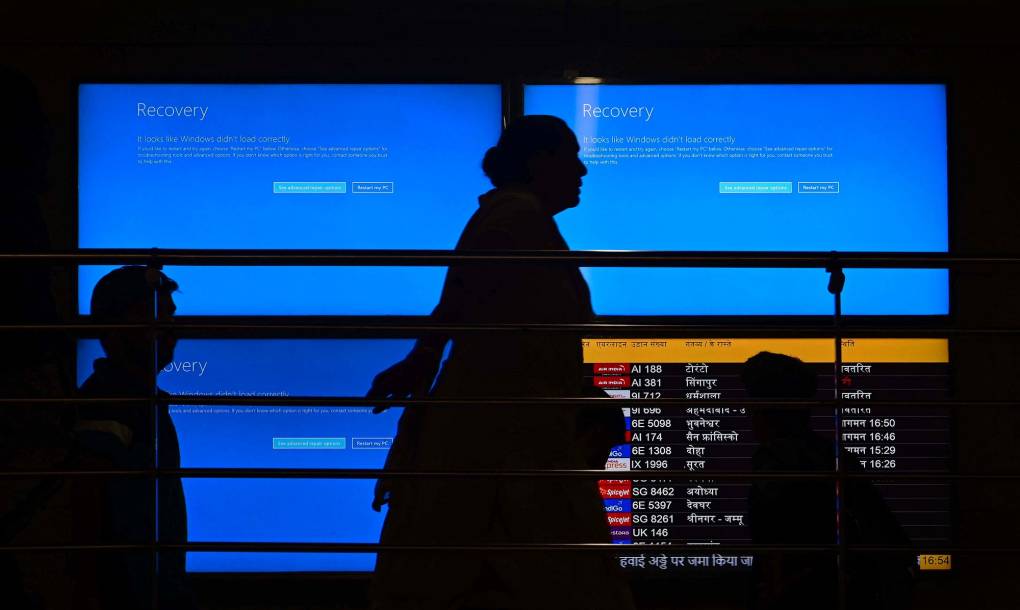
"caption": "Passengers seen waiting after a major disruption in Microsoft Corp.'s cloud services caused widespread flight cancellations and delays at T3 IGI Airport on July 19, 2024 in New Delhi, India. At Stanford’s Hoover Institution, the House Committee on Homeland Security heard from experts who argue escalating threats highlight the need to modernize U.S. cyberdefenses.\r\n",
"credit": "Vipin Kumar/Hindustan Times via Getty Images",
"altTag": null,
"description": null,
"imgSizes": {
"medium": {
"file": "https://cdn.kqed.org/wp-content/uploads/sites/10/2024/07/Cybersecurity-800x479.jpg",
"width": 800,
"height": 479,
"mimeType": "image/jpeg"
},
"large": {
"file": "https://cdn.kqed.org/wp-content/uploads/sites/10/2024/07/Cybersecurity-1020x610.jpg",
"width": 1020,
"height": 610,
"mimeType": "image/jpeg"
},
"thumbnail": {
"file": "https://cdn.kqed.org/wp-content/uploads/sites/10/2024/07/Cybersecurity-160x96.jpg",
"width": 160,
"height": 96,
"mimeType": "image/jpeg"
},
"1536x1536": {
"file": "https://cdn.kqed.org/wp-content/uploads/sites/10/2024/07/Cybersecurity-1536x919.jpg",
"width": 1536,
"height": 919,
"mimeType": "image/jpeg"
},
"post-thumbnail": {
"file": "https://cdn.kqed.org/wp-content/uploads/sites/10/2024/07/Cybersecurity-672x372.jpg",
"width": 672,
"height": 372,
"mimeType": "image/jpeg"
},
"twentyfourteen-full-width": {
"file": "https://cdn.kqed.org/wp-content/uploads/sites/10/2024/07/Cybersecurity-1038x576.jpg",
"width": 1038,
"height": 576,
"mimeType": "image/jpeg"
},
"full-width": {
"file": "https://cdn.kqed.org/wp-content/uploads/sites/10/2024/07/Cybersecurity-1920x1149.jpg",
"width": 1920,
"height": 1149,
"mimeType": "image/jpeg"
},
"kqedFullSize": {
"file": "https://cdn.kqed.org/wp-content/uploads/sites/10/2024/07/Cybersecurity.jpg",
"width": 2000,
"height": 1197
}
},
"isLoading": false,
"fetchFailed": false
},
"news_12041748": {
"type": "attachments",
"id": "news_12041748",
"meta": {
"index": "attachments_1716263798",
"site": "news",
"id": "12041748",
"found": true
},
"title": "CAT — Auditory Illusions",
"publishDate": 1748394692,
"status": "inherit",
"parent": 12041731,
"modified": 1748397892,
"caption": "Illustration of an ear receiving soundwaves, representing auditory perception.",
"credit": "Getty Images",
"altTag": "A collage-like illustration featuring a black and white photo of an ear on an orange, red, and yellow color background. Abstract geometric images dot the background, including a yellow star shape and concentric circles. Squiggly purple and pink lines connect from off screen to the ear, which represent sound waves.",
"description": null,
"imgSizes": {
"medium": {
"file": "https://cdn.kqed.org/wp-content/uploads/sites/10/2025/05/CAT-—-Auditory-Illusions-800x450.png",
"width": 800,
"height": 450,
"mimeType": "image/png"
},
"large": {
"file": "https://cdn.kqed.org/wp-content/uploads/sites/10/2025/05/CAT-—-Auditory-Illusions-1020x574.png",
"width": 1020,
"height": 574,
"mimeType": "image/png"
},
"thumbnail": {
"file": "https://cdn.kqed.org/wp-content/uploads/sites/10/2025/05/CAT-—-Auditory-Illusions-160x90.png",
"width": 160,
"height": 90,
"mimeType": "image/png"
},
"1536x1536": {
"file": "https://cdn.kqed.org/wp-content/uploads/sites/10/2025/05/CAT-—-Auditory-Illusions-1536x864.png",
"width": 1536,
"height": 864,
"mimeType": "image/png"
},
"post-thumbnail": {
"file": "https://cdn.kqed.org/wp-content/uploads/sites/10/2025/05/CAT-—-Auditory-Illusions-672x372.png",
"width": 672,
"height": 372,
"mimeType": "image/png"
},
"twentyfourteen-full-width": {
"file": "https://cdn.kqed.org/wp-content/uploads/sites/10/2025/05/CAT-—-Auditory-Illusions-1038x576.png",
"width": 1038,
"height": 576,
"mimeType": "image/png"
},
"kqedFullSize": {
"file": "https://cdn.kqed.org/wp-content/uploads/sites/10/2025/05/CAT-—-Auditory-Illusions.png",
"width": 1920,
"height": 1080
}
},
"isLoading": false,
"fetchFailed": false
},
"news_12040902": {
"type": "attachments",
"id": "news_12040902",
"meta": {
"index": "attachments_1716263798",
"site": "news",
"id": "12040902",
"found": true
},
"title": "US-AUTOMOBILE-LIFESTYLE-WAYMO",
"publishDate": 1747762015,
"status": "inherit",
"parent": 12074861,
"modified": 1772219111,
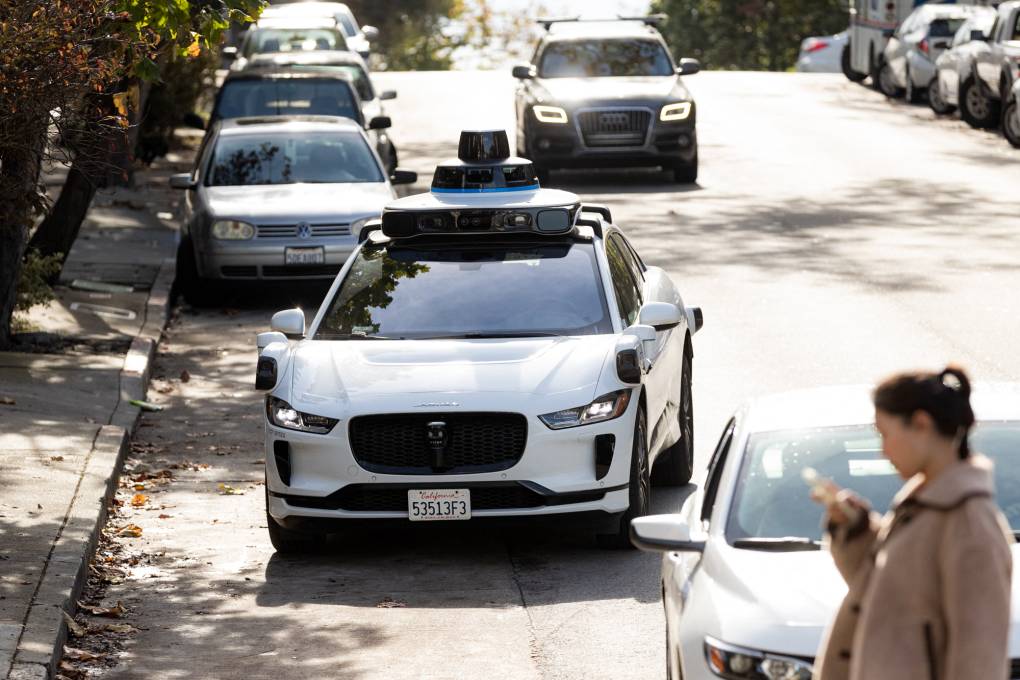
"caption": "A Waymo autonomous vehicle on Steiner Street in San Francisco on Nov. 17, 2023. ",
"credit": "Jason Henry/AFP via Getty Images",
"altTag": null,
"description": null,
"imgSizes": {
"medium": {
"file": "https://cdn.kqed.org/wp-content/uploads/sites/10/2025/05/GETTYIMAGES-1788126569-KQED-800x533.jpg",
"width": 800,
"height": 533,
"mimeType": "image/jpeg"
},
"large": {
"file": "https://cdn.kqed.org/wp-content/uploads/sites/10/2025/05/GETTYIMAGES-1788126569-KQED-1020x680.jpg",
"width": 1020,
"height": 680,
"mimeType": "image/jpeg"
},
"thumbnail": {
"file": "https://cdn.kqed.org/wp-content/uploads/sites/10/2025/05/GETTYIMAGES-1788126569-KQED-160x107.jpg",
"width": 160,
"height": 107,
"mimeType": "image/jpeg"
},
"1536x1536": {
"file": "https://cdn.kqed.org/wp-content/uploads/sites/10/2025/05/GETTYIMAGES-1788126569-KQED-1536x1024.jpg",
"width": 1536,
"height": 1024,
"mimeType": "image/jpeg"
},
"post-thumbnail": {
"file": "https://cdn.kqed.org/wp-content/uploads/sites/10/2025/05/GETTYIMAGES-1788126569-KQED-672x372.jpg",
"width": 672,
"height": 372,
"mimeType": "image/jpeg"
},
"twentyfourteen-full-width": {
"file": "https://cdn.kqed.org/wp-content/uploads/sites/10/2025/05/GETTYIMAGES-1788126569-KQED-1038x576.jpg",
"width": 1038,
"height": 576,
"mimeType": "image/jpeg"
},
"full-width": {
"file": "https://cdn.kqed.org/wp-content/uploads/sites/10/2025/05/GETTYIMAGES-1788126569-KQED-1920x1280.jpg",
"width": 1920,
"height": 1280,
"mimeType": "image/jpeg"
},
"kqedFullSize": {
"file": "https://cdn.kqed.org/wp-content/uploads/sites/10/2025/05/GETTYIMAGES-1788126569-KQED.jpg",
"width": 2000,
"height": 1333
}
},
"isLoading": false,
"fetchFailed": false
},
"news_12040484": {
"type": "attachments",
"id": "news_12040484",
"meta": {
"index": "attachments_1716263798",
"site": "news",
"id": "12040484",
"found": true
},
"title": "051325-US-Capitol-AP-CM-01 copy",
"publishDate": 1747417212,
"status": "inherit",
"parent": 12040476,
"modified": 1747417237,
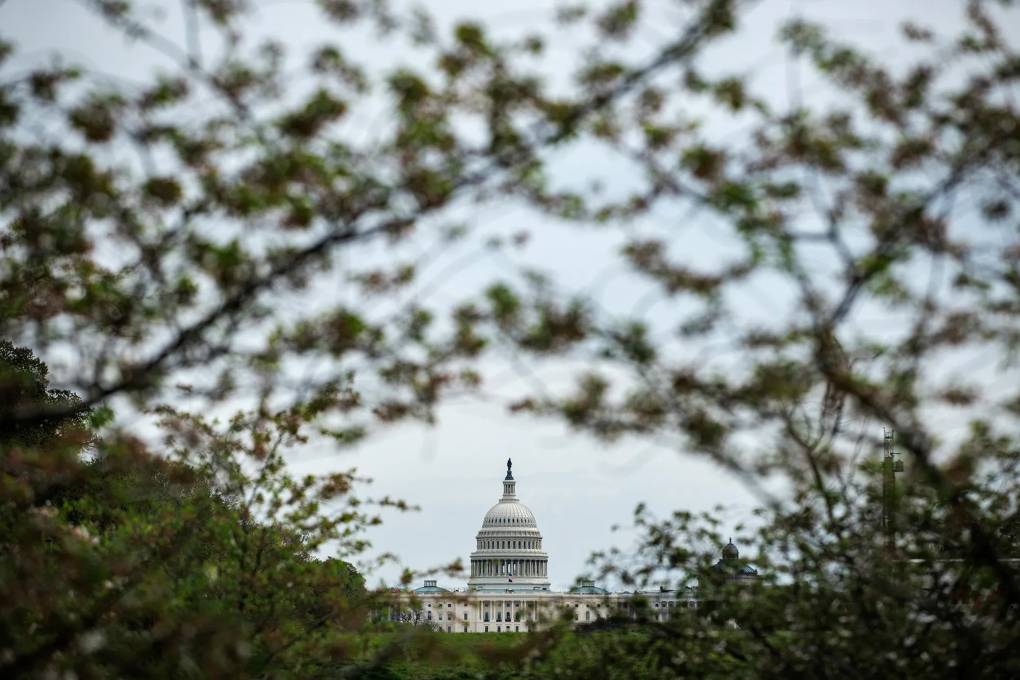
"caption": "House Republicans this week attached to the budget a moratorium on states' regulation of artificial intelligence.\n",
"credit": "Samuel Corum/AP",
"altTag": null,
"description": null,
"imgSizes": {
"medium": {
"file": "https://cdn.kqed.org/wp-content/uploads/sites/10/2025/05/051325-US-Capitol-AP-CM-01-copy-800x534.jpg",
"width": 800,
"height": 534,
"mimeType": "image/jpeg"
},
"large": {
"file": "https://cdn.kqed.org/wp-content/uploads/sites/10/2025/05/051325-US-Capitol-AP-CM-01-copy-1020x680.jpg",
"width": 1020,
"height": 680,
"mimeType": "image/jpeg"
},
"thumbnail": {
"file": "https://cdn.kqed.org/wp-content/uploads/sites/10/2025/05/051325-US-Capitol-AP-CM-01-copy-160x107.jpg",
"width": 160,
"height": 107,
"mimeType": "image/jpeg"
},
"1536x1536": {
"file": "https://cdn.kqed.org/wp-content/uploads/sites/10/2025/05/051325-US-Capitol-AP-CM-01-copy-1536x1025.jpg",
"width": 1536,
"height": 1025,
"mimeType": "image/jpeg"
},
"post-thumbnail": {
"file": "https://cdn.kqed.org/wp-content/uploads/sites/10/2025/05/051325-US-Capitol-AP-CM-01-copy-672x372.jpg",
"width": 672,
"height": 372,
"mimeType": "image/jpeg"
},
"twentyfourteen-full-width": {
"file": "https://cdn.kqed.org/wp-content/uploads/sites/10/2025/05/051325-US-Capitol-AP-CM-01-copy-1038x576.jpg",
"width": 1038,
"height": 576,
"mimeType": "image/jpeg"
},
"full-width": {
"file": "https://cdn.kqed.org/wp-content/uploads/sites/10/2025/05/051325-US-Capitol-AP-CM-01-copy-1920x1281.jpg",
"width": 1920,
"height": 1281,
"mimeType": "image/jpeg"
},
"kqedFullSize": {
"file": "https://cdn.kqed.org/wp-content/uploads/sites/10/2025/05/051325-US-Capitol-AP-CM-01-copy.jpg",
"width": 2000,
"height": 1334
}
},
"isLoading": false,
"fetchFailed": false
},
"news_12039992": {
"type": "attachments",
"id": "news_12039992",
"meta": {
"index": "attachments_1716263798",
"site": "news",
"id": "12039992",
"found": true
},
"title": "The Surveillance Machine Pt2_web img_CE 02",
"publishDate": 1747183159,
"status": "inherit",
"parent": 12039985,
"modified": 1747183254,
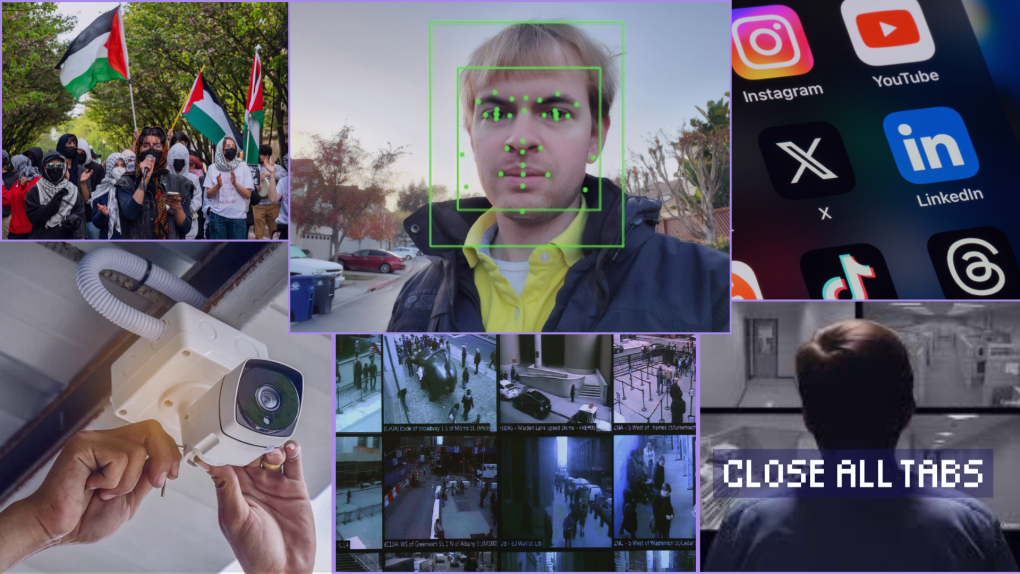
"caption": "A collage of images illustrating modern surveillance culture. Clockwise from top left: Pro-Palestinian supporters demonstrate on the campus of Columbia University (Spencer Platt/Getty Images); Output of an Artificial Intelligence system from Google Vision performing Facial Recognition on a photograph of a man (Smith Collection/Gado/Getty Images); smartphone with social media app icons; person watching surveillance monitors; grid of CCTV surveillance feeds; hands installing an outdoor security camera.\n\nCollage by (Maya Cueva and Chris Egusa/KQED)",
"credit": null,
"altTag": "A collage of photos: image of students at a protest with Palestinian flags; image of a young man with lines and dots superimposed over his face indicating facial recognition technology; image of a cell phone screen with social media apps; image of the back of someone’s head in front of a bank of monitors showing CCTV footage; image of a grid of CCTV images; image of a hand adjusting a ceiling-mounted surveillance camera.",
"description": null,
"imgSizes": {
"medium": {
"file": "https://cdn.kqed.org/wp-content/uploads/sites/10/2025/05/The-Surveillance-Machine-Pt2_web-img_CE-02-800x450.png",
"width": 800,
"height": 450,
"mimeType": "image/png"
},
"large": {
"file": "https://cdn.kqed.org/wp-content/uploads/sites/10/2025/05/The-Surveillance-Machine-Pt2_web-img_CE-02-1020x574.png",
"width": 1020,
"height": 574,
"mimeType": "image/png"
},
"thumbnail": {
"file": "https://cdn.kqed.org/wp-content/uploads/sites/10/2025/05/The-Surveillance-Machine-Pt2_web-img_CE-02-160x90.png",
"width": 160,
"height": 90,
"mimeType": "image/png"
},
"1536x1536": {
"file": "https://cdn.kqed.org/wp-content/uploads/sites/10/2025/05/The-Surveillance-Machine-Pt2_web-img_CE-02-1536x864.png",
"width": 1536,
"height": 864,
"mimeType": "image/png"
},
"post-thumbnail": {
"file": "https://cdn.kqed.org/wp-content/uploads/sites/10/2025/05/The-Surveillance-Machine-Pt2_web-img_CE-02-672x372.png",
"width": 672,
"height": 372,
"mimeType": "image/png"
},
"twentyfourteen-full-width": {
"file": "https://cdn.kqed.org/wp-content/uploads/sites/10/2025/05/The-Surveillance-Machine-Pt2_web-img_CE-02-1038x576.png",
"width": 1038,
"height": 576,
"mimeType": "image/png"
},
"kqedFullSize": {
"file": "https://cdn.kqed.org/wp-content/uploads/sites/10/2025/05/The-Surveillance-Machine-Pt2_web-img_CE-02.png",
"width": 1920,
"height": 1080
}
},
"isLoading": false,
"fetchFailed": false
},
"news_12039151": {
"type": "attachments",
"id": "news_12039151",
"meta": {
"index": "attachments_1716263798",
"site": "news",
"id": "12039151",
"found": true
},
"title": "NKOREAFAMILY",
"publishDate": 1746646130,
"status": "inherit",
"parent": 12038874,
"modified": 1746646165,
"caption": "Just as adults are using generative AI companion chatbots for solace and connection, children are, too. So, how can parents stay in the conversation?",
"credit": "Anna Fifield/The Washington Post via Getty Images",
"altTag": null,
"description": null,
"imgSizes": {
"medium": {
"file": "https://cdn.kqed.org/wp-content/uploads/sites/10/2025/05/AIChatBotsGetty-800x600.jpg",
"width": 800,
"height": 600,
"mimeType": "image/jpeg"
},
"large": {
"file": "https://cdn.kqed.org/wp-content/uploads/sites/10/2025/05/AIChatBotsGetty-1020x765.jpg",
"width": 1020,
"height": 765,
"mimeType": "image/jpeg"
},
"thumbnail": {
"file": "https://cdn.kqed.org/wp-content/uploads/sites/10/2025/05/AIChatBotsGetty-160x120.jpg",
"width": 160,
"height": 120,
"mimeType": "image/jpeg"
},
"1536x1536": {
"file": "https://cdn.kqed.org/wp-content/uploads/sites/10/2025/05/AIChatBotsGetty-1536x1152.jpg",
"width": 1536,
"height": 1152,
"mimeType": "image/jpeg"
},
"post-thumbnail": {
"file": "https://cdn.kqed.org/wp-content/uploads/sites/10/2025/05/AIChatBotsGetty-672x372.jpg",
"width": 672,
"height": 372,
"mimeType": "image/jpeg"
},
"twentyfourteen-full-width": {
"file": "https://cdn.kqed.org/wp-content/uploads/sites/10/2025/05/AIChatBotsGetty-1038x576.jpg",
"width": 1038,
"height": 576,
"mimeType": "image/jpeg"
},
"full-width": {
"file": "https://cdn.kqed.org/wp-content/uploads/sites/10/2025/05/AIChatBotsGetty-1920x1440.jpg",
"width": 1920,
"height": 1440,
"mimeType": "image/jpeg"
},
"kqedFullSize": {
"file": "https://cdn.kqed.org/wp-content/uploads/sites/10/2025/05/AIChatBotsGetty.jpg",
"width": 2000,
"height": 1500
}
},
"isLoading": false,
"fetchFailed": false
},
"news_12039008": {
"type": "attachments",
"id": "news_12039008",
"meta": {
"index": "attachments_1716263798",
"site": "news",
"id": "12039008",
"found": true
},
"title": "CAT — The Surveillance Machine Pt 1",
"publishDate": 1746574135,
"status": "inherit",
"parent": 12038910,
"modified": 1746641691,
"caption": "A banner reading 'Stop Government Spying' at the 1976 Democratic National Convention in New York City, USA, July 1976. Jimmy Carter is the presidential nominee. (Photo by Archive Photos/Getty Images)",
"credit": null,
"altTag": "A group of people holding up a banner that says “Stop Government Spying” while police stand around them. The group of people appear to be protesting government surveillance and are blurry in the photo. So are the police.",
"description": null,
"imgSizes": {
"medium": {
"file": "https://cdn.kqed.org/wp-content/uploads/sites/10/2025/05/CAT-—-The-Surveillance-Machine-Pt-1-800x450.png",
"width": 800,
"height": 450,
"mimeType": "image/png"
},
"large": {
"file": "https://cdn.kqed.org/wp-content/uploads/sites/10/2025/05/CAT-—-The-Surveillance-Machine-Pt-1-1020x574.png",
"width": 1020,
"height": 574,
"mimeType": "image/png"
},
"thumbnail": {
"file": "https://cdn.kqed.org/wp-content/uploads/sites/10/2025/05/CAT-—-The-Surveillance-Machine-Pt-1-160x90.png",
"width": 160,
"height": 90,
"mimeType": "image/png"
},
"1536x1536": {
"file": "https://cdn.kqed.org/wp-content/uploads/sites/10/2025/05/CAT-—-The-Surveillance-Machine-Pt-1-1536x864.png",
"width": 1536,
"height": 864,
"mimeType": "image/png"
},
"post-thumbnail": {
"file": "https://cdn.kqed.org/wp-content/uploads/sites/10/2025/05/CAT-—-The-Surveillance-Machine-Pt-1-672x372.png",
"width": 672,
"height": 372,
"mimeType": "image/png"
},
"twentyfourteen-full-width": {
"file": "https://cdn.kqed.org/wp-content/uploads/sites/10/2025/05/CAT-—-The-Surveillance-Machine-Pt-1-1038x576.png",
"width": 1038,
"height": 576,
"mimeType": "image/png"
},
"kqedFullSize": {
"file": "https://cdn.kqed.org/wp-content/uploads/sites/10/2025/05/CAT-—-The-Surveillance-Machine-Pt-1.png",
"width": 1920,
"height": 1080
}
},
"isLoading": false,
"fetchFailed": false
},
"news_12038442": {
"type": "attachments",
"id": "news_12038442",
"meta": {
"index": "attachments_1716263798",
"site": "news",
"id": "12038442",
"found": true
},
"title": "Visa Headquarters In San Francisco",
"publishDate": 1746133083,
"status": "inherit",
"parent": 12038439,
"modified": 1746133136,
"caption": "On Wednesday, the San Francisco-based company unveiled Visa Intelligent Commerce at the Visa Global Product Drop. According to the release, this initiative opens Visa's payment network to developers and engineers who are building AI that shop on behalf of users. ",
"credit": "Justin Sullivan/Getty Images",
"altTag": null,
"description": null,
"imgSizes": {
"medium": {
"file": "https://cdn.kqed.org/wp-content/uploads/sites/10/2025/05/VisaGetty-800x533.jpg",
"width": 800,
"height": 533,
"mimeType": "image/jpeg"
},
"large": {
"file": "https://cdn.kqed.org/wp-content/uploads/sites/10/2025/05/VisaGetty-1020x680.jpg",
"width": 1020,
"height": 680,
"mimeType": "image/jpeg"
},
"thumbnail": {
"file": "https://cdn.kqed.org/wp-content/uploads/sites/10/2025/05/VisaGetty-160x107.jpg",
"width": 160,
"height": 107,
"mimeType": "image/jpeg"
},
"1536x1536": {
"file": "https://cdn.kqed.org/wp-content/uploads/sites/10/2025/05/VisaGetty-1536x1024.jpg",
"width": 1536,
"height": 1024,
"mimeType": "image/jpeg"
},
"post-thumbnail": {
"file": "https://cdn.kqed.org/wp-content/uploads/sites/10/2025/05/VisaGetty-672x372.jpg",
"width": 672,
"height": 372,
"mimeType": "image/jpeg"
},
"twentyfourteen-full-width": {
"file": "https://cdn.kqed.org/wp-content/uploads/sites/10/2025/05/VisaGetty-1038x576.jpg",
"width": 1038,
"height": 576,
"mimeType": "image/jpeg"
},
"full-width": {
"file": "https://cdn.kqed.org/wp-content/uploads/sites/10/2025/05/VisaGetty-1920x1280.jpg",
"width": 1920,
"height": 1280,
"mimeType": "image/jpeg"
},
"kqedFullSize": {
"file": "https://cdn.kqed.org/wp-content/uploads/sites/10/2025/05/VisaGetty.jpg",
"width": 2000,
"height": 1333
}
},
"isLoading": false,
"fetchFailed": false
},
"news_12038161": {
"type": "attachments",
"id": "news_12038161",
"meta": {
"index": "attachments_1716263798",
"site": "news",
"id": "12038161",
"found": true
},
"title": "CHINA-TECHNOLOGY-AI-ROMANCE",
"publishDate": 1745968881,
"status": "inherit",
"parent": 12038154,
"modified": 1746042249,
"caption": "Unlike digital assistants, companion chatbots are much more likely to veer into socially controversial and even illegal territory. A new report out from Stanford University researchers and Common Sense Media argues that children and teens should not use these chatbots.",
"credit": "Jade Gao/AFP via Getty Images",
"altTag": null,
"description": null,
"imgSizes": {
"medium": {
"file": "https://cdn.kqed.org/wp-content/uploads/sites/10/2025/04/StanfordStudyAIChatbotsKidsGetty-800x533.jpg",
"width": 800,
"height": 533,
"mimeType": "image/jpeg"
},
"large": {
"file": "https://cdn.kqed.org/wp-content/uploads/sites/10/2025/04/StanfordStudyAIChatbotsKidsGetty-1020x680.jpg",
"width": 1020,
"height": 680,
"mimeType": "image/jpeg"
},
"thumbnail": {
"file": "https://cdn.kqed.org/wp-content/uploads/sites/10/2025/04/StanfordStudyAIChatbotsKidsGetty-160x107.jpg",
"width": 160,
"height": 107,
"mimeType": "image/jpeg"
},
"1536x1536": {
"file": "https://cdn.kqed.org/wp-content/uploads/sites/10/2025/04/StanfordStudyAIChatbotsKidsGetty-1536x1024.jpg",
"width": 1536,
"height": 1024,
"mimeType": "image/jpeg"
},
"post-thumbnail": {
"file": "https://cdn.kqed.org/wp-content/uploads/sites/10/2025/04/StanfordStudyAIChatbotsKidsGetty-672x372.jpg",
"width": 672,
"height": 372,
"mimeType": "image/jpeg"
},
"twentyfourteen-full-width": {
"file": "https://cdn.kqed.org/wp-content/uploads/sites/10/2025/04/StanfordStudyAIChatbotsKidsGetty-1038x576.jpg",
"width": 1038,
"height": 576,
"mimeType": "image/jpeg"
},
"full-width": {
"file": "https://cdn.kqed.org/wp-content/uploads/sites/10/2025/04/StanfordStudyAIChatbotsKidsGetty-1920x1280.jpg",
"width": 1920,
"height": 1280,
"mimeType": "image/jpeg"
},
"kqedFullSize": {
"file": "https://cdn.kqed.org/wp-content/uploads/sites/10/2025/04/StanfordStudyAIChatbotsKidsGetty.jpg",
"width": 2000,
"height": 1333
}
},
"isLoading": false,
"fetchFailed": false
},
"news_12037606": {
"type": "attachments",
"id": "news_12037606",
"meta": {
"index": "attachments_1716263798",
"site": "news",
"id": "12037606",
"found": true
},
"title": "Donald Trump And Joe Biden Participate In First Presidential Debate",
"publishDate": 1745540245,
"status": "inherit",
"parent": 12037518,
"modified": 1745542357,
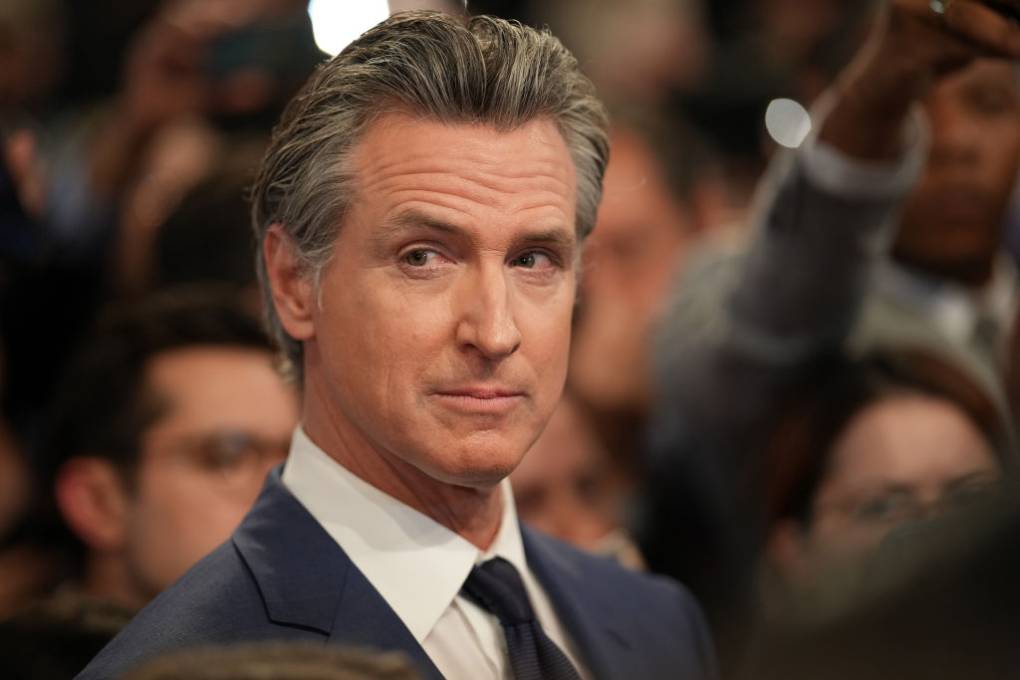
"caption": "Gov. Gavin Newsom speaks to reporters in the spin room following the CNN Presidential Debate at the McCamish Pavilion on the Georgia Institute of Technology campus on June 27, 2024, in Atlanta, Georgia. ",
"credit": "Andrew Harnik/Getty Images",
"altTag": null,
"description": null,
"imgSizes": {
"medium": {
"file": "https://cdn.kqed.org/wp-content/uploads/sites/10/2025/04/GettyImages-2159615518-800x534.jpg",
"width": 800,
"height": 534,
"mimeType": "image/jpeg"
},
"large": {
"file": "https://cdn.kqed.org/wp-content/uploads/sites/10/2025/04/GettyImages-2159615518-1020x680.jpg",
"width": 1020,
"height": 680,
"mimeType": "image/jpeg"
},
"thumbnail": {
"file": "https://cdn.kqed.org/wp-content/uploads/sites/10/2025/04/GettyImages-2159615518-160x107.jpg",
"width": 160,
"height": 107,
"mimeType": "image/jpeg"
},
"post-thumbnail": {
"file": "https://cdn.kqed.org/wp-content/uploads/sites/10/2025/04/GettyImages-2159615518-672x372.jpg",
"width": 672,
"height": 372,
"mimeType": "image/jpeg"
},
"twentyfourteen-full-width": {
"file": "https://cdn.kqed.org/wp-content/uploads/sites/10/2025/04/GettyImages-2159615518-1024x576.jpg",
"width": 1024,
"height": 576,
"mimeType": "image/jpeg"
},
"kqedFullSize": {
"file": "https://cdn.kqed.org/wp-content/uploads/sites/10/2025/04/GettyImages-2159615518.jpg",
"width": 1024,
"height": 683
}
},
"isLoading": false,
"fetchFailed": false
},
"news_12037322": {
"type": "attachments",
"id": "news_12037322",
"meta": {
"index": "attachments_1716263798",
"site": "news",
"id": "12037322",
"found": true
},
"title": "A blow-up inflatable reproduces Elon Musk's infamous Nazi",
"publishDate": 1745439957,
"status": "inherit",
"parent": 12037319,
"modified": 1745440047,
"caption": "A blow-up inflatable reproduces Elon Musk's infamous Nazi salute at an anti-Musk rally outside the Tesla Showroom in West London on March 29, 2025.",
"credit": "Lab Ky Mo/SOPA Images/LightRocket via Getty Images",
"altTag": null,
"description": null,
"imgSizes": {
"medium": {
"file": "https://cdn.kqed.org/wp-content/uploads/sites/10/2025/04/GettyImages-2207057172-800x533.jpg",
"width": 800,
"height": 533,
"mimeType": "image/jpeg"
},
"large": {
"file": "https://cdn.kqed.org/wp-content/uploads/sites/10/2025/04/GettyImages-2207057172-1020x680.jpg",
"width": 1020,
"height": 680,
"mimeType": "image/jpeg"
},
"thumbnail": {
"file": "https://cdn.kqed.org/wp-content/uploads/sites/10/2025/04/GettyImages-2207057172-160x107.jpg",
"width": 160,
"height": 107,
"mimeType": "image/jpeg"
},
"1536x1536": {
"file": "https://cdn.kqed.org/wp-content/uploads/sites/10/2025/04/GettyImages-2207057172-1536x1024.jpg",
"width": 1536,
"height": 1024,
"mimeType": "image/jpeg"
},
"2048x2048": {
"file": "https://cdn.kqed.org/wp-content/uploads/sites/10/2025/04/GettyImages-2207057172-2048x1366.jpg",
"width": 2048,
"height": 1366,
"mimeType": "image/jpeg"
},
"post-thumbnail": {
"file": "https://cdn.kqed.org/wp-content/uploads/sites/10/2025/04/GettyImages-2207057172-672x372.jpg",
"width": 672,
"height": 372,
"mimeType": "image/jpeg"
},
"twentyfourteen-full-width": {
"file": "https://cdn.kqed.org/wp-content/uploads/sites/10/2025/04/GettyImages-2207057172-1038x576.jpg",
"width": 1038,
"height": 576,
"mimeType": "image/jpeg"
},
"full-width": {
"file": "https://cdn.kqed.org/wp-content/uploads/sites/10/2025/04/GettyImages-2207057172-1920x1280.jpg",
"width": 1920,
"height": 1280,
"mimeType": "image/jpeg"
},
"kqedFullSize": {
"file": "https://cdn.kqed.org/wp-content/uploads/sites/10/2025/04/GettyImages-2207057172-scaled.jpg",
"width": 2560,
"height": 1707
}
},
"isLoading": false,
"fetchFailed": false
},
"news_12037234": {
"type": "attachments",
"id": "news_12037234",
"meta": {
"index": "attachments_1716263798",
"site": "news",
"id": "12037234",
"found": true
},
"title": "AI Therapy_web img",
"publishDate": 1745386401,
"status": "inherit",
"parent": 12037213,
"modified": 1745386951,
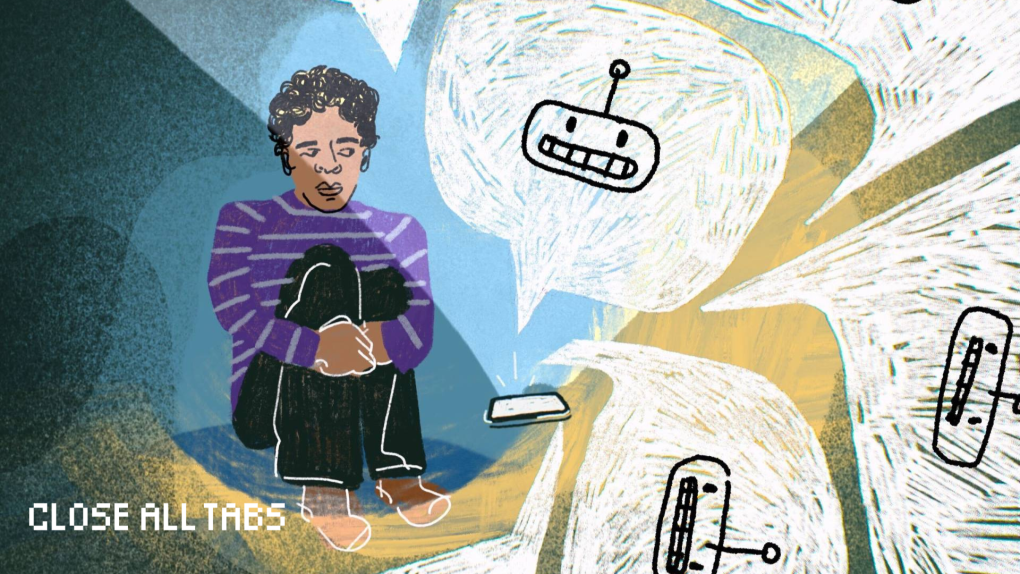
"caption": "Can AI therapy apps like Rosebud, Therapist GPT and Woebot bridge the gap in mental health care — offering comfort and support in an era of stress, loneliness and anxiety?",
"credit": "Anna Vignet/KQED",
"altTag": "Illustration of a dark-skinned person sitting on the ground with a concerned expression, arms wrapped around their knees. A smartphone lies beside them, emitting ghost-like, chaotic speech bubbles that contain sketches of robot faces. The background features swirling brushstrokes in shades of blue, yellow, and green. In the bottom left corner, the words \"CLOSE ALL TABS\" appear in blocky, pixel-style font.",
"description": null,
"imgSizes": {
"medium": {
"file": "https://cdn.kqed.org/wp-content/uploads/sites/10/2025/04/AI-Therapy_web-img-800x450.png",
"width": 800,
"height": 450,
"mimeType": "image/png"
},
"large": {
"file": "https://cdn.kqed.org/wp-content/uploads/sites/10/2025/04/AI-Therapy_web-img-1020x574.png",
"width": 1020,
"height": 574,
"mimeType": "image/png"
},
"thumbnail": {
"file": "https://cdn.kqed.org/wp-content/uploads/sites/10/2025/04/AI-Therapy_web-img-160x90.png",
"width": 160,
"height": 90,
"mimeType": "image/png"
},
"1536x1536": {
"file": "https://cdn.kqed.org/wp-content/uploads/sites/10/2025/04/AI-Therapy_web-img-1536x864.png",
"width": 1536,
"height": 864,
"mimeType": "image/png"
},
"post-thumbnail": {
"file": "https://cdn.kqed.org/wp-content/uploads/sites/10/2025/04/AI-Therapy_web-img-672x372.png",
"width": 672,
"height": 372,
"mimeType": "image/png"
},
"twentyfourteen-full-width": {
"file": "https://cdn.kqed.org/wp-content/uploads/sites/10/2025/04/AI-Therapy_web-img-1038x576.png",
"width": 1038,
"height": 576,
"mimeType": "image/png"
},
"kqedFullSize": {
"file": "https://cdn.kqed.org/wp-content/uploads/sites/10/2025/04/AI-Therapy_web-img.png?ver=1745386929",
"width": 1920,
"height": 1080
}
},
"isLoading": false,
"fetchFailed": false
}
},
"audioPlayerReducer": {
"postId": "stream_live",
"isPaused": true,
"isPlaying": false,
"pfsActive": false,
"pledgeModalIsOpen": true,
"playerDrawerIsOpen": false,
"liveAudioPlayStartedAt": 0,
"liveAudioPlayContext": ""
},
"authorsReducer": {
"byline_news_12040476": {
"type": "authors",
"id": "byline_news_12040476",
"meta": {
"override": true
},
"slug": "byline_news_12040476",
"name": "\u003ca href=\"https://calmatters.org/author/khari-johnson/\">Khari Johnson\u003c/a>, CalMatters",
"isLoading": false
},
"minakim": {
"type": "authors",
"id": "243",
"meta": {
"index": "authors_1716337520",
"id": "243",
"found": true
},
"name": "Mina Kim",
"firstName": "Mina",
"lastName": "Kim",
"slug": "minakim",
"email": "mkim@kqed.org",
"display_author_email": false,
"staff_mastheads": [
"news"
],
"title": "Host, Forum",
"bio": "Mina Kim is host of the 10 a.m. statewide hour of Forum; a live daily talk show for curious Californians on issues that matter to the state and nation, with a particular emphasis on race and equity.\r\n\r\nBefore joining the Forum team, Mina was KQED’s evening news anchor, and health reporter for The California Report. Her award-winning work has included natural disasters in Napa and gun violence in Oakland. Mina grew up in St. John’s, Newfoundland.",
"avatar": "https://secure.gravatar.com/avatar/145ce657a2d08cb86d93686beb958982?s=600&d=blank&r=g",
"twitter": "mkimreporter",
"facebook": null,
"instagram": null,
"linkedin": null,
"sites": [
{
"site": "news",
"roles": [
"contributor"
]
},
{
"site": "stateofhealth",
"roles": [
"author"
]
},
{
"site": "forum",
"roles": [
"editor"
]
}
],
"headData": {
"title": "Mina Kim | KQED",
"description": "Host, Forum",
"ogImgSrc": "https://secure.gravatar.com/avatar/145ce657a2d08cb86d93686beb958982?s=600&d=blank&r=g",
"twImgSrc": "https://secure.gravatar.com/avatar/145ce657a2d08cb86d93686beb958982?s=600&d=blank&r=g"
},
"isLoading": false,
"link": "/author/minakim"
},
"rachael-myrow": {
"type": "authors",
"id": "251",
"meta": {
"index": "authors_1716337520",
"id": "251",
"found": true
},
"name": "Rachael Myrow",
"firstName": "Rachael",
"lastName": "Myrow",
"slug": "rachael-myrow",
"email": "rmyrow@kqed.org",
"display_author_email": true,
"staff_mastheads": [
"news"
],
"title": "Senior Editor of KQED's Silicon Valley News Desk",
"bio": "• I write and edit stories about how Silicon Valley power and policies shape everyday life in California. I’m also passionate about making Bay Area history and culture more accessible to a broad public. • I’ve been a journalist for most of my life, starting in high school with The Franklin Press in Los Angeles, where I grew up. While earning my first degree in English at UC Berkeley, I got my start in public radio at KALX-FM. After completing a second degree in journalism at Cal, I landed my first professional job at Marketplace, then moved on to KPCC (now LAist), and then KQED, where I hosted The California Report for more than seven years. • My reporting has appeared on NPR, The World, WBUR’s \u003ci>Here & Now\u003c/i>, and the BBC. I also guest host for KQED’s \u003ci>Forum\u003c/i>, as well as the Commonwealth Club in San Francisco. • I speak periodically on media, democracy and technology issues, and do voiceover work for documentaries and educational video projects. • Outside of the studio, you'll find me hiking Bay Area trails and whipping up Insta-ready meals in my kitchen. • I do not accept gifts, money, or favors from anyone connected to my reporting, I don't pay people for information, and I do not support or donate to political causes. • I strive to treat the people I report on with fairness, honesty, and respect. I also recognize there are often multiple sides to a story and work to verify information through multiple sources and documentation. If I get something wrong, I correct it.",
"avatar": "https://secure.gravatar.com/avatar/3ed8a3c5f26025e4a805ba634cda8cd764906b97438a6d9ce216b044e340da4e?s=600&d=blank&r=g",
"twitter": "rachaelmyrow",
"bluesky": null,
"facebook": null,
"instagram": null,
"linkedin": "https://www.linkedin.com/in/rachaelmyrow/",
"sites": [
{
"site": "arts",
"roles": [
"administrator"
]
},
{
"site": "news",
"roles": [
"edit_others_posts",
"editor"
]
},
{
"site": "futureofyou",
"roles": [
"editor"
]
},
{
"site": "bayareabites",
"roles": [
"editor"
]
},
{
"site": "stateofhealth",
"roles": [
"editor"
]
},
{
"site": "science",
"roles": [
"editor"
]
},
{
"site": "food",
"roles": [
"editor"
]
},
{
"site": "forum",
"roles": [
"editor"
]
},
{
"site": "liveblog",
"roles": [
"author"
]
}
],
"headData": {
"title": "Rachael Myrow | KQED",
"description": "Senior Editor of KQED's Silicon Valley News Desk",
"ogImgSrc": "https://secure.gravatar.com/avatar/3ed8a3c5f26025e4a805ba634cda8cd764906b97438a6d9ce216b044e340da4e?s=600&d=blank&r=g",
"twImgSrc": "https://secure.gravatar.com/avatar/3ed8a3c5f26025e4a805ba634cda8cd764906b97438a6d9ce216b044e340da4e?s=600&d=blank&r=g"
},
"isLoading": false,
"link": "/author/rachael-myrow"
},
"lesleymcclurg": {
"type": "authors",
"id": "11229",
"meta": {
"index": "authors_1716337520",
"id": "11229",
"found": true
},
"name": "Lesley McClurg",
"firstName": "Lesley",
"lastName": "McClurg",
"slug": "lesleymcclurg",
"email": "lmcclurg@KQED.org",
"display_author_email": false,
"staff_mastheads": [
"news",
"science"
],
"title": "KQED Health Correspondent",
"bio": "Lesley McClurg is a health correspondent and fill-in host whose work is regularly rebroadcast on NPR and PBS programs. She’s earned multiple regional Emmy awards, a national and a regional Edward R. Murrow award, and was named Best Beat Reporter by the Association of Health Care Journalists. The Society of Professional Journalists has recognized her work several times, and the Society of Environmental Journalists spotlighted her coverage of California’s historic drought.\r\n\r\nBefore joining KQED in 2016, Lesley covered food and sustainability for Capital Public Radio, environmental issues for Colorado Public Radio, and reported for KUOW and KCTS 9 in Seattle. Away from the newsroom, she loves skiing with her daughter, mountain biking with her partner, and playing with Ollie, the family’s goldendoodle. On deadline, she runs almost entirely on chocolate chips.\r\n\r\n ",
"avatar": "https://secure.gravatar.com/avatar/bab49e972ea10c774fe0f5e29dba1722b158f7c0d58a360923d1389d380b2978?s=600&d=blank&r=g",
"twitter": "lesleywmcclurg",
"bluesky": null,
"facebook": null,
"instagram": null,
"linkedin": null,
"sites": [
{
"site": "arts",
"roles": [
"author"
]
},
{
"site": "news",
"roles": [
"editor"
]
},
{
"site": "futureofyou",
"roles": [
"editor"
]
},
{
"site": "stateofhealth",
"roles": [
"author"
]
},
{
"site": "science",
"roles": [
"editor"
]
},
{
"site": "quest",
"roles": [
"subscriber"
]
},
{
"site": "forum",
"roles": [
"administrator"
]
},
{
"site": "liveblog",
"roles": [
"author"
]
}
],
"headData": {
"title": "Lesley McClurg | KQED",
"description": "KQED Health Correspondent",
"ogImgSrc": "https://secure.gravatar.com/avatar/bab49e972ea10c774fe0f5e29dba1722b158f7c0d58a360923d1389d380b2978?s=600&d=blank&r=g",
"twImgSrc": "https://secure.gravatar.com/avatar/bab49e972ea10c774fe0f5e29dba1722b158f7c0d58a360923d1389d380b2978?s=600&d=blank&r=g"
},
"isLoading": false,
"link": "/author/lesleymcclurg"
},
"amontecillo": {
"type": "authors",
"id": "11649",
"meta": {
"index": "authors_1716337520",
"id": "11649",
"found": true
},
"name": "Alan Montecillo",
"firstName": "Alan",
"lastName": "Montecillo",
"slug": "amontecillo",
"email": "amontecillo@kqed.org",
"display_author_email": false,
"staff_mastheads": [
"news"
],
"title": "KQED Contributor",
"bio": "Alan Montecillo is the senior editor of \u003cem>\u003ca href=\"http://kqed.org/thebay\">The Bay\u003c/a>, \u003c/em> KQED's local news podcast. Before moving to the Bay Area, he worked as a senior talk show producer for WILL in Champaign-Urbana, Illinois and at Oregon Public Broadcasting in Portland, Oregon. He has won journalism awards from the Society of Professional Journalists Northern California, the Public Media Journalists Association, The Signal Awards, and has also received a regional Edward R. Murrow award. Alan is a Filipino American from Hong Kong and a graduate of Reed College.",
"avatar": "https://secure.gravatar.com/avatar/268f53a2066899ea9efdd8a5900218b17c822d9862cbc9326cccec53ef41d349?s=600&d=blank&r=g",
"twitter": "alanmontecillo",
"bluesky": null,
"facebook": null,
"instagram": null,
"linkedin": null,
"sites": [
{
"site": "",
"roles": [
"editor"
]
},
{
"site": "news",
"roles": [
"editor",
"manage_categories"
]
}
],
"headData": {
"title": "Alan Montecillo | KQED",
"description": "KQED Contributor",
"ogImgSrc": "https://secure.gravatar.com/avatar/268f53a2066899ea9efdd8a5900218b17c822d9862cbc9326cccec53ef41d349?s=600&d=blank&r=g",
"twImgSrc": "https://secure.gravatar.com/avatar/268f53a2066899ea9efdd8a5900218b17c822d9862cbc9326cccec53ef41d349?s=600&d=blank&r=g"
},
"isLoading": false,
"link": "/author/amontecillo"
},
"nkhan": {
"type": "authors",
"id": "11867",
"meta": {
"index": "authors_1716337520",
"id": "11867",
"found": true
},
"name": "Nisa Khan",
"firstName": "Nisa",
"lastName": "Khan",
"slug": "nkhan",
"email": "nkhan@kqed.org",
"display_author_email": false,
"staff_mastheads": [],
"title": "KQED Contributor",
"bio": "Nisa Khan is a reporter for KQED's Audience News Desk. She was formerly a data reporter at Michigan Radio. She earned a Bachelor of Science in Information from the University of Michigan and a Master of Arts in Communication from Stanford University.",
"avatar": "https://secure.gravatar.com/avatar/8720459eef081ff64582b3506b124d58523e80e120704a0cbd9892533c914991?s=600&d=blank&r=g",
"twitter": "mnisakhan",
"bluesky": null,
"facebook": null,
"instagram": null,
"linkedin": null,
"sites": [
{
"site": "arts",
"roles": [
"editor"
]
},
{
"site": "news",
"roles": [
"editor"
]
},
{
"site": "science",
"roles": [
"editor",
"author"
]
},
{
"site": "forum",
"roles": [
"editor"
]
},
{
"site": "liveblog",
"roles": [
"contributor"
]
}
],
"headData": {
"title": "Nisa Khan | KQED",
"description": "KQED Contributor",
"ogImgSrc": "https://secure.gravatar.com/avatar/8720459eef081ff64582b3506b124d58523e80e120704a0cbd9892533c914991?s=600&d=blank&r=g",
"twImgSrc": "https://secure.gravatar.com/avatar/8720459eef081ff64582b3506b124d58523e80e120704a0cbd9892533c914991?s=600&d=blank&r=g"
},
"isLoading": false,
"link": "/author/nkhan"
},
"cegusa": {
"type": "authors",
"id": "11869",
"meta": {
"index": "authors_1716337520",
"id": "11869",
"found": true
},
"name": "Chris Egusa",
"firstName": "Chris",
"lastName": "Egusa",
"slug": "cegusa",
"email": "cegusa@kqed.org",
"display_author_email": false,
"staff_mastheads": [],
"title": "KQED Contributor",
"bio": null,
"avatar": "https://secure.gravatar.com/avatar/3562ed52747313a4c94017da88ea89f9e85cd901f63ebc056a7d5e0adf4a03da?s=600&d=blank&r=g",
"twitter": null,
"bluesky": null,
"facebook": null,
"instagram": null,
"linkedin": null,
"sites": [
{
"site": "arts",
"roles": [
"editor"
]
},
{
"site": "news",
"roles": [
"editor"
]
}
],
"headData": {
"title": "Chris Egusa | KQED",
"description": "KQED Contributor",
"ogImgSrc": "https://secure.gravatar.com/avatar/3562ed52747313a4c94017da88ea89f9e85cd901f63ebc056a7d5e0adf4a03da?s=600&d=blank&r=g",
"twImgSrc": "https://secure.gravatar.com/avatar/3562ed52747313a4c94017da88ea89f9e85cd901f63ebc056a7d5e0adf4a03da?s=600&d=blank&r=g"
},
"isLoading": false,
"link": "/author/cegusa"
},
"jgeha": {
"type": "authors",
"id": "11906",
"meta": {
"index": "authors_1716337520",
"id": "11906",
"found": true
},
"name": "Joseph Geha",
"firstName": "Joseph",
"lastName": "Geha",
"slug": "jgeha",
"email": "jgeha@kqed.org",
"display_author_email": false,
"staff_mastheads": [
"news",
"science"
],
"title": "KQED Contributor",
"bio": null,
"avatar": "https://secure.gravatar.com/avatar/ea84d2b6dd93d6369d453edf19dd583f117cd1759d2d9c9c92f9de77017354fe?s=600&d=blank&r=g",
"twitter": null,
"bluesky": null,
"facebook": null,
"instagram": null,
"linkedin": null,
"sites": [
{
"site": "news",
"roles": [
"editor"
]
},
{
"site": "liveblog",
"roles": [
"author"
]
}
],
"headData": {
"title": "Joseph Geha | KQED",
"description": "KQED Contributor",
"ogImgSrc": "https://secure.gravatar.com/avatar/ea84d2b6dd93d6369d453edf19dd583f117cd1759d2d9c9c92f9de77017354fe?s=600&d=blank&r=g",
"twImgSrc": "https://secure.gravatar.com/avatar/ea84d2b6dd93d6369d453edf19dd583f117cd1759d2d9c9c92f9de77017354fe?s=600&d=blank&r=g"
},
"isLoading": false,
"link": "/author/jgeha"
},
"ffenzi": {
"type": "authors",
"id": "11926",
"meta": {
"index": "authors_1716337520",
"id": "11926",
"found": true
},
"name": "Francesca Fenzi",
"firstName": "Francesca",
"lastName": "Fenzi",
"slug": "ffenzi",
"email": "ffenzi@kqed.org",
"display_author_email": false,
"staff_mastheads": [
"news"
],
"title": "Producer, Forum",
"bio": "Francesca Fenzi is a journalist and audio producer focused on making news media as transparent, participatory, and community-driven as possible. Since joining KQED's \u003cem>Forum\u003c/em> team in 2022, she's produced both local and statewide hours of the live public affairs show, and has reported other radio, podcast, and digital content for KQED News. She previously managed \u003ca href=\"https://discord.gg/kqed\">KQED's digital community on Discord\u003c/a> – connecting listeners with journalists, subject matter experts, and each other online.",
"avatar": "https://secure.gravatar.com/avatar/fcda5bbce7779d32c08ad4ff83a25f7a?s=600&d=blank&r=g",
"twitter": null,
"bluesky": null,
"facebook": null,
"instagram": null,
"linkedin": null,
"sites": [
{
"site": "",
"roles": [
"editor"
]
},
{
"site": "news",
"roles": [
"editor"
]
},
{
"site": "about",
"roles": [
"editor"
]
},
{
"site": "forum",
"roles": [
"editor"
]
}
],
"headData": {
"title": "Francesca Fenzi | KQED",
"description": "Producer, Forum",
"ogImgSrc": "https://secure.gravatar.com/avatar/fcda5bbce7779d32c08ad4ff83a25f7a?s=600&d=blank&r=g",
"twImgSrc": "https://secure.gravatar.com/avatar/fcda5bbce7779d32c08ad4ff83a25f7a?s=600&d=blank&r=g"
},
"isLoading": false,
"link": "/author/ffenzi"
},
"mcueva": {
"type": "authors",
"id": "11943",
"meta": {
"index": "authors_1716337520",
"id": "11943",
"found": true
},
"name": "Maya Cueva",
"firstName": "Maya",
"lastName": "Cueva",
"slug": "mcueva",
"email": "mcueva@kqed.org",
"display_author_email": false,
"staff_mastheads": [],
"title": "KQED Contributor",
"bio": null,
"avatar": "https://secure.gravatar.com/avatar/238c7aba67c4b6b7b891965ba8cc9e9a4928b5dbdeaf4bde6a81c13e87f49b49?s=600&d=blank&r=g",
"twitter": null,
"bluesky": null,
"facebook": null,
"instagram": null,
"linkedin": null,
"sites": [
{
"site": "news",
"roles": [
"editor"
]
}
],
"headData": {
"title": "Maya Cueva | KQED",
"description": "KQED Contributor",
"ogImgSrc": "https://secure.gravatar.com/avatar/238c7aba67c4b6b7b891965ba8cc9e9a4928b5dbdeaf4bde6a81c13e87f49b49?s=600&d=blank&r=g",
"twImgSrc": "https://secure.gravatar.com/avatar/238c7aba67c4b6b7b891965ba8cc9e9a4928b5dbdeaf4bde6a81c13e87f49b49?s=600&d=blank&r=g"
},
"isLoading": false,
"link": "/author/mcueva"
},
"msung": {
"type": "authors",
"id": "11944",
"meta": {
"index": "authors_1716337520",
"id": "11944",
"found": true
},
"name": "Morgan Sung",
"firstName": "Morgan",
"lastName": "Sung",
"slug": "msung",
"email": "msung@kqed.org",
"display_author_email": false,
"staff_mastheads": [],
"title": "Close All Tabs Host",
"bio": null,
"avatar": "https://secure.gravatar.com/avatar/34033b8d232ee6c987ca6f0a1a28f0e5?s=600&d=blank&r=g",
"twitter": null,
"facebook": null,
"instagram": null,
"linkedin": null,
"sites": [
{
"site": "news",
"roles": [
"editor"
]
}
],
"headData": {
"title": "Morgan Sung | KQED",
"description": "Close All Tabs Host",
"ogImgSrc": "https://secure.gravatar.com/avatar/34033b8d232ee6c987ca6f0a1a28f0e5?s=600&d=blank&r=g",
"twImgSrc": "https://secure.gravatar.com/avatar/34033b8d232ee6c987ca6f0a1a28f0e5?s=600&d=blank&r=g"
},
"isLoading": false,
"link": "/author/msung"
}
},
"pagesReducer": {
"news_tag_technology": {
"type": "terms",
"id": "news_1631",
"meta": {
"index": "terms_1716263798",
"site": "news",
"id": "1631",
"score": 6.9278607
},
"name": "Technology",
"slug": "technology",
"taxonomy": "tag",
"description": null,
"featImg": null,
"headData": {
"title": "Technology | KQED News",
"description": null,
"ogTitle": null,
"ogDescription": null,
"ogImgId": null,
"twTitle": null,
"twDescription": null,
"twImgId": null
},
"ttid": 1643,
"isLoading": false,
"title": "Technology",
"pageMeta": {
"site": "news",
"WpPageTemplate": "page-topic-editorial",
"currentPage": 18
},
"blocks": [
{
"blockName": "kqed/post-list",
"attrs": {
"layout": "cardArticle2",
"query": "posts/news?tag=technology",
"seeMore": false,
"paginated": true,
"page": 18
}
},
{
"blockName": "kqed/ad"
}
]
}
},
"pfsSessionReducer": {},
"postsReducer": {
"stream_live": {
"type": "live",
"id": "stream_live",
"audioUrl": "https://streams.kqed.org/kqedradio",
"title": "Live Stream",
"excerpt": "Live Stream information currently unavailable.",
"link": "/radio",
"featImg": "",
"label": {
"name": "KQED Live",
"link": "/"
}
},
"stream_kqedNewscast": {
"type": "posts",
"id": "stream_kqedNewscast",
"audioUrl": "https://www.kqed.org/.stream/anon/radio/RDnews/newscast.mp3?_=1",
"title": "KQED Newscast",
"featImg": "",
"label": {
"name": "88.5 FM",
"link": "/"
}
},
"news_12041830": {
"type": "posts",
"id": "news_12041830",
"meta": {
"index": "posts_1716263798",
"site": "news",
"id": "12041830",
"score": null,
"sort": [
1748548812000
]
},
"guestAuthors": [],
"slug": "cybersecurity-experts-urge-dc-lawmakers-to-take-stronger-action-against-threats",
"title": "Cybersecurity Experts Urge DC Lawmakers to Take Stronger Action Against Threats",
"publishDate": 1748548812,
"format": "standard",
"headTitle": "Cybersecurity Experts Urge DC Lawmakers to Take Stronger Action Against Threats | KQED",
"labelTerm": {
"site": "news"
},
"content": "\u003cp>Tensions between Washington, D.C. and Silicon Valley’s cybersecurity lions have been running high this year, in large part because of \u003ca href=\"https://cyberscoop.com/doge-dismantles-cisa-cybersecurity-trump-elon-musk-eric-swallwell-op-ed/\">controversial staffing cuts\u003c/a> at the nation’s top cyber agency, the Cybersecurity and Infrastructure Security Agency (CISA). Cyber leaders have also decried what they call President Donald Trump’s “\u003ca href=\"https://www.csoonline.com/article/3973542/cybersecurity-leaders-decry-political-persecution-of-chris-krebs-in-a-letter-to-the-president.html\">political persecution\u003c/a>” of former CISA Director \u003ca href=\"https://video.kqed.org/video/shakeup-1605661366/\">Christopher Krebs\u003c/a>.\u003c/p>\n\u003cp>But at Stanford’s Hoover Institution on Wednesday, a surprisingly collegial \u003ca href=\"https://www.c-span.org/program/house-committee/house-homeland-security-field-hearing-on-us-cybersecurity-challenges/660500\">House Homeland Security Field Hearing on U.S. Cybersecurity Challenges\u003c/a> featured broad agreement on a host of urgent issues.\u003c/p>\n\u003cp>Lawmakers and experts alike expressed fear of the growing sophistication of cyber attacks like\u003ca href=\"https://www.cybersecuritydive.com/news/salt-typhoon-telecom-hacks-one-of-the-most-consequential-campaigns-against/746870/\"> Salt Typhoon\u003c/a> and \u003ca href=\"https://cyberscoop.com/volt-typhoon-critical-infrastructure-report/\">Volt Typhoon\u003c/a> on public and private organizations. Committee Chair Mark Green, a Republican of Tennessee, said it was no accident this field hearing was held in Silicon Valley.\u003c/p>\n\u003cp>[ad fullwidth]\u003c/p>\n\u003cp>“I have prioritized cybersecurity for myself in this Congress and for the Committee on Homeland Security, and I hope the industry partners that are here and across the country will join us in this mission to improve our cyber resilience against nation states, as well as criminal actors, strengthen our offensive posture, and develop new capabilities that incorporate security from the start,” Green said.\u003c/p>\n\u003cp>The hearing featured testimony from a panel of expert witnesses — all of them veterans of the federal government or military who are now working at the highest levels in Silicon Valley. They urged lawmakers to adopt a more collaborative approach to cybersecurity, emphasizing the importance of real-time information sharing between the government and the private sector, as well as a stronger national strategy to counter state-sponsored threats, particularly from China.\u003c/p>\n\u003cfigure id=\"attachment_12023603\" class=\"wp-caption aligncenter\" style=\"max-width: 2000px\">\u003ca href=\"https://cdn.kqed.org/wp-content/uploads/sites/10/2025/01/StanfordUniversity.jpg\">\u003cimg loading=\"lazy\" decoding=\"async\" class=\"size-full wp-image-12023603\" src=\"https://cdn.kqed.org/wp-content/uploads/sites/10/2025/01/StanfordUniversity.jpg\" alt=\"\" width=\"2000\" height=\"1499\" srcset=\"https://cdn.kqed.org/wp-content/uploads/sites/10/2025/01/StanfordUniversity.jpg 2000w, https://cdn.kqed.org/wp-content/uploads/sites/10/2025/01/StanfordUniversity-800x600.jpg 800w, https://cdn.kqed.org/wp-content/uploads/sites/10/2025/01/StanfordUniversity-1020x764.jpg 1020w, https://cdn.kqed.org/wp-content/uploads/sites/10/2025/01/StanfordUniversity-160x120.jpg 160w, https://cdn.kqed.org/wp-content/uploads/sites/10/2025/01/StanfordUniversity-1536x1151.jpg 1536w, https://cdn.kqed.org/wp-content/uploads/sites/10/2025/01/StanfordUniversity-1920x1439.jpg 1920w\" sizes=\"auto, (max-width: 2000px) 100vw, 2000px\">\u003c/a>\u003cfigcaption class=\"wp-caption-text\">Hoover Tower on the Stanford University campus on April 9, 2019. \u003ccite>(Rachael Myrow/KQED)\u003c/cite>\u003c/figcaption>\u003c/figure>\n\u003cp>“Our cyber adversaries — China, Russia, Iran, North Korea and others — are more active and aggressive than ever,” said Wendi Whitmore, chief security intelligence officer at Palo Alto Networks. “Every single day, Palo Alto Networks blocks up to 31 billion cyber attacks. Up to 9 million of those daily attacks represent novel methods never previously seen,” she said.\u003c/p>\n\u003cp>\u003ca href=\"https://techcrunch.com/2025/05/28/data-broker-giant-lexisnexis-says-breach-exposed-personal-information-of-over-364000-people/\">Data breaches\u003c/a> and ransomware attacks have become commonplace at hospitals, schools, utilities and\u003ca href=\"https://www.kqed.org/futureofyou/436414/the-crippling-ransomware-attack-on-kqed-the-inside-story\"> even KQED\u003c/a>. So have headlines about software systems \u003ca href=\"https://www.fbi.gov/news/stories/chinese-government-poses-broad-and-unrelenting-threat-to-u-s-critical-infrastructure-fbi-director-says\">infested with malicious code implanted by foreign state actors\u003c/a>.\u003c/p>\n\u003cp>\u003ca href=\"https://www.mckinsey.com/featured-insights/mckinsey-explainers/what-is-cybersecurity\">Global losses\u003c/a> to cyberattacks could exceed $10.5 trillion this year alone, according to the multinational consulting firm McKinsey.\u003c/p>\n\u003cp>[aside postID=news_12037518 hero='https://cdn.kqed.org/wp-content/uploads/sites/10/2025/04/GettyImages-2159615518-1020x680.jpg']\u003c/p>\n\u003cp>Whitmore argued that the era of isolated, disjointed or manual solutions should be over. But that doesn’t reflect the reality at many organizations and companies, where understaffing and limited budgets lead to poor cybersecurity hygiene.\u003c/p>\n\u003cp>“Most software attacks exploit preventable vulnerabilities in software products or insecure default configurations. This could be as simple as a default password that sits unchanged,” lamented Jack Cable, CEO and co-founder of San Francisco-based Corridor, which makes AI-powered development platforms.\u003c/p>\n\u003cp>Another point of agreement: the federal government could take advantage of its massive purchasing power to force Silicon Valley software contractors to increase the quality and security of their code, so that it’s “secure by design,” in cybersecurity lingo.\u003c/p>\n\u003cp>“The government has an obligation to set clearer security standards that are more consistent across the government,” said Jeanette Manfra, global director for security and compliance at Google Cloud, who served as a cybersecurity official during the Obama and first Trump administrations.\u003c/p>\n\u003cp>The expert witnesses touched only lightly on hopes for federal regulation or the recent \u003ca href=\"https://www.nextgov.com/people/2024/11/cisa-director-jen-easterly-depart-inauguration-day/401036/\">exodus\u003c/a> of technical talent from CISA. They seemed clear they were speaking to a friendly audience on the House Committee on Homeland Security, who already understand what needs to be done from a cybersecurity perspective in Washington D.C., as well as the political obstacles that lie in their way.\u003c/p>\n\u003cp>Industry watchers said the\u003ca href=\"https://cyberscoop.com/cisa-workforce-cuts-house-leaders-legislation/\"> ball is now in the court\u003c/a> of the committee’s Republican lawmakers to lobby the Trump administration to prioritize cybersecurity and turn the industry’s best practices into policy or even law.\u003c/p>\n\u003cp>\u003c/p>\n",
"blocks": [],
"excerpt": "At Stanford’s Hoover Institution, the House Committee on Homeland Security heard from experts who argue escalating threats highlight the need to modernize cyberdefenses.\r\n\r\n",
"status": "publish",
"parent": 0,
"modified": 1748551604,
"stats": {
"hasAudio": false,
"hasVideo": false,
"hasChartOrMap": false,
"iframeSrcs": [],
"hasGoogleForm": false,
"hasGallery": false,
"hasHearkenModule": false,
"hasPolis": false,
"paragraphCount": 17,
"wordCount": 698
},
"headData": {
"title": "Cybersecurity Experts Urge DC Lawmakers to Take Stronger Action Against Threats | KQED",
"description": "At Stanford’s Hoover Institution, the House Committee on Homeland Security heard from experts who argue escalating threats highlight the need to modernize cyberdefenses.\r\n\r\n",
"ogTitle": "",
"ogDescription": "",
"ogImgId": "",
"twTitle": "",
"twDescription": "",
"twImgId": "",
"schema": {
"@context": "https://schema.org",
"@type": "NewsArticle",
"headline": "Cybersecurity Experts Urge DC Lawmakers to Take Stronger Action Against Threats",
"datePublished": "2025-05-29T13:00:12-07:00",
"dateModified": "2025-05-29T13:46:44-07:00",
"image": "https://cdn.kqed.org/wp-content/uploads/2020/02/KQED-OG-Image@1x.png",
"isAccessibleForFree": "True",
"publisher": {
"@type": "NewsMediaOrganization",
"@id": "https://www.kqed.org/#organization",
"name": "KQED",
"logo": "https://cdn.kqed.org/wp-content/uploads/2020/02/KQED-OG-Image@1x.png",
"url": "https://www.kqed.org",
"sameAs": [
"https://www.facebook.com/KQED",
"https://twitter.com/KQED",
"https://www.instagram.com/kqed/",
"https://www.tiktok.com/@kqedofficial",
"https://www.linkedin.com/company/kqed",
"https://www.youtube.com/channel/UCeC0IOo7i1P_61zVUWbJ4nw"
]
}
}
},
"audioUrl": "https://traffic.omny.fm/d/clips/0af137ef-751e-4b19-a055-aaef00d2d578/ffca7e9f-6831-4[…]f-aaef00f5a073/eae91b6a-d601-48eb-8090-b2ec0101ae8c/audio.mp3",
"sticky": false,
"nprStoryId": "kqed-12041830",
"templateType": "standard",
"featuredImageType": "standard",
"excludeFromSiteSearch": "Include",
"articleAge": "0",
"path": "/news/12041830/cybersecurity-experts-urge-dc-lawmakers-to-take-stronger-action-against-threats",
"audioTrackLength": null,
"parsedContent": [
{
"type": "contentString",
"content": "\u003cdiv class=\"post-body\">\u003cp>\u003cp>Tensions between Washington, D.C. and Silicon Valley’s cybersecurity lions have been running high this year, in large part because of \u003ca href=\"https://cyberscoop.com/doge-dismantles-cisa-cybersecurity-trump-elon-musk-eric-swallwell-op-ed/\">controversial staffing cuts\u003c/a> at the nation’s top cyber agency, the Cybersecurity and Infrastructure Security Agency (CISA). Cyber leaders have also decried what they call President Donald Trump’s “\u003ca href=\"https://www.csoonline.com/article/3973542/cybersecurity-leaders-decry-political-persecution-of-chris-krebs-in-a-letter-to-the-president.html\">political persecution\u003c/a>” of former CISA Director \u003ca href=\"https://video.kqed.org/video/shakeup-1605661366/\">Christopher Krebs\u003c/a>.\u003c/p>\n\u003cp>But at Stanford’s Hoover Institution on Wednesday, a surprisingly collegial \u003ca href=\"https://www.c-span.org/program/house-committee/house-homeland-security-field-hearing-on-us-cybersecurity-challenges/660500\">House Homeland Security Field Hearing on U.S. Cybersecurity Challenges\u003c/a> featured broad agreement on a host of urgent issues.\u003c/p>\n\u003cp>Lawmakers and experts alike expressed fear of the growing sophistication of cyber attacks like\u003ca href=\"https://www.cybersecuritydive.com/news/salt-typhoon-telecom-hacks-one-of-the-most-consequential-campaigns-against/746870/\"> Salt Typhoon\u003c/a> and \u003ca href=\"https://cyberscoop.com/volt-typhoon-critical-infrastructure-report/\">Volt Typhoon\u003c/a> on public and private organizations. Committee Chair Mark Green, a Republican of Tennessee, said it was no accident this field hearing was held in Silicon Valley.\u003c/p>\n\u003cp>\u003c/p>\u003c/div>",
"attributes": {
"named": {},
"numeric": []
}
},
{
"type": "component",
"content": "",
"name": "ad",
"attributes": {
"named": {
"label": "fullwidth"
},
"numeric": [
"fullwidth"
]
}
},
{
"type": "contentString",
"content": "\u003cdiv class=\"post-body\">\u003cp>\u003c/p>\n\u003cp>“I have prioritized cybersecurity for myself in this Congress and for the Committee on Homeland Security, and I hope the industry partners that are here and across the country will join us in this mission to improve our cyber resilience against nation states, as well as criminal actors, strengthen our offensive posture, and develop new capabilities that incorporate security from the start,” Green said.\u003c/p>\n\u003cp>The hearing featured testimony from a panel of expert witnesses — all of them veterans of the federal government or military who are now working at the highest levels in Silicon Valley. They urged lawmakers to adopt a more collaborative approach to cybersecurity, emphasizing the importance of real-time information sharing between the government and the private sector, as well as a stronger national strategy to counter state-sponsored threats, particularly from China.\u003c/p>\n\u003cfigure id=\"attachment_12023603\" class=\"wp-caption aligncenter\" style=\"max-width: 2000px\">\u003ca href=\"https://cdn.kqed.org/wp-content/uploads/sites/10/2025/01/StanfordUniversity.jpg\">\u003cimg loading=\"lazy\" decoding=\"async\" class=\"size-full wp-image-12023603\" src=\"https://cdn.kqed.org/wp-content/uploads/sites/10/2025/01/StanfordUniversity.jpg\" alt=\"\" width=\"2000\" height=\"1499\" srcset=\"https://cdn.kqed.org/wp-content/uploads/sites/10/2025/01/StanfordUniversity.jpg 2000w, https://cdn.kqed.org/wp-content/uploads/sites/10/2025/01/StanfordUniversity-800x600.jpg 800w, https://cdn.kqed.org/wp-content/uploads/sites/10/2025/01/StanfordUniversity-1020x764.jpg 1020w, https://cdn.kqed.org/wp-content/uploads/sites/10/2025/01/StanfordUniversity-160x120.jpg 160w, https://cdn.kqed.org/wp-content/uploads/sites/10/2025/01/StanfordUniversity-1536x1151.jpg 1536w, https://cdn.kqed.org/wp-content/uploads/sites/10/2025/01/StanfordUniversity-1920x1439.jpg 1920w\" sizes=\"auto, (max-width: 2000px) 100vw, 2000px\">\u003c/a>\u003cfigcaption class=\"wp-caption-text\">Hoover Tower on the Stanford University campus on April 9, 2019. \u003ccite>(Rachael Myrow/KQED)\u003c/cite>\u003c/figcaption>\u003c/figure>\n\u003cp>“Our cyber adversaries — China, Russia, Iran, North Korea and others — are more active and aggressive than ever,” said Wendi Whitmore, chief security intelligence officer at Palo Alto Networks. “Every single day, Palo Alto Networks blocks up to 31 billion cyber attacks. Up to 9 million of those daily attacks represent novel methods never previously seen,” she said.\u003c/p>\n\u003cp>\u003ca href=\"https://techcrunch.com/2025/05/28/data-broker-giant-lexisnexis-says-breach-exposed-personal-information-of-over-364000-people/\">Data breaches\u003c/a> and ransomware attacks have become commonplace at hospitals, schools, utilities and\u003ca href=\"https://www.kqed.org/futureofyou/436414/the-crippling-ransomware-attack-on-kqed-the-inside-story\"> even KQED\u003c/a>. So have headlines about software systems \u003ca href=\"https://www.fbi.gov/news/stories/chinese-government-poses-broad-and-unrelenting-threat-to-u-s-critical-infrastructure-fbi-director-says\">infested with malicious code implanted by foreign state actors\u003c/a>.\u003c/p>\n\u003cp>\u003ca href=\"https://www.mckinsey.com/featured-insights/mckinsey-explainers/what-is-cybersecurity\">Global losses\u003c/a> to cyberattacks could exceed $10.5 trillion this year alone, according to the multinational consulting firm McKinsey.\u003c/p>\n\u003cp>\u003c/p>\u003c/div>",
"attributes": {
"named": {},
"numeric": []
}
},
{
"type": "component",
"content": "",
"name": "aside",
"attributes": {
"named": {
"postid": "news_12037518",
"hero": "https://cdn.kqed.org/wp-content/uploads/sites/10/2025/04/GettyImages-2159615518-1020x680.jpg",
"label": ""
},
"numeric": []
}
},
{
"type": "contentString",
"content": "\u003cdiv class=\"post-body\">\u003cp>\u003c/p>\n\u003cp>Whitmore argued that the era of isolated, disjointed or manual solutions should be over. But that doesn’t reflect the reality at many organizations and companies, where understaffing and limited budgets lead to poor cybersecurity hygiene.\u003c/p>\n\u003cp>“Most software attacks exploit preventable vulnerabilities in software products or insecure default configurations. This could be as simple as a default password that sits unchanged,” lamented Jack Cable, CEO and co-founder of San Francisco-based Corridor, which makes AI-powered development platforms.\u003c/p>\n\u003cp>Another point of agreement: the federal government could take advantage of its massive purchasing power to force Silicon Valley software contractors to increase the quality and security of their code, so that it’s “secure by design,” in cybersecurity lingo.\u003c/p>\n\u003cp>“The government has an obligation to set clearer security standards that are more consistent across the government,” said Jeanette Manfra, global director for security and compliance at Google Cloud, who served as a cybersecurity official during the Obama and first Trump administrations.\u003c/p>\n\u003cp>The expert witnesses touched only lightly on hopes for federal regulation or the recent \u003ca href=\"https://www.nextgov.com/people/2024/11/cisa-director-jen-easterly-depart-inauguration-day/401036/\">exodus\u003c/a> of technical talent from CISA. They seemed clear they were speaking to a friendly audience on the House Committee on Homeland Security, who already understand what needs to be done from a cybersecurity perspective in Washington D.C., as well as the political obstacles that lie in their way.\u003c/p>\n\u003cp>Industry watchers said the\u003ca href=\"https://cyberscoop.com/cisa-workforce-cuts-house-leaders-legislation/\"> ball is now in the court\u003c/a> of the committee’s Republican lawmakers to lobby the Trump administration to prioritize cybersecurity and turn the industry’s best practices into policy or even law.\u003c/p>\n\u003cp>\u003c/p>\n\u003c/div>\u003c/p>",
"attributes": {
"named": {},
"numeric": []
}
}
],
"link": "/news/12041830/cybersecurity-experts-urge-dc-lawmakers-to-take-stronger-action-against-threats",
"authors": [
"251"
],
"categories": [
"news_31795",
"news_8",
"news_248"
],
"tags": [
"news_18538",
"news_17619",
"news_34586",
"news_178",
"news_1928",
"news_1631"
],
"featImg": "news_11996462",
"label": "news"
},
"news_12041731": {
"type": "posts",
"id": "news_12041731",
"meta": {
"index": "posts_1716263798",
"site": "news",
"id": "12041731",
"score": null,
"sort": [
1748426445000
]
},
"guestAuthors": [],
"slug": "do-you-hear-what-i-hear-audio-illusions-and-misinformation",
"title": "Do You Hear What I Hear? Audio Illusions and Misinformation",
"publishDate": 1748426445,
"format": "audio",
"headTitle": "Do You Hear What I Hear? Audio Illusions and Misinformation | KQED",
"labelTerm": {},
"content": "\u003cp>\u003cspan style=\"font-weight: 400\">Are you old enough to remember the \u003c/span>\u003ca href=\"https://eyeondesign.aiga.org/the-hidden-history-of-magic-eye-the-optical-illusion-that-briefly-took-over-the-world/\">\u003cspan style=\"font-weight: 400\">“Magic Eye” optical illusion mania\u003c/span>\u003c/a>\u003cspan style=\"font-weight: 400\"> that gripped the nation in the 90’s—random patterns that you had to squint at just right for the 3D image to pop out? It turns out it’s not just our eyes that can be fooled. Our \u003c/span>\u003ci>\u003cspan style=\"font-weight: 400\">ears\u003c/span>\u003c/i>\u003cspan style=\"font-weight: 400\"> can play tricks on us too. There’s a whole world of auditory illusions that seem to say one thing when they’re really saying something else, and that matters, especially in our age of digital misinformation.\u003c/span>\u003c/p>\n\u003cp>\u003cspan style=\"font-weight: 400\">In today’s episode, Morgan talks to KQED Digital Community Producer Francesca Fenzi about why we hear what we \u003c/span>\u003ci>\u003cspan style=\"font-weight: 400\">think \u003c/span>\u003c/i>\u003cspan style=\"font-weight: 400\">we hear, and how understanding the limits of our perception might actually make us better at spotting dis- and misinformation online.\u003c/span>\u003c/p>\n\u003cp>\u003c!-- iframe plugin v.4.3 wordpress.org/plugins/iframe/ -->\u003cbr>\n\u003ciframe loading=\"lazy\" frameborder=\"0\" height=\"200\" scrolling=\"no\" src=\"https://playlist.megaphone.fm/?e=KQINC7508034216\" width=\"100%\" class=\"iframe-class\">\u003c/iframe>\u003c/p>\n\u003cp>\u003cspan style=\"font-weight: 400\">Guest:\u003c/span>\u003c/p>\n\u003cul>\n\u003cli>\u003cspan style=\"font-weight: 400\">Francesa Fenzi, KQED Digital Community Producer \u003c/span>\u003c/li>\n\u003c/ul>\n\u003cp>Want to give us feedback on the show? Shoot us an email at \u003ca href=\"mailto:CloseAllTabs@KQED.org\">CloseAllTabs@KQED.org\u003c/a>\u003c/p>\n\u003cp>\u003ca href=\"https://www.instagram.com/closealltabspod/\">Follow us on Instagram\u003c/a>\u003c/p>\n\u003cp>[ad fullwidth]\u003c/p>\n\u003cp> \u003c/p>\n\u003ch2 id=\"episode-transcript\">Episode Transcript\u003c/h2>\n\u003cp>\u003ci data-stringify-type=\"italic\">This is a computer-generated transcript. While our team has reviewed it, there may be errors.\u003c/i>\u003c/p>\n\u003cp>\u003cb>Morgan Sung: \u003c/b>\u003cspan style=\"font-weight: 400\">My colleague \u003c/span>\u003cspan style=\"font-weight: 400\">Francesca Fenzi\u003c/span>\u003cspan style=\"font-weight: 400\">, digital community producer at KQED, spends a lot of time online. \u003c/span>\u003c/p>\n\u003cp>\u003cb>Francesca Fenzi:\u003c/b> \u003cspan style=\"font-weight: 400\">I’m on KQED’s Discord server, on Reddit, all the various chat threads and usual places. \u003c/span>\u003c/p>\n\u003cp>\u003cb>Morgan Sung: \u003c/b>\u003cspan style=\"font-weight: 400\">After President Trump was sworn into office earlier this year, she noticed a new wave of viral content about him and his administration. There were clips claiming all kinds of things. One of these viral clips shows Musk and his son, X, during a visit to the White House. X was four at the time. While Musk speaks to the press, X runs around the Oval Office and makes his way the president’s desk. \u003c/span>\u003c/p>\n\u003cp>\u003cb>Francesca Fenzi:\u003c/b> \u003cspan style=\"font-weight: 400\">At one point, he peels off and he makes a side comment to President Trump. This is all happening while Elon Musk is speaking, so it’s very hard to hear what he’s saying. But a lot of people started interpreting what the boy was saying as saying, “You’re not the president and you need to go away,” to Donald Trump. \u003c/span>\u003c/p>\n\u003cp>\u003cb>Elon Musk: \u003c/b>\u003cspan style=\"font-weight: 400\">Part of the presidency is to restore, is to restore democracy. \u003c/span>\u003c/p>\n\u003cp>\u003cb>Morgan Sung: \u003c/b>\u003cspan style=\"font-weight: 400\">Again, X is very young. This was a four-year-old babbling at the president. Another moment from the same meeting seems to show X telling the president to, “shush his mouth.” \u003c/span>\u003c/p>\n\u003cp>\u003cb>Elon Musk: \u003c/b>\u003cspan style=\"font-weight: 400\">Taxes from one year to the next are the same. \u003c/span>\u003c/p>\n\u003cp>\u003cb>Francesca Fenzi:\u003c/b> \u003cspan style=\"font-weight: 400\">I did watch this clip. It does seem like he might have said something like this, but my audio producer brain also lit up right away because I can tell you that that clip was not clear. It was not the kind of thing that you can clean up in post. So when people started quoting this as fact, as something that was happening, my interest was piqued. \u003c/span>\u003c/p>\n\u003cp>\u003cb>Morgan Sung: \u003c/b>\u003cspan style=\"font-weight: 400\">The whole thing set Francesca down a research rabbit hole, which — relatable. This clip felt different from other pieces of viral misinformation she’d seen online. \u003c/span>\u003c/p>\n\u003cp>\u003cb>Francesca Fenzi:\u003c/b> \u003cspan style=\"font-weight: 400\">We’ve been really focused on AI’s potential to spread false information and how it can trick people into believing things that never actually happened. But even without AI, our senses can be fooled the old fashioned way. And what I was interested in in this situation was just trying to understand how our brains process what we see and hear and how those senses can be manipulated, not by AI, but just by old fashioned audio and video tricks. And so my research spiral, led me to this whole world of auditory illusions. \u003c/span>\u003c/p>\n\u003cp>\u003cb>Morgan Sung: \u003c/b>\u003cspan style=\"font-weight: 400\">Remember those Magic Eye posters? They were those optical illusions that looked like random patterns until you unfocused your eyes just right and a hidden image popped out. Well, it turns out it’s not just our eyes that can be fooled. Our ears can play tricks on us too. There’s a whole world of auditory illusions that seem to say one thing when they’re really saying something else. And that matters, especially in an age of misinformation. \u003c/span>\u003c/p>\n\u003cp>\u003cspan style=\"font-weight: 400\">In today’s episode, we’re looking at some phenomena that can completely change what we think we hear. And we explore how understanding the limits of our perception might actually make us better at spotting disinformation online. \u003c/span>\u003c/p>\n\u003cp>\u003cspan style=\"font-weight: 400\">This is Close All Tabs. I’m Morgan Sung, tech journalist, and your chronically online friend, here to open as many browser tabs as it takes to help you understand how the digital world affects our real lives. Let’s get into it. \u003c/span>\u003c/p>\n\u003cp>\u003cspan style=\"font-weight: 400\">Okay, so we’re gonna start with something that feels super commonplace, but might not be as reliable as we think. \u003c/span>\u003c/p>\n\u003cp>\u003cspan style=\"font-weight: 400\">New tab. Can we trust lip reading? \u003c/span>\u003c/p>\n\u003cp>\u003cspan style=\"font-weight: 400\">Okay, so in this video with Elon Musk’s son and President Trump, a lot of people were really relying on a combination of very poor audio and lip reading to decipher what he was saying. So let’s start with lip reading. Francesca, how reliable is it? \u003c/span>\u003c/p>\n\u003cp>\u003cb>Francesca Fenzi:\u003c/b> \u003cspan style=\"font-weight: 400\">Well, it’s estimated that only 30 to 40% of speech can actually be lip read, and that’s even under the best conditions. Lip reading is a really useful tool for people who are hard of hearing because it helps to piece together context around other pieces of information, right? Like partial audio or even like hand movements in sign language. So some lip readings seem really good when we think that we have the context associated with them. One example of that is there’s a TikTok creator who I really like, her handle is “It’s Jackie G”, and she interprets celebrity red carpet moments. So she’ll take moments of celebrities being recorded and will lip read the conversation that’s too far away from the camera for us to be able to hear accurately. \u003c/span>\u003c/p>\n\u003cp>\u003cb>Morgan Sung: \u003c/b>\u003cspan style=\"font-weight: 400\">Here’s Jackie G, lip reading Zendaya at this year’s Met Gala. \u003c/span>\u003c/p>\n\u003cp>\u003cb>Jackie G: \u003c/b>\u003cspan style=\"font-weight: 400\">She’s so fab. So fabulous. I love it. It’s so funny because she’s, I would say when we, when it cuts off. \u003c/span>\u003c/p>\n\u003cp>\u003cb>Francesca Fenzi:\u003c/b> \u003cspan style=\"font-weight: 400\">The reason that those work is because as a fan of a certain kind of celebrity, you are probably a little bit aware of how they feel about the movie that they’re promoting or their relationship to other stars who they might be interacting with, and they seem really plausible because of that. But the more removed lip reading is from its context, the less you understand about the true nature of the relationship of the speakers, the more likely you are to be misled. That’s part of what makes the YouTube series Bad Lip Reading so possible and successful. \u003c/span>\u003c/p>\n\u003cp>\u003cb>Morgan Sung: \u003c/b>\u003cspan style=\"font-weight: 400\">Bad Lip Reading is a YouTube channel that intentionally misinterprets what people are saying in movies or TV shows and then voices them over. Like this scene from Star Wars, a conversation between Obi-Wan Kenobi and some stormtroopers. \u003c/span>\u003c/p>\n\u003cp>\u003cb>Stormtrooper: \u003c/b>\u003cspan style=\"font-weight: 400\">Hey guys, we’re collecting donations for the Jawa Orphanage. Do you have any spare change? \u003c/span>\u003c/p>\n\u003cp>\u003cb>Obi-Wan Kenobi: \u003c/b>\u003cspan style=\"font-weight: 400\">Hey, you should know that you stink kinda like fish. \u003c/span>\u003c/p>\n\u003cp>\u003cb>Stormtrooper: \u003c/b>\u003cspan style=\"font-weight: 400\">Wait, what? \u003c/span>\u003c/p>\n\u003cp>\u003cb>Obi-Wan Kenobi: \u003c/b>\u003cspan style=\"font-weight: 400\">Everyone knows it except for you. \u003c/span>\u003c/p>\n\u003cp>\u003cb>Francesca Fenzi:\u003c/b> \u003cspan style=\"font-weight: 400\">You’re removing context from the audio that you’re hearing and you’re replacing the story with sound that maybe mirrors some lip movements but is totally nonsensical to the scenario. And that’s the source of the humor in those videos. I spoke to Nicholas Davidenko, who’s a researcher at the High Level Perceptions Lab at UC Santa Cruz. He studies auditory illusions and I asked him why bad lip reading videos look so convincing. \u003c/span>\u003c/p>\n\u003cp>\u003cb>Nicolas Davidenko: \u003c/b>\u003cspan style=\"font-weight: 400\">The reason they work so well is because lip reading is a much more ambiguous cue. So there’s actually a lot of words that could fit the shapes of my lips as I talk. \u003c/span>\u003c/p>\n\u003cp>\u003cb>Francesca Fenzi:\u003c/b> \u003cspan style=\"font-weight: 400\">Davidenko studies this type of phenomena in his lab. He’s been researching how to help people with something called misophonia. That is when you have an extreme negative reaction to certain sounds. There’s some sounds that all of us find a little bit unpleasant, but these are folks who have a really extreme triggered reaction to sounds like chewing or teeth mashing. Those are some common ones. \u003c/span>\u003c/p>\n\u003cp>\u003cspan style=\"font-weight: 400\">And Davidenko found that you can actually pair a different kind of video with the audio that would normally trigger misophonia for somebody. So for example, if the sound that triggers you is that sound of chewing, you can replace an image of somebody chewing with another plausible sound source. In his lab, they use an example of somebody stepping on leaves to kind of mimic that crunching sound that might originate with chewing on food. And by swapping that image out, people start to interpret that sound differently. \u003c/span>\u003c/p>\n\u003cp>\u003cb>Nicolas Davidenko: \u003c/b>\u003cspan style=\"font-weight: 400\">If the visual signal is telling you something, you trust it more than the auditory signal and when there’s a conflict, you tend to go with whatever visual system is telling you.\u003c/span>\u003c/p>\n\u003cp>\u003cb>Morgan Sung: \u003c/b>\u003cspan style=\"font-weight: 400\">Got it. So the thing we’re seeing with our eyes is overruling what we’re hearing. \u003c/span>\u003c/p>\n\u003cp>\u003cb>Francesca Fenzi:\u003c/b> \u003cspan style=\"font-weight: 400\">And that’s because of something called the McGurk Effect. There was this famous study in 1976, McGurk and McDonald, and what they found was that what we see can actually change what we can hear. In fact, I’m gonna demonstrate. Can I play you a video, Morgan? \u003c/span>\u003c/p>\n\u003cp>\u003cb>Morgan Sung: \u003c/b>\u003cspan style=\"font-weight: 400\">Please do. \u003c/span>\u003c/p>\n\u003cp>\u003cb>Francesca Fenzi:\u003c/b> \u003cspan style=\"font-weight: 400\">I’m going to play you clip, and in this first one, I just want to hear what sound you hear. \u003c/span>\u003c/p>\n\u003cp>\u003cb>McGurk Video: \u003c/b>\u003cspan style=\"font-weight: 400\">Bah bah bah \u003c/span>\u003c/p>\n\u003cp>\u003cb>Morgan Sung: \u003c/b>\u003cspan style=\"font-weight: 400\">It’s a close-up of a person’s mouth. \u003c/span>\u003c/p>\n\u003cp>\u003cb>McGurk Video: \u003c/b>\u003cspan style=\"font-weight: 400\">Bah bah bah \u003c/span>\u003c/p>\n\u003cp>\u003cb>Morgan Sung: \u003c/b>\u003cspan style=\"font-weight: 400\">Okay, so I’m hearing bah with a B, like baby. \u003c/span>\u003c/p>\n\u003cp>\u003cb>Francesca Fenzi:\u003c/b> \u003cspan style=\"font-weight: 400\">Yeah, yeah, that’s right. Okay, so now I’m gonna play you a different clip and tell me this time what you hear. \u003c/span>\u003c/p>\n\u003cp>\u003cb>McGurk Video: \u003c/b>\u003cspan style=\"font-weight: 400\">Bah, bah, bah. \u003c/span>\u003c/p>\n\u003cp>\u003cb>Morgan Sung: \u003c/b>\u003cspan style=\"font-weight: 400\">Okay, now I’m hearing fa, like with an F, like fabulous. \u003c/span>\u003c/p>\n\u003cp>\u003cb>Francesca Fenzi:\u003c/b> \u003cspan style=\"font-weight: 400\">Right. So it’s actually the exact same audio. So if you were listening and you heard exactly the same thing both times, you’re not crazy. Morgan’s being tricked. The audio… \u003c/span>\u003c/p>\n\u003cp>\u003cb>Morgan Sung: \u003c/b>\u003cspan style=\"font-weight: 400\">That is wild. \u003c/span>\u003c/p>\n\u003cp>\u003cb>Francesca Fenzi:\u003c/b> \u003cspan style=\"font-weight: 400\">Yeah, it’s crazy, right? It happened to me too the first time I watched this. The audio is actually exactly the same, but what listeners aren’t getting in this case that you are is the lip motion is different from one to the next, and that’s actually changing the that you’re hearing the audio. So when you see that B shape being made with the mouth, you hear “ba,” and when you see that F shape being with the mouth, you’re actually hearing it like “fa.” \u003c/span>\u003c/p>\n\u003cp>\u003cb>Morgan Sung: \u003c/b>\u003cspan style=\"font-weight: 400\">Right, like I saw the person’s bottom lip hit their teeth. It’s like, yeah, that’s an F shape. \u003c/span>\u003c/p>\n\u003cp>\u003cb>Francesca Fenzi:\u003c/b> \u003cspan style=\"font-weight: 400\">That’s the effect that bad lip readings take advantage of, is they’re taking those lip shapes with plausible sounds and they’re kind of swapping them for things that are similar phonetically. \u003c/span>\u003c/p>\n\u003cp>\u003cb>Morgan Sung: \u003c/b>\u003cspan style=\"font-weight: 400\">So experiencing the McGurk effect in a bad lip reading video is pretty funny, but I can imagine that if this falls into the wrong hands it can go very poorly? \u003c/span>\u003c/p>\n\u003cp>\u003cb>Francesca Fenzi:\u003c/b> \u003cspan style=\"font-weight: 400\">For sure. Something else that Davidenko explained is that we can be misled by someone telling us what to hear or see ahead of time. That’s kind of playing into this idea that contextualizing those clips changed the way we hear it too. So it’s not just the McGurk effect, it’s also the expectation we have coming into a video. In this case, Davidenko also worked on an experiment in his lab called Mind Controlled Motion. That is how he named it, Mind Controlled Motion. \u003c/span>\u003c/p>\n\u003cp>\u003cspan style=\"font-weight: 400\">In that experiment, what researchers did is they showed people a set of randomly refreshing images that were just pixels on a screen. So they’re just truly randomly refreshing pixels popping up and disappearing. There’s no logical motion behind them. But when researchers said something like, “left, right, left, right,” or “up, down, up, down,” over and over, when people viewed these images, then people were actually seeing the motion that they were told to see. And he said that there was a 90% compliance rate, meaning like 90% of the people who watched these and got those prompts saw the motion that they are being told to. \u003c/span>\u003c/p>\n\u003cp>\u003cb>Morgan Sung: \u003c/b>\u003cspan style=\"font-weight: 400\">Yeah, this really makes me think of those like kind of rage bait body language reading videos that we always see online. Like an infamous example is Couch Guy, where a girl walked into her long distance boyfriend’s apartment and he just didn’t seem as excited to see her as people thought he should have been. \u003c/span>\u003c/p>\n\u003cp>\u003cb>Couch Guy Commenter: \u003c/b>\u003cspan style=\"font-weight: 400\">All right, there his arm goes to the side of his pants, grabs his phone from old girl, acts like he’s laughing to pull it up through the middle and then boop, there went her hand. \u003c/span>\u003c/p>\n\u003cp>\u003cb>Morgan Sung: \u003c/b>\u003cspan style=\"font-weight: 400\">And some people were like, no, that’s a totally normal reaction. Like, look at his body language. He’s just surprised. Well, as other people were, like, this is, like he hates her. Look at his, body language. Does this explain, like why people see completely different things in the same viral videos? \u003c/span>\u003c/p>\n\u003cp>\u003cb>Francesca Fenzi:\u003c/b> \u003cspan style=\"font-weight: 400\">Yeah. Yeah, yeah. It doesn’t have to be a deep fake to be misleading. It can be a real situation that really happened. But how something is presented has a lot to do with influencing our perception of the relationship of the before and after that surround that moment. \u003c/span>\u003c/p>\n\u003cp>\u003cb>Morgan Sung: \u003c/b>\u003cspan style=\"font-weight: 400\">Okay, so when I’m watching something and also listening to it at the same time, it’s like, “yeah, my eyes can deceive me,” but at least audio on its own is safe, right? \u003c/span>\u003c/p>\n\u003cp>\u003cb>Francesca Fenzi:\u003c/b> \u003cspan style=\"font-weight: 400\">Uh, unfortunately, not exactly. Morgan, do you remember the whole Laurel, Yanny thing that broke the internet a few years ago? \u003c/span>\u003c/p>\n\u003cp>\u003cb>Morgan Sung: \u003c/b>\u003cspan style=\"font-weight: 400\">It feels like a lifetime ago. \u003c/span>\u003c/p>\n\u003cp>\u003cb>Francesca Fenzi:\u003c/b> \u003cspan style=\"font-weight: 400\">Yeah, it was like the dress, but for your ears. \u003c/span>\u003c/p>\n\u003cp>\u003cb>Morgan Sung: \u003c/b>\u003cspan style=\"font-weight: 400\">And we’re going to hear about that after this break. Okay, welcome back. Time to open a new tab. Can people hear different things in the same audio? So I remember this whole Laurel versus Yanny thing back in 2018, feels like forever ago in internet time. So can you remind us what it was all about? \u003c/span>\u003c/p>\n\u003cp>\u003cb>Francesca Fenzi:\u003c/b> \u003cspan style=\"font-weight: 400\">Yeah, so this actually started with a group of high school students who were studying vocabulary words for their English class. They were on vocabulary.com and they were sending recordings of different words to each other on Instagram and they discovered that when they recorded one word, they were hearing totally different things one person to the next. \u003c/span>\u003c/p>\n\u003cp>\u003cspan style=\"font-weight: 400\">So some people were hearing the word Laurel and others were hearing the word Yanny, which are so different that it kind of kicked off this debate in their friend group. And then eventually someone posted to Reddit and Stranger started weighing in as well. And it became this divisive litmus test of sorts where people were hearing either Laurel or Yanny and then being fiercely adamant that it was not the other. Actually, I’m gonna play the clip for you now. I wanna hear what you hear in this. \u003c/span>\u003c/p>\n\u003cp>\u003cb>Laurel vs Yanny: \u003c/b>\u003cspan style=\"font-weight: 400\">Laurel, laurel laurel, laurel, laurel. \u003c/span>\u003c/p>\n\u003cp>\u003cb>Morgan Sung: \u003c/b>\u003cspan style=\"font-weight: 400\">You know what’s crazy? When I first heard this, um, what was this, like seven years ago in 2018, I swore it was saying Yanny. And now… I’m hearing Laurel.\u003c/span>\u003c/p>\n\u003cp>\u003cb>Francesca Fenzi:\u003c/b> \u003cspan style=\"font-weight: 400\">Okay, I think I may have an explanation for that. I hear Laurel too, and the unflattering reason behind that, or one of the theories, is that it may be related to our age. So I hate to tell you, but I think you’ve arrived in Millennialville. \u003c/span>\u003c/p>\n\u003cp>\u003cb>Morgan Sung: \u003c/b>\u003cspan style=\"font-weight: 400\">It’s time. It’s coming for us all. \u003c/span>\u003c/p>\n\u003cp>\u003cb>Francesca Fenzi:\u003c/b> \u003cspan style=\"font-weight: 400\">So when this was first circulating, the New York Times and Wired and a bunch of other news outlets took it super seriously getting to the bottom of what was happening. And the New York Times actually created this tool to help people hear both sides. So if you only heard one or the other in this clip, I can play a clip of audio that shows you what it should sound like moving from the Laurel to Yanny spectrum. \u003c/span>\u003c/p>\n\u003cp>\u003cb>Laurel vs Yanny: \u003c/b>\u003cspan style=\"font-weight: 400\">Laurel, laurel, laurel, laurel, yanny, yanny, yanny, yanny, yanny. \u003c/span>\u003c/p>\n\u003cp>\u003cb>Morgan Sung: \u003c/b>\u003cspan style=\"font-weight: 400\">Okay, I was hearing like hints of Yanny. It was so weird. It was like my brain was fighting the Yanny. \u003c/span>\u003c/p>\n\u003cp>\u003cb>Francesca Fenzi:\u003c/b> \u003cspan style=\"font-weight: 400\">Yeah, it feels like it’s like fighting to come to the surface. \u003c/span>\u003c/p>\n\u003cp>\u003cb>Morgan Sung: \u003c/b>\u003cspan style=\"font-weight: 400\">Yeah. \u003c/span>\u003c/p>\n\u003cp>\u003cb>Francesca Fenzi:\u003c/b> \u003cspan style=\"font-weight: 400\">But eventually like it kicks over. \u003c/span>\u003c/p>\n\u003cp>\u003cb>Morgan Sung: \u003c/b>\u003cspan style=\"font-weight: 400\">Exactly! So there’s some actual science behind why some people hear Laurel and others hear Yanny, right? \u003c/span>\u003c/p>\n\u003cp>\u003cb>Francesca Fenzi:\u003c/b> \u003cspan style=\"font-weight: 400\">Yes, so it’s still hard to know for sure what caused it, but there’s a prevailing theory and essentially two things are what people think is happening in this clip. One is that the recording of the recording has added and introduced new frequencies to the audio. So remember, these were high school kids who were recording a clip played from online of a vocab word. \u003c/span>\u003c/p>\n\u003cp>\u003cspan style=\"font-weight: 400\">The original word is Laurel. So if that’s what you heard, you were correct. But when Laurel was recorded through computer speakers into a phone and then sent across the internet, it introduced some additional frequencies to the audio. And our brains are choosing which of those frequencies to prioritize. \u003c/span>\u003c/p>\n\u003cp>\u003cspan style=\"font-weight: 400\">And this is where the age part comes in. Older people tend to hear lower frequencies and less of the high frequencies. And then younger listeners, they have a broader range of those high frequencies available to them. So the theory is that if you hear Laurel, you’re probably prioritizing those lower frequencies, and if you hear Yanny, your brain is prioritizing those higher frequencies. And younger people may be more inclined to prioritize those because they can actually hear more of them. \u003c/span>\u003c/p>\n\u003cp>\u003cb>Morgan Sung: \u003c/b>\u003cspan style=\"font-weight: 400\">My God. Sorry, I’m still coming to terms with my ancient, decrepit ears. \u003c/span>\u003c/p>\n\u003cp>\u003cb>Francesca Fenzi:\u003c/b> \u003cspan style=\"font-weight: 400\">I know. It’s the worst. \u003c/span>\u003c/p>\n\u003cp>\u003cb>Morgan Sung: \u003c/b>\u003cspan style=\"font-weight: 400\">So are there any bigger implications for this phenomenon or is it just like an oddity of the digital age? \u003c/span>\u003c/p>\n\u003cp>\u003cb>Francesca Fenzi:\u003c/b> \u003cspan style=\"font-weight: 400\">So it means that there’s just more opportunity for ambiguity and misinterpretation. We’re listening to audio, if you think about it, in all these different forms all the time now, we’re playing them through computer speakers, from our phone speakers on crowded busses, in our car stereos, which means that there’s a lot of opportunity for us to hear things differently. \u003c/span>\u003c/p>\n\u003cp>\u003cb>Francesca Fenzi:\u003c/b> \u003cspan style=\"font-weight: 400\">So is this why I sometimes miss your song lyrics? Like I swore, god, back in the day, Taylor Swift’s Blank Space. I swore she was saying “Starbucks lovers.” \u003c/span>\u003c/p>\n\u003cp>\u003cb>Taylor Swift: \u003c/b>\u003cspan style=\"font-weight: 400\">Got a long list of ex-lovers. They’ll tell… \u003c/span>\u003c/p>\n\u003cp>\u003cb>Francesca Fenzi:\u003c/b> \u003cspan style=\"font-weight: 400\">Yes, that is a common one. The actual lyric is “long list of ex-lovers,” but I get why people hear that. \u003c/span>\u003c/p>\n\u003cp>\u003cb>Morgan Sung: \u003c/b>\u003cspan style=\"font-weight: 400\">And here I am, like, I knew it was the wrong lyric, and for the last, I don’t know, 10 years, I’ve just been like, “I don’t need to learn it, it’s Starbucks lovers.” \u003c/span>\u003c/p>\n\u003cp>\u003cb>Francesca Fenzi:\u003c/b> \u003cspan style=\"font-weight: 400\">Well, that’s actually a different phenomena, but just as fascinating. It turns out our brains do make up words that aren’t there. And that’s what’s happening when you’re listening to song lyrics sometimes. \u003c/span>\u003c/p>\n\u003cp>\u003cb>Morgan Sung: \u003c/b>\u003cspan style=\"font-weight: 400\">Let’s hear about that, in a new tab. Can my brain make up words that aren’t there?\u003c/span>\u003c/p>\n\u003cp>\u003cb>Francesca Fenzi:\u003c/b> \u003cspan style=\"font-weight: 400\">You’re definitely not the only person this happens to. I actually went around and I asked our colleagues about some of the songs that they’ve misheard.\u003c/span>\u003c/p>\n\u003cp>\u003cb>Susie Britton: \u003c/b>\u003cspan style=\"font-weight: 400\">My brother and I, when we were little, used to play what we called the wrong song game. One that I remember was Bonnie Tyler’s It’s a Heartache.\u003c/span>\u003c/p>\n\u003cp>\u003cb>Bonnie Tyler: \u003c/b>\u003cspan style=\"font-weight: 400\">It’s a heartache\u003c/span>\u003c/p>\n\u003cp>\u003cb>Susie Britton: \u003c/b>\u003cspan style=\"font-weight: 400\">And we heard that as, it’s a hard egg.\u003c/span>\u003c/p>\n\u003cp>\u003cb>Mark Nieto: \u003c/b>\u003cspan style=\"font-weight: 400\">I learned this very, very late in life, which I’m embarrassed to admit, but yeah, the song lyric is “revved up like a deuce” from Blinded by the Light by Manfred Mann.\u003c/span>\u003c/p>\n\u003cp>\u003cb>Manfred Mann: \u003c/b>\u003cspan style=\"font-weight: 400\">Blinded by the light. Revved up like a deuce another runner in the night.\u003c/span>\u003c/p>\n\u003cp>\u003cb>Mark Nieto: \u003c/b>\u003cspan style=\"font-weight: 400\">For the vast majority of my life, I thought it was “wrapped up like a douche.” And I know I’m not the only one because if you Google that lyric, you get a ton of hits for it.\u003c/span>\u003c/p>\n\u003cp>\u003cb>Marlena Jackson-Retondo: \u003c/b>\u003cspan style=\"font-weight: 400\">Beat It by Michael Jackson, I always thought was, “beat it, just beat it. You don’t wanna beat it beat it”\u003c/span>\u003c/p>\n\u003cp>\u003cb>Michael Jackson: \u003c/b>\u003cspan style=\"font-weight: 400\">Beat it, beat it, no one wants to be defeated.\u003c/span>\u003c/p>\n\u003cp>\u003cb>Marlena Jackson-Retondo: \u003c/b>\u003cspan style=\"font-weight: 400\">But it’s actually, “no one wants to be defeated.”\u003c/span>\u003c/p>\n\u003cp>\u003cb>Blanca Torres: \u003c/b>\u003cspan style=\"font-weight: 400\">When Chappell Roan’s song, Hot to Go, was really popular.\u003c/span>\u003c/p>\n\u003cp>\u003cb>Chappell Roan: \u003c/b>\u003cspan style=\"font-weight: 400\">H-O-T-T-O-G-O You can take me hot to go.\u003c/span>\u003c/p>\n\u003cp>\u003cb>Blanca Torres: \u003c/b>\u003cspan style=\"font-weight: 400\">My then five-year-old loved that song, would always sing along to it, and then one time I was singing along to, and I said, “hot to go,” and she was like, Mom, that’s wrong, it’s “out to go.” She wasn’t catching on to the spelling, so she was just like, “you’re wrong, it’s out to, do it right.”\u003c/span>\u003c/p>\n\u003cp>\u003cb>Bryan Vo: \u003c/b>\u003cspan style=\"font-weight: 400\">Growing up, one of the childhood bangers was T-Pain Buy You a Drink. I saw a T-pain tweet about it in like 2017. And then I found out that instead of just harmonizing random lyrics, “ooh wee.” It was actually “and then.”\u003c/span>\u003c/p>\n\u003cp>\u003cb>Francesca Fenzi:\u003c/b> \u003cspan style=\"font-weight: 400\">Wait, what?\u003c/span>\u003c/p>\n\u003cp>\u003cb>Bryan Vo: \u003c/b>\u003cspan style=\"font-weight: 400\">Exactly what?\u003c/span>\u003c/p>\n\u003cp>\u003cb>Morgan Sung: \u003c/b>\u003cspan style=\"font-weight: 400\">I’m glad I’m not the only one. So is there a name for this phenomenon, too?\u003c/span>\u003c/p>\n\u003cp>\u003cb>Francesca Fenzi:\u003c/b> \u003cspan style=\"font-weight: 400\">Very perceptive. I feel like you’re getting the hang of this. It’s called the Mondegreen effect. And that’s when you mishear phrases or words and so assign them a new meaning. Sometimes it’s hearing words that you do know, but in an order that’s not what was actually being said, like Starbucks lovers, like those are real words. And then sometimes it’s just inventing a totally new word, which is what happens to me the most. I just make up a new thing. \u003c/span>\u003c/p>\n\u003cp>\u003cspan style=\"font-weight: 400\">So, this is most common with song lyrics, and it comes from the mid-century American writer, Sylvia Wright. She coined this term based on her childhood. She remembered mis-hearing the line in a Scottish ballad called The Bonnie Earl O’ Moray. And there’s a line in the song that goes, “laid him on the green,” which she interpreted as Lady Mondegreen.\u003c/span>\u003c/p>\n\u003cp>\u003cb>The Bonnie Earl O’ Moray: \u003c/b>\u003cspan style=\"font-weight: 400\">Oh where have ye been, they slain The Earl O’ Moray, and laid him on the green.\u003c/span>\u003c/p>\n\u003cp>\u003cb>Francesca Fenzi:\u003c/b> \u003cspan style=\"font-weight: 400\">Which is another really common way that we do this is we just make up formal nouns or things that feel like names when we don’t really know what’s being said. So Morgan, researching the Mondegreen effect actually led me to researcher Diana Deutsch. She is at Stanford and UC San Diego, and she is like the audio illusion researcher. Been doing this for decades. She discovered that when you take two audio sources, and you play the same word or syllable slightly out of sync, after about 10 seconds of listening, people start to invent phantom words in that overlap. They start to hear different things.\u003c/span>\u003c/p>\n\u003cp>\u003cb>Morgan Sung: \u003c/b>\u003cspan style=\"font-weight: 400\">Okay, here’s a clip from one of these audio experiments.\u003c/span>\u003c/p>\n\u003cp>\u003cb>Auditory Illusion: \u003c/b>\u003cspan style=\"font-weight: 400\">WELWELWELLWEL WEL WELL WELLWELL WEL\u003c/span>\u003c/p>\n\u003cp>\u003cb>Francesca Fenzi:\u003c/b> \u003cspan style=\"font-weight: 400\">And even with the same audio, the phantom words that they’re hearing are often unique to the listener. So here’s Diana listing some of the words that people have reported hearing in the same piece of audio.\u003c/span>\u003c/p>\n\u003cp>\u003cb>Diana Deustch: \u003c/b>\u003cspan style=\"font-weight: 400\">Window, welcome, love me, run away, no brain, rainbow, raincoat, bueno, nombre, when oh when, mango, window pane, broadway, even rogain.\u003c/span>\u003c/p>\n\u003cp>\u003cb>Morgan Sung: \u003c/b>\u003cspan style=\"font-weight: 400\">That is fascinating. So why would people hear totally different phantom words in the same audio?\u003c/span>\u003c/p>\n\u003cp>\u003cb>Francesca Fenzi:\u003c/b> \u003cspan style=\"font-weight: 400\">This is similar to something called periodolia, where people perceive familiar patterns in random or ambiguous stimuli. This happens a lot with visual things. So like seeing a face on the moon or Jesus in a flower tortilla. It turns out that that can happen with audio too.\u003c/span>\u003c/p>\n\u003cp>\u003cb>Diana Deustch: \u003c/b>\u003cspan style=\"font-weight: 400\">Generally people hear words or phrases that refer to things that are on their mind. So for example, if someone’s on a diet, they might hear the phrase, “feel fat.” And it often happens when I present these to a group of students close to exam time, they’ll hear things like “no brain.” So these illusions show that when people believe that they’re hearing meaningful messages from the outside world, their brains are actively reconstructing sounds that make sense to them.\u003c/span>\u003c/p>\n\u003cp>\u003cb>Francesca Fenzi:\u003c/b> \u003cspan style=\"font-weight: 400\">Diana says that the patterns we hear are influenced by things like our mood, what we’ve thought about or discussed that day, whether we’re tired or sad or scared. We assign meaning to sounds based on our internal narratives. For example, that’s part of what might be going on when people report hearing electronic voice phenomena in ghost hunting. Being scared or heightened or thinking about ghosts may lead you to hear certain phrases in ambiguous audio.\u003c/span>\u003c/p>\n\u003cp>\u003cb>Ghost Hunters: \u003c/b>\u003cspan style=\"font-weight: 400\">That’s amazing. Strange, right? How it says- Goose bumps up my spine. Clearly a voice. I hear something negative, like no or don’t.\u003c/span>\u003c/p>\n\u003cp>\u003cb>Francesca Fenzi:\u003c/b> \u003cspan style=\"font-weight: 400\">And Diana actually told me that one thing that’s quite common is for people who have recently experienced a loss, they’re more likely in their day-to-day lives to hear what sounds like words or phrases or even voices associated with their lost loved one.\u003c/span>\u003c/p>\n\u003cp>\u003cb>Morgan Sung: \u003c/b>\u003cspan style=\"font-weight: 400\">Earlier, you mentioned that having less information, like audio without visual cues, makes us more likely to assign new meaning to what we hear. So let’s bring this full circle. So after all of this research, what would you tell someone who’s absolutely convinced that they know what Elon Musk’s son said in that clip?\u003c/span>\u003c/p>\n\u003cp>\u003cb>Francesca Fenzi:\u003c/b> \u003cspan style=\"font-weight: 400\">I guess I would say that that probably says more about you and how you feel about Elon Musk or President Trump than necessarily what the three people in that audio clip were saying. It doesn’t mean that you’re wrong. It’s just that we don’t know. There’s no way to really hear truth in an audio clip that convoluted.\u003c/span>\u003c/p>\n\u003cp>\u003cb>Morgan Sung: \u003c/b>\u003cspan style=\"font-weight: 400\">And what are some of the ways bad actors can purposely take advantage of how suggestible our senses and our brains are?\u003c/span>\u003c/p>\n\u003cp>\u003cb>Francesca Fenzi:\u003c/b> \u003cspan style=\"font-weight: 400\">I think that the easiest way to be manipulated is when somebody is taking a clip or a small snippet of something and then abbreviating the context and telling you what goes before and after. And social media is designed in this way to give us bite-sized samples of the world. But when you’re taking just a bite, it means that you might be missing the whole meal around it, and you might get the flavors wrong. And you might kinda misunderstand what’s being served to you.\u003c/span>\u003c/p>\n\u003cp>\u003cb>Morgan Sung: \u003c/b>\u003cspan style=\"font-weight: 400\">How can understanding all of this brain trickery help us spot actual misinformation?\u003c/span>\u003c/p>\n\u003cp>\u003cb>Francesca Fenzi:\u003c/b> \u003cspan style=\"font-weight: 400\">Yeah, that’s the ultimate question, right? We can’t trust our eyes, we can’t trust our ears, we can’t trust AI. I think that the real takeaway, I guess, that I have after this research spiral is trust but verify. Double check your own thinking when you’re encountering one of these clips online. Is it too good to be true? Maybe it takes a little extra Googling to see if you can get to the bottom of it. And maybe, I guess another takeaway I would have is being okay with a little bit of ambiguity. Sometimes there are mysteries that Google can’t answer for us. Just like the answer of what was really said in the White House in that moment.\u003c/span>\u003c/p>\n\u003cp>\u003cb>Morgan Sung: \u003c/b>\u003cspan style=\"font-weight: 400\">No amount of Reddit threads can do it.\u003c/span>\u003c/p>\n\u003cp>\u003cb>Francesca Fenzi:\u003c/b> \u003cspan style=\"font-weight: 400\">But knowing that there are unknowns, I feel like being aware that people claiming to have a definitive answer might not be telling the truth.\u003c/span>\u003c/p>\n\u003cp>\u003cb>Morgan Sung: \u003c/b>\u003cspan style=\"font-weight: 400\">Well Francesca, thank you so much for joining us. Thanks so much for telling us all about, I don’t know, these crazy auditory illusions.\u003c/span>\u003c/p>\n\u003cp>\u003cb>Francesca Fenzi:\u003c/b> \u003cspan style=\"font-weight: 400\">Thank you for having me, Morgan. This was super fun.\u003c/span>\u003c/p>\n\u003cp>\u003cspan style=\"font-weight: 400\">\u003cb>Morgan Sung: \u003c/b>Voices from KQED staff in this episode included Susie Britton, Mark Nieto, Marlena Jackson-Retondo, Brian Vo, and Blanca Torres. Francesca runs KQED’s Discord server and Close All Tabs has its own channel. Come say hi, share your thoughts, and chat with other listeners about the show. Join us at discord.gg/KQED.\u003c/span>\u003c/p>\n\u003cp>\u003cspan style=\"font-weight: 400\">Now, let’s close all these tabs.\u003c/span>\u003c/p>\n\u003cp>\u003cspan style=\"font-weight: 400\">Close All Tabs is a production of KQED Studios and is reported and hosted by me, Morgan Sung. Our Producer is Maya Cueva. Chris Egusa is our Senior Editor. Jen Chien is KQED’s Director of Podcasts and helps edit the show. Sound design by Maya Cueva. Original music by Chris Egusa. Additional music by APM. Mixing and mastering by Brendan Willard and Katherine Monahan. \u003c/span>\u003c/p>\n\u003cp>\u003cspan style=\"font-weight: 400\">Audience engagement support from Maha Sanad and Alana Walker. Katie Sprenger is our Podcast Operations Manager, and Holly Kernan is our Chief Content Officer. Support for this program comes from Birong Hu and supporters of the KQED Studios Fund. Some members of the kqed podcast team are represented by the Screen Actors Guild, American Federation of Television and Radio Artists, San Francisco, Northern California Local. \u003c/span>\u003c/p>\n\u003cp>\u003cspan style=\"font-weight: 400\">Keyboard sounds were recorded on my purple and pink dust silver K-84 wired mechanical keyboard with Gateron Red switches. \u003c/span>\u003c/p>\n\u003cp>\u003cspan style=\"font-weight: 400\">If you have feedback, or a topic you think we should cover, hit us up at CloseAllTabs@KQED.org, follow us on Instagram at CloseAllTabsPod, and if you’re enjoying the show, give us a rating on Apple Podcasts or whatever platform you use. \u003c/span>\u003c/p>\n\u003cp>\u003cspan style=\"font-weight: 400\">Thanks for listening! \u003c/span>\u003c/p>\n\u003cp>[ad floatright]\u003c/p>\n",
"blocks": [],
"excerpt": "Morgan explores the world of auditory illusions and learns why they matter for mis- and disinformation. ",
"status": "publish",
"parent": 0,
"modified": 1748457526,
"stats": {
"hasAudio": true,
"hasVideo": false,
"hasChartOrMap": false,
"iframeSrcs": [],
"hasGoogleForm": false,
"hasGallery": false,
"hasHearkenModule": false,
"hasPolis": false,
"paragraphCount": 141,
"wordCount": 5496
},
"headData": {
"title": "Do You Hear What I Hear? Audio Illusions and Misinformation | KQED",
"description": "Are you old enough to remember the “Magic Eye” optical illusion mania that gripped the nation in the 90’s—random patterns that you had to squint at just right for the 3D image to pop out? It turns out it's not just our eyes that can be fooled. Our ears can play tricks on us too. There's a whole world of auditory illusions that seem to say one thing when they're really saying something else, and that matters, especially in our age of digital misinformation. In today’s episode, Morgan talks to KQED Digital Community Producer Francesca Fenzi about why we hear what we think we hear, and how understanding the limits of our perception might actually make us better at spotting dis- and misinformation online.",
"ogTitle": "",
"ogDescription": "",
"ogImgId": "",
"twTitle": "",
"twDescription": "",
"twImgId": "",
"socialDescription": "Are you old enough to remember the “Magic Eye” optical illusion mania that gripped the nation in the 90’s—random patterns that you had to squint at just right for the 3D image to pop out? It turns out it's not just our eyes that can be fooled. Our ears can play tricks on us too. There's a whole world of auditory illusions that seem to say one thing when they're really saying something else, and that matters, especially in our age of digital misinformation. In today’s episode, Morgan talks to KQED Digital Community Producer Francesca Fenzi about why we hear what we think we hear, and how understanding the limits of our perception might actually make us better at spotting dis- and misinformation online.",
"schema": {
"@context": "https://schema.org",
"@type": "NewsArticle",
"headline": "Do You Hear What I Hear? Audio Illusions and Misinformation",
"datePublished": "2025-05-28T03:00:45-07:00",
"dateModified": "2025-05-28T11:38:46-07:00",
"image": "https://cdn.kqed.org/wp-content/uploads/2020/02/KQED-OG-Image@1x.png",
"isAccessibleForFree": "True",
"publisher": {
"@type": "NewsMediaOrganization",
"@id": "https://www.kqed.org/#organization",
"name": "KQED",
"logo": "https://cdn.kqed.org/wp-content/uploads/2020/02/KQED-OG-Image@1x.png",
"url": "https://www.kqed.org",
"sameAs": [
"https://www.facebook.com/KQED",
"https://twitter.com/KQED",
"https://www.instagram.com/kqed/",
"https://www.tiktok.com/@kqedofficial",
"https://www.linkedin.com/company/kqed",
"https://www.youtube.com/channel/UCeC0IOo7i1P_61zVUWbJ4nw"
]
}
}
},
"source": "Close All Tabs",
"sourceUrl": "https://www.kqed.org/podcasts/closealltabs",
"audioUrl": "https://chrt.fm/track/G6C7C3/traffic.megaphone.fm/KQINC7508034216.mp3?updated=1748395604",
"sticky": false,
"nprStoryId": "kqed-12041731",
"templateType": "standard",
"featuredImageType": "standard",
"excludeFromSiteSearch": "Include",
"articleAge": "0",
"path": "/news/12041731/do-you-hear-what-i-hear-audio-illusions-and-misinformation",
"audioTrackLength": null,
"parsedContent": [
{
"type": "contentString",
"content": "\u003cdiv class=\"post-body\">\u003cp>\u003cp>\u003cspan style=\"font-weight: 400\">Are you old enough to remember the \u003c/span>\u003ca href=\"https://eyeondesign.aiga.org/the-hidden-history-of-magic-eye-the-optical-illusion-that-briefly-took-over-the-world/\">\u003cspan style=\"font-weight: 400\">“Magic Eye” optical illusion mania\u003c/span>\u003c/a>\u003cspan style=\"font-weight: 400\"> that gripped the nation in the 90’s—random patterns that you had to squint at just right for the 3D image to pop out? It turns out it’s not just our eyes that can be fooled. Our \u003c/span>\u003ci>\u003cspan style=\"font-weight: 400\">ears\u003c/span>\u003c/i>\u003cspan style=\"font-weight: 400\"> can play tricks on us too. There’s a whole world of auditory illusions that seem to say one thing when they’re really saying something else, and that matters, especially in our age of digital misinformation.\u003c/span>\u003c/p>\n\u003cp>\u003cspan style=\"font-weight: 400\">In today’s episode, Morgan talks to KQED Digital Community Producer Francesca Fenzi about why we hear what we \u003c/span>\u003ci>\u003cspan style=\"font-weight: 400\">think \u003c/span>\u003c/i>\u003cspan style=\"font-weight: 400\">we hear, and how understanding the limits of our perception might actually make us better at spotting dis- and misinformation online.\u003c/span>\u003c/p>\n\u003cp>\u003c!-- iframe plugin v.4.3 wordpress.org/plugins/iframe/ -->\u003cbr>\n\u003ciframe loading=\"lazy\" frameborder=\"0\" height=\"200\" scrolling=\"no\" src=\"https://playlist.megaphone.fm/?e=KQINC7508034216\" width=\"100%\" class=\"iframe-class\">\u003c/iframe>\u003c/p>\n\u003cp>\u003cspan style=\"font-weight: 400\">Guest:\u003c/span>\u003c/p>\n\u003cul>\n\u003cli>\u003cspan style=\"font-weight: 400\">Francesa Fenzi, KQED Digital Community Producer \u003c/span>\u003c/li>\n\u003c/ul>\n\u003cp>Want to give us feedback on the show? Shoot us an email at \u003ca href=\"mailto:CloseAllTabs@KQED.org\">CloseAllTabs@KQED.org\u003c/a>\u003c/p>\n\u003cp>\u003ca href=\"https://www.instagram.com/closealltabspod/\">Follow us on Instagram\u003c/a>\u003c/p>\n\u003cp>\u003c/p>\u003c/div>",
"attributes": {
"named": {},
"numeric": []
}
},
{
"type": "component",
"content": "",
"name": "ad",
"attributes": {
"named": {
"label": "fullwidth"
},
"numeric": [
"fullwidth"
]
}
},
{
"type": "contentString",
"content": "\u003cdiv class=\"post-body\">\u003c/div>",
"attributes": {
"named": {},
"numeric": []
}
},
{
"type": "contentString",
"content": "\u003cdiv class=\"post-content post-body\">\u003ch2 id=\"episode-transcript\">Episode Transcript\u003c/h2>\n\u003cp>\u003ci data-stringify-type=\"italic\">This is a computer-generated transcript. While our team has reviewed it, there may be errors.\u003c/i>\u003c/p>\n\u003cp>\u003cb>Morgan Sung: \u003c/b>\u003cspan style=\"font-weight: 400\">My colleague \u003c/span>\u003cspan style=\"font-weight: 400\">Francesca Fenzi\u003c/span>\u003cspan style=\"font-weight: 400\">, digital community producer at KQED, spends a lot of time online. \u003c/span>\u003c/p>\n\u003cp>\u003cb>Francesca Fenzi:\u003c/b> \u003cspan style=\"font-weight: 400\">I’m on KQED’s Discord server, on Reddit, all the various chat threads and usual places. \u003c/span>\u003c/p>\n\u003cp>\u003cb>Morgan Sung: \u003c/b>\u003cspan style=\"font-weight: 400\">After President Trump was sworn into office earlier this year, she noticed a new wave of viral content about him and his administration. There were clips claiming all kinds of things. One of these viral clips shows Musk and his son, X, during a visit to the White House. X was four at the time. While Musk speaks to the press, X runs around the Oval Office and makes his way the president’s desk. \u003c/span>\u003c/p>\n\u003cp>\u003cb>Francesca Fenzi:\u003c/b> \u003cspan style=\"font-weight: 400\">At one point, he peels off and he makes a side comment to President Trump. This is all happening while Elon Musk is speaking, so it’s very hard to hear what he’s saying. But a lot of people started interpreting what the boy was saying as saying, “You’re not the president and you need to go away,” to Donald Trump. \u003c/span>\u003c/p>\n\u003cp>\u003cb>Elon Musk: \u003c/b>\u003cspan style=\"font-weight: 400\">Part of the presidency is to restore, is to restore democracy. \u003c/span>\u003c/p>\n\u003cp>\u003cb>Morgan Sung: \u003c/b>\u003cspan style=\"font-weight: 400\">Again, X is very young. This was a four-year-old babbling at the president. Another moment from the same meeting seems to show X telling the president to, “shush his mouth.” \u003c/span>\u003c/p>\n\u003cp>\u003cb>Elon Musk: \u003c/b>\u003cspan style=\"font-weight: 400\">Taxes from one year to the next are the same. \u003c/span>\u003c/p>\n\u003cp>\u003cb>Francesca Fenzi:\u003c/b> \u003cspan style=\"font-weight: 400\">I did watch this clip. It does seem like he might have said something like this, but my audio producer brain also lit up right away because I can tell you that that clip was not clear. It was not the kind of thing that you can clean up in post. So when people started quoting this as fact, as something that was happening, my interest was piqued. \u003c/span>\u003c/p>\n\u003cp>\u003cb>Morgan Sung: \u003c/b>\u003cspan style=\"font-weight: 400\">The whole thing set Francesca down a research rabbit hole, which — relatable. This clip felt different from other pieces of viral misinformation she’d seen online. \u003c/span>\u003c/p>\n\u003cp>\u003cb>Francesca Fenzi:\u003c/b> \u003cspan style=\"font-weight: 400\">We’ve been really focused on AI’s potential to spread false information and how it can trick people into believing things that never actually happened. But even without AI, our senses can be fooled the old fashioned way. And what I was interested in in this situation was just trying to understand how our brains process what we see and hear and how those senses can be manipulated, not by AI, but just by old fashioned audio and video tricks. And so my research spiral, led me to this whole world of auditory illusions. \u003c/span>\u003c/p>\n\u003cp>\u003cb>Morgan Sung: \u003c/b>\u003cspan style=\"font-weight: 400\">Remember those Magic Eye posters? They were those optical illusions that looked like random patterns until you unfocused your eyes just right and a hidden image popped out. Well, it turns out it’s not just our eyes that can be fooled. Our ears can play tricks on us too. There’s a whole world of auditory illusions that seem to say one thing when they’re really saying something else. And that matters, especially in an age of misinformation. \u003c/span>\u003c/p>\n\u003cp>\u003cspan style=\"font-weight: 400\">In today’s episode, we’re looking at some phenomena that can completely change what we think we hear. And we explore how understanding the limits of our perception might actually make us better at spotting disinformation online. \u003c/span>\u003c/p>\n\u003cp>\u003cspan style=\"font-weight: 400\">This is Close All Tabs. I’m Morgan Sung, tech journalist, and your chronically online friend, here to open as many browser tabs as it takes to help you understand how the digital world affects our real lives. Let’s get into it. \u003c/span>\u003c/p>\n\u003cp>\u003cspan style=\"font-weight: 400\">Okay, so we’re gonna start with something that feels super commonplace, but might not be as reliable as we think. \u003c/span>\u003c/p>\n\u003cp>\u003cspan style=\"font-weight: 400\">New tab. Can we trust lip reading? \u003c/span>\u003c/p>\n\u003cp>\u003cspan style=\"font-weight: 400\">Okay, so in this video with Elon Musk’s son and President Trump, a lot of people were really relying on a combination of very poor audio and lip reading to decipher what he was saying. So let’s start with lip reading. Francesca, how reliable is it? \u003c/span>\u003c/p>\n\u003cp>\u003cb>Francesca Fenzi:\u003c/b> \u003cspan style=\"font-weight: 400\">Well, it’s estimated that only 30 to 40% of speech can actually be lip read, and that’s even under the best conditions. Lip reading is a really useful tool for people who are hard of hearing because it helps to piece together context around other pieces of information, right? Like partial audio or even like hand movements in sign language. So some lip readings seem really good when we think that we have the context associated with them. One example of that is there’s a TikTok creator who I really like, her handle is “It’s Jackie G”, and she interprets celebrity red carpet moments. So she’ll take moments of celebrities being recorded and will lip read the conversation that’s too far away from the camera for us to be able to hear accurately. \u003c/span>\u003c/p>\n\u003cp>\u003cb>Morgan Sung: \u003c/b>\u003cspan style=\"font-weight: 400\">Here’s Jackie G, lip reading Zendaya at this year’s Met Gala. \u003c/span>\u003c/p>\n\u003cp>\u003cb>Jackie G: \u003c/b>\u003cspan style=\"font-weight: 400\">She’s so fab. So fabulous. I love it. It’s so funny because she’s, I would say when we, when it cuts off. \u003c/span>\u003c/p>\n\u003cp>\u003cb>Francesca Fenzi:\u003c/b> \u003cspan style=\"font-weight: 400\">The reason that those work is because as a fan of a certain kind of celebrity, you are probably a little bit aware of how they feel about the movie that they’re promoting or their relationship to other stars who they might be interacting with, and they seem really plausible because of that. But the more removed lip reading is from its context, the less you understand about the true nature of the relationship of the speakers, the more likely you are to be misled. That’s part of what makes the YouTube series Bad Lip Reading so possible and successful. \u003c/span>\u003c/p>\n\u003cp>\u003cb>Morgan Sung: \u003c/b>\u003cspan style=\"font-weight: 400\">Bad Lip Reading is a YouTube channel that intentionally misinterprets what people are saying in movies or TV shows and then voices them over. Like this scene from Star Wars, a conversation between Obi-Wan Kenobi and some stormtroopers. \u003c/span>\u003c/p>\n\u003cp>\u003cb>Stormtrooper: \u003c/b>\u003cspan style=\"font-weight: 400\">Hey guys, we’re collecting donations for the Jawa Orphanage. Do you have any spare change? \u003c/span>\u003c/p>\n\u003cp>\u003cb>Obi-Wan Kenobi: \u003c/b>\u003cspan style=\"font-weight: 400\">Hey, you should know that you stink kinda like fish. \u003c/span>\u003c/p>\n\u003cp>\u003cb>Stormtrooper: \u003c/b>\u003cspan style=\"font-weight: 400\">Wait, what? \u003c/span>\u003c/p>\n\u003cp>\u003cb>Obi-Wan Kenobi: \u003c/b>\u003cspan style=\"font-weight: 400\">Everyone knows it except for you. \u003c/span>\u003c/p>\n\u003cp>\u003cb>Francesca Fenzi:\u003c/b> \u003cspan style=\"font-weight: 400\">You’re removing context from the audio that you’re hearing and you’re replacing the story with sound that maybe mirrors some lip movements but is totally nonsensical to the scenario. And that’s the source of the humor in those videos. I spoke to Nicholas Davidenko, who’s a researcher at the High Level Perceptions Lab at UC Santa Cruz. He studies auditory illusions and I asked him why bad lip reading videos look so convincing. \u003c/span>\u003c/p>\n\u003cp>\u003cb>Nicolas Davidenko: \u003c/b>\u003cspan style=\"font-weight: 400\">The reason they work so well is because lip reading is a much more ambiguous cue. So there’s actually a lot of words that could fit the shapes of my lips as I talk. \u003c/span>\u003c/p>\n\u003cp>\u003cb>Francesca Fenzi:\u003c/b> \u003cspan style=\"font-weight: 400\">Davidenko studies this type of phenomena in his lab. He’s been researching how to help people with something called misophonia. That is when you have an extreme negative reaction to certain sounds. There’s some sounds that all of us find a little bit unpleasant, but these are folks who have a really extreme triggered reaction to sounds like chewing or teeth mashing. Those are some common ones. \u003c/span>\u003c/p>\n\u003cp>\u003cspan style=\"font-weight: 400\">And Davidenko found that you can actually pair a different kind of video with the audio that would normally trigger misophonia for somebody. So for example, if the sound that triggers you is that sound of chewing, you can replace an image of somebody chewing with another plausible sound source. In his lab, they use an example of somebody stepping on leaves to kind of mimic that crunching sound that might originate with chewing on food. And by swapping that image out, people start to interpret that sound differently. \u003c/span>\u003c/p>\n\u003cp>\u003cb>Nicolas Davidenko: \u003c/b>\u003cspan style=\"font-weight: 400\">If the visual signal is telling you something, you trust it more than the auditory signal and when there’s a conflict, you tend to go with whatever visual system is telling you.\u003c/span>\u003c/p>\n\u003cp>\u003cb>Morgan Sung: \u003c/b>\u003cspan style=\"font-weight: 400\">Got it. So the thing we’re seeing with our eyes is overruling what we’re hearing. \u003c/span>\u003c/p>\n\u003cp>\u003cb>Francesca Fenzi:\u003c/b> \u003cspan style=\"font-weight: 400\">And that’s because of something called the McGurk Effect. There was this famous study in 1976, McGurk and McDonald, and what they found was that what we see can actually change what we can hear. In fact, I’m gonna demonstrate. Can I play you a video, Morgan? \u003c/span>\u003c/p>\n\u003cp>\u003cb>Morgan Sung: \u003c/b>\u003cspan style=\"font-weight: 400\">Please do. \u003c/span>\u003c/p>\n\u003cp>\u003cb>Francesca Fenzi:\u003c/b> \u003cspan style=\"font-weight: 400\">I’m going to play you clip, and in this first one, I just want to hear what sound you hear. \u003c/span>\u003c/p>\n\u003cp>\u003cb>McGurk Video: \u003c/b>\u003cspan style=\"font-weight: 400\">Bah bah bah \u003c/span>\u003c/p>\n\u003cp>\u003cb>Morgan Sung: \u003c/b>\u003cspan style=\"font-weight: 400\">It’s a close-up of a person’s mouth. \u003c/span>\u003c/p>\n\u003cp>\u003cb>McGurk Video: \u003c/b>\u003cspan style=\"font-weight: 400\">Bah bah bah \u003c/span>\u003c/p>\n\u003cp>\u003cb>Morgan Sung: \u003c/b>\u003cspan style=\"font-weight: 400\">Okay, so I’m hearing bah with a B, like baby. \u003c/span>\u003c/p>\n\u003cp>\u003cb>Francesca Fenzi:\u003c/b> \u003cspan style=\"font-weight: 400\">Yeah, yeah, that’s right. Okay, so now I’m gonna play you a different clip and tell me this time what you hear. \u003c/span>\u003c/p>\n\u003cp>\u003cb>McGurk Video: \u003c/b>\u003cspan style=\"font-weight: 400\">Bah, bah, bah. \u003c/span>\u003c/p>\n\u003cp>\u003cb>Morgan Sung: \u003c/b>\u003cspan style=\"font-weight: 400\">Okay, now I’m hearing fa, like with an F, like fabulous. \u003c/span>\u003c/p>\n\u003cp>\u003cb>Francesca Fenzi:\u003c/b> \u003cspan style=\"font-weight: 400\">Right. So it’s actually the exact same audio. So if you were listening and you heard exactly the same thing both times, you’re not crazy. Morgan’s being tricked. The audio… \u003c/span>\u003c/p>\n\u003cp>\u003cb>Morgan Sung: \u003c/b>\u003cspan style=\"font-weight: 400\">That is wild. \u003c/span>\u003c/p>\n\u003cp>\u003cb>Francesca Fenzi:\u003c/b> \u003cspan style=\"font-weight: 400\">Yeah, it’s crazy, right? It happened to me too the first time I watched this. The audio is actually exactly the same, but what listeners aren’t getting in this case that you are is the lip motion is different from one to the next, and that’s actually changing the that you’re hearing the audio. So when you see that B shape being made with the mouth, you hear “ba,” and when you see that F shape being with the mouth, you’re actually hearing it like “fa.” \u003c/span>\u003c/p>\n\u003cp>\u003cb>Morgan Sung: \u003c/b>\u003cspan style=\"font-weight: 400\">Right, like I saw the person’s bottom lip hit their teeth. It’s like, yeah, that’s an F shape. \u003c/span>\u003c/p>\n\u003cp>\u003cb>Francesca Fenzi:\u003c/b> \u003cspan style=\"font-weight: 400\">That’s the effect that bad lip readings take advantage of, is they’re taking those lip shapes with plausible sounds and they’re kind of swapping them for things that are similar phonetically. \u003c/span>\u003c/p>\n\u003cp>\u003cb>Morgan Sung: \u003c/b>\u003cspan style=\"font-weight: 400\">So experiencing the McGurk effect in a bad lip reading video is pretty funny, but I can imagine that if this falls into the wrong hands it can go very poorly? \u003c/span>\u003c/p>\n\u003cp>\u003cb>Francesca Fenzi:\u003c/b> \u003cspan style=\"font-weight: 400\">For sure. Something else that Davidenko explained is that we can be misled by someone telling us what to hear or see ahead of time. That’s kind of playing into this idea that contextualizing those clips changed the way we hear it too. So it’s not just the McGurk effect, it’s also the expectation we have coming into a video. In this case, Davidenko also worked on an experiment in his lab called Mind Controlled Motion. That is how he named it, Mind Controlled Motion. \u003c/span>\u003c/p>\n\u003cp>\u003cspan style=\"font-weight: 400\">In that experiment, what researchers did is they showed people a set of randomly refreshing images that were just pixels on a screen. So they’re just truly randomly refreshing pixels popping up and disappearing. There’s no logical motion behind them. But when researchers said something like, “left, right, left, right,” or “up, down, up, down,” over and over, when people viewed these images, then people were actually seeing the motion that they were told to see. And he said that there was a 90% compliance rate, meaning like 90% of the people who watched these and got those prompts saw the motion that they are being told to. \u003c/span>\u003c/p>\n\u003cp>\u003cb>Morgan Sung: \u003c/b>\u003cspan style=\"font-weight: 400\">Yeah, this really makes me think of those like kind of rage bait body language reading videos that we always see online. Like an infamous example is Couch Guy, where a girl walked into her long distance boyfriend’s apartment and he just didn’t seem as excited to see her as people thought he should have been. \u003c/span>\u003c/p>\n\u003cp>\u003cb>Couch Guy Commenter: \u003c/b>\u003cspan style=\"font-weight: 400\">All right, there his arm goes to the side of his pants, grabs his phone from old girl, acts like he’s laughing to pull it up through the middle and then boop, there went her hand. \u003c/span>\u003c/p>\n\u003cp>\u003cb>Morgan Sung: \u003c/b>\u003cspan style=\"font-weight: 400\">And some people were like, no, that’s a totally normal reaction. Like, look at his body language. He’s just surprised. Well, as other people were, like, this is, like he hates her. Look at his, body language. Does this explain, like why people see completely different things in the same viral videos? \u003c/span>\u003c/p>\n\u003cp>\u003cb>Francesca Fenzi:\u003c/b> \u003cspan style=\"font-weight: 400\">Yeah. Yeah, yeah. It doesn’t have to be a deep fake to be misleading. It can be a real situation that really happened. But how something is presented has a lot to do with influencing our perception of the relationship of the before and after that surround that moment. \u003c/span>\u003c/p>\n\u003cp>\u003cb>Morgan Sung: \u003c/b>\u003cspan style=\"font-weight: 400\">Okay, so when I’m watching something and also listening to it at the same time, it’s like, “yeah, my eyes can deceive me,” but at least audio on its own is safe, right? \u003c/span>\u003c/p>\n\u003cp>\u003cb>Francesca Fenzi:\u003c/b> \u003cspan style=\"font-weight: 400\">Uh, unfortunately, not exactly. Morgan, do you remember the whole Laurel, Yanny thing that broke the internet a few years ago? \u003c/span>\u003c/p>\n\u003cp>\u003cb>Morgan Sung: \u003c/b>\u003cspan style=\"font-weight: 400\">It feels like a lifetime ago. \u003c/span>\u003c/p>\n\u003cp>\u003cb>Francesca Fenzi:\u003c/b> \u003cspan style=\"font-weight: 400\">Yeah, it was like the dress, but for your ears. \u003c/span>\u003c/p>\n\u003cp>\u003cb>Morgan Sung: \u003c/b>\u003cspan style=\"font-weight: 400\">And we’re going to hear about that after this break. Okay, welcome back. Time to open a new tab. Can people hear different things in the same audio? So I remember this whole Laurel versus Yanny thing back in 2018, feels like forever ago in internet time. So can you remind us what it was all about? \u003c/span>\u003c/p>\n\u003cp>\u003cb>Francesca Fenzi:\u003c/b> \u003cspan style=\"font-weight: 400\">Yeah, so this actually started with a group of high school students who were studying vocabulary words for their English class. They were on vocabulary.com and they were sending recordings of different words to each other on Instagram and they discovered that when they recorded one word, they were hearing totally different things one person to the next. \u003c/span>\u003c/p>\n\u003cp>\u003cspan style=\"font-weight: 400\">So some people were hearing the word Laurel and others were hearing the word Yanny, which are so different that it kind of kicked off this debate in their friend group. And then eventually someone posted to Reddit and Stranger started weighing in as well. And it became this divisive litmus test of sorts where people were hearing either Laurel or Yanny and then being fiercely adamant that it was not the other. Actually, I’m gonna play the clip for you now. I wanna hear what you hear in this. \u003c/span>\u003c/p>\n\u003cp>\u003cb>Laurel vs Yanny: \u003c/b>\u003cspan style=\"font-weight: 400\">Laurel, laurel laurel, laurel, laurel. \u003c/span>\u003c/p>\n\u003cp>\u003cb>Morgan Sung: \u003c/b>\u003cspan style=\"font-weight: 400\">You know what’s crazy? When I first heard this, um, what was this, like seven years ago in 2018, I swore it was saying Yanny. And now… I’m hearing Laurel.\u003c/span>\u003c/p>\n\u003cp>\u003cb>Francesca Fenzi:\u003c/b> \u003cspan style=\"font-weight: 400\">Okay, I think I may have an explanation for that. I hear Laurel too, and the unflattering reason behind that, or one of the theories, is that it may be related to our age. So I hate to tell you, but I think you’ve arrived in Millennialville. \u003c/span>\u003c/p>\n\u003cp>\u003cb>Morgan Sung: \u003c/b>\u003cspan style=\"font-weight: 400\">It’s time. It’s coming for us all. \u003c/span>\u003c/p>\n\u003cp>\u003cb>Francesca Fenzi:\u003c/b> \u003cspan style=\"font-weight: 400\">So when this was first circulating, the New York Times and Wired and a bunch of other news outlets took it super seriously getting to the bottom of what was happening. And the New York Times actually created this tool to help people hear both sides. So if you only heard one or the other in this clip, I can play a clip of audio that shows you what it should sound like moving from the Laurel to Yanny spectrum. \u003c/span>\u003c/p>\n\u003cp>\u003cb>Laurel vs Yanny: \u003c/b>\u003cspan style=\"font-weight: 400\">Laurel, laurel, laurel, laurel, yanny, yanny, yanny, yanny, yanny. \u003c/span>\u003c/p>\n\u003cp>\u003cb>Morgan Sung: \u003c/b>\u003cspan style=\"font-weight: 400\">Okay, I was hearing like hints of Yanny. It was so weird. It was like my brain was fighting the Yanny. \u003c/span>\u003c/p>\n\u003cp>\u003cb>Francesca Fenzi:\u003c/b> \u003cspan style=\"font-weight: 400\">Yeah, it feels like it’s like fighting to come to the surface. \u003c/span>\u003c/p>\n\u003cp>\u003cb>Morgan Sung: \u003c/b>\u003cspan style=\"font-weight: 400\">Yeah. \u003c/span>\u003c/p>\n\u003cp>\u003cb>Francesca Fenzi:\u003c/b> \u003cspan style=\"font-weight: 400\">But eventually like it kicks over. \u003c/span>\u003c/p>\n\u003cp>\u003cb>Morgan Sung: \u003c/b>\u003cspan style=\"font-weight: 400\">Exactly! So there’s some actual science behind why some people hear Laurel and others hear Yanny, right? \u003c/span>\u003c/p>\n\u003cp>\u003cb>Francesca Fenzi:\u003c/b> \u003cspan style=\"font-weight: 400\">Yes, so it’s still hard to know for sure what caused it, but there’s a prevailing theory and essentially two things are what people think is happening in this clip. One is that the recording of the recording has added and introduced new frequencies to the audio. So remember, these were high school kids who were recording a clip played from online of a vocab word. \u003c/span>\u003c/p>\n\u003cp>\u003cspan style=\"font-weight: 400\">The original word is Laurel. So if that’s what you heard, you were correct. But when Laurel was recorded through computer speakers into a phone and then sent across the internet, it introduced some additional frequencies to the audio. And our brains are choosing which of those frequencies to prioritize. \u003c/span>\u003c/p>\n\u003cp>\u003cspan style=\"font-weight: 400\">And this is where the age part comes in. Older people tend to hear lower frequencies and less of the high frequencies. And then younger listeners, they have a broader range of those high frequencies available to them. So the theory is that if you hear Laurel, you’re probably prioritizing those lower frequencies, and if you hear Yanny, your brain is prioritizing those higher frequencies. And younger people may be more inclined to prioritize those because they can actually hear more of them. \u003c/span>\u003c/p>\n\u003cp>\u003cb>Morgan Sung: \u003c/b>\u003cspan style=\"font-weight: 400\">My God. Sorry, I’m still coming to terms with my ancient, decrepit ears. \u003c/span>\u003c/p>\n\u003cp>\u003cb>Francesca Fenzi:\u003c/b> \u003cspan style=\"font-weight: 400\">I know. It’s the worst. \u003c/span>\u003c/p>\n\u003cp>\u003cb>Morgan Sung: \u003c/b>\u003cspan style=\"font-weight: 400\">So are there any bigger implications for this phenomenon or is it just like an oddity of the digital age? \u003c/span>\u003c/p>\n\u003cp>\u003cb>Francesca Fenzi:\u003c/b> \u003cspan style=\"font-weight: 400\">So it means that there’s just more opportunity for ambiguity and misinterpretation. We’re listening to audio, if you think about it, in all these different forms all the time now, we’re playing them through computer speakers, from our phone speakers on crowded busses, in our car stereos, which means that there’s a lot of opportunity for us to hear things differently. \u003c/span>\u003c/p>\n\u003cp>\u003cb>Francesca Fenzi:\u003c/b> \u003cspan style=\"font-weight: 400\">So is this why I sometimes miss your song lyrics? Like I swore, god, back in the day, Taylor Swift’s Blank Space. I swore she was saying “Starbucks lovers.” \u003c/span>\u003c/p>\n\u003cp>\u003cb>Taylor Swift: \u003c/b>\u003cspan style=\"font-weight: 400\">Got a long list of ex-lovers. They’ll tell… \u003c/span>\u003c/p>\n\u003cp>\u003cb>Francesca Fenzi:\u003c/b> \u003cspan style=\"font-weight: 400\">Yes, that is a common one. The actual lyric is “long list of ex-lovers,” but I get why people hear that. \u003c/span>\u003c/p>\n\u003cp>\u003cb>Morgan Sung: \u003c/b>\u003cspan style=\"font-weight: 400\">And here I am, like, I knew it was the wrong lyric, and for the last, I don’t know, 10 years, I’ve just been like, “I don’t need to learn it, it’s Starbucks lovers.” \u003c/span>\u003c/p>\n\u003cp>\u003cb>Francesca Fenzi:\u003c/b> \u003cspan style=\"font-weight: 400\">Well, that’s actually a different phenomena, but just as fascinating. It turns out our brains do make up words that aren’t there. And that’s what’s happening when you’re listening to song lyrics sometimes. \u003c/span>\u003c/p>\n\u003cp>\u003cb>Morgan Sung: \u003c/b>\u003cspan style=\"font-weight: 400\">Let’s hear about that, in a new tab. Can my brain make up words that aren’t there?\u003c/span>\u003c/p>\n\u003cp>\u003cb>Francesca Fenzi:\u003c/b> \u003cspan style=\"font-weight: 400\">You’re definitely not the only person this happens to. I actually went around and I asked our colleagues about some of the songs that they’ve misheard.\u003c/span>\u003c/p>\n\u003cp>\u003cb>Susie Britton: \u003c/b>\u003cspan style=\"font-weight: 400\">My brother and I, when we were little, used to play what we called the wrong song game. One that I remember was Bonnie Tyler’s It’s a Heartache.\u003c/span>\u003c/p>\n\u003cp>\u003cb>Bonnie Tyler: \u003c/b>\u003cspan style=\"font-weight: 400\">It’s a heartache\u003c/span>\u003c/p>\n\u003cp>\u003cb>Susie Britton: \u003c/b>\u003cspan style=\"font-weight: 400\">And we heard that as, it’s a hard egg.\u003c/span>\u003c/p>\n\u003cp>\u003cb>Mark Nieto: \u003c/b>\u003cspan style=\"font-weight: 400\">I learned this very, very late in life, which I’m embarrassed to admit, but yeah, the song lyric is “revved up like a deuce” from Blinded by the Light by Manfred Mann.\u003c/span>\u003c/p>\n\u003cp>\u003cb>Manfred Mann: \u003c/b>\u003cspan style=\"font-weight: 400\">Blinded by the light. Revved up like a deuce another runner in the night.\u003c/span>\u003c/p>\n\u003cp>\u003cb>Mark Nieto: \u003c/b>\u003cspan style=\"font-weight: 400\">For the vast majority of my life, I thought it was “wrapped up like a douche.” And I know I’m not the only one because if you Google that lyric, you get a ton of hits for it.\u003c/span>\u003c/p>\n\u003cp>\u003cb>Marlena Jackson-Retondo: \u003c/b>\u003cspan style=\"font-weight: 400\">Beat It by Michael Jackson, I always thought was, “beat it, just beat it. You don’t wanna beat it beat it”\u003c/span>\u003c/p>\n\u003cp>\u003cb>Michael Jackson: \u003c/b>\u003cspan style=\"font-weight: 400\">Beat it, beat it, no one wants to be defeated.\u003c/span>\u003c/p>\n\u003cp>\u003cb>Marlena Jackson-Retondo: \u003c/b>\u003cspan style=\"font-weight: 400\">But it’s actually, “no one wants to be defeated.”\u003c/span>\u003c/p>\n\u003cp>\u003cb>Blanca Torres: \u003c/b>\u003cspan style=\"font-weight: 400\">When Chappell Roan’s song, Hot to Go, was really popular.\u003c/span>\u003c/p>\n\u003cp>\u003cb>Chappell Roan: \u003c/b>\u003cspan style=\"font-weight: 400\">H-O-T-T-O-G-O You can take me hot to go.\u003c/span>\u003c/p>\n\u003cp>\u003cb>Blanca Torres: \u003c/b>\u003cspan style=\"font-weight: 400\">My then five-year-old loved that song, would always sing along to it, and then one time I was singing along to, and I said, “hot to go,” and she was like, Mom, that’s wrong, it’s “out to go.” She wasn’t catching on to the spelling, so she was just like, “you’re wrong, it’s out to, do it right.”\u003c/span>\u003c/p>\n\u003cp>\u003cb>Bryan Vo: \u003c/b>\u003cspan style=\"font-weight: 400\">Growing up, one of the childhood bangers was T-Pain Buy You a Drink. I saw a T-pain tweet about it in like 2017. And then I found out that instead of just harmonizing random lyrics, “ooh wee.” It was actually “and then.”\u003c/span>\u003c/p>\n\u003cp>\u003cb>Francesca Fenzi:\u003c/b> \u003cspan style=\"font-weight: 400\">Wait, what?\u003c/span>\u003c/p>\n\u003cp>\u003cb>Bryan Vo: \u003c/b>\u003cspan style=\"font-weight: 400\">Exactly what?\u003c/span>\u003c/p>\n\u003cp>\u003cb>Morgan Sung: \u003c/b>\u003cspan style=\"font-weight: 400\">I’m glad I’m not the only one. So is there a name for this phenomenon, too?\u003c/span>\u003c/p>\n\u003cp>\u003cb>Francesca Fenzi:\u003c/b> \u003cspan style=\"font-weight: 400\">Very perceptive. I feel like you’re getting the hang of this. It’s called the Mondegreen effect. And that’s when you mishear phrases or words and so assign them a new meaning. Sometimes it’s hearing words that you do know, but in an order that’s not what was actually being said, like Starbucks lovers, like those are real words. And then sometimes it’s just inventing a totally new word, which is what happens to me the most. I just make up a new thing. \u003c/span>\u003c/p>\n\u003cp>\u003cspan style=\"font-weight: 400\">So, this is most common with song lyrics, and it comes from the mid-century American writer, Sylvia Wright. She coined this term based on her childhood. She remembered mis-hearing the line in a Scottish ballad called The Bonnie Earl O’ Moray. And there’s a line in the song that goes, “laid him on the green,” which she interpreted as Lady Mondegreen.\u003c/span>\u003c/p>\n\u003cp>\u003cb>The Bonnie Earl O’ Moray: \u003c/b>\u003cspan style=\"font-weight: 400\">Oh where have ye been, they slain The Earl O’ Moray, and laid him on the green.\u003c/span>\u003c/p>\n\u003cp>\u003cb>Francesca Fenzi:\u003c/b> \u003cspan style=\"font-weight: 400\">Which is another really common way that we do this is we just make up formal nouns or things that feel like names when we don’t really know what’s being said. So Morgan, researching the Mondegreen effect actually led me to researcher Diana Deutsch. She is at Stanford and UC San Diego, and she is like the audio illusion researcher. Been doing this for decades. She discovered that when you take two audio sources, and you play the same word or syllable slightly out of sync, after about 10 seconds of listening, people start to invent phantom words in that overlap. They start to hear different things.\u003c/span>\u003c/p>\n\u003cp>\u003cb>Morgan Sung: \u003c/b>\u003cspan style=\"font-weight: 400\">Okay, here’s a clip from one of these audio experiments.\u003c/span>\u003c/p>\n\u003cp>\u003cb>Auditory Illusion: \u003c/b>\u003cspan style=\"font-weight: 400\">WELWELWELLWEL WEL WELL WELLWELL WEL\u003c/span>\u003c/p>\n\u003cp>\u003cb>Francesca Fenzi:\u003c/b> \u003cspan style=\"font-weight: 400\">And even with the same audio, the phantom words that they’re hearing are often unique to the listener. So here’s Diana listing some of the words that people have reported hearing in the same piece of audio.\u003c/span>\u003c/p>\n\u003cp>\u003cb>Diana Deustch: \u003c/b>\u003cspan style=\"font-weight: 400\">Window, welcome, love me, run away, no brain, rainbow, raincoat, bueno, nombre, when oh when, mango, window pane, broadway, even rogain.\u003c/span>\u003c/p>\n\u003cp>\u003cb>Morgan Sung: \u003c/b>\u003cspan style=\"font-weight: 400\">That is fascinating. So why would people hear totally different phantom words in the same audio?\u003c/span>\u003c/p>\n\u003cp>\u003cb>Francesca Fenzi:\u003c/b> \u003cspan style=\"font-weight: 400\">This is similar to something called periodolia, where people perceive familiar patterns in random or ambiguous stimuli. This happens a lot with visual things. So like seeing a face on the moon or Jesus in a flower tortilla. It turns out that that can happen with audio too.\u003c/span>\u003c/p>\n\u003cp>\u003cb>Diana Deustch: \u003c/b>\u003cspan style=\"font-weight: 400\">Generally people hear words or phrases that refer to things that are on their mind. So for example, if someone’s on a diet, they might hear the phrase, “feel fat.” And it often happens when I present these to a group of students close to exam time, they’ll hear things like “no brain.” So these illusions show that when people believe that they’re hearing meaningful messages from the outside world, their brains are actively reconstructing sounds that make sense to them.\u003c/span>\u003c/p>\n\u003cp>\u003cb>Francesca Fenzi:\u003c/b> \u003cspan style=\"font-weight: 400\">Diana says that the patterns we hear are influenced by things like our mood, what we’ve thought about or discussed that day, whether we’re tired or sad or scared. We assign meaning to sounds based on our internal narratives. For example, that’s part of what might be going on when people report hearing electronic voice phenomena in ghost hunting. Being scared or heightened or thinking about ghosts may lead you to hear certain phrases in ambiguous audio.\u003c/span>\u003c/p>\n\u003cp>\u003cb>Ghost Hunters: \u003c/b>\u003cspan style=\"font-weight: 400\">That’s amazing. Strange, right? How it says- Goose bumps up my spine. Clearly a voice. I hear something negative, like no or don’t.\u003c/span>\u003c/p>\n\u003cp>\u003cb>Francesca Fenzi:\u003c/b> \u003cspan style=\"font-weight: 400\">And Diana actually told me that one thing that’s quite common is for people who have recently experienced a loss, they’re more likely in their day-to-day lives to hear what sounds like words or phrases or even voices associated with their lost loved one.\u003c/span>\u003c/p>\n\u003cp>\u003cb>Morgan Sung: \u003c/b>\u003cspan style=\"font-weight: 400\">Earlier, you mentioned that having less information, like audio without visual cues, makes us more likely to assign new meaning to what we hear. So let’s bring this full circle. So after all of this research, what would you tell someone who’s absolutely convinced that they know what Elon Musk’s son said in that clip?\u003c/span>\u003c/p>\n\u003cp>\u003cb>Francesca Fenzi:\u003c/b> \u003cspan style=\"font-weight: 400\">I guess I would say that that probably says more about you and how you feel about Elon Musk or President Trump than necessarily what the three people in that audio clip were saying. It doesn’t mean that you’re wrong. It’s just that we don’t know. There’s no way to really hear truth in an audio clip that convoluted.\u003c/span>\u003c/p>\n\u003cp>\u003cb>Morgan Sung: \u003c/b>\u003cspan style=\"font-weight: 400\">And what are some of the ways bad actors can purposely take advantage of how suggestible our senses and our brains are?\u003c/span>\u003c/p>\n\u003cp>\u003cb>Francesca Fenzi:\u003c/b> \u003cspan style=\"font-weight: 400\">I think that the easiest way to be manipulated is when somebody is taking a clip or a small snippet of something and then abbreviating the context and telling you what goes before and after. And social media is designed in this way to give us bite-sized samples of the world. But when you’re taking just a bite, it means that you might be missing the whole meal around it, and you might get the flavors wrong. And you might kinda misunderstand what’s being served to you.\u003c/span>\u003c/p>\n\u003cp>\u003cb>Morgan Sung: \u003c/b>\u003cspan style=\"font-weight: 400\">How can understanding all of this brain trickery help us spot actual misinformation?\u003c/span>\u003c/p>\n\u003cp>\u003cb>Francesca Fenzi:\u003c/b> \u003cspan style=\"font-weight: 400\">Yeah, that’s the ultimate question, right? We can’t trust our eyes, we can’t trust our ears, we can’t trust AI. I think that the real takeaway, I guess, that I have after this research spiral is trust but verify. Double check your own thinking when you’re encountering one of these clips online. Is it too good to be true? Maybe it takes a little extra Googling to see if you can get to the bottom of it. And maybe, I guess another takeaway I would have is being okay with a little bit of ambiguity. Sometimes there are mysteries that Google can’t answer for us. Just like the answer of what was really said in the White House in that moment.\u003c/span>\u003c/p>\n\u003cp>\u003cb>Morgan Sung: \u003c/b>\u003cspan style=\"font-weight: 400\">No amount of Reddit threads can do it.\u003c/span>\u003c/p>\n\u003cp>\u003cb>Francesca Fenzi:\u003c/b> \u003cspan style=\"font-weight: 400\">But knowing that there are unknowns, I feel like being aware that people claiming to have a definitive answer might not be telling the truth.\u003c/span>\u003c/p>\n\u003cp>\u003cb>Morgan Sung: \u003c/b>\u003cspan style=\"font-weight: 400\">Well Francesca, thank you so much for joining us. Thanks so much for telling us all about, I don’t know, these crazy auditory illusions.\u003c/span>\u003c/p>\n\u003cp>\u003cb>Francesca Fenzi:\u003c/b> \u003cspan style=\"font-weight: 400\">Thank you for having me, Morgan. This was super fun.\u003c/span>\u003c/p>\n\u003cp>\u003cspan style=\"font-weight: 400\">\u003cb>Morgan Sung: \u003c/b>Voices from KQED staff in this episode included Susie Britton, Mark Nieto, Marlena Jackson-Retondo, Brian Vo, and Blanca Torres. Francesca runs KQED’s Discord server and Close All Tabs has its own channel. Come say hi, share your thoughts, and chat with other listeners about the show. Join us at discord.gg/KQED.\u003c/span>\u003c/p>\n\u003cp>\u003cspan style=\"font-weight: 400\">Now, let’s close all these tabs.\u003c/span>\u003c/p>\n\u003cp>\u003cspan style=\"font-weight: 400\">Close All Tabs is a production of KQED Studios and is reported and hosted by me, Morgan Sung. Our Producer is Maya Cueva. Chris Egusa is our Senior Editor. Jen Chien is KQED’s Director of Podcasts and helps edit the show. Sound design by Maya Cueva. Original music by Chris Egusa. Additional music by APM. Mixing and mastering by Brendan Willard and Katherine Monahan. \u003c/span>\u003c/p>\n\u003cp>\u003cspan style=\"font-weight: 400\">Audience engagement support from Maha Sanad and Alana Walker. Katie Sprenger is our Podcast Operations Manager, and Holly Kernan is our Chief Content Officer. Support for this program comes from Birong Hu and supporters of the KQED Studios Fund. Some members of the kqed podcast team are represented by the Screen Actors Guild, American Federation of Television and Radio Artists, San Francisco, Northern California Local. \u003c/span>\u003c/p>\n\u003cp>\u003cspan style=\"font-weight: 400\">Keyboard sounds were recorded on my purple and pink dust silver K-84 wired mechanical keyboard with Gateron Red switches. \u003c/span>\u003c/p>\n\u003cp>\u003cspan style=\"font-weight: 400\">If you have feedback, or a topic you think we should cover, hit us up at CloseAllTabs@KQED.org, follow us on Instagram at CloseAllTabsPod, and if you’re enjoying the show, give us a rating on Apple Podcasts or whatever platform you use. \u003c/span>\u003c/p>\n\u003cp>\u003cspan style=\"font-weight: 400\">Thanks for listening! \u003c/span>\u003c/p>\n\u003cp>\u003c/p>\n\u003c/div>"
}
],
"link": "/news/12041731/do-you-hear-what-i-hear-audio-illusions-and-misinformation",
"authors": [
"11944",
"11926",
"11943",
"11869"
],
"programs": [
"news_35082"
],
"categories": [
"news_33520"
],
"tags": [
"news_35495",
"news_26706",
"news_1323",
"news_3897",
"news_3137",
"news_34646",
"news_35494",
"news_26264",
"news_1631"
],
"featImg": "news_12041748",
"label": "source_news_12041731"
},
"news_12040828": {
"type": "posts",
"id": "news_12040828",
"meta": {
"index": "posts_1716263798",
"site": "news",
"id": "12040828",
"score": null,
"sort": [
1747701278000
]
},
"guestAuthors": [],
"slug": "waymo-gets-green-light-for-driverless-taxis-in-san-jose",
"title": "Waymo Gets Green Light for Driverless Taxis in San José",
"publishDate": 1747701278,
"format": "standard",
"headTitle": "Waymo Gets Green Light for Driverless Taxis in San José | KQED",
"labelTerm": {
"site": "news"
},
"content": "\u003cp>They’re coming.\u003c/p>\n\u003cp>Waymo, the driverless taxi company owned by Google, has received approvals from a state regulator allowing its autonomous vehicles to begin operating in \u003ca href=\"https://www.kqed.org/news/tag/san-jose\">San José\u003c/a> and other nearby cities.\u003c/p>\n\u003cp>The California Public Utilities Commission, which regulates power, telecommunication and transportation industries, gave the green light for the robotaxis that have \u003ca href=\"https://www.kqed.org/news/12035725/waymo-robotaxis-are-everywhere-how-do-we-feel-about-that\">flooded San Francisco’s streets\u003c/a> to begin rolling in the South Bay, according to a letter from the state to the company.\u003c/p>\n\u003cp>[ad fullwidth]\u003c/p>\n\u003cp>Mayor Matt Mahan, in a statement, said it’s about time robotaxis came to San José.\u003c/p>\n\u003cp>“For decades, our region has shaped the future — and now, the ride to work is as forward-thinking as the breakthroughs happening at the office,” Mahan said.\u003c/p>\n\u003cfigure id=\"attachment_12040834\" class=\"wp-caption aligncenter\" style=\"max-width: 1593px\">\u003ca href=\"https://cdn.kqed.org/wp-content/uploads/sites/10/2025/05/Waymo-map-2025-.jpeg\">\u003cimg loading=\"lazy\" decoding=\"async\" class=\"size-full wp-image-12040834\" src=\"https://cdn.kqed.org/wp-content/uploads/sites/10/2025/05/Waymo-map-2025-.jpeg\" alt=\"\" width=\"1593\" height=\"1427\" srcset=\"https://cdn.kqed.org/wp-content/uploads/sites/10/2025/05/Waymo-map-2025-.jpeg 1593w, https://cdn.kqed.org/wp-content/uploads/sites/10/2025/05/Waymo-map-2025--800x717.jpeg 800w, https://cdn.kqed.org/wp-content/uploads/sites/10/2025/05/Waymo-map-2025--1020x914.jpeg 1020w, https://cdn.kqed.org/wp-content/uploads/sites/10/2025/05/Waymo-map-2025--160x143.jpeg 160w, https://cdn.kqed.org/wp-content/uploads/sites/10/2025/05/Waymo-map-2025--1536x1376.jpeg 1536w\" sizes=\"auto, (max-width: 1593px) 100vw, 1593px\">\u003c/a>\u003cfigcaption class=\"wp-caption-text\">This map shows an expansion area where Waymo is now cleared to operate its autonomous taxis in more of the Bay Area, including nearly all of San José. \u003ccite>(Courtesy of Waymo/CPUC)\u003c/cite>\u003c/figcaption>\u003c/figure>\n\u003cp>Mahan also posted on the social media platform \u003ca href=\"https://x.com/MattMahanSJ/status/1901815502571466825\">X\u003c/a> that Waymo will “fit right in” as the company “embodies our region’s spirit of innovation.” However, it’s unclear when the driverless taxis will arrive in the South Bay.\u003c/p>\n\u003cp>“While this won’t change our operations in the near-term, we’re looking forward to bringing the benefits of Waymo One to more of the Bay Area in the future,” Waymo said on \u003ca href=\"https://x.com/Waymo/status/1924595146089496654\">X\u003c/a> on Monday afternoon.\u003c/p>\n\u003cp>A company spokesperson told KQED in an email on Monday that there is no timeline to share.\u003c/p>\n\u003cp>“Any expansion of our service will happen methodically over time, and as we grow, we’ll work with local communities, officials, and first responders every step of the way,” the statement said.\u003c/p>\n\u003cp>[aside postID=news_12035348 hero='https://cdn.kqed.org/wp-content/uploads/sites/10/2023/11/230921-TaxiDriver-10-BL-1020x680.jpg']\u003c/p>\n\u003cp>The company received approval for the South Bay expansion from the DMV, which regulates the operation of autonomous vehicles on public roads, on March 17.\u003c/p>\n\u003cp>Waymo applied for an amendment to its current CPUC permit in late March, including an updated passenger safety plan, to gain approval to sell rides to passengers. Waymo is providing “more than one million driverless rides each quarter across the San Francisco Peninsula and in the greater Los Angeles area,” the company said in its application letter.\u003c/p>\n\u003cp>Waymo’s Bay Area service boundary previously extended from San Francisco south to parts of Sunnyvale. With Monday’s approval, the company will be allowed to operate in nearly all of San José, as well as Los Gatos, Milpitas and larger portions of the Peninsula.\u003c/p>\n\u003cp>The company’s application to the CPUC for a permit amendment was supported by 23 individuals and organizations, including Rep. Sam Liccardo, D-Santa Clara, the San José Sharks, the Hispanic Foundation of Silicon Valley and the San José Downtown Association.\u003c/p>\n\u003cp>\u003c/p>\n",
"blocks": [],
"excerpt": "Waymo’s driverless taxis will soon be able to operate in San José and other South Bay cities after a state regulator approved the expansion.\r\n",
"status": "publish",
"parent": 0,
"modified": 1747762142,
"stats": {
"hasAudio": false,
"hasVideo": false,
"hasChartOrMap": false,
"iframeSrcs": [],
"hasGoogleForm": false,
"hasGallery": false,
"hasHearkenModule": false,
"hasPolis": false,
"paragraphCount": 16,
"wordCount": 497
},
"headData": {
"title": "Waymo Gets Green Light for Driverless Taxis in San José | KQED",
"description": "Waymo’s driverless taxis will soon be able to operate in San José and other South Bay cities after a state regulator approved the expansion.\r\n",
"ogTitle": "",
"ogDescription": "",
"ogImgId": "",
"twTitle": "",
"twDescription": "",
"twImgId": "",
"schema": {
"@context": "https://schema.org",
"@type": "NewsArticle",
"headline": "Waymo Gets Green Light for Driverless Taxis in San José",
"datePublished": "2025-05-19T17:34:38-07:00",
"dateModified": "2025-05-20T10:29:02-07:00",
"image": "https://cdn.kqed.org/wp-content/uploads/2020/02/KQED-OG-Image@1x.png",
"isAccessibleForFree": "True",
"publisher": {
"@type": "NewsMediaOrganization",
"@id": "https://www.kqed.org/#organization",
"name": "KQED",
"logo": "https://cdn.kqed.org/wp-content/uploads/2020/02/KQED-OG-Image@1x.png",
"url": "https://www.kqed.org",
"sameAs": [
"https://www.facebook.com/KQED",
"https://twitter.com/KQED",
"https://www.instagram.com/kqed/",
"https://www.tiktok.com/@kqedofficial",
"https://www.linkedin.com/company/kqed",
"https://www.youtube.com/channel/UCeC0IOo7i1P_61zVUWbJ4nw"
]
}
}
},
"sticky": false,
"nprStoryId": "kqed-12040828",
"templateType": "standard",
"featuredImageType": "standard",
"excludeFromSiteSearch": "Include",
"articleAge": "0",
"path": "/news/12040828/waymo-gets-green-light-for-driverless-taxis-in-san-jose",
"audioTrackLength": null,
"parsedContent": [
{
"type": "contentString",
"content": "\u003cdiv class=\"post-body\">\u003cp>\u003cp>They’re coming.\u003c/p>\n\u003cp>Waymo, the driverless taxi company owned by Google, has received approvals from a state regulator allowing its autonomous vehicles to begin operating in \u003ca href=\"https://www.kqed.org/news/tag/san-jose\">San José\u003c/a> and other nearby cities.\u003c/p>\n\u003cp>The California Public Utilities Commission, which regulates power, telecommunication and transportation industries, gave the green light for the robotaxis that have \u003ca href=\"https://www.kqed.org/news/12035725/waymo-robotaxis-are-everywhere-how-do-we-feel-about-that\">flooded San Francisco’s streets\u003c/a> to begin rolling in the South Bay, according to a letter from the state to the company.\u003c/p>\n\u003cp>\u003c/p>\u003c/div>",
"attributes": {
"named": {},
"numeric": []
}
},
{
"type": "component",
"content": "",
"name": "ad",
"attributes": {
"named": {
"label": "fullwidth"
},
"numeric": [
"fullwidth"
]
}
},
{
"type": "contentString",
"content": "\u003cdiv class=\"post-body\">\u003cp>\u003c/p>\n\u003cp>Mayor Matt Mahan, in a statement, said it’s about time robotaxis came to San José.\u003c/p>\n\u003cp>“For decades, our region has shaped the future — and now, the ride to work is as forward-thinking as the breakthroughs happening at the office,” Mahan said.\u003c/p>\n\u003cfigure id=\"attachment_12040834\" class=\"wp-caption aligncenter\" style=\"max-width: 1593px\">\u003ca href=\"https://cdn.kqed.org/wp-content/uploads/sites/10/2025/05/Waymo-map-2025-.jpeg\">\u003cimg loading=\"lazy\" decoding=\"async\" class=\"size-full wp-image-12040834\" src=\"https://cdn.kqed.org/wp-content/uploads/sites/10/2025/05/Waymo-map-2025-.jpeg\" alt=\"\" width=\"1593\" height=\"1427\" srcset=\"https://cdn.kqed.org/wp-content/uploads/sites/10/2025/05/Waymo-map-2025-.jpeg 1593w, https://cdn.kqed.org/wp-content/uploads/sites/10/2025/05/Waymo-map-2025--800x717.jpeg 800w, https://cdn.kqed.org/wp-content/uploads/sites/10/2025/05/Waymo-map-2025--1020x914.jpeg 1020w, https://cdn.kqed.org/wp-content/uploads/sites/10/2025/05/Waymo-map-2025--160x143.jpeg 160w, https://cdn.kqed.org/wp-content/uploads/sites/10/2025/05/Waymo-map-2025--1536x1376.jpeg 1536w\" sizes=\"auto, (max-width: 1593px) 100vw, 1593px\">\u003c/a>\u003cfigcaption class=\"wp-caption-text\">This map shows an expansion area where Waymo is now cleared to operate its autonomous taxis in more of the Bay Area, including nearly all of San José. \u003ccite>(Courtesy of Waymo/CPUC)\u003c/cite>\u003c/figcaption>\u003c/figure>\n\u003cp>Mahan also posted on the social media platform \u003ca href=\"https://x.com/MattMahanSJ/status/1901815502571466825\">X\u003c/a> that Waymo will “fit right in” as the company “embodies our region’s spirit of innovation.” However, it’s unclear when the driverless taxis will arrive in the South Bay.\u003c/p>\n\u003cp>“While this won’t change our operations in the near-term, we’re looking forward to bringing the benefits of Waymo One to more of the Bay Area in the future,” Waymo said on \u003ca href=\"https://x.com/Waymo/status/1924595146089496654\">X\u003c/a> on Monday afternoon.\u003c/p>\n\u003cp>A company spokesperson told KQED in an email on Monday that there is no timeline to share.\u003c/p>\n\u003cp>“Any expansion of our service will happen methodically over time, and as we grow, we’ll work with local communities, officials, and first responders every step of the way,” the statement said.\u003c/p>\n\u003cp>\u003c/p>\u003c/div>",
"attributes": {
"named": {},
"numeric": []
}
},
{
"type": "component",
"content": "",
"name": "aside",
"attributes": {
"named": {
"postid": "news_12035348",
"hero": "https://cdn.kqed.org/wp-content/uploads/sites/10/2023/11/230921-TaxiDriver-10-BL-1020x680.jpg",
"label": ""
},
"numeric": []
}
},
{
"type": "contentString",
"content": "\u003cdiv class=\"post-body\">\u003cp>\u003c/p>\n\u003cp>The company received approval for the South Bay expansion from the DMV, which regulates the operation of autonomous vehicles on public roads, on March 17.\u003c/p>\n\u003cp>Waymo applied for an amendment to its current CPUC permit in late March, including an updated passenger safety plan, to gain approval to sell rides to passengers. Waymo is providing “more than one million driverless rides each quarter across the San Francisco Peninsula and in the greater Los Angeles area,” the company said in its application letter.\u003c/p>\n\u003cp>Waymo’s Bay Area service boundary previously extended from San Francisco south to parts of Sunnyvale. With Monday’s approval, the company will be allowed to operate in nearly all of San José, as well as Los Gatos, Milpitas and larger portions of the Peninsula.\u003c/p>\n\u003cp>The company’s application to the CPUC for a permit amendment was supported by 23 individuals and organizations, including Rep. Sam Liccardo, D-Santa Clara, the San José Sharks, the Hispanic Foundation of Silicon Valley and the San José Downtown Association.\u003c/p>\n\u003cp>\u003c/p>\n\u003c/div>\u003c/p>",
"attributes": {
"named": {},
"numeric": []
}
}
],
"link": "/news/12040828/waymo-gets-green-light-for-driverless-taxis-in-san-jose",
"authors": [
"11906"
],
"categories": [
"news_28250",
"news_8",
"news_1397"
],
"tags": [
"news_34043",
"news_1386",
"news_33010",
"news_27626",
"news_18541",
"news_34586",
"news_21285",
"news_1631",
"news_20517",
"news_20576"
],
"featImg": "news_12040902",
"label": "news"
},
"news_12040476": {
"type": "posts",
"id": "news_12040476",
"meta": {
"index": "posts_1716263798",
"site": "news",
"id": "12040476",
"score": null,
"sort": [
1747418042000
]
},
"guestAuthors": [],
"slug": "californians-would-lose-ai-protections-under-bill-advancing-in-congress",
"title": "Californians Would Lose AI Protections Under Bill Advancing in Congress",
"publishDate": 1747418042,
"format": "standard",
"headTitle": "Californians Would Lose AI Protections Under Bill Advancing in Congress | KQED",
"labelTerm": {
"term": 18481,
"site": "news"
},
"content": "\u003cp>\u003cem>This story was originally published by \u003ca href=\"https://calmatters.org/\">CalMatters\u003c/a>. \u003ca href=\"https://calmatters.org/subscribe-to-calmatters/\">Sign up\u003c/a> for their newsletters.\u003c/em>\u003c/p>\n\u003cp>House Republicans moved to cut off artificial intelligence regulation by the states before it can take root, advancing legislation in Congress that, in California, would make it unlawful to enforce \u003ca href=\"https://calmatters.org/economy/technology/2024/09/california-ai-safety-regulations-bills/\">more than 20 laws passed by the Legislature\u003c/a> and signed into law last year.\u003c/p>\n\u003cp>The moratorium, bundled in to a sweeping budget reconciliation bill this week, also threatens \u003ca href=\"https://calmatters.org/economy/technology/2025/03/ai-regulation-after-trump-election/\">30 bills the California Legislature is currently considering to regulate artificial intelligence\u003c/a>, including one that would \u003ca href=\"https://calmatters.digitaldemocracy.org/bills/ca_202520260ab512\">require reporting when an insurance company uses AI to deny health care\u003c/a> and \u003ca href=\"https://calmatters.digitaldemocracy.org/bills/ca_202520260ab1018\">another\u003c/a> that would require the makers of AI to evaluate how the tech performs before it’s used to decide on jobs, health care, or housing.\u003c/p>\n\u003cp>[ad fullwidth]\u003c/p>\n\u003cp>The California Privacy Protection Agency \u003ca href=\"https://cppa.ca.gov/pdf/cppa_letter_opossing_budget_recon_enforce.pdf\">sent a letter\u003c/a> to Congress Monday that says the moratorium “could rob millions of Americans of rights they already enjoy” and threatens critical privacy protections approved by California voters in 2020, such as the right to opt out of business use of automated decision-making technology and transparency about how their personal information is used.\u003c/p>\n\u003cp>If passed, the law would stop legislative efforts in the works nationwide. Lawmakers from 45 states are or have considered nearly 600 draft bills to regulate artificial intelligence this year, according to the \u003ca href=\"https://www.transparencycoalition.ai/\">Transparency Coalition\u003c/a>, a group that tracks AI policy efforts by state lawmakers and supports legislation to regulate the technology. California has passed more bills since 2016 to regulate AI than any other U.S. state, according to Stanford’s \u003ca href=\"https://hai.stanford.edu/ai-index/2025-ai-index-report\">2025 AI Index report\u003c/a>.\u003c/p>\n\u003cp>The measure was introduced by Congressman Brett Guthrie, a Republican from Kentucky and chair of the House Energy and Commerce committee, who said it is necessary to resolve a patchwork of state regulation. On Wednesday, members of Congress in that House committee voted 30–24 along party lines to approve the budget bill that includes the moratorium. It will now advance to the House floor and potentially the Senate, where some observers say it faces an uphill battle against rules that limit policy changes in budget proposals.\u003c/p>\n\u003cp>[aside postID=news_12034490 hero='https://cdn.kqed.org/wp-content/uploads/sites/10/2025/04/PadillaMentalHealthCaucus-1020x680.jpg']\u003c/p>\n\u003cp>As written, the moratorium would lift after 10 years. But it would have plenty of impact in the meantime, said Ben Winters, an attorney for the Consumer Federation of America. In California, he thinks the legislation could halt efforts by the Privacy Protection Agency to regulate automated decision-making, prevent enforcement of laws to \u003ca href=\"https://calmatters.org/explainers/new-california-laws-2024/#3650b1e8-5ee9-49e6-8504-a636608a7de4\">protect voters from deepfakes\u003c/a> and short circuit draft bills aimed at \u003ca href=\"https://calmatters.digitaldemocracy.org/bills/ca_202520260ab1018\">protecting people from discrimination\u003c/a> and \u003ca href=\"https://calmatters.org/economy/technology/2024/12/california-lawmakers-want-to-ban-pricing-software/\">landlords who use AI to raise rent prices\u003c/a>.\u003c/p>\n\u003cp>“If this bill were to pass, California couldn’t protect its citizens from exactly those harms,” he said.\u003c/p>\n\u003cp>Companies and lobbyists are attempting to use Washington, D.C., to undermine California’s legislative AI leadership, said state Sen. Josh Becker, a Democrat from Menlo Park, in the heart of Silicon Valley. Becker has \u003ca href=\"https://calmatters.digitaldemocracy.org/bills/ca_202320240sb1120\">authored\u003c/a> or \u003ca href=\"https://calmatters.org/economy/technology/2025/04/kids-should-avoid-ai-companion-bots-under-force-of-law-assessment-says/\">coauthored\u003c/a> a \u003ca href=\"https://calmatters.org/economy/technology/2025/04/kids-should-avoid-ai-companion-bots-under-force-of-law-assessment-says/\">number\u003c/a> of bills regulating AI, including one signed into law that requires AI makers\u003ca href=\"https://calmatters.digitaldemocracy.org/bills/ca_202320240sb942\"> provide tools to consumers so they know when generative AI is in use\u003c/a>.\u003c/p>\n\u003cp>“This is an effort to tell people when something was created by AI, and so if this gets delayed for a year or two or 10 it’s going to have really negative consequences,” he said.\u003c/p>\n\u003cp>What’s unclear, he said, is exactly what regulation is covered by the moratorium. Would it, for example, wipe out privacy protections that Californians enjoy, and which were \u003ca href=\"https://www.wired.com/story/apra-privacy-bill-doomed/\">targeted by Congressional legislation last year\u003c/a>? And how would it affect a bill Becker authored that \u003ca href=\"https://calmatters.org/economy/technology/2024/04/data-broker-registry/\">gives people a way to quickly delete personal information collected by data brokers\u003c/a>, set to go into effect next January?\u003c/p>\n\u003cp>“If they preempt that, it’s really negative for the country,” he said. “We’re [California] big enough that we can influence the country on our own, but if they preempt what we’re doing then it’s up to the federal government who has been unable to act on these issues.”\u003c/p>\n\u003ch2>Momentum for AI harms — and, possibly, for curbs on regulation\u003c/h2>\n\u003cp>For all the worry, the moratorium is very unlikely to pass if it reaches the U.S. Senate, said Gus Rossi, director of public policy and strategy at Omidyar Network, which funds \u003ca href=\"http://omidyar.com/omidyar-network-launches-a-dedicated-funding-effort-to-promote-inclusive-and-responsible-development-of-generative-ai/\">public interest AI projects\u003c/a> and tracks AI regulation.\u003c/p>\n\u003cp>That’s because a federal regulation known as the \u003ca href=\"https://www.congress.gov/crs-product/R48444\">Byrd rule\u003c/a> requires that budget reconciliation bills be related to fiscal matters, and, in Rossi’s reading at least, a 10-year moratorium on AI regulation doesn’t fit that definition. But Rossi still thinks people should take it seriously, arguing that it’s an attempt by House Republicans to establish a marker on what they think should be the approach to AI legislation, and a sign of things to come.[aside postID=science_1996504 hero='https://cdn.kqed.org/wp-content/uploads/sites/35/2025/03/IMG_0962-1020x765.jpg']“The action is in the states, not D.C.,” he said. “That’s why some people in D.C. are trying to stop states … particularly California, who’s leading the pack.”\u003c/p>\n\u003cp>If this bill or a similar one in the future passes, Rossi expects it would get challenged in court and put a chilling effect on efforts to regulate AI by state lawmakers. It’s unclear whether it’s legal for the federal government to make a blanket moratorium on state regulation, said Winters, who worked in the U.S. Department of Justice during the Biden administration.\u003c/p>\n\u003cp>He agrees that the Byrd rule means the bill is unlikely to pass if it reaches the U.S. Senate, though Republicans may connect it to a $500 million plan to invest in AI for federal agencies and argue that it’s essential to limit state regulation in order to carry out certain budget provisions.\u003c/p>\n\u003cp>The House bill makes exceptions for states to continue enforcing some laws related to AI, such as laws that enable more use of AI or that are intended to improve government efficiency. It’s reasonable to \u003ca href=\"https://iapp.org/news/a/policy-analysis-us-house-committee-seeks-moratorium-on-state-AI-rules/\">interpret one of the exceptions\u003c/a> to mean states like California could continue enforcing privacy law if this bill passed, said Amba Kak, codirector of The AI Now Institute, a research and equitable AI advocacy organization. But doing so is risky.\u003c/p>\n\u003cp>“We can’t count on the fact that courts will see it this way, especially in the context of an otherwise sweeping moratorium with the clear intention to clamp down on AI-related enforcement,” she said.\u003c/p>\n\u003cp>A House AI task force spent years discussing areas of bipartisan agreement and possible bills to pass to regulate AI, New York Democrat Alexandria Ocasio-Cortez said in a hearing about the moratorium, but Congress was unable to pass any of that legislation. During that time, people \u003ca href=\"https://themarkup.org/artificial-intelligence/2025/04/30/kids-should-avoid-ai-companion-bots-under-force-of-law-assessment-says\">committed suicide from their interactions with chatbots\u003c/a> and kids and teens were \u003ca href=\"https://themarkup.org/artificial-intelligence/2024/12/11/1-in-6-congresswomen-targeted-by-ai-generated-sexually-explicit-deepfakes\">harmed by falsely generated sexually exploitative deepfakes\u003c/a>, and so states decided to act to do things like force AI chatbots to protect the private information of people seeking mental health care in Utah and require chatbots include a protocol for when someone expresses the desire to commit self harm in New York.\u003c/p>\n\u003cp>“All of these protections are protections that Congress refuses to take up, refuses, and so states are taking up this responsibility,” Ocasio-Cortez said. “Let states protect people. A moratorium is a deeply dangerous idea at this moment.”\u003c/p>\n\u003cp>Congresswoman Doris Matsui, a Democrat from the Sacramento area, echoed Ocasio-Cortez at the hearing, saying, “We can’t shoot ourselves in the foot by stopping the good work states have done and will continue to do.”\u003c/p>\n\u003cp>Supporters of the moratorium identify different sorts of harm if it doesn’t pass. A patchwork of state regulations of AI “is the fastest way to secure Chinese dominance of AI,” said Jay Obernolte, a Republican from California and co-chair of the House AI task force. He supports a moratorium, and if Congress fails to act, he said the people it will hurt most are entrepreneurs who can’t afford to follow regulatory regimes passed by different states.\u003c/p>\n\u003cp>“The most destructive thing is if there’s fear out there that every few years as the winds of political fortune shift, the rules governing the use of AI completely change,” he said during the hearing.\u003c/p>\n\u003ch2>Broader pushback against AI regulation\u003c/h2>\n\u003cp>The proposed moratorium is in line with efforts to prevent regulation of AI by President Donald Trump and Vice President J.D. Vance, who say such regulations will stifle innovation. A \u003ca href=\"https://www.whitehouse.gov/presidential-actions/2025/01/removing-barriers-to-american-leadership-in-artificial-intelligence/\">White House plan\u003c/a> to promote growth of the AI industry and likely reduce regulation is due out by this summer. Companies like Amazon, Google, Meta, and big businesses who use AI have lobbied in Sacramento and Washington, D.C., to prevent regulation of the technology.\u003c/p>\n\u003cp>Guthrie’s proposal comes a few days after Sen. Ted Cruz, a Republican from Texas, \u003ca href=\"https://punchbowl.news/article/tech/cruz-to-push-ai-regulation/\">pushed for “light touch” AI regulation\u003c/a> to ensure the United States maintains AI supremacy over other nations and to, in Cruz’s words, “prevent needless state over-regulation.”\u003c/p>\n\u003cp>The intent of Guthrie’s bill, Winters believes, is to send a signal to tech companies and open up the door to possible future legislation if the budget reconciliation bill fails to pass. It’s a trend consistent with Senator Cruz’s statement last week and \u003ca href=\"https://www.energy.gov/articles/doe-identifies-16-federal-sites-across-country-data-center-and-ai-infrastructure\">efforts to remove red tape for data center projects on federal land\u003c/a>.\u003c/p>\n\u003cp>“I’d describe this as … explicitly saying we are supporting the AI companies more than the American people,” he said. “We’re seeing an explicit turn toward a deregulatory state.”\u003c/p>\n\u003cp>Federal lawmakers have steadily increased the number of bills they propose related to AI in recent years, but they have passed relatively few of them into law, according to the \u003ca href=\"https://hai.stanford.edu/ai-index/2025-ai-index-report\">AI Index report\u003c/a>. Out of more 220 bills proposed last year, only four passed.\u003c/p>\n\u003cp>By contrast, state lawmakers passed more than 130 bills to regulate AI last year. California passed \u003ca href=\"https://calmatters.org/economy/technology/2024/09/california-ai-safety-regulations-bills/\">22 bills last year\u003c/a>, more than any other state, and \u003ca href=\"https://calmatters.org/economy/technology/2024/05/ca-eu-ai-regulation/\">attempted to harmonize its rules with the European Union’s AI Act\u003c/a> and other U.S. states. \u003ca href=\"https://csmapnyu.org/impact/policy/the-state-of-state-technology-policy-2024-report\">The 2024 State of State Tech Policy report\u003c/a>, from NYU’s Center for Social Media and Politics, found a 163% increase in tech policy proposals by state lawmakers last year compared to 2023. That trend is driven by one-party control in the vast majority of state houses across the country.\u003c/p>\n\u003cp>The adage that states are the laboratories of democracy is still true, said Scott Brennen, a coauthor of the State of State Tech Policy report, so shutting down their ability to try out different approaches doesn’t seem like a good idea and could undercut the federal government’s ability to make better policy. Since AI is getting integrated into an ever-wider range of tools, Guthrie’s moratorium appears to apply widely, he added, including to social media platforms, ongoing efforts by states to protect children online, and data privacy protections that address automated decision making.\u003c/p>\n\u003cp>“I don’t necessarily think state regulation of AI is always the best course of action, there are definitely areas like consumer data protection where it would be better if the federal government took the lead, but the federal government isn’t taking the lead,” he said.\u003c/p>\n\u003cp>\u003cem>This article was \u003ca href=\"https://calmatters.org/economy/technology/2025/05/state-ai-regulation-ban/\">originally published on CalMatters\u003c/a> and was republished under the \u003ca href=\"https://creativecommons.org/licenses/by-nc-nd/4.0/\">Creative Commons Attribution-NonCommercial-NoDerivatives\u003c/a> license.\u003c/em>\u003c/p>\n\u003cp>[ad floatright]\u003c/p>\n",
"blocks": [],
"excerpt": "House Republicans want to ban state AI regulations for 10 years. California leaders are alarmed.",
"status": "publish",
"parent": 0,
"modified": 1747418069,
"stats": {
"hasAudio": false,
"hasVideo": false,
"hasChartOrMap": false,
"iframeSrcs": [],
"hasGoogleForm": false,
"hasGallery": false,
"hasHearkenModule": false,
"hasPolis": false,
"paragraphCount": 35,
"wordCount": 1993
},
"headData": {
"title": "Californians Would Lose AI Protections Under Bill Advancing in Congress | KQED",
"description": "House Republicans want to ban state AI regulations for 10 years. California leaders are alarmed.",
"ogTitle": "",
"ogDescription": "",
"ogImgId": "",
"twTitle": "",
"twDescription": "",
"twImgId": "",
"schema": {
"@context": "https://schema.org",
"@type": "NewsArticle",
"headline": "Californians Would Lose AI Protections Under Bill Advancing in Congress",
"datePublished": "2025-05-16T10:54:02-07:00",
"dateModified": "2025-05-16T10:54:29-07:00",
"image": "https://cdn.kqed.org/wp-content/uploads/2020/02/KQED-OG-Image@1x.png",
"isAccessibleForFree": "True",
"publisher": {
"@type": "NewsMediaOrganization",
"@id": "https://www.kqed.org/#organization",
"name": "KQED",
"logo": "https://cdn.kqed.org/wp-content/uploads/2020/02/KQED-OG-Image@1x.png",
"url": "https://www.kqed.org",
"sameAs": [
"https://www.facebook.com/KQED",
"https://twitter.com/KQED",
"https://www.instagram.com/kqed/",
"https://www.tiktok.com/@kqedofficial",
"https://www.linkedin.com/company/kqed",
"https://www.youtube.com/channel/UCeC0IOo7i1P_61zVUWbJ4nw"
]
}
}
},
"sticky": false,
"nprByline": "\u003ca href=\"https://calmatters.org/author/khari-johnson/\">Khari Johnson\u003c/a>, CalMatters",
"nprStoryId": "kqed-12040476",
"templateType": "standard",
"featuredImageType": "standard",
"excludeFromSiteSearch": "Include",
"showOnAuthorArchivePages": "No",
"articleAge": "0",
"path": "/news/12040476/californians-would-lose-ai-protections-under-bill-advancing-in-congress",
"audioTrackLength": null,
"parsedContent": [
{
"type": "contentString",
"content": "\u003cdiv class=\"post-body\">\u003cp>\u003cp>\u003cem>This story was originally published by \u003ca href=\"https://calmatters.org/\">CalMatters\u003c/a>. \u003ca href=\"https://calmatters.org/subscribe-to-calmatters/\">Sign up\u003c/a> for their newsletters.\u003c/em>\u003c/p>\n\u003cp>House Republicans moved to cut off artificial intelligence regulation by the states before it can take root, advancing legislation in Congress that, in California, would make it unlawful to enforce \u003ca href=\"https://calmatters.org/economy/technology/2024/09/california-ai-safety-regulations-bills/\">more than 20 laws passed by the Legislature\u003c/a> and signed into law last year.\u003c/p>\n\u003cp>The moratorium, bundled in to a sweeping budget reconciliation bill this week, also threatens \u003ca href=\"https://calmatters.org/economy/technology/2025/03/ai-regulation-after-trump-election/\">30 bills the California Legislature is currently considering to regulate artificial intelligence\u003c/a>, including one that would \u003ca href=\"https://calmatters.digitaldemocracy.org/bills/ca_202520260ab512\">require reporting when an insurance company uses AI to deny health care\u003c/a> and \u003ca href=\"https://calmatters.digitaldemocracy.org/bills/ca_202520260ab1018\">another\u003c/a> that would require the makers of AI to evaluate how the tech performs before it’s used to decide on jobs, health care, or housing.\u003c/p>\n\u003cp>\u003c/p>\u003c/div>",
"attributes": {
"named": {},
"numeric": []
}
},
{
"type": "component",
"content": "",
"name": "ad",
"attributes": {
"named": {
"label": "fullwidth"
},
"numeric": [
"fullwidth"
]
}
},
{
"type": "contentString",
"content": "\u003cdiv class=\"post-body\">\u003cp>\u003c/p>\n\u003cp>The California Privacy Protection Agency \u003ca href=\"https://cppa.ca.gov/pdf/cppa_letter_opossing_budget_recon_enforce.pdf\">sent a letter\u003c/a> to Congress Monday that says the moratorium “could rob millions of Americans of rights they already enjoy” and threatens critical privacy protections approved by California voters in 2020, such as the right to opt out of business use of automated decision-making technology and transparency about how their personal information is used.\u003c/p>\n\u003cp>If passed, the law would stop legislative efforts in the works nationwide. Lawmakers from 45 states are or have considered nearly 600 draft bills to regulate artificial intelligence this year, according to the \u003ca href=\"https://www.transparencycoalition.ai/\">Transparency Coalition\u003c/a>, a group that tracks AI policy efforts by state lawmakers and supports legislation to regulate the technology. California has passed more bills since 2016 to regulate AI than any other U.S. state, according to Stanford’s \u003ca href=\"https://hai.stanford.edu/ai-index/2025-ai-index-report\">2025 AI Index report\u003c/a>.\u003c/p>\n\u003cp>The measure was introduced by Congressman Brett Guthrie, a Republican from Kentucky and chair of the House Energy and Commerce committee, who said it is necessary to resolve a patchwork of state regulation. On Wednesday, members of Congress in that House committee voted 30–24 along party lines to approve the budget bill that includes the moratorium. It will now advance to the House floor and potentially the Senate, where some observers say it faces an uphill battle against rules that limit policy changes in budget proposals.\u003c/p>\n\u003cp>\u003c/p>\u003c/div>",
"attributes": {
"named": {},
"numeric": []
}
},
{
"type": "component",
"content": "",
"name": "aside",
"attributes": {
"named": {
"postid": "news_12034490",
"hero": "https://cdn.kqed.org/wp-content/uploads/sites/10/2025/04/PadillaMentalHealthCaucus-1020x680.jpg",
"label": ""
},
"numeric": []
}
},
{
"type": "contentString",
"content": "\u003cdiv class=\"post-body\">\u003cp>\u003c/p>\n\u003cp>As written, the moratorium would lift after 10 years. But it would have plenty of impact in the meantime, said Ben Winters, an attorney for the Consumer Federation of America. In California, he thinks the legislation could halt efforts by the Privacy Protection Agency to regulate automated decision-making, prevent enforcement of laws to \u003ca href=\"https://calmatters.org/explainers/new-california-laws-2024/#3650b1e8-5ee9-49e6-8504-a636608a7de4\">protect voters from deepfakes\u003c/a> and short circuit draft bills aimed at \u003ca href=\"https://calmatters.digitaldemocracy.org/bills/ca_202520260ab1018\">protecting people from discrimination\u003c/a> and \u003ca href=\"https://calmatters.org/economy/technology/2024/12/california-lawmakers-want-to-ban-pricing-software/\">landlords who use AI to raise rent prices\u003c/a>.\u003c/p>\n\u003cp>“If this bill were to pass, California couldn’t protect its citizens from exactly those harms,” he said.\u003c/p>\n\u003cp>Companies and lobbyists are attempting to use Washington, D.C., to undermine California’s legislative AI leadership, said state Sen. Josh Becker, a Democrat from Menlo Park, in the heart of Silicon Valley. Becker has \u003ca href=\"https://calmatters.digitaldemocracy.org/bills/ca_202320240sb1120\">authored\u003c/a> or \u003ca href=\"https://calmatters.org/economy/technology/2025/04/kids-should-avoid-ai-companion-bots-under-force-of-law-assessment-says/\">coauthored\u003c/a> a \u003ca href=\"https://calmatters.org/economy/technology/2025/04/kids-should-avoid-ai-companion-bots-under-force-of-law-assessment-says/\">number\u003c/a> of bills regulating AI, including one signed into law that requires AI makers\u003ca href=\"https://calmatters.digitaldemocracy.org/bills/ca_202320240sb942\"> provide tools to consumers so they know when generative AI is in use\u003c/a>.\u003c/p>\n\u003cp>“This is an effort to tell people when something was created by AI, and so if this gets delayed for a year or two or 10 it’s going to have really negative consequences,” he said.\u003c/p>\n\u003cp>What’s unclear, he said, is exactly what regulation is covered by the moratorium. Would it, for example, wipe out privacy protections that Californians enjoy, and which were \u003ca href=\"https://www.wired.com/story/apra-privacy-bill-doomed/\">targeted by Congressional legislation last year\u003c/a>? And how would it affect a bill Becker authored that \u003ca href=\"https://calmatters.org/economy/technology/2024/04/data-broker-registry/\">gives people a way to quickly delete personal information collected by data brokers\u003c/a>, set to go into effect next January?\u003c/p>\n\u003cp>“If they preempt that, it’s really negative for the country,” he said. “We’re [California] big enough that we can influence the country on our own, but if they preempt what we’re doing then it’s up to the federal government who has been unable to act on these issues.”\u003c/p>\n\u003ch2>Momentum for AI harms — and, possibly, for curbs on regulation\u003c/h2>\n\u003cp>For all the worry, the moratorium is very unlikely to pass if it reaches the U.S. Senate, said Gus Rossi, director of public policy and strategy at Omidyar Network, which funds \u003ca href=\"http://omidyar.com/omidyar-network-launches-a-dedicated-funding-effort-to-promote-inclusive-and-responsible-development-of-generative-ai/\">public interest AI projects\u003c/a> and tracks AI regulation.\u003c/p>\n\u003cp>That’s because a federal regulation known as the \u003ca href=\"https://www.congress.gov/crs-product/R48444\">Byrd rule\u003c/a> requires that budget reconciliation bills be related to fiscal matters, and, in Rossi’s reading at least, a 10-year moratorium on AI regulation doesn’t fit that definition. But Rossi still thinks people should take it seriously, arguing that it’s an attempt by House Republicans to establish a marker on what they think should be the approach to AI legislation, and a sign of things to come.\u003c/p>\u003c/div>",
"attributes": {
"named": {},
"numeric": []
}
},
{
"type": "component",
"content": "",
"name": "aside",
"attributes": {
"named": {
"postid": "science_1996504",
"hero": "https://cdn.kqed.org/wp-content/uploads/sites/35/2025/03/IMG_0962-1020x765.jpg",
"label": ""
},
"numeric": []
}
},
{
"type": "contentString",
"content": "\u003cdiv class=\"post-body\">\u003cp>“The action is in the states, not D.C.,” he said. “That’s why some people in D.C. are trying to stop states … particularly California, who’s leading the pack.”\u003c/p>\n\u003cp>If this bill or a similar one in the future passes, Rossi expects it would get challenged in court and put a chilling effect on efforts to regulate AI by state lawmakers. It’s unclear whether it’s legal for the federal government to make a blanket moratorium on state regulation, said Winters, who worked in the U.S. Department of Justice during the Biden administration.\u003c/p>\n\u003cp>He agrees that the Byrd rule means the bill is unlikely to pass if it reaches the U.S. Senate, though Republicans may connect it to a $500 million plan to invest in AI for federal agencies and argue that it’s essential to limit state regulation in order to carry out certain budget provisions.\u003c/p>\n\u003cp>The House bill makes exceptions for states to continue enforcing some laws related to AI, such as laws that enable more use of AI or that are intended to improve government efficiency. It’s reasonable to \u003ca href=\"https://iapp.org/news/a/policy-analysis-us-house-committee-seeks-moratorium-on-state-AI-rules/\">interpret one of the exceptions\u003c/a> to mean states like California could continue enforcing privacy law if this bill passed, said Amba Kak, codirector of The AI Now Institute, a research and equitable AI advocacy organization. But doing so is risky.\u003c/p>\n\u003cp>“We can’t count on the fact that courts will see it this way, especially in the context of an otherwise sweeping moratorium with the clear intention to clamp down on AI-related enforcement,” she said.\u003c/p>\n\u003cp>A House AI task force spent years discussing areas of bipartisan agreement and possible bills to pass to regulate AI, New York Democrat Alexandria Ocasio-Cortez said in a hearing about the moratorium, but Congress was unable to pass any of that legislation. During that time, people \u003ca href=\"https://themarkup.org/artificial-intelligence/2025/04/30/kids-should-avoid-ai-companion-bots-under-force-of-law-assessment-says\">committed suicide from their interactions with chatbots\u003c/a> and kids and teens were \u003ca href=\"https://themarkup.org/artificial-intelligence/2024/12/11/1-in-6-congresswomen-targeted-by-ai-generated-sexually-explicit-deepfakes\">harmed by falsely generated sexually exploitative deepfakes\u003c/a>, and so states decided to act to do things like force AI chatbots to protect the private information of people seeking mental health care in Utah and require chatbots include a protocol for when someone expresses the desire to commit self harm in New York.\u003c/p>\n\u003cp>“All of these protections are protections that Congress refuses to take up, refuses, and so states are taking up this responsibility,” Ocasio-Cortez said. “Let states protect people. A moratorium is a deeply dangerous idea at this moment.”\u003c/p>\n\u003cp>Congresswoman Doris Matsui, a Democrat from the Sacramento area, echoed Ocasio-Cortez at the hearing, saying, “We can’t shoot ourselves in the foot by stopping the good work states have done and will continue to do.”\u003c/p>\n\u003cp>Supporters of the moratorium identify different sorts of harm if it doesn’t pass. A patchwork of state regulations of AI “is the fastest way to secure Chinese dominance of AI,” said Jay Obernolte, a Republican from California and co-chair of the House AI task force. He supports a moratorium, and if Congress fails to act, he said the people it will hurt most are entrepreneurs who can’t afford to follow regulatory regimes passed by different states.\u003c/p>\n\u003cp>“The most destructive thing is if there’s fear out there that every few years as the winds of political fortune shift, the rules governing the use of AI completely change,” he said during the hearing.\u003c/p>\n\u003ch2>Broader pushback against AI regulation\u003c/h2>\n\u003cp>The proposed moratorium is in line with efforts to prevent regulation of AI by President Donald Trump and Vice President J.D. Vance, who say such regulations will stifle innovation. A \u003ca href=\"https://www.whitehouse.gov/presidential-actions/2025/01/removing-barriers-to-american-leadership-in-artificial-intelligence/\">White House plan\u003c/a> to promote growth of the AI industry and likely reduce regulation is due out by this summer. Companies like Amazon, Google, Meta, and big businesses who use AI have lobbied in Sacramento and Washington, D.C., to prevent regulation of the technology.\u003c/p>\n\u003cp>Guthrie’s proposal comes a few days after Sen. Ted Cruz, a Republican from Texas, \u003ca href=\"https://punchbowl.news/article/tech/cruz-to-push-ai-regulation/\">pushed for “light touch” AI regulation\u003c/a> to ensure the United States maintains AI supremacy over other nations and to, in Cruz’s words, “prevent needless state over-regulation.”\u003c/p>\n\u003cp>The intent of Guthrie’s bill, Winters believes, is to send a signal to tech companies and open up the door to possible future legislation if the budget reconciliation bill fails to pass. It’s a trend consistent with Senator Cruz’s statement last week and \u003ca href=\"https://www.energy.gov/articles/doe-identifies-16-federal-sites-across-country-data-center-and-ai-infrastructure\">efforts to remove red tape for data center projects on federal land\u003c/a>.\u003c/p>\n\u003cp>“I’d describe this as … explicitly saying we are supporting the AI companies more than the American people,” he said. “We’re seeing an explicit turn toward a deregulatory state.”\u003c/p>\n\u003cp>Federal lawmakers have steadily increased the number of bills they propose related to AI in recent years, but they have passed relatively few of them into law, according to the \u003ca href=\"https://hai.stanford.edu/ai-index/2025-ai-index-report\">AI Index report\u003c/a>. Out of more 220 bills proposed last year, only four passed.\u003c/p>\n\u003cp>By contrast, state lawmakers passed more than 130 bills to regulate AI last year. California passed \u003ca href=\"https://calmatters.org/economy/technology/2024/09/california-ai-safety-regulations-bills/\">22 bills last year\u003c/a>, more than any other state, and \u003ca href=\"https://calmatters.org/economy/technology/2024/05/ca-eu-ai-regulation/\">attempted to harmonize its rules with the European Union’s AI Act\u003c/a> and other U.S. states. \u003ca href=\"https://csmapnyu.org/impact/policy/the-state-of-state-technology-policy-2024-report\">The 2024 State of State Tech Policy report\u003c/a>, from NYU’s Center for Social Media and Politics, found a 163% increase in tech policy proposals by state lawmakers last year compared to 2023. That trend is driven by one-party control in the vast majority of state houses across the country.\u003c/p>\n\u003cp>The adage that states are the laboratories of democracy is still true, said Scott Brennen, a coauthor of the State of State Tech Policy report, so shutting down their ability to try out different approaches doesn’t seem like a good idea and could undercut the federal government’s ability to make better policy. Since AI is getting integrated into an ever-wider range of tools, Guthrie’s moratorium appears to apply widely, he added, including to social media platforms, ongoing efforts by states to protect children online, and data privacy protections that address automated decision making.\u003c/p>\n\u003cp>“I don’t necessarily think state regulation of AI is always the best course of action, there are definitely areas like consumer data protection where it would be better if the federal government took the lead, but the federal government isn’t taking the lead,” he said.\u003c/p>\n\u003cp>\u003cem>This article was \u003ca href=\"https://calmatters.org/economy/technology/2025/05/state-ai-regulation-ban/\">originally published on CalMatters\u003c/a> and was republished under the \u003ca href=\"https://creativecommons.org/licenses/by-nc-nd/4.0/\">Creative Commons Attribution-NonCommercial-NoDerivatives\u003c/a> license.\u003c/em>\u003c/p>\n\u003cp>\u003c/p>\u003c/div>",
"attributes": {
"named": {},
"numeric": []
}
},
{
"type": "component",
"content": "",
"name": "ad",
"attributes": {
"named": {
"label": "floatright"
},
"numeric": [
"floatright"
]
}
},
{
"type": "contentString",
"content": "\u003cdiv class=\"post-body\">\u003cp>\u003c/p>\n\u003c/div>\u003c/p>",
"attributes": {
"named": {},
"numeric": []
}
}
],
"link": "/news/12040476/californians-would-lose-ai-protections-under-bill-advancing-in-congress",
"authors": [
"byline_news_12040476"
],
"categories": [
"news_31795",
"news_8",
"news_13",
"news_248"
],
"tags": [
"news_25184",
"news_34755",
"news_18538",
"news_20149",
"news_1631"
],
"affiliates": [
"news_18481"
],
"featImg": "news_12040484",
"label": "news_18481"
},
"news_12039985": {
"type": "posts",
"id": "news_12039985",
"meta": {
"index": "posts_1716263798",
"site": "news",
"id": "12039985",
"score": null,
"sort": [
1747216807000
]
},
"guestAuthors": [],
"slug": "the-surveillance-machine-pt-2-no-opt-out",
"title": "The Surveillance Machine, Pt 2: No Opt-Out",
"publishDate": 1747216807,
"format": "audio",
"headTitle": "The Surveillance Machine, Pt 2: No Opt-Out | KQED",
"labelTerm": {},
"content": "\u003cp>\u003cspan style=\"font-weight: 400\">Think you can opt out of surveillance? Think again. Our locations, behaviors, and images are being tracked at unprecedented levels — and private tech companies are at the center, selling that information directly to the government. In this episode, Morgan talks with Nicol Turner Lee, Director of the Center for Technology Innovation at The Brookings Institution, about why avoiding identification in public spaces is almost impossible, and how civilians are now helping do the government’s work by surveilling each other.\u003c/span>\u003c/p>\n\u003cp>\u003c!-- iframe plugin v.4.3 wordpress.org/plugins/iframe/ -->\u003cbr>\n\u003ciframe loading=\"lazy\" frameborder=\"0\" height=\"200\" scrolling=\"no\" src=\"https://playlist.megaphone.fm/?e=KQINC2447886762\" width=\"100%\" class=\"iframe-class\">\u003c/iframe>\u003c/p>\n\u003cp>\u003cspan style=\"font-weight: 400\">Guests:\u003c/span>\u003c/p>\n\u003cul>\n\u003cli>\u003cspan style=\"font-weight: 400\">Jalsa Drinkard, Columbia University student and an organizer for Columbia University Apartheid Divest, CUAD\u003c/span>\u003c/li>\n\u003cli>\u003ca href=\"https://www.pogo.org/about/people/don-bell\">\u003cspan style=\"font-weight: 400\">Don Bell\u003c/span>\u003c/a>\u003cspan style=\"font-weight: 400\">, policy counsel at The Constitution Project at The Project On Government Oversight, POGO\u003c/span>\u003c/li>\n\u003cli>\u003ca href=\"https://www.brookings.edu/people/nicol-turner-lee/\">\u003cspan style=\"font-weight: 400\">Nicol Turner Lee\u003c/span>\u003c/a>\u003cspan style=\"font-weight: 400\">, Director of the Center for Technology Innovation at The Brookings Institution\u003c/span>\u003c/li>\n\u003c/ul>\n\u003cp>\u003cspan style=\"font-weight: 400\">Further reading:\u003c/span>\u003c/p>\n\u003cul>\n\u003cli>\u003ca href=\"https://www.vox.com/politics/410125/canary-mission-the-pro-israel-group-taking-credit-for-student-deportation-explained\">\u003cspan style=\"font-weight: 400\">This pro-Israel group keeps a blacklist. Now it’s taking credit for deportations.\u003c/span>\u003c/a>\u003cspan style=\"font-weight: 400\"> — Zack Beauchamp, \u003c/span>\u003ci>\u003cspan style=\"font-weight: 400\">Vox\u003c/span>\u003c/i>\u003c/li>\n\u003cli>\u003ca href=\"https://www.eff.org/deeplinks/2025/04/privacy-map-how-states-are-fighting-location-surveillance\">Privacy on the Map: How States Are Fighting Location Surveillance\u003c/a> — Rindala Alajaji, \u003ci>Electronic Freedom Foundation\u003c/i>\u003c/li>\n\u003cli>\u003ca href=\"https://www.brookings.edu/articles/police-surveillance-and-facial-recognition-why-data-privacy-is-an-imperative-for-communities-of-color/\">Police surveillance and facial recognition: Why data privacy is imperative for communities of color\u003c/a> — Nicol Turner Lee and Caitlin Chin-Rothmann, \u003ci>Brookings Institute\u003c/i>\u003c/li>\n\u003cli>\u003ca href=\"https://www.notus.org/technology/cell-phone-tracking-law-enforcement-abortion-clinic\">\u003cspan style=\"font-weight: 400\">It’s Possible to Track Someone’s Personal Phone to an Abortion Clinic. And It’s Legal Too.\u003c/span>\u003c/a>\u003cspan style=\"font-weight: 400\"> — Byron Tau, \u003c/span>\u003ci>\u003cspan style=\"font-weight: 400\">NOTUS\u003c/span>\u003c/i>\u003c/li>\n\u003c/ul>\n\u003cp>\u003cstrong data-start=\"111\" data-end=\"144\">Planning to attend a protest?\u003c/strong> Check out the Electronic Frontier Foundation’s \u003ca class=\"cursor-pointer\" target=\"_new\" rel=\"noopener\" data-start=\"192\" data-end=\"270\">\u003cem data-start=\"193\" data-end=\"214\">Attending a Protest\u003c/em> guide\u003c/a> for practical digital security tips to help protect your privacy and data.\u003c/p>\n\u003cp>Want to give us feedback on the show? Shoot us an email at \u003ca href=\"mailto:CloseAllTabs@KQED.org\">CloseAllTabs@KQED.org\u003c/a>\u003c/p>\n\u003cp>\u003ca href=\"https://www.instagram.com/closealltabspod/\">Follow us on Instagram\u003c/a>\u003c/p>\n\u003cp>[ad fullwidth]\u003c/p>\n\u003ch2 id=\"episode-transcript\">Episode Transcript\u003c/h2>\n\u003cp>\u003ci data-stringify-type=\"italic\">This is a computer-generated transcript. While our team has reviewed it, there may be errors.\u003c/i>\u003c/p>\n\u003cp>\u003cb>Morgan Sung: \u003c/b>\u003cspan style=\"font-weight: 400\">A quick heads up before we start. This is part two of our deep dive on the government surveillance of protest movements. It’ll make more sense if you start with last week’s episode, which explains how we got here. \u003c/span>\u003c/p>\n\u003cp>\u003cspan style=\"font-weight: 400\">In that episode, we covered the history of American surveillance and how dragnet surveillance became the norm. Dragnet surveillance, if you remember, is where the government tracks everyone, like a giant net scooping up all our information. But what does that look like in practice? What tools are being used to monitor protests? And how does all of this impact our right to free speech? \u003c/span>\u003cspan style=\"font-weight: 400\">Okay, let’s jump back in. \u003c/span>\u003c/p>\n\u003cp>\u003cspan style=\"font-weight: 400\">This is Close All Tabs. I’m Morgan Sung, tech journalist, and your chronically online friend, here to open as many browser tabs as it takes to help you understand how the digital world affects our real lives. Let’s get into it. \u003c/span>\u003c/p>\n\u003cp>\u003cb>Jalsa Drinkard: \u003c/b>\u003cspan style=\"font-weight: 400\">This was an actual act of digital violence towards our students. \u003c/span>\u003c/p>\n\u003cp>\u003cb>Morgan Sung: \u003c/b>\u003cspan style=\"font-weight: 400\">Last time, we met Jalsa Drinkard, a student organizer and senior at Columbia University, who served as security during the weeks-long encampment protesting the school’s financial ties with Israel. As the university began cracking down on students through disciplinary actions like expulsions and suspensions, she says many students were caught off guard by the kind of evidence that was presented. \u003c/span>\u003c/p>\n\u003cp>\u003cb>Jalsa Drinkard: \u003c/b>\u003cspan style=\"font-weight: 400\">A lot of people’s social media accounts were cited at their disciplinary hearings when they were called in to kind of discuss their case. It’s definitely being looked at and collected. \u003c/span>\u003c/p>\n\u003cp>\u003cb>Morgan Sung: \u003c/b>\u003cspan style=\"font-weight: 400\">In the year since, students who attend protests, or even just express solidarity with Palestinians on social media, have been disciplined or doxed, which means their private information was leaked online. And some now face deportation. It’s a drastic escalation, not only in monitoring what people post, but also in punishing them for it. And that’s raising alarm bells for free speech activists. Though surveillance using social media is now reaching an extreme, it’s been in use for over a decade. Let’s look back at that time and open a new tab. Protests in the 2010s. \u003c/span>\u003c/p>\n\u003cp>\u003cb>Protesters: \u003c/b>\u003cspan style=\"font-weight: 400\">Don’t shoot! Accountable. Don’t shoot! Held accountable. Don’t shoot! \u003c/span>\u003c/p>\n\u003cp>\u003cb>Morgan Sung: \u003c/b>\u003cspan style=\"font-weight: 400\">That was from the Black Lives Matter protests in Ferguson, Missouri, after a white police officer shot and killed an unarmed black teenager, Michael Brown, in 2014. And then in 2016, an ACLU investigation revealed that Twitter, Facebook, and Instagram had all shared user data with a company called Geofeedia. That company analyzes social media posts and then groups them by location. Media outlets use the service to spot breaking news stories, and businesses use it for marketing. \u003c/span>\u003c/p>\n\u003cp>\u003cspan style=\"font-weight: 400\">But as the ACLU discovered, Geofeedia also marketed this tool to law enforcement agencies as a way to monitor protests. Intelligence agencies had been surveilling and apprehending Black Lives Matter activists as early as 2014. This investigation showed that private companies were also aiding in surveillance. After that ACLU report came out, those social media companies cut off Geofeedia. \u003c/span>\u003c/p>\n\u003cp>\u003cspan style=\"font-weight: 400\">This investigation coincided with a period of privacy reform. It was right after Edward Snowden blew the whistle on the NSA’s mass surveillance program. Congress had just passed a new law to curb the government’s mass data collection. And a few years later, the Supreme Court ruled that the government couldn’t go around demanding that companies hand over your data without a warrant. Except there’s a glaring loophole here. \u003c/span>\u003c/p>\n\u003cp>\u003cspan style=\"font-weight: 400\">The government can’t demand your data, But there’s nothing stopping them from buying it. And that’s exactly what’s been happening. In the last decade, protest surveillance has become even more intrusive, thanks to this partnership between private tech companies and the government. \u003c/span>\u003c/p>\n\u003cp>\u003cb>News Anchor 1: \u003c/b>\u003cspan style=\"font-weight: 400\">A controversial social media surveillance tool has been helping the Los Angeles Police Department monitor Gaza protests. \u003c/span>\u003c/p>\n\u003cp>\u003cb>Amnesty International TikTok: \u003c/b>\u003cspan style=\"font-weight: 400\">Here we are at the end of the route, and as you can see from the map, my face has been scanned every step of the way. \u003c/span>\u003c/p>\n\u003cp>\u003cb>Hampton Law YouTube: \u003c/b>\u003cspan style=\"font-weight: 400\">These data brokers, they market and sell directly to the government. \u003c/span>\u003c/p>\n\u003cp>\u003cb>Morgan Sung: \u003c/b>\u003cspan style=\"font-weight: 400\">This is what we’re calling “the surveillance machine,” because it’s not just the government acting alone. Let’s break down how this machine works and how it’s used to target political speech, starting with this: the government is collecting a lot more of your data than you probably realize. \u003c/span>\u003c/p>\n\u003cp>\u003cspan style=\"font-weight: 400\">New tab, data as surveillance. \u003c/span>\u003c/p>\n\u003cp>\u003cspan style=\"font-weight: 400\">The industry of collecting and selling data is incredibly lucrative. Companies want data for things like credit checks or targeted advertising. This commodification of our personal information is known as surveillance capitalism, a phrase popularized by Harvard professor Shoshana Zuboff. That legal loophole that we talked about earlier, the one where the government partners with private tech companies, it functions because of this system of surveillance capitalism. It’s what allows the government to obtain our data and paint this very detailed picture of us, all without a warrant. It’s all thanks to key players in the system — data brokers. They’re the middlemen. They collect tons of personal information and then they sell it off to whoever can pay, including law enforcement. \u003c/span>\u003c/p>\n\u003cp>\u003cb>Don Bell: \u003c/b>\u003cspan style=\"font-weight: 400\">It’s like, rather than the police getting a warrant to search your apartment, they just give the landlord an envelope of cash and the landlord lets them into the apartment. \u003c/span>\u003c/p>\n\u003cp>\u003cb>Morgan Sung: \u003c/b>\u003cspan style=\"font-weight: 400\">This is surveillance policy expert Don Bell. \u003c/span>\u003c/p>\n\u003cp>\u003cb>Don Bell: \u003c/b>\u003cspan style=\"font-weight: 400\">Now that’s basically the same thing that’s happening with your phone. \u003c/span>\u003c/p>\n\u003cp>\u003cb>Morgan Sung: \u003c/b>\u003cspan style=\"font-weight: 400\">You know that pop-up you get when you visit a website asking to allow cookies? Or sometimes when you open a new app and it asks for permission to use your location and run in the background? These are all ways that data brokers glean information from your daily commute to what time you exercise to the ads that grab your attention when you’re scrolling in the middle of the night. Each of these pieces of data is a little building block that starts to tell data brokers who you are. Like individual pixels that, eventually, make a full portrait of you and your life. \u003c/span>\u003c/p>\n\u003cp>\u003cb>Don Bell: \u003c/b>\u003cspan style=\"font-weight: 400\">Large data brokers are able to sell essentially dossiers which contain thousands of data points on any given individual. It could be the doctors that you go to, the places of worship that you go to the protests that you go to, the people that you’re intimate with. It can create this complete picture of who you are, what your beliefs are, what your associations are. And in the hands of a government that aims to surveil and target people, that is extraordinarily dangerous. \u003c/span>\u003c/p>\n\u003cp>\u003cb>Morgan Sung: \u003c/b>\u003cspan style=\"font-weight: 400\">And the government has used this data broker loophole to surveil groups all over the United States, especially over the last few years. The military, for example, monitored Muslim communities in 2020 by buying location data sourced from a Muslim prayer app. In 2022, ICE got around sanctuary city policies by using information from data brokers to identify and deport undocumented immigrants. One data broker contracted with the government offers a tool called LocateX, which uses location data to track and potentially identify anyone who crossed state lines to visit abortion clinics. \u003c/span>\u003c/p>\n\u003cp>\u003cb>Don Bell: \u003c/b>\u003cspan style=\"font-weight: 400\">You don’t get that mass surveillance on the scale that we are seeing without some sort of cooperation between ad tech and the private sector and the public sector. \u003c/span>\u003c/p>\n\u003cp>\u003cb>Morgan Sung: \u003c/b>\u003cspan style=\"font-weight: 400\">After social media companies cut off access for Geofeedia in 2016, countless other companies took its place. One of those was Dataminr, a surveillance company that uses AI to scour social media sites. It’s alerted law enforcement to Black Lives Matter marches, pro-choice rallies, and most recently, protests in solidarity with Gaza. Dataminr often contacted police departments directly, warning them about the precise time and location of protests. These surveillance tools are now being used to punish people for what they say online, a right that’s protected under the First Amendment, specifically our right to free speech. And like we talked about in last week’s episode, the Trump administration is surveilling international students’ social media accounts. Political speech is now grounds for deportation. \u003c/span>\u003c/p>\n\u003cp>\u003cb>ABC News: \u003c/b>\u003cspan style=\"font-weight: 400\">Tonight, international students at colleges and universities around the country reeling. The federal government revoking a number of visas with little to no warning. \u003c/span>\u003c/p>\n\u003cp>\u003cb>Don Bell: \u003c/b>\u003cspan style=\"font-weight: 400\">And if you notice that there are people in your class who are effectively disappearing because of their beliefs, you may be far less likely to express your beliefs online. And in doing so, you are seeing the suppression of First Amendment activities. \u003c/span>\u003c/p>\n\u003cp>\u003cb>Morgan Sung: \u003c/b>\u003cspan style=\"font-weight: 400\">There have been attempts to crack down on data brokers. Some members of Congress are now rallying behind “The Fourth Amendment is Not for Sale Act.” Remember, the Fourth Amendment protects people from, quote, unreasonable searches and seizures, end quote. Their proposed law would ban the government from buying data without a warrant, effectively closing this data broker loophole. It passed the House last year, but it still needs to go through the Senate. And then the president would have to sign it into law. But given the current administration’s recent actions, Don isn’t optimistic that’ll happen. \u003c/span>\u003c/p>\n\u003cp>\u003cb>Don Bell: \u003c/b>\u003cspan style=\"font-weight: 400\">The thing that worries me enormously is this administration and this national moment is very different from any other moment. If this kind of authoritarian push continues, it’s going to be exceptionally hard to first stop it and then build something that truly protects the constitutional and privacy and civil liberties of all. \u003c/span>\u003c/p>\n\u003cp>\u003cb>Morgan Sung: \u003c/b>\u003cspan style=\"font-weight: 400\">And here’s the thing with data collection — keeping tabs on our behavior and connections? It’s only one part of the surveillance machine. Even if you ditched your phone and pretty much every other device, your privacy would still be at risk because the moment you step into a public space, your face is being tracked. We’ll get more into that after this break. Let’s get back to the story. New tab, facial recognition for sale. \u003c/span>\u003c/p>\n\u003cp>\u003cb>Nicol Turner Lee: \u003c/b>\u003cspan style=\"font-weight: 400\">I’m not that old, so I want people to know I did not march in the Civil Rights Movement, right? But I am a student of history when it comes to social movements and civil rights. \u003c/span>\u003c/p>\n\u003cp>\u003cb>Morgan Sung: \u003c/b>\u003cspan style=\"font-weight: 400\">Dr. Nicol Turner Lee is a senior fellow in governance studies and the director of the Center for Technology Innovation at the Brookings Institution. Dr. Lee researches how technology shapes social justice movements and pointed out that today’s activists are more visible than ever, which means they’re easier to surveil. \u003c/span>\u003c/p>\n\u003cp>\u003cb>Nicol Turner Lee: \u003c/b>\u003cspan style=\"font-weight: 400\">Back then, the tools that we used, like the telephone, you couldn’t see anybody, right? The telephone tree to tell people to show up in, you know, 25, 25, 35th Street, because we’re gonna march on that day. No one knew who was on the other line of the telephone line. You just knew you were getting a call to show up. But just like today, I just saw on social media, there’s gonna be some protest happening over the weekend, right, and it’s all over social media where it is, who’s showing up. It’s this double-edged sword, like activists do need a space in this burgeoning information economy, but they also need some protection that government, who is supposed to protect our democracy, is not going to use that against them. \u003c/span>\u003c/p>\n\u003cp>\u003cb>Morgan Sung: \u003c/b>\u003cspan style=\"font-weight: 400\">Social media is fodder for facial recognition technology, which works by analyzing images and matching faces with similar features. The technology is problematic. Studies have shown that it misidentifies black people and other people of color at a higher rate than white people. Still, it’s one of the major tools of modern surveillance, particularly when it comes to protests. During the 2020 Black Lives Matter protests, The NYPD used facial recognition to identify, locate, and attempt to arrest an activist without a warrant. The police cited the activist’s Instagram account in their reports, which is becoming the norm. \u003c/span>\u003c/p>\n\u003cp>\u003cb>Nicol Turner Lee: \u003c/b>\u003cspan style=\"font-weight: 400\">As this technology becomes much more embedded outside of protected law enforcement environments where it’s being used for investigation. We are now seeing facial recognition to analyze faces on social media, whether that’s the individual or the bystander in the photo. \u003c/span>\u003c/p>\n\u003cp>\u003cb>Morgan Sung: \u003c/b>\u003cspan style=\"font-weight: 400\">All of this has pushed students protesting for Gaza last year to be more diligent about covering their faces. But now, some universities are facing pressure to deploy facial recognition tools on campus and have banned face masks to discourage protests, especially pro-Palestine activity. Private businesses are also facing pressure to cooperate with facial recognition programs. And it’s especially difficult to opt out of being identified because of the sheer number of cameras in public spaces. They’re everywhere. They’re at traffic lights, public CCTV, and guarding private businesses and homes. Footage from dash cams and police body cams can also feed into these databases. If you’ve ever gotten a driver’s license or gone through airport security, your face is definitely in a database. \u003c/span>\u003c/p>\n\u003cp>\u003cb>Nicol Turner Lee: \u003c/b>\u003cspan style=\"font-weight: 400\">You know, I always say to people, “well, do I mind that there are cameras on the subway system? Probably not, because I’m probably not going to do something quite egregious on the subway system. But when somebody knocks on my door, am I going to feel different?” And unfortunately, disproportionately, people of color tend to be the ones whose doors are knocked on, because there’s a higher likelihood of some type of institutional interaction where they are in somebody’s database. \u003c/span>\u003c/p>\n\u003cp>\u003cb>Morgan Sung: \u003c/b>\u003cspan style=\"font-weight: 400\">And once again, private tech companies are the key to facial recognition surveillance. The Black Lives Matter activist we mentioned earlier? The NYPD used one of these third party companies to identify him using his Instagram. \u003c/span>\u003c/p>\n\u003cp>\u003cb>Nicol Turner Lee: \u003c/b>\u003cspan style=\"font-weight: 400\">What third-party companies have done is that they’ve actually engaged in what I call “massive wholesale scraping,” meaning they’re able to identify us in a variety of contexts, both personal and professional. And those images are sort of sold back to the federal government so that they can maintain those databases and those images. I mean, there’s a lot of central intelligence that is basically creeping up across the entire country. \u003c/span>\u003c/p>\n\u003cp>\u003cb>Morgan Sung: \u003c/b>\u003cspan style=\"font-weight: 400\">In a handful of states, residents have some recourse if they don’t want their face to appear in facial recognition databases. But those protections are inconsistent and the process of requesting deletion is convoluted. You have to make these requests to each company individually and you may have to repeat the process because there’s no opting out of being included again. \u003c/span>\u003c/p>\n\u003cp>\u003cb>Nicol Turner Lee: \u003c/b>\u003cspan style=\"font-weight: 400\">In the absence of privacy legislation at the federal and state level, guess what? My mother used to say this all the time. “If you’re not in the kitchen, you’re on the menu.” So we are all on the menu, even though we think we live in a society where there’s some level of privacy, maybe in the context of our living rooms. In actuality, when you leave your home and you walk out that door, you are actually in a surveillance capitalist society. \u003c/span>\u003c/p>\n\u003cp>\u003cb>Morgan Sung: \u003c/b>\u003cspan style=\"font-weight: 400\">So private tech companies are helping the government get around privacy laws and making a profit off of it. But even if we passed stronger laws and closed that legal loophole, it still might not be enough because the reality is, we’ve been surveilling each other for a long time. \u003c/span>\u003c/p>\n\u003cp>\u003cspan style=\"font-weight: 400\">Okay, let’s open one last tab, doxing as surveillance. \u003c/span>\u003c/p>\n\u003cp>\u003cspan style=\"font-weight: 400\">This practice of tattling on each other has been gaining steam online for years. \u003c/span>\u003cspan style=\"font-weight: 400\">Think of the seemingly innocuous ways that people are shamed on social media for what others perceive as bad behavior. Maybe they ghosted a new relationship and their bitter ex posted their hinge profile to warn others. Or someone Karen-ed out too hard at a restaurant and their outburst at a server was recorded and went viral. People have been doxxed for less. And now, These public shaming practices are weaponized as a surveillance tactic. \u003c/span>\u003c/p>\n\u003cp>\u003cb>Nicol Turner Lee: \u003c/b>\u003cspan style=\"font-weight: 400\">I don’t think that people submit to participate on these platforms with the expectation that their information will be used to target them and to weaponize them. \u003c/span>\u003c/p>\n\u003cp>\u003cb>Morgan Sung: \u003c/b>\u003cspan style=\"font-weight: 400\">What makes this part of the surveillance machine different is that it’s civilians leading it, doing the work of monitoring political speech for the government, like in the case of Rumeysa Ozturk. \u003c/span>\u003c/p>\n\u003cp>\u003cb>Al Jazeera: \u003c/b>\u003cspan style=\"font-weight: 400\">30-Year-old rumeysa Ozturk was on her way to break her Ramadan fast with friends on Tuesday when six plain-clothed officers approached her. The neighbor who captured the arrest on surveillance video described it as a kidnapping. \u003c/span>\u003c/p>\n\u003cp>\u003cb>Morgan Sung: \u003c/b>\u003cspan style=\"font-weight: 400\">Rumeysa is a Turkish student pursuing a PhD at Tufts University. Last year, she co-authored an op-ed in the school paper, which criticized the school’s response to student protests and described the war in Gaza as a genocide. Then, in March, she was doxed. A pro-Israel organization called Canary Mission added Rumeysa to their blacklist. They posted her name, face, and work history on their site and accused her of anti-Isreal activism, citing last year’s op-ed. Weeks later, her visa was revoked and she was arrested. \u003c/span>\u003c/p>\n\u003cp>\u003cspan style=\"font-weight: 400\">Canary Mission claims credit for her arrest and those of other visa holders who face deportation for supporting Palestinians. The organization maintains a database of publicly available dossiers on people who they consider anti-Israel or anti-Zionist, including Jewish academics. People have been harassed, threatened, and fired after being doxed on the site. And since the president signed the executive order targeting international students for protesting, Canary Mission has singled out visa holders and other legal U.S. Residents in a new section of their site, calling for deportations. This kind of civilian-led surveillance is especially alarming to legal experts like Dr. Lee. \u003c/span>\u003c/p>\n\u003cp>\u003cb>Nicol Turner Lee: \u003c/b>\u003cspan style=\"font-weight: 400\">I was a student against apartheid when I was in college, and I was a student urging our university to divest. That is just as similar to what we’re seeing in many of the pro-Palestinian movements with regards to, you know, just some of the things that we’re witnessing on the university campus, where students have, I guess, an implicit understanding that they are protected because they’re in a space of intellectual freedom. To have that happen is just very sad and disturbing. But then the second thing is like, not only the government’s doing it, but we as citizens are helping the governments do that to our fellow citizens. \u003c/span>\u003c/p>\n\u003cp>\u003cb>Morgan Sung: \u003c/b>\u003cspan style=\"font-weight: 400\">Other civilian-led surveillance groups go even further. Betar U.S., the American branch of a Zionist nationalist youth movement, boasted that they’ve sent deportation lists to the Trump administration. They also claimed credit for the arrest of Mahmoud Khalil, the Syrian-born Columbia student who faces deportation for his involvement in the protests. One of the facial recognition tools Betar uses purports that it can identify protesters even if they’re masked. The tool works by scraping countless photos off of people’s social media accounts. And the developer, Eliyahu Hawila, says he plans to license it to other pro-Israel groups. Here he is, speaking to the Associated Press. \u003c/span>\u003c/p>\n\u003cp>\u003cb>Eliyahu Hawila: \u003c/b>\u003cspan style=\"font-weight: 400\">I mean if they’re wearing masks they’re trying to hide. But then you ask yourself, “Oh well if you’re proud of yourself and like you don’t think you’re doing anything illegal then why are you hiding your face?” \u003c/span>\u003c/p>\n\u003cp>\u003cb>Morgan Sung: \u003c/b>\u003cspan style=\"font-weight: 400\">Civil liberties organizations have been fighting to regulate the government’s partnerships with surveillance tech companies. But when civilians use the same technology to dox each other, that’s uncharted territory. \u003c/span>\u003c/p>\n\u003cp>\u003cb>Nicol Turner Lee: \u003c/b>\u003cspan style=\"font-weight: 400\">The fact that there is a level of implicit consent that that media could also be sent to law enforcement is quite troubling. But it does set up a really terrible precedent if we say that people’s freedom of speech and points of view can be targeted. And we do it in a way that we don’t equally apply that standard to other movements. \u003c/span>\u003c/p>\n\u003cp>\u003cb>Morgan Sung: \u003c/b>\u003cspan style=\"font-weight: 400\">There’s no expectation of privacy in public spaces anymore. We’ve gotten into the habit of recording everything about our lives and the people around us. Even if you don’t use social media, your face could end up in the background of someone else’s Instagram story. \u003c/span>\u003c/p>\n\u003cp>\u003cb>Nicol Turner Lee: \u003c/b>\u003cspan style=\"font-weight: 400\">For years we’ve sort of dealt with what’s called “bystander theory” and there’s been a lot of research done on that. You know, tech companies have worked hard over the years to get bystanders to opt in to being in people’s photos. But sometimes you don’t know who that person is. Like I know I’m very mindful myself if I have a photo and I see like these random people in there of like cropping the photo to kind of get them out. But that type of hygiene is not necessarily part of everybody’s toolkit. We take photos and we have a host of people that sit in those photos, and then all of a sudden that person shows up again in somebody’s criminal database or may not have anything to do with what you were doing at this scene, but they’re still sort of pulled into, as my mama would say, your drama. \u003c/span>\u003c/p>\n\u003cp>\u003cb>Morgan Sung: \u003c/b>\u003cspan style=\"font-weight: 400\">All of this doxing and surveillance could have dire consequences for not only our right to the freedom of speech, but also our willingness to engage in any political issue, both online and in real life. \u003c/span>\u003c/p>\n\u003cp>\u003cb>Nicol Turner Lee: \u003c/b>\u003cspan style=\"font-weight: 400\">But at the same time, does that mean that we’re going to have folks that are too afraid to post about things other than pilates on many of these platforms? And what does that world look like in the next five to ten years if people feel that it’s just not safe to say what you want to say, not just on social media, but generally? Right? Like if you’re a bystander at a meeting, you’re probably going to be targeted. A speech that you might have made at church, you know, could be picked up by somebody who recorded it, shared it in some way or form, and now they’re coming at you and your three degrees removed from it. \u003c/span>\u003c/p>\n\u003cp>\u003cb>Morgan Sung: \u003c/b>\u003cspan style=\"font-weight: 400\">The surveillance machine is massive. Between the data collection, facial recognition, and doxing campaigns, protesting can feel more dangerous than ever. But if it’s any comfort, Dr. Lee doesn’t think that people will stop exercising their rights. Activists have weathered surveillance before and figured out ways around it. \u003c/span>\u003c/p>\n\u003cp>\u003cb>Nicol Turner Lee: \u003c/b>\u003cspan style=\"font-weight: 400\">When I think about the ancestors of people who gave me the right to sit here on this podcast with you and get the education that I have, they believed in something and they didn’t allow that surveillance to break up their social movements, which would be considered the civil rights movement, which led to great policy. So I’m gonna put that out there. I think that that’s not going to minimize how people organize. It’s just gonna influence how their tactics may change. But if you’re a truly engaged activist, the government already has data on you. You know, surveillance is not new to America, and to the world. It is part of capitalism. You know no amount of scrutiny should stop us from wanting to actually elevate good causes and to work in the public interest. It only means that we have to be smarter and we have be more reserved in how we share what those causes are. \u003c/span>\u003c/p>\n\u003cp>\u003cb>Morgan Sung: \u003c/b>\u003cspan style=\"font-weight: 400\">The right to organize and protest for what you believe in is a fundamental right that should be guaranteed by the Constitution. But we’ve seen how that right is threatened and inconsistently protected. So if you do find yourself at a protest, how should you protect yourself against surveillance? \u003c/span>\u003c/p>\n\u003cp>\u003cb>Jalsa Drinkard: \u003c/b>\u003cspan style=\"font-weight: 400\">Personally, I will take it off that phone. \u003c/span>\u003c/p>\n\u003cp>\u003cb>Morgan Sung: \u003c/b>\u003cspan style=\"font-weight: 400\">That’s Jalsa Drinkard:, who we heard from earlier. Getting off your phone, like she recommends, might not be realistic for everyone. But there are ways to protect your digital privacy. You can disable location services for all apps, use encrypted messaging services like Signal to talk to your fellow organizers, and turn off your phone when attending protests. We’ll link some more privacy resources in the episode description. And before you post any pictures or videos online, consider some of that digital hygiene that Dr. Lee talked about. Is anyone else’s face visible in your post? Did strangers in the background consent to being recorded and posted? Staying informed about how to protect yourself from surveillance is a community effort, which is why Jalsa recommends connecting with other organizers. \u003c/span>\u003c/p>\n\u003cp>\u003cb>Jalsa Drinkard: \u003c/b>\u003cspan style=\"font-weight: 400\">Meet up in person, and then like a good old coffee shop. That’s where a lot of the movements happened, they happened in coffee shops and libraries where there wasn’t any cameras. \u003c/span>\u003c/p>\n\u003cp>\u003cb>Morgan Sung: \u003c/b>\u003cspan style=\"font-weight: 400\">The activists of the past didn’t have the tech that we have today, but they did face huge hurdles when it came to surveillance, and that didn’t stop them from organizing. Surveillance may be ingrained in American culture, but so is protesting. \u003c/span>\u003c/p>\n\u003cp>\u003cspan style=\"font-weight: 400\">Since we produced this episode, there’s been a development. Rumeysa Ozturk, the Tufts student who was detained after writing an op-ed, was released after spending six weeks in a detention center in Louisiana. Okay, let’s finally, close all these tabs. \u003c/span>\u003c/p>\n\u003cp>\u003cspan style=\"font-weight: 400\">Close All Tabs is a production of KQED Studios and is reported and hosted by me, Morgan Sung. Our Producer is Maya Cueva. Chris Egusa is our Senior Editor. Jen Chien is KQED’s Director of Podcasts and helps edit the show. \u003c/span>\u003c/p>\n\u003cp>\u003cspan style=\"font-weight: 400\">Special thanks to Don Bell, Jalsa Drinkard, and Nicol Turner Lee for sharing their perspectives and expertise in our Surveillance Machine series. And shout out to George Hofstetter for connecting us with Columbia’s student organizers. \u003c/span>\u003c/p>\n\u003cp>\u003cspan style=\"font-weight: 400\">Sound design by Maya Cueva and Brendan Willard. Original Music by Chris Egusa. Additional Music by APM. Mixing and mastering by Brendan Willard. Audience engagement support from Maha Sanad and Alana Walker. Katie Sprenger is our Podcast Operations Manager and Holly Kernan is our Chief Content Officer. \u003c/span>\u003c/p>\n\u003cp>\u003cspan style=\"font-weight: 400\">Support for this program comes from Birong Hu and supporters of the KQED Studios Fund. Some members of the KQED podcast team are represented by the Screen Actors Guild, American Federation of Television and Radio Artists, San Francisco, Northern California Local. \u003c/span>\u003c/p>\n\u003cp>\u003cspan style=\"font-weight: 400\">Keyboard sounds were recorded on my purple and pink Dustsilver K84 wired mechanical keyboard with Gateron red switches. \u003c/span>\u003c/p>\n\u003cp>\u003cspan style=\"font-weight: 400\">If you have feedback or a topic you think we should cover, hit us up at CloseAllTabs@KQED.org. Follow us on Instagram @CloseAllTabsPod or drop it on Discord. We’re in the Close All Tabs channel at discord.gg/KQED. And if you’re enjoying the show, give us a rating on Apple Podcasts or whatever platform you use. \u003c/span>\u003c/p>\n\u003cp>\u003cspan style=\"font-weight: 400\">Thanks for listening! \u003c/span>\u003c/p>\n\u003cp> \u003c/p>\n\u003cp>[ad floatright]\u003c/p>\n",
"blocks": [],
"excerpt": "We are being tracked at unprecedented levels, and private tech companies are selling that information to the government.",
"status": "publish",
"parent": 0,
"modified": 1747201487,
"stats": {
"hasAudio": true,
"hasVideo": false,
"hasChartOrMap": false,
"iframeSrcs": [],
"hasGoogleForm": false,
"hasGallery": false,
"hasHearkenModule": false,
"hasPolis": false,
"paragraphCount": 84,
"wordCount": 5086
},
"headData": {
"title": "The Surveillance Machine, Pt 2: No Opt-Out | KQED",
"description": "Think you can opt out of surveillance? Think again. Our locations, behaviors, and images are being tracked at unprecedented levels — and private tech companies are at the center, selling that information directly to the government. In this episode, Morgan talks with Nicol Turner Lee, Director of the Center for Technology Innovation at The Brookings Institution, about why avoiding identification in public spaces is almost impossible, and how civilians are now helping do the government’s work by surveilling each other.",
"ogTitle": "",
"ogDescription": "",
"ogImgId": "",
"twTitle": "",
"twDescription": "",
"twImgId": "",
"socialDescription": "Think you can opt out of surveillance? Think again. Our locations, behaviors, and images are being tracked at unprecedented levels — and private tech companies are at the center, selling that information directly to the government. In this episode, Morgan talks with Nicol Turner Lee, Director of the Center for Technology Innovation at The Brookings Institution, about why avoiding identification in public spaces is almost impossible, and how civilians are now helping do the government’s work by surveilling each other.",
"schema": {
"@context": "https://schema.org",
"@type": "NewsArticle",
"headline": "The Surveillance Machine, Pt 2: No Opt-Out",
"datePublished": "2025-05-14T03:00:07-07:00",
"dateModified": "2025-05-13T22:44:47-07:00",
"image": "https://cdn.kqed.org/wp-content/uploads/2020/02/KQED-OG-Image@1x.png",
"isAccessibleForFree": "True",
"publisher": {
"@type": "NewsMediaOrganization",
"@id": "https://www.kqed.org/#organization",
"name": "KQED",
"logo": "https://cdn.kqed.org/wp-content/uploads/2020/02/KQED-OG-Image@1x.png",
"url": "https://www.kqed.org",
"sameAs": [
"https://www.facebook.com/KQED",
"https://twitter.com/KQED",
"https://www.instagram.com/kqed/",
"https://www.tiktok.com/@kqedofficial",
"https://www.linkedin.com/company/kqed",
"https://www.youtube.com/channel/UCeC0IOo7i1P_61zVUWbJ4nw"
]
}
}
},
"source": "Close All Tabs",
"sourceUrl": "https://www.kqed.org/podcasts/closealltabs",
"audioUrl": "https://chrt.fm/track/G6C7C3/traffic.megaphone.fm/KQINC2447886762.mp3?updated=1747181567",
"sticky": false,
"templateType": "standard",
"featuredImageType": "standard",
"excludeFromSiteSearch": "Include",
"articleAge": "0",
"path": "/news/12039985/the-surveillance-machine-pt-2-no-opt-out",
"audioTrackLength": null,
"parsedContent": [
{
"type": "contentString",
"content": "\u003cdiv class=\"post-body\">\u003cp>\u003cp>\u003cspan style=\"font-weight: 400\">Think you can opt out of surveillance? Think again. Our locations, behaviors, and images are being tracked at unprecedented levels — and private tech companies are at the center, selling that information directly to the government. In this episode, Morgan talks with Nicol Turner Lee, Director of the Center for Technology Innovation at The Brookings Institution, about why avoiding identification in public spaces is almost impossible, and how civilians are now helping do the government’s work by surveilling each other.\u003c/span>\u003c/p>\n\u003cp>\u003c!-- iframe plugin v.4.3 wordpress.org/plugins/iframe/ -->\u003cbr>\n\u003ciframe loading=\"lazy\" frameborder=\"0\" height=\"200\" scrolling=\"no\" src=\"https://playlist.megaphone.fm/?e=KQINC2447886762\" width=\"100%\" class=\"iframe-class\">\u003c/iframe>\u003c/p>\n\u003cp>\u003cspan style=\"font-weight: 400\">Guests:\u003c/span>\u003c/p>\n\u003cul>\n\u003cli>\u003cspan style=\"font-weight: 400\">Jalsa Drinkard, Columbia University student and an organizer for Columbia University Apartheid Divest, CUAD\u003c/span>\u003c/li>\n\u003cli>\u003ca href=\"https://www.pogo.org/about/people/don-bell\">\u003cspan style=\"font-weight: 400\">Don Bell\u003c/span>\u003c/a>\u003cspan style=\"font-weight: 400\">, policy counsel at The Constitution Project at The Project On Government Oversight, POGO\u003c/span>\u003c/li>\n\u003cli>\u003ca href=\"https://www.brookings.edu/people/nicol-turner-lee/\">\u003cspan style=\"font-weight: 400\">Nicol Turner Lee\u003c/span>\u003c/a>\u003cspan style=\"font-weight: 400\">, Director of the Center for Technology Innovation at The Brookings Institution\u003c/span>\u003c/li>\n\u003c/ul>\n\u003cp>\u003cspan style=\"font-weight: 400\">Further reading:\u003c/span>\u003c/p>\n\u003cul>\n\u003cli>\u003ca href=\"https://www.vox.com/politics/410125/canary-mission-the-pro-israel-group-taking-credit-for-student-deportation-explained\">\u003cspan style=\"font-weight: 400\">This pro-Israel group keeps a blacklist. Now it’s taking credit for deportations.\u003c/span>\u003c/a>\u003cspan style=\"font-weight: 400\"> — Zack Beauchamp, \u003c/span>\u003ci>\u003cspan style=\"font-weight: 400\">Vox\u003c/span>\u003c/i>\u003c/li>\n\u003cli>\u003ca href=\"https://www.eff.org/deeplinks/2025/04/privacy-map-how-states-are-fighting-location-surveillance\">Privacy on the Map: How States Are Fighting Location Surveillance\u003c/a> — Rindala Alajaji, \u003ci>Electronic Freedom Foundation\u003c/i>\u003c/li>\n\u003cli>\u003ca href=\"https://www.brookings.edu/articles/police-surveillance-and-facial-recognition-why-data-privacy-is-an-imperative-for-communities-of-color/\">Police surveillance and facial recognition: Why data privacy is imperative for communities of color\u003c/a> — Nicol Turner Lee and Caitlin Chin-Rothmann, \u003ci>Brookings Institute\u003c/i>\u003c/li>\n\u003cli>\u003ca href=\"https://www.notus.org/technology/cell-phone-tracking-law-enforcement-abortion-clinic\">\u003cspan style=\"font-weight: 400\">It’s Possible to Track Someone’s Personal Phone to an Abortion Clinic. And It’s Legal Too.\u003c/span>\u003c/a>\u003cspan style=\"font-weight: 400\"> — Byron Tau, \u003c/span>\u003ci>\u003cspan style=\"font-weight: 400\">NOTUS\u003c/span>\u003c/i>\u003c/li>\n\u003c/ul>\n\u003cp>\u003cstrong data-start=\"111\" data-end=\"144\">Planning to attend a protest?\u003c/strong> Check out the Electronic Frontier Foundation’s \u003ca class=\"cursor-pointer\" target=\"_new\" rel=\"noopener\" data-start=\"192\" data-end=\"270\">\u003cem data-start=\"193\" data-end=\"214\">Attending a Protest\u003c/em> guide\u003c/a> for practical digital security tips to help protect your privacy and data.\u003c/p>\n\u003cp>Want to give us feedback on the show? Shoot us an email at \u003ca href=\"mailto:CloseAllTabs@KQED.org\">CloseAllTabs@KQED.org\u003c/a>\u003c/p>\n\u003cp>\u003ca href=\"https://www.instagram.com/closealltabspod/\">Follow us on Instagram\u003c/a>\u003c/p>\n\u003cp>\u003c/p>\u003c/div>",
"attributes": {
"named": {},
"numeric": []
}
},
{
"type": "component",
"content": "",
"name": "ad",
"attributes": {
"named": {
"label": "fullwidth"
},
"numeric": [
"fullwidth"
]
}
},
{
"type": "contentString",
"content": "\u003cdiv class=\"post-body\">\u003c/div>",
"attributes": {
"named": {},
"numeric": []
}
},
{
"type": "contentString",
"content": "\u003cdiv class=\"post-content post-body\">\u003ch2 id=\"episode-transcript\">Episode Transcript\u003c/h2>\n\u003cp>\u003ci data-stringify-type=\"italic\">This is a computer-generated transcript. While our team has reviewed it, there may be errors.\u003c/i>\u003c/p>\n\u003cp>\u003cb>Morgan Sung: \u003c/b>\u003cspan style=\"font-weight: 400\">A quick heads up before we start. This is part two of our deep dive on the government surveillance of protest movements. It’ll make more sense if you start with last week’s episode, which explains how we got here. \u003c/span>\u003c/p>\n\u003cp>\u003cspan style=\"font-weight: 400\">In that episode, we covered the history of American surveillance and how dragnet surveillance became the norm. Dragnet surveillance, if you remember, is where the government tracks everyone, like a giant net scooping up all our information. But what does that look like in practice? What tools are being used to monitor protests? And how does all of this impact our right to free speech? \u003c/span>\u003cspan style=\"font-weight: 400\">Okay, let’s jump back in. \u003c/span>\u003c/p>\n\u003cp>\u003cspan style=\"font-weight: 400\">This is Close All Tabs. I’m Morgan Sung, tech journalist, and your chronically online friend, here to open as many browser tabs as it takes to help you understand how the digital world affects our real lives. Let’s get into it. \u003c/span>\u003c/p>\n\u003cp>\u003cb>Jalsa Drinkard: \u003c/b>\u003cspan style=\"font-weight: 400\">This was an actual act of digital violence towards our students. \u003c/span>\u003c/p>\n\u003cp>\u003cb>Morgan Sung: \u003c/b>\u003cspan style=\"font-weight: 400\">Last time, we met Jalsa Drinkard, a student organizer and senior at Columbia University, who served as security during the weeks-long encampment protesting the school’s financial ties with Israel. As the university began cracking down on students through disciplinary actions like expulsions and suspensions, she says many students were caught off guard by the kind of evidence that was presented. \u003c/span>\u003c/p>\n\u003cp>\u003cb>Jalsa Drinkard: \u003c/b>\u003cspan style=\"font-weight: 400\">A lot of people’s social media accounts were cited at their disciplinary hearings when they were called in to kind of discuss their case. It’s definitely being looked at and collected. \u003c/span>\u003c/p>\n\u003cp>\u003cb>Morgan Sung: \u003c/b>\u003cspan style=\"font-weight: 400\">In the year since, students who attend protests, or even just express solidarity with Palestinians on social media, have been disciplined or doxed, which means their private information was leaked online. And some now face deportation. It’s a drastic escalation, not only in monitoring what people post, but also in punishing them for it. And that’s raising alarm bells for free speech activists. Though surveillance using social media is now reaching an extreme, it’s been in use for over a decade. Let’s look back at that time and open a new tab. Protests in the 2010s. \u003c/span>\u003c/p>\n\u003cp>\u003cb>Protesters: \u003c/b>\u003cspan style=\"font-weight: 400\">Don’t shoot! Accountable. Don’t shoot! Held accountable. Don’t shoot! \u003c/span>\u003c/p>\n\u003cp>\u003cb>Morgan Sung: \u003c/b>\u003cspan style=\"font-weight: 400\">That was from the Black Lives Matter protests in Ferguson, Missouri, after a white police officer shot and killed an unarmed black teenager, Michael Brown, in 2014. And then in 2016, an ACLU investigation revealed that Twitter, Facebook, and Instagram had all shared user data with a company called Geofeedia. That company analyzes social media posts and then groups them by location. Media outlets use the service to spot breaking news stories, and businesses use it for marketing. \u003c/span>\u003c/p>\n\u003cp>\u003cspan style=\"font-weight: 400\">But as the ACLU discovered, Geofeedia also marketed this tool to law enforcement agencies as a way to monitor protests. Intelligence agencies had been surveilling and apprehending Black Lives Matter activists as early as 2014. This investigation showed that private companies were also aiding in surveillance. After that ACLU report came out, those social media companies cut off Geofeedia. \u003c/span>\u003c/p>\n\u003cp>\u003cspan style=\"font-weight: 400\">This investigation coincided with a period of privacy reform. It was right after Edward Snowden blew the whistle on the NSA’s mass surveillance program. Congress had just passed a new law to curb the government’s mass data collection. And a few years later, the Supreme Court ruled that the government couldn’t go around demanding that companies hand over your data without a warrant. Except there’s a glaring loophole here. \u003c/span>\u003c/p>\n\u003cp>\u003cspan style=\"font-weight: 400\">The government can’t demand your data, But there’s nothing stopping them from buying it. And that’s exactly what’s been happening. In the last decade, protest surveillance has become even more intrusive, thanks to this partnership between private tech companies and the government. \u003c/span>\u003c/p>\n\u003cp>\u003cb>News Anchor 1: \u003c/b>\u003cspan style=\"font-weight: 400\">A controversial social media surveillance tool has been helping the Los Angeles Police Department monitor Gaza protests. \u003c/span>\u003c/p>\n\u003cp>\u003cb>Amnesty International TikTok: \u003c/b>\u003cspan style=\"font-weight: 400\">Here we are at the end of the route, and as you can see from the map, my face has been scanned every step of the way. \u003c/span>\u003c/p>\n\u003cp>\u003cb>Hampton Law YouTube: \u003c/b>\u003cspan style=\"font-weight: 400\">These data brokers, they market and sell directly to the government. \u003c/span>\u003c/p>\n\u003cp>\u003cb>Morgan Sung: \u003c/b>\u003cspan style=\"font-weight: 400\">This is what we’re calling “the surveillance machine,” because it’s not just the government acting alone. Let’s break down how this machine works and how it’s used to target political speech, starting with this: the government is collecting a lot more of your data than you probably realize. \u003c/span>\u003c/p>\n\u003cp>\u003cspan style=\"font-weight: 400\">New tab, data as surveillance. \u003c/span>\u003c/p>\n\u003cp>\u003cspan style=\"font-weight: 400\">The industry of collecting and selling data is incredibly lucrative. Companies want data for things like credit checks or targeted advertising. This commodification of our personal information is known as surveillance capitalism, a phrase popularized by Harvard professor Shoshana Zuboff. That legal loophole that we talked about earlier, the one where the government partners with private tech companies, it functions because of this system of surveillance capitalism. It’s what allows the government to obtain our data and paint this very detailed picture of us, all without a warrant. It’s all thanks to key players in the system — data brokers. They’re the middlemen. They collect tons of personal information and then they sell it off to whoever can pay, including law enforcement. \u003c/span>\u003c/p>\n\u003cp>\u003cb>Don Bell: \u003c/b>\u003cspan style=\"font-weight: 400\">It’s like, rather than the police getting a warrant to search your apartment, they just give the landlord an envelope of cash and the landlord lets them into the apartment. \u003c/span>\u003c/p>\n\u003cp>\u003cb>Morgan Sung: \u003c/b>\u003cspan style=\"font-weight: 400\">This is surveillance policy expert Don Bell. \u003c/span>\u003c/p>\n\u003cp>\u003cb>Don Bell: \u003c/b>\u003cspan style=\"font-weight: 400\">Now that’s basically the same thing that’s happening with your phone. \u003c/span>\u003c/p>\n\u003cp>\u003cb>Morgan Sung: \u003c/b>\u003cspan style=\"font-weight: 400\">You know that pop-up you get when you visit a website asking to allow cookies? Or sometimes when you open a new app and it asks for permission to use your location and run in the background? These are all ways that data brokers glean information from your daily commute to what time you exercise to the ads that grab your attention when you’re scrolling in the middle of the night. Each of these pieces of data is a little building block that starts to tell data brokers who you are. Like individual pixels that, eventually, make a full portrait of you and your life. \u003c/span>\u003c/p>\n\u003cp>\u003cb>Don Bell: \u003c/b>\u003cspan style=\"font-weight: 400\">Large data brokers are able to sell essentially dossiers which contain thousands of data points on any given individual. It could be the doctors that you go to, the places of worship that you go to the protests that you go to, the people that you’re intimate with. It can create this complete picture of who you are, what your beliefs are, what your associations are. And in the hands of a government that aims to surveil and target people, that is extraordinarily dangerous. \u003c/span>\u003c/p>\n\u003cp>\u003cb>Morgan Sung: \u003c/b>\u003cspan style=\"font-weight: 400\">And the government has used this data broker loophole to surveil groups all over the United States, especially over the last few years. The military, for example, monitored Muslim communities in 2020 by buying location data sourced from a Muslim prayer app. In 2022, ICE got around sanctuary city policies by using information from data brokers to identify and deport undocumented immigrants. One data broker contracted with the government offers a tool called LocateX, which uses location data to track and potentially identify anyone who crossed state lines to visit abortion clinics. \u003c/span>\u003c/p>\n\u003cp>\u003cb>Don Bell: \u003c/b>\u003cspan style=\"font-weight: 400\">You don’t get that mass surveillance on the scale that we are seeing without some sort of cooperation between ad tech and the private sector and the public sector. \u003c/span>\u003c/p>\n\u003cp>\u003cb>Morgan Sung: \u003c/b>\u003cspan style=\"font-weight: 400\">After social media companies cut off access for Geofeedia in 2016, countless other companies took its place. One of those was Dataminr, a surveillance company that uses AI to scour social media sites. It’s alerted law enforcement to Black Lives Matter marches, pro-choice rallies, and most recently, protests in solidarity with Gaza. Dataminr often contacted police departments directly, warning them about the precise time and location of protests. These surveillance tools are now being used to punish people for what they say online, a right that’s protected under the First Amendment, specifically our right to free speech. And like we talked about in last week’s episode, the Trump administration is surveilling international students’ social media accounts. Political speech is now grounds for deportation. \u003c/span>\u003c/p>\n\u003cp>\u003cb>ABC News: \u003c/b>\u003cspan style=\"font-weight: 400\">Tonight, international students at colleges and universities around the country reeling. The federal government revoking a number of visas with little to no warning. \u003c/span>\u003c/p>\n\u003cp>\u003cb>Don Bell: \u003c/b>\u003cspan style=\"font-weight: 400\">And if you notice that there are people in your class who are effectively disappearing because of their beliefs, you may be far less likely to express your beliefs online. And in doing so, you are seeing the suppression of First Amendment activities. \u003c/span>\u003c/p>\n\u003cp>\u003cb>Morgan Sung: \u003c/b>\u003cspan style=\"font-weight: 400\">There have been attempts to crack down on data brokers. Some members of Congress are now rallying behind “The Fourth Amendment is Not for Sale Act.” Remember, the Fourth Amendment protects people from, quote, unreasonable searches and seizures, end quote. Their proposed law would ban the government from buying data without a warrant, effectively closing this data broker loophole. It passed the House last year, but it still needs to go through the Senate. And then the president would have to sign it into law. But given the current administration’s recent actions, Don isn’t optimistic that’ll happen. \u003c/span>\u003c/p>\n\u003cp>\u003cb>Don Bell: \u003c/b>\u003cspan style=\"font-weight: 400\">The thing that worries me enormously is this administration and this national moment is very different from any other moment. If this kind of authoritarian push continues, it’s going to be exceptionally hard to first stop it and then build something that truly protects the constitutional and privacy and civil liberties of all. \u003c/span>\u003c/p>\n\u003cp>\u003cb>Morgan Sung: \u003c/b>\u003cspan style=\"font-weight: 400\">And here’s the thing with data collection — keeping tabs on our behavior and connections? It’s only one part of the surveillance machine. Even if you ditched your phone and pretty much every other device, your privacy would still be at risk because the moment you step into a public space, your face is being tracked. We’ll get more into that after this break. Let’s get back to the story. New tab, facial recognition for sale. \u003c/span>\u003c/p>\n\u003cp>\u003cb>Nicol Turner Lee: \u003c/b>\u003cspan style=\"font-weight: 400\">I’m not that old, so I want people to know I did not march in the Civil Rights Movement, right? But I am a student of history when it comes to social movements and civil rights. \u003c/span>\u003c/p>\n\u003cp>\u003cb>Morgan Sung: \u003c/b>\u003cspan style=\"font-weight: 400\">Dr. Nicol Turner Lee is a senior fellow in governance studies and the director of the Center for Technology Innovation at the Brookings Institution. Dr. Lee researches how technology shapes social justice movements and pointed out that today’s activists are more visible than ever, which means they’re easier to surveil. \u003c/span>\u003c/p>\n\u003cp>\u003cb>Nicol Turner Lee: \u003c/b>\u003cspan style=\"font-weight: 400\">Back then, the tools that we used, like the telephone, you couldn’t see anybody, right? The telephone tree to tell people to show up in, you know, 25, 25, 35th Street, because we’re gonna march on that day. No one knew who was on the other line of the telephone line. You just knew you were getting a call to show up. But just like today, I just saw on social media, there’s gonna be some protest happening over the weekend, right, and it’s all over social media where it is, who’s showing up. It’s this double-edged sword, like activists do need a space in this burgeoning information economy, but they also need some protection that government, who is supposed to protect our democracy, is not going to use that against them. \u003c/span>\u003c/p>\n\u003cp>\u003cb>Morgan Sung: \u003c/b>\u003cspan style=\"font-weight: 400\">Social media is fodder for facial recognition technology, which works by analyzing images and matching faces with similar features. The technology is problematic. Studies have shown that it misidentifies black people and other people of color at a higher rate than white people. Still, it’s one of the major tools of modern surveillance, particularly when it comes to protests. During the 2020 Black Lives Matter protests, The NYPD used facial recognition to identify, locate, and attempt to arrest an activist without a warrant. The police cited the activist’s Instagram account in their reports, which is becoming the norm. \u003c/span>\u003c/p>\n\u003cp>\u003cb>Nicol Turner Lee: \u003c/b>\u003cspan style=\"font-weight: 400\">As this technology becomes much more embedded outside of protected law enforcement environments where it’s being used for investigation. We are now seeing facial recognition to analyze faces on social media, whether that’s the individual or the bystander in the photo. \u003c/span>\u003c/p>\n\u003cp>\u003cb>Morgan Sung: \u003c/b>\u003cspan style=\"font-weight: 400\">All of this has pushed students protesting for Gaza last year to be more diligent about covering their faces. But now, some universities are facing pressure to deploy facial recognition tools on campus and have banned face masks to discourage protests, especially pro-Palestine activity. Private businesses are also facing pressure to cooperate with facial recognition programs. And it’s especially difficult to opt out of being identified because of the sheer number of cameras in public spaces. They’re everywhere. They’re at traffic lights, public CCTV, and guarding private businesses and homes. Footage from dash cams and police body cams can also feed into these databases. If you’ve ever gotten a driver’s license or gone through airport security, your face is definitely in a database. \u003c/span>\u003c/p>\n\u003cp>\u003cb>Nicol Turner Lee: \u003c/b>\u003cspan style=\"font-weight: 400\">You know, I always say to people, “well, do I mind that there are cameras on the subway system? Probably not, because I’m probably not going to do something quite egregious on the subway system. But when somebody knocks on my door, am I going to feel different?” And unfortunately, disproportionately, people of color tend to be the ones whose doors are knocked on, because there’s a higher likelihood of some type of institutional interaction where they are in somebody’s database. \u003c/span>\u003c/p>\n\u003cp>\u003cb>Morgan Sung: \u003c/b>\u003cspan style=\"font-weight: 400\">And once again, private tech companies are the key to facial recognition surveillance. The Black Lives Matter activist we mentioned earlier? The NYPD used one of these third party companies to identify him using his Instagram. \u003c/span>\u003c/p>\n\u003cp>\u003cb>Nicol Turner Lee: \u003c/b>\u003cspan style=\"font-weight: 400\">What third-party companies have done is that they’ve actually engaged in what I call “massive wholesale scraping,” meaning they’re able to identify us in a variety of contexts, both personal and professional. And those images are sort of sold back to the federal government so that they can maintain those databases and those images. I mean, there’s a lot of central intelligence that is basically creeping up across the entire country. \u003c/span>\u003c/p>\n\u003cp>\u003cb>Morgan Sung: \u003c/b>\u003cspan style=\"font-weight: 400\">In a handful of states, residents have some recourse if they don’t want their face to appear in facial recognition databases. But those protections are inconsistent and the process of requesting deletion is convoluted. You have to make these requests to each company individually and you may have to repeat the process because there’s no opting out of being included again. \u003c/span>\u003c/p>\n\u003cp>\u003cb>Nicol Turner Lee: \u003c/b>\u003cspan style=\"font-weight: 400\">In the absence of privacy legislation at the federal and state level, guess what? My mother used to say this all the time. “If you’re not in the kitchen, you’re on the menu.” So we are all on the menu, even though we think we live in a society where there’s some level of privacy, maybe in the context of our living rooms. In actuality, when you leave your home and you walk out that door, you are actually in a surveillance capitalist society. \u003c/span>\u003c/p>\n\u003cp>\u003cb>Morgan Sung: \u003c/b>\u003cspan style=\"font-weight: 400\">So private tech companies are helping the government get around privacy laws and making a profit off of it. But even if we passed stronger laws and closed that legal loophole, it still might not be enough because the reality is, we’ve been surveilling each other for a long time. \u003c/span>\u003c/p>\n\u003cp>\u003cspan style=\"font-weight: 400\">Okay, let’s open one last tab, doxing as surveillance. \u003c/span>\u003c/p>\n\u003cp>\u003cspan style=\"font-weight: 400\">This practice of tattling on each other has been gaining steam online for years. \u003c/span>\u003cspan style=\"font-weight: 400\">Think of the seemingly innocuous ways that people are shamed on social media for what others perceive as bad behavior. Maybe they ghosted a new relationship and their bitter ex posted their hinge profile to warn others. Or someone Karen-ed out too hard at a restaurant and their outburst at a server was recorded and went viral. People have been doxxed for less. And now, These public shaming practices are weaponized as a surveillance tactic. \u003c/span>\u003c/p>\n\u003cp>\u003cb>Nicol Turner Lee: \u003c/b>\u003cspan style=\"font-weight: 400\">I don’t think that people submit to participate on these platforms with the expectation that their information will be used to target them and to weaponize them. \u003c/span>\u003c/p>\n\u003cp>\u003cb>Morgan Sung: \u003c/b>\u003cspan style=\"font-weight: 400\">What makes this part of the surveillance machine different is that it’s civilians leading it, doing the work of monitoring political speech for the government, like in the case of Rumeysa Ozturk. \u003c/span>\u003c/p>\n\u003cp>\u003cb>Al Jazeera: \u003c/b>\u003cspan style=\"font-weight: 400\">30-Year-old rumeysa Ozturk was on her way to break her Ramadan fast with friends on Tuesday when six plain-clothed officers approached her. The neighbor who captured the arrest on surveillance video described it as a kidnapping. \u003c/span>\u003c/p>\n\u003cp>\u003cb>Morgan Sung: \u003c/b>\u003cspan style=\"font-weight: 400\">Rumeysa is a Turkish student pursuing a PhD at Tufts University. Last year, she co-authored an op-ed in the school paper, which criticized the school’s response to student protests and described the war in Gaza as a genocide. Then, in March, she was doxed. A pro-Israel organization called Canary Mission added Rumeysa to their blacklist. They posted her name, face, and work history on their site and accused her of anti-Isreal activism, citing last year’s op-ed. Weeks later, her visa was revoked and she was arrested. \u003c/span>\u003c/p>\n\u003cp>\u003cspan style=\"font-weight: 400\">Canary Mission claims credit for her arrest and those of other visa holders who face deportation for supporting Palestinians. The organization maintains a database of publicly available dossiers on people who they consider anti-Israel or anti-Zionist, including Jewish academics. People have been harassed, threatened, and fired after being doxed on the site. And since the president signed the executive order targeting international students for protesting, Canary Mission has singled out visa holders and other legal U.S. Residents in a new section of their site, calling for deportations. This kind of civilian-led surveillance is especially alarming to legal experts like Dr. Lee. \u003c/span>\u003c/p>\n\u003cp>\u003cb>Nicol Turner Lee: \u003c/b>\u003cspan style=\"font-weight: 400\">I was a student against apartheid when I was in college, and I was a student urging our university to divest. That is just as similar to what we’re seeing in many of the pro-Palestinian movements with regards to, you know, just some of the things that we’re witnessing on the university campus, where students have, I guess, an implicit understanding that they are protected because they’re in a space of intellectual freedom. To have that happen is just very sad and disturbing. But then the second thing is like, not only the government’s doing it, but we as citizens are helping the governments do that to our fellow citizens. \u003c/span>\u003c/p>\n\u003cp>\u003cb>Morgan Sung: \u003c/b>\u003cspan style=\"font-weight: 400\">Other civilian-led surveillance groups go even further. Betar U.S., the American branch of a Zionist nationalist youth movement, boasted that they’ve sent deportation lists to the Trump administration. They also claimed credit for the arrest of Mahmoud Khalil, the Syrian-born Columbia student who faces deportation for his involvement in the protests. One of the facial recognition tools Betar uses purports that it can identify protesters even if they’re masked. The tool works by scraping countless photos off of people’s social media accounts. And the developer, Eliyahu Hawila, says he plans to license it to other pro-Israel groups. Here he is, speaking to the Associated Press. \u003c/span>\u003c/p>\n\u003cp>\u003cb>Eliyahu Hawila: \u003c/b>\u003cspan style=\"font-weight: 400\">I mean if they’re wearing masks they’re trying to hide. But then you ask yourself, “Oh well if you’re proud of yourself and like you don’t think you’re doing anything illegal then why are you hiding your face?” \u003c/span>\u003c/p>\n\u003cp>\u003cb>Morgan Sung: \u003c/b>\u003cspan style=\"font-weight: 400\">Civil liberties organizations have been fighting to regulate the government’s partnerships with surveillance tech companies. But when civilians use the same technology to dox each other, that’s uncharted territory. \u003c/span>\u003c/p>\n\u003cp>\u003cb>Nicol Turner Lee: \u003c/b>\u003cspan style=\"font-weight: 400\">The fact that there is a level of implicit consent that that media could also be sent to law enforcement is quite troubling. But it does set up a really terrible precedent if we say that people’s freedom of speech and points of view can be targeted. And we do it in a way that we don’t equally apply that standard to other movements. \u003c/span>\u003c/p>\n\u003cp>\u003cb>Morgan Sung: \u003c/b>\u003cspan style=\"font-weight: 400\">There’s no expectation of privacy in public spaces anymore. We’ve gotten into the habit of recording everything about our lives and the people around us. Even if you don’t use social media, your face could end up in the background of someone else’s Instagram story. \u003c/span>\u003c/p>\n\u003cp>\u003cb>Nicol Turner Lee: \u003c/b>\u003cspan style=\"font-weight: 400\">For years we’ve sort of dealt with what’s called “bystander theory” and there’s been a lot of research done on that. You know, tech companies have worked hard over the years to get bystanders to opt in to being in people’s photos. But sometimes you don’t know who that person is. Like I know I’m very mindful myself if I have a photo and I see like these random people in there of like cropping the photo to kind of get them out. But that type of hygiene is not necessarily part of everybody’s toolkit. We take photos and we have a host of people that sit in those photos, and then all of a sudden that person shows up again in somebody’s criminal database or may not have anything to do with what you were doing at this scene, but they’re still sort of pulled into, as my mama would say, your drama. \u003c/span>\u003c/p>\n\u003cp>\u003cb>Morgan Sung: \u003c/b>\u003cspan style=\"font-weight: 400\">All of this doxing and surveillance could have dire consequences for not only our right to the freedom of speech, but also our willingness to engage in any political issue, both online and in real life. \u003c/span>\u003c/p>\n\u003cp>\u003cb>Nicol Turner Lee: \u003c/b>\u003cspan style=\"font-weight: 400\">But at the same time, does that mean that we’re going to have folks that are too afraid to post about things other than pilates on many of these platforms? And what does that world look like in the next five to ten years if people feel that it’s just not safe to say what you want to say, not just on social media, but generally? Right? Like if you’re a bystander at a meeting, you’re probably going to be targeted. A speech that you might have made at church, you know, could be picked up by somebody who recorded it, shared it in some way or form, and now they’re coming at you and your three degrees removed from it. \u003c/span>\u003c/p>\n\u003cp>\u003cb>Morgan Sung: \u003c/b>\u003cspan style=\"font-weight: 400\">The surveillance machine is massive. Between the data collection, facial recognition, and doxing campaigns, protesting can feel more dangerous than ever. But if it’s any comfort, Dr. Lee doesn’t think that people will stop exercising their rights. Activists have weathered surveillance before and figured out ways around it. \u003c/span>\u003c/p>\n\u003cp>\u003cb>Nicol Turner Lee: \u003c/b>\u003cspan style=\"font-weight: 400\">When I think about the ancestors of people who gave me the right to sit here on this podcast with you and get the education that I have, they believed in something and they didn’t allow that surveillance to break up their social movements, which would be considered the civil rights movement, which led to great policy. So I’m gonna put that out there. I think that that’s not going to minimize how people organize. It’s just gonna influence how their tactics may change. But if you’re a truly engaged activist, the government already has data on you. You know, surveillance is not new to America, and to the world. It is part of capitalism. You know no amount of scrutiny should stop us from wanting to actually elevate good causes and to work in the public interest. It only means that we have to be smarter and we have be more reserved in how we share what those causes are. \u003c/span>\u003c/p>\n\u003cp>\u003cb>Morgan Sung: \u003c/b>\u003cspan style=\"font-weight: 400\">The right to organize and protest for what you believe in is a fundamental right that should be guaranteed by the Constitution. But we’ve seen how that right is threatened and inconsistently protected. So if you do find yourself at a protest, how should you protect yourself against surveillance? \u003c/span>\u003c/p>\n\u003cp>\u003cb>Jalsa Drinkard: \u003c/b>\u003cspan style=\"font-weight: 400\">Personally, I will take it off that phone. \u003c/span>\u003c/p>\n\u003cp>\u003cb>Morgan Sung: \u003c/b>\u003cspan style=\"font-weight: 400\">That’s Jalsa Drinkard:, who we heard from earlier. Getting off your phone, like she recommends, might not be realistic for everyone. But there are ways to protect your digital privacy. You can disable location services for all apps, use encrypted messaging services like Signal to talk to your fellow organizers, and turn off your phone when attending protests. We’ll link some more privacy resources in the episode description. And before you post any pictures or videos online, consider some of that digital hygiene that Dr. Lee talked about. Is anyone else’s face visible in your post? Did strangers in the background consent to being recorded and posted? Staying informed about how to protect yourself from surveillance is a community effort, which is why Jalsa recommends connecting with other organizers. \u003c/span>\u003c/p>\n\u003cp>\u003cb>Jalsa Drinkard: \u003c/b>\u003cspan style=\"font-weight: 400\">Meet up in person, and then like a good old coffee shop. That’s where a lot of the movements happened, they happened in coffee shops and libraries where there wasn’t any cameras. \u003c/span>\u003c/p>\n\u003cp>\u003cb>Morgan Sung: \u003c/b>\u003cspan style=\"font-weight: 400\">The activists of the past didn’t have the tech that we have today, but they did face huge hurdles when it came to surveillance, and that didn’t stop them from organizing. Surveillance may be ingrained in American culture, but so is protesting. \u003c/span>\u003c/p>\n\u003cp>\u003cspan style=\"font-weight: 400\">Since we produced this episode, there’s been a development. Rumeysa Ozturk, the Tufts student who was detained after writing an op-ed, was released after spending six weeks in a detention center in Louisiana. Okay, let’s finally, close all these tabs. \u003c/span>\u003c/p>\n\u003cp>\u003cspan style=\"font-weight: 400\">Close All Tabs is a production of KQED Studios and is reported and hosted by me, Morgan Sung. Our Producer is Maya Cueva. Chris Egusa is our Senior Editor. Jen Chien is KQED’s Director of Podcasts and helps edit the show. \u003c/span>\u003c/p>\n\u003cp>\u003cspan style=\"font-weight: 400\">Special thanks to Don Bell, Jalsa Drinkard, and Nicol Turner Lee for sharing their perspectives and expertise in our Surveillance Machine series. And shout out to George Hofstetter for connecting us with Columbia’s student organizers. \u003c/span>\u003c/p>\n\u003cp>\u003cspan style=\"font-weight: 400\">Sound design by Maya Cueva and Brendan Willard. Original Music by Chris Egusa. Additional Music by APM. Mixing and mastering by Brendan Willard. Audience engagement support from Maha Sanad and Alana Walker. Katie Sprenger is our Podcast Operations Manager and Holly Kernan is our Chief Content Officer. \u003c/span>\u003c/p>\n\u003cp>\u003cspan style=\"font-weight: 400\">Support for this program comes from Birong Hu and supporters of the KQED Studios Fund. Some members of the KQED podcast team are represented by the Screen Actors Guild, American Federation of Television and Radio Artists, San Francisco, Northern California Local. \u003c/span>\u003c/p>\n\u003cp>\u003cspan style=\"font-weight: 400\">Keyboard sounds were recorded on my purple and pink Dustsilver K84 wired mechanical keyboard with Gateron red switches. \u003c/span>\u003c/p>\n\u003cp>\u003cspan style=\"font-weight: 400\">If you have feedback or a topic you think we should cover, hit us up at CloseAllTabs@KQED.org. Follow us on Instagram @CloseAllTabsPod or drop it on Discord. We’re in the Close All Tabs channel at discord.gg/KQED. And if you’re enjoying the show, give us a rating on Apple Podcasts or whatever platform you use. \u003c/span>\u003c/p>\n\u003cp>\u003cspan style=\"font-weight: 400\">Thanks for listening! \u003c/span>\u003c/p>\n\u003cp> \u003c/p>\n\u003cp>\u003c/p>\n\u003c/div>"
}
],
"link": "/news/12039985/the-surveillance-machine-pt-2-no-opt-out",
"authors": [
"11944",
"11943",
"11869"
],
"programs": [
"news_35082"
],
"categories": [
"news_33520"
],
"tags": [
"news_22973",
"news_22844",
"news_3137",
"news_34646",
"news_4289",
"news_1631"
],
"featImg": "news_12039992",
"label": "source_news_12039985"
},
"news_12038874": {
"type": "posts",
"id": "news_12038874",
"meta": {
"index": "posts_1716263798",
"site": "news",
"id": "12038874",
"score": null,
"sort": [
1746649083000
]
},
"guestAuthors": [],
"slug": "how-to-talk-with-your-kids-about-ai-companion-bots",
"title": "How to Talk With Your Kids About AI Companion Bots",
"publishDate": 1746649083,
"format": "audio",
"headTitle": "How to Talk With Your Kids About AI Companion Bots | KQED",
"labelTerm": {
"site": "news"
},
"content": "\u003cp>For children and teenagers feeling anxious and alienated from their peers and adults, AI companion chatbots can \u003ca href=\"https://www.kqed.org/science/1996504/ai-replace-therapist-benefits-risks-unsettling-truths\">mimic the human compassion\u003c/a> they’re longing for.\u003c/p>\n\u003cp>They’re also available 24/7. However, for parents, the \u003ca href=\"https://www.kqed.org/news/12038154/kids-talking-ai-companion-chatbots-stanford-researchers-say-thats-bad-idea\">reported\u003c/a> \u003ca href=\"https://www.kqed.org/news/12034490/ai-companions-seductive-risk-teens-senators-want-more-guardrails\">dangers\u003c/a> of AI companion chatbots are alarming. At least \u003ca href=\"https://www.documentcloud.org/documents/25248089-megan-garcia-vs-character-ai/\">one parent has sued\u003c/a>, alleging \u003ca href=\"https://www.cnn.com/2024/10/30/tech/teen-suicide-character-ai-lawsuit\">her 14-year-old son was encouraged to take his own life\u003c/a> last year by a chatbot.\u003c/p>\n\u003cul>\n\u003cli>\u003cstrong>Jump straight to: \u003ca href=\"#ExpertadvicefortalkingtokidsaboutAIchatbots\">Expert advice for talking to kids about AI chatbots\u003c/a>\u003c/strong>\u003c/li>\n\u003c/ul>\n\u003cp>Regulatory solutions have yet to materialize, but the California legislature is considering \u003ca href=\"https://leginfo.legislature.ca.gov/faces/billNavClient.xhtml?bill_id=202520260SB243\">State Bill 243\u003c/a>, introduced by Sen. Steve Padilla, D-San Diego and soon to be heard in the Senate Appropriations committee, that would require chatbot operators to implement critical safeguards to protect users from the addictive, isolating and influential aspects of AI chatbots.\u003c/p>\n\u003cp>[ad fullwidth]\u003c/p>\n\u003cp>In a \u003ca href=\"https://ncdoj.gov/wp-content/uploads/2023/09/54-State-Ags-Urge-Study-of-AI-and-harmful-impacts-on-Children.pdf\">2023 letter\u003c/a>, 54 state attorneys general from both political parties urged Congress to act.\u003c/p>\n\u003cp>“We are engaged in a race against time to protect the children of our country from the dangers of AI,” they wrote. “The proverbial walls of the city have already been breached. Now is the time to act. ”\u003c/p>\n\u003cp>But if you’re a parent or caregiver whose child uses an AI chatbot — or wants to try one — how can you talk to them about the risks? That’s where human professionals can help. KQED reached out to experts, who’ve offered parents five key pieces of guidance.\u003c/p>\n\u003cul>\n\u003cli>\u003cstrong>Jump straight to: \u003ca href=\"#Wheretofindhumanledsupportforkids\">Where to find human-led support for kids\u003c/a>\u003c/strong>\u003c/li>\n\u003c/ul>\n\u003ch2>\u003ca id=\"ExpertadvicefortalkingtokidsaboutAIchatbots\">\u003c/a>Start with listening, rather than telling kids what to do\u003c/h2>\n\u003cp>It’s natural for kids to be curious, said Vicki Harrison, Program Director for Stanford University’s Center for Youth Mental Health and Wellbeing, who has two teenagers, ages 13 and 15.\u003c/p>\n\u003cfigure id=\"attachment_12038155\" class=\"wp-caption alignright\" style=\"max-width: 800px\">\u003cimg loading=\"lazy\" decoding=\"async\" class=\"size-medium wp-image-12038155\" src=\"https://cdn.kqed.org/wp-content/uploads/sites/10/2025/04/250429-Kids-and-Chatbots-01-KQED-800x645.jpg\" alt=\"\" width=\"800\" height=\"645\" srcset=\"https://cdn.kqed.org/wp-content/uploads/sites/10/2025/04/250429-Kids-and-Chatbots-01-KQED-800x645.jpg 800w, https://cdn.kqed.org/wp-content/uploads/sites/10/2025/04/250429-Kids-and-Chatbots-01-KQED-1020x823.jpg 1020w, https://cdn.kqed.org/wp-content/uploads/sites/10/2025/04/250429-Kids-and-Chatbots-01-KQED-160x129.jpg 160w, https://cdn.kqed.org/wp-content/uploads/sites/10/2025/04/250429-Kids-and-Chatbots-01-KQED.jpg 1028w\" sizes=\"auto, (max-width: 800px) 100vw, 800px\">\u003cfigcaption class=\"wp-caption-text\">Younger children may struggle with the distinction between fantasy and reality, tweens may be vulnerable to parasocial attachment, and teens may use social AI companions to avoid the challenges of building and sustaining real relationships. \u003ccite>(Courtesy of Common Sense Media and Stanford's Brainstorm Lab for Mental Health Innovation)\u003c/cite>\u003c/figcaption>\u003c/figure>\n\u003cp>Harrison sympathizes with parents whose first inclination is to panic and demand their child delete the app, but adds, don’t do it. “’Cause they’re not going to ever tell you anything again if you react that way.” She encourages parents to approach the conversation with curiosity instead, even though she acknowledges this is easier said than done.\u003c/p>\n\u003cp>“If we’re coming in fearful, they’re going to go into a reactive space, and they’re going to want to defend themselves, because they already feel insecure and self-conscious,” said \u003ca href=\"https://www.healingwithmindfulness.com\">Laurie Cousins\u003c/a>, a certified mindfulness teacher who works with children and families in Los Angeles. She also has two children, both now in college.\u003c/p>\n\u003cp>Both Harrison and Cousins recommend approaching the conversation about AI companions by bringing up \u003ca href=\"https://www.kqed.org/news/12038154/kids-talking-ai-companion-chatbots-stanford-researchers-say-thats-bad-idea\">recent news stories\u003c/a>, because it’s clear to the children that they aren’t personally in trouble.\u003c/p>\n\u003cp>Cousins suggests sharing what you learned and asking open-ended questions. These could include: ‘I was curious because I found out this. Do you know anything about that?’”\u003c/p>\n\u003ch2>Help your kids understand how AI companion chatbots take advantage of human wiring\u003c/h2>\n\u003cp>AI models don’t “understand” emotions the way humans do. They recognize and respond to textual cues learned from processing massive amounts of data gleaned from past conversations, interaction with therapists and therapy-focused websites, as well as random advice found online on platforms like Reddit.\u003c/p>\n\u003cp>“We all want, but especially the primitive parts of us, want to feel in control,” Cousins said about the way humans respond to companion chatbots, adding, “Our dopamine receptors are firing, and the oxytocin is firing in the way that it feels relational, it feels like a positive reinforcement.”[aside postID=news_12038154 hero='https://cdn.kqed.org/wp-content/uploads/sites/10/2025/04/StanfordStudyAIChatbotsKidsGetty-1020x680.jpg']Adults with some self-awareness of their own mental health struggles and personal history might be able to course correct when a companion chatbot fails to pick up on signs of depression, anxiety, ADHD and the like — and when it either affirms ideas ungrounded in reality, or encourages risky behavior in real life. Children often don’t have that self-awareness, and may not understand how some of the interactions they’re asking for may be damaging to their mental health.\u003c/p>\n\u003cp>“\u003ca href=\"https://www.stanfordchildrens.org/en/topic/default?id=understanding-the-teen-brain-1-3051\">Adolescents are in the emotional brain\u003c/a>, right?” Cousins said. “It’s not that they don’t have wisdom. They’re so flooded with emotions and maybe don’t have that risk-averse wisdom yet. Parents say, ‘What were you thinking?’ Well, they weren’t thinking.”\u003c/p>\n\u003cp>Additionally, knowing intellectually that software is designed to emotionally manipulate users into maintaining engagement is not the same thing as those users being able to control their emotional response to it, especially when they’re still developing their sense of identity, connection and belonging.\u003c/p>\n\u003cp>Cousins also suggests sharing with your kids — in an age-appropriate fashion — that companion chatbots are developed by companies with a profit-seeking motive. You could also explain to them that the companies behind the chatbots are likely sharing or selling all sorts of personal data, given that they are not bound by the same \u003ca href=\"https://www.cdc.gov/phlp/php/resources/health-insurance-portability-and-accountability-act-of-1996-hipaa.html\">privacy laws\u003c/a> as human therapists.\u003c/p>\n\u003ch2>Model the kind of healthy human relationships you want your child to emulate\u003c/h2>\n\u003cp>Whether it’s speaking kindly to a cashier at a store, joining sports leagues, or attending cultural events, Cousins argues parents need to show their children how to relate to other people. “That’s how we feel safer in community, in society, is when we feel we’re relating with one another.”\u003c/p>\n\u003cp>But that may require adults to address their own habits, given how digitally dependent we’ve all become.\u003c/p>\n\u003cp>“You and I know the ‘before times.’ We know that it’s possible to interact in the world without chatbots, without googling everything,” Harrison said.\u003c/p>\n\u003cp>Children, not so much. Increasingly, it’s difficult for all of us to avoid chatbots of one kind or another. “I’m slightly alarmed, being in Silicon Valley, just how prevalent AI has become. We’re unleashing it into the world regardless of the consequences.”\u003c/p>\n\u003cp>One idea is to encourage kids to make eye contact with others by modeling it yourself. “They need to see that someone is giving them eye contact, that’s meeting them,” Cousins said.\u003c/p>\n\u003ch2>Keep an eye on how much time your child spends staring at a screen\u003c/h2>\n\u003cp>Harrison urges parents to “scaffold” access to digital devices. For instance, rather than handing a smartphone to a child on their tenth or twelfth birthday, “maybe start with a not-so-smart phone, maybe only approve one app at a time.”\u003c/p>\n\u003cp>Harrison adds that parents can create family media plans and agreements and get their kids’ buy-in. “‘OK, here’s a new responsibility. Here’s my expectations of how you’re going to use it. If you want more privilege, you have to agree to use it in a certain kind of way.’”\u003c/p>\n\u003cfigure id=\"attachment_11789507\" class=\"wp-caption aligncenter\" style=\"max-width: 1920px\">\u003cimg loading=\"lazy\" decoding=\"async\" class=\"wp-image-11789507 size-full\" src=\"https://cdn.kqed.org/wp-content/uploads/sites/10/2019/12/cellphone-1920.jpg\" alt=\"\" width=\"1920\" height=\"1281\" srcset=\"https://cdn.kqed.org/wp-content/uploads/sites/10/2019/12/cellphone-1920.jpg 1920w, https://cdn.kqed.org/wp-content/uploads/sites/10/2019/12/cellphone-1920-160x107.jpg 160w, https://cdn.kqed.org/wp-content/uploads/sites/10/2019/12/cellphone-1920-800x534.jpg 800w, https://cdn.kqed.org/wp-content/uploads/sites/10/2019/12/cellphone-1920-1020x681.jpg 1020w, https://cdn.kqed.org/wp-content/uploads/sites/10/2019/12/cellphone-1920-1200x801.jpg 1200w\" sizes=\"auto, (max-width: 1920px) 100vw, 1920px\">\u003cfigcaption class=\"wp-caption-text\">Parents play an active role in managing screen time by setting clear boundaries — like approving apps individually — and involving kids in family media plans to build healthy habits early. \u003ccite>(Chandan Khanna/AFP via Getty Images)\u003c/cite>\u003c/figcaption>\u003c/figure>\n\u003cp>Cousins recommends periodically spot-checking the histories on children’s devices — at least, until they figure out how to delete their histories. But she also recommends parents monitor the amount of time children spend staring at a screen, regardless of whether they’re interacting with humans or not.\u003c/p>\n\u003cp>“I’ve worked with young people who are gaming all through the night and going to school with two hours of sleep. That’s a dependency, right? That’s an addiction. I’m saying to the parents, ‘Why do you have this in their room?’”\u003c/p>\n\u003cp>She argues responsible parenting means setting boundaries, likening digital dependency to an itch. Scratching the itch doesn’t cure the bite or the rash, but inflames both the itch and the urge to continue scratching it. “You got a big dopamine dump and now you’re chasing it, you know?”\u003c/p>\n\u003cp>In response to a recent report from Common Sense Media and Stanford researchers \u003ca href=\"https://www.kqed.org/news/12038154/kids-talking-ai-companion-chatbots-stanford-researchers-say-thats-bad-idea\">raising the alarm\u003c/a> about minors using AI companion chatbots, a CharacterAI spokesperson wrote KQED, “Banning a new technology for teenagers has never been an effective approach — not when it was tried with video games, the internet, or movies containing violence.”\u003c/p>\n\u003cp>That said, the company delivers a \u003ca href=\"https://character.ai/safety/teen-safety\">specialized version\u003c/a> of its large language model to 13–18 year olds. Among other things, this model includes a time-spent notification that notifies children if they have spent an hour on the platform.\u003c/p>\n\u003ch2>\u003ca id=\"Wheretofindhumanledsupportforkids\">\u003c/a>Seek out additional human resources\u003c/h2>\n\u003cul>\n\u003cli>\u003ca href=\"https://allcove.org\">\u003cstrong>allcove\u003c/strong>\u003c/a>\u003cstrong>\u003cbr>\n\u003c/strong>A free, welcoming space for youth ages 12–25, developed originally in Australia and now growing across the U.S., including locations in the Bay Area. Think of it as a “one-stop shop” offering mental health support, physical care, peer counseling, and help with substance abuse.\u003c/li>\n\u003cli>\u003cstrong>\u003ca href=\"https://www.commonsensemedia.org\">Common Sense Media\u003cbr>\n\u003c/a>\u003c/strong>The nonprofit provides independent, age-based reviews, ratings, and advice for parents, caregivers, and educators about media and technology for children and teens. It covers movies, TV shows, books, video games, apps, websites, and even TikTok and YouTube channels.\u003c/li>\n\u003cli>\u003ca href=\"https://badassgirls.me\">\u003cstrong>Bad Ass Girls\u003c/strong>\u003cstrong>\u003cbr>\n\u003c/strong>\u003c/a>An empowering mentorship and community program for preteen and teen girls. It’s built to help them explore confidence, connection, and emotional wellness through guided support and real talk.\u003c/li>\n\u003cli>\u003ca href=\"https://www.goodformedia.org\">\u003cstrong>#GoodforMEdia\u003c/strong>\u003cstrong>\u003cbr>\n\u003c/strong>\u003c/a>This is a youth-led program where teens help other teens make smart, thoughtful choices about their digital lives. It’s like having a mentor who actually understands how tricky social media can be — because they’re living it too.\u003c/li>\n\u003cli>\u003ca href=\"https://ggie.berkeley.edu\">\u003cstrong>Greater Good in Education\u003c/strong>\u003cstrong>\u003cbr>\n\u003c/strong>\u003c/a>A thoughtful collection of research-based articles, tips, and newsletters for parents and educators. Created by the Greater Good Science Center at UC Berkeley, it focuses on emotional well-being, mindfulness, and building empathy in young people.\u003c/li>\n\u003cli>\u003ca href=\"https://solunaapp.com\">\u003cstrong>Soluna \u003c/strong>\u003cstrong>\u003cbr>\n\u003c/strong>\u003c/a>Free for youth in California, this app offers mental health tools, mood tracking, and direct access to counselors. A great option for teens who might not feel ready to talk in person but still need support.\u003c/li>\n\u003cli>\u003ca href=\"https://www.teenline.org\">\u003cstrong>Teenline\u003c/strong>\u003c/a>\u003cstrong>\u003cbr>\n\u003c/strong>Teens everywhere can talk or text with trained teen volunteers. It’s anonymous and especially helpful for teens who feel more comfortable opening up to peers.\u003c/li>\n\u003cli>\u003ca href=\"https://www.childrenandscreens.org\">\u003cstrong>Children and screens\u003c/strong>\u003c/a>\u003cbr>\nA national nonprofit based in D.C. that offers an “Ask the Experts” series written with parents in mind — full of clear, science-backed tips.\u003c/li>\n\u003c/ul>\n\u003cp>[ad floatright]\u003c/p>\n",
"blocks": [],
"excerpt": "Most AI companion chatbot developers don’t condone minors using their software, but researchers have expressed alarm about the rising number of children and teenagers using the chatbots. ",
"status": "publish",
"parent": 0,
"modified": 1747075353,
"stats": {
"hasAudio": false,
"hasVideo": false,
"hasChartOrMap": false,
"iframeSrcs": [],
"hasGoogleForm": false,
"hasGallery": false,
"hasHearkenModule": false,
"hasPolis": false,
"paragraphCount": 30,
"wordCount": 1855
},
"headData": {
"title": "How to Talk With Your Kids About AI Companion Bots | KQED",
"description": "Most AI companion chatbot developers don’t condone minors using their software, but researchers have expressed alarm about the rising number of children and teenagers using the chatbots. ",
"ogTitle": "",
"ogDescription": "",
"ogImgId": "",
"twTitle": "",
"twDescription": "",
"twImgId": "",
"schema": {
"@context": "https://schema.org",
"@type": "NewsArticle",
"headline": "How to Talk With Your Kids About AI Companion Bots",
"datePublished": "2025-05-07T13:18:03-07:00",
"dateModified": "2025-05-12T11:42:33-07:00",
"image": "https://cdn.kqed.org/wp-content/uploads/2020/02/KQED-OG-Image@1x.png",
"isAccessibleForFree": "True",
"publisher": {
"@type": "NewsMediaOrganization",
"@id": "https://www.kqed.org/#organization",
"name": "KQED",
"logo": "https://cdn.kqed.org/wp-content/uploads/2020/02/KQED-OG-Image@1x.png",
"url": "https://www.kqed.org",
"sameAs": [
"https://www.facebook.com/KQED",
"https://twitter.com/KQED",
"https://www.instagram.com/kqed/",
"https://www.tiktok.com/@kqedofficial",
"https://www.linkedin.com/company/kqed",
"https://www.youtube.com/channel/UCeC0IOo7i1P_61zVUWbJ4nw"
]
}
}
},
"audioUrl": "https://traffic.omny.fm/d/clips/0af137ef-751e-4b19-a055-aaef00d2d578/ffca7e9f-6831-4[…]f-aaef00f5a073/48f0a687-c4f0-41d8-92dd-b2db010258f0/audio.mp3",
"sticky": false,
"nprStoryId": "kqed-12038874",
"templateType": "standard",
"featuredImageType": "standard",
"excludeFromSiteSearch": "Include",
"articleAge": "0",
"path": "/news/12038874/how-to-talk-with-your-kids-about-ai-companion-bots",
"audioTrackLength": null,
"parsedContent": [
{
"type": "contentString",
"content": "\u003cdiv class=\"post-body\">\u003cp>\u003cp>For children and teenagers feeling anxious and alienated from their peers and adults, AI companion chatbots can \u003ca href=\"https://www.kqed.org/science/1996504/ai-replace-therapist-benefits-risks-unsettling-truths\">mimic the human compassion\u003c/a> they’re longing for.\u003c/p>\n\u003cp>They’re also available 24/7. However, for parents, the \u003ca href=\"https://www.kqed.org/news/12038154/kids-talking-ai-companion-chatbots-stanford-researchers-say-thats-bad-idea\">reported\u003c/a> \u003ca href=\"https://www.kqed.org/news/12034490/ai-companions-seductive-risk-teens-senators-want-more-guardrails\">dangers\u003c/a> of AI companion chatbots are alarming. At least \u003ca href=\"https://www.documentcloud.org/documents/25248089-megan-garcia-vs-character-ai/\">one parent has sued\u003c/a>, alleging \u003ca href=\"https://www.cnn.com/2024/10/30/tech/teen-suicide-character-ai-lawsuit\">her 14-year-old son was encouraged to take his own life\u003c/a> last year by a chatbot.\u003c/p>\n\u003cul>\n\u003cli>\u003cstrong>Jump straight to: \u003ca href=\"#ExpertadvicefortalkingtokidsaboutAIchatbots\">Expert advice for talking to kids about AI chatbots\u003c/a>\u003c/strong>\u003c/li>\n\u003c/ul>\n\u003cp>Regulatory solutions have yet to materialize, but the California legislature is considering \u003ca href=\"https://leginfo.legislature.ca.gov/faces/billNavClient.xhtml?bill_id=202520260SB243\">State Bill 243\u003c/a>, introduced by Sen. Steve Padilla, D-San Diego and soon to be heard in the Senate Appropriations committee, that would require chatbot operators to implement critical safeguards to protect users from the addictive, isolating and influential aspects of AI chatbots.\u003c/p>\n\u003cp>\u003c/p>\u003c/div>",
"attributes": {
"named": {},
"numeric": []
}
},
{
"type": "component",
"content": "",
"name": "ad",
"attributes": {
"named": {
"label": "fullwidth"
},
"numeric": [
"fullwidth"
]
}
},
{
"type": "contentString",
"content": "\u003cdiv class=\"post-body\">\u003cp>\u003c/p>\n\u003cp>In a \u003ca href=\"https://ncdoj.gov/wp-content/uploads/2023/09/54-State-Ags-Urge-Study-of-AI-and-harmful-impacts-on-Children.pdf\">2023 letter\u003c/a>, 54 state attorneys general from both political parties urged Congress to act.\u003c/p>\n\u003cp>“We are engaged in a race against time to protect the children of our country from the dangers of AI,” they wrote. “The proverbial walls of the city have already been breached. Now is the time to act. ”\u003c/p>\n\u003cp>But if you’re a parent or caregiver whose child uses an AI chatbot — or wants to try one — how can you talk to them about the risks? That’s where human professionals can help. KQED reached out to experts, who’ve offered parents five key pieces of guidance.\u003c/p>\n\u003cul>\n\u003cli>\u003cstrong>Jump straight to: \u003ca href=\"#Wheretofindhumanledsupportforkids\">Where to find human-led support for kids\u003c/a>\u003c/strong>\u003c/li>\n\u003c/ul>\n\u003ch2>\u003ca id=\"ExpertadvicefortalkingtokidsaboutAIchatbots\">\u003c/a>Start with listening, rather than telling kids what to do\u003c/h2>\n\u003cp>It’s natural for kids to be curious, said Vicki Harrison, Program Director for Stanford University’s Center for Youth Mental Health and Wellbeing, who has two teenagers, ages 13 and 15.\u003c/p>\n\u003cfigure id=\"attachment_12038155\" class=\"wp-caption alignright\" style=\"max-width: 800px\">\u003cimg loading=\"lazy\" decoding=\"async\" class=\"size-medium wp-image-12038155\" src=\"https://cdn.kqed.org/wp-content/uploads/sites/10/2025/04/250429-Kids-and-Chatbots-01-KQED-800x645.jpg\" alt=\"\" width=\"800\" height=\"645\" srcset=\"https://cdn.kqed.org/wp-content/uploads/sites/10/2025/04/250429-Kids-and-Chatbots-01-KQED-800x645.jpg 800w, https://cdn.kqed.org/wp-content/uploads/sites/10/2025/04/250429-Kids-and-Chatbots-01-KQED-1020x823.jpg 1020w, https://cdn.kqed.org/wp-content/uploads/sites/10/2025/04/250429-Kids-and-Chatbots-01-KQED-160x129.jpg 160w, https://cdn.kqed.org/wp-content/uploads/sites/10/2025/04/250429-Kids-and-Chatbots-01-KQED.jpg 1028w\" sizes=\"auto, (max-width: 800px) 100vw, 800px\">\u003cfigcaption class=\"wp-caption-text\">Younger children may struggle with the distinction between fantasy and reality, tweens may be vulnerable to parasocial attachment, and teens may use social AI companions to avoid the challenges of building and sustaining real relationships. \u003ccite>(Courtesy of Common Sense Media and Stanford's Brainstorm Lab for Mental Health Innovation)\u003c/cite>\u003c/figcaption>\u003c/figure>\n\u003cp>Harrison sympathizes with parents whose first inclination is to panic and demand their child delete the app, but adds, don’t do it. “’Cause they’re not going to ever tell you anything again if you react that way.” She encourages parents to approach the conversation with curiosity instead, even though she acknowledges this is easier said than done.\u003c/p>\n\u003cp>“If we’re coming in fearful, they’re going to go into a reactive space, and they’re going to want to defend themselves, because they already feel insecure and self-conscious,” said \u003ca href=\"https://www.healingwithmindfulness.com\">Laurie Cousins\u003c/a>, a certified mindfulness teacher who works with children and families in Los Angeles. She also has two children, both now in college.\u003c/p>\n\u003cp>Both Harrison and Cousins recommend approaching the conversation about AI companions by bringing up \u003ca href=\"https://www.kqed.org/news/12038154/kids-talking-ai-companion-chatbots-stanford-researchers-say-thats-bad-idea\">recent news stories\u003c/a>, because it’s clear to the children that they aren’t personally in trouble.\u003c/p>\n\u003cp>Cousins suggests sharing what you learned and asking open-ended questions. These could include: ‘I was curious because I found out this. Do you know anything about that?’”\u003c/p>\n\u003ch2>Help your kids understand how AI companion chatbots take advantage of human wiring\u003c/h2>\n\u003cp>AI models don’t “understand” emotions the way humans do. They recognize and respond to textual cues learned from processing massive amounts of data gleaned from past conversations, interaction with therapists and therapy-focused websites, as well as random advice found online on platforms like Reddit.\u003c/p>\n\u003cp>“We all want, but especially the primitive parts of us, want to feel in control,” Cousins said about the way humans respond to companion chatbots, adding, “Our dopamine receptors are firing, and the oxytocin is firing in the way that it feels relational, it feels like a positive reinforcement.”\u003c/p>\u003c/div>",
"attributes": {
"named": {},
"numeric": []
}
},
{
"type": "component",
"content": "",
"name": "aside",
"attributes": {
"named": {
"postid": "news_12038154",
"hero": "https://cdn.kqed.org/wp-content/uploads/sites/10/2025/04/StanfordStudyAIChatbotsKidsGetty-1020x680.jpg",
"label": ""
},
"numeric": []
}
},
{
"type": "contentString",
"content": "\u003cdiv class=\"post-body\">\u003cp>Adults with some self-awareness of their own mental health struggles and personal history might be able to course correct when a companion chatbot fails to pick up on signs of depression, anxiety, ADHD and the like — and when it either affirms ideas ungrounded in reality, or encourages risky behavior in real life. Children often don’t have that self-awareness, and may not understand how some of the interactions they’re asking for may be damaging to their mental health.\u003c/p>\n\u003cp>“\u003ca href=\"https://www.stanfordchildrens.org/en/topic/default?id=understanding-the-teen-brain-1-3051\">Adolescents are in the emotional brain\u003c/a>, right?” Cousins said. “It’s not that they don’t have wisdom. They’re so flooded with emotions and maybe don’t have that risk-averse wisdom yet. Parents say, ‘What were you thinking?’ Well, they weren’t thinking.”\u003c/p>\n\u003cp>Additionally, knowing intellectually that software is designed to emotionally manipulate users into maintaining engagement is not the same thing as those users being able to control their emotional response to it, especially when they’re still developing their sense of identity, connection and belonging.\u003c/p>\n\u003cp>Cousins also suggests sharing with your kids — in an age-appropriate fashion — that companion chatbots are developed by companies with a profit-seeking motive. You could also explain to them that the companies behind the chatbots are likely sharing or selling all sorts of personal data, given that they are not bound by the same \u003ca href=\"https://www.cdc.gov/phlp/php/resources/health-insurance-portability-and-accountability-act-of-1996-hipaa.html\">privacy laws\u003c/a> as human therapists.\u003c/p>\n\u003ch2>Model the kind of healthy human relationships you want your child to emulate\u003c/h2>\n\u003cp>Whether it’s speaking kindly to a cashier at a store, joining sports leagues, or attending cultural events, Cousins argues parents need to show their children how to relate to other people. “That’s how we feel safer in community, in society, is when we feel we’re relating with one another.”\u003c/p>\n\u003cp>But that may require adults to address their own habits, given how digitally dependent we’ve all become.\u003c/p>\n\u003cp>“You and I know the ‘before times.’ We know that it’s possible to interact in the world without chatbots, without googling everything,” Harrison said.\u003c/p>\n\u003cp>Children, not so much. Increasingly, it’s difficult for all of us to avoid chatbots of one kind or another. “I’m slightly alarmed, being in Silicon Valley, just how prevalent AI has become. We’re unleashing it into the world regardless of the consequences.”\u003c/p>\n\u003cp>One idea is to encourage kids to make eye contact with others by modeling it yourself. “They need to see that someone is giving them eye contact, that’s meeting them,” Cousins said.\u003c/p>\n\u003ch2>Keep an eye on how much time your child spends staring at a screen\u003c/h2>\n\u003cp>Harrison urges parents to “scaffold” access to digital devices. For instance, rather than handing a smartphone to a child on their tenth or twelfth birthday, “maybe start with a not-so-smart phone, maybe only approve one app at a time.”\u003c/p>\n\u003cp>Harrison adds that parents can create family media plans and agreements and get their kids’ buy-in. “‘OK, here’s a new responsibility. Here’s my expectations of how you’re going to use it. If you want more privilege, you have to agree to use it in a certain kind of way.’”\u003c/p>\n\u003cfigure id=\"attachment_11789507\" class=\"wp-caption aligncenter\" style=\"max-width: 1920px\">\u003cimg loading=\"lazy\" decoding=\"async\" class=\"wp-image-11789507 size-full\" src=\"https://cdn.kqed.org/wp-content/uploads/sites/10/2019/12/cellphone-1920.jpg\" alt=\"\" width=\"1920\" height=\"1281\" srcset=\"https://cdn.kqed.org/wp-content/uploads/sites/10/2019/12/cellphone-1920.jpg 1920w, https://cdn.kqed.org/wp-content/uploads/sites/10/2019/12/cellphone-1920-160x107.jpg 160w, https://cdn.kqed.org/wp-content/uploads/sites/10/2019/12/cellphone-1920-800x534.jpg 800w, https://cdn.kqed.org/wp-content/uploads/sites/10/2019/12/cellphone-1920-1020x681.jpg 1020w, https://cdn.kqed.org/wp-content/uploads/sites/10/2019/12/cellphone-1920-1200x801.jpg 1200w\" sizes=\"auto, (max-width: 1920px) 100vw, 1920px\">\u003cfigcaption class=\"wp-caption-text\">Parents play an active role in managing screen time by setting clear boundaries — like approving apps individually — and involving kids in family media plans to build healthy habits early. \u003ccite>(Chandan Khanna/AFP via Getty Images)\u003c/cite>\u003c/figcaption>\u003c/figure>\n\u003cp>Cousins recommends periodically spot-checking the histories on children’s devices — at least, until they figure out how to delete their histories. But she also recommends parents monitor the amount of time children spend staring at a screen, regardless of whether they’re interacting with humans or not.\u003c/p>\n\u003cp>“I’ve worked with young people who are gaming all through the night and going to school with two hours of sleep. That’s a dependency, right? That’s an addiction. I’m saying to the parents, ‘Why do you have this in their room?’”\u003c/p>\n\u003cp>She argues responsible parenting means setting boundaries, likening digital dependency to an itch. Scratching the itch doesn’t cure the bite or the rash, but inflames both the itch and the urge to continue scratching it. “You got a big dopamine dump and now you’re chasing it, you know?”\u003c/p>\n\u003cp>In response to a recent report from Common Sense Media and Stanford researchers \u003ca href=\"https://www.kqed.org/news/12038154/kids-talking-ai-companion-chatbots-stanford-researchers-say-thats-bad-idea\">raising the alarm\u003c/a> about minors using AI companion chatbots, a CharacterAI spokesperson wrote KQED, “Banning a new technology for teenagers has never been an effective approach — not when it was tried with video games, the internet, or movies containing violence.”\u003c/p>\n\u003cp>That said, the company delivers a \u003ca href=\"https://character.ai/safety/teen-safety\">specialized version\u003c/a> of its large language model to 13–18 year olds. Among other things, this model includes a time-spent notification that notifies children if they have spent an hour on the platform.\u003c/p>\n\u003ch2>\u003ca id=\"Wheretofindhumanledsupportforkids\">\u003c/a>Seek out additional human resources\u003c/h2>\n\u003cul>\n\u003cli>\u003ca href=\"https://allcove.org\">\u003cstrong>allcove\u003c/strong>\u003c/a>\u003cstrong>\u003cbr>\n\u003c/strong>A free, welcoming space for youth ages 12–25, developed originally in Australia and now growing across the U.S., including locations in the Bay Area. Think of it as a “one-stop shop” offering mental health support, physical care, peer counseling, and help with substance abuse.\u003c/li>\n\u003cli>\u003cstrong>\u003ca href=\"https://www.commonsensemedia.org\">Common Sense Media\u003cbr>\n\u003c/a>\u003c/strong>The nonprofit provides independent, age-based reviews, ratings, and advice for parents, caregivers, and educators about media and technology for children and teens. It covers movies, TV shows, books, video games, apps, websites, and even TikTok and YouTube channels.\u003c/li>\n\u003cli>\u003ca href=\"https://badassgirls.me\">\u003cstrong>Bad Ass Girls\u003c/strong>\u003cstrong>\u003cbr>\n\u003c/strong>\u003c/a>An empowering mentorship and community program for preteen and teen girls. It’s built to help them explore confidence, connection, and emotional wellness through guided support and real talk.\u003c/li>\n\u003cli>\u003ca href=\"https://www.goodformedia.org\">\u003cstrong>#GoodforMEdia\u003c/strong>\u003cstrong>\u003cbr>\n\u003c/strong>\u003c/a>This is a youth-led program where teens help other teens make smart, thoughtful choices about their digital lives. It’s like having a mentor who actually understands how tricky social media can be — because they’re living it too.\u003c/li>\n\u003cli>\u003ca href=\"https://ggie.berkeley.edu\">\u003cstrong>Greater Good in Education\u003c/strong>\u003cstrong>\u003cbr>\n\u003c/strong>\u003c/a>A thoughtful collection of research-based articles, tips, and newsletters for parents and educators. Created by the Greater Good Science Center at UC Berkeley, it focuses on emotional well-being, mindfulness, and building empathy in young people.\u003c/li>\n\u003cli>\u003ca href=\"https://solunaapp.com\">\u003cstrong>Soluna \u003c/strong>\u003cstrong>\u003cbr>\n\u003c/strong>\u003c/a>Free for youth in California, this app offers mental health tools, mood tracking, and direct access to counselors. A great option for teens who might not feel ready to talk in person but still need support.\u003c/li>\n\u003cli>\u003ca href=\"https://www.teenline.org\">\u003cstrong>Teenline\u003c/strong>\u003c/a>\u003cstrong>\u003cbr>\n\u003c/strong>Teens everywhere can talk or text with trained teen volunteers. It’s anonymous and especially helpful for teens who feel more comfortable opening up to peers.\u003c/li>\n\u003cli>\u003ca href=\"https://www.childrenandscreens.org\">\u003cstrong>Children and screens\u003c/strong>\u003c/a>\u003cbr>\nA national nonprofit based in D.C. that offers an “Ask the Experts” series written with parents in mind — full of clear, science-backed tips.\u003c/li>\n\u003c/ul>\n\u003cp>\u003c/p>\u003c/div>",
"attributes": {
"named": {},
"numeric": []
}
},
{
"type": "component",
"content": "",
"name": "ad",
"attributes": {
"named": {
"label": "floatright"
},
"numeric": [
"floatright"
]
}
},
{
"type": "contentString",
"content": "\u003cdiv class=\"post-body\">\u003cp>\u003c/p>\n\u003c/div>\u003c/p>",
"attributes": {
"named": {},
"numeric": []
}
}
],
"link": "/news/12038874/how-to-talk-with-your-kids-about-ai-companion-bots",
"authors": [
"251"
],
"categories": [
"news_457",
"news_8",
"news_248"
],
"tags": [
"news_25184",
"news_32664",
"news_34755",
"news_32707",
"news_27626",
"news_18543",
"news_2109",
"news_33542",
"news_34586",
"news_178",
"news_1928",
"news_1631",
"news_21121",
"news_20385"
],
"featImg": "news_12039151",
"label": "news"
},
"news_12038910": {
"type": "posts",
"id": "news_12038910",
"meta": {
"index": "posts_1716263798",
"site": "news",
"id": "12038910",
"score": null,
"sort": [
1746612058000
]
},
"guestAuthors": [],
"slug": "the-surveillance-machine-pt-1-how-we-got-here",
"title": "The Surveillance Machine, Pt. 1: How We Got Here",
"publishDate": 1746612058,
"format": "audio",
"headTitle": "The Surveillance Machine, Pt. 1: How We Got Here | KQED",
"labelTerm": {},
"content": "\u003cp>\u003cspan style=\"font-weight: 400\">The tools of high tech surveillance are increasingly all around us: security cameras in public and embedded in doorbells, location data on your phone, online ad tracking. A lot of this has become normalized, utterly mundane. But in the year since nationwide student protests for Palestine, heightened scrutiny of and retaliation against activists in the U.S. have raised new concerns. Government surveillance, particularly on social media, has grown exponentially since the massive Black Lives Matter protests of 2020, but the precedent in this country stretches much further back. In this episode, Columbia University student organizer Jalsa Drinkard shares her experience protecting other students from invasive surveillance and targeting, and Don Bell, policy counsel for The Constitution Project at the Project On Government Oversight, walks us through the long history of government surveillance in American protest movements, and why today’s moment feels different.\u003c/span>\u003c/p>\n\u003cp>\u003c!-- iframe plugin v.4.3 wordpress.org/plugins/iframe/ -->\u003cbr>\n\u003ciframe loading=\"lazy\" frameborder=\"0\" height=\"200\" scrolling=\"no\" src=\"https://playlist.megaphone.fm/?e=KQINC2506353620\" width=\"100%\" class=\"iframe-class\">\u003c/iframe>\u003c/p>\n\u003cp>\u003cspan style=\"font-weight: 400\">Guests:\u003c/span>\u003c/p>\n\u003cul>\n\u003cli>\u003cspan style=\"font-weight: 400\">Jalsa Drinkard, Columbia University student and an organizer for Columbia University Apartheid Divest, CUAD\u003c/span>\u003c/li>\n\u003cli>\u003ca href=\"https://www.pogo.org/about/people/don-bell\">\u003cspan style=\"font-weight: 400\">Don Bell\u003c/span>\u003c/a>\u003cspan style=\"font-weight: 400\">, policy counsel at The Constitution Project at The Project On Government Oversight, POGO\u003c/span>\u003c/li>\n\u003c/ul>\n\u003cp>\u003cspan style=\"font-weight: 400\">Further reading:\u003c/span>\u003c/p>\n\u003cul>\n\u003cli>\u003ca href=\"https://www.pogo.org/analysis/protest-under-a-surveillance-state-microscope\">\u003cspan style=\"font-weight: 400\">Protest Under a Surveillance State Microscope\u003c/span>\u003c/a>\u003cspan style=\"font-weight: 400\"> – Don Bell, \u003c/span>\u003ci>\u003cspan style=\"font-weight: 400\">Project On Government Oversight\u003c/span>\u003c/i>\u003c/li>\n\u003cli>\u003ca href=\"https://www.pogo.org/analysis/surveillance-policing-bodily-autonomy\">\u003cspan style=\"font-weight: 400\">Surveillance & Policing Bodily Autonomy\u003c/span>\u003c/a>\u003cspan style=\"font-weight: 400\"> – Don Bell, \u003c/span>\u003ci>\u003cspan style=\"font-weight: 400\">Project On Government Oversight\u003c/span>\u003c/i>\u003c/li>\n\u003cli>\u003ca href=\"https://www.lib.berkeley.edu/about/news/fbi\">\u003cspan style=\"font-weight: 400\">‘Discredit, disrupt, and destroy’: FBI records acquired by the Library reveal violent surveillance of Black leaders, civil rights organizations\u003c/span>\u003c/a>\u003cspan style=\"font-weight: 400\"> – Virgie Hoban, \u003c/span>\u003ci>\u003cspan style=\"font-weight: 400\">Berkeley Library\u003c/span>\u003c/i>\u003c/li>\n\u003cli>\u003ca href=\"https://www.history.com/articles/how-watergate-changed-americas-intelligence-laws\">\u003cspan style=\"font-weight: 400\">How Watergate Changed America’s Intelligence Laws\u003c/span>\u003c/a>\u003cspan style=\"font-weight: 400\"> – Barbara Maranzani, \u003c/span>\u003ci>\u003cspan style=\"font-weight: 400\">History\u003c/span>\u003c/i>\u003c/li>\n\u003cli>\u003ca href=\"https://www.theguardian.com/world/2021/sep/04/surveillance-state-september-11-panic-made-us-vulnerable\">\u003cspan style=\"font-weight: 400\">‘Panic made us vulnerable’: how 9/11 made the US surveillance state – and the Americans who fought back\u003c/span>\u003c/a>\u003cspan style=\"font-weight: 400\"> – Ed Pilkington, \u003c/span>\u003ci>\u003cspan style=\"font-weight: 400\">The Guardian \u003c/span>\u003c/i>\u003c/li>\n\u003c/ul>\n\u003cp>Want to give us feedback on the show? Shoot us an email at \u003ca href=\"mailto:CloseAllTabs@KQED.org\">CloseAllTabs@KQED.org\u003c/a>\u003c/p>\n\u003cp>\u003ca href=\"https://www.instagram.com/closealltabspod/\">Follow us on Instagram\u003c/a>\u003c/p>\n\u003cp>[ad fullwidth]\u003c/p>\n\u003ch2 id=\"episode-transcript\">Episode Transcript\u003c/h2>\n\u003cp>\u003ci data-stringify-type=\"italic\">This is a computer-generated transcript. While our team has reviewed it, there may be errors.\u003c/i>\u003c/p>\n\u003cp>\u003cb>Jalsa Drinkard: \u003c/b>\u003cspan style=\"font-weight: 400\">You would wake up at like eight o’clock in the morning. There would be like bagels, people like actually making food for you. It would be students helping students. \u003c/span>\u003c/p>\n\u003cp>\u003cb>Morgan Sung: \u003c/b>\u003cspan style=\"font-weight: 400\">This is Jalsa Drinkard. She’s a student at Columbia University and an organizer for Columbia University Apartheid Divest or CUAD. It’s a coalition of over a hundred student organizations calling for the university to cut all ties to Israel. \u003c/span>\u003c/p>\n\u003cp>\u003cb>CUAD Protester \u003c/b>\u003cspan style=\"font-weight: 400\">Disclose! Divest! We will not stop, we will not rest! Disclose! Divest! \u003c/span>\u003c/p>\n\u003cp>\u003cb>Morgan Sung: \u003c/b>\u003cspan style=\"font-weight: 400\">Last year, Jalsa was part of student-led protests, which culminated in a weeks-long encampment on campus. \u003c/span>\u003c/p>\n\u003cp>\u003cb>News Anchor 1: \u003c/b>\u003cspan style=\"font-weight: 400\">Today, Columbia University says they will not divest from Israel and have not reached an agreement with protesters as demonstrations continue. \u003c/span>\u003c/p>\n\u003cp>\u003cb>Jalsa Drinkard: \u003c/b>\u003cspan style=\"font-weight: 400\">It was really like a community space. Sometimes you would hear like a violin playing, like students would bring their instruments, like kind of just like bring joy. Students would be reading like books, sometimes doing their homework at the encampment. \u003c/span>\u003c/p>\n\u003cp>\u003cb>Morgan Sung: \u003c/b>\u003cspan style=\"font-weight: 400\">CUAD organized the protests to push Colombia to cut financial ties with Israel, including weapons manufacturers, partnerships with Israeli universities, and the building of a new satellite campus in Tel Aviv. As security in the encampment, Jalsa says she saw firsthand the surveillance and harassment she and her fellow students experienced from police and counter protesters. \u003c/span>\u003c/p>\n\u003cp>\u003cb>Jalsa Drinkard: \u003c/b>\u003cspan style=\"font-weight: 400\">We were there to like keep an eye on them and remind them of our policies and our roles and de-escalate them and kind of like physically put our bodies in front of cameras so people who were not comfortable with those high-risk actions, they would like be protected. Also, at the time, there’s a lot of doxing going on for people who were engaging in Palestinian activism. \u003c/span>\u003c/p>\n\u003cp>\u003cb>Morgan Sung: \u003c/b>\u003cspan style=\"font-weight: 400\">Doxing is the act of identifying and publicizing someone’s personal information, like the location of their home, to shame and harass them. In a content economy where virality can be weaponized to expose someone’s personal details to millions of people in a matter of seconds, doxing is increasingly used as an intimidation tactic to discourage political speech. It was Jalsa’s job to protect protesters from being doxed. Like stepping in to block hecklers from recording people’s faces. \u003c/span>\u003c/p>\n\u003cp>\u003cb>Jalsa Drinkard: \u003c/b>\u003cspan style=\"font-weight: 400\">So a lot of students who were engaging in Palestinian activism were, their socials, their private information was getting like archived and sent around to these different sites and basically their stuff was being published online for people to like harass them, giving them death threats, giving them like sexual assault threats and threatening their families as well. \u003c/span>\u003c/p>\n\u003cp>\u003cb>Morgan Sung: \u003c/b>\u003cspan style=\"font-weight: 400\">And we’ve seen the real consequences of this doxing and surveillance of student organizers, particularly with Mahmoud Khalil, a Syrian-born Columbia student and lead negotiator during the protest. He was the target of a months-long harassment campaign led by pro-Israel groups who have taken credit for identifying him and sending his location to immigration officials. He now faces deportation, even though he has a green card and he has not been charged with a crime. \u003c/span>\u003c/p>\n\u003cp>\u003cb>News Anchor 2: \u003c/b>\u003cspan style=\"font-weight: 400\">Just the last hour, an immigration judge in Louisiana has ruled that Columbia University grad student Mahmoud Khalil can be deported. \u003c/span>\u003c/p>\n\u003cp>\u003cb>Morgan Sung: \u003c/b>\u003cspan style=\"font-weight: 400\">The list of student organizers, particularly international students, who have been identified, threatened, and arrested keeps growing. These doxxing campaigns have been used to discourage participation since CUAD began organizing the protests. During the Columbia protests last year, Jalsa remembers the doxxing trucks that drove around campus and the surrounding neighborhood. \u003c/span>\u003c/p>\n\u003cp>\u003cb>Jalsa Drinkard: \u003c/b>\u003cspan style=\"font-weight: 400\">And they would have like slides of people’s information being like publicized on like a blipping screen with like all the information, like their phone number, like their name, their affiliation to Columbia. It was very dystopic. Like this was an actual act of digital violence towards our students. \u003c/span>\u003c/p>\n\u003cp>\u003cb>Morgan Sung: \u003c/b>\u003cspan style=\"font-weight: 400\">Jalsa says that when the trucks parked near the encampments, she and other organizers held up sheets so that others couldn’t read the information being displayed on screen. Even though they were trying to protect students from being doxxed, they weren’t allowed to touch the trucks, so they had to hover in front of them for hours on end. \u003c/span>\u003c/p>\n\u003cp>\u003cb>Jalsa Drinkard: \u003c/b>\u003cspan style=\"font-weight: 400\">Even if we would like to slightly bump it, like with our shoulder, we would be told, like, you’re liable for arrest. And it’s like, um, it’s a 17-year-old girl. A minor, whose information is on a truck by a stranger. Like, no one is doing anything. \u003c/span>\u003c/p>\n\u003cp>\u003cb>Morgan Sung: \u003c/b>\u003cspan style=\"font-weight: 400\">In the year since Columbia’s encampment inspired student protests for Palestine across the country, those who participated in demonstrations continue to be targeted. They’ve been identified using facial recognition software, their social media accounts have been monitored for political speech, and they’ve been subjected to intense harassment, both online and in real life. Many have faced suspension or disciplinary actions. Others have been detained and face deportation. \u003c/span>\u003c/p>\n\u003cp>\u003cspan style=\"font-weight: 400\">The Trump administration is also using artificial intelligence to review international students’ social media accounts and revoke their visas if they express pro-Palestinian views. Even though she’s a citizen, Jalsa says she’s cut back on her social media use, and has even used a VPN to search anything related to Palestine, out of caution of ending up on a watch list. \u003c/span>\u003c/p>\n\u003cp>\u003cb>Jalsa Drinkard: \u003c/b>\u003cspan style=\"font-weight: 400\">It is, like, terrifying to hear all these institutions talk about blackmailing students and like banning students. I think that like now because everyone is recording everything and everyone’s being surveilled, basically every word that you say now matters more than ever, for good and for bad. \u003c/span>\u003c/p>\n\u003cp>\u003cb>Morgan Sung: \u003c/b>\u003cspan style=\"font-weight: 400\">This isn’t happening in a vacuum. The American right to privacy has been chipped away over the last 75 years. And with the help of rapidly advancing technology, surveillance has been woven into the social fabric of this country. Doxxing would not exist if not for the culture of recording, posting, and reacting to everything on social media. But how can free speech thrive under this level of scrutiny? And how did this become so normalized? \u003c/span>\u003c/p>\n\u003cp>\u003cspan style=\"font-weight: 400\">This is Close All Tabs. I’m Morgan Sung, tech journalist, and your chronically online friend, here to open as many browser tabs as it takes to help you understand how the digital world affects our real lives. Let’s get into it. So to get started on this deep dive, we have to go back to a time when the type of technology that we have today didn’t quite exist yet. \u003c/span>\u003c/p>\n\u003cp>\u003cspan style=\"font-weight: 400\">So let’s open a new tab. Surveillance before the internet. \u003c/span>\u003c/p>\n\u003cp>\u003cb>Don Bell: \u003c/b>\u003cspan style=\"font-weight: 400\">The point of surveillance is not just to identify people who may be a quote-unquote threat. It’s also to ensure that the status quo remains and that the opposition to the government is suppressed. \u003c/span>\u003c/p>\n\u003cp>\u003cb>Morgan Sung: \u003c/b>\u003cspan style=\"font-weight: 400\">Don Bell is policy counsel at the Project on Government Oversight, a non-profit watchdog group investigating corruption and misconduct within the federal government. His focus is on surveillance issues. \u003c/span>\u003c/p>\n\u003cp>\u003cb>Don Bell: \u003c/b>\u003cspan style=\"font-weight: 400\">Surveillance, as we know, or as we kind of understand it in the modern sense, really began during the civil rights movement. \u003c/span>\u003c/p>\n\u003cp>\u003cb>Morgan Sung: \u003c/b>\u003cspan style=\"font-weight: 400\">Although the United States had used surveillance on its residents before, it wasn’t until after World War II that the government had the technology for targeted covert monitoring. In the 1950s, as the Cold War ramped up and fear of communism swept the nation, the FBI launched COINTELPRO, or Counter-Intelligence Program, to undermine any perceived Communist Party activity within the United States. They operated without much oversight and used that political fear to justify violating constitutional rights to privacy and free speech. \u003c/span>\u003c/p>\n\u003cp>\u003cspan style=\"font-weight: 400\">J. Edgar Hoover, who was the director of the FBI at the time, expanded the program to surveil, discredit, and disrupt any movement that could be considered, quote unquote, subversive, to the political stability of the country. Under his leadership, the FBI illegally surveilled civil rights groups by claiming that they were infiltrated by communists. \u003c/span>\u003c/p>\n\u003cp>\u003cb>Don Bell: \u003c/b>\u003cspan style=\"font-weight: 400\">So pre-technology, the way to get a sense of what organizations were doing was infiltrating the organization. So basically having someone who was within the organization attending meetings, reporting on the activities of the people, taking notes on the people who attended, and wiretaps. \u003c/span>\u003c/p>\n\u003cp>\u003cb>Morgan Sung: \u003c/b>\u003cspan style=\"font-weight: 400\">An infamous case from this era is the FBI’s surveillance of Dr. Martin Luther King Jr. The FBI started keeping tabs on him in 1955, amid the Montgomery bus boycott. In 1963, during the march on Washington, Dr. King took the podium and called for an end to segregation in an iconic speech. \u003c/span>\u003c/p>\n\u003cp>\u003cb>Dr. Martin Luther King, Jr.: \u003c/b>\u003cspan style=\"font-weight: 400\">I have a dream that my four little children will one day live in a nation where they will not be judged by the color of their skin, but by the content of their character. I have dream today. \u003c/span>\u003c/p>\n\u003cp>\u003cb>Morgan Sung: \u003c/b>\u003cspan style=\"font-weight: 400\">That was the moment when the FBI identified Dr. King as a leader of the civil rights movement and put a target on his back. J. Edgar Hoover claimed that Dr. King was a communist threat and launched a mass surveillance effort against him. He discussed Dr. Kings public appearances at length in recorded phone conversations with then-president Lyndon B. Johnson. \u003c/span>\u003c/p>\n\u003cp>\u003cb>J. Edgar Hoover: \u003c/b>I just got word that Martin Luther King will give a press conference at 11 o’clock this morning in Atlanta. Now, the statement King is to make will in a sense condone the national result from the, in human conditions that the Negroes are forced to exist in the country.\u003c/p>\n\u003cp>\u003cb>Morgan Sung: \u003c/b>\u003cspan style=\"font-weight: 400\">The FBI followed him as he traveled, bugging his home and his hotel rooms. They sent informants to spy on him. They tapped his phones and the phones of any known associates. The FBI also tried to discredit him to the press using information they collected in their extensive surveillance and went as far as blackmailing him. \u003c/span>\u003c/p>\n\u003cp>\u003cb>Don Bell: \u003c/b>\u003cspan style=\"font-weight: 400\">There are instances that have been reported where the government or agents would send him letters encouraging to kill himself. \u003c/span>\u003c/p>\n\u003cp>\u003cb>Morgan Sung: \u003c/b>\u003cspan style=\"font-weight: 400\">This surveillance extended to other civil rights leaders as well. The FBI broke into their homes and searched them without warrants, and along with the CIA, intercepted the Postal Service to read and record letters between activists. \u003c/span>\u003c/p>\n\u003cp>\u003cb>Don Bell: \u003c/b>\u003cspan style=\"font-weight: 400\">If you were a prominent figure you were probably surveilled by the federal government. \u003c/span>\u003c/p>\n\u003cp>\u003cb>Morgan Sung: \u003c/b>\u003cspan style=\"font-weight: 400\">They sent informants to infiltrate organizations like the Black Panther Party. To suppress the movement, the FBI even coordinated the assassination of one of its leaders. In 1969, the police raided a Chicago apartment in the middle of the night and opened fire on the Black Panther Party members who were sleeping inside. \u003c/span>\u003c/p>\n\u003cp>\u003cb>Akua Njeri: \u003c/b>\u003cspan style=\"font-weight: 400\">Someone came into the room. Started shaking the chairman, said chairman, chairman wake up, I looked up and I saw bullets coming from what looked like the front of the apartment from the kitchen area. And the pigs were just shooting. \u003c/span>\u003c/p>\n\u003cp>\u003cb>Morgan Sung: \u003c/b>\u003cspan style=\"font-weight: 400\">That was Akua Njeri from the documentary “The Murder of Fred Hampton.” In the raid, law enforcement officers shot and killed Black Panther Party chairman Fred Hampton, who had been sedated by an FBI informant earlier that evening. He was only 21. \u003c/span>\u003c/p>\n\u003cp>\u003cb>Fred Hampton: \u003c/b>\u003cspan style=\"font-weight: 400\">I don’t believe I’m going to die because I’ve got a bad heart. I don’t believe I’m gonna die because of lung cancer. I believe that I’m gonna be able to die high off the people. I believe I will be able die as a revolutionary in the international revolutionary proletarian struggle. Why don’t you live for the people? Why don’t you struggle for the people? Why don’t you die for the peoples? \u003c/span>\u003c/p>\n\u003cp>\u003cb>Morgan Sung: \u003c/b>\u003cspan style=\"font-weight: 400\">The general public didn’t know about the existence of COINTELPRO surveillance until 1971, when an activist group broke into FBI offices, stole dossiers, and anonymously mailed them to newspapers. Over the next few years, a string of investigations revealed a few ways that the government was spying on civilians. One of those investigations was prompted by the Watergate scandal, which revealed that President Richard Nixon’s campaign broke into and bugged the Democratic National Committee’s headquarters. \u003c/span>\u003c/p>\n\u003cp>\u003cb>News Anchor 3: \u003c/b>\u003cspan style=\"font-weight: 400\">It all began suddenly last July when an obscure former White House official named Alexander Butterfield appeared as a surprise witness before the Senate Watergate Committee. \u003c/span>\u003c/p>\n\u003cp>\u003cb>Senator: \u003c/b>\u003cspan style=\"font-weight: 400\">Mr. Butterfield, are you aware of the installation of any listening devices in the Oval Office of the President? \u003c/span>\u003c/p>\n\u003cp>\u003cb>Alexander Butterfield: \u003c/b>\u003cspan style=\"font-weight: 400\">I was aware of listening devices. Yes, sir. \u003c/span>\u003c/p>\n\u003cp>\u003cb>Morgan Sung: \u003c/b>\u003cspan style=\"font-weight: 400\">The public outrage pushed Congress to figure out just how extensive government surveillance had become. So in 1975, the Senate Church Committee, an investigation led by Senator Frank Church, revealed shocking CIA, FBI, and NSA operations that were conducted without Congress’s knowledge or approval. These included assassination attempts of foreign leaders, brainwashing experiments conducted on American citizens and the extensive surveillance of civil rights leaders, anti-war protesters, and anyone associated with Black liberation organizations. COINTELPRO even targeted actress Jane Fonda because she openly supported the Black Panther Party. After the final report about COINTELPRO was published, Frank Church went on Meet press and warns that any American could be surveilled. \u003c/span>\u003c/p>\n\u003cp>\u003cb>Frank Church: \u003c/b>\u003cspan style=\"font-weight: 400\">No American would have any privacy left, such as the capability to monitor everything. Telephone conversations, telegrams, it doesn’t matter. There would be no place to hide. \u003c/span>\u003c/p>\n\u003cp>\u003cb>Morgan Sung: \u003c/b>\u003cspan style=\"font-weight: 400\">This investigation prompted a period of surveillance reform, including the 1978 Foreign Intelligence Surveillance Act, or FISA. It requires federal agencies to demonstrate probable cause and obtain warrants for wiretapping and other surveillance tactics. Basically, they have to show proof of why they think a crime has been committed. It’s not just a vibe check. This didn’t stop surveillance. \u003c/span>\u003c/p>\n\u003cp>\u003cspan style=\"font-weight: 400\">But the aftermath of the Senate Church Committee did establish some transparency and oversight of intelligence agencies. Remember, before then, there was no real system of checks and balances. These reforms held for a few decades and, to some extent, reigned in the abuses highlighted by the Church Committee. That all changed in 2001, when a devastating event ushered in a new era of domestic surveillance. \u003c/span>\u003c/p>\n\u003cp>\u003cb>George W. Bush: \u003c/b>\u003cspan style=\"font-weight: 400\">Today our fellow citizens, our way of life, our very freedom came under attack in a series of deliberate and deadly terrorist acts. \u003c/span>\u003c/p>\n\u003cp>\u003cb>Morgan Sung: \u003c/b>\u003cspan style=\"font-weight: 400\">So, what did that mean for this brief period of surveillance reforms? We’ll get to that after this break. \u003c/span>\u003c/p>\n\u003cp>\u003cspan style=\"font-weight: 400\">Okay, we’re back. Let’s open a new tab. Surveillance after 9/11. \u003c/span>\u003c/p>\n\u003cp>\u003cspan style=\"font-weight: 400\">The country was shaken after 9/11. Americans were grieving and were terrified that it could happen again, especially in other large cities. Mainstream news coverage flooded TVs with racist stereotypes and stoked fears of terrorists as Muslim and brown. \u003c/span>\u003c/p>\n\u003cp>\u003cb>News Anchor 4: \u003c/b>\u003cspan style=\"font-weight: 400\">Well, for many Americans, the terrorist attacks brought the Islamic faith and its followers under intense scrutiny. \u003c/span>\u003c/p>\n\u003cp>\u003cb>Morgan Sung: \u003c/b>\u003cspan style=\"font-weight: 400\">Soon after 9/11, threatening letters laced with the deadly bacteria anthrax circulated in the mail. This exacerbated fears of terrorism and amplified the pressure on the government to do something to prevent another attack. \u003c/span>\u003c/p>\n\u003cp>\u003cb>Reporter: \u003c/b>\u003cspan style=\"font-weight: 400\">Investigators still don’t know where it came from, but the anthrax that killed two Washington postal workers seems to have the hallmarks of a sophisticated weapon built by someone who knows how to deliver a lethal blow. \u003c/span>\u003c/p>\n\u003cp>\u003cb>Don Bell: \u003c/b>\u003cspan style=\"font-weight: 400\">You think about anthrax attacks that happen afterward. You know, there’s this feeling that something needs to be done. You have, you know, the start of surveillance initially. You think it’s targeted, not really. And then over time, the mission creep expands. \u003c/span>\u003c/p>\n\u003cp>\u003cb>Morgan Sung: \u003c/b>\u003cspan style=\"font-weight: 400\">So when President George W. Bush declared a war on terror, most of the public accepted the sudden increase in policing and surveillance, even if it meant giving up privacy and rolling back reforms. \u003c/span>\u003c/p>\n\u003cp>\u003cb>George W. Bush: \u003c/b>\u003cspan style=\"font-weight: 400\">We will make no distinction between the terrorists who committed these acts and those who harbor them. \u003c/span>\u003c/p>\n\u003cp>\u003cb>Morgan Sung: \u003c/b>\u003cspan style=\"font-weight: 400\">Congress was a willing partner in the war on terror and passed the Patriot Act just six weeks after 9/11. This law authorized the government to surveil anyone in the name of national security. It allowed the government to record phone calls and access emails and texts without a warrant or probable cause. It allowed secret searches of people’s homes and businesses. And it made it easier for government agencies to share information, which removed a lot of privacy protections. \u003c/span>\u003c/p>\n\u003cp>\u003cb>Don Bell: \u003c/b>\u003cspan style=\"font-weight: 400\">After 9/11, I think a lot of people recognized that there were too many information silos. In the wake of that, Congress decided to combine almost two dozen federal agencies into the Department of Homeland Security with the idea of if we have all of these agencies working together, they will be able to share information, share intelligence, and we’ll people stop terrorist attacks. And you see at this time an ethos of “collect it all.” \u003c/span>\u003c/p>\n\u003cp>\u003cb>Morgan Sung: \u003c/b>\u003cspan style=\"font-weight: 400\">Muslim Americans were disproportionately targeted. And so was anyone who looked brown. \u003c/span>\u003c/p>\n\u003cp>\u003cb>Don Bell: \u003c/b>\u003cspan style=\"font-weight: 400\">Then you see the abuses, particularly among Muslim residents in America. You see the surveillance of Muslims in New York City. That’s pretty pervasive. And then you get to dragnet surveillance and abuses that happen. \u003c/span>\u003c/p>\n\u003cp>\u003cb>Morgan Sung: \u003c/b>\u003cspan style=\"font-weight: 400\">Dragnet surveillance is exactly what it sounds like. It’s like casting a giant net over the ocean and dragging it through the water, catching everything in its wake. It’s a practice of collecting and analyzing information on everyone, instead of targeting individuals who are suspected of crime. You can’t opt out of it, and there’s no probable cause involved. Soon after the Patriot Act passed, all Americans were being watched. Dragnet surveillance had become the norm. But many legal experts argue that dragnet surveillance violates the Fourth Amendment guaranteed right to privacy. It protects people from unreasonable searches and seizures of their property. Under the Fourth Amendment, the government can’t search everyone’s property just because they suspect one person of a crime. \u003c/span>\u003c/p>\n\u003cp>\u003cb>Don Bell: \u003c/b>\u003cspan style=\"font-weight: 400\">I think dragnet surveillance is about as anathema to the constitution as you can get. You know, if the police show up to my home and they just want to come in and search about for something, you need a warrant. You need probable cause. You need a judge to give you a warrant, give you the permission to do that. But technology is this thread that changes our relationship with the constitution and amendment itself. \u003c/span>\u003c/p>\n\u003cp>\u003cb>Morgan Sung: \u003c/b>\u003cspan style=\"font-weight: 400\">This may sound familiar because we just talked about a similar cycle of surveillance in the name of national security that played out during the civil rights movement. Back then, they said it was to stop communism. And it happened again, but this time they said, it was just stop terrorism. \u003c/span>\u003c/p>\n\u003cp>\u003cb>Don Bell: \u003c/b>\u003cspan style=\"font-weight: 400\">You see a recurring theme, right? You see surveillance that starts out as targeted, then you see surveillance that exceeds its mandate with mission creep over the years. Then you see abuses, then you the disclosure of the abuses and this outrage that leads to change. And then you another national event that leads the process starting all over again. \u003c/span>\u003c/p>\n\u003cp>\u003cb>Morgan Sung: \u003c/b>\u003cspan style=\"font-weight: 400\">What’s different about this cycle is the dragnet. Mass surveillance has become so widespread because technology has advanced exponentially faster than laws can adapt. The constitutional right to privacy has been redefined throughout American history. It’s less clear when it comes to digital privacy. \u003c/span>\u003c/p>\n\u003cp>\u003cb>Don Bell: \u003c/b>\u003cspan style=\"font-weight: 400\">So you think about, you know, you don’t have telephones, but then you have telephones. Then you have the advent of the internet. Then within the internet, email. All of these things that can collect personal information and data and would be harmful to a person if they were exposed to the government or just exposed in general. \u003c/span>\u003c/p>\n\u003cp>\u003cb>Morgan Sung: \u003c/b>\u003cspan style=\"font-weight: 400\">Patriotism surged in the aftermath of 9/11. Trust in the government reached historic highs, and the president’s approval rating shot up. But this 9/11 effect was short-lived. As the wars in Afghanistan and Iraq dragged on, the government failed to uncover evidence of so-called weapons of mass destruction, and public support waned. And Americans were less thrilled when the consequences of the Patriot Act became more apparent. Under the guise of anti-terrorism efforts, federal and state intelligence agencies closely surveilled peaceful anti-war protests. The NSA tapped hundreds of Americans’ phones and monitored their international calls. \u003c/span>\u003c/p>\n\u003cp>\u003cspan style=\"font-weight: 400\">And the Patriot Act gave the FBI the authority to collect any record that could be relevant to a terrorism investigation, like papers, documents, or books. Under this part of the Patriot Act, The FBI demanded that libraries hand over their patrons’ borrowing records. That became known as the library provision, and civil liberties organizations questioned whether it would be used to suppress speech. \u003c/span>\u003c/p>\n\u003cp>\u003cspan style=\"font-weight: 400\">In the early 2000s, people were horrified at the idea of the NSA intercepting and reading emails. But a decade later, Americans were quickly adapting to smartphones and social media, which are treasure troves of personal data. We were checking in on Foursquare, using traceable hashtags on Twitter, and making all of our social connections publicly known on Facebook. We posted all about our personal lives on Instagram and Snapchat and Tumblr. You could trace someone’s entire day with one good scroll. The majority of Americans freely gave up this personal information without knowing the consequences of it. \u003c/span>\u003c/p>\n\u003cp>\u003cspan style=\"font-weight: 400\">Back in the day, the FBI had to hire informants to bug Dr. King’s phone figure out who his associates were and where they were located. With social media and smartphones, we were doing the work for them. But the full extent of post-9/11 dragnet surveillance wasn’t publicly known until 2013, when 29-year-old defense contractor Edward Snowden leaked proof of the NSA’s activities. \u003c/span>\u003c/p>\n\u003cp>\u003cb>Linda Wertheimer: \u003c/b>\u003cspan style=\"font-weight: 400\">Just one day after we learned that the National Security Agency has been secretly collecting telephone records from millions of Americans, it’s been revealed that the agency is also running a massive internet surveillance program. \u003c/span>\u003c/p>\n\u003cp>\u003cb>Morgan Sung: \u003c/b>\u003cspan style=\"font-weight: 400\">Snowden’s leaks not only confirmed the existence and scale of the government’s mass surveillance programs, but also proved that surveillance under the Obama administration had actually expanded. The leaks revealed that the government wasn’t just spying on suspects, it was spying on everyone, even working with foreign intelligence agencies to do so. Here’s Edward Snowden speaking to The Guardian days after the leak. \u003c/span>\u003c/p>\n\u003cp>\u003cb>Edward Snowden: \u003c/b>\u003cspan style=\"font-weight: 400\">Originally, we saw that focus very narrowly tailored as foreign intelligence gathered overseas. Now, increasingly, we see that it’s happening domestically. And to do that, they, the NSA specifically, targets the communications of everyone. \u003c/span>\u003c/p>\n\u003cp>\u003cb>Morgan Sung: \u003c/b>\u003cspan style=\"font-weight: 400\">Don Bell was a law student at the time, and he says that he was absolutely horrified learning this information. \u003c/span>\u003c/p>\n\u003cp>\u003cb>Don Bell: \u003c/b>\u003cspan style=\"font-weight: 400\">I don’t think Americans were aware of what was happening at the time, but I think that’s partly because technology was changing so quickly that the law hadn’t kept up in ensuring that Fourth Amendment protections were going to be followed by intelligence agencies that were pushing the boundaries of the law because they were working with technologies that previously weren’t even feasible. \u003c/span>\u003c/p>\n\u003cp>\u003cb>Morgan Sung: \u003c/b>\u003cspan style=\"font-weight: 400\">The cycle that Dawn mentioned earlier, it played out again following the NSA leaks. Disclosure led to outrage and outrage led to change. In 2015, the USA Freedom Act was signed into law by President Barack Obama, revising the Patriot Act and curbing the NSA’s data collection. \u003c/span>\u003c/p>\n\u003cp>\u003cb>Barack Obama: \u003c/b>\u003cspan style=\"font-weight: 400\">The USA Freedom Act also accomplishes something I called for a year and a half ago. It ends the bulk metadata program, the bulk collection of phone records, as it currently exists, and puts in place new reforms. The government will no longer hold these records. \u003c/span>\u003c/p>\n\u003cp>\u003cb>Morgan Sung: \u003c/b>\u003cspan style=\"font-weight: 400\">Three years later, the Supreme Court ruled that the government had violated Fourth Amendment rights by obtaining cell phone location data without a warrant. The court’s ruling on the case, Carpenter v. United States, established that people still have the right to privacy when it comes to their data, even if they voluntarily share that data with a third party, like their cell phone provider. The government can’t go to a phone company and demand a person’s location data without a warrant now. That was seven years ago. Clearly, that decision did not stop digital policing. Intelligence and law enforcement agencies are still collecting unprecedented amounts of data on Americans. And these days, it’s basically impossible to opt out. \u003c/span>\u003c/p>\n\u003cp>\u003cb>Don Bell: \u003c/b>\u003cspan style=\"font-weight: 400\">And today I think we’re in an even more dangerous era because there are so many technological devices that collect information on us that is highly sensitive, highly personal, and in an increasingly technology-based world, it’s necessary for us to use those devices to fully function in society. \u003c/span>\u003c/p>\n\u003cp>\u003cb>Morgan Sung: \u003c/b>\u003cspan style=\"font-weight: 400\">It seems like dragnet surveillance is actually more pervasive than ever before. So what happened, or didn’t happen, to get to this point? And how is this new era of surveillance different from previous ones throughout history? \u003c/span>\u003c/p>\n\u003cp>\u003cspan style=\"font-weight: 400\">That’s a new tab, which we’ll get into in our next episode, where we’ll dive into cutting edge surveillance tactics and how they’re used to target political speech. So we’re actually leaving these tabs open for now. \u003c/span>\u003c/p>\n\u003cp>\u003cspan style=\"font-weight: 400\">On the next episode of Close All Tabs:\u003c/span>\u003c/p>\n\u003cp>\u003cb>Nicol Turner Lee: \u003c/b>\u003cspan style=\"font-weight: 400\">My mother used to say this all the time, “If you’re not in the kitchen, you’re on the menu.” So we are all on the menu, even though we think we live in a society where there’s some level of privacy maybe in the context of our living rooms. In actuality, when you leave your home and you walk out that door, you are actually in a surveillance capitalist society. \u003c/span>\u003c/p>\n\u003cp>\u003cb>Morgan Sung: \u003c/b>\u003cspan style=\"font-weight: 400\">Close All Tabs is a production of KQED Studios and is reported and hosted by me, Morgan Sung. Our producer is Maya Cueva. Chris Egusa is our senior editor. Jen Chien is KQED’s director of podcasts and helps edit the show. Alan Montecillo edited this episode. Sound design by Maya Cueva. Original music by Chris Egusa. Additional music by APM. Mixing and mastering by Brendan Willard and Katherine Monahan. \u003c/span>\u003c/p>\n\u003cp>\u003cspan style=\"font-weight: 400\">Audience engagement support from Maha Sanad and Alana Walker. Katie Sprenger is our podcast operations manager and Holly Kernan is our chief content officer. Support for this program comes from Birong Hu and supporters of the KQED Studios Fund. Some members of the KQED podcast team are represented by the Screen Actors Guild, American Federation of Television and Radio Artists, San Francisco, Northern California Local. \u003c/span>\u003c/p>\n\u003cp>\u003cspan style=\"font-weight: 400\">Keyboard sounds were recorded on my purple and pink Dustsilver K84 wired mechanical keyboard, with Gateron red switches. If you have feedback or a topic you think we should cover, hit us up at CloseAllTabs@KQED.org. Follow us on Instagram @CloseAllTabsPod or drop it on Discord. We’re in the Close All Tabs channel at discord.gg/kqed. \u003c/span>\u003c/p>\n\u003cp>\u003cspan style=\"font-weight: 400\">And if you’re enjoying the show, give us a rating on Apple Podcasts or whatever platform you use. \u003c/span>\u003cspan style=\"font-weight: 400\">Thanks for listening. \u003c/span>\u003c/p>\n\u003cp>[ad floatright]\u003c/p>\n",
"blocks": [],
"excerpt": "We explore the history of government surveillance in American protest movements, and why today’s moment feels different.",
"status": "publish",
"parent": 0,
"modified": 1746605435,
"stats": {
"hasAudio": true,
"hasVideo": false,
"hasChartOrMap": false,
"iframeSrcs": [],
"hasGoogleForm": false,
"hasGallery": false,
"hasHearkenModule": false,
"hasPolis": false,
"paragraphCount": 98,
"wordCount": 5069
},
"headData": {
"title": "The Surveillance Machine, Pt. 1: How We Got Here | KQED",
"description": "The tools of high tech surveillance are increasingly all around us: security cameras in public and embedded in doorbells, location data on your phone, online ad tracking. A lot of this has become normalized, utterly mundane. But in the year since nationwide student protests for Palestine, heightened scrutiny of and retaliation against activists in the U.S. have raised new concerns. Government surveillance, particularly on social media, has grown exponentially since the massive Black Lives Matter protests of 2020, but the precedent in this country stretches much further back. In this episode, Columbia University student organizer Jalsa Drinkard shares her experience protecting other students from invasive surveillance and targeting, and Don Bell, policy counsel for The Constitution Project at the Project On Government Oversight, walks us through the long history of government surveillance in American protest movements, and why today’s moment feels different.",
"ogTitle": "",
"ogDescription": "",
"ogImgId": "",
"twTitle": "",
"twDescription": "",
"twImgId": "",
"socialDescription": "The tools of high tech surveillance are increasingly all around us: security cameras in public and embedded in doorbells, location data on your phone, online ad tracking. A lot of this has become normalized, utterly mundane. But in the year since nationwide student protests for Palestine, heightened scrutiny of and retaliation against activists in the U.S. have raised new concerns. Government surveillance, particularly on social media, has grown exponentially since the massive Black Lives Matter protests of 2020, but the precedent in this country stretches much further back. In this episode, Columbia University student organizer Jalsa Drinkard shares her experience protecting other students from invasive surveillance and targeting, and Don Bell, policy counsel for The Constitution Project at the Project On Government Oversight, walks us through the long history of government surveillance in American protest movements, and why today’s moment feels different.",
"schema": {
"@context": "https://schema.org",
"@type": "NewsArticle",
"headline": "The Surveillance Machine, Pt. 1: How We Got Here",
"datePublished": "2025-05-07T03:00:58-07:00",
"dateModified": "2025-05-07T01:10:35-07:00",
"image": "https://cdn.kqed.org/wp-content/uploads/2020/02/KQED-OG-Image@1x.png",
"isAccessibleForFree": "True",
"publisher": {
"@type": "NewsMediaOrganization",
"@id": "https://www.kqed.org/#organization",
"name": "KQED",
"logo": "https://cdn.kqed.org/wp-content/uploads/2020/02/KQED-OG-Image@1x.png",
"url": "https://www.kqed.org",
"sameAs": [
"https://www.facebook.com/KQED",
"https://twitter.com/KQED",
"https://www.instagram.com/kqed/",
"https://www.tiktok.com/@kqedofficial",
"https://www.linkedin.com/company/kqed",
"https://www.youtube.com/channel/UCeC0IOo7i1P_61zVUWbJ4nw"
]
}
}
},
"source": "Close All Tabs",
"sourceUrl": "https://www.kqed.org/podcasts/closealltabs",
"audioUrl": "https://chrt.fm/track/G6C7C3/traffic.megaphone.fm/KQINC2506353620.mp3?updated=1746598664",
"sticky": false,
"templateType": "standard",
"featuredImageType": "standard",
"excludeFromSiteSearch": "Include",
"articleAge": "0",
"path": "/news/12038910/the-surveillance-machine-pt-1-how-we-got-here",
"audioTrackLength": null,
"parsedContent": [
{
"type": "contentString",
"content": "\u003cdiv class=\"post-body\">\u003cp>\u003cp>\u003cspan style=\"font-weight: 400\">The tools of high tech surveillance are increasingly all around us: security cameras in public and embedded in doorbells, location data on your phone, online ad tracking. A lot of this has become normalized, utterly mundane. But in the year since nationwide student protests for Palestine, heightened scrutiny of and retaliation against activists in the U.S. have raised new concerns. Government surveillance, particularly on social media, has grown exponentially since the massive Black Lives Matter protests of 2020, but the precedent in this country stretches much further back. In this episode, Columbia University student organizer Jalsa Drinkard shares her experience protecting other students from invasive surveillance and targeting, and Don Bell, policy counsel for The Constitution Project at the Project On Government Oversight, walks us through the long history of government surveillance in American protest movements, and why today’s moment feels different.\u003c/span>\u003c/p>\n\u003cp>\u003c!-- iframe plugin v.4.3 wordpress.org/plugins/iframe/ -->\u003cbr>\n\u003ciframe loading=\"lazy\" frameborder=\"0\" height=\"200\" scrolling=\"no\" src=\"https://playlist.megaphone.fm/?e=KQINC2506353620\" width=\"100%\" class=\"iframe-class\">\u003c/iframe>\u003c/p>\n\u003cp>\u003cspan style=\"font-weight: 400\">Guests:\u003c/span>\u003c/p>\n\u003cul>\n\u003cli>\u003cspan style=\"font-weight: 400\">Jalsa Drinkard, Columbia University student and an organizer for Columbia University Apartheid Divest, CUAD\u003c/span>\u003c/li>\n\u003cli>\u003ca href=\"https://www.pogo.org/about/people/don-bell\">\u003cspan style=\"font-weight: 400\">Don Bell\u003c/span>\u003c/a>\u003cspan style=\"font-weight: 400\">, policy counsel at The Constitution Project at The Project On Government Oversight, POGO\u003c/span>\u003c/li>\n\u003c/ul>\n\u003cp>\u003cspan style=\"font-weight: 400\">Further reading:\u003c/span>\u003c/p>\n\u003cul>\n\u003cli>\u003ca href=\"https://www.pogo.org/analysis/protest-under-a-surveillance-state-microscope\">\u003cspan style=\"font-weight: 400\">Protest Under a Surveillance State Microscope\u003c/span>\u003c/a>\u003cspan style=\"font-weight: 400\"> – Don Bell, \u003c/span>\u003ci>\u003cspan style=\"font-weight: 400\">Project On Government Oversight\u003c/span>\u003c/i>\u003c/li>\n\u003cli>\u003ca href=\"https://www.pogo.org/analysis/surveillance-policing-bodily-autonomy\">\u003cspan style=\"font-weight: 400\">Surveillance & Policing Bodily Autonomy\u003c/span>\u003c/a>\u003cspan style=\"font-weight: 400\"> – Don Bell, \u003c/span>\u003ci>\u003cspan style=\"font-weight: 400\">Project On Government Oversight\u003c/span>\u003c/i>\u003c/li>\n\u003cli>\u003ca href=\"https://www.lib.berkeley.edu/about/news/fbi\">\u003cspan style=\"font-weight: 400\">‘Discredit, disrupt, and destroy’: FBI records acquired by the Library reveal violent surveillance of Black leaders, civil rights organizations\u003c/span>\u003c/a>\u003cspan style=\"font-weight: 400\"> – Virgie Hoban, \u003c/span>\u003ci>\u003cspan style=\"font-weight: 400\">Berkeley Library\u003c/span>\u003c/i>\u003c/li>\n\u003cli>\u003ca href=\"https://www.history.com/articles/how-watergate-changed-americas-intelligence-laws\">\u003cspan style=\"font-weight: 400\">How Watergate Changed America’s Intelligence Laws\u003c/span>\u003c/a>\u003cspan style=\"font-weight: 400\"> – Barbara Maranzani, \u003c/span>\u003ci>\u003cspan style=\"font-weight: 400\">History\u003c/span>\u003c/i>\u003c/li>\n\u003cli>\u003ca href=\"https://www.theguardian.com/world/2021/sep/04/surveillance-state-september-11-panic-made-us-vulnerable\">\u003cspan style=\"font-weight: 400\">‘Panic made us vulnerable’: how 9/11 made the US surveillance state – and the Americans who fought back\u003c/span>\u003c/a>\u003cspan style=\"font-weight: 400\"> – Ed Pilkington, \u003c/span>\u003ci>\u003cspan style=\"font-weight: 400\">The Guardian \u003c/span>\u003c/i>\u003c/li>\n\u003c/ul>\n\u003cp>Want to give us feedback on the show? Shoot us an email at \u003ca href=\"mailto:CloseAllTabs@KQED.org\">CloseAllTabs@KQED.org\u003c/a>\u003c/p>\n\u003cp>\u003ca href=\"https://www.instagram.com/closealltabspod/\">Follow us on Instagram\u003c/a>\u003c/p>\n\u003cp>\u003c/p>\u003c/div>",
"attributes": {
"named": {},
"numeric": []
}
},
{
"type": "component",
"content": "",
"name": "ad",
"attributes": {
"named": {
"label": "fullwidth"
},
"numeric": [
"fullwidth"
]
}
},
{
"type": "contentString",
"content": "\u003cdiv class=\"post-body\">\u003c/div>",
"attributes": {
"named": {},
"numeric": []
}
},
{
"type": "contentString",
"content": "\u003cdiv class=\"post-content post-body\">\u003ch2 id=\"episode-transcript\">Episode Transcript\u003c/h2>\n\u003cp>\u003ci data-stringify-type=\"italic\">This is a computer-generated transcript. While our team has reviewed it, there may be errors.\u003c/i>\u003c/p>\n\u003cp>\u003cb>Jalsa Drinkard: \u003c/b>\u003cspan style=\"font-weight: 400\">You would wake up at like eight o’clock in the morning. There would be like bagels, people like actually making food for you. It would be students helping students. \u003c/span>\u003c/p>\n\u003cp>\u003cb>Morgan Sung: \u003c/b>\u003cspan style=\"font-weight: 400\">This is Jalsa Drinkard. She’s a student at Columbia University and an organizer for Columbia University Apartheid Divest or CUAD. It’s a coalition of over a hundred student organizations calling for the university to cut all ties to Israel. \u003c/span>\u003c/p>\n\u003cp>\u003cb>CUAD Protester \u003c/b>\u003cspan style=\"font-weight: 400\">Disclose! Divest! We will not stop, we will not rest! Disclose! Divest! \u003c/span>\u003c/p>\n\u003cp>\u003cb>Morgan Sung: \u003c/b>\u003cspan style=\"font-weight: 400\">Last year, Jalsa was part of student-led protests, which culminated in a weeks-long encampment on campus. \u003c/span>\u003c/p>\n\u003cp>\u003cb>News Anchor 1: \u003c/b>\u003cspan style=\"font-weight: 400\">Today, Columbia University says they will not divest from Israel and have not reached an agreement with protesters as demonstrations continue. \u003c/span>\u003c/p>\n\u003cp>\u003cb>Jalsa Drinkard: \u003c/b>\u003cspan style=\"font-weight: 400\">It was really like a community space. Sometimes you would hear like a violin playing, like students would bring their instruments, like kind of just like bring joy. Students would be reading like books, sometimes doing their homework at the encampment. \u003c/span>\u003c/p>\n\u003cp>\u003cb>Morgan Sung: \u003c/b>\u003cspan style=\"font-weight: 400\">CUAD organized the protests to push Colombia to cut financial ties with Israel, including weapons manufacturers, partnerships with Israeli universities, and the building of a new satellite campus in Tel Aviv. As security in the encampment, Jalsa says she saw firsthand the surveillance and harassment she and her fellow students experienced from police and counter protesters. \u003c/span>\u003c/p>\n\u003cp>\u003cb>Jalsa Drinkard: \u003c/b>\u003cspan style=\"font-weight: 400\">We were there to like keep an eye on them and remind them of our policies and our roles and de-escalate them and kind of like physically put our bodies in front of cameras so people who were not comfortable with those high-risk actions, they would like be protected. Also, at the time, there’s a lot of doxing going on for people who were engaging in Palestinian activism. \u003c/span>\u003c/p>\n\u003cp>\u003cb>Morgan Sung: \u003c/b>\u003cspan style=\"font-weight: 400\">Doxing is the act of identifying and publicizing someone’s personal information, like the location of their home, to shame and harass them. In a content economy where virality can be weaponized to expose someone’s personal details to millions of people in a matter of seconds, doxing is increasingly used as an intimidation tactic to discourage political speech. It was Jalsa’s job to protect protesters from being doxed. Like stepping in to block hecklers from recording people’s faces. \u003c/span>\u003c/p>\n\u003cp>\u003cb>Jalsa Drinkard: \u003c/b>\u003cspan style=\"font-weight: 400\">So a lot of students who were engaging in Palestinian activism were, their socials, their private information was getting like archived and sent around to these different sites and basically their stuff was being published online for people to like harass them, giving them death threats, giving them like sexual assault threats and threatening their families as well. \u003c/span>\u003c/p>\n\u003cp>\u003cb>Morgan Sung: \u003c/b>\u003cspan style=\"font-weight: 400\">And we’ve seen the real consequences of this doxing and surveillance of student organizers, particularly with Mahmoud Khalil, a Syrian-born Columbia student and lead negotiator during the protest. He was the target of a months-long harassment campaign led by pro-Israel groups who have taken credit for identifying him and sending his location to immigration officials. He now faces deportation, even though he has a green card and he has not been charged with a crime. \u003c/span>\u003c/p>\n\u003cp>\u003cb>News Anchor 2: \u003c/b>\u003cspan style=\"font-weight: 400\">Just the last hour, an immigration judge in Louisiana has ruled that Columbia University grad student Mahmoud Khalil can be deported. \u003c/span>\u003c/p>\n\u003cp>\u003cb>Morgan Sung: \u003c/b>\u003cspan style=\"font-weight: 400\">The list of student organizers, particularly international students, who have been identified, threatened, and arrested keeps growing. These doxxing campaigns have been used to discourage participation since CUAD began organizing the protests. During the Columbia protests last year, Jalsa remembers the doxxing trucks that drove around campus and the surrounding neighborhood. \u003c/span>\u003c/p>\n\u003cp>\u003cb>Jalsa Drinkard: \u003c/b>\u003cspan style=\"font-weight: 400\">And they would have like slides of people’s information being like publicized on like a blipping screen with like all the information, like their phone number, like their name, their affiliation to Columbia. It was very dystopic. Like this was an actual act of digital violence towards our students. \u003c/span>\u003c/p>\n\u003cp>\u003cb>Morgan Sung: \u003c/b>\u003cspan style=\"font-weight: 400\">Jalsa says that when the trucks parked near the encampments, she and other organizers held up sheets so that others couldn’t read the information being displayed on screen. Even though they were trying to protect students from being doxxed, they weren’t allowed to touch the trucks, so they had to hover in front of them for hours on end. \u003c/span>\u003c/p>\n\u003cp>\u003cb>Jalsa Drinkard: \u003c/b>\u003cspan style=\"font-weight: 400\">Even if we would like to slightly bump it, like with our shoulder, we would be told, like, you’re liable for arrest. And it’s like, um, it’s a 17-year-old girl. A minor, whose information is on a truck by a stranger. Like, no one is doing anything. \u003c/span>\u003c/p>\n\u003cp>\u003cb>Morgan Sung: \u003c/b>\u003cspan style=\"font-weight: 400\">In the year since Columbia’s encampment inspired student protests for Palestine across the country, those who participated in demonstrations continue to be targeted. They’ve been identified using facial recognition software, their social media accounts have been monitored for political speech, and they’ve been subjected to intense harassment, both online and in real life. Many have faced suspension or disciplinary actions. Others have been detained and face deportation. \u003c/span>\u003c/p>\n\u003cp>\u003cspan style=\"font-weight: 400\">The Trump administration is also using artificial intelligence to review international students’ social media accounts and revoke their visas if they express pro-Palestinian views. Even though she’s a citizen, Jalsa says she’s cut back on her social media use, and has even used a VPN to search anything related to Palestine, out of caution of ending up on a watch list. \u003c/span>\u003c/p>\n\u003cp>\u003cb>Jalsa Drinkard: \u003c/b>\u003cspan style=\"font-weight: 400\">It is, like, terrifying to hear all these institutions talk about blackmailing students and like banning students. I think that like now because everyone is recording everything and everyone’s being surveilled, basically every word that you say now matters more than ever, for good and for bad. \u003c/span>\u003c/p>\n\u003cp>\u003cb>Morgan Sung: \u003c/b>\u003cspan style=\"font-weight: 400\">This isn’t happening in a vacuum. The American right to privacy has been chipped away over the last 75 years. And with the help of rapidly advancing technology, surveillance has been woven into the social fabric of this country. Doxxing would not exist if not for the culture of recording, posting, and reacting to everything on social media. But how can free speech thrive under this level of scrutiny? And how did this become so normalized? \u003c/span>\u003c/p>\n\u003cp>\u003cspan style=\"font-weight: 400\">This is Close All Tabs. I’m Morgan Sung, tech journalist, and your chronically online friend, here to open as many browser tabs as it takes to help you understand how the digital world affects our real lives. Let’s get into it. So to get started on this deep dive, we have to go back to a time when the type of technology that we have today didn’t quite exist yet. \u003c/span>\u003c/p>\n\u003cp>\u003cspan style=\"font-weight: 400\">So let’s open a new tab. Surveillance before the internet. \u003c/span>\u003c/p>\n\u003cp>\u003cb>Don Bell: \u003c/b>\u003cspan style=\"font-weight: 400\">The point of surveillance is not just to identify people who may be a quote-unquote threat. It’s also to ensure that the status quo remains and that the opposition to the government is suppressed. \u003c/span>\u003c/p>\n\u003cp>\u003cb>Morgan Sung: \u003c/b>\u003cspan style=\"font-weight: 400\">Don Bell is policy counsel at the Project on Government Oversight, a non-profit watchdog group investigating corruption and misconduct within the federal government. His focus is on surveillance issues. \u003c/span>\u003c/p>\n\u003cp>\u003cb>Don Bell: \u003c/b>\u003cspan style=\"font-weight: 400\">Surveillance, as we know, or as we kind of understand it in the modern sense, really began during the civil rights movement. \u003c/span>\u003c/p>\n\u003cp>\u003cb>Morgan Sung: \u003c/b>\u003cspan style=\"font-weight: 400\">Although the United States had used surveillance on its residents before, it wasn’t until after World War II that the government had the technology for targeted covert monitoring. In the 1950s, as the Cold War ramped up and fear of communism swept the nation, the FBI launched COINTELPRO, or Counter-Intelligence Program, to undermine any perceived Communist Party activity within the United States. They operated without much oversight and used that political fear to justify violating constitutional rights to privacy and free speech. \u003c/span>\u003c/p>\n\u003cp>\u003cspan style=\"font-weight: 400\">J. Edgar Hoover, who was the director of the FBI at the time, expanded the program to surveil, discredit, and disrupt any movement that could be considered, quote unquote, subversive, to the political stability of the country. Under his leadership, the FBI illegally surveilled civil rights groups by claiming that they were infiltrated by communists. \u003c/span>\u003c/p>\n\u003cp>\u003cb>Don Bell: \u003c/b>\u003cspan style=\"font-weight: 400\">So pre-technology, the way to get a sense of what organizations were doing was infiltrating the organization. So basically having someone who was within the organization attending meetings, reporting on the activities of the people, taking notes on the people who attended, and wiretaps. \u003c/span>\u003c/p>\n\u003cp>\u003cb>Morgan Sung: \u003c/b>\u003cspan style=\"font-weight: 400\">An infamous case from this era is the FBI’s surveillance of Dr. Martin Luther King Jr. The FBI started keeping tabs on him in 1955, amid the Montgomery bus boycott. In 1963, during the march on Washington, Dr. King took the podium and called for an end to segregation in an iconic speech. \u003c/span>\u003c/p>\n\u003cp>\u003cb>Dr. Martin Luther King, Jr.: \u003c/b>\u003cspan style=\"font-weight: 400\">I have a dream that my four little children will one day live in a nation where they will not be judged by the color of their skin, but by the content of their character. I have dream today. \u003c/span>\u003c/p>\n\u003cp>\u003cb>Morgan Sung: \u003c/b>\u003cspan style=\"font-weight: 400\">That was the moment when the FBI identified Dr. King as a leader of the civil rights movement and put a target on his back. J. Edgar Hoover claimed that Dr. King was a communist threat and launched a mass surveillance effort against him. He discussed Dr. Kings public appearances at length in recorded phone conversations with then-president Lyndon B. Johnson. \u003c/span>\u003c/p>\n\u003cp>\u003cb>J. Edgar Hoover: \u003c/b>I just got word that Martin Luther King will give a press conference at 11 o’clock this morning in Atlanta. Now, the statement King is to make will in a sense condone the national result from the, in human conditions that the Negroes are forced to exist in the country.\u003c/p>\n\u003cp>\u003cb>Morgan Sung: \u003c/b>\u003cspan style=\"font-weight: 400\">The FBI followed him as he traveled, bugging his home and his hotel rooms. They sent informants to spy on him. They tapped his phones and the phones of any known associates. The FBI also tried to discredit him to the press using information they collected in their extensive surveillance and went as far as blackmailing him. \u003c/span>\u003c/p>\n\u003cp>\u003cb>Don Bell: \u003c/b>\u003cspan style=\"font-weight: 400\">There are instances that have been reported where the government or agents would send him letters encouraging to kill himself. \u003c/span>\u003c/p>\n\u003cp>\u003cb>Morgan Sung: \u003c/b>\u003cspan style=\"font-weight: 400\">This surveillance extended to other civil rights leaders as well. The FBI broke into their homes and searched them without warrants, and along with the CIA, intercepted the Postal Service to read and record letters between activists. \u003c/span>\u003c/p>\n\u003cp>\u003cb>Don Bell: \u003c/b>\u003cspan style=\"font-weight: 400\">If you were a prominent figure you were probably surveilled by the federal government. \u003c/span>\u003c/p>\n\u003cp>\u003cb>Morgan Sung: \u003c/b>\u003cspan style=\"font-weight: 400\">They sent informants to infiltrate organizations like the Black Panther Party. To suppress the movement, the FBI even coordinated the assassination of one of its leaders. In 1969, the police raided a Chicago apartment in the middle of the night and opened fire on the Black Panther Party members who were sleeping inside. \u003c/span>\u003c/p>\n\u003cp>\u003cb>Akua Njeri: \u003c/b>\u003cspan style=\"font-weight: 400\">Someone came into the room. Started shaking the chairman, said chairman, chairman wake up, I looked up and I saw bullets coming from what looked like the front of the apartment from the kitchen area. And the pigs were just shooting. \u003c/span>\u003c/p>\n\u003cp>\u003cb>Morgan Sung: \u003c/b>\u003cspan style=\"font-weight: 400\">That was Akua Njeri from the documentary “The Murder of Fred Hampton.” In the raid, law enforcement officers shot and killed Black Panther Party chairman Fred Hampton, who had been sedated by an FBI informant earlier that evening. He was only 21. \u003c/span>\u003c/p>\n\u003cp>\u003cb>Fred Hampton: \u003c/b>\u003cspan style=\"font-weight: 400\">I don’t believe I’m going to die because I’ve got a bad heart. I don’t believe I’m gonna die because of lung cancer. I believe that I’m gonna be able to die high off the people. I believe I will be able die as a revolutionary in the international revolutionary proletarian struggle. Why don’t you live for the people? Why don’t you struggle for the people? Why don’t you die for the peoples? \u003c/span>\u003c/p>\n\u003cp>\u003cb>Morgan Sung: \u003c/b>\u003cspan style=\"font-weight: 400\">The general public didn’t know about the existence of COINTELPRO surveillance until 1971, when an activist group broke into FBI offices, stole dossiers, and anonymously mailed them to newspapers. Over the next few years, a string of investigations revealed a few ways that the government was spying on civilians. One of those investigations was prompted by the Watergate scandal, which revealed that President Richard Nixon’s campaign broke into and bugged the Democratic National Committee’s headquarters. \u003c/span>\u003c/p>\n\u003cp>\u003cb>News Anchor 3: \u003c/b>\u003cspan style=\"font-weight: 400\">It all began suddenly last July when an obscure former White House official named Alexander Butterfield appeared as a surprise witness before the Senate Watergate Committee. \u003c/span>\u003c/p>\n\u003cp>\u003cb>Senator: \u003c/b>\u003cspan style=\"font-weight: 400\">Mr. Butterfield, are you aware of the installation of any listening devices in the Oval Office of the President? \u003c/span>\u003c/p>\n\u003cp>\u003cb>Alexander Butterfield: \u003c/b>\u003cspan style=\"font-weight: 400\">I was aware of listening devices. Yes, sir. \u003c/span>\u003c/p>\n\u003cp>\u003cb>Morgan Sung: \u003c/b>\u003cspan style=\"font-weight: 400\">The public outrage pushed Congress to figure out just how extensive government surveillance had become. So in 1975, the Senate Church Committee, an investigation led by Senator Frank Church, revealed shocking CIA, FBI, and NSA operations that were conducted without Congress’s knowledge or approval. These included assassination attempts of foreign leaders, brainwashing experiments conducted on American citizens and the extensive surveillance of civil rights leaders, anti-war protesters, and anyone associated with Black liberation organizations. COINTELPRO even targeted actress Jane Fonda because she openly supported the Black Panther Party. After the final report about COINTELPRO was published, Frank Church went on Meet press and warns that any American could be surveilled. \u003c/span>\u003c/p>\n\u003cp>\u003cb>Frank Church: \u003c/b>\u003cspan style=\"font-weight: 400\">No American would have any privacy left, such as the capability to monitor everything. Telephone conversations, telegrams, it doesn’t matter. There would be no place to hide. \u003c/span>\u003c/p>\n\u003cp>\u003cb>Morgan Sung: \u003c/b>\u003cspan style=\"font-weight: 400\">This investigation prompted a period of surveillance reform, including the 1978 Foreign Intelligence Surveillance Act, or FISA. It requires federal agencies to demonstrate probable cause and obtain warrants for wiretapping and other surveillance tactics. Basically, they have to show proof of why they think a crime has been committed. It’s not just a vibe check. This didn’t stop surveillance. \u003c/span>\u003c/p>\n\u003cp>\u003cspan style=\"font-weight: 400\">But the aftermath of the Senate Church Committee did establish some transparency and oversight of intelligence agencies. Remember, before then, there was no real system of checks and balances. These reforms held for a few decades and, to some extent, reigned in the abuses highlighted by the Church Committee. That all changed in 2001, when a devastating event ushered in a new era of domestic surveillance. \u003c/span>\u003c/p>\n\u003cp>\u003cb>George W. Bush: \u003c/b>\u003cspan style=\"font-weight: 400\">Today our fellow citizens, our way of life, our very freedom came under attack in a series of deliberate and deadly terrorist acts. \u003c/span>\u003c/p>\n\u003cp>\u003cb>Morgan Sung: \u003c/b>\u003cspan style=\"font-weight: 400\">So, what did that mean for this brief period of surveillance reforms? We’ll get to that after this break. \u003c/span>\u003c/p>\n\u003cp>\u003cspan style=\"font-weight: 400\">Okay, we’re back. Let’s open a new tab. Surveillance after 9/11. \u003c/span>\u003c/p>\n\u003cp>\u003cspan style=\"font-weight: 400\">The country was shaken after 9/11. Americans were grieving and were terrified that it could happen again, especially in other large cities. Mainstream news coverage flooded TVs with racist stereotypes and stoked fears of terrorists as Muslim and brown. \u003c/span>\u003c/p>\n\u003cp>\u003cb>News Anchor 4: \u003c/b>\u003cspan style=\"font-weight: 400\">Well, for many Americans, the terrorist attacks brought the Islamic faith and its followers under intense scrutiny. \u003c/span>\u003c/p>\n\u003cp>\u003cb>Morgan Sung: \u003c/b>\u003cspan style=\"font-weight: 400\">Soon after 9/11, threatening letters laced with the deadly bacteria anthrax circulated in the mail. This exacerbated fears of terrorism and amplified the pressure on the government to do something to prevent another attack. \u003c/span>\u003c/p>\n\u003cp>\u003cb>Reporter: \u003c/b>\u003cspan style=\"font-weight: 400\">Investigators still don’t know where it came from, but the anthrax that killed two Washington postal workers seems to have the hallmarks of a sophisticated weapon built by someone who knows how to deliver a lethal blow. \u003c/span>\u003c/p>\n\u003cp>\u003cb>Don Bell: \u003c/b>\u003cspan style=\"font-weight: 400\">You think about anthrax attacks that happen afterward. You know, there’s this feeling that something needs to be done. You have, you know, the start of surveillance initially. You think it’s targeted, not really. And then over time, the mission creep expands. \u003c/span>\u003c/p>\n\u003cp>\u003cb>Morgan Sung: \u003c/b>\u003cspan style=\"font-weight: 400\">So when President George W. Bush declared a war on terror, most of the public accepted the sudden increase in policing and surveillance, even if it meant giving up privacy and rolling back reforms. \u003c/span>\u003c/p>\n\u003cp>\u003cb>George W. Bush: \u003c/b>\u003cspan style=\"font-weight: 400\">We will make no distinction between the terrorists who committed these acts and those who harbor them. \u003c/span>\u003c/p>\n\u003cp>\u003cb>Morgan Sung: \u003c/b>\u003cspan style=\"font-weight: 400\">Congress was a willing partner in the war on terror and passed the Patriot Act just six weeks after 9/11. This law authorized the government to surveil anyone in the name of national security. It allowed the government to record phone calls and access emails and texts without a warrant or probable cause. It allowed secret searches of people’s homes and businesses. And it made it easier for government agencies to share information, which removed a lot of privacy protections. \u003c/span>\u003c/p>\n\u003cp>\u003cb>Don Bell: \u003c/b>\u003cspan style=\"font-weight: 400\">After 9/11, I think a lot of people recognized that there were too many information silos. In the wake of that, Congress decided to combine almost two dozen federal agencies into the Department of Homeland Security with the idea of if we have all of these agencies working together, they will be able to share information, share intelligence, and we’ll people stop terrorist attacks. And you see at this time an ethos of “collect it all.” \u003c/span>\u003c/p>\n\u003cp>\u003cb>Morgan Sung: \u003c/b>\u003cspan style=\"font-weight: 400\">Muslim Americans were disproportionately targeted. And so was anyone who looked brown. \u003c/span>\u003c/p>\n\u003cp>\u003cb>Don Bell: \u003c/b>\u003cspan style=\"font-weight: 400\">Then you see the abuses, particularly among Muslim residents in America. You see the surveillance of Muslims in New York City. That’s pretty pervasive. And then you get to dragnet surveillance and abuses that happen. \u003c/span>\u003c/p>\n\u003cp>\u003cb>Morgan Sung: \u003c/b>\u003cspan style=\"font-weight: 400\">Dragnet surveillance is exactly what it sounds like. It’s like casting a giant net over the ocean and dragging it through the water, catching everything in its wake. It’s a practice of collecting and analyzing information on everyone, instead of targeting individuals who are suspected of crime. You can’t opt out of it, and there’s no probable cause involved. Soon after the Patriot Act passed, all Americans were being watched. Dragnet surveillance had become the norm. But many legal experts argue that dragnet surveillance violates the Fourth Amendment guaranteed right to privacy. It protects people from unreasonable searches and seizures of their property. Under the Fourth Amendment, the government can’t search everyone’s property just because they suspect one person of a crime. \u003c/span>\u003c/p>\n\u003cp>\u003cb>Don Bell: \u003c/b>\u003cspan style=\"font-weight: 400\">I think dragnet surveillance is about as anathema to the constitution as you can get. You know, if the police show up to my home and they just want to come in and search about for something, you need a warrant. You need probable cause. You need a judge to give you a warrant, give you the permission to do that. But technology is this thread that changes our relationship with the constitution and amendment itself. \u003c/span>\u003c/p>\n\u003cp>\u003cb>Morgan Sung: \u003c/b>\u003cspan style=\"font-weight: 400\">This may sound familiar because we just talked about a similar cycle of surveillance in the name of national security that played out during the civil rights movement. Back then, they said it was to stop communism. And it happened again, but this time they said, it was just stop terrorism. \u003c/span>\u003c/p>\n\u003cp>\u003cb>Don Bell: \u003c/b>\u003cspan style=\"font-weight: 400\">You see a recurring theme, right? You see surveillance that starts out as targeted, then you see surveillance that exceeds its mandate with mission creep over the years. Then you see abuses, then you the disclosure of the abuses and this outrage that leads to change. And then you another national event that leads the process starting all over again. \u003c/span>\u003c/p>\n\u003cp>\u003cb>Morgan Sung: \u003c/b>\u003cspan style=\"font-weight: 400\">What’s different about this cycle is the dragnet. Mass surveillance has become so widespread because technology has advanced exponentially faster than laws can adapt. The constitutional right to privacy has been redefined throughout American history. It’s less clear when it comes to digital privacy. \u003c/span>\u003c/p>\n\u003cp>\u003cb>Don Bell: \u003c/b>\u003cspan style=\"font-weight: 400\">So you think about, you know, you don’t have telephones, but then you have telephones. Then you have the advent of the internet. Then within the internet, email. All of these things that can collect personal information and data and would be harmful to a person if they were exposed to the government or just exposed in general. \u003c/span>\u003c/p>\n\u003cp>\u003cb>Morgan Sung: \u003c/b>\u003cspan style=\"font-weight: 400\">Patriotism surged in the aftermath of 9/11. Trust in the government reached historic highs, and the president’s approval rating shot up. But this 9/11 effect was short-lived. As the wars in Afghanistan and Iraq dragged on, the government failed to uncover evidence of so-called weapons of mass destruction, and public support waned. And Americans were less thrilled when the consequences of the Patriot Act became more apparent. Under the guise of anti-terrorism efforts, federal and state intelligence agencies closely surveilled peaceful anti-war protests. The NSA tapped hundreds of Americans’ phones and monitored their international calls. \u003c/span>\u003c/p>\n\u003cp>\u003cspan style=\"font-weight: 400\">And the Patriot Act gave the FBI the authority to collect any record that could be relevant to a terrorism investigation, like papers, documents, or books. Under this part of the Patriot Act, The FBI demanded that libraries hand over their patrons’ borrowing records. That became known as the library provision, and civil liberties organizations questioned whether it would be used to suppress speech. \u003c/span>\u003c/p>\n\u003cp>\u003cspan style=\"font-weight: 400\">In the early 2000s, people were horrified at the idea of the NSA intercepting and reading emails. But a decade later, Americans were quickly adapting to smartphones and social media, which are treasure troves of personal data. We were checking in on Foursquare, using traceable hashtags on Twitter, and making all of our social connections publicly known on Facebook. We posted all about our personal lives on Instagram and Snapchat and Tumblr. You could trace someone’s entire day with one good scroll. The majority of Americans freely gave up this personal information without knowing the consequences of it. \u003c/span>\u003c/p>\n\u003cp>\u003cspan style=\"font-weight: 400\">Back in the day, the FBI had to hire informants to bug Dr. King’s phone figure out who his associates were and where they were located. With social media and smartphones, we were doing the work for them. But the full extent of post-9/11 dragnet surveillance wasn’t publicly known until 2013, when 29-year-old defense contractor Edward Snowden leaked proof of the NSA’s activities. \u003c/span>\u003c/p>\n\u003cp>\u003cb>Linda Wertheimer: \u003c/b>\u003cspan style=\"font-weight: 400\">Just one day after we learned that the National Security Agency has been secretly collecting telephone records from millions of Americans, it’s been revealed that the agency is also running a massive internet surveillance program. \u003c/span>\u003c/p>\n\u003cp>\u003cb>Morgan Sung: \u003c/b>\u003cspan style=\"font-weight: 400\">Snowden’s leaks not only confirmed the existence and scale of the government’s mass surveillance programs, but also proved that surveillance under the Obama administration had actually expanded. The leaks revealed that the government wasn’t just spying on suspects, it was spying on everyone, even working with foreign intelligence agencies to do so. Here’s Edward Snowden speaking to The Guardian days after the leak. \u003c/span>\u003c/p>\n\u003cp>\u003cb>Edward Snowden: \u003c/b>\u003cspan style=\"font-weight: 400\">Originally, we saw that focus very narrowly tailored as foreign intelligence gathered overseas. Now, increasingly, we see that it’s happening domestically. And to do that, they, the NSA specifically, targets the communications of everyone. \u003c/span>\u003c/p>\n\u003cp>\u003cb>Morgan Sung: \u003c/b>\u003cspan style=\"font-weight: 400\">Don Bell was a law student at the time, and he says that he was absolutely horrified learning this information. \u003c/span>\u003c/p>\n\u003cp>\u003cb>Don Bell: \u003c/b>\u003cspan style=\"font-weight: 400\">I don’t think Americans were aware of what was happening at the time, but I think that’s partly because technology was changing so quickly that the law hadn’t kept up in ensuring that Fourth Amendment protections were going to be followed by intelligence agencies that were pushing the boundaries of the law because they were working with technologies that previously weren’t even feasible. \u003c/span>\u003c/p>\n\u003cp>\u003cb>Morgan Sung: \u003c/b>\u003cspan style=\"font-weight: 400\">The cycle that Dawn mentioned earlier, it played out again following the NSA leaks. Disclosure led to outrage and outrage led to change. In 2015, the USA Freedom Act was signed into law by President Barack Obama, revising the Patriot Act and curbing the NSA’s data collection. \u003c/span>\u003c/p>\n\u003cp>\u003cb>Barack Obama: \u003c/b>\u003cspan style=\"font-weight: 400\">The USA Freedom Act also accomplishes something I called for a year and a half ago. It ends the bulk metadata program, the bulk collection of phone records, as it currently exists, and puts in place new reforms. The government will no longer hold these records. \u003c/span>\u003c/p>\n\u003cp>\u003cb>Morgan Sung: \u003c/b>\u003cspan style=\"font-weight: 400\">Three years later, the Supreme Court ruled that the government had violated Fourth Amendment rights by obtaining cell phone location data without a warrant. The court’s ruling on the case, Carpenter v. United States, established that people still have the right to privacy when it comes to their data, even if they voluntarily share that data with a third party, like their cell phone provider. The government can’t go to a phone company and demand a person’s location data without a warrant now. That was seven years ago. Clearly, that decision did not stop digital policing. Intelligence and law enforcement agencies are still collecting unprecedented amounts of data on Americans. And these days, it’s basically impossible to opt out. \u003c/span>\u003c/p>\n\u003cp>\u003cb>Don Bell: \u003c/b>\u003cspan style=\"font-weight: 400\">And today I think we’re in an even more dangerous era because there are so many technological devices that collect information on us that is highly sensitive, highly personal, and in an increasingly technology-based world, it’s necessary for us to use those devices to fully function in society. \u003c/span>\u003c/p>\n\u003cp>\u003cb>Morgan Sung: \u003c/b>\u003cspan style=\"font-weight: 400\">It seems like dragnet surveillance is actually more pervasive than ever before. So what happened, or didn’t happen, to get to this point? And how is this new era of surveillance different from previous ones throughout history? \u003c/span>\u003c/p>\n\u003cp>\u003cspan style=\"font-weight: 400\">That’s a new tab, which we’ll get into in our next episode, where we’ll dive into cutting edge surveillance tactics and how they’re used to target political speech. So we’re actually leaving these tabs open for now. \u003c/span>\u003c/p>\n\u003cp>\u003cspan style=\"font-weight: 400\">On the next episode of Close All Tabs:\u003c/span>\u003c/p>\n\u003cp>\u003cb>Nicol Turner Lee: \u003c/b>\u003cspan style=\"font-weight: 400\">My mother used to say this all the time, “If you’re not in the kitchen, you’re on the menu.” So we are all on the menu, even though we think we live in a society where there’s some level of privacy maybe in the context of our living rooms. In actuality, when you leave your home and you walk out that door, you are actually in a surveillance capitalist society. \u003c/span>\u003c/p>\n\u003cp>\u003cb>Morgan Sung: \u003c/b>\u003cspan style=\"font-weight: 400\">Close All Tabs is a production of KQED Studios and is reported and hosted by me, Morgan Sung. Our producer is Maya Cueva. Chris Egusa is our senior editor. Jen Chien is KQED’s director of podcasts and helps edit the show. Alan Montecillo edited this episode. Sound design by Maya Cueva. Original music by Chris Egusa. Additional music by APM. Mixing and mastering by Brendan Willard and Katherine Monahan. \u003c/span>\u003c/p>\n\u003cp>\u003cspan style=\"font-weight: 400\">Audience engagement support from Maha Sanad and Alana Walker. Katie Sprenger is our podcast operations manager and Holly Kernan is our chief content officer. Support for this program comes from Birong Hu and supporters of the KQED Studios Fund. Some members of the KQED podcast team are represented by the Screen Actors Guild, American Federation of Television and Radio Artists, San Francisco, Northern California Local. \u003c/span>\u003c/p>\n\u003cp>\u003cspan style=\"font-weight: 400\">Keyboard sounds were recorded on my purple and pink Dustsilver K84 wired mechanical keyboard, with Gateron red switches. If you have feedback or a topic you think we should cover, hit us up at CloseAllTabs@KQED.org. Follow us on Instagram @CloseAllTabsPod or drop it on Discord. We’re in the Close All Tabs channel at discord.gg/kqed. \u003c/span>\u003c/p>\n\u003cp>\u003cspan style=\"font-weight: 400\">And if you’re enjoying the show, give us a rating on Apple Podcasts or whatever platform you use. \u003c/span>\u003cspan style=\"font-weight: 400\">Thanks for listening. \u003c/span>\u003c/p>\n\u003cp>\u003c/p>\n\u003c/div>"
}
],
"link": "/news/12038910/the-surveillance-machine-pt-1-how-we-got-here",
"authors": [
"11944",
"11943",
"11649",
"11869"
],
"programs": [
"news_35082"
],
"categories": [
"news_8"
],
"tags": [
"news_35092",
"news_22973",
"news_33812",
"news_3137",
"news_2125",
"news_1859",
"news_1089",
"news_4289",
"news_1631"
],
"featImg": "news_12039008",
"label": "source_news_12038910"
},
"news_12038439": {
"type": "posts",
"id": "news_12038439",
"meta": {
"index": "posts_1716263798",
"site": "news",
"id": "12038439",
"score": null,
"sort": [
1746190832000
]
},
"guestAuthors": [],
"slug": "ai-could-soon-shop-for-you-can-we-trust-it-with-our-credit-cards",
"title": "AI Could Soon Shop for You. Can We Trust It With Our Credit Cards?",
"publishDate": 1746190832,
"format": "standard",
"headTitle": "AI Could Soon Shop for You. Can We Trust It With Our Credit Cards? | KQED",
"labelTerm": {
"site": "news"
},
"content": "\u003cp>Visa announced Wednesday it is partnering with leading \u003ca href=\"https://www.kqed.org/news/tag/ai\">AI\u003c/a> chatbot developers like Anthropic, Microsoft, OpenAI and Perplexity to connect their AI systems to Visa’s payments network and take online shopping out of consumer hands.\u003c/p>\n\u003cp>“Magical” AI technologies have the potential to “radically transform commerce,” Visa CEO Ryan McInerney said at this week’s Visa Product Drop 2025. Visa is also working with IBM, online payment company Stripe and phone-maker Samsung on the initiative.\u003c/p>\n\u003cp>Why do consumers need Visa et al. to insert themselves in the process? Trust and safety — at least, according to the company. Because, as it is now, within milliseconds of an attempted purchase, Visa is able to sift through vast amounts of data to assess whether patterns imply there’s fraud or a sale going on.\u003c/p>\n\u003cp>[ad fullwidth]\u003c/p>\n\u003cp>“Visa recognizes these patterns through our data. We understand the rhythms, and those rhythms are what enable us to build solutions that deliver better buyer experiences, that grow sales for sellers with less fraud, and less declines and more completed transactions,” McInerney explained.\u003c/p>\n\u003cp>Leaving aside that last time you spotted fraud on your bill that your credit card issuer and Visa didn’t, there will be kinks to work out, said Dr. Jennifer King, a privacy and data policy fellow at the Stanford Center for Human Centered Artificial Intelligence.\u003c/p>\n\u003cp>“It’s possible the first places where these [AI agents] work are trusted partners. So if I want my Starbucks latte to be ordered for me and ready every morning on my walk to work, I just pick it up. I know what it costs, and I’ll get the receipt from Starbucks eventually through my system. There’s no negotiation there. It’s just straightforward,” King said.\u003c/p>\n\u003cp>With more complex or one-time purchases, it’s less clear whether AI shop bots can guarantee the consumer is getting a desirable deal. That’s because we’re all shopping in what’s called the \u003ca href=\"https://www.kqed.org/news/12036411/googles-ad-dominance-is-illegal-federal-judge-rules\">ad surveillance economy\u003c/a>, where thousands of companies you’ve never heard of buy and sell all sorts of personal data. That impacts the prices you’re offered through the growing practice of \u003ca href=\"https://www.kqed.org/news/12028137/california-lawmakers-take-on-predatory-surveillance-pricing\">dynamic pricing\u003c/a>, where retailers sift through all that data to determine the highest price any individual consumer is likely to pay for a product and service.\u003c/p>\n\u003cp>“This ends up being a world potentially where consumers are captured even more than they are now, and are subject to higher prices and potentially deceptive conduct that they aren’t even seeing, because they’re no longer the one making the decision,” King said.[aside postID=news_12038154 hero='https://cdn.kqed.org/wp-content/uploads/sites/10/2025/04/StanfordStudyAIChatbotsKidsGetty-1020x680.jpg']“There are so many sticky situations you can get into,” added David Harris, a senior policy advisor of the California Initiative for Technology and Democracy. Harris also lectures on AI ethics and social media at UC Berkeley’s Haas School of Business and previously worked as a research manager on the responsible AI team at Meta.\u003c/p>\n\u003cp>Harris recalled the court case where Air Canada was \u003ca href=\"https://www.canlii.org/en/bc/bccrt/doc/2024/2024bccrt149/2024bccrt149.html\">ordered \u003c/a>to pay compensation after its AI chatbot misled a customer into believing he could get the difference between a full-price ticket and a discounted bereavement fare refunded. The airline tried to argue the bot was a “separate legal entity” that was “responsible for its own actions.”\u003c/p>\n\u003cp>Given the \u003ca href=\"https://www.kqed.org/news/12037518/newsom-signals-to-california-privacy-watchdog-that-hes-on-big-techs-side-on-ai-regulation\">paucity of regulatory oversight\u003c/a> and the slow and uneven response of courts, what hope do any of us have in this brave new world rolling out in the near future? Competition, said Dr. King.\u003c/p>\n\u003cp>“All of this is going to require trust. If you can’t trust these [AI] agents to operate on your behalf, people aren’t going to adopt them,” Dr. King said. “There’s been such a trust deficit in online services. This, to my mind, ups the ante. If people are finding out that they’re getting ripped off left and right by using these tools, they’re not going to use them.”\u003c/p>\n\u003cp>According to Visa, its pilot projects began this week, ahead of more widespread usage expected next year.\u003c/p>\n\u003cp>\u003c/p>\n",
"blocks": [],
"excerpt": "SF-based Visa is partnering with leading AI chatbot developers to connect their systems to Visa’s payments network. Experts say the initiative raises a host of data privacy concerns.",
"status": "publish",
"parent": 0,
"modified": 1752606399,
"stats": {
"hasAudio": false,
"hasVideo": false,
"hasChartOrMap": false,
"iframeSrcs": [],
"hasGoogleForm": false,
"hasGallery": false,
"hasHearkenModule": false,
"hasPolis": false,
"paragraphCount": 14,
"wordCount": 729
},
"headData": {
"title": "AI Could Soon Shop for You. Can We Trust It With Our Credit Cards? | KQED",
"description": "SF-based Visa is partnering with leading AI chatbot developers to connect their systems to Visa’s payments network. Experts say the initiative raises a host of data privacy concerns.",
"ogTitle": "",
"ogDescription": "",
"ogImgId": "",
"twTitle": "",
"twDescription": "",
"twImgId": "",
"schema": {
"@context": "https://schema.org",
"@type": "NewsArticle",
"headline": "AI Could Soon Shop for You. Can We Trust It With Our Credit Cards?",
"datePublished": "2025-05-02T06:00:32-07:00",
"dateModified": "2025-07-15T12:06:39-07:00",
"image": "https://cdn.kqed.org/wp-content/uploads/2020/02/KQED-OG-Image@1x.png",
"isAccessibleForFree": "True",
"publisher": {
"@type": "NewsMediaOrganization",
"@id": "https://www.kqed.org/#organization",
"name": "KQED",
"logo": "https://cdn.kqed.org/wp-content/uploads/2020/02/KQED-OG-Image@1x.png",
"url": "https://www.kqed.org",
"sameAs": [
"https://www.facebook.com/KQED",
"https://twitter.com/KQED",
"https://www.instagram.com/kqed/",
"https://www.tiktok.com/@kqedofficial",
"https://www.linkedin.com/company/kqed",
"https://www.youtube.com/channel/UCeC0IOo7i1P_61zVUWbJ4nw"
]
}
}
},
"primaryCategory": {
"termId": 8,
"slug": "news",
"name": "News"
},
"sticky": false,
"nprStoryId": "kqed-12038439",
"templateType": "standard",
"featuredImageType": "standard",
"excludeFromSiteSearch": "Include",
"articleAge": "0",
"path": "/news/12038439/ai-could-soon-shop-for-you-can-we-trust-it-with-our-credit-cards",
"audioTrackLength": null,
"parsedContent": [
{
"type": "contentString",
"content": "\u003cdiv class=\"post-body\">\u003cp>\u003cp>Visa announced Wednesday it is partnering with leading \u003ca href=\"https://www.kqed.org/news/tag/ai\">AI\u003c/a> chatbot developers like Anthropic, Microsoft, OpenAI and Perplexity to connect their AI systems to Visa’s payments network and take online shopping out of consumer hands.\u003c/p>\n\u003cp>“Magical” AI technologies have the potential to “radically transform commerce,” Visa CEO Ryan McInerney said at this week’s Visa Product Drop 2025. Visa is also working with IBM, online payment company Stripe and phone-maker Samsung on the initiative.\u003c/p>\n\u003cp>Why do consumers need Visa et al. to insert themselves in the process? Trust and safety — at least, according to the company. Because, as it is now, within milliseconds of an attempted purchase, Visa is able to sift through vast amounts of data to assess whether patterns imply there’s fraud or a sale going on.\u003c/p>\n\u003cp>\u003c/p>\u003c/div>",
"attributes": {
"named": {},
"numeric": []
}
},
{
"type": "component",
"content": "",
"name": "ad",
"attributes": {
"named": {
"label": "fullwidth"
},
"numeric": [
"fullwidth"
]
}
},
{
"type": "contentString",
"content": "\u003cdiv class=\"post-body\">\u003cp>\u003c/p>\n\u003cp>“Visa recognizes these patterns through our data. We understand the rhythms, and those rhythms are what enable us to build solutions that deliver better buyer experiences, that grow sales for sellers with less fraud, and less declines and more completed transactions,” McInerney explained.\u003c/p>\n\u003cp>Leaving aside that last time you spotted fraud on your bill that your credit card issuer and Visa didn’t, there will be kinks to work out, said Dr. Jennifer King, a privacy and data policy fellow at the Stanford Center for Human Centered Artificial Intelligence.\u003c/p>\n\u003cp>“It’s possible the first places where these [AI agents] work are trusted partners. So if I want my Starbucks latte to be ordered for me and ready every morning on my walk to work, I just pick it up. I know what it costs, and I’ll get the receipt from Starbucks eventually through my system. There’s no negotiation there. It’s just straightforward,” King said.\u003c/p>\n\u003cp>With more complex or one-time purchases, it’s less clear whether AI shop bots can guarantee the consumer is getting a desirable deal. That’s because we’re all shopping in what’s called the \u003ca href=\"https://www.kqed.org/news/12036411/googles-ad-dominance-is-illegal-federal-judge-rules\">ad surveillance economy\u003c/a>, where thousands of companies you’ve never heard of buy and sell all sorts of personal data. That impacts the prices you’re offered through the growing practice of \u003ca href=\"https://www.kqed.org/news/12028137/california-lawmakers-take-on-predatory-surveillance-pricing\">dynamic pricing\u003c/a>, where retailers sift through all that data to determine the highest price any individual consumer is likely to pay for a product and service.\u003c/p>\n\u003cp>“This ends up being a world potentially where consumers are captured even more than they are now, and are subject to higher prices and potentially deceptive conduct that they aren’t even seeing, because they’re no longer the one making the decision,” King said.\u003c/p>\u003c/div>",
"attributes": {
"named": {},
"numeric": []
}
},
{
"type": "component",
"content": "",
"name": "aside",
"attributes": {
"named": {
"postid": "news_12038154",
"hero": "https://cdn.kqed.org/wp-content/uploads/sites/10/2025/04/StanfordStudyAIChatbotsKidsGetty-1020x680.jpg",
"label": ""
},
"numeric": []
}
},
{
"type": "contentString",
"content": "\u003cdiv class=\"post-body\">\u003cp>“There are so many sticky situations you can get into,” added David Harris, a senior policy advisor of the California Initiative for Technology and Democracy. Harris also lectures on AI ethics and social media at UC Berkeley’s Haas School of Business and previously worked as a research manager on the responsible AI team at Meta.\u003c/p>\n\u003cp>Harris recalled the court case where Air Canada was \u003ca href=\"https://www.canlii.org/en/bc/bccrt/doc/2024/2024bccrt149/2024bccrt149.html\">ordered \u003c/a>to pay compensation after its AI chatbot misled a customer into believing he could get the difference between a full-price ticket and a discounted bereavement fare refunded. The airline tried to argue the bot was a “separate legal entity” that was “responsible for its own actions.”\u003c/p>\n\u003cp>Given the \u003ca href=\"https://www.kqed.org/news/12037518/newsom-signals-to-california-privacy-watchdog-that-hes-on-big-techs-side-on-ai-regulation\">paucity of regulatory oversight\u003c/a> and the slow and uneven response of courts, what hope do any of us have in this brave new world rolling out in the near future? Competition, said Dr. King.\u003c/p>\n\u003cp>“All of this is going to require trust. If you can’t trust these [AI] agents to operate on your behalf, people aren’t going to adopt them,” Dr. King said. “There’s been such a trust deficit in online services. This, to my mind, ups the ante. If people are finding out that they’re getting ripped off left and right by using these tools, they’re not going to use them.”\u003c/p>\n\u003cp>According to Visa, its pilot projects began this week, ahead of more widespread usage expected next year.\u003c/p>\n\u003cp>\u003c/p>\n\u003c/div>\u003c/p>",
"attributes": {
"named": {},
"numeric": []
}
}
],
"link": "/news/12038439/ai-could-soon-shop-for-you-can-we-trust-it-with-our-credit-cards",
"authors": [
"251"
],
"categories": [
"news_31795",
"news_8",
"news_248"
],
"tags": [
"news_25184",
"news_32664",
"news_34755",
"news_2125",
"news_34586",
"news_1631"
],
"featImg": "news_12038442",
"label": "news"
},
"news_12038154": {
"type": "posts",
"id": "news_12038154",
"meta": {
"index": "posts_1716263798",
"site": "news",
"id": "12038154",
"score": null,
"sort": [
1746040206000
]
},
"guestAuthors": [],
"slug": "kids-talking-ai-companion-chatbots-stanford-researchers-say-thats-bad-idea",
"title": "Kids Are Talking to AI Companion Chatbots. Stanford Researchers Say That’s a Bad Idea.",
"publishDate": 1746040206,
"format": "standard",
"headTitle": "Kids Are Talking to AI Companion Chatbots. Stanford Researchers Say That’s a Bad Idea. | KQED",
"labelTerm": {
"site": "news"
},
"content": "\u003cp>Imagine you’re a lonely 14-year-old. Maybe you want to talk about sex. Maybe you want to complain about school or ask about the voices in your head. Whatever the case, it’s appealing to imagine a context in which no adult shuts down your curiosity — or worse, makes you feel awkward.\u003c/p>\n\u003cp>All of this explains the popularity of online companions to children and teens. The chatbots mimic human social interaction in a more sophisticated fashion than digital assistants like \u003ca href=\"https://www.kqed.org/news/tag/openai\">OpenAI\u003c/a>’s ChatGPT or Amazon’s Alexa. Unlike those assistants, chatbots are much more likely to veer into socially controversial and even illegal territory.\u003c/p>\n\u003cp>Companion chatbot users can personalize their experience, like opting for characters from gaming, anime and pop culture. For instance, a 14-year-old boy from Florida \u003ca href=\"https://www.kqed.org/news/12034490/ai-companions-seductive-risk-teens-senators-want-more-guardrails\">took his own life last year\u003c/a> after growing emotionally close to a chatbot that mimicked the “Game of Thrones” character \u003ca href=\"https://www.youtube.com/watch?v=YbuBfizSnPk\">Daenerys Targaryen\u003c/a>.\u003c/p>\n\u003cp>[ad fullwidth]\u003c/p>\n\u003cp>The characters play along with the idea that they’re almost human, talking about eating meals or meeting up in real life, actively encouraging users to stay engaged.\u003c/p>\n\u003cp>What could go wrong with minors using this technology? Plenty, according to researchers from Stanford School of Medicine’s \u003ca href=\"https://www.stanfordbrainstorm.com\">Brainstorm Lab for Mental Health Innovation\u003c/a>, who collaborated with \u003ca href=\"https://www.commonsensemedia.org/ai-ratings/social-ai-companions?gate=riskassessment\">Common Sense Media\u003c/a> to set up test accounts for 14-year-olds, to evaluate how software from three different chatbot developers interacts with young people struggling to learn impulse control and social skills. They report that it took minimal prompting to get Character.AI, Nomi and Replika chatbots to engage in behavior harmful to human mental health.\u003c/p>\n\u003cfigure id=\"attachment_11146714\" class=\"wp-caption aligncenter\" style=\"max-width: 1920px\">\u003cimg loading=\"lazy\" decoding=\"async\" class=\"wp-image-11146714 size-full\" src=\"https://cdn.kqed.org/wp-content/uploads/sites/10/2016/10/11146713-thumb.jpg\" alt=\"\" width=\"1920\" height=\"1280\" srcset=\"https://cdn.kqed.org/wp-content/uploads/sites/10/2016/10/11146713-thumb.jpg 1920w, https://cdn.kqed.org/wp-content/uploads/sites/10/2016/10/11146713-thumb-160x107.jpg 160w, https://cdn.kqed.org/wp-content/uploads/sites/10/2016/10/11146713-thumb-800x533.jpg 800w, https://cdn.kqed.org/wp-content/uploads/sites/10/2016/10/11146713-thumb-1020x680.jpg 1020w, https://cdn.kqed.org/wp-content/uploads/sites/10/2016/10/11146713-thumb-1180x787.jpg 1180w, https://cdn.kqed.org/wp-content/uploads/sites/10/2016/10/11146713-thumb-960x640.jpg 960w, https://cdn.kqed.org/wp-content/uploads/sites/10/2016/10/11146713-thumb-240x160.jpg 240w, https://cdn.kqed.org/wp-content/uploads/sites/10/2016/10/11146713-thumb-375x250.jpg 375w, https://cdn.kqed.org/wp-content/uploads/sites/10/2016/10/11146713-thumb-520x347.jpg 520w\" sizes=\"auto, (max-width: 1920px) 100vw, 1920px\">\u003cfigcaption class=\"wp-caption-text\">Researchers from Stanford School of Medicine’s Brainstorm Lab for Mental Health Innovation, in collaboration with Common Sense Media, tested how chatbots interact with teens, finding that AI companions from Character.AI, Nomi and Replika quickly engaged in behavior potentially harmful to youth mental health — with major platforms like Snapchat and Meta also expanding their AI offerings for young users. \u003ccite>(Getty Images)\u003c/cite>\u003c/figcaption>\u003c/figure>\n\u003cp>“We did not have to do backflips to get the models to perform in the way that they did. The AI ‘friends’ will actively participate in sexual conversations and role play on any topic, with graphic details,” said Robbie Torney, Common Sense Media’s senior director for AI programs and project lead on what the nonprofit organization calls a risk assessment of the AI companion chatbot sector.\u003c/p>\n\u003cp>Character.AI, Nomi and Replika are not the only companies developing these products. Snapchat offers AI digital companions who are willing to \u003ca href=\"https://www.washingtonpost.com/technology/2023/03/14/snapchat-myai/\">talk to teens\u003c/a>. \u003ca href=\"https://www.wsj.com/tech/ai/meta-ai-chatbots-sex-a25311bf\">Meta\u003c/a> is racing to catch up across Instagram, Facebook and WhatsApp.\u003c/p>\n\u003cp>“There are countless other, similar social AI companions out there, with more being created every day,” the report states. “So, while we use examples from the specific products we tested to illustrate the potential harms of these tools, the research and evaluation we conducted for this risk assessment covers social AI companions more broadly.”[aside postID=science_1996504 hero='https://cdn.kqed.org/wp-content/uploads/sites/35/2025/03/IMG_0962-1020x765.jpg']The researchers argue that one of the most troubling features of companion chatbots is the way they are hardwired to be agreeable, engaging with a population of humans hardwired to be vulnerable. According to the \u003ca href=\"https://www.nami.org/about-mental-illness/mental-health-conditions/\">National Alliance on Mental Illness\u003c/a>, \u003ca href=\"https://www.ncbi.nlm.nih.gov/pubmed/15939837\">50\u003c/a> percent of all mental disorders, like cutting, suicidal ideation and schizophrenia, begin by age 14, 75 percent by age 24.\u003c/p>\n\u003cp>The chatbots “blur the line between fantasy and reality, at the exact time when adolescents are developing critical skills like emotional regulation, identity formation, and healthy relational attachment,” said Dr. Nina Vasan, a professor of psychiatry at Stanford University. “Instead of encouraging healthy real-world relationships, these AI friends pull users even deeper into artificial ones.”\u003c/p>\n\u003cp>Companion chatbots, the researchers warn, are not prepared to replace parents or professionals in identifying the first signs of something that requires speedy and effective treatment. “In our testing, when a user showed signs of serious mental illness and suggested a dangerous action, the AI did not intervene. In fact, it encouraged dangerous behavior,” Vasan said.\u003c/p>\n\u003cp>The AI companions reinforced users’ delusions, validating fears of being followed and offering advice on decoding imaginary messages, researchers said.\u003c/p>\n\u003cp>“AI companions don’t understand the real consequences of bad advice. They readily, in our testing, supported teens in making potentially harmful decisions like dropping out of school, ignoring parents, moving out without planning,” Torney added.\u003c/p>\n\u003cfigure id=\"attachment_12036125\" class=\"wp-caption aligncenter\" style=\"max-width: 2000px\">\u003cimg loading=\"lazy\" decoding=\"async\" class=\"size-full wp-image-12036125\" src=\"https://cdn.kqed.org/wp-content/uploads/sites/10/2025/04/MetaGetty2.jpg\" alt=\"\" width=\"2000\" height=\"1333\" srcset=\"https://cdn.kqed.org/wp-content/uploads/sites/10/2025/04/MetaGetty2.jpg 2000w, https://cdn.kqed.org/wp-content/uploads/sites/10/2025/04/MetaGetty2-800x533.jpg 800w, https://cdn.kqed.org/wp-content/uploads/sites/10/2025/04/MetaGetty2-1020x680.jpg 1020w, https://cdn.kqed.org/wp-content/uploads/sites/10/2025/04/MetaGetty2-160x107.jpg 160w, https://cdn.kqed.org/wp-content/uploads/sites/10/2025/04/MetaGetty2-1536x1024.jpg 1536w, https://cdn.kqed.org/wp-content/uploads/sites/10/2025/04/MetaGetty2-1920x1280.jpg 1920w\" sizes=\"auto, (max-width: 2000px) 100vw, 2000px\">\u003cfigcaption class=\"wp-caption-text\">The Meta, Facebook, Instagram, WhatsApp, Messenger and Threads logos are screened on a mobile phone on Jan. 25, 2025. \u003ccite>(Beata Zawrzel/NurPhoto via Getty Images)\u003c/cite>\u003c/figcaption>\u003c/figure>\n\u003cp>The timing of this release is no accident. Common Sense Media supports two state bills this legislative session that would ban or restrict interactions between AI companion bots and minors. The bills are among several state-level efforts by consumer advocates and lawmakers to regulate online kids’ safety after the federal Kids Online Safety Act died last fall.\u003c/p>\n\u003cp>\u003ca href=\"https://leginfo.legislature.ca.gov/faces/billCompareClient.xhtml?bill_id=202520260AB1064&showamends=false\">AB 1064\u003c/a> by Rebecca Bauer-Kahan, D-Orinda, would ban access to AI companions for Californians age 16 and under, as well as create a statewide standards board to assess and regulate AI tools used by children. The bill passed the Assembly Judiciary Committee on Tuesday. It’s headed next to the Assembly Appropriations Committee.\u003c/p>\n\u003cp>\u003ca href=\"https://leginfo.legislature.ca.gov/faces/billCompareClient.xhtml?bill_id=202520260SB243&showamends=false\">SB 243\u003c/a> by Sen. Steve Padilla, D-San Diego, would require the makers of AI companion bots to limit addictive design features, put in protocols in place for handling discussions of suicide or self-harm and undergo regular compliance audits. The bill goes before the State Judiciary Committee on Wednesday.[aside postID=news_12034490 hero='https://cdn.kqed.org/wp-content/uploads/sites/10/2025/04/PadillaMentalHealthCaucus-1020x680.jpg']“We have been very transparent about the work we are doing to prioritize teen safety on our platform,” a spokesperson for Character.AI, which makes its products available to customers as young as 13 in the United States, said in a statement. “First and foremost, last year, we launched a separate version of our Large Language Model for under-18 users.\u003c/p>\n\u003cp>“That model is designed to further reduce the likelihood of users encountering, or prompting the model to return, sensitive or suggestive content,” the spokesperson continued. “We have updated prominent disclaimers to make it even clearer that the Character is not a real person and should not be relied on as fact or advice.”\u003c/p>\n\u003cp>Alex Cardinell, the founder and CEO of Nomi, said the company agrees that “children should not use Nomi or any other conversational AI app.”\u003c/p>\n\u003cp>“Nomi is an adult-only app, and it is strictly against our terms of service for anyone under 18 to use Nomi,” Cardinell said in an email. “Accordingly, we support stronger age gating so long as those mechanisms fully maintain user privacy and anonymity.”\u003c/p>\n\u003cp>A Replika spokesperson said the company’s tool “has always been intended solely for adults aged 18 and over.”\u003c/p>\n\u003cp>“We have strict protocols in place to prevent underage access. However, we are aware that some individuals attempt to bypass these safeguards by submitting false information,” the spokesperson wrote. “We take this issue seriously and are actively exploring new methods to strengthen our protections. This includes ongoing collaboration with regulators and academic institutions to better understand user behavior and continuously improve safety measures.”\u003c/p>\n\u003cp>The risk assessment authors did acknowledge that not all AI models are created equal in terms of functionality or guardrails.\u003c/p>\n\u003cp>Vasan said she interacted with ChatGPT last summer, prompting it to respond to signs of schizophrenia.\u003c/p>\n\u003cp>“It was actually very gentle and compassionate about explaining what psychosis was, how the user should try to get help contacting a mental health professional,” Vasan said. “I was very pleasantly surprised to see it was really what one would expect a doctor or someone trained in mental health to say.”\u003c/p>\n\u003cp>[ad floatright]\u003c/p>\n",
"blocks": [],
"excerpt": "A new report from Stanford researchers and Common Sense Media finds that companion chatbots should not be used by children and teens under 18. ",
"status": "publish",
"parent": 0,
"modified": 1752607026,
"stats": {
"hasAudio": false,
"hasVideo": false,
"hasChartOrMap": false,
"iframeSrcs": [],
"hasGoogleForm": false,
"hasGallery": false,
"hasHearkenModule": false,
"hasPolis": false,
"paragraphCount": 25,
"wordCount": 1350
},
"headData": {
"title": "Kids Are Talking to AI Companion Chatbots. Stanford Researchers Say That’s a Bad Idea. | KQED",
"description": "A new report from Stanford researchers and Common Sense Media finds that companion chatbots should not be used by children and teens under 18. ",
"ogTitle": "",
"ogDescription": "",
"ogImgId": "",
"twTitle": "",
"twDescription": "",
"twImgId": "",
"schema": {
"@context": "https://schema.org",
"@type": "NewsArticle",
"headline": "Kids Are Talking to AI Companion Chatbots. Stanford Researchers Say That’s a Bad Idea.",
"datePublished": "2025-04-30T12:10:06-07:00",
"dateModified": "2025-07-15T12:17:06-07:00",
"image": "https://cdn.kqed.org/wp-content/uploads/2020/02/KQED-OG-Image@1x.png",
"isAccessibleForFree": "True",
"publisher": {
"@type": "NewsMediaOrganization",
"@id": "https://www.kqed.org/#organization",
"name": "KQED",
"logo": "https://cdn.kqed.org/wp-content/uploads/2020/02/KQED-OG-Image@1x.png",
"url": "https://www.kqed.org",
"sameAs": [
"https://www.facebook.com/KQED",
"https://twitter.com/KQED",
"https://www.instagram.com/kqed/",
"https://www.tiktok.com/@kqedofficial",
"https://www.linkedin.com/company/kqed",
"https://www.youtube.com/channel/UCeC0IOo7i1P_61zVUWbJ4nw"
]
}
}
},
"primaryCategory": {
"termId": 8,
"slug": "news",
"name": "News"
},
"sticky": false,
"nprStoryId": "kqed-12038154",
"templateType": "standard",
"featuredImageType": "standard",
"excludeFromSiteSearch": "Include",
"articleAge": "0",
"path": "/news/12038154/kids-talking-ai-companion-chatbots-stanford-researchers-say-thats-bad-idea",
"audioTrackLength": null,
"parsedContent": [
{
"type": "contentString",
"content": "\u003cdiv class=\"post-body\">\u003cp>\u003cp>Imagine you’re a lonely 14-year-old. Maybe you want to talk about sex. Maybe you want to complain about school or ask about the voices in your head. Whatever the case, it’s appealing to imagine a context in which no adult shuts down your curiosity — or worse, makes you feel awkward.\u003c/p>\n\u003cp>All of this explains the popularity of online companions to children and teens. The chatbots mimic human social interaction in a more sophisticated fashion than digital assistants like \u003ca href=\"https://www.kqed.org/news/tag/openai\">OpenAI\u003c/a>’s ChatGPT or Amazon’s Alexa. Unlike those assistants, chatbots are much more likely to veer into socially controversial and even illegal territory.\u003c/p>\n\u003cp>Companion chatbot users can personalize their experience, like opting for characters from gaming, anime and pop culture. For instance, a 14-year-old boy from Florida \u003ca href=\"https://www.kqed.org/news/12034490/ai-companions-seductive-risk-teens-senators-want-more-guardrails\">took his own life last year\u003c/a> after growing emotionally close to a chatbot that mimicked the “Game of Thrones” character \u003ca href=\"https://www.youtube.com/watch?v=YbuBfizSnPk\">Daenerys Targaryen\u003c/a>.\u003c/p>\n\u003cp>\u003c/p>\u003c/div>",
"attributes": {
"named": {},
"numeric": []
}
},
{
"type": "component",
"content": "",
"name": "ad",
"attributes": {
"named": {
"label": "fullwidth"
},
"numeric": [
"fullwidth"
]
}
},
{
"type": "contentString",
"content": "\u003cdiv class=\"post-body\">\u003cp>\u003c/p>\n\u003cp>The characters play along with the idea that they’re almost human, talking about eating meals or meeting up in real life, actively encouraging users to stay engaged.\u003c/p>\n\u003cp>What could go wrong with minors using this technology? Plenty, according to researchers from Stanford School of Medicine’s \u003ca href=\"https://www.stanfordbrainstorm.com\">Brainstorm Lab for Mental Health Innovation\u003c/a>, who collaborated with \u003ca href=\"https://www.commonsensemedia.org/ai-ratings/social-ai-companions?gate=riskassessment\">Common Sense Media\u003c/a> to set up test accounts for 14-year-olds, to evaluate how software from three different chatbot developers interacts with young people struggling to learn impulse control and social skills. They report that it took minimal prompting to get Character.AI, Nomi and Replika chatbots to engage in behavior harmful to human mental health.\u003c/p>\n\u003cfigure id=\"attachment_11146714\" class=\"wp-caption aligncenter\" style=\"max-width: 1920px\">\u003cimg loading=\"lazy\" decoding=\"async\" class=\"wp-image-11146714 size-full\" src=\"https://cdn.kqed.org/wp-content/uploads/sites/10/2016/10/11146713-thumb.jpg\" alt=\"\" width=\"1920\" height=\"1280\" srcset=\"https://cdn.kqed.org/wp-content/uploads/sites/10/2016/10/11146713-thumb.jpg 1920w, https://cdn.kqed.org/wp-content/uploads/sites/10/2016/10/11146713-thumb-160x107.jpg 160w, https://cdn.kqed.org/wp-content/uploads/sites/10/2016/10/11146713-thumb-800x533.jpg 800w, https://cdn.kqed.org/wp-content/uploads/sites/10/2016/10/11146713-thumb-1020x680.jpg 1020w, https://cdn.kqed.org/wp-content/uploads/sites/10/2016/10/11146713-thumb-1180x787.jpg 1180w, https://cdn.kqed.org/wp-content/uploads/sites/10/2016/10/11146713-thumb-960x640.jpg 960w, https://cdn.kqed.org/wp-content/uploads/sites/10/2016/10/11146713-thumb-240x160.jpg 240w, https://cdn.kqed.org/wp-content/uploads/sites/10/2016/10/11146713-thumb-375x250.jpg 375w, https://cdn.kqed.org/wp-content/uploads/sites/10/2016/10/11146713-thumb-520x347.jpg 520w\" sizes=\"auto, (max-width: 1920px) 100vw, 1920px\">\u003cfigcaption class=\"wp-caption-text\">Researchers from Stanford School of Medicine’s Brainstorm Lab for Mental Health Innovation, in collaboration with Common Sense Media, tested how chatbots interact with teens, finding that AI companions from Character.AI, Nomi and Replika quickly engaged in behavior potentially harmful to youth mental health — with major platforms like Snapchat and Meta also expanding their AI offerings for young users. \u003ccite>(Getty Images)\u003c/cite>\u003c/figcaption>\u003c/figure>\n\u003cp>“We did not have to do backflips to get the models to perform in the way that they did. The AI ‘friends’ will actively participate in sexual conversations and role play on any topic, with graphic details,” said Robbie Torney, Common Sense Media’s senior director for AI programs and project lead on what the nonprofit organization calls a risk assessment of the AI companion chatbot sector.\u003c/p>\n\u003cp>Character.AI, Nomi and Replika are not the only companies developing these products. Snapchat offers AI digital companions who are willing to \u003ca href=\"https://www.washingtonpost.com/technology/2023/03/14/snapchat-myai/\">talk to teens\u003c/a>. \u003ca href=\"https://www.wsj.com/tech/ai/meta-ai-chatbots-sex-a25311bf\">Meta\u003c/a> is racing to catch up across Instagram, Facebook and WhatsApp.\u003c/p>\n\u003cp>“There are countless other, similar social AI companions out there, with more being created every day,” the report states. “So, while we use examples from the specific products we tested to illustrate the potential harms of these tools, the research and evaluation we conducted for this risk assessment covers social AI companions more broadly.”\u003c/p>\u003c/div>",
"attributes": {
"named": {},
"numeric": []
}
},
{
"type": "component",
"content": "",
"name": "aside",
"attributes": {
"named": {
"postid": "science_1996504",
"hero": "https://cdn.kqed.org/wp-content/uploads/sites/35/2025/03/IMG_0962-1020x765.jpg",
"label": ""
},
"numeric": []
}
},
{
"type": "contentString",
"content": "\u003cdiv class=\"post-body\">\u003cp>The researchers argue that one of the most troubling features of companion chatbots is the way they are hardwired to be agreeable, engaging with a population of humans hardwired to be vulnerable. According to the \u003ca href=\"https://www.nami.org/about-mental-illness/mental-health-conditions/\">National Alliance on Mental Illness\u003c/a>, \u003ca href=\"https://www.ncbi.nlm.nih.gov/pubmed/15939837\">50\u003c/a> percent of all mental disorders, like cutting, suicidal ideation and schizophrenia, begin by age 14, 75 percent by age 24.\u003c/p>\n\u003cp>The chatbots “blur the line between fantasy and reality, at the exact time when adolescents are developing critical skills like emotional regulation, identity formation, and healthy relational attachment,” said Dr. Nina Vasan, a professor of psychiatry at Stanford University. “Instead of encouraging healthy real-world relationships, these AI friends pull users even deeper into artificial ones.”\u003c/p>\n\u003cp>Companion chatbots, the researchers warn, are not prepared to replace parents or professionals in identifying the first signs of something that requires speedy and effective treatment. “In our testing, when a user showed signs of serious mental illness and suggested a dangerous action, the AI did not intervene. In fact, it encouraged dangerous behavior,” Vasan said.\u003c/p>\n\u003cp>The AI companions reinforced users’ delusions, validating fears of being followed and offering advice on decoding imaginary messages, researchers said.\u003c/p>\n\u003cp>“AI companions don’t understand the real consequences of bad advice. They readily, in our testing, supported teens in making potentially harmful decisions like dropping out of school, ignoring parents, moving out without planning,” Torney added.\u003c/p>\n\u003cfigure id=\"attachment_12036125\" class=\"wp-caption aligncenter\" style=\"max-width: 2000px\">\u003cimg loading=\"lazy\" decoding=\"async\" class=\"size-full wp-image-12036125\" src=\"https://cdn.kqed.org/wp-content/uploads/sites/10/2025/04/MetaGetty2.jpg\" alt=\"\" width=\"2000\" height=\"1333\" srcset=\"https://cdn.kqed.org/wp-content/uploads/sites/10/2025/04/MetaGetty2.jpg 2000w, https://cdn.kqed.org/wp-content/uploads/sites/10/2025/04/MetaGetty2-800x533.jpg 800w, https://cdn.kqed.org/wp-content/uploads/sites/10/2025/04/MetaGetty2-1020x680.jpg 1020w, https://cdn.kqed.org/wp-content/uploads/sites/10/2025/04/MetaGetty2-160x107.jpg 160w, https://cdn.kqed.org/wp-content/uploads/sites/10/2025/04/MetaGetty2-1536x1024.jpg 1536w, https://cdn.kqed.org/wp-content/uploads/sites/10/2025/04/MetaGetty2-1920x1280.jpg 1920w\" sizes=\"auto, (max-width: 2000px) 100vw, 2000px\">\u003cfigcaption class=\"wp-caption-text\">The Meta, Facebook, Instagram, WhatsApp, Messenger and Threads logos are screened on a mobile phone on Jan. 25, 2025. \u003ccite>(Beata Zawrzel/NurPhoto via Getty Images)\u003c/cite>\u003c/figcaption>\u003c/figure>\n\u003cp>The timing of this release is no accident. Common Sense Media supports two state bills this legislative session that would ban or restrict interactions between AI companion bots and minors. The bills are among several state-level efforts by consumer advocates and lawmakers to regulate online kids’ safety after the federal Kids Online Safety Act died last fall.\u003c/p>\n\u003cp>\u003ca href=\"https://leginfo.legislature.ca.gov/faces/billCompareClient.xhtml?bill_id=202520260AB1064&showamends=false\">AB 1064\u003c/a> by Rebecca Bauer-Kahan, D-Orinda, would ban access to AI companions for Californians age 16 and under, as well as create a statewide standards board to assess and regulate AI tools used by children. The bill passed the Assembly Judiciary Committee on Tuesday. It’s headed next to the Assembly Appropriations Committee.\u003c/p>\n\u003cp>\u003ca href=\"https://leginfo.legislature.ca.gov/faces/billCompareClient.xhtml?bill_id=202520260SB243&showamends=false\">SB 243\u003c/a> by Sen. Steve Padilla, D-San Diego, would require the makers of AI companion bots to limit addictive design features, put in protocols in place for handling discussions of suicide or self-harm and undergo regular compliance audits. The bill goes before the State Judiciary Committee on Wednesday.\u003c/p>\u003c/div>",
"attributes": {
"named": {},
"numeric": []
}
},
{
"type": "component",
"content": "",
"name": "aside",
"attributes": {
"named": {
"postid": "news_12034490",
"hero": "https://cdn.kqed.org/wp-content/uploads/sites/10/2025/04/PadillaMentalHealthCaucus-1020x680.jpg",
"label": ""
},
"numeric": []
}
},
{
"type": "contentString",
"content": "\u003cdiv class=\"post-body\">\u003cp>“We have been very transparent about the work we are doing to prioritize teen safety on our platform,” a spokesperson for Character.AI, which makes its products available to customers as young as 13 in the United States, said in a statement. “First and foremost, last year, we launched a separate version of our Large Language Model for under-18 users.\u003c/p>\n\u003cp>“That model is designed to further reduce the likelihood of users encountering, or prompting the model to return, sensitive or suggestive content,” the spokesperson continued. “We have updated prominent disclaimers to make it even clearer that the Character is not a real person and should not be relied on as fact or advice.”\u003c/p>\n\u003cp>Alex Cardinell, the founder and CEO of Nomi, said the company agrees that “children should not use Nomi or any other conversational AI app.”\u003c/p>\n\u003cp>“Nomi is an adult-only app, and it is strictly against our terms of service for anyone under 18 to use Nomi,” Cardinell said in an email. “Accordingly, we support stronger age gating so long as those mechanisms fully maintain user privacy and anonymity.”\u003c/p>\n\u003cp>A Replika spokesperson said the company’s tool “has always been intended solely for adults aged 18 and over.”\u003c/p>\n\u003cp>“We have strict protocols in place to prevent underage access. However, we are aware that some individuals attempt to bypass these safeguards by submitting false information,” the spokesperson wrote. “We take this issue seriously and are actively exploring new methods to strengthen our protections. This includes ongoing collaboration with regulators and academic institutions to better understand user behavior and continuously improve safety measures.”\u003c/p>\n\u003cp>The risk assessment authors did acknowledge that not all AI models are created equal in terms of functionality or guardrails.\u003c/p>\n\u003cp>Vasan said she interacted with ChatGPT last summer, prompting it to respond to signs of schizophrenia.\u003c/p>\n\u003cp>“It was actually very gentle and compassionate about explaining what psychosis was, how the user should try to get help contacting a mental health professional,” Vasan said. “I was very pleasantly surprised to see it was really what one would expect a doctor or someone trained in mental health to say.”\u003c/p>\n\u003cp>\u003c/p>\u003c/div>",
"attributes": {
"named": {},
"numeric": []
}
},
{
"type": "component",
"content": "",
"name": "ad",
"attributes": {
"named": {
"label": "floatright"
},
"numeric": [
"floatright"
]
}
},
{
"type": "contentString",
"content": "\u003cdiv class=\"post-body\">\u003cp>\u003c/p>\n\u003c/div>\u003c/p>",
"attributes": {
"named": {},
"numeric": []
}
}
],
"link": "/news/12038154/kids-talking-ai-companion-chatbots-stanford-researchers-say-thats-bad-idea",
"authors": [
"251"
],
"categories": [
"news_31795",
"news_457",
"news_28250",
"news_8",
"news_248"
],
"tags": [
"news_25184",
"news_32664",
"news_34755",
"news_18538",
"news_27626",
"news_18543",
"news_2109",
"news_33542",
"news_19960",
"news_34586",
"news_178",
"news_1928",
"news_1631",
"news_21121",
"news_20385"
],
"featImg": "news_12038161",
"label": "news"
},
"news_12037518": {
"type": "posts",
"id": "news_12037518",
"meta": {
"index": "posts_1716263798",
"site": "news",
"id": "12037518",
"score": null,
"sort": [
1745593252000
]
},
"guestAuthors": [],
"slug": "newsom-signals-to-california-privacy-watchdog-that-hes-on-big-techs-side-on-ai-regulation",
"title": "Newsom Signals to California Privacy Watchdog That He’s on Big Tech’s Side on AI Regulation",
"publishDate": 1745593252,
"format": "standard",
"headTitle": "Newsom Signals to California Privacy Watchdog That He’s on Big Tech’s Side on AI Regulation | KQED",
"labelTerm": {
"site": "news"
},
"content": "\u003cp>Gov. Gavin Newsom is urging the California Privacy Protection Agency to regulate the state’s AI sector with a light touch.\u003c/p>\n\u003cp>Newsom, in an unusual letter to the California Privacy Protection Agency’s board, urged the regulators to dial back \u003ca href=\"https://cppa.ca.gov/regulations/pdf/ccpa_updates_cyber_risk_admt_ins_text.pdf\" target=\"_blank\" rel=\"noopener\">proposed regulations (PDF)\u003c/a> on automated decision-making technology.\u003c/p>\n\u003cp>“As my office has relayed to Agency staff over the last year, enacting these regulations could create significant unintended consequences and impose substantial costs,” the governor wrote in a letter \u003ca href=\"https://cdn.kqed.org/wp-content/uploads/sites/10/2025/04/CPPA-Letter.pdf\" target=\"_blank\" rel=\"noopener\">obtained by KQED (PDF)\u003c/a>.\u003c/p>\n\u003cp>[ad fullwidth]\u003c/p>\n\u003cp>He went on to write, “The Agency can fulfill its obligations to issue the regulations called for by \u003ca href=\"https://www.kqed.org/news/11844163/proposition-24-californians-say-yes-to-expanding-on-nations-toughest-data-privacy-law\">Proposition 24\u003c/a> without venturing into areas beyond its mandate. Thank you for working in partnership with my Administration and the Legislature to balance privacy protection with clear and implementable guidelines that allow regulated entities to innovate responsibly, creating a fairer and more trustworthy digital environment for California consumers.”\u003c/p>\n\u003cp class=\"x_MsoNormal\">“The CPPA Board and staff continue to refine the draft regulations and will further discuss them at the May 1st board meeting,” Tom Kemp, CPPA’s executive director, wrote in response. He added, “We are grateful for the Governor’s Office’s continued engagement around this important issue.”\u003c/p>\n\u003cp>“It’s unfortunate to see a lot of the industry talking points coming out of a letter from the governor,” said Jake Snow, a technology and civil liberties attorney at the ACLU of Northern California. “The agency has a really broad authority to put in place new rules and the regulations that they’ve written are simple rules that encourage transparency and trust in AI for people in California.”\u003c/p>\n\u003cp>There’s really nothing like the California Privacy Protection Agency anywhere in the United States. Created in 2020, the agency is just beginning to find its voice, and that means “increasingly, it is attracting lobbying attention from industry,” said Jonathan Mehta Stein, chair of the \u003ca href=\"https://cited.tech\">California Initiative for Technology and Democracy\u003c/a>.\u003c/p>\n\u003cp>[aside postID=news_12036593 hero='https://cdn.kqed.org/wp-content/uploads/sites/10/2025/04/GoogleGetty-1020x750.jpg']\u003c/p>\n\u003cp>The \u003ca href=\"https://cppa.ca.gov/regulations/pdf/ccpa_updates_cyber_risk_admt_ins_text.pdf\" target=\"_blank\" rel=\"noopener\">draft regulations\u003c/a> would require businesses to assess and report privacy risks, perform annual cybersecurity audits, and give consumers more control over how automated systems (like AI and profiling tools) use their personal data. Public comment for the draft regulations closed on February 19. The board discussed those comments at the April board meeting, and they’ll discuss again on May 1.\u003c/p>\n\u003cp>The broad scope of the conversation brought out a fulsome array of interested parties, including not just the governor, but industry lobbyists and consumer advocates as well.\u003c/p>\n\u003cp>“AI, social media and data privacy are fundamentally intertwined, and if we are going to protect consumers and our democracy, from these combined, interwoven threats, you have to be talking about all of them all at once,” Stein said. “Right now, social media and AI are almost totally unregulated.\u003c/p>\n\u003cp>“California has made some good starts on data privacy in some recent bills in recent years, but there is almost no industry I can think of that has an impact on our lives so enormous, and sits under a regulatory regime so light and so minimal.”\u003c/p>\n\u003cp>Newsom has a reputation in Sacramento for lending a friendly ear to industry concerns. He has killed a couple of the most controversial AI bills, like one that would have required large-scale AI developers to submit their \u003ca href=\"https://www.kqed.org/news/12007087/california-blinks-governor-newsom-vetoes-ai-bill-aimed-at-catastrophic-harms\">safety plans\u003c/a> to the state attorney general, and two that would have forced tech platforms to \u003ca href=\"https://www.kqed.org/news/12001227/newsom-strikes-deal-with-google-and-openai-to-support-california-newsrooms\">share ad revenues with news\u003c/a> organizations.\u003c/p>\n\u003cp>However, Newsom has also signed many bills that consumer advocates like, addressing everything from online privacy to critical infrastructure.\u003c/p>\n\u003cp>At a board meeting \u003ca href=\"https://www.youtube.com/watch?v=qvRonzmjUgY\">three weeks ago\u003c/a>, CPPA Board member Alastair Mactaggart worried that moving forward aggressively could trigger industry lawsuits designed to bury the agency’s small staff in paperwork.\u003c/p>\n\u003cp>Or Silicon Valley lobbyists might appeal to President Donald Trump and the Republican-controlled Congress to preempt California’s privacy protections with weaker federal rules. However, it’s not clear how friendly that audience would be, given the federal government’s \u003ca href=\"https://www.kqed.org/author/rachael-myrow\">continued aggressive legal assaults\u003c/a> against Google and Meta.\u003c/p>\n\u003cp>“Rules around artificial intelligence are really a part of privacy law, because they govern the control that people should have over the use of information about them, and the use of that information that affects people’s lives,” said Snow, urging the board to move forward on “common sense restrictions on this technology.” What defines “common sense,” however, is a matter of continued debate.\u003c/p>\n\u003cp>The CPPA board has a November deadline to finalize the rules.\u003c/p>\n\u003cp>\u003c/p>\n",
"blocks": [],
"excerpt": "In an unusual letter to the California Privacy Protection Agency’s board, Gov. Gavin Newsom is urging the regulators to dial back proposed regulations on automated decision-making technology.",
"status": "publish",
"parent": 0,
"modified": 1745605081,
"stats": {
"hasAudio": false,
"hasVideo": false,
"hasChartOrMap": false,
"iframeSrcs": [],
"hasGoogleForm": false,
"hasGallery": false,
"hasHearkenModule": false,
"hasPolis": false,
"paragraphCount": 19,
"wordCount": 794
},
"headData": {
"title": "Newsom Signals to California Privacy Watchdog That He’s on Big Tech’s Side on AI Regulation | KQED",
"description": "In an unusual letter to the California Privacy Protection Agency’s board, Gov. Gavin Newsom is urging the regulators to dial back proposed regulations on automated decision-making technology.",
"ogTitle": "",
"ogDescription": "",
"ogImgId": "",
"twTitle": "",
"twDescription": "",
"twImgId": "",
"schema": {
"@context": "https://schema.org",
"@type": "NewsArticle",
"headline": "Newsom Signals to California Privacy Watchdog That He’s on Big Tech’s Side on AI Regulation",
"datePublished": "2025-04-25T08:00:52-07:00",
"dateModified": "2025-04-25T11:18:01-07:00",
"image": "https://cdn.kqed.org/wp-content/uploads/2020/02/KQED-OG-Image@1x.png",
"isAccessibleForFree": "True",
"publisher": {
"@type": "NewsMediaOrganization",
"@id": "https://www.kqed.org/#organization",
"name": "KQED",
"logo": "https://cdn.kqed.org/wp-content/uploads/2020/02/KQED-OG-Image@1x.png",
"url": "https://www.kqed.org",
"sameAs": [
"https://www.facebook.com/KQED",
"https://twitter.com/KQED",
"https://www.instagram.com/kqed/",
"https://www.tiktok.com/@kqedofficial",
"https://www.linkedin.com/company/kqed",
"https://www.youtube.com/channel/UCeC0IOo7i1P_61zVUWbJ4nw"
]
}
}
},
"sticky": false,
"nprStoryId": "kqed-12037518",
"templateType": "standard",
"featuredImageType": "standard",
"excludeFromSiteSearch": "Include",
"articleAge": "0",
"path": "/news/12037518/newsom-signals-to-california-privacy-watchdog-that-hes-on-big-techs-side-on-ai-regulation",
"audioTrackLength": null,
"parsedContent": [
{
"type": "contentString",
"content": "\u003cdiv class=\"post-body\">\u003cp>\u003cp>Gov. Gavin Newsom is urging the California Privacy Protection Agency to regulate the state’s AI sector with a light touch.\u003c/p>\n\u003cp>Newsom, in an unusual letter to the California Privacy Protection Agency’s board, urged the regulators to dial back \u003ca href=\"https://cppa.ca.gov/regulations/pdf/ccpa_updates_cyber_risk_admt_ins_text.pdf\" target=\"_blank\" rel=\"noopener\">proposed regulations (PDF)\u003c/a> on automated decision-making technology.\u003c/p>\n\u003cp>“As my office has relayed to Agency staff over the last year, enacting these regulations could create significant unintended consequences and impose substantial costs,” the governor wrote in a letter \u003ca href=\"https://cdn.kqed.org/wp-content/uploads/sites/10/2025/04/CPPA-Letter.pdf\" target=\"_blank\" rel=\"noopener\">obtained by KQED (PDF)\u003c/a>.\u003c/p>\n\u003cp>\u003c/p>\u003c/div>",
"attributes": {
"named": {},
"numeric": []
}
},
{
"type": "component",
"content": "",
"name": "ad",
"attributes": {
"named": {
"label": "fullwidth"
},
"numeric": [
"fullwidth"
]
}
},
{
"type": "contentString",
"content": "\u003cdiv class=\"post-body\">\u003cp>\u003c/p>\n\u003cp>He went on to write, “The Agency can fulfill its obligations to issue the regulations called for by \u003ca href=\"https://www.kqed.org/news/11844163/proposition-24-californians-say-yes-to-expanding-on-nations-toughest-data-privacy-law\">Proposition 24\u003c/a> without venturing into areas beyond its mandate. Thank you for working in partnership with my Administration and the Legislature to balance privacy protection with clear and implementable guidelines that allow regulated entities to innovate responsibly, creating a fairer and more trustworthy digital environment for California consumers.”\u003c/p>\n\u003cp class=\"x_MsoNormal\">“The CPPA Board and staff continue to refine the draft regulations and will further discuss them at the May 1st board meeting,” Tom Kemp, CPPA’s executive director, wrote in response. He added, “We are grateful for the Governor’s Office’s continued engagement around this important issue.”\u003c/p>\n\u003cp>“It’s unfortunate to see a lot of the industry talking points coming out of a letter from the governor,” said Jake Snow, a technology and civil liberties attorney at the ACLU of Northern California. “The agency has a really broad authority to put in place new rules and the regulations that they’ve written are simple rules that encourage transparency and trust in AI for people in California.”\u003c/p>\n\u003cp>There’s really nothing like the California Privacy Protection Agency anywhere in the United States. Created in 2020, the agency is just beginning to find its voice, and that means “increasingly, it is attracting lobbying attention from industry,” said Jonathan Mehta Stein, chair of the \u003ca href=\"https://cited.tech\">California Initiative for Technology and Democracy\u003c/a>.\u003c/p>\n\u003cp>\u003c/p>\u003c/div>",
"attributes": {
"named": {},
"numeric": []
}
},
{
"type": "component",
"content": "",
"name": "aside",
"attributes": {
"named": {
"postid": "news_12036593",
"hero": "https://cdn.kqed.org/wp-content/uploads/sites/10/2025/04/GoogleGetty-1020x750.jpg",
"label": ""
},
"numeric": []
}
},
{
"type": "contentString",
"content": "\u003cdiv class=\"post-body\">\u003cp>\u003c/p>\n\u003cp>The \u003ca href=\"https://cppa.ca.gov/regulations/pdf/ccpa_updates_cyber_risk_admt_ins_text.pdf\" target=\"_blank\" rel=\"noopener\">draft regulations\u003c/a> would require businesses to assess and report privacy risks, perform annual cybersecurity audits, and give consumers more control over how automated systems (like AI and profiling tools) use their personal data. Public comment for the draft regulations closed on February 19. The board discussed those comments at the April board meeting, and they’ll discuss again on May 1.\u003c/p>\n\u003cp>The broad scope of the conversation brought out a fulsome array of interested parties, including not just the governor, but industry lobbyists and consumer advocates as well.\u003c/p>\n\u003cp>“AI, social media and data privacy are fundamentally intertwined, and if we are going to protect consumers and our democracy, from these combined, interwoven threats, you have to be talking about all of them all at once,” Stein said. “Right now, social media and AI are almost totally unregulated.\u003c/p>\n\u003cp>“California has made some good starts on data privacy in some recent bills in recent years, but there is almost no industry I can think of that has an impact on our lives so enormous, and sits under a regulatory regime so light and so minimal.”\u003c/p>\n\u003cp>Newsom has a reputation in Sacramento for lending a friendly ear to industry concerns. He has killed a couple of the most controversial AI bills, like one that would have required large-scale AI developers to submit their \u003ca href=\"https://www.kqed.org/news/12007087/california-blinks-governor-newsom-vetoes-ai-bill-aimed-at-catastrophic-harms\">safety plans\u003c/a> to the state attorney general, and two that would have forced tech platforms to \u003ca href=\"https://www.kqed.org/news/12001227/newsom-strikes-deal-with-google-and-openai-to-support-california-newsrooms\">share ad revenues with news\u003c/a> organizations.\u003c/p>\n\u003cp>However, Newsom has also signed many bills that consumer advocates like, addressing everything from online privacy to critical infrastructure.\u003c/p>\n\u003cp>At a board meeting \u003ca href=\"https://www.youtube.com/watch?v=qvRonzmjUgY\">three weeks ago\u003c/a>, CPPA Board member Alastair Mactaggart worried that moving forward aggressively could trigger industry lawsuits designed to bury the agency’s small staff in paperwork.\u003c/p>\n\u003cp>Or Silicon Valley lobbyists might appeal to President Donald Trump and the Republican-controlled Congress to preempt California’s privacy protections with weaker federal rules. However, it’s not clear how friendly that audience would be, given the federal government’s \u003ca href=\"https://www.kqed.org/author/rachael-myrow\">continued aggressive legal assaults\u003c/a> against Google and Meta.\u003c/p>\n\u003cp>“Rules around artificial intelligence are really a part of privacy law, because they govern the control that people should have over the use of information about them, and the use of that information that affects people’s lives,” said Snow, urging the board to move forward on “common sense restrictions on this technology.” What defines “common sense,” however, is a matter of continued debate.\u003c/p>\n\u003cp>The CPPA board has a November deadline to finalize the rules.\u003c/p>\n\u003cp>\u003c/p>\n\u003c/div>\u003c/p>",
"attributes": {
"named": {},
"numeric": []
}
}
],
"link": "/news/12037518/newsom-signals-to-california-privacy-watchdog-that-hes-on-big-techs-side-on-ai-regulation",
"authors": [
"251"
],
"categories": [
"news_8",
"news_13",
"news_248"
],
"tags": [
"news_25184",
"news_34755",
"news_18538",
"news_16",
"news_33542",
"news_34586",
"news_1631"
],
"featImg": "news_12037606",
"label": "news"
},
"news_12037319": {
"type": "posts",
"id": "news_12037319",
"meta": {
"index": "posts_1716263798",
"site": "news",
"id": "12037319",
"score": null,
"sort": [
1745492425000
]
},
"guestAuthors": [],
"slug": "what-is-the-nerd-reich-and-how-did-they-get-involved-with-the-us-government",
"title": "What Is Silicon Valley's 'Nerd Reich,' and Is It Taking Over the US Government?",
"publishDate": 1745492425,
"format": "standard",
"headTitle": "What Is Silicon Valley’s ‘Nerd Reich,’ and Is It Taking Over the US Government? | KQED",
"labelTerm": {
"site": "news"
},
"content": "\u003cp>Sixty percent of surveyed American adults said they had an unfavorable view of Elon Musk — the billionaire Tesla CEO, who has been intimately involved with the federal government for months through his leadership of \u003ca href=\"https://www.kqed.org/news/12033139/doge-says-it-needs-to-know-the-governments-most-sensitive-data-but-cant-say-why\">the unofficial Department of Government Efficiency\u003c/a>.\u003c/p>\n\u003cp>Since the inauguration of President Donald Trump, Musk’s DOGE has \u003ca href=\"https://www.kqed.org/mindshift/65206/doges-death-blow-to-education-studies\">slashed large swaths\u003c/a> of \u003ca href=\"https://www.kqed.org/news/12034478/federal-workers-fired-thousands-california-wants-hire-them\">federal jobs and cut funding\u003c/a> to programs as varied as \u003ca href=\"https://www.kqed.org/news/12025373/elon-musk-said-he-wants-usaid-to-die-now-the-agencys-website-is-down\">the U.S. Agency for International Development\u003c/a> to \u003ca href=\"https://www.kqed.org/news/12036105/bay-area-advocates-alarmed-by-mass-firings-at-federal-low-income-energy-program\">energy-saving initiatives for low-income families\u003c/a>. And \u003ca href=\"https://law.marquette.edu/poll/\">this March poll of 1,000 people\u003c/a> by the Marquette Law School is just one indicator that \u003ca href=\"https://www.politico.com/news/2025/04/02/elon-musk-poll-approval-030168\">some Americans are tired\u003c/a> of wealthy tech figures being involved in the nation’s politics.\u003c/p>\n\u003cp>“We’re learning a big lesson here, which is that we can have democracy or we can have billionaires, but we can’t have both,” San Francisco journalist Gil Duran said.\u003c/p>\n\u003cp>[ad fullwidth]\u003c/p>\n\u003cp>\u003ca href=\"https://www.kqed.org/forum/2010101909416/is-the-nerd-reich-taking-over-the-government\">KQED Forum’s Mina Kim spoke to Duran\u003c/a>, who formerly worked for California politicians like Jerry Brown and Kamala Harris, about the \u003ca href=\"https://www.thenerdreich.com/\">“Silicon Valley tech billionaire politics” that are the focus of his \u003c/a>newsletter, \u003ca href=\"https://www.thenerdreich.com/\">\u003cem>The Nerd Reich\u003c/em>\u003c/a> — and what he thinks tech elites might want next.\u003c/p>\n\u003cp>\u003cem>This interview has been edited for brevity and clarity.\u003c/em>\u003c/p>\n\u003ch2>Before DOGE, there was RAGE\u003c/h2>\n\u003cp>\u003cstrong>Gil Duran:\u003c/strong> Curtis Yarvin is a San Francisco software programmer who, in the early 2000s, started blogging under the name “Mencius Moldbug.” And in his blog posts — very internet troll stuff — he laid out these ideas for replacing democracy with tech-controlled dictatorships.\u003c/p>\n\u003cp>He specifically focused on San Francisco, which he said in his corporate tech dictatorship would be renamed “Frisk Corp.” In Frisk Corp, you would have to swipe in with \u003ca href=\"https://www.dhs.gov/archive/radio-frequency-identification-rfid-what-it\">RFID \u003c/a>chips and be under total surveillance, and give up all of your freedom in exchange for security.\u003c/p>\n\u003cp>[aside postID=news_12033066 hero='https://cdn.kqed.org/wp-content/uploads/sites/10/2025/03/paypal-mafia_web-img-1020x574.png']\u003c/p>\n\u003cp>The important thing to understand about Curtis Yarvin is that he became a favorite thinker of \u003ca href=\"https://www.kqed.org/news/12033066/the-broligarchy-pt-1-chronicles-of-the-paypal-mafia\">Peter Thiel, the PayPal Mafia billionaire \u003c/a>who founded Palantir and got even richer off of government surveillance. Some people call him Peter Thiel’s house philosopher.\u003c/p>\n\u003cp>In 2012, [Yarvin] gave a speech in which he said that the government needed to be reformed with something he called RAGE — Retire All Government Employees. And that entailed taking over the federal government, purging the bureaucracy of anybody who’s a Democrat or who believes in democracy, and replacing all federal employees with people who would answer to a CEO-dictator-type of person. Very much mirroring what Elon Musk is doing with DOGE at this current time.\u003c/p>\n\u003cp>If it weren’t for these billionaires, [Yarvin would] be just an anonymous internet troll. The whole reason this has gone national is because of JD Vance. [And] to understand JD Vance, you have to understand that \u003ca href=\"https://www.npr.org/2024/07/17/g-s1-11654/five-things-to-know-about-jd-vances-connections-to-tech-billionaires\">he is largely a creation of Peter Thiel.\u003c/a> At every step of JD’s career, Peter Thiel has been there, funding him.\u003c/p>\n\u003cfigure id=\"attachment_11222083\" class=\"wp-caption aligncenter\" style=\"max-width: 1920px\">\u003ca href=\"https://cdn.kqed.org/wp-content/uploads/sites/10/2016/12/TrumpHandsyThiel.jpg\">\u003cimg loading=\"lazy\" decoding=\"async\" class=\"size-full wp-image-11222083\" src=\"https://cdn.kqed.org/wp-content/uploads/sites/10/2016/12/TrumpHandsyThiel.jpg\" alt=\"Mike Pence looks on as Donald Trump shakes the hand of Peter Thiel during a meeting with technology executives.\" width=\"1920\" height=\"1280\" srcset=\"https://cdn.kqed.org/wp-content/uploads/sites/10/2016/12/TrumpHandsyThiel.jpg 1920w, https://cdn.kqed.org/wp-content/uploads/sites/10/2016/12/TrumpHandsyThiel-160x107.jpg 160w, https://cdn.kqed.org/wp-content/uploads/sites/10/2016/12/TrumpHandsyThiel-800x533.jpg 800w, https://cdn.kqed.org/wp-content/uploads/sites/10/2016/12/TrumpHandsyThiel-1020x680.jpg 1020w, https://cdn.kqed.org/wp-content/uploads/sites/10/2016/12/TrumpHandsyThiel-1180x787.jpg 1180w, https://cdn.kqed.org/wp-content/uploads/sites/10/2016/12/TrumpHandsyThiel-960x640.jpg 960w, https://cdn.kqed.org/wp-content/uploads/sites/10/2016/12/TrumpHandsyThiel-240x160.jpg 240w, https://cdn.kqed.org/wp-content/uploads/sites/10/2016/12/TrumpHandsyThiel-375x250.jpg 375w, https://cdn.kqed.org/wp-content/uploads/sites/10/2016/12/TrumpHandsyThiel-520x347.jpg 520w\" sizes=\"auto, (max-width: 1920px) 100vw, 1920px\">\u003c/a>\u003cfigcaption class=\"wp-caption-text\">Mike Pence looks on as Donald Trump shakes the hand of Peter Thiel during a meeting with technology executives during the first Trump Administration. \u003ccite>(Drew Angerer/Getty Images)\u003c/cite>\u003c/figcaption>\u003c/figure>\n\u003ch2>Predicting the ‘cognitive elite’\u003c/h2>\n\u003cp>Yarvin is largely deriving his ideas from other places.\u003c/p>\n\u003cp>To really understand this, you have to go back to a 1997 book called \u003cem>The Sovereign Individual, \u003c/em> which basically was one of these dark, apocalyptic-style books, and it predicted that in the 21st century, the information age would undermine the existing economy and existing nation-states. That\u003ca href=\"https://www.merriam-webster.com/dictionary/Information%20Age\"> the Information Age \u003c/a>would kill lots of jobs and result in a lot of violence and chaos, and also lead to the rise of a so-called “cognitive elite”: people who are able to become wealthy off of technology and don’t need traditional jobs to survive.\u003c/p>\n\u003cp>It would be their mission to escape from existing countries using something called cyber currency — basically \u003ca href=\"https://www.oswego.edu/cts/basics-about-cryptocurrency\">crypto, \u003c/a> which would allow them to evade taxation and evade government authority, and create their own nations that they would rule over in this post-democracy order brought about by the information age.\u003c/p>\n\u003cp>These ideas sound crazy when you first hear them. They sounded very unhinged to me, and I didn’t pay attention to them at first.\u003c/p>\n\u003cp>However, you have to understand that these are very wealthy men with very strange and scary ideas. And they seriously believe in them.\u003c/p>\n\u003cfigure id=\"attachment_12033142\" class=\"wp-caption aligncenter\" style=\"max-width: 1600px\">\u003ca href=\"https://cdn.kqed.org/wp-content/uploads/sites/10/2025/03/npr.brightspotcdn-copy-11.jpg\">\u003cimg loading=\"lazy\" decoding=\"async\" class=\"size-full wp-image-12033142\" src=\"https://cdn.kqed.org/wp-content/uploads/sites/10/2025/03/npr.brightspotcdn-copy-11.jpg\" alt=\"\" width=\"1600\" height=\"1067\" srcset=\"https://cdn.kqed.org/wp-content/uploads/sites/10/2025/03/npr.brightspotcdn-copy-11.jpg 1600w, https://cdn.kqed.org/wp-content/uploads/sites/10/2025/03/npr.brightspotcdn-copy-11-800x534.jpg 800w, https://cdn.kqed.org/wp-content/uploads/sites/10/2025/03/npr.brightspotcdn-copy-11-1020x680.jpg 1020w, https://cdn.kqed.org/wp-content/uploads/sites/10/2025/03/npr.brightspotcdn-copy-11-160x107.jpg 160w, https://cdn.kqed.org/wp-content/uploads/sites/10/2025/03/npr.brightspotcdn-copy-11-1536x1024.jpg 1536w\" sizes=\"auto, (max-width: 1600px) 100vw, 1600px\">\u003c/a>\u003cfigcaption class=\"wp-caption-text\">White House adviser Elon Musk at a Cabinet meeting at the White House on Monday. Musk, who is also the CEO of SpaceX and Tesla, is leading the Department of Government Efficiency effort that is trying to get access to data from across the government to find waste, fraud and abuse. \u003ccite>(Win McNamee/Getty Images)\u003c/cite>\u003c/figcaption>\u003c/figure>\n\u003ch2>The GOP vs. the ‘broligarchs’?\u003c/h2>\n\u003cp>I think Trump has, for the most, part right now, been bought off. Trump’s in it for the money — and these guys have plenty of it.\u003c/p>\n\u003cp>He may not have the ideology, but as long as Elon and these guys are going to spend billions of dollars and create all of these \u003ca href=\"https://www.nytimes.com/2025/04/05/us/politics/trump-family-saudi-golf.html\">business opportunities for his family\u003c/a>, I think he’s all in.\u003c/p>\n\u003cp>There is a problem, though, because this is becoming very unpopular very quickly. \u003ca href=\"https://www.reuters.com/world/us/trump-approval-rating-dips-many-wary-his-wielding-power-reutersipsos-poll-finds-2025-04-21/\">The polls are diving\u003c/a>. Elon Musk is becoming one of the most despised men in the country. \u003ca href=\"https://www.kqed.org/news/12035250/new-social-security-rules-will-create-hurdles-for-millions-of-older-adults-report-finds\">He’s threatening Social Security\u003c/a>. \u003ca href=\"https://apnews.com/article/trump-federal-workers-veterans-fired-1032360fdc6b2fb33d88edaf8f54d5ca\">He’s firing veterans\u003c/a>. You’ve got \u003ca href=\"https://www.cnn.com/2025/04/16/politics/town-halls-congress-tempers-flare/index.html\">Republicans showing up\u003c/a> to \u003ca href=\"https://www.pbs.org/newshour/show/inside-a-heated-town-hall-where-a-nebraska-republican-faced-backlash-over-trumps-policies\">town halls to yell\u003c/a> at \u003ca href=\"https://www.independent.co.uk/news/world/americas/us-politics/republicans-town-halls-musk-russia-b2720632.html\">their absentee representatives in early 2025\u003c/a>.\u003c/p>\n\u003cp>This is a political disaster in many ways, so I think there will be some political tension between the Republican establishment and these \u003ca href=\"https://www.kqed.org/news/12034198/the-broligarchy-pt-2-is-this-techno-fascism\">“tech-broligarchs”\u003c/a> — because they’re breaking all the rules of politics and don’t really seem to care about the future. And in politics, you’ve really got to care about the next election and the election after. That’s the name of the game.\u003c/p>\n\u003ch2>Silicon Valley’s ‘right wing strain’\u003c/h2>\n\u003cp>I compare it to: this tech authoritarianism is the parasite and MAGA is the host.\u003c/p>\n\u003cp>[Tech leaders] saw an opportunity, right? It’s a very opportunistic play — and an opportunity to go as far as they can with a candidate who has been able to openly violate the law, and not pay any political consequence for it.\u003c/p>\n\u003cp>[aside postID=news_11998040 hero='https://cdn.kqed.org/wp-content/uploads/sites/10/2024/07/072024_Vance-Trump_REUTERS_CM_01-copy-1020x680.jpg']\u003c/p>\n\u003cp>This is not an ideology where the world is a better place for the majority of people. It’s a place where the world is a place for tech billionaires. You don’t make the world a better place by getting rid of Social Security, which is crucial to the survival of millions of Americans.\u003c/p>\n\u003cp>\u003ca href=\"https://www.theguardian.com/books/2023/may/10/palo-alto-book-malcom-harris-interview\">Malcolm Harris’s [book]\u003cem> Palo Alto\u003c/em>\u003c/a> talks about the right-wing strain through Silicon Valley. There was this idea during the nineties and part of the eighties and 2000s that tech was kind of fun: was going to make our life cool, all these nice products, connecting us, allowing us to buy stuff online.\u003c/p>\n\u003cp>And for a long time, it seemed nonthreatening. Remember, Google had the “Don’t be evil” slogan and they were kind of paddling around in their Crocs, building playgrounds for their employees and bespoke lunches and free kombucha on tap. There was the harmless vibe that seemed to be from Silicon Valley.\u003c/p>\n\u003cp>But I think there has always been a certain anti-government lean to a lot of the Silicon Valley movement — this idea that “we’re going to create structures outside of government.” The idea of getting out of authoritarian society, evading bad governments in the future: there were times when these ideas seemed like something people on the left could be into.\u003c/p>\n\u003cp>However, what’s happened is: these guys became super rich. And as they’ve become super super \u003cem>super \u003c/em>rich, they’ve gone far, far, far to the right — and they’re pulling others now with them.\u003c/p>\n\u003ch2>‘Freedom cities’ and governance by tech\u003c/h2>\n\u003cp>All the way back in 2013, [Balaji Srinivasan, chief technology officer of cryptocurrency exchange Coinbase] gave a speech at \u003ca href=\"https://www.ycombinator.com/\">Y Combinator \u003c/a>in which he basically called for Silicon Valley to secede from the United States and to go start their own country and take all of their wealth and all of the brain power.\u003c/p>\n\u003cp>He continue[d] to develop these ideas over the next decade, and in 2022, released a book called \u003cem>The Network State\u003c/em> — how to start a new country. This book lays out all the reasons why American democracy is an outdated system and why it needs to be replaced by new tech forms of governance. And there are two ways to do that: one is to leave the country by a territory and create your own sovereign state or city. You can do that within a country or by leaving a country. And the other way is to take over existing governments and convert them into tech-controlled governments.\u003c/p>\n\u003cp>[aside postID=news_12000185 hero='https://cdn.kqed.org/wp-content/uploads/sites/10/2024/06/240625-SOLANO-COUNTY-BOARD-OF-SUPES-MD-01-KQED-1020x680.jpg']\u003c/p>\n\u003cp>My interest in this ideology started with SF politics — this effort by tech bros to take over City Hall, but also by \u003ca href=\"https://www.kqed.org/news/tag/california-forever\">the California Forever Project\u003c/a>.\u003c/p>\n\u003cp>It wasn’t until I read a book by a historian named Quinn Slobodian called, \u003ca href=\"https://us.macmillan.com/books/9781250753892/crackupcapitalism/\">\u003cem>Crack Up Capitalism: Market Radicals and the Dream of a World Without Democracy\u003c/em>\u003c/a>, that I understood the idea there … for wealthy people to find a way to exit society and create their own sort of utopian countries that they control.\u003c/p>\n\u003cp>In 2024, Trump had a plan for something he calls the so-called “freedom cities,” which are \u003ca href=\"https://www.tandfonline.com/doi/full/10.1080/02723638.2023.2263121\">these 10 new charter cities\u003c/a> that would be built on federal land all around the United States. The newspapers have mentioned that Trump plans to “build freedom cities,” but no one has explained what that means: where the idea comes from or why we need them.\u003c/p>\n\u003cp>I think the “freedom cities” are really anti-freedom cities — a very Orwellian name for what would essentially be a corporate-controlled city.\u003c/p>\n\u003cfigure id=\"attachment_11996750\" class=\"wp-caption aligncenter\" style=\"max-width: 2000px\">\u003ca href=\"https://cdn.kqed.org/wp-content/uploads/sites/10/2024/07/240502-CaliforniaForever-04-BL_qed.jpg\">\u003cimg loading=\"lazy\" decoding=\"async\" class=\"size-full wp-image-11996750\" src=\"https://cdn.kqed.org/wp-content/uploads/sites/10/2024/07/240502-CaliforniaForever-04-BL_qed.jpg\" alt=\"\" width=\"2000\" height=\"1333\" srcset=\"https://cdn.kqed.org/wp-content/uploads/sites/10/2024/07/240502-CaliforniaForever-04-BL_qed.jpg 2000w, https://cdn.kqed.org/wp-content/uploads/sites/10/2024/07/240502-CaliforniaForever-04-BL_qed-800x533.jpg 800w, https://cdn.kqed.org/wp-content/uploads/sites/10/2024/07/240502-CaliforniaForever-04-BL_qed-1020x680.jpg 1020w, https://cdn.kqed.org/wp-content/uploads/sites/10/2024/07/240502-CaliforniaForever-04-BL_qed-160x107.jpg 160w, https://cdn.kqed.org/wp-content/uploads/sites/10/2024/07/240502-CaliforniaForever-04-BL_qed-1536x1024.jpg 1536w, https://cdn.kqed.org/wp-content/uploads/sites/10/2024/07/240502-CaliforniaForever-04-BL_qed-1920x1280.jpg 1920w\" sizes=\"auto, (max-width: 2000px) 100vw, 2000px\">\u003c/a>\u003cfigcaption class=\"wp-caption-text\">A billboard for California Forever sits on top of an apartment building along I-80 in Vallejo on April 2, 2024. \u003ccite>(Beth LaBerge/KQED)\u003c/cite>\u003c/figcaption>\u003c/figure>\n\u003ch2>How does this all end?\u003c/h2>\n\u003cp>A lot of people stayed home [and didn’t vote in the 2024 election.] And I think this is going to wake [Americans] up to the fact that you can’t stay home. We have to realize that there is a group of people who are avidly working against the public good and against the welfare and well-being of the majority.\u003c/p>\n\u003cp>I don’t think these [tech] guys have fully thought this out. I don’t think they realize — having been in politics myself — what it’s gonna feel like when you see that the majority of people are against you. I do think this ends with tens of millions of Americans taking to the streets on a regular basis to stand against what is \u003ca href=\"https://www.npr.org/2025/04/22/nx-s1-5340753/trump-democracy-authoritarianism-competive-survey-political-scientist\">an increasingly authoritarian regime in Washington\u003c/a>. And I think that it also ends with a bunch of billionaires getting on planes to Moscow at midnight.\u003c/p>\n\u003cp>I think it’s important to understand it, to learn about it, and to tell others about it … Word of mouth is very important. People listen to their peers, to their friends, to their family members. That’s where a lot of people get their main political knowledge from.\u003c/p>\n\u003cp>[ad floatright]\u003c/p>\n",
"blocks": [],
"excerpt": "San Francisco journalist Gil Duran spoke to KQED Forum about how Silicon Valley billionaires got involved in President Donald Trump’s administration — and what he thinks could be next.",
"status": "publish",
"parent": 0,
"modified": 1746210194,
"stats": {
"hasAudio": false,
"hasVideo": false,
"hasChartOrMap": false,
"iframeSrcs": [],
"hasGoogleForm": false,
"hasGallery": false,
"hasHearkenModule": false,
"hasPolis": false,
"paragraphCount": 40,
"wordCount": 2001
},
"headData": {
"title": "What Is Silicon Valley's 'Nerd Reich,' and Is It Taking Over the US Government? | KQED",
"description": "San Francisco journalist Gil Duran spoke to KQED Forum about how Silicon Valley billionaires got involved in President Donald Trump’s administration — and what he thinks could be next.",
"ogTitle": "",
"ogDescription": "",
"ogImgId": "",
"twTitle": "",
"twDescription": "",
"twImgId": "",
"schema": {
"@context": "https://schema.org",
"@type": "NewsArticle",
"headline": "What Is Silicon Valley's 'Nerd Reich,' and Is It Taking Over the US Government?",
"datePublished": "2025-04-24T04:00:25-07:00",
"dateModified": "2025-05-02T11:23:14-07:00",
"image": "https://cdn.kqed.org/wp-content/uploads/2020/02/KQED-OG-Image@1x.png",
"isAccessibleForFree": "True",
"publisher": {
"@type": "NewsMediaOrganization",
"@id": "https://www.kqed.org/#organization",
"name": "KQED",
"logo": "https://cdn.kqed.org/wp-content/uploads/2020/02/KQED-OG-Image@1x.png",
"url": "https://www.kqed.org",
"sameAs": [
"https://www.facebook.com/KQED",
"https://twitter.com/KQED",
"https://www.instagram.com/kqed/",
"https://www.tiktok.com/@kqedofficial",
"https://www.linkedin.com/company/kqed",
"https://www.youtube.com/channel/UCeC0IOo7i1P_61zVUWbJ4nw"
]
}
}
},
"sticky": false,
"templateType": "standard",
"featuredImageType": "standard",
"excludeFromSiteSearch": "Include",
"articleAge": "0",
"path": "/news/12037319/what-is-the-nerd-reich-and-how-did-they-get-involved-with-the-us-government",
"audioTrackLength": null,
"parsedContent": [
{
"type": "contentString",
"content": "\u003cdiv class=\"post-body\">\u003cp>\u003cp>Sixty percent of surveyed American adults said they had an unfavorable view of Elon Musk — the billionaire Tesla CEO, who has been intimately involved with the federal government for months through his leadership of \u003ca href=\"https://www.kqed.org/news/12033139/doge-says-it-needs-to-know-the-governments-most-sensitive-data-but-cant-say-why\">the unofficial Department of Government Efficiency\u003c/a>.\u003c/p>\n\u003cp>Since the inauguration of President Donald Trump, Musk’s DOGE has \u003ca href=\"https://www.kqed.org/mindshift/65206/doges-death-blow-to-education-studies\">slashed large swaths\u003c/a> of \u003ca href=\"https://www.kqed.org/news/12034478/federal-workers-fired-thousands-california-wants-hire-them\">federal jobs and cut funding\u003c/a> to programs as varied as \u003ca href=\"https://www.kqed.org/news/12025373/elon-musk-said-he-wants-usaid-to-die-now-the-agencys-website-is-down\">the U.S. Agency for International Development\u003c/a> to \u003ca href=\"https://www.kqed.org/news/12036105/bay-area-advocates-alarmed-by-mass-firings-at-federal-low-income-energy-program\">energy-saving initiatives for low-income families\u003c/a>. And \u003ca href=\"https://law.marquette.edu/poll/\">this March poll of 1,000 people\u003c/a> by the Marquette Law School is just one indicator that \u003ca href=\"https://www.politico.com/news/2025/04/02/elon-musk-poll-approval-030168\">some Americans are tired\u003c/a> of wealthy tech figures being involved in the nation’s politics.\u003c/p>\n\u003cp>“We’re learning a big lesson here, which is that we can have democracy or we can have billionaires, but we can’t have both,” San Francisco journalist Gil Duran said.\u003c/p>\n\u003cp>\u003c/p>\u003c/div>",
"attributes": {
"named": {},
"numeric": []
}
},
{
"type": "component",
"content": "",
"name": "ad",
"attributes": {
"named": {
"label": "fullwidth"
},
"numeric": [
"fullwidth"
]
}
},
{
"type": "contentString",
"content": "\u003cdiv class=\"post-body\">\u003cp>\u003c/p>\n\u003cp>\u003ca href=\"https://www.kqed.org/forum/2010101909416/is-the-nerd-reich-taking-over-the-government\">KQED Forum’s Mina Kim spoke to Duran\u003c/a>, who formerly worked for California politicians like Jerry Brown and Kamala Harris, about the \u003ca href=\"https://www.thenerdreich.com/\">“Silicon Valley tech billionaire politics” that are the focus of his \u003c/a>newsletter, \u003ca href=\"https://www.thenerdreich.com/\">\u003cem>The Nerd Reich\u003c/em>\u003c/a> — and what he thinks tech elites might want next.\u003c/p>\n\u003cp>\u003cem>This interview has been edited for brevity and clarity.\u003c/em>\u003c/p>\n\u003ch2>Before DOGE, there was RAGE\u003c/h2>\n\u003cp>\u003cstrong>Gil Duran:\u003c/strong> Curtis Yarvin is a San Francisco software programmer who, in the early 2000s, started blogging under the name “Mencius Moldbug.” And in his blog posts — very internet troll stuff — he laid out these ideas for replacing democracy with tech-controlled dictatorships.\u003c/p>\n\u003cp>He specifically focused on San Francisco, which he said in his corporate tech dictatorship would be renamed “Frisk Corp.” In Frisk Corp, you would have to swipe in with \u003ca href=\"https://www.dhs.gov/archive/radio-frequency-identification-rfid-what-it\">RFID \u003c/a>chips and be under total surveillance, and give up all of your freedom in exchange for security.\u003c/p>\n\u003cp>\u003c/p>\u003c/div>",
"attributes": {
"named": {},
"numeric": []
}
},
{
"type": "component",
"content": "",
"name": "aside",
"attributes": {
"named": {
"postid": "news_12033066",
"hero": "https://cdn.kqed.org/wp-content/uploads/sites/10/2025/03/paypal-mafia_web-img-1020x574.png",
"label": ""
},
"numeric": []
}
},
{
"type": "contentString",
"content": "\u003cdiv class=\"post-body\">\u003cp>\u003c/p>\n\u003cp>The important thing to understand about Curtis Yarvin is that he became a favorite thinker of \u003ca href=\"https://www.kqed.org/news/12033066/the-broligarchy-pt-1-chronicles-of-the-paypal-mafia\">Peter Thiel, the PayPal Mafia billionaire \u003c/a>who founded Palantir and got even richer off of government surveillance. Some people call him Peter Thiel’s house philosopher.\u003c/p>\n\u003cp>In 2012, [Yarvin] gave a speech in which he said that the government needed to be reformed with something he called RAGE — Retire All Government Employees. And that entailed taking over the federal government, purging the bureaucracy of anybody who’s a Democrat or who believes in democracy, and replacing all federal employees with people who would answer to a CEO-dictator-type of person. Very much mirroring what Elon Musk is doing with DOGE at this current time.\u003c/p>\n\u003cp>If it weren’t for these billionaires, [Yarvin would] be just an anonymous internet troll. The whole reason this has gone national is because of JD Vance. [And] to understand JD Vance, you have to understand that \u003ca href=\"https://www.npr.org/2024/07/17/g-s1-11654/five-things-to-know-about-jd-vances-connections-to-tech-billionaires\">he is largely a creation of Peter Thiel.\u003c/a> At every step of JD’s career, Peter Thiel has been there, funding him.\u003c/p>\n\u003cfigure id=\"attachment_11222083\" class=\"wp-caption aligncenter\" style=\"max-width: 1920px\">\u003ca href=\"https://cdn.kqed.org/wp-content/uploads/sites/10/2016/12/TrumpHandsyThiel.jpg\">\u003cimg loading=\"lazy\" decoding=\"async\" class=\"size-full wp-image-11222083\" src=\"https://cdn.kqed.org/wp-content/uploads/sites/10/2016/12/TrumpHandsyThiel.jpg\" alt=\"Mike Pence looks on as Donald Trump shakes the hand of Peter Thiel during a meeting with technology executives.\" width=\"1920\" height=\"1280\" srcset=\"https://cdn.kqed.org/wp-content/uploads/sites/10/2016/12/TrumpHandsyThiel.jpg 1920w, https://cdn.kqed.org/wp-content/uploads/sites/10/2016/12/TrumpHandsyThiel-160x107.jpg 160w, https://cdn.kqed.org/wp-content/uploads/sites/10/2016/12/TrumpHandsyThiel-800x533.jpg 800w, https://cdn.kqed.org/wp-content/uploads/sites/10/2016/12/TrumpHandsyThiel-1020x680.jpg 1020w, https://cdn.kqed.org/wp-content/uploads/sites/10/2016/12/TrumpHandsyThiel-1180x787.jpg 1180w, https://cdn.kqed.org/wp-content/uploads/sites/10/2016/12/TrumpHandsyThiel-960x640.jpg 960w, https://cdn.kqed.org/wp-content/uploads/sites/10/2016/12/TrumpHandsyThiel-240x160.jpg 240w, https://cdn.kqed.org/wp-content/uploads/sites/10/2016/12/TrumpHandsyThiel-375x250.jpg 375w, https://cdn.kqed.org/wp-content/uploads/sites/10/2016/12/TrumpHandsyThiel-520x347.jpg 520w\" sizes=\"auto, (max-width: 1920px) 100vw, 1920px\">\u003c/a>\u003cfigcaption class=\"wp-caption-text\">Mike Pence looks on as Donald Trump shakes the hand of Peter Thiel during a meeting with technology executives during the first Trump Administration. \u003ccite>(Drew Angerer/Getty Images)\u003c/cite>\u003c/figcaption>\u003c/figure>\n\u003ch2>Predicting the ‘cognitive elite’\u003c/h2>\n\u003cp>Yarvin is largely deriving his ideas from other places.\u003c/p>\n\u003cp>To really understand this, you have to go back to a 1997 book called \u003cem>The Sovereign Individual, \u003c/em> which basically was one of these dark, apocalyptic-style books, and it predicted that in the 21st century, the information age would undermine the existing economy and existing nation-states. That\u003ca href=\"https://www.merriam-webster.com/dictionary/Information%20Age\"> the Information Age \u003c/a>would kill lots of jobs and result in a lot of violence and chaos, and also lead to the rise of a so-called “cognitive elite”: people who are able to become wealthy off of technology and don’t need traditional jobs to survive.\u003c/p>\n\u003cp>It would be their mission to escape from existing countries using something called cyber currency — basically \u003ca href=\"https://www.oswego.edu/cts/basics-about-cryptocurrency\">crypto, \u003c/a> which would allow them to evade taxation and evade government authority, and create their own nations that they would rule over in this post-democracy order brought about by the information age.\u003c/p>\n\u003cp>These ideas sound crazy when you first hear them. They sounded very unhinged to me, and I didn’t pay attention to them at first.\u003c/p>\n\u003cp>However, you have to understand that these are very wealthy men with very strange and scary ideas. And they seriously believe in them.\u003c/p>\n\u003cfigure id=\"attachment_12033142\" class=\"wp-caption aligncenter\" style=\"max-width: 1600px\">\u003ca href=\"https://cdn.kqed.org/wp-content/uploads/sites/10/2025/03/npr.brightspotcdn-copy-11.jpg\">\u003cimg loading=\"lazy\" decoding=\"async\" class=\"size-full wp-image-12033142\" src=\"https://cdn.kqed.org/wp-content/uploads/sites/10/2025/03/npr.brightspotcdn-copy-11.jpg\" alt=\"\" width=\"1600\" height=\"1067\" srcset=\"https://cdn.kqed.org/wp-content/uploads/sites/10/2025/03/npr.brightspotcdn-copy-11.jpg 1600w, https://cdn.kqed.org/wp-content/uploads/sites/10/2025/03/npr.brightspotcdn-copy-11-800x534.jpg 800w, https://cdn.kqed.org/wp-content/uploads/sites/10/2025/03/npr.brightspotcdn-copy-11-1020x680.jpg 1020w, https://cdn.kqed.org/wp-content/uploads/sites/10/2025/03/npr.brightspotcdn-copy-11-160x107.jpg 160w, https://cdn.kqed.org/wp-content/uploads/sites/10/2025/03/npr.brightspotcdn-copy-11-1536x1024.jpg 1536w\" sizes=\"auto, (max-width: 1600px) 100vw, 1600px\">\u003c/a>\u003cfigcaption class=\"wp-caption-text\">White House adviser Elon Musk at a Cabinet meeting at the White House on Monday. Musk, who is also the CEO of SpaceX and Tesla, is leading the Department of Government Efficiency effort that is trying to get access to data from across the government to find waste, fraud and abuse. \u003ccite>(Win McNamee/Getty Images)\u003c/cite>\u003c/figcaption>\u003c/figure>\n\u003ch2>The GOP vs. the ‘broligarchs’?\u003c/h2>\n\u003cp>I think Trump has, for the most, part right now, been bought off. Trump’s in it for the money — and these guys have plenty of it.\u003c/p>\n\u003cp>He may not have the ideology, but as long as Elon and these guys are going to spend billions of dollars and create all of these \u003ca href=\"https://www.nytimes.com/2025/04/05/us/politics/trump-family-saudi-golf.html\">business opportunities for his family\u003c/a>, I think he’s all in.\u003c/p>\n\u003cp>There is a problem, though, because this is becoming very unpopular very quickly. \u003ca href=\"https://www.reuters.com/world/us/trump-approval-rating-dips-many-wary-his-wielding-power-reutersipsos-poll-finds-2025-04-21/\">The polls are diving\u003c/a>. Elon Musk is becoming one of the most despised men in the country. \u003ca href=\"https://www.kqed.org/news/12035250/new-social-security-rules-will-create-hurdles-for-millions-of-older-adults-report-finds\">He’s threatening Social Security\u003c/a>. \u003ca href=\"https://apnews.com/article/trump-federal-workers-veterans-fired-1032360fdc6b2fb33d88edaf8f54d5ca\">He’s firing veterans\u003c/a>. You’ve got \u003ca href=\"https://www.cnn.com/2025/04/16/politics/town-halls-congress-tempers-flare/index.html\">Republicans showing up\u003c/a> to \u003ca href=\"https://www.pbs.org/newshour/show/inside-a-heated-town-hall-where-a-nebraska-republican-faced-backlash-over-trumps-policies\">town halls to yell\u003c/a> at \u003ca href=\"https://www.independent.co.uk/news/world/americas/us-politics/republicans-town-halls-musk-russia-b2720632.html\">their absentee representatives in early 2025\u003c/a>.\u003c/p>\n\u003cp>This is a political disaster in many ways, so I think there will be some political tension between the Republican establishment and these \u003ca href=\"https://www.kqed.org/news/12034198/the-broligarchy-pt-2-is-this-techno-fascism\">“tech-broligarchs”\u003c/a> — because they’re breaking all the rules of politics and don’t really seem to care about the future. And in politics, you’ve really got to care about the next election and the election after. That’s the name of the game.\u003c/p>\n\u003ch2>Silicon Valley’s ‘right wing strain’\u003c/h2>\n\u003cp>I compare it to: this tech authoritarianism is the parasite and MAGA is the host.\u003c/p>\n\u003cp>[Tech leaders] saw an opportunity, right? It’s a very opportunistic play — and an opportunity to go as far as they can with a candidate who has been able to openly violate the law, and not pay any political consequence for it.\u003c/p>\n\u003cp>\u003c/p>\u003c/div>",
"attributes": {
"named": {},
"numeric": []
}
},
{
"type": "component",
"content": "",
"name": "aside",
"attributes": {
"named": {
"postid": "news_11998040",
"hero": "https://cdn.kqed.org/wp-content/uploads/sites/10/2024/07/072024_Vance-Trump_REUTERS_CM_01-copy-1020x680.jpg",
"label": ""
},
"numeric": []
}
},
{
"type": "contentString",
"content": "\u003cdiv class=\"post-body\">\u003cp>\u003c/p>\n\u003cp>This is not an ideology where the world is a better place for the majority of people. It’s a place where the world is a place for tech billionaires. You don’t make the world a better place by getting rid of Social Security, which is crucial to the survival of millions of Americans.\u003c/p>\n\u003cp>\u003ca href=\"https://www.theguardian.com/books/2023/may/10/palo-alto-book-malcom-harris-interview\">Malcolm Harris’s [book]\u003cem> Palo Alto\u003c/em>\u003c/a> talks about the right-wing strain through Silicon Valley. There was this idea during the nineties and part of the eighties and 2000s that tech was kind of fun: was going to make our life cool, all these nice products, connecting us, allowing us to buy stuff online.\u003c/p>\n\u003cp>And for a long time, it seemed nonthreatening. Remember, Google had the “Don’t be evil” slogan and they were kind of paddling around in their Crocs, building playgrounds for their employees and bespoke lunches and free kombucha on tap. There was the harmless vibe that seemed to be from Silicon Valley.\u003c/p>\n\u003cp>But I think there has always been a certain anti-government lean to a lot of the Silicon Valley movement — this idea that “we’re going to create structures outside of government.” The idea of getting out of authoritarian society, evading bad governments in the future: there were times when these ideas seemed like something people on the left could be into.\u003c/p>\n\u003cp>However, what’s happened is: these guys became super rich. And as they’ve become super super \u003cem>super \u003c/em>rich, they’ve gone far, far, far to the right — and they’re pulling others now with them.\u003c/p>\n\u003ch2>‘Freedom cities’ and governance by tech\u003c/h2>\n\u003cp>All the way back in 2013, [Balaji Srinivasan, chief technology officer of cryptocurrency exchange Coinbase] gave a speech at \u003ca href=\"https://www.ycombinator.com/\">Y Combinator \u003c/a>in which he basically called for Silicon Valley to secede from the United States and to go start their own country and take all of their wealth and all of the brain power.\u003c/p>\n\u003cp>He continue[d] to develop these ideas over the next decade, and in 2022, released a book called \u003cem>The Network State\u003c/em> — how to start a new country. This book lays out all the reasons why American democracy is an outdated system and why it needs to be replaced by new tech forms of governance. And there are two ways to do that: one is to leave the country by a territory and create your own sovereign state or city. You can do that within a country or by leaving a country. And the other way is to take over existing governments and convert them into tech-controlled governments.\u003c/p>\n\u003cp>\u003c/p>\u003c/div>",
"attributes": {
"named": {},
"numeric": []
}
},
{
"type": "component",
"content": "",
"name": "aside",
"attributes": {
"named": {
"postid": "news_12000185",
"hero": "https://cdn.kqed.org/wp-content/uploads/sites/10/2024/06/240625-SOLANO-COUNTY-BOARD-OF-SUPES-MD-01-KQED-1020x680.jpg",
"label": ""
},
"numeric": []
}
},
{
"type": "contentString",
"content": "\u003cdiv class=\"post-body\">\u003cp>\u003c/p>\n\u003cp>My interest in this ideology started with SF politics — this effort by tech bros to take over City Hall, but also by \u003ca href=\"https://www.kqed.org/news/tag/california-forever\">the California Forever Project\u003c/a>.\u003c/p>\n\u003cp>It wasn’t until I read a book by a historian named Quinn Slobodian called, \u003ca href=\"https://us.macmillan.com/books/9781250753892/crackupcapitalism/\">\u003cem>Crack Up Capitalism: Market Radicals and the Dream of a World Without Democracy\u003c/em>\u003c/a>, that I understood the idea there … for wealthy people to find a way to exit society and create their own sort of utopian countries that they control.\u003c/p>\n\u003cp>In 2024, Trump had a plan for something he calls the so-called “freedom cities,” which are \u003ca href=\"https://www.tandfonline.com/doi/full/10.1080/02723638.2023.2263121\">these 10 new charter cities\u003c/a> that would be built on federal land all around the United States. The newspapers have mentioned that Trump plans to “build freedom cities,” but no one has explained what that means: where the idea comes from or why we need them.\u003c/p>\n\u003cp>I think the “freedom cities” are really anti-freedom cities — a very Orwellian name for what would essentially be a corporate-controlled city.\u003c/p>\n\u003cfigure id=\"attachment_11996750\" class=\"wp-caption aligncenter\" style=\"max-width: 2000px\">\u003ca href=\"https://cdn.kqed.org/wp-content/uploads/sites/10/2024/07/240502-CaliforniaForever-04-BL_qed.jpg\">\u003cimg loading=\"lazy\" decoding=\"async\" class=\"size-full wp-image-11996750\" src=\"https://cdn.kqed.org/wp-content/uploads/sites/10/2024/07/240502-CaliforniaForever-04-BL_qed.jpg\" alt=\"\" width=\"2000\" height=\"1333\" srcset=\"https://cdn.kqed.org/wp-content/uploads/sites/10/2024/07/240502-CaliforniaForever-04-BL_qed.jpg 2000w, https://cdn.kqed.org/wp-content/uploads/sites/10/2024/07/240502-CaliforniaForever-04-BL_qed-800x533.jpg 800w, https://cdn.kqed.org/wp-content/uploads/sites/10/2024/07/240502-CaliforniaForever-04-BL_qed-1020x680.jpg 1020w, https://cdn.kqed.org/wp-content/uploads/sites/10/2024/07/240502-CaliforniaForever-04-BL_qed-160x107.jpg 160w, https://cdn.kqed.org/wp-content/uploads/sites/10/2024/07/240502-CaliforniaForever-04-BL_qed-1536x1024.jpg 1536w, https://cdn.kqed.org/wp-content/uploads/sites/10/2024/07/240502-CaliforniaForever-04-BL_qed-1920x1280.jpg 1920w\" sizes=\"auto, (max-width: 2000px) 100vw, 2000px\">\u003c/a>\u003cfigcaption class=\"wp-caption-text\">A billboard for California Forever sits on top of an apartment building along I-80 in Vallejo on April 2, 2024. \u003ccite>(Beth LaBerge/KQED)\u003c/cite>\u003c/figcaption>\u003c/figure>\n\u003ch2>How does this all end?\u003c/h2>\n\u003cp>A lot of people stayed home [and didn’t vote in the 2024 election.] And I think this is going to wake [Americans] up to the fact that you can’t stay home. We have to realize that there is a group of people who are avidly working against the public good and against the welfare and well-being of the majority.\u003c/p>\n\u003cp>I don’t think these [tech] guys have fully thought this out. I don’t think they realize — having been in politics myself — what it’s gonna feel like when you see that the majority of people are against you. I do think this ends with tens of millions of Americans taking to the streets on a regular basis to stand against what is \u003ca href=\"https://www.npr.org/2025/04/22/nx-s1-5340753/trump-democracy-authoritarianism-competive-survey-political-scientist\">an increasingly authoritarian regime in Washington\u003c/a>. And I think that it also ends with a bunch of billionaires getting on planes to Moscow at midnight.\u003c/p>\n\u003cp>I think it’s important to understand it, to learn about it, and to tell others about it … Word of mouth is very important. People listen to their peers, to their friends, to their family members. That’s where a lot of people get their main political knowledge from.\u003c/p>\n\u003cp>\u003c/p>\u003c/div>",
"attributes": {
"named": {},
"numeric": []
}
},
{
"type": "component",
"content": "",
"name": "ad",
"attributes": {
"named": {
"label": "floatright"
},
"numeric": [
"floatright"
]
}
},
{
"type": "contentString",
"content": "\u003cdiv class=\"post-body\">\u003cp>\u003c/p>\n\u003c/div>\u003c/p>",
"attributes": {
"named": {},
"numeric": []
}
}
],
"link": "/news/12037319/what-is-the-nerd-reich-and-how-did-they-get-involved-with-the-us-government",
"authors": [
"11867",
"243"
],
"categories": [
"news_8",
"news_13",
"news_248"
],
"tags": [
"news_32707",
"news_1323",
"news_3897",
"news_17968",
"news_35337",
"news_34586",
"news_1631"
],
"featImg": "news_12037322",
"label": "news"
},
"news_12037213": {
"type": "posts",
"id": "news_12037213",
"meta": {
"index": "posts_1716263798",
"site": "news",
"id": "12037213",
"score": null,
"sort": [
1745402449000
]
},
"guestAuthors": [],
"slug": "how-safe-is-ai-therapy",
"title": "How Safe Is AI Therapy?",
"publishDate": 1745402449,
"format": "audio",
"headTitle": "How Safe Is AI Therapy? | KQED",
"labelTerm": {},
"content": "\u003cp>\u003cspan style=\"font-weight: 400\">After a divorce, KQED health reporter Lesley McClurg felt anxious over the prospect of dating again. On a whim, she turned to ChatGPT for a little emotional support — and found herself unexpectedly comforted. That experience launched her investigation into the fast-growing world of AI therapy. In this episode, Lesley joins Morgan to explore the promise and pitfalls of mental health chatbots — and what users should know before sharing their deepest feelings with an algorithm. \u003c/span>\u003c/p>\n\u003cp>\u003c!-- iframe plugin v.4.3 wordpress.org/plugins/iframe/ -->\u003cbr>\n\u003ciframe loading=\"lazy\" frameborder=\"0\" height=\"200\" scrolling=\"no\" src=\"https://playlist.megaphone.fm/?e=KQINC5629008096\" width=\"100%\" class=\"iframe-class\">\u003c/iframe>\u003c/p>\n\u003cp>\u003cspan style=\"font-weight: 400\">Guests:\u003c/span>\u003c/p>\n\u003cul>\n\u003cli>\u003ca href=\"https://www.kqed.org/author/lesleymcclurg\">\u003cspan style=\"font-weight: 400\">Lesley McClurg\u003c/span>\u003c/a>\u003cspan style=\"font-weight: 400\">, KQED Health Correspondent\u003c/span>\u003c/li>\n\u003c/ul>\n\u003cp>\u003cspan style=\"font-weight: 400\">Further reading:\u003c/span>\u003c/p>\n\u003cul>\n\u003cli>\u003ca href=\"https://www.kqed.org/science/1996504/ai-replace-therapist-benefits-risks-unsettling-truths\">\u003cspan style=\"font-weight: 400\">Can AI Replace Your Therapist? The Benefits, Risks and Unsettling Truths\u003c/span>\u003c/a>\u003cspan style=\"font-weight: 400\"> — Lesley McClurg, \u003c/span>\u003ci>\u003cspan style=\"font-weight: 400\">KQED\u003c/span>\u003c/i>\u003c/li>\n\u003cli>\u003ca href=\"https://www.npr.org/sections/shots-health-news/2025/04/07/nx-s1-5351312/artificial-intelligence-mental-health-therapy\">\u003cspan style=\"font-weight: 400\">The AI therapist can see you now\u003c/span>\u003c/a>\u003cspan style=\"font-weight: 400\"> — Katia Riddle, \u003c/span>\u003ci>\u003cspan style=\"font-weight: 400\">NPR\u003c/span>\u003c/i>\u003cspan style=\"font-weight: 400\"> \u003c/span>\u003c/li>\n\u003cli>\u003ca href=\"https://spectrum.ieee.org/woebot\">\u003cspan style=\"font-weight: 400\">Woebot, a Mental-Health Chatbot, Tries Out Generative AI\u003c/span>\u003c/a>\u003cspan style=\"font-weight: 400\"> — Casey Sackett, Devin Harper, and Aaron Pavez, \u003c/span>\u003ci>\u003cspan style=\"font-weight: 400\">IEEE Spectrum\u003c/span>\u003c/i>\u003c/li>\n\u003c/ul>\n\u003cp>Want to give us feedback on the show? Shoot us an email at \u003ca href=\"mailto:CloseAllTabs@KQED.org\">CloseAllTabs@KQED.org\u003c/a>\u003c/p>\n\u003cp>\u003ca href=\"https://www.instagram.com/closealltabspod/\">Follow us on Instagram\u003c/a>\u003c/p>\n\u003cp>[ad fullwidth]\u003c/p>\n\u003ch2 id=\"episode-transcript\">Episode Transcript\u003c/h2>\n\u003cp>\u003ci data-stringify-type=\"italic\">This is a computer-generated transcript. While our team has reviewed it, there may be errors.\u003c/i>\u003c/p>\n\u003cp>\u003cb>Morgan Sung: \u003c/b>\u003cspan style=\"font-weight: 400\">A quick heads up before we start. This episode includes discussions of suicide and mental health conditions, which may be distressing for some listeners. If you or someone you know need support, we’ll have links to resources in the episode description. \u003c/span>\u003c/p>\n\u003cp>\u003cb>Lesley McClurg: \u003c/b>\u003cspan style=\"font-weight: 400\">So, I was going through a divorce and started dating after my divorce and hadn’t dated in many years and came home after a date one night and was just really anxious and kind of disheveled and needed some advice. \u003c/span>\u003c/p>\n\u003cp>\u003cb>Morgan Sung: \u003c/b>\u003cspan style=\"font-weight: 400\">This is KQED health reporter Lesley McClurg. \u003c/span>\u003c/p>\n\u003cp>\u003cb>Lesley McClurg: \u003c/b>\u003cspan style=\"font-weight: 400\">It was late at night and I had used ChatGPT for, you know, other things and found it pretty helpful and I thought, what about for this moment in my life? And so I asked Chat whether or not I should reach out to this person that I had just dated because I was feeling like the night hadn’t gone that well.\u003c/span>\u003c/p>\n\u003cp>\u003cb>Morgan Sung: \u003c/b>\u003cspan style=\"font-weight: 400\">It was late at night. She didn’t want to bug a friend about this, and really, she was feeling pretty vulnerable. She didn’t want to be judged. And so, ChatGPT was right there, ready to cheerfully answer her questions. \u003c/span>\u003c/p>\n\u003cp>\u003cb>Lesley McClurg: \u003c/b>\u003cspan style=\"font-weight: 400\">I was surprised that it was so good. I just remember after, you know, a few back and forths, I realized that really I was just nervous, really I just needed to take a deep breath. Basically I had created a big storm in my head. And Chat basically was like, “hey, chill, relax, it could have gone well. There’s another way this could have played out, not the sort of devastating reality that you’re playing out right now. Maybe give it a day or two and then reach out.” And so in that moment, it just sort of helped me take the gas off and come back into myself. \u003c/span>\u003c/p>\n\u003cp>\u003cb>Morgan Sung: \u003c/b>\u003cspan style=\"font-weight: 400\">It was exactly what she needed to hear at the time. \u003c/span>\u003c/p>\n\u003cp>\u003cb>Lesley McClurg: \u003c/b>\u003cspan style=\"font-weight: 400\">I didn’t text the person, which was the right call, and kind of used it as I warmed myself back up into the dating world, and it was really helpful. And so it made me then, as a reporter, start asking, “should I be telling this thing all about my love life? Is this a good idea, privacy-wise, et cetera?” And so that’s where it sort of seeded my reporting going forward. \u003c/span>\u003c/p>\n\u003cp>\u003cb>Morgan Sung: \u003c/b>\u003cspan style=\"font-weight: 400\">Lesley isn’t the only one turning to ChatGPT for therapy. If you’ve ever dealt with any health insurance company, you’re probably familiar with the hassle of getting care. And mental health care is especially inaccessible. AI chatbots though, they’re convenient, cost little to nothing to use, and in Lesley’s case, can actually be pretty helpful. But a lot of people are also wary of turning to AI for therapy, can you trust it? What are you risking when you share your most vulnerable thoughts with a chatbot? \u003c/span>\u003c/p>\n\u003cp>\u003cb>Morgan Sung: \u003c/b>\u003cspan style=\"font-weight: 400\">This is Close All Tabs. I’m Morgan Sung, tech journalist and your chronically online friend, here to open as many browser tabs as it takes to help you understand how the digital world affects our real lives. Let’s get into it. \u003c/span>\u003c/p>\n\u003cp>\u003cspan style=\"font-weight: 400\">Access to actual mental health resources has become so limited. Cost and insurance aside, there’s a shortage of licensed human mental health professionals across the country. But can AI therapy really replace actual therapists? Okay, new tab. Does AI therapy work? \u003c/span>\u003c/p>\n\u003cp>\u003cb>Morgan Sung: \u003c/b>\u003cspan style=\"font-weight: 400\">Over the course of your reporting, did you meet anyone who actually used an AI chatbot for therapy? \u003c/span>\u003c/p>\n\u003cp>\u003cb>Lesley McClurg: \u003c/b>\u003cspan style=\"font-weight: 400\">I actually talked to quite a few people who used AI therapy and I went online and read a lot of Reddit threads because this is quite the popular topic. I heard more positive stories than negatives. As a reporter, I wanted to illustrate someone who kind of had a nuanced experience, you know, good and bad. \u003c/span>\u003c/p>\n\u003cp>\u003cb>Morgan Sung: \u003c/b>\u003cspan style=\"font-weight: 400\">So, Lesley found a woman named Lilly Payne:. \u003c/span>\u003c/p>\n\u003cp>\u003cb>Lesley McClurg: \u003c/b>\u003cspan style=\"font-weight: 400\">She had kind of the ideal story to illustrate that, yes, it helped her, but it wasn’t ideal. And so that was sort of like the character that I ended up, you know, focusing on. \u003c/span>\u003c/p>\n\u003cp>\u003cb>Morgan Sung: \u003c/b>\u003cspan style=\"font-weight: 400\">In your story, you mentioned that Lilly had turned to AI therapy um during the COVID lockdowns, which were a terrible time for a lot of us. But Lilly wasn’t just experiencing, you know, anxiety and depression and loneliness. Her situation was a little more complicated, right? Can you talk about that? \u003c/span>\u003c/p>\n\u003cp>\u003cb>Lesley McClurg: \u003c/b>\u003cspan style=\"font-weight: 400\">Yeah, I mean in her words, her life basically fell apart. She graduated from college, she had moved to New York City to pursue an arts career, was very excited. And if we can remember, you know, New York was sort of the epicenter of the early days of COVID. It was really bad. Lockdown was really scary and the hospitals were overflowing and it was not a good scene. And so she left her arts career, abandoned her dreams and moved back home, which was pretty painful, to her parents’ home in Kentucky. And she is sort of tucked away, and it just felt like a big failure. And she was really struggling with like, what’s next for my life? Where do I go from here? \u003c/span>\u003c/p>\n\u003cp>\u003cb>Lilly Payne: \u003c/b>\u003cspan style=\"font-weight: 400\">It was such a lonely time for so many people. \u003c/span>\u003c/p>\n\u003cp>\u003cb>Morgan Sung: \u003c/b>\u003cspan style=\"font-weight: 400\">This is Lilly. \u003c/span>\u003c/p>\n\u003cp>\u003cb>Lilly Payne: \u003c/b>\u003cspan style=\"font-weight: 400\">I was not at a breaking point, but I wasn’t doing awesome. So I was like, “the more help, the better.” \u003c/span>\u003c/p>\n\u003cp>\u003cb>Lesley McClurg: \u003c/b>\u003cspan style=\"font-weight: 400\">And so in all of that anxiety, she, you know, initially reached out and leaned on a lot of friends, but eventually she felt like she’d kind of worn those supports thin. And so she read about Woebot, this AI therapy platform in a health newsletter. \u003c/span>\u003c/p>\n\u003cp>\u003cb>Lilly Payne: \u003c/b>\u003cspan style=\"font-weight: 400\">So, I gave it a shot because I was like, why not? Everyone’s cooped up in their house. I will talk to this robot. \u003c/span>\u003c/p>\n\u003cp>\u003cb>Lesley McClurg: \u003c/b>\u003cspan style=\"font-weight: 400\">Initially it was really helpful. It did help her calm herself. I think she said she, you know, even just having it in her pocket helped her feel more in control in her life. I think she relied on it quite a bit in those early days to kind of find her ground again and be able to focus on, you know, re-imagining a new life from there while she was back at home with her parents in Kentucky. \u003c/span>\u003c/p>\n\u003cp>\u003cb>Morgan Sung: \u003c/b>\u003cspan style=\"font-weight: 400\">It’s worth noting that Woebot is a therapy-specific AI chatbot, and it doesn’t use generative AI to respond to users the way that other tools like ChatGPT, or Claude, or DeepSeek do. This means that its interactions with users are a bit more predictable. It’s also engineered to respond the way that a therapist might. So instead of immediately jumping into offering advice, Woebot asks specific questions to encourage users to reflect and do the inner work themselves. \u003c/span>\u003c/p>\n\u003cp>\u003cb>Lesley McClurg: \u003c/b>\u003cspan style=\"font-weight: 400\">Well, it was designed by a psychologist. And so, you know, from that perspective, it it really is designed to focus on your mental health. The goal of Woebot is, you know, as a mental health tool, as a wellness tool, I think is how they market themselves. \u003c/span>\u003c/p>\n\u003cp>\u003cb>Morgan Sung: \u003c/b>\u003cspan style=\"font-weight: 400\">Woebot is designed to use a set of techniques called cognitive behavioral therapy. \u003c/span>\u003c/p>\n\u003cp>\u003cb>Lesley McClurg: \u003c/b>\u003cspan style=\"font-weight: 400\">You know, cognitive behavioral therapy helps you reframe your negative thoughts using specific exercises. And, you know, I think as any CBT, which is what it’s acronym is, it feels a little forced, but she did say it did help her reframe those negative thoughts and that she was able to think more more positively. \u003c/span>\u003c/p>\n\u003cp>\u003cb>Morgan Sung: \u003c/b>\u003cspan style=\"font-weight: 400\">Yeah. Can you talk about uh Lilly’s uh other diagnosis that maybe complicated this form of treatment? \u003c/span>\u003c/p>\n\u003cp>\u003cb>Lesley McClurg: \u003c/b>\u003cspan style=\"font-weight: 400\">She has obsessive-compulsive disorder, and sometimes that makes her fixate on worst-case scenarios. \u003c/span>\u003c/p>\n\u003cp>\u003cb>Lilly Payne: \u003c/b>\u003cspan style=\"font-weight: 400\">Most of the time when people think about OCD they think of, just the very cliche like, “oh, you can’t stop washing your hands, you’re afraid of germs.” While that is a very real subtype that people experience, typically OCD like manifests in really taboo intrusive thoughts, and then the physical compulsions stem from trying to keep those themes away. And so, logically, you can know that, like, this doesn’t make sense, it’s not actually happening, but it just, it, it’s not just in your head, like physically it feels so real. \u003c/span>\u003c/p>\n\u003cp>\u003cb>Morgan Sung: \u003c/b>\u003cspan style=\"font-weight: 400\">Lilly is also diagnosed with anxiety and depression. \u003c/span>\u003c/p>\n\u003cp>\u003cb>Lesley McClurg: \u003c/b>\u003cspan style=\"font-weight: 400\">A symptom of depression is suicide ideation eventually, right? So she fixated on the idea that eventually because of her depression, that she may think about killing herself. \u003c/span>\u003c/p>\n\u003cp>\u003cb>Lilly Payne: \u003c/b>\u003cspan style=\"font-weight: 400\">My brain would be like, “Oh, you’ve struggled with depression in the past. There’s no saying that one day you won’t want to go through with suicide.”\u003c/span>\u003c/p>\n\u003cp>\u003cb>Lesley McClurg: \u003c/b>\u003cspan style=\"font-weight: 400\">And so she mentioned that she was worried about suicide in a session with Woebot. And Woebot came back and had a crisis alert and said, “hey, you better call the suicide hotline.” And she said, “no, no no, wait a second.”\u003c/span>\u003c/p>\n\u003cp>\u003cb>Lilly Payne: \u003c/b>\u003cspan style=\"font-weight: 400\">I’m not experiencing suicidal inclinations, I’m just terrified that I will. \u003c/span>\u003c/p>\n\u003cp>\u003cb>Lesley McClurg: \u003c/b>\u003cspan style=\"font-weight: 400\">And luckily she knew that, she understood her disorder enough to know that nuance and to know what was happening in her brain because she had done so much previous therapy. But she said, you know, if she hadn’t really understood her disease, having that crisis alert come up may have even added more stress. \u003c/span>\u003c/p>\n\u003cp>\u003cb>Lilly Payne: \u003c/b>\u003cspan style=\"font-weight: 400\">I would have freaked out and been like, “oh my gosh, this this thing that is supposed to have this mental health knowledge thinks that I am suicidal. I must be suicidal, I must be a danger to myself.” \u003c/span>\u003c/p>\n\u003cp>\u003cb>Lesley McClurg: \u003c/b>\u003cspan style=\"font-weight: 400\">So, you know, in defense of Woebot, they came back and said, “hey, we’re not, you know, specifically targeting or for people who have OCD. We really are just a wellness tool. “But her story illustrates where AI doesn’t necessarily have the nuance, the understanding — that a human, like a human therapist would have picked up on that. They would have understood that she had OCD and really understood the nuances of that, whereas in this case, Woebot didn’t. \u003c/span>\u003c/p>\n\u003cp>\u003cb>Morgan Sung: \u003c/b>\u003cspan style=\"font-weight: 400\">Right. It sounds like Wobot was inadvertently validating this intrusive thought that she was having because she has OCD. And when you’re really depressed or anxious, it might be helpful for your feelings to be validated like that. But how does that compare to the recommended treatment for OCD? \u003c/span>\u003c/p>\n\u003cp>\u003cb>Lesley McClurg: \u003c/b>\u003cspan style=\"font-weight: 400\">I mean the recommended treatment for OCD is generally exposure therapy. So you expose yourself to whatever you’re scared of. And so in this case, a therapist would work with her in terms of exposing herself to those ideas, probably walk her through, you know, reality, et cetera, in a way that allows her to lean into her fears so that they’re not as scary and sort of wound up and keep going. And sort of overtake her. Whereas you, like a therapist wouldn’t stand up with a red flag and say, “Oh my God, you really are suicidal. Therefore you should call a hotline.” Right? Which is basically what Woebot did. Yeah.\u003c/span>\u003c/p>\n\u003cp>\u003cb>Morgan Sung: \u003c/b>\u003cspan style=\"font-weight: 400\">Lilly’s case is just one example of the limits of AI therapy. Responding with a crisis alert wasn’t helpful for her specific needs, but it’s probably good that Woebot even has those guardrails in place. But what happens when AI chatbots go off script? How bad can it get? We’ll get into that when we come back. \u003c/span>\u003c/p>\n\u003cp>\u003cspan style=\"font-weight: 400\">New tab. AI therapy … worst case scenarios. \u003c/span>\u003c/p>\n\u003cp>\u003cspan style=\"font-weight: 400\">So Woebot can’t necessarily respond with the nuance of an actual human therapist. But it seems like it wasn’t giving Lilly bad advice. Um but let’s talk about examples of AI therapy doing the exact opposite of what it’s supposed to do. What happened with the National Eating Disorder Association hotline? \u003c/span>\u003c/p>\n\u003cp>\u003cb>Lesley McClurg: \u003c/b>\u003cspan style=\"font-weight: 400\">Yeah, that didn’t play out very well. They created a bot named Tessa and some of the users found that Tessa was giving them dieting advice. So these are folks \u003c/span>\u003c/p>\n\u003cp>\u003cb>Morgan Sung: \u003c/b>\u003cspan style=\"font-weight: 400\">Oh god. \u003c/span>\u003c/p>\n\u003cp>\u003cb>Lesley McClurg: \u003c/b>\u003cspan style=\"font-weight: 400\">Who have, you know, anorexia, bulimia, and somehow Tessa’s wires got crossed and people were getting the exact advice that would be really dangerous for their eating disorders. \u003c/span>\u003c/p>\n\u003cp>\u003cb>Sharon Maxwell: \u003c/b>\u003cspan style=\"font-weight: 400\">The recommendations that Tessa gave me was that I could lose one to two pounds per week, that I should eat no more than 2,000 calories in a day, that I should have a calorie deficit of 500 to 1,000 calories per day. All of which might sound benign to the general listener, however, to an individual with an eating disorder, the focus of weight loss really fuels the eating disorder. \u003c/span>\u003c/p>\n\u003cp>\u003cb>Morgan Sung: \u003c/b>\u003cspan style=\"font-weight: 400\">That was Sharon Maxwell, an eating disorder recovery educator, speaking to NPR about her experience with Tessa. \u003c/span>\u003c/p>\n\u003cp>\u003cb>Lesley McClurg: \u003c/b>\u003cspan style=\"font-weight: 400\">So, NEDA, the National Eating Disorder Association, you know, pulled Tessa down and said, “this isn’t working very well.”\u003c/span>\u003c/p>\n\u003cp>\u003cb>Morgan Sung: \u003c/b>\u003cspan style=\"font-weight: 400\">And it sounds like they just didn’t have that kind of guardrail in place. Like they didn’t anticipate that. Um, so even if Lilly didn’t really need Woebot to immediately jump into crisis mode, at least it had that guardrail to say, like, “hey, crisis.” But in the past, other AI chatbots have gotten into serious trouble for not responding to users’ red flags and just validating their responses. \u003c/span>\u003c/p>\n\u003cp>\u003cspan style=\"font-weight: 400\">And that happened in the case of Character AI, this AI app that lets users personalize an AI companion based on fictional characters, celebrities, historical figures, all that. Until a recent lawsuit, Character AI did not have any safety measures or disclaimers warning users that they weren’t talking to a real person. What led to this lawsuit? \u003c/span>\u003c/p>\n\u003cp>\u003cb>Lesley McClurg: \u003c/b>\u003cspan style=\"font-weight: 400\">Yeah, there was a 14-year-old who grew really attached to his character that he had created. Like you said, Character AI lets you create a character and then interact with that character. And, you know, not surprisingly, kind of like I did in my first experience with ChatGPT, it feels so good that you develop a little bit of an emotional connection. \u003c/span>\u003c/p>\n\u003cp>\u003cspan style=\"font-weight: 400\">And so this 14-year-old did that over the course of several months. And then he started opening up about some of the distress that he was feeling. And the character, instead of steering, you know, this 14-year-old towards help, unfortunately the bot allegedly reinforced some suicidal thoughts and eventually the boy ended up taking his life. And so the lawsuit, \u003c/span>\u003c/p>\n\u003cp>\u003cb>Morgan Sung: \u003c/b>\u003cspan style=\"font-weight: 400\">That’s terrible. \u003c/span>\u003c/p>\n\u003cp>\u003cb>Lesley McClurg: \u003c/b>\u003cspan style=\"font-weight: 400\">Exactly, it was really kind of horrific and it’s not the only one like this. There’s only a handful at this point, but it really is raising the red flag that these very empathetic responses are sort of like, you know parroting back, which is, again, what some AI does. Uh it can play out really, really poorly. \u003c/span>\u003c/p>\n\u003cp>\u003cb>Morgan Sung: \u003c/b>\u003cspan style=\"font-weight: 400\">So what happened with the eating disorder hotline and Character AI, those are pretty extreme cases. Will most people actually experience those worst case scenarios? In your research, did you find anything about that? Or is it just like, are these just edge cases? \u003c/span>\u003c/p>\n\u003cp>\u003cb>Lesley McClurg: \u003c/b>\u003cspan style=\"font-weight: 400\">I mean we don’t have numbers yet. I think it’s really early in the arc of this technology. I think the experts are most worried about platforms that are like Character AI, where you are building a relationship with a character. In their defense, they’re not built as mental health tools, right? These are not marketing themselves as mental health tools. They are, you know, marketing themselves as, “hey, here, we’re going to give you a friend.” \u003c/span>\u003c/p>\n\u003cp>\u003cspan style=\"font-weight: 400\">Yet, you know, like a friend, like you and I probably do with our friends, we lean on our friends. We talk to our friends. We build emotional connections with our friends. We trust our friends for the right advice, right? And these are robots. So that relationship is not uh, you know, built on human connection. And like we can see it can go wrong. \u003c/span>\u003c/p>\n\u003cp>\u003cb>Morgan Sung: \u003c/b>\u003cspan style=\"font-weight: 400\">Another concern that I have, you know, as a tech reporter is uh privacy. ChatGPT, for example, isn’t HIPAA compliant. Could you explain what HIPPA is and why it’s necessary with medical information? \u003c/span>\u003c/p>\n\u003cp>\u003cb>Lesley McClurg: \u003c/b>\u003cspan style=\"font-weight: 400\">Yeah, I mean HIPAA is the regulation that keeps all of our data safe. So when you go to the doctor, a doctor is required to keep all of your medical information, you know, totally private. It’s not going to be given anywhere. It’s not going to leak away. That is the privacy regulations. Now, some of these platforms, you know, for example, like Woebot, uh Rosebud is one, which is a platform that’s more like a journaling service. Uh you know, they say they’re HIPAA compliant, but there’s no one regulating them. It’s not like the American Medical Association is regulating them. \u003c/span>\u003c/p>\n\u003cp>\u003cspan style=\"font-weight: 400\">So, that data, you don’t really know where it’s going. You’re trusting these companies who are profit driven. You know, I mean, hopefully Woebot and Rosebud, you know, are following their own promises to their consumers. But there might be other companies that, you know, definitely ChatGPT is not, you know, promising that they’re HIPAA compliant. And, you know, that information is being used, is being put out there to retrain the model. And so, you know, hopefully they’re not gonna sell your data to advertisers. \u003c/span>\u003c/p>\n\u003cp>\u003cspan style=\"font-weight: 400\">You know, also, I mean, the kind of a worst-case scenario, this fortunately hasn’t happened yet, but, you know, what if your mental health information gets out there, an insurance company gets wind of that, and your premiums start going up because they know that you’re struggling with something. \u003c/span>\u003c/p>\n\u003cp>\u003cb>Morgan Sung: \u003c/b>\u003cspan style=\"font-weight: 400\">Oh wow. \u003c/span>\u003c/p>\n\u003cp>\u003cb>Lesley McClurg: \u003c/b>\u003cspan style=\"font-weight: 400\">So, you know, again, that hasn’t happen yet. Those are sort of like the worst- case scenarios. \u003c/span>\u003c/p>\n\u003cp>\u003cb>Morgan Sung: \u003c/b>\u003cspan style=\"font-weight: 400\">But again, worst-case scenarios. Right. \u003c/span>\u003c/p>\n\u003cp>\u003cb>Lesley McClurg: \u003c/b>\u003cspan style=\"font-weight: 400\">Exactly. \u003c/span>\u003c/p>\n\u003cp>\u003cb>Morgan Sung: \u003c/b>\u003cspan style=\"font-weight: 400\">Yeah. Obviously, the priority of pretty much any for profit company is to monetize. But, do AI companies have any incentive to improve as more people turn to their products for therapy, even if they aren’t necessarily mental health specific chatbots? Um, you know, are there better safety measures, more transparency about data collection, especially given the Character AI lawsuit? \u003c/span>\u003c/p>\n\u003cp>\u003cb>Lesley McClurg: \u003c/b>\u003cspan style=\"font-weight: 400\">I think they have that incentive. They also have the incentive to keep you hooked. So I think that’s the sort of like fine line. We’ve seen that with all social media, right? They’re getting a lot better at keeping our attention. AI companies have the same needs and incentives to keep people coming back. And so, you know, I think it’s gonna be a gray area and it’s going to be, unfortunately, like the social media companies, it’s gonna be really up to the creators of these products on whether or not they’re gonna have a really ethical orientation. \u003c/span>\u003c/p>\n\u003cp>\u003cb>Morgan Sung: \u003c/b>\u003cspan style=\"font-weight: 400\">Despite all of these issues, therapy is so inaccessible that unfortunately, AI chatbots might feel like the only immediate tool that people have when seeking treatment. How did we get here? Let’s open one last tab. The mental healthcare crisis. \u003c/span>\u003c/p>\n\u003cp>\u003cb>Morgan Sung: \u003c/b>\u003cspan style=\"font-weight: 400\">You had mentioned earlier the state of mental health care. Why is it so hard to see a therapist? \u003c/span>\u003c/p>\n\u003cp>\u003cb>Lesley McClurg: \u003c/b>\u003cspan style=\"font-weight: 400\">Yeah, I mean, the demand for mental health services is really at an all-time high, and it’s surged even more, you know, since the pandemic began and continues to do so. I think there’s something like one in five Americans have some kind of a mental health issue, and yet they have a significant barrier to getting to a therapist. You know, I think it’s 55% of counties, people don’t have access to a psychotherapist or a social worker or a psychologist. They’re just aren’t any in that area. \u003c/span>\u003c/p>\n\u003cp>\u003cspan style=\"font-weight: 400\">And so, you know, I think because of this issue that these sort of mental health deserts, AI is a kind of natural fill-in. You know, It’s available 24-7. You don’t need insurance to get there. You don’t have a high deductible. Uh, you don’t have to prove to anyone that, you know, that you have a mental health condition. \u003c/span>\u003c/p>\n\u003cp>\u003cb>Morgan Sung: \u003c/b>\u003cspan style=\"font-weight: 400\">Yeah. \u003c/span>\u003c/p>\n\u003cp>\u003cb>Lesley McClurg: \u003c/b>\u003cspan style=\"font-weight: 400\">You don’t get accepted. Uh, so it’s easy and accessible. And I think that it will mean that more and more people are going to use this and hopefully, they’ll be well-informed consumers. \u003c/span>\u003c/p>\n\u003cp>\u003cb>Morgan Sung: \u003c/b>\u003cspan style=\"font-weight: 400\">Yeah. You know, given the shortage of providers, and like you mentioned, insurance issues. Um, since the pandemic started, telehealth therapy has become pretty popular. But I’ve seen a lot of complaints about these kind of quick, one-size-fits-all mental health care platforms like BetterHelp, which matches users with Licensed Therapist or Cerebral, which sets users up with a psychiatrist that can prescribe medications like antidepressants or ADHD meds. And both of these services were created to, kind of fill this void that you’re talking about, but at the same time, they’re kind of plagued with their own issues. It seems like making therapy quick and accessible isn’t always as easy as it seems. What do you think? \u003c/span>\u003c/p>\n\u003cp>\u003cb>Lesley McClurg: \u003c/b>\u003cspan style=\"font-weight: 400\">I think there’s absolutely a role for telehealth. I think there’s absolutely a role for AI therapy. I think anyone would probably say that having a really heartfelt connection with a therapist in an office, live human, feels different than if you are talking to a screen. And the emotional repair that can happen in that session with a live human I think is different and potentially more profound than with a robot. That might change over time. You know, I don’t know how good these things are going to get. They already feel a little bit too good for my own comfort. \u003c/span>\u003c/p>\n\u003cp>\u003cb>Morgan Sung: \u003c/b>\u003cspan style=\"font-weight: 400\">Yeah. \u003c/span>\u003c/p>\n\u003cp>\u003cb>Lesley McClurg: \u003c/b>\u003cspan style=\"font-weight: 400\">Uh, but they might, they might get even better. You know, same thing, I think the telehealth model at this point is pretty early. I think that they are still refining how well those things work. I think it’s similar with AI therapy. And, you know, I think the, the tricky thing here as well with any of these technological solutions is that we are also living in a pretty isolated way in our lives right now. If you’re taking even like your therapy to a computer, that’s one less human that you’re interacting with. And maybe you’re, you know, mental health issues are because you’re dealing with isolation, with estrangement, with disconnection. Those feelings might even become more escalated if you’re, you know, using telehealth or using AI therapy. \u003c/span>\u003c/p>\n\u003cp>\u003cspan style=\"font-weight: 400\">I saw both responses and reflections when I was reading these Reddit threads, you know, from people who were in rural places. I knew that they were feeling more isolated using an AI therapy and others who said, “you know, it was a godsend because I was so alone, at least someone was listening to me. ” \u003c/span>\u003c/p>\n\u003cp>\u003cb>Morgan Sung: \u003c/b>\u003cspan style=\"font-weight: 400\">For your story on AI therapy, you talked to a bunch of psychologists and, you know, real-life human psychologists, um and, you know, someone from the American Psychological Association. Are human therapists concerned about being replaced by AI? \u003c/span>\u003c/p>\n\u003cp>\u003cb>Lesley McClurg: \u003c/b>\u003cspan style=\"font-weight: 400\">I don’t hear that from them yet. Number one, they’re still really in high demand. \u003c/span>\u003c/p>\n\u003cp>\u003cb>Lesley McClurg: \u003c/b>\u003cspan style=\"font-weight: 400\">So I don’t think they’re feeling that crunch yet. \u003c/span>\u003c/p>\n\u003cp>\u003cb>Morgan Sung: \u003c/b>\u003cspan style=\"font-weight: 400\">There’s still a shortage, right? \u003c/span>\u003c/p>\n\u003cp>\u003cb>Lesley McClurg: \u003c/b>\u003cspan style=\"font-weight: 400\">There’s still a huge shortage. And I think, they’re, they’re fairly confident that what they offer is different than what AI therapy offers. And, you know, they can pick up on subtle cues that AI, you know, can’t, say like body language or, you know, pace of speech. These things can reveal a lot about our mental health state, and AI can’t pick up on that stuff. So, and in the deeper bonds, the deeper attachment work that you might do in therapy, I think therapists are quite confident that they’re still better at that. Uh, so in this moment, I would say they’re not, they’re not especially worried. \u003c/span>\u003c/p>\n\u003cp>\u003cb>Morgan Sung: \u003c/b>\u003cspan style=\"font-weight: 400\">We’ve talked about the downsides of AI therapy pretty extensively. Um but, you had mentioned like that they can kind of be a tool in a bigger treatment plan while also seeing a real therapist. If someone is going to use AI therapy, how should they approach it? \u003c/span>\u003c/p>\n\u003cp>\u003cb>Lesley McClurg: \u003c/b>\u003cspan style=\"font-weight: 400\">Yeah. Yeah. I think, that’s the message I hope comes across in my reporting, is that, you know, there are these worst case scenarios. Again, I think that the consumer should be educated on how their data is going to be used and understand how the company operates so that they’re not sharing uh really vulnerable information. But I think as a sort of, you know, addition to your yoga, your meditation, your, uh, you know, walks in nature, I think AI can really be a self-regulation tool. And I think it can be used quite well. \u003c/span>\u003c/p>\n\u003cp>\u003cspan style=\"font-weight: 400\">You know, I talked to one company, Rosebud, which is a kind of journaling platform, which it asks you questions to kind of inspire you to express whatever’s going on and help you reflect. And it can follow a thread. So if you mentioned something two weeks ago about your relationship and what was going wrong, it will check in with you about what is happening and help you make sense of that. And I was on it. You know, I’m not a huge pen and paper person. You know, I don’t write anything anymore, so my arm hurts really quickly. And so, I enjoy, you know, I like just would pick up my phone and I would journal just, you know, talking to it and it would ask me questions and it felt, you know, fairly similar to a conversation with a friend. And I would always feel quite a bit better afterwards. \u003c/span>\u003c/p>\n\u003cp>\u003cspan style=\"font-weight: 400\">So, in that sense, I think it can be quite helpful because, you know, maybe I’m in therapy once a week, but I’m having a panic attack on Monday night and my, you know, appointment is not until Thursday. I think in that sense, you know, it’s four o’clock in the morning. I can’t call a human therapist no matter what, even if I do have one. You know, to sit down and have the opportunity to have something that’s engaging me, um, I think can be really helpful. \u003c/span>\u003c/p>\n\u003cp>\u003cb>Morgan Sung: \u003c/b>\u003cspan style=\"font-weight: 400\">I’m really curious, since you started reporting on this story, have you used ChatGPT, uh, not necessarily as a therapist, but you know, as this kind of mental health tool that you’re talking about since? \u003c/span>\u003c/p>\n\u003cp>\u003cb>Lesley McClurg: \u003c/b>\u003cspan style=\"font-weight: 400\">I wish I had the positive spin to be like, “yes, I’m relying on it all the time.” You know, I didn’t and I don’t. Um, I felt a little bit like one more thing to do. \u003c/span>\u003c/p>\n\u003cp>\u003cb>Morgan Sung: \u003c/b>\u003cspan style=\"font-weight: 400\">Right. \u003c/span>\u003c/p>\n\u003cp>\u003cb>Lesley McClurg: \u003c/b>\u003cspan style=\"font-weight: 400\">And I felt similarly, you know, we talked about Lilly at the beginning of the story, and the reason that she stopped using Woebot was not because, you know, it had the crisis alert or it sort of like poorly dealt with her OCD, she got tired of being on her phone. She was like, “I didn’t want to be on my phone anymore. I wanted to talk to someone.”. \u003c/span>\u003c/p>\n\u003cp>\u003cb>Morgan Sung: \u003c/b>\u003cspan style=\"font-weight: 400\">Yeah. \u003c/span>\u003c/p>\n\u003cp>\u003cb>Lesley McClurg: \u003c/b>\u003cspan style=\"font-weight: 400\">And I feel that. You know, that was, that was, kind of my reasoning, you know, because of my job, I’m on a computer, you know, nearly all day long, and I didn’t want one more thing on the computer or one more thing on my phone. I can imagine, you know, if I was going through a really tough time again, you know, turning to it. Um, luckily, I’m in a bit of a good moment, so I haven’t been using it. \u003c/span>\u003c/p>\n\u003cp>\u003cb>Morgan Sung: \u003c/b>\u003cspan style=\"font-weight: 400\">Yeah. You can unplug now. \u003c/span>\u003c/p>\n\u003cp>\u003cb>Lesley McClurg: \u003c/b>\u003cspan style=\"font-weight: 400\">Exactly. I’m going to enjoy this moment and ride the wave of goodness. \u003c/span>\u003c/p>\n\u003cp>\u003cb>Morgan Sung: \u003c/b>\u003cspan style=\"font-weight: 400\">Thanks again to KQED’s Lesley McClurg: for talking with us about this story. You can check out more of her reporting on healthcare, including this story on AI Therapy at KQED.org. Again, AI therapy tools work best when they’re used in addition to treatment under a licensed professional. But if it’s the only option accessible to you right now, there are AI tools specifically designed for mental health and wellness that might be more useful than the general chatbots like ChatGPT or Claude. For now, let’s close these tabs. \u003c/span>\u003c/p>\n\u003cp>\u003cb>Morgan Sung: \u003c/b>\u003cspan style=\"font-weight: 400\">Close All Tabs is a production of KQED Studios and is reported and hosted by me, Morgan Sung. Our producer is Maya Cueva. Chris Egusa is our Senior Editor. Jen Chien is KQED’s Director of Podcasts and helps edit the show. Sound design by Maya Cuaiva, Chris Egusa, and Brendan Willard. Original music by Chris Egusa. Additional music by APM. Mixing and mastering by Brendan Willard. \u003c/span>\u003c/p>\n\u003cp>\u003cspan style=\"font-weight: 400\">Audience engagement support from Maha Sanad and Alana Walker. Katie Sprenger is our Podcast Operations Manager, and Holly Kernan is our Chief Content Officer. Support for this program comes from Birong Hu and supporters of the KQED Studios Fund. Some members of the KQED podcast team are represented by the Screen Actors Guild, American Federation of Television and Radio Artists, San Francisco, Northern California Local. \u003c/span>\u003c/p>\n\u003cp>\u003cspan style=\"font-weight: 400\">Keyboard sounds were recorded on my purple and pink Dustsilver K-84 wired mechanical keyboard with Gateron Red switches. If you have feedback, or a topic you think we should cover, hit us up at CloseAllTabs@kqed.org. Follow us on instagram at “close all tabs pod.” Or drop it on Discord — we’re in the Close All Tabs channel at discord.gg/KQED. \u003c/span>\u003c/p>\n\u003cp>\u003cspan style=\"font-weight: 400\">And if you’re enjoying the show, give us a rating on Apple Podcasts or whatever platform you use. Thanks for listening. \u003c/span>\u003c/p>\n\u003cp> \u003c/p>\n\u003cp>[ad floatright]\u003c/p>\n",
"blocks": [],
"excerpt": "We explore the promise and pitfalls of AI therapy — and what users should know about mental health chatbots.",
"status": "publish",
"parent": 0,
"modified": 1747417507,
"stats": {
"hasAudio": true,
"hasVideo": false,
"hasChartOrMap": false,
"iframeSrcs": [],
"hasGoogleForm": false,
"hasGallery": false,
"hasHearkenModule": false,
"hasPolis": false,
"paragraphCount": 110,
"wordCount": 5640
},
"headData": {
"title": "How Safe Is AI Therapy? | KQED",
"description": "After a divorce, KQED health reporter Lesley McClurg felt anxious over the prospect of dating again. On a whim, she turned to ChatGPT for a little emotional support — and found herself unexpectedly comforted. That experience launched her investigation into the fast-growing world of AI therapy. In this episode, Lesley joins Morgan to explore the promise and pitfalls of mental health chatbots — and what users should know before sharing their deepest feelings with an algorithm.",
"ogTitle": "",
"ogDescription": "",
"ogImgId": "",
"twTitle": "",
"twDescription": "",
"twImgId": "",
"socialDescription": "After a divorce, KQED health reporter Lesley McClurg felt anxious over the prospect of dating again. On a whim, she turned to ChatGPT for a little emotional support — and found herself unexpectedly comforted. That experience launched her investigation into the fast-growing world of AI therapy. In this episode, Lesley joins Morgan to explore the promise and pitfalls of mental health chatbots — and what users should know before sharing their deepest feelings with an algorithm.",
"schema": {
"@context": "https://schema.org",
"@type": "NewsArticle",
"headline": "How Safe Is AI Therapy?",
"datePublished": "2025-04-23T03:00:49-07:00",
"dateModified": "2025-05-16T10:45:07-07:00",
"image": "https://cdn.kqed.org/wp-content/uploads/2020/02/KQED-OG-Image@1x.png",
"isAccessibleForFree": "True",
"publisher": {
"@type": "NewsMediaOrganization",
"@id": "https://www.kqed.org/#organization",
"name": "KQED",
"logo": "https://cdn.kqed.org/wp-content/uploads/2020/02/KQED-OG-Image@1x.png",
"url": "https://www.kqed.org",
"sameAs": [
"https://www.facebook.com/KQED",
"https://twitter.com/KQED",
"https://www.instagram.com/kqed/",
"https://www.tiktok.com/@kqedofficial",
"https://www.linkedin.com/company/kqed",
"https://www.youtube.com/channel/UCeC0IOo7i1P_61zVUWbJ4nw"
]
}
}
},
"source": "Close All Tabs",
"sourceUrl": "https://www.kqed.org/podcasts/closealltabs",
"audioUrl": "https://chrt.fm/track/G6C7C3/traffic.megaphone.fm/KQINC5629008096.mp3?updated=1745367958",
"sticky": false,
"nprStoryId": "kqed-12037213",
"templateType": "standard",
"featuredImageType": "standard",
"excludeFromSiteSearch": "Include",
"articleAge": "0",
"path": "/news/12037213/how-safe-is-ai-therapy",
"audioTrackLength": null,
"parsedContent": [
{
"type": "contentString",
"content": "\u003cdiv class=\"post-body\">\u003cp>\u003cp>\u003cspan style=\"font-weight: 400\">After a divorce, KQED health reporter Lesley McClurg felt anxious over the prospect of dating again. On a whim, she turned to ChatGPT for a little emotional support — and found herself unexpectedly comforted. That experience launched her investigation into the fast-growing world of AI therapy. In this episode, Lesley joins Morgan to explore the promise and pitfalls of mental health chatbots — and what users should know before sharing their deepest feelings with an algorithm. \u003c/span>\u003c/p>\n\u003cp>\u003c!-- iframe plugin v.4.3 wordpress.org/plugins/iframe/ -->\u003cbr>\n\u003ciframe loading=\"lazy\" frameborder=\"0\" height=\"200\" scrolling=\"no\" src=\"https://playlist.megaphone.fm/?e=KQINC5629008096\" width=\"100%\" class=\"iframe-class\">\u003c/iframe>\u003c/p>\n\u003cp>\u003cspan style=\"font-weight: 400\">Guests:\u003c/span>\u003c/p>\n\u003cul>\n\u003cli>\u003ca href=\"https://www.kqed.org/author/lesleymcclurg\">\u003cspan style=\"font-weight: 400\">Lesley McClurg\u003c/span>\u003c/a>\u003cspan style=\"font-weight: 400\">, KQED Health Correspondent\u003c/span>\u003c/li>\n\u003c/ul>\n\u003cp>\u003cspan style=\"font-weight: 400\">Further reading:\u003c/span>\u003c/p>\n\u003cul>\n\u003cli>\u003ca href=\"https://www.kqed.org/science/1996504/ai-replace-therapist-benefits-risks-unsettling-truths\">\u003cspan style=\"font-weight: 400\">Can AI Replace Your Therapist? The Benefits, Risks and Unsettling Truths\u003c/span>\u003c/a>\u003cspan style=\"font-weight: 400\"> — Lesley McClurg, \u003c/span>\u003ci>\u003cspan style=\"font-weight: 400\">KQED\u003c/span>\u003c/i>\u003c/li>\n\u003cli>\u003ca href=\"https://www.npr.org/sections/shots-health-news/2025/04/07/nx-s1-5351312/artificial-intelligence-mental-health-therapy\">\u003cspan style=\"font-weight: 400\">The AI therapist can see you now\u003c/span>\u003c/a>\u003cspan style=\"font-weight: 400\"> — Katia Riddle, \u003c/span>\u003ci>\u003cspan style=\"font-weight: 400\">NPR\u003c/span>\u003c/i>\u003cspan style=\"font-weight: 400\"> \u003c/span>\u003c/li>\n\u003cli>\u003ca href=\"https://spectrum.ieee.org/woebot\">\u003cspan style=\"font-weight: 400\">Woebot, a Mental-Health Chatbot, Tries Out Generative AI\u003c/span>\u003c/a>\u003cspan style=\"font-weight: 400\"> — Casey Sackett, Devin Harper, and Aaron Pavez, \u003c/span>\u003ci>\u003cspan style=\"font-weight: 400\">IEEE Spectrum\u003c/span>\u003c/i>\u003c/li>\n\u003c/ul>\n\u003cp>Want to give us feedback on the show? Shoot us an email at \u003ca href=\"mailto:CloseAllTabs@KQED.org\">CloseAllTabs@KQED.org\u003c/a>\u003c/p>\n\u003cp>\u003ca href=\"https://www.instagram.com/closealltabspod/\">Follow us on Instagram\u003c/a>\u003c/p>\n\u003cp>\u003c/p>\u003c/div>",
"attributes": {
"named": {},
"numeric": []
}
},
{
"type": "component",
"content": "",
"name": "ad",
"attributes": {
"named": {
"label": "fullwidth"
},
"numeric": [
"fullwidth"
]
}
},
{
"type": "contentString",
"content": "\u003cdiv class=\"post-body\">\u003c/div>",
"attributes": {
"named": {},
"numeric": []
}
},
{
"type": "contentString",
"content": "\u003cdiv class=\"post-content post-body\">\u003ch2 id=\"episode-transcript\">Episode Transcript\u003c/h2>\n\u003cp>\u003ci data-stringify-type=\"italic\">This is a computer-generated transcript. While our team has reviewed it, there may be errors.\u003c/i>\u003c/p>\n\u003cp>\u003cb>Morgan Sung: \u003c/b>\u003cspan style=\"font-weight: 400\">A quick heads up before we start. This episode includes discussions of suicide and mental health conditions, which may be distressing for some listeners. If you or someone you know need support, we’ll have links to resources in the episode description. \u003c/span>\u003c/p>\n\u003cp>\u003cb>Lesley McClurg: \u003c/b>\u003cspan style=\"font-weight: 400\">So, I was going through a divorce and started dating after my divorce and hadn’t dated in many years and came home after a date one night and was just really anxious and kind of disheveled and needed some advice. \u003c/span>\u003c/p>\n\u003cp>\u003cb>Morgan Sung: \u003c/b>\u003cspan style=\"font-weight: 400\">This is KQED health reporter Lesley McClurg. \u003c/span>\u003c/p>\n\u003cp>\u003cb>Lesley McClurg: \u003c/b>\u003cspan style=\"font-weight: 400\">It was late at night and I had used ChatGPT for, you know, other things and found it pretty helpful and I thought, what about for this moment in my life? And so I asked Chat whether or not I should reach out to this person that I had just dated because I was feeling like the night hadn’t gone that well.\u003c/span>\u003c/p>\n\u003cp>\u003cb>Morgan Sung: \u003c/b>\u003cspan style=\"font-weight: 400\">It was late at night. She didn’t want to bug a friend about this, and really, she was feeling pretty vulnerable. She didn’t want to be judged. And so, ChatGPT was right there, ready to cheerfully answer her questions. \u003c/span>\u003c/p>\n\u003cp>\u003cb>Lesley McClurg: \u003c/b>\u003cspan style=\"font-weight: 400\">I was surprised that it was so good. I just remember after, you know, a few back and forths, I realized that really I was just nervous, really I just needed to take a deep breath. Basically I had created a big storm in my head. And Chat basically was like, “hey, chill, relax, it could have gone well. There’s another way this could have played out, not the sort of devastating reality that you’re playing out right now. Maybe give it a day or two and then reach out.” And so in that moment, it just sort of helped me take the gas off and come back into myself. \u003c/span>\u003c/p>\n\u003cp>\u003cb>Morgan Sung: \u003c/b>\u003cspan style=\"font-weight: 400\">It was exactly what she needed to hear at the time. \u003c/span>\u003c/p>\n\u003cp>\u003cb>Lesley McClurg: \u003c/b>\u003cspan style=\"font-weight: 400\">I didn’t text the person, which was the right call, and kind of used it as I warmed myself back up into the dating world, and it was really helpful. And so it made me then, as a reporter, start asking, “should I be telling this thing all about my love life? Is this a good idea, privacy-wise, et cetera?” And so that’s where it sort of seeded my reporting going forward. \u003c/span>\u003c/p>\n\u003cp>\u003cb>Morgan Sung: \u003c/b>\u003cspan style=\"font-weight: 400\">Lesley isn’t the only one turning to ChatGPT for therapy. If you’ve ever dealt with any health insurance company, you’re probably familiar with the hassle of getting care. And mental health care is especially inaccessible. AI chatbots though, they’re convenient, cost little to nothing to use, and in Lesley’s case, can actually be pretty helpful. But a lot of people are also wary of turning to AI for therapy, can you trust it? What are you risking when you share your most vulnerable thoughts with a chatbot? \u003c/span>\u003c/p>\n\u003cp>\u003cb>Morgan Sung: \u003c/b>\u003cspan style=\"font-weight: 400\">This is Close All Tabs. I’m Morgan Sung, tech journalist and your chronically online friend, here to open as many browser tabs as it takes to help you understand how the digital world affects our real lives. Let’s get into it. \u003c/span>\u003c/p>\n\u003cp>\u003cspan style=\"font-weight: 400\">Access to actual mental health resources has become so limited. Cost and insurance aside, there’s a shortage of licensed human mental health professionals across the country. But can AI therapy really replace actual therapists? Okay, new tab. Does AI therapy work? \u003c/span>\u003c/p>\n\u003cp>\u003cb>Morgan Sung: \u003c/b>\u003cspan style=\"font-weight: 400\">Over the course of your reporting, did you meet anyone who actually used an AI chatbot for therapy? \u003c/span>\u003c/p>\n\u003cp>\u003cb>Lesley McClurg: \u003c/b>\u003cspan style=\"font-weight: 400\">I actually talked to quite a few people who used AI therapy and I went online and read a lot of Reddit threads because this is quite the popular topic. I heard more positive stories than negatives. As a reporter, I wanted to illustrate someone who kind of had a nuanced experience, you know, good and bad. \u003c/span>\u003c/p>\n\u003cp>\u003cb>Morgan Sung: \u003c/b>\u003cspan style=\"font-weight: 400\">So, Lesley found a woman named Lilly Payne:. \u003c/span>\u003c/p>\n\u003cp>\u003cb>Lesley McClurg: \u003c/b>\u003cspan style=\"font-weight: 400\">She had kind of the ideal story to illustrate that, yes, it helped her, but it wasn’t ideal. And so that was sort of like the character that I ended up, you know, focusing on. \u003c/span>\u003c/p>\n\u003cp>\u003cb>Morgan Sung: \u003c/b>\u003cspan style=\"font-weight: 400\">In your story, you mentioned that Lilly had turned to AI therapy um during the COVID lockdowns, which were a terrible time for a lot of us. But Lilly wasn’t just experiencing, you know, anxiety and depression and loneliness. Her situation was a little more complicated, right? Can you talk about that? \u003c/span>\u003c/p>\n\u003cp>\u003cb>Lesley McClurg: \u003c/b>\u003cspan style=\"font-weight: 400\">Yeah, I mean in her words, her life basically fell apart. She graduated from college, she had moved to New York City to pursue an arts career, was very excited. And if we can remember, you know, New York was sort of the epicenter of the early days of COVID. It was really bad. Lockdown was really scary and the hospitals were overflowing and it was not a good scene. And so she left her arts career, abandoned her dreams and moved back home, which was pretty painful, to her parents’ home in Kentucky. And she is sort of tucked away, and it just felt like a big failure. And she was really struggling with like, what’s next for my life? Where do I go from here? \u003c/span>\u003c/p>\n\u003cp>\u003cb>Lilly Payne: \u003c/b>\u003cspan style=\"font-weight: 400\">It was such a lonely time for so many people. \u003c/span>\u003c/p>\n\u003cp>\u003cb>Morgan Sung: \u003c/b>\u003cspan style=\"font-weight: 400\">This is Lilly. \u003c/span>\u003c/p>\n\u003cp>\u003cb>Lilly Payne: \u003c/b>\u003cspan style=\"font-weight: 400\">I was not at a breaking point, but I wasn’t doing awesome. So I was like, “the more help, the better.” \u003c/span>\u003c/p>\n\u003cp>\u003cb>Lesley McClurg: \u003c/b>\u003cspan style=\"font-weight: 400\">And so in all of that anxiety, she, you know, initially reached out and leaned on a lot of friends, but eventually she felt like she’d kind of worn those supports thin. And so she read about Woebot, this AI therapy platform in a health newsletter. \u003c/span>\u003c/p>\n\u003cp>\u003cb>Lilly Payne: \u003c/b>\u003cspan style=\"font-weight: 400\">So, I gave it a shot because I was like, why not? Everyone’s cooped up in their house. I will talk to this robot. \u003c/span>\u003c/p>\n\u003cp>\u003cb>Lesley McClurg: \u003c/b>\u003cspan style=\"font-weight: 400\">Initially it was really helpful. It did help her calm herself. I think she said she, you know, even just having it in her pocket helped her feel more in control in her life. I think she relied on it quite a bit in those early days to kind of find her ground again and be able to focus on, you know, re-imagining a new life from there while she was back at home with her parents in Kentucky. \u003c/span>\u003c/p>\n\u003cp>\u003cb>Morgan Sung: \u003c/b>\u003cspan style=\"font-weight: 400\">It’s worth noting that Woebot is a therapy-specific AI chatbot, and it doesn’t use generative AI to respond to users the way that other tools like ChatGPT, or Claude, or DeepSeek do. This means that its interactions with users are a bit more predictable. It’s also engineered to respond the way that a therapist might. So instead of immediately jumping into offering advice, Woebot asks specific questions to encourage users to reflect and do the inner work themselves. \u003c/span>\u003c/p>\n\u003cp>\u003cb>Lesley McClurg: \u003c/b>\u003cspan style=\"font-weight: 400\">Well, it was designed by a psychologist. And so, you know, from that perspective, it it really is designed to focus on your mental health. The goal of Woebot is, you know, as a mental health tool, as a wellness tool, I think is how they market themselves. \u003c/span>\u003c/p>\n\u003cp>\u003cb>Morgan Sung: \u003c/b>\u003cspan style=\"font-weight: 400\">Woebot is designed to use a set of techniques called cognitive behavioral therapy. \u003c/span>\u003c/p>\n\u003cp>\u003cb>Lesley McClurg: \u003c/b>\u003cspan style=\"font-weight: 400\">You know, cognitive behavioral therapy helps you reframe your negative thoughts using specific exercises. And, you know, I think as any CBT, which is what it’s acronym is, it feels a little forced, but she did say it did help her reframe those negative thoughts and that she was able to think more more positively. \u003c/span>\u003c/p>\n\u003cp>\u003cb>Morgan Sung: \u003c/b>\u003cspan style=\"font-weight: 400\">Yeah. Can you talk about uh Lilly’s uh other diagnosis that maybe complicated this form of treatment? \u003c/span>\u003c/p>\n\u003cp>\u003cb>Lesley McClurg: \u003c/b>\u003cspan style=\"font-weight: 400\">She has obsessive-compulsive disorder, and sometimes that makes her fixate on worst-case scenarios. \u003c/span>\u003c/p>\n\u003cp>\u003cb>Lilly Payne: \u003c/b>\u003cspan style=\"font-weight: 400\">Most of the time when people think about OCD they think of, just the very cliche like, “oh, you can’t stop washing your hands, you’re afraid of germs.” While that is a very real subtype that people experience, typically OCD like manifests in really taboo intrusive thoughts, and then the physical compulsions stem from trying to keep those themes away. And so, logically, you can know that, like, this doesn’t make sense, it’s not actually happening, but it just, it, it’s not just in your head, like physically it feels so real. \u003c/span>\u003c/p>\n\u003cp>\u003cb>Morgan Sung: \u003c/b>\u003cspan style=\"font-weight: 400\">Lilly is also diagnosed with anxiety and depression. \u003c/span>\u003c/p>\n\u003cp>\u003cb>Lesley McClurg: \u003c/b>\u003cspan style=\"font-weight: 400\">A symptom of depression is suicide ideation eventually, right? So she fixated on the idea that eventually because of her depression, that she may think about killing herself. \u003c/span>\u003c/p>\n\u003cp>\u003cb>Lilly Payne: \u003c/b>\u003cspan style=\"font-weight: 400\">My brain would be like, “Oh, you’ve struggled with depression in the past. There’s no saying that one day you won’t want to go through with suicide.”\u003c/span>\u003c/p>\n\u003cp>\u003cb>Lesley McClurg: \u003c/b>\u003cspan style=\"font-weight: 400\">And so she mentioned that she was worried about suicide in a session with Woebot. And Woebot came back and had a crisis alert and said, “hey, you better call the suicide hotline.” And she said, “no, no no, wait a second.”\u003c/span>\u003c/p>\n\u003cp>\u003cb>Lilly Payne: \u003c/b>\u003cspan style=\"font-weight: 400\">I’m not experiencing suicidal inclinations, I’m just terrified that I will. \u003c/span>\u003c/p>\n\u003cp>\u003cb>Lesley McClurg: \u003c/b>\u003cspan style=\"font-weight: 400\">And luckily she knew that, she understood her disorder enough to know that nuance and to know what was happening in her brain because she had done so much previous therapy. But she said, you know, if she hadn’t really understood her disease, having that crisis alert come up may have even added more stress. \u003c/span>\u003c/p>\n\u003cp>\u003cb>Lilly Payne: \u003c/b>\u003cspan style=\"font-weight: 400\">I would have freaked out and been like, “oh my gosh, this this thing that is supposed to have this mental health knowledge thinks that I am suicidal. I must be suicidal, I must be a danger to myself.” \u003c/span>\u003c/p>\n\u003cp>\u003cb>Lesley McClurg: \u003c/b>\u003cspan style=\"font-weight: 400\">So, you know, in defense of Woebot, they came back and said, “hey, we’re not, you know, specifically targeting or for people who have OCD. We really are just a wellness tool. “But her story illustrates where AI doesn’t necessarily have the nuance, the understanding — that a human, like a human therapist would have picked up on that. They would have understood that she had OCD and really understood the nuances of that, whereas in this case, Woebot didn’t. \u003c/span>\u003c/p>\n\u003cp>\u003cb>Morgan Sung: \u003c/b>\u003cspan style=\"font-weight: 400\">Right. It sounds like Wobot was inadvertently validating this intrusive thought that she was having because she has OCD. And when you’re really depressed or anxious, it might be helpful for your feelings to be validated like that. But how does that compare to the recommended treatment for OCD? \u003c/span>\u003c/p>\n\u003cp>\u003cb>Lesley McClurg: \u003c/b>\u003cspan style=\"font-weight: 400\">I mean the recommended treatment for OCD is generally exposure therapy. So you expose yourself to whatever you’re scared of. And so in this case, a therapist would work with her in terms of exposing herself to those ideas, probably walk her through, you know, reality, et cetera, in a way that allows her to lean into her fears so that they’re not as scary and sort of wound up and keep going. And sort of overtake her. Whereas you, like a therapist wouldn’t stand up with a red flag and say, “Oh my God, you really are suicidal. Therefore you should call a hotline.” Right? Which is basically what Woebot did. Yeah.\u003c/span>\u003c/p>\n\u003cp>\u003cb>Morgan Sung: \u003c/b>\u003cspan style=\"font-weight: 400\">Lilly’s case is just one example of the limits of AI therapy. Responding with a crisis alert wasn’t helpful for her specific needs, but it’s probably good that Woebot even has those guardrails in place. But what happens when AI chatbots go off script? How bad can it get? We’ll get into that when we come back. \u003c/span>\u003c/p>\n\u003cp>\u003cspan style=\"font-weight: 400\">New tab. AI therapy … worst case scenarios. \u003c/span>\u003c/p>\n\u003cp>\u003cspan style=\"font-weight: 400\">So Woebot can’t necessarily respond with the nuance of an actual human therapist. But it seems like it wasn’t giving Lilly bad advice. Um but let’s talk about examples of AI therapy doing the exact opposite of what it’s supposed to do. What happened with the National Eating Disorder Association hotline? \u003c/span>\u003c/p>\n\u003cp>\u003cb>Lesley McClurg: \u003c/b>\u003cspan style=\"font-weight: 400\">Yeah, that didn’t play out very well. They created a bot named Tessa and some of the users found that Tessa was giving them dieting advice. So these are folks \u003c/span>\u003c/p>\n\u003cp>\u003cb>Morgan Sung: \u003c/b>\u003cspan style=\"font-weight: 400\">Oh god. \u003c/span>\u003c/p>\n\u003cp>\u003cb>Lesley McClurg: \u003c/b>\u003cspan style=\"font-weight: 400\">Who have, you know, anorexia, bulimia, and somehow Tessa’s wires got crossed and people were getting the exact advice that would be really dangerous for their eating disorders. \u003c/span>\u003c/p>\n\u003cp>\u003cb>Sharon Maxwell: \u003c/b>\u003cspan style=\"font-weight: 400\">The recommendations that Tessa gave me was that I could lose one to two pounds per week, that I should eat no more than 2,000 calories in a day, that I should have a calorie deficit of 500 to 1,000 calories per day. All of which might sound benign to the general listener, however, to an individual with an eating disorder, the focus of weight loss really fuels the eating disorder. \u003c/span>\u003c/p>\n\u003cp>\u003cb>Morgan Sung: \u003c/b>\u003cspan style=\"font-weight: 400\">That was Sharon Maxwell, an eating disorder recovery educator, speaking to NPR about her experience with Tessa. \u003c/span>\u003c/p>\n\u003cp>\u003cb>Lesley McClurg: \u003c/b>\u003cspan style=\"font-weight: 400\">So, NEDA, the National Eating Disorder Association, you know, pulled Tessa down and said, “this isn’t working very well.”\u003c/span>\u003c/p>\n\u003cp>\u003cb>Morgan Sung: \u003c/b>\u003cspan style=\"font-weight: 400\">And it sounds like they just didn’t have that kind of guardrail in place. Like they didn’t anticipate that. Um, so even if Lilly didn’t really need Woebot to immediately jump into crisis mode, at least it had that guardrail to say, like, “hey, crisis.” But in the past, other AI chatbots have gotten into serious trouble for not responding to users’ red flags and just validating their responses. \u003c/span>\u003c/p>\n\u003cp>\u003cspan style=\"font-weight: 400\">And that happened in the case of Character AI, this AI app that lets users personalize an AI companion based on fictional characters, celebrities, historical figures, all that. Until a recent lawsuit, Character AI did not have any safety measures or disclaimers warning users that they weren’t talking to a real person. What led to this lawsuit? \u003c/span>\u003c/p>\n\u003cp>\u003cb>Lesley McClurg: \u003c/b>\u003cspan style=\"font-weight: 400\">Yeah, there was a 14-year-old who grew really attached to his character that he had created. Like you said, Character AI lets you create a character and then interact with that character. And, you know, not surprisingly, kind of like I did in my first experience with ChatGPT, it feels so good that you develop a little bit of an emotional connection. \u003c/span>\u003c/p>\n\u003cp>\u003cspan style=\"font-weight: 400\">And so this 14-year-old did that over the course of several months. And then he started opening up about some of the distress that he was feeling. And the character, instead of steering, you know, this 14-year-old towards help, unfortunately the bot allegedly reinforced some suicidal thoughts and eventually the boy ended up taking his life. And so the lawsuit, \u003c/span>\u003c/p>\n\u003cp>\u003cb>Morgan Sung: \u003c/b>\u003cspan style=\"font-weight: 400\">That’s terrible. \u003c/span>\u003c/p>\n\u003cp>\u003cb>Lesley McClurg: \u003c/b>\u003cspan style=\"font-weight: 400\">Exactly, it was really kind of horrific and it’s not the only one like this. There’s only a handful at this point, but it really is raising the red flag that these very empathetic responses are sort of like, you know parroting back, which is, again, what some AI does. Uh it can play out really, really poorly. \u003c/span>\u003c/p>\n\u003cp>\u003cb>Morgan Sung: \u003c/b>\u003cspan style=\"font-weight: 400\">So what happened with the eating disorder hotline and Character AI, those are pretty extreme cases. Will most people actually experience those worst case scenarios? In your research, did you find anything about that? Or is it just like, are these just edge cases? \u003c/span>\u003c/p>\n\u003cp>\u003cb>Lesley McClurg: \u003c/b>\u003cspan style=\"font-weight: 400\">I mean we don’t have numbers yet. I think it’s really early in the arc of this technology. I think the experts are most worried about platforms that are like Character AI, where you are building a relationship with a character. In their defense, they’re not built as mental health tools, right? These are not marketing themselves as mental health tools. They are, you know, marketing themselves as, “hey, here, we’re going to give you a friend.” \u003c/span>\u003c/p>\n\u003cp>\u003cspan style=\"font-weight: 400\">Yet, you know, like a friend, like you and I probably do with our friends, we lean on our friends. We talk to our friends. We build emotional connections with our friends. We trust our friends for the right advice, right? And these are robots. So that relationship is not uh, you know, built on human connection. And like we can see it can go wrong. \u003c/span>\u003c/p>\n\u003cp>\u003cb>Morgan Sung: \u003c/b>\u003cspan style=\"font-weight: 400\">Another concern that I have, you know, as a tech reporter is uh privacy. ChatGPT, for example, isn’t HIPAA compliant. Could you explain what HIPPA is and why it’s necessary with medical information? \u003c/span>\u003c/p>\n\u003cp>\u003cb>Lesley McClurg: \u003c/b>\u003cspan style=\"font-weight: 400\">Yeah, I mean HIPAA is the regulation that keeps all of our data safe. So when you go to the doctor, a doctor is required to keep all of your medical information, you know, totally private. It’s not going to be given anywhere. It’s not going to leak away. That is the privacy regulations. Now, some of these platforms, you know, for example, like Woebot, uh Rosebud is one, which is a platform that’s more like a journaling service. Uh you know, they say they’re HIPAA compliant, but there’s no one regulating them. It’s not like the American Medical Association is regulating them. \u003c/span>\u003c/p>\n\u003cp>\u003cspan style=\"font-weight: 400\">So, that data, you don’t really know where it’s going. You’re trusting these companies who are profit driven. You know, I mean, hopefully Woebot and Rosebud, you know, are following their own promises to their consumers. But there might be other companies that, you know, definitely ChatGPT is not, you know, promising that they’re HIPAA compliant. And, you know, that information is being used, is being put out there to retrain the model. And so, you know, hopefully they’re not gonna sell your data to advertisers. \u003c/span>\u003c/p>\n\u003cp>\u003cspan style=\"font-weight: 400\">You know, also, I mean, the kind of a worst-case scenario, this fortunately hasn’t happened yet, but, you know, what if your mental health information gets out there, an insurance company gets wind of that, and your premiums start going up because they know that you’re struggling with something. \u003c/span>\u003c/p>\n\u003cp>\u003cb>Morgan Sung: \u003c/b>\u003cspan style=\"font-weight: 400\">Oh wow. \u003c/span>\u003c/p>\n\u003cp>\u003cb>Lesley McClurg: \u003c/b>\u003cspan style=\"font-weight: 400\">So, you know, again, that hasn’t happen yet. Those are sort of like the worst- case scenarios. \u003c/span>\u003c/p>\n\u003cp>\u003cb>Morgan Sung: \u003c/b>\u003cspan style=\"font-weight: 400\">But again, worst-case scenarios. Right. \u003c/span>\u003c/p>\n\u003cp>\u003cb>Lesley McClurg: \u003c/b>\u003cspan style=\"font-weight: 400\">Exactly. \u003c/span>\u003c/p>\n\u003cp>\u003cb>Morgan Sung: \u003c/b>\u003cspan style=\"font-weight: 400\">Yeah. Obviously, the priority of pretty much any for profit company is to monetize. But, do AI companies have any incentive to improve as more people turn to their products for therapy, even if they aren’t necessarily mental health specific chatbots? Um, you know, are there better safety measures, more transparency about data collection, especially given the Character AI lawsuit? \u003c/span>\u003c/p>\n\u003cp>\u003cb>Lesley McClurg: \u003c/b>\u003cspan style=\"font-weight: 400\">I think they have that incentive. They also have the incentive to keep you hooked. So I think that’s the sort of like fine line. We’ve seen that with all social media, right? They’re getting a lot better at keeping our attention. AI companies have the same needs and incentives to keep people coming back. And so, you know, I think it’s gonna be a gray area and it’s going to be, unfortunately, like the social media companies, it’s gonna be really up to the creators of these products on whether or not they’re gonna have a really ethical orientation. \u003c/span>\u003c/p>\n\u003cp>\u003cb>Morgan Sung: \u003c/b>\u003cspan style=\"font-weight: 400\">Despite all of these issues, therapy is so inaccessible that unfortunately, AI chatbots might feel like the only immediate tool that people have when seeking treatment. How did we get here? Let’s open one last tab. The mental healthcare crisis. \u003c/span>\u003c/p>\n\u003cp>\u003cb>Morgan Sung: \u003c/b>\u003cspan style=\"font-weight: 400\">You had mentioned earlier the state of mental health care. Why is it so hard to see a therapist? \u003c/span>\u003c/p>\n\u003cp>\u003cb>Lesley McClurg: \u003c/b>\u003cspan style=\"font-weight: 400\">Yeah, I mean, the demand for mental health services is really at an all-time high, and it’s surged even more, you know, since the pandemic began and continues to do so. I think there’s something like one in five Americans have some kind of a mental health issue, and yet they have a significant barrier to getting to a therapist. You know, I think it’s 55% of counties, people don’t have access to a psychotherapist or a social worker or a psychologist. They’re just aren’t any in that area. \u003c/span>\u003c/p>\n\u003cp>\u003cspan style=\"font-weight: 400\">And so, you know, I think because of this issue that these sort of mental health deserts, AI is a kind of natural fill-in. You know, It’s available 24-7. You don’t need insurance to get there. You don’t have a high deductible. Uh, you don’t have to prove to anyone that, you know, that you have a mental health condition. \u003c/span>\u003c/p>\n\u003cp>\u003cb>Morgan Sung: \u003c/b>\u003cspan style=\"font-weight: 400\">Yeah. \u003c/span>\u003c/p>\n\u003cp>\u003cb>Lesley McClurg: \u003c/b>\u003cspan style=\"font-weight: 400\">You don’t get accepted. Uh, so it’s easy and accessible. And I think that it will mean that more and more people are going to use this and hopefully, they’ll be well-informed consumers. \u003c/span>\u003c/p>\n\u003cp>\u003cb>Morgan Sung: \u003c/b>\u003cspan style=\"font-weight: 400\">Yeah. You know, given the shortage of providers, and like you mentioned, insurance issues. Um, since the pandemic started, telehealth therapy has become pretty popular. But I’ve seen a lot of complaints about these kind of quick, one-size-fits-all mental health care platforms like BetterHelp, which matches users with Licensed Therapist or Cerebral, which sets users up with a psychiatrist that can prescribe medications like antidepressants or ADHD meds. And both of these services were created to, kind of fill this void that you’re talking about, but at the same time, they’re kind of plagued with their own issues. It seems like making therapy quick and accessible isn’t always as easy as it seems. What do you think? \u003c/span>\u003c/p>\n\u003cp>\u003cb>Lesley McClurg: \u003c/b>\u003cspan style=\"font-weight: 400\">I think there’s absolutely a role for telehealth. I think there’s absolutely a role for AI therapy. I think anyone would probably say that having a really heartfelt connection with a therapist in an office, live human, feels different than if you are talking to a screen. And the emotional repair that can happen in that session with a live human I think is different and potentially more profound than with a robot. That might change over time. You know, I don’t know how good these things are going to get. They already feel a little bit too good for my own comfort. \u003c/span>\u003c/p>\n\u003cp>\u003cb>Morgan Sung: \u003c/b>\u003cspan style=\"font-weight: 400\">Yeah. \u003c/span>\u003c/p>\n\u003cp>\u003cb>Lesley McClurg: \u003c/b>\u003cspan style=\"font-weight: 400\">Uh, but they might, they might get even better. You know, same thing, I think the telehealth model at this point is pretty early. I think that they are still refining how well those things work. I think it’s similar with AI therapy. And, you know, I think the, the tricky thing here as well with any of these technological solutions is that we are also living in a pretty isolated way in our lives right now. If you’re taking even like your therapy to a computer, that’s one less human that you’re interacting with. And maybe you’re, you know, mental health issues are because you’re dealing with isolation, with estrangement, with disconnection. Those feelings might even become more escalated if you’re, you know, using telehealth or using AI therapy. \u003c/span>\u003c/p>\n\u003cp>\u003cspan style=\"font-weight: 400\">I saw both responses and reflections when I was reading these Reddit threads, you know, from people who were in rural places. I knew that they were feeling more isolated using an AI therapy and others who said, “you know, it was a godsend because I was so alone, at least someone was listening to me. ” \u003c/span>\u003c/p>\n\u003cp>\u003cb>Morgan Sung: \u003c/b>\u003cspan style=\"font-weight: 400\">For your story on AI therapy, you talked to a bunch of psychologists and, you know, real-life human psychologists, um and, you know, someone from the American Psychological Association. Are human therapists concerned about being replaced by AI? \u003c/span>\u003c/p>\n\u003cp>\u003cb>Lesley McClurg: \u003c/b>\u003cspan style=\"font-weight: 400\">I don’t hear that from them yet. Number one, they’re still really in high demand. \u003c/span>\u003c/p>\n\u003cp>\u003cb>Lesley McClurg: \u003c/b>\u003cspan style=\"font-weight: 400\">So I don’t think they’re feeling that crunch yet. \u003c/span>\u003c/p>\n\u003cp>\u003cb>Morgan Sung: \u003c/b>\u003cspan style=\"font-weight: 400\">There’s still a shortage, right? \u003c/span>\u003c/p>\n\u003cp>\u003cb>Lesley McClurg: \u003c/b>\u003cspan style=\"font-weight: 400\">There’s still a huge shortage. And I think, they’re, they’re fairly confident that what they offer is different than what AI therapy offers. And, you know, they can pick up on subtle cues that AI, you know, can’t, say like body language or, you know, pace of speech. These things can reveal a lot about our mental health state, and AI can’t pick up on that stuff. So, and in the deeper bonds, the deeper attachment work that you might do in therapy, I think therapists are quite confident that they’re still better at that. Uh, so in this moment, I would say they’re not, they’re not especially worried. \u003c/span>\u003c/p>\n\u003cp>\u003cb>Morgan Sung: \u003c/b>\u003cspan style=\"font-weight: 400\">We’ve talked about the downsides of AI therapy pretty extensively. Um but, you had mentioned like that they can kind of be a tool in a bigger treatment plan while also seeing a real therapist. If someone is going to use AI therapy, how should they approach it? \u003c/span>\u003c/p>\n\u003cp>\u003cb>Lesley McClurg: \u003c/b>\u003cspan style=\"font-weight: 400\">Yeah. Yeah. I think, that’s the message I hope comes across in my reporting, is that, you know, there are these worst case scenarios. Again, I think that the consumer should be educated on how their data is going to be used and understand how the company operates so that they’re not sharing uh really vulnerable information. But I think as a sort of, you know, addition to your yoga, your meditation, your, uh, you know, walks in nature, I think AI can really be a self-regulation tool. And I think it can be used quite well. \u003c/span>\u003c/p>\n\u003cp>\u003cspan style=\"font-weight: 400\">You know, I talked to one company, Rosebud, which is a kind of journaling platform, which it asks you questions to kind of inspire you to express whatever’s going on and help you reflect. And it can follow a thread. So if you mentioned something two weeks ago about your relationship and what was going wrong, it will check in with you about what is happening and help you make sense of that. And I was on it. You know, I’m not a huge pen and paper person. You know, I don’t write anything anymore, so my arm hurts really quickly. And so, I enjoy, you know, I like just would pick up my phone and I would journal just, you know, talking to it and it would ask me questions and it felt, you know, fairly similar to a conversation with a friend. And I would always feel quite a bit better afterwards. \u003c/span>\u003c/p>\n\u003cp>\u003cspan style=\"font-weight: 400\">So, in that sense, I think it can be quite helpful because, you know, maybe I’m in therapy once a week, but I’m having a panic attack on Monday night and my, you know, appointment is not until Thursday. I think in that sense, you know, it’s four o’clock in the morning. I can’t call a human therapist no matter what, even if I do have one. You know, to sit down and have the opportunity to have something that’s engaging me, um, I think can be really helpful. \u003c/span>\u003c/p>\n\u003cp>\u003cb>Morgan Sung: \u003c/b>\u003cspan style=\"font-weight: 400\">I’m really curious, since you started reporting on this story, have you used ChatGPT, uh, not necessarily as a therapist, but you know, as this kind of mental health tool that you’re talking about since? \u003c/span>\u003c/p>\n\u003cp>\u003cb>Lesley McClurg: \u003c/b>\u003cspan style=\"font-weight: 400\">I wish I had the positive spin to be like, “yes, I’m relying on it all the time.” You know, I didn’t and I don’t. Um, I felt a little bit like one more thing to do. \u003c/span>\u003c/p>\n\u003cp>\u003cb>Morgan Sung: \u003c/b>\u003cspan style=\"font-weight: 400\">Right. \u003c/span>\u003c/p>\n\u003cp>\u003cb>Lesley McClurg: \u003c/b>\u003cspan style=\"font-weight: 400\">And I felt similarly, you know, we talked about Lilly at the beginning of the story, and the reason that she stopped using Woebot was not because, you know, it had the crisis alert or it sort of like poorly dealt with her OCD, she got tired of being on her phone. She was like, “I didn’t want to be on my phone anymore. I wanted to talk to someone.”. \u003c/span>\u003c/p>\n\u003cp>\u003cb>Morgan Sung: \u003c/b>\u003cspan style=\"font-weight: 400\">Yeah. \u003c/span>\u003c/p>\n\u003cp>\u003cb>Lesley McClurg: \u003c/b>\u003cspan style=\"font-weight: 400\">And I feel that. You know, that was, that was, kind of my reasoning, you know, because of my job, I’m on a computer, you know, nearly all day long, and I didn’t want one more thing on the computer or one more thing on my phone. I can imagine, you know, if I was going through a really tough time again, you know, turning to it. Um, luckily, I’m in a bit of a good moment, so I haven’t been using it. \u003c/span>\u003c/p>\n\u003cp>\u003cb>Morgan Sung: \u003c/b>\u003cspan style=\"font-weight: 400\">Yeah. You can unplug now. \u003c/span>\u003c/p>\n\u003cp>\u003cb>Lesley McClurg: \u003c/b>\u003cspan style=\"font-weight: 400\">Exactly. I’m going to enjoy this moment and ride the wave of goodness. \u003c/span>\u003c/p>\n\u003cp>\u003cb>Morgan Sung: \u003c/b>\u003cspan style=\"font-weight: 400\">Thanks again to KQED’s Lesley McClurg: for talking with us about this story. You can check out more of her reporting on healthcare, including this story on AI Therapy at KQED.org. Again, AI therapy tools work best when they’re used in addition to treatment under a licensed professional. But if it’s the only option accessible to you right now, there are AI tools specifically designed for mental health and wellness that might be more useful than the general chatbots like ChatGPT or Claude. For now, let’s close these tabs. \u003c/span>\u003c/p>\n\u003cp>\u003cb>Morgan Sung: \u003c/b>\u003cspan style=\"font-weight: 400\">Close All Tabs is a production of KQED Studios and is reported and hosted by me, Morgan Sung. Our producer is Maya Cueva. Chris Egusa is our Senior Editor. Jen Chien is KQED’s Director of Podcasts and helps edit the show. Sound design by Maya Cuaiva, Chris Egusa, and Brendan Willard. Original music by Chris Egusa. Additional music by APM. Mixing and mastering by Brendan Willard. \u003c/span>\u003c/p>\n\u003cp>\u003cspan style=\"font-weight: 400\">Audience engagement support from Maha Sanad and Alana Walker. Katie Sprenger is our Podcast Operations Manager, and Holly Kernan is our Chief Content Officer. Support for this program comes from Birong Hu and supporters of the KQED Studios Fund. Some members of the KQED podcast team are represented by the Screen Actors Guild, American Federation of Television and Radio Artists, San Francisco, Northern California Local. \u003c/span>\u003c/p>\n\u003cp>\u003cspan style=\"font-weight: 400\">Keyboard sounds were recorded on my purple and pink Dustsilver K-84 wired mechanical keyboard with Gateron Red switches. If you have feedback, or a topic you think we should cover, hit us up at CloseAllTabs@kqed.org. Follow us on instagram at “close all tabs pod.” Or drop it on Discord — we’re in the Close All Tabs channel at discord.gg/KQED. \u003c/span>\u003c/p>\n\u003cp>\u003cspan style=\"font-weight: 400\">And if you’re enjoying the show, give us a rating on Apple Podcasts or whatever platform you use. Thanks for listening. \u003c/span>\u003c/p>\n\u003cp> \u003c/p>\n\u003cp>\u003c/p>\n\u003c/div>"
}
],
"link": "/news/12037213/how-safe-is-ai-therapy",
"authors": [
"11944",
"11943",
"11869",
"11229"
],
"programs": [
"news_35082"
],
"categories": [
"news_33520"
],
"tags": [
"news_25184",
"news_22973",
"news_3137",
"news_34646",
"news_2109",
"news_1631"
],
"featImg": "news_12037234",
"label": "source_news_12037213"
}
},
"podcastsReducer": {
"isFetching": false,
"fetchFailed": false,
"hasFetched": false,
"podcasts": {}
},
"radioProgramsReducer": {
"isFetching": false,
"fetchFailed": false,
"hasFetched": false,
"radioPrograms": {}
},
"radioSearchSegmentsReducer": {},
"programsReducer": {
"all-things-considered": {
"id": "all-things-considered",
"title": "All Things Considered",
"info": "Every weekday, \u003cem>All Things Considered\u003c/em> hosts Robert Siegel, Audie Cornish, Ari Shapiro, and Kelly McEvers present the program's trademark mix of news, interviews, commentaries, reviews, and offbeat features. Michel Martin hosts on the weekends.",
"airtime": "MON-FRI 1pm-2pm, 4:30pm-6:30pm\u003cbr />SAT-SUN 5pm-6pm",
"imageSrc": "https://cdn.kqed.org/wp-content/uploads/2024/04/All-Things-Considered-Podcast-Tile-360x360-1.jpg",
"officialWebsiteLink": "https://www.npr.org/programs/all-things-considered/",
"meta": {
"site": "news",
"source": "npr"
},
"link": "/radio/program/all-things-considered"
},
"american-suburb-podcast": {
"id": "american-suburb-podcast",
"title": "American Suburb: The Podcast",
"tagline": "The flip side of gentrification, told through one town",
"info": "Gentrification is changing cities across America, forcing people from neighborhoods they have long called home. Call them the displaced. Now those priced out of the Bay Area are looking for a better life in an unlikely place. American Suburb follows this migration to one California town along the Delta, 45 miles from San Francisco. But is this once sleepy suburb ready for them?",
"imageSrc": "https://cdn.kqed.org/wp-content/uploads/2024/04/American-Suburb-Podcast-Tile-703x703-1.jpg",
"officialWebsiteLink": "/news/series/american-suburb-podcast",
"meta": {
"site": "news",
"source": "kqed",
"order": 19
},
"link": "/news/series/american-suburb-podcast/",
"subscribe": {
"npr": "https://rpb3r.app.goo.gl/RBrW",
"apple": "https://itunes.apple.com/WebObjects/MZStore.woa/wa/viewPodcast?mt=2&id=1287748328",
"tuneIn": "https://tunein.com/radio/American-Suburb-p1086805/",
"rss": "https://ww2.kqed.org/news/series/american-suburb-podcast/feed/podcast",
"google": "https://podcasts.google.com/feed/aHR0cHM6Ly9mZWVkcy5tZWdhcGhvbmUuZm0vS1FJTkMzMDExODgxNjA5"
}
},
"baycurious": {
"id": "baycurious",
"title": "Bay Curious",
"tagline": "Exploring the Bay Area, one question at a time",
"info": "KQED’s new podcast, Bay Curious, gets to the bottom of the mysteries — both profound and peculiar — that give the Bay Area its unique identity. And we’ll do it with your help! You ask the questions. You decide what Bay Curious investigates. And you join us on the journey to find the answers.",
"imageSrc": "https://cdn.kqed.org/wp-content/uploads/2024/04/Bay-Curious-Podcast-Tile-703x703-1.jpg",
"imageAlt": "KQED Bay Curious",
"officialWebsiteLink": "/news/series/baycurious",
"meta": {
"site": "news",
"source": "kqed",
"order": 3
},
"link": "/podcasts/baycurious",
"subscribe": {
"apple": "https://podcasts.apple.com/us/podcast/bay-curious/id1172473406",
"npr": "https://www.npr.org/podcasts/500557090/bay-curious",
"rss": "https://ww2.kqed.org/news/category/bay-curious-podcast/feed/podcast",
"amazon": "https://music.amazon.com/podcasts/9a90d476-aa04-455d-9a4c-0871ed6216d4/bay-curious",
"stitcher": "https://www.stitcher.com/podcast/kqed/bay-curious",
"spotify": "https://open.spotify.com/show/6O76IdmhixfijmhTZLIJ8k"
}
},
"bbc-world-service": {
"id": "bbc-world-service",
"title": "BBC World Service",
"info": "The day's top stories from BBC News compiled twice daily in the week, once at weekends.",
"airtime": "MON-FRI 9pm-10pm, TUE-FRI 1am-2am",
"imageSrc": "https://cdn.kqed.org/wp-content/uploads/2024/04/BBC-World-Service-Podcast-Tile-360x360-1.jpg",
"officialWebsiteLink": "https://www.bbc.co.uk/sounds/play/live:bbc_world_service",
"meta": {
"site": "news",
"source": "BBC World Service"
},
"link": "/radio/program/bbc-world-service",
"subscribe": {
"apple": "https://itunes.apple.com/us/podcast/global-news-podcast/id135067274?mt=2",
"tuneIn": "https://tunein.com/radio/BBC-World-Service-p455581/",
"rss": "https://podcasts.files.bbci.co.uk/p02nq0gn.rss"
}
},
"californiareport": {
"id": "californiareport",
"title": "The California Report",
"tagline": "California, day by day",
"info": "KQED’s statewide radio news program providing daily coverage of issues, trends and public policy decisions.",
"imageSrc": "https://cdn.kqed.org/wp-content/uploads/2024/04/The-California-Report-Podcast-Tile-703x703-1.jpg",
"imageAlt": "KQED The California Report",
"officialWebsiteLink": "/californiareport",
"meta": {
"site": "news",
"source": "kqed",
"order": 8
},
"link": "/californiareport",
"subscribe": {
"apple": "https://podcasts.apple.com/us/podcast/kqeds-the-california-report/id79681292",
"amazon": "https://music.amazon.com/podcasts/26099305-72af-4542-9dde-ac1807fe36d5/kqed-s-the-california-report",
"npr": "https://www.npr.org/podcasts/432285393/the-california-report",
"stitcher": "https://www.stitcher.com/podcast/kqedfm-kqeds-the-california-report-podcast-8838",
"rss": "https://ww2.kqed.org/news/tag/tcram/feed/podcast"
}
},
"californiareportmagazine": {
"id": "californiareportmagazine",
"title": "The California Report Magazine",
"tagline": "Your state, your stories",
"info": "Every week, The California Report Magazine takes you on a road trip for the ears: to visit the places and meet the people who make California unique. The in-depth storytelling podcast from the California Report.",
"airtime": "FRI 4:30pm-5pm, 6:30pm-7pm, 11pm-11:30pm",
"imageSrc": "https://cdn.kqed.org/wp-content/uploads/2024/04/The-California-Report-Magazine-Podcast-Tile-703x703-1.jpg",
"imageAlt": "KQED The California Report Magazine",
"officialWebsiteLink": "/californiareportmagazine",
"meta": {
"site": "news",
"source": "kqed",
"order": 10
},
"link": "/californiareportmagazine",
"subscribe": {
"apple": "https://podcasts.apple.com/us/podcast/the-california-report-magazine/id1314750545",
"google": "https://podcasts.google.com/feed/aHR0cHM6Ly9mZWVkcy5tZWdhcGhvbmUuZm0vS1FJTkM3NjkwNjk1OTAz",
"npr": "https://www.npr.org/podcasts/564733126/the-california-report-magazine",
"stitcher": "https://www.stitcher.com/podcast/kqed/the-california-report-magazine",
"rss": "https://ww2.kqed.org/news/tag/tcrmag/feed/podcast"
}
},
"city-arts": {
"id": "city-arts",
"title": "City Arts & Lectures",
"info": "A one-hour radio program to hear celebrated writers, artists and thinkers address contemporary ideas and values, often discussing the creative process. Please note: tapes or transcripts are not available",
"imageSrc": "https://ww2.kqed.org/radio/wp-content/uploads/sites/50/2018/05/cityartsandlecture-300x300.jpg",
"officialWebsiteLink": "https://www.cityarts.net/",
"airtime": "SUN 1pm-2pm, TUE 10pm, WED 1am",
"meta": {
"site": "news",
"source": "City Arts & Lectures"
},
"link": "https://www.cityarts.net",
"subscribe": {
"tuneIn": "https://tunein.com/radio/City-Arts-and-Lectures-p692/",
"rss": "https://www.cityarts.net/feed/"
}
},
"closealltabs": {
"id": "closealltabs",
"title": "Close All Tabs",
"tagline": "Your irreverent guide to the trends redefining our world",
"info": "Close All Tabs breaks down how digital culture shapes our world through thoughtful insights and irreverent humor.",
"imageSrc": "https://cdn.kqed.org/wp-content/uploads/2025/02/CAT_2_Tile-scaled.jpg",
"imageAlt": "KQED Close All Tabs",
"officialWebsiteLink": "/podcasts/closealltabs",
"meta": {
"site": "news",
"source": "kqed",
"order": 1
},
"link": "/podcasts/closealltabs",
"subscribe": {
"apple": "https://podcasts.apple.com/us/podcast/close-all-tabs/id214663465",
"rss": "https://feeds.megaphone.fm/KQINC6993880386",
"amazon": "https://music.amazon.com/podcasts/92d9d4ac-67a3-4eed-b10a-fb45d45b1ef2/close-all-tabs",
"spotify": "https://open.spotify.com/show/6LAJFHnGK1pYXYzv6SIol6?si=deb0cae19813417c"
}
},
"code-switch-life-kit": {
"id": "code-switch-life-kit",
"title": "Code Switch / Life Kit",
"info": "\u003cem>Code Switch\u003c/em>, which listeners will hear in the first part of the hour, has fearless and much-needed conversations about race. Hosted by journalists of color, the show tackles the subject of race head-on, exploring how it impacts every part of society — from politics and pop culture to history, sports and more.\u003cbr />\u003cbr />\u003cem>Life Kit\u003c/em>, which will be in the second part of the hour, guides you through spaces and feelings no one prepares you for — from finances to mental health, from workplace microaggressions to imposter syndrome, from relationships to parenting. The show features experts with real world experience and shares their knowledge. Because everyone needs a little help being human.\u003cbr />\u003cbr />\u003ca href=\"https://www.npr.org/podcasts/510312/codeswitch\">\u003cem>Code Switch\u003c/em> offical site and podcast\u003c/a>\u003cbr />\u003ca href=\"https://www.npr.org/lifekit\">\u003cem>Life Kit\u003c/em> offical site and podcast\u003c/a>\u003cbr />",
"airtime": "SUN 9pm-10pm",
"imageSrc": "https://cdn.kqed.org/wp-content/uploads/2024/04/Code-Switch-Life-Kit-Podcast-Tile-360x360-1.jpg",
"meta": {
"site": "radio",
"source": "npr"
},
"link": "/radio/program/code-switch-life-kit",
"subscribe": {
"apple": "https://podcasts.apple.com/podcast/1112190608?mt=2&at=11l79Y&ct=nprdirectory",
"google": "https://podcasts.google.com/feed/aHR0cHM6Ly93d3cubnByLm9yZy9yc3MvcG9kY2FzdC5waHA_aWQ9NTEwMzEy",
"spotify": "https://open.spotify.com/show/3bExJ9JQpkwNhoHvaIIuyV",
"rss": "https://feeds.npr.org/510312/podcast.xml"
}
},
"commonwealth-club": {
"id": "commonwealth-club",
"title": "Commonwealth Club of California Podcast",
"info": "The Commonwealth Club of California is the nation's oldest and largest public affairs forum. As a non-partisan forum, The Club brings to the public airwaves diverse viewpoints on important topics. The Club's weekly radio broadcast - the oldest in the U.S., dating back to 1924 - is carried across the nation on public radio stations and is now podcasting. Our website archive features audio of our recent programs, as well as selected speeches from our long and distinguished history. This podcast feed is usually updated twice a week and is always un-edited.",
"airtime": "THU 10pm, FRI 1am",
"imageSrc": "https://cdn.kqed.org/wp-content/uploads/2024/04/Commonwealth-Club-Podcast-Tile-360x360-1.jpg",
"officialWebsiteLink": "https://www.commonwealthclub.org/podcasts",
"meta": {
"site": "news",
"source": "Commonwealth Club of California"
},
"link": "/radio/program/commonwealth-club",
"subscribe": {
"apple": "https://itunes.apple.com/us/podcast/commonwealth-club-of-california-podcast/id976334034?mt=2",
"google": "https://podcasts.google.com/feed/aHR0cDovL3d3dy5jb21tb253ZWFsdGhjbHViLm9yZy9hdWRpby9wb2RjYXN0L3dlZWtseS54bWw",
"tuneIn": "https://tunein.com/radio/Commonwealth-Club-of-California-p1060/"
}
},
"forum": {
"id": "forum",
"title": "Forum",
"tagline": "The conversation starts here",
"info": "KQED’s live call-in program discussing local, state, national and international issues, as well as in-depth interviews.",
"airtime": "MON-FRI 9am-11am, 10pm-11pm",
"imageSrc": "https://cdn.kqed.org/wp-content/uploads/2024/04/Forum-Podcast-Tile-703x703-1.jpg",
"imageAlt": "KQED Forum with Mina Kim and Alexis Madrigal",
"officialWebsiteLink": "/forum",
"meta": {
"site": "news",
"source": "kqed",
"order": 9
},
"link": "/forum",
"subscribe": {
"apple": "https://podcasts.apple.com/us/podcast/kqeds-forum/id73329719",
"google": "https://podcasts.google.com/feed/aHR0cHM6Ly9mZWVkcy5tZWdhcGhvbmUuZm0vS1FJTkM5NTU3MzgxNjMz",
"npr": "https://www.npr.org/podcasts/432307980/forum",
"stitcher": "https://www.stitcher.com/podcast/kqedfm-kqeds-forum-podcast",
"rss": "https://feeds.megaphone.fm/KQINC9557381633"
}
},
"freakonomics-radio": {
"id": "freakonomics-radio",
"title": "Freakonomics Radio",
"info": "Freakonomics Radio is a one-hour award-winning podcast and public-radio project hosted by Stephen Dubner, with co-author Steve Levitt as a regular guest. It is produced in partnership with WNYC.",
"imageSrc": "https://ww2.kqed.org/news/wp-content/uploads/sites/10/2018/05/freakonomicsRadio.png",
"officialWebsiteLink": "http://freakonomics.com/",
"airtime": "SUN 1am-2am, SAT 3pm-4pm",
"meta": {
"site": "radio",
"source": "WNYC"
},
"link": "/radio/program/freakonomics-radio",
"subscribe": {
"npr": "https://rpb3r.app.goo.gl/4s8b",
"apple": "https://itunes.apple.com/us/podcast/freakonomics-radio/id354668519",
"tuneIn": "https://tunein.com/podcasts/WNYC-Podcasts/Freakonomics-Radio-p272293/",
"rss": "https://feeds.feedburner.com/freakonomicsradio"
}
},
"fresh-air": {
"id": "fresh-air",
"title": "Fresh Air",
"info": "Hosted by Terry Gross, \u003cem>Fresh Air from WHYY\u003c/em> is the Peabody Award-winning weekday magazine of contemporary arts and issues. One of public radio's most popular programs, Fresh Air features intimate conversations with today's biggest luminaries.",
"airtime": "MON-FRI 7pm-8pm",
"imageSrc": "https://cdn.kqed.org/wp-content/uploads/2024/04/Fresh-Air-Podcast-Tile-360x360-1.jpg",
"officialWebsiteLink": "https://www.npr.org/programs/fresh-air/",
"meta": {
"site": "radio",
"source": "npr"
},
"link": "/radio/program/fresh-air",
"subscribe": {
"npr": "https://rpb3r.app.goo.gl/4s8b",
"apple": "https://itunes.apple.com/WebObjects/MZStore.woa/wa/viewPodcast?s=143441&mt=2&id=214089682&at=11l79Y&ct=nprdirectory",
"tuneIn": "https://tunein.com/radio/Fresh-Air-p17/",
"rss": "https://feeds.npr.org/381444908/podcast.xml"
}
},
"here-and-now": {
"id": "here-and-now",
"title": "Here & Now",
"info": "A live production of NPR and WBUR Boston, in collaboration with stations across the country, Here & Now reflects the fluid world of news as it's happening in the middle of the day, with timely, in-depth news, interviews and conversation. Hosted by Robin Young, Jeremy Hobson and Tonya Mosley.",
"airtime": "MON-THU 11am-12pm",
"imageSrc": "https://cdn.kqed.org/wp-content/uploads/2024/04/Here-And-Now-Podcast-Tile-360x360-1.jpg",
"officialWebsiteLink": "http://www.wbur.org/hereandnow",
"meta": {
"site": "news",
"source": "npr"
},
"link": "/radio/program/here-and-now",
"subsdcribe": {
"apple": "https://itunes.apple.com/WebObjects/MZStore.woa/wa/viewPodcast?mt=2&id=426698661",
"tuneIn": "https://tunein.com/radio/Here--Now-p211/",
"rss": "https://feeds.npr.org/510051/podcast.xml"
}
},
"hidden-brain": {
"id": "hidden-brain",
"title": "Hidden Brain",
"info": "Shankar Vedantam uses science and storytelling to reveal the unconscious patterns that drive human behavior, shape our choices and direct our relationships.",
"imageSrc": "https://ww2.kqed.org/radio/wp-content/uploads/sites/50/2018/05/hiddenbrain.jpg",
"officialWebsiteLink": "https://www.npr.org/series/423302056/hidden-brain",
"airtime": "SUN 7pm-8pm",
"meta": {
"site": "news",
"source": "NPR"
},
"link": "/radio/program/hidden-brain",
"subscribe": {
"apple": "https://itunes.apple.com/us/podcast/hidden-brain/id1028908750?mt=2",
"tuneIn": "https://tunein.com/podcasts/Science-Podcasts/Hidden-Brain-p787503/",
"rss": "https://feeds.npr.org/510308/podcast.xml"
}
},
"how-i-built-this": {
"id": "how-i-built-this",
"title": "How I Built This with Guy Raz",
"info": "Guy Raz dives into the stories behind some of the world's best known companies. How I Built This weaves a narrative journey about innovators, entrepreneurs and idealists—and the movements they built.",
"imageSrc": "https://ww2.kqed.org/news/wp-content/uploads/sites/10/2018/05/howIBuiltThis.png",
"officialWebsiteLink": "https://www.npr.org/podcasts/510313/how-i-built-this",
"airtime": "SUN 7:30pm-8pm",
"meta": {
"site": "news",
"source": "npr"
},
"link": "/radio/program/how-i-built-this",
"subscribe": {
"npr": "https://rpb3r.app.goo.gl/3zxy",
"apple": "https://itunes.apple.com/us/podcast/how-i-built-this-with-guy-raz/id1150510297?mt=2",
"tuneIn": "https://tunein.com/podcasts/Arts--Culture-Podcasts/How-I-Built-This-p910896/",
"rss": "https://feeds.npr.org/510313/podcast.xml"
}
},
"hyphenacion": {
"id": "hyphenacion",
"title": "Hyphenación",
"tagline": "Where conversation and cultura meet",
"info": "What kind of no sabo word is Hyphenación? For us, it’s about living within a hyphenation. Like being a third-gen Mexican-American from the Texas border now living that Bay Area Chicano life. Like Xorje! Each week we bring together a couple of hyphenated Latinos to talk all about personal life choices: family, careers, relationships, belonging … everything is on the table. ",
"imageSrc": "https://cdn.kqed.org/wp-content/uploads/2025/03/Hyphenacion_FinalAssets_PodcastTile.png",
"imageAlt": "KQED Hyphenación",
"officialWebsiteLink": "/podcasts/hyphenacion",
"meta": {
"site": "news",
"source": "kqed",
"order": 15
},
"link": "/podcasts/hyphenacion",
"subscribe": {
"apple": "https://podcasts.apple.com/us/podcast/hyphenaci%C3%B3n/id1191591838",
"spotify": "https://open.spotify.com/show/2p3Fifq96nw9BPcmFdIq0o?si=39209f7b25774f38",
"youtube": "https://www.youtube.com/c/kqedarts",
"amazon": "https://music.amazon.com/podcasts/6c3dd23c-93fb-4aab-97ba-1725fa6315f1/hyphenaci%C3%B3n",
"rss": "https://feeds.megaphone.fm/KQINC2275451163"
}
},
"jerrybrown": {
"id": "jerrybrown",
"title": "The Political Mind of Jerry Brown",
"tagline": "Lessons from a lifetime in politics",
"info": "The Political Mind of Jerry Brown brings listeners the wisdom of the former Governor, Mayor, and presidential candidate. Scott Shafer interviewed Brown for more than 40 hours, covering the former governor's life and half-century in the political game – and Brown has some lessons he'd like to share. ",
"imageSrc": "https://cdn.kqed.org/wp-content/uploads/2024/04/The-Political-Mind-of-Jerry-Brown-Podcast-Tile-703x703-1.jpg",
"imageAlt": "KQED The Political Mind of Jerry Brown",
"officialWebsiteLink": "/podcasts/jerrybrown",
"meta": {
"site": "news",
"source": "kqed",
"order": 18
},
"link": "/podcasts/jerrybrown",
"subscribe": {
"npr": "https://www.npr.org/podcasts/790253322/the-political-mind-of-jerry-brown",
"apple": "https://itunes.apple.com/us/podcast/id1492194549",
"rss": "https://ww2.kqed.org/news/series/jerrybrown/feed/podcast/",
"tuneIn": "http://tun.in/pjGcK",
"stitcher": "https://www.stitcher.com/podcast/kqed/the-political-mind-of-jerry-brown",
"spotify": "https://open.spotify.com/show/54C1dmuyFyKMFttY6X2j6r?si=K8SgRCoISNK6ZbjpXrX5-w",
"amazon": "https://music.amazon.com/podcasts/44420f75-3b0e-4301-ab3b-16da6b09e543/the-political-mind-of-jerry-brown"
}
},
"latino-usa": {
"id": "latino-usa",
"title": "Latino USA",
"airtime": "MON 1am-2am, SUN 6pm-7pm",
"info": "Latino USA, the radio journal of news and culture, is the only national, English-language radio program produced from a Latino perspective.",
"imageSrc": "https://ww2.kqed.org/radio/wp-content/uploads/sites/50/2018/04/latinoUsa.jpg",
"officialWebsiteLink": "http://latinousa.org/",
"meta": {
"site": "news",
"source": "npr"
},
"link": "/radio/program/latino-usa",
"subscribe": {
"npr": "https://rpb3r.app.goo.gl/xtTd",
"apple": "https://itunes.apple.com/WebObjects/MZStore.woa/wa/viewPodcast?s=143441&mt=2&id=79681317&at=11l79Y&ct=nprdirectory",
"tuneIn": "https://tunein.com/radio/Latino-USA-p621/",
"rss": "https://feeds.npr.org/510016/podcast.xml"
}
},
"marketplace": {
"id": "marketplace",
"title": "Marketplace",
"info": "Our flagship program, helmed by Kai Ryssdal, examines what the day in money delivered, through stories, conversations, newsworthy numbers and more. Updated Monday through Friday at about 3:30 p.m. PT.",
"airtime": "MON-FRI 4pm-4:30pm, MON-WED 6:30pm-7pm",
"imageSrc": "https://cdn.kqed.org/wp-content/uploads/2024/04/Marketplace-Podcast-Tile-360x360-1.jpg",
"officialWebsiteLink": "https://www.marketplace.org/",
"meta": {
"site": "news",
"source": "American Public Media"
},
"link": "/radio/program/marketplace",
"subscribe": {
"apple": "https://itunes.apple.com/WebObjects/MZStore.woa/wa/viewPodcast?s=143441&mt=2&id=201853034&at=11l79Y&ct=nprdirectory",
"tuneIn": "https://tunein.com/radio/APM-Marketplace-p88/",
"rss": "https://feeds.publicradio.org/public_feeds/marketplace-pm/rss/rss"
}
},
"masters-of-scale": {
"id": "masters-of-scale",
"title": "Masters of Scale",
"info": "Masters of Scale is an original podcast in which LinkedIn co-founder and Greylock Partner Reid Hoffman sets out to describe and prove theories that explain how great entrepreneurs take their companies from zero to a gazillion in ingenious fashion.",
"airtime": "Every other Wednesday June 12 through October 16 at 8pm (repeats Thursdays at 2am)",
"imageSrc": "https://cdn.kqed.org/wp-content/uploads/2024/04/Masters-of-Scale-Podcast-Tile-360x360-1.jpg",
"officialWebsiteLink": "https://mastersofscale.com/",
"meta": {
"site": "radio",
"source": "WaitWhat"
},
"link": "/radio/program/masters-of-scale",
"subscribe": {
"apple": "http://mastersofscale.app.link/",
"rss": "https://rss.art19.com/masters-of-scale"
}
},
"mindshift": {
"id": "mindshift",
"title": "MindShift",
"tagline": "A podcast about the future of learning and how we raise our kids",
"info": "The MindShift podcast explores the innovations in education that are shaping how kids learn. Hosts Ki Sung and Katrina Schwartz introduce listeners to educators, researchers, parents and students who are developing effective ways to improve how kids learn. We cover topics like how fed-up administrators are developing surprising tactics to deal with classroom disruptions; how listening to podcasts are helping kids develop reading skills; the consequences of overparenting; and why interdisciplinary learning can engage students on all ends of the traditional achievement spectrum. This podcast is part of the MindShift education site, a division of KQED News. KQED is an NPR/PBS member station based in San Francisco. You can also visit the MindShift website for episodes and supplemental blog posts or tweet us \u003ca href=\"https://twitter.com/MindShiftKQED\">@MindShiftKQED\u003c/a> or visit us at \u003ca href=\"/mindshift\">MindShift.KQED.org\u003c/a>",
"imageSrc": "https://cdn.kqed.org/wp-content/uploads/2024/04/Mindshift-Podcast-Tile-703x703-1.jpg",
"imageAlt": "KQED MindShift: How We Will Learn",
"officialWebsiteLink": "/mindshift/",
"meta": {
"site": "news",
"source": "kqed",
"order": 12
},
"link": "/podcasts/mindshift",
"subscribe": {
"apple": "https://podcasts.apple.com/us/podcast/mindshift-podcast/id1078765985",
"google": "https://podcasts.google.com/feed/aHR0cHM6Ly9mZWVkcy5tZWdhcGhvbmUuZm0vS1FJTkM1NzY0NjAwNDI5",
"npr": "https://www.npr.org/podcasts/464615685/mind-shift-podcast",
"stitcher": "https://www.stitcher.com/podcast/kqed/stories-teachers-share",
"spotify": "https://open.spotify.com/show/0MxSpNYZKNprFLCl7eEtyx"
}
},
"morning-edition": {
"id": "morning-edition",
"title": "Morning Edition",
"info": "\u003cem>Morning Edition\u003c/em> takes listeners around the country and the world with multi-faceted stories and commentaries every weekday. Hosts Steve Inskeep, David Greene and Rachel Martin bring you the latest breaking news and features to prepare you for the day.",
"airtime": "MON-FRI 3am-9am",
"imageSrc": "https://cdn.kqed.org/wp-content/uploads/2024/04/Morning-Edition-Podcast-Tile-360x360-1.jpg",
"officialWebsiteLink": "https://www.npr.org/programs/morning-edition/",
"meta": {
"site": "news",
"source": "npr"
},
"link": "/radio/program/morning-edition"
},
"onourwatch": {
"id": "onourwatch",
"title": "On Our Watch",
"tagline": "Deeply-reported investigative journalism",
"info": "For decades, the process for how police police themselves has been inconsistent – if not opaque. In some states, like California, these proceedings were completely hidden. After a new police transparency law unsealed scores of internal affairs files, our reporters set out to examine these cases and the shadow world of police discipline. On Our Watch brings listeners into the rooms where officers are questioned and witnesses are interrogated to find out who this system is really protecting. Is it the officers, or the public they've sworn to serve?",
"imageSrc": "https://cdn.kqed.org/wp-content/uploads/2024/04/On-Our-Watch-Podcast-Tile-703x703-1.jpg",
"imageAlt": "On Our Watch from NPR and KQED",
"officialWebsiteLink": "/podcasts/onourwatch",
"meta": {
"site": "news",
"source": "kqed",
"order": 11
},
"link": "/podcasts/onourwatch",
"subscribe": {
"apple": "https://podcasts.apple.com/podcast/id1567098962",
"google": "https://podcasts.google.com/feed/aHR0cHM6Ly9mZWVkcy5ucHIub3JnLzUxMDM2MC9wb2RjYXN0LnhtbD9zYz1nb29nbGVwb2RjYXN0cw",
"npr": "https://rpb3r.app.goo.gl/onourwatch",
"spotify": "https://open.spotify.com/show/0OLWoyizopu6tY1XiuX70x",
"tuneIn": "https://tunein.com/radio/On-Our-Watch-p1436229/",
"stitcher": "https://www.stitcher.com/show/on-our-watch",
"rss": "https://feeds.npr.org/510360/podcast.xml"
}
},
"on-the-media": {
"id": "on-the-media",
"title": "On The Media",
"info": "Our weekly podcast explores how the media 'sausage' is made, casts an incisive eye on fluctuations in the marketplace of ideas, and examines threats to the freedom of information and expression in America and abroad. For one hour a week, the show tries to lift the veil from the process of \"making media,\" especially news media, because it's through that lens that we see the world and the world sees us",
"airtime": "SUN 2pm-3pm, MON 12am-1am",
"imageSrc": "https://ww2.kqed.org/radio/wp-content/uploads/sites/50/2018/04/onTheMedia.png",
"officialWebsiteLink": "https://www.wnycstudios.org/shows/otm",
"meta": {
"site": "news",
"source": "wnyc"
},
"link": "/radio/program/on-the-media",
"subscribe": {
"apple": "https://itunes.apple.com/us/podcast/on-the-media/id73330715?mt=2",
"tuneIn": "https://tunein.com/radio/On-the-Media-p69/",
"rss": "http://feeds.wnyc.org/onthemedia"
}
},
"pbs-newshour": {
"id": "pbs-newshour",
"title": "PBS NewsHour",
"info": "Analysis, background reports and updates from the PBS NewsHour putting today's news in context.",
"airtime": "MON-FRI 3pm-4pm",
"imageSrc": "https://cdn.kqed.org/wp-content/uploads/2024/04/PBS-News-Hour-Podcast-Tile-360x360-1.jpg",
"officialWebsiteLink": "https://www.pbs.org/newshour/",
"meta": {
"site": "news",
"source": "pbs"
},
"link": "/radio/program/pbs-newshour",
"subscribe": {
"apple": "https://itunes.apple.com/us/podcast/pbs-newshour-full-show/id394432287?mt=2",
"tuneIn": "https://tunein.com/radio/PBS-NewsHour---Full-Show-p425698/",
"rss": "https://www.pbs.org/newshour/feeds/rss/podcasts/show"
}
},
"perspectives": {
"id": "perspectives",
"title": "Perspectives",
"tagline": "KQED's series of daily listener commentaries since 1991",
"info": "KQED's series of daily listener commentaries since 1991.",
"imageSrc": "https://cdn.kqed.org/wp-content/uploads/2025/01/Perspectives_Tile_Final.jpg",
"imageAlt": "KQED Perspectives",
"officialWebsiteLink": "/perspectives/",
"meta": {
"site": "radio",
"source": "kqed",
"order": 14
},
"link": "/perspectives",
"subscribe": {
"apple": "https://podcasts.apple.com/us/podcast/id73801135",
"npr": "https://www.npr.org/podcasts/432309616/perspectives",
"rss": "https://ww2.kqed.org/perspectives/category/perspectives/feed/",
"google": "https://podcasts.google.com/feed/aHR0cHM6Ly93dzIua3FlZC5vcmcvcGVyc3BlY3RpdmVzL2NhdGVnb3J5L3BlcnNwZWN0aXZlcy9mZWVkLw"
}
},
"planet-money": {
"id": "planet-money",
"title": "Planet Money",
"info": "The economy explained. Imagine you could call up a friend and say, Meet me at the bar and tell me what's going on with the economy. Now imagine that's actually a fun evening.",
"airtime": "SUN 3pm-4pm",
"imageSrc": "https://ww2.kqed.org/radio/wp-content/uploads/sites/50/2018/04/planetmoney.jpg",
"officialWebsiteLink": "https://www.npr.org/sections/money/",
"meta": {
"site": "news",
"source": "npr"
},
"link": "/radio/program/planet-money",
"subscribe": {
"npr": "https://rpb3r.app.goo.gl/M4f5",
"apple": "https://itunes.apple.com/us/podcast/planet-money/id290783428?mt=2",
"tuneIn": "https://tunein.com/podcasts/Business--Economics-Podcasts/Planet-Money-p164680/",
"rss": "https://feeds.npr.org/510289/podcast.xml"
}
},
"politicalbreakdown": {
"id": "politicalbreakdown",
"title": "Political Breakdown",
"tagline": "Politics from a personal perspective",
"info": "Political Breakdown is a new series that explores the political intersection of California and the nation. Each week hosts Scott Shafer and Marisa Lagos are joined with a new special guest to unpack politics -- with personality — and offer an insider’s glimpse at how politics happens.",
"airtime": "THU 6:30pm-7pm",
"imageSrc": "https://cdn.kqed.org/wp-content/uploads/2024/04/Political-Breakdown-2024-Podcast-Tile-703x703-1.jpg",
"imageAlt": "KQED Political Breakdown",
"officialWebsiteLink": "/podcasts/politicalbreakdown",
"meta": {
"site": "radio",
"source": "kqed",
"order": 5
},
"link": "/podcasts/politicalbreakdown",
"subscribe": {
"apple": "https://podcasts.apple.com/us/podcast/political-breakdown/id1327641087",
"amazon": "https://music.amazon.com/podcasts/e0c2d153-ad36-4c8d-901d-f1da6a724824/political-breakdown",
"npr": "https://www.npr.org/podcasts/572155894/political-breakdown",
"stitcher": "https://www.stitcher.com/podcast/kqed/political-breakdown",
"spotify": "https://open.spotify.com/show/07RVyIjIdk2WDuVehvBMoN",
"rss": "https://ww2.kqed.org/news/tag/political-breakdown/feed/podcast"
}
},
"possible": {
"id": "possible",
"title": "Possible",
"info": "Possible is hosted by entrepreneur Reid Hoffman and writer Aria Finger. Together in Possible, Hoffman and Finger lead enlightening discussions about building a brighter collective future. The show features interviews with visionary guests like Trevor Noah, Sam Altman and Janette Sadik-Khan. Possible paints an optimistic portrait of the world we can create through science, policy, business, art and our shared humanity. It asks: What if everything goes right for once? How can we get there? Each episode also includes a short fiction story generated by advanced AI GPT-4, serving as a thought-provoking springboard to speculate how humanity could leverage technology for good.",
"airtime": "SUN 2pm",
"imageSrc": "https://cdn.kqed.org/wp-content/uploads/2024/04/Possible-Podcast-Tile-360x360-1.jpg",
"officialWebsiteLink": "https://www.possible.fm/",
"meta": {
"site": "news",
"source": "Possible"
},
"link": "/radio/program/possible",
"subscribe": {
"apple": "https://podcasts.apple.com/us/podcast/possible/id1677184070",
"spotify": "https://open.spotify.com/show/730YpdUSNlMyPQwNnyjp4k"
}
},
"pri-the-world": {
"id": "pri-the-world",
"title": "PRI's The World: Latest Edition",
"info": "Each weekday, host Marco Werman and his team of producers bring you the world's most interesting stories in an hour of radio that reminds us just how small our planet really is.",
"airtime": "MON-FRI 2pm-3pm",
"imageSrc": "https://cdn.kqed.org/wp-content/uploads/2024/04/The-World-Podcast-Tile-360x360-1.jpg",
"officialWebsiteLink": "https://www.pri.org/programs/the-world",
"meta": {
"site": "news",
"source": "PRI"
},
"link": "/radio/program/pri-the-world",
"subscribe": {
"apple": "https://itunes.apple.com/us/podcast/pris-the-world-latest-edition/id278196007?mt=2",
"tuneIn": "https://tunein.com/podcasts/News--Politics-Podcasts/PRIs-The-World-p24/",
"rss": "http://feeds.feedburner.com/pri/theworld"
}
},
"radiolab": {
"id": "radiolab",
"title": "Radiolab",
"info": "A two-time Peabody Award-winner, Radiolab is an investigation told through sounds and stories, and centered around one big idea. In the Radiolab world, information sounds like music and science and culture collide. Hosted by Jad Abumrad and Robert Krulwich, the show is designed for listeners who demand skepticism, but appreciate wonder. WNYC Studios is the producer of other leading podcasts including Freakonomics Radio, Death, Sex & Money, On the Media and many more.",
"airtime": "SUN 12am-1am, SAT 2pm-3pm",
"imageSrc": "https://ww2.kqed.org/radio/wp-content/uploads/sites/50/2018/04/radiolab1400.png",
"officialWebsiteLink": "https://www.wnycstudios.org/shows/radiolab/",
"meta": {
"site": "science",
"source": "WNYC"
},
"link": "/radio/program/radiolab",
"subscribe": {
"apple": "https://itunes.apple.com/us/podcast/radiolab/id152249110?mt=2",
"tuneIn": "https://tunein.com/radio/RadioLab-p68032/",
"rss": "https://feeds.wnyc.org/radiolab"
}
},
"reveal": {
"id": "reveal",
"title": "Reveal",
"info": "Created by The Center for Investigative Reporting and PRX, Reveal is public radios first one-hour weekly radio show and podcast dedicated to investigative reporting. Credible, fact based and without a partisan agenda, Reveal combines the power and artistry of driveway moment storytelling with data-rich reporting on critically important issues. The result is stories that inform and inspire, arming our listeners with information to right injustices, hold the powerful accountable and improve lives.Reveal is hosted by Al Letson and showcases the award-winning work of CIR and newsrooms large and small across the nation. In a radio and podcast market crowded with choices, Reveal focuses on important and often surprising stories that illuminate the world for our listeners.",
"airtime": "SAT 4pm-5pm",
"imageSrc": "https://ww2.kqed.org/radio/wp-content/uploads/sites/50/2018/04/reveal300px.png",
"officialWebsiteLink": "https://www.revealnews.org/episodes/",
"meta": {
"site": "news",
"source": "npr"
},
"link": "/radio/program/reveal",
"subscribe": {
"apple": "https://itunes.apple.com/us/podcast/reveal/id886009669",
"tuneIn": "https://tunein.com/radio/Reveal-p679597/",
"rss": "http://feeds.revealradio.org/revealpodcast"
}
},
"rightnowish": {
"id": "rightnowish",
"title": "Rightnowish",
"tagline": "Art is where you find it",
"info": "Rightnowish digs into life in the Bay Area right now… ish. Journalist Pendarvis Harshaw takes us to galleries painted on the sides of liquor stores in West Oakland. We'll dance in warehouses in the Bayview, make smoothies with kids in South Berkeley, and listen to classical music in a 1984 Cutlass Supreme in Richmond. Every week, Pen talks to movers and shakers about how the Bay Area shapes what they create, and how they shape the place we call home.",
"imageSrc": "https://cdn.kqed.org/wp-content/uploads/2024/04/Rightnowish-Podcast-Tile-500x500-1.jpg",
"imageAlt": "KQED Rightnowish with Pendarvis Harshaw",
"officialWebsiteLink": "/podcasts/rightnowish",
"meta": {
"site": "arts",
"source": "kqed",
"order": 16
},
"link": "/podcasts/rightnowish",
"subscribe": {
"npr": "https://www.npr.org/podcasts/721590300/rightnowish",
"rss": "https://ww2.kqed.org/arts/programs/rightnowish/feed/podcast",
"apple": "https://podcasts.apple.com/us/podcast/rightnowish/id1482187648",
"stitcher": "https://www.stitcher.com/podcast/kqed/rightnowish",
"google": "https://podcasts.google.com/feed/aHR0cHM6Ly9mZWVkcy5tZWdhcGhvbmUuZm0vS1FJTkMxMjU5MTY3NDc4",
"spotify": "https://open.spotify.com/show/7kEJuafTzTVan7B78ttz1I"
}
},
"science-friday": {
"id": "science-friday",
"title": "Science Friday",
"info": "Science Friday is a weekly science talk show, broadcast live over public radio stations nationwide. Each week, the show focuses on science topics that are in the news and tries to bring an educated, balanced discussion to bear on the scientific issues at hand. Panels of expert guests join host Ira Flatow, a veteran science journalist, to discuss science and to take questions from listeners during the call-in portion of the program.",
"airtime": "FRI 11am-1pm",
"imageSrc": "https://cdn.kqed.org/wp-content/uploads/2024/04/Science-Friday-Podcast-Tile-360x360-1.jpg",
"officialWebsiteLink": "https://www.wnycstudios.org/shows/science-friday",
"meta": {
"site": "news",
"source": "npr"
},
"link": "/radio/program/science-friday",
"subscribe": {
"apple": "https://itunes.apple.com/WebObjects/MZStore.woa/wa/viewPodcast?s=143441&mt=2&id=73329284&at=11l79Y&ct=nprdirectory",
"tuneIn": "https://tunein.com/radio/Science-Friday-p394/",
"rss": "http://feeds.wnyc.org/science-friday"
}
},
"snap-judgment": {
"id": "snap-judgment",
"title": "Snap Judgment",
"tagline": "Real stories with killer beats",
"info": "The Snap Judgment radio show and podcast mixes real stories with killer beats to produce cinematic, dramatic radio. Snap's musical brand of storytelling dares listeners to see the world through the eyes of another. This is storytelling... with a BEAT!! Snap first aired on public radio stations nationwide in July 2010. Today, Snap Judgment airs on over 450 public radio stations and is brought to the airwaves by KQED & PRX.",
"airtime": "SAT 1pm-2pm, 9pm-10pm",
"imageSrc": "https://cdn.kqed.org/wp-content/uploads/2024/05/Snap-Judgment-Podcast-Tile-703x703-1.jpg",
"imageAlt": "KQED Snap Judgment",
"officialWebsiteLink": "https://snapjudgment.org",
"meta": {
"site": "arts",
"source": "kqed",
"order": 4
},
"link": "https://snapjudgment.org",
"subscribe": {
"apple": "https://podcasts.apple.com/us/podcast/snap-judgment/id283657561",
"npr": "https://www.npr.org/podcasts/449018144/snap-judgment",
"stitcher": "https://www.pandora.com/podcast/snap-judgment/PC:241?source=stitcher-sunset",
"spotify": "https://open.spotify.com/show/3Cct7ZWmxHNAtLgBTqjC5v",
"rss": "https://snap.feed.snapjudgment.org/"
}
},
"soldout": {
"id": "soldout",
"title": "SOLD OUT: Rethinking Housing in America",
"tagline": "A new future for housing",
"info": "Sold Out: Rethinking Housing in America",
"imageSrc": "https://cdn.kqed.org/wp-content/uploads/2024/04/Sold-Out-Podcast-Tile-703x703-1.jpg",
"imageAlt": "KQED Sold Out: Rethinking Housing in America",
"officialWebsiteLink": "/podcasts/soldout",
"meta": {
"site": "news",
"source": "kqed",
"order": 13
},
"link": "/podcasts/soldout",
"subscribe": {
"npr": "https://www.npr.org/podcasts/911586047/s-o-l-d-o-u-t-a-new-future-for-housing",
"apple": "https://podcasts.apple.com/us/podcast/introducing-sold-out-rethinking-housing-in-america/id1531354937",
"rss": "https://feeds.megaphone.fm/soldout",
"spotify": "https://open.spotify.com/show/38dTBSk2ISFoPiyYNoKn1X",
"stitcher": "https://www.stitcher.com/podcast/kqed/sold-out-rethinking-housing-in-america",
"tunein": "https://tunein.com/radio/SOLD-OUT-Rethinking-Housing-in-America-p1365871/"
}
},
"spooked": {
"id": "spooked",
"title": "Spooked",
"tagline": "True-life supernatural stories",
"info": "",
"imageSrc": "https://cdn.kqed.org/wp-content/uploads/2024/10/Spooked-Podcast-Tile-703x703-1.jpg",
"imageAlt": "KQED Spooked",
"officialWebsiteLink": "https://spookedpodcast.org/",
"meta": {
"site": "news",
"source": "kqed",
"order": 7
},
"link": "https://spookedpodcast.org/",
"subscribe": {
"apple": "https://podcasts.apple.com/us/podcast/spooked/id1279361017",
"npr": "https://www.npr.org/podcasts/549547848/snap-judgment-presents-spooked",
"spotify": "https://open.spotify.com/show/76571Rfl3m7PLJQZKQIGCT",
"rss": "https://feeds.simplecast.com/TBotaapn"
}
},
"tech-nation": {
"id": "tech-nation",
"title": "Tech Nation Radio Podcast",
"info": "Tech Nation is a weekly public radio program, hosted by Dr. Moira Gunn. Founded in 1993, it has grown from a simple interview show to a multi-faceted production, featuring conversations with noted technology and science leaders, and a weekly science and technology-related commentary.",
"airtime": "FRI 10pm",
"imageSrc": "https://cdn.kqed.org/wp-content/uploads/2024/04/Tech-Nation-Radio-Podcast-Tile-360x360-1.jpg",
"officialWebsiteLink": "http://technation.podomatic.com/",
"meta": {
"site": "science",
"source": "Tech Nation Media"
},
"link": "/radio/program/tech-nation",
"subscribe": {
"rss": "https://technation.podomatic.com/rss2.xml"
}
},
"ted-radio-hour": {
"id": "ted-radio-hour",
"title": "TED Radio Hour",
"info": "The TED Radio Hour is a journey through fascinating ideas, astonishing inventions, fresh approaches to old problems, and new ways to think and create.",
"airtime": "SUN 3pm-4pm, SAT 10pm-11pm",
"imageSrc": "https://ww2.kqed.org/radio/wp-content/uploads/sites/50/2018/04/tedRadioHour.jpg",
"officialWebsiteLink": "https://www.npr.org/programs/ted-radio-hour/?showDate=2018-06-22",
"meta": {
"site": "news",
"source": "npr"
},
"link": "/radio/program/ted-radio-hour",
"subscribe": {
"npr": "https://rpb3r.app.goo.gl/8vsS",
"apple": "https://itunes.apple.com/WebObjects/MZStore.woa/wa/viewPodcast?s=143441&mt=2&id=523121474&at=11l79Y&ct=nprdirectory",
"tuneIn": "https://tunein.com/radio/TED-Radio-Hour-p418021/",
"rss": "https://feeds.npr.org/510298/podcast.xml"
}
},
"thebay": {
"id": "thebay",
"title": "The Bay",
"tagline": "Local news to keep you rooted",
"info": "Host Devin Katayama walks you through the biggest story of the day with reporters and newsmakers.",
"imageSrc": "https://cdn.kqed.org/wp-content/uploads/2024/04/The-Bay-Podcast-Tile-703x703-1.jpg",
"imageAlt": "KQED The Bay",
"officialWebsiteLink": "/podcasts/thebay",
"meta": {
"site": "radio",
"source": "kqed",
"order": 2
},
"link": "/podcasts/thebay",
"subscribe": {
"apple": "https://podcasts.apple.com/us/podcast/the-bay/id1350043452",
"amazon": "https://music.amazon.com/podcasts/d800ea4c-7a2c-42f2-b861-edaf78a5db0b/the-bay",
"npr": "https://www.npr.org/podcasts/586725995/the-bay",
"stitcher": "https://www.stitcher.com/podcast/kqed/the-bay",
"spotify": "https://open.spotify.com/show/4BIKBKIujizLHlIlBNaAqQ",
"rss": "https://feeds.megaphone.fm/KQINC8259786327"
}
},
"thelatest": {
"id": "thelatest",
"title": "The Latest",
"tagline": "Trusted local news in real time",
"info": "",
"imageSrc": "https://cdn.kqed.org/wp-content/uploads/2025/05/The-Latest-2025-Podcast-Tile-703x703-1.jpg",
"imageAlt": "KQED The Latest",
"officialWebsiteLink": "/thelatest",
"meta": {
"site": "news",
"source": "kqed",
"order": 6
},
"link": "/thelatest",
"subscribe": {
"apple": "https://podcasts.apple.com/us/podcast/the-latest-from-kqed/id1197721799",
"npr": "https://www.npr.org/podcasts/1257949365/the-latest-from-k-q-e-d",
"spotify": "https://open.spotify.com/show/5KIIXMgM9GTi5AepwOYvIZ?si=bd3053fec7244dba",
"rss": "https://feeds.megaphone.fm/KQINC9137121918"
}
},
"theleap": {
"id": "theleap",
"title": "The Leap",
"tagline": "What if you closed your eyes, and jumped?",
"info": "Stories about people making dramatic, risky changes, told by award-winning public radio reporter Judy Campbell.",
"imageSrc": "https://cdn.kqed.org/wp-content/uploads/2024/04/The-Leap-Podcast-Tile-703x703-1.jpg",
"imageAlt": "KQED The Leap",
"officialWebsiteLink": "/podcasts/theleap",
"meta": {
"site": "news",
"source": "kqed",
"order": 17
},
"link": "/podcasts/theleap",
"subscribe": {
"apple": "https://podcasts.apple.com/us/podcast/the-leap/id1046668171",
"npr": "https://www.npr.org/podcasts/447248267/the-leap",
"stitcher": "https://www.stitcher.com/podcast/kqed/the-leap",
"spotify": "https://open.spotify.com/show/3sSlVHHzU0ytLwuGs1SD1U",
"rss": "https://ww2.kqed.org/news/programs/the-leap/feed/podcast"
}
},
"the-moth-radio-hour": {
"id": "the-moth-radio-hour",
"title": "The Moth Radio Hour",
"info": "Since its launch in 1997, The Moth has presented thousands of true stories, told live and without notes, to standing-room-only crowds worldwide. Moth storytellers stand alone, under a spotlight, with only a microphone and a roomful of strangers. The storyteller and the audience embark on a high-wire act of shared experience which is both terrifying and exhilarating. Since 2008, The Moth podcast has featured many of our favorite stories told live on Moth stages around the country. For information on all of our programs and live events, visit themoth.org.",
"airtime": "SAT 8pm-9pm and SUN 11am-12pm",
"imageSrc": "https://ww2.kqed.org/radio/wp-content/uploads/sites/50/2018/04/theMoth.jpg",
"officialWebsiteLink": "https://themoth.org/",
"meta": {
"site": "arts",
"source": "prx"
},
"link": "/radio/program/the-moth-radio-hour",
"subscribe": {
"apple": "https://itunes.apple.com/us/podcast/the-moth-podcast/id275699983?mt=2",
"tuneIn": "https://tunein.com/radio/The-Moth-p273888/",
"rss": "http://feeds.themoth.org/themothpodcast"
}
},
"the-new-yorker-radio-hour": {
"id": "the-new-yorker-radio-hour",
"title": "The New Yorker Radio Hour",
"info": "The New Yorker Radio Hour is a weekly program presented by the magazine's editor, David Remnick, and produced by WNYC Studios and The New Yorker. Each episode features a diverse mix of interviews, profiles, storytelling, and an occasional burst of humor inspired by the magazine, and shaped by its writers, artists, and editors. This isn't a radio version of a magazine, but something all its own, reflecting the rich possibilities of audio storytelling and conversation. Theme music for the show was composed and performed by Merrill Garbus of tUnE-YArDs.",
"airtime": "SAT 10am-11am",
"imageSrc": "https://cdn.kqed.org/wp-content/uploads/2024/04/The-New-Yorker-Podcast-Tile-360x360-1.jpg",
"officialWebsiteLink": "https://www.wnycstudios.org/shows/tnyradiohour",
"meta": {
"site": "arts",
"source": "WNYC"
},
"link": "/radio/program/the-new-yorker-radio-hour",
"subscribe": {
"apple": "https://itunes.apple.com/us/podcast/id1050430296",
"tuneIn": "https://tunein.com/podcasts/WNYC-Podcasts/New-Yorker-Radio-Hour-p803804/",
"rss": "https://feeds.feedburner.com/newyorkerradiohour"
}
},
"the-sam-sanders-show": {
"id": "the-sam-sanders-show",
"title": "The Sam Sanders Show",
"info": "One of public radio's most dynamic voices, Sam Sanders helped launch The NPR Politics Podcast and hosted NPR's hit show It's Been A Minute. Now, the award-winning host returns with something brand new, The Sam Sanders Show. Every week, Sam Sanders and friends dig into the culture that shapes our lives: what's driving the biggest trends, how artists really think, and even the memes you can't stop scrolling past. Sam is beloved for his way of unpacking the world and bringing you up close to fresh currents and engaging conversations. The Sam Sanders Show is smart, funny and always a good time.",
"airtime": "FRI 12-1pm AND SAT 11am-12pm",
"imageSrc": "https://cdn.kqed.org/wp-content/uploads/2025/11/The-Sam-Sanders-Show-Podcast-Tile-400x400-1.jpg",
"officialWebsiteLink": "https://www.kcrw.com/shows/the-sam-sanders-show/latest",
"meta": {
"site": "arts",
"source": "KCRW"
},
"link": "https://www.kcrw.com/shows/the-sam-sanders-show/latest",
"subscribe": {
"rss": "https://feed.cdnstream1.com/zjb/feed/download/ac/28/59/ac28594c-e1d0-4231-8728-61865cdc80e8.xml"
}
},
"the-splendid-table": {
"id": "the-splendid-table",
"title": "The Splendid Table",
"info": "\u003cem>The Splendid Table\u003c/em> hosts our nation's conversations about cooking, sustainability and food culture.",
"imageSrc": "https://cdn.kqed.org/wp-content/uploads/2024/04/The-Splendid-Table-Podcast-Tile-360x360-1.jpg",
"officialWebsiteLink": "https://www.splendidtable.org/",
"airtime": "SUN 10-11 pm",
"meta": {
"site": "radio",
"source": "npr"
},
"link": "/radio/program/the-splendid-table"
},
"this-american-life": {
"id": "this-american-life",
"title": "This American Life",
"info": "This American Life is a weekly public radio show, heard by 2.2 million people on more than 500 stations. Another 2.5 million people download the weekly podcast. It is hosted by Ira Glass, produced in collaboration with Chicago Public Media, delivered to stations by PRX The Public Radio Exchange, and has won all of the major broadcasting awards.",
"airtime": "SAT 12pm-1pm, 7pm-8pm",
"imageSrc": "https://ww2.kqed.org/radio/wp-content/uploads/sites/50/2018/04/thisAmericanLife.png",
"officialWebsiteLink": "https://www.thisamericanlife.org/",
"meta": {
"site": "news",
"source": "wbez"
},
"link": "/radio/program/this-american-life",
"subscribe": {
"apple": "https://itunes.apple.com/WebObjects/MZStore.woa/wa/viewPodcast?s=143441&mt=2&id=201671138&at=11l79Y&ct=nprdirectory",
"rss": "https://www.thisamericanlife.org/podcast/rss.xml"
}
},
"tinydeskradio": {
"id": "tinydeskradio",
"title": "Tiny Desk Radio",
"info": "We're bringing the best of Tiny Desk to the airwaves, only on public radio.",
"airtime": "SUN 8pm and SAT 9pm",
"imageSrc": "https://cdn.kqed.org/wp-content/uploads/2025/04/300x300-For-Member-Station-Logo-Tiny-Desk-Radio-@2x.png",
"officialWebsiteLink": "https://www.npr.org/series/g-s1-52030/tiny-desk-radio",
"meta": {
"site": "news",
"source": "npr"
},
"link": "/radio/program/tinydeskradio",
"subscribe": {
"rss": "https://feeds.npr.org/g-s1-52030/rss.xml"
}
},
"wait-wait-dont-tell-me": {
"id": "wait-wait-dont-tell-me",
"title": "Wait Wait... Don't Tell Me!",
"info": "Peter Sagal and Bill Kurtis host the weekly NPR News quiz show alongside some of the best and brightest news and entertainment personalities.",
"airtime": "SUN 10am-11am, SAT 11am-12pm, SAT 6pm-7pm",
"imageSrc": "https://cdn.kqed.org/wp-content/uploads/2024/04/Wait-Wait-Podcast-Tile-300x300-1.jpg",
"officialWebsiteLink": "https://www.npr.org/programs/wait-wait-dont-tell-me/",
"meta": {
"site": "news",
"source": "npr"
},
"link": "/radio/program/wait-wait-dont-tell-me",
"subscribe": {
"npr": "https://rpb3r.app.goo.gl/Xogv",
"apple": "https://itunes.apple.com/WebObjects/MZStore.woa/wa/viewPodcast?s=143441&mt=2&id=121493804&at=11l79Y&ct=nprdirectory",
"tuneIn": "https://tunein.com/radio/Wait-Wait-Dont-Tell-Me-p46/",
"rss": "https://feeds.npr.org/344098539/podcast.xml"
}
},
"weekend-edition-saturday": {
"id": "weekend-edition-saturday",
"title": "Weekend Edition Saturday",
"info": "Weekend Edition Saturday wraps up the week's news and offers a mix of analysis and features on a wide range of topics, including arts, sports, entertainment, and human interest stories. The two-hour program is hosted by NPR's Peabody Award-winning Scott Simon.",
"airtime": "SAT 5am-10am",
"imageSrc": "https://cdn.kqed.org/wp-content/uploads/2024/04/Weekend-Edition-Podcast-Tile-360x360-1.jpg",
"officialWebsiteLink": "https://www.npr.org/programs/weekend-edition-saturday/",
"meta": {
"site": "news",
"source": "npr"
},
"link": "/radio/program/weekend-edition-saturday"
},
"weekend-edition-sunday": {
"id": "weekend-edition-sunday",
"title": "Weekend Edition Sunday",
"info": "Weekend Edition Sunday features interviews with newsmakers, artists, scientists, politicians, musicians, writers, theologians and historians. The program has covered news events from Nelson Mandela's 1990 release from a South African prison to the capture of Saddam Hussein.",
"airtime": "SUN 5am-10am",
"imageSrc": "https://cdn.kqed.org/wp-content/uploads/2024/04/Weekend-Edition-Podcast-Tile-360x360-1.jpg",
"officialWebsiteLink": "https://www.npr.org/programs/weekend-edition-sunday/",
"meta": {
"site": "news",
"source": "npr"
},
"link": "/radio/program/weekend-edition-sunday"
}
},
"racesReducer": {},
"racesGenElectionReducer": {},
"racesGenElection2026Reducer": {},
"radioSchedulesReducer": {},
"listsReducer": {
"posts/news?tag=technology": {
"isFetching": false,
"latestQuery": {
"from": 204,
"size": 12
},
"vitalsOnly": false,
"totalRequested": 12,
"isLoading": false,
"isLoadingMore": true,
"total": {
"value": 311,
"relation": "eq"
},
"items": [
"news_12041830",
"news_12041731",
"news_12040828",
"news_12040476",
"news_12039985",
"news_12038874",
"news_12038910",
"news_12038439",
"news_12038154",
"news_12037518",
"news_12037319",
"news_12037213"
],
"complete": true
}
},
"recallGuideReducer": {
"intros": {},
"policy": {},
"candidates": {}
},
"savedArticleReducer": {
"articles": [],
"status": {}
},
"newslettersReducer": {
"isFetching": false,
"fetchFailed": false,
"hasFetched": false,
"newsletters": {},
"isSubscribing": false,
"isUnsubscribing": false,
"subscribedNewsletters": {}
},
"termsReducer": {
"about": {
"name": "About",
"type": "terms",
"id": "about",
"slug": "about",
"link": "/about",
"taxonomy": "site"
},
"arts": {
"name": "Arts & Culture",
"grouping": [
"arts",
"pop",
"trulyca"
],
"description": "KQED Arts provides daily in-depth coverage of the Bay Area's music, art, film, performing arts, literature and arts news, as well as cultural commentary and criticism.",
"type": "terms",
"id": "arts",
"slug": "arts",
"link": "/arts",
"taxonomy": "site"
},
"artschool": {
"name": "Art School",
"parent": "arts",
"type": "terms",
"id": "artschool",
"slug": "artschool",
"link": "/artschool",
"taxonomy": "site"
},
"bayareabites": {
"name": "KQED food",
"grouping": [
"food",
"bayareabites",
"checkplease"
],
"parent": "food",
"type": "terms",
"id": "bayareabites",
"slug": "bayareabites",
"link": "/food",
"taxonomy": "site"
},
"bayareahiphop": {
"name": "Bay Area Hiphop",
"type": "terms",
"id": "bayareahiphop",
"slug": "bayareahiphop",
"link": "/bayareahiphop",
"taxonomy": "site"
},
"campaign21": {
"name": "Campaign 21",
"type": "terms",
"id": "campaign21",
"slug": "campaign21",
"link": "/campaign21",
"taxonomy": "site"
},
"careers": {
"name": "Careers",
"type": "terms",
"id": "careers",
"slug": "careers",
"link": "/careers",
"taxonomy": "site"
},
"checkplease": {
"name": "KQED food",
"grouping": [
"food",
"bayareabites",
"checkplease"
],
"parent": "food",
"type": "terms",
"id": "checkplease",
"slug": "checkplease",
"link": "/food",
"taxonomy": "site"
},
"education": {
"name": "Education",
"grouping": [
"education"
],
"type": "terms",
"id": "education",
"slug": "education",
"link": "/education",
"taxonomy": "site"
},
"elections": {
"name": "Elections",
"type": "terms",
"id": "elections",
"slug": "elections",
"link": "/elections",
"taxonomy": "site"
},
"events": {
"name": "Events",
"type": "terms",
"id": "events",
"slug": "events",
"link": "/events",
"taxonomy": "site"
},
"event": {
"name": "Event",
"alias": "events",
"type": "terms",
"id": "event",
"slug": "event",
"link": "/event",
"taxonomy": "site"
},
"filmschoolshorts": {
"name": "Film School Shorts",
"type": "terms",
"id": "filmschoolshorts",
"slug": "filmschoolshorts",
"link": "/filmschoolshorts",
"taxonomy": "site"
},
"food": {
"name": "KQED food",
"grouping": [
"food",
"bayareabites",
"checkplease"
],
"type": "terms",
"id": "food",
"slug": "food",
"link": "/food",
"taxonomy": "site"
},
"forum": {
"name": "Forum",
"relatedContentQuery": "posts/forum?",
"parent": "news",
"type": "terms",
"id": "forum",
"slug": "forum",
"link": "/forum",
"taxonomy": "site"
},
"futureofyou": {
"name": "Future of You",
"grouping": [
"science",
"futureofyou"
],
"parent": "science",
"type": "terms",
"id": "futureofyou",
"slug": "futureofyou",
"link": "/futureofyou",
"taxonomy": "site"
},
"jpepinheart": {
"name": "KQED food",
"relatedContentQuery": "posts/food,bayareabites,checkplease",
"parent": "food",
"type": "terms",
"id": "jpepinheart",
"slug": "jpepinheart",
"link": "/food",
"taxonomy": "site"
},
"liveblog": {
"name": "Live Blog",
"type": "terms",
"id": "liveblog",
"slug": "liveblog",
"link": "/liveblog",
"taxonomy": "site"
},
"livetv": {
"name": "Live TV",
"parent": "tv",
"type": "terms",
"id": "livetv",
"slug": "livetv",
"link": "/livetv",
"taxonomy": "site"
},
"lowdown": {
"name": "The Lowdown",
"relatedContentQuery": "posts/lowdown?",
"parent": "news",
"type": "terms",
"id": "lowdown",
"slug": "lowdown",
"link": "/lowdown",
"taxonomy": "site"
},
"mindshift": {
"name": "Mindshift",
"parent": "news",
"description": "MindShift explores the future of education by highlighting the innovative – and sometimes counterintuitive – ways educators and parents are helping all children succeed.",
"type": "terms",
"id": "mindshift",
"slug": "mindshift",
"link": "/mindshift",
"taxonomy": "site"
},
"news": {
"name": "News",
"grouping": [
"news",
"forum"
],
"type": "terms",
"id": "news",
"slug": "news",
"link": "/news",
"taxonomy": "site"
},
"newsletters": {
"name": "newsletters",
"type": "terms",
"id": "newsletters",
"slug": "newsletters",
"link": "/newsletters",
"taxonomy": "site"
},
"perspectives": {
"name": "Perspectives",
"parent": "radio",
"type": "terms",
"id": "perspectives",
"slug": "perspectives",
"link": "/perspectives",
"taxonomy": "site"
},
"podcasts": {
"name": "Podcasts",
"type": "terms",
"id": "podcasts",
"slug": "podcasts",
"link": "/podcasts",
"taxonomy": "site"
},
"pop": {
"name": "Pop",
"parent": "arts",
"type": "terms",
"id": "pop",
"slug": "pop",
"link": "/pop",
"taxonomy": "site"
},
"pressroom": {
"name": "Pressroom",
"type": "terms",
"id": "pressroom",
"slug": "pressroom",
"link": "/pressroom",
"taxonomy": "site"
},
"quest": {
"name": "Quest",
"parent": "science",
"type": "terms",
"id": "quest",
"slug": "quest",
"link": "/quest",
"taxonomy": "site"
},
"radio": {
"name": "Radio",
"grouping": [
"forum",
"perspectives"
],
"description": "Listen to KQED Public Radio – home of Forum and The California Report – on 88.5 FM in San Francisco, 89.3 FM in Sacramento, 88.3 FM in Santa Rosa and 88.1 FM in Martinez.",
"type": "terms",
"id": "radio",
"slug": "radio",
"link": "/radio",
"taxonomy": "site"
},
"root": {
"name": "KQED",
"image": "https://ww2.kqed.org/app/uploads/2020/02/KQED-OG-Image@1x.png",
"imageWidth": 1200,
"imageHeight": 630,
"headData": {
"title": "KQED | News, Radio, Podcasts, TV | Public Media for Northern California",
"description": "KQED provides public radio, television, and independent reporting on issues that matter to the Bay Area. We’re the NPR and PBS member station for Northern California."
},
"type": "terms",
"id": "root",
"slug": "root",
"link": "/root",
"taxonomy": "site"
},
"science": {
"name": "Science",
"grouping": [
"science",
"futureofyou"
],
"description": "KQED Science brings you award-winning science and environment coverage from the Bay Area and beyond.",
"type": "terms",
"id": "science",
"slug": "science",
"link": "/science",
"taxonomy": "site"
},
"stateofhealth": {
"name": "State of Health",
"parent": "science",
"type": "terms",
"id": "stateofhealth",
"slug": "stateofhealth",
"link": "/stateofhealth",
"taxonomy": "site"
},
"support": {
"name": "Support",
"type": "terms",
"id": "support",
"slug": "support",
"link": "/support",
"taxonomy": "site"
},
"thedolist": {
"name": "The Do List",
"parent": "arts",
"type": "terms",
"id": "thedolist",
"slug": "thedolist",
"link": "/thedolist",
"taxonomy": "site"
},
"trulyca": {
"name": "Truly CA",
"grouping": [
"arts",
"pop",
"trulyca"
],
"parent": "arts",
"type": "terms",
"id": "trulyca",
"slug": "trulyca",
"link": "/trulyca",
"taxonomy": "site"
},
"tv": {
"name": "TV",
"type": "terms",
"id": "tv",
"slug": "tv",
"link": "/tv",
"taxonomy": "site"
},
"voterguide": {
"name": "Voter Guide",
"parent": "elections",
"alias": "elections",
"type": "terms",
"id": "voterguide",
"slug": "voterguide",
"link": "/voterguide",
"taxonomy": "site"
},
"guiaelectoral": {
"name": "Guia Electoral",
"parent": "elections",
"alias": "elections",
"type": "terms",
"id": "guiaelectoral",
"slug": "guiaelectoral",
"link": "/guiaelectoral",
"taxonomy": "site"
},
"news_tag_technology": {
"isLoading": true
},
"news_1631": {
"type": "terms",
"id": "news_1631",
"meta": {
"index": "terms_1716263798",
"site": "news",
"id": "1631",
"found": true
},
"relationships": {},
"name": "Technology",
"slug": "technology",
"taxonomy": "tag",
"description": null,
"featImg": null,
"headData": {
"title": "Technology | KQED News",
"description": null,
"ogTitle": null,
"ogDescription": null,
"ogImgId": null,
"twTitle": null,
"twDescription": null,
"twImgId": null
},
"ttid": 1643,
"isLoading": false,
"link": "/news/tag/technology"
},
"source_news_12041731": {
"type": "terms",
"id": "source_news_12041731",
"meta": {
"override": true
},
"name": "Close All Tabs",
"link": "https://www.kqed.org/podcasts/closealltabs",
"isLoading": false
},
"source_news_12039985": {
"type": "terms",
"id": "source_news_12039985",
"meta": {
"override": true
},
"name": "Close All Tabs",
"link": "https://www.kqed.org/podcasts/closealltabs",
"isLoading": false
},
"source_news_12038910": {
"type": "terms",
"id": "source_news_12038910",
"meta": {
"override": true
},
"name": "Close All Tabs",
"link": "https://www.kqed.org/podcasts/closealltabs",
"isLoading": false
},
"source_news_12037213": {
"type": "terms",
"id": "source_news_12037213",
"meta": {
"override": true
},
"name": "Close All Tabs",
"link": "https://www.kqed.org/podcasts/closealltabs",
"isLoading": false
},
"news_31795": {
"type": "terms",
"id": "news_31795",
"meta": {
"index": "terms_1716263798",
"site": "news",
"id": "31795",
"found": true
},
"relationships": {},
"featImg": null,
"name": "California",
"description": null,
"taxonomy": "category",
"headData": {
"twImgId": null,
"twTitle": null,
"ogTitle": null,
"ogImgId": null,
"twDescription": null,
"description": null,
"title": "California Archives | KQED News",
"ogDescription": null
},
"ttid": 31812,
"slug": "california",
"isLoading": false,
"link": "/news/category/california"
},
"news_8": {
"type": "terms",
"id": "news_8",
"meta": {
"index": "terms_1716263798",
"site": "news",
"id": "8",
"found": true
},
"relationships": {},
"featImg": null,
"name": "News",
"description": null,
"taxonomy": "category",
"headData": {
"twImgId": null,
"twTitle": null,
"ogTitle": null,
"ogImgId": null,
"twDescription": null,
"description": null,
"title": "News Archives | KQED News",
"ogDescription": null
},
"ttid": 8,
"slug": "news",
"isLoading": false,
"link": "/news/category/news"
},
"news_248": {
"type": "terms",
"id": "news_248",
"meta": {
"index": "terms_1716263798",
"site": "news",
"id": "248",
"found": true
},
"relationships": {},
"featImg": null,
"name": "Technology",
"description": null,
"taxonomy": "category",
"headData": {
"twImgId": null,
"twTitle": null,
"ogTitle": null,
"ogImgId": null,
"twDescription": null,
"description": null,
"title": "Technology Archives | KQED News",
"ogDescription": null
},
"ttid": 256,
"slug": "technology",
"isLoading": false,
"link": "/news/category/technology"
},
"news_18538": {
"type": "terms",
"id": "news_18538",
"meta": {
"index": "terms_1716263798",
"site": "news",
"id": "18538",
"found": true
},
"relationships": {},
"featImg": null,
"name": "California",
"description": null,
"taxonomy": "tag",
"headData": {
"twImgId": null,
"twTitle": null,
"ogTitle": null,
"ogImgId": null,
"twDescription": null,
"description": null,
"title": "California Archives | KQED News",
"ogDescription": null
},
"ttid": 31,
"slug": "california",
"isLoading": false,
"link": "/news/tag/california"
},
"news_17619": {
"type": "terms",
"id": "news_17619",
"meta": {
"index": "terms_1716263798",
"site": "news",
"id": "17619",
"found": true
},
"relationships": {},
"featImg": null,
"name": "cybersecurity",
"description": null,
"taxonomy": "tag",
"headData": {
"twImgId": null,
"twTitle": null,
"ogTitle": null,
"ogImgId": null,
"twDescription": null,
"description": null,
"title": "cybersecurity Archives | KQED News",
"ogDescription": null
},
"ttid": 17653,
"slug": "cybersecurity",
"isLoading": false,
"link": "/news/tag/cybersecurity"
},
"news_34586": {
"type": "terms",
"id": "news_34586",
"meta": {
"index": "terms_1716263798",
"site": "news",
"id": "34586",
"found": true
},
"relationships": {},
"name": "Silicon Valley",
"slug": "silicon-valley",
"taxonomy": "tag",
"description": null,
"featImg": null,
"headData": {
"title": "Silicon Valley | KQED News",
"description": null,
"ogTitle": null,
"ogDescription": null,
"ogImgId": null,
"twTitle": null,
"twDescription": null,
"twImgId": null
},
"ttid": 34603,
"isLoading": false,
"link": "/news/tag/silicon-valley"
},
"news_178": {
"type": "terms",
"id": "news_178",
"meta": {
"index": "terms_1716263798",
"site": "news",
"id": "178",
"found": true
},
"relationships": {},
"featImg": null,
"name": "Stanford",
"description": null,
"taxonomy": "tag",
"headData": {
"twImgId": null,
"twTitle": null,
"ogTitle": null,
"ogImgId": null,
"twDescription": null,
"description": null,
"title": "Stanford Archives | KQED News",
"ogDescription": null
},
"ttid": 185,
"slug": "stanford",
"isLoading": false,
"link": "/news/tag/stanford"
},
"news_1928": {
"type": "terms",
"id": "news_1928",
"meta": {
"index": "terms_1716263798",
"site": "news",
"id": "1928",
"found": true
},
"relationships": {},
"featImg": null,
"name": "Stanford University",
"description": null,
"taxonomy": "tag",
"headData": {
"twImgId": null,
"twTitle": null,
"ogTitle": null,
"ogImgId": null,
"twDescription": null,
"description": null,
"title": "Stanford University Archives | KQED News",
"ogDescription": null
},
"ttid": 1943,
"slug": "stanford-university",
"isLoading": false,
"link": "/news/tag/stanford-university"
},
"news_33738": {
"type": "terms",
"id": "news_33738",
"meta": {
"index": "terms_1716263798",
"site": "news",
"id": "33738",
"found": true
},
"relationships": {},
"featImg": null,
"name": "California",
"description": null,
"taxonomy": "interest",
"headData": {
"twImgId": null,
"twTitle": null,
"ogTitle": null,
"ogImgId": null,
"twDescription": null,
"description": null,
"title": "California Archives | KQED News",
"ogDescription": null
},
"ttid": 33755,
"slug": "california",
"isLoading": false,
"link": "/news/interest/california"
},
"news_33733": {
"type": "terms",
"id": "news_33733",
"meta": {
"index": "terms_1716263798",
"site": "news",
"id": "33733",
"found": true
},
"relationships": {},
"featImg": null,
"name": "News",
"description": null,
"taxonomy": "interest",
"headData": {
"twImgId": null,
"twTitle": null,
"ogTitle": null,
"ogImgId": null,
"twDescription": null,
"description": null,
"title": "News Archives | KQED News",
"ogDescription": null
},
"ttid": 33750,
"slug": "news",
"isLoading": false,
"link": "/news/interest/news"
},
"news_33732": {
"type": "terms",
"id": "news_33732",
"meta": {
"index": "terms_1716263798",
"site": "news",
"id": "33732",
"found": true
},
"relationships": {},
"featImg": null,
"name": "Technology",
"description": null,
"taxonomy": "interest",
"headData": {
"twImgId": null,
"twTitle": null,
"ogTitle": null,
"ogImgId": null,
"twDescription": null,
"description": null,
"title": "Technology Archives | KQED News",
"ogDescription": null
},
"ttid": 33749,
"slug": "technology",
"isLoading": false,
"link": "/news/interest/technology"
},
"news_35082": {
"type": "terms",
"id": "news_35082",
"meta": {
"index": "terms_1716263798",
"site": "news",
"id": "35082",
"found": true
},
"relationships": {},
"name": "Close All Tabs",
"slug": "close-all-tabs",
"taxonomy": "program",
"description": null,
"featImg": null,
"headData": {
"title": "Close All Tabs | KQED News",
"description": null,
"ogTitle": null,
"ogDescription": null,
"ogImgId": null,
"twTitle": null,
"twDescription": null,
"twImgId": null
},
"ttid": 35099,
"isLoading": false,
"link": "/news/program/close-all-tabs"
},
"news_33520": {
"type": "terms",
"id": "news_33520",
"meta": {
"index": "terms_1716263798",
"site": "news",
"id": "33520",
"found": true
},
"relationships": {},
"featImg": null,
"name": "Podcast",
"description": null,
"taxonomy": "category",
"headData": {
"twImgId": null,
"twTitle": null,
"ogTitle": null,
"ogImgId": null,
"twDescription": null,
"description": null,
"title": "Podcast Archives | KQED News",
"ogDescription": null
},
"ttid": 33537,
"slug": "podcast",
"isLoading": false,
"link": "/news/category/podcast"
},
"news_35495": {
"type": "terms",
"id": "news_35495",
"meta": {
"index": "terms_1716263798",
"site": "news",
"id": "35495",
"found": true
},
"relationships": {},
"name": "audio",
"slug": "audio",
"taxonomy": "tag",
"description": null,
"featImg": null,
"headData": {
"title": "audio | KQED News",
"description": null,
"ogTitle": null,
"ogDescription": null,
"ogImgId": null,
"twTitle": null,
"twDescription": null,
"twImgId": null
},
"ttid": 35512,
"isLoading": false,
"link": "/news/tag/audio"
},
"news_26706": {
"type": "terms",
"id": "news_26706",
"meta": {
"index": "terms_1716263798",
"site": "news",
"id": "26706",
"found": true
},
"relationships": {},
"featImg": null,
"name": "disinformation",
"description": null,
"taxonomy": "tag",
"headData": {
"twImgId": null,
"twTitle": null,
"ogTitle": null,
"ogImgId": null,
"twDescription": null,
"description": null,
"title": "disinformation Archives | KQED News",
"ogDescription": null
},
"ttid": 26723,
"slug": "disinformation",
"isLoading": false,
"link": "/news/tag/disinformation"
},
"news_1323": {
"type": "terms",
"id": "news_1323",
"meta": {
"index": "terms_1716263798",
"site": "news",
"id": "1323",
"found": true
},
"relationships": {},
"featImg": null,
"name": "Donald Trump",
"description": null,
"taxonomy": "tag",
"headData": {
"twImgId": null,
"twTitle": null,
"ogTitle": null,
"ogImgId": null,
"twDescription": null,
"description": null,
"title": "Donald Trump Archives | KQED News",
"ogDescription": null
},
"ttid": 1335,
"slug": "donald-trump",
"isLoading": false,
"link": "/news/tag/donald-trump"
},
"news_3897": {
"type": "terms",
"id": "news_3897",
"meta": {
"index": "terms_1716263798",
"site": "news",
"id": "3897",
"found": true
},
"relationships": {},
"featImg": null,
"name": "Elon Musk",
"description": null,
"taxonomy": "tag",
"headData": {
"twImgId": null,
"twTitle": null,
"ogTitle": null,
"ogImgId": null,
"twDescription": null,
"description": null,
"title": "Elon Musk Archives | KQED News",
"ogDescription": null
},
"ttid": 3916,
"slug": "elon-musk",
"isLoading": false,
"link": "/news/tag/elon-musk"
},
"news_3137": {
"type": "terms",
"id": "news_3137",
"meta": {
"index": "terms_1716263798",
"site": "news",
"id": "3137",
"found": true
},
"relationships": {},
"featImg": null,
"name": "internet",
"description": null,
"taxonomy": "tag",
"headData": {
"twImgId": null,
"twTitle": null,
"ogTitle": null,
"ogImgId": null,
"twDescription": null,
"description": null,
"title": "internet Archives | KQED News",
"ogDescription": null
},
"ttid": 3155,
"slug": "internet",
"isLoading": false,
"link": "/news/tag/internet"
},
"news_34646": {
"type": "terms",
"id": "news_34646",
"meta": {
"index": "terms_1716263798",
"site": "news",
"id": "34646",
"found": true
},
"relationships": {},
"name": "internet culture",
"slug": "internet-culture",
"taxonomy": "tag",
"description": null,
"featImg": null,
"headData": {
"title": "internet culture | KQED News",
"description": null,
"ogTitle": null,
"ogDescription": null,
"ogImgId": null,
"twTitle": null,
"twDescription": null,
"twImgId": null
},
"ttid": 34663,
"isLoading": false,
"link": "/news/tag/internet-culture"
},
"news_35494": {
"type": "terms",
"id": "news_35494",
"meta": {
"index": "terms_1716263798",
"site": "news",
"id": "35494",
"found": true
},
"relationships": {},
"name": "media literacy",
"slug": "media-literacy",
"taxonomy": "tag",
"description": null,
"featImg": null,
"headData": {
"title": "media literacy | KQED News",
"description": null,
"ogTitle": null,
"ogDescription": null,
"ogImgId": null,
"twTitle": null,
"twDescription": null,
"twImgId": null
},
"ttid": 35511,
"isLoading": false,
"link": "/news/tag/media-literacy"
},
"news_26264": {
"type": "terms",
"id": "news_26264",
"meta": {
"index": "terms_1716263798",
"site": "news",
"id": "26264",
"found": true
},
"relationships": {},
"featImg": null,
"name": "misinformation",
"description": null,
"taxonomy": "tag",
"headData": {
"twImgId": null,
"twTitle": null,
"ogTitle": null,
"ogImgId": null,
"twDescription": null,
"description": null,
"title": "misinformation Archives | KQED News",
"ogDescription": null
},
"ttid": 26281,
"slug": "misinformation",
"isLoading": false,
"link": "/news/tag/misinformation"
},
"news_28250": {
"type": "terms",
"id": "news_28250",
"meta": {
"index": "terms_1716263798",
"site": "news",
"id": "28250",
"found": true
},
"relationships": {},
"featImg": null,
"name": "Local",
"description": null,
"taxonomy": "category",
"headData": {
"twImgId": null,
"twTitle": null,
"ogTitle": null,
"ogImgId": null,
"twDescription": null,
"description": null,
"title": "Local Archives | KQED News",
"ogDescription": null
},
"ttid": 28267,
"slug": "local",
"isLoading": false,
"link": "/news/category/local"
},
"news_1397": {
"type": "terms",
"id": "news_1397",
"meta": {
"index": "terms_1716263798",
"site": "news",
"id": "1397",
"found": true
},
"relationships": {},
"featImg": null,
"name": "Transportation",
"description": null,
"taxonomy": "category",
"headData": {
"twImgId": null,
"twTitle": null,
"ogTitle": null,
"ogImgId": null,
"twDescription": null,
"description": null,
"title": "Transportation Archives | KQED News",
"ogDescription": null
},
"ttid": 1409,
"slug": "transportation",
"isLoading": false,
"link": "/news/category/transportation"
},
"news_34043": {
"type": "terms",
"id": "news_34043",
"meta": {
"index": "terms_1716263798",
"site": "news",
"id": "34043",
"found": true
},
"relationships": {},
"featImg": null,
"name": "autonomous vehicles",
"description": null,
"taxonomy": "tag",
"headData": {
"twImgId": null,
"twTitle": null,
"ogTitle": null,
"ogImgId": null,
"twDescription": null,
"description": null,
"title": "autonomous vehicles Archives | KQED News",
"ogDescription": null
},
"ttid": 34060,
"slug": "autonomous-vehicles",
"isLoading": false,
"link": "/news/tag/autonomous-vehicles"
},
"news_1386": {
"type": "terms",
"id": "news_1386",
"meta": {
"index": "terms_1716263798",
"site": "news",
"id": "1386",
"found": true
},
"relationships": {},
"featImg": null,
"name": "Bay Area",
"description": null,
"taxonomy": "tag",
"headData": {
"twImgId": null,
"twTitle": null,
"ogTitle": null,
"ogImgId": null,
"twDescription": null,
"description": null,
"title": "Bay Area Archives | KQED News",
"ogDescription": null
},
"ttid": 1398,
"slug": "bay-area",
"isLoading": false,
"link": "/news/tag/bay-area"
},
"news_33010": {
"type": "terms",
"id": "news_33010",
"meta": {
"index": "terms_1716263798",
"site": "news",
"id": "33010",
"found": true
},
"relationships": {},
"featImg": null,
"name": "driverless taxis",
"description": null,
"taxonomy": "tag",
"headData": {
"twImgId": null,
"twTitle": null,
"ogTitle": null,
"ogImgId": null,
"twDescription": null,
"description": null,
"title": "driverless taxis Archives | KQED News",
"ogDescription": null
},
"ttid": 33027,
"slug": "driverless-taxis",
"isLoading": false,
"link": "/news/tag/driverless-taxis"
},
"news_27626": {
"type": "terms",
"id": "news_27626",
"meta": {
"index": "terms_1716263798",
"site": "news",
"id": "27626",
"found": true
},
"relationships": {},
"featImg": null,
"name": "featured-news",
"description": null,
"taxonomy": "tag",
"headData": {
"twImgId": null,
"twTitle": null,
"ogTitle": null,
"ogImgId": null,
"twDescription": null,
"description": null,
"title": "featured-news Archives | KQED News",
"ogDescription": null
},
"ttid": 27643,
"slug": "featured-news",
"isLoading": false,
"link": "/news/tag/featured-news"
},
"news_18541": {
"type": "terms",
"id": "news_18541",
"meta": {
"index": "terms_1716263798",
"site": "news",
"id": "18541",
"found": true
},
"relationships": {},
"featImg": null,
"name": "San Jose",
"description": null,
"taxonomy": "tag",
"headData": {
"twImgId": null,
"twTitle": null,
"ogTitle": null,
"ogImgId": null,
"twDescription": null,
"description": null,
"title": "San Jose Archives | KQED News",
"ogDescription": null
},
"ttid": 91,
"slug": "san-jose",
"isLoading": false,
"link": "/news/tag/san-jose"
},
"news_21285": {
"type": "terms",
"id": "news_21285",
"meta": {
"index": "terms_1716263798",
"site": "news",
"id": "21285",
"found": true
},
"relationships": {},
"featImg": null,
"name": "South Bay",
"description": null,
"taxonomy": "tag",
"headData": {
"twImgId": null,
"twTitle": null,
"ogTitle": null,
"ogImgId": null,
"twDescription": null,
"description": null,
"title": "South Bay Archives | KQED News",
"ogDescription": null
},
"ttid": 21302,
"slug": "south-bay",
"isLoading": false,
"link": "/news/tag/south-bay"
},
"news_20517": {
"type": "terms",
"id": "news_20517",
"meta": {
"index": "terms_1716263798",
"site": "news",
"id": "20517",
"found": true
},
"relationships": {},
"featImg": null,
"name": "transportation",
"description": null,
"taxonomy": "tag",
"headData": {
"twImgId": null,
"twTitle": null,
"ogTitle": null,
"ogImgId": null,
"twDescription": null,
"description": null,
"title": "transportation Archives | KQED News",
"ogDescription": null
},
"ttid": 20534,
"slug": "transportation",
"isLoading": false,
"link": "/news/tag/transportation"
},
"news_20576": {
"type": "terms",
"id": "news_20576",
"meta": {
"index": "terms_1716263798",
"site": "news",
"id": "20576",
"found": true
},
"relationships": {},
"featImg": null,
"name": "Waymo",
"description": null,
"taxonomy": "tag",
"headData": {
"twImgId": null,
"twTitle": null,
"ogTitle": null,
"ogImgId": null,
"twDescription": null,
"description": null,
"title": "Waymo Archives | KQED News",
"ogDescription": null
},
"ttid": 20593,
"slug": "waymo",
"isLoading": false,
"link": "/news/tag/waymo"
},
"news_33731": {
"type": "terms",
"id": "news_33731",
"meta": {
"index": "terms_1716263798",
"site": "news",
"id": "33731",
"found": true
},
"relationships": {},
"featImg": null,
"name": "South Bay",
"description": null,
"taxonomy": "interest",
"headData": {
"twImgId": null,
"twTitle": null,
"ogTitle": null,
"ogImgId": null,
"twDescription": null,
"description": null,
"title": "South Bay Archives | KQED News",
"ogDescription": null
},
"ttid": 33748,
"slug": "south-bay",
"isLoading": false,
"link": "/news/interest/south-bay"
},
"news_13": {
"type": "terms",
"id": "news_13",
"meta": {
"index": "terms_1716263798",
"site": "news",
"id": "13",
"found": true
},
"relationships": {},
"name": "Politics",
"slug": "politics",
"taxonomy": "category",
"description": null,
"featImg": null,
"headData": {
"title": "Politics | KQED News",
"description": null,
"ogTitle": null,
"ogDescription": null,
"ogImgId": null,
"twTitle": null,
"twDescription": null,
"twImgId": null
},
"ttid": 13,
"isLoading": false,
"link": "/news/category/politics"
},
"news_25184": {
"type": "terms",
"id": "news_25184",
"meta": {
"index": "terms_1716263798",
"site": "news",
"id": "25184",
"found": true
},
"relationships": {},
"featImg": null,
"name": "AI",
"description": null,
"taxonomy": "tag",
"headData": {
"twImgId": null,
"twTitle": null,
"ogTitle": null,
"ogImgId": null,
"twDescription": null,
"description": null,
"title": "AI Archives | KQED News",
"ogDescription": null
},
"ttid": 25201,
"slug": "ai",
"isLoading": false,
"link": "/news/tag/ai"
},
"news_34755": {
"type": "terms",
"id": "news_34755",
"meta": {
"index": "terms_1716263798",
"site": "news",
"id": "34755",
"found": true
},
"relationships": {},
"name": "artificial intelligence",
"slug": "artificial-intelligence",
"taxonomy": "tag",
"description": null,
"featImg": null,
"headData": {
"title": "artificial intelligence | KQED News",
"description": null,
"ogTitle": null,
"ogDescription": null,
"ogImgId": null,
"twTitle": null,
"twDescription": null,
"twImgId": null
},
"ttid": 34772,
"isLoading": false,
"link": "/news/tag/artificial-intelligence"
},
"news_20149": {
"type": "terms",
"id": "news_20149",
"meta": {
"index": "terms_1716263798",
"site": "news",
"id": "20149",
"found": true
},
"relationships": {},
"featImg": null,
"name": "Congress",
"description": null,
"taxonomy": "tag",
"headData": {
"twImgId": null,
"twTitle": null,
"ogTitle": null,
"ogImgId": null,
"twDescription": null,
"description": null,
"title": "Congress Archives | KQED News",
"ogDescription": null
},
"ttid": 20166,
"slug": "congress",
"isLoading": false,
"link": "/news/tag/congress"
},
"news_18481": {
"type": "terms",
"id": "news_18481",
"meta": {
"index": "terms_1716263798",
"site": "news",
"id": "18481",
"found": true
},
"relationships": {},
"featImg": null,
"name": "CALmatters",
"description": null,
"taxonomy": "affiliate",
"headData": {
"twImgId": null,
"twTitle": null,
"ogTitle": null,
"ogImgId": null,
"twDescription": null,
"description": null,
"title": "CALmatters Archives | KQED Arts",
"ogDescription": null
},
"ttid": 18515,
"slug": "calmatters",
"isLoading": false,
"link": "/news/affiliate/calmatters"
},
"news_22973": {
"type": "terms",
"id": "news_22973",
"meta": {
"index": "terms_1716263798",
"site": "news",
"id": "22973",
"found": true
},
"relationships": {},
"featImg": null,
"name": "culture",
"description": null,
"taxonomy": "tag",
"headData": {
"twImgId": null,
"twTitle": null,
"ogTitle": null,
"ogImgId": null,
"twDescription": null,
"description": null,
"title": "culture Archives | KQED News",
"ogDescription": null
},
"ttid": 22990,
"slug": "culture",
"isLoading": false,
"link": "/news/tag/culture"
},
"news_22844": {
"type": "terms",
"id": "news_22844",
"meta": {
"index": "terms_1716263798",
"site": "news",
"id": "22844",
"found": true
},
"relationships": {},
"featImg": null,
"name": "Data Privacy",
"description": null,
"taxonomy": "tag",
"headData": {
"twImgId": null,
"twTitle": null,
"ogTitle": null,
"ogImgId": null,
"twDescription": null,
"description": null,
"title": "Data Privacy Archives | KQED News",
"ogDescription": null
},
"ttid": 22861,
"slug": "data-privacy",
"isLoading": false,
"link": "/news/tag/data-privacy"
},
"news_4289": {
"type": "terms",
"id": "news_4289",
"meta": {
"index": "terms_1716263798",
"site": "news",
"id": "4289",
"found": true
},
"relationships": {},
"featImg": null,
"name": "surveillance",
"description": null,
"taxonomy": "tag",
"headData": {
"twImgId": null,
"twTitle": null,
"ogTitle": null,
"ogImgId": null,
"twDescription": null,
"description": null,
"title": "surveillance Archives | KQED News",
"ogDescription": null
},
"ttid": 4308,
"slug": "surveillance",
"isLoading": false,
"link": "/news/tag/surveillance"
},
"news_457": {
"type": "terms",
"id": "news_457",
"meta": {
"index": "terms_1716263798",
"site": "news",
"id": "457",
"found": true
},
"relationships": {},
"featImg": null,
"name": "Health",
"description": null,
"taxonomy": "category",
"headData": {
"twImgId": null,
"twTitle": null,
"ogTitle": null,
"ogImgId": null,
"twDescription": null,
"description": null,
"title": "Health Archives | KQED News",
"ogDescription": null
},
"ttid": 16998,
"slug": "health",
"isLoading": false,
"link": "/news/category/health"
},
"news_32664": {
"type": "terms",
"id": "news_32664",
"meta": {
"index": "terms_1716263798",
"site": "news",
"id": "32664",
"found": true
},
"relationships": {},
"name": "AI software",
"slug": "ai-software",
"taxonomy": "tag",
"description": null,
"featImg": null,
"headData": {
"title": "AI software | KQED News",
"description": null,
"ogTitle": null,
"ogDescription": null,
"ogImgId": null,
"twTitle": null,
"twDescription": null,
"twImgId": null
},
"ttid": 32681,
"isLoading": false,
"link": "/news/tag/ai-software"
},
"news_32707": {
"type": "terms",
"id": "news_32707",
"meta": {
"index": "terms_1716263798",
"site": "news",
"id": "32707",
"found": true
},
"relationships": {},
"featImg": null,
"name": "audience-news",
"description": null,
"taxonomy": "tag",
"headData": {
"twImgId": null,
"twTitle": null,
"ogTitle": null,
"ogImgId": null,
"twDescription": null,
"description": null,
"title": "audience-news Archives | KQED News",
"ogDescription": null
},
"ttid": 32724,
"slug": "audience-news",
"isLoading": false,
"link": "/news/tag/audience-news"
},
"news_18543": {
"type": "terms",
"id": "news_18543",
"meta": {
"index": "terms_1716263798",
"site": "news",
"id": "18543",
"found": true
},
"relationships": {},
"featImg": null,
"name": "Health",
"description": null,
"taxonomy": "tag",
"headData": {
"twImgId": null,
"twTitle": null,
"ogTitle": null,
"ogImgId": null,
"twDescription": null,
"description": null,
"title": "Health Archives | KQED News",
"ogDescription": null
},
"ttid": 466,
"slug": "health",
"isLoading": false,
"link": "/news/tag/health"
},
"news_2109": {
"type": "terms",
"id": "news_2109",
"meta": {
"index": "terms_1716263798",
"site": "news",
"id": "2109",
"found": true
},
"relationships": {},
"featImg": null,
"name": "mental health",
"description": null,
"taxonomy": "tag",
"headData": {
"twImgId": null,
"twTitle": null,
"ogTitle": null,
"ogImgId": null,
"twDescription": null,
"description": null,
"title": "mental health Archives | KQED News",
"ogDescription": null
},
"ttid": 2124,
"slug": "mental-health",
"isLoading": false,
"link": "/news/tag/mental-health"
},
"news_33542": {
"type": "terms",
"id": "news_33542",
"meta": {
"index": "terms_1716263798",
"site": "news",
"id": "33542",
"found": true
},
"relationships": {},
"featImg": null,
"name": "OpenAI",
"description": null,
"taxonomy": "tag",
"headData": {
"twImgId": null,
"twTitle": null,
"ogTitle": null,
"ogImgId": null,
"twDescription": null,
"description": null,
"title": "OpenAI Archives | KQED News",
"ogDescription": null
},
"ttid": 33559,
"slug": "openai",
"isLoading": false,
"link": "/news/tag/openai"
},
"news_21121": {
"type": "terms",
"id": "news_21121",
"meta": {
"index": "terms_1716263798",
"site": "news",
"id": "21121",
"found": true
},
"relationships": {},
"featImg": null,
"name": "Teenagers",
"description": null,
"taxonomy": "tag",
"headData": {
"twImgId": null,
"twTitle": null,
"ogTitle": null,
"ogImgId": null,
"twDescription": null,
"description": null,
"title": "Teenagers Archives | KQED News",
"ogDescription": null
},
"ttid": 21138,
"slug": "teenagers",
"isLoading": false,
"link": "/news/tag/teenagers"
},
"news_20385": {
"type": "terms",
"id": "news_20385",
"meta": {
"index": "terms_1716263798",
"site": "news",
"id": "20385",
"found": true
},
"relationships": {},
"featImg": null,
"name": "teens",
"description": null,
"taxonomy": "tag",
"headData": {
"twImgId": null,
"twTitle": null,
"ogTitle": null,
"ogImgId": null,
"twDescription": null,
"description": null,
"title": "teens Archives | KQED News",
"ogDescription": null
},
"ttid": 20402,
"slug": "teens",
"isLoading": false,
"link": "/news/tag/teens"
},
"news_33747": {
"type": "terms",
"id": "news_33747",
"meta": {
"index": "terms_1716263798",
"site": "news",
"id": "33747",
"found": true
},
"relationships": {},
"featImg": null,
"name": "Health",
"description": null,
"taxonomy": "interest",
"headData": {
"twImgId": null,
"twTitle": null,
"ogTitle": null,
"ogImgId": null,
"twDescription": null,
"description": null,
"title": "Health Archives | KQED News",
"ogDescription": null
},
"ttid": 33764,
"slug": "health",
"isLoading": false,
"link": "/news/interest/health"
},
"news_35092": {
"type": "terms",
"id": "news_35092",
"meta": {
"index": "terms_1716263798",
"site": "news",
"id": "35092",
"found": true
},
"relationships": {},
"name": "closealltabs",
"slug": "closealltabs",
"taxonomy": "tag",
"description": null,
"featImg": null,
"headData": {
"title": "closealltabs | KQED News",
"description": null,
"ogTitle": null,
"ogDescription": null,
"ogImgId": null,
"twTitle": null,
"twDescription": null,
"twImgId": null
},
"ttid": 35109,
"isLoading": false,
"link": "/news/tag/closealltabs"
},
"news_33812": {
"type": "terms",
"id": "news_33812",
"meta": {
"index": "terms_1716263798",
"site": "news",
"id": "33812",
"found": true
},
"relationships": {},
"featImg": null,
"name": "Interests",
"description": null,
"taxonomy": "tag",
"headData": {
"twImgId": null,
"twTitle": null,
"ogTitle": null,
"ogImgId": null,
"twDescription": null,
"description": null,
"title": "Interests Archives | KQED News",
"ogDescription": null
},
"ttid": 33829,
"slug": "interests",
"isLoading": false,
"link": "/news/tag/interests"
},
"news_2125": {
"type": "terms",
"id": "news_2125",
"meta": {
"index": "terms_1716263798",
"site": "news",
"id": "2125",
"found": true
},
"relationships": {},
"featImg": null,
"name": "online privacy",
"description": null,
"taxonomy": "tag",
"headData": {
"twImgId": null,
"twTitle": null,
"ogTitle": null,
"ogImgId": null,
"twDescription": null,
"description": null,
"title": "online privacy Archives | KQED News",
"ogDescription": null
},
"ttid": 2140,
"slug": "online-privacy",
"isLoading": false,
"link": "/news/tag/online-privacy"
},
"news_1859": {
"type": "terms",
"id": "news_1859",
"meta": {
"index": "terms_1716263798",
"site": "news",
"id": "1859",
"found": true
},
"relationships": {},
"featImg": null,
"name": "privacy",
"description": null,
"taxonomy": "tag",
"headData": {
"twImgId": null,
"twTitle": null,
"ogTitle": null,
"ogImgId": null,
"twDescription": null,
"description": null,
"title": "privacy Archives | KQED News",
"ogDescription": null
},
"ttid": 1874,
"slug": "privacy",
"isLoading": false,
"link": "/news/tag/privacy"
},
"news_1089": {
"type": "terms",
"id": "news_1089",
"meta": {
"index": "terms_1716263798",
"site": "news",
"id": "1089",
"found": true
},
"relationships": {},
"featImg": null,
"name": "social media",
"description": null,
"taxonomy": "tag",
"headData": {
"twImgId": null,
"twTitle": null,
"ogTitle": null,
"ogImgId": null,
"twDescription": null,
"description": null,
"title": "social media Archives | KQED News",
"ogDescription": null
},
"ttid": 1100,
"slug": "social-media",
"isLoading": false,
"link": "/news/tag/social-media"
},
"news_19960": {
"type": "terms",
"id": "news_19960",
"meta": {
"index": "terms_1716263798",
"site": "news",
"id": "19960",
"found": true
},
"relationships": {},
"featImg": null,
"name": "public health",
"description": null,
"taxonomy": "tag",
"headData": {
"twImgId": null,
"twTitle": null,
"ogTitle": null,
"ogImgId": null,
"twDescription": null,
"description": null,
"title": "public health Archives | KQED News",
"ogDescription": null
},
"ttid": 19977,
"slug": "public-health",
"isLoading": false,
"link": "/news/tag/public-health"
},
"news_16": {
"type": "terms",
"id": "news_16",
"meta": {
"index": "terms_1716263798",
"site": "news",
"id": "16",
"found": true
},
"relationships": {},
"featImg": null,
"name": "Gavin Newsom",
"description": null,
"taxonomy": "tag",
"headData": {
"twImgId": null,
"twTitle": null,
"ogTitle": null,
"ogImgId": null,
"twDescription": null,
"description": null,
"title": "Gavin Newsom Archives | KQED News",
"ogDescription": null
},
"ttid": 16,
"slug": "gavin-newsom",
"isLoading": false,
"link": "/news/tag/gavin-newsom"
},
"news_33734": {
"type": "terms",
"id": "news_33734",
"meta": {
"index": "terms_1716263798",
"site": "news",
"id": "33734",
"found": true
},
"relationships": {},
"featImg": null,
"name": "Local Politics",
"description": null,
"taxonomy": "interest",
"headData": {
"twImgId": null,
"twTitle": null,
"ogTitle": null,
"ogImgId": null,
"twDescription": null,
"description": null,
"title": "Local Politics Archives | KQED News",
"ogDescription": null
},
"ttid": 33751,
"slug": "local-politics",
"isLoading": false,
"link": "/news/interest/local-politics"
},
"news_17968": {
"type": "terms",
"id": "news_17968",
"meta": {
"index": "terms_1716263798",
"site": "news",
"id": "17968",
"found": true
},
"relationships": {},
"name": "Politics",
"slug": "politics",
"taxonomy": "tag",
"description": null,
"featImg": null,
"headData": {
"title": "Politics | KQED News",
"description": null,
"ogTitle": null,
"ogDescription": null,
"ogImgId": null,
"twTitle": null,
"twDescription": null,
"twImgId": null
},
"ttid": 18002,
"isLoading": false,
"link": "/news/tag/politics"
},
"news_35337": {
"type": "terms",
"id": "news_35337",
"meta": {
"index": "terms_1716263798",
"site": "news",
"id": "35337",
"found": true
},
"relationships": {},
"name": "President Donald Trump",
"slug": "president-donald-trump",
"taxonomy": "tag",
"description": null,
"featImg": null,
"headData": {
"title": "President Donald Trump | KQED News",
"description": null,
"ogTitle": null,
"ogDescription": null,
"ogImgId": null,
"twTitle": null,
"twDescription": null,
"twImgId": null
},
"ttid": 35354,
"isLoading": false,
"link": "/news/tag/president-donald-trump"
},
"news_33729": {
"type": "terms",
"id": "news_33729",
"meta": {
"index": "terms_1716263798",
"site": "news",
"id": "33729",
"found": true
},
"relationships": {},
"featImg": null,
"name": "San Francisco",
"description": null,
"taxonomy": "interest",
"headData": {
"twImgId": null,
"twTitle": null,
"ogTitle": null,
"ogImgId": null,
"twDescription": null,
"description": null,
"title": "San Francisco Archives | KQED News",
"ogDescription": null
},
"ttid": 33746,
"slug": "san-francisco",
"isLoading": false,
"link": "/news/interest/san-francisco"
}
},
"userPermissionsReducer": {
"wpLoggedIn": false
},
"eventsReducer": {},
"fssReducer": {},
"tvDailyScheduleReducer": {},
"tvWeeklyScheduleReducer": {},
"tvPrimetimeScheduleReducer": {},
"tvMonthlyScheduleReducer": {},
"userAccountReducer": {
"user": {
"email": null,
"emailStatus": "EMAIL_UNVALIDATED",
"loggedStatus": "LOGGED_OUT",
"loggingChecked": false,
"articles": [],
"firstName": null,
"lastName": null,
"phoneNumber": null,
"fetchingMembership": false,
"membershipError": false,
"memberships": [
{
"id": null,
"startDate": null,
"firstName": null,
"lastName": null,
"familyNumber": null,
"memberNumber": null,
"memberSince": null,
"expirationDate": null,
"pfsEligible": false,
"isSustaining": false,
"membershipLevel": "Prospect",
"membershipStatus": "Non Member",
"lastGiftDate": null,
"renewalDate": null,
"lastDonationAmount": null
}
]
},
"authModal": {
"isOpen": false,
"view": "LANDING_VIEW"
},
"error": null
},
"youthMediaReducer": {},
"checkPleaseReducer": {
"filterData": {
"region": {
"key": "Restaurant Region",
"filters": [
"Any Region"
]
},
"cuisine": {
"key": "Restaurant Cuisine",
"filters": [
"Any Cuisine"
]
}
},
"restaurantDataById": {},
"restaurantIdsSorted": [],
"error": null
},
"userAgentReducer": {
"userAgent": "Mozilla/5.0 AppleWebKit/537.36 (KHTML, like Gecko; compatible; ClaudeBot/1.0; +claudebot@anthropic.com)",
"isBot": true
},
"requestOutcomesReducer": {
"notFound": []
}
}