window.__IS_SSR__=true
window.__INITIAL_STATE__={
"attachmentsReducer": {
"audio_0": {
"type": "attachments",
"id": "audio_0",
"imgSizes": {
"kqedFullSize": {
"file": "https://ww2.kqed.org/news/wp-content/themes/KQED-unified/img/audio_bgs/background0.jpg"
}
}
},
"audio_1": {
"type": "attachments",
"id": "audio_1",
"imgSizes": {
"kqedFullSize": {
"file": "https://ww2.kqed.org/news/wp-content/themes/KQED-unified/img/audio_bgs/background1.jpg"
}
}
},
"audio_2": {
"type": "attachments",
"id": "audio_2",
"imgSizes": {
"kqedFullSize": {
"file": "https://ww2.kqed.org/news/wp-content/themes/KQED-unified/img/audio_bgs/background2.jpg"
}
}
},
"audio_3": {
"type": "attachments",
"id": "audio_3",
"imgSizes": {
"kqedFullSize": {
"file": "https://ww2.kqed.org/news/wp-content/themes/KQED-unified/img/audio_bgs/background3.jpg"
}
}
},
"audio_4": {
"type": "attachments",
"id": "audio_4",
"imgSizes": {
"kqedFullSize": {
"file": "https://ww2.kqed.org/news/wp-content/themes/KQED-unified/img/audio_bgs/background4.jpg"
}
}
},
"placeholder": {
"type": "attachments",
"id": "placeholder",
"imgSizes": {
"thumbnail": {
"file": "https://cdn.kqed.org/wp-content/uploads/2024/12/KQED-Default-Image-816638274-2000x1333-1-160x107.jpg",
"width": 160,
"height": 107,
"mimeType": "image/jpeg"
},
"medium": {
"file": "https://cdn.kqed.org/wp-content/uploads/2024/12/KQED-Default-Image-816638274-2000x1333-1-800x533.jpg",
"width": 800,
"height": 533,
"mimeType": "image/jpeg"
},
"medium_large": {
"file": "https://cdn.kqed.org/wp-content/uploads/2024/12/KQED-Default-Image-816638274-2000x1333-1-768x512.jpg",
"width": 768,
"height": 512,
"mimeType": "image/jpeg"
},
"large": {
"file": "https://cdn.kqed.org/wp-content/uploads/2024/12/KQED-Default-Image-816638274-2000x1333-1-1020x680.jpg",
"width": 1020,
"height": 680,
"mimeType": "image/jpeg"
},
"1536x1536": {
"file": "https://cdn.kqed.org/wp-content/uploads/2024/12/KQED-Default-Image-816638274-2000x1333-1-1536x1024.jpg",
"width": 1536,
"height": 1024,
"mimeType": "image/jpeg"
},
"fd-lrg": {
"file": "https://cdn.kqed.org/wp-content/uploads/2024/12/KQED-Default-Image-816638274-2000x1333-1-1536x1024.jpg",
"width": 1536,
"height": 1024,
"mimeType": "image/jpeg"
},
"fd-med": {
"file": "https://cdn.kqed.org/wp-content/uploads/2024/12/KQED-Default-Image-816638274-2000x1333-1-1020x680.jpg",
"width": 1020,
"height": 680,
"mimeType": "image/jpeg"
},
"fd-sm": {
"file": "https://cdn.kqed.org/wp-content/uploads/2024/12/KQED-Default-Image-816638274-2000x1333-1-800x533.jpg",
"width": 800,
"height": 533,
"mimeType": "image/jpeg"
},
"post-thumbnail": {
"file": "https://cdn.kqed.org/wp-content/uploads/2024/12/KQED-Default-Image-816638274-2000x1333-1-672x372.jpg",
"width": 672,
"height": 372,
"mimeType": "image/jpeg"
},
"twentyfourteen-full-width": {
"file": "https://cdn.kqed.org/wp-content/uploads/2024/12/KQED-Default-Image-816638274-2000x1333-1-1038x576.jpg",
"width": 1038,
"height": 576,
"mimeType": "image/jpeg"
},
"xxsmall": {
"file": "https://cdn.kqed.org/wp-content/uploads/2024/12/KQED-Default-Image-816638274-2000x1333-1-160x107.jpg",
"width": 160,
"height": 107,
"mimeType": "image/jpeg"
},
"xsmall": {
"file": "https://cdn.kqed.org/wp-content/uploads/2024/12/KQED-Default-Image-816638274-2000x1333-1-672x372.jpg",
"width": 672,
"height": 372,
"mimeType": "image/jpeg"
},
"small": {
"file": "https://cdn.kqed.org/wp-content/uploads/2024/12/KQED-Default-Image-816638274-2000x1333-1-672x372.jpg",
"width": 672,
"height": 372,
"mimeType": "image/jpeg"
},
"xlarge": {
"file": "https://cdn.kqed.org/wp-content/uploads/2024/12/KQED-Default-Image-816638274-2000x1333-1-1020x680.jpg",
"width": 1020,
"height": 680,
"mimeType": "image/jpeg"
},
"full-width": {
"file": "https://cdn.kqed.org/wp-content/uploads/2024/12/KQED-Default-Image-816638274-2000x1333-1-1920x1280.jpg",
"width": 1920,
"height": 1280,
"mimeType": "image/jpeg"
},
"guest-author-32": {
"file": "https://cdn.kqed.org/wp-content/uploads/2025/01/KQED-Default-Image-816638274-1333x1333-1-160x160.jpg",
"width": 32,
"height": 32,
"mimeType": "image/jpeg"
},
"guest-author-50": {
"file": "https://cdn.kqed.org/wp-content/uploads/2025/01/KQED-Default-Image-816638274-1333x1333-1-160x160.jpg",
"width": 50,
"height": 50,
"mimeType": "image/jpeg"
},
"guest-author-64": {
"file": "https://cdn.kqed.org/wp-content/uploads/2025/01/KQED-Default-Image-816638274-1333x1333-1-160x160.jpg",
"width": 64,
"height": 64,
"mimeType": "image/jpeg"
},
"guest-author-96": {
"file": "https://cdn.kqed.org/wp-content/uploads/2025/01/KQED-Default-Image-816638274-1333x1333-1-160x160.jpg",
"width": 96,
"height": 96,
"mimeType": "image/jpeg"
},
"guest-author-128": {
"file": "https://cdn.kqed.org/wp-content/uploads/2025/01/KQED-Default-Image-816638274-1333x1333-1-160x160.jpg",
"width": 128,
"height": 128,
"mimeType": "image/jpeg"
},
"detail": {
"file": "https://cdn.kqed.org/wp-content/uploads/2025/01/KQED-Default-Image-816638274-1333x1333-1-160x160.jpg",
"width": 160,
"height": 160,
"mimeType": "image/jpeg"
},
"kqedFullSize": {
"file": "https://cdn.kqed.org/wp-content/uploads/2024/12/KQED-Default-Image-816638274-2000x1333-1.jpg",
"width": 2000,
"height": 1333
}
}
},
"news_12055049": {
"type": "attachments",
"id": "news_12055049",
"meta": {
"index": "attachments_1716263798",
"site": "news",
"id": "12055049",
"found": true
},
"title": "250904_K ONDA SEPTEMBER NAIL ARTIST-_GH-2-KQED",
"publishDate": 1757336009,
"status": "inherit",
"parent": 0,
"modified": 1758581875,
"caption": "Laysa Cazares, a Hayward native and nail artist, at Sparkle SF studio in San Francisco on Sept. 4, 2025. Known for three-dimensional, airbrushed and hand-painted designs, Cazares draws on fashion and her Mexican heritage to transform manicures into art.",
"credit": "Gustavo Hernandez/KQED",
"altTag": null,
"description": null,
"imgSizes": {
"thumbnail": {
"file": "https://cdn.kqed.org/wp-content/uploads/sites/10/2025/09/250904_K-ONDA-SEPTEMBER-NAIL-ARTIST-_GH-2-KQED-160x107.jpg",
"width": 160,
"height": 107,
"mimeType": "image/jpeg"
},
"1536x1536": {
"file": "https://cdn.kqed.org/wp-content/uploads/sites/10/2025/09/250904_K-ONDA-SEPTEMBER-NAIL-ARTIST-_GH-2-KQED-1536x1024.jpg",
"width": 1536,
"height": 1024,
"mimeType": "image/jpeg"
},
"post-thumbnail": {
"file": "https://cdn.kqed.org/wp-content/uploads/sites/10/2025/09/250904_K-ONDA-SEPTEMBER-NAIL-ARTIST-_GH-2-KQED-672x372.jpg",
"width": 672,
"height": 372,
"mimeType": "image/jpeg"
},
"twentyfourteen-full-width": {
"file": "https://cdn.kqed.org/wp-content/uploads/sites/10/2025/09/250904_K-ONDA-SEPTEMBER-NAIL-ARTIST-_GH-2-KQED-1038x576.jpg",
"width": 1038,
"height": 576,
"mimeType": "image/jpeg"
},
"kqedFullSize": {
"file": "https://cdn.kqed.org/wp-content/uploads/sites/10/2025/09/250904_K-ONDA-SEPTEMBER-NAIL-ARTIST-_GH-2-KQED.jpg",
"width": 2000,
"height": 1333
}
},
"isLoading": false,
"fetchFailed": false
},
"news_11897351": {
"type": "attachments",
"id": "news_11897351",
"meta": {
"index": "attachments_1716263798",
"site": "news",
"id": "11897351",
"found": true
},
"parent": 11897316,
"imgSizes": {
"twentyfourteen-full-width": {
"file": "https://ww2.kqed.org/app/uploads/sites/10/2021/11/RS47911_011_SanFrancisco_StopAAPIHateRally_0320201-qut-1038x576.jpg",
"width": 1038,
"mimeType": "image/jpeg",
"height": 576
},
"thumbnail": {
"file": "https://ww2.kqed.org/app/uploads/sites/10/2021/11/RS47911_011_SanFrancisco_StopAAPIHateRally_0320201-qut-160x107.jpg",
"width": 160,
"mimeType": "image/jpeg",
"height": 107
},
"post-thumbnail": {
"file": "https://ww2.kqed.org/app/uploads/sites/10/2021/11/RS47911_011_SanFrancisco_StopAAPIHateRally_0320201-qut-672x372.jpg",
"width": 672,
"mimeType": "image/jpeg",
"height": 372
},
"kqedFullSize": {
"file": "https://ww2.kqed.org/app/uploads/sites/10/2021/11/RS47911_011_SanFrancisco_StopAAPIHateRally_0320201-qut.jpg",
"width": 1920,
"height": 1280
},
"large": {
"file": "https://ww2.kqed.org/app/uploads/sites/10/2021/11/RS47911_011_SanFrancisco_StopAAPIHateRally_0320201-qut-1020x680.jpg",
"width": 1020,
"mimeType": "image/jpeg",
"height": 680
},
"1536x1536": {
"file": "https://ww2.kqed.org/app/uploads/sites/10/2021/11/RS47911_011_SanFrancisco_StopAAPIHateRally_0320201-qut-1536x1024.jpg",
"width": 1536,
"mimeType": "image/jpeg",
"height": 1024
},
"medium": {
"file": "https://ww2.kqed.org/app/uploads/sites/10/2021/11/RS47911_011_SanFrancisco_StopAAPIHateRally_0320201-qut-800x533.jpg",
"width": 800,
"mimeType": "image/jpeg",
"height": 533
}
},
"publishDate": 1637794735,
"modified": 1637806622,
"caption": "Hundreds gather at Portsmouth Square in San Francisco’s Chinatown on March 20, 2021, for a Stop AAPI Hate rally, which made space for people to grieve, make art and honor the lives lost to recent anti-Asian violence.",
"description": null,
"title": "RS47911_011_SanFrancisco_StopAAPIHateRally_0320201-qut",
"credit": "Beth LaBerge/KQED",
"status": "inherit",
"altTag": "Four people wearing masks , with two people wearing blue t-shirts hold signs that read \"no more attacks on Asians\" and \"Unity together.\"",
"isLoading": false,
"fetchFailed": false
},
"news_12056782": {
"type": "attachments",
"id": "news_12056782",
"meta": {
"index": "attachments_1716263798",
"site": "news",
"id": "12056782",
"found": true
},
"title": "250918-TLICECREAM-04-BL-KQED",
"publishDate": 1758300338,
"status": "inherit",
"parent": 0,
"modified": 1758300433,
"caption": "Ricardo, 10, enjoys free ice cream at the inaugural children’s ice cream social in San Francisco’s Tenderloin neighborhood on Sept. 18, 2025, an event hosted by Supervisor Bilal Mahmood and the St. Anthony Foundation.",
"credit": "Beth LaBerge/KQED",
"altTag": null,
"description": null,
"imgSizes": {
"thumbnail": {
"file": "https://cdn.kqed.org/wp-content/uploads/sites/10/2025/09/250918-TLICECREAM-04-BL-KQED-160x107.jpg",
"width": 160,
"height": 107,
"mimeType": "image/jpeg"
},
"1536x1536": {
"file": "https://cdn.kqed.org/wp-content/uploads/sites/10/2025/09/250918-TLICECREAM-04-BL-KQED-1536x1024.jpg",
"width": 1536,
"height": 1024,
"mimeType": "image/jpeg"
},
"post-thumbnail": {
"file": "https://cdn.kqed.org/wp-content/uploads/sites/10/2025/09/250918-TLICECREAM-04-BL-KQED-672x372.jpg",
"width": 672,
"height": 372,
"mimeType": "image/jpeg"
},
"twentyfourteen-full-width": {
"file": "https://cdn.kqed.org/wp-content/uploads/sites/10/2025/09/250918-TLICECREAM-04-BL-KQED-1038x576.jpg",
"width": 1038,
"height": 576,
"mimeType": "image/jpeg"
},
"kqedFullSize": {
"file": "https://cdn.kqed.org/wp-content/uploads/sites/10/2025/09/250918-TLICECREAM-04-BL-KQED.jpg",
"width": 2000,
"height": 1333
}
},
"isLoading": false,
"fetchFailed": false
},
"news_12056599": {
"type": "attachments",
"id": "news_12056599",
"meta": {
"index": "attachments_1716263798",
"site": "news",
"id": "12056599",
"found": true
},
"title": "A security guard",
"publishDate": 1758218477,
"status": "inherit",
"parent": 12056553,
"modified": 1758218516,
"caption": "A security guard stock photo.",
"credit": "Marc Volk/Getty Images",
"altTag": null,
"description": null,
"imgSizes": {
"thumbnail": {
"file": "https://cdn.kqed.org/wp-content/uploads/sites/10/2025/09/LegalAide-160x107.jpg",
"width": 160,
"height": 107,
"mimeType": "image/jpeg"
},
"1536x1536": {
"file": "https://cdn.kqed.org/wp-content/uploads/sites/10/2025/09/LegalAide-1536x1024.jpg",
"width": 1536,
"height": 1024,
"mimeType": "image/jpeg"
},
"post-thumbnail": {
"file": "https://cdn.kqed.org/wp-content/uploads/sites/10/2025/09/LegalAide-672x372.jpg",
"width": 672,
"height": 372,
"mimeType": "image/jpeg"
},
"twentyfourteen-full-width": {
"file": "https://cdn.kqed.org/wp-content/uploads/sites/10/2025/09/LegalAide-1038x576.jpg",
"width": 1038,
"height": 576,
"mimeType": "image/jpeg"
},
"kqedFullSize": {
"file": "https://cdn.kqed.org/wp-content/uploads/sites/10/2025/09/LegalAide.jpg",
"width": 2000,
"height": 1333
}
},
"isLoading": false,
"fetchFailed": false
},
"news_12056765": {
"type": "attachments",
"id": "news_12056765",
"meta": {
"index": "attachments_1716263798",
"site": "news",
"id": "12056765",
"found": true
},
"title": "250715-ImmigrationCourtProtests-16-BL_qed",
"publishDate": 1758299414,
"status": "inherit",
"parent": 12056762,
"modified": 1758299424,
"caption": "Supporters rally outside the U.S. District Court in San Francisco on July 15, 2025, calling on ICE to release Guillermo Medina Reyes ahead of his preliminary injunction hearing.",
"credit": "Beth LaBerge/KQED",
"altTag": null,
"description": null,
"imgSizes": {
"thumbnail": {
"file": "https://cdn.kqed.org/wp-content/uploads/sites/10/2025/09/250715-ImmigrationCourtProtests-16-BL_qed-160x107.jpg",
"width": 160,
"height": 107,
"mimeType": "image/jpeg"
},
"1536x1536": {
"file": "https://cdn.kqed.org/wp-content/uploads/sites/10/2025/09/250715-ImmigrationCourtProtests-16-BL_qed-1536x1024.jpg",
"width": 1536,
"height": 1024,
"mimeType": "image/jpeg"
},
"post-thumbnail": {
"file": "https://cdn.kqed.org/wp-content/uploads/sites/10/2025/09/250715-ImmigrationCourtProtests-16-BL_qed-672x372.jpg",
"width": 672,
"height": 372,
"mimeType": "image/jpeg"
},
"twentyfourteen-full-width": {
"file": "https://cdn.kqed.org/wp-content/uploads/sites/10/2025/09/250715-ImmigrationCourtProtests-16-BL_qed-1038x576.jpg",
"width": 1038,
"height": 576,
"mimeType": "image/jpeg"
},
"kqedFullSize": {
"file": "https://cdn.kqed.org/wp-content/uploads/sites/10/2025/09/250715-ImmigrationCourtProtests-16-BL_qed.jpg",
"width": 2000,
"height": 1333
}
},
"isLoading": false,
"fetchFailed": false
},
"news_12055943": {
"type": "attachments",
"id": "news_12055943",
"meta": {
"index": "attachments_1716263798",
"site": "news",
"id": "12055943",
"found": true
},
"title": "250911_SPAREROOM_GH-10-KQED",
"publishDate": 1757951278,
"status": "inherit",
"parent": 0,
"modified": 1757951320,
"caption": "Elaine Printy (right) talks with Steven S. during the SpareRoom speed-roommating event at Casements Bar in the Mission District on Sept. 11, 2025.",
"credit": "Gustavo Hernandez/KQED",
"altTag": null,
"description": null,
"imgSizes": {
"thumbnail": {
"file": "https://cdn.kqed.org/wp-content/uploads/sites/10/2025/09/250911_SPAREROOM_GH-10-KQED-1-160x107.jpg",
"width": 160,
"height": 107,
"mimeType": "image/jpeg"
},
"1536x1536": {
"file": "https://cdn.kqed.org/wp-content/uploads/sites/10/2025/09/250911_SPAREROOM_GH-10-KQED-1-1536x1024.jpg",
"width": 1536,
"height": 1024,
"mimeType": "image/jpeg"
},
"post-thumbnail": {
"file": "https://cdn.kqed.org/wp-content/uploads/sites/10/2025/09/250911_SPAREROOM_GH-10-KQED-1-672x372.jpg",
"width": 672,
"height": 372,
"mimeType": "image/jpeg"
},
"twentyfourteen-full-width": {
"file": "https://cdn.kqed.org/wp-content/uploads/sites/10/2025/09/250911_SPAREROOM_GH-10-KQED-1-1038x576.jpg",
"width": 1038,
"height": 576,
"mimeType": "image/jpeg"
},
"kqedFullSize": {
"file": "https://cdn.kqed.org/wp-content/uploads/sites/10/2025/09/250911_SPAREROOM_GH-10-KQED-1.jpg",
"width": 2000,
"height": 1333
}
},
"isLoading": false,
"fetchFailed": false
},
"news_12053518": {
"type": "attachments",
"id": "news_12053518",
"meta": {
"index": "attachments_1716263798",
"site": "news",
"id": "12053518",
"found": true
},
"title": "250730_BAY CURIOUS_ STAIRS_ 0019_GH-KQED",
"publishDate": 1756138826,
"status": "inherit",
"parent": 0,
"modified": 1756139024,
"caption": "The Hidden Garden Steps on 16th Avenue and Kirkham Street, on July 30, 2025, feature a 148-step mosaic filled with butterflies, poppies, and native flora.",
"credit": "Gustavo Hernandez/KQED",
"altTag": null,
"description": null,
"imgSizes": {
"thumbnail": {
"file": "https://cdn.kqed.org/wp-content/uploads/sites/10/2025/08/250730_BAY-CURIOUS_-STAIRS_-0019_GH-KQED-160x107.jpg",
"width": 160,
"height": 107,
"mimeType": "image/jpeg"
},
"1536x1536": {
"file": "https://cdn.kqed.org/wp-content/uploads/sites/10/2025/08/250730_BAY-CURIOUS_-STAIRS_-0019_GH-KQED-1536x1024.jpg",
"width": 1536,
"height": 1024,
"mimeType": "image/jpeg"
},
"post-thumbnail": {
"file": "https://cdn.kqed.org/wp-content/uploads/sites/10/2025/08/250730_BAY-CURIOUS_-STAIRS_-0019_GH-KQED-672x372.jpg",
"width": 672,
"height": 372,
"mimeType": "image/jpeg"
},
"twentyfourteen-full-width": {
"file": "https://cdn.kqed.org/wp-content/uploads/sites/10/2025/08/250730_BAY-CURIOUS_-STAIRS_-0019_GH-KQED-1038x576.jpg",
"width": 1038,
"height": 576,
"mimeType": "image/jpeg"
},
"kqedFullSize": {
"file": "https://cdn.kqed.org/wp-content/uploads/sites/10/2025/08/250730_BAY-CURIOUS_-STAIRS_-0019_GH-KQED.jpg",
"width": 2000,
"height": 1333
}
},
"isLoading": false,
"fetchFailed": false
},
"news_12056154": {
"type": "attachments",
"id": "news_12056154",
"meta": {
"index": "attachments_1716263798",
"site": "news",
"id": "12056154",
"found": true
},
"title": "250916-SAFE TASKFORCE-MD-04-KQED",
"publishDate": 1758054367,
"status": "inherit",
"parent": 0,
"modified": 1758054408,
"caption": "Crews work to clear out an encampment next to the 101 Freeway in San Francisco on Sept. 16, 2025.",
"credit": "Martin do Nascimento/KQED",
"altTag": null,
"description": null,
"imgSizes": {
"thumbnail": {
"file": "https://cdn.kqed.org/wp-content/uploads/sites/10/2025/09/250916-SAFE-TASKFORCE-MD-04-KQED-160x107.jpg",
"width": 160,
"height": 107,
"mimeType": "image/jpeg"
},
"1536x1536": {
"file": "https://cdn.kqed.org/wp-content/uploads/sites/10/2025/09/250916-SAFE-TASKFORCE-MD-04-KQED-1536x1025.jpg",
"width": 1536,
"height": 1025,
"mimeType": "image/jpeg"
},
"post-thumbnail": {
"file": "https://cdn.kqed.org/wp-content/uploads/sites/10/2025/09/250916-SAFE-TASKFORCE-MD-04-KQED-672x372.jpg",
"width": 672,
"height": 372,
"mimeType": "image/jpeg"
},
"twentyfourteen-full-width": {
"file": "https://cdn.kqed.org/wp-content/uploads/sites/10/2025/09/250916-SAFE-TASKFORCE-MD-04-KQED-1038x576.jpg",
"width": 1038,
"height": 576,
"mimeType": "image/jpeg"
},
"kqedFullSize": {
"file": "https://cdn.kqed.org/wp-content/uploads/sites/10/2025/09/250916-SAFE-TASKFORCE-MD-04-KQED.jpg",
"width": 2000,
"height": 1334
}
},
"isLoading": false,
"fetchFailed": false
},
"news_12056227": {
"type": "attachments",
"id": "news_12056227",
"meta": {
"index": "attachments_1716263798",
"site": "news",
"id": "12056227",
"found": true
},
"title": "250916-RecallElectionNight-33-BL",
"publishDate": 1758082549,
"status": "inherit",
"parent": 12055340,
"modified": 1758136312,
"caption": "Recall supporters Vera Genkin-Tuttle (left) and Jen Dougherty cheer during an election night party at Celia’s by the Beach in the Sunset District of San Francisco on Sept. 16, 2025, during an election to decide whether to recall Supervisor Joel Engardio.",
"credit": "Beth LaBerge/KQED",
"altTag": null,
"description": null,
"imgSizes": {
"thumbnail": {
"file": "https://cdn.kqed.org/wp-content/uploads/sites/10/2025/09/250916-RecallElectionNight-33-BL-160x107.jpg",
"width": 160,
"height": 107,
"mimeType": "image/jpeg"
},
"1536x1536": {
"file": "https://cdn.kqed.org/wp-content/uploads/sites/10/2025/09/250916-RecallElectionNight-33-BL-1536x1024.jpg",
"width": 1536,
"height": 1024,
"mimeType": "image/jpeg"
},
"post-thumbnail": {
"file": "https://cdn.kqed.org/wp-content/uploads/sites/10/2025/09/250916-RecallElectionNight-33-BL-672x372.jpg",
"width": 672,
"height": 372,
"mimeType": "image/jpeg"
},
"twentyfourteen-full-width": {
"file": "https://cdn.kqed.org/wp-content/uploads/sites/10/2025/09/250916-RecallElectionNight-33-BL-1038x576.jpg",
"width": 1038,
"height": 576,
"mimeType": "image/jpeg"
},
"kqedFullSize": {
"file": "https://cdn.kqed.org/wp-content/uploads/sites/10/2025/09/250916-RecallElectionNight-33-BL.jpg",
"width": 2000,
"height": 1333
}
},
"isLoading": false,
"fetchFailed": false
},
"news_12047881": {
"type": "attachments",
"id": "news_12047881",
"meta": {
"index": "attachments_1716263798",
"site": "news",
"id": "12047881",
"found": true
},
"title": "250712-valkyries101_00420_TV_qed",
"publishDate": 1752510732,
"status": "inherit",
"parent": 12047885,
"modified": 1752520366,
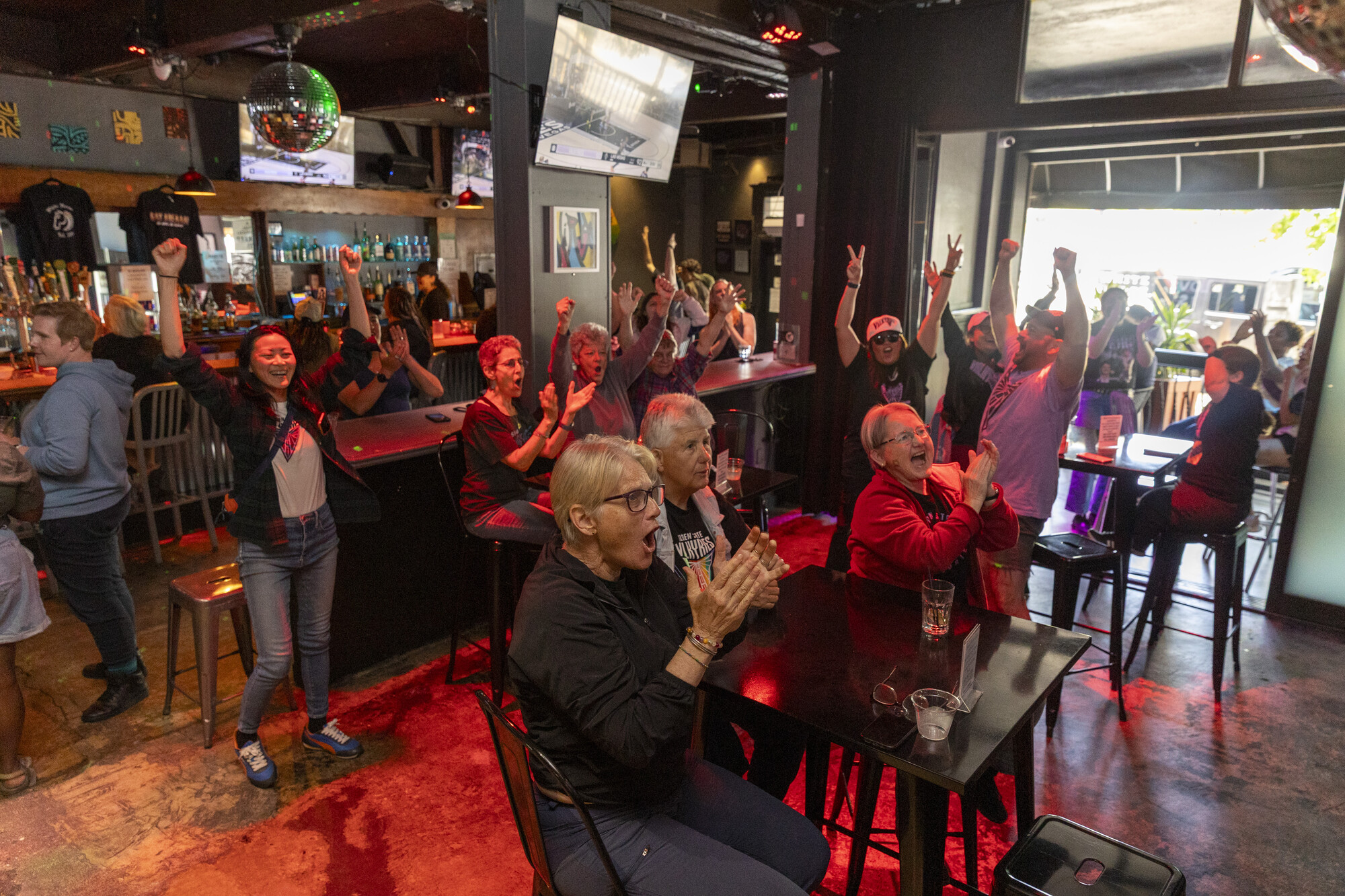
"caption": "Fans cheer for the Valkyries at a watch party at White Horse Bar in Oakland on July 12, 2025. The fan group, ValQueeries, hosted a watch party.",
"credit": "Tâm Vũ/KQED",
"altTag": null,
"description": null,
"imgSizes": {
"thumbnail": {
"file": "https://cdn.kqed.org/wp-content/uploads/sites/10/2025/07/250712-valkyries101_00420_TV_qed-160x107.jpg",
"width": 160,
"height": 107,
"mimeType": "image/jpeg"
},
"1536x1536": {
"file": "https://cdn.kqed.org/wp-content/uploads/sites/10/2025/07/250712-valkyries101_00420_TV_qed-1536x1024.jpg",
"width": 1536,
"height": 1024,
"mimeType": "image/jpeg"
},
"post-thumbnail": {
"file": "https://cdn.kqed.org/wp-content/uploads/sites/10/2025/07/250712-valkyries101_00420_TV_qed-672x372.jpg",
"width": 672,
"height": 372,
"mimeType": "image/jpeg"
},
"twentyfourteen-full-width": {
"file": "https://cdn.kqed.org/wp-content/uploads/sites/10/2025/07/250712-valkyries101_00420_TV_qed-1038x576.jpg",
"width": 1038,
"height": 576,
"mimeType": "image/jpeg"
},
"kqedFullSize": {
"file": "https://cdn.kqed.org/wp-content/uploads/sites/10/2025/07/250712-valkyries101_00420_TV_qed.jpg",
"width": 2000,
"height": 1333
}
},
"isLoading": false,
"fetchFailed": false
},
"news_12056242": {
"type": "attachments",
"id": "news_12056242",
"meta": {
"index": "attachments_1716263798",
"site": "news",
"id": "12056242",
"found": true
},
"title": "250916-RecallElectionNight-46-BL",
"publishDate": 1758085395,
"status": "inherit",
"parent": 0,
"modified": 1758085422,
"caption": "Supervisor Joel Engardio speaks with reporters at his election night gathering in the Sunset District of San Francisco on Sept. 16, 2025.",
"credit": "Beth LaBerge/KQED",
"altTag": null,
"description": null,
"imgSizes": {
"thumbnail": {
"file": "https://cdn.kqed.org/wp-content/uploads/sites/10/2025/09/250916-RecallElectionNight-46-BL-160x107.jpg",
"width": 160,
"height": 107,
"mimeType": "image/jpeg"
},
"1536x1536": {
"file": "https://cdn.kqed.org/wp-content/uploads/sites/10/2025/09/250916-RecallElectionNight-46-BL-1536x1024.jpg",
"width": 1536,
"height": 1024,
"mimeType": "image/jpeg"
},
"post-thumbnail": {
"file": "https://cdn.kqed.org/wp-content/uploads/sites/10/2025/09/250916-RecallElectionNight-46-BL-672x372.jpg",
"width": 672,
"height": 372,
"mimeType": "image/jpeg"
},
"twentyfourteen-full-width": {
"file": "https://cdn.kqed.org/wp-content/uploads/sites/10/2025/09/250916-RecallElectionNight-46-BL-1038x576.jpg",
"width": 1038,
"height": 576,
"mimeType": "image/jpeg"
},
"kqedFullSize": {
"file": "https://cdn.kqed.org/wp-content/uploads/sites/10/2025/09/250916-RecallElectionNight-46-BL.jpg",
"width": 2000,
"height": 1333
}
},
"isLoading": false,
"fetchFailed": false
},
"news_12040902": {
"type": "attachments",
"id": "news_12040902",
"meta": {
"index": "attachments_1716263798",
"site": "news",
"id": "12040902",
"found": true
},
"title": "US-AUTOMOBILE-LIFESTYLE-WAYMO",
"publishDate": 1747762015,
"status": "inherit",
"parent": 12074861,
"modified": 1772219111,
"caption": "A Waymo autonomous vehicle on Steiner Street in San Francisco on Nov. 17, 2023. ",
"credit": "Jason Henry/AFP via Getty Images",
"altTag": null,
"description": null,
"imgSizes": {
"medium": {
"file": "https://cdn.kqed.org/wp-content/uploads/sites/10/2025/05/GETTYIMAGES-1788126569-KQED-800x533.jpg",
"width": 800,
"height": 533,
"mimeType": "image/jpeg"
},
"large": {
"file": "https://cdn.kqed.org/wp-content/uploads/sites/10/2025/05/GETTYIMAGES-1788126569-KQED-1020x680.jpg",
"width": 1020,
"height": 680,
"mimeType": "image/jpeg"
},
"thumbnail": {
"file": "https://cdn.kqed.org/wp-content/uploads/sites/10/2025/05/GETTYIMAGES-1788126569-KQED-160x107.jpg",
"width": 160,
"height": 107,
"mimeType": "image/jpeg"
},
"1536x1536": {
"file": "https://cdn.kqed.org/wp-content/uploads/sites/10/2025/05/GETTYIMAGES-1788126569-KQED-1536x1024.jpg",
"width": 1536,
"height": 1024,
"mimeType": "image/jpeg"
},
"post-thumbnail": {
"file": "https://cdn.kqed.org/wp-content/uploads/sites/10/2025/05/GETTYIMAGES-1788126569-KQED-672x372.jpg",
"width": 672,
"height": 372,
"mimeType": "image/jpeg"
},
"twentyfourteen-full-width": {
"file": "https://cdn.kqed.org/wp-content/uploads/sites/10/2025/05/GETTYIMAGES-1788126569-KQED-1038x576.jpg",
"width": 1038,
"height": 576,
"mimeType": "image/jpeg"
},
"full-width": {
"file": "https://cdn.kqed.org/wp-content/uploads/sites/10/2025/05/GETTYIMAGES-1788126569-KQED-1920x1280.jpg",
"width": 1920,
"height": 1280,
"mimeType": "image/jpeg"
},
"kqedFullSize": {
"file": "https://cdn.kqed.org/wp-content/uploads/sites/10/2025/05/GETTYIMAGES-1788126569-KQED.jpg",
"width": 2000,
"height": 1333
}
},
"isLoading": false,
"fetchFailed": false
}
},
"audioPlayerReducer": {
"postId": "stream_live",
"isPaused": true,
"isPlaying": false,
"pfsActive": false,
"pledgeModalIsOpen": true,
"playerDrawerIsOpen": false,
"liveAudioPlayStartedAt": 0,
"liveAudioPlayContext": ""
},
"authorsReducer": {
"danbrekke": {
"type": "authors",
"id": "222",
"meta": {
"index": "authors_1716337520",
"id": "222",
"found": true
},
"name": "Dan Brekke",
"firstName": "Dan",
"lastName": "Brekke",
"slug": "danbrekke",
"email": "dbrekke@kqed.org",
"display_author_email": true,
"staff_mastheads": [
"news",
"science"
],
"title": "KQED Editor and Reporter",
"bio": "Dan Brekke is a reporter and editor for KQED News, responsible for coverage of topics ranging from California water issues to the Bay Area's transportation challenges. In a newsroom career that began in Chicago in 1972, Dan has worked for \u003cem>The San Francisco Examiner,\u003c/em> Wired and TechTV and has been published in The New York Times, The New York Times Magazine, Business 2.0, Salon and elsewhere.\r\n\r\nSince joining KQED in 2007, Dan has reported, edited and produced both radio and online features and breaking news pieces. He has shared as both editor and reporter in four Society of Professional Journalists Norcal Excellence in Journalism awards and one Edward R. Murrow regional award. He was chosen for a spring 2017 residency at the Mesa Refuge to advance his research on California salmon.\r\n\r\nEmail Dan at: \u003ca href=\"mailto:dbrekke@kqed.org\">dbrekke@kqed.org\u003c/a>\r\n\r\n\u003cstrong>Twitter:\u003c/strong> \u003ca href=\"https://twitter.com/danbrekke\" rel=\"noopener noreferrer\">twitter.com/danbrekke\u003c/a>\r\n\u003cstrong>Facebook:\u003c/strong> \u003ca href=\"https://www.facebook.com/danbrekke\" rel=\"noopener noreferrer\">www.facebook.com/danbrekke\u003c/a>\r\n\u003cstrong>LinkedIn:\u003c/strong> \u003ca href=\"https://www.linkedin.com/in/danbrekke\" rel=\"noopener noreferrer\">www.linkedin.com/in/danbrekke\u003c/a>",
"avatar": "https://secure.gravatar.com/avatar/c8126230345efca3f7aa89b1a402be45?s=600&d=mm&r=g",
"twitter": "danbrekke",
"facebook": null,
"instagram": "https://www.instagram.com/dan.brekke/",
"linkedin": "https://www.linkedin.com/in/danbrekke/",
"sites": [
{
"site": "news",
"roles": [
"administrator",
"create_posts"
]
},
{
"site": "stateofhealth",
"roles": [
"editor"
]
},
{
"site": "science",
"roles": [
"editor"
]
},
{
"site": "quest",
"roles": [
"contributor"
]
},
{
"site": "food",
"roles": [
"contributor"
]
},
{
"site": "forum",
"roles": [
"contributor"
]
},
{
"site": "liveblog",
"roles": [
"editor"
]
}
],
"headData": {
"title": "Dan Brekke | KQED",
"description": "KQED Editor and Reporter",
"ogImgSrc": "https://secure.gravatar.com/avatar/c8126230345efca3f7aa89b1a402be45?s=600&d=mm&r=g",
"twImgSrc": "https://secure.gravatar.com/avatar/c8126230345efca3f7aa89b1a402be45?s=600&d=mm&r=g"
},
"isLoading": false,
"link": "/author/danbrekke"
},
"tychehendricks": {
"type": "authors",
"id": "259",
"meta": {
"index": "authors_1716337520",
"id": "259",
"found": true
},
"name": "Tyche Hendricks",
"firstName": "Tyche",
"lastName": "Hendricks",
"slug": "tychehendricks",
"email": "thendricks@kqed.org",
"display_author_email": true,
"staff_mastheads": [
"news"
],
"title": "KQED Senior Editor, Immigration",
"bio": "\u003cspan style=\"font-weight: 400;\">Tyche Hendricks is KQED’s senior editor for immigration, leading coverage of the policy and politics that affect California’s immigrant communities. Her work for KQED’s radio and online audiences is also carried on NPR and other national outlets. She has been recognized with awards from the Radio and Television News Directors Association, the Society for Professional Journalists; the Education Writers Association; the Best of the West and the National Federation of Community Broadcasters. Before joining KQED in 2010, Tyche spent more than a dozen years as a newspaper reporter, notably at the \u003c/span>\u003ci>\u003cspan style=\"font-weight: 400;\">San Francisco Chronicle\u003c/span>\u003c/i>\u003cspan style=\"font-weight: 400;\">. At different times she has covered criminal justice, government and politics and urban planning. Tyche has taught in the MFA Creative Writing program at the University of San Francisco and at UC Berkeley’s Graduate School of Journalism, where she was co-director of a national immigration symposium for professional journalists. She is the author of \u003c/span>\u003ci>\u003cspan style=\"font-weight: 400;\">The Wind Doesn't Need a Passport: Stories from the U.S.-Mexico Borderlands\u003c/span>\u003c/i>\u003cspan style=\"font-weight: 400;\"> (University of California Press). \u003c/span>",
"avatar": "https://secure.gravatar.com/avatar/b8ee458e2731c2d43df86882ce17267e?s=600&d=blank&r=g",
"twitter": "tychehendricks",
"facebook": null,
"instagram": null,
"linkedin": null,
"sites": [
{
"site": "news",
"roles": [
"editor"
]
},
{
"site": "stateofhealth",
"roles": [
"editor"
]
}
],
"headData": {
"title": "Tyche Hendricks | KQED",
"description": "KQED Senior Editor, Immigration",
"ogImgSrc": "https://secure.gravatar.com/avatar/b8ee458e2731c2d43df86882ce17267e?s=600&d=blank&r=g",
"twImgSrc": "https://secure.gravatar.com/avatar/b8ee458e2731c2d43df86882ce17267e?s=600&d=blank&r=g"
},
"isLoading": false,
"link": "/author/tychehendricks"
},
"fjhabvala": {
"type": "authors",
"id": "8659",
"meta": {
"index": "authors_1716337520",
"id": "8659",
"found": true
},
"name": "Farida Jhabvala Romero",
"firstName": "Farida",
"lastName": "Jhabvala Romero",
"slug": "fjhabvala",
"email": "fjhabvala@kqed.org",
"display_author_email": true,
"staff_mastheads": [
"news"
],
"title": "KQED Contributor",
"bio": "Farida Jhabvala Romero is a Labor Correspondent for KQED. She previously covered immigration. Farida was \u003ca href=\"https://www.ccnma.org/2022-most-influential-latina-journalists\">named\u003c/a> one of the 10 Most Influential Latina Journalists in California in 2022 by the California Chicano News Media Association. Her work has won awards from the Society of Professional Journalists (Northern California), as well as a national and regional Edward M. Murrow Award for the collaborative reporting projects “Dangerous Air” and “Graying California.” Before joining KQED, Farida worked as a producer at Radio Bilingüe, a national public radio network. Farida earned her master’s degree in journalism from Stanford University.",
"avatar": "https://secure.gravatar.com/avatar/f9f022d4e2609741874222a1e9d41f48fea74011aa7c615eef91d9a50c944ebe?s=600&d=blank&r=g",
"twitter": "FaridaJhabvala",
"bluesky": null,
"facebook": null,
"instagram": null,
"linkedin": "https://www.linkedin.com/in/faridajhabvala/",
"sites": [
{
"site": "news",
"roles": [
"editor"
]
},
{
"site": "stateofhealth",
"roles": [
"author"
]
},
{
"site": "liveblog",
"roles": [
"author"
]
}
],
"headData": {
"title": "Farida Jhabvala Romero | KQED",
"description": "KQED Contributor",
"ogImgSrc": "https://secure.gravatar.com/avatar/f9f022d4e2609741874222a1e9d41f48fea74011aa7c615eef91d9a50c944ebe?s=600&d=blank&r=g",
"twImgSrc": "https://secure.gravatar.com/avatar/f9f022d4e2609741874222a1e9d41f48fea74011aa7c615eef91d9a50c944ebe?s=600&d=blank&r=g"
},
"isLoading": false,
"link": "/author/fjhabvala"
},
"ebaldassari": {
"type": "authors",
"id": "11652",
"meta": {
"index": "authors_1716337520",
"id": "11652",
"found": true
},
"name": "Erin Baldassari",
"firstName": "Erin",
"lastName": "Baldassari",
"slug": "ebaldassari",
"email": "ebaldassari@KQED.org",
"display_author_email": true,
"staff_mastheads": [
"news"
],
"title": "Staff Writer",
"bio": "Erin Baldassari covers housing for KQED. She's a former print journalist and most recently worked as the transportation reporter for the \u003cem>Mercury News\u003c/em> and \u003cem>East Bay Times. \u003c/em>There, she focused on how the Bay Area’s housing shortage has changed the way people move around the region. She also served on the \u003cem>East Bay Times\u003c/em>’ 2017 Pulitzer Prize-winning team for coverage of the Ghost Ship Fire in Oakland. Prior to that, Erin worked as a breaking news and general assignment reporter for a variety of outlets in the Bay Area and the greater Boston area. A Tufts University alumna, Erin grew up in the foothills of the Sierra Nevada mountains and in Sonoma County. She is a life-long KQED listener.",
"avatar": "https://secure.gravatar.com/avatar/5e95cad64a8ca08288082212e199d2b0cbeb4fd8e8ef5339395f361032bbe005?s=600&d=blank&r=g",
"twitter": "e_baldi",
"bluesky": null,
"facebook": null,
"instagram": null,
"linkedin": null,
"sites": [
{
"site": "news",
"roles": [
"edit_others_posts",
"editor"
]
},
{
"site": "science",
"roles": [
"editor"
]
},
{
"site": "liveblog",
"roles": [
"editor"
]
}
],
"headData": {
"title": "Erin Baldassari | KQED",
"description": "Staff Writer",
"ogImgSrc": "https://secure.gravatar.com/avatar/5e95cad64a8ca08288082212e199d2b0cbeb4fd8e8ef5339395f361032bbe005?s=600&d=blank&r=g",
"twImgSrc": "https://secure.gravatar.com/avatar/5e95cad64a8ca08288082212e199d2b0cbeb4fd8e8ef5339395f361032bbe005?s=600&d=blank&r=g"
},
"isLoading": false,
"link": "/author/ebaldassari"
},
"btorres": {
"type": "authors",
"id": "11666",
"meta": {
"index": "authors_1716337520",
"id": "11666",
"found": true
},
"name": "Blanca Torres",
"firstName": "Blanca",
"lastName": "Torres",
"slug": "btorres",
"email": "btorres@kqed.org",
"display_author_email": true,
"staff_mastheads": [
"news"
],
"title": "Producer, Forum",
"bio": "Blanca Torres brings sharp news judgement and keen sense of lively conversation to her work as producer for Forum. She loves producing shows that leave listeners feeling like they heard distinctive voices, learned something new and gained a fresh perspective.\r\n\r\nShe joined KQED in January of 2020 after 16 years of working as a newspaper reporter most recently at the \u003cem>San Francisco Business Times,\u003c/em> where she wrote about real estate and economic development. Before that, she covered a variety of beats including crime, education, retail, workplace, the economy, consumer issues, and small business for the \u003cem>Contra Costa Times, Baltimore Sun\u003c/em> and\u003cem> The Seattle Times\u003c/em>. In addition to reporting, she worked as an editorial writer and columnist for the \u003cem>Seattle Times\u003c/em>. From 2017 to 2020, Blanca won a total of ten awards from the National Association of Real Estate Editors and won first place for land use reporting from the California News Publishers Association two years in a row. She is also a member and former board member for the National Association of Hispanic Journalists.\r\n\r\nA native of the Pacific Northwest, Blanca earned her bachelor's degree from Vanderbilt University in Nashville and a master's in fine arts in creative writing at Mills College. She lives in the East Bay with her family.",
"avatar": "https://secure.gravatar.com/avatar/50b49d19b14a1eed34f26ebf4681152cdd81574ed21851100871ccd29e578cdc?s=600&d=blank&r=g",
"twitter": "@blancawrites",
"bluesky": null,
"facebook": null,
"instagram": null,
"linkedin": null,
"sites": [
{
"site": "arts",
"roles": [
"editor"
]
},
{
"site": "news",
"roles": [
"editor"
]
},
{
"site": "forum",
"roles": [
"editor"
]
}
],
"headData": {
"title": "Blanca Torres | KQED",
"description": "Producer, Forum",
"ogImgSrc": "https://secure.gravatar.com/avatar/50b49d19b14a1eed34f26ebf4681152cdd81574ed21851100871ccd29e578cdc?s=600&d=blank&r=g",
"twImgSrc": "https://secure.gravatar.com/avatar/50b49d19b14a1eed34f26ebf4681152cdd81574ed21851100871ccd29e578cdc?s=600&d=blank&r=g"
},
"isLoading": false,
"link": "/author/btorres"
},
"abandlamudi": {
"type": "authors",
"id": "11672",
"meta": {
"index": "authors_1716337520",
"id": "11672",
"found": true
},
"name": "Adhiti Bandlamudi",
"firstName": "Adhiti",
"lastName": "Bandlamudi",
"slug": "abandlamudi",
"email": "abandlamudi@kqed.org",
"display_author_email": false,
"staff_mastheads": [
"news"
],
"title": "KQED Housing Reporter",
"bio": "Adhiti Bandlamudi reports for KQED's Housing desk. She focuses on how housing gets built across the Bay Area. Before joining KQED in 2020, she reported for WUNC in Durham, North Carolina, WABE in Atlanta, Georgia and Capital Public Radio in Sacramento. In 2017, she was awarded a Kroc Fellowship at NPR where she reported on everything from sprinkles to the Golden State Killer's arrest. When she's not reporting, she's baking new recipes in her kitchen or watching movies with friends and family. She's originally from Georgia and has strong opinions about Great British Bake Off.",
"avatar": "https://secure.gravatar.com/avatar/868129c8b257bb99a3500e2c86a65400?s=600&d=mm&r=g",
"twitter": "oddity_adhiti",
"facebook": null,
"instagram": null,
"linkedin": null,
"sites": [
{
"site": "arts",
"roles": [
"author"
]
},
{
"site": "news",
"roles": [
"editor"
]
},
{
"site": "liveblog",
"roles": [
"author"
]
}
],
"headData": {
"title": "Adhiti Bandlamudi | KQED",
"description": "KQED Housing Reporter",
"ogImgSrc": "https://secure.gravatar.com/avatar/868129c8b257bb99a3500e2c86a65400?s=600&d=mm&r=g",
"twImgSrc": "https://secure.gravatar.com/avatar/868129c8b257bb99a3500e2c86a65400?s=600&d=mm&r=g"
},
"isLoading": false,
"link": "/author/abandlamudi"
},
"sjohnson": {
"type": "authors",
"id": "11840",
"meta": {
"index": "authors_1716337520",
"id": "11840",
"found": true
},
"name": "Sydney Johnson",
"firstName": "Sydney",
"lastName": "Johnson",
"slug": "sjohnson",
"email": "sjohnson@kqed.org",
"display_author_email": false,
"staff_mastheads": [
"news"
],
"title": "KQED Reporter",
"bio": "Sydney Johnson is a general assignment reporter at KQED. She previously reported on public health and city government at the San Francisco Examiner, and before that, she covered statewide education policy for EdSource. Her reporting has won multiple local, state and national awards. Sydney is a graduate of the University of California, Berkeley and lives in San Francisco.",
"avatar": "https://secure.gravatar.com/avatar/97855f2719b72ad6190b7c535fe642c8?s=600&d=blank&r=g",
"twitter": "sydneyfjohnson",
"facebook": null,
"instagram": null,
"linkedin": null,
"sites": [
{
"site": "news",
"roles": [
"editor"
]
}
],
"headData": {
"title": "Sydney Johnson | KQED",
"description": "KQED Reporter",
"ogImgSrc": "https://secure.gravatar.com/avatar/97855f2719b72ad6190b7c535fe642c8?s=600&d=blank&r=g",
"twImgSrc": "https://secure.gravatar.com/avatar/97855f2719b72ad6190b7c535fe642c8?s=600&d=blank&r=g"
},
"isLoading": false,
"link": "/author/sjohnson"
},
"nkhan": {
"type": "authors",
"id": "11867",
"meta": {
"index": "authors_1716337520",
"id": "11867",
"found": true
},
"name": "Nisa Khan",
"firstName": "Nisa",
"lastName": "Khan",
"slug": "nkhan",
"email": "nkhan@kqed.org",
"display_author_email": false,
"staff_mastheads": [],
"title": "KQED Contributor",
"bio": "Nisa Khan is a reporter for KQED's Audience News Desk. She was formerly a data reporter at Michigan Radio. She earned a Bachelor of Science in Information from the University of Michigan and a Master of Arts in Communication from Stanford University.",
"avatar": "https://secure.gravatar.com/avatar/8720459eef081ff64582b3506b124d58523e80e120704a0cbd9892533c914991?s=600&d=blank&r=g",
"twitter": "mnisakhan",
"bluesky": null,
"facebook": null,
"instagram": null,
"linkedin": null,
"sites": [
{
"site": "arts",
"roles": [
"editor"
]
},
{
"site": "news",
"roles": [
"editor"
]
},
{
"site": "science",
"roles": [
"editor",
"author"
]
},
{
"site": "forum",
"roles": [
"editor"
]
},
{
"site": "liveblog",
"roles": [
"contributor"
]
}
],
"headData": {
"title": "Nisa Khan | KQED",
"description": "KQED Contributor",
"ogImgSrc": "https://secure.gravatar.com/avatar/8720459eef081ff64582b3506b124d58523e80e120704a0cbd9892533c914991?s=600&d=blank&r=g",
"twImgSrc": "https://secure.gravatar.com/avatar/8720459eef081ff64582b3506b124d58523e80e120704a0cbd9892533c914991?s=600&d=blank&r=g"
},
"isLoading": false,
"link": "/author/nkhan"
},
"kdebenedetti": {
"type": "authors",
"id": "11913",
"meta": {
"index": "authors_1716337520",
"id": "11913",
"found": true
},
"name": "Katie DeBenedetti",
"firstName": "Katie",
"lastName": "DeBenedetti",
"slug": "kdebenedetti",
"email": "kdebenedetti@kqed.org",
"display_author_email": false,
"staff_mastheads": [
"news",
"science"
],
"title": "KQED Contributor",
"bio": "Katie DeBenedetti is a digital reporter covering daily news for the Express Desk. Prior to joining KQED as a culture reporting intern in January 2024, she covered education and city government for the Napa Valley Register.",
"avatar": "https://secure.gravatar.com/avatar/6e31073cb8f7e4214ab03f42771d0f45?s=600&d=blank&r=g",
"twitter": null,
"facebook": null,
"instagram": null,
"linkedin": null,
"sites": [
{
"site": "news",
"roles": [
"author"
]
},
{
"site": "science",
"roles": [
"author"
]
},
{
"site": "liveblog",
"roles": [
"author"
]
}
],
"headData": {
"title": "Katie DeBenedetti | KQED",
"description": "KQED Contributor",
"ogImgSrc": "https://secure.gravatar.com/avatar/6e31073cb8f7e4214ab03f42771d0f45?s=600&d=blank&r=g",
"twImgSrc": "https://secure.gravatar.com/avatar/6e31073cb8f7e4214ab03f42771d0f45?s=600&d=blank&r=g"
},
"isLoading": false,
"link": "/author/kdebenedetti"
},
"gglueck": {
"type": "authors",
"id": "11946",
"meta": {
"index": "authors_1716337520",
"id": "11946",
"found": true
},
"name": "Gabriela Glueck",
"firstName": "Gabriela",
"lastName": "Glueck",
"slug": "gglueck",
"email": "gglueck@kqed.org",
"display_author_email": false,
"staff_mastheads": [
"news"
],
"title": "KQED Contributor",
"bio": null,
"avatar": "https://secure.gravatar.com/avatar/ec62b7e3f7727ce1070cc7046dde80271d1e63cf2178d6194f68bb8d1440f841?s=600&d=blank&r=g",
"twitter": null,
"bluesky": null,
"facebook": null,
"instagram": null,
"linkedin": null,
"sites": [
{
"site": "news",
"roles": [
"editor"
]
}
],
"headData": {
"title": "Gabriela Glueck | KQED",
"description": "KQED Contributor",
"ogImgSrc": "https://secure.gravatar.com/avatar/ec62b7e3f7727ce1070cc7046dde80271d1e63cf2178d6194f68bb8d1440f841?s=600&d=blank&r=g",
"twImgSrc": "https://secure.gravatar.com/avatar/ec62b7e3f7727ce1070cc7046dde80271d1e63cf2178d6194f68bb8d1440f841?s=600&d=blank&r=g"
},
"isLoading": false,
"link": "/author/gglueck"
},
"aaliahmad": {
"type": "authors",
"id": "11986",
"meta": {
"index": "authors_1716337520",
"id": "11986",
"found": true
},
"name": "Ayah Ali-Ahmad",
"firstName": "Ayah",
"lastName": "Ali-Ahmad",
"slug": "aaliahmad",
"email": "aaliahmad@KQED.org",
"display_author_email": false,
"staff_mastheads": [],
"title": "KQED Contributor",
"bio": null,
"avatar": "https://secure.gravatar.com/avatar/1cf54f187a5e1064b2cfef3f3d2f1e4f93e453395d56912aca6382a6071ec3ed?s=600&d=blank&r=g",
"twitter": "ayahaliahmad",
"bluesky": null,
"facebook": null,
"instagram": null,
"linkedin": null,
"sites": [
{
"site": "news",
"roles": [
"subscriber"
]
}
],
"headData": {
"title": "Ayah Ali-Ahmad | KQED",
"description": "KQED Contributor",
"ogImgSrc": "https://secure.gravatar.com/avatar/1cf54f187a5e1064b2cfef3f3d2f1e4f93e453395d56912aca6382a6071ec3ed?s=600&d=blank&r=g",
"twImgSrc": "https://secure.gravatar.com/avatar/1cf54f187a5e1064b2cfef3f3d2f1e4f93e453395d56912aca6382a6071ec3ed?s=600&d=blank&r=g"
},
"isLoading": false,
"link": "/author/aaliahmad"
}
},
"pagesReducer": {
"news_tag_san-francisco": {
"type": "terms",
"id": "news_38",
"meta": {
"index": "terms_1716263798",
"site": "news",
"id": "38",
"score": 6.7228813
},
"featImg": null,
"name": "San Francisco",
"description": null,
"taxonomy": "tag",
"headData": {
"twImgId": null,
"twTitle": null,
"ogTitle": null,
"ogImgId": null,
"twDescription": null,
"description": null,
"title": "San Francisco Archives | KQED News",
"ogDescription": null
},
"ttid": 58,
"slug": "san-francisco",
"isLoading": false,
"title": "San Francisco",
"pageMeta": {
"site": "news",
"WpPageTemplate": "page-topic-editorial",
"currentPage": 48
},
"blocks": [
{
"blockName": "kqed/post-list",
"attrs": {
"layout": "cardArticle2",
"query": "posts/news?tag=san-francisco",
"seeMore": false,
"paginated": true,
"page": 48
}
},
{
"blockName": "kqed/ad"
}
]
}
},
"pfsSessionReducer": {},
"postsReducer": {
"stream_live": {
"type": "live",
"id": "stream_live",
"audioUrl": "https://streams.kqed.org/kqedradio",
"title": "Live Stream",
"excerpt": "Live Stream information currently unavailable.",
"link": "/radio",
"featImg": "",
"label": {
"name": "KQED Live",
"link": "/"
}
},
"stream_kqedNewscast": {
"type": "posts",
"id": "stream_kqedNewscast",
"audioUrl": "https://www.kqed.org/.stream/anon/radio/RDnews/newscast.mp3?_=1",
"title": "KQED Newscast",
"featImg": "",
"label": {
"name": "88.5 FM",
"link": "/"
}
},
"news_12057037": {
"type": "posts",
"id": "news_12057037",
"meta": {
"index": "posts_1716263798",
"site": "news",
"id": "12057037",
"score": null,
"sort": [
1758648616000
]
},
"guestAuthors": [],
"slug": "san-francisco-nail-artist-turns-manicures-into-wearable-art-rooted-in-mexican-heritage",
"title": "San Francisco Nail Artist Turns Manicures Into Wearable Art Rooted in Mexican Heritage",
"publishDate": 1758648616,
"format": "standard",
"headTitle": "San Francisco Nail Artist Turns Manicures Into Wearable Art Rooted in Mexican Heritage | KQED",
"labelTerm": {
"site": "news"
},
"content": "\u003cp>\u003cem>Sign up for K Onda KQED, a monthly newsletter focused on the Bay Area’s Latinx community. \u003c/em>\u003ca href=\"https://www.kqed.org/newsletters/k-onda\">\u003cem>Click here to subscribe.\u003c/em>\u003c/a>\u003c/p>\n\u003cp>Against a sky blue backdrop, Laysa Cazares painted a series of \u003ca href=\"https://www.kqed.org/news/tag/california\">California\u003c/a> poppies. With a tiny brush, she used shades of orange to create petals just a few millimeters wide that looked like they were fluttering in a breeze.\u003c/p>\n\u003cp>A lifelong artist, Cazares’ favorite medium may seem unusual: fingernails.\u003c/p>\n\u003cp>“It’s a little canvas where you can put whatever you want, and it’s wearable art, which I think is really cool,” the 29-year-old said.\u003c/p>\n\u003cp>[ad fullwidth]\u003c/p>\n\u003cp>Cazares, raised in Manteca and now based in San Francisco, is among a growing number of high-end nail artists elevating traditional manicures into works of art amid the booming multibillion-dollar beauty industry. She has built a following for her three-dimensional, airbrushed and hand-painted nail designs that incorporate fashion, her Mexican heritage and meticulous artistry.\u003c/p>\n\u003cp>On a recent morning, her right hand featured metallic charcoal gray adorned with polka dots, which she said are trending. Her left hand showed a light blue-hued design with three-dimensional spheres inspired by a bubble bath.\u003c/p>\n\u003cfigure id=\"attachment_12055054\" class=\"wp-caption aligncenter\" style=\"max-width: 2000px\">\u003cimg loading=\"lazy\" decoding=\"async\" class=\"size-full wp-image-12055054\" src=\"https://cdn.kqed.org/wp-content/uploads/sites/10/2025/09/250904_K-ONDA-SEPTEMBER-NAIL-ARTIST-_GH-KQED.jpg\" alt=\"\" width=\"2000\" height=\"1333\" srcset=\"https://cdn.kqed.org/wp-content/uploads/sites/10/2025/09/250904_K-ONDA-SEPTEMBER-NAIL-ARTIST-_GH-KQED.jpg 2000w, https://cdn.kqed.org/wp-content/uploads/sites/10/2025/09/250904_K-ONDA-SEPTEMBER-NAIL-ARTIST-_GH-KQED-160x107.jpg 160w, https://cdn.kqed.org/wp-content/uploads/sites/10/2025/09/250904_K-ONDA-SEPTEMBER-NAIL-ARTIST-_GH-KQED-1536x1024.jpg 1536w\" sizes=\"auto, (max-width: 2000px) 100vw, 2000px\">\u003cfigcaption class=\"wp-caption-text\">Laysa Cazares pulls gel from a container during a nail-sculpting class at Sparkle SF in San Francisco on Sept. 4, 2025. Cazares, a Hayward native, is known for her detailed, three-dimensional nail art. \u003ccite>(Gustavo Hernandez/KQED)\u003c/cite>\u003c/figcaption>\u003c/figure>\n\u003cp>Cazares, who goes by the moniker \u003ca href=\"https://www.instagram.com/nailbruja/\">Nail Bruja\u003c/a> — “nail witch” in Spanglish — uses a variety of gels to layer on clients’ nails, create longer nails and sculpt 3D objects from scratch. She then applies paints and polishes to create intricate designs and effects like a cat-eye shimmer or reflective shine.\u003c/p>\n\u003cp>For one client, she created a tiny cat that looked like it was poking out from behind a nail. For another, she shaped long, pointy nails to resemble plant leaves dotted with 3D ladybugs and raindrops.\u003c/p>\n\u003cp>“It’s almost like clay, so you can just mold it and then you paint it and you can do whatever,” she said. “That wasn’t a thing 10 years ago until recently, so it’s really cool to be able to make whatever you want on your nail.”[aside postID=arts_13981143 hero='https://cdn.kqed.org/wp-content/uploads/sites/2/2024/09/240916_ElGrito_EG_007-1020x680.jpg']Her love affair with nails started early. She remembers waking up early — and sometimes being late — because she painted her nails in the morning to match her outfit. She credits her older sister for introducing her to painting, ceramics and other crafts.\u003c/p>\n\u003cp>After high school, Cazares decided against college but wanted a career in art. She didn’t see a clear path until her sister suggested she become a licensed nail technician, which she did in 2015.\u003c/p>\n\u003cp>Her parents were skeptical at first, questioning how she could earn a living wage doing manicures and pedicures. Nail technicians \u003ca href=\"https://www.bls.gov/ooh/personal-care-and-service/manicurists-and-pedicurists.htm\">made an average\u003c/a> of $16.66 per hour or about $34,660 a year in 2024, according to the U.S. Bureau of Labor Statistics. The industry has a \u003ca href=\"https://www.kqed.org/news/11275303/nail-salon-workers-allege-wage-theft-indicate-larger-exploitation\">history of labor exploitation\u003c/a>.\u003c/p>\n\u003cp>“I have immigrant parents, they’re from Mexico, and my mom, one of her favorite sayings, ‘I didn’t cross a country for you to not be successful,’” Cazeres said. That made her more determined to pursue nail art in a way that would be lucrative.\u003c/p>\n\u003cp>Six years ago, she immersed herself in nail art while working at a Fremont salon specializing in designs with long acrylic tips, which were popular at the time.\u003c/p>\n\u003cp>“I had a full clientele and it just clicked like, ‘Oh, I really could actually live off of this and have it be my career full time,” she said. “Sometimes I’m like, ‘Oh, maybe going to school would have been cool, too.’ But I love nails and I love art. So being a nail artist just works. I get to combine both.”\u003c/p>\n\u003cp>In 2022, she moved to Miami, which also has a robust nail industry. She returned to California last December and now works at Sparkle SF, a salon in San Francisco’s Mission District.\u003c/p>\n\u003cfigure id=\"attachment_12055050\" class=\"wp-caption aligncenter\" style=\"max-width: 2000px\">\u003cimg loading=\"lazy\" decoding=\"async\" class=\"size-full wp-image-12055050\" src=\"https://cdn.kqed.org/wp-content/uploads/sites/10/2025/09/250904_K-ONDA-SEPTEMBER-NAIL-ARTIST-_GH-5-KQED.jpg\" alt=\"\" width=\"2000\" height=\"1333\" srcset=\"https://cdn.kqed.org/wp-content/uploads/sites/10/2025/09/250904_K-ONDA-SEPTEMBER-NAIL-ARTIST-_GH-5-KQED.jpg 2000w, https://cdn.kqed.org/wp-content/uploads/sites/10/2025/09/250904_K-ONDA-SEPTEMBER-NAIL-ARTIST-_GH-5-KQED-160x107.jpg 160w, https://cdn.kqed.org/wp-content/uploads/sites/10/2025/09/250904_K-ONDA-SEPTEMBER-NAIL-ARTIST-_GH-5-KQED-1536x1024.jpg 1536w\" sizes=\"auto, (max-width: 2000px) 100vw, 2000px\">\u003cfigcaption class=\"wp-caption-text\">Polaroids of staff and visitors decorate a wall inside Sparkle SF in San Francisco on Sept. 4, 2025. The studio doubles as both a workplace and a creative hub for nail art. \u003ccite>(Gustavo Hernandez/KQED)\u003c/cite>\u003c/figcaption>\u003c/figure>\n\u003cp>“San Francisco is just such a fun, quirky, unique place where even the older generations are into nail art,” she said. “Younger people will do all the crazy stuff, and they’re not scared to get 3D. They’re not scared to like chrome or airbrush or anything. They’re down to try it all.”\u003c/p>\n\u003cp>Sparke SF is strictly for nail art and doesn’t offer pedicures, massages or facials, said owner Mia Rubie, who started the salon more than a decade ago and has watched nail art continuously evolve.\u003c/p>\n\u003cp>“Now, there’s so many possibilities with nail art,” thanks in part to social media, she said. Clients “are making it a very personalized experience, like something tailored to their own interests or something that they’re into or dedicating nails to somebody else or things like that. People are discovering that you can use it as a valid expression of art.”\u003c/p>\n\u003cp>“The history of nails is very multicultural,” said Jillian Hernandez, a professor of women’s studies at the University of Florida who leads the Full Set Project, a team of scholars researching the nail industry. The intricate nail designs innovated by Vietnamese nail techs caught on with Black and Latina women, who helped turn long, brightly decorated nails into bold fashion statements.\u003c/p>\n\u003cp>Her team plans to release a documentary, \u003ca href=\"https://historymiami.org/event/film-screening-panel-discussion-full-set-a-celebration-of-miami-nail-artistry/\">\u003cem>Nail Tech: Portrait of an Artist\u003c/em>\u003c/a>, in December, chronicling the career of Miami-based nail artist Kro Vargas.\u003c/p>\n\u003cfigure id=\"attachment_12055053\" class=\"wp-caption aligncenter\" style=\"max-width: 2000px\">\u003cimg loading=\"lazy\" decoding=\"async\" class=\"size-full wp-image-12055053\" src=\"https://cdn.kqed.org/wp-content/uploads/sites/10/2025/09/250904_K-ONDA-SEPTEMBER-NAIL-ARTIST-_GH-21-KQED.jpg\" alt=\"\" width=\"2000\" height=\"1333\" srcset=\"https://cdn.kqed.org/wp-content/uploads/sites/10/2025/09/250904_K-ONDA-SEPTEMBER-NAIL-ARTIST-_GH-21-KQED.jpg 2000w, https://cdn.kqed.org/wp-content/uploads/sites/10/2025/09/250904_K-ONDA-SEPTEMBER-NAIL-ARTIST-_GH-21-KQED-160x107.jpg 160w, https://cdn.kqed.org/wp-content/uploads/sites/10/2025/09/250904_K-ONDA-SEPTEMBER-NAIL-ARTIST-_GH-21-KQED-1536x1024.jpg 1536w\" sizes=\"auto, (max-width: 2000px) 100vw, 2000px\">\u003cfigcaption class=\"wp-caption-text\">An assortment of intricate nail designs displayed at Sparkle SF in San Francisco on Sept. 4, 2025. The salon is known for showcasing bold, colorful and three-dimensional nail artistry. \u003ccite>(Gustavo Hernandez/KQED)\u003c/cite>\u003c/figcaption>\u003c/figure>\n\u003cp>“Over the last decade, particularly the last five years since COVID, there was increasing interest in self-care practices, but also famous women of color like Cardi B, for example, entered the mainstream and also entered spaces of fashion and brought their own aesthetics to these spaces,” Hernandez said.\u003c/p>\n\u003cp>The shift from seeing nails as simple grooming to fashionable art is slowly changing how workers in the industry are viewed, Hernandez said.\u003c/p>\n\u003cp>“It gets to this fundamental question of how do we value workers? We tend to undervalue care work because it’s associated with women and people of color,” she said. “All nail techs are artists, and they should be respected for their labor, whether they’re in the corner salon or whether they’re in these highly specialized studios doing nails for celebrities. That’s extremely important.”\u003c/p>\n\u003cp>The cost of nail art is also rising as designs require more expertise and time. At Sparkle, prices start around $60 for a basic manicure, but intricate designs can cost a few hundred dollars and take several hours. Cazares said her designs typically last about a month.\u003c/p>\n\u003cfigure id=\"attachment_12055052\" class=\"wp-caption aligncenter\" style=\"max-width: 2000px\">\u003cimg loading=\"lazy\" decoding=\"async\" class=\"size-full wp-image-12055052\" src=\"https://cdn.kqed.org/wp-content/uploads/sites/10/2025/09/250904_K-ONDA-SEPTEMBER-NAIL-ARTIST-_GH-19-KQED.jpg\" alt=\"\" width=\"2000\" height=\"1333\" srcset=\"https://cdn.kqed.org/wp-content/uploads/sites/10/2025/09/250904_K-ONDA-SEPTEMBER-NAIL-ARTIST-_GH-19-KQED.jpg 2000w, https://cdn.kqed.org/wp-content/uploads/sites/10/2025/09/250904_K-ONDA-SEPTEMBER-NAIL-ARTIST-_GH-19-KQED-160x107.jpg 160w, https://cdn.kqed.org/wp-content/uploads/sites/10/2025/09/250904_K-ONDA-SEPTEMBER-NAIL-ARTIST-_GH-19-KQED-1536x1024.jpg 1536w\" sizes=\"auto, (max-width: 2000px) 100vw, 2000px\">\u003cfigcaption class=\"wp-caption-text\">Nail artist Laysa Cazares works at her station inside Sparkle SF in San Francisco on Sept. 4, 2025. \u003ccite>(Gustavo Hernandez/KQED)\u003c/cite>\u003c/figcaption>\u003c/figure>\n\u003cp>The most expensive set she has ever done took eight hours, covered both hands with Swarovski crystals and cost $1,400.\u003c/p>\n\u003cp>“Nails aren’t a necessity; they are a luxury,” Cazares said. “I love the feeling of feeling put together, and for a lot of people, this does that for them. For women who work corporate tech jobs, their jobs are so demanding; this is a form of self-expression.”\u003c/p>\n\u003cp>That resonates with San Mateo resident Cristina Medina, 30, who had her first manicure in middle school.\u003c/p>\n\u003cp>“My mom always had her nails done for as long as I can remember, so I think I got it from her, the habit of getting my nails done,” she said. “I’ve always correlated getting my nails done as a way of self-pampering, of taking care of myself. It helps me feel more put together.”\u003c/p>\n\u003cfigure id=\"attachment_12057050\" class=\"wp-caption aligncenter\" style=\"max-width: 2000px\">\u003cimg loading=\"lazy\" decoding=\"async\" class=\"size-full wp-image-12057050\" src=\"https://cdn.kqed.org/wp-content/uploads/sites/10/2025/09/250919-K-ONDA-NAIL-ARTIST-DIPTYCH-1.jpg\" alt=\"\" width=\"2000\" height=\"1129\" srcset=\"https://cdn.kqed.org/wp-content/uploads/sites/10/2025/09/250919-K-ONDA-NAIL-ARTIST-DIPTYCH-1.jpg 2000w, https://cdn.kqed.org/wp-content/uploads/sites/10/2025/09/250919-K-ONDA-NAIL-ARTIST-DIPTYCH-1-160x90.jpg 160w, https://cdn.kqed.org/wp-content/uploads/sites/10/2025/09/250919-K-ONDA-NAIL-ARTIST-DIPTYCH-1-1536x867.jpg 1536w\" sizes=\"auto, (max-width: 2000px) 100vw, 2000px\">\u003cfigcaption class=\"wp-caption-text\">Specialty designs by San Francisco nail artist Laysa Cazares. \u003ccite>(Courtesy of Laysa Cazares)\u003c/cite>\u003c/figcaption>\u003c/figure>\n\u003cp>Medina has a standing appointment every three weeks. Her designs range from a simple French tip to more seasonal creations.\u003c/p>\n\u003cp>“I like to spice it up during the holidays,” she said. “For example, Halloween and Dia de los Muertos are coming up, so I might mess with orange, brown colors or even pumpkin. It really gives me that creative freedom and gives me a way to express myself throughout the year.”\u003c/p>\n\u003cp>Cazares is hosting an event this month called \u003ca href=\"http://www.nomicreativestudios.com\">Hexed by Nail Bruja & Friends\u003c/a> to showcase nail art the way an art gallery exhibits paintings. The Friday event will also feature vendors, tarot card readings and cocktails, and will run from 6–9 p.m. at a retro pinball arcade at 1767 Waller St. in San Francisco. Tickets are $30.\u003c/p>\n\u003cp>\u003cem>\u003cstrong>Clarification:\u003c/strong> An earlier version of this story said “Latina and Black women pioneered long, brightly decorated nails as fashion statements well before the mainstream embraced the look, she said, while many Vietnamese women have worked in salons.” To clarify, the professor emphasized that Black and Latina women helped popularize and bring visibility to nail art as a cultural fashion statement, while Vietnamese women, many of them immigrants, played a central role in the nail salon industry where the style was widely practiced.\u003c/em>\u003c/p>\n\u003cp>[ad floatright]\u003c/p>\n",
"blocks": [],
"excerpt": "High-end nail art is booming in the Bay Area as Latina artists reshape the beauty industry with bold, hand-painted and sculpted designs.",
"status": "publish",
"parent": 0,
"modified": 1758734592,
"stats": {
"hasAudio": false,
"hasVideo": false,
"hasChartOrMap": false,
"iframeSrcs": [],
"hasGoogleForm": false,
"hasGallery": false,
"hasHearkenModule": false,
"hasPolis": false,
"paragraphCount": 34,
"wordCount": 1654
},
"headData": {
"title": "San Francisco Nail Artist Turns Manicures Into Wearable Art Rooted in Mexican Heritage | KQED",
"description": "High-end nail art is booming in the Bay Area as Latina artists reshape the beauty industry with bold, hand-painted and sculpted designs.",
"ogTitle": "",
"ogDescription": "",
"ogImgId": "",
"twTitle": "",
"twDescription": "",
"twImgId": "",
"schema": {
"@context": "https://schema.org",
"@type": "NewsArticle",
"headline": "San Francisco Nail Artist Turns Manicures Into Wearable Art Rooted in Mexican Heritage",
"datePublished": "2025-09-23T10:30:16-07:00",
"dateModified": "2025-09-24T10:23:12-07:00",
"image": "https://cdn.kqed.org/wp-content/uploads/2020/02/KQED-OG-Image@1x.png",
"isAccessibleForFree": "True",
"publisher": {
"@type": "NewsMediaOrganization",
"@id": "https://www.kqed.org/#organization",
"name": "KQED",
"logo": "https://cdn.kqed.org/wp-content/uploads/2020/02/KQED-OG-Image@1x.png",
"url": "https://www.kqed.org",
"sameAs": [
"https://www.facebook.com/KQED",
"https://twitter.com/KQED",
"https://www.instagram.com/kqed/",
"https://www.tiktok.com/@kqedofficial",
"https://www.linkedin.com/company/kqed",
"https://www.youtube.com/channel/UCeC0IOo7i1P_61zVUWbJ4nw"
]
}
}
},
"primaryCategory": {
"termId": 223,
"slug": "arts-and-culture",
"name": "Arts and Culture"
},
"sticky": false,
"nprStoryId": "kqed-12057037",
"templateType": "standard",
"featuredImageType": "standard",
"excludeFromSiteSearch": "Include",
"showOnAuthorArchivePages": "No",
"articleAge": "0",
"path": "/news/12057037/san-francisco-nail-artist-turns-manicures-into-wearable-art-rooted-in-mexican-heritage",
"audioTrackLength": null,
"parsedContent": [
{
"type": "contentString",
"content": "\u003cdiv class=\"post-body\">\u003cp>\u003cp>\u003cem>Sign up for K Onda KQED, a monthly newsletter focused on the Bay Area’s Latinx community. \u003c/em>\u003ca href=\"https://www.kqed.org/newsletters/k-onda\">\u003cem>Click here to subscribe.\u003c/em>\u003c/a>\u003c/p>\n\u003cp>Against a sky blue backdrop, Laysa Cazares painted a series of \u003ca href=\"https://www.kqed.org/news/tag/california\">California\u003c/a> poppies. With a tiny brush, she used shades of orange to create petals just a few millimeters wide that looked like they were fluttering in a breeze.\u003c/p>\n\u003cp>A lifelong artist, Cazares’ favorite medium may seem unusual: fingernails.\u003c/p>\n\u003cp>“It’s a little canvas where you can put whatever you want, and it’s wearable art, which I think is really cool,” the 29-year-old said.\u003c/p>\n\u003cp>\u003c/p>\u003c/div>",
"attributes": {
"named": {},
"numeric": []
}
},
{
"type": "component",
"content": "",
"name": "ad",
"attributes": {
"named": {
"label": "fullwidth"
},
"numeric": [
"fullwidth"
]
}
},
{
"type": "contentString",
"content": "\u003cdiv class=\"post-body\">\u003cp>\u003c/p>\n\u003cp>Cazares, raised in Manteca and now based in San Francisco, is among a growing number of high-end nail artists elevating traditional manicures into works of art amid the booming multibillion-dollar beauty industry. She has built a following for her three-dimensional, airbrushed and hand-painted nail designs that incorporate fashion, her Mexican heritage and meticulous artistry.\u003c/p>\n\u003cp>On a recent morning, her right hand featured metallic charcoal gray adorned with polka dots, which she said are trending. Her left hand showed a light blue-hued design with three-dimensional spheres inspired by a bubble bath.\u003c/p>\n\u003cfigure id=\"attachment_12055054\" class=\"wp-caption aligncenter\" style=\"max-width: 2000px\">\u003cimg loading=\"lazy\" decoding=\"async\" class=\"size-full wp-image-12055054\" src=\"https://cdn.kqed.org/wp-content/uploads/sites/10/2025/09/250904_K-ONDA-SEPTEMBER-NAIL-ARTIST-_GH-KQED.jpg\" alt=\"\" width=\"2000\" height=\"1333\" srcset=\"https://cdn.kqed.org/wp-content/uploads/sites/10/2025/09/250904_K-ONDA-SEPTEMBER-NAIL-ARTIST-_GH-KQED.jpg 2000w, https://cdn.kqed.org/wp-content/uploads/sites/10/2025/09/250904_K-ONDA-SEPTEMBER-NAIL-ARTIST-_GH-KQED-160x107.jpg 160w, https://cdn.kqed.org/wp-content/uploads/sites/10/2025/09/250904_K-ONDA-SEPTEMBER-NAIL-ARTIST-_GH-KQED-1536x1024.jpg 1536w\" sizes=\"auto, (max-width: 2000px) 100vw, 2000px\">\u003cfigcaption class=\"wp-caption-text\">Laysa Cazares pulls gel from a container during a nail-sculpting class at Sparkle SF in San Francisco on Sept. 4, 2025. Cazares, a Hayward native, is known for her detailed, three-dimensional nail art. \u003ccite>(Gustavo Hernandez/KQED)\u003c/cite>\u003c/figcaption>\u003c/figure>\n\u003cp>Cazares, who goes by the moniker \u003ca href=\"https://www.instagram.com/nailbruja/\">Nail Bruja\u003c/a> — “nail witch” in Spanglish — uses a variety of gels to layer on clients’ nails, create longer nails and sculpt 3D objects from scratch. She then applies paints and polishes to create intricate designs and effects like a cat-eye shimmer or reflective shine.\u003c/p>\n\u003cp>For one client, she created a tiny cat that looked like it was poking out from behind a nail. For another, she shaped long, pointy nails to resemble plant leaves dotted with 3D ladybugs and raindrops.\u003c/p>\n\u003cp>“It’s almost like clay, so you can just mold it and then you paint it and you can do whatever,” she said. “That wasn’t a thing 10 years ago until recently, so it’s really cool to be able to make whatever you want on your nail.”\u003c/p>\u003c/div>",
"attributes": {
"named": {},
"numeric": []
}
},
{
"type": "component",
"content": "",
"name": "aside",
"attributes": {
"named": {
"postid": "arts_13981143",
"hero": "https://cdn.kqed.org/wp-content/uploads/sites/2/2024/09/240916_ElGrito_EG_007-1020x680.jpg",
"label": ""
},
"numeric": []
}
},
{
"type": "contentString",
"content": "\u003cdiv class=\"post-body\">\u003cp>Her love affair with nails started early. She remembers waking up early — and sometimes being late — because she painted her nails in the morning to match her outfit. She credits her older sister for introducing her to painting, ceramics and other crafts.\u003c/p>\n\u003cp>After high school, Cazares decided against college but wanted a career in art. She didn’t see a clear path until her sister suggested she become a licensed nail technician, which she did in 2015.\u003c/p>\n\u003cp>Her parents were skeptical at first, questioning how she could earn a living wage doing manicures and pedicures. Nail technicians \u003ca href=\"https://www.bls.gov/ooh/personal-care-and-service/manicurists-and-pedicurists.htm\">made an average\u003c/a> of $16.66 per hour or about $34,660 a year in 2024, according to the U.S. Bureau of Labor Statistics. The industry has a \u003ca href=\"https://www.kqed.org/news/11275303/nail-salon-workers-allege-wage-theft-indicate-larger-exploitation\">history of labor exploitation\u003c/a>.\u003c/p>\n\u003cp>“I have immigrant parents, they’re from Mexico, and my mom, one of her favorite sayings, ‘I didn’t cross a country for you to not be successful,’” Cazeres said. That made her more determined to pursue nail art in a way that would be lucrative.\u003c/p>\n\u003cp>Six years ago, she immersed herself in nail art while working at a Fremont salon specializing in designs with long acrylic tips, which were popular at the time.\u003c/p>\n\u003cp>“I had a full clientele and it just clicked like, ‘Oh, I really could actually live off of this and have it be my career full time,” she said. “Sometimes I’m like, ‘Oh, maybe going to school would have been cool, too.’ But I love nails and I love art. So being a nail artist just works. I get to combine both.”\u003c/p>\n\u003cp>In 2022, she moved to Miami, which also has a robust nail industry. She returned to California last December and now works at Sparkle SF, a salon in San Francisco’s Mission District.\u003c/p>\n\u003cfigure id=\"attachment_12055050\" class=\"wp-caption aligncenter\" style=\"max-width: 2000px\">\u003cimg loading=\"lazy\" decoding=\"async\" class=\"size-full wp-image-12055050\" src=\"https://cdn.kqed.org/wp-content/uploads/sites/10/2025/09/250904_K-ONDA-SEPTEMBER-NAIL-ARTIST-_GH-5-KQED.jpg\" alt=\"\" width=\"2000\" height=\"1333\" srcset=\"https://cdn.kqed.org/wp-content/uploads/sites/10/2025/09/250904_K-ONDA-SEPTEMBER-NAIL-ARTIST-_GH-5-KQED.jpg 2000w, https://cdn.kqed.org/wp-content/uploads/sites/10/2025/09/250904_K-ONDA-SEPTEMBER-NAIL-ARTIST-_GH-5-KQED-160x107.jpg 160w, https://cdn.kqed.org/wp-content/uploads/sites/10/2025/09/250904_K-ONDA-SEPTEMBER-NAIL-ARTIST-_GH-5-KQED-1536x1024.jpg 1536w\" sizes=\"auto, (max-width: 2000px) 100vw, 2000px\">\u003cfigcaption class=\"wp-caption-text\">Polaroids of staff and visitors decorate a wall inside Sparkle SF in San Francisco on Sept. 4, 2025. The studio doubles as both a workplace and a creative hub for nail art. \u003ccite>(Gustavo Hernandez/KQED)\u003c/cite>\u003c/figcaption>\u003c/figure>\n\u003cp>“San Francisco is just such a fun, quirky, unique place where even the older generations are into nail art,” she said. “Younger people will do all the crazy stuff, and they’re not scared to get 3D. They’re not scared to like chrome or airbrush or anything. They’re down to try it all.”\u003c/p>\n\u003cp>Sparke SF is strictly for nail art and doesn’t offer pedicures, massages or facials, said owner Mia Rubie, who started the salon more than a decade ago and has watched nail art continuously evolve.\u003c/p>\n\u003cp>“Now, there’s so many possibilities with nail art,” thanks in part to social media, she said. Clients “are making it a very personalized experience, like something tailored to their own interests or something that they’re into or dedicating nails to somebody else or things like that. People are discovering that you can use it as a valid expression of art.”\u003c/p>\n\u003cp>“The history of nails is very multicultural,” said Jillian Hernandez, a professor of women’s studies at the University of Florida who leads the Full Set Project, a team of scholars researching the nail industry. The intricate nail designs innovated by Vietnamese nail techs caught on with Black and Latina women, who helped turn long, brightly decorated nails into bold fashion statements.\u003c/p>\n\u003cp>Her team plans to release a documentary, \u003ca href=\"https://historymiami.org/event/film-screening-panel-discussion-full-set-a-celebration-of-miami-nail-artistry/\">\u003cem>Nail Tech: Portrait of an Artist\u003c/em>\u003c/a>, in December, chronicling the career of Miami-based nail artist Kro Vargas.\u003c/p>\n\u003cfigure id=\"attachment_12055053\" class=\"wp-caption aligncenter\" style=\"max-width: 2000px\">\u003cimg loading=\"lazy\" decoding=\"async\" class=\"size-full wp-image-12055053\" src=\"https://cdn.kqed.org/wp-content/uploads/sites/10/2025/09/250904_K-ONDA-SEPTEMBER-NAIL-ARTIST-_GH-21-KQED.jpg\" alt=\"\" width=\"2000\" height=\"1333\" srcset=\"https://cdn.kqed.org/wp-content/uploads/sites/10/2025/09/250904_K-ONDA-SEPTEMBER-NAIL-ARTIST-_GH-21-KQED.jpg 2000w, https://cdn.kqed.org/wp-content/uploads/sites/10/2025/09/250904_K-ONDA-SEPTEMBER-NAIL-ARTIST-_GH-21-KQED-160x107.jpg 160w, https://cdn.kqed.org/wp-content/uploads/sites/10/2025/09/250904_K-ONDA-SEPTEMBER-NAIL-ARTIST-_GH-21-KQED-1536x1024.jpg 1536w\" sizes=\"auto, (max-width: 2000px) 100vw, 2000px\">\u003cfigcaption class=\"wp-caption-text\">An assortment of intricate nail designs displayed at Sparkle SF in San Francisco on Sept. 4, 2025. The salon is known for showcasing bold, colorful and three-dimensional nail artistry. \u003ccite>(Gustavo Hernandez/KQED)\u003c/cite>\u003c/figcaption>\u003c/figure>\n\u003cp>“Over the last decade, particularly the last five years since COVID, there was increasing interest in self-care practices, but also famous women of color like Cardi B, for example, entered the mainstream and also entered spaces of fashion and brought their own aesthetics to these spaces,” Hernandez said.\u003c/p>\n\u003cp>The shift from seeing nails as simple grooming to fashionable art is slowly changing how workers in the industry are viewed, Hernandez said.\u003c/p>\n\u003cp>“It gets to this fundamental question of how do we value workers? We tend to undervalue care work because it’s associated with women and people of color,” she said. “All nail techs are artists, and they should be respected for their labor, whether they’re in the corner salon or whether they’re in these highly specialized studios doing nails for celebrities. That’s extremely important.”\u003c/p>\n\u003cp>The cost of nail art is also rising as designs require more expertise and time. At Sparkle, prices start around $60 for a basic manicure, but intricate designs can cost a few hundred dollars and take several hours. Cazares said her designs typically last about a month.\u003c/p>\n\u003cfigure id=\"attachment_12055052\" class=\"wp-caption aligncenter\" style=\"max-width: 2000px\">\u003cimg loading=\"lazy\" decoding=\"async\" class=\"size-full wp-image-12055052\" src=\"https://cdn.kqed.org/wp-content/uploads/sites/10/2025/09/250904_K-ONDA-SEPTEMBER-NAIL-ARTIST-_GH-19-KQED.jpg\" alt=\"\" width=\"2000\" height=\"1333\" srcset=\"https://cdn.kqed.org/wp-content/uploads/sites/10/2025/09/250904_K-ONDA-SEPTEMBER-NAIL-ARTIST-_GH-19-KQED.jpg 2000w, https://cdn.kqed.org/wp-content/uploads/sites/10/2025/09/250904_K-ONDA-SEPTEMBER-NAIL-ARTIST-_GH-19-KQED-160x107.jpg 160w, https://cdn.kqed.org/wp-content/uploads/sites/10/2025/09/250904_K-ONDA-SEPTEMBER-NAIL-ARTIST-_GH-19-KQED-1536x1024.jpg 1536w\" sizes=\"auto, (max-width: 2000px) 100vw, 2000px\">\u003cfigcaption class=\"wp-caption-text\">Nail artist Laysa Cazares works at her station inside Sparkle SF in San Francisco on Sept. 4, 2025. \u003ccite>(Gustavo Hernandez/KQED)\u003c/cite>\u003c/figcaption>\u003c/figure>\n\u003cp>The most expensive set she has ever done took eight hours, covered both hands with Swarovski crystals and cost $1,400.\u003c/p>\n\u003cp>“Nails aren’t a necessity; they are a luxury,” Cazares said. “I love the feeling of feeling put together, and for a lot of people, this does that for them. For women who work corporate tech jobs, their jobs are so demanding; this is a form of self-expression.”\u003c/p>\n\u003cp>That resonates with San Mateo resident Cristina Medina, 30, who had her first manicure in middle school.\u003c/p>\n\u003cp>“My mom always had her nails done for as long as I can remember, so I think I got it from her, the habit of getting my nails done,” she said. “I’ve always correlated getting my nails done as a way of self-pampering, of taking care of myself. It helps me feel more put together.”\u003c/p>\n\u003cfigure id=\"attachment_12057050\" class=\"wp-caption aligncenter\" style=\"max-width: 2000px\">\u003cimg loading=\"lazy\" decoding=\"async\" class=\"size-full wp-image-12057050\" src=\"https://cdn.kqed.org/wp-content/uploads/sites/10/2025/09/250919-K-ONDA-NAIL-ARTIST-DIPTYCH-1.jpg\" alt=\"\" width=\"2000\" height=\"1129\" srcset=\"https://cdn.kqed.org/wp-content/uploads/sites/10/2025/09/250919-K-ONDA-NAIL-ARTIST-DIPTYCH-1.jpg 2000w, https://cdn.kqed.org/wp-content/uploads/sites/10/2025/09/250919-K-ONDA-NAIL-ARTIST-DIPTYCH-1-160x90.jpg 160w, https://cdn.kqed.org/wp-content/uploads/sites/10/2025/09/250919-K-ONDA-NAIL-ARTIST-DIPTYCH-1-1536x867.jpg 1536w\" sizes=\"auto, (max-width: 2000px) 100vw, 2000px\">\u003cfigcaption class=\"wp-caption-text\">Specialty designs by San Francisco nail artist Laysa Cazares. \u003ccite>(Courtesy of Laysa Cazares)\u003c/cite>\u003c/figcaption>\u003c/figure>\n\u003cp>Medina has a standing appointment every three weeks. Her designs range from a simple French tip to more seasonal creations.\u003c/p>\n\u003cp>“I like to spice it up during the holidays,” she said. “For example, Halloween and Dia de los Muertos are coming up, so I might mess with orange, brown colors or even pumpkin. It really gives me that creative freedom and gives me a way to express myself throughout the year.”\u003c/p>\n\u003cp>Cazares is hosting an event this month called \u003ca href=\"http://www.nomicreativestudios.com\">Hexed by Nail Bruja & Friends\u003c/a> to showcase nail art the way an art gallery exhibits paintings. The Friday event will also feature vendors, tarot card readings and cocktails, and will run from 6–9 p.m. at a retro pinball arcade at 1767 Waller St. in San Francisco. Tickets are $30.\u003c/p>\n\u003cp>\u003cem>\u003cstrong>Clarification:\u003c/strong> An earlier version of this story said “Latina and Black women pioneered long, brightly decorated nails as fashion statements well before the mainstream embraced the look, she said, while many Vietnamese women have worked in salons.” To clarify, the professor emphasized that Black and Latina women helped popularize and bring visibility to nail art as a cultural fashion statement, while Vietnamese women, many of them immigrants, played a central role in the nail salon industry where the style was widely practiced.\u003c/em>\u003c/p>\n\u003cp>\u003c/p>\u003c/div>",
"attributes": {
"named": {},
"numeric": []
}
},
{
"type": "component",
"content": "",
"name": "ad",
"attributes": {
"named": {
"label": "floatright"
},
"numeric": [
"floatright"
]
}
},
{
"type": "contentString",
"content": "\u003cdiv class=\"post-body\">\u003cp>\u003c/p>\n\u003c/div>\u003c/p>",
"attributes": {
"named": {},
"numeric": []
}
}
],
"link": "/news/12057037/san-francisco-nail-artist-turns-manicures-into-wearable-art-rooted-in-mexican-heritage",
"authors": [
"11666"
],
"categories": [
"news_29992",
"news_223",
"news_31795",
"news_34551",
"news_28250",
"news_8"
],
"tags": [
"news_19133",
"news_27626",
"news_18816",
"news_19904",
"news_25409",
"news_5624",
"news_5270",
"news_2457",
"news_17996",
"news_38"
],
"featImg": "news_12055049",
"label": "news"
},
"news_12057083": {
"type": "posts",
"id": "news_12057083",
"meta": {
"index": "posts_1716263798",
"site": "news",
"id": "12057083",
"score": null,
"sort": [
1758625235000
]
},
"guestAuthors": [],
"slug": "activists-say-suspect-in-grandma-huang-killing-shook-the-asian-community",
"title": "Activists Say Suspect in ‘Grandma Huang’ Killing Shook the Asian Community",
"publishDate": 1758625235,
"format": "standard",
"headTitle": "Activists Say Suspect in ‘Grandma Huang’ Killing Shook the Asian Community | KQED",
"labelTerm": {
"site": "news"
},
"content": "\u003cp>More than five years after the brutal beating of \u003ca href=\"https://www.kqed.org/news/11961693/californias-anti-asian-hate-crimes-decline-but-long-term-pattern-persists\">Yik Oi Huang\u003c/a> shook many in San Francisco’s Asian American community, the trial for a suspect charged with the attack — and a string of other violent crimes against Asian Americans — began Monday.\u003c/p>\n\u003cp>Keonte Gathron, 25, has been in custody since late January 2019, when he was charged in connection with seven attacks, including Huang’s beating, multiple armed robberies, a kidnapping and two carjackings.\u003c/p>\n\u003cp>He’s facing more than two dozen counts ranging from elder abuse and felony robbery to murder, upgraded from attempted murder after Huang died a year after her attack. If convicted, he could face life in prison.\u003c/p>\n\u003cp>[ad fullwidth]\u003c/p>\n\u003cp>None of the alleged criminal encounters have been officially called a hate crime, and during his opening statement, Assistant District Attorney Nathan Quigley did not allege that Asian Americans were directly targeted.\u003c/p>\n\u003cp>But six of Gathron’s seven alleged victims were of Asian descent. Asian Justice Movement organizer Charles Jung said even without that distinction, the pattern speaks for itself.\u003c/p>\n\u003cp>And the effect on the community, he said, has been the same.\u003c/p>\n\u003cfigure id=\"attachment_11960636\" class=\"wp-caption aligncenter\" style=\"max-width: 2000px\">\u003cimg loading=\"lazy\" decoding=\"async\" class=\"size-full wp-image-11960636\" src=\"https://cdn.kqed.org/wp-content/uploads/sites/10/2023/09/20230907-YikOiHuang-11-JY-KQED.jpg\" alt=\"Five people congregate around park benches in front of a jungle gym in an outdoor park.\" width=\"2000\" height=\"1333\" srcset=\"https://cdn.kqed.org/wp-content/uploads/sites/10/2023/09/20230907-YikOiHuang-11-JY-KQED.jpg 2000w, https://cdn.kqed.org/wp-content/uploads/sites/10/2023/09/20230907-YikOiHuang-11-JY-KQED-800x533.jpg 800w, https://cdn.kqed.org/wp-content/uploads/sites/10/2023/09/20230907-YikOiHuang-11-JY-KQED-1020x680.jpg 1020w, https://cdn.kqed.org/wp-content/uploads/sites/10/2023/09/20230907-YikOiHuang-11-JY-KQED-160x107.jpg 160w, https://cdn.kqed.org/wp-content/uploads/sites/10/2023/09/20230907-YikOiHuang-11-JY-KQED-1536x1024.jpg 1536w, https://cdn.kqed.org/wp-content/uploads/sites/10/2023/09/20230907-YikOiHuang-11-JY-KQED-1920x1280.jpg 1920w\" sizes=\"auto, (max-width: 2000px) 100vw, 2000px\">\u003cfigcaption class=\"wp-caption-text\">Seniors spend time together at Yik Oi Huang Peace and Friendship Park in San Francisco on Thursday, Sept. 7, 2023. Formerly Visitacion Valley Park, it was renamed in May 2022 in memory of Yik Oi Huang, a senior who was brutally beaten at the park and a year later, died from her injuries. \u003ccite>(Juliana Yamada/KQED)\u003c/cite>\u003c/figcaption>\u003c/figure>\n\u003cp>“When someone allegedly victimizes multiple people of the same ethnicity in rapid succession, as is alleged, the impact is the same, I would say,” he told KQED. “It has the impact of terrorizing a community and making people feel unsafe because of who they are.”\u003c/p>\n\u003cp>Quigley laid out the harrowing series of Gathron’s attacks to the jury in great detail, first illustrating how he knocked over Dhung My Chung from behind, stealing his keys and driving off in his car on Jan. 3, 2019.\u003c/p>\n\u003cp>The next day, Quigley alleged that Gathron robbed Guifeng Yu on the street at gunpoint, grabbing his phone and cash before demanding Yu lead him back to his home.[aside postID=news_11961693 hero='https://ww2.kqed.org/app/uploads/sites/10/2023/09/20230907-YikOiHuang-03-JY-KQED-1020x680.jpg']Yu, who lives alone, instead led Gathron to a family member’s home nearby, hoping they would be there to help.\u003c/p>\n\u003cp>Instead, the house was empty when they arrived. As Gathron ransacked the place, Yu ran to hide in a locked room. Among the items he allegedly stole was a gold necklace that closely resembled one Gathron is seen wearing in surveillance footage captured at the scenes of his later crimes.\u003c/p>\n\u003cp>Gathron was also accused of stealing the car of a man dropping his wife off at a bus stop on Vicente Avenue in the Sunset, days later, pointing a pistol at him and demanding the keys to his Jeep. He then allegedly stole phones from two minors at gunpoint. Quigley said he let a third teenager — his only non-Asian victim — go with her phone after she told him she needed it for school.\u003c/p>\n\u003cp>The most high-profile of the attacks occurred in the middle of his alleged spree, on Jan. 8. Gathron is accused of attacking 88-year-old Yik Oi Huang, who was known affectionately by many in the Visitation Valley neighborhood as “Grandma Huang,” while she was practicing her usual qigong, a traditional Chinese exercise that combines movement, breathing and meditation, at a local park.\u003c/p>\n\u003cp>Before sunrise, Huang had walked to the Leland Avenue park across the street from her home. According to Quigley, Gathron allegedly approached her there, beat her and stole her keys. He left her lying in the sand under a slide, bloodied and hidden from street view by a recycling bin.\u003c/p>\n\u003cfigure id=\"attachment_11960634\" class=\"wp-caption aligncenter\" style=\"max-width: 2000px\">\u003cimg loading=\"lazy\" decoding=\"async\" class=\"size-full wp-image-11960634\" src=\"https://cdn.kqed.org/wp-content/uploads/sites/10/2023/09/20230907-YikOiHuang-01-JY-KQED.jpg\" alt=\"A play structure in a grassy park.\" width=\"2000\" height=\"1333\" srcset=\"https://cdn.kqed.org/wp-content/uploads/sites/10/2023/09/20230907-YikOiHuang-01-JY-KQED.jpg 2000w, https://cdn.kqed.org/wp-content/uploads/sites/10/2023/09/20230907-YikOiHuang-01-JY-KQED-800x533.jpg 800w, https://cdn.kqed.org/wp-content/uploads/sites/10/2023/09/20230907-YikOiHuang-01-JY-KQED-1020x680.jpg 1020w, https://cdn.kqed.org/wp-content/uploads/sites/10/2023/09/20230907-YikOiHuang-01-JY-KQED-160x107.jpg 160w, https://cdn.kqed.org/wp-content/uploads/sites/10/2023/09/20230907-YikOiHuang-01-JY-KQED-1536x1024.jpg 1536w, https://cdn.kqed.org/wp-content/uploads/sites/10/2023/09/20230907-YikOiHuang-01-JY-KQED-1920x1280.jpg 1920w\" sizes=\"auto, (max-width: 2000px) 100vw, 2000px\">\u003cfigcaption class=\"wp-caption-text\">The playground at Yik Oi Huang Peace and Friendship Park is seen in San Francisco on Thursday, Sept. 7, 2023. \u003ccite>(Juliana Yamada/KQED)\u003c/cite>\u003c/figcaption>\u003c/figure>\n\u003cp>The suspect then went to Huang’s home, where a neighbor saw him and called the police. After they arrived and found her home empty, Huang’s son-in-law retraced her steps, finding her at the playground.\u003c/p>\n\u003cp>Her shirt had been pulled up, her pants pulled down and she had sustained severe head injuries. Huang was taken to the hospital and eventually placed in long-term care until she died almost a year later, on Jan. 3, 2020.\u003c/p>\n\u003cp>“She suffered through the massive pain and had been clinging for her life courageously,” her family wrote on a \u003ca href=\"https://www.gofundme.com/f/in-loving-memories-of-grandma-huang\">GoFundMe \u003c/a>page set up to help pay for her funeral expenses after her death.\u003c/p>\n\u003cp>“Today it was very hard to watch the timeline being put together,” Jung said following the city’s opening statement. “Seeing the pictures and the video, that brought me to tears.”[aside postID=news_12033789 hero='https://cdn.kqed.org/wp-content/uploads/sites/10/2025/03/250324-WongKimArk-02-BL_qed-1020x680.jpg']Gathron, who is defending himself, will deliver his remarks on Tuesday.\u003c/p>\n\u003cp>The attack sent shockwaves through Visitation Valley, where Huang had lived for nearly two decades. She immigrated from Toi San, China, in 1986, moving into an SRO in Chinatown while she worked as a seamstress and nanny, \u003ca href=\"https://www.rememberyikoihuang.com/who-is-yik-oi\">according to her memorial website\u003c/a>.\u003c/p>\n\u003cp>Eventually, when all of her children were able to immigrate to the U.S., the family pooled together enough to move into their Visitacion Valley home.\u003c/p>\n\u003cp>Over nearly 20 years, Huang’s family said she became a community presence — often walking with friends around the park or leading the Visitacion Valley Friendship Club, an advocacy and senior group serving her Chinese immigrant neighbors.\u003c/p>\n\u003cp>After her death, the community renamed the park in her honor. The “Yik Oi Peace & Friendship Park” was dedicated last June.\u003c/p>\n\u003cp>“The renaming effort is unifying us with the goals of ending cycles of violence and healing long-simmering cultural and racial divisions,” said Anne Seeman, cofounder of Visitacion Valley Greenway.\u003c/p>\n\u003cp>While the attack and the other crimes Gathron allegedly committed occurred more than a year before anti-Asian hate and rhetoric exploded in response to the spread of COVID-19, Jung believes the violence was symptomatic of a problem that predates the coronavirus pandemic.\u003c/p>\n\u003cp>“What stood out to me … was that [six] of the victims were of Asian-American descent. That, in my perspective, is disturbing and I think kind of confirms the community’s fears about this particular wave [of anti-Asian hate],” he said. “I think you could describe it as a harbinger of the visibility and the anti-Asian violence that we saw during the pandemic.\u003c/p>\n\u003cp>“That [violence], we already knew was plaguing the community.”\u003c/p>\n\u003cp>\u003cem>KQED’s \u003ca href=\"https://www.kqed.org/author/kmonahan\">Katherine Monahan\u003c/a> contributed to this report. \u003c/em>\u003c/p>\n\u003cp>\u003cem>Sept. 23: A previous version of this story misspelled the last name of Asian Justice Movement organizer Charles Jung as Juang. It has been updated.\u003c/em>\u003c/p>\n\u003cp>[ad floatright]\u003c/p>\n",
"blocks": [],
"excerpt": "The trial of a man suspected of brutally beating 88-year-old Yik Oi Huang in 2019, an attack that shook San Francisco’s Asian American community, began Monday. ",
"status": "publish",
"parent": 0,
"modified": 1758673189,
"stats": {
"hasAudio": false,
"hasVideo": false,
"hasChartOrMap": false,
"iframeSrcs": [],
"hasGoogleForm": false,
"hasGallery": false,
"hasHearkenModule": false,
"hasPolis": false,
"paragraphCount": 29,
"wordCount": 1182
},
"headData": {
"title": "Activists Say Suspect in ‘Grandma Huang’ Killing Shook the Asian Community | KQED",
"description": "The trial of a man suspected of brutally beating 88-year-old Yik Oi Huang in 2019, an attack that shook San Francisco’s Asian American community, began Monday. ",
"ogTitle": "",
"ogDescription": "",
"ogImgId": "",
"twTitle": "",
"twDescription": "",
"twImgId": "",
"schema": {
"@context": "https://schema.org",
"@type": "NewsArticle",
"headline": "Activists Say Suspect in ‘Grandma Huang’ Killing Shook the Asian Community",
"datePublished": "2025-09-23T04:00:35-07:00",
"dateModified": "2025-09-23T17:19:49-07:00",
"image": "https://cdn.kqed.org/wp-content/uploads/2020/02/KQED-OG-Image@1x.png",
"isAccessibleForFree": "True",
"publisher": {
"@type": "NewsMediaOrganization",
"@id": "https://www.kqed.org/#organization",
"name": "KQED",
"logo": "https://cdn.kqed.org/wp-content/uploads/2020/02/KQED-OG-Image@1x.png",
"url": "https://www.kqed.org",
"sameAs": [
"https://www.facebook.com/KQED",
"https://twitter.com/KQED",
"https://www.instagram.com/kqed/",
"https://www.tiktok.com/@kqedofficial",
"https://www.linkedin.com/company/kqed",
"https://www.youtube.com/channel/UCeC0IOo7i1P_61zVUWbJ4nw"
]
}
}
},
"primaryCategory": {
"termId": 34167,
"slug": "criminal-justice",
"name": "Criminal Justice"
},
"sticky": false,
"nprStoryId": "kqed-12057083",
"templateType": "standard",
"featuredImageType": "standard",
"excludeFromSiteSearch": "Include",
"articleAge": "0",
"path": "/news/12057083/activists-say-suspect-in-grandma-huang-killing-shook-the-asian-community",
"audioTrackLength": null,
"parsedContent": [
{
"type": "contentString",
"content": "\u003cdiv class=\"post-body\">\u003cp>\u003cp>More than five years after the brutal beating of \u003ca href=\"https://www.kqed.org/news/11961693/californias-anti-asian-hate-crimes-decline-but-long-term-pattern-persists\">Yik Oi Huang\u003c/a> shook many in San Francisco’s Asian American community, the trial for a suspect charged with the attack — and a string of other violent crimes against Asian Americans — began Monday.\u003c/p>\n\u003cp>Keonte Gathron, 25, has been in custody since late January 2019, when he was charged in connection with seven attacks, including Huang’s beating, multiple armed robberies, a kidnapping and two carjackings.\u003c/p>\n\u003cp>He’s facing more than two dozen counts ranging from elder abuse and felony robbery to murder, upgraded from attempted murder after Huang died a year after her attack. If convicted, he could face life in prison.\u003c/p>\n\u003cp>\u003c/p>\u003c/div>",
"attributes": {
"named": {},
"numeric": []
}
},
{
"type": "component",
"content": "",
"name": "ad",
"attributes": {
"named": {
"label": "fullwidth"
},
"numeric": [
"fullwidth"
]
}
},
{
"type": "contentString",
"content": "\u003cdiv class=\"post-body\">\u003cp>\u003c/p>\n\u003cp>None of the alleged criminal encounters have been officially called a hate crime, and during his opening statement, Assistant District Attorney Nathan Quigley did not allege that Asian Americans were directly targeted.\u003c/p>\n\u003cp>But six of Gathron’s seven alleged victims were of Asian descent. Asian Justice Movement organizer Charles Jung said even without that distinction, the pattern speaks for itself.\u003c/p>\n\u003cp>And the effect on the community, he said, has been the same.\u003c/p>\n\u003cfigure id=\"attachment_11960636\" class=\"wp-caption aligncenter\" style=\"max-width: 2000px\">\u003cimg loading=\"lazy\" decoding=\"async\" class=\"size-full wp-image-11960636\" src=\"https://cdn.kqed.org/wp-content/uploads/sites/10/2023/09/20230907-YikOiHuang-11-JY-KQED.jpg\" alt=\"Five people congregate around park benches in front of a jungle gym in an outdoor park.\" width=\"2000\" height=\"1333\" srcset=\"https://cdn.kqed.org/wp-content/uploads/sites/10/2023/09/20230907-YikOiHuang-11-JY-KQED.jpg 2000w, https://cdn.kqed.org/wp-content/uploads/sites/10/2023/09/20230907-YikOiHuang-11-JY-KQED-800x533.jpg 800w, https://cdn.kqed.org/wp-content/uploads/sites/10/2023/09/20230907-YikOiHuang-11-JY-KQED-1020x680.jpg 1020w, https://cdn.kqed.org/wp-content/uploads/sites/10/2023/09/20230907-YikOiHuang-11-JY-KQED-160x107.jpg 160w, https://cdn.kqed.org/wp-content/uploads/sites/10/2023/09/20230907-YikOiHuang-11-JY-KQED-1536x1024.jpg 1536w, https://cdn.kqed.org/wp-content/uploads/sites/10/2023/09/20230907-YikOiHuang-11-JY-KQED-1920x1280.jpg 1920w\" sizes=\"auto, (max-width: 2000px) 100vw, 2000px\">\u003cfigcaption class=\"wp-caption-text\">Seniors spend time together at Yik Oi Huang Peace and Friendship Park in San Francisco on Thursday, Sept. 7, 2023. Formerly Visitacion Valley Park, it was renamed in May 2022 in memory of Yik Oi Huang, a senior who was brutally beaten at the park and a year later, died from her injuries. \u003ccite>(Juliana Yamada/KQED)\u003c/cite>\u003c/figcaption>\u003c/figure>\n\u003cp>“When someone allegedly victimizes multiple people of the same ethnicity in rapid succession, as is alleged, the impact is the same, I would say,” he told KQED. “It has the impact of terrorizing a community and making people feel unsafe because of who they are.”\u003c/p>\n\u003cp>Quigley laid out the harrowing series of Gathron’s attacks to the jury in great detail, first illustrating how he knocked over Dhung My Chung from behind, stealing his keys and driving off in his car on Jan. 3, 2019.\u003c/p>\n\u003cp>The next day, Quigley alleged that Gathron robbed Guifeng Yu on the street at gunpoint, grabbing his phone and cash before demanding Yu lead him back to his home.\u003c/p>\u003c/div>",
"attributes": {
"named": {},
"numeric": []
}
},
{
"type": "component",
"content": "",
"name": "aside",
"attributes": {
"named": {
"postid": "news_11961693",
"hero": "https://ww2.kqed.org/app/uploads/sites/10/2023/09/20230907-YikOiHuang-03-JY-KQED-1020x680.jpg",
"label": ""
},
"numeric": []
}
},
{
"type": "contentString",
"content": "\u003cdiv class=\"post-body\">\u003cp>Yu, who lives alone, instead led Gathron to a family member’s home nearby, hoping they would be there to help.\u003c/p>\n\u003cp>Instead, the house was empty when they arrived. As Gathron ransacked the place, Yu ran to hide in a locked room. Among the items he allegedly stole was a gold necklace that closely resembled one Gathron is seen wearing in surveillance footage captured at the scenes of his later crimes.\u003c/p>\n\u003cp>Gathron was also accused of stealing the car of a man dropping his wife off at a bus stop on Vicente Avenue in the Sunset, days later, pointing a pistol at him and demanding the keys to his Jeep. He then allegedly stole phones from two minors at gunpoint. Quigley said he let a third teenager — his only non-Asian victim — go with her phone after she told him she needed it for school.\u003c/p>\n\u003cp>The most high-profile of the attacks occurred in the middle of his alleged spree, on Jan. 8. Gathron is accused of attacking 88-year-old Yik Oi Huang, who was known affectionately by many in the Visitation Valley neighborhood as “Grandma Huang,” while she was practicing her usual qigong, a traditional Chinese exercise that combines movement, breathing and meditation, at a local park.\u003c/p>\n\u003cp>Before sunrise, Huang had walked to the Leland Avenue park across the street from her home. According to Quigley, Gathron allegedly approached her there, beat her and stole her keys. He left her lying in the sand under a slide, bloodied and hidden from street view by a recycling bin.\u003c/p>\n\u003cfigure id=\"attachment_11960634\" class=\"wp-caption aligncenter\" style=\"max-width: 2000px\">\u003cimg loading=\"lazy\" decoding=\"async\" class=\"size-full wp-image-11960634\" src=\"https://cdn.kqed.org/wp-content/uploads/sites/10/2023/09/20230907-YikOiHuang-01-JY-KQED.jpg\" alt=\"A play structure in a grassy park.\" width=\"2000\" height=\"1333\" srcset=\"https://cdn.kqed.org/wp-content/uploads/sites/10/2023/09/20230907-YikOiHuang-01-JY-KQED.jpg 2000w, https://cdn.kqed.org/wp-content/uploads/sites/10/2023/09/20230907-YikOiHuang-01-JY-KQED-800x533.jpg 800w, https://cdn.kqed.org/wp-content/uploads/sites/10/2023/09/20230907-YikOiHuang-01-JY-KQED-1020x680.jpg 1020w, https://cdn.kqed.org/wp-content/uploads/sites/10/2023/09/20230907-YikOiHuang-01-JY-KQED-160x107.jpg 160w, https://cdn.kqed.org/wp-content/uploads/sites/10/2023/09/20230907-YikOiHuang-01-JY-KQED-1536x1024.jpg 1536w, https://cdn.kqed.org/wp-content/uploads/sites/10/2023/09/20230907-YikOiHuang-01-JY-KQED-1920x1280.jpg 1920w\" sizes=\"auto, (max-width: 2000px) 100vw, 2000px\">\u003cfigcaption class=\"wp-caption-text\">The playground at Yik Oi Huang Peace and Friendship Park is seen in San Francisco on Thursday, Sept. 7, 2023. \u003ccite>(Juliana Yamada/KQED)\u003c/cite>\u003c/figcaption>\u003c/figure>\n\u003cp>The suspect then went to Huang’s home, where a neighbor saw him and called the police. After they arrived and found her home empty, Huang’s son-in-law retraced her steps, finding her at the playground.\u003c/p>\n\u003cp>Her shirt had been pulled up, her pants pulled down and she had sustained severe head injuries. Huang was taken to the hospital and eventually placed in long-term care until she died almost a year later, on Jan. 3, 2020.\u003c/p>\n\u003cp>“She suffered through the massive pain and had been clinging for her life courageously,” her family wrote on a \u003ca href=\"https://www.gofundme.com/f/in-loving-memories-of-grandma-huang\">GoFundMe \u003c/a>page set up to help pay for her funeral expenses after her death.\u003c/p>\n\u003cp>“Today it was very hard to watch the timeline being put together,” Jung said following the city’s opening statement. “Seeing the pictures and the video, that brought me to tears.”\u003c/p>\u003c/div>",
"attributes": {
"named": {},
"numeric": []
}
},
{
"type": "component",
"content": "",
"name": "aside",
"attributes": {
"named": {
"postid": "news_12033789",
"hero": "https://cdn.kqed.org/wp-content/uploads/sites/10/2025/03/250324-WongKimArk-02-BL_qed-1020x680.jpg",
"label": ""
},
"numeric": []
}
},
{
"type": "contentString",
"content": "\u003cdiv class=\"post-body\">\u003cp>Gathron, who is defending himself, will deliver his remarks on Tuesday.\u003c/p>\n\u003cp>The attack sent shockwaves through Visitation Valley, where Huang had lived for nearly two decades. She immigrated from Toi San, China, in 1986, moving into an SRO in Chinatown while she worked as a seamstress and nanny, \u003ca href=\"https://www.rememberyikoihuang.com/who-is-yik-oi\">according to her memorial website\u003c/a>.\u003c/p>\n\u003cp>Eventually, when all of her children were able to immigrate to the U.S., the family pooled together enough to move into their Visitacion Valley home.\u003c/p>\n\u003cp>Over nearly 20 years, Huang’s family said she became a community presence — often walking with friends around the park or leading the Visitacion Valley Friendship Club, an advocacy and senior group serving her Chinese immigrant neighbors.\u003c/p>\n\u003cp>After her death, the community renamed the park in her honor. The “Yik Oi Peace & Friendship Park” was dedicated last June.\u003c/p>\n\u003cp>“The renaming effort is unifying us with the goals of ending cycles of violence and healing long-simmering cultural and racial divisions,” said Anne Seeman, cofounder of Visitacion Valley Greenway.\u003c/p>\n\u003cp>While the attack and the other crimes Gathron allegedly committed occurred more than a year before anti-Asian hate and rhetoric exploded in response to the spread of COVID-19, Jung believes the violence was symptomatic of a problem that predates the coronavirus pandemic.\u003c/p>\n\u003cp>“What stood out to me … was that [six] of the victims were of Asian-American descent. That, in my perspective, is disturbing and I think kind of confirms the community’s fears about this particular wave [of anti-Asian hate],” he said. “I think you could describe it as a harbinger of the visibility and the anti-Asian violence that we saw during the pandemic.\u003c/p>\n\u003cp>“That [violence], we already knew was plaguing the community.”\u003c/p>\n\u003cp>\u003cem>KQED’s \u003ca href=\"https://www.kqed.org/author/kmonahan\">Katherine Monahan\u003c/a> contributed to this report. \u003c/em>\u003c/p>\n\u003cp>\u003cem>Sept. 23: A previous version of this story misspelled the last name of Asian Justice Movement organizer Charles Jung as Juang. It has been updated.\u003c/em>\u003c/p>\n\u003cp>\u003c/p>\u003c/div>",
"attributes": {
"named": {},
"numeric": []
}
},
{
"type": "component",
"content": "",
"name": "ad",
"attributes": {
"named": {
"label": "floatright"
},
"numeric": [
"floatright"
]
}
},
{
"type": "contentString",
"content": "\u003cdiv class=\"post-body\">\u003cp>\u003c/p>\n\u003c/div>\u003c/p>",
"attributes": {
"named": {},
"numeric": []
}
}
],
"link": "/news/12057083/activists-say-suspect-in-grandma-huang-killing-shook-the-asian-community",
"authors": [
"11913"
],
"categories": [
"news_31795",
"news_34167",
"news_6188",
"news_28250",
"news_8"
],
"tags": [
"news_18538",
"news_17725",
"news_27626",
"news_4273",
"news_17996",
"news_38",
"news_20331",
"news_31168"
],
"featImg": "news_11897351",
"label": "news"
},
"news_12056592": {
"type": "posts",
"id": "news_12056592",
"meta": {
"index": "posts_1716263798",
"site": "news",
"id": "12056592",
"score": null,
"sort": [
1758307644000
]
},
"guestAuthors": [],
"slug": "neighbors-host-ice-cream-social-for-kids-in-sfs-tenderloin-where-there-is-no-ice-cream-shop",
"title": "Neighbors Host Ice Cream Social for Kids in SF's Tenderloin, Where There Is No Ice Cream Shop",
"publishDate": 1758307644,
"format": "standard",
"headTitle": "Neighbors Host Ice Cream Social for Kids in SF’s Tenderloin, Where There Is No Ice Cream Shop | KQED",
"labelTerm": {
"site": "news"
},
"content": "\u003cp>It’s the neighborhood with the highest number of kids in the city. But it has no permanent ice cream shop.\u003c/p>\n\u003cp>An ice cream social on Thursday in \u003ca href=\"https://www.kqed.org/news/tag/san-francisco\">San Francisco’s\u003c/a> Tenderloin was a community-led effort to serve frozen treats — and to change the narrative of a neighborhood home to 3,500 children.\u003c/p>\n\u003cp>This one-time pop-up, held on a stretch of Golden Gate Avenue, was a key moment for organizers working to create safe public spaces for the neighborhood’s youngest residents.\u003c/p>\n\u003cp>[ad fullwidth]\u003c/p>\n\u003cp>“The vision is: how do we create the conditions necessary to make the Tenderloin truly into a place where the children can walk outside and enjoy the basic luxuries that everyone, every other child in the city, gets to enjoy,” said Supervisor Bilal Mahmood, who represents the neighborhood, and who helped hand out ice cream cones.\u003c/p>\n\u003cp>The event was the first in a series planned by Mahmood’s office and the Golden Gate Greenway Coalition, a group of local nonprofits led by St. Anthony’s. Every Thursday at 4 p.m. through Oct. 2, the coalition plans to host similar gatherings at 150 Golden Gate Ave., on the street outside St. Anthony’s. Thursday’s social also featured a pop-up soccer field and café seating.\u003c/p>\n\u003cfigure id=\"attachment_12056785\" class=\"wp-caption aligncenter\" style=\"max-width: 2000px\">\u003cimg loading=\"lazy\" decoding=\"async\" class=\"wp-image-12056785 size-full\" src=\"https://cdn.kqed.org/wp-content/uploads/sites/10/2025/09/250918-TLICECREAM-08-BL-KQED.jpg\" alt=\"\" width=\"2000\" height=\"1333\" srcset=\"https://cdn.kqed.org/wp-content/uploads/sites/10/2025/09/250918-TLICECREAM-08-BL-KQED.jpg 2000w, https://cdn.kqed.org/wp-content/uploads/sites/10/2025/09/250918-TLICECREAM-08-BL-KQED-160x107.jpg 160w, https://cdn.kqed.org/wp-content/uploads/sites/10/2025/09/250918-TLICECREAM-08-BL-KQED-1536x1024.jpg 1536w\" sizes=\"auto, (max-width: 2000px) 100vw, 2000px\">\u003cfigcaption class=\"wp-caption-text\">The inaugural children’s ice cream social in the Tenderloin in San Francisco on Sept. 18, 2025. A new coalition wants to throw kid-friendly events in the Tenderloin and change perceptions of the neighborhood. \u003ccite>(Beth LaBerge/KQED)\u003c/cite>\u003c/figcaption>\u003c/figure>\n\u003cp>Students from local schools enjoyed the treats free of charge, and Tenderloin residents and school staff received discounted rates, starting at $4.50 per cone.\u003c/p>\n\u003cp>“It’s wonderful to see all the kids out there enjoying something that they certainly deserve, which is ice cream in their own neighborhood, whether it’s pop-up or, someday hopefully, permanent,” said Sally Haims, a spokesperson for St. Anthony’s.\u003c/p>\n\u003cp>Haims said the coalition is focused on transforming the street into a cleaner, greener and more permanent community space. Their hope for the Greenway is to create a vibrant “campus” where neighbors can access critical services and community organizations can meet them where they are, according to Haims.\u003c/p>\n\u003cp>“I think it’s needed, especially for the kids and the community,” said Monique Collins, who attended the event with her 12-year-old son, Khryee Crowder. “A lot of kids and community people in general that don’t live down here are afraid to come down here. So these kinds of get-togethers are good for the kids.”[aside postID=arts_13981431 hero='https://cdn.kqed.org/wp-content/uploads/sites/2/2025/09/jerry-g.jpg']Crowder, an 8th-grader who had two ice cream cones, agreed, adding that he wants to see more ice cream in the neighborhood. “During the summer, and during the fall and winter, there should be warmer stuff, like hot cocoa.”\u003c/p>\n\u003cp>St. Anthony currently hosts a weekly pop-up food pantry on the Greenway in partnership with the San Francisco-Marin Food Bank and plans to open a food pantry. The coalition plans to host more positive community gatherings like this ice cream social — including the foundation’s 75th Anniversary Block Party on Oct. 4.\u003c/p>\n\u003cp>According to Haims, the hope is that by hosting more of these events, the community can begin to “crowd out” some of the challenges that have long plagued the area.\u003c/p>\n\u003cp>Long-term, the coalition said they aim to add a large, kid-themed mural, additional trees and enhanced street lighting to the Greenway by spring of 2026, though this timeline is dependent on securing funding.\u003c/p>\n\u003cp>The 50-block neighborhood, with a population that speaks over 112 languages, is incredibly diverse, Mahmood pointed out. He said the city needs to focus on the people who live there, especially the children of immigrants and refugees, to give them the same basic luxuries as other kids in the city. His office, he added, is working in partnership with the Golden Gate Greenway Coalition to bring attention to the urgent need for safe, accessible public spaces.\u003c/p>\n\u003cp>“I really appreciate them listening to my crazy idea to bring an ice cream store here,” he said.\u003c/p>\n\u003cp>\u003c/p>\n",
"blocks": [],
"excerpt": "A new coalition wants to throw kid-friendly events in the Tenderloin and change perceptions of the neighborhood. ",
"status": "publish",
"parent": 0,
"modified": 1763421777,
"stats": {
"hasAudio": false,
"hasVideo": false,
"hasChartOrMap": false,
"iframeSrcs": [],
"hasGoogleForm": false,
"hasGallery": false,
"hasHearkenModule": false,
"hasPolis": false,
"paragraphCount": 16,
"wordCount": 730
},
"headData": {
"title": "Neighbors Host Ice Cream Social for Kids in SF's Tenderloin, Where There Is No Ice Cream Shop | KQED",
"description": "A new coalition wants to throw kid-friendly events in the Tenderloin and change perceptions of the neighborhood. ",
"ogTitle": "",
"ogDescription": "",
"ogImgId": "",
"twTitle": "",
"twDescription": "",
"twImgId": "",
"schema": {
"@context": "https://schema.org",
"@type": "NewsArticle",
"headline": "Neighbors Host Ice Cream Social for Kids in SF's Tenderloin, Where There Is No Ice Cream Shop",
"datePublished": "2025-09-19T11:47:24-07:00",
"dateModified": "2025-11-17T15:22:57-08:00",
"image": "https://cdn.kqed.org/wp-content/uploads/2020/02/KQED-OG-Image@1x.png",
"isAccessibleForFree": "True",
"publisher": {
"@type": "NewsMediaOrganization",
"@id": "https://www.kqed.org/#organization",
"name": "KQED",
"logo": "https://cdn.kqed.org/wp-content/uploads/2020/02/KQED-OG-Image@1x.png",
"url": "https://www.kqed.org",
"sameAs": [
"https://www.facebook.com/KQED",
"https://twitter.com/KQED",
"https://www.instagram.com/kqed/",
"https://www.tiktok.com/@kqedofficial",
"https://www.linkedin.com/company/kqed",
"https://www.youtube.com/channel/UCeC0IOo7i1P_61zVUWbJ4nw"
]
}
}
},
"primaryCategory": {
"termId": 24114,
"slug": "food",
"name": "Food"
},
"sticky": false,
"nprStoryId": "kqed-12056592",
"templateType": "standard",
"featuredImageType": "standard",
"excludeFromSiteSearch": "Include",
"showOnAuthorArchivePages": "No",
"articleAge": "0",
"path": "/news/12056592/neighbors-host-ice-cream-social-for-kids-in-sfs-tenderloin-where-there-is-no-ice-cream-shop",
"audioTrackLength": null,
"parsedContent": [
{
"type": "contentString",
"content": "\u003cdiv class=\"post-body\">\u003cp>\u003cp>It’s the neighborhood with the highest number of kids in the city. But it has no permanent ice cream shop.\u003c/p>\n\u003cp>An ice cream social on Thursday in \u003ca href=\"https://www.kqed.org/news/tag/san-francisco\">San Francisco’s\u003c/a> Tenderloin was a community-led effort to serve frozen treats — and to change the narrative of a neighborhood home to 3,500 children.\u003c/p>\n\u003cp>This one-time pop-up, held on a stretch of Golden Gate Avenue, was a key moment for organizers working to create safe public spaces for the neighborhood’s youngest residents.\u003c/p>\n\u003cp>\u003c/p>\u003c/div>",
"attributes": {
"named": {},
"numeric": []
}
},
{
"type": "component",
"content": "",
"name": "ad",
"attributes": {
"named": {
"label": "fullwidth"
},
"numeric": [
"fullwidth"
]
}
},
{
"type": "contentString",
"content": "\u003cdiv class=\"post-body\">\u003cp>\u003c/p>\n\u003cp>“The vision is: how do we create the conditions necessary to make the Tenderloin truly into a place where the children can walk outside and enjoy the basic luxuries that everyone, every other child in the city, gets to enjoy,” said Supervisor Bilal Mahmood, who represents the neighborhood, and who helped hand out ice cream cones.\u003c/p>\n\u003cp>The event was the first in a series planned by Mahmood’s office and the Golden Gate Greenway Coalition, a group of local nonprofits led by St. Anthony’s. Every Thursday at 4 p.m. through Oct. 2, the coalition plans to host similar gatherings at 150 Golden Gate Ave., on the street outside St. Anthony’s. Thursday’s social also featured a pop-up soccer field and café seating.\u003c/p>\n\u003cfigure id=\"attachment_12056785\" class=\"wp-caption aligncenter\" style=\"max-width: 2000px\">\u003cimg loading=\"lazy\" decoding=\"async\" class=\"wp-image-12056785 size-full\" src=\"https://cdn.kqed.org/wp-content/uploads/sites/10/2025/09/250918-TLICECREAM-08-BL-KQED.jpg\" alt=\"\" width=\"2000\" height=\"1333\" srcset=\"https://cdn.kqed.org/wp-content/uploads/sites/10/2025/09/250918-TLICECREAM-08-BL-KQED.jpg 2000w, https://cdn.kqed.org/wp-content/uploads/sites/10/2025/09/250918-TLICECREAM-08-BL-KQED-160x107.jpg 160w, https://cdn.kqed.org/wp-content/uploads/sites/10/2025/09/250918-TLICECREAM-08-BL-KQED-1536x1024.jpg 1536w\" sizes=\"auto, (max-width: 2000px) 100vw, 2000px\">\u003cfigcaption class=\"wp-caption-text\">The inaugural children’s ice cream social in the Tenderloin in San Francisco on Sept. 18, 2025. A new coalition wants to throw kid-friendly events in the Tenderloin and change perceptions of the neighborhood. \u003ccite>(Beth LaBerge/KQED)\u003c/cite>\u003c/figcaption>\u003c/figure>\n\u003cp>Students from local schools enjoyed the treats free of charge, and Tenderloin residents and school staff received discounted rates, starting at $4.50 per cone.\u003c/p>\n\u003cp>“It’s wonderful to see all the kids out there enjoying something that they certainly deserve, which is ice cream in their own neighborhood, whether it’s pop-up or, someday hopefully, permanent,” said Sally Haims, a spokesperson for St. Anthony’s.\u003c/p>\n\u003cp>Haims said the coalition is focused on transforming the street into a cleaner, greener and more permanent community space. Their hope for the Greenway is to create a vibrant “campus” where neighbors can access critical services and community organizations can meet them where they are, according to Haims.\u003c/p>\n\u003cp>“I think it’s needed, especially for the kids and the community,” said Monique Collins, who attended the event with her 12-year-old son, Khryee Crowder. “A lot of kids and community people in general that don’t live down here are afraid to come down here. So these kinds of get-togethers are good for the kids.”\u003c/p>\u003c/div>",
"attributes": {
"named": {},
"numeric": []
}
},
{
"type": "component",
"content": "",
"name": "aside",
"attributes": {
"named": {
"postid": "arts_13981431",
"hero": "https://cdn.kqed.org/wp-content/uploads/sites/2/2025/09/jerry-g.jpg",
"label": ""
},
"numeric": []
}
},
{
"type": "contentString",
"content": "\u003cdiv class=\"post-body\">\u003cp>Crowder, an 8th-grader who had two ice cream cones, agreed, adding that he wants to see more ice cream in the neighborhood. “During the summer, and during the fall and winter, there should be warmer stuff, like hot cocoa.”\u003c/p>\n\u003cp>St. Anthony currently hosts a weekly pop-up food pantry on the Greenway in partnership with the San Francisco-Marin Food Bank and plans to open a food pantry. The coalition plans to host more positive community gatherings like this ice cream social — including the foundation’s 75th Anniversary Block Party on Oct. 4.\u003c/p>\n\u003cp>According to Haims, the hope is that by hosting more of these events, the community can begin to “crowd out” some of the challenges that have long plagued the area.\u003c/p>\n\u003cp>Long-term, the coalition said they aim to add a large, kid-themed mural, additional trees and enhanced street lighting to the Greenway by spring of 2026, though this timeline is dependent on securing funding.\u003c/p>\n\u003cp>The 50-block neighborhood, with a population that speaks over 112 languages, is incredibly diverse, Mahmood pointed out. He said the city needs to focus on the people who live there, especially the children of immigrants and refugees, to give them the same basic luxuries as other kids in the city. His office, he added, is working in partnership with the Golden Gate Greenway Coalition to bring attention to the urgent need for safe, accessible public spaces.\u003c/p>\n\u003cp>“I really appreciate them listening to my crazy idea to bring an ice cream store here,” he said.\u003c/p>\n\u003cp>\u003c/p>\n\u003c/div>\u003c/p>",
"attributes": {
"named": {},
"numeric": []
}
}
],
"link": "/news/12056592/neighbors-host-ice-cream-social-for-kids-in-sfs-tenderloin-where-there-is-no-ice-cream-shop",
"authors": [
"11986"
],
"categories": [
"news_24114",
"news_28250",
"news_8"
],
"tags": [
"news_24312",
"news_34081",
"news_333",
"news_4619",
"news_38",
"news_3181"
],
"featImg": "news_12056782",
"label": "news"
},
"news_12056553": {
"type": "posts",
"id": "news_12056553",
"meta": {
"index": "posts_1716263798",
"site": "news",
"id": "12056553",
"score": null,
"sort": [
1758304850000
]
},
"guestAuthors": [],
"slug": "major-u-s-event-staffing-company-to-reform-hiring-practices-under-settlement-deal",
"title": "Major US Event Staffing Company to Reform Hiring Practices Under Settlement Deal",
"publishDate": 1758304850,
"format": "standard",
"headTitle": "Major US Event Staffing Company to Reform Hiring Practices Under Settlement Deal | KQED",
"labelTerm": {
"site": "news"
},
"content": "\u003cp>One of the nation’s largest event staffing companies has agreed to reform its hiring practices after a \u003ca href=\"https://www.kqed.org/news/tag/california\">California\u003c/a> job applicant complained he was illegally rejected solely because of a prior criminal conviction, according to a recent settlement deal obtained by KQED.\u003c/p>\n\u003cp>Contemporary Services Corporation promised to pay an undisclosed amount in damages and take steps to comply with a state law that aims to increase job opportunities for an estimated 7 million Californians living with criminal records.\u003c/p>\n\u003cp>The Los Angeles-based company, which employs about 10,000 workers in the state, has staffed Super Bowls, Major League Baseball World Series, presidential inaugurations, papal visits and other \u003ca href=\"https://csc-usa.com/experience-overview\">major events\u003c/a> nationwide.\u003c/p>\n\u003cp>[ad fullwidth]\u003c/p>\n\u003cp>“It’s a huge win for people with prior convictions to be judged not on their past, but their potential,” said Molly Lao, an attorney with the nonprofit Legal Aid at Work, who represented the claimant, identified only by the pseudonym James. “We can actually get people the second chance they deserve to work and to move on with their lives.”\u003c/p>\n\u003cp>The parties agreed to keep confidential the claimant’s identity and the amount CSC paid him in damages. Legal Aid at Work attorneys said they waited to \u003ca href=\"https://legalaidatwork.org/nationwide-event-security-firm-employing-tens-of-thousands-of-workers-adopts-fair-chance-hiring-reforms-after-settlement/\">announce\u003c/a> the deal, which was signed in May, until last week to ensure the company had begun implementing relief measures.\u003c/p>\n\u003cp>CSC did not immediately respond to requests for comment.\u003c/p>\n\u003cfigure id=\"attachment_12056886\" class=\"wp-caption aligncenter\" style=\"max-width: 2000px\">\u003cimg loading=\"lazy\" decoding=\"async\" class=\"wp-image-12056886 size-full\" src=\"https://cdn.kqed.org/wp-content/uploads/sites/10/2025/09/Sports_GettyImages-1241205798.jpg\" alt=\"\" width=\"2000\" height=\"1333\" srcset=\"https://cdn.kqed.org/wp-content/uploads/sites/10/2025/09/Sports_GettyImages-1241205798.jpg 2000w, https://cdn.kqed.org/wp-content/uploads/sites/10/2025/09/Sports_GettyImages-1241205798-160x107.jpg 160w, https://cdn.kqed.org/wp-content/uploads/sites/10/2025/09/Sports_GettyImages-1241205798-1536x1024.jpg 1536w\" sizes=\"auto, (max-width: 2000px) 100vw, 2000px\">\u003cfigcaption class=\"wp-caption-text\">Fans before a Texas Longhorns and Oklahoma Sooners game on June 9, 2022. The Settlement with the California-based company comes as the state gears up to host the Superbowl and some FIFA World Cup matches. \u003ccite>(Ethan Mito/NCAA Photos via Getty Images)\u003c/cite>\u003c/figcaption>\u003c/figure>\n\u003cp>Nationwide, formerly incarcerated people are more likely to be unemployed, which disproportionately impacts Black and Latino communities. Dozens of states have passed so-called “Ban the Box” legislation to lower barriers to employment for people with criminal records. Although these laws can slow down the hiring process, they can also open up the workforce pool for employers.\u003c/p>\n\u003cp>The \u003ca href=\"https://calcivilrights.ca.gov/fair-chance-act/\">California Fair Chance Act\u003c/a>, which went into effect in 2018, bars most employers with five or more employees from asking about a job seeker’s criminal record before offering them a position. If a criminal record pops up during a background check, the employer must conduct an individualized assessment that considers the nature of the offence, whether it would impact the position’s duties and other factors before deciding to retract the offer.\u003c/p>\n\u003cp>CSC violated those requirements and instead rejected James after a background check was completed without explanation or a chance to respond, Lao said. Her client had been told he was a top candidate because of his extensive experience, she added.[aside postID=news_12054312 hero='https://cdn.kqed.org/wp-content/uploads/sites/10/2025/09/Untitled-design.jpg']Under the settlement deal, CSC agreed to stop asking applicants to self-disclose criminal convictions and revise its policies to mandate individualized assessments and notice procedures within 60 days, as well as train its hiring personnel and make other changes. The company must also provide annual reports to the California Civil Rights Department about the outcomes for job applicants with criminal histories.\u003c/p>\n\u003cp>“This case has changed my life,” James said in a statement. “I’m glad that others who apply to CSC won’t have to go through what I did, and that we can all start building a future.”\u003c/p>\n\u003cp>The state’s Civil Rights Department, which helped mediate the deal with CSC, has \u003ca href=\"https://calcivilrights.ca.gov/2024/12/03/california-settles-with-big-box-retailers-amazon-and-others-over-alleged-violations-of-state-fair-chance-act/\">settled \u003c/a>alleged violations of the Fair Chance Act with Amazon, Ikea, Kohl’s, the L.A. Dodgers and other employers in recent years.\u003c/p>\n\u003cp>“We remain committed to ensuring every Californian has a fair chance to make a living and give back to our communities,” Rishi Khalsa, a department spokesperson, said in an email.\u003c/p>\n\u003cp>As California gears up to host the Super Bowl and several FIFA World Cup matches next year, as well as the Summer Olympics in 2028, the events are expected to support \u003ca href=\"https://www.gov.ca.gov/2025/02/19/the-golden-state-will-soon-be-home-to-the-worlds-most-renowned-athletic-events/\">thousands of jobs\u003c/a> and funnel billions of dollars into the state. Lao said she hopes the CSC case alerts more California employers that the law bars them from automatically shutting workers out because of prior convictions.\u003c/p>\n\u003cp>“It’ll result in having more workers, more people willing to work hard at these events, if only they’re given the chance,” she said.\u003c/p>\n\u003cp>\u003c/p>\n",
"blocks": [],
"excerpt": "The settlement with the California-based company comes as the state gears up to host the Super Bowl and some FIFA World Cup matches next year, events expected to support thousands of jobs and funnel billions into the state.",
"status": "publish",
"parent": 0,
"modified": 1758309657,
"stats": {
"hasAudio": false,
"hasVideo": false,
"hasChartOrMap": false,
"iframeSrcs": [],
"hasGoogleForm": false,
"hasGallery": false,
"hasHearkenModule": false,
"hasPolis": false,
"paragraphCount": 16,
"wordCount": 745
},
"headData": {
"title": "Major US Event Staffing Company to Reform Hiring Practices Under Settlement Deal | KQED",
"description": "The settlement with the California-based company comes as the state gears up to host the Super Bowl and some FIFA World Cup matches next year, events expected to support thousands of jobs and funnel billions into the state.",
"ogTitle": "",
"ogDescription": "",
"ogImgId": "",
"twTitle": "",
"twDescription": "",
"twImgId": "",
"schema": {
"@context": "https://schema.org",
"@type": "NewsArticle",
"headline": "Major US Event Staffing Company to Reform Hiring Practices Under Settlement Deal",
"datePublished": "2025-09-19T11:00:50-07:00",
"dateModified": "2025-09-19T12:20:57-07:00",
"image": "https://cdn.kqed.org/wp-content/uploads/2020/02/KQED-OG-Image@1x.png",
"isAccessibleForFree": "True",
"publisher": {
"@type": "NewsMediaOrganization",
"@id": "https://www.kqed.org/#organization",
"name": "KQED",
"logo": "https://cdn.kqed.org/wp-content/uploads/2020/02/KQED-OG-Image@1x.png",
"url": "https://www.kqed.org",
"sameAs": [
"https://www.facebook.com/KQED",
"https://twitter.com/KQED",
"https://www.instagram.com/kqed/",
"https://www.tiktok.com/@kqedofficial",
"https://www.linkedin.com/company/kqed",
"https://www.youtube.com/channel/UCeC0IOo7i1P_61zVUWbJ4nw"
]
}
}
},
"primaryCategory": {
"termId": 34551,
"slug": "labor",
"name": "Labor"
},
"sticky": false,
"nprStoryId": "kqed-12056553",
"templateType": "standard",
"featuredImageType": "standard",
"excludeFromSiteSearch": "Include",
"articleAge": "0",
"path": "/news/12056553/major-u-s-event-staffing-company-to-reform-hiring-practices-under-settlement-deal",
"audioTrackLength": null,
"parsedContent": [
{
"type": "contentString",
"content": "\u003cdiv class=\"post-body\">\u003cp>\u003cp>One of the nation’s largest event staffing companies has agreed to reform its hiring practices after a \u003ca href=\"https://www.kqed.org/news/tag/california\">California\u003c/a> job applicant complained he was illegally rejected solely because of a prior criminal conviction, according to a recent settlement deal obtained by KQED.\u003c/p>\n\u003cp>Contemporary Services Corporation promised to pay an undisclosed amount in damages and take steps to comply with a state law that aims to increase job opportunities for an estimated 7 million Californians living with criminal records.\u003c/p>\n\u003cp>The Los Angeles-based company, which employs about 10,000 workers in the state, has staffed Super Bowls, Major League Baseball World Series, presidential inaugurations, papal visits and other \u003ca href=\"https://csc-usa.com/experience-overview\">major events\u003c/a> nationwide.\u003c/p>\n\u003cp>\u003c/p>\u003c/div>",
"attributes": {
"named": {},
"numeric": []
}
},
{
"type": "component",
"content": "",
"name": "ad",
"attributes": {
"named": {
"label": "fullwidth"
},
"numeric": [
"fullwidth"
]
}
},
{
"type": "contentString",
"content": "\u003cdiv class=\"post-body\">\u003cp>\u003c/p>\n\u003cp>“It’s a huge win for people with prior convictions to be judged not on their past, but their potential,” said Molly Lao, an attorney with the nonprofit Legal Aid at Work, who represented the claimant, identified only by the pseudonym James. “We can actually get people the second chance they deserve to work and to move on with their lives.”\u003c/p>\n\u003cp>The parties agreed to keep confidential the claimant’s identity and the amount CSC paid him in damages. Legal Aid at Work attorneys said they waited to \u003ca href=\"https://legalaidatwork.org/nationwide-event-security-firm-employing-tens-of-thousands-of-workers-adopts-fair-chance-hiring-reforms-after-settlement/\">announce\u003c/a> the deal, which was signed in May, until last week to ensure the company had begun implementing relief measures.\u003c/p>\n\u003cp>CSC did not immediately respond to requests for comment.\u003c/p>\n\u003cfigure id=\"attachment_12056886\" class=\"wp-caption aligncenter\" style=\"max-width: 2000px\">\u003cimg loading=\"lazy\" decoding=\"async\" class=\"wp-image-12056886 size-full\" src=\"https://cdn.kqed.org/wp-content/uploads/sites/10/2025/09/Sports_GettyImages-1241205798.jpg\" alt=\"\" width=\"2000\" height=\"1333\" srcset=\"https://cdn.kqed.org/wp-content/uploads/sites/10/2025/09/Sports_GettyImages-1241205798.jpg 2000w, https://cdn.kqed.org/wp-content/uploads/sites/10/2025/09/Sports_GettyImages-1241205798-160x107.jpg 160w, https://cdn.kqed.org/wp-content/uploads/sites/10/2025/09/Sports_GettyImages-1241205798-1536x1024.jpg 1536w\" sizes=\"auto, (max-width: 2000px) 100vw, 2000px\">\u003cfigcaption class=\"wp-caption-text\">Fans before a Texas Longhorns and Oklahoma Sooners game on June 9, 2022. The Settlement with the California-based company comes as the state gears up to host the Superbowl and some FIFA World Cup matches. \u003ccite>(Ethan Mito/NCAA Photos via Getty Images)\u003c/cite>\u003c/figcaption>\u003c/figure>\n\u003cp>Nationwide, formerly incarcerated people are more likely to be unemployed, which disproportionately impacts Black and Latino communities. Dozens of states have passed so-called “Ban the Box” legislation to lower barriers to employment for people with criminal records. Although these laws can slow down the hiring process, they can also open up the workforce pool for employers.\u003c/p>\n\u003cp>The \u003ca href=\"https://calcivilrights.ca.gov/fair-chance-act/\">California Fair Chance Act\u003c/a>, which went into effect in 2018, bars most employers with five or more employees from asking about a job seeker’s criminal record before offering them a position. If a criminal record pops up during a background check, the employer must conduct an individualized assessment that considers the nature of the offence, whether it would impact the position’s duties and other factors before deciding to retract the offer.\u003c/p>\n\u003cp>CSC violated those requirements and instead rejected James after a background check was completed without explanation or a chance to respond, Lao said. Her client had been told he was a top candidate because of his extensive experience, she added.\u003c/p>\u003c/div>",
"attributes": {
"named": {},
"numeric": []
}
},
{
"type": "component",
"content": "",
"name": "aside",
"attributes": {
"named": {
"postid": "news_12054312",
"hero": "https://cdn.kqed.org/wp-content/uploads/sites/10/2025/09/Untitled-design.jpg",
"label": ""
},
"numeric": []
}
},
{
"type": "contentString",
"content": "\u003cdiv class=\"post-body\">\u003cp>Under the settlement deal, CSC agreed to stop asking applicants to self-disclose criminal convictions and revise its policies to mandate individualized assessments and notice procedures within 60 days, as well as train its hiring personnel and make other changes. The company must also provide annual reports to the California Civil Rights Department about the outcomes for job applicants with criminal histories.\u003c/p>\n\u003cp>“This case has changed my life,” James said in a statement. “I’m glad that others who apply to CSC won’t have to go through what I did, and that we can all start building a future.”\u003c/p>\n\u003cp>The state’s Civil Rights Department, which helped mediate the deal with CSC, has \u003ca href=\"https://calcivilrights.ca.gov/2024/12/03/california-settles-with-big-box-retailers-amazon-and-others-over-alleged-violations-of-state-fair-chance-act/\">settled \u003c/a>alleged violations of the Fair Chance Act with Amazon, Ikea, Kohl’s, the L.A. Dodgers and other employers in recent years.\u003c/p>\n\u003cp>“We remain committed to ensuring every Californian has a fair chance to make a living and give back to our communities,” Rishi Khalsa, a department spokesperson, said in an email.\u003c/p>\n\u003cp>As California gears up to host the Super Bowl and several FIFA World Cup matches next year, as well as the Summer Olympics in 2028, the events are expected to support \u003ca href=\"https://www.gov.ca.gov/2025/02/19/the-golden-state-will-soon-be-home-to-the-worlds-most-renowned-athletic-events/\">thousands of jobs\u003c/a> and funnel billions of dollars into the state. Lao said she hopes the CSC case alerts more California employers that the law bars them from automatically shutting workers out because of prior convictions.\u003c/p>\n\u003cp>“It’ll result in having more workers, more people willing to work hard at these events, if only they’re given the chance,” she said.\u003c/p>\n\u003cp>\u003c/p>\n\u003c/div>\u003c/p>",
"attributes": {
"named": {},
"numeric": []
}
}
],
"link": "/news/12056553/major-u-s-event-staffing-company-to-reform-hiring-practices-under-settlement-deal",
"authors": [
"8659"
],
"categories": [
"news_34551",
"news_6188",
"news_8"
],
"tags": [
"news_19904",
"news_29865",
"news_19954",
"news_20199",
"news_38",
"news_3064"
],
"featImg": "news_12056599",
"label": "news"
},
"news_12056762": {
"type": "posts",
"id": "news_12056762",
"meta": {
"index": "posts_1716263798",
"site": "news",
"id": "12056762",
"score": null,
"sort": [
1758303963000
]
},
"guestAuthors": [],
"slug": "bay-area-immigrant-advocates-sue-the-trump-administration-to-end-courthouse-arrests",
"title": "Bay Area Immigrant Advocates Sue the Trump Administration to End Courthouse Arrests",
"publishDate": 1758303963,
"format": "standard",
"headTitle": "Bay Area Immigrant Advocates Sue the Trump Administration to End Courthouse Arrests | KQED",
"labelTerm": {
"site": "news"
},
"content": "\u003cp>Bay Area immigrant rights advocates have filed a federal lawsuit against the Trump administration to end its \u003ca href=\"https://www.kqed.org/news/12041473/unprecedented-ice-officers-operating-inside-bay-area-immigration-courts-lawyers-say\">controversial immigration courthouse arrests\u003c/a> and stop federal officers from detaining people for days in a San Francisco holding facility not meant for overnight use.\u003c/p>\n\u003cp>Since late May, U.S. Immigration and Customs Enforcement officers have been arresting asylum seekers and others in the halls of immigration courts in San Francisco, Concord and Sacramento. Lawyers say at least 85 people have been detained.\u003c/p>\n\u003cp>“These arrests are often traumatic and needlessly violent,” the complaint said. “Immigrants leaving court are shackled and thrown to the floor while their families watch helplessly.”\u003c/p>\n\u003cp>[ad fullwidth]\u003c/p>\n\u003cp>The unprecedented tactic has \u003ca href=\"https://www.kqed.org/news/12043596/protesters-swarm-sf-immigration-court-after-more-ice-arrests\">triggered heated protests\u003c/a>, with some activists attempting to block arrests and \u003ca href=\"https://www.kqed.org/news/12052975/federal-officers-detain-protester-after-clash-outside-san-francisco-ice-office\">getting into clashes\u003c/a> with ICE officers.\u003c/p>\n\u003cp>The class action \u003ca href=\"https://lccrsf.org/wp-content/uploads/2025/09/32.pdf\">lawsuit\u003c/a>, filed late Thursday, challenges ICE and the Executive Office of Immigration Review, which runs the courts, for abruptly reversing longstanding policies that had protected immigration hearings to ensure people fighting to stay in the U.S. got their day in court.\u003c/p>\n\u003cp>“It’s really turned our immigration courts into a trap,” said Nisha Kashyap, an attorney with the Lawyers Committee for Civil Rights of the San Francisco Bay Area, one of the groups suing.\u003c/p>\n\u003cfigure id=\"attachment_12044758\" class=\"wp-caption aligncenter\" style=\"max-width: 2000px\">\u003cimg loading=\"lazy\" decoding=\"async\" class=\"size-full wp-image-12044758\" src=\"https://cdn.kqed.org/wp-content/uploads/sites/10/2025/06/250609-SEIUProtests-05-BL_qed.jpg\" alt=\"\" width=\"2000\" height=\"1333\" srcset=\"https://cdn.kqed.org/wp-content/uploads/sites/10/2025/06/250609-SEIUProtests-05-BL_qed.jpg 2000w, https://cdn.kqed.org/wp-content/uploads/sites/10/2025/06/250609-SEIUProtests-05-BL_qed-160x107.jpg 160w, https://cdn.kqed.org/wp-content/uploads/sites/10/2025/06/250609-SEIUProtests-05-BL_qed-1536x1024.jpg 1536w\" sizes=\"auto, (max-width: 2000px) 100vw, 2000px\">\u003cfigcaption class=\"wp-caption-text\">Susan Solomon, with the Labor Council, rallies outside the California State Building in San Francisco on June 9, 2025, calling for the release of SEIU California President David Huerta. Huerta was arrested by federal agents on June 6 in Los Angeles while serving as a community observer during a workplace Immigration and Customs Enforcement (ICE) raid. \u003ccite>(Beth LaBerge/KQED)\u003c/cite>\u003c/figcaption>\u003c/figure>\n\u003cp>“If they miss court, they automatically receive an \u003cem>in absentia \u003c/em>order ordering their deportation,” she said. “On the other hand, folks who do come to court are now at risk of being arrested.”\u003c/p>\n\u003cp>Kashyap said the arrests are taking place in other cities, including New York, “but San Francisco, which has one of the busiest immigration courts in the country, is one of the places where the pattern has been most pronounced.”\u003c/p>\n\u003cp>The lawsuit also calls out ICE for holding detained immigrants for days at a time in a short-term processing center at ICE’s field office at 630 Sansome St. — a federal government office building in San Francisco. In January, ICE rescinded a policy that said people must not be kept in such temporary “hold rooms” for longer than 12 hours.[aside postID=news_12055651 hero='https://cdn.kqed.org/wp-content/uploads/sites/10/2025/04/TravisAirForceBaseGetty3-1020x603.jpg']Now, people arrested at immigration court, at ICE check-in appointments and elsewhere are locked up overnight — some as long as six days — without bedding, hygiene products or access to prescribed medication, according to the lawsuit.\u003c/p>\n\u003cp>“There’s a single, shared toilet in the room that everyone has to use in front of each other,” Kashyap said. “The rooms are often very cold and so people who are kept there overnight are forced to try and sleep in a freezing cold metal box with no bed, where the lights are on all the time. The conditions are really punitive and punishing in a way that our lawsuit contends is unconstitutional.”\u003c/p>\n\u003cp>Officials with ICE and the Executive Office of Immigration Review said their agencies do not comment on pending litigation.\u003c/p>\n\u003cp>The lawsuit was filed on behalf of two asylum seekers arrested at immigration court, a third asylum seeker who narrowly avoided arrest at court because she was with her 9-month-old baby, and a man who’s lived in the U.S. for three decades and was arrested at a scheduled interview with an asylum officer — as well as others who’ve faced similar treatment.\u003c/p>\n\u003cp>The suit alleges that the courthouse arrests and the extended use of the short-term holding cells are a consequence of the Trump administration’s sweeping mass deportation campaign and its \u003ca href=\"https://www.foxnews.com/video/6373591405112\">stated goal\u003c/a> of arresting at least 3,000 immigrants a day.\u003c/p>\n\u003cp>\u003c/p>\n",
"blocks": [],
"excerpt": "The suit also calls on U.S. Immigration and Customs Enforcement to stop detaining people for days in temporary holding rooms without beds and proper hygiene.",
"status": "publish",
"parent": 0,
"modified": 1758307367,
"stats": {
"hasAudio": false,
"hasVideo": false,
"hasChartOrMap": false,
"iframeSrcs": [],
"hasGoogleForm": false,
"hasGallery": false,
"hasHearkenModule": false,
"hasPolis": false,
"paragraphCount": 15,
"wordCount": 681
},
"headData": {
"title": "Bay Area Immigrant Advocates Sue the Trump Administration to End Courthouse Arrests | KQED",
"description": "The suit also calls on U.S. Immigration and Customs Enforcement to stop detaining people for days in temporary holding rooms without beds and proper hygiene.",
"ogTitle": "",
"ogDescription": "",
"ogImgId": "",
"twTitle": "",
"twDescription": "",
"twImgId": "",
"schema": {
"@context": "https://schema.org",
"@type": "NewsArticle",
"headline": "Bay Area Immigrant Advocates Sue the Trump Administration to End Courthouse Arrests",
"datePublished": "2025-09-19T10:46:03-07:00",
"dateModified": "2025-09-19T11:42:47-07:00",
"image": "https://cdn.kqed.org/wp-content/uploads/2020/02/KQED-OG-Image@1x.png",
"isAccessibleForFree": "True",
"publisher": {
"@type": "NewsMediaOrganization",
"@id": "https://www.kqed.org/#organization",
"name": "KQED",
"logo": "https://cdn.kqed.org/wp-content/uploads/2020/02/KQED-OG-Image@1x.png",
"url": "https://www.kqed.org",
"sameAs": [
"https://www.facebook.com/KQED",
"https://twitter.com/KQED",
"https://www.instagram.com/kqed/",
"https://www.tiktok.com/@kqedofficial",
"https://www.linkedin.com/company/kqed",
"https://www.youtube.com/channel/UCeC0IOo7i1P_61zVUWbJ4nw"
]
}
}
},
"primaryCategory": {
"termId": 1169,
"slug": "immigration",
"name": "Immigration"
},
"audioUrl": "https://traffic.omny.fm/d/clips/0af137ef-751e-4b19-a055-aaef00d2d578/ffca7e9f-6831-4[…]f-aaef00f5a073/1d4630a1-d10f-4d48-8ea5-b35d010d3c8f/audio.mp3",
"sticky": false,
"nprStoryId": "kqed-12056762",
"templateType": "standard",
"featuredImageType": "standard",
"excludeFromSiteSearch": "Include",
"articleAge": "0",
"path": "/news/12056762/bay-area-immigrant-advocates-sue-the-trump-administration-to-end-courthouse-arrests",
"audioTrackLength": null,
"parsedContent": [
{
"type": "contentString",
"content": "\u003cdiv class=\"post-body\">\u003cp>\u003cp>Bay Area immigrant rights advocates have filed a federal lawsuit against the Trump administration to end its \u003ca href=\"https://www.kqed.org/news/12041473/unprecedented-ice-officers-operating-inside-bay-area-immigration-courts-lawyers-say\">controversial immigration courthouse arrests\u003c/a> and stop federal officers from detaining people for days in a San Francisco holding facility not meant for overnight use.\u003c/p>\n\u003cp>Since late May, U.S. Immigration and Customs Enforcement officers have been arresting asylum seekers and others in the halls of immigration courts in San Francisco, Concord and Sacramento. Lawyers say at least 85 people have been detained.\u003c/p>\n\u003cp>“These arrests are often traumatic and needlessly violent,” the complaint said. “Immigrants leaving court are shackled and thrown to the floor while their families watch helplessly.”\u003c/p>\n\u003cp>\u003c/p>\u003c/div>",
"attributes": {
"named": {},
"numeric": []
}
},
{
"type": "component",
"content": "",
"name": "ad",
"attributes": {
"named": {
"label": "fullwidth"
},
"numeric": [
"fullwidth"
]
}
},
{
"type": "contentString",
"content": "\u003cdiv class=\"post-body\">\u003cp>\u003c/p>\n\u003cp>The unprecedented tactic has \u003ca href=\"https://www.kqed.org/news/12043596/protesters-swarm-sf-immigration-court-after-more-ice-arrests\">triggered heated protests\u003c/a>, with some activists attempting to block arrests and \u003ca href=\"https://www.kqed.org/news/12052975/federal-officers-detain-protester-after-clash-outside-san-francisco-ice-office\">getting into clashes\u003c/a> with ICE officers.\u003c/p>\n\u003cp>The class action \u003ca href=\"https://lccrsf.org/wp-content/uploads/2025/09/32.pdf\">lawsuit\u003c/a>, filed late Thursday, challenges ICE and the Executive Office of Immigration Review, which runs the courts, for abruptly reversing longstanding policies that had protected immigration hearings to ensure people fighting to stay in the U.S. got their day in court.\u003c/p>\n\u003cp>“It’s really turned our immigration courts into a trap,” said Nisha Kashyap, an attorney with the Lawyers Committee for Civil Rights of the San Francisco Bay Area, one of the groups suing.\u003c/p>\n\u003cfigure id=\"attachment_12044758\" class=\"wp-caption aligncenter\" style=\"max-width: 2000px\">\u003cimg loading=\"lazy\" decoding=\"async\" class=\"size-full wp-image-12044758\" src=\"https://cdn.kqed.org/wp-content/uploads/sites/10/2025/06/250609-SEIUProtests-05-BL_qed.jpg\" alt=\"\" width=\"2000\" height=\"1333\" srcset=\"https://cdn.kqed.org/wp-content/uploads/sites/10/2025/06/250609-SEIUProtests-05-BL_qed.jpg 2000w, https://cdn.kqed.org/wp-content/uploads/sites/10/2025/06/250609-SEIUProtests-05-BL_qed-160x107.jpg 160w, https://cdn.kqed.org/wp-content/uploads/sites/10/2025/06/250609-SEIUProtests-05-BL_qed-1536x1024.jpg 1536w\" sizes=\"auto, (max-width: 2000px) 100vw, 2000px\">\u003cfigcaption class=\"wp-caption-text\">Susan Solomon, with the Labor Council, rallies outside the California State Building in San Francisco on June 9, 2025, calling for the release of SEIU California President David Huerta. Huerta was arrested by federal agents on June 6 in Los Angeles while serving as a community observer during a workplace Immigration and Customs Enforcement (ICE) raid. \u003ccite>(Beth LaBerge/KQED)\u003c/cite>\u003c/figcaption>\u003c/figure>\n\u003cp>“If they miss court, they automatically receive an \u003cem>in absentia \u003c/em>order ordering their deportation,” she said. “On the other hand, folks who do come to court are now at risk of being arrested.”\u003c/p>\n\u003cp>Kashyap said the arrests are taking place in other cities, including New York, “but San Francisco, which has one of the busiest immigration courts in the country, is one of the places where the pattern has been most pronounced.”\u003c/p>\n\u003cp>The lawsuit also calls out ICE for holding detained immigrants for days at a time in a short-term processing center at ICE’s field office at 630 Sansome St. — a federal government office building in San Francisco. In January, ICE rescinded a policy that said people must not be kept in such temporary “hold rooms” for longer than 12 hours.\u003c/p>\u003c/div>",
"attributes": {
"named": {},
"numeric": []
}
},
{
"type": "component",
"content": "",
"name": "aside",
"attributes": {
"named": {
"postid": "news_12055651",
"hero": "https://cdn.kqed.org/wp-content/uploads/sites/10/2025/04/TravisAirForceBaseGetty3-1020x603.jpg",
"label": ""
},
"numeric": []
}
},
{
"type": "contentString",
"content": "\u003cdiv class=\"post-body\">\u003cp>Now, people arrested at immigration court, at ICE check-in appointments and elsewhere are locked up overnight — some as long as six days — without bedding, hygiene products or access to prescribed medication, according to the lawsuit.\u003c/p>\n\u003cp>“There’s a single, shared toilet in the room that everyone has to use in front of each other,” Kashyap said. “The rooms are often very cold and so people who are kept there overnight are forced to try and sleep in a freezing cold metal box with no bed, where the lights are on all the time. The conditions are really punitive and punishing in a way that our lawsuit contends is unconstitutional.”\u003c/p>\n\u003cp>Officials with ICE and the Executive Office of Immigration Review said their agencies do not comment on pending litigation.\u003c/p>\n\u003cp>The lawsuit was filed on behalf of two asylum seekers arrested at immigration court, a third asylum seeker who narrowly avoided arrest at court because she was with her 9-month-old baby, and a man who’s lived in the U.S. for three decades and was arrested at a scheduled interview with an asylum officer — as well as others who’ve faced similar treatment.\u003c/p>\n\u003cp>The suit alleges that the courthouse arrests and the extended use of the short-term holding cells are a consequence of the Trump administration’s sweeping mass deportation campaign and its \u003ca href=\"https://www.foxnews.com/video/6373591405112\">stated goal\u003c/a> of arresting at least 3,000 immigrants a day.\u003c/p>\n\u003cp>\u003c/p>\n\u003c/div>\u003c/p>",
"attributes": {
"named": {},
"numeric": []
}
}
],
"link": "/news/12056762/bay-area-immigrant-advocates-sue-the-trump-administration-to-end-courthouse-arrests",
"authors": [
"259"
],
"categories": [
"news_1169",
"news_6188",
"news_28250",
"news_8"
],
"tags": [
"news_1323",
"news_20606",
"news_20579",
"news_20202",
"news_20199",
"news_17996",
"news_38"
],
"featImg": "news_12056765",
"label": "news"
},
"news_12055688": {
"type": "posts",
"id": "news_12055688",
"meta": {
"index": "posts_1716263798",
"site": "news",
"id": "12055688",
"score": null,
"sort": [
1758216805000
]
},
"guestAuthors": [],
"slug": "these-bay-area-renters-are-speed-dating-to-find-a-roommate",
"title": "These Bay Area Renters Are ‘Speed Dating’ to Find a Roommate",
"publishDate": 1758216805,
"format": "standard",
"headTitle": "These Bay Area Renters Are ‘Speed Dating’ to Find a Roommate | KQED",
"labelTerm": {
"site": "news"
},
"content": "\u003cp>Jeremy Walsh walked into the raucous Casements Bar in \u003ca href=\"https://www.kqed.org/news/tag/san-francisco\">San Francisco\u003c/a> on a recent Thursday night and promptly put on a name tag.\u003c/p>\n\u003cp>He came to the Mission’s neighborhood Irish pub to attend a “speed-roommating” event, where participants share the same goal: finding someone to live with. Walsh had moved from San Diego a few weeks ago for a job managing an RV and camper van site and has been living in cheap hotels ever since.\u003c/p>\n\u003cp>To keep up with the city’s high rents, he knows he needs to find an apartment he can afford — and that means finding a roommate.\u003c/p>\n\u003cp>[ad fullwidth]\u003c/p>\n\u003cp>“I’m glad this event is going on because I would really like to stop living out of a suitcase,” he said.\u003c/p>\n\u003cp>Walsh donned a white nametag reading, “I Need A Room.” As he entered the bar’s crowded outdoor patio, he kept an eye out for blue tags that said, “I Have A Room.”\u003c/p>\n\u003cp>\u003cstrong>“\u003c/strong>I do feel like I’m speed dating,” he said as he surveyed the crowd.\u003c/p>\n\u003cfigure id=\"attachment_12056574\" class=\"wp-caption aligncenter\" style=\"max-width: 2000px\">\u003cimg loading=\"lazy\" decoding=\"async\" class=\"size-full wp-image-12056574\" src=\"https://cdn.kqed.org/wp-content/uploads/sites/10/2025/09/250911_SpareRoom_GH-8_qed.jpg\" alt=\"\" width=\"2000\" height=\"1333\" srcset=\"https://cdn.kqed.org/wp-content/uploads/sites/10/2025/09/250911_SpareRoom_GH-8_qed.jpg 2000w, https://cdn.kqed.org/wp-content/uploads/sites/10/2025/09/250911_SpareRoom_GH-8_qed-160x107.jpg 160w, https://cdn.kqed.org/wp-content/uploads/sites/10/2025/09/250911_SpareRoom_GH-8_qed-1536x1024.jpg 1536w\" sizes=\"auto, (max-width: 2000px) 100vw, 2000px\">\u003cfigcaption class=\"wp-caption-text\">Jeremy Walsh (right), who recently moved from San Diego after accepting a job in the Bay Area, during the SpareRoom event at Casements Bar in the Mission District on Sept. 11, 2025. Walsh hopes to find housing near Millbrae and is staying in a hotel until then. \u003ccite>(Gustavo Hernandez/KQED)\u003c/cite>\u003c/figcaption>\u003c/figure>\n\u003cp>SpareRoom, the company hosting the event, is an online platform for finding roommates based out of the United Kingdom. The company modeled the event after speed-dating, but without a bell, time limit and rotating chairs. Instead, renters congregate at a public place — usually a bar — and put on name tags stating their name, budget and where they want to live.\u003c/p>\n\u003cp>Spokesperson Matt Hutchinson said the events draw participants that mirror the larger housing market — and increasingly, reflect its growing unaffordability for an ever-broadening range of renters.\u003c/p>\n\u003cp>“They’re the housing crisis in a room,” Hutchinson said. “[The events are] a visible indicator of what is going on outside that room.”[aside postID=news_12051854 hero='https://cdn.kqed.org/wp-content/uploads/sites/10/2025/01/240109-CAWindStorm-075_qed-1020x680.jpg']With one-bedroom apartments averaging \u003ca href=\"https://www.zillow.com/rental-manager/market-trends/san-francisco-ca/?propertyTypes=apartment-condo&bedrooms=1\">nearly $2,700 in monthly rent\u003c/a> in San Francisco, according to the real estate website Zillow, single people looking for a steal can potentially save big if they find a roommate. But even then, those savings don’t go far: Rent for a two-bedroom apartment in the city is 140% higher than the national average — more than $3,600 compared to around $1,500.\u003c/p>\n\u003cp>That’s what brought John Nevis out. The bartender moved from the East Bay to an apartment in the city sight-unseen. But within a week of staying there, he learned the apartment was not as advertised and moved out. He’s been living in a hotel ever since, and it’s getting expensive.\u003c/p>\n\u003cp>“The hotel — they have limits as well, you can’t live there forever,” he said. “When you don’t know where you’re gonna be at the end of the night, it puts a lot of stress on you.”\u003c/p>\n\u003cp>SpareRoom held its first event in San Francisco in late May, where more than 40 people participated, according to a local SpareRoom event organizer. This month’s event saw half that number, but one feature remained constant: More people were looking for a room than had one to offer.\u003c/p>\n\u003cp>Levi Butler, 26, was one of the few who did. Noting the disparity, he felt he should take his time to meet as many candidates as possible to fill his two-bedroom Ingleside apartment.\u003c/p>\n\u003cfigure id=\"attachment_12056580\" class=\"wp-caption aligncenter\" style=\"max-width: 2000px\">\u003cimg loading=\"lazy\" decoding=\"async\" class=\"size-full wp-image-12056580\" src=\"https://cdn.kqed.org/wp-content/uploads/sites/10/2025/09/250911_SpareRoom_GH-15_qed.jpg\" alt=\"\" width=\"2000\" height=\"1333\" srcset=\"https://cdn.kqed.org/wp-content/uploads/sites/10/2025/09/250911_SpareRoom_GH-15_qed.jpg 2000w, https://cdn.kqed.org/wp-content/uploads/sites/10/2025/09/250911_SpareRoom_GH-15_qed-160x107.jpg 160w, https://cdn.kqed.org/wp-content/uploads/sites/10/2025/09/250911_SpareRoom_GH-15_qed-1536x1024.jpg 1536w\" sizes=\"auto, (max-width: 2000px) 100vw, 2000px\">\u003cfigcaption class=\"wp-caption-text\">A group of attendees gather for SpareRoom’s speed-roommating event at Casements Bar in the Mission District on Sept. 11, 2025. \u003ccite>(Gustavo Hernandez/KQED)\u003c/cite>\u003c/figcaption>\u003c/figure>\n\u003cp>“I wouldn’t say I have chemistry with anyone here,” he said. “I feel, with male roommates, the goal is that you pretend the other person doesn’t exist, and each just lives in their own world. So as long as I feel I can do that, then I’m fine.”\u003c/p>\n\u003cp>Hutchinson said, usually, the people who show up to speed-roommating events are around Butler’s age, in their 20s or 30s, but recently, the demographics of SpareRoom users have broadened, with many new users being older.\u003c/p>\n\u003cp>“It’s not necessarily that people in their 50s and 60s are the biggest group of [people looking for] roommates, but they’re definitely the fastest growing,” he said.\u003c/p>\n\u003cp>That mirrors rental market trends. According to a recently published study by \u003ca href=\"https://www.point2homes.com/news/research/senior-age-group-up-over-2-million-renters-in-a-decade.html\">rental market research group Point2Homes\u003c/a>, people aged 55- to 64-years-old are more likely to rent than they were a decade ago. In California, the trend is even more grim: older adults, 50 years and older, are the \u003ca href=\"https://justiceinaging.org/wp-content/uploads/2024/03/CA-Older-Renters-Policy-Brief.pdf\">fastest-growing cohort of people experiencing homelessness\u003c/a>.\u003c/p>\n\u003cfigure id=\"attachment_12055940\" class=\"wp-caption aligncenter\" style=\"max-width: 2000px\">\u003cimg loading=\"lazy\" decoding=\"async\" class=\"size-full wp-image-12055940\" src=\"https://cdn.kqed.org/wp-content/uploads/sites/10/2025/09/250911_SPAREROOM_GH-6-KQED-1.jpg\" alt=\"\" width=\"2000\" height=\"1333\" srcset=\"https://cdn.kqed.org/wp-content/uploads/sites/10/2025/09/250911_SPAREROOM_GH-6-KQED-1.jpg 2000w, https://cdn.kqed.org/wp-content/uploads/sites/10/2025/09/250911_SPAREROOM_GH-6-KQED-1-160x107.jpg 160w, https://cdn.kqed.org/wp-content/uploads/sites/10/2025/09/250911_SPAREROOM_GH-6-KQED-1-1536x1024.jpg 1536w\" sizes=\"auto, (max-width: 2000px) 100vw, 2000px\">\u003cfigcaption class=\"wp-caption-text\">Participants mingle during SpareRoom’s speed-roommating event at Casements Bar in the Mission District on Sept. 11, 2025. \u003ccite>(Gustavo Hernandez/KQED)\u003c/cite>\u003c/figcaption>\u003c/figure>\n\u003cp>At this month’s speed-roommating event, Walsh felt like one of the older attendees.\u003c/p>\n\u003cp>He had approached Butler and connected with him over a shared love of movies. But Walsh is 49. And, he worried the age gap could ruin his chances of getting the room.\u003c/p>\n\u003cp>“I feel like Levi was just kind of like, ‘Whatever dude, I’ll talk to this guy, I’ve got what everybody wants,’” Walsh said. “I got the feeling I was just a placeholder.”\u003c/p>\n\u003cp>While Hutchinson said the company doesn’t track how many of the attendees end up as roommates, he said they provide a needed alternative to the online world by moving house-hunting conversations into the real world.\u003c/p>\n\u003cfigure id=\"attachment_12055939\" class=\"wp-caption aligncenter\" style=\"max-width: 2000px\">\u003cimg loading=\"lazy\" decoding=\"async\" class=\"size-full wp-image-12055939\" src=\"https://cdn.kqed.org/wp-content/uploads/sites/10/2025/09/250911_SPAREROOM_GH-3-KQED-1.jpg\" alt=\"\" width=\"2000\" height=\"1333\" srcset=\"https://cdn.kqed.org/wp-content/uploads/sites/10/2025/09/250911_SPAREROOM_GH-3-KQED-1.jpg 2000w, https://cdn.kqed.org/wp-content/uploads/sites/10/2025/09/250911_SPAREROOM_GH-3-KQED-1-160x107.jpg 160w, https://cdn.kqed.org/wp-content/uploads/sites/10/2025/09/250911_SPAREROOM_GH-3-KQED-1-1536x1024.jpg 1536w\" sizes=\"auto, (max-width: 2000px) 100vw, 2000px\">\u003cfigcaption class=\"wp-caption-text\">Hester Michael fills out a name tag during a SpareRoom speed-roommating event at Casements Bar in the Mission District on Sept. 11, 2025. \u003ccite>(Gustavo Hernandez/KQED)\u003c/cite>\u003c/figcaption>\u003c/figure>\n\u003cp>“If you’re [sitting] at a bar or talking to somebody to see if you might live together, you behave differently than if you’re just going through a list and swiping this and dismissing that,” he said. “It can make a difference.”\u003c/p>\n\u003cp>Becca Freeman was ready to try something new.\u003c/p>\n\u003cp>The 30-year-old moved to the city from Boston in January and has been renting a two-bedroom apartment in Russian Hill. But starting Oct. 1, Freeman said her uncles, who own the building and have kept her rent low, will increase it.\u003c/p>\n\u003cp>She had placed ads for a roommate on SpareRoom, Meta’s Marketplace, Craigslist, and other online forums, and even though people have toured the apartment, she hasn’t gotten any bites. The room is priced at $1,950 a month.\u003c/p>\n\u003cp>At the speed-roommating event, the dynamic was much different, she said.\u003c/p>\n\u003cfigure id=\"attachment_12055944\" class=\"wp-caption aligncenter\" style=\"max-width: 2000px\">\u003cimg loading=\"lazy\" decoding=\"async\" class=\"size-full wp-image-12055944\" src=\"https://cdn.kqed.org/wp-content/uploads/sites/10/2025/09/250911_SPAREROOM_GH-12-KQED-1.jpg\" alt=\"\" width=\"2000\" height=\"1333\" srcset=\"https://cdn.kqed.org/wp-content/uploads/sites/10/2025/09/250911_SPAREROOM_GH-12-KQED-1.jpg 2000w, https://cdn.kqed.org/wp-content/uploads/sites/10/2025/09/250911_SPAREROOM_GH-12-KQED-1-160x107.jpg 160w, https://cdn.kqed.org/wp-content/uploads/sites/10/2025/09/250911_SPAREROOM_GH-12-KQED-1-1536x1024.jpg 1536w\" sizes=\"auto, (max-width: 2000px) 100vw, 2000px\">\u003cfigcaption class=\"wp-caption-text\">Steven S., a San Francisco guitar shop owner and 40-year resident, pauses during the SpareRoom speed-roommating event at Casements Bar in the Mission District on Sept. 11, 2025. \u003ccite>(Gustavo Hernandez/KQED)\u003c/cite>\u003c/figcaption>\u003c/figure>\n\u003cp>“It feels better because, honestly, I wasn’t getting a lot [of interest] on the internet,” Freeman said. “These people are actually looking for a room, and they’re not a bot.”\u003c/p>\n\u003cp>By the end of the night, Freeman said she met three people who seemed like good candidates. The most desirable was a guy who told Freeman that he was looking for a one-year lease before he moved to Europe. Most importantly, he isn’t allergic to cats, which is a plus for Freeman, who has a cat named Oliver.\u003c/p>\n\u003cp>Walsh left with a few possible matches, but nothing concrete. Same for Butler.\u003c/p>\n\u003cp>Nevis left without any. He felt he was competing with too many others who were also looking for a room.\u003c/p>\n\u003cp>“[The house hunt] hasn’t been great, but I know it’s going to get better, he said. “The right thing is going to come about.”\u003c/p>\n\u003cp>[ad floatright]\u003c/p>\n",
"blocks": [],
"excerpt": "Speed-roommating events bring house-hunting discussions from chatrooms to the real world, where people can better gauge whether they’re a good fit.",
"status": "publish",
"parent": 0,
"modified": 1759187765,
"stats": {
"hasAudio": false,
"hasVideo": false,
"hasChartOrMap": false,
"iframeSrcs": [],
"hasGoogleForm": false,
"hasGallery": false,
"hasHearkenModule": false,
"hasPolis": false,
"paragraphCount": 33,
"wordCount": 1386
},
"headData": {
"title": "These Bay Area Renters Are ‘Speed Dating’ to Find a Roommate | KQED",
"description": "Speed-roommating events bring house-hunting discussions from chatrooms to the real world, where people can better gauge whether they’re a good fit.",
"ogTitle": "",
"ogDescription": "",
"ogImgId": "",
"twTitle": "",
"twDescription": "",
"twImgId": "",
"schema": {
"@context": "https://schema.org",
"@type": "NewsArticle",
"headline": "These Bay Area Renters Are ‘Speed Dating’ to Find a Roommate",
"datePublished": "2025-09-18T10:33:25-07:00",
"dateModified": "2025-09-29T16:16:05-07:00",
"image": "https://cdn.kqed.org/wp-content/uploads/2020/02/KQED-OG-Image@1x.png",
"isAccessibleForFree": "True",
"publisher": {
"@type": "NewsMediaOrganization",
"@id": "https://www.kqed.org/#organization",
"name": "KQED",
"logo": "https://cdn.kqed.org/wp-content/uploads/2020/02/KQED-OG-Image@1x.png",
"url": "https://www.kqed.org",
"sameAs": [
"https://www.facebook.com/KQED",
"https://twitter.com/KQED",
"https://www.instagram.com/kqed/",
"https://www.tiktok.com/@kqedofficial",
"https://www.linkedin.com/company/kqed",
"https://www.youtube.com/channel/UCeC0IOo7i1P_61zVUWbJ4nw"
]
}
}
},
"primaryCategory": {
"termId": 6266,
"slug": "housing",
"name": "Housing"
},
"audioUrl": "https://traffic.omny.fm/d/clips/0af137ef-751e-4b19-a055-aaef00d2d578/ffca7e9f-6831-41c5-bcaf-aaef00f5a073/f14c2039-7420-4ba7-9bfe-b3670109646c/audio.mp3",
"sticky": false,
"nprStoryId": "kqed-12055688",
"templateType": "standard",
"featuredImageType": "standard",
"excludeFromSiteSearch": "Include",
"articleAge": "0",
"path": "/news/12055688/these-bay-area-renters-are-speed-dating-to-find-a-roommate",
"audioTrackLength": null,
"parsedContent": [
{
"type": "contentString",
"content": "\u003cdiv class=\"post-body\">\u003cp>\u003cp>Jeremy Walsh walked into the raucous Casements Bar in \u003ca href=\"https://www.kqed.org/news/tag/san-francisco\">San Francisco\u003c/a> on a recent Thursday night and promptly put on a name tag.\u003c/p>\n\u003cp>He came to the Mission’s neighborhood Irish pub to attend a “speed-roommating” event, where participants share the same goal: finding someone to live with. Walsh had moved from San Diego a few weeks ago for a job managing an RV and camper van site and has been living in cheap hotels ever since.\u003c/p>\n\u003cp>To keep up with the city’s high rents, he knows he needs to find an apartment he can afford — and that means finding a roommate.\u003c/p>\n\u003cp>\u003c/p>\u003c/div>",
"attributes": {
"named": {},
"numeric": []
}
},
{
"type": "component",
"content": "",
"name": "ad",
"attributes": {
"named": {
"label": "fullwidth"
},
"numeric": [
"fullwidth"
]
}
},
{
"type": "contentString",
"content": "\u003cdiv class=\"post-body\">\u003cp>\u003c/p>\n\u003cp>“I’m glad this event is going on because I would really like to stop living out of a suitcase,” he said.\u003c/p>\n\u003cp>Walsh donned a white nametag reading, “I Need A Room.” As he entered the bar’s crowded outdoor patio, he kept an eye out for blue tags that said, “I Have A Room.”\u003c/p>\n\u003cp>\u003cstrong>“\u003c/strong>I do feel like I’m speed dating,” he said as he surveyed the crowd.\u003c/p>\n\u003cfigure id=\"attachment_12056574\" class=\"wp-caption aligncenter\" style=\"max-width: 2000px\">\u003cimg loading=\"lazy\" decoding=\"async\" class=\"size-full wp-image-12056574\" src=\"https://cdn.kqed.org/wp-content/uploads/sites/10/2025/09/250911_SpareRoom_GH-8_qed.jpg\" alt=\"\" width=\"2000\" height=\"1333\" srcset=\"https://cdn.kqed.org/wp-content/uploads/sites/10/2025/09/250911_SpareRoom_GH-8_qed.jpg 2000w, https://cdn.kqed.org/wp-content/uploads/sites/10/2025/09/250911_SpareRoom_GH-8_qed-160x107.jpg 160w, https://cdn.kqed.org/wp-content/uploads/sites/10/2025/09/250911_SpareRoom_GH-8_qed-1536x1024.jpg 1536w\" sizes=\"auto, (max-width: 2000px) 100vw, 2000px\">\u003cfigcaption class=\"wp-caption-text\">Jeremy Walsh (right), who recently moved from San Diego after accepting a job in the Bay Area, during the SpareRoom event at Casements Bar in the Mission District on Sept. 11, 2025. Walsh hopes to find housing near Millbrae and is staying in a hotel until then. \u003ccite>(Gustavo Hernandez/KQED)\u003c/cite>\u003c/figcaption>\u003c/figure>\n\u003cp>SpareRoom, the company hosting the event, is an online platform for finding roommates based out of the United Kingdom. The company modeled the event after speed-dating, but without a bell, time limit and rotating chairs. Instead, renters congregate at a public place — usually a bar — and put on name tags stating their name, budget and where they want to live.\u003c/p>\n\u003cp>Spokesperson Matt Hutchinson said the events draw participants that mirror the larger housing market — and increasingly, reflect its growing unaffordability for an ever-broadening range of renters.\u003c/p>\n\u003cp>“They’re the housing crisis in a room,” Hutchinson said. “[The events are] a visible indicator of what is going on outside that room.”\u003c/p>\u003c/div>",
"attributes": {
"named": {},
"numeric": []
}
},
{
"type": "component",
"content": "",
"name": "aside",
"attributes": {
"named": {
"postid": "news_12051854",
"hero": "https://cdn.kqed.org/wp-content/uploads/sites/10/2025/01/240109-CAWindStorm-075_qed-1020x680.jpg",
"label": ""
},
"numeric": []
}
},
{
"type": "contentString",
"content": "\u003cdiv class=\"post-body\">\u003cp>With one-bedroom apartments averaging \u003ca href=\"https://www.zillow.com/rental-manager/market-trends/san-francisco-ca/?propertyTypes=apartment-condo&bedrooms=1\">nearly $2,700 in monthly rent\u003c/a> in San Francisco, according to the real estate website Zillow, single people looking for a steal can potentially save big if they find a roommate. But even then, those savings don’t go far: Rent for a two-bedroom apartment in the city is 140% higher than the national average — more than $3,600 compared to around $1,500.\u003c/p>\n\u003cp>That’s what brought John Nevis out. The bartender moved from the East Bay to an apartment in the city sight-unseen. But within a week of staying there, he learned the apartment was not as advertised and moved out. He’s been living in a hotel ever since, and it’s getting expensive.\u003c/p>\n\u003cp>“The hotel — they have limits as well, you can’t live there forever,” he said. “When you don’t know where you’re gonna be at the end of the night, it puts a lot of stress on you.”\u003c/p>\n\u003cp>SpareRoom held its first event in San Francisco in late May, where more than 40 people participated, according to a local SpareRoom event organizer. This month’s event saw half that number, but one feature remained constant: More people were looking for a room than had one to offer.\u003c/p>\n\u003cp>Levi Butler, 26, was one of the few who did. Noting the disparity, he felt he should take his time to meet as many candidates as possible to fill his two-bedroom Ingleside apartment.\u003c/p>\n\u003cfigure id=\"attachment_12056580\" class=\"wp-caption aligncenter\" style=\"max-width: 2000px\">\u003cimg loading=\"lazy\" decoding=\"async\" class=\"size-full wp-image-12056580\" src=\"https://cdn.kqed.org/wp-content/uploads/sites/10/2025/09/250911_SpareRoom_GH-15_qed.jpg\" alt=\"\" width=\"2000\" height=\"1333\" srcset=\"https://cdn.kqed.org/wp-content/uploads/sites/10/2025/09/250911_SpareRoom_GH-15_qed.jpg 2000w, https://cdn.kqed.org/wp-content/uploads/sites/10/2025/09/250911_SpareRoom_GH-15_qed-160x107.jpg 160w, https://cdn.kqed.org/wp-content/uploads/sites/10/2025/09/250911_SpareRoom_GH-15_qed-1536x1024.jpg 1536w\" sizes=\"auto, (max-width: 2000px) 100vw, 2000px\">\u003cfigcaption class=\"wp-caption-text\">A group of attendees gather for SpareRoom’s speed-roommating event at Casements Bar in the Mission District on Sept. 11, 2025. \u003ccite>(Gustavo Hernandez/KQED)\u003c/cite>\u003c/figcaption>\u003c/figure>\n\u003cp>“I wouldn’t say I have chemistry with anyone here,” he said. “I feel, with male roommates, the goal is that you pretend the other person doesn’t exist, and each just lives in their own world. So as long as I feel I can do that, then I’m fine.”\u003c/p>\n\u003cp>Hutchinson said, usually, the people who show up to speed-roommating events are around Butler’s age, in their 20s or 30s, but recently, the demographics of SpareRoom users have broadened, with many new users being older.\u003c/p>\n\u003cp>“It’s not necessarily that people in their 50s and 60s are the biggest group of [people looking for] roommates, but they’re definitely the fastest growing,” he said.\u003c/p>\n\u003cp>That mirrors rental market trends. According to a recently published study by \u003ca href=\"https://www.point2homes.com/news/research/senior-age-group-up-over-2-million-renters-in-a-decade.html\">rental market research group Point2Homes\u003c/a>, people aged 55- to 64-years-old are more likely to rent than they were a decade ago. In California, the trend is even more grim: older adults, 50 years and older, are the \u003ca href=\"https://justiceinaging.org/wp-content/uploads/2024/03/CA-Older-Renters-Policy-Brief.pdf\">fastest-growing cohort of people experiencing homelessness\u003c/a>.\u003c/p>\n\u003cfigure id=\"attachment_12055940\" class=\"wp-caption aligncenter\" style=\"max-width: 2000px\">\u003cimg loading=\"lazy\" decoding=\"async\" class=\"size-full wp-image-12055940\" src=\"https://cdn.kqed.org/wp-content/uploads/sites/10/2025/09/250911_SPAREROOM_GH-6-KQED-1.jpg\" alt=\"\" width=\"2000\" height=\"1333\" srcset=\"https://cdn.kqed.org/wp-content/uploads/sites/10/2025/09/250911_SPAREROOM_GH-6-KQED-1.jpg 2000w, https://cdn.kqed.org/wp-content/uploads/sites/10/2025/09/250911_SPAREROOM_GH-6-KQED-1-160x107.jpg 160w, https://cdn.kqed.org/wp-content/uploads/sites/10/2025/09/250911_SPAREROOM_GH-6-KQED-1-1536x1024.jpg 1536w\" sizes=\"auto, (max-width: 2000px) 100vw, 2000px\">\u003cfigcaption class=\"wp-caption-text\">Participants mingle during SpareRoom’s speed-roommating event at Casements Bar in the Mission District on Sept. 11, 2025. \u003ccite>(Gustavo Hernandez/KQED)\u003c/cite>\u003c/figcaption>\u003c/figure>\n\u003cp>At this month’s speed-roommating event, Walsh felt like one of the older attendees.\u003c/p>\n\u003cp>He had approached Butler and connected with him over a shared love of movies. But Walsh is 49. And, he worried the age gap could ruin his chances of getting the room.\u003c/p>\n\u003cp>“I feel like Levi was just kind of like, ‘Whatever dude, I’ll talk to this guy, I’ve got what everybody wants,’” Walsh said. “I got the feeling I was just a placeholder.”\u003c/p>\n\u003cp>While Hutchinson said the company doesn’t track how many of the attendees end up as roommates, he said they provide a needed alternative to the online world by moving house-hunting conversations into the real world.\u003c/p>\n\u003cfigure id=\"attachment_12055939\" class=\"wp-caption aligncenter\" style=\"max-width: 2000px\">\u003cimg loading=\"lazy\" decoding=\"async\" class=\"size-full wp-image-12055939\" src=\"https://cdn.kqed.org/wp-content/uploads/sites/10/2025/09/250911_SPAREROOM_GH-3-KQED-1.jpg\" alt=\"\" width=\"2000\" height=\"1333\" srcset=\"https://cdn.kqed.org/wp-content/uploads/sites/10/2025/09/250911_SPAREROOM_GH-3-KQED-1.jpg 2000w, https://cdn.kqed.org/wp-content/uploads/sites/10/2025/09/250911_SPAREROOM_GH-3-KQED-1-160x107.jpg 160w, https://cdn.kqed.org/wp-content/uploads/sites/10/2025/09/250911_SPAREROOM_GH-3-KQED-1-1536x1024.jpg 1536w\" sizes=\"auto, (max-width: 2000px) 100vw, 2000px\">\u003cfigcaption class=\"wp-caption-text\">Hester Michael fills out a name tag during a SpareRoom speed-roommating event at Casements Bar in the Mission District on Sept. 11, 2025. \u003ccite>(Gustavo Hernandez/KQED)\u003c/cite>\u003c/figcaption>\u003c/figure>\n\u003cp>“If you’re [sitting] at a bar or talking to somebody to see if you might live together, you behave differently than if you’re just going through a list and swiping this and dismissing that,” he said. “It can make a difference.”\u003c/p>\n\u003cp>Becca Freeman was ready to try something new.\u003c/p>\n\u003cp>The 30-year-old moved to the city from Boston in January and has been renting a two-bedroom apartment in Russian Hill. But starting Oct. 1, Freeman said her uncles, who own the building and have kept her rent low, will increase it.\u003c/p>\n\u003cp>She had placed ads for a roommate on SpareRoom, Meta’s Marketplace, Craigslist, and other online forums, and even though people have toured the apartment, she hasn’t gotten any bites. The room is priced at $1,950 a month.\u003c/p>\n\u003cp>At the speed-roommating event, the dynamic was much different, she said.\u003c/p>\n\u003cfigure id=\"attachment_12055944\" class=\"wp-caption aligncenter\" style=\"max-width: 2000px\">\u003cimg loading=\"lazy\" decoding=\"async\" class=\"size-full wp-image-12055944\" src=\"https://cdn.kqed.org/wp-content/uploads/sites/10/2025/09/250911_SPAREROOM_GH-12-KQED-1.jpg\" alt=\"\" width=\"2000\" height=\"1333\" srcset=\"https://cdn.kqed.org/wp-content/uploads/sites/10/2025/09/250911_SPAREROOM_GH-12-KQED-1.jpg 2000w, https://cdn.kqed.org/wp-content/uploads/sites/10/2025/09/250911_SPAREROOM_GH-12-KQED-1-160x107.jpg 160w, https://cdn.kqed.org/wp-content/uploads/sites/10/2025/09/250911_SPAREROOM_GH-12-KQED-1-1536x1024.jpg 1536w\" sizes=\"auto, (max-width: 2000px) 100vw, 2000px\">\u003cfigcaption class=\"wp-caption-text\">Steven S., a San Francisco guitar shop owner and 40-year resident, pauses during the SpareRoom speed-roommating event at Casements Bar in the Mission District on Sept. 11, 2025. \u003ccite>(Gustavo Hernandez/KQED)\u003c/cite>\u003c/figcaption>\u003c/figure>\n\u003cp>“It feels better because, honestly, I wasn’t getting a lot [of interest] on the internet,” Freeman said. “These people are actually looking for a room, and they’re not a bot.”\u003c/p>\n\u003cp>By the end of the night, Freeman said she met three people who seemed like good candidates. The most desirable was a guy who told Freeman that he was looking for a one-year lease before he moved to Europe. Most importantly, he isn’t allergic to cats, which is a plus for Freeman, who has a cat named Oliver.\u003c/p>\n\u003cp>Walsh left with a few possible matches, but nothing concrete. Same for Butler.\u003c/p>\n\u003cp>Nevis left without any. He felt he was competing with too many others who were also looking for a room.\u003c/p>\n\u003cp>“[The house hunt] hasn’t been great, but I know it’s going to get better, he said. “The right thing is going to come about.”\u003c/p>\n\u003cp>\u003c/p>\u003c/div>",
"attributes": {
"named": {},
"numeric": []
}
},
{
"type": "component",
"content": "",
"name": "ad",
"attributes": {
"named": {
"label": "floatright"
},
"numeric": [
"floatright"
]
}
},
{
"type": "contentString",
"content": "\u003cdiv class=\"post-body\">\u003cp>\u003c/p>\n\u003c/div>\u003c/p>",
"attributes": {
"named": {},
"numeric": []
}
}
],
"link": "/news/12055688/these-bay-area-renters-are-speed-dating-to-find-a-roommate",
"authors": [
"11672"
],
"categories": [
"news_31795",
"news_6266",
"news_28250",
"news_8"
],
"tags": [
"news_3921",
"news_1386",
"news_27626",
"news_1775",
"news_2672",
"news_38"
],
"featImg": "news_12055943",
"label": "news"
},
"news_12056338": {
"type": "posts",
"id": "news_12056338",
"meta": {
"index": "posts_1716263798",
"site": "news",
"id": "12056338",
"score": null,
"sort": [
1758189634000
]
},
"guestAuthors": [],
"slug": "stairways-crisscross-the-hills-of-san-francisco-heres-why-people-love-them",
"title": "Stairways Crisscross the Hills of San Francisco. Here's Why People Love Them",
"publishDate": 1758189634,
"format": "standard",
"headTitle": "Stairways Crisscross the Hills of San Francisco. Here’s Why People Love Them | KQED",
"labelTerm": {},
"content": "\u003cp>\u003ca href=\"#episode-transcript\">\u003ci>View the full episode transcript.\u003c/i>\u003c/a>\u003c/p>\n\u003cp>\u003ca href=\"https://www.kqed.org/news/tag/san-francisco\">San Francisco\u003c/a> is widely considered \u003ca href=\"https://www.sfgate.com/entertainment/article/CITY-OF-HILLS-With-50-plus-hills-it-s-no-2676064.php\">one of the hilliest cities in the world.\u003c/a>\u003cbr>\n[baycuriouspodcastinfo]\u003cbr>\nBut all this elevation gain comes with a price: stairs. The city boasts more than \u003ca href=\"https://www.kqed.org/forum/201107221000/urban-stairs-of-the-bay-area\">900 public stairways\u003c/a> — everything from winding wooden paths to mosaiced climbs. It’s a charming urban feature that’s given rise to a community of stair enthusiasts.\u003c/p>\n\u003cp>This week’s question asker, George Krause, is one of many San Francisco stair admirers. He’s a photographer, and he stumbled upon the stairways during his work trips to the city.\u003c/p>\n\u003cp>[ad fullwidth]\u003c/p>\n\u003cp>“Between shoots in San Francisco … [I’d] ride public transportation to a neighborhood that I had not been to before, and then just walk the streets with my camera doing street photography,” Krause said.\u003c/p>\n\u003cp>“Every neighborhood in San Francisco has got these hidden stairway walks, Castro and Potrero Hill and Excelsior and you name it … they’re everywhere. So it’s like a free, fun thing to do.”\u003c/p>\n\u003cfigure id=\"attachment_12053514\" class=\"wp-caption aligncenter\" style=\"max-width: 2000px\">\u003ca href=\"https://cdn.kqed.org/wp-content/uploads/sites/10/2025/08/250730_BAY-CURIOUS_-STAIRS_-0008_GH-KQED.jpg\">\u003cimg loading=\"lazy\" decoding=\"async\" class=\"size-full wp-image-12053514\" src=\"https://cdn.kqed.org/wp-content/uploads/sites/10/2025/08/250730_BAY-CURIOUS_-STAIRS_-0008_GH-KQED.jpg\" alt=\"\" width=\"2000\" height=\"1333\" srcset=\"https://cdn.kqed.org/wp-content/uploads/sites/10/2025/08/250730_BAY-CURIOUS_-STAIRS_-0008_GH-KQED.jpg 2000w, https://cdn.kqed.org/wp-content/uploads/sites/10/2025/08/250730_BAY-CURIOUS_-STAIRS_-0008_GH-KQED-160x107.jpg 160w, https://cdn.kqed.org/wp-content/uploads/sites/10/2025/08/250730_BAY-CURIOUS_-STAIRS_-0008_GH-KQED-1536x1024.jpg 1536w\" sizes=\"auto, (max-width: 2000px) 100vw, 2000px\">\u003c/a>\u003cfigcaption class=\"wp-caption-text\">The twists and turns of Oakhurst Lane snake up the hillside, offering one of San Francisco’s longest and most hidden climbs on July 30, 2025. \u003ccite>(Gustavo Hernandez/KQED)\u003c/cite>\u003c/figcaption>\u003c/figure>\n\u003cp>All this got him wondering. What’s the shortest stairway in San Francisco? What’s the longest? What’s the steepest?\u003c/p>\n\u003ch2>The Shortest Stairway\u003c/h2>\n\u003cp>When it comes to measuring the city’s stairways, there’s a lot more debate than data. I sat down with one of the city’s leading stair enthusiasts, Alexandra Kenin, to try to get to the bottom of it all.\u003c/p>\n\u003cp>Kenin claims to have walked 99.99% of all the city’s stairs. She’s also compiled a \u003ca href=\"https://www.urbanhikersf.com/sfstairmap\">digital stairway map.\u003c/a>[aside postID=news_11907457 hero='https://ww2.kqed.org/app/uploads/sites/10/2022/03/garden-from-above-1020x574.jpeg']According to Kenin, San Francisco’s shortest stair is a single step in the city’s Financial District. It’s on Sansome Street, between Broadway and Pacific.\u003c/p>\n\u003cp>“There’s literally railings like you would have on a multi-step stairway, yet there is just one stair,” Kenin said. “So it kind of looks like a stairway, because there’s stairway infrastructure.”\u003c/p>\n\u003cp>Some people would not call this one step a stairway; others would swear that it is. San Francisco Public Works, which maintains public rights of way, including stairs, offers an alternative. They list the city’s shortest stair as a five-stepper at \u003ca href=\"https://maps.app.goo.gl/yTWf4T9d8a7XXxHD6\">14th Avenue and Fanning Way.\u003c/a>\u003c/p>\n\u003ch2>The Longest Stairway\u003c/h2>\n\u003cp>If you ask most San Franciscans to name the city’s longest stairway, they’ll probably point you towards \u003ca href=\"https://www.kqed.org/news/11907457/how-the-filbert-steps-came-to-be-an-oasis-in-san-francisco\">the famous Filbert or Greenwich steps\u003c/a>. Located in the Telegraph Hill neighborhood, they both offer scenic climbs up to Coit Tower.\u003c/p>\n\u003cp>But there’s a catch: those stairways are broken up by roads.\u003c/p>\n\u003cfigure id=\"attachment_12053513\" class=\"wp-caption aligncenter\" style=\"max-width: 2000px\">\u003ca href=\"https://cdn.kqed.org/wp-content/uploads/sites/10/2025/08/250730_BAY-CURIOUS_-STAIRS_-0005_GH-KQED.jpg\">\u003cimg loading=\"lazy\" decoding=\"async\" class=\"size-full wp-image-12053513\" src=\"https://cdn.kqed.org/wp-content/uploads/sites/10/2025/08/250730_BAY-CURIOUS_-STAIRS_-0005_GH-KQED.jpg\" alt=\"\" width=\"2000\" height=\"1333\" srcset=\"https://cdn.kqed.org/wp-content/uploads/sites/10/2025/08/250730_BAY-CURIOUS_-STAIRS_-0005_GH-KQED.jpg 2000w, https://cdn.kqed.org/wp-content/uploads/sites/10/2025/08/250730_BAY-CURIOUS_-STAIRS_-0005_GH-KQED-160x107.jpg 160w, https://cdn.kqed.org/wp-content/uploads/sites/10/2025/08/250730_BAY-CURIOUS_-STAIRS_-0005_GH-KQED-1536x1024.jpg 1536w\" sizes=\"auto, (max-width: 2000px) 100vw, 2000px\">\u003c/a>\u003cfigcaption class=\"wp-caption-text\">Alex Kenin pauses at the top of Oakhurst Lane, the longest staircase in San Francisco, on July 30, 2025. The staircase winds through the Forest Knolls neighborhood. \u003ccite>(Gustavo Hernandez/KQED)\u003c/cite>\u003c/figcaption>\u003c/figure>\n\u003cp>“So we should debate, is it the longest continuous stairway?” Kenin queried. Or is it the most total steps?\u003c/p>\n\u003cp>According to Public Works, the \u003ca href=\"https://www.sfstairways.com/stairways/oakhurst-lane/\">Oakhurst Lane stairs\u003c/a> are actually the longest. They’re on the sloping hillside of Mount Sutro near Laguna Honda Hospital. Unlike the Telegraph Hill steps, Oakhurst Lane is uninterrupted — a steady climb that amounts to an estimated 290 feet. That’s roughly 10 feet higher than the Filbert and Greenwich steps.\u003c/p>\n\u003ch2>The Steepest Stairway\u003c/h2>\n\u003cp>Nailing down San Francisco’s steepest staircase is even trickier. Public works doesn’t track the steepest stairways, and it’s hard to pull together accurate data about the city’s stairs.\u003c/p>\n\u003cp>But based on some Geographic Information System (GIS) mapping endeavors and Kenin’s real-life experience, here are a few top contenders.\u003c/p>\n\u003cp>\u003cstrong>The Filbert Street Steps:\u003c/strong>\u003cbr>\nThese steps are scenic and punishing, climbing through lush gardens up Telegraph Hill.\u003c/p>\n\u003cfigure id=\"attachment_11907460\" class=\"wp-caption aligncenter\" style=\"max-width: 1920px\">\u003ca href=\"https://cdn.kqed.org/wp-content/uploads/sites/10/2022/03/Eric-Johnson-sized.jpg\">\u003cimg loading=\"lazy\" decoding=\"async\" class=\"size-full wp-image-11907460\" src=\"https://cdn.kqed.org/wp-content/uploads/sites/10/2022/03/Eric-Johnson-sized.jpg\" alt=\"A man in a red t-shirt, sunglasses and backpack poses on a set of wooden steps with a lush garden to his right.\" width=\"1920\" height=\"1080\" srcset=\"https://cdn.kqed.org/wp-content/uploads/sites/10/2022/03/Eric-Johnson-sized.jpg 1920w, https://cdn.kqed.org/wp-content/uploads/sites/10/2022/03/Eric-Johnson-sized-800x450.jpg 800w, https://cdn.kqed.org/wp-content/uploads/sites/10/2022/03/Eric-Johnson-sized-1020x574.jpg 1020w, https://cdn.kqed.org/wp-content/uploads/sites/10/2022/03/Eric-Johnson-sized-160x90.jpg 160w, https://cdn.kqed.org/wp-content/uploads/sites/10/2022/03/Eric-Johnson-sized-1536x864.jpg 1536w\" sizes=\"auto, (max-width: 1920px) 100vw, 1920px\">\u003c/a>\u003cfigcaption class=\"wp-caption-text\">Bay Curious listener Eric Johnson poses on the Filbert steps. \u003ccite>(Katrina Schwartz/KQED)\u003c/cite>\u003c/figcaption>\u003c/figure>\n\u003cp>\u003cstrong>The Normandie Terrace Steps:\u003c/strong>\u003cbr>\nThis little-known but dizzying flight of stairs connects one street to a cul-de-sac far above.\u003c/p>\n\u003cfigure id=\"attachment_12056079\" class=\"wp-caption aligncenter\" style=\"max-width: 2000px\">\u003ca href=\"https://cdn.kqed.org/wp-content/uploads/sites/10/2025/09/250911_BAY-CURIOUS-STAIRS-0015_GH-KQED.jpg\">\u003cimg loading=\"lazy\" decoding=\"async\" class=\"size-full wp-image-12056079\" src=\"https://cdn.kqed.org/wp-content/uploads/sites/10/2025/09/250911_BAY-CURIOUS-STAIRS-0015_GH-KQED.jpg\" alt=\"\" width=\"2000\" height=\"1333\" srcset=\"https://cdn.kqed.org/wp-content/uploads/sites/10/2025/09/250911_BAY-CURIOUS-STAIRS-0015_GH-KQED.jpg 2000w, https://cdn.kqed.org/wp-content/uploads/sites/10/2025/09/250911_BAY-CURIOUS-STAIRS-0015_GH-KQED-160x107.jpg 160w, https://cdn.kqed.org/wp-content/uploads/sites/10/2025/09/250911_BAY-CURIOUS-STAIRS-0015_GH-KQED-1536x1024.jpg 1536w\" sizes=\"auto, (max-width: 2000px) 100vw, 2000px\">\u003c/a>\u003cfigcaption class=\"wp-caption-text\">Stairs connect Vallejo Street between Divisadero and Scott streets to the north end of Normandie Terrace in San Francisco’s Pacific Heights neighborhood on Sept. 10, 2025. \u003ccite>(Gustavo Hernandez/KQED)\u003c/cite>\u003c/figcaption>\u003c/figure>\n\u003cp>\u003cstrong>22nd Street and Vicksburg Steps:\u003c/strong>\u003cbr>\nThis block is one of the steepest streets in the city. The grade? An estimated 31.5%. The sidewalk is a stairway.\u003c/p>\n\u003cfigure id=\"attachment_12056076\" class=\"wp-caption aligncenter\" style=\"max-width: 2000px\">\u003ca href=\"https://cdn.kqed.org/wp-content/uploads/sites/10/2025/09/250911_BAY-CURIOUS-STAIRS-0002_GH-KQED.jpg\">\u003cimg loading=\"lazy\" decoding=\"async\" class=\"size-full wp-image-12056076\" src=\"https://cdn.kqed.org/wp-content/uploads/sites/10/2025/09/250911_BAY-CURIOUS-STAIRS-0002_GH-KQED.jpg\" alt=\"\" width=\"2000\" height=\"1333\" srcset=\"https://cdn.kqed.org/wp-content/uploads/sites/10/2025/09/250911_BAY-CURIOUS-STAIRS-0002_GH-KQED.jpg 2000w, https://cdn.kqed.org/wp-content/uploads/sites/10/2025/09/250911_BAY-CURIOUS-STAIRS-0002_GH-KQED-160x107.jpg 160w, https://cdn.kqed.org/wp-content/uploads/sites/10/2025/09/250911_BAY-CURIOUS-STAIRS-0002_GH-KQED-1536x1024.jpg 1536w\" sizes=\"auto, (max-width: 2000px) 100vw, 2000px\">\u003c/a>\u003cfigcaption class=\"wp-caption-text\">A man makes his way up the staircase at 22nd and Vicksburg streets on Sept. 10, 2025. \u003ccite>(Gustavo Hernandez/KQED)\u003c/cite>\u003c/figcaption>\u003c/figure>\n\u003cp>\u003cstrong>Iron Alley Steps:\u003c/strong>\u003cbr>\nThis steep stairway is no joke. One stair \u003ca href=\"https://www.sfstairways.com/stairways/iron-alley-clayton-street-to-corbett-avenue/\">database \u003c/a>lists measurements that amount to a 51% grade slope.\u003c/p>\n\u003cfigure id=\"attachment_12056078\" class=\"wp-caption aligncenter\" style=\"max-width: 2000px\">\u003ca href=\"https://cdn.kqed.org/wp-content/uploads/sites/10/2025/09/250911_BAY-CURIOUS-STAIRS-0011_GH-KQED.jpg\">\u003cimg loading=\"lazy\" decoding=\"async\" class=\"size-full wp-image-12056078\" src=\"https://cdn.kqed.org/wp-content/uploads/sites/10/2025/09/250911_BAY-CURIOUS-STAIRS-0011_GH-KQED.jpg\" alt=\"\" width=\"2000\" height=\"1333\" srcset=\"https://cdn.kqed.org/wp-content/uploads/sites/10/2025/09/250911_BAY-CURIOUS-STAIRS-0011_GH-KQED.jpg 2000w, https://cdn.kqed.org/wp-content/uploads/sites/10/2025/09/250911_BAY-CURIOUS-STAIRS-0011_GH-KQED-160x107.jpg 160w, https://cdn.kqed.org/wp-content/uploads/sites/10/2025/09/250911_BAY-CURIOUS-STAIRS-0011_GH-KQED-1536x1024.jpg 1536w\" sizes=\"auto, (max-width: 2000px) 100vw, 2000px\">\u003c/a>\u003cfigcaption class=\"wp-caption-text\">Wooden stairs connect Clayton Street near Market Street to Corbett Avenue at Iron Alley in San Francisco’s Upper Market/Twin Peaks neighborhood on Sept. 10, 2025. \u003ccite>(Gustavo Hernandez/KQED)\u003c/cite>\u003c/figcaption>\u003c/figure>\n\u003ch2>Why People Love San Francisco’s Stairs\u003c/h2>\n\u003cp>For Kenin, stairway walks aren’t just about exercise or views. They’re about connecting with the city in a more mindful way.\u003c/p>\n\u003cp>“You get a visceral experience,” she said. “It all of a sudden becomes quieter. You can see beauty with your eyes. You might smell a jasmine plant that is blooming in someone’s lawn right next to the stairway. … You could hear a hummingbird float by.”[aside postID=news_11185731 hero='https://ww2.kqed.org/app/uploads/sites/10/2016/11/2924064112_df11d9e7ec_o-1180x785.jpg']The stairs also offer a link to San Francisco’s history. Back in the day, when people got around on horseback, stairs were a practical pedestrian solution. Some streets were just too steep for horse-drawn carriages.\u003c/p>\n\u003cp>“It’s kind of a cool connection to the past because people have been going up and down these stairways, probably some of them since the 1800s,” Kenin said. “So I like that.”\u003c/p>\n\u003cp>If you’re interested in walking some of San Francisco’s most iconic stairs, \u003ca href=\"https://www.urbanhikersf.com/sfstairmap\">check out Kenin’s stairway map to chart out a route of your own.\u003c/a> And, October happens to be \u003ca href=\"https://sanfranciscoparksalliance.org/our-work/programs-events/sf-stairway-month/\">“SF Stairway Month,”\u003c/a> a new thing that started in 2024. So, it’s the perfect time to get out and explore!\u003c/p>\n\u003cp>[baycuriousquestion]\u003c/p>\n\u003ch2 id=\"episode-transcript\">Episode Transcript\u003c/h2>\n\u003cp>\u003cstrong>Katrina Schwartz:\u003c/strong> Almost every day when I get home from work I strap on a baby carrier and take my one year old daughter, Esme, out for a walk.\u003c/p>\n\u003cp>\u003cstrong>Katrina Schwartz in scene: \u003c/strong>So, Esme and I are walking up the Franconia Street Steps in Bernal Heights.\u003c/p>\n\u003cp>\u003cem>Sounds of Esme humming\u003c/em>\u003c/p>\n\u003cp>\u003cstrong>Katrina Schwartz in scene: \u003c/strong>Look at that, Esme, you can see the fog comin’ in. Isn’t it beautiful?\u003c/p>\n\u003cp>\u003cem>Esme babbling sounds\u003c/em>\u003c/p>\n\u003cp>\u003cstrong>Katrina Schwartz: \u003c/strong>Some of the stairways we take have swings on them. Others are beautifully cared for, with terraced gardens.\u003c/p>\n\u003cp>\u003cstrong>Katrina Schwartz in scene: \u003c/strong>Hello. We love your steps, they’re so beautiful.\u003c/p>\n\u003cp>\u003cstrong>Katrina Schwartz: \u003c/strong>All have sweeping views.\u003c/p>\n\u003cp>\u003cstrong>Katrina Schwartz in scene: \u003c/strong>Phew, at the top of the hill now\u003c/p>\n\u003cp>\u003cem>Esme sounds\u003c/em>\u003c/p>\n\u003cp>\u003cstrong>Katrina Schwartz: \u003c/strong>San Francisco has countless winding pathways like this, from simple wooden stairs to mosaiced climbs and utilitarian concrete steps. It’s incredibly charming and a delightful surprise to many visitors.\u003c/p>\n\u003cp>\u003cstrong>George Krause: \u003c/strong>Every neighborhood in San Francisco has got these hidden stairway watch Castro and Potrero Hill and Excelsior and you name it. You know, there’s, they’re everywhere. So it’s like a free, fun thing to do, you know.\u003c/p>\n\u003cp>\u003cstrong>Katrina Schwartz: \u003c/strong>Our question asker this week, George Krause, is a photographer. He often comes to the city for work and likes to spend time on the stairs.\u003c/p>\n\u003cp>\u003cstrong>George Krause: \u003c/strong>When I wasn’t shooting, you know, between shoots in San Francisco. That’s basically what I did — ride public transportation to a neighborhood that I had not been to before, and then just walk the streets with my camera, doing street photography.\u003c/p>\n\u003cp>\u003cstrong>Katrina Schwartz: \u003c/strong>San Francisco is one of the hilliest cities in the world — and stairs are often the most direct way to get from A to B.\u003c/p>\n\u003cp>All this got George wondering. …\u003c/p>\n\u003cp>\u003cstrong>George Krause:\u003c/strong> What is the longest stairway in San Francisco? What is the shortest? What is the steepest?\u003c/p>\n\u003cp>\u003cstrong>Katrina Schwartz: \u003c/strong>George’s question won a Bay Curious voting round, so we know many of you are stair-curious too!\u003c/p>\n\u003cp>Today, we’re devoting the show to walking San Francisco’s iconic stairways. We’ll meet some stair lovers and see what’s powering their uphill devotion. Then we’ll talk with a map expert to try and answer some basic questions about the city’s stairs.\u003c/p>\n\u003cp>I’m Katrina Schwartz, you’re listening to Bay Curious. Stay with us.\u003c/p>\n\u003cp>\u003cem>Sponsor message\u003c/em>\u003c/p>\n\u003cp>\u003cstrong>Katrina Schwartz: \u003c/strong>With more than 900 public stairways, it’s safe to say that San Francisco is a city of stairs. But when it comes to measuring them, there’s a lot more debate than data. Pinpointing the longest, the shortest, and the steepest stairways turned out to be a bigger challenge than we imagined, but Bay Curious producer Gabriela Glueck was up to the job. She met up with one stair fanatic to get some answers.\u003c/p>\n\u003cp>\u003cstrong>Gabriela Glueck:\u003c/strong> Alexandra Kenin is a quintessential stair enthusiast. She claims to have hiked 99.99% of all the city’s stairs.\u003c/p>\n\u003cp>It’s an obsession that started back in 2007, when she first moved to San Francisco and started leafing through some guidebooks her dad had given her.\u003c/p>\n\u003cp>\u003cstrong>Alexandra Kenin:\u003c/strong> So he gave me, at the time, what was popular, which was a Zagat guide for restaurants, and he gave me Stairway Walks in San Francisco.\u003c/p>\n\u003cp>\u003cstrong>Gabriela Glueck: \u003c/strong>\u003cem>Stairway Walks in San Francisco \u003c/em>was written by Adah Bakalinsky, the so-called Queen of San Francisco’s stairs. It’s got step-by-step directions to find hidden stairways, gives background info on neighborhood history and generally celebrates this unique side of San Francisco life.\u003c/p>\n\u003cp>For Alex, that book became a lifesaver when the coronavirus pandemic hit.\u003c/p>\n\u003cp>\u003cstrong>Alexandra Kenin:\u003c/strong> You know, we were stuck at home, and I was kind of going stir crazy. My partner and I found ourselves juggling a one and a half year old between meetings, and it was really stressful, and we needed a stress release.\u003c/p>\n\u003cp>\u003cstrong>Gabriela Glueck: \u003c/strong>So, she started walking, following Adah’s directions. Her quest? Walk \u003cem>all\u003c/em> of the city’s stairs.\u003c/p>\n\u003cp>\u003cstrong>Alexandra Kenin:\u003c/strong> You get a visceral experience …It all of a sudden becomes quieter. You can see beauty with your eyes. You might smell a jasmine plant that is blooming in someone’s lawn right next to the stairway. You could hear a hummingbird float by.\u003c/p>\n\u003cp>\u003cstrong>Gabriela Glueck: \u003c/strong>The stairs also offer a window into the city’s past. Back in the day, when people got around on horseback, stairs were a practical pedestrian solution. Some streets were just too steep for horse-drawn carriages.\u003c/p>\n\u003cp>\u003cstrong>Alexandra Kenin: \u003c/strong>And it’s kind of a cool connection to the past, because people have been going up and down these stairways, probably, some of them, since the 1800s, so I like that.\u003c/p>\n\u003cp>\u003cstrong>Gabriela Glueck: \u003c/strong>But Alex has also brought stair walking into the 21st century with an online map that features many of Adah’s favorites as well as some new ones. If there’s anyone who can help me figure out the longest, shortest and steepest stairway — it’s Alex.\u003c/p>\n\u003cp>We’ll start with the shortest. Sansome Street, between Broadway and Pacific\u003c/p>\n\u003cp>\u003cstrong>Alexandra Kenin:\u003c/strong> There is literally a random one step, which makes me laugh. …\u003c/p>\n\u003cp>\u003cstrong>Gabriela Glueck: \u003c/strong>The Sansome Street step is on the edge of the city’s Financial District, with a nice view of the Transamerica Pyramid in the background. And then, the single stair.\u003c/p>\n\u003cp>\u003cstrong>Alexandra Kenin: \u003c/strong>There’s literally railings like you would have on a multi-step stairway, yet there is just one stair. So it kind of looks like a stairway, because there’s stairway infrastructure.\u003c/p>\n\u003cp>\u003cstrong>Gabriela Glueck in scene:\u003c/strong> So here I am at the shortest staircase in San Francisco. It is just one step. For the sake of journalism, I’m gonna walk it.\u003c/p>\n\u003cp>\u003cem>Sound of taking a step\u003c/em>\u003c/p>\n\u003cp>\u003cstrong>Gabriela Glueck: \u003c/strong>I feel like this is a good place to talk about the definition of a stairway. Some people would \u003cem>not\u003c/em> call this one-step a staircase … others would swear that it is.\u003c/p>\n\u003cp>\u003cstrong>Alexandra Kenin:\u003c/strong> It really depends on your definition of a stairway. So I didn’t know if I should put that in there, but it is a stair. So I did want to include it.\u003c/p>\n\u003cp>\u003cstrong>Gabriela Glueck: \u003c/strong>Many people define a stairway as two or more steps. Alex says there are plenty of two-steppers throughout the city.\u003c/p>\n\u003cp>But according to San Francisco Public Works — which maintains public rights of way, including stairs — the shortest stair is a five-stepper at 14th Avenue and Fanning Way. Do with that what you will.\u003c/p>\n\u003cp>Next, the longest.\u003c/p>\n\u003cp>\u003cstrong>Alexandra Kenin:\u003c/strong> So I think it’s either the Filbert or Greenwich Street steps going up to Telegraph Hill. …\u003c/p>\n\u003cp>\u003cstrong>Gabriela Glueck: \u003c/strong>The Filbert and Greenwich Street steps are many people’s first guesses. They both offer scenic climbs up to Coit Tower. The lush Filbert Street steps are also home to a famous flock of parrots featured in film, “The Wild Parrots of Telegraph Hill.”\u003c/p>\n\u003cp>\u003cem>Parrot sounds\u003c/em>\u003c/p>\n\u003cp>\u003cstrong>Gabriela Glueck: \u003c/strong>But — and this is where things started to get even trickier — how do you define “the longest?”\u003c/p>\n\u003cp>\u003cstrong>Alexandra Kenin: OK\u003c/strong>, so we should debate, is it the longest continuous stairway? So when you do the Filbert or Greenwich Street steps, you are crossing various roads. So does that count?\u003c/p>\n\u003cp>\u003cstrong>Gabriela Glueck: \u003c/strong>Or is it the most total steps?\u003c/p>\n\u003cp>\u003cstrong>Alexandra Kenin:\u003c/strong> Those two stairways, Greenwich Street steps, Filbert Street steps, are around 380 to 390.\u003c/p>\n\u003cp>\u003cstrong>Gabriela Glueck: \u003c/strong>According to Public Works, the Oakhurst Lane stairs — on Mount Sutro near Laguna Honda Hospital — are actually the longest. That’s because, unlike Filbert and Greenwich, the lane is a continuous stairway; there aren’t roads in the middle breaking it apart.\u003c/p>\n\u003cp>It has fewer total steps, but climbs an estimated 290 feet. Making it the longest continuous stairway in the city.\u003c/p>\n\u003cp>So, Alex and I headed to Mount Sutro to check it out for ourselves.\u003c/p>\n\u003cp>\u003cstrong>Alexandra Kenin:\u003c/strong> Alright, here we go. We’re climbing the first flight of stairs. We’ve got some concrete steps.\u003c/p>\n\u003cp>\u003cem>Sounds of climbing stairs\u003c/em>\u003c/p>\n\u003cp>\u003cstrong>Alexandra Kenin:\u003c/strong> It’s a foggy day. The eucalyptus trees are swaying. It’s a very atmospheric day. And if you take a look, it’s kind of funny. There’s moss growing on the stairs. I’m pretty sure it’s foggy here a lot of the time.\u003c/p>\n\u003cp>\u003cstrong>Gabriela Glueck: \u003c/strong>As we make our way up the steps, the city kind of fades away. It feels like an isolated residential path, sandwiched between houses. And, like many San Francisco stairs, it’s cared for by community members.\u003c/p>\n\u003cp>\u003cstrong>Rick:\u003c/strong> I’m just clipping the poison oak so people can walk up and down Oakhurst Lane.\u003c/p>\n\u003cp>\u003cstrong>Gabriela Glueck: \u003c/strong>This is Rick, Alex and I ran into him on our walk. He lives in the neighborhood and has been walking the lane for 30 years. He’s seen all kinds of people on these steps.\u003c/p>\n\u003cp>\u003cstrong>Rick: \u003c/strong>There was one guy, he was training to go up Mount Whitney, and he put on this really heavy pack, and I think he went up and down like 15 times. But this guy was sweating, and he was just like, step by step by step. …\u003c/p>\n\u003cp>\u003cstrong>Gabriela Glueck: \u003c/strong>OK, we’ve been to the shortest and longest stairways and my legs are officially warmed up. Time for part three of the question. What is the steepest stair? Or, as our question asker George reframed it, what’s the most challenging one?\u003c/p>\n\u003cp>This is where I started to run into some \u003cem>real\u003c/em> trouble.\u003c/p>\n\u003cp>\u003cstrong>Alexandra Kenin: \u003c/strong>This is a thing that people debate. What is the steepest Street in San Francisco? I can find 10 articles on the internet right now telling me different streets are the steepest.\u003c/p>\n\u003cp>\u003cstrong>Gabriela Glueck: \u003c/strong>There are a lot of close contenders and not a lot of accurate measuring going on.\u003c/p>\n\u003cp>When I asked Public Works about the steepest stairway, one representative said that quote, “We don’t track the steepest but likely will capture that in a longer-term asset management initiative.” Translation: they don’t know.\u003c/p>\n\u003cp>But this seemed like the kind of problem you could answer, if only you had a digital mapping specialist in your corner.\u003c/p>\n\u003cp>\u003cstrong>David Medeiros: \u003c/strong>OK, the analysis question that I’m trying to answer is, which San Francisco City staircase is the steepest?\u003c/p>\n\u003cp>\u003cstrong>Gabriela Glueck: \u003c/strong>David Medeiros is a geospatial reference and instruction specialist at Stanford. Basically, a map expert.Which is why I sent him a city data set dedicated to structures in the public right-of-way, including stairs. Then I asked him for help.\u003c/p>\n\u003cp>\u003cstrong>David Medeiros: \u003c/strong>So, from a technical standpoint, the process is not difficult. So, you just need one other piece of data, and that’s an elevation model for the city.\u003c/p>\n\u003cp>\u003cstrong>Gabriela Glueck: \u003c/strong>David’s plan? Take a map of all the stairs and overlay it on a map of the city’s peaks and valleys and boom.\u003c/p>\n\u003cp>\u003cstrong>David Medeiros: \u003c/strong>OK, I have QGIS open, and I’m going to add the data sets now. … I’m going to bring in the 1-meter digital elevation model for San Francisco. \u003cem>(Fades under)\u003c/em> First, I’m going to go grab the SF stairs, or the stairs structures, line features and overlay them on the digital elevation model.\u003c/p>\n\u003cp>\u003cstrong>Gabriela Glueck: \u003c/strong>I’m fast forwarding here, but once he’s got the two maps, it’s a simple slope calculation. Rise over run.\u003c/p>\n\u003cp>\u003cstrong>David Medeiros: \u003c/strong>So now I have a list or a table of the slope, the percent slopes for all of these things that the city has in this structures data set, that includes stairs and viaducts and retaining walls and that sort of stuff.\u003c/p>\n\u003cp>\u003cstrong>Gabriela Glueck in scene:\u003c/strong> And what is the steepest stair? What did you find?\u003c/p>\n\u003cp>\u003cstrong>Gabriela Glueck: \u003c/strong>If you thought this was gonna be the payoff moment — so did I. But no.\u003c/p>\n\u003cp>As we started looking at our top steep contenders on Google Street View, many of them just didn’t look that steep.\u003c/p>\n\u003cp>\u003cstrong>David Medeiros: \u003c/strong>The more difficult part of it is the data itself. It’s the staircase data is a mess.\u003c/p>\n\u003cp>\u003cstrong>Gabriela Glueck: \u003c/strong>David says the lengths weren’t precise enough. That the public right-of-way info is more like a rough sketch. Not the kind of picture you could build a case on.\u003c/p>\n\u003cp>\u003cstrong>David Medeiros: \u003c/strong>So I feel like, I feel like I failed a little bit, in a sense, like the all the work that we did, all the information it, the the actual workflow is fine. It works. The underlying elevation data is a good resource. It’s just that we don’t have good data for the stairs, the real stairs, what they really look like in the real world.\u003c/p>\n\u003cp>\u003cstrong>Gabriela Glueck: \u003c/strong>According to David, this data-to-real-world gap is a pretty common digital mapping challenge. Sometimes there’s no substitute for just going to see for yourself.\u003c/p>\n\u003cp>\u003cstrong>Gabriela Glueck in scene:\u003c/strong> So I’m at the first stop on the steepest stair tour, and we are at the Glendale street stairs, and they look pretty, pretty steep.\u003c/p>\n\u003cp>\u003cstrong>Gabriela Glueck: \u003c/strong>With the help of David’s data, Alex’s real-world experience, and countless internet searches, I compiled a list of top five \u003cem>potentially\u003c/em> — and I emphasize potentially — steepest stairs in the city.\u003c/p>\n\u003cp>Then, I devoted an entire day to \u003cem>walking all of them.\u003c/em>\u003c/p>\n\u003cp>The first one? Glendale street stairs in Twin Peaks.\u003c/p>\n\u003cp>\u003cstrong>Gabriela Glueck in scene:\u003c/strong> They’re kind of boring. …They’re in between two apartment buildings, and below it is this really steep road.\u003c/p>\n\u003cp>\u003cem>Sounds of walking\u003c/em>\u003c/p>\n\u003cp>\u003cstrong>Gabriela Glueck in scene:\u003c/strong> OK, so I’m at the second stair stop on this steep stairs journey, and I’m at the Normandy terrace stairs in Pacific Heights. They’re very grand, they kind of zigzag up a vertical wall.\u003c/p>\n\u003cp>\u003cem>Sounds of walking up steps\u003c/em>\u003c/p>\n\u003cp>\u003cstrong>Gabriela Glueck in scene, out of breath:\u003c/strong> You can see the bay and kind of the whole expanse of the city stretching out before you. And it is a pretty good view. And recommend you\u003c/p>\n\u003cp>\u003cstrong>Gabriela Glueck in scene:\u003c/strong> All right, I’m walking over to our next stair stop, and it’s 22nd Street and Vicksburg.\u003c/p>\n\u003cp>\u003cstrong>Gabriela Glueck: \u003c/strong>These stairs are in Noe Valley… a small stretch of the 22nd street incline.\u003c/p>\n\u003cp>\u003cstrong>Gabriela Glueck in scene: \u003c/strong>So these are pretty amazing. It’s on an extremely steep San Francisco street, and the … basically, the sidewalk is a staircase. They’ve carved out stairs in the concrete because it’s just … it’s just too steep to walk by yourself. So here goes.\u003c/p>\n\u003cp>\u003cstrong>Gabriela Glueck: \u003c/strong>This block is one of the steepest streets in the city. The grade? An estimated 31.5%. As local resident Laura tells me, it’s enough to make drivers change their plans. Also, she says it’s a prime spot for shenanigans.\u003c/p>\n\u003cp>\u003cstrong>Laura: \u003c/strong>Halloween? People roll pumpkins down the hill. …\u003c/p>\n\u003cp>\u003cstrong>Gabriela Glueck in scene:\u003c/strong> So I’m here at the Iron Alley stairways in the Twin Peaks neighborhood, and this one looks pretty steep, not gonna lie, goes straight down.\u003c/p>\n\u003cp>\u003cstrong>Gabriela Glueck: \u003c/strong>Iron Alley is no joke. Averaging numbers from one stair website and my own online mapping endeavors, I’m estimating something around a 46- to-51% grade slope.\u003c/p>\n\u003cp>\u003cstrong>Gabriela Glueck in scene and out of breath: \u003c/strong>\u003cem>1.2.3.4.5.6. …\u003c/em>\u003c/p>\n\u003cp>\u003cstrong>Gabriela Glueck: \u003c/strong>Given the information available and my experience walking them, I think Iron Alley might be the steepest stairway. Some neighborhood gardeners I met on the stairs seemed to agree.\u003c/p>\n\u003cp>\u003cstrong>Neighbor: \u003c/strong>Man, you take a tumble, you could be going all the way.\u003c/p>\n\u003cp>\u003cstrong>Gabriela Glueck: \u003c/strong>I have to say that defining the longest, shortest, and steepest stairs in San Francisco ended up being a lot harder than I’d imagined.\u003c/p>\n\u003cp>And in some ways, besides the point.\u003c/p>\n\u003cp>\u003cstrong>First stair love note:\u003c/strong> Really, I love stairs because they are a vital part of urban infrastructure, they are beautiful, they are a great workout, they give you a sense of accomplishment when you climb them.\u003c/p>\n\u003cp>\u003cstrong>Second stair love note: \u003c/strong>It feels like I’m living in a game or story universe where I’m discovering new pieces of the map\u003c/p>\n\u003cp>\u003cstrong>Third stair love note:\u003c/strong> My favorite hike is starting in the Forest Knolls neighborhood. The stairs are green and floating and surrounded by eucalyptus trees\u003cspan style=\"text-decoration: line-through;\">.\u003c/span>\u003c/p>\n\u003cp>\u003cstrong>Fourth stair love note:\u003c/strong> they are so beautiful and surprising and mysterious.\u003c/p>\n\u003cp>\u003cstrong>Katrina Schwartz:\u003c/strong> Those were stair love notes from Bay Curious listeners.\u003c/p>\n\u003cp>That story was brought to you by producer Gabriela Glueck. If you were listening closely, you may have noticed that Gabriela said she was going to walk the five steepest stairways, but she only talked about 4. You’re right! The fifth contender was the Filbert Street steps, but \u003ca href=\"https://www.kqed.org/news/11907457/how-the-filbert-steps-came-to-be-an-oasis-in-san-francisco\">we have an entire episode about the history of that stairway \u003c/a>and the beautiful garden that runs next to it. I’ll put a link in our show notes.\u003c/p>\n\u003cp>Bay Curious is produced at member-supported KQED in San Francisco.\u003c/p>\n\u003cp>Our show is made by Gabriela Glueck, Christopher Beale and me, Katrina Schwartz.\u003cbr>\nWith extra support from Maha Sanad, Katie Sprenger, Jen Chien, Ethan Toven-Lindsey and everyone on team KQED.\u003c/p>\n\u003cp>Thanks for listening. Have a great week.\u003c/p>\n\u003cp>[ad floatright]\u003c/p>\n",
"blocks": [],
"excerpt": "San Francisco neighborhoods are known for steep hills and stairways to help residents navigate. Whether it’s Bernal Heights, Mount Sutro, Noe Valley or Telegraph Hill, we went on an adventure to find the shortest, longest and steepest stairways.",
"status": "publish",
"parent": 0,
"modified": 1758324092,
"stats": {
"hasAudio": false,
"hasVideo": false,
"hasChartOrMap": false,
"iframeSrcs": [],
"hasGoogleForm": false,
"hasGallery": false,
"hasHearkenModule": true,
"hasPolis": false,
"paragraphCount": 138,
"wordCount": 4105
},
"headData": {
"title": "Stairways Crisscross the Hills of San Francisco. Here's Why People Love Them | KQED",
"description": "San Francisco neighborhoods are known for steep hills and stairways to help residents navigate. Whether it’s Bernal Heights, Mount Sutro, Noe Valley or Telegraph Hill, we went on an adventure to find the shortest, longest and steepest stairways.",
"ogTitle": "",
"ogDescription": "",
"ogImgId": "",
"twTitle": "",
"twDescription": "",
"twImgId": "",
"schema": {
"@context": "https://schema.org",
"@type": "NewsArticle",
"headline": "Stairways Crisscross the Hills of San Francisco. Here's Why People Love Them",
"datePublished": "2025-09-18T03:00:34-07:00",
"dateModified": "2025-09-19T16:21:32-07:00",
"image": "https://cdn.kqed.org/wp-content/uploads/2020/02/KQED-OG-Image@1x.png",
"isAccessibleForFree": "True",
"publisher": {
"@type": "NewsMediaOrganization",
"@id": "https://www.kqed.org/#organization",
"name": "KQED",
"logo": "https://cdn.kqed.org/wp-content/uploads/2020/02/KQED-OG-Image@1x.png",
"url": "https://www.kqed.org",
"sameAs": [
"https://www.facebook.com/KQED",
"https://twitter.com/KQED",
"https://www.instagram.com/kqed/",
"https://www.tiktok.com/@kqedofficial",
"https://www.linkedin.com/company/kqed",
"https://www.youtube.com/channel/UCeC0IOo7i1P_61zVUWbJ4nw"
]
}
}
},
"primaryCategory": {
"termId": 33520,
"slug": "podcast",
"name": "Podcast"
},
"source": "Bay Curious",
"sourceUrl": "https://www.kqed.org/podcasts/baycurious",
"audioUrl": "https://www.podtrac.com/pts/redirect.mp3/pdst.fm/e/chrt.fm/track/G6C7C3/traffic.megaphone.fm/KQINC4938244148.mp3?updated=1758064610",
"sticky": false,
"templateType": "standard",
"featuredImageType": "standard",
"excludeFromSiteSearch": "Include",
"articleAge": "0",
"path": "/news/12056338/stairways-crisscross-the-hills-of-san-francisco-heres-why-people-love-them",
"audioTrackLength": null,
"parsedContent": [
{
"type": "contentString",
"content": "\u003cdiv class=\"post-body\">\u003cp>\u003cp>\u003ca href=\"#episode-transcript\">\u003ci>View the full episode transcript.\u003c/i>\u003c/a>\u003c/p>\n\u003cp>\u003ca href=\"https://www.kqed.org/news/tag/san-francisco\">San Francisco\u003c/a> is widely considered \u003ca href=\"https://www.sfgate.com/entertainment/article/CITY-OF-HILLS-With-50-plus-hills-it-s-no-2676064.php\">one of the hilliest cities in the world.\u003c/a>\u003cbr>\n\u003c/p>\u003cp>\u003caside class=\"alignleft utils-parseShortcode-shortcodes-__bayCuriousPodcastShortcode__bayCurious\">\u003cimg src=https://cdn.kqed.org/wp-content/uploads/2023/02/bayCuriousLogo.png alt=\"Bay Curious Podcast\" loading=\"lazy\" />\n \u003ca href=\"/news/series/baycurious\">Bay Curious\u003c/a> is a podcast that answers your questions about the Bay Area.\n Subscribe on \u003ca href=\"https://itunes.apple.com/us/podcast/bay-curious/id1172473406\" target=\"_blank\" rel=\"noopener noreferrer\">Apple Podcasts\u003c/a>,\n \u003ca href=\"http://www.npr.org/podcasts/500557090/bay-curious\" target=\"_blank\" rel=\"noopener noreferrer\">NPR One\u003c/a> or your favorite podcast platform.\u003c/aside>\u003c/p>\u003cp>\u003cbr>\nBut all this elevation gain comes with a price: stairs. The city boasts more than \u003ca href=\"https://www.kqed.org/forum/201107221000/urban-stairs-of-the-bay-area\">900 public stairways\u003c/a> — everything from winding wooden paths to mosaiced climbs. It’s a charming urban feature that’s given rise to a community of stair enthusiasts.\u003c/p>\n\u003cp>This week’s question asker, George Krause, is one of many San Francisco stair admirers. He’s a photographer, and he stumbled upon the stairways during his work trips to the city.\u003c/p>\n\u003cp>\u003c/p>\u003c/div>",
"attributes": {
"named": {},
"numeric": []
}
},
{
"type": "component",
"content": "",
"name": "ad",
"attributes": {
"named": {
"label": "fullwidth"
},
"numeric": [
"fullwidth"
]
}
},
{
"type": "contentString",
"content": "\u003cdiv class=\"post-body\">\u003cp>\u003c/p>\n\u003cp>“Between shoots in San Francisco … [I’d] ride public transportation to a neighborhood that I had not been to before, and then just walk the streets with my camera doing street photography,” Krause said.\u003c/p>\n\u003cp>“Every neighborhood in San Francisco has got these hidden stairway walks, Castro and Potrero Hill and Excelsior and you name it … they’re everywhere. So it’s like a free, fun thing to do.”\u003c/p>\n\u003cfigure id=\"attachment_12053514\" class=\"wp-caption aligncenter\" style=\"max-width: 2000px\">\u003ca href=\"https://cdn.kqed.org/wp-content/uploads/sites/10/2025/08/250730_BAY-CURIOUS_-STAIRS_-0008_GH-KQED.jpg\">\u003cimg loading=\"lazy\" decoding=\"async\" class=\"size-full wp-image-12053514\" src=\"https://cdn.kqed.org/wp-content/uploads/sites/10/2025/08/250730_BAY-CURIOUS_-STAIRS_-0008_GH-KQED.jpg\" alt=\"\" width=\"2000\" height=\"1333\" srcset=\"https://cdn.kqed.org/wp-content/uploads/sites/10/2025/08/250730_BAY-CURIOUS_-STAIRS_-0008_GH-KQED.jpg 2000w, https://cdn.kqed.org/wp-content/uploads/sites/10/2025/08/250730_BAY-CURIOUS_-STAIRS_-0008_GH-KQED-160x107.jpg 160w, https://cdn.kqed.org/wp-content/uploads/sites/10/2025/08/250730_BAY-CURIOUS_-STAIRS_-0008_GH-KQED-1536x1024.jpg 1536w\" sizes=\"auto, (max-width: 2000px) 100vw, 2000px\">\u003c/a>\u003cfigcaption class=\"wp-caption-text\">The twists and turns of Oakhurst Lane snake up the hillside, offering one of San Francisco’s longest and most hidden climbs on July 30, 2025. \u003ccite>(Gustavo Hernandez/KQED)\u003c/cite>\u003c/figcaption>\u003c/figure>\n\u003cp>All this got him wondering. What’s the shortest stairway in San Francisco? What’s the longest? What’s the steepest?\u003c/p>\n\u003ch2>The Shortest Stairway\u003c/h2>\n\u003cp>When it comes to measuring the city’s stairways, there’s a lot more debate than data. I sat down with one of the city’s leading stair enthusiasts, Alexandra Kenin, to try to get to the bottom of it all.\u003c/p>\n\u003cp>Kenin claims to have walked 99.99% of all the city’s stairs. She’s also compiled a \u003ca href=\"https://www.urbanhikersf.com/sfstairmap\">digital stairway map.\u003c/a>\u003c/p>\u003c/div>",
"attributes": {
"named": {},
"numeric": []
}
},
{
"type": "component",
"content": "",
"name": "aside",
"attributes": {
"named": {
"postid": "news_11907457",
"hero": "https://ww2.kqed.org/app/uploads/sites/10/2022/03/garden-from-above-1020x574.jpeg",
"label": ""
},
"numeric": []
}
},
{
"type": "contentString",
"content": "\u003cdiv class=\"post-body\">\u003cp>According to Kenin, San Francisco’s shortest stair is a single step in the city’s Financial District. It’s on Sansome Street, between Broadway and Pacific.\u003c/p>\n\u003cp>“There’s literally railings like you would have on a multi-step stairway, yet there is just one stair,” Kenin said. “So it kind of looks like a stairway, because there’s stairway infrastructure.”\u003c/p>\n\u003cp>Some people would not call this one step a stairway; others would swear that it is. San Francisco Public Works, which maintains public rights of way, including stairs, offers an alternative. They list the city’s shortest stair as a five-stepper at \u003ca href=\"https://maps.app.goo.gl/yTWf4T9d8a7XXxHD6\">14th Avenue and Fanning Way.\u003c/a>\u003c/p>\n\u003ch2>The Longest Stairway\u003c/h2>\n\u003cp>If you ask most San Franciscans to name the city’s longest stairway, they’ll probably point you towards \u003ca href=\"https://www.kqed.org/news/11907457/how-the-filbert-steps-came-to-be-an-oasis-in-san-francisco\">the famous Filbert or Greenwich steps\u003c/a>. Located in the Telegraph Hill neighborhood, they both offer scenic climbs up to Coit Tower.\u003c/p>\n\u003cp>But there’s a catch: those stairways are broken up by roads.\u003c/p>\n\u003cfigure id=\"attachment_12053513\" class=\"wp-caption aligncenter\" style=\"max-width: 2000px\">\u003ca href=\"https://cdn.kqed.org/wp-content/uploads/sites/10/2025/08/250730_BAY-CURIOUS_-STAIRS_-0005_GH-KQED.jpg\">\u003cimg loading=\"lazy\" decoding=\"async\" class=\"size-full wp-image-12053513\" src=\"https://cdn.kqed.org/wp-content/uploads/sites/10/2025/08/250730_BAY-CURIOUS_-STAIRS_-0005_GH-KQED.jpg\" alt=\"\" width=\"2000\" height=\"1333\" srcset=\"https://cdn.kqed.org/wp-content/uploads/sites/10/2025/08/250730_BAY-CURIOUS_-STAIRS_-0005_GH-KQED.jpg 2000w, https://cdn.kqed.org/wp-content/uploads/sites/10/2025/08/250730_BAY-CURIOUS_-STAIRS_-0005_GH-KQED-160x107.jpg 160w, https://cdn.kqed.org/wp-content/uploads/sites/10/2025/08/250730_BAY-CURIOUS_-STAIRS_-0005_GH-KQED-1536x1024.jpg 1536w\" sizes=\"auto, (max-width: 2000px) 100vw, 2000px\">\u003c/a>\u003cfigcaption class=\"wp-caption-text\">Alex Kenin pauses at the top of Oakhurst Lane, the longest staircase in San Francisco, on July 30, 2025. The staircase winds through the Forest Knolls neighborhood. \u003ccite>(Gustavo Hernandez/KQED)\u003c/cite>\u003c/figcaption>\u003c/figure>\n\u003cp>“So we should debate, is it the longest continuous stairway?” Kenin queried. Or is it the most total steps?\u003c/p>\n\u003cp>According to Public Works, the \u003ca href=\"https://www.sfstairways.com/stairways/oakhurst-lane/\">Oakhurst Lane stairs\u003c/a> are actually the longest. They’re on the sloping hillside of Mount Sutro near Laguna Honda Hospital. Unlike the Telegraph Hill steps, Oakhurst Lane is uninterrupted — a steady climb that amounts to an estimated 290 feet. That’s roughly 10 feet higher than the Filbert and Greenwich steps.\u003c/p>\n\u003ch2>The Steepest Stairway\u003c/h2>\n\u003cp>Nailing down San Francisco’s steepest staircase is even trickier. Public works doesn’t track the steepest stairways, and it’s hard to pull together accurate data about the city’s stairs.\u003c/p>\n\u003cp>But based on some Geographic Information System (GIS) mapping endeavors and Kenin’s real-life experience, here are a few top contenders.\u003c/p>\n\u003cp>\u003cstrong>The Filbert Street Steps:\u003c/strong>\u003cbr>\nThese steps are scenic and punishing, climbing through lush gardens up Telegraph Hill.\u003c/p>\n\u003cfigure id=\"attachment_11907460\" class=\"wp-caption aligncenter\" style=\"max-width: 1920px\">\u003ca href=\"https://cdn.kqed.org/wp-content/uploads/sites/10/2022/03/Eric-Johnson-sized.jpg\">\u003cimg loading=\"lazy\" decoding=\"async\" class=\"size-full wp-image-11907460\" src=\"https://cdn.kqed.org/wp-content/uploads/sites/10/2022/03/Eric-Johnson-sized.jpg\" alt=\"A man in a red t-shirt, sunglasses and backpack poses on a set of wooden steps with a lush garden to his right.\" width=\"1920\" height=\"1080\" srcset=\"https://cdn.kqed.org/wp-content/uploads/sites/10/2022/03/Eric-Johnson-sized.jpg 1920w, https://cdn.kqed.org/wp-content/uploads/sites/10/2022/03/Eric-Johnson-sized-800x450.jpg 800w, https://cdn.kqed.org/wp-content/uploads/sites/10/2022/03/Eric-Johnson-sized-1020x574.jpg 1020w, https://cdn.kqed.org/wp-content/uploads/sites/10/2022/03/Eric-Johnson-sized-160x90.jpg 160w, https://cdn.kqed.org/wp-content/uploads/sites/10/2022/03/Eric-Johnson-sized-1536x864.jpg 1536w\" sizes=\"auto, (max-width: 1920px) 100vw, 1920px\">\u003c/a>\u003cfigcaption class=\"wp-caption-text\">Bay Curious listener Eric Johnson poses on the Filbert steps. \u003ccite>(Katrina Schwartz/KQED)\u003c/cite>\u003c/figcaption>\u003c/figure>\n\u003cp>\u003cstrong>The Normandie Terrace Steps:\u003c/strong>\u003cbr>\nThis little-known but dizzying flight of stairs connects one street to a cul-de-sac far above.\u003c/p>\n\u003cfigure id=\"attachment_12056079\" class=\"wp-caption aligncenter\" style=\"max-width: 2000px\">\u003ca href=\"https://cdn.kqed.org/wp-content/uploads/sites/10/2025/09/250911_BAY-CURIOUS-STAIRS-0015_GH-KQED.jpg\">\u003cimg loading=\"lazy\" decoding=\"async\" class=\"size-full wp-image-12056079\" src=\"https://cdn.kqed.org/wp-content/uploads/sites/10/2025/09/250911_BAY-CURIOUS-STAIRS-0015_GH-KQED.jpg\" alt=\"\" width=\"2000\" height=\"1333\" srcset=\"https://cdn.kqed.org/wp-content/uploads/sites/10/2025/09/250911_BAY-CURIOUS-STAIRS-0015_GH-KQED.jpg 2000w, https://cdn.kqed.org/wp-content/uploads/sites/10/2025/09/250911_BAY-CURIOUS-STAIRS-0015_GH-KQED-160x107.jpg 160w, https://cdn.kqed.org/wp-content/uploads/sites/10/2025/09/250911_BAY-CURIOUS-STAIRS-0015_GH-KQED-1536x1024.jpg 1536w\" sizes=\"auto, (max-width: 2000px) 100vw, 2000px\">\u003c/a>\u003cfigcaption class=\"wp-caption-text\">Stairs connect Vallejo Street between Divisadero and Scott streets to the north end of Normandie Terrace in San Francisco’s Pacific Heights neighborhood on Sept. 10, 2025. \u003ccite>(Gustavo Hernandez/KQED)\u003c/cite>\u003c/figcaption>\u003c/figure>\n\u003cp>\u003cstrong>22nd Street and Vicksburg Steps:\u003c/strong>\u003cbr>\nThis block is one of the steepest streets in the city. The grade? An estimated 31.5%. The sidewalk is a stairway.\u003c/p>\n\u003cfigure id=\"attachment_12056076\" class=\"wp-caption aligncenter\" style=\"max-width: 2000px\">\u003ca href=\"https://cdn.kqed.org/wp-content/uploads/sites/10/2025/09/250911_BAY-CURIOUS-STAIRS-0002_GH-KQED.jpg\">\u003cimg loading=\"lazy\" decoding=\"async\" class=\"size-full wp-image-12056076\" src=\"https://cdn.kqed.org/wp-content/uploads/sites/10/2025/09/250911_BAY-CURIOUS-STAIRS-0002_GH-KQED.jpg\" alt=\"\" width=\"2000\" height=\"1333\" srcset=\"https://cdn.kqed.org/wp-content/uploads/sites/10/2025/09/250911_BAY-CURIOUS-STAIRS-0002_GH-KQED.jpg 2000w, https://cdn.kqed.org/wp-content/uploads/sites/10/2025/09/250911_BAY-CURIOUS-STAIRS-0002_GH-KQED-160x107.jpg 160w, https://cdn.kqed.org/wp-content/uploads/sites/10/2025/09/250911_BAY-CURIOUS-STAIRS-0002_GH-KQED-1536x1024.jpg 1536w\" sizes=\"auto, (max-width: 2000px) 100vw, 2000px\">\u003c/a>\u003cfigcaption class=\"wp-caption-text\">A man makes his way up the staircase at 22nd and Vicksburg streets on Sept. 10, 2025. \u003ccite>(Gustavo Hernandez/KQED)\u003c/cite>\u003c/figcaption>\u003c/figure>\n\u003cp>\u003cstrong>Iron Alley Steps:\u003c/strong>\u003cbr>\nThis steep stairway is no joke. One stair \u003ca href=\"https://www.sfstairways.com/stairways/iron-alley-clayton-street-to-corbett-avenue/\">database \u003c/a>lists measurements that amount to a 51% grade slope.\u003c/p>\n\u003cfigure id=\"attachment_12056078\" class=\"wp-caption aligncenter\" style=\"max-width: 2000px\">\u003ca href=\"https://cdn.kqed.org/wp-content/uploads/sites/10/2025/09/250911_BAY-CURIOUS-STAIRS-0011_GH-KQED.jpg\">\u003cimg loading=\"lazy\" decoding=\"async\" class=\"size-full wp-image-12056078\" src=\"https://cdn.kqed.org/wp-content/uploads/sites/10/2025/09/250911_BAY-CURIOUS-STAIRS-0011_GH-KQED.jpg\" alt=\"\" width=\"2000\" height=\"1333\" srcset=\"https://cdn.kqed.org/wp-content/uploads/sites/10/2025/09/250911_BAY-CURIOUS-STAIRS-0011_GH-KQED.jpg 2000w, https://cdn.kqed.org/wp-content/uploads/sites/10/2025/09/250911_BAY-CURIOUS-STAIRS-0011_GH-KQED-160x107.jpg 160w, https://cdn.kqed.org/wp-content/uploads/sites/10/2025/09/250911_BAY-CURIOUS-STAIRS-0011_GH-KQED-1536x1024.jpg 1536w\" sizes=\"auto, (max-width: 2000px) 100vw, 2000px\">\u003c/a>\u003cfigcaption class=\"wp-caption-text\">Wooden stairs connect Clayton Street near Market Street to Corbett Avenue at Iron Alley in San Francisco’s Upper Market/Twin Peaks neighborhood on Sept. 10, 2025. \u003ccite>(Gustavo Hernandez/KQED)\u003c/cite>\u003c/figcaption>\u003c/figure>\n\u003ch2>Why People Love San Francisco’s Stairs\u003c/h2>\n\u003cp>For Kenin, stairway walks aren’t just about exercise or views. They’re about connecting with the city in a more mindful way.\u003c/p>\n\u003cp>“You get a visceral experience,” she said. “It all of a sudden becomes quieter. You can see beauty with your eyes. You might smell a jasmine plant that is blooming in someone’s lawn right next to the stairway. … You could hear a hummingbird float by.”\u003c/p>\u003c/div>",
"attributes": {
"named": {},
"numeric": []
}
},
{
"type": "component",
"content": "",
"name": "aside",
"attributes": {
"named": {
"postid": "news_11185731",
"hero": "https://ww2.kqed.org/app/uploads/sites/10/2016/11/2924064112_df11d9e7ec_o-1180x785.jpg",
"label": ""
},
"numeric": []
}
},
{
"type": "contentString",
"content": "\u003cdiv class=\"post-body\">\u003cp>The stairs also offer a link to San Francisco’s history. Back in the day, when people got around on horseback, stairs were a practical pedestrian solution. Some streets were just too steep for horse-drawn carriages.\u003c/p>\n\u003cp>“It’s kind of a cool connection to the past because people have been going up and down these stairways, probably some of them since the 1800s,” Kenin said. “So I like that.”\u003c/p>\n\u003cp>If you’re interested in walking some of San Francisco’s most iconic stairs, \u003ca href=\"https://www.urbanhikersf.com/sfstairmap\">check out Kenin’s stairway map to chart out a route of your own.\u003c/a> And, October happens to be \u003ca href=\"https://sanfranciscoparksalliance.org/our-work/programs-events/sf-stairway-month/\">“SF Stairway Month,”\u003c/a> a new thing that started in 2024. So, it’s the perfect time to get out and explore!\u003c/p>\n\u003cp>\u003c/p>\u003c/div>",
"attributes": {
"named": {},
"numeric": []
}
},
{
"type": "component",
"content": "",
"name": "baycuriousquestion",
"attributes": {
"named": {
"label": ""
},
"numeric": []
}
},
{
"type": "contentString",
"content": "\u003cdiv class=\"post-body\">\u003c/div>",
"attributes": {
"named": {},
"numeric": []
}
},
{
"type": "contentString",
"content": "\u003cdiv class=\"post-content post-body\">\u003ch2 id=\"episode-transcript\">Episode Transcript\u003c/h2>\n\u003cp>\u003cstrong>Katrina Schwartz:\u003c/strong> Almost every day when I get home from work I strap on a baby carrier and take my one year old daughter, Esme, out for a walk.\u003c/p>\n\u003cp>\u003cstrong>Katrina Schwartz in scene: \u003c/strong>So, Esme and I are walking up the Franconia Street Steps in Bernal Heights.\u003c/p>\n\u003cp>\u003cem>Sounds of Esme humming\u003c/em>\u003c/p>\n\u003cp>\u003cstrong>Katrina Schwartz in scene: \u003c/strong>Look at that, Esme, you can see the fog comin’ in. Isn’t it beautiful?\u003c/p>\n\u003cp>\u003cem>Esme babbling sounds\u003c/em>\u003c/p>\n\u003cp>\u003cstrong>Katrina Schwartz: \u003c/strong>Some of the stairways we take have swings on them. Others are beautifully cared for, with terraced gardens.\u003c/p>\n\u003cp>\u003cstrong>Katrina Schwartz in scene: \u003c/strong>Hello. We love your steps, they’re so beautiful.\u003c/p>\n\u003cp>\u003cstrong>Katrina Schwartz: \u003c/strong>All have sweeping views.\u003c/p>\n\u003cp>\u003cstrong>Katrina Schwartz in scene: \u003c/strong>Phew, at the top of the hill now\u003c/p>\n\u003cp>\u003cem>Esme sounds\u003c/em>\u003c/p>\n\u003cp>\u003cstrong>Katrina Schwartz: \u003c/strong>San Francisco has countless winding pathways like this, from simple wooden stairs to mosaiced climbs and utilitarian concrete steps. It’s incredibly charming and a delightful surprise to many visitors.\u003c/p>\n\u003cp>\u003cstrong>George Krause: \u003c/strong>Every neighborhood in San Francisco has got these hidden stairway watch Castro and Potrero Hill and Excelsior and you name it. You know, there’s, they’re everywhere. So it’s like a free, fun thing to do, you know.\u003c/p>\n\u003cp>\u003cstrong>Katrina Schwartz: \u003c/strong>Our question asker this week, George Krause, is a photographer. He often comes to the city for work and likes to spend time on the stairs.\u003c/p>\n\u003cp>\u003cstrong>George Krause: \u003c/strong>When I wasn’t shooting, you know, between shoots in San Francisco. That’s basically what I did — ride public transportation to a neighborhood that I had not been to before, and then just walk the streets with my camera, doing street photography.\u003c/p>\n\u003cp>\u003cstrong>Katrina Schwartz: \u003c/strong>San Francisco is one of the hilliest cities in the world — and stairs are often the most direct way to get from A to B.\u003c/p>\n\u003cp>All this got George wondering. …\u003c/p>\n\u003cp>\u003cstrong>George Krause:\u003c/strong> What is the longest stairway in San Francisco? What is the shortest? What is the steepest?\u003c/p>\n\u003cp>\u003cstrong>Katrina Schwartz: \u003c/strong>George’s question won a Bay Curious voting round, so we know many of you are stair-curious too!\u003c/p>\n\u003cp>Today, we’re devoting the show to walking San Francisco’s iconic stairways. We’ll meet some stair lovers and see what’s powering their uphill devotion. Then we’ll talk with a map expert to try and answer some basic questions about the city’s stairs.\u003c/p>\n\u003cp>I’m Katrina Schwartz, you’re listening to Bay Curious. Stay with us.\u003c/p>\n\u003cp>\u003cem>Sponsor message\u003c/em>\u003c/p>\n\u003cp>\u003cstrong>Katrina Schwartz: \u003c/strong>With more than 900 public stairways, it’s safe to say that San Francisco is a city of stairs. But when it comes to measuring them, there’s a lot more debate than data. Pinpointing the longest, the shortest, and the steepest stairways turned out to be a bigger challenge than we imagined, but Bay Curious producer Gabriela Glueck was up to the job. She met up with one stair fanatic to get some answers.\u003c/p>\n\u003cp>\u003cstrong>Gabriela Glueck:\u003c/strong> Alexandra Kenin is a quintessential stair enthusiast. She claims to have hiked 99.99% of all the city’s stairs.\u003c/p>\n\u003cp>It’s an obsession that started back in 2007, when she first moved to San Francisco and started leafing through some guidebooks her dad had given her.\u003c/p>\n\u003cp>\u003cstrong>Alexandra Kenin:\u003c/strong> So he gave me, at the time, what was popular, which was a Zagat guide for restaurants, and he gave me Stairway Walks in San Francisco.\u003c/p>\n\u003cp>\u003cstrong>Gabriela Glueck: \u003c/strong>\u003cem>Stairway Walks in San Francisco \u003c/em>was written by Adah Bakalinsky, the so-called Queen of San Francisco’s stairs. It’s got step-by-step directions to find hidden stairways, gives background info on neighborhood history and generally celebrates this unique side of San Francisco life.\u003c/p>\n\u003cp>For Alex, that book became a lifesaver when the coronavirus pandemic hit.\u003c/p>\n\u003cp>\u003cstrong>Alexandra Kenin:\u003c/strong> You know, we were stuck at home, and I was kind of going stir crazy. My partner and I found ourselves juggling a one and a half year old between meetings, and it was really stressful, and we needed a stress release.\u003c/p>\n\u003cp>\u003cstrong>Gabriela Glueck: \u003c/strong>So, she started walking, following Adah’s directions. Her quest? Walk \u003cem>all\u003c/em> of the city’s stairs.\u003c/p>\n\u003cp>\u003cstrong>Alexandra Kenin:\u003c/strong> You get a visceral experience …It all of a sudden becomes quieter. You can see beauty with your eyes. You might smell a jasmine plant that is blooming in someone’s lawn right next to the stairway. You could hear a hummingbird float by.\u003c/p>\n\u003cp>\u003cstrong>Gabriela Glueck: \u003c/strong>The stairs also offer a window into the city’s past. Back in the day, when people got around on horseback, stairs were a practical pedestrian solution. Some streets were just too steep for horse-drawn carriages.\u003c/p>\n\u003cp>\u003cstrong>Alexandra Kenin: \u003c/strong>And it’s kind of a cool connection to the past, because people have been going up and down these stairways, probably, some of them, since the 1800s, so I like that.\u003c/p>\n\u003cp>\u003cstrong>Gabriela Glueck: \u003c/strong>But Alex has also brought stair walking into the 21st century with an online map that features many of Adah’s favorites as well as some new ones. If there’s anyone who can help me figure out the longest, shortest and steepest stairway — it’s Alex.\u003c/p>\n\u003cp>We’ll start with the shortest. Sansome Street, between Broadway and Pacific\u003c/p>\n\u003cp>\u003cstrong>Alexandra Kenin:\u003c/strong> There is literally a random one step, which makes me laugh. …\u003c/p>\n\u003cp>\u003cstrong>Gabriela Glueck: \u003c/strong>The Sansome Street step is on the edge of the city’s Financial District, with a nice view of the Transamerica Pyramid in the background. And then, the single stair.\u003c/p>\n\u003cp>\u003cstrong>Alexandra Kenin: \u003c/strong>There’s literally railings like you would have on a multi-step stairway, yet there is just one stair. So it kind of looks like a stairway, because there’s stairway infrastructure.\u003c/p>\n\u003cp>\u003cstrong>Gabriela Glueck in scene:\u003c/strong> So here I am at the shortest staircase in San Francisco. It is just one step. For the sake of journalism, I’m gonna walk it.\u003c/p>\n\u003cp>\u003cem>Sound of taking a step\u003c/em>\u003c/p>\n\u003cp>\u003cstrong>Gabriela Glueck: \u003c/strong>I feel like this is a good place to talk about the definition of a stairway. Some people would \u003cem>not\u003c/em> call this one-step a staircase … others would swear that it is.\u003c/p>\n\u003cp>\u003cstrong>Alexandra Kenin:\u003c/strong> It really depends on your definition of a stairway. So I didn’t know if I should put that in there, but it is a stair. So I did want to include it.\u003c/p>\n\u003cp>\u003cstrong>Gabriela Glueck: \u003c/strong>Many people define a stairway as two or more steps. Alex says there are plenty of two-steppers throughout the city.\u003c/p>\n\u003cp>But according to San Francisco Public Works — which maintains public rights of way, including stairs — the shortest stair is a five-stepper at 14th Avenue and Fanning Way. Do with that what you will.\u003c/p>\n\u003cp>Next, the longest.\u003c/p>\n\u003cp>\u003cstrong>Alexandra Kenin:\u003c/strong> So I think it’s either the Filbert or Greenwich Street steps going up to Telegraph Hill. …\u003c/p>\n\u003cp>\u003cstrong>Gabriela Glueck: \u003c/strong>The Filbert and Greenwich Street steps are many people’s first guesses. They both offer scenic climbs up to Coit Tower. The lush Filbert Street steps are also home to a famous flock of parrots featured in film, “The Wild Parrots of Telegraph Hill.”\u003c/p>\n\u003cp>\u003cem>Parrot sounds\u003c/em>\u003c/p>\n\u003cp>\u003cstrong>Gabriela Glueck: \u003c/strong>But — and this is where things started to get even trickier — how do you define “the longest?”\u003c/p>\n\u003cp>\u003cstrong>Alexandra Kenin: OK\u003c/strong>, so we should debate, is it the longest continuous stairway? So when you do the Filbert or Greenwich Street steps, you are crossing various roads. So does that count?\u003c/p>\n\u003cp>\u003cstrong>Gabriela Glueck: \u003c/strong>Or is it the most total steps?\u003c/p>\n\u003cp>\u003cstrong>Alexandra Kenin:\u003c/strong> Those two stairways, Greenwich Street steps, Filbert Street steps, are around 380 to 390.\u003c/p>\n\u003cp>\u003cstrong>Gabriela Glueck: \u003c/strong>According to Public Works, the Oakhurst Lane stairs — on Mount Sutro near Laguna Honda Hospital — are actually the longest. That’s because, unlike Filbert and Greenwich, the lane is a continuous stairway; there aren’t roads in the middle breaking it apart.\u003c/p>\n\u003cp>It has fewer total steps, but climbs an estimated 290 feet. Making it the longest continuous stairway in the city.\u003c/p>\n\u003cp>So, Alex and I headed to Mount Sutro to check it out for ourselves.\u003c/p>\n\u003cp>\u003cstrong>Alexandra Kenin:\u003c/strong> Alright, here we go. We’re climbing the first flight of stairs. We’ve got some concrete steps.\u003c/p>\n\u003cp>\u003cem>Sounds of climbing stairs\u003c/em>\u003c/p>\n\u003cp>\u003cstrong>Alexandra Kenin:\u003c/strong> It’s a foggy day. The eucalyptus trees are swaying. It’s a very atmospheric day. And if you take a look, it’s kind of funny. There’s moss growing on the stairs. I’m pretty sure it’s foggy here a lot of the time.\u003c/p>\n\u003cp>\u003cstrong>Gabriela Glueck: \u003c/strong>As we make our way up the steps, the city kind of fades away. It feels like an isolated residential path, sandwiched between houses. And, like many San Francisco stairs, it’s cared for by community members.\u003c/p>\n\u003cp>\u003cstrong>Rick:\u003c/strong> I’m just clipping the poison oak so people can walk up and down Oakhurst Lane.\u003c/p>\n\u003cp>\u003cstrong>Gabriela Glueck: \u003c/strong>This is Rick, Alex and I ran into him on our walk. He lives in the neighborhood and has been walking the lane for 30 years. He’s seen all kinds of people on these steps.\u003c/p>\n\u003cp>\u003cstrong>Rick: \u003c/strong>There was one guy, he was training to go up Mount Whitney, and he put on this really heavy pack, and I think he went up and down like 15 times. But this guy was sweating, and he was just like, step by step by step. …\u003c/p>\n\u003cp>\u003cstrong>Gabriela Glueck: \u003c/strong>OK, we’ve been to the shortest and longest stairways and my legs are officially warmed up. Time for part three of the question. What is the steepest stair? Or, as our question asker George reframed it, what’s the most challenging one?\u003c/p>\n\u003cp>This is where I started to run into some \u003cem>real\u003c/em> trouble.\u003c/p>\n\u003cp>\u003cstrong>Alexandra Kenin: \u003c/strong>This is a thing that people debate. What is the steepest Street in San Francisco? I can find 10 articles on the internet right now telling me different streets are the steepest.\u003c/p>\n\u003cp>\u003cstrong>Gabriela Glueck: \u003c/strong>There are a lot of close contenders and not a lot of accurate measuring going on.\u003c/p>\n\u003cp>When I asked Public Works about the steepest stairway, one representative said that quote, “We don’t track the steepest but likely will capture that in a longer-term asset management initiative.” Translation: they don’t know.\u003c/p>\n\u003cp>But this seemed like the kind of problem you could answer, if only you had a digital mapping specialist in your corner.\u003c/p>\n\u003cp>\u003cstrong>David Medeiros: \u003c/strong>OK, the analysis question that I’m trying to answer is, which San Francisco City staircase is the steepest?\u003c/p>\n\u003cp>\u003cstrong>Gabriela Glueck: \u003c/strong>David Medeiros is a geospatial reference and instruction specialist at Stanford. Basically, a map expert.Which is why I sent him a city data set dedicated to structures in the public right-of-way, including stairs. Then I asked him for help.\u003c/p>\n\u003cp>\u003cstrong>David Medeiros: \u003c/strong>So, from a technical standpoint, the process is not difficult. So, you just need one other piece of data, and that’s an elevation model for the city.\u003c/p>\n\u003cp>\u003cstrong>Gabriela Glueck: \u003c/strong>David’s plan? Take a map of all the stairs and overlay it on a map of the city’s peaks and valleys and boom.\u003c/p>\n\u003cp>\u003cstrong>David Medeiros: \u003c/strong>OK, I have QGIS open, and I’m going to add the data sets now. … I’m going to bring in the 1-meter digital elevation model for San Francisco. \u003cem>(Fades under)\u003c/em> First, I’m going to go grab the SF stairs, or the stairs structures, line features and overlay them on the digital elevation model.\u003c/p>\n\u003cp>\u003cstrong>Gabriela Glueck: \u003c/strong>I’m fast forwarding here, but once he’s got the two maps, it’s a simple slope calculation. Rise over run.\u003c/p>\n\u003cp>\u003cstrong>David Medeiros: \u003c/strong>So now I have a list or a table of the slope, the percent slopes for all of these things that the city has in this structures data set, that includes stairs and viaducts and retaining walls and that sort of stuff.\u003c/p>\n\u003cp>\u003cstrong>Gabriela Glueck in scene:\u003c/strong> And what is the steepest stair? What did you find?\u003c/p>\n\u003cp>\u003cstrong>Gabriela Glueck: \u003c/strong>If you thought this was gonna be the payoff moment — so did I. But no.\u003c/p>\n\u003cp>As we started looking at our top steep contenders on Google Street View, many of them just didn’t look that steep.\u003c/p>\n\u003cp>\u003cstrong>David Medeiros: \u003c/strong>The more difficult part of it is the data itself. It’s the staircase data is a mess.\u003c/p>\n\u003cp>\u003cstrong>Gabriela Glueck: \u003c/strong>David says the lengths weren’t precise enough. That the public right-of-way info is more like a rough sketch. Not the kind of picture you could build a case on.\u003c/p>\n\u003cp>\u003cstrong>David Medeiros: \u003c/strong>So I feel like, I feel like I failed a little bit, in a sense, like the all the work that we did, all the information it, the the actual workflow is fine. It works. The underlying elevation data is a good resource. It’s just that we don’t have good data for the stairs, the real stairs, what they really look like in the real world.\u003c/p>\n\u003cp>\u003cstrong>Gabriela Glueck: \u003c/strong>According to David, this data-to-real-world gap is a pretty common digital mapping challenge. Sometimes there’s no substitute for just going to see for yourself.\u003c/p>\n\u003cp>\u003cstrong>Gabriela Glueck in scene:\u003c/strong> So I’m at the first stop on the steepest stair tour, and we are at the Glendale street stairs, and they look pretty, pretty steep.\u003c/p>\n\u003cp>\u003cstrong>Gabriela Glueck: \u003c/strong>With the help of David’s data, Alex’s real-world experience, and countless internet searches, I compiled a list of top five \u003cem>potentially\u003c/em> — and I emphasize potentially — steepest stairs in the city.\u003c/p>\n\u003cp>Then, I devoted an entire day to \u003cem>walking all of them.\u003c/em>\u003c/p>\n\u003cp>The first one? Glendale street stairs in Twin Peaks.\u003c/p>\n\u003cp>\u003cstrong>Gabriela Glueck in scene:\u003c/strong> They’re kind of boring. …They’re in between two apartment buildings, and below it is this really steep road.\u003c/p>\n\u003cp>\u003cem>Sounds of walking\u003c/em>\u003c/p>\n\u003cp>\u003cstrong>Gabriela Glueck in scene:\u003c/strong> OK, so I’m at the second stair stop on this steep stairs journey, and I’m at the Normandy terrace stairs in Pacific Heights. They’re very grand, they kind of zigzag up a vertical wall.\u003c/p>\n\u003cp>\u003cem>Sounds of walking up steps\u003c/em>\u003c/p>\n\u003cp>\u003cstrong>Gabriela Glueck in scene, out of breath:\u003c/strong> You can see the bay and kind of the whole expanse of the city stretching out before you. And it is a pretty good view. And recommend you\u003c/p>\n\u003cp>\u003cstrong>Gabriela Glueck in scene:\u003c/strong> All right, I’m walking over to our next stair stop, and it’s 22nd Street and Vicksburg.\u003c/p>\n\u003cp>\u003cstrong>Gabriela Glueck: \u003c/strong>These stairs are in Noe Valley… a small stretch of the 22nd street incline.\u003c/p>\n\u003cp>\u003cstrong>Gabriela Glueck in scene: \u003c/strong>So these are pretty amazing. It’s on an extremely steep San Francisco street, and the … basically, the sidewalk is a staircase. They’ve carved out stairs in the concrete because it’s just … it’s just too steep to walk by yourself. So here goes.\u003c/p>\n\u003cp>\u003cstrong>Gabriela Glueck: \u003c/strong>This block is one of the steepest streets in the city. The grade? An estimated 31.5%. As local resident Laura tells me, it’s enough to make drivers change their plans. Also, she says it’s a prime spot for shenanigans.\u003c/p>\n\u003cp>\u003cstrong>Laura: \u003c/strong>Halloween? People roll pumpkins down the hill. …\u003c/p>\n\u003cp>\u003cstrong>Gabriela Glueck in scene:\u003c/strong> So I’m here at the Iron Alley stairways in the Twin Peaks neighborhood, and this one looks pretty steep, not gonna lie, goes straight down.\u003c/p>\n\u003cp>\u003cstrong>Gabriela Glueck: \u003c/strong>Iron Alley is no joke. Averaging numbers from one stair website and my own online mapping endeavors, I’m estimating something around a 46- to-51% grade slope.\u003c/p>\n\u003cp>\u003cstrong>Gabriela Glueck in scene and out of breath: \u003c/strong>\u003cem>1.2.3.4.5.6. …\u003c/em>\u003c/p>\n\u003cp>\u003cstrong>Gabriela Glueck: \u003c/strong>Given the information available and my experience walking them, I think Iron Alley might be the steepest stairway. Some neighborhood gardeners I met on the stairs seemed to agree.\u003c/p>\n\u003cp>\u003cstrong>Neighbor: \u003c/strong>Man, you take a tumble, you could be going all the way.\u003c/p>\n\u003cp>\u003cstrong>Gabriela Glueck: \u003c/strong>I have to say that defining the longest, shortest, and steepest stairs in San Francisco ended up being a lot harder than I’d imagined.\u003c/p>\n\u003cp>And in some ways, besides the point.\u003c/p>\n\u003cp>\u003cstrong>First stair love note:\u003c/strong> Really, I love stairs because they are a vital part of urban infrastructure, they are beautiful, they are a great workout, they give you a sense of accomplishment when you climb them.\u003c/p>\n\u003cp>\u003cstrong>Second stair love note: \u003c/strong>It feels like I’m living in a game or story universe where I’m discovering new pieces of the map\u003c/p>\n\u003cp>\u003cstrong>Third stair love note:\u003c/strong> My favorite hike is starting in the Forest Knolls neighborhood. The stairs are green and floating and surrounded by eucalyptus trees\u003cspan style=\"text-decoration: line-through;\">.\u003c/span>\u003c/p>\n\u003cp>\u003cstrong>Fourth stair love note:\u003c/strong> they are so beautiful and surprising and mysterious.\u003c/p>\n\u003cp>\u003cstrong>Katrina Schwartz:\u003c/strong> Those were stair love notes from Bay Curious listeners.\u003c/p>\n\u003cp>That story was brought to you by producer Gabriela Glueck. If you were listening closely, you may have noticed that Gabriela said she was going to walk the five steepest stairways, but she only talked about 4. You’re right! The fifth contender was the Filbert Street steps, but \u003ca href=\"https://www.kqed.org/news/11907457/how-the-filbert-steps-came-to-be-an-oasis-in-san-francisco\">we have an entire episode about the history of that stairway \u003c/a>and the beautiful garden that runs next to it. I’ll put a link in our show notes.\u003c/p>\n\u003cp>Bay Curious is produced at member-supported KQED in San Francisco.\u003c/p>\n\u003cp>Our show is made by Gabriela Glueck, Christopher Beale and me, Katrina Schwartz.\u003cbr>\nWith extra support from Maha Sanad, Katie Sprenger, Jen Chien, Ethan Toven-Lindsey and everyone on team KQED.\u003c/p>\n\u003cp>Thanks for listening. Have a great week.\u003c/p>\n\u003cp>\u003c/p>\n\u003c/div>"
}
],
"link": "/news/12056338/stairways-crisscross-the-hills-of-san-francisco-heres-why-people-love-them",
"authors": [
"11946"
],
"programs": [
"news_33523",
"news_34552",
"news_28779"
],
"series": [
"news_17986"
],
"categories": [
"news_223",
"news_6266",
"news_28250",
"news_8",
"news_33520"
],
"tags": [
"news_18426",
"news_18538",
"news_28426",
"news_38",
"news_31584"
],
"featImg": "news_12053518",
"label": "source_news_12056338"
},
"news_12056128": {
"type": "posts",
"id": "news_12056128",
"meta": {
"index": "posts_1716263798",
"site": "news",
"id": "12056128",
"score": null,
"sort": [
1758138707000
]
},
"guestAuthors": [],
"slug": "newsoms-new-statewide-encampment-taskforce-ramps-up-operations-in-san-francisco",
"title": "Newsom’s New Statewide Encampment Taskforce Ramps Up Operations in San Francisco",
"publishDate": 1758138707,
"format": "standard",
"headTitle": "Newsom’s New Statewide Encampment Taskforce Ramps Up Operations in San Francisco | KQED",
"labelTerm": {
"site": "news"
},
"content": "\u003cp>As Caltrans workers cleared the last remnants of an encampment from beneath a \u003ca href=\"https://www.kqed.org/news/tag/san-francisco\">San Francisco\u003c/a> overpass on Tuesday, Candice Dixon wondered if she would soon be asked to leave.\u003c/p>\n\u003cp>There, workers were for the latest operation of Gov. Gavin Newsom’s \u003ca href=\"https://www.gov.ca.gov/2025/08/29/governor-newsom-convenes-statewide-task-force-to-prioritize-and-dismantle-homeless-encampments-and-accelerate-care/\">new task force\u003c/a>, which brings together California’s departments of transportation, law enforcement, health and housing, among others, to remove homeless encampments across California.\u003c/p>\n\u003cp>The State Action for Facilitation on Encampments — or, SAFE — Task Force had just finished clearing the area where Cesar Chavez Street meets Highway 101, marking the seventh such operation along the freeway in the city since the start of the month.\u003c/p>\n\u003cp>[ad fullwidth]\u003c/p>\n\u003cp>“They’re going to come tell us to move,” the 44-year-old predicted.\u003c/p>\n\u003cp>She and another friend have, for the past three months, been living in an alcove on the opposite side of the freeway. Fenced in between Cesar Chavez Street, an onramp and a pedestrian crossing, the area is difficult to reach, which had been part of the appeal.\u003c/p>\n\u003cp>Now, as she considered how long she would be able to stay, she weighed her options. “Everywhere you go, or you put up a tent somewhere, you’ve got to be mindful that you know they’re going to come,” Dixon said. “It’s just finding somewhere to stay, that’s the hard part.”\u003c/p>\n\u003cfigure id=\"attachment_12056156\" class=\"wp-caption aligncenter\" style=\"max-width: 2000px\">\u003cimg loading=\"lazy\" decoding=\"async\" class=\"size-full wp-image-12056156\" src=\"https://cdn.kqed.org/wp-content/uploads/sites/10/2025/09/250916-SAFE-TASKFORCE-MD-07-KQED.jpg\" alt=\"\" width=\"2000\" height=\"1334\" srcset=\"https://cdn.kqed.org/wp-content/uploads/sites/10/2025/09/250916-SAFE-TASKFORCE-MD-07-KQED.jpg 2000w, https://cdn.kqed.org/wp-content/uploads/sites/10/2025/09/250916-SAFE-TASKFORCE-MD-07-KQED-160x107.jpg 160w, https://cdn.kqed.org/wp-content/uploads/sites/10/2025/09/250916-SAFE-TASKFORCE-MD-07-KQED-1536x1025.jpg 1536w\" sizes=\"auto, (max-width: 2000px) 100vw, 2000px\">\u003cfigcaption class=\"wp-caption-text\">Candice Dixon (left) and Joshua Hoffart sit near the 101 Freeway in San Francisco on Sept. 16, 2025. \u003ccite>(Martin do Nascimento/KQED)\u003c/cite>\u003c/figcaption>\u003c/figure>\n\u003cp>Dixon had grown accustomed to moving. Under former \u003ca href=\"https://www.kqed.org/news/11999056/sf-promises-to-make-life-uncomfortable-for-people-sleeping-outside\">mayor London Breed\u003c/a>, and then Breed’s successor, Daniel Lurie, the city has been cracking down on encampments \u003ca href=\"https://www.kqed.org/news/12051236/an-unhoused-san-francisco-resident-navigates-a-new-era-of-street-enforcement\">over the past year\u003c/a>, threatening arrest to those who refuse offers of shelter.\u003c/p>\n\u003cp>In May, Newsom \u003ca href=\"https://www.kqed.org/news/12039730/newsom-pushes-cities-ban-homeless-encampments-across-california\">urged cities\u003c/a> to make it illegal for people to camp outside for more than three nights in a row. And last summer, he \u003ca href=\"https://www.kqed.org/news/11997352/newsom-orders-state-agencies-to-dismantle-homeless-encampments-across-california\">directed state agencies\u003c/a> to clear encampments on state land. The new task force, announced in August, marked his latest effort to reduce unsheltered homelessness by clearing encampments and directing people into services.\u003c/p>\n\u003cp>On Tuesday, California Secretary of Transportation Toks Omishakin described it as an “all of government” approach.[aside postID=news_12054274 hero='https://cdn.kqed.org/wp-content/uploads/sites/10/2025/08/NewsomHousingCM1.jpg']“We’re taking the comprehensive steps that we need to take, not just clearing encampments,” he said, but rather, “a wraparound approach to addressing this issue that is likely one of the biggest challenges in front of the state.”\u003c/p>\n\u003cp>Since July 2021, Caltrans has removed more than 18,000 encampments along the state rights-of-way, filling nearly 12,000 garbage trucks with unhoused people’s discarded belongings. But Omishakin said the SAFE Taskforce would take a new approach.\u003c/p>\n\u003cp>Rather than being primarily led by Caltrans and the California Highway Patrol, Omishakin said leaders from the state’s department of health and housing were also at the table. “All the key agencies are at the table every single day,” he said.\u003c/p>\n\u003cp>The task force will focus first on the state’s 10 largest cities, Omishakin said. Already, the state had secured agreements to allow workers onto city property with San Francisco, Los Angeles and San Diego and was working on another with San José.\u003c/p>\n\u003cp>It’s part of a larger effort to address homelessness across California that Omishakin said is beginning to pay dividends. At \u003ca href=\"https://www.huduser.gov/portal/sites/default/files/pdf/2024-AHAR-Part-1.pdf\">last count\u003c/a>, more than 187,000 people were homeless on a given night in California, according to federal data, but the rate of growth has been slowing.\u003c/p>\n\u003cfigure id=\"attachment_12056153\" class=\"wp-caption aligncenter\" style=\"max-width: 2000px\">\u003cimg loading=\"lazy\" decoding=\"async\" class=\"size-full wp-image-12056153\" src=\"https://cdn.kqed.org/wp-content/uploads/sites/10/2025/09/250916-SAFE-TASKFORCE-MD-02-KQED.jpg\" alt=\"\" width=\"2000\" height=\"1334\" srcset=\"https://cdn.kqed.org/wp-content/uploads/sites/10/2025/09/250916-SAFE-TASKFORCE-MD-02-KQED.jpg 2000w, https://cdn.kqed.org/wp-content/uploads/sites/10/2025/09/250916-SAFE-TASKFORCE-MD-02-KQED-160x107.jpg 160w, https://cdn.kqed.org/wp-content/uploads/sites/10/2025/09/250916-SAFE-TASKFORCE-MD-02-KQED-1536x1025.jpg 1536w\" sizes=\"auto, (max-width: 2000px) 100vw, 2000px\">\u003cfigcaption class=\"wp-caption-text\">California Secretary of Transportation Toks Omishakin addresses the press from beside the 101 Freeway in San Francisco on Sept. 16, 2025. \u003ccite>(Martin do Nascimento/KQED)\u003c/cite>\u003c/figcaption>\u003c/figure>\n\u003cp>The number of people sleeping outside was nearly unchanged from 2023 to 2024, Omishakin noted, compared to a nearly 7% increase nationwide.\u003c/p>\n\u003cp>The operation underway Tuesday sought to address the needs of 18 people, said Jay Wierenga, a spokesperson for the state’s Business, Consumer Services, and Housing Agency. Of those, 12 agreed to speak with task force staff, he said; five were already in shelter, seven were offered shelter, and one accepted.\u003c/p>\n\u003cp>But Wierenga said outreach would continue: “We don’t just stop. This is a continuing effort every day — not only with the state departments — but also the city and the counties that we are working with very closely.”\u003c/p>\n\u003cp>Before they leave, Omishakin said workers will also install large boulders to make it harder for people to reenter the site. The goal, he said, is to ensure that they aren’t “playing that game of whack-a-mole.”\u003c/p>\n\u003cfigure id=\"attachment_12056152\" class=\"wp-caption aligncenter\" style=\"max-width: 2000px\">\u003cimg loading=\"lazy\" decoding=\"async\" class=\"size-full wp-image-12056152\" src=\"https://cdn.kqed.org/wp-content/uploads/sites/10/2025/09/250916-SAFE-TASKFORCE-MD-01-KQED.jpg\" alt=\"\" width=\"2000\" height=\"1334\" srcset=\"https://cdn.kqed.org/wp-content/uploads/sites/10/2025/09/250916-SAFE-TASKFORCE-MD-01-KQED.jpg 2000w, https://cdn.kqed.org/wp-content/uploads/sites/10/2025/09/250916-SAFE-TASKFORCE-MD-01-KQED-160x107.jpg 160w, https://cdn.kqed.org/wp-content/uploads/sites/10/2025/09/250916-SAFE-TASKFORCE-MD-01-KQED-1536x1025.jpg 1536w\" sizes=\"auto, (max-width: 2000px) 100vw, 2000px\">\u003cfigcaption class=\"wp-caption-text\">Andre Brown (left) and Alton Perdew sit together under the 101 Freeway in San Francisco on Sept. 16, 2025. \u003ccite>(Martin do Nascimento/KQED)\u003c/cite>\u003c/figcaption>\u003c/figure>\n\u003cp>“We clear it, and they come right back,” Omishakin explained. “That’s why this strategy that we’re deploying now is even more important than ever.”\u003c/p>\n\u003cp>Dixon has been offered services before — and accepted them. The shelters didn’t always work out well for her, though, she said.\u003c/p>\n\u003cp>“They steal your stuff. They just do you wrong in there, you know?” she said. “They don’t give us the proper care that we need.”\u003c/p>\n\u003cp>Still, after being homeless for 18 years and faced with the prospect of moving yet again, Dixon said she’s willing to give shelters another shot. If she’s told to leave, she might ask for help.\u003c/p>\n\u003cfigure id=\"attachment_12056157\" class=\"wp-caption aligncenter\" style=\"max-width: 2000px\">\u003cimg loading=\"lazy\" decoding=\"async\" class=\"size-full wp-image-12056157\" src=\"https://cdn.kqed.org/wp-content/uploads/sites/10/2025/09/250916-SAFE-TASKFORCE-MD-08-KQED.jpg\" alt=\"\" width=\"2000\" height=\"1334\" srcset=\"https://cdn.kqed.org/wp-content/uploads/sites/10/2025/09/250916-SAFE-TASKFORCE-MD-08-KQED.jpg 2000w, https://cdn.kqed.org/wp-content/uploads/sites/10/2025/09/250916-SAFE-TASKFORCE-MD-08-KQED-160x107.jpg 160w, https://cdn.kqed.org/wp-content/uploads/sites/10/2025/09/250916-SAFE-TASKFORCE-MD-08-KQED-1536x1025.jpg 1536w\" sizes=\"auto, (max-width: 2000px) 100vw, 2000px\">\u003cfigcaption class=\"wp-caption-text\">Candice Dixon (left) and Joshua Hoffart sit near the 101 Freeway in San Francisco on Sept. 16, 2025. \u003ccite>(Martin do Nascimento/KQED)\u003c/cite>\u003c/figcaption>\u003c/figure>\n\u003cp>“I was never raised like this to be homeless,” she said. “I always had a house to go to. So, it was kind of like adapting to this life, but I’ve been adapting to it for a while now.”\u003c/p>\n\u003cp>Maybe outreach workers would help her with the paperwork she needs to complete to get on the list for housing, she said.\u003c/p>\n\u003cp>Dixon thought about what that might look like. “My own place with my bathroom and shower, where I don’t have to worry about people stealing my stuff,” she said. “That would definitely be good.”\u003c/p>\n\u003cp>\u003c/p>\n",
"blocks": [],
"excerpt": "The State Action for Facilitation of Encampments (SAFE) Task Force has begun clearing encampments, prioritizing California’s 10 largest cities. ",
"status": "publish",
"parent": 0,
"modified": 1758149500,
"stats": {
"hasAudio": false,
"hasVideo": false,
"hasChartOrMap": false,
"iframeSrcs": [],
"hasGoogleForm": false,
"hasGallery": false,
"hasHearkenModule": false,
"hasPolis": false,
"paragraphCount": 26,
"wordCount": 1079
},
"headData": {
"title": "Newsom’s New Statewide Encampment Taskforce Ramps Up Operations in San Francisco | KQED",
"description": "The State Action for Facilitation of Encampments (SAFE) Task Force has begun clearing encampments, prioritizing California’s 10 largest cities. ",
"ogTitle": "",
"ogDescription": "",
"ogImgId": "",
"twTitle": "",
"twDescription": "",
"twImgId": "",
"schema": {
"@context": "https://schema.org",
"@type": "NewsArticle",
"headline": "Newsom’s New Statewide Encampment Taskforce Ramps Up Operations in San Francisco",
"datePublished": "2025-09-17T12:51:47-07:00",
"dateModified": "2025-09-17T15:51:40-07:00",
"image": "https://cdn.kqed.org/wp-content/uploads/2020/02/KQED-OG-Image@1x.png",
"isAccessibleForFree": "True",
"publisher": {
"@type": "NewsMediaOrganization",
"@id": "https://www.kqed.org/#organization",
"name": "KQED",
"logo": "https://cdn.kqed.org/wp-content/uploads/2020/02/KQED-OG-Image@1x.png",
"url": "https://www.kqed.org",
"sameAs": [
"https://www.facebook.com/KQED",
"https://twitter.com/KQED",
"https://www.instagram.com/kqed/",
"https://www.tiktok.com/@kqedofficial",
"https://www.linkedin.com/company/kqed",
"https://www.youtube.com/channel/UCeC0IOo7i1P_61zVUWbJ4nw"
]
}
}
},
"primaryCategory": {
"termId": 6266,
"slug": "housing",
"name": "Housing"
},
"sticky": false,
"nprStoryId": "kqed-12056128",
"templateType": "standard",
"featuredImageType": "standard",
"excludeFromSiteSearch": "Include",
"articleAge": "0",
"path": "/news/12056128/newsoms-new-statewide-encampment-taskforce-ramps-up-operations-in-san-francisco",
"audioTrackLength": null,
"parsedContent": [
{
"type": "contentString",
"content": "\u003cdiv class=\"post-body\">\u003cp>\u003cp>As Caltrans workers cleared the last remnants of an encampment from beneath a \u003ca href=\"https://www.kqed.org/news/tag/san-francisco\">San Francisco\u003c/a> overpass on Tuesday, Candice Dixon wondered if she would soon be asked to leave.\u003c/p>\n\u003cp>There, workers were for the latest operation of Gov. Gavin Newsom’s \u003ca href=\"https://www.gov.ca.gov/2025/08/29/governor-newsom-convenes-statewide-task-force-to-prioritize-and-dismantle-homeless-encampments-and-accelerate-care/\">new task force\u003c/a>, which brings together California’s departments of transportation, law enforcement, health and housing, among others, to remove homeless encampments across California.\u003c/p>\n\u003cp>The State Action for Facilitation on Encampments — or, SAFE — Task Force had just finished clearing the area where Cesar Chavez Street meets Highway 101, marking the seventh such operation along the freeway in the city since the start of the month.\u003c/p>\n\u003cp>\u003c/p>\u003c/div>",
"attributes": {
"named": {},
"numeric": []
}
},
{
"type": "component",
"content": "",
"name": "ad",
"attributes": {
"named": {
"label": "fullwidth"
},
"numeric": [
"fullwidth"
]
}
},
{
"type": "contentString",
"content": "\u003cdiv class=\"post-body\">\u003cp>\u003c/p>\n\u003cp>“They’re going to come tell us to move,” the 44-year-old predicted.\u003c/p>\n\u003cp>She and another friend have, for the past three months, been living in an alcove on the opposite side of the freeway. Fenced in between Cesar Chavez Street, an onramp and a pedestrian crossing, the area is difficult to reach, which had been part of the appeal.\u003c/p>\n\u003cp>Now, as she considered how long she would be able to stay, she weighed her options. “Everywhere you go, or you put up a tent somewhere, you’ve got to be mindful that you know they’re going to come,” Dixon said. “It’s just finding somewhere to stay, that’s the hard part.”\u003c/p>\n\u003cfigure id=\"attachment_12056156\" class=\"wp-caption aligncenter\" style=\"max-width: 2000px\">\u003cimg loading=\"lazy\" decoding=\"async\" class=\"size-full wp-image-12056156\" src=\"https://cdn.kqed.org/wp-content/uploads/sites/10/2025/09/250916-SAFE-TASKFORCE-MD-07-KQED.jpg\" alt=\"\" width=\"2000\" height=\"1334\" srcset=\"https://cdn.kqed.org/wp-content/uploads/sites/10/2025/09/250916-SAFE-TASKFORCE-MD-07-KQED.jpg 2000w, https://cdn.kqed.org/wp-content/uploads/sites/10/2025/09/250916-SAFE-TASKFORCE-MD-07-KQED-160x107.jpg 160w, https://cdn.kqed.org/wp-content/uploads/sites/10/2025/09/250916-SAFE-TASKFORCE-MD-07-KQED-1536x1025.jpg 1536w\" sizes=\"auto, (max-width: 2000px) 100vw, 2000px\">\u003cfigcaption class=\"wp-caption-text\">Candice Dixon (left) and Joshua Hoffart sit near the 101 Freeway in San Francisco on Sept. 16, 2025. \u003ccite>(Martin do Nascimento/KQED)\u003c/cite>\u003c/figcaption>\u003c/figure>\n\u003cp>Dixon had grown accustomed to moving. Under former \u003ca href=\"https://www.kqed.org/news/11999056/sf-promises-to-make-life-uncomfortable-for-people-sleeping-outside\">mayor London Breed\u003c/a>, and then Breed’s successor, Daniel Lurie, the city has been cracking down on encampments \u003ca href=\"https://www.kqed.org/news/12051236/an-unhoused-san-francisco-resident-navigates-a-new-era-of-street-enforcement\">over the past year\u003c/a>, threatening arrest to those who refuse offers of shelter.\u003c/p>\n\u003cp>In May, Newsom \u003ca href=\"https://www.kqed.org/news/12039730/newsom-pushes-cities-ban-homeless-encampments-across-california\">urged cities\u003c/a> to make it illegal for people to camp outside for more than three nights in a row. And last summer, he \u003ca href=\"https://www.kqed.org/news/11997352/newsom-orders-state-agencies-to-dismantle-homeless-encampments-across-california\">directed state agencies\u003c/a> to clear encampments on state land. The new task force, announced in August, marked his latest effort to reduce unsheltered homelessness by clearing encampments and directing people into services.\u003c/p>\n\u003cp>On Tuesday, California Secretary of Transportation Toks Omishakin described it as an “all of government” approach.\u003c/p>\u003c/div>",
"attributes": {
"named": {},
"numeric": []
}
},
{
"type": "component",
"content": "",
"name": "aside",
"attributes": {
"named": {
"postid": "news_12054274",
"hero": "https://cdn.kqed.org/wp-content/uploads/sites/10/2025/08/NewsomHousingCM1.jpg",
"label": ""
},
"numeric": []
}
},
{
"type": "contentString",
"content": "\u003cdiv class=\"post-body\">\u003cp>“We’re taking the comprehensive steps that we need to take, not just clearing encampments,” he said, but rather, “a wraparound approach to addressing this issue that is likely one of the biggest challenges in front of the state.”\u003c/p>\n\u003cp>Since July 2021, Caltrans has removed more than 18,000 encampments along the state rights-of-way, filling nearly 12,000 garbage trucks with unhoused people’s discarded belongings. But Omishakin said the SAFE Taskforce would take a new approach.\u003c/p>\n\u003cp>Rather than being primarily led by Caltrans and the California Highway Patrol, Omishakin said leaders from the state’s department of health and housing were also at the table. “All the key agencies are at the table every single day,” he said.\u003c/p>\n\u003cp>The task force will focus first on the state’s 10 largest cities, Omishakin said. Already, the state had secured agreements to allow workers onto city property with San Francisco, Los Angeles and San Diego and was working on another with San José.\u003c/p>\n\u003cp>It’s part of a larger effort to address homelessness across California that Omishakin said is beginning to pay dividends. At \u003ca href=\"https://www.huduser.gov/portal/sites/default/files/pdf/2024-AHAR-Part-1.pdf\">last count\u003c/a>, more than 187,000 people were homeless on a given night in California, according to federal data, but the rate of growth has been slowing.\u003c/p>\n\u003cfigure id=\"attachment_12056153\" class=\"wp-caption aligncenter\" style=\"max-width: 2000px\">\u003cimg loading=\"lazy\" decoding=\"async\" class=\"size-full wp-image-12056153\" src=\"https://cdn.kqed.org/wp-content/uploads/sites/10/2025/09/250916-SAFE-TASKFORCE-MD-02-KQED.jpg\" alt=\"\" width=\"2000\" height=\"1334\" srcset=\"https://cdn.kqed.org/wp-content/uploads/sites/10/2025/09/250916-SAFE-TASKFORCE-MD-02-KQED.jpg 2000w, https://cdn.kqed.org/wp-content/uploads/sites/10/2025/09/250916-SAFE-TASKFORCE-MD-02-KQED-160x107.jpg 160w, https://cdn.kqed.org/wp-content/uploads/sites/10/2025/09/250916-SAFE-TASKFORCE-MD-02-KQED-1536x1025.jpg 1536w\" sizes=\"auto, (max-width: 2000px) 100vw, 2000px\">\u003cfigcaption class=\"wp-caption-text\">California Secretary of Transportation Toks Omishakin addresses the press from beside the 101 Freeway in San Francisco on Sept. 16, 2025. \u003ccite>(Martin do Nascimento/KQED)\u003c/cite>\u003c/figcaption>\u003c/figure>\n\u003cp>The number of people sleeping outside was nearly unchanged from 2023 to 2024, Omishakin noted, compared to a nearly 7% increase nationwide.\u003c/p>\n\u003cp>The operation underway Tuesday sought to address the needs of 18 people, said Jay Wierenga, a spokesperson for the state’s Business, Consumer Services, and Housing Agency. Of those, 12 agreed to speak with task force staff, he said; five were already in shelter, seven were offered shelter, and one accepted.\u003c/p>\n\u003cp>But Wierenga said outreach would continue: “We don’t just stop. This is a continuing effort every day — not only with the state departments — but also the city and the counties that we are working with very closely.”\u003c/p>\n\u003cp>Before they leave, Omishakin said workers will also install large boulders to make it harder for people to reenter the site. The goal, he said, is to ensure that they aren’t “playing that game of whack-a-mole.”\u003c/p>\n\u003cfigure id=\"attachment_12056152\" class=\"wp-caption aligncenter\" style=\"max-width: 2000px\">\u003cimg loading=\"lazy\" decoding=\"async\" class=\"size-full wp-image-12056152\" src=\"https://cdn.kqed.org/wp-content/uploads/sites/10/2025/09/250916-SAFE-TASKFORCE-MD-01-KQED.jpg\" alt=\"\" width=\"2000\" height=\"1334\" srcset=\"https://cdn.kqed.org/wp-content/uploads/sites/10/2025/09/250916-SAFE-TASKFORCE-MD-01-KQED.jpg 2000w, https://cdn.kqed.org/wp-content/uploads/sites/10/2025/09/250916-SAFE-TASKFORCE-MD-01-KQED-160x107.jpg 160w, https://cdn.kqed.org/wp-content/uploads/sites/10/2025/09/250916-SAFE-TASKFORCE-MD-01-KQED-1536x1025.jpg 1536w\" sizes=\"auto, (max-width: 2000px) 100vw, 2000px\">\u003cfigcaption class=\"wp-caption-text\">Andre Brown (left) and Alton Perdew sit together under the 101 Freeway in San Francisco on Sept. 16, 2025. \u003ccite>(Martin do Nascimento/KQED)\u003c/cite>\u003c/figcaption>\u003c/figure>\n\u003cp>“We clear it, and they come right back,” Omishakin explained. “That’s why this strategy that we’re deploying now is even more important than ever.”\u003c/p>\n\u003cp>Dixon has been offered services before — and accepted them. The shelters didn’t always work out well for her, though, she said.\u003c/p>\n\u003cp>“They steal your stuff. They just do you wrong in there, you know?” she said. “They don’t give us the proper care that we need.”\u003c/p>\n\u003cp>Still, after being homeless for 18 years and faced with the prospect of moving yet again, Dixon said she’s willing to give shelters another shot. If she’s told to leave, she might ask for help.\u003c/p>\n\u003cfigure id=\"attachment_12056157\" class=\"wp-caption aligncenter\" style=\"max-width: 2000px\">\u003cimg loading=\"lazy\" decoding=\"async\" class=\"size-full wp-image-12056157\" src=\"https://cdn.kqed.org/wp-content/uploads/sites/10/2025/09/250916-SAFE-TASKFORCE-MD-08-KQED.jpg\" alt=\"\" width=\"2000\" height=\"1334\" srcset=\"https://cdn.kqed.org/wp-content/uploads/sites/10/2025/09/250916-SAFE-TASKFORCE-MD-08-KQED.jpg 2000w, https://cdn.kqed.org/wp-content/uploads/sites/10/2025/09/250916-SAFE-TASKFORCE-MD-08-KQED-160x107.jpg 160w, https://cdn.kqed.org/wp-content/uploads/sites/10/2025/09/250916-SAFE-TASKFORCE-MD-08-KQED-1536x1025.jpg 1536w\" sizes=\"auto, (max-width: 2000px) 100vw, 2000px\">\u003cfigcaption class=\"wp-caption-text\">Candice Dixon (left) and Joshua Hoffart sit near the 101 Freeway in San Francisco on Sept. 16, 2025. \u003ccite>(Martin do Nascimento/KQED)\u003c/cite>\u003c/figcaption>\u003c/figure>\n\u003cp>“I was never raised like this to be homeless,” she said. “I always had a house to go to. So, it was kind of like adapting to this life, but I’ve been adapting to it for a while now.”\u003c/p>\n\u003cp>Maybe outreach workers would help her with the paperwork she needs to complete to get on the list for housing, she said.\u003c/p>\n\u003cp>Dixon thought about what that might look like. “My own place with my bathroom and shower, where I don’t have to worry about people stealing my stuff,” she said. “That would definitely be good.”\u003c/p>\n\u003cp>\u003c/p>\n\u003c/div>\u003c/p>",
"attributes": {
"named": {},
"numeric": []
}
}
],
"link": "/news/12056128/newsoms-new-statewide-encampment-taskforce-ramps-up-operations-in-san-francisco",
"authors": [
"11652"
],
"categories": [
"news_31795",
"news_6266",
"news_8",
"news_13"
],
"tags": [
"news_3921",
"news_18538",
"news_35094",
"news_27626",
"news_16",
"news_21214",
"news_35213",
"news_1775",
"news_38"
],
"featImg": "news_12056154",
"label": "news"
},
"news_12056059": {
"type": "posts",
"id": "news_12056059",
"meta": {
"index": "posts_1716263798",
"site": "news",
"id": "12056059",
"score": null,
"sort": [
1758136528000
]
},
"guestAuthors": [],
"slug": "supervisor-joel-engardio-is-out-whats-next-for-san-franciscos-sunset-district",
"title": "Supervisor Joel Engardio Is Out. What’s Next for San Francisco’s Sunset District?",
"publishDate": 1758136528,
"format": "standard",
"headTitle": "Supervisor Joel Engardio Is Out. What’s Next for San Francisco’s Sunset District? | KQED",
"labelTerm": {
"site": "news"
},
"content": "\u003cp>The ballots are in, and although they’re still being counted, the result is all but certain. \u003ca href=\"https://www.kqed.org/news/12055340/san-francisco-supervisor-joel-engardio-braces-for-tuesday-recall-vote\">Joel Engardio is out\u003c/a> as San Francisco’s District 4 supervisor.\u003c/p>\n\u003cp>For many in and around the Sunset District, the city’s latest recall election boiled down to Engardio’s \u003ca href=\"https://www.kqed.org/news/12055288/san-francisco-supervisor-recall-asks-whose-voices-are-heard-in-a-fight-over-a-park\">support for closing\u003c/a> a 2-mile stretch of the Great Highway, but already residents are gearing up for their next battle: a rezoning proposal from Mayor Daniel Lurie.\u003c/p>\n\u003cp>Lurie’s Family Zoning Plan aims to build more housing in the Sunset and other neighborhoods by increasing density, particularly along transit and commercial corridors, allowing for about 36,000 new homes and taller buildings on the city’s west and north sides.\u003c/p>\n\u003cp>[ad fullwidth]\u003c/p>\n\u003cp>The mayor, who stayed on the sidelines throughout the recall campaign, is likely to face staunch opposition from the same organizers who led the push against Engardio.\u003c/p>\n\u003cp>“For too long, residents have been treated as if their voices don’t count, while special interest and developers have been allowed to dictate the future of our neighborhoods,” former San Francisco Supervisor Quentin Kopp said at the recall victory party on Tuesday night.\u003c/p>\n\u003cfigure id=\"attachment_12056229\" class=\"wp-caption aligncenter\" style=\"max-width: 2000px\">\u003cimg loading=\"lazy\" decoding=\"async\" class=\"size-full wp-image-12056229\" src=\"https://cdn.kqed.org/wp-content/uploads/sites/10/2025/09/250916-RecallElectionNight-41-BL.jpg\" alt=\"\" width=\"2000\" height=\"1333\" srcset=\"https://cdn.kqed.org/wp-content/uploads/sites/10/2025/09/250916-RecallElectionNight-41-BL.jpg 2000w, https://cdn.kqed.org/wp-content/uploads/sites/10/2025/09/250916-RecallElectionNight-41-BL-160x107.jpg 160w, https://cdn.kqed.org/wp-content/uploads/sites/10/2025/09/250916-RecallElectionNight-41-BL-1536x1024.jpg 1536w\" sizes=\"auto, (max-width: 2000px) 100vw, 2000px\">\u003cfigcaption class=\"wp-caption-text\">Supporters of the recall cheer during an election night party at Celia’s by the Beach in the Sunset District of San Francisco on Sept. 16, 2025, during an election to decide whether to recall Supervisor Joel Engardio. \u003ccite>(Beth LaBerge/KQED)\u003c/cite>\u003c/figcaption>\u003c/figure>\n\u003cp>With nearly 65% of district voters supporting his removal in initial returns, Engardio conceded the race shortly after 9 p.m. Tuesday.\u003c/p>\n\u003cp>“This victory, if it holds, is more than the removal of one person. It’s a declaration that our homes and neighborhoods aren’t bargaining chips,” Kopp said.\u003c/p>\n\u003cp>Candy-colored \u003ca href=\"https://www.kqed.org/news/12033966/sfs-single-family-home-neighborhoods-apartments-65-story-towers-downtown\">single-family homes\u003c/a>, beach bungalows and family-run businesses are a hallmark of the Sunset. It’s a picturesque neighborhood that’s largely resisted the kind of development and change seen on the city’s skyscraper-studded east side.[aside postID=news_12055340 hero='https://cdn.kqed.org/wp-content/uploads/sites/10/2025/09/250916-RecallElectionNight-46-BL.jpg']As Lurie’s zoning proposal moves forward, the Sunset will be at the forefront of the city’s longstanding battle between preserving neighborhood character and building denser housing.\u003c/p>\n\u003cp>“The recall organizers have been very clear that recalling Supervisor Engardio is only their first step,” state Sen. Scott Wiener, a supporter of the zoning proposal, \u003ca href=\"https://x.com/Scott_Wiener/status/1968343570089415093\">posted on social media platform X\u003c/a>. “They are mobilizing to try to stop Mayor Lurie’s housing plan — a plan designed to ensure San Francisco is more affordable and that middle and working class people can actually live here.”\u003c/p>\n\u003cp>Supporters of the rezoning plan, who include Engardio, say it’s necessary to open more housing in a city crunched for affordable living options, and to meet a state mandate to \u003ca href=\"https://www.kqed.org/news/11993388/new-state-law-slashed-sfs-housing-permit-timeline-will-builders-follow\">build more homes\u003c/a>.\u003c/p>\n\u003cp>“We need to build housing so we can have a thriving city. It’s very important that we think about the next generation and what we are doing to ensure they can stay in San Francisco,” Engardio said after conceding. “We need to allow ourselves to do bold things so we can have a future as a city. San Francisco needs to be the most progressive that embraces the future.”\u003c/p>\n\u003cp>Some of Engardio’s supporters in the Sunset agree and want denser housing in their neighborhood.\u003c/p>\n\u003cfigure id=\"attachment_12056241\" class=\"wp-caption aligncenter\" style=\"max-width: 2000px\">\u003cimg loading=\"lazy\" decoding=\"async\" class=\"size-full wp-image-12056241\" src=\"https://cdn.kqed.org/wp-content/uploads/sites/10/2025/09/250916-RecallElectionNight-45-BL.jpg\" alt=\"\" width=\"2000\" height=\"1333\" srcset=\"https://cdn.kqed.org/wp-content/uploads/sites/10/2025/09/250916-RecallElectionNight-45-BL.jpg 2000w, https://cdn.kqed.org/wp-content/uploads/sites/10/2025/09/250916-RecallElectionNight-45-BL-160x107.jpg 160w, https://cdn.kqed.org/wp-content/uploads/sites/10/2025/09/250916-RecallElectionNight-45-BL-1536x1024.jpg 1536w\" sizes=\"auto, (max-width: 2000px) 100vw, 2000px\">\u003cfigcaption class=\"wp-caption-text\">Supervisor Joel Engardio speaks with attendees at his election night gathering in the Sunset District of San Francisco on Sept. 16, 2025. \u003ccite>(Beth LaBerge/KQED)\u003c/cite>\u003c/figcaption>\u003c/figure>\n\u003cp>“It’s not like I’m asking for these high rises here and there. Family housing should stay family housing, but there should be more housing supply for younger people,” said Albert Lam, a Sunset resident. “Our housing prices are so expensive, like the people who lived here before can’t afford to live here anymore.”\u003c/p>\n\u003cp>But critics of the proposal say upzoning won’t solve the affordability crisis, arguing that it will bring in more market-rate units at the expense of the neighborhood’s renters, homeowners and small businesses.\u003c/p>\n\u003cp>Engardio “knows that if market-rate housing goes up, that will raise property taxes for families on a fixed income and force them to sell. He is deliberately breaking up immigrant communities, deliberately displacing our most vulnerable people,” said Otto Pippenger, a lead organizer for the pro-recall campaign. “The government’s responsibility is to the people in greatest need, not the convenience and wealth of those who are doing best. That’s what this is about.”\u003c/p>\n\u003cp>Supervisors have introduced supporting legislation aiming to prevent evictions and help small businesses that could be threatened by the zoning changes and development.\u003c/p>\n\u003cp>The amendments haven’t soothed the concerns of Sunset residents like Stephen Gorski, who voted to recall Engardio.\u003c/p>\n\u003cfigure id=\"attachment_12056219\" class=\"wp-caption aligncenter\" style=\"max-width: 2000px\">\u003cimg loading=\"lazy\" decoding=\"async\" class=\"size-full wp-image-12056219\" src=\"https://cdn.kqed.org/wp-content/uploads/sites/10/2025/09/250916-RecallElectionNight-19-BL.jpg\" alt=\"\" width=\"2000\" height=\"1333\" srcset=\"https://cdn.kqed.org/wp-content/uploads/sites/10/2025/09/250916-RecallElectionNight-19-BL.jpg 2000w, https://cdn.kqed.org/wp-content/uploads/sites/10/2025/09/250916-RecallElectionNight-19-BL-160x107.jpg 160w, https://cdn.kqed.org/wp-content/uploads/sites/10/2025/09/250916-RecallElectionNight-19-BL-1536x1024.jpg 1536w\" sizes=\"auto, (max-width: 2000px) 100vw, 2000px\">\u003cfigcaption class=\"wp-caption-text\">A supporter of the recall wears a sticker on his hat during an election night party at Celia’s by the Beach in the Sunset District of San Francisco on Sept.16, 2025, during an election to decide whether to recall Supervisor Joel Engardio. \u003ccite>(Beth LaBerge/KQED)\u003c/cite>\u003c/figcaption>\u003c/figure>\n\u003cp>“What we want is representation, and we want clarity and truth and to feel like we’re being heard, which is not the case,” he said from the election victory party at Celia’s by the Beach, a Mexican restaurant in the neighborhood.\u003c/p>\n\u003cp>Though Lurie avoided taking a position on the push to oust Engardio — a fellow moderate Democrat who has backed many of the mayor’s policies — he released a statement after election results came in thanking those “who made their voices heard” in the recall vote.\u003c/p>\n\u003cp>The Sunset largely voted to elect Lurie into office, and his response to the recall shows he’s walking a tightrope trying to keep the neighborhood on his side.\u003c/p>\n\u003cp>“I heard countless west side families say what San Franciscans have been feeling for years: that their government is doing things to them, not with them, and that government is not working to make their lives better,” Lurie said.\u003c/p>\n\u003cfigure id=\"attachment_12003092\" class=\"wp-caption aligncenter\" style=\"max-width: 2000px\">\u003cimg loading=\"lazy\" decoding=\"async\" class=\"size-full wp-image-12003092\" src=\"https://cdn.kqed.org/wp-content/uploads/sites/10/2024/09/20240830-AAPIVOTERS-JY-004-KQED.jpg\" alt=\"\" width=\"2000\" height=\"1333\" srcset=\"https://cdn.kqed.org/wp-content/uploads/sites/10/2024/09/20240830-AAPIVOTERS-JY-004-KQED.jpg 2000w, https://cdn.kqed.org/wp-content/uploads/sites/10/2024/09/20240830-AAPIVOTERS-JY-004-KQED-800x533.jpg 800w, https://cdn.kqed.org/wp-content/uploads/sites/10/2024/09/20240830-AAPIVOTERS-JY-004-KQED-1020x680.jpg 1020w, https://cdn.kqed.org/wp-content/uploads/sites/10/2024/09/20240830-AAPIVOTERS-JY-004-KQED-160x107.jpg 160w, https://cdn.kqed.org/wp-content/uploads/sites/10/2024/09/20240830-AAPIVOTERS-JY-004-KQED-1536x1024.jpg 1536w, https://cdn.kqed.org/wp-content/uploads/sites/10/2024/09/20240830-AAPIVOTERS-JY-004-KQED-1920x1280.jpg 1920w\" sizes=\"auto, (max-width: 2000px) 100vw, 2000px\">\u003cfigcaption class=\"wp-caption-text\">Then-mayoral candidate Daniel Lurie shakes voter Diane Lee’s hand as he campaigns at the Sunset Night Market in San Francisco on Aug. 30, 2024. \u003ccite>(Juliana Yamada for KQED)\u003c/cite>\u003c/figcaption>\u003c/figure>\n\u003cp>After Engardio’s recall, the mayor will appoint an interim supervisor to fill his seat until voters elect a new supervisor next year. Whoever he chooses will have a challenging task ahead.\u003c/p>\n\u003cp>“It’s going to be intense and fierce, and whoever is brave enough to put their name out there in front of this district at this moment when they have been emboldened by these results will be a difficult needle to thread for anyone,” said Joe Arellano, spokesperson for the campaign to keep Engardio in office. “Frankly, I am concerned as a citizen who wants to see the city evolve and build more housing.”\u003c/p>\n\u003cp>It’s not clear who Lurie will tap for the seat. Political onlookers say it will be tricky to find someone open to revisiting the Great Highway park debate but also supportive of the mayor’s housing plan.\u003c/p>\n\u003cp>“He’s going to go for somebody who was really loyal, who’s going to follow the Lurie agenda and be a supporter of that,” said political consultant Jim Ross, who worked on the campaign to keep District Attorney Chesa Boudin in office when he was recalled in 2022.\u003c/p>\n\u003cfigure id=\"attachment_12056226\" class=\"wp-caption aligncenter\" style=\"max-width: 2000px\">\u003cimg loading=\"lazy\" decoding=\"async\" class=\"size-full wp-image-12056226\" src=\"https://cdn.kqed.org/wp-content/uploads/sites/10/2025/09/250916-RecallElectionNight-30-BL.jpg\" alt=\"\" width=\"2000\" height=\"1333\" srcset=\"https://cdn.kqed.org/wp-content/uploads/sites/10/2025/09/250916-RecallElectionNight-30-BL.jpg 2000w, https://cdn.kqed.org/wp-content/uploads/sites/10/2025/09/250916-RecallElectionNight-30-BL-160x107.jpg 160w, https://cdn.kqed.org/wp-content/uploads/sites/10/2025/09/250916-RecallElectionNight-30-BL-1536x1024.jpg 1536w\" sizes=\"auto, (max-width: 2000px) 100vw, 2000px\">\u003cfigcaption class=\"wp-caption-text\">Supporters of the recall cheer during an election night party at Celia’s by the Beach in the Sunset District of San Francisco on Sept. 16, 2025, during an election to decide whether to recall Supervisor Joel Engardio. \u003ccite>(Beth LaBerge/KQED)\u003c/cite>\u003c/figcaption>\u003c/figure>\n\u003cp>Ross said this week’s vote against Engardio, driven largely by local community members who were dramatically out-fundraised by their opponents, signals that the city’s \u003ca href=\"https://www.kqed.org/news/12053978/california-recall-fever-hits-san-franciscos-quiet-westside\">recall fever\u003c/a> might not be going away just yet.\u003c/p>\n\u003cp>Engardio is the seventh elected official in the Bay Area to be recalled in recent years, following \u003ca href=\"https://www.kqed.org/news/11916212/chesa-boudin-recall-sf-voters-on-track-to-oust-district-attorney\">Boudin\u003c/a>, \u003ca href=\"https://www.kqed.org/news/11904879/sf-school-board-recall-results-alison-collins-gabriela-lopez-and-faauuga-moliga-headed-for-recall\">three members of the San Francisco Board of Education\u003c/a>, as well as \u003ca href=\"https://www.kqed.org/news/12012357/sheng-thao-accepts-defeat-in-contentious-oakland-mayoral-recall\">Oakland Mayor Sheng Thao\u003c/a> and \u003ca href=\"https://www.kqed.org/news/12012651/alameda-county-district-attorney-pamela-price\">Alameda County District Attorney Pamela Price\u003c/a>.\u003c/p>\n\u003cp>“You’re going to continue seeing recalls moving forward. This is not going to be the last one,” Ross said.\u003c/p>\n\u003cp>Regardless of where one stands on the housing debate, some residents said they want the city to revisit changes to election rules that could make it harder for a recall to get on the ballot.\u003c/p>\n\u003cp>“I would absolutely vote to minimize or eliminate recalls. You can hold people accountable during normal elections,” Eamon Barisone, a Sunset resident, said outside a polling place on Tuesday. “I voted against the [Engardio] recall because I generally don’t like recalls.”\u003c/p>\n\u003cp>Before he was elected supervisor, Engardio himself supported the 2022 recall of Boudin and the Board of Education members that same year. When asked if he would support changes to recall elections after his own removal, he said he didn’t yet have any comment.\u003c/p>\n\u003cp>“Perhaps? But as someone who’s just been through a recall, let me process that for a bit,” he said. “But maybe.”\u003c/p>\n\u003cp>[ad floatright]\u003c/p>\n",
"blocks": [],
"excerpt": "After the recall, residents in the Sunset are gearing up for their next battle: Mayor Daniel Lurie’s rezoning proposal that aims to bring more housing to the mostly residential neighborhood. ",
"status": "publish",
"parent": 0,
"modified": 1758653754,
"stats": {
"hasAudio": false,
"hasVideo": false,
"hasChartOrMap": false,
"iframeSrcs": [],
"hasGoogleForm": false,
"hasGallery": false,
"hasHearkenModule": false,
"hasPolis": false,
"paragraphCount": 34,
"wordCount": 1591
},
"headData": {
"title": "Supervisor Joel Engardio Is Out. What’s Next for San Francisco’s Sunset District? | KQED",
"description": "After the recall, residents in the Sunset are gearing up for their next battle: Mayor Daniel Lurie’s rezoning proposal that aims to bring more housing to the mostly residential neighborhood. ",
"ogTitle": "",
"ogDescription": "",
"ogImgId": "",
"twTitle": "",
"twDescription": "",
"twImgId": "",
"schema": {
"@context": "https://schema.org",
"@type": "NewsArticle",
"headline": "Supervisor Joel Engardio Is Out. What’s Next for San Francisco’s Sunset District?",
"datePublished": "2025-09-17T12:15:28-07:00",
"dateModified": "2025-09-23T11:55:54-07:00",
"image": "https://cdn.kqed.org/wp-content/uploads/2020/02/KQED-OG-Image@1x.png",
"isAccessibleForFree": "True",
"publisher": {
"@type": "NewsMediaOrganization",
"@id": "https://www.kqed.org/#organization",
"name": "KQED",
"logo": "https://cdn.kqed.org/wp-content/uploads/2020/02/KQED-OG-Image@1x.png",
"url": "https://www.kqed.org",
"sameAs": [
"https://www.facebook.com/KQED",
"https://twitter.com/KQED",
"https://www.instagram.com/kqed/",
"https://www.tiktok.com/@kqedofficial",
"https://www.linkedin.com/company/kqed",
"https://www.youtube.com/channel/UCeC0IOo7i1P_61zVUWbJ4nw"
]
}
}
},
"primaryCategory": {
"termId": 13,
"slug": "politics",
"name": "Politics"
},
"audioUrl": "https://traffic.omny.fm/d/clips/0af137ef-751e-4b19-a055-aaef00d2d578/ffca7e9f-6831-41c5-bcaf-aaef00f5a073/4a4c12ca-6872-40c3-a9cd-b35c000ac705/audio.mp3",
"sticky": false,
"nprStoryId": "kqed-12056059",
"templateType": "standard",
"featuredImageType": "standard",
"excludeFromSiteSearch": "Include",
"articleAge": "0",
"path": "/news/12056059/supervisor-joel-engardio-is-out-whats-next-for-san-franciscos-sunset-district",
"audioTrackLength": null,
"parsedContent": [
{
"type": "contentString",
"content": "\u003cdiv class=\"post-body\">\u003cp>\u003cp>The ballots are in, and although they’re still being counted, the result is all but certain. \u003ca href=\"https://www.kqed.org/news/12055340/san-francisco-supervisor-joel-engardio-braces-for-tuesday-recall-vote\">Joel Engardio is out\u003c/a> as San Francisco’s District 4 supervisor.\u003c/p>\n\u003cp>For many in and around the Sunset District, the city’s latest recall election boiled down to Engardio’s \u003ca href=\"https://www.kqed.org/news/12055288/san-francisco-supervisor-recall-asks-whose-voices-are-heard-in-a-fight-over-a-park\">support for closing\u003c/a> a 2-mile stretch of the Great Highway, but already residents are gearing up for their next battle: a rezoning proposal from Mayor Daniel Lurie.\u003c/p>\n\u003cp>Lurie’s Family Zoning Plan aims to build more housing in the Sunset and other neighborhoods by increasing density, particularly along transit and commercial corridors, allowing for about 36,000 new homes and taller buildings on the city’s west and north sides.\u003c/p>\n\u003cp>\u003c/p>\u003c/div>",
"attributes": {
"named": {},
"numeric": []
}
},
{
"type": "component",
"content": "",
"name": "ad",
"attributes": {
"named": {
"label": "fullwidth"
},
"numeric": [
"fullwidth"
]
}
},
{
"type": "contentString",
"content": "\u003cdiv class=\"post-body\">\u003cp>\u003c/p>\n\u003cp>The mayor, who stayed on the sidelines throughout the recall campaign, is likely to face staunch opposition from the same organizers who led the push against Engardio.\u003c/p>\n\u003cp>“For too long, residents have been treated as if their voices don’t count, while special interest and developers have been allowed to dictate the future of our neighborhoods,” former San Francisco Supervisor Quentin Kopp said at the recall victory party on Tuesday night.\u003c/p>\n\u003cfigure id=\"attachment_12056229\" class=\"wp-caption aligncenter\" style=\"max-width: 2000px\">\u003cimg loading=\"lazy\" decoding=\"async\" class=\"size-full wp-image-12056229\" src=\"https://cdn.kqed.org/wp-content/uploads/sites/10/2025/09/250916-RecallElectionNight-41-BL.jpg\" alt=\"\" width=\"2000\" height=\"1333\" srcset=\"https://cdn.kqed.org/wp-content/uploads/sites/10/2025/09/250916-RecallElectionNight-41-BL.jpg 2000w, https://cdn.kqed.org/wp-content/uploads/sites/10/2025/09/250916-RecallElectionNight-41-BL-160x107.jpg 160w, https://cdn.kqed.org/wp-content/uploads/sites/10/2025/09/250916-RecallElectionNight-41-BL-1536x1024.jpg 1536w\" sizes=\"auto, (max-width: 2000px) 100vw, 2000px\">\u003cfigcaption class=\"wp-caption-text\">Supporters of the recall cheer during an election night party at Celia’s by the Beach in the Sunset District of San Francisco on Sept. 16, 2025, during an election to decide whether to recall Supervisor Joel Engardio. \u003ccite>(Beth LaBerge/KQED)\u003c/cite>\u003c/figcaption>\u003c/figure>\n\u003cp>With nearly 65% of district voters supporting his removal in initial returns, Engardio conceded the race shortly after 9 p.m. Tuesday.\u003c/p>\n\u003cp>“This victory, if it holds, is more than the removal of one person. It’s a declaration that our homes and neighborhoods aren’t bargaining chips,” Kopp said.\u003c/p>\n\u003cp>Candy-colored \u003ca href=\"https://www.kqed.org/news/12033966/sfs-single-family-home-neighborhoods-apartments-65-story-towers-downtown\">single-family homes\u003c/a>, beach bungalows and family-run businesses are a hallmark of the Sunset. It’s a picturesque neighborhood that’s largely resisted the kind of development and change seen on the city’s skyscraper-studded east side.\u003c/p>\u003c/div>",
"attributes": {
"named": {},
"numeric": []
}
},
{
"type": "component",
"content": "",
"name": "aside",
"attributes": {
"named": {
"postid": "news_12055340",
"hero": "https://cdn.kqed.org/wp-content/uploads/sites/10/2025/09/250916-RecallElectionNight-46-BL.jpg",
"label": ""
},
"numeric": []
}
},
{
"type": "contentString",
"content": "\u003cdiv class=\"post-body\">\u003cp>As Lurie’s zoning proposal moves forward, the Sunset will be at the forefront of the city’s longstanding battle between preserving neighborhood character and building denser housing.\u003c/p>\n\u003cp>“The recall organizers have been very clear that recalling Supervisor Engardio is only their first step,” state Sen. Scott Wiener, a supporter of the zoning proposal, \u003ca href=\"https://x.com/Scott_Wiener/status/1968343570089415093\">posted on social media platform X\u003c/a>. “They are mobilizing to try to stop Mayor Lurie’s housing plan — a plan designed to ensure San Francisco is more affordable and that middle and working class people can actually live here.”\u003c/p>\n\u003cp>Supporters of the rezoning plan, who include Engardio, say it’s necessary to open more housing in a city crunched for affordable living options, and to meet a state mandate to \u003ca href=\"https://www.kqed.org/news/11993388/new-state-law-slashed-sfs-housing-permit-timeline-will-builders-follow\">build more homes\u003c/a>.\u003c/p>\n\u003cp>“We need to build housing so we can have a thriving city. It’s very important that we think about the next generation and what we are doing to ensure they can stay in San Francisco,” Engardio said after conceding. “We need to allow ourselves to do bold things so we can have a future as a city. San Francisco needs to be the most progressive that embraces the future.”\u003c/p>\n\u003cp>Some of Engardio’s supporters in the Sunset agree and want denser housing in their neighborhood.\u003c/p>\n\u003cfigure id=\"attachment_12056241\" class=\"wp-caption aligncenter\" style=\"max-width: 2000px\">\u003cimg loading=\"lazy\" decoding=\"async\" class=\"size-full wp-image-12056241\" src=\"https://cdn.kqed.org/wp-content/uploads/sites/10/2025/09/250916-RecallElectionNight-45-BL.jpg\" alt=\"\" width=\"2000\" height=\"1333\" srcset=\"https://cdn.kqed.org/wp-content/uploads/sites/10/2025/09/250916-RecallElectionNight-45-BL.jpg 2000w, https://cdn.kqed.org/wp-content/uploads/sites/10/2025/09/250916-RecallElectionNight-45-BL-160x107.jpg 160w, https://cdn.kqed.org/wp-content/uploads/sites/10/2025/09/250916-RecallElectionNight-45-BL-1536x1024.jpg 1536w\" sizes=\"auto, (max-width: 2000px) 100vw, 2000px\">\u003cfigcaption class=\"wp-caption-text\">Supervisor Joel Engardio speaks with attendees at his election night gathering in the Sunset District of San Francisco on Sept. 16, 2025. \u003ccite>(Beth LaBerge/KQED)\u003c/cite>\u003c/figcaption>\u003c/figure>\n\u003cp>“It’s not like I’m asking for these high rises here and there. Family housing should stay family housing, but there should be more housing supply for younger people,” said Albert Lam, a Sunset resident. “Our housing prices are so expensive, like the people who lived here before can’t afford to live here anymore.”\u003c/p>\n\u003cp>But critics of the proposal say upzoning won’t solve the affordability crisis, arguing that it will bring in more market-rate units at the expense of the neighborhood’s renters, homeowners and small businesses.\u003c/p>\n\u003cp>Engardio “knows that if market-rate housing goes up, that will raise property taxes for families on a fixed income and force them to sell. He is deliberately breaking up immigrant communities, deliberately displacing our most vulnerable people,” said Otto Pippenger, a lead organizer for the pro-recall campaign. “The government’s responsibility is to the people in greatest need, not the convenience and wealth of those who are doing best. That’s what this is about.”\u003c/p>\n\u003cp>Supervisors have introduced supporting legislation aiming to prevent evictions and help small businesses that could be threatened by the zoning changes and development.\u003c/p>\n\u003cp>The amendments haven’t soothed the concerns of Sunset residents like Stephen Gorski, who voted to recall Engardio.\u003c/p>\n\u003cfigure id=\"attachment_12056219\" class=\"wp-caption aligncenter\" style=\"max-width: 2000px\">\u003cimg loading=\"lazy\" decoding=\"async\" class=\"size-full wp-image-12056219\" src=\"https://cdn.kqed.org/wp-content/uploads/sites/10/2025/09/250916-RecallElectionNight-19-BL.jpg\" alt=\"\" width=\"2000\" height=\"1333\" srcset=\"https://cdn.kqed.org/wp-content/uploads/sites/10/2025/09/250916-RecallElectionNight-19-BL.jpg 2000w, https://cdn.kqed.org/wp-content/uploads/sites/10/2025/09/250916-RecallElectionNight-19-BL-160x107.jpg 160w, https://cdn.kqed.org/wp-content/uploads/sites/10/2025/09/250916-RecallElectionNight-19-BL-1536x1024.jpg 1536w\" sizes=\"auto, (max-width: 2000px) 100vw, 2000px\">\u003cfigcaption class=\"wp-caption-text\">A supporter of the recall wears a sticker on his hat during an election night party at Celia’s by the Beach in the Sunset District of San Francisco on Sept.16, 2025, during an election to decide whether to recall Supervisor Joel Engardio. \u003ccite>(Beth LaBerge/KQED)\u003c/cite>\u003c/figcaption>\u003c/figure>\n\u003cp>“What we want is representation, and we want clarity and truth and to feel like we’re being heard, which is not the case,” he said from the election victory party at Celia’s by the Beach, a Mexican restaurant in the neighborhood.\u003c/p>\n\u003cp>Though Lurie avoided taking a position on the push to oust Engardio — a fellow moderate Democrat who has backed many of the mayor’s policies — he released a statement after election results came in thanking those “who made their voices heard” in the recall vote.\u003c/p>\n\u003cp>The Sunset largely voted to elect Lurie into office, and his response to the recall shows he’s walking a tightrope trying to keep the neighborhood on his side.\u003c/p>\n\u003cp>“I heard countless west side families say what San Franciscans have been feeling for years: that their government is doing things to them, not with them, and that government is not working to make their lives better,” Lurie said.\u003c/p>\n\u003cfigure id=\"attachment_12003092\" class=\"wp-caption aligncenter\" style=\"max-width: 2000px\">\u003cimg loading=\"lazy\" decoding=\"async\" class=\"size-full wp-image-12003092\" src=\"https://cdn.kqed.org/wp-content/uploads/sites/10/2024/09/20240830-AAPIVOTERS-JY-004-KQED.jpg\" alt=\"\" width=\"2000\" height=\"1333\" srcset=\"https://cdn.kqed.org/wp-content/uploads/sites/10/2024/09/20240830-AAPIVOTERS-JY-004-KQED.jpg 2000w, https://cdn.kqed.org/wp-content/uploads/sites/10/2024/09/20240830-AAPIVOTERS-JY-004-KQED-800x533.jpg 800w, https://cdn.kqed.org/wp-content/uploads/sites/10/2024/09/20240830-AAPIVOTERS-JY-004-KQED-1020x680.jpg 1020w, https://cdn.kqed.org/wp-content/uploads/sites/10/2024/09/20240830-AAPIVOTERS-JY-004-KQED-160x107.jpg 160w, https://cdn.kqed.org/wp-content/uploads/sites/10/2024/09/20240830-AAPIVOTERS-JY-004-KQED-1536x1024.jpg 1536w, https://cdn.kqed.org/wp-content/uploads/sites/10/2024/09/20240830-AAPIVOTERS-JY-004-KQED-1920x1280.jpg 1920w\" sizes=\"auto, (max-width: 2000px) 100vw, 2000px\">\u003cfigcaption class=\"wp-caption-text\">Then-mayoral candidate Daniel Lurie shakes voter Diane Lee’s hand as he campaigns at the Sunset Night Market in San Francisco on Aug. 30, 2024. \u003ccite>(Juliana Yamada for KQED)\u003c/cite>\u003c/figcaption>\u003c/figure>\n\u003cp>After Engardio’s recall, the mayor will appoint an interim supervisor to fill his seat until voters elect a new supervisor next year. Whoever he chooses will have a challenging task ahead.\u003c/p>\n\u003cp>“It’s going to be intense and fierce, and whoever is brave enough to put their name out there in front of this district at this moment when they have been emboldened by these results will be a difficult needle to thread for anyone,” said Joe Arellano, spokesperson for the campaign to keep Engardio in office. “Frankly, I am concerned as a citizen who wants to see the city evolve and build more housing.”\u003c/p>\n\u003cp>It’s not clear who Lurie will tap for the seat. Political onlookers say it will be tricky to find someone open to revisiting the Great Highway park debate but also supportive of the mayor’s housing plan.\u003c/p>\n\u003cp>“He’s going to go for somebody who was really loyal, who’s going to follow the Lurie agenda and be a supporter of that,” said political consultant Jim Ross, who worked on the campaign to keep District Attorney Chesa Boudin in office when he was recalled in 2022.\u003c/p>\n\u003cfigure id=\"attachment_12056226\" class=\"wp-caption aligncenter\" style=\"max-width: 2000px\">\u003cimg loading=\"lazy\" decoding=\"async\" class=\"size-full wp-image-12056226\" src=\"https://cdn.kqed.org/wp-content/uploads/sites/10/2025/09/250916-RecallElectionNight-30-BL.jpg\" alt=\"\" width=\"2000\" height=\"1333\" srcset=\"https://cdn.kqed.org/wp-content/uploads/sites/10/2025/09/250916-RecallElectionNight-30-BL.jpg 2000w, https://cdn.kqed.org/wp-content/uploads/sites/10/2025/09/250916-RecallElectionNight-30-BL-160x107.jpg 160w, https://cdn.kqed.org/wp-content/uploads/sites/10/2025/09/250916-RecallElectionNight-30-BL-1536x1024.jpg 1536w\" sizes=\"auto, (max-width: 2000px) 100vw, 2000px\">\u003cfigcaption class=\"wp-caption-text\">Supporters of the recall cheer during an election night party at Celia’s by the Beach in the Sunset District of San Francisco on Sept. 16, 2025, during an election to decide whether to recall Supervisor Joel Engardio. \u003ccite>(Beth LaBerge/KQED)\u003c/cite>\u003c/figcaption>\u003c/figure>\n\u003cp>Ross said this week’s vote against Engardio, driven largely by local community members who were dramatically out-fundraised by their opponents, signals that the city’s \u003ca href=\"https://www.kqed.org/news/12053978/california-recall-fever-hits-san-franciscos-quiet-westside\">recall fever\u003c/a> might not be going away just yet.\u003c/p>\n\u003cp>Engardio is the seventh elected official in the Bay Area to be recalled in recent years, following \u003ca href=\"https://www.kqed.org/news/11916212/chesa-boudin-recall-sf-voters-on-track-to-oust-district-attorney\">Boudin\u003c/a>, \u003ca href=\"https://www.kqed.org/news/11904879/sf-school-board-recall-results-alison-collins-gabriela-lopez-and-faauuga-moliga-headed-for-recall\">three members of the San Francisco Board of Education\u003c/a>, as well as \u003ca href=\"https://www.kqed.org/news/12012357/sheng-thao-accepts-defeat-in-contentious-oakland-mayoral-recall\">Oakland Mayor Sheng Thao\u003c/a> and \u003ca href=\"https://www.kqed.org/news/12012651/alameda-county-district-attorney-pamela-price\">Alameda County District Attorney Pamela Price\u003c/a>.\u003c/p>\n\u003cp>“You’re going to continue seeing recalls moving forward. This is not going to be the last one,” Ross said.\u003c/p>\n\u003cp>Regardless of where one stands on the housing debate, some residents said they want the city to revisit changes to election rules that could make it harder for a recall to get on the ballot.\u003c/p>\n\u003cp>“I would absolutely vote to minimize or eliminate recalls. You can hold people accountable during normal elections,” Eamon Barisone, a Sunset resident, said outside a polling place on Tuesday. “I voted against the [Engardio] recall because I generally don’t like recalls.”\u003c/p>\n\u003cp>Before he was elected supervisor, Engardio himself supported the 2022 recall of Boudin and the Board of Education members that same year. When asked if he would support changes to recall elections after his own removal, he said he didn’t yet have any comment.\u003c/p>\n\u003cp>“Perhaps? But as someone who’s just been through a recall, let me process that for a bit,” he said. “But maybe.”\u003c/p>\n\u003cp>\u003c/p>\u003c/div>",
"attributes": {
"named": {},
"numeric": []
}
},
{
"type": "component",
"content": "",
"name": "ad",
"attributes": {
"named": {
"label": "floatright"
},
"numeric": [
"floatright"
]
}
},
{
"type": "contentString",
"content": "\u003cdiv class=\"post-body\">\u003cp>\u003c/p>\n\u003c/div>\u003c/p>",
"attributes": {
"named": {},
"numeric": []
}
}
],
"link": "/news/12056059/supervisor-joel-engardio-is-out-whats-next-for-san-franciscos-sunset-district",
"authors": [
"11840"
],
"categories": [
"news_28250",
"news_8",
"news_13"
],
"tags": [
"news_34055",
"news_27626",
"news_34377",
"news_3841",
"news_31578",
"news_17968",
"news_21509",
"news_38",
"news_31584",
"news_35297"
],
"featImg": "news_12056227",
"label": "news"
},
"news_12055670": {
"type": "posts",
"id": "news_12055670",
"meta": {
"index": "posts_1716263798",
"site": "news",
"id": "12055670",
"score": null,
"sort": [
1758133206000
]
},
"guestAuthors": [],
"slug": "golden-state-valkyries-where-to-watch-the-wnba-playoffs-in-the-san-francisco-bay-area-online-on-tv-and-at-bars",
"title": "Valkyries Playoffs 2025: Where to Watch the WNBA in the San Francisco Bay Area",
"publishDate": 1758133206,
"format": "standard",
"headTitle": "Valkyries Playoffs 2025: Where to Watch the WNBA in the San Francisco Bay Area | KQED",
"labelTerm": {
"site": "news"
},
"content": "\u003cp>The \u003ca href=\"https://www.kqed.org/news/tag/golden-state-valkyries\">Golden State Valkyries\u003c/a> made WNBA history as the first expansion team to reach the playoffs in their inaugural season. General public tickets and verified resales for \u003ca href=\"https://www.instagram.com/valkyries/p/DOfanNsjSSs/\">their first home game\u003c/a> tonight are still available on \u003ca href=\"https://www.ticketmaster.com/event/1C006325A934574D\">Ticketmaster\u003c/a>.\u003c/p>\n\u003cp>As the first new team in the franchise in nearly 20 years, the Valkyries faced high expectations. And by finishing among the league’s top eight, they delivered.\u003c/p>\n\u003cp>“Could I be more excited? Impossible,” said San Francisco Valkyries fan Vanessa Hutchinson-Szekely, a teacher and co-host of the podcast \u003ca href=\"https://www.instagram.com/valkyriessayless/\">Valkyries Say Less\u003c/a>. “It is amazing, historic, and I am so proud of the journey of these incredible women.”\u003c/p>\n\u003cp>“Because when we started this, we had no idea where we were going to go.”\u003c/p>\n\u003cp>[ad fullwidth]\u003c/p>\n\u003cp>Playoffs start on Sunday. Read on to find out where you can follow the game in the coming weeks, whether it is on TV, bars or at San José’s SAP Center.\u003c/p>\n\u003cp>And if you’re new to basketball but want to join the Bay Area hype after the team’s big milestone, don’t worry — we’ve got a quick explainer below on what playoffs are.\u003c/p>\n\u003cp>KQED also has \u003ca href=\"https://www.kqed.org/news/12047885/how-to-be-a-valkyries-fan-a-beginners-guide-to-bay-area-wnba-fandom\">a comprehensive guide\u003c/a> to the world of the WNBA and fan culture in the Bay Area for new viewers.\u003c/p>\n\u003cfigure id=\"attachment_12040691\" class=\"wp-caption aligncenter\" style=\"max-width: 1873px\">\u003cimg loading=\"lazy\" decoding=\"async\" class=\"size-full wp-image-12040691\" src=\"https://cdn.kqed.org/wp-content/uploads/sites/10/2025/05/20250516_ValkyriesHomeOpener_GC-53_qed.jpg\" alt=\"\" width=\"1873\" height=\"1333\" srcset=\"https://cdn.kqed.org/wp-content/uploads/sites/10/2025/05/20250516_ValkyriesHomeOpener_GC-53_qed.jpg 1873w, https://cdn.kqed.org/wp-content/uploads/sites/10/2025/05/20250516_ValkyriesHomeOpener_GC-53_qed-800x569.jpg 800w, https://cdn.kqed.org/wp-content/uploads/sites/10/2025/05/20250516_ValkyriesHomeOpener_GC-53_qed-1020x726.jpg 1020w, https://cdn.kqed.org/wp-content/uploads/sites/10/2025/05/20250516_ValkyriesHomeOpener_GC-53_qed-160x114.jpg 160w, https://cdn.kqed.org/wp-content/uploads/sites/10/2025/05/20250516_ValkyriesHomeOpener_GC-53_qed-1536x1093.jpg 1536w\" sizes=\"auto, (max-width: 1873px) 100vw, 1873px\">\u003cfigcaption class=\"wp-caption-text\">Fans pose for a photo outside of Chase Center, following the WNBA game between the Golden State Valkyries and the Los Angeles Sparks on May 16, 2025. \u003ccite>(Gina Castro/KQED)\u003c/cite>\u003c/figcaption>\u003c/figure>\n\u003ch2>So, what \u003cem>are \u003c/em>playoffs?\u003c/h2>\n\u003cp>After a regular season of basketball, the top eight WNBA teams compete in a tournament. The \u003ca href=\"https://www.wnba.com/standings\">team\u003c/a> standings are:\u003c/p>\n\u003col>\n\u003cli>Minnesota Lynx\u003c/li>\n\u003cli>Las Vegas Aces\u003c/li>\n\u003cli>Atlanta Dream\u003c/li>\n\u003cli>Phoenix Mercury\u003c/li>\n\u003cli>New York Liberty\u003c/li>\n\u003cli>Indiana Fever\u003c/li>\n\u003cli>Seattle Storm\u003c/li>\n\u003cli>Golden State Valkyries\u003c/li>\n\u003c/ol>\n\u003cp>Dates and times are subject to change — or even canceled altogether — depending on how the games go, but the \u003ca href=\"https://www.wnba.com/news/2025-playoffs-and-finals-dates\">tentative schedule\u003c/a> in Pacific Standard Time is \u003ca href=\"https://www.wnba.com/schedule?season=2025&month=all\">as follows\u003c/a>:\u003c/p>\n\u003cp>\u003cstrong>Round 1\u003c/strong>\u003c/p>\n\u003cul>\n\u003cli>\u003cstrong>\u003cstrong>Sunday at 10 a.m. on ESPN: Golden State Valkyries vs. Minnesota Lynx in Minneapolis\u003c/strong>\u003c/strong>\u003c/li>\n\u003cli>Sunday noon on ABC: Indiana Fever vs. Atlanta Dream\u003c/li>\n\u003cli>Sunday at 2 p.m. on ESPN: New York Liberty vs. Phoenix Mercury\u003c/li>\n\u003cli>Sunday at 7 p.m. on ESPN: Seattle Storm vs. Las Vegas Aces\u003c/li>\n\u003cli>Tuesday at 4:30 p.m. on ESPN: Atlanta Dream vs. Indiana Fever\u003c/li>\n\u003cli>Tuesday at 6:30 p.m. on ESPN: Las Vegas Aces vs. Seattle Storm\u003c/li>\n\u003cli>Wednesday at 5 p.m. on ESPN: Phoenix Mercury vs. New York Liberty\u003c/li>\n\u003cli>\u003cstrong>Wednesday at 7 p.m. on ESPN: Minnesota Lynx vs. Golden State Valkyries in San Jose\u003c/strong>\u003c/li>\n\u003cli>Sept. 18 on ESPN2: Seattle Storm vs. Las Vegas Aces\u003c/li>\n\u003cli>Sept. 18 on ESPN2: Indiana Fever vs. Atlanta Dream\u003c/li>\n\u003cli>\u003cstrong>Sept. 19. on ESPN2: Golden State Valkyries vs. Minnesota Lynx in Minneapolis\u003c/strong>\u003c/li>\n\u003cli>Sept. 19. on ESPN2: New York Liberty vs. Phoenix Mercury\u003c/li>\n\u003c/ul>\n\u003cp>\u003cstrong>Semifinals\u003c/strong>\u003c/p>\n\u003cul>\n\u003cli>Sept. 21 at 3 p.m. on ABC\u003c/li>\n\u003cli>Sept. 21 at 5 p.m. on ESPN\u003c/li>\n\u003cli>Sept. 23 at 7:30 p.m. on ESPN\u003c/li>\n\u003cli>Sept. 23 at 9:30 p.m. on ESPN\u003c/li>\n\u003cli>Sept. 26 at 7:30 p.m. on ESPN2\u003c/li>\n\u003cli>Sept. 26 at 9:30 p.m. on ESPN2\u003c/li>\n\u003cli>Sept. 28 at TBD on ESPN\u003c/li>\n\u003cli>Sept. 28 at 3 p.m. on ABC\u003c/li>\n\u003cli>Sept. 30 at TBD on ESPNU\u003c/li>\n\u003cli>Sept. 30 at TBD on ESPNU\u003c/li>\n\u003c/ul>\n\u003cp>\u003cstrong>Finals\u003c/strong>\u003c/p>\n\u003cul>\n\u003cli>Finals 1: Oct. 3 at 8 p.m. on ESPN\u003c/li>\n\u003cli>Finals 2: Oct. 5 at 3 p.m. on ABC\u003c/li>\n\u003cli>Finals 3: Oct. 8 at 8 p.m. on ESPN\u003c/li>\n\u003cli>Finals 4: Oct. 10 at 8 p.m. on ESPN\u003c/li>\n\u003cli>Finals 5: Oct. 12 at 3 p.m. on TBD\u003c/li>\n\u003cli>Finals 6: Oct. 15 at 8 p.m. on ESPN\u003c/li>\n\u003cli>Finals 7: Oct. 17 at 8 p.m. on ESPN\u003c/li>\n\u003c/ul>\n\u003cp>“[The] Valkyries have really attracted people [who] have never even watched basketball. And so there’s a learning curve,” said Hutchinson-Szekely’s co-host and fellow teacher, Raina Mast. “Normalize being confused. The structure is confusing.”\u003c/p>\n\u003cp>Essentially, Mast and Hutchinson-Szekely explained, each of the eight teams will play their first game on Sunday. In the first round, the highest-seeded teams face the lowest-seeded teams in a best-of-three series. The Valkyries will be facing the Minnesota Lynx, a team they have \u003ca href=\"https://www.espn.com/wnba/team/schedule/_/name/min/minnesota-lynx\">not beaten before\u003c/a>.\u003c/p>\n\u003cfigure id=\"attachment_12040673\" class=\"wp-caption aligncenter\" style=\"max-width: 1943px\">\u003cimg loading=\"lazy\" decoding=\"async\" class=\"size-full wp-image-12040673\" src=\"https://cdn.kqed.org/wp-content/uploads/sites/10/2025/05/20250516_ValkyriesHomeOpener_GC-63_qed.jpg\" alt=\"\" width=\"1943\" height=\"1333\" srcset=\"https://cdn.kqed.org/wp-content/uploads/sites/10/2025/05/20250516_ValkyriesHomeOpener_GC-63_qed.jpg 1943w, https://cdn.kqed.org/wp-content/uploads/sites/10/2025/05/20250516_ValkyriesHomeOpener_GC-63_qed-800x549.jpg 800w, https://cdn.kqed.org/wp-content/uploads/sites/10/2025/05/20250516_ValkyriesHomeOpener_GC-63_qed-1020x700.jpg 1020w, https://cdn.kqed.org/wp-content/uploads/sites/10/2025/05/20250516_ValkyriesHomeOpener_GC-63_qed-160x110.jpg 160w, https://cdn.kqed.org/wp-content/uploads/sites/10/2025/05/20250516_ValkyriesHomeOpener_GC-63_qed-1536x1054.jpg 1536w, https://cdn.kqed.org/wp-content/uploads/sites/10/2025/05/20250516_ValkyriesHomeOpener_GC-63_qed-1920x1317.jpg 1920w\" sizes=\"auto, (max-width: 1943px) 100vw, 1943px\">\u003cfigcaption class=\"wp-caption-text\">Golden State Valkyries guard Tiffany Hayes (15) advances toward the basket during the Valkyries’ home opener at Chase Center on May 16, 2025. \u003ccite>(Gina Castro/KQED)\u003c/cite>\u003c/figcaption>\u003c/figure>\n\u003cp>In the second round, the four remaining teams play a best-of-five series. In the finals, the last two teams compete in a best-of-five series for the championship.\u003c/p>\n\u003cp>You may see in sports coverage where people refer to a “2-2-1-1” structure. That basically designates where the games are played. So, the first “2” means the first two games are played on the stronger team’s home court. The next “2” means the following two games are played on the weaker team’s home court. And so on.\u003c/p>\n\u003ch2>Where can I watch the games?\u003c/h2>\n\u003cp>ESPN, ESPN2, ESNPU and ABC will be showing the games on TV. You can also get access to the channels through platforms like \u003ca href=\"https://tv.youtube.com/learn/wnba/\">YouTube TV\u003c/a> and \u003ca href=\"https://www.fubo.tv/welcome\">Fubo\u003c/a>.\u003c/p>\n\u003ch2>Watch the game in person\u003c/h2>\n\u003cp>For fans hoping to see the game in person, know that any Valkyries home games will not be played at Chase Center — better known as “Ballhalla” — where every regular-season home game has \u003ca href=\"https://x.com/valkyries/status/1964507585060753897\">sold out\u003c/a>.\u003c/p>\n\u003cp>Instead, the Valkyries will be playing their first playoff home game on Wednesday at \u003ca href=\"https://www.sapcenter.com/news/detail/sap-center-to-host-first-evergolden-state-valkyrieswnba-playoff-game#:~:text=SAP%20Center%20at%20San%20Jose,Harlem%20Globetrotters%20(multiple%20years).\">San José’s SAP Center\u003c/a>. [aside postID=news_12047885 hero='https://cdn.kqed.org/wp-content/uploads/sites/10/2025/07/golden-state-valkyries.png']Jess Smith, president of the Golden State Valkyries, announced the arena change to season ticket holders after the team won the Sept. 4 game that secured their spot in the playoffs. Smith said that Chase Center was booked for a tennis tournament years in advance, before the Bay was given a WNBA team.\u003c/p>\n\u003cp>“We’re already working to ensure our playoff scheduling is protected going forward to prevent scheduling conflicts for future playoff runs in Ballhalla,” the letter reads.\u003c/p>\n\u003cp>The news left some fans frustrated, considering that being \u003ca href=\"https://www.sfgate.com/sports/article/valkyries-move-first-playoff-game-to-san-jose-21032074.php\">pushed out of their home \u003c/a>arena has happened to WNBA teams in the past. As Breanna Stewart, a player and vice president for the Women’s National Basketball Players Association, said to \u003ca href=\"https://www.sfgate.com/sports/article/valkyries-move-first-playoff-game-to-san-jose-21032074.php\">SFGate\u003c/a>, “You don’t see it happening with the NBA.”\u003c/p>\n\u003cp>Coach Natalie Nakase, for her part, said \u003ca href=\"https://www.si.com/wnba/valkyries/valkyries-coach-opens-up-about-unfortunate-playoff-situation\">in a press conference\u003c/a> that the Valkyries are still playing in their territory.\u003c/p>\n\u003cp>“Even if we’re in San José, that’s still considered the Bay. We know that they’re going to travel, our fans are going to come,” she said. “For us, we’re still at home.”\u003c/p>\n\u003ch2>How to get to SAP Center\u003c/h2>\n\u003cp>If you have never been to SAP Center, you’re in luck: downtown San José is very well connected by several public transit agencies.\u003c/p>\n\u003cp>If you’re coming from the city’s Eastside, you can take the light rail VTA from Alum Rock station straight to San José-Diridon, which is only one block away from SAP Center.\u003c/p>\n\u003cfigure id=\"attachment_12055677\" class=\"wp-caption aligncenter\" style=\"max-width: 2000px\">\u003cimg loading=\"lazy\" decoding=\"async\" class=\"size-full wp-image-12055677\" src=\"https://cdn.kqed.org/wp-content/uploads/sites/10/2025/09/SAPCenterGetty.jpg\" alt=\"\" width=\"2000\" height=\"1333\" srcset=\"https://cdn.kqed.org/wp-content/uploads/sites/10/2025/09/SAPCenterGetty.jpg 2000w, https://cdn.kqed.org/wp-content/uploads/sites/10/2025/09/SAPCenterGetty-160x107.jpg 160w, https://cdn.kqed.org/wp-content/uploads/sites/10/2025/09/SAPCenterGetty-1536x1024.jpg 1536w\" sizes=\"auto, (max-width: 2000px) 100vw, 2000px\">\u003cfigcaption class=\"wp-caption-text\">The SAP Center sports arena in San José, California, on July 1, 2025. \u003ccite>(Patrick T. Fallon/AFP via Getty Images)\u003c/cite>\u003c/figcaption>\u003c/figure>\n\u003cp>Caltrain — which runs from San Francisco through San Mateo County to the South Bay — also stops at San José-Diridon. According to a Caltrain news release, the #416 southbound will feature a Valkyries-themed car, giving passengers the chance to win free merch.\u003c/p>\n\u003cp>Coming in from the East Bay? You can take BART and get off at Berryessa/North San José station and then get on a VTA bus — specifically the Rapid 500 line — which will quickly take you straight to SAP Center.\u003c/p>\n\u003cp>Keep in mind that public transportation in San José does not run the whole night. So if you are getting home through transit, be sure of when the last train or bus runs so you don’t get stranded. You can also use \u003ca href=\"https://www.caltrain.com/trip-planner/view\">trip planners\u003c/a> to \u003ca href=\"https://www.bart.gov/planner\">help\u003c/a> \u003ca href=\"https://511.org/transit\">mark your route\u003c/a>.\u003c/p>\n\u003ch2>Watch the game at a bar\u003c/h2>\n\u003cp>If you are unable to make it to a game, there are\u003ca href=\"https://wnbaroughnotes.substack.com/p/rough-notes-guide-to-wnba-watch-parties\"> bars and restaurants in the Bay\u003c/a> that show women’s sports.\u003c/p>\n\u003cp>There will likely be more parties announced as we get closer to the Valkyries’ first game.\u003c/p>\n\u003cul>\n\u003cli>If you can’t get into SAP Center but still want to join the fun, an \u003ca href=\"https://www.instagram.com/valkyries/p/DOrhA63kuYt/\">official block party\u003c/a> will take place outside from 4:30 to 6:30 p.m.\u003c/li>\n\u003cli>\u003ca href=\"https://www.instagram.com/kalwpublicmedia/p/DOrp8-AjjSf/\">\u003cstrong>KALW\u003c/strong> in San Francisco\u003c/a> is hosting a watch party, complete with free pizza.\u003c/li>\n\u003cli>\u003ca href=\"https://www.thenewparkway.com/\">\u003cstrong>The New Parkway Theater\u003c/strong>\u003c/a> in Oakland is showing Wednesday’s game.\u003c/li>\n\u003cli>\u003ca href=\"https://www.chasecenter.com/events/?artist=GSV\">\u003cstrong>Thrive City \u003c/strong>\u003c/a> (the venue connected to Chase Center) hosted a free watch party for Sunday’s game.\u003c/li>\n\u003cli>\u003ca href=\"https://www.kqed.org/arts/13977457/rikkis-first-womens-sports-bar-bay-area-open-castro-sf-valkyries\">\u003cstrong>Rikki’s\u003c/strong>\u003c/a> in San Francisco’s Castro District (the city’s first bar dedicated to women’s sports)\u003c/li>\n\u003cli>\u003ca href=\"https://www.zekisbar.com/\">\u003cstrong>Zeki’s Bar\u003c/strong>\u003c/a> in San Francisco\u003c/li>\n\u003cli>\u003ca href=\"https://www.instagram.com/whitehorsebar/?hl=en\">\u003cstrong>White Horse\u003c/strong>\u003c/a> in Oakland\u003c/li>\n\u003cli>\u003ca href=\"https://line51beer.com/\">\u003cstrong>Line 51 Brewing\u003c/strong>\u003c/a> in Oakland\u003c/li>\n\u003cli>\u003ca href=\"https://www.instagram.com/georgeandwaltsbar/?hl=en\">\u003cstrong>George & Walt’s\u003c/strong>\u003c/a> in Oakland\u003c/li>\n\u003cli>\u003ca href=\"https://xingones.com/\">\u003cstrong>Xingones Cantina\u003c/strong>\u003c/a> in Oakland\u003c/li>\n\u003cli>The \u003ca href=\"https://www.theacoakland.com/\">\u003cstrong>Athletic Club Oakland\u003c/strong>\u003c/a> in Oakland\u003c/li>\n\u003cli>Fan groups like the \u003cstrong>Valqueeries\u003c/strong>, which is for queer WNBA fans, often host watch parties for away games at local bars like Mother in the Mission District. You can get updates for the next event on the \u003ca href=\"https://www.instagram.com/valqueeries/\">Valqueeries’ Instagram\u003c/a>.\u003c/li>\n\u003c/ul>\n\u003cp>\u003cem>This story originally published on Sept. 12, and contains reporting from KQED’s \u003c/em>\u003ca href=\"https://www.kqed.org/author/ccabreralomeli\">\u003cem>Carlos Cabrera-Lomelí.\u003c/em>\u003c/a>\u003c/p>\n\u003cp>[ad floatright]\u003c/p>\n",
"blocks": [],
"excerpt": "The Golden State Valkyries made it to the playoffs during their inaugural season. Here’s how you can follow the team in the Bay Area.",
"status": "publish",
"parent": 0,
"modified": 1758143773,
"stats": {
"hasAudio": false,
"hasVideo": false,
"hasChartOrMap": false,
"iframeSrcs": [],
"hasGoogleForm": false,
"hasGallery": false,
"hasHearkenModule": false,
"hasPolis": false,
"paragraphCount": 33,
"wordCount": 1637
},
"headData": {
"title": "Valkyries Playoffs 2025: Where to Watch the WNBA in the San Francisco Bay Area | KQED",
"description": "The Golden State Valkyries made it to the playoffs during their inaugural season. Here’s how you can follow the team in the Bay Area.",
"ogTitle": "",
"ogDescription": "",
"ogImgId": "",
"twTitle": "",
"twDescription": "",
"twImgId": "",
"schema": {
"@context": "https://schema.org",
"@type": "NewsArticle",
"headline": "Valkyries Playoffs 2025: Where to Watch the WNBA in the San Francisco Bay Area",
"datePublished": "2025-09-17T11:20:06-07:00",
"dateModified": "2025-09-17T14:16:13-07:00",
"image": "https://cdn.kqed.org/wp-content/uploads/2020/02/KQED-OG-Image@1x.png",
"isAccessibleForFree": "True",
"publisher": {
"@type": "NewsMediaOrganization",
"@id": "https://www.kqed.org/#organization",
"name": "KQED",
"logo": "https://cdn.kqed.org/wp-content/uploads/2020/02/KQED-OG-Image@1x.png",
"url": "https://www.kqed.org",
"sameAs": [
"https://www.facebook.com/KQED",
"https://twitter.com/KQED",
"https://www.instagram.com/kqed/",
"https://www.tiktok.com/@kqedofficial",
"https://www.linkedin.com/company/kqed",
"https://www.youtube.com/channel/UCeC0IOo7i1P_61zVUWbJ4nw"
]
}
}
},
"primaryCategory": {
"termId": 10,
"slug": "sports",
"name": "Sports"
},
"sticky": false,
"WpOldSlug": "where-to-watch-the-wnba-playoffs-in-the-san-francisco-bay-area-online-on-tv-and-at-bars",
"nprStoryId": "kqed-12055670",
"templateType": "standard",
"featuredImageType": "standard",
"excludeFromSiteSearch": "Include",
"articleAge": "0",
"path": "/news/12055670/golden-state-valkyries-where-to-watch-the-wnba-playoffs-in-the-san-francisco-bay-area-online-on-tv-and-at-bars",
"audioTrackLength": null,
"parsedContent": [
{
"type": "contentString",
"content": "\u003cdiv class=\"post-body\">\u003cp>\u003cp>The \u003ca href=\"https://www.kqed.org/news/tag/golden-state-valkyries\">Golden State Valkyries\u003c/a> made WNBA history as the first expansion team to reach the playoffs in their inaugural season. General public tickets and verified resales for \u003ca href=\"https://www.instagram.com/valkyries/p/DOfanNsjSSs/\">their first home game\u003c/a> tonight are still available on \u003ca href=\"https://www.ticketmaster.com/event/1C006325A934574D\">Ticketmaster\u003c/a>.\u003c/p>\n\u003cp>As the first new team in the franchise in nearly 20 years, the Valkyries faced high expectations. And by finishing among the league’s top eight, they delivered.\u003c/p>\n\u003cp>“Could I be more excited? Impossible,” said San Francisco Valkyries fan Vanessa Hutchinson-Szekely, a teacher and co-host of the podcast \u003ca href=\"https://www.instagram.com/valkyriessayless/\">Valkyries Say Less\u003c/a>. “It is amazing, historic, and I am so proud of the journey of these incredible women.”\u003c/p>\n\u003cp>“Because when we started this, we had no idea where we were going to go.”\u003c/p>\n\u003cp>\u003c/p>\u003c/div>",
"attributes": {
"named": {},
"numeric": []
}
},
{
"type": "component",
"content": "",
"name": "ad",
"attributes": {
"named": {
"label": "fullwidth"
},
"numeric": [
"fullwidth"
]
}
},
{
"type": "contentString",
"content": "\u003cdiv class=\"post-body\">\u003cp>\u003c/p>\n\u003cp>Playoffs start on Sunday. Read on to find out where you can follow the game in the coming weeks, whether it is on TV, bars or at San José’s SAP Center.\u003c/p>\n\u003cp>And if you’re new to basketball but want to join the Bay Area hype after the team’s big milestone, don’t worry — we’ve got a quick explainer below on what playoffs are.\u003c/p>\n\u003cp>KQED also has \u003ca href=\"https://www.kqed.org/news/12047885/how-to-be-a-valkyries-fan-a-beginners-guide-to-bay-area-wnba-fandom\">a comprehensive guide\u003c/a> to the world of the WNBA and fan culture in the Bay Area for new viewers.\u003c/p>\n\u003cfigure id=\"attachment_12040691\" class=\"wp-caption aligncenter\" style=\"max-width: 1873px\">\u003cimg loading=\"lazy\" decoding=\"async\" class=\"size-full wp-image-12040691\" src=\"https://cdn.kqed.org/wp-content/uploads/sites/10/2025/05/20250516_ValkyriesHomeOpener_GC-53_qed.jpg\" alt=\"\" width=\"1873\" height=\"1333\" srcset=\"https://cdn.kqed.org/wp-content/uploads/sites/10/2025/05/20250516_ValkyriesHomeOpener_GC-53_qed.jpg 1873w, https://cdn.kqed.org/wp-content/uploads/sites/10/2025/05/20250516_ValkyriesHomeOpener_GC-53_qed-800x569.jpg 800w, https://cdn.kqed.org/wp-content/uploads/sites/10/2025/05/20250516_ValkyriesHomeOpener_GC-53_qed-1020x726.jpg 1020w, https://cdn.kqed.org/wp-content/uploads/sites/10/2025/05/20250516_ValkyriesHomeOpener_GC-53_qed-160x114.jpg 160w, https://cdn.kqed.org/wp-content/uploads/sites/10/2025/05/20250516_ValkyriesHomeOpener_GC-53_qed-1536x1093.jpg 1536w\" sizes=\"auto, (max-width: 1873px) 100vw, 1873px\">\u003cfigcaption class=\"wp-caption-text\">Fans pose for a photo outside of Chase Center, following the WNBA game between the Golden State Valkyries and the Los Angeles Sparks on May 16, 2025. \u003ccite>(Gina Castro/KQED)\u003c/cite>\u003c/figcaption>\u003c/figure>\n\u003ch2>So, what \u003cem>are \u003c/em>playoffs?\u003c/h2>\n\u003cp>After a regular season of basketball, the top eight WNBA teams compete in a tournament. The \u003ca href=\"https://www.wnba.com/standings\">team\u003c/a> standings are:\u003c/p>\n\u003col>\n\u003cli>Minnesota Lynx\u003c/li>\n\u003cli>Las Vegas Aces\u003c/li>\n\u003cli>Atlanta Dream\u003c/li>\n\u003cli>Phoenix Mercury\u003c/li>\n\u003cli>New York Liberty\u003c/li>\n\u003cli>Indiana Fever\u003c/li>\n\u003cli>Seattle Storm\u003c/li>\n\u003cli>Golden State Valkyries\u003c/li>\n\u003c/ol>\n\u003cp>Dates and times are subject to change — or even canceled altogether — depending on how the games go, but the \u003ca href=\"https://www.wnba.com/news/2025-playoffs-and-finals-dates\">tentative schedule\u003c/a> in Pacific Standard Time is \u003ca href=\"https://www.wnba.com/schedule?season=2025&month=all\">as follows\u003c/a>:\u003c/p>\n\u003cp>\u003cstrong>Round 1\u003c/strong>\u003c/p>\n\u003cul>\n\u003cli>\u003cstrong>\u003cstrong>Sunday at 10 a.m. on ESPN: Golden State Valkyries vs. Minnesota Lynx in Minneapolis\u003c/strong>\u003c/strong>\u003c/li>\n\u003cli>Sunday noon on ABC: Indiana Fever vs. Atlanta Dream\u003c/li>\n\u003cli>Sunday at 2 p.m. on ESPN: New York Liberty vs. Phoenix Mercury\u003c/li>\n\u003cli>Sunday at 7 p.m. on ESPN: Seattle Storm vs. Las Vegas Aces\u003c/li>\n\u003cli>Tuesday at 4:30 p.m. on ESPN: Atlanta Dream vs. Indiana Fever\u003c/li>\n\u003cli>Tuesday at 6:30 p.m. on ESPN: Las Vegas Aces vs. Seattle Storm\u003c/li>\n\u003cli>Wednesday at 5 p.m. on ESPN: Phoenix Mercury vs. New York Liberty\u003c/li>\n\u003cli>\u003cstrong>Wednesday at 7 p.m. on ESPN: Minnesota Lynx vs. Golden State Valkyries in San Jose\u003c/strong>\u003c/li>\n\u003cli>Sept. 18 on ESPN2: Seattle Storm vs. Las Vegas Aces\u003c/li>\n\u003cli>Sept. 18 on ESPN2: Indiana Fever vs. Atlanta Dream\u003c/li>\n\u003cli>\u003cstrong>Sept. 19. on ESPN2: Golden State Valkyries vs. Minnesota Lynx in Minneapolis\u003c/strong>\u003c/li>\n\u003cli>Sept. 19. on ESPN2: New York Liberty vs. Phoenix Mercury\u003c/li>\n\u003c/ul>\n\u003cp>\u003cstrong>Semifinals\u003c/strong>\u003c/p>\n\u003cul>\n\u003cli>Sept. 21 at 3 p.m. on ABC\u003c/li>\n\u003cli>Sept. 21 at 5 p.m. on ESPN\u003c/li>\n\u003cli>Sept. 23 at 7:30 p.m. on ESPN\u003c/li>\n\u003cli>Sept. 23 at 9:30 p.m. on ESPN\u003c/li>\n\u003cli>Sept. 26 at 7:30 p.m. on ESPN2\u003c/li>\n\u003cli>Sept. 26 at 9:30 p.m. on ESPN2\u003c/li>\n\u003cli>Sept. 28 at TBD on ESPN\u003c/li>\n\u003cli>Sept. 28 at 3 p.m. on ABC\u003c/li>\n\u003cli>Sept. 30 at TBD on ESPNU\u003c/li>\n\u003cli>Sept. 30 at TBD on ESPNU\u003c/li>\n\u003c/ul>\n\u003cp>\u003cstrong>Finals\u003c/strong>\u003c/p>\n\u003cul>\n\u003cli>Finals 1: Oct. 3 at 8 p.m. on ESPN\u003c/li>\n\u003cli>Finals 2: Oct. 5 at 3 p.m. on ABC\u003c/li>\n\u003cli>Finals 3: Oct. 8 at 8 p.m. on ESPN\u003c/li>\n\u003cli>Finals 4: Oct. 10 at 8 p.m. on ESPN\u003c/li>\n\u003cli>Finals 5: Oct. 12 at 3 p.m. on TBD\u003c/li>\n\u003cli>Finals 6: Oct. 15 at 8 p.m. on ESPN\u003c/li>\n\u003cli>Finals 7: Oct. 17 at 8 p.m. on ESPN\u003c/li>\n\u003c/ul>\n\u003cp>“[The] Valkyries have really attracted people [who] have never even watched basketball. And so there’s a learning curve,” said Hutchinson-Szekely’s co-host and fellow teacher, Raina Mast. “Normalize being confused. The structure is confusing.”\u003c/p>\n\u003cp>Essentially, Mast and Hutchinson-Szekely explained, each of the eight teams will play their first game on Sunday. In the first round, the highest-seeded teams face the lowest-seeded teams in a best-of-three series. The Valkyries will be facing the Minnesota Lynx, a team they have \u003ca href=\"https://www.espn.com/wnba/team/schedule/_/name/min/minnesota-lynx\">not beaten before\u003c/a>.\u003c/p>\n\u003cfigure id=\"attachment_12040673\" class=\"wp-caption aligncenter\" style=\"max-width: 1943px\">\u003cimg loading=\"lazy\" decoding=\"async\" class=\"size-full wp-image-12040673\" src=\"https://cdn.kqed.org/wp-content/uploads/sites/10/2025/05/20250516_ValkyriesHomeOpener_GC-63_qed.jpg\" alt=\"\" width=\"1943\" height=\"1333\" srcset=\"https://cdn.kqed.org/wp-content/uploads/sites/10/2025/05/20250516_ValkyriesHomeOpener_GC-63_qed.jpg 1943w, https://cdn.kqed.org/wp-content/uploads/sites/10/2025/05/20250516_ValkyriesHomeOpener_GC-63_qed-800x549.jpg 800w, https://cdn.kqed.org/wp-content/uploads/sites/10/2025/05/20250516_ValkyriesHomeOpener_GC-63_qed-1020x700.jpg 1020w, https://cdn.kqed.org/wp-content/uploads/sites/10/2025/05/20250516_ValkyriesHomeOpener_GC-63_qed-160x110.jpg 160w, https://cdn.kqed.org/wp-content/uploads/sites/10/2025/05/20250516_ValkyriesHomeOpener_GC-63_qed-1536x1054.jpg 1536w, https://cdn.kqed.org/wp-content/uploads/sites/10/2025/05/20250516_ValkyriesHomeOpener_GC-63_qed-1920x1317.jpg 1920w\" sizes=\"auto, (max-width: 1943px) 100vw, 1943px\">\u003cfigcaption class=\"wp-caption-text\">Golden State Valkyries guard Tiffany Hayes (15) advances toward the basket during the Valkyries’ home opener at Chase Center on May 16, 2025. \u003ccite>(Gina Castro/KQED)\u003c/cite>\u003c/figcaption>\u003c/figure>\n\u003cp>In the second round, the four remaining teams play a best-of-five series. In the finals, the last two teams compete in a best-of-five series for the championship.\u003c/p>\n\u003cp>You may see in sports coverage where people refer to a “2-2-1-1” structure. That basically designates where the games are played. So, the first “2” means the first two games are played on the stronger team’s home court. The next “2” means the following two games are played on the weaker team’s home court. And so on.\u003c/p>\n\u003ch2>Where can I watch the games?\u003c/h2>\n\u003cp>ESPN, ESPN2, ESNPU and ABC will be showing the games on TV. You can also get access to the channels through platforms like \u003ca href=\"https://tv.youtube.com/learn/wnba/\">YouTube TV\u003c/a> and \u003ca href=\"https://www.fubo.tv/welcome\">Fubo\u003c/a>.\u003c/p>\n\u003ch2>Watch the game in person\u003c/h2>\n\u003cp>For fans hoping to see the game in person, know that any Valkyries home games will not be played at Chase Center — better known as “Ballhalla” — where every regular-season home game has \u003ca href=\"https://x.com/valkyries/status/1964507585060753897\">sold out\u003c/a>.\u003c/p>\n\u003cp>Instead, the Valkyries will be playing their first playoff home game on Wednesday at \u003ca href=\"https://www.sapcenter.com/news/detail/sap-center-to-host-first-evergolden-state-valkyrieswnba-playoff-game#:~:text=SAP%20Center%20at%20San%20Jose,Harlem%20Globetrotters%20(multiple%20years).\">San José’s SAP Center\u003c/a>. \u003c/p>\u003c/div>",
"attributes": {
"named": {},
"numeric": []
}
},
{
"type": "component",
"content": "",
"name": "aside",
"attributes": {
"named": {
"postid": "news_12047885",
"hero": "https://cdn.kqed.org/wp-content/uploads/sites/10/2025/07/golden-state-valkyries.png",
"label": ""
},
"numeric": []
}
},
{
"type": "contentString",
"content": "\u003cdiv class=\"post-body\">\u003cp>Jess Smith, president of the Golden State Valkyries, announced the arena change to season ticket holders after the team won the Sept. 4 game that secured their spot in the playoffs. Smith said that Chase Center was booked for a tennis tournament years in advance, before the Bay was given a WNBA team.\u003c/p>\n\u003cp>“We’re already working to ensure our playoff scheduling is protected going forward to prevent scheduling conflicts for future playoff runs in Ballhalla,” the letter reads.\u003c/p>\n\u003cp>The news left some fans frustrated, considering that being \u003ca href=\"https://www.sfgate.com/sports/article/valkyries-move-first-playoff-game-to-san-jose-21032074.php\">pushed out of their home \u003c/a>arena has happened to WNBA teams in the past. As Breanna Stewart, a player and vice president for the Women’s National Basketball Players Association, said to \u003ca href=\"https://www.sfgate.com/sports/article/valkyries-move-first-playoff-game-to-san-jose-21032074.php\">SFGate\u003c/a>, “You don’t see it happening with the NBA.”\u003c/p>\n\u003cp>Coach Natalie Nakase, for her part, said \u003ca href=\"https://www.si.com/wnba/valkyries/valkyries-coach-opens-up-about-unfortunate-playoff-situation\">in a press conference\u003c/a> that the Valkyries are still playing in their territory.\u003c/p>\n\u003cp>“Even if we’re in San José, that’s still considered the Bay. We know that they’re going to travel, our fans are going to come,” she said. “For us, we’re still at home.”\u003c/p>\n\u003ch2>How to get to SAP Center\u003c/h2>\n\u003cp>If you have never been to SAP Center, you’re in luck: downtown San José is very well connected by several public transit agencies.\u003c/p>\n\u003cp>If you’re coming from the city’s Eastside, you can take the light rail VTA from Alum Rock station straight to San José-Diridon, which is only one block away from SAP Center.\u003c/p>\n\u003cfigure id=\"attachment_12055677\" class=\"wp-caption aligncenter\" style=\"max-width: 2000px\">\u003cimg loading=\"lazy\" decoding=\"async\" class=\"size-full wp-image-12055677\" src=\"https://cdn.kqed.org/wp-content/uploads/sites/10/2025/09/SAPCenterGetty.jpg\" alt=\"\" width=\"2000\" height=\"1333\" srcset=\"https://cdn.kqed.org/wp-content/uploads/sites/10/2025/09/SAPCenterGetty.jpg 2000w, https://cdn.kqed.org/wp-content/uploads/sites/10/2025/09/SAPCenterGetty-160x107.jpg 160w, https://cdn.kqed.org/wp-content/uploads/sites/10/2025/09/SAPCenterGetty-1536x1024.jpg 1536w\" sizes=\"auto, (max-width: 2000px) 100vw, 2000px\">\u003cfigcaption class=\"wp-caption-text\">The SAP Center sports arena in San José, California, on July 1, 2025. \u003ccite>(Patrick T. Fallon/AFP via Getty Images)\u003c/cite>\u003c/figcaption>\u003c/figure>\n\u003cp>Caltrain — which runs from San Francisco through San Mateo County to the South Bay — also stops at San José-Diridon. According to a Caltrain news release, the #416 southbound will feature a Valkyries-themed car, giving passengers the chance to win free merch.\u003c/p>\n\u003cp>Coming in from the East Bay? You can take BART and get off at Berryessa/North San José station and then get on a VTA bus — specifically the Rapid 500 line — which will quickly take you straight to SAP Center.\u003c/p>\n\u003cp>Keep in mind that public transportation in San José does not run the whole night. So if you are getting home through transit, be sure of when the last train or bus runs so you don’t get stranded. You can also use \u003ca href=\"https://www.caltrain.com/trip-planner/view\">trip planners\u003c/a> to \u003ca href=\"https://www.bart.gov/planner\">help\u003c/a> \u003ca href=\"https://511.org/transit\">mark your route\u003c/a>.\u003c/p>\n\u003ch2>Watch the game at a bar\u003c/h2>\n\u003cp>If you are unable to make it to a game, there are\u003ca href=\"https://wnbaroughnotes.substack.com/p/rough-notes-guide-to-wnba-watch-parties\"> bars and restaurants in the Bay\u003c/a> that show women’s sports.\u003c/p>\n\u003cp>There will likely be more parties announced as we get closer to the Valkyries’ first game.\u003c/p>\n\u003cul>\n\u003cli>If you can’t get into SAP Center but still want to join the fun, an \u003ca href=\"https://www.instagram.com/valkyries/p/DOrhA63kuYt/\">official block party\u003c/a> will take place outside from 4:30 to 6:30 p.m.\u003c/li>\n\u003cli>\u003ca href=\"https://www.instagram.com/kalwpublicmedia/p/DOrp8-AjjSf/\">\u003cstrong>KALW\u003c/strong> in San Francisco\u003c/a> is hosting a watch party, complete with free pizza.\u003c/li>\n\u003cli>\u003ca href=\"https://www.thenewparkway.com/\">\u003cstrong>The New Parkway Theater\u003c/strong>\u003c/a> in Oakland is showing Wednesday’s game.\u003c/li>\n\u003cli>\u003ca href=\"https://www.chasecenter.com/events/?artist=GSV\">\u003cstrong>Thrive City \u003c/strong>\u003c/a> (the venue connected to Chase Center) hosted a free watch party for Sunday’s game.\u003c/li>\n\u003cli>\u003ca href=\"https://www.kqed.org/arts/13977457/rikkis-first-womens-sports-bar-bay-area-open-castro-sf-valkyries\">\u003cstrong>Rikki’s\u003c/strong>\u003c/a> in San Francisco’s Castro District (the city’s first bar dedicated to women’s sports)\u003c/li>\n\u003cli>\u003ca href=\"https://www.zekisbar.com/\">\u003cstrong>Zeki’s Bar\u003c/strong>\u003c/a> in San Francisco\u003c/li>\n\u003cli>\u003ca href=\"https://www.instagram.com/whitehorsebar/?hl=en\">\u003cstrong>White Horse\u003c/strong>\u003c/a> in Oakland\u003c/li>\n\u003cli>\u003ca href=\"https://line51beer.com/\">\u003cstrong>Line 51 Brewing\u003c/strong>\u003c/a> in Oakland\u003c/li>\n\u003cli>\u003ca href=\"https://www.instagram.com/georgeandwaltsbar/?hl=en\">\u003cstrong>George & Walt’s\u003c/strong>\u003c/a> in Oakland\u003c/li>\n\u003cli>\u003ca href=\"https://xingones.com/\">\u003cstrong>Xingones Cantina\u003c/strong>\u003c/a> in Oakland\u003c/li>\n\u003cli>The \u003ca href=\"https://www.theacoakland.com/\">\u003cstrong>Athletic Club Oakland\u003c/strong>\u003c/a> in Oakland\u003c/li>\n\u003cli>Fan groups like the \u003cstrong>Valqueeries\u003c/strong>, which is for queer WNBA fans, often host watch parties for away games at local bars like Mother in the Mission District. You can get updates for the next event on the \u003ca href=\"https://www.instagram.com/valqueeries/\">Valqueeries’ Instagram\u003c/a>.\u003c/li>\n\u003c/ul>\n\u003cp>\u003cem>This story originally published on Sept. 12, and contains reporting from KQED’s \u003c/em>\u003ca href=\"https://www.kqed.org/author/ccabreralomeli\">\u003cem>Carlos Cabrera-Lomelí.\u003c/em>\u003c/a>\u003c/p>\n\u003cp>\u003c/p>\u003c/div>",
"attributes": {
"named": {},
"numeric": []
}
},
{
"type": "component",
"content": "",
"name": "ad",
"attributes": {
"named": {
"label": "floatright"
},
"numeric": [
"floatright"
]
}
},
{
"type": "contentString",
"content": "\u003cdiv class=\"post-body\">\u003cp>\u003c/p>\n\u003c/div>\u003c/p>",
"attributes": {
"named": {},
"numeric": []
}
}
],
"link": "/news/12055670/golden-state-valkyries-where-to-watch-the-wnba-playoffs-in-the-san-francisco-bay-area-online-on-tv-and-at-bars",
"authors": [
"11867"
],
"categories": [
"news_29992",
"news_223",
"news_34168",
"news_28250",
"news_8",
"news_10"
],
"tags": [
"news_32707",
"news_18058",
"news_1386",
"news_33130",
"news_34044",
"news_38",
"news_34078",
"news_1131",
"news_25293"
],
"featImg": "news_12047881",
"label": "news"
},
"news_12055340": {
"type": "posts",
"id": "news_12055340",
"meta": {
"index": "posts_1716263798",
"site": "news",
"id": "12055340",
"score": null,
"sort": [
1758125103000
]
},
"guestAuthors": [],
"slug": "san-francisco-supervisor-joel-engardio-braces-for-tuesday-recall-vote",
"title": "SF Supervisor Joel Engardio Concedes Recall in Sunset District",
"publishDate": 1758125103,
"format": "standard",
"headTitle": "SF Supervisor Joel Engardio Concedes Recall in Sunset District | KQED",
"labelTerm": {
"site": "news"
},
"content": "\u003cp>San Francisco Supervisor Joel Engardio conceded Tuesday night in the District 4 recall election, after early returns showed about 64% of voters supporting his removal. The vote reflected backlash from Sunset residents over his support for \u003ca href=\"https://www.kqed.org/science/1995077/yes-on-k-declares-victory-on-san-franciscos-proposition-k\">Proposition K\u003c/a>, which turned part of the Great Highway into Sunset Dunes park.\u003c/p>\n\u003cp>“My time as a supervisor will be shorter than expected, but we can still celebrate because we’re on the right side of history,” Engardio said after conceding. “Sunset Dunes is a success. It’s good for the environment. It’s great for local businesses. It’s bringing joy to generations of people.”\u003c/p>\n\u003cp>Voters citywide approved Proposition K, but most Sunset residents who live \u003ca href=\"https://www.kqed.org/news/12055288/san-francisco-supervisor-recall-asks-whose-voices-are-heard-in-a-fight-over-a-park\">closest to the park\u003c/a> opposed it.\u003c/p>\n\u003cp>[ad fullwidth]\u003c/p>\n\u003cp>At Celia’s by the Beach on Judah Street, a Mexican restaurant in the Sunset, the room erupted in cheers as early results were posted.\u003c/p>\n\u003cp>Quentin Kopp grabbed the microphone, telling the crowd the Sunset “can’t be bought” and warning that the next fight would be over Mayor Daniel Lurie’s zoning plan. Campaign organizer Otto Pippenger credited the Chinese community for driving what he called a “successful recall.”\u003c/p>\n\u003cp>Glasses clinked, margaritas sloshed and the energy was electric as supporters toasted the moment.\u003c/p>\n\u003cfigure id=\"attachment_12056227\" class=\"wp-caption aligncenter\" style=\"max-width: 2000px\">\u003cimg loading=\"lazy\" decoding=\"async\" class=\"size-full wp-image-12056227\" src=\"https://cdn.kqed.org/wp-content/uploads/sites/10/2025/09/250916-RecallElectionNight-33-BL.jpg\" alt=\"\" width=\"2000\" height=\"1333\" srcset=\"https://cdn.kqed.org/wp-content/uploads/sites/10/2025/09/250916-RecallElectionNight-33-BL.jpg 2000w, https://cdn.kqed.org/wp-content/uploads/sites/10/2025/09/250916-RecallElectionNight-33-BL-160x107.jpg 160w, https://cdn.kqed.org/wp-content/uploads/sites/10/2025/09/250916-RecallElectionNight-33-BL-1536x1024.jpg 1536w\" sizes=\"auto, (max-width: 2000px) 100vw, 2000px\">\u003cfigcaption class=\"wp-caption-text\">Recall supporters Vera Genkin-Tuttle (left) and Jen Dougherty cheer during an election night party at Celia’s by the Beach in the Sunset District of San Francisco on September 16, 2025, during an election to decide whether to recall Supervisor Joel Engardio. \u003ccite>(Beth LaBerge/KQED)\u003c/cite>\u003c/figcaption>\u003c/figure>\n\u003cp>Roughly 50,000 residents were eligible to vote in the recall, and \u003ca href=\"https://www.sfelections.org/tools/election_data/turnout_vbm.php\">16,278 ballots\u003c/a> had been submitted as of Tuesday night, according to the Department of Elections.\u003c/p>\n\u003cp>Engardio continues to support the park. He and his supporters note that the lower portion of the Great Highway is already closed because of coastal erosion. They argue the park is both necessary to adapt to the changing landscape and valuable as a recreation space for residents across the region.\u003c/p>\n\u003cfigure id=\"attachment_12056206\" class=\"wp-caption aligncenter\" style=\"max-width: 2000px\">\u003cimg loading=\"lazy\" decoding=\"async\" class=\"size-full wp-image-12056206\" src=\"https://cdn.kqed.org/wp-content/uploads/sites/10/2025/09/250916-RecallElectionNight-12-BL.jpg\" alt=\"\" width=\"2000\" height=\"1333\" srcset=\"https://cdn.kqed.org/wp-content/uploads/sites/10/2025/09/250916-RecallElectionNight-12-BL.jpg 2000w, https://cdn.kqed.org/wp-content/uploads/sites/10/2025/09/250916-RecallElectionNight-12-BL-160x107.jpg 160w, https://cdn.kqed.org/wp-content/uploads/sites/10/2025/09/250916-RecallElectionNight-12-BL-1536x1024.jpg 1536w\" sizes=\"auto, (max-width: 2000px) 100vw, 2000px\">\u003cfigcaption class=\"wp-caption-text\">\u003cspan style=\"font-weight: 400\">Henry Flynn talks with a man on Judah Street in San Francisco’s Sunset District on Sept. 16, 2025, election day, during the recall vote for Supervisor Joel Engardio.\u003c/span> \u003ccite>(Beth LaBerge/KQED)\u003c/cite>\u003c/figcaption>\u003c/figure>\n\u003cp>Henry Flynn, a fourth-generation San Franciscan, called the recall “democracy 101,” focusing on the Great Highway closure as a sign that city leaders ignored residents’ wishes. “If a majority votes you in and wants a vital roadway open, ignoring them isn’t democratic,” he said.\u003c/p>\n\u003cp>Flynn, who grew up in the Richmond District, criticized the weekend-only closure and dismissed coastal erosion and maintenance costs as a “scapegoat,” noting the park has created new problems like trash and human waste. On recalls, he said officials who turn their backs on constituents should face consequences.\u003c/p>\n\u003cp>In a statement Tuesday night, Lurie thanked Engardio for his service and District 4 residents “who made their voices heard.” He said many westside families feel that “their government is doing things to them, not with them,” and pledged to continue communicating openly on issues such as public safety, housing and public space.\u003c/p>\n\u003cp>“As votes are still being counted and the election will be certified in the coming weeks, our team is evaluating next steps for the District 4 supervisor seat,” Lurie said.\u003c/p>\n\u003cfigure id=\"attachment_12056203\" class=\"wp-caption aligncenter\" style=\"max-width: 2000px\">\u003cimg loading=\"lazy\" decoding=\"async\" class=\"size-full wp-image-12056203\" src=\"https://cdn.kqed.org/wp-content/uploads/sites/10/2025/09/250916-RecallElectionNight-07-BL.jpg\" alt=\"\" width=\"2000\" height=\"1333\" srcset=\"https://cdn.kqed.org/wp-content/uploads/sites/10/2025/09/250916-RecallElectionNight-07-BL.jpg 2000w, https://cdn.kqed.org/wp-content/uploads/sites/10/2025/09/250916-RecallElectionNight-07-BL-160x107.jpg 160w, https://cdn.kqed.org/wp-content/uploads/sites/10/2025/09/250916-RecallElectionNight-07-BL-1536x1024.jpg 1536w\" sizes=\"auto, (max-width: 2000px) 100vw, 2000px\">\u003cfigcaption class=\"wp-caption-text\">Erin and Jeremy Stewart spoke with precinct inspector Ellen Edelson outside Eagle Pizzeria in San Francisco’s Sunset District on Sept. 16, 2025, election day, during the recall vote for Supervisor Joel Engardio. \u003ccite>(Beth LaBerge/KQED)\u003c/cite>\u003c/figcaption>\u003c/figure>\n\u003cp>CC Sofronas said she voted early and against the recall. She sympathized with Sunset residents frustrated by the closure of the Great Highway but preferred to accept the city’s decision and move forward.\u003c/p>\n\u003cp>“I in fact voted to keep it open for transit and closed for weekends last fall,” Sofronas said. “But because it passed to close, I just felt let’s just go with it. I didn’t want to spend resources on a recall. People could just vote him out the next time.”[aside postID=news_12054762 hero='https://cdn.kqed.org/wp-content/uploads/sites/10/2025/09/250916-RecallElectionNight-11-BL.jpg']Sofronas said the city could explore recall reform, noting that frequent recalls may reduce the impact of each vote. She described the campaign as divisive but said it has remained manageable in her neighborhood.\u003c/p>\n\u003cp>“There are strong views on both sides, and some of my closest friends feel differently,” she said. “We can co-exist.”\u003c/p>\n\u003cp>Engardio’s opponents had also cited traffic problems from losing a key thoroughfare in a quiet, residential neighborhood. At a recent public meeting, dozens of recall supporters complained about longer commutes and “bumper to bumper” congestion near the park.\u003c/p>\n\u003cp>An SFMTA study, however, found minimal impact. The city has since adjusted traffic light patterns in the neighborhood. Engardio’s stance on other issues, such as Lurie’s proposal to bring more housing to the Sunset, has also fueled recall momentum.\u003c/p>\n\u003cp>“This is another huge, generational, landscape-changing subject and he’s doing it more or less with his crowd. It’s totally unfair,” Sunset resident Albert Chow said.\u003c/p>\n\u003cfigure id=\"attachment_12055057\" class=\"wp-caption aligncenter\" style=\"max-width: 2000px\">\u003cimg loading=\"lazy\" decoding=\"async\" class=\"size-full wp-image-12055057\" src=\"https://cdn.kqed.org/wp-content/uploads/sites/10/2025/09/250903-SUNSETCHINESERECALL00180_TV-KQED.jpg\" alt=\"\" width=\"2000\" height=\"1333\" srcset=\"https://cdn.kqed.org/wp-content/uploads/sites/10/2025/09/250903-SUNSETCHINESERECALL00180_TV-KQED.jpg 2000w, https://cdn.kqed.org/wp-content/uploads/sites/10/2025/09/250903-SUNSETCHINESERECALL00180_TV-KQED-160x107.jpg 160w, https://cdn.kqed.org/wp-content/uploads/sites/10/2025/09/250903-SUNSETCHINESERECALL00180_TV-KQED-1536x1024.jpg 1536w\" sizes=\"auto, (max-width: 2000px) 100vw, 2000px\">\u003cfigcaption class=\"wp-caption-text\">Albert Chow (left) and his mother, Mariana Chow (right), discussed the destruction of their business, Great Wall Hardware, by fire in the Sunset District, outside the store on Taraval Street in San Francisco on September 3, 2025. Chinese voters in the Sunset were divided over whether to support the recall of Supervisor Joel Engardio, who backed the proposal to close off the Great Highway to cars and open a new park. \u003ccite>(Tâm Vũ/KQED)\u003c/cite>\u003c/figcaption>\u003c/figure>\n\u003cp>Engardio’s supporters say they like the park for expanding access to nature and recreation — and they welcome more housing in the neighborhood.\u003c/p>\n\u003cp>“I love the park. I go there all the time. I have two young kids, so I’m always down there walking my dogs and taking the kids out,” said Lauren Crabbe, a Sunset resident and owner of Andytown Coffee. “I think it’s just a really beautiful reclamation of space.”\u003c/p>\n\u003cfigure id=\"attachment_12035808\" class=\"wp-caption aligncenter\" style=\"max-width: 2000px\">\u003cimg loading=\"lazy\" decoding=\"async\" class=\"size-full wp-image-12035808\" src=\"https://cdn.kqed.org/wp-content/uploads/sites/10/2025/04/20250412_SunsetDunesGrandOpening_GC-17_qed.jpg\" alt=\"\" width=\"2000\" height=\"1333\" srcset=\"https://cdn.kqed.org/wp-content/uploads/sites/10/2025/04/20250412_SunsetDunesGrandOpening_GC-17_qed.jpg 2000w, https://cdn.kqed.org/wp-content/uploads/sites/10/2025/04/20250412_SunsetDunesGrandOpening_GC-17_qed-800x533.jpg 800w, https://cdn.kqed.org/wp-content/uploads/sites/10/2025/04/20250412_SunsetDunesGrandOpening_GC-17_qed-1020x680.jpg 1020w, https://cdn.kqed.org/wp-content/uploads/sites/10/2025/04/20250412_SunsetDunesGrandOpening_GC-17_qed-160x107.jpg 160w, https://cdn.kqed.org/wp-content/uploads/sites/10/2025/04/20250412_SunsetDunesGrandOpening_GC-17_qed-1536x1024.jpg 1536w, https://cdn.kqed.org/wp-content/uploads/sites/10/2025/04/20250412_SunsetDunesGrandOpening_GC-17_qed-1920x1280.jpg 1920w\" sizes=\"auto, (max-width: 2000px) 100vw, 2000px\">\u003cfigcaption class=\"wp-caption-text\">People attend the grand opening of Sunset Dunes Park on the Upper Great Highway in San Francisco on April 12, 2025. \u003ccite>(Gina Castro/KQED)\u003c/cite>\u003c/figcaption>\u003c/figure>\n\u003cp>Crabbe said her business has seen an uptick in sales since the park opened this summer.\u003c/p>\n\u003cp>“I do credit the park for a lot of that. Our Outer Richmond location has increased a little bit, but not as much as our Sunset locations,” Crabbe said. “It’s encouraging people to spend more time in the Sunset as opposed to just driving around it.”\u003c/p>\n\u003cp>Lurie will appoint an interim supervisor until the next election in 2026.\u003c/p>\n\u003cp>How long until the Great Highway reopens to cars? That would require another ballot measure.\u003c/p>\n\u003cp>“There’s a lot of feeling like, ‘How come the other side of the city got to have a say in what happens in the Sunset?’ But it’s important to know that many recallers put their own measure on the ballot in 2022 — and they lost,” Engardio said. “I thought, maybe it’s better to go with more democracy and let everyone have a say, because the coast belongs to everyone, not just one neighborhood.”\u003c/p>\n\u003cp>[ad floatright]\u003c/p>\n",
"blocks": [],
"excerpt": "The recall exposed deep divisions in San Francisco’s Sunset District over traffic, housing and the Great Highway, with residents on both sides framing it as a fight over the neighborhood’s identity.",
"status": "publish",
"parent": 0,
"modified": 1758125535,
"stats": {
"hasAudio": false,
"hasVideo": false,
"hasChartOrMap": false,
"iframeSrcs": [],
"hasGoogleForm": false,
"hasGallery": false,
"hasHearkenModule": false,
"hasPolis": false,
"paragraphCount": 27,
"wordCount": 1262
},
"headData": {
"title": "SF Supervisor Joel Engardio Concedes Recall in Sunset District | KQED",
"description": "The recall exposed deep divisions in San Francisco’s Sunset District over traffic, housing and the Great Highway, with residents on both sides framing it as a fight over the neighborhood’s identity.",
"ogTitle": "",
"ogDescription": "",
"ogImgId": "",
"twTitle": "",
"twDescription": "",
"twImgId": "",
"schema": {
"@context": "https://schema.org",
"@type": "NewsArticle",
"headline": "SF Supervisor Joel Engardio Concedes Recall in Sunset District",
"datePublished": "2025-09-17T09:05:03-07:00",
"dateModified": "2025-09-17T09:12:15-07:00",
"image": "https://cdn.kqed.org/wp-content/uploads/2020/02/KQED-OG-Image@1x.png",
"isAccessibleForFree": "True",
"publisher": {
"@type": "NewsMediaOrganization",
"@id": "https://www.kqed.org/#organization",
"name": "KQED",
"logo": "https://cdn.kqed.org/wp-content/uploads/2020/02/KQED-OG-Image@1x.png",
"url": "https://www.kqed.org",
"sameAs": [
"https://www.facebook.com/KQED",
"https://twitter.com/KQED",
"https://www.instagram.com/kqed/",
"https://www.tiktok.com/@kqedofficial",
"https://www.linkedin.com/company/kqed",
"https://www.youtube.com/channel/UCeC0IOo7i1P_61zVUWbJ4nw"
]
}
}
},
"primaryCategory": {
"termId": 13,
"slug": "politics",
"name": "Politics"
},
"sticky": false,
"nprStoryId": "kqed-12055340",
"templateType": "standard",
"featuredImageType": "standard",
"excludeFromSiteSearch": "Include",
"articleAge": "0",
"path": "/news/12055340/san-francisco-supervisor-joel-engardio-braces-for-tuesday-recall-vote",
"audioTrackLength": null,
"parsedContent": [
{
"type": "contentString",
"content": "\u003cdiv class=\"post-body\">\u003cp>\u003cp>San Francisco Supervisor Joel Engardio conceded Tuesday night in the District 4 recall election, after early returns showed about 64% of voters supporting his removal. The vote reflected backlash from Sunset residents over his support for \u003ca href=\"https://www.kqed.org/science/1995077/yes-on-k-declares-victory-on-san-franciscos-proposition-k\">Proposition K\u003c/a>, which turned part of the Great Highway into Sunset Dunes park.\u003c/p>\n\u003cp>“My time as a supervisor will be shorter than expected, but we can still celebrate because we’re on the right side of history,” Engardio said after conceding. “Sunset Dunes is a success. It’s good for the environment. It’s great for local businesses. It’s bringing joy to generations of people.”\u003c/p>\n\u003cp>Voters citywide approved Proposition K, but most Sunset residents who live \u003ca href=\"https://www.kqed.org/news/12055288/san-francisco-supervisor-recall-asks-whose-voices-are-heard-in-a-fight-over-a-park\">closest to the park\u003c/a> opposed it.\u003c/p>\n\u003cp>\u003c/p>\u003c/div>",
"attributes": {
"named": {},
"numeric": []
}
},
{
"type": "component",
"content": "",
"name": "ad",
"attributes": {
"named": {
"label": "fullwidth"
},
"numeric": [
"fullwidth"
]
}
},
{
"type": "contentString",
"content": "\u003cdiv class=\"post-body\">\u003cp>\u003c/p>\n\u003cp>At Celia’s by the Beach on Judah Street, a Mexican restaurant in the Sunset, the room erupted in cheers as early results were posted.\u003c/p>\n\u003cp>Quentin Kopp grabbed the microphone, telling the crowd the Sunset “can’t be bought” and warning that the next fight would be over Mayor Daniel Lurie’s zoning plan. Campaign organizer Otto Pippenger credited the Chinese community for driving what he called a “successful recall.”\u003c/p>\n\u003cp>Glasses clinked, margaritas sloshed and the energy was electric as supporters toasted the moment.\u003c/p>\n\u003cfigure id=\"attachment_12056227\" class=\"wp-caption aligncenter\" style=\"max-width: 2000px\">\u003cimg loading=\"lazy\" decoding=\"async\" class=\"size-full wp-image-12056227\" src=\"https://cdn.kqed.org/wp-content/uploads/sites/10/2025/09/250916-RecallElectionNight-33-BL.jpg\" alt=\"\" width=\"2000\" height=\"1333\" srcset=\"https://cdn.kqed.org/wp-content/uploads/sites/10/2025/09/250916-RecallElectionNight-33-BL.jpg 2000w, https://cdn.kqed.org/wp-content/uploads/sites/10/2025/09/250916-RecallElectionNight-33-BL-160x107.jpg 160w, https://cdn.kqed.org/wp-content/uploads/sites/10/2025/09/250916-RecallElectionNight-33-BL-1536x1024.jpg 1536w\" sizes=\"auto, (max-width: 2000px) 100vw, 2000px\">\u003cfigcaption class=\"wp-caption-text\">Recall supporters Vera Genkin-Tuttle (left) and Jen Dougherty cheer during an election night party at Celia’s by the Beach in the Sunset District of San Francisco on September 16, 2025, during an election to decide whether to recall Supervisor Joel Engardio. \u003ccite>(Beth LaBerge/KQED)\u003c/cite>\u003c/figcaption>\u003c/figure>\n\u003cp>Roughly 50,000 residents were eligible to vote in the recall, and \u003ca href=\"https://www.sfelections.org/tools/election_data/turnout_vbm.php\">16,278 ballots\u003c/a> had been submitted as of Tuesday night, according to the Department of Elections.\u003c/p>\n\u003cp>Engardio continues to support the park. He and his supporters note that the lower portion of the Great Highway is already closed because of coastal erosion. They argue the park is both necessary to adapt to the changing landscape and valuable as a recreation space for residents across the region.\u003c/p>\n\u003cfigure id=\"attachment_12056206\" class=\"wp-caption aligncenter\" style=\"max-width: 2000px\">\u003cimg loading=\"lazy\" decoding=\"async\" class=\"size-full wp-image-12056206\" src=\"https://cdn.kqed.org/wp-content/uploads/sites/10/2025/09/250916-RecallElectionNight-12-BL.jpg\" alt=\"\" width=\"2000\" height=\"1333\" srcset=\"https://cdn.kqed.org/wp-content/uploads/sites/10/2025/09/250916-RecallElectionNight-12-BL.jpg 2000w, https://cdn.kqed.org/wp-content/uploads/sites/10/2025/09/250916-RecallElectionNight-12-BL-160x107.jpg 160w, https://cdn.kqed.org/wp-content/uploads/sites/10/2025/09/250916-RecallElectionNight-12-BL-1536x1024.jpg 1536w\" sizes=\"auto, (max-width: 2000px) 100vw, 2000px\">\u003cfigcaption class=\"wp-caption-text\">\u003cspan style=\"font-weight: 400\">Henry Flynn talks with a man on Judah Street in San Francisco’s Sunset District on Sept. 16, 2025, election day, during the recall vote for Supervisor Joel Engardio.\u003c/span> \u003ccite>(Beth LaBerge/KQED)\u003c/cite>\u003c/figcaption>\u003c/figure>\n\u003cp>Henry Flynn, a fourth-generation San Franciscan, called the recall “democracy 101,” focusing on the Great Highway closure as a sign that city leaders ignored residents’ wishes. “If a majority votes you in and wants a vital roadway open, ignoring them isn’t democratic,” he said.\u003c/p>\n\u003cp>Flynn, who grew up in the Richmond District, criticized the weekend-only closure and dismissed coastal erosion and maintenance costs as a “scapegoat,” noting the park has created new problems like trash and human waste. On recalls, he said officials who turn their backs on constituents should face consequences.\u003c/p>\n\u003cp>In a statement Tuesday night, Lurie thanked Engardio for his service and District 4 residents “who made their voices heard.” He said many westside families feel that “their government is doing things to them, not with them,” and pledged to continue communicating openly on issues such as public safety, housing and public space.\u003c/p>\n\u003cp>“As votes are still being counted and the election will be certified in the coming weeks, our team is evaluating next steps for the District 4 supervisor seat,” Lurie said.\u003c/p>\n\u003cfigure id=\"attachment_12056203\" class=\"wp-caption aligncenter\" style=\"max-width: 2000px\">\u003cimg loading=\"lazy\" decoding=\"async\" class=\"size-full wp-image-12056203\" src=\"https://cdn.kqed.org/wp-content/uploads/sites/10/2025/09/250916-RecallElectionNight-07-BL.jpg\" alt=\"\" width=\"2000\" height=\"1333\" srcset=\"https://cdn.kqed.org/wp-content/uploads/sites/10/2025/09/250916-RecallElectionNight-07-BL.jpg 2000w, https://cdn.kqed.org/wp-content/uploads/sites/10/2025/09/250916-RecallElectionNight-07-BL-160x107.jpg 160w, https://cdn.kqed.org/wp-content/uploads/sites/10/2025/09/250916-RecallElectionNight-07-BL-1536x1024.jpg 1536w\" sizes=\"auto, (max-width: 2000px) 100vw, 2000px\">\u003cfigcaption class=\"wp-caption-text\">Erin and Jeremy Stewart spoke with precinct inspector Ellen Edelson outside Eagle Pizzeria in San Francisco’s Sunset District on Sept. 16, 2025, election day, during the recall vote for Supervisor Joel Engardio. \u003ccite>(Beth LaBerge/KQED)\u003c/cite>\u003c/figcaption>\u003c/figure>\n\u003cp>CC Sofronas said she voted early and against the recall. She sympathized with Sunset residents frustrated by the closure of the Great Highway but preferred to accept the city’s decision and move forward.\u003c/p>\n\u003cp>“I in fact voted to keep it open for transit and closed for weekends last fall,” Sofronas said. “But because it passed to close, I just felt let’s just go with it. I didn’t want to spend resources on a recall. People could just vote him out the next time.”\u003c/p>\u003c/div>",
"attributes": {
"named": {},
"numeric": []
}
},
{
"type": "component",
"content": "",
"name": "aside",
"attributes": {
"named": {
"postid": "news_12054762",
"hero": "https://cdn.kqed.org/wp-content/uploads/sites/10/2025/09/250916-RecallElectionNight-11-BL.jpg",
"label": ""
},
"numeric": []
}
},
{
"type": "contentString",
"content": "\u003cdiv class=\"post-body\">\u003cp>Sofronas said the city could explore recall reform, noting that frequent recalls may reduce the impact of each vote. She described the campaign as divisive but said it has remained manageable in her neighborhood.\u003c/p>\n\u003cp>“There are strong views on both sides, and some of my closest friends feel differently,” she said. “We can co-exist.”\u003c/p>\n\u003cp>Engardio’s opponents had also cited traffic problems from losing a key thoroughfare in a quiet, residential neighborhood. At a recent public meeting, dozens of recall supporters complained about longer commutes and “bumper to bumper” congestion near the park.\u003c/p>\n\u003cp>An SFMTA study, however, found minimal impact. The city has since adjusted traffic light patterns in the neighborhood. Engardio’s stance on other issues, such as Lurie’s proposal to bring more housing to the Sunset, has also fueled recall momentum.\u003c/p>\n\u003cp>“This is another huge, generational, landscape-changing subject and he’s doing it more or less with his crowd. It’s totally unfair,” Sunset resident Albert Chow said.\u003c/p>\n\u003cfigure id=\"attachment_12055057\" class=\"wp-caption aligncenter\" style=\"max-width: 2000px\">\u003cimg loading=\"lazy\" decoding=\"async\" class=\"size-full wp-image-12055057\" src=\"https://cdn.kqed.org/wp-content/uploads/sites/10/2025/09/250903-SUNSETCHINESERECALL00180_TV-KQED.jpg\" alt=\"\" width=\"2000\" height=\"1333\" srcset=\"https://cdn.kqed.org/wp-content/uploads/sites/10/2025/09/250903-SUNSETCHINESERECALL00180_TV-KQED.jpg 2000w, https://cdn.kqed.org/wp-content/uploads/sites/10/2025/09/250903-SUNSETCHINESERECALL00180_TV-KQED-160x107.jpg 160w, https://cdn.kqed.org/wp-content/uploads/sites/10/2025/09/250903-SUNSETCHINESERECALL00180_TV-KQED-1536x1024.jpg 1536w\" sizes=\"auto, (max-width: 2000px) 100vw, 2000px\">\u003cfigcaption class=\"wp-caption-text\">Albert Chow (left) and his mother, Mariana Chow (right), discussed the destruction of their business, Great Wall Hardware, by fire in the Sunset District, outside the store on Taraval Street in San Francisco on September 3, 2025. Chinese voters in the Sunset were divided over whether to support the recall of Supervisor Joel Engardio, who backed the proposal to close off the Great Highway to cars and open a new park. \u003ccite>(Tâm Vũ/KQED)\u003c/cite>\u003c/figcaption>\u003c/figure>\n\u003cp>Engardio’s supporters say they like the park for expanding access to nature and recreation — and they welcome more housing in the neighborhood.\u003c/p>\n\u003cp>“I love the park. I go there all the time. I have two young kids, so I’m always down there walking my dogs and taking the kids out,” said Lauren Crabbe, a Sunset resident and owner of Andytown Coffee. “I think it’s just a really beautiful reclamation of space.”\u003c/p>\n\u003cfigure id=\"attachment_12035808\" class=\"wp-caption aligncenter\" style=\"max-width: 2000px\">\u003cimg loading=\"lazy\" decoding=\"async\" class=\"size-full wp-image-12035808\" src=\"https://cdn.kqed.org/wp-content/uploads/sites/10/2025/04/20250412_SunsetDunesGrandOpening_GC-17_qed.jpg\" alt=\"\" width=\"2000\" height=\"1333\" srcset=\"https://cdn.kqed.org/wp-content/uploads/sites/10/2025/04/20250412_SunsetDunesGrandOpening_GC-17_qed.jpg 2000w, https://cdn.kqed.org/wp-content/uploads/sites/10/2025/04/20250412_SunsetDunesGrandOpening_GC-17_qed-800x533.jpg 800w, https://cdn.kqed.org/wp-content/uploads/sites/10/2025/04/20250412_SunsetDunesGrandOpening_GC-17_qed-1020x680.jpg 1020w, https://cdn.kqed.org/wp-content/uploads/sites/10/2025/04/20250412_SunsetDunesGrandOpening_GC-17_qed-160x107.jpg 160w, https://cdn.kqed.org/wp-content/uploads/sites/10/2025/04/20250412_SunsetDunesGrandOpening_GC-17_qed-1536x1024.jpg 1536w, https://cdn.kqed.org/wp-content/uploads/sites/10/2025/04/20250412_SunsetDunesGrandOpening_GC-17_qed-1920x1280.jpg 1920w\" sizes=\"auto, (max-width: 2000px) 100vw, 2000px\">\u003cfigcaption class=\"wp-caption-text\">People attend the grand opening of Sunset Dunes Park on the Upper Great Highway in San Francisco on April 12, 2025. \u003ccite>(Gina Castro/KQED)\u003c/cite>\u003c/figcaption>\u003c/figure>\n\u003cp>Crabbe said her business has seen an uptick in sales since the park opened this summer.\u003c/p>\n\u003cp>“I do credit the park for a lot of that. Our Outer Richmond location has increased a little bit, but not as much as our Sunset locations,” Crabbe said. “It’s encouraging people to spend more time in the Sunset as opposed to just driving around it.”\u003c/p>\n\u003cp>Lurie will appoint an interim supervisor until the next election in 2026.\u003c/p>\n\u003cp>How long until the Great Highway reopens to cars? That would require another ballot measure.\u003c/p>\n\u003cp>“There’s a lot of feeling like, ‘How come the other side of the city got to have a say in what happens in the Sunset?’ But it’s important to know that many recallers put their own measure on the ballot in 2022 — and they lost,” Engardio said. “I thought, maybe it’s better to go with more democracy and let everyone have a say, because the coast belongs to everyone, not just one neighborhood.”\u003c/p>\n\u003cp>\u003c/p>\u003c/div>",
"attributes": {
"named": {},
"numeric": []
}
},
{
"type": "component",
"content": "",
"name": "ad",
"attributes": {
"named": {
"label": "floatright"
},
"numeric": [
"floatright"
]
}
},
{
"type": "contentString",
"content": "\u003cdiv class=\"post-body\">\u003cp>\u003c/p>\n\u003c/div>\u003c/p>",
"attributes": {
"named": {},
"numeric": []
}
}
],
"link": "/news/12055340/san-francisco-supervisor-joel-engardio-braces-for-tuesday-recall-vote",
"authors": [
"11840"
],
"categories": [
"news_28250",
"news_8",
"news_13"
],
"tags": [
"news_34377",
"news_3841",
"news_31578",
"news_17968",
"news_21509",
"news_38",
"news_31584",
"news_35297"
],
"featImg": "news_12056242",
"label": "news"
},
"news_12056134": {
"type": "posts",
"id": "news_12056134",
"meta": {
"index": "posts_1716263798",
"site": "news",
"id": "12056134",
"score": null,
"sort": [
1758063674000
]
},
"guestAuthors": [],
"slug": "lurie-gives-waymo-green-light-to-prepare-for-service-to-sfo",
"title": "Lurie Gives Waymo Green Light to Prepare for Service to SFO",
"publishDate": 1758063674,
"format": "standard",
"headTitle": "Lurie Gives Waymo Green Light to Prepare for Service to SFO | KQED",
"labelTerm": {
"site": "news"
},
"content": "\u003cp>San Francisco Mayor \u003ca href=\"https://www.kqed.org/news/tag/daniel-lurie\">Daniel Lurie\u003c/a> and \u003ca href=\"https://www.kqed.org/news/tag/waymo\">Waymo\u003c/a> announced Tuesday the company would begin a testing process that would soon lead to a fully autonomous taxi service at San Francisco International Airport.\u003c/p>\n\u003cp>In the announcement, Lurie hailed the move as the city’s latest step to boost its tourist industry and bolster its economic recovery.\u003c/p>\n\u003cp>Waymo already operates at the main airport in Phoenix and announced earlier this month \u003ca href=\"https://www.kqed.org/news/12054705/waymo-knows-the-way-to-san-jose-airport\">it would soon begin\u003c/a> fully autonomous operations at San José Mineta International Airport. The company, owned by Google parent Alphabet, said its SFO service would provide “a safe, reliable, magical way for Bay Area residents and global visitors to connect” with the city.\u003c/p>\n\u003cp>[ad fullwidth]\u003c/p>\n\u003cp>Under the newly granted testing and operations permit, the robotaxi company will prepare for service to SFO in three steps, with human safety drivers behind the wheel at first.\u003c/p>\n\u003cp>Fully autonomous operations will begin with only Waymo and airport staff as passengers, eventually leading to paid autonomous service for the general public.\u003c/p>\n\u003cp>Exactly when airport customers might get to experience this “magical” service is unclear. In an email response to KQED’s questions about when public service will roll out, Waymo declined to offer a timeline, saying only that its initial testing phase will begin soon.[aside postID=news_12054705 hero='https://cdn.kqed.org/wp-content/uploads/sites/10/2021/11/Waymo-car-1020x574.jpg']The company said in \u003ca href=\"https://waymo.com/blog?modal=short-waymo-at-sjc#short-all-systems-go-at-sfo-waymo-has-received-our-pilot-permit\">a statement\u003c/a> that when public service begins, it will make pickups and dropoffs at SFO’s Kiss & Fly area adjacent to the airport’s rental car center. From there, passengers can ride SFO’s AirTrain to terminals. The company said it will explore other locations at the airport in the future.\u003c/p>\n\u003cp>The mayor’s office said the SFO permit will require Waymo to operate within strict safety and reporting conditions “to ensure dependable service for trips to and from SFO.” Among other things, \u003ca href=\"https://www.documentcloud.org/documents/26099418-waymo-sfo-av-testing-and-operating-pilot-permit-final-sept2025/\">the permit\u003c/a> will require Waymo to get a further OK from airport officials before it begins paid service.\u003c/p>\n\u003cp>The move is the latest step Lurie has taken to help Waymo expand operations in the city. In March, he granted permission for the company to map SFO.\u003c/p>\n\u003cp>In April, he announced his intention to allow Waymo’s autonomous Jaguar SUVs to \u003ca href=\"https://www.kqed.org/news/12035348/mayor-lurie-allows-waymo-on-sfs-car-free-market-street\">use a portion of Market Street\u003c/a> that had been off-limits to private vehicles since 2020. \u003ca href=\"https://www.kqed.org/news/12053305/advocates-warn-of-dangerous-and-chaotic-market-st-as-it-reopens-to-some-cars\">Waymo launched service\u003c/a> on the city’s principal commercial boulevard last month.\u003c/p>\n\u003cp>\u003c/p>\n",
"blocks": [],
"excerpt": "Under new city permit, the Alphabet-owned robotaxi operator will begin testing ahead of service from San Francisco International Airport. ",
"status": "publish",
"parent": 0,
"modified": 1758072011,
"stats": {
"hasAudio": false,
"hasVideo": false,
"hasChartOrMap": false,
"iframeSrcs": [],
"hasGoogleForm": false,
"hasGallery": false,
"hasHearkenModule": false,
"hasPolis": false,
"paragraphCount": 11,
"wordCount": 419
},
"headData": {
"title": "Lurie Gives Waymo Green Light to Prepare for Service to SFO | KQED",
"description": "Under new city permit, the Alphabet-owned robotaxi operator will begin testing ahead of service from San Francisco International Airport. ",
"ogTitle": "",
"ogDescription": "",
"ogImgId": "",
"twTitle": "",
"twDescription": "",
"twImgId": "",
"schema": {
"@context": "https://schema.org",
"@type": "NewsArticle",
"headline": "Lurie Gives Waymo Green Light to Prepare for Service to SFO",
"datePublished": "2025-09-16T16:01:14-07:00",
"dateModified": "2025-09-16T18:20:11-07:00",
"image": "https://cdn.kqed.org/wp-content/uploads/2020/02/KQED-OG-Image@1x.png",
"isAccessibleForFree": "True",
"publisher": {
"@type": "NewsMediaOrganization",
"@id": "https://www.kqed.org/#organization",
"name": "KQED",
"logo": "https://cdn.kqed.org/wp-content/uploads/2020/02/KQED-OG-Image@1x.png",
"url": "https://www.kqed.org",
"sameAs": [
"https://www.facebook.com/KQED",
"https://twitter.com/KQED",
"https://www.instagram.com/kqed/",
"https://www.tiktok.com/@kqedofficial",
"https://www.linkedin.com/company/kqed",
"https://www.youtube.com/channel/UCeC0IOo7i1P_61zVUWbJ4nw"
]
}
}
},
"primaryCategory": {
"termId": 1397,
"slug": "transportation",
"name": "Transportation"
},
"sticky": false,
"nprStoryId": "kqed-12056134",
"templateType": "standard",
"featuredImageType": "standard",
"excludeFromSiteSearch": "Include",
"articleAge": "0",
"path": "/news/12056134/lurie-gives-waymo-green-light-to-prepare-for-service-to-sfo",
"audioTrackLength": null,
"parsedContent": [
{
"type": "contentString",
"content": "\u003cdiv class=\"post-body\">\u003cp>\u003cp>San Francisco Mayor \u003ca href=\"https://www.kqed.org/news/tag/daniel-lurie\">Daniel Lurie\u003c/a> and \u003ca href=\"https://www.kqed.org/news/tag/waymo\">Waymo\u003c/a> announced Tuesday the company would begin a testing process that would soon lead to a fully autonomous taxi service at San Francisco International Airport.\u003c/p>\n\u003cp>In the announcement, Lurie hailed the move as the city’s latest step to boost its tourist industry and bolster its economic recovery.\u003c/p>\n\u003cp>Waymo already operates at the main airport in Phoenix and announced earlier this month \u003ca href=\"https://www.kqed.org/news/12054705/waymo-knows-the-way-to-san-jose-airport\">it would soon begin\u003c/a> fully autonomous operations at San José Mineta International Airport. The company, owned by Google parent Alphabet, said its SFO service would provide “a safe, reliable, magical way for Bay Area residents and global visitors to connect” with the city.\u003c/p>\n\u003cp>\u003c/p>\u003c/div>",
"attributes": {
"named": {},
"numeric": []
}
},
{
"type": "component",
"content": "",
"name": "ad",
"attributes": {
"named": {
"label": "fullwidth"
},
"numeric": [
"fullwidth"
]
}
},
{
"type": "contentString",
"content": "\u003cdiv class=\"post-body\">\u003cp>\u003c/p>\n\u003cp>Under the newly granted testing and operations permit, the robotaxi company will prepare for service to SFO in three steps, with human safety drivers behind the wheel at first.\u003c/p>\n\u003cp>Fully autonomous operations will begin with only Waymo and airport staff as passengers, eventually leading to paid autonomous service for the general public.\u003c/p>\n\u003cp>Exactly when airport customers might get to experience this “magical” service is unclear. In an email response to KQED’s questions about when public service will roll out, Waymo declined to offer a timeline, saying only that its initial testing phase will begin soon.\u003c/p>\u003c/div>",
"attributes": {
"named": {},
"numeric": []
}
},
{
"type": "component",
"content": "",
"name": "aside",
"attributes": {
"named": {
"postid": "news_12054705",
"hero": "https://cdn.kqed.org/wp-content/uploads/sites/10/2021/11/Waymo-car-1020x574.jpg",
"label": ""
},
"numeric": []
}
},
{
"type": "contentString",
"content": "\u003cdiv class=\"post-body\">\u003cp>The company said in \u003ca href=\"https://waymo.com/blog?modal=short-waymo-at-sjc#short-all-systems-go-at-sfo-waymo-has-received-our-pilot-permit\">a statement\u003c/a> that when public service begins, it will make pickups and dropoffs at SFO’s Kiss & Fly area adjacent to the airport’s rental car center. From there, passengers can ride SFO’s AirTrain to terminals. The company said it will explore other locations at the airport in the future.\u003c/p>\n\u003cp>The mayor’s office said the SFO permit will require Waymo to operate within strict safety and reporting conditions “to ensure dependable service for trips to and from SFO.” Among other things, \u003ca href=\"https://www.documentcloud.org/documents/26099418-waymo-sfo-av-testing-and-operating-pilot-permit-final-sept2025/\">the permit\u003c/a> will require Waymo to get a further OK from airport officials before it begins paid service.\u003c/p>\n\u003cp>The move is the latest step Lurie has taken to help Waymo expand operations in the city. In March, he granted permission for the company to map SFO.\u003c/p>\n\u003cp>In April, he announced his intention to allow Waymo’s autonomous Jaguar SUVs to \u003ca href=\"https://www.kqed.org/news/12035348/mayor-lurie-allows-waymo-on-sfs-car-free-market-street\">use a portion of Market Street\u003c/a> that had been off-limits to private vehicles since 2020. \u003ca href=\"https://www.kqed.org/news/12053305/advocates-warn-of-dangerous-and-chaotic-market-st-as-it-reopens-to-some-cars\">Waymo launched service\u003c/a> on the city’s principal commercial boulevard last month.\u003c/p>\n\u003cp>\u003c/p>\n\u003c/div>\u003c/p>",
"attributes": {
"named": {},
"numeric": []
}
}
],
"link": "/news/12056134/lurie-gives-waymo-green-light-to-prepare-for-service-to-sfo",
"authors": [
"222"
],
"categories": [
"news_28250",
"news_8",
"news_248",
"news_1397"
],
"tags": [
"news_34043",
"news_1386",
"news_38",
"news_2767",
"news_18078",
"news_451",
"news_1631",
"news_20517",
"news_20576"
],
"featImg": "news_12040902",
"label": "news"
}
},
"podcastsReducer": {
"isFetching": false,
"fetchFailed": false,
"hasFetched": false,
"podcasts": {}
},
"radioProgramsReducer": {
"isFetching": false,
"fetchFailed": false,
"hasFetched": false,
"radioPrograms": {}
},
"radioSearchSegmentsReducer": {},
"programsReducer": {
"all-things-considered": {
"id": "all-things-considered",
"title": "All Things Considered",
"info": "Every weekday, \u003cem>All Things Considered\u003c/em> hosts Robert Siegel, Audie Cornish, Ari Shapiro, and Kelly McEvers present the program's trademark mix of news, interviews, commentaries, reviews, and offbeat features. Michel Martin hosts on the weekends.",
"airtime": "MON-FRI 1pm-2pm, 4:30pm-6:30pm\u003cbr />SAT-SUN 5pm-6pm",
"imageSrc": "https://cdn.kqed.org/wp-content/uploads/2024/04/All-Things-Considered-Podcast-Tile-360x360-1.jpg",
"officialWebsiteLink": "https://www.npr.org/programs/all-things-considered/",
"meta": {
"site": "news",
"source": "npr"
},
"link": "/radio/program/all-things-considered"
},
"american-suburb-podcast": {
"id": "american-suburb-podcast",
"title": "American Suburb: The Podcast",
"tagline": "The flip side of gentrification, told through one town",
"info": "Gentrification is changing cities across America, forcing people from neighborhoods they have long called home. Call them the displaced. Now those priced out of the Bay Area are looking for a better life in an unlikely place. American Suburb follows this migration to one California town along the Delta, 45 miles from San Francisco. But is this once sleepy suburb ready for them?",
"imageSrc": "https://cdn.kqed.org/wp-content/uploads/2024/04/American-Suburb-Podcast-Tile-703x703-1.jpg",
"officialWebsiteLink": "/news/series/american-suburb-podcast",
"meta": {
"site": "news",
"source": "kqed",
"order": 19
},
"link": "/news/series/american-suburb-podcast/",
"subscribe": {
"npr": "https://rpb3r.app.goo.gl/RBrW",
"apple": "https://itunes.apple.com/WebObjects/MZStore.woa/wa/viewPodcast?mt=2&id=1287748328",
"tuneIn": "https://tunein.com/radio/American-Suburb-p1086805/",
"rss": "https://ww2.kqed.org/news/series/american-suburb-podcast/feed/podcast",
"google": "https://podcasts.google.com/feed/aHR0cHM6Ly9mZWVkcy5tZWdhcGhvbmUuZm0vS1FJTkMzMDExODgxNjA5"
}
},
"baycurious": {
"id": "baycurious",
"title": "Bay Curious",
"tagline": "Exploring the Bay Area, one question at a time",
"info": "KQED’s new podcast, Bay Curious, gets to the bottom of the mysteries — both profound and peculiar — that give the Bay Area its unique identity. And we’ll do it with your help! You ask the questions. You decide what Bay Curious investigates. And you join us on the journey to find the answers.",
"imageSrc": "https://cdn.kqed.org/wp-content/uploads/2024/04/Bay-Curious-Podcast-Tile-703x703-1.jpg",
"imageAlt": "KQED Bay Curious",
"officialWebsiteLink": "/news/series/baycurious",
"meta": {
"site": "news",
"source": "kqed",
"order": 3
},
"link": "/podcasts/baycurious",
"subscribe": {
"apple": "https://podcasts.apple.com/us/podcast/bay-curious/id1172473406",
"npr": "https://www.npr.org/podcasts/500557090/bay-curious",
"rss": "https://ww2.kqed.org/news/category/bay-curious-podcast/feed/podcast",
"amazon": "https://music.amazon.com/podcasts/9a90d476-aa04-455d-9a4c-0871ed6216d4/bay-curious",
"stitcher": "https://www.stitcher.com/podcast/kqed/bay-curious",
"spotify": "https://open.spotify.com/show/6O76IdmhixfijmhTZLIJ8k"
}
},
"bbc-world-service": {
"id": "bbc-world-service",
"title": "BBC World Service",
"info": "The day's top stories from BBC News compiled twice daily in the week, once at weekends.",
"airtime": "MON-FRI 9pm-10pm, TUE-FRI 1am-2am",
"imageSrc": "https://cdn.kqed.org/wp-content/uploads/2024/04/BBC-World-Service-Podcast-Tile-360x360-1.jpg",
"officialWebsiteLink": "https://www.bbc.co.uk/sounds/play/live:bbc_world_service",
"meta": {
"site": "news",
"source": "BBC World Service"
},
"link": "/radio/program/bbc-world-service",
"subscribe": {
"apple": "https://itunes.apple.com/us/podcast/global-news-podcast/id135067274?mt=2",
"tuneIn": "https://tunein.com/radio/BBC-World-Service-p455581/",
"rss": "https://podcasts.files.bbci.co.uk/p02nq0gn.rss"
}
},
"californiareport": {
"id": "californiareport",
"title": "The California Report",
"tagline": "California, day by day",
"info": "KQED’s statewide radio news program providing daily coverage of issues, trends and public policy decisions.",
"imageSrc": "https://cdn.kqed.org/wp-content/uploads/2024/04/The-California-Report-Podcast-Tile-703x703-1.jpg",
"imageAlt": "KQED The California Report",
"officialWebsiteLink": "/californiareport",
"meta": {
"site": "news",
"source": "kqed",
"order": 8
},
"link": "/californiareport",
"subscribe": {
"apple": "https://podcasts.apple.com/us/podcast/kqeds-the-california-report/id79681292",
"amazon": "https://music.amazon.com/podcasts/26099305-72af-4542-9dde-ac1807fe36d5/kqed-s-the-california-report",
"npr": "https://www.npr.org/podcasts/432285393/the-california-report",
"stitcher": "https://www.stitcher.com/podcast/kqedfm-kqeds-the-california-report-podcast-8838",
"rss": "https://ww2.kqed.org/news/tag/tcram/feed/podcast"
}
},
"californiareportmagazine": {
"id": "californiareportmagazine",
"title": "The California Report Magazine",
"tagline": "Your state, your stories",
"info": "Every week, The California Report Magazine takes you on a road trip for the ears: to visit the places and meet the people who make California unique. The in-depth storytelling podcast from the California Report.",
"airtime": "FRI 4:30pm-5pm, 6:30pm-7pm, 11pm-11:30pm",
"imageSrc": "https://cdn.kqed.org/wp-content/uploads/2024/04/The-California-Report-Magazine-Podcast-Tile-703x703-1.jpg",
"imageAlt": "KQED The California Report Magazine",
"officialWebsiteLink": "/californiareportmagazine",
"meta": {
"site": "news",
"source": "kqed",
"order": 10
},
"link": "/californiareportmagazine",
"subscribe": {
"apple": "https://podcasts.apple.com/us/podcast/the-california-report-magazine/id1314750545",
"google": "https://podcasts.google.com/feed/aHR0cHM6Ly9mZWVkcy5tZWdhcGhvbmUuZm0vS1FJTkM3NjkwNjk1OTAz",
"npr": "https://www.npr.org/podcasts/564733126/the-california-report-magazine",
"stitcher": "https://www.stitcher.com/podcast/kqed/the-california-report-magazine",
"rss": "https://ww2.kqed.org/news/tag/tcrmag/feed/podcast"
}
},
"city-arts": {
"id": "city-arts",
"title": "City Arts & Lectures",
"info": "A one-hour radio program to hear celebrated writers, artists and thinkers address contemporary ideas and values, often discussing the creative process. Please note: tapes or transcripts are not available",
"imageSrc": "https://ww2.kqed.org/radio/wp-content/uploads/sites/50/2018/05/cityartsandlecture-300x300.jpg",
"officialWebsiteLink": "https://www.cityarts.net/",
"airtime": "SUN 1pm-2pm, TUE 10pm, WED 1am",
"meta": {
"site": "news",
"source": "City Arts & Lectures"
},
"link": "https://www.cityarts.net",
"subscribe": {
"tuneIn": "https://tunein.com/radio/City-Arts-and-Lectures-p692/",
"rss": "https://www.cityarts.net/feed/"
}
},
"closealltabs": {
"id": "closealltabs",
"title": "Close All Tabs",
"tagline": "Your irreverent guide to the trends redefining our world",
"info": "Close All Tabs breaks down how digital culture shapes our world through thoughtful insights and irreverent humor.",
"imageSrc": "https://cdn.kqed.org/wp-content/uploads/2025/02/CAT_2_Tile-scaled.jpg",
"imageAlt": "KQED Close All Tabs",
"officialWebsiteLink": "/podcasts/closealltabs",
"meta": {
"site": "news",
"source": "kqed",
"order": 1
},
"link": "/podcasts/closealltabs",
"subscribe": {
"apple": "https://podcasts.apple.com/us/podcast/close-all-tabs/id214663465",
"rss": "https://feeds.megaphone.fm/KQINC6993880386",
"amazon": "https://music.amazon.com/podcasts/92d9d4ac-67a3-4eed-b10a-fb45d45b1ef2/close-all-tabs",
"spotify": "https://open.spotify.com/show/6LAJFHnGK1pYXYzv6SIol6?si=deb0cae19813417c"
}
},
"code-switch-life-kit": {
"id": "code-switch-life-kit",
"title": "Code Switch / Life Kit",
"info": "\u003cem>Code Switch\u003c/em>, which listeners will hear in the first part of the hour, has fearless and much-needed conversations about race. Hosted by journalists of color, the show tackles the subject of race head-on, exploring how it impacts every part of society — from politics and pop culture to history, sports and more.\u003cbr />\u003cbr />\u003cem>Life Kit\u003c/em>, which will be in the second part of the hour, guides you through spaces and feelings no one prepares you for — from finances to mental health, from workplace microaggressions to imposter syndrome, from relationships to parenting. The show features experts with real world experience and shares their knowledge. Because everyone needs a little help being human.\u003cbr />\u003cbr />\u003ca href=\"https://www.npr.org/podcasts/510312/codeswitch\">\u003cem>Code Switch\u003c/em> offical site and podcast\u003c/a>\u003cbr />\u003ca href=\"https://www.npr.org/lifekit\">\u003cem>Life Kit\u003c/em> offical site and podcast\u003c/a>\u003cbr />",
"airtime": "SUN 9pm-10pm",
"imageSrc": "https://cdn.kqed.org/wp-content/uploads/2024/04/Code-Switch-Life-Kit-Podcast-Tile-360x360-1.jpg",
"meta": {
"site": "radio",
"source": "npr"
},
"link": "/radio/program/code-switch-life-kit",
"subscribe": {
"apple": "https://podcasts.apple.com/podcast/1112190608?mt=2&at=11l79Y&ct=nprdirectory",
"google": "https://podcasts.google.com/feed/aHR0cHM6Ly93d3cubnByLm9yZy9yc3MvcG9kY2FzdC5waHA_aWQ9NTEwMzEy",
"spotify": "https://open.spotify.com/show/3bExJ9JQpkwNhoHvaIIuyV",
"rss": "https://feeds.npr.org/510312/podcast.xml"
}
},
"commonwealth-club": {
"id": "commonwealth-club",
"title": "Commonwealth Club of California Podcast",
"info": "The Commonwealth Club of California is the nation's oldest and largest public affairs forum. As a non-partisan forum, The Club brings to the public airwaves diverse viewpoints on important topics. The Club's weekly radio broadcast - the oldest in the U.S., dating back to 1924 - is carried across the nation on public radio stations and is now podcasting. Our website archive features audio of our recent programs, as well as selected speeches from our long and distinguished history. This podcast feed is usually updated twice a week and is always un-edited.",
"airtime": "THU 10pm, FRI 1am",
"imageSrc": "https://cdn.kqed.org/wp-content/uploads/2024/04/Commonwealth-Club-Podcast-Tile-360x360-1.jpg",
"officialWebsiteLink": "https://www.commonwealthclub.org/podcasts",
"meta": {
"site": "news",
"source": "Commonwealth Club of California"
},
"link": "/radio/program/commonwealth-club",
"subscribe": {
"apple": "https://itunes.apple.com/us/podcast/commonwealth-club-of-california-podcast/id976334034?mt=2",
"google": "https://podcasts.google.com/feed/aHR0cDovL3d3dy5jb21tb253ZWFsdGhjbHViLm9yZy9hdWRpby9wb2RjYXN0L3dlZWtseS54bWw",
"tuneIn": "https://tunein.com/radio/Commonwealth-Club-of-California-p1060/"
}
},
"forum": {
"id": "forum",
"title": "Forum",
"tagline": "The conversation starts here",
"info": "KQED’s live call-in program discussing local, state, national and international issues, as well as in-depth interviews.",
"airtime": "MON-FRI 9am-11am, 10pm-11pm",
"imageSrc": "https://cdn.kqed.org/wp-content/uploads/2024/04/Forum-Podcast-Tile-703x703-1.jpg",
"imageAlt": "KQED Forum with Mina Kim and Alexis Madrigal",
"officialWebsiteLink": "/forum",
"meta": {
"site": "news",
"source": "kqed",
"order": 9
},
"link": "/forum",
"subscribe": {
"apple": "https://podcasts.apple.com/us/podcast/kqeds-forum/id73329719",
"google": "https://podcasts.google.com/feed/aHR0cHM6Ly9mZWVkcy5tZWdhcGhvbmUuZm0vS1FJTkM5NTU3MzgxNjMz",
"npr": "https://www.npr.org/podcasts/432307980/forum",
"stitcher": "https://www.stitcher.com/podcast/kqedfm-kqeds-forum-podcast",
"rss": "https://feeds.megaphone.fm/KQINC9557381633"
}
},
"freakonomics-radio": {
"id": "freakonomics-radio",
"title": "Freakonomics Radio",
"info": "Freakonomics Radio is a one-hour award-winning podcast and public-radio project hosted by Stephen Dubner, with co-author Steve Levitt as a regular guest. It is produced in partnership with WNYC.",
"imageSrc": "https://ww2.kqed.org/news/wp-content/uploads/sites/10/2018/05/freakonomicsRadio.png",
"officialWebsiteLink": "http://freakonomics.com/",
"airtime": "SUN 1am-2am, SAT 3pm-4pm",
"meta": {
"site": "radio",
"source": "WNYC"
},
"link": "/radio/program/freakonomics-radio",
"subscribe": {
"npr": "https://rpb3r.app.goo.gl/4s8b",
"apple": "https://itunes.apple.com/us/podcast/freakonomics-radio/id354668519",
"tuneIn": "https://tunein.com/podcasts/WNYC-Podcasts/Freakonomics-Radio-p272293/",
"rss": "https://feeds.feedburner.com/freakonomicsradio"
}
},
"fresh-air": {
"id": "fresh-air",
"title": "Fresh Air",
"info": "Hosted by Terry Gross, \u003cem>Fresh Air from WHYY\u003c/em> is the Peabody Award-winning weekday magazine of contemporary arts and issues. One of public radio's most popular programs, Fresh Air features intimate conversations with today's biggest luminaries.",
"airtime": "MON-FRI 7pm-8pm",
"imageSrc": "https://cdn.kqed.org/wp-content/uploads/2024/04/Fresh-Air-Podcast-Tile-360x360-1.jpg",
"officialWebsiteLink": "https://www.npr.org/programs/fresh-air/",
"meta": {
"site": "radio",
"source": "npr"
},
"link": "/radio/program/fresh-air",
"subscribe": {
"npr": "https://rpb3r.app.goo.gl/4s8b",
"apple": "https://itunes.apple.com/WebObjects/MZStore.woa/wa/viewPodcast?s=143441&mt=2&id=214089682&at=11l79Y&ct=nprdirectory",
"tuneIn": "https://tunein.com/radio/Fresh-Air-p17/",
"rss": "https://feeds.npr.org/381444908/podcast.xml"
}
},
"here-and-now": {
"id": "here-and-now",
"title": "Here & Now",
"info": "A live production of NPR and WBUR Boston, in collaboration with stations across the country, Here & Now reflects the fluid world of news as it's happening in the middle of the day, with timely, in-depth news, interviews and conversation. Hosted by Robin Young, Jeremy Hobson and Tonya Mosley.",
"airtime": "MON-THU 11am-12pm",
"imageSrc": "https://cdn.kqed.org/wp-content/uploads/2024/04/Here-And-Now-Podcast-Tile-360x360-1.jpg",
"officialWebsiteLink": "http://www.wbur.org/hereandnow",
"meta": {
"site": "news",
"source": "npr"
},
"link": "/radio/program/here-and-now",
"subsdcribe": {
"apple": "https://itunes.apple.com/WebObjects/MZStore.woa/wa/viewPodcast?mt=2&id=426698661",
"tuneIn": "https://tunein.com/radio/Here--Now-p211/",
"rss": "https://feeds.npr.org/510051/podcast.xml"
}
},
"hidden-brain": {
"id": "hidden-brain",
"title": "Hidden Brain",
"info": "Shankar Vedantam uses science and storytelling to reveal the unconscious patterns that drive human behavior, shape our choices and direct our relationships.",
"imageSrc": "https://ww2.kqed.org/radio/wp-content/uploads/sites/50/2018/05/hiddenbrain.jpg",
"officialWebsiteLink": "https://www.npr.org/series/423302056/hidden-brain",
"airtime": "SUN 7pm-8pm",
"meta": {
"site": "news",
"source": "NPR"
},
"link": "/radio/program/hidden-brain",
"subscribe": {
"apple": "https://itunes.apple.com/us/podcast/hidden-brain/id1028908750?mt=2",
"tuneIn": "https://tunein.com/podcasts/Science-Podcasts/Hidden-Brain-p787503/",
"rss": "https://feeds.npr.org/510308/podcast.xml"
}
},
"how-i-built-this": {
"id": "how-i-built-this",
"title": "How I Built This with Guy Raz",
"info": "Guy Raz dives into the stories behind some of the world's best known companies. How I Built This weaves a narrative journey about innovators, entrepreneurs and idealists—and the movements they built.",
"imageSrc": "https://ww2.kqed.org/news/wp-content/uploads/sites/10/2018/05/howIBuiltThis.png",
"officialWebsiteLink": "https://www.npr.org/podcasts/510313/how-i-built-this",
"airtime": "SUN 7:30pm-8pm",
"meta": {
"site": "news",
"source": "npr"
},
"link": "/radio/program/how-i-built-this",
"subscribe": {
"npr": "https://rpb3r.app.goo.gl/3zxy",
"apple": "https://itunes.apple.com/us/podcast/how-i-built-this-with-guy-raz/id1150510297?mt=2",
"tuneIn": "https://tunein.com/podcasts/Arts--Culture-Podcasts/How-I-Built-This-p910896/",
"rss": "https://feeds.npr.org/510313/podcast.xml"
}
},
"hyphenacion": {
"id": "hyphenacion",
"title": "Hyphenación",
"tagline": "Where conversation and cultura meet",
"info": "What kind of no sabo word is Hyphenación? For us, it’s about living within a hyphenation. Like being a third-gen Mexican-American from the Texas border now living that Bay Area Chicano life. Like Xorje! Each week we bring together a couple of hyphenated Latinos to talk all about personal life choices: family, careers, relationships, belonging … everything is on the table. ",
"imageSrc": "https://cdn.kqed.org/wp-content/uploads/2025/03/Hyphenacion_FinalAssets_PodcastTile.png",
"imageAlt": "KQED Hyphenación",
"officialWebsiteLink": "/podcasts/hyphenacion",
"meta": {
"site": "news",
"source": "kqed",
"order": 15
},
"link": "/podcasts/hyphenacion",
"subscribe": {
"apple": "https://podcasts.apple.com/us/podcast/hyphenaci%C3%B3n/id1191591838",
"spotify": "https://open.spotify.com/show/2p3Fifq96nw9BPcmFdIq0o?si=39209f7b25774f38",
"youtube": "https://www.youtube.com/c/kqedarts",
"amazon": "https://music.amazon.com/podcasts/6c3dd23c-93fb-4aab-97ba-1725fa6315f1/hyphenaci%C3%B3n",
"rss": "https://feeds.megaphone.fm/KQINC2275451163"
}
},
"jerrybrown": {
"id": "jerrybrown",
"title": "The Political Mind of Jerry Brown",
"tagline": "Lessons from a lifetime in politics",
"info": "The Political Mind of Jerry Brown brings listeners the wisdom of the former Governor, Mayor, and presidential candidate. Scott Shafer interviewed Brown for more than 40 hours, covering the former governor's life and half-century in the political game – and Brown has some lessons he'd like to share. ",
"imageSrc": "https://cdn.kqed.org/wp-content/uploads/2024/04/The-Political-Mind-of-Jerry-Brown-Podcast-Tile-703x703-1.jpg",
"imageAlt": "KQED The Political Mind of Jerry Brown",
"officialWebsiteLink": "/podcasts/jerrybrown",
"meta": {
"site": "news",
"source": "kqed",
"order": 18
},
"link": "/podcasts/jerrybrown",
"subscribe": {
"npr": "https://www.npr.org/podcasts/790253322/the-political-mind-of-jerry-brown",
"apple": "https://itunes.apple.com/us/podcast/id1492194549",
"rss": "https://ww2.kqed.org/news/series/jerrybrown/feed/podcast/",
"tuneIn": "http://tun.in/pjGcK",
"stitcher": "https://www.stitcher.com/podcast/kqed/the-political-mind-of-jerry-brown",
"spotify": "https://open.spotify.com/show/54C1dmuyFyKMFttY6X2j6r?si=K8SgRCoISNK6ZbjpXrX5-w",
"amazon": "https://music.amazon.com/podcasts/44420f75-3b0e-4301-ab3b-16da6b09e543/the-political-mind-of-jerry-brown"
}
},
"latino-usa": {
"id": "latino-usa",
"title": "Latino USA",
"airtime": "MON 1am-2am, SUN 6pm-7pm",
"info": "Latino USA, the radio journal of news and culture, is the only national, English-language radio program produced from a Latino perspective.",
"imageSrc": "https://ww2.kqed.org/radio/wp-content/uploads/sites/50/2018/04/latinoUsa.jpg",
"officialWebsiteLink": "http://latinousa.org/",
"meta": {
"site": "news",
"source": "npr"
},
"link": "/radio/program/latino-usa",
"subscribe": {
"npr": "https://rpb3r.app.goo.gl/xtTd",
"apple": "https://itunes.apple.com/WebObjects/MZStore.woa/wa/viewPodcast?s=143441&mt=2&id=79681317&at=11l79Y&ct=nprdirectory",
"tuneIn": "https://tunein.com/radio/Latino-USA-p621/",
"rss": "https://feeds.npr.org/510016/podcast.xml"
}
},
"marketplace": {
"id": "marketplace",
"title": "Marketplace",
"info": "Our flagship program, helmed by Kai Ryssdal, examines what the day in money delivered, through stories, conversations, newsworthy numbers and more. Updated Monday through Friday at about 3:30 p.m. PT.",
"airtime": "MON-FRI 4pm-4:30pm, MON-WED 6:30pm-7pm",
"imageSrc": "https://cdn.kqed.org/wp-content/uploads/2024/04/Marketplace-Podcast-Tile-360x360-1.jpg",
"officialWebsiteLink": "https://www.marketplace.org/",
"meta": {
"site": "news",
"source": "American Public Media"
},
"link": "/radio/program/marketplace",
"subscribe": {
"apple": "https://itunes.apple.com/WebObjects/MZStore.woa/wa/viewPodcast?s=143441&mt=2&id=201853034&at=11l79Y&ct=nprdirectory",
"tuneIn": "https://tunein.com/radio/APM-Marketplace-p88/",
"rss": "https://feeds.publicradio.org/public_feeds/marketplace-pm/rss/rss"
}
},
"masters-of-scale": {
"id": "masters-of-scale",
"title": "Masters of Scale",
"info": "Masters of Scale is an original podcast in which LinkedIn co-founder and Greylock Partner Reid Hoffman sets out to describe and prove theories that explain how great entrepreneurs take their companies from zero to a gazillion in ingenious fashion.",
"airtime": "Every other Wednesday June 12 through October 16 at 8pm (repeats Thursdays at 2am)",
"imageSrc": "https://cdn.kqed.org/wp-content/uploads/2024/04/Masters-of-Scale-Podcast-Tile-360x360-1.jpg",
"officialWebsiteLink": "https://mastersofscale.com/",
"meta": {
"site": "radio",
"source": "WaitWhat"
},
"link": "/radio/program/masters-of-scale",
"subscribe": {
"apple": "http://mastersofscale.app.link/",
"rss": "https://rss.art19.com/masters-of-scale"
}
},
"mindshift": {
"id": "mindshift",
"title": "MindShift",
"tagline": "A podcast about the future of learning and how we raise our kids",
"info": "The MindShift podcast explores the innovations in education that are shaping how kids learn. Hosts Ki Sung and Katrina Schwartz introduce listeners to educators, researchers, parents and students who are developing effective ways to improve how kids learn. We cover topics like how fed-up administrators are developing surprising tactics to deal with classroom disruptions; how listening to podcasts are helping kids develop reading skills; the consequences of overparenting; and why interdisciplinary learning can engage students on all ends of the traditional achievement spectrum. This podcast is part of the MindShift education site, a division of KQED News. KQED is an NPR/PBS member station based in San Francisco. You can also visit the MindShift website for episodes and supplemental blog posts or tweet us \u003ca href=\"https://twitter.com/MindShiftKQED\">@MindShiftKQED\u003c/a> or visit us at \u003ca href=\"/mindshift\">MindShift.KQED.org\u003c/a>",
"imageSrc": "https://cdn.kqed.org/wp-content/uploads/2024/04/Mindshift-Podcast-Tile-703x703-1.jpg",
"imageAlt": "KQED MindShift: How We Will Learn",
"officialWebsiteLink": "/mindshift/",
"meta": {
"site": "news",
"source": "kqed",
"order": 12
},
"link": "/podcasts/mindshift",
"subscribe": {
"apple": "https://podcasts.apple.com/us/podcast/mindshift-podcast/id1078765985",
"google": "https://podcasts.google.com/feed/aHR0cHM6Ly9mZWVkcy5tZWdhcGhvbmUuZm0vS1FJTkM1NzY0NjAwNDI5",
"npr": "https://www.npr.org/podcasts/464615685/mind-shift-podcast",
"stitcher": "https://www.stitcher.com/podcast/kqed/stories-teachers-share",
"spotify": "https://open.spotify.com/show/0MxSpNYZKNprFLCl7eEtyx"
}
},
"morning-edition": {
"id": "morning-edition",
"title": "Morning Edition",
"info": "\u003cem>Morning Edition\u003c/em> takes listeners around the country and the world with multi-faceted stories and commentaries every weekday. Hosts Steve Inskeep, David Greene and Rachel Martin bring you the latest breaking news and features to prepare you for the day.",
"airtime": "MON-FRI 3am-9am",
"imageSrc": "https://cdn.kqed.org/wp-content/uploads/2024/04/Morning-Edition-Podcast-Tile-360x360-1.jpg",
"officialWebsiteLink": "https://www.npr.org/programs/morning-edition/",
"meta": {
"site": "news",
"source": "npr"
},
"link": "/radio/program/morning-edition"
},
"onourwatch": {
"id": "onourwatch",
"title": "On Our Watch",
"tagline": "Deeply-reported investigative journalism",
"info": "For decades, the process for how police police themselves has been inconsistent – if not opaque. In some states, like California, these proceedings were completely hidden. After a new police transparency law unsealed scores of internal affairs files, our reporters set out to examine these cases and the shadow world of police discipline. On Our Watch brings listeners into the rooms where officers are questioned and witnesses are interrogated to find out who this system is really protecting. Is it the officers, or the public they've sworn to serve?",
"imageSrc": "https://cdn.kqed.org/wp-content/uploads/2024/04/On-Our-Watch-Podcast-Tile-703x703-1.jpg",
"imageAlt": "On Our Watch from NPR and KQED",
"officialWebsiteLink": "/podcasts/onourwatch",
"meta": {
"site": "news",
"source": "kqed",
"order": 11
},
"link": "/podcasts/onourwatch",
"subscribe": {
"apple": "https://podcasts.apple.com/podcast/id1567098962",
"google": "https://podcasts.google.com/feed/aHR0cHM6Ly9mZWVkcy5ucHIub3JnLzUxMDM2MC9wb2RjYXN0LnhtbD9zYz1nb29nbGVwb2RjYXN0cw",
"npr": "https://rpb3r.app.goo.gl/onourwatch",
"spotify": "https://open.spotify.com/show/0OLWoyizopu6tY1XiuX70x",
"tuneIn": "https://tunein.com/radio/On-Our-Watch-p1436229/",
"stitcher": "https://www.stitcher.com/show/on-our-watch",
"rss": "https://feeds.npr.org/510360/podcast.xml"
}
},
"on-the-media": {
"id": "on-the-media",
"title": "On The Media",
"info": "Our weekly podcast explores how the media 'sausage' is made, casts an incisive eye on fluctuations in the marketplace of ideas, and examines threats to the freedom of information and expression in America and abroad. For one hour a week, the show tries to lift the veil from the process of \"making media,\" especially news media, because it's through that lens that we see the world and the world sees us",
"airtime": "SUN 2pm-3pm, MON 12am-1am",
"imageSrc": "https://ww2.kqed.org/radio/wp-content/uploads/sites/50/2018/04/onTheMedia.png",
"officialWebsiteLink": "https://www.wnycstudios.org/shows/otm",
"meta": {
"site": "news",
"source": "wnyc"
},
"link": "/radio/program/on-the-media",
"subscribe": {
"apple": "https://itunes.apple.com/us/podcast/on-the-media/id73330715?mt=2",
"tuneIn": "https://tunein.com/radio/On-the-Media-p69/",
"rss": "http://feeds.wnyc.org/onthemedia"
}
},
"pbs-newshour": {
"id": "pbs-newshour",
"title": "PBS NewsHour",
"info": "Analysis, background reports and updates from the PBS NewsHour putting today's news in context.",
"airtime": "MON-FRI 3pm-4pm",
"imageSrc": "https://cdn.kqed.org/wp-content/uploads/2024/04/PBS-News-Hour-Podcast-Tile-360x360-1.jpg",
"officialWebsiteLink": "https://www.pbs.org/newshour/",
"meta": {
"site": "news",
"source": "pbs"
},
"link": "/radio/program/pbs-newshour",
"subscribe": {
"apple": "https://itunes.apple.com/us/podcast/pbs-newshour-full-show/id394432287?mt=2",
"tuneIn": "https://tunein.com/radio/PBS-NewsHour---Full-Show-p425698/",
"rss": "https://www.pbs.org/newshour/feeds/rss/podcasts/show"
}
},
"perspectives": {
"id": "perspectives",
"title": "Perspectives",
"tagline": "KQED's series of daily listener commentaries since 1991",
"info": "KQED's series of daily listener commentaries since 1991.",
"imageSrc": "https://cdn.kqed.org/wp-content/uploads/2025/01/Perspectives_Tile_Final.jpg",
"imageAlt": "KQED Perspectives",
"officialWebsiteLink": "/perspectives/",
"meta": {
"site": "radio",
"source": "kqed",
"order": 14
},
"link": "/perspectives",
"subscribe": {
"apple": "https://podcasts.apple.com/us/podcast/id73801135",
"npr": "https://www.npr.org/podcasts/432309616/perspectives",
"rss": "https://ww2.kqed.org/perspectives/category/perspectives/feed/",
"google": "https://podcasts.google.com/feed/aHR0cHM6Ly93dzIua3FlZC5vcmcvcGVyc3BlY3RpdmVzL2NhdGVnb3J5L3BlcnNwZWN0aXZlcy9mZWVkLw"
}
},
"planet-money": {
"id": "planet-money",
"title": "Planet Money",
"info": "The economy explained. Imagine you could call up a friend and say, Meet me at the bar and tell me what's going on with the economy. Now imagine that's actually a fun evening.",
"airtime": "SUN 3pm-4pm",
"imageSrc": "https://ww2.kqed.org/radio/wp-content/uploads/sites/50/2018/04/planetmoney.jpg",
"officialWebsiteLink": "https://www.npr.org/sections/money/",
"meta": {
"site": "news",
"source": "npr"
},
"link": "/radio/program/planet-money",
"subscribe": {
"npr": "https://rpb3r.app.goo.gl/M4f5",
"apple": "https://itunes.apple.com/us/podcast/planet-money/id290783428?mt=2",
"tuneIn": "https://tunein.com/podcasts/Business--Economics-Podcasts/Planet-Money-p164680/",
"rss": "https://feeds.npr.org/510289/podcast.xml"
}
},
"politicalbreakdown": {
"id": "politicalbreakdown",
"title": "Political Breakdown",
"tagline": "Politics from a personal perspective",
"info": "Political Breakdown is a new series that explores the political intersection of California and the nation. Each week hosts Scott Shafer and Marisa Lagos are joined with a new special guest to unpack politics -- with personality — and offer an insider’s glimpse at how politics happens.",
"airtime": "THU 6:30pm-7pm",
"imageSrc": "https://cdn.kqed.org/wp-content/uploads/2024/04/Political-Breakdown-2024-Podcast-Tile-703x703-1.jpg",
"imageAlt": "KQED Political Breakdown",
"officialWebsiteLink": "/podcasts/politicalbreakdown",
"meta": {
"site": "radio",
"source": "kqed",
"order": 5
},
"link": "/podcasts/politicalbreakdown",
"subscribe": {
"apple": "https://podcasts.apple.com/us/podcast/political-breakdown/id1327641087",
"amazon": "https://music.amazon.com/podcasts/e0c2d153-ad36-4c8d-901d-f1da6a724824/political-breakdown",
"npr": "https://www.npr.org/podcasts/572155894/political-breakdown",
"stitcher": "https://www.stitcher.com/podcast/kqed/political-breakdown",
"spotify": "https://open.spotify.com/show/07RVyIjIdk2WDuVehvBMoN",
"rss": "https://ww2.kqed.org/news/tag/political-breakdown/feed/podcast"
}
},
"possible": {
"id": "possible",
"title": "Possible",
"info": "Possible is hosted by entrepreneur Reid Hoffman and writer Aria Finger. Together in Possible, Hoffman and Finger lead enlightening discussions about building a brighter collective future. The show features interviews with visionary guests like Trevor Noah, Sam Altman and Janette Sadik-Khan. Possible paints an optimistic portrait of the world we can create through science, policy, business, art and our shared humanity. It asks: What if everything goes right for once? How can we get there? Each episode also includes a short fiction story generated by advanced AI GPT-4, serving as a thought-provoking springboard to speculate how humanity could leverage technology for good.",
"airtime": "SUN 2pm",
"imageSrc": "https://cdn.kqed.org/wp-content/uploads/2024/04/Possible-Podcast-Tile-360x360-1.jpg",
"officialWebsiteLink": "https://www.possible.fm/",
"meta": {
"site": "news",
"source": "Possible"
},
"link": "/radio/program/possible",
"subscribe": {
"apple": "https://podcasts.apple.com/us/podcast/possible/id1677184070",
"spotify": "https://open.spotify.com/show/730YpdUSNlMyPQwNnyjp4k"
}
},
"pri-the-world": {
"id": "pri-the-world",
"title": "PRI's The World: Latest Edition",
"info": "Each weekday, host Marco Werman and his team of producers bring you the world's most interesting stories in an hour of radio that reminds us just how small our planet really is.",
"airtime": "MON-FRI 2pm-3pm",
"imageSrc": "https://cdn.kqed.org/wp-content/uploads/2024/04/The-World-Podcast-Tile-360x360-1.jpg",
"officialWebsiteLink": "https://www.pri.org/programs/the-world",
"meta": {
"site": "news",
"source": "PRI"
},
"link": "/radio/program/pri-the-world",
"subscribe": {
"apple": "https://itunes.apple.com/us/podcast/pris-the-world-latest-edition/id278196007?mt=2",
"tuneIn": "https://tunein.com/podcasts/News--Politics-Podcasts/PRIs-The-World-p24/",
"rss": "http://feeds.feedburner.com/pri/theworld"
}
},
"radiolab": {
"id": "radiolab",
"title": "Radiolab",
"info": "A two-time Peabody Award-winner, Radiolab is an investigation told through sounds and stories, and centered around one big idea. In the Radiolab world, information sounds like music and science and culture collide. Hosted by Jad Abumrad and Robert Krulwich, the show is designed for listeners who demand skepticism, but appreciate wonder. WNYC Studios is the producer of other leading podcasts including Freakonomics Radio, Death, Sex & Money, On the Media and many more.",
"airtime": "SUN 12am-1am, SAT 2pm-3pm",
"imageSrc": "https://ww2.kqed.org/radio/wp-content/uploads/sites/50/2018/04/radiolab1400.png",
"officialWebsiteLink": "https://www.wnycstudios.org/shows/radiolab/",
"meta": {
"site": "science",
"source": "WNYC"
},
"link": "/radio/program/radiolab",
"subscribe": {
"apple": "https://itunes.apple.com/us/podcast/radiolab/id152249110?mt=2",
"tuneIn": "https://tunein.com/radio/RadioLab-p68032/",
"rss": "https://feeds.wnyc.org/radiolab"
}
},
"reveal": {
"id": "reveal",
"title": "Reveal",
"info": "Created by The Center for Investigative Reporting and PRX, Reveal is public radios first one-hour weekly radio show and podcast dedicated to investigative reporting. Credible, fact based and without a partisan agenda, Reveal combines the power and artistry of driveway moment storytelling with data-rich reporting on critically important issues. The result is stories that inform and inspire, arming our listeners with information to right injustices, hold the powerful accountable and improve lives.Reveal is hosted by Al Letson and showcases the award-winning work of CIR and newsrooms large and small across the nation. In a radio and podcast market crowded with choices, Reveal focuses on important and often surprising stories that illuminate the world for our listeners.",
"airtime": "SAT 4pm-5pm",
"imageSrc": "https://ww2.kqed.org/radio/wp-content/uploads/sites/50/2018/04/reveal300px.png",
"officialWebsiteLink": "https://www.revealnews.org/episodes/",
"meta": {
"site": "news",
"source": "npr"
},
"link": "/radio/program/reveal",
"subscribe": {
"apple": "https://itunes.apple.com/us/podcast/reveal/id886009669",
"tuneIn": "https://tunein.com/radio/Reveal-p679597/",
"rss": "http://feeds.revealradio.org/revealpodcast"
}
},
"rightnowish": {
"id": "rightnowish",
"title": "Rightnowish",
"tagline": "Art is where you find it",
"info": "Rightnowish digs into life in the Bay Area right now… ish. Journalist Pendarvis Harshaw takes us to galleries painted on the sides of liquor stores in West Oakland. We'll dance in warehouses in the Bayview, make smoothies with kids in South Berkeley, and listen to classical music in a 1984 Cutlass Supreme in Richmond. Every week, Pen talks to movers and shakers about how the Bay Area shapes what they create, and how they shape the place we call home.",
"imageSrc": "https://cdn.kqed.org/wp-content/uploads/2024/04/Rightnowish-Podcast-Tile-500x500-1.jpg",
"imageAlt": "KQED Rightnowish with Pendarvis Harshaw",
"officialWebsiteLink": "/podcasts/rightnowish",
"meta": {
"site": "arts",
"source": "kqed",
"order": 16
},
"link": "/podcasts/rightnowish",
"subscribe": {
"npr": "https://www.npr.org/podcasts/721590300/rightnowish",
"rss": "https://ww2.kqed.org/arts/programs/rightnowish/feed/podcast",
"apple": "https://podcasts.apple.com/us/podcast/rightnowish/id1482187648",
"stitcher": "https://www.stitcher.com/podcast/kqed/rightnowish",
"google": "https://podcasts.google.com/feed/aHR0cHM6Ly9mZWVkcy5tZWdhcGhvbmUuZm0vS1FJTkMxMjU5MTY3NDc4",
"spotify": "https://open.spotify.com/show/7kEJuafTzTVan7B78ttz1I"
}
},
"science-friday": {
"id": "science-friday",
"title": "Science Friday",
"info": "Science Friday is a weekly science talk show, broadcast live over public radio stations nationwide. Each week, the show focuses on science topics that are in the news and tries to bring an educated, balanced discussion to bear on the scientific issues at hand. Panels of expert guests join host Ira Flatow, a veteran science journalist, to discuss science and to take questions from listeners during the call-in portion of the program.",
"airtime": "FRI 11am-1pm",
"imageSrc": "https://cdn.kqed.org/wp-content/uploads/2024/04/Science-Friday-Podcast-Tile-360x360-1.jpg",
"officialWebsiteLink": "https://www.wnycstudios.org/shows/science-friday",
"meta": {
"site": "news",
"source": "npr"
},
"link": "/radio/program/science-friday",
"subscribe": {
"apple": "https://itunes.apple.com/WebObjects/MZStore.woa/wa/viewPodcast?s=143441&mt=2&id=73329284&at=11l79Y&ct=nprdirectory",
"tuneIn": "https://tunein.com/radio/Science-Friday-p394/",
"rss": "http://feeds.wnyc.org/science-friday"
}
},
"snap-judgment": {
"id": "snap-judgment",
"title": "Snap Judgment",
"tagline": "Real stories with killer beats",
"info": "The Snap Judgment radio show and podcast mixes real stories with killer beats to produce cinematic, dramatic radio. Snap's musical brand of storytelling dares listeners to see the world through the eyes of another. This is storytelling... with a BEAT!! Snap first aired on public radio stations nationwide in July 2010. Today, Snap Judgment airs on over 450 public radio stations and is brought to the airwaves by KQED & PRX.",
"airtime": "SAT 1pm-2pm, 9pm-10pm",
"imageSrc": "https://cdn.kqed.org/wp-content/uploads/2024/05/Snap-Judgment-Podcast-Tile-703x703-1.jpg",
"imageAlt": "KQED Snap Judgment",
"officialWebsiteLink": "https://snapjudgment.org",
"meta": {
"site": "arts",
"source": "kqed",
"order": 4
},
"link": "https://snapjudgment.org",
"subscribe": {
"apple": "https://podcasts.apple.com/us/podcast/snap-judgment/id283657561",
"npr": "https://www.npr.org/podcasts/449018144/snap-judgment",
"stitcher": "https://www.pandora.com/podcast/snap-judgment/PC:241?source=stitcher-sunset",
"spotify": "https://open.spotify.com/show/3Cct7ZWmxHNAtLgBTqjC5v",
"rss": "https://snap.feed.snapjudgment.org/"
}
},
"soldout": {
"id": "soldout",
"title": "SOLD OUT: Rethinking Housing in America",
"tagline": "A new future for housing",
"info": "Sold Out: Rethinking Housing in America",
"imageSrc": "https://cdn.kqed.org/wp-content/uploads/2024/04/Sold-Out-Podcast-Tile-703x703-1.jpg",
"imageAlt": "KQED Sold Out: Rethinking Housing in America",
"officialWebsiteLink": "/podcasts/soldout",
"meta": {
"site": "news",
"source": "kqed",
"order": 13
},
"link": "/podcasts/soldout",
"subscribe": {
"npr": "https://www.npr.org/podcasts/911586047/s-o-l-d-o-u-t-a-new-future-for-housing",
"apple": "https://podcasts.apple.com/us/podcast/introducing-sold-out-rethinking-housing-in-america/id1531354937",
"rss": "https://feeds.megaphone.fm/soldout",
"spotify": "https://open.spotify.com/show/38dTBSk2ISFoPiyYNoKn1X",
"stitcher": "https://www.stitcher.com/podcast/kqed/sold-out-rethinking-housing-in-america",
"tunein": "https://tunein.com/radio/SOLD-OUT-Rethinking-Housing-in-America-p1365871/"
}
},
"spooked": {
"id": "spooked",
"title": "Spooked",
"tagline": "True-life supernatural stories",
"info": "",
"imageSrc": "https://cdn.kqed.org/wp-content/uploads/2024/10/Spooked-Podcast-Tile-703x703-1.jpg",
"imageAlt": "KQED Spooked",
"officialWebsiteLink": "https://spookedpodcast.org/",
"meta": {
"site": "news",
"source": "kqed",
"order": 7
},
"link": "https://spookedpodcast.org/",
"subscribe": {
"apple": "https://podcasts.apple.com/us/podcast/spooked/id1279361017",
"npr": "https://www.npr.org/podcasts/549547848/snap-judgment-presents-spooked",
"spotify": "https://open.spotify.com/show/76571Rfl3m7PLJQZKQIGCT",
"rss": "https://feeds.simplecast.com/TBotaapn"
}
},
"tech-nation": {
"id": "tech-nation",
"title": "Tech Nation Radio Podcast",
"info": "Tech Nation is a weekly public radio program, hosted by Dr. Moira Gunn. Founded in 1993, it has grown from a simple interview show to a multi-faceted production, featuring conversations with noted technology and science leaders, and a weekly science and technology-related commentary.",
"airtime": "FRI 10pm",
"imageSrc": "https://cdn.kqed.org/wp-content/uploads/2024/04/Tech-Nation-Radio-Podcast-Tile-360x360-1.jpg",
"officialWebsiteLink": "http://technation.podomatic.com/",
"meta": {
"site": "science",
"source": "Tech Nation Media"
},
"link": "/radio/program/tech-nation",
"subscribe": {
"rss": "https://technation.podomatic.com/rss2.xml"
}
},
"ted-radio-hour": {
"id": "ted-radio-hour",
"title": "TED Radio Hour",
"info": "The TED Radio Hour is a journey through fascinating ideas, astonishing inventions, fresh approaches to old problems, and new ways to think and create.",
"airtime": "SUN 3pm-4pm, SAT 10pm-11pm",
"imageSrc": "https://ww2.kqed.org/radio/wp-content/uploads/sites/50/2018/04/tedRadioHour.jpg",
"officialWebsiteLink": "https://www.npr.org/programs/ted-radio-hour/?showDate=2018-06-22",
"meta": {
"site": "news",
"source": "npr"
},
"link": "/radio/program/ted-radio-hour",
"subscribe": {
"npr": "https://rpb3r.app.goo.gl/8vsS",
"apple": "https://itunes.apple.com/WebObjects/MZStore.woa/wa/viewPodcast?s=143441&mt=2&id=523121474&at=11l79Y&ct=nprdirectory",
"tuneIn": "https://tunein.com/radio/TED-Radio-Hour-p418021/",
"rss": "https://feeds.npr.org/510298/podcast.xml"
}
},
"thebay": {
"id": "thebay",
"title": "The Bay",
"tagline": "Local news to keep you rooted",
"info": "Host Devin Katayama walks you through the biggest story of the day with reporters and newsmakers.",
"imageSrc": "https://cdn.kqed.org/wp-content/uploads/2024/04/The-Bay-Podcast-Tile-703x703-1.jpg",
"imageAlt": "KQED The Bay",
"officialWebsiteLink": "/podcasts/thebay",
"meta": {
"site": "radio",
"source": "kqed",
"order": 2
},
"link": "/podcasts/thebay",
"subscribe": {
"apple": "https://podcasts.apple.com/us/podcast/the-bay/id1350043452",
"amazon": "https://music.amazon.com/podcasts/d800ea4c-7a2c-42f2-b861-edaf78a5db0b/the-bay",
"npr": "https://www.npr.org/podcasts/586725995/the-bay",
"stitcher": "https://www.stitcher.com/podcast/kqed/the-bay",
"spotify": "https://open.spotify.com/show/4BIKBKIujizLHlIlBNaAqQ",
"rss": "https://feeds.megaphone.fm/KQINC8259786327"
}
},
"thelatest": {
"id": "thelatest",
"title": "The Latest",
"tagline": "Trusted local news in real time",
"info": "",
"imageSrc": "https://cdn.kqed.org/wp-content/uploads/2025/05/The-Latest-2025-Podcast-Tile-703x703-1.jpg",
"imageAlt": "KQED The Latest",
"officialWebsiteLink": "/thelatest",
"meta": {
"site": "news",
"source": "kqed",
"order": 6
},
"link": "/thelatest",
"subscribe": {
"apple": "https://podcasts.apple.com/us/podcast/the-latest-from-kqed/id1197721799",
"npr": "https://www.npr.org/podcasts/1257949365/the-latest-from-k-q-e-d",
"spotify": "https://open.spotify.com/show/5KIIXMgM9GTi5AepwOYvIZ?si=bd3053fec7244dba",
"rss": "https://feeds.megaphone.fm/KQINC9137121918"
}
},
"theleap": {
"id": "theleap",
"title": "The Leap",
"tagline": "What if you closed your eyes, and jumped?",
"info": "Stories about people making dramatic, risky changes, told by award-winning public radio reporter Judy Campbell.",
"imageSrc": "https://cdn.kqed.org/wp-content/uploads/2024/04/The-Leap-Podcast-Tile-703x703-1.jpg",
"imageAlt": "KQED The Leap",
"officialWebsiteLink": "/podcasts/theleap",
"meta": {
"site": "news",
"source": "kqed",
"order": 17
},
"link": "/podcasts/theleap",
"subscribe": {
"apple": "https://podcasts.apple.com/us/podcast/the-leap/id1046668171",
"npr": "https://www.npr.org/podcasts/447248267/the-leap",
"stitcher": "https://www.stitcher.com/podcast/kqed/the-leap",
"spotify": "https://open.spotify.com/show/3sSlVHHzU0ytLwuGs1SD1U",
"rss": "https://ww2.kqed.org/news/programs/the-leap/feed/podcast"
}
},
"the-moth-radio-hour": {
"id": "the-moth-radio-hour",
"title": "The Moth Radio Hour",
"info": "Since its launch in 1997, The Moth has presented thousands of true stories, told live and without notes, to standing-room-only crowds worldwide. Moth storytellers stand alone, under a spotlight, with only a microphone and a roomful of strangers. The storyteller and the audience embark on a high-wire act of shared experience which is both terrifying and exhilarating. Since 2008, The Moth podcast has featured many of our favorite stories told live on Moth stages around the country. For information on all of our programs and live events, visit themoth.org.",
"airtime": "SAT 8pm-9pm and SUN 11am-12pm",
"imageSrc": "https://ww2.kqed.org/radio/wp-content/uploads/sites/50/2018/04/theMoth.jpg",
"officialWebsiteLink": "https://themoth.org/",
"meta": {
"site": "arts",
"source": "prx"
},
"link": "/radio/program/the-moth-radio-hour",
"subscribe": {
"apple": "https://itunes.apple.com/us/podcast/the-moth-podcast/id275699983?mt=2",
"tuneIn": "https://tunein.com/radio/The-Moth-p273888/",
"rss": "http://feeds.themoth.org/themothpodcast"
}
},
"the-new-yorker-radio-hour": {
"id": "the-new-yorker-radio-hour",
"title": "The New Yorker Radio Hour",
"info": "The New Yorker Radio Hour is a weekly program presented by the magazine's editor, David Remnick, and produced by WNYC Studios and The New Yorker. Each episode features a diverse mix of interviews, profiles, storytelling, and an occasional burst of humor inspired by the magazine, and shaped by its writers, artists, and editors. This isn't a radio version of a magazine, but something all its own, reflecting the rich possibilities of audio storytelling and conversation. Theme music for the show was composed and performed by Merrill Garbus of tUnE-YArDs.",
"airtime": "SAT 10am-11am",
"imageSrc": "https://cdn.kqed.org/wp-content/uploads/2024/04/The-New-Yorker-Podcast-Tile-360x360-1.jpg",
"officialWebsiteLink": "https://www.wnycstudios.org/shows/tnyradiohour",
"meta": {
"site": "arts",
"source": "WNYC"
},
"link": "/radio/program/the-new-yorker-radio-hour",
"subscribe": {
"apple": "https://itunes.apple.com/us/podcast/id1050430296",
"tuneIn": "https://tunein.com/podcasts/WNYC-Podcasts/New-Yorker-Radio-Hour-p803804/",
"rss": "https://feeds.feedburner.com/newyorkerradiohour"
}
},
"the-sam-sanders-show": {
"id": "the-sam-sanders-show",
"title": "The Sam Sanders Show",
"info": "One of public radio's most dynamic voices, Sam Sanders helped launch The NPR Politics Podcast and hosted NPR's hit show It's Been A Minute. Now, the award-winning host returns with something brand new, The Sam Sanders Show. Every week, Sam Sanders and friends dig into the culture that shapes our lives: what's driving the biggest trends, how artists really think, and even the memes you can't stop scrolling past. Sam is beloved for his way of unpacking the world and bringing you up close to fresh currents and engaging conversations. The Sam Sanders Show is smart, funny and always a good time.",
"airtime": "FRI 12-1pm AND SAT 11am-12pm",
"imageSrc": "https://cdn.kqed.org/wp-content/uploads/2025/11/The-Sam-Sanders-Show-Podcast-Tile-400x400-1.jpg",
"officialWebsiteLink": "https://www.kcrw.com/shows/the-sam-sanders-show/latest",
"meta": {
"site": "arts",
"source": "KCRW"
},
"link": "https://www.kcrw.com/shows/the-sam-sanders-show/latest",
"subscribe": {
"rss": "https://feed.cdnstream1.com/zjb/feed/download/ac/28/59/ac28594c-e1d0-4231-8728-61865cdc80e8.xml"
}
},
"the-splendid-table": {
"id": "the-splendid-table",
"title": "The Splendid Table",
"info": "\u003cem>The Splendid Table\u003c/em> hosts our nation's conversations about cooking, sustainability and food culture.",
"imageSrc": "https://cdn.kqed.org/wp-content/uploads/2024/04/The-Splendid-Table-Podcast-Tile-360x360-1.jpg",
"officialWebsiteLink": "https://www.splendidtable.org/",
"airtime": "SUN 10-11 pm",
"meta": {
"site": "radio",
"source": "npr"
},
"link": "/radio/program/the-splendid-table"
},
"this-american-life": {
"id": "this-american-life",
"title": "This American Life",
"info": "This American Life is a weekly public radio show, heard by 2.2 million people on more than 500 stations. Another 2.5 million people download the weekly podcast. It is hosted by Ira Glass, produced in collaboration with Chicago Public Media, delivered to stations by PRX The Public Radio Exchange, and has won all of the major broadcasting awards.",
"airtime": "SAT 12pm-1pm, 7pm-8pm",
"imageSrc": "https://ww2.kqed.org/radio/wp-content/uploads/sites/50/2018/04/thisAmericanLife.png",
"officialWebsiteLink": "https://www.thisamericanlife.org/",
"meta": {
"site": "news",
"source": "wbez"
},
"link": "/radio/program/this-american-life",
"subscribe": {
"apple": "https://itunes.apple.com/WebObjects/MZStore.woa/wa/viewPodcast?s=143441&mt=2&id=201671138&at=11l79Y&ct=nprdirectory",
"rss": "https://www.thisamericanlife.org/podcast/rss.xml"
}
},
"tinydeskradio": {
"id": "tinydeskradio",
"title": "Tiny Desk Radio",
"info": "We're bringing the best of Tiny Desk to the airwaves, only on public radio.",
"airtime": "SUN 8pm and SAT 9pm",
"imageSrc": "https://cdn.kqed.org/wp-content/uploads/2025/04/300x300-For-Member-Station-Logo-Tiny-Desk-Radio-@2x.png",
"officialWebsiteLink": "https://www.npr.org/series/g-s1-52030/tiny-desk-radio",
"meta": {
"site": "news",
"source": "npr"
},
"link": "/radio/program/tinydeskradio",
"subscribe": {
"rss": "https://feeds.npr.org/g-s1-52030/rss.xml"
}
},
"wait-wait-dont-tell-me": {
"id": "wait-wait-dont-tell-me",
"title": "Wait Wait... Don't Tell Me!",
"info": "Peter Sagal and Bill Kurtis host the weekly NPR News quiz show alongside some of the best and brightest news and entertainment personalities.",
"airtime": "SUN 10am-11am, SAT 11am-12pm, SAT 6pm-7pm",
"imageSrc": "https://cdn.kqed.org/wp-content/uploads/2024/04/Wait-Wait-Podcast-Tile-300x300-1.jpg",
"officialWebsiteLink": "https://www.npr.org/programs/wait-wait-dont-tell-me/",
"meta": {
"site": "news",
"source": "npr"
},
"link": "/radio/program/wait-wait-dont-tell-me",
"subscribe": {
"npr": "https://rpb3r.app.goo.gl/Xogv",
"apple": "https://itunes.apple.com/WebObjects/MZStore.woa/wa/viewPodcast?s=143441&mt=2&id=121493804&at=11l79Y&ct=nprdirectory",
"tuneIn": "https://tunein.com/radio/Wait-Wait-Dont-Tell-Me-p46/",
"rss": "https://feeds.npr.org/344098539/podcast.xml"
}
},
"weekend-edition-saturday": {
"id": "weekend-edition-saturday",
"title": "Weekend Edition Saturday",
"info": "Weekend Edition Saturday wraps up the week's news and offers a mix of analysis and features on a wide range of topics, including arts, sports, entertainment, and human interest stories. The two-hour program is hosted by NPR's Peabody Award-winning Scott Simon.",
"airtime": "SAT 5am-10am",
"imageSrc": "https://cdn.kqed.org/wp-content/uploads/2024/04/Weekend-Edition-Podcast-Tile-360x360-1.jpg",
"officialWebsiteLink": "https://www.npr.org/programs/weekend-edition-saturday/",
"meta": {
"site": "news",
"source": "npr"
},
"link": "/radio/program/weekend-edition-saturday"
},
"weekend-edition-sunday": {
"id": "weekend-edition-sunday",
"title": "Weekend Edition Sunday",
"info": "Weekend Edition Sunday features interviews with newsmakers, artists, scientists, politicians, musicians, writers, theologians and historians. The program has covered news events from Nelson Mandela's 1990 release from a South African prison to the capture of Saddam Hussein.",
"airtime": "SUN 5am-10am",
"imageSrc": "https://cdn.kqed.org/wp-content/uploads/2024/04/Weekend-Edition-Podcast-Tile-360x360-1.jpg",
"officialWebsiteLink": "https://www.npr.org/programs/weekend-edition-sunday/",
"meta": {
"site": "news",
"source": "npr"
},
"link": "/radio/program/weekend-edition-sunday"
}
},
"racesReducer": {},
"racesGenElectionReducer": {},
"racesGenElection2026Reducer": {},
"radioSchedulesReducer": {},
"listsReducer": {
"posts/news?tag=san-francisco": {
"isFetching": false,
"latestQuery": {
"from": 564,
"size": 12
},
"vitalsOnly": false,
"totalRequested": 12,
"isLoading": false,
"isLoadingMore": true,
"total": {
"value": 3221,
"relation": "eq"
},
"items": [
"news_12057037",
"news_12057083",
"news_12056592",
"news_12056553",
"news_12056762",
"news_12055688",
"news_12056338",
"news_12056128",
"news_12056059",
"news_12055670",
"news_12055340",
"news_12056134"
],
"complete": true
}
},
"recallGuideReducer": {
"intros": {},
"policy": {},
"candidates": {}
},
"savedArticleReducer": {
"articles": [],
"status": {}
},
"newslettersReducer": {
"isFetching": false,
"fetchFailed": false,
"hasFetched": false,
"newsletters": {},
"isSubscribing": false,
"isUnsubscribing": false,
"subscribedNewsletters": {}
},
"termsReducer": {
"about": {
"name": "About",
"type": "terms",
"id": "about",
"slug": "about",
"link": "/about",
"taxonomy": "site"
},
"arts": {
"name": "Arts & Culture",
"grouping": [
"arts",
"pop",
"trulyca"
],
"description": "KQED Arts provides daily in-depth coverage of the Bay Area's music, art, film, performing arts, literature and arts news, as well as cultural commentary and criticism.",
"type": "terms",
"id": "arts",
"slug": "arts",
"link": "/arts",
"taxonomy": "site"
},
"artschool": {
"name": "Art School",
"parent": "arts",
"type": "terms",
"id": "artschool",
"slug": "artschool",
"link": "/artschool",
"taxonomy": "site"
},
"bayareabites": {
"name": "KQED food",
"grouping": [
"food",
"bayareabites",
"checkplease"
],
"parent": "food",
"type": "terms",
"id": "bayareabites",
"slug": "bayareabites",
"link": "/food",
"taxonomy": "site"
},
"bayareahiphop": {
"name": "Bay Area Hiphop",
"type": "terms",
"id": "bayareahiphop",
"slug": "bayareahiphop",
"link": "/bayareahiphop",
"taxonomy": "site"
},
"campaign21": {
"name": "Campaign 21",
"type": "terms",
"id": "campaign21",
"slug": "campaign21",
"link": "/campaign21",
"taxonomy": "site"
},
"careers": {
"name": "Careers",
"type": "terms",
"id": "careers",
"slug": "careers",
"link": "/careers",
"taxonomy": "site"
},
"checkplease": {
"name": "KQED food",
"grouping": [
"food",
"bayareabites",
"checkplease"
],
"parent": "food",
"type": "terms",
"id": "checkplease",
"slug": "checkplease",
"link": "/food",
"taxonomy": "site"
},
"education": {
"name": "Education",
"grouping": [
"education"
],
"type": "terms",
"id": "education",
"slug": "education",
"link": "/education",
"taxonomy": "site"
},
"elections": {
"name": "Elections",
"type": "terms",
"id": "elections",
"slug": "elections",
"link": "/elections",
"taxonomy": "site"
},
"events": {
"name": "Events",
"type": "terms",
"id": "events",
"slug": "events",
"link": "/events",
"taxonomy": "site"
},
"event": {
"name": "Event",
"alias": "events",
"type": "terms",
"id": "event",
"slug": "event",
"link": "/event",
"taxonomy": "site"
},
"filmschoolshorts": {
"name": "Film School Shorts",
"type": "terms",
"id": "filmschoolshorts",
"slug": "filmschoolshorts",
"link": "/filmschoolshorts",
"taxonomy": "site"
},
"food": {
"name": "KQED food",
"grouping": [
"food",
"bayareabites",
"checkplease"
],
"type": "terms",
"id": "food",
"slug": "food",
"link": "/food",
"taxonomy": "site"
},
"forum": {
"name": "Forum",
"relatedContentQuery": "posts/forum?",
"parent": "news",
"type": "terms",
"id": "forum",
"slug": "forum",
"link": "/forum",
"taxonomy": "site"
},
"futureofyou": {
"name": "Future of You",
"grouping": [
"science",
"futureofyou"
],
"parent": "science",
"type": "terms",
"id": "futureofyou",
"slug": "futureofyou",
"link": "/futureofyou",
"taxonomy": "site"
},
"jpepinheart": {
"name": "KQED food",
"relatedContentQuery": "posts/food,bayareabites,checkplease",
"parent": "food",
"type": "terms",
"id": "jpepinheart",
"slug": "jpepinheart",
"link": "/food",
"taxonomy": "site"
},
"liveblog": {
"name": "Live Blog",
"type": "terms",
"id": "liveblog",
"slug": "liveblog",
"link": "/liveblog",
"taxonomy": "site"
},
"livetv": {
"name": "Live TV",
"parent": "tv",
"type": "terms",
"id": "livetv",
"slug": "livetv",
"link": "/livetv",
"taxonomy": "site"
},
"lowdown": {
"name": "The Lowdown",
"relatedContentQuery": "posts/lowdown?",
"parent": "news",
"type": "terms",
"id": "lowdown",
"slug": "lowdown",
"link": "/lowdown",
"taxonomy": "site"
},
"mindshift": {
"name": "Mindshift",
"parent": "news",
"description": "MindShift explores the future of education by highlighting the innovative – and sometimes counterintuitive – ways educators and parents are helping all children succeed.",
"type": "terms",
"id": "mindshift",
"slug": "mindshift",
"link": "/mindshift",
"taxonomy": "site"
},
"news": {
"name": "News",
"grouping": [
"news",
"forum"
],
"type": "terms",
"id": "news",
"slug": "news",
"link": "/news",
"taxonomy": "site"
},
"newsletters": {
"name": "newsletters",
"type": "terms",
"id": "newsletters",
"slug": "newsletters",
"link": "/newsletters",
"taxonomy": "site"
},
"perspectives": {
"name": "Perspectives",
"parent": "radio",
"type": "terms",
"id": "perspectives",
"slug": "perspectives",
"link": "/perspectives",
"taxonomy": "site"
},
"podcasts": {
"name": "Podcasts",
"type": "terms",
"id": "podcasts",
"slug": "podcasts",
"link": "/podcasts",
"taxonomy": "site"
},
"pop": {
"name": "Pop",
"parent": "arts",
"type": "terms",
"id": "pop",
"slug": "pop",
"link": "/pop",
"taxonomy": "site"
},
"pressroom": {
"name": "Pressroom",
"type": "terms",
"id": "pressroom",
"slug": "pressroom",
"link": "/pressroom",
"taxonomy": "site"
},
"quest": {
"name": "Quest",
"parent": "science",
"type": "terms",
"id": "quest",
"slug": "quest",
"link": "/quest",
"taxonomy": "site"
},
"radio": {
"name": "Radio",
"grouping": [
"forum",
"perspectives"
],
"description": "Listen to KQED Public Radio – home of Forum and The California Report – on 88.5 FM in San Francisco, 89.3 FM in Sacramento, 88.3 FM in Santa Rosa and 88.1 FM in Martinez.",
"type": "terms",
"id": "radio",
"slug": "radio",
"link": "/radio",
"taxonomy": "site"
},
"root": {
"name": "KQED",
"image": "https://ww2.kqed.org/app/uploads/2020/02/KQED-OG-Image@1x.png",
"imageWidth": 1200,
"imageHeight": 630,
"headData": {
"title": "KQED | News, Radio, Podcasts, TV | Public Media for Northern California",
"description": "KQED provides public radio, television, and independent reporting on issues that matter to the Bay Area. We’re the NPR and PBS member station for Northern California."
},
"type": "terms",
"id": "root",
"slug": "root",
"link": "/root",
"taxonomy": "site"
},
"science": {
"name": "Science",
"grouping": [
"science",
"futureofyou"
],
"description": "KQED Science brings you award-winning science and environment coverage from the Bay Area and beyond.",
"type": "terms",
"id": "science",
"slug": "science",
"link": "/science",
"taxonomy": "site"
},
"stateofhealth": {
"name": "State of Health",
"parent": "science",
"type": "terms",
"id": "stateofhealth",
"slug": "stateofhealth",
"link": "/stateofhealth",
"taxonomy": "site"
},
"support": {
"name": "Support",
"type": "terms",
"id": "support",
"slug": "support",
"link": "/support",
"taxonomy": "site"
},
"thedolist": {
"name": "The Do List",
"parent": "arts",
"type": "terms",
"id": "thedolist",
"slug": "thedolist",
"link": "/thedolist",
"taxonomy": "site"
},
"trulyca": {
"name": "Truly CA",
"grouping": [
"arts",
"pop",
"trulyca"
],
"parent": "arts",
"type": "terms",
"id": "trulyca",
"slug": "trulyca",
"link": "/trulyca",
"taxonomy": "site"
},
"tv": {
"name": "TV",
"type": "terms",
"id": "tv",
"slug": "tv",
"link": "/tv",
"taxonomy": "site"
},
"voterguide": {
"name": "Voter Guide",
"parent": "elections",
"alias": "elections",
"type": "terms",
"id": "voterguide",
"slug": "voterguide",
"link": "/voterguide",
"taxonomy": "site"
},
"guiaelectoral": {
"name": "Guia Electoral",
"parent": "elections",
"alias": "elections",
"type": "terms",
"id": "guiaelectoral",
"slug": "guiaelectoral",
"link": "/guiaelectoral",
"taxonomy": "site"
},
"news_tag_san-francisco": {
"isLoading": true
},
"news_38": {
"type": "terms",
"id": "news_38",
"meta": {
"index": "terms_1716263798",
"site": "news",
"id": "38",
"found": true
},
"relationships": {},
"featImg": null,
"name": "San Francisco",
"description": null,
"taxonomy": "tag",
"headData": {
"twImgId": null,
"twTitle": null,
"ogTitle": null,
"ogImgId": null,
"twDescription": null,
"description": null,
"title": "San Francisco Archives | KQED News",
"ogDescription": null
},
"ttid": 58,
"slug": "san-francisco",
"isLoading": false,
"link": "/news/tag/san-francisco"
},
"source_news_12056338": {
"type": "terms",
"id": "source_news_12056338",
"meta": {
"override": true
},
"name": "Bay Curious",
"link": "https://www.kqed.org/podcasts/baycurious",
"isLoading": false
},
"news_29992": {
"type": "terms",
"id": "news_29992",
"meta": {
"index": "terms_1716263798",
"site": "news",
"id": "29992",
"found": true
},
"relationships": {},
"featImg": null,
"name": "Arts",
"description": null,
"taxonomy": "category",
"headData": {
"twImgId": null,
"twTitle": null,
"ogTitle": null,
"ogImgId": null,
"twDescription": null,
"description": null,
"title": "Arts Archives | KQED News",
"ogDescription": null
},
"ttid": 30009,
"slug": "arts",
"isLoading": false,
"link": "/news/category/arts"
},
"news_223": {
"type": "terms",
"id": "news_223",
"meta": {
"index": "terms_1716263798",
"site": "news",
"id": "223",
"found": true
},
"relationships": {},
"featImg": null,
"name": "Arts and Culture",
"description": null,
"taxonomy": "category",
"headData": {
"twImgId": null,
"twTitle": null,
"ogTitle": null,
"ogImgId": null,
"twDescription": null,
"description": null,
"title": "Arts and Culture Archives | KQED News",
"ogDescription": null
},
"ttid": 231,
"slug": "arts-and-culture",
"isLoading": false,
"link": "/news/category/arts-and-culture"
},
"news_31795": {
"type": "terms",
"id": "news_31795",
"meta": {
"index": "terms_1716263798",
"site": "news",
"id": "31795",
"found": true
},
"relationships": {},
"featImg": null,
"name": "California",
"description": null,
"taxonomy": "category",
"headData": {
"twImgId": null,
"twTitle": null,
"ogTitle": null,
"ogImgId": null,
"twDescription": null,
"description": null,
"title": "California Archives | KQED News",
"ogDescription": null
},
"ttid": 31812,
"slug": "california",
"isLoading": false,
"link": "/news/category/california"
},
"news_34551": {
"type": "terms",
"id": "news_34551",
"meta": {
"index": "terms_1716263798",
"site": "news",
"id": "34551",
"found": true
},
"relationships": {},
"name": "Labor",
"slug": "labor",
"taxonomy": "category",
"description": "We examine worker safety, workplace regulation, employment trends and union organizing.",
"featImg": null,
"headData": {
"title": "Labor | KQED News",
"description": "We examine worker safety, workplace regulation, employment trends and union organizing.",
"ogTitle": null,
"ogDescription": null,
"ogImgId": null,
"twTitle": null,
"twDescription": null,
"twImgId": null
},
"ttid": 34568,
"isLoading": false,
"link": "/news/category/labor"
},
"news_28250": {
"type": "terms",
"id": "news_28250",
"meta": {
"index": "terms_1716263798",
"site": "news",
"id": "28250",
"found": true
},
"relationships": {},
"featImg": null,
"name": "Local",
"description": null,
"taxonomy": "category",
"headData": {
"twImgId": null,
"twTitle": null,
"ogTitle": null,
"ogImgId": null,
"twDescription": null,
"description": null,
"title": "Local Archives | KQED News",
"ogDescription": null
},
"ttid": 28267,
"slug": "local",
"isLoading": false,
"link": "/news/category/local"
},
"news_8": {
"type": "terms",
"id": "news_8",
"meta": {
"index": "terms_1716263798",
"site": "news",
"id": "8",
"found": true
},
"relationships": {},
"featImg": null,
"name": "News",
"description": null,
"taxonomy": "category",
"headData": {
"twImgId": null,
"twTitle": null,
"ogTitle": null,
"ogImgId": null,
"twDescription": null,
"description": null,
"title": "News Archives | KQED News",
"ogDescription": null
},
"ttid": 8,
"slug": "news",
"isLoading": false,
"link": "/news/category/news"
},
"news_19133": {
"type": "terms",
"id": "news_19133",
"meta": {
"index": "terms_1716263798",
"site": "news",
"id": "19133",
"found": true
},
"relationships": {},
"featImg": null,
"name": "Arts",
"description": null,
"taxonomy": "tag",
"headData": {
"twImgId": null,
"twTitle": null,
"ogTitle": null,
"ogImgId": null,
"twDescription": null,
"description": null,
"title": "Arts Archives | KQED News",
"ogDescription": null
},
"ttid": 19150,
"slug": "arts",
"isLoading": false,
"link": "/news/tag/arts"
},
"news_27626": {
"type": "terms",
"id": "news_27626",
"meta": {
"index": "terms_1716263798",
"site": "news",
"id": "27626",
"found": true
},
"relationships": {},
"featImg": null,
"name": "featured-news",
"description": null,
"taxonomy": "tag",
"headData": {
"twImgId": null,
"twTitle": null,
"ogTitle": null,
"ogImgId": null,
"twDescription": null,
"description": null,
"title": "featured-news Archives | KQED News",
"ogDescription": null
},
"ttid": 27643,
"slug": "featured-news",
"isLoading": false,
"link": "/news/tag/featured-news"
},
"news_18816": {
"type": "terms",
"id": "news_18816",
"meta": {
"index": "terms_1716263798",
"site": "news",
"id": "18816",
"found": true
},
"relationships": {},
"featImg": null,
"name": "Halloween",
"description": null,
"taxonomy": "tag",
"headData": {
"twImgId": null,
"twTitle": null,
"ogTitle": null,
"ogImgId": null,
"twDescription": null,
"description": null,
"title": "Halloween Archives | KQED News",
"ogDescription": null
},
"ttid": 18833,
"slug": "halloween",
"isLoading": false,
"link": "/news/tag/halloween"
},
"news_19904": {
"type": "terms",
"id": "news_19904",
"meta": {
"index": "terms_1716263798",
"site": "news",
"id": "19904",
"found": true
},
"relationships": {},
"name": "Labor",
"slug": "labor",
"taxonomy": "tag",
"description": null,
"featImg": null,
"headData": {
"title": "Labor | KQED News",
"description": null,
"ogTitle": null,
"ogDescription": null,
"ogImgId": null,
"twTitle": null,
"twDescription": null,
"twImgId": null
},
"ttid": 19921,
"isLoading": false,
"link": "/news/tag/labor"
},
"news_25409": {
"type": "terms",
"id": "news_25409",
"meta": {
"index": "terms_1716263798",
"site": "news",
"id": "25409",
"found": true
},
"relationships": {},
"featImg": null,
"name": "Latinx",
"description": null,
"taxonomy": "tag",
"headData": {
"twImgId": null,
"twTitle": null,
"ogTitle": null,
"ogImgId": null,
"twDescription": null,
"description": null,
"title": "Latinx Archives | KQED News",
"ogDescription": null
},
"ttid": 25426,
"slug": "latinx",
"isLoading": false,
"link": "/news/tag/latinx"
},
"news_5624": {
"type": "terms",
"id": "news_5624",
"meta": {
"index": "terms_1716263798",
"site": "news",
"id": "5624",
"found": true
},
"relationships": {},
"featImg": null,
"name": "Manteca",
"description": null,
"taxonomy": "tag",
"headData": {
"twImgId": null,
"twTitle": null,
"ogTitle": null,
"ogImgId": null,
"twDescription": null,
"description": null,
"title": "Manteca Archives | KQED News",
"ogDescription": null
},
"ttid": 5648,
"slug": "manteca",
"isLoading": false,
"link": "/news/tag/manteca"
},
"news_5270": {
"type": "terms",
"id": "news_5270",
"meta": {
"index": "terms_1716263798",
"site": "news",
"id": "5270",
"found": true
},
"relationships": {},
"featImg": null,
"name": "Mission District",
"description": null,
"taxonomy": "tag",
"headData": {
"twImgId": null,
"twTitle": null,
"ogTitle": null,
"ogImgId": null,
"twDescription": null,
"description": null,
"title": "Mission District Archives | KQED News",
"ogDescription": null
},
"ttid": 5292,
"slug": "mission-district",
"isLoading": false,
"link": "/news/tag/mission-district"
},
"news_2457": {
"type": "terms",
"id": "news_2457",
"meta": {
"index": "terms_1716263798",
"site": "news",
"id": "2457",
"found": true
},
"relationships": {},
"name": "nail polish",
"slug": "nail-polish",
"taxonomy": "tag",
"description": null,
"featImg": null,
"headData": {
"title": "nail polish | KQED News",
"description": null,
"ogTitle": null,
"ogDescription": null,
"ogImgId": null,
"twTitle": null,
"twDescription": null,
"twImgId": null,
"metaRobotsNoIndex": "noindex"
},
"ttid": 2472,
"isLoading": false,
"link": "/news/tag/nail-polish"
},
"news_17996": {
"type": "terms",
"id": "news_17996",
"meta": {
"index": "terms_1716263798",
"site": "news",
"id": "17996",
"found": true
},
"relationships": {},
"featImg": null,
"name": "News",
"description": null,
"taxonomy": "tag",
"headData": {
"twImgId": null,
"twTitle": null,
"ogTitle": null,
"ogImgId": null,
"twDescription": null,
"description": null,
"title": "News Archives | KQED News",
"ogDescription": null
},
"ttid": 18030,
"slug": "news",
"isLoading": false,
"link": "/news/tag/news"
},
"news_33736": {
"type": "terms",
"id": "news_33736",
"meta": {
"index": "terms_1716263798",
"site": "news",
"id": "33736",
"found": true
},
"relationships": {},
"featImg": null,
"name": "Arts and Culture",
"description": null,
"taxonomy": "interest",
"headData": {
"twImgId": null,
"twTitle": null,
"ogTitle": null,
"ogImgId": null,
"twDescription": null,
"description": null,
"title": "Arts and Culture Archives | KQED News",
"ogDescription": null
},
"ttid": 33753,
"slug": "arts-and-culture",
"isLoading": false,
"link": "/news/interest/arts-and-culture"
},
"news_33740": {
"type": "terms",
"id": "news_33740",
"meta": {
"index": "terms_1716263798",
"site": "news",
"id": "33740",
"found": true
},
"relationships": {},
"featImg": null,
"name": "Events",
"description": null,
"taxonomy": "interest",
"headData": {
"twImgId": null,
"twTitle": null,
"ogTitle": null,
"ogImgId": null,
"twDescription": null,
"description": null,
"title": "Events Archives | KQED News",
"ogDescription": null
},
"ttid": 33757,
"slug": "events",
"isLoading": false,
"link": "/news/interest/events"
},
"news_33729": {
"type": "terms",
"id": "news_33729",
"meta": {
"index": "terms_1716263798",
"site": "news",
"id": "33729",
"found": true
},
"relationships": {},
"featImg": null,
"name": "San Francisco",
"description": null,
"taxonomy": "interest",
"headData": {
"twImgId": null,
"twTitle": null,
"ogTitle": null,
"ogImgId": null,
"twDescription": null,
"description": null,
"title": "San Francisco Archives | KQED News",
"ogDescription": null
},
"ttid": 33746,
"slug": "san-francisco",
"isLoading": false,
"link": "/news/interest/san-francisco"
},
"news_34167": {
"type": "terms",
"id": "news_34167",
"meta": {
"index": "terms_1716263798",
"site": "news",
"id": "34167",
"found": true
},
"relationships": {},
"name": "Criminal Justice",
"slug": "criminal-justice",
"taxonomy": "category",
"description": null,
"featImg": null,
"headData": {
"title": "Criminal Justice Archives | KQED News",
"description": null,
"ogTitle": null,
"ogDescription": null,
"ogImgId": null,
"twTitle": null,
"twDescription": null,
"twImgId": null
},
"ttid": 34184,
"isLoading": false,
"link": "/news/category/criminal-justice"
},
"news_6188": {
"type": "terms",
"id": "news_6188",
"meta": {
"index": "terms_1716263798",
"site": "news",
"id": "6188",
"found": true
},
"relationships": {},
"featImg": null,
"name": "Law and Justice",
"description": null,
"taxonomy": "category",
"headData": {
"twImgId": null,
"twTitle": null,
"ogTitle": null,
"ogImgId": null,
"twDescription": null,
"description": null,
"title": "Law and Justice Archives | KQED News",
"ogDescription": null
},
"ttid": 6212,
"slug": "law-and-justice",
"isLoading": false,
"link": "/news/category/law-and-justice"
},
"news_18538": {
"type": "terms",
"id": "news_18538",
"meta": {
"index": "terms_1716263798",
"site": "news",
"id": "18538",
"found": true
},
"relationships": {},
"featImg": null,
"name": "California",
"description": null,
"taxonomy": "tag",
"headData": {
"twImgId": null,
"twTitle": null,
"ogTitle": null,
"ogImgId": null,
"twDescription": null,
"description": null,
"title": "California Archives | KQED News",
"ogDescription": null
},
"ttid": 31,
"slug": "california",
"isLoading": false,
"link": "/news/tag/california"
},
"news_17725": {
"type": "terms",
"id": "news_17725",
"meta": {
"index": "terms_1716263798",
"site": "news",
"id": "17725",
"found": true
},
"relationships": {},
"featImg": null,
"name": "criminal justice",
"description": null,
"taxonomy": "tag",
"headData": {
"twImgId": null,
"twTitle": null,
"ogTitle": null,
"ogImgId": null,
"twDescription": null,
"description": null,
"title": "criminal justice Archives | KQED News",
"ogDescription": null
},
"ttid": 17759,
"slug": "criminal-justice",
"isLoading": false,
"link": "/news/tag/criminal-justice"
},
"news_4273": {
"type": "terms",
"id": "news_4273",
"meta": {
"index": "terms_1716263798",
"site": "news",
"id": "4273",
"found": true
},
"relationships": {},
"featImg": null,
"name": "hate crimes",
"description": null,
"taxonomy": "tag",
"headData": {
"twImgId": null,
"twTitle": null,
"ogTitle": null,
"ogImgId": null,
"twDescription": null,
"description": null,
"title": "hate crimes Archives | KQED News",
"ogDescription": null
},
"ttid": 4292,
"slug": "hate-crimes",
"isLoading": false,
"link": "/news/tag/hate-crimes"
},
"news_20331": {
"type": "terms",
"id": "news_20331",
"meta": {
"index": "terms_1716263798",
"site": "news",
"id": "20331",
"found": true
},
"relationships": {},
"featImg": null,
"name": "SFPD",
"description": null,
"taxonomy": "tag",
"headData": {
"twImgId": null,
"twTitle": null,
"ogTitle": null,
"ogImgId": null,
"twDescription": null,
"description": null,
"title": "SFPD Archives | KQED News",
"ogDescription": null
},
"ttid": 20348,
"slug": "sfpd",
"isLoading": false,
"link": "/news/tag/sfpd"
},
"news_31168": {
"type": "terms",
"id": "news_31168",
"meta": {
"index": "terms_1716263798",
"site": "news",
"id": "31168",
"found": true
},
"relationships": {},
"name": "Stop Asian Hate",
"slug": "stop-asian-hate",
"taxonomy": "tag",
"description": null,
"featImg": null,
"headData": {
"title": "Stop Asian Hate | KQED News",
"description": null,
"ogTitle": null,
"ogDescription": null,
"ogImgId": null,
"twTitle": null,
"twDescription": null,
"twImgId": null,
"metaRobotsNoIndex": "noindex"
},
"ttid": 31185,
"isLoading": false,
"link": "/news/tag/stop-asian-hate"
},
"news_33745": {
"type": "terms",
"id": "news_33745",
"meta": {
"index": "terms_1716263798",
"site": "news",
"id": "33745",
"found": true
},
"relationships": {},
"featImg": null,
"name": "Criminal Justice",
"description": null,
"taxonomy": "interest",
"headData": {
"twImgId": null,
"twTitle": null,
"ogTitle": null,
"ogImgId": null,
"twDescription": null,
"description": null,
"title": "Criminal Justice Archives | KQED News",
"ogDescription": null
},
"ttid": 33762,
"slug": "criminal-justice",
"isLoading": false,
"link": "/news/interest/criminal-justice"
},
"news_33733": {
"type": "terms",
"id": "news_33733",
"meta": {
"index": "terms_1716263798",
"site": "news",
"id": "33733",
"found": true
},
"relationships": {},
"featImg": null,
"name": "News",
"description": null,
"taxonomy": "interest",
"headData": {
"twImgId": null,
"twTitle": null,
"ogTitle": null,
"ogImgId": null,
"twDescription": null,
"description": null,
"title": "News Archives | KQED News",
"ogDescription": null
},
"ttid": 33750,
"slug": "news",
"isLoading": false,
"link": "/news/interest/news"
},
"news_24114": {
"type": "terms",
"id": "news_24114",
"meta": {
"index": "terms_1716263798",
"site": "news",
"id": "24114",
"found": true
},
"relationships": {},
"featImg": null,
"name": "Food",
"description": null,
"taxonomy": "category",
"headData": {
"twImgId": null,
"twTitle": null,
"ogTitle": null,
"ogImgId": null,
"twDescription": null,
"description": null,
"title": "Food Archives | KQED News",
"ogDescription": null
},
"ttid": 24131,
"slug": "food",
"isLoading": false,
"link": "/news/category/food"
},
"news_24312": {
"type": "terms",
"id": "news_24312",
"meta": {
"index": "terms_1716263798",
"site": "news",
"id": "24312",
"found": true
},
"relationships": {},
"featImg": null,
"name": "Bay Area Food",
"description": null,
"taxonomy": "tag",
"headData": {
"twImgId": null,
"twTitle": null,
"ogTitle": null,
"ogImgId": null,
"twDescription": null,
"description": null,
"title": "Bay Area Food Archives | KQED News",
"ogDescription": null
},
"ttid": 24329,
"slug": "bay-area-food",
"isLoading": false,
"link": "/news/tag/bay-area-food"
},
"news_34081": {
"type": "terms",
"id": "news_34081",
"meta": {
"index": "terms_1716263798",
"site": "news",
"id": "34081",
"found": true
},
"relationships": {},
"featImg": null,
"name": "events",
"description": null,
"taxonomy": "tag",
"headData": {
"twImgId": null,
"twTitle": null,
"ogTitle": null,
"ogImgId": null,
"twDescription": null,
"description": null,
"title": "events Archives | KQED News",
"ogDescription": null
},
"ttid": 34098,
"slug": "events",
"isLoading": false,
"link": "/news/tag/events"
},
"news_333": {
"type": "terms",
"id": "news_333",
"meta": {
"index": "terms_1716263798",
"site": "news",
"id": "333",
"found": true
},
"relationships": {},
"featImg": null,
"name": "Food",
"description": null,
"taxonomy": "tag",
"headData": {
"twImgId": null,
"twTitle": null,
"ogTitle": null,
"ogImgId": null,
"twDescription": null,
"description": null,
"title": "Food Archives | KQED News",
"ogDescription": null
},
"ttid": 341,
"slug": "food",
"isLoading": false,
"link": "/news/tag/food"
},
"news_4619": {
"type": "terms",
"id": "news_4619",
"meta": {
"index": "terms_1716263798",
"site": "news",
"id": "4619",
"found": true
},
"relationships": {},
"name": "neighborbhoods",
"slug": "neighborbhoods",
"taxonomy": "tag",
"description": null,
"featImg": null,
"headData": {
"title": "neighborbhoods | KQED News",
"description": null,
"ogTitle": null,
"ogDescription": null,
"ogImgId": null,
"twTitle": null,
"twDescription": null,
"twImgId": null,
"metaRobotsNoIndex": "noindex"
},
"ttid": 4638,
"isLoading": false,
"link": "/news/tag/neighborbhoods"
},
"news_3181": {
"type": "terms",
"id": "news_3181",
"meta": {
"index": "terms_1716263798",
"site": "news",
"id": "3181",
"found": true
},
"relationships": {},
"featImg": null,
"name": "Tenderloin",
"description": null,
"taxonomy": "tag",
"headData": {
"twImgId": null,
"twTitle": null,
"ogTitle": null,
"ogImgId": null,
"twDescription": null,
"description": null,
"title": "Tenderloin Archives | KQED News",
"ogDescription": null
},
"ttid": 3199,
"slug": "tenderloin",
"isLoading": false,
"link": "/news/tag/tenderloin"
},
"news_33735": {
"type": "terms",
"id": "news_33735",
"meta": {
"index": "terms_1716263798",
"site": "news",
"id": "33735",
"found": true
},
"relationships": {},
"featImg": null,
"name": "Food and Drink",
"description": null,
"taxonomy": "interest",
"headData": {
"twImgId": null,
"twTitle": null,
"ogTitle": null,
"ogImgId": null,
"twDescription": null,
"description": null,
"title": "Food and Drink Archives | KQED News",
"ogDescription": null
},
"ttid": 33752,
"slug": "food-and-drink",
"isLoading": false,
"link": "/news/interest/food-and-drink"
},
"news_29865": {
"type": "terms",
"id": "news_29865",
"meta": {
"index": "terms_1716263798",
"site": "news",
"id": "29865",
"found": true
},
"relationships": {},
"featImg": null,
"name": "labor rights",
"description": null,
"taxonomy": "tag",
"headData": {
"twImgId": null,
"twTitle": null,
"ogTitle": null,
"ogImgId": null,
"twDescription": null,
"description": null,
"title": "labor rights Archives | KQED News",
"ogDescription": null
},
"ttid": 29882,
"slug": "labor-rights",
"isLoading": false,
"link": "/news/tag/labor-rights"
},
"news_19954": {
"type": "terms",
"id": "news_19954",
"meta": {
"index": "terms_1716263798",
"site": "news",
"id": "19954",
"found": true
},
"relationships": {},
"featImg": null,
"name": "Law and Justice",
"description": null,
"taxonomy": "tag",
"headData": {
"twImgId": null,
"twTitle": null,
"ogTitle": null,
"ogImgId": null,
"twDescription": null,
"description": null,
"title": "Law and Justice Archives | KQED News",
"ogDescription": null
},
"ttid": 19971,
"slug": "law-and-justice",
"isLoading": false,
"link": "/news/tag/law-and-justice"
},
"news_20199": {
"type": "terms",
"id": "news_20199",
"meta": {
"index": "terms_1716263798",
"site": "news",
"id": "20199",
"found": true
},
"relationships": {},
"featImg": null,
"name": "lawsuit",
"description": null,
"taxonomy": "tag",
"headData": {
"twImgId": null,
"twTitle": null,
"ogTitle": null,
"ogImgId": null,
"twDescription": null,
"description": null,
"title": "lawsuit Archives | KQED News",
"ogDescription": null
},
"ttid": 20216,
"slug": "lawsuit",
"isLoading": false,
"link": "/news/tag/lawsuit"
},
"news_3064": {
"type": "terms",
"id": "news_3064",
"meta": {
"index": "terms_1716263798",
"site": "news",
"id": "3064",
"found": true
},
"relationships": {},
"featImg": null,
"name": "settlement",
"description": null,
"taxonomy": "tag",
"headData": {
"twImgId": null,
"twTitle": null,
"ogTitle": null,
"ogImgId": null,
"twDescription": null,
"description": null,
"title": "settlement Archives | KQED News",
"ogDescription": null
},
"ttid": 3082,
"slug": "settlement",
"isLoading": false,
"link": "/news/tag/settlement"
},
"news_1169": {
"type": "terms",
"id": "news_1169",
"meta": {
"index": "terms_1716263798",
"site": "news",
"id": "1169",
"found": true
},
"relationships": {},
"featImg": null,
"name": "Immigration",
"description": null,
"taxonomy": "category",
"headData": {
"twImgId": null,
"twTitle": null,
"ogTitle": null,
"ogImgId": null,
"twDescription": null,
"description": null,
"title": "Immigration Archives | KQED News",
"ogDescription": null
},
"ttid": 1180,
"slug": "immigration",
"isLoading": false,
"link": "/news/category/immigration"
},
"news_1323": {
"type": "terms",
"id": "news_1323",
"meta": {
"index": "terms_1716263798",
"site": "news",
"id": "1323",
"found": true
},
"relationships": {},
"featImg": null,
"name": "Donald Trump",
"description": null,
"taxonomy": "tag",
"headData": {
"twImgId": null,
"twTitle": null,
"ogTitle": null,
"ogImgId": null,
"twDescription": null,
"description": null,
"title": "Donald Trump Archives | KQED News",
"ogDescription": null
},
"ttid": 1335,
"slug": "donald-trump",
"isLoading": false,
"link": "/news/tag/donald-trump"
},
"news_20606": {
"type": "terms",
"id": "news_20606",
"meta": {
"index": "terms_1716263798",
"site": "news",
"id": "20606",
"found": true
},
"relationships": {},
"featImg": null,
"name": "immigrant detainees",
"description": null,
"taxonomy": "tag",
"headData": {
"twImgId": null,
"twTitle": null,
"ogTitle": null,
"ogImgId": null,
"twDescription": null,
"description": null,
"title": "immigrant detainees Archives | KQED News",
"ogDescription": null
},
"ttid": 20623,
"slug": "immigrant-detainees",
"isLoading": false,
"link": "/news/tag/immigrant-detainees"
},
"news_20579": {
"type": "terms",
"id": "news_20579",
"meta": {
"index": "terms_1716263798",
"site": "news",
"id": "20579",
"found": true
},
"relationships": {},
"featImg": null,
"name": "immigrant rights",
"description": null,
"taxonomy": "tag",
"headData": {
"twImgId": null,
"twTitle": null,
"ogTitle": null,
"ogImgId": null,
"twDescription": null,
"description": null,
"title": "immigrant rights Archives | KQED News",
"ogDescription": null
},
"ttid": 20596,
"slug": "immigrant-rights",
"isLoading": false,
"link": "/news/tag/immigrant-rights"
},
"news_20202": {
"type": "terms",
"id": "news_20202",
"meta": {
"index": "terms_1716263798",
"site": "news",
"id": "20202",
"found": true
},
"relationships": {},
"featImg": null,
"name": "immigration",
"description": null,
"taxonomy": "tag",
"headData": {
"twImgId": null,
"twTitle": null,
"ogTitle": null,
"ogImgId": null,
"twDescription": null,
"description": null,
"title": "immigration Archives | KQED News",
"ogDescription": null
},
"ttid": 20219,
"slug": "immigration",
"isLoading": false,
"link": "/news/tag/immigration"
},
"news_33738": {
"type": "terms",
"id": "news_33738",
"meta": {
"index": "terms_1716263798",
"site": "news",
"id": "33738",
"found": true
},
"relationships": {},
"featImg": null,
"name": "California",
"description": null,
"taxonomy": "interest",
"headData": {
"twImgId": null,
"twTitle": null,
"ogTitle": null,
"ogImgId": null,
"twDescription": null,
"description": null,
"title": "California Archives | KQED News",
"ogDescription": null
},
"ttid": 33755,
"slug": "california",
"isLoading": false,
"link": "/news/interest/california"
},
"news_33748": {
"type": "terms",
"id": "news_33748",
"meta": {
"index": "terms_1716263798",
"site": "news",
"id": "33748",
"found": true
},
"relationships": {},
"featImg": null,
"name": "Immigration",
"description": null,
"taxonomy": "interest",
"headData": {
"twImgId": null,
"twTitle": null,
"ogTitle": null,
"ogImgId": null,
"twDescription": null,
"description": null,
"title": "Immigration Archives | KQED News",
"ogDescription": null
},
"ttid": 33765,
"slug": "immigration",
"isLoading": false,
"link": "/news/interest/immigration"
},
"news_6266": {
"type": "terms",
"id": "news_6266",
"meta": {
"index": "terms_1716263798",
"site": "news",
"id": "6266",
"found": true
},
"relationships": {},
"featImg": null,
"name": "Housing",
"description": null,
"taxonomy": "category",
"headData": {
"twImgId": null,
"twTitle": null,
"ogTitle": null,
"ogImgId": null,
"twDescription": null,
"description": null,
"title": "Housing Archives | KQED News",
"ogDescription": null
},
"ttid": 6290,
"slug": "housing",
"isLoading": false,
"link": "/news/category/housing"
},
"news_3921": {
"type": "terms",
"id": "news_3921",
"meta": {
"index": "terms_1716263798",
"site": "news",
"id": "3921",
"found": true
},
"relationships": {},
"featImg": null,
"name": "affordable housing",
"description": null,
"taxonomy": "tag",
"headData": {
"twImgId": null,
"twTitle": null,
"ogTitle": null,
"ogImgId": null,
"twDescription": null,
"description": null,
"title": "affordable housing Archives | KQED News",
"ogDescription": null
},
"ttid": 3940,
"slug": "affordable-housing",
"isLoading": false,
"link": "/news/tag/affordable-housing"
},
"news_1386": {
"type": "terms",
"id": "news_1386",
"meta": {
"index": "terms_1716263798",
"site": "news",
"id": "1386",
"found": true
},
"relationships": {},
"featImg": null,
"name": "Bay Area",
"description": null,
"taxonomy": "tag",
"headData": {
"twImgId": null,
"twTitle": null,
"ogTitle": null,
"ogImgId": null,
"twDescription": null,
"description": null,
"title": "Bay Area Archives | KQED News",
"ogDescription": null
},
"ttid": 1398,
"slug": "bay-area",
"isLoading": false,
"link": "/news/tag/bay-area"
},
"news_1775": {
"type": "terms",
"id": "news_1775",
"meta": {
"index": "terms_1716263798",
"site": "news",
"id": "1775",
"found": true
},
"relationships": {},
"featImg": null,
"name": "housing",
"description": null,
"taxonomy": "tag",
"headData": {
"twImgId": null,
"twTitle": null,
"ogTitle": null,
"ogImgId": null,
"twDescription": null,
"description": null,
"title": "housing Archives | KQED News",
"ogDescription": null
},
"ttid": 1790,
"slug": "housing",
"isLoading": false,
"link": "/news/tag/housing"
},
"news_2672": {
"type": "terms",
"id": "news_2672",
"meta": {
"index": "terms_1716263798",
"site": "news",
"id": "2672",
"found": true
},
"relationships": {},
"featImg": null,
"name": "Photography",
"description": "Witness the Bay Area through captivating images and compelling narratives. Explore the latest visually-driven storytelling by KQED and immerse yourself in the heart of our community.",
"taxonomy": "tag",
"headData": {
"twImgId": null,
"twTitle": null,
"ogTitle": null,
"ogImgId": null,
"twDescription": null,
"description": "Witness the Bay Area through captivating images and compelling narratives. Explore the latest visually-driven storytelling by KQED and immerse yourself in the heart of our community.",
"title": "Photography Archives | KQED News",
"ogDescription": null
},
"ttid": 2689,
"slug": "photography",
"isLoading": false,
"link": "/news/tag/photography"
},
"news_33739": {
"type": "terms",
"id": "news_33739",
"meta": {
"index": "terms_1716263798",
"site": "news",
"id": "33739",
"found": true
},
"relationships": {},
"featImg": null,
"name": "Housing",
"description": null,
"taxonomy": "interest",
"headData": {
"twImgId": null,
"twTitle": null,
"ogTitle": null,
"ogImgId": null,
"twDescription": null,
"description": null,
"title": "Housing Archives | KQED News",
"ogDescription": null
},
"ttid": 33756,
"slug": "housing",
"isLoading": false,
"link": "/news/interest/housing"
},
"news_33523": {
"type": "terms",
"id": "news_33523",
"meta": {
"index": "terms_1716263798",
"site": "news",
"id": "33523",
"found": true
},
"relationships": {},
"featImg": null,
"name": "Bay Curious",
"description": null,
"taxonomy": "program",
"headData": {
"twImgId": null,
"twTitle": null,
"ogTitle": null,
"ogImgId": null,
"twDescription": null,
"description": null,
"title": "Bay Curious Archives | KQED News",
"ogDescription": null
},
"ttid": 33540,
"slug": "bay-curious",
"isLoading": false,
"link": "/news/program/bay-curious"
},
"news_34552": {
"type": "terms",
"id": "news_34552",
"meta": {
"index": "terms_1716263798",
"site": "news",
"id": "34552",
"found": true
},
"relationships": {},
"name": "baycurious",
"slug": "baycurious",
"taxonomy": "program",
"description": null,
"featImg": null,
"headData": {
"title": "baycurious | KQED News",
"description": null,
"ogTitle": null,
"ogDescription": null,
"ogImgId": null,
"twTitle": null,
"twDescription": null,
"twImgId": null
},
"ttid": 34569,
"isLoading": false,
"link": "/news/program/baycurious"
},
"news_28779": {
"type": "terms",
"id": "news_28779",
"meta": {
"index": "terms_1716263798",
"site": "news",
"id": "28779",
"found": true
},
"relationships": {},
"featImg": null,
"name": "The Bay",
"description": null,
"taxonomy": "program",
"headData": {
"twImgId": null,
"twTitle": null,
"ogTitle": null,
"ogImgId": null,
"twDescription": null,
"description": "The Bay is a daily news and culture program from KQED that covers the latest headlines, trends, and stories that matter to the Bay Area.",
"title": "The Bay Area Archives | KQED",
"ogDescription": null
},
"ttid": 28796,
"slug": "the-bay",
"isLoading": false,
"link": "/news/program/the-bay"
},
"news_17986": {
"type": "terms",
"id": "news_17986",
"meta": {
"index": "terms_1716263798",
"site": "news",
"id": "17986",
"found": true
},
"relationships": {},
"featImg": "https://ww2.kqed.org/app/uploads/sites/10/2016/11/BayCuriousLogoFinal01-e1493662037229.png",
"name": "Bay Curious",
"description": "\u003ch2>A podcast exploring the Bay Area one question at a time\u003c/h2>\r\n\r\n\u003caside>\r\n\u003cdiv style=\"width: 100%; padding-right: 20px;\">\r\n\r\nKQED’s \u003cstrong>Bay Curious\u003c/strong> gets to the bottom of the mysteries — both profound and peculiar — that give the Bay Area its unique identity. And we’ll do it with your help! You ask the questions. You decide what Bay Curious investigates. And you join us on the journey to find the answers.\r\n\u003cbr />\r\n\u003cspan class=\"alignleft\">\u003ca href=\"https://itunes.apple.com/us/podcast/id1172473406\">\u003cimg width=\"75px\" src=\"https://ww2.kqed.org/news/wp-content/uploads/sites/10/2016/11/DownloadOniTunes_100x100.png\">\u003c/a> \u003ca href=\"https://goo.gl/app/playmusic?ibi=com.google.PlayMusic&isi=691797987&ius=googleplaymusic&link=https://play.google.com/music/m/Ipi2mc5aqfen4nr2daayiziiyuy?t%3DBay_Curious\">\u003cimg width=\"75px\" src=\"https://ww2.kqed.org/news/wp-content/uploads/sites/10/2016/11/Google_Play_100x100.png\">\u003c/a>\u003c/span>\u003c/div>\r\n\u003c/aside> \r\n\u003ch2>What's your question?\u003c/h2>\r\n\u003cdiv id=\"huxq6\" class=\"curiosity-module\" data-pym-src=\"//modules.wearehearken.com/kqed/curiosity_modules/133\">\u003c/div>\r\n\u003cscript src=\"//assets.wearehearken.com/production/thirdparty/p.m.js\">\u003c/script>\r\n\u003ch2>Bay Curious monthly newsletter\u003c/h2>\r\nWe're launching it soon! \u003ca href=\"https://docs.google.com/forms/d/e/1FAIpQLSdEtzbyNbSQkRHCCAkKhoGiAl3Bd0zWxhk0ZseJ1KH_o_ZDjQ/viewform\" target=\"_blank\">Sign up\u003c/a> so you don't miss it when it drops.\r\n",
"taxonomy": "series",
"headData": {
"twImgId": null,
"twTitle": null,
"ogTitle": null,
"ogImgId": null,
"twDescription": null,
"description": "A podcast exploring the Bay Area one question at a time KQED’s Bay Curious gets to the bottom of the mysteries — both profound and peculiar — that give the Bay Area its unique identity. And we’ll do it with your help! You ask the questions. You decide what Bay Curious investigates. And you join us on the journey to find the answers. What's your question? Bay Curious monthly newsletter We're launching it soon! Sign up so you don't miss it when it drops.",
"title": "Bay Curious Archives | KQED News",
"ogDescription": null
},
"ttid": 18020,
"slug": "baycurious",
"isLoading": false,
"link": "/news/series/baycurious"
},
"news_33520": {
"type": "terms",
"id": "news_33520",
"meta": {
"index": "terms_1716263798",
"site": "news",
"id": "33520",
"found": true
},
"relationships": {},
"featImg": null,
"name": "Podcast",
"description": null,
"taxonomy": "category",
"headData": {
"twImgId": null,
"twTitle": null,
"ogTitle": null,
"ogImgId": null,
"twDescription": null,
"description": null,
"title": "Podcast Archives | KQED News",
"ogDescription": null
},
"ttid": 33537,
"slug": "podcast",
"isLoading": false,
"link": "/news/category/podcast"
},
"news_18426": {
"type": "terms",
"id": "news_18426",
"meta": {
"index": "terms_1716263798",
"site": "news",
"id": "18426",
"found": true
},
"relationships": {},
"featImg": null,
"name": "Bay Curious",
"description": null,
"taxonomy": "tag",
"headData": {
"twImgId": null,
"twTitle": null,
"ogTitle": null,
"ogImgId": null,
"twDescription": null,
"description": null,
"title": "Bay Curious Archives | KQED News",
"ogDescription": null
},
"ttid": 18460,
"slug": "bay-curious",
"isLoading": false,
"link": "/news/tag/bay-curious"
},
"news_28426": {
"type": "terms",
"id": "news_28426",
"meta": {
"index": "terms_1716263798",
"site": "news",
"id": "28426",
"found": true
},
"relationships": {},
"featImg": null,
"name": "podcast",
"description": null,
"taxonomy": "tag",
"headData": {
"twImgId": null,
"twTitle": null,
"ogTitle": null,
"ogImgId": null,
"twDescription": null,
"description": null,
"title": "podcast Archives | KQED News",
"ogDescription": null
},
"ttid": 28443,
"slug": "podcast",
"isLoading": false,
"link": "/news/tag/podcast"
},
"news_31584": {
"type": "terms",
"id": "news_31584",
"meta": {
"index": "terms_1716263798",
"site": "news",
"id": "31584",
"found": true
},
"relationships": {},
"featImg": null,
"name": "sunset district",
"description": null,
"taxonomy": "tag",
"headData": {
"twImgId": null,
"twTitle": null,
"ogTitle": null,
"ogImgId": null,
"twDescription": null,
"description": null,
"title": "sunset district Archives | KQED News",
"ogDescription": null
},
"ttid": 31601,
"slug": "sunset-district",
"isLoading": false,
"link": "/news/tag/sunset-district"
},
"news_13": {
"type": "terms",
"id": "news_13",
"meta": {
"index": "terms_1716263798",
"site": "news",
"id": "13",
"found": true
},
"relationships": {},
"name": "Politics",
"slug": "politics",
"taxonomy": "category",
"description": null,
"featImg": null,
"headData": {
"title": "Politics | KQED News",
"description": null,
"ogTitle": null,
"ogDescription": null,
"ogImgId": null,
"twTitle": null,
"twDescription": null,
"twImgId": null
},
"ttid": 13,
"isLoading": false,
"link": "/news/category/politics"
},
"news_35094": {
"type": "terms",
"id": "news_35094",
"meta": {
"index": "terms_1716263798",
"site": "news",
"id": "35094",
"found": true
},
"relationships": {},
"name": "encampment sweeps",
"slug": "encampment-sweeps",
"taxonomy": "tag",
"description": null,
"featImg": null,
"headData": {
"title": "encampment sweeps | KQED News",
"description": null,
"ogTitle": null,
"ogDescription": null,
"ogImgId": null,
"twTitle": null,
"twDescription": null,
"twImgId": null
},
"ttid": 35111,
"isLoading": false,
"link": "/news/tag/encampment-sweeps"
},
"news_16": {
"type": "terms",
"id": "news_16",
"meta": {
"index": "terms_1716263798",
"site": "news",
"id": "16",
"found": true
},
"relationships": {},
"featImg": null,
"name": "Gavin Newsom",
"description": null,
"taxonomy": "tag",
"headData": {
"twImgId": null,
"twTitle": null,
"ogTitle": null,
"ogImgId": null,
"twDescription": null,
"description": null,
"title": "Gavin Newsom Archives | KQED News",
"ogDescription": null
},
"ttid": 16,
"slug": "gavin-newsom",
"isLoading": false,
"link": "/news/tag/gavin-newsom"
},
"news_21214": {
"type": "terms",
"id": "news_21214",
"meta": {
"index": "terms_1716263798",
"site": "news",
"id": "21214",
"found": true
},
"relationships": {},
"featImg": null,
"name": "homeless encampments",
"description": null,
"taxonomy": "tag",
"headData": {
"twImgId": null,
"twTitle": null,
"ogTitle": null,
"ogImgId": null,
"twDescription": null,
"description": null,
"title": "homeless encampments Archives | KQED News",
"ogDescription": null
},
"ttid": 21231,
"slug": "homeless-encampments",
"isLoading": false,
"link": "/news/tag/homeless-encampments"
},
"news_35213": {
"type": "terms",
"id": "news_35213",
"meta": {
"index": "terms_1716263798",
"site": "news",
"id": "35213",
"found": true
},
"relationships": {},
"name": "homeless shelters",
"slug": "homeless-shelters",
"taxonomy": "tag",
"description": null,
"featImg": null,
"headData": {
"title": "homeless shelters | KQED News",
"description": null,
"ogTitle": null,
"ogDescription": null,
"ogImgId": null,
"twTitle": null,
"twDescription": null,
"twImgId": null
},
"ttid": 35230,
"isLoading": false,
"link": "/news/tag/homeless-shelters"
},
"news_33734": {
"type": "terms",
"id": "news_33734",
"meta": {
"index": "terms_1716263798",
"site": "news",
"id": "33734",
"found": true
},
"relationships": {},
"featImg": null,
"name": "Local Politics",
"description": null,
"taxonomy": "interest",
"headData": {
"twImgId": null,
"twTitle": null,
"ogTitle": null,
"ogImgId": null,
"twDescription": null,
"description": null,
"title": "Local Politics Archives | KQED News",
"ogDescription": null
},
"ttid": 33751,
"slug": "local-politics",
"isLoading": false,
"link": "/news/interest/local-politics"
},
"news_34055": {
"type": "terms",
"id": "news_34055",
"meta": {
"index": "terms_1716263798",
"site": "news",
"id": "34055",
"found": true
},
"relationships": {},
"name": "Daniel Lurie",
"slug": "daniel-lurie",
"taxonomy": "tag",
"description": null,
"featImg": null,
"headData": {
"title": "Daniel Lurie | KQED News",
"description": null,
"ogTitle": null,
"ogDescription": null,
"ogImgId": null,
"twTitle": null,
"twDescription": null,
"twImgId": null
},
"ttid": 34072,
"isLoading": false,
"link": "/news/tag/daniel-lurie"
},
"news_34377": {
"type": "terms",
"id": "news_34377",
"meta": {
"index": "terms_1716263798",
"site": "news",
"id": "34377",
"found": true
},
"relationships": {},
"name": "featured-politics",
"slug": "featured-politics",
"taxonomy": "tag",
"description": null,
"featImg": null,
"headData": {
"title": "featured-politics Archives | KQED News",
"description": null,
"ogTitle": null,
"ogDescription": null,
"ogImgId": null,
"twTitle": null,
"twDescription": null,
"twImgId": null
},
"ttid": 34394,
"isLoading": false,
"link": "/news/tag/featured-politics"
},
"news_3841": {
"type": "terms",
"id": "news_3841",
"meta": {
"index": "terms_1716263798",
"site": "news",
"id": "3841",
"found": true
},
"relationships": {},
"featImg": null,
"name": "Great Highway",
"description": null,
"taxonomy": "tag",
"headData": {
"twImgId": null,
"twTitle": null,
"ogTitle": null,
"ogImgId": null,
"twDescription": null,
"description": null,
"title": "Great Highway Archives | KQED News",
"ogDescription": null
},
"ttid": 3860,
"slug": "great-highway",
"isLoading": false,
"link": "/news/tag/great-highway"
},
"news_31578": {
"type": "terms",
"id": "news_31578",
"meta": {
"index": "terms_1716263798",
"site": "news",
"id": "31578",
"found": true
},
"relationships": {},
"featImg": null,
"name": "Joel Engardio",
"description": null,
"taxonomy": "tag",
"headData": {
"twImgId": null,
"twTitle": null,
"ogTitle": null,
"ogImgId": null,
"twDescription": null,
"description": null,
"title": "Joel Engardio Archives | KQED News",
"ogDescription": null
},
"ttid": 31595,
"slug": "joel-engardio",
"isLoading": false,
"link": "/news/tag/joel-engardio"
},
"news_17968": {
"type": "terms",
"id": "news_17968",
"meta": {
"index": "terms_1716263798",
"site": "news",
"id": "17968",
"found": true
},
"relationships": {},
"name": "Politics",
"slug": "politics",
"taxonomy": "tag",
"description": null,
"featImg": null,
"headData": {
"title": "Politics | KQED News",
"description": null,
"ogTitle": null,
"ogDescription": null,
"ogImgId": null,
"twTitle": null,
"twDescription": null,
"twImgId": null
},
"ttid": 18002,
"isLoading": false,
"link": "/news/tag/politics"
},
"news_21509": {
"type": "terms",
"id": "news_21509",
"meta": {
"index": "terms_1716263798",
"site": "news",
"id": "21509",
"found": true
},
"relationships": {},
"featImg": null,
"name": "recall",
"description": null,
"taxonomy": "tag",
"headData": {
"twImgId": null,
"twTitle": null,
"ogTitle": null,
"ogImgId": null,
"twDescription": null,
"description": null,
"title": "recall Archives | KQED News",
"ogDescription": null
},
"ttid": 21526,
"slug": "recall",
"isLoading": false,
"link": "/news/tag/recall"
},
"news_35297": {
"type": "terms",
"id": "news_35297",
"meta": {
"index": "terms_1716263798",
"site": "news",
"id": "35297",
"found": true
},
"relationships": {},
"name": "Sunset Dunes",
"slug": "sunset-dunes",
"taxonomy": "tag",
"description": null,
"featImg": null,
"headData": {
"title": "Sunset Dunes | KQED News",
"description": null,
"ogTitle": null,
"ogDescription": null,
"ogImgId": null,
"twTitle": null,
"twDescription": null,
"twImgId": null
},
"ttid": 35314,
"isLoading": false,
"link": "/news/tag/sunset-dunes"
},
"news_34168": {
"type": "terms",
"id": "news_34168",
"meta": {
"index": "terms_1716263798",
"site": "news",
"id": "34168",
"found": true
},
"relationships": {},
"name": "Guides and Explainers",
"slug": "guides-and-explainers",
"taxonomy": "category",
"description": null,
"featImg": null,
"headData": {
"title": "Guides and Explainers Archives | KQED News",
"description": null,
"ogTitle": null,
"ogDescription": null,
"ogImgId": null,
"twTitle": null,
"twDescription": null,
"twImgId": null
},
"ttid": 34185,
"isLoading": false,
"link": "/news/category/guides-and-explainers"
},
"news_10": {
"type": "terms",
"id": "news_10",
"meta": {
"index": "terms_1716263798",
"site": "news",
"id": "10",
"found": true
},
"relationships": {},
"featImg": null,
"name": "Sports",
"description": null,
"taxonomy": "category",
"headData": {
"twImgId": null,
"twTitle": null,
"ogTitle": null,
"ogImgId": null,
"twDescription": null,
"description": null,
"title": "Sports Archives | KQED News",
"ogDescription": null
},
"ttid": 10,
"slug": "sports",
"isLoading": false,
"link": "/news/category/sports"
},
"news_32707": {
"type": "terms",
"id": "news_32707",
"meta": {
"index": "terms_1716263798",
"site": "news",
"id": "32707",
"found": true
},
"relationships": {},
"featImg": null,
"name": "audience-news",
"description": null,
"taxonomy": "tag",
"headData": {
"twImgId": null,
"twTitle": null,
"ogTitle": null,
"ogImgId": null,
"twDescription": null,
"description": null,
"title": "audience-news Archives | KQED News",
"ogDescription": null
},
"ttid": 32724,
"slug": "audience-news",
"isLoading": false,
"link": "/news/tag/audience-news"
},
"news_18058": {
"type": "terms",
"id": "news_18058",
"meta": {
"index": "terms_1716263798",
"site": "news",
"id": "18058",
"found": true
},
"relationships": {},
"featImg": null,
"name": "basketball",
"description": null,
"taxonomy": "tag",
"headData": {
"twImgId": null,
"twTitle": null,
"ogTitle": null,
"ogImgId": null,
"twDescription": null,
"description": null,
"title": "basketball Archives | KQED News",
"ogDescription": null
},
"ttid": 18092,
"slug": "basketball",
"isLoading": false,
"link": "/news/tag/basketball"
},
"news_33130": {
"type": "terms",
"id": "news_33130",
"meta": {
"index": "terms_1716263798",
"site": "news",
"id": "33130",
"found": true
},
"relationships": {},
"featImg": null,
"name": "Bay Area sports",
"description": null,
"taxonomy": "tag",
"headData": {
"twImgId": null,
"twTitle": null,
"ogTitle": null,
"ogImgId": null,
"twDescription": null,
"description": null,
"title": "Bay Area sports Archives | KQED News",
"ogDescription": null
},
"ttid": 33147,
"slug": "bay-area-sports",
"isLoading": false,
"link": "/news/tag/bay-area-sports"
},
"news_34044": {
"type": "terms",
"id": "news_34044",
"meta": {
"index": "terms_1716263798",
"site": "news",
"id": "34044",
"found": true
},
"relationships": {},
"name": "Golden State Valkyries",
"slug": "golden-state-valkyries",
"taxonomy": "tag",
"description": null,
"featImg": null,
"headData": {
"title": "Golden State Valkyries | KQED News",
"description": null,
"ogTitle": null,
"ogDescription": null,
"ogImgId": null,
"twTitle": null,
"twDescription": null,
"twImgId": null
},
"ttid": 34061,
"isLoading": false,
"link": "/news/tag/golden-state-valkyries"
},
"news_34078": {
"type": "terms",
"id": "news_34078",
"meta": {
"index": "terms_1716263798",
"site": "news",
"id": "34078",
"found": true
},
"relationships": {},
"featImg": null,
"name": "sports",
"description": null,
"taxonomy": "tag",
"headData": {
"twImgId": null,
"twTitle": null,
"ogTitle": null,
"ogImgId": null,
"twDescription": null,
"description": null,
"title": "sports Archives | KQED News",
"ogDescription": null
},
"ttid": 34095,
"slug": "sports",
"isLoading": false,
"link": "/news/tag/sports"
},
"news_1131": {
"type": "terms",
"id": "news_1131",
"meta": {
"index": "terms_1716263798",
"site": "news",
"id": "1131",
"found": true
},
"relationships": {},
"featImg": null,
"name": "women's basketball",
"description": null,
"taxonomy": "tag",
"headData": {
"twImgId": null,
"twTitle": null,
"ogTitle": null,
"ogImgId": null,
"twDescription": null,
"description": null,
"title": "women's basketball Archives | KQED News",
"ogDescription": null
},
"ttid": 1142,
"slug": "womens-basketball",
"isLoading": false,
"link": "/news/tag/womens-basketball"
},
"news_25293": {
"type": "terms",
"id": "news_25293",
"meta": {
"index": "terms_1716263798",
"site": "news",
"id": "25293",
"found": true
},
"relationships": {},
"featImg": null,
"name": "women's sports",
"description": null,
"taxonomy": "tag",
"headData": {
"twImgId": null,
"twTitle": null,
"ogTitle": null,
"ogImgId": null,
"twDescription": null,
"description": null,
"title": "women's sports Archives | KQED News",
"ogDescription": null
},
"ttid": 25310,
"slug": "womens-sports",
"isLoading": false,
"link": "/news/tag/womens-sports"
},
"news_33749": {
"type": "terms",
"id": "news_33749",
"meta": {
"index": "terms_1716263798",
"site": "news",
"id": "33749",
"found": true
},
"relationships": {},
"featImg": null,
"name": "Entertainment",
"description": null,
"taxonomy": "interest",
"headData": {
"twImgId": null,
"twTitle": null,
"ogTitle": null,
"ogImgId": null,
"twDescription": null,
"description": null,
"title": "Entertainment Archives | KQED News",
"ogDescription": null
},
"ttid": 33766,
"slug": "entertainment",
"isLoading": false,
"link": "/news/interest/entertainment"
},
"news_248": {
"type": "terms",
"id": "news_248",
"meta": {
"index": "terms_1716263798",
"site": "news",
"id": "248",
"found": true
},
"relationships": {},
"featImg": null,
"name": "Technology",
"description": null,
"taxonomy": "category",
"headData": {
"twImgId": null,
"twTitle": null,
"ogTitle": null,
"ogImgId": null,
"twDescription": null,
"description": null,
"title": "Technology Archives | KQED News",
"ogDescription": null
},
"ttid": 256,
"slug": "technology",
"isLoading": false,
"link": "/news/category/technology"
},
"news_1397": {
"type": "terms",
"id": "news_1397",
"meta": {
"index": "terms_1716263798",
"site": "news",
"id": "1397",
"found": true
},
"relationships": {},
"featImg": null,
"name": "Transportation",
"description": null,
"taxonomy": "category",
"headData": {
"twImgId": null,
"twTitle": null,
"ogTitle": null,
"ogImgId": null,
"twDescription": null,
"description": null,
"title": "Transportation Archives | KQED News",
"ogDescription": null
},
"ttid": 1409,
"slug": "transportation",
"isLoading": false,
"link": "/news/category/transportation"
},
"news_34043": {
"type": "terms",
"id": "news_34043",
"meta": {
"index": "terms_1716263798",
"site": "news",
"id": "34043",
"found": true
},
"relationships": {},
"featImg": null,
"name": "autonomous vehicles",
"description": null,
"taxonomy": "tag",
"headData": {
"twImgId": null,
"twTitle": null,
"ogTitle": null,
"ogImgId": null,
"twDescription": null,
"description": null,
"title": "autonomous vehicles Archives | KQED News",
"ogDescription": null
},
"ttid": 34060,
"slug": "autonomous-vehicles",
"isLoading": false,
"link": "/news/tag/autonomous-vehicles"
},
"news_2767": {
"type": "terms",
"id": "news_2767",
"meta": {
"index": "terms_1716263798",
"site": "news",
"id": "2767",
"found": true
},
"relationships": {},
"featImg": null,
"name": "San Francisco international Airport",
"description": null,
"taxonomy": "tag",
"headData": {
"twImgId": null,
"twTitle": null,
"ogTitle": null,
"ogImgId": null,
"twDescription": null,
"description": null,
"title": "San Francisco international Airport Archives | KQED News",
"ogDescription": null
},
"ttid": 2785,
"slug": "san-francisco-international-airport",
"isLoading": false,
"link": "/news/tag/san-francisco-international-airport"
},
"news_18078": {
"type": "terms",
"id": "news_18078",
"meta": {
"index": "terms_1716263798",
"site": "news",
"id": "18078",
"found": true
},
"relationships": {},
"featImg": null,
"name": "self-driving cars",
"description": null,
"taxonomy": "tag",
"headData": {
"twImgId": null,
"twTitle": null,
"ogTitle": null,
"ogImgId": null,
"twDescription": null,
"description": null,
"title": "self-driving cars Archives | KQED News",
"ogDescription": null
},
"ttid": 18112,
"slug": "self-driving-cars",
"isLoading": false,
"link": "/news/tag/self-driving-cars"
},
"news_451": {
"type": "terms",
"id": "news_451",
"meta": {
"index": "terms_1716263798",
"site": "news",
"id": "451",
"found": true
},
"relationships": {},
"featImg": null,
"name": "SFO",
"description": null,
"taxonomy": "tag",
"headData": {
"twImgId": null,
"twTitle": null,
"ogTitle": null,
"ogImgId": null,
"twDescription": null,
"description": null,
"title": "SFO Archives | KQED News",
"ogDescription": null
},
"ttid": 460,
"slug": "sfo",
"isLoading": false,
"link": "/news/tag/sfo"
},
"news_1631": {
"type": "terms",
"id": "news_1631",
"meta": {
"index": "terms_1716263798",
"site": "news",
"id": "1631",
"found": true
},
"relationships": {},
"name": "Technology",
"slug": "technology",
"taxonomy": "tag",
"description": null,
"featImg": null,
"headData": {
"title": "Technology | KQED News",
"description": null,
"ogTitle": null,
"ogDescription": null,
"ogImgId": null,
"twTitle": null,
"twDescription": null,
"twImgId": null
},
"ttid": 1643,
"isLoading": false,
"link": "/news/tag/technology"
},
"news_20517": {
"type": "terms",
"id": "news_20517",
"meta": {
"index": "terms_1716263798",
"site": "news",
"id": "20517",
"found": true
},
"relationships": {},
"featImg": null,
"name": "transportation",
"description": null,
"taxonomy": "tag",
"headData": {
"twImgId": null,
"twTitle": null,
"ogTitle": null,
"ogImgId": null,
"twDescription": null,
"description": null,
"title": "transportation Archives | KQED News",
"ogDescription": null
},
"ttid": 20534,
"slug": "transportation",
"isLoading": false,
"link": "/news/tag/transportation"
},
"news_20576": {
"type": "terms",
"id": "news_20576",
"meta": {
"index": "terms_1716263798",
"site": "news",
"id": "20576",
"found": true
},
"relationships": {},
"featImg": null,
"name": "Waymo",
"description": null,
"taxonomy": "tag",
"headData": {
"twImgId": null,
"twTitle": null,
"ogTitle": null,
"ogImgId": null,
"twDescription": null,
"description": null,
"title": "Waymo Archives | KQED News",
"ogDescription": null
},
"ttid": 20593,
"slug": "waymo",
"isLoading": false,
"link": "/news/tag/waymo"
}
},
"userPermissionsReducer": {
"wpLoggedIn": false
},
"eventsReducer": {},
"fssReducer": {},
"tvDailyScheduleReducer": {},
"tvWeeklyScheduleReducer": {},
"tvPrimetimeScheduleReducer": {},
"tvMonthlyScheduleReducer": {},
"userAccountReducer": {
"user": {
"email": null,
"emailStatus": "EMAIL_UNVALIDATED",
"loggedStatus": "LOGGED_OUT",
"loggingChecked": false,
"articles": [],
"firstName": null,
"lastName": null,
"phoneNumber": null,
"fetchingMembership": false,
"membershipError": false,
"memberships": [
{
"id": null,
"startDate": null,
"firstName": null,
"lastName": null,
"familyNumber": null,
"memberNumber": null,
"memberSince": null,
"expirationDate": null,
"pfsEligible": false,
"isSustaining": false,
"membershipLevel": "Prospect",
"membershipStatus": "Non Member",
"lastGiftDate": null,
"renewalDate": null,
"lastDonationAmount": null
}
]
},
"authModal": {
"isOpen": false,
"view": "LANDING_VIEW"
},
"error": null
},
"youthMediaReducer": {},
"checkPleaseReducer": {
"filterData": {
"region": {
"key": "Restaurant Region",
"filters": [
"Any Region"
]
},
"cuisine": {
"key": "Restaurant Cuisine",
"filters": [
"Any Cuisine"
]
}
},
"restaurantDataById": {},
"restaurantIdsSorted": [],
"error": null
},
"userAgentReducer": {
"userAgent": "Mozilla/5.0 AppleWebKit/537.36 (KHTML, like Gecko; compatible; ClaudeBot/1.0; +claudebot@anthropic.com)",
"isBot": true
},
"requestOutcomesReducer": {
"notFound": []
}
}