window.__IS_SSR__=true
window.__INITIAL_STATE__={
"attachmentsReducer": {
"audio_0": {
"type": "attachments",
"id": "audio_0",
"imgSizes": {
"kqedFullSize": {
"file": "https://ww2.kqed.org/news/wp-content/themes/KQED-unified/img/audio_bgs/background0.jpg"
}
}
},
"audio_1": {
"type": "attachments",
"id": "audio_1",
"imgSizes": {
"kqedFullSize": {
"file": "https://ww2.kqed.org/news/wp-content/themes/KQED-unified/img/audio_bgs/background1.jpg"
}
}
},
"audio_2": {
"type": "attachments",
"id": "audio_2",
"imgSizes": {
"kqedFullSize": {
"file": "https://ww2.kqed.org/news/wp-content/themes/KQED-unified/img/audio_bgs/background2.jpg"
}
}
},
"audio_3": {
"type": "attachments",
"id": "audio_3",
"imgSizes": {
"kqedFullSize": {
"file": "https://ww2.kqed.org/news/wp-content/themes/KQED-unified/img/audio_bgs/background3.jpg"
}
}
},
"audio_4": {
"type": "attachments",
"id": "audio_4",
"imgSizes": {
"kqedFullSize": {
"file": "https://ww2.kqed.org/news/wp-content/themes/KQED-unified/img/audio_bgs/background4.jpg"
}
}
},
"placeholder": {
"type": "attachments",
"id": "placeholder",
"imgSizes": {
"thumbnail": {
"file": "https://cdn.kqed.org/wp-content/uploads/2024/12/KQED-Default-Image-816638274-2000x1333-1-160x107.jpg",
"width": 160,
"height": 107,
"mimeType": "image/jpeg"
},
"medium": {
"file": "https://cdn.kqed.org/wp-content/uploads/2024/12/KQED-Default-Image-816638274-2000x1333-1-800x533.jpg",
"width": 800,
"height": 533,
"mimeType": "image/jpeg"
},
"medium_large": {
"file": "https://cdn.kqed.org/wp-content/uploads/2024/12/KQED-Default-Image-816638274-2000x1333-1-768x512.jpg",
"width": 768,
"height": 512,
"mimeType": "image/jpeg"
},
"large": {
"file": "https://cdn.kqed.org/wp-content/uploads/2024/12/KQED-Default-Image-816638274-2000x1333-1-1020x680.jpg",
"width": 1020,
"height": 680,
"mimeType": "image/jpeg"
},
"1536x1536": {
"file": "https://cdn.kqed.org/wp-content/uploads/2024/12/KQED-Default-Image-816638274-2000x1333-1-1536x1024.jpg",
"width": 1536,
"height": 1024,
"mimeType": "image/jpeg"
},
"fd-lrg": {
"file": "https://cdn.kqed.org/wp-content/uploads/2024/12/KQED-Default-Image-816638274-2000x1333-1-1536x1024.jpg",
"width": 1536,
"height": 1024,
"mimeType": "image/jpeg"
},
"fd-med": {
"file": "https://cdn.kqed.org/wp-content/uploads/2024/12/KQED-Default-Image-816638274-2000x1333-1-1020x680.jpg",
"width": 1020,
"height": 680,
"mimeType": "image/jpeg"
},
"fd-sm": {
"file": "https://cdn.kqed.org/wp-content/uploads/2024/12/KQED-Default-Image-816638274-2000x1333-1-800x533.jpg",
"width": 800,
"height": 533,
"mimeType": "image/jpeg"
},
"post-thumbnail": {
"file": "https://cdn.kqed.org/wp-content/uploads/2024/12/KQED-Default-Image-816638274-2000x1333-1-672x372.jpg",
"width": 672,
"height": 372,
"mimeType": "image/jpeg"
},
"twentyfourteen-full-width": {
"file": "https://cdn.kqed.org/wp-content/uploads/2024/12/KQED-Default-Image-816638274-2000x1333-1-1038x576.jpg",
"width": 1038,
"height": 576,
"mimeType": "image/jpeg"
},
"xxsmall": {
"file": "https://cdn.kqed.org/wp-content/uploads/2024/12/KQED-Default-Image-816638274-2000x1333-1-160x107.jpg",
"width": 160,
"height": 107,
"mimeType": "image/jpeg"
},
"xsmall": {
"file": "https://cdn.kqed.org/wp-content/uploads/2024/12/KQED-Default-Image-816638274-2000x1333-1-672x372.jpg",
"width": 672,
"height": 372,
"mimeType": "image/jpeg"
},
"small": {
"file": "https://cdn.kqed.org/wp-content/uploads/2024/12/KQED-Default-Image-816638274-2000x1333-1-672x372.jpg",
"width": 672,
"height": 372,
"mimeType": "image/jpeg"
},
"xlarge": {
"file": "https://cdn.kqed.org/wp-content/uploads/2024/12/KQED-Default-Image-816638274-2000x1333-1-1020x680.jpg",
"width": 1020,
"height": 680,
"mimeType": "image/jpeg"
},
"full-width": {
"file": "https://cdn.kqed.org/wp-content/uploads/2024/12/KQED-Default-Image-816638274-2000x1333-1-1920x1280.jpg",
"width": 1920,
"height": 1280,
"mimeType": "image/jpeg"
},
"guest-author-32": {
"file": "https://cdn.kqed.org/wp-content/uploads/2025/01/KQED-Default-Image-816638274-1333x1333-1-160x160.jpg",
"width": 32,
"height": 32,
"mimeType": "image/jpeg"
},
"guest-author-50": {
"file": "https://cdn.kqed.org/wp-content/uploads/2025/01/KQED-Default-Image-816638274-1333x1333-1-160x160.jpg",
"width": 50,
"height": 50,
"mimeType": "image/jpeg"
},
"guest-author-64": {
"file": "https://cdn.kqed.org/wp-content/uploads/2025/01/KQED-Default-Image-816638274-1333x1333-1-160x160.jpg",
"width": 64,
"height": 64,
"mimeType": "image/jpeg"
},
"guest-author-96": {
"file": "https://cdn.kqed.org/wp-content/uploads/2025/01/KQED-Default-Image-816638274-1333x1333-1-160x160.jpg",
"width": 96,
"height": 96,
"mimeType": "image/jpeg"
},
"guest-author-128": {
"file": "https://cdn.kqed.org/wp-content/uploads/2025/01/KQED-Default-Image-816638274-1333x1333-1-160x160.jpg",
"width": 128,
"height": 128,
"mimeType": "image/jpeg"
},
"detail": {
"file": "https://cdn.kqed.org/wp-content/uploads/2025/01/KQED-Default-Image-816638274-1333x1333-1-160x160.jpg",
"width": 160,
"height": 160,
"mimeType": "image/jpeg"
},
"kqedFullSize": {
"file": "https://cdn.kqed.org/wp-content/uploads/2024/12/KQED-Default-Image-816638274-2000x1333-1.jpg",
"width": 2000,
"height": 1333
}
}
},
"news_11663935": {
"type": "attachments",
"id": "news_11663935",
"meta": {
"index": "attachments_1716263798",
"site": "news",
"id": "11663935",
"found": true
},
"parent": 11663933,
"imgSizes": {
"small": {
"file": "https://ww2.kqed.org/app/uploads/sites/10/2018/04/GettyImages-949250066-520x350.jpg",
"width": 520,
"mimeType": "image/jpeg",
"height": 350
},
"twentyfourteen-full-width": {
"file": "https://ww2.kqed.org/app/uploads/sites/10/2018/04/GettyImages-949250066-1038x576.jpg",
"width": 1038,
"mimeType": "image/jpeg",
"height": 576
},
"thumbnail": {
"file": "https://ww2.kqed.org/app/uploads/sites/10/2018/04/GettyImages-949250066-160x108.jpg",
"width": 160,
"mimeType": "image/jpeg",
"height": 108
},
"fd-sm": {
"file": "https://ww2.kqed.org/app/uploads/sites/10/2018/04/GettyImages-949250066-960x647.jpg",
"width": 960,
"mimeType": "image/jpeg",
"height": 647
},
"post-thumbnail": {
"file": "https://ww2.kqed.org/app/uploads/sites/10/2018/04/GettyImages-949250066-672x372.jpg",
"width": 672,
"mimeType": "image/jpeg",
"height": 372
},
"xsmall": {
"file": "https://ww2.kqed.org/app/uploads/sites/10/2018/04/GettyImages-949250066-375x253.jpg",
"width": 375,
"mimeType": "image/jpeg",
"height": 253
},
"kqedFullSize": {
"file": "https://ww2.kqed.org/app/uploads/sites/10/2018/04/GettyImages-949250066-e1524345447338.jpg",
"width": 1920,
"height": 1294
},
"large": {
"file": "https://ww2.kqed.org/app/uploads/sites/10/2018/04/GettyImages-949250066-1020x687.jpg",
"width": 1020,
"mimeType": "image/jpeg",
"height": 687
},
"xlarge": {
"file": "https://ww2.kqed.org/app/uploads/sites/10/2018/04/GettyImages-949250066-1180x795.jpg",
"width": 1180,
"mimeType": "image/jpeg",
"height": 795
},
"complete_open_graph": {
"file": "https://ww2.kqed.org/app/uploads/sites/10/2018/04/GettyImages-949250066-1200x809.jpg",
"width": 1200,
"mimeType": "image/jpeg",
"height": 809
},
"guest-author-50": {
"file": "https://ww2.kqed.org/app/uploads/sites/10/2018/04/GettyImages-949250066-50x50.jpg",
"width": 50,
"mimeType": "image/jpeg",
"height": 50
},
"guest-author-96": {
"file": "https://ww2.kqed.org/app/uploads/sites/10/2018/04/GettyImages-949250066-96x96.jpg",
"width": 96,
"mimeType": "image/jpeg",
"height": 96
},
"medium": {
"file": "https://ww2.kqed.org/app/uploads/sites/10/2018/04/GettyImages-949250066-800x539.jpg",
"width": 800,
"mimeType": "image/jpeg",
"height": 539
},
"guest-author-64": {
"file": "https://ww2.kqed.org/app/uploads/sites/10/2018/04/GettyImages-949250066-64x64.jpg",
"width": 64,
"mimeType": "image/jpeg",
"height": 64
},
"guest-author-32": {
"file": "https://ww2.kqed.org/app/uploads/sites/10/2018/04/GettyImages-949250066-32x32.jpg",
"width": 32,
"mimeType": "image/jpeg",
"height": 32
},
"fd-lrg": {
"file": "https://ww2.kqed.org/app/uploads/sites/10/2018/04/GettyImages-949250066-1920x1294.jpg",
"width": 1920,
"mimeType": "image/jpeg",
"height": 1294
},
"fd-med": {
"file": "https://ww2.kqed.org/app/uploads/sites/10/2018/04/GettyImages-949250066-1180x795.jpg",
"width": 1180,
"mimeType": "image/jpeg",
"height": 795
},
"full-width": {
"file": "https://ww2.kqed.org/app/uploads/sites/10/2018/04/GettyImages-949250066-1920x1294.jpg",
"width": 1920,
"mimeType": "image/jpeg",
"height": 1294
},
"detail": {
"file": "https://ww2.kqed.org/app/uploads/sites/10/2018/04/GettyImages-949250066-150x150.jpg",
"width": 150,
"mimeType": "image/jpeg",
"height": 150
},
"guest-author-128": {
"file": "https://ww2.kqed.org/app/uploads/sites/10/2018/04/GettyImages-949250066-128x128.jpg",
"width": 128,
"mimeType": "image/jpeg",
"height": 128
},
"xxsmall": {
"file": "https://ww2.kqed.org/app/uploads/sites/10/2018/04/GettyImages-949250066-240x162.jpg",
"width": 240,
"mimeType": "image/jpeg",
"height": 162
}
},
"publishDate": 1524345387,
"modified": 1524345482,
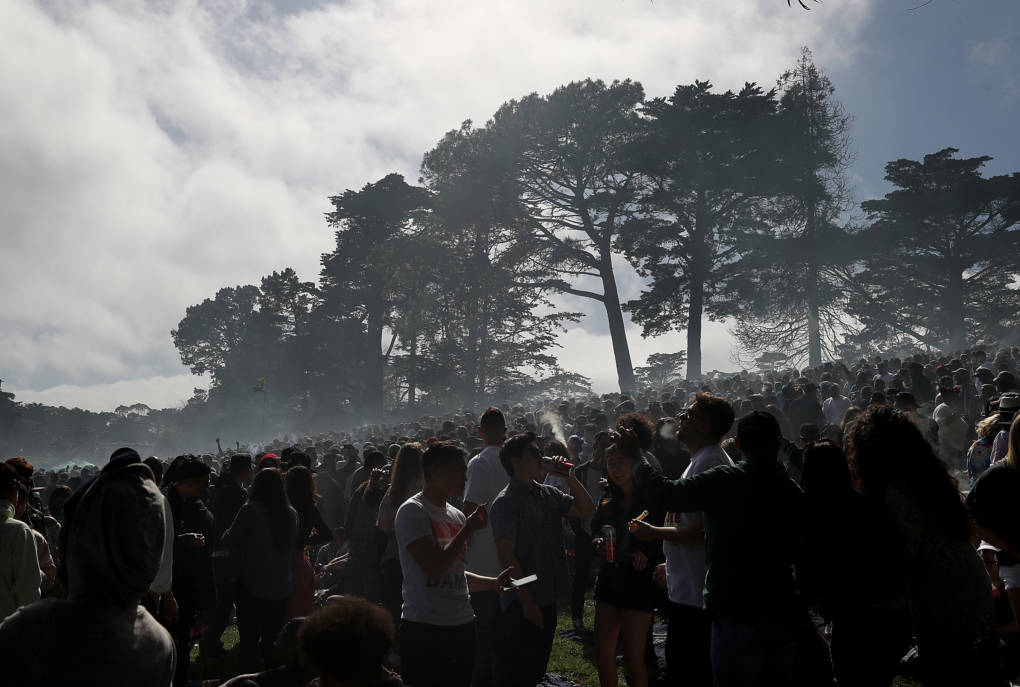
"caption": "A cloud of marijuana smoke hangs over a crowd during a 420 Day celebration on 'Hippie Hill.'",
"description": "A cloud of marijuana smoke hangs over a crowd during a 420 Day celebration on 'Hippie Hill.'",
"title": "Annual Marijuana \"Holiday\" 4/20 Celebrated In San Francisco",
"credit": "Justin Sullivan/Getty Images",
"status": "inherit",
"isLoading": false,
"fetchFailed": false
},
"news_11663202": {
"type": "attachments",
"id": "news_11663202",
"meta": {
"index": "attachments_1716263798",
"site": "news",
"id": "11663202",
"found": true
},
"title": "A guy holding a 420 sign",
"publishDate": 1524089589,
"status": "inherit",
"parent": 11663153,
"modified": 1776282952,
"caption": "A guy holding a 420 sign.",
"credit": "Lars Hagberg/AFP/Getty Images",
"altTag": "A guy holding a 420 sign",
"description": "A guy holding a 420 sign",
"imgSizes": {
"thumbnail": {
"file": "https://cdn.kqed.org/wp-content/uploads/sites/10/2018/04/GettyImages-670837286-160x107.jpg",
"width": 160,
"height": 107,
"mimeType": "image/jpeg"
},
"medium": {
"file": "https://cdn.kqed.org/wp-content/uploads/sites/10/2018/04/GettyImages-670837286-800x533.jpg",
"width": 800,
"height": 533,
"mimeType": "image/jpeg"
},
"large": {
"file": "https://cdn.kqed.org/wp-content/uploads/sites/10/2018/04/GettyImages-670837286-1020x680.jpg",
"width": 1020,
"height": 680,
"mimeType": "image/jpeg"
},
"complete_open_graph": {
"file": "https://cdn.kqed.org/wp-content/uploads/sites/10/2018/04/GettyImages-670837286-1200x800.jpg",
"width": 1200,
"height": 800,
"mimeType": "image/jpeg"
},
"fd-lrg": {
"file": "https://cdn.kqed.org/wp-content/uploads/sites/10/2018/04/GettyImages-670837286-1920x1280.jpg",
"width": 1920,
"height": 1280,
"mimeType": "image/jpeg"
},
"fd-med": {
"file": "https://cdn.kqed.org/wp-content/uploads/sites/10/2018/04/GettyImages-670837286-1180x787.jpg",
"width": 1180,
"height": 787,
"mimeType": "image/jpeg"
},
"fd-sm": {
"file": "https://cdn.kqed.org/wp-content/uploads/sites/10/2018/04/GettyImages-670837286-960x640.jpg",
"width": 960,
"height": 640,
"mimeType": "image/jpeg"
},
"post-thumbnail": {
"file": "https://cdn.kqed.org/wp-content/uploads/sites/10/2018/04/GettyImages-670837286-672x372.jpg",
"width": 672,
"height": 372,
"mimeType": "image/jpeg"
},
"twentyfourteen-full-width": {
"file": "https://cdn.kqed.org/wp-content/uploads/sites/10/2018/04/GettyImages-670837286-1038x576.jpg",
"width": 1038,
"height": 576,
"mimeType": "image/jpeg"
},
"xxsmall": {
"file": "https://cdn.kqed.org/wp-content/uploads/sites/10/2018/04/GettyImages-670837286-240x160.jpg",
"width": 240,
"height": 160,
"mimeType": "image/jpeg"
},
"xsmall": {
"file": "https://cdn.kqed.org/wp-content/uploads/sites/10/2018/04/GettyImages-670837286-375x250.jpg",
"width": 375,
"height": 250,
"mimeType": "image/jpeg"
},
"small": {
"file": "https://cdn.kqed.org/wp-content/uploads/sites/10/2018/04/GettyImages-670837286-520x347.jpg",
"width": 520,
"height": 347,
"mimeType": "image/jpeg"
},
"xlarge": {
"file": "https://cdn.kqed.org/wp-content/uploads/sites/10/2018/04/GettyImages-670837286-1180x787.jpg",
"width": 1180,
"height": 787,
"mimeType": "image/jpeg"
},
"full-width": {
"file": "https://cdn.kqed.org/wp-content/uploads/sites/10/2018/04/GettyImages-670837286-1920x1280.jpg",
"width": 1920,
"height": 1280,
"mimeType": "image/jpeg"
},
"guest-author-32": {
"file": "https://cdn.kqed.org/wp-content/uploads/sites/10/2018/04/GettyImages-670837286-32x32.jpg",
"width": 32,
"height": 32,
"mimeType": "image/jpeg"
},
"guest-author-50": {
"file": "https://cdn.kqed.org/wp-content/uploads/sites/10/2018/04/GettyImages-670837286-50x50.jpg",
"width": 50,
"height": 50,
"mimeType": "image/jpeg"
},
"guest-author-64": {
"file": "https://cdn.kqed.org/wp-content/uploads/sites/10/2018/04/GettyImages-670837286-64x64.jpg",
"width": 64,
"height": 64,
"mimeType": "image/jpeg"
},
"guest-author-96": {
"file": "https://cdn.kqed.org/wp-content/uploads/sites/10/2018/04/GettyImages-670837286-96x96.jpg",
"width": 96,
"height": 96,
"mimeType": "image/jpeg"
},
"guest-author-128": {
"file": "https://cdn.kqed.org/wp-content/uploads/sites/10/2018/04/GettyImages-670837286-128x128.jpg",
"width": 128,
"height": 128,
"mimeType": "image/jpeg"
},
"detail": {
"file": "https://cdn.kqed.org/wp-content/uploads/sites/10/2018/04/GettyImages-670837286-150x150.jpg",
"width": 150,
"height": 150,
"mimeType": "image/jpeg"
},
"kqedFullSize": {
"file": "https://cdn.kqed.org/wp-content/uploads/sites/10/2018/04/GettyImages-670837286-e1524416370324.jpg",
"width": 1920,
"height": 1280
}
},
"isLoading": false,
"fetchFailed": false
},
"news_11662140": {
"type": "attachments",
"id": "news_11662140",
"meta": {
"index": "attachments_1716263798",
"site": "news",
"id": "11662140",
"found": true
},
"title": "HippieHill2015",
"publishDate": 1523653922,
"status": "inherit",
"parent": 11661946,
"modified": 1744313514,
"caption": "A view of \"Hippie Hill\" in Golden Gate Park during the 420 celebration in 2015.",
"credit": "Jeremy Raff/KQED",
"altTag": "A view of Hippie Hill in Golden Gate Park during the 2015 420 celebration.",
"description": "A view of Hippie Hill in Golden Gate Park during the 2015 420 celebration.",
"imgSizes": {
"thumbnail": {
"file": "https://cdn.kqed.org/wp-content/uploads/sites/10/2018/04/HippieHill2015-160x90.jpg",
"width": 160,
"height": 90,
"mimeType": "image/jpeg"
},
"medium": {
"file": "https://cdn.kqed.org/wp-content/uploads/sites/10/2018/04/HippieHill2015-800x450.jpg",
"width": 800,
"height": 450,
"mimeType": "image/jpeg"
},
"large": {
"file": "https://cdn.kqed.org/wp-content/uploads/sites/10/2018/04/HippieHill2015-1020x574.jpg",
"width": 1020,
"height": 574,
"mimeType": "image/jpeg"
},
"complete_open_graph": {
"file": "https://cdn.kqed.org/wp-content/uploads/sites/10/2018/04/HippieHill2015-1200x675.jpg",
"width": 1200,
"height": 675,
"mimeType": "image/jpeg"
},
"fd-lrg": {
"file": "https://cdn.kqed.org/wp-content/uploads/sites/10/2018/04/HippieHill2015-1920x1080.jpg",
"width": 1920,
"height": 1080,
"mimeType": "image/jpeg"
},
"fd-med": {
"file": "https://cdn.kqed.org/wp-content/uploads/sites/10/2018/04/HippieHill2015-1180x664.jpg",
"width": 1180,
"height": 664,
"mimeType": "image/jpeg"
},
"fd-sm": {
"file": "https://cdn.kqed.org/wp-content/uploads/sites/10/2018/04/HippieHill2015-960x540.jpg",
"width": 960,
"height": 540,
"mimeType": "image/jpeg"
},
"post-thumbnail": {
"file": "https://cdn.kqed.org/wp-content/uploads/sites/10/2018/04/HippieHill2015-672x372.jpg",
"width": 672,
"height": 372,
"mimeType": "image/jpeg"
},
"twentyfourteen-full-width": {
"file": "https://cdn.kqed.org/wp-content/uploads/sites/10/2018/04/HippieHill2015-1038x576.jpg",
"width": 1038,
"height": 576,
"mimeType": "image/jpeg"
},
"xxsmall": {
"file": "https://cdn.kqed.org/wp-content/uploads/sites/10/2018/04/HippieHill2015-240x135.jpg",
"width": 240,
"height": 135,
"mimeType": "image/jpeg"
},
"xsmall": {
"file": "https://cdn.kqed.org/wp-content/uploads/sites/10/2018/04/HippieHill2015-375x211.jpg",
"width": 375,
"height": 211,
"mimeType": "image/jpeg"
},
"small": {
"file": "https://cdn.kqed.org/wp-content/uploads/sites/10/2018/04/HippieHill2015-520x293.jpg",
"width": 520,
"height": 293,
"mimeType": "image/jpeg"
},
"xlarge": {
"file": "https://cdn.kqed.org/wp-content/uploads/sites/10/2018/04/HippieHill2015-1180x664.jpg",
"width": 1180,
"height": 664,
"mimeType": "image/jpeg"
},
"full-width": {
"file": "https://cdn.kqed.org/wp-content/uploads/sites/10/2018/04/HippieHill2015-1920x1080.jpg",
"width": 1920,
"height": 1080,
"mimeType": "image/jpeg"
},
"guest-author-32": {
"file": "https://cdn.kqed.org/wp-content/uploads/sites/10/2018/04/HippieHill2015-32x32.jpg",
"width": 32,
"height": 32,
"mimeType": "image/jpeg"
},
"guest-author-50": {
"file": "https://cdn.kqed.org/wp-content/uploads/sites/10/2018/04/HippieHill2015-50x50.jpg",
"width": 50,
"height": 50,
"mimeType": "image/jpeg"
},
"guest-author-64": {
"file": "https://cdn.kqed.org/wp-content/uploads/sites/10/2018/04/HippieHill2015-64x64.jpg",
"width": 64,
"height": 64,
"mimeType": "image/jpeg"
},
"guest-author-96": {
"file": "https://cdn.kqed.org/wp-content/uploads/sites/10/2018/04/HippieHill2015-96x96.jpg",
"width": 96,
"height": 96,
"mimeType": "image/jpeg"
},
"guest-author-128": {
"file": "https://cdn.kqed.org/wp-content/uploads/sites/10/2018/04/HippieHill2015-128x128.jpg",
"width": 128,
"height": 128,
"mimeType": "image/jpeg"
},
"detail": {
"file": "https://cdn.kqed.org/wp-content/uploads/sites/10/2018/04/HippieHill2015-150x150.jpg",
"width": 150,
"height": 150,
"mimeType": "image/jpeg"
},
"kqedFullSize": {
"file": "https://cdn.kqed.org/wp-content/uploads/sites/10/2018/04/HippieHill2015.jpg",
"width": 1920,
"height": 1080
}
},
"isLoading": false,
"fetchFailed": false
},
"news_11662334": {
"type": "attachments",
"id": "news_11662334",
"meta": {
"index": "attachments_1716263798",
"site": "news",
"id": "11662334",
"found": true
},
"parent": 11662332,
"imgSizes": {
"small": {
"file": "https://ww2.kqed.org/app/uploads/sites/10/2018/04/RS4903_marajuanasales-520x347.jpg",
"width": 520,
"mimeType": "image/jpeg",
"height": 347
},
"twentyfourteen-full-width": {
"file": "https://ww2.kqed.org/app/uploads/sites/10/2018/04/RS4903_marajuanasales-1038x576.jpg",
"width": 1038,
"mimeType": "image/jpeg",
"height": 576
},
"thumbnail": {
"file": "https://ww2.kqed.org/app/uploads/sites/10/2018/04/RS4903_marajuanasales-160x107.jpg",
"width": 160,
"mimeType": "image/jpeg",
"height": 107
},
"fd-sm": {
"file": "https://ww2.kqed.org/app/uploads/sites/10/2018/04/RS4903_marajuanasales-960x640.jpg",
"width": 960,
"mimeType": "image/jpeg",
"height": 640
},
"post-thumbnail": {
"file": "https://ww2.kqed.org/app/uploads/sites/10/2018/04/RS4903_marajuanasales-672x372.jpg",
"width": 672,
"mimeType": "image/jpeg",
"height": 372
},
"xsmall": {
"file": "https://ww2.kqed.org/app/uploads/sites/10/2018/04/RS4903_marajuanasales-375x250.jpg",
"width": 375,
"mimeType": "image/jpeg",
"height": 250
},
"kqedFullSize": {
"file": "https://ww2.kqed.org/app/uploads/sites/10/2018/04/RS4903_marajuanasales-e1523727332502.jpg",
"width": 1920,
"height": 1280
},
"large": {
"file": "https://ww2.kqed.org/app/uploads/sites/10/2018/04/RS4903_marajuanasales-1020x680.jpg",
"width": 1020,
"mimeType": "image/jpeg",
"height": 680
},
"xlarge": {
"file": "https://ww2.kqed.org/app/uploads/sites/10/2018/04/RS4903_marajuanasales-1180x787.jpg",
"width": 1180,
"mimeType": "image/jpeg",
"height": 787
},
"complete_open_graph": {
"file": "https://ww2.kqed.org/app/uploads/sites/10/2018/04/RS4903_marajuanasales-1200x800.jpg",
"width": 1200,
"mimeType": "image/jpeg",
"height": 800
},
"guest-author-50": {
"file": "https://ww2.kqed.org/app/uploads/sites/10/2018/04/RS4903_marajuanasales-50x50.jpg",
"width": 50,
"mimeType": "image/jpeg",
"height": 50
},
"guest-author-96": {
"file": "https://ww2.kqed.org/app/uploads/sites/10/2018/04/RS4903_marajuanasales-96x96.jpg",
"width": 96,
"mimeType": "image/jpeg",
"height": 96
},
"medium": {
"file": "https://ww2.kqed.org/app/uploads/sites/10/2018/04/RS4903_marajuanasales-800x533.jpg",
"width": 800,
"mimeType": "image/jpeg",
"height": 533
},
"guest-author-64": {
"file": "https://ww2.kqed.org/app/uploads/sites/10/2018/04/RS4903_marajuanasales-64x64.jpg",
"width": 64,
"mimeType": "image/jpeg",
"height": 64
},
"guest-author-32": {
"file": "https://ww2.kqed.org/app/uploads/sites/10/2018/04/RS4903_marajuanasales-32x32.jpg",
"width": 32,
"mimeType": "image/jpeg",
"height": 32
},
"fd-lrg": {
"file": "https://ww2.kqed.org/app/uploads/sites/10/2018/04/RS4903_marajuanasales-1920x1280.jpg",
"width": 1920,
"mimeType": "image/jpeg",
"height": 1280
},
"fd-med": {
"file": "https://ww2.kqed.org/app/uploads/sites/10/2018/04/RS4903_marajuanasales-1180x787.jpg",
"width": 1180,
"mimeType": "image/jpeg",
"height": 787
},
"full-width": {
"file": "https://ww2.kqed.org/app/uploads/sites/10/2018/04/RS4903_marajuanasales-1920x1280.jpg",
"width": 1920,
"mimeType": "image/jpeg",
"height": 1280
},
"detail": {
"file": "https://ww2.kqed.org/app/uploads/sites/10/2018/04/RS4903_marajuanasales-150x150.jpg",
"width": 150,
"mimeType": "image/jpeg",
"height": 150
},
"guest-author-128": {
"file": "https://ww2.kqed.org/app/uploads/sites/10/2018/04/RS4903_marajuanasales-128x128.jpg",
"width": 128,
"mimeType": "image/jpeg",
"height": 128
},
"xxsmall": {
"file": "https://ww2.kqed.org/app/uploads/sites/10/2018/04/RS4903_marajuanasales-240x160.jpg",
"width": 240,
"mimeType": "image/jpeg",
"height": 160
}
},
"publishDate": 1523727246,
"modified": 1523727351,
"caption": "Sen. Cory Gardner of Colorado announced Friday, April 13, 2018 that President Trump has pledged to support legislation protecting the marijuana industry in states that have legalized the drug.",
"description": "Sen. Cory Gardner of Colorado announced Friday, April 13, 2018 that President Trump has pledged to support legislation protecting the marijuana industry in states that have legalized the drug.",
"title": "Los Angeles City Council Votes To Ban Medical Marijuana Dispensaries",
"credit": "David McNew/Getty Images",
"status": "inherit",
"isLoading": false,
"fetchFailed": false
},
"news_11659394": {
"type": "attachments",
"id": "news_11659394",
"meta": {
"index": "attachments_1716263798",
"site": "news",
"id": "11659394",
"found": true
},
"parent": 11659389,
"imgSizes": {
"small": {
"file": "https://ww2.kqed.org/app/uploads/sites/10/2018/04/PotShopLine-520x347.jpg",
"width": 520,
"mimeType": "image/jpeg",
"height": 347
},
"twentyfourteen-full-width": {
"file": "https://ww2.kqed.org/app/uploads/sites/10/2018/04/PotShopLine-1038x576.jpg",
"width": 1038,
"mimeType": "image/jpeg",
"height": 576
},
"thumbnail": {
"file": "https://ww2.kqed.org/app/uploads/sites/10/2018/04/PotShopLine-160x107.jpg",
"width": 160,
"mimeType": "image/jpeg",
"height": 107
},
"fd-sm": {
"file": "https://ww2.kqed.org/app/uploads/sites/10/2018/04/PotShopLine-960x640.jpg",
"width": 960,
"mimeType": "image/jpeg",
"height": 640
},
"post-thumbnail": {
"file": "https://ww2.kqed.org/app/uploads/sites/10/2018/04/PotShopLine-672x372.jpg",
"width": 672,
"mimeType": "image/jpeg",
"height": 372
},
"xsmall": {
"file": "https://ww2.kqed.org/app/uploads/sites/10/2018/04/PotShopLine-375x250.jpg",
"width": 375,
"mimeType": "image/jpeg",
"height": 250
},
"kqedFullSize": {
"file": "https://ww2.kqed.org/app/uploads/sites/10/2018/04/PotShopLine.jpg",
"width": 1920,
"height": 1280
},
"large": {
"file": "https://ww2.kqed.org/app/uploads/sites/10/2018/04/PotShopLine-1020x680.jpg",
"width": 1020,
"mimeType": "image/jpeg",
"height": 680
},
"xlarge": {
"file": "https://ww2.kqed.org/app/uploads/sites/10/2018/04/PotShopLine-1180x787.jpg",
"width": 1180,
"mimeType": "image/jpeg",
"height": 787
},
"guest-author-50": {
"file": "https://ww2.kqed.org/app/uploads/sites/10/2018/04/PotShopLine-50x50.jpg",
"width": 50,
"mimeType": "image/jpeg",
"height": 50
},
"guest-author-96": {
"file": "https://ww2.kqed.org/app/uploads/sites/10/2018/04/PotShopLine-96x96.jpg",
"width": 96,
"mimeType": "image/jpeg",
"height": 96
},
"medium": {
"file": "https://ww2.kqed.org/app/uploads/sites/10/2018/04/PotShopLine-800x533.jpg",
"width": 800,
"mimeType": "image/jpeg",
"height": 533
},
"guest-author-64": {
"file": "https://ww2.kqed.org/app/uploads/sites/10/2018/04/PotShopLine-64x64.jpg",
"width": 64,
"mimeType": "image/jpeg",
"height": 64
},
"guest-author-32": {
"file": "https://ww2.kqed.org/app/uploads/sites/10/2018/04/PotShopLine-32x32.jpg",
"width": 32,
"mimeType": "image/jpeg",
"height": 32
},
"fd-lrg": {
"file": "https://ww2.kqed.org/app/uploads/sites/10/2018/04/PotShopLine-1920x1280.jpg",
"width": 1920,
"mimeType": "image/jpeg",
"height": 1280
},
"fd-med": {
"file": "https://ww2.kqed.org/app/uploads/sites/10/2018/04/PotShopLine-1180x787.jpg",
"width": 1180,
"mimeType": "image/jpeg",
"height": 787
},
"full-width": {
"file": "https://ww2.kqed.org/app/uploads/sites/10/2018/04/PotShopLine-1920x1280.jpg",
"width": 1920,
"mimeType": "image/jpeg",
"height": 1280
},
"detail": {
"file": "https://ww2.kqed.org/app/uploads/sites/10/2018/04/PotShopLine-150x150.jpg",
"width": 150,
"mimeType": "image/jpeg",
"height": 150
},
"guest-author-128": {
"file": "https://ww2.kqed.org/app/uploads/sites/10/2018/04/PotShopLine-128x128.jpg",
"width": 128,
"mimeType": "image/jpeg",
"height": 128
},
"xxsmall": {
"file": "https://ww2.kqed.org/app/uploads/sites/10/2018/04/PotShopLine-240x160.jpg",
"width": 240,
"mimeType": "image/jpeg",
"height": 160
}
},
"publishDate": 1522697073,
"modified": 1522697145,
"caption": "People stand in line outside a Los Angeles store selling recreational marijuana on Jan. 2, 2018.",
"description": "People stand in line outside a Los Angeles store selling recreational marijuana on Jan. 2, 2018.",
"title": "PotShopLine",
"credit": "David McNew/Getty Images",
"status": "inherit",
"isLoading": false,
"fetchFailed": false
},
"news_11659089": {
"type": "attachments",
"id": "news_11659089",
"meta": {
"index": "attachments_1716263798",
"site": "news",
"id": "11659089",
"found": true
},
"parent": 11659088,
"imgSizes": {
"small": {
"file": "https://ww2.kqed.org/app/uploads/sites/10/2018/03/RS18506_GettyImages-451708630-qut-520x327.jpg",
"width": 520,
"mimeType": "image/jpeg",
"height": 327
},
"twentyfourteen-full-width": {
"file": "https://ww2.kqed.org/app/uploads/sites/10/2018/03/RS18506_GettyImages-451708630-qut-1038x576.jpg",
"width": 1038,
"mimeType": "image/jpeg",
"height": 576
},
"thumbnail": {
"file": "https://ww2.kqed.org/app/uploads/sites/10/2018/03/RS18506_GettyImages-451708630-qut-160x101.jpg",
"width": 160,
"mimeType": "image/jpeg",
"height": 101
},
"fd-sm": {
"file": "https://ww2.kqed.org/app/uploads/sites/10/2018/03/RS18506_GettyImages-451708630-qut-960x605.jpg",
"width": 960,
"mimeType": "image/jpeg",
"height": 605
},
"post-thumbnail": {
"file": "https://ww2.kqed.org/app/uploads/sites/10/2018/03/RS18506_GettyImages-451708630-qut-672x372.jpg",
"width": 672,
"mimeType": "image/jpeg",
"height": 372
},
"xsmall": {
"file": "https://ww2.kqed.org/app/uploads/sites/10/2018/03/RS18506_GettyImages-451708630-qut-375x236.jpg",
"width": 375,
"mimeType": "image/jpeg",
"height": 236
},
"kqedFullSize": {
"file": "https://ww2.kqed.org/app/uploads/sites/10/2018/03/RS18506_GettyImages-451708630-qut.jpg",
"width": 1920,
"height": 1209
},
"large": {
"file": "https://ww2.kqed.org/app/uploads/sites/10/2018/03/RS18506_GettyImages-451708630-qut-1020x642.jpg",
"width": 1020,
"mimeType": "image/jpeg",
"height": 642
},
"xlarge": {
"file": "https://ww2.kqed.org/app/uploads/sites/10/2018/03/RS18506_GettyImages-451708630-qut-1180x743.jpg",
"width": 1180,
"mimeType": "image/jpeg",
"height": 743
},
"guest-author-50": {
"file": "https://ww2.kqed.org/app/uploads/sites/10/2018/03/RS18506_GettyImages-451708630-qut-50x50.jpg",
"width": 50,
"mimeType": "image/jpeg",
"height": 50
},
"guest-author-96": {
"file": "https://ww2.kqed.org/app/uploads/sites/10/2018/03/RS18506_GettyImages-451708630-qut-96x96.jpg",
"width": 96,
"mimeType": "image/jpeg",
"height": 96
},
"medium": {
"file": "https://ww2.kqed.org/app/uploads/sites/10/2018/03/RS18506_GettyImages-451708630-qut-800x504.jpg",
"width": 800,
"mimeType": "image/jpeg",
"height": 504
},
"guest-author-64": {
"file": "https://ww2.kqed.org/app/uploads/sites/10/2018/03/RS18506_GettyImages-451708630-qut-64x64.jpg",
"width": 64,
"mimeType": "image/jpeg",
"height": 64
},
"guest-author-32": {
"file": "https://ww2.kqed.org/app/uploads/sites/10/2018/03/RS18506_GettyImages-451708630-qut-32x32.jpg",
"width": 32,
"mimeType": "image/jpeg",
"height": 32
},
"fd-lrg": {
"file": "https://ww2.kqed.org/app/uploads/sites/10/2018/03/RS18506_GettyImages-451708630-qut-1920x1209.jpg",
"width": 1920,
"mimeType": "image/jpeg",
"height": 1209
},
"fd-med": {
"file": "https://ww2.kqed.org/app/uploads/sites/10/2018/03/RS18506_GettyImages-451708630-qut-1180x743.jpg",
"width": 1180,
"mimeType": "image/jpeg",
"height": 743
},
"full-width": {
"file": "https://ww2.kqed.org/app/uploads/sites/10/2018/03/RS18506_GettyImages-451708630-qut-1920x1209.jpg",
"width": 1920,
"mimeType": "image/jpeg",
"height": 1209
},
"detail": {
"file": "https://ww2.kqed.org/app/uploads/sites/10/2018/03/RS18506_GettyImages-451708630-qut-150x150.jpg",
"width": 150,
"mimeType": "image/jpeg",
"height": 150
},
"guest-author-128": {
"file": "https://ww2.kqed.org/app/uploads/sites/10/2018/03/RS18506_GettyImages-451708630-qut-128x128.jpg",
"width": 128,
"mimeType": "image/jpeg",
"height": 128
},
"xxsmall": {
"file": "https://ww2.kqed.org/app/uploads/sites/10/2018/03/RS18506_GettyImages-451708630-qut-240x151.jpg",
"width": 240,
"mimeType": "image/jpeg",
"height": 151
}
},
"publishDate": 1522512796,
"modified": 1522513095,
"caption": "Could a meeting with U.S. Attorney General Jeff Sessions bring greater clarity on how federal law enforcement will respond to the growing marijuana legalization trend?",
"description": "Could a meeting with U.S. Attorney General Jeff Sessions bring greater clarity on how federal law enforcement will respond to the growing marijuana legalization trend?",
"title": "RS18506_GettyImages-451708630-qut",
"credit": "FREDERIC J. BROWN/AFP/Getty Images",
"status": "inherit",
"isLoading": false,
"fetchFailed": false
},
"news_11658273": {
"type": "attachments",
"id": "news_11658273",
"meta": {
"index": "attachments_1716263798",
"site": "news",
"id": "11658273",
"found": true
},
"parent": 11658031,
"imgSizes": {
"small": {
"file": "https://ww2.kqed.org/app/uploads/sites/10/2018/03/WeedScale-520x327.jpg",
"width": 520,
"mimeType": "image/jpeg",
"height": 327
},
"twentyfourteen-full-width": {
"file": "https://ww2.kqed.org/app/uploads/sites/10/2018/03/WeedScale-1038x576.jpg",
"width": 1038,
"mimeType": "image/jpeg",
"height": 576
},
"thumbnail": {
"file": "https://ww2.kqed.org/app/uploads/sites/10/2018/03/WeedScale-160x101.jpg",
"width": 160,
"mimeType": "image/jpeg",
"height": 101
},
"fd-sm": {
"file": "https://ww2.kqed.org/app/uploads/sites/10/2018/03/WeedScale-960x604.jpg",
"width": 960,
"mimeType": "image/jpeg",
"height": 604
},
"post-thumbnail": {
"file": "https://ww2.kqed.org/app/uploads/sites/10/2018/03/WeedScale-672x372.jpg",
"width": 672,
"mimeType": "image/jpeg",
"height": 372
},
"xsmall": {
"file": "https://ww2.kqed.org/app/uploads/sites/10/2018/03/WeedScale-375x236.jpg",
"width": 375,
"mimeType": "image/jpeg",
"height": 236
},
"kqedFullSize": {
"file": "https://ww2.kqed.org/app/uploads/sites/10/2018/03/WeedScale.jpg",
"width": 1920,
"height": 1208
},
"large": {
"file": "https://ww2.kqed.org/app/uploads/sites/10/2018/03/WeedScale-1020x642.jpg",
"width": 1020,
"mimeType": "image/jpeg",
"height": 642
},
"xlarge": {
"file": "https://ww2.kqed.org/app/uploads/sites/10/2018/03/WeedScale-1180x742.jpg",
"width": 1180,
"mimeType": "image/jpeg",
"height": 742
},
"guest-author-50": {
"file": "https://ww2.kqed.org/app/uploads/sites/10/2018/03/WeedScale-50x50.jpg",
"width": 50,
"mimeType": "image/jpeg",
"height": 50
},
"guest-author-96": {
"file": "https://ww2.kqed.org/app/uploads/sites/10/2018/03/WeedScale-96x96.jpg",
"width": 96,
"mimeType": "image/jpeg",
"height": 96
},
"medium": {
"file": "https://ww2.kqed.org/app/uploads/sites/10/2018/03/WeedScale-800x503.jpg",
"width": 800,
"mimeType": "image/jpeg",
"height": 503
},
"guest-author-64": {
"file": "https://ww2.kqed.org/app/uploads/sites/10/2018/03/WeedScale-64x64.jpg",
"width": 64,
"mimeType": "image/jpeg",
"height": 64
},
"guest-author-32": {
"file": "https://ww2.kqed.org/app/uploads/sites/10/2018/03/WeedScale-32x32.jpg",
"width": 32,
"mimeType": "image/jpeg",
"height": 32
},
"fd-lrg": {
"file": "https://ww2.kqed.org/app/uploads/sites/10/2018/03/WeedScale-1920x1208.jpg",
"width": 1920,
"mimeType": "image/jpeg",
"height": 1208
},
"fd-med": {
"file": "https://ww2.kqed.org/app/uploads/sites/10/2018/03/WeedScale-1180x742.jpg",
"width": 1180,
"mimeType": "image/jpeg",
"height": 742
},
"full-width": {
"file": "https://ww2.kqed.org/app/uploads/sites/10/2018/03/WeedScale-1920x1208.jpg",
"width": 1920,
"mimeType": "image/jpeg",
"height": 1208
},
"detail": {
"file": "https://ww2.kqed.org/app/uploads/sites/10/2018/03/WeedScale-150x150.jpg",
"width": 150,
"mimeType": "image/jpeg",
"height": 150
},
"guest-author-128": {
"file": "https://ww2.kqed.org/app/uploads/sites/10/2018/03/WeedScale-128x128.jpg",
"width": 128,
"mimeType": "image/jpeg",
"height": 128
},
"xxsmall": {
"file": "https://ww2.kqed.org/app/uploads/sites/10/2018/03/WeedScale-240x151.jpg",
"width": 240,
"mimeType": "image/jpeg",
"height": 151
}
},
"publishDate": 1522187002,
"modified": 1522187061,
"caption": "The state went after Weedmaps.com — and it might crack down on Craigslist next.",
"description": "The state went after Weedmaps.com — and it might crack down on Craigslist next.",
"title": "WeedScale",
"credit": "FREDERIC J. BROWN/AFP/Getty Images",
"status": "inherit",
"isLoading": false,
"fetchFailed": false
},
"news_11656345": {
"type": "attachments",
"id": "news_11656345",
"meta": {
"index": "attachments_1716263798",
"site": "news",
"id": "11656345",
"found": true
},
"parent": 11656341,
"imgSizes": {
"small": {
"file": "https://ww2.kqed.org/app/uploads/sites/10/2018/03/GettyImages-98579526-520x333.jpg",
"width": 520,
"mimeType": "image/jpeg",
"height": 333
},
"twentyfourteen-full-width": {
"file": "https://ww2.kqed.org/app/uploads/sites/10/2018/03/GettyImages-98579526-1038x576.jpg",
"width": 1038,
"mimeType": "image/jpeg",
"height": 576
},
"thumbnail": {
"file": "https://ww2.kqed.org/app/uploads/sites/10/2018/03/GettyImages-98579526-160x103.jpg",
"width": 160,
"mimeType": "image/jpeg",
"height": 103
},
"fd-sm": {
"file": "https://ww2.kqed.org/app/uploads/sites/10/2018/03/GettyImages-98579526-960x615.jpg",
"width": 960,
"mimeType": "image/jpeg",
"height": 615
},
"post-thumbnail": {
"file": "https://ww2.kqed.org/app/uploads/sites/10/2018/03/GettyImages-98579526-672x372.jpg",
"width": 672,
"mimeType": "image/jpeg",
"height": 372
},
"xsmall": {
"file": "https://ww2.kqed.org/app/uploads/sites/10/2018/03/GettyImages-98579526-375x240.jpg",
"width": 375,
"mimeType": "image/jpeg",
"height": 240
},
"kqedFullSize": {
"file": "https://ww2.kqed.org/app/uploads/sites/10/2018/03/GettyImages-98579526-e1521310761543.jpg",
"width": 1920,
"height": 1231
},
"large": {
"file": "https://ww2.kqed.org/app/uploads/sites/10/2018/03/GettyImages-98579526-1020x654.jpg",
"width": 1020,
"mimeType": "image/jpeg",
"height": 654
},
"xlarge": {
"file": "https://ww2.kqed.org/app/uploads/sites/10/2018/03/GettyImages-98579526-1180x756.jpg",
"width": 1180,
"mimeType": "image/jpeg",
"height": 756
},
"guest-author-50": {
"file": "https://ww2.kqed.org/app/uploads/sites/10/2018/03/GettyImages-98579526-50x50.jpg",
"width": 50,
"mimeType": "image/jpeg",
"height": 50
},
"guest-author-96": {
"file": "https://ww2.kqed.org/app/uploads/sites/10/2018/03/GettyImages-98579526-96x96.jpg",
"width": 96,
"mimeType": "image/jpeg",
"height": 96
},
"medium": {
"file": "https://ww2.kqed.org/app/uploads/sites/10/2018/03/GettyImages-98579526-800x513.jpg",
"width": 800,
"mimeType": "image/jpeg",
"height": 513
},
"guest-author-64": {
"file": "https://ww2.kqed.org/app/uploads/sites/10/2018/03/GettyImages-98579526-64x64.jpg",
"width": 64,
"mimeType": "image/jpeg",
"height": 64
},
"guest-author-32": {
"file": "https://ww2.kqed.org/app/uploads/sites/10/2018/03/GettyImages-98579526-32x32.jpg",
"width": 32,
"mimeType": "image/jpeg",
"height": 32
},
"fd-lrg": {
"file": "https://ww2.kqed.org/app/uploads/sites/10/2018/03/GettyImages-98579526-1920x1231.jpg",
"width": 1920,
"mimeType": "image/jpeg",
"height": 1231
},
"fd-med": {
"file": "https://ww2.kqed.org/app/uploads/sites/10/2018/03/GettyImages-98579526-1180x756.jpg",
"width": 1180,
"mimeType": "image/jpeg",
"height": 756
},
"full-width": {
"file": "https://ww2.kqed.org/app/uploads/sites/10/2018/03/GettyImages-98579526-1920x1231.jpg",
"width": 1920,
"mimeType": "image/jpeg",
"height": 1231
},
"detail": {
"file": "https://ww2.kqed.org/app/uploads/sites/10/2018/03/GettyImages-98579526-150x150.jpg",
"width": 150,
"mimeType": "image/jpeg",
"height": 150
},
"guest-author-128": {
"file": "https://ww2.kqed.org/app/uploads/sites/10/2018/03/GettyImages-98579526-128x128.jpg",
"width": 128,
"mimeType": "image/jpeg",
"height": 128
},
"xxsmall": {
"file": "https://ww2.kqed.org/app/uploads/sites/10/2018/03/GettyImages-98579526-240x154.jpg",
"width": 240,
"mimeType": "image/jpeg",
"height": 154
}
},
"publishDate": 1521310718,
"modified": 1521310752,
"caption": " San Francisco plans to issue more permits for marijuana smoking lounges this year after health officials finalize updated regulations.",
"description": " San Francisco plans to issue more permits for marijuana smoking lounges this year after health officials finalize updated regulations.",
"title": "Enthusiasts Gather For Mass Pot-Smoking Celebration",
"credit": "Justin Sullivan/Getty Images",
"status": "inherit",
"isLoading": false,
"fetchFailed": false
},
"news_11652191": {
"type": "attachments",
"id": "news_11652191",
"meta": {
"index": "attachments_1716263798",
"site": "news",
"id": "11652191",
"found": true
},
"parent": 11652183,
"imgSizes": {
"small": {
"file": "https://ww2.kqed.org/app/uploads/sites/10/2018/02/RS25526_GettyImages-542220918-qut-520x346.jpg",
"width": 520,
"mimeType": "image/jpeg",
"height": 346
},
"twentyfourteen-full-width": {
"file": "https://ww2.kqed.org/app/uploads/sites/10/2018/02/RS25526_GettyImages-542220918-qut-1038x576.jpg",
"width": 1038,
"mimeType": "image/jpeg",
"height": 576
},
"thumbnail": {
"file": "https://ww2.kqed.org/app/uploads/sites/10/2018/02/RS25526_GettyImages-542220918-qut-160x106.jpg",
"width": 160,
"mimeType": "image/jpeg",
"height": 106
},
"fd-sm": {
"file": "https://ww2.kqed.org/app/uploads/sites/10/2018/02/RS25526_GettyImages-542220918-qut-960x639.jpg",
"width": 960,
"mimeType": "image/jpeg",
"height": 639
},
"post-thumbnail": {
"file": "https://ww2.kqed.org/app/uploads/sites/10/2018/02/RS25526_GettyImages-542220918-qut-672x372.jpg",
"width": 672,
"mimeType": "image/jpeg",
"height": 372
},
"xsmall": {
"file": "https://ww2.kqed.org/app/uploads/sites/10/2018/02/RS25526_GettyImages-542220918-qut-375x249.jpg",
"width": 375,
"mimeType": "image/jpeg",
"height": 249
},
"kqedFullSize": {
"file": "https://ww2.kqed.org/app/uploads/sites/10/2018/02/RS25526_GettyImages-542220918-qut.jpg",
"width": 1920,
"height": 1277
},
"large": {
"file": "https://ww2.kqed.org/app/uploads/sites/10/2018/02/RS25526_GettyImages-542220918-qut-1020x678.jpg",
"width": 1020,
"mimeType": "image/jpeg",
"height": 678
},
"xlarge": {
"file": "https://ww2.kqed.org/app/uploads/sites/10/2018/02/RS25526_GettyImages-542220918-qut-1180x785.jpg",
"width": 1180,
"mimeType": "image/jpeg",
"height": 785
},
"guest-author-50": {
"file": "https://ww2.kqed.org/app/uploads/sites/10/2018/02/RS25526_GettyImages-542220918-qut-50x50.jpg",
"width": 50,
"mimeType": "image/jpeg",
"height": 50
},
"guest-author-96": {
"file": "https://ww2.kqed.org/app/uploads/sites/10/2018/02/RS25526_GettyImages-542220918-qut-96x96.jpg",
"width": 96,
"mimeType": "image/jpeg",
"height": 96
},
"medium": {
"file": "https://ww2.kqed.org/app/uploads/sites/10/2018/02/RS25526_GettyImages-542220918-qut-800x532.jpg",
"width": 800,
"mimeType": "image/jpeg",
"height": 532
},
"guest-author-64": {
"file": "https://ww2.kqed.org/app/uploads/sites/10/2018/02/RS25526_GettyImages-542220918-qut-64x64.jpg",
"width": 64,
"mimeType": "image/jpeg",
"height": 64
},
"guest-author-32": {
"file": "https://ww2.kqed.org/app/uploads/sites/10/2018/02/RS25526_GettyImages-542220918-qut-32x32.jpg",
"width": 32,
"mimeType": "image/jpeg",
"height": 32
},
"fd-lrg": {
"file": "https://ww2.kqed.org/app/uploads/sites/10/2018/02/RS25526_GettyImages-542220918-qut-1920x1277.jpg",
"width": 1920,
"mimeType": "image/jpeg",
"height": 1277
},
"fd-med": {
"file": "https://ww2.kqed.org/app/uploads/sites/10/2018/02/RS25526_GettyImages-542220918-qut-1180x785.jpg",
"width": 1180,
"mimeType": "image/jpeg",
"height": 785
},
"full-width": {
"file": "https://ww2.kqed.org/app/uploads/sites/10/2018/02/RS25526_GettyImages-542220918-qut-1920x1277.jpg",
"width": 1920,
"mimeType": "image/jpeg",
"height": 1277
},
"detail": {
"file": "https://ww2.kqed.org/app/uploads/sites/10/2018/02/RS25526_GettyImages-542220918-qut-150x150.jpg",
"width": 150,
"mimeType": "image/jpeg",
"height": 150
},
"guest-author-128": {
"file": "https://ww2.kqed.org/app/uploads/sites/10/2018/02/RS25526_GettyImages-542220918-qut-128x128.jpg",
"width": 128,
"mimeType": "image/jpeg",
"height": 128
},
"xxsmall": {
"file": "https://ww2.kqed.org/app/uploads/sites/10/2018/02/RS25526_GettyImages-542220918-qut-240x160.jpg",
"width": 240,
"mimeType": "image/jpeg",
"height": 160
}
},
"publishDate": 1519592166,
"modified": 1519592189,
"caption": "Native American tribes say they’ve been cut out of California’s legal pot market and are raising the possibility that they could grow and sell on their own.",
"description": "Native American tribes say they’ve been cut out of California’s legal pot market and are raising the possibility that they could grow and sell on their own.",
"title": "Oakland Mayor Libby Schaaf Speaks At The Cannabis Business Summit And Expo",
"credit": "Justin Sullivan/Getty Images",
"status": "inherit",
"isLoading": false,
"fetchFailed": false
},
"stateofhealth_362757": {
"type": "attachments",
"id": "stateofhealth_362757",
"meta": {
"index": "attachments_1716263798",
"site": "stateofhealth",
"id": "362757",
"found": true
},
"parent": 362754,
"imgSizes": {
"small": {
"file": "https://ww2.kqed.org/app/uploads/sites/27/2018/02/Getty-Joint-smoke-520x363.jpg",
"width": 520,
"mimeType": "image/jpeg",
"height": 363
},
"twentyfourteen-full-width": {
"file": "https://ww2.kqed.org/app/uploads/sites/27/2018/02/Getty-Joint-smoke-1024x576.jpg",
"width": 1024,
"mimeType": "image/jpeg",
"height": 576
},
"thumbnail": {
"file": "https://ww2.kqed.org/app/uploads/sites/27/2018/02/Getty-Joint-smoke-160x112.jpg",
"width": 160,
"mimeType": "image/jpeg",
"height": 112
},
"fd-sm": {
"file": "https://ww2.kqed.org/app/uploads/sites/27/2018/02/Getty-Joint-smoke-960x669.jpg",
"width": 960,
"mimeType": "image/jpeg",
"height": 669
},
"post-thumbnail": {
"file": "https://ww2.kqed.org/app/uploads/sites/27/2018/02/Getty-Joint-smoke-672x372.jpg",
"width": 672,
"mimeType": "image/jpeg",
"height": 372
},
"xsmall": {
"file": "https://ww2.kqed.org/app/uploads/sites/27/2018/02/Getty-Joint-smoke-375x261.jpg",
"width": 375,
"mimeType": "image/jpeg",
"height": 261
},
"kqedFullSize": {
"file": "https://ww2.kqed.org/app/uploads/sites/27/2018/02/Getty-Joint-smoke.jpg",
"width": 1024,
"height": 714
},
"large": {
"file": "https://ww2.kqed.org/app/uploads/sites/27/2018/02/Getty-Joint-smoke-1020x711.jpg",
"width": 1020,
"mimeType": "image/jpeg",
"height": 711
},
"guest-author-50": {
"file": "https://ww2.kqed.org/app/uploads/sites/27/2018/02/Getty-Joint-smoke-50x50.jpg",
"width": 50,
"mimeType": "image/jpeg",
"height": 50
},
"guest-author-96": {
"file": "https://ww2.kqed.org/app/uploads/sites/27/2018/02/Getty-Joint-smoke-96x96.jpg",
"width": 96,
"mimeType": "image/jpeg",
"height": 96
},
"medium": {
"file": "https://ww2.kqed.org/app/uploads/sites/27/2018/02/Getty-Joint-smoke-800x558.jpg",
"width": 800,
"mimeType": "image/jpeg",
"height": 558
},
"guest-author-64": {
"file": "https://ww2.kqed.org/app/uploads/sites/27/2018/02/Getty-Joint-smoke-64x64.jpg",
"width": 64,
"mimeType": "image/jpeg",
"height": 64
},
"guest-author-32": {
"file": "https://ww2.kqed.org/app/uploads/sites/27/2018/02/Getty-Joint-smoke-32x32.jpg",
"width": 32,
"mimeType": "image/jpeg",
"height": 32
},
"detail": {
"file": "https://ww2.kqed.org/app/uploads/sites/27/2018/02/Getty-Joint-smoke-150x150.jpg",
"width": 150,
"mimeType": "image/jpeg",
"height": 150
},
"medium_large": {
"file": "https://ww2.kqed.org/app/uploads/sites/27/2018/02/Getty-Joint-smoke-768x536.jpg",
"width": 768,
"mimeType": "image/jpeg",
"height": 536
},
"guest-author-128": {
"file": "https://ww2.kqed.org/app/uploads/sites/27/2018/02/Getty-Joint-smoke-128x128.jpg",
"width": 128,
"mimeType": "image/jpeg",
"height": 128
},
"xxsmall": {
"file": "https://ww2.kqed.org/app/uploads/sites/27/2018/02/Getty-Joint-smoke-240x167.jpg",
"width": 240,
"mimeType": "image/jpeg",
"height": 167
}
},
"publishDate": 1519159575,
"modified": 1519165840,
"caption": "A woman from Seattle smokes a joint at the first annual DOPE Cup, a cannabis competition in Portland, Oregon, on Oct. 4, 2015.",
"description": "A woman from Seattle, smokes a joint at the first annual DOPE Cup, a cannabis competition in Portland, Oregon, on October 4, 2015.",
"title": "US-DRUGS-OREGON",
"credit": "Josh Edelson/AFP/Getty Images",
"status": "inherit",
"isLoading": false,
"fetchFailed": false
},
"news_11649528": {
"type": "attachments",
"id": "news_11649528",
"meta": {
"index": "attachments_1716263798",
"site": "news",
"id": "11649528",
"found": true
},
"parent": 11649524,
"imgSizes": {
"small": {
"file": "https://ww2.kqed.org/app/uploads/sites/10/2018/02/PotShopLine-520x324.jpg",
"width": 520,
"mimeType": "image/jpeg",
"height": 324
},
"twentyfourteen-full-width": {
"file": "https://ww2.kqed.org/app/uploads/sites/10/2018/02/PotShopLine-1038x576.jpg",
"width": 1038,
"mimeType": "image/jpeg",
"height": 576
},
"thumbnail": {
"file": "https://ww2.kqed.org/app/uploads/sites/10/2018/02/PotShopLine-160x100.jpg",
"width": 160,
"mimeType": "image/jpeg",
"height": 100
},
"fd-sm": {
"file": "https://ww2.kqed.org/app/uploads/sites/10/2018/02/PotShopLine-960x598.jpg",
"width": 960,
"mimeType": "image/jpeg",
"height": 598
},
"post-thumbnail": {
"file": "https://ww2.kqed.org/app/uploads/sites/10/2018/02/PotShopLine-672x372.jpg",
"width": 672,
"mimeType": "image/jpeg",
"height": 372
},
"xsmall": {
"file": "https://ww2.kqed.org/app/uploads/sites/10/2018/02/PotShopLine-375x233.jpg",
"width": 375,
"mimeType": "image/jpeg",
"height": 233
},
"kqedFullSize": {
"file": "https://ww2.kqed.org/app/uploads/sites/10/2018/02/PotShopLine.jpg",
"width": 1920,
"height": 1195
},
"large": {
"file": "https://ww2.kqed.org/app/uploads/sites/10/2018/02/PotShopLine-1020x635.jpg",
"width": 1020,
"mimeType": "image/jpeg",
"height": 635
},
"xlarge": {
"file": "https://ww2.kqed.org/app/uploads/sites/10/2018/02/PotShopLine-1180x734.jpg",
"width": 1180,
"mimeType": "image/jpeg",
"height": 734
},
"guest-author-50": {
"file": "https://ww2.kqed.org/app/uploads/sites/10/2018/02/PotShopLine-50x50.jpg",
"width": 50,
"mimeType": "image/jpeg",
"height": 50
},
"guest-author-96": {
"file": "https://ww2.kqed.org/app/uploads/sites/10/2018/02/PotShopLine-96x96.jpg",
"width": 96,
"mimeType": "image/jpeg",
"height": 96
},
"medium": {
"file": "https://ww2.kqed.org/app/uploads/sites/10/2018/02/PotShopLine-800x498.jpg",
"width": 800,
"mimeType": "image/jpeg",
"height": 498
},
"guest-author-64": {
"file": "https://ww2.kqed.org/app/uploads/sites/10/2018/02/PotShopLine-64x64.jpg",
"width": 64,
"mimeType": "image/jpeg",
"height": 64
},
"guest-author-32": {
"file": "https://ww2.kqed.org/app/uploads/sites/10/2018/02/PotShopLine-32x32.jpg",
"width": 32,
"mimeType": "image/jpeg",
"height": 32
},
"fd-lrg": {
"file": "https://ww2.kqed.org/app/uploads/sites/10/2018/02/PotShopLine-1920x1195.jpg",
"width": 1920,
"mimeType": "image/jpeg",
"height": 1195
},
"fd-med": {
"file": "https://ww2.kqed.org/app/uploads/sites/10/2018/02/PotShopLine-1180x734.jpg",
"width": 1180,
"mimeType": "image/jpeg",
"height": 734
},
"full-width": {
"file": "https://ww2.kqed.org/app/uploads/sites/10/2018/02/PotShopLine-1920x1195.jpg",
"width": 1920,
"mimeType": "image/jpeg",
"height": 1195
},
"detail": {
"file": "https://ww2.kqed.org/app/uploads/sites/10/2018/02/PotShopLine-150x150.jpg",
"width": 150,
"mimeType": "image/jpeg",
"height": 150
},
"guest-author-128": {
"file": "https://ww2.kqed.org/app/uploads/sites/10/2018/02/PotShopLine-128x128.jpg",
"width": 128,
"mimeType": "image/jpeg",
"height": 128
},
"xxsmall": {
"file": "https://ww2.kqed.org/app/uploads/sites/10/2018/02/PotShopLine-240x149.jpg",
"width": 240,
"mimeType": "image/jpeg",
"height": 149
}
},
"publishDate": 1518466655,
"modified": 1518466713,
"caption": "People stand in line to get into one of the two Los Angeles area pot shops that began selling marijuana for recreational use on January 2, 2018.",
"description": "People stand in line to get into one of the two Los Angeles area pot shops that began selling marijuana for recreational use on January 2, 2018.",
"title": "PotShopLine",
"credit": "David McNew/Getty Images",
"status": "inherit",
"isLoading": false,
"fetchFailed": false
},
"news_11649389": {
"type": "attachments",
"id": "news_11649389",
"meta": {
"index": "attachments_1716263798",
"site": "news",
"id": "11649389",
"found": true
},
"parent": 11649379,
"imgSizes": {
"small": {
"file": "https://ww2.kqed.org/app/uploads/sites/10/2018/02/Image-uploaded-from-iOS-14-e1518383678367-520x390.jpg",
"width": 520,
"mimeType": "image/jpeg",
"height": 390
},
"twentyfourteen-full-width": {
"file": "https://ww2.kqed.org/app/uploads/sites/10/2018/02/Image-uploaded-from-iOS-14-e1518383678367-1038x576.jpg",
"width": 1038,
"mimeType": "image/jpeg",
"height": 576
},
"thumbnail": {
"file": "https://ww2.kqed.org/app/uploads/sites/10/2018/02/Image-uploaded-from-iOS-14-e1518383678367-160x120.jpg",
"width": 160,
"mimeType": "image/jpeg",
"height": 120
},
"fd-sm": {
"file": "https://ww2.kqed.org/app/uploads/sites/10/2018/02/Image-uploaded-from-iOS-14-e1518383678367-960x720.jpg",
"width": 960,
"mimeType": "image/jpeg",
"height": 720
},
"post-thumbnail": {
"file": "https://ww2.kqed.org/app/uploads/sites/10/2018/02/Image-uploaded-from-iOS-14-e1518383678367-672x372.jpg",
"width": 672,
"mimeType": "image/jpeg",
"height": 372
},
"xsmall": {
"file": "https://ww2.kqed.org/app/uploads/sites/10/2018/02/Image-uploaded-from-iOS-14-e1518383678367-375x281.jpg",
"width": 375,
"mimeType": "image/jpeg",
"height": 281
},
"kqedFullSize": {
"file": "https://ww2.kqed.org/app/uploads/sites/10/2018/02/Image-uploaded-from-iOS-14-e1518383678367.jpg",
"width": 4032,
"height": 3024
},
"large": {
"file": "https://ww2.kqed.org/app/uploads/sites/10/2018/02/Image-uploaded-from-iOS-14-e1518383678367-1020x765.jpg",
"width": 1020,
"mimeType": "image/jpeg",
"height": 765
},
"xlarge": {
"file": "https://ww2.kqed.org/app/uploads/sites/10/2018/02/Image-uploaded-from-iOS-14-e1518383678367-1180x885.jpg",
"width": 1180,
"mimeType": "image/jpeg",
"height": 885
},
"guest-author-50": {
"file": "https://ww2.kqed.org/app/uploads/sites/10/2018/02/Image-uploaded-from-iOS-14-e1518383678367-50x50.jpg",
"width": 50,
"mimeType": "image/jpeg",
"height": 50
},
"guest-author-96": {
"file": "https://ww2.kqed.org/app/uploads/sites/10/2018/02/Image-uploaded-from-iOS-14-e1518383678367-96x96.jpg",
"width": 96,
"mimeType": "image/jpeg",
"height": 96
},
"medium": {
"file": "https://ww2.kqed.org/app/uploads/sites/10/2018/02/Image-uploaded-from-iOS-14-e1518383678367-800x600.jpg",
"width": 800,
"mimeType": "image/jpeg",
"height": 600
},
"guest-author-64": {
"file": "https://ww2.kqed.org/app/uploads/sites/10/2018/02/Image-uploaded-from-iOS-14-e1518383678367-64x64.jpg",
"width": 64,
"mimeType": "image/jpeg",
"height": 64
},
"guest-author-32": {
"file": "https://ww2.kqed.org/app/uploads/sites/10/2018/02/Image-uploaded-from-iOS-14-e1518383678367-32x32.jpg",
"width": 32,
"mimeType": "image/jpeg",
"height": 32
},
"fd-lrg": {
"file": "https://ww2.kqed.org/app/uploads/sites/10/2018/02/Image-uploaded-from-iOS-14-e1518383678367-1920x1440.jpg",
"width": 1920,
"mimeType": "image/jpeg",
"height": 1440
},
"fd-med": {
"file": "https://ww2.kqed.org/app/uploads/sites/10/2018/02/Image-uploaded-from-iOS-14-e1518383678367-1180x885.jpg",
"width": 1180,
"mimeType": "image/jpeg",
"height": 885
},
"full-width": {
"file": "https://ww2.kqed.org/app/uploads/sites/10/2018/02/Image-uploaded-from-iOS-14-e1518383678367-1920x1440.jpg",
"width": 1920,
"mimeType": "image/jpeg",
"height": 1440
},
"detail": {
"file": "https://ww2.kqed.org/app/uploads/sites/10/2018/02/Image-uploaded-from-iOS-14-e1518383678367-150x150.jpg",
"width": 150,
"mimeType": "image/jpeg",
"height": 150
},
"guest-author-128": {
"file": "https://ww2.kqed.org/app/uploads/sites/10/2018/02/Image-uploaded-from-iOS-14-e1518383678367-128x128.jpg",
"width": 128,
"mimeType": "image/jpeg",
"height": 128
},
"xxsmall": {
"file": "https://ww2.kqed.org/app/uploads/sites/10/2018/02/Image-uploaded-from-iOS-14-e1518383678367-240x180.jpg",
"width": 240,
"mimeType": "image/jpeg",
"height": 180
}
},
"publishDate": 1518383510,
"modified": 1615578112,
"caption": "Custom products, like these Smokies Toke Couture tins to hold pre-rolled joints, got the interest of Nicole Becker, who is currently engaged and planning her wedding. ",
"description": "Custom products, like these tins to hold pre-rolled joints, got the interest of Nicole Becker, who is currently engaged and planning her wedding. ",
"title": "Image uploaded from iOS (14)",
"credit": "Alyssa Jeong Perry/KQED",
"status": "inherit",
"altTag": "Custom products, like these Smokies Toke Couture tins to hold pre-rolled joints, got the interest of Nicole Becker, who is currently engaged and planning her wedding.",
"isLoading": false,
"fetchFailed": false
}
},
"audioPlayerReducer": {
"postId": "stream_live",
"isPaused": true,
"isPlaying": false,
"pfsActive": false,
"pledgeModalIsOpen": true,
"playerDrawerIsOpen": false,
"liveAudioPlayStartedAt": 0,
"liveAudioPlayContext": ""
},
"authorsReducer": {
"byline_news_11663933": {
"type": "authors",
"id": "byline_news_11663933",
"meta": {
"override": true
},
"slug": "byline_news_11663933",
"name": "Associated Press",
"isLoading": false
},
"byline_news_11663153": {
"type": "authors",
"id": "byline_news_11663153",
"meta": {
"override": true
},
"slug": "byline_news_11663153",
"name": "Olivia Allen-Price and Emmanuel Hapsis",
"isLoading": false
},
"byline_news_11662332": {
"type": "authors",
"id": "byline_news_11662332",
"meta": {
"override": true
},
"slug": "byline_news_11662332",
"name": "\u003cstrong> Nicholas Riccardi\u003c/strong> \u003c/br>Associated Press",
"isLoading": false
},
"byline_news_11659389": {
"type": "authors",
"id": "byline_news_11659389",
"meta": {
"override": true
},
"slug": "byline_news_11659389",
"name": "\u003cstrong>\u003ca href=\"https://www.scpr.org/about/people/staff/david-wagner\">David Wagner\u003c/a>\u003c/strong>",
"isLoading": false
},
"byline_news_11659088": {
"type": "authors",
"id": "byline_news_11659088",
"meta": {
"override": true
},
"slug": "byline_news_11659088",
"name": "\u003cstrong>Michael R. Blood\u003c/strong>\u003c/br>Associated Press",
"isLoading": false
},
"byline_news_11658031": {
"type": "authors",
"id": "byline_news_11658031",
"meta": {
"override": true
},
"slug": "byline_news_11658031",
"name": "Allen Young",
"isLoading": false
},
"byline_news_11656341": {
"type": "authors",
"id": "byline_news_11656341",
"meta": {
"override": true
},
"slug": "byline_news_11656341",
"name": "\u003cstrong>Paul Elias\u003c/strong>\u003c/br>Associated Press",
"isLoading": false
},
"byline_news_11652183": {
"type": "authors",
"id": "byline_news_11652183",
"meta": {
"override": true
},
"slug": "byline_news_11652183",
"name": "\u003cstrong>Michael R. Blood\u003c/strong>\u003cbr />Associated Press\u003c/strong>",
"isLoading": false
},
"byline_stateofhealth_362754": {
"type": "authors",
"id": "byline_stateofhealth_362754",
"meta": {
"override": true
},
"slug": "byline_stateofhealth_362754",
"name": "Marissa Ortega-Welch",
"isLoading": false
},
"byline_news_11649524": {
"type": "authors",
"id": "byline_news_11649524",
"meta": {
"override": true
},
"slug": "byline_news_11649524",
"name": "\u003cstrong>\u003ca href=\"http://www.scpr.org/about/people/staff/jill-replogle\">Jill Replogle\u003c/a>\u003c/strong>",
"isLoading": false
},
"tgoldberg": {
"type": "authors",
"id": "258",
"meta": {
"index": "authors_1716337520",
"id": "258",
"found": true
},
"name": "Ted Goldberg",
"firstName": "Ted",
"lastName": "Goldberg",
"slug": "tgoldberg",
"email": "tgoldberg@kqed.org",
"display_author_email": true,
"staff_mastheads": [
"news"
],
"title": "KQED Managing Editor, News and Newscasts",
"bio": "Ted Goldberg is Managing Editor of News and Newscasts at KQED. His main reporting beat is the Bay Area's oil refining industry.\r\n\r\nPrior to joining KQED in 2014, Ted worked at CBS News and WCBS AM in New York and Bay City News and KCBS Radio in San Francisco. He graduated from Oberlin College in Ohio in 1998.",
"avatar": "https://secure.gravatar.com/avatar/30ce2e4fe89135e104f89be2394d16225b9d36c121b5b3cb7651ce642978b96f?s=600&d=blank&r=g",
"twitter": "TedrickG",
"bluesky": null,
"facebook": null,
"instagram": null,
"linkedin": null,
"sites": [
{
"site": "news",
"roles": [
"editor"
]
},
{
"site": "science",
"roles": [
"editor"
]
}
],
"headData": {
"title": "Ted Goldberg | KQED",
"description": "KQED Managing Editor, News and Newscasts",
"ogImgSrc": "https://secure.gravatar.com/avatar/30ce2e4fe89135e104f89be2394d16225b9d36c121b5b3cb7651ce642978b96f?s=600&d=blank&r=g",
"twImgSrc": "https://secure.gravatar.com/avatar/30ce2e4fe89135e104f89be2394d16225b9d36c121b5b3cb7651ce642978b96f?s=600&d=blank&r=g"
},
"isLoading": false,
"link": "/author/tgoldberg"
},
"ajperry": {
"type": "authors",
"id": "11334",
"meta": {
"index": "authors_1716337520",
"id": "11334",
"found": true
},
"name": "Alyssa Jeong Perry",
"firstName": "Alyssa",
"lastName": "Perry",
"slug": "ajperry",
"email": "AlyssaPerry@KQED.org",
"display_author_email": false,
"staff_mastheads": [],
"title": "KQED Contributor",
"bio": "Alyssa Jeong Perry is a on-call reporter at KQED. She's had stories air on NPR and WBUR's \u003cem>Here & Now,\u003c/em> PRI's The World and WNYC's \u003cem>The Takeaway.\u003c/em> And her written stories have been published in \u003cem>The Guardian \u003c/em>and \u003cem>The Nation. \u003c/em> For her reporting on immigration, Alyssa was honored as a 2015 Ford Foundation fellow through International Center for Journalists and a 2016 Mark Felt fellow with the UC Berkeley's Investigative Reporting Program. She's also interned at \u003cem>Oregon Public Broadcasting \u003c/em>and has her masters in journalism from the UC Berkeley. Before diving deep into journalism, she lived in Korea for almost four years and traveled extensively through Central America and Asia.",
"avatar": "https://secure.gravatar.com/avatar/8601b3e2995177110a6b5beb3aaea2f3?s=600&d=blank&r=g",
"twitter": "alyssajperry",
"facebook": null,
"instagram": null,
"linkedin": null,
"sites": [
{
"site": "news",
"roles": [
"author"
]
}
],
"headData": {
"title": "Alyssa Jeong Perry | KQED",
"description": "KQED Contributor",
"ogImgSrc": "https://secure.gravatar.com/avatar/8601b3e2995177110a6b5beb3aaea2f3?s=600&d=blank&r=g",
"twImgSrc": "https://secure.gravatar.com/avatar/8601b3e2995177110a6b5beb3aaea2f3?s=600&d=blank&r=g"
},
"isLoading": false,
"link": "/author/ajperry"
},
"bhernandez": {
"type": "authors",
"id": "11359",
"meta": {
"index": "authors_1716337520",
"id": "11359",
"found": true
},
"name": "Bianca Hernandez",
"firstName": "Bianca",
"lastName": "Hernandez",
"slug": "bhernandez",
"email": "bhernandez@kqed.org",
"display_author_email": false,
"staff_mastheads": [],
"title": "KQED Contributor",
"bio": "Bianca Hernandez is a former Interactive Producer for KQED. She has produced at KGPE, KSEE24 and Sierra Magazine. In 2011 she received an undergraduate degree in Journalism and Anthropology from CSU, Chico . She earned a Master's from the University of Southern California in 2013, where she completed a documentary on teenage farmworkers. She is an avid Jane Austen fan and takes lightsaber combat class for fun.",
"avatar": "https://secure.gravatar.com/avatar/75b3424851e2f9fa131f2cb6a051aeac?s=600&d=blank&r=g",
"twitter": "bookhoarding",
"facebook": null,
"instagram": null,
"linkedin": null,
"sites": [
{
"site": "arts",
"roles": []
},
{
"site": "news",
"roles": []
},
{
"site": "science",
"roles": []
},
{
"site": "forum",
"roles": []
}
],
"headData": {
"title": "Bianca Hernandez | KQED",
"description": "KQED Contributor",
"ogImgSrc": "https://secure.gravatar.com/avatar/75b3424851e2f9fa131f2cb6a051aeac?s=600&d=blank&r=g",
"twImgSrc": "https://secure.gravatar.com/avatar/75b3424851e2f9fa131f2cb6a051aeac?s=600&d=blank&r=g"
},
"isLoading": false,
"link": "/author/bhernandez"
}
},
"pagesReducer": {
"news_tag_marijuana": {
"type": "terms",
"id": "news_102",
"meta": {
"index": "terms_1716263798",
"site": "news",
"id": "102",
"score": 8.461626
},
"featImg": null,
"name": "marijuana",
"description": null,
"taxonomy": "tag",
"headData": {
"twImgId": null,
"twTitle": null,
"ogTitle": null,
"ogImgId": null,
"twDescription": null,
"description": null,
"title": "marijuana Archives | KQED News",
"ogDescription": null
},
"ttid": 106,
"slug": "marijuana",
"isLoading": false,
"title": "marijuana",
"pageMeta": {
"site": "news",
"WpPageTemplate": "page-topic-editorial",
"currentPage": 9
},
"blocks": [
{
"blockName": "kqed/post-list",
"attrs": {
"layout": "cardArticle2",
"query": "posts/news?tag=marijuana",
"seeMore": false,
"paginated": true,
"page": 9
}
},
{
"blockName": "kqed/ad"
}
]
}
},
"pfsSessionReducer": {},
"postsReducer": {
"stream_live": {
"type": "live",
"id": "stream_live",
"audioUrl": "https://hls.kqed.org/hls/kqed_app/playlist.m3u8",
"title": "Live Stream",
"excerpt": "Live Stream information currently unavailable.",
"link": "/radio",
"featImg": "",
"label": {
"name": "KQED Live",
"link": "/"
}
},
"stream_kqedNewscast": {
"type": "posts",
"id": "stream_kqedNewscast",
"audioUrl": "https://www.kqed.org/.stream/anon/radio/RDnews/newscast.mp3?_=1",
"title": "KQED Newscast",
"featImg": "",
"label": {
"name": "88.5 FM",
"link": "/"
}
},
"news_11663933": {
"type": "posts",
"id": "news_11663933",
"meta": {
"index": "posts_1716263798",
"site": "news",
"id": "11663933",
"score": null,
"sort": [
1524346763000
]
},
"guestAuthors": [],
"slug": "photos-pot-fans-join-420-smoke-out-in-san-francisco",
"title": "PHOTOS: Pot Fans Join 420 Smoke-Out in San Francisco",
"publishDate": 1524346763,
"format": "image",
"headTitle": "PHOTOS: Pot Fans Join 420 Smoke-Out in San Francisco | KQED",
"labelTerm": {},
"content": "\u003cp>Thousands of marijuana enthusiasts simultaneously exhaled a giant cloud of smoke that rose above San Francisco’s Golden Gate Park precisely at 4:20 p.m. Friday, the annual April 20 high holiday.\u003c/p>\n\u003cp>An estimated 20,000 people flocked to the park’s so-called Hippie Hill for the annual 420 celebration of all things pot. \u003ca href=\"https://www.kqed.org/news/11663153/420-started-in-the-bay-area-meet-the-guys-who-invented-it\" rel=\"noopener\" target=\"_blank\">The number 420 has become a stoners’ code for smoking marijuana\u003c/a>. Events also were held in other cities worldwide.\u003c/p>\n\u003cfigure id=\"attachment_11663940\" class=\"wp-caption aligncenter\" style=\"max-width: 800px\">\u003cimg loading=\"lazy\" decoding=\"async\" src=\"https://ww2.kqed.org/news/wp-content/uploads/sites/10/2018/04/GettyImages-949250112-800x531.jpg\" alt=\"People wore pot-themed gear, like these marijuana leaf glasses, during a 420 celebration on 'Hippie Hill.'\" width=\"800\" height=\"531\" class=\"size-medium wp-image-11663940\" srcset=\"https://cdn.kqed.org/wp-content/uploads/sites/10/2018/04/GettyImages-949250112-800x531.jpg 800w, https://cdn.kqed.org/wp-content/uploads/sites/10/2018/04/GettyImages-949250112-160x106.jpg 160w, https://cdn.kqed.org/wp-content/uploads/sites/10/2018/04/GettyImages-949250112-1020x677.jpg 1020w, https://cdn.kqed.org/wp-content/uploads/sites/10/2018/04/GettyImages-949250112-1200x796.jpg 1200w, https://cdn.kqed.org/wp-content/uploads/sites/10/2018/04/GettyImages-949250112-1920x1274.jpg 1920w, https://cdn.kqed.org/wp-content/uploads/sites/10/2018/04/GettyImages-949250112-1180x783.jpg 1180w, https://cdn.kqed.org/wp-content/uploads/sites/10/2018/04/GettyImages-949250112-960x637.jpg 960w, https://cdn.kqed.org/wp-content/uploads/sites/10/2018/04/GettyImages-949250112-240x159.jpg 240w, https://cdn.kqed.org/wp-content/uploads/sites/10/2018/04/GettyImages-949250112-375x249.jpg 375w, https://cdn.kqed.org/wp-content/uploads/sites/10/2018/04/GettyImages-949250112-520x345.jpg 520w\" sizes=\"(max-width: 800px) 100vw, 800px\">\u003cfigcaption class=\"wp-caption-text\">People wore pot-themed gear, like these marijuana leaf glasses, during a 420 celebration on ‘Hippie Hill.’ \u003ccite>(Justin Sullivan/Getty Images)\u003c/cite>\u003c/figcaption>\u003c/figure>\n\u003cp>The San Francisco gathering was the \u003ca href=\"https://www.kqed.org/news/11661946/s-f-prepares-for-citys-first-420-party-since-legalization-of-recreational-pot\" rel=\"noopener\" target=\"_blank\">first since California legalized marijuana\u003c/a> on Jan. 1 and it may have been its biggest yet.\u003c/p>\n\u003cfigure id=\"attachment_11663936\" class=\"wp-caption aligncenter\" style=\"max-width: 800px\">\u003cimg loading=\"lazy\" decoding=\"async\" src=\"https://ww2.kqed.org/news/wp-content/uploads/sites/10/2018/04/GettyImages-949250040-800x528.jpg\" alt=\"A marijuana user wears a marijuana themed outfit during a 420 Day celebration on 'Hippie Hill.'\" width=\"800\" height=\"528\" class=\"size-medium wp-image-11663936\">\u003cfigcaption class=\"wp-caption-text\">A marijuana user wears a marijuana themed outfit during a 420 Day celebration on ‘Hippie Hill.’ \u003ccite>(Justin Sullivan/Getty Images)\u003c/cite>\u003c/figcaption>\u003c/figure>\n\u003cp>A small, informal gathering that began several years ago has blossomed into a full-blown festival of corporate sponsors and commercial booths selling smoking devices, T-shirts and food.\u003c/p>\n\u003cfigure id=\"attachment_11663937\" class=\"wp-caption aligncenter\" style=\"max-width: 800px\">\u003cimg loading=\"lazy\" decoding=\"async\" src=\"https://ww2.kqed.org/news/wp-content/uploads/sites/10/2018/04/GettyImages-949250056-800x529.jpg\" alt=\"In the first year that marijuana is legal for recreational use in California, thousands of marijuana enthusiasts gathered in Golden Gate Park to celebrate 420.\" width=\"800\" height=\"529\" class=\"size-medium wp-image-11663937\">\u003cfigcaption class=\"wp-caption-text\">In the first year that marijuana is legal for recreational use in California, thousands of marijuana enthusiasts gathered in Golden Gate Park to celebrate 420. \u003ccite>(Justin Sullivan/Getty Images)\u003c/cite>\u003c/figcaption>\u003c/figure>\n\u003cp>Plenty of marijuana products also were on sale, with sellers fanning through the crowd like hot dog vendors at baseball games.\u003c/p>\n\u003cfigure id=\"attachment_11663938\" class=\"wp-caption aligncenter\" style=\"max-width: 800px\">\u003cimg loading=\"lazy\" decoding=\"async\" src=\"https://ww2.kqed.org/news/wp-content/uploads/sites/10/2018/04/GettyImages-949185414-800x533.jpg\" alt=\"People flocked to 'Hippie Hill' to celebrate 420, the de facto holiday for marijuana advocates. Large gatherings and 'smoke outs' were held in many parts of the United States.\" width=\"800\" height=\"533\" class=\"size-medium wp-image-11663938\">\u003cfigcaption class=\"wp-caption-text\">People flocked to ‘Hippie Hill’ to celebrate 420, the de facto holiday for marijuana advocates. Large gatherings and ‘smoke outs’ were held in many parts of the United States. \u003ccite>(Justin Sullivan/Getty Images)\u003c/cite>\u003c/figcaption>\u003c/figure>\n\u003cp>San Francisco TV station KGO reported that 12 people were transported to hospitals for treatment. KGO reported the San Francisco Police are investigating some of the cases as possible fentanyl overdoses.\u003c/p>\n\u003cp>[ad fullwidth]\u003c/p>\n\u003cp>No arrests were reported.\u003c/p>\n\u003cp>\u003c/p>\n\u003cp>Five Northern California men say they created the 420 code in 1971 while high school classmates when they planned to meet at 4:20 p.m. to smoke.\u003c/p>\n\n",
"blocks": [],
"excerpt": "Thousands of marijuana enthusiasts flocked to San Francisco’s Golden Gate Park for the annual April 20 celebration of cannabis that culminated with the crowd sparking up precisely at 4:20 p.m.",
"status": "publish",
"parent": 0,
"modified": 1721107035,
"stats": {
"hasAudio": false,
"hasVideo": false,
"hasChartOrMap": false,
"iframeSrcs": [],
"hasGoogleForm": false,
"hasGallery": false,
"hasHearkenModule": false,
"hasPolis": false,
"paragraphCount": 10,
"wordCount": 326
},
"headData": {
"title": "PHOTOS: Pot Fans Join 420 Smoke-Out in San Francisco | KQED",
"description": "Thousands of marijuana enthusiasts flocked to San Francisco’s Golden Gate Park for the annual April 20 celebration of cannabis that culminated with the crowd sparking up precisely at 4:20 p.m.",
"ogTitle": "",
"ogDescription": "",
"ogImgId": "",
"twTitle": "",
"twDescription": "",
"twImgId": "",
"schema": {
"@context": "https://schema.org",
"@type": "NewsArticle",
"headline": "PHOTOS: Pot Fans Join 420 Smoke-Out in San Francisco",
"datePublished": "2018-04-21T14:39:23-07:00",
"dateModified": "2024-07-15T22:17:15-07:00",
"image": "https://cdn.kqed.org/wp-content/uploads/2020/02/KQED-OG-Image@1x.png",
"isAccessibleForFree": "True",
"publisher": {
"@type": "NewsMediaOrganization",
"@id": "https://www.kqed.org/#organization",
"name": "KQED",
"logo": "https://cdn.kqed.org/wp-content/uploads/2020/02/KQED-OG-Image@1x.png",
"url": "https://www.kqed.org",
"sameAs": [
"https://www.facebook.com/KQED",
"https://twitter.com/KQED",
"https://www.instagram.com/kqed/",
"https://www.tiktok.com/@kqedofficial",
"https://www.linkedin.com/company/kqed",
"https://www.youtube.com/channel/UCeC0IOo7i1P_61zVUWbJ4nw"
]
}
}
},
"source": "Associated Press",
"sticky": false,
"nprByline": "Associated Press",
"path": "/news/11663933/photos-pot-fans-join-420-smoke-out-in-san-francisco",
"audioTrackLength": null,
"parsedContent": [
{
"type": "contentString",
"content": "\u003cdiv class=\"post-body\">\u003cp>\u003cp>Thousands of marijuana enthusiasts simultaneously exhaled a giant cloud of smoke that rose above San Francisco’s Golden Gate Park precisely at 4:20 p.m. Friday, the annual April 20 high holiday.\u003c/p>\n\u003cp>An estimated 20,000 people flocked to the park’s so-called Hippie Hill for the annual 420 celebration of all things pot. \u003ca href=\"https://www.kqed.org/news/11663153/420-started-in-the-bay-area-meet-the-guys-who-invented-it\" rel=\"noopener\" target=\"_blank\">The number 420 has become a stoners’ code for smoking marijuana\u003c/a>. Events also were held in other cities worldwide.\u003c/p>\n\u003cfigure id=\"attachment_11663940\" class=\"wp-caption aligncenter\" style=\"max-width: 800px\">\u003cimg loading=\"lazy\" decoding=\"async\" src=\"https://ww2.kqed.org/news/wp-content/uploads/sites/10/2018/04/GettyImages-949250112-800x531.jpg\" alt=\"People wore pot-themed gear, like these marijuana leaf glasses, during a 420 celebration on 'Hippie Hill.'\" width=\"800\" height=\"531\" class=\"size-medium wp-image-11663940\" srcset=\"https://cdn.kqed.org/wp-content/uploads/sites/10/2018/04/GettyImages-949250112-800x531.jpg 800w, https://cdn.kqed.org/wp-content/uploads/sites/10/2018/04/GettyImages-949250112-160x106.jpg 160w, https://cdn.kqed.org/wp-content/uploads/sites/10/2018/04/GettyImages-949250112-1020x677.jpg 1020w, https://cdn.kqed.org/wp-content/uploads/sites/10/2018/04/GettyImages-949250112-1200x796.jpg 1200w, https://cdn.kqed.org/wp-content/uploads/sites/10/2018/04/GettyImages-949250112-1920x1274.jpg 1920w, https://cdn.kqed.org/wp-content/uploads/sites/10/2018/04/GettyImages-949250112-1180x783.jpg 1180w, https://cdn.kqed.org/wp-content/uploads/sites/10/2018/04/GettyImages-949250112-960x637.jpg 960w, https://cdn.kqed.org/wp-content/uploads/sites/10/2018/04/GettyImages-949250112-240x159.jpg 240w, https://cdn.kqed.org/wp-content/uploads/sites/10/2018/04/GettyImages-949250112-375x249.jpg 375w, https://cdn.kqed.org/wp-content/uploads/sites/10/2018/04/GettyImages-949250112-520x345.jpg 520w\" sizes=\"(max-width: 800px) 100vw, 800px\">\u003cfigcaption class=\"wp-caption-text\">People wore pot-themed gear, like these marijuana leaf glasses, during a 420 celebration on ‘Hippie Hill.’ \u003ccite>(Justin Sullivan/Getty Images)\u003c/cite>\u003c/figcaption>\u003c/figure>\n\u003cp>The San Francisco gathering was the \u003ca href=\"https://www.kqed.org/news/11661946/s-f-prepares-for-citys-first-420-party-since-legalization-of-recreational-pot\" rel=\"noopener\" target=\"_blank\">first since California legalized marijuana\u003c/a> on Jan. 1 and it may have been its biggest yet.\u003c/p>\n\u003cfigure id=\"attachment_11663936\" class=\"wp-caption aligncenter\" style=\"max-width: 800px\">\u003cimg loading=\"lazy\" decoding=\"async\" src=\"https://ww2.kqed.org/news/wp-content/uploads/sites/10/2018/04/GettyImages-949250040-800x528.jpg\" alt=\"A marijuana user wears a marijuana themed outfit during a 420 Day celebration on 'Hippie Hill.'\" width=\"800\" height=\"528\" class=\"size-medium wp-image-11663936\">\u003cfigcaption class=\"wp-caption-text\">A marijuana user wears a marijuana themed outfit during a 420 Day celebration on ‘Hippie Hill.’ \u003ccite>(Justin Sullivan/Getty Images)\u003c/cite>\u003c/figcaption>\u003c/figure>\n\u003cp>A small, informal gathering that began several years ago has blossomed into a full-blown festival of corporate sponsors and commercial booths selling smoking devices, T-shirts and food.\u003c/p>\n\u003cfigure id=\"attachment_11663937\" class=\"wp-caption aligncenter\" style=\"max-width: 800px\">\u003cimg loading=\"lazy\" decoding=\"async\" src=\"https://ww2.kqed.org/news/wp-content/uploads/sites/10/2018/04/GettyImages-949250056-800x529.jpg\" alt=\"In the first year that marijuana is legal for recreational use in California, thousands of marijuana enthusiasts gathered in Golden Gate Park to celebrate 420.\" width=\"800\" height=\"529\" class=\"size-medium wp-image-11663937\">\u003cfigcaption class=\"wp-caption-text\">In the first year that marijuana is legal for recreational use in California, thousands of marijuana enthusiasts gathered in Golden Gate Park to celebrate 420. \u003ccite>(Justin Sullivan/Getty Images)\u003c/cite>\u003c/figcaption>\u003c/figure>\n\u003cp>Plenty of marijuana products also were on sale, with sellers fanning through the crowd like hot dog vendors at baseball games.\u003c/p>\n\u003cfigure id=\"attachment_11663938\" class=\"wp-caption aligncenter\" style=\"max-width: 800px\">\u003cimg loading=\"lazy\" decoding=\"async\" src=\"https://ww2.kqed.org/news/wp-content/uploads/sites/10/2018/04/GettyImages-949185414-800x533.jpg\" alt=\"People flocked to 'Hippie Hill' to celebrate 420, the de facto holiday for marijuana advocates. Large gatherings and 'smoke outs' were held in many parts of the United States.\" width=\"800\" height=\"533\" class=\"size-medium wp-image-11663938\">\u003cfigcaption class=\"wp-caption-text\">People flocked to ‘Hippie Hill’ to celebrate 420, the de facto holiday for marijuana advocates. Large gatherings and ‘smoke outs’ were held in many parts of the United States. \u003ccite>(Justin Sullivan/Getty Images)\u003c/cite>\u003c/figcaption>\u003c/figure>\n\u003cp>San Francisco TV station KGO reported that 12 people were transported to hospitals for treatment. KGO reported the San Francisco Police are investigating some of the cases as possible fentanyl overdoses.\u003c/p>\n\u003cp>\u003c/p>\u003c/div>",
"attributes": {
"named": {},
"numeric": []
}
},
{
"type": "component",
"content": "",
"name": "ad",
"attributes": {
"named": {
"label": "fullwidth"
},
"numeric": [
"fullwidth"
]
}
},
{
"type": "contentString",
"content": "\u003cdiv class=\"post-body\">\u003cp>\u003c/p>\n\u003cp>No arrests were reported.\u003c/p>\n\u003cp>\u003c/p>\n\u003cp>Five Northern California men say they created the 420 code in 1971 while high school classmates when they planned to meet at 4:20 p.m. to smoke.\u003c/p>\n\n\u003c/div>\u003c/p>",
"attributes": {
"named": {},
"numeric": []
}
}
],
"link": "/news/11663933/photos-pot-fans-join-420-smoke-out-in-san-francisco",
"authors": [
"byline_news_11663933"
],
"programs": [
"news_72"
],
"categories": [
"news_8"
],
"tags": [
"news_102",
"news_22282",
"news_20089",
"news_38",
"news_17286"
],
"featImg": "news_11663935",
"label": "source_news_11663933"
},
"news_11663153": {
"type": "posts",
"id": "news_11663153",
"meta": {
"index": "posts_1716263798",
"site": "news",
"id": "11663153",
"score": null,
"sort": [
1524132049000
]
},
"guestAuthors": [],
"slug": "420-started-in-the-bay-area-meet-the-guys-who-invented-it",
"title": "420 Started in the Bay Area. Meet the Guys Who Invented It",
"publishDate": 1524132049,
"format": "audio",
"headTitle": "420 Started in the Bay Area. Meet the Guys Who Invented It | KQED",
"labelTerm": {},
"content": "\u003cp>You might call April 20 a Bay Area holiday. Every year on 4/20, at 4:20 p.m., thousands of marijuana users honor the drug, 420, with a celebratory smoke.\u003c/p>\n\u003cp>[baycuriouspodcastinfo]\u003c/p>\n\u003cp>But where did the term “420” come from anyway?\u003c/p>\n\u003cp>Bay Curious listener Jess Lyons grew up in Marin County and always heard the code name had local roots. She asked Bay Curious: \u003cem>Did 420 originate in the Bay Area?\u003c/em>\u003c/p>\n\u003cp>In short, the answer is yes.\u003c/p>\n\u003ch3>The History\u003c/h3>\n\u003cp>The story starts in 1971 with a group of five guys nicknamed the “Waldos.”\u003c/p>\n\u003cp>“We’re all good friends and we used to hang out on this wall at San Rafael High School on campus, and that’s why we’re called the Waldos,” says Dave Reddix, better known as Waldo Dave.\u003c/p>\n\u003cfigure id=\"attachment_11663134\" class=\"wp-caption aligncenter\" style=\"max-width: 447px\">\u003cimg loading=\"lazy\" decoding=\"async\" class=\"wp-image-11663134 size-full\" src=\"https://ww2.kqed.org/app/uploads/sites/10/2018/02/WaldosattheMet.jpeg\" alt=\"The young Waldos visiting the Metropolitan Museum of Art\" width=\"447\" height=\"302\" srcset=\"https://cdn.kqed.org/wp-content/uploads/sites/10/2018/02/WaldosattheMet.jpeg 447w, https://cdn.kqed.org/wp-content/uploads/sites/10/2018/02/WaldosattheMet-160x108.jpeg 160w, https://cdn.kqed.org/wp-content/uploads/sites/10/2018/02/WaldosattheMet-240x162.jpeg 240w, https://cdn.kqed.org/wp-content/uploads/sites/10/2018/02/WaldosattheMet-375x253.jpeg 375w\" sizes=\"(max-width: 447px) 100vw, 447px\">\u003cfigcaption class=\"wp-caption-text\">The young Waldos visiting the Metropolitan Museum of Art in New York. \u003ccite>(Courtesy of the Waldos)\u003c/cite>\u003c/figcaption>\u003c/figure>\n\u003cp>The Waldos were the jokesters of the school. They were always laughing, playing pranks, impersonating strangers and having a good time. And they got high … a lot.\u003c/p>\n\u003cp>“We were the guys under the high school grandstands during Friday night football games, smoking a doobie,” Reddix says.\u003c/p>\n\u003cp>But they weren’t the deadbeat stoners you might be imagining. The Waldos were a curious bunch, who would go on unofficial field trips after school. One time they trekked down to Silicon Valley to see groundbreaking hologram technology. On another trip, they ventured to an off-limits portion of the Golden Gate Bridge. They started calling these adventures “Waldo Safaris.”\u003c/p>\n\u003cfigure id=\"attachment_11663135\" class=\"wp-caption aligncenter\" style=\"max-width: 640px\">\u003cimg loading=\"lazy\" decoding=\"async\" class=\"wp-image-11663135 size-full\" src=\"https://ww2.kqed.org/app/uploads/sites/10/2018/02/WaldosSafariMobile.jpg\" alt=\"The Waldos Safari Mobile\" width=\"640\" height=\"478\" srcset=\"https://cdn.kqed.org/wp-content/uploads/sites/10/2018/02/WaldosSafariMobile.jpg 640w, https://cdn.kqed.org/wp-content/uploads/sites/10/2018/02/WaldosSafariMobile-160x120.jpg 160w, https://cdn.kqed.org/wp-content/uploads/sites/10/2018/02/WaldosSafariMobile-240x179.jpg 240w, https://cdn.kqed.org/wp-content/uploads/sites/10/2018/02/WaldosSafariMobile-375x280.jpg 375w, https://cdn.kqed.org/wp-content/uploads/sites/10/2018/02/WaldosSafariMobile-520x388.jpg 520w\" sizes=\"(max-width: 640px) 100vw, 640px\">\u003cfigcaption class=\"wp-caption-text\">The Waldos’ Safari Mobile \u003ccite>(Courtesy of the Waldos)\u003c/cite>\u003c/figcaption>\u003c/figure>\n\u003cp>One day the Waldos got a tip from a high school friend about some marijuana plants ripe for the picking. A few men in the Coast Guard, based out in Point Reyes, were growing the crop but had gotten spooked.\u003c/p>\n\u003cp>“They thought that their commanding officer was going to bust them,” says Steve Capper, or Waldo Steve. “They didn’t want to get busted. They decided, ‘We’re going to abandon this growing project.’”\u003c/p>\n\u003cp>[ad fullwidth]\u003c/p>\n\u003cp>The Coast Guardsmen drew a crude map guiding the way to the plants, and it ended up in the hands of the Waldos. Now the friends had a mission for their next Waldo Safari.\u003c/p>\n\u003cp>“It was a no-brainer. I mean, we’re 16 years old. We have no money. It’s free weed,” says Reddix.“We decided we’d meet at 4:20 p.m., on the campus of San Rafael High School, in front of the statue of \u003ca href=\"https://www.britannica.com/biography/Louis-Pasteur\">Louis Pasteur\u003c/a>.”\u003c/p>\n\u003cfigure id=\"attachment_11663136\" class=\"wp-caption alignright\" style=\"max-width: 337px\">\u003cimg loading=\"lazy\" decoding=\"async\" class=\"wp-image-11663136 size-full\" src=\"https://ww2.kqed.org/app/uploads/sites/10/2018/02/WaldoLarry.jpg\" alt=\"Waldo Larry\" width=\"337\" height=\"253\" srcset=\"https://cdn.kqed.org/wp-content/uploads/sites/10/2018/02/WaldoLarry.jpg 337w, https://cdn.kqed.org/wp-content/uploads/sites/10/2018/02/WaldoLarry-160x120.jpg 160w, https://cdn.kqed.org/wp-content/uploads/sites/10/2018/02/WaldoLarry-240x180.jpg 240w\" sizes=\"(max-width: 337px) 100vw, 337px\">\u003cfigcaption class=\"wp-caption-text\">Waldo Larry \u003ccite>(Courtesy of the Waldos)\u003c/cite>\u003c/figcaption>\u003c/figure>\n\u003cp>They got high, hopped into Waldo Steve’s 1966 Chevy Impala and drove out to Point Reyes to search for the crop.\u003c/p>\n\u003cp>On their first trip they didn’t find any plants. But they kept trying, again and again, for weeks.\u003c/p>\n\u003cp>“We would remind each other in the hallways all day long. We’d say ‘420 Louis.’ It was a private joke,” says Capper. “After a few weeks we dropped ‘Louis.’ ”\u003c/p>\n\u003cp>The Waldos eventually abandoned their hunt for the mythical marijuana patch. But the code 420 stuck around. It was useful. After all, smoking pot was a crime.\u003c/p>\n\u003cp>“We started using 420 as a code for weed,” says Reddix. “We could use it around our teachers, parents, cops, anybody. They didn’t know what it was. It was our own little secret code.”\u003c/p>\n\u003cp>For a while, 420 was just a Waldos thing, but soon other students at San Rafael High started to pick up on it.\u003c/p>\n\u003cfigure id=\"attachment_11663138\" class=\"wp-caption alignleft\" style=\"max-width: 478px\">\u003cimg loading=\"lazy\" decoding=\"async\" class=\"size-full wp-image-11663138\" src=\"https://ww2.kqed.org/news/wp-content/uploads/sites/10/2018/02/420flag.jpg\" alt=\"A flag made by a friend of the Waldos.\" width=\"478\" height=\"639\" srcset=\"https://cdn.kqed.org/wp-content/uploads/sites/10/2018/02/420flag.jpg 478w, https://cdn.kqed.org/wp-content/uploads/sites/10/2018/02/420flag-160x214.jpg 160w, https://cdn.kqed.org/wp-content/uploads/sites/10/2018/02/420flag-240x321.jpg 240w, https://cdn.kqed.org/wp-content/uploads/sites/10/2018/02/420flag-375x501.jpg 375w\" sizes=\"(max-width: 478px) 100vw, 478px\">\u003cfigcaption class=\"wp-caption-text\">A flag made by a friend of the Waldos. \u003ccite>(Courtesy of the Waldos)\u003c/cite>\u003c/figcaption>\u003c/figure>\n\u003cp>Eventually it made its way to the Grateful Dead, who were rehearsing in San Rafael at the time. Reddix’s brother was managing Phil Lesh’s side bands, and another Waldo’s dad helped the band with real estate.\u003c/p>\n\u003cp>“We used to shoot baskets outside their rehearsal hall, because the doors would be open and they’d be practicing,” says Reddix. “We could listen to them playing music. It was awesome.”\u003c/p>\n\u003cp>Once the Dead started saying 420, it was here to stay.\u003c/p>\n\u003ch3>Proving It\u003c/h3>\n\u003cp>Finding the origin of a word or slang term can be a murky business, but the Waldos have the documentation to back up their story.\u003c/p>\n\u003cp>There are letters that reference 420, postmarked in the 1970s, which was before the term had widespread use. There’s an art project done by a friend of the Waldos that includes the word 420 next to a marijuana leaf. There’s the mention in the high school newspaper.\u003c/p>\n\u003cp>Last year the Oxford English Dictionary took a hard look at all this evidence, and now its online dictionary entry for “420” credits “students from San Rafael.”\u003c/p>\n\u003cp>\u003cem>Bay Curious partnered with \u003ca href=\"https://www.kqed.org/pop/category/the-cooler?gclid=CjwKCAjwiPbWBRBtEiwAJakcpMtaZ26aiuHb2nWS-ZwWr5ZWN7jq_zjtDIRHDP6Un08-ZZUbkClEAhoCzyYQAvD_BwE\" target=\"_blank\" rel=\"noopener noreferrer\">The Cooler podcast\u003c/a> for this story. Be sure to catch their episode, “\u003ca href=\"https://www.kqed.org/pop/103141/how-did-420-become-a-phenomenon-we-tracked-down-the-guys-who-invented-it\" target=\"_blank\" rel=\"noopener noreferrer\">How Did 420 Become a Phenomenon? We Tracked Down the Guys Who Invented It\u003c/a>” for even more about 420.\u003c/em>\u003c/p>\n\u003cp>[baycuriousquestion]\u003c/p>\n\u003cp>\u003c/p>\n",
"blocks": [],
"excerpt": "It all began with a treasure map to secret weed plants abandoned somewhere in Point Reyes.",
"status": "publish",
"parent": 0,
"modified": 1721153588,
"stats": {
"hasAudio": false,
"hasVideo": false,
"hasChartOrMap": false,
"iframeSrcs": [],
"hasGoogleForm": false,
"hasGallery": false,
"hasHearkenModule": true,
"hasPolis": false,
"paragraphCount": 30,
"wordCount": 879
},
"headData": {
"title": "420 Started in the Bay Area. Meet the Guys Who Invented It | KQED",
"description": "It all began with a treasure map to secret weed plants abandoned somewhere in Point Reyes.",
"ogTitle": "",
"ogDescription": "",
"ogImgId": "",
"twTitle": "",
"twDescription": "",
"twImgId": "",
"schema": {
"@context": "https://schema.org",
"@type": "NewsArticle",
"headline": "420 Started in the Bay Area. Meet the Guys Who Invented It",
"datePublished": "2018-04-19T03:00:49-07:00",
"dateModified": "2024-07-16T11:13:08-07:00",
"image": "https://cdn.kqed.org/wp-content/uploads/2020/02/KQED-OG-Image@1x.png",
"isAccessibleForFree": "True",
"publisher": {
"@type": "NewsMediaOrganization",
"@id": "https://www.kqed.org/#organization",
"name": "KQED",
"logo": "https://cdn.kqed.org/wp-content/uploads/2020/02/KQED-OG-Image@1x.png",
"url": "https://www.kqed.org",
"sameAs": [
"https://www.facebook.com/KQED",
"https://twitter.com/KQED",
"https://www.instagram.com/kqed/",
"https://www.tiktok.com/@kqedofficial",
"https://www.linkedin.com/company/kqed",
"https://www.youtube.com/channel/UCeC0IOo7i1P_61zVUWbJ4nw"
]
}
}
},
"source": "Bay Curious",
"sourceUrl": "https://www.kqed.org/news/series/baycurious",
"sticky": false,
"nprByline": "Olivia Allen-Price and Emmanuel Hapsis",
"path": "/news/11663153/420-started-in-the-bay-area-meet-the-guys-who-invented-it",
"audioTrackLength": null,
"parsedContent": [
{
"type": "contentString",
"content": "\u003cdiv class=\"post-body\">\u003cp>\u003cp>You might call April 20 a Bay Area holiday. Every year on 4/20, at 4:20 p.m., thousands of marijuana users honor the drug, 420, with a celebratory smoke.\u003c/p>\n\u003cp>\u003c/p>\u003cp>\u003caside class=\"alignleft utils-parseShortcode-shortcodes-__bayCuriousPodcastShortcode__bayCurious\">\u003cimg src=https://cdn.kqed.org/wp-content/uploads/2023/02/bayCuriousLogo.png alt=\"Bay Curious Podcast\" loading=\"lazy\" />\n \u003ca href=\"/news/series/baycurious\">Bay Curious\u003c/a> is a podcast that answers your questions about the Bay Area.\n Subscribe on \u003ca href=\"https://itunes.apple.com/us/podcast/bay-curious/id1172473406\" target=\"_blank\" rel=\"noopener noreferrer\">Apple Podcasts\u003c/a>,\n \u003ca href=\"http://www.npr.org/podcasts/500557090/bay-curious\" target=\"_blank\" rel=\"noopener noreferrer\">NPR One\u003c/a> or your favorite podcast platform.\u003c/aside>\u003c/p>\u003cp>\u003c/p>\n\u003cp>But where did the term “420” come from anyway?\u003c/p>\n\u003cp>Bay Curious listener Jess Lyons grew up in Marin County and always heard the code name had local roots. She asked Bay Curious: \u003cem>Did 420 originate in the Bay Area?\u003c/em>\u003c/p>\n\u003cp>In short, the answer is yes.\u003c/p>\n\u003ch3>The History\u003c/h3>\n\u003cp>The story starts in 1971 with a group of five guys nicknamed the “Waldos.”\u003c/p>\n\u003cp>“We’re all good friends and we used to hang out on this wall at San Rafael High School on campus, and that’s why we’re called the Waldos,” says Dave Reddix, better known as Waldo Dave.\u003c/p>\n\u003cfigure id=\"attachment_11663134\" class=\"wp-caption aligncenter\" style=\"max-width: 447px\">\u003cimg loading=\"lazy\" decoding=\"async\" class=\"wp-image-11663134 size-full\" src=\"https://ww2.kqed.org/app/uploads/sites/10/2018/02/WaldosattheMet.jpeg\" alt=\"The young Waldos visiting the Metropolitan Museum of Art\" width=\"447\" height=\"302\" srcset=\"https://cdn.kqed.org/wp-content/uploads/sites/10/2018/02/WaldosattheMet.jpeg 447w, https://cdn.kqed.org/wp-content/uploads/sites/10/2018/02/WaldosattheMet-160x108.jpeg 160w, https://cdn.kqed.org/wp-content/uploads/sites/10/2018/02/WaldosattheMet-240x162.jpeg 240w, https://cdn.kqed.org/wp-content/uploads/sites/10/2018/02/WaldosattheMet-375x253.jpeg 375w\" sizes=\"(max-width: 447px) 100vw, 447px\">\u003cfigcaption class=\"wp-caption-text\">The young Waldos visiting the Metropolitan Museum of Art in New York. \u003ccite>(Courtesy of the Waldos)\u003c/cite>\u003c/figcaption>\u003c/figure>\n\u003cp>The Waldos were the jokesters of the school. They were always laughing, playing pranks, impersonating strangers and having a good time. And they got high … a lot.\u003c/p>\n\u003cp>“We were the guys under the high school grandstands during Friday night football games, smoking a doobie,” Reddix says.\u003c/p>\n\u003cp>But they weren’t the deadbeat stoners you might be imagining. The Waldos were a curious bunch, who would go on unofficial field trips after school. One time they trekked down to Silicon Valley to see groundbreaking hologram technology. On another trip, they ventured to an off-limits portion of the Golden Gate Bridge. They started calling these adventures “Waldo Safaris.”\u003c/p>\n\u003cfigure id=\"attachment_11663135\" class=\"wp-caption aligncenter\" style=\"max-width: 640px\">\u003cimg loading=\"lazy\" decoding=\"async\" class=\"wp-image-11663135 size-full\" src=\"https://ww2.kqed.org/app/uploads/sites/10/2018/02/WaldosSafariMobile.jpg\" alt=\"The Waldos Safari Mobile\" width=\"640\" height=\"478\" srcset=\"https://cdn.kqed.org/wp-content/uploads/sites/10/2018/02/WaldosSafariMobile.jpg 640w, https://cdn.kqed.org/wp-content/uploads/sites/10/2018/02/WaldosSafariMobile-160x120.jpg 160w, https://cdn.kqed.org/wp-content/uploads/sites/10/2018/02/WaldosSafariMobile-240x179.jpg 240w, https://cdn.kqed.org/wp-content/uploads/sites/10/2018/02/WaldosSafariMobile-375x280.jpg 375w, https://cdn.kqed.org/wp-content/uploads/sites/10/2018/02/WaldosSafariMobile-520x388.jpg 520w\" sizes=\"(max-width: 640px) 100vw, 640px\">\u003cfigcaption class=\"wp-caption-text\">The Waldos’ Safari Mobile \u003ccite>(Courtesy of the Waldos)\u003c/cite>\u003c/figcaption>\u003c/figure>\n\u003cp>One day the Waldos got a tip from a high school friend about some marijuana plants ripe for the picking. A few men in the Coast Guard, based out in Point Reyes, were growing the crop but had gotten spooked.\u003c/p>\n\u003cp>“They thought that their commanding officer was going to bust them,” says Steve Capper, or Waldo Steve. “They didn’t want to get busted. They decided, ‘We’re going to abandon this growing project.’”\u003c/p>\n\u003cp>\u003c/p>\u003c/div>",
"attributes": {
"named": {},
"numeric": []
}
},
{
"type": "component",
"content": "",
"name": "ad",
"attributes": {
"named": {
"label": "fullwidth"
},
"numeric": [
"fullwidth"
]
}
},
{
"type": "contentString",
"content": "\u003cdiv class=\"post-body\">\u003cp>\u003c/p>\n\u003cp>The Coast Guardsmen drew a crude map guiding the way to the plants, and it ended up in the hands of the Waldos. Now the friends had a mission for their next Waldo Safari.\u003c/p>\n\u003cp>“It was a no-brainer. I mean, we’re 16 years old. We have no money. It’s free weed,” says Reddix.“We decided we’d meet at 4:20 p.m., on the campus of San Rafael High School, in front of the statue of \u003ca href=\"https://www.britannica.com/biography/Louis-Pasteur\">Louis Pasteur\u003c/a>.”\u003c/p>\n\u003cfigure id=\"attachment_11663136\" class=\"wp-caption alignright\" style=\"max-width: 337px\">\u003cimg loading=\"lazy\" decoding=\"async\" class=\"wp-image-11663136 size-full\" src=\"https://ww2.kqed.org/app/uploads/sites/10/2018/02/WaldoLarry.jpg\" alt=\"Waldo Larry\" width=\"337\" height=\"253\" srcset=\"https://cdn.kqed.org/wp-content/uploads/sites/10/2018/02/WaldoLarry.jpg 337w, https://cdn.kqed.org/wp-content/uploads/sites/10/2018/02/WaldoLarry-160x120.jpg 160w, https://cdn.kqed.org/wp-content/uploads/sites/10/2018/02/WaldoLarry-240x180.jpg 240w\" sizes=\"(max-width: 337px) 100vw, 337px\">\u003cfigcaption class=\"wp-caption-text\">Waldo Larry \u003ccite>(Courtesy of the Waldos)\u003c/cite>\u003c/figcaption>\u003c/figure>\n\u003cp>They got high, hopped into Waldo Steve’s 1966 Chevy Impala and drove out to Point Reyes to search for the crop.\u003c/p>\n\u003cp>On their first trip they didn’t find any plants. But they kept trying, again and again, for weeks.\u003c/p>\n\u003cp>“We would remind each other in the hallways all day long. We’d say ‘420 Louis.’ It was a private joke,” says Capper. “After a few weeks we dropped ‘Louis.’ ”\u003c/p>\n\u003cp>The Waldos eventually abandoned their hunt for the mythical marijuana patch. But the code 420 stuck around. It was useful. After all, smoking pot was a crime.\u003c/p>\n\u003cp>“We started using 420 as a code for weed,” says Reddix. “We could use it around our teachers, parents, cops, anybody. They didn’t know what it was. It was our own little secret code.”\u003c/p>\n\u003cp>For a while, 420 was just a Waldos thing, but soon other students at San Rafael High started to pick up on it.\u003c/p>\n\u003cfigure id=\"attachment_11663138\" class=\"wp-caption alignleft\" style=\"max-width: 478px\">\u003cimg loading=\"lazy\" decoding=\"async\" class=\"size-full wp-image-11663138\" src=\"https://ww2.kqed.org/news/wp-content/uploads/sites/10/2018/02/420flag.jpg\" alt=\"A flag made by a friend of the Waldos.\" width=\"478\" height=\"639\" srcset=\"https://cdn.kqed.org/wp-content/uploads/sites/10/2018/02/420flag.jpg 478w, https://cdn.kqed.org/wp-content/uploads/sites/10/2018/02/420flag-160x214.jpg 160w, https://cdn.kqed.org/wp-content/uploads/sites/10/2018/02/420flag-240x321.jpg 240w, https://cdn.kqed.org/wp-content/uploads/sites/10/2018/02/420flag-375x501.jpg 375w\" sizes=\"(max-width: 478px) 100vw, 478px\">\u003cfigcaption class=\"wp-caption-text\">A flag made by a friend of the Waldos. \u003ccite>(Courtesy of the Waldos)\u003c/cite>\u003c/figcaption>\u003c/figure>\n\u003cp>Eventually it made its way to the Grateful Dead, who were rehearsing in San Rafael at the time. Reddix’s brother was managing Phil Lesh’s side bands, and another Waldo’s dad helped the band with real estate.\u003c/p>\n\u003cp>“We used to shoot baskets outside their rehearsal hall, because the doors would be open and they’d be practicing,” says Reddix. “We could listen to them playing music. It was awesome.”\u003c/p>\n\u003cp>Once the Dead started saying 420, it was here to stay.\u003c/p>\n\u003ch3>Proving It\u003c/h3>\n\u003cp>Finding the origin of a word or slang term can be a murky business, but the Waldos have the documentation to back up their story.\u003c/p>\n\u003cp>There are letters that reference 420, postmarked in the 1970s, which was before the term had widespread use. There’s an art project done by a friend of the Waldos that includes the word 420 next to a marijuana leaf. There’s the mention in the high school newspaper.\u003c/p>\n\u003cp>Last year the Oxford English Dictionary took a hard look at all this evidence, and now its online dictionary entry for “420” credits “students from San Rafael.”\u003c/p>\n\u003cp>\u003cem>Bay Curious partnered with \u003ca href=\"https://www.kqed.org/pop/category/the-cooler?gclid=CjwKCAjwiPbWBRBtEiwAJakcpMtaZ26aiuHb2nWS-ZwWr5ZWN7jq_zjtDIRHDP6Un08-ZZUbkClEAhoCzyYQAvD_BwE\" target=\"_blank\" rel=\"noopener noreferrer\">The Cooler podcast\u003c/a> for this story. Be sure to catch their episode, “\u003ca href=\"https://www.kqed.org/pop/103141/how-did-420-become-a-phenomenon-we-tracked-down-the-guys-who-invented-it\" target=\"_blank\" rel=\"noopener noreferrer\">How Did 420 Become a Phenomenon? We Tracked Down the Guys Who Invented It\u003c/a>” for even more about 420.\u003c/em>\u003c/p>\n\u003cp>\u003c/p>\u003c/div>",
"attributes": {
"named": {},
"numeric": []
}
},
{
"type": "component",
"content": "",
"name": "baycuriousquestion",
"attributes": {
"named": {
"label": ""
},
"numeric": []
}
},
{
"type": "contentString",
"content": "\u003cdiv class=\"post-body\">\u003cp>\u003c/p>\n\u003cp>\u003c/p>\n\u003c/div>\u003c/p>",
"attributes": {
"named": {},
"numeric": []
}
}
],
"link": "/news/11663153/420-started-in-the-bay-area-meet-the-guys-who-invented-it",
"authors": [
"byline_news_11663153"
],
"programs": [
"news_72",
"news_33523"
],
"series": [
"news_17986"
],
"categories": [
"news_223",
"news_8",
"news_33520"
],
"tags": [
"news_22586",
"news_18426",
"news_102",
"news_18584"
],
"featImg": "news_11663202",
"label": "source_news_11663153"
},
"news_11661946": {
"type": "posts",
"id": "news_11661946",
"meta": {
"index": "posts_1716263798",
"site": "news",
"id": "11661946",
"score": null,
"sort": [
1523863837000
]
},
"guestAuthors": [],
"slug": "s-f-prepares-for-citys-first-420-party-since-legalization-of-recreational-pot",
"title": "SF Prepares for City's First 420 Party Since Legalization of Recreational Pot",
"publishDate": 1523863837,
"format": "standard",
"headTitle": "SF Prepares for City’s First 420 Party Since Legalization of Recreational Pot | KQED",
"labelTerm": {
"term": 72,
"site": "news"
},
"content": "\u003cp>Tens of thousands of marijuana fans are expected to flock to San Francisco’s Golden Gate Park this Friday, April 20, marking one of the many annual celebrations of cannabis that will take place around the country.\u003c/p>\n\u003cp>This year’s 420 event comes several months after sales of recreational marijuana \u003ca href=\"https://www.kqed.org/news/11640572/legal-adult-use-pot-sales-finally-begin-in-san-francisco\" target=\"_blank\" rel=\"noopener\">became legal\u003c/a> in California, and as cannabis advocates and industry leaders push for a growing cultural acceptance of pot use.\u003c/p>\n\u003cp>“Many who participate in these events will take the time to celebrate their recent victories,” said Paul Armentano, deputy director of the National Organization for the Reform of Marijuana Laws (NORML). “But there will continue to be a movement afoot to try and bring normalization to the way adult users of cannabis are treated.”\u003c/p>\n\u003cp>Marijuana advocates want to spread legalization to other states and protect dispensaries from federal enforcement.\u003c/p>\n\u003cp>“The passage and enactment of Proposition 64 is not the finish line. In many ways it marks the beginning of the race toward cannabis freedom,” Armentano said.\u003c/p>\n\u003cp>[ad fullwidth]\u003c/p>\n\u003cp>The 420 celebrations around the nation have traditionally been used to advocate for marijuana legalization and to celebrate pot.\u003c/p>\n\u003caside class=\"alignright\">\n\u003ch3>Read More of KQED’s Coverage of Legal Marijuana\u003c/h3>\n\u003cp>\u003cimg loading=\"lazy\" decoding=\"async\" class=\"size-medium wp-image-11638104\" src=\"https://ww2.kqed.org/news/wp-content/uploads/sites/10/2017/12/RS28657_GettyImages-91997121-qut-800x533.jpg\" alt=\"\" width=\"800\" height=\"533\" srcset=\"https://cdn.kqed.org/wp-content/uploads/sites/10/2017/12/RS28657_GettyImages-91997121-qut-800x533.jpg 800w, https://cdn.kqed.org/wp-content/uploads/sites/10/2017/12/RS28657_GettyImages-91997121-qut-160x107.jpg 160w, https://cdn.kqed.org/wp-content/uploads/sites/10/2017/12/RS28657_GettyImages-91997121-qut-1020x680.jpg 1020w, https://cdn.kqed.org/wp-content/uploads/sites/10/2017/12/RS28657_GettyImages-91997121-qut.jpg 1920w, https://cdn.kqed.org/wp-content/uploads/sites/10/2017/12/RS28657_GettyImages-91997121-qut-1180x787.jpg 1180w, https://cdn.kqed.org/wp-content/uploads/sites/10/2017/12/RS28657_GettyImages-91997121-qut-960x640.jpg 960w, https://cdn.kqed.org/wp-content/uploads/sites/10/2017/12/RS28657_GettyImages-91997121-qut-240x160.jpg 240w, https://cdn.kqed.org/wp-content/uploads/sites/10/2017/12/RS28657_GettyImages-91997121-qut-375x250.jpg 375w, https://cdn.kqed.org/wp-content/uploads/sites/10/2017/12/RS28657_GettyImages-91997121-qut-520x347.jpg 520w\" sizes=\"(max-width: 800px) 100vw, 800px\">\u003c/p>\n\u003cul>\n\u003cli>\u003ca href=\"https://www.kqed.org/news/11662332/trump-vows-to-back-law-to-protext-marijuana-industry\" target=\"_blank\" rel=\"noopener\">Trump Vows to Back Law to Protect Marijuana Industry\u003c/a>\u003c/li>\n\u003cli>\u003ca href=\"https://www.kqed.org/news/11656341/pot-tourists-can-smoke-it-where-they-buy-it-in-san-francisco\" target=\"_blank\" rel=\"noopener\">Pot Tourists Can Smoke it Where They Buy it in San Francisco\u003c/a>\u003c/li>\n\u003cli>\u003ca href=\"https://www.kqed.org/stateofhealth/362754/now-that-pot-is-legal-should-you-worry-about-secondhand-smoke-california-scientist-says-yes\" target=\"_blank\" rel=\"noopener\">Now That Pot is Legal, Should You Worry About Secondhand Smoke? California Scientist Says Yes\u003c/a>\u003c/li>\n\u003cli>\u003ca href=\"https://www.kqed.org/news/11649379/photos-are-pot-themed-weddings-soon-to-be-in-high-demand\" target=\"_blank\" rel=\"noopener\">PHOTOS: Are Pot-Themed Weddings Soon to be in High Demand?\u003c/a>\u003c/li>\n\u003c/ul>\n\u003c/aside>\n\u003cp>“Now we’re at a place where the industry needs to take this holiday to show that the industry is responsible,” said Josh Drayton, a spokesman for the California Cannabis Industry Association. “The evolution of cannabis regulation and culture in California has changed, and I believe the 420 celebrations need to evolve as well.”\u003c/p>\n\u003cp>The change in the law, coupled with the fact that this year’s event falls on a Friday with the weather forecast to be mostly sunny, could bring very large crowds to Hippie Hill in Golden Gate Park.\u003c/p>\n\u003cp>Organizers plan to spend hundreds of thousands of dollars on permits, 60 private security guards, more than 180 portable bathrooms and cleanup work in the park and some of the surrounding neighborhood areas, said Alex Aquino, a Haight Street merchant who began producing the 420 event last year.\u003c/p>\n\u003cp>A dozen companies, including several cannabis businesses, are \u003ca href=\"https://www.420hippiehill.com/partners/\" target=\"_blank\" rel=\"noopener\">sponsoring\u003c/a> the event.\u003c/p>\n\u003cp>Aquino says his goal is to keep the party — which includes a music concert — safe and clean. His team plans to put up a long fence line around portions of the park. Two ambulances will be on-site during the event.\u003c/p>\n\u003cp>“It’s probably going to be a bigger celebration because it’s legal,” Aquino said.\u003c/p>\n\u003cp>What’s not legal is to smoke marijuana in public, but that law will be violated often at Hippie Hill Friday afternoon. In fact, the event’s website features\u003ca href=\"https://www.420hippiehill.com/\" target=\"_blank\" rel=\"noopener\"> several photos of smoke\u003c/a> wafting into the air.\u003c/p>\n\u003cp>Aquino stresses that sponsors will be barred from selling pot at the event as well.\u003c/p>\n\u003cp>San Francisco Recreation and Park officials say working with Aquino last year worked well.\u003c/p>\n\u003cp>“The results were a much safer event, a cleaner park and cleaner streets,” said Connie Chan, a Rec and Park spokeswoman.\u003c/p>\n\u003cp>The party traditionally brings out a significant number of police officers, traffic control officers and public works crews. In all, at least eight city agencies will be involved in helping to put on the event.\u003c/p>\n\u003cp>The San Francisco Municipal Transportation Agency plans increased Muni service to and from areas around Golden Gate Park for the event.\u003c/p>\n\u003cp>“We’ll have a lot of people out there and a lot of service to make it as smooth as possible,” said SFMTA director Ed Reiskin. “There are people who are not going to or from 420 but are just trying to get around town, trying to get home at the end of the day, and we’ll do our best to manage for that.”\u003c/p>\n\u003cp>Several streets, including parts of John F. Kennedy Drive, will be closed, starting early Friday morning.\u003c/p>\n\u003cp>There will be extra city cleanup crews on hand, according to Larry Stringer, San Francisco’s Public Works deputy director for operations.\u003c/p>\n\u003cp>“We’ve done this for a few years now, so we have a plan that’s pretty well set,” Stringer said.\u003c/p>\n\u003cp>Supervisor London Breed, who represents the area, plans to announce the city’s plans for handling this year’s event during a press conference on Wednesday, the same day fencing will be installed around the area of the party.\u003c/p>\n\u003cp>Friday’s event starts at 9 a.m., the music starts at noon, the party’s climax will of course take place at 4:20 p.m, and the event is set to end at 6 p.m.\u003c/p>\n\u003cp>\u003c/p>\n\u003cp>\u003cem>KQED’s Muna Danish contributed reporting to this article.\u003c/em>\u003c/p>\n\n",
"blocks": [],
"excerpt": "'The industry needs to take this holiday to show that the industry is responsible,' said Josh Drayton with California Cannabis Industry Association.",
"status": "publish",
"parent": 0,
"modified": 1721107045,
"stats": {
"hasAudio": false,
"hasVideo": false,
"hasChartOrMap": false,
"iframeSrcs": [],
"hasGoogleForm": false,
"hasGallery": false,
"hasHearkenModule": false,
"hasPolis": false,
"paragraphCount": 28,
"wordCount": 845
},
"headData": {
"title": "SF Prepares for City's First 420 Party Since Legalization of Recreational Pot | KQED",
"description": "'The industry needs to take this holiday to show that the industry is responsible,' said Josh Drayton with California Cannabis Industry Association.",
"ogTitle": "",
"ogDescription": "",
"ogImgId": "",
"twTitle": "",
"twDescription": "",
"twImgId": "",
"schema": {
"@context": "https://schema.org",
"@type": "NewsArticle",
"headline": "SF Prepares for City's First 420 Party Since Legalization of Recreational Pot",
"datePublished": "2018-04-16T00:30:37-07:00",
"dateModified": "2024-07-15T22:17:25-07:00",
"image": "https://cdn.kqed.org/wp-content/uploads/2020/02/KQED-OG-Image@1x.png",
"isAccessibleForFree": "True",
"publisher": {
"@type": "NewsMediaOrganization",
"@id": "https://www.kqed.org/#organization",
"name": "KQED",
"logo": "https://cdn.kqed.org/wp-content/uploads/2020/02/KQED-OG-Image@1x.png",
"url": "https://www.kqed.org",
"sameAs": [
"https://www.facebook.com/KQED",
"https://twitter.com/KQED",
"https://www.instagram.com/kqed/",
"https://www.tiktok.com/@kqedofficial",
"https://www.linkedin.com/company/kqed",
"https://www.youtube.com/channel/UCeC0IOo7i1P_61zVUWbJ4nw"
]
}
}
},
"sticky": false,
"excludeFromSiteSearch": "Include",
"articleAge": "0",
"path": "/news/11661946/s-f-prepares-for-citys-first-420-party-since-legalization-of-recreational-pot",
"audioTrackLength": null,
"parsedContent": [
{
"type": "contentString",
"content": "\u003cdiv class=\"post-body\">\u003cp>\u003cp>Tens of thousands of marijuana fans are expected to flock to San Francisco’s Golden Gate Park this Friday, April 20, marking one of the many annual celebrations of cannabis that will take place around the country.\u003c/p>\n\u003cp>This year’s 420 event comes several months after sales of recreational marijuana \u003ca href=\"https://www.kqed.org/news/11640572/legal-adult-use-pot-sales-finally-begin-in-san-francisco\" target=\"_blank\" rel=\"noopener\">became legal\u003c/a> in California, and as cannabis advocates and industry leaders push for a growing cultural acceptance of pot use.\u003c/p>\n\u003cp>“Many who participate in these events will take the time to celebrate their recent victories,” said Paul Armentano, deputy director of the National Organization for the Reform of Marijuana Laws (NORML). “But there will continue to be a movement afoot to try and bring normalization to the way adult users of cannabis are treated.”\u003c/p>\n\u003cp>Marijuana advocates want to spread legalization to other states and protect dispensaries from federal enforcement.\u003c/p>\n\u003cp>“The passage and enactment of Proposition 64 is not the finish line. In many ways it marks the beginning of the race toward cannabis freedom,” Armentano said.\u003c/p>\n\u003cp>\u003c/p>\u003c/div>",
"attributes": {
"named": {},
"numeric": []
}
},
{
"type": "component",
"content": "",
"name": "ad",
"attributes": {
"named": {
"label": "fullwidth"
},
"numeric": [
"fullwidth"
]
}
},
{
"type": "contentString",
"content": "\u003cdiv class=\"post-body\">\u003cp>\u003c/p>\n\u003cp>The 420 celebrations around the nation have traditionally been used to advocate for marijuana legalization and to celebrate pot.\u003c/p>\n\u003caside class=\"alignright\">\n\u003ch3>Read More of KQED’s Coverage of Legal Marijuana\u003c/h3>\n\u003cp>\u003cimg loading=\"lazy\" decoding=\"async\" class=\"size-medium wp-image-11638104\" src=\"https://ww2.kqed.org/news/wp-content/uploads/sites/10/2017/12/RS28657_GettyImages-91997121-qut-800x533.jpg\" alt=\"\" width=\"800\" height=\"533\" srcset=\"https://cdn.kqed.org/wp-content/uploads/sites/10/2017/12/RS28657_GettyImages-91997121-qut-800x533.jpg 800w, https://cdn.kqed.org/wp-content/uploads/sites/10/2017/12/RS28657_GettyImages-91997121-qut-160x107.jpg 160w, https://cdn.kqed.org/wp-content/uploads/sites/10/2017/12/RS28657_GettyImages-91997121-qut-1020x680.jpg 1020w, https://cdn.kqed.org/wp-content/uploads/sites/10/2017/12/RS28657_GettyImages-91997121-qut.jpg 1920w, https://cdn.kqed.org/wp-content/uploads/sites/10/2017/12/RS28657_GettyImages-91997121-qut-1180x787.jpg 1180w, https://cdn.kqed.org/wp-content/uploads/sites/10/2017/12/RS28657_GettyImages-91997121-qut-960x640.jpg 960w, https://cdn.kqed.org/wp-content/uploads/sites/10/2017/12/RS28657_GettyImages-91997121-qut-240x160.jpg 240w, https://cdn.kqed.org/wp-content/uploads/sites/10/2017/12/RS28657_GettyImages-91997121-qut-375x250.jpg 375w, https://cdn.kqed.org/wp-content/uploads/sites/10/2017/12/RS28657_GettyImages-91997121-qut-520x347.jpg 520w\" sizes=\"(max-width: 800px) 100vw, 800px\">\u003c/p>\n\u003cul>\n\u003cli>\u003ca href=\"https://www.kqed.org/news/11662332/trump-vows-to-back-law-to-protext-marijuana-industry\" target=\"_blank\" rel=\"noopener\">Trump Vows to Back Law to Protect Marijuana Industry\u003c/a>\u003c/li>\n\u003cli>\u003ca href=\"https://www.kqed.org/news/11656341/pot-tourists-can-smoke-it-where-they-buy-it-in-san-francisco\" target=\"_blank\" rel=\"noopener\">Pot Tourists Can Smoke it Where They Buy it in San Francisco\u003c/a>\u003c/li>\n\u003cli>\u003ca href=\"https://www.kqed.org/stateofhealth/362754/now-that-pot-is-legal-should-you-worry-about-secondhand-smoke-california-scientist-says-yes\" target=\"_blank\" rel=\"noopener\">Now That Pot is Legal, Should You Worry About Secondhand Smoke? California Scientist Says Yes\u003c/a>\u003c/li>\n\u003cli>\u003ca href=\"https://www.kqed.org/news/11649379/photos-are-pot-themed-weddings-soon-to-be-in-high-demand\" target=\"_blank\" rel=\"noopener\">PHOTOS: Are Pot-Themed Weddings Soon to be in High Demand?\u003c/a>\u003c/li>\n\u003c/ul>\n\u003c/aside>\n\u003cp>“Now we’re at a place where the industry needs to take this holiday to show that the industry is responsible,” said Josh Drayton, a spokesman for the California Cannabis Industry Association. “The evolution of cannabis regulation and culture in California has changed, and I believe the 420 celebrations need to evolve as well.”\u003c/p>\n\u003cp>The change in the law, coupled with the fact that this year’s event falls on a Friday with the weather forecast to be mostly sunny, could bring very large crowds to Hippie Hill in Golden Gate Park.\u003c/p>\n\u003cp>Organizers plan to spend hundreds of thousands of dollars on permits, 60 private security guards, more than 180 portable bathrooms and cleanup work in the park and some of the surrounding neighborhood areas, said Alex Aquino, a Haight Street merchant who began producing the 420 event last year.\u003c/p>\n\u003cp>A dozen companies, including several cannabis businesses, are \u003ca href=\"https://www.420hippiehill.com/partners/\" target=\"_blank\" rel=\"noopener\">sponsoring\u003c/a> the event.\u003c/p>\n\u003cp>Aquino says his goal is to keep the party — which includes a music concert — safe and clean. His team plans to put up a long fence line around portions of the park. Two ambulances will be on-site during the event.\u003c/p>\n\u003cp>“It’s probably going to be a bigger celebration because it’s legal,” Aquino said.\u003c/p>\n\u003cp>What’s not legal is to smoke marijuana in public, but that law will be violated often at Hippie Hill Friday afternoon. In fact, the event’s website features\u003ca href=\"https://www.420hippiehill.com/\" target=\"_blank\" rel=\"noopener\"> several photos of smoke\u003c/a> wafting into the air.\u003c/p>\n\u003cp>Aquino stresses that sponsors will be barred from selling pot at the event as well.\u003c/p>\n\u003cp>San Francisco Recreation and Park officials say working with Aquino last year worked well.\u003c/p>\n\u003cp>“The results were a much safer event, a cleaner park and cleaner streets,” said Connie Chan, a Rec and Park spokeswoman.\u003c/p>\n\u003cp>The party traditionally brings out a significant number of police officers, traffic control officers and public works crews. In all, at least eight city agencies will be involved in helping to put on the event.\u003c/p>\n\u003cp>The San Francisco Municipal Transportation Agency plans increased Muni service to and from areas around Golden Gate Park for the event.\u003c/p>\n\u003cp>“We’ll have a lot of people out there and a lot of service to make it as smooth as possible,” said SFMTA director Ed Reiskin. “There are people who are not going to or from 420 but are just trying to get around town, trying to get home at the end of the day, and we’ll do our best to manage for that.”\u003c/p>\n\u003cp>Several streets, including parts of John F. Kennedy Drive, will be closed, starting early Friday morning.\u003c/p>\n\u003cp>There will be extra city cleanup crews on hand, according to Larry Stringer, San Francisco’s Public Works deputy director for operations.\u003c/p>\n\u003cp>“We’ve done this for a few years now, so we have a plan that’s pretty well set,” Stringer said.\u003c/p>\n\u003cp>Supervisor London Breed, who represents the area, plans to announce the city’s plans for handling this year’s event during a press conference on Wednesday, the same day fencing will be installed around the area of the party.\u003c/p>\n\u003cp>Friday’s event starts at 9 a.m., the music starts at noon, the party’s climax will of course take place at 4:20 p.m, and the event is set to end at 6 p.m.\u003c/p>\n\u003cp>\u003c/p>\n\u003cp>\u003cem>KQED’s Muna Danish contributed reporting to this article.\u003c/em>\u003c/p>\n\n\u003c/div>\u003c/p>",
"attributes": {
"named": {},
"numeric": []
}
}
],
"link": "/news/11661946/s-f-prepares-for-citys-first-420-party-since-legalization-of-recreational-pot",
"authors": [
"258"
],
"programs": [
"news_72"
],
"categories": [
"news_223",
"news_6188",
"news_8",
"news_13"
],
"tags": [
"news_19542",
"news_102"
],
"featImg": "news_11662140",
"label": "news_72"
},
"news_11662332": {
"type": "posts",
"id": "news_11662332",
"meta": {
"index": "posts_1716263798",
"site": "news",
"id": "11662332",
"score": null,
"sort": [
1523727401000
]
},
"guestAuthors": [],
"slug": "trump-vows-to-back-law-to-protext-marijuana-industry",
"title": "Trump Vows to Back Law to Protect Marijuana Industry",
"publishDate": 1523727401,
"format": "standard",
"headTitle": "Trump Vows to Back Law to Protect Marijuana Industry | KQED",
"labelTerm": {},
"content": "\u003cp>President Donald Trump has promised to support legislation protecting the marijuana industry in states that have legalized the drug, a move that could lift a threat to the industry made by the U.S. attorney general just three months ago.\u003c/p>\n\u003cp>Republican Sen. Cory Gardner of Colorado said Friday that Trump made the pledge to him in a Wednesday night conversation.\u003c/p>\n\u003cp>It marked the latest flip by the president who pledged while he was campaigning to respect states that legalized marijuana but also criticized legalization and implied it should be stopped.\u003c/p>\n\u003cp>Gardner has been \u003ca href=\"https://www.kqed.org/news/11659088/marijuana-friendly-states-want-meeting-with-sessions\" rel=\"noopener\" target=\"_blank\">pushing to reverse\u003c/a> a decision made by Attorney General Jeff Sessions in January that removed prohibitions that kept federal prosecutors from pursuing cases against people who were following pot laws in states such as Colorado that have legalized the drug.\u003c/p>\n\u003cp>Marijuana has been fully legalized in eight states, and 24 states allow some form of marijuana use.\u003c/p>\n\u003cp>[ad fullwidth]\u003c/p>\n\u003cp>“President Trump has assured me that he will support a federalism-based legislative solution to fix this states’ rights issue once and for all,” Gardner said in a statement.\u003c/p>\n\u003cp>White House spokeswoman Sarah Huckabee Sanders said Gardner’s account was accurate and the president supported states’ rights in the matter.\u003c/p>\n\u003cp>Gardner hopes to introduce bipartisan legislation keeping the federal government from interfering in state marijuana markets.\u003c/p>\n\u003cp>Marijuana legalization advocates were ebullient.\u003c/p>\n\u003cp>“We may now be seeing the light at the end of the tunnel,” said Mason Tvert, who spearheaded the 2012 ballot measure legalizing recreational marijuana in Colorado. “This is one more step toward ending the irrational policy of marijuana prohibition, not only in Colorado but throughout the country.”\u003c/p>\n\u003cp>Other marijuana supporters were wary given the president’s record of reversing positions and pledges of legislative support.\u003c/p>\n\u003cp>“This cannot be another episode of @realDonaldTrump telling somebody whatever they want to hear, only to change directions later on,” U.S. Sen. Ron Wyden of Oregon, a Democrat, wrote on Twitter.\u003c/p>\n\u003cp>https://twitter.com/RonWyden/status/984903124904284160\u003c/p>\n\u003cp>Opponents of legalization said they were concerned. “We hope the president — who doesn’t want to be known as the ‘Pot President’ — will reverse course soon,” said Kevin Sabet, founder of Smart Approaches to Marijuana. “This reckless plan will not go unanswered.”\u003c/p>\n\u003cp>During his campaign, Trump said states should be able to chart their own course on marijuana. “I’m a states person, it should be up to the states, absolutely,” he told one television interviewer in Colorado in 2016.\u003c/p>\n\u003cp>However, at the Conservative Political Action Conference in 2015, Trump said he supported medical marijuana but called recreational pot “bad.”\u003c/p>\n\u003cp>He singled out Colorado, the first state in the nation to allow recreational marijuana sales. “They’ve got a lot of problems going on right now in Colorado – some big problems,” Trump told the crowd.\u003c/p>\n\u003cp>When he selected Sessions, a former federal prosecutor and U.S. senator from Alabama, as his attorney general, marijuana supporters girded themselves for a crackdown. But Gardner said Sessions had promised him he’d do nothing to interfere with Colorado’s robust marijuana market.\u003c/p>\n\u003cp>Gardner said he was blindsided when Sessions made his announcement in January regarding pot prosecutions.\u003c/p>\n\u003cp>In retaliation, Gardner used his power as a senator to prevent consideration of any nominees for the Department of Justice — an extraordinary step for a senator to use against an administration run by another member of his party.\u003c/p>\n\u003cp>Some of Gardner’s fellow GOP senators groused at the impact of the hold, and Gardner allowed some nominees to proceed in a “good-faith” gesture last month. On Friday, he said he was fully releasing his holds on Department of Justice nominations.\u003c/p>\n\u003cp>The action came amid widespread speculation that Trump will remove Justice officials overseeing the Russia investigation. Replacements of any of those officials would require new nominations.\u003c/p>\n\u003cp>Gardner and the Department of Justice have been in discussions for months to get the holds lifted. Gardner has met with Sessions and Deputy Attorney General Rod Rosenstein, the official overseeing the Russia probe who has been the target of Trump’s ire.\u003c/p>\n\u003cp>Legislation to protect states where marijuana is legal is still being drafted.\u003c/p>\n\u003cp>It may be modeled on a 2014 budget amendment that prevented the Department of Justice from spending money to enforce federal laws against marijuana users and businesses in states that legalized the drug and were following all applicable state laws.\u003c/p>\n\u003cp>Gardner’s office is hopeful of getting enough bipartisan support for the bill to pass the GOP-controlled Congress — something the president’s backing would aid.\u003c/p>\n\u003cp>\u003c/p>\n\u003cp>— AP writer Jill Colvin in Washington contributed to this report\u003c/p>\n\n",
"blocks": [],
"excerpt": "Sen. Cory Gardner of Colorado announced Friday, April 13, 2018 that President Trump has pledged to support legislation protecting the marijuana industry in states that have legalized the drug.",
"status": "publish",
"parent": 0,
"modified": 1727476169,
"stats": {
"hasAudio": false,
"hasVideo": false,
"hasChartOrMap": false,
"iframeSrcs": [],
"hasGoogleForm": false,
"hasGallery": false,
"hasHearkenModule": false,
"hasPolis": false,
"paragraphCount": 28,
"wordCount": 800
},
"headData": {
"title": "Trump Vows to Back Law to Protect Marijuana Industry | KQED",
"description": "Sen. Cory Gardner of Colorado announced Friday, April 13, 2018 that President Trump has pledged to support legislation protecting the marijuana industry in states that have legalized the drug.",
"ogTitle": "",
"ogDescription": "",
"ogImgId": "",
"twTitle": "",
"twDescription": "",
"twImgId": "",
"schema": {
"@context": "https://schema.org",
"@type": "NewsArticle",
"headline": "Trump Vows to Back Law to Protect Marijuana Industry",
"datePublished": "2018-04-14T10:36:41-07:00",
"dateModified": "2024-09-27T15:29:29-07:00",
"image": "https://cdn.kqed.org/wp-content/uploads/2020/02/KQED-OG-Image@1x.png",
"isAccessibleForFree": "True",
"publisher": {
"@type": "NewsMediaOrganization",
"@id": "https://www.kqed.org/#organization",
"name": "KQED",
"logo": "https://cdn.kqed.org/wp-content/uploads/2020/02/KQED-OG-Image@1x.png",
"url": "https://www.kqed.org",
"sameAs": [
"https://www.facebook.com/KQED",
"https://twitter.com/KQED",
"https://www.instagram.com/kqed/",
"https://www.tiktok.com/@kqedofficial",
"https://www.linkedin.com/company/kqed",
"https://www.youtube.com/channel/UCeC0IOo7i1P_61zVUWbJ4nw"
]
}
}
},
"source": "Associated Press",
"sticky": false,
"nprByline": "\u003cstrong> Nicholas Riccardi\u003c/strong> \u003c/br>Associated Press",
"path": "/news/11662332/trump-vows-to-back-law-to-protext-marijuana-industry",
"audioTrackLength": null,
"parsedContent": [
{
"type": "contentString",
"content": "\u003cdiv class=\"post-body\">\u003cp>\u003cp>President Donald Trump has promised to support legislation protecting the marijuana industry in states that have legalized the drug, a move that could lift a threat to the industry made by the U.S. attorney general just three months ago.\u003c/p>\n\u003cp>Republican Sen. Cory Gardner of Colorado said Friday that Trump made the pledge to him in a Wednesday night conversation.\u003c/p>\n\u003cp>It marked the latest flip by the president who pledged while he was campaigning to respect states that legalized marijuana but also criticized legalization and implied it should be stopped.\u003c/p>\n\u003cp>Gardner has been \u003ca href=\"https://www.kqed.org/news/11659088/marijuana-friendly-states-want-meeting-with-sessions\" rel=\"noopener\" target=\"_blank\">pushing to reverse\u003c/a> a decision made by Attorney General Jeff Sessions in January that removed prohibitions that kept federal prosecutors from pursuing cases against people who were following pot laws in states such as Colorado that have legalized the drug.\u003c/p>\n\u003cp>Marijuana has been fully legalized in eight states, and 24 states allow some form of marijuana use.\u003c/p>\n\u003cp>\u003c/p>\u003c/div>",
"attributes": {
"named": {},
"numeric": []
}
},
{
"type": "component",
"content": "",
"name": "ad",
"attributes": {
"named": {
"label": "fullwidth"
},
"numeric": [
"fullwidth"
]
}
},
{
"type": "contentString",
"content": "\u003cdiv class=\"post-body\">\u003cp>\u003c/p>\n\u003cp>“President Trump has assured me that he will support a federalism-based legislative solution to fix this states’ rights issue once and for all,” Gardner said in a statement.\u003c/p>\n\u003cp>White House spokeswoman Sarah Huckabee Sanders said Gardner’s account was accurate and the president supported states’ rights in the matter.\u003c/p>\n\u003cp>Gardner hopes to introduce bipartisan legislation keeping the federal government from interfering in state marijuana markets.\u003c/p>\n\u003cp>Marijuana legalization advocates were ebullient.\u003c/p>\n\u003cp>“We may now be seeing the light at the end of the tunnel,” said Mason Tvert, who spearheaded the 2012 ballot measure legalizing recreational marijuana in Colorado. “This is one more step toward ending the irrational policy of marijuana prohibition, not only in Colorado but throughout the country.”\u003c/p>\n\u003cp>Other marijuana supporters were wary given the president’s record of reversing positions and pledges of legislative support.\u003c/p>\n\u003cp>“This cannot be another episode of @realDonaldTrump telling somebody whatever they want to hear, only to change directions later on,” U.S. Sen. Ron Wyden of Oregon, a Democrat, wrote on Twitter.\u003c/p>\u003c/p>\u003c/div>",
"attributes": {
"named": {},
"numeric": []
}
},
{
"type": "component",
"content": "",
"name": "singleTwitterStatus",
"attributes": {
"named": {
"id": "984903124904284160"
},
"numeric": []
}
},
{
"type": "contentString",
"content": "\u003cdiv class=\"post-body\">\u003cp>\n\u003cp>Opponents of legalization said they were concerned. “We hope the president — who doesn’t want to be known as the ‘Pot President’ — will reverse course soon,” said Kevin Sabet, founder of Smart Approaches to Marijuana. “This reckless plan will not go unanswered.”\u003c/p>\n\u003cp>During his campaign, Trump said states should be able to chart their own course on marijuana. “I’m a states person, it should be up to the states, absolutely,” he told one television interviewer in Colorado in 2016.\u003c/p>\n\u003cp>However, at the Conservative Political Action Conference in 2015, Trump said he supported medical marijuana but called recreational pot “bad.”\u003c/p>\n\u003cp>He singled out Colorado, the first state in the nation to allow recreational marijuana sales. “They’ve got a lot of problems going on right now in Colorado – some big problems,” Trump told the crowd.\u003c/p>\n\u003cp>When he selected Sessions, a former federal prosecutor and U.S. senator from Alabama, as his attorney general, marijuana supporters girded themselves for a crackdown. But Gardner said Sessions had promised him he’d do nothing to interfere with Colorado’s robust marijuana market.\u003c/p>\n\u003cp>Gardner said he was blindsided when Sessions made his announcement in January regarding pot prosecutions.\u003c/p>\n\u003cp>In retaliation, Gardner used his power as a senator to prevent consideration of any nominees for the Department of Justice — an extraordinary step for a senator to use against an administration run by another member of his party.\u003c/p>\n\u003cp>Some of Gardner’s fellow GOP senators groused at the impact of the hold, and Gardner allowed some nominees to proceed in a “good-faith” gesture last month. On Friday, he said he was fully releasing his holds on Department of Justice nominations.\u003c/p>\n\u003cp>The action came amid widespread speculation that Trump will remove Justice officials overseeing the Russia investigation. Replacements of any of those officials would require new nominations.\u003c/p>\n\u003cp>Gardner and the Department of Justice have been in discussions for months to get the holds lifted. Gardner has met with Sessions and Deputy Attorney General Rod Rosenstein, the official overseeing the Russia probe who has been the target of Trump’s ire.\u003c/p>\n\u003cp>Legislation to protect states where marijuana is legal is still being drafted.\u003c/p>\n\u003cp>It may be modeled on a 2014 budget amendment that prevented the Department of Justice from spending money to enforce federal laws against marijuana users and businesses in states that legalized the drug and were following all applicable state laws.\u003c/p>\n\u003cp>Gardner’s office is hopeful of getting enough bipartisan support for the bill to pass the GOP-controlled Congress — something the president’s backing would aid.\u003c/p>\n\u003cp>\u003c/p>\n\u003cp>— AP writer Jill Colvin in Washington contributed to this report\u003c/p>\n\n\u003c/div>\u003c/p>",
"attributes": {
"named": {},
"numeric": []
}
}
],
"link": "/news/11662332/trump-vows-to-back-law-to-protext-marijuana-industry",
"authors": [
"byline_news_11662332"
],
"programs": [
"news_72"
],
"categories": [
"news_8",
"news_33520"
],
"tags": [
"news_1323",
"news_102",
"news_17286"
],
"featImg": "news_11662334",
"label": "source_news_11662332"
},
"news_11659389": {
"type": "posts",
"id": "news_11659389",
"meta": {
"index": "posts_1716263798",
"site": "news",
"id": "11659389",
"score": null,
"sort": [
1522701202000
]
},
"parent": 0,
"labelTerm": {},
"blocks": [],
"publishDate": 1522701202,
"format": "audio",
"disqusTitle": "Pasadena Has Never Wanted Legal Marijuana Sales. So Why Did It Just Reverse Course?",
"title": "Pasadena Has Never Wanted Legal Marijuana Sales. So Why Did It Just Reverse Course?",
"headTitle": "The California Report | KQED News",
"content": "\u003cp>California is now in its fourth month of legal recreational marijuana sales. But in many parts of the state, pot shops are still banned.\u003c/p>\n\u003cp>Pasadena is one of those places. The city has long sought to restrict marijuana sales. But now that it finds itself wrestling with a legalization push within its city limits, the city's answer is to open the door to some legal pot businesses.\u003c/p>\n\u003cp>On June 5, Pasadena voters will be asked to weigh in on a city-backed proposal to let a small number of pot stores open up in certain non-residential areas.\u003c/p>\n\u003cp>Mayor Terry Tornek said by putting the proposal on the state primary ballot, the city is trying to get ahead of a less restrictive initiative advocated by the local cannabis industry.\u003c/p>\n\u003cp>\"When the industry started collecting signatures to put their measure on the ballot in November, in a format that would suit them, they sort of forced our hand,\" Tornek said.\u003c/p>\n\u003cp>[ad fullwidth]\u003c/p>\n\u003cp>In response, the city initiative would technically allow up to six retail shops throughout the city. But the actual number would likely be smaller, due to zoning restrictions leaving much of Pasadena off-limits.\u003c/p>\n\u003cp>Only one shop would be able to operate in each city council district, and shops would have to locate 1,000 feet apart from each other and at least 600 feet away from homes and schools.\u003c/p>\n\u003cp>On Friday, Tornek appeared alongside one of those business owners, Shaun Szameit of Golden State Collective, at a meeting of the Pasadena-based Progressive Discussion Group.\u003c/p>\n\u003cp>\"They would not have this on the ballot if they were not jumping ahead of mine,\" Szameit said.\u003c/p>\n\u003cfigure id=\"attachment_11659400\" class=\"wp-caption aligncenter\" style=\"max-width: 800px\">\u003cimg class=\"size-medium wp-image-11659400\" src=\"https://ww2.kqed.org/news/wp-content/uploads/sites/10/2018/04/PasadenaMayor-800x608.jpg\" alt=\"Golden State Collective director Shaun Szameit (L) and Pasadena Mayor Terry Tornek discussed two ballot initiatives aiming to allow marijuana sales in the city, March 16, 2018.\" width=\"800\" height=\"608\" srcset=\"https://ww2.kqed.org/app/uploads/sites/10/2018/04/PasadenaMayor-800x608.jpg 800w, https://ww2.kqed.org/app/uploads/sites/10/2018/04/PasadenaMayor-160x122.jpg 160w, https://ww2.kqed.org/app/uploads/sites/10/2018/04/PasadenaMayor-240x183.jpg 240w, https://ww2.kqed.org/app/uploads/sites/10/2018/04/PasadenaMayor-375x285.jpg 375w, https://ww2.kqed.org/app/uploads/sites/10/2018/04/PasadenaMayor-520x396.jpg 520w, https://ww2.kqed.org/app/uploads/sites/10/2018/04/PasadenaMayor.jpg 873w\" sizes=\"(max-width: 800px) 100vw, 800px\">\u003cfigcaption class=\"wp-caption-text\">Golden State Collective director Shaun Szameit (L) and Pasadena Mayor Terry Tornek discussed two ballot initiatives aiming to allow marijuana sales in the city, March 16, 2018. \u003ccite>(David Wagner/KPCC)\u003c/cite>\u003c/figcaption>\u003c/figure>\n\u003cp>The city currently bans marijuana, but dispensary owners have been operating in Pasadena for years, arguing that state law gives them the right to provide medical marijuana to patients.\u003c/p>\n\u003cp>Szameit said the city's proposal would force him to shut down. Existing business owners would not be allowed to apply for one of the handful of city-issued licenses.\u003c/p>\n\u003cp>But despite the possibility of going out of business, Szameit is reluctantly supporting the city's June initiative. He worries a \"no\" vote would give the city reason to continue its ban.\u003c/p>\n\u003cp>\"It's unfortunate, because I don't see how I'm an illegal operator,\" Szamiet said. \"However, I do know, based on their ordinance, that I will be disqualified.\"\u003c/p>\n\u003cp>Szameit hopes his November ballot measure will still pass, loosening the restrictions set by the city's proposal. He argues it would create more tax revenue for the city -- $7 million annually. Mayor Tornek said those projections are speculative.\u003c/p>\n\u003cp>Those closely watching the rollout of legal pot in California and other states say what's happening in Pasadena follows a familiar pattern: Local officials are starting to realize that legal sales are coming to their city one way or another. The only question is how much they can control the growth of the industry.\u003c/p>\n\u003cp>\"It's a balancing act,\" said Vanderbilt Law School professor and marijuana policy expert Robert Mikos.\u003c/p>\n\u003cp>\"Especially in a place like California, where you have relatively easy access to ballot initiatives, lawmakers need to recognize that if they don't allow something to go through, the people can always go around them.\"\u003c/p>\n\u003cp>And those voters may choose to welcome more businesses than local lawmakers would like.\u003c/p>\n\u003cp>Nearly two-thirds of Pasadena voters supported Proposition 64, which legalized adult use of marijuana throughout the state. Mayor Tornek said he doesn't expect those voters to turn their backs on legalization now.\u003c/p>\n\u003cp>\u003c/p>\n\u003cp>\"I'm pretty confident the voters will approve [the city's proposal] in June,\" he said. \"And if the industry brings their proposal in November, I think it will be defeated.\"\u003c/p>\n\n",
"disqusIdentifier": "11659389 https://ww2.kqed.org/news/?p=11659389",
"disqusUrl": "https://ww2.kqed.org/news/2018/04/02/pasadena-has-never-wanted-legal-marijuana-sales-so-why-did-it-just-reverse-course/",
"stats": {
"hasVideo": false,
"hasChartOrMap": false,
"hasAudio": false,
"hasPolis": false,
"wordCount": 651,
"hasGoogleForm": false,
"hasGallery": false,
"hasHearkenModule": false,
"iframeSrcs": [],
"paragraphCount": 22
},
"modified": 1522710106,
"excerpt": "Local officials are starting to realize that legal cannabis sales are coming to their city one way or another. The only question is how much they can control the growth of the industry.",
"headData": {
"twImgId": "",
"twTitle": "",
"ogTitle": "",
"ogImgId": "",
"twDescription": "",
"description": "Local officials are starting to realize that legal cannabis sales are coming to their city one way or another. The only question is how much they can control the growth of the industry.",
"title": "Pasadena Has Never Wanted Legal Marijuana Sales. So Why Did It Just Reverse Course? | KQED",
"ogDescription": "",
"schema": {
"@context": "https://schema.org",
"@type": "NewsArticle",
"headline": "Pasadena Has Never Wanted Legal Marijuana Sales. So Why Did It Just Reverse Course?",
"datePublished": "2018-04-02T13:33:22-07:00",
"dateModified": "2018-04-02T16:01:46-07:00",
"image": "https://cdn.kqed.org/wp-content/uploads/2020/02/KQED-OG-Image@1x.png",
"isAccessibleForFree": "True",
"publisher": {
"@type": "NewsMediaOrganization",
"@id": "https://www.kqed.org/#organization",
"name": "KQED",
"logo": "https://cdn.kqed.org/wp-content/uploads/2020/02/KQED-OG-Image@1x.png",
"url": "https://www.kqed.org",
"sameAs": [
"https://www.facebook.com/KQED",
"https://twitter.com/KQED",
"https://www.instagram.com/kqed/",
"https://www.tiktok.com/@kqedofficial",
"https://www.linkedin.com/company/kqed",
"https://www.youtube.com/channel/UCeC0IOo7i1P_61zVUWbJ4nw"
]
}
}
},
"guestAuthors": [],
"slug": "pasadena-has-never-wanted-legal-marijuana-sales-so-why-did-it-just-reverse-course",
"status": "publish",
"sourceUrl": "https://www.scpr.org/",
"audioUrl": "https://www.kqed.org/.stream/anon/radio/tcr/2018/04/PasadenaPotWagner180402.mp3",
"nprByline": "\u003cstrong>\u003ca href=\"https://www.scpr.org/about/people/staff/david-wagner\">David Wagner\u003c/a>\u003c/strong>",
"source": "KPCC",
"path": "/news/11659389/pasadena-has-never-wanted-legal-marijuana-sales-so-why-did-it-just-reverse-course",
"audioDuration": 94000,
"audioTrackLength": null,
"parsedContent": [
{
"type": "contentString",
"content": "\u003cdiv class=\"post-body\">\u003cp>\u003cp>California is now in its fourth month of legal recreational marijuana sales. But in many parts of the state, pot shops are still banned.\u003c/p>\n\u003cp>Pasadena is one of those places. The city has long sought to restrict marijuana sales. But now that it finds itself wrestling with a legalization push within its city limits, the city's answer is to open the door to some legal pot businesses.\u003c/p>\n\u003cp>On June 5, Pasadena voters will be asked to weigh in on a city-backed proposal to let a small number of pot stores open up in certain non-residential areas.\u003c/p>\n\u003cp>Mayor Terry Tornek said by putting the proposal on the state primary ballot, the city is trying to get ahead of a less restrictive initiative advocated by the local cannabis industry.\u003c/p>\n\u003cp>\"When the industry started collecting signatures to put their measure on the ballot in November, in a format that would suit them, they sort of forced our hand,\" Tornek said.\u003c/p>\n\u003cp>\u003c/p>\u003c/div>",
"attributes": {
"named": {},
"numeric": []
}
},
{
"type": "component",
"content": "",
"name": "ad",
"attributes": {
"named": {
"label": "fullwidth"
},
"numeric": [
"fullwidth"
]
}
},
{
"type": "contentString",
"content": "\u003cdiv class=\"post-body\">\u003cp>\u003c/p>\n\u003cp>In response, the city initiative would technically allow up to six retail shops throughout the city. But the actual number would likely be smaller, due to zoning restrictions leaving much of Pasadena off-limits.\u003c/p>\n\u003cp>Only one shop would be able to operate in each city council district, and shops would have to locate 1,000 feet apart from each other and at least 600 feet away from homes and schools.\u003c/p>\n\u003cp>On Friday, Tornek appeared alongside one of those business owners, Shaun Szameit of Golden State Collective, at a meeting of the Pasadena-based Progressive Discussion Group.\u003c/p>\n\u003cp>\"They would not have this on the ballot if they were not jumping ahead of mine,\" Szameit said.\u003c/p>\n\u003cfigure id=\"attachment_11659400\" class=\"wp-caption aligncenter\" style=\"max-width: 800px\">\u003cimg class=\"size-medium wp-image-11659400\" src=\"https://ww2.kqed.org/news/wp-content/uploads/sites/10/2018/04/PasadenaMayor-800x608.jpg\" alt=\"Golden State Collective director Shaun Szameit (L) and Pasadena Mayor Terry Tornek discussed two ballot initiatives aiming to allow marijuana sales in the city, March 16, 2018.\" width=\"800\" height=\"608\" srcset=\"https://ww2.kqed.org/app/uploads/sites/10/2018/04/PasadenaMayor-800x608.jpg 800w, https://ww2.kqed.org/app/uploads/sites/10/2018/04/PasadenaMayor-160x122.jpg 160w, https://ww2.kqed.org/app/uploads/sites/10/2018/04/PasadenaMayor-240x183.jpg 240w, https://ww2.kqed.org/app/uploads/sites/10/2018/04/PasadenaMayor-375x285.jpg 375w, https://ww2.kqed.org/app/uploads/sites/10/2018/04/PasadenaMayor-520x396.jpg 520w, https://ww2.kqed.org/app/uploads/sites/10/2018/04/PasadenaMayor.jpg 873w\" sizes=\"(max-width: 800px) 100vw, 800px\">\u003cfigcaption class=\"wp-caption-text\">Golden State Collective director Shaun Szameit (L) and Pasadena Mayor Terry Tornek discussed two ballot initiatives aiming to allow marijuana sales in the city, March 16, 2018. \u003ccite>(David Wagner/KPCC)\u003c/cite>\u003c/figcaption>\u003c/figure>\n\u003cp>The city currently bans marijuana, but dispensary owners have been operating in Pasadena for years, arguing that state law gives them the right to provide medical marijuana to patients.\u003c/p>\n\u003cp>Szameit said the city's proposal would force him to shut down. Existing business owners would not be allowed to apply for one of the handful of city-issued licenses.\u003c/p>\n\u003cp>But despite the possibility of going out of business, Szameit is reluctantly supporting the city's June initiative. He worries a \"no\" vote would give the city reason to continue its ban.\u003c/p>\n\u003cp>\"It's unfortunate, because I don't see how I'm an illegal operator,\" Szamiet said. \"However, I do know, based on their ordinance, that I will be disqualified.\"\u003c/p>\n\u003cp>Szameit hopes his November ballot measure will still pass, loosening the restrictions set by the city's proposal. He argues it would create more tax revenue for the city -- $7 million annually. Mayor Tornek said those projections are speculative.\u003c/p>\n\u003cp>Those closely watching the rollout of legal pot in California and other states say what's happening in Pasadena follows a familiar pattern: Local officials are starting to realize that legal sales are coming to their city one way or another. The only question is how much they can control the growth of the industry.\u003c/p>\n\u003cp>\"It's a balancing act,\" said Vanderbilt Law School professor and marijuana policy expert Robert Mikos.\u003c/p>\n\u003cp>\"Especially in a place like California, where you have relatively easy access to ballot initiatives, lawmakers need to recognize that if they don't allow something to go through, the people can always go around them.\"\u003c/p>\n\u003cp>And those voters may choose to welcome more businesses than local lawmakers would like.\u003c/p>\n\u003cp>Nearly two-thirds of Pasadena voters supported Proposition 64, which legalized adult use of marijuana throughout the state. Mayor Tornek said he doesn't expect those voters to turn their backs on legalization now.\u003c/p>\n\u003cp>\u003c/p>\n\u003cp>\"I'm pretty confident the voters will approve [the city's proposal] in June,\" he said. \"And if the industry brings their proposal in November, I think it will be defeated.\"\u003c/p>\n\n\u003c/div>\u003c/p>",
"attributes": {
"named": {},
"numeric": []
}
}
],
"link": "/news/11659389/pasadena-has-never-wanted-legal-marijuana-sales-so-why-did-it-just-reverse-course",
"authors": [
"byline_news_11659389"
],
"programs": [
"news_72"
],
"categories": [
"news_1758",
"news_6188",
"news_8",
"news_13"
],
"tags": [
"news_17611",
"news_19963",
"news_102",
"news_18668"
],
"affiliates": [
"news_7055"
],
"featImg": "news_11659394",
"label": "source_news_11659389"
},
"news_11659088": {
"type": "posts",
"id": "news_11659088",
"meta": {
"index": "posts_1716263798",
"site": "news",
"id": "11659088",
"score": null,
"sort": [
1522513428000
]
},
"parent": 0,
"labelTerm": {},
"blocks": [],
"publishDate": 1522513428,
"format": "standard",
"disqusTitle": "Marijuana-Friendly States Want Meeting With Sessions",
"title": "Marijuana-Friendly States Want Meeting With Sessions",
"headTitle": "The California Report | KQED News",
"content": "\u003cp>California, Oregon and other marijuana-friendly states are seeking a meeting with U.S. Attorney General Jeff Sessions in hopes of resolving the conflict between federal and state laws that has left the nation's cannabis industry in legal limbo.\u003c/p>\n\u003cp>Marijuana is illegal at the federal level, even as 29 states have legalized pot in some form.\u003c/p>\n\u003cp>State treasurers from California, Oregon, Illinois and Pennsylvania told Sessions in a letter Thursday that businesses and banks need greater clarity on how federal law enforcement will respond to the growing legalization trend.\u003c/p>\n\u003cp>The Trump administration lifted an Obama-era policy in January that kept federal authorities from cracking down on the pot trade in states where the drug is legal.\u003c/p>\n\u003cp>The letter, released by California Treasurer John Chiang, said the absence of those federal rules \"leaves the industry and financial institutions in the dark.\"\u003c/p>\n\u003cp>[ad fullwidth]\u003c/p>\n\u003cp>A shortage of banking services in California's emerging pot industry is seen as a major obstacle to developing a thriving, regulated marketplace.\u003c/p>\n\u003cp>Legal pot sales for adults kicked off in the state on Jan. 1, but many banks don't want anything to do with pot money for fear it could expose them to legal trouble from the federal government.\u003c/p>\n\u003cp>That's left many businesses to operate largely in cash, which can make them a target for theft while posing risks for cannabis workers and the public.\u003c/p>\n\u003cp>Financial institutions need \"some comfort that they will not be prosecuted, or lose access to customer assets, simply for banking this industry,\" said the letter, also signed by several cannabis industry groups and the Maine Credit Union League.\u003c/p>\n\u003cp>Congress this month extended restrictions that prevent the Justice Department from prosecuting medical marijuana cases in legal-pot states.\u003c/p>\n\u003cp>\u003c/p>\n\u003cp>Chiang, a Democratic candidate for governor, earlier formed a task force in an attempt to resolve banking problems for the marijuana industry.\u003c/p>\n\n",
"disqusIdentifier": "11659088 https://ww2.kqed.org/news/?p=11659088",
"disqusUrl": "https://ww2.kqed.org/news/2018/03/31/marijuana-friendly-states-want-meeting-with-sessions/",
"stats": {
"hasVideo": false,
"hasChartOrMap": false,
"hasAudio": false,
"hasPolis": false,
"wordCount": 311,
"hasGoogleForm": false,
"hasGallery": false,
"hasHearkenModule": false,
"iframeSrcs": [],
"paragraphCount": 13
},
"modified": 1522513428,
"excerpt": "Could a meeting with U.S. Attorney General Jeff Sessions resolve the conflict between federal and state laws that has left the nation's cannabis industry in legal limbo?",
"headData": {
"twImgId": "",
"twTitle": "",
"ogTitle": "",
"ogImgId": "",
"twDescription": "",
"description": "Could a meeting with U.S. Attorney General Jeff Sessions resolve the conflict between federal and state laws that has left the nation's cannabis industry in legal limbo?",
"title": "Marijuana-Friendly States Want Meeting With Sessions | KQED",
"ogDescription": "",
"schema": {
"@context": "https://schema.org",
"@type": "NewsArticle",
"headline": "Marijuana-Friendly States Want Meeting With Sessions",
"datePublished": "2018-03-31T09:23:48-07:00",
"dateModified": "2018-03-31T09:23:48-07:00",
"image": "https://cdn.kqed.org/wp-content/uploads/2020/02/KQED-OG-Image@1x.png",
"isAccessibleForFree": "True",
"publisher": {
"@type": "NewsMediaOrganization",
"@id": "https://www.kqed.org/#organization",
"name": "KQED",
"logo": "https://cdn.kqed.org/wp-content/uploads/2020/02/KQED-OG-Image@1x.png",
"url": "https://www.kqed.org",
"sameAs": [
"https://www.facebook.com/KQED",
"https://twitter.com/KQED",
"https://www.instagram.com/kqed/",
"https://www.tiktok.com/@kqedofficial",
"https://www.linkedin.com/company/kqed",
"https://www.youtube.com/channel/UCeC0IOo7i1P_61zVUWbJ4nw"
]
}
}
},
"guestAuthors": [],
"slug": "marijuana-friendly-states-want-meeting-with-sessions",
"status": "publish",
"nprByline": "\u003cstrong>Michael R. Blood\u003c/strong>\u003c/br>Associated Press",
"source": "Associated Press",
"path": "/news/11659088/marijuana-friendly-states-want-meeting-with-sessions",
"audioTrackLength": null,
"parsedContent": [
{
"type": "contentString",
"content": "\u003cdiv class=\"post-body\">\u003cp>\u003cp>California, Oregon and other marijuana-friendly states are seeking a meeting with U.S. Attorney General Jeff Sessions in hopes of resolving the conflict between federal and state laws that has left the nation's cannabis industry in legal limbo.\u003c/p>\n\u003cp>Marijuana is illegal at the federal level, even as 29 states have legalized pot in some form.\u003c/p>\n\u003cp>State treasurers from California, Oregon, Illinois and Pennsylvania told Sessions in a letter Thursday that businesses and banks need greater clarity on how federal law enforcement will respond to the growing legalization trend.\u003c/p>\n\u003cp>The Trump administration lifted an Obama-era policy in January that kept federal authorities from cracking down on the pot trade in states where the drug is legal.\u003c/p>\n\u003cp>The letter, released by California Treasurer John Chiang, said the absence of those federal rules \"leaves the industry and financial institutions in the dark.\"\u003c/p>\n\u003cp>\u003c/p>\u003c/div>",
"attributes": {
"named": {},
"numeric": []
}
},
{
"type": "component",
"content": "",
"name": "ad",
"attributes": {
"named": {
"label": "fullwidth"
},
"numeric": [
"fullwidth"
]
}
},
{
"type": "contentString",
"content": "\u003cdiv class=\"post-body\">\u003cp>\u003c/p>\n\u003cp>A shortage of banking services in California's emerging pot industry is seen as a major obstacle to developing a thriving, regulated marketplace.\u003c/p>\n\u003cp>Legal pot sales for adults kicked off in the state on Jan. 1, but many banks don't want anything to do with pot money for fear it could expose them to legal trouble from the federal government.\u003c/p>\n\u003cp>That's left many businesses to operate largely in cash, which can make them a target for theft while posing risks for cannabis workers and the public.\u003c/p>\n\u003cp>Financial institutions need \"some comfort that they will not be prosecuted, or lose access to customer assets, simply for banking this industry,\" said the letter, also signed by several cannabis industry groups and the Maine Credit Union League.\u003c/p>\n\u003cp>Congress this month extended restrictions that prevent the Justice Department from prosecuting medical marijuana cases in legal-pot states.\u003c/p>\n\u003cp>\u003c/p>\n\u003cp>Chiang, a Democratic candidate for governor, earlier formed a task force in an attempt to resolve banking problems for the marijuana industry.\u003c/p>\n\n\u003c/div>\u003c/p>",
"attributes": {
"named": {},
"numeric": []
}
}
],
"link": "/news/11659088/marijuana-friendly-states-want-meeting-with-sessions",
"authors": [
"byline_news_11659088"
],
"programs": [
"news_72"
],
"categories": [
"news_8",
"news_13"
],
"tags": [
"news_20377",
"news_102",
"news_20089",
"news_17286"
],
"featImg": "news_11659089",
"label": "source_news_11659088"
},
"news_11658031": {
"type": "posts",
"id": "news_11658031",
"meta": {
"index": "posts_1716263798",
"site": "news",
"id": "11658031",
"score": null,
"sort": [
1522187150000
]
},
"guestAuthors": [],
"slug": "some-california-marijuana-businesses-struggle-to-play-by-new-rules",
"title": "Some California Marijuana Businesses Struggle to Play by New Rules",
"publishDate": 1522187150,
"format": "audio",
"headTitle": "Some California Marijuana Businesses Struggle to Play by New Rules | KQED",
"labelTerm": {
"term": 72,
"site": "news"
},
"content": "\u003cp>If you type the numbers “420” into a Craigslist search, the site populates with scores of illegal marijuana delivery services. You get similar results by visiting \u003ca href=\"https://weedmaps.com/\">Weedmaps.com\u003c/a>, which is like Yelp for cannabis.\u003c/p>\n\u003cp>Under California’s \u003ca href=\"http://www.canorml.org/news/what_will_be_legal_and_what_wont_after_Prop_64\">legalization law\u003c/a>, cannabis businesses must display a state license number on any public advertisement. The state of California has approved more than 4,000 marijuana businesses since Jan. 1, when the sale of recreational cannabis became legal. But many more are still operating without a license.\u003c/p>\n\u003cp>The state sent cease-and-desist letters to hundreds of businesses in February, telling them to get licensed or possibly face civil and criminal penalties.\u003c/p>\n\u003cp>Weedmaps also received a cease-and-desist letter, but the Irvine-based company refused to stop. It argues that its online marketplace isn’t subject to the same rules as the cannabis businesses that advertise there. The bureau says it went after Weedmaps because it’s the largest online marketplace for cannabis, and might crack down on Craigslist next.\u003c/p>\n\u003cfigure id=\"attachment_11658067\" class=\"wp-caption aligncenter\" style=\"max-width: 800px\">\u003cimg loading=\"lazy\" decoding=\"async\" class=\"size-medium wp-image-11658067\" src=\"https://ww2.kqed.org/news/wp-content/uploads/sites/10/2018/03/CannabisControlBureau-800x513.jpg\" alt=\"The state Bureau of Cannabis Control is located in Rancho Cordova.\" width=\"800\" height=\"513\" srcset=\"https://cdn.kqed.org/wp-content/uploads/sites/10/2018/03/CannabisControlBureau.jpg 800w, https://cdn.kqed.org/wp-content/uploads/sites/10/2018/03/CannabisControlBureau-160x103.jpg 160w, https://cdn.kqed.org/wp-content/uploads/sites/10/2018/03/CannabisControlBureau-240x154.jpg 240w, https://cdn.kqed.org/wp-content/uploads/sites/10/2018/03/CannabisControlBureau-375x240.jpg 375w, https://cdn.kqed.org/wp-content/uploads/sites/10/2018/03/CannabisControlBureau-520x333.jpg 520w\" sizes=\"(max-width: 800px) 100vw, 800px\">\u003cfigcaption class=\"wp-caption-text\">The state Bureau of Cannabis Control is located in Rancho Cordova. \u003ccite>(Courtesy Allen Young)\u003c/cite>\u003c/figcaption>\u003c/figure>\n\u003cp>“There’s a lot of business models that don’t quite work under the statute now. So I think it’s working with these businesses to see how we can get people into compliance,” said Lori Ajax, chief of the state \u003ca href=\"http://www.bcc.ca.gov/\">Bureau of Cannabis Control\u003c/a>.\u003c/p>\n\u003cp>[ad fullwidth]\u003c/p>\n\u003cp>Ajax said the state hasn’t determined when it will begin levying fines.\u003c/p>\n\u003cp>Macai Polanksy is the president of the \u003ca href=\"https://www.facebook.com/pg/CCCAdelivers/posts/\">Cannabis Courier Association,\u003c/a> a small trade group that represents Sacramento marijuana delivery companies. Several members of the group were advertising on Weedmaps — all of them are now working to become licensed. After he received a cease-and-desist letter, Polanksy and his partners shut down their medical marijuana delivery business. Polansky said he feels unfairly targeted because he’s trying to play by the rules.\u003c/p>\n\u003cp>“Most of the people in the industry got into it because they are passionate about the plant and not because they are super savvy business people,” he said.\u003c/p>\n\u003cfigure id=\"attachment_11658264\" class=\"wp-caption aligncenter\" style=\"max-width: 800px\">\u003cimg loading=\"lazy\" decoding=\"async\" class=\"size-medium wp-image-11658264\" src=\"https://ww2.kqed.org/news/wp-content/uploads/sites/10/2018/03/LoriAjax-800x638.jpg\" alt=\"Lori Ajax leads the state Bureau of Cannabis Control.\" width=\"800\" height=\"638\" srcset=\"https://cdn.kqed.org/wp-content/uploads/sites/10/2018/03/LoriAjax-800x638.jpg 800w, https://cdn.kqed.org/wp-content/uploads/sites/10/2018/03/LoriAjax-160x128.jpg 160w, https://cdn.kqed.org/wp-content/uploads/sites/10/2018/03/LoriAjax-1020x814.jpg 1020w, https://cdn.kqed.org/wp-content/uploads/sites/10/2018/03/LoriAjax-1180x942.jpg 1180w, https://cdn.kqed.org/wp-content/uploads/sites/10/2018/03/LoriAjax-960x766.jpg 960w, https://cdn.kqed.org/wp-content/uploads/sites/10/2018/03/LoriAjax-240x192.jpg 240w, https://cdn.kqed.org/wp-content/uploads/sites/10/2018/03/LoriAjax-375x299.jpg 375w, https://cdn.kqed.org/wp-content/uploads/sites/10/2018/03/LoriAjax-520x415.jpg 520w, https://cdn.kqed.org/wp-content/uploads/sites/10/2018/03/LoriAjax.jpg 1500w\" sizes=\"(max-width: 800px) 100vw, 800px\">\u003cfigcaption class=\"wp-caption-text\">Lori Ajax leads the state Bureau of Cannabis Control. \u003ccite>(John Carr/Dept. of Alcoholic Beverage Control)\u003c/cite>\u003c/figcaption>\u003c/figure>\n\u003cp>Polanksy is developing a new business model, one he hopes will pass muster with the state. To get licensed under the new rules, he needs a storefront, security and ventilation systems, all of which cost tens of thousands of dollars.\u003c/p>\n\u003cp>That’s not the only challenge faced by businesses that are trying to become legitimate. Depending on the jurisdiction, the processing time for a local license takes up to nine months.\u003c/p>\n\u003cp>Meanwhile, Polanksy is losing money and living off his personal savings. Instead of making threats, he wishes government officials would do more to help people in his position.\u003c/p>\n\u003cp>He said if government officials “really were concerned about getting us into compliance, they would give us a path toward that.”\u003c/p>\n\u003cp>Alex Traverso, a spokesman for the bureau, said the state has tried to help businesses become permitted by holding workshops across California to raise awareness about the new law.\u003c/p>\n\u003cp>\u003c/p>\n\u003cp>But the black market continues to thrive. Business owners like Polanksy are undercut by others who don’t care to follow the rules — and who can still advertise on Weedmaps and Craigslist.\u003c/p>\n\n",
"blocks": [],
"excerpt": "The state approved more than 4,000 marijuana businesses since Jan. 1. But many more are still operating without a license.",
"status": "publish",
"parent": 0,
"modified": 1721115066,
"stats": {
"hasAudio": false,
"hasVideo": false,
"hasChartOrMap": false,
"iframeSrcs": [],
"hasGoogleForm": false,
"hasGallery": false,
"hasHearkenModule": false,
"hasPolis": false,
"paragraphCount": 16,
"wordCount": 558
},
"headData": {
"title": "Some California Marijuana Businesses Struggle to Play by New Rules | KQED",
"description": "The state approved more than 4,000 marijuana businesses since Jan. 1. But many more are still operating without a license.",
"ogTitle": "",
"ogDescription": "",
"ogImgId": "",
"twTitle": "",
"twDescription": "",
"twImgId": "",
"schema": {
"@context": "https://schema.org",
"@type": "NewsArticle",
"headline": "Some California Marijuana Businesses Struggle to Play by New Rules",
"datePublished": "2018-03-27T14:45:50-07:00",
"dateModified": "2024-07-16T00:31:06-07:00",
"image": "https://cdn.kqed.org/wp-content/uploads/2020/02/KQED-OG-Image@1x.png",
"isAccessibleForFree": "True",
"publisher": {
"@type": "NewsMediaOrganization",
"@id": "https://www.kqed.org/#organization",
"name": "KQED",
"logo": "https://cdn.kqed.org/wp-content/uploads/2020/02/KQED-OG-Image@1x.png",
"url": "https://www.kqed.org",
"sameAs": [
"https://www.facebook.com/KQED",
"https://twitter.com/KQED",
"https://www.instagram.com/kqed/",
"https://www.tiktok.com/@kqedofficial",
"https://www.linkedin.com/company/kqed",
"https://www.youtube.com/channel/UCeC0IOo7i1P_61zVUWbJ4nw"
]
}
}
},
"audioUrl": "https://www.kqed.org/.stream/anon/radio/tcr/2018/03/CaCannbisRulesYoung180326.mp3",
"sticky": false,
"nprByline": "Allen Young",
"path": "/news/11658031/some-california-marijuana-businesses-struggle-to-play-by-new-rules",
"audioTrackLength": null,
"parsedContent": [
{
"type": "contentString",
"content": "\u003cdiv class=\"post-body\">\u003cp>\u003cp>If you type the numbers “420” into a Craigslist search, the site populates with scores of illegal marijuana delivery services. You get similar results by visiting \u003ca href=\"https://weedmaps.com/\">Weedmaps.com\u003c/a>, which is like Yelp for cannabis.\u003c/p>\n\u003cp>Under California’s \u003ca href=\"http://www.canorml.org/news/what_will_be_legal_and_what_wont_after_Prop_64\">legalization law\u003c/a>, cannabis businesses must display a state license number on any public advertisement. The state of California has approved more than 4,000 marijuana businesses since Jan. 1, when the sale of recreational cannabis became legal. But many more are still operating without a license.\u003c/p>\n\u003cp>The state sent cease-and-desist letters to hundreds of businesses in February, telling them to get licensed or possibly face civil and criminal penalties.\u003c/p>\n\u003cp>Weedmaps also received a cease-and-desist letter, but the Irvine-based company refused to stop. It argues that its online marketplace isn’t subject to the same rules as the cannabis businesses that advertise there. The bureau says it went after Weedmaps because it’s the largest online marketplace for cannabis, and might crack down on Craigslist next.\u003c/p>\n\u003cfigure id=\"attachment_11658067\" class=\"wp-caption aligncenter\" style=\"max-width: 800px\">\u003cimg loading=\"lazy\" decoding=\"async\" class=\"size-medium wp-image-11658067\" src=\"https://ww2.kqed.org/news/wp-content/uploads/sites/10/2018/03/CannabisControlBureau-800x513.jpg\" alt=\"The state Bureau of Cannabis Control is located in Rancho Cordova.\" width=\"800\" height=\"513\" srcset=\"https://cdn.kqed.org/wp-content/uploads/sites/10/2018/03/CannabisControlBureau.jpg 800w, https://cdn.kqed.org/wp-content/uploads/sites/10/2018/03/CannabisControlBureau-160x103.jpg 160w, https://cdn.kqed.org/wp-content/uploads/sites/10/2018/03/CannabisControlBureau-240x154.jpg 240w, https://cdn.kqed.org/wp-content/uploads/sites/10/2018/03/CannabisControlBureau-375x240.jpg 375w, https://cdn.kqed.org/wp-content/uploads/sites/10/2018/03/CannabisControlBureau-520x333.jpg 520w\" sizes=\"(max-width: 800px) 100vw, 800px\">\u003cfigcaption class=\"wp-caption-text\">The state Bureau of Cannabis Control is located in Rancho Cordova. \u003ccite>(Courtesy Allen Young)\u003c/cite>\u003c/figcaption>\u003c/figure>\n\u003cp>“There’s a lot of business models that don’t quite work under the statute now. So I think it’s working with these businesses to see how we can get people into compliance,” said Lori Ajax, chief of the state \u003ca href=\"http://www.bcc.ca.gov/\">Bureau of Cannabis Control\u003c/a>.\u003c/p>\n\u003cp>\u003c/p>\u003c/div>",
"attributes": {
"named": {},
"numeric": []
}
},
{
"type": "component",
"content": "",
"name": "ad",
"attributes": {
"named": {
"label": "fullwidth"
},
"numeric": [
"fullwidth"
]
}
},
{
"type": "contentString",
"content": "\u003cdiv class=\"post-body\">\u003cp>\u003c/p>\n\u003cp>Ajax said the state hasn’t determined when it will begin levying fines.\u003c/p>\n\u003cp>Macai Polanksy is the president of the \u003ca href=\"https://www.facebook.com/pg/CCCAdelivers/posts/\">Cannabis Courier Association,\u003c/a> a small trade group that represents Sacramento marijuana delivery companies. Several members of the group were advertising on Weedmaps — all of them are now working to become licensed. After he received a cease-and-desist letter, Polanksy and his partners shut down their medical marijuana delivery business. Polansky said he feels unfairly targeted because he’s trying to play by the rules.\u003c/p>\n\u003cp>“Most of the people in the industry got into it because they are passionate about the plant and not because they are super savvy business people,” he said.\u003c/p>\n\u003cfigure id=\"attachment_11658264\" class=\"wp-caption aligncenter\" style=\"max-width: 800px\">\u003cimg loading=\"lazy\" decoding=\"async\" class=\"size-medium wp-image-11658264\" src=\"https://ww2.kqed.org/news/wp-content/uploads/sites/10/2018/03/LoriAjax-800x638.jpg\" alt=\"Lori Ajax leads the state Bureau of Cannabis Control.\" width=\"800\" height=\"638\" srcset=\"https://cdn.kqed.org/wp-content/uploads/sites/10/2018/03/LoriAjax-800x638.jpg 800w, https://cdn.kqed.org/wp-content/uploads/sites/10/2018/03/LoriAjax-160x128.jpg 160w, https://cdn.kqed.org/wp-content/uploads/sites/10/2018/03/LoriAjax-1020x814.jpg 1020w, https://cdn.kqed.org/wp-content/uploads/sites/10/2018/03/LoriAjax-1180x942.jpg 1180w, https://cdn.kqed.org/wp-content/uploads/sites/10/2018/03/LoriAjax-960x766.jpg 960w, https://cdn.kqed.org/wp-content/uploads/sites/10/2018/03/LoriAjax-240x192.jpg 240w, https://cdn.kqed.org/wp-content/uploads/sites/10/2018/03/LoriAjax-375x299.jpg 375w, https://cdn.kqed.org/wp-content/uploads/sites/10/2018/03/LoriAjax-520x415.jpg 520w, https://cdn.kqed.org/wp-content/uploads/sites/10/2018/03/LoriAjax.jpg 1500w\" sizes=\"(max-width: 800px) 100vw, 800px\">\u003cfigcaption class=\"wp-caption-text\">Lori Ajax leads the state Bureau of Cannabis Control. \u003ccite>(John Carr/Dept. of Alcoholic Beverage Control)\u003c/cite>\u003c/figcaption>\u003c/figure>\n\u003cp>Polanksy is developing a new business model, one he hopes will pass muster with the state. To get licensed under the new rules, he needs a storefront, security and ventilation systems, all of which cost tens of thousands of dollars.\u003c/p>\n\u003cp>That’s not the only challenge faced by businesses that are trying to become legitimate. Depending on the jurisdiction, the processing time for a local license takes up to nine months.\u003c/p>\n\u003cp>Meanwhile, Polanksy is losing money and living off his personal savings. Instead of making threats, he wishes government officials would do more to help people in his position.\u003c/p>\n\u003cp>He said if government officials “really were concerned about getting us into compliance, they would give us a path toward that.”\u003c/p>\n\u003cp>Alex Traverso, a spokesman for the bureau, said the state has tried to help businesses become permitted by holding workshops across California to raise awareness about the new law.\u003c/p>\n\u003cp>\u003c/p>\n\u003cp>But the black market continues to thrive. Business owners like Polanksy are undercut by others who don’t care to follow the rules — and who can still advertise on Weedmaps and Craigslist.\u003c/p>\n\n\u003c/div>\u003c/p>",
"attributes": {
"named": {},
"numeric": []
}
}
],
"link": "/news/11658031/some-california-marijuana-businesses-struggle-to-play-by-new-rules",
"authors": [
"byline_news_11658031"
],
"programs": [
"news_72"
],
"categories": [
"news_1758",
"news_6188",
"news_8",
"news_13"
],
"tags": [
"news_19963",
"news_20646",
"news_102",
"news_17968",
"news_19895"
],
"featImg": "news_11658273",
"label": "news_72"
},
"news_11656341": {
"type": "posts",
"id": "news_11656341",
"meta": {
"index": "posts_1716263798",
"site": "news",
"id": "11656341",
"score": null,
"sort": [
1521311055000
]
},
"parent": 0,
"labelTerm": {},
"blocks": [],
"publishDate": 1521311055,
"format": "standard",
"disqusTitle": "Pot Tourists Can Smoke it Where They Buy it in San Francisco",
"title": "Pot Tourists Can Smoke it Where They Buy it in San Francisco",
"headTitle": "News Fix | KQED News",
"content": "\u003cp>The smoke was thick and business brisk at the Barbary Coast Dispensary's marijuana smoking lounge, a darkened room that resembles a steakhouse or upscale sports tavern with its red leather seats, deep booths with high dividers, and hardwood floors.\u003c/p>\n\u003cp>\"There's nothing like this in Jersey,\" said grinning Atlantic City resident Rick Thompson, getting high with his cousins in San Francisco.\u003c/p>\n\u003cp>In fact, there's nothing like the Barbary Coast lounge almost anywhere in the United States, a conundrum confronting many marijuana enthusiasts who find it increasingly easy to buy pot but harder to find legal places to smoke it.\u003c/p>\n\u003cp>Only California permits marijuana smoking at marijuana retailers with specially designed lounges. But it also allows cities to ban those kinds of shops.\u003c/p>\n\u003cp>Unsurprisingly, San Francisco is the trailblazer. It's the only city in the state to fully embrace Amsterdam-like coffee shops, the iconic tourist stops in the Netherlands where people can buy and smoke marijuana in the same shop.\u003c/p>\n\u003cfigure id=\"attachment_11656347\" class=\"wp-caption alignright\" style=\"max-width: 800px\">\u003cimg class=\"size-medium wp-image-11656347\" src=\"https://ww2.kqed.org/news/wp-content/uploads/sites/10/2018/03/GettyImages-73245301-800x533.jpg\" alt=\"A woman smokes a cigarette of marijuana in an Amsterdam cafe, a model the may soon be seen in San Francisco.\" width=\"800\" height=\"533\" srcset=\"https://ww2.kqed.org/app/uploads/sites/10/2018/03/GettyImages-73245301-800x533.jpg 800w, https://ww2.kqed.org/app/uploads/sites/10/2018/03/GettyImages-73245301-160x107.jpg 160w, https://ww2.kqed.org/app/uploads/sites/10/2018/03/GettyImages-73245301-1020x680.jpg 1020w, https://ww2.kqed.org/app/uploads/sites/10/2018/03/GettyImages-73245301-1920x1280.jpg 1920w, https://ww2.kqed.org/app/uploads/sites/10/2018/03/GettyImages-73245301-1180x787.jpg 1180w, https://ww2.kqed.org/app/uploads/sites/10/2018/03/GettyImages-73245301-960x640.jpg 960w, https://ww2.kqed.org/app/uploads/sites/10/2018/03/GettyImages-73245301-240x160.jpg 240w, https://ww2.kqed.org/app/uploads/sites/10/2018/03/GettyImages-73245301-375x250.jpg 375w, https://ww2.kqed.org/app/uploads/sites/10/2018/03/GettyImages-73245301-520x347.jpg 520w\" sizes=\"(max-width: 800px) 100vw, 800px\">\u003cfigcaption class=\"wp-caption-text\">A woman smokes a cigarette of marijuana in an Amsterdam cafe, a model the may soon be seen in San Francisco. \u003ccite>(Christopher Furlong/Getty Images)\u003c/cite>\u003c/figcaption>\u003c/figure>\n\u003cp>San Francisco's marijuana \"czar\" Nicole Elliot said new permits will be issued once city health officials finalize regulations designed to protect workers from secondhand smoke and the neighborhood from unwelcomed odors. The lounges are required to install expensive heating, ventilation and air conditioning systems to prevent the distinct marijuana odor from leaking outside.\u003c/p>\n\u003cp>[ad fullwidth]\u003c/p>\n\u003cp>Other California cities are warming to the idea.\u003c/p>\n\u003cp>The city of West Hollywood has approved plans to issue up to eight licenses; the tiny San Francisco Bay Area town of Alameda said it will allow two; and Oakland and South Lake Tahoe each have one lounge. Sacramento, Los Angeles and other cities are discussing the issue but have not authorized any lounges.\u003c/p>\n\u003cp>Jackie Rocco, the city of West Hollywood's business development manager, said residents and cannabis businesses complain there is \"no safe place, no legal place, to use it.\"\u003c/p>\n\u003cp>Rocco said city officials envision smoking lounges set up like traditional bars, but for now the idea is more concept than plan.\u003c/p>\n\u003cp>Meanwhile, lawmakers and officials in other states are dithering over the issue.\u003c/p>\n\u003cp>Massachusetts marijuana regulators considered approval of \"cannabis cafes.\" But the proposal came under withering criticism from Republican Gov. Charlie Baker's administration and law enforcement officials, who claimed among other things that opening such businesses would lead to more dangerously stoned drivers.\u003c/p>\n\u003cp>The five-member Cannabis Control Commission ultimately yielded to pressure by agreeing to put off a decision on licensing any cafes until after the initial rollout of retail marijuana operations, expected this summer. Members of the panel, however, continue to support the idea.\u003c/p>\n\u003cp>\"Those who wish to consume cannabis are going to do so whether social sites exist or not, and are going to make driving decisions regardless of where they consume,\" said Jim Borghesani, spokesman for the Massachusetts chapter of the pro-legalization Marijuana Policy Project. \"Social sites will simply give cannabis users the same options available to alcohol users.\"\u003c/p>\n\u003cp>In Colorado, one of the first states to broadly legalize, lawmakers failed in a close vote to make so-called \"tasting rooms\" legal. However, cities may do it, and Denver has authorized lounges where consumers bring their own marijuana, issuing a single permit so far.\u003c/p>\n\u003cp>Nevada has put off a vote on the issue until next year. Oregon has considered and rejected legislation. In Alaska, regulators rejected onsite use last year but are scheduled to revisit the issue next month.\u003c/p>\n\u003cp>San Francisco has allowed medical marijuana patients to smoke in dispensaries for years, though there was uncertainty over whether the practice was authorized when California voters in 1996 made the state the first in the nation to legalize cannabis use with a doctor's recommendation.\u003c/p>\n\u003cp>The Barbary Coast, which received its state license in January, first opened as a small medical dispensary in 2013. It expanded and opened its smoking lounge to medical users last year. On Jan. 11, the shop opened to all adults when it received its California recreational use license. The state started issuing those on Jan. 1 and continues to approve dozens of applications a month since voters broadly legalized the use and sale of marijuana.\u003c/p>\n\u003cp>Thompson traveled from Atlantic City to celebrate his 27th birthday with his cousins, who live in Oakland. They decided to celebrate in style, getting as high as they could in San Francisco.\u003c/p>\n\u003cp>The three 20-somethings bought a variety of buds and the quick-acting \"wax,\" a potent pot concentrate, and settled into a booth with all the accoutrement they needed. After customers purchase at least $40 worth of product, the Barbary Coast will supply bongs, joint rollers, \"rigs\" for wax smoking and just about any smoking tool desired.\u003c/p>\n\u003cp>They smoked and debated the merits of smoking buds versus wax. The verdict: There's something innately satisfying about smoking buds, but wax gives a quicker high even if it requires a hotter flame and more elaborate setup to smoke.\u003c/p>\n\u003cp>Barbary is in a once-rundown neighborhood that is gentrifying. Two other dispensaries with smoke lounges are three blocks away. Three flat-screen televisions tuned to sports hang on the lounge's brick walls. Outside the enclosed room, customers line up at the dispensary's glass counters to buy marijuana.\u003c/p>\n\u003cp>General manager Jesse Henry said Barbary's owners plan to open a bigger store and smoking lounge about a mile away, across the street from a popular concert hall, after city health officials finalize regulations for on-site consumption.\u003c/p>\n\u003cp>\"This city is built for tourists,\" Henry said. \"We put a lot of work into giving them a San Francisco experience.\"\u003c/p>\n\u003cp>\u003c/p>\n\u003cp>\u003cem>Associated Press writers Michael R. Blood in Los Angeles and Bob Salsberg in Boston contributed to this report.\u003c/em>\u003c/p>\n\n",
"disqusIdentifier": "11656341 https://ww2.kqed.org/news/?p=11656341",
"disqusUrl": "https://ww2.kqed.org/news/2018/03/17/pot-tourists-can-smoke-it-where-they-buy-it-in-san-francisco/",
"stats": {
"hasVideo": false,
"hasChartOrMap": false,
"hasAudio": false,
"hasPolis": false,
"wordCount": 968,
"hasGoogleForm": false,
"hasGallery": false,
"hasHearkenModule": false,
"iframeSrcs": [],
"paragraphCount": 27
},
"modified": 1521311055,
"excerpt": "San Francisco plans to issue more permits for marijuana smoking lounges this year after health officials finalize updated regulations.",
"headData": {
"twImgId": "",
"twTitle": "",
"ogTitle": "",
"ogImgId": "",
"twDescription": "",
"description": "San Francisco plans to issue more permits for marijuana smoking lounges this year after health officials finalize updated regulations.",
"title": "Pot Tourists Can Smoke it Where They Buy it in San Francisco | KQED",
"ogDescription": "",
"schema": {
"@context": "https://schema.org",
"@type": "NewsArticle",
"headline": "Pot Tourists Can Smoke it Where They Buy it in San Francisco",
"datePublished": "2018-03-17T11:24:15-07:00",
"dateModified": "2018-03-17T11:24:15-07:00",
"image": "https://cdn.kqed.org/wp-content/uploads/2020/02/KQED-OG-Image@1x.png",
"isAccessibleForFree": "True",
"publisher": {
"@type": "NewsMediaOrganization",
"@id": "https://www.kqed.org/#organization",
"name": "KQED",
"logo": "https://cdn.kqed.org/wp-content/uploads/2020/02/KQED-OG-Image@1x.png",
"url": "https://www.kqed.org",
"sameAs": [
"https://www.facebook.com/KQED",
"https://twitter.com/KQED",
"https://www.instagram.com/kqed/",
"https://www.tiktok.com/@kqedofficial",
"https://www.linkedin.com/company/kqed",
"https://www.youtube.com/channel/UCeC0IOo7i1P_61zVUWbJ4nw"
]
}
}
},
"guestAuthors": [],
"slug": "pot-tourists-can-smoke-it-where-they-buy-it-in-san-francisco",
"status": "publish",
"nprByline": "\u003cstrong>Paul Elias\u003c/strong>\u003c/br>Associated Press",
"source": "Associated Press",
"path": "/news/11656341/pot-tourists-can-smoke-it-where-they-buy-it-in-san-francisco",
"audioTrackLength": null,
"parsedContent": [
{
"type": "contentString",
"content": "\u003cdiv class=\"post-body\">\u003cp>\u003cp>The smoke was thick and business brisk at the Barbary Coast Dispensary's marijuana smoking lounge, a darkened room that resembles a steakhouse or upscale sports tavern with its red leather seats, deep booths with high dividers, and hardwood floors.\u003c/p>\n\u003cp>\"There's nothing like this in Jersey,\" said grinning Atlantic City resident Rick Thompson, getting high with his cousins in San Francisco.\u003c/p>\n\u003cp>In fact, there's nothing like the Barbary Coast lounge almost anywhere in the United States, a conundrum confronting many marijuana enthusiasts who find it increasingly easy to buy pot but harder to find legal places to smoke it.\u003c/p>\n\u003cp>Only California permits marijuana smoking at marijuana retailers with specially designed lounges. But it also allows cities to ban those kinds of shops.\u003c/p>\n\u003cp>Unsurprisingly, San Francisco is the trailblazer. It's the only city in the state to fully embrace Amsterdam-like coffee shops, the iconic tourist stops in the Netherlands where people can buy and smoke marijuana in the same shop.\u003c/p>\n\u003cfigure id=\"attachment_11656347\" class=\"wp-caption alignright\" style=\"max-width: 800px\">\u003cimg class=\"size-medium wp-image-11656347\" src=\"https://ww2.kqed.org/news/wp-content/uploads/sites/10/2018/03/GettyImages-73245301-800x533.jpg\" alt=\"A woman smokes a cigarette of marijuana in an Amsterdam cafe, a model the may soon be seen in San Francisco.\" width=\"800\" height=\"533\" srcset=\"https://ww2.kqed.org/app/uploads/sites/10/2018/03/GettyImages-73245301-800x533.jpg 800w, https://ww2.kqed.org/app/uploads/sites/10/2018/03/GettyImages-73245301-160x107.jpg 160w, https://ww2.kqed.org/app/uploads/sites/10/2018/03/GettyImages-73245301-1020x680.jpg 1020w, https://ww2.kqed.org/app/uploads/sites/10/2018/03/GettyImages-73245301-1920x1280.jpg 1920w, https://ww2.kqed.org/app/uploads/sites/10/2018/03/GettyImages-73245301-1180x787.jpg 1180w, https://ww2.kqed.org/app/uploads/sites/10/2018/03/GettyImages-73245301-960x640.jpg 960w, https://ww2.kqed.org/app/uploads/sites/10/2018/03/GettyImages-73245301-240x160.jpg 240w, https://ww2.kqed.org/app/uploads/sites/10/2018/03/GettyImages-73245301-375x250.jpg 375w, https://ww2.kqed.org/app/uploads/sites/10/2018/03/GettyImages-73245301-520x347.jpg 520w\" sizes=\"(max-width: 800px) 100vw, 800px\">\u003cfigcaption class=\"wp-caption-text\">A woman smokes a cigarette of marijuana in an Amsterdam cafe, a model the may soon be seen in San Francisco. \u003ccite>(Christopher Furlong/Getty Images)\u003c/cite>\u003c/figcaption>\u003c/figure>\n\u003cp>San Francisco's marijuana \"czar\" Nicole Elliot said new permits will be issued once city health officials finalize regulations designed to protect workers from secondhand smoke and the neighborhood from unwelcomed odors. The lounges are required to install expensive heating, ventilation and air conditioning systems to prevent the distinct marijuana odor from leaking outside.\u003c/p>\n\u003cp>\u003c/p>\u003c/div>",
"attributes": {
"named": {},
"numeric": []
}
},
{
"type": "component",
"content": "",
"name": "ad",
"attributes": {
"named": {
"label": "fullwidth"
},
"numeric": [
"fullwidth"
]
}
},
{
"type": "contentString",
"content": "\u003cdiv class=\"post-body\">\u003cp>\u003c/p>\n\u003cp>Other California cities are warming to the idea.\u003c/p>\n\u003cp>The city of West Hollywood has approved plans to issue up to eight licenses; the tiny San Francisco Bay Area town of Alameda said it will allow two; and Oakland and South Lake Tahoe each have one lounge. Sacramento, Los Angeles and other cities are discussing the issue but have not authorized any lounges.\u003c/p>\n\u003cp>Jackie Rocco, the city of West Hollywood's business development manager, said residents and cannabis businesses complain there is \"no safe place, no legal place, to use it.\"\u003c/p>\n\u003cp>Rocco said city officials envision smoking lounges set up like traditional bars, but for now the idea is more concept than plan.\u003c/p>\n\u003cp>Meanwhile, lawmakers and officials in other states are dithering over the issue.\u003c/p>\n\u003cp>Massachusetts marijuana regulators considered approval of \"cannabis cafes.\" But the proposal came under withering criticism from Republican Gov. Charlie Baker's administration and law enforcement officials, who claimed among other things that opening such businesses would lead to more dangerously stoned drivers.\u003c/p>\n\u003cp>The five-member Cannabis Control Commission ultimately yielded to pressure by agreeing to put off a decision on licensing any cafes until after the initial rollout of retail marijuana operations, expected this summer. Members of the panel, however, continue to support the idea.\u003c/p>\n\u003cp>\"Those who wish to consume cannabis are going to do so whether social sites exist or not, and are going to make driving decisions regardless of where they consume,\" said Jim Borghesani, spokesman for the Massachusetts chapter of the pro-legalization Marijuana Policy Project. \"Social sites will simply give cannabis users the same options available to alcohol users.\"\u003c/p>\n\u003cp>In Colorado, one of the first states to broadly legalize, lawmakers failed in a close vote to make so-called \"tasting rooms\" legal. However, cities may do it, and Denver has authorized lounges where consumers bring their own marijuana, issuing a single permit so far.\u003c/p>\n\u003cp>Nevada has put off a vote on the issue until next year. Oregon has considered and rejected legislation. In Alaska, regulators rejected onsite use last year but are scheduled to revisit the issue next month.\u003c/p>\n\u003cp>San Francisco has allowed medical marijuana patients to smoke in dispensaries for years, though there was uncertainty over whether the practice was authorized when California voters in 1996 made the state the first in the nation to legalize cannabis use with a doctor's recommendation.\u003c/p>\n\u003cp>The Barbary Coast, which received its state license in January, first opened as a small medical dispensary in 2013. It expanded and opened its smoking lounge to medical users last year. On Jan. 11, the shop opened to all adults when it received its California recreational use license. The state started issuing those on Jan. 1 and continues to approve dozens of applications a month since voters broadly legalized the use and sale of marijuana.\u003c/p>\n\u003cp>Thompson traveled from Atlantic City to celebrate his 27th birthday with his cousins, who live in Oakland. They decided to celebrate in style, getting as high as they could in San Francisco.\u003c/p>\n\u003cp>The three 20-somethings bought a variety of buds and the quick-acting \"wax,\" a potent pot concentrate, and settled into a booth with all the accoutrement they needed. After customers purchase at least $40 worth of product, the Barbary Coast will supply bongs, joint rollers, \"rigs\" for wax smoking and just about any smoking tool desired.\u003c/p>\n\u003cp>They smoked and debated the merits of smoking buds versus wax. The verdict: There's something innately satisfying about smoking buds, but wax gives a quicker high even if it requires a hotter flame and more elaborate setup to smoke.\u003c/p>\n\u003cp>Barbary is in a once-rundown neighborhood that is gentrifying. Two other dispensaries with smoke lounges are three blocks away. Three flat-screen televisions tuned to sports hang on the lounge's brick walls. Outside the enclosed room, customers line up at the dispensary's glass counters to buy marijuana.\u003c/p>\n\u003cp>General manager Jesse Henry said Barbary's owners plan to open a bigger store and smoking lounge about a mile away, across the street from a popular concert hall, after city health officials finalize regulations for on-site consumption.\u003c/p>\n\u003cp>\"This city is built for tourists,\" Henry said. \"We put a lot of work into giving them a San Francisco experience.\"\u003c/p>\n\u003cp>\u003c/p>\n\u003cp>\u003cem>Associated Press writers Michael R. Blood in Los Angeles and Bob Salsberg in Boston contributed to this report.\u003c/em>\u003c/p>\n\n\u003c/div>\u003c/p>",
"attributes": {
"named": {},
"numeric": []
}
}
],
"link": "/news/11656341/pot-tourists-can-smoke-it-where-they-buy-it-in-san-francisco",
"authors": [
"byline_news_11656341"
],
"programs": [
"news_6944"
],
"categories": [
"news_8"
],
"tags": [
"news_1386",
"news_102",
"news_22282",
"news_20089",
"news_38"
],
"featImg": "news_11656345",
"label": "source_news_11656341"
},
"news_11652183": {
"type": "posts",
"id": "news_11652183",
"meta": {
"index": "posts_1716263798",
"site": "news",
"id": "11652183",
"score": null,
"sort": [
1519669802000
]
},
"parent": 0,
"labelTerm": {},
"blocks": [],
"publishDate": 1519669802,
"format": "standard",
"disqusTitle": "Tribes Cut Out of California Pot Market Might Grow Their Own",
"title": "Tribes Cut Out of California Pot Market Might Grow Their Own",
"headTitle": "The California Report | KQED News",
"content": "\u003cp>LOS ANGELES -- American Indian tribes that say they have been cut out of California's legal marijuana market have raised the possibility of going their own way by establishing pot businesses outside the state-regulated system that is less than two months old.\u003c/p>\n\u003cp>The tribes floated the idea of setting up rival farms and sales shops on reservations after concluding that rules requiring them to be licensed by the state would strip them of authority over their own lands and their right to self-governance.\u003c/p>\n\u003cp>The possibility of the tribes breaking away from the state-run system is one more challenge for California as it attempts to transform its longstanding medicinal and illegal marijuana markets into a unified, multibillion-dollar industry.\u003c/p>\n\u003cp>For tribes to participate in the state-run market, \"they have to give up their rights to act as governments, with regard to cannabis,\" said Mark Levitan, a tribal attorney.\u003c/p>\n\u003cp>At issue are legally thorny questions about who governs whom, taxation and the intersection of state marijuana laws with tribes that the federal government recognizes as sovereign nations within the U.S.\u003c/p>\n\u003cp>[ad fullwidth]\u003c/p>\n\u003cp>Under regulations issued last year, California would retain full control over licensing. Tribes would have to follow state rules, including \"submission to all enforcement,\" to obtain a license to grow or sell marijuana. Any application must include a waiver of \"sovereign immunity,\" a sort of legal firewall that protects tribal interests.\u003c/p>\n\u003cp>Without state licenses, businesses cannot take part in the legal state pot market. California has over 100 federally recognized tribes, the most of any state, and estimates of the number either growing and selling pot or eager to do so varies, from a handful to over 20.\u003c/p>\n\u003cp>Unlike those that have prospered from casino gambling, some are in struggling rural areas and would welcome a new source of cash to improve schools and pave roads.\u003c/p>\n\u003cp>After long-running negotiations between tribes and state officials failed to produce an agreement before broad legal sales began Jan. 1, the California Native American Cannabis Association warned state officials that tribes \"may engage in commercial cannabis activities through our own inherent sovereign authority.\"\u003c/p>\n\u003cp>If tribes choose to step away from California's market, \"the state will have no jurisdiction to enforce its cannabis laws and regulations on tribal lands,\" the group said in a sharply worded letter to Democratic Gov. Jerry Brown's administration in December.\u003c/p>\n\u003cp>Tribes \"just want to be able to do business in the state of California and elsewhere, just like anybody else,\" said Paul Chavez, former chairman of the Bishop Paiute tribe.\u003c/p>\n\u003cp>The dispute in California differs from another legal pot state, Washington, where seven tribes have marijuana compacts with the state and others are in negotiations or awaiting the governor's approval. The compacts allow tribal marijuana businesses to participate in the legal system, such as selling tribe-grown pot to retailers off the reservation.\u003c/p>\n\u003cp>In California, the tribes are circulating a proposal that calls for the governor to strike agreements with them. Those pacts would allow them to participate in the legal market, while the state would recognize a tribe's \"exclusive authority\" to regulate commercial marijuana activity on its lands.\u003c/p>\n\u003cp>Tribes are eager for a settlement, but reaching a deal in the Legislature could take the remainder of the year.\u003c/p>\n\u003cp>\"Everyone agrees conceptually there should be an even playing field, a level playing field,\" said state Assemblyman Rob Bonta, a Democrat at the center of the negotiations in Sacramento.\u003c/p>\n\u003cp>In addition to the problems in Sacramento, tribes are facing uncertainty at the federal level.\u003c/p>\n\u003cp>Earlier this year, Attorney General Jeff Sessions lifted an Obama-era policy that kept federal authorities from cracking down on the marijuana trade in states where the drug is legal, which also guided enforcement on tribal lands.\u003c/p>\n\u003cp>The shifting ground has put a chill over development plans -- including in an isolated stretch of eastern San Diego County.\u003c/p>\n\u003cp>Nevada-based GB Sciences Inc. announced last year that it would build and manage a commercial cannabis company on tribal lands, nurturing plants, manufacturing products and distributing them across the state.\u003c/p>\n\u003cp>The tribe, the Los Coyotes Band of Cahuilla and Cupeno Indians, would get an ownership stake, jobs and 40 percent of the profits. GB Sciences would get income for its marijuana research and a foothold in the largest legal pot market in the U.S.\u003c/p>\n\u003cp>But the projected $8 million project is on hold, with the status of tribes in the pot market unclear.\u003c/p>\n\u003cp>Issues involving sovereignty touch a sensitive subject for tribes, and they see the predicament with marijuana as part of a history of exploitation.\u003c/p>\n\u003cp>The state rule \"harkens back to the end of the 19th century ... when federal and state policies favored extermination or forced assimilation of California tribes,\" the tribal group wrote.\u003c/p>\n\u003cp>\u003cem>Associated Press writers Gene Johnson in Seattle and Kathleen Foody in Denver contributed to this report.\u003c/em>\u003c/p>\n\u003cp>\u003c/p>\n\u003cp>\u003cem>Michael R. Blood is a member of AP's marijuana beat team. Follow him at www.twitter.com/MichaelRBloodAP.\u003c/em>\u003c/p>\n\n",
"disqusIdentifier": "11652183 https://ww2.kqed.org/news/?p=11652183",
"disqusUrl": "https://ww2.kqed.org/news/2018/02/26/tribes-cut-out-of-california-pot-market-might-grow-their-own/",
"stats": {
"hasVideo": false,
"hasChartOrMap": false,
"hasAudio": false,
"hasPolis": false,
"wordCount": 832,
"hasGoogleForm": false,
"hasGallery": false,
"hasHearkenModule": false,
"iframeSrcs": [],
"paragraphCount": 27
},
"modified": 1519671169,
"excerpt": "At issue are legally thorny questions about who governs whom, taxation and the intersection of state marijuana laws with tribes that the federal government recognizes as sovereign nations within the U.S.",
"headData": {
"twImgId": "",
"twTitle": "",
"ogTitle": "",
"ogImgId": "",
"twDescription": "",
"description": "At issue are legally thorny questions about who governs whom, taxation and the intersection of state marijuana laws with tribes that the federal government recognizes as sovereign nations within the U.S.",
"title": "Tribes Cut Out of California Pot Market Might Grow Their Own | KQED",
"ogDescription": "",
"schema": {
"@context": "https://schema.org",
"@type": "NewsArticle",
"headline": "Tribes Cut Out of California Pot Market Might Grow Their Own",
"datePublished": "2018-02-26T10:30:02-08:00",
"dateModified": "2018-02-26T10:52:49-08:00",
"image": "https://cdn.kqed.org/wp-content/uploads/2020/02/KQED-OG-Image@1x.png",
"isAccessibleForFree": "True",
"publisher": {
"@type": "NewsMediaOrganization",
"@id": "https://www.kqed.org/#organization",
"name": "KQED",
"logo": "https://cdn.kqed.org/wp-content/uploads/2020/02/KQED-OG-Image@1x.png",
"url": "https://www.kqed.org",
"sameAs": [
"https://www.facebook.com/KQED",
"https://twitter.com/KQED",
"https://www.instagram.com/kqed/",
"https://www.tiktok.com/@kqedofficial",
"https://www.linkedin.com/company/kqed",
"https://www.youtube.com/channel/UCeC0IOo7i1P_61zVUWbJ4nw"
]
}
}
},
"guestAuthors": [],
"slug": "tribes-cut-out-of-california-pot-market-might-grow-their-own",
"status": "publish",
"nprByline": "\u003cstrong>Michael R. Blood\u003c/strong>\u003cbr />Associated Press\u003c/strong>",
"source": "Associated Press",
"path": "/news/11652183/tribes-cut-out-of-california-pot-market-might-grow-their-own",
"audioTrackLength": null,
"parsedContent": [
{
"type": "contentString",
"content": "\u003cdiv class=\"post-body\">\u003cp>\u003cp>LOS ANGELES -- American Indian tribes that say they have been cut out of California's legal marijuana market have raised the possibility of going their own way by establishing pot businesses outside the state-regulated system that is less than two months old.\u003c/p>\n\u003cp>The tribes floated the idea of setting up rival farms and sales shops on reservations after concluding that rules requiring them to be licensed by the state would strip them of authority over their own lands and their right to self-governance.\u003c/p>\n\u003cp>The possibility of the tribes breaking away from the state-run system is one more challenge for California as it attempts to transform its longstanding medicinal and illegal marijuana markets into a unified, multibillion-dollar industry.\u003c/p>\n\u003cp>For tribes to participate in the state-run market, \"they have to give up their rights to act as governments, with regard to cannabis,\" said Mark Levitan, a tribal attorney.\u003c/p>\n\u003cp>At issue are legally thorny questions about who governs whom, taxation and the intersection of state marijuana laws with tribes that the federal government recognizes as sovereign nations within the U.S.\u003c/p>\n\u003cp>\u003c/p>\u003c/div>",
"attributes": {
"named": {},
"numeric": []
}
},
{
"type": "component",
"content": "",
"name": "ad",
"attributes": {
"named": {
"label": "fullwidth"
},
"numeric": [
"fullwidth"
]
}
},
{
"type": "contentString",
"content": "\u003cdiv class=\"post-body\">\u003cp>\u003c/p>\n\u003cp>Under regulations issued last year, California would retain full control over licensing. Tribes would have to follow state rules, including \"submission to all enforcement,\" to obtain a license to grow or sell marijuana. Any application must include a waiver of \"sovereign immunity,\" a sort of legal firewall that protects tribal interests.\u003c/p>\n\u003cp>Without state licenses, businesses cannot take part in the legal state pot market. California has over 100 federally recognized tribes, the most of any state, and estimates of the number either growing and selling pot or eager to do so varies, from a handful to over 20.\u003c/p>\n\u003cp>Unlike those that have prospered from casino gambling, some are in struggling rural areas and would welcome a new source of cash to improve schools and pave roads.\u003c/p>\n\u003cp>After long-running negotiations between tribes and state officials failed to produce an agreement before broad legal sales began Jan. 1, the California Native American Cannabis Association warned state officials that tribes \"may engage in commercial cannabis activities through our own inherent sovereign authority.\"\u003c/p>\n\u003cp>If tribes choose to step away from California's market, \"the state will have no jurisdiction to enforce its cannabis laws and regulations on tribal lands,\" the group said in a sharply worded letter to Democratic Gov. Jerry Brown's administration in December.\u003c/p>\n\u003cp>Tribes \"just want to be able to do business in the state of California and elsewhere, just like anybody else,\" said Paul Chavez, former chairman of the Bishop Paiute tribe.\u003c/p>\n\u003cp>The dispute in California differs from another legal pot state, Washington, where seven tribes have marijuana compacts with the state and others are in negotiations or awaiting the governor's approval. The compacts allow tribal marijuana businesses to participate in the legal system, such as selling tribe-grown pot to retailers off the reservation.\u003c/p>\n\u003cp>In California, the tribes are circulating a proposal that calls for the governor to strike agreements with them. Those pacts would allow them to participate in the legal market, while the state would recognize a tribe's \"exclusive authority\" to regulate commercial marijuana activity on its lands.\u003c/p>\n\u003cp>Tribes are eager for a settlement, but reaching a deal in the Legislature could take the remainder of the year.\u003c/p>\n\u003cp>\"Everyone agrees conceptually there should be an even playing field, a level playing field,\" said state Assemblyman Rob Bonta, a Democrat at the center of the negotiations in Sacramento.\u003c/p>\n\u003cp>In addition to the problems in Sacramento, tribes are facing uncertainty at the federal level.\u003c/p>\n\u003cp>Earlier this year, Attorney General Jeff Sessions lifted an Obama-era policy that kept federal authorities from cracking down on the marijuana trade in states where the drug is legal, which also guided enforcement on tribal lands.\u003c/p>\n\u003cp>The shifting ground has put a chill over development plans -- including in an isolated stretch of eastern San Diego County.\u003c/p>\n\u003cp>Nevada-based GB Sciences Inc. announced last year that it would build and manage a commercial cannabis company on tribal lands, nurturing plants, manufacturing products and distributing them across the state.\u003c/p>\n\u003cp>The tribe, the Los Coyotes Band of Cahuilla and Cupeno Indians, would get an ownership stake, jobs and 40 percent of the profits. GB Sciences would get income for its marijuana research and a foothold in the largest legal pot market in the U.S.\u003c/p>\n\u003cp>But the projected $8 million project is on hold, with the status of tribes in the pot market unclear.\u003c/p>\n\u003cp>Issues involving sovereignty touch a sensitive subject for tribes, and they see the predicament with marijuana as part of a history of exploitation.\u003c/p>\n\u003cp>The state rule \"harkens back to the end of the 19th century ... when federal and state policies favored extermination or forced assimilation of California tribes,\" the tribal group wrote.\u003c/p>\n\u003cp>\u003cem>Associated Press writers Gene Johnson in Seattle and Kathleen Foody in Denver contributed to this report.\u003c/em>\u003c/p>\n\u003cp>\u003c/p>\n\u003cp>\u003cem>Michael R. Blood is a member of AP's marijuana beat team. Follow him at www.twitter.com/MichaelRBloodAP.\u003c/em>\u003c/p>\n\n\u003c/div>\u003c/p>",
"attributes": {
"named": {},
"numeric": []
}
}
],
"link": "/news/11652183/tribes-cut-out-of-california-pot-market-might-grow-their-own",
"authors": [
"byline_news_11652183"
],
"programs": [
"news_6944",
"news_72"
],
"categories": [
"news_8",
"news_13"
],
"tags": [
"news_102",
"news_22282",
"news_20089"
],
"featImg": "news_11652191",
"label": "source_news_11652183"
},
"stateofhealth_362754": {
"type": "posts",
"id": "stateofhealth_362754",
"meta": {
"index": "posts_1716263798",
"site": "stateofhealth",
"id": "362754",
"score": null,
"sort": [
1519166050000
]
},
"parent": 0,
"labelTerm": {
"site": "stateofhealth"
},
"blocks": [],
"publishDate": 1519166050,
"format": "audio",
"disqusTitle": "Now That Pot Is Legal, Should You Worry About Secondhand Smoke? California Scientist Says Yes",
"title": "Now That Pot Is Legal, Should You Worry About Secondhand Smoke? California Scientist Says Yes",
"headTitle": "State of Health | KQED News",
"content": "\u003cp>Commercial sales of cannabis to recreational users began Jan. 1 in California. It hasn't been even two months in this brave new world, but new questions about marijuana's health impacts are already popping up. Is smoking cannabis bad for your health? If so, how bad? And are we talking physically or mentally? What about secondhand smoke?\u003c/p>\n\u003cp>One scientist at University of California San Francisco decided to tackle that last question after attending a Paul McCartney concert a few years ago.\u003c/p>\n\u003cp>Matthew Springer doesn't remember what song the former Beatle was playing when he had a research epiphany, but he does remember that it happened when dozens of fans decided it was that time during the concert when it might be good to \"toke up.\"\u003c/p>\n\u003cp>A visible haze of pot smoke rose above the audience.\u003c/p>\n\u003cp>\"People in front of me started lighting up and then other people started lighting up. And for a few naive split seconds I was thinking to myself, 'Hey, they can't smoke in the AT&T Park! I'm sure that's not allowed.' And then I realized that it was all marijuana.\"\u003c/p>\n\u003cp>[ad fullwidth]\u003c/p>\n\u003cp>“Paul McCartney actually stopped between numbers and sniffed the air and said, ‘There's something in the air — must be San Francisco!’ ” he recalled.\u003c/p>\n\u003cp>And that’s when Springer started thinking: San Franciscans would \u003cem>never \u003c/em>tolerate those levels of cigarette smoke anymore. So why were they OK with pot smoke? Did people just assume that cannabis smoke isn’t harmful the way tobacco smoke is?\u003c/p>\n\u003cp>Like any good scientist, he wondered: Is that true? Or is secondhand smoke from cannabis bad for us?\u003c/p>\n\u003cp>While anyone might have been able to ask these questions, Dr. Springer is one of the few people in the world who could actually answer them.\u003c/p>\n\u003cp>He’s a pre-eminent researcher on the \u003ca href=\"https://www.cdc.gov/tobacco/data_statistics/fact_sheets/secondhand_smoke/health_effects/index.htm\" target=\"_blank\" rel=\"noopener\">health effects of secondhand tobacco smoke\u003c/a>. He was already running tests on rats, using cigarettes, at \u003ca href=\"http://cardiolab.ucsf.edu/molcardiolab/lab.html\" target=\"_blank\" rel=\"noopener\">his lab\u003c/a> at UCSF. Maybe he could run the same tests using joints.\u003c/p>\n\u003cp>“By the time I left the concert, I was resolved to at least try to make this happen,” he said.\u003c/p>\n\u003cp>He knew it wouldn’t be easy. Because pot is still illegal under federal law, and Springer's research uses federal funds, he can’t just stroll down the hill and buy some from a dispensary, or from someone in Golden Gate Park. He has to purchase specially approved government cannabis and he can’t test on humans; hence, the rats.\u003c/p>\n\u003cp>In the lab, Springer puts a cigarette or joint in a plexiglass box. Then he lights it, and the chamber fills with smoke. An anesthetized rat, laying with its head sticking just inside the chamber, is exposed to the smoke.\u003c/p>\n\u003cp>(If you’re wondering if the rodents ever get stoned, Springer said he doesn’t know, and anyway, they're asleep.)\u003c/p>\n\u003cp>So far, Springer and his colleagues have published research demonstrating that secondhand smoke makes it harder for the rats’ arteries to expand and allow a healthy flow of blood.\u003c/p>\n\u003cp>With tobacco products, this effect lasts about 30 minutes, and then the arteries recover their normal function. But if it happens over and over, because a person is smoking cigarette after cigarette, the arterial walls can become permanently damaged, and that damage can cause blood clots, heart attack or stroke.\u003c/p>\n\u003cp>Springer demonstrated that the exact same physiological effect occurs after inhaling secondhand smoke from marijuana. Not only that, the arteries take 90 minutes to recover -- \u003cem>three times as long\u003c/em>, compared to the 30 minutes with cigarette smoke.\u003c/p>\n\u003cp>Springer's discovery describes just one harmful impact for non-smokers exposed to marijuana smoke. Statewide sampling surveys of cannabis products sold in marijuana dispensaries have shown that cannabis products may contain \u003ca href=\"http://www.sacbee.com/news/local/health-and-medicine/article131391629.html\" target=\"_blank\" rel=\"noopener\">dangerous bacteria or mold\u003c/a>, or residues from \u003ca href=\"http://www.montereyherald.com/article/NF/20170926/NEWS/170929857\" target=\"_blank\" rel=\"noopener\">pesticides and solvents\u003c/a>.\u003c/p>\n\u003cp>California law does requires testing for these contaminants, but the regulations are being rolled out in \u003ca href=\"http://bcc.ca.gov/about_us/documents/17-261_required_testing_chart.pdf\" target=\"_blank\" rel=\"noopener\">three phases\u003c/a> over the course of 2018. And since much of the marijuana being sold now was harvested last fall, consumers will have to wait until early 2019 before they can purchase products that have been fully tested according to state standards.\u003c/p>\n\u003cp>“People think cannabis is fine because it's 'natural,' ” Springer said. “I hear this a lot. I don't know what it means.” He concedes that tightly regulated marijuana, which has been fully tested, doesn’t have as many chemical additives as cigarettes.\u003c/p>\n\u003cp>But even if the cannabis tests clean, you’re still inhaling smoke, Spring emphasized, and smoke itself is bad for your lungs, heart and blood vessels. And that's just cardiovascular effects -- other researchers are still exploring the relationship between marijuana smoke and long-term cancer risk.\u003c/p>\n\u003cp>“People should think of this not as an anti-THC conclusion, but an anti-smoke conclusion,” Springer said.\u003c/p>\n\u003cp>So is the solution simply to avoid smoke from combustion \u003cem>per se\u003c/em>, by eating cannabis-infused products, or using \"smokeless\" e-cigarette or vaping devices?\u003c/p>\n\u003cp>Springer still urges caution, because vaping can have its own health effects. Even though vaping devices don’t produce smoke from combustion, they do release a cloud of aerosolized chemicals. Springer is studying the health effects of those chemicals, too.\u003c/p>\n\u003cp>All this research takes time. Meanwhile, Springer worries that people might come to the wrong conclusion, that \"no news is good news.\"\u003c/p>\n\u003cp>“We in the public health community have been telling them for decades to avoid inhaling secondhand smoke from tobacco,” Springer says. “We have not been telling them to avoid inhaling secondhand smoke for marijuana, and that's not because it's not bad for you, it's because we just haven't known. The experiments haven't been done.”\u003c/p>\n\u003cp>Anti-smoking campaigners say we can’t afford to wait until the research is complete. Recreational pot is already a reality.\u003c/p>\n\u003cp>Cynthia Hallett is the president of \u003ca href=\"http://Americans%20for%20Nonsmokers%20Rights\" target=\"_blank\" rel=\"noopener\">Americans for Nonsmokers' Rights\u003c/a>, based in Berkeley. The organization was established in 1976, before there was a lot known about the health effects of secondhand smoke from tobacco.\u003c/p>\n\u003cp>Now that cannabis is becoming more common across the country, her organization is taking it on.\u003c/p>\n\u003cp>Hallett said some of the arguments being made in support of cannabis remind her of the arguments made on behalf of tobacco decades ago.\u003c/p>\n\u003cp>“I'm seeing a parallel between this argument that, ‘Gee, we just don't have a lot of science and so therefore let's wait and see,’ ” Hallett told me. “The tobacco companies used to say the same thing about tobacco cigarettes.”\u003c/p>\n\u003cp>In California, you are prohibited from smoking cannabis anywhere where you’re not allowed to smoke tobacco -- that includes schools, airplanes and most workplaces. But Hallett is worried that the legalization of pot could be used to erode those rules.\u003c/p>\n\u003cp>“It starts on the premise of decriminalization,” she said, and then over time there’s “a chipping away at strong policies.”\u003c/p>\n\u003cp>A lot of cannabis advocates want to see pot regulated like alcohol. They want cities to issue permits for specialized smoking lounges, similar to wine bars.\u003c/p>\n\u003cp>But Hallett pointed out that smoke drifts and affects workers in a way that alcohol doesn’t.\u003c/p>\n\u003cp>\"The difference is, if I were to spill my beer on you in a bar, it wouldn’t affect your long-term health. If I choose to smoke, it can affect the health of the person near me.\"\u003c/p>\n\u003cp>Pot is more like tobacco in that respect — and Hallett said it should be regulated that way, at all times.\u003c/p>\n\u003cp>Hallett believes many pot smokers are still in denial -- after fighting so hard for legalization, it’s hard to admit there are potential harms. She said this time in California culture brings to mind a similar time in the 1970s and '80s, when Americans started demanding more regulations for secondhand smoke, and a new etiquette around smoking took form.\u003c/p>\n\u003cp>When it comes to marijuana, Hallett said, “it is \u003cem>still\u003c/em> polite for you to say: ‘Would you mind not smoking around me?' \"\u003c/p>\n\u003cp>At \u003ca href=\"http://www.magnoliawellness.org/menu\" target=\"_blank\" rel=\"noopener\">Magnolia\u003c/a>, a cannabis dispensary in Oakland, a reporter asked some regular pot smokers about what responsibilities -- if any -- they should have when it came to nearby nonsmokers.\u003c/p>\n\u003cp>“This is the first time that I have heard secondhand smoke in reference to cannabis,” admitted Lee Crow, a patient-services clerk at Magnolia. “I’ve tried to be courteous, just common courtesy like with anything.”\u003c/p>\n\u003cp>That was the case for most of the people I talked to at Magnolia. Even the dispensary’s director of clinical services, Barbara Blaser, admits she thinks a lot about secondhand smoke from cigarettes, but not pot.\u003c/p>\n\u003cp>“Both of my parents died of lung cancer!” she said. “I will stop a stranger and say, 'You shouldn’t be smoking. My dad died of that!' ”\u003c/p>\n\u003cp>But Blaser, like many cannabis consumers, hasn't really started thinking about the health impacts of cannabis smoke -- much less its secondhand smoke -- in quite the same way.\u003c/p>\n\u003cp>Proposition 64 calls for some of the state tax revenue from the sale of pot to be distributed to cannabis researchers. In addition, the state Occupational Safety and Health Standards Board is examining workplace hazards that are specific to the cannabis industry.\u003c/p>\n\u003cp>\u003cspan style=\"font-weight: 400\">Californians might have already legalized pot, but have only just begun to explore the science behind the smoke and to create a new etiquette for how to handle it. \u003c/span>\u003c/p>\n\u003cp>\u003cem>Additional reporting by KQED Health Editor Carrie Feibel. \u003c/em>\u003c/p>\n\u003cp>[ad floatright]\u003c/p>\n\u003cp>\u003cem>A version of this story first aired on \u003ca href=\"http://kalw.org/programs/crosscurrents\" target=\"_blank\" rel=\"noopener\">KALW’s Crosscurrents.\u003c/a>\u003c/em>\u003c/p>\n\n",
"disqusIdentifier": "362754 https://ww2.kqed.org/stateofhealth/?p=362754",
"disqusUrl": "https://ww2.kqed.org/stateofhealth/2018/02/20/now-that-pot-is-legal-should-you-worry-about-secondhand-smoke-california-scientist-says-yes/",
"stats": {
"hasVideo": false,
"hasChartOrMap": false,
"hasAudio": false,
"hasPolis": false,
"wordCount": 1643,
"hasGoogleForm": false,
"hasGallery": false,
"hasHearkenModule": false,
"iframeSrcs": [],
"paragraphCount": 50
},
"modified": 1519166050,
"excerpt": "In the lab, secondhand marijuana smoke looks even worse for arterial function than secondhand tobacco smoke. ",
"headData": {
"twImgId": "",
"twTitle": "",
"ogTitle": "",
"ogImgId": "",
"twDescription": "",
"description": "In the lab, secondhand marijuana smoke looks even worse for arterial function than secondhand tobacco smoke. ",
"title": "Now That Pot Is Legal, Should You Worry About Secondhand Smoke? California Scientist Says Yes | KQED",
"ogDescription": "",
"schema": {
"@context": "https://schema.org",
"@type": "Article",
"headline": "Now That Pot Is Legal, Should You Worry About Secondhand Smoke? California Scientist Says Yes",
"datePublished": "2018-02-20T14:34:10-08:00",
"dateModified": "2018-02-20T14:34:10-08:00",
"image": "https://cdn.kqed.org/wp-content/uploads/2020/02/KQED-OG-Image@1x.png"
}
},
"guestAuthors": [],
"slug": "now-that-pot-is-legal-should-you-worry-about-secondhand-smoke-california-scientist-says-yes",
"status": "publish",
"audioUrl": "https://www.kqed.org/.stream/anon/radio/tcr/2018/02/OrtegaWelchSecondhandSmoke.mp3",
"nprByline": "Marissa Ortega-Welch",
"path": "/stateofhealth/362754/now-that-pot-is-legal-should-you-worry-about-secondhand-smoke-california-scientist-says-yes",
"audioDuration": null,
"audioTrackLength": null,
"parsedContent": [
{
"type": "contentString",
"content": "\u003cdiv class=\"post-body\">\u003cp>\u003cp>Commercial sales of cannabis to recreational users began Jan. 1 in California. It hasn't been even two months in this brave new world, but new questions about marijuana's health impacts are already popping up. Is smoking cannabis bad for your health? If so, how bad? And are we talking physically or mentally? What about secondhand smoke?\u003c/p>\n\u003cp>One scientist at University of California San Francisco decided to tackle that last question after attending a Paul McCartney concert a few years ago.\u003c/p>\n\u003cp>Matthew Springer doesn't remember what song the former Beatle was playing when he had a research epiphany, but he does remember that it happened when dozens of fans decided it was that time during the concert when it might be good to \"toke up.\"\u003c/p>\n\u003cp>A visible haze of pot smoke rose above the audience.\u003c/p>\n\u003cp>\"People in front of me started lighting up and then other people started lighting up. And for a few naive split seconds I was thinking to myself, 'Hey, they can't smoke in the AT&T Park! I'm sure that's not allowed.' And then I realized that it was all marijuana.\"\u003c/p>\n\u003cp>\u003c/p>\u003c/div>",
"attributes": {
"named": {},
"numeric": []
}
},
{
"type": "component",
"content": "",
"name": "ad",
"attributes": {
"named": {
"label": "fullwidth"
},
"numeric": [
"fullwidth"
]
}
},
{
"type": "contentString",
"content": "\u003cdiv class=\"post-body\">\u003cp>\u003c/p>\n\u003cp>“Paul McCartney actually stopped between numbers and sniffed the air and said, ‘There's something in the air — must be San Francisco!’ ” he recalled.\u003c/p>\n\u003cp>And that’s when Springer started thinking: San Franciscans would \u003cem>never \u003c/em>tolerate those levels of cigarette smoke anymore. So why were they OK with pot smoke? Did people just assume that cannabis smoke isn’t harmful the way tobacco smoke is?\u003c/p>\n\u003cp>Like any good scientist, he wondered: Is that true? Or is secondhand smoke from cannabis bad for us?\u003c/p>\n\u003cp>While anyone might have been able to ask these questions, Dr. Springer is one of the few people in the world who could actually answer them.\u003c/p>\n\u003cp>He’s a pre-eminent researcher on the \u003ca href=\"https://www.cdc.gov/tobacco/data_statistics/fact_sheets/secondhand_smoke/health_effects/index.htm\" target=\"_blank\" rel=\"noopener\">health effects of secondhand tobacco smoke\u003c/a>. He was already running tests on rats, using cigarettes, at \u003ca href=\"http://cardiolab.ucsf.edu/molcardiolab/lab.html\" target=\"_blank\" rel=\"noopener\">his lab\u003c/a> at UCSF. Maybe he could run the same tests using joints.\u003c/p>\n\u003cp>“By the time I left the concert, I was resolved to at least try to make this happen,” he said.\u003c/p>\n\u003cp>He knew it wouldn’t be easy. Because pot is still illegal under federal law, and Springer's research uses federal funds, he can’t just stroll down the hill and buy some from a dispensary, or from someone in Golden Gate Park. He has to purchase specially approved government cannabis and he can’t test on humans; hence, the rats.\u003c/p>\n\u003cp>In the lab, Springer puts a cigarette or joint in a plexiglass box. Then he lights it, and the chamber fills with smoke. An anesthetized rat, laying with its head sticking just inside the chamber, is exposed to the smoke.\u003c/p>\n\u003cp>(If you’re wondering if the rodents ever get stoned, Springer said he doesn’t know, and anyway, they're asleep.)\u003c/p>\n\u003cp>So far, Springer and his colleagues have published research demonstrating that secondhand smoke makes it harder for the rats’ arteries to expand and allow a healthy flow of blood.\u003c/p>\n\u003cp>With tobacco products, this effect lasts about 30 minutes, and then the arteries recover their normal function. But if it happens over and over, because a person is smoking cigarette after cigarette, the arterial walls can become permanently damaged, and that damage can cause blood clots, heart attack or stroke.\u003c/p>\n\u003cp>Springer demonstrated that the exact same physiological effect occurs after inhaling secondhand smoke from marijuana. Not only that, the arteries take 90 minutes to recover -- \u003cem>three times as long\u003c/em>, compared to the 30 minutes with cigarette smoke.\u003c/p>\n\u003cp>Springer's discovery describes just one harmful impact for non-smokers exposed to marijuana smoke. Statewide sampling surveys of cannabis products sold in marijuana dispensaries have shown that cannabis products may contain \u003ca href=\"http://www.sacbee.com/news/local/health-and-medicine/article131391629.html\" target=\"_blank\" rel=\"noopener\">dangerous bacteria or mold\u003c/a>, or residues from \u003ca href=\"http://www.montereyherald.com/article/NF/20170926/NEWS/170929857\" target=\"_blank\" rel=\"noopener\">pesticides and solvents\u003c/a>.\u003c/p>\n\u003cp>California law does requires testing for these contaminants, but the regulations are being rolled out in \u003ca href=\"http://bcc.ca.gov/about_us/documents/17-261_required_testing_chart.pdf\" target=\"_blank\" rel=\"noopener\">three phases\u003c/a> over the course of 2018. And since much of the marijuana being sold now was harvested last fall, consumers will have to wait until early 2019 before they can purchase products that have been fully tested according to state standards.\u003c/p>\n\u003cp>“People think cannabis is fine because it's 'natural,' ” Springer said. “I hear this a lot. I don't know what it means.” He concedes that tightly regulated marijuana, which has been fully tested, doesn’t have as many chemical additives as cigarettes.\u003c/p>\n\u003cp>But even if the cannabis tests clean, you’re still inhaling smoke, Spring emphasized, and smoke itself is bad for your lungs, heart and blood vessels. And that's just cardiovascular effects -- other researchers are still exploring the relationship between marijuana smoke and long-term cancer risk.\u003c/p>\n\u003cp>“People should think of this not as an anti-THC conclusion, but an anti-smoke conclusion,” Springer said.\u003c/p>\n\u003cp>So is the solution simply to avoid smoke from combustion \u003cem>per se\u003c/em>, by eating cannabis-infused products, or using \"smokeless\" e-cigarette or vaping devices?\u003c/p>\n\u003cp>Springer still urges caution, because vaping can have its own health effects. Even though vaping devices don’t produce smoke from combustion, they do release a cloud of aerosolized chemicals. Springer is studying the health effects of those chemicals, too.\u003c/p>\n\u003cp>All this research takes time. Meanwhile, Springer worries that people might come to the wrong conclusion, that \"no news is good news.\"\u003c/p>\n\u003cp>“We in the public health community have been telling them for decades to avoid inhaling secondhand smoke from tobacco,” Springer says. “We have not been telling them to avoid inhaling secondhand smoke for marijuana, and that's not because it's not bad for you, it's because we just haven't known. The experiments haven't been done.”\u003c/p>\n\u003cp>Anti-smoking campaigners say we can’t afford to wait until the research is complete. Recreational pot is already a reality.\u003c/p>\n\u003cp>Cynthia Hallett is the president of \u003ca href=\"http://Americans%20for%20Nonsmokers%20Rights\" target=\"_blank\" rel=\"noopener\">Americans for Nonsmokers' Rights\u003c/a>, based in Berkeley. The organization was established in 1976, before there was a lot known about the health effects of secondhand smoke from tobacco.\u003c/p>\n\u003cp>Now that cannabis is becoming more common across the country, her organization is taking it on.\u003c/p>\n\u003cp>Hallett said some of the arguments being made in support of cannabis remind her of the arguments made on behalf of tobacco decades ago.\u003c/p>\n\u003cp>“I'm seeing a parallel between this argument that, ‘Gee, we just don't have a lot of science and so therefore let's wait and see,’ ” Hallett told me. “The tobacco companies used to say the same thing about tobacco cigarettes.”\u003c/p>\n\u003cp>In California, you are prohibited from smoking cannabis anywhere where you’re not allowed to smoke tobacco -- that includes schools, airplanes and most workplaces. But Hallett is worried that the legalization of pot could be used to erode those rules.\u003c/p>\n\u003cp>“It starts on the premise of decriminalization,” she said, and then over time there’s “a chipping away at strong policies.”\u003c/p>\n\u003cp>A lot of cannabis advocates want to see pot regulated like alcohol. They want cities to issue permits for specialized smoking lounges, similar to wine bars.\u003c/p>\n\u003cp>But Hallett pointed out that smoke drifts and affects workers in a way that alcohol doesn’t.\u003c/p>\n\u003cp>\"The difference is, if I were to spill my beer on you in a bar, it wouldn’t affect your long-term health. If I choose to smoke, it can affect the health of the person near me.\"\u003c/p>\n\u003cp>Pot is more like tobacco in that respect — and Hallett said it should be regulated that way, at all times.\u003c/p>\n\u003cp>Hallett believes many pot smokers are still in denial -- after fighting so hard for legalization, it’s hard to admit there are potential harms. She said this time in California culture brings to mind a similar time in the 1970s and '80s, when Americans started demanding more regulations for secondhand smoke, and a new etiquette around smoking took form.\u003c/p>\n\u003cp>When it comes to marijuana, Hallett said, “it is \u003cem>still\u003c/em> polite for you to say: ‘Would you mind not smoking around me?' \"\u003c/p>\n\u003cp>At \u003ca href=\"http://www.magnoliawellness.org/menu\" target=\"_blank\" rel=\"noopener\">Magnolia\u003c/a>, a cannabis dispensary in Oakland, a reporter asked some regular pot smokers about what responsibilities -- if any -- they should have when it came to nearby nonsmokers.\u003c/p>\n\u003cp>“This is the first time that I have heard secondhand smoke in reference to cannabis,” admitted Lee Crow, a patient-services clerk at Magnolia. “I’ve tried to be courteous, just common courtesy like with anything.”\u003c/p>\n\u003cp>That was the case for most of the people I talked to at Magnolia. Even the dispensary’s director of clinical services, Barbara Blaser, admits she thinks a lot about secondhand smoke from cigarettes, but not pot.\u003c/p>\n\u003cp>“Both of my parents died of lung cancer!” she said. “I will stop a stranger and say, 'You shouldn’t be smoking. My dad died of that!' ”\u003c/p>\n\u003cp>But Blaser, like many cannabis consumers, hasn't really started thinking about the health impacts of cannabis smoke -- much less its secondhand smoke -- in quite the same way.\u003c/p>\n\u003cp>Proposition 64 calls for some of the state tax revenue from the sale of pot to be distributed to cannabis researchers. In addition, the state Occupational Safety and Health Standards Board is examining workplace hazards that are specific to the cannabis industry.\u003c/p>\n\u003cp>\u003cspan style=\"font-weight: 400\">Californians might have already legalized pot, but have only just begun to explore the science behind the smoke and to create a new etiquette for how to handle it. \u003c/span>\u003c/p>\n\u003cp>\u003cem>Additional reporting by KQED Health Editor Carrie Feibel. \u003c/em>\u003c/p>\n\u003cp>\u003c/p>\u003c/div>",
"attributes": {
"named": {},
"numeric": []
}
},
{
"type": "component",
"content": "",
"name": "ad",
"attributes": {
"named": {
"label": "floatright"
},
"numeric": [
"floatright"
]
}
},
{
"type": "contentString",
"content": "\u003cdiv class=\"post-body\">\u003cp>\u003c/p>\n\u003cp>\u003cem>A version of this story first aired on \u003ca href=\"http://kalw.org/programs/crosscurrents\" target=\"_blank\" rel=\"noopener\">KALW’s Crosscurrents.\u003c/a>\u003c/em>\u003c/p>\n\n\u003c/div>\u003c/p>",
"attributes": {
"named": {},
"numeric": []
}
}
],
"link": "/stateofhealth/362754/now-that-pot-is-legal-should-you-worry-about-secondhand-smoke-california-scientist-says-yes",
"authors": [
"byline_stateofhealth_362754"
],
"categories": [
"stateofhealth_11",
"stateofhealth_2746",
"stateofhealth_1"
],
"tags": [
"stateofhealth_3223",
"stateofhealth_2808",
"stateofhealth_2519",
"stateofhealth_3222"
],
"featImg": "stateofhealth_362757",
"label": "stateofhealth"
},
"news_11649524": {
"type": "posts",
"id": "news_11649524",
"meta": {
"index": "posts_1716263798",
"site": "news",
"id": "11649524",
"score": null,
"sort": [
1518467141000
]
},
"guestAuthors": [],
"slug": "can-cannabis-save-us-from-the-opioid-crisis",
"title": "Can Cannabis Save Us From the Opioid Crisis?",
"publishDate": 1518467141,
"format": "image",
"headTitle": "Can Cannabis Save Us From the Opioid Crisis? | KQED",
"labelTerm": {},
"content": "\u003cp>Have California’s medical marijuana dispensaries helped ease the state’s opioid crisis? Several studies have found lower rates of opioid-related overdoses in states that have legalized marijuana for medical purposes.\u003c/p>\n\u003cp>Now, a \u003ca href=\"https://www.sciencedirect.com/science/article/pii/S0167629617311852\" target=\"_blank\" rel=\"noopener\">new study\u003c/a> published in the Journal of Health Economics suggests states that have made it easiest for patients to buy medical marijuana — primarily via dispensaries — have seen the greatest impact on opioid overdose deaths. The study was co-authored by researchers from UC Irvine and the RAND Corporation.\u003c/p>\n\u003cp>“Dispensaries need to be open and operating to see the effect,” the RAND Corporation’s Rosalie Pacula, one of the study’s authors, said at a recent conference sponsored by UC Irvine’s new Center for the Study of Cannabis. “Market size matters.”\u003c/p>\n\u003cp>Still, Pacula cautioned that changing state marijuana laws and the evolving nature of the opioid crisis make it difficult to formulate solid conclusions. Plus, she said, the long-term health impacts of using marijuana — especially today’s potent and varied derivatives — are unknown.\u003c/p>\n\u003cp>“We need more information and longer time periods in order to see what the longer term effects are,” she said.\u003c/p>\n\u003cp>[ad fullwidth]\u003c/p>\n\u003cp>[contextly_sidebar id=”zTQSRlpZPtePsCFg0rvRptnIgE6Cjksn”]\u003c/p>\n\u003cp>A 2017 \u003ca href=\"http://www8.nationalacademies.org/onpinews/newsitem.aspx?RecordID=24625\" target=\"_blank\" rel=\"noopener\">report\u003c/a> from the National Academies of Sciences, Engineering, and Medicine confirmed marijuana’s usefulness in reducing pain. And many patients have reported needing fewer prescription painkillers after starting on medical marijuana.\u003c/p>\n\u003cp>Still, experts said cannabis won’t solve the opioid crisis.\u003c/p>\n\u003cp>“Is it going to be a cure? I don’t think so,” Igor Grant, director of UC San Diego’s \u003ca href=\"https://www.cmcr.ucsd.edu/\" target=\"_blank\" rel=\"noopener\">Center for Medicinal Cannabis Research\u003c/a>, said.\u003c/p>\n\u003cp>For one thing, only some opioid addicts use the drug for pain; many use it to get high.\u003c/p>\n\u003cp>\u003ca href=\"https://profiles.stanford.edu/keith-humphreys\" target=\"_blank\" rel=\"noopener\">Keith Humphreys\u003c/a>, who studies addiction and drug policy at Stanford University, agreed.\u003c/p>\n\u003cp>“Many people use opioids and cannabis and one doesn’t necessarily make them stop the other,” he said.\u003c/p>\n\u003cp>[contextly_sidebar id=”EM2mCfPAFhr5BwoZjQUqu56sFqh2GPAn”]\u003c/p>\n\u003cp>But Humphreys said we need more granular research.\u003c/p>\n\u003cp>“The only way to figure out whether it works is to study individuals, not states.”\u003c/p>\n\u003cp>It’s extremely difficult to study cannabis in the U.S. because of federal restrictions. And until recently, the government only allowed researchers to use cannabis grown at the University of Mississippi.\u003c/p>\n\u003cp>Humphreys and Grant said they were hopeful about the potential for more and better research in the near future.\u003c/p>\n\u003cp>California’s new recreational marijuana laws include a commitment to give state universities $2 million annually for medical cannabis research.\u003c/p>\n\u003cp>\u003c/p>\n\u003cp>“It’s sort of a fertile time,” Humphreys said. “If we can get the regulatory environment right such that people can do the science without it being incredibly cumbersome and incredibly expensive, it’s potentially quite exciting.”\u003c/p>\n\n",
"blocks": [],
"excerpt": "Several studies have found lower rates of opioid-related overdoses in states that have legalized marijuana for medical purposes.",
"status": "publish",
"parent": 0,
"modified": 1737658272,
"stats": {
"hasAudio": false,
"hasVideo": false,
"hasChartOrMap": false,
"iframeSrcs": [],
"hasGoogleForm": false,
"hasGallery": false,
"hasHearkenModule": false,
"hasPolis": false,
"paragraphCount": 21,
"wordCount": 497
},
"headData": {
"title": "Can Cannabis Save Us From the Opioid Crisis? | KQED",
"description": "Several studies have found lower rates of opioid-related overdoses in states that have legalized marijuana for medical purposes.",
"ogTitle": "",
"ogDescription": "",
"ogImgId": "",
"twTitle": "",
"twDescription": "",
"twImgId": "",
"schema": {
"@context": "https://schema.org",
"@type": "NewsArticle",
"headline": "Can Cannabis Save Us From the Opioid Crisis?",
"datePublished": "2018-02-12T12:25:41-08:00",
"dateModified": "2025-01-23T10:51:12-08:00",
"image": "https://cdn.kqed.org/wp-content/uploads/2020/02/KQED-OG-Image@1x.png",
"isAccessibleForFree": "True",
"publisher": {
"@type": "NewsMediaOrganization",
"@id": "https://www.kqed.org/#organization",
"name": "KQED",
"logo": "https://cdn.kqed.org/wp-content/uploads/2020/02/KQED-OG-Image@1x.png",
"url": "https://www.kqed.org",
"sameAs": [
"https://www.facebook.com/KQED",
"https://twitter.com/KQED",
"https://www.instagram.com/kqed/",
"https://www.tiktok.com/@kqedofficial",
"https://www.linkedin.com/company/kqed",
"https://www.youtube.com/channel/UCeC0IOo7i1P_61zVUWbJ4nw"
]
}
}
},
"source": "KPCC",
"sourceUrl": "http://www.scpr.org/",
"sticky": false,
"nprByline": "\u003cstrong>\u003ca href=\"http://www.scpr.org/about/people/staff/jill-replogle\">Jill Replogle\u003c/a>\u003c/strong>",
"path": "/news/11649524/can-cannabis-save-us-from-the-opioid-crisis",
"audioTrackLength": null,
"parsedContent": [
{
"type": "contentString",
"content": "\u003cdiv class=\"post-body\">\u003cp>\u003cp>Have California’s medical marijuana dispensaries helped ease the state’s opioid crisis? Several studies have found lower rates of opioid-related overdoses in states that have legalized marijuana for medical purposes.\u003c/p>\n\u003cp>Now, a \u003ca href=\"https://www.sciencedirect.com/science/article/pii/S0167629617311852\" target=\"_blank\" rel=\"noopener\">new study\u003c/a> published in the Journal of Health Economics suggests states that have made it easiest for patients to buy medical marijuana — primarily via dispensaries — have seen the greatest impact on opioid overdose deaths. The study was co-authored by researchers from UC Irvine and the RAND Corporation.\u003c/p>\n\u003cp>“Dispensaries need to be open and operating to see the effect,” the RAND Corporation’s Rosalie Pacula, one of the study’s authors, said at a recent conference sponsored by UC Irvine’s new Center for the Study of Cannabis. “Market size matters.”\u003c/p>\n\u003cp>Still, Pacula cautioned that changing state marijuana laws and the evolving nature of the opioid crisis make it difficult to formulate solid conclusions. Plus, she said, the long-term health impacts of using marijuana — especially today’s potent and varied derivatives — are unknown.\u003c/p>\n\u003cp>“We need more information and longer time periods in order to see what the longer term effects are,” she said.\u003c/p>\n\u003cp>\u003c/p>\u003c/div>",
"attributes": {
"named": {},
"numeric": []
}
},
{
"type": "component",
"content": "",
"name": "ad",
"attributes": {
"named": {
"label": "fullwidth"
},
"numeric": [
"fullwidth"
]
}
},
{
"type": "contentString",
"content": "\u003cdiv class=\"post-body\">\u003cp>\u003c/p>\n\u003cp>\u003c/p>\u003cp>\u003c/p>\u003cp>\u003c/p>\n\u003cp>A 2017 \u003ca href=\"http://www8.nationalacademies.org/onpinews/newsitem.aspx?RecordID=24625\" target=\"_blank\" rel=\"noopener\">report\u003c/a> from the National Academies of Sciences, Engineering, and Medicine confirmed marijuana’s usefulness in reducing pain. And many patients have reported needing fewer prescription painkillers after starting on medical marijuana.\u003c/p>\n\u003cp>Still, experts said cannabis won’t solve the opioid crisis.\u003c/p>\n\u003cp>“Is it going to be a cure? I don’t think so,” Igor Grant, director of UC San Diego’s \u003ca href=\"https://www.cmcr.ucsd.edu/\" target=\"_blank\" rel=\"noopener\">Center for Medicinal Cannabis Research\u003c/a>, said.\u003c/p>\n\u003cp>For one thing, only some opioid addicts use the drug for pain; many use it to get high.\u003c/p>\n\u003cp>\u003ca href=\"https://profiles.stanford.edu/keith-humphreys\" target=\"_blank\" rel=\"noopener\">Keith Humphreys\u003c/a>, who studies addiction and drug policy at Stanford University, agreed.\u003c/p>\n\u003cp>“Many people use opioids and cannabis and one doesn’t necessarily make them stop the other,” he said.\u003c/p>\n\u003cp>\u003c/p>\u003cp>\u003c/p>\u003cp>\u003c/p>\n\u003cp>But Humphreys said we need more granular research.\u003c/p>\n\u003cp>“The only way to figure out whether it works is to study individuals, not states.”\u003c/p>\n\u003cp>It’s extremely difficult to study cannabis in the U.S. because of federal restrictions. And until recently, the government only allowed researchers to use cannabis grown at the University of Mississippi.\u003c/p>\n\u003cp>Humphreys and Grant said they were hopeful about the potential for more and better research in the near future.\u003c/p>\n\u003cp>California’s new recreational marijuana laws include a commitment to give state universities $2 million annually for medical cannabis research.\u003c/p>\n\u003cp>\u003c/p>\n\u003cp>“It’s sort of a fertile time,” Humphreys said. “If we can get the regulatory environment right such that people can do the science without it being incredibly cumbersome and incredibly expensive, it’s potentially quite exciting.”\u003c/p>\n\n\u003c/div>\u003c/p>",
"attributes": {
"named": {},
"numeric": []
}
}
],
"link": "/news/11649524/can-cannabis-save-us-from-the-opioid-crisis",
"authors": [
"byline_news_11649524"
],
"programs": [
"news_6944",
"news_72"
],
"categories": [
"news_457",
"news_8",
"news_33520",
"news_13"
],
"tags": [
"news_19963",
"news_102",
"news_22774",
"news_17286"
],
"affiliates": [
"news_7055"
],
"featImg": "news_11649528",
"label": "source_news_11649524"
},
"news_11649379": {
"type": "posts",
"id": "news_11649379",
"meta": {
"index": "posts_1716263798",
"site": "news",
"id": "11649379",
"score": null,
"sort": [
1518395873000
]
},
"parent": 0,
"labelTerm": {
"site": "news",
"term": 6944
},
"blocks": [],
"publishDate": 1518395873,
"format": "standard",
"disqusTitle": "PHOTOS: Are Pot-Themed Weddings Soon to be in High Demand?",
"title": "PHOTOS: Are Pot-Themed Weddings Soon to be in High Demand?",
"headTitle": "News Fix | KQED News",
"content": "\u003cp>From cannabis cake decorations to custom joint tins, discerning brides and grooms can now infuse their weddings with pot.\u003c/p>\n\u003cp>The \u003ca href=\"https://www.cannabisweddingexpo.com/\" target=\"_blank\" rel=\"noopener noreferrer\">2nd Annual Cannabis Wedding Expo\u003c/a> took place in San Francisco Sunday, bringing together industry professionals and potential clients. Now that recreational pot sales \u003ca href=\"https://ww2.kqed.org/news/2017/12/21/everything-you-want-to-know-about-legal-weed-in-california-2/\" target=\"_blank\" rel=\"noopener noreferrer\">are legal\u003c/a> in much of California, \u003ca href=\"https://ww2.kqed.org/news/2018/01/06/legal-adult-use-pot-sales-finally-begin-in-san-francisco/\" target=\"_blank\" rel=\"noopener noreferrer\">including San Francisco\u003c/a>, the variety of products on the market has expanded. [contextly_sidebar id=\"zhe63cFCH3JXbRVdDb9AjMxa1GOOQ2rT\"]\u003c/p>\n\u003cp>With rolling trays, banners and snacks, there are a lot of options for people looking to take a new spin on wedding traditions.\u003c/p>\n\u003cp>“There were a lot of party favors I’m interested in,” said Nicole Becker, who is planning her August wedding. \"There are a lot of cute tins with writing on it that you can put pre-rolls in.”\u003c/p>\n\u003cp>Commercial legalization is barely a month old in California, but vendors say it's already having an impact on the wedding planning industry.\u003c/p>\n\u003cp>[ad fullwidth]\u003c/p>\n\u003cp>\"I’m definitely getting a lot of interest since legalization,\" said Grace Kajimura, an event planner who has experience setting up edibles bar. She says she's already booked two weddings this year with cannabis elements.\u003c/p>\n\u003cp>Arabella McCreary owns and operates Pink Turtle Shoppe in Tracy. She says she's seen an increase in wedding orders for cookies and ice cream sandwiches infused with cannabidiol (CBD) and THC in the last month.\u003c/p>\n\u003cp>\u003c/p>\n\u003cp>\"There has been a lot of interest and a lot of inquiries in the past month of people who are really interested in having it because it’s a little more open and accepted,\" McCreary said.\u003c/p>\n\u003cfigure id=\"attachment_11649382\" class=\"wp-caption aligncenter\" style=\"max-width: 800px\">\u003ca href=\"https://ww2.kqed.org/news/wp-content/uploads/sites/10/2018/02/Image-uploaded-from-iOS-10-e1518383739243.jpg\">\u003cimg class=\"size-medium wp-image-11649382\" src=\"https://ww2.kqed.org/news/wp-content/uploads/sites/10/2018/02/Image-uploaded-from-iOS-10-800x600.jpg\" alt=\"The Cannabis Wedding Expo took place San Francisco Sunday, highlighting the multitude of customizable options now on the market. Arabella McCreary of Pink Turtle Shoppe says she’s seen an increase in cannabidiol, or CBD, infused cookies and ice cream sandwich orders for weddings.\" width=\"800\" height=\"600\">\u003c/a>\u003cfigcaption class=\"wp-caption-text\">The Cannabis Wedding Expo took place San Francisco Sunday, highlighting the multitude of customizable options now on the market. Arabella McCreary of Pink Turtle Shoppe says she’s seen an increase in cannabidiol, or CBD, infused cookies and ice cream sandwich orders for weddings. \u003ccite>(Alyssa Jeong Perry/KQED)\u003c/cite>\u003c/figcaption>\u003c/figure>\n\u003cfigure id=\"attachment_11649383\" class=\"wp-caption aligncenter\" style=\"max-width: 800px\">\u003cimg class=\"size-medium wp-image-11649383\" src=\"https://ww2.kqed.org/news/wp-content/uploads/sites/10/2018/02/Image-uploaded-from-iOS-9-800x600.jpg\" alt=\"Antique vases are repurposed into bongs, making a unique centerpiece for tables. Jamie McCormick, with My Bud Vase, says there has been a spike in sales. \" width=\"800\" height=\"600\" srcset=\"https://ww2.kqed.org/app/uploads/sites/10/2018/02/Image-uploaded-from-iOS-9-800x600.jpg 800w, https://ww2.kqed.org/app/uploads/sites/10/2018/02/Image-uploaded-from-iOS-9-160x120.jpg 160w, https://ww2.kqed.org/app/uploads/sites/10/2018/02/Image-uploaded-from-iOS-9-1020x765.jpg 1020w, https://ww2.kqed.org/app/uploads/sites/10/2018/02/Image-uploaded-from-iOS-9-1920x1440.jpg 1920w, https://ww2.kqed.org/app/uploads/sites/10/2018/02/Image-uploaded-from-iOS-9-1180x885.jpg 1180w, https://ww2.kqed.org/app/uploads/sites/10/2018/02/Image-uploaded-from-iOS-9-960x720.jpg 960w, https://ww2.kqed.org/app/uploads/sites/10/2018/02/Image-uploaded-from-iOS-9-240x180.jpg 240w, https://ww2.kqed.org/app/uploads/sites/10/2018/02/Image-uploaded-from-iOS-9-375x281.jpg 375w, https://ww2.kqed.org/app/uploads/sites/10/2018/02/Image-uploaded-from-iOS-9-520x390.jpg 520w\" sizes=\"(max-width: 800px) 100vw, 800px\">\u003cfigcaption class=\"wp-caption-text\">Antique vases are repurposed into bongs, making a unique centerpiece for tables. Jamie McCormick, with My Bud Vase, says there has been a spike in sales. \u003ccite>(Alyssa Jeong Perry/KQED)\u003c/cite>\u003c/figcaption>\u003c/figure>\n\u003cfigure id=\"attachment_11649384\" class=\"wp-caption aligncenter\" style=\"max-width: 800px\">\u003cimg class=\"size-medium wp-image-11649384\" src=\"https://ww2.kqed.org/news/wp-content/uploads/sites/10/2018/02/Image-uploaded-from-iOS-8-800x600.jpg\" alt=\"Traditional decorations, like banners, get a new twist at the Cannabis Wedding Expo. \" width=\"800\" height=\"600\" srcset=\"https://ww2.kqed.org/app/uploads/sites/10/2018/02/Image-uploaded-from-iOS-8-800x600.jpg 800w, https://ww2.kqed.org/app/uploads/sites/10/2018/02/Image-uploaded-from-iOS-8-160x120.jpg 160w, https://ww2.kqed.org/app/uploads/sites/10/2018/02/Image-uploaded-from-iOS-8-1020x765.jpg 1020w, https://ww2.kqed.org/app/uploads/sites/10/2018/02/Image-uploaded-from-iOS-8-1920x1440.jpg 1920w, https://ww2.kqed.org/app/uploads/sites/10/2018/02/Image-uploaded-from-iOS-8-1180x885.jpg 1180w, https://ww2.kqed.org/app/uploads/sites/10/2018/02/Image-uploaded-from-iOS-8-960x720.jpg 960w, https://ww2.kqed.org/app/uploads/sites/10/2018/02/Image-uploaded-from-iOS-8-240x180.jpg 240w, https://ww2.kqed.org/app/uploads/sites/10/2018/02/Image-uploaded-from-iOS-8-375x281.jpg 375w, https://ww2.kqed.org/app/uploads/sites/10/2018/02/Image-uploaded-from-iOS-8-520x390.jpg 520w\" sizes=\"(max-width: 800px) 100vw, 800px\">\u003cfigcaption class=\"wp-caption-text\">Traditional decorations, like banners, get a new twist at the Cannabis Wedding Expo. \u003ccite>(Alyssa Jeong Perry/KQED)\u003c/cite>\u003c/figcaption>\u003c/figure>\n\u003cfigure id=\"attachment_11649390\" class=\"wp-caption aligncenter\" style=\"max-width: 800px\">\u003cimg class=\"size-medium wp-image-11649390\" src=\"https://ww2.kqed.org/news/wp-content/uploads/sites/10/2018/02/Image-uploaded-from-iOS-15-800x1067.jpg\" alt=\"Creative takes on incorporating marijuana into the big day weren't limited to edibles and paraphernalia. Cannabis bud wedding cake decorations were on display.\" width=\"800\" height=\"1067\" srcset=\"https://ww2.kqed.org/app/uploads/sites/10/2018/02/Image-uploaded-from-iOS-15-800x1067.jpg 800w, https://ww2.kqed.org/app/uploads/sites/10/2018/02/Image-uploaded-from-iOS-15-160x213.jpg 160w, https://ww2.kqed.org/app/uploads/sites/10/2018/02/Image-uploaded-from-iOS-15-1020x1360.jpg 1020w, https://ww2.kqed.org/app/uploads/sites/10/2018/02/Image-uploaded-from-iOS-15-1920x2560.jpg 1920w, https://ww2.kqed.org/app/uploads/sites/10/2018/02/Image-uploaded-from-iOS-15-1180x1573.jpg 1180w, https://ww2.kqed.org/app/uploads/sites/10/2018/02/Image-uploaded-from-iOS-15-960x1280.jpg 960w, https://ww2.kqed.org/app/uploads/sites/10/2018/02/Image-uploaded-from-iOS-15-240x320.jpg 240w, https://ww2.kqed.org/app/uploads/sites/10/2018/02/Image-uploaded-from-iOS-15-375x500.jpg 375w, https://ww2.kqed.org/app/uploads/sites/10/2018/02/Image-uploaded-from-iOS-15-520x693.jpg 520w\" sizes=\"(max-width: 800px) 100vw, 800px\">\u003cfigcaption class=\"wp-caption-text\">Creative takes on incorporating marijuana into the big day weren't limited to edibles and paraphernalia. Cannabis bud wedding cake decorations were on display. \u003ccite>(Alyssa Jeong Perry/KQED)\u003c/cite>\u003c/figcaption>\u003c/figure>\n\u003cfigure id=\"attachment_11649385\" class=\"wp-caption aligncenter\" style=\"max-width: 800px\">\u003cimg class=\"size-medium wp-image-11649385\" src=\"https://ww2.kqed.org/news/wp-content/uploads/sites/10/2018/02/Image-uploaded-from-iOS-7-800x600.jpg\" alt=\"A sample cannabis-themed table setting at the Cannabis Wedding Expo. From edibles to the plates people will eat off of, vendors offered a myriad array of products. \" width=\"800\" height=\"600\" srcset=\"https://ww2.kqed.org/app/uploads/sites/10/2018/02/Image-uploaded-from-iOS-7-800x600.jpg 800w, https://ww2.kqed.org/app/uploads/sites/10/2018/02/Image-uploaded-from-iOS-7-160x120.jpg 160w, https://ww2.kqed.org/app/uploads/sites/10/2018/02/Image-uploaded-from-iOS-7-1020x765.jpg 1020w, https://ww2.kqed.org/app/uploads/sites/10/2018/02/Image-uploaded-from-iOS-7-1920x1440.jpg 1920w, https://ww2.kqed.org/app/uploads/sites/10/2018/02/Image-uploaded-from-iOS-7-1180x885.jpg 1180w, https://ww2.kqed.org/app/uploads/sites/10/2018/02/Image-uploaded-from-iOS-7-960x720.jpg 960w, https://ww2.kqed.org/app/uploads/sites/10/2018/02/Image-uploaded-from-iOS-7-240x180.jpg 240w, https://ww2.kqed.org/app/uploads/sites/10/2018/02/Image-uploaded-from-iOS-7-375x281.jpg 375w, https://ww2.kqed.org/app/uploads/sites/10/2018/02/Image-uploaded-from-iOS-7-520x390.jpg 520w\" sizes=\"(max-width: 800px) 100vw, 800px\">\u003cfigcaption class=\"wp-caption-text\">A sample cannabis-themed table setting at the Cannabis Wedding Expo. From edibles to the plates people will eat off of, vendors offered myriad products for a pot-themed wedding. \u003ccite>(Alyssa Jeong Perry/KQED)\u003c/cite>\u003c/figcaption>\u003c/figure>\n\n",
"disqusIdentifier": "11649379 https://ww2.kqed.org/news/?p=11649379",
"disqusUrl": "https://ww2.kqed.org/news/2018/02/11/photos-are-pot-themed-weddings-soon-to-be-in-high-demand/",
"stats": {
"hasVideo": false,
"hasChartOrMap": false,
"hasAudio": false,
"hasPolis": false,
"wordCount": 422,
"hasGoogleForm": false,
"hasGallery": false,
"hasHearkenModule": false,
"iframeSrcs": [],
"paragraphCount": 10
},
"modified": 1615578258,
"excerpt": "Commercial legalization means cannabis is getting incorporated into weddings in new and interesting ways. ",
"headData": {
"twImgId": "",
"twTitle": "",
"ogTitle": "",
"ogImgId": "",
"twDescription": "",
"description": "Commercial legalization means cannabis is getting incorporated into weddings in new and interesting ways. ",
"title": "PHOTOS: Are Pot-Themed Weddings Soon to be in High Demand? | KQED",
"ogDescription": "",
"schema": {
"@context": "https://schema.org",
"@type": "NewsArticle",
"headline": "PHOTOS: Are Pot-Themed Weddings Soon to be in High Demand?",
"datePublished": "2018-02-11T16:37:53-08:00",
"dateModified": "2021-03-12T11:44:18-08:00",
"image": "https://cdn.kqed.org/wp-content/uploads/2020/02/KQED-OG-Image@1x.png",
"isAccessibleForFree": "True",
"publisher": {
"@type": "NewsMediaOrganization",
"@id": "https://www.kqed.org/#organization",
"name": "KQED",
"logo": "https://cdn.kqed.org/wp-content/uploads/2020/02/KQED-OG-Image@1x.png",
"url": "https://www.kqed.org",
"sameAs": [
"https://www.facebook.com/KQED",
"https://twitter.com/KQED",
"https://www.instagram.com/kqed/",
"https://www.tiktok.com/@kqedofficial",
"https://www.linkedin.com/company/kqed",
"https://www.youtube.com/channel/UCeC0IOo7i1P_61zVUWbJ4nw"
]
}
}
},
"guestAuthors": [],
"slug": "photos-are-pot-themed-weddings-soon-to-be-in-high-demand",
"status": "publish",
"path": "/news/11649379/photos-are-pot-themed-weddings-soon-to-be-in-high-demand",
"audioTrackLength": null,
"parsedContent": [
{
"type": "contentString",
"content": "\u003cdiv class=\"post-body\">\u003cp>\u003cp>From cannabis cake decorations to custom joint tins, discerning brides and grooms can now infuse their weddings with pot.\u003c/p>\n\u003cp>The \u003ca href=\"https://www.cannabisweddingexpo.com/\" target=\"_blank\" rel=\"noopener noreferrer\">2nd Annual Cannabis Wedding Expo\u003c/a> took place in San Francisco Sunday, bringing together industry professionals and potential clients. Now that recreational pot sales \u003ca href=\"https://ww2.kqed.org/news/2017/12/21/everything-you-want-to-know-about-legal-weed-in-california-2/\" target=\"_blank\" rel=\"noopener noreferrer\">are legal\u003c/a> in much of California, \u003ca href=\"https://ww2.kqed.org/news/2018/01/06/legal-adult-use-pot-sales-finally-begin-in-san-francisco/\" target=\"_blank\" rel=\"noopener noreferrer\">including San Francisco\u003c/a>, the variety of products on the market has expanded. \u003c/p>\u003cp>\u003c/p>\u003cp>\u003c/p>\n\u003cp>With rolling trays, banners and snacks, there are a lot of options for people looking to take a new spin on wedding traditions.\u003c/p>\n\u003cp>“There were a lot of party favors I’m interested in,” said Nicole Becker, who is planning her August wedding. \"There are a lot of cute tins with writing on it that you can put pre-rolls in.”\u003c/p>\n\u003cp>Commercial legalization is barely a month old in California, but vendors say it's already having an impact on the wedding planning industry.\u003c/p>\n\u003cp>\u003c/p>\u003c/div>",
"attributes": {
"named": {},
"numeric": []
}
},
{
"type": "component",
"content": "",
"name": "ad",
"attributes": {
"named": {
"label": "fullwidth"
},
"numeric": [
"fullwidth"
]
}
},
{
"type": "contentString",
"content": "\u003cdiv class=\"post-body\">\u003cp>\u003c/p>\n\u003cp>\"I’m definitely getting a lot of interest since legalization,\" said Grace Kajimura, an event planner who has experience setting up edibles bar. She says she's already booked two weddings this year with cannabis elements.\u003c/p>\n\u003cp>Arabella McCreary owns and operates Pink Turtle Shoppe in Tracy. She says she's seen an increase in wedding orders for cookies and ice cream sandwiches infused with cannabidiol (CBD) and THC in the last month.\u003c/p>\n\u003cp>\u003c/p>\n\u003cp>\"There has been a lot of interest and a lot of inquiries in the past month of people who are really interested in having it because it’s a little more open and accepted,\" McCreary said.\u003c/p>\n\u003cfigure id=\"attachment_11649382\" class=\"wp-caption aligncenter\" style=\"max-width: 800px\">\u003ca href=\"https://ww2.kqed.org/news/wp-content/uploads/sites/10/2018/02/Image-uploaded-from-iOS-10-e1518383739243.jpg\">\u003cimg class=\"size-medium wp-image-11649382\" src=\"https://ww2.kqed.org/news/wp-content/uploads/sites/10/2018/02/Image-uploaded-from-iOS-10-800x600.jpg\" alt=\"The Cannabis Wedding Expo took place San Francisco Sunday, highlighting the multitude of customizable options now on the market. Arabella McCreary of Pink Turtle Shoppe says she’s seen an increase in cannabidiol, or CBD, infused cookies and ice cream sandwich orders for weddings.\" width=\"800\" height=\"600\">\u003c/a>\u003cfigcaption class=\"wp-caption-text\">The Cannabis Wedding Expo took place San Francisco Sunday, highlighting the multitude of customizable options now on the market. Arabella McCreary of Pink Turtle Shoppe says she’s seen an increase in cannabidiol, or CBD, infused cookies and ice cream sandwich orders for weddings. \u003ccite>(Alyssa Jeong Perry/KQED)\u003c/cite>\u003c/figcaption>\u003c/figure>\n\u003cfigure id=\"attachment_11649383\" class=\"wp-caption aligncenter\" style=\"max-width: 800px\">\u003cimg class=\"size-medium wp-image-11649383\" src=\"https://ww2.kqed.org/news/wp-content/uploads/sites/10/2018/02/Image-uploaded-from-iOS-9-800x600.jpg\" alt=\"Antique vases are repurposed into bongs, making a unique centerpiece for tables. Jamie McCormick, with My Bud Vase, says there has been a spike in sales. \" width=\"800\" height=\"600\" srcset=\"https://ww2.kqed.org/app/uploads/sites/10/2018/02/Image-uploaded-from-iOS-9-800x600.jpg 800w, https://ww2.kqed.org/app/uploads/sites/10/2018/02/Image-uploaded-from-iOS-9-160x120.jpg 160w, https://ww2.kqed.org/app/uploads/sites/10/2018/02/Image-uploaded-from-iOS-9-1020x765.jpg 1020w, https://ww2.kqed.org/app/uploads/sites/10/2018/02/Image-uploaded-from-iOS-9-1920x1440.jpg 1920w, https://ww2.kqed.org/app/uploads/sites/10/2018/02/Image-uploaded-from-iOS-9-1180x885.jpg 1180w, https://ww2.kqed.org/app/uploads/sites/10/2018/02/Image-uploaded-from-iOS-9-960x720.jpg 960w, https://ww2.kqed.org/app/uploads/sites/10/2018/02/Image-uploaded-from-iOS-9-240x180.jpg 240w, https://ww2.kqed.org/app/uploads/sites/10/2018/02/Image-uploaded-from-iOS-9-375x281.jpg 375w, https://ww2.kqed.org/app/uploads/sites/10/2018/02/Image-uploaded-from-iOS-9-520x390.jpg 520w\" sizes=\"(max-width: 800px) 100vw, 800px\">\u003cfigcaption class=\"wp-caption-text\">Antique vases are repurposed into bongs, making a unique centerpiece for tables. Jamie McCormick, with My Bud Vase, says there has been a spike in sales. \u003ccite>(Alyssa Jeong Perry/KQED)\u003c/cite>\u003c/figcaption>\u003c/figure>\n\u003cfigure id=\"attachment_11649384\" class=\"wp-caption aligncenter\" style=\"max-width: 800px\">\u003cimg class=\"size-medium wp-image-11649384\" src=\"https://ww2.kqed.org/news/wp-content/uploads/sites/10/2018/02/Image-uploaded-from-iOS-8-800x600.jpg\" alt=\"Traditional decorations, like banners, get a new twist at the Cannabis Wedding Expo. \" width=\"800\" height=\"600\" srcset=\"https://ww2.kqed.org/app/uploads/sites/10/2018/02/Image-uploaded-from-iOS-8-800x600.jpg 800w, https://ww2.kqed.org/app/uploads/sites/10/2018/02/Image-uploaded-from-iOS-8-160x120.jpg 160w, https://ww2.kqed.org/app/uploads/sites/10/2018/02/Image-uploaded-from-iOS-8-1020x765.jpg 1020w, https://ww2.kqed.org/app/uploads/sites/10/2018/02/Image-uploaded-from-iOS-8-1920x1440.jpg 1920w, https://ww2.kqed.org/app/uploads/sites/10/2018/02/Image-uploaded-from-iOS-8-1180x885.jpg 1180w, https://ww2.kqed.org/app/uploads/sites/10/2018/02/Image-uploaded-from-iOS-8-960x720.jpg 960w, https://ww2.kqed.org/app/uploads/sites/10/2018/02/Image-uploaded-from-iOS-8-240x180.jpg 240w, https://ww2.kqed.org/app/uploads/sites/10/2018/02/Image-uploaded-from-iOS-8-375x281.jpg 375w, https://ww2.kqed.org/app/uploads/sites/10/2018/02/Image-uploaded-from-iOS-8-520x390.jpg 520w\" sizes=\"(max-width: 800px) 100vw, 800px\">\u003cfigcaption class=\"wp-caption-text\">Traditional decorations, like banners, get a new twist at the Cannabis Wedding Expo. \u003ccite>(Alyssa Jeong Perry/KQED)\u003c/cite>\u003c/figcaption>\u003c/figure>\n\u003cfigure id=\"attachment_11649390\" class=\"wp-caption aligncenter\" style=\"max-width: 800px\">\u003cimg class=\"size-medium wp-image-11649390\" src=\"https://ww2.kqed.org/news/wp-content/uploads/sites/10/2018/02/Image-uploaded-from-iOS-15-800x1067.jpg\" alt=\"Creative takes on incorporating marijuana into the big day weren't limited to edibles and paraphernalia. Cannabis bud wedding cake decorations were on display.\" width=\"800\" height=\"1067\" srcset=\"https://ww2.kqed.org/app/uploads/sites/10/2018/02/Image-uploaded-from-iOS-15-800x1067.jpg 800w, https://ww2.kqed.org/app/uploads/sites/10/2018/02/Image-uploaded-from-iOS-15-160x213.jpg 160w, https://ww2.kqed.org/app/uploads/sites/10/2018/02/Image-uploaded-from-iOS-15-1020x1360.jpg 1020w, https://ww2.kqed.org/app/uploads/sites/10/2018/02/Image-uploaded-from-iOS-15-1920x2560.jpg 1920w, https://ww2.kqed.org/app/uploads/sites/10/2018/02/Image-uploaded-from-iOS-15-1180x1573.jpg 1180w, https://ww2.kqed.org/app/uploads/sites/10/2018/02/Image-uploaded-from-iOS-15-960x1280.jpg 960w, https://ww2.kqed.org/app/uploads/sites/10/2018/02/Image-uploaded-from-iOS-15-240x320.jpg 240w, https://ww2.kqed.org/app/uploads/sites/10/2018/02/Image-uploaded-from-iOS-15-375x500.jpg 375w, https://ww2.kqed.org/app/uploads/sites/10/2018/02/Image-uploaded-from-iOS-15-520x693.jpg 520w\" sizes=\"(max-width: 800px) 100vw, 800px\">\u003cfigcaption class=\"wp-caption-text\">Creative takes on incorporating marijuana into the big day weren't limited to edibles and paraphernalia. Cannabis bud wedding cake decorations were on display. \u003ccite>(Alyssa Jeong Perry/KQED)\u003c/cite>\u003c/figcaption>\u003c/figure>\n\u003cfigure id=\"attachment_11649385\" class=\"wp-caption aligncenter\" style=\"max-width: 800px\">\u003cimg class=\"size-medium wp-image-11649385\" src=\"https://ww2.kqed.org/news/wp-content/uploads/sites/10/2018/02/Image-uploaded-from-iOS-7-800x600.jpg\" alt=\"A sample cannabis-themed table setting at the Cannabis Wedding Expo. From edibles to the plates people will eat off of, vendors offered a myriad array of products. \" width=\"800\" height=\"600\" srcset=\"https://ww2.kqed.org/app/uploads/sites/10/2018/02/Image-uploaded-from-iOS-7-800x600.jpg 800w, https://ww2.kqed.org/app/uploads/sites/10/2018/02/Image-uploaded-from-iOS-7-160x120.jpg 160w, https://ww2.kqed.org/app/uploads/sites/10/2018/02/Image-uploaded-from-iOS-7-1020x765.jpg 1020w, https://ww2.kqed.org/app/uploads/sites/10/2018/02/Image-uploaded-from-iOS-7-1920x1440.jpg 1920w, https://ww2.kqed.org/app/uploads/sites/10/2018/02/Image-uploaded-from-iOS-7-1180x885.jpg 1180w, https://ww2.kqed.org/app/uploads/sites/10/2018/02/Image-uploaded-from-iOS-7-960x720.jpg 960w, https://ww2.kqed.org/app/uploads/sites/10/2018/02/Image-uploaded-from-iOS-7-240x180.jpg 240w, https://ww2.kqed.org/app/uploads/sites/10/2018/02/Image-uploaded-from-iOS-7-375x281.jpg 375w, https://ww2.kqed.org/app/uploads/sites/10/2018/02/Image-uploaded-from-iOS-7-520x390.jpg 520w\" sizes=\"(max-width: 800px) 100vw, 800px\">\u003cfigcaption class=\"wp-caption-text\">A sample cannabis-themed table setting at the Cannabis Wedding Expo. From edibles to the plates people will eat off of, vendors offered myriad products for a pot-themed wedding. \u003ccite>(Alyssa Jeong Perry/KQED)\u003c/cite>\u003c/figcaption>\u003c/figure>\n\n\u003c/div>\u003c/p>",
"attributes": {
"named": {},
"numeric": []
}
}
],
"link": "/news/11649379/photos-are-pot-themed-weddings-soon-to-be-in-high-demand",
"authors": [
"11359",
"11334"
],
"programs": [
"news_6944"
],
"categories": [
"news_223",
"news_8"
],
"tags": [
"news_19963",
"news_102"
],
"featImg": "news_11649389",
"label": "news_6944"
}
},
"podcastsReducer": {
"isFetching": false,
"fetchFailed": false,
"hasFetched": false,
"podcasts": {}
},
"radioProgramsReducer": {
"isFetching": false,
"fetchFailed": false,
"hasFetched": false,
"radioPrograms": {}
},
"radioSearchSegmentsReducer": {},
"programsReducer": {
"all-things-considered": {
"id": "all-things-considered",
"title": "All Things Considered",
"info": "Every weekday, \u003cem>All Things Considered\u003c/em> hosts Robert Siegel, Audie Cornish, Ari Shapiro, and Kelly McEvers present the program's trademark mix of news, interviews, commentaries, reviews, and offbeat features. Michel Martin hosts on the weekends.",
"airtime": "MON-FRI 1pm-2pm, 4:30pm-6:30pm\u003cbr />SAT-SUN 5pm-6pm",
"imageSrc": "https://cdn.kqed.org/wp-content/uploads/2024/04/All-Things-Considered-Podcast-Tile-360x360-1.jpg",
"officialWebsiteLink": "https://www.npr.org/programs/all-things-considered/",
"meta": {
"site": "news",
"source": "npr"
},
"link": "/radio/program/all-things-considered"
},
"american-suburb-podcast": {
"id": "american-suburb-podcast",
"title": "American Suburb: The Podcast",
"tagline": "The flip side of gentrification, told through one town",
"info": "Gentrification is changing cities across America, forcing people from neighborhoods they have long called home. Call them the displaced. Now those priced out of the Bay Area are looking for a better life in an unlikely place. American Suburb follows this migration to one California town along the Delta, 45 miles from San Francisco. But is this once sleepy suburb ready for them?",
"imageSrc": "https://cdn.kqed.org/wp-content/uploads/2024/04/American-Suburb-Podcast-Tile-703x703-1.jpg",
"officialWebsiteLink": "/news/series/american-suburb-podcast",
"meta": {
"site": "news",
"source": "kqed",
"order": 19
},
"link": "/news/series/american-suburb-podcast/",
"subscribe": {
"npr": "https://rpb3r.app.goo.gl/RBrW",
"apple": "https://itunes.apple.com/WebObjects/MZStore.woa/wa/viewPodcast?mt=2&id=1287748328",
"tuneIn": "https://tunein.com/radio/American-Suburb-p1086805/",
"rss": "https://ww2.kqed.org/news/series/american-suburb-podcast/feed/podcast",
"google": "https://podcasts.google.com/feed/aHR0cHM6Ly9mZWVkcy5tZWdhcGhvbmUuZm0vS1FJTkMzMDExODgxNjA5"
}
},
"baycurious": {
"id": "baycurious",
"title": "Bay Curious",
"tagline": "Exploring the Bay Area, one question at a time",
"info": "KQED’s new podcast, Bay Curious, gets to the bottom of the mysteries — both profound and peculiar — that give the Bay Area its unique identity. And we’ll do it with your help! You ask the questions. You decide what Bay Curious investigates. And you join us on the journey to find the answers.",
"imageSrc": "https://cdn.kqed.org/wp-content/uploads/2024/04/Bay-Curious-Podcast-Tile-703x703-1.jpg",
"imageAlt": "KQED Bay Curious",
"officialWebsiteLink": "/news/series/baycurious",
"meta": {
"site": "news",
"source": "kqed",
"order": 3
},
"link": "/podcasts/baycurious",
"subscribe": {
"apple": "https://podcasts.apple.com/us/podcast/bay-curious/id1172473406",
"npr": "https://www.npr.org/podcasts/500557090/bay-curious",
"rss": "https://ww2.kqed.org/news/category/bay-curious-podcast/feed/podcast",
"amazon": "https://music.amazon.com/podcasts/9a90d476-aa04-455d-9a4c-0871ed6216d4/bay-curious",
"stitcher": "https://www.stitcher.com/podcast/kqed/bay-curious",
"spotify": "https://open.spotify.com/show/6O76IdmhixfijmhTZLIJ8k"
}
},
"bbc-world-service": {
"id": "bbc-world-service",
"title": "BBC World Service",
"info": "The day's top stories from BBC News compiled twice daily in the week, once at weekends.",
"airtime": "MON-FRI 9pm-10pm, TUE-FRI 1am-2am",
"imageSrc": "https://cdn.kqed.org/wp-content/uploads/2024/04/BBC-World-Service-Podcast-Tile-360x360-1.jpg",
"officialWebsiteLink": "https://www.bbc.co.uk/sounds/play/live:bbc_world_service",
"meta": {
"site": "news",
"source": "BBC World Service"
},
"link": "/radio/program/bbc-world-service",
"subscribe": {
"apple": "https://itunes.apple.com/us/podcast/global-news-podcast/id135067274?mt=2",
"tuneIn": "https://tunein.com/radio/BBC-World-Service-p455581/",
"rss": "https://podcasts.files.bbci.co.uk/p02nq0gn.rss"
}
},
"californiareport": {
"id": "californiareport",
"title": "The California Report",
"tagline": "California, day by day",
"info": "KQED’s statewide radio news program providing daily coverage of issues, trends and public policy decisions.",
"imageSrc": "https://cdn.kqed.org/wp-content/uploads/2024/04/The-California-Report-Podcast-Tile-703x703-1.jpg",
"imageAlt": "KQED The California Report",
"officialWebsiteLink": "/californiareport",
"meta": {
"site": "news",
"source": "kqed",
"order": 8
},
"link": "/californiareport",
"subscribe": {
"apple": "https://podcasts.apple.com/us/podcast/kqeds-the-california-report/id79681292",
"amazon": "https://music.amazon.com/podcasts/26099305-72af-4542-9dde-ac1807fe36d5/kqed-s-the-california-report",
"npr": "https://www.npr.org/podcasts/432285393/the-california-report",
"stitcher": "https://www.stitcher.com/podcast/kqedfm-kqeds-the-california-report-podcast-8838",
"rss": "https://ww2.kqed.org/news/tag/tcram/feed/podcast"
}
},
"californiareportmagazine": {
"id": "californiareportmagazine",
"title": "The California Report Magazine",
"tagline": "Your state, your stories",
"info": "Every week, The California Report Magazine takes you on a road trip for the ears: to visit the places and meet the people who make California unique. The in-depth storytelling podcast from the California Report.",
"airtime": "FRI 4:30pm-5pm, 6:30pm-7pm, 11pm-11:30pm",
"imageSrc": "https://cdn.kqed.org/wp-content/uploads/2024/04/The-California-Report-Magazine-Podcast-Tile-703x703-1.jpg",
"imageAlt": "KQED The California Report Magazine",
"officialWebsiteLink": "/californiareportmagazine",
"meta": {
"site": "news",
"source": "kqed",
"order": 10
},
"link": "/californiareportmagazine",
"subscribe": {
"apple": "https://podcasts.apple.com/us/podcast/the-california-report-magazine/id1314750545",
"google": "https://podcasts.google.com/feed/aHR0cHM6Ly9mZWVkcy5tZWdhcGhvbmUuZm0vS1FJTkM3NjkwNjk1OTAz",
"npr": "https://www.npr.org/podcasts/564733126/the-california-report-magazine",
"stitcher": "https://www.stitcher.com/podcast/kqed/the-california-report-magazine",
"rss": "https://ww2.kqed.org/news/tag/tcrmag/feed/podcast"
}
},
"city-arts": {
"id": "city-arts",
"title": "City Arts & Lectures",
"info": "A one-hour radio program to hear celebrated writers, artists and thinkers address contemporary ideas and values, often discussing the creative process. Please note: tapes or transcripts are not available",
"imageSrc": "https://ww2.kqed.org/radio/wp-content/uploads/sites/50/2018/05/cityartsandlecture-300x300.jpg",
"officialWebsiteLink": "https://www.cityarts.net/",
"airtime": "SUN 1pm-2pm, TUE 10pm, WED 1am",
"meta": {
"site": "news",
"source": "City Arts & Lectures"
},
"link": "https://www.cityarts.net",
"subscribe": {
"tuneIn": "https://tunein.com/radio/City-Arts-and-Lectures-p692/",
"rss": "https://www.cityarts.net/feed/"
}
},
"closealltabs": {
"id": "closealltabs",
"title": "Close All Tabs",
"tagline": "Your irreverent guide to the trends redefining our world",
"info": "Close All Tabs breaks down how digital culture shapes our world through thoughtful insights and irreverent humor.",
"imageSrc": "https://cdn.kqed.org/wp-content/uploads/2025/02/CAT_2_Tile-scaled.jpg",
"imageAlt": "KQED Close All Tabs",
"officialWebsiteLink": "/podcasts/closealltabs",
"meta": {
"site": "news",
"source": "kqed",
"order": 1
},
"link": "/podcasts/closealltabs",
"subscribe": {
"apple": "https://podcasts.apple.com/us/podcast/close-all-tabs/id214663465",
"rss": "https://feeds.megaphone.fm/KQINC6993880386",
"amazon": "https://music.amazon.com/podcasts/92d9d4ac-67a3-4eed-b10a-fb45d45b1ef2/close-all-tabs",
"spotify": "https://open.spotify.com/show/6LAJFHnGK1pYXYzv6SIol6?si=deb0cae19813417c"
}
},
"code-switch-life-kit": {
"id": "code-switch-life-kit",
"title": "Code Switch / Life Kit",
"info": "\u003cem>Code Switch\u003c/em>, which listeners will hear in the first part of the hour, has fearless and much-needed conversations about race. Hosted by journalists of color, the show tackles the subject of race head-on, exploring how it impacts every part of society — from politics and pop culture to history, sports and more.\u003cbr />\u003cbr />\u003cem>Life Kit\u003c/em>, which will be in the second part of the hour, guides you through spaces and feelings no one prepares you for — from finances to mental health, from workplace microaggressions to imposter syndrome, from relationships to parenting. The show features experts with real world experience and shares their knowledge. Because everyone needs a little help being human.\u003cbr />\u003cbr />\u003ca href=\"https://www.npr.org/podcasts/510312/codeswitch\">\u003cem>Code Switch\u003c/em> offical site and podcast\u003c/a>\u003cbr />\u003ca href=\"https://www.npr.org/lifekit\">\u003cem>Life Kit\u003c/em> offical site and podcast\u003c/a>\u003cbr />",
"airtime": "SUN 9pm-10pm",
"imageSrc": "https://cdn.kqed.org/wp-content/uploads/2024/04/Code-Switch-Life-Kit-Podcast-Tile-360x360-1.jpg",
"meta": {
"site": "radio",
"source": "npr"
},
"link": "/radio/program/code-switch-life-kit",
"subscribe": {
"apple": "https://podcasts.apple.com/podcast/1112190608?mt=2&at=11l79Y&ct=nprdirectory",
"google": "https://podcasts.google.com/feed/aHR0cHM6Ly93d3cubnByLm9yZy9yc3MvcG9kY2FzdC5waHA_aWQ9NTEwMzEy",
"spotify": "https://open.spotify.com/show/3bExJ9JQpkwNhoHvaIIuyV",
"rss": "https://feeds.npr.org/510312/podcast.xml"
}
},
"commonwealth-club": {
"id": "commonwealth-club",
"title": "Commonwealth Club of California Podcast",
"info": "The Commonwealth Club of California is the nation's oldest and largest public affairs forum. As a non-partisan forum, The Club brings to the public airwaves diverse viewpoints on important topics. The Club's weekly radio broadcast - the oldest in the U.S., dating back to 1924 - is carried across the nation on public radio stations and is now podcasting. Our website archive features audio of our recent programs, as well as selected speeches from our long and distinguished history. This podcast feed is usually updated twice a week and is always un-edited.",
"airtime": "THU 10pm, FRI 1am",
"imageSrc": "https://cdn.kqed.org/wp-content/uploads/2024/04/Commonwealth-Club-Podcast-Tile-360x360-1.jpg",
"officialWebsiteLink": "https://www.commonwealthclub.org/podcasts",
"meta": {
"site": "news",
"source": "Commonwealth Club of California"
},
"link": "/radio/program/commonwealth-club",
"subscribe": {
"apple": "https://itunes.apple.com/us/podcast/commonwealth-club-of-california-podcast/id976334034?mt=2",
"google": "https://podcasts.google.com/feed/aHR0cDovL3d3dy5jb21tb253ZWFsdGhjbHViLm9yZy9hdWRpby9wb2RjYXN0L3dlZWtseS54bWw",
"tuneIn": "https://tunein.com/radio/Commonwealth-Club-of-California-p1060/"
}
},
"forum": {
"id": "forum",
"title": "Forum",
"tagline": "The conversation starts here",
"info": "KQED’s live call-in program discussing local, state, national and international issues, as well as in-depth interviews.",
"airtime": "MON-FRI 9am-11am, 10pm-11pm",
"imageSrc": "https://cdn.kqed.org/wp-content/uploads/2024/04/Forum-Podcast-Tile-703x703-1.jpg",
"imageAlt": "KQED Forum with Mina Kim and Alexis Madrigal",
"officialWebsiteLink": "/forum",
"meta": {
"site": "news",
"source": "kqed",
"order": 9
},
"link": "/forum",
"subscribe": {
"apple": "https://podcasts.apple.com/us/podcast/kqeds-forum/id73329719",
"google": "https://podcasts.google.com/feed/aHR0cHM6Ly9mZWVkcy5tZWdhcGhvbmUuZm0vS1FJTkM5NTU3MzgxNjMz",
"npr": "https://www.npr.org/podcasts/432307980/forum",
"stitcher": "https://www.stitcher.com/podcast/kqedfm-kqeds-forum-podcast",
"rss": "https://feeds.megaphone.fm/KQINC9557381633"
}
},
"freakonomics-radio": {
"id": "freakonomics-radio",
"title": "Freakonomics Radio",
"info": "Freakonomics Radio is a one-hour award-winning podcast and public-radio project hosted by Stephen Dubner, with co-author Steve Levitt as a regular guest. It is produced in partnership with WNYC.",
"imageSrc": "https://ww2.kqed.org/news/wp-content/uploads/sites/10/2018/05/freakonomicsRadio.png",
"officialWebsiteLink": "http://freakonomics.com/",
"airtime": "SUN 1am-2am, SAT 3pm-4pm",
"meta": {
"site": "radio",
"source": "WNYC"
},
"link": "/radio/program/freakonomics-radio",
"subscribe": {
"npr": "https://rpb3r.app.goo.gl/4s8b",
"apple": "https://itunes.apple.com/us/podcast/freakonomics-radio/id354668519",
"tuneIn": "https://tunein.com/podcasts/WNYC-Podcasts/Freakonomics-Radio-p272293/",
"rss": "https://feeds.feedburner.com/freakonomicsradio"
}
},
"fresh-air": {
"id": "fresh-air",
"title": "Fresh Air",
"info": "Hosted by Terry Gross, \u003cem>Fresh Air from WHYY\u003c/em> is the Peabody Award-winning weekday magazine of contemporary arts and issues. One of public radio's most popular programs, Fresh Air features intimate conversations with today's biggest luminaries.",
"airtime": "MON-FRI 7pm-8pm",
"imageSrc": "https://cdn.kqed.org/wp-content/uploads/2024/04/Fresh-Air-Podcast-Tile-360x360-1.jpg",
"officialWebsiteLink": "https://www.npr.org/programs/fresh-air/",
"meta": {
"site": "radio",
"source": "npr"
},
"link": "/radio/program/fresh-air",
"subscribe": {
"npr": "https://rpb3r.app.goo.gl/4s8b",
"apple": "https://itunes.apple.com/WebObjects/MZStore.woa/wa/viewPodcast?s=143441&mt=2&id=214089682&at=11l79Y&ct=nprdirectory",
"tuneIn": "https://tunein.com/radio/Fresh-Air-p17/",
"rss": "https://feeds.npr.org/381444908/podcast.xml"
}
},
"here-and-now": {
"id": "here-and-now",
"title": "Here & Now",
"info": "A live production of NPR and WBUR Boston, in collaboration with stations across the country, Here & Now reflects the fluid world of news as it's happening in the middle of the day, with timely, in-depth news, interviews and conversation. Hosted by Robin Young, Jeremy Hobson and Tonya Mosley.",
"airtime": "MON-THU 11am-12pm",
"imageSrc": "https://cdn.kqed.org/wp-content/uploads/2024/04/Here-And-Now-Podcast-Tile-360x360-1.jpg",
"officialWebsiteLink": "http://www.wbur.org/hereandnow",
"meta": {
"site": "news",
"source": "npr"
},
"link": "/radio/program/here-and-now",
"subsdcribe": {
"apple": "https://itunes.apple.com/WebObjects/MZStore.woa/wa/viewPodcast?mt=2&id=426698661",
"tuneIn": "https://tunein.com/radio/Here--Now-p211/",
"rss": "https://feeds.npr.org/510051/podcast.xml"
}
},
"hidden-brain": {
"id": "hidden-brain",
"title": "Hidden Brain",
"info": "Shankar Vedantam uses science and storytelling to reveal the unconscious patterns that drive human behavior, shape our choices and direct our relationships.",
"imageSrc": "https://ww2.kqed.org/radio/wp-content/uploads/sites/50/2018/05/hiddenbrain.jpg",
"officialWebsiteLink": "https://www.npr.org/series/423302056/hidden-brain",
"airtime": "SUN 7pm-8pm",
"meta": {
"site": "news",
"source": "NPR"
},
"link": "/radio/program/hidden-brain",
"subscribe": {
"apple": "https://itunes.apple.com/us/podcast/hidden-brain/id1028908750?mt=2",
"tuneIn": "https://tunein.com/podcasts/Science-Podcasts/Hidden-Brain-p787503/",
"rss": "https://feeds.npr.org/510308/podcast.xml"
}
},
"how-i-built-this": {
"id": "how-i-built-this",
"title": "How I Built This with Guy Raz",
"info": "Guy Raz dives into the stories behind some of the world's best known companies. How I Built This weaves a narrative journey about innovators, entrepreneurs and idealists—and the movements they built.",
"imageSrc": "https://ww2.kqed.org/news/wp-content/uploads/sites/10/2018/05/howIBuiltThis.png",
"officialWebsiteLink": "https://www.npr.org/podcasts/510313/how-i-built-this",
"airtime": "SUN 7:30pm-8pm",
"meta": {
"site": "news",
"source": "npr"
},
"link": "/radio/program/how-i-built-this",
"subscribe": {
"npr": "https://rpb3r.app.goo.gl/3zxy",
"apple": "https://itunes.apple.com/us/podcast/how-i-built-this-with-guy-raz/id1150510297?mt=2",
"tuneIn": "https://tunein.com/podcasts/Arts--Culture-Podcasts/How-I-Built-This-p910896/",
"rss": "https://feeds.npr.org/510313/podcast.xml"
}
},
"hyphenacion": {
"id": "hyphenacion",
"title": "Hyphenación",
"tagline": "Where conversation and cultura meet",
"info": "What kind of no sabo word is Hyphenación? For us, it’s about living within a hyphenation. Like being a third-gen Mexican-American from the Texas border now living that Bay Area Chicano life. Like Xorje! Each week we bring together a couple of hyphenated Latinos to talk all about personal life choices: family, careers, relationships, belonging … everything is on the table. ",
"imageSrc": "https://cdn.kqed.org/wp-content/uploads/2025/03/Hyphenacion_FinalAssets_PodcastTile.png",
"imageAlt": "KQED Hyphenación",
"officialWebsiteLink": "/podcasts/hyphenacion",
"meta": {
"site": "news",
"source": "kqed",
"order": 15
},
"link": "/podcasts/hyphenacion",
"subscribe": {
"apple": "https://podcasts.apple.com/us/podcast/hyphenaci%C3%B3n/id1191591838",
"spotify": "https://open.spotify.com/show/2p3Fifq96nw9BPcmFdIq0o?si=39209f7b25774f38",
"youtube": "https://www.youtube.com/c/kqedarts",
"amazon": "https://music.amazon.com/podcasts/6c3dd23c-93fb-4aab-97ba-1725fa6315f1/hyphenaci%C3%B3n",
"rss": "https://feeds.megaphone.fm/KQINC2275451163"
}
},
"jerrybrown": {
"id": "jerrybrown",
"title": "The Political Mind of Jerry Brown",
"tagline": "Lessons from a lifetime in politics",
"info": "The Political Mind of Jerry Brown brings listeners the wisdom of the former Governor, Mayor, and presidential candidate. Scott Shafer interviewed Brown for more than 40 hours, covering the former governor's life and half-century in the political game – and Brown has some lessons he'd like to share. ",
"imageSrc": "https://cdn.kqed.org/wp-content/uploads/2024/04/The-Political-Mind-of-Jerry-Brown-Podcast-Tile-703x703-1.jpg",
"imageAlt": "KQED The Political Mind of Jerry Brown",
"officialWebsiteLink": "/podcasts/jerrybrown",
"meta": {
"site": "news",
"source": "kqed",
"order": 18
},
"link": "/podcasts/jerrybrown",
"subscribe": {
"npr": "https://www.npr.org/podcasts/790253322/the-political-mind-of-jerry-brown",
"apple": "https://itunes.apple.com/us/podcast/id1492194549",
"rss": "https://ww2.kqed.org/news/series/jerrybrown/feed/podcast/",
"tuneIn": "http://tun.in/pjGcK",
"stitcher": "https://www.stitcher.com/podcast/kqed/the-political-mind-of-jerry-brown",
"spotify": "https://open.spotify.com/show/54C1dmuyFyKMFttY6X2j6r?si=K8SgRCoISNK6ZbjpXrX5-w",
"amazon": "https://music.amazon.com/podcasts/44420f75-3b0e-4301-ab3b-16da6b09e543/the-political-mind-of-jerry-brown"
}
},
"latino-usa": {
"id": "latino-usa",
"title": "Latino USA",
"airtime": "MON 1am-2am, SUN 6pm-7pm",
"info": "Latino USA, the radio journal of news and culture, is the only national, English-language radio program produced from a Latino perspective.",
"imageSrc": "https://ww2.kqed.org/radio/wp-content/uploads/sites/50/2018/04/latinoUsa.jpg",
"officialWebsiteLink": "http://latinousa.org/",
"meta": {
"site": "news",
"source": "npr"
},
"link": "/radio/program/latino-usa",
"subscribe": {
"npr": "https://rpb3r.app.goo.gl/xtTd",
"apple": "https://itunes.apple.com/WebObjects/MZStore.woa/wa/viewPodcast?s=143441&mt=2&id=79681317&at=11l79Y&ct=nprdirectory",
"tuneIn": "https://tunein.com/radio/Latino-USA-p621/",
"rss": "https://feeds.npr.org/510016/podcast.xml"
}
},
"marketplace": {
"id": "marketplace",
"title": "Marketplace",
"info": "Our flagship program, helmed by Kai Ryssdal, examines what the day in money delivered, through stories, conversations, newsworthy numbers and more. Updated Monday through Friday at about 3:30 p.m. PT.",
"airtime": "MON-FRI 4pm-4:30pm, MON-WED 6:30pm-7pm",
"imageSrc": "https://cdn.kqed.org/wp-content/uploads/2024/04/Marketplace-Podcast-Tile-360x360-1.jpg",
"officialWebsiteLink": "https://www.marketplace.org/",
"meta": {
"site": "news",
"source": "American Public Media"
},
"link": "/radio/program/marketplace",
"subscribe": {
"apple": "https://itunes.apple.com/WebObjects/MZStore.woa/wa/viewPodcast?s=143441&mt=2&id=201853034&at=11l79Y&ct=nprdirectory",
"tuneIn": "https://tunein.com/radio/APM-Marketplace-p88/",
"rss": "https://feeds.publicradio.org/public_feeds/marketplace-pm/rss/rss"
}
},
"masters-of-scale": {
"id": "masters-of-scale",
"title": "Masters of Scale",
"info": "Masters of Scale is an original podcast in which LinkedIn co-founder and Greylock Partner Reid Hoffman sets out to describe and prove theories that explain how great entrepreneurs take their companies from zero to a gazillion in ingenious fashion.",
"airtime": "Every other Wednesday June 12 through October 16 at 8pm (repeats Thursdays at 2am)",
"imageSrc": "https://cdn.kqed.org/wp-content/uploads/2024/04/Masters-of-Scale-Podcast-Tile-360x360-1.jpg",
"officialWebsiteLink": "https://mastersofscale.com/",
"meta": {
"site": "radio",
"source": "WaitWhat"
},
"link": "/radio/program/masters-of-scale",
"subscribe": {
"apple": "http://mastersofscale.app.link/",
"rss": "https://rss.art19.com/masters-of-scale"
}
},
"mindshift": {
"id": "mindshift",
"title": "MindShift",
"tagline": "A podcast about the future of learning and how we raise our kids",
"info": "The MindShift podcast explores the innovations in education that are shaping how kids learn. Hosts Ki Sung and Katrina Schwartz introduce listeners to educators, researchers, parents and students who are developing effective ways to improve how kids learn. We cover topics like how fed-up administrators are developing surprising tactics to deal with classroom disruptions; how listening to podcasts are helping kids develop reading skills; the consequences of overparenting; and why interdisciplinary learning can engage students on all ends of the traditional achievement spectrum. This podcast is part of the MindShift education site, a division of KQED News. KQED is an NPR/PBS member station based in San Francisco. You can also visit the MindShift website for episodes and supplemental blog posts or tweet us \u003ca href=\"https://twitter.com/MindShiftKQED\">@MindShiftKQED\u003c/a> or visit us at \u003ca href=\"/mindshift\">MindShift.KQED.org\u003c/a>",
"imageSrc": "https://cdn.kqed.org/wp-content/uploads/2024/04/Mindshift-Podcast-Tile-703x703-1.jpg",
"imageAlt": "KQED MindShift: How We Will Learn",
"officialWebsiteLink": "/mindshift/",
"meta": {
"site": "news",
"source": "kqed",
"order": 12
},
"link": "/podcasts/mindshift",
"subscribe": {
"apple": "https://podcasts.apple.com/us/podcast/mindshift-podcast/id1078765985",
"google": "https://podcasts.google.com/feed/aHR0cHM6Ly9mZWVkcy5tZWdhcGhvbmUuZm0vS1FJTkM1NzY0NjAwNDI5",
"npr": "https://www.npr.org/podcasts/464615685/mind-shift-podcast",
"stitcher": "https://www.stitcher.com/podcast/kqed/stories-teachers-share",
"spotify": "https://open.spotify.com/show/0MxSpNYZKNprFLCl7eEtyx"
}
},
"morning-edition": {
"id": "morning-edition",
"title": "Morning Edition",
"info": "\u003cem>Morning Edition\u003c/em> takes listeners around the country and the world with multi-faceted stories and commentaries every weekday. Hosts Steve Inskeep, David Greene and Rachel Martin bring you the latest breaking news and features to prepare you for the day.",
"airtime": "MON-FRI 3am-9am",
"imageSrc": "https://cdn.kqed.org/wp-content/uploads/2024/04/Morning-Edition-Podcast-Tile-360x360-1.jpg",
"officialWebsiteLink": "https://www.npr.org/programs/morning-edition/",
"meta": {
"site": "news",
"source": "npr"
},
"link": "/radio/program/morning-edition"
},
"onourwatch": {
"id": "onourwatch",
"title": "On Our Watch",
"tagline": "Deeply-reported investigative journalism",
"info": "For decades, the process for how police police themselves has been inconsistent – if not opaque. In some states, like California, these proceedings were completely hidden. After a new police transparency law unsealed scores of internal affairs files, our reporters set out to examine these cases and the shadow world of police discipline. On Our Watch brings listeners into the rooms where officers are questioned and witnesses are interrogated to find out who this system is really protecting. Is it the officers, or the public they've sworn to serve?",
"imageSrc": "https://cdn.kqed.org/wp-content/uploads/2024/04/On-Our-Watch-Podcast-Tile-703x703-1.jpg",
"imageAlt": "On Our Watch from NPR and KQED",
"officialWebsiteLink": "/podcasts/onourwatch",
"meta": {
"site": "news",
"source": "kqed",
"order": 11
},
"link": "/podcasts/onourwatch",
"subscribe": {
"apple": "https://podcasts.apple.com/podcast/id1567098962",
"google": "https://podcasts.google.com/feed/aHR0cHM6Ly9mZWVkcy5ucHIub3JnLzUxMDM2MC9wb2RjYXN0LnhtbD9zYz1nb29nbGVwb2RjYXN0cw",
"npr": "https://rpb3r.app.goo.gl/onourwatch",
"spotify": "https://open.spotify.com/show/0OLWoyizopu6tY1XiuX70x",
"tuneIn": "https://tunein.com/radio/On-Our-Watch-p1436229/",
"stitcher": "https://www.stitcher.com/show/on-our-watch",
"rss": "https://feeds.npr.org/510360/podcast.xml"
}
},
"on-the-media": {
"id": "on-the-media",
"title": "On The Media",
"info": "Our weekly podcast explores how the media 'sausage' is made, casts an incisive eye on fluctuations in the marketplace of ideas, and examines threats to the freedom of information and expression in America and abroad. For one hour a week, the show tries to lift the veil from the process of \"making media,\" especially news media, because it's through that lens that we see the world and the world sees us",
"airtime": "SUN 2pm-3pm, MON 12am-1am",
"imageSrc": "https://ww2.kqed.org/radio/wp-content/uploads/sites/50/2018/04/onTheMedia.png",
"officialWebsiteLink": "https://www.wnycstudios.org/shows/otm",
"meta": {
"site": "news",
"source": "wnyc"
},
"link": "/radio/program/on-the-media",
"subscribe": {
"apple": "https://itunes.apple.com/us/podcast/on-the-media/id73330715?mt=2",
"tuneIn": "https://tunein.com/radio/On-the-Media-p69/",
"rss": "http://feeds.wnyc.org/onthemedia"
}
},
"pbs-newshour": {
"id": "pbs-newshour",
"title": "PBS NewsHour",
"info": "Analysis, background reports and updates from the PBS NewsHour putting today's news in context.",
"airtime": "MON-FRI 3pm-4pm",
"imageSrc": "https://cdn.kqed.org/wp-content/uploads/2024/04/PBS-News-Hour-Podcast-Tile-360x360-1.jpg",
"officialWebsiteLink": "https://www.pbs.org/newshour/",
"meta": {
"site": "news",
"source": "pbs"
},
"link": "/radio/program/pbs-newshour",
"subscribe": {
"apple": "https://itunes.apple.com/us/podcast/pbs-newshour-full-show/id394432287?mt=2",
"tuneIn": "https://tunein.com/radio/PBS-NewsHour---Full-Show-p425698/",
"rss": "https://www.pbs.org/newshour/feeds/rss/podcasts/show"
}
},
"perspectives": {
"id": "perspectives",
"title": "Perspectives",
"tagline": "KQED's series of daily listener commentaries since 1991",
"info": "KQED's series of daily listener commentaries since 1991.",
"imageSrc": "https://cdn.kqed.org/wp-content/uploads/2025/01/Perspectives_Tile_Final.jpg",
"imageAlt": "KQED Perspectives",
"officialWebsiteLink": "/perspectives/",
"meta": {
"site": "radio",
"source": "kqed",
"order": 14
},
"link": "/perspectives",
"subscribe": {
"apple": "https://podcasts.apple.com/us/podcast/id73801135",
"npr": "https://www.npr.org/podcasts/432309616/perspectives",
"rss": "https://ww2.kqed.org/perspectives/category/perspectives/feed/",
"google": "https://podcasts.google.com/feed/aHR0cHM6Ly93dzIua3FlZC5vcmcvcGVyc3BlY3RpdmVzL2NhdGVnb3J5L3BlcnNwZWN0aXZlcy9mZWVkLw"
}
},
"planet-money": {
"id": "planet-money",
"title": "Planet Money",
"info": "The economy explained. Imagine you could call up a friend and say, Meet me at the bar and tell me what's going on with the economy. Now imagine that's actually a fun evening.",
"airtime": "SUN 3pm-4pm",
"imageSrc": "https://ww2.kqed.org/radio/wp-content/uploads/sites/50/2018/04/planetmoney.jpg",
"officialWebsiteLink": "https://www.npr.org/sections/money/",
"meta": {
"site": "news",
"source": "npr"
},
"link": "/radio/program/planet-money",
"subscribe": {
"npr": "https://rpb3r.app.goo.gl/M4f5",
"apple": "https://itunes.apple.com/us/podcast/planet-money/id290783428?mt=2",
"tuneIn": "https://tunein.com/podcasts/Business--Economics-Podcasts/Planet-Money-p164680/",
"rss": "https://feeds.npr.org/510289/podcast.xml"
}
},
"politicalbreakdown": {
"id": "politicalbreakdown",
"title": "Political Breakdown",
"tagline": "Politics from a personal perspective",
"info": "Political Breakdown is a new series that explores the political intersection of California and the nation. Each week hosts Scott Shafer and Marisa Lagos are joined with a new special guest to unpack politics -- with personality — and offer an insider’s glimpse at how politics happens.",
"airtime": "THU 6:30pm-7pm",
"imageSrc": "https://cdn.kqed.org/wp-content/uploads/2024/04/Political-Breakdown-2024-Podcast-Tile-703x703-1.jpg",
"imageAlt": "KQED Political Breakdown",
"officialWebsiteLink": "/podcasts/politicalbreakdown",
"meta": {
"site": "radio",
"source": "kqed",
"order": 5
},
"link": "/podcasts/politicalbreakdown",
"subscribe": {
"apple": "https://podcasts.apple.com/us/podcast/political-breakdown/id1327641087",
"amazon": "https://music.amazon.com/podcasts/e0c2d153-ad36-4c8d-901d-f1da6a724824/political-breakdown",
"npr": "https://www.npr.org/podcasts/572155894/political-breakdown",
"stitcher": "https://www.stitcher.com/podcast/kqed/political-breakdown",
"spotify": "https://open.spotify.com/show/07RVyIjIdk2WDuVehvBMoN",
"rss": "https://ww2.kqed.org/news/tag/political-breakdown/feed/podcast"
}
},
"possible": {
"id": "possible",
"title": "Possible",
"info": "Possible is hosted by entrepreneur Reid Hoffman and writer Aria Finger. Together in Possible, Hoffman and Finger lead enlightening discussions about building a brighter collective future. The show features interviews with visionary guests like Trevor Noah, Sam Altman and Janette Sadik-Khan. Possible paints an optimistic portrait of the world we can create through science, policy, business, art and our shared humanity. It asks: What if everything goes right for once? How can we get there? Each episode also includes a short fiction story generated by advanced AI GPT-4, serving as a thought-provoking springboard to speculate how humanity could leverage technology for good.",
"airtime": "SUN 2pm",
"imageSrc": "https://cdn.kqed.org/wp-content/uploads/2024/04/Possible-Podcast-Tile-360x360-1.jpg",
"officialWebsiteLink": "https://www.possible.fm/",
"meta": {
"site": "news",
"source": "Possible"
},
"link": "/radio/program/possible",
"subscribe": {
"apple": "https://podcasts.apple.com/us/podcast/possible/id1677184070",
"spotify": "https://open.spotify.com/show/730YpdUSNlMyPQwNnyjp4k"
}
},
"pri-the-world": {
"id": "pri-the-world",
"title": "PRI's The World: Latest Edition",
"info": "Each weekday, host Marco Werman and his team of producers bring you the world's most interesting stories in an hour of radio that reminds us just how small our planet really is.",
"airtime": "MON-FRI 2pm-3pm",
"imageSrc": "https://cdn.kqed.org/wp-content/uploads/2024/04/The-World-Podcast-Tile-360x360-1.jpg",
"officialWebsiteLink": "https://www.pri.org/programs/the-world",
"meta": {
"site": "news",
"source": "PRI"
},
"link": "/radio/program/pri-the-world",
"subscribe": {
"apple": "https://itunes.apple.com/us/podcast/pris-the-world-latest-edition/id278196007?mt=2",
"tuneIn": "https://tunein.com/podcasts/News--Politics-Podcasts/PRIs-The-World-p24/",
"rss": "http://feeds.feedburner.com/pri/theworld"
}
},
"radiolab": {
"id": "radiolab",
"title": "Radiolab",
"info": "A two-time Peabody Award-winner, Radiolab is an investigation told through sounds and stories, and centered around one big idea. In the Radiolab world, information sounds like music and science and culture collide. Hosted by Jad Abumrad and Robert Krulwich, the show is designed for listeners who demand skepticism, but appreciate wonder. WNYC Studios is the producer of other leading podcasts including Freakonomics Radio, Death, Sex & Money, On the Media and many more.",
"airtime": "SUN 12am-1am, SAT 2pm-3pm",
"imageSrc": "https://ww2.kqed.org/radio/wp-content/uploads/sites/50/2018/04/radiolab1400.png",
"officialWebsiteLink": "https://www.wnycstudios.org/shows/radiolab/",
"meta": {
"site": "science",
"source": "WNYC"
},
"link": "/radio/program/radiolab",
"subscribe": {
"apple": "https://itunes.apple.com/us/podcast/radiolab/id152249110?mt=2",
"tuneIn": "https://tunein.com/radio/RadioLab-p68032/",
"rss": "https://feeds.wnyc.org/radiolab"
}
},
"reveal": {
"id": "reveal",
"title": "Reveal",
"info": "Created by The Center for Investigative Reporting and PRX, Reveal is public radios first one-hour weekly radio show and podcast dedicated to investigative reporting. Credible, fact based and without a partisan agenda, Reveal combines the power and artistry of driveway moment storytelling with data-rich reporting on critically important issues. The result is stories that inform and inspire, arming our listeners with information to right injustices, hold the powerful accountable and improve lives.Reveal is hosted by Al Letson and showcases the award-winning work of CIR and newsrooms large and small across the nation. In a radio and podcast market crowded with choices, Reveal focuses on important and often surprising stories that illuminate the world for our listeners.",
"airtime": "SAT 4pm-5pm",
"imageSrc": "https://ww2.kqed.org/radio/wp-content/uploads/sites/50/2018/04/reveal300px.png",
"officialWebsiteLink": "https://www.revealnews.org/episodes/",
"meta": {
"site": "news",
"source": "npr"
},
"link": "/radio/program/reveal",
"subscribe": {
"apple": "https://itunes.apple.com/us/podcast/reveal/id886009669",
"tuneIn": "https://tunein.com/radio/Reveal-p679597/",
"rss": "http://feeds.revealradio.org/revealpodcast"
}
},
"rightnowish": {
"id": "rightnowish",
"title": "Rightnowish",
"tagline": "Art is where you find it",
"info": "Rightnowish digs into life in the Bay Area right now… ish. Journalist Pendarvis Harshaw takes us to galleries painted on the sides of liquor stores in West Oakland. We'll dance in warehouses in the Bayview, make smoothies with kids in South Berkeley, and listen to classical music in a 1984 Cutlass Supreme in Richmond. Every week, Pen talks to movers and shakers about how the Bay Area shapes what they create, and how they shape the place we call home.",
"imageSrc": "https://cdn.kqed.org/wp-content/uploads/2024/04/Rightnowish-Podcast-Tile-500x500-1.jpg",
"imageAlt": "KQED Rightnowish with Pendarvis Harshaw",
"officialWebsiteLink": "/podcasts/rightnowish",
"meta": {
"site": "arts",
"source": "kqed",
"order": 16
},
"link": "/podcasts/rightnowish",
"subscribe": {
"npr": "https://www.npr.org/podcasts/721590300/rightnowish",
"rss": "https://ww2.kqed.org/arts/programs/rightnowish/feed/podcast",
"apple": "https://podcasts.apple.com/us/podcast/rightnowish/id1482187648",
"stitcher": "https://www.stitcher.com/podcast/kqed/rightnowish",
"google": "https://podcasts.google.com/feed/aHR0cHM6Ly9mZWVkcy5tZWdhcGhvbmUuZm0vS1FJTkMxMjU5MTY3NDc4",
"spotify": "https://open.spotify.com/show/7kEJuafTzTVan7B78ttz1I"
}
},
"science-friday": {
"id": "science-friday",
"title": "Science Friday",
"info": "Science Friday is a weekly science talk show, broadcast live over public radio stations nationwide. Each week, the show focuses on science topics that are in the news and tries to bring an educated, balanced discussion to bear on the scientific issues at hand. Panels of expert guests join host Ira Flatow, a veteran science journalist, to discuss science and to take questions from listeners during the call-in portion of the program.",
"airtime": "FRI 11am-1pm",
"imageSrc": "https://cdn.kqed.org/wp-content/uploads/2024/04/Science-Friday-Podcast-Tile-360x360-1.jpg",
"officialWebsiteLink": "https://www.wnycstudios.org/shows/science-friday",
"meta": {
"site": "news",
"source": "npr"
},
"link": "/radio/program/science-friday",
"subscribe": {
"apple": "https://itunes.apple.com/WebObjects/MZStore.woa/wa/viewPodcast?s=143441&mt=2&id=73329284&at=11l79Y&ct=nprdirectory",
"tuneIn": "https://tunein.com/radio/Science-Friday-p394/",
"rss": "http://feeds.wnyc.org/science-friday"
}
},
"snap-judgment": {
"id": "snap-judgment",
"title": "Snap Judgment",
"tagline": "Real stories with killer beats",
"info": "The Snap Judgment radio show and podcast mixes real stories with killer beats to produce cinematic, dramatic radio. Snap's musical brand of storytelling dares listeners to see the world through the eyes of another. This is storytelling... with a BEAT!! Snap first aired on public radio stations nationwide in July 2010. Today, Snap Judgment airs on over 450 public radio stations and is brought to the airwaves by KQED & PRX.",
"airtime": "SAT 1pm-2pm, 9pm-10pm",
"imageSrc": "https://cdn.kqed.org/wp-content/uploads/2024/05/Snap-Judgment-Podcast-Tile-703x703-1.jpg",
"imageAlt": "KQED Snap Judgment",
"officialWebsiteLink": "https://snapjudgment.org",
"meta": {
"site": "arts",
"source": "kqed",
"order": 4
},
"link": "https://snapjudgment.org",
"subscribe": {
"apple": "https://podcasts.apple.com/us/podcast/snap-judgment/id283657561",
"npr": "https://www.npr.org/podcasts/449018144/snap-judgment",
"stitcher": "https://www.pandora.com/podcast/snap-judgment/PC:241?source=stitcher-sunset",
"spotify": "https://open.spotify.com/show/3Cct7ZWmxHNAtLgBTqjC5v",
"rss": "https://snap.feed.snapjudgment.org/"
}
},
"soldout": {
"id": "soldout",
"title": "SOLD OUT: Rethinking Housing in America",
"tagline": "A new future for housing",
"info": "Sold Out: Rethinking Housing in America",
"imageSrc": "https://cdn.kqed.org/wp-content/uploads/2024/04/Sold-Out-Podcast-Tile-703x703-1.jpg",
"imageAlt": "KQED Sold Out: Rethinking Housing in America",
"officialWebsiteLink": "/podcasts/soldout",
"meta": {
"site": "news",
"source": "kqed",
"order": 13
},
"link": "/podcasts/soldout",
"subscribe": {
"npr": "https://www.npr.org/podcasts/911586047/s-o-l-d-o-u-t-a-new-future-for-housing",
"apple": "https://podcasts.apple.com/us/podcast/introducing-sold-out-rethinking-housing-in-america/id1531354937",
"rss": "https://feeds.megaphone.fm/soldout",
"spotify": "https://open.spotify.com/show/38dTBSk2ISFoPiyYNoKn1X",
"stitcher": "https://www.stitcher.com/podcast/kqed/sold-out-rethinking-housing-in-america",
"tunein": "https://tunein.com/radio/SOLD-OUT-Rethinking-Housing-in-America-p1365871/"
}
},
"spooked": {
"id": "spooked",
"title": "Spooked",
"tagline": "True-life supernatural stories",
"info": "",
"imageSrc": "https://cdn.kqed.org/wp-content/uploads/2024/10/Spooked-Podcast-Tile-703x703-1.jpg",
"imageAlt": "KQED Spooked",
"officialWebsiteLink": "https://spookedpodcast.org/",
"meta": {
"site": "news",
"source": "kqed",
"order": 7
},
"link": "https://spookedpodcast.org/",
"subscribe": {
"apple": "https://podcasts.apple.com/us/podcast/spooked/id1279361017",
"npr": "https://www.npr.org/podcasts/549547848/snap-judgment-presents-spooked",
"spotify": "https://open.spotify.com/show/76571Rfl3m7PLJQZKQIGCT",
"rss": "https://feeds.simplecast.com/TBotaapn"
}
},
"tech-nation": {
"id": "tech-nation",
"title": "Tech Nation Radio Podcast",
"info": "Tech Nation is a weekly public radio program, hosted by Dr. Moira Gunn. Founded in 1993, it has grown from a simple interview show to a multi-faceted production, featuring conversations with noted technology and science leaders, and a weekly science and technology-related commentary.",
"airtime": "FRI 10pm",
"imageSrc": "https://cdn.kqed.org/wp-content/uploads/2024/04/Tech-Nation-Radio-Podcast-Tile-360x360-1.jpg",
"officialWebsiteLink": "http://technation.podomatic.com/",
"meta": {
"site": "science",
"source": "Tech Nation Media"
},
"link": "/radio/program/tech-nation",
"subscribe": {
"rss": "https://technation.podomatic.com/rss2.xml"
}
},
"ted-radio-hour": {
"id": "ted-radio-hour",
"title": "TED Radio Hour",
"info": "The TED Radio Hour is a journey through fascinating ideas, astonishing inventions, fresh approaches to old problems, and new ways to think and create.",
"airtime": "SUN 3pm-4pm, SAT 10pm-11pm",
"imageSrc": "https://ww2.kqed.org/radio/wp-content/uploads/sites/50/2018/04/tedRadioHour.jpg",
"officialWebsiteLink": "https://www.npr.org/programs/ted-radio-hour/?showDate=2018-06-22",
"meta": {
"site": "news",
"source": "npr"
},
"link": "/radio/program/ted-radio-hour",
"subscribe": {
"npr": "https://rpb3r.app.goo.gl/8vsS",
"apple": "https://itunes.apple.com/WebObjects/MZStore.woa/wa/viewPodcast?s=143441&mt=2&id=523121474&at=11l79Y&ct=nprdirectory",
"tuneIn": "https://tunein.com/radio/TED-Radio-Hour-p418021/",
"rss": "https://feeds.npr.org/510298/podcast.xml"
}
},
"thebay": {
"id": "thebay",
"title": "The Bay",
"tagline": "Local news to keep you rooted",
"info": "Host Devin Katayama walks you through the biggest story of the day with reporters and newsmakers.",
"imageSrc": "https://cdn.kqed.org/wp-content/uploads/2024/04/The-Bay-Podcast-Tile-703x703-1.jpg",
"imageAlt": "KQED The Bay",
"officialWebsiteLink": "/podcasts/thebay",
"meta": {
"site": "radio",
"source": "kqed",
"order": 2
},
"link": "/podcasts/thebay",
"subscribe": {
"apple": "https://podcasts.apple.com/us/podcast/the-bay/id1350043452",
"amazon": "https://music.amazon.com/podcasts/d800ea4c-7a2c-42f2-b861-edaf78a5db0b/the-bay",
"npr": "https://www.npr.org/podcasts/586725995/the-bay",
"stitcher": "https://www.stitcher.com/podcast/kqed/the-bay",
"spotify": "https://open.spotify.com/show/4BIKBKIujizLHlIlBNaAqQ",
"rss": "https://feeds.megaphone.fm/KQINC8259786327"
}
},
"thelatest": {
"id": "thelatest",
"title": "The Latest",
"tagline": "Trusted local news in real time",
"info": "",
"imageSrc": "https://cdn.kqed.org/wp-content/uploads/2025/05/The-Latest-2025-Podcast-Tile-703x703-1.jpg",
"imageAlt": "KQED The Latest",
"officialWebsiteLink": "/thelatest",
"meta": {
"site": "news",
"source": "kqed",
"order": 6
},
"link": "/thelatest",
"subscribe": {
"apple": "https://podcasts.apple.com/us/podcast/the-latest-from-kqed/id1197721799",
"npr": "https://www.npr.org/podcasts/1257949365/the-latest-from-k-q-e-d",
"spotify": "https://open.spotify.com/show/5KIIXMgM9GTi5AepwOYvIZ?si=bd3053fec7244dba",
"rss": "https://feeds.megaphone.fm/KQINC9137121918"
}
},
"theleap": {
"id": "theleap",
"title": "The Leap",
"tagline": "What if you closed your eyes, and jumped?",
"info": "Stories about people making dramatic, risky changes, told by award-winning public radio reporter Judy Campbell.",
"imageSrc": "https://cdn.kqed.org/wp-content/uploads/2024/04/The-Leap-Podcast-Tile-703x703-1.jpg",
"imageAlt": "KQED The Leap",
"officialWebsiteLink": "/podcasts/theleap",
"meta": {
"site": "news",
"source": "kqed",
"order": 17
},
"link": "/podcasts/theleap",
"subscribe": {
"apple": "https://podcasts.apple.com/us/podcast/the-leap/id1046668171",
"npr": "https://www.npr.org/podcasts/447248267/the-leap",
"stitcher": "https://www.stitcher.com/podcast/kqed/the-leap",
"spotify": "https://open.spotify.com/show/3sSlVHHzU0ytLwuGs1SD1U",
"rss": "https://ww2.kqed.org/news/programs/the-leap/feed/podcast"
}
},
"the-moth-radio-hour": {
"id": "the-moth-radio-hour",
"title": "The Moth Radio Hour",
"info": "Since its launch in 1997, The Moth has presented thousands of true stories, told live and without notes, to standing-room-only crowds worldwide. Moth storytellers stand alone, under a spotlight, with only a microphone and a roomful of strangers. The storyteller and the audience embark on a high-wire act of shared experience which is both terrifying and exhilarating. Since 2008, The Moth podcast has featured many of our favorite stories told live on Moth stages around the country. For information on all of our programs and live events, visit themoth.org.",
"airtime": "SAT 8pm-9pm and SUN 11am-12pm",
"imageSrc": "https://ww2.kqed.org/radio/wp-content/uploads/sites/50/2018/04/theMoth.jpg",
"officialWebsiteLink": "https://themoth.org/",
"meta": {
"site": "arts",
"source": "prx"
},
"link": "/radio/program/the-moth-radio-hour",
"subscribe": {
"apple": "https://itunes.apple.com/us/podcast/the-moth-podcast/id275699983?mt=2",
"tuneIn": "https://tunein.com/radio/The-Moth-p273888/",
"rss": "http://feeds.themoth.org/themothpodcast"
}
},
"the-new-yorker-radio-hour": {
"id": "the-new-yorker-radio-hour",
"title": "The New Yorker Radio Hour",
"info": "The New Yorker Radio Hour is a weekly program presented by the magazine's editor, David Remnick, and produced by WNYC Studios and The New Yorker. Each episode features a diverse mix of interviews, profiles, storytelling, and an occasional burst of humor inspired by the magazine, and shaped by its writers, artists, and editors. This isn't a radio version of a magazine, but something all its own, reflecting the rich possibilities of audio storytelling and conversation. Theme music for the show was composed and performed by Merrill Garbus of tUnE-YArDs.",
"airtime": "SAT 10am-11am",
"imageSrc": "https://cdn.kqed.org/wp-content/uploads/2024/04/The-New-Yorker-Podcast-Tile-360x360-1.jpg",
"officialWebsiteLink": "https://www.wnycstudios.org/shows/tnyradiohour",
"meta": {
"site": "arts",
"source": "WNYC"
},
"link": "/radio/program/the-new-yorker-radio-hour",
"subscribe": {
"apple": "https://itunes.apple.com/us/podcast/id1050430296",
"tuneIn": "https://tunein.com/podcasts/WNYC-Podcasts/New-Yorker-Radio-Hour-p803804/",
"rss": "https://feeds.feedburner.com/newyorkerradiohour"
}
},
"the-sam-sanders-show": {
"id": "the-sam-sanders-show",
"title": "The Sam Sanders Show",
"info": "One of public radio's most dynamic voices, Sam Sanders helped launch The NPR Politics Podcast and hosted NPR's hit show It's Been A Minute. Now, the award-winning host returns with something brand new, The Sam Sanders Show. Every week, Sam Sanders and friends dig into the culture that shapes our lives: what's driving the biggest trends, how artists really think, and even the memes you can't stop scrolling past. Sam is beloved for his way of unpacking the world and bringing you up close to fresh currents and engaging conversations. The Sam Sanders Show is smart, funny and always a good time.",
"airtime": "FRI 12-1pm AND SAT 11am-12pm",
"imageSrc": "https://cdn.kqed.org/wp-content/uploads/2025/11/The-Sam-Sanders-Show-Podcast-Tile-400x400-1.jpg",
"officialWebsiteLink": "https://www.kcrw.com/shows/the-sam-sanders-show/latest",
"meta": {
"site": "arts",
"source": "KCRW"
},
"link": "https://www.kcrw.com/shows/the-sam-sanders-show/latest",
"subscribe": {
"rss": "https://feed.cdnstream1.com/zjb/feed/download/ac/28/59/ac28594c-e1d0-4231-8728-61865cdc80e8.xml"
}
},
"the-splendid-table": {
"id": "the-splendid-table",
"title": "The Splendid Table",
"info": "\u003cem>The Splendid Table\u003c/em> hosts our nation's conversations about cooking, sustainability and food culture.",
"imageSrc": "https://cdn.kqed.org/wp-content/uploads/2024/04/The-Splendid-Table-Podcast-Tile-360x360-1.jpg",
"officialWebsiteLink": "https://www.splendidtable.org/",
"airtime": "SUN 10-11 pm",
"meta": {
"site": "radio",
"source": "npr"
},
"link": "/radio/program/the-splendid-table"
},
"this-american-life": {
"id": "this-american-life",
"title": "This American Life",
"info": "This American Life is a weekly public radio show, heard by 2.2 million people on more than 500 stations. Another 2.5 million people download the weekly podcast. It is hosted by Ira Glass, produced in collaboration with Chicago Public Media, delivered to stations by PRX The Public Radio Exchange, and has won all of the major broadcasting awards.",
"airtime": "SAT 12pm-1pm, 7pm-8pm",
"imageSrc": "https://ww2.kqed.org/radio/wp-content/uploads/sites/50/2018/04/thisAmericanLife.png",
"officialWebsiteLink": "https://www.thisamericanlife.org/",
"meta": {
"site": "news",
"source": "wbez"
},
"link": "/radio/program/this-american-life",
"subscribe": {
"apple": "https://itunes.apple.com/WebObjects/MZStore.woa/wa/viewPodcast?s=143441&mt=2&id=201671138&at=11l79Y&ct=nprdirectory",
"rss": "https://www.thisamericanlife.org/podcast/rss.xml"
}
},
"tinydeskradio": {
"id": "tinydeskradio",
"title": "Tiny Desk Radio",
"info": "We're bringing the best of Tiny Desk to the airwaves, only on public radio.",
"airtime": "SUN 8pm and SAT 9pm",
"imageSrc": "https://cdn.kqed.org/wp-content/uploads/2025/04/300x300-For-Member-Station-Logo-Tiny-Desk-Radio-@2x.png",
"officialWebsiteLink": "https://www.npr.org/series/g-s1-52030/tiny-desk-radio",
"meta": {
"site": "news",
"source": "npr"
},
"link": "/radio/program/tinydeskradio",
"subscribe": {
"rss": "https://feeds.npr.org/g-s1-52030/rss.xml"
}
},
"wait-wait-dont-tell-me": {
"id": "wait-wait-dont-tell-me",
"title": "Wait Wait... Don't Tell Me!",
"info": "Peter Sagal and Bill Kurtis host the weekly NPR News quiz show alongside some of the best and brightest news and entertainment personalities.",
"airtime": "SUN 10am-11am, SAT 11am-12pm, SAT 6pm-7pm",
"imageSrc": "https://cdn.kqed.org/wp-content/uploads/2024/04/Wait-Wait-Podcast-Tile-300x300-1.jpg",
"officialWebsiteLink": "https://www.npr.org/programs/wait-wait-dont-tell-me/",
"meta": {
"site": "news",
"source": "npr"
},
"link": "/radio/program/wait-wait-dont-tell-me",
"subscribe": {
"npr": "https://rpb3r.app.goo.gl/Xogv",
"apple": "https://itunes.apple.com/WebObjects/MZStore.woa/wa/viewPodcast?s=143441&mt=2&id=121493804&at=11l79Y&ct=nprdirectory",
"tuneIn": "https://tunein.com/radio/Wait-Wait-Dont-Tell-Me-p46/",
"rss": "https://feeds.npr.org/344098539/podcast.xml"
}
},
"weekend-edition-saturday": {
"id": "weekend-edition-saturday",
"title": "Weekend Edition Saturday",
"info": "Weekend Edition Saturday wraps up the week's news and offers a mix of analysis and features on a wide range of topics, including arts, sports, entertainment, and human interest stories. The two-hour program is hosted by NPR's Peabody Award-winning Scott Simon.",
"airtime": "SAT 5am-10am",
"imageSrc": "https://cdn.kqed.org/wp-content/uploads/2024/04/Weekend-Edition-Podcast-Tile-360x360-1.jpg",
"officialWebsiteLink": "https://www.npr.org/programs/weekend-edition-saturday/",
"meta": {
"site": "news",
"source": "npr"
},
"link": "/radio/program/weekend-edition-saturday"
},
"weekend-edition-sunday": {
"id": "weekend-edition-sunday",
"title": "Weekend Edition Sunday",
"info": "Weekend Edition Sunday features interviews with newsmakers, artists, scientists, politicians, musicians, writers, theologians and historians. The program has covered news events from Nelson Mandela's 1990 release from a South African prison to the capture of Saddam Hussein.",
"airtime": "SUN 5am-10am",
"imageSrc": "https://cdn.kqed.org/wp-content/uploads/2024/04/Weekend-Edition-Podcast-Tile-360x360-1.jpg",
"officialWebsiteLink": "https://www.npr.org/programs/weekend-edition-sunday/",
"meta": {
"site": "news",
"source": "npr"
},
"link": "/radio/program/weekend-edition-sunday"
}
},
"racesReducer": {},
"racesGenElectionReducer": {},
"racesGenElection2026Reducer": {},
"racesGeneralEl2026Reducer": {},
"radioSchedulesReducer": {},
"listsReducer": {
"posts/news?tag=marijuana": {
"isFetching": false,
"latestQuery": {
"from": 96,
"size": 12
},
"vitalsOnly": false,
"totalRequested": 12,
"isLoading": false,
"isLoadingMore": true,
"total": {
"value": 297,
"relation": "eq"
},
"items": [
"news_11663933",
"news_11663153",
"news_11661946",
"news_11662332",
"news_11659389",
"news_11659088",
"news_11658031",
"news_11656341",
"news_11652183",
"stateofhealth_362754",
"news_11649524",
"news_11649379"
],
"complete": true
}
},
"recallGuideReducer": {
"intros": {},
"policy": {},
"candidates": {}
},
"savedArticleReducer": {
"articles": [],
"status": {}
},
"newslettersReducer": {
"isFetching": false,
"fetchFailed": false,
"hasFetched": false,
"newsletters": {},
"isSubscribing": false,
"isUnsubscribing": false,
"subscribedNewsletters": {}
},
"termsReducer": {
"about": {
"name": "About",
"type": "terms",
"id": "about",
"slug": "about",
"link": "/about",
"taxonomy": "site"
},
"arts": {
"name": "Arts & Culture",
"grouping": [
"arts",
"pop",
"trulyca"
],
"description": "KQED Arts provides daily in-depth coverage of the Bay Area's music, art, film, performing arts, literature and arts news, as well as cultural commentary and criticism.",
"type": "terms",
"id": "arts",
"slug": "arts",
"link": "/arts",
"taxonomy": "site"
},
"artschool": {
"name": "Art School",
"parent": "arts",
"type": "terms",
"id": "artschool",
"slug": "artschool",
"link": "/artschool",
"taxonomy": "site"
},
"bayareabites": {
"name": "KQED food",
"grouping": [
"food",
"bayareabites",
"checkplease"
],
"parent": "food",
"type": "terms",
"id": "bayareabites",
"slug": "bayareabites",
"link": "/food",
"taxonomy": "site"
},
"bayareahiphop": {
"name": "Bay Area Hiphop",
"type": "terms",
"id": "bayareahiphop",
"slug": "bayareahiphop",
"link": "/bayareahiphop",
"taxonomy": "site"
},
"campaign21": {
"name": "Campaign 21",
"type": "terms",
"id": "campaign21",
"slug": "campaign21",
"link": "/campaign21",
"taxonomy": "site"
},
"careers": {
"name": "Careers",
"type": "terms",
"id": "careers",
"slug": "careers",
"link": "/careers",
"taxonomy": "site"
},
"checkplease": {
"name": "KQED food",
"grouping": [
"food",
"bayareabites",
"checkplease"
],
"parent": "food",
"type": "terms",
"id": "checkplease",
"slug": "checkplease",
"link": "/food",
"taxonomy": "site"
},
"education": {
"name": "Education",
"grouping": [
"education"
],
"type": "terms",
"id": "education",
"slug": "education",
"link": "/education",
"taxonomy": "site"
},
"elections": {
"name": "Elections",
"type": "terms",
"id": "elections",
"slug": "elections",
"link": "/elections",
"taxonomy": "site"
},
"events": {
"name": "Events",
"type": "terms",
"id": "events",
"slug": "events",
"link": "/events",
"taxonomy": "site"
},
"event": {
"name": "Event",
"alias": "events",
"type": "terms",
"id": "event",
"slug": "event",
"link": "/event",
"taxonomy": "site"
},
"filmschoolshorts": {
"name": "Film School Shorts",
"type": "terms",
"id": "filmschoolshorts",
"slug": "filmschoolshorts",
"link": "/filmschoolshorts",
"taxonomy": "site"
},
"food": {
"name": "KQED food",
"grouping": [
"food",
"bayareabites",
"checkplease"
],
"type": "terms",
"id": "food",
"slug": "food",
"link": "/food",
"taxonomy": "site"
},
"forum": {
"name": "Forum",
"relatedContentQuery": "posts/forum?",
"parent": "news",
"type": "terms",
"id": "forum",
"slug": "forum",
"link": "/forum",
"taxonomy": "site"
},
"futureofyou": {
"name": "Future of You",
"grouping": [
"science",
"futureofyou"
],
"parent": "science",
"type": "terms",
"id": "futureofyou",
"slug": "futureofyou",
"link": "/futureofyou",
"taxonomy": "site"
},
"jpepinheart": {
"name": "KQED food",
"relatedContentQuery": "posts/food,bayareabites,checkplease",
"parent": "food",
"type": "terms",
"id": "jpepinheart",
"slug": "jpepinheart",
"link": "/food",
"taxonomy": "site"
},
"liveblog": {
"name": "Live Blog",
"type": "terms",
"id": "liveblog",
"slug": "liveblog",
"link": "/liveblog",
"taxonomy": "site"
},
"livetv": {
"name": "Live TV",
"parent": "tv",
"type": "terms",
"id": "livetv",
"slug": "livetv",
"link": "/livetv",
"taxonomy": "site"
},
"lowdown": {
"name": "The Lowdown",
"relatedContentQuery": "posts/lowdown?",
"parent": "news",
"type": "terms",
"id": "lowdown",
"slug": "lowdown",
"link": "/lowdown",
"taxonomy": "site"
},
"mindshift": {
"name": "Mindshift",
"parent": "news",
"description": "MindShift explores the future of education by highlighting the innovative – and sometimes counterintuitive – ways educators and parents are helping all children succeed.",
"type": "terms",
"id": "mindshift",
"slug": "mindshift",
"link": "/mindshift",
"taxonomy": "site"
},
"news": {
"name": "News",
"grouping": [
"news",
"forum"
],
"type": "terms",
"id": "news",
"slug": "news",
"link": "/news",
"taxonomy": "site"
},
"newsletters": {
"name": "newsletters",
"type": "terms",
"id": "newsletters",
"slug": "newsletters",
"link": "/newsletters",
"taxonomy": "site"
},
"perspectives": {
"name": "Perspectives",
"parent": "radio",
"type": "terms",
"id": "perspectives",
"slug": "perspectives",
"link": "/perspectives",
"taxonomy": "site"
},
"podcasts": {
"name": "Podcasts",
"type": "terms",
"id": "podcasts",
"slug": "podcasts",
"link": "/podcasts",
"taxonomy": "site"
},
"pop": {
"name": "Pop",
"parent": "arts",
"type": "terms",
"id": "pop",
"slug": "pop",
"link": "/pop",
"taxonomy": "site"
},
"pressroom": {
"name": "Pressroom",
"type": "terms",
"id": "pressroom",
"slug": "pressroom",
"link": "/pressroom",
"taxonomy": "site"
},
"quest": {
"name": "Quest",
"parent": "science",
"type": "terms",
"id": "quest",
"slug": "quest",
"link": "/quest",
"taxonomy": "site"
},
"radio": {
"name": "Radio",
"grouping": [
"forum",
"perspectives"
],
"description": "Listen to KQED Public Radio – home of Forum and The California Report – on 88.5 FM in San Francisco, 89.3 FM in Sacramento, 88.3 FM in Santa Rosa and 88.1 FM in Martinez.",
"type": "terms",
"id": "radio",
"slug": "radio",
"link": "/radio",
"taxonomy": "site"
},
"root": {
"name": "KQED",
"image": "https://ww2.kqed.org/app/uploads/2020/02/KQED-OG-Image@1x.png",
"imageWidth": 1200,
"imageHeight": 630,
"headData": {
"title": "KQED | News, Radio, Podcasts, TV | Public Media for Northern California",
"description": "KQED provides public radio, television, and independent reporting on issues that matter to the Bay Area. We’re the NPR and PBS member station for Northern California."
},
"type": "terms",
"id": "root",
"slug": "root",
"link": "/root",
"taxonomy": "site"
},
"science": {
"name": "Science",
"grouping": [
"science",
"futureofyou"
],
"description": "KQED Science brings you award-winning science and environment coverage from the Bay Area and beyond.",
"type": "terms",
"id": "science",
"slug": "science",
"link": "/science",
"taxonomy": "site"
},
"stateofhealth": {
"name": "State of Health",
"parent": "science",
"type": "terms",
"id": "stateofhealth",
"slug": "stateofhealth",
"link": "/stateofhealth",
"taxonomy": "site"
},
"support": {
"name": "Support",
"type": "terms",
"id": "support",
"slug": "support",
"link": "/support",
"taxonomy": "site"
},
"thedolist": {
"name": "The Do List",
"parent": "arts",
"type": "terms",
"id": "thedolist",
"slug": "thedolist",
"link": "/thedolist",
"taxonomy": "site"
},
"trulyca": {
"name": "Truly CA",
"grouping": [
"arts",
"pop",
"trulyca"
],
"parent": "arts",
"type": "terms",
"id": "trulyca",
"slug": "trulyca",
"link": "/trulyca",
"taxonomy": "site"
},
"tv": {
"name": "TV",
"type": "terms",
"id": "tv",
"slug": "tv",
"link": "/tv",
"taxonomy": "site"
},
"voterguide": {
"name": "Voter Guide",
"parent": "elections",
"alias": "elections",
"type": "terms",
"id": "voterguide",
"slug": "voterguide",
"link": "/voterguide",
"taxonomy": "site"
},
"guiaelectoral": {
"name": "Guia Electoral",
"parent": "elections",
"alias": "elections",
"type": "terms",
"id": "guiaelectoral",
"slug": "guiaelectoral",
"link": "/guiaelectoral",
"taxonomy": "site"
},
"news_tag_marijuana": {
"isLoading": true
},
"news_102": {
"type": "terms",
"id": "news_102",
"meta": {
"index": "terms_1716263798",
"site": "news",
"id": "102",
"found": true
},
"relationships": {},
"featImg": null,
"name": "marijuana",
"description": null,
"taxonomy": "tag",
"headData": {
"twImgId": null,
"twTitle": null,
"ogTitle": null,
"ogImgId": null,
"twDescription": null,
"description": null,
"title": "marijuana Archives | KQED News",
"ogDescription": null
},
"ttid": 106,
"slug": "marijuana",
"isLoading": false,
"link": "/news/tag/marijuana"
},
"source_news_11663933": {
"type": "terms",
"id": "source_news_11663933",
"meta": {
"override": true
},
"name": "Associated Press",
"isLoading": false
},
"source_news_11663153": {
"type": "terms",
"id": "source_news_11663153",
"meta": {
"override": true
},
"name": "Bay Curious",
"link": "https://www.kqed.org/news/series/baycurious",
"isLoading": false
},
"source_news_11662332": {
"type": "terms",
"id": "source_news_11662332",
"meta": {
"override": true
},
"name": "Associated Press",
"isLoading": false
},
"source_news_11659389": {
"type": "terms",
"id": "source_news_11659389",
"meta": {
"override": true
},
"name": "KPCC",
"link": "https://www.scpr.org/",
"isLoading": false
},
"source_news_11659088": {
"type": "terms",
"id": "source_news_11659088",
"meta": {
"override": true
},
"name": "Associated Press",
"isLoading": false
},
"source_news_11656341": {
"type": "terms",
"id": "source_news_11656341",
"meta": {
"override": true
},
"name": "Associated Press",
"isLoading": false
},
"source_news_11652183": {
"type": "terms",
"id": "source_news_11652183",
"meta": {
"override": true
},
"name": "Associated Press",
"isLoading": false
},
"source_news_11649524": {
"type": "terms",
"id": "source_news_11649524",
"meta": {
"override": true
},
"name": "KPCC",
"link": "http://www.scpr.org/",
"isLoading": false
},
"news_72": {
"type": "terms",
"id": "news_72",
"meta": {
"index": "terms_1716263798",
"site": "news",
"id": "72",
"found": true
},
"relationships": {},
"featImg": "https://ww2.kqed.org/app/uploads/sites/10/2014/10/TCR-2-Logo-Web-Banners-03.png",
"name": "The California Report",
"description": null,
"taxonomy": "program",
"headData": {
"twImgId": null,
"twTitle": null,
"ogTitle": null,
"ogImgId": null,
"twDescription": null,
"description": null,
"title": "The California Report Archives | KQED News",
"ogDescription": null
},
"ttid": 6969,
"slug": "the-california-report",
"isLoading": false,
"link": "/news/program/the-california-report"
},
"news_8": {
"type": "terms",
"id": "news_8",
"meta": {
"index": "terms_1716263798",
"site": "news",
"id": "8",
"found": true
},
"relationships": {},
"featImg": null,
"name": "News",
"description": null,
"taxonomy": "category",
"headData": {
"twImgId": null,
"twTitle": null,
"ogTitle": null,
"ogImgId": null,
"twDescription": null,
"description": null,
"title": "News Archives | KQED News",
"ogDescription": null
},
"ttid": 8,
"slug": "news",
"isLoading": false,
"link": "/news/category/news"
},
"news_22282": {
"type": "terms",
"id": "news_22282",
"meta": {
"index": "terms_1716263798",
"site": "news",
"id": "22282",
"found": true
},
"relationships": {},
"featImg": null,
"name": "pot",
"description": null,
"taxonomy": "tag",
"headData": {
"twImgId": null,
"twTitle": null,
"ogTitle": null,
"ogImgId": null,
"twDescription": null,
"description": null,
"title": "pot Archives | KQED News",
"ogDescription": null
},
"ttid": 22299,
"slug": "pot",
"isLoading": false,
"link": "/news/tag/pot"
},
"news_20089": {
"type": "terms",
"id": "news_20089",
"meta": {
"index": "terms_1716263798",
"site": "news",
"id": "20089",
"found": true
},
"relationships": {},
"featImg": null,
"name": "recreational marijuana",
"description": null,
"taxonomy": "tag",
"headData": {
"twImgId": null,
"twTitle": null,
"ogTitle": null,
"ogImgId": null,
"twDescription": null,
"description": null,
"title": "recreational marijuana Archives | KQED News",
"ogDescription": null
},
"ttid": 20106,
"slug": "recreational-marijuana",
"isLoading": false,
"link": "/news/tag/recreational-marijuana"
},
"news_38": {
"type": "terms",
"id": "news_38",
"meta": {
"index": "terms_1716263798",
"site": "news",
"id": "38",
"found": true
},
"relationships": {},
"featImg": null,
"name": "San Francisco",
"description": null,
"taxonomy": "tag",
"headData": {
"twImgId": null,
"twTitle": null,
"ogTitle": null,
"ogImgId": null,
"twDescription": null,
"description": null,
"title": "San Francisco Archives | KQED News",
"ogDescription": null
},
"ttid": 58,
"slug": "san-francisco",
"isLoading": false,
"link": "/news/tag/san-francisco"
},
"news_17286": {
"type": "terms",
"id": "news_17286",
"meta": {
"index": "terms_1716263798",
"site": "news",
"id": "17286",
"found": true
},
"relationships": {},
"featImg": null,
"name": "tcr",
"description": null,
"taxonomy": "tag",
"headData": {
"twImgId": null,
"twTitle": null,
"ogTitle": null,
"ogImgId": null,
"twDescription": null,
"description": null,
"title": "tcr Archives | KQED News",
"ogDescription": null
},
"ttid": 17318,
"slug": "tcr",
"isLoading": false,
"link": "/news/tag/tcr"
},
"news_33523": {
"type": "terms",
"id": "news_33523",
"meta": {
"index": "terms_1716263798",
"site": "news",
"id": "33523",
"found": true
},
"relationships": {},
"featImg": null,
"name": "Bay Curious",
"description": null,
"taxonomy": "program",
"headData": {
"twImgId": null,
"twTitle": null,
"ogTitle": null,
"ogImgId": null,
"twDescription": null,
"description": null,
"title": "Bay Curious Archives | KQED News",
"ogDescription": null
},
"ttid": 33540,
"slug": "bay-curious",
"isLoading": false,
"link": "/news/program/bay-curious"
},
"news_17986": {
"type": "terms",
"id": "news_17986",
"meta": {
"index": "terms_1716263798",
"site": "news",
"id": "17986",
"found": true
},
"relationships": {},
"featImg": "https://ww2.kqed.org/app/uploads/sites/10/2016/11/BayCuriousLogoFinal01-e1493662037229.png",
"name": "Bay Curious",
"description": "\u003ch2>A podcast exploring the Bay Area one question at a time\u003c/h2>\r\n\r\n\u003caside>\r\n\u003cdiv style=\"width: 100%; padding-right: 20px;\">\r\n\r\nKQED’s \u003cstrong>Bay Curious\u003c/strong> gets to the bottom of the mysteries — both profound and peculiar — that give the Bay Area its unique identity. And we’ll do it with your help! You ask the questions. You decide what Bay Curious investigates. And you join us on the journey to find the answers.\r\n\u003cbr />\r\n\u003cspan class=\"alignleft\">\u003ca href=\"https://itunes.apple.com/us/podcast/id1172473406\">\u003cimg width=\"75px\" src=\"https://ww2.kqed.org/news/wp-content/uploads/sites/10/2016/11/DownloadOniTunes_100x100.png\">\u003c/a> \u003ca href=\"https://goo.gl/app/playmusic?ibi=com.google.PlayMusic&isi=691797987&ius=googleplaymusic&link=https://play.google.com/music/m/Ipi2mc5aqfen4nr2daayiziiyuy?t%3DBay_Curious\">\u003cimg width=\"75px\" src=\"https://ww2.kqed.org/news/wp-content/uploads/sites/10/2016/11/Google_Play_100x100.png\">\u003c/a>\u003c/span>\u003c/div>\r\n\u003c/aside> \r\n\u003ch2>What's your question?\u003c/h2>\r\n\u003cdiv id=\"huxq6\" class=\"curiosity-module\" data-pym-src=\"//modules.wearehearken.com/kqed/curiosity_modules/133\">\u003c/div>\r\n\u003cscript src=\"//assets.wearehearken.com/production/thirdparty/p.m.js\">\u003c/script>\r\n\u003ch2>Bay Curious monthly newsletter\u003c/h2>\r\nWe're launching it soon! \u003ca href=\"https://docs.google.com/forms/d/e/1FAIpQLSdEtzbyNbSQkRHCCAkKhoGiAl3Bd0zWxhk0ZseJ1KH_o_ZDjQ/viewform\" target=\"_blank\">Sign up\u003c/a> so you don't miss it when it drops.\r\n",
"taxonomy": "series",
"headData": {
"twImgId": null,
"twTitle": null,
"ogTitle": null,
"ogImgId": null,
"twDescription": null,
"description": "A podcast exploring the Bay Area one question at a time KQED’s Bay Curious gets to the bottom of the mysteries — both profound and peculiar — that give the Bay Area its unique identity. And we’ll do it with your help! You ask the questions. You decide what Bay Curious investigates. And you join us on the journey to find the answers. What's your question? Bay Curious monthly newsletter We're launching it soon! Sign up so you don't miss it when it drops.",
"title": "Bay Curious Archives | KQED News",
"ogDescription": null
},
"ttid": 18020,
"slug": "baycurious",
"isLoading": false,
"link": "/news/series/baycurious"
},
"news_223": {
"type": "terms",
"id": "news_223",
"meta": {
"index": "terms_1716263798",
"site": "news",
"id": "223",
"found": true
},
"relationships": {},
"featImg": null,
"name": "Arts and Culture",
"description": null,
"taxonomy": "category",
"headData": {
"twImgId": null,
"twTitle": null,
"ogTitle": null,
"ogImgId": null,
"twDescription": null,
"description": null,
"title": "Arts and Culture Archives | KQED News",
"ogDescription": null
},
"ttid": 231,
"slug": "arts-and-culture",
"isLoading": false,
"link": "/news/category/arts-and-culture"
},
"news_33520": {
"type": "terms",
"id": "news_33520",
"meta": {
"index": "terms_1716263798",
"site": "news",
"id": "33520",
"found": true
},
"relationships": {},
"featImg": null,
"name": "Podcast",
"description": null,
"taxonomy": "category",
"headData": {
"twImgId": null,
"twTitle": null,
"ogTitle": null,
"ogImgId": null,
"twDescription": null,
"description": null,
"title": "Podcast Archives | KQED News",
"ogDescription": null
},
"ttid": 33537,
"slug": "podcast",
"isLoading": false,
"link": "/news/category/podcast"
},
"news_22586": {
"type": "terms",
"id": "news_22586",
"meta": {
"index": "terms_1716263798",
"site": "news",
"id": "22586",
"found": true
},
"relationships": {},
"name": "_2018_lp",
"slug": "_2018_lp",
"taxonomy": "tag",
"description": null,
"featImg": null,
"headData": {
"title": "_2018_lp | KQED News",
"description": null,
"ogTitle": null,
"ogDescription": null,
"ogImgId": null,
"twTitle": null,
"twDescription": null,
"twImgId": null,
"metaRobotsNoIndex": "noindex"
},
"ttid": 22603,
"isLoading": false,
"link": "/news/tag/_2018_lp"
},
"news_18426": {
"type": "terms",
"id": "news_18426",
"meta": {
"index": "terms_1716263798",
"site": "news",
"id": "18426",
"found": true
},
"relationships": {},
"featImg": null,
"name": "Bay Curious",
"description": null,
"taxonomy": "tag",
"headData": {
"twImgId": null,
"twTitle": null,
"ogTitle": null,
"ogImgId": null,
"twDescription": null,
"description": null,
"title": "Bay Curious Archives | KQED News",
"ogDescription": null
},
"ttid": 18460,
"slug": "bay-curious",
"isLoading": false,
"link": "/news/tag/bay-curious"
},
"news_18584": {
"type": "terms",
"id": "news_18584",
"meta": {
"index": "terms_1716263798",
"site": "news",
"id": "18584",
"found": true
},
"relationships": {},
"featImg": null,
"name": "marijuana legalization",
"description": null,
"taxonomy": "tag",
"headData": {
"twImgId": null,
"twTitle": null,
"ogTitle": null,
"ogImgId": null,
"twDescription": null,
"description": null,
"title": "marijuana legalization Archives | KQED News",
"ogDescription": null
},
"ttid": 18601,
"slug": "marijuana-legalization",
"isLoading": false,
"link": "/news/tag/marijuana-legalization"
},
"news_6188": {
"type": "terms",
"id": "news_6188",
"meta": {
"index": "terms_1716263798",
"site": "news",
"id": "6188",
"found": true
},
"relationships": {},
"featImg": null,
"name": "Law and Justice",
"description": null,
"taxonomy": "category",
"headData": {
"twImgId": null,
"twTitle": null,
"ogTitle": null,
"ogImgId": null,
"twDescription": null,
"description": null,
"title": "Law and Justice Archives | KQED News",
"ogDescription": null
},
"ttid": 6212,
"slug": "law-and-justice",
"isLoading": false,
"link": "/news/category/law-and-justice"
},
"news_13": {
"type": "terms",
"id": "news_13",
"meta": {
"index": "terms_1716263798",
"site": "news",
"id": "13",
"found": true
},
"relationships": {},
"name": "Politics",
"slug": "politics",
"taxonomy": "category",
"description": null,
"featImg": null,
"headData": {
"title": "Politics | KQED News",
"description": null,
"ogTitle": null,
"ogDescription": null,
"ogImgId": null,
"twTitle": null,
"twDescription": null,
"twImgId": null
},
"ttid": 13,
"isLoading": false,
"link": "/news/category/politics"
},
"news_19542": {
"type": "terms",
"id": "news_19542",
"meta": {
"index": "terms_1716263798",
"site": "news",
"id": "19542",
"found": true
},
"relationships": {},
"featImg": null,
"name": "featured",
"description": null,
"taxonomy": "tag",
"headData": {
"twImgId": null,
"twTitle": null,
"ogTitle": null,
"ogImgId": null,
"twDescription": null,
"description": null,
"title": "featured Archives | KQED News",
"ogDescription": null
},
"ttid": 19559,
"slug": "featured",
"isLoading": false,
"link": "/news/tag/featured"
},
"news_1323": {
"type": "terms",
"id": "news_1323",
"meta": {
"index": "terms_1716263798",
"site": "news",
"id": "1323",
"found": true
},
"relationships": {},
"featImg": null,
"name": "Donald Trump",
"description": null,
"taxonomy": "tag",
"headData": {
"twImgId": null,
"twTitle": null,
"ogTitle": null,
"ogImgId": null,
"twDescription": null,
"description": null,
"title": "Donald Trump Archives | KQED News",
"ogDescription": null
},
"ttid": 1335,
"slug": "donald-trump",
"isLoading": false,
"link": "/news/tag/donald-trump"
},
"news_1758": {
"type": "terms",
"id": "news_1758",
"meta": {
"index": "terms_1716263798",
"site": "news",
"id": "1758",
"found": true
},
"relationships": {},
"featImg": null,
"name": "Economy",
"description": null,
"taxonomy": "category",
"headData": {
"twImgId": null,
"twTitle": null,
"ogTitle": null,
"ogImgId": null,
"twDescription": null,
"description": "Full coverage of the economy",
"title": "Economy Archives | KQED News",
"ogDescription": null
},
"ttid": 2648,
"slug": "economy",
"isLoading": false,
"link": "/news/category/economy"
},
"news_17611": {
"type": "terms",
"id": "news_17611",
"meta": {
"index": "terms_1716263798",
"site": "news",
"id": "17611",
"found": true
},
"relationships": {},
"featImg": null,
"name": "business",
"description": null,
"taxonomy": "tag",
"headData": {
"twImgId": null,
"twTitle": null,
"ogTitle": null,
"ogImgId": null,
"twDescription": null,
"description": null,
"title": "business Archives | KQED News",
"ogDescription": null
},
"ttid": 17645,
"slug": "business",
"isLoading": false,
"link": "/news/tag/business"
},
"news_19963": {
"type": "terms",
"id": "news_19963",
"meta": {
"index": "terms_1716263798",
"site": "news",
"id": "19963",
"found": true
},
"relationships": {},
"featImg": null,
"name": "Cannabis",
"description": null,
"taxonomy": "tag",
"headData": {
"twImgId": null,
"twTitle": null,
"ogTitle": null,
"ogImgId": null,
"twDescription": null,
"description": null,
"title": "Cannabis Archives | KQED News",
"ogDescription": null
},
"ttid": 19980,
"slug": "cannabis",
"isLoading": false,
"link": "/news/tag/cannabis"
},
"news_18668": {
"type": "terms",
"id": "news_18668",
"meta": {
"index": "terms_1716263798",
"site": "news",
"id": "18668",
"found": true
},
"relationships": {},
"featImg": null,
"name": "pasadena",
"description": null,
"taxonomy": "tag",
"headData": {
"twImgId": null,
"twTitle": null,
"ogTitle": null,
"ogImgId": null,
"twDescription": null,
"description": null,
"title": "pasadena Archives | KQED News",
"ogDescription": null
},
"ttid": 18685,
"slug": "pasadena",
"isLoading": false,
"link": "/news/tag/pasadena"
},
"news_7055": {
"type": "terms",
"id": "news_7055",
"meta": {
"index": "terms_1716263798",
"site": "news",
"id": "7055",
"found": true
},
"relationships": {},
"featImg": null,
"name": "KPCC",
"description": null,
"taxonomy": "affiliate",
"headData": {
"twImgId": null,
"twTitle": null,
"ogTitle": null,
"ogImgId": null,
"twDescription": null,
"description": null,
"title": "KPCC Archives | KQED Arts",
"ogDescription": null
},
"ttid": 7082,
"slug": "kpcc",
"isLoading": false,
"link": "/news/affiliate/kpcc"
},
"news_20377": {
"type": "terms",
"id": "news_20377",
"meta": {
"index": "terms_1716263798",
"site": "news",
"id": "20377",
"found": true
},
"relationships": {},
"featImg": null,
"name": "jeff sessions",
"description": null,
"taxonomy": "tag",
"headData": {
"twImgId": null,
"twTitle": null,
"ogTitle": null,
"ogImgId": null,
"twDescription": null,
"description": null,
"title": "jeff sessions Archives | KQED News",
"ogDescription": null
},
"ttid": 20394,
"slug": "jeff-sessions",
"isLoading": false,
"link": "/news/tag/jeff-sessions"
},
"news_20646": {
"type": "terms",
"id": "news_20646",
"meta": {
"index": "terms_1716263798",
"site": "news",
"id": "20646",
"found": true
},
"relationships": {},
"name": "Craigslist",
"slug": "craigslist",
"taxonomy": "tag",
"description": null,
"featImg": null,
"headData": {
"title": "Craigslist | KQED News",
"description": null,
"ogTitle": null,
"ogDescription": null,
"ogImgId": null,
"twTitle": null,
"twDescription": null,
"twImgId": null,
"metaRobotsNoIndex": "noindex"
},
"ttid": 20663,
"isLoading": false,
"link": "/news/tag/craigslist"
},
"news_17968": {
"type": "terms",
"id": "news_17968",
"meta": {
"index": "terms_1716263798",
"site": "news",
"id": "17968",
"found": true
},
"relationships": {},
"name": "Politics",
"slug": "politics",
"taxonomy": "tag",
"description": null,
"featImg": null,
"headData": {
"title": "Politics | KQED News",
"description": null,
"ogTitle": null,
"ogDescription": null,
"ogImgId": null,
"twTitle": null,
"twDescription": null,
"twImgId": null
},
"ttid": 18002,
"isLoading": false,
"link": "/news/tag/politics"
},
"news_19895": {
"type": "terms",
"id": "news_19895",
"meta": {
"index": "terms_1716263798",
"site": "news",
"id": "19895",
"found": true
},
"relationships": {},
"featImg": null,
"name": "Proposition 64",
"description": null,
"taxonomy": "tag",
"headData": {
"twImgId": null,
"twTitle": null,
"ogTitle": null,
"ogImgId": null,
"twDescription": null,
"description": null,
"title": "Proposition 64 Archives | KQED News",
"ogDescription": null
},
"ttid": 19912,
"slug": "proposition-64",
"isLoading": false,
"link": "/news/tag/proposition-64"
},
"news_6944": {
"type": "terms",
"id": "news_6944",
"meta": {
"index": "terms_1716263798",
"site": "news",
"id": "6944",
"found": true
},
"relationships": {},
"featImg": "https://ww2.kqed.org/app/uploads/sites/10/2014/10/News-Fix-Logo-Web-Banners-04.png",
"name": "News Fix",
"description": null,
"taxonomy": "program",
"headData": {
"twImgId": null,
"twTitle": null,
"ogTitle": null,
"ogImgId": null,
"twDescription": null,
"description": "The News Fix is a daily news podcast from KQED that breaks down the latest headlines and provides in-depth analysis of the stories that matter to the Bay Area.",
"title": "News Fix - Daily Dose of Bay Area News | KQED",
"ogDescription": null
},
"ttid": 6968,
"slug": "news-fix",
"isLoading": false,
"link": "/news/program/news-fix"
},
"news_1386": {
"type": "terms",
"id": "news_1386",
"meta": {
"index": "terms_1716263798",
"site": "news",
"id": "1386",
"found": true
},
"relationships": {},
"featImg": null,
"name": "Bay Area",
"description": null,
"taxonomy": "tag",
"headData": {
"twImgId": null,
"twTitle": null,
"ogTitle": null,
"ogImgId": null,
"twDescription": null,
"description": null,
"title": "Bay Area Archives | KQED News",
"ogDescription": null
},
"ttid": 1398,
"slug": "bay-area",
"isLoading": false,
"link": "/news/tag/bay-area"
},
"stateofhealth_11": {
"type": "terms",
"id": "stateofhealth_11",
"meta": {
"index": "terms_1716263798",
"site": "stateofhealth",
"id": "11",
"found": true
},
"relationships": {},
"featImg": null,
"name": "Community Health",
"description": "\r\n\r\nFrom rural California to urban neighborhoods, where you live affects your health",
"taxonomy": "category",
"headData": {
"twImgId": null,
"twTitle": null,
"ogTitle": null,
"ogImgId": null,
"twDescription": null,
"description": "From rural California to urban neighborhoods, where you live affects your health",
"title": "Community Health Archives | KQED Arts",
"ogDescription": null
},
"ttid": 11,
"slug": "place-matters",
"isLoading": false,
"link": "/stateofhealth/category/place-matters"
},
"stateofhealth_2746": {
"type": "terms",
"id": "stateofhealth_2746",
"meta": {
"index": "terms_1716263798",
"site": "stateofhealth",
"id": "2746",
"found": true
},
"relationships": {},
"featImg": null,
"name": "Public Health",
"description": null,
"taxonomy": "category",
"headData": {
"twImgId": null,
"twTitle": null,
"ogTitle": null,
"ogImgId": null,
"twDescription": null,
"description": null,
"title": "Public Health Archives | KQED Arts",
"ogDescription": null
},
"ttid": 2755,
"slug": "public-health",
"isLoading": false,
"link": "/stateofhealth/category/public-health"
},
"stateofhealth_1": {
"type": "terms",
"id": "stateofhealth_1",
"meta": {
"index": "terms_1716263798",
"site": "stateofhealth",
"id": "1",
"found": true
},
"relationships": {},
"featImg": null,
"name": "Uncategorized",
"description": null,
"taxonomy": "category",
"headData": {
"twImgId": null,
"twTitle": null,
"ogTitle": null,
"ogImgId": null,
"twDescription": null,
"description": null,
"title": "Uncategorized Archives | KQED Arts",
"ogDescription": null
},
"ttid": 1,
"slug": "uncategorized",
"isLoading": false,
"link": "/stateofhealth/category/uncategorized"
},
"stateofhealth_3223": {
"type": "terms",
"id": "stateofhealth_3223",
"meta": {
"index": "terms_1716263798",
"site": "stateofhealth",
"id": "3223",
"found": true
},
"relationships": {},
"featImg": null,
"name": "California cannabis",
"description": null,
"taxonomy": "tag",
"headData": {
"twImgId": null,
"twTitle": null,
"ogTitle": null,
"ogImgId": null,
"twDescription": null,
"description": null,
"title": "California cannabis Archives | KQED Arts",
"ogDescription": null
},
"ttid": 3232,
"slug": "california-cannabis",
"isLoading": false,
"link": "/stateofhealth/tag/california-cannabis"
},
"stateofhealth_2808": {
"type": "terms",
"id": "stateofhealth_2808",
"meta": {
"index": "terms_1716263798",
"site": "stateofhealth",
"id": "2808",
"found": true
},
"relationships": {},
"featImg": null,
"name": "featured",
"description": null,
"taxonomy": "tag",
"headData": {
"twImgId": null,
"twTitle": null,
"ogTitle": null,
"ogImgId": null,
"twDescription": null,
"description": null,
"title": "featured Archives | KQED Arts",
"ogDescription": null
},
"ttid": 2817,
"slug": "featured",
"isLoading": false,
"link": "/stateofhealth/tag/featured"
},
"stateofhealth_2519": {
"type": "terms",
"id": "stateofhealth_2519",
"meta": {
"index": "terms_1716263798",
"site": "stateofhealth",
"id": "2519",
"found": true
},
"relationships": {},
"featImg": null,
"name": "News",
"description": null,
"taxonomy": "tag",
"headData": {
"twImgId": null,
"twTitle": null,
"ogTitle": null,
"ogImgId": null,
"twDescription": null,
"description": null,
"title": "News Archives | KQED Arts",
"ogDescription": null
},
"ttid": 2528,
"slug": "news",
"isLoading": false,
"link": "/stateofhealth/tag/news"
},
"stateofhealth_3222": {
"type": "terms",
"id": "stateofhealth_3222",
"meta": {
"index": "terms_1716263798",
"site": "stateofhealth",
"id": "3222",
"found": true
},
"relationships": {},
"featImg": null,
"name": "recreational marijuana",
"description": null,
"taxonomy": "tag",
"headData": {
"twImgId": null,
"twTitle": null,
"ogTitle": null,
"ogImgId": null,
"twDescription": null,
"description": null,
"title": "recreational marijuana Archives | KQED Arts",
"ogDescription": null
},
"ttid": 3231,
"slug": "recreational-marijuana",
"isLoading": false,
"link": "/stateofhealth/tag/recreational-marijuana"
},
"news_457": {
"type": "terms",
"id": "news_457",
"meta": {
"index": "terms_1716263798",
"site": "news",
"id": "457",
"found": true
},
"relationships": {},
"featImg": null,
"name": "Health",
"description": null,
"taxonomy": "category",
"headData": {
"twImgId": null,
"twTitle": null,
"ogTitle": null,
"ogImgId": null,
"twDescription": null,
"description": null,
"title": "Health Archives | KQED News",
"ogDescription": null
},
"ttid": 16998,
"slug": "health",
"isLoading": false,
"link": "/news/category/health"
},
"news_22774": {
"type": "terms",
"id": "news_22774",
"meta": {
"index": "terms_1716263798",
"site": "news",
"id": "22774",
"found": true
},
"relationships": {},
"featImg": null,
"name": "opioids",
"description": null,
"taxonomy": "tag",
"headData": {
"twImgId": null,
"twTitle": null,
"ogTitle": null,
"ogImgId": null,
"twDescription": null,
"description": null,
"title": "opioids Archives | KQED News",
"ogDescription": null
},
"ttid": 22791,
"slug": "opioids",
"isLoading": false,
"link": "/news/tag/opioids"
}
},
"userPermissionsReducer": {
"wpLoggedIn": false
},
"eventsReducer": {},
"fssReducer": {},
"tvDailyScheduleReducer": {},
"tvWeeklyScheduleReducer": {},
"tvPrimetimeScheduleReducer": {},
"tvMonthlyScheduleReducer": {},
"userAccountReducer": {
"user": {
"email": null,
"emailStatus": "EMAIL_UNVALIDATED",
"loggedStatus": "LOGGED_OUT",
"loggingChecked": false,
"articles": [],
"firstName": null,
"lastName": null,
"phoneNumber": null,
"fetchingMembership": false,
"membershipError": false,
"memberships": [
{
"id": null,
"startDate": null,
"firstName": null,
"lastName": null,
"familyNumber": null,
"memberNumber": null,
"memberSince": null,
"expirationDate": null,
"pfsEligible": false,
"isSustaining": false,
"membershipLevel": "Prospect",
"membershipStatus": "Non Member",
"lastGiftDate": null,
"renewalDate": null,
"lastDonationAmount": null
}
]
},
"authModal": {
"isOpen": false,
"view": "LANDING_VIEW"
},
"error": null
},
"youthMediaReducer": {},
"checkPleaseReducer": {
"filterData": {
"region": {
"key": "Restaurant Region",
"filters": [
"Any Region"
]
},
"cuisine": {
"key": "Restaurant Cuisine",
"filters": [
"Any Cuisine"
]
}
},
"restaurantDataById": {},
"restaurantIdsSorted": [],
"error": null
},
"userAgentReducer": {
"userAgent": "Mozilla/5.0 AppleWebKit/537.36 (KHTML, like Gecko; compatible; ClaudeBot/1.0; +claudebot@anthropic.com)",
"isBot": true
},
"requestOutcomesReducer": {
"notFound": []
},
"navPromosReducer": {
"isFetching": false,
"fetchFailed": false,
"hasFetched": true,
"promos": {
"news": {},
"podcasts-radio": {},
"video-tv": {},
"events": {},
"support": {
"name": "Shop exclusive Bay Area offers",
"link": "https://shop.kqed.org/",
"imageURL": "https://cdn.kqed.org/wp-content/uploads/2026/11/Nav-Support-KQED-Marketplace@2x-e29b8111.png",
"description": "100% of net proceeds go to support KQED’s mission."
}
}
}
}