window.__IS_SSR__=true
window.__INITIAL_STATE__={
"attachmentsReducer": {
"audio_0": {
"type": "attachments",
"id": "audio_0",
"imgSizes": {
"kqedFullSize": {
"file": "https://ww2.kqed.org/news/wp-content/themes/KQED-unified/img/audio_bgs/background0.jpg"
}
}
},
"audio_1": {
"type": "attachments",
"id": "audio_1",
"imgSizes": {
"kqedFullSize": {
"file": "https://ww2.kqed.org/news/wp-content/themes/KQED-unified/img/audio_bgs/background1.jpg"
}
}
},
"audio_2": {
"type": "attachments",
"id": "audio_2",
"imgSizes": {
"kqedFullSize": {
"file": "https://ww2.kqed.org/news/wp-content/themes/KQED-unified/img/audio_bgs/background2.jpg"
}
}
},
"audio_3": {
"type": "attachments",
"id": "audio_3",
"imgSizes": {
"kqedFullSize": {
"file": "https://ww2.kqed.org/news/wp-content/themes/KQED-unified/img/audio_bgs/background3.jpg"
}
}
},
"audio_4": {
"type": "attachments",
"id": "audio_4",
"imgSizes": {
"kqedFullSize": {
"file": "https://ww2.kqed.org/news/wp-content/themes/KQED-unified/img/audio_bgs/background4.jpg"
}
}
},
"placeholder": {
"type": "attachments",
"id": "placeholder",
"imgSizes": {
"thumbnail": {
"file": "https://cdn.kqed.org/wp-content/uploads/2024/12/KQED-Default-Image-816638274-2000x1333-1-160x107.jpg",
"width": 160,
"height": 107,
"mimeType": "image/jpeg"
},
"medium": {
"file": "https://cdn.kqed.org/wp-content/uploads/2024/12/KQED-Default-Image-816638274-2000x1333-1-800x533.jpg",
"width": 800,
"height": 533,
"mimeType": "image/jpeg"
},
"medium_large": {
"file": "https://cdn.kqed.org/wp-content/uploads/2024/12/KQED-Default-Image-816638274-2000x1333-1-768x512.jpg",
"width": 768,
"height": 512,
"mimeType": "image/jpeg"
},
"large": {
"file": "https://cdn.kqed.org/wp-content/uploads/2024/12/KQED-Default-Image-816638274-2000x1333-1-1020x680.jpg",
"width": 1020,
"height": 680,
"mimeType": "image/jpeg"
},
"1536x1536": {
"file": "https://cdn.kqed.org/wp-content/uploads/2024/12/KQED-Default-Image-816638274-2000x1333-1-1536x1024.jpg",
"width": 1536,
"height": 1024,
"mimeType": "image/jpeg"
},
"fd-lrg": {
"file": "https://cdn.kqed.org/wp-content/uploads/2024/12/KQED-Default-Image-816638274-2000x1333-1-1536x1024.jpg",
"width": 1536,
"height": 1024,
"mimeType": "image/jpeg"
},
"fd-med": {
"file": "https://cdn.kqed.org/wp-content/uploads/2024/12/KQED-Default-Image-816638274-2000x1333-1-1020x680.jpg",
"width": 1020,
"height": 680,
"mimeType": "image/jpeg"
},
"fd-sm": {
"file": "https://cdn.kqed.org/wp-content/uploads/2024/12/KQED-Default-Image-816638274-2000x1333-1-800x533.jpg",
"width": 800,
"height": 533,
"mimeType": "image/jpeg"
},
"post-thumbnail": {
"file": "https://cdn.kqed.org/wp-content/uploads/2024/12/KQED-Default-Image-816638274-2000x1333-1-672x372.jpg",
"width": 672,
"height": 372,
"mimeType": "image/jpeg"
},
"twentyfourteen-full-width": {
"file": "https://cdn.kqed.org/wp-content/uploads/2024/12/KQED-Default-Image-816638274-2000x1333-1-1038x576.jpg",
"width": 1038,
"height": 576,
"mimeType": "image/jpeg"
},
"xxsmall": {
"file": "https://cdn.kqed.org/wp-content/uploads/2024/12/KQED-Default-Image-816638274-2000x1333-1-160x107.jpg",
"width": 160,
"height": 107,
"mimeType": "image/jpeg"
},
"xsmall": {
"file": "https://cdn.kqed.org/wp-content/uploads/2024/12/KQED-Default-Image-816638274-2000x1333-1-672x372.jpg",
"width": 672,
"height": 372,
"mimeType": "image/jpeg"
},
"small": {
"file": "https://cdn.kqed.org/wp-content/uploads/2024/12/KQED-Default-Image-816638274-2000x1333-1-672x372.jpg",
"width": 672,
"height": 372,
"mimeType": "image/jpeg"
},
"xlarge": {
"file": "https://cdn.kqed.org/wp-content/uploads/2024/12/KQED-Default-Image-816638274-2000x1333-1-1020x680.jpg",
"width": 1020,
"height": 680,
"mimeType": "image/jpeg"
},
"full-width": {
"file": "https://cdn.kqed.org/wp-content/uploads/2024/12/KQED-Default-Image-816638274-2000x1333-1-1920x1280.jpg",
"width": 1920,
"height": 1280,
"mimeType": "image/jpeg"
},
"guest-author-32": {
"file": "https://cdn.kqed.org/wp-content/uploads/2025/01/KQED-Default-Image-816638274-1333x1333-1-160x160.jpg",
"width": 32,
"height": 32,
"mimeType": "image/jpeg"
},
"guest-author-50": {
"file": "https://cdn.kqed.org/wp-content/uploads/2025/01/KQED-Default-Image-816638274-1333x1333-1-160x160.jpg",
"width": 50,
"height": 50,
"mimeType": "image/jpeg"
},
"guest-author-64": {
"file": "https://cdn.kqed.org/wp-content/uploads/2025/01/KQED-Default-Image-816638274-1333x1333-1-160x160.jpg",
"width": 64,
"height": 64,
"mimeType": "image/jpeg"
},
"guest-author-96": {
"file": "https://cdn.kqed.org/wp-content/uploads/2025/01/KQED-Default-Image-816638274-1333x1333-1-160x160.jpg",
"width": 96,
"height": 96,
"mimeType": "image/jpeg"
},
"guest-author-128": {
"file": "https://cdn.kqed.org/wp-content/uploads/2025/01/KQED-Default-Image-816638274-1333x1333-1-160x160.jpg",
"width": 128,
"height": 128,
"mimeType": "image/jpeg"
},
"detail": {
"file": "https://cdn.kqed.org/wp-content/uploads/2025/01/KQED-Default-Image-816638274-1333x1333-1-160x160.jpg",
"width": 160,
"height": 160,
"mimeType": "image/jpeg"
},
"kqedFullSize": {
"file": "https://cdn.kqed.org/wp-content/uploads/2024/12/KQED-Default-Image-816638274-2000x1333-1.jpg",
"width": 2000,
"height": 1333
}
}
},
"news_12022144": {
"type": "attachments",
"id": "news_12022144",
"meta": {
"index": "attachments_1716263798",
"site": "news",
"id": "12022144",
"found": true
},
"title": "House Republicans Speak Following Vote On The Protection Of Women And Girls In Sports Act",
"publishDate": 1736892225,
"status": "inherit",
"parent": 12022111,
"modified": 1736905554,
"caption": "U.S. Speaker of the House Mike Johnson (R-LA) at a news conference at the U.S. Capitol on Jan. 14, 2025 in Washington, D.C. Johnson is one of many Republicans who have sought to blame state and local officials for the deadly wildfires in Los Angeles.",
"credit": "Anna Moneymaker/Getty Images",
"altTag": null,
"description": null,
"imgSizes": {
"medium": {
"file": "https://cdn.kqed.org/wp-content/uploads/sites/10/2025/01/MikeJohnsonGetty-800x533.jpg",
"width": 800,
"height": 533,
"mimeType": "image/jpeg"
},
"large": {
"file": "https://cdn.kqed.org/wp-content/uploads/sites/10/2025/01/MikeJohnsonGetty-1020x680.jpg",
"width": 1020,
"height": 680,
"mimeType": "image/jpeg"
},
"thumbnail": {
"file": "https://cdn.kqed.org/wp-content/uploads/sites/10/2025/01/MikeJohnsonGetty-160x107.jpg",
"width": 160,
"height": 107,
"mimeType": "image/jpeg"
},
"1536x1536": {
"file": "https://cdn.kqed.org/wp-content/uploads/sites/10/2025/01/MikeJohnsonGetty-1536x1024.jpg",
"width": 1536,
"height": 1024,
"mimeType": "image/jpeg"
},
"post-thumbnail": {
"file": "https://cdn.kqed.org/wp-content/uploads/sites/10/2025/01/MikeJohnsonGetty-672x372.jpg",
"width": 672,
"height": 372,
"mimeType": "image/jpeg"
},
"twentyfourteen-full-width": {
"file": "https://cdn.kqed.org/wp-content/uploads/sites/10/2025/01/MikeJohnsonGetty-1038x576.jpg",
"width": 1038,
"height": 576,
"mimeType": "image/jpeg"
},
"full-width": {
"file": "https://cdn.kqed.org/wp-content/uploads/sites/10/2025/01/MikeJohnsonGetty-1920x1280.jpg",
"width": 1920,
"height": 1280,
"mimeType": "image/jpeg"
},
"kqedFullSize": {
"file": "https://cdn.kqed.org/wp-content/uploads/sites/10/2025/01/MikeJohnsonGetty.jpg",
"width": 2000,
"height": 1333
}
},
"isLoading": false,
"fetchFailed": false
},
"news_12022123": {
"type": "attachments",
"id": "news_12022123",
"meta": {
"index": "attachments_1716263798",
"site": "news",
"id": "12022123",
"found": true
},
"title": "npr.brightspotcdn copy",
"publishDate": 1736890470,
"status": "inherit",
"parent": 12022118,
"modified": 1736890527,
"caption": "A firefighter douses flames during the Eaton Fire in Pasadena, Los Angeles County, on Jan. 8.",
"credit": "Josh Edelson/AFP via Getty Images",
"altTag": null,
"description": null,
"imgSizes": {
"medium": {
"file": "https://cdn.kqed.org/wp-content/uploads/sites/10/2025/01/npr.brightspotcdn-copy-39-800x526.jpg",
"width": 800,
"height": 526,
"mimeType": "image/jpeg"
},
"large": {
"file": "https://cdn.kqed.org/wp-content/uploads/sites/10/2025/01/npr.brightspotcdn-copy-39-1020x670.jpg",
"width": 1020,
"height": 670,
"mimeType": "image/jpeg"
},
"thumbnail": {
"file": "https://cdn.kqed.org/wp-content/uploads/sites/10/2025/01/npr.brightspotcdn-copy-39-160x105.jpg",
"width": 160,
"height": 105,
"mimeType": "image/jpeg"
},
"post-thumbnail": {
"file": "https://cdn.kqed.org/wp-content/uploads/sites/10/2025/01/npr.brightspotcdn-copy-39-672x372.jpg",
"width": 672,
"height": 372,
"mimeType": "image/jpeg"
},
"twentyfourteen-full-width": {
"file": "https://cdn.kqed.org/wp-content/uploads/sites/10/2025/01/npr.brightspotcdn-copy-39-1038x576.jpg",
"width": 1038,
"height": 576,
"mimeType": "image/jpeg"
},
"kqedFullSize": {
"file": "https://cdn.kqed.org/wp-content/uploads/sites/10/2025/01/npr.brightspotcdn-copy-39.jpg",
"width": 1100,
"height": 723
}
},
"isLoading": false,
"fetchFailed": false
},
"news_12022061": {
"type": "attachments",
"id": "news_12022061",
"meta": {
"index": "attachments_1716263798",
"site": "news",
"id": "12022061",
"found": true
},
"title": "California-Wildfires-Inequality",
"publishDate": 1736880829,
"status": "inherit",
"parent": 12022057,
"modified": 1736888152,
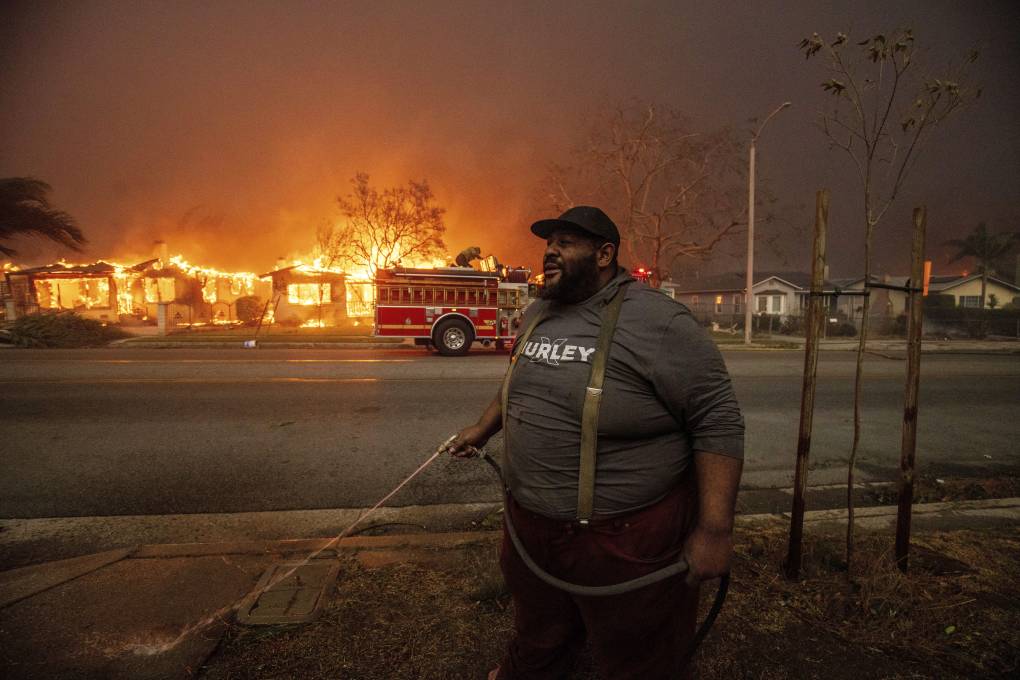
"caption": "A resident sprays their property with a garden hose as the Eaton Fire engulfs structures across the street, Wednesday, Jan. 8, 2025, in Altadena, Los Angeles County. ",
"credit": "Ethan Swope/AP Photo",
"altTag": null,
"description": null,
"imgSizes": {
"medium": {
"file": "https://cdn.kqed.org/wp-content/uploads/sites/10/2025/01/AP25011807951099-800x534.jpg",
"width": 800,
"height": 534,
"mimeType": "image/jpeg"
},
"large": {
"file": "https://cdn.kqed.org/wp-content/uploads/sites/10/2025/01/AP25011807951099-1020x680.jpg",
"width": 1020,
"height": 680,
"mimeType": "image/jpeg"
},
"thumbnail": {
"file": "https://cdn.kqed.org/wp-content/uploads/sites/10/2025/01/AP25011807951099-160x107.jpg",
"width": 160,
"height": 107,
"mimeType": "image/jpeg"
},
"1536x1536": {
"file": "https://cdn.kqed.org/wp-content/uploads/sites/10/2025/01/AP25011807951099-1536x1025.jpg",
"width": 1536,
"height": 1025,
"mimeType": "image/jpeg"
},
"2048x2048": {
"file": "https://cdn.kqed.org/wp-content/uploads/sites/10/2025/01/AP25011807951099-2048x1366.jpg",
"width": 2048,
"height": 1366,
"mimeType": "image/jpeg"
},
"post-thumbnail": {
"file": "https://cdn.kqed.org/wp-content/uploads/sites/10/2025/01/AP25011807951099-672x372.jpg",
"width": 672,
"height": 372,
"mimeType": "image/jpeg"
},
"twentyfourteen-full-width": {
"file": "https://cdn.kqed.org/wp-content/uploads/sites/10/2025/01/AP25011807951099-1038x576.jpg",
"width": 1038,
"height": 576,
"mimeType": "image/jpeg"
},
"full-width": {
"file": "https://cdn.kqed.org/wp-content/uploads/sites/10/2025/01/AP25011807951099-1920x1281.jpg",
"width": 1920,
"height": 1281,
"mimeType": "image/jpeg"
},
"kqedFullSize": {
"file": "https://cdn.kqed.org/wp-content/uploads/sites/10/2025/01/AP25011807951099-scaled.jpg",
"width": 2560,
"height": 1708
}
},
"isLoading": false,
"fetchFailed": false
},
"news_12021950": {
"type": "attachments",
"id": "news_12021950",
"meta": {
"index": "attachments_1716263798",
"site": "news",
"id": "12021950",
"found": true
},
"title": "Powerful Winds Fuel Multiple Fires Across Los Angeles Area",
"publishDate": 1736814283,
"status": "inherit",
"parent": 12021941,
"modified": 1736814671,
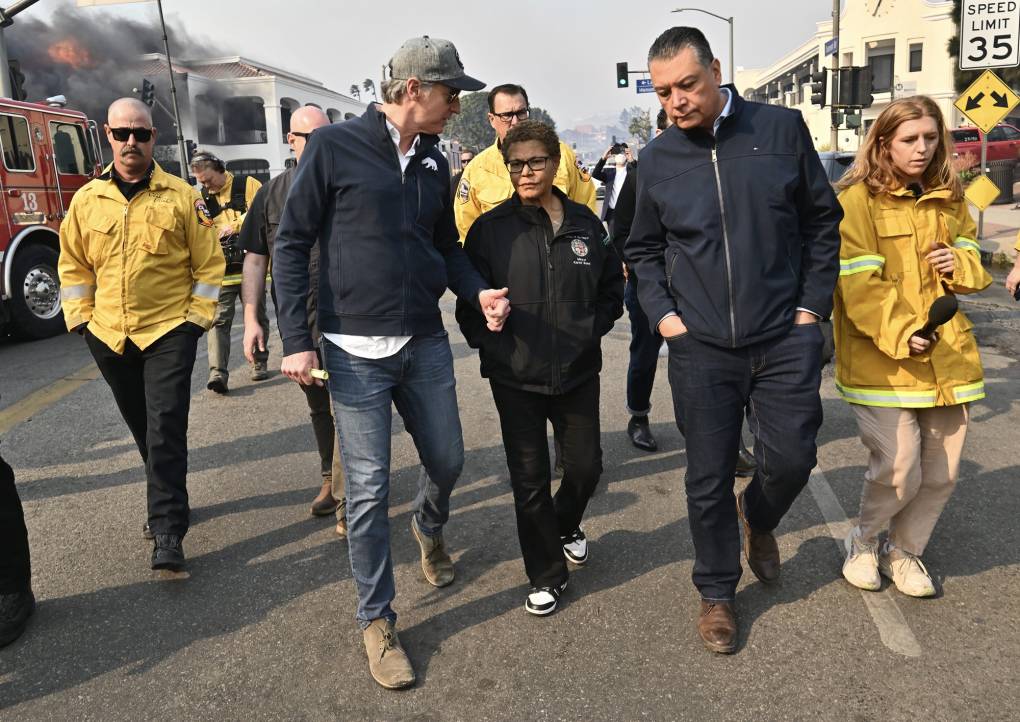
"caption": "Los Angeles Mayor Karen Bass joins Gov. Gavin Newsom, left, and State Sen. Alex Padilla while surveying damage during the Palisades Fire on Wednesday, Jan. 8, 2025, in Pacific Palisades, California.",
"credit": "Jeff Gritchen/MediaNews Group/Orange County Register via Getty Images",
"altTag": null,
"description": null,
"imgSizes": {
"medium": {
"file": "https://cdn.kqed.org/wp-content/uploads/sites/10/2025/01/GavinNewsomSpecialSessionGetty-800x566.jpg",
"width": 800,
"height": 566,
"mimeType": "image/jpeg"
},
"large": {
"file": "https://cdn.kqed.org/wp-content/uploads/sites/10/2025/01/GavinNewsomSpecialSessionGetty-1020x722.jpg",
"width": 1020,
"height": 722,
"mimeType": "image/jpeg"
},
"thumbnail": {
"file": "https://cdn.kqed.org/wp-content/uploads/sites/10/2025/01/GavinNewsomSpecialSessionGetty-160x113.jpg",
"width": 160,
"height": 113,
"mimeType": "image/jpeg"
},
"1536x1536": {
"file": "https://cdn.kqed.org/wp-content/uploads/sites/10/2025/01/GavinNewsomSpecialSessionGetty-1536x1087.jpg",
"width": 1536,
"height": 1087,
"mimeType": "image/jpeg"
},
"post-thumbnail": {
"file": "https://cdn.kqed.org/wp-content/uploads/sites/10/2025/01/GavinNewsomSpecialSessionGetty-672x372.jpg",
"width": 672,
"height": 372,
"mimeType": "image/jpeg"
},
"twentyfourteen-full-width": {
"file": "https://cdn.kqed.org/wp-content/uploads/sites/10/2025/01/GavinNewsomSpecialSessionGetty-1038x576.jpg",
"width": 1038,
"height": 576,
"mimeType": "image/jpeg"
},
"full-width": {
"file": "https://cdn.kqed.org/wp-content/uploads/sites/10/2025/01/GavinNewsomSpecialSessionGetty-1920x1358.jpg",
"width": 1920,
"height": 1358,
"mimeType": "image/jpeg"
},
"kqedFullSize": {
"file": "https://cdn.kqed.org/wp-content/uploads/sites/10/2025/01/GavinNewsomSpecialSessionGetty.jpg",
"width": 2000,
"height": 1415
}
},
"isLoading": false,
"fetchFailed": false
},
"news_12021263": {
"type": "attachments",
"id": "news_12021263",
"meta": {
"index": "attachments_1716263798",
"site": "news",
"id": "12021263",
"found": true
},
"title": "240109-CAWindStorm-043",
"publishDate": 1736462228,
"status": "inherit",
"parent": 12022146,
"modified": 1737075351,
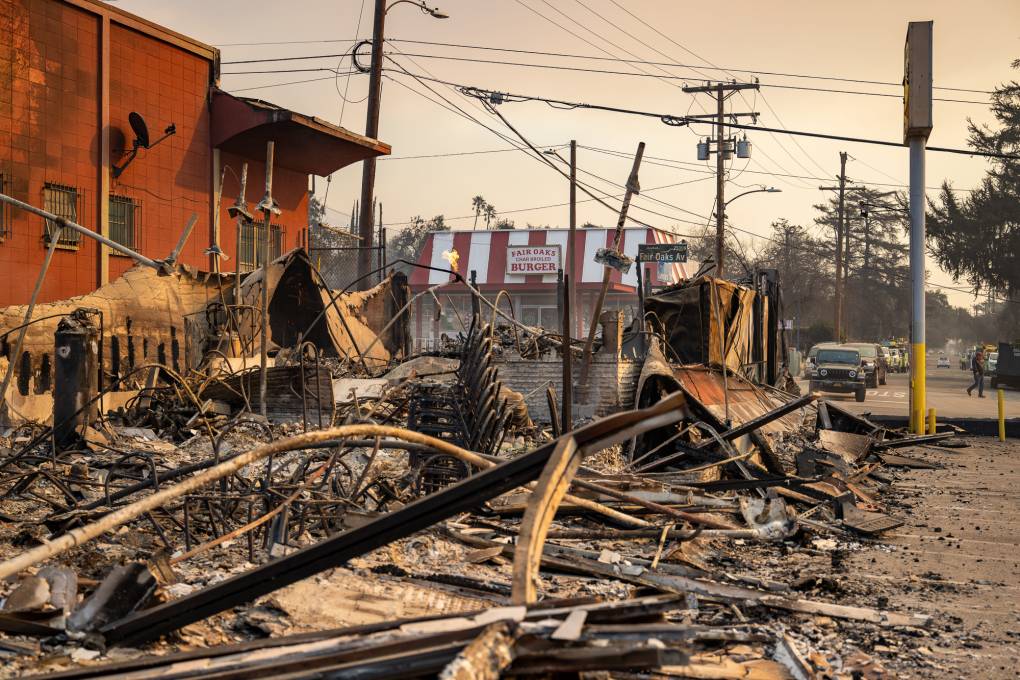
"caption": "Buildings are destroyed along Fair Oaks Avenue in Altadena, California, after the Eaton Fire swept through the area northeast of Los Angeles, California, on Thursday, Jan. 9, 2025.",
"credit": "Beth LaBerge/KQED",
"altTag": null,
"description": null,
"imgSizes": {
"medium": {
"file": "https://cdn.kqed.org/wp-content/uploads/sites/10/2025/01/240109-CAWindStorm-043-800x533.jpg",
"width": 800,
"height": 533,
"mimeType": "image/jpeg"
},
"large": {
"file": "https://cdn.kqed.org/wp-content/uploads/sites/10/2025/01/240109-CAWindStorm-043-1020x680.jpg",
"width": 1020,
"height": 680,
"mimeType": "image/jpeg"
},
"thumbnail": {
"file": "https://cdn.kqed.org/wp-content/uploads/sites/10/2025/01/240109-CAWindStorm-043-160x107.jpg",
"width": 160,
"height": 107,
"mimeType": "image/jpeg"
},
"1536x1536": {
"file": "https://cdn.kqed.org/wp-content/uploads/sites/10/2025/01/240109-CAWindStorm-043-1536x1024.jpg",
"width": 1536,
"height": 1024,
"mimeType": "image/jpeg"
},
"post-thumbnail": {
"file": "https://cdn.kqed.org/wp-content/uploads/sites/10/2025/01/240109-CAWindStorm-043-672x372.jpg",
"width": 672,
"height": 372,
"mimeType": "image/jpeg"
},
"twentyfourteen-full-width": {
"file": "https://cdn.kqed.org/wp-content/uploads/sites/10/2025/01/240109-CAWindStorm-043-1038x576.jpg",
"width": 1038,
"height": 576,
"mimeType": "image/jpeg"
},
"full-width": {
"file": "https://cdn.kqed.org/wp-content/uploads/sites/10/2025/01/240109-CAWindStorm-043-1920x1280.jpg",
"width": 1920,
"height": 1280,
"mimeType": "image/jpeg"
},
"kqedFullSize": {
"file": "https://cdn.kqed.org/wp-content/uploads/sites/10/2025/01/240109-CAWindStorm-043.jpg",
"width": 2000,
"height": 1333
}
},
"isLoading": false,
"fetchFailed": false
},
"news_12021809": {
"type": "attachments",
"id": "news_12021809",
"meta": {
"index": "attachments_1716263798",
"site": "news",
"id": "12021809",
"found": true
},
"title": "how-to-donate-la-fires",
"publishDate": 1736724327,
"status": "inherit",
"parent": 12021777,
"modified": 1736797890,
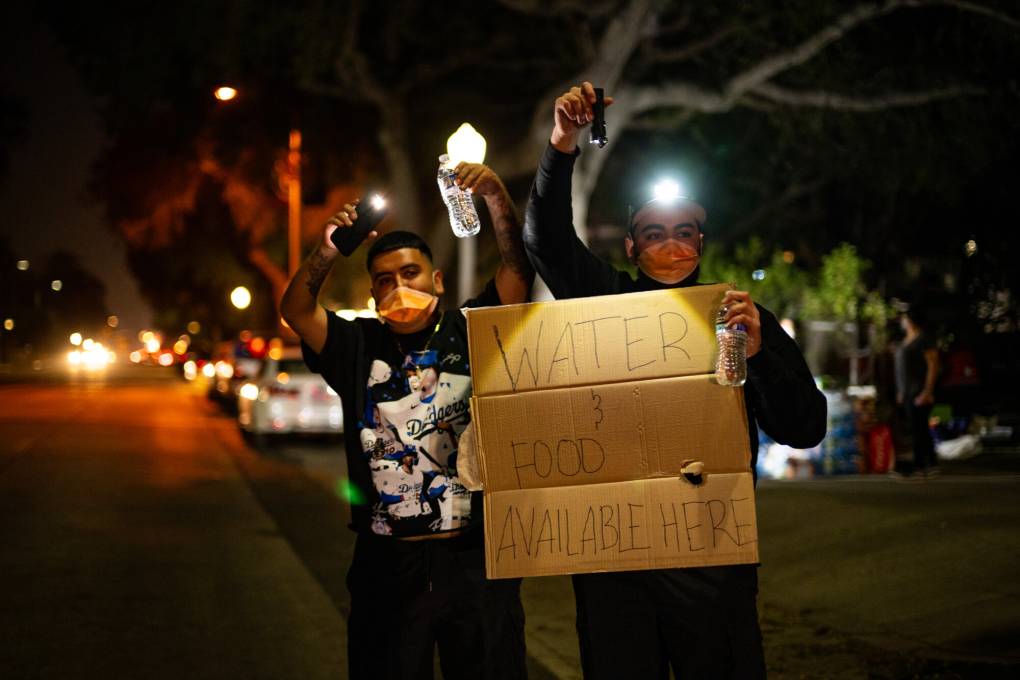
"caption": "Alex Lopez (left), an Altadena resident, and his friend Frank Alcaraz flag down drivers to stop for free water and supplies in Pasadena, California, on Jan. 9, 2025, after the Eaton Fire swept through the area days earlier. Lopez’s house survived the fire, but he said many of his neighbors' homes did not.",
"credit": "Beth LaBerge/KQED",
"altTag": null,
"description": null,
"imgSizes": {
"medium": {
"file": "https://cdn.kqed.org/wp-content/uploads/sites/10/2025/01/240109-CAWindStorm-082_qed-800x533.jpg",
"width": 800,
"height": 533,
"mimeType": "image/jpeg"
},
"large": {
"file": "https://cdn.kqed.org/wp-content/uploads/sites/10/2025/01/240109-CAWindStorm-082_qed-1020x680.jpg",
"width": 1020,
"height": 680,
"mimeType": "image/jpeg"
},
"thumbnail": {
"file": "https://cdn.kqed.org/wp-content/uploads/sites/10/2025/01/240109-CAWindStorm-082_qed-160x107.jpg",
"width": 160,
"height": 107,
"mimeType": "image/jpeg"
},
"1536x1536": {
"file": "https://cdn.kqed.org/wp-content/uploads/sites/10/2025/01/240109-CAWindStorm-082_qed-1536x1024.jpg",
"width": 1536,
"height": 1024,
"mimeType": "image/jpeg"
},
"post-thumbnail": {
"file": "https://cdn.kqed.org/wp-content/uploads/sites/10/2025/01/240109-CAWindStorm-082_qed-672x372.jpg",
"width": 672,
"height": 372,
"mimeType": "image/jpeg"
},
"twentyfourteen-full-width": {
"file": "https://cdn.kqed.org/wp-content/uploads/sites/10/2025/01/240109-CAWindStorm-082_qed-1038x576.jpg",
"width": 1038,
"height": 576,
"mimeType": "image/jpeg"
},
"full-width": {
"file": "https://cdn.kqed.org/wp-content/uploads/sites/10/2025/01/240109-CAWindStorm-082_qed-1920x1280.jpg",
"width": 1920,
"height": 1280,
"mimeType": "image/jpeg"
},
"kqedFullSize": {
"file": "https://cdn.kqed.org/wp-content/uploads/sites/10/2025/01/240109-CAWindStorm-082_qed.jpg",
"width": 2000,
"height": 1333
}
},
"isLoading": false,
"fetchFailed": false
},
"news_12021848": {
"type": "attachments",
"id": "news_12021848",
"meta": {
"index": "attachments_1716263798",
"site": "news",
"id": "12021848",
"found": true
},
"title": "Palisades Fire: K9 Unit search for body remains in ashes of burned houses in Malibu Beach of Los Angeles",
"publishDate": 1736793529,
"status": "inherit",
"parent": 12021834,
"modified": 1736793632,
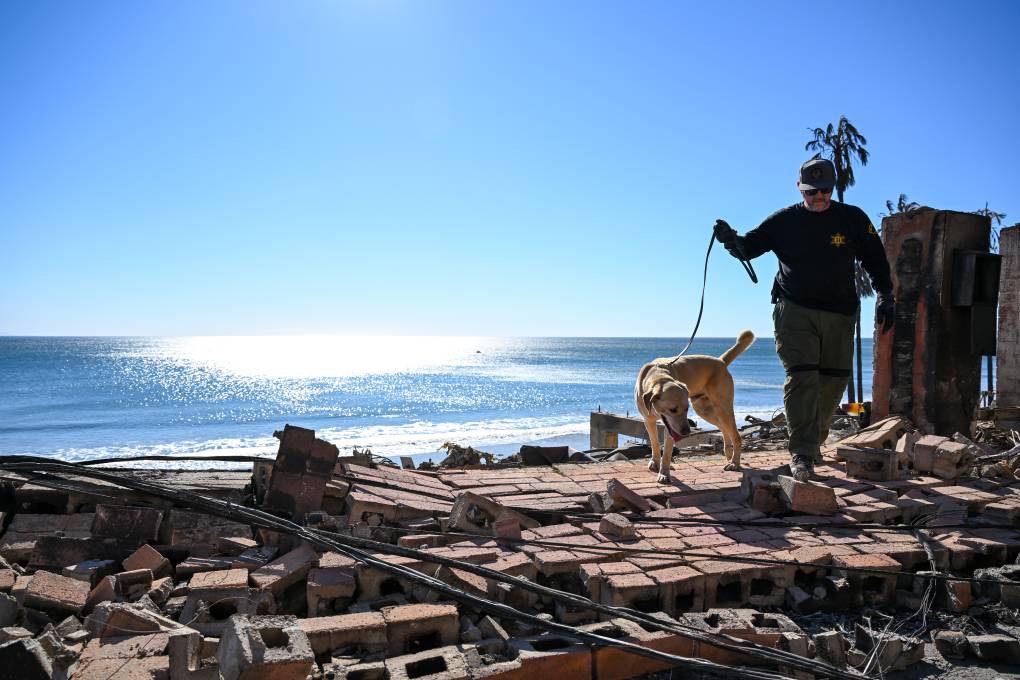
"caption": "A K9 unit from the Sheriff department searches for possible body remains in ashes of burned houses at Malibu Beach after the Palisades Fire on January 12, 2025. ",
"credit": "Tayfun Coskun/Anadolu via Getty Images",
"altTag": null,
"description": null,
"imgSizes": {
"medium": {
"file": "https://cdn.kqed.org/wp-content/uploads/sites/10/2025/01/GettyImages-2193181897-800x533.jpg",
"width": 800,
"height": 533,
"mimeType": "image/jpeg"
},
"large": {
"file": "https://cdn.kqed.org/wp-content/uploads/sites/10/2025/01/GettyImages-2193181897-1020x680.jpg",
"width": 1020,
"height": 680,
"mimeType": "image/jpeg"
},
"thumbnail": {
"file": "https://cdn.kqed.org/wp-content/uploads/sites/10/2025/01/GettyImages-2193181897-160x107.jpg",
"width": 160,
"height": 107,
"mimeType": "image/jpeg"
},
"1536x1536": {
"file": "https://cdn.kqed.org/wp-content/uploads/sites/10/2025/01/GettyImages-2193181897-1536x1024.jpg",
"width": 1536,
"height": 1024,
"mimeType": "image/jpeg"
},
"2048x2048": {
"file": "https://cdn.kqed.org/wp-content/uploads/sites/10/2025/01/GettyImages-2193181897-2048x1365.jpg",
"width": 2048,
"height": 1365,
"mimeType": "image/jpeg"
},
"post-thumbnail": {
"file": "https://cdn.kqed.org/wp-content/uploads/sites/10/2025/01/GettyImages-2193181897-672x372.jpg",
"width": 672,
"height": 372,
"mimeType": "image/jpeg"
},
"twentyfourteen-full-width": {
"file": "https://cdn.kqed.org/wp-content/uploads/sites/10/2025/01/GettyImages-2193181897-1038x576.jpg",
"width": 1038,
"height": 576,
"mimeType": "image/jpeg"
},
"full-width": {
"file": "https://cdn.kqed.org/wp-content/uploads/sites/10/2025/01/GettyImages-2193181897-1920x1280.jpg",
"width": 1920,
"height": 1280,
"mimeType": "image/jpeg"
},
"kqedFullSize": {
"file": "https://cdn.kqed.org/wp-content/uploads/sites/10/2025/01/GettyImages-2193181897-scaled.jpg",
"width": 2560,
"height": 1707
}
},
"isLoading": false,
"fetchFailed": false
},
"news_12021200": {
"type": "attachments",
"id": "news_12021200",
"meta": {
"index": "attachments_1716263798",
"site": "news",
"id": "12021200",
"found": true
},
"title": "240109-CAWindStorm-038",
"publishDate": 1736456599,
"status": "inherit",
"parent": 0,
"modified": 1736456756,
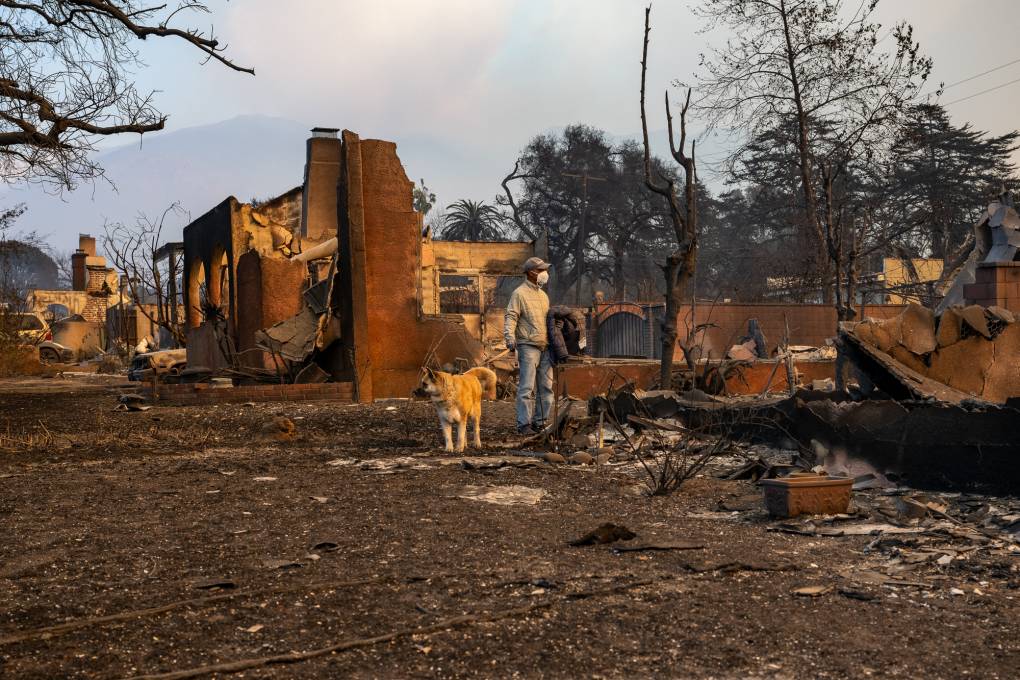
"caption": "Altadena resident Herb Wilson, 67, walks with his dog, Rosie, to survey the home he shares with his wife, Loyda, after it was destroyed in the Eaton Fire northeast of Los Angeles, California, on Thursday, Jan. 9, 2025. The couple was on vacation in Hawaii when the fire broke out, so they could not retrieve any belongings.",
"credit": "Beth LaBerge/KQED",
"altTag": null,
"description": null,
"imgSizes": {
"medium": {
"file": "https://cdn.kqed.org/wp-content/uploads/sites/10/2025/01/240109-CAWindStorm-038-800x533.jpg",
"width": 800,
"height": 533,
"mimeType": "image/jpeg"
},
"large": {
"file": "https://cdn.kqed.org/wp-content/uploads/sites/10/2025/01/240109-CAWindStorm-038-1020x680.jpg",
"width": 1020,
"height": 680,
"mimeType": "image/jpeg"
},
"thumbnail": {
"file": "https://cdn.kqed.org/wp-content/uploads/sites/10/2025/01/240109-CAWindStorm-038-160x107.jpg",
"width": 160,
"height": 107,
"mimeType": "image/jpeg"
},
"1536x1536": {
"file": "https://cdn.kqed.org/wp-content/uploads/sites/10/2025/01/240109-CAWindStorm-038-1536x1024.jpg",
"width": 1536,
"height": 1024,
"mimeType": "image/jpeg"
},
"post-thumbnail": {
"file": "https://cdn.kqed.org/wp-content/uploads/sites/10/2025/01/240109-CAWindStorm-038-672x372.jpg",
"width": 672,
"height": 372,
"mimeType": "image/jpeg"
},
"twentyfourteen-full-width": {
"file": "https://cdn.kqed.org/wp-content/uploads/sites/10/2025/01/240109-CAWindStorm-038-1038x576.jpg",
"width": 1038,
"height": 576,
"mimeType": "image/jpeg"
},
"full-width": {
"file": "https://cdn.kqed.org/wp-content/uploads/sites/10/2025/01/240109-CAWindStorm-038-1920x1280.jpg",
"width": 1920,
"height": 1280,
"mimeType": "image/jpeg"
},
"kqedFullSize": {
"file": "https://cdn.kqed.org/wp-content/uploads/sites/10/2025/01/240109-CAWindStorm-038.jpg",
"width": 2000,
"height": 1333
}
},
"isLoading": false,
"fetchFailed": false
},
"news_12021799": {
"type": "attachments",
"id": "news_12021799",
"meta": {
"index": "attachments_1716263798",
"site": "news",
"id": "12021799",
"found": true
},
"title": "California-Wildfires-Malibu-January-09",
"publishDate": 1736711100,
"status": "inherit",
"parent": 12021798,
"modified": 1736711412,
"caption": null,
"credit": "David Pashaee / Middle East Images via AFP/Getty Images",
"altTag": "Two men dressed in firefighter uniforms with red helmets hold a fire hose",
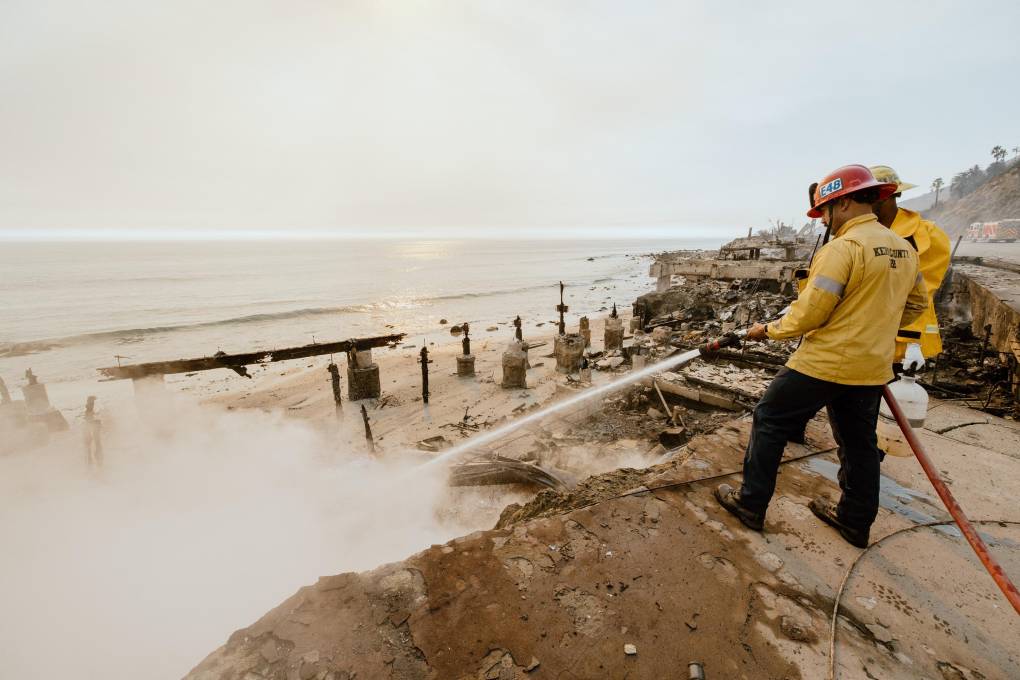
"description": "Firefighters work with water hoses near houses burned down in the Palisades Fire along the Pacific Coast Highway in Malibu on Jan. 9, 2025.\nMassive wildfires that engulfed whole neighborhoods and displaced thousands in Los Angeles remained totally uncontained on Jan. 9, 2025, authorities said, as U.S. National Guard soldiers readied to hit the streets to help quell disorder. ",
"imgSizes": {
"medium": {
"file": "https://cdn.kqed.org/wp-content/uploads/sites/10/2025/01/gettyimages-2192626994-800x533.jpeg",
"width": 800,
"height": 533,
"mimeType": "image/jpeg"
},
"large": {
"file": "https://cdn.kqed.org/wp-content/uploads/sites/10/2025/01/gettyimages-2192626994-1020x680.jpeg",
"width": 1020,
"height": 680,
"mimeType": "image/jpeg"
},
"thumbnail": {
"file": "https://cdn.kqed.org/wp-content/uploads/sites/10/2025/01/gettyimages-2192626994-160x107.jpeg",
"width": 160,
"height": 107,
"mimeType": "image/jpeg"
},
"1536x1536": {
"file": "https://cdn.kqed.org/wp-content/uploads/sites/10/2025/01/gettyimages-2192626994-1536x1024.jpeg",
"width": 1536,
"height": 1024,
"mimeType": "image/jpeg"
},
"2048x2048": {
"file": "https://cdn.kqed.org/wp-content/uploads/sites/10/2025/01/gettyimages-2192626994-2048x1365.jpeg",
"width": 2048,
"height": 1365,
"mimeType": "image/jpeg"
},
"post-thumbnail": {
"file": "https://cdn.kqed.org/wp-content/uploads/sites/10/2025/01/gettyimages-2192626994-672x372.jpeg",
"width": 672,
"height": 372,
"mimeType": "image/jpeg"
},
"twentyfourteen-full-width": {
"file": "https://cdn.kqed.org/wp-content/uploads/sites/10/2025/01/gettyimages-2192626994-1038x576.jpeg",
"width": 1038,
"height": 576,
"mimeType": "image/jpeg"
},
"full-width": {
"file": "https://cdn.kqed.org/wp-content/uploads/sites/10/2025/01/gettyimages-2192626994-1920x1280.jpeg",
"width": 1920,
"height": 1280,
"mimeType": "image/jpeg"
},
"kqedFullSize": {
"file": "https://cdn.kqed.org/wp-content/uploads/sites/10/2025/01/gettyimages-2192626994-scaled.jpeg",
"width": 2560,
"height": 1707
}
},
"isLoading": false,
"fetchFailed": false
},
"news_12021741": {
"type": "attachments",
"id": "news_12021741",
"meta": {
"index": "attachments_1716263798",
"site": "news",
"id": "12021741",
"found": true
},
"title": "010825_Newsom-Palisades-Fire_GETTY_CM_01 copy",
"publishDate": 1736633931,
"status": "inherit",
"parent": 12021740,
"modified": 1736633988,
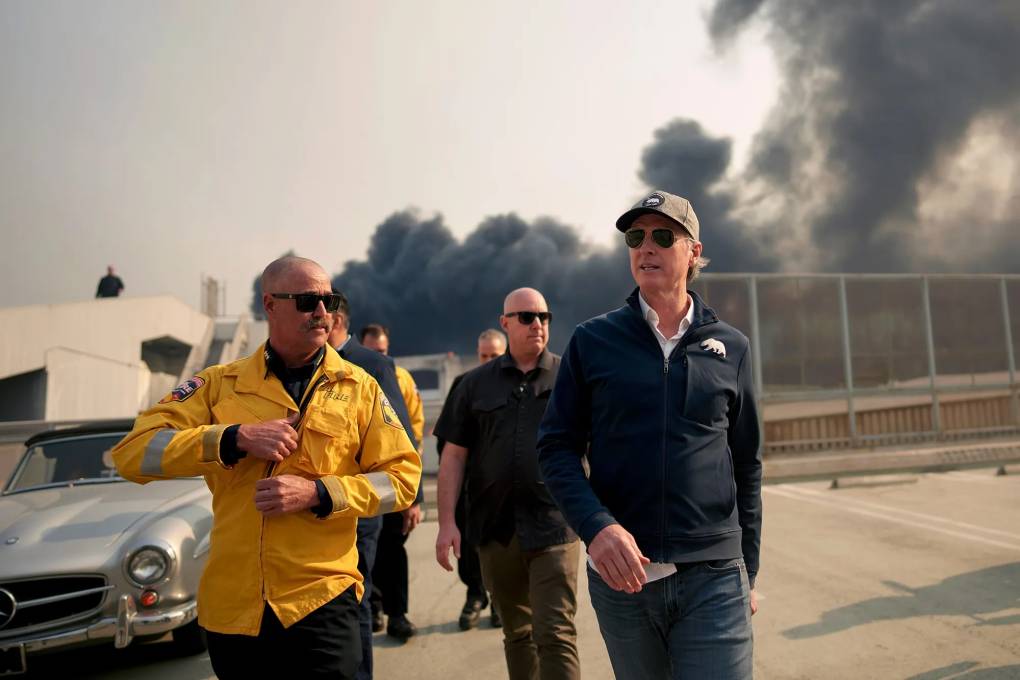
"caption": "Gov. Gavin Newsom, right, tours the downtown business district of Pacific Palisades as the Palisades Fire continues to burn in Los Angeles on Jan. 8, 2025. Newsom is appealing to President-elect Donald Trump to visit the LA fires. ",
"credit": "Eric Thayer/Getty Images",
"altTag": "A middle aged man in a hat and casual clothes walks next to a fire chief with smoke billowing behind them on a city street.",
"description": null,
"imgSizes": {
"medium": {
"file": "https://cdn.kqed.org/wp-content/uploads/sites/10/2025/01/010825_Newsom-Palisades-Fire_GETTY_CM_01-copy-800x533.jpg",
"width": 800,
"height": 533,
"mimeType": "image/jpeg"
},
"large": {
"file": "https://cdn.kqed.org/wp-content/uploads/sites/10/2025/01/010825_Newsom-Palisades-Fire_GETTY_CM_01-copy-1020x680.jpg",
"width": 1020,
"height": 680,
"mimeType": "image/jpeg"
},
"thumbnail": {
"file": "https://cdn.kqed.org/wp-content/uploads/sites/10/2025/01/010825_Newsom-Palisades-Fire_GETTY_CM_01-copy-160x107.jpg",
"width": 160,
"height": 107,
"mimeType": "image/jpeg"
},
"1536x1536": {
"file": "https://cdn.kqed.org/wp-content/uploads/sites/10/2025/01/010825_Newsom-Palisades-Fire_GETTY_CM_01-copy-1536x1024.jpg",
"width": 1536,
"height": 1024,
"mimeType": "image/jpeg"
},
"post-thumbnail": {
"file": "https://cdn.kqed.org/wp-content/uploads/sites/10/2025/01/010825_Newsom-Palisades-Fire_GETTY_CM_01-copy-672x372.jpg",
"width": 672,
"height": 372,
"mimeType": "image/jpeg"
},
"twentyfourteen-full-width": {
"file": "https://cdn.kqed.org/wp-content/uploads/sites/10/2025/01/010825_Newsom-Palisades-Fire_GETTY_CM_01-copy-1038x576.jpg",
"width": 1038,
"height": 576,
"mimeType": "image/jpeg"
},
"full-width": {
"file": "https://cdn.kqed.org/wp-content/uploads/sites/10/2025/01/010825_Newsom-Palisades-Fire_GETTY_CM_01-copy-1920x1280.jpg",
"width": 1920,
"height": 1280,
"mimeType": "image/jpeg"
},
"kqedFullSize": {
"file": "https://cdn.kqed.org/wp-content/uploads/sites/10/2025/01/010825_Newsom-Palisades-Fire_GETTY_CM_01-copy.jpg",
"width": 2000,
"height": 1333
}
},
"isLoading": false,
"fetchFailed": false
},
"news_12021737": {
"type": "attachments",
"id": "news_12021737",
"meta": {
"index": "attachments_1716263798",
"site": "news",
"id": "12021737",
"found": true
},
"title": "Aerial firefighting efforts intensify over the Palisades wildfire in Los Angeles",
"publishDate": 1736631827,
"status": "inherit",
"parent": 12021702,
"modified": 1752102120,
"caption": "A view of Palisades Fire as firefighting planes and helicopters drop water over flames in Mandeville Canyon in Los Angeles, on Jan. 10, 2025. The bot fails at some basic questions about fires. Cal Fire says it is working on fixes. The devastation from the Palisades Fire is seen from the air in the Pacific Palisades neighborhood of Los Angeles on Jan. 9, 2025. CalFire is using a chatbot to give Californians better access to real-time emergency information. But CalMatters found it isn't always accurate or reliable. ",
"credit": "Tayfun Coskun/Anadolu via Getty Images",
"altTag": "Firefighters look on as a big red smoky blaze comes over a hill.",
"description": null,
"imgSizes": {
"medium": {
"file": "https://cdn.kqed.org/wp-content/uploads/sites/10/2025/01/GettyImages-2192687291-800x534.jpg",
"width": 800,
"height": 534,
"mimeType": "image/jpeg"
},
"large": {
"file": "https://cdn.kqed.org/wp-content/uploads/sites/10/2025/01/GettyImages-2192687291-1020x680.jpg",
"width": 1020,
"height": 680,
"mimeType": "image/jpeg"
},
"thumbnail": {
"file": "https://cdn.kqed.org/wp-content/uploads/sites/10/2025/01/GettyImages-2192687291-160x107.jpg",
"width": 160,
"height": 107,
"mimeType": "image/jpeg"
},
"post-thumbnail": {
"file": "https://cdn.kqed.org/wp-content/uploads/sites/10/2025/01/GettyImages-2192687291-672x372.jpg",
"width": 672,
"height": 372,
"mimeType": "image/jpeg"
},
"twentyfourteen-full-width": {
"file": "https://cdn.kqed.org/wp-content/uploads/sites/10/2025/01/GettyImages-2192687291-1024x576.jpg",
"width": 1024,
"height": 576,
"mimeType": "image/jpeg"
},
"kqedFullSize": {
"file": "https://cdn.kqed.org/wp-content/uploads/sites/10/2025/01/GettyImages-2192687291.jpg",
"width": 1024,
"height": 683
}
},
"isLoading": false,
"fetchFailed": false
},
"news_12021697": {
"type": "attachments",
"id": "news_12021697",
"meta": {
"index": "attachments_1716263798",
"site": "news",
"id": "12021697",
"found": true
},
"title": "APTOPIX California Wildfires",
"publishDate": 1736626993,
"status": "inherit",
"parent": 12021693,
"modified": 1736627046,
"caption": "Firefighters watch as water is dropped on the Palisades Fire in Mandeville Canyon Saturday, Jan. 11, 2025, in Los Angeles. ",
"credit": "Jae C. Hong/AP Photo",
"altTag": "Plane drops water as firefighters look on with smoke and flames below.",
"description": null,
"imgSizes": {
"medium": {
"file": "https://cdn.kqed.org/wp-content/uploads/sites/10/2025/01/AP25011593194481-800x533.jpg",
"width": 800,
"height": 533,
"mimeType": "image/jpeg"
},
"large": {
"file": "https://cdn.kqed.org/wp-content/uploads/sites/10/2025/01/AP25011593194481-1020x680.jpg",
"width": 1020,
"height": 680,
"mimeType": "image/jpeg"
},
"thumbnail": {
"file": "https://cdn.kqed.org/wp-content/uploads/sites/10/2025/01/AP25011593194481-160x107.jpg",
"width": 160,
"height": 107,
"mimeType": "image/jpeg"
},
"1536x1536": {
"file": "https://cdn.kqed.org/wp-content/uploads/sites/10/2025/01/AP25011593194481-1536x1024.jpg",
"width": 1536,
"height": 1024,
"mimeType": "image/jpeg"
},
"2048x2048": {
"file": "https://cdn.kqed.org/wp-content/uploads/sites/10/2025/01/AP25011593194481-2048x1365.jpg",
"width": 2048,
"height": 1365,
"mimeType": "image/jpeg"
},
"post-thumbnail": {
"file": "https://cdn.kqed.org/wp-content/uploads/sites/10/2025/01/AP25011593194481-672x372.jpg",
"width": 672,
"height": 372,
"mimeType": "image/jpeg"
},
"twentyfourteen-full-width": {
"file": "https://cdn.kqed.org/wp-content/uploads/sites/10/2025/01/AP25011593194481-1038x576.jpg",
"width": 1038,
"height": 576,
"mimeType": "image/jpeg"
},
"full-width": {
"file": "https://cdn.kqed.org/wp-content/uploads/sites/10/2025/01/AP25011593194481-1920x1280.jpg",
"width": 1920,
"height": 1280,
"mimeType": "image/jpeg"
},
"kqedFullSize": {
"file": "https://cdn.kqed.org/wp-content/uploads/sites/10/2025/01/AP25011593194481-scaled.jpg",
"width": 2560,
"height": 1706
}
},
"isLoading": false,
"fetchFailed": false
}
},
"audioPlayerReducer": {
"postId": "stream_live",
"isPaused": true,
"isPlaying": false,
"pfsActive": false,
"pledgeModalIsOpen": true,
"playerDrawerIsOpen": false,
"liveAudioPlayStartedAt": 0,
"liveAudioPlayContext": ""
},
"authorsReducer": {
"byline_news_12022118": {
"type": "authors",
"id": "byline_news_12022118",
"meta": {
"override": true
},
"slug": "byline_news_12022118",
"name": "\u003ca href=\"https://www.npr.org/people/g-s1-23120/chandelis-duster\">Chandelis Duster\u003c/a>, NPR",
"isLoading": false
},
"byline_news_12022057": {
"type": "authors",
"id": "byline_news_12022057",
"meta": {
"override": true
},
"slug": "byline_news_12022057",
"name": "Terry Tang, Jennifer Sinco Kelleher and Jae Hong, Associated Press",
"isLoading": false
},
"byline_news_12021834": {
"type": "authors",
"id": "byline_news_12021834",
"meta": {
"override": true
},
"slug": "byline_news_12021834",
"name": "Christopher Weber and Holly Ramer, AP",
"isLoading": false
},
"byline_news_12021777": {
"type": "authors",
"id": "byline_news_12021777",
"meta": {
"override": true
},
"slug": "byline_news_12021777",
"name": "Rachael Myrow",
"isLoading": false
},
"byline_news_12021798": {
"type": "authors",
"id": "byline_news_12021798",
"meta": {
"override": true
},
"slug": "byline_news_12021798",
"name": "Lisa Hagen, NPR",
"isLoading": false
},
"byline_news_12021740": {
"type": "authors",
"id": "byline_news_12021740",
"meta": {
"override": true
},
"slug": "byline_news_12021740",
"name": "\u003ca href=\"https://calmatters.org/author/alexei-koseff/\">Alexei Koseff\u003c/a> and \u003ca href=\"https://calmatters.org/author/yue-yu/\">Yue Stella Yu\u003c/a>, CalMatters",
"isLoading": false
},
"byline_news_12021693": {
"type": "authors",
"id": "byline_news_12021693",
"meta": {
"override": true
},
"slug": "byline_news_12021693",
"name": "Jae Hong, Holly Ramer, Michael R. Blood, Associated Press",
"isLoading": false
},
"gmarzorati": {
"type": "authors",
"id": "227",
"meta": {
"index": "authors_1716337520",
"id": "227",
"found": true
},
"name": "Guy Marzorati",
"firstName": "Guy",
"lastName": "Marzorati",
"slug": "gmarzorati",
"email": "gmarzorati@KQED.org",
"display_author_email": true,
"staff_mastheads": [
"news"
],
"title": "Correspondent",
"bio": "Guy Marzorati is a correspondent on KQED's California Politics and Government Desk, based in San Jose. A graduate of Santa Clara University, Guy joined KQED in 2013. He reports on state and local politics and produces KQED's digital voter guide.",
"avatar": "https://secure.gravatar.com/avatar/e7038b8dbfd55b104369b76b1cd0b9de?s=600&d=blank&r=g",
"twitter": "guymarzorati",
"facebook": null,
"instagram": null,
"linkedin": null,
"sites": [
{
"site": "",
"roles": [
"editor"
]
},
{
"site": "news",
"roles": [
"editor"
]
},
{
"site": "science",
"roles": [
"editor"
]
},
{
"site": "forum",
"roles": [
"editor"
]
},
{
"site": "elections",
"roles": [
"editor"
]
},
{
"site": "liveblog",
"roles": [
"editor"
]
}
],
"headData": {
"title": "Guy Marzorati | KQED",
"description": "Correspondent",
"ogImgSrc": "https://secure.gravatar.com/avatar/e7038b8dbfd55b104369b76b1cd0b9de?s=600&d=blank&r=g",
"twImgSrc": "https://secure.gravatar.com/avatar/e7038b8dbfd55b104369b76b1cd0b9de?s=600&d=blank&r=g"
},
"isLoading": false,
"link": "/author/gmarzorati"
},
"matthewgreen": {
"type": "authors",
"id": "1263",
"meta": {
"index": "authors_1716337520",
"id": "1263",
"found": true
},
"name": "Matthew Green",
"firstName": "Matthew",
"lastName": "Green",
"slug": "matthewgreen",
"email": "mgreen@kqed.org",
"display_author_email": false,
"staff_mastheads": [],
"title": "KQED Editor/Reporter",
"bio": "Matthew Green is a digital media producer for KQED News. He previously produced \u003ca href=\"http://www.kqed.org/lowdown\">The Lowdown\u003c/a>, KQED’s multimedia news education blog. Matthew's written for numerous Bay Area publications, including the Oakland Tribune and San Francisco Chronicle. He also taught journalism classes at Fremont High School in East Oakland.\r\n\r\nEmail: mgreen@kqed.org; Twitter: @MGreenKQED",
"avatar": "https://secure.gravatar.com/avatar/3bf498d1267ca02c8494f33d8cfc575e?s=600&d=blank&r=g",
"twitter": "MGreenKQED",
"facebook": null,
"instagram": null,
"linkedin": null,
"sites": [
{
"site": "news",
"roles": []
},
{
"site": "lowdown",
"roles": []
},
{
"site": "science",
"roles": []
},
{
"site": "education",
"roles": []
},
{
"site": "quest",
"roles": []
},
{
"site": "liveblog",
"roles": []
}
],
"headData": {
"title": "Matthew Green | KQED",
"description": "KQED Editor/Reporter",
"ogImgSrc": "https://secure.gravatar.com/avatar/3bf498d1267ca02c8494f33d8cfc575e?s=600&d=blank&r=g",
"twImgSrc": "https://secure.gravatar.com/avatar/3bf498d1267ca02c8494f33d8cfc575e?s=600&d=blank&r=g"
},
"isLoading": false,
"link": "/author/matthewgreen"
},
"nkhan": {
"type": "authors",
"id": "11867",
"meta": {
"index": "authors_1716337520",
"id": "11867",
"found": true
},
"name": "Nisa Khan",
"firstName": "Nisa",
"lastName": "Khan",
"slug": "nkhan",
"email": "nkhan@kqed.org",
"display_author_email": false,
"staff_mastheads": [],
"title": "KQED Contributor",
"bio": "Nisa Khan is a reporter for KQED's Audience News Desk. She was formerly a data reporter at Michigan Radio. She earned a Bachelor of Science in Information from the University of Michigan and a Master of Arts in Communication from Stanford University.",
"avatar": "https://secure.gravatar.com/avatar/8720459eef081ff64582b3506b124d58523e80e120704a0cbd9892533c914991?s=600&d=blank&r=g",
"twitter": "mnisakhan",
"bluesky": null,
"facebook": null,
"instagram": null,
"linkedin": null,
"sites": [
{
"site": "arts",
"roles": [
"editor"
]
},
{
"site": "news",
"roles": [
"editor"
]
},
{
"site": "science",
"roles": [
"editor",
"author"
]
},
{
"site": "forum",
"roles": [
"editor"
]
},
{
"site": "liveblog",
"roles": [
"contributor"
]
}
],
"headData": {
"title": "Nisa Khan | KQED",
"description": "KQED Contributor",
"ogImgSrc": "https://secure.gravatar.com/avatar/8720459eef081ff64582b3506b124d58523e80e120704a0cbd9892533c914991?s=600&d=blank&r=g",
"twImgSrc": "https://secure.gravatar.com/avatar/8720459eef081ff64582b3506b124d58523e80e120704a0cbd9892533c914991?s=600&d=blank&r=g"
},
"isLoading": false,
"link": "/author/nkhan"
},
"kdebenedetti": {
"type": "authors",
"id": "11913",
"meta": {
"index": "authors_1716337520",
"id": "11913",
"found": true
},
"name": "Katie DeBenedetti",
"firstName": "Katie",
"lastName": "DeBenedetti",
"slug": "kdebenedetti",
"email": "kdebenedetti@kqed.org",
"display_author_email": false,
"staff_mastheads": [
"news",
"science"
],
"title": "KQED Contributor",
"bio": "Katie DeBenedetti is a digital reporter covering daily news for the Express Desk. Prior to joining KQED as a culture reporting intern in January 2024, she covered education and city government for the Napa Valley Register.",
"avatar": "https://secure.gravatar.com/avatar/6e31073cb8f7e4214ab03f42771d0f45?s=600&d=blank&r=g",
"twitter": null,
"facebook": null,
"instagram": null,
"linkedin": null,
"sites": [
{
"site": "news",
"roles": [
"author"
]
},
{
"site": "science",
"roles": [
"author"
]
},
{
"site": "liveblog",
"roles": [
"author"
]
}
],
"headData": {
"title": "Katie DeBenedetti | KQED",
"description": "KQED Contributor",
"ogImgSrc": "https://secure.gravatar.com/avatar/6e31073cb8f7e4214ab03f42771d0f45?s=600&d=blank&r=g",
"twImgSrc": "https://secure.gravatar.com/avatar/6e31073cb8f7e4214ab03f42771d0f45?s=600&d=blank&r=g"
},
"isLoading": false,
"link": "/author/kdebenedetti"
},
"slim": {
"type": "authors",
"id": "11920",
"meta": {
"index": "authors_1716337520",
"id": "11920",
"found": true
},
"name": "Samantha Lim",
"firstName": "Samantha",
"lastName": "Lim",
"slug": "slim",
"email": "slim@KQED.org",
"display_author_email": false,
"staff_mastheads": [],
"title": "KQED Contributor",
"bio": null,
"avatar": "https://secure.gravatar.com/avatar/82e592e6c15fe1a04d385e8ad0fb0b4e?s=600&d=blank&r=g",
"twitter": null,
"facebook": null,
"instagram": null,
"linkedin": null,
"sites": [
{
"site": "news",
"roles": []
}
],
"headData": {
"title": "Samantha Lim | KQED",
"description": "KQED Contributor",
"ogImgSrc": "https://secure.gravatar.com/avatar/82e592e6c15fe1a04d385e8ad0fb0b4e?s=600&d=blank&r=g",
"twImgSrc": "https://secure.gravatar.com/avatar/82e592e6c15fe1a04d385e8ad0fb0b4e?s=600&d=blank&r=g"
},
"isLoading": false,
"link": "/author/slim"
}
},
"pagesReducer": {
"news_tag_los-angeles": {
"type": "terms",
"id": "news_4",
"meta": {
"index": "terms_1716263798",
"site": "news",
"id": "4",
"score": 8.557587
},
"featImg": null,
"name": "los angeles",
"description": null,
"taxonomy": "tag",
"headData": {
"twImgId": null,
"twTitle": null,
"ogTitle": null,
"ogImgId": null,
"twDescription": null,
"description": null,
"title": "los angeles Archives | KQED News",
"ogDescription": null
},
"ttid": 4,
"slug": "los-angeles",
"isLoading": false,
"title": "los angeles",
"pageMeta": {
"site": "news",
"WpPageTemplate": "page-topic-editorial",
"currentPage": 8
},
"blocks": [
{
"blockName": "kqed/post-list",
"attrs": {
"layout": "cardArticle2",
"query": "posts/news?tag=los-angeles",
"seeMore": false,
"paginated": true,
"page": 8
}
},
{
"blockName": "kqed/ad"
}
]
}
},
"pfsSessionReducer": {},
"postsReducer": {
"stream_live": {
"type": "live",
"id": "stream_live",
"audioUrl": "https://streams.kqed.org/kqedradio",
"title": "Live Stream",
"excerpt": "Live Stream information currently unavailable.",
"link": "/radio",
"featImg": "",
"label": {
"name": "KQED Live",
"link": "/"
}
},
"stream_kqedNewscast": {
"type": "posts",
"id": "stream_kqedNewscast",
"audioUrl": "https://www.kqed.org/.stream/anon/radio/RDnews/newscast.mp3?_=1",
"title": "KQED Newscast",
"featImg": "",
"label": {
"name": "88.5 FM",
"link": "/"
}
},
"news_12022111": {
"type": "posts",
"id": "news_12022111",
"meta": {
"index": "posts_1716263798",
"site": "news",
"id": "12022111",
"score": null,
"sort": [
1736900299000
]
},
"guestAuthors": [],
"slug": "republican-leaders-push-conditions-disaster-relief-california-wildfire-victims",
"title": "Republican Leaders Push for Conditions on Disaster Relief for California Wildfire Victims",
"publishDate": 1736900299,
"format": "standard",
"headTitle": "Republican Leaders Push for Conditions on Disaster Relief for California Wildfire Victims | KQED",
"labelTerm": {
"site": "news"
},
"content": "\u003cp>Republican congressional leaders are touting the idea of placing conditions on the billions of dollars in federal aid for California’s \u003ca href=\"https://www.kqed.org/news/tag/wildfire\">wildfire\u003c/a> victims, a strategy they say will force state officials to address alleged resource mismanagement and poor policymaking.\u003c/p>\n\u003cp>At a Monday press conference, House Speaker Mike Johnson (R-Louisiana) criticized state and local officials for exacerbating conditions in California through “unwise” governance, something he said should be addressed before aid is distributed.\u003c/p>\n\u003cp>“We’re all Americans, and the Americans there that are affected desperately need and deserve help,” Johnson told reporters. “But you’ve also heard us talk about our concerns with the governance of the state of California — state and local — and to the extent that there is complicity involved in the scope of the disaster, then we think that’s something that needs to be carefully regarded.”\u003c/p>\n\u003cp>[ad fullwidth]\u003c/p>\n\u003cp>In Los Angeles County, deadly wildfires have burned more than 12,000 structures and forced over 100,000 people to evacuate. The suggestion that Congress should place conditions on relief aid needed by thousands of Californians provoked a mixed response from state leaders.\u003c/p>\n\u003cp>Bill Jackson, who leads the San Francisco Republican Party, said it would be appropriate to put stipulations on federal assistance. He agreed with Johnson’s reasoning.\u003c/p>\n\u003cfigure id=\"attachment_12021323\" class=\"wp-caption aligncenter\" style=\"max-width: 2000px\">\u003cimg loading=\"lazy\" decoding=\"async\" class=\"size-full wp-image-12021323\" src=\"https://cdn.kqed.org/wp-content/uploads/sites/10/2025/01/240109-CAWindStorm-056.jpg\" alt=\"\" width=\"2000\" height=\"1333\" srcset=\"https://cdn.kqed.org/wp-content/uploads/sites/10/2025/01/240109-CAWindStorm-056.jpg 2000w, https://cdn.kqed.org/wp-content/uploads/sites/10/2025/01/240109-CAWindStorm-056-800x533.jpg 800w, https://cdn.kqed.org/wp-content/uploads/sites/10/2025/01/240109-CAWindStorm-056-1020x680.jpg 1020w, https://cdn.kqed.org/wp-content/uploads/sites/10/2025/01/240109-CAWindStorm-056-160x107.jpg 160w, https://cdn.kqed.org/wp-content/uploads/sites/10/2025/01/240109-CAWindStorm-056-1536x1024.jpg 1536w, https://cdn.kqed.org/wp-content/uploads/sites/10/2025/01/240109-CAWindStorm-056-1920x1280.jpg 1920w\" sizes=\"auto, (max-width: 2000px) 100vw, 2000px\">\u003cfigcaption class=\"wp-caption-text\">The remains of a house in Altadena, California, after the Eaton Fire swept through the area northeast of Los Angeles on Thursday, Jan. 9, 2025. \u003ccite>(Beth LaBerge/KQED)\u003c/cite>\u003c/figcaption>\u003c/figure>\n\u003cp>“I don’t think it’s a left-wing or right-wing thing. It’s a pragmatic thing,” Jackson said. “We should not use our federal government as a piggy bank to bail out residents or cities that build extremely fire-prone areas, especially when they haven’t done enough mitigation to prevent a disaster like this.”\u003c/p>\n\u003cp>He added that while it would be impossible to completely prevent natural disasters from occurring, things can be done to reduce the impact of wildfires in cities such as Los Angeles. Californians, Jackson claimed, should consider how much risk is associated with building in certain areas and what measures can be taken to make sure \u003ca href=\"https://www.kqed.org/news/12021125/la-fires-renew-debate-over-prescribed-burns-and-fire-preparedness-in-california\">a neighborhood is more resilient to wildfire\u003c/a>.\u003c/p>\n\u003cp>[aside postID=news_12021435 hero='https://cdn.kqed.org/wp-content/uploads/sites/10/2025/01/CAPalisadesFireAP-1020x679.jpg']\u003c/p>\n\u003cp>Although he disagrees with tying relief considerations to political issues like the country’s debt ceiling, which Johnson and \u003ca href=\"https://www.politico.com/news/2025/01/13/house-republicans-trump-wildfire-aid-00197766\">other Republican politicians\u003c/a> have suggested, Jackson said state officials should feel the pressure to be fiscally responsible when it comes to recovering from the fires.\u003c/p>\n\u003cp>“The rules and policies have to change to force the state and localities to make shifts that dramatically reduce the chances that people are going to come back to the federal government for a large bailout in the future,” Jackson said.\u003c/p>\n\u003cp>Rep. Ted Lieu (D-Los Angeles), whose district faced evacuation orders last week, called Johnson’s stance “outrageous.”\u003c/p>\n\u003cp>Conditions such as low humidity, prolonged drought and strong winds contributed to the spread of the Los Angeles fires and, Lieu added, were outside of anyone’s control.\u003c/p>\n\u003cp>Lieu said the first concern of any representative right now should be figuring out how to help the impacted communities. Efforts to politicize the crisis or to \u003ca href=\"https://www.kqed.org/news/12021435/trumps-misinformation-la-fires-fuels-concerns-over-future-disaster-aid-california\">spread disinformation\u003c/a> should be met with resistance, Lieu told KQED.\u003c/p>\n\u003cp>“There is no human being or system that could have prevented most of this destruction,” Lieu said. “I am very distressed and upset that the Speaker of the House and other members of the Republican Caucus have politicized what is a tragedy. We should be focused on helping our fellow Americans.”\u003c/p>\n\u003cp>\u003c/p>\n",
"blocks": [],
"excerpt": "House Speaker Mike Johnson is one of many Republicans who have sought to blame state and local officials for the deadly wildfires in Los Angeles.",
"status": "publish",
"parent": 0,
"modified": 1736906102,
"stats": {
"hasAudio": false,
"hasVideo": false,
"hasChartOrMap": false,
"iframeSrcs": [],
"hasGoogleForm": false,
"hasGallery": false,
"hasHearkenModule": false,
"hasPolis": false,
"paragraphCount": 16,
"wordCount": 627
},
"headData": {
"title": "Republican Leaders Push for Conditions on Disaster Relief for California Wildfire Victims | KQED",
"description": "House Speaker Mike Johnson is one of many Republicans who have sought to blame state and local officials for the deadly wildfires in Los Angeles.",
"ogTitle": "",
"ogDescription": "",
"ogImgId": "",
"twTitle": "",
"twDescription": "",
"twImgId": "",
"schema": {
"@context": "https://schema.org",
"@type": "NewsArticle",
"headline": "Republican Leaders Push for Conditions on Disaster Relief for California Wildfire Victims",
"datePublished": "2025-01-14T16:18:19-08:00",
"dateModified": "2025-01-14T17:55:02-08:00",
"image": "https://cdn.kqed.org/wp-content/uploads/2020/02/KQED-OG-Image@1x.png",
"isAccessibleForFree": "True",
"publisher": {
"@type": "NewsMediaOrganization",
"@id": "https://www.kqed.org/#organization",
"name": "KQED",
"logo": "https://cdn.kqed.org/wp-content/uploads/2020/02/KQED-OG-Image@1x.png",
"url": "https://www.kqed.org",
"sameAs": [
"https://www.facebook.com/KQED",
"https://twitter.com/KQED",
"https://www.instagram.com/kqed/",
"https://www.tiktok.com/@kqedofficial",
"https://www.linkedin.com/company/kqed",
"https://www.youtube.com/channel/UCeC0IOo7i1P_61zVUWbJ4nw"
]
}
}
},
"sticky": false,
"nprStoryId": "kqed-12022111",
"excludeFromSiteSearch": "Include",
"articleAge": "0",
"path": "/news/12022111/republican-leaders-push-conditions-disaster-relief-california-wildfire-victims",
"audioTrackLength": null,
"parsedContent": [
{
"type": "contentString",
"content": "\u003cdiv class=\"post-body\">\u003cp>\u003cp>Republican congressional leaders are touting the idea of placing conditions on the billions of dollars in federal aid for California’s \u003ca href=\"https://www.kqed.org/news/tag/wildfire\">wildfire\u003c/a> victims, a strategy they say will force state officials to address alleged resource mismanagement and poor policymaking.\u003c/p>\n\u003cp>At a Monday press conference, House Speaker Mike Johnson (R-Louisiana) criticized state and local officials for exacerbating conditions in California through “unwise” governance, something he said should be addressed before aid is distributed.\u003c/p>\n\u003cp>“We’re all Americans, and the Americans there that are affected desperately need and deserve help,” Johnson told reporters. “But you’ve also heard us talk about our concerns with the governance of the state of California — state and local — and to the extent that there is complicity involved in the scope of the disaster, then we think that’s something that needs to be carefully regarded.”\u003c/p>\n\u003cp>\u003c/p>\u003c/div>",
"attributes": {
"named": {},
"numeric": []
}
},
{
"type": "component",
"content": "",
"name": "ad",
"attributes": {
"named": {
"label": "fullwidth"
},
"numeric": [
"fullwidth"
]
}
},
{
"type": "contentString",
"content": "\u003cdiv class=\"post-body\">\u003cp>\u003c/p>\n\u003cp>In Los Angeles County, deadly wildfires have burned more than 12,000 structures and forced over 100,000 people to evacuate. The suggestion that Congress should place conditions on relief aid needed by thousands of Californians provoked a mixed response from state leaders.\u003c/p>\n\u003cp>Bill Jackson, who leads the San Francisco Republican Party, said it would be appropriate to put stipulations on federal assistance. He agreed with Johnson’s reasoning.\u003c/p>\n\u003cfigure id=\"attachment_12021323\" class=\"wp-caption aligncenter\" style=\"max-width: 2000px\">\u003cimg loading=\"lazy\" decoding=\"async\" class=\"size-full wp-image-12021323\" src=\"https://cdn.kqed.org/wp-content/uploads/sites/10/2025/01/240109-CAWindStorm-056.jpg\" alt=\"\" width=\"2000\" height=\"1333\" srcset=\"https://cdn.kqed.org/wp-content/uploads/sites/10/2025/01/240109-CAWindStorm-056.jpg 2000w, https://cdn.kqed.org/wp-content/uploads/sites/10/2025/01/240109-CAWindStorm-056-800x533.jpg 800w, https://cdn.kqed.org/wp-content/uploads/sites/10/2025/01/240109-CAWindStorm-056-1020x680.jpg 1020w, https://cdn.kqed.org/wp-content/uploads/sites/10/2025/01/240109-CAWindStorm-056-160x107.jpg 160w, https://cdn.kqed.org/wp-content/uploads/sites/10/2025/01/240109-CAWindStorm-056-1536x1024.jpg 1536w, https://cdn.kqed.org/wp-content/uploads/sites/10/2025/01/240109-CAWindStorm-056-1920x1280.jpg 1920w\" sizes=\"auto, (max-width: 2000px) 100vw, 2000px\">\u003cfigcaption class=\"wp-caption-text\">The remains of a house in Altadena, California, after the Eaton Fire swept through the area northeast of Los Angeles on Thursday, Jan. 9, 2025. \u003ccite>(Beth LaBerge/KQED)\u003c/cite>\u003c/figcaption>\u003c/figure>\n\u003cp>“I don’t think it’s a left-wing or right-wing thing. It’s a pragmatic thing,” Jackson said. “We should not use our federal government as a piggy bank to bail out residents or cities that build extremely fire-prone areas, especially when they haven’t done enough mitigation to prevent a disaster like this.”\u003c/p>\n\u003cp>He added that while it would be impossible to completely prevent natural disasters from occurring, things can be done to reduce the impact of wildfires in cities such as Los Angeles. Californians, Jackson claimed, should consider how much risk is associated with building in certain areas and what measures can be taken to make sure \u003ca href=\"https://www.kqed.org/news/12021125/la-fires-renew-debate-over-prescribed-burns-and-fire-preparedness-in-california\">a neighborhood is more resilient to wildfire\u003c/a>.\u003c/p>\n\u003cp>\u003c/p>\u003c/div>",
"attributes": {
"named": {},
"numeric": []
}
},
{
"type": "component",
"content": "",
"name": "aside",
"attributes": {
"named": {
"postid": "news_12021435",
"hero": "https://cdn.kqed.org/wp-content/uploads/sites/10/2025/01/CAPalisadesFireAP-1020x679.jpg",
"label": ""
},
"numeric": []
}
},
{
"type": "contentString",
"content": "\u003cdiv class=\"post-body\">\u003cp>\u003c/p>\n\u003cp>Although he disagrees with tying relief considerations to political issues like the country’s debt ceiling, which Johnson and \u003ca href=\"https://www.politico.com/news/2025/01/13/house-republicans-trump-wildfire-aid-00197766\">other Republican politicians\u003c/a> have suggested, Jackson said state officials should feel the pressure to be fiscally responsible when it comes to recovering from the fires.\u003c/p>\n\u003cp>“The rules and policies have to change to force the state and localities to make shifts that dramatically reduce the chances that people are going to come back to the federal government for a large bailout in the future,” Jackson said.\u003c/p>\n\u003cp>Rep. Ted Lieu (D-Los Angeles), whose district faced evacuation orders last week, called Johnson’s stance “outrageous.”\u003c/p>\n\u003cp>Conditions such as low humidity, prolonged drought and strong winds contributed to the spread of the Los Angeles fires and, Lieu added, were outside of anyone’s control.\u003c/p>\n\u003cp>Lieu said the first concern of any representative right now should be figuring out how to help the impacted communities. Efforts to politicize the crisis or to \u003ca href=\"https://www.kqed.org/news/12021435/trumps-misinformation-la-fires-fuels-concerns-over-future-disaster-aid-california\">spread disinformation\u003c/a> should be met with resistance, Lieu told KQED.\u003c/p>\n\u003cp>“There is no human being or system that could have prevented most of this destruction,” Lieu said. “I am very distressed and upset that the Speaker of the House and other members of the Republican Caucus have politicized what is a tragedy. We should be focused on helping our fellow Americans.”\u003c/p>\n\u003cp>\u003c/p>\n\u003c/div>\u003c/p>",
"attributes": {
"named": {},
"numeric": []
}
}
],
"link": "/news/12022111/republican-leaders-push-conditions-disaster-relief-california-wildfire-victims",
"authors": [
"11920"
],
"categories": [
"news_31795",
"news_34165",
"news_8"
],
"tags": [
"news_18538",
"news_23064",
"news_19204",
"news_255",
"news_1323",
"news_27626",
"news_34377",
"news_16",
"news_4",
"news_21238",
"news_33426",
"news_881",
"news_17968",
"news_4463"
],
"featImg": "news_12022144",
"label": "news"
},
"news_12022118": {
"type": "posts",
"id": "news_12022118",
"meta": {
"index": "posts_1716263798",
"site": "news",
"id": "12022118",
"score": null,
"sort": [
1736896378000
]
},
"guestAuthors": [],
"slug": "particularly-dangerous-situation-red-flag-warning-and-other-wildfire-terms-explained",
"title": "'Particularly Dangerous Situation' Red Flag Warning and Other Wildfire Terms Explained",
"publishDate": 1736896378,
"format": "standard",
"headTitle": "‘Particularly Dangerous Situation’ Red Flag Warning and Other Wildfire Terms Explained | KQED",
"labelTerm": {
"term": 253,
"site": "news"
},
"content": "\u003cp>A “particularly dangerous situation red flag warning” has been issued for parts of Southern California, as more extreme winds are expected to impact the region and deadly fires continue to burn.\u003c/p>\n\u003cp>The rare, National Weather Service-issued PDS warning is for “\u003ca href=\"https://x.com/nwslosangeles/status/1879099654337667553?s=12&t=zqhVQvPMIcoxuuo4LPBNMw\">extremely rare and dangerous fire weather conditions\u003c/a> that have previously led to large and dangerous deadly wildfires.”\u003c/p>\n\u003cp>In effect for parts of Los Angeles and Ventura counties through noon Wednesday, the PDS red flag warning signals that “this setup is about as bad as it gets,” \u003ca href=\"https://x.com/nwslosangeles/status/1878882840492044401?s=12&t=zqhVQvPMIcoxuuo4LPBNMw\">the NWS says\u003c/a>.\u003c/p>\n\u003cp>However, as member station LAist reports, the PDS red flag warning has already been issued \u003ca href=\"https://laist.com/news/climate-environment/cheat-sheet-what-is-a-pds-weather-fire-talk\">a few other times in recent months\u003c/a> — an indication of the extreme weather Southern California is facing.\u003c/p>\n\u003cp>The “particularly dangerous situation” term was first used in the 1980s as guidance for tornado watches, says Marc Chenard, a meteorologist at the NWS Weather Prediction Center. Since then, it’s been used for other hazards, such as flash flood watches, to “signal more extreme events.”\u003c/p>\n\u003cp>[ad fullwidth]\u003c/p>\n\u003cp>With the ongoing fires in Southern California, a PDS red flag warning means that “the risk of damage and loss of life is high,” Chenard tells NPR.\u003c/p>\n\u003cp>A regular warning already indicates a significant hazard, Chenard says. “But when you see the PDS term attached to it, it’s even a level beyond that. So, now the threat to life and property is even more extreme.”\u003c/p>\n\u003cp>Multiple fires have been burning across Los Angeles and Ventura counties since last week, fueled in part by extremely dry conditions, gusty winds and low humidity. The Eaton, Palisades and Hurst fires have scorched more than 38,000 acres and destroyed more than 12,000 structures.\u003c/p>\n\u003cp>Here are a few more terms related to the wildfires to understand:\u003c/p>\n\u003cfigure id=\"attachment_12022125\" class=\"wp-caption aligncenter\" style=\"max-width: 1600px\">\u003cimg loading=\"lazy\" decoding=\"async\" class=\"size-full wp-image-12022125\" src=\"https://cdn.kqed.org/wp-content/uploads/sites/10/2025/01/npr.brightspotcdn-copy-40.jpg\" alt=\"\" width=\"1600\" height=\"1067\" srcset=\"https://cdn.kqed.org/wp-content/uploads/sites/10/2025/01/npr.brightspotcdn-copy-40.jpg 1600w, https://cdn.kqed.org/wp-content/uploads/sites/10/2025/01/npr.brightspotcdn-copy-40-800x534.jpg 800w, https://cdn.kqed.org/wp-content/uploads/sites/10/2025/01/npr.brightspotcdn-copy-40-1020x680.jpg 1020w, https://cdn.kqed.org/wp-content/uploads/sites/10/2025/01/npr.brightspotcdn-copy-40-160x107.jpg 160w, https://cdn.kqed.org/wp-content/uploads/sites/10/2025/01/npr.brightspotcdn-copy-40-1536x1024.jpg 1536w\" sizes=\"auto, (max-width: 1600px) 100vw, 1600px\">\u003cfigcaption class=\"wp-caption-text\">A firefighter drags a hose during the Palisades Fire on Jan. 8, 2025, in Malibu, Los Angeles County. \u003ccite>(Eric Thayer/Getty Images North America)\u003c/cite>\u003c/figcaption>\u003c/figure>\n\u003cul>\n\u003cli>\u003cstrong>Red flag warning:\u003c/strong> A \u003ca href=\"https://www.weather.gov/mqt/redflagtips\">red flag warning\u003c/a> means there are conditions for an increased risk of fire: a combination of very low humidity, warm temperatures and strong winds. More on \u003ca href=\"https://laist.com/news/climate-environment/what-is-a-red-flag-warning-fire-nws\">red flag warnings\u003c/a> and \u003ca href=\"https://laist.com/news/climate-environment/cheat-sheet-what-is-a-pds-weather-fire-talk\">PDS warnings\u003c/a> from LAist.\u003c/li>\n\u003cli>\u003cstrong>Santa Ana winds:\u003c/strong> \u003ca href=\"https://www.npr.org/2025/01/08/nx-s1-5252535/palisades-fire-california-los-angeles-santa-ana-winds\">Winds with powerful gusts\u003c/a> that sometimes exceed hurricane-force winds. They are caused by high pressure over the desert Southwest and push through the mountain passages in Southern California toward an area of lower pressure off the Pacific coast. \u003ca href=\"https://www.npr.org/2025/01/08/nx-s1-5252535/palisades-fire-california-los-angeles-santa-ana-winds\">More on the Santa Ana winds\u003c/a>.\u003c/li>\n\u003cli>\u003cstrong>Evacuation Warning:\u003c/strong> There is “impending danger” to life or property, according to the \u003ca href=\"https://news.caloes.ca.gov/know-the-difference-what-evacuation-warnings-and-orders-mean/\">California Governor’s Office of Emergency Services\u003c/a>. A person should also expect an order to evacuate will follow shortly after.\u003c/li>\n\u003cli>\u003cstrong>Evacuation Order:\u003c/strong> The office also says there is an “immediate threat” to one’s life and people within an evacuation zone should leave immediately. \u003ca href=\"https://laist.com/news/climate-environment/evacuation-orders-warnings-what-they-mean-emergency-wildfire-earthquake\">More on evacuation warnings and orders from LAist\u003c/a>.\u003c/li>\n\u003cli>\u003cstrong>Containment:\u003c/strong> Several factors determine how much of a \u003ca href=\"https://www.npr.org/2017/12/21/572305828/what-does-containing-a-fire-really-mean\">fire has been contained\u003c/a>. Rather than describing how much of a fire has been put out, it refers to how much of a perimeter firefighters have created around a fire to prevent it from spreading. \u003ca href=\"https://laist.com/news/climate-environment/what-is-fire-containment\">More on containment from LAist\u003c/a>.\u003c/li>\n\u003cli>\u003cstrong>Prescribed burns:\u003c/strong> Also called prescribed fires, they are controlled fires used as a tool in firefighting to help prevent forest fires from burning out of control, according to the \u003ca href=\"https://www.fs.usda.gov/managing-land/prescribed-fire#:~:text=Prescribed%20fires%2C%20also%20known%20as,ecosystems%20that%20depend%20on%20fire.\">U.S. Forest Service\u003c/a>. \u003ca href=\"https://www.kqed.org/news/12021125/la-fires-renew-debate-over-prescribed-burns-and-fire-preparedness-in-california\">More on the debate over prescribed burns from member station KQED\u003c/a>.\u003c/li>\n\u003c/ul>\n\u003ch2>How to help and stay safe\u003c/h2>\n\u003cp>Resources to help stay safe:\u003cbr>\n➡️ \u003ca href=\"https://laist.com/news/climate-environment/authorities-ask-residents-to-evacuate-when-ordered-warned\">\u003cstrong>With fire danger still high, authorities implore you to follow evacuation orders.\u003c/strong>\u003c/a>\u003cbr>\n➡️ \u003ca href=\"https://laist.com/news/climate-environment/dos-donts-after-wildfire\">\u003cstrong>What to do — and not do — when you get home after a fire evacuation.\u003c/strong>\u003c/a>\u003cbr>\n➡️\u003ca href=\"https://www.npr.org/2025/01/10/nx-s1-5256230/smoke-home-air-purifier-box-fan\"> \u003cstrong>Is smoke in your home? Here’s how to make an air purifier from a box fan.\u003c/strong>\u003c/a>\u003cbr>\n➡️\u003ca href=\"https://www.npr.org/2024/09/25/g-s1-24534/wildfire-app-watch-duty-firefighting\">\u003cstrong>Trying to stay safe in a wildfire? There’s an app that can help.\u003c/strong>\u003c/a>\u003c/p>\n\u003cp>Ways to support the response and recovery:\u003cbr>\n➡️ \u003ca href=\"https://laist.com/news/climate-environment/how-to-help-la-fire-victims\">\u003cstrong>Want to help fire victims? Here’s what experts say does the most good and places seeking volunteers.\u003c/strong>\u003c/a>\u003cbr>\n➡️ \u003ca href=\"https://www.kcrw.com/news/shows/kcrw-features/wildfire-help-donate-volunteer\">\u003cstrong>Wildfire donations and volunteering: How and where to help.\u003c/strong>\u003c/a>\u003cbr>\n➡️ \u003ca href=\"https://laist.com/news/housing-homelessness/cheat-sheet-what-to-do-if-you-need-to-make-a-fire-insurance-claim\">\u003cstrong>Share: These are the steps fire victims need to take to make an insurance claim.\u003c/strong>\u003c/a>\u003c/p>\n\u003cp>\u003c/p>\n\u003cp>\u003cem>The California Newsroom is following the extreme weather from across the region. Click through to \u003c/em>\u003ca href=\"https://laist.com/\">\u003cem>LAist’s coverage\u003c/em>\u003c/a>\u003cem> for the latest.\u003c/em>\u003c/p>\n\n",
"blocks": [],
"excerpt": "The rare, National Weather Service-issued PDS warning is for 'extremely rare and dangerous fire weather conditions that have previously led to large and dangerous deadly wildfires.' Here are some other terms to know.",
"status": "publish",
"parent": 0,
"modified": 1736897236,
"stats": {
"hasAudio": false,
"hasVideo": false,
"hasChartOrMap": false,
"iframeSrcs": [],
"hasGoogleForm": false,
"hasGallery": false,
"hasHearkenModule": false,
"hasPolis": false,
"paragraphCount": 14,
"wordCount": 771
},
"headData": {
"title": "'Particularly Dangerous Situation' Red Flag Warning and Other Wildfire Terms Explained | KQED",
"description": "The rare, National Weather Service-issued PDS warning is for 'extremely rare and dangerous fire weather conditions that have previously led to large and dangerous deadly wildfires.' Here are some other terms to know.",
"ogTitle": "",
"ogDescription": "",
"ogImgId": "",
"twTitle": "",
"twDescription": "",
"twImgId": "",
"schema": {
"@context": "https://schema.org",
"@type": "NewsArticle",
"headline": "'Particularly Dangerous Situation' Red Flag Warning and Other Wildfire Terms Explained",
"datePublished": "2025-01-14T15:12:58-08:00",
"dateModified": "2025-01-14T15:27:16-08:00",
"image": "https://cdn.kqed.org/wp-content/uploads/2020/02/KQED-OG-Image@1x.png",
"isAccessibleForFree": "True",
"publisher": {
"@type": "NewsMediaOrganization",
"@id": "https://www.kqed.org/#organization",
"name": "KQED",
"logo": "https://cdn.kqed.org/wp-content/uploads/2020/02/KQED-OG-Image@1x.png",
"url": "https://www.kqed.org",
"sameAs": [
"https://www.facebook.com/KQED",
"https://twitter.com/KQED",
"https://www.instagram.com/kqed/",
"https://www.tiktok.com/@kqedofficial",
"https://www.linkedin.com/company/kqed",
"https://www.youtube.com/channel/UCeC0IOo7i1P_61zVUWbJ4nw"
]
}
}
},
"sticky": false,
"nprByline": "\u003ca href=\"https://www.npr.org/people/g-s1-23120/chandelis-duster\">Chandelis Duster\u003c/a>, NPR",
"nprStoryId": "kqed-12022118",
"excludeFromSiteSearch": "Include",
"showOnAuthorArchivePages": "No",
"articleAge": "0",
"path": "/news/12022118/particularly-dangerous-situation-red-flag-warning-and-other-wildfire-terms-explained",
"audioTrackLength": null,
"parsedContent": [
{
"type": "contentString",
"content": "\u003cdiv class=\"post-body\">\u003cp>\u003cp>A “particularly dangerous situation red flag warning” has been issued for parts of Southern California, as more extreme winds are expected to impact the region and deadly fires continue to burn.\u003c/p>\n\u003cp>The rare, National Weather Service-issued PDS warning is for “\u003ca href=\"https://x.com/nwslosangeles/status/1879099654337667553?s=12&t=zqhVQvPMIcoxuuo4LPBNMw\">extremely rare and dangerous fire weather conditions\u003c/a> that have previously led to large and dangerous deadly wildfires.”\u003c/p>\n\u003cp>In effect for parts of Los Angeles and Ventura counties through noon Wednesday, the PDS red flag warning signals that “this setup is about as bad as it gets,” \u003ca href=\"https://x.com/nwslosangeles/status/1878882840492044401?s=12&t=zqhVQvPMIcoxuuo4LPBNMw\">the NWS says\u003c/a>.\u003c/p>\n\u003cp>However, as member station LAist reports, the PDS red flag warning has already been issued \u003ca href=\"https://laist.com/news/climate-environment/cheat-sheet-what-is-a-pds-weather-fire-talk\">a few other times in recent months\u003c/a> — an indication of the extreme weather Southern California is facing.\u003c/p>\n\u003cp>The “particularly dangerous situation” term was first used in the 1980s as guidance for tornado watches, says Marc Chenard, a meteorologist at the NWS Weather Prediction Center. Since then, it’s been used for other hazards, such as flash flood watches, to “signal more extreme events.”\u003c/p>\n\u003cp>\u003c/p>\u003c/div>",
"attributes": {
"named": {},
"numeric": []
}
},
{
"type": "component",
"content": "",
"name": "ad",
"attributes": {
"named": {
"label": "fullwidth"
},
"numeric": [
"fullwidth"
]
}
},
{
"type": "contentString",
"content": "\u003cdiv class=\"post-body\">\u003cp>\u003c/p>\n\u003cp>With the ongoing fires in Southern California, a PDS red flag warning means that “the risk of damage and loss of life is high,” Chenard tells NPR.\u003c/p>\n\u003cp>A regular warning already indicates a significant hazard, Chenard says. “But when you see the PDS term attached to it, it’s even a level beyond that. So, now the threat to life and property is even more extreme.”\u003c/p>\n\u003cp>Multiple fires have been burning across Los Angeles and Ventura counties since last week, fueled in part by extremely dry conditions, gusty winds and low humidity. The Eaton, Palisades and Hurst fires have scorched more than 38,000 acres and destroyed more than 12,000 structures.\u003c/p>\n\u003cp>Here are a few more terms related to the wildfires to understand:\u003c/p>\n\u003cfigure id=\"attachment_12022125\" class=\"wp-caption aligncenter\" style=\"max-width: 1600px\">\u003cimg loading=\"lazy\" decoding=\"async\" class=\"size-full wp-image-12022125\" src=\"https://cdn.kqed.org/wp-content/uploads/sites/10/2025/01/npr.brightspotcdn-copy-40.jpg\" alt=\"\" width=\"1600\" height=\"1067\" srcset=\"https://cdn.kqed.org/wp-content/uploads/sites/10/2025/01/npr.brightspotcdn-copy-40.jpg 1600w, https://cdn.kqed.org/wp-content/uploads/sites/10/2025/01/npr.brightspotcdn-copy-40-800x534.jpg 800w, https://cdn.kqed.org/wp-content/uploads/sites/10/2025/01/npr.brightspotcdn-copy-40-1020x680.jpg 1020w, https://cdn.kqed.org/wp-content/uploads/sites/10/2025/01/npr.brightspotcdn-copy-40-160x107.jpg 160w, https://cdn.kqed.org/wp-content/uploads/sites/10/2025/01/npr.brightspotcdn-copy-40-1536x1024.jpg 1536w\" sizes=\"auto, (max-width: 1600px) 100vw, 1600px\">\u003cfigcaption class=\"wp-caption-text\">A firefighter drags a hose during the Palisades Fire on Jan. 8, 2025, in Malibu, Los Angeles County. \u003ccite>(Eric Thayer/Getty Images North America)\u003c/cite>\u003c/figcaption>\u003c/figure>\n\u003cul>\n\u003cli>\u003cstrong>Red flag warning:\u003c/strong> A \u003ca href=\"https://www.weather.gov/mqt/redflagtips\">red flag warning\u003c/a> means there are conditions for an increased risk of fire: a combination of very low humidity, warm temperatures and strong winds. More on \u003ca href=\"https://laist.com/news/climate-environment/what-is-a-red-flag-warning-fire-nws\">red flag warnings\u003c/a> and \u003ca href=\"https://laist.com/news/climate-environment/cheat-sheet-what-is-a-pds-weather-fire-talk\">PDS warnings\u003c/a> from LAist.\u003c/li>\n\u003cli>\u003cstrong>Santa Ana winds:\u003c/strong> \u003ca href=\"https://www.npr.org/2025/01/08/nx-s1-5252535/palisades-fire-california-los-angeles-santa-ana-winds\">Winds with powerful gusts\u003c/a> that sometimes exceed hurricane-force winds. They are caused by high pressure over the desert Southwest and push through the mountain passages in Southern California toward an area of lower pressure off the Pacific coast. \u003ca href=\"https://www.npr.org/2025/01/08/nx-s1-5252535/palisades-fire-california-los-angeles-santa-ana-winds\">More on the Santa Ana winds\u003c/a>.\u003c/li>\n\u003cli>\u003cstrong>Evacuation Warning:\u003c/strong> There is “impending danger” to life or property, according to the \u003ca href=\"https://news.caloes.ca.gov/know-the-difference-what-evacuation-warnings-and-orders-mean/\">California Governor’s Office of Emergency Services\u003c/a>. A person should also expect an order to evacuate will follow shortly after.\u003c/li>\n\u003cli>\u003cstrong>Evacuation Order:\u003c/strong> The office also says there is an “immediate threat” to one’s life and people within an evacuation zone should leave immediately. \u003ca href=\"https://laist.com/news/climate-environment/evacuation-orders-warnings-what-they-mean-emergency-wildfire-earthquake\">More on evacuation warnings and orders from LAist\u003c/a>.\u003c/li>\n\u003cli>\u003cstrong>Containment:\u003c/strong> Several factors determine how much of a \u003ca href=\"https://www.npr.org/2017/12/21/572305828/what-does-containing-a-fire-really-mean\">fire has been contained\u003c/a>. Rather than describing how much of a fire has been put out, it refers to how much of a perimeter firefighters have created around a fire to prevent it from spreading. \u003ca href=\"https://laist.com/news/climate-environment/what-is-fire-containment\">More on containment from LAist\u003c/a>.\u003c/li>\n\u003cli>\u003cstrong>Prescribed burns:\u003c/strong> Also called prescribed fires, they are controlled fires used as a tool in firefighting to help prevent forest fires from burning out of control, according to the \u003ca href=\"https://www.fs.usda.gov/managing-land/prescribed-fire#:~:text=Prescribed%20fires%2C%20also%20known%20as,ecosystems%20that%20depend%20on%20fire.\">U.S. Forest Service\u003c/a>. \u003ca href=\"https://www.kqed.org/news/12021125/la-fires-renew-debate-over-prescribed-burns-and-fire-preparedness-in-california\">More on the debate over prescribed burns from member station KQED\u003c/a>.\u003c/li>\n\u003c/ul>\n\u003ch2>How to help and stay safe\u003c/h2>\n\u003cp>Resources to help stay safe:\u003cbr>\n➡️ \u003ca href=\"https://laist.com/news/climate-environment/authorities-ask-residents-to-evacuate-when-ordered-warned\">\u003cstrong>With fire danger still high, authorities implore you to follow evacuation orders.\u003c/strong>\u003c/a>\u003cbr>\n➡️ \u003ca href=\"https://laist.com/news/climate-environment/dos-donts-after-wildfire\">\u003cstrong>What to do — and not do — when you get home after a fire evacuation.\u003c/strong>\u003c/a>\u003cbr>\n➡️\u003ca href=\"https://www.npr.org/2025/01/10/nx-s1-5256230/smoke-home-air-purifier-box-fan\"> \u003cstrong>Is smoke in your home? Here’s how to make an air purifier from a box fan.\u003c/strong>\u003c/a>\u003cbr>\n➡️\u003ca href=\"https://www.npr.org/2024/09/25/g-s1-24534/wildfire-app-watch-duty-firefighting\">\u003cstrong>Trying to stay safe in a wildfire? There’s an app that can help.\u003c/strong>\u003c/a>\u003c/p>\n\u003cp>Ways to support the response and recovery:\u003cbr>\n➡️ \u003ca href=\"https://laist.com/news/climate-environment/how-to-help-la-fire-victims\">\u003cstrong>Want to help fire victims? Here’s what experts say does the most good and places seeking volunteers.\u003c/strong>\u003c/a>\u003cbr>\n➡️ \u003ca href=\"https://www.kcrw.com/news/shows/kcrw-features/wildfire-help-donate-volunteer\">\u003cstrong>Wildfire donations and volunteering: How and where to help.\u003c/strong>\u003c/a>\u003cbr>\n➡️ \u003ca href=\"https://laist.com/news/housing-homelessness/cheat-sheet-what-to-do-if-you-need-to-make-a-fire-insurance-claim\">\u003cstrong>Share: These are the steps fire victims need to take to make an insurance claim.\u003c/strong>\u003c/a>\u003c/p>\n\u003cp>\u003c/p>\n\u003cp>\u003cem>The California Newsroom is following the extreme weather from across the region. Click through to \u003c/em>\u003ca href=\"https://laist.com/\">\u003cem>LAist’s coverage\u003c/em>\u003c/a>\u003cem> for the latest.\u003c/em>\u003c/p>\n\n\u003c/div>\u003c/p>",
"attributes": {
"named": {},
"numeric": []
}
}
],
"link": "/news/12022118/particularly-dangerous-situation-red-flag-warning-and-other-wildfire-terms-explained",
"authors": [
"byline_news_12022118"
],
"categories": [
"news_31795",
"news_34165",
"news_19906",
"news_34168",
"news_8"
],
"tags": [
"news_32707",
"news_25135",
"news_19204",
"news_20023",
"news_4",
"news_21238",
"news_4463"
],
"affiliates": [
"news_253"
],
"featImg": "news_12022123",
"label": "news_253"
},
"news_12022057": {
"type": "posts",
"id": "news_12022057",
"meta": {
"index": "posts_1716263798",
"site": "news",
"id": "12022057",
"score": null,
"sort": [
1736884805000
]
},
"guestAuthors": [],
"slug": "the-california-wildfires-could-be-leaving-deeper-inequality-in-their-wake",
"title": "Altadena Was Home to a Diverse, Vibrant Community. The Fires May Have Destroyed That",
"publishDate": 1736884805,
"format": "standard",
"headTitle": "Altadena Was Home to a Diverse, Vibrant Community. The Fires May Have Destroyed That | KQED",
"labelTerm": {
"site": "news"
},
"content": "\u003cp>The sight of celebrity mansions and \u003ca href=\"https://apnews.com/article/landmarks-destroyed-california-wildfires-135b5d227f3ea1b5b9f877b48e3bbdb9\">movie landmarks\u003c/a> reduced to ashes can make it seem like the wildfires roaring through the Los Angeles area affected a constellation of movie stars.\u003c/p>\n\u003cp>But a drive \u003ca href=\"https://apnews.com/article/los-angeles-wildfires-southern-california-c5826e0ab8db965cb2814132ff54ee6f\">through the charred neighborhoods\u003c/a> around Altadena shows that the fires also burned through a remarkable haven for generations of Black families avoiding discriminatory housing practices elsewhere. They have been communities of racial and economic diversity, where many people own their own homes.\u003c/p>\n\u003cp>Some now fear the most destructive fires in California’s history have altered that for good. Recovery and rebuilding may be out of reach for many, and the pressures of gentrification could be renewed.\u003c/p>\n\u003cp>Samantha Santoro, 22, a first-generation college student at Cal Poly Pomona, remembered being annoyed when the initial news coverage of the wildfires focused more on celebrities. She and her sister, who attends UC Berkeley, worry how their Mexican immigrant parents and working-class neighbors who lost their homes in Altadena will move forward.\u003c/p>\n\u003cp>[ad fullwidth]\u003c/p>\n\u003cp>“We don’t have like, ‘Oh, I’ll just go to my second home and stay there,’” Santoro said.\u003c/p>\n\u003cp>The landlord of their family’s two-bedroom house with a pool had never increased the $1,650 rent, making it possible for the Santoros to affordably raise their daughters. Now, they’re temporarily staying with a relative in Pasadena. The family has renters insurance but not much else.\u003c/p>\n\u003cp>“I think it’s hard to believe that you have nothing,” Santoro said, through tears, thinking of her parents. “Everything that they ever worked for was in that house.”\u003c/p>\n\u003cp>Altadena had been a mix of tiny bungalows and magnificent mansions. The community of 42,000 includes blue-collar families, artists, entertainment industry workers and white-collar ones. About 58% of residents are non-white, with one-fourth of them Hispanic and nearly a fifth Black, according to Census data.\u003c/p>\n\u003cfigure id=\"attachment_12022064\" class=\"wp-caption aligncenter\" style=\"max-width: 1024px\">\u003cimg loading=\"lazy\" decoding=\"async\" class=\"size-full wp-image-12022064\" src=\"https://cdn.kqed.org/wp-content/uploads/sites/10/2025/01/GettyImages-2193297850.jpg\" alt=\"\" width=\"1024\" height=\"683\" srcset=\"https://cdn.kqed.org/wp-content/uploads/sites/10/2025/01/GettyImages-2193297850.jpg 1024w, https://cdn.kqed.org/wp-content/uploads/sites/10/2025/01/GettyImages-2193297850-800x534.jpg 800w, https://cdn.kqed.org/wp-content/uploads/sites/10/2025/01/GettyImages-2193297850-1020x680.jpg 1020w, https://cdn.kqed.org/wp-content/uploads/sites/10/2025/01/GettyImages-2193297850-160x107.jpg 160w\" sizes=\"auto, (max-width: 1024px) 100vw, 1024px\">\u003cfigcaption class=\"wp-caption-text\">A view of burned Altadena Church and Chevron gas station as greater Los Angeles fire continue, in Altadena, Los Angeles County, on Jan. 13, 2025. \u003ccite>(Tayfun Coskun/Anadolu via Getty Images)\u003c/cite>\u003c/figcaption>\u003c/figure>\n\u003cp>During the Civil Rights era, Altadena became a rare land of opportunity for Black Americans to reach the middle class without the discriminatory practices of denying them access to credit. They kept homes within the family and helped others to flourish. Today, the Black homeownership rate there is at 81.5%, almost double the national rate.\u003c/p>\n\u003cp>That’s impressive, considering 92% of the 15,000 residences in Altadena are single-family homes, according to the 2023 Census American Community Survey. The median income is over $129,000. Just over 7% of residents live in poverty.\u003c/p>\n\u003cp>Victoria Knapp, chair of the Altadena Town Council, worries that the fires have irreparably changed the landscape for these families.\u003c/p>\n\u003cp>“Someone is going to buy it and develop who knows what on it. And that is going to change the character of Altadena,” Knapp said, adding that those with fewer resources will be disproportionately hurt.\u003c/p>\n\u003cp>The family of Kenneth Snowden, 57, was one of the Black families able to purchase a home in 1962. That house, as well as the one Snowden bought almost 20 years ago, are both gone.\u003c/p>\n\u003cp>He is challenging state and federal officials to help all fire-affected communities fairly because “your $40 million home is no different than my $2 million home.”\u003c/p>\n\u003cp>Snowden wants the ability to acquire home loans with 0% interest. “Give us the ability to rebuild, restart our lives,” he said. “If you can spend billions of dollars fighting a war, you can spend a billion dollars to help us get back where we were at.”[aside label=\"Related Stories\" postID=\"news_12022028,news_12021954,news_12021019\"]Shawn Brown lost not only her home but also the public charter school she founded in Altadena. She had a message for fellow Black homeowners who might be tempted with offers for their property: “I would tell them to stand strong, rebuild, continue the generational progress of African-Americans.”\u003c/p>\n\u003cp>She and other staff at Pasadena Rosebud Academy are trying to raise money to rebuild while looking at temporary sites in churches.\u003c/p>\n\u003cp>But even some churches have burned. At Altadena Baptist Church, the bell tower is pretty much the only thing still standing.\u003c/p>\n\u003cp>The Rev. George Van Alstine and others are trying to help more than 10 church members who lost homes with needs like navigating insurance and federal aid. The pastor is worried the fires will lead to gentrification, with Black parishioners, who make up half the congregation, paying the price.\u003c/p>\n\u003cp>“We’re seeing a number of families who are probably going to have to move out of the area because rebuilding in Altadena will be too expensive for them,” he said.\u003c/p>\n\u003cp>The 32-year-old photographer Daniela Dawson, who had been working two jobs to meet the $2,200 rent for her studio apartment, fled the wildfires with her Hyundai SUV and her cat, Lola. She lost almost everything else, including thousands of dollars of photography gear.\u003c/p>\n\u003cp>She did not have renter’s insurance. “Obviously, now I’m thinking about it. Wish I had it,” she said.\u003c/p>\n\u003cp>Dawson plans to return to Arizona, where she lived previously and regroup. But she likely won’t be returning to Altadena.\u003c/p>\n\u003cp>\u003cem>Tang reported from Sunnyvale, California. Kelleher reported from Honolulu. Associated Press deputy director Kim Johnson in Chicago, graphics artist Philip Holm in New York and data reporter Angeliki Kastanis in Los Angeles contributed to this report.\u003c/em>\u003c/p>\n\u003cp>\u003c/p>\n",
"blocks": [],
"excerpt": "Altadena was a haven for generations of Black families, many of whom owned their own homes after moving here decades ago to avoid discriminatory housing practices elsewhere. Some now fear the fires may have destroyed that dream.",
"status": "publish",
"parent": 0,
"modified": 1736888854,
"stats": {
"hasAudio": false,
"hasVideo": false,
"hasChartOrMap": false,
"iframeSrcs": [],
"hasGoogleForm": false,
"hasGallery": false,
"hasHearkenModule": false,
"hasPolis": false,
"paragraphCount": 25,
"wordCount": 941
},
"headData": {
"title": "Altadena Was Home to a Diverse, Vibrant Community. The Fires May Have Destroyed That | KQED",
"description": "Altadena was a haven for generations of Black families, many of whom owned their own homes after moving here decades ago to avoid discriminatory housing practices elsewhere. Some now fear the fires may have destroyed that dream.",
"ogTitle": "",
"ogDescription": "",
"ogImgId": "",
"twTitle": "",
"twDescription": "",
"twImgId": "",
"schema": {
"@context": "https://schema.org",
"@type": "NewsArticle",
"headline": "Altadena Was Home to a Diverse, Vibrant Community. The Fires May Have Destroyed That",
"datePublished": "2025-01-14T12:00:05-08:00",
"dateModified": "2025-01-14T13:07:34-08:00",
"image": "https://cdn.kqed.org/wp-content/uploads/2020/02/KQED-OG-Image@1x.png",
"isAccessibleForFree": "True",
"publisher": {
"@type": "NewsMediaOrganization",
"@id": "https://www.kqed.org/#organization",
"name": "KQED",
"logo": "https://cdn.kqed.org/wp-content/uploads/2020/02/KQED-OG-Image@1x.png",
"url": "https://www.kqed.org",
"sameAs": [
"https://www.facebook.com/KQED",
"https://twitter.com/KQED",
"https://www.instagram.com/kqed/",
"https://www.tiktok.com/@kqedofficial",
"https://www.linkedin.com/company/kqed",
"https://www.youtube.com/channel/UCeC0IOo7i1P_61zVUWbJ4nw"
]
}
}
},
"sticky": false,
"nprByline": "Terry Tang, Jennifer Sinco Kelleher and Jae Hong, Associated Press",
"nprStoryId": "kqed-12022057",
"excludeFromSiteSearch": "Include",
"showOnAuthorArchivePages": "No",
"articleAge": "0",
"path": "/news/12022057/the-california-wildfires-could-be-leaving-deeper-inequality-in-their-wake",
"audioTrackLength": null,
"parsedContent": [
{
"type": "contentString",
"content": "\u003cdiv class=\"post-body\">\u003cp>\u003cp>The sight of celebrity mansions and \u003ca href=\"https://apnews.com/article/landmarks-destroyed-california-wildfires-135b5d227f3ea1b5b9f877b48e3bbdb9\">movie landmarks\u003c/a> reduced to ashes can make it seem like the wildfires roaring through the Los Angeles area affected a constellation of movie stars.\u003c/p>\n\u003cp>But a drive \u003ca href=\"https://apnews.com/article/los-angeles-wildfires-southern-california-c5826e0ab8db965cb2814132ff54ee6f\">through the charred neighborhoods\u003c/a> around Altadena shows that the fires also burned through a remarkable haven for generations of Black families avoiding discriminatory housing practices elsewhere. They have been communities of racial and economic diversity, where many people own their own homes.\u003c/p>\n\u003cp>Some now fear the most destructive fires in California’s history have altered that for good. Recovery and rebuilding may be out of reach for many, and the pressures of gentrification could be renewed.\u003c/p>\n\u003cp>Samantha Santoro, 22, a first-generation college student at Cal Poly Pomona, remembered being annoyed when the initial news coverage of the wildfires focused more on celebrities. She and her sister, who attends UC Berkeley, worry how their Mexican immigrant parents and working-class neighbors who lost their homes in Altadena will move forward.\u003c/p>\n\u003cp>\u003c/p>\u003c/div>",
"attributes": {
"named": {},
"numeric": []
}
},
{
"type": "component",
"content": "",
"name": "ad",
"attributes": {
"named": {
"label": "fullwidth"
},
"numeric": [
"fullwidth"
]
}
},
{
"type": "contentString",
"content": "\u003cdiv class=\"post-body\">\u003cp>\u003c/p>\n\u003cp>“We don’t have like, ‘Oh, I’ll just go to my second home and stay there,’” Santoro said.\u003c/p>\n\u003cp>The landlord of their family’s two-bedroom house with a pool had never increased the $1,650 rent, making it possible for the Santoros to affordably raise their daughters. Now, they’re temporarily staying with a relative in Pasadena. The family has renters insurance but not much else.\u003c/p>\n\u003cp>“I think it’s hard to believe that you have nothing,” Santoro said, through tears, thinking of her parents. “Everything that they ever worked for was in that house.”\u003c/p>\n\u003cp>Altadena had been a mix of tiny bungalows and magnificent mansions. The community of 42,000 includes blue-collar families, artists, entertainment industry workers and white-collar ones. About 58% of residents are non-white, with one-fourth of them Hispanic and nearly a fifth Black, according to Census data.\u003c/p>\n\u003cfigure id=\"attachment_12022064\" class=\"wp-caption aligncenter\" style=\"max-width: 1024px\">\u003cimg loading=\"lazy\" decoding=\"async\" class=\"size-full wp-image-12022064\" src=\"https://cdn.kqed.org/wp-content/uploads/sites/10/2025/01/GettyImages-2193297850.jpg\" alt=\"\" width=\"1024\" height=\"683\" srcset=\"https://cdn.kqed.org/wp-content/uploads/sites/10/2025/01/GettyImages-2193297850.jpg 1024w, https://cdn.kqed.org/wp-content/uploads/sites/10/2025/01/GettyImages-2193297850-800x534.jpg 800w, https://cdn.kqed.org/wp-content/uploads/sites/10/2025/01/GettyImages-2193297850-1020x680.jpg 1020w, https://cdn.kqed.org/wp-content/uploads/sites/10/2025/01/GettyImages-2193297850-160x107.jpg 160w\" sizes=\"auto, (max-width: 1024px) 100vw, 1024px\">\u003cfigcaption class=\"wp-caption-text\">A view of burned Altadena Church and Chevron gas station as greater Los Angeles fire continue, in Altadena, Los Angeles County, on Jan. 13, 2025. \u003ccite>(Tayfun Coskun/Anadolu via Getty Images)\u003c/cite>\u003c/figcaption>\u003c/figure>\n\u003cp>During the Civil Rights era, Altadena became a rare land of opportunity for Black Americans to reach the middle class without the discriminatory practices of denying them access to credit. They kept homes within the family and helped others to flourish. Today, the Black homeownership rate there is at 81.5%, almost double the national rate.\u003c/p>\n\u003cp>That’s impressive, considering 92% of the 15,000 residences in Altadena are single-family homes, according to the 2023 Census American Community Survey. The median income is over $129,000. Just over 7% of residents live in poverty.\u003c/p>\n\u003cp>Victoria Knapp, chair of the Altadena Town Council, worries that the fires have irreparably changed the landscape for these families.\u003c/p>\n\u003cp>“Someone is going to buy it and develop who knows what on it. And that is going to change the character of Altadena,” Knapp said, adding that those with fewer resources will be disproportionately hurt.\u003c/p>\n\u003cp>The family of Kenneth Snowden, 57, was one of the Black families able to purchase a home in 1962. That house, as well as the one Snowden bought almost 20 years ago, are both gone.\u003c/p>\n\u003cp>He is challenging state and federal officials to help all fire-affected communities fairly because “your $40 million home is no different than my $2 million home.”\u003c/p>\n\u003cp>Snowden wants the ability to acquire home loans with 0% interest. “Give us the ability to rebuild, restart our lives,” he said. “If you can spend billions of dollars fighting a war, you can spend a billion dollars to help us get back where we were at.”\u003c/p>\u003c/div>",
"attributes": {
"named": {},
"numeric": []
}
},
{
"type": "component",
"content": "",
"name": "aside",
"attributes": {
"named": {
"label": "Related Stories ",
"postid": "news_12022028,news_12021954,news_12021019"
},
"numeric": []
}
},
{
"type": "contentString",
"content": "\u003cdiv class=\"post-body\">\u003cp>Shawn Brown lost not only her home but also the public charter school she founded in Altadena. She had a message for fellow Black homeowners who might be tempted with offers for their property: “I would tell them to stand strong, rebuild, continue the generational progress of African-Americans.”\u003c/p>\n\u003cp>She and other staff at Pasadena Rosebud Academy are trying to raise money to rebuild while looking at temporary sites in churches.\u003c/p>\n\u003cp>But even some churches have burned. At Altadena Baptist Church, the bell tower is pretty much the only thing still standing.\u003c/p>\n\u003cp>The Rev. George Van Alstine and others are trying to help more than 10 church members who lost homes with needs like navigating insurance and federal aid. The pastor is worried the fires will lead to gentrification, with Black parishioners, who make up half the congregation, paying the price.\u003c/p>\n\u003cp>“We’re seeing a number of families who are probably going to have to move out of the area because rebuilding in Altadena will be too expensive for them,” he said.\u003c/p>\n\u003cp>The 32-year-old photographer Daniela Dawson, who had been working two jobs to meet the $2,200 rent for her studio apartment, fled the wildfires with her Hyundai SUV and her cat, Lola. She lost almost everything else, including thousands of dollars of photography gear.\u003c/p>\n\u003cp>She did not have renter’s insurance. “Obviously, now I’m thinking about it. Wish I had it,” she said.\u003c/p>\n\u003cp>Dawson plans to return to Arizona, where she lived previously and regroup. But she likely won’t be returning to Altadena.\u003c/p>\n\u003cp>\u003cem>Tang reported from Sunnyvale, California. Kelleher reported from Honolulu. Associated Press deputy director Kim Johnson in Chicago, graphics artist Philip Holm in New York and data reporter Angeliki Kastanis in Los Angeles contributed to this report.\u003c/em>\u003c/p>\n\u003cp>\u003c/p>\n\u003c/div>\u003c/p>",
"attributes": {
"named": {},
"numeric": []
}
}
],
"link": "/news/12022057/the-california-wildfires-could-be-leaving-deeper-inequality-in-their-wake",
"authors": [
"byline_news_12022057"
],
"categories": [
"news_31795",
"news_34165",
"news_19906",
"news_6266",
"news_8"
],
"tags": [
"news_27626",
"news_1775",
"news_4",
"news_34868"
],
"featImg": "news_12022061",
"label": "news"
},
"news_12021941": {
"type": "posts",
"id": "news_12021941",
"meta": {
"index": "posts_1716263798",
"site": "news",
"id": "12021941",
"score": null,
"sort": [
1736814871000
]
},
"guestAuthors": [],
"slug": "newsom-expands-special-session-speed-up-los-angeles-wildfire-relief-funds",
"title": "Newsom Expands Special Session to Speed Up Los Angeles Wildfire Relief Funds",
"publishDate": 1736814871,
"format": "standard",
"headTitle": "Newsom Expands Special Session to Speed Up Los Angeles Wildfire Relief Funds | KQED",
"labelTerm": {
"site": "news"
},
"content": "\u003cp>Gov. \u003ca href=\"https://www.kqed.org/news/tag/gavin-newsom\">Gavin Newsom\u003c/a> on Monday asked the state Legislature to approve a $2.5 billion aid package in response to the Southern California wildfires, folding the request into a special session that the governor initially called to fund legal battles against the incoming Trump administration.\u003c/p>\n\u003cp>The move came as Democrats in the Legislature appeared to reach an agreement on bills that will allow the governor to sign off on \u003ca href=\"https://www.kqed.org/news/12013395/newsom-calls-special-session-prepare-california-legal-fight-against-trump\">new funding for lawyers at the California Department of Justice and in legal aid centers\u003c/a> across the state before President-elect Donald Trump takes office on Monday. Republicans largely criticized those investments as they called on Newsom to put wildfire-related spending through the same fast-tracked process allowed in a special session.\u003c/p>\n\u003cp>That process allows bills passed by the Senate and Assembly to take effect more quickly than under the Legislature’s normal rules, which require a supermajority vote to speed up the enactment of a law.\u003c/p>\n\u003cp>[ad fullwidth]\u003c/p>\n\u003cp>“California is organizing a Marshall Plan to help Los Angeles rebuild faster and stronger — including billions in new and accelerated state funding so we can move faster to deliver for the thousands who’ve lost their homes and livelihoods in these firestorms,” Newsom said in a statement. “To the people of Los Angeles: We have your back.”\u003c/p>\n\u003cp>Newsom’s proposal includes $1 billion for emergency response and cleanup, for which the administration anticipates reimbursement from the federal government. The governor is also asking the Legislature to sign off on $1.5 billion to prepare for future natural disasters and an unspecified amount to provide technical assistance for school districts attempting to rebuild campuses that were burned down or damaged in the fires.\u003c/p>\n\u003cfigure id=\"attachment_12021951\" class=\"wp-caption aligncenter\" style=\"max-width: 2000px\">\u003cimg loading=\"lazy\" decoding=\"async\" class=\"size-full wp-image-12021951\" src=\"https://cdn.kqed.org/wp-content/uploads/sites/10/2025/01/CAWildfireSchoolAP.jpg\" alt=\"\" width=\"2000\" height=\"1328\" srcset=\"https://cdn.kqed.org/wp-content/uploads/sites/10/2025/01/CAWildfireSchoolAP.jpg 2000w, https://cdn.kqed.org/wp-content/uploads/sites/10/2025/01/CAWildfireSchoolAP-800x531.jpg 800w, https://cdn.kqed.org/wp-content/uploads/sites/10/2025/01/CAWildfireSchoolAP-1020x677.jpg 1020w, https://cdn.kqed.org/wp-content/uploads/sites/10/2025/01/CAWildfireSchoolAP-160x106.jpg 160w, https://cdn.kqed.org/wp-content/uploads/sites/10/2025/01/CAWildfireSchoolAP-1536x1020.jpg 1536w, https://cdn.kqed.org/wp-content/uploads/sites/10/2025/01/CAWildfireSchoolAP-1920x1275.jpg 1920w\" sizes=\"auto, (max-width: 2000px) 100vw, 2000px\">\u003cfigcaption class=\"wp-caption-text\">A firefighter studies the charred remains of St. Mark’s School, a preschool and K–6 grade school on Altadena Drive, on Friday, Jan. 10, 2025, in Altadena, California. \u003ccite>(Chris Pizzello/AP Photo)\u003c/cite>\u003c/figcaption>\u003c/figure>\n\u003cp>“California is moving heaven and earth to ensure an expedited and successful recovery and rebuild for all Angelenos,” said Senate President pro tempore Mike McGuire (D–North Coast) in a statement. “This early funding is a down payment that will kickstart the cleanup of neighborhoods and start the process of rebuilding lives. And we’ll do all of this while investing in legal protections for some of our most vulnerable Californians.”\u003c/p>\n\u003cp>\u003ca href=\"https://www.kqed.org/news/12016294/california-democrats-prepare-for-trump-vow-renewed-focus-affordability\">Newsom initially called the special session\u003c/a> in the wake of Trump’s November election victory.\u003c/p>\n\u003cp>Under an agreement on legal funding announced by Sen. Scott Wiener (D–San Francisco), the chair of the Senate Budget Committee, $25 million will be set aside for potential lawsuits to contest actions taken by the federal government or to defend the state in court against legal actions taken by Trump’s Department of Justice.\u003c/p>\n\u003cp>[aside postID=news_12021872 hero='https://cdn.kqed.org/wp-content/uploads/sites/10/2025/01/240109-CAWindStorm-043-1020x680.jpg']\u003c/p>\n\u003cp>Another $25 million will be used to fund legal nonprofits that are defending Californians “at risk of detention, deportation, eviction, wage theft, intimate partner violence, and other actions that put their safety at risk, as a result of potential or actual federal actions,” according \u003ca href=\"https://leginfo.legislature.ca.gov/faces/billNavClient.xhtml?bill_id=202520261SB2\">to the language of Senate Bill 1X-2\u003c/a>.\u003c/p>\n\u003cp>During Trump’s first term, California filed more than 100 lawsuits against the federal government, challenging Trump’s changes to climate rules, immigration enforcement and health care access.\u003c/p>\n\u003cp>Republicans in the state Legislature had spent days arguing that Newsom should abandon his initial special session declaration given the crisis in Los Angeles County. Hours before Newsom’s announcement on Monday, Republican lawmakers gathered outside the Capitol for a press conference, where they called for a new special session on wildfire response and \u003ca href=\"https://www.kqed.org/news/12021019/la-fires-threaten-california-insurance-market-stability-housing-costs\">the related instability in the state’s home insurance\u003c/a> market.\u003c/p>\n\u003cp>“I’m glad to see Governor Newsom agreeing that the state needs to prioritize relief for Californians impacted by these fires,” Republican Assembly Leader James Gallagher (R–Yuba City) said in a post on social media platform X. “I certainly hope he doesn’t play politics with this money by tying it to his slush fund for government lawyers and left-wing groups to fight President Trump. This is a time for all of us to come together and take care of our fellow Californians who have lost everything.”\u003c/p>\n\u003cp>The governor’s office did not immediately respond to questions about whether Newsom’s proposals will be included in the existing Trump-related legislation or if he fully agrees with legislative leaders on the Trump-related legal funding.\u003c/p>\n\u003cp>\u003c/p>\n",
"blocks": [],
"excerpt": "Gov. Gavin Newsom called on the Legislature to approve $2.5 billion in aid, folding the request into a session currently focused on legal battles with President-elect Donald Trump.",
"status": "publish",
"parent": 0,
"modified": 1736819453,
"stats": {
"hasAudio": false,
"hasVideo": false,
"hasChartOrMap": false,
"iframeSrcs": [],
"hasGoogleForm": false,
"hasGallery": false,
"hasHearkenModule": false,
"hasPolis": false,
"paragraphCount": 16,
"wordCount": 780
},
"headData": {
"title": "Newsom Expands Special Session to Speed Up Los Angeles Wildfire Relief Funds | KQED",
"description": "Gov. Gavin Newsom called on the Legislature to approve $2.5 billion in aid, folding the request into a session currently focused on legal battles with President-elect Donald Trump.",
"ogTitle": "",
"ogDescription": "",
"ogImgId": "",
"twTitle": "",
"twDescription": "",
"twImgId": "",
"schema": {
"@context": "https://schema.org",
"@type": "NewsArticle",
"headline": "Newsom Expands Special Session to Speed Up Los Angeles Wildfire Relief Funds",
"datePublished": "2025-01-13T16:34:31-08:00",
"dateModified": "2025-01-13T17:50:53-08:00",
"image": "https://cdn.kqed.org/wp-content/uploads/2020/02/KQED-OG-Image@1x.png",
"isAccessibleForFree": "True",
"publisher": {
"@type": "NewsMediaOrganization",
"@id": "https://www.kqed.org/#organization",
"name": "KQED",
"logo": "https://cdn.kqed.org/wp-content/uploads/2020/02/KQED-OG-Image@1x.png",
"url": "https://www.kqed.org",
"sameAs": [
"https://www.facebook.com/KQED",
"https://twitter.com/KQED",
"https://www.instagram.com/kqed/",
"https://www.tiktok.com/@kqedofficial",
"https://www.linkedin.com/company/kqed",
"https://www.youtube.com/channel/UCeC0IOo7i1P_61zVUWbJ4nw"
]
}
}
},
"sticky": false,
"nprStoryId": "kqed-12021941",
"excludeFromSiteSearch": "Include",
"articleAge": "0",
"path": "/news/12021941/newsom-expands-special-session-speed-up-los-angeles-wildfire-relief-funds",
"audioTrackLength": null,
"parsedContent": [
{
"type": "contentString",
"content": "\u003cdiv class=\"post-body\">\u003cp>\u003cp>Gov. \u003ca href=\"https://www.kqed.org/news/tag/gavin-newsom\">Gavin Newsom\u003c/a> on Monday asked the state Legislature to approve a $2.5 billion aid package in response to the Southern California wildfires, folding the request into a special session that the governor initially called to fund legal battles against the incoming Trump administration.\u003c/p>\n\u003cp>The move came as Democrats in the Legislature appeared to reach an agreement on bills that will allow the governor to sign off on \u003ca href=\"https://www.kqed.org/news/12013395/newsom-calls-special-session-prepare-california-legal-fight-against-trump\">new funding for lawyers at the California Department of Justice and in legal aid centers\u003c/a> across the state before President-elect Donald Trump takes office on Monday. Republicans largely criticized those investments as they called on Newsom to put wildfire-related spending through the same fast-tracked process allowed in a special session.\u003c/p>\n\u003cp>That process allows bills passed by the Senate and Assembly to take effect more quickly than under the Legislature’s normal rules, which require a supermajority vote to speed up the enactment of a law.\u003c/p>\n\u003cp>\u003c/p>\u003c/div>",
"attributes": {
"named": {},
"numeric": []
}
},
{
"type": "component",
"content": "",
"name": "ad",
"attributes": {
"named": {
"label": "fullwidth"
},
"numeric": [
"fullwidth"
]
}
},
{
"type": "contentString",
"content": "\u003cdiv class=\"post-body\">\u003cp>\u003c/p>\n\u003cp>“California is organizing a Marshall Plan to help Los Angeles rebuild faster and stronger — including billions in new and accelerated state funding so we can move faster to deliver for the thousands who’ve lost their homes and livelihoods in these firestorms,” Newsom said in a statement. “To the people of Los Angeles: We have your back.”\u003c/p>\n\u003cp>Newsom’s proposal includes $1 billion for emergency response and cleanup, for which the administration anticipates reimbursement from the federal government. The governor is also asking the Legislature to sign off on $1.5 billion to prepare for future natural disasters and an unspecified amount to provide technical assistance for school districts attempting to rebuild campuses that were burned down or damaged in the fires.\u003c/p>\n\u003cfigure id=\"attachment_12021951\" class=\"wp-caption aligncenter\" style=\"max-width: 2000px\">\u003cimg loading=\"lazy\" decoding=\"async\" class=\"size-full wp-image-12021951\" src=\"https://cdn.kqed.org/wp-content/uploads/sites/10/2025/01/CAWildfireSchoolAP.jpg\" alt=\"\" width=\"2000\" height=\"1328\" srcset=\"https://cdn.kqed.org/wp-content/uploads/sites/10/2025/01/CAWildfireSchoolAP.jpg 2000w, https://cdn.kqed.org/wp-content/uploads/sites/10/2025/01/CAWildfireSchoolAP-800x531.jpg 800w, https://cdn.kqed.org/wp-content/uploads/sites/10/2025/01/CAWildfireSchoolAP-1020x677.jpg 1020w, https://cdn.kqed.org/wp-content/uploads/sites/10/2025/01/CAWildfireSchoolAP-160x106.jpg 160w, https://cdn.kqed.org/wp-content/uploads/sites/10/2025/01/CAWildfireSchoolAP-1536x1020.jpg 1536w, https://cdn.kqed.org/wp-content/uploads/sites/10/2025/01/CAWildfireSchoolAP-1920x1275.jpg 1920w\" sizes=\"auto, (max-width: 2000px) 100vw, 2000px\">\u003cfigcaption class=\"wp-caption-text\">A firefighter studies the charred remains of St. Mark’s School, a preschool and K–6 grade school on Altadena Drive, on Friday, Jan. 10, 2025, in Altadena, California. \u003ccite>(Chris Pizzello/AP Photo)\u003c/cite>\u003c/figcaption>\u003c/figure>\n\u003cp>“California is moving heaven and earth to ensure an expedited and successful recovery and rebuild for all Angelenos,” said Senate President pro tempore Mike McGuire (D–North Coast) in a statement. “This early funding is a down payment that will kickstart the cleanup of neighborhoods and start the process of rebuilding lives. And we’ll do all of this while investing in legal protections for some of our most vulnerable Californians.”\u003c/p>\n\u003cp>\u003ca href=\"https://www.kqed.org/news/12016294/california-democrats-prepare-for-trump-vow-renewed-focus-affordability\">Newsom initially called the special session\u003c/a> in the wake of Trump’s November election victory.\u003c/p>\n\u003cp>Under an agreement on legal funding announced by Sen. Scott Wiener (D–San Francisco), the chair of the Senate Budget Committee, $25 million will be set aside for potential lawsuits to contest actions taken by the federal government or to defend the state in court against legal actions taken by Trump’s Department of Justice.\u003c/p>\n\u003cp>\u003c/p>\u003c/div>",
"attributes": {
"named": {},
"numeric": []
}
},
{
"type": "component",
"content": "",
"name": "aside",
"attributes": {
"named": {
"postid": "news_12021872",
"hero": "https://cdn.kqed.org/wp-content/uploads/sites/10/2025/01/240109-CAWindStorm-043-1020x680.jpg",
"label": ""
},
"numeric": []
}
},
{
"type": "contentString",
"content": "\u003cdiv class=\"post-body\">\u003cp>\u003c/p>\n\u003cp>Another $25 million will be used to fund legal nonprofits that are defending Californians “at risk of detention, deportation, eviction, wage theft, intimate partner violence, and other actions that put their safety at risk, as a result of potential or actual federal actions,” according \u003ca href=\"https://leginfo.legislature.ca.gov/faces/billNavClient.xhtml?bill_id=202520261SB2\">to the language of Senate Bill 1X-2\u003c/a>.\u003c/p>\n\u003cp>During Trump’s first term, California filed more than 100 lawsuits against the federal government, challenging Trump’s changes to climate rules, immigration enforcement and health care access.\u003c/p>\n\u003cp>Republicans in the state Legislature had spent days arguing that Newsom should abandon his initial special session declaration given the crisis in Los Angeles County. Hours before Newsom’s announcement on Monday, Republican lawmakers gathered outside the Capitol for a press conference, where they called for a new special session on wildfire response and \u003ca href=\"https://www.kqed.org/news/12021019/la-fires-threaten-california-insurance-market-stability-housing-costs\">the related instability in the state’s home insurance\u003c/a> market.\u003c/p>\n\u003cp>“I’m glad to see Governor Newsom agreeing that the state needs to prioritize relief for Californians impacted by these fires,” Republican Assembly Leader James Gallagher (R–Yuba City) said in a post on social media platform X. “I certainly hope he doesn’t play politics with this money by tying it to his slush fund for government lawyers and left-wing groups to fight President Trump. This is a time for all of us to come together and take care of our fellow Californians who have lost everything.”\u003c/p>\n\u003cp>The governor’s office did not immediately respond to questions about whether Newsom’s proposals will be included in the existing Trump-related legislation or if he fully agrees with legislative leaders on the Trump-related legal funding.\u003c/p>\n\u003cp>\u003c/p>\n\u003c/div>\u003c/p>",
"attributes": {
"named": {},
"numeric": []
}
}
],
"link": "/news/12021941/newsom-expands-special-session-speed-up-los-angeles-wildfire-relief-funds",
"authors": [
"227"
],
"categories": [
"news_31795",
"news_8",
"news_13"
],
"tags": [
"news_18538",
"news_1323",
"news_27626",
"news_34377",
"news_16",
"news_4",
"news_21238",
"news_881",
"news_17968",
"news_18355",
"news_4463"
],
"featImg": "news_12021950",
"label": "news"
},
"news_12021872": {
"type": "posts",
"id": "news_12021872",
"meta": {
"index": "posts_1716263798",
"site": "news",
"id": "12021872",
"score": null,
"sort": [
1736809782000
]
},
"guestAuthors": [],
"slug": "santa-ana-winds-turned-la-fires-into-monsters-theyre-back-prompting-dire-warnings",
"title": "Santa Ana Winds Turned LA Fires Into Monsters. They’re Back, Prompting Dire Warnings",
"publishDate": 1736809782,
"format": "standard",
"headTitle": "Santa Ana Winds Turned LA Fires Into Monsters. They’re Back, Prompting Dire Warnings | KQED",
"labelTerm": {
"site": "news"
},
"content": "\u003cp>The strong Santa Ana winds that whipped flames into \u003ca href=\"https://www.kqed.org/news/12021834/la-fire-death-toll-reaches-24-as-high-winds-forecasted-to-return\">deadly and destructive wildfires\u003c/a> last week are expected to again blow through Los Angeles this week, prompting dire warnings from forecasters and fire officials.\u003c/p>\n\u003cp>With no rain on the horizon, fuels will remain dry and firefighters \u003ca href=\"https://www.kqed.org/news/12021777/reporters-notebook\">battling the ongoing blazes\u003c/a> will get little reprieve.\u003c/p>\n\u003cp>The National Weather Service issued its most serious red flag warning from early Tuesday through midday Wednesday across large areas of Los Angeles and Ventura counties, an advisory reserved for the “extreme of the extreme fire weather scenarios.”\u003c/p>\n\u003cp>The agency has issued three other “particularly dangerous situation” warnings in the last three months. Each of them precipitated a significant wildfire, Gov. Gavin Newsom \u003ca href=\"https://x.com/GavinNewsom/status/1878648755374973145\">warned Sunday\u003c/a>, saying that fire crews will be pre-positioned around Southern California and emergency responders will be prepared.\u003c/p>\n\u003cp>“This setup is about as bad as it gets,” the National Weather Service \u003ca href=\"https://x.com/NWSLosAngeles/status/1878882840492044401\">posted on X\u003c/a>.\u003c/p>\n\u003cp>[ad fullwidth]\u003c/p>\n\u003cp>The PDS warning covers the western Santa Monica Mountains and Malibu, where the Palisades Fire has spread, along with the northern San Fernando Valley, parts of Ventura County, including the cities of Ventura and Simi Valley, and Interstate 5’s Grapevine corridor in the mountains between Los Angeles and Kern counties. A broader red flag warning is in place in much of both Los Angeles and Ventura counties and extends as far north as San Luis Obispo. Within all of the red flag zone, high fire risk persists through Wednesday night.\u003c/p>\n\u003cp>“Areas in the Red Flag Warning, especially during the [Particularly Dangerous Situation] time frame, will have a high risk for large fires with very rapid fire spread, extreme fire behavior, and long-range spotting,” according to the National Weather Service’s \u003ca href=\"https://forecast.weather.gov/product.php?site=lox&issuedby=LOX&product=AFD\">forecast discussion\u003c/a> on Monday morning.\u003c/p>\n\u003cp>Despite slightly lower wind speeds than last week, the wind event is expected to be long-lasting, according to UCLA climate scientist Daniel Swain.[aside postID=news_12021702 hero='https://cdn.kqed.org/wp-content/uploads/sites/10/2025/01/GettyImages-2192687291.jpg']\u003c/p>\n\u003cp>The “reduction in peak intensity will be partially offset by the long duration and also the cumulative fuel drying that has occurred over this now dayslong period of very low humidity and strong winds in many areas,” he wrote on his \u003ca href=\"https://weatherwest.com/\">Weather West blog\u003c/a> on Sunday.\u003c/p>\n\u003cp>The second bout of offshore winds moving through California from the Pacific Ocean is also especially dangerous because gusts could feed fire areas that have been extinguished and are gasping for air. If heat and embers from a fire remain, high winds could \u003ca href=\"https://apxdata.com/reflash-rekindle-understanding-the-phenomenon-in-firefighting/\">reflash\u003c/a> — or reignite — the blazes, especially if there isn’t water to cool the surrounding area or good ventilation to clear smoke.\u003c/p>\n\u003cp>Higher altitudes are at greater risk of winds matching last week’s speeds, while lower valley areas shouldn’t see any gusts near 100 mph like those that spurred the Eaton Fire into Altadena.\u003c/p>\n\u003cp>Much-hoped-for rain is not in the forecast for at least the next 10 days, and Swain said dry conditions could persist longer, pushing Southern California further into a record-dry year. The dry spell is also affecting Northern California, which was \u003ca href=\"https://www.kqed.org/news/12020521/winds-raise-extreme-fire-risk-in-southern-california-but-bay-area-is-spared-by-rain\">largely safe from the current wind events\u003c/a> because of a rainy November and December. However, dry conditions this month could begin to dry out portions of the region where humidity is persistently low.\u003c/p>\n\u003cp>\u003c/p>\n\u003cp>Over the next few days, the NWS is urging residents not to take any action that could start a fire, make sure they have multiple ways to receive emergency information and be prepared to evacuate.\u003c/p>\n\n",
"blocks": [],
"excerpt": "The National Weather Service issued its most serious red flag warning for parts of Los Angeles and Ventura counties this week as the fires still burn.",
"status": "publish",
"parent": 0,
"modified": 1736811260,
"stats": {
"hasAudio": false,
"hasVideo": false,
"hasChartOrMap": false,
"iframeSrcs": [],
"hasGoogleForm": false,
"hasGallery": false,
"hasHearkenModule": false,
"hasPolis": false,
"paragraphCount": 15,
"wordCount": 605
},
"headData": {
"title": "Santa Ana Winds Turned LA Fires Into Monsters. They’re Back, Prompting Dire Warnings | KQED",
"description": "The National Weather Service issued its most serious red flag warning for parts of Los Angeles and Ventura counties this week as the fires still burn.",
"ogTitle": "",
"ogDescription": "",
"ogImgId": "",
"twTitle": "",
"twDescription": "",
"twImgId": "",
"schema": {
"@context": "https://schema.org",
"@type": "NewsArticle",
"headline": "Santa Ana Winds Turned LA Fires Into Monsters. They’re Back, Prompting Dire Warnings",
"datePublished": "2025-01-13T15:09:42-08:00",
"dateModified": "2025-01-13T15:34:20-08:00",
"image": "https://cdn.kqed.org/wp-content/uploads/2020/02/KQED-OG-Image@1x.png",
"isAccessibleForFree": "True",
"publisher": {
"@type": "NewsMediaOrganization",
"@id": "https://www.kqed.org/#organization",
"name": "KQED",
"logo": "https://cdn.kqed.org/wp-content/uploads/2020/02/KQED-OG-Image@1x.png",
"url": "https://www.kqed.org",
"sameAs": [
"https://www.facebook.com/KQED",
"https://twitter.com/KQED",
"https://www.instagram.com/kqed/",
"https://www.tiktok.com/@kqedofficial",
"https://www.linkedin.com/company/kqed",
"https://www.youtube.com/channel/UCeC0IOo7i1P_61zVUWbJ4nw"
]
}
}
},
"sticky": false,
"nprStoryId": "kqed-12021872",
"excludeFromSiteSearch": "Include",
"articleAge": "0",
"path": "/news/12021872/santa-ana-winds-turned-la-fires-into-monsters-theyre-back-prompting-dire-warnings",
"audioTrackLength": null,
"parsedContent": [
{
"type": "contentString",
"content": "\u003cdiv class=\"post-body\">\u003cp>\u003cp>The strong Santa Ana winds that whipped flames into \u003ca href=\"https://www.kqed.org/news/12021834/la-fire-death-toll-reaches-24-as-high-winds-forecasted-to-return\">deadly and destructive wildfires\u003c/a> last week are expected to again blow through Los Angeles this week, prompting dire warnings from forecasters and fire officials.\u003c/p>\n\u003cp>With no rain on the horizon, fuels will remain dry and firefighters \u003ca href=\"https://www.kqed.org/news/12021777/reporters-notebook\">battling the ongoing blazes\u003c/a> will get little reprieve.\u003c/p>\n\u003cp>The National Weather Service issued its most serious red flag warning from early Tuesday through midday Wednesday across large areas of Los Angeles and Ventura counties, an advisory reserved for the “extreme of the extreme fire weather scenarios.”\u003c/p>\n\u003cp>The agency has issued three other “particularly dangerous situation” warnings in the last three months. Each of them precipitated a significant wildfire, Gov. Gavin Newsom \u003ca href=\"https://x.com/GavinNewsom/status/1878648755374973145\">warned Sunday\u003c/a>, saying that fire crews will be pre-positioned around Southern California and emergency responders will be prepared.\u003c/p>\n\u003cp>“This setup is about as bad as it gets,” the National Weather Service \u003ca href=\"https://x.com/NWSLosAngeles/status/1878882840492044401\">posted on X\u003c/a>.\u003c/p>\n\u003cp>\u003c/p>\u003c/div>",
"attributes": {
"named": {},
"numeric": []
}
},
{
"type": "component",
"content": "",
"name": "ad",
"attributes": {
"named": {
"label": "fullwidth"
},
"numeric": [
"fullwidth"
]
}
},
{
"type": "contentString",
"content": "\u003cdiv class=\"post-body\">\u003cp>\u003c/p>\n\u003cp>The PDS warning covers the western Santa Monica Mountains and Malibu, where the Palisades Fire has spread, along with the northern San Fernando Valley, parts of Ventura County, including the cities of Ventura and Simi Valley, and Interstate 5’s Grapevine corridor in the mountains between Los Angeles and Kern counties. A broader red flag warning is in place in much of both Los Angeles and Ventura counties and extends as far north as San Luis Obispo. Within all of the red flag zone, high fire risk persists through Wednesday night.\u003c/p>\n\u003cp>“Areas in the Red Flag Warning, especially during the [Particularly Dangerous Situation] time frame, will have a high risk for large fires with very rapid fire spread, extreme fire behavior, and long-range spotting,” according to the National Weather Service’s \u003ca href=\"https://forecast.weather.gov/product.php?site=lox&issuedby=LOX&product=AFD\">forecast discussion\u003c/a> on Monday morning.\u003c/p>\n\u003cp>Despite slightly lower wind speeds than last week, the wind event is expected to be long-lasting, according to UCLA climate scientist Daniel Swain.\u003c/p>\u003c/div>",
"attributes": {
"named": {},
"numeric": []
}
},
{
"type": "component",
"content": "",
"name": "aside",
"attributes": {
"named": {
"postid": "news_12021702",
"hero": "https://cdn.kqed.org/wp-content/uploads/sites/10/2025/01/GettyImages-2192687291.jpg",
"label": ""
},
"numeric": []
}
},
{
"type": "contentString",
"content": "\u003cdiv class=\"post-body\">\u003cp>\u003c/p>\n\u003cp>The “reduction in peak intensity will be partially offset by the long duration and also the cumulative fuel drying that has occurred over this now dayslong period of very low humidity and strong winds in many areas,” he wrote on his \u003ca href=\"https://weatherwest.com/\">Weather West blog\u003c/a> on Sunday.\u003c/p>\n\u003cp>The second bout of offshore winds moving through California from the Pacific Ocean is also especially dangerous because gusts could feed fire areas that have been extinguished and are gasping for air. If heat and embers from a fire remain, high winds could \u003ca href=\"https://apxdata.com/reflash-rekindle-understanding-the-phenomenon-in-firefighting/\">reflash\u003c/a> — or reignite — the blazes, especially if there isn’t water to cool the surrounding area or good ventilation to clear smoke.\u003c/p>\n\u003cp>Higher altitudes are at greater risk of winds matching last week’s speeds, while lower valley areas shouldn’t see any gusts near 100 mph like those that spurred the Eaton Fire into Altadena.\u003c/p>\n\u003cp>Much-hoped-for rain is not in the forecast for at least the next 10 days, and Swain said dry conditions could persist longer, pushing Southern California further into a record-dry year. The dry spell is also affecting Northern California, which was \u003ca href=\"https://www.kqed.org/news/12020521/winds-raise-extreme-fire-risk-in-southern-california-but-bay-area-is-spared-by-rain\">largely safe from the current wind events\u003c/a> because of a rainy November and December. However, dry conditions this month could begin to dry out portions of the region where humidity is persistently low.\u003c/p>\n\u003cp>\u003c/p>\n\u003cp>Over the next few days, the NWS is urging residents not to take any action that could start a fire, make sure they have multiple ways to receive emergency information and be prepared to evacuate.\u003c/p>\n\n\u003c/div>\u003c/p>",
"attributes": {
"named": {},
"numeric": []
}
}
],
"link": "/news/12021872/santa-ana-winds-turned-la-fires-into-monsters-theyre-back-prompting-dire-warnings",
"authors": [
"11913"
],
"categories": [
"news_31795",
"news_34165",
"news_8"
],
"tags": [
"news_18538",
"news_23064",
"news_19204",
"news_255",
"news_4",
"news_21238",
"news_461",
"news_881",
"news_18355",
"news_4463"
],
"featImg": "news_12021263",
"label": "news"
},
"news_12021150": {
"type": "posts",
"id": "news_12021150",
"meta": {
"index": "posts_1716263798",
"site": "news",
"id": "12021150",
"score": null,
"sort": [
1736797842000
]
},
"guestAuthors": [],
"slug": "where-to-donate-help-los-angeles-wildfire-eaton-fire-palisades-pasadena",
"title": "How to Help People Affected by the LA Fires",
"publishDate": 1736797842,
"format": "standard",
"headTitle": "How to Help People Affected by the LA Fires | KQED",
"labelTerm": {
"site": "news"
},
"content": "\u003cp>\u003cem>Updated 3 p.m. Thursday\u003c/em>\u003c/p>\n\u003cp>Los Angeles has been devastated by \u003ca href=\"https://www.kqed.org/news/12022028/about-as-bad-as-it-gets-fire-danger-heightens-as-strong-winds-bear-down-on-la\">the most destructive wildfire event in the region’s history,\u003c/a> with the combined fires claiming at least 25 lives and \u003ca href=\"https://www.fire.ca.gov/incidents\">destroying over 12,300 homes, buildings and landmarks\u003c/a> according to CalFire.\u003c/p>\n\u003cp>It’s also on track to become \u003ca href=\"https://apnews.com/article/california-wildfires-natural-disasters-losses-insurance-recovery-d2f24e44d75503118643151eaee947fb\">the most expensive wildfire\u003c/a> in U.S. history.\u003c/p>\n\u003cp>\u003cstrong>Jump straight to:\u003c/strong>\u003c/p>\n\u003cul>\n\u003cli>\u003cstrong>\u003ca href=\"#los-angeles-fires-where-donate\">Where to donate to support L.A. fire victims\u003c/a>\u003c/strong>\u003c/li>\n\u003cli>\u003cstrong>\u003ca href=\"#go-fund-me-fema\">Starting a GoFundMe? What to know about FEMA rules\u003c/a>\u003c/strong>\u003c/li>\n\u003cli>\u003cstrong>\u003ca href=\"#wildfire-help-for-family\">Resources for L.A. friends and family\u003c/a>\u003c/strong>\u003c/li>\n\u003cli>\u003cstrong>\u003ca href=\"#fundraising-scams-la-fires\">How to spot a fundraising scam\u003c/a>\u003c/strong>\u003c/li>\n\u003c/ul>\n\u003cp>Many Bay Area residents have \u003ca href=\"https://www.kqed.org/arts/13970214/supply-drives-mutual-aid-los-angeles-eaton-palisades-wildfires\">strong ties to the L.A. area\u003c/a> and may be fearing for the safety of their loved ones. If you’re looking to help, local organizations, activists and community members in L.A. are organizing fundraising and mutual efforts, which you can donate to or otherwise support.\u003c/p>\n\u003cp>Keep reading to find out how you can help those in the L.A. area impacted by wildfire. Bear in mind: The situation in Southern California is still evolving, and this list of resources or organizations asking for assistance is not exhaustive — but we’ll keep updating it as we learn more.\u003c/p>\n\u003cfigure id=\"attachment_12021158\" class=\"wp-caption aligncenter\" style=\"max-width: 1024px\">\u003cimg loading=\"lazy\" decoding=\"async\" class=\"size-full wp-image-12021158\" src=\"https://cdn.kqed.org/wp-content/uploads/sites/10/2025/01/GettyImages-2192340854.jpg\" alt=\"\" width=\"1024\" height=\"688\" srcset=\"https://cdn.kqed.org/wp-content/uploads/sites/10/2025/01/GettyImages-2192340854.jpg 1024w, https://cdn.kqed.org/wp-content/uploads/sites/10/2025/01/GettyImages-2192340854-800x538.jpg 800w, https://cdn.kqed.org/wp-content/uploads/sites/10/2025/01/GettyImages-2192340854-1020x685.jpg 1020w, https://cdn.kqed.org/wp-content/uploads/sites/10/2025/01/GettyImages-2192340854-160x108.jpg 160w\" sizes=\"auto, (max-width: 1024px) 100vw, 1024px\">\u003cfigcaption class=\"wp-caption-text\">Velma Wright, age 102, is evacuated from a care facility as embers and flames approach during the Eaton fire in Pasadena on Jan. 7, 2025. \u003ccite>(Josh Edelson/AFP via Getty Images)\u003c/cite>\u003c/figcaption>\u003c/figure>\n\u003ch2>\u003ca id=\"los-angeles-fires-where-donate\">\u003c/a>L.A. fire help: I want to send donations to support an organization\u003c/h2>\n\u003cp>If you want to send money — or items like clothes — to the areas affected by the L.A. wildfires, organizations asking for help include:\u003c/p>\n\u003cp>\u003cstrong>General support for wildfire assistance and firefighters\u003c/strong>\u003c/p>\n\u003cul>\n\u003cli>The Los Angeles Fire Department, which has \u003ca href=\"https://supportlafd.kindful.com/?campaign=1040812\">a wildfire emergency fund\u003c/a>.\u003c/li>\n\u003cli>The \u003ca href=\"https://cpf.salsalabs.org/disasterrelief/index.html\">California Fire Foundation.\u003c/a>\u003c/li>\n\u003cli>California Community Foundation’s \u003ca href=\"https://www.calfund.org/funds/wildfire-recovery-fund/\">Wildfire Recovery Fund\u003c/a>.\u003c/li>\n\u003cli>The \u003ca href=\"https://pasadena.fcsuite.com/erp/donate/create/fund?funit_id=6192\">Eaton Canyon Fire Relief and Recovery Fund.\u003c/a>\u003c/li>\n\u003cli>\u003ca href=\"https://antirecidivism.org/\">Anti-Recidivism Coalition\u003c/a>, to support \u003ca href=\"https://www.kqed.org/news/12021720/californias-reliance-on-incarcerated-firefighters-sparks-debate-over-low-pay-and-dangerous-work\">incarcerated firefighters.\u003c/a> (Be sure to write “firefighter fund” in your donation.)\u003c/li>\n\u003c/ul>\n\u003cp>\u003cstrong>Supporting children and schools \u003c/strong>\u003c/p>\n\u003cul>\n\u003cli>The California Department of Education, which is asking for \u003ca href=\"https://supplybank.org/disaster-relief-fund/\">donations through SupplyBank.\u003c/a>\u003c/li>\n\u003cli>Baby2Baby, which is \u003ca href=\"https://www.instagram.com/baby2baby/p/DEk4PjlydJz/\">providing assistance\u003c/a> to help with diapers and formulas for young children and families.\u003c/li>\n\u003cli>\u003ca href=\"https://projectcamp.co/2025-1-lafires\">Project Camp\u003c/a>, which provides “trauma-informed childcare for displaced families in the aftermath of disasters.”\u003c/li>\n\u003cli>\u003ca href=\"https://donate.onecause.com/emergency-relief-fund/donate\">Boys & Girls Club of Malibu\u003c/a>\u003c/li>\n\u003cli>\u003ca href=\"https://breastfeedla.networkforgood.com/projects/244427-wildfire-relief-2025\">BreastfeedLA\u003c/a>\u003c/li>\n\u003c/ul>\n\u003cp>\u003cstrong>Food banks and meals\u003c/strong>\u003c/p>\n\u003cul>\n\u003cli>\u003ca href=\"https://secure.lafoodbank.org/site/Donation2?df_id=5221&mfc_pref=T&5221.donation=form1&_ga=2.210957523.771371771.1736464189-547050206.1736464189\">Los Angeles Regional Food Bank,\u003c/a> which is also \u003ca href=\"https://www.lafoodbank.org/fire/\">accepting food and non-food items.\u003c/a>\u003c/li>\n\u003cli>\u003ca href=\"https://donate.wck.org/give/654000/#!/donation/checkout\">World Central Kitchen\u003c/a>\u003c/li>\n\u003cli>\u003ca href=\"https://www.noresgourmet.org/la-fires\">No Res Gourmet \u003c/a>\u003c/li>\n\u003c/ul>\n\u003cp>\u003cstrong>Community organizing \u003c/strong>\u003c/p>\n\u003cul>\n\u003cli>\u003ca href=\"https://x.com/LillyLuWrites/status/1876936303117287520\">Mask Bloc LA\u003c/a>, which provides respirators and masks.\u003c/li>\n\u003cli>\u003ca href=\"https://secure.actblue.com/donate/lafires2025\">National Day Laborer Organizing Network\u003c/a>, which is specifically fundraising for immigrant workers impacted by the fires.\u003c/li>\n\u003cli>\u003ca href=\"https://www.instagram.com/waterdropla/\">Water Drop LA\u003c/a>\u003c/li>\n\u003cli>\u003ca href=\"https://www.instagram.com/ktownforall/\">KTown for All\u003c/a>\u003c/li>\n\u003cli>\u003ca href=\"https://hofoco.org/\">Hollywood Food Coalition\u003c/a>\u003c/li>\n\u003cli>\u003ca href=\"https://donate.directrelief.org/give/406660/#!/donation/checkout\">Direct Relief\u003c/a>\u003c/li>\n\u003cli>\u003ca href=\"https://www.gofundme.com/f/socal-fire-climber-relief-fund\">Climber Relief Fund\u003c/a>\u003c/li>\n\u003cli>\u003ca href=\"https://mutualaidla.org/\">Mutual Aid LA\u003c/a> has\u003ca href=\"https://malan.softr.app/groups\"> a list of mutual aid organizations\u003c/a> in the region.\u003c/li>\n\u003cli>\u003ca href=\"https://enla.org/donate\">Emergency Network Los Angeles\u003c/a>\u003c/li>\n\u003cli>\u003ca href=\"https://connect.clickandpledge.com/w/Form/8c91f700-aef4-4f1b-bbe8-9eec2929cbf0\">Latino Community Foundation\u003c/a>\u003c/li>\n\u003cli>\u003ca href=\"https://www.instagram.com/p/DEndXUyy9f8/?img_index=1\">LA-based healthcare apparel company FIGS\u003c/a> has support for healthcare workers.\u003c/li>\n\u003c/ul>\n\u003cp>\u003cstrong>Support for animals\u003c/strong>\u003c/p>\n\u003cul>\n\u003cli>\u003ca href=\"https://give.pasadenahumane.org/give/654134/#!/donation/checkout\">Pasadena Humane Society\u003c/a>\u003c/li>\n\u003c/ul>\n\u003cp>\u003cstrong>General response organizations\u003c/strong>\u003c/p>\n\u003cul>\n\u003cli>\u003ca href=\"https://www.redcross.org/local/california/los-angeles.html?srsltid=AfmBOopHUG1eE7muN18oaFB9qhjLZzew3CpifQUrPZX_1pOaNrkPZEcJ\">The American Red Cross\u003c/a>\u003c/li>\n\u003cli>\u003ca href=\"https://give-sc.salvationarmy.org/give/654073/#!/donation/checkout\">Salvation Army\u003c/a>\u003c/li>\n\u003cli>\u003ca href=\"https://www.coreresponse.org/southern-california-wildfires/\">Core Response\u003c/a>\u003c/li>\n\u003cli>\u003ca href=\"https://secure.projecthope.org/site/SPageNavigator/FY25_01_LA_Fire_Restricted_Media_LO_12859.html\">Project HOPE\u003c/a>\u003c/li>\n\u003cli>\u003ca href=\"https://www.globalempowermentmission.org/donate/mission/la-county-wildfires/\">Global Empowerment Mission\u003c/a>\u003c/li>\n\u003cli>\u003ca href=\"https://donate.teamrubiconusa.org/Donation/tr-25-web-popup/\">Team Rubicon\u003c/a>\u003c/li>\n\u003cli>\u003ca href=\"https://www.samaritanspurse.org/our-ministry/nam/\">Samaritan’s Purse\u003c/a>\u003c/li>\n\u003c/ul>\n\u003cp>\u003cstrong>GoFundMe pages and other individual fundraisers\u003c/strong>\u003c/p>\n\u003cp>\u003ca href=\"https://www.gofundme.com/c/act/wildfire-relief/california\">GoFundMe has a list of verified fundraiser\u003c/a>s for those impacted by the fires, including one that \u003ca href=\"https://www.gofundme.com/f/wildfire-relief-fund-2025\">the website is running itself\u003c/a>.\u003c/p>\n\u003cp>Residents are also updating spreadsheets and \u003ca href=\"https://www.fireaid.info/\">websites like Fireaid.info\u003c/a> with links to fundraisers and Venmo accounts, including:\u003c/p>\n\u003cul>\n\u003cli>A \u003ca href=\"https://docs.google.com/spreadsheets/d/1km3lEvdVY70P3875guzujp5xtoIFMr6jVZVxfpN3MeA/htmlview\">mutual aid directory of Latine families\u003c/a> displaced by the fires\u003c/li>\n\u003cli>A \u003ca href=\"https://docs.google.com/spreadsheets/u/0/d/1pK5omSsD4KGhjEHCVgcVw-rd4FZP9haoijEx1mSAm5c/htmlview?pli=1\">list of fundraisers for Black families\u003c/a>\u003c/li>\n\u003cli>A \u003ca href=\"https://docs.google.com/spreadsheets/d/1jRNRu0wtSmZWBG7wvZewr7Sz9zRhRva13oPc1rE_tpc/htmlview#gid=0\">crowdsourced list of Hollywood crew members\u003c/a>\u003c/li>\n\u003cli>\u003ca href=\"https://docs.google.com/spreadsheets/d/1vKz-UTzE6gbd4PdxJnVEslD6kq4r0kJMIRaebdQBzzU/edit?gid=0#gid=0\">Renters that have lost housing.\u003c/a>\u003c/li>\n\u003c/ul>\n\u003cp>But it’s worth highlighting: the organizers of these crowdsourced lists has not been able to verify each fundraiser, and\u003ca href=\"https://abc7.com/post/california-wildfires-officials-warn-price-gouging-scams-palisades-eaton-fire-victims-seek-help/15795455/\"> officials are warning of potential scams\u003c/a> (as well as \u003ca href=\"https://www.kqed.org/news/12021308/wildfire-los-angeles-price-gouging-palisades-eaton-hurst-lidia-sunset-fires\">price gouging\u003c/a>) amid the L.A. fires. This all means that it’s important to make sure a fundraiser is legitimate before sending any money.\u003c/p>\n\u003cp>\u003ca href=\"https://support.gofundme.com/hc/en-us/articles/115015913668-Determining-if-a-fundraiser-is-trustworthy\">GoFundMe has a guide on verifying a fundraiser\u003c/a>, and the company encourages donors to see if:\u003c/p>\n\u003cul>\n\u003cli>Family and friends are making donations and commenting words of support on the page\u003c/li>\n\u003cli>The pages clearly details if intended recipient in control of the withdrawals. If not, is there a clear path for the funds to reach the victims?\u003c/li>\n\u003cli>Does it seem like the GoFundMe is copying someone else’s story? (For example, you can check this by looking up the description on Google, and seeing if the exact sentences where used in another fundraiser.)\u003c/li>\n\u003c/ul>\n\u003cp>See below for \u003ca href=\"#fundraising-scams-la-fires\">how to spot other signs of a fundraising scam.\u003c/a> And if you’re checking up on an organization’s fundraiser to make sure it’s legitimate, you can use a tool like \u003ca href=\"https://rct.doj.ca.gov/Verification/Web/Search.aspx?facility=Y\">the Department of Justice’s search portal.\u003c/a>\u003c/p>\n\u003cfigure id=\"attachment_12021154\" class=\"wp-caption aligncenter\" style=\"max-width: 1024px\">\u003cimg loading=\"lazy\" decoding=\"async\" class=\"size-full wp-image-12021154\" src=\"https://cdn.kqed.org/wp-content/uploads/sites/10/2025/01/GettyImages-2192407566.jpg\" alt=\"\" width=\"1024\" height=\"683\" srcset=\"https://cdn.kqed.org/wp-content/uploads/sites/10/2025/01/GettyImages-2192407566.jpg 1024w, https://cdn.kqed.org/wp-content/uploads/sites/10/2025/01/GettyImages-2192407566-800x534.jpg 800w, https://cdn.kqed.org/wp-content/uploads/sites/10/2025/01/GettyImages-2192407566-1020x680.jpg 1020w, https://cdn.kqed.org/wp-content/uploads/sites/10/2025/01/GettyImages-2192407566-160x107.jpg 160w\" sizes=\"auto, (max-width: 1024px) 100vw, 1024px\">\u003cfigcaption class=\"wp-caption-text\">Evacuees from the Palisades fire are seen at an evacuation and shelter center at Westwood Recreation Center in Los Angeles on Jan. 8, 2025. \u003ccite>(Agustin Paullier/AFP via Getty Images)\u003c/cite>\u003c/figcaption>\u003c/figure>\n\u003ch2>\u003ca id=\"go-fund-me-fema\">\u003c/a>What to know when setting up a GoFundMe\u003c/h2>\n\u003cp>If someone you know in Los Angeles is thinking of starting a GoFundMe page for themselves or someone else, there’s something they need to know: If they are seeking\u003ca href=\"https://www.fema.gov/press-release/20250109/fema-assistance-available-individuals-affected-wildfires-california\"> financial assistance from the Federal Emergency Management Agency (FEMA)\u003c/a> as well, the agency says it \u003ca href=\"https://www.fema.gov/node/if-i-receive-donations-gofundme-page-or-something-similar-fema-will-not-help-me\">“cannot duplicate benefits you receive from another source.”\u003c/a>\u003c/p>\n\u003cp>What this means: FEMA assistance — which is\u003ca href=\"https://www.fema.gov/fact-sheet/myths-vs-facts\"> not dependent on household income\u003c/a> — can help disaster survivors with a wide range of needs,\u003ca href=\"https://www.fema.gov/assistance/individual/housing\"> from rental assistance to childcare to accessibility requirements\u003c/a>. (KQED has\u003ca href=\"https://www.kqed.org/news/11835318/fema-disaster-assistance-in-california-how-fire-survivors-can-apply\"> a 2020 guide on how fire survivors can apply for FEMA aid\u003c/a>.)\u003c/p>\n\u003cp>But according to \u003ca href=\"https://www.fema.gov/node/if-i-receive-donations-gofundme-page-or-something-similar-fema-will-not-help-me\">FEMA’s rules\u003c/a>, if a person’s GoFundMe details that they’ll be using any money raised for “a specific disaster-related expense” – which the agency defines as including home repairs, funeral expenses or other emergency needs – they cannot receive funds from FEMA for the same specific purpose.\u003c/p>\n\u003cp>\u003ca href=\"https://www.kqed.org/news/12022404/gofundme-apply-fema-disaster-aid-los-angeles-wildfires-palisades-eaton-fire\">Read our full guide to balancing FEMA’s rules with a GoFundMe effort.\u003c/a>\u003c/p>\n\u003cp>https://twitter.com/FEMARegion9/status/1879285609149370567\u003c/p>\n\u003ch2>\u003ca id=\"wildfire-help-for-family\">\u003c/a>L.A. fire help: I am trying to find someone in the L.A. area who I’m worried about\u003c/h2>\n\u003cp>If you are unable to get a hold of someone who lives in the region after multiple attempts, cities will often suggest you call \u003ca href=\"https://x.com/pasadenagov/status/1877050749273698604?s=46&t=7BBzFwo6eYLzJIVfAlumEQ\">their non-emergency hotline\u003c/a>. For example, Pasadena’s line is 626-744-4241.\u003c/p>\n\u003cp>LA County also recommends that if you’re looking for someone, or want to let your family know you’re safe, \u003ca href=\"https://lacounty.gov/emergency/\">you can contact the Red Cross at (800) 675-5799.\u003c/a>\u003c/p>\n\u003ch2>\u003cstrong>L.A. fire help: I want to support friends and family in the area \u003c/strong>\u003c/h2>\n\u003cp>Take a look at KQED’s \u003ca href=\"https://www.kqed.org/news/12020872/la-fires-eaton-fire-palisades-pasadena-wildfire-resources-air-quality\">guide to many relevant wildfire resources\u003c/a>, which you can send to loved ones in the Los Angeles region – using our past experiences in Northern California as an example. These links have key details for people actively living through a wildfire disaster, including what to pack in an emergency go-bag and how an evacuation order works. Make sure the ones you love are truly ready and prepared to evacuate.\u003c/p>\n\u003cp>Tell your L.A. networks to download \u003ca href=\"https://app.watchduty.org/\">the free Watch Duty app\u003c/a>, which provides \u003ca href=\"https://www.kqed.org/news/12020980/what-is-watch-duty-and-how-does-the-app-track-wildfires\">alerts around evacuation notices\u003c/a>. They should also \u003ca href=\"https://laist.com/news/climate-environment/evacuation-orders-warnings-what-they-mean-emergency-wildfire-earthquake\">sign up for their county’s own emergency alert systems\u003c/a>, by finding their region in \u003ca href=\"https://laist.com/news/climate-environment/evacuation-orders-warnings-what-they-mean-emergency-wildfire-earthquake\">\u003cem>LAist\u003c/em>’s list\u003c/a>.\u003c/p>\n\u003cp>[ad fullwidth]\u003c/p>\n\u003cp>Here are some L.A.-specific resources you can forward to loved ones in the area.\u003c/p>\n\u003cul>\n\u003cli>\u003ca href=\"https://www.fema.gov/press-release/20250109/fema-assistance-available-individuals-affected-wildfires-california\">Federal Emergency Management Agency (FEMA) assistance\u003c/a> for Southern California residents\u003c/li>\n\u003cli>L.A. County’s list of \u003ca href=\"https://www.instagram.com/p/DEjgkdMtEuF/?igsh=NTc4MTIwNjQ2YQ%3D%3D&img_index=1\">evacuation shelters.\u003c/a>\u003c/li>\n\u003cli>\u003ca href=\"https://211la.org/LA-Wildfires\">211 LA’s resource page.\u003c/a>\u003c/li>\n\u003cli>Airbnb is \u003ca href=\"https://care.211cs.org/public-survey/86c5adf88e2a29c103df24ba5f48cd3f6cf9a9171207a15954dbb8b9649429f0\">providing temporary shelter\u003c/a> for those impacted by the fires.\u003c/li>\n\u003cli>\u003ca href=\"https://www.instagram.com/p/DEjhEgiRE9y/?igsh=NTc4MTIwNjQ2YQ%3D%3D\">Mutual Aid LA’s\u003c/a> \u003ca href=\"https://docs.google.com/spreadsheets/d/1KMk34XY5dsvVJjAoD2mQUVHYU_Ib6COz6jcGH5uJWDY/htmlview?usp=sharing&fbclid=PAY2xjawHrnGFleHRuA2FlbQIxMQABpst3amFRSOgC7Air4xObHifASKSvzuX8nX9ygQqoi2SOBKSRMqM8yeSmkw_aem_oB_9sdLelaf8MSik6jnFAg\">updating spreadsheet of resources.\u003c/a>\u003c/li>\n\u003cli>A \u003ca href=\"https://docs.google.com/document/u/1/d/1rT8CJfwy5PjEMJsLP_IUQO39RJmcD2xnUMuUB2l-SBE/mobilebasic?fbclid=PAY2xjawHrwL5leHRuA2FlbQIxMQABpp6kmWqU2grHnGEluWz9_cBV8y6lMfZcTiWWSPMhxGkzMJFgbZTCpxmpgw_aem_LMf-AWpouJE0_8ujvw_BCw\">crowdsourced list\u003c/a> by L.A. resident and journalist Nicholas Slayton.\u003c/li>\n\u003cli>A \u003ca href=\"https://docs.google.com/spreadsheets/d/1itHRf_K30jebqz1vYMjhjMsu7OV549gV-_G58hXPOYs/edit?gid=0#gid=0\">crowdsourced list \u003c/a>by a local climbing club to connect people to fire victims who need supplies like sleeping bags.\u003c/li>\n\u003cli>\u003ca href=\"https://envirovoters.org/southern-california-is-in-crisis/?utm_source=muckrack&utm_medium=pressrelease&utm_campaign=Rapid_Response25&utm_content=LA_Fires0108\">California Environmental Voters\u003c/a> has a list of evacuation centers.\u003c/li>\n\u003cli>Rep. Judy Chu’s \u003ca href=\"https://chu.house.gov/EatonFire\">resource list\u003c/a> for those impacted by the Eaton Fire.\u003c/li>\n\u003cli>The \u003ca href=\"https://x.com/laymagdalene333/status/1876892527095091327?s=46&t=7BBzFwo6eYLzJIVfAlumEQ\">Disability and Disaster Hotline\u003c/a>: 800-626-4959.\u003c/li>\n\u003cli>\u003ca href=\"https://www.lausd.org/schoolupdates\">Los Angeles Unified Schools\u003c/a> is providing mental health support for students and their families at 213-241-3840. Employees can access support at 800-882-1341.\u003c/li>\n\u003cli>\u003ca href=\"https://docs.google.com/spreadsheets/u/0/d/1MxHHQh774ARyH1xM1wCIrrW3VjWyelN8dk5qw9LDOb8/htmlview\">Free mental health services being offered around L.A.\u003c/a>\u003c/li>\n\u003c/ul>\n\u003cp>Should the worst happen, the \u003cem>L.A. Times\u003c/em> also has a step-by-step guide on \u003ca href=\"https://www.latimes.com/business/story/2025-01-08/insurance-explainer\">what to do after losing your home or business in a fire\u003c/a>. KQED also \u003ca href=\"https://www.kqed.org/news/12021661/3-things-that-folks-facing-los-angeles-fires-can-do-from-a-fellow-california-wildfire-survivor\">a guide to coping in the aftermath of a wildfire from a survivor of the 2017 Tubbs Fire\u003c/a>.\u003c/p>\n\u003cfigure id=\"attachment_12021159\" class=\"wp-caption aligncenter\" style=\"max-width: 1024px\">\u003cimg loading=\"lazy\" decoding=\"async\" class=\"size-full wp-image-12021159\" src=\"https://cdn.kqed.org/wp-content/uploads/sites/10/2025/01/GettyImages-2192410265.jpg\" alt=\"\" width=\"1024\" height=\"683\" srcset=\"https://cdn.kqed.org/wp-content/uploads/sites/10/2025/01/GettyImages-2192410265.jpg 1024w, https://cdn.kqed.org/wp-content/uploads/sites/10/2025/01/GettyImages-2192410265-800x534.jpg 800w, https://cdn.kqed.org/wp-content/uploads/sites/10/2025/01/GettyImages-2192410265-1020x680.jpg 1020w, https://cdn.kqed.org/wp-content/uploads/sites/10/2025/01/GettyImages-2192410265-160x107.jpg 160w\" sizes=\"auto, (max-width: 1024px) 100vw, 1024px\">\u003cfigcaption class=\"wp-caption-text\">Evacuees from the Palisades fire are seen at an evacuation and shelter center at Westwood Recreation Center in Los Angeles on Jan. 8, 2025. \u003ccite>(Agustin Paullier/AFP via Getty Images)\u003c/cite>\u003c/figcaption>\u003c/figure>\n\u003ch2>\u003ca id=\"fundraising-scams-la-fires\">\u003c/a>What are some signs of a fundraising scam?\u003c/h2>\n\u003cp>Sadly, it is common to see scams pop up during times of distress.\u003c/p>\n\u003cp>Addressing anyone who intended to use the L.A. fires as an opportunity to steal, LA District Attorney Nathan Hochman said that “if you want to engage in these internet scams where you’re going to take advantage of people who are going to be seeking insurance and government benefits, \u003ca href=\"https://www.npr.org/2025/01/09/nx-s1-5253785/los-angeles-pasadena-california-fires\">you will be arrested, you will be prosecuted and you will be punished to the full extent of the law.”\u003c/a>\u003c/p>\n\u003cp>During \u003ca href=\"https://www.kqed.org/news/11957996/how-to-help-the-people-of-lahaina-on-maui-after-devastating-wildfires\">the wildfires that devastated Mau\u003c/a>i in 2023, Hawai’i Attorney General Anne Lopez \u003ca href=\"https://governor.hawaii.gov/newsroom/2023-35-attorney-general-lopez-cautions-those-seeking-to-donate-to-victims-of-the-maui-wildfires-to-avoid-scams/\">cautioned people\u003c/a> to be careful who they send their donations to. “In moments of crisis, we all must be extra vigilant against bad actors who try to take advantage of people’s goodwill,” she warned.\u003c/p>\n\u003cp>You can look up to see if a charity is valid through \u003ca href=\"https://rct.doj.ca.gov/Verification/Web/Search.aspx?facility=Y\">the California Attorney General website\u003c/a>.\u003c/p>\n\u003cp>Mutual aid funds independent of official organizations are also common during times of crisis — and sometimes \u003ca href=\"https://www.pbs.org/newshour/nation/mutual-aid-groups-ponder-future-of-community-based-help\">even preferred by those impacted\u003c/a> so they can directly receive the money. Families may also \u003ca href=\"https://www.gofundme.com/f/support-the-navarro-family-after-devastating-loss?attribution_id=sl:3dbdc133-f7f1-495b-81b9-382d9fda81e4&utm_campaign=man_sharesheet_dash&utm_medium=customer&utm_source=copy_link\">set up their own fundraising\u003c/a> through websites like GoFundMe. Remember that \u003ca href=\"https://www.gofundme.com/c/act/wildfire-relief/california\">GoFundMe has a list of verified fundraiser\u003c/a>s for those impacted by the fires, including one that \u003ca href=\"https://www.gofundme.com/f/wildfire-relief-fund-2025\">the website is running itself\u003c/a>.\u003c/p>\n\u003cp>If you would want to give online, in 2023, the Hawai’i Attorney General highlighted what the office considered to be suspicious behavior they’d seen around Maui fundraising, including:\u003c/p>\n\u003cul>\n\u003cli>Pressuring or hurrying you to make a donation.\u003c/li>\n\u003cli>Asking for a donation through cash or a gift card.\u003c/li>\n\u003cli>Using a name that sounds like the name of a real charity.\u003c/li>\n\u003cli>Making “lots of vague and sentimental claims but give no specifics about how your donation will be used.”\u003c/li>\n\u003c/ul>\n\u003cfigure id=\"attachment_12021160\" class=\"wp-caption aligncenter\" style=\"max-width: 1024px\">\u003cimg loading=\"lazy\" decoding=\"async\" class=\"size-full wp-image-12021160\" src=\"https://cdn.kqed.org/wp-content/uploads/sites/10/2025/01/GettyImages-2192390985.jpg\" alt=\"\" width=\"1024\" height=\"683\" srcset=\"https://cdn.kqed.org/wp-content/uploads/sites/10/2025/01/GettyImages-2192390985.jpg 1024w, https://cdn.kqed.org/wp-content/uploads/sites/10/2025/01/GettyImages-2192390985-800x534.jpg 800w, https://cdn.kqed.org/wp-content/uploads/sites/10/2025/01/GettyImages-2192390985-1020x680.jpg 1020w, https://cdn.kqed.org/wp-content/uploads/sites/10/2025/01/GettyImages-2192390985-160x107.jpg 160w\" sizes=\"auto, (max-width: 1024px) 100vw, 1024px\">\u003cfigcaption class=\"wp-caption-text\">Pacific Palisades residents seen walking through a shopping plaza after escaping the Palisades Fire in Pacific Palisades on Jan. 8, 2025. \u003ccite>(Jon Putman/Anadolu via Getty Images)\u003c/cite>\u003c/figcaption>\u003c/figure>\n\u003ch2>\u003cstrong>What should I tell people in L.A. about wildfire smoke?\u003c/strong>\u003c/h2>\n\u003cp>KQED has \u003ca href=\"https://www.kqed.org/science/1926793/protecting-your-health-from-toxic-wildfire-smoke\">a guide on protecting yourself from harms posed by wildfire smoke\u003c/a>, as there are some measures people can take to help protect their lungs from smoke pollution. Children are especially sensitive to smoke pollution, as they breathe in more air per body pound than adults.\u003c/p>\n\u003cp>Tips in the guide include washing your nose out and gargling with clean water five times a day until the smoke subsides. Cloth masks — like the one you likely wore to prevent getting COVID-19 in the early years of the pandemic — will not protect your lungs from the particles found in wildfire smoke.\u003c/p>\n\u003cp>You can monitor air quality on sites like \u003ca href=\"https://experience.arcgis.com/experience/6a6a058a177440fdac6be881d41d4c2c/\">this map from L.A. County\u003c/a> or \u003ca href=\"https://www.kqed.org/science/1930023/map-heres-your-daily-air-quality-report-for-the-bay-area\">use KQED’s air quality map\u003c/a> by zooming out from the Bay Area and into the L.A. region.\u003c/p>\n\u003cp>[ad floatright]\u003c/p>\n",
"blocks": [],
"excerpt": "Want to donate to help victims of the devastating fires raging in Southern California? We have links to fundraisers, mutual aid organizations and verified GoFundMes.",
"status": "publish",
"parent": 0,
"modified": 1736982489,
"stats": {
"hasAudio": false,
"hasVideo": false,
"hasChartOrMap": false,
"iframeSrcs": [],
"hasGoogleForm": false,
"hasGallery": false,
"hasHearkenModule": false,
"hasPolis": false,
"paragraphCount": 40,
"wordCount": 1949
},
"headData": {
"title": "How to Help People Affected by the LA Fires | KQED",
"description": "Want to donate to help victims of the devastating fires raging in Southern California? We have links to fundraisers, mutual aid organizations and verified GoFundMes.",
"ogTitle": "",
"ogDescription": "",
"ogImgId": "",
"twTitle": "",
"twDescription": "",
"twImgId": "",
"schema": {
"@context": "https://schema.org",
"@type": "NewsArticle",
"headline": "How to Help People Affected by the LA Fires",
"datePublished": "2025-01-13T11:50:42-08:00",
"dateModified": "2025-01-15T15:08:09-08:00",
"image": "https://cdn.kqed.org/wp-content/uploads/2020/02/KQED-OG-Image@1x.png",
"isAccessibleForFree": "True",
"publisher": {
"@type": "NewsMediaOrganization",
"@id": "https://www.kqed.org/#organization",
"name": "KQED",
"logo": "https://cdn.kqed.org/wp-content/uploads/2020/02/KQED-OG-Image@1x.png",
"url": "https://www.kqed.org",
"sameAs": [
"https://www.facebook.com/KQED",
"https://twitter.com/KQED",
"https://www.instagram.com/kqed/",
"https://www.tiktok.com/@kqedofficial",
"https://www.linkedin.com/company/kqed",
"https://www.youtube.com/channel/UCeC0IOo7i1P_61zVUWbJ4nw"
]
}
}
},
"sticky": false,
"nprStoryId": "kqed-12021150",
"excludeFromSiteSearch": "Include",
"articleAge": "0",
"path": "/news/12021150/where-to-donate-help-los-angeles-wildfire-eaton-fire-palisades-pasadena",
"audioTrackLength": null,
"parsedContent": [
{
"type": "contentString",
"content": "\u003cdiv class=\"post-body\">\u003cp>\u003cp>\u003cem>Updated 3 p.m. Thursday\u003c/em>\u003c/p>\n\u003cp>Los Angeles has been devastated by \u003ca href=\"https://www.kqed.org/news/12022028/about-as-bad-as-it-gets-fire-danger-heightens-as-strong-winds-bear-down-on-la\">the most destructive wildfire event in the region’s history,\u003c/a> with the combined fires claiming at least 25 lives and \u003ca href=\"https://www.fire.ca.gov/incidents\">destroying over 12,300 homes, buildings and landmarks\u003c/a> according to CalFire.\u003c/p>\n\u003cp>It’s also on track to become \u003ca href=\"https://apnews.com/article/california-wildfires-natural-disasters-losses-insurance-recovery-d2f24e44d75503118643151eaee947fb\">the most expensive wildfire\u003c/a> in U.S. history.\u003c/p>\n\u003cp>\u003cstrong>Jump straight to:\u003c/strong>\u003c/p>\n\u003cul>\n\u003cli>\u003cstrong>\u003ca href=\"#los-angeles-fires-where-donate\">Where to donate to support L.A. fire victims\u003c/a>\u003c/strong>\u003c/li>\n\u003cli>\u003cstrong>\u003ca href=\"#go-fund-me-fema\">Starting a GoFundMe? What to know about FEMA rules\u003c/a>\u003c/strong>\u003c/li>\n\u003cli>\u003cstrong>\u003ca href=\"#wildfire-help-for-family\">Resources for L.A. friends and family\u003c/a>\u003c/strong>\u003c/li>\n\u003cli>\u003cstrong>\u003ca href=\"#fundraising-scams-la-fires\">How to spot a fundraising scam\u003c/a>\u003c/strong>\u003c/li>\n\u003c/ul>\n\u003cp>Many Bay Area residents have \u003ca href=\"https://www.kqed.org/arts/13970214/supply-drives-mutual-aid-los-angeles-eaton-palisades-wildfires\">strong ties to the L.A. area\u003c/a> and may be fearing for the safety of their loved ones. If you’re looking to help, local organizations, activists and community members in L.A. are organizing fundraising and mutual efforts, which you can donate to or otherwise support.\u003c/p>\n\u003cp>Keep reading to find out how you can help those in the L.A. area impacted by wildfire. Bear in mind: The situation in Southern California is still evolving, and this list of resources or organizations asking for assistance is not exhaustive — but we’ll keep updating it as we learn more.\u003c/p>\n\u003cfigure id=\"attachment_12021158\" class=\"wp-caption aligncenter\" style=\"max-width: 1024px\">\u003cimg loading=\"lazy\" decoding=\"async\" class=\"size-full wp-image-12021158\" src=\"https://cdn.kqed.org/wp-content/uploads/sites/10/2025/01/GettyImages-2192340854.jpg\" alt=\"\" width=\"1024\" height=\"688\" srcset=\"https://cdn.kqed.org/wp-content/uploads/sites/10/2025/01/GettyImages-2192340854.jpg 1024w, https://cdn.kqed.org/wp-content/uploads/sites/10/2025/01/GettyImages-2192340854-800x538.jpg 800w, https://cdn.kqed.org/wp-content/uploads/sites/10/2025/01/GettyImages-2192340854-1020x685.jpg 1020w, https://cdn.kqed.org/wp-content/uploads/sites/10/2025/01/GettyImages-2192340854-160x108.jpg 160w\" sizes=\"auto, (max-width: 1024px) 100vw, 1024px\">\u003cfigcaption class=\"wp-caption-text\">Velma Wright, age 102, is evacuated from a care facility as embers and flames approach during the Eaton fire in Pasadena on Jan. 7, 2025. \u003ccite>(Josh Edelson/AFP via Getty Images)\u003c/cite>\u003c/figcaption>\u003c/figure>\n\u003ch2>\u003ca id=\"los-angeles-fires-where-donate\">\u003c/a>L.A. fire help: I want to send donations to support an organization\u003c/h2>\n\u003cp>If you want to send money — or items like clothes — to the areas affected by the L.A. wildfires, organizations asking for help include:\u003c/p>\n\u003cp>\u003cstrong>General support for wildfire assistance and firefighters\u003c/strong>\u003c/p>\n\u003cul>\n\u003cli>The Los Angeles Fire Department, which has \u003ca href=\"https://supportlafd.kindful.com/?campaign=1040812\">a wildfire emergency fund\u003c/a>.\u003c/li>\n\u003cli>The \u003ca href=\"https://cpf.salsalabs.org/disasterrelief/index.html\">California Fire Foundation.\u003c/a>\u003c/li>\n\u003cli>California Community Foundation’s \u003ca href=\"https://www.calfund.org/funds/wildfire-recovery-fund/\">Wildfire Recovery Fund\u003c/a>.\u003c/li>\n\u003cli>The \u003ca href=\"https://pasadena.fcsuite.com/erp/donate/create/fund?funit_id=6192\">Eaton Canyon Fire Relief and Recovery Fund.\u003c/a>\u003c/li>\n\u003cli>\u003ca href=\"https://antirecidivism.org/\">Anti-Recidivism Coalition\u003c/a>, to support \u003ca href=\"https://www.kqed.org/news/12021720/californias-reliance-on-incarcerated-firefighters-sparks-debate-over-low-pay-and-dangerous-work\">incarcerated firefighters.\u003c/a> (Be sure to write “firefighter fund” in your donation.)\u003c/li>\n\u003c/ul>\n\u003cp>\u003cstrong>Supporting children and schools \u003c/strong>\u003c/p>\n\u003cul>\n\u003cli>The California Department of Education, which is asking for \u003ca href=\"https://supplybank.org/disaster-relief-fund/\">donations through SupplyBank.\u003c/a>\u003c/li>\n\u003cli>Baby2Baby, which is \u003ca href=\"https://www.instagram.com/baby2baby/p/DEk4PjlydJz/\">providing assistance\u003c/a> to help with diapers and formulas for young children and families.\u003c/li>\n\u003cli>\u003ca href=\"https://projectcamp.co/2025-1-lafires\">Project Camp\u003c/a>, which provides “trauma-informed childcare for displaced families in the aftermath of disasters.”\u003c/li>\n\u003cli>\u003ca href=\"https://donate.onecause.com/emergency-relief-fund/donate\">Boys & Girls Club of Malibu\u003c/a>\u003c/li>\n\u003cli>\u003ca href=\"https://breastfeedla.networkforgood.com/projects/244427-wildfire-relief-2025\">BreastfeedLA\u003c/a>\u003c/li>\n\u003c/ul>\n\u003cp>\u003cstrong>Food banks and meals\u003c/strong>\u003c/p>\n\u003cul>\n\u003cli>\u003ca href=\"https://secure.lafoodbank.org/site/Donation2?df_id=5221&mfc_pref=T&5221.donation=form1&_ga=2.210957523.771371771.1736464189-547050206.1736464189\">Los Angeles Regional Food Bank,\u003c/a> which is also \u003ca href=\"https://www.lafoodbank.org/fire/\">accepting food and non-food items.\u003c/a>\u003c/li>\n\u003cli>\u003ca href=\"https://donate.wck.org/give/654000/#!/donation/checkout\">World Central Kitchen\u003c/a>\u003c/li>\n\u003cli>\u003ca href=\"https://www.noresgourmet.org/la-fires\">No Res Gourmet \u003c/a>\u003c/li>\n\u003c/ul>\n\u003cp>\u003cstrong>Community organizing \u003c/strong>\u003c/p>\n\u003cul>\n\u003cli>\u003ca href=\"https://x.com/LillyLuWrites/status/1876936303117287520\">Mask Bloc LA\u003c/a>, which provides respirators and masks.\u003c/li>\n\u003cli>\u003ca href=\"https://secure.actblue.com/donate/lafires2025\">National Day Laborer Organizing Network\u003c/a>, which is specifically fundraising for immigrant workers impacted by the fires.\u003c/li>\n\u003cli>\u003ca href=\"https://www.instagram.com/waterdropla/\">Water Drop LA\u003c/a>\u003c/li>\n\u003cli>\u003ca href=\"https://www.instagram.com/ktownforall/\">KTown for All\u003c/a>\u003c/li>\n\u003cli>\u003ca href=\"https://hofoco.org/\">Hollywood Food Coalition\u003c/a>\u003c/li>\n\u003cli>\u003ca href=\"https://donate.directrelief.org/give/406660/#!/donation/checkout\">Direct Relief\u003c/a>\u003c/li>\n\u003cli>\u003ca href=\"https://www.gofundme.com/f/socal-fire-climber-relief-fund\">Climber Relief Fund\u003c/a>\u003c/li>\n\u003cli>\u003ca href=\"https://mutualaidla.org/\">Mutual Aid LA\u003c/a> has\u003ca href=\"https://malan.softr.app/groups\"> a list of mutual aid organizations\u003c/a> in the region.\u003c/li>\n\u003cli>\u003ca href=\"https://enla.org/donate\">Emergency Network Los Angeles\u003c/a>\u003c/li>\n\u003cli>\u003ca href=\"https://connect.clickandpledge.com/w/Form/8c91f700-aef4-4f1b-bbe8-9eec2929cbf0\">Latino Community Foundation\u003c/a>\u003c/li>\n\u003cli>\u003ca href=\"https://www.instagram.com/p/DEndXUyy9f8/?img_index=1\">LA-based healthcare apparel company FIGS\u003c/a> has support for healthcare workers.\u003c/li>\n\u003c/ul>\n\u003cp>\u003cstrong>Support for animals\u003c/strong>\u003c/p>\n\u003cul>\n\u003cli>\u003ca href=\"https://give.pasadenahumane.org/give/654134/#!/donation/checkout\">Pasadena Humane Society\u003c/a>\u003c/li>\n\u003c/ul>\n\u003cp>\u003cstrong>General response organizations\u003c/strong>\u003c/p>\n\u003cul>\n\u003cli>\u003ca href=\"https://www.redcross.org/local/california/los-angeles.html?srsltid=AfmBOopHUG1eE7muN18oaFB9qhjLZzew3CpifQUrPZX_1pOaNrkPZEcJ\">The American Red Cross\u003c/a>\u003c/li>\n\u003cli>\u003ca href=\"https://give-sc.salvationarmy.org/give/654073/#!/donation/checkout\">Salvation Army\u003c/a>\u003c/li>\n\u003cli>\u003ca href=\"https://www.coreresponse.org/southern-california-wildfires/\">Core Response\u003c/a>\u003c/li>\n\u003cli>\u003ca href=\"https://secure.projecthope.org/site/SPageNavigator/FY25_01_LA_Fire_Restricted_Media_LO_12859.html\">Project HOPE\u003c/a>\u003c/li>\n\u003cli>\u003ca href=\"https://www.globalempowermentmission.org/donate/mission/la-county-wildfires/\">Global Empowerment Mission\u003c/a>\u003c/li>\n\u003cli>\u003ca href=\"https://donate.teamrubiconusa.org/Donation/tr-25-web-popup/\">Team Rubicon\u003c/a>\u003c/li>\n\u003cli>\u003ca href=\"https://www.samaritanspurse.org/our-ministry/nam/\">Samaritan’s Purse\u003c/a>\u003c/li>\n\u003c/ul>\n\u003cp>\u003cstrong>GoFundMe pages and other individual fundraisers\u003c/strong>\u003c/p>\n\u003cp>\u003ca href=\"https://www.gofundme.com/c/act/wildfire-relief/california\">GoFundMe has a list of verified fundraiser\u003c/a>s for those impacted by the fires, including one that \u003ca href=\"https://www.gofundme.com/f/wildfire-relief-fund-2025\">the website is running itself\u003c/a>.\u003c/p>\n\u003cp>Residents are also updating spreadsheets and \u003ca href=\"https://www.fireaid.info/\">websites like Fireaid.info\u003c/a> with links to fundraisers and Venmo accounts, including:\u003c/p>\n\u003cul>\n\u003cli>A \u003ca href=\"https://docs.google.com/spreadsheets/d/1km3lEvdVY70P3875guzujp5xtoIFMr6jVZVxfpN3MeA/htmlview\">mutual aid directory of Latine families\u003c/a> displaced by the fires\u003c/li>\n\u003cli>A \u003ca href=\"https://docs.google.com/spreadsheets/u/0/d/1pK5omSsD4KGhjEHCVgcVw-rd4FZP9haoijEx1mSAm5c/htmlview?pli=1\">list of fundraisers for Black families\u003c/a>\u003c/li>\n\u003cli>A \u003ca href=\"https://docs.google.com/spreadsheets/d/1jRNRu0wtSmZWBG7wvZewr7Sz9zRhRva13oPc1rE_tpc/htmlview#gid=0\">crowdsourced list of Hollywood crew members\u003c/a>\u003c/li>\n\u003cli>\u003ca href=\"https://docs.google.com/spreadsheets/d/1vKz-UTzE6gbd4PdxJnVEslD6kq4r0kJMIRaebdQBzzU/edit?gid=0#gid=0\">Renters that have lost housing.\u003c/a>\u003c/li>\n\u003c/ul>\n\u003cp>But it’s worth highlighting: the organizers of these crowdsourced lists has not been able to verify each fundraiser, and\u003ca href=\"https://abc7.com/post/california-wildfires-officials-warn-price-gouging-scams-palisades-eaton-fire-victims-seek-help/15795455/\"> officials are warning of potential scams\u003c/a> (as well as \u003ca href=\"https://www.kqed.org/news/12021308/wildfire-los-angeles-price-gouging-palisades-eaton-hurst-lidia-sunset-fires\">price gouging\u003c/a>) amid the L.A. fires. This all means that it’s important to make sure a fundraiser is legitimate before sending any money.\u003c/p>\n\u003cp>\u003ca href=\"https://support.gofundme.com/hc/en-us/articles/115015913668-Determining-if-a-fundraiser-is-trustworthy\">GoFundMe has a guide on verifying a fundraiser\u003c/a>, and the company encourages donors to see if:\u003c/p>\n\u003cul>\n\u003cli>Family and friends are making donations and commenting words of support on the page\u003c/li>\n\u003cli>The pages clearly details if intended recipient in control of the withdrawals. If not, is there a clear path for the funds to reach the victims?\u003c/li>\n\u003cli>Does it seem like the GoFundMe is copying someone else’s story? (For example, you can check this by looking up the description on Google, and seeing if the exact sentences where used in another fundraiser.)\u003c/li>\n\u003c/ul>\n\u003cp>See below for \u003ca href=\"#fundraising-scams-la-fires\">how to spot other signs of a fundraising scam.\u003c/a> And if you’re checking up on an organization’s fundraiser to make sure it’s legitimate, you can use a tool like \u003ca href=\"https://rct.doj.ca.gov/Verification/Web/Search.aspx?facility=Y\">the Department of Justice’s search portal.\u003c/a>\u003c/p>\n\u003cfigure id=\"attachment_12021154\" class=\"wp-caption aligncenter\" style=\"max-width: 1024px\">\u003cimg loading=\"lazy\" decoding=\"async\" class=\"size-full wp-image-12021154\" src=\"https://cdn.kqed.org/wp-content/uploads/sites/10/2025/01/GettyImages-2192407566.jpg\" alt=\"\" width=\"1024\" height=\"683\" srcset=\"https://cdn.kqed.org/wp-content/uploads/sites/10/2025/01/GettyImages-2192407566.jpg 1024w, https://cdn.kqed.org/wp-content/uploads/sites/10/2025/01/GettyImages-2192407566-800x534.jpg 800w, https://cdn.kqed.org/wp-content/uploads/sites/10/2025/01/GettyImages-2192407566-1020x680.jpg 1020w, https://cdn.kqed.org/wp-content/uploads/sites/10/2025/01/GettyImages-2192407566-160x107.jpg 160w\" sizes=\"auto, (max-width: 1024px) 100vw, 1024px\">\u003cfigcaption class=\"wp-caption-text\">Evacuees from the Palisades fire are seen at an evacuation and shelter center at Westwood Recreation Center in Los Angeles on Jan. 8, 2025. \u003ccite>(Agustin Paullier/AFP via Getty Images)\u003c/cite>\u003c/figcaption>\u003c/figure>\n\u003ch2>\u003ca id=\"go-fund-me-fema\">\u003c/a>What to know when setting up a GoFundMe\u003c/h2>\n\u003cp>If someone you know in Los Angeles is thinking of starting a GoFundMe page for themselves or someone else, there’s something they need to know: If they are seeking\u003ca href=\"https://www.fema.gov/press-release/20250109/fema-assistance-available-individuals-affected-wildfires-california\"> financial assistance from the Federal Emergency Management Agency (FEMA)\u003c/a> as well, the agency says it \u003ca href=\"https://www.fema.gov/node/if-i-receive-donations-gofundme-page-or-something-similar-fema-will-not-help-me\">“cannot duplicate benefits you receive from another source.”\u003c/a>\u003c/p>\n\u003cp>What this means: FEMA assistance — which is\u003ca href=\"https://www.fema.gov/fact-sheet/myths-vs-facts\"> not dependent on household income\u003c/a> — can help disaster survivors with a wide range of needs,\u003ca href=\"https://www.fema.gov/assistance/individual/housing\"> from rental assistance to childcare to accessibility requirements\u003c/a>. (KQED has\u003ca href=\"https://www.kqed.org/news/11835318/fema-disaster-assistance-in-california-how-fire-survivors-can-apply\"> a 2020 guide on how fire survivors can apply for FEMA aid\u003c/a>.)\u003c/p>\n\u003cp>But according to \u003ca href=\"https://www.fema.gov/node/if-i-receive-donations-gofundme-page-or-something-similar-fema-will-not-help-me\">FEMA’s rules\u003c/a>, if a person’s GoFundMe details that they’ll be using any money raised for “a specific disaster-related expense” – which the agency defines as including home repairs, funeral expenses or other emergency needs – they cannot receive funds from FEMA for the same specific purpose.\u003c/p>\n\u003cp>\u003ca href=\"https://www.kqed.org/news/12022404/gofundme-apply-fema-disaster-aid-los-angeles-wildfires-palisades-eaton-fire\">Read our full guide to balancing FEMA’s rules with a GoFundMe effort.\u003c/a>\u003c/p>\u003c/p>\u003c/div>",
"attributes": {
"named": {},
"numeric": []
}
},
{
"type": "component",
"content": "",
"name": "singleTwitterStatus",
"attributes": {
"named": {
"id": "1879285609149370567"
},
"numeric": []
}
},
{
"type": "contentString",
"content": "\u003cdiv class=\"post-body\">\u003cp>\n\u003ch2>\u003ca id=\"wildfire-help-for-family\">\u003c/a>L.A. fire help: I am trying to find someone in the L.A. area who I’m worried about\u003c/h2>\n\u003cp>If you are unable to get a hold of someone who lives in the region after multiple attempts, cities will often suggest you call \u003ca href=\"https://x.com/pasadenagov/status/1877050749273698604?s=46&t=7BBzFwo6eYLzJIVfAlumEQ\">their non-emergency hotline\u003c/a>. For example, Pasadena’s line is 626-744-4241.\u003c/p>\n\u003cp>LA County also recommends that if you’re looking for someone, or want to let your family know you’re safe, \u003ca href=\"https://lacounty.gov/emergency/\">you can contact the Red Cross at (800) 675-5799.\u003c/a>\u003c/p>\n\u003ch2>\u003cstrong>L.A. fire help: I want to support friends and family in the area \u003c/strong>\u003c/h2>\n\u003cp>Take a look at KQED’s \u003ca href=\"https://www.kqed.org/news/12020872/la-fires-eaton-fire-palisades-pasadena-wildfire-resources-air-quality\">guide to many relevant wildfire resources\u003c/a>, which you can send to loved ones in the Los Angeles region – using our past experiences in Northern California as an example. These links have key details for people actively living through a wildfire disaster, including what to pack in an emergency go-bag and how an evacuation order works. Make sure the ones you love are truly ready and prepared to evacuate.\u003c/p>\n\u003cp>Tell your L.A. networks to download \u003ca href=\"https://app.watchduty.org/\">the free Watch Duty app\u003c/a>, which provides \u003ca href=\"https://www.kqed.org/news/12020980/what-is-watch-duty-and-how-does-the-app-track-wildfires\">alerts around evacuation notices\u003c/a>. They should also \u003ca href=\"https://laist.com/news/climate-environment/evacuation-orders-warnings-what-they-mean-emergency-wildfire-earthquake\">sign up for their county’s own emergency alert systems\u003c/a>, by finding their region in \u003ca href=\"https://laist.com/news/climate-environment/evacuation-orders-warnings-what-they-mean-emergency-wildfire-earthquake\">\u003cem>LAist\u003c/em>’s list\u003c/a>.\u003c/p>\n\u003cp>\u003c/p>\u003c/div>",
"attributes": {
"named": {},
"numeric": []
}
},
{
"type": "component",
"content": "",
"name": "ad",
"attributes": {
"named": {
"label": "fullwidth"
},
"numeric": [
"fullwidth"
]
}
},
{
"type": "contentString",
"content": "\u003cdiv class=\"post-body\">\u003cp>\u003c/p>\n\u003cp>Here are some L.A.-specific resources you can forward to loved ones in the area.\u003c/p>\n\u003cul>\n\u003cli>\u003ca href=\"https://www.fema.gov/press-release/20250109/fema-assistance-available-individuals-affected-wildfires-california\">Federal Emergency Management Agency (FEMA) assistance\u003c/a> for Southern California residents\u003c/li>\n\u003cli>L.A. County’s list of \u003ca href=\"https://www.instagram.com/p/DEjgkdMtEuF/?igsh=NTc4MTIwNjQ2YQ%3D%3D&img_index=1\">evacuation shelters.\u003c/a>\u003c/li>\n\u003cli>\u003ca href=\"https://211la.org/LA-Wildfires\">211 LA’s resource page.\u003c/a>\u003c/li>\n\u003cli>Airbnb is \u003ca href=\"https://care.211cs.org/public-survey/86c5adf88e2a29c103df24ba5f48cd3f6cf9a9171207a15954dbb8b9649429f0\">providing temporary shelter\u003c/a> for those impacted by the fires.\u003c/li>\n\u003cli>\u003ca href=\"https://www.instagram.com/p/DEjhEgiRE9y/?igsh=NTc4MTIwNjQ2YQ%3D%3D\">Mutual Aid LA’s\u003c/a> \u003ca href=\"https://docs.google.com/spreadsheets/d/1KMk34XY5dsvVJjAoD2mQUVHYU_Ib6COz6jcGH5uJWDY/htmlview?usp=sharing&fbclid=PAY2xjawHrnGFleHRuA2FlbQIxMQABpst3amFRSOgC7Air4xObHifASKSvzuX8nX9ygQqoi2SOBKSRMqM8yeSmkw_aem_oB_9sdLelaf8MSik6jnFAg\">updating spreadsheet of resources.\u003c/a>\u003c/li>\n\u003cli>A \u003ca href=\"https://docs.google.com/document/u/1/d/1rT8CJfwy5PjEMJsLP_IUQO39RJmcD2xnUMuUB2l-SBE/mobilebasic?fbclid=PAY2xjawHrwL5leHRuA2FlbQIxMQABpp6kmWqU2grHnGEluWz9_cBV8y6lMfZcTiWWSPMhxGkzMJFgbZTCpxmpgw_aem_LMf-AWpouJE0_8ujvw_BCw\">crowdsourced list\u003c/a> by L.A. resident and journalist Nicholas Slayton.\u003c/li>\n\u003cli>A \u003ca href=\"https://docs.google.com/spreadsheets/d/1itHRf_K30jebqz1vYMjhjMsu7OV549gV-_G58hXPOYs/edit?gid=0#gid=0\">crowdsourced list \u003c/a>by a local climbing club to connect people to fire victims who need supplies like sleeping bags.\u003c/li>\n\u003cli>\u003ca href=\"https://envirovoters.org/southern-california-is-in-crisis/?utm_source=muckrack&utm_medium=pressrelease&utm_campaign=Rapid_Response25&utm_content=LA_Fires0108\">California Environmental Voters\u003c/a> has a list of evacuation centers.\u003c/li>\n\u003cli>Rep. Judy Chu’s \u003ca href=\"https://chu.house.gov/EatonFire\">resource list\u003c/a> for those impacted by the Eaton Fire.\u003c/li>\n\u003cli>The \u003ca href=\"https://x.com/laymagdalene333/status/1876892527095091327?s=46&t=7BBzFwo6eYLzJIVfAlumEQ\">Disability and Disaster Hotline\u003c/a>: 800-626-4959.\u003c/li>\n\u003cli>\u003ca href=\"https://www.lausd.org/schoolupdates\">Los Angeles Unified Schools\u003c/a> is providing mental health support for students and their families at 213-241-3840. Employees can access support at 800-882-1341.\u003c/li>\n\u003cli>\u003ca href=\"https://docs.google.com/spreadsheets/u/0/d/1MxHHQh774ARyH1xM1wCIrrW3VjWyelN8dk5qw9LDOb8/htmlview\">Free mental health services being offered around L.A.\u003c/a>\u003c/li>\n\u003c/ul>\n\u003cp>Should the worst happen, the \u003cem>L.A. Times\u003c/em> also has a step-by-step guide on \u003ca href=\"https://www.latimes.com/business/story/2025-01-08/insurance-explainer\">what to do after losing your home or business in a fire\u003c/a>. KQED also \u003ca href=\"https://www.kqed.org/news/12021661/3-things-that-folks-facing-los-angeles-fires-can-do-from-a-fellow-california-wildfire-survivor\">a guide to coping in the aftermath of a wildfire from a survivor of the 2017 Tubbs Fire\u003c/a>.\u003c/p>\n\u003cfigure id=\"attachment_12021159\" class=\"wp-caption aligncenter\" style=\"max-width: 1024px\">\u003cimg loading=\"lazy\" decoding=\"async\" class=\"size-full wp-image-12021159\" src=\"https://cdn.kqed.org/wp-content/uploads/sites/10/2025/01/GettyImages-2192410265.jpg\" alt=\"\" width=\"1024\" height=\"683\" srcset=\"https://cdn.kqed.org/wp-content/uploads/sites/10/2025/01/GettyImages-2192410265.jpg 1024w, https://cdn.kqed.org/wp-content/uploads/sites/10/2025/01/GettyImages-2192410265-800x534.jpg 800w, https://cdn.kqed.org/wp-content/uploads/sites/10/2025/01/GettyImages-2192410265-1020x680.jpg 1020w, https://cdn.kqed.org/wp-content/uploads/sites/10/2025/01/GettyImages-2192410265-160x107.jpg 160w\" sizes=\"auto, (max-width: 1024px) 100vw, 1024px\">\u003cfigcaption class=\"wp-caption-text\">Evacuees from the Palisades fire are seen at an evacuation and shelter center at Westwood Recreation Center in Los Angeles on Jan. 8, 2025. \u003ccite>(Agustin Paullier/AFP via Getty Images)\u003c/cite>\u003c/figcaption>\u003c/figure>\n\u003ch2>\u003ca id=\"fundraising-scams-la-fires\">\u003c/a>What are some signs of a fundraising scam?\u003c/h2>\n\u003cp>Sadly, it is common to see scams pop up during times of distress.\u003c/p>\n\u003cp>Addressing anyone who intended to use the L.A. fires as an opportunity to steal, LA District Attorney Nathan Hochman said that “if you want to engage in these internet scams where you’re going to take advantage of people who are going to be seeking insurance and government benefits, \u003ca href=\"https://www.npr.org/2025/01/09/nx-s1-5253785/los-angeles-pasadena-california-fires\">you will be arrested, you will be prosecuted and you will be punished to the full extent of the law.”\u003c/a>\u003c/p>\n\u003cp>During \u003ca href=\"https://www.kqed.org/news/11957996/how-to-help-the-people-of-lahaina-on-maui-after-devastating-wildfires\">the wildfires that devastated Mau\u003c/a>i in 2023, Hawai’i Attorney General Anne Lopez \u003ca href=\"https://governor.hawaii.gov/newsroom/2023-35-attorney-general-lopez-cautions-those-seeking-to-donate-to-victims-of-the-maui-wildfires-to-avoid-scams/\">cautioned people\u003c/a> to be careful who they send their donations to. “In moments of crisis, we all must be extra vigilant against bad actors who try to take advantage of people’s goodwill,” she warned.\u003c/p>\n\u003cp>You can look up to see if a charity is valid through \u003ca href=\"https://rct.doj.ca.gov/Verification/Web/Search.aspx?facility=Y\">the California Attorney General website\u003c/a>.\u003c/p>\n\u003cp>Mutual aid funds independent of official organizations are also common during times of crisis — and sometimes \u003ca href=\"https://www.pbs.org/newshour/nation/mutual-aid-groups-ponder-future-of-community-based-help\">even preferred by those impacted\u003c/a> so they can directly receive the money. Families may also \u003ca href=\"https://www.gofundme.com/f/support-the-navarro-family-after-devastating-loss?attribution_id=sl:3dbdc133-f7f1-495b-81b9-382d9fda81e4&utm_campaign=man_sharesheet_dash&utm_medium=customer&utm_source=copy_link\">set up their own fundraising\u003c/a> through websites like GoFundMe. Remember that \u003ca href=\"https://www.gofundme.com/c/act/wildfire-relief/california\">GoFundMe has a list of verified fundraiser\u003c/a>s for those impacted by the fires, including one that \u003ca href=\"https://www.gofundme.com/f/wildfire-relief-fund-2025\">the website is running itself\u003c/a>.\u003c/p>\n\u003cp>If you would want to give online, in 2023, the Hawai’i Attorney General highlighted what the office considered to be suspicious behavior they’d seen around Maui fundraising, including:\u003c/p>\n\u003cul>\n\u003cli>Pressuring or hurrying you to make a donation.\u003c/li>\n\u003cli>Asking for a donation through cash or a gift card.\u003c/li>\n\u003cli>Using a name that sounds like the name of a real charity.\u003c/li>\n\u003cli>Making “lots of vague and sentimental claims but give no specifics about how your donation will be used.”\u003c/li>\n\u003c/ul>\n\u003cfigure id=\"attachment_12021160\" class=\"wp-caption aligncenter\" style=\"max-width: 1024px\">\u003cimg loading=\"lazy\" decoding=\"async\" class=\"size-full wp-image-12021160\" src=\"https://cdn.kqed.org/wp-content/uploads/sites/10/2025/01/GettyImages-2192390985.jpg\" alt=\"\" width=\"1024\" height=\"683\" srcset=\"https://cdn.kqed.org/wp-content/uploads/sites/10/2025/01/GettyImages-2192390985.jpg 1024w, https://cdn.kqed.org/wp-content/uploads/sites/10/2025/01/GettyImages-2192390985-800x534.jpg 800w, https://cdn.kqed.org/wp-content/uploads/sites/10/2025/01/GettyImages-2192390985-1020x680.jpg 1020w, https://cdn.kqed.org/wp-content/uploads/sites/10/2025/01/GettyImages-2192390985-160x107.jpg 160w\" sizes=\"auto, (max-width: 1024px) 100vw, 1024px\">\u003cfigcaption class=\"wp-caption-text\">Pacific Palisades residents seen walking through a shopping plaza after escaping the Palisades Fire in Pacific Palisades on Jan. 8, 2025. \u003ccite>(Jon Putman/Anadolu via Getty Images)\u003c/cite>\u003c/figcaption>\u003c/figure>\n\u003ch2>\u003cstrong>What should I tell people in L.A. about wildfire smoke?\u003c/strong>\u003c/h2>\n\u003cp>KQED has \u003ca href=\"https://www.kqed.org/science/1926793/protecting-your-health-from-toxic-wildfire-smoke\">a guide on protecting yourself from harms posed by wildfire smoke\u003c/a>, as there are some measures people can take to help protect their lungs from smoke pollution. Children are especially sensitive to smoke pollution, as they breathe in more air per body pound than adults.\u003c/p>\n\u003cp>Tips in the guide include washing your nose out and gargling with clean water five times a day until the smoke subsides. Cloth masks — like the one you likely wore to prevent getting COVID-19 in the early years of the pandemic — will not protect your lungs from the particles found in wildfire smoke.\u003c/p>\n\u003cp>You can monitor air quality on sites like \u003ca href=\"https://experience.arcgis.com/experience/6a6a058a177440fdac6be881d41d4c2c/\">this map from L.A. County\u003c/a> or \u003ca href=\"https://www.kqed.org/science/1930023/map-heres-your-daily-air-quality-report-for-the-bay-area\">use KQED’s air quality map\u003c/a> by zooming out from the Bay Area and into the L.A. region.\u003c/p>\n\u003cp>\u003c/p>\u003c/div>",
"attributes": {
"named": {},
"numeric": []
}
},
{
"type": "component",
"content": "",
"name": "ad",
"attributes": {
"named": {
"label": "floatright"
},
"numeric": [
"floatright"
]
}
},
{
"type": "contentString",
"content": "\u003cdiv class=\"post-body\">\u003cp>\u003c/p>\n\u003c/div>\u003c/p>",
"attributes": {
"named": {},
"numeric": []
}
}
],
"link": "/news/12021150/where-to-donate-help-los-angeles-wildfire-eaton-fire-palisades-pasadena",
"authors": [
"11867"
],
"categories": [
"news_34165",
"news_8"
],
"tags": [
"news_32707",
"news_19204",
"news_4",
"news_21238",
"news_4463"
],
"featImg": "news_12021809",
"label": "news"
},
"news_12021834": {
"type": "posts",
"id": "news_12021834",
"meta": {
"index": "posts_1716263798",
"site": "news",
"id": "12021834",
"score": null,
"sort": [
1736793773000
]
},
"guestAuthors": [],
"slug": "la-fire-death-toll-reaches-24-as-high-winds-forecasted-to-return",
"title": "LA Fires Death Toll Reaches 24 as High Winds Forecasted to Return",
"publishDate": 1736793773,
"format": "standard",
"headTitle": "LA Fires Death Toll Reaches 24 as High Winds Forecasted to Return | KQED",
"labelTerm": {
"site": "news"
},
"content": "\u003cp>A growing force of firefighters moved into the Los Angeles area Monday as more powerful winds were expected to trigger new wildfires that could set back the recent progress made in \u003ca href=\"https://apnews.com/article/los-angeles-wildfires-southern-california-c5826e0ab8db965cb2814132ff54ee6f\">containing blazes\u003c/a> that have destroyed thousands of homes and killed at least 24 people.\u003c/p>\n\u003cp>Crews and equipment arrived from across the U.S., and from Canada and Mexico — including water trucks and planes that drop firefighting chemicals — as the National Weather Service warned that the coming days could become “particularly dangerous.”\u003c/p>\n\u003cp>It predicted \u003ca href=\"https://apnews.com/article/california-fires-things-to-know-winds-f93d41dc901e352b63e86ab67ef7790e\">severe fire conditions\u003c/a> will last through Wednesday, with wind gusts in the mountains reaching 65 mph (105 kph). The most dangerous day will be Tuesday, warned fire behavior analyst Dennis Burns at a community meeting Sunday night.\u003c/p>\n\u003cp>https://x.com/NWSSPC/status/1878766783991324736\u003c/p>\n\u003cp>The relative calm Sunday allowed some people to return to previously evacuated areas. But even as \u003ca href=\"https://apnews.com/article/wildfire-terms-contained-acc21dd0f6824df715caff1e46918eda\">containment increased\u003c/a> in the \u003ca href=\"https://apnews.com/article/california-pacific-palisades-wildfires-los-angeles-4b67b7f29d0d6eb7321a52ef60c17d60\">worst of the fires\u003c/a>, more bad news emerged from the ashes: The death toll surged late Sunday with an update from the Los Angeles County medical examiner. At least 16 people were missing, a number authorities said was also likely to rise.\u003c/p>\n\u003cp>Fierce \u003ca href=\"https://apnews.com/article/santa-ana-winds-california-0b2c68cdc29a7c354238c6ccc09c830c\">Santa Ana winds\u003c/a> have been largely blamed for turning the wildfires sparked last week into infernos that \u003ca href=\"https://apnews.com/article/california-pacific-palisades-wildfires-los-angeles-4b67b7f29d0d6eb7321a52ef60c17d60\">leveled entire neighborhoods\u003c/a> around the nation’s second-largest city where there has been no significant rainfall in more than \u003ca href=\"https://apnews.com/article/fire-devastation-climate-change-santa-ana-winds-a46e2bb6785b1e325f6076fb22c8fcc5\">eight months\u003c/a>.\u003c/p>\n\u003cp>In less than a week, four fires around the nation’s second biggest city have ignited more than 62 square miles (160 square kilometers), roughly three times the size of Manhattan.\u003c/p>\n\u003cp>Most of that destruction has been from the Eaton Fire near Pasadena and the Palisades Fire, in a wealthy enclave along the Pacific Coast. Firefighters have made progress on both fronts in recent days, with the Eaton Fire roughly one-third contained.\u003c/p>\n\u003cp>https://x.com/CAgovernor/status/1878862045346730217\u003c/p>\n\u003cp>The returning high winds could trigger explosive growth of the existing fires and new outbreaks in areas untouched so far, creating new challenges for firefighting crews already stretched thin.\u003c/p>\n\u003cp>Los Angeles County Fire Chief Anthony C. Marrone said 70 additional water trucks arrived to help firefighters fend off flames spread by renewed gusts. “We are prepared for the upcoming wind event,” Marrone said.\u003c/p>\n\u003cp>Fire retardant dropped by aircraft will act as a barrier along hillsides, officials said.\u003c/p>\n\u003cp>A group of artists, musicians, and friends in Topanga Canyon banded together to stop fires breaking out in new areas by turning off gas lines and propane tanks.\u003c/p>\n\u003cp>“We helped hopefully save a couple houses and we put out a couple spot fires, Derek Mabra said as he drove along the coast looking at the destruction. “It’s complete and total devastation.”\u003c/p>\n\u003cp>\u003cspan style=\"font-weight: 400\">[ad fullwidth]\u003c/span>\u003c/p>\n\u003ch2>Residents check on their homes\u003c/h2>\n\u003cp>Some residents have been able to return to their homes to survey the damage.\u003c/p>\n\u003cp>Jim Orlandini, who lost his hardware store in Altadena, \u003ca href=\"https://apnews.com/article/california-wildfire-pacific-palisades-pasadena-altadena-inequality-63ea76d186740359f7f5dd188896354f\">a hard-hit neighborhood\u003c/a> next to Pasadena, said his home of 40 years survived.\u003c/p>\n\u003cp>“Tuesday night we didn’t sleep at all because we figured the house was gone,” he said Sunday as he recalled the moment the fires spread to his neighborhood.\u003c/p>\n\u003cp>“The whole time I was thinking, I don’t know what I’m going to find when I get back here and after 40 years, you know, you got a lot of stuff you forget about that would disappear if the house burned down. So we’re thankful that it didn’t.”\u003c/p>\n\u003cp>Sixteen of the 24 deaths were attributed to the Eaton Fire and eight to the Palisades Fire, according to the Los Angeles County coroner’s office.\u003c/p>\n\u003cp>https://x.com/CountyofLA/status/1878615068923121902\u003c/p>\n\u003cp>Twelve people were listed as missing within the Eaton Fire zone and four were missing from the Palisades Fire, Los Angeles County Sheriff Robert Luna said.\u003c/p>\n\u003cp>In the meantime, LA city Fire Chief Kristin Crowley urged people to stay away from scorched neighborhoods.\u003c/p>\n\u003cp>“There are still active fires that are burning within the Palisades area, making it extremely, extremely dangerous for the public,” Crowley said Sunday. “There’s no power, there’s no water, there’s broken gas lines, and we have unstable structures.”\u003c/p>\n\u003cp>Officials warned the ash can contain lead, arsenic, asbestos and other harmful materials.\u003c/p>\n\u003cp>About 50,000 people in Los Angeles County remained under evacuation orders, with more than 700 residents taking refuge in nine shelters, Luna said. Officials said most of the orders in the Palisades area were unlikely to be lifted before the red flag warnings expire Wednesday evening.\u003c/p>\n\u003cp>“Please rest assured that first thing Thursday we will begin talking about repopulation,” Marrone said.\u003c/p>\n\u003cp>https://x.com/CAL_FIRE/status/1878864244927783170\u003c/p>\n\u003ch2>Firefighters continue to battle flames\u003c/h2>\n\u003cp>Crews from California and nine other states are part of the ongoing response that includes nearly 1,400 fire engines, 84 aircraft and more than 14,000 personnel, including newly arrived firefighters from Mexico.\u003c/p>\n\u003cp>Firefighters over the weekend managed to fight back flames in Mandeville Canyon, home to Arnold Schwarzenegger and other celebrities near Pacific Palisades not far from the coast, where swooping helicopters dumped water as the blaze charged downhill.\u003c/p>\n\u003cp>https://x.com/CAL_FIRE/status/1878855287412789580\u003c/p>\n\u003ch2>Arrests for looting\u003c/h2>\n\u003cp>Looting continued to be a concern, with authorities reporting more arrests as the devastation grew. Those arrested included two people who posed as firefighters going into houses, Los Angeles Police Department Capt. Michael Lorenz said.\u003c/p>\n\u003cp>With California National Guard troops on hand to guard properties, Gov. Gavin Newsom posted on X: “California will NOT allow for looting.”\u003c/p>\n\u003ch2>Historic cost\u003c/h2>\n\u003cp>The fires that began Tuesday just north of downtown LA had burned more than \u003ca href=\"https://apnews.com/article/los-angeles-wildfire-structure-damage-3f319dfaa36e583c06c8d49bd835084e\">12,000 structures\u003c/a>. \u003ca href=\"https://apnews.com/article/california-fires-possible-causes-6112488f835e45f53c67d4d03d7a1e4f\">No cause\u003c/a> for the largest fires was determined.\u003c/p>\n\u003cp>AccuWeather’s early estimates suggest the fires could be the nation’s \u003ca href=\"https://apnews.com/article/california-wildfires-natural-disasters-losses-insurance-recovery-d2f24e44d75503118643151eaee947fb\">costliest ever\u003c/a>, topping $250 billion including what’s to come in the next days.\u003c/p>\n\u003ch2>\u003cstrong>Rebuilding will be a challenge\u003c/strong>\u003c/h2>\n\u003cp>Newsom issued an executive order Sunday aimed at fast-tracking rebuilding by suspending some environmental regulations and ensuring that property tax assessments were not increased.\u003c/p>\n\u003cp>“We’ve got to let people know that we have their back,” he said. “We want you to come back, rebuild, and rebuild with higher quality building standards, more modern standards.”\u003c/p>\n\u003cp>Los Angeles Mayor Karen Bass said Sunday that she had spoken with President-elect Donald Trump’s incoming administration and expected that he would visit the city.\u003c/p>\n\u003cp>\u003cem>Ramer reported from Concord, New Hampshire. Associated Press journalists Julie Walker in New York, Sophia Tareen in Chicago, Ben Finley in Norfolk, Virginia, and Mead Gruver in Cheyenne, Wyoming, contributed.\u003c/em>\u003c/p>\n\u003cp>[ad floatright]\u003c/p>\n",
"blocks": [],
"excerpt": "Firefighters are preparing for a return of dangerous winds that could again stoke the wildfires that have destroyed thousands of homes and killed at least 24 people in the Los Angeles area.",
"status": "publish",
"parent": 0,
"modified": 1736807017,
"stats": {
"hasAudio": false,
"hasVideo": false,
"hasChartOrMap": false,
"iframeSrcs": [],
"hasGoogleForm": false,
"hasGallery": false,
"hasHearkenModule": false,
"hasPolis": false,
"paragraphCount": 35,
"wordCount": 1126
},
"headData": {
"title": "LA Fires Death Toll Reaches 24 as High Winds Forecasted to Return | KQED",
"description": "Firefighters are preparing for a return of dangerous winds that could again stoke the wildfires that have destroyed thousands of homes and killed at least 24 people in the Los Angeles area.",
"ogTitle": "",
"ogDescription": "",
"ogImgId": "",
"twTitle": "",
"twDescription": "",
"twImgId": "",
"schema": {
"@context": "https://schema.org",
"@type": "NewsArticle",
"headline": "LA Fires Death Toll Reaches 24 as High Winds Forecasted to Return",
"datePublished": "2025-01-13T10:42:53-08:00",
"dateModified": "2025-01-13T14:23:37-08:00",
"image": "https://cdn.kqed.org/wp-content/uploads/2020/02/KQED-OG-Image@1x.png",
"isAccessibleForFree": "True",
"publisher": {
"@type": "NewsMediaOrganization",
"@id": "https://www.kqed.org/#organization",
"name": "KQED",
"logo": "https://cdn.kqed.org/wp-content/uploads/2020/02/KQED-OG-Image@1x.png",
"url": "https://www.kqed.org",
"sameAs": [
"https://www.facebook.com/KQED",
"https://twitter.com/KQED",
"https://www.instagram.com/kqed/",
"https://www.tiktok.com/@kqedofficial",
"https://www.linkedin.com/company/kqed",
"https://www.youtube.com/channel/UCeC0IOo7i1P_61zVUWbJ4nw"
]
}
}
},
"sticky": false,
"nprByline": "Christopher Weber and Holly Ramer, AP",
"nprStoryId": "kqed-12021834",
"excludeFromSiteSearch": "Include",
"showOnAuthorArchivePages": "No",
"articleAge": "0",
"path": "/news/12021834/la-fire-death-toll-reaches-24-as-high-winds-forecasted-to-return",
"audioTrackLength": null,
"parsedContent": [
{
"type": "contentString",
"content": "\u003cdiv class=\"post-body\">\u003cp>\u003cp>A growing force of firefighters moved into the Los Angeles area Monday as more powerful winds were expected to trigger new wildfires that could set back the recent progress made in \u003ca href=\"https://apnews.com/article/los-angeles-wildfires-southern-california-c5826e0ab8db965cb2814132ff54ee6f\">containing blazes\u003c/a> that have destroyed thousands of homes and killed at least 24 people.\u003c/p>\n\u003cp>Crews and equipment arrived from across the U.S., and from Canada and Mexico — including water trucks and planes that drop firefighting chemicals — as the National Weather Service warned that the coming days could become “particularly dangerous.”\u003c/p>\n\u003cp>It predicted \u003ca href=\"https://apnews.com/article/california-fires-things-to-know-winds-f93d41dc901e352b63e86ab67ef7790e\">severe fire conditions\u003c/a> will last through Wednesday, with wind gusts in the mountains reaching 65 mph (105 kph). The most dangerous day will be Tuesday, warned fire behavior analyst Dennis Burns at a community meeting Sunday night.\u003c/p>\u003c/p>\u003c/div>",
"attributes": {
"named": {},
"numeric": []
}
},
{
"type": "component",
"content": "",
"name": "singleTwitterStatus",
"attributes": {
"named": {
"id": "1878766783991324736"
},
"numeric": []
}
},
{
"type": "contentString",
"content": "\u003cdiv class=\"post-body\">\u003cp>\n\u003cp>The relative calm Sunday allowed some people to return to previously evacuated areas. But even as \u003ca href=\"https://apnews.com/article/wildfire-terms-contained-acc21dd0f6824df715caff1e46918eda\">containment increased\u003c/a> in the \u003ca href=\"https://apnews.com/article/california-pacific-palisades-wildfires-los-angeles-4b67b7f29d0d6eb7321a52ef60c17d60\">worst of the fires\u003c/a>, more bad news emerged from the ashes: The death toll surged late Sunday with an update from the Los Angeles County medical examiner. At least 16 people were missing, a number authorities said was also likely to rise.\u003c/p>\n\u003cp>Fierce \u003ca href=\"https://apnews.com/article/santa-ana-winds-california-0b2c68cdc29a7c354238c6ccc09c830c\">Santa Ana winds\u003c/a> have been largely blamed for turning the wildfires sparked last week into infernos that \u003ca href=\"https://apnews.com/article/california-pacific-palisades-wildfires-los-angeles-4b67b7f29d0d6eb7321a52ef60c17d60\">leveled entire neighborhoods\u003c/a> around the nation’s second-largest city where there has been no significant rainfall in more than \u003ca href=\"https://apnews.com/article/fire-devastation-climate-change-santa-ana-winds-a46e2bb6785b1e325f6076fb22c8fcc5\">eight months\u003c/a>.\u003c/p>\n\u003cp>In less than a week, four fires around the nation’s second biggest city have ignited more than 62 square miles (160 square kilometers), roughly three times the size of Manhattan.\u003c/p>\n\u003cp>Most of that destruction has been from the Eaton Fire near Pasadena and the Palisades Fire, in a wealthy enclave along the Pacific Coast. Firefighters have made progress on both fronts in recent days, with the Eaton Fire roughly one-third contained.\u003c/p>\u003c/p>\u003c/div>",
"attributes": {
"named": {},
"numeric": []
}
},
{
"type": "component",
"content": "",
"name": "singleTwitterStatus",
"attributes": {
"named": {
"id": "1878862045346730217"
},
"numeric": []
}
},
{
"type": "contentString",
"content": "\u003cdiv class=\"post-body\">\u003cp>\n\u003cp>The returning high winds could trigger explosive growth of the existing fires and new outbreaks in areas untouched so far, creating new challenges for firefighting crews already stretched thin.\u003c/p>\n\u003cp>Los Angeles County Fire Chief Anthony C. Marrone said 70 additional water trucks arrived to help firefighters fend off flames spread by renewed gusts. “We are prepared for the upcoming wind event,” Marrone said.\u003c/p>\n\u003cp>Fire retardant dropped by aircraft will act as a barrier along hillsides, officials said.\u003c/p>\n\u003cp>A group of artists, musicians, and friends in Topanga Canyon banded together to stop fires breaking out in new areas by turning off gas lines and propane tanks.\u003c/p>\n\u003cp>“We helped hopefully save a couple houses and we put out a couple spot fires, Derek Mabra said as he drove along the coast looking at the destruction. “It’s complete and total devastation.”\u003c/p>\n\u003cp>\u003cspan style=\"font-weight: 400\">\u003c/p>\u003c/div>",
"attributes": {
"named": {},
"numeric": []
}
},
{
"type": "component",
"content": "",
"name": "ad",
"attributes": {
"named": {
"label": "fullwidth"
},
"numeric": [
"fullwidth"
]
}
},
{
"type": "contentString",
"content": "\u003cdiv class=\"post-body\">\u003cp>\u003c/span>\u003c/p>\n\u003ch2>Residents check on their homes\u003c/h2>\n\u003cp>Some residents have been able to return to their homes to survey the damage.\u003c/p>\n\u003cp>Jim Orlandini, who lost his hardware store in Altadena, \u003ca href=\"https://apnews.com/article/california-wildfire-pacific-palisades-pasadena-altadena-inequality-63ea76d186740359f7f5dd188896354f\">a hard-hit neighborhood\u003c/a> next to Pasadena, said his home of 40 years survived.\u003c/p>\n\u003cp>“Tuesday night we didn’t sleep at all because we figured the house was gone,” he said Sunday as he recalled the moment the fires spread to his neighborhood.\u003c/p>\n\u003cp>“The whole time I was thinking, I don’t know what I’m going to find when I get back here and after 40 years, you know, you got a lot of stuff you forget about that would disappear if the house burned down. So we’re thankful that it didn’t.”\u003c/p>\n\u003cp>Sixteen of the 24 deaths were attributed to the Eaton Fire and eight to the Palisades Fire, according to the Los Angeles County coroner’s office.\u003c/p>\u003c/p>\u003c/div>",
"attributes": {
"named": {},
"numeric": []
}
},
{
"type": "component",
"content": "",
"name": "singleTwitterStatus",
"attributes": {
"named": {
"id": "1878615068923121902"
},
"numeric": []
}
},
{
"type": "contentString",
"content": "\u003cdiv class=\"post-body\">\u003cp>\n\u003cp>Twelve people were listed as missing within the Eaton Fire zone and four were missing from the Palisades Fire, Los Angeles County Sheriff Robert Luna said.\u003c/p>\n\u003cp>In the meantime, LA city Fire Chief Kristin Crowley urged people to stay away from scorched neighborhoods.\u003c/p>\n\u003cp>“There are still active fires that are burning within the Palisades area, making it extremely, extremely dangerous for the public,” Crowley said Sunday. “There’s no power, there’s no water, there’s broken gas lines, and we have unstable structures.”\u003c/p>\n\u003cp>Officials warned the ash can contain lead, arsenic, asbestos and other harmful materials.\u003c/p>\n\u003cp>About 50,000 people in Los Angeles County remained under evacuation orders, with more than 700 residents taking refuge in nine shelters, Luna said. Officials said most of the orders in the Palisades area were unlikely to be lifted before the red flag warnings expire Wednesday evening.\u003c/p>\n\u003cp>“Please rest assured that first thing Thursday we will begin talking about repopulation,” Marrone said.\u003c/p>\u003c/p>\u003c/div>",
"attributes": {
"named": {},
"numeric": []
}
},
{
"type": "component",
"content": "",
"name": "singleTwitterStatus",
"attributes": {
"named": {
"id": "1878864244927783170"
},
"numeric": []
}
},
{
"type": "contentString",
"content": "\u003cdiv class=\"post-body\">\u003cp>\n\u003ch2>Firefighters continue to battle flames\u003c/h2>\n\u003cp>Crews from California and nine other states are part of the ongoing response that includes nearly 1,400 fire engines, 84 aircraft and more than 14,000 personnel, including newly arrived firefighters from Mexico.\u003c/p>\n\u003cp>Firefighters over the weekend managed to fight back flames in Mandeville Canyon, home to Arnold Schwarzenegger and other celebrities near Pacific Palisades not far from the coast, where swooping helicopters dumped water as the blaze charged downhill.\u003c/p>\u003c/p>\u003c/div>",
"attributes": {
"named": {},
"numeric": []
}
},
{
"type": "component",
"content": "",
"name": "singleTwitterStatus",
"attributes": {
"named": {
"id": "1878855287412789580"
},
"numeric": []
}
},
{
"type": "contentString",
"content": "\u003cdiv class=\"post-body\">\u003cp>\n\u003ch2>Arrests for looting\u003c/h2>\n\u003cp>Looting continued to be a concern, with authorities reporting more arrests as the devastation grew. Those arrested included two people who posed as firefighters going into houses, Los Angeles Police Department Capt. Michael Lorenz said.\u003c/p>\n\u003cp>With California National Guard troops on hand to guard properties, Gov. Gavin Newsom posted on X: “California will NOT allow for looting.”\u003c/p>\n\u003ch2>Historic cost\u003c/h2>\n\u003cp>The fires that began Tuesday just north of downtown LA had burned more than \u003ca href=\"https://apnews.com/article/los-angeles-wildfire-structure-damage-3f319dfaa36e583c06c8d49bd835084e\">12,000 structures\u003c/a>. \u003ca href=\"https://apnews.com/article/california-fires-possible-causes-6112488f835e45f53c67d4d03d7a1e4f\">No cause\u003c/a> for the largest fires was determined.\u003c/p>\n\u003cp>AccuWeather’s early estimates suggest the fires could be the nation’s \u003ca href=\"https://apnews.com/article/california-wildfires-natural-disasters-losses-insurance-recovery-d2f24e44d75503118643151eaee947fb\">costliest ever\u003c/a>, topping $250 billion including what’s to come in the next days.\u003c/p>\n\u003ch2>\u003cstrong>Rebuilding will be a challenge\u003c/strong>\u003c/h2>\n\u003cp>Newsom issued an executive order Sunday aimed at fast-tracking rebuilding by suspending some environmental regulations and ensuring that property tax assessments were not increased.\u003c/p>\n\u003cp>“We’ve got to let people know that we have their back,” he said. “We want you to come back, rebuild, and rebuild with higher quality building standards, more modern standards.”\u003c/p>\n\u003cp>Los Angeles Mayor Karen Bass said Sunday that she had spoken with President-elect Donald Trump’s incoming administration and expected that he would visit the city.\u003c/p>\n\u003cp>\u003cem>Ramer reported from Concord, New Hampshire. Associated Press journalists Julie Walker in New York, Sophia Tareen in Chicago, Ben Finley in Norfolk, Virginia, and Mead Gruver in Cheyenne, Wyoming, contributed.\u003c/em>\u003c/p>\n\u003cp>\u003c/p>\u003c/div>",
"attributes": {
"named": {},
"numeric": []
}
},
{
"type": "component",
"content": "",
"name": "ad",
"attributes": {
"named": {
"label": "floatright"
},
"numeric": [
"floatright"
]
}
},
{
"type": "contentString",
"content": "\u003cdiv class=\"post-body\">\u003cp>\u003c/p>\n\u003c/div>\u003c/p>",
"attributes": {
"named": {},
"numeric": []
}
}
],
"link": "/news/12021834/la-fire-death-toll-reaches-24-as-high-winds-forecasted-to-return",
"authors": [
"byline_news_12021834"
],
"categories": [
"news_31795",
"news_34165",
"news_8"
],
"tags": [
"news_4",
"news_34684",
"news_4463"
],
"featImg": "news_12021848",
"label": "news"
},
"news_12021777": {
"type": "posts",
"id": "news_12021777",
"meta": {
"index": "posts_1716263798",
"site": "news",
"id": "12021777",
"score": null,
"sort": [
1736767837000
]
},
"guestAuthors": [],
"slug": "reporters-notebook",
"title": "Reporting on Wildfires Again Through Grief, Community and Skepticism",
"publishDate": 1736767837,
"format": "image",
"headTitle": "Reporting on Wildfires Again Through Grief, Community and Skepticism | KQED",
"labelTerm": {},
"content": "\u003cp>\u003cem>With photographs by \u003ca href=\"https://www.kqed.org/author/blaberge\">Beth LaBerge\u003c/a>.\u003c/em>\u003c/p>\n\u003cp>The wildfires in \u003ca href=\"https://www.kqed.org/news/12021693/firefighters-race-to-contain-los-angeles-wildfires-with-menacing-winds-forecast-to-return\">Altadena, Pacific Palisades\u003c/a>, Sylmar and the greater Los Angeles area continue to burn and the damages have yet to be fully assessed.\u003c/p>\n\u003cp>Californians have seen their share of wildfires, and journalists in the Bay Area have developed a checklist for wildfire reporting out of experience and necessity. The \u003ca href=\"https://www.kqed.org/news/11835231/firefighters-battled-blazes-while-their-own-homes-were-threatened\">SCU Lightning Complex fires of 2020\u003c/a> hit all over the San Francisco Bay Area, so any previous sense of psychological security that wildfires don’t happen at a mammoth scale in “urban” areas was destroyed for me, personally speaking.\u003c/p>\n\u003cp>That said, the L.A. fires are of a different magnitude.\u003c/p>\n\u003cp>I’ve seen something like this before, but I’ve never seen anything like this before.\u003c/p>\n\u003cp>[ad fullwidth]\u003c/p>\n\u003cp>\u003ca href=\"https://cdn.kqed.org/wp-content/uploads/sites/10/2025/01/240109-CAWindStorm-030_quad.jpg\">\u003cimg loading=\"lazy\" decoding=\"async\" class=\"size-full wp-image-12021779\" src=\"https://cdn.kqed.org/wp-content/uploads/sites/10/2025/01/240109-CAWindStorm-030_quad.jpg\" alt=\"\" width=\"2000\" height=\"1339\" srcset=\"https://cdn.kqed.org/wp-content/uploads/sites/10/2025/01/240109-CAWindStorm-030_quad.jpg 2000w, https://cdn.kqed.org/wp-content/uploads/sites/10/2025/01/240109-CAWindStorm-030_quad-800x536.jpg 800w, https://cdn.kqed.org/wp-content/uploads/sites/10/2025/01/240109-CAWindStorm-030_quad-1020x683.jpg 1020w, https://cdn.kqed.org/wp-content/uploads/sites/10/2025/01/240109-CAWindStorm-030_quad-160x107.jpg 160w, https://cdn.kqed.org/wp-content/uploads/sites/10/2025/01/240109-CAWindStorm-030_quad-1536x1028.jpg 1536w, https://cdn.kqed.org/wp-content/uploads/sites/10/2025/01/240109-CAWindStorm-030_quad-1920x1285.jpg 1920w\" sizes=\"auto, (max-width: 2000px) 100vw, 2000px\">\u003c/a>\u003c/p>\n\u003cfigure id=\"attachment_12021785\" class=\"wp-caption aligncenter\" style=\"max-width: 2000px\">\u003ca href=\"https://cdn.kqed.org/wp-content/uploads/sites/10/2025/01/240109-CAWindStorm-029.jpg\">\u003cimg loading=\"lazy\" decoding=\"async\" class=\"size-full wp-image-12021785\" src=\"https://cdn.kqed.org/wp-content/uploads/sites/10/2025/01/240109-CAWindStorm-029.jpg\" alt=\"\" width=\"2000\" height=\"1333\" srcset=\"https://cdn.kqed.org/wp-content/uploads/sites/10/2025/01/240109-CAWindStorm-029.jpg 2000w, https://cdn.kqed.org/wp-content/uploads/sites/10/2025/01/240109-CAWindStorm-029-800x533.jpg 800w, https://cdn.kqed.org/wp-content/uploads/sites/10/2025/01/240109-CAWindStorm-029-1020x680.jpg 1020w, https://cdn.kqed.org/wp-content/uploads/sites/10/2025/01/240109-CAWindStorm-029-160x107.jpg 160w, https://cdn.kqed.org/wp-content/uploads/sites/10/2025/01/240109-CAWindStorm-029-1536x1024.jpg 1536w, https://cdn.kqed.org/wp-content/uploads/sites/10/2025/01/240109-CAWindStorm-029-1920x1280.jpg 1920w\" sizes=\"auto, (max-width: 2000px) 100vw, 2000px\">\u003c/a>\u003cfigcaption class=\"wp-caption-text\">Altadena resident Herb Wilson, 67, walks with his dog, Rosie, to survey the home he shares with his wife, Loyda. Wilson holds two UPS pins, top left, from his career with the company that Loyda found in their home after it was destroyed in the Eaton Fire. The two pins were among the few items they found at home. \u003ccite>(Beth LaBerge/KQED)\u003c/cite>\u003c/figcaption>\u003c/figure>\n\u003cp>I have friends and family members who live in each of the affected areas, or lived there growing up, before they moved elsewhere in California. They tell me they feel like a part of them has been erased. They worry their private memories will fade on them, especially if they never digitally recorded certain sights and have lost print photographs and physical memorabilia. Then there are the sounds and smells that one can get only by being in a place.\u003c/p>\n\u003cp>The \u003ca href=\"https://www.kqed.org/news/12021019/la-fires-threaten-california-insurance-market-stability-housing-costs\">insurance companies\u003c/a> will want passports and birth certificates; what fire victims want from the past is much more personal.\u003c/p>\n\u003cp>Collectively, we’ve all had our heads in the sand, saying after every terrible event, and there have been so many, “Now is the time we get serious about refreshing our emergency response plans, our building codes, our zoning ordinances, our housing and insurance markets.” This happens year after year after year. I want to believe the Palisades and Eaton fires will be enough to force us to get serious, but years of reporting on our failures to get serious make me skeptical.\u003c/p>\n\u003cfigure id=\"attachment_12021781\" class=\"wp-caption aligncenter\" style=\"max-width: 2000px\">\u003ca href=\"https://cdn.kqed.org/wp-content/uploads/sites/10/2025/01/240109-CAWindStorm-043_duo.jpg\">\u003cimg loading=\"lazy\" decoding=\"async\" class=\"size-full wp-image-12021781\" src=\"https://cdn.kqed.org/wp-content/uploads/sites/10/2025/01/240109-CAWindStorm-043_duo.jpg\" alt=\"\" width=\"2000\" height=\"858\" srcset=\"https://cdn.kqed.org/wp-content/uploads/sites/10/2025/01/240109-CAWindStorm-043_duo.jpg 2000w, https://cdn.kqed.org/wp-content/uploads/sites/10/2025/01/240109-CAWindStorm-043_duo-800x343.jpg 800w, https://cdn.kqed.org/wp-content/uploads/sites/10/2025/01/240109-CAWindStorm-043_duo-1020x438.jpg 1020w, https://cdn.kqed.org/wp-content/uploads/sites/10/2025/01/240109-CAWindStorm-043_duo-160x69.jpg 160w, https://cdn.kqed.org/wp-content/uploads/sites/10/2025/01/240109-CAWindStorm-043_duo-1536x659.jpg 1536w, https://cdn.kqed.org/wp-content/uploads/sites/10/2025/01/240109-CAWindStorm-043_duo-1920x824.jpg 1920w\" sizes=\"auto, (max-width: 2000px) 100vw, 2000px\">\u003c/a>\u003cfigcaption class=\"wp-caption-text\">Fire destroyed buildings along Fair Oaks Avenue in Altadena, after the Eaton Fire swept through the area northeast of Los Angeles, on Thursday, Jan. 9, 2025. \u003ccite>(Beth LaBerge/KQED)\u003c/cite>\u003c/figcaption>\u003c/figure>\n\u003cfigure id=\"attachment_12021326\" class=\"wp-caption aligncenter\" style=\"max-width: 2000px\">\u003ca href=\"https://cdn.kqed.org/wp-content/uploads/sites/10/2025/01/240109-CAWindStorm-062.jpg\">\u003cimg loading=\"lazy\" decoding=\"async\" class=\"size-full wp-image-12021326\" src=\"https://cdn.kqed.org/wp-content/uploads/sites/10/2025/01/240109-CAWindStorm-062.jpg\" alt=\"\" width=\"2000\" height=\"1333\" srcset=\"https://cdn.kqed.org/wp-content/uploads/sites/10/2025/01/240109-CAWindStorm-062.jpg 2000w, https://cdn.kqed.org/wp-content/uploads/sites/10/2025/01/240109-CAWindStorm-062-800x533.jpg 800w, https://cdn.kqed.org/wp-content/uploads/sites/10/2025/01/240109-CAWindStorm-062-1020x680.jpg 1020w, https://cdn.kqed.org/wp-content/uploads/sites/10/2025/01/240109-CAWindStorm-062-160x107.jpg 160w, https://cdn.kqed.org/wp-content/uploads/sites/10/2025/01/240109-CAWindStorm-062-1536x1024.jpg 1536w, https://cdn.kqed.org/wp-content/uploads/sites/10/2025/01/240109-CAWindStorm-062-1920x1280.jpg 1920w\" sizes=\"auto, (max-width: 2000px) 100vw, 2000px\">\u003c/a>\u003cfigcaption class=\"wp-caption-text\">Smoke fills the sky over Pasadena due to several wildfires burning in the Los Angeles, area on Thursday, Jan. 9, 2025. \u003ccite>(Beth LaBerge/KQED)\u003c/cite>\u003c/figcaption>\u003c/figure>\n\u003cfigure id=\"attachment_12021809\" class=\"wp-caption alignnone\" style=\"max-width: 2000px\">\u003cimg loading=\"lazy\" decoding=\"async\" class=\"size-full wp-image-12021809\" src=\"https://cdn.kqed.org/wp-content/uploads/sites/10/2025/01/240109-CAWindStorm-082_qed.jpg\" alt=\"\" width=\"2000\" height=\"1333\" srcset=\"https://cdn.kqed.org/wp-content/uploads/sites/10/2025/01/240109-CAWindStorm-082_qed.jpg 2000w, https://cdn.kqed.org/wp-content/uploads/sites/10/2025/01/240109-CAWindStorm-082_qed-800x533.jpg 800w, https://cdn.kqed.org/wp-content/uploads/sites/10/2025/01/240109-CAWindStorm-082_qed-1020x680.jpg 1020w, https://cdn.kqed.org/wp-content/uploads/sites/10/2025/01/240109-CAWindStorm-082_qed-160x107.jpg 160w, https://cdn.kqed.org/wp-content/uploads/sites/10/2025/01/240109-CAWindStorm-082_qed-1536x1024.jpg 1536w, https://cdn.kqed.org/wp-content/uploads/sites/10/2025/01/240109-CAWindStorm-082_qed-1920x1280.jpg 1920w\" sizes=\"auto, (max-width: 2000px) 100vw, 2000px\">\u003cfigcaption class=\"wp-caption-text\">Alex Lopez (left), an Altadena resident, and his friend Frank Alcaraz flag down drivers to stop for free water and supplies in Pasadena, on Jan. 9, 2025, after the Eaton Fire swept through the area days earlier. Lopez’s house survived the fire, but he said many of his neighbors’ homes did not.\u003c/figcaption>\u003c/figure>\n\u003cp>One of the most heartening things about covering the aftermath of a wildfire is seeing the community come together. People are terribly sorry to lose their homes, their pets, their belongings. But they’re also sorry to lose their neighbors and that sense of community you have when you know who’s next door.\u003c/p>\n\u003cp>In the weeks, months, years to come, the neighborhoods as people have known them, will not go back to what they were before. Some families will be unable to rebuild for financial reasons, often because the current owners inherited the house from their parents or grandparents, who bought the house when it was much, much cheaper than it is now.\u003c/p>\n\u003cfigure id=\"attachment_12021323\" class=\"wp-caption aligncenter\" style=\"max-width: 2000px\">\u003ca href=\"https://cdn.kqed.org/wp-content/uploads/sites/10/2025/01/240109-CAWindStorm-056.jpg\">\u003cimg loading=\"lazy\" decoding=\"async\" class=\"size-full wp-image-12021323\" src=\"https://cdn.kqed.org/wp-content/uploads/sites/10/2025/01/240109-CAWindStorm-056.jpg\" alt=\"\" width=\"2000\" height=\"1333\" srcset=\"https://cdn.kqed.org/wp-content/uploads/sites/10/2025/01/240109-CAWindStorm-056.jpg 2000w, https://cdn.kqed.org/wp-content/uploads/sites/10/2025/01/240109-CAWindStorm-056-800x533.jpg 800w, https://cdn.kqed.org/wp-content/uploads/sites/10/2025/01/240109-CAWindStorm-056-1020x680.jpg 1020w, https://cdn.kqed.org/wp-content/uploads/sites/10/2025/01/240109-CAWindStorm-056-160x107.jpg 160w, https://cdn.kqed.org/wp-content/uploads/sites/10/2025/01/240109-CAWindStorm-056-1536x1024.jpg 1536w, https://cdn.kqed.org/wp-content/uploads/sites/10/2025/01/240109-CAWindStorm-056-1920x1280.jpg 1920w\" sizes=\"auto, (max-width: 2000px) 100vw, 2000px\">\u003c/a>\u003cfigcaption class=\"wp-caption-text\">The remains of homes (above and below) in Altadena, after the Eaton Fire swept through the area northeast of Los Angeles, on Thursday, Jan. 9, 2025. \u003ccite>(Beth LaBerge/KQED)\u003c/cite>\u003c/figcaption>\u003c/figure>\n\u003cp>\u003ca href=\"https://cdn.kqed.org/wp-content/uploads/sites/10/2025/01/240109-CAWindStorm-055.jpg\">\u003cimg loading=\"lazy\" decoding=\"async\" class=\"size-full wp-image-12021322\" src=\"https://cdn.kqed.org/wp-content/uploads/sites/10/2025/01/240109-CAWindStorm-055.jpg\" alt=\"\" width=\"2000\" height=\"1333\" srcset=\"https://cdn.kqed.org/wp-content/uploads/sites/10/2025/01/240109-CAWindStorm-055.jpg 2000w, https://cdn.kqed.org/wp-content/uploads/sites/10/2025/01/240109-CAWindStorm-055-800x533.jpg 800w, https://cdn.kqed.org/wp-content/uploads/sites/10/2025/01/240109-CAWindStorm-055-1020x680.jpg 1020w, https://cdn.kqed.org/wp-content/uploads/sites/10/2025/01/240109-CAWindStorm-055-160x107.jpg 160w, https://cdn.kqed.org/wp-content/uploads/sites/10/2025/01/240109-CAWindStorm-055-1536x1024.jpg 1536w, https://cdn.kqed.org/wp-content/uploads/sites/10/2025/01/240109-CAWindStorm-055-1920x1280.jpg 1920w\" sizes=\"auto, (max-width: 2000px) 100vw, 2000px\">\u003c/a>\u003c/p>\n\u003cp>Some families will be able to rebuild, but that will involve months or years of construction while they live somewhere else. Many families will find that rent is so expensive in L.A. County that they simply have to move elsewhere to have a place to live in the short to long term.\u003c/p>\n\u003cfigure id=\"attachment_12021782\" class=\"wp-caption aligncenter\" style=\"max-width: 2000px\">\u003ca href=\"https://cdn.kqed.org/wp-content/uploads/sites/10/2025/01/240109-CAWindStorm-054_duo.jpg\">\u003cimg loading=\"lazy\" decoding=\"async\" class=\"size-full wp-image-12021782\" src=\"https://cdn.kqed.org/wp-content/uploads/sites/10/2025/01/240109-CAWindStorm-054_duo.jpg\" alt=\"\" width=\"2000\" height=\"860\" srcset=\"https://cdn.kqed.org/wp-content/uploads/sites/10/2025/01/240109-CAWindStorm-054_duo.jpg 2000w, https://cdn.kqed.org/wp-content/uploads/sites/10/2025/01/240109-CAWindStorm-054_duo-800x344.jpg 800w, https://cdn.kqed.org/wp-content/uploads/sites/10/2025/01/240109-CAWindStorm-054_duo-1020x439.jpg 1020w, https://cdn.kqed.org/wp-content/uploads/sites/10/2025/01/240109-CAWindStorm-054_duo-160x69.jpg 160w, https://cdn.kqed.org/wp-content/uploads/sites/10/2025/01/240109-CAWindStorm-054_duo-1536x660.jpg 1536w, https://cdn.kqed.org/wp-content/uploads/sites/10/2025/01/240109-CAWindStorm-054_duo-1920x826.jpg 1920w\" sizes=\"auto, (max-width: 2000px) 100vw, 2000px\">\u003c/a>\u003cfigcaption class=\"wp-caption-text\">Altadena resident Taylor Williams, 17, holds a Santa mug that she found in the home she shared with her family after it was destroyed in the Eaton Fire, on Thursday, Jan. 9, 2025. \u003ccite>(Beth LaBerge/KQED)\u003c/cite>\u003c/figcaption>\u003c/figure>\n\u003cp>I feel their grief so deeply. I get to channel my sympathy into stories I share with the rest of the country, and that allows me to approach this grief clinically, like a doctor or an engineer, for now. I don’t want my personal grief to get in the way of being of service for others. But at some point, when the neighborhood schools, churches, cafes, art galleries, pizza joints stop smoldering, when I can stop checking the wind speeds and humidity levels in the air, the grief will come knocking again. ‘Hey, we need to talk.’\u003c/p>\n\u003cfigure id=\"attachment_12021783\" class=\"wp-caption aligncenter\" style=\"max-width: 2000px\">\u003ca href=\"https://cdn.kqed.org/wp-content/uploads/sites/10/2025/01/240109-CAWindStorm-061_duo.jpg\">\u003cimg loading=\"lazy\" decoding=\"async\" class=\"size-full wp-image-12021783\" src=\"https://cdn.kqed.org/wp-content/uploads/sites/10/2025/01/240109-CAWindStorm-061_duo.jpg\" alt=\"\" width=\"2000\" height=\"660\" srcset=\"https://cdn.kqed.org/wp-content/uploads/sites/10/2025/01/240109-CAWindStorm-061_duo.jpg 2000w, https://cdn.kqed.org/wp-content/uploads/sites/10/2025/01/240109-CAWindStorm-061_duo-800x264.jpg 800w, https://cdn.kqed.org/wp-content/uploads/sites/10/2025/01/240109-CAWindStorm-061_duo-1020x337.jpg 1020w, https://cdn.kqed.org/wp-content/uploads/sites/10/2025/01/240109-CAWindStorm-061_duo-160x53.jpg 160w, https://cdn.kqed.org/wp-content/uploads/sites/10/2025/01/240109-CAWindStorm-061_duo-1536x507.jpg 1536w, https://cdn.kqed.org/wp-content/uploads/sites/10/2025/01/240109-CAWindStorm-061_duo-1920x634.jpg 1920w\" sizes=\"auto, (max-width: 2000px) 100vw, 2000px\">\u003c/a>\u003cfigcaption class=\"wp-caption-text\">Bunny figurines sit on a shelf among the burned remains of The Bunny Museum in Altadena, Jan. 9, 2025. \u003ccite>(Beth LaBerge/KQED)\u003c/cite>\u003c/figcaption>\u003c/figure>\n\u003cp>\u003ca href=\"https://www.kqed.org/news/12021661/3-things-that-folks-facing-los-angeles-fires-can-do-from-a-fellow-california-wildfire-survivor\">Wildfire survivor and activist Jeff Okrepkie\u003c/a> told KQED, “Everyone’s method of going through this and coping with it is going to be different.”\u003c/p>\n\u003cp>His parting piece of advice was this: “Do not go through it alone. Find a group that you can go through this together with.”\u003c/p>\n\u003cfigure id=\"attachment_12021502\" class=\"wp-caption aligncenter\" style=\"max-width: 1648px\">\u003ca href=\"https://cdn.kqed.org/wp-content/uploads/sites/10/2025/01/240110-CAWindStorm-016.jpg\">\u003cimg loading=\"lazy\" decoding=\"async\" class=\"size-full wp-image-12021502\" src=\"https://cdn.kqed.org/wp-content/uploads/sites/10/2025/01/240110-CAWindStorm-016.jpg\" alt=\"\" width=\"1648\" height=\"1098\" srcset=\"https://cdn.kqed.org/wp-content/uploads/sites/10/2025/01/240110-CAWindStorm-016.jpg 1648w, https://cdn.kqed.org/wp-content/uploads/sites/10/2025/01/240110-CAWindStorm-016-800x533.jpg 800w, https://cdn.kqed.org/wp-content/uploads/sites/10/2025/01/240110-CAWindStorm-016-1020x680.jpg 1020w, https://cdn.kqed.org/wp-content/uploads/sites/10/2025/01/240110-CAWindStorm-016-160x107.jpg 160w, https://cdn.kqed.org/wp-content/uploads/sites/10/2025/01/240110-CAWindStorm-016-1536x1023.jpg 1536w\" sizes=\"auto, (max-width: 1648px) 100vw, 1648px\">\u003c/a>\u003cfigcaption class=\"wp-caption-text\">A member of Acton Conservation Camp Crew 11-1, an incarcerated fire team, works to fell burned trees in Altadena, on Jan. 10, 2025, after the Eaton Fire destroyed much of the area. \u003ccite>(Beth LaBerge/KQED)\u003c/cite>\u003c/figcaption>\u003c/figure>\n\u003cfigure id=\"attachment_12021786\" class=\"wp-caption aligncenter\" style=\"max-width: 2000px\">\u003ca href=\"https://cdn.kqed.org/wp-content/uploads/sites/10/2025/01/240110-CAWindStorm-012.jpg\">\u003cimg loading=\"lazy\" decoding=\"async\" class=\"size-full wp-image-12021786\" src=\"https://cdn.kqed.org/wp-content/uploads/sites/10/2025/01/240110-CAWindStorm-012.jpg\" alt=\"\" width=\"2000\" height=\"1333\" srcset=\"https://cdn.kqed.org/wp-content/uploads/sites/10/2025/01/240110-CAWindStorm-012.jpg 2000w, https://cdn.kqed.org/wp-content/uploads/sites/10/2025/01/240110-CAWindStorm-012-800x533.jpg 800w, https://cdn.kqed.org/wp-content/uploads/sites/10/2025/01/240110-CAWindStorm-012-1020x680.jpg 1020w, https://cdn.kqed.org/wp-content/uploads/sites/10/2025/01/240110-CAWindStorm-012-160x107.jpg 160w, https://cdn.kqed.org/wp-content/uploads/sites/10/2025/01/240110-CAWindStorm-012-1536x1024.jpg 1536w, https://cdn.kqed.org/wp-content/uploads/sites/10/2025/01/240110-CAWindStorm-012-1920x1280.jpg 1920w\" sizes=\"auto, (max-width: 2000px) 100vw, 2000px\">\u003c/a>\u003cfigcaption class=\"wp-caption-text\">Members of Acton Conservation Camp Crew 11-1 work to fell burned trees in Altadena, on Jan. 10, 2025. \u003ccite>(Beth LaBerge/KQED)\u003c/cite>\u003c/figcaption>\u003c/figure>\n\u003cp>\u003c/p>\n\u003cp> \u003c/p>\n\u003cfigure id=\"attachment_12021103\" class=\"wp-caption aligncenter\" style=\"max-width: 2000px\">\u003ca href=\"https://cdn.kqed.org/wp-content/uploads/sites/10/2025/01/240109-CAWindStorm-019.jpg\">\u003cimg loading=\"lazy\" decoding=\"async\" class=\"size-full wp-image-12021103\" src=\"https://cdn.kqed.org/wp-content/uploads/sites/10/2025/01/240109-CAWindStorm-019.jpg\" alt=\"\" width=\"2000\" height=\"1333\" srcset=\"https://cdn.kqed.org/wp-content/uploads/sites/10/2025/01/240109-CAWindStorm-019.jpg 2000w, https://cdn.kqed.org/wp-content/uploads/sites/10/2025/01/240109-CAWindStorm-019-800x533.jpg 800w, https://cdn.kqed.org/wp-content/uploads/sites/10/2025/01/240109-CAWindStorm-019-1020x680.jpg 1020w, https://cdn.kqed.org/wp-content/uploads/sites/10/2025/01/240109-CAWindStorm-019-160x107.jpg 160w, https://cdn.kqed.org/wp-content/uploads/sites/10/2025/01/240109-CAWindStorm-019-1536x1024.jpg 1536w, https://cdn.kqed.org/wp-content/uploads/sites/10/2025/01/240109-CAWindStorm-019-1920x1280.jpg 1920w\" sizes=\"auto, (max-width: 2000px) 100vw, 2000px\">\u003c/a>\u003cfigcaption class=\"wp-caption-text\">The Palisades Fire burns in the hillside above the Pacific Palisades neighborhood of Los Angeles, California, on Thursday, Jan. 9, 2025. \u003ccite>(Beth LaBerge/KQED)\u003c/cite>\u003c/figcaption>\u003c/figure>\n\n",
"blocks": [],
"excerpt": "After living and working in the Bay Area and Los Angeles for many years, a reporter reflects on how this fire is different – for better and worse – and the same as fires past.",
"status": "publish",
"parent": 0,
"modified": 1736787707,
"stats": {
"hasAudio": false,
"hasVideo": false,
"hasChartOrMap": false,
"iframeSrcs": [],
"hasGoogleForm": false,
"hasGallery": false,
"hasHearkenModule": false,
"hasPolis": false,
"paragraphCount": 18,
"wordCount": 978
},
"headData": {
"title": "Reporting on Wildfires Again Through Grief, Community and Skepticism | KQED",
"description": "After living and working in the Bay Area and Los Angeles for many years, a reporter reflects on how this fire is different – for better and worse – and the same as fires past.",
"ogTitle": "",
"ogDescription": "",
"ogImgId": "",
"twTitle": "",
"twDescription": "",
"twImgId": "",
"schema": {
"@context": "https://schema.org",
"@type": "NewsArticle",
"headline": "Reporting on Wildfires Again Through Grief, Community and Skepticism",
"datePublished": "2025-01-13T03:30:37-08:00",
"dateModified": "2025-01-13T09:01:47-08:00",
"image": "https://cdn.kqed.org/wp-content/uploads/2020/02/KQED-OG-Image@1x.png",
"isAccessibleForFree": "True",
"publisher": {
"@type": "NewsMediaOrganization",
"@id": "https://www.kqed.org/#organization",
"name": "KQED",
"logo": "https://cdn.kqed.org/wp-content/uploads/2020/02/KQED-OG-Image@1x.png",
"url": "https://www.kqed.org",
"sameAs": [
"https://www.facebook.com/KQED",
"https://twitter.com/KQED",
"https://www.instagram.com/kqed/",
"https://www.tiktok.com/@kqedofficial",
"https://www.linkedin.com/company/kqed",
"https://www.youtube.com/channel/UCeC0IOo7i1P_61zVUWbJ4nw"
]
}
}
},
"source": "Reporter's Notebook",
"sticky": false,
"nprByline": "Rachael Myrow",
"nprStoryId": "kqed-12021777",
"excludeFromSiteSearch": "Include",
"showOnAuthorArchivePages": "Yes",
"articleAge": "0",
"path": "/news/12021777/reporters-notebook",
"audioTrackLength": null,
"parsedContent": [
{
"type": "contentString",
"content": "\u003cdiv class=\"post-body\">\u003cp>\u003cp>\u003cem>With photographs by \u003ca href=\"https://www.kqed.org/author/blaberge\">Beth LaBerge\u003c/a>.\u003c/em>\u003c/p>\n\u003cp>The wildfires in \u003ca href=\"https://www.kqed.org/news/12021693/firefighters-race-to-contain-los-angeles-wildfires-with-menacing-winds-forecast-to-return\">Altadena, Pacific Palisades\u003c/a>, Sylmar and the greater Los Angeles area continue to burn and the damages have yet to be fully assessed.\u003c/p>\n\u003cp>Californians have seen their share of wildfires, and journalists in the Bay Area have developed a checklist for wildfire reporting out of experience and necessity. The \u003ca href=\"https://www.kqed.org/news/11835231/firefighters-battled-blazes-while-their-own-homes-were-threatened\">SCU Lightning Complex fires of 2020\u003c/a> hit all over the San Francisco Bay Area, so any previous sense of psychological security that wildfires don’t happen at a mammoth scale in “urban” areas was destroyed for me, personally speaking.\u003c/p>\n\u003cp>That said, the L.A. fires are of a different magnitude.\u003c/p>\n\u003cp>I’ve seen something like this before, but I’ve never seen anything like this before.\u003c/p>\n\u003cp>\u003c/p>\u003c/div>",
"attributes": {
"named": {},
"numeric": []
}
},
{
"type": "component",
"content": "",
"name": "ad",
"attributes": {
"named": {
"label": "fullwidth"
},
"numeric": [
"fullwidth"
]
}
},
{
"type": "contentString",
"content": "\u003cdiv class=\"post-body\">\u003cp>\u003c/p>\n\u003cp>\u003ca href=\"https://cdn.kqed.org/wp-content/uploads/sites/10/2025/01/240109-CAWindStorm-030_quad.jpg\">\u003cimg loading=\"lazy\" decoding=\"async\" class=\"size-full wp-image-12021779\" src=\"https://cdn.kqed.org/wp-content/uploads/sites/10/2025/01/240109-CAWindStorm-030_quad.jpg\" alt=\"\" width=\"2000\" height=\"1339\" srcset=\"https://cdn.kqed.org/wp-content/uploads/sites/10/2025/01/240109-CAWindStorm-030_quad.jpg 2000w, https://cdn.kqed.org/wp-content/uploads/sites/10/2025/01/240109-CAWindStorm-030_quad-800x536.jpg 800w, https://cdn.kqed.org/wp-content/uploads/sites/10/2025/01/240109-CAWindStorm-030_quad-1020x683.jpg 1020w, https://cdn.kqed.org/wp-content/uploads/sites/10/2025/01/240109-CAWindStorm-030_quad-160x107.jpg 160w, https://cdn.kqed.org/wp-content/uploads/sites/10/2025/01/240109-CAWindStorm-030_quad-1536x1028.jpg 1536w, https://cdn.kqed.org/wp-content/uploads/sites/10/2025/01/240109-CAWindStorm-030_quad-1920x1285.jpg 1920w\" sizes=\"auto, (max-width: 2000px) 100vw, 2000px\">\u003c/a>\u003c/p>\n\u003cfigure id=\"attachment_12021785\" class=\"wp-caption aligncenter\" style=\"max-width: 2000px\">\u003ca href=\"https://cdn.kqed.org/wp-content/uploads/sites/10/2025/01/240109-CAWindStorm-029.jpg\">\u003cimg loading=\"lazy\" decoding=\"async\" class=\"size-full wp-image-12021785\" src=\"https://cdn.kqed.org/wp-content/uploads/sites/10/2025/01/240109-CAWindStorm-029.jpg\" alt=\"\" width=\"2000\" height=\"1333\" srcset=\"https://cdn.kqed.org/wp-content/uploads/sites/10/2025/01/240109-CAWindStorm-029.jpg 2000w, https://cdn.kqed.org/wp-content/uploads/sites/10/2025/01/240109-CAWindStorm-029-800x533.jpg 800w, https://cdn.kqed.org/wp-content/uploads/sites/10/2025/01/240109-CAWindStorm-029-1020x680.jpg 1020w, https://cdn.kqed.org/wp-content/uploads/sites/10/2025/01/240109-CAWindStorm-029-160x107.jpg 160w, https://cdn.kqed.org/wp-content/uploads/sites/10/2025/01/240109-CAWindStorm-029-1536x1024.jpg 1536w, https://cdn.kqed.org/wp-content/uploads/sites/10/2025/01/240109-CAWindStorm-029-1920x1280.jpg 1920w\" sizes=\"auto, (max-width: 2000px) 100vw, 2000px\">\u003c/a>\u003cfigcaption class=\"wp-caption-text\">Altadena resident Herb Wilson, 67, walks with his dog, Rosie, to survey the home he shares with his wife, Loyda. Wilson holds two UPS pins, top left, from his career with the company that Loyda found in their home after it was destroyed in the Eaton Fire. The two pins were among the few items they found at home. \u003ccite>(Beth LaBerge/KQED)\u003c/cite>\u003c/figcaption>\u003c/figure>\n\u003cp>I have friends and family members who live in each of the affected areas, or lived there growing up, before they moved elsewhere in California. They tell me they feel like a part of them has been erased. They worry their private memories will fade on them, especially if they never digitally recorded certain sights and have lost print photographs and physical memorabilia. Then there are the sounds and smells that one can get only by being in a place.\u003c/p>\n\u003cp>The \u003ca href=\"https://www.kqed.org/news/12021019/la-fires-threaten-california-insurance-market-stability-housing-costs\">insurance companies\u003c/a> will want passports and birth certificates; what fire victims want from the past is much more personal.\u003c/p>\n\u003cp>Collectively, we’ve all had our heads in the sand, saying after every terrible event, and there have been so many, “Now is the time we get serious about refreshing our emergency response plans, our building codes, our zoning ordinances, our housing and insurance markets.” This happens year after year after year. I want to believe the Palisades and Eaton fires will be enough to force us to get serious, but years of reporting on our failures to get serious make me skeptical.\u003c/p>\n\u003cfigure id=\"attachment_12021781\" class=\"wp-caption aligncenter\" style=\"max-width: 2000px\">\u003ca href=\"https://cdn.kqed.org/wp-content/uploads/sites/10/2025/01/240109-CAWindStorm-043_duo.jpg\">\u003cimg loading=\"lazy\" decoding=\"async\" class=\"size-full wp-image-12021781\" src=\"https://cdn.kqed.org/wp-content/uploads/sites/10/2025/01/240109-CAWindStorm-043_duo.jpg\" alt=\"\" width=\"2000\" height=\"858\" srcset=\"https://cdn.kqed.org/wp-content/uploads/sites/10/2025/01/240109-CAWindStorm-043_duo.jpg 2000w, https://cdn.kqed.org/wp-content/uploads/sites/10/2025/01/240109-CAWindStorm-043_duo-800x343.jpg 800w, https://cdn.kqed.org/wp-content/uploads/sites/10/2025/01/240109-CAWindStorm-043_duo-1020x438.jpg 1020w, https://cdn.kqed.org/wp-content/uploads/sites/10/2025/01/240109-CAWindStorm-043_duo-160x69.jpg 160w, https://cdn.kqed.org/wp-content/uploads/sites/10/2025/01/240109-CAWindStorm-043_duo-1536x659.jpg 1536w, https://cdn.kqed.org/wp-content/uploads/sites/10/2025/01/240109-CAWindStorm-043_duo-1920x824.jpg 1920w\" sizes=\"auto, (max-width: 2000px) 100vw, 2000px\">\u003c/a>\u003cfigcaption class=\"wp-caption-text\">Fire destroyed buildings along Fair Oaks Avenue in Altadena, after the Eaton Fire swept through the area northeast of Los Angeles, on Thursday, Jan. 9, 2025. \u003ccite>(Beth LaBerge/KQED)\u003c/cite>\u003c/figcaption>\u003c/figure>\n\u003cfigure id=\"attachment_12021326\" class=\"wp-caption aligncenter\" style=\"max-width: 2000px\">\u003ca href=\"https://cdn.kqed.org/wp-content/uploads/sites/10/2025/01/240109-CAWindStorm-062.jpg\">\u003cimg loading=\"lazy\" decoding=\"async\" class=\"size-full wp-image-12021326\" src=\"https://cdn.kqed.org/wp-content/uploads/sites/10/2025/01/240109-CAWindStorm-062.jpg\" alt=\"\" width=\"2000\" height=\"1333\" srcset=\"https://cdn.kqed.org/wp-content/uploads/sites/10/2025/01/240109-CAWindStorm-062.jpg 2000w, https://cdn.kqed.org/wp-content/uploads/sites/10/2025/01/240109-CAWindStorm-062-800x533.jpg 800w, https://cdn.kqed.org/wp-content/uploads/sites/10/2025/01/240109-CAWindStorm-062-1020x680.jpg 1020w, https://cdn.kqed.org/wp-content/uploads/sites/10/2025/01/240109-CAWindStorm-062-160x107.jpg 160w, https://cdn.kqed.org/wp-content/uploads/sites/10/2025/01/240109-CAWindStorm-062-1536x1024.jpg 1536w, https://cdn.kqed.org/wp-content/uploads/sites/10/2025/01/240109-CAWindStorm-062-1920x1280.jpg 1920w\" sizes=\"auto, (max-width: 2000px) 100vw, 2000px\">\u003c/a>\u003cfigcaption class=\"wp-caption-text\">Smoke fills the sky over Pasadena due to several wildfires burning in the Los Angeles, area on Thursday, Jan. 9, 2025. \u003ccite>(Beth LaBerge/KQED)\u003c/cite>\u003c/figcaption>\u003c/figure>\n\u003cfigure id=\"attachment_12021809\" class=\"wp-caption alignnone\" style=\"max-width: 2000px\">\u003cimg loading=\"lazy\" decoding=\"async\" class=\"size-full wp-image-12021809\" src=\"https://cdn.kqed.org/wp-content/uploads/sites/10/2025/01/240109-CAWindStorm-082_qed.jpg\" alt=\"\" width=\"2000\" height=\"1333\" srcset=\"https://cdn.kqed.org/wp-content/uploads/sites/10/2025/01/240109-CAWindStorm-082_qed.jpg 2000w, https://cdn.kqed.org/wp-content/uploads/sites/10/2025/01/240109-CAWindStorm-082_qed-800x533.jpg 800w, https://cdn.kqed.org/wp-content/uploads/sites/10/2025/01/240109-CAWindStorm-082_qed-1020x680.jpg 1020w, https://cdn.kqed.org/wp-content/uploads/sites/10/2025/01/240109-CAWindStorm-082_qed-160x107.jpg 160w, https://cdn.kqed.org/wp-content/uploads/sites/10/2025/01/240109-CAWindStorm-082_qed-1536x1024.jpg 1536w, https://cdn.kqed.org/wp-content/uploads/sites/10/2025/01/240109-CAWindStorm-082_qed-1920x1280.jpg 1920w\" sizes=\"auto, (max-width: 2000px) 100vw, 2000px\">\u003cfigcaption class=\"wp-caption-text\">Alex Lopez (left), an Altadena resident, and his friend Frank Alcaraz flag down drivers to stop for free water and supplies in Pasadena, on Jan. 9, 2025, after the Eaton Fire swept through the area days earlier. Lopez’s house survived the fire, but he said many of his neighbors’ homes did not.\u003c/figcaption>\u003c/figure>\n\u003cp>One of the most heartening things about covering the aftermath of a wildfire is seeing the community come together. People are terribly sorry to lose their homes, their pets, their belongings. But they’re also sorry to lose their neighbors and that sense of community you have when you know who’s next door.\u003c/p>\n\u003cp>In the weeks, months, years to come, the neighborhoods as people have known them, will not go back to what they were before. Some families will be unable to rebuild for financial reasons, often because the current owners inherited the house from their parents or grandparents, who bought the house when it was much, much cheaper than it is now.\u003c/p>\n\u003cfigure id=\"attachment_12021323\" class=\"wp-caption aligncenter\" style=\"max-width: 2000px\">\u003ca href=\"https://cdn.kqed.org/wp-content/uploads/sites/10/2025/01/240109-CAWindStorm-056.jpg\">\u003cimg loading=\"lazy\" decoding=\"async\" class=\"size-full wp-image-12021323\" src=\"https://cdn.kqed.org/wp-content/uploads/sites/10/2025/01/240109-CAWindStorm-056.jpg\" alt=\"\" width=\"2000\" height=\"1333\" srcset=\"https://cdn.kqed.org/wp-content/uploads/sites/10/2025/01/240109-CAWindStorm-056.jpg 2000w, https://cdn.kqed.org/wp-content/uploads/sites/10/2025/01/240109-CAWindStorm-056-800x533.jpg 800w, https://cdn.kqed.org/wp-content/uploads/sites/10/2025/01/240109-CAWindStorm-056-1020x680.jpg 1020w, https://cdn.kqed.org/wp-content/uploads/sites/10/2025/01/240109-CAWindStorm-056-160x107.jpg 160w, https://cdn.kqed.org/wp-content/uploads/sites/10/2025/01/240109-CAWindStorm-056-1536x1024.jpg 1536w, https://cdn.kqed.org/wp-content/uploads/sites/10/2025/01/240109-CAWindStorm-056-1920x1280.jpg 1920w\" sizes=\"auto, (max-width: 2000px) 100vw, 2000px\">\u003c/a>\u003cfigcaption class=\"wp-caption-text\">The remains of homes (above and below) in Altadena, after the Eaton Fire swept through the area northeast of Los Angeles, on Thursday, Jan. 9, 2025. \u003ccite>(Beth LaBerge/KQED)\u003c/cite>\u003c/figcaption>\u003c/figure>\n\u003cp>\u003ca href=\"https://cdn.kqed.org/wp-content/uploads/sites/10/2025/01/240109-CAWindStorm-055.jpg\">\u003cimg loading=\"lazy\" decoding=\"async\" class=\"size-full wp-image-12021322\" src=\"https://cdn.kqed.org/wp-content/uploads/sites/10/2025/01/240109-CAWindStorm-055.jpg\" alt=\"\" width=\"2000\" height=\"1333\" srcset=\"https://cdn.kqed.org/wp-content/uploads/sites/10/2025/01/240109-CAWindStorm-055.jpg 2000w, https://cdn.kqed.org/wp-content/uploads/sites/10/2025/01/240109-CAWindStorm-055-800x533.jpg 800w, https://cdn.kqed.org/wp-content/uploads/sites/10/2025/01/240109-CAWindStorm-055-1020x680.jpg 1020w, https://cdn.kqed.org/wp-content/uploads/sites/10/2025/01/240109-CAWindStorm-055-160x107.jpg 160w, https://cdn.kqed.org/wp-content/uploads/sites/10/2025/01/240109-CAWindStorm-055-1536x1024.jpg 1536w, https://cdn.kqed.org/wp-content/uploads/sites/10/2025/01/240109-CAWindStorm-055-1920x1280.jpg 1920w\" sizes=\"auto, (max-width: 2000px) 100vw, 2000px\">\u003c/a>\u003c/p>\n\u003cp>Some families will be able to rebuild, but that will involve months or years of construction while they live somewhere else. Many families will find that rent is so expensive in L.A. County that they simply have to move elsewhere to have a place to live in the short to long term.\u003c/p>\n\u003cfigure id=\"attachment_12021782\" class=\"wp-caption aligncenter\" style=\"max-width: 2000px\">\u003ca href=\"https://cdn.kqed.org/wp-content/uploads/sites/10/2025/01/240109-CAWindStorm-054_duo.jpg\">\u003cimg loading=\"lazy\" decoding=\"async\" class=\"size-full wp-image-12021782\" src=\"https://cdn.kqed.org/wp-content/uploads/sites/10/2025/01/240109-CAWindStorm-054_duo.jpg\" alt=\"\" width=\"2000\" height=\"860\" srcset=\"https://cdn.kqed.org/wp-content/uploads/sites/10/2025/01/240109-CAWindStorm-054_duo.jpg 2000w, https://cdn.kqed.org/wp-content/uploads/sites/10/2025/01/240109-CAWindStorm-054_duo-800x344.jpg 800w, https://cdn.kqed.org/wp-content/uploads/sites/10/2025/01/240109-CAWindStorm-054_duo-1020x439.jpg 1020w, https://cdn.kqed.org/wp-content/uploads/sites/10/2025/01/240109-CAWindStorm-054_duo-160x69.jpg 160w, https://cdn.kqed.org/wp-content/uploads/sites/10/2025/01/240109-CAWindStorm-054_duo-1536x660.jpg 1536w, https://cdn.kqed.org/wp-content/uploads/sites/10/2025/01/240109-CAWindStorm-054_duo-1920x826.jpg 1920w\" sizes=\"auto, (max-width: 2000px) 100vw, 2000px\">\u003c/a>\u003cfigcaption class=\"wp-caption-text\">Altadena resident Taylor Williams, 17, holds a Santa mug that she found in the home she shared with her family after it was destroyed in the Eaton Fire, on Thursday, Jan. 9, 2025. \u003ccite>(Beth LaBerge/KQED)\u003c/cite>\u003c/figcaption>\u003c/figure>\n\u003cp>I feel their grief so deeply. I get to channel my sympathy into stories I share with the rest of the country, and that allows me to approach this grief clinically, like a doctor or an engineer, for now. I don’t want my personal grief to get in the way of being of service for others. But at some point, when the neighborhood schools, churches, cafes, art galleries, pizza joints stop smoldering, when I can stop checking the wind speeds and humidity levels in the air, the grief will come knocking again. ‘Hey, we need to talk.’\u003c/p>\n\u003cfigure id=\"attachment_12021783\" class=\"wp-caption aligncenter\" style=\"max-width: 2000px\">\u003ca href=\"https://cdn.kqed.org/wp-content/uploads/sites/10/2025/01/240109-CAWindStorm-061_duo.jpg\">\u003cimg loading=\"lazy\" decoding=\"async\" class=\"size-full wp-image-12021783\" src=\"https://cdn.kqed.org/wp-content/uploads/sites/10/2025/01/240109-CAWindStorm-061_duo.jpg\" alt=\"\" width=\"2000\" height=\"660\" srcset=\"https://cdn.kqed.org/wp-content/uploads/sites/10/2025/01/240109-CAWindStorm-061_duo.jpg 2000w, https://cdn.kqed.org/wp-content/uploads/sites/10/2025/01/240109-CAWindStorm-061_duo-800x264.jpg 800w, https://cdn.kqed.org/wp-content/uploads/sites/10/2025/01/240109-CAWindStorm-061_duo-1020x337.jpg 1020w, https://cdn.kqed.org/wp-content/uploads/sites/10/2025/01/240109-CAWindStorm-061_duo-160x53.jpg 160w, https://cdn.kqed.org/wp-content/uploads/sites/10/2025/01/240109-CAWindStorm-061_duo-1536x507.jpg 1536w, https://cdn.kqed.org/wp-content/uploads/sites/10/2025/01/240109-CAWindStorm-061_duo-1920x634.jpg 1920w\" sizes=\"auto, (max-width: 2000px) 100vw, 2000px\">\u003c/a>\u003cfigcaption class=\"wp-caption-text\">Bunny figurines sit on a shelf among the burned remains of The Bunny Museum in Altadena, Jan. 9, 2025. \u003ccite>(Beth LaBerge/KQED)\u003c/cite>\u003c/figcaption>\u003c/figure>\n\u003cp>\u003ca href=\"https://www.kqed.org/news/12021661/3-things-that-folks-facing-los-angeles-fires-can-do-from-a-fellow-california-wildfire-survivor\">Wildfire survivor and activist Jeff Okrepkie\u003c/a> told KQED, “Everyone’s method of going through this and coping with it is going to be different.”\u003c/p>\n\u003cp>His parting piece of advice was this: “Do not go through it alone. Find a group that you can go through this together with.”\u003c/p>\n\u003cfigure id=\"attachment_12021502\" class=\"wp-caption aligncenter\" style=\"max-width: 1648px\">\u003ca href=\"https://cdn.kqed.org/wp-content/uploads/sites/10/2025/01/240110-CAWindStorm-016.jpg\">\u003cimg loading=\"lazy\" decoding=\"async\" class=\"size-full wp-image-12021502\" src=\"https://cdn.kqed.org/wp-content/uploads/sites/10/2025/01/240110-CAWindStorm-016.jpg\" alt=\"\" width=\"1648\" height=\"1098\" srcset=\"https://cdn.kqed.org/wp-content/uploads/sites/10/2025/01/240110-CAWindStorm-016.jpg 1648w, https://cdn.kqed.org/wp-content/uploads/sites/10/2025/01/240110-CAWindStorm-016-800x533.jpg 800w, https://cdn.kqed.org/wp-content/uploads/sites/10/2025/01/240110-CAWindStorm-016-1020x680.jpg 1020w, https://cdn.kqed.org/wp-content/uploads/sites/10/2025/01/240110-CAWindStorm-016-160x107.jpg 160w, https://cdn.kqed.org/wp-content/uploads/sites/10/2025/01/240110-CAWindStorm-016-1536x1023.jpg 1536w\" sizes=\"auto, (max-width: 1648px) 100vw, 1648px\">\u003c/a>\u003cfigcaption class=\"wp-caption-text\">A member of Acton Conservation Camp Crew 11-1, an incarcerated fire team, works to fell burned trees in Altadena, on Jan. 10, 2025, after the Eaton Fire destroyed much of the area. \u003ccite>(Beth LaBerge/KQED)\u003c/cite>\u003c/figcaption>\u003c/figure>\n\u003cfigure id=\"attachment_12021786\" class=\"wp-caption aligncenter\" style=\"max-width: 2000px\">\u003ca href=\"https://cdn.kqed.org/wp-content/uploads/sites/10/2025/01/240110-CAWindStorm-012.jpg\">\u003cimg loading=\"lazy\" decoding=\"async\" class=\"size-full wp-image-12021786\" src=\"https://cdn.kqed.org/wp-content/uploads/sites/10/2025/01/240110-CAWindStorm-012.jpg\" alt=\"\" width=\"2000\" height=\"1333\" srcset=\"https://cdn.kqed.org/wp-content/uploads/sites/10/2025/01/240110-CAWindStorm-012.jpg 2000w, https://cdn.kqed.org/wp-content/uploads/sites/10/2025/01/240110-CAWindStorm-012-800x533.jpg 800w, https://cdn.kqed.org/wp-content/uploads/sites/10/2025/01/240110-CAWindStorm-012-1020x680.jpg 1020w, https://cdn.kqed.org/wp-content/uploads/sites/10/2025/01/240110-CAWindStorm-012-160x107.jpg 160w, https://cdn.kqed.org/wp-content/uploads/sites/10/2025/01/240110-CAWindStorm-012-1536x1024.jpg 1536w, https://cdn.kqed.org/wp-content/uploads/sites/10/2025/01/240110-CAWindStorm-012-1920x1280.jpg 1920w\" sizes=\"auto, (max-width: 2000px) 100vw, 2000px\">\u003c/a>\u003cfigcaption class=\"wp-caption-text\">Members of Acton Conservation Camp Crew 11-1 work to fell burned trees in Altadena, on Jan. 10, 2025. \u003ccite>(Beth LaBerge/KQED)\u003c/cite>\u003c/figcaption>\u003c/figure>\n\u003cp>\u003c/p>\n\u003cp> \u003c/p>\n\u003cfigure id=\"attachment_12021103\" class=\"wp-caption aligncenter\" style=\"max-width: 2000px\">\u003ca href=\"https://cdn.kqed.org/wp-content/uploads/sites/10/2025/01/240109-CAWindStorm-019.jpg\">\u003cimg loading=\"lazy\" decoding=\"async\" class=\"size-full wp-image-12021103\" src=\"https://cdn.kqed.org/wp-content/uploads/sites/10/2025/01/240109-CAWindStorm-019.jpg\" alt=\"\" width=\"2000\" height=\"1333\" srcset=\"https://cdn.kqed.org/wp-content/uploads/sites/10/2025/01/240109-CAWindStorm-019.jpg 2000w, https://cdn.kqed.org/wp-content/uploads/sites/10/2025/01/240109-CAWindStorm-019-800x533.jpg 800w, https://cdn.kqed.org/wp-content/uploads/sites/10/2025/01/240109-CAWindStorm-019-1020x680.jpg 1020w, https://cdn.kqed.org/wp-content/uploads/sites/10/2025/01/240109-CAWindStorm-019-160x107.jpg 160w, https://cdn.kqed.org/wp-content/uploads/sites/10/2025/01/240109-CAWindStorm-019-1536x1024.jpg 1536w, https://cdn.kqed.org/wp-content/uploads/sites/10/2025/01/240109-CAWindStorm-019-1920x1280.jpg 1920w\" sizes=\"auto, (max-width: 2000px) 100vw, 2000px\">\u003c/a>\u003cfigcaption class=\"wp-caption-text\">The Palisades Fire burns in the hillside above the Pacific Palisades neighborhood of Los Angeles, California, on Thursday, Jan. 9, 2025. \u003ccite>(Beth LaBerge/KQED)\u003c/cite>\u003c/figcaption>\u003c/figure>\n\n\u003c/div>\u003c/p>",
"attributes": {
"named": {},
"numeric": []
}
}
],
"link": "/news/12021777/reporters-notebook",
"authors": [
"byline_news_12021777"
],
"categories": [
"news_31795",
"news_8"
],
"tags": [
"news_27626",
"news_4",
"news_4463"
],
"featImg": "news_12021200",
"label": "source_news_12021777"
},
"news_12021798": {
"type": "posts",
"id": "news_12021798",
"meta": {
"index": "posts_1716263798",
"site": "news",
"id": "12021798",
"score": null,
"sort": [
1736719007000
]
},
"guestAuthors": [],
"slug": "why-right-wing-pundits-point-fingers-at-diversity-efforts-for-los-angeles-wildfires",
"title": "Right-Wing Figures Link Diversity Efforts to Blame Game Over Los Angeles Wildfires",
"publishDate": 1736719007,
"format": "standard",
"headTitle": "Right-Wing Figures Link Diversity Efforts to Blame Game Over Los Angeles Wildfires | KQED",
"labelTerm": {
"term": 253,
"site": "news"
},
"content": "\u003cp>Within a day of \u003ca href=\"https://www.npr.org/2025/01/09/nx-s1-5253785/los-angeles-pasadena-california-fires\" target=\"_blank\" rel=\"noopener\">wildfires igniting in Los Angeles\u003c/a>, right-wing media and influencers began blaming the scale of the destruction on efforts to reduce systemic social inequality, notably diversity, equity and inclusion policies.\u003c/p>\n\u003cp>Billionaire Elon Musk helped circulate screenshots of the Los Angeles Fire Department’s four-year-old ‘racial equity action plan,’ writing “They prioritized DEI over saving lives and homes.”\u003c/p>\n\u003cp>The city’s \u003ca href=\"https://www.newsweek.com/kristen-crowley-los-angeles-wildfires-2011723\" target=\"_blank\" rel=\"noopener\">fire chief\u003c/a>, a 22-year veteran firefighter, happens to be the first woman and openly gay person in that role. The chief, her fire department and the city government quickly became targets in right-wing media.\u003c/p>\n\u003cp>“When you focus your government on diversity, equity, inclusion, LGBTQ pet projects, and you are captured by environmentalists, we have been warning for years that you are worried about abstractions, but you can’t do the basic stuff,” Charlie Kirk, founder of the Trump-aligned nonprofit Turning Point USA, said on his podcast this week. He’s one of many critics amplifying what’s become a common refrain on the right when all kinds of disasters and tragic events hit, including the \u003ca href=\"https://www.nbcnews.com/news/nbcblk/utah-lawmaker-blames-diversity-baltimore-bridge-collapse-rcna145261\" target=\"_blank\" rel=\"noopener\">Baltimore bridge collapse \u003c/a>last March and the Secret Service’s performance during the \u003ca href=\"https://apnews.com/article/dei-trump-assassination-attempt-secret-service-dei-women-law-enforcement-7cacbc33b23b95a3ae263efae22a1117\" target=\"_blank\" rel=\"noopener\">attempted assassination\u003c/a> of now President-elect Donald Trump over the summer.\u003c/p>\n\u003cp>After a \u003ca href=\"https://nypost.com/2024/01/11/business/elon-musk-rips-boeing-they-prioritized-dei-over-safety/\" target=\"_blank\" rel=\"noopener\">plane panel detached mid-flight on a Boeing aircraft\u003c/a> last year, Fox News host Laura Ingraham said, “We can’t link the diversity efforts to what happened — that would take an exhaustive investigation, but it’s worth asking at this point, is excellence what we need in airline operations or is diversity the goal here?”\u003c/p>\n\u003cp>[ad fullwidth]\u003c/p>\n\u003cp>Commentary on leading, national news stories is a \u003ca href=\"https://www.npr.org/2024/02/01/1228373511/heres-why-conspiracy-theories-about-taylor-swift-and-the-super-bowl-are-spreadin\" target=\"_blank\" rel=\"noopener\">tried and true\u003c/a> way for partisan media figures to drive engagement online. But stoking anger about diversity efforts in particular is also shorthand for a much larger story, said Ian Haney López, a law professor at the University of California, Berkeley and the author “Dog Whistle Politics.”\u003c/p>\n\u003cp>“The story is something like this: We as a society used to hire on the basis of competence and meritocracy. But that system has been hijacked by powerful minorities,” he told NPR.\u003c/p>\n\u003cp>“Again and again, we see these efforts to trigger people’s latent resentments against groups that historically have been socially marginalized, socially reviled in terms that do not embrace a blatant direct bigotry, but that instead seek to clothe themselves in some form of neutrality or even a commitment to fairness or excellence.”\u003c/p>\n\u003cfigure id=\"attachment_12021803\" class=\"wp-caption aligncenter\" style=\"max-width: 2560px\">\u003ca href=\"https://cdn.kqed.org/wp-content/uploads/sites/10/2025/01/AP25011713683937-scaled.jpg\">\u003cimg loading=\"lazy\" decoding=\"async\" class=\"size-full wp-image-12021803\" src=\"https://cdn.kqed.org/wp-content/uploads/sites/10/2025/01/AP25011713683937-scaled.jpg\" alt=\"An aerial view of the aftermath of wildfires that destroyed a neighborhood.\" width=\"2560\" height=\"1707\" srcset=\"https://cdn.kqed.org/wp-content/uploads/sites/10/2025/01/AP25011713683937-scaled.jpg 2560w, https://cdn.kqed.org/wp-content/uploads/sites/10/2025/01/AP25011713683937-800x533.jpg 800w, https://cdn.kqed.org/wp-content/uploads/sites/10/2025/01/AP25011713683937-1020x680.jpg 1020w, https://cdn.kqed.org/wp-content/uploads/sites/10/2025/01/AP25011713683937-160x107.jpg 160w, https://cdn.kqed.org/wp-content/uploads/sites/10/2025/01/AP25011713683937-1536x1024.jpg 1536w, https://cdn.kqed.org/wp-content/uploads/sites/10/2025/01/AP25011713683937-2048x1365.jpg 2048w, https://cdn.kqed.org/wp-content/uploads/sites/10/2025/01/AP25011713683937-1920x1280.jpg 1920w\" sizes=\"auto, (max-width: 2560px) 100vw, 2560px\">\u003c/a>\u003cfigcaption class=\"wp-caption-text\">A person walks down a street in the aftermath of the Palisades Fire in the Pacific Palisades neighborhood of Los Angeles, on Saturday, Jan. 11, 2025. \u003ccite>(John Locher via the Associated Press)\u003c/cite>\u003c/figcaption>\u003c/figure>\n\u003cp>It’s the definition of a dog whistle, said Haney López, and it’s been happening in various forms since at least the end of the Civil War.\u003c/p>\n\u003cp>As for the impact of DEI policies on putting out wildfires, “I give it only slightly more credibility than the Jewish space laser theories,” said Mike Beasley, who heads the board of \u003ca href=\"https://fusee.org/\" target=\"_blank\" rel=\"noopener\">Firefighters United for Safety Ethics and Ecology\u003c/a>. In 40 years of firefighting, he says he has watched wildfires become more extreme and “meaner.”\u003c/p>\n\u003cp>“There is no number of people that will stop all the fires in the middle of a hot, dry season with the climate charged fuel aridity. There just isn’t,” said Beasley.\u003c/p>\n\u003cp>“With these \u003ca href=\"https://www.npr.org/2025/01/08/nx-s1-5252535/palisades-fire-california-los-angeles-santa-ana-winds\" target=\"_blank\" rel=\"noopener\">Santa Ana winds\u003c/a> happening, it’s just about getting people out of the way. It’s not really about putting the fire out until the winds calm down.” [aside postID=\"news_12021720,news_12021740,news_12021661\" label=\"Related Stories\"]\u003c/p>\n\u003cp>Beasley says there are many legitimate discussions these fires should raise about \u003ca href=\"https://www.npr.org/2023/08/30/1196637141/climate-change-makes-wildfires-in-california-more-explosive\" target=\"_blank\" rel=\"noopener\">climate change\u003c/a>, firefighting budgets, water management, housing development, insurance and outdated infrastructure.\u003c/p>\n\u003cp>“No fire agency is going to sacrifice training and fundamental fire control and fundamental operations at the expense of DEI training,” said Beasley, who said diverse teams are better at tackling complex challenges, working under pressure and fostering community trust during emergencies.\u003c/p>\n\u003ch2>The backlash against DEI programs\u003c/h2>\n\u003cp>The day-to-day work of helping make workplaces less discriminatory is incredibly mundane, according to Lily Zheng, who’s been a DEI consultant for about 10 years.\u003c/p>\n\u003cp>“Something that’s often lost in these conversations is that DEI practitioners themselves have actually been critiquing DEI from within for decades,” said Zheng. “We’ve called attention to the 30 minute lunch-and-learns that aren’t going to solve racism overnight.”\u003c/p>\n\u003cp>The 2020 murder of George Floyd, an unarmed Black man, by Minneapolis police sparked a national reckoning on race that led many public, private and educational institutions to launch new efforts to make their environments less discriminatory and more inclusive.\u003c/p>\n\u003cp>Zheng said they’ve seen waves of rising and falling support for DEI over the years, but backlash has picked up since around 2021.\u003c/p>\n\u003cp>“The impact of this toxic discourse has been a chilling effect on people’s ability to talk about DEI and to communicate their commitment to it,” they said.\u003c/p>\n\u003cp>On the campaign trail, Donald Trump vowed to \u003ca href=\"https://www.theguardian.com/us-news/2024/dec/05/trump-dei-initiatives-colleges\" target=\"_blank\" rel=\"noopener\">crack down on diversity programs\u003c/a>, including at universities. \u003ca href=\"https://apnews.com/article/college-dei-woke-trump-fe549f21b223ea9aa2a9f443470c593e\" target=\"_blank\" rel=\"noopener\">Several states\u003c/a>, including \u003ca href=\"https://www.npr.org/2023/05/15/1176210007/florida-ron-desantis-dei-ban-diversity\" target=\"_blank\" rel=\"noopener\">Florida\u003c/a>, Texas, Alabama and Iowa, have already banned DEI offices in their public universities.\u003c/p>\n\u003cp>Just this week, \u003ca href=\"https://www.axios.com/2025/01/10/meta-dei-programs-employees-trump\" target=\"_blank\" rel=\"noopener\">Meta\u003c/a> and McDonald’s joined a \u003ca href=\"https://www.nbcnews.com/news/nbcblk/anti-dei-program-effort-2025-states-companies-universities-trump-rcna184580\" target=\"_blank\" rel=\"noopener\">growing list of companies\u003c/a> including \u003ca href=\"https://apnews.com/article/walmart-dei-inclusion-diversity-34b06922e60e5116fe198696201ce4d9\" target=\"_blank\" rel=\"noopener\">Walmart\u003c/a>, Ford, Lowe’s and Toyota, that are scaling back their DEI initiatives. The change at McDonald’s – which will \u003ca href=\"https://www.forbes.com/sites/pamdanziger/2025/01/08/mcdonalds-joins-the-stampede-of-corporations-retreating-from-dei/\" target=\"_blank\" rel=\"noopener\">emphasize “inclusion” instead\u003c/a> – came just days after the fast food company was \u003ca href=\"https://www.axios.com/2025/01/06/mcdonalds-corporate-diversity-starbuck-trump\" target=\"_blank\" rel=\"noopener\">targeted by anti-DEI activist Robby Starbuck\u003c/a> who has led social media campaigns pressuring companies to drop their programs.\u003c/p>\n\u003cp>DEI efforts, Zheng says, are attempts to push the status quo towards meritocracy. But popular distortions about it, as well as Critical Race Theory, have been fueled by right-wing think tanks and influencers like Christopher Rufo, a senior fellow at the conservative Manhattan Institute.\u003c/p>\n\u003cp>On his YouTube channel last year, \u003ca href=\"https://youtu.be/5BH8NSyi6OU?si=546BG6UtUmiTl_UF&t=307\" target=\"_blank\" rel=\"noopener\">Rufo laid out his strategy\u003c/a> for how to attack university DEI programs.\u003c/p>\n\u003cp>“What happens is that the left will say, ‘Well you’re opposing DEI, you don’t like diversity, you don’t like equity, you don’t like inclusion,'” Rufo said. “And you can say no, those are false words, those are Orwellian terms, what I really don’t like is using taxpayer money to fund left-wing racialist ideology that seeks to divide students into oppressor and oppressed and create separate standards of judgment based on where their ancestors came from.”\u003c/p>\n\u003cp>The playbook is simple, said Zheng.\u003c/p>\n\u003cp>“Take some usually progressive or even centrist idea about equality or CRT or DEI, — ideally one that is not well understood — character assassinate it by associating it with everything bad under the sun,” they said. “It’s anti-American. It’s anti-meritocracy. It’s evil.”\u003c/p>\n\u003cp>[ad floatright]\u003c/p>\n\u003cp>Zheng added, “They’re trying to flip it back and saying, ‘No, no, no, it’s you. That’s the problem. The status quo is perfectly fine.'”\u003c/p>\n\n",
"blocks": [],
"excerpt": "Prominent right-wing influencers are claiming that the response to the Los Angeles wildfires was hampered by workplace diversity policies. It's part of a wider strategy to discredit those policies.",
"status": "publish",
"parent": 0,
"modified": 1736719060,
"stats": {
"hasAudio": false,
"hasVideo": false,
"hasChartOrMap": false,
"iframeSrcs": [],
"hasGoogleForm": false,
"hasGallery": false,
"hasHearkenModule": false,
"hasPolis": false,
"paragraphCount": 29,
"wordCount": 1236
},
"headData": {
"title": "Right-Wing Figures Link Diversity Efforts to Blame Game Over Los Angeles Wildfires | KQED",
"description": "Prominent right-wing influencers are claiming that the response to the Los Angeles wildfires was hampered by workplace diversity policies. It's part of a wider strategy to discredit those policies.",
"ogTitle": "",
"ogDescription": "",
"ogImgId": "",
"twTitle": "",
"twDescription": "",
"twImgId": "",
"schema": {
"@context": "https://schema.org",
"@type": "NewsArticle",
"headline": "Right-Wing Figures Link Diversity Efforts to Blame Game Over Los Angeles Wildfires",
"datePublished": "2025-01-12T13:56:47-08:00",
"dateModified": "2025-01-12T13:57:40-08:00",
"image": "https://cdn.kqed.org/wp-content/uploads/2020/02/KQED-OG-Image@1x.png",
"isAccessibleForFree": "True",
"publisher": {
"@type": "NewsMediaOrganization",
"@id": "https://www.kqed.org/#organization",
"name": "KQED",
"logo": "https://cdn.kqed.org/wp-content/uploads/2020/02/KQED-OG-Image@1x.png",
"url": "https://www.kqed.org",
"sameAs": [
"https://www.facebook.com/KQED",
"https://twitter.com/KQED",
"https://www.instagram.com/kqed/",
"https://www.tiktok.com/@kqedofficial",
"https://www.linkedin.com/company/kqed",
"https://www.youtube.com/channel/UCeC0IOo7i1P_61zVUWbJ4nw"
]
}
}
},
"sticky": false,
"nprByline": "Lisa Hagen, NPR",
"nprStoryId": "nx-s1-5252757",
"nprHtmlLink": "https://www.npr.org/2025/01/10/nx-s1-5252757/california-wildfires-dei-diversity-influencers-firefighters",
"nprRetrievedStory": "1",
"nprPubDate": "2025-01-10T16:38:23.121-05:00",
"nprStoryDate": "2025-01-10T16:38:23.121-05:00",
"nprLastModifiedDate": "2025-01-11T10:22:13.831-05:00",
"nprAudio": "https://ondemand.npr.org/anon.npr-mp3/npr/atc/2025/01/20250110_atc_conspiracy_theories_are_blaming_the_scale_of_l.a._wildfire_destruction_on_dei_efforts.mp3?size=3848195&d=240466&e=nx-s1-5252757",
"excludeFromSiteSearch": "Include",
"showOnAuthorArchivePages": "No",
"articleAge": "0",
"path": "/news/12021798/why-right-wing-pundits-point-fingers-at-diversity-efforts-for-los-angeles-wildfires",
"audioUrl": "https://ondemand.npr.org/anon.npr-mp3/npr/atc/2025/01/20250110_atc_conspiracy_theories_are_blaming_the_scale_of_l.a._wildfire_destruction_on_dei_efforts.mp3?size=3848195&d=240466&e=nx-s1-5252757",
"audioTrackLength": null,
"parsedContent": [
{
"type": "contentString",
"content": "\u003cdiv class=\"post-body\">\u003cp>\u003cp>Within a day of \u003ca href=\"https://www.npr.org/2025/01/09/nx-s1-5253785/los-angeles-pasadena-california-fires\" target=\"_blank\" rel=\"noopener\">wildfires igniting in Los Angeles\u003c/a>, right-wing media and influencers began blaming the scale of the destruction on efforts to reduce systemic social inequality, notably diversity, equity and inclusion policies.\u003c/p>\n\u003cp>Billionaire Elon Musk helped circulate screenshots of the Los Angeles Fire Department’s four-year-old ‘racial equity action plan,’ writing “They prioritized DEI over saving lives and homes.”\u003c/p>\n\u003cp>The city’s \u003ca href=\"https://www.newsweek.com/kristen-crowley-los-angeles-wildfires-2011723\" target=\"_blank\" rel=\"noopener\">fire chief\u003c/a>, a 22-year veteran firefighter, happens to be the first woman and openly gay person in that role. The chief, her fire department and the city government quickly became targets in right-wing media.\u003c/p>\n\u003cp>“When you focus your government on diversity, equity, inclusion, LGBTQ pet projects, and you are captured by environmentalists, we have been warning for years that you are worried about abstractions, but you can’t do the basic stuff,” Charlie Kirk, founder of the Trump-aligned nonprofit Turning Point USA, said on his podcast this week. He’s one of many critics amplifying what’s become a common refrain on the right when all kinds of disasters and tragic events hit, including the \u003ca href=\"https://www.nbcnews.com/news/nbcblk/utah-lawmaker-blames-diversity-baltimore-bridge-collapse-rcna145261\" target=\"_blank\" rel=\"noopener\">Baltimore bridge collapse \u003c/a>last March and the Secret Service’s performance during the \u003ca href=\"https://apnews.com/article/dei-trump-assassination-attempt-secret-service-dei-women-law-enforcement-7cacbc33b23b95a3ae263efae22a1117\" target=\"_blank\" rel=\"noopener\">attempted assassination\u003c/a> of now President-elect Donald Trump over the summer.\u003c/p>\n\u003cp>After a \u003ca href=\"https://nypost.com/2024/01/11/business/elon-musk-rips-boeing-they-prioritized-dei-over-safety/\" target=\"_blank\" rel=\"noopener\">plane panel detached mid-flight on a Boeing aircraft\u003c/a> last year, Fox News host Laura Ingraham said, “We can’t link the diversity efforts to what happened — that would take an exhaustive investigation, but it’s worth asking at this point, is excellence what we need in airline operations or is diversity the goal here?”\u003c/p>\n\u003cp>\u003c/p>\u003c/div>",
"attributes": {
"named": {},
"numeric": []
}
},
{
"type": "component",
"content": "",
"name": "ad",
"attributes": {
"named": {
"label": "fullwidth"
},
"numeric": [
"fullwidth"
]
}
},
{
"type": "contentString",
"content": "\u003cdiv class=\"post-body\">\u003cp>\u003c/p>\n\u003cp>Commentary on leading, national news stories is a \u003ca href=\"https://www.npr.org/2024/02/01/1228373511/heres-why-conspiracy-theories-about-taylor-swift-and-the-super-bowl-are-spreadin\" target=\"_blank\" rel=\"noopener\">tried and true\u003c/a> way for partisan media figures to drive engagement online. But stoking anger about diversity efforts in particular is also shorthand for a much larger story, said Ian Haney López, a law professor at the University of California, Berkeley and the author “Dog Whistle Politics.”\u003c/p>\n\u003cp>“The story is something like this: We as a society used to hire on the basis of competence and meritocracy. But that system has been hijacked by powerful minorities,” he told NPR.\u003c/p>\n\u003cp>“Again and again, we see these efforts to trigger people’s latent resentments against groups that historically have been socially marginalized, socially reviled in terms that do not embrace a blatant direct bigotry, but that instead seek to clothe themselves in some form of neutrality or even a commitment to fairness or excellence.”\u003c/p>\n\u003cfigure id=\"attachment_12021803\" class=\"wp-caption aligncenter\" style=\"max-width: 2560px\">\u003ca href=\"https://cdn.kqed.org/wp-content/uploads/sites/10/2025/01/AP25011713683937-scaled.jpg\">\u003cimg loading=\"lazy\" decoding=\"async\" class=\"size-full wp-image-12021803\" src=\"https://cdn.kqed.org/wp-content/uploads/sites/10/2025/01/AP25011713683937-scaled.jpg\" alt=\"An aerial view of the aftermath of wildfires that destroyed a neighborhood.\" width=\"2560\" height=\"1707\" srcset=\"https://cdn.kqed.org/wp-content/uploads/sites/10/2025/01/AP25011713683937-scaled.jpg 2560w, https://cdn.kqed.org/wp-content/uploads/sites/10/2025/01/AP25011713683937-800x533.jpg 800w, https://cdn.kqed.org/wp-content/uploads/sites/10/2025/01/AP25011713683937-1020x680.jpg 1020w, https://cdn.kqed.org/wp-content/uploads/sites/10/2025/01/AP25011713683937-160x107.jpg 160w, https://cdn.kqed.org/wp-content/uploads/sites/10/2025/01/AP25011713683937-1536x1024.jpg 1536w, https://cdn.kqed.org/wp-content/uploads/sites/10/2025/01/AP25011713683937-2048x1365.jpg 2048w, https://cdn.kqed.org/wp-content/uploads/sites/10/2025/01/AP25011713683937-1920x1280.jpg 1920w\" sizes=\"auto, (max-width: 2560px) 100vw, 2560px\">\u003c/a>\u003cfigcaption class=\"wp-caption-text\">A person walks down a street in the aftermath of the Palisades Fire in the Pacific Palisades neighborhood of Los Angeles, on Saturday, Jan. 11, 2025. \u003ccite>(John Locher via the Associated Press)\u003c/cite>\u003c/figcaption>\u003c/figure>\n\u003cp>It’s the definition of a dog whistle, said Haney López, and it’s been happening in various forms since at least the end of the Civil War.\u003c/p>\n\u003cp>As for the impact of DEI policies on putting out wildfires, “I give it only slightly more credibility than the Jewish space laser theories,” said Mike Beasley, who heads the board of \u003ca href=\"https://fusee.org/\" target=\"_blank\" rel=\"noopener\">Firefighters United for Safety Ethics and Ecology\u003c/a>. In 40 years of firefighting, he says he has watched wildfires become more extreme and “meaner.”\u003c/p>\n\u003cp>“There is no number of people that will stop all the fires in the middle of a hot, dry season with the climate charged fuel aridity. There just isn’t,” said Beasley.\u003c/p>\n\u003cp>“With these \u003ca href=\"https://www.npr.org/2025/01/08/nx-s1-5252535/palisades-fire-california-los-angeles-santa-ana-winds\" target=\"_blank\" rel=\"noopener\">Santa Ana winds\u003c/a> happening, it’s just about getting people out of the way. It’s not really about putting the fire out until the winds calm down.” \u003c/p>\u003c/div>",
"attributes": {
"named": {},
"numeric": []
}
},
{
"type": "component",
"content": "",
"name": "aside",
"attributes": {
"named": {
"postid": "news_12021720,news_12021740,news_12021661",
"label": "Related Stories "
},
"numeric": []
}
},
{
"type": "contentString",
"content": "\u003cdiv class=\"post-body\">\u003cp>\u003c/p>\n\u003cp>Beasley says there are many legitimate discussions these fires should raise about \u003ca href=\"https://www.npr.org/2023/08/30/1196637141/climate-change-makes-wildfires-in-california-more-explosive\" target=\"_blank\" rel=\"noopener\">climate change\u003c/a>, firefighting budgets, water management, housing development, insurance and outdated infrastructure.\u003c/p>\n\u003cp>“No fire agency is going to sacrifice training and fundamental fire control and fundamental operations at the expense of DEI training,” said Beasley, who said diverse teams are better at tackling complex challenges, working under pressure and fostering community trust during emergencies.\u003c/p>\n\u003ch2>The backlash against DEI programs\u003c/h2>\n\u003cp>The day-to-day work of helping make workplaces less discriminatory is incredibly mundane, according to Lily Zheng, who’s been a DEI consultant for about 10 years.\u003c/p>\n\u003cp>“Something that’s often lost in these conversations is that DEI practitioners themselves have actually been critiquing DEI from within for decades,” said Zheng. “We’ve called attention to the 30 minute lunch-and-learns that aren’t going to solve racism overnight.”\u003c/p>\n\u003cp>The 2020 murder of George Floyd, an unarmed Black man, by Minneapolis police sparked a national reckoning on race that led many public, private and educational institutions to launch new efforts to make their environments less discriminatory and more inclusive.\u003c/p>\n\u003cp>Zheng said they’ve seen waves of rising and falling support for DEI over the years, but backlash has picked up since around 2021.\u003c/p>\n\u003cp>“The impact of this toxic discourse has been a chilling effect on people’s ability to talk about DEI and to communicate their commitment to it,” they said.\u003c/p>\n\u003cp>On the campaign trail, Donald Trump vowed to \u003ca href=\"https://www.theguardian.com/us-news/2024/dec/05/trump-dei-initiatives-colleges\" target=\"_blank\" rel=\"noopener\">crack down on diversity programs\u003c/a>, including at universities. \u003ca href=\"https://apnews.com/article/college-dei-woke-trump-fe549f21b223ea9aa2a9f443470c593e\" target=\"_blank\" rel=\"noopener\">Several states\u003c/a>, including \u003ca href=\"https://www.npr.org/2023/05/15/1176210007/florida-ron-desantis-dei-ban-diversity\" target=\"_blank\" rel=\"noopener\">Florida\u003c/a>, Texas, Alabama and Iowa, have already banned DEI offices in their public universities.\u003c/p>\n\u003cp>Just this week, \u003ca href=\"https://www.axios.com/2025/01/10/meta-dei-programs-employees-trump\" target=\"_blank\" rel=\"noopener\">Meta\u003c/a> and McDonald’s joined a \u003ca href=\"https://www.nbcnews.com/news/nbcblk/anti-dei-program-effort-2025-states-companies-universities-trump-rcna184580\" target=\"_blank\" rel=\"noopener\">growing list of companies\u003c/a> including \u003ca href=\"https://apnews.com/article/walmart-dei-inclusion-diversity-34b06922e60e5116fe198696201ce4d9\" target=\"_blank\" rel=\"noopener\">Walmart\u003c/a>, Ford, Lowe’s and Toyota, that are scaling back their DEI initiatives. The change at McDonald’s – which will \u003ca href=\"https://www.forbes.com/sites/pamdanziger/2025/01/08/mcdonalds-joins-the-stampede-of-corporations-retreating-from-dei/\" target=\"_blank\" rel=\"noopener\">emphasize “inclusion” instead\u003c/a> – came just days after the fast food company was \u003ca href=\"https://www.axios.com/2025/01/06/mcdonalds-corporate-diversity-starbuck-trump\" target=\"_blank\" rel=\"noopener\">targeted by anti-DEI activist Robby Starbuck\u003c/a> who has led social media campaigns pressuring companies to drop their programs.\u003c/p>\n\u003cp>DEI efforts, Zheng says, are attempts to push the status quo towards meritocracy. But popular distortions about it, as well as Critical Race Theory, have been fueled by right-wing think tanks and influencers like Christopher Rufo, a senior fellow at the conservative Manhattan Institute.\u003c/p>\n\u003cp>On his YouTube channel last year, \u003ca href=\"https://youtu.be/5BH8NSyi6OU?si=546BG6UtUmiTl_UF&t=307\" target=\"_blank\" rel=\"noopener\">Rufo laid out his strategy\u003c/a> for how to attack university DEI programs.\u003c/p>\n\u003cp>“What happens is that the left will say, ‘Well you’re opposing DEI, you don’t like diversity, you don’t like equity, you don’t like inclusion,'” Rufo said. “And you can say no, those are false words, those are Orwellian terms, what I really don’t like is using taxpayer money to fund left-wing racialist ideology that seeks to divide students into oppressor and oppressed and create separate standards of judgment based on where their ancestors came from.”\u003c/p>\n\u003cp>The playbook is simple, said Zheng.\u003c/p>\n\u003cp>“Take some usually progressive or even centrist idea about equality or CRT or DEI, — ideally one that is not well understood — character assassinate it by associating it with everything bad under the sun,” they said. “It’s anti-American. It’s anti-meritocracy. It’s evil.”\u003c/p>\n\u003cp>\u003c/p>\u003c/div>",
"attributes": {
"named": {},
"numeric": []
}
},
{
"type": "component",
"content": "",
"name": "ad",
"attributes": {
"named": {
"label": "floatright"
},
"numeric": [
"floatright"
]
}
},
{
"type": "contentString",
"content": "\u003cdiv class=\"post-body\">\u003cp>\u003c/p>\n\u003cp>Zheng added, “They’re trying to flip it back and saying, ‘No, no, no, it’s you. That’s the problem. The status quo is perfectly fine.'”\u003c/p>\n\n\u003c/div>\u003c/p>",
"attributes": {
"named": {},
"numeric": []
}
}
],
"link": "/news/12021798/why-right-wing-pundits-point-fingers-at-diversity-efforts-for-los-angeles-wildfires",
"authors": [
"byline_news_12021798"
],
"categories": [
"news_8",
"news_13"
],
"tags": [
"news_25135",
"news_32395",
"news_17687",
"news_4",
"news_4463"
],
"affiliates": [
"news_253"
],
"featImg": "news_12021799",
"label": "news_253"
},
"news_12021740": {
"type": "posts",
"id": "news_12021740",
"meta": {
"index": "posts_1716263798",
"site": "news",
"id": "12021740",
"score": null,
"sort": [
1736636455000
]
},
"guestAuthors": [],
"slug": "newsom-invites-trump-to-visit-la-fire-zones-amid-worries-hell-block-disaster-aid",
"title": "Newsom Invites Trump to Visit LA Fire Zones Amid Worries He'll Block Disaster Aid",
"publishDate": 1736636455,
"format": "standard",
"headTitle": "Newsom Invites Trump to Visit LA Fire Zones Amid Worries He’ll Block Disaster Aid | KQED",
"labelTerm": {
"term": 18481,
"site": "news"
},
"content": "\u003cp>After days of sniping back and forth with President-elect Donald Trump over California’s handling of the fires ravaging Los Angeles, Gov. Gavin Newsom today invited the incoming Republican president to visit the state and survey the damage.\u003c/p>\n\u003cp>The Democratic governor signed his public overture “with respect and an open hand.” But he also included praise for outgoing President Joe Biden and implicit criticism of Trump’s early handling of the tragedy — reflecting the tricky balance between cooperation and controlling the narrative that Newsom is trying to maintain as he seeks help from his biggest political nemesis to address one of the worst disasters in California history.\u003c/p>\n\u003cp>“In the spirit of this great country, we must not politicize human tragedy or spread disinformation from the sidelines,” Newsom wrote in a \u003ca href=\"https://x.com/GavinNewsom/status/1877845635359191191/photo/1\">letter also shared on social media\u003c/a>. “Hundreds of thousands of Americans — displaced from their homes and fearful for the future — deserve to see all of us working in their best interests to ensure a fast recovery and rebuild.”\u003c/p>\n\u003cp>Since Tuesday, when a series of fires driven by hurricane-force winds began breaking out across the Los Angeles region, Trump has repeatedly blasted Newsom and other California leaders online for \u003ca href=\"https://calmatters.org/environment/wildfires/2025/01/la-fires-donald-trump-fact-check/\">mismanaging the state’s water\u003c/a> and \u003ca href=\"https://truthsocial.com/@realDonaldTrump/posts/113796555731896970\">called on “Newscum” to resign\u003c/a>. Frustrations that \u003ca href=\"https://www.latimes.com/california/story/2025-01-08/lack-of-water-from-hydrants-in-palisades-fire-is-hampering-firefighters-caruso-says\">some fire hydrants ran dry\u003c/a> as crews battled a massive blaze in the Pacific Palisades — a failure that Newsom on Friday ordered the state to investigate — has underpinned much of the criticism.\u003c/p>\n\u003cp>[ad fullwidth]\u003c/p>\n\u003cp>The hostile rhetoric has \u003ca href=\"https://calmatters.org/environment/wildfires/2025/01/california-fires-donald-trump-money/\">raised fears that Trump may follow through\u003c/a> on earlier threats to withhold disaster aid from California unless the state overhauls its water policy by allowing more supply to flow south to Central Valley farmers and Southern California. That would make it substantially more costly for the state to recover from the Los Angeles fires, which are already estimated to have caused economic losses of more than $50 billion.\u003c/p>\n\u003cp>Former Trump administration officials told Politico last fall that the president-elect was \u003ca href=\"https://www.politico.com/news/2024/10/03/helene-trump-politics-natural-disaster-00182419\">flagrantly political with disaster funding\u003c/a> during his first term. Trump reportedly withheld approval for aid related to California’s 2018 wildfires because of the state’s Democratic leanings, until aides showed him that many of the residents of the affected areas had voted for him.\u003c/p>\n\u003cp>On the \u003ca href=\"https://www.nytimes.com/2024/09/13/us/politics/trump-california-wildfire-aid-newsom.html\">campaign trail last year\u003c/a>, he vowed that if the governor didn’t agree to divert more money to farmers, “we won’t give him money to put out all his fires.”[aside label=\"Related Stories\" postID=\"news_12021693,news_12016262,news_12013395\"]The Trump transition team did not immediately respond to an inquiry about Newsom’s invitation to visit.\u003c/p>\n\u003cp>Because Biden has already issued a major disaster declaration for the Los Angeles fires, unlocking critical aid for the response and recovery, Trump could try to punish California by reversing the order.\u003c/p>\n\u003cp>That would be an unprecedented move that would almost certainly be challenged in court, said Daniel Farber, a law professor at UC Berkeley.\u003c/p>\n\u003cp>Federal law gives sitting presidents the power to issue a disaster declaration but does not spell out if they can retract one, Farber said. “I don’t think that ever occurred to Congress that that would be an issue.” He noted that the statute’s purpose was to dispense disaster aid “orderly and efficiently” — so a president reversing a previous administration’s declaration “would really undermine the whole premise.”\u003c/p>\n\u003cp>“I think there are no backseats,” Farber said.\u003c/p>\n\u003cp>But Trump could still slow-walk how the Federal Emergency Management Agency distributed funds. That’s something he did in his first term, after Hurricane Maria hit Puerto Rico in 2017. A 2021 federal report \u003ca href=\"https://www.hudoig.gov/sites/default/files/2021-04/HUD%20OIG%20Final%20Report_2019SU008945I.pdf\">found that the Trump administration delayed $20 billion\u003c/a> in disaster aid to the island.\u003c/p>\n\u003cp>“He could definitely let FEMA know to drag their feet,” Farber said. “You say they are dragging their feet deliberately for political reasons, and they just say, ‘No, we are doing the best we can. There’s a lot of paperwork.’”\u003c/p>\n\u003ch2>Newsom: ‘Sickens me to my core’\u003c/h2>\n\u003cp>Newsom and his administration have pushed back with increasing vehemence against accusations from Trump and other prominent Republicans that a lack of available water, poor vegetation management and bureaucratic incompetence are to blame for Los Angeles fires.\u003c/p>\n\u003cp>On a video call with Biden on Friday morning, Newsom lamented the “hurricane-force winds of mis- and disinformation, lies, that people want to divide this country,” which he said were damaging California’s response efforts.\u003c/p>\n\u003cp>“We’ve got to deal with this misinformation,” he said. “It infects real people that are out there, people I meet every single day.”\u003c/p>\n\u003cp>A few hours later, in an email to political supporters, Newsom explicitly called out Trump and his allies for their “politically motivated lies” about the fires, which “sickens me to my core,” he wrote.\u003c/p>\n\u003cp>His letter to Trump, released not long after, was far softer. Newsom invoked their joint visits to Paradise and Malibu in 2018 to tour the devastation from the deadly Camp and Woolsey fires.\u003c/p>\n\u003cfigure id=\"attachment_12021743\" class=\"wp-caption aligncenter\" style=\"max-width: 1568px\">\u003cimg loading=\"lazy\" decoding=\"async\" class=\"size-full wp-image-12021743\" src=\"https://cdn.kqed.org/wp-content/uploads/sites/10/2025/01/111718_Newsom-Trump-Fire_REUTERS_CM_01-copy.jpg\" alt=\"A group of people stand and talk in a brunt out part of a forested area.\" width=\"1568\" height=\"1045\" srcset=\"https://cdn.kqed.org/wp-content/uploads/sites/10/2025/01/111718_Newsom-Trump-Fire_REUTERS_CM_01-copy.jpg 1568w, https://cdn.kqed.org/wp-content/uploads/sites/10/2025/01/111718_Newsom-Trump-Fire_REUTERS_CM_01-copy-800x533.jpg 800w, https://cdn.kqed.org/wp-content/uploads/sites/10/2025/01/111718_Newsom-Trump-Fire_REUTERS_CM_01-copy-1020x680.jpg 1020w, https://cdn.kqed.org/wp-content/uploads/sites/10/2025/01/111718_Newsom-Trump-Fire_REUTERS_CM_01-copy-160x107.jpg 160w, https://cdn.kqed.org/wp-content/uploads/sites/10/2025/01/111718_Newsom-Trump-Fire_REUTERS_CM_01-copy-1536x1024.jpg 1536w\" sizes=\"auto, (max-width: 1568px) 100vw, 1568px\">\u003cfigcaption class=\"wp-caption-text\">Former US President Donald Trump visits the charred wreckage of Skyway Villa Mobile Home and RV Park with then Governor-elect Gavin Newsom, FEMA Administrator Brock Long, Paradise Mayor Jody Jones and then-Gov. Jerry Brown in Paradise on Nov. 17, 2018. \u003ccite>(Leah Millis/Reuters)\u003c/cite>\u003c/figcaption>\u003c/figure>\n\u003cp>“As you prepare to assume the presidency once more, I invite you to come to California again — to meet with the Americans affected by these fires, see the devastation firsthand, and join me and others in thanking the heroic firefighters and first responders who are putting their lives on the line,” Newsom wrote.\u003c/p>\n\u003cp>But Bob Salladay, a spokesperson for the governor, said the invitation was not an attempt to reset their relationship, nor would Newsom soft-pedal his criticism about Trump’s behavior.\u003c/p>\n\u003cp>“It’s not a binary choice,” Salladay said in a text message. “We will have to engage with the Trump administration — he’s going to be the president.”\u003c/p>\n\u003cp>“As for the letter, we would like to see the president-elect out here to show some compassion and interest in the people of California and Los Angeles,” he added. “Nothing more than that. His response will speak volumes.”\u003c/p>\n\u003cp>State Sen. Roger Niello, a Roseville Republican, suggested that the California GOP could help Newsom navigate the complicated dynamics with the Trump administration — although he said the governor has yet to ask.\u003c/p>\n\u003cp>“Though we’re in the minority, we do have a number of Republican legislators who have relationships with Republicans in Washington, D.C.,” Niello said. “To the extent that there are any challenges there, to the extent that we have a common approach toward things, we could assist.”\u003c/p>\n\u003cp>\u003cem>CalMatters reporter Mikhail Zinshteyn contributed to this report.\u003c/em>\u003c/p>\n\u003cp>[ad floatright]\u003c/p>\n",
"blocks": [],
"excerpt": "Gov. Gavin Newsom invited President-elect Donald Trump, saying Californians deserve to see them work together to address the devastation of the LA fires. Trump has threatened to block disaster relief to California.",
"status": "publish",
"parent": 0,
"modified": 1736635543,
"stats": {
"hasAudio": false,
"hasVideo": false,
"hasChartOrMap": false,
"iframeSrcs": [],
"hasGoogleForm": false,
"hasGallery": false,
"hasHearkenModule": false,
"hasPolis": false,
"paragraphCount": 27,
"wordCount": 1207
},
"headData": {
"title": "Newsom Invites Trump to Visit LA Fire Zones Amid Worries He'll Block Disaster Aid | KQED",
"description": "Gov. Gavin Newsom invited President-elect Donald Trump, saying Californians deserve to see them work together to address the devastation of the LA fires. Trump has threatened to block disaster relief to California.",
"ogTitle": "",
"ogDescription": "",
"ogImgId": "",
"twTitle": "",
"twDescription": "",
"twImgId": "",
"schema": {
"@context": "https://schema.org",
"@type": "NewsArticle",
"headline": "Newsom Invites Trump to Visit LA Fire Zones Amid Worries He'll Block Disaster Aid",
"datePublished": "2025-01-11T15:00:55-08:00",
"dateModified": "2025-01-11T14:45:43-08:00",
"image": "https://cdn.kqed.org/wp-content/uploads/2020/02/KQED-OG-Image@1x.png",
"isAccessibleForFree": "True",
"publisher": {
"@type": "NewsMediaOrganization",
"@id": "https://www.kqed.org/#organization",
"name": "KQED",
"logo": "https://cdn.kqed.org/wp-content/uploads/2020/02/KQED-OG-Image@1x.png",
"url": "https://www.kqed.org",
"sameAs": [
"https://www.facebook.com/KQED",
"https://twitter.com/KQED",
"https://www.instagram.com/kqed/",
"https://www.tiktok.com/@kqedofficial",
"https://www.linkedin.com/company/kqed",
"https://www.youtube.com/channel/UCeC0IOo7i1P_61zVUWbJ4nw"
]
}
}
},
"sticky": false,
"nprByline": "\u003ca href=\"https://calmatters.org/author/alexei-koseff/\">Alexei Koseff\u003c/a> and \u003ca href=\"https://calmatters.org/author/yue-yu/\">Yue Stella Yu\u003c/a>, CalMatters",
"excludeFromSiteSearch": "Include",
"showOnAuthorArchivePages": "No",
"articleAge": "0",
"path": "/news/12021740/newsom-invites-trump-to-visit-la-fire-zones-amid-worries-hell-block-disaster-aid",
"audioTrackLength": null,
"parsedContent": [
{
"type": "contentString",
"content": "\u003cdiv class=\"post-body\">\u003cp>\u003cp>After days of sniping back and forth with President-elect Donald Trump over California’s handling of the fires ravaging Los Angeles, Gov. Gavin Newsom today invited the incoming Republican president to visit the state and survey the damage.\u003c/p>\n\u003cp>The Democratic governor signed his public overture “with respect and an open hand.” But he also included praise for outgoing President Joe Biden and implicit criticism of Trump’s early handling of the tragedy — reflecting the tricky balance between cooperation and controlling the narrative that Newsom is trying to maintain as he seeks help from his biggest political nemesis to address one of the worst disasters in California history.\u003c/p>\n\u003cp>“In the spirit of this great country, we must not politicize human tragedy or spread disinformation from the sidelines,” Newsom wrote in a \u003ca href=\"https://x.com/GavinNewsom/status/1877845635359191191/photo/1\">letter also shared on social media\u003c/a>. “Hundreds of thousands of Americans — displaced from their homes and fearful for the future — deserve to see all of us working in their best interests to ensure a fast recovery and rebuild.”\u003c/p>\n\u003cp>Since Tuesday, when a series of fires driven by hurricane-force winds began breaking out across the Los Angeles region, Trump has repeatedly blasted Newsom and other California leaders online for \u003ca href=\"https://calmatters.org/environment/wildfires/2025/01/la-fires-donald-trump-fact-check/\">mismanaging the state’s water\u003c/a> and \u003ca href=\"https://truthsocial.com/@realDonaldTrump/posts/113796555731896970\">called on “Newscum” to resign\u003c/a>. Frustrations that \u003ca href=\"https://www.latimes.com/california/story/2025-01-08/lack-of-water-from-hydrants-in-palisades-fire-is-hampering-firefighters-caruso-says\">some fire hydrants ran dry\u003c/a> as crews battled a massive blaze in the Pacific Palisades — a failure that Newsom on Friday ordered the state to investigate — has underpinned much of the criticism.\u003c/p>\n\u003cp>\u003c/p>\u003c/div>",
"attributes": {
"named": {},
"numeric": []
}
},
{
"type": "component",
"content": "",
"name": "ad",
"attributes": {
"named": {
"label": "fullwidth"
},
"numeric": [
"fullwidth"
]
}
},
{
"type": "contentString",
"content": "\u003cdiv class=\"post-body\">\u003cp>\u003c/p>\n\u003cp>The hostile rhetoric has \u003ca href=\"https://calmatters.org/environment/wildfires/2025/01/california-fires-donald-trump-money/\">raised fears that Trump may follow through\u003c/a> on earlier threats to withhold disaster aid from California unless the state overhauls its water policy by allowing more supply to flow south to Central Valley farmers and Southern California. That would make it substantially more costly for the state to recover from the Los Angeles fires, which are already estimated to have caused economic losses of more than $50 billion.\u003c/p>\n\u003cp>Former Trump administration officials told Politico last fall that the president-elect was \u003ca href=\"https://www.politico.com/news/2024/10/03/helene-trump-politics-natural-disaster-00182419\">flagrantly political with disaster funding\u003c/a> during his first term. Trump reportedly withheld approval for aid related to California’s 2018 wildfires because of the state’s Democratic leanings, until aides showed him that many of the residents of the affected areas had voted for him.\u003c/p>\n\u003cp>On the \u003ca href=\"https://www.nytimes.com/2024/09/13/us/politics/trump-california-wildfire-aid-newsom.html\">campaign trail last year\u003c/a>, he vowed that if the governor didn’t agree to divert more money to farmers, “we won’t give him money to put out all his fires.”\u003c/p>\u003c/div>",
"attributes": {
"named": {},
"numeric": []
}
},
{
"type": "component",
"content": "",
"name": "aside",
"attributes": {
"named": {
"label": "Related Stories ",
"postid": "news_12021693,news_12016262,news_12013395"
},
"numeric": []
}
},
{
"type": "contentString",
"content": "\u003cdiv class=\"post-body\">\u003cp>The Trump transition team did not immediately respond to an inquiry about Newsom’s invitation to visit.\u003c/p>\n\u003cp>Because Biden has already issued a major disaster declaration for the Los Angeles fires, unlocking critical aid for the response and recovery, Trump could try to punish California by reversing the order.\u003c/p>\n\u003cp>That would be an unprecedented move that would almost certainly be challenged in court, said Daniel Farber, a law professor at UC Berkeley.\u003c/p>\n\u003cp>Federal law gives sitting presidents the power to issue a disaster declaration but does not spell out if they can retract one, Farber said. “I don’t think that ever occurred to Congress that that would be an issue.” He noted that the statute’s purpose was to dispense disaster aid “orderly and efficiently” — so a president reversing a previous administration’s declaration “would really undermine the whole premise.”\u003c/p>\n\u003cp>“I think there are no backseats,” Farber said.\u003c/p>\n\u003cp>But Trump could still slow-walk how the Federal Emergency Management Agency distributed funds. That’s something he did in his first term, after Hurricane Maria hit Puerto Rico in 2017. A 2021 federal report \u003ca href=\"https://www.hudoig.gov/sites/default/files/2021-04/HUD%20OIG%20Final%20Report_2019SU008945I.pdf\">found that the Trump administration delayed $20 billion\u003c/a> in disaster aid to the island.\u003c/p>\n\u003cp>“He could definitely let FEMA know to drag their feet,” Farber said. “You say they are dragging their feet deliberately for political reasons, and they just say, ‘No, we are doing the best we can. There’s a lot of paperwork.’”\u003c/p>\n\u003ch2>Newsom: ‘Sickens me to my core’\u003c/h2>\n\u003cp>Newsom and his administration have pushed back with increasing vehemence against accusations from Trump and other prominent Republicans that a lack of available water, poor vegetation management and bureaucratic incompetence are to blame for Los Angeles fires.\u003c/p>\n\u003cp>On a video call with Biden on Friday morning, Newsom lamented the “hurricane-force winds of mis- and disinformation, lies, that people want to divide this country,” which he said were damaging California’s response efforts.\u003c/p>\n\u003cp>“We’ve got to deal with this misinformation,” he said. “It infects real people that are out there, people I meet every single day.”\u003c/p>\n\u003cp>A few hours later, in an email to political supporters, Newsom explicitly called out Trump and his allies for their “politically motivated lies” about the fires, which “sickens me to my core,” he wrote.\u003c/p>\n\u003cp>His letter to Trump, released not long after, was far softer. Newsom invoked their joint visits to Paradise and Malibu in 2018 to tour the devastation from the deadly Camp and Woolsey fires.\u003c/p>\n\u003cfigure id=\"attachment_12021743\" class=\"wp-caption aligncenter\" style=\"max-width: 1568px\">\u003cimg loading=\"lazy\" decoding=\"async\" class=\"size-full wp-image-12021743\" src=\"https://cdn.kqed.org/wp-content/uploads/sites/10/2025/01/111718_Newsom-Trump-Fire_REUTERS_CM_01-copy.jpg\" alt=\"A group of people stand and talk in a brunt out part of a forested area.\" width=\"1568\" height=\"1045\" srcset=\"https://cdn.kqed.org/wp-content/uploads/sites/10/2025/01/111718_Newsom-Trump-Fire_REUTERS_CM_01-copy.jpg 1568w, https://cdn.kqed.org/wp-content/uploads/sites/10/2025/01/111718_Newsom-Trump-Fire_REUTERS_CM_01-copy-800x533.jpg 800w, https://cdn.kqed.org/wp-content/uploads/sites/10/2025/01/111718_Newsom-Trump-Fire_REUTERS_CM_01-copy-1020x680.jpg 1020w, https://cdn.kqed.org/wp-content/uploads/sites/10/2025/01/111718_Newsom-Trump-Fire_REUTERS_CM_01-copy-160x107.jpg 160w, https://cdn.kqed.org/wp-content/uploads/sites/10/2025/01/111718_Newsom-Trump-Fire_REUTERS_CM_01-copy-1536x1024.jpg 1536w\" sizes=\"auto, (max-width: 1568px) 100vw, 1568px\">\u003cfigcaption class=\"wp-caption-text\">Former US President Donald Trump visits the charred wreckage of Skyway Villa Mobile Home and RV Park with then Governor-elect Gavin Newsom, FEMA Administrator Brock Long, Paradise Mayor Jody Jones and then-Gov. Jerry Brown in Paradise on Nov. 17, 2018. \u003ccite>(Leah Millis/Reuters)\u003c/cite>\u003c/figcaption>\u003c/figure>\n\u003cp>“As you prepare to assume the presidency once more, I invite you to come to California again — to meet with the Americans affected by these fires, see the devastation firsthand, and join me and others in thanking the heroic firefighters and first responders who are putting their lives on the line,” Newsom wrote.\u003c/p>\n\u003cp>But Bob Salladay, a spokesperson for the governor, said the invitation was not an attempt to reset their relationship, nor would Newsom soft-pedal his criticism about Trump’s behavior.\u003c/p>\n\u003cp>“It’s not a binary choice,” Salladay said in a text message. “We will have to engage with the Trump administration — he’s going to be the president.”\u003c/p>\n\u003cp>“As for the letter, we would like to see the president-elect out here to show some compassion and interest in the people of California and Los Angeles,” he added. “Nothing more than that. His response will speak volumes.”\u003c/p>\n\u003cp>State Sen. Roger Niello, a Roseville Republican, suggested that the California GOP could help Newsom navigate the complicated dynamics with the Trump administration — although he said the governor has yet to ask.\u003c/p>\n\u003cp>“Though we’re in the minority, we do have a number of Republican legislators who have relationships with Republicans in Washington, D.C.,” Niello said. “To the extent that there are any challenges there, to the extent that we have a common approach toward things, we could assist.”\u003c/p>\n\u003cp>\u003cem>CalMatters reporter Mikhail Zinshteyn contributed to this report.\u003c/em>\u003c/p>\n\u003cp>\u003c/p>\u003c/div>",
"attributes": {
"named": {},
"numeric": []
}
},
{
"type": "component",
"content": "",
"name": "ad",
"attributes": {
"named": {
"label": "floatright"
},
"numeric": [
"floatright"
]
}
},
{
"type": "contentString",
"content": "\u003cdiv class=\"post-body\">\u003cp>\u003c/p>\n\u003c/div>\u003c/p>",
"attributes": {
"named": {},
"numeric": []
}
}
],
"link": "/news/12021740/newsom-invites-trump-to-visit-la-fire-zones-amid-worries-hell-block-disaster-aid",
"authors": [
"byline_news_12021740"
],
"categories": [
"news_31795",
"news_34165",
"news_8",
"news_13"
],
"tags": [
"news_18538",
"news_1323",
"news_21917",
"news_16",
"news_32406",
"news_4",
"news_881",
"news_17968",
"news_4463"
],
"affiliates": [
"news_18481"
],
"featImg": "news_12021741",
"label": "news_18481"
},
"news_12021702": {
"type": "posts",
"id": "news_12021702",
"meta": {
"index": "posts_1716263798",
"site": "news",
"id": "12021702",
"score": null,
"sort": [
1736632236000
]
},
"guestAuthors": [],
"slug": "maps-los-angeles-wildfires-and-evacuation-zones",
"title": "Maps: Tracking the Los Angeles Wildfires and Evacuation Zones",
"publishDate": 1736632236,
"format": "aside",
"headTitle": "Maps: Tracking the Los Angeles Wildfires and Evacuation Zones | KQED",
"labelTerm": {
"site": "news"
},
"content": "\u003cp>The following wildfire and evacuation maps are updated regularly. In the active wildfires map, locations are sourced from \u003ca href=\"//www.fire.ca.gov/\">Cal Fire\u003c/a>, and perimeter data from the \u003ca href=\"https://www.nifc.gov/\">National Interagency Fire Center\u003c/a>. Click on each fire icon for more incident-specific detail. See current wind conditions (from NOAA) by clicking on the layers menu at top left. The evacuation map below that is sourced from \u003ca href=\"https://lacounty.gov/emergency/\">Los Angeles County\u003c/a> emergency services and \u003ca href=\"https://protect.genasys.com/search?z=8.499351180105167&latlon=33.951402902912164%2C-118.23152715537265\">Genasys\u003c/a>.\u003c/p>\n\u003cp>If maps are not loading properly on your device, view the wildfire map \u003ca href=\"https://kqedsf.maps.arcgis.com/apps/instant/basic/index.html?appid=c7285ba9ce524bbba6c689e96d013112\">here\u003c/a> and evacuation map \u003ca href=\"https://kqedsf.maps.arcgis.com/apps/instant/basic/index.html?appid=a687819904fe44e28043c523c9dd0997\">here\u003c/a>.\u003c/p>\n\u003cdiv style=\"width: 100%; height: 100%;\" align=\"center\">\n\u003c!-- iframe plugin v.4.3 wordpress.org/plugins/iframe/ -->\u003cbr>\n\u003ciframe loading=\"lazy\" src=\"https://kqedsf.maps.arcgis.com/apps/instant/basic/index.html?appid=c7285ba9ce524bbba6c689e96d013112\" width=\"1000\" height=\"650\" scrolling=\"yes\" class=\"iframe-class\" frameborder=\"0\">\u003c/iframe>\n\u003c/div>\n\u003cdiv style=\"width: 100%; height: 100%;\" align=\"center\">\n\u003c!-- iframe plugin v.4.3 wordpress.org/plugins/iframe/ -->\u003cbr>\n\u003ciframe loading=\"lazy\" src=\"https://kqedsf.maps.arcgis.com/apps/instant/basic/index.html?appid=a687819904fe44e28043c523c9dd0997\" width=\"1000\" height=\"650\" scrolling=\"yes\" class=\"iframe-class\" frameborder=\"0\">\u003c/iframe>\n\u003c/div>\n\u003cp>[ad fullwidth]\u003c/p>\u003cp>\u003c/p>\n",
"blocks": [],
"excerpt": "Two interactive maps show the extent of the wildfires and also the evacuation zones for the Los Angeles area. These maps will be updated regularly.",
"status": "publish",
"parent": 0,
"modified": 1737650540,
"stats": {
"hasAudio": false,
"hasVideo": false,
"hasChartOrMap": true,
"iframeSrcs": [
"https://kqedsf.maps.arcgis.com/apps/instant/basic/index.html"
],
"hasGoogleForm": false,
"hasGallery": false,
"hasHearkenModule": false,
"hasPolis": false,
"paragraphCount": 4,
"wordCount": 89
},
"headData": {
"title": "Maps: Tracking the Los Angeles Wildfires and Evacuation Zones | KQED",
"description": "Two interactive maps show the extent of the wildfires and also the evacuation zones for the Los Angeles area. These maps will be updated regularly.",
"ogTitle": "",
"ogDescription": "",
"ogImgId": "",
"twTitle": "",
"twDescription": "",
"twImgId": "",
"schema": {
"@context": "https://schema.org",
"@type": "NewsArticle",
"headline": "Maps: Tracking the Los Angeles Wildfires and Evacuation Zones",
"datePublished": "2025-01-11T13:50:36-08:00",
"dateModified": "2025-01-23T08:42:20-08:00",
"image": "https://cdn.kqed.org/wp-content/uploads/2020/02/KQED-OG-Image@1x.png",
"isAccessibleForFree": "True",
"publisher": {
"@type": "NewsMediaOrganization",
"@id": "https://www.kqed.org/#organization",
"name": "KQED",
"logo": "https://cdn.kqed.org/wp-content/uploads/2020/02/KQED-OG-Image@1x.png",
"url": "https://www.kqed.org",
"sameAs": [
"https://www.facebook.com/KQED",
"https://twitter.com/KQED",
"https://www.instagram.com/kqed/",
"https://www.tiktok.com/@kqedofficial",
"https://www.linkedin.com/company/kqed",
"https://www.youtube.com/channel/UCeC0IOo7i1P_61zVUWbJ4nw"
]
}
}
},
"sticky": false,
"nprStoryId": "kqed-12021702",
"excludeFromSiteSearch": "Include",
"articleAge": "0",
"path": "/news/12021702/maps-los-angeles-wildfires-and-evacuation-zones",
"audioTrackLength": null,
"parsedContent": [
{
"type": "contentString",
"content": "\u003cdiv class=\"post-body\">\u003cp>\u003cp>The following wildfire and evacuation maps are updated regularly. In the active wildfires map, locations are sourced from \u003ca href=\"//www.fire.ca.gov/\">Cal Fire\u003c/a>, and perimeter data from the \u003ca href=\"https://www.nifc.gov/\">National Interagency Fire Center\u003c/a>. Click on each fire icon for more incident-specific detail. See current wind conditions (from NOAA) by clicking on the layers menu at top left. The evacuation map below that is sourced from \u003ca href=\"https://lacounty.gov/emergency/\">Los Angeles County\u003c/a> emergency services and \u003ca href=\"https://protect.genasys.com/search?z=8.499351180105167&latlon=33.951402902912164%2C-118.23152715537265\">Genasys\u003c/a>.\u003c/p>\n\u003cp>If maps are not loading properly on your device, view the wildfire map \u003ca href=\"https://kqedsf.maps.arcgis.com/apps/instant/basic/index.html?appid=c7285ba9ce524bbba6c689e96d013112\">here\u003c/a> and evacuation map \u003ca href=\"https://kqedsf.maps.arcgis.com/apps/instant/basic/index.html?appid=a687819904fe44e28043c523c9dd0997\">here\u003c/a>.\u003c/p>\n\u003cdiv style=\"width: 100%; height: 100%;\" align=\"center\">\n\u003c!-- iframe plugin v.4.3 wordpress.org/plugins/iframe/ -->\u003cbr>\n\u003ciframe loading=\"lazy\" src=\"https://kqedsf.maps.arcgis.com/apps/instant/basic/index.html?appid=c7285ba9ce524bbba6c689e96d013112\" width=\"1000\" height=\"650\" scrolling=\"yes\" class=\"iframe-class\" frameborder=\"0\">\u003c/iframe>\n\u003c/div>\n\u003cdiv style=\"width: 100%; height: 100%;\" align=\"center\">\n\u003c!-- iframe plugin v.4.3 wordpress.org/plugins/iframe/ -->\u003cbr>\n\u003ciframe loading=\"lazy\" src=\"https://kqedsf.maps.arcgis.com/apps/instant/basic/index.html?appid=a687819904fe44e28043c523c9dd0997\" width=\"1000\" height=\"650\" scrolling=\"yes\" class=\"iframe-class\" frameborder=\"0\">\u003c/iframe>\n\u003c/div>\n\u003cp>\u003c/p>\u003c/div>",
"attributes": {
"named": {},
"numeric": []
}
},
{
"type": "component",
"content": "",
"name": "ad",
"attributes": {
"named": {
"label": "fullwidth"
},
"numeric": [
"fullwidth"
]
}
},
{
"type": "contentString",
"content": "\u003cdiv class=\"post-body\">\u003cp>\u003c/p>\u003cp>\u003c/p>\n\u003c/div>\u003c/p>",
"attributes": {
"named": {},
"numeric": []
}
}
],
"link": "/news/12021702/maps-los-angeles-wildfires-and-evacuation-zones",
"authors": [
"1263"
],
"categories": [
"news_34165",
"news_19906",
"news_34168",
"news_8"
],
"tags": [
"news_32707",
"news_20534",
"news_4462",
"news_6167",
"news_4",
"news_21238",
"news_25347",
"news_4463"
],
"featImg": "news_12021737",
"label": "news"
},
"news_12021693": {
"type": "posts",
"id": "news_12021693",
"meta": {
"index": "posts_1716263798",
"site": "news",
"id": "12021693",
"score": null,
"sort": [
1736628614000
]
},
"guestAuthors": [],
"slug": "firefighters-race-to-contain-los-angeles-wildfires-with-menacing-winds-forecast-to-return",
"title": "Firefighters Race to Contain Los Angeles Wildfires With Menacing Winds Forecast to Return",
"publishDate": 1736628614,
"format": "standard",
"headTitle": "Firefighters Race to Contain Los Angeles Wildfires With Menacing Winds Forecast to Return | KQED",
"labelTerm": {
"site": "news"
},
"content": "\u003cp>Firefighters raced Saturday to cut off spreading wildfires before potentially strong winds return that could push the flames toward the world famous J. Paul Getty Museum and the University of California, Los Angeles, while new evacuation warnings left more homeowners on edge.\u003c/p>\n\u003cp>A fierce battle against the flames was underway in Mandeville Canyon, home to Arnold Schwarzenegger and other celebrities not far from the Pacific coast, where swooping helicopters dumped water as the blaze charged downhill. Firefighters on the ground used hoses in an attempt to beat back leaping flames as thick smoke blanketed the chaparral-covered hillside.\u003c/p>\n\u003cp>At a briefing, CalFire Operations Chief Christian Litz said a main focus Saturday would be the Palisades Fire burning in the canyon area, not far from the UCLA campus.\u003c/p>\n\u003cp>“We need to be aggressive out there,” Litz said.\u003c/p>\n\u003cp>[ad fullwidth]\u003c/p>\n\u003cp>County Supervisor Lindsey Horvath said the L.A. area “had another night of unimaginable terror and heartbreak, and even more Angelenos evacuated due to the northeast expansion of the Palisades Fire.”\u003c/p>\n\u003cp>Only light breezes were fanning the flames, but the National Weather Service warned that locally strong Santa Ana winds — the nemesis of firefighters — could soon return. Those winds have been blamed for turning wildfires into infernos that leveled entire \u003ca href=\"https://apnews.com/article/california-pacific-palisades-wildfires-los-angeles-4b67b7f29d0d6eb7321a52ef60c17d60\">neighborhoods\u003c/a> in the L.A. area, where there has been no significant rainfall in more than \u003ca href=\"https://apnews.com/article/fire-devastation-climate-change-santa-ana-winds-a46e2bb6785b1e325f6076fb22c8fcc5\">eight months.\u003c/a>\u003c/p>\n\u003cp>The fire also was threatening to jump over Interstate 405, a main traffic artery through the area, which could become a gateway to densely populated areas in the Hollywood Hills and San Fernando Valley.\u003c/p>\n\u003cfigure id=\"attachment_12021698\" class=\"wp-caption aligncenter\" style=\"max-width: 1024px\">\u003cimg loading=\"lazy\" decoding=\"async\" class=\"size-full wp-image-12021698\" src=\"https://cdn.kqed.org/wp-content/uploads/sites/10/2025/01/GettyImages-2192816917.jpg\" alt=\"A city with smoke in the nearby hills.\" width=\"1024\" height=\"683\" srcset=\"https://cdn.kqed.org/wp-content/uploads/sites/10/2025/01/GettyImages-2192816917.jpg 1024w, https://cdn.kqed.org/wp-content/uploads/sites/10/2025/01/GettyImages-2192816917-800x534.jpg 800w, https://cdn.kqed.org/wp-content/uploads/sites/10/2025/01/GettyImages-2192816917-1020x680.jpg 1020w, https://cdn.kqed.org/wp-content/uploads/sites/10/2025/01/GettyImages-2192816917-160x107.jpg 160w\" sizes=\"auto, (max-width: 1024px) 100vw, 1024px\">\u003cfigcaption class=\"wp-caption-text\">Smoke from the Palisades Fire rises over the Getty Museum in Los Angeles, on Jan. 11, 2025. The Palisades Fire, the largest of the Los Angeles fires, spread toward previously untouched neighborhoods Jan. 11, forcing new evacuations and dimming hopes that the disaster was coming under control. \u003ccite>(Agustin Paullier/AFP via Getty Images)\u003c/cite>\u003c/figcaption>\u003c/figure>\n\u003ch2 class=\"mb-0 pb-2 ap-font-bold\">The search for bodies continues\u003c/h2>\n\u003cp>Even as the fires spread, the grim work of sifting through the devastation continued Saturday, with teams conducting systematic grid searches with cadaver dogs, said Los Angeles County Sheriff Robert Luna. A family assistance center also was being set up in Pasadena, said Luna, who urged residents to abide by curfews.[aside label=\"Related Stories\" postID=\"news_12021661,news_12021440,news_12021203\"]“We have people driving up and around trying to get in just to look. Stay away,” he said. “We understand that this is extremely stressful and absolutely challenging, but we appreciate the public’s cooperation as we work together to get through this crisis.”\u003c/p>\n\u003cp>The fires have consumed about 56 square miles — an area larger than San Francisco. Tens of thousands of people remained under evacuation orders and new evacuations were ordered Friday evening in an area that includes part of Interstate 405 after a flare up on the eastern side of the Palisades Fire.\u003c/p>\n\u003cp>Since the fires first began popping up around a densely populated, 25-mile expanse north of downtown L.A., they have burned more than \u003ca href=\"https://apnews.com/article/los-angeles-wildfire-structure-damage-3f319dfaa36e583c06c8d49bd835084e\">12,000 structures\u003c/a>, a term that includes homes, apartment buildings, businesses, outbuildings and vehicles. \u003ca href=\"https://apnews.com/article/california-fires-possible-causes-6112488f835e45f53c67d4d03d7a1e4f\">No cause\u003c/a> has been identified yet for the largest fires.\u003c/p>\n\u003cp>The fires are still burning but early estimates indicate the losses so far could make the wildfires the nation’s \u003ca href=\"https://apnews.com/article/california-wildfires-natural-disasters-losses-insurance-recovery-d2f24e44d75503118643151eaee947fb\">costliest ever\u003c/a>. A preliminary estimate by AccuWeather put the damage and economic losses so far between $135 billion and $150 billion.\u003c/p>\n\u003cfigure id=\"attachment_12021699\" class=\"wp-caption aligncenter\" style=\"max-width: 1024px\">\u003cimg loading=\"lazy\" decoding=\"async\" class=\"size-full wp-image-12021699\" src=\"https://cdn.kqed.org/wp-content/uploads/sites/10/2025/01/GettyImages-2192770618.jpg\" alt=\"Aerial view of mountains near a city with smoke billowing out of a valley.\" width=\"1024\" height=\"621\" srcset=\"https://cdn.kqed.org/wp-content/uploads/sites/10/2025/01/GettyImages-2192770618.jpg 1024w, https://cdn.kqed.org/wp-content/uploads/sites/10/2025/01/GettyImages-2192770618-800x485.jpg 800w, https://cdn.kqed.org/wp-content/uploads/sites/10/2025/01/GettyImages-2192770618-1020x619.jpg 1020w, https://cdn.kqed.org/wp-content/uploads/sites/10/2025/01/GettyImages-2192770618-160x97.jpg 160w\" sizes=\"auto, (max-width: 1024px) 100vw, 1024px\">\u003cfigcaption class=\"wp-caption-text\">Helicopter aerial view of the Palisades fire burning in the Mountain Gate Country\u003cbr>Club area with smoke visible from the San Fernando Valley on Saturday, Jan. 11, 2025. \u003ccite>(Myung J. Chun/Los Angeles Times via Getty Images)\u003c/cite>\u003c/figcaption>\u003c/figure>\n\u003ch2 class=\"mb-0 pb-2 ap-font-bold\">Survivors return to the wreckage of their homes\u003c/h2>\n\u003cp>On Friday, many residents returned in a state of shock. For some, it was a first look at the stark reality of what was lost as the region of 13 million people grapples with the ominous challenge of overcoming the disaster and rebuilding.\u003c/p>\n\u003cp>Bridget Berg, who was at work when she watched television coverage of her house in Altadena erupt in flames, came back for the first time with her family two days later “just to make it real.”\u003c/p>\n\u003cp>Their feet crunched across the broken bits of what had been their home for 16 years.\u003c/p>\n\u003cp>Her kids sifted through debris on the sidewalk, finding a clay pot and a few keepsakes as they searched for Japanese wood prints they hoped to recover. Her husband pulled his hand out of rubble near the still-standing fireplace, holding up a piece of petrified wood handed down by his grandmother.\u003c/p>\n\u003cfigure id=\"attachment_12021703\" class=\"wp-caption aligncenter\" style=\"max-width: 1024px\">\u003cimg loading=\"lazy\" decoding=\"async\" class=\"size-full wp-image-12021703\" src=\"https://cdn.kqed.org/wp-content/uploads/sites/10/2025/01/GettyImages-2192691094.jpg\" alt=\"Two people seen from behind hug as they stand amid the ruins of a destroyed and burnt out former house.\" width=\"1024\" height=\"683\" srcset=\"https://cdn.kqed.org/wp-content/uploads/sites/10/2025/01/GettyImages-2192691094.jpg 1024w, https://cdn.kqed.org/wp-content/uploads/sites/10/2025/01/GettyImages-2192691094-800x534.jpg 800w, https://cdn.kqed.org/wp-content/uploads/sites/10/2025/01/GettyImages-2192691094-1020x680.jpg 1020w, https://cdn.kqed.org/wp-content/uploads/sites/10/2025/01/GettyImages-2192691094-160x107.jpg 160w\" sizes=\"auto, (max-width: 1024px) 100vw, 1024px\">\u003cfigcaption class=\"wp-caption-text\">A view of burned houses at Malibu Beach that burned during Palisades wildfire in Malibu, Los Angeles County, on Jan. 10, 2025. \u003ccite>(Tayfun Coskun/Anadolu via Getty Images)\u003c/cite>\u003c/figcaption>\u003c/figure>\n\u003cp>“It’s OK. It’s OK,” Berg said as much to herself as others as she took stock of the destruction, remembering the deck and pool from which her family watched fireworks. “It’s not like we just lost our house — everybody lost their house.”\u003c/p>\n\u003cp>While some residents sifted through rubble for keepsakes, officials urged them not to, warning that the ash can contain lead, arsenic, asbestos and other harmful materials.\u003c/p>\n\u003cp>“If you’re kicking that stuff up, you’re breathing it in,” said Chris Thomas, a spokesman for the unified incident command at the Palisades Fire. “All of that stuff is toxic.”\u003c/p>\n\u003cp>Residents will be allowed to return — with protective gear — after damage teams have evaluated their properties, Thomas said.\u003c/p>\n\u003ch2 class=\"mb-0 pb-2 ap-font-bold\">City leadership accused of skimping on firefighting funds\u003c/h2>\n\u003cp>Allegations of leadership failures and political blame have begun and so have investigations. Gov. Gavin Newsom on Friday ordered state officials to determine why a 117 million-gallon reservoir was out of service and some hydrants had run dry. Meanwhile, Los Angeles Fire Chief Kristin Crowley said city leadership failed her department by not providing enough money for firefighting. She also criticized the lack of water.\u003c/p>\n\u003cp>“When a firefighter comes up to a hydrant, we expect there’s going to be water,” she said.\u003c/p>\n\u003cp>At least 11 people have been killed, five in the Palisades Fire and six in the Eaton Fire, according to the L.A. County medical examiner’s office. Officials said they expected that number to rise as cadaver dogs search leveled neighborhoods and crews assess the devastation, and on Friday authorities established a center where people could report the missing.\u003c/p>\n\u003cfigure id=\"attachment_12021701\" class=\"wp-caption aligncenter\" style=\"max-width: 1024px\">\u003cimg loading=\"lazy\" decoding=\"async\" class=\"size-full wp-image-12021701\" src=\"https://cdn.kqed.org/wp-content/uploads/sites/10/2025/01/GettyImages-2192594162.jpg\" alt=\"A room with a man and a woman and a screen with three people on it.\" width=\"1024\" height=\"683\" srcset=\"https://cdn.kqed.org/wp-content/uploads/sites/10/2025/01/GettyImages-2192594162.jpg 1024w, https://cdn.kqed.org/wp-content/uploads/sites/10/2025/01/GettyImages-2192594162-800x534.jpg 800w, https://cdn.kqed.org/wp-content/uploads/sites/10/2025/01/GettyImages-2192594162-1020x680.jpg 1020w, https://cdn.kqed.org/wp-content/uploads/sites/10/2025/01/GettyImages-2192594162-160x107.jpg 160w\" sizes=\"auto, (max-width: 1024px) 100vw, 1024px\">\u003cfigcaption class=\"wp-caption-text\">US President Joe Biden (right) and Vice President Kamala Harris listen during a briefing on the federal response to the Los Angeles wildfires as Federal Emergency Management Agency (FEMA) Administrator Deanne Criswell (top left), California Governor Gavin Newsom (top right) and Los Angeles Mayor Karen Bass appear virtually in the Oval Office of the White House in Washington, DC, on Jan. 10, 2025. \u003ccite>(Andrew Caballero-Reynolds/AFP via Getty Images)\u003c/cite>\u003c/figcaption>\u003c/figure>\n\u003cp>The disaster took homes from everyone — \u003ca href=\"https://apnews.com/article/los-angeles-fires-celebrities-homes-lost-6cdc06b85b737c79739318a853e64642\">from waiters to movie stars\u003c/a>. The government has not yet released figures on the cost of the damage, but private firms have estimated it will climb into the tens of billions. The Walt Disney Co. announced Friday it will donate $15 million to respond to the fires and help rebuild.\u003c/p>\n\u003cp>The flames hit schools, churches, a \u003ca href=\"https://apnews.com/article/california-wildfires-destroyed-churches-synagogue-mosque-eba09c35bd7c851c57574171aa4ed34d\">synagogue\u003c/a>, libraries, boutiques, bars, restaurants, banks and \u003ca href=\"https://apnews.com/article/landmarks-destroyed-california-wildfires-135b5d227f3ea1b5b9f877b48e3bbdb9\">local landmarks\u003c/a> including the Will Rogers’ Western Ranch House and a Queen Anne-style mansion in Altadena that was commissioned by wealthy mapmaker Andrew McNally and had stood since 1887.\u003c/p>\n\u003ch2 class=\"mb-0 pb-2 ap-font-bold\">Progress made on fighting the Eaton fire\u003c/h2>\n\u003cp>Firefighters for the first time made progress Friday afternoon on the Eaton Fire north of Pasadena, which has burned more than 7,000 structures. Officials said most evacuation orders for the area had been lifted.\u003c/p>\n\u003cp>LA Mayor Karen Bass, who \u003ca href=\"https://apnews.com/article/mayor-karen-bass-la-fires-leadership-99e52cf69cc656ee7e0328c6b609be74\">faces a critical test of her leadership\u003c/a> as her city endures its greatest crisis in decades, said several smaller fires also were stopped.\u003c/p>\n\u003cp>Crews earlier Friday had been gaining ground on the Palisades Fire, which burned 5,300 structures and is the most destructive in L.A.’s history.\u003c/p>\n\u003cfigure id=\"attachment_12021705\" class=\"wp-caption aligncenter\" style=\"max-width: 1024px\">\u003cimg loading=\"lazy\" decoding=\"async\" class=\"size-full wp-image-12021705\" src=\"https://cdn.kqed.org/wp-content/uploads/sites/10/2025/01/GettyImages-2192826242.jpg\" alt=\"An armored vehicle in the middle of a street with a national guardsman next to it, in a residential street.\" width=\"1024\" height=\"683\" srcset=\"https://cdn.kqed.org/wp-content/uploads/sites/10/2025/01/GettyImages-2192826242.jpg 1024w, https://cdn.kqed.org/wp-content/uploads/sites/10/2025/01/GettyImages-2192826242-800x534.jpg 800w, https://cdn.kqed.org/wp-content/uploads/sites/10/2025/01/GettyImages-2192826242-1020x680.jpg 1020w, https://cdn.kqed.org/wp-content/uploads/sites/10/2025/01/GettyImages-2192826242-160x107.jpg 160w\" sizes=\"auto, (max-width: 1024px) 100vw, 1024px\">\u003cfigcaption class=\"wp-caption-text\">California National Guard secure the Eaton fire evacuation zone in Altadena on Friday, Jan. 10, 2025 to secure the area from looting. \u003ccite>(Sarah Reingewirtz/MediaNews Group/Pasadena Star-News via Getty Images)\u003c/cite>\u003c/figcaption>\u003c/figure>\n\u003cp>California National Guard troops arrived on the streets of Altadena before dawn to help protect property in the fire evacuation zone, and evening curfews were in effect to prevent looting after several earlier arrests.\u003c/p>\n\u003cp>The \u003ca href=\"https://apnews.com/article/california-wildfire-f473e0423125c92c693b9c368ca20532\">level of devastation is jarring\u003c/a> even in a state that regularly confronts massive wildfires.\u003c/p>\n\u003ch2 class=\"mb-0 pb-2 ap-font-bold\">Meghan and Harry visit\u003c/h2>\n\u003cp>On Friday, Prince Harry and his wife Meghan visited the Pasadena Convention Center to help hand out food to evacuees.\u003c/p>\n\u003cp>The Duke and Duchess of Sussex, who live about 90 miles north of the Los Angeles area, also listed organizations supporting fire victims on their website.\u003c/p>\n\u003cfigure id=\"attachment_12021700\" class=\"wp-caption aligncenter\" style=\"max-width: 2560px\">\u003cimg loading=\"lazy\" decoding=\"async\" class=\"size-full wp-image-12021700\" src=\"https://cdn.kqed.org/wp-content/uploads/sites/10/2025/01/AP25011067373673-scaled.jpg\" alt=\"Three people talking amid ruins.\" width=\"2560\" height=\"1706\" srcset=\"https://cdn.kqed.org/wp-content/uploads/sites/10/2025/01/AP25011067373673-scaled.jpg 2560w, https://cdn.kqed.org/wp-content/uploads/sites/10/2025/01/AP25011067373673-800x533.jpg 800w, https://cdn.kqed.org/wp-content/uploads/sites/10/2025/01/AP25011067373673-1020x680.jpg 1020w, https://cdn.kqed.org/wp-content/uploads/sites/10/2025/01/AP25011067373673-160x107.jpg 160w, https://cdn.kqed.org/wp-content/uploads/sites/10/2025/01/AP25011067373673-1536x1024.jpg 1536w, https://cdn.kqed.org/wp-content/uploads/sites/10/2025/01/AP25011067373673-2048x1365.jpg 2048w, https://cdn.kqed.org/wp-content/uploads/sites/10/2025/01/AP25011067373673-1920x1280.jpg 1920w\" sizes=\"auto, (max-width: 2560px) 100vw, 2560px\">\u003cfigcaption class=\"wp-caption-text\">Meghan Markle, Duchess of Sussex (right) speaks with Pasadena Mayor Victor Gordo (center) and Doug Goodwin, whose home was destroyed by the Eaton Fire, in Altadena, LA County, Friday, Jan. 10, 2025. \u003ccite>(Ethan Swope/AP Photo)\u003c/cite>\u003c/figcaption>\u003c/figure>\n\u003cp>\u003cem>Ramer reported from Concord, New Hampshire. Associated Press writer Gene Johnson in Seattle contributed.\u003c/em>\u003c/p>\n\u003cp>[ad floatright]\u003c/p>\n",
"blocks": [],
"excerpt": "Firefighters are racing to cut off spreading wildfires before potentially strong winds return that could push the flames toward the world famous J. Paul Getty Museum and UCLA. ",
"status": "publish",
"parent": 0,
"modified": 1736628614,
"stats": {
"hasAudio": false,
"hasVideo": false,
"hasChartOrMap": false,
"iframeSrcs": [],
"hasGoogleForm": false,
"hasGallery": false,
"hasHearkenModule": false,
"hasPolis": false,
"paragraphCount": 34,
"wordCount": 1551
},
"headData": {
"title": "Firefighters Race to Contain Los Angeles Wildfires With Menacing Winds Forecast to Return | KQED",
"description": "Firefighters are racing to cut off spreading wildfires before potentially strong winds return that could push the flames toward the world famous J. Paul Getty Museum and UCLA. ",
"ogTitle": "",
"ogDescription": "",
"ogImgId": "",
"twTitle": "",
"twDescription": "",
"twImgId": "",
"schema": {
"@context": "https://schema.org",
"@type": "NewsArticle",
"headline": "Firefighters Race to Contain Los Angeles Wildfires With Menacing Winds Forecast to Return",
"datePublished": "2025-01-11T12:50:14-08:00",
"dateModified": "2025-01-11T12:50:14-08:00",
"image": "https://cdn.kqed.org/wp-content/uploads/2020/02/KQED-OG-Image@1x.png",
"isAccessibleForFree": "True",
"publisher": {
"@type": "NewsMediaOrganization",
"@id": "https://www.kqed.org/#organization",
"name": "KQED",
"logo": "https://cdn.kqed.org/wp-content/uploads/2020/02/KQED-OG-Image@1x.png",
"url": "https://www.kqed.org",
"sameAs": [
"https://www.facebook.com/KQED",
"https://twitter.com/KQED",
"https://www.instagram.com/kqed/",
"https://www.tiktok.com/@kqedofficial",
"https://www.linkedin.com/company/kqed",
"https://www.youtube.com/channel/UCeC0IOo7i1P_61zVUWbJ4nw"
]
}
}
},
"sticky": false,
"nprByline": "Jae Hong, Holly Ramer, Michael R. Blood, Associated Press",
"nprStoryId": "kqed-12021693",
"excludeFromSiteSearch": "Include",
"showOnAuthorArchivePages": "No",
"articleAge": "0",
"path": "/news/12021693/firefighters-race-to-contain-los-angeles-wildfires-with-menacing-winds-forecast-to-return",
"audioTrackLength": null,
"parsedContent": [
{
"type": "contentString",
"content": "\u003cdiv class=\"post-body\">\u003cp>\u003cp>Firefighters raced Saturday to cut off spreading wildfires before potentially strong winds return that could push the flames toward the world famous J. Paul Getty Museum and the University of California, Los Angeles, while new evacuation warnings left more homeowners on edge.\u003c/p>\n\u003cp>A fierce battle against the flames was underway in Mandeville Canyon, home to Arnold Schwarzenegger and other celebrities not far from the Pacific coast, where swooping helicopters dumped water as the blaze charged downhill. Firefighters on the ground used hoses in an attempt to beat back leaping flames as thick smoke blanketed the chaparral-covered hillside.\u003c/p>\n\u003cp>At a briefing, CalFire Operations Chief Christian Litz said a main focus Saturday would be the Palisades Fire burning in the canyon area, not far from the UCLA campus.\u003c/p>\n\u003cp>“We need to be aggressive out there,” Litz said.\u003c/p>\n\u003cp>\u003c/p>\u003c/div>",
"attributes": {
"named": {},
"numeric": []
}
},
{
"type": "component",
"content": "",
"name": "ad",
"attributes": {
"named": {
"label": "fullwidth"
},
"numeric": [
"fullwidth"
]
}
},
{
"type": "contentString",
"content": "\u003cdiv class=\"post-body\">\u003cp>\u003c/p>\n\u003cp>County Supervisor Lindsey Horvath said the L.A. area “had another night of unimaginable terror and heartbreak, and even more Angelenos evacuated due to the northeast expansion of the Palisades Fire.”\u003c/p>\n\u003cp>Only light breezes were fanning the flames, but the National Weather Service warned that locally strong Santa Ana winds — the nemesis of firefighters — could soon return. Those winds have been blamed for turning wildfires into infernos that leveled entire \u003ca href=\"https://apnews.com/article/california-pacific-palisades-wildfires-los-angeles-4b67b7f29d0d6eb7321a52ef60c17d60\">neighborhoods\u003c/a> in the L.A. area, where there has been no significant rainfall in more than \u003ca href=\"https://apnews.com/article/fire-devastation-climate-change-santa-ana-winds-a46e2bb6785b1e325f6076fb22c8fcc5\">eight months.\u003c/a>\u003c/p>\n\u003cp>The fire also was threatening to jump over Interstate 405, a main traffic artery through the area, which could become a gateway to densely populated areas in the Hollywood Hills and San Fernando Valley.\u003c/p>\n\u003cfigure id=\"attachment_12021698\" class=\"wp-caption aligncenter\" style=\"max-width: 1024px\">\u003cimg loading=\"lazy\" decoding=\"async\" class=\"size-full wp-image-12021698\" src=\"https://cdn.kqed.org/wp-content/uploads/sites/10/2025/01/GettyImages-2192816917.jpg\" alt=\"A city with smoke in the nearby hills.\" width=\"1024\" height=\"683\" srcset=\"https://cdn.kqed.org/wp-content/uploads/sites/10/2025/01/GettyImages-2192816917.jpg 1024w, https://cdn.kqed.org/wp-content/uploads/sites/10/2025/01/GettyImages-2192816917-800x534.jpg 800w, https://cdn.kqed.org/wp-content/uploads/sites/10/2025/01/GettyImages-2192816917-1020x680.jpg 1020w, https://cdn.kqed.org/wp-content/uploads/sites/10/2025/01/GettyImages-2192816917-160x107.jpg 160w\" sizes=\"auto, (max-width: 1024px) 100vw, 1024px\">\u003cfigcaption class=\"wp-caption-text\">Smoke from the Palisades Fire rises over the Getty Museum in Los Angeles, on Jan. 11, 2025. The Palisades Fire, the largest of the Los Angeles fires, spread toward previously untouched neighborhoods Jan. 11, forcing new evacuations and dimming hopes that the disaster was coming under control. \u003ccite>(Agustin Paullier/AFP via Getty Images)\u003c/cite>\u003c/figcaption>\u003c/figure>\n\u003ch2 class=\"mb-0 pb-2 ap-font-bold\">The search for bodies continues\u003c/h2>\n\u003cp>Even as the fires spread, the grim work of sifting through the devastation continued Saturday, with teams conducting systematic grid searches with cadaver dogs, said Los Angeles County Sheriff Robert Luna. A family assistance center also was being set up in Pasadena, said Luna, who urged residents to abide by curfews.\u003c/p>\u003c/div>",
"attributes": {
"named": {},
"numeric": []
}
},
{
"type": "component",
"content": "",
"name": "aside",
"attributes": {
"named": {
"label": "Related Stories ",
"postid": "news_12021661,news_12021440,news_12021203"
},
"numeric": []
}
},
{
"type": "contentString",
"content": "\u003cdiv class=\"post-body\">\u003cp>“We have people driving up and around trying to get in just to look. Stay away,” he said. “We understand that this is extremely stressful and absolutely challenging, but we appreciate the public’s cooperation as we work together to get through this crisis.”\u003c/p>\n\u003cp>The fires have consumed about 56 square miles — an area larger than San Francisco. Tens of thousands of people remained under evacuation orders and new evacuations were ordered Friday evening in an area that includes part of Interstate 405 after a flare up on the eastern side of the Palisades Fire.\u003c/p>\n\u003cp>Since the fires first began popping up around a densely populated, 25-mile expanse north of downtown L.A., they have burned more than \u003ca href=\"https://apnews.com/article/los-angeles-wildfire-structure-damage-3f319dfaa36e583c06c8d49bd835084e\">12,000 structures\u003c/a>, a term that includes homes, apartment buildings, businesses, outbuildings and vehicles. \u003ca href=\"https://apnews.com/article/california-fires-possible-causes-6112488f835e45f53c67d4d03d7a1e4f\">No cause\u003c/a> has been identified yet for the largest fires.\u003c/p>\n\u003cp>The fires are still burning but early estimates indicate the losses so far could make the wildfires the nation’s \u003ca href=\"https://apnews.com/article/california-wildfires-natural-disasters-losses-insurance-recovery-d2f24e44d75503118643151eaee947fb\">costliest ever\u003c/a>. A preliminary estimate by AccuWeather put the damage and economic losses so far between $135 billion and $150 billion.\u003c/p>\n\u003cfigure id=\"attachment_12021699\" class=\"wp-caption aligncenter\" style=\"max-width: 1024px\">\u003cimg loading=\"lazy\" decoding=\"async\" class=\"size-full wp-image-12021699\" src=\"https://cdn.kqed.org/wp-content/uploads/sites/10/2025/01/GettyImages-2192770618.jpg\" alt=\"Aerial view of mountains near a city with smoke billowing out of a valley.\" width=\"1024\" height=\"621\" srcset=\"https://cdn.kqed.org/wp-content/uploads/sites/10/2025/01/GettyImages-2192770618.jpg 1024w, https://cdn.kqed.org/wp-content/uploads/sites/10/2025/01/GettyImages-2192770618-800x485.jpg 800w, https://cdn.kqed.org/wp-content/uploads/sites/10/2025/01/GettyImages-2192770618-1020x619.jpg 1020w, https://cdn.kqed.org/wp-content/uploads/sites/10/2025/01/GettyImages-2192770618-160x97.jpg 160w\" sizes=\"auto, (max-width: 1024px) 100vw, 1024px\">\u003cfigcaption class=\"wp-caption-text\">Helicopter aerial view of the Palisades fire burning in the Mountain Gate Country\u003cbr>Club area with smoke visible from the San Fernando Valley on Saturday, Jan. 11, 2025. \u003ccite>(Myung J. Chun/Los Angeles Times via Getty Images)\u003c/cite>\u003c/figcaption>\u003c/figure>\n\u003ch2 class=\"mb-0 pb-2 ap-font-bold\">Survivors return to the wreckage of their homes\u003c/h2>\n\u003cp>On Friday, many residents returned in a state of shock. For some, it was a first look at the stark reality of what was lost as the region of 13 million people grapples with the ominous challenge of overcoming the disaster and rebuilding.\u003c/p>\n\u003cp>Bridget Berg, who was at work when she watched television coverage of her house in Altadena erupt in flames, came back for the first time with her family two days later “just to make it real.”\u003c/p>\n\u003cp>Their feet crunched across the broken bits of what had been their home for 16 years.\u003c/p>\n\u003cp>Her kids sifted through debris on the sidewalk, finding a clay pot and a few keepsakes as they searched for Japanese wood prints they hoped to recover. Her husband pulled his hand out of rubble near the still-standing fireplace, holding up a piece of petrified wood handed down by his grandmother.\u003c/p>\n\u003cfigure id=\"attachment_12021703\" class=\"wp-caption aligncenter\" style=\"max-width: 1024px\">\u003cimg loading=\"lazy\" decoding=\"async\" class=\"size-full wp-image-12021703\" src=\"https://cdn.kqed.org/wp-content/uploads/sites/10/2025/01/GettyImages-2192691094.jpg\" alt=\"Two people seen from behind hug as they stand amid the ruins of a destroyed and burnt out former house.\" width=\"1024\" height=\"683\" srcset=\"https://cdn.kqed.org/wp-content/uploads/sites/10/2025/01/GettyImages-2192691094.jpg 1024w, https://cdn.kqed.org/wp-content/uploads/sites/10/2025/01/GettyImages-2192691094-800x534.jpg 800w, https://cdn.kqed.org/wp-content/uploads/sites/10/2025/01/GettyImages-2192691094-1020x680.jpg 1020w, https://cdn.kqed.org/wp-content/uploads/sites/10/2025/01/GettyImages-2192691094-160x107.jpg 160w\" sizes=\"auto, (max-width: 1024px) 100vw, 1024px\">\u003cfigcaption class=\"wp-caption-text\">A view of burned houses at Malibu Beach that burned during Palisades wildfire in Malibu, Los Angeles County, on Jan. 10, 2025. \u003ccite>(Tayfun Coskun/Anadolu via Getty Images)\u003c/cite>\u003c/figcaption>\u003c/figure>\n\u003cp>“It’s OK. It’s OK,” Berg said as much to herself as others as she took stock of the destruction, remembering the deck and pool from which her family watched fireworks. “It’s not like we just lost our house — everybody lost their house.”\u003c/p>\n\u003cp>While some residents sifted through rubble for keepsakes, officials urged them not to, warning that the ash can contain lead, arsenic, asbestos and other harmful materials.\u003c/p>\n\u003cp>“If you’re kicking that stuff up, you’re breathing it in,” said Chris Thomas, a spokesman for the unified incident command at the Palisades Fire. “All of that stuff is toxic.”\u003c/p>\n\u003cp>Residents will be allowed to return — with protective gear — after damage teams have evaluated their properties, Thomas said.\u003c/p>\n\u003ch2 class=\"mb-0 pb-2 ap-font-bold\">City leadership accused of skimping on firefighting funds\u003c/h2>\n\u003cp>Allegations of leadership failures and political blame have begun and so have investigations. Gov. Gavin Newsom on Friday ordered state officials to determine why a 117 million-gallon reservoir was out of service and some hydrants had run dry. Meanwhile, Los Angeles Fire Chief Kristin Crowley said city leadership failed her department by not providing enough money for firefighting. She also criticized the lack of water.\u003c/p>\n\u003cp>“When a firefighter comes up to a hydrant, we expect there’s going to be water,” she said.\u003c/p>\n\u003cp>At least 11 people have been killed, five in the Palisades Fire and six in the Eaton Fire, according to the L.A. County medical examiner’s office. Officials said they expected that number to rise as cadaver dogs search leveled neighborhoods and crews assess the devastation, and on Friday authorities established a center where people could report the missing.\u003c/p>\n\u003cfigure id=\"attachment_12021701\" class=\"wp-caption aligncenter\" style=\"max-width: 1024px\">\u003cimg loading=\"lazy\" decoding=\"async\" class=\"size-full wp-image-12021701\" src=\"https://cdn.kqed.org/wp-content/uploads/sites/10/2025/01/GettyImages-2192594162.jpg\" alt=\"A room with a man and a woman and a screen with three people on it.\" width=\"1024\" height=\"683\" srcset=\"https://cdn.kqed.org/wp-content/uploads/sites/10/2025/01/GettyImages-2192594162.jpg 1024w, https://cdn.kqed.org/wp-content/uploads/sites/10/2025/01/GettyImages-2192594162-800x534.jpg 800w, https://cdn.kqed.org/wp-content/uploads/sites/10/2025/01/GettyImages-2192594162-1020x680.jpg 1020w, https://cdn.kqed.org/wp-content/uploads/sites/10/2025/01/GettyImages-2192594162-160x107.jpg 160w\" sizes=\"auto, (max-width: 1024px) 100vw, 1024px\">\u003cfigcaption class=\"wp-caption-text\">US President Joe Biden (right) and Vice President Kamala Harris listen during a briefing on the federal response to the Los Angeles wildfires as Federal Emergency Management Agency (FEMA) Administrator Deanne Criswell (top left), California Governor Gavin Newsom (top right) and Los Angeles Mayor Karen Bass appear virtually in the Oval Office of the White House in Washington, DC, on Jan. 10, 2025. \u003ccite>(Andrew Caballero-Reynolds/AFP via Getty Images)\u003c/cite>\u003c/figcaption>\u003c/figure>\n\u003cp>The disaster took homes from everyone — \u003ca href=\"https://apnews.com/article/los-angeles-fires-celebrities-homes-lost-6cdc06b85b737c79739318a853e64642\">from waiters to movie stars\u003c/a>. The government has not yet released figures on the cost of the damage, but private firms have estimated it will climb into the tens of billions. The Walt Disney Co. announced Friday it will donate $15 million to respond to the fires and help rebuild.\u003c/p>\n\u003cp>The flames hit schools, churches, a \u003ca href=\"https://apnews.com/article/california-wildfires-destroyed-churches-synagogue-mosque-eba09c35bd7c851c57574171aa4ed34d\">synagogue\u003c/a>, libraries, boutiques, bars, restaurants, banks and \u003ca href=\"https://apnews.com/article/landmarks-destroyed-california-wildfires-135b5d227f3ea1b5b9f877b48e3bbdb9\">local landmarks\u003c/a> including the Will Rogers’ Western Ranch House and a Queen Anne-style mansion in Altadena that was commissioned by wealthy mapmaker Andrew McNally and had stood since 1887.\u003c/p>\n\u003ch2 class=\"mb-0 pb-2 ap-font-bold\">Progress made on fighting the Eaton fire\u003c/h2>\n\u003cp>Firefighters for the first time made progress Friday afternoon on the Eaton Fire north of Pasadena, which has burned more than 7,000 structures. Officials said most evacuation orders for the area had been lifted.\u003c/p>\n\u003cp>LA Mayor Karen Bass, who \u003ca href=\"https://apnews.com/article/mayor-karen-bass-la-fires-leadership-99e52cf69cc656ee7e0328c6b609be74\">faces a critical test of her leadership\u003c/a> as her city endures its greatest crisis in decades, said several smaller fires also were stopped.\u003c/p>\n\u003cp>Crews earlier Friday had been gaining ground on the Palisades Fire, which burned 5,300 structures and is the most destructive in L.A.’s history.\u003c/p>\n\u003cfigure id=\"attachment_12021705\" class=\"wp-caption aligncenter\" style=\"max-width: 1024px\">\u003cimg loading=\"lazy\" decoding=\"async\" class=\"size-full wp-image-12021705\" src=\"https://cdn.kqed.org/wp-content/uploads/sites/10/2025/01/GettyImages-2192826242.jpg\" alt=\"An armored vehicle in the middle of a street with a national guardsman next to it, in a residential street.\" width=\"1024\" height=\"683\" srcset=\"https://cdn.kqed.org/wp-content/uploads/sites/10/2025/01/GettyImages-2192826242.jpg 1024w, https://cdn.kqed.org/wp-content/uploads/sites/10/2025/01/GettyImages-2192826242-800x534.jpg 800w, https://cdn.kqed.org/wp-content/uploads/sites/10/2025/01/GettyImages-2192826242-1020x680.jpg 1020w, https://cdn.kqed.org/wp-content/uploads/sites/10/2025/01/GettyImages-2192826242-160x107.jpg 160w\" sizes=\"auto, (max-width: 1024px) 100vw, 1024px\">\u003cfigcaption class=\"wp-caption-text\">California National Guard secure the Eaton fire evacuation zone in Altadena on Friday, Jan. 10, 2025 to secure the area from looting. \u003ccite>(Sarah Reingewirtz/MediaNews Group/Pasadena Star-News via Getty Images)\u003c/cite>\u003c/figcaption>\u003c/figure>\n\u003cp>California National Guard troops arrived on the streets of Altadena before dawn to help protect property in the fire evacuation zone, and evening curfews were in effect to prevent looting after several earlier arrests.\u003c/p>\n\u003cp>The \u003ca href=\"https://apnews.com/article/california-wildfire-f473e0423125c92c693b9c368ca20532\">level of devastation is jarring\u003c/a> even in a state that regularly confronts massive wildfires.\u003c/p>\n\u003ch2 class=\"mb-0 pb-2 ap-font-bold\">Meghan and Harry visit\u003c/h2>\n\u003cp>On Friday, Prince Harry and his wife Meghan visited the Pasadena Convention Center to help hand out food to evacuees.\u003c/p>\n\u003cp>The Duke and Duchess of Sussex, who live about 90 miles north of the Los Angeles area, also listed organizations supporting fire victims on their website.\u003c/p>\n\u003cfigure id=\"attachment_12021700\" class=\"wp-caption aligncenter\" style=\"max-width: 2560px\">\u003cimg loading=\"lazy\" decoding=\"async\" class=\"size-full wp-image-12021700\" src=\"https://cdn.kqed.org/wp-content/uploads/sites/10/2025/01/AP25011067373673-scaled.jpg\" alt=\"Three people talking amid ruins.\" width=\"2560\" height=\"1706\" srcset=\"https://cdn.kqed.org/wp-content/uploads/sites/10/2025/01/AP25011067373673-scaled.jpg 2560w, https://cdn.kqed.org/wp-content/uploads/sites/10/2025/01/AP25011067373673-800x533.jpg 800w, https://cdn.kqed.org/wp-content/uploads/sites/10/2025/01/AP25011067373673-1020x680.jpg 1020w, https://cdn.kqed.org/wp-content/uploads/sites/10/2025/01/AP25011067373673-160x107.jpg 160w, https://cdn.kqed.org/wp-content/uploads/sites/10/2025/01/AP25011067373673-1536x1024.jpg 1536w, https://cdn.kqed.org/wp-content/uploads/sites/10/2025/01/AP25011067373673-2048x1365.jpg 2048w, https://cdn.kqed.org/wp-content/uploads/sites/10/2025/01/AP25011067373673-1920x1280.jpg 1920w\" sizes=\"auto, (max-width: 2560px) 100vw, 2560px\">\u003cfigcaption class=\"wp-caption-text\">Meghan Markle, Duchess of Sussex (right) speaks with Pasadena Mayor Victor Gordo (center) and Doug Goodwin, whose home was destroyed by the Eaton Fire, in Altadena, LA County, Friday, Jan. 10, 2025. \u003ccite>(Ethan Swope/AP Photo)\u003c/cite>\u003c/figcaption>\u003c/figure>\n\u003cp>\u003cem>Ramer reported from Concord, New Hampshire. Associated Press writer Gene Johnson in Seattle contributed.\u003c/em>\u003c/p>\n\u003cp>\u003c/p>\u003c/div>",
"attributes": {
"named": {},
"numeric": []
}
},
{
"type": "component",
"content": "",
"name": "ad",
"attributes": {
"named": {
"label": "floatright"
},
"numeric": [
"floatright"
]
}
},
{
"type": "contentString",
"content": "\u003cdiv class=\"post-body\">\u003cp>\u003c/p>\n\u003c/div>\u003c/p>",
"attributes": {
"named": {},
"numeric": []
}
}
],
"link": "/news/12021693/firefighters-race-to-contain-los-angeles-wildfires-with-menacing-winds-forecast-to-return",
"authors": [
"byline_news_12021693"
],
"categories": [
"news_31795",
"news_34165",
"news_19906",
"news_8"
],
"tags": [
"news_27626",
"news_4462",
"news_4",
"news_21238",
"news_4463"
],
"featImg": "news_12021697",
"label": "news"
}
},
"podcastsReducer": {
"isFetching": false,
"fetchFailed": false,
"hasFetched": false,
"podcasts": {}
},
"radioProgramsReducer": {
"isFetching": false,
"fetchFailed": false,
"hasFetched": false,
"radioPrograms": {}
},
"radioSearchSegmentsReducer": {},
"programsReducer": {
"all-things-considered": {
"id": "all-things-considered",
"title": "All Things Considered",
"info": "Every weekday, \u003cem>All Things Considered\u003c/em> hosts Robert Siegel, Audie Cornish, Ari Shapiro, and Kelly McEvers present the program's trademark mix of news, interviews, commentaries, reviews, and offbeat features. Michel Martin hosts on the weekends.",
"airtime": "MON-FRI 1pm-2pm, 4:30pm-6:30pm\u003cbr />SAT-SUN 5pm-6pm",
"imageSrc": "https://cdn.kqed.org/wp-content/uploads/2024/04/All-Things-Considered-Podcast-Tile-360x360-1.jpg",
"officialWebsiteLink": "https://www.npr.org/programs/all-things-considered/",
"meta": {
"site": "news",
"source": "npr"
},
"link": "/radio/program/all-things-considered"
},
"american-suburb-podcast": {
"id": "american-suburb-podcast",
"title": "American Suburb: The Podcast",
"tagline": "The flip side of gentrification, told through one town",
"info": "Gentrification is changing cities across America, forcing people from neighborhoods they have long called home. Call them the displaced. Now those priced out of the Bay Area are looking for a better life in an unlikely place. American Suburb follows this migration to one California town along the Delta, 45 miles from San Francisco. But is this once sleepy suburb ready for them?",
"imageSrc": "https://cdn.kqed.org/wp-content/uploads/2024/04/American-Suburb-Podcast-Tile-703x703-1.jpg",
"officialWebsiteLink": "/news/series/american-suburb-podcast",
"meta": {
"site": "news",
"source": "kqed",
"order": 19
},
"link": "/news/series/american-suburb-podcast/",
"subscribe": {
"npr": "https://rpb3r.app.goo.gl/RBrW",
"apple": "https://itunes.apple.com/WebObjects/MZStore.woa/wa/viewPodcast?mt=2&id=1287748328",
"tuneIn": "https://tunein.com/radio/American-Suburb-p1086805/",
"rss": "https://ww2.kqed.org/news/series/american-suburb-podcast/feed/podcast",
"google": "https://podcasts.google.com/feed/aHR0cHM6Ly9mZWVkcy5tZWdhcGhvbmUuZm0vS1FJTkMzMDExODgxNjA5"
}
},
"baycurious": {
"id": "baycurious",
"title": "Bay Curious",
"tagline": "Exploring the Bay Area, one question at a time",
"info": "KQED’s new podcast, Bay Curious, gets to the bottom of the mysteries — both profound and peculiar — that give the Bay Area its unique identity. And we’ll do it with your help! You ask the questions. You decide what Bay Curious investigates. And you join us on the journey to find the answers.",
"imageSrc": "https://cdn.kqed.org/wp-content/uploads/2024/04/Bay-Curious-Podcast-Tile-703x703-1.jpg",
"imageAlt": "KQED Bay Curious",
"officialWebsiteLink": "/news/series/baycurious",
"meta": {
"site": "news",
"source": "kqed",
"order": 3
},
"link": "/podcasts/baycurious",
"subscribe": {
"apple": "https://podcasts.apple.com/us/podcast/bay-curious/id1172473406",
"npr": "https://www.npr.org/podcasts/500557090/bay-curious",
"rss": "https://ww2.kqed.org/news/category/bay-curious-podcast/feed/podcast",
"amazon": "https://music.amazon.com/podcasts/9a90d476-aa04-455d-9a4c-0871ed6216d4/bay-curious",
"stitcher": "https://www.stitcher.com/podcast/kqed/bay-curious",
"spotify": "https://open.spotify.com/show/6O76IdmhixfijmhTZLIJ8k"
}
},
"bbc-world-service": {
"id": "bbc-world-service",
"title": "BBC World Service",
"info": "The day's top stories from BBC News compiled twice daily in the week, once at weekends.",
"airtime": "MON-FRI 9pm-10pm, TUE-FRI 1am-2am",
"imageSrc": "https://cdn.kqed.org/wp-content/uploads/2024/04/BBC-World-Service-Podcast-Tile-360x360-1.jpg",
"officialWebsiteLink": "https://www.bbc.co.uk/sounds/play/live:bbc_world_service",
"meta": {
"site": "news",
"source": "BBC World Service"
},
"link": "/radio/program/bbc-world-service",
"subscribe": {
"apple": "https://itunes.apple.com/us/podcast/global-news-podcast/id135067274?mt=2",
"tuneIn": "https://tunein.com/radio/BBC-World-Service-p455581/",
"rss": "https://podcasts.files.bbci.co.uk/p02nq0gn.rss"
}
},
"californiareport": {
"id": "californiareport",
"title": "The California Report",
"tagline": "California, day by day",
"info": "KQED’s statewide radio news program providing daily coverage of issues, trends and public policy decisions.",
"imageSrc": "https://cdn.kqed.org/wp-content/uploads/2024/04/The-California-Report-Podcast-Tile-703x703-1.jpg",
"imageAlt": "KQED The California Report",
"officialWebsiteLink": "/californiareport",
"meta": {
"site": "news",
"source": "kqed",
"order": 8
},
"link": "/californiareport",
"subscribe": {
"apple": "https://podcasts.apple.com/us/podcast/kqeds-the-california-report/id79681292",
"amazon": "https://music.amazon.com/podcasts/26099305-72af-4542-9dde-ac1807fe36d5/kqed-s-the-california-report",
"npr": "https://www.npr.org/podcasts/432285393/the-california-report",
"stitcher": "https://www.stitcher.com/podcast/kqedfm-kqeds-the-california-report-podcast-8838",
"rss": "https://ww2.kqed.org/news/tag/tcram/feed/podcast"
}
},
"californiareportmagazine": {
"id": "californiareportmagazine",
"title": "The California Report Magazine",
"tagline": "Your state, your stories",
"info": "Every week, The California Report Magazine takes you on a road trip for the ears: to visit the places and meet the people who make California unique. The in-depth storytelling podcast from the California Report.",
"airtime": "FRI 4:30pm-5pm, 6:30pm-7pm, 11pm-11:30pm",
"imageSrc": "https://cdn.kqed.org/wp-content/uploads/2024/04/The-California-Report-Magazine-Podcast-Tile-703x703-1.jpg",
"imageAlt": "KQED The California Report Magazine",
"officialWebsiteLink": "/californiareportmagazine",
"meta": {
"site": "news",
"source": "kqed",
"order": 10
},
"link": "/californiareportmagazine",
"subscribe": {
"apple": "https://podcasts.apple.com/us/podcast/the-california-report-magazine/id1314750545",
"google": "https://podcasts.google.com/feed/aHR0cHM6Ly9mZWVkcy5tZWdhcGhvbmUuZm0vS1FJTkM3NjkwNjk1OTAz",
"npr": "https://www.npr.org/podcasts/564733126/the-california-report-magazine",
"stitcher": "https://www.stitcher.com/podcast/kqed/the-california-report-magazine",
"rss": "https://ww2.kqed.org/news/tag/tcrmag/feed/podcast"
}
},
"city-arts": {
"id": "city-arts",
"title": "City Arts & Lectures",
"info": "A one-hour radio program to hear celebrated writers, artists and thinkers address contemporary ideas and values, often discussing the creative process. Please note: tapes or transcripts are not available",
"imageSrc": "https://ww2.kqed.org/radio/wp-content/uploads/sites/50/2018/05/cityartsandlecture-300x300.jpg",
"officialWebsiteLink": "https://www.cityarts.net/",
"airtime": "SUN 1pm-2pm, TUE 10pm, WED 1am",
"meta": {
"site": "news",
"source": "City Arts & Lectures"
},
"link": "https://www.cityarts.net",
"subscribe": {
"tuneIn": "https://tunein.com/radio/City-Arts-and-Lectures-p692/",
"rss": "https://www.cityarts.net/feed/"
}
},
"closealltabs": {
"id": "closealltabs",
"title": "Close All Tabs",
"tagline": "Your irreverent guide to the trends redefining our world",
"info": "Close All Tabs breaks down how digital culture shapes our world through thoughtful insights and irreverent humor.",
"imageSrc": "https://cdn.kqed.org/wp-content/uploads/2025/02/CAT_2_Tile-scaled.jpg",
"imageAlt": "KQED Close All Tabs",
"officialWebsiteLink": "/podcasts/closealltabs",
"meta": {
"site": "news",
"source": "kqed",
"order": 1
},
"link": "/podcasts/closealltabs",
"subscribe": {
"apple": "https://podcasts.apple.com/us/podcast/close-all-tabs/id214663465",
"rss": "https://feeds.megaphone.fm/KQINC6993880386",
"amazon": "https://music.amazon.com/podcasts/92d9d4ac-67a3-4eed-b10a-fb45d45b1ef2/close-all-tabs",
"spotify": "https://open.spotify.com/show/6LAJFHnGK1pYXYzv6SIol6?si=deb0cae19813417c"
}
},
"code-switch-life-kit": {
"id": "code-switch-life-kit",
"title": "Code Switch / Life Kit",
"info": "\u003cem>Code Switch\u003c/em>, which listeners will hear in the first part of the hour, has fearless and much-needed conversations about race. Hosted by journalists of color, the show tackles the subject of race head-on, exploring how it impacts every part of society — from politics and pop culture to history, sports and more.\u003cbr />\u003cbr />\u003cem>Life Kit\u003c/em>, which will be in the second part of the hour, guides you through spaces and feelings no one prepares you for — from finances to mental health, from workplace microaggressions to imposter syndrome, from relationships to parenting. The show features experts with real world experience and shares their knowledge. Because everyone needs a little help being human.\u003cbr />\u003cbr />\u003ca href=\"https://www.npr.org/podcasts/510312/codeswitch\">\u003cem>Code Switch\u003c/em> offical site and podcast\u003c/a>\u003cbr />\u003ca href=\"https://www.npr.org/lifekit\">\u003cem>Life Kit\u003c/em> offical site and podcast\u003c/a>\u003cbr />",
"airtime": "SUN 9pm-10pm",
"imageSrc": "https://cdn.kqed.org/wp-content/uploads/2024/04/Code-Switch-Life-Kit-Podcast-Tile-360x360-1.jpg",
"meta": {
"site": "radio",
"source": "npr"
},
"link": "/radio/program/code-switch-life-kit",
"subscribe": {
"apple": "https://podcasts.apple.com/podcast/1112190608?mt=2&at=11l79Y&ct=nprdirectory",
"google": "https://podcasts.google.com/feed/aHR0cHM6Ly93d3cubnByLm9yZy9yc3MvcG9kY2FzdC5waHA_aWQ9NTEwMzEy",
"spotify": "https://open.spotify.com/show/3bExJ9JQpkwNhoHvaIIuyV",
"rss": "https://feeds.npr.org/510312/podcast.xml"
}
},
"commonwealth-club": {
"id": "commonwealth-club",
"title": "Commonwealth Club of California Podcast",
"info": "The Commonwealth Club of California is the nation's oldest and largest public affairs forum. As a non-partisan forum, The Club brings to the public airwaves diverse viewpoints on important topics. The Club's weekly radio broadcast - the oldest in the U.S., dating back to 1924 - is carried across the nation on public radio stations and is now podcasting. Our website archive features audio of our recent programs, as well as selected speeches from our long and distinguished history. This podcast feed is usually updated twice a week and is always un-edited.",
"airtime": "THU 10pm, FRI 1am",
"imageSrc": "https://cdn.kqed.org/wp-content/uploads/2024/04/Commonwealth-Club-Podcast-Tile-360x360-1.jpg",
"officialWebsiteLink": "https://www.commonwealthclub.org/podcasts",
"meta": {
"site": "news",
"source": "Commonwealth Club of California"
},
"link": "/radio/program/commonwealth-club",
"subscribe": {
"apple": "https://itunes.apple.com/us/podcast/commonwealth-club-of-california-podcast/id976334034?mt=2",
"google": "https://podcasts.google.com/feed/aHR0cDovL3d3dy5jb21tb253ZWFsdGhjbHViLm9yZy9hdWRpby9wb2RjYXN0L3dlZWtseS54bWw",
"tuneIn": "https://tunein.com/radio/Commonwealth-Club-of-California-p1060/"
}
},
"forum": {
"id": "forum",
"title": "Forum",
"tagline": "The conversation starts here",
"info": "KQED’s live call-in program discussing local, state, national and international issues, as well as in-depth interviews.",
"airtime": "MON-FRI 9am-11am, 10pm-11pm",
"imageSrc": "https://cdn.kqed.org/wp-content/uploads/2024/04/Forum-Podcast-Tile-703x703-1.jpg",
"imageAlt": "KQED Forum with Mina Kim and Alexis Madrigal",
"officialWebsiteLink": "/forum",
"meta": {
"site": "news",
"source": "kqed",
"order": 9
},
"link": "/forum",
"subscribe": {
"apple": "https://podcasts.apple.com/us/podcast/kqeds-forum/id73329719",
"google": "https://podcasts.google.com/feed/aHR0cHM6Ly9mZWVkcy5tZWdhcGhvbmUuZm0vS1FJTkM5NTU3MzgxNjMz",
"npr": "https://www.npr.org/podcasts/432307980/forum",
"stitcher": "https://www.stitcher.com/podcast/kqedfm-kqeds-forum-podcast",
"rss": "https://feeds.megaphone.fm/KQINC9557381633"
}
},
"freakonomics-radio": {
"id": "freakonomics-radio",
"title": "Freakonomics Radio",
"info": "Freakonomics Radio is a one-hour award-winning podcast and public-radio project hosted by Stephen Dubner, with co-author Steve Levitt as a regular guest. It is produced in partnership with WNYC.",
"imageSrc": "https://ww2.kqed.org/news/wp-content/uploads/sites/10/2018/05/freakonomicsRadio.png",
"officialWebsiteLink": "http://freakonomics.com/",
"airtime": "SUN 1am-2am, SAT 3pm-4pm",
"meta": {
"site": "radio",
"source": "WNYC"
},
"link": "/radio/program/freakonomics-radio",
"subscribe": {
"npr": "https://rpb3r.app.goo.gl/4s8b",
"apple": "https://itunes.apple.com/us/podcast/freakonomics-radio/id354668519",
"tuneIn": "https://tunein.com/podcasts/WNYC-Podcasts/Freakonomics-Radio-p272293/",
"rss": "https://feeds.feedburner.com/freakonomicsradio"
}
},
"fresh-air": {
"id": "fresh-air",
"title": "Fresh Air",
"info": "Hosted by Terry Gross, \u003cem>Fresh Air from WHYY\u003c/em> is the Peabody Award-winning weekday magazine of contemporary arts and issues. One of public radio's most popular programs, Fresh Air features intimate conversations with today's biggest luminaries.",
"airtime": "MON-FRI 7pm-8pm",
"imageSrc": "https://cdn.kqed.org/wp-content/uploads/2024/04/Fresh-Air-Podcast-Tile-360x360-1.jpg",
"officialWebsiteLink": "https://www.npr.org/programs/fresh-air/",
"meta": {
"site": "radio",
"source": "npr"
},
"link": "/radio/program/fresh-air",
"subscribe": {
"npr": "https://rpb3r.app.goo.gl/4s8b",
"apple": "https://itunes.apple.com/WebObjects/MZStore.woa/wa/viewPodcast?s=143441&mt=2&id=214089682&at=11l79Y&ct=nprdirectory",
"tuneIn": "https://tunein.com/radio/Fresh-Air-p17/",
"rss": "https://feeds.npr.org/381444908/podcast.xml"
}
},
"here-and-now": {
"id": "here-and-now",
"title": "Here & Now",
"info": "A live production of NPR and WBUR Boston, in collaboration with stations across the country, Here & Now reflects the fluid world of news as it's happening in the middle of the day, with timely, in-depth news, interviews and conversation. Hosted by Robin Young, Jeremy Hobson and Tonya Mosley.",
"airtime": "MON-THU 11am-12pm",
"imageSrc": "https://cdn.kqed.org/wp-content/uploads/2024/04/Here-And-Now-Podcast-Tile-360x360-1.jpg",
"officialWebsiteLink": "http://www.wbur.org/hereandnow",
"meta": {
"site": "news",
"source": "npr"
},
"link": "/radio/program/here-and-now",
"subsdcribe": {
"apple": "https://itunes.apple.com/WebObjects/MZStore.woa/wa/viewPodcast?mt=2&id=426698661",
"tuneIn": "https://tunein.com/radio/Here--Now-p211/",
"rss": "https://feeds.npr.org/510051/podcast.xml"
}
},
"hidden-brain": {
"id": "hidden-brain",
"title": "Hidden Brain",
"info": "Shankar Vedantam uses science and storytelling to reveal the unconscious patterns that drive human behavior, shape our choices and direct our relationships.",
"imageSrc": "https://ww2.kqed.org/radio/wp-content/uploads/sites/50/2018/05/hiddenbrain.jpg",
"officialWebsiteLink": "https://www.npr.org/series/423302056/hidden-brain",
"airtime": "SUN 7pm-8pm",
"meta": {
"site": "news",
"source": "NPR"
},
"link": "/radio/program/hidden-brain",
"subscribe": {
"apple": "https://itunes.apple.com/us/podcast/hidden-brain/id1028908750?mt=2",
"tuneIn": "https://tunein.com/podcasts/Science-Podcasts/Hidden-Brain-p787503/",
"rss": "https://feeds.npr.org/510308/podcast.xml"
}
},
"how-i-built-this": {
"id": "how-i-built-this",
"title": "How I Built This with Guy Raz",
"info": "Guy Raz dives into the stories behind some of the world's best known companies. How I Built This weaves a narrative journey about innovators, entrepreneurs and idealists—and the movements they built.",
"imageSrc": "https://ww2.kqed.org/news/wp-content/uploads/sites/10/2018/05/howIBuiltThis.png",
"officialWebsiteLink": "https://www.npr.org/podcasts/510313/how-i-built-this",
"airtime": "SUN 7:30pm-8pm",
"meta": {
"site": "news",
"source": "npr"
},
"link": "/radio/program/how-i-built-this",
"subscribe": {
"npr": "https://rpb3r.app.goo.gl/3zxy",
"apple": "https://itunes.apple.com/us/podcast/how-i-built-this-with-guy-raz/id1150510297?mt=2",
"tuneIn": "https://tunein.com/podcasts/Arts--Culture-Podcasts/How-I-Built-This-p910896/",
"rss": "https://feeds.npr.org/510313/podcast.xml"
}
},
"hyphenacion": {
"id": "hyphenacion",
"title": "Hyphenación",
"tagline": "Where conversation and cultura meet",
"info": "What kind of no sabo word is Hyphenación? For us, it’s about living within a hyphenation. Like being a third-gen Mexican-American from the Texas border now living that Bay Area Chicano life. Like Xorje! Each week we bring together a couple of hyphenated Latinos to talk all about personal life choices: family, careers, relationships, belonging … everything is on the table. ",
"imageSrc": "https://cdn.kqed.org/wp-content/uploads/2025/03/Hyphenacion_FinalAssets_PodcastTile.png",
"imageAlt": "KQED Hyphenación",
"officialWebsiteLink": "/podcasts/hyphenacion",
"meta": {
"site": "news",
"source": "kqed",
"order": 15
},
"link": "/podcasts/hyphenacion",
"subscribe": {
"apple": "https://podcasts.apple.com/us/podcast/hyphenaci%C3%B3n/id1191591838",
"spotify": "https://open.spotify.com/show/2p3Fifq96nw9BPcmFdIq0o?si=39209f7b25774f38",
"youtube": "https://www.youtube.com/c/kqedarts",
"amazon": "https://music.amazon.com/podcasts/6c3dd23c-93fb-4aab-97ba-1725fa6315f1/hyphenaci%C3%B3n",
"rss": "https://feeds.megaphone.fm/KQINC2275451163"
}
},
"jerrybrown": {
"id": "jerrybrown",
"title": "The Political Mind of Jerry Brown",
"tagline": "Lessons from a lifetime in politics",
"info": "The Political Mind of Jerry Brown brings listeners the wisdom of the former Governor, Mayor, and presidential candidate. Scott Shafer interviewed Brown for more than 40 hours, covering the former governor's life and half-century in the political game – and Brown has some lessons he'd like to share. ",
"imageSrc": "https://cdn.kqed.org/wp-content/uploads/2024/04/The-Political-Mind-of-Jerry-Brown-Podcast-Tile-703x703-1.jpg",
"imageAlt": "KQED The Political Mind of Jerry Brown",
"officialWebsiteLink": "/podcasts/jerrybrown",
"meta": {
"site": "news",
"source": "kqed",
"order": 18
},
"link": "/podcasts/jerrybrown",
"subscribe": {
"npr": "https://www.npr.org/podcasts/790253322/the-political-mind-of-jerry-brown",
"apple": "https://itunes.apple.com/us/podcast/id1492194549",
"rss": "https://ww2.kqed.org/news/series/jerrybrown/feed/podcast/",
"tuneIn": "http://tun.in/pjGcK",
"stitcher": "https://www.stitcher.com/podcast/kqed/the-political-mind-of-jerry-brown",
"spotify": "https://open.spotify.com/show/54C1dmuyFyKMFttY6X2j6r?si=K8SgRCoISNK6ZbjpXrX5-w",
"amazon": "https://music.amazon.com/podcasts/44420f75-3b0e-4301-ab3b-16da6b09e543/the-political-mind-of-jerry-brown"
}
},
"latino-usa": {
"id": "latino-usa",
"title": "Latino USA",
"airtime": "MON 1am-2am, SUN 6pm-7pm",
"info": "Latino USA, the radio journal of news and culture, is the only national, English-language radio program produced from a Latino perspective.",
"imageSrc": "https://ww2.kqed.org/radio/wp-content/uploads/sites/50/2018/04/latinoUsa.jpg",
"officialWebsiteLink": "http://latinousa.org/",
"meta": {
"site": "news",
"source": "npr"
},
"link": "/radio/program/latino-usa",
"subscribe": {
"npr": "https://rpb3r.app.goo.gl/xtTd",
"apple": "https://itunes.apple.com/WebObjects/MZStore.woa/wa/viewPodcast?s=143441&mt=2&id=79681317&at=11l79Y&ct=nprdirectory",
"tuneIn": "https://tunein.com/radio/Latino-USA-p621/",
"rss": "https://feeds.npr.org/510016/podcast.xml"
}
},
"marketplace": {
"id": "marketplace",
"title": "Marketplace",
"info": "Our flagship program, helmed by Kai Ryssdal, examines what the day in money delivered, through stories, conversations, newsworthy numbers and more. Updated Monday through Friday at about 3:30 p.m. PT.",
"airtime": "MON-FRI 4pm-4:30pm, MON-WED 6:30pm-7pm",
"imageSrc": "https://cdn.kqed.org/wp-content/uploads/2024/04/Marketplace-Podcast-Tile-360x360-1.jpg",
"officialWebsiteLink": "https://www.marketplace.org/",
"meta": {
"site": "news",
"source": "American Public Media"
},
"link": "/radio/program/marketplace",
"subscribe": {
"apple": "https://itunes.apple.com/WebObjects/MZStore.woa/wa/viewPodcast?s=143441&mt=2&id=201853034&at=11l79Y&ct=nprdirectory",
"tuneIn": "https://tunein.com/radio/APM-Marketplace-p88/",
"rss": "https://feeds.publicradio.org/public_feeds/marketplace-pm/rss/rss"
}
},
"masters-of-scale": {
"id": "masters-of-scale",
"title": "Masters of Scale",
"info": "Masters of Scale is an original podcast in which LinkedIn co-founder and Greylock Partner Reid Hoffman sets out to describe and prove theories that explain how great entrepreneurs take their companies from zero to a gazillion in ingenious fashion.",
"airtime": "Every other Wednesday June 12 through October 16 at 8pm (repeats Thursdays at 2am)",
"imageSrc": "https://cdn.kqed.org/wp-content/uploads/2024/04/Masters-of-Scale-Podcast-Tile-360x360-1.jpg",
"officialWebsiteLink": "https://mastersofscale.com/",
"meta": {
"site": "radio",
"source": "WaitWhat"
},
"link": "/radio/program/masters-of-scale",
"subscribe": {
"apple": "http://mastersofscale.app.link/",
"rss": "https://rss.art19.com/masters-of-scale"
}
},
"mindshift": {
"id": "mindshift",
"title": "MindShift",
"tagline": "A podcast about the future of learning and how we raise our kids",
"info": "The MindShift podcast explores the innovations in education that are shaping how kids learn. Hosts Ki Sung and Katrina Schwartz introduce listeners to educators, researchers, parents and students who are developing effective ways to improve how kids learn. We cover topics like how fed-up administrators are developing surprising tactics to deal with classroom disruptions; how listening to podcasts are helping kids develop reading skills; the consequences of overparenting; and why interdisciplinary learning can engage students on all ends of the traditional achievement spectrum. This podcast is part of the MindShift education site, a division of KQED News. KQED is an NPR/PBS member station based in San Francisco. You can also visit the MindShift website for episodes and supplemental blog posts or tweet us \u003ca href=\"https://twitter.com/MindShiftKQED\">@MindShiftKQED\u003c/a> or visit us at \u003ca href=\"/mindshift\">MindShift.KQED.org\u003c/a>",
"imageSrc": "https://cdn.kqed.org/wp-content/uploads/2024/04/Mindshift-Podcast-Tile-703x703-1.jpg",
"imageAlt": "KQED MindShift: How We Will Learn",
"officialWebsiteLink": "/mindshift/",
"meta": {
"site": "news",
"source": "kqed",
"order": 12
},
"link": "/podcasts/mindshift",
"subscribe": {
"apple": "https://podcasts.apple.com/us/podcast/mindshift-podcast/id1078765985",
"google": "https://podcasts.google.com/feed/aHR0cHM6Ly9mZWVkcy5tZWdhcGhvbmUuZm0vS1FJTkM1NzY0NjAwNDI5",
"npr": "https://www.npr.org/podcasts/464615685/mind-shift-podcast",
"stitcher": "https://www.stitcher.com/podcast/kqed/stories-teachers-share",
"spotify": "https://open.spotify.com/show/0MxSpNYZKNprFLCl7eEtyx"
}
},
"morning-edition": {
"id": "morning-edition",
"title": "Morning Edition",
"info": "\u003cem>Morning Edition\u003c/em> takes listeners around the country and the world with multi-faceted stories and commentaries every weekday. Hosts Steve Inskeep, David Greene and Rachel Martin bring you the latest breaking news and features to prepare you for the day.",
"airtime": "MON-FRI 3am-9am",
"imageSrc": "https://cdn.kqed.org/wp-content/uploads/2024/04/Morning-Edition-Podcast-Tile-360x360-1.jpg",
"officialWebsiteLink": "https://www.npr.org/programs/morning-edition/",
"meta": {
"site": "news",
"source": "npr"
},
"link": "/radio/program/morning-edition"
},
"onourwatch": {
"id": "onourwatch",
"title": "On Our Watch",
"tagline": "Deeply-reported investigative journalism",
"info": "For decades, the process for how police police themselves has been inconsistent – if not opaque. In some states, like California, these proceedings were completely hidden. After a new police transparency law unsealed scores of internal affairs files, our reporters set out to examine these cases and the shadow world of police discipline. On Our Watch brings listeners into the rooms where officers are questioned and witnesses are interrogated to find out who this system is really protecting. Is it the officers, or the public they've sworn to serve?",
"imageSrc": "https://cdn.kqed.org/wp-content/uploads/2024/04/On-Our-Watch-Podcast-Tile-703x703-1.jpg",
"imageAlt": "On Our Watch from NPR and KQED",
"officialWebsiteLink": "/podcasts/onourwatch",
"meta": {
"site": "news",
"source": "kqed",
"order": 11
},
"link": "/podcasts/onourwatch",
"subscribe": {
"apple": "https://podcasts.apple.com/podcast/id1567098962",
"google": "https://podcasts.google.com/feed/aHR0cHM6Ly9mZWVkcy5ucHIub3JnLzUxMDM2MC9wb2RjYXN0LnhtbD9zYz1nb29nbGVwb2RjYXN0cw",
"npr": "https://rpb3r.app.goo.gl/onourwatch",
"spotify": "https://open.spotify.com/show/0OLWoyizopu6tY1XiuX70x",
"tuneIn": "https://tunein.com/radio/On-Our-Watch-p1436229/",
"stitcher": "https://www.stitcher.com/show/on-our-watch",
"rss": "https://feeds.npr.org/510360/podcast.xml"
}
},
"on-the-media": {
"id": "on-the-media",
"title": "On The Media",
"info": "Our weekly podcast explores how the media 'sausage' is made, casts an incisive eye on fluctuations in the marketplace of ideas, and examines threats to the freedom of information and expression in America and abroad. For one hour a week, the show tries to lift the veil from the process of \"making media,\" especially news media, because it's through that lens that we see the world and the world sees us",
"airtime": "SUN 2pm-3pm, MON 12am-1am",
"imageSrc": "https://ww2.kqed.org/radio/wp-content/uploads/sites/50/2018/04/onTheMedia.png",
"officialWebsiteLink": "https://www.wnycstudios.org/shows/otm",
"meta": {
"site": "news",
"source": "wnyc"
},
"link": "/radio/program/on-the-media",
"subscribe": {
"apple": "https://itunes.apple.com/us/podcast/on-the-media/id73330715?mt=2",
"tuneIn": "https://tunein.com/radio/On-the-Media-p69/",
"rss": "http://feeds.wnyc.org/onthemedia"
}
},
"pbs-newshour": {
"id": "pbs-newshour",
"title": "PBS NewsHour",
"info": "Analysis, background reports and updates from the PBS NewsHour putting today's news in context.",
"airtime": "MON-FRI 3pm-4pm",
"imageSrc": "https://cdn.kqed.org/wp-content/uploads/2024/04/PBS-News-Hour-Podcast-Tile-360x360-1.jpg",
"officialWebsiteLink": "https://www.pbs.org/newshour/",
"meta": {
"site": "news",
"source": "pbs"
},
"link": "/radio/program/pbs-newshour",
"subscribe": {
"apple": "https://itunes.apple.com/us/podcast/pbs-newshour-full-show/id394432287?mt=2",
"tuneIn": "https://tunein.com/radio/PBS-NewsHour---Full-Show-p425698/",
"rss": "https://www.pbs.org/newshour/feeds/rss/podcasts/show"
}
},
"perspectives": {
"id": "perspectives",
"title": "Perspectives",
"tagline": "KQED's series of daily listener commentaries since 1991",
"info": "KQED's series of daily listener commentaries since 1991.",
"imageSrc": "https://cdn.kqed.org/wp-content/uploads/2025/01/Perspectives_Tile_Final.jpg",
"imageAlt": "KQED Perspectives",
"officialWebsiteLink": "/perspectives/",
"meta": {
"site": "radio",
"source": "kqed",
"order": 14
},
"link": "/perspectives",
"subscribe": {
"apple": "https://podcasts.apple.com/us/podcast/id73801135",
"npr": "https://www.npr.org/podcasts/432309616/perspectives",
"rss": "https://ww2.kqed.org/perspectives/category/perspectives/feed/",
"google": "https://podcasts.google.com/feed/aHR0cHM6Ly93dzIua3FlZC5vcmcvcGVyc3BlY3RpdmVzL2NhdGVnb3J5L3BlcnNwZWN0aXZlcy9mZWVkLw"
}
},
"planet-money": {
"id": "planet-money",
"title": "Planet Money",
"info": "The economy explained. Imagine you could call up a friend and say, Meet me at the bar and tell me what's going on with the economy. Now imagine that's actually a fun evening.",
"airtime": "SUN 3pm-4pm",
"imageSrc": "https://ww2.kqed.org/radio/wp-content/uploads/sites/50/2018/04/planetmoney.jpg",
"officialWebsiteLink": "https://www.npr.org/sections/money/",
"meta": {
"site": "news",
"source": "npr"
},
"link": "/radio/program/planet-money",
"subscribe": {
"npr": "https://rpb3r.app.goo.gl/M4f5",
"apple": "https://itunes.apple.com/us/podcast/planet-money/id290783428?mt=2",
"tuneIn": "https://tunein.com/podcasts/Business--Economics-Podcasts/Planet-Money-p164680/",
"rss": "https://feeds.npr.org/510289/podcast.xml"
}
},
"politicalbreakdown": {
"id": "politicalbreakdown",
"title": "Political Breakdown",
"tagline": "Politics from a personal perspective",
"info": "Political Breakdown is a new series that explores the political intersection of California and the nation. Each week hosts Scott Shafer and Marisa Lagos are joined with a new special guest to unpack politics -- with personality — and offer an insider’s glimpse at how politics happens.",
"airtime": "THU 6:30pm-7pm",
"imageSrc": "https://cdn.kqed.org/wp-content/uploads/2024/04/Political-Breakdown-2024-Podcast-Tile-703x703-1.jpg",
"imageAlt": "KQED Political Breakdown",
"officialWebsiteLink": "/podcasts/politicalbreakdown",
"meta": {
"site": "radio",
"source": "kqed",
"order": 5
},
"link": "/podcasts/politicalbreakdown",
"subscribe": {
"apple": "https://podcasts.apple.com/us/podcast/political-breakdown/id1327641087",
"amazon": "https://music.amazon.com/podcasts/e0c2d153-ad36-4c8d-901d-f1da6a724824/political-breakdown",
"npr": "https://www.npr.org/podcasts/572155894/political-breakdown",
"stitcher": "https://www.stitcher.com/podcast/kqed/political-breakdown",
"spotify": "https://open.spotify.com/show/07RVyIjIdk2WDuVehvBMoN",
"rss": "https://ww2.kqed.org/news/tag/political-breakdown/feed/podcast"
}
},
"possible": {
"id": "possible",
"title": "Possible",
"info": "Possible is hosted by entrepreneur Reid Hoffman and writer Aria Finger. Together in Possible, Hoffman and Finger lead enlightening discussions about building a brighter collective future. The show features interviews with visionary guests like Trevor Noah, Sam Altman and Janette Sadik-Khan. Possible paints an optimistic portrait of the world we can create through science, policy, business, art and our shared humanity. It asks: What if everything goes right for once? How can we get there? Each episode also includes a short fiction story generated by advanced AI GPT-4, serving as a thought-provoking springboard to speculate how humanity could leverage technology for good.",
"airtime": "SUN 2pm",
"imageSrc": "https://cdn.kqed.org/wp-content/uploads/2024/04/Possible-Podcast-Tile-360x360-1.jpg",
"officialWebsiteLink": "https://www.possible.fm/",
"meta": {
"site": "news",
"source": "Possible"
},
"link": "/radio/program/possible",
"subscribe": {
"apple": "https://podcasts.apple.com/us/podcast/possible/id1677184070",
"spotify": "https://open.spotify.com/show/730YpdUSNlMyPQwNnyjp4k"
}
},
"pri-the-world": {
"id": "pri-the-world",
"title": "PRI's The World: Latest Edition",
"info": "Each weekday, host Marco Werman and his team of producers bring you the world's most interesting stories in an hour of radio that reminds us just how small our planet really is.",
"airtime": "MON-FRI 2pm-3pm",
"imageSrc": "https://cdn.kqed.org/wp-content/uploads/2024/04/The-World-Podcast-Tile-360x360-1.jpg",
"officialWebsiteLink": "https://www.pri.org/programs/the-world",
"meta": {
"site": "news",
"source": "PRI"
},
"link": "/radio/program/pri-the-world",
"subscribe": {
"apple": "https://itunes.apple.com/us/podcast/pris-the-world-latest-edition/id278196007?mt=2",
"tuneIn": "https://tunein.com/podcasts/News--Politics-Podcasts/PRIs-The-World-p24/",
"rss": "http://feeds.feedburner.com/pri/theworld"
}
},
"radiolab": {
"id": "radiolab",
"title": "Radiolab",
"info": "A two-time Peabody Award-winner, Radiolab is an investigation told through sounds and stories, and centered around one big idea. In the Radiolab world, information sounds like music and science and culture collide. Hosted by Jad Abumrad and Robert Krulwich, the show is designed for listeners who demand skepticism, but appreciate wonder. WNYC Studios is the producer of other leading podcasts including Freakonomics Radio, Death, Sex & Money, On the Media and many more.",
"airtime": "SUN 12am-1am, SAT 2pm-3pm",
"imageSrc": "https://ww2.kqed.org/radio/wp-content/uploads/sites/50/2018/04/radiolab1400.png",
"officialWebsiteLink": "https://www.wnycstudios.org/shows/radiolab/",
"meta": {
"site": "science",
"source": "WNYC"
},
"link": "/radio/program/radiolab",
"subscribe": {
"apple": "https://itunes.apple.com/us/podcast/radiolab/id152249110?mt=2",
"tuneIn": "https://tunein.com/radio/RadioLab-p68032/",
"rss": "https://feeds.wnyc.org/radiolab"
}
},
"reveal": {
"id": "reveal",
"title": "Reveal",
"info": "Created by The Center for Investigative Reporting and PRX, Reveal is public radios first one-hour weekly radio show and podcast dedicated to investigative reporting. Credible, fact based and without a partisan agenda, Reveal combines the power and artistry of driveway moment storytelling with data-rich reporting on critically important issues. The result is stories that inform and inspire, arming our listeners with information to right injustices, hold the powerful accountable and improve lives.Reveal is hosted by Al Letson and showcases the award-winning work of CIR and newsrooms large and small across the nation. In a radio and podcast market crowded with choices, Reveal focuses on important and often surprising stories that illuminate the world for our listeners.",
"airtime": "SAT 4pm-5pm",
"imageSrc": "https://ww2.kqed.org/radio/wp-content/uploads/sites/50/2018/04/reveal300px.png",
"officialWebsiteLink": "https://www.revealnews.org/episodes/",
"meta": {
"site": "news",
"source": "npr"
},
"link": "/radio/program/reveal",
"subscribe": {
"apple": "https://itunes.apple.com/us/podcast/reveal/id886009669",
"tuneIn": "https://tunein.com/radio/Reveal-p679597/",
"rss": "http://feeds.revealradio.org/revealpodcast"
}
},
"rightnowish": {
"id": "rightnowish",
"title": "Rightnowish",
"tagline": "Art is where you find it",
"info": "Rightnowish digs into life in the Bay Area right now… ish. Journalist Pendarvis Harshaw takes us to galleries painted on the sides of liquor stores in West Oakland. We'll dance in warehouses in the Bayview, make smoothies with kids in South Berkeley, and listen to classical music in a 1984 Cutlass Supreme in Richmond. Every week, Pen talks to movers and shakers about how the Bay Area shapes what they create, and how they shape the place we call home.",
"imageSrc": "https://cdn.kqed.org/wp-content/uploads/2024/04/Rightnowish-Podcast-Tile-500x500-1.jpg",
"imageAlt": "KQED Rightnowish with Pendarvis Harshaw",
"officialWebsiteLink": "/podcasts/rightnowish",
"meta": {
"site": "arts",
"source": "kqed",
"order": 16
},
"link": "/podcasts/rightnowish",
"subscribe": {
"npr": "https://www.npr.org/podcasts/721590300/rightnowish",
"rss": "https://ww2.kqed.org/arts/programs/rightnowish/feed/podcast",
"apple": "https://podcasts.apple.com/us/podcast/rightnowish/id1482187648",
"stitcher": "https://www.stitcher.com/podcast/kqed/rightnowish",
"google": "https://podcasts.google.com/feed/aHR0cHM6Ly9mZWVkcy5tZWdhcGhvbmUuZm0vS1FJTkMxMjU5MTY3NDc4",
"spotify": "https://open.spotify.com/show/7kEJuafTzTVan7B78ttz1I"
}
},
"science-friday": {
"id": "science-friday",
"title": "Science Friday",
"info": "Science Friday is a weekly science talk show, broadcast live over public radio stations nationwide. Each week, the show focuses on science topics that are in the news and tries to bring an educated, balanced discussion to bear on the scientific issues at hand. Panels of expert guests join host Ira Flatow, a veteran science journalist, to discuss science and to take questions from listeners during the call-in portion of the program.",
"airtime": "FRI 11am-1pm",
"imageSrc": "https://cdn.kqed.org/wp-content/uploads/2024/04/Science-Friday-Podcast-Tile-360x360-1.jpg",
"officialWebsiteLink": "https://www.wnycstudios.org/shows/science-friday",
"meta": {
"site": "news",
"source": "npr"
},
"link": "/radio/program/science-friday",
"subscribe": {
"apple": "https://itunes.apple.com/WebObjects/MZStore.woa/wa/viewPodcast?s=143441&mt=2&id=73329284&at=11l79Y&ct=nprdirectory",
"tuneIn": "https://tunein.com/radio/Science-Friday-p394/",
"rss": "http://feeds.wnyc.org/science-friday"
}
},
"snap-judgment": {
"id": "snap-judgment",
"title": "Snap Judgment",
"tagline": "Real stories with killer beats",
"info": "The Snap Judgment radio show and podcast mixes real stories with killer beats to produce cinematic, dramatic radio. Snap's musical brand of storytelling dares listeners to see the world through the eyes of another. This is storytelling... with a BEAT!! Snap first aired on public radio stations nationwide in July 2010. Today, Snap Judgment airs on over 450 public radio stations and is brought to the airwaves by KQED & PRX.",
"airtime": "SAT 1pm-2pm, 9pm-10pm",
"imageSrc": "https://cdn.kqed.org/wp-content/uploads/2024/05/Snap-Judgment-Podcast-Tile-703x703-1.jpg",
"imageAlt": "KQED Snap Judgment",
"officialWebsiteLink": "https://snapjudgment.org",
"meta": {
"site": "arts",
"source": "kqed",
"order": 4
},
"link": "https://snapjudgment.org",
"subscribe": {
"apple": "https://podcasts.apple.com/us/podcast/snap-judgment/id283657561",
"npr": "https://www.npr.org/podcasts/449018144/snap-judgment",
"stitcher": "https://www.pandora.com/podcast/snap-judgment/PC:241?source=stitcher-sunset",
"spotify": "https://open.spotify.com/show/3Cct7ZWmxHNAtLgBTqjC5v",
"rss": "https://snap.feed.snapjudgment.org/"
}
},
"soldout": {
"id": "soldout",
"title": "SOLD OUT: Rethinking Housing in America",
"tagline": "A new future for housing",
"info": "Sold Out: Rethinking Housing in America",
"imageSrc": "https://cdn.kqed.org/wp-content/uploads/2024/04/Sold-Out-Podcast-Tile-703x703-1.jpg",
"imageAlt": "KQED Sold Out: Rethinking Housing in America",
"officialWebsiteLink": "/podcasts/soldout",
"meta": {
"site": "news",
"source": "kqed",
"order": 13
},
"link": "/podcasts/soldout",
"subscribe": {
"npr": "https://www.npr.org/podcasts/911586047/s-o-l-d-o-u-t-a-new-future-for-housing",
"apple": "https://podcasts.apple.com/us/podcast/introducing-sold-out-rethinking-housing-in-america/id1531354937",
"rss": "https://feeds.megaphone.fm/soldout",
"spotify": "https://open.spotify.com/show/38dTBSk2ISFoPiyYNoKn1X",
"stitcher": "https://www.stitcher.com/podcast/kqed/sold-out-rethinking-housing-in-america",
"tunein": "https://tunein.com/radio/SOLD-OUT-Rethinking-Housing-in-America-p1365871/"
}
},
"spooked": {
"id": "spooked",
"title": "Spooked",
"tagline": "True-life supernatural stories",
"info": "",
"imageSrc": "https://cdn.kqed.org/wp-content/uploads/2024/10/Spooked-Podcast-Tile-703x703-1.jpg",
"imageAlt": "KQED Spooked",
"officialWebsiteLink": "https://spookedpodcast.org/",
"meta": {
"site": "news",
"source": "kqed",
"order": 7
},
"link": "https://spookedpodcast.org/",
"subscribe": {
"apple": "https://podcasts.apple.com/us/podcast/spooked/id1279361017",
"npr": "https://www.npr.org/podcasts/549547848/snap-judgment-presents-spooked",
"spotify": "https://open.spotify.com/show/76571Rfl3m7PLJQZKQIGCT",
"rss": "https://feeds.simplecast.com/TBotaapn"
}
},
"tech-nation": {
"id": "tech-nation",
"title": "Tech Nation Radio Podcast",
"info": "Tech Nation is a weekly public radio program, hosted by Dr. Moira Gunn. Founded in 1993, it has grown from a simple interview show to a multi-faceted production, featuring conversations with noted technology and science leaders, and a weekly science and technology-related commentary.",
"airtime": "FRI 10pm",
"imageSrc": "https://cdn.kqed.org/wp-content/uploads/2024/04/Tech-Nation-Radio-Podcast-Tile-360x360-1.jpg",
"officialWebsiteLink": "http://technation.podomatic.com/",
"meta": {
"site": "science",
"source": "Tech Nation Media"
},
"link": "/radio/program/tech-nation",
"subscribe": {
"rss": "https://technation.podomatic.com/rss2.xml"
}
},
"ted-radio-hour": {
"id": "ted-radio-hour",
"title": "TED Radio Hour",
"info": "The TED Radio Hour is a journey through fascinating ideas, astonishing inventions, fresh approaches to old problems, and new ways to think and create.",
"airtime": "SUN 3pm-4pm, SAT 10pm-11pm",
"imageSrc": "https://ww2.kqed.org/radio/wp-content/uploads/sites/50/2018/04/tedRadioHour.jpg",
"officialWebsiteLink": "https://www.npr.org/programs/ted-radio-hour/?showDate=2018-06-22",
"meta": {
"site": "news",
"source": "npr"
},
"link": "/radio/program/ted-radio-hour",
"subscribe": {
"npr": "https://rpb3r.app.goo.gl/8vsS",
"apple": "https://itunes.apple.com/WebObjects/MZStore.woa/wa/viewPodcast?s=143441&mt=2&id=523121474&at=11l79Y&ct=nprdirectory",
"tuneIn": "https://tunein.com/radio/TED-Radio-Hour-p418021/",
"rss": "https://feeds.npr.org/510298/podcast.xml"
}
},
"thebay": {
"id": "thebay",
"title": "The Bay",
"tagline": "Local news to keep you rooted",
"info": "Host Devin Katayama walks you through the biggest story of the day with reporters and newsmakers.",
"imageSrc": "https://cdn.kqed.org/wp-content/uploads/2024/04/The-Bay-Podcast-Tile-703x703-1.jpg",
"imageAlt": "KQED The Bay",
"officialWebsiteLink": "/podcasts/thebay",
"meta": {
"site": "radio",
"source": "kqed",
"order": 2
},
"link": "/podcasts/thebay",
"subscribe": {
"apple": "https://podcasts.apple.com/us/podcast/the-bay/id1350043452",
"amazon": "https://music.amazon.com/podcasts/d800ea4c-7a2c-42f2-b861-edaf78a5db0b/the-bay",
"npr": "https://www.npr.org/podcasts/586725995/the-bay",
"stitcher": "https://www.stitcher.com/podcast/kqed/the-bay",
"spotify": "https://open.spotify.com/show/4BIKBKIujizLHlIlBNaAqQ",
"rss": "https://feeds.megaphone.fm/KQINC8259786327"
}
},
"thelatest": {
"id": "thelatest",
"title": "The Latest",
"tagline": "Trusted local news in real time",
"info": "",
"imageSrc": "https://cdn.kqed.org/wp-content/uploads/2025/05/The-Latest-2025-Podcast-Tile-703x703-1.jpg",
"imageAlt": "KQED The Latest",
"officialWebsiteLink": "/thelatest",
"meta": {
"site": "news",
"source": "kqed",
"order": 6
},
"link": "/thelatest",
"subscribe": {
"apple": "https://podcasts.apple.com/us/podcast/the-latest-from-kqed/id1197721799",
"npr": "https://www.npr.org/podcasts/1257949365/the-latest-from-k-q-e-d",
"spotify": "https://open.spotify.com/show/5KIIXMgM9GTi5AepwOYvIZ?si=bd3053fec7244dba",
"rss": "https://feeds.megaphone.fm/KQINC9137121918"
}
},
"theleap": {
"id": "theleap",
"title": "The Leap",
"tagline": "What if you closed your eyes, and jumped?",
"info": "Stories about people making dramatic, risky changes, told by award-winning public radio reporter Judy Campbell.",
"imageSrc": "https://cdn.kqed.org/wp-content/uploads/2024/04/The-Leap-Podcast-Tile-703x703-1.jpg",
"imageAlt": "KQED The Leap",
"officialWebsiteLink": "/podcasts/theleap",
"meta": {
"site": "news",
"source": "kqed",
"order": 17
},
"link": "/podcasts/theleap",
"subscribe": {
"apple": "https://podcasts.apple.com/us/podcast/the-leap/id1046668171",
"npr": "https://www.npr.org/podcasts/447248267/the-leap",
"stitcher": "https://www.stitcher.com/podcast/kqed/the-leap",
"spotify": "https://open.spotify.com/show/3sSlVHHzU0ytLwuGs1SD1U",
"rss": "https://ww2.kqed.org/news/programs/the-leap/feed/podcast"
}
},
"the-moth-radio-hour": {
"id": "the-moth-radio-hour",
"title": "The Moth Radio Hour",
"info": "Since its launch in 1997, The Moth has presented thousands of true stories, told live and without notes, to standing-room-only crowds worldwide. Moth storytellers stand alone, under a spotlight, with only a microphone and a roomful of strangers. The storyteller and the audience embark on a high-wire act of shared experience which is both terrifying and exhilarating. Since 2008, The Moth podcast has featured many of our favorite stories told live on Moth stages around the country. For information on all of our programs and live events, visit themoth.org.",
"airtime": "SAT 8pm-9pm and SUN 11am-12pm",
"imageSrc": "https://ww2.kqed.org/radio/wp-content/uploads/sites/50/2018/04/theMoth.jpg",
"officialWebsiteLink": "https://themoth.org/",
"meta": {
"site": "arts",
"source": "prx"
},
"link": "/radio/program/the-moth-radio-hour",
"subscribe": {
"apple": "https://itunes.apple.com/us/podcast/the-moth-podcast/id275699983?mt=2",
"tuneIn": "https://tunein.com/radio/The-Moth-p273888/",
"rss": "http://feeds.themoth.org/themothpodcast"
}
},
"the-new-yorker-radio-hour": {
"id": "the-new-yorker-radio-hour",
"title": "The New Yorker Radio Hour",
"info": "The New Yorker Radio Hour is a weekly program presented by the magazine's editor, David Remnick, and produced by WNYC Studios and The New Yorker. Each episode features a diverse mix of interviews, profiles, storytelling, and an occasional burst of humor inspired by the magazine, and shaped by its writers, artists, and editors. This isn't a radio version of a magazine, but something all its own, reflecting the rich possibilities of audio storytelling and conversation. Theme music for the show was composed and performed by Merrill Garbus of tUnE-YArDs.",
"airtime": "SAT 10am-11am",
"imageSrc": "https://cdn.kqed.org/wp-content/uploads/2024/04/The-New-Yorker-Podcast-Tile-360x360-1.jpg",
"officialWebsiteLink": "https://www.wnycstudios.org/shows/tnyradiohour",
"meta": {
"site": "arts",
"source": "WNYC"
},
"link": "/radio/program/the-new-yorker-radio-hour",
"subscribe": {
"apple": "https://itunes.apple.com/us/podcast/id1050430296",
"tuneIn": "https://tunein.com/podcasts/WNYC-Podcasts/New-Yorker-Radio-Hour-p803804/",
"rss": "https://feeds.feedburner.com/newyorkerradiohour"
}
},
"the-sam-sanders-show": {
"id": "the-sam-sanders-show",
"title": "The Sam Sanders Show",
"info": "One of public radio's most dynamic voices, Sam Sanders helped launch The NPR Politics Podcast and hosted NPR's hit show It's Been A Minute. Now, the award-winning host returns with something brand new, The Sam Sanders Show. Every week, Sam Sanders and friends dig into the culture that shapes our lives: what's driving the biggest trends, how artists really think, and even the memes you can't stop scrolling past. Sam is beloved for his way of unpacking the world and bringing you up close to fresh currents and engaging conversations. The Sam Sanders Show is smart, funny and always a good time.",
"airtime": "FRI 12-1pm AND SAT 11am-12pm",
"imageSrc": "https://cdn.kqed.org/wp-content/uploads/2025/11/The-Sam-Sanders-Show-Podcast-Tile-400x400-1.jpg",
"officialWebsiteLink": "https://www.kcrw.com/shows/the-sam-sanders-show/latest",
"meta": {
"site": "arts",
"source": "KCRW"
},
"link": "https://www.kcrw.com/shows/the-sam-sanders-show/latest",
"subscribe": {
"rss": "https://feed.cdnstream1.com/zjb/feed/download/ac/28/59/ac28594c-e1d0-4231-8728-61865cdc80e8.xml"
}
},
"the-splendid-table": {
"id": "the-splendid-table",
"title": "The Splendid Table",
"info": "\u003cem>The Splendid Table\u003c/em> hosts our nation's conversations about cooking, sustainability and food culture.",
"imageSrc": "https://cdn.kqed.org/wp-content/uploads/2024/04/The-Splendid-Table-Podcast-Tile-360x360-1.jpg",
"officialWebsiteLink": "https://www.splendidtable.org/",
"airtime": "SUN 10-11 pm",
"meta": {
"site": "radio",
"source": "npr"
},
"link": "/radio/program/the-splendid-table"
},
"this-american-life": {
"id": "this-american-life",
"title": "This American Life",
"info": "This American Life is a weekly public radio show, heard by 2.2 million people on more than 500 stations. Another 2.5 million people download the weekly podcast. It is hosted by Ira Glass, produced in collaboration with Chicago Public Media, delivered to stations by PRX The Public Radio Exchange, and has won all of the major broadcasting awards.",
"airtime": "SAT 12pm-1pm, 7pm-8pm",
"imageSrc": "https://ww2.kqed.org/radio/wp-content/uploads/sites/50/2018/04/thisAmericanLife.png",
"officialWebsiteLink": "https://www.thisamericanlife.org/",
"meta": {
"site": "news",
"source": "wbez"
},
"link": "/radio/program/this-american-life",
"subscribe": {
"apple": "https://itunes.apple.com/WebObjects/MZStore.woa/wa/viewPodcast?s=143441&mt=2&id=201671138&at=11l79Y&ct=nprdirectory",
"rss": "https://www.thisamericanlife.org/podcast/rss.xml"
}
},
"tinydeskradio": {
"id": "tinydeskradio",
"title": "Tiny Desk Radio",
"info": "We're bringing the best of Tiny Desk to the airwaves, only on public radio.",
"airtime": "SUN 8pm and SAT 9pm",
"imageSrc": "https://cdn.kqed.org/wp-content/uploads/2025/04/300x300-For-Member-Station-Logo-Tiny-Desk-Radio-@2x.png",
"officialWebsiteLink": "https://www.npr.org/series/g-s1-52030/tiny-desk-radio",
"meta": {
"site": "news",
"source": "npr"
},
"link": "/radio/program/tinydeskradio",
"subscribe": {
"rss": "https://feeds.npr.org/g-s1-52030/rss.xml"
}
},
"wait-wait-dont-tell-me": {
"id": "wait-wait-dont-tell-me",
"title": "Wait Wait... Don't Tell Me!",
"info": "Peter Sagal and Bill Kurtis host the weekly NPR News quiz show alongside some of the best and brightest news and entertainment personalities.",
"airtime": "SUN 10am-11am, SAT 11am-12pm, SAT 6pm-7pm",
"imageSrc": "https://cdn.kqed.org/wp-content/uploads/2024/04/Wait-Wait-Podcast-Tile-300x300-1.jpg",
"officialWebsiteLink": "https://www.npr.org/programs/wait-wait-dont-tell-me/",
"meta": {
"site": "news",
"source": "npr"
},
"link": "/radio/program/wait-wait-dont-tell-me",
"subscribe": {
"npr": "https://rpb3r.app.goo.gl/Xogv",
"apple": "https://itunes.apple.com/WebObjects/MZStore.woa/wa/viewPodcast?s=143441&mt=2&id=121493804&at=11l79Y&ct=nprdirectory",
"tuneIn": "https://tunein.com/radio/Wait-Wait-Dont-Tell-Me-p46/",
"rss": "https://feeds.npr.org/344098539/podcast.xml"
}
},
"weekend-edition-saturday": {
"id": "weekend-edition-saturday",
"title": "Weekend Edition Saturday",
"info": "Weekend Edition Saturday wraps up the week's news and offers a mix of analysis and features on a wide range of topics, including arts, sports, entertainment, and human interest stories. The two-hour program is hosted by NPR's Peabody Award-winning Scott Simon.",
"airtime": "SAT 5am-10am",
"imageSrc": "https://cdn.kqed.org/wp-content/uploads/2024/04/Weekend-Edition-Podcast-Tile-360x360-1.jpg",
"officialWebsiteLink": "https://www.npr.org/programs/weekend-edition-saturday/",
"meta": {
"site": "news",
"source": "npr"
},
"link": "/radio/program/weekend-edition-saturday"
},
"weekend-edition-sunday": {
"id": "weekend-edition-sunday",
"title": "Weekend Edition Sunday",
"info": "Weekend Edition Sunday features interviews with newsmakers, artists, scientists, politicians, musicians, writers, theologians and historians. The program has covered news events from Nelson Mandela's 1990 release from a South African prison to the capture of Saddam Hussein.",
"airtime": "SUN 5am-10am",
"imageSrc": "https://cdn.kqed.org/wp-content/uploads/2024/04/Weekend-Edition-Podcast-Tile-360x360-1.jpg",
"officialWebsiteLink": "https://www.npr.org/programs/weekend-edition-sunday/",
"meta": {
"site": "news",
"source": "npr"
},
"link": "/radio/program/weekend-edition-sunday"
}
},
"racesReducer": {},
"racesGenElectionReducer": {},
"racesGenElection2026Reducer": {},
"radioSchedulesReducer": {},
"listsReducer": {
"posts/news?tag=los-angeles": {
"isFetching": false,
"latestQuery": {
"from": 84,
"size": 12
},
"vitalsOnly": false,
"totalRequested": 12,
"isLoading": false,
"isLoadingMore": true,
"total": {
"value": 431,
"relation": "eq"
},
"items": [
"news_12022111",
"news_12022118",
"news_12022057",
"news_12021941",
"news_12021872",
"news_12021150",
"news_12021834",
"news_12021777",
"news_12021798",
"news_12021740",
"news_12021702",
"news_12021693"
],
"complete": true
}
},
"recallGuideReducer": {
"intros": {},
"policy": {},
"candidates": {}
},
"savedArticleReducer": {
"articles": [],
"status": {}
},
"newslettersReducer": {
"isFetching": false,
"fetchFailed": false,
"hasFetched": false,
"newsletters": {},
"isSubscribing": false,
"isUnsubscribing": false,
"subscribedNewsletters": {}
},
"termsReducer": {
"about": {
"name": "About",
"type": "terms",
"id": "about",
"slug": "about",
"link": "/about",
"taxonomy": "site"
},
"arts": {
"name": "Arts & Culture",
"grouping": [
"arts",
"pop",
"trulyca"
],
"description": "KQED Arts provides daily in-depth coverage of the Bay Area's music, art, film, performing arts, literature and arts news, as well as cultural commentary and criticism.",
"type": "terms",
"id": "arts",
"slug": "arts",
"link": "/arts",
"taxonomy": "site"
},
"artschool": {
"name": "Art School",
"parent": "arts",
"type": "terms",
"id": "artschool",
"slug": "artschool",
"link": "/artschool",
"taxonomy": "site"
},
"bayareabites": {
"name": "KQED food",
"grouping": [
"food",
"bayareabites",
"checkplease"
],
"parent": "food",
"type": "terms",
"id": "bayareabites",
"slug": "bayareabites",
"link": "/food",
"taxonomy": "site"
},
"bayareahiphop": {
"name": "Bay Area Hiphop",
"type": "terms",
"id": "bayareahiphop",
"slug": "bayareahiphop",
"link": "/bayareahiphop",
"taxonomy": "site"
},
"campaign21": {
"name": "Campaign 21",
"type": "terms",
"id": "campaign21",
"slug": "campaign21",
"link": "/campaign21",
"taxonomy": "site"
},
"careers": {
"name": "Careers",
"type": "terms",
"id": "careers",
"slug": "careers",
"link": "/careers",
"taxonomy": "site"
},
"checkplease": {
"name": "KQED food",
"grouping": [
"food",
"bayareabites",
"checkplease"
],
"parent": "food",
"type": "terms",
"id": "checkplease",
"slug": "checkplease",
"link": "/food",
"taxonomy": "site"
},
"education": {
"name": "Education",
"grouping": [
"education"
],
"type": "terms",
"id": "education",
"slug": "education",
"link": "/education",
"taxonomy": "site"
},
"elections": {
"name": "Elections",
"type": "terms",
"id": "elections",
"slug": "elections",
"link": "/elections",
"taxonomy": "site"
},
"events": {
"name": "Events",
"type": "terms",
"id": "events",
"slug": "events",
"link": "/events",
"taxonomy": "site"
},
"event": {
"name": "Event",
"alias": "events",
"type": "terms",
"id": "event",
"slug": "event",
"link": "/event",
"taxonomy": "site"
},
"filmschoolshorts": {
"name": "Film School Shorts",
"type": "terms",
"id": "filmschoolshorts",
"slug": "filmschoolshorts",
"link": "/filmschoolshorts",
"taxonomy": "site"
},
"food": {
"name": "KQED food",
"grouping": [
"food",
"bayareabites",
"checkplease"
],
"type": "terms",
"id": "food",
"slug": "food",
"link": "/food",
"taxonomy": "site"
},
"forum": {
"name": "Forum",
"relatedContentQuery": "posts/forum?",
"parent": "news",
"type": "terms",
"id": "forum",
"slug": "forum",
"link": "/forum",
"taxonomy": "site"
},
"futureofyou": {
"name": "Future of You",
"grouping": [
"science",
"futureofyou"
],
"parent": "science",
"type": "terms",
"id": "futureofyou",
"slug": "futureofyou",
"link": "/futureofyou",
"taxonomy": "site"
},
"jpepinheart": {
"name": "KQED food",
"relatedContentQuery": "posts/food,bayareabites,checkplease",
"parent": "food",
"type": "terms",
"id": "jpepinheart",
"slug": "jpepinheart",
"link": "/food",
"taxonomy": "site"
},
"liveblog": {
"name": "Live Blog",
"type": "terms",
"id": "liveblog",
"slug": "liveblog",
"link": "/liveblog",
"taxonomy": "site"
},
"livetv": {
"name": "Live TV",
"parent": "tv",
"type": "terms",
"id": "livetv",
"slug": "livetv",
"link": "/livetv",
"taxonomy": "site"
},
"lowdown": {
"name": "The Lowdown",
"relatedContentQuery": "posts/lowdown?",
"parent": "news",
"type": "terms",
"id": "lowdown",
"slug": "lowdown",
"link": "/lowdown",
"taxonomy": "site"
},
"mindshift": {
"name": "Mindshift",
"parent": "news",
"description": "MindShift explores the future of education by highlighting the innovative – and sometimes counterintuitive – ways educators and parents are helping all children succeed.",
"type": "terms",
"id": "mindshift",
"slug": "mindshift",
"link": "/mindshift",
"taxonomy": "site"
},
"news": {
"name": "News",
"grouping": [
"news",
"forum"
],
"type": "terms",
"id": "news",
"slug": "news",
"link": "/news",
"taxonomy": "site"
},
"newsletters": {
"name": "newsletters",
"type": "terms",
"id": "newsletters",
"slug": "newsletters",
"link": "/newsletters",
"taxonomy": "site"
},
"perspectives": {
"name": "Perspectives",
"parent": "radio",
"type": "terms",
"id": "perspectives",
"slug": "perspectives",
"link": "/perspectives",
"taxonomy": "site"
},
"podcasts": {
"name": "Podcasts",
"type": "terms",
"id": "podcasts",
"slug": "podcasts",
"link": "/podcasts",
"taxonomy": "site"
},
"pop": {
"name": "Pop",
"parent": "arts",
"type": "terms",
"id": "pop",
"slug": "pop",
"link": "/pop",
"taxonomy": "site"
},
"pressroom": {
"name": "Pressroom",
"type": "terms",
"id": "pressroom",
"slug": "pressroom",
"link": "/pressroom",
"taxonomy": "site"
},
"quest": {
"name": "Quest",
"parent": "science",
"type": "terms",
"id": "quest",
"slug": "quest",
"link": "/quest",
"taxonomy": "site"
},
"radio": {
"name": "Radio",
"grouping": [
"forum",
"perspectives"
],
"description": "Listen to KQED Public Radio – home of Forum and The California Report – on 88.5 FM in San Francisco, 89.3 FM in Sacramento, 88.3 FM in Santa Rosa and 88.1 FM in Martinez.",
"type": "terms",
"id": "radio",
"slug": "radio",
"link": "/radio",
"taxonomy": "site"
},
"root": {
"name": "KQED",
"image": "https://ww2.kqed.org/app/uploads/2020/02/KQED-OG-Image@1x.png",
"imageWidth": 1200,
"imageHeight": 630,
"headData": {
"title": "KQED | News, Radio, Podcasts, TV | Public Media for Northern California",
"description": "KQED provides public radio, television, and independent reporting on issues that matter to the Bay Area. We’re the NPR and PBS member station for Northern California."
},
"type": "terms",
"id": "root",
"slug": "root",
"link": "/root",
"taxonomy": "site"
},
"science": {
"name": "Science",
"grouping": [
"science",
"futureofyou"
],
"description": "KQED Science brings you award-winning science and environment coverage from the Bay Area and beyond.",
"type": "terms",
"id": "science",
"slug": "science",
"link": "/science",
"taxonomy": "site"
},
"stateofhealth": {
"name": "State of Health",
"parent": "science",
"type": "terms",
"id": "stateofhealth",
"slug": "stateofhealth",
"link": "/stateofhealth",
"taxonomy": "site"
},
"support": {
"name": "Support",
"type": "terms",
"id": "support",
"slug": "support",
"link": "/support",
"taxonomy": "site"
},
"thedolist": {
"name": "The Do List",
"parent": "arts",
"type": "terms",
"id": "thedolist",
"slug": "thedolist",
"link": "/thedolist",
"taxonomy": "site"
},
"trulyca": {
"name": "Truly CA",
"grouping": [
"arts",
"pop",
"trulyca"
],
"parent": "arts",
"type": "terms",
"id": "trulyca",
"slug": "trulyca",
"link": "/trulyca",
"taxonomy": "site"
},
"tv": {
"name": "TV",
"type": "terms",
"id": "tv",
"slug": "tv",
"link": "/tv",
"taxonomy": "site"
},
"voterguide": {
"name": "Voter Guide",
"parent": "elections",
"alias": "elections",
"type": "terms",
"id": "voterguide",
"slug": "voterguide",
"link": "/voterguide",
"taxonomy": "site"
},
"guiaelectoral": {
"name": "Guia Electoral",
"parent": "elections",
"alias": "elections",
"type": "terms",
"id": "guiaelectoral",
"slug": "guiaelectoral",
"link": "/guiaelectoral",
"taxonomy": "site"
},
"news_tag_los-angeles": {
"isLoading": true
},
"news_4": {
"type": "terms",
"id": "news_4",
"meta": {
"index": "terms_1716263798",
"site": "news",
"id": "4",
"found": true
},
"relationships": {},
"featImg": null,
"name": "los angeles",
"description": null,
"taxonomy": "tag",
"headData": {
"twImgId": null,
"twTitle": null,
"ogTitle": null,
"ogImgId": null,
"twDescription": null,
"description": null,
"title": "los angeles Archives | KQED News",
"ogDescription": null
},
"ttid": 4,
"slug": "los-angeles",
"isLoading": false,
"link": "/news/tag/los-angeles"
},
"source_news_12021777": {
"type": "terms",
"id": "source_news_12021777",
"meta": {
"override": true
},
"name": "Reporter's Notebook",
"isLoading": false
},
"news_31795": {
"type": "terms",
"id": "news_31795",
"meta": {
"index": "terms_1716263798",
"site": "news",
"id": "31795",
"found": true
},
"relationships": {},
"featImg": null,
"name": "California",
"description": null,
"taxonomy": "category",
"headData": {
"twImgId": null,
"twTitle": null,
"ogTitle": null,
"ogImgId": null,
"twDescription": null,
"description": null,
"title": "California Archives | KQED News",
"ogDescription": null
},
"ttid": 31812,
"slug": "california",
"isLoading": false,
"link": "/news/category/california"
},
"news_34165": {
"type": "terms",
"id": "news_34165",
"meta": {
"index": "terms_1716263798",
"site": "news",
"id": "34165",
"found": true
},
"relationships": {},
"name": "Climate",
"slug": "climate",
"taxonomy": "category",
"description": null,
"featImg": null,
"headData": {
"title": "Climate Archives | KQED News",
"description": null,
"ogTitle": null,
"ogDescription": null,
"ogImgId": null,
"twTitle": null,
"twDescription": null,
"twImgId": null
},
"ttid": 34182,
"isLoading": false,
"link": "/news/category/climate"
},
"news_8": {
"type": "terms",
"id": "news_8",
"meta": {
"index": "terms_1716263798",
"site": "news",
"id": "8",
"found": true
},
"relationships": {},
"featImg": null,
"name": "News",
"description": null,
"taxonomy": "category",
"headData": {
"twImgId": null,
"twTitle": null,
"ogTitle": null,
"ogImgId": null,
"twDescription": null,
"description": null,
"title": "News Archives | KQED News",
"ogDescription": null
},
"ttid": 8,
"slug": "news",
"isLoading": false,
"link": "/news/category/news"
},
"news_18538": {
"type": "terms",
"id": "news_18538",
"meta": {
"index": "terms_1716263798",
"site": "news",
"id": "18538",
"found": true
},
"relationships": {},
"featImg": null,
"name": "California",
"description": null,
"taxonomy": "tag",
"headData": {
"twImgId": null,
"twTitle": null,
"ogTitle": null,
"ogImgId": null,
"twDescription": null,
"description": null,
"title": "California Archives | KQED News",
"ogDescription": null
},
"ttid": 31,
"slug": "california",
"isLoading": false,
"link": "/news/tag/california"
},
"news_23064": {
"type": "terms",
"id": "news_23064",
"meta": {
"index": "terms_1716263798",
"site": "news",
"id": "23064",
"found": true
},
"relationships": {},
"featImg": null,
"name": "California weather",
"description": null,
"taxonomy": "tag",
"headData": {
"twImgId": null,
"twTitle": null,
"ogTitle": null,
"ogImgId": null,
"twDescription": null,
"description": null,
"title": "California weather Archives | KQED News",
"ogDescription": null
},
"ttid": 23081,
"slug": "california-weather",
"isLoading": false,
"link": "/news/tag/california-weather"
},
"news_19204": {
"type": "terms",
"id": "news_19204",
"meta": {
"index": "terms_1716263798",
"site": "news",
"id": "19204",
"found": true
},
"relationships": {},
"featImg": null,
"name": "climate",
"description": null,
"taxonomy": "tag",
"headData": {
"twImgId": null,
"twTitle": null,
"ogTitle": null,
"ogImgId": null,
"twDescription": null,
"description": null,
"title": "climate Archives | KQED News",
"ogDescription": null
},
"ttid": 19221,
"slug": "climate",
"isLoading": false,
"link": "/news/tag/climate"
},
"news_255": {
"type": "terms",
"id": "news_255",
"meta": {
"index": "terms_1716263798",
"site": "news",
"id": "255",
"found": true
},
"relationships": {},
"featImg": null,
"name": "climate change",
"description": null,
"taxonomy": "tag",
"headData": {
"twImgId": null,
"twTitle": null,
"ogTitle": null,
"ogImgId": null,
"twDescription": null,
"description": null,
"title": "climate change Archives | KQED News",
"ogDescription": null
},
"ttid": 263,
"slug": "climate-change",
"isLoading": false,
"link": "/news/tag/climate-change"
},
"news_1323": {
"type": "terms",
"id": "news_1323",
"meta": {
"index": "terms_1716263798",
"site": "news",
"id": "1323",
"found": true
},
"relationships": {},
"featImg": null,
"name": "Donald Trump",
"description": null,
"taxonomy": "tag",
"headData": {
"twImgId": null,
"twTitle": null,
"ogTitle": null,
"ogImgId": null,
"twDescription": null,
"description": null,
"title": "Donald Trump Archives | KQED News",
"ogDescription": null
},
"ttid": 1335,
"slug": "donald-trump",
"isLoading": false,
"link": "/news/tag/donald-trump"
},
"news_27626": {
"type": "terms",
"id": "news_27626",
"meta": {
"index": "terms_1716263798",
"site": "news",
"id": "27626",
"found": true
},
"relationships": {},
"featImg": null,
"name": "featured-news",
"description": null,
"taxonomy": "tag",
"headData": {
"twImgId": null,
"twTitle": null,
"ogTitle": null,
"ogImgId": null,
"twDescription": null,
"description": null,
"title": "featured-news Archives | KQED News",
"ogDescription": null
},
"ttid": 27643,
"slug": "featured-news",
"isLoading": false,
"link": "/news/tag/featured-news"
},
"news_34377": {
"type": "terms",
"id": "news_34377",
"meta": {
"index": "terms_1716263798",
"site": "news",
"id": "34377",
"found": true
},
"relationships": {},
"name": "featured-politics",
"slug": "featured-politics",
"taxonomy": "tag",
"description": null,
"featImg": null,
"headData": {
"title": "featured-politics Archives | KQED News",
"description": null,
"ogTitle": null,
"ogDescription": null,
"ogImgId": null,
"twTitle": null,
"twDescription": null,
"twImgId": null
},
"ttid": 34394,
"isLoading": false,
"link": "/news/tag/featured-politics"
},
"news_16": {
"type": "terms",
"id": "news_16",
"meta": {
"index": "terms_1716263798",
"site": "news",
"id": "16",
"found": true
},
"relationships": {},
"featImg": null,
"name": "Gavin Newsom",
"description": null,
"taxonomy": "tag",
"headData": {
"twImgId": null,
"twTitle": null,
"ogTitle": null,
"ogImgId": null,
"twDescription": null,
"description": null,
"title": "Gavin Newsom Archives | KQED News",
"ogDescription": null
},
"ttid": 16,
"slug": "gavin-newsom",
"isLoading": false,
"link": "/news/tag/gavin-newsom"
},
"news_21238": {
"type": "terms",
"id": "news_21238",
"meta": {
"index": "terms_1716263798",
"site": "news",
"id": "21238",
"found": true
},
"relationships": {},
"featImg": null,
"name": "Los Angeles County",
"description": null,
"taxonomy": "tag",
"headData": {
"twImgId": null,
"twTitle": null,
"ogTitle": null,
"ogImgId": null,
"twDescription": null,
"description": null,
"title": "Los Angeles County Archives | KQED News",
"ogDescription": null
},
"ttid": 21255,
"slug": "los-angeles-county",
"isLoading": false,
"link": "/news/tag/los-angeles-county"
},
"news_33426": {
"type": "terms",
"id": "news_33426",
"meta": {
"index": "terms_1716263798",
"site": "news",
"id": "33426",
"found": true
},
"relationships": {},
"featImg": null,
"name": "Mike Johnson",
"description": null,
"taxonomy": "tag",
"headData": {
"twImgId": null,
"twTitle": null,
"ogTitle": null,
"ogImgId": null,
"twDescription": null,
"description": null,
"title": "Mike Johnson Archives | KQED News",
"ogDescription": null
},
"ttid": 33443,
"slug": "mike-johnson",
"isLoading": false,
"link": "/news/tag/mike-johnson"
},
"news_881": {
"type": "terms",
"id": "news_881",
"meta": {
"index": "terms_1716263798",
"site": "news",
"id": "881",
"found": true
},
"relationships": {},
"featImg": null,
"name": "Natural Disasters",
"description": null,
"taxonomy": "tag",
"headData": {
"twImgId": null,
"twTitle": null,
"ogTitle": null,
"ogImgId": null,
"twDescription": null,
"description": null,
"title": "Natural Disasters Archives | KQED News",
"ogDescription": null
},
"ttid": 891,
"slug": "natural-disasters",
"isLoading": false,
"link": "/news/tag/natural-disasters"
},
"news_17968": {
"type": "terms",
"id": "news_17968",
"meta": {
"index": "terms_1716263798",
"site": "news",
"id": "17968",
"found": true
},
"relationships": {},
"name": "Politics",
"slug": "politics",
"taxonomy": "tag",
"description": null,
"featImg": null,
"headData": {
"title": "Politics | KQED News",
"description": null,
"ogTitle": null,
"ogDescription": null,
"ogImgId": null,
"twTitle": null,
"twDescription": null,
"twImgId": null
},
"ttid": 18002,
"isLoading": false,
"link": "/news/tag/politics"
},
"news_4463": {
"type": "terms",
"id": "news_4463",
"meta": {
"index": "terms_1716263798",
"site": "news",
"id": "4463",
"found": true
},
"relationships": {},
"featImg": null,
"name": "wildfires",
"description": null,
"taxonomy": "tag",
"headData": {
"twImgId": null,
"twTitle": null,
"ogTitle": null,
"ogImgId": null,
"twDescription": null,
"description": null,
"title": "wildfires Archives | KQED News",
"ogDescription": null
},
"ttid": 4482,
"slug": "wildfires",
"isLoading": false,
"link": "/news/tag/wildfires"
},
"news_33738": {
"type": "terms",
"id": "news_33738",
"meta": {
"index": "terms_1716263798",
"site": "news",
"id": "33738",
"found": true
},
"relationships": {},
"featImg": null,
"name": "California",
"description": null,
"taxonomy": "interest",
"headData": {
"twImgId": null,
"twTitle": null,
"ogTitle": null,
"ogImgId": null,
"twDescription": null,
"description": null,
"title": "California Archives | KQED News",
"ogDescription": null
},
"ttid": 33755,
"slug": "california",
"isLoading": false,
"link": "/news/interest/california"
},
"news_33750": {
"type": "terms",
"id": "news_33750",
"meta": {
"index": "terms_1716263798",
"site": "news",
"id": "33750",
"found": true
},
"relationships": {},
"featImg": null,
"name": "Climate",
"description": null,
"taxonomy": "interest",
"headData": {
"twImgId": null,
"twTitle": null,
"ogTitle": null,
"ogImgId": null,
"twDescription": null,
"description": null,
"title": "Climate Archives | KQED News",
"ogDescription": null
},
"ttid": 33767,
"slug": "climate",
"isLoading": false,
"link": "/news/interest/climate"
},
"news_33733": {
"type": "terms",
"id": "news_33733",
"meta": {
"index": "terms_1716263798",
"site": "news",
"id": "33733",
"found": true
},
"relationships": {},
"featImg": null,
"name": "News",
"description": null,
"taxonomy": "interest",
"headData": {
"twImgId": null,
"twTitle": null,
"ogTitle": null,
"ogImgId": null,
"twDescription": null,
"description": null,
"title": "News Archives | KQED News",
"ogDescription": null
},
"ttid": 33750,
"slug": "news",
"isLoading": false,
"link": "/news/interest/news"
},
"news_19906": {
"type": "terms",
"id": "news_19906",
"meta": {
"index": "terms_1716263798",
"site": "news",
"id": "19906",
"found": true
},
"relationships": {},
"featImg": null,
"name": "Environment",
"description": null,
"taxonomy": "category",
"headData": {
"twImgId": null,
"twTitle": null,
"ogTitle": null,
"ogImgId": null,
"twDescription": null,
"description": null,
"title": "Environment Archives | KQED News",
"ogDescription": null
},
"ttid": 19923,
"slug": "environment",
"isLoading": false,
"link": "/news/category/environment"
},
"news_34168": {
"type": "terms",
"id": "news_34168",
"meta": {
"index": "terms_1716263798",
"site": "news",
"id": "34168",
"found": true
},
"relationships": {},
"name": "Guides and Explainers",
"slug": "guides-and-explainers",
"taxonomy": "category",
"description": null,
"featImg": null,
"headData": {
"title": "Guides and Explainers Archives | KQED News",
"description": null,
"ogTitle": null,
"ogDescription": null,
"ogImgId": null,
"twTitle": null,
"twDescription": null,
"twImgId": null
},
"ttid": 34185,
"isLoading": false,
"link": "/news/category/guides-and-explainers"
},
"news_32707": {
"type": "terms",
"id": "news_32707",
"meta": {
"index": "terms_1716263798",
"site": "news",
"id": "32707",
"found": true
},
"relationships": {},
"featImg": null,
"name": "audience-news",
"description": null,
"taxonomy": "tag",
"headData": {
"twImgId": null,
"twTitle": null,
"ogTitle": null,
"ogImgId": null,
"twDescription": null,
"description": null,
"title": "audience-news Archives | KQED News",
"ogDescription": null
},
"ttid": 32724,
"slug": "audience-news",
"isLoading": false,
"link": "/news/tag/audience-news"
},
"news_25135": {
"type": "terms",
"id": "news_25135",
"meta": {
"index": "terms_1716263798",
"site": "news",
"id": "25135",
"found": true
},
"relationships": {},
"featImg": null,
"name": "California fires",
"description": null,
"taxonomy": "tag",
"headData": {
"twImgId": null,
"twTitle": null,
"ogTitle": null,
"ogImgId": null,
"twDescription": null,
"description": null,
"title": "California fires Archives | KQED News",
"ogDescription": null
},
"ttid": 25152,
"slug": "california-fires",
"isLoading": false,
"link": "/news/tag/california-fires"
},
"news_20023": {
"type": "terms",
"id": "news_20023",
"meta": {
"index": "terms_1716263798",
"site": "news",
"id": "20023",
"found": true
},
"relationships": {},
"featImg": null,
"name": "environment",
"description": null,
"taxonomy": "tag",
"headData": {
"twImgId": null,
"twTitle": null,
"ogTitle": null,
"ogImgId": null,
"twDescription": null,
"description": null,
"title": "environment Archives | KQED News",
"ogDescription": null
},
"ttid": 20040,
"slug": "environment",
"isLoading": false,
"link": "/news/tag/environment"
},
"news_253": {
"type": "terms",
"id": "news_253",
"meta": {
"index": "terms_1716263798",
"site": "news",
"id": "253",
"found": true
},
"relationships": {},
"featImg": null,
"name": "NPR",
"description": null,
"taxonomy": "affiliate",
"headData": {
"twImgId": null,
"twTitle": null,
"ogTitle": null,
"ogImgId": null,
"twDescription": null,
"description": "KQED is the NPR station for the Bay Area, providing award-winning news, programming, and community engagement.",
"title": "NPR Archives - Get the Latest News and Reports from California | KQED",
"ogDescription": null
},
"ttid": 7083,
"slug": "npr",
"isLoading": false,
"link": "/news/affiliate/npr"
},
"news_6266": {
"type": "terms",
"id": "news_6266",
"meta": {
"index": "terms_1716263798",
"site": "news",
"id": "6266",
"found": true
},
"relationships": {},
"featImg": null,
"name": "Housing",
"description": null,
"taxonomy": "category",
"headData": {
"twImgId": null,
"twTitle": null,
"ogTitle": null,
"ogImgId": null,
"twDescription": null,
"description": null,
"title": "Housing Archives | KQED News",
"ogDescription": null
},
"ttid": 6290,
"slug": "housing",
"isLoading": false,
"link": "/news/category/housing"
},
"news_1775": {
"type": "terms",
"id": "news_1775",
"meta": {
"index": "terms_1716263798",
"site": "news",
"id": "1775",
"found": true
},
"relationships": {},
"featImg": null,
"name": "housing",
"description": null,
"taxonomy": "tag",
"headData": {
"twImgId": null,
"twTitle": null,
"ogTitle": null,
"ogImgId": null,
"twDescription": null,
"description": null,
"title": "housing Archives | KQED News",
"ogDescription": null
},
"ttid": 1790,
"slug": "housing",
"isLoading": false,
"link": "/news/tag/housing"
},
"news_34868": {
"type": "terms",
"id": "news_34868",
"meta": {
"index": "terms_1716263798",
"site": "news",
"id": "34868",
"found": true
},
"relationships": {},
"name": "los angeles fires",
"slug": "los-angeles-fires",
"taxonomy": "tag",
"description": null,
"featImg": null,
"headData": {
"title": "los angeles fires | KQED News",
"description": null,
"ogTitle": null,
"ogDescription": null,
"ogImgId": null,
"twTitle": null,
"twDescription": null,
"twImgId": null
},
"ttid": 34885,
"isLoading": false,
"link": "/news/tag/los-angeles-fires"
},
"news_33739": {
"type": "terms",
"id": "news_33739",
"meta": {
"index": "terms_1716263798",
"site": "news",
"id": "33739",
"found": true
},
"relationships": {},
"featImg": null,
"name": "Housing",
"description": null,
"taxonomy": "interest",
"headData": {
"twImgId": null,
"twTitle": null,
"ogTitle": null,
"ogImgId": null,
"twDescription": null,
"description": null,
"title": "Housing Archives | KQED News",
"ogDescription": null
},
"ttid": 33756,
"slug": "housing",
"isLoading": false,
"link": "/news/interest/housing"
},
"news_13": {
"type": "terms",
"id": "news_13",
"meta": {
"index": "terms_1716263798",
"site": "news",
"id": "13",
"found": true
},
"relationships": {},
"name": "Politics",
"slug": "politics",
"taxonomy": "category",
"description": null,
"featImg": null,
"headData": {
"title": "Politics | KQED News",
"description": null,
"ogTitle": null,
"ogDescription": null,
"ogImgId": null,
"twTitle": null,
"twDescription": null,
"twImgId": null
},
"ttid": 13,
"isLoading": false,
"link": "/news/category/politics"
},
"news_18355": {
"type": "terms",
"id": "news_18355",
"meta": {
"index": "terms_1716263798",
"site": "news",
"id": "18355",
"found": true
},
"relationships": {},
"featImg": null,
"name": "Southern California",
"description": null,
"taxonomy": "tag",
"headData": {
"twImgId": null,
"twTitle": null,
"ogTitle": null,
"ogImgId": null,
"twDescription": null,
"description": null,
"title": "Southern California Archives | KQED News",
"ogDescription": null
},
"ttid": 18389,
"slug": "southern-california",
"isLoading": false,
"link": "/news/tag/southern-california"
},
"news_33734": {
"type": "terms",
"id": "news_33734",
"meta": {
"index": "terms_1716263798",
"site": "news",
"id": "33734",
"found": true
},
"relationships": {},
"featImg": null,
"name": "Local Politics",
"description": null,
"taxonomy": "interest",
"headData": {
"twImgId": null,
"twTitle": null,
"ogTitle": null,
"ogImgId": null,
"twDescription": null,
"description": null,
"title": "Local Politics Archives | KQED News",
"ogDescription": null
},
"ttid": 33751,
"slug": "local-politics",
"isLoading": false,
"link": "/news/interest/local-politics"
},
"news_461": {
"type": "terms",
"id": "news_461",
"meta": {
"index": "terms_1716263798",
"site": "news",
"id": "461",
"found": true
},
"relationships": {},
"featImg": null,
"name": "National Weather Service",
"description": null,
"taxonomy": "tag",
"headData": {
"twImgId": null,
"twTitle": null,
"ogTitle": null,
"ogImgId": null,
"twDescription": null,
"description": null,
"title": "National Weather Service Archives | KQED News",
"ogDescription": null
},
"ttid": 470,
"slug": "national-weather-service",
"isLoading": false,
"link": "/news/tag/national-weather-service"
},
"news_34684": {
"type": "terms",
"id": "news_34684",
"meta": {
"index": "terms_1716263798",
"site": "news",
"id": "34684",
"found": true
},
"relationships": {},
"name": "wildfire",
"slug": "wildfire",
"taxonomy": "tag",
"description": null,
"featImg": null,
"headData": {
"title": "wildfire | KQED News",
"description": null,
"ogTitle": null,
"ogDescription": null,
"ogImgId": null,
"twTitle": null,
"twDescription": null,
"twImgId": null
},
"ttid": 34701,
"isLoading": false,
"link": "/news/tag/wildfire"
},
"news_32395": {
"type": "terms",
"id": "news_32395",
"meta": {
"index": "terms_1716263798",
"site": "news",
"id": "32395",
"found": true
},
"relationships": {},
"featImg": null,
"name": "DEI",
"description": null,
"taxonomy": "tag",
"headData": {
"twImgId": null,
"twTitle": null,
"ogTitle": null,
"ogImgId": null,
"twDescription": null,
"description": null,
"title": "DEI Archives | KQED News",
"ogDescription": null
},
"ttid": 32412,
"slug": "dei",
"isLoading": false,
"link": "/news/tag/dei"
},
"news_17687": {
"type": "terms",
"id": "news_17687",
"meta": {
"index": "terms_1716263798",
"site": "news",
"id": "17687",
"found": true
},
"relationships": {},
"featImg": null,
"name": "diversity",
"description": null,
"taxonomy": "tag",
"headData": {
"twImgId": null,
"twTitle": null,
"ogTitle": null,
"ogImgId": null,
"twDescription": null,
"description": null,
"title": "diversity Archives | KQED News",
"ogDescription": null
},
"ttid": 17721,
"slug": "diversity",
"isLoading": false,
"link": "/news/tag/diversity"
},
"news_21917": {
"type": "terms",
"id": "news_21917",
"meta": {
"index": "terms_1716263798",
"site": "news",
"id": "21917",
"found": true
},
"relationships": {},
"featImg": null,
"name": "FEMA",
"description": null,
"taxonomy": "tag",
"headData": {
"twImgId": null,
"twTitle": null,
"ogTitle": null,
"ogImgId": null,
"twDescription": null,
"description": null,
"title": "FEMA Archives | KQED News",
"ogDescription": null
},
"ttid": 21934,
"slug": "fema",
"isLoading": false,
"link": "/news/tag/fema"
},
"news_32406": {
"type": "terms",
"id": "news_32406",
"meta": {
"index": "terms_1716263798",
"site": "news",
"id": "32406",
"found": true
},
"relationships": {},
"featImg": null,
"name": "humanitarian aid",
"description": null,
"taxonomy": "tag",
"headData": {
"twImgId": null,
"twTitle": null,
"ogTitle": null,
"ogImgId": null,
"twDescription": null,
"description": null,
"title": "humanitarian aid Archives | KQED News",
"ogDescription": null
},
"ttid": 32423,
"slug": "humanitarian-aid",
"isLoading": false,
"link": "/news/tag/humanitarian-aid"
},
"news_18481": {
"type": "terms",
"id": "news_18481",
"meta": {
"index": "terms_1716263798",
"site": "news",
"id": "18481",
"found": true
},
"relationships": {},
"featImg": null,
"name": "CALmatters",
"description": null,
"taxonomy": "affiliate",
"headData": {
"twImgId": null,
"twTitle": null,
"ogTitle": null,
"ogImgId": null,
"twDescription": null,
"description": null,
"title": "CALmatters Archives | KQED Arts",
"ogDescription": null
},
"ttid": 18515,
"slug": "calmatters",
"isLoading": false,
"link": "/news/affiliate/calmatters"
},
"news_20534": {
"type": "terms",
"id": "news_20534",
"meta": {
"index": "terms_1716263798",
"site": "news",
"id": "20534",
"found": true
},
"relationships": {},
"featImg": null,
"name": "evacuations",
"description": null,
"taxonomy": "tag",
"headData": {
"twImgId": null,
"twTitle": null,
"ogTitle": null,
"ogImgId": null,
"twDescription": null,
"description": null,
"title": "evacuations Archives | KQED News",
"ogDescription": null
},
"ttid": 20551,
"slug": "evacuations",
"isLoading": false,
"link": "/news/tag/evacuations"
},
"news_4462": {
"type": "terms",
"id": "news_4462",
"meta": {
"index": "terms_1716263798",
"site": "news",
"id": "4462",
"found": true
},
"relationships": {},
"featImg": null,
"name": "fires",
"description": null,
"taxonomy": "tag",
"headData": {
"twImgId": null,
"twTitle": null,
"ogTitle": null,
"ogImgId": null,
"twDescription": null,
"description": null,
"title": "fires Archives | KQED News",
"ogDescription": null
},
"ttid": 4481,
"slug": "fires",
"isLoading": false,
"link": "/news/tag/fires"
},
"news_6167": {
"type": "terms",
"id": "news_6167",
"meta": {
"index": "terms_1716263798",
"site": "news",
"id": "6167",
"found": true
},
"relationships": {},
"featImg": null,
"name": "interactive map",
"description": null,
"taxonomy": "tag",
"headData": {
"twImgId": null,
"twTitle": null,
"ogTitle": null,
"ogImgId": null,
"twDescription": null,
"description": null,
"title": "interactive map Archives | KQED News",
"ogDescription": null
},
"ttid": 6191,
"slug": "interactive-map",
"isLoading": false,
"link": "/news/tag/interactive-map"
},
"news_25347": {
"type": "terms",
"id": "news_25347",
"meta": {
"index": "terms_1716263798",
"site": "news",
"id": "25347",
"found": true
},
"relationships": {},
"featImg": null,
"name": "wildfire evacuation",
"description": null,
"taxonomy": "tag",
"headData": {
"twImgId": null,
"twTitle": null,
"ogTitle": null,
"ogImgId": null,
"twDescription": null,
"description": null,
"title": "wildfire evacuation Archives | KQED News",
"ogDescription": null
},
"ttid": 25364,
"slug": "wildfire-evacuation",
"isLoading": false,
"link": "/news/tag/wildfire-evacuation"
}
},
"userPermissionsReducer": {
"wpLoggedIn": false
},
"eventsReducer": {},
"fssReducer": {},
"tvDailyScheduleReducer": {},
"tvWeeklyScheduleReducer": {},
"tvPrimetimeScheduleReducer": {},
"tvMonthlyScheduleReducer": {},
"userAccountReducer": {
"user": {
"email": null,
"emailStatus": "EMAIL_UNVALIDATED",
"loggedStatus": "LOGGED_OUT",
"loggingChecked": false,
"articles": [],
"firstName": null,
"lastName": null,
"phoneNumber": null,
"fetchingMembership": false,
"membershipError": false,
"memberships": [
{
"id": null,
"startDate": null,
"firstName": null,
"lastName": null,
"familyNumber": null,
"memberNumber": null,
"memberSince": null,
"expirationDate": null,
"pfsEligible": false,
"isSustaining": false,
"membershipLevel": "Prospect",
"membershipStatus": "Non Member",
"lastGiftDate": null,
"renewalDate": null,
"lastDonationAmount": null
}
]
},
"authModal": {
"isOpen": false,
"view": "LANDING_VIEW"
},
"error": null
},
"youthMediaReducer": {},
"checkPleaseReducer": {
"filterData": {
"region": {
"key": "Restaurant Region",
"filters": [
"Any Region"
]
},
"cuisine": {
"key": "Restaurant Cuisine",
"filters": [
"Any Cuisine"
]
}
},
"restaurantDataById": {},
"restaurantIdsSorted": [],
"error": null
},
"userAgentReducer": {
"userAgent": "Mozilla/5.0 AppleWebKit/537.36 (KHTML, like Gecko; compatible; ClaudeBot/1.0; +claudebot@anthropic.com)",
"isBot": true
},
"requestOutcomesReducer": {
"notFound": []
}
}