window.__IS_SSR__=true
window.__INITIAL_STATE__={
"attachmentsReducer": {
"audio_0": {
"type": "attachments",
"id": "audio_0",
"imgSizes": {
"kqedFullSize": {
"file": "https://ww2.kqed.org/news/wp-content/themes/KQED-unified/img/audio_bgs/background0.jpg"
}
}
},
"audio_1": {
"type": "attachments",
"id": "audio_1",
"imgSizes": {
"kqedFullSize": {
"file": "https://ww2.kqed.org/news/wp-content/themes/KQED-unified/img/audio_bgs/background1.jpg"
}
}
},
"audio_2": {
"type": "attachments",
"id": "audio_2",
"imgSizes": {
"kqedFullSize": {
"file": "https://ww2.kqed.org/news/wp-content/themes/KQED-unified/img/audio_bgs/background2.jpg"
}
}
},
"audio_3": {
"type": "attachments",
"id": "audio_3",
"imgSizes": {
"kqedFullSize": {
"file": "https://ww2.kqed.org/news/wp-content/themes/KQED-unified/img/audio_bgs/background3.jpg"
}
}
},
"audio_4": {
"type": "attachments",
"id": "audio_4",
"imgSizes": {
"kqedFullSize": {
"file": "https://ww2.kqed.org/news/wp-content/themes/KQED-unified/img/audio_bgs/background4.jpg"
}
}
},
"placeholder": {
"type": "attachments",
"id": "placeholder",
"imgSizes": {
"thumbnail": {
"file": "https://cdn.kqed.org/wp-content/uploads/2024/12/KQED-Default-Image-816638274-2000x1333-1-160x107.jpg",
"width": 160,
"height": 107,
"mimeType": "image/jpeg"
},
"medium": {
"file": "https://cdn.kqed.org/wp-content/uploads/2024/12/KQED-Default-Image-816638274-2000x1333-1-800x533.jpg",
"width": 800,
"height": 533,
"mimeType": "image/jpeg"
},
"medium_large": {
"file": "https://cdn.kqed.org/wp-content/uploads/2024/12/KQED-Default-Image-816638274-2000x1333-1-768x512.jpg",
"width": 768,
"height": 512,
"mimeType": "image/jpeg"
},
"large": {
"file": "https://cdn.kqed.org/wp-content/uploads/2024/12/KQED-Default-Image-816638274-2000x1333-1-1020x680.jpg",
"width": 1020,
"height": 680,
"mimeType": "image/jpeg"
},
"1536x1536": {
"file": "https://cdn.kqed.org/wp-content/uploads/2024/12/KQED-Default-Image-816638274-2000x1333-1-1536x1024.jpg",
"width": 1536,
"height": 1024,
"mimeType": "image/jpeg"
},
"fd-lrg": {
"file": "https://cdn.kqed.org/wp-content/uploads/2024/12/KQED-Default-Image-816638274-2000x1333-1-1536x1024.jpg",
"width": 1536,
"height": 1024,
"mimeType": "image/jpeg"
},
"fd-med": {
"file": "https://cdn.kqed.org/wp-content/uploads/2024/12/KQED-Default-Image-816638274-2000x1333-1-1020x680.jpg",
"width": 1020,
"height": 680,
"mimeType": "image/jpeg"
},
"fd-sm": {
"file": "https://cdn.kqed.org/wp-content/uploads/2024/12/KQED-Default-Image-816638274-2000x1333-1-800x533.jpg",
"width": 800,
"height": 533,
"mimeType": "image/jpeg"
},
"post-thumbnail": {
"file": "https://cdn.kqed.org/wp-content/uploads/2024/12/KQED-Default-Image-816638274-2000x1333-1-672x372.jpg",
"width": 672,
"height": 372,
"mimeType": "image/jpeg"
},
"twentyfourteen-full-width": {
"file": "https://cdn.kqed.org/wp-content/uploads/2024/12/KQED-Default-Image-816638274-2000x1333-1-1038x576.jpg",
"width": 1038,
"height": 576,
"mimeType": "image/jpeg"
},
"xxsmall": {
"file": "https://cdn.kqed.org/wp-content/uploads/2024/12/KQED-Default-Image-816638274-2000x1333-1-160x107.jpg",
"width": 160,
"height": 107,
"mimeType": "image/jpeg"
},
"xsmall": {
"file": "https://cdn.kqed.org/wp-content/uploads/2024/12/KQED-Default-Image-816638274-2000x1333-1-672x372.jpg",
"width": 672,
"height": 372,
"mimeType": "image/jpeg"
},
"small": {
"file": "https://cdn.kqed.org/wp-content/uploads/2024/12/KQED-Default-Image-816638274-2000x1333-1-672x372.jpg",
"width": 672,
"height": 372,
"mimeType": "image/jpeg"
},
"xlarge": {
"file": "https://cdn.kqed.org/wp-content/uploads/2024/12/KQED-Default-Image-816638274-2000x1333-1-1020x680.jpg",
"width": 1020,
"height": 680,
"mimeType": "image/jpeg"
},
"full-width": {
"file": "https://cdn.kqed.org/wp-content/uploads/2024/12/KQED-Default-Image-816638274-2000x1333-1-1920x1280.jpg",
"width": 1920,
"height": 1280,
"mimeType": "image/jpeg"
},
"guest-author-32": {
"file": "https://cdn.kqed.org/wp-content/uploads/2025/01/KQED-Default-Image-816638274-1333x1333-1-160x160.jpg",
"width": 32,
"height": 32,
"mimeType": "image/jpeg"
},
"guest-author-50": {
"file": "https://cdn.kqed.org/wp-content/uploads/2025/01/KQED-Default-Image-816638274-1333x1333-1-160x160.jpg",
"width": 50,
"height": 50,
"mimeType": "image/jpeg"
},
"guest-author-64": {
"file": "https://cdn.kqed.org/wp-content/uploads/2025/01/KQED-Default-Image-816638274-1333x1333-1-160x160.jpg",
"width": 64,
"height": 64,
"mimeType": "image/jpeg"
},
"guest-author-96": {
"file": "https://cdn.kqed.org/wp-content/uploads/2025/01/KQED-Default-Image-816638274-1333x1333-1-160x160.jpg",
"width": 96,
"height": 96,
"mimeType": "image/jpeg"
},
"guest-author-128": {
"file": "https://cdn.kqed.org/wp-content/uploads/2025/01/KQED-Default-Image-816638274-1333x1333-1-160x160.jpg",
"width": 128,
"height": 128,
"mimeType": "image/jpeg"
},
"detail": {
"file": "https://cdn.kqed.org/wp-content/uploads/2025/01/KQED-Default-Image-816638274-1333x1333-1-160x160.jpg",
"width": 160,
"height": 160,
"mimeType": "image/jpeg"
},
"kqedFullSize": {
"file": "https://cdn.kqed.org/wp-content/uploads/2024/12/KQED-Default-Image-816638274-2000x1333-1.jpg",
"width": 2000,
"height": 1333
}
}
},
"news_12027273": {
"type": "attachments",
"id": "news_12027273",
"meta": {
"index": "attachments_1716263798",
"site": "news",
"id": "12027273",
"found": true
},
"title": "npr.brightspotcdn copy",
"publishDate": 1739578821,
"status": "inherit",
"parent": 12027272,
"modified": 1739578842,
"caption": "A National Park Service ranger places rainbow flags on the fence at the Stonewall National Monument in the West Village neighborhood of Greenwich Village in Lower Manhattan, New York City, on June 19, 2019.",
"credit": "Timothy A. Clary/AFP via Getty Images",
"altTag": null,
"description": null,
"imgSizes": {
"medium": {
"file": "https://cdn.kqed.org/wp-content/uploads/sites/10/2025/02/npr.brightspotcdn-copy-5-800x564.jpg",
"width": 800,
"height": 564,
"mimeType": "image/jpeg"
},
"large": {
"file": "https://cdn.kqed.org/wp-content/uploads/sites/10/2025/02/npr.brightspotcdn-copy-5-1020x719.jpg",
"width": 1020,
"height": 719,
"mimeType": "image/jpeg"
},
"thumbnail": {
"file": "https://cdn.kqed.org/wp-content/uploads/sites/10/2025/02/npr.brightspotcdn-copy-5-160x113.jpg",
"width": 160,
"height": 113,
"mimeType": "image/jpeg"
},
"1536x1536": {
"file": "https://cdn.kqed.org/wp-content/uploads/sites/10/2025/02/npr.brightspotcdn-copy-5-1536x1083.jpg",
"width": 1536,
"height": 1083,
"mimeType": "image/jpeg"
},
"post-thumbnail": {
"file": "https://cdn.kqed.org/wp-content/uploads/sites/10/2025/02/npr.brightspotcdn-copy-5-672x372.jpg",
"width": 672,
"height": 372,
"mimeType": "image/jpeg"
},
"twentyfourteen-full-width": {
"file": "https://cdn.kqed.org/wp-content/uploads/sites/10/2025/02/npr.brightspotcdn-copy-5-1038x576.jpg",
"width": 1038,
"height": 576,
"mimeType": "image/jpeg"
},
"kqedFullSize": {
"file": "https://cdn.kqed.org/wp-content/uploads/sites/10/2025/02/npr.brightspotcdn-copy-5.jpg",
"width": 1600,
"height": 1128
}
},
"isLoading": false,
"fetchFailed": false
},
"news_12020636": {
"type": "attachments",
"id": "news_12020636",
"meta": {
"index": "attachments_1716263798",
"site": "news",
"id": "12020636",
"found": true
},
"title": "Sally Gearhart (courtesy of Deborah Craig)",
"publishDate": 1736286053,
"status": "inherit",
"parent": 12020619,
"modified": 1736303989,
"caption": "Sally Gearhart, in 2024.",
"credit": "Courtesy of Deborah Craig",
"altTag": "An older woman smiles as she looks up in a color photo.",
"description": null,
"imgSizes": {
"medium": {
"file": "https://cdn.kqed.org/wp-content/uploads/sites/10/2025/01/Sally-Gearhart-courtesy-of-Deborah-Craig-800x523.png",
"width": 800,
"height": 523,
"mimeType": "image/png"
},
"large": {
"file": "https://cdn.kqed.org/wp-content/uploads/sites/10/2025/01/Sally-Gearhart-courtesy-of-Deborah-Craig-1020x667.png",
"width": 1020,
"height": 667,
"mimeType": "image/png"
},
"thumbnail": {
"file": "https://cdn.kqed.org/wp-content/uploads/sites/10/2025/01/Sally-Gearhart-courtesy-of-Deborah-Craig-160x105.png",
"width": 160,
"height": 105,
"mimeType": "image/png"
},
"1536x1536": {
"file": "https://cdn.kqed.org/wp-content/uploads/sites/10/2025/01/Sally-Gearhart-courtesy-of-Deborah-Craig-1536x1005.png",
"width": 1536,
"height": 1005,
"mimeType": "image/png"
},
"2048x2048": {
"file": "https://cdn.kqed.org/wp-content/uploads/sites/10/2025/01/Sally-Gearhart-courtesy-of-Deborah-Craig-2048x1340.png",
"width": 2048,
"height": 1340,
"mimeType": "image/png"
},
"post-thumbnail": {
"file": "https://cdn.kqed.org/wp-content/uploads/sites/10/2025/01/Sally-Gearhart-courtesy-of-Deborah-Craig-672x372.png",
"width": 672,
"height": 372,
"mimeType": "image/png"
},
"twentyfourteen-full-width": {
"file": "https://cdn.kqed.org/wp-content/uploads/sites/10/2025/01/Sally-Gearhart-courtesy-of-Deborah-Craig-1038x576.png",
"width": 1038,
"height": 576,
"mimeType": "image/png"
},
"full-width": {
"file": "https://cdn.kqed.org/wp-content/uploads/sites/10/2025/01/Sally-Gearhart-courtesy-of-Deborah-Craig-1920x1256.png",
"width": 1920,
"height": 1256,
"mimeType": "image/png"
},
"kqedFullSize": {
"file": "https://cdn.kqed.org/wp-content/uploads/sites/10/2025/01/Sally-Gearhart-courtesy-of-Deborah-Craig.png",
"width": 2858,
"height": 1870
}
},
"isLoading": false,
"fetchFailed": false
},
"news_12023855": {
"type": "attachments",
"id": "news_12023855",
"meta": {
"index": "attachments_1716263798",
"site": "news",
"id": "12023855",
"found": true
},
"title": "0M6A0870_qed",
"publishDate": 1737670258,
"status": "inherit",
"parent": 12023784,
"modified": 1737670392,
"caption": "A demonstrator proudly waves a transgender pride flag during Pride Month in San Francisco, California, on June 28, 2019.",
"credit": "Sruti Mamidanna/KQED",
"altTag": null,
"description": null,
"imgSizes": {
"medium": {
"file": "https://cdn.kqed.org/wp-content/uploads/sites/10/2025/01/0M6A0870_qed-800x533.jpg",
"width": 800,
"height": 533,
"mimeType": "image/jpeg"
},
"large": {
"file": "https://cdn.kqed.org/wp-content/uploads/sites/10/2025/01/0M6A0870_qed-1020x680.jpg",
"width": 1020,
"height": 680,
"mimeType": "image/jpeg"
},
"thumbnail": {
"file": "https://cdn.kqed.org/wp-content/uploads/sites/10/2025/01/0M6A0870_qed-160x107.jpg",
"width": 160,
"height": 107,
"mimeType": "image/jpeg"
},
"1536x1536": {
"file": "https://cdn.kqed.org/wp-content/uploads/sites/10/2025/01/0M6A0870_qed-1536x1024.jpg",
"width": 1536,
"height": 1024,
"mimeType": "image/jpeg"
},
"post-thumbnail": {
"file": "https://cdn.kqed.org/wp-content/uploads/sites/10/2025/01/0M6A0870_qed-672x372.jpg",
"width": 672,
"height": 372,
"mimeType": "image/jpeg"
},
"twentyfourteen-full-width": {
"file": "https://cdn.kqed.org/wp-content/uploads/sites/10/2025/01/0M6A0870_qed-1038x576.jpg",
"width": 1038,
"height": 576,
"mimeType": "image/jpeg"
},
"full-width": {
"file": "https://cdn.kqed.org/wp-content/uploads/sites/10/2025/01/0M6A0870_qed-1920x1280.jpg",
"width": 1920,
"height": 1280,
"mimeType": "image/jpeg"
},
"kqedFullSize": {
"file": "https://cdn.kqed.org/wp-content/uploads/sites/10/2025/01/0M6A0870_qed.jpg",
"width": 2000,
"height": 1333
}
},
"isLoading": false,
"fetchFailed": false
},
"news_12023430": {
"type": "attachments",
"id": "news_12023430",
"meta": {
"index": "attachments_1716263798",
"site": "news",
"id": "12023430",
"found": true
},
"title": "20250121_Gender-Exec-Order_DB_00459",
"publishDate": 1737560758,
"status": "inherit",
"parent": 0,
"modified": 1737584425,
"caption": "Ari Yovel, 30, in Mosswood Park, Oakland, on Tuesday, Jan. 21, 2025. Yovel is a queer, autistic/disabled, Israeli Jewish writer, community educator and changemaker based in Berkeley.",
"credit": "David M. Barreda/KQED",
"altTag": null,
"description": null,
"imgSizes": {
"medium": {
"file": "https://cdn.kqed.org/wp-content/uploads/sites/10/2025/01/20250121_Gender-Exec-Order_DB_00459-800x533.jpg",
"width": 800,
"height": 533,
"mimeType": "image/jpeg"
},
"large": {
"file": "https://cdn.kqed.org/wp-content/uploads/sites/10/2025/01/20250121_Gender-Exec-Order_DB_00459-1020x680.jpg",
"width": 1020,
"height": 680,
"mimeType": "image/jpeg"
},
"thumbnail": {
"file": "https://cdn.kqed.org/wp-content/uploads/sites/10/2025/01/20250121_Gender-Exec-Order_DB_00459-160x107.jpg",
"width": 160,
"height": 107,
"mimeType": "image/jpeg"
},
"1536x1536": {
"file": "https://cdn.kqed.org/wp-content/uploads/sites/10/2025/01/20250121_Gender-Exec-Order_DB_00459-1536x1024.jpg",
"width": 1536,
"height": 1024,
"mimeType": "image/jpeg"
},
"post-thumbnail": {
"file": "https://cdn.kqed.org/wp-content/uploads/sites/10/2025/01/20250121_Gender-Exec-Order_DB_00459-672x372.jpg",
"width": 672,
"height": 372,
"mimeType": "image/jpeg"
},
"twentyfourteen-full-width": {
"file": "https://cdn.kqed.org/wp-content/uploads/sites/10/2025/01/20250121_Gender-Exec-Order_DB_00459-1038x576.jpg",
"width": 1038,
"height": 576,
"mimeType": "image/jpeg"
},
"full-width": {
"file": "https://cdn.kqed.org/wp-content/uploads/sites/10/2025/01/20250121_Gender-Exec-Order_DB_00459-1920x1280.jpg",
"width": 1920,
"height": 1280,
"mimeType": "image/jpeg"
},
"kqedFullSize": {
"file": "https://cdn.kqed.org/wp-content/uploads/sites/10/2025/01/20250121_Gender-Exec-Order_DB_00459.jpg",
"width": 2000,
"height": 1333
}
},
"isLoading": false,
"fetchFailed": false
},
"news_12021535": {
"type": "attachments",
"id": "news_12021535",
"meta": {
"index": "attachments_1716263798",
"site": "news",
"id": "12021535",
"found": true
},
"title": "Woman Wears Graduation Cap and Gown Showing Gay Pride",
"publishDate": 1736545429,
"status": "inherit",
"parent": 12021521,
"modified": 1736545621,
"caption": "LGBTQ+ advocates stress that schools are crucial environments for young people to have the freedom to explore their identity.",
"credit": "Getty Images",
"altTag": "A student at graduation is wearing a cap with an LGBTQ+ pride flag on it.",
"description": null,
"imgSizes": {
"medium": {
"file": "https://cdn.kqed.org/wp-content/uploads/sites/10/2025/01/GettyImages-1158696624-800x534.jpg",
"width": 800,
"height": 534,
"mimeType": "image/jpeg"
},
"large": {
"file": "https://cdn.kqed.org/wp-content/uploads/sites/10/2025/01/GettyImages-1158696624-1020x681.jpg",
"width": 1020,
"height": 681,
"mimeType": "image/jpeg"
},
"thumbnail": {
"file": "https://cdn.kqed.org/wp-content/uploads/sites/10/2025/01/GettyImages-1158696624-160x107.jpg",
"width": 160,
"height": 107,
"mimeType": "image/jpeg"
},
"1536x1536": {
"file": "https://cdn.kqed.org/wp-content/uploads/sites/10/2025/01/GettyImages-1158696624-1536x1025.jpg",
"width": 1536,
"height": 1025,
"mimeType": "image/jpeg"
},
"2048x2048": {
"file": "https://cdn.kqed.org/wp-content/uploads/sites/10/2025/01/GettyImages-1158696624-2048x1367.jpg",
"width": 2048,
"height": 1367,
"mimeType": "image/jpeg"
},
"post-thumbnail": {
"file": "https://cdn.kqed.org/wp-content/uploads/sites/10/2025/01/GettyImages-1158696624-672x372.jpg",
"width": 672,
"height": 372,
"mimeType": "image/jpeg"
},
"twentyfourteen-full-width": {
"file": "https://cdn.kqed.org/wp-content/uploads/sites/10/2025/01/GettyImages-1158696624-1038x576.jpg",
"width": 1038,
"height": 576,
"mimeType": "image/jpeg"
},
"full-width": {
"file": "https://cdn.kqed.org/wp-content/uploads/sites/10/2025/01/GettyImages-1158696624-1920x1281.jpg",
"width": 1920,
"height": 1281,
"mimeType": "image/jpeg"
},
"kqedFullSize": {
"file": "https://cdn.kqed.org/wp-content/uploads/sites/10/2025/01/GettyImages-1158696624.jpg",
"width": 2119,
"height": 1414
}
},
"isLoading": false,
"fetchFailed": false
},
"news_12019659": {
"type": "attachments",
"id": "news_12019659",
"meta": {
"index": "attachments_1716263798",
"site": "news",
"id": "12019659",
"found": true
},
"title": "Chino Valley School Board Votes On Student Transgender Policy",
"publishDate": 1734986069,
"status": "inherit",
"parent": 12019618,
"modified": 1735000779,
"caption": "A person holds a sign in opposition to a policy that the Chino Valley school board is meeting to vote on which would require school staff to 'out' students to their parents if they ask to be identified by a gender that is not listed on their birth certificate on July 20, 2023 in Chino, San Bernardino County.",
"credit": "David McNew/Getty Images",
"altTag": null,
"description": null,
"imgSizes": {
"medium": {
"file": "https://cdn.kqed.org/wp-content/uploads/sites/10/2024/12/GettyImages-1545719795-800x534.jpg",
"width": 800,
"height": 534,
"mimeType": "image/jpeg"
},
"large": {
"file": "https://cdn.kqed.org/wp-content/uploads/sites/10/2024/12/GettyImages-1545719795-1020x680.jpg",
"width": 1020,
"height": 680,
"mimeType": "image/jpeg"
},
"thumbnail": {
"file": "https://cdn.kqed.org/wp-content/uploads/sites/10/2024/12/GettyImages-1545719795-160x107.jpg",
"width": 160,
"height": 107,
"mimeType": "image/jpeg"
},
"1536x1536": {
"file": "https://cdn.kqed.org/wp-content/uploads/sites/10/2024/12/GettyImages-1545719795-1536x1025.jpg",
"width": 1536,
"height": 1025,
"mimeType": "image/jpeg"
},
"2048x2048": {
"file": "https://cdn.kqed.org/wp-content/uploads/sites/10/2024/12/GettyImages-1545719795-2048x1366.jpg",
"width": 2048,
"height": 1366,
"mimeType": "image/jpeg"
},
"post-thumbnail": {
"file": "https://cdn.kqed.org/wp-content/uploads/sites/10/2024/12/GettyImages-1545719795-672x372.jpg",
"width": 672,
"height": 372,
"mimeType": "image/jpeg"
},
"twentyfourteen-full-width": {
"file": "https://cdn.kqed.org/wp-content/uploads/sites/10/2024/12/GettyImages-1545719795-1038x576.jpg",
"width": 1038,
"height": 576,
"mimeType": "image/jpeg"
},
"full-width": {
"file": "https://cdn.kqed.org/wp-content/uploads/sites/10/2024/12/GettyImages-1545719795-1920x1281.jpg",
"width": 1920,
"height": 1281,
"mimeType": "image/jpeg"
},
"kqedFullSize": {
"file": "https://cdn.kqed.org/wp-content/uploads/sites/10/2024/12/GettyImages-1545719795-scaled.jpg",
"width": 2560,
"height": 1708
}
},
"isLoading": false,
"fetchFailed": false
},
"news_12014354": {
"type": "attachments",
"id": "news_12014354",
"meta": {
"index": "attachments_1716263798",
"site": "news",
"id": "12014354",
"found": true
},
"title": "US-LGBTQ-PRIDE-PARADE",
"publishDate": 1731546195,
"status": "inherit",
"parent": 12014337,
"modified": 1738432051,
"caption": "A demonstrator waves a Transgender Pride flag in 2023 in Los Angeles. As Donald Trump prepares to reenter the White House, advocates for trans communities have expressed deep concerns about trans rights over the coming years.",
"credit": "Robyn Beck/AFP via Getty Images",
"altTag": null,
"description": null,
"imgSizes": {
"medium": {
"file": "https://cdn.kqed.org/wp-content/uploads/sites/10/2024/11/GettyImages-1258626528-800x533.jpg",
"width": 800,
"height": 533,
"mimeType": "image/jpeg"
},
"large": {
"file": "https://cdn.kqed.org/wp-content/uploads/sites/10/2024/11/GettyImages-1258626528-1020x680.jpg",
"width": 1020,
"height": 680,
"mimeType": "image/jpeg"
},
"thumbnail": {
"file": "https://cdn.kqed.org/wp-content/uploads/sites/10/2024/11/GettyImages-1258626528-160x107.jpg",
"width": 160,
"height": 107,
"mimeType": "image/jpeg"
},
"1536x1536": {
"file": "https://cdn.kqed.org/wp-content/uploads/sites/10/2024/11/GettyImages-1258626528-1536x1024.jpg",
"width": 1536,
"height": 1024,
"mimeType": "image/jpeg"
},
"2048x2048": {
"file": "https://cdn.kqed.org/wp-content/uploads/sites/10/2024/11/GettyImages-1258626528-2048x1365.jpg",
"width": 2048,
"height": 1365,
"mimeType": "image/jpeg"
},
"post-thumbnail": {
"file": "https://cdn.kqed.org/wp-content/uploads/sites/10/2024/11/GettyImages-1258626528-672x372.jpg",
"width": 672,
"height": 372,
"mimeType": "image/jpeg"
},
"twentyfourteen-full-width": {
"file": "https://cdn.kqed.org/wp-content/uploads/sites/10/2024/11/GettyImages-1258626528-1038x576.jpg",
"width": 1038,
"height": 576,
"mimeType": "image/jpeg"
},
"full-width": {
"file": "https://cdn.kqed.org/wp-content/uploads/sites/10/2024/11/GettyImages-1258626528-1920x1280.jpg",
"width": 1920,
"height": 1280,
"mimeType": "image/jpeg"
},
"kqedFullSize": {
"file": "https://cdn.kqed.org/wp-content/uploads/sites/10/2024/11/GettyImages-1258626528-scaled-e1761343966938.jpg",
"width": 2000,
"height": 1334
}
},
"isLoading": false,
"fetchFailed": false
},
"news_12015199": {
"type": "attachments",
"id": "news_12015199",
"meta": {
"index": "attachments_1716263798",
"site": "news",
"id": "12015199",
"found": true
},
"title": "241120-TransgenderAthletes-03",
"publishDate": 1732143982,
"status": "inherit",
"parent": 12025974,
"modified": 1738875741,
"caption": "The San José State Spartans volleyball team greets their opponents, the University of New Mexico Lobos, before playing their home game on Nov. 2, 2024.",
"credit": "Natalia Navarro/KQED",
"altTag": "People wearing volleyball uniforms shake hands near the volleyball net.",
"description": null,
"imgSizes": {
"medium": {
"file": "https://cdn.kqed.org/wp-content/uploads/sites/10/2024/11/241120-TransgenderAthletes-03-800x533.jpg",
"width": 800,
"height": 533,
"mimeType": "image/jpeg"
},
"large": {
"file": "https://cdn.kqed.org/wp-content/uploads/sites/10/2024/11/241120-TransgenderAthletes-03-1020x680.jpg",
"width": 1020,
"height": 680,
"mimeType": "image/jpeg"
},
"thumbnail": {
"file": "https://cdn.kqed.org/wp-content/uploads/sites/10/2024/11/241120-TransgenderAthletes-03-160x107.jpg",
"width": 160,
"height": 107,
"mimeType": "image/jpeg"
},
"1536x1536": {
"file": "https://cdn.kqed.org/wp-content/uploads/sites/10/2024/11/241120-TransgenderAthletes-03-1536x1024.jpg",
"width": 1536,
"height": 1024,
"mimeType": "image/jpeg"
},
"post-thumbnail": {
"file": "https://cdn.kqed.org/wp-content/uploads/sites/10/2024/11/241120-TransgenderAthletes-03-672x372.jpg",
"width": 672,
"height": 372,
"mimeType": "image/jpeg"
},
"twentyfourteen-full-width": {
"file": "https://cdn.kqed.org/wp-content/uploads/sites/10/2024/11/241120-TransgenderAthletes-03-1038x576.jpg",
"width": 1038,
"height": 576,
"mimeType": "image/jpeg"
},
"full-width": {
"file": "https://cdn.kqed.org/wp-content/uploads/sites/10/2024/11/241120-TransgenderAthletes-03-1920x1280.jpg",
"width": 1920,
"height": 1280,
"mimeType": "image/jpeg"
},
"kqedFullSize": {
"file": "https://cdn.kqed.org/wp-content/uploads/sites/10/2024/11/241120-TransgenderAthletes-03.jpg",
"width": 2000,
"height": 1333
}
},
"isLoading": false,
"fetchFailed": false
},
"news_11966190": {
"type": "attachments",
"id": "news_11966190",
"meta": {
"index": "attachments_1716263798",
"site": "news",
"id": "11966190",
"found": true
},
"parent": 0,
"imgSizes": {
"twentyfourteen-full-width": {
"file": "https://ww2.kqed.org/app/uploads/sites/10/2023/11/03032023_prop9lawsuit-222-KQED-1038x576.jpg",
"width": 1038,
"mimeType": "image/jpeg",
"height": 576
},
"thumbnail": {
"file": "https://ww2.kqed.org/app/uploads/sites/10/2023/11/03032023_prop9lawsuit-222-KQED-160x106.jpg",
"width": 160,
"mimeType": "image/jpeg",
"height": 106
},
"post-thumbnail": {
"file": "https://ww2.kqed.org/app/uploads/sites/10/2023/11/03032023_prop9lawsuit-222-KQED-672x372.jpg",
"width": 672,
"mimeType": "image/jpeg",
"height": 372
},
"kqedFullSize": {
"file": "https://ww2.kqed.org/app/uploads/sites/10/2023/11/03032023_prop9lawsuit-222-KQED.jpg",
"width": 2000,
"height": 1331
},
"large": {
"file": "https://ww2.kqed.org/app/uploads/sites/10/2023/11/03032023_prop9lawsuit-222-KQED-1020x679.jpg",
"width": 1020,
"mimeType": "image/jpeg",
"height": 679
},
"1536x1536": {
"file": "https://ww2.kqed.org/app/uploads/sites/10/2023/11/03032023_prop9lawsuit-222-KQED-1536x1022.jpg",
"width": 1536,
"mimeType": "image/jpeg",
"height": 1022
},
"full-width": {
"file": "https://ww2.kqed.org/app/uploads/sites/10/2023/11/03032023_prop9lawsuit-222-KQED-1920x1278.jpg",
"width": 1920,
"mimeType": "image/jpeg",
"height": 1278
},
"medium": {
"file": "https://ww2.kqed.org/app/uploads/sites/10/2023/11/03032023_prop9lawsuit-222-KQED-800x532.jpg",
"width": 800,
"mimeType": "image/jpeg",
"height": 532
}
},
"publishDate": 1698884992,
"modified": 1698890348,
"caption": "Much of today's anti-LGBTQ rhetoric – including from new House Speaker Mike Johnson – was also behind Proposition 8, the 2008 measure that banned same-sex marriage in California. Kris Perry, left, and Sandy Stier, two plaintiffs in the landmark lawsuit that overturned Prop. 8, sit during an interview at KQED in San Francisco on March 3, 2023. Stier and Perry came to the studio to watch clips of their testimony in federal court, which KQED fought to get unsealed, for the first time.",
"description": null,
"title": "03032023_prop9lawsuit 222-KQED",
"credit": "Kori Suzuki/KQED",
"status": "inherit",
"altTag": null,
"isLoading": false,
"fetchFailed": false
},
"news_12015207": {
"type": "attachments",
"id": "news_12015207",
"meta": {
"index": "attachments_1716263798",
"site": "news",
"id": "12015207",
"found": true
},
"title": "241120-TransgenderAthletes-12",
"publishDate": 1732144232,
"status": "inherit",
"parent": 12025974,
"modified": 1738875377,
"caption": "The San José State Spartans volleyball team huddles between sets during their home game against the University of New Mexico Lobos on Nov. 2, 2024.",
"credit": "Natalia Navarro/KQED",
"altTag": null,
"description": null,
"imgSizes": {
"medium": {
"file": "https://cdn.kqed.org/wp-content/uploads/sites/10/2024/11/241120-TransgenderAthletes-12-800x533.jpg",
"width": 800,
"height": 533,
"mimeType": "image/jpeg"
},
"large": {
"file": "https://cdn.kqed.org/wp-content/uploads/sites/10/2024/11/241120-TransgenderAthletes-12-1020x680.jpg",
"width": 1020,
"height": 680,
"mimeType": "image/jpeg"
},
"thumbnail": {
"file": "https://cdn.kqed.org/wp-content/uploads/sites/10/2024/11/241120-TransgenderAthletes-12-160x107.jpg",
"width": 160,
"height": 107,
"mimeType": "image/jpeg"
},
"1536x1536": {
"file": "https://cdn.kqed.org/wp-content/uploads/sites/10/2024/11/241120-TransgenderAthletes-12-1536x1024.jpg",
"width": 1536,
"height": 1024,
"mimeType": "image/jpeg"
},
"post-thumbnail": {
"file": "https://cdn.kqed.org/wp-content/uploads/sites/10/2024/11/241120-TransgenderAthletes-12-672x372.jpg",
"width": 672,
"height": 372,
"mimeType": "image/jpeg"
},
"twentyfourteen-full-width": {
"file": "https://cdn.kqed.org/wp-content/uploads/sites/10/2024/11/241120-TransgenderAthletes-12-1038x576.jpg",
"width": 1038,
"height": 576,
"mimeType": "image/jpeg"
},
"full-width": {
"file": "https://cdn.kqed.org/wp-content/uploads/sites/10/2024/11/241120-TransgenderAthletes-12-1920x1280.jpg",
"width": 1920,
"height": 1280,
"mimeType": "image/jpeg"
},
"kqedFullSize": {
"file": "https://cdn.kqed.org/wp-content/uploads/sites/10/2024/11/241120-TransgenderAthletes-12.jpg",
"width": 2000,
"height": 1333
}
},
"isLoading": false,
"fetchFailed": false
},
"news_12015591": {
"type": "attachments",
"id": "news_12015591",
"meta": {
"index": "attachments_1716263798",
"site": "news",
"id": "12015591",
"found": true
},
"title": "241122NPRTrans",
"publishDate": 1732307925,
"status": "inherit",
"parent": 12015590,
"modified": 1732307967,
"caption": "Trans-rights activists protest outside the House chamber at the Oklahoma state capitol before the State of the State address, Feb. 6, 2023, in Oklahoma City. Oklahoma and 25 other states have anti-trans laws on the books.",
"credit": "Sue Ogrocki/AP",
"altTag": null,
"description": null,
"imgSizes": {
"medium": {
"file": "https://cdn.kqed.org/wp-content/uploads/sites/10/2024/11/241122NPRTrans-800x533.jpg",
"width": 800,
"height": 533,
"mimeType": "image/jpeg"
},
"large": {
"file": "https://cdn.kqed.org/wp-content/uploads/sites/10/2024/11/241122NPRTrans-1020x680.jpg",
"width": 1020,
"height": 680,
"mimeType": "image/jpeg"
},
"thumbnail": {
"file": "https://cdn.kqed.org/wp-content/uploads/sites/10/2024/11/241122NPRTrans-160x107.jpg",
"width": 160,
"height": 107,
"mimeType": "image/jpeg"
},
"post-thumbnail": {
"file": "https://cdn.kqed.org/wp-content/uploads/sites/10/2024/11/241122NPRTrans-672x372.jpg",
"width": 672,
"height": 372,
"mimeType": "image/jpeg"
},
"twentyfourteen-full-width": {
"file": "https://cdn.kqed.org/wp-content/uploads/sites/10/2024/11/241122NPRTrans-1038x576.jpg",
"width": 1038,
"height": 576,
"mimeType": "image/jpeg"
},
"kqedFullSize": {
"file": "https://cdn.kqed.org/wp-content/uploads/sites/10/2024/11/241122NPRTrans.jpg",
"width": 1100,
"height": 733
}
},
"isLoading": false,
"fetchFailed": false
}
},
"audioPlayerReducer": {
"postId": "stream_live",
"isPaused": true,
"isPlaying": false,
"pfsActive": false,
"pledgeModalIsOpen": true,
"playerDrawerIsOpen": false,
"liveAudioPlayStartedAt": 0,
"liveAudioPlayContext": ""
},
"authorsReducer": {
"byline_news_12027272": {
"type": "authors",
"id": "byline_news_12027272",
"meta": {
"override": true
},
"slug": "byline_news_12027272",
"name": "\u003ca href=\"https://www.npr.org/people/1108419098/juliana-kim\">Juliana Kim\u003c/a>, NPR",
"isLoading": false
},
"byline_news_12019618": {
"type": "authors",
"id": "byline_news_12019618",
"meta": {
"override": true
},
"slug": "byline_news_12019618",
"name": "\u003ca href=\"https://calmatters.org/author/carolyn-jones/\">Carolyn Jones\u003c/a>, CalMatters",
"isLoading": false
},
"byline_news_12016204": {
"type": "authors",
"id": "byline_news_12016204",
"meta": {
"override": true
},
"slug": "byline_news_12016204",
"name": "Mark Anderson, The Associated Press",
"isLoading": false
},
"byline_news_12015590": {
"type": "authors",
"id": "byline_news_12015590",
"meta": {
"override": true
},
"slug": "byline_news_12015590",
"name": "Selena Simmons-Duffin",
"isLoading": false
},
"carlysevern": {
"type": "authors",
"id": "3243",
"meta": {
"index": "authors_1716337520",
"id": "3243",
"found": true
},
"name": "Carly Severn",
"firstName": "Carly",
"lastName": "Severn",
"slug": "carlysevern",
"email": "csevern@kqed.org",
"display_author_email": false,
"staff_mastheads": [
"news"
],
"title": "Senior Editor, Audience News ",
"bio": "Carly is KQED's Senior Editor of Audience News on the Digital News team, and has reported for the California Report Magazine, Bay Curious and KQED Arts. She's formerly the host of \u003ca href=\"http://ww2.kqed.org/pop/category/the-cooler/\" rel=\"noopener noreferrer\">The Cooler\u003c/a> podcast.",
"avatar": "https://secure.gravatar.com/avatar/54037bf5c128fe678f0ef26cec97a93f2e7f220a22d7285703328f12c42c1b1d?s=600&d=blank&r=g",
"twitter": "teacupinthebay",
"bluesky": null,
"facebook": null,
"instagram": null,
"linkedin": null,
"sites": [
{
"site": "",
"roles": [
"editor"
]
},
{
"site": "arts",
"roles": [
"editor"
]
},
{
"site": "news",
"roles": [
"administrator"
]
},
{
"site": "pop",
"roles": [
"editor"
]
},
{
"site": "futureofyou",
"roles": [
"editor"
]
},
{
"site": "about",
"roles": [
"administrator"
]
},
{
"site": "mindshift",
"roles": [
"editor"
]
},
{
"site": "bayareabites",
"roles": [
"editor"
]
},
{
"site": "stateofhealth",
"roles": [
"editor"
]
},
{
"site": "science",
"roles": [
"editor"
]
},
{
"site": "food",
"roles": [
"contributor"
]
},
{
"site": "forum",
"roles": [
"editor"
]
},
{
"site": "perspectives",
"roles": [
"administrator"
]
},
{
"site": "liveblog",
"roles": [
"editor"
]
}
],
"headData": {
"title": "Carly Severn | KQED",
"description": "Senior Editor, Audience News ",
"ogImgSrc": "https://secure.gravatar.com/avatar/54037bf5c128fe678f0ef26cec97a93f2e7f220a22d7285703328f12c42c1b1d?s=600&d=blank&r=g",
"twImgSrc": "https://secure.gravatar.com/avatar/54037bf5c128fe678f0ef26cec97a93f2e7f220a22d7285703328f12c42c1b1d?s=600&d=blank&r=g"
},
"isLoading": false,
"link": "/author/carlysevern"
},
"ecruzguevarra": {
"type": "authors",
"id": "8654",
"meta": {
"index": "authors_1716337520",
"id": "8654",
"found": true
},
"name": "Ericka Cruz Guevarra",
"firstName": "Ericka",
"lastName": "Cruz Guevarra",
"slug": "ecruzguevarra",
"email": "ecruzguevarra@kqed.org",
"display_author_email": true,
"staff_mastheads": [
"news"
],
"title": "Producer, The Bay Podcast",
"bio": "Ericka Cruz Guevarra is host of \u003ca href=\"https://www.kqed.org/podcasts/thebay\">\u003cem>The Bay\u003c/em>\u003c/a> podcast at KQED. Before host, she was the show’s producer. Her work in that capacity includes a three-part reported series on policing in Vallejo, which won a 2020 excellence in journalism award from the Society of Professional Journalists. Ericka has worked as a breaking news reporter at Oregon Public Broadcasting, helped produce the Code Switch podcast, and was KQED’s inaugural Raul Ramirez Diversity Fund intern. She’s also an alumna of NPR’s Next Generation Radio program. Send her an email if you have strong feelings about whether Fairfield and Suisun City are the Bay. Ericka is represented by SAG-AFTRA.",
"avatar": "https://secure.gravatar.com/avatar/accefc1de4bafc7e234b69bcb9b6f6536c130fd84709bc3069ef11a78787e1bb?s=600&d=blank&r=g",
"twitter": "NotoriousECG",
"bluesky": null,
"facebook": null,
"instagram": null,
"linkedin": null,
"sites": [
{
"site": "arts",
"roles": [
"subscriber"
]
},
{
"site": "news",
"roles": [
"editor",
"manage_categories"
]
},
{
"site": "futureofyou",
"roles": [
"subscriber"
]
},
{
"site": "stateofhealth",
"roles": [
"subscriber"
]
},
{
"site": "science",
"roles": [
"editor"
]
},
{
"site": "forum",
"roles": [
"subscriber"
]
}
],
"headData": {
"title": "Ericka Cruz Guevarra | KQED",
"description": "Producer, The Bay Podcast",
"ogImgSrc": "https://secure.gravatar.com/avatar/accefc1de4bafc7e234b69bcb9b6f6536c130fd84709bc3069ef11a78787e1bb?s=600&d=blank&r=g",
"twImgSrc": "https://secure.gravatar.com/avatar/accefc1de4bafc7e234b69bcb9b6f6536c130fd84709bc3069ef11a78787e1bb?s=600&d=blank&r=g"
},
"isLoading": false,
"link": "/author/ecruzguevarra"
},
"lesleymcclurg": {
"type": "authors",
"id": "11229",
"meta": {
"index": "authors_1716337520",
"id": "11229",
"found": true
},
"name": "Lesley McClurg",
"firstName": "Lesley",
"lastName": "McClurg",
"slug": "lesleymcclurg",
"email": "lmcclurg@KQED.org",
"display_author_email": false,
"staff_mastheads": [
"news",
"science"
],
"title": "KQED Health Correspondent",
"bio": "Lesley McClurg is a health correspondent and fill-in host whose work is regularly rebroadcast on NPR and PBS programs. She’s earned multiple regional Emmy awards, a national and a regional Edward R. Murrow award, and was named Best Beat Reporter by the Association of Health Care Journalists. The Society of Professional Journalists has recognized her work several times, and the Society of Environmental Journalists spotlighted her coverage of California’s historic drought.\r\n\r\nBefore joining KQED in 2016, Lesley covered food and sustainability for Capital Public Radio, environmental issues for Colorado Public Radio, and reported for KUOW and KCTS 9 in Seattle. Away from the newsroom, she loves skiing with her daughter, mountain biking with her partner, and playing with Ollie, the family’s goldendoodle. On deadline, she runs almost entirely on chocolate chips.\r\n\r\n ",
"avatar": "https://secure.gravatar.com/avatar/bab49e972ea10c774fe0f5e29dba1722b158f7c0d58a360923d1389d380b2978?s=600&d=blank&r=g",
"twitter": "lesleywmcclurg",
"bluesky": null,
"facebook": null,
"instagram": null,
"linkedin": null,
"sites": [
{
"site": "arts",
"roles": [
"author"
]
},
{
"site": "news",
"roles": [
"editor"
]
},
{
"site": "futureofyou",
"roles": [
"editor"
]
},
{
"site": "stateofhealth",
"roles": [
"author"
]
},
{
"site": "science",
"roles": [
"editor"
]
},
{
"site": "quest",
"roles": [
"subscriber"
]
},
{
"site": "forum",
"roles": [
"administrator"
]
},
{
"site": "liveblog",
"roles": [
"author"
]
}
],
"headData": {
"title": "Lesley McClurg | KQED",
"description": "KQED Health Correspondent",
"ogImgSrc": "https://secure.gravatar.com/avatar/bab49e972ea10c774fe0f5e29dba1722b158f7c0d58a360923d1389d380b2978?s=600&d=blank&r=g",
"twImgSrc": "https://secure.gravatar.com/avatar/bab49e972ea10c774fe0f5e29dba1722b158f7c0d58a360923d1389d380b2978?s=600&d=blank&r=g"
},
"isLoading": false,
"link": "/author/lesleymcclurg"
},
"btaylor": {
"type": "authors",
"id": "11365",
"meta": {
"index": "authors_1716337520",
"id": "11365",
"found": true
},
"name": "Bianca Taylor",
"firstName": "Bianca",
"lastName": "Taylor",
"slug": "btaylor",
"email": "btaylor@KQED.org",
"display_author_email": false,
"staff_mastheads": [
"news"
],
"title": "Host and Producer ",
"bio": "Bianca Taylor is a news producer and host of KQED's The Latest podcast.\r\n\r\nHer work with KQED has been honored by the Society of Professional Journalists NorCal, the Webby's, the Regional Murrow Awards, and ONA. She has also worked with NPR, the BBC World Service, and the Washington Post Creative Group.\r\n\r\nBianca is represented by SAG-AFTRA.",
"avatar": "https://secure.gravatar.com/avatar/6b9d3f6552dd10470c5d1c2e58cfe717?s=600&d=blank&r=g",
"twitter": "SoundsLkeBianca",
"facebook": null,
"instagram": null,
"linkedin": null,
"sites": [
{
"site": "arts",
"roles": [
"editor"
]
},
{
"site": "news",
"roles": [
"edit_others_posts",
"editor"
]
},
{
"site": "pop",
"roles": [
"editor"
]
},
{
"site": "bayareabites",
"roles": [
"author"
]
},
{
"site": "science",
"roles": [
"editor"
]
},
{
"site": "forum",
"roles": [
"editor"
]
},
{
"site": "radio",
"roles": [
"editor"
]
},
{
"site": "podcasts",
"roles": [
"editor"
]
}
],
"headData": {
"title": "Bianca Taylor | KQED",
"description": "Host and Producer ",
"ogImgSrc": "https://secure.gravatar.com/avatar/6b9d3f6552dd10470c5d1c2e58cfe717?s=600&d=blank&r=g",
"twImgSrc": "https://secure.gravatar.com/avatar/6b9d3f6552dd10470c5d1c2e58cfe717?s=600&d=blank&r=g"
},
"isLoading": false,
"link": "/author/btaylor"
},
"amontecillo": {
"type": "authors",
"id": "11649",
"meta": {
"index": "authors_1716337520",
"id": "11649",
"found": true
},
"name": "Alan Montecillo",
"firstName": "Alan",
"lastName": "Montecillo",
"slug": "amontecillo",
"email": "amontecillo@kqed.org",
"display_author_email": false,
"staff_mastheads": [
"news"
],
"title": "KQED Contributor",
"bio": "Alan Montecillo is the senior editor of \u003cem>\u003ca href=\"http://kqed.org/thebay\">The Bay\u003c/a>, \u003c/em> KQED's local news podcast. Before moving to the Bay Area, he worked as a senior talk show producer for WILL in Champaign-Urbana, Illinois and at Oregon Public Broadcasting in Portland, Oregon. He has won journalism awards from the Society of Professional Journalists Northern California, the Public Media Journalists Association, The Signal Awards, and has also received a regional Edward R. Murrow award. Alan is a Filipino American from Hong Kong and a graduate of Reed College.",
"avatar": "https://secure.gravatar.com/avatar/268f53a2066899ea9efdd8a5900218b17c822d9862cbc9326cccec53ef41d349?s=600&d=blank&r=g",
"twitter": "alanmontecillo",
"bluesky": null,
"facebook": null,
"instagram": null,
"linkedin": null,
"sites": [
{
"site": "",
"roles": [
"editor"
]
},
{
"site": "news",
"roles": [
"editor",
"manage_categories"
]
}
],
"headData": {
"title": "Alan Montecillo | KQED",
"description": "KQED Contributor",
"ogImgSrc": "https://secure.gravatar.com/avatar/268f53a2066899ea9efdd8a5900218b17c822d9862cbc9326cccec53ef41d349?s=600&d=blank&r=g",
"twImgSrc": "https://secure.gravatar.com/avatar/268f53a2066899ea9efdd8a5900218b17c822d9862cbc9326cccec53ef41d349?s=600&d=blank&r=g"
},
"isLoading": false,
"link": "/author/amontecillo"
},
"nnavarro": {
"type": "authors",
"id": "11756",
"meta": {
"index": "authors_1716337520",
"id": "11756",
"found": true
},
"name": "Natalia Navarro",
"firstName": "Natalia",
"lastName": "Navarro",
"slug": "nnavarro",
"email": "nnavarro@kqed.org",
"display_author_email": true,
"staff_mastheads": [
"news"
],
"title": "Afternoon News Anchor",
"bio": "Natalia Navarro is KQED's afternoon radio news anchor. She came to KQED in 2021 from Colorado Public Radio, where she was a reporter and host. She has received several awards for her work covering daily and breaking news from professional organizations such as the San Francisco Press Club, Society of Professional Journalists and the Colorado Broadcasters Association. Natalia is originally from Tucson, Arizona, where she got her start in journalism writing for the Arizona Daily Star, Arizona Public Media and the Tucson Weekly. Natalia earned her bachelor's degree in journalism and economics, and her master's degree in journalism from the University of Arizona.",
"avatar": "https://secure.gravatar.com/avatar/a2bdb19fd9520bdea295a2d5f9b2ad65ec51cf0bf559fb1cc041d3a0a04d62ad?s=600&d=blank&r=g",
"twitter": "@NataliaVNavarro",
"bluesky": null,
"facebook": null,
"instagram": null,
"linkedin": null,
"sites": [
{
"site": "news",
"roles": [
"editor"
]
}
],
"headData": {
"title": "Natalia Navarro | KQED",
"description": "Afternoon News Anchor",
"ogImgSrc": "https://secure.gravatar.com/avatar/a2bdb19fd9520bdea295a2d5f9b2ad65ec51cf0bf559fb1cc041d3a0a04d62ad?s=600&d=blank&r=g",
"twImgSrc": "https://secure.gravatar.com/avatar/a2bdb19fd9520bdea295a2d5f9b2ad65ec51cf0bf559fb1cc041d3a0a04d62ad?s=600&d=blank&r=g"
},
"isLoading": false,
"link": "/author/nnavarro"
},
"jessicakariisa": {
"type": "authors",
"id": "11831",
"meta": {
"index": "authors_1716337520",
"id": "11831",
"found": true
},
"name": "Jessica Kariisa",
"firstName": "Jessica",
"lastName": "Kariisa",
"slug": "jessicakariisa",
"email": "jkariisa@kqed.org",
"display_author_email": false,
"staff_mastheads": [],
"title": "Producer, The Bay",
"bio": "Jessica Kariisa is the producer of The Bay. She first joined KQED as an intern for The California Report Magazine, after which she became an on-call producer. She reported a Bay Curious episode on the use of rap lyrics in criminal trials which won a Society of Professional Journalists award in 2023 for Excellence in Features Journalism and the 2023 Signal Award for Best Conversation Starter. She’s worked on podcasts for Snap Judgment and American Public Media. Before embarking on her audio career, she was a music journalist.\r\n\r\nJessica Kariisa is represented by SAG-AFTRA.",
"avatar": "https://secure.gravatar.com/avatar/522e97b28ac0b3d411621c0fde8f3419c7b71ea2c5c262c57c4bb600963f328c?s=600&d=blank&r=g",
"twitter": null,
"bluesky": null,
"facebook": null,
"instagram": null,
"linkedin": null,
"sites": [
{
"site": "arts",
"roles": [
"author"
]
},
{
"site": "news",
"roles": [
"editor",
"manage_categories"
]
}
],
"headData": {
"title": "Jessica Kariisa | KQED",
"description": "Producer, The Bay",
"ogImgSrc": "https://secure.gravatar.com/avatar/522e97b28ac0b3d411621c0fde8f3419c7b71ea2c5c262c57c4bb600963f328c?s=600&d=blank&r=g",
"twImgSrc": "https://secure.gravatar.com/avatar/522e97b28ac0b3d411621c0fde8f3419c7b71ea2c5c262c57c4bb600963f328c?s=600&d=blank&r=g"
},
"isLoading": false,
"link": "/author/jessicakariisa"
},
"nkhan": {
"type": "authors",
"id": "11867",
"meta": {
"index": "authors_1716337520",
"id": "11867",
"found": true
},
"name": "Nisa Khan",
"firstName": "Nisa",
"lastName": "Khan",
"slug": "nkhan",
"email": "nkhan@kqed.org",
"display_author_email": false,
"staff_mastheads": [],
"title": "KQED Contributor",
"bio": "Nisa Khan is a reporter for KQED's Audience News Desk. She was formerly a data reporter at Michigan Radio. She earned a Bachelor of Science in Information from the University of Michigan and a Master of Arts in Communication from Stanford University.",
"avatar": "https://secure.gravatar.com/avatar/8720459eef081ff64582b3506b124d58523e80e120704a0cbd9892533c914991?s=600&d=blank&r=g",
"twitter": "mnisakhan",
"bluesky": null,
"facebook": null,
"instagram": null,
"linkedin": null,
"sites": [
{
"site": "arts",
"roles": [
"editor"
]
},
{
"site": "news",
"roles": [
"editor"
]
},
{
"site": "science",
"roles": [
"editor",
"author"
]
},
{
"site": "forum",
"roles": [
"editor"
]
},
{
"site": "liveblog",
"roles": [
"contributor"
]
}
],
"headData": {
"title": "Nisa Khan | KQED",
"description": "KQED Contributor",
"ogImgSrc": "https://secure.gravatar.com/avatar/8720459eef081ff64582b3506b124d58523e80e120704a0cbd9892533c914991?s=600&d=blank&r=g",
"twImgSrc": "https://secure.gravatar.com/avatar/8720459eef081ff64582b3506b124d58523e80e120704a0cbd9892533c914991?s=600&d=blank&r=g"
},
"isLoading": false,
"link": "/author/nkhan"
},
"slim": {
"type": "authors",
"id": "11920",
"meta": {
"index": "authors_1716337520",
"id": "11920",
"found": true
},
"name": "Samantha Lim",
"firstName": "Samantha",
"lastName": "Lim",
"slug": "slim",
"email": "slim@KQED.org",
"display_author_email": false,
"staff_mastheads": [],
"title": "KQED Contributor",
"bio": null,
"avatar": "https://secure.gravatar.com/avatar/82e592e6c15fe1a04d385e8ad0fb0b4e?s=600&d=blank&r=g",
"twitter": null,
"facebook": null,
"instagram": null,
"linkedin": null,
"sites": [
{
"site": "news",
"roles": []
}
],
"headData": {
"title": "Samantha Lim | KQED",
"description": "KQED Contributor",
"ogImgSrc": "https://secure.gravatar.com/avatar/82e592e6c15fe1a04d385e8ad0fb0b4e?s=600&d=blank&r=g",
"twImgSrc": "https://secure.gravatar.com/avatar/82e592e6c15fe1a04d385e8ad0fb0b4e?s=600&d=blank&r=g"
},
"isLoading": false,
"link": "/author/slim"
}
},
"pagesReducer": {
"news_tag_lgbtq": {
"type": "terms",
"id": "news_20004",
"meta": {
"index": "terms_1716263798",
"site": "news",
"id": "20004",
"score": 8.284364
},
"featImg": null,
"name": "LGBTQ",
"description": null,
"taxonomy": "tag",
"headData": {
"twImgId": null,
"twTitle": null,
"ogTitle": null,
"ogImgId": null,
"twDescription": null,
"description": null,
"title": "LGBTQ Archives | KQED News",
"ogDescription": null
},
"ttid": 20021,
"slug": "lgbtq",
"isLoading": false,
"title": "LGBTQ",
"pageMeta": {
"site": "news",
"WpPageTemplate": "page-topic-editorial",
"currentPage": 7
},
"blocks": [
{
"blockName": "kqed/post-list",
"attrs": {
"layout": "cardArticle2",
"query": "posts/news?tag=lgbtq",
"seeMore": false,
"paginated": true,
"page": 7
}
},
{
"blockName": "kqed/ad"
}
]
}
},
"pfsSessionReducer": {},
"postsReducer": {
"stream_live": {
"type": "live",
"id": "stream_live",
"audioUrl": "https://streams.kqed.org/kqedradio",
"title": "Live Stream",
"excerpt": "Live Stream information currently unavailable.",
"link": "/radio",
"featImg": "",
"label": {
"name": "KQED Live",
"link": "/"
}
},
"stream_kqedNewscast": {
"type": "posts",
"id": "stream_kqedNewscast",
"audioUrl": "https://www.kqed.org/.stream/anon/radio/RDnews/newscast.mp3?_=1",
"title": "KQED Newscast",
"featImg": "",
"label": {
"name": "88.5 FM",
"link": "/"
}
},
"news_12027272": {
"type": "posts",
"id": "news_12027272",
"meta": {
"index": "posts_1716263798",
"site": "news",
"id": "12027272",
"score": null,
"sort": [
1739635250000
]
},
"guestAuthors": [],
"slug": "park-service-erases-transgender-on-stonewall-website-uses-the-term-lgb-movement",
"title": "Park Service Erases 'Transgender' on Stonewall Website, Uses the Term 'LGB' Movement",
"publishDate": 1739635250,
"format": "standard",
"headTitle": "Park Service Erases ‘Transgender’ on Stonewall Website, Uses the Term ‘LGB’ Movement | KQED",
"labelTerm": {
"term": 253,
"site": "news"
},
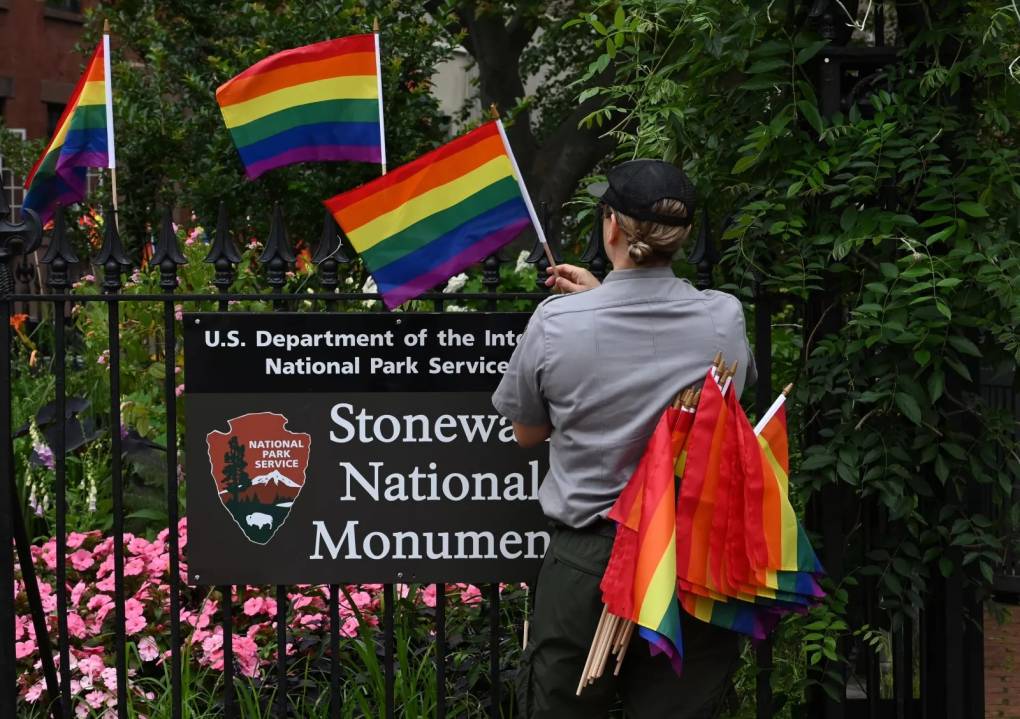
"content": "\u003cp>The National Park Service website exploring the history and significance of the Stonewall Uprising has been stripped of any mention of transgender people.\u003c/p>\n\u003cp>The page was also updated to remove the “T” from the previously used acronym “LGBTQ+” — now, referring to the community as either “LGB” or “LGBQ.” References to the word “queer” have also been removed.\u003c/p>\n\u003cp>When describing the Stonewall Uprising, \u003ca href=\"https://www.nps.gov/ston/learn/education/new-index.htm\" target=\"_blank\" rel=\"noopener\">the website now reads:\u003c/a> “Before the 1960s, almost everything about living openly as a lesbian, gay, bisexual (LGB) person was illegal, but the events at the Stonewall Inn sparked fresh momentum for the LGB civil rights movement!”\u003c/p>\n\u003cp>[ad fullwidth]\u003c/p>\n\u003cp>It’s not immediately clear who called for the change. But it’s seen as the latest pushback on the transgender community by the federal government since President Trump took office. Over the past month, the Trump administration has issued executive orders to \u003ca href=\"https://www.whitehouse.gov/presidential-actions/2025/01/defending-women-from-gender-ideology-extremism-and-restoring-biological-truth-to-the-federal-government/\" target=\"_blank\" rel=\"noopener\">eliminate the idea of a “gender identity”\u003c/a> separate from sex and to \u003ca href=\"https://www.npr.org/2025/02/05/nx-s1-5282137/trump-transgender-sports-executive-order\" target=\"_blank\" rel=\"noopener\">ban transgender athletes\u003c/a> from participating in women’s sports.\u003c/p>\n\u003cp>“This decision to erase the word ‘transgender’ is a deliberate attempt to erase our history and marginalize the very people who paved the way for many victories we have achieved as a community,” the Stonewall Inn and the Stonewall Inn Gives Back Initiative said in a joint statement.[aside label=\"Related Stories\" postID=\"news_11989910,news_11964027,arts_13960471\"]Timothy Leonard, the Northeast program manager for the National Parks Conservation Association, a group that advocates for the National Park System and pushed for the Stonewall monument, \u003ca href=\"https://www.npca.org/articles/6779-parks-group-responds-to-removal-of-transgender-contributions-at-stonewall\" target=\"_blank\" rel=\"noopener\">said\u003c/a>, “Erasing letters or webpages does not change the history or the contributions of our transgender community members at Stonewall or anywhere else. History was made here and civil rights were earned because of Stonewall.”\u003c/p>\n\u003cp>The National Park Service did not respond to NPR’s request for comment.\u003c/p>\n\u003cp>In 1969, a gay bar in New York City called the Stonewall Inn was \u003ca href=\"https://www.npr.org/2019/06/06/730444495/nypd-commissioner-apologizes-for-oppressive-1969-raid-on-stonewall-inn\">raided by police\u003c/a>, igniting fierce riots and protests that lasted through the night and into the following days. This came after years of raids, beatings and arrests endured by LGBTQ individuals.\u003c/p>\n\u003cp>While the Stonewall Uprising was not the first push for LGBTQ equality in the United States, it is regarded as a turning point in sparking a nationwide movement for the equal treatment of gay, lesbian, bisexual and transgender Americans.\u003c/p>\n\u003cp>Among those who played a central role in the struggle were transgender activists, including \u003ca href=\"https://www.npr.org/2020/02/03/802392326/new-york-state-to-rename-brooklyn-park-after-trans-activist-marsha-p-johnson\">Marsha P. Johnson\u003c/a> and \u003ca href=\"https://www.npr.org/2016/04/08/473525644/sylvia-rivera-a-forgotten-hero-of-the-stonewall-riots\">Sylvia Rivera\u003c/a>.\u003c/p>\n\u003cfigure id=\"attachment_12027275\" class=\"wp-caption aligncenter\" style=\"max-width: 1600px\">\u003cimg loading=\"lazy\" decoding=\"async\" class=\"size-full wp-image-12027275\" src=\"https://cdn.kqed.org/wp-content/uploads/sites/10/2025/02/npr.brightspotcdn-1-copy.jpg\" alt=\"\" width=\"1600\" height=\"1091\" srcset=\"https://cdn.kqed.org/wp-content/uploads/sites/10/2025/02/npr.brightspotcdn-1-copy.jpg 1600w, https://cdn.kqed.org/wp-content/uploads/sites/10/2025/02/npr.brightspotcdn-1-copy-800x546.jpg 800w, https://cdn.kqed.org/wp-content/uploads/sites/10/2025/02/npr.brightspotcdn-1-copy-1020x696.jpg 1020w, https://cdn.kqed.org/wp-content/uploads/sites/10/2025/02/npr.brightspotcdn-1-copy-160x109.jpg 160w, https://cdn.kqed.org/wp-content/uploads/sites/10/2025/02/npr.brightspotcdn-1-copy-1536x1047.jpg 1536w\" sizes=\"auto, (max-width: 1600px) 100vw, 1600px\">\u003cfigcaption class=\"wp-caption-text\">American gay liberation activist Marsha P. Johnson (center left), along with unidentified others, on the corner of Christopher Street and 7th Avenue during the Pride March in New York City on June 27, 1982. \u003ccite>(Barbara Alper/Getty Images)\u003c/cite>\u003c/figcaption>\u003c/figure>\n\u003cfigure id=\"attachment_12027276\" class=\"wp-caption aligncenter\" style=\"max-width: 1600px\">\u003cimg loading=\"lazy\" decoding=\"async\" class=\"size-full wp-image-12027276\" src=\"https://cdn.kqed.org/wp-content/uploads/sites/10/2025/02/npr.brightspotcdn-copy-6.jpg\" alt=\"\" width=\"1600\" height=\"1068\" srcset=\"https://cdn.kqed.org/wp-content/uploads/sites/10/2025/02/npr.brightspotcdn-copy-6.jpg 1600w, https://cdn.kqed.org/wp-content/uploads/sites/10/2025/02/npr.brightspotcdn-copy-6-800x534.jpg 800w, https://cdn.kqed.org/wp-content/uploads/sites/10/2025/02/npr.brightspotcdn-copy-6-1020x681.jpg 1020w, https://cdn.kqed.org/wp-content/uploads/sites/10/2025/02/npr.brightspotcdn-copy-6-160x107.jpg 160w, https://cdn.kqed.org/wp-content/uploads/sites/10/2025/02/npr.brightspotcdn-copy-6-1536x1025.jpg 1536w\" sizes=\"auto, (max-width: 1600px) 100vw, 1600px\">\u003cfigcaption class=\"wp-caption-text\">American transgender rights activist Sylvia Rivera speaks during a rally in City Hall Park, in New York City, on May 4, 2001. \u003ccite>(Mariette Pathy Allen/Getty Images)\u003c/cite>\u003c/figcaption>\u003c/figure>\n\u003cp>Both Johnson and Rivera were present on the first night of the riots. Rivera has been credited to have thrown the second Molotov cocktail.\u003c/p>\n\u003cp>In the years following Stonewall, Johnson and Rivera founded a group to help homeless trans youth in New York City called \u003ca href=\"https://www.nyhistory.org/blogs/gay-power-is-trans-history-street-transvestite-action-revolutionaries\">Street Transvestite Action Revolutionaries\u003c/a>, or STAR. Rivera also fought to \u003ca href=\"https://www.womenshistory.org/education-resources/biographies/sylvia-rivera\">ensure transgender people were included\u003c/a> in the victories achieved by the gay-rights movement, like the Sexual Orientation Non-Discrimination Act in New York.\u003c/p>\n\u003cp>It was less than a decade ago, in 2016, when the Stonewall Inn was \u003ca href=\"https://www.npr.org/2016/06/24/483385747/obama-names-lgbt-landmark-as-national-monument\">designated a national monument by President Barack Obama\u003c/a> — becoming the first U.S. landmark dedicated to LGBTQ rights and history.\u003c/p>\n\u003cp>A protest organized by the Stonewall Inn staff and local LGBTQ groups is scheduled at the Stonewall National Monument on Friday afternoon.\u003c/p>\n\u003cp>\u003c/p>\n",
"blocks": [],
"excerpt": "Any mention of transgender people has been removed from the National Park Service website dedicated to the Stonewall Uprising. The 'T' in 'LGBTQ+' has also been removed, as have references to the word 'queer.'\r\n\r\n",
"status": "publish",
"parent": 0,
"modified": 1739580583,
"stats": {
"hasAudio": false,
"hasVideo": false,
"hasChartOrMap": false,
"iframeSrcs": [],
"hasGoogleForm": false,
"hasGallery": false,
"hasHearkenModule": false,
"hasPolis": false,
"paragraphCount": 15,
"wordCount": 642
},
"headData": {
"title": "Park Service Erases 'Transgender' on Stonewall Website, Uses the Term 'LGB' Movement | KQED",
"description": "Any mention of transgender people has been removed from the National Park Service website dedicated to the Stonewall Uprising. The 'T' in 'LGBTQ+' has also been removed, as have references to the word 'queer.'\r\n\r\n",
"ogTitle": "",
"ogDescription": "",
"ogImgId": "",
"twTitle": "",
"twDescription": "",
"twImgId": "",
"schema": {
"@context": "https://schema.org",
"@type": "NewsArticle",
"headline": "Park Service Erases 'Transgender' on Stonewall Website, Uses the Term 'LGB' Movement",
"datePublished": "2025-02-15T08:00:50-08:00",
"dateModified": "2025-02-14T16:49:43-08:00",
"image": "https://cdn.kqed.org/wp-content/uploads/2020/02/KQED-OG-Image@1x.png",
"isAccessibleForFree": "True",
"publisher": {
"@type": "NewsMediaOrganization",
"@id": "https://www.kqed.org/#organization",
"name": "KQED",
"logo": "https://cdn.kqed.org/wp-content/uploads/2020/02/KQED-OG-Image@1x.png",
"url": "https://www.kqed.org",
"sameAs": [
"https://www.facebook.com/KQED",
"https://twitter.com/KQED",
"https://www.instagram.com/kqed/",
"https://www.tiktok.com/@kqedofficial",
"https://www.linkedin.com/company/kqed",
"https://www.youtube.com/channel/UCeC0IOo7i1P_61zVUWbJ4nw"
]
}
}
},
"sticky": false,
"nprByline": "\u003ca href=\"https://www.npr.org/people/1108419098/juliana-kim\">Juliana Kim\u003c/a>, NPR",
"excludeFromSiteSearch": "Include",
"showOnAuthorArchivePages": "No",
"articleAge": "0",
"path": "/news/12027272/park-service-erases-transgender-on-stonewall-website-uses-the-term-lgb-movement",
"audioTrackLength": null,
"parsedContent": [
{
"type": "contentString",
"content": "\u003cdiv class=\"post-body\">\u003cp>\u003cp>The National Park Service website exploring the history and significance of the Stonewall Uprising has been stripped of any mention of transgender people.\u003c/p>\n\u003cp>The page was also updated to remove the “T” from the previously used acronym “LGBTQ+” — now, referring to the community as either “LGB” or “LGBQ.” References to the word “queer” have also been removed.\u003c/p>\n\u003cp>When describing the Stonewall Uprising, \u003ca href=\"https://www.nps.gov/ston/learn/education/new-index.htm\" target=\"_blank\" rel=\"noopener\">the website now reads:\u003c/a> “Before the 1960s, almost everything about living openly as a lesbian, gay, bisexual (LGB) person was illegal, but the events at the Stonewall Inn sparked fresh momentum for the LGB civil rights movement!”\u003c/p>\n\u003cp>\u003c/p>\u003c/div>",
"attributes": {
"named": {},
"numeric": []
}
},
{
"type": "component",
"content": "",
"name": "ad",
"attributes": {
"named": {
"label": "fullwidth"
},
"numeric": [
"fullwidth"
]
}
},
{
"type": "contentString",
"content": "\u003cdiv class=\"post-body\">\u003cp>\u003c/p>\n\u003cp>It’s not immediately clear who called for the change. But it’s seen as the latest pushback on the transgender community by the federal government since President Trump took office. Over the past month, the Trump administration has issued executive orders to \u003ca href=\"https://www.whitehouse.gov/presidential-actions/2025/01/defending-women-from-gender-ideology-extremism-and-restoring-biological-truth-to-the-federal-government/\" target=\"_blank\" rel=\"noopener\">eliminate the idea of a “gender identity”\u003c/a> separate from sex and to \u003ca href=\"https://www.npr.org/2025/02/05/nx-s1-5282137/trump-transgender-sports-executive-order\" target=\"_blank\" rel=\"noopener\">ban transgender athletes\u003c/a> from participating in women’s sports.\u003c/p>\n\u003cp>“This decision to erase the word ‘transgender’ is a deliberate attempt to erase our history and marginalize the very people who paved the way for many victories we have achieved as a community,” the Stonewall Inn and the Stonewall Inn Gives Back Initiative said in a joint statement.\u003c/p>\u003c/div>",
"attributes": {
"named": {},
"numeric": []
}
},
{
"type": "component",
"content": "",
"name": "aside",
"attributes": {
"named": {
"label": "Related Stories ",
"postid": "news_11989910,news_11964027,arts_13960471"
},
"numeric": []
}
},
{
"type": "contentString",
"content": "\u003cdiv class=\"post-body\">\u003cp>Timothy Leonard, the Northeast program manager for the National Parks Conservation Association, a group that advocates for the National Park System and pushed for the Stonewall monument, \u003ca href=\"https://www.npca.org/articles/6779-parks-group-responds-to-removal-of-transgender-contributions-at-stonewall\" target=\"_blank\" rel=\"noopener\">said\u003c/a>, “Erasing letters or webpages does not change the history or the contributions of our transgender community members at Stonewall or anywhere else. History was made here and civil rights were earned because of Stonewall.”\u003c/p>\n\u003cp>The National Park Service did not respond to NPR’s request for comment.\u003c/p>\n\u003cp>In 1969, a gay bar in New York City called the Stonewall Inn was \u003ca href=\"https://www.npr.org/2019/06/06/730444495/nypd-commissioner-apologizes-for-oppressive-1969-raid-on-stonewall-inn\">raided by police\u003c/a>, igniting fierce riots and protests that lasted through the night and into the following days. This came after years of raids, beatings and arrests endured by LGBTQ individuals.\u003c/p>\n\u003cp>While the Stonewall Uprising was not the first push for LGBTQ equality in the United States, it is regarded as a turning point in sparking a nationwide movement for the equal treatment of gay, lesbian, bisexual and transgender Americans.\u003c/p>\n\u003cp>Among those who played a central role in the struggle were transgender activists, including \u003ca href=\"https://www.npr.org/2020/02/03/802392326/new-york-state-to-rename-brooklyn-park-after-trans-activist-marsha-p-johnson\">Marsha P. Johnson\u003c/a> and \u003ca href=\"https://www.npr.org/2016/04/08/473525644/sylvia-rivera-a-forgotten-hero-of-the-stonewall-riots\">Sylvia Rivera\u003c/a>.\u003c/p>\n\u003cfigure id=\"attachment_12027275\" class=\"wp-caption aligncenter\" style=\"max-width: 1600px\">\u003cimg loading=\"lazy\" decoding=\"async\" class=\"size-full wp-image-12027275\" src=\"https://cdn.kqed.org/wp-content/uploads/sites/10/2025/02/npr.brightspotcdn-1-copy.jpg\" alt=\"\" width=\"1600\" height=\"1091\" srcset=\"https://cdn.kqed.org/wp-content/uploads/sites/10/2025/02/npr.brightspotcdn-1-copy.jpg 1600w, https://cdn.kqed.org/wp-content/uploads/sites/10/2025/02/npr.brightspotcdn-1-copy-800x546.jpg 800w, https://cdn.kqed.org/wp-content/uploads/sites/10/2025/02/npr.brightspotcdn-1-copy-1020x696.jpg 1020w, https://cdn.kqed.org/wp-content/uploads/sites/10/2025/02/npr.brightspotcdn-1-copy-160x109.jpg 160w, https://cdn.kqed.org/wp-content/uploads/sites/10/2025/02/npr.brightspotcdn-1-copy-1536x1047.jpg 1536w\" sizes=\"auto, (max-width: 1600px) 100vw, 1600px\">\u003cfigcaption class=\"wp-caption-text\">American gay liberation activist Marsha P. Johnson (center left), along with unidentified others, on the corner of Christopher Street and 7th Avenue during the Pride March in New York City on June 27, 1982. \u003ccite>(Barbara Alper/Getty Images)\u003c/cite>\u003c/figcaption>\u003c/figure>\n\u003cfigure id=\"attachment_12027276\" class=\"wp-caption aligncenter\" style=\"max-width: 1600px\">\u003cimg loading=\"lazy\" decoding=\"async\" class=\"size-full wp-image-12027276\" src=\"https://cdn.kqed.org/wp-content/uploads/sites/10/2025/02/npr.brightspotcdn-copy-6.jpg\" alt=\"\" width=\"1600\" height=\"1068\" srcset=\"https://cdn.kqed.org/wp-content/uploads/sites/10/2025/02/npr.brightspotcdn-copy-6.jpg 1600w, https://cdn.kqed.org/wp-content/uploads/sites/10/2025/02/npr.brightspotcdn-copy-6-800x534.jpg 800w, https://cdn.kqed.org/wp-content/uploads/sites/10/2025/02/npr.brightspotcdn-copy-6-1020x681.jpg 1020w, https://cdn.kqed.org/wp-content/uploads/sites/10/2025/02/npr.brightspotcdn-copy-6-160x107.jpg 160w, https://cdn.kqed.org/wp-content/uploads/sites/10/2025/02/npr.brightspotcdn-copy-6-1536x1025.jpg 1536w\" sizes=\"auto, (max-width: 1600px) 100vw, 1600px\">\u003cfigcaption class=\"wp-caption-text\">American transgender rights activist Sylvia Rivera speaks during a rally in City Hall Park, in New York City, on May 4, 2001. \u003ccite>(Mariette Pathy Allen/Getty Images)\u003c/cite>\u003c/figcaption>\u003c/figure>\n\u003cp>Both Johnson and Rivera were present on the first night of the riots. Rivera has been credited to have thrown the second Molotov cocktail.\u003c/p>\n\u003cp>In the years following Stonewall, Johnson and Rivera founded a group to help homeless trans youth in New York City called \u003ca href=\"https://www.nyhistory.org/blogs/gay-power-is-trans-history-street-transvestite-action-revolutionaries\">Street Transvestite Action Revolutionaries\u003c/a>, or STAR. Rivera also fought to \u003ca href=\"https://www.womenshistory.org/education-resources/biographies/sylvia-rivera\">ensure transgender people were included\u003c/a> in the victories achieved by the gay-rights movement, like the Sexual Orientation Non-Discrimination Act in New York.\u003c/p>\n\u003cp>It was less than a decade ago, in 2016, when the Stonewall Inn was \u003ca href=\"https://www.npr.org/2016/06/24/483385747/obama-names-lgbt-landmark-as-national-monument\">designated a national monument by President Barack Obama\u003c/a> — becoming the first U.S. landmark dedicated to LGBTQ rights and history.\u003c/p>\n\u003cp>A protest organized by the Stonewall Inn staff and local LGBTQ groups is scheduled at the Stonewall National Monument on Friday afternoon.\u003c/p>\n\u003cp>\u003c/p>\n\u003c/div>\u003c/p>",
"attributes": {
"named": {},
"numeric": []
}
}
],
"link": "/news/12027272/park-service-erases-transgender-on-stonewall-website-uses-the-term-lgb-movement",
"authors": [
"byline_news_12027272"
],
"categories": [
"news_8",
"news_13"
],
"tags": [
"news_4750",
"news_1323",
"news_4691",
"news_20004",
"news_20003",
"news_19345",
"news_17898",
"news_2715",
"news_2486"
],
"affiliates": [
"news_253"
],
"featImg": "news_12027273",
"label": "news_253"
},
"news_12020619": {
"type": "posts",
"id": "news_12020619",
"meta": {
"index": "posts_1716263798",
"site": "news",
"id": "12020619",
"score": null,
"sort": [
1738350041000
]
},
"guestAuthors": [],
"slug": "meet-sally-gearhart-the-most-famous-lgbtq-activist-youve-never-heard-of",
"title": "Meet Sally Gearhart, the Most Famous Bay Area LGBTQ Activist You've Never Heard Of",
"publishDate": 1738350041,
"format": "standard",
"headTitle": "Meet Sally Gearhart, the Most Famous Bay Area LGBTQ Activist You’ve Never Heard Of | KQED",
"labelTerm": {
"term": 26731,
"site": "news"
},
"content": "\u003cp>Sally Gearhart is one of the most important figures in LGBTQ history that you’ve probably never heard of. She was a radical lesbian feminist whose fight for equality and change sparked movements that still continue today.\u003c/p>\n\u003cp>But unlike her friend and contemporary, Harvey Milk, there are no airport terminals or schools named after Sally. Instead, she has largely been erased from history.\u003c/p>\n\u003cfigure id=\"attachment_12020640\" class=\"wp-caption alignnone\" style=\"max-width: 2560px\">\u003cimg loading=\"lazy\" decoding=\"async\" class=\"wp-image-12020640 size-full\" src=\"https://cdn.kqed.org/wp-content/uploads/sites/10/2025/01/Sally-Gearhart-and-Sally-Director-Deborah-Craig-courtesy-of-Deborah-Craig-scaled.jpg\" alt=\"\" width=\"2560\" height=\"1920\" srcset=\"https://cdn.kqed.org/wp-content/uploads/sites/10/2025/01/Sally-Gearhart-and-Sally-Director-Deborah-Craig-courtesy-of-Deborah-Craig-scaled.jpg 2560w, https://cdn.kqed.org/wp-content/uploads/sites/10/2025/01/Sally-Gearhart-and-Sally-Director-Deborah-Craig-courtesy-of-Deborah-Craig-800x600.jpg 800w, https://cdn.kqed.org/wp-content/uploads/sites/10/2025/01/Sally-Gearhart-and-Sally-Director-Deborah-Craig-courtesy-of-Deborah-Craig-1020x765.jpg 1020w, https://cdn.kqed.org/wp-content/uploads/sites/10/2025/01/Sally-Gearhart-and-Sally-Director-Deborah-Craig-courtesy-of-Deborah-Craig-160x120.jpg 160w, https://cdn.kqed.org/wp-content/uploads/sites/10/2025/01/Sally-Gearhart-and-Sally-Director-Deborah-Craig-courtesy-of-Deborah-Craig-1536x1152.jpg 1536w, https://cdn.kqed.org/wp-content/uploads/sites/10/2025/01/Sally-Gearhart-and-Sally-Director-Deborah-Craig-courtesy-of-Deborah-Craig-2048x1536.jpg 2048w, https://cdn.kqed.org/wp-content/uploads/sites/10/2025/01/Sally-Gearhart-and-Sally-Director-Deborah-Craig-courtesy-of-Deborah-Craig-1920x1440.jpg 1920w\" sizes=\"auto, (max-width: 2560px) 100vw, 2560px\">\u003cfigcaption class=\"wp-caption-text\">Sally Gearhart and ‘Sally!’ director Deborah Craig. \u003ccite>(Courtesy of Deborah Craig)\u003c/cite>\u003c/figcaption>\u003c/figure>\n\u003cp>Deborah Craig wanted to change that. Craig is a filmmaker and professor at San Francisco State University. Her latest film, \u003cem>Sally!\u003c/em>, is all about the life and work of Sally Gearhart. The documentary debuted in San Francisco this summer and since then has won four audience awards, one jury award, and one best director award. Craig spoke about the film in an interview with The California Report Magazine’s Bianca Taylor.\u003c/p>\n\u003cfigure id=\"attachment_12020641\" class=\"wp-caption alignright\" style=\"max-width: 600px\">\u003cimg loading=\"lazy\" decoding=\"async\" class=\"wp-image-12020641 size-full\" src=\"https://cdn.kqed.org/wp-content/uploads/sites/10/2025/01/Sally-Miller-Gearhart-Peter-Adair-Papers-James-C.-Hormel-LGBTQIA-Center-San-Francisco-Public-Library-e1736286917204.jpg\" alt=\"\" width=\"600\" height=\"431\" srcset=\"https://cdn.kqed.org/wp-content/uploads/sites/10/2025/01/Sally-Miller-Gearhart-Peter-Adair-Papers-James-C.-Hormel-LGBTQIA-Center-San-Francisco-Public-Library-e1736286917204.jpg 600w, https://cdn.kqed.org/wp-content/uploads/sites/10/2025/01/Sally-Miller-Gearhart-Peter-Adair-Papers-James-C.-Hormel-LGBTQIA-Center-San-Francisco-Public-Library-e1736286917204-160x115.jpg 160w\" sizes=\"auto, (max-width: 600px) 100vw, 600px\">\u003cfigcaption class=\"wp-caption-text\">Sally Miller Gearhart. \u003ccite>(Peter Adair Papers, James C. Hormel LGBTQIA Center, San Francisco Public Library)\u003c/cite>\u003c/figcaption>\u003c/figure>\n\u003cp>\u003cem>Below are excerpts from their conversation. For the full interview on The California Report Magazine, listen to the audio at the top of this story.\u003c/em>\u003c/p>\n\u003cp>\u003cstrong>Bianca Taylor: Who was Sally Gearhart? \u003c/strong>\u003c/p>\n\u003cp>\u003cstrong>Deborah Craig: \u003c/strong>To sum it up, Sally is complicated. Sally was this lesbian separatist [who] always had men in her life. She studied theater. She studied communication. She was a brilliant debater. She taught women’s studies and co-founded one of the first-ever women’s studies departments. She wrote fantasy novels. She moved full-time up to this women’s land community that she had co-created. She is extremely hard to pin down. The best way to say it is she’s really an amazing Renaissance woman who was always interested in everything and curious about everything and had very strong and radical opinions but also kept an open mind and was willing to change her mind.\u003c/p>\n\u003cfigure id=\"attachment_12020642\" class=\"wp-caption alignnone\" style=\"max-width: 2392px\">\u003cimg loading=\"lazy\" decoding=\"async\" class=\"wp-image-12020642 size-full\" src=\"https://cdn.kqed.org/wp-content/uploads/sites/10/2025/01/Harvey-Milk-and-Sally-Gearhart-Courtesy-of-Deborah-Craig.png\" alt=\"\" width=\"2392\" height=\"1890\" srcset=\"https://cdn.kqed.org/wp-content/uploads/sites/10/2025/01/Harvey-Milk-and-Sally-Gearhart-Courtesy-of-Deborah-Craig.png 2392w, https://cdn.kqed.org/wp-content/uploads/sites/10/2025/01/Harvey-Milk-and-Sally-Gearhart-Courtesy-of-Deborah-Craig-800x632.png 800w, https://cdn.kqed.org/wp-content/uploads/sites/10/2025/01/Harvey-Milk-and-Sally-Gearhart-Courtesy-of-Deborah-Craig-1020x806.png 1020w, https://cdn.kqed.org/wp-content/uploads/sites/10/2025/01/Harvey-Milk-and-Sally-Gearhart-Courtesy-of-Deborah-Craig-160x126.png 160w, https://cdn.kqed.org/wp-content/uploads/sites/10/2025/01/Harvey-Milk-and-Sally-Gearhart-Courtesy-of-Deborah-Craig-1536x1214.png 1536w, https://cdn.kqed.org/wp-content/uploads/sites/10/2025/01/Harvey-Milk-and-Sally-Gearhart-Courtesy-of-Deborah-Craig-2048x1618.png 2048w, https://cdn.kqed.org/wp-content/uploads/sites/10/2025/01/Harvey-Milk-and-Sally-Gearhart-Courtesy-of-Deborah-Craig-1920x1517.png 1920w\" sizes=\"auto, (max-width: 2392px) 100vw, 2392px\">\u003cfigcaption class=\"wp-caption-text\">Harvey Milk and Sally Gearhart. \u003ccite>(Courtesy of Deborah Craig)\u003c/cite>\u003c/figcaption>\u003c/figure>\n\u003cp>\u003cstrong>Why make this film now? \u003c/strong>\u003c/p>\n\u003cp>I felt a sense of urgency because, by the time I met Sally, she was either 83 or 84. She was living alone. She had health issues, she had memory decline. And it felt like if we want to do this story, we need to do it now. But the other thing we felt [was] that [her] story is relevant now because we’re fighting those same battles. And it’s even more relevant after the election. There’s so much pushback in this country against women’s rights, against gay rights, against trans rights, etc. So this is not just a story about what happened in the past, and acknowledging the part that Sally played back then. It’s a story about how to fight for social justice. And Sally, as imperfect as she is, is such a beautiful role model of how to do that. And in fact, her imperfection makes her a role model in my mind, because there are no perfect heroes.\u003c/p>\n\u003cfigure id=\"attachment_12020647\" class=\"wp-caption alignnone\" style=\"max-width: 1088px\">\u003cimg loading=\"lazy\" decoding=\"async\" class=\"wp-image-12020647 size-full\" src=\"https://cdn.kqed.org/wp-content/uploads/sites/10/2025/01/Harvey-Milk-and-Sally-Gearhart-Photo-Credit_-Steve-Savage.jpg\" alt=\"\" width=\"1088\" height=\"865\" srcset=\"https://cdn.kqed.org/wp-content/uploads/sites/10/2025/01/Harvey-Milk-and-Sally-Gearhart-Photo-Credit_-Steve-Savage.jpg 1088w, https://cdn.kqed.org/wp-content/uploads/sites/10/2025/01/Harvey-Milk-and-Sally-Gearhart-Photo-Credit_-Steve-Savage-800x636.jpg 800w, https://cdn.kqed.org/wp-content/uploads/sites/10/2025/01/Harvey-Milk-and-Sally-Gearhart-Photo-Credit_-Steve-Savage-1020x811.jpg 1020w, https://cdn.kqed.org/wp-content/uploads/sites/10/2025/01/Harvey-Milk-and-Sally-Gearhart-Photo-Credit_-Steve-Savage-160x127.jpg 160w\" sizes=\"auto, (max-width: 1088px) 100vw, 1088px\">\u003cfigcaption class=\"wp-caption-text\">Harvey Milk and Sally Gearhart. \u003ccite>(Courtesy of Steve Savage)\u003c/cite>\u003c/figcaption>\u003c/figure>\n\u003cp>\u003cstrong>Sally Gearhart was instrumental in working with Harvey Milk to defeat Proposition 6, which would have banned gay people from working in public schools. But in the feature film, \u003cem>MILK\u003c/em>, Sally is completely left out. What happened? \u003c/strong>\u003c/p>\n\u003cp>There are a lot of people who are incredibly angry that Sally was left out of the film. And I talked to a lot of them. And Sally, I think, was very hurt that she was left out of the film. What helps me understand it is this: The Milk film was made in 2008. Sally left San Francisco in 1991, and she was up in her little cabin in Willits. So, she was erased, \u003cem>and \u003c/em>she removed herself from the spotlight. … I think both of those things are true.\u003c/p>\n\u003cfigure id=\"attachment_12020733\" class=\"wp-caption aligncenter\" style=\"max-width: 2500px\">\u003cimg loading=\"lazy\" decoding=\"async\" class=\"size-full wp-image-12020733\" src=\"https://cdn.kqed.org/wp-content/uploads/sites/10/2025/01/Copy-of-KQED-side-by-side-downpage-image.jpg\" alt=\"A double image, on the left is a woman speaking into a microphone with the words 'No on 6' written behind her on a stage. On the right, the same woman but older is sitting and smoking a pipe by a window with trees outside, both photos are black and white.\" width=\"2500\" height=\"833\" srcset=\"https://cdn.kqed.org/wp-content/uploads/sites/10/2025/01/Copy-of-KQED-side-by-side-downpage-image.jpg 2500w, https://cdn.kqed.org/wp-content/uploads/sites/10/2025/01/Copy-of-KQED-side-by-side-downpage-image-800x267.jpg 800w, https://cdn.kqed.org/wp-content/uploads/sites/10/2025/01/Copy-of-KQED-side-by-side-downpage-image-1020x340.jpg 1020w, https://cdn.kqed.org/wp-content/uploads/sites/10/2025/01/Copy-of-KQED-side-by-side-downpage-image-160x53.jpg 160w, https://cdn.kqed.org/wp-content/uploads/sites/10/2025/01/Copy-of-KQED-side-by-side-downpage-image-1536x512.jpg 1536w, https://cdn.kqed.org/wp-content/uploads/sites/10/2025/01/Copy-of-KQED-side-by-side-downpage-image-2048x682.jpg 2048w, https://cdn.kqed.org/wp-content/uploads/sites/10/2025/01/Copy-of-KQED-side-by-side-downpage-image-1920x640.jpg 1920w\" sizes=\"auto, (max-width: 2500px) 100vw, 2500px\">\u003cfigcaption class=\"wp-caption-text\">Left: Sally Gearhart at a ‘No on 6’ rally. Right: A photograph of Sally Gearhart in Willits, Mendocino County. \u003ccite>(Left photo: Steve Savage. Right photo: Robert Giard Photographs Collection, James C. Hormel LGBTQIA Center, San Francisco Public Library)\u003c/cite>\u003c/figcaption>\u003c/figure>\n\u003cp>\u003cstrong>Sally did — and said — controversial things that were included in the film. Was there a worry this would put people off of Sally, especially men?\u003c/strong>\u003c/p>\n\u003cp>I don’t think you make a film about Sally Gearhart and worry about offending somebody. So I just really made a practice of listening to people when they got offended and tried to learn from it. But you know what? I never heard anybody get their feathers ruffled about that one, interestingly enough. And more often, I found myself in scenes like doing the sound mix in the booth with two straight men who were laughing their asses off at Sally because she’s so funny and she’s so charming. And that made me so happy because it made me feel like she’s reaching … a lot of people because she’s so smart and charming and funny. And I think that was her superpower: her humor and her charm and being self-deprecating and funny. She could say something really outrageous and then say it with a smile and a twinkle in her eye.\u003c/p>\n\u003cfigure id=\"attachment_12020655\" class=\"wp-caption alignnone\" style=\"max-width: 2560px\">\u003cimg loading=\"lazy\" decoding=\"async\" class=\"wp-image-12020655 size-full\" src=\"https://cdn.kqed.org/wp-content/uploads/sites/10/2025/01/Sally-Gearhart-with-activist-Cleve-Jones-Photo-Credit_-Daniel-Nicoletta-scaled.jpg\" alt=\"\" width=\"2560\" height=\"2012\" srcset=\"https://cdn.kqed.org/wp-content/uploads/sites/10/2025/01/Sally-Gearhart-with-activist-Cleve-Jones-Photo-Credit_-Daniel-Nicoletta-scaled.jpg 2560w, https://cdn.kqed.org/wp-content/uploads/sites/10/2025/01/Sally-Gearhart-with-activist-Cleve-Jones-Photo-Credit_-Daniel-Nicoletta-800x629.jpg 800w, https://cdn.kqed.org/wp-content/uploads/sites/10/2025/01/Sally-Gearhart-with-activist-Cleve-Jones-Photo-Credit_-Daniel-Nicoletta-1020x802.jpg 1020w, https://cdn.kqed.org/wp-content/uploads/sites/10/2025/01/Sally-Gearhart-with-activist-Cleve-Jones-Photo-Credit_-Daniel-Nicoletta-160x126.jpg 160w, https://cdn.kqed.org/wp-content/uploads/sites/10/2025/01/Sally-Gearhart-with-activist-Cleve-Jones-Photo-Credit_-Daniel-Nicoletta-1536x1207.jpg 1536w, https://cdn.kqed.org/wp-content/uploads/sites/10/2025/01/Sally-Gearhart-with-activist-Cleve-Jones-Photo-Credit_-Daniel-Nicoletta-2048x1609.jpg 2048w, https://cdn.kqed.org/wp-content/uploads/sites/10/2025/01/Sally-Gearhart-with-activist-Cleve-Jones-Photo-Credit_-Daniel-Nicoletta-1920x1509.jpg 1920w\" sizes=\"auto, (max-width: 2560px) 100vw, 2560px\">\u003cfigcaption class=\"wp-caption-text\">Sally Gearhart and Cleve Jones at Harvey Milk’s Birthday Street party — just one night after the White Night Riots — on May 22, 1979. \u003ccite>(Daniel Nicoletta)\u003c/cite>\u003c/figcaption>\u003c/figure>\n\u003cp>\u003cstrong>What would Sally think of the current moment we’re living in?\u003c/strong>\u003c/p>\n\u003cp>It’s sort of like deja vu all over again. There are so many battles that were fought that we need to re-fight. And Sally, I guess depending on whether we channeled Sally in her 40s or 50s or 60s or 80s, would be either ready to step up on the podium and speak up or would want other people to step up and take the baton. I really hope that this film makes young people motivated to step up and get involved, and fight the kind of fights that we’re going to need to fight. And realize that fighting for social justice can be not just a slog but an adventure. It can be fun and exciting, and [we] can approach it with a spirit of kind of can-do-ness and curiosity. And so I hope that people can channel that sort of Sally vibe and spirit to help us move forward.\u003c/p>\n\u003cp>[ad fullwidth]\u003c/p>\n\u003cp>[ad floatright]\u003c/p>\n",
"blocks": [],
"excerpt": "Sally Gearhart was an influential activist who shaped LGBTQ history and the women’s movement in the Bay Area. So why don’t more people know about her? ",
"status": "publish",
"parent": 0,
"modified": 1738369040,
"stats": {
"hasAudio": false,
"hasVideo": false,
"hasChartOrMap": false,
"iframeSrcs": [],
"hasGoogleForm": false,
"hasGallery": false,
"hasHearkenModule": false,
"hasPolis": false,
"paragraphCount": 16,
"wordCount": 1078
},
"headData": {
"title": "Meet Sally Gearhart, the Most Famous Bay Area LGBTQ Activist You've Never Heard Of | KQED",
"description": "Sally Gearhart was an influential activist who shaped LGBTQ history and the women’s movement in the Bay Area. So why don’t more people know about her? ",
"ogTitle": "",
"ogDescription": "",
"ogImgId": "",
"twTitle": "",
"twDescription": "",
"twImgId": "",
"schema": {
"@context": "https://schema.org",
"@type": "NewsArticle",
"headline": "Meet Sally Gearhart, the Most Famous Bay Area LGBTQ Activist You've Never Heard Of",
"datePublished": "2025-01-31T11:00:41-08:00",
"dateModified": "2025-01-31T16:17:20-08:00",
"image": "https://cdn.kqed.org/wp-content/uploads/2020/02/KQED-OG-Image@1x.png",
"isAccessibleForFree": "True",
"publisher": {
"@type": "NewsMediaOrganization",
"@id": "https://www.kqed.org/#organization",
"name": "KQED",
"logo": "https://cdn.kqed.org/wp-content/uploads/2020/02/KQED-OG-Image@1x.png",
"url": "https://www.kqed.org",
"sameAs": [
"https://www.facebook.com/KQED",
"https://twitter.com/KQED",
"https://www.instagram.com/kqed/",
"https://www.tiktok.com/@kqedofficial",
"https://www.linkedin.com/company/kqed",
"https://www.youtube.com/channel/UCeC0IOo7i1P_61zVUWbJ4nw"
]
}
}
},
"audioUrl": "https://traffic.omny.fm/d/clips/0af137ef-751e-4b19-a055-aaef00d2d578/ffca7e9f-6831-41c5-bcaf-aaef00f5a073/60dedfd4-c3ec-4f33-90bd-b273016e77b3/audio.mp3",
"sticky": false,
"nprStoryId": "kqed-12020619",
"excludeFromSiteSearch": "Include",
"articleAge": "0",
"path": "/news/12020619/meet-sally-gearhart-the-most-famous-lgbtq-activist-youve-never-heard-of",
"audioTrackLength": null,
"parsedContent": [
{
"type": "contentString",
"content": "\u003cdiv class=\"post-body\">\u003cp>\u003cp>Sally Gearhart is one of the most important figures in LGBTQ history that you’ve probably never heard of. She was a radical lesbian feminist whose fight for equality and change sparked movements that still continue today.\u003c/p>\n\u003cp>But unlike her friend and contemporary, Harvey Milk, there are no airport terminals or schools named after Sally. Instead, she has largely been erased from history.\u003c/p>\n\u003cfigure id=\"attachment_12020640\" class=\"wp-caption alignnone\" style=\"max-width: 2560px\">\u003cimg loading=\"lazy\" decoding=\"async\" class=\"wp-image-12020640 size-full\" src=\"https://cdn.kqed.org/wp-content/uploads/sites/10/2025/01/Sally-Gearhart-and-Sally-Director-Deborah-Craig-courtesy-of-Deborah-Craig-scaled.jpg\" alt=\"\" width=\"2560\" height=\"1920\" srcset=\"https://cdn.kqed.org/wp-content/uploads/sites/10/2025/01/Sally-Gearhart-and-Sally-Director-Deborah-Craig-courtesy-of-Deborah-Craig-scaled.jpg 2560w, https://cdn.kqed.org/wp-content/uploads/sites/10/2025/01/Sally-Gearhart-and-Sally-Director-Deborah-Craig-courtesy-of-Deborah-Craig-800x600.jpg 800w, https://cdn.kqed.org/wp-content/uploads/sites/10/2025/01/Sally-Gearhart-and-Sally-Director-Deborah-Craig-courtesy-of-Deborah-Craig-1020x765.jpg 1020w, https://cdn.kqed.org/wp-content/uploads/sites/10/2025/01/Sally-Gearhart-and-Sally-Director-Deborah-Craig-courtesy-of-Deborah-Craig-160x120.jpg 160w, https://cdn.kqed.org/wp-content/uploads/sites/10/2025/01/Sally-Gearhart-and-Sally-Director-Deborah-Craig-courtesy-of-Deborah-Craig-1536x1152.jpg 1536w, https://cdn.kqed.org/wp-content/uploads/sites/10/2025/01/Sally-Gearhart-and-Sally-Director-Deborah-Craig-courtesy-of-Deborah-Craig-2048x1536.jpg 2048w, https://cdn.kqed.org/wp-content/uploads/sites/10/2025/01/Sally-Gearhart-and-Sally-Director-Deborah-Craig-courtesy-of-Deborah-Craig-1920x1440.jpg 1920w\" sizes=\"auto, (max-width: 2560px) 100vw, 2560px\">\u003cfigcaption class=\"wp-caption-text\">Sally Gearhart and ‘Sally!’ director Deborah Craig. \u003ccite>(Courtesy of Deborah Craig)\u003c/cite>\u003c/figcaption>\u003c/figure>\n\u003cp>Deborah Craig wanted to change that. Craig is a filmmaker and professor at San Francisco State University. Her latest film, \u003cem>Sally!\u003c/em>, is all about the life and work of Sally Gearhart. The documentary debuted in San Francisco this summer and since then has won four audience awards, one jury award, and one best director award. Craig spoke about the film in an interview with The California Report Magazine’s Bianca Taylor.\u003c/p>\n\u003cfigure id=\"attachment_12020641\" class=\"wp-caption alignright\" style=\"max-width: 600px\">\u003cimg loading=\"lazy\" decoding=\"async\" class=\"wp-image-12020641 size-full\" src=\"https://cdn.kqed.org/wp-content/uploads/sites/10/2025/01/Sally-Miller-Gearhart-Peter-Adair-Papers-James-C.-Hormel-LGBTQIA-Center-San-Francisco-Public-Library-e1736286917204.jpg\" alt=\"\" width=\"600\" height=\"431\" srcset=\"https://cdn.kqed.org/wp-content/uploads/sites/10/2025/01/Sally-Miller-Gearhart-Peter-Adair-Papers-James-C.-Hormel-LGBTQIA-Center-San-Francisco-Public-Library-e1736286917204.jpg 600w, https://cdn.kqed.org/wp-content/uploads/sites/10/2025/01/Sally-Miller-Gearhart-Peter-Adair-Papers-James-C.-Hormel-LGBTQIA-Center-San-Francisco-Public-Library-e1736286917204-160x115.jpg 160w\" sizes=\"auto, (max-width: 600px) 100vw, 600px\">\u003cfigcaption class=\"wp-caption-text\">Sally Miller Gearhart. \u003ccite>(Peter Adair Papers, James C. Hormel LGBTQIA Center, San Francisco Public Library)\u003c/cite>\u003c/figcaption>\u003c/figure>\n\u003cp>\u003cem>Below are excerpts from their conversation. For the full interview on The California Report Magazine, listen to the audio at the top of this story.\u003c/em>\u003c/p>\n\u003cp>\u003cstrong>Bianca Taylor: Who was Sally Gearhart? \u003c/strong>\u003c/p>\n\u003cp>\u003cstrong>Deborah Craig: \u003c/strong>To sum it up, Sally is complicated. Sally was this lesbian separatist [who] always had men in her life. She studied theater. She studied communication. She was a brilliant debater. She taught women’s studies and co-founded one of the first-ever women’s studies departments. She wrote fantasy novels. She moved full-time up to this women’s land community that she had co-created. She is extremely hard to pin down. The best way to say it is she’s really an amazing Renaissance woman who was always interested in everything and curious about everything and had very strong and radical opinions but also kept an open mind and was willing to change her mind.\u003c/p>\n\u003cfigure id=\"attachment_12020642\" class=\"wp-caption alignnone\" style=\"max-width: 2392px\">\u003cimg loading=\"lazy\" decoding=\"async\" class=\"wp-image-12020642 size-full\" src=\"https://cdn.kqed.org/wp-content/uploads/sites/10/2025/01/Harvey-Milk-and-Sally-Gearhart-Courtesy-of-Deborah-Craig.png\" alt=\"\" width=\"2392\" height=\"1890\" srcset=\"https://cdn.kqed.org/wp-content/uploads/sites/10/2025/01/Harvey-Milk-and-Sally-Gearhart-Courtesy-of-Deborah-Craig.png 2392w, https://cdn.kqed.org/wp-content/uploads/sites/10/2025/01/Harvey-Milk-and-Sally-Gearhart-Courtesy-of-Deborah-Craig-800x632.png 800w, https://cdn.kqed.org/wp-content/uploads/sites/10/2025/01/Harvey-Milk-and-Sally-Gearhart-Courtesy-of-Deborah-Craig-1020x806.png 1020w, https://cdn.kqed.org/wp-content/uploads/sites/10/2025/01/Harvey-Milk-and-Sally-Gearhart-Courtesy-of-Deborah-Craig-160x126.png 160w, https://cdn.kqed.org/wp-content/uploads/sites/10/2025/01/Harvey-Milk-and-Sally-Gearhart-Courtesy-of-Deborah-Craig-1536x1214.png 1536w, https://cdn.kqed.org/wp-content/uploads/sites/10/2025/01/Harvey-Milk-and-Sally-Gearhart-Courtesy-of-Deborah-Craig-2048x1618.png 2048w, https://cdn.kqed.org/wp-content/uploads/sites/10/2025/01/Harvey-Milk-and-Sally-Gearhart-Courtesy-of-Deborah-Craig-1920x1517.png 1920w\" sizes=\"auto, (max-width: 2392px) 100vw, 2392px\">\u003cfigcaption class=\"wp-caption-text\">Harvey Milk and Sally Gearhart. \u003ccite>(Courtesy of Deborah Craig)\u003c/cite>\u003c/figcaption>\u003c/figure>\n\u003cp>\u003cstrong>Why make this film now? \u003c/strong>\u003c/p>\n\u003cp>I felt a sense of urgency because, by the time I met Sally, she was either 83 or 84. She was living alone. She had health issues, she had memory decline. And it felt like if we want to do this story, we need to do it now. But the other thing we felt [was] that [her] story is relevant now because we’re fighting those same battles. And it’s even more relevant after the election. There’s so much pushback in this country against women’s rights, against gay rights, against trans rights, etc. So this is not just a story about what happened in the past, and acknowledging the part that Sally played back then. It’s a story about how to fight for social justice. And Sally, as imperfect as she is, is such a beautiful role model of how to do that. And in fact, her imperfection makes her a role model in my mind, because there are no perfect heroes.\u003c/p>\n\u003cfigure id=\"attachment_12020647\" class=\"wp-caption alignnone\" style=\"max-width: 1088px\">\u003cimg loading=\"lazy\" decoding=\"async\" class=\"wp-image-12020647 size-full\" src=\"https://cdn.kqed.org/wp-content/uploads/sites/10/2025/01/Harvey-Milk-and-Sally-Gearhart-Photo-Credit_-Steve-Savage.jpg\" alt=\"\" width=\"1088\" height=\"865\" srcset=\"https://cdn.kqed.org/wp-content/uploads/sites/10/2025/01/Harvey-Milk-and-Sally-Gearhart-Photo-Credit_-Steve-Savage.jpg 1088w, https://cdn.kqed.org/wp-content/uploads/sites/10/2025/01/Harvey-Milk-and-Sally-Gearhart-Photo-Credit_-Steve-Savage-800x636.jpg 800w, https://cdn.kqed.org/wp-content/uploads/sites/10/2025/01/Harvey-Milk-and-Sally-Gearhart-Photo-Credit_-Steve-Savage-1020x811.jpg 1020w, https://cdn.kqed.org/wp-content/uploads/sites/10/2025/01/Harvey-Milk-and-Sally-Gearhart-Photo-Credit_-Steve-Savage-160x127.jpg 160w\" sizes=\"auto, (max-width: 1088px) 100vw, 1088px\">\u003cfigcaption class=\"wp-caption-text\">Harvey Milk and Sally Gearhart. \u003ccite>(Courtesy of Steve Savage)\u003c/cite>\u003c/figcaption>\u003c/figure>\n\u003cp>\u003cstrong>Sally Gearhart was instrumental in working with Harvey Milk to defeat Proposition 6, which would have banned gay people from working in public schools. But in the feature film, \u003cem>MILK\u003c/em>, Sally is completely left out. What happened? \u003c/strong>\u003c/p>\n\u003cp>There are a lot of people who are incredibly angry that Sally was left out of the film. And I talked to a lot of them. And Sally, I think, was very hurt that she was left out of the film. What helps me understand it is this: The Milk film was made in 2008. Sally left San Francisco in 1991, and she was up in her little cabin in Willits. So, she was erased, \u003cem>and \u003c/em>she removed herself from the spotlight. … I think both of those things are true.\u003c/p>\n\u003cfigure id=\"attachment_12020733\" class=\"wp-caption aligncenter\" style=\"max-width: 2500px\">\u003cimg loading=\"lazy\" decoding=\"async\" class=\"size-full wp-image-12020733\" src=\"https://cdn.kqed.org/wp-content/uploads/sites/10/2025/01/Copy-of-KQED-side-by-side-downpage-image.jpg\" alt=\"A double image, on the left is a woman speaking into a microphone with the words 'No on 6' written behind her on a stage. On the right, the same woman but older is sitting and smoking a pipe by a window with trees outside, both photos are black and white.\" width=\"2500\" height=\"833\" srcset=\"https://cdn.kqed.org/wp-content/uploads/sites/10/2025/01/Copy-of-KQED-side-by-side-downpage-image.jpg 2500w, https://cdn.kqed.org/wp-content/uploads/sites/10/2025/01/Copy-of-KQED-side-by-side-downpage-image-800x267.jpg 800w, https://cdn.kqed.org/wp-content/uploads/sites/10/2025/01/Copy-of-KQED-side-by-side-downpage-image-1020x340.jpg 1020w, https://cdn.kqed.org/wp-content/uploads/sites/10/2025/01/Copy-of-KQED-side-by-side-downpage-image-160x53.jpg 160w, https://cdn.kqed.org/wp-content/uploads/sites/10/2025/01/Copy-of-KQED-side-by-side-downpage-image-1536x512.jpg 1536w, https://cdn.kqed.org/wp-content/uploads/sites/10/2025/01/Copy-of-KQED-side-by-side-downpage-image-2048x682.jpg 2048w, https://cdn.kqed.org/wp-content/uploads/sites/10/2025/01/Copy-of-KQED-side-by-side-downpage-image-1920x640.jpg 1920w\" sizes=\"auto, (max-width: 2500px) 100vw, 2500px\">\u003cfigcaption class=\"wp-caption-text\">Left: Sally Gearhart at a ‘No on 6’ rally. Right: A photograph of Sally Gearhart in Willits, Mendocino County. \u003ccite>(Left photo: Steve Savage. Right photo: Robert Giard Photographs Collection, James C. Hormel LGBTQIA Center, San Francisco Public Library)\u003c/cite>\u003c/figcaption>\u003c/figure>\n\u003cp>\u003cstrong>Sally did — and said — controversial things that were included in the film. Was there a worry this would put people off of Sally, especially men?\u003c/strong>\u003c/p>\n\u003cp>I don’t think you make a film about Sally Gearhart and worry about offending somebody. So I just really made a practice of listening to people when they got offended and tried to learn from it. But you know what? I never heard anybody get their feathers ruffled about that one, interestingly enough. And more often, I found myself in scenes like doing the sound mix in the booth with two straight men who were laughing their asses off at Sally because she’s so funny and she’s so charming. And that made me so happy because it made me feel like she’s reaching … a lot of people because she’s so smart and charming and funny. And I think that was her superpower: her humor and her charm and being self-deprecating and funny. She could say something really outrageous and then say it with a smile and a twinkle in her eye.\u003c/p>\n\u003cfigure id=\"attachment_12020655\" class=\"wp-caption alignnone\" style=\"max-width: 2560px\">\u003cimg loading=\"lazy\" decoding=\"async\" class=\"wp-image-12020655 size-full\" src=\"https://cdn.kqed.org/wp-content/uploads/sites/10/2025/01/Sally-Gearhart-with-activist-Cleve-Jones-Photo-Credit_-Daniel-Nicoletta-scaled.jpg\" alt=\"\" width=\"2560\" height=\"2012\" srcset=\"https://cdn.kqed.org/wp-content/uploads/sites/10/2025/01/Sally-Gearhart-with-activist-Cleve-Jones-Photo-Credit_-Daniel-Nicoletta-scaled.jpg 2560w, https://cdn.kqed.org/wp-content/uploads/sites/10/2025/01/Sally-Gearhart-with-activist-Cleve-Jones-Photo-Credit_-Daniel-Nicoletta-800x629.jpg 800w, https://cdn.kqed.org/wp-content/uploads/sites/10/2025/01/Sally-Gearhart-with-activist-Cleve-Jones-Photo-Credit_-Daniel-Nicoletta-1020x802.jpg 1020w, https://cdn.kqed.org/wp-content/uploads/sites/10/2025/01/Sally-Gearhart-with-activist-Cleve-Jones-Photo-Credit_-Daniel-Nicoletta-160x126.jpg 160w, https://cdn.kqed.org/wp-content/uploads/sites/10/2025/01/Sally-Gearhart-with-activist-Cleve-Jones-Photo-Credit_-Daniel-Nicoletta-1536x1207.jpg 1536w, https://cdn.kqed.org/wp-content/uploads/sites/10/2025/01/Sally-Gearhart-with-activist-Cleve-Jones-Photo-Credit_-Daniel-Nicoletta-2048x1609.jpg 2048w, https://cdn.kqed.org/wp-content/uploads/sites/10/2025/01/Sally-Gearhart-with-activist-Cleve-Jones-Photo-Credit_-Daniel-Nicoletta-1920x1509.jpg 1920w\" sizes=\"auto, (max-width: 2560px) 100vw, 2560px\">\u003cfigcaption class=\"wp-caption-text\">Sally Gearhart and Cleve Jones at Harvey Milk’s Birthday Street party — just one night after the White Night Riots — on May 22, 1979. \u003ccite>(Daniel Nicoletta)\u003c/cite>\u003c/figcaption>\u003c/figure>\n\u003cp>\u003cstrong>What would Sally think of the current moment we’re living in?\u003c/strong>\u003c/p>\n\u003cp>It’s sort of like deja vu all over again. There are so many battles that were fought that we need to re-fight. And Sally, I guess depending on whether we channeled Sally in her 40s or 50s or 60s or 80s, would be either ready to step up on the podium and speak up or would want other people to step up and take the baton. I really hope that this film makes young people motivated to step up and get involved, and fight the kind of fights that we’re going to need to fight. And realize that fighting for social justice can be not just a slog but an adventure. It can be fun and exciting, and [we] can approach it with a spirit of kind of can-do-ness and curiosity. And so I hope that people can channel that sort of Sally vibe and spirit to help us move forward.\u003c/p>\n\u003cp>\u003c/p>\u003c/div>",
"attributes": {
"named": {},
"numeric": []
}
},
{
"type": "component",
"content": "",
"name": "ad",
"attributes": {
"named": {
"label": "fullwidth"
},
"numeric": [
"fullwidth"
]
}
},
{
"type": "contentString",
"content": "\u003cdiv class=\"post-body\">\u003cp>\u003c/p>\n\u003cp>\u003c/p>\u003c/div>",
"attributes": {
"named": {},
"numeric": []
}
},
{
"type": "component",
"content": "",
"name": "ad",
"attributes": {
"named": {
"label": "floatright"
},
"numeric": [
"floatright"
]
}
},
{
"type": "contentString",
"content": "\u003cdiv class=\"post-body\">\u003cp>\u003c/p>\n\u003c/div>\u003c/p>",
"attributes": {
"named": {},
"numeric": []
}
}
],
"link": "/news/12020619/meet-sally-gearhart-the-most-famous-lgbtq-activist-youve-never-heard-of",
"authors": [
"11365"
],
"programs": [
"news_26731"
],
"categories": [
"news_223",
"news_28250",
"news_8",
"news_13"
],
"tags": [
"news_27626",
"news_20004",
"news_22018"
],
"featImg": "news_12020636",
"label": "news_26731"
},
"news_12023784": {
"type": "posts",
"id": "news_12023784",
"meta": {
"index": "posts_1716263798",
"site": "news",
"id": "12023784",
"score": null,
"sort": [
1737670581000
]
},
"guestAuthors": [],
"slug": "after-trumps-order-on-two-genders-trans-rights-groups-taking-action",
"title": "After Trump’s Order on ‘Two Genders,’ Trans Rights Groups Turn to Taking Action",
"publishDate": 1737670581,
"format": "standard",
"headTitle": "After Trump’s Order on ‘Two Genders,’ Trans Rights Groups Turn to Taking Action | KQED",
"labelTerm": {
"site": "news"
},
"content": "\u003cp>Trans-rights advocacy groups preparing to deal with the repercussions of an \u003ca href=\"https://www.kqed.org/news/12023124/trump-says-us-will-honor-only-two-genders-after-anti-trans-campaign-rhetoric\">executive order\u003c/a> signed this week by President Trump, which could jeopardize federal protections for members of the transgender community, say they will step up support efforts and are considering legal action.\u003c/p>\n\u003cp>After months of unrelenting anti-trans attacks from conservative leaders, the directive from Trump’s administration, which declares that the federal government recognizes only two sexes: male and female, did not come as a surprise to many local organizers and civil rights activists. Rolling back protections for gender-nonconforming people was always a central part of the \u003ca href=\"https://www.kqed.org/news/12015590/following-abortion-playbook-trump-likely-to-limit-federal-funding-for-trans-health-care\">president’s campaign\u003c/a>.\u003c/p>\n\u003cp>Community groups dedicated to supporting transgender and nonbinary people have been readying themselves since Trump’s electoral victory in November, said Heron Greenesmith, deputy director of policy at the Transgender Law Center in Oakland. Community outreach services are already in place to educate people on their rights and to provide legal assistance to those who need it.\u003c/p>\n\u003cp>[ad fullwidth]\u003c/p>\n\u003cp>Greenesmith said that while Trump’s \u003ca href=\"https://www.whitehouse.gov/presidential-actions/2025/01/defending-women-from-gender-ideology-extremism-and-restoring-biological-truth-to-the-federal-government/\">executive order\u003c/a> evokes a lot of anxiety and uncertainty, they believe that now is not the time to give into fear or catastrophization but rather to take action.\u003c/p>\n\u003cp>“The purpose of this administration, the extremist right-wing administration, is to cause fear and confusion in our community,” Greenesmith said. “We expect that they’re going to enact cruel and harmful policies directed at our humanity.”\u003c/p>\n\u003cfigure id=\"attachment_12015242\" class=\"wp-caption aligncenter\" style=\"max-width: 2000px\">\u003cimg loading=\"lazy\" decoding=\"async\" class=\"size-full wp-image-12015242\" src=\"https://cdn.kqed.org/wp-content/uploads/sites/10/2024/11/241120-TransgenderRemembrance-13-BL.jpg\" alt=\"\" width=\"2000\" height=\"1333\" srcset=\"https://cdn.kqed.org/wp-content/uploads/sites/10/2024/11/241120-TransgenderRemembrance-13-BL.jpg 2000w, https://cdn.kqed.org/wp-content/uploads/sites/10/2024/11/241120-TransgenderRemembrance-13-BL-800x533.jpg 800w, https://cdn.kqed.org/wp-content/uploads/sites/10/2024/11/241120-TransgenderRemembrance-13-BL-1020x680.jpg 1020w, https://cdn.kqed.org/wp-content/uploads/sites/10/2024/11/241120-TransgenderRemembrance-13-BL-160x107.jpg 160w, https://cdn.kqed.org/wp-content/uploads/sites/10/2024/11/241120-TransgenderRemembrance-13-BL-1536x1024.jpg 1536w, https://cdn.kqed.org/wp-content/uploads/sites/10/2024/11/241120-TransgenderRemembrance-13-BL-1920x1280.jpg 1920w\" sizes=\"auto, (max-width: 2000px) 100vw, 2000px\">\u003cfigcaption class=\"wp-caption-text\">About a hundred people gather for a rally on Transgender Day of Remembrance in front of City Hall in San Francisco on Nov. 20, 2024, an annual event honoring lives lost to violence against transgender people. \u003ccite>(Beth LaBerge/KQED)\u003c/cite>\u003c/figcaption>\u003c/figure>\n\u003cp>Greenesmith urged their fellow trans-rights advocates to focus their energy on supporting the most vulnerable within the transgender community rather than on the new administration’s directives.\u003c/p>\n\u003cp>The Transgender Law Center will continue providing legal assistance to transgender people who are incarcerated, and plans are in place to secure more resources for the nonprofit’s legal help desk and hotline, they said.\u003c/p>\n\u003cp>“While this is a new administration, this work is not new. This bullying is not new. The persecution is not new,” Greenesmith continued. “We will continue to care for each other.”\u003c/p>\n\u003cp>At the Pacific Center for Human Growth, an LGBTQ nonprofit in Berkeley, workers are partnering with the national organization Advocates for Transgender Equality to host a “Know Your Trans Rights” conference at the end of February, said Lasara Firefox Allen, executive director of the Pacific Center. They said organizers will use the next month to see what the actual effects of Trump’s order will be.\u003c/p>\n\u003cp>[aside postID=news_12023321 hero='https://cdn.kqed.org/wp-content/uploads/sites/10/2025/01/20250121_Gender-Exec-Order_DB_00459-1020x680.jpg']\u003c/p>\n\u003cp>The center is also offering expanded mental health and peer support services to transgender people, from youth to adults, Allen said.\u003c/p>\n\u003cp>“There’s nothing the president can say that will make us give up who we are,” Allen said. “We’ve existed since before the government recognized us and will continue to do so. We don’t need the permission of the United States government in order to exist.”\u003c/p>\n\u003cp>Some organizations are already preparing to \u003ca href=\"https://www.kqed.org/news/12023321/trumps-binary-gender-mandate-leaves-trans-californians-facing-mounting-risks\">take legal action\u003c/a> against Trump’s administration and the order. Lambda Legal, a civil rights group focused on the LGBTQ community, told KQED that it would be pursuing litigation alleging violations of the Constitution’s Equal Protection Clause. The ACLU also said in a statement that it is prepared to fight if federal agencies move to enforce the order.\u003c/p>\n\u003cp>The executive order, which Trump signed only a few hours into his term, declares that a person’s gender is determined by the reproductive cells they have upon conception, and that will dictate which federally funded facilities a person is permitted to use when the spaces are segregated by sex.\u003c/p>\n\u003cp>Trump’s order also takes aim at federal policies that allow transgender and nonbinary people to self-select their gender on official government forms, an option that Trump said promotes “gender ideology” and “eradicates the biological reality of sex,” according to the order.\u003c/p>\n\u003cp>For now, advocates and community members are waiting to see which of Trump’s orders are enacted and what the effects will be in the near future.\u003c/p>\n\u003cp>“We’re ready to take care of our community in all the ways that we know how,” Allen said. “We will keep us safe.”\u003c/p>\n\u003cp>\u003c/p>\n",
"blocks": [],
"excerpt": "Groups dedicated to advocating for transgender and nonbinary people have been preparing since Trump’s election and said they will focus their energy on supporting their community.",
"status": "publish",
"parent": 0,
"modified": 1738777404,
"stats": {
"hasAudio": false,
"hasVideo": false,
"hasChartOrMap": false,
"iframeSrcs": [],
"hasGoogleForm": false,
"hasGallery": false,
"hasHearkenModule": false,
"hasPolis": false,
"paragraphCount": 19,
"wordCount": 769
},
"headData": {
"title": "After Trump’s Order on ‘Two Genders,’ Trans Rights Groups Turn to Taking Action | KQED",
"description": "Groups dedicated to advocating for transgender and nonbinary people have been preparing since Trump’s election and said they will focus their energy on supporting their community.",
"ogTitle": "",
"ogDescription": "",
"ogImgId": "",
"twTitle": "",
"twDescription": "",
"twImgId": "",
"schema": {
"@context": "https://schema.org",
"@type": "NewsArticle",
"headline": "After Trump’s Order on ‘Two Genders,’ Trans Rights Groups Turn to Taking Action",
"datePublished": "2025-01-23T14:16:21-08:00",
"dateModified": "2025-02-05T09:43:24-08:00",
"image": "https://cdn.kqed.org/wp-content/uploads/2020/02/KQED-OG-Image@1x.png",
"isAccessibleForFree": "True",
"publisher": {
"@type": "NewsMediaOrganization",
"@id": "https://www.kqed.org/#organization",
"name": "KQED",
"logo": "https://cdn.kqed.org/wp-content/uploads/2020/02/KQED-OG-Image@1x.png",
"url": "https://www.kqed.org",
"sameAs": [
"https://www.facebook.com/KQED",
"https://twitter.com/KQED",
"https://www.instagram.com/kqed/",
"https://www.tiktok.com/@kqedofficial",
"https://www.linkedin.com/company/kqed",
"https://www.youtube.com/channel/UCeC0IOo7i1P_61zVUWbJ4nw"
]
}
}
},
"sticky": false,
"nprStoryId": "kqed-12023784",
"excludeFromSiteSearch": "Include",
"articleAge": "0",
"path": "/news/12023784/after-trumps-order-on-two-genders-trans-rights-groups-taking-action",
"audioTrackLength": null,
"parsedContent": [
{
"type": "contentString",
"content": "\u003cdiv class=\"post-body\">\u003cp>\u003cp>Trans-rights advocacy groups preparing to deal with the repercussions of an \u003ca href=\"https://www.kqed.org/news/12023124/trump-says-us-will-honor-only-two-genders-after-anti-trans-campaign-rhetoric\">executive order\u003c/a> signed this week by President Trump, which could jeopardize federal protections for members of the transgender community, say they will step up support efforts and are considering legal action.\u003c/p>\n\u003cp>After months of unrelenting anti-trans attacks from conservative leaders, the directive from Trump’s administration, which declares that the federal government recognizes only two sexes: male and female, did not come as a surprise to many local organizers and civil rights activists. Rolling back protections for gender-nonconforming people was always a central part of the \u003ca href=\"https://www.kqed.org/news/12015590/following-abortion-playbook-trump-likely-to-limit-federal-funding-for-trans-health-care\">president’s campaign\u003c/a>.\u003c/p>\n\u003cp>Community groups dedicated to supporting transgender and nonbinary people have been readying themselves since Trump’s electoral victory in November, said Heron Greenesmith, deputy director of policy at the Transgender Law Center in Oakland. Community outreach services are already in place to educate people on their rights and to provide legal assistance to those who need it.\u003c/p>\n\u003cp>\u003c/p>\u003c/div>",
"attributes": {
"named": {},
"numeric": []
}
},
{
"type": "component",
"content": "",
"name": "ad",
"attributes": {
"named": {
"label": "fullwidth"
},
"numeric": [
"fullwidth"
]
}
},
{
"type": "contentString",
"content": "\u003cdiv class=\"post-body\">\u003cp>\u003c/p>\n\u003cp>Greenesmith said that while Trump’s \u003ca href=\"https://www.whitehouse.gov/presidential-actions/2025/01/defending-women-from-gender-ideology-extremism-and-restoring-biological-truth-to-the-federal-government/\">executive order\u003c/a> evokes a lot of anxiety and uncertainty, they believe that now is not the time to give into fear or catastrophization but rather to take action.\u003c/p>\n\u003cp>“The purpose of this administration, the extremist right-wing administration, is to cause fear and confusion in our community,” Greenesmith said. “We expect that they’re going to enact cruel and harmful policies directed at our humanity.”\u003c/p>\n\u003cfigure id=\"attachment_12015242\" class=\"wp-caption aligncenter\" style=\"max-width: 2000px\">\u003cimg loading=\"lazy\" decoding=\"async\" class=\"size-full wp-image-12015242\" src=\"https://cdn.kqed.org/wp-content/uploads/sites/10/2024/11/241120-TransgenderRemembrance-13-BL.jpg\" alt=\"\" width=\"2000\" height=\"1333\" srcset=\"https://cdn.kqed.org/wp-content/uploads/sites/10/2024/11/241120-TransgenderRemembrance-13-BL.jpg 2000w, https://cdn.kqed.org/wp-content/uploads/sites/10/2024/11/241120-TransgenderRemembrance-13-BL-800x533.jpg 800w, https://cdn.kqed.org/wp-content/uploads/sites/10/2024/11/241120-TransgenderRemembrance-13-BL-1020x680.jpg 1020w, https://cdn.kqed.org/wp-content/uploads/sites/10/2024/11/241120-TransgenderRemembrance-13-BL-160x107.jpg 160w, https://cdn.kqed.org/wp-content/uploads/sites/10/2024/11/241120-TransgenderRemembrance-13-BL-1536x1024.jpg 1536w, https://cdn.kqed.org/wp-content/uploads/sites/10/2024/11/241120-TransgenderRemembrance-13-BL-1920x1280.jpg 1920w\" sizes=\"auto, (max-width: 2000px) 100vw, 2000px\">\u003cfigcaption class=\"wp-caption-text\">About a hundred people gather for a rally on Transgender Day of Remembrance in front of City Hall in San Francisco on Nov. 20, 2024, an annual event honoring lives lost to violence against transgender people. \u003ccite>(Beth LaBerge/KQED)\u003c/cite>\u003c/figcaption>\u003c/figure>\n\u003cp>Greenesmith urged their fellow trans-rights advocates to focus their energy on supporting the most vulnerable within the transgender community rather than on the new administration’s directives.\u003c/p>\n\u003cp>The Transgender Law Center will continue providing legal assistance to transgender people who are incarcerated, and plans are in place to secure more resources for the nonprofit’s legal help desk and hotline, they said.\u003c/p>\n\u003cp>“While this is a new administration, this work is not new. This bullying is not new. The persecution is not new,” Greenesmith continued. “We will continue to care for each other.”\u003c/p>\n\u003cp>At the Pacific Center for Human Growth, an LGBTQ nonprofit in Berkeley, workers are partnering with the national organization Advocates for Transgender Equality to host a “Know Your Trans Rights” conference at the end of February, said Lasara Firefox Allen, executive director of the Pacific Center. They said organizers will use the next month to see what the actual effects of Trump’s order will be.\u003c/p>\n\u003cp>\u003c/p>\u003c/div>",
"attributes": {
"named": {},
"numeric": []
}
},
{
"type": "component",
"content": "",
"name": "aside",
"attributes": {
"named": {
"postid": "news_12023321",
"hero": "https://cdn.kqed.org/wp-content/uploads/sites/10/2025/01/20250121_Gender-Exec-Order_DB_00459-1020x680.jpg",
"label": ""
},
"numeric": []
}
},
{
"type": "contentString",
"content": "\u003cdiv class=\"post-body\">\u003cp>\u003c/p>\n\u003cp>The center is also offering expanded mental health and peer support services to transgender people, from youth to adults, Allen said.\u003c/p>\n\u003cp>“There’s nothing the president can say that will make us give up who we are,” Allen said. “We’ve existed since before the government recognized us and will continue to do so. We don’t need the permission of the United States government in order to exist.”\u003c/p>\n\u003cp>Some organizations are already preparing to \u003ca href=\"https://www.kqed.org/news/12023321/trumps-binary-gender-mandate-leaves-trans-californians-facing-mounting-risks\">take legal action\u003c/a> against Trump’s administration and the order. Lambda Legal, a civil rights group focused on the LGBTQ community, told KQED that it would be pursuing litigation alleging violations of the Constitution’s Equal Protection Clause. The ACLU also said in a statement that it is prepared to fight if federal agencies move to enforce the order.\u003c/p>\n\u003cp>The executive order, which Trump signed only a few hours into his term, declares that a person’s gender is determined by the reproductive cells they have upon conception, and that will dictate which federally funded facilities a person is permitted to use when the spaces are segregated by sex.\u003c/p>\n\u003cp>Trump’s order also takes aim at federal policies that allow transgender and nonbinary people to self-select their gender on official government forms, an option that Trump said promotes “gender ideology” and “eradicates the biological reality of sex,” according to the order.\u003c/p>\n\u003cp>For now, advocates and community members are waiting to see which of Trump’s orders are enacted and what the effects will be in the near future.\u003c/p>\n\u003cp>“We’re ready to take care of our community in all the ways that we know how,” Allen said. “We will keep us safe.”\u003c/p>\n\u003cp>\u003c/p>\n\u003c/div>\u003c/p>",
"attributes": {
"named": {},
"numeric": []
}
}
],
"link": "/news/12023784/after-trumps-order-on-two-genders-trans-rights-groups-taking-action",
"authors": [
"11920"
],
"categories": [
"news_31795",
"news_8",
"news_13"
],
"tags": [
"news_18538",
"news_1323",
"news_20466",
"news_34377",
"news_17911",
"news_34905",
"news_851",
"news_20004",
"news_20003",
"news_19345",
"news_17968",
"news_22456",
"news_38",
"news_2486"
],
"featImg": "news_12023855",
"label": "news"
},
"news_12023321": {
"type": "posts",
"id": "news_12023321",
"meta": {
"index": "posts_1716263798",
"site": "news",
"id": "12023321",
"score": null,
"sort": [
1737649422000
]
},
"guestAuthors": [],
"slug": "trumps-binary-gender-mandate-leaves-trans-californians-facing-mounting-risks",
"title": "Trump’s Binary Gender Mandate Leaves Trans Californians Facing Mounting Risks",
"publishDate": 1737649422,
"format": "standard",
"headTitle": "Trump’s Binary Gender Mandate Leaves Trans Californians Facing Mounting Risks | KQED",
"labelTerm": {
"site": "news"
},
"content": "\u003cp>Ari Yovel, a 30-year-old rabbinical student in Oakland, said the world felt bigger the day they received a passport with an “X” because it offered legal proof of their transmasculine nonbinary identity.\u003c/p>\n\u003cp>This week, that world shrunk.\u003c/p>\n\u003cp>Among \u003ca href=\"https://www.kqed.org/news/tag/donald-trump\">President Trump\u003c/a>’s raft of actions on his first day back in office was an \u003ca href=\"https://www.whitehouse.gov/presidential-actions/2025/01/defending-women-from-gender-ideology-extremism-and-restoring-biological-truth-to-the-federal-government/\">executive order\u003c/a> mandating that all federal documents \u003ca href=\"https://www.kqed.org/news/12023124/trump-says-us-will-honor-only-two-genders-after-anti-trans-campaign-rhetoric\">recognize only two genders\u003c/a>: male and female. In its wake, many nonbinary and transgender Californians are grappling with uncertainty about their ability to travel freely.\u003c/p>\n\u003cp>[ad fullwidth]\u003c/p>\n\u003cp>For Yovel, the change poses immediate practical challenges.\u003c/p>\n\u003cp>“Now, we’re back to hoping TSA officials will be understanding if our documents don’t align with their expectations,” Yovel said. “Understanding your risk profile becomes a constant calculation. Traveling across state lines for a friend’s wedding, let alone leaving the country, requires careful consideration of safety.”\u003c/p>\n\u003cp>The executive order requires federal agencies to eliminate references to gender identity on official forms and policies, mandating that federal documents reflect what it terms the “immutable biological reality of sex.” That poses more than an inconvenience for gender-nonconforming people, advocates say — it creates risks for those whose legal documents no longer align with their identities.\u003c/p>\n\u003cp>“This is a big deal,” said Shannon Minter, legal director for the National Center for Lesbian Rights. “To say that transgender people have to carry a passport that misidentifies them not only invades their privacy; it forces them to disclose that they are transgender to anyone that they are interacting with. That is a pretty draconian policy that could lead to harassment and, in some countries, death.”\u003c/p>\n\u003cp>Lambda Legal, a civil rights organization, plans to file litigation arguing that targeting transgender, intersex and nonbinary people violates the Equal Protection Clause of the Constitution. The group also said that the language of the executive order constitutes a due process violation, citing its lack of specifics and vague directives.\u003c/p>\n\u003cp>“There will be litigation to test whether and where the federal government can impose discrimination contrary to California law,” said Jennifer C. Pizer, Lambda’s chief legal officer. “As well as contrary to the Constitution and existing federal statutes and the Supreme Court’s decision agreeing with us that discriminatory treatment based on transgender status or sexual orientation constitutes sex discrimination in violation of the federal employment nondiscrimination law.”\u003c/p>\n\u003cp>\u003ca href=\"https://www.kqed.org/news/11713470/for-transgender-and-non-binary-protections-california-came-first\">California led the way\u003c/a> in providing gender-inclusive identification. Since 2019, the state has allowed residents to choose “X” as a gender marker on driver’s licenses and IDs. Jarys Maragopoulos, a San Francisco high school teacher who identifies as intersex and nonbinary, changed their gender marker on their California driver’s license.\u003c/p>\n\u003cp>“I risked the scrutiny of a future intolerant government,” Maragopoulos said. “Now that hypothetical government is quite real, and I am afraid there may be legal consequences for trans and intersex people who have left a paper trail such as a changed ID. But I have to face those consequences without giving up on my integrity.”\u003c/p>\n\u003cp>[aside postID=news_12021521 hero='https://cdn.kqed.org/wp-content/uploads/sites/10/2025/01/GettyImages-1158696624-1020x681.jpg']\u003c/p>\n\u003cp>Although state-issued IDs remain unaffected by Trump’s executive order, advocates worry about its broader implications.\u003c/p>\n\u003cp>“The intended impact on transgender people is to strip them of all legal protections in every arena, from government-issued identification documents to workplace protections, to education, housing, and health care,” Minter said. “The passport policy is instantaneous. The federal prison policy is instantaneous. These are areas where the president has the authority to merely change the policy.”\u003c/p>\n\u003cp>The State Department’s passport application system removed the “X” marker on Wednesday, but the agency has not issued formal guidance regarding how the nonbinary marker on existing passports or in-progress applications will be handled. The change leaves transgender people in a precarious position, as adult passports expire every ten years, forcing many to make difficult decisions about future travel and safety.\u003c/p>\n\u003cp>“President Trump does not have the power to erase LGBTQ+ people or deny them the right to exist freely and safely,” said Tony Hoang, executive director of Equality California. “We stand unwavering, ready to fight alongside our partners against any unjust and harmful action this administration may take toward our community.”\u003c/p>\n\u003cp>The executive order also aims to reestablish multiple policies regarding trans Americans that were in place during Trump’s first term, including \u003ca href=\"https://www.kqed.org/news/11794221/could-changing-how-transgender-inmates-are-housed-make-prison-safer-for-them\">housing trans people in federal prisons\u003c/a> based on their sex assigned at birth.\u003c/p>\n\u003cp>Minter said he is already hearing reports from transgender people inside prisons that doctors are denying them medically necessary care for gender dysphoria. Transgender women, in particular, are preparing for transfers to men’s prisons, where they face increased risks of violence and harassment.\u003c/p>\n\u003cp>“You cannot legislate trans people out of existence,” Yovel said. “You can only legislate them out of law. For many of us, this is quite literally our bodies on the line.”\u003c/p>\n\u003cp>\u003c/p>\n",
"blocks": [],
"excerpt": "President Trump’s executive order erasing nonbinary recognition is already having effects, as passports lose ‘X’ markers and safety concerns for travel and daily life escalate.",
"status": "publish",
"parent": 0,
"modified": 1738777406,
"stats": {
"hasAudio": false,
"hasVideo": false,
"hasChartOrMap": false,
"iframeSrcs": [],
"hasGoogleForm": false,
"hasGallery": false,
"hasHearkenModule": false,
"hasPolis": false,
"paragraphCount": 21,
"wordCount": 865
},
"headData": {
"title": "Trump’s Binary Gender Mandate Leaves Trans Californians Facing Mounting Risks | KQED",
"description": "President Trump’s executive order erasing nonbinary recognition is already having effects, as passports lose ‘X’ markers and safety concerns for travel and daily life escalate.",
"ogTitle": "",
"ogDescription": "",
"ogImgId": "",
"twTitle": "",
"twDescription": "",
"twImgId": "",
"schema": {
"@context": "https://schema.org",
"@type": "NewsArticle",
"headline": "Trump’s Binary Gender Mandate Leaves Trans Californians Facing Mounting Risks",
"datePublished": "2025-01-23T08:23:42-08:00",
"dateModified": "2025-02-05T09:43:26-08:00",
"image": "https://cdn.kqed.org/wp-content/uploads/2020/02/KQED-OG-Image@1x.png",
"isAccessibleForFree": "True",
"publisher": {
"@type": "NewsMediaOrganization",
"@id": "https://www.kqed.org/#organization",
"name": "KQED",
"logo": "https://cdn.kqed.org/wp-content/uploads/2020/02/KQED-OG-Image@1x.png",
"url": "https://www.kqed.org",
"sameAs": [
"https://www.facebook.com/KQED",
"https://twitter.com/KQED",
"https://www.instagram.com/kqed/",
"https://www.tiktok.com/@kqedofficial",
"https://www.linkedin.com/company/kqed",
"https://www.youtube.com/channel/UCeC0IOo7i1P_61zVUWbJ4nw"
]
}
}
},
"sticky": false,
"nprStoryId": "kqed-12023321",
"excludeFromSiteSearch": "Include",
"articleAge": "0",
"path": "/news/12023321/trumps-binary-gender-mandate-leaves-trans-californians-facing-mounting-risks",
"audioTrackLength": null,
"parsedContent": [
{
"type": "contentString",
"content": "\u003cdiv class=\"post-body\">\u003cp>\u003cp>Ari Yovel, a 30-year-old rabbinical student in Oakland, said the world felt bigger the day they received a passport with an “X” because it offered legal proof of their transmasculine nonbinary identity.\u003c/p>\n\u003cp>This week, that world shrunk.\u003c/p>\n\u003cp>Among \u003ca href=\"https://www.kqed.org/news/tag/donald-trump\">President Trump\u003c/a>’s raft of actions on his first day back in office was an \u003ca href=\"https://www.whitehouse.gov/presidential-actions/2025/01/defending-women-from-gender-ideology-extremism-and-restoring-biological-truth-to-the-federal-government/\">executive order\u003c/a> mandating that all federal documents \u003ca href=\"https://www.kqed.org/news/12023124/trump-says-us-will-honor-only-two-genders-after-anti-trans-campaign-rhetoric\">recognize only two genders\u003c/a>: male and female. In its wake, many nonbinary and transgender Californians are grappling with uncertainty about their ability to travel freely.\u003c/p>\n\u003cp>\u003c/p>\u003c/div>",
"attributes": {
"named": {},
"numeric": []
}
},
{
"type": "component",
"content": "",
"name": "ad",
"attributes": {
"named": {
"label": "fullwidth"
},
"numeric": [
"fullwidth"
]
}
},
{
"type": "contentString",
"content": "\u003cdiv class=\"post-body\">\u003cp>\u003c/p>\n\u003cp>For Yovel, the change poses immediate practical challenges.\u003c/p>\n\u003cp>“Now, we’re back to hoping TSA officials will be understanding if our documents don’t align with their expectations,” Yovel said. “Understanding your risk profile becomes a constant calculation. Traveling across state lines for a friend’s wedding, let alone leaving the country, requires careful consideration of safety.”\u003c/p>\n\u003cp>The executive order requires federal agencies to eliminate references to gender identity on official forms and policies, mandating that federal documents reflect what it terms the “immutable biological reality of sex.” That poses more than an inconvenience for gender-nonconforming people, advocates say — it creates risks for those whose legal documents no longer align with their identities.\u003c/p>\n\u003cp>“This is a big deal,” said Shannon Minter, legal director for the National Center for Lesbian Rights. “To say that transgender people have to carry a passport that misidentifies them not only invades their privacy; it forces them to disclose that they are transgender to anyone that they are interacting with. That is a pretty draconian policy that could lead to harassment and, in some countries, death.”\u003c/p>\n\u003cp>Lambda Legal, a civil rights organization, plans to file litigation arguing that targeting transgender, intersex and nonbinary people violates the Equal Protection Clause of the Constitution. The group also said that the language of the executive order constitutes a due process violation, citing its lack of specifics and vague directives.\u003c/p>\n\u003cp>“There will be litigation to test whether and where the federal government can impose discrimination contrary to California law,” said Jennifer C. Pizer, Lambda’s chief legal officer. “As well as contrary to the Constitution and existing federal statutes and the Supreme Court’s decision agreeing with us that discriminatory treatment based on transgender status or sexual orientation constitutes sex discrimination in violation of the federal employment nondiscrimination law.”\u003c/p>\n\u003cp>\u003ca href=\"https://www.kqed.org/news/11713470/for-transgender-and-non-binary-protections-california-came-first\">California led the way\u003c/a> in providing gender-inclusive identification. Since 2019, the state has allowed residents to choose “X” as a gender marker on driver’s licenses and IDs. Jarys Maragopoulos, a San Francisco high school teacher who identifies as intersex and nonbinary, changed their gender marker on their California driver’s license.\u003c/p>\n\u003cp>“I risked the scrutiny of a future intolerant government,” Maragopoulos said. “Now that hypothetical government is quite real, and I am afraid there may be legal consequences for trans and intersex people who have left a paper trail such as a changed ID. But I have to face those consequences without giving up on my integrity.”\u003c/p>\n\u003cp>\u003c/p>\u003c/div>",
"attributes": {
"named": {},
"numeric": []
}
},
{
"type": "component",
"content": "",
"name": "aside",
"attributes": {
"named": {
"postid": "news_12021521",
"hero": "https://cdn.kqed.org/wp-content/uploads/sites/10/2025/01/GettyImages-1158696624-1020x681.jpg",
"label": ""
},
"numeric": []
}
},
{
"type": "contentString",
"content": "\u003cdiv class=\"post-body\">\u003cp>\u003c/p>\n\u003cp>Although state-issued IDs remain unaffected by Trump’s executive order, advocates worry about its broader implications.\u003c/p>\n\u003cp>“The intended impact on transgender people is to strip them of all legal protections in every arena, from government-issued identification documents to workplace protections, to education, housing, and health care,” Minter said. “The passport policy is instantaneous. The federal prison policy is instantaneous. These are areas where the president has the authority to merely change the policy.”\u003c/p>\n\u003cp>The State Department’s passport application system removed the “X” marker on Wednesday, but the agency has not issued formal guidance regarding how the nonbinary marker on existing passports or in-progress applications will be handled. The change leaves transgender people in a precarious position, as adult passports expire every ten years, forcing many to make difficult decisions about future travel and safety.\u003c/p>\n\u003cp>“President Trump does not have the power to erase LGBTQ+ people or deny them the right to exist freely and safely,” said Tony Hoang, executive director of Equality California. “We stand unwavering, ready to fight alongside our partners against any unjust and harmful action this administration may take toward our community.”\u003c/p>\n\u003cp>The executive order also aims to reestablish multiple policies regarding trans Americans that were in place during Trump’s first term, including \u003ca href=\"https://www.kqed.org/news/11794221/could-changing-how-transgender-inmates-are-housed-make-prison-safer-for-them\">housing trans people in federal prisons\u003c/a> based on their sex assigned at birth.\u003c/p>\n\u003cp>Minter said he is already hearing reports from transgender people inside prisons that doctors are denying them medically necessary care for gender dysphoria. Transgender women, in particular, are preparing for transfers to men’s prisons, where they face increased risks of violence and harassment.\u003c/p>\n\u003cp>“You cannot legislate trans people out of existence,” Yovel said. “You can only legislate them out of law. For many of us, this is quite literally our bodies on the line.”\u003c/p>\n\u003cp>\u003c/p>\n\u003c/div>\u003c/p>",
"attributes": {
"named": {},
"numeric": []
}
}
],
"link": "/news/12023321/trumps-binary-gender-mandate-leaves-trans-californians-facing-mounting-risks",
"authors": [
"11229"
],
"categories": [
"news_31795",
"news_8",
"news_13"
],
"tags": [
"news_1323",
"news_20466",
"news_34377",
"news_28199",
"news_31843",
"news_17911",
"news_851",
"news_18543",
"news_20004",
"news_20003",
"news_19345",
"news_17968",
"news_22456",
"news_2486"
],
"featImg": "news_12023430",
"label": "news"
},
"news_12021521": {
"type": "posts",
"id": "news_12021521",
"meta": {
"index": "posts_1716263798",
"site": "news",
"id": "12021521",
"score": null,
"sort": [
1736769619000
]
},
"guestAuthors": [],
"slug": "new-year-new-law-know-more-about-your-rights-as-a-trans-student-in-california-schools",
"title": "Know Your Rights in 2025 as a Trans Student in California Schools",
"publishDate": 1736769619,
"format": "standard",
"headTitle": "Know Your Rights in 2025 as a Trans Student in California Schools | KQED",
"labelTerm": {
"site": "news"
},
"content": "\u003cp>\u003cstrong>Update, 1:20 p.m. February 4:\u003c/strong> Since his Jan. 20 inauguration, President Donald Trump has signed several executive orders that target the rights of transgender youth. Among them include \u003ca href=\"https://www.pbs.org/newshour/politics/6-ways-trumps-executive-orders-are-targeting-transgender-people\">halting the use of federal money to fund gender-affirming services for trans people\u003c/a> under 19 years old, and withholding federal funds from schools that assist students in \u003ca href=\"https://library.nshealth.ca/TransGenderDiverse/SocialTransition\">socially transitioning\u003c/a>.\u003c/p>\n\u003cp>In a Jan. 31 press conference, California State Senator Scott Wiener announced \u003ca href=\"https://www.kqed.org/news/12025068/sf-leaders-vow-to-protect-transgender-students-after-latest-trump-threat-to-withhold-funding\">San Francisco’s intention to expand on state protections for transgender residents\u003c/a> in response to Trump’s executive orders.\u003c/p>\n\u003cp>“In 2022, I authored \u003ca href=\"https://leginfo.legislature.ca.gov/faces/billTextClient.xhtml?bill_id=202120220SB107\">Senate Bill 107\u003c/a> to basically create a sanctuary state or a shield for trans folks and their families and their medical providers who are being criminalized,” said Wiener. “We are actively looking at how to strengthen and expand that law to protect folks.”\u003c/p>\n\u003cp>“The federal government is very powerful, but we’re going to do whatever we can,” he said. “But California has a lot of power, too.”\u003c/p>\n\u003cp>\u003cem>Original story continues:\u003c/em>\u003c/p>\n\u003cp>Until now, \u003ca href=\"https://calmatters.org/education/k-12-education/2023/08/culture-wars/\">some California school boards\u003c/a> have \u003ca href=\"https://calmatters.org/education/k-12-education/2023/08/culture-wars/\">enacted policies\u003c/a> that required teachers to notify families if a child identifies as transgender, nonbinary, or if the student wishes to go by another name in class.\u003c/p>\n\u003cp>However, as of Jan. 1, a new state law bans schools from enacting these policies — meaning that teachers can no longer be required to inform families that their student identifies as a gender or pronoun other than what’s on their school records. This law, however, does not apply to private schools.\u003c/p>\n\u003cp>LGBTQ+ advocates stress that schools are crucial environments for young people to have\u003ca href=\"https://www.aclu.org/news/lgbtq-rights/trans-students-should-be-treated-with-dignity-not-outed-by-their-schools\"> the freedom to explore their identity\u003c/a> — and describe the rules that alert parents about gender or name changes as “\u003ca href=\"https://lgbtqcaucus.legislature.ca.gov/sites/lgbtqcaucus.legislature.ca.gov/files/AB%201955%20SAFETY%20Act%20FAQs%20UPDATED%20%28002%29%20__0.pdf\">forced outing policies\u003c/a>.” The state’s \u003ca href=\"https://lgbtqcaucus.legislature.ca.gov/sites/lgbtqcaucus.legislature.ca.gov/files/AB%201955%20SAFETY%20Act%20FAQs%20UPDATED%20%28002%29%20__0.pdf\">LGBTQ+ caucus\u003c/a> argues that \u003ca href=\"https://www.aclusocal.org/en/know-your-rights/lgbtq-student-rights-k-12-california-public-schools\">the policies are\u003c/a> “enacted without regard for whether doing so would likely threaten and/or harm the safety of the child,” especially when students live in a home that is unaccepting of their identity.\u003c/p>\n\u003cp>With this new law, “the state of California is trying to ensure [students’] safety,” said Gael Isaiah Lala-Chávez, the executive director of San Francisco LGBTQQ+ organization\u003ca href=\"https://lyric.org/\"> LYRIC\u003c/a>. ‘’They’re giving them their control to be able to share at their own leisure — when they are ready with their families and their loved ones — and not feel like they are at risk of being outed.”\u003c/p>\n\u003cp>If you are a trans or questioning young person who wants to know more about your new rights and privacy as a student in California, read on to see what advocates like Lala-Chávez say about the bill — and what resources are available to you.\u003c/p>\n\u003cp>\u003cstrong>Jump straight to:\u003c/strong>\u003c/p>\n\u003cul>\n\u003cli>\u003ca href=\"#A\">What does the bill do?\u003c/a>\u003c/li>\n\u003cli>\u003ca href=\"#B\">Why is this law coming into effect?\u003c/a>\u003c/li>\n\u003cli>\u003ca href=\"#C\">What if I think my rights are being violated?\u003c/a>\u003c/li>\n\u003cli>\u003ca href=\"#D\">What should I do if I still feel unsafe? Where can I find support?\u003c/a>\u003c/li>\n\u003c/ul>\n\u003cp>[ad fullwidth]\u003c/p>\n\u003ch2>\u003ca id=\"A\">\u003c/a>What does the bill do?\u003c/h2>\n\u003cp>According to the \u003ca href=\"https://www.aclusocal.org/en/know-your-rights/lgbtq-student-rights-k-12-california-public-schools\">American Civil Liberties Union of Southern California\u003c/a>, the California Education Code gives K–12 public school students the right to be out — that is, “open about your identity and to be yourself at school” — and to be referred to by their preferred pronouns.\u003c/p>\n\u003cp>The new law, \u003ca href=\"https://casetext.com/statute/california-codes/california-education-code/title-1-general-education-code-provisions/division-1-general-education-code-provisions/part-1-general-provisions/chapter-2-educational-equity/article-3-prohibition-of-discrimination/section-2203-effective-112025-employees-shall-not-disclose-pupils-sexual-orientation-gender-identity-or-gender-expression#:~:text=2024%20Legislative%20Session-,Section%20220.3%20%2D%20%5BEffective%201%2F1%2F2025%5D%20Employees,be%20required%20to%20disclose%20any\">Assembly Bill 1955,\u003c/a> takes an extra step, prohibiting\u003ca href=\"https://www.cde.ca.gov/nr/ne/yr24/yr24rel37.asp\"> K–12 school officials\u003c/a> from putting a rule in place that would “require an employee or a contractor to disclose any information related to a pupil’s sexual orientation, gender identity, or gender expression to any other person” without the student’s consent.\u003c/p>\n\u003cp>“Teachers can still talk to their parents,” Gov. Gavin Newsom said at \u003ca href=\"https://calmatters.org/education/higher-education/2024/12/job-training/\">a December press conference\u003c/a>. “What [a school] can’t do is fire a teacher for not being a snitch. I don’t think teachers should be gender police.”\u003c/p>\n\u003cp>The law bans \u003ca href=\"https://digitaldemocracy.calmatters.org/bills/ca_202320240ab1955\">any of the following educational bodies\u003c/a> in California from making or enacting these policies:\u003c/p>\n\u003cul>\n\u003cli>School districts.\u003c/li>\n\u003cli>County offices of education.\u003c/li>\n\u003cli>Charter schools.\u003c/li>\n\u003cli>State special schools.\u003c/li>\n\u003cli>Members of the governing board or body of those educational entities.\u003c/li>\n\u003c/ul>\n\u003cp>This means that this bill does not apply to private schools.\u003c/p>\n\u003cp>The law provides a layer of protection that organizers like Lala-Chávez say trans students need, especially \u003ca href=\"https://19thnews.org/2024/08/project-2025-anti-trans-policies-impact-families/\">in the face of the incoming administration\u003c/a>. President-elect Donald Trump has already promised to remove Medicare and Medicaid funding from hospitals that provide gender transition treatment to minors, and Project 2025 — \u003ca href=\"https://www.kqed.org/news/11998288/what-is-project-2025-donald-trump-heritage-foundation-director-steps-down\">the detailed policy agenda for the next Republican presidency authored and supported by Trump allies\u003c/a>, former and current Trump staffers and Vice President-elect JD Vance — proposes \u003ca href=\"https://www.axios.com/2024/11/07/project-2025-lgbtq-rights\">rolling back regulations that ban discrimination based on gender identity, sexual orientation and trans status\u003c/a>.\u003c/p>\n\u003cp>Since the results of the elections, Gov. Gavin Newsom and state Attorney General Rob Bonta have\u003ca href=\"https://www.kqed.org/news/12013395/newsom-calls-special-session-prepare-california-legal-fight-against-trump\"> positioned themselves as legal opponents\u003c/a> to Donald Trump’s incoming presidency, to “\u003ca href=\"https://www.kqed.org/news/12013395/newsom-calls-special-session-prepare-california-legal-fight-against-trump\">protect California values\u003c/a>.” “Right now, I’d say we are to some degree grateful that we are in California,” said Lala-Chávez. “I’m hoping that withholds a lot of the challenges that we’re going to be facing in the next couple of years.”\u003c/p>\n\u003cp>The ACLU SoCal has \u003ca href=\"https://www.aclusocal.org/en/know-your-rights/lgbtq-student-rights-k-12-california-public-schools\">a thorough guide about your rights as a public school student\u003c/a>, including if you have the right to start an LGBTQ+ advocacy group in school or how you can officially change your pronouns in class.\u003c/p>\n\u003ch2>\u003ca id=\"B\">\u003c/a>Why is this law coming into effect?\u003c/h2>\n\u003cp>Gov. Gavin Newsom signed Assembly Bill 1955 at a time when \u003ca href=\"https://translegislation.com/\">anti-trans legislation\u003c/a> continues to rise around the United States. Despite \u003ca href=\"https://www.aclu.org/legislative-attacks-on-lgbtq-rights-2024\">its reputation as being friendlier to LGBTQ+ communities\u003c/a> than other states, California has not been immune to such measures, with cities like \u003ca href=\"https://oag.ca.gov/system/files/attachments/press-docs/082723.Complaint.pdf\">Chino enacting name-change policies\u003c/a> or \u003ca href=\"https://www.kqed.org/news/12016463/how-anti-trans-politics-loomed-over-san-jose-states-volleyball-season\">a pending lawsuit at San José State University\u003c/a> over trans women participating in sports.\u003c/p>\n\u003cp>A 2024 study by the Trevor Project found that in following years, where some states passed anti-trans laws aimed at minors, \u003ca href=\"https://www.kqed.org/news/12006633/more-trans-teens-attempted-suicide-after-states-passed-anti-trans-laws-study-shows\">suicides increased as much as 72%\u003c/a> among transgender and gender nonconforming teenagers.\u003c/p>\n\u003ch2>\u003ca id=\"C\">\u003c/a>What if I think my rights are being violated?\u003c/h2>\n\u003cp>In addition to prohibiting schools from requiring teachers to notify parents of their child’s gender identity or name preferences, the bill will also require schools to develop and update school resources for LGBTQ+ students — such as ways to contact national and local queer organizations, trained counselors or social workers.\u003c/p>\n\u003cp>However, if a student still thinks that their rights are potentially being violated — for example, if they feel they are at risk of being outed against their will — Lala-Chávez said students should notify school leadership. They also suggested that advocacy organizations like\u003ca href=\"https://www.eqca.org/\"> Equality California\u003c/a> may be able to help in such situations, if a student reaches out directly.\u003c/p>\n\u003cp>Young people also “definitely have every right and opportunity” to contact their elected officials, Lala-Chávez added. KQED has\u003ca href=\"https://www.kqed.org/news/11967439/how-can-i-call-my-representative-a-step-by-step-guide-to-the-process\"> a step-by-step guide\u003c/a> on how to contact your representative.\u003c/p>\n\u003cp>Students can also submit concerns and complaints to the\u003ca href=\"https://www.cde.ca.gov/re/cp/\"> California State Education Department\u003c/a> — which\u003ca href=\"https://www.cde.ca.gov/re/cp/uc/\"> can be anonymous\u003c/a>.\u003c/p>\n\u003ch2>\u003ca id=\"D\">\u003c/a>What should I do if I still feel unsafe? Where can I find support?\u003c/h2>\n\u003cp>The bill bans schools from forcing teachers to notify parents if their child identifies as transgender. But teachers — who sometimes \u003ca href=\"https://lgbtqcaucus.legislature.ca.gov/sites/lgbtqcaucus.legislature.ca.gov/files/AB%201955%20SAFETY%20Act%20FAQs%20UPDATED%20%28002%29%20__0.pdf\">can be safe confidants\u003c/a> for LGBTQ+ students if their relatives are not — can still provide support and resources to trans students. Lala-Chávez said it was important for students to have strong relationships with adults and educators that they feel comfortable with, especially if the students feel like they are at risk at home. Such adults could include a counselor or a trusted teacher.\u003c/p>\n\u003cp>KQED also has\u003ca href=\"https://www.kqed.org/news/12014337/what-can-trans-folks-do-to-prepare-for-another-trump-administration\"> a guide for trans people\u003c/a> on how to prepare for the upcoming administration, which includes resources, organizations and hotlines they can reach out to. When reaching out to one of these organizations by phone or online, make sure you are in a private part of your house — or someone outside, where you are physically safe.\u003c/p>\n\u003cul>\n\u003cli>\u003ca href=\"https://www.sfcenter.org/program/resources/\">SF LGBT Center\u003c/a>\u003c/li>\n\u003cli>\u003ca href=\"https://www.posimages.org/support\">Positive Images Santa Rosa\u003c/a>\u003c/li>\n\u003cli>\u003ca href=\"https://www.sf.gov/get-transgender-community-services?_gl=1*1cgn943*_ga*MjI1MTYwNTY4LjE3MzA0MDEzMzI.*_ga_BT9NDE0NFC*MTczMTU0OTQ4OS4zLjAuMTczMTU0OTQ4OS4wLjAuMA..*_ga_63SCS846YP*MTczMTU0OTQ4OS4zLjAuMTczMTU0OTQ4OS4wLjAuMA..\">San Francisco’s Office of Transgender Initiatives\u003c/a>\u003c/li>\n\u003cli>\u003ca href=\"https://www.transgenderdistrictsf.com/\">San Francisco Transgender District\u003c/a>\u003c/li>\n\u003cli>\u003ca href=\"https://lyon-martin.org/\">Lyon-Martin Community Health Services\u003c/a>\u003c/li>\n\u003cli>\u003ca href=\"https://www.oaklandlgbtqcenter.org/transgender-support\">Oakland LGBTQ Center\u003c/a>\u003c/li>\n\u003cli>\u003ca href=\"https://transgenderlawcenter.org/resources/\">Transgender Law Center\u003c/a>\u003c/li>\n\u003cli>\u003ca href=\"https://lyric.org/\">Lyric Center for LGBTQQ+ Youth\u003c/a>\u003c/li>\n\u003cli>\u003ca href=\"https://prevention.ucsf.edu/transguide\">UCSF’s Center of Excellence for Transgender Health\u003c/a>\u003c/li>\n\u003cli>\u003ca href=\"https://transfamilysos.org/\">TransFamily Support Services\u003c/a>\u003c/li>\n\u003cli>\u003ca href=\"https://www.thetrevorproject.org/get-help/\">The Trevor Project\u003c/a>\u003c/li>\n\u003cli>\u003ca href=\"https://translifeline.org/\">Trans Lifeline\u003c/a>\u003c/li>\n\u003cli>988 Suicide and Crisis Lifeline\u003c/li>\n\u003c/ul>\n\u003cp>In some circumstances — especially when it comes to physical safety — young people may need to look up shelters and mental health clinics and be familiar with their rights in these spaces. Lala-Chávez said if you are feeling physically unsafe, some young people may consider calling \u003ca href=\"https://www.cdss.ca.gov/reporting/report-abuse/child-protective-services\">Child Protective Services\u003c/a> or the \u003ca href=\"https://www.1800runaway.org/\">National Runaway Safeline\u003c/a>.[aside label=\"Related Stories\" postID=\"news_12019618,news_12015590,news_12016463\"]Lala-Chávez also emphasized thinking and talking out your feelings, and “find[ing] your own community, whether it’s other members of your family, other neighbors or family members.”\u003c/p>\n\u003cp>They also recommended “journaling, prioritizing your emotional well-being by things that you love to do, whether it’s sports or arts or various things like that.”\u003c/p>\n\u003cp>However, Lala-Chávez affirmed that organizations and groups like theirs are “going to try and do whatever we can to protect you and to ensure that you continue to be a child and learn” — especially in times where anti-trans rhetoric and legislation is rising.\u003c/p>\n\u003cp>“It’s not going to be easy. But we’ve also been through things like this and we look at our history, we’ve also been very resilient and thoughtful as communities,” they said.\u003c/p>\n\u003cp>However, they also encouraged young people to use their voice and “your power to move the needle in whatever way you can, and seek support from other adults that are here to fight for you.”\u003c/p>\n\u003cp>\u003cem>This story contains reporting from KQED’s Juan Carlos Lara.\u003c/em>\u003c/p>\n\u003cp>[ad floatright]\u003c/p>\n",
"blocks": [],
"excerpt": "As of Jan. 1, schools can no longer require teachers to inform families if their child identifies as trans. Here’s what this means for students.",
"status": "publish",
"parent": 0,
"modified": 1738703896,
"stats": {
"hasAudio": false,
"hasVideo": false,
"hasChartOrMap": false,
"iframeSrcs": [],
"hasGoogleForm": false,
"hasGallery": false,
"hasHearkenModule": false,
"hasPolis": false,
"paragraphCount": 35,
"wordCount": 1711
},
"headData": {
"title": "Know Your Rights in 2025 as a Trans Student in California Schools | KQED",
"description": "As of Jan. 1, schools can no longer require teachers to inform families if their child identifies as trans. Here’s what this means for students.",
"ogTitle": "",
"ogDescription": "",
"ogImgId": "",
"twTitle": "",
"twDescription": "",
"twImgId": "",
"schema": {
"@context": "https://schema.org",
"@type": "NewsArticle",
"headline": "Know Your Rights in 2025 as a Trans Student in California Schools",
"datePublished": "2025-01-13T04:00:19-08:00",
"dateModified": "2025-02-04T13:18:16-08:00",
"image": "https://cdn.kqed.org/wp-content/uploads/2020/02/KQED-OG-Image@1x.png",
"isAccessibleForFree": "True",
"publisher": {
"@type": "NewsMediaOrganization",
"@id": "https://www.kqed.org/#organization",
"name": "KQED",
"logo": "https://cdn.kqed.org/wp-content/uploads/2020/02/KQED-OG-Image@1x.png",
"url": "https://www.kqed.org",
"sameAs": [
"https://www.facebook.com/KQED",
"https://twitter.com/KQED",
"https://www.instagram.com/kqed/",
"https://www.tiktok.com/@kqedofficial",
"https://www.linkedin.com/company/kqed",
"https://www.youtube.com/channel/UCeC0IOo7i1P_61zVUWbJ4nw"
]
}
}
},
"sticky": false,
"nprStoryId": "kqed-12021521",
"excludeFromSiteSearch": "Include",
"articleAge": "0",
"path": "/news/12021521/new-year-new-law-know-more-about-your-rights-as-a-trans-student-in-california-schools",
"audioTrackLength": null,
"parsedContent": [
{
"type": "contentString",
"content": "\u003cdiv class=\"post-body\">\u003cp>\u003cp>\u003cstrong>Update, 1:20 p.m. February 4:\u003c/strong> Since his Jan. 20 inauguration, President Donald Trump has signed several executive orders that target the rights of transgender youth. Among them include \u003ca href=\"https://www.pbs.org/newshour/politics/6-ways-trumps-executive-orders-are-targeting-transgender-people\">halting the use of federal money to fund gender-affirming services for trans people\u003c/a> under 19 years old, and withholding federal funds from schools that assist students in \u003ca href=\"https://library.nshealth.ca/TransGenderDiverse/SocialTransition\">socially transitioning\u003c/a>.\u003c/p>\n\u003cp>In a Jan. 31 press conference, California State Senator Scott Wiener announced \u003ca href=\"https://www.kqed.org/news/12025068/sf-leaders-vow-to-protect-transgender-students-after-latest-trump-threat-to-withhold-funding\">San Francisco’s intention to expand on state protections for transgender residents\u003c/a> in response to Trump’s executive orders.\u003c/p>\n\u003cp>“In 2022, I authored \u003ca href=\"https://leginfo.legislature.ca.gov/faces/billTextClient.xhtml?bill_id=202120220SB107\">Senate Bill 107\u003c/a> to basically create a sanctuary state or a shield for trans folks and their families and their medical providers who are being criminalized,” said Wiener. “We are actively looking at how to strengthen and expand that law to protect folks.”\u003c/p>\n\u003cp>“The federal government is very powerful, but we’re going to do whatever we can,” he said. “But California has a lot of power, too.”\u003c/p>\n\u003cp>\u003cem>Original story continues:\u003c/em>\u003c/p>\n\u003cp>Until now, \u003ca href=\"https://calmatters.org/education/k-12-education/2023/08/culture-wars/\">some California school boards\u003c/a> have \u003ca href=\"https://calmatters.org/education/k-12-education/2023/08/culture-wars/\">enacted policies\u003c/a> that required teachers to notify families if a child identifies as transgender, nonbinary, or if the student wishes to go by another name in class.\u003c/p>\n\u003cp>However, as of Jan. 1, a new state law bans schools from enacting these policies — meaning that teachers can no longer be required to inform families that their student identifies as a gender or pronoun other than what’s on their school records. This law, however, does not apply to private schools.\u003c/p>\n\u003cp>LGBTQ+ advocates stress that schools are crucial environments for young people to have\u003ca href=\"https://www.aclu.org/news/lgbtq-rights/trans-students-should-be-treated-with-dignity-not-outed-by-their-schools\"> the freedom to explore their identity\u003c/a> — and describe the rules that alert parents about gender or name changes as “\u003ca href=\"https://lgbtqcaucus.legislature.ca.gov/sites/lgbtqcaucus.legislature.ca.gov/files/AB%201955%20SAFETY%20Act%20FAQs%20UPDATED%20%28002%29%20__0.pdf\">forced outing policies\u003c/a>.” The state’s \u003ca href=\"https://lgbtqcaucus.legislature.ca.gov/sites/lgbtqcaucus.legislature.ca.gov/files/AB%201955%20SAFETY%20Act%20FAQs%20UPDATED%20%28002%29%20__0.pdf\">LGBTQ+ caucus\u003c/a> argues that \u003ca href=\"https://www.aclusocal.org/en/know-your-rights/lgbtq-student-rights-k-12-california-public-schools\">the policies are\u003c/a> “enacted without regard for whether doing so would likely threaten and/or harm the safety of the child,” especially when students live in a home that is unaccepting of their identity.\u003c/p>\n\u003cp>With this new law, “the state of California is trying to ensure [students’] safety,” said Gael Isaiah Lala-Chávez, the executive director of San Francisco LGBTQQ+ organization\u003ca href=\"https://lyric.org/\"> LYRIC\u003c/a>. ‘’They’re giving them their control to be able to share at their own leisure — when they are ready with their families and their loved ones — and not feel like they are at risk of being outed.”\u003c/p>\n\u003cp>If you are a trans or questioning young person who wants to know more about your new rights and privacy as a student in California, read on to see what advocates like Lala-Chávez say about the bill — and what resources are available to you.\u003c/p>\n\u003cp>\u003cstrong>Jump straight to:\u003c/strong>\u003c/p>\n\u003cul>\n\u003cli>\u003ca href=\"#A\">What does the bill do?\u003c/a>\u003c/li>\n\u003cli>\u003ca href=\"#B\">Why is this law coming into effect?\u003c/a>\u003c/li>\n\u003cli>\u003ca href=\"#C\">What if I think my rights are being violated?\u003c/a>\u003c/li>\n\u003cli>\u003ca href=\"#D\">What should I do if I still feel unsafe? Where can I find support?\u003c/a>\u003c/li>\n\u003c/ul>\n\u003cp>\u003c/p>\u003c/div>",
"attributes": {
"named": {},
"numeric": []
}
},
{
"type": "component",
"content": "",
"name": "ad",
"attributes": {
"named": {
"label": "fullwidth"
},
"numeric": [
"fullwidth"
]
}
},
{
"type": "contentString",
"content": "\u003cdiv class=\"post-body\">\u003cp>\u003c/p>\n\u003ch2>\u003ca id=\"A\">\u003c/a>What does the bill do?\u003c/h2>\n\u003cp>According to the \u003ca href=\"https://www.aclusocal.org/en/know-your-rights/lgbtq-student-rights-k-12-california-public-schools\">American Civil Liberties Union of Southern California\u003c/a>, the California Education Code gives K–12 public school students the right to be out — that is, “open about your identity and to be yourself at school” — and to be referred to by their preferred pronouns.\u003c/p>\n\u003cp>The new law, \u003ca href=\"https://casetext.com/statute/california-codes/california-education-code/title-1-general-education-code-provisions/division-1-general-education-code-provisions/part-1-general-provisions/chapter-2-educational-equity/article-3-prohibition-of-discrimination/section-2203-effective-112025-employees-shall-not-disclose-pupils-sexual-orientation-gender-identity-or-gender-expression#:~:text=2024%20Legislative%20Session-,Section%20220.3%20%2D%20%5BEffective%201%2F1%2F2025%5D%20Employees,be%20required%20to%20disclose%20any\">Assembly Bill 1955,\u003c/a> takes an extra step, prohibiting\u003ca href=\"https://www.cde.ca.gov/nr/ne/yr24/yr24rel37.asp\"> K–12 school officials\u003c/a> from putting a rule in place that would “require an employee or a contractor to disclose any information related to a pupil’s sexual orientation, gender identity, or gender expression to any other person” without the student’s consent.\u003c/p>\n\u003cp>“Teachers can still talk to their parents,” Gov. Gavin Newsom said at \u003ca href=\"https://calmatters.org/education/higher-education/2024/12/job-training/\">a December press conference\u003c/a>. “What [a school] can’t do is fire a teacher for not being a snitch. I don’t think teachers should be gender police.”\u003c/p>\n\u003cp>The law bans \u003ca href=\"https://digitaldemocracy.calmatters.org/bills/ca_202320240ab1955\">any of the following educational bodies\u003c/a> in California from making or enacting these policies:\u003c/p>\n\u003cul>\n\u003cli>School districts.\u003c/li>\n\u003cli>County offices of education.\u003c/li>\n\u003cli>Charter schools.\u003c/li>\n\u003cli>State special schools.\u003c/li>\n\u003cli>Members of the governing board or body of those educational entities.\u003c/li>\n\u003c/ul>\n\u003cp>This means that this bill does not apply to private schools.\u003c/p>\n\u003cp>The law provides a layer of protection that organizers like Lala-Chávez say trans students need, especially \u003ca href=\"https://19thnews.org/2024/08/project-2025-anti-trans-policies-impact-families/\">in the face of the incoming administration\u003c/a>. President-elect Donald Trump has already promised to remove Medicare and Medicaid funding from hospitals that provide gender transition treatment to minors, and Project 2025 — \u003ca href=\"https://www.kqed.org/news/11998288/what-is-project-2025-donald-trump-heritage-foundation-director-steps-down\">the detailed policy agenda for the next Republican presidency authored and supported by Trump allies\u003c/a>, former and current Trump staffers and Vice President-elect JD Vance — proposes \u003ca href=\"https://www.axios.com/2024/11/07/project-2025-lgbtq-rights\">rolling back regulations that ban discrimination based on gender identity, sexual orientation and trans status\u003c/a>.\u003c/p>\n\u003cp>Since the results of the elections, Gov. Gavin Newsom and state Attorney General Rob Bonta have\u003ca href=\"https://www.kqed.org/news/12013395/newsom-calls-special-session-prepare-california-legal-fight-against-trump\"> positioned themselves as legal opponents\u003c/a> to Donald Trump’s incoming presidency, to “\u003ca href=\"https://www.kqed.org/news/12013395/newsom-calls-special-session-prepare-california-legal-fight-against-trump\">protect California values\u003c/a>.” “Right now, I’d say we are to some degree grateful that we are in California,” said Lala-Chávez. “I’m hoping that withholds a lot of the challenges that we’re going to be facing in the next couple of years.”\u003c/p>\n\u003cp>The ACLU SoCal has \u003ca href=\"https://www.aclusocal.org/en/know-your-rights/lgbtq-student-rights-k-12-california-public-schools\">a thorough guide about your rights as a public school student\u003c/a>, including if you have the right to start an LGBTQ+ advocacy group in school or how you can officially change your pronouns in class.\u003c/p>\n\u003ch2>\u003ca id=\"B\">\u003c/a>Why is this law coming into effect?\u003c/h2>\n\u003cp>Gov. Gavin Newsom signed Assembly Bill 1955 at a time when \u003ca href=\"https://translegislation.com/\">anti-trans legislation\u003c/a> continues to rise around the United States. Despite \u003ca href=\"https://www.aclu.org/legislative-attacks-on-lgbtq-rights-2024\">its reputation as being friendlier to LGBTQ+ communities\u003c/a> than other states, California has not been immune to such measures, with cities like \u003ca href=\"https://oag.ca.gov/system/files/attachments/press-docs/082723.Complaint.pdf\">Chino enacting name-change policies\u003c/a> or \u003ca href=\"https://www.kqed.org/news/12016463/how-anti-trans-politics-loomed-over-san-jose-states-volleyball-season\">a pending lawsuit at San José State University\u003c/a> over trans women participating in sports.\u003c/p>\n\u003cp>A 2024 study by the Trevor Project found that in following years, where some states passed anti-trans laws aimed at minors, \u003ca href=\"https://www.kqed.org/news/12006633/more-trans-teens-attempted-suicide-after-states-passed-anti-trans-laws-study-shows\">suicides increased as much as 72%\u003c/a> among transgender and gender nonconforming teenagers.\u003c/p>\n\u003ch2>\u003ca id=\"C\">\u003c/a>What if I think my rights are being violated?\u003c/h2>\n\u003cp>In addition to prohibiting schools from requiring teachers to notify parents of their child’s gender identity or name preferences, the bill will also require schools to develop and update school resources for LGBTQ+ students — such as ways to contact national and local queer organizations, trained counselors or social workers.\u003c/p>\n\u003cp>However, if a student still thinks that their rights are potentially being violated — for example, if they feel they are at risk of being outed against their will — Lala-Chávez said students should notify school leadership. They also suggested that advocacy organizations like\u003ca href=\"https://www.eqca.org/\"> Equality California\u003c/a> may be able to help in such situations, if a student reaches out directly.\u003c/p>\n\u003cp>Young people also “definitely have every right and opportunity” to contact their elected officials, Lala-Chávez added. KQED has\u003ca href=\"https://www.kqed.org/news/11967439/how-can-i-call-my-representative-a-step-by-step-guide-to-the-process\"> a step-by-step guide\u003c/a> on how to contact your representative.\u003c/p>\n\u003cp>Students can also submit concerns and complaints to the\u003ca href=\"https://www.cde.ca.gov/re/cp/\"> California State Education Department\u003c/a> — which\u003ca href=\"https://www.cde.ca.gov/re/cp/uc/\"> can be anonymous\u003c/a>.\u003c/p>\n\u003ch2>\u003ca id=\"D\">\u003c/a>What should I do if I still feel unsafe? Where can I find support?\u003c/h2>\n\u003cp>The bill bans schools from forcing teachers to notify parents if their child identifies as transgender. But teachers — who sometimes \u003ca href=\"https://lgbtqcaucus.legislature.ca.gov/sites/lgbtqcaucus.legislature.ca.gov/files/AB%201955%20SAFETY%20Act%20FAQs%20UPDATED%20%28002%29%20__0.pdf\">can be safe confidants\u003c/a> for LGBTQ+ students if their relatives are not — can still provide support and resources to trans students. Lala-Chávez said it was important for students to have strong relationships with adults and educators that they feel comfortable with, especially if the students feel like they are at risk at home. Such adults could include a counselor or a trusted teacher.\u003c/p>\n\u003cp>KQED also has\u003ca href=\"https://www.kqed.org/news/12014337/what-can-trans-folks-do-to-prepare-for-another-trump-administration\"> a guide for trans people\u003c/a> on how to prepare for the upcoming administration, which includes resources, organizations and hotlines they can reach out to. When reaching out to one of these organizations by phone or online, make sure you are in a private part of your house — or someone outside, where you are physically safe.\u003c/p>\n\u003cul>\n\u003cli>\u003ca href=\"https://www.sfcenter.org/program/resources/\">SF LGBT Center\u003c/a>\u003c/li>\n\u003cli>\u003ca href=\"https://www.posimages.org/support\">Positive Images Santa Rosa\u003c/a>\u003c/li>\n\u003cli>\u003ca href=\"https://www.sf.gov/get-transgender-community-services?_gl=1*1cgn943*_ga*MjI1MTYwNTY4LjE3MzA0MDEzMzI.*_ga_BT9NDE0NFC*MTczMTU0OTQ4OS4zLjAuMTczMTU0OTQ4OS4wLjAuMA..*_ga_63SCS846YP*MTczMTU0OTQ4OS4zLjAuMTczMTU0OTQ4OS4wLjAuMA..\">San Francisco’s Office of Transgender Initiatives\u003c/a>\u003c/li>\n\u003cli>\u003ca href=\"https://www.transgenderdistrictsf.com/\">San Francisco Transgender District\u003c/a>\u003c/li>\n\u003cli>\u003ca href=\"https://lyon-martin.org/\">Lyon-Martin Community Health Services\u003c/a>\u003c/li>\n\u003cli>\u003ca href=\"https://www.oaklandlgbtqcenter.org/transgender-support\">Oakland LGBTQ Center\u003c/a>\u003c/li>\n\u003cli>\u003ca href=\"https://transgenderlawcenter.org/resources/\">Transgender Law Center\u003c/a>\u003c/li>\n\u003cli>\u003ca href=\"https://lyric.org/\">Lyric Center for LGBTQQ+ Youth\u003c/a>\u003c/li>\n\u003cli>\u003ca href=\"https://prevention.ucsf.edu/transguide\">UCSF’s Center of Excellence for Transgender Health\u003c/a>\u003c/li>\n\u003cli>\u003ca href=\"https://transfamilysos.org/\">TransFamily Support Services\u003c/a>\u003c/li>\n\u003cli>\u003ca href=\"https://www.thetrevorproject.org/get-help/\">The Trevor Project\u003c/a>\u003c/li>\n\u003cli>\u003ca href=\"https://translifeline.org/\">Trans Lifeline\u003c/a>\u003c/li>\n\u003cli>988 Suicide and Crisis Lifeline\u003c/li>\n\u003c/ul>\n\u003cp>In some circumstances — especially when it comes to physical safety — young people may need to look up shelters and mental health clinics and be familiar with their rights in these spaces. Lala-Chávez said if you are feeling physically unsafe, some young people may consider calling \u003ca href=\"https://www.cdss.ca.gov/reporting/report-abuse/child-protective-services\">Child Protective Services\u003c/a> or the \u003ca href=\"https://www.1800runaway.org/\">National Runaway Safeline\u003c/a>.\u003c/p>\u003c/div>",
"attributes": {
"named": {},
"numeric": []
}
},
{
"type": "component",
"content": "",
"name": "aside",
"attributes": {
"named": {
"label": "Related Stories ",
"postid": "news_12019618,news_12015590,news_12016463"
},
"numeric": []
}
},
{
"type": "contentString",
"content": "\u003cdiv class=\"post-body\">\u003cp>Lala-Chávez also emphasized thinking and talking out your feelings, and “find[ing] your own community, whether it’s other members of your family, other neighbors or family members.”\u003c/p>\n\u003cp>They also recommended “journaling, prioritizing your emotional well-being by things that you love to do, whether it’s sports or arts or various things like that.”\u003c/p>\n\u003cp>However, Lala-Chávez affirmed that organizations and groups like theirs are “going to try and do whatever we can to protect you and to ensure that you continue to be a child and learn” — especially in times where anti-trans rhetoric and legislation is rising.\u003c/p>\n\u003cp>“It’s not going to be easy. But we’ve also been through things like this and we look at our history, we’ve also been very resilient and thoughtful as communities,” they said.\u003c/p>\n\u003cp>However, they also encouraged young people to use their voice and “your power to move the needle in whatever way you can, and seek support from other adults that are here to fight for you.”\u003c/p>\n\u003cp>\u003cem>This story contains reporting from KQED’s Juan Carlos Lara.\u003c/em>\u003c/p>\n\u003cp>\u003c/p>\u003c/div>",
"attributes": {
"named": {},
"numeric": []
}
},
{
"type": "component",
"content": "",
"name": "ad",
"attributes": {
"named": {
"label": "floatright"
},
"numeric": [
"floatright"
]
}
},
{
"type": "contentString",
"content": "\u003cdiv class=\"post-body\">\u003cp>\u003c/p>\n\u003c/div>\u003c/p>",
"attributes": {
"named": {},
"numeric": []
}
}
],
"link": "/news/12021521/new-year-new-law-know-more-about-your-rights-as-a-trans-student-in-california-schools",
"authors": [
"11867"
],
"categories": [
"news_31795",
"news_18540",
"news_8"
],
"tags": [
"news_32707",
"news_20004",
"news_2486"
],
"featImg": "news_12021535",
"label": "news"
},
"news_12019618": {
"type": "posts",
"id": "news_12019618",
"meta": {
"index": "posts_1716263798",
"site": "news",
"id": "12019618",
"score": null,
"sort": [
1734987608000
]
},
"guestAuthors": [],
"slug": "california-bans-schools-from-forcing-teachers-to-out-lgbtq-students",
"title": "California Bans Schools From Forcing Teachers to 'Out' LGBTQ Students",
"publishDate": 1734987608,
"format": "standard",
"headTitle": "California Bans Schools From Forcing Teachers to ‘Out’ LGBTQ Students | KQED",
"labelTerm": {
"site": "news"
},
"content": "\u003cp>Amid a flurry of recent school board policies aimed at the rights of transgender students, California passed a new law in July that prevents schools from requiring staff to notify parents if a student identifies as LGBTQ.\u003c/p>\n\u003cp>The new law, \u003ca href=\"https://digitaldemocracy.calmatters.org/bills/ca_202320240ab1955?slug=CA_202320240AB1955&_gl=1*x7e72b*_gcl_au*NzkyMjg5MTU1LjE3MzI3MzQ2Mzg.*_ga*MTg3NzMyNTU5Ny4xNzMyNzM0NjM5*_ga_5TKXNLE5NK*MTczNDk4MDc5MC44LjAuMTczNDk4MDk0NS4yMi4wLjA.*_ga_DX0K9PCWYH*MTczNDk4MDc5MC44LjAuMTczNDk4MDc5MC4wLjAuMA..*_ga_GNY4L81DZE*MTczNDk4MDc5MS44LjAuMTczNDk4MDc5MS4wLjAuMA..\">AB 1955\u003c/a>, came in response to a \u003ca href=\"https://calmatters.org/education/k-12-education/2023/08/culture-wars/\">handful of school boards\u003c/a> adopting policies that require teachers and other \u003ca href=\"https://calmatters.org/education/k-12-education/2024/07/trans-youth-california/\">school staff to notify parents\u003c/a> if a student identifies as a gender other than what’s on their school records.\u003c/p>\n\u003cp>“Teachers can still talk to their parents,” Gov. Gavin Newsom said at a press conference on Monday in which he \u003ca href=\"https://calmatters.org/education/higher-education/2024/12/job-training/\">touted a new plan to improve career opportunities for adults\u003c/a>. “What they can’t do is fire a teacher for not being a snitch. I don’t think teachers should be gender police.”\u003c/p>\n\u003cp>LGBTQ advocates said that “forced outing” policies, such as those adopted in Chino, Temecula and a dozen other districts, infringe on students’ privacy and could potentially harm students whose parents disapprove of their identity.\u003c/p>\n\u003cp>[ad fullwidth]\u003c/p>\n\u003cp>The state sued to \u003ca href=\"https://calmatters.org/education/k-12-education/2023/08/culture-wars/\">stop Chino’s policy\u003c/a>, and most districts either scrapped their policies, tweaked the language or put them on hold.\u003c/p>\n\u003cp>This act “could not be more timely or necessary, and LGBTQ+ students across California can breathe a sigh of relief,” Tony Hoang, executive director of Equality California, which advocates for LGBTQ rights, wrote. “LGBTQ+ youth can now have these important family conversations when they are ready and in ways that strengthen the relationship between parent and child, not as a result of extremist politicians intruding into the parent-child relationship.”\u003c/p>\n\u003ch2>‘The battle continues’\u003c/h2>\n\u003cp>Opponents of the new law said that parental notification policies actually strengthen ties between students and parents, and schools should not withhold information on such important matters. Even though a parental notification measure that would have applied to all schools \u003ca href=\"https://calmatters.org/education/k-12-education/2024/07/trans-youth-california/\">failed to qualify for the ballot\u003c/a>, opponents vowed to keep fighting.\u003c/p>\n\u003cp>“This (law) doesn’t clarify anything. And nothing prevents individual teachers from bringing the issue up with parents,” said Roseville school board member Jonathan Zachreson, an organizer of the failed ballot measure and whose district was among those that passed parental notification policies. “So the battle continues.”\u003c/p>\n\u003cp>The new law also requires the state Department of Education to update its \u003ca href=\"https://www.cde.ca.gov/ci/pl/supportlgbtq.asp\">LGBTQ resources\u003c/a> and encourage school districts to offer counseling, support groups, clubs, anti-bullying policies and other measures to support LGBTQ students and their families. Schools would have to pay for those services with their existing funding.\u003c/p>\n\u003cp>LGBTQ young people are particularly vulnerable on school campuses. In a \u003ca href=\"https://www.thetrevorproject.org/survey-2024/\">recent survey\u003c/a> of 18,000 LGBTQ young people nationwide, nearly half said they had been bullied in the past year, and 10% said they had attempted suicide. Those whose schools supported LGBTQ rights were less likely to suffer from mental health challenges.\u003c/p>\n\u003cp>Even if the new law sparks a backlash in more conservative areas of the state, California was right to move forward with it, especially as some states push ahead with their own parental notification policies, said USC education professor Morgan Polikoff.\u003c/p>\n\u003cp>“Will everyone like this law? Certainly not. Will it lead to conflict? There is no doubt,” Polikoff said. “But I am hopeful this will be good for the queer kids in California’s schools and will point the way toward similar efforts in other states.”\u003c/p>\n\u003cp>\u003cem>CalMatters’ Adam Echelman contributed to this story.\u003c/em>\u003c/p>\n\u003cp>\u003c/p>\n",
"blocks": [],
"excerpt": "New California law prevents schools from requiring staff to notify parents if a student identifies as LGBTQ. It’s in response to some districts requiring staff to notify parents when students identify as a gender other than what’s in their official files.",
"status": "publish",
"parent": 0,
"modified": 1735000783,
"stats": {
"hasAudio": false,
"hasVideo": false,
"hasChartOrMap": false,
"iframeSrcs": [],
"hasGoogleForm": false,
"hasGallery": false,
"hasHearkenModule": false,
"hasPolis": false,
"paragraphCount": 15,
"wordCount": 585
},
"headData": {
"title": "California Bans Schools From Forcing Teachers to 'Out' LGBTQ Students | KQED",
"description": "New California law prevents schools from requiring staff to notify parents if a student identifies as LGBTQ. It’s in response to some districts requiring staff to notify parents when students identify as a gender other than what’s in their official files.",
"ogTitle": "",
"ogDescription": "",
"ogImgId": "",
"twTitle": "",
"twDescription": "",
"twImgId": "",
"schema": {
"@context": "https://schema.org",
"@type": "NewsArticle",
"headline": "California Bans Schools From Forcing Teachers to 'Out' LGBTQ Students",
"datePublished": "2024-12-23T13:00:08-08:00",
"dateModified": "2024-12-23T16:39:43-08:00",
"image": "https://cdn.kqed.org/wp-content/uploads/2020/02/KQED-OG-Image@1x.png",
"isAccessibleForFree": "True",
"publisher": {
"@type": "NewsMediaOrganization",
"@id": "https://www.kqed.org/#organization",
"name": "KQED",
"logo": "https://cdn.kqed.org/wp-content/uploads/2020/02/KQED-OG-Image@1x.png",
"url": "https://www.kqed.org",
"sameAs": [
"https://www.facebook.com/KQED",
"https://twitter.com/KQED",
"https://www.instagram.com/kqed/",
"https://www.tiktok.com/@kqedofficial",
"https://www.linkedin.com/company/kqed",
"https://www.youtube.com/channel/UCeC0IOo7i1P_61zVUWbJ4nw"
]
}
}
},
"sticky": false,
"nprByline": "\u003ca href=\"https://calmatters.org/author/carolyn-jones/\">Carolyn Jones\u003c/a>, CalMatters",
"nprStoryId": "kqed-12019618",
"excludeFromSiteSearch": "Include",
"showOnAuthorArchivePages": "No",
"articleAge": "0",
"path": "/news/12019618/california-bans-schools-from-forcing-teachers-to-out-lgbtq-students",
"audioTrackLength": null,
"parsedContent": [
{
"type": "contentString",
"content": "\u003cdiv class=\"post-body\">\u003cp>\u003cp>Amid a flurry of recent school board policies aimed at the rights of transgender students, California passed a new law in July that prevents schools from requiring staff to notify parents if a student identifies as LGBTQ.\u003c/p>\n\u003cp>The new law, \u003ca href=\"https://digitaldemocracy.calmatters.org/bills/ca_202320240ab1955?slug=CA_202320240AB1955&_gl=1*x7e72b*_gcl_au*NzkyMjg5MTU1LjE3MzI3MzQ2Mzg.*_ga*MTg3NzMyNTU5Ny4xNzMyNzM0NjM5*_ga_5TKXNLE5NK*MTczNDk4MDc5MC44LjAuMTczNDk4MDk0NS4yMi4wLjA.*_ga_DX0K9PCWYH*MTczNDk4MDc5MC44LjAuMTczNDk4MDc5MC4wLjAuMA..*_ga_GNY4L81DZE*MTczNDk4MDc5MS44LjAuMTczNDk4MDc5MS4wLjAuMA..\">AB 1955\u003c/a>, came in response to a \u003ca href=\"https://calmatters.org/education/k-12-education/2023/08/culture-wars/\">handful of school boards\u003c/a> adopting policies that require teachers and other \u003ca href=\"https://calmatters.org/education/k-12-education/2024/07/trans-youth-california/\">school staff to notify parents\u003c/a> if a student identifies as a gender other than what’s on their school records.\u003c/p>\n\u003cp>“Teachers can still talk to their parents,” Gov. Gavin Newsom said at a press conference on Monday in which he \u003ca href=\"https://calmatters.org/education/higher-education/2024/12/job-training/\">touted a new plan to improve career opportunities for adults\u003c/a>. “What they can’t do is fire a teacher for not being a snitch. I don’t think teachers should be gender police.”\u003c/p>\n\u003cp>LGBTQ advocates said that “forced outing” policies, such as those adopted in Chino, Temecula and a dozen other districts, infringe on students’ privacy and could potentially harm students whose parents disapprove of their identity.\u003c/p>\n\u003cp>\u003c/p>\u003c/div>",
"attributes": {
"named": {},
"numeric": []
}
},
{
"type": "component",
"content": "",
"name": "ad",
"attributes": {
"named": {
"label": "fullwidth"
},
"numeric": [
"fullwidth"
]
}
},
{
"type": "contentString",
"content": "\u003cdiv class=\"post-body\">\u003cp>\u003c/p>\n\u003cp>The state sued to \u003ca href=\"https://calmatters.org/education/k-12-education/2023/08/culture-wars/\">stop Chino’s policy\u003c/a>, and most districts either scrapped their policies, tweaked the language or put them on hold.\u003c/p>\n\u003cp>This act “could not be more timely or necessary, and LGBTQ+ students across California can breathe a sigh of relief,” Tony Hoang, executive director of Equality California, which advocates for LGBTQ rights, wrote. “LGBTQ+ youth can now have these important family conversations when they are ready and in ways that strengthen the relationship between parent and child, not as a result of extremist politicians intruding into the parent-child relationship.”\u003c/p>\n\u003ch2>‘The battle continues’\u003c/h2>\n\u003cp>Opponents of the new law said that parental notification policies actually strengthen ties between students and parents, and schools should not withhold information on such important matters. Even though a parental notification measure that would have applied to all schools \u003ca href=\"https://calmatters.org/education/k-12-education/2024/07/trans-youth-california/\">failed to qualify for the ballot\u003c/a>, opponents vowed to keep fighting.\u003c/p>\n\u003cp>“This (law) doesn’t clarify anything. And nothing prevents individual teachers from bringing the issue up with parents,” said Roseville school board member Jonathan Zachreson, an organizer of the failed ballot measure and whose district was among those that passed parental notification policies. “So the battle continues.”\u003c/p>\n\u003cp>The new law also requires the state Department of Education to update its \u003ca href=\"https://www.cde.ca.gov/ci/pl/supportlgbtq.asp\">LGBTQ resources\u003c/a> and encourage school districts to offer counseling, support groups, clubs, anti-bullying policies and other measures to support LGBTQ students and their families. Schools would have to pay for those services with their existing funding.\u003c/p>\n\u003cp>LGBTQ young people are particularly vulnerable on school campuses. In a \u003ca href=\"https://www.thetrevorproject.org/survey-2024/\">recent survey\u003c/a> of 18,000 LGBTQ young people nationwide, nearly half said they had been bullied in the past year, and 10% said they had attempted suicide. Those whose schools supported LGBTQ rights were less likely to suffer from mental health challenges.\u003c/p>\n\u003cp>Even if the new law sparks a backlash in more conservative areas of the state, California was right to move forward with it, especially as some states push ahead with their own parental notification policies, said USC education professor Morgan Polikoff.\u003c/p>\n\u003cp>“Will everyone like this law? Certainly not. Will it lead to conflict? There is no doubt,” Polikoff said. “But I am hopeful this will be good for the queer kids in California’s schools and will point the way toward similar efforts in other states.”\u003c/p>\n\u003cp>\u003cem>CalMatters’ Adam Echelman contributed to this story.\u003c/em>\u003c/p>\n\u003cp>\u003c/p>\n\u003c/div>\u003c/p>",
"attributes": {
"named": {},
"numeric": []
}
}
],
"link": "/news/12019618/california-bans-schools-from-forcing-teachers-to-out-lgbtq-students",
"authors": [
"byline_news_12019618"
],
"categories": [
"news_31795",
"news_18540",
"news_8"
],
"tags": [
"news_18538",
"news_20013",
"news_20004",
"news_19345"
],
"featImg": "news_12019659",
"label": "news"
},
"news_12015520": {
"type": "posts",
"id": "news_12015520",
"meta": {
"index": "posts_1716263798",
"site": "news",
"id": "12015520",
"score": null,
"sort": [
1733786325000
]
},
"guestAuthors": [],
"slug": "que-pueden-hacer-personas-trans-para-otro-gobierno-trump",
"title": "Cómo se pueden preparar las personas trans para un segundo gobierno de Trump",
"publishDate": 1733786325,
"format": "standard",
"headTitle": "Cómo se pueden preparar las personas trans para un segundo gobierno de Trump | KQED",
"labelTerm": {},
"content": "\u003cp>\u003cem>\u003ca href=\"https://www.kqed.org/news/12014337/what-can-trans-folks-do-to-prepare-for-another-trump-administration\">Read in English\u003c/a>\u003c/em>\u003c/p>\n\u003cp>Ahora que el expresidente Donald Trump se prepara para regresar a la Casa Blanca en enero, \u003ca href=\"https://www.kqed.org/forum/2010101907810/the-future-of-trans-rights-in-a-trump-presidency\">los defensores de las comunidades de personas trangénero\u003c/a> han expresado su profunda preocupación por los derechos de éstas en los próximos años.\u003c/p>\n\u003cp>Después de las elecciones, “el miedo es muy, muy real”, dijo Chase Overholt, director de Positive Images, un centro comunitario LGBTQIA+ de Santa Rosa que atiende al Norte de la Bahía. “Sabíamos que Trump era la elección equivocada para mi comunidad, la protección de mis derechos, los derechos de mis amigos y el acceso a los servicios de salud a través de las fronteras estatales, ”.\u003c/p>\n\u003cp>Trump ha prometido retirar la subvención de Medicare y Medicaid a los hospitales que proporcionen tratamiento de transición de género a menores. El Proyecto 2025, \u003ca href=\"https://www.kqed.org/news/11998288/what-is-project-2025-donald-trump-heritage-foundation-director-steps-down\">una detallada agenda política de 900 páginas para la próxima administración republicana\u003c/a>, elaborada y apoyada por aliados de Trump, antiguos y actuales empleados de Trump y el vicepresidente electo JD Vance, también aboga por \u003ca href=\"https://www.axios.com/2024/11/07/project-2025-lgbtq-rights\">eliminar las normativas que prohíben la discriminación basada en la identidad de género, la orientación sexual y la condición trans\u003c/a>.[ad fullwidth]El 12 de noviembre, \u003ca href=\"https://www.kqed.org/forum/2010101907810/the-future-of-trans-rights-in-a-trump-presidency\">KQED Forum organizó una conversación enfocada en el futuro de los derechos de las personas trans\u003c/a> en California bajo Trump. Entre los invitados estaban Honey Mahogany, directora de la Oficina de Iniciativas Transgénero de San Francisco, quien mencionó que es difícil ofrecer recomendaciones concretas en este momento a las personas trans y sus familias, dada la incertidumbre de lo que está por venir. Pero en medio de estos ataques, dijo Overholt, las elecciones “también han traído una sensación de ‘OK, es hora de ponernos a trabajar, para asegurarnos de que la población de esta zona tenga acceso a lo que necesita”.\u003c/p>\n\u003cp>Aún se pueden hacer algunas cosas, incluso en esta fase tan temprana. Siga leyendo para saber qué pueden hacer los californianos transgénero en este momento para encontrar apoyo y sentirse más seguros.\u003c/p>\n\u003ch2>\u003cstrong>Encuentre y cultive su comunidad\u003c/strong>\u003c/h2>\n\u003cp>“Nuestro consejo es que primero hable con sus seres queridos”, dijo Jorge Reyes Salinas, director de comunicaciones de Equality California, la mayor organización estatal de derechos civiles LGBTQ+ de los EE.UU. “Y luego cuidese a sí mismo”.\u003c/p>\n\u003cp>“Este es un momento muy difícil en el que hay mucha angustia emocional, y necesita ser tomado en cuenta en la comunidad LGBTQ”, dijo Reyes Salinas. Recurrir a los demás también puede ayudar a una persona a sentir el apoyo, y el de su propia comunidad, tras las elecciones, dijo, y ayudarle a “comprender que no estamos solos y que hay personas que luchan y pelean por todos nuestros derechos.”\u003c/p>\n\u003cp>Overholt también hace hincapié que organizaciones como Positive Images también intentarán colaborar y fortalecerse sus alianzas para mostrar que se que “la comunidad queer no es un monolito”. “Tenemos personas trans con distintos estatus de inmigración. Tenemos personas trans negras. Tenemos muchos amigos que necesitan apoyo, por los que nuestra organización, como organización queer, no puede hacer mucho”.\u003c/p>\n\u003cfigure id=\"attachment_12015521\" class=\"wp-caption aligncenter\" style=\"max-width: 1920px\">\u003cimg loading=\"lazy\" decoding=\"async\" class=\"size-full wp-image-12015521\" src=\"https://cdn.kqed.org/wp-content/uploads/sites/10/2024/11/black-trans-lives-picture.jpg\" alt=\"\" width=\"1920\" height=\"1280\" srcset=\"https://cdn.kqed.org/wp-content/uploads/sites/10/2024/11/black-trans-lives-picture.jpg 1920w, https://cdn.kqed.org/wp-content/uploads/sites/10/2024/11/black-trans-lives-picture-800x533.jpg 800w, https://cdn.kqed.org/wp-content/uploads/sites/10/2024/11/black-trans-lives-picture-1020x680.jpg 1020w, https://cdn.kqed.org/wp-content/uploads/sites/10/2024/11/black-trans-lives-picture-160x107.jpg 160w, https://cdn.kqed.org/wp-content/uploads/sites/10/2024/11/black-trans-lives-picture-1536x1024.jpg 1536w\" sizes=\"auto, (max-width: 1920px) 100vw, 1920px\">\u003cfigcaption class=\"wp-caption-text\">Un manifestante sostiene un cartel en el que se lee «Black Trans Lives Matter» (Las vidas de los negros trans importan) durante una marcha en San Francisco en marzo de 2021. \u003ccite>(Beth LaBerge/KQED)\u003c/cite>\u003c/figcaption>\u003c/figure>\n\u003cp>En este momento, “nuestra verdadera fortaleza va a estar en la creación de coaliciones y en apoyarnos en otras organizaciones como la Asociación Nacional para el Progreso de las Personas de Raza Negra (o NAACP por sus siglas en inglés), como los proveedores de servicios latinos, como nuestra asistencia jurídica local para asegurarnos de que cuando surjan las situaciones, contemos con los recursos a nuestro alcance”, dijo Overholt. “Para que nuestros amigos puedan tomar medidas inmediatas para hacer lo que tienen que hacer, ya sea para curar parte de ese trauma o daño que se ha hecho o para protegerse contra él”.\u003c/p>\n\u003cp>En resumen, que sepa que no está solo, aunque así lo parezca.\u003c/p>\n\u003ch3>\u003cstrong>Tenga su documentación lista\u003c/strong>\u003c/h3>\n\u003cp>“Una de las cosas más importantes que puede hacer ahora mismo es asegurarse de que sus documentos legales estén en orden”, dijo Overholt.\u003c/p>\n\u003cp>Si usted es trans y está interesado en un cambio de \u003ca href=\"https://transcare.ucsf.edu/legal-info-and-namegender-changes\">nombre legal o cambio de indicación de género\u003c/a>, “usted debe presentar esa documentación mañana”, dijo. \u003ca href=\"https://transgenderlawcenter.org/resources/id/\">El Transgender Law Center ofrece más información sobre el cambio de nombre o de indicación de género\u003c/a>.\u003c/p>\n\u003cp>La razón por la que esto es urgente, dijo Overholt, es “porque eso probablemente va a ser una de las herramientas [que los californianos tendrán] para proteger nuestro acceso a diferentes recursos y servicios de salud”.\u003c/p>\n\u003cp>Advocates for Trans Equality (A4TE) tiene una guía que explica \u003ca href=\"https://transequality.org/documents\">estado por estado qué hace falta para realizar cambios en sus documentos estatales y federales\u003c/a>, incluyendo:\u003c/p>\n\u003cul>\n\u003cli style=\"list-style-type: none\">\n\u003cul>\n\u003cli>Su nombre legal\u003c/li>\n\u003cli>Su licencia de conducir o identificación estatal\u003c/li>\n\u003cli>Su certificado de nacimiento\u003c/li>\n\u003cli>Su pasaporte de EE.UU.\u003c/li>\n\u003cli>Su registro del Seguro Social\u003c/li>\n\u003cli>Sus documentos de inmigración\u003c/li>\n\u003c/ul>\n\u003c/li>\n\u003c/ul>\n\u003cp>Si la burocracia de los cambios de nombre o de indicador de género le resulta desalentadora en estos momentos, Honey Mahogany le aconseja que busque apoyo y asesoramiento en las organizaciones LGBTQ+ locales, que pueden contar con equipos especiales para ayudarle en estos procesos.\u003c/p>\n\u003cp>En concreto, Mahogany recomienda el \u003ca href=\"https://www.sfcenter.org/\">Centro LGBT de San Francisco\u003c/a>, el Distrito Transgénero de San Francisco y los \u003ca href=\"https://lyon-martin.org/es/\">Servicios de Salud Comunitarios Lyon-Martin\u003c/a> por el apoyo que puedan prestar a las personas que desean cambiar su nombre o su indicador de género y “poner sus cosas en orden desde el punto de vista legal”.[aside label='Más en español' tag='kqed-en-espanol']“Sólo quiero que la gente se sienta segura”, dijo Mahogany. “Y por eso, en este momento, sólo animo a todas las personas trans a que hagan lo que crean que les hará sentirse más seguras”.\u003c/p>\n\u003cp>¿Y el matrimonio igualitario? Aunque el Proyecto 2025 no pide explícitamente la anulación de los matrimonios entre personas del mismo sexo, la ACLU ha afirmado que \u003ca href=\"https://www.thenation.com/article/politics/project-2025-is-coming-after-lgbtq-americans/\">el documento presenta muchos argumentos indirectos para tratarlos como uniones de segunda clase\u003c/a>. Tom Temprano, director gerente de asuntos externos de Equality California, dijo que “no es una coincidencia” que los \u003ca href=\"https://www.kqed.org/news/12012822/california-prop-roundup-heres-what-passed-and-what-got-rejected\">votantes de California votaron por una abrumadora mayoría para aprobar la Proposición 3 la semana pasada\u003c/a>, salvaguardando el derecho al matrimonio entre personas del mismo sexo dentro de la Constitución estatal.\u003c/p>\n\u003ch3>\u003cstrong>Busque apoyo, y medidas, en los recursos locales\u003c/strong>\u003c/h3>\n\u003cp>A diferencia de muchas partes del país, el Área de la Bahía cuenta con una sólida red de centros comunitarios, recursos y grupos de defensa al servicio de la comunidad LGBTQ+. Estas organizaciones suelen ofrecer de todo, desde vivienda, asistencia para recibir servicios médicos y hasta recursos jurídicos.\u003c/p>\n\u003cp>Si aún no se ha puesto en contacto con su organización más cercana, ahora es el momento, dijo Reyes Salinas. “Vea qué recursos están disponibles, además de verificar con cualquier organización transgénero que haya estado siguiendo y ver cuáles son sus consejos” en términos de cómo estar listo para una segunda presidencia de Trump.\u003c/p>\n\u003cp>Estos son sólo algunos de los recursos locales y estatales disponibles para las personas trans y sus familias, en persona y en línea:\u003c/p>\n\u003cul>\n\u003cli>\u003ca href=\"https://www.sfcenter.org/program/resources/\">SF LGBT Center\u003c/a>\u003c/li>\n\u003cli>\u003ca href=\"https://www.posimages.org/support\">Positive Images Santa Rosa\u003c/a>\u003c/li>\n\u003cli>\u003ca href=\"https://www.sf.gov/get-transgender-community-services?_gl=1*1cgn943*_ga*MjI1MTYwNTY4LjE3MzA0MDEzMzI.*_ga_BT9NDE0NFC*MTczMTU0OTQ4OS4zLjAuMTczMTU0OTQ4OS4wLjAuMA..*_ga_63SCS846YP*MTczMTU0OTQ4OS4zLjAuMTczMTU0OTQ4OS4wLjAuMA..\">San Francisco’s Office of Transgender Initiatives\u003c/a>\u003c/li>\n\u003cli>\u003ca href=\"https://www.transgenderdistrictsf.com/\">San Francisco Transgender District\u003c/a>\u003c/li>\n\u003cli>\u003ca href=\"https://lyon-martin.org/\">Lyon-Martin Community Health Services\u003c/a>\u003c/li>\n\u003cli>\u003ca href=\"https://www.oaklandlgbtqcenter.org/transgender-support\">Oakland LGBTQ Center\u003c/a>\u003c/li>\n\u003cli>\u003ca href=\"https://transgenderlawcenter.org/resources/\">Transgender Law Center\u003c/a>\u003c/li>\n\u003cli>\u003ca href=\"https://lyric.org/\">Lyric Center for LGBTQQ+ Youth\u003c/a>\u003c/li>\n\u003cli>\u003ca href=\"https://prevention.ucsf.edu/transguide\">UCSF’s Center of Excellence for Transgender Health\u003c/a>\u003c/li>\n\u003c/ul>\n\u003cp>Si no vive cerca de un centro o no puede desplazarse a uno, Reyes Salinas recomienda visitar la página web de \u003ca href=\"https://transfamilysos.org/\">TransFamily Support Services\u003c/a>, que tiene una lista de recursos en torno al apoyo a la salud mental y las agencias de apoyo legal y médico.\u003c/p>\n\u003ch2>\u003cstrong>Hable con su médico\u003c/strong>\u003c/h2>\n\u003cp>Si tiene un proveedor de atención médica, póngase en contacto con él lo antes posible para que le dé su opinión. Por ejemplo, podría hacer preguntas concretas sobre las posibilidades de acceso a largo plazo a los medicamentos o servicios que necesite.\u003c/p>\n\u003cp>“Cada persona trans necesita diferentes servicios médicos”, subraya Overholt, desde la terapia hormonal sustitutiva (THS) hasta “cosas a las que se puede acceder en un centro de estética o un consultorio médico”.\u003c/p>\n\u003cp>Por esta razón, Overholt recomienda que se ponga en contacto lo antes posible con “personas que te apoyen y trabajen en estos ámbitos y les pregunte: ‘¿Qué es lo máximo que puedo hacer para prepararme, para tener acceso a estos recursos durante el mayor tiempo posible?’”.\u003c/p>\n\u003ch2>\u003cstrong>Siga los planes de California ante una segunda presidencia de Trump\u003c/strong>\u003c/h2>\n\u003cp>Algo que destacaron los expertos con los que habló KQED: \u003ca href=\"https://www.kqed.org/news/12013535/california-and-the-bay-area-took-on-trump-before-theyre-ready-to-do-it-again\">Los líderes de California han sido claros sobre su intención de desafiar las acciones y políticas de una segunda presidencia de Trump\u003c/a>.\u003c/p>\n\u003cp>Lo es más, estos planes han estado en preparación durante mucho tiempo, dijo Mahogany, señalando que “hay muchos de nosotros” en el gobierno local “que han estado pensando sobre las cosas y preparándose para … la posibilidad de que nos enfrentaríamos a otra administración anti-LGBTQ.”\u003c/p>\n\u003cp>Durante la primera presidencia de Trump, \u003ca href=\"https://calmatters.org/justice/2024/11/california-vs-trump-lawsuits/\">California demandó a su administración en promedio cada 12 días\u003c/a> sobre temas que van desde la inmigración hasta el medio ambiente. Ahora, en vísperas de un segundo mandato, el fiscal general del estado, Rob Bonta, dijo que California ha “pensado en todas las posibilidades de los ataques a nuestros valores, nuestra gente, nuestro estado, y esperamos que ciertos litigios surjan o ciertas acciones provengan del gobierno federal y ciertos litigios que tomaremos en respuesta.”\u003c/p>\n\u003cp>“Hay muchos escenarios diferentes sobre muchos temas diferentes, desde la inmigración hasta el medio ambiente, desde los derechos civiles hasta la seguridad de las armas”, dijo Bonta. “La lista es larga, pero estamos preparados”.\u003c/p>\n\u003cp>Temprano, de Equality California, dijo que “afortunadamente en los últimos años, California ya ha promulgado algunas de las protecciones más fuertes, protecciones legales y apoyos para las personas LGBTQ, y en concreto, las personas trans en toda la nación.”\u003c/p>\n\u003cp>“Así que si va a estar en cualquier lugar de este país durante la administración Trump como una persona queer y especialmente trans, California es el lugar más seguro y más afirmativo de la nación para estar”.\u003c/p>\n\u003cp>Mahogany hizo hincapié en que esta planeación se está llevando a nivel local, así como en todo el estado.\u003c/p>\n\u003cp>“Aquí en San Francisco, la Oficina de Iniciativas Transgénero está organizando conversaciones con otras organizaciones de transgénero de la ciudad para averiguar cuáles son las necesidades, qué dice y siente la gente, y cómo podemos afrontar los próximos cuatro años», explicó.\u003c/p>\n\u003cp>“Que quede claro que \u003ca href=\"https://www.gov.ca.gov/2024/04/16/california-remains-the-worlds-5th-largest-economy/\">California es la quinta economía del mundo\u003c/a>”, dijo Mahogany. “Tenemos mucho poder aquí, y no deberíamos tener miedo de utilizarlo”.\u003c/p>\n\u003ch2>\u003cstrong>Por último, no se desespere, aunque en estos momentos le parezca mucho pedir\u003c/strong>\u003c/h2>\n\u003cp>Todos los activistas con los que habló KQED reconocieron el profundo dolor y la aflicción que sienten muchas personas de la comunidad en estos momentos, y que es importante no forzarse a aceptar nada si aún no se está preparado para ello. Pero Overholt dijo que, como organización, Positive Images quiere transmitir que “no se ha perdido toda esperanza”.\u003c/p>\n\u003cp>“Nos esperan momentos oscuros”, afirmó. “Pero habrá claridad, y vamos a seguir trabajando, y vamos a permanecer aquí. Llevamos aquí 34 años. Vamos a estar aquí al menos otros 34 más”.\u003c/p>\n\u003cp>“Esto no quiere decir que no vaya a ser difícil, pero la perseverancia va a ser la clave aquí”, dijo Overholt. “Sabemos que los efectos emocionales de un trauma, un trauma colectivo compartido como éste, son difíciles. Pero hay recursos, y esperamos que la gente pueda apoyarse en ellos para encontrar algo de tranquilidad”.\u003c/p>\n\u003cp>“Nuestra comunidad ha sido fuerte y ha demostrado que en muchos momentos en los que hemos estado solos, hemos tenido éxito debido al apoyo de la comunidad que está detrás de este movimiento”, dijo Reyes Salinas. Señaló que la historia de la resistencia LGBTQ+ a la opresión puede traer consuelo especialmente a las personas trans más jóvenes que no eran adultas durante la primera presidencia de Trump.\u003c/p>\n\u003cp>“Esta es una lucha en la que estamos todos juntos, y tenemos esto porque nos tenemos a nosotros”, dijo.\u003c/p>\n\u003cp>\u003cem>Este artículo incluye información de Brian Krans, de KQED.\u003c/em>\u003c/p>\n\u003chr>\n\u003cp>\u003cem>Este artículo fue traducido por la periodista, \u003ca href=\"https://twitter.com/soytapatia\">María Peña\u003c/a> y editado por el periodista, \u003ca>Carlos Cabrera-Lomelí\u003c/a>.\u003c/em>\u003c/p>\n\u003cp>[ad fullwidth]\u003c/p>\n\u003cp>[ad floatright]\u003c/p>\n",
"blocks": [],
"excerpt": "Si tú o un ser querido es trans, es normal sentir miedo por el regreso de Trump a la Casa Blanca. Pero hay cosas que puedes hacer para protegerte.",
"status": "publish",
"parent": 0,
"modified": 1733786328,
"stats": {
"hasAudio": false,
"hasVideo": false,
"hasChartOrMap": false,
"iframeSrcs": [],
"hasGoogleForm": false,
"hasGallery": false,
"hasHearkenModule": false,
"hasPolis": false,
"paragraphCount": 42,
"wordCount": 2459
},
"headData": {
"title": "Cómo se pueden preparar las personas trans para un segundo gobierno de Trump | KQED",
"description": "Si tú o un ser querido es trans, es normal sentir miedo por el regreso de Trump a la Casa Blanca. Pero hay cosas que puedes hacer para protegerte.",
"ogTitle": "",
"ogDescription": "",
"ogImgId": "",
"twTitle": "",
"twDescription": "",
"twImgId": "",
"schema": {
"@context": "https://schema.org",
"@type": "NewsArticle",
"headline": "Cómo se pueden preparar las personas trans para un segundo gobierno de Trump",
"datePublished": "2024-12-09T15:18:45-08:00",
"dateModified": "2024-12-09T15:18:48-08:00",
"image": "https://cdn.kqed.org/wp-content/uploads/2020/02/KQED-OG-Image@1x.png",
"isAccessibleForFree": "True",
"publisher": {
"@type": "NewsMediaOrganization",
"@id": "https://www.kqed.org/#organization",
"name": "KQED",
"logo": "https://cdn.kqed.org/wp-content/uploads/2020/02/KQED-OG-Image@1x.png",
"url": "https://www.kqed.org",
"sameAs": [
"https://www.facebook.com/KQED",
"https://twitter.com/KQED",
"https://www.instagram.com/kqed/",
"https://www.tiktok.com/@kqedofficial",
"https://www.linkedin.com/company/kqed",
"https://www.youtube.com/channel/UCeC0IOo7i1P_61zVUWbJ4nw"
]
}
}
},
"source": "KQED en Español",
"sourceUrl": "https://www.kqed.org/kqedenespanol",
"sticky": false,
"nprStoryId": "kqed-12015520",
"excludeFromSiteSearch": "Include",
"articleAge": "0",
"path": "/news/12015520/que-pueden-hacer-personas-trans-para-otro-gobierno-trump",
"audioTrackLength": null,
"parsedContent": [
{
"type": "contentString",
"content": "\u003cdiv class=\"post-body\">\u003cp>\u003cp>\u003cem>\u003ca href=\"https://www.kqed.org/news/12014337/what-can-trans-folks-do-to-prepare-for-another-trump-administration\">Read in English\u003c/a>\u003c/em>\u003c/p>\n\u003cp>Ahora que el expresidente Donald Trump se prepara para regresar a la Casa Blanca en enero, \u003ca href=\"https://www.kqed.org/forum/2010101907810/the-future-of-trans-rights-in-a-trump-presidency\">los defensores de las comunidades de personas trangénero\u003c/a> han expresado su profunda preocupación por los derechos de éstas en los próximos años.\u003c/p>\n\u003cp>Después de las elecciones, “el miedo es muy, muy real”, dijo Chase Overholt, director de Positive Images, un centro comunitario LGBTQIA+ de Santa Rosa que atiende al Norte de la Bahía. “Sabíamos que Trump era la elección equivocada para mi comunidad, la protección de mis derechos, los derechos de mis amigos y el acceso a los servicios de salud a través de las fronteras estatales, ”.\u003c/p>\n\u003cp>Trump ha prometido retirar la subvención de Medicare y Medicaid a los hospitales que proporcionen tratamiento de transición de género a menores. El Proyecto 2025, \u003ca href=\"https://www.kqed.org/news/11998288/what-is-project-2025-donald-trump-heritage-foundation-director-steps-down\">una detallada agenda política de 900 páginas para la próxima administración republicana\u003c/a>, elaborada y apoyada por aliados de Trump, antiguos y actuales empleados de Trump y el vicepresidente electo JD Vance, también aboga por \u003ca href=\"https://www.axios.com/2024/11/07/project-2025-lgbtq-rights\">eliminar las normativas que prohíben la discriminación basada en la identidad de género, la orientación sexual y la condición trans\u003c/a>.\u003c/p>\u003c/div>",
"attributes": {
"named": {},
"numeric": []
}
},
{
"type": "component",
"content": "",
"name": "ad",
"attributes": {
"named": {
"label": "fullwidth"
},
"numeric": [
"fullwidth"
]
}
},
{
"type": "contentString",
"content": "\u003cdiv class=\"post-body\">\u003cp>El 12 de noviembre, \u003ca href=\"https://www.kqed.org/forum/2010101907810/the-future-of-trans-rights-in-a-trump-presidency\">KQED Forum organizó una conversación enfocada en el futuro de los derechos de las personas trans\u003c/a> en California bajo Trump. Entre los invitados estaban Honey Mahogany, directora de la Oficina de Iniciativas Transgénero de San Francisco, quien mencionó que es difícil ofrecer recomendaciones concretas en este momento a las personas trans y sus familias, dada la incertidumbre de lo que está por venir. Pero en medio de estos ataques, dijo Overholt, las elecciones “también han traído una sensación de ‘OK, es hora de ponernos a trabajar, para asegurarnos de que la población de esta zona tenga acceso a lo que necesita”.\u003c/p>\n\u003cp>Aún se pueden hacer algunas cosas, incluso en esta fase tan temprana. Siga leyendo para saber qué pueden hacer los californianos transgénero en este momento para encontrar apoyo y sentirse más seguros.\u003c/p>\n\u003ch2>\u003cstrong>Encuentre y cultive su comunidad\u003c/strong>\u003c/h2>\n\u003cp>“Nuestro consejo es que primero hable con sus seres queridos”, dijo Jorge Reyes Salinas, director de comunicaciones de Equality California, la mayor organización estatal de derechos civiles LGBTQ+ de los EE.UU. “Y luego cuidese a sí mismo”.\u003c/p>\n\u003cp>“Este es un momento muy difícil en el que hay mucha angustia emocional, y necesita ser tomado en cuenta en la comunidad LGBTQ”, dijo Reyes Salinas. Recurrir a los demás también puede ayudar a una persona a sentir el apoyo, y el de su propia comunidad, tras las elecciones, dijo, y ayudarle a “comprender que no estamos solos y que hay personas que luchan y pelean por todos nuestros derechos.”\u003c/p>\n\u003cp>Overholt también hace hincapié que organizaciones como Positive Images también intentarán colaborar y fortalecerse sus alianzas para mostrar que se que “la comunidad queer no es un monolito”. “Tenemos personas trans con distintos estatus de inmigración. Tenemos personas trans negras. Tenemos muchos amigos que necesitan apoyo, por los que nuestra organización, como organización queer, no puede hacer mucho”.\u003c/p>\n\u003cfigure id=\"attachment_12015521\" class=\"wp-caption aligncenter\" style=\"max-width: 1920px\">\u003cimg loading=\"lazy\" decoding=\"async\" class=\"size-full wp-image-12015521\" src=\"https://cdn.kqed.org/wp-content/uploads/sites/10/2024/11/black-trans-lives-picture.jpg\" alt=\"\" width=\"1920\" height=\"1280\" srcset=\"https://cdn.kqed.org/wp-content/uploads/sites/10/2024/11/black-trans-lives-picture.jpg 1920w, https://cdn.kqed.org/wp-content/uploads/sites/10/2024/11/black-trans-lives-picture-800x533.jpg 800w, https://cdn.kqed.org/wp-content/uploads/sites/10/2024/11/black-trans-lives-picture-1020x680.jpg 1020w, https://cdn.kqed.org/wp-content/uploads/sites/10/2024/11/black-trans-lives-picture-160x107.jpg 160w, https://cdn.kqed.org/wp-content/uploads/sites/10/2024/11/black-trans-lives-picture-1536x1024.jpg 1536w\" sizes=\"auto, (max-width: 1920px) 100vw, 1920px\">\u003cfigcaption class=\"wp-caption-text\">Un manifestante sostiene un cartel en el que se lee «Black Trans Lives Matter» (Las vidas de los negros trans importan) durante una marcha en San Francisco en marzo de 2021. \u003ccite>(Beth LaBerge/KQED)\u003c/cite>\u003c/figcaption>\u003c/figure>\n\u003cp>En este momento, “nuestra verdadera fortaleza va a estar en la creación de coaliciones y en apoyarnos en otras organizaciones como la Asociación Nacional para el Progreso de las Personas de Raza Negra (o NAACP por sus siglas en inglés), como los proveedores de servicios latinos, como nuestra asistencia jurídica local para asegurarnos de que cuando surjan las situaciones, contemos con los recursos a nuestro alcance”, dijo Overholt. “Para que nuestros amigos puedan tomar medidas inmediatas para hacer lo que tienen que hacer, ya sea para curar parte de ese trauma o daño que se ha hecho o para protegerse contra él”.\u003c/p>\n\u003cp>En resumen, que sepa que no está solo, aunque así lo parezca.\u003c/p>\n\u003ch3>\u003cstrong>Tenga su documentación lista\u003c/strong>\u003c/h3>\n\u003cp>“Una de las cosas más importantes que puede hacer ahora mismo es asegurarse de que sus documentos legales estén en orden”, dijo Overholt.\u003c/p>\n\u003cp>Si usted es trans y está interesado en un cambio de \u003ca href=\"https://transcare.ucsf.edu/legal-info-and-namegender-changes\">nombre legal o cambio de indicación de género\u003c/a>, “usted debe presentar esa documentación mañana”, dijo. \u003ca href=\"https://transgenderlawcenter.org/resources/id/\">El Transgender Law Center ofrece más información sobre el cambio de nombre o de indicación de género\u003c/a>.\u003c/p>\n\u003cp>La razón por la que esto es urgente, dijo Overholt, es “porque eso probablemente va a ser una de las herramientas [que los californianos tendrán] para proteger nuestro acceso a diferentes recursos y servicios de salud”.\u003c/p>\n\u003cp>Advocates for Trans Equality (A4TE) tiene una guía que explica \u003ca href=\"https://transequality.org/documents\">estado por estado qué hace falta para realizar cambios en sus documentos estatales y federales\u003c/a>, incluyendo:\u003c/p>\n\u003cul>\n\u003cli style=\"list-style-type: none\">\n\u003cul>\n\u003cli>Su nombre legal\u003c/li>\n\u003cli>Su licencia de conducir o identificación estatal\u003c/li>\n\u003cli>Su certificado de nacimiento\u003c/li>\n\u003cli>Su pasaporte de EE.UU.\u003c/li>\n\u003cli>Su registro del Seguro Social\u003c/li>\n\u003cli>Sus documentos de inmigración\u003c/li>\n\u003c/ul>\n\u003c/li>\n\u003c/ul>\n\u003cp>Si la burocracia de los cambios de nombre o de indicador de género le resulta desalentadora en estos momentos, Honey Mahogany le aconseja que busque apoyo y asesoramiento en las organizaciones LGBTQ+ locales, que pueden contar con equipos especiales para ayudarle en estos procesos.\u003c/p>\n\u003cp>En concreto, Mahogany recomienda el \u003ca href=\"https://www.sfcenter.org/\">Centro LGBT de San Francisco\u003c/a>, el Distrito Transgénero de San Francisco y los \u003ca href=\"https://lyon-martin.org/es/\">Servicios de Salud Comunitarios Lyon-Martin\u003c/a> por el apoyo que puedan prestar a las personas que desean cambiar su nombre o su indicador de género y “poner sus cosas en orden desde el punto de vista legal”.\u003c/p>\u003c/div>",
"attributes": {
"named": {},
"numeric": []
}
},
{
"type": "component",
"content": "",
"name": "aside",
"attributes": {
"named": {
"label": "Más en español ",
"tag": "kqed-en-espanol"
},
"numeric": []
}
},
{
"type": "contentString",
"content": "\u003cdiv class=\"post-body\">\u003cp>“Sólo quiero que la gente se sienta segura”, dijo Mahogany. “Y por eso, en este momento, sólo animo a todas las personas trans a que hagan lo que crean que les hará sentirse más seguras”.\u003c/p>\n\u003cp>¿Y el matrimonio igualitario? Aunque el Proyecto 2025 no pide explícitamente la anulación de los matrimonios entre personas del mismo sexo, la ACLU ha afirmado que \u003ca href=\"https://www.thenation.com/article/politics/project-2025-is-coming-after-lgbtq-americans/\">el documento presenta muchos argumentos indirectos para tratarlos como uniones de segunda clase\u003c/a>. Tom Temprano, director gerente de asuntos externos de Equality California, dijo que “no es una coincidencia” que los \u003ca href=\"https://www.kqed.org/news/12012822/california-prop-roundup-heres-what-passed-and-what-got-rejected\">votantes de California votaron por una abrumadora mayoría para aprobar la Proposición 3 la semana pasada\u003c/a>, salvaguardando el derecho al matrimonio entre personas del mismo sexo dentro de la Constitución estatal.\u003c/p>\n\u003ch3>\u003cstrong>Busque apoyo, y medidas, en los recursos locales\u003c/strong>\u003c/h3>\n\u003cp>A diferencia de muchas partes del país, el Área de la Bahía cuenta con una sólida red de centros comunitarios, recursos y grupos de defensa al servicio de la comunidad LGBTQ+. Estas organizaciones suelen ofrecer de todo, desde vivienda, asistencia para recibir servicios médicos y hasta recursos jurídicos.\u003c/p>\n\u003cp>Si aún no se ha puesto en contacto con su organización más cercana, ahora es el momento, dijo Reyes Salinas. “Vea qué recursos están disponibles, además de verificar con cualquier organización transgénero que haya estado siguiendo y ver cuáles son sus consejos” en términos de cómo estar listo para una segunda presidencia de Trump.\u003c/p>\n\u003cp>Estos son sólo algunos de los recursos locales y estatales disponibles para las personas trans y sus familias, en persona y en línea:\u003c/p>\n\u003cul>\n\u003cli>\u003ca href=\"https://www.sfcenter.org/program/resources/\">SF LGBT Center\u003c/a>\u003c/li>\n\u003cli>\u003ca href=\"https://www.posimages.org/support\">Positive Images Santa Rosa\u003c/a>\u003c/li>\n\u003cli>\u003ca href=\"https://www.sf.gov/get-transgender-community-services?_gl=1*1cgn943*_ga*MjI1MTYwNTY4LjE3MzA0MDEzMzI.*_ga_BT9NDE0NFC*MTczMTU0OTQ4OS4zLjAuMTczMTU0OTQ4OS4wLjAuMA..*_ga_63SCS846YP*MTczMTU0OTQ4OS4zLjAuMTczMTU0OTQ4OS4wLjAuMA..\">San Francisco’s Office of Transgender Initiatives\u003c/a>\u003c/li>\n\u003cli>\u003ca href=\"https://www.transgenderdistrictsf.com/\">San Francisco Transgender District\u003c/a>\u003c/li>\n\u003cli>\u003ca href=\"https://lyon-martin.org/\">Lyon-Martin Community Health Services\u003c/a>\u003c/li>\n\u003cli>\u003ca href=\"https://www.oaklandlgbtqcenter.org/transgender-support\">Oakland LGBTQ Center\u003c/a>\u003c/li>\n\u003cli>\u003ca href=\"https://transgenderlawcenter.org/resources/\">Transgender Law Center\u003c/a>\u003c/li>\n\u003cli>\u003ca href=\"https://lyric.org/\">Lyric Center for LGBTQQ+ Youth\u003c/a>\u003c/li>\n\u003cli>\u003ca href=\"https://prevention.ucsf.edu/transguide\">UCSF’s Center of Excellence for Transgender Health\u003c/a>\u003c/li>\n\u003c/ul>\n\u003cp>Si no vive cerca de un centro o no puede desplazarse a uno, Reyes Salinas recomienda visitar la página web de \u003ca href=\"https://transfamilysos.org/\">TransFamily Support Services\u003c/a>, que tiene una lista de recursos en torno al apoyo a la salud mental y las agencias de apoyo legal y médico.\u003c/p>\n\u003ch2>\u003cstrong>Hable con su médico\u003c/strong>\u003c/h2>\n\u003cp>Si tiene un proveedor de atención médica, póngase en contacto con él lo antes posible para que le dé su opinión. Por ejemplo, podría hacer preguntas concretas sobre las posibilidades de acceso a largo plazo a los medicamentos o servicios que necesite.\u003c/p>\n\u003cp>“Cada persona trans necesita diferentes servicios médicos”, subraya Overholt, desde la terapia hormonal sustitutiva (THS) hasta “cosas a las que se puede acceder en un centro de estética o un consultorio médico”.\u003c/p>\n\u003cp>Por esta razón, Overholt recomienda que se ponga en contacto lo antes posible con “personas que te apoyen y trabajen en estos ámbitos y les pregunte: ‘¿Qué es lo máximo que puedo hacer para prepararme, para tener acceso a estos recursos durante el mayor tiempo posible?’”.\u003c/p>\n\u003ch2>\u003cstrong>Siga los planes de California ante una segunda presidencia de Trump\u003c/strong>\u003c/h2>\n\u003cp>Algo que destacaron los expertos con los que habló KQED: \u003ca href=\"https://www.kqed.org/news/12013535/california-and-the-bay-area-took-on-trump-before-theyre-ready-to-do-it-again\">Los líderes de California han sido claros sobre su intención de desafiar las acciones y políticas de una segunda presidencia de Trump\u003c/a>.\u003c/p>\n\u003cp>Lo es más, estos planes han estado en preparación durante mucho tiempo, dijo Mahogany, señalando que “hay muchos de nosotros” en el gobierno local “que han estado pensando sobre las cosas y preparándose para … la posibilidad de que nos enfrentaríamos a otra administración anti-LGBTQ.”\u003c/p>\n\u003cp>Durante la primera presidencia de Trump, \u003ca href=\"https://calmatters.org/justice/2024/11/california-vs-trump-lawsuits/\">California demandó a su administración en promedio cada 12 días\u003c/a> sobre temas que van desde la inmigración hasta el medio ambiente. Ahora, en vísperas de un segundo mandato, el fiscal general del estado, Rob Bonta, dijo que California ha “pensado en todas las posibilidades de los ataques a nuestros valores, nuestra gente, nuestro estado, y esperamos que ciertos litigios surjan o ciertas acciones provengan del gobierno federal y ciertos litigios que tomaremos en respuesta.”\u003c/p>\n\u003cp>“Hay muchos escenarios diferentes sobre muchos temas diferentes, desde la inmigración hasta el medio ambiente, desde los derechos civiles hasta la seguridad de las armas”, dijo Bonta. “La lista es larga, pero estamos preparados”.\u003c/p>\n\u003cp>Temprano, de Equality California, dijo que “afortunadamente en los últimos años, California ya ha promulgado algunas de las protecciones más fuertes, protecciones legales y apoyos para las personas LGBTQ, y en concreto, las personas trans en toda la nación.”\u003c/p>\n\u003cp>“Así que si va a estar en cualquier lugar de este país durante la administración Trump como una persona queer y especialmente trans, California es el lugar más seguro y más afirmativo de la nación para estar”.\u003c/p>\n\u003cp>Mahogany hizo hincapié en que esta planeación se está llevando a nivel local, así como en todo el estado.\u003c/p>\n\u003cp>“Aquí en San Francisco, la Oficina de Iniciativas Transgénero está organizando conversaciones con otras organizaciones de transgénero de la ciudad para averiguar cuáles son las necesidades, qué dice y siente la gente, y cómo podemos afrontar los próximos cuatro años», explicó.\u003c/p>\n\u003cp>“Que quede claro que \u003ca href=\"https://www.gov.ca.gov/2024/04/16/california-remains-the-worlds-5th-largest-economy/\">California es la quinta economía del mundo\u003c/a>”, dijo Mahogany. “Tenemos mucho poder aquí, y no deberíamos tener miedo de utilizarlo”.\u003c/p>\n\u003ch2>\u003cstrong>Por último, no se desespere, aunque en estos momentos le parezca mucho pedir\u003c/strong>\u003c/h2>\n\u003cp>Todos los activistas con los que habló KQED reconocieron el profundo dolor y la aflicción que sienten muchas personas de la comunidad en estos momentos, y que es importante no forzarse a aceptar nada si aún no se está preparado para ello. Pero Overholt dijo que, como organización, Positive Images quiere transmitir que “no se ha perdido toda esperanza”.\u003c/p>\n\u003cp>“Nos esperan momentos oscuros”, afirmó. “Pero habrá claridad, y vamos a seguir trabajando, y vamos a permanecer aquí. Llevamos aquí 34 años. Vamos a estar aquí al menos otros 34 más”.\u003c/p>\n\u003cp>“Esto no quiere decir que no vaya a ser difícil, pero la perseverancia va a ser la clave aquí”, dijo Overholt. “Sabemos que los efectos emocionales de un trauma, un trauma colectivo compartido como éste, son difíciles. Pero hay recursos, y esperamos que la gente pueda apoyarse en ellos para encontrar algo de tranquilidad”.\u003c/p>\n\u003cp>“Nuestra comunidad ha sido fuerte y ha demostrado que en muchos momentos en los que hemos estado solos, hemos tenido éxito debido al apoyo de la comunidad que está detrás de este movimiento”, dijo Reyes Salinas. Señaló que la historia de la resistencia LGBTQ+ a la opresión puede traer consuelo especialmente a las personas trans más jóvenes que no eran adultas durante la primera presidencia de Trump.\u003c/p>\n\u003cp>“Esta es una lucha en la que estamos todos juntos, y tenemos esto porque nos tenemos a nosotros”, dijo.\u003c/p>\n\u003cp>\u003cem>Este artículo incluye información de Brian Krans, de KQED.\u003c/em>\u003c/p>\n\u003chr>\n\u003cp>\u003cem>Este artículo fue traducido por la periodista, \u003ca href=\"https://twitter.com/soytapatia\">María Peña\u003c/a> y editado por el periodista, \u003ca>Carlos Cabrera-Lomelí\u003c/a>.\u003c/em>\u003c/p>\n\u003cp>\u003c/p>\u003c/div>",
"attributes": {
"named": {},
"numeric": []
}
},
{
"type": "component",
"content": "",
"name": "ad",
"attributes": {
"named": {
"label": "fullwidth"
},
"numeric": [
"fullwidth"
]
}
},
{
"type": "contentString",
"content": "\u003cdiv class=\"post-body\">\u003cp>\u003c/p>\n\u003cp>\u003c/p>\u003c/div>",
"attributes": {
"named": {},
"numeric": []
}
},
{
"type": "component",
"content": "",
"name": "ad",
"attributes": {
"named": {
"label": "floatright"
},
"numeric": [
"floatright"
]
}
},
{
"type": "contentString",
"content": "\u003cdiv class=\"post-body\">\u003cp>\u003c/p>\n\u003c/div>\u003c/p>",
"attributes": {
"named": {},
"numeric": []
}
}
],
"link": "/news/12015520/que-pueden-hacer-personas-trans-para-otro-gobierno-trump",
"authors": [
"3243"
],
"categories": [
"news_8"
],
"tags": [
"news_32707",
"news_28422",
"news_28586",
"news_27775",
"news_28444",
"news_20004"
],
"featImg": "news_12014354",
"label": "source_news_12015520"
},
"news_12016463": {
"type": "posts",
"id": "news_12016463",
"meta": {
"index": "posts_1716263798",
"site": "news",
"id": "12016463",
"score": null,
"sort": [
1733310002000
]
},
"guestAuthors": [],
"slug": "how-anti-trans-politics-loomed-over-san-jose-states-volleyball-season",
"title": "How Anti-Trans Politics Loomed Over San José State's Volleyball Season",
"publishDate": 1733310002,
"format": "audio",
"headTitle": "How Anti-Trans Politics Loomed Over San José State’s Volleyball Season | KQED",
"labelTerm": {},
"content": "\u003cp>The push to ban transgender athletes from competitive sports reached San Jose State University this year. In September, the co-captain of the women’s volleyball team joined a lawsuit targeting trans women in college sports — including one of her own teammates.\u003c/p>\n\u003cp>\u003c!-- iframe plugin v.4.3 wordpress.org/plugins/iframe/ -->\u003cbr>\n\u003ciframe loading=\"lazy\" frameborder=\"0\" height=\"200\" scrolling=\"no\" src=\"https://playlist.megaphone.fm?e=KQINC5297142031&light=true\" width=\"100%\" class=\"iframe-class\">\u003c/iframe>\u003c/p>\n\u003cp>\u003cstrong>Links: \u003c/strong>\u003c/p>\n\u003cul>\n\u003cli>\u003ca href=\"https://www.kqed.org/news/12015114/anti-trans-lawsuit-seeks-ban-san-jose-state-volleyball-player-tournament\">Anti-Trans Suit Seeking to Ban San José State Volleyball Player Is Denied on Appeal\u003c/a>\u003c/li>\n\u003cli>\u003ca href=\"https://www.espn.com/college-sports/story/_/id/42549609/inside-san-jose-state-university-2024-volleyball-season-gender-fairness-safety\">Inside San Jose State’s polarizing volleyball season \u003c/a>\u003c/li>\n\u003c/ul>\n\u003cp>\u003cem>This is a computer-generated transcript. While our team has reviewed it, there are errors.\u003c/em>\u003c/p>\n\u003cp>\u003cb>Ericka Cruz Guevarra: \u003c/b>\u003cem>[00:01:36] \u003c/em>Natalia, I wonder if we can start with just this San Jose State volleyball game that you went to, which I’m very curious about and just set the scene for me. Like, what was that like? What was the mood at this volleyball game?\u003c/p>\n\u003cp>[ad fullwidth]\u003c/p>\n\u003cp>\u003cb>Natalia Navarro: \u003c/b>\u003cem>[00:01:53] \u003c/em>Yeah, it was just a volleyball game for the most part.\u003c/p>\n\u003cp>\u003cb>Speaker 1: \u003c/b>\u003cem>[00:01:58] \u003c/em>Natalia Navarro is a news anchor for KQED.\u003c/p>\n\u003cp>\u003cb>Natalia Navarro: \u003c/b>\u003cem>[00:02:02] \u003c/em>I hadn’t been to a volleyball game in a really long time, so I was surprised, like how exciting it was. It’s a very, like fast paced game.\u003c/p>\n\u003cp>\u003cb>Natalia Navarro: \u003c/b>\u003cem>[00:02:16] \u003c/em>When I went it was San Jose State playing University of New Mexico. And it was just exciting. There were really they’re both making points. It was really cool. There are a good amount of spectators there. You know, people’s parents and other students. And for the most part, it looked like any other game. There were some security people there sort of escorting players around and like making sure that people didn’t go in this one area where the players were. There were several students there holding signs in support of the team. There was one protester who was holding a sign that said Protect women’s Sports to oppose the fact that this team was playing with all of its players there. But other than that, it was it was a normal college sports game.\u003c/p>\n\u003cp>\u003cb>Ericka Cruz Guevarra: \u003c/b>\u003cem>[00:03:14] \u003c/em>Which is really interesting because that is different from how it seems like the rest of the country is talking about San Jose State right now. And I want to talk about how that all started. I mean, the person who really thrust the team into the spotlight was San Jose State’s volleyball team, co-captain Brooke Slusser. Who is Brooke Slusser?\u003c/p>\n\u003cp>\u003cb>Natalia Navarro: \u003c/b>\u003cem>[00:03:41] \u003c/em>Yeah, she’s like you said, one of the co-captains of the team. She’s played on San Jose State for a couple of years. She played at a different college before that. So at some point earlier this year, Brooke Slusser, according to her court documents, here’s rumors that one of her teammates is trans. According to these documents, she’s really confused and upset about this information, but mostly keeps it to herself until an article comes out on an opinion site about this player. And then they have a conversation and which, according to Brooke, this player tells her that she’s trans. And Brooke says that she doesn’t want the player to be bullied but doesn’t think that she should be playing on the team. Brooks-lasure was reached out to by this group called Icons. It stands for Independent Counsel on Women’s Sports. They’re essentially an anti-trans advocacy group who is funding Reilly Gaines lawsuit against the NCAA to try to keep trans players out of the NCAA. A rally gains as a former college swimmer and now an anti-trans advocate. And so they approached Brooke Slusser and brought her in as an additional plaintiff on this lawsuit. And she, you know, told the court that her teammate is trans.\u003c/p>\n\u003cp>\u003cb>Ericka Cruz Guevarra: \u003c/b>\u003cem>[00:05:12] \u003c/em>So this happened in September, right? When Slusser joined this already existing lawsuit brought forward first by a former college swimmer named Riley Gaines. What is this lawsuit about exactly? What is it, I guess ultimately seeking to do?\u003c/p>\n\u003cp>\u003cb>Natalia Navarro: \u003c/b>\u003cem>[00:05:31] \u003c/em>The overall relief that they are seeking is really quite broad. The lawsuit is seeking to ban trans athletes from college sports, trying to get the court to agree that including them violates Title nine, which is the federal law that prohibits discrimination based on sex and educational settings. Also to go back into the history of things and rescind any records or wins from trans athletes. It will require sex verification to make sure there are no trans athletes playing. This would really change how Title nine is being used in in terms of trans bans and stuff like that in courts. Right now, courts have allowed a lot of states to ban trans people from sports. What this would do if this went the way of the plaintiffs is it would say not only can they ban trans people from sports, they actually have to.\u003c/p>\n\u003cp>\u003cb>Ericka Cruz Guevarra: \u003c/b>\u003cem>[00:06:39] \u003c/em>And I mean, why exactly did Slusser get involved in this lawsuit in the first place? What does she say about her teammates specifically?\u003c/p>\n\u003cp>\u003cb>Natalia Navarro: \u003c/b>\u003cem>[00:06:49] \u003c/em>I reached out to her to talk about this. You never go back to me, but she did talk on Megan Kelley’s podcast. She’s talk on Fox.\u003c/p>\n\u003cp>\u003cb>Brooke Slusser: \u003c/b>\u003cem>[00:06:58] \u003c/em>Everything in my body was like, this is so wrong. It’s not fair. It shouldn’t be happening.\u003c/p>\n\u003cp>\u003cb>Natalia Navarro: \u003c/b>\u003cem>[00:07:04] \u003c/em>She says that her teammate, who she says is trans, is more physically imposing than her, her fellow teammates, that she just has an unbeatable power that puts her and her teammates at risk of injury.\u003c/p>\n\u003cp>\u003cb>Brooke Slusser: \u003c/b>\u003cem>[00:07:20] \u003c/em>Again, the power behind this swing is just so different. And if you’re not completely prepared for it, you will get blown up. And that’s the scariest part, because that could end your career.\u003c/p>\n\u003cp>\u003cb>Natalia Navarro: \u003c/b>\u003cem>[00:07:31] \u003c/em>She’s saying that, you know, having a player that was born male makes it unfair for her and also dangerous for her and her teammates.\u003c/p>\n\u003cp>\u003cb>Brooke Slusser: \u003c/b>\u003cem>[00:07:41] \u003c/em>And so I think at the end of the day, I just got so far up, I was like, I want to be able to make this change for other people coming into collegiate sports.\u003c/p>\n\u003cp>\u003cb>Ericka Cruz Guevarra: \u003c/b>\u003cem>[00:07:48] \u003c/em>I mean, Slusser is alleging, first of all, that she has a trans teammate. But has this teammate said anything publicly about this or her gender identity?\u003c/p>\n\u003cp>\u003cb>Natalia Navarro: \u003c/b>\u003cem>[00:07:59] \u003c/em>So your listeners will notice that we are not saying her name, and that’s because she hasn’t said anything publicly about her gender identity. San Jose State has not provided any information about her gender identity. They cite privacy laws and they have maintained that all of their players meet NCAA, a Mountain West Conference rules and that’s all they will say about it.\u003c/p>\n\u003cp>\u003cb>Ericka Cruz Guevarra: \u003c/b>\u003cem>[00:08:24] \u003c/em>But we do know who she is.\u003c/p>\n\u003cp>\u003cb>Natalia Navarro: \u003c/b>\u003cem>[00:08:27] \u003c/em>Yes, we do know who she is. Her name has been very much out there. The lawsuits and the articles on conservative sites that Brooke Slusser and others have commented on frequently use him pronouns for this player and generally talk pretty directly about her physicality, etc.. We’re not doing that, but it’s definitely out there.\u003c/p>\n\u003cp>\u003cb>Ericka Cruz Guevarra: \u003c/b>\u003cem>[00:08:56] \u003c/em>I mean, what do we know about whether Brooke’s allegations are, in fact, true? Like, does this player have any clear physical advantages compared to her teammates?\u003c/p>\n\u003cp>\u003cb>Natalia Navarro: \u003c/b>\u003cem>[00:09:08] \u003c/em>It seems like no. This player has played for San Jose State for a couple of years, has played at a previous university, and there were no problems that I could find. One of the things that Brooke Slusser and others have said is that, you know, she’s she’s so physically imposing and yet she’s about six one. I looked at the roster for the team and more than half a dozen of the players on that team are above six feet. Volleyball players on the whole are usually quite tall. She’s not even the tallest one on San Jose State University’s team. I talked to a lot of experts who deal with inclusion in sports and who, you know, have read the science and they say that there is no evidence that there is any sort of universal advantage that trans women have in sports, especially once they’ve transitioned medically. Oftentimes, trans women have lower testosterone levels than cisgender women.\u003c/p>\n\u003cp>\u003cb>Ericka Cruz Guevarra: \u003c/b>\u003cem>[00:10:18] \u003c/em>According to Slusser, her teammates spikes the ball as fast as 80mph, which would make her as strong as some of the best men’s players ever. But ESPN analyzed the speed of the teammates spikes in five different games, including ones that went viral. ESPN found that the average speed of those spikes was just over 50mph, and the fastest was estimated at 64mph.\u003c/p>\n\u003cp>\u003cb>Ericka Cruz Guevarra: \u003c/b>\u003cem>[00:10:54] \u003c/em>So, Natalia, I mean, how do trans women join a college sports team? Are there special rules that they have to follow in order to qualify?\u003c/p>\n\u003cp>\u003cb>Natalia Navarro: \u003c/b>\u003cem>[00:11:04] \u003c/em>Yeah, there are. In terms of the NCAA, who manages most college sports teams, their rules generally are that someone has to have medically transitioned, which usually means taking of hormones like like testosterone or estrogen, usually. And they have to have been on that for a certain amount of time. The rules are pretty complicated and spread out to various things for various different sports. But generally, those who have medically transitioned can join sports. Sometimes that means the NCAA will require them to do particular hormone checks throughout the year. But current NCAA rules say that they can play in the sport that aligns with their gender identity.\u003c/p>\n\u003cp>\u003cb>Ericka Cruz Guevarra: \u003c/b>\u003cem>[00:11:50] \u003c/em>Yeah, I mean, and how many people are we actually talking about? How many trans players are actually participating right now in college sports? What do we know about that?\u003c/p>\n\u003cp>\u003cb>Natalia Navarro: \u003c/b>\u003cem>[00:11:58] \u003c/em>Overall, trans people are a really small portion of the American population. And trans athletes are even smaller portion of that small portion. And the ones that make it to the level of Division one, college sports, it’s kind of very small.\u003c/p>\n\u003cp>\u003cb>Ericka Cruz Guevarra: \u003c/b>\u003cem>[00:12:17] \u003c/em>So Brooke Slusser and the other people behind the lawsuit are basically arguing that the NCAA rules allowing trans athletes to play violate civil rights law, in particular, Title IX. What are the arguments around that? What have you heard?\u003c/p>\n\u003cp>\u003cb>Natalia Navarro: \u003c/b>\u003cem>[00:12:34] \u003c/em>Yeah. I reached out to the plaintiffs lawyers, Brooks Loesser’s, lawyers and others on the NCAA lawsuit, and none of them got back to me for comment. But from the lawsuit, basically they do say exactly that. They just say allowing trans people to play on women’s sports teams in itself violates Title IX.\u003c/p>\n\u003cp>\u003cb>Ericka Cruz Guevarra: \u003c/b>\u003cem>[00:12:54] \u003c/em>On the other hand, you did talk with people who disagree with that interpretation of Title IX, right?\u003c/p>\n\u003cp>\u003cb>Natalia Navarro: \u003c/b>\u003cem>[00:13:00] \u003c/em>Yeah, exactly.\u003c/p>\n\u003cp>\u003cb>Shiwali Patel: \u003c/b>\u003cem>[00:13:02] \u003c/em>This would just lead to an incredible marginalization of an already marginalized group.\u003c/p>\n\u003cp>\u003cb>Natalia Navarro: \u003c/b>\u003cem>[00:13:08] \u003c/em>I talked to a lawyer at the National Women’s Law Center show, Shiwali Patel. She’s a title IX expert, and she had not great things to say about this lawsuit.\u003c/p>\n\u003cp>\u003cb>Shiwali Patel: \u003c/b>\u003cem>[00:13:20] \u003c/em>Title IX can’t be used to justify exclusion of a vulnerable group of students from equal educational opportunities based on how they look or play or who they are. What these plaintiffs are seeking to do is to really turn Title nine on its head and to remove it from its purpose of equal educational opportunity.\u003c/p>\n\u003cp>\u003cb>Natalia Navarro: \u003c/b>\u003cem>[00:13:39] \u003c/em>She says that this is not really doing anything to protect women’s sports. There’s a lot less access to facilities. There is a lot less funding, there’s a lot less research in order to to prevent injury. Like there’s a lot of stuff here that needs to be done in terms of protecting women in sports. And she says that none of that has anything to do with kicking trans people out of it.\u003c/p>\n\u003cp>\u003cb>Shiwali Patel: \u003c/b>\u003cem>[00:14:06] \u003c/em>There are well-documented actual issues when it comes to gender inequity in sport that if they were to put their resources and time into that, they could be fighting to achieve gender equity. This is not one of them, you know, and trying to exclude trans women and girls from women and girls sports.\u003c/p>\n\u003cp>\u003cb>Ericka Cruz Guevarra: \u003c/b>\u003cem>[00:14:23] \u003c/em>I know you talked to people who think that banning trans women from sports is part of this larger effort to restrict LGBTQ rights more broadly. What do you hear from people you spoke to about that?\u003c/p>\n\u003cp>\u003cb>Natalia Navarro: \u003c/b>\u003cem>[00:14:36] \u003c/em>I talked to Erin Reid, who is an independent journalist who covers anti-trans legislation all over the country. And she had a really interesting thought about this, that it really isn’t about any sort of particular advantage, that it’s just about discrimination.\u003c/p>\n\u003cp>\u003cb>Erin Reed: \u003c/b>\u003cem>[00:14:56] \u003c/em>To be clear, you know, we are seeing bans not just in, you know, heavy impact sports, but we’re also seeing bans on transgender athletes and sports like chess and darts and fishing.\u003c/p>\n\u003cp>\u003cb>Natalia Navarro: \u003c/b>\u003cem>[00:15:10] \u003c/em>And she thought that it was interesting that this is folk focusing on sports because she mentioned that she has heard from conservative pundits that sports is actually an easy way to get people who are against the LGBTQ community. It’s an easy entry point for them to start talking about trans issues.\u003c/p>\n\u003cp>\u003cb>Erin Reed: \u003c/b>\u003cem>[00:15:34] \u003c/em>And many of the same states that started with transgender participation in sports, in fact, not just many. Virtually all of the states, with the exception of Alaska, have gone on to pass gender affirming caravans for trans youth, have gone on to pass other bills like don’t say gay, don’t say trans. We see book bans.\u003c/p>\n\u003cp>\u003cb>Ericka Cruz Guevarra: \u003c/b>\u003cem>[00:15:51] \u003c/em>I mean, I can’t imagine. What the last few months must have been like for the San Jose State volleyball team. I mean, how often did this issue come up for San Jose State this season?\u003c/p>\n\u003cp>\u003cb>Natalia Navarro: \u003c/b>\u003cem>[00:16:06] \u003c/em>It was kind of a constant. Several universities forfeited their games against San Jose State and that’s part of what made the news so big because they refused to play the team.\u003c/p>\n\u003cp>\u003cb>Ericka Cruz Guevarra: \u003c/b>\u003cem>[00:16:21] \u003c/em>And to be clear, these teams were forfeiting in protest of this teammate that Slusser alleges is trans. Right.\u003c/p>\n\u003cp>\u003cb>Natalia Navarro: \u003c/b>\u003cem>[00:16:29] \u003c/em>That’s, I think, a safe assumption. But we don’t know that for sure. Most of the the universities have not said that per se.\u003c/p>\n\u003cp>\u003cb>Sia Li’ili’i: \u003c/b>\u003cem>[00:16:40] \u003c/em>At the beginning of this season, brave women across our conference were meeting with their coaches and school administration, telling them that they would not play against San Jose State\u003c/p>\n\u003cp>\u003cb>Natalia Navarro: \u003c/b>\u003cem>[00:16:49] \u003c/em>But for example, in in the case of the University of Nevada, Reno, several of the players from that team attended a rally put on by icons, which is that anti-trans organization that’s funding the lawsuit against the NCAA and spoke about the fact that they are against this supposedly trans player being a part of the team.\u003c/p>\n\u003cp>\u003cb>Sia Li’ili’i: \u003c/b>\u003cem>[00:17:12] \u003c/em>I never expected to be blindsided having to compete against a male athlete. I will continue to fight for my friends, my family, and the next generation of female athletes. All female athletes deserve to be protected at every level and every age. This is unfair and it has to be stopped.\u003c/p>\n\u003cp>\u003cb>Natalia Navarro: \u003c/b>\u003cem>[00:17:36] \u003c/em>The team while having a obviously a very tough season. And I can’t even imagine what it would be like to be on that team right now. I’m sure that the conversations that are happening are really hard. But they were able to make it to the postseason. And just this past week, they played at the Mountain West Conference tournament and had another high profile forfeit from Boise State. But that got them into the into the final match against Colorado. And they did lose that match, but they made it all the way.\u003c/p>\n\u003cp>\u003cb>Ericka Cruz Guevarra: \u003c/b>\u003cem>[00:18:14] \u003c/em>What if folks from the team said about what this season has been like for them? I mean, sponsor other teammates, the coaches? Have they said anything publicly about what this season has been like?\u003c/p>\n\u003cp>\u003cb>Natalia Navarro: \u003c/b>\u003cem>[00:18:25] \u003c/em>You know, the whole team has been pretty tight lipped about this. I get the sense that they’re being told by the university and maybe probably by legal advisers at the university to not say anything publicly. So I did not get any responses to my questions about these things from players and from coaches. They were never available after games to talk. Brooks-lasure has talked about, obviously the the lawsuit itself, but we don’t have that much of an insight into what the daily life is and what the daily practices are like for this team. If you took away all of the context and you were just watching them play, I don’t think you would really know that all of this stuff was going on because the two players, Brooks Lesser and the teammate that she says is trans, that she is in court trying to get out of her team. They are playing right next to each other and they’re, you know, for doing pretty well. They won the game. But I went to go see.\u003c/p>\n\u003cp>\u003cb>Ericka Cruz Guevarra: \u003c/b>\u003cem>[00:19:33] \u003c/em>San Jose State’s women’s volleyball season has ended, right? It ended last week.\u003c/p>\n\u003cp>\u003cb>Natalia Navarro: \u003c/b>\u003cem>[00:19:40] \u003c/em>Yes.\u003c/p>\n\u003cp>\u003cb>Ericka Cruz Guevarra: \u003c/b>\u003cem>[00:19:41] \u003c/em>But how do you think this story could still have ripple effects even beyond San Jose State?\u003c/p>\n\u003cp>\u003cb>Natalia Navarro: \u003c/b>\u003cem>[00:19:47] \u003c/em>Yeah, I think it is really much bigger than San Jose State. And when we’re talking about sort of trickle down effects of this this sort of lawsuit and this sort of larger political conversation about trans people in sports, is that it can affect people of all gender identities. We could talk about the Olympics this past summer and the Algerian boxer, Amani Khalifa, who is a cisgender woman who people sort of decided, maybe she’s trans. And it became this whole thing. Another example is the situation that happened in Utah, which does have a trans sports ban in place. There was a girl playing high school sports and someone on the athletics association and in relation to the school thought that she was trans. And then there was this whole investigation into this child’s gender, unbeknownst to her or her parents. It can really be a problem where we’re now people are sort of pointing fingers at people, young girls and women who maybe don’t fit gender stereotypes and and now have to somehow prove that they are who they say they are.\u003c/p>\n\u003cp>\u003cb>Ericka Cruz Guevarra: \u003c/b>\u003cem>[00:21:07] \u003c/em>Natalia, thank you so much for walking us through this story. I really appreciate.\u003c/p>\n\u003cp>\u003cb>Natalia Navarro: \u003c/b>\u003cem>[00:21:12] \u003c/em>It. Thank you.\u003c/p>\n\u003cp>[ad floatright]\u003c/p>\n\u003cp>\u003cb>Ericka Cruz Guevarra: \u003c/b>\u003cem>[00:21:18] \u003c/em>The lawsuit Brooke Slusser is part of that challenges the NCAA rules on transgender players is ongoing. Seltzer also recently joined another lawsuit to ban trans players from the Mountain West Conference specifically.\u003c/p>\n\n",
"blocks": [],
"excerpt": "San Jose State’s women’s volleyball team spent their season in the national spotlight. Earlier this year, the team’s co-captain joined a lawsuit targeting transgender women in college sports — including one of her own teammates.",
"status": "publish",
"parent": 0,
"modified": 1733341430,
"stats": {
"hasAudio": true,
"hasVideo": false,
"hasChartOrMap": false,
"iframeSrcs": [],
"hasGoogleForm": false,
"hasGallery": false,
"hasHearkenModule": false,
"hasPolis": false,
"paragraphCount": 64,
"wordCount": 3446
},
"headData": {
"title": "How Anti-Trans Politics Loomed Over San José State's Volleyball Season | KQED",
"description": "San Jose State’s women’s volleyball team spent their season in the national spotlight. Earlier this year, the team’s co-captain joined a lawsuit targeting transgender women in college sports — including one of her own teammates.",
"ogTitle": "",
"ogDescription": "",
"ogImgId": "",
"twTitle": "",
"twDescription": "",
"twImgId": "",
"schema": {
"@context": "https://schema.org",
"@type": "NewsArticle",
"headline": "How Anti-Trans Politics Loomed Over San José State's Volleyball Season",
"datePublished": "2024-12-04T03:00:02-08:00",
"dateModified": "2024-12-04T11:43:50-08:00",
"image": "https://cdn.kqed.org/wp-content/uploads/2020/02/KQED-OG-Image@1x.png",
"isAccessibleForFree": "True",
"publisher": {
"@type": "NewsMediaOrganization",
"@id": "https://www.kqed.org/#organization",
"name": "KQED",
"logo": "https://cdn.kqed.org/wp-content/uploads/2020/02/KQED-OG-Image@1x.png",
"url": "https://www.kqed.org",
"sameAs": [
"https://www.facebook.com/KQED",
"https://twitter.com/KQED",
"https://www.instagram.com/kqed/",
"https://www.tiktok.com/@kqedofficial",
"https://www.linkedin.com/company/kqed",
"https://www.youtube.com/channel/UCeC0IOo7i1P_61zVUWbJ4nw"
]
}
}
},
"source": "The Bay",
"sourceUrl": "https://www.kqed.org/podcasts/thebay",
"audioUrl": "https://www.podtrac.com/pts/redirect.mp3/chrt.fm/track/G6C7C3/traffic.megaphone.fm/KQINC5297142031.mp3?updated=1733262137",
"sticky": false,
"nprStoryId": "kqed-12016463",
"excludeFromSiteSearch": "Include",
"articleAge": "0",
"path": "/news/12016463/how-anti-trans-politics-loomed-over-san-jose-states-volleyball-season",
"audioTrackLength": null,
"parsedContent": [
{
"type": "contentString",
"content": "\u003cdiv class=\"post-body\">\u003cp>\u003cp>The push to ban transgender athletes from competitive sports reached San Jose State University this year. In September, the co-captain of the women’s volleyball team joined a lawsuit targeting trans women in college sports — including one of her own teammates.\u003c/p>\n\u003cp>\u003c!-- iframe plugin v.4.3 wordpress.org/plugins/iframe/ -->\u003cbr>\n\u003ciframe loading=\"lazy\" frameborder=\"0\" height=\"200\" scrolling=\"no\" src=\"https://playlist.megaphone.fm?e=KQINC5297142031&light=true\" width=\"100%\" class=\"iframe-class\">\u003c/iframe>\u003c/p>\n\u003cp>\u003cstrong>Links: \u003c/strong>\u003c/p>\n\u003cul>\n\u003cli>\u003ca href=\"https://www.kqed.org/news/12015114/anti-trans-lawsuit-seeks-ban-san-jose-state-volleyball-player-tournament\">Anti-Trans Suit Seeking to Ban San José State Volleyball Player Is Denied on Appeal\u003c/a>\u003c/li>\n\u003cli>\u003ca href=\"https://www.espn.com/college-sports/story/_/id/42549609/inside-san-jose-state-university-2024-volleyball-season-gender-fairness-safety\">Inside San Jose State’s polarizing volleyball season \u003c/a>\u003c/li>\n\u003c/ul>\n\u003cp>\u003cem>This is a computer-generated transcript. While our team has reviewed it, there are errors.\u003c/em>\u003c/p>\n\u003cp>\u003cb>Ericka Cruz Guevarra: \u003c/b>\u003cem>[00:01:36] \u003c/em>Natalia, I wonder if we can start with just this San Jose State volleyball game that you went to, which I’m very curious about and just set the scene for me. Like, what was that like? What was the mood at this volleyball game?\u003c/p>\n\u003cp>\u003c/p>\u003c/div>",
"attributes": {
"named": {},
"numeric": []
}
},
{
"type": "component",
"content": "",
"name": "ad",
"attributes": {
"named": {
"label": "fullwidth"
},
"numeric": [
"fullwidth"
]
}
},
{
"type": "contentString",
"content": "\u003cdiv class=\"post-body\">\u003cp>\u003c/p>\n\u003cp>\u003cb>Natalia Navarro: \u003c/b>\u003cem>[00:01:53] \u003c/em>Yeah, it was just a volleyball game for the most part.\u003c/p>\n\u003cp>\u003cb>Speaker 1: \u003c/b>\u003cem>[00:01:58] \u003c/em>Natalia Navarro is a news anchor for KQED.\u003c/p>\n\u003cp>\u003cb>Natalia Navarro: \u003c/b>\u003cem>[00:02:02] \u003c/em>I hadn’t been to a volleyball game in a really long time, so I was surprised, like how exciting it was. It’s a very, like fast paced game.\u003c/p>\n\u003cp>\u003cb>Natalia Navarro: \u003c/b>\u003cem>[00:02:16] \u003c/em>When I went it was San Jose State playing University of New Mexico. And it was just exciting. There were really they’re both making points. It was really cool. There are a good amount of spectators there. You know, people’s parents and other students. And for the most part, it looked like any other game. There were some security people there sort of escorting players around and like making sure that people didn’t go in this one area where the players were. There were several students there holding signs in support of the team. There was one protester who was holding a sign that said Protect women’s Sports to oppose the fact that this team was playing with all of its players there. But other than that, it was it was a normal college sports game.\u003c/p>\n\u003cp>\u003cb>Ericka Cruz Guevarra: \u003c/b>\u003cem>[00:03:14] \u003c/em>Which is really interesting because that is different from how it seems like the rest of the country is talking about San Jose State right now. And I want to talk about how that all started. I mean, the person who really thrust the team into the spotlight was San Jose State’s volleyball team, co-captain Brooke Slusser. Who is Brooke Slusser?\u003c/p>\n\u003cp>\u003cb>Natalia Navarro: \u003c/b>\u003cem>[00:03:41] \u003c/em>Yeah, she’s like you said, one of the co-captains of the team. She’s played on San Jose State for a couple of years. She played at a different college before that. So at some point earlier this year, Brooke Slusser, according to her court documents, here’s rumors that one of her teammates is trans. According to these documents, she’s really confused and upset about this information, but mostly keeps it to herself until an article comes out on an opinion site about this player. And then they have a conversation and which, according to Brooke, this player tells her that she’s trans. And Brooke says that she doesn’t want the player to be bullied but doesn’t think that she should be playing on the team. Brooks-lasure was reached out to by this group called Icons. It stands for Independent Counsel on Women’s Sports. They’re essentially an anti-trans advocacy group who is funding Reilly Gaines lawsuit against the NCAA to try to keep trans players out of the NCAA. A rally gains as a former college swimmer and now an anti-trans advocate. And so they approached Brooke Slusser and brought her in as an additional plaintiff on this lawsuit. And she, you know, told the court that her teammate is trans.\u003c/p>\n\u003cp>\u003cb>Ericka Cruz Guevarra: \u003c/b>\u003cem>[00:05:12] \u003c/em>So this happened in September, right? When Slusser joined this already existing lawsuit brought forward first by a former college swimmer named Riley Gaines. What is this lawsuit about exactly? What is it, I guess ultimately seeking to do?\u003c/p>\n\u003cp>\u003cb>Natalia Navarro: \u003c/b>\u003cem>[00:05:31] \u003c/em>The overall relief that they are seeking is really quite broad. The lawsuit is seeking to ban trans athletes from college sports, trying to get the court to agree that including them violates Title nine, which is the federal law that prohibits discrimination based on sex and educational settings. Also to go back into the history of things and rescind any records or wins from trans athletes. It will require sex verification to make sure there are no trans athletes playing. This would really change how Title nine is being used in in terms of trans bans and stuff like that in courts. Right now, courts have allowed a lot of states to ban trans people from sports. What this would do if this went the way of the plaintiffs is it would say not only can they ban trans people from sports, they actually have to.\u003c/p>\n\u003cp>\u003cb>Ericka Cruz Guevarra: \u003c/b>\u003cem>[00:06:39] \u003c/em>And I mean, why exactly did Slusser get involved in this lawsuit in the first place? What does she say about her teammates specifically?\u003c/p>\n\u003cp>\u003cb>Natalia Navarro: \u003c/b>\u003cem>[00:06:49] \u003c/em>I reached out to her to talk about this. You never go back to me, but she did talk on Megan Kelley’s podcast. She’s talk on Fox.\u003c/p>\n\u003cp>\u003cb>Brooke Slusser: \u003c/b>\u003cem>[00:06:58] \u003c/em>Everything in my body was like, this is so wrong. It’s not fair. It shouldn’t be happening.\u003c/p>\n\u003cp>\u003cb>Natalia Navarro: \u003c/b>\u003cem>[00:07:04] \u003c/em>She says that her teammate, who she says is trans, is more physically imposing than her, her fellow teammates, that she just has an unbeatable power that puts her and her teammates at risk of injury.\u003c/p>\n\u003cp>\u003cb>Brooke Slusser: \u003c/b>\u003cem>[00:07:20] \u003c/em>Again, the power behind this swing is just so different. And if you’re not completely prepared for it, you will get blown up. And that’s the scariest part, because that could end your career.\u003c/p>\n\u003cp>\u003cb>Natalia Navarro: \u003c/b>\u003cem>[00:07:31] \u003c/em>She’s saying that, you know, having a player that was born male makes it unfair for her and also dangerous for her and her teammates.\u003c/p>\n\u003cp>\u003cb>Brooke Slusser: \u003c/b>\u003cem>[00:07:41] \u003c/em>And so I think at the end of the day, I just got so far up, I was like, I want to be able to make this change for other people coming into collegiate sports.\u003c/p>\n\u003cp>\u003cb>Ericka Cruz Guevarra: \u003c/b>\u003cem>[00:07:48] \u003c/em>I mean, Slusser is alleging, first of all, that she has a trans teammate. But has this teammate said anything publicly about this or her gender identity?\u003c/p>\n\u003cp>\u003cb>Natalia Navarro: \u003c/b>\u003cem>[00:07:59] \u003c/em>So your listeners will notice that we are not saying her name, and that’s because she hasn’t said anything publicly about her gender identity. San Jose State has not provided any information about her gender identity. They cite privacy laws and they have maintained that all of their players meet NCAA, a Mountain West Conference rules and that’s all they will say about it.\u003c/p>\n\u003cp>\u003cb>Ericka Cruz Guevarra: \u003c/b>\u003cem>[00:08:24] \u003c/em>But we do know who she is.\u003c/p>\n\u003cp>\u003cb>Natalia Navarro: \u003c/b>\u003cem>[00:08:27] \u003c/em>Yes, we do know who she is. Her name has been very much out there. The lawsuits and the articles on conservative sites that Brooke Slusser and others have commented on frequently use him pronouns for this player and generally talk pretty directly about her physicality, etc.. We’re not doing that, but it’s definitely out there.\u003c/p>\n\u003cp>\u003cb>Ericka Cruz Guevarra: \u003c/b>\u003cem>[00:08:56] \u003c/em>I mean, what do we know about whether Brooke’s allegations are, in fact, true? Like, does this player have any clear physical advantages compared to her teammates?\u003c/p>\n\u003cp>\u003cb>Natalia Navarro: \u003c/b>\u003cem>[00:09:08] \u003c/em>It seems like no. This player has played for San Jose State for a couple of years, has played at a previous university, and there were no problems that I could find. One of the things that Brooke Slusser and others have said is that, you know, she’s she’s so physically imposing and yet she’s about six one. I looked at the roster for the team and more than half a dozen of the players on that team are above six feet. Volleyball players on the whole are usually quite tall. She’s not even the tallest one on San Jose State University’s team. I talked to a lot of experts who deal with inclusion in sports and who, you know, have read the science and they say that there is no evidence that there is any sort of universal advantage that trans women have in sports, especially once they’ve transitioned medically. Oftentimes, trans women have lower testosterone levels than cisgender women.\u003c/p>\n\u003cp>\u003cb>Ericka Cruz Guevarra: \u003c/b>\u003cem>[00:10:18] \u003c/em>According to Slusser, her teammates spikes the ball as fast as 80mph, which would make her as strong as some of the best men’s players ever. But ESPN analyzed the speed of the teammates spikes in five different games, including ones that went viral. ESPN found that the average speed of those spikes was just over 50mph, and the fastest was estimated at 64mph.\u003c/p>\n\u003cp>\u003cb>Ericka Cruz Guevarra: \u003c/b>\u003cem>[00:10:54] \u003c/em>So, Natalia, I mean, how do trans women join a college sports team? Are there special rules that they have to follow in order to qualify?\u003c/p>\n\u003cp>\u003cb>Natalia Navarro: \u003c/b>\u003cem>[00:11:04] \u003c/em>Yeah, there are. In terms of the NCAA, who manages most college sports teams, their rules generally are that someone has to have medically transitioned, which usually means taking of hormones like like testosterone or estrogen, usually. And they have to have been on that for a certain amount of time. The rules are pretty complicated and spread out to various things for various different sports. But generally, those who have medically transitioned can join sports. Sometimes that means the NCAA will require them to do particular hormone checks throughout the year. But current NCAA rules say that they can play in the sport that aligns with their gender identity.\u003c/p>\n\u003cp>\u003cb>Ericka Cruz Guevarra: \u003c/b>\u003cem>[00:11:50] \u003c/em>Yeah, I mean, and how many people are we actually talking about? How many trans players are actually participating right now in college sports? What do we know about that?\u003c/p>\n\u003cp>\u003cb>Natalia Navarro: \u003c/b>\u003cem>[00:11:58] \u003c/em>Overall, trans people are a really small portion of the American population. And trans athletes are even smaller portion of that small portion. And the ones that make it to the level of Division one, college sports, it’s kind of very small.\u003c/p>\n\u003cp>\u003cb>Ericka Cruz Guevarra: \u003c/b>\u003cem>[00:12:17] \u003c/em>So Brooke Slusser and the other people behind the lawsuit are basically arguing that the NCAA rules allowing trans athletes to play violate civil rights law, in particular, Title IX. What are the arguments around that? What have you heard?\u003c/p>\n\u003cp>\u003cb>Natalia Navarro: \u003c/b>\u003cem>[00:12:34] \u003c/em>Yeah. I reached out to the plaintiffs lawyers, Brooks Loesser’s, lawyers and others on the NCAA lawsuit, and none of them got back to me for comment. But from the lawsuit, basically they do say exactly that. They just say allowing trans people to play on women’s sports teams in itself violates Title IX.\u003c/p>\n\u003cp>\u003cb>Ericka Cruz Guevarra: \u003c/b>\u003cem>[00:12:54] \u003c/em>On the other hand, you did talk with people who disagree with that interpretation of Title IX, right?\u003c/p>\n\u003cp>\u003cb>Natalia Navarro: \u003c/b>\u003cem>[00:13:00] \u003c/em>Yeah, exactly.\u003c/p>\n\u003cp>\u003cb>Shiwali Patel: \u003c/b>\u003cem>[00:13:02] \u003c/em>This would just lead to an incredible marginalization of an already marginalized group.\u003c/p>\n\u003cp>\u003cb>Natalia Navarro: \u003c/b>\u003cem>[00:13:08] \u003c/em>I talked to a lawyer at the National Women’s Law Center show, Shiwali Patel. She’s a title IX expert, and she had not great things to say about this lawsuit.\u003c/p>\n\u003cp>\u003cb>Shiwali Patel: \u003c/b>\u003cem>[00:13:20] \u003c/em>Title IX can’t be used to justify exclusion of a vulnerable group of students from equal educational opportunities based on how they look or play or who they are. What these plaintiffs are seeking to do is to really turn Title nine on its head and to remove it from its purpose of equal educational opportunity.\u003c/p>\n\u003cp>\u003cb>Natalia Navarro: \u003c/b>\u003cem>[00:13:39] \u003c/em>She says that this is not really doing anything to protect women’s sports. There’s a lot less access to facilities. There is a lot less funding, there’s a lot less research in order to to prevent injury. Like there’s a lot of stuff here that needs to be done in terms of protecting women in sports. And she says that none of that has anything to do with kicking trans people out of it.\u003c/p>\n\u003cp>\u003cb>Shiwali Patel: \u003c/b>\u003cem>[00:14:06] \u003c/em>There are well-documented actual issues when it comes to gender inequity in sport that if they were to put their resources and time into that, they could be fighting to achieve gender equity. This is not one of them, you know, and trying to exclude trans women and girls from women and girls sports.\u003c/p>\n\u003cp>\u003cb>Ericka Cruz Guevarra: \u003c/b>\u003cem>[00:14:23] \u003c/em>I know you talked to people who think that banning trans women from sports is part of this larger effort to restrict LGBTQ rights more broadly. What do you hear from people you spoke to about that?\u003c/p>\n\u003cp>\u003cb>Natalia Navarro: \u003c/b>\u003cem>[00:14:36] \u003c/em>I talked to Erin Reid, who is an independent journalist who covers anti-trans legislation all over the country. And she had a really interesting thought about this, that it really isn’t about any sort of particular advantage, that it’s just about discrimination.\u003c/p>\n\u003cp>\u003cb>Erin Reed: \u003c/b>\u003cem>[00:14:56] \u003c/em>To be clear, you know, we are seeing bans not just in, you know, heavy impact sports, but we’re also seeing bans on transgender athletes and sports like chess and darts and fishing.\u003c/p>\n\u003cp>\u003cb>Natalia Navarro: \u003c/b>\u003cem>[00:15:10] \u003c/em>And she thought that it was interesting that this is folk focusing on sports because she mentioned that she has heard from conservative pundits that sports is actually an easy way to get people who are against the LGBTQ community. It’s an easy entry point for them to start talking about trans issues.\u003c/p>\n\u003cp>\u003cb>Erin Reed: \u003c/b>\u003cem>[00:15:34] \u003c/em>And many of the same states that started with transgender participation in sports, in fact, not just many. Virtually all of the states, with the exception of Alaska, have gone on to pass gender affirming caravans for trans youth, have gone on to pass other bills like don’t say gay, don’t say trans. We see book bans.\u003c/p>\n\u003cp>\u003cb>Ericka Cruz Guevarra: \u003c/b>\u003cem>[00:15:51] \u003c/em>I mean, I can’t imagine. What the last few months must have been like for the San Jose State volleyball team. I mean, how often did this issue come up for San Jose State this season?\u003c/p>\n\u003cp>\u003cb>Natalia Navarro: \u003c/b>\u003cem>[00:16:06] \u003c/em>It was kind of a constant. Several universities forfeited their games against San Jose State and that’s part of what made the news so big because they refused to play the team.\u003c/p>\n\u003cp>\u003cb>Ericka Cruz Guevarra: \u003c/b>\u003cem>[00:16:21] \u003c/em>And to be clear, these teams were forfeiting in protest of this teammate that Slusser alleges is trans. Right.\u003c/p>\n\u003cp>\u003cb>Natalia Navarro: \u003c/b>\u003cem>[00:16:29] \u003c/em>That’s, I think, a safe assumption. But we don’t know that for sure. Most of the the universities have not said that per se.\u003c/p>\n\u003cp>\u003cb>Sia Li’ili’i: \u003c/b>\u003cem>[00:16:40] \u003c/em>At the beginning of this season, brave women across our conference were meeting with their coaches and school administration, telling them that they would not play against San Jose State\u003c/p>\n\u003cp>\u003cb>Natalia Navarro: \u003c/b>\u003cem>[00:16:49] \u003c/em>But for example, in in the case of the University of Nevada, Reno, several of the players from that team attended a rally put on by icons, which is that anti-trans organization that’s funding the lawsuit against the NCAA and spoke about the fact that they are against this supposedly trans player being a part of the team.\u003c/p>\n\u003cp>\u003cb>Sia Li’ili’i: \u003c/b>\u003cem>[00:17:12] \u003c/em>I never expected to be blindsided having to compete against a male athlete. I will continue to fight for my friends, my family, and the next generation of female athletes. All female athletes deserve to be protected at every level and every age. This is unfair and it has to be stopped.\u003c/p>\n\u003cp>\u003cb>Natalia Navarro: \u003c/b>\u003cem>[00:17:36] \u003c/em>The team while having a obviously a very tough season. And I can’t even imagine what it would be like to be on that team right now. I’m sure that the conversations that are happening are really hard. But they were able to make it to the postseason. And just this past week, they played at the Mountain West Conference tournament and had another high profile forfeit from Boise State. But that got them into the into the final match against Colorado. And they did lose that match, but they made it all the way.\u003c/p>\n\u003cp>\u003cb>Ericka Cruz Guevarra: \u003c/b>\u003cem>[00:18:14] \u003c/em>What if folks from the team said about what this season has been like for them? I mean, sponsor other teammates, the coaches? Have they said anything publicly about what this season has been like?\u003c/p>\n\u003cp>\u003cb>Natalia Navarro: \u003c/b>\u003cem>[00:18:25] \u003c/em>You know, the whole team has been pretty tight lipped about this. I get the sense that they’re being told by the university and maybe probably by legal advisers at the university to not say anything publicly. So I did not get any responses to my questions about these things from players and from coaches. They were never available after games to talk. Brooks-lasure has talked about, obviously the the lawsuit itself, but we don’t have that much of an insight into what the daily life is and what the daily practices are like for this team. If you took away all of the context and you were just watching them play, I don’t think you would really know that all of this stuff was going on because the two players, Brooks Lesser and the teammate that she says is trans, that she is in court trying to get out of her team. They are playing right next to each other and they’re, you know, for doing pretty well. They won the game. But I went to go see.\u003c/p>\n\u003cp>\u003cb>Ericka Cruz Guevarra: \u003c/b>\u003cem>[00:19:33] \u003c/em>San Jose State’s women’s volleyball season has ended, right? It ended last week.\u003c/p>\n\u003cp>\u003cb>Natalia Navarro: \u003c/b>\u003cem>[00:19:40] \u003c/em>Yes.\u003c/p>\n\u003cp>\u003cb>Ericka Cruz Guevarra: \u003c/b>\u003cem>[00:19:41] \u003c/em>But how do you think this story could still have ripple effects even beyond San Jose State?\u003c/p>\n\u003cp>\u003cb>Natalia Navarro: \u003c/b>\u003cem>[00:19:47] \u003c/em>Yeah, I think it is really much bigger than San Jose State. And when we’re talking about sort of trickle down effects of this this sort of lawsuit and this sort of larger political conversation about trans people in sports, is that it can affect people of all gender identities. We could talk about the Olympics this past summer and the Algerian boxer, Amani Khalifa, who is a cisgender woman who people sort of decided, maybe she’s trans. And it became this whole thing. Another example is the situation that happened in Utah, which does have a trans sports ban in place. There was a girl playing high school sports and someone on the athletics association and in relation to the school thought that she was trans. And then there was this whole investigation into this child’s gender, unbeknownst to her or her parents. It can really be a problem where we’re now people are sort of pointing fingers at people, young girls and women who maybe don’t fit gender stereotypes and and now have to somehow prove that they are who they say they are.\u003c/p>\n\u003cp>\u003cb>Ericka Cruz Guevarra: \u003c/b>\u003cem>[00:21:07] \u003c/em>Natalia, thank you so much for walking us through this story. I really appreciate.\u003c/p>\n\u003cp>\u003cb>Natalia Navarro: \u003c/b>\u003cem>[00:21:12] \u003c/em>It. Thank you.\u003c/p>\n\u003cp>\u003c/p>\u003c/div>",
"attributes": {
"named": {},
"numeric": []
}
},
{
"type": "component",
"content": "",
"name": "ad",
"attributes": {
"named": {
"label": "floatright"
},
"numeric": [
"floatright"
]
}
},
{
"type": "contentString",
"content": "\u003cdiv class=\"post-body\">\u003cp>\u003c/p>\n\u003cp>\u003cb>Ericka Cruz Guevarra: \u003c/b>\u003cem>[00:21:18] \u003c/em>The lawsuit Brooke Slusser is part of that challenges the NCAA rules on transgender players is ongoing. Seltzer also recently joined another lawsuit to ban trans players from the Mountain West Conference specifically.\u003c/p>\n\n\u003c/div>\u003c/p>",
"attributes": {
"named": {},
"numeric": []
}
}
],
"link": "/news/12016463/how-anti-trans-politics-loomed-over-san-jose-states-volleyball-season",
"authors": [
"8654",
"11756",
"11831",
"11649"
],
"categories": [
"news_8"
],
"tags": [
"news_33812",
"news_20004",
"news_1394",
"news_34078",
"news_22598"
],
"featImg": "news_12015199",
"label": "source_news_12016463"
},
"news_12016204": {
"type": "posts",
"id": "news_12016204",
"meta": {
"index": "posts_1716263798",
"site": "news",
"id": "12016204",
"score": null,
"sort": [
1732821876000
]
},
"guestAuthors": [],
"slug": "boise-state-withdraws-from-mountain-west-volleyball-tournament-rather-than-play-san-jose-state",
"title": "Boise State Withdraws From Mountain West Volleyball Tournament Rather Than Play San José State",
"publishDate": 1732821876,
"format": "standard",
"headTitle": "Boise State Withdraws From Mountain West Volleyball Tournament Rather Than Play San José State | KQED",
"labelTerm": {},
"content": "\u003cp>Boise State, which twice boycotted regular-season matches with San José State, pulled out of the Mountain West women’s volleyball tournament Wednesday night even after securing a spot in the semifinals against the Spartans.\u003c/p>\n\u003cp>San José State, which received six forfeit victories \u003ca href=\"https://apnews.com/article/san-jose-state-volleyball-transgender-forfeit-3481bc5bfd68ad9aecef9cff7f497465\">because of boycotts\u003c/a> from Mountain West opponents, is seeded second in the conference tournament and received a first-round bye. Now the Spartans will advance all the way to Saturday’s championship match rather than take the court Friday.\u003c/p>\n\u003cp>Boise State released a statement that read: “The decision to not continue to play in the 2024 Mountain West Volleyball Championship tournament was not an easy one. Our team overcame forfeitures to earn a spot in the tournament field and fought for the win over Utah State in the first round on Wednesday. They should not have to forgo this opportunity while waiting for a more thoughtful and better system that serves all athletes.”\u003c/p>\n\u003cp>San José State issued a statement to KQED news that read: “In this time of Thanksgiving, we are especially thankful for those who continue to engage in civil and respectful discourse. We celebrate and support all of our students, including our student-athletes as they compete for our community on this holiday weekend. While we are disappointed in Boise State’s decision, our women’s volleyball team is preparing for Saturday’s match and looks forward to competing for a championship.”\u003c/p>\n\u003cp>Boise State’s announcement came hours after the Broncos defeated Utah State 25–19, 18–25, 25–20, 25–23 in the quarterfinals.\u003c/p>\n\u003cp>[ad fullwidth]\u003c/p>\n\u003cp>Boise State didn’t commit immediately after the match to playing San José State. What went into its decision to withdraw from the tournament was unclear, whether it was by a team vote or more of a university decision.\u003c/p>\n\u003cp>The title match likely will go on as scheduled. San Jose State will play either top-seeded Colorado State or No. 5 San Diego State. Both teams played the Spartans this season rather than sit out.\u003c/p>\n\u003cp>Mountain West members Boise State, Wyoming, Utah State and Nevada as well as Southern Utah canceled games this season against the Spartans. Nevada’s players stated they “refuse to participate in any match that advances injustice against female athletes,” without providing further details.\u003c/p>\n\u003cp>Idaho Gov. Brad Little signed an executive order Aug. 28 called the Defending Women’s Sports Act that challenges how Title IX rules are interpreted in that state.[aside tag=\"transgender-rights, san jose state\" label=\"More Related Stories\"]\u003c/p>\n\u003cp>“Biological males — men and boys — have physical differences that give them an unfair advantage when competing with women and girls in athletics,” Little said at the time.\u003c/p>\n\u003cp>\u003ca href=\"https://apnews.com/article/san-jose-state-colorado-state-volleyball-title-ix-9f5e4f5642c2fe2a07cf3ff048bc9730\">A lawsuit was recently filed in Colorado\u003c/a> by players from various schools against the conference and San José State officials calling for a Spartans player not to be allowed participation in the tournament, citing unspecified reports asserting there was a transgender player on the San Jose State volleyball team, even naming her.\u003c/p>\n\u003cp>U.S. Magistrate Judge S. Kato Crews in Denver \u003ca href=\"https://apnews.com/article/transgender-san-jose-women-volleyball-judge-ruling-a45e6751924f73abd5ba5d786d43f5a3\">ruled Monday\u003c/a> that the player is allowed to play, and a federal appeals court \u003ca href=\"https://apnews.com/article/transgender-san-jose-women-volleyball-judge-ruling-901f0a74e816d91eca10c37e52a54f7c\">upheld the decision\u003c/a> the following day.\u003c/p>\n\u003cp>While some media have reported those and other details, neither San José State nor the forfeiting teams have confirmed the school has a trans women’s volleyball player. The Associated Press is withholding the player’s name because she has not publicly commented on her gender identity and through school officials has declined an interview request.\u003c/p>\n\u003cp>Wyoming and Nevada did not qualify for the tournament.\u003c/p>\n\u003cp>Participation of transgender women in women’s sports is apparently why the four teams canceled their games against San Jose State, and the topic became a hot political topic ahead of the recent election.\u003c/p>\n\u003cp>\u003c/p>\n\u003cp>\u003cem>KQED’s \u003ca href=\"https://www.kqed.org/author/nnavarro\">Natalia V. Navarro\u003c/a> contributed to this report.\u003c/em>\u003c/p>\n\n",
"blocks": [],
"excerpt": "Boise State pulled out of the Mountain West women’s volleyball tournament Wednesday night after securing a spot in the semifinals against the Spartans.",
"status": "publish",
"parent": 0,
"modified": 1732998039,
"stats": {
"hasAudio": false,
"hasVideo": false,
"hasChartOrMap": false,
"iframeSrcs": [],
"hasGoogleForm": false,
"hasGallery": false,
"hasHearkenModule": false,
"hasPolis": false,
"paragraphCount": 18,
"wordCount": 668
},
"headData": {
"title": "Boise State Withdraws From Mountain West Volleyball Tournament Rather Than Play San José State | KQED",
"description": "Boise State pulled out of the Mountain West women’s volleyball tournament Wednesday night after securing a spot in the semifinals against the Spartans.",
"ogTitle": "",
"ogDescription": "",
"ogImgId": "",
"twTitle": "",
"twDescription": "",
"twImgId": "",
"schema": {
"@context": "https://schema.org",
"@type": "NewsArticle",
"headline": "Boise State Withdraws From Mountain West Volleyball Tournament Rather Than Play San José State",
"datePublished": "2024-11-28T11:24:36-08:00",
"dateModified": "2024-11-30T12:20:39-08:00",
"image": "https://cdn.kqed.org/wp-content/uploads/2020/02/KQED-OG-Image@1x.png",
"isAccessibleForFree": "True",
"publisher": {
"@type": "NewsMediaOrganization",
"@id": "https://www.kqed.org/#organization",
"name": "KQED",
"logo": "https://cdn.kqed.org/wp-content/uploads/2020/02/KQED-OG-Image@1x.png",
"url": "https://www.kqed.org",
"sameAs": [
"https://www.facebook.com/KQED",
"https://twitter.com/KQED",
"https://www.instagram.com/kqed/",
"https://www.tiktok.com/@kqedofficial",
"https://www.linkedin.com/company/kqed",
"https://www.youtube.com/channel/UCeC0IOo7i1P_61zVUWbJ4nw"
]
}
}
},
"source": "News",
"sourceUrl": "https://www.kqed.org/news",
"sticky": false,
"nprByline": "Mark Anderson, The Associated Press",
"nprStoryId": "kqed-12016204",
"excludeFromSiteSearch": "Include",
"showOnAuthorArchivePages": "No",
"articleAge": "0",
"path": "/news/12016204/boise-state-withdraws-from-mountain-west-volleyball-tournament-rather-than-play-san-jose-state",
"audioTrackLength": null,
"parsedContent": [
{
"type": "contentString",
"content": "\u003cdiv class=\"post-body\">\u003cp>\u003cp>Boise State, which twice boycotted regular-season matches with San José State, pulled out of the Mountain West women’s volleyball tournament Wednesday night even after securing a spot in the semifinals against the Spartans.\u003c/p>\n\u003cp>San José State, which received six forfeit victories \u003ca href=\"https://apnews.com/article/san-jose-state-volleyball-transgender-forfeit-3481bc5bfd68ad9aecef9cff7f497465\">because of boycotts\u003c/a> from Mountain West opponents, is seeded second in the conference tournament and received a first-round bye. Now the Spartans will advance all the way to Saturday’s championship match rather than take the court Friday.\u003c/p>\n\u003cp>Boise State released a statement that read: “The decision to not continue to play in the 2024 Mountain West Volleyball Championship tournament was not an easy one. Our team overcame forfeitures to earn a spot in the tournament field and fought for the win over Utah State in the first round on Wednesday. They should not have to forgo this opportunity while waiting for a more thoughtful and better system that serves all athletes.”\u003c/p>\n\u003cp>San José State issued a statement to KQED news that read: “In this time of Thanksgiving, we are especially thankful for those who continue to engage in civil and respectful discourse. We celebrate and support all of our students, including our student-athletes as they compete for our community on this holiday weekend. While we are disappointed in Boise State’s decision, our women’s volleyball team is preparing for Saturday’s match and looks forward to competing for a championship.”\u003c/p>\n\u003cp>Boise State’s announcement came hours after the Broncos defeated Utah State 25–19, 18–25, 25–20, 25–23 in the quarterfinals.\u003c/p>\n\u003cp>\u003c/p>\u003c/div>",
"attributes": {
"named": {},
"numeric": []
}
},
{
"type": "component",
"content": "",
"name": "ad",
"attributes": {
"named": {
"label": "fullwidth"
},
"numeric": [
"fullwidth"
]
}
},
{
"type": "contentString",
"content": "\u003cdiv class=\"post-body\">\u003cp>\u003c/p>\n\u003cp>Boise State didn’t commit immediately after the match to playing San José State. What went into its decision to withdraw from the tournament was unclear, whether it was by a team vote or more of a university decision.\u003c/p>\n\u003cp>The title match likely will go on as scheduled. San Jose State will play either top-seeded Colorado State or No. 5 San Diego State. Both teams played the Spartans this season rather than sit out.\u003c/p>\n\u003cp>Mountain West members Boise State, Wyoming, Utah State and Nevada as well as Southern Utah canceled games this season against the Spartans. Nevada’s players stated they “refuse to participate in any match that advances injustice against female athletes,” without providing further details.\u003c/p>\n\u003cp>Idaho Gov. Brad Little signed an executive order Aug. 28 called the Defending Women’s Sports Act that challenges how Title IX rules are interpreted in that state.\u003c/p>\u003c/div>",
"attributes": {
"named": {},
"numeric": []
}
},
{
"type": "component",
"content": "",
"name": "aside",
"attributes": {
"named": {
"tag": "transgender-rights, san jose state",
"label": "More Related Stories "
},
"numeric": []
}
},
{
"type": "contentString",
"content": "\u003cdiv class=\"post-body\">\u003cp>\u003c/p>\n\u003cp>“Biological males — men and boys — have physical differences that give them an unfair advantage when competing with women and girls in athletics,” Little said at the time.\u003c/p>\n\u003cp>\u003ca href=\"https://apnews.com/article/san-jose-state-colorado-state-volleyball-title-ix-9f5e4f5642c2fe2a07cf3ff048bc9730\">A lawsuit was recently filed in Colorado\u003c/a> by players from various schools against the conference and San José State officials calling for a Spartans player not to be allowed participation in the tournament, citing unspecified reports asserting there was a transgender player on the San Jose State volleyball team, even naming her.\u003c/p>\n\u003cp>U.S. Magistrate Judge S. Kato Crews in Denver \u003ca href=\"https://apnews.com/article/transgender-san-jose-women-volleyball-judge-ruling-a45e6751924f73abd5ba5d786d43f5a3\">ruled Monday\u003c/a> that the player is allowed to play, and a federal appeals court \u003ca href=\"https://apnews.com/article/transgender-san-jose-women-volleyball-judge-ruling-901f0a74e816d91eca10c37e52a54f7c\">upheld the decision\u003c/a> the following day.\u003c/p>\n\u003cp>While some media have reported those and other details, neither San José State nor the forfeiting teams have confirmed the school has a trans women’s volleyball player. The Associated Press is withholding the player’s name because she has not publicly commented on her gender identity and through school officials has declined an interview request.\u003c/p>\n\u003cp>Wyoming and Nevada did not qualify for the tournament.\u003c/p>\n\u003cp>Participation of transgender women in women’s sports is apparently why the four teams canceled their games against San Jose State, and the topic became a hot political topic ahead of the recent election.\u003c/p>\n\u003cp>\u003c/p>\n\u003cp>\u003cem>KQED’s \u003ca href=\"https://www.kqed.org/author/nnavarro\">Natalia V. Navarro\u003c/a> contributed to this report.\u003c/em>\u003c/p>\n\n\u003c/div>\u003c/p>",
"attributes": {
"named": {},
"numeric": []
}
}
],
"link": "/news/12016204/boise-state-withdraws-from-mountain-west-volleyball-tournament-rather-than-play-san-jose-state",
"authors": [
"byline_news_12016204"
],
"categories": [
"news_31795",
"news_8",
"news_13",
"news_10"
],
"tags": [
"news_20004",
"news_34078",
"news_2486"
],
"featImg": "news_12015199",
"label": "source_news_12016204"
},
"news_12016010": {
"type": "posts",
"id": "news_12016010",
"meta": {
"index": "posts_1716263798",
"site": "news",
"id": "12016010",
"score": null,
"sort": [
1732705216000
]
},
"guestAuthors": [],
"slug": "reflecting-on-the-fight-for-marriage-equality",
"title": "Reflecting on the Fight for Marriage Equality",
"publishDate": 1732705216,
"format": "audio",
"headTitle": "Reflecting on the Fight for Marriage Equality | KQED",
"labelTerm": {},
"content": "\u003cp>\u003cspan style=\"font-weight: 400\">In 2010, Sandy Stier and Kris Perry were part of a landmark case challenging California’s Prop. 8, which eliminated the right to marry for gay and lesbian couples after being approved by voters two years earlier. Their trial eventually resulted in Prop. 8 being struck down.\u003c/span>\u003c/p>\n\u003cp>\u003cspan style=\"font-weight: 400\">More than a decade later, Stier and Perry joined KQED to watch the unsealed tapes of their younger selves taking the stand, and reflected on what it meant to be part of that fight.\u003c/span>\u003c/p>\n\u003cp>\u003ci>\u003cspan style=\"font-weight: 400\">This episode originally aired on Dec. 22, 2023.\u003c/span>\u003c/i>\u003c/p>\n\u003cp>\u003c!-- iframe plugin v.4.3 wordpress.org/plugins/iframe/ -->\u003cbr>\n\u003ciframe loading=\"lazy\" frameborder=\"0\" height=\"200\" scrolling=\"no\" src=\"https://playlist.megaphone.fm?e=KQINC7122483364&light=true\" width=\"100%\" class=\"iframe-class\">\u003c/iframe>\u003c/p>\n\u003cp>[ad fullwidth]\u003c/p>\u003cp>\u003c/p>\n",
"blocks": [],
"excerpt": "In 2010, Sandy Stier and Kris Perry were part of a landmark case challenging California’s Prop. 8, which eliminated the right to marry for gay and lesbian couples after being approved by voters two years earlier.",
"status": "publish",
"parent": 0,
"modified": 1732660100,
"stats": {
"hasAudio": true,
"hasVideo": false,
"hasChartOrMap": false,
"iframeSrcs": [],
"hasGoogleForm": false,
"hasGallery": false,
"hasHearkenModule": false,
"hasPolis": false,
"paragraphCount": 6,
"wordCount": 92
},
"headData": {
"title": "Reflecting on the Fight for Marriage Equality | KQED",
"description": "In 2010, Sandy Stier and Kris Perry were part of a landmark case challenging California’s Prop. 8, which eliminated the right to marry for gay and lesbian couples after being approved by voters two years earlier.",
"ogTitle": "",
"ogDescription": "",
"ogImgId": "",
"twTitle": "",
"twDescription": "",
"twImgId": "",
"schema": {
"@context": "https://schema.org",
"@type": "NewsArticle",
"headline": "Reflecting on the Fight for Marriage Equality",
"datePublished": "2024-11-27T03:00:16-08:00",
"dateModified": "2024-11-26T14:28:20-08:00",
"image": "https://cdn.kqed.org/wp-content/uploads/2020/02/KQED-OG-Image@1x.png",
"isAccessibleForFree": "True",
"publisher": {
"@type": "NewsMediaOrganization",
"@id": "https://www.kqed.org/#organization",
"name": "KQED",
"logo": "https://cdn.kqed.org/wp-content/uploads/2020/02/KQED-OG-Image@1x.png",
"url": "https://www.kqed.org",
"sameAs": [
"https://www.facebook.com/KQED",
"https://twitter.com/KQED",
"https://www.instagram.com/kqed/",
"https://www.tiktok.com/@kqedofficial",
"https://www.linkedin.com/company/kqed",
"https://www.youtube.com/channel/UCeC0IOo7i1P_61zVUWbJ4nw"
]
}
}
},
"source": "The Bay",
"sourceUrl": "https://www.kqed.org/podcasts/thebay",
"audioUrl": "https://www.podtrac.com/pts/redirect.mp3/chrt.fm/track/G6C7C3/traffic.megaphone.fm/KQINC7122483364.mp3?updated=1732660343",
"sticky": false,
"excludeFromSiteSearch": "Include",
"articleAge": "0",
"path": "/news/12016010/reflecting-on-the-fight-for-marriage-equality",
"audioTrackLength": null,
"parsedContent": [
{
"type": "contentString",
"content": "\u003cdiv class=\"post-body\">\u003cp>\u003cp>\u003cspan style=\"font-weight: 400\">In 2010, Sandy Stier and Kris Perry were part of a landmark case challenging California’s Prop. 8, which eliminated the right to marry for gay and lesbian couples after being approved by voters two years earlier. Their trial eventually resulted in Prop. 8 being struck down.\u003c/span>\u003c/p>\n\u003cp>\u003cspan style=\"font-weight: 400\">More than a decade later, Stier and Perry joined KQED to watch the unsealed tapes of their younger selves taking the stand, and reflected on what it meant to be part of that fight.\u003c/span>\u003c/p>\n\u003cp>\u003ci>\u003cspan style=\"font-weight: 400\">This episode originally aired on Dec. 22, 2023.\u003c/span>\u003c/i>\u003c/p>\n\u003cp>\u003c!-- iframe plugin v.4.3 wordpress.org/plugins/iframe/ -->\u003cbr>\n\u003ciframe loading=\"lazy\" frameborder=\"0\" height=\"200\" scrolling=\"no\" src=\"https://playlist.megaphone.fm?e=KQINC7122483364&light=true\" width=\"100%\" class=\"iframe-class\">\u003c/iframe>\u003c/p>\n\u003cp>\u003c/p>\u003c/div>",
"attributes": {
"named": {},
"numeric": []
}
},
{
"type": "component",
"content": "",
"name": "ad",
"attributes": {
"named": {
"label": "fullwidth"
},
"numeric": [
"fullwidth"
]
}
},
{
"type": "contentString",
"content": "\u003cdiv class=\"post-body\">\u003cp>\u003c/p>\u003cp>\u003c/p>\n\u003c/div>\u003c/p>",
"attributes": {
"named": {},
"numeric": []
}
}
],
"link": "/news/12016010/reflecting-on-the-fight-for-marriage-equality",
"authors": [
"8654",
"11649"
],
"categories": [
"news_8"
],
"tags": [
"news_33812",
"news_20004",
"news_322",
"news_22598"
],
"featImg": "news_11966190",
"label": "source_news_12016010"
},
"news_12015114": {
"type": "posts",
"id": "news_12015114",
"meta": {
"index": "posts_1716263798",
"site": "news",
"id": "12015114",
"score": null,
"sort": [
1732649859000
]
},
"guestAuthors": [],
"slug": "anti-trans-lawsuit-seeks-ban-san-jose-state-volleyball-player-tournament",
"title": "Anti-Trans Suit Seeking to Ban San José State Volleyball Player Is Denied on Appeal",
"publishDate": 1732649859,
"format": "standard",
"headTitle": "Anti-Trans Suit Seeking to Ban San José State Volleyball Player Is Denied on Appeal | KQED",
"labelTerm": {
"site": "news"
},
"content": "\u003cp>\u003cem>Updated 11:40 a.m. Tuesday\u003c/em>\u003c/p>\n\u003cp>A federal appeals court on Tuesday upheld a judge’s decision not to ban a \u003ca href=\"https://www.kqed.org/news/tag/san-jose-state-university\">San José State\u003c/a> volleyball player from this week’s Mountain West Conference tournament, the latest turn in a case that has thrust the university into a nationwide debate over transgender athletes in women’s sports.\u003c/p>\n\u003cp>The suit filed by Spartans co-captain Brooke Slusser, among others, targeted a player on the team who plaintiffs say is transgender. They argued that letting her play would be sex discrimination, but U.S. District Judge S. Kato Crews on Monday denied their request for an injunction, citing a 2020 Supreme Court ruling noting that federal laws against sex discrimination bar discrimination based on gender identity.\u003c/p>\n\u003cp>Crews also said the plaintiffs should have filed earlier and did not show that they would suffer irreparable harm from the SJSU athlete playing in the Mountain West tournament, which begins Wednesday.\u003c/p>\n\u003cp>[ad fullwidth]\u003c/p>\n\u003cp>Slusser and the other plaintiffs immediately filed an emergency appeal, but one day later, the 10th Circuit Court of Appeals agreed with Crews.\u003c/p>\n\u003cp>“Plaintiffs’ claims appear to present a substantial question and may have merit,” the appeals court said in its ruling. “But plaintiffs have not established clear entitlement to relief, and however potentially meritorious, their showing does not rise to the level of clear entitlement under the appropriate standards.”\u003c/p>\n\u003cfigure id=\"attachment_12015196\" class=\"wp-caption aligncenter\" style=\"max-width: 2000px\">\u003cimg loading=\"lazy\" decoding=\"async\" class=\"size-full wp-image-12015196\" src=\"https://cdn.kqed.org/wp-content/uploads/sites/10/2024/11/241120-TransgenderAthletes-01.jpg\" alt=\"\" width=\"2000\" height=\"1333\" srcset=\"https://cdn.kqed.org/wp-content/uploads/sites/10/2024/11/241120-TransgenderAthletes-01.jpg 2000w, https://cdn.kqed.org/wp-content/uploads/sites/10/2024/11/241120-TransgenderAthletes-01-800x533.jpg 800w, https://cdn.kqed.org/wp-content/uploads/sites/10/2024/11/241120-TransgenderAthletes-01-1020x680.jpg 1020w, https://cdn.kqed.org/wp-content/uploads/sites/10/2024/11/241120-TransgenderAthletes-01-160x107.jpg 160w, https://cdn.kqed.org/wp-content/uploads/sites/10/2024/11/241120-TransgenderAthletes-01-1536x1024.jpg 1536w, https://cdn.kqed.org/wp-content/uploads/sites/10/2024/11/241120-TransgenderAthletes-01-1920x1280.jpg 1920w\" sizes=\"auto, (max-width: 2000px) 100vw, 2000px\">\u003cfigcaption class=\"wp-caption-text\">The San José State Spartans volleyball team prepares for the serve from their opponents, the University of New Mexico Lobos, at their home game on Nov. 2, 2024. \u003ccite>(Natalia Navarro/KQED)\u003c/cite>\u003c/figcaption>\u003c/figure>\n\u003cp>Civil rights experts had said keeping the player out of the tournament would violate the federal law, Title IX, which \u003ca href=\"https://www.kqed.org/news/11936552/how-new-title-ix-rules-could-affect-californias-transgender-and-nonbinary-students\">prohibits sex-based discrimination\u003c/a> and sexual harassment in educational settings.\u003c/p>\n\u003cp>“Trans students have protections under Title IX, and they have protections under the Constitution’s equal protection guarantee,” said Shiwali Patel, senior director of safe and inclusive schools at the National Women’s Law Center. “It’s just kind of one tactic that we’ve seen extremists apply in trying to exclude trans people from civil rights protections.”\u003c/p>\n\u003cp>Because the SJSU player being targeted in this lawsuit has never spoken publicly about her gender identity, KQED is not identifying her.\u003c/p>\n\u003cp>In a statement on Monday, the university said it “will continue to support its student-athletes and reject discrimination in all forms.”\u003c/p>\n\u003cp>“All San José State University student-athletes are eligible to participate in their sports under NCAA and Mountain West Conference rules,” the statement said. “We are gratified that the Court rejected an eleventh-hour attempt to change those rules.”\u003c/p>\n\u003cfigure id=\"attachment_12015197\" class=\"wp-caption aligncenter\" style=\"max-width: 2000px\">\u003cimg loading=\"lazy\" decoding=\"async\" class=\"size-full wp-image-12015197\" src=\"https://cdn.kqed.org/wp-content/uploads/sites/10/2024/11/241120-TransgenderAthletes-02.jpg\" alt=\"\" width=\"2000\" height=\"1333\" srcset=\"https://cdn.kqed.org/wp-content/uploads/sites/10/2024/11/241120-TransgenderAthletes-02.jpg 2000w, https://cdn.kqed.org/wp-content/uploads/sites/10/2024/11/241120-TransgenderAthletes-02-800x533.jpg 800w, https://cdn.kqed.org/wp-content/uploads/sites/10/2024/11/241120-TransgenderAthletes-02-1020x680.jpg 1020w, https://cdn.kqed.org/wp-content/uploads/sites/10/2024/11/241120-TransgenderAthletes-02-160x107.jpg 160w, https://cdn.kqed.org/wp-content/uploads/sites/10/2024/11/241120-TransgenderAthletes-02-1536x1024.jpg 1536w, https://cdn.kqed.org/wp-content/uploads/sites/10/2024/11/241120-TransgenderAthletes-02-1920x1280.jpg 1920w\" sizes=\"auto, (max-width: 2000px) 100vw, 2000px\">\u003cfigcaption class=\"wp-caption-text\">San José State University students (from left) Javier Ruiz, Ollie Harter and Louie McDonough hold handmade signs supporting the Spartans Volleyball team at their game in San Jose on Nov. 2, 2024. \u003ccite>(Natalia Navarro/KQED)\u003c/cite>\u003c/figcaption>\u003c/figure>\n\u003cp>This lawsuit is just the latest legal action involving the SJSU volleyball team. Slusser is also a plaintiff in another suit challenging a NCAA policy that allows trans women to play under some circumstances.\u003c/p>\n\u003cp>Since Slusser joined that suit led by former University of Kentucky swimmer and anti-trans activist Riley Gaines, four teams have \u003ca href=\"https://www.kqed.org/news/12007485/san-jose-state-volleyball-faces-wave-of-forfeits-in-apparent-protest-over-transgender-athlete\">refused to play the Spartans\u003c/a> in apparent solidarity with Slusser.\u003c/p>\n\u003cp>The anti-trans advocacy group ICONS funds both lawsuits and claims that trans women have an unfair advantage that puts other players in danger of injury.\u003c/p>\n\u003cp>There’s no evidence that transgender women who medically transition have any universal athletic advantages over their cisgender counterparts.\u003c/p>\n\u003cp>The lawsuits and forfeits have drawn the attention of conservative media outlets, in particular, and have fired up Republicans, including President-elect Donald Trump. Speaking on Fox News in October, he said he plans to ban all transgender women from competing in women’s sports.\u003c/p>\n\u003cfigure id=\"attachment_12015199\" class=\"wp-caption aligncenter\" style=\"max-width: 2000px\">\u003cimg loading=\"lazy\" decoding=\"async\" class=\"size-full wp-image-12015199\" src=\"https://cdn.kqed.org/wp-content/uploads/sites/10/2024/11/241120-TransgenderAthletes-03.jpg\" alt=\"\" width=\"2000\" height=\"1333\" srcset=\"https://cdn.kqed.org/wp-content/uploads/sites/10/2024/11/241120-TransgenderAthletes-03.jpg 2000w, https://cdn.kqed.org/wp-content/uploads/sites/10/2024/11/241120-TransgenderAthletes-03-800x533.jpg 800w, https://cdn.kqed.org/wp-content/uploads/sites/10/2024/11/241120-TransgenderAthletes-03-1020x680.jpg 1020w, https://cdn.kqed.org/wp-content/uploads/sites/10/2024/11/241120-TransgenderAthletes-03-160x107.jpg 160w, https://cdn.kqed.org/wp-content/uploads/sites/10/2024/11/241120-TransgenderAthletes-03-1536x1024.jpg 1536w, https://cdn.kqed.org/wp-content/uploads/sites/10/2024/11/241120-TransgenderAthletes-03-1920x1280.jpg 1920w\" sizes=\"auto, (max-width: 2000px) 100vw, 2000px\">\u003cfigcaption class=\"wp-caption-text\">The San José State Spartans volleyball team greets their opponents, the University of New Mexico Lobos, before playing their home game on Nov. 2, 2024. \u003ccite>(Natalia Navarro/KQED)\u003c/cite>\u003c/figcaption>\u003c/figure>\n\u003cp>The controversy is being mirrored in secondary school athletics. Stone Ridge Christian High School in Merced could face sanctions from California’s high school sports governing body after it forfeited a playoff girls’ volleyball game on Saturday against San Francisco Waldorf.\u003c/p>\n\u003cp>“Everything we do at Stone Ridge Christian Academy reflects Biblical truth,” Julie Fagundes, campus administrator at Stone Ridge Christian Academy, said in an emailed statement. “Girls must compete against girls in sports because that is how God created us and SRC will not be complicit in a false message about sex.”\u003c/p>\n\u003cp>Fagundes sent a letter to parents claiming Waldorf has “a male athlete playing for their team.”\u003c/p>\n\u003cp>“It is really, really hurtful, I think, to take such a tiny little minority community and target them cruelly and attempting to ban them from accessing things that not just that they enjoy, but that actually help them develop into better people,” said Honey Mahogany, director of San Francisco’s Office of Transgender Initiatives.\u003c/p>\n\u003cp>The California Interscholastic Federation has a policy stating all students are permitted to participate in gender-separated sports.\u003c/p>\n\u003cp>[aside postID=news_12007485 hero='https://cdn.kqed.org/wp-content/uploads/sites/10/2024/10/SanJoseStateUniversityGetty1-1020x573.jpg']\u003c/p>\n\u003cp>San Francisco Waldorf has not responded to requests for comment.\u003c/p>\n\u003cp>Advocates for civil rights and trans inclusion say there is an essential flaw in arguments that excluding trans athletes protects the rights and safety of women and girls.\u003c/p>\n\u003cp>“You can actually go to Riley Gaines’ Twitter, and she’ll specifically say that it was never about [competitive] advantages,” said independent journalist Erin Reed, who covers anti-trans legislation nationwide. “And that’s why you see bans in things like chess and darts and fishing. It’s not because of any sort of hypothetical advantage that a trans person might have. It’s because it’s all about exclusion, period.”\u003c/p>\n\u003cp>Patel is concerned that the bans sought by these lawsuits and politicians like Trump will actually put cisgender women and girls more at risk.\u003c/p>\n\u003cp>“That really contradicts Title IX’s broad purpose and does nothing to protect gender equity in sports, and instead subjects women and girls to more harm, to gender policing, to scrutiny as to whether or not they are a ‘real woman or girl,’” Patel said. “And we’ve seen, especially from professional sports, the impact on Black and brown women and girls.”\u003c/p>\n\u003cp>For example, this summer, a Utah high school athletics association \u003ca href=\"https://apnews.com/article/sports-education-utah-school-athletics-government-and-politics-dc6451adde255f47e31229f502f773ad\">secretly investigated a female athlete\u003c/a> — without notifying her or her parents — over questions about whether she was transgender.\u003c/p>\n\u003cp>Meanwhile, more than 20 states have laws banning transgender students from participating in sports consistent with their gender identity.\u003c/p>\n\u003cp>[ad floatright]\u003c/p>\n",
"blocks": [],
"excerpt": "The lawsuit targeted an SJSU player who plaintiffs say is transgender, arguing that allowing her to play in the Mountain West Conference women’s tournament would be sex discrimination.",
"status": "publish",
"parent": 0,
"modified": 1738777416,
"stats": {
"hasAudio": false,
"hasVideo": false,
"hasChartOrMap": false,
"iframeSrcs": [],
"hasGoogleForm": false,
"hasGallery": false,
"hasHearkenModule": false,
"hasPolis": false,
"paragraphCount": 31,
"wordCount": 1149
},
"headData": {
"title": "Anti-Trans Suit Seeking to Ban San José State Volleyball Player Is Denied on Appeal | KQED",
"description": "The lawsuit targeted an SJSU player who plaintiffs say is transgender, arguing that allowing her to play in the Mountain West Conference women’s tournament would be sex discrimination.",
"ogTitle": "",
"ogDescription": "",
"ogImgId": "",
"twTitle": "",
"twDescription": "",
"twImgId": "",
"schema": {
"@context": "https://schema.org",
"@type": "NewsArticle",
"headline": "Anti-Trans Suit Seeking to Ban San José State Volleyball Player Is Denied on Appeal",
"datePublished": "2024-11-26T11:37:39-08:00",
"dateModified": "2025-02-05T09:43:36-08:00",
"image": "https://cdn.kqed.org/wp-content/uploads/2020/02/KQED-OG-Image@1x.png",
"isAccessibleForFree": "True",
"publisher": {
"@type": "NewsMediaOrganization",
"@id": "https://www.kqed.org/#organization",
"name": "KQED",
"logo": "https://cdn.kqed.org/wp-content/uploads/2020/02/KQED-OG-Image@1x.png",
"url": "https://www.kqed.org",
"sameAs": [
"https://www.facebook.com/KQED",
"https://twitter.com/KQED",
"https://www.instagram.com/kqed/",
"https://www.tiktok.com/@kqedofficial",
"https://www.linkedin.com/company/kqed",
"https://www.youtube.com/channel/UCeC0IOo7i1P_61zVUWbJ4nw"
]
}
}
},
"audioUrl": "https://traffic.omny.fm/d/clips/0af137ef-751e-4b19-a055-aaef00d2d578/ffca7e9f-6831-41c5-bcaf-aaef00f5a073/15c06744-bffd-4b63-8221-b2340130c002/audio.mp3?accessToken=eyJhbGciOiJIUzI1NiIsImtpZCI6IjlzYTZ6N20wdUVtT0VhcnZBUGdxVHciLCJ0eXAiOiJKV1QifQ.eyJjbGlwIjoiMTVjMDY3NDQtYmZmZC00YjYzLTgyMjEtYjIzNDAxMzBjMDAyIiwiYWRzIjowfQ.Uqmxnx3bKel6oNdCKFFfuelGrgW_k7D602ZwTZx0zi8",
"sticky": false,
"nprStoryId": "kqed-12015114",
"excludeFromSiteSearch": "Include",
"articleAge": "0",
"path": "/news/12015114/anti-trans-lawsuit-seeks-ban-san-jose-state-volleyball-player-tournament",
"audioTrackLength": null,
"parsedContent": [
{
"type": "contentString",
"content": "\u003cdiv class=\"post-body\">\u003cp>\u003cp>\u003cem>Updated 11:40 a.m. Tuesday\u003c/em>\u003c/p>\n\u003cp>A federal appeals court on Tuesday upheld a judge’s decision not to ban a \u003ca href=\"https://www.kqed.org/news/tag/san-jose-state-university\">San José State\u003c/a> volleyball player from this week’s Mountain West Conference tournament, the latest turn in a case that has thrust the university into a nationwide debate over transgender athletes in women’s sports.\u003c/p>\n\u003cp>The suit filed by Spartans co-captain Brooke Slusser, among others, targeted a player on the team who plaintiffs say is transgender. They argued that letting her play would be sex discrimination, but U.S. District Judge S. Kato Crews on Monday denied their request for an injunction, citing a 2020 Supreme Court ruling noting that federal laws against sex discrimination bar discrimination based on gender identity.\u003c/p>\n\u003cp>Crews also said the plaintiffs should have filed earlier and did not show that they would suffer irreparable harm from the SJSU athlete playing in the Mountain West tournament, which begins Wednesday.\u003c/p>\n\u003cp>\u003c/p>\u003c/div>",
"attributes": {
"named": {},
"numeric": []
}
},
{
"type": "component",
"content": "",
"name": "ad",
"attributes": {
"named": {
"label": "fullwidth"
},
"numeric": [
"fullwidth"
]
}
},
{
"type": "contentString",
"content": "\u003cdiv class=\"post-body\">\u003cp>\u003c/p>\n\u003cp>Slusser and the other plaintiffs immediately filed an emergency appeal, but one day later, the 10th Circuit Court of Appeals agreed with Crews.\u003c/p>\n\u003cp>“Plaintiffs’ claims appear to present a substantial question and may have merit,” the appeals court said in its ruling. “But plaintiffs have not established clear entitlement to relief, and however potentially meritorious, their showing does not rise to the level of clear entitlement under the appropriate standards.”\u003c/p>\n\u003cfigure id=\"attachment_12015196\" class=\"wp-caption aligncenter\" style=\"max-width: 2000px\">\u003cimg loading=\"lazy\" decoding=\"async\" class=\"size-full wp-image-12015196\" src=\"https://cdn.kqed.org/wp-content/uploads/sites/10/2024/11/241120-TransgenderAthletes-01.jpg\" alt=\"\" width=\"2000\" height=\"1333\" srcset=\"https://cdn.kqed.org/wp-content/uploads/sites/10/2024/11/241120-TransgenderAthletes-01.jpg 2000w, https://cdn.kqed.org/wp-content/uploads/sites/10/2024/11/241120-TransgenderAthletes-01-800x533.jpg 800w, https://cdn.kqed.org/wp-content/uploads/sites/10/2024/11/241120-TransgenderAthletes-01-1020x680.jpg 1020w, https://cdn.kqed.org/wp-content/uploads/sites/10/2024/11/241120-TransgenderAthletes-01-160x107.jpg 160w, https://cdn.kqed.org/wp-content/uploads/sites/10/2024/11/241120-TransgenderAthletes-01-1536x1024.jpg 1536w, https://cdn.kqed.org/wp-content/uploads/sites/10/2024/11/241120-TransgenderAthletes-01-1920x1280.jpg 1920w\" sizes=\"auto, (max-width: 2000px) 100vw, 2000px\">\u003cfigcaption class=\"wp-caption-text\">The San José State Spartans volleyball team prepares for the serve from their opponents, the University of New Mexico Lobos, at their home game on Nov. 2, 2024. \u003ccite>(Natalia Navarro/KQED)\u003c/cite>\u003c/figcaption>\u003c/figure>\n\u003cp>Civil rights experts had said keeping the player out of the tournament would violate the federal law, Title IX, which \u003ca href=\"https://www.kqed.org/news/11936552/how-new-title-ix-rules-could-affect-californias-transgender-and-nonbinary-students\">prohibits sex-based discrimination\u003c/a> and sexual harassment in educational settings.\u003c/p>\n\u003cp>“Trans students have protections under Title IX, and they have protections under the Constitution’s equal protection guarantee,” said Shiwali Patel, senior director of safe and inclusive schools at the National Women’s Law Center. “It’s just kind of one tactic that we’ve seen extremists apply in trying to exclude trans people from civil rights protections.”\u003c/p>\n\u003cp>Because the SJSU player being targeted in this lawsuit has never spoken publicly about her gender identity, KQED is not identifying her.\u003c/p>\n\u003cp>In a statement on Monday, the university said it “will continue to support its student-athletes and reject discrimination in all forms.”\u003c/p>\n\u003cp>“All San José State University student-athletes are eligible to participate in their sports under NCAA and Mountain West Conference rules,” the statement said. “We are gratified that the Court rejected an eleventh-hour attempt to change those rules.”\u003c/p>\n\u003cfigure id=\"attachment_12015197\" class=\"wp-caption aligncenter\" style=\"max-width: 2000px\">\u003cimg loading=\"lazy\" decoding=\"async\" class=\"size-full wp-image-12015197\" src=\"https://cdn.kqed.org/wp-content/uploads/sites/10/2024/11/241120-TransgenderAthletes-02.jpg\" alt=\"\" width=\"2000\" height=\"1333\" srcset=\"https://cdn.kqed.org/wp-content/uploads/sites/10/2024/11/241120-TransgenderAthletes-02.jpg 2000w, https://cdn.kqed.org/wp-content/uploads/sites/10/2024/11/241120-TransgenderAthletes-02-800x533.jpg 800w, https://cdn.kqed.org/wp-content/uploads/sites/10/2024/11/241120-TransgenderAthletes-02-1020x680.jpg 1020w, https://cdn.kqed.org/wp-content/uploads/sites/10/2024/11/241120-TransgenderAthletes-02-160x107.jpg 160w, https://cdn.kqed.org/wp-content/uploads/sites/10/2024/11/241120-TransgenderAthletes-02-1536x1024.jpg 1536w, https://cdn.kqed.org/wp-content/uploads/sites/10/2024/11/241120-TransgenderAthletes-02-1920x1280.jpg 1920w\" sizes=\"auto, (max-width: 2000px) 100vw, 2000px\">\u003cfigcaption class=\"wp-caption-text\">San José State University students (from left) Javier Ruiz, Ollie Harter and Louie McDonough hold handmade signs supporting the Spartans Volleyball team at their game in San Jose on Nov. 2, 2024. \u003ccite>(Natalia Navarro/KQED)\u003c/cite>\u003c/figcaption>\u003c/figure>\n\u003cp>This lawsuit is just the latest legal action involving the SJSU volleyball team. Slusser is also a plaintiff in another suit challenging a NCAA policy that allows trans women to play under some circumstances.\u003c/p>\n\u003cp>Since Slusser joined that suit led by former University of Kentucky swimmer and anti-trans activist Riley Gaines, four teams have \u003ca href=\"https://www.kqed.org/news/12007485/san-jose-state-volleyball-faces-wave-of-forfeits-in-apparent-protest-over-transgender-athlete\">refused to play the Spartans\u003c/a> in apparent solidarity with Slusser.\u003c/p>\n\u003cp>The anti-trans advocacy group ICONS funds both lawsuits and claims that trans women have an unfair advantage that puts other players in danger of injury.\u003c/p>\n\u003cp>There’s no evidence that transgender women who medically transition have any universal athletic advantages over their cisgender counterparts.\u003c/p>\n\u003cp>The lawsuits and forfeits have drawn the attention of conservative media outlets, in particular, and have fired up Republicans, including President-elect Donald Trump. Speaking on Fox News in October, he said he plans to ban all transgender women from competing in women’s sports.\u003c/p>\n\u003cfigure id=\"attachment_12015199\" class=\"wp-caption aligncenter\" style=\"max-width: 2000px\">\u003cimg loading=\"lazy\" decoding=\"async\" class=\"size-full wp-image-12015199\" src=\"https://cdn.kqed.org/wp-content/uploads/sites/10/2024/11/241120-TransgenderAthletes-03.jpg\" alt=\"\" width=\"2000\" height=\"1333\" srcset=\"https://cdn.kqed.org/wp-content/uploads/sites/10/2024/11/241120-TransgenderAthletes-03.jpg 2000w, https://cdn.kqed.org/wp-content/uploads/sites/10/2024/11/241120-TransgenderAthletes-03-800x533.jpg 800w, https://cdn.kqed.org/wp-content/uploads/sites/10/2024/11/241120-TransgenderAthletes-03-1020x680.jpg 1020w, https://cdn.kqed.org/wp-content/uploads/sites/10/2024/11/241120-TransgenderAthletes-03-160x107.jpg 160w, https://cdn.kqed.org/wp-content/uploads/sites/10/2024/11/241120-TransgenderAthletes-03-1536x1024.jpg 1536w, https://cdn.kqed.org/wp-content/uploads/sites/10/2024/11/241120-TransgenderAthletes-03-1920x1280.jpg 1920w\" sizes=\"auto, (max-width: 2000px) 100vw, 2000px\">\u003cfigcaption class=\"wp-caption-text\">The San José State Spartans volleyball team greets their opponents, the University of New Mexico Lobos, before playing their home game on Nov. 2, 2024. \u003ccite>(Natalia Navarro/KQED)\u003c/cite>\u003c/figcaption>\u003c/figure>\n\u003cp>The controversy is being mirrored in secondary school athletics. Stone Ridge Christian High School in Merced could face sanctions from California’s high school sports governing body after it forfeited a playoff girls’ volleyball game on Saturday against San Francisco Waldorf.\u003c/p>\n\u003cp>“Everything we do at Stone Ridge Christian Academy reflects Biblical truth,” Julie Fagundes, campus administrator at Stone Ridge Christian Academy, said in an emailed statement. “Girls must compete against girls in sports because that is how God created us and SRC will not be complicit in a false message about sex.”\u003c/p>\n\u003cp>Fagundes sent a letter to parents claiming Waldorf has “a male athlete playing for their team.”\u003c/p>\n\u003cp>“It is really, really hurtful, I think, to take such a tiny little minority community and target them cruelly and attempting to ban them from accessing things that not just that they enjoy, but that actually help them develop into better people,” said Honey Mahogany, director of San Francisco’s Office of Transgender Initiatives.\u003c/p>\n\u003cp>The California Interscholastic Federation has a policy stating all students are permitted to participate in gender-separated sports.\u003c/p>\n\u003cp>\u003c/p>\u003c/div>",
"attributes": {
"named": {},
"numeric": []
}
},
{
"type": "component",
"content": "",
"name": "aside",
"attributes": {
"named": {
"postid": "news_12007485",
"hero": "https://cdn.kqed.org/wp-content/uploads/sites/10/2024/10/SanJoseStateUniversityGetty1-1020x573.jpg",
"label": ""
},
"numeric": []
}
},
{
"type": "contentString",
"content": "\u003cdiv class=\"post-body\">\u003cp>\u003c/p>\n\u003cp>San Francisco Waldorf has not responded to requests for comment.\u003c/p>\n\u003cp>Advocates for civil rights and trans inclusion say there is an essential flaw in arguments that excluding trans athletes protects the rights and safety of women and girls.\u003c/p>\n\u003cp>“You can actually go to Riley Gaines’ Twitter, and she’ll specifically say that it was never about [competitive] advantages,” said independent journalist Erin Reed, who covers anti-trans legislation nationwide. “And that’s why you see bans in things like chess and darts and fishing. It’s not because of any sort of hypothetical advantage that a trans person might have. It’s because it’s all about exclusion, period.”\u003c/p>\n\u003cp>Patel is concerned that the bans sought by these lawsuits and politicians like Trump will actually put cisgender women and girls more at risk.\u003c/p>\n\u003cp>“That really contradicts Title IX’s broad purpose and does nothing to protect gender equity in sports, and instead subjects women and girls to more harm, to gender policing, to scrutiny as to whether or not they are a ‘real woman or girl,’” Patel said. “And we’ve seen, especially from professional sports, the impact on Black and brown women and girls.”\u003c/p>\n\u003cp>For example, this summer, a Utah high school athletics association \u003ca href=\"https://apnews.com/article/sports-education-utah-school-athletics-government-and-politics-dc6451adde255f47e31229f502f773ad\">secretly investigated a female athlete\u003c/a> — without notifying her or her parents — over questions about whether she was transgender.\u003c/p>\n\u003cp>Meanwhile, more than 20 states have laws banning transgender students from participating in sports consistent with their gender identity.\u003c/p>\n\u003cp>\u003c/p>\u003c/div>",
"attributes": {
"named": {},
"numeric": []
}
},
{
"type": "component",
"content": "",
"name": "ad",
"attributes": {
"named": {
"label": "floatright"
},
"numeric": [
"floatright"
]
}
},
{
"type": "contentString",
"content": "\u003cdiv class=\"post-body\">\u003cp>\u003c/p>\n\u003c/div>\u003c/p>",
"attributes": {
"named": {},
"numeric": []
}
}
],
"link": "/news/12015114/anti-trans-lawsuit-seeks-ban-san-jose-state-volleyball-player-tournament",
"authors": [
"11756"
],
"categories": [
"news_31795",
"news_8",
"news_10"
],
"tags": [
"news_4750",
"news_20004",
"news_19345",
"news_1405",
"news_5711",
"news_34078",
"news_2486"
],
"featImg": "news_12015207",
"label": "news"
},
"news_12015590": {
"type": "posts",
"id": "news_12015590",
"meta": {
"index": "posts_1716263798",
"site": "news",
"id": "12015590",
"score": null,
"sort": [
1732384821000
]
},
"guestAuthors": [],
"slug": "following-abortion-playbook-trump-likely-to-limit-federal-funding-for-trans-health-care",
"title": "Following Abortion Playbook, Trump Likely to Limit Federal Funding for Trans Health Care",
"publishDate": 1732384821,
"format": "standard",
"headTitle": "Following Abortion Playbook, Trump Likely to Limit Federal Funding for Trans Health Care | KQED",
"labelTerm": {},
"content": "\u003cp>Ringing in voters’ ears in the final weeks of the presidential campaign was the tagline: “Kamala is for they/them. Trump is for you.”\u003c/p>\n\u003cp>With the success of that part of its closing argument, the new Trump administration is likely to turn to policy affecting transgender people early in its tenure. The issue is mentioned twice in President-elect Donald Trump’s 20-point \u003ca href=\"https://www.donaldjtrump.com/platform\">“Agenda 47” platform\u003c/a>: #16 Cut funding to schools that teach “radical gender ideology”; and #17 “Keep men out of women’s sports.”\u003c/p>\n\u003cp>But what about health care for transgender people? The Trump campaign and conservative think tanks offer several indications of how policy could change.\u003c/p>\n\u003cp>A federal ban on gender-affirming care for minors is likely, says Jon Schweppe, policy director at the American Principles Project, a conservative political advocacy group that has advocated against transgender policy for years. “With adults, I think the American people are much less enthusiastic about a full ban [on gender affirming care], but with kids, they’re all about it,” Schweppe asserts. \u003ca href=\"https://www.kff.org/other/dashboard/gender-affirming-care-policy-tracker/\">About half of states\u003c/a> have enacted such a ban, although polls vary on how much or little the broader public supports these efforts.\u003c/p>\n\u003cp>There are also plans to curb access to gender transition by limiting insurance coverage. To do this, Republicans could take a page from the anti-abortion rights playbook.\u003c/p>\n\u003cp>[ad fullwidth]\u003c/p>\n\u003cp>“Definitely one of our goals is to create a Hyde Amendment for so-called gender-affirming care,” says Schweppe. The Hyde Amendment is a \u003ca href=\"https://www.kff.org/womens-health-policy/issue-brief/the-hyde-amendment-and-coverage-for-abortion-services-under-medicaid-in-the-post-roe-era/#:~:text=Starting%20in%201977%2C%20the%20Hyde,result%20from%20rape%20or%20incest.\">1977 policy\u003c/a> that prohibits federal dollars from paying for abortion with limited exceptions.\u003c/p>\n\u003cp>“We don’t believe taxpayer funding should go towards that for minors or for adults. We’ve poll tested that, and we’re pretty confident that the American people agree,” Schweppe says.\u003c/p>\n\u003cp>The Hyde Amendment largely is responsible for how abortion came to operate outside of the usual health insurance system. Patients often pay in cash, either because they don’t have coverage for abortion, or because they don’t want an abortion on their medical record. In response, abortion funds were created to allow people who don’t have insurance coverage or the means to afford an abortion on their own to have access.\u003c/p>\n\u003ch2>Investment in ‘a political winner’\u003c/h2>\n\u003cp>In the presidential race alone, Republicans spent more than $46 million on the “Kamala is for they/them” message, according to a report by AdImpact shared with NPR.\u003c/p>\n\u003cp>“This has shown itself to be a political winner,” says Schweppe. Overall, the party spent $222 million on anti-trans and LGBTQ ads during the 2024 campaign. Democrats, in contrast, spent just under $29 million on LGBTQ ads.\u003c/p>\n\u003cp>Some congressional Republicans are signaling their eagerness to turn anti-trans campaign messaging into lawmaking. Weeks before the new session begins, proposed laws and policies about \u003ca href=\"https://www.npr.org/2024/11/19/nx-s1-5196116/capitol-transgender-bathroom-ban-nancy-mace-sarah-mcbride\">bathroom access\u003c/a> have been crafted to take aim at incoming Rep. Sarah McBride D-Del., who will be the first transgender lawmaker in U.S. history.\u003c/p>\n\u003cfigure id=\"attachment_12012863\" class=\"wp-caption aligncenter\" style=\"max-width: 2560px\">\u003cimg loading=\"lazy\" decoding=\"async\" class=\"size-full wp-image-12012863\" src=\"https://cdn.kqed.org/wp-content/uploads/sites/10/2024/11/gettyimages-2051568476-scaled.jpeg\" alt=\"\" width=\"2560\" height=\"1707\" srcset=\"https://cdn.kqed.org/wp-content/uploads/sites/10/2024/11/gettyimages-2051568476-scaled.jpeg 2560w, https://cdn.kqed.org/wp-content/uploads/sites/10/2024/11/gettyimages-2051568476-800x533.jpeg 800w, https://cdn.kqed.org/wp-content/uploads/sites/10/2024/11/gettyimages-2051568476-1020x680.jpeg 1020w, https://cdn.kqed.org/wp-content/uploads/sites/10/2024/11/gettyimages-2051568476-160x107.jpeg 160w, https://cdn.kqed.org/wp-content/uploads/sites/10/2024/11/gettyimages-2051568476-1536x1024.jpeg 1536w, https://cdn.kqed.org/wp-content/uploads/sites/10/2024/11/gettyimages-2051568476-2048x1365.jpeg 2048w, https://cdn.kqed.org/wp-content/uploads/sites/10/2024/11/gettyimages-2051568476-1920x1280.jpeg 1920w\" sizes=\"auto, (max-width: 2560px) 100vw, 2560px\">\u003cfigcaption class=\"wp-caption-text\">Democratic congressional candidate from Delaware Sarah McBride chats with State Sen. Dave Sokola (left) following a press conference on the steps of Delaware Legislative Hall on March 4, 2024, in Dover, Delaware. \u003ccite>(Kent Nishimura/Getty Images)\u003c/cite>\u003c/figcaption>\u003c/figure>\n\u003ch2>Other promises and policies\u003c/h2>\n\u003cp>In 2023, the Trump campaign \u003ca href=\"https://www.donaldjtrump.com/agenda47/president-trumps-plan-to-protect-children-from-left-wing-gender-insanity\">released a video\u003c/a> and outline of some policy steps Republicans would take “to protect children from left-wing gender insanity.”\u003c/p>\n\u003cp>Specifically, Trump promised to:\u003c/p>\n\u003cul>\n\u003cli>Ban gender-affirming care for youth nationally.\u003c/li>\n\u003cli>Ban Medicare and Medicaid insurance coverage for gender-affirming care for patients of all ages and withhold federal funds from hospitals that provide the care.\u003c/li>\n\u003cli>Enact consequences for schools and teachers that affirm transgender youth.\u003c/li>\n\u003c/ul>\n\u003cp>Trump also wants a Justice Department investigation into how drug companies and hospitals are providing gender-affirming care, and he will seek to pass a federal law saying Title 9 prohibits transgender women and girls from participating in women’s sports.\u003c/p>\n\u003cp>Overall, Matt Sharp of the Christian conservative legal group Alliance Defending Freedom says he’s hopeful that the Trump administration will enact policies establishing that “differences between men and women matter, and that states and schools and other places will be allowed to go back to common sense and to recognize those differences.”\u003c/p>\n\u003cp>Even supporters of access to gender-affirming care agree that restrictions are likely coming when Trump takes office. “It’s very clear that they have a coherent, anti-trans agenda that they’re going to pursue, so we’re preparing along multiple fronts,” says \u003ca href=\"https://www.aclu.org/bio/harper-seldin\">Harper Seldin\u003c/a>, a staff attorney at the ACLU’s LGBTQ & HIV Project.\u003c/p>\n\u003cp>Trans people saw all those ads, too, Seldin says. “Without in any way speculating on what that did or did not do to the ultimate result [of the election], I do think it creates a climate of fear for trans people,” he says. “I think it also creates a lot of permission for a climate of hate for people who are opposed to trans people. It really positions transgender people as the enemy of the regular American polity — and trans people are people, too.”\u003c/p>\n\u003cfigure id=\"attachment_11943966\" class=\"wp-caption aligncenter\" style=\"max-width: 1920px\">\u003cimg loading=\"lazy\" decoding=\"async\" class=\"size-full wp-image-11943966\" src=\"https://cdn.kqed.org/wp-content/uploads/sites/10/2023/03/RS54556_GettyImages-1385208037-qut.jpg\" alt=\"A family with two adults and achild on one of the adults' shoulders see from behind, holding a sign that reads "Protect Trans Kids"\" width=\"1920\" height=\"1280\" srcset=\"https://cdn.kqed.org/wp-content/uploads/sites/10/2023/03/RS54556_GettyImages-1385208037-qut.jpg 1920w, https://cdn.kqed.org/wp-content/uploads/sites/10/2023/03/RS54556_GettyImages-1385208037-qut-800x533.jpg 800w, https://cdn.kqed.org/wp-content/uploads/sites/10/2023/03/RS54556_GettyImages-1385208037-qut-1020x680.jpg 1020w, https://cdn.kqed.org/wp-content/uploads/sites/10/2023/03/RS54556_GettyImages-1385208037-qut-160x107.jpg 160w, https://cdn.kqed.org/wp-content/uploads/sites/10/2023/03/RS54556_GettyImages-1385208037-qut-1536x1024.jpg 1536w\" sizes=\"auto, (max-width: 1920px) 100vw, 1920px\">\u003cfigcaption class=\"wp-caption-text\">People outside the Capitol in St. Paul, Minnesota, on March 6, 2022, protesting attacks against transgender kids. \u003ccite>(Michael Siluk/UCG/Universal Images Group via Getty Images)\u003c/cite>\u003c/figcaption>\u003c/figure>\n\u003ch2>Transgender young people in the spotlight\u003c/h2>\n\u003cp>Although Trump’s policy goals when it comes to trans people would affect adults in some ways, the focus of a lot of conservative activism on this issue has centered on kids.\u003c/p>\n\u003cp>Major American medical groups, including the American Academy of Pediatrics, the American Medical Association, and the Endocrine Society support access to gender-affirming care for youth, which can range from using a child’s preferred pronouns to using puberty blocking medications and sex hormones. (Surgery is very rare for minors.)\u003c/p>\n\u003cp>According to a \u003ca href=\"https://www.cdc.gov/mmwr/volumes/73/su/su7304a9.htm?s_cid=su7304a9_w\">recent report\u003c/a> from the Centers for Disease Control and Prevention, 3% of high school students describe themselves as transgender, although not all of them necessarily want medical interventions related to that identity.\u003c/p>\n\u003cp>CDC found trans students “experienced a higher prevalence of violence, poor mental health, suicidal thoughts and behaviors, and unstable housing.” The report goes on to note that “having supportive families and peers, feeling connected to family and school, having affirmed name and pronouns used consistently by others, and having a sense of pride of identity are protective factors for transgender students that buffer the effects of minority stressors and promote better mental health.”\u003c/p>\n\u003cp>The Trevor Project, which runs a 24/7 crisis line for LGBTQ youth and answers calls from the 988 crisis line for this population, recently \u003ca href=\"https://www.npr.org/sections/shots-health-news/2024/09/25/nx-s1-5127347/more-trans-teens-attempted-suicide-after-states-passed-anti-trans-laws-a-study-shows\">published an analysis\u003c/a> finding that transgender youth were more likely to attempt suicide after their home state passed a ban on gender affirming care for youth.\u003c/p>\n\u003cp>The day after the election, there was a 700% increase in calls to the crisis line, which marked the largest surge in daily contact ever, the Trevor Project wrote to NPR in a statement. Even though the volume has done down since Nov 6, “volume remains higher than normal as LGBTQ+ young people continue to reach out, overwhelmingly, to discuss concerns about the 2024 election results,” the statement reads.\u003c/p>\n\u003cp>Schweppe, of the American Principles Project, dismisses that data point, claiming research on suicide risk in this population is exaggerated. “We are diametrically opposed to what their goals are,” he says of the Trevor Project, whose work he described as indoctrination.\u003c/p>\n\u003cp>Even if children may be suffering from gender dysphoria, he says, “we should be trying to help them identify with their with their biological sex, try to feel help them feel comfortable with their bodies, not tell them that their bodies are wrong, that the way God made them is wrong,” he says.\u003c/p>\n\u003cp>Importantly, the American Academy of Pediatrics notes in \u003ca href=\"https://publications.aap.org/pediatrics/article/142/4/e20182162/37381/Ensuring-Comprehensive-Care-and-Support-for?autologincheck=redirected\">a policy statement\u003c/a> that conversion or reparative therapies “have been proven to be not only unsuccessful but also deleterious and are considered outside the mainstream of traditional medical practice.”\u003c/p>\n\u003ch2>The shifting legal landscape\u003c/h2>\n\u003cp>On Dec. 4, before the next Trump presidential term begins in January, the Supreme Court will hear arguments on whether Tennessee’s ban on gender-affirming care for transgender youth is constitutional, and by extension, the bans in 25 other states.\u003c/p>\n\u003cp>Sharp of the Alliance Defending Freedom says he hopes that the high court will decide on the substance of the case. “Ultimately, we hope that it will rule in favor of these state laws and allow them to go into effect,” he says.\u003c/p>\n\u003cp>Seldin of the ACLU, which represents the Tennessee transgender kids and families who brought the case, says it’s hard to predict what will happen after oral arguments, but that they’re prepared to “be flexible with what we need to do to meet the moment.” He says LGBTQ advocates are equally determined to keep fighting for the rights of transgender people.\u003c/p>\n\u003cp>If the justices do hold that the bans are unconstitutional, conservative advocacy groups like the American Principles Project plan to “pursue other avenues to effectively shut down these gender clinics,” Schweppe says. That’s the overall goal, he adds. “I think we’ve been very transparent about that.”\u003c/p>\n\u003cp>He’s not worried about the difficulties of passing laws on transgender issues with narrow Republican majorities in the House and Senate. He points to \u003ca href=\"https://www.nytimes.com/2024/11/06/nyregion/democrats-house-ny.html\">several Democrats\u003c/a> who argued in recent weeks that support for transgender people cost the party electoral wins, and who might cross party lines to support a bill on women’s sports, for instance.\u003c/p>\n\u003cp>[ad floatright]\u003c/p>\n\u003cp>“The case that groups like ours are making to Republican leadership is that, not only is this the right thing to do and these are the right laws to pass, but they’re also of great political benefit,” he says.\u003c/p>\n\n",
"blocks": [],
"excerpt": "The new Trump administration is likely to enact policy affecting transgender people early in its tenure, including cutting funding for health care. ",
"status": "publish",
"parent": 0,
"modified": 1738777712,
"stats": {
"hasAudio": false,
"hasVideo": false,
"hasChartOrMap": false,
"iframeSrcs": [],
"hasGoogleForm": false,
"hasGallery": false,
"hasHearkenModule": false,
"hasPolis": false,
"paragraphCount": 34,
"wordCount": 1695
},
"headData": {
"title": "Following Abortion Playbook, Trump Likely to Limit Federal Funding for Trans Health Care | KQED",
"description": "The new Trump administration is likely to enact policy affecting transgender people early in its tenure, including cutting funding for health care. ",
"ogTitle": "",
"ogDescription": "",
"ogImgId": "",
"twTitle": "",
"twDescription": "",
"twImgId": "",
"schema": {
"@context": "https://schema.org",
"@type": "NewsArticle",
"headline": "Following Abortion Playbook, Trump Likely to Limit Federal Funding for Trans Health Care",
"datePublished": "2024-11-23T10:00:21-08:00",
"dateModified": "2025-02-05T09:48:32-08:00",
"image": "https://cdn.kqed.org/wp-content/uploads/2020/02/KQED-OG-Image@1x.png",
"isAccessibleForFree": "True",
"publisher": {
"@type": "NewsMediaOrganization",
"@id": "https://www.kqed.org/#organization",
"name": "KQED",
"logo": "https://cdn.kqed.org/wp-content/uploads/2020/02/KQED-OG-Image@1x.png",
"url": "https://www.kqed.org",
"sameAs": [
"https://www.facebook.com/KQED",
"https://twitter.com/KQED",
"https://www.instagram.com/kqed/",
"https://www.tiktok.com/@kqedofficial",
"https://www.linkedin.com/company/kqed",
"https://www.youtube.com/channel/UCeC0IOo7i1P_61zVUWbJ4nw"
]
}
}
},
"source": "NPR",
"sourceUrl": "https://www.kqed.org/news/affiliate/npr",
"sticky": false,
"nprByline": "Selena Simmons-Duffin",
"nprStoryId": "kqed-12015590",
"excludeFromSiteSearch": "Include",
"showOnAuthorArchivePages": "No",
"articleAge": "0",
"path": "/news/12015590/following-abortion-playbook-trump-likely-to-limit-federal-funding-for-trans-health-care",
"audioTrackLength": null,
"parsedContent": [
{
"type": "contentString",
"content": "\u003cdiv class=\"post-body\">\u003cp>\u003cp>Ringing in voters’ ears in the final weeks of the presidential campaign was the tagline: “Kamala is for they/them. Trump is for you.”\u003c/p>\n\u003cp>With the success of that part of its closing argument, the new Trump administration is likely to turn to policy affecting transgender people early in its tenure. The issue is mentioned twice in President-elect Donald Trump’s 20-point \u003ca href=\"https://www.donaldjtrump.com/platform\">“Agenda 47” platform\u003c/a>: #16 Cut funding to schools that teach “radical gender ideology”; and #17 “Keep men out of women’s sports.”\u003c/p>\n\u003cp>But what about health care for transgender people? The Trump campaign and conservative think tanks offer several indications of how policy could change.\u003c/p>\n\u003cp>A federal ban on gender-affirming care for minors is likely, says Jon Schweppe, policy director at the American Principles Project, a conservative political advocacy group that has advocated against transgender policy for years. “With adults, I think the American people are much less enthusiastic about a full ban [on gender affirming care], but with kids, they’re all about it,” Schweppe asserts. \u003ca href=\"https://www.kff.org/other/dashboard/gender-affirming-care-policy-tracker/\">About half of states\u003c/a> have enacted such a ban, although polls vary on how much or little the broader public supports these efforts.\u003c/p>\n\u003cp>There are also plans to curb access to gender transition by limiting insurance coverage. To do this, Republicans could take a page from the anti-abortion rights playbook.\u003c/p>\n\u003cp>\u003c/p>\u003c/div>",
"attributes": {
"named": {},
"numeric": []
}
},
{
"type": "component",
"content": "",
"name": "ad",
"attributes": {
"named": {
"label": "fullwidth"
},
"numeric": [
"fullwidth"
]
}
},
{
"type": "contentString",
"content": "\u003cdiv class=\"post-body\">\u003cp>\u003c/p>\n\u003cp>“Definitely one of our goals is to create a Hyde Amendment for so-called gender-affirming care,” says Schweppe. The Hyde Amendment is a \u003ca href=\"https://www.kff.org/womens-health-policy/issue-brief/the-hyde-amendment-and-coverage-for-abortion-services-under-medicaid-in-the-post-roe-era/#:~:text=Starting%20in%201977%2C%20the%20Hyde,result%20from%20rape%20or%20incest.\">1977 policy\u003c/a> that prohibits federal dollars from paying for abortion with limited exceptions.\u003c/p>\n\u003cp>“We don’t believe taxpayer funding should go towards that for minors or for adults. We’ve poll tested that, and we’re pretty confident that the American people agree,” Schweppe says.\u003c/p>\n\u003cp>The Hyde Amendment largely is responsible for how abortion came to operate outside of the usual health insurance system. Patients often pay in cash, either because they don’t have coverage for abortion, or because they don’t want an abortion on their medical record. In response, abortion funds were created to allow people who don’t have insurance coverage or the means to afford an abortion on their own to have access.\u003c/p>\n\u003ch2>Investment in ‘a political winner’\u003c/h2>\n\u003cp>In the presidential race alone, Republicans spent more than $46 million on the “Kamala is for they/them” message, according to a report by AdImpact shared with NPR.\u003c/p>\n\u003cp>“This has shown itself to be a political winner,” says Schweppe. Overall, the party spent $222 million on anti-trans and LGBTQ ads during the 2024 campaign. Democrats, in contrast, spent just under $29 million on LGBTQ ads.\u003c/p>\n\u003cp>Some congressional Republicans are signaling their eagerness to turn anti-trans campaign messaging into lawmaking. Weeks before the new session begins, proposed laws and policies about \u003ca href=\"https://www.npr.org/2024/11/19/nx-s1-5196116/capitol-transgender-bathroom-ban-nancy-mace-sarah-mcbride\">bathroom access\u003c/a> have been crafted to take aim at incoming Rep. Sarah McBride D-Del., who will be the first transgender lawmaker in U.S. history.\u003c/p>\n\u003cfigure id=\"attachment_12012863\" class=\"wp-caption aligncenter\" style=\"max-width: 2560px\">\u003cimg loading=\"lazy\" decoding=\"async\" class=\"size-full wp-image-12012863\" src=\"https://cdn.kqed.org/wp-content/uploads/sites/10/2024/11/gettyimages-2051568476-scaled.jpeg\" alt=\"\" width=\"2560\" height=\"1707\" srcset=\"https://cdn.kqed.org/wp-content/uploads/sites/10/2024/11/gettyimages-2051568476-scaled.jpeg 2560w, https://cdn.kqed.org/wp-content/uploads/sites/10/2024/11/gettyimages-2051568476-800x533.jpeg 800w, https://cdn.kqed.org/wp-content/uploads/sites/10/2024/11/gettyimages-2051568476-1020x680.jpeg 1020w, https://cdn.kqed.org/wp-content/uploads/sites/10/2024/11/gettyimages-2051568476-160x107.jpeg 160w, https://cdn.kqed.org/wp-content/uploads/sites/10/2024/11/gettyimages-2051568476-1536x1024.jpeg 1536w, https://cdn.kqed.org/wp-content/uploads/sites/10/2024/11/gettyimages-2051568476-2048x1365.jpeg 2048w, https://cdn.kqed.org/wp-content/uploads/sites/10/2024/11/gettyimages-2051568476-1920x1280.jpeg 1920w\" sizes=\"auto, (max-width: 2560px) 100vw, 2560px\">\u003cfigcaption class=\"wp-caption-text\">Democratic congressional candidate from Delaware Sarah McBride chats with State Sen. Dave Sokola (left) following a press conference on the steps of Delaware Legislative Hall on March 4, 2024, in Dover, Delaware. \u003ccite>(Kent Nishimura/Getty Images)\u003c/cite>\u003c/figcaption>\u003c/figure>\n\u003ch2>Other promises and policies\u003c/h2>\n\u003cp>In 2023, the Trump campaign \u003ca href=\"https://www.donaldjtrump.com/agenda47/president-trumps-plan-to-protect-children-from-left-wing-gender-insanity\">released a video\u003c/a> and outline of some policy steps Republicans would take “to protect children from left-wing gender insanity.”\u003c/p>\n\u003cp>Specifically, Trump promised to:\u003c/p>\n\u003cul>\n\u003cli>Ban gender-affirming care for youth nationally.\u003c/li>\n\u003cli>Ban Medicare and Medicaid insurance coverage for gender-affirming care for patients of all ages and withhold federal funds from hospitals that provide the care.\u003c/li>\n\u003cli>Enact consequences for schools and teachers that affirm transgender youth.\u003c/li>\n\u003c/ul>\n\u003cp>Trump also wants a Justice Department investigation into how drug companies and hospitals are providing gender-affirming care, and he will seek to pass a federal law saying Title 9 prohibits transgender women and girls from participating in women’s sports.\u003c/p>\n\u003cp>Overall, Matt Sharp of the Christian conservative legal group Alliance Defending Freedom says he’s hopeful that the Trump administration will enact policies establishing that “differences between men and women matter, and that states and schools and other places will be allowed to go back to common sense and to recognize those differences.”\u003c/p>\n\u003cp>Even supporters of access to gender-affirming care agree that restrictions are likely coming when Trump takes office. “It’s very clear that they have a coherent, anti-trans agenda that they’re going to pursue, so we’re preparing along multiple fronts,” says \u003ca href=\"https://www.aclu.org/bio/harper-seldin\">Harper Seldin\u003c/a>, a staff attorney at the ACLU’s LGBTQ & HIV Project.\u003c/p>\n\u003cp>Trans people saw all those ads, too, Seldin says. “Without in any way speculating on what that did or did not do to the ultimate result [of the election], I do think it creates a climate of fear for trans people,” he says. “I think it also creates a lot of permission for a climate of hate for people who are opposed to trans people. It really positions transgender people as the enemy of the regular American polity — and trans people are people, too.”\u003c/p>\n\u003cfigure id=\"attachment_11943966\" class=\"wp-caption aligncenter\" style=\"max-width: 1920px\">\u003cimg loading=\"lazy\" decoding=\"async\" class=\"size-full wp-image-11943966\" src=\"https://cdn.kqed.org/wp-content/uploads/sites/10/2023/03/RS54556_GettyImages-1385208037-qut.jpg\" alt=\"A family with two adults and achild on one of the adults' shoulders see from behind, holding a sign that reads "Protect Trans Kids"\" width=\"1920\" height=\"1280\" srcset=\"https://cdn.kqed.org/wp-content/uploads/sites/10/2023/03/RS54556_GettyImages-1385208037-qut.jpg 1920w, https://cdn.kqed.org/wp-content/uploads/sites/10/2023/03/RS54556_GettyImages-1385208037-qut-800x533.jpg 800w, https://cdn.kqed.org/wp-content/uploads/sites/10/2023/03/RS54556_GettyImages-1385208037-qut-1020x680.jpg 1020w, https://cdn.kqed.org/wp-content/uploads/sites/10/2023/03/RS54556_GettyImages-1385208037-qut-160x107.jpg 160w, https://cdn.kqed.org/wp-content/uploads/sites/10/2023/03/RS54556_GettyImages-1385208037-qut-1536x1024.jpg 1536w\" sizes=\"auto, (max-width: 1920px) 100vw, 1920px\">\u003cfigcaption class=\"wp-caption-text\">People outside the Capitol in St. Paul, Minnesota, on March 6, 2022, protesting attacks against transgender kids. \u003ccite>(Michael Siluk/UCG/Universal Images Group via Getty Images)\u003c/cite>\u003c/figcaption>\u003c/figure>\n\u003ch2>Transgender young people in the spotlight\u003c/h2>\n\u003cp>Although Trump’s policy goals when it comes to trans people would affect adults in some ways, the focus of a lot of conservative activism on this issue has centered on kids.\u003c/p>\n\u003cp>Major American medical groups, including the American Academy of Pediatrics, the American Medical Association, and the Endocrine Society support access to gender-affirming care for youth, which can range from using a child’s preferred pronouns to using puberty blocking medications and sex hormones. (Surgery is very rare for minors.)\u003c/p>\n\u003cp>According to a \u003ca href=\"https://www.cdc.gov/mmwr/volumes/73/su/su7304a9.htm?s_cid=su7304a9_w\">recent report\u003c/a> from the Centers for Disease Control and Prevention, 3% of high school students describe themselves as transgender, although not all of them necessarily want medical interventions related to that identity.\u003c/p>\n\u003cp>CDC found trans students “experienced a higher prevalence of violence, poor mental health, suicidal thoughts and behaviors, and unstable housing.” The report goes on to note that “having supportive families and peers, feeling connected to family and school, having affirmed name and pronouns used consistently by others, and having a sense of pride of identity are protective factors for transgender students that buffer the effects of minority stressors and promote better mental health.”\u003c/p>\n\u003cp>The Trevor Project, which runs a 24/7 crisis line for LGBTQ youth and answers calls from the 988 crisis line for this population, recently \u003ca href=\"https://www.npr.org/sections/shots-health-news/2024/09/25/nx-s1-5127347/more-trans-teens-attempted-suicide-after-states-passed-anti-trans-laws-a-study-shows\">published an analysis\u003c/a> finding that transgender youth were more likely to attempt suicide after their home state passed a ban on gender affirming care for youth.\u003c/p>\n\u003cp>The day after the election, there was a 700% increase in calls to the crisis line, which marked the largest surge in daily contact ever, the Trevor Project wrote to NPR in a statement. Even though the volume has done down since Nov 6, “volume remains higher than normal as LGBTQ+ young people continue to reach out, overwhelmingly, to discuss concerns about the 2024 election results,” the statement reads.\u003c/p>\n\u003cp>Schweppe, of the American Principles Project, dismisses that data point, claiming research on suicide risk in this population is exaggerated. “We are diametrically opposed to what their goals are,” he says of the Trevor Project, whose work he described as indoctrination.\u003c/p>\n\u003cp>Even if children may be suffering from gender dysphoria, he says, “we should be trying to help them identify with their with their biological sex, try to feel help them feel comfortable with their bodies, not tell them that their bodies are wrong, that the way God made them is wrong,” he says.\u003c/p>\n\u003cp>Importantly, the American Academy of Pediatrics notes in \u003ca href=\"https://publications.aap.org/pediatrics/article/142/4/e20182162/37381/Ensuring-Comprehensive-Care-and-Support-for?autologincheck=redirected\">a policy statement\u003c/a> that conversion or reparative therapies “have been proven to be not only unsuccessful but also deleterious and are considered outside the mainstream of traditional medical practice.”\u003c/p>\n\u003ch2>The shifting legal landscape\u003c/h2>\n\u003cp>On Dec. 4, before the next Trump presidential term begins in January, the Supreme Court will hear arguments on whether Tennessee’s ban on gender-affirming care for transgender youth is constitutional, and by extension, the bans in 25 other states.\u003c/p>\n\u003cp>Sharp of the Alliance Defending Freedom says he hopes that the high court will decide on the substance of the case. “Ultimately, we hope that it will rule in favor of these state laws and allow them to go into effect,” he says.\u003c/p>\n\u003cp>Seldin of the ACLU, which represents the Tennessee transgender kids and families who brought the case, says it’s hard to predict what will happen after oral arguments, but that they’re prepared to “be flexible with what we need to do to meet the moment.” He says LGBTQ advocates are equally determined to keep fighting for the rights of transgender people.\u003c/p>\n\u003cp>If the justices do hold that the bans are unconstitutional, conservative advocacy groups like the American Principles Project plan to “pursue other avenues to effectively shut down these gender clinics,” Schweppe says. That’s the overall goal, he adds. “I think we’ve been very transparent about that.”\u003c/p>\n\u003cp>He’s not worried about the difficulties of passing laws on transgender issues with narrow Republican majorities in the House and Senate. He points to \u003ca href=\"https://www.nytimes.com/2024/11/06/nyregion/democrats-house-ny.html\">several Democrats\u003c/a> who argued in recent weeks that support for transgender people cost the party electoral wins, and who might cross party lines to support a bill on women’s sports, for instance.\u003c/p>\n\u003cp>\u003c/p>\u003c/div>",
"attributes": {
"named": {},
"numeric": []
}
},
{
"type": "component",
"content": "",
"name": "ad",
"attributes": {
"named": {
"label": "floatright"
},
"numeric": [
"floatright"
]
}
},
{
"type": "contentString",
"content": "\u003cdiv class=\"post-body\">\u003cp>\u003c/p>\n\u003cp>“The case that groups like ours are making to Republican leadership is that, not only is this the right thing to do and these are the right laws to pass, but they’re also of great political benefit,” he says.\u003c/p>\n\n\u003c/div>\u003c/p>",
"attributes": {
"named": {},
"numeric": []
}
}
],
"link": "/news/12015590/following-abortion-playbook-trump-likely-to-limit-federal-funding-for-trans-health-care",
"authors": [
"byline_news_12015590"
],
"categories": [
"news_457",
"news_8",
"news_13"
],
"tags": [
"news_1323",
"news_27626",
"news_31843",
"news_18543",
"news_20004",
"news_18542",
"news_2486"
],
"affiliates": [
"news_253"
],
"featImg": "news_12015591",
"label": "source_news_12015590"
}
},
"podcastsReducer": {
"isFetching": false,
"fetchFailed": false,
"hasFetched": false,
"podcasts": {}
},
"radioProgramsReducer": {
"isFetching": false,
"fetchFailed": false,
"hasFetched": false,
"radioPrograms": {}
},
"radioSearchSegmentsReducer": {},
"programsReducer": {
"all-things-considered": {
"id": "all-things-considered",
"title": "All Things Considered",
"info": "Every weekday, \u003cem>All Things Considered\u003c/em> hosts Robert Siegel, Audie Cornish, Ari Shapiro, and Kelly McEvers present the program's trademark mix of news, interviews, commentaries, reviews, and offbeat features. Michel Martin hosts on the weekends.",
"airtime": "MON-FRI 1pm-2pm, 4:30pm-6:30pm\u003cbr />SAT-SUN 5pm-6pm",
"imageSrc": "https://cdn.kqed.org/wp-content/uploads/2024/04/All-Things-Considered-Podcast-Tile-360x360-1.jpg",
"officialWebsiteLink": "https://www.npr.org/programs/all-things-considered/",
"meta": {
"site": "news",
"source": "npr"
},
"link": "/radio/program/all-things-considered"
},
"american-suburb-podcast": {
"id": "american-suburb-podcast",
"title": "American Suburb: The Podcast",
"tagline": "The flip side of gentrification, told through one town",
"info": "Gentrification is changing cities across America, forcing people from neighborhoods they have long called home. Call them the displaced. Now those priced out of the Bay Area are looking for a better life in an unlikely place. American Suburb follows this migration to one California town along the Delta, 45 miles from San Francisco. But is this once sleepy suburb ready for them?",
"imageSrc": "https://cdn.kqed.org/wp-content/uploads/2024/04/American-Suburb-Podcast-Tile-703x703-1.jpg",
"officialWebsiteLink": "/news/series/american-suburb-podcast",
"meta": {
"site": "news",
"source": "kqed",
"order": 19
},
"link": "/news/series/american-suburb-podcast/",
"subscribe": {
"npr": "https://rpb3r.app.goo.gl/RBrW",
"apple": "https://itunes.apple.com/WebObjects/MZStore.woa/wa/viewPodcast?mt=2&id=1287748328",
"tuneIn": "https://tunein.com/radio/American-Suburb-p1086805/",
"rss": "https://ww2.kqed.org/news/series/american-suburb-podcast/feed/podcast",
"google": "https://podcasts.google.com/feed/aHR0cHM6Ly9mZWVkcy5tZWdhcGhvbmUuZm0vS1FJTkMzMDExODgxNjA5"
}
},
"baycurious": {
"id": "baycurious",
"title": "Bay Curious",
"tagline": "Exploring the Bay Area, one question at a time",
"info": "KQED’s new podcast, Bay Curious, gets to the bottom of the mysteries — both profound and peculiar — that give the Bay Area its unique identity. And we’ll do it with your help! You ask the questions. You decide what Bay Curious investigates. And you join us on the journey to find the answers.",
"imageSrc": "https://cdn.kqed.org/wp-content/uploads/2024/04/Bay-Curious-Podcast-Tile-703x703-1.jpg",
"imageAlt": "KQED Bay Curious",
"officialWebsiteLink": "/news/series/baycurious",
"meta": {
"site": "news",
"source": "kqed",
"order": 3
},
"link": "/podcasts/baycurious",
"subscribe": {
"apple": "https://podcasts.apple.com/us/podcast/bay-curious/id1172473406",
"npr": "https://www.npr.org/podcasts/500557090/bay-curious",
"rss": "https://ww2.kqed.org/news/category/bay-curious-podcast/feed/podcast",
"amazon": "https://music.amazon.com/podcasts/9a90d476-aa04-455d-9a4c-0871ed6216d4/bay-curious",
"stitcher": "https://www.stitcher.com/podcast/kqed/bay-curious",
"spotify": "https://open.spotify.com/show/6O76IdmhixfijmhTZLIJ8k"
}
},
"bbc-world-service": {
"id": "bbc-world-service",
"title": "BBC World Service",
"info": "The day's top stories from BBC News compiled twice daily in the week, once at weekends.",
"airtime": "MON-FRI 9pm-10pm, TUE-FRI 1am-2am",
"imageSrc": "https://cdn.kqed.org/wp-content/uploads/2024/04/BBC-World-Service-Podcast-Tile-360x360-1.jpg",
"officialWebsiteLink": "https://www.bbc.co.uk/sounds/play/live:bbc_world_service",
"meta": {
"site": "news",
"source": "BBC World Service"
},
"link": "/radio/program/bbc-world-service",
"subscribe": {
"apple": "https://itunes.apple.com/us/podcast/global-news-podcast/id135067274?mt=2",
"tuneIn": "https://tunein.com/radio/BBC-World-Service-p455581/",
"rss": "https://podcasts.files.bbci.co.uk/p02nq0gn.rss"
}
},
"californiareport": {
"id": "californiareport",
"title": "The California Report",
"tagline": "California, day by day",
"info": "KQED’s statewide radio news program providing daily coverage of issues, trends and public policy decisions.",
"imageSrc": "https://cdn.kqed.org/wp-content/uploads/2024/04/The-California-Report-Podcast-Tile-703x703-1.jpg",
"imageAlt": "KQED The California Report",
"officialWebsiteLink": "/californiareport",
"meta": {
"site": "news",
"source": "kqed",
"order": 8
},
"link": "/californiareport",
"subscribe": {
"apple": "https://podcasts.apple.com/us/podcast/kqeds-the-california-report/id79681292",
"amazon": "https://music.amazon.com/podcasts/26099305-72af-4542-9dde-ac1807fe36d5/kqed-s-the-california-report",
"npr": "https://www.npr.org/podcasts/432285393/the-california-report",
"stitcher": "https://www.stitcher.com/podcast/kqedfm-kqeds-the-california-report-podcast-8838",
"rss": "https://ww2.kqed.org/news/tag/tcram/feed/podcast"
}
},
"californiareportmagazine": {
"id": "californiareportmagazine",
"title": "The California Report Magazine",
"tagline": "Your state, your stories",
"info": "Every week, The California Report Magazine takes you on a road trip for the ears: to visit the places and meet the people who make California unique. The in-depth storytelling podcast from the California Report.",
"airtime": "FRI 4:30pm-5pm, 6:30pm-7pm, 11pm-11:30pm",
"imageSrc": "https://cdn.kqed.org/wp-content/uploads/2024/04/The-California-Report-Magazine-Podcast-Tile-703x703-1.jpg",
"imageAlt": "KQED The California Report Magazine",
"officialWebsiteLink": "/californiareportmagazine",
"meta": {
"site": "news",
"source": "kqed",
"order": 10
},
"link": "/californiareportmagazine",
"subscribe": {
"apple": "https://podcasts.apple.com/us/podcast/the-california-report-magazine/id1314750545",
"google": "https://podcasts.google.com/feed/aHR0cHM6Ly9mZWVkcy5tZWdhcGhvbmUuZm0vS1FJTkM3NjkwNjk1OTAz",
"npr": "https://www.npr.org/podcasts/564733126/the-california-report-magazine",
"stitcher": "https://www.stitcher.com/podcast/kqed/the-california-report-magazine",
"rss": "https://ww2.kqed.org/news/tag/tcrmag/feed/podcast"
}
},
"city-arts": {
"id": "city-arts",
"title": "City Arts & Lectures",
"info": "A one-hour radio program to hear celebrated writers, artists and thinkers address contemporary ideas and values, often discussing the creative process. Please note: tapes or transcripts are not available",
"imageSrc": "https://ww2.kqed.org/radio/wp-content/uploads/sites/50/2018/05/cityartsandlecture-300x300.jpg",
"officialWebsiteLink": "https://www.cityarts.net/",
"airtime": "SUN 1pm-2pm, TUE 10pm, WED 1am",
"meta": {
"site": "news",
"source": "City Arts & Lectures"
},
"link": "https://www.cityarts.net",
"subscribe": {
"tuneIn": "https://tunein.com/radio/City-Arts-and-Lectures-p692/",
"rss": "https://www.cityarts.net/feed/"
}
},
"closealltabs": {
"id": "closealltabs",
"title": "Close All Tabs",
"tagline": "Your irreverent guide to the trends redefining our world",
"info": "Close All Tabs breaks down how digital culture shapes our world through thoughtful insights and irreverent humor.",
"imageSrc": "https://cdn.kqed.org/wp-content/uploads/2025/02/CAT_2_Tile-scaled.jpg",
"imageAlt": "KQED Close All Tabs",
"officialWebsiteLink": "/podcasts/closealltabs",
"meta": {
"site": "news",
"source": "kqed",
"order": 1
},
"link": "/podcasts/closealltabs",
"subscribe": {
"apple": "https://podcasts.apple.com/us/podcast/close-all-tabs/id214663465",
"rss": "https://feeds.megaphone.fm/KQINC6993880386",
"amazon": "https://music.amazon.com/podcasts/92d9d4ac-67a3-4eed-b10a-fb45d45b1ef2/close-all-tabs",
"spotify": "https://open.spotify.com/show/6LAJFHnGK1pYXYzv6SIol6?si=deb0cae19813417c"
}
},
"code-switch-life-kit": {
"id": "code-switch-life-kit",
"title": "Code Switch / Life Kit",
"info": "\u003cem>Code Switch\u003c/em>, which listeners will hear in the first part of the hour, has fearless and much-needed conversations about race. Hosted by journalists of color, the show tackles the subject of race head-on, exploring how it impacts every part of society — from politics and pop culture to history, sports and more.\u003cbr />\u003cbr />\u003cem>Life Kit\u003c/em>, which will be in the second part of the hour, guides you through spaces and feelings no one prepares you for — from finances to mental health, from workplace microaggressions to imposter syndrome, from relationships to parenting. The show features experts with real world experience and shares their knowledge. Because everyone needs a little help being human.\u003cbr />\u003cbr />\u003ca href=\"https://www.npr.org/podcasts/510312/codeswitch\">\u003cem>Code Switch\u003c/em> offical site and podcast\u003c/a>\u003cbr />\u003ca href=\"https://www.npr.org/lifekit\">\u003cem>Life Kit\u003c/em> offical site and podcast\u003c/a>\u003cbr />",
"airtime": "SUN 9pm-10pm",
"imageSrc": "https://cdn.kqed.org/wp-content/uploads/2024/04/Code-Switch-Life-Kit-Podcast-Tile-360x360-1.jpg",
"meta": {
"site": "radio",
"source": "npr"
},
"link": "/radio/program/code-switch-life-kit",
"subscribe": {
"apple": "https://podcasts.apple.com/podcast/1112190608?mt=2&at=11l79Y&ct=nprdirectory",
"google": "https://podcasts.google.com/feed/aHR0cHM6Ly93d3cubnByLm9yZy9yc3MvcG9kY2FzdC5waHA_aWQ9NTEwMzEy",
"spotify": "https://open.spotify.com/show/3bExJ9JQpkwNhoHvaIIuyV",
"rss": "https://feeds.npr.org/510312/podcast.xml"
}
},
"commonwealth-club": {
"id": "commonwealth-club",
"title": "Commonwealth Club of California Podcast",
"info": "The Commonwealth Club of California is the nation's oldest and largest public affairs forum. As a non-partisan forum, The Club brings to the public airwaves diverse viewpoints on important topics. The Club's weekly radio broadcast - the oldest in the U.S., dating back to 1924 - is carried across the nation on public radio stations and is now podcasting. Our website archive features audio of our recent programs, as well as selected speeches from our long and distinguished history. This podcast feed is usually updated twice a week and is always un-edited.",
"airtime": "THU 10pm, FRI 1am",
"imageSrc": "https://cdn.kqed.org/wp-content/uploads/2024/04/Commonwealth-Club-Podcast-Tile-360x360-1.jpg",
"officialWebsiteLink": "https://www.commonwealthclub.org/podcasts",
"meta": {
"site": "news",
"source": "Commonwealth Club of California"
},
"link": "/radio/program/commonwealth-club",
"subscribe": {
"apple": "https://itunes.apple.com/us/podcast/commonwealth-club-of-california-podcast/id976334034?mt=2",
"google": "https://podcasts.google.com/feed/aHR0cDovL3d3dy5jb21tb253ZWFsdGhjbHViLm9yZy9hdWRpby9wb2RjYXN0L3dlZWtseS54bWw",
"tuneIn": "https://tunein.com/radio/Commonwealth-Club-of-California-p1060/"
}
},
"forum": {
"id": "forum",
"title": "Forum",
"tagline": "The conversation starts here",
"info": "KQED’s live call-in program discussing local, state, national and international issues, as well as in-depth interviews.",
"airtime": "MON-FRI 9am-11am, 10pm-11pm",
"imageSrc": "https://cdn.kqed.org/wp-content/uploads/2024/04/Forum-Podcast-Tile-703x703-1.jpg",
"imageAlt": "KQED Forum with Mina Kim and Alexis Madrigal",
"officialWebsiteLink": "/forum",
"meta": {
"site": "news",
"source": "kqed",
"order": 9
},
"link": "/forum",
"subscribe": {
"apple": "https://podcasts.apple.com/us/podcast/kqeds-forum/id73329719",
"google": "https://podcasts.google.com/feed/aHR0cHM6Ly9mZWVkcy5tZWdhcGhvbmUuZm0vS1FJTkM5NTU3MzgxNjMz",
"npr": "https://www.npr.org/podcasts/432307980/forum",
"stitcher": "https://www.stitcher.com/podcast/kqedfm-kqeds-forum-podcast",
"rss": "https://feeds.megaphone.fm/KQINC9557381633"
}
},
"freakonomics-radio": {
"id": "freakonomics-radio",
"title": "Freakonomics Radio",
"info": "Freakonomics Radio is a one-hour award-winning podcast and public-radio project hosted by Stephen Dubner, with co-author Steve Levitt as a regular guest. It is produced in partnership with WNYC.",
"imageSrc": "https://ww2.kqed.org/news/wp-content/uploads/sites/10/2018/05/freakonomicsRadio.png",
"officialWebsiteLink": "http://freakonomics.com/",
"airtime": "SUN 1am-2am, SAT 3pm-4pm",
"meta": {
"site": "radio",
"source": "WNYC"
},
"link": "/radio/program/freakonomics-radio",
"subscribe": {
"npr": "https://rpb3r.app.goo.gl/4s8b",
"apple": "https://itunes.apple.com/us/podcast/freakonomics-radio/id354668519",
"tuneIn": "https://tunein.com/podcasts/WNYC-Podcasts/Freakonomics-Radio-p272293/",
"rss": "https://feeds.feedburner.com/freakonomicsradio"
}
},
"fresh-air": {
"id": "fresh-air",
"title": "Fresh Air",
"info": "Hosted by Terry Gross, \u003cem>Fresh Air from WHYY\u003c/em> is the Peabody Award-winning weekday magazine of contemporary arts and issues. One of public radio's most popular programs, Fresh Air features intimate conversations with today's biggest luminaries.",
"airtime": "MON-FRI 7pm-8pm",
"imageSrc": "https://cdn.kqed.org/wp-content/uploads/2024/04/Fresh-Air-Podcast-Tile-360x360-1.jpg",
"officialWebsiteLink": "https://www.npr.org/programs/fresh-air/",
"meta": {
"site": "radio",
"source": "npr"
},
"link": "/radio/program/fresh-air",
"subscribe": {
"npr": "https://rpb3r.app.goo.gl/4s8b",
"apple": "https://itunes.apple.com/WebObjects/MZStore.woa/wa/viewPodcast?s=143441&mt=2&id=214089682&at=11l79Y&ct=nprdirectory",
"tuneIn": "https://tunein.com/radio/Fresh-Air-p17/",
"rss": "https://feeds.npr.org/381444908/podcast.xml"
}
},
"here-and-now": {
"id": "here-and-now",
"title": "Here & Now",
"info": "A live production of NPR and WBUR Boston, in collaboration with stations across the country, Here & Now reflects the fluid world of news as it's happening in the middle of the day, with timely, in-depth news, interviews and conversation. Hosted by Robin Young, Jeremy Hobson and Tonya Mosley.",
"airtime": "MON-THU 11am-12pm",
"imageSrc": "https://cdn.kqed.org/wp-content/uploads/2024/04/Here-And-Now-Podcast-Tile-360x360-1.jpg",
"officialWebsiteLink": "http://www.wbur.org/hereandnow",
"meta": {
"site": "news",
"source": "npr"
},
"link": "/radio/program/here-and-now",
"subsdcribe": {
"apple": "https://itunes.apple.com/WebObjects/MZStore.woa/wa/viewPodcast?mt=2&id=426698661",
"tuneIn": "https://tunein.com/radio/Here--Now-p211/",
"rss": "https://feeds.npr.org/510051/podcast.xml"
}
},
"hidden-brain": {
"id": "hidden-brain",
"title": "Hidden Brain",
"info": "Shankar Vedantam uses science and storytelling to reveal the unconscious patterns that drive human behavior, shape our choices and direct our relationships.",
"imageSrc": "https://ww2.kqed.org/radio/wp-content/uploads/sites/50/2018/05/hiddenbrain.jpg",
"officialWebsiteLink": "https://www.npr.org/series/423302056/hidden-brain",
"airtime": "SUN 7pm-8pm",
"meta": {
"site": "news",
"source": "NPR"
},
"link": "/radio/program/hidden-brain",
"subscribe": {
"apple": "https://itunes.apple.com/us/podcast/hidden-brain/id1028908750?mt=2",
"tuneIn": "https://tunein.com/podcasts/Science-Podcasts/Hidden-Brain-p787503/",
"rss": "https://feeds.npr.org/510308/podcast.xml"
}
},
"how-i-built-this": {
"id": "how-i-built-this",
"title": "How I Built This with Guy Raz",
"info": "Guy Raz dives into the stories behind some of the world's best known companies. How I Built This weaves a narrative journey about innovators, entrepreneurs and idealists—and the movements they built.",
"imageSrc": "https://ww2.kqed.org/news/wp-content/uploads/sites/10/2018/05/howIBuiltThis.png",
"officialWebsiteLink": "https://www.npr.org/podcasts/510313/how-i-built-this",
"airtime": "SUN 7:30pm-8pm",
"meta": {
"site": "news",
"source": "npr"
},
"link": "/radio/program/how-i-built-this",
"subscribe": {
"npr": "https://rpb3r.app.goo.gl/3zxy",
"apple": "https://itunes.apple.com/us/podcast/how-i-built-this-with-guy-raz/id1150510297?mt=2",
"tuneIn": "https://tunein.com/podcasts/Arts--Culture-Podcasts/How-I-Built-This-p910896/",
"rss": "https://feeds.npr.org/510313/podcast.xml"
}
},
"hyphenacion": {
"id": "hyphenacion",
"title": "Hyphenación",
"tagline": "Where conversation and cultura meet",
"info": "What kind of no sabo word is Hyphenación? For us, it’s about living within a hyphenation. Like being a third-gen Mexican-American from the Texas border now living that Bay Area Chicano life. Like Xorje! Each week we bring together a couple of hyphenated Latinos to talk all about personal life choices: family, careers, relationships, belonging … everything is on the table. ",
"imageSrc": "https://cdn.kqed.org/wp-content/uploads/2025/03/Hyphenacion_FinalAssets_PodcastTile.png",
"imageAlt": "KQED Hyphenación",
"officialWebsiteLink": "/podcasts/hyphenacion",
"meta": {
"site": "news",
"source": "kqed",
"order": 15
},
"link": "/podcasts/hyphenacion",
"subscribe": {
"apple": "https://podcasts.apple.com/us/podcast/hyphenaci%C3%B3n/id1191591838",
"spotify": "https://open.spotify.com/show/2p3Fifq96nw9BPcmFdIq0o?si=39209f7b25774f38",
"youtube": "https://www.youtube.com/c/kqedarts",
"amazon": "https://music.amazon.com/podcasts/6c3dd23c-93fb-4aab-97ba-1725fa6315f1/hyphenaci%C3%B3n",
"rss": "https://feeds.megaphone.fm/KQINC2275451163"
}
},
"jerrybrown": {
"id": "jerrybrown",
"title": "The Political Mind of Jerry Brown",
"tagline": "Lessons from a lifetime in politics",
"info": "The Political Mind of Jerry Brown brings listeners the wisdom of the former Governor, Mayor, and presidential candidate. Scott Shafer interviewed Brown for more than 40 hours, covering the former governor's life and half-century in the political game – and Brown has some lessons he'd like to share. ",
"imageSrc": "https://cdn.kqed.org/wp-content/uploads/2024/04/The-Political-Mind-of-Jerry-Brown-Podcast-Tile-703x703-1.jpg",
"imageAlt": "KQED The Political Mind of Jerry Brown",
"officialWebsiteLink": "/podcasts/jerrybrown",
"meta": {
"site": "news",
"source": "kqed",
"order": 18
},
"link": "/podcasts/jerrybrown",
"subscribe": {
"npr": "https://www.npr.org/podcasts/790253322/the-political-mind-of-jerry-brown",
"apple": "https://itunes.apple.com/us/podcast/id1492194549",
"rss": "https://ww2.kqed.org/news/series/jerrybrown/feed/podcast/",
"tuneIn": "http://tun.in/pjGcK",
"stitcher": "https://www.stitcher.com/podcast/kqed/the-political-mind-of-jerry-brown",
"spotify": "https://open.spotify.com/show/54C1dmuyFyKMFttY6X2j6r?si=K8SgRCoISNK6ZbjpXrX5-w",
"amazon": "https://music.amazon.com/podcasts/44420f75-3b0e-4301-ab3b-16da6b09e543/the-political-mind-of-jerry-brown"
}
},
"latino-usa": {
"id": "latino-usa",
"title": "Latino USA",
"airtime": "MON 1am-2am, SUN 6pm-7pm",
"info": "Latino USA, the radio journal of news and culture, is the only national, English-language radio program produced from a Latino perspective.",
"imageSrc": "https://ww2.kqed.org/radio/wp-content/uploads/sites/50/2018/04/latinoUsa.jpg",
"officialWebsiteLink": "http://latinousa.org/",
"meta": {
"site": "news",
"source": "npr"
},
"link": "/radio/program/latino-usa",
"subscribe": {
"npr": "https://rpb3r.app.goo.gl/xtTd",
"apple": "https://itunes.apple.com/WebObjects/MZStore.woa/wa/viewPodcast?s=143441&mt=2&id=79681317&at=11l79Y&ct=nprdirectory",
"tuneIn": "https://tunein.com/radio/Latino-USA-p621/",
"rss": "https://feeds.npr.org/510016/podcast.xml"
}
},
"marketplace": {
"id": "marketplace",
"title": "Marketplace",
"info": "Our flagship program, helmed by Kai Ryssdal, examines what the day in money delivered, through stories, conversations, newsworthy numbers and more. Updated Monday through Friday at about 3:30 p.m. PT.",
"airtime": "MON-FRI 4pm-4:30pm, MON-WED 6:30pm-7pm",
"imageSrc": "https://cdn.kqed.org/wp-content/uploads/2024/04/Marketplace-Podcast-Tile-360x360-1.jpg",
"officialWebsiteLink": "https://www.marketplace.org/",
"meta": {
"site": "news",
"source": "American Public Media"
},
"link": "/radio/program/marketplace",
"subscribe": {
"apple": "https://itunes.apple.com/WebObjects/MZStore.woa/wa/viewPodcast?s=143441&mt=2&id=201853034&at=11l79Y&ct=nprdirectory",
"tuneIn": "https://tunein.com/radio/APM-Marketplace-p88/",
"rss": "https://feeds.publicradio.org/public_feeds/marketplace-pm/rss/rss"
}
},
"masters-of-scale": {
"id": "masters-of-scale",
"title": "Masters of Scale",
"info": "Masters of Scale is an original podcast in which LinkedIn co-founder and Greylock Partner Reid Hoffman sets out to describe and prove theories that explain how great entrepreneurs take their companies from zero to a gazillion in ingenious fashion.",
"airtime": "Every other Wednesday June 12 through October 16 at 8pm (repeats Thursdays at 2am)",
"imageSrc": "https://cdn.kqed.org/wp-content/uploads/2024/04/Masters-of-Scale-Podcast-Tile-360x360-1.jpg",
"officialWebsiteLink": "https://mastersofscale.com/",
"meta": {
"site": "radio",
"source": "WaitWhat"
},
"link": "/radio/program/masters-of-scale",
"subscribe": {
"apple": "http://mastersofscale.app.link/",
"rss": "https://rss.art19.com/masters-of-scale"
}
},
"mindshift": {
"id": "mindshift",
"title": "MindShift",
"tagline": "A podcast about the future of learning and how we raise our kids",
"info": "The MindShift podcast explores the innovations in education that are shaping how kids learn. Hosts Ki Sung and Katrina Schwartz introduce listeners to educators, researchers, parents and students who are developing effective ways to improve how kids learn. We cover topics like how fed-up administrators are developing surprising tactics to deal with classroom disruptions; how listening to podcasts are helping kids develop reading skills; the consequences of overparenting; and why interdisciplinary learning can engage students on all ends of the traditional achievement spectrum. This podcast is part of the MindShift education site, a division of KQED News. KQED is an NPR/PBS member station based in San Francisco. You can also visit the MindShift website for episodes and supplemental blog posts or tweet us \u003ca href=\"https://twitter.com/MindShiftKQED\">@MindShiftKQED\u003c/a> or visit us at \u003ca href=\"/mindshift\">MindShift.KQED.org\u003c/a>",
"imageSrc": "https://cdn.kqed.org/wp-content/uploads/2024/04/Mindshift-Podcast-Tile-703x703-1.jpg",
"imageAlt": "KQED MindShift: How We Will Learn",
"officialWebsiteLink": "/mindshift/",
"meta": {
"site": "news",
"source": "kqed",
"order": 12
},
"link": "/podcasts/mindshift",
"subscribe": {
"apple": "https://podcasts.apple.com/us/podcast/mindshift-podcast/id1078765985",
"google": "https://podcasts.google.com/feed/aHR0cHM6Ly9mZWVkcy5tZWdhcGhvbmUuZm0vS1FJTkM1NzY0NjAwNDI5",
"npr": "https://www.npr.org/podcasts/464615685/mind-shift-podcast",
"stitcher": "https://www.stitcher.com/podcast/kqed/stories-teachers-share",
"spotify": "https://open.spotify.com/show/0MxSpNYZKNprFLCl7eEtyx"
}
},
"morning-edition": {
"id": "morning-edition",
"title": "Morning Edition",
"info": "\u003cem>Morning Edition\u003c/em> takes listeners around the country and the world with multi-faceted stories and commentaries every weekday. Hosts Steve Inskeep, David Greene and Rachel Martin bring you the latest breaking news and features to prepare you for the day.",
"airtime": "MON-FRI 3am-9am",
"imageSrc": "https://cdn.kqed.org/wp-content/uploads/2024/04/Morning-Edition-Podcast-Tile-360x360-1.jpg",
"officialWebsiteLink": "https://www.npr.org/programs/morning-edition/",
"meta": {
"site": "news",
"source": "npr"
},
"link": "/radio/program/morning-edition"
},
"onourwatch": {
"id": "onourwatch",
"title": "On Our Watch",
"tagline": "Deeply-reported investigative journalism",
"info": "For decades, the process for how police police themselves has been inconsistent – if not opaque. In some states, like California, these proceedings were completely hidden. After a new police transparency law unsealed scores of internal affairs files, our reporters set out to examine these cases and the shadow world of police discipline. On Our Watch brings listeners into the rooms where officers are questioned and witnesses are interrogated to find out who this system is really protecting. Is it the officers, or the public they've sworn to serve?",
"imageSrc": "https://cdn.kqed.org/wp-content/uploads/2024/04/On-Our-Watch-Podcast-Tile-703x703-1.jpg",
"imageAlt": "On Our Watch from NPR and KQED",
"officialWebsiteLink": "/podcasts/onourwatch",
"meta": {
"site": "news",
"source": "kqed",
"order": 11
},
"link": "/podcasts/onourwatch",
"subscribe": {
"apple": "https://podcasts.apple.com/podcast/id1567098962",
"google": "https://podcasts.google.com/feed/aHR0cHM6Ly9mZWVkcy5ucHIub3JnLzUxMDM2MC9wb2RjYXN0LnhtbD9zYz1nb29nbGVwb2RjYXN0cw",
"npr": "https://rpb3r.app.goo.gl/onourwatch",
"spotify": "https://open.spotify.com/show/0OLWoyizopu6tY1XiuX70x",
"tuneIn": "https://tunein.com/radio/On-Our-Watch-p1436229/",
"stitcher": "https://www.stitcher.com/show/on-our-watch",
"rss": "https://feeds.npr.org/510360/podcast.xml"
}
},
"on-the-media": {
"id": "on-the-media",
"title": "On The Media",
"info": "Our weekly podcast explores how the media 'sausage' is made, casts an incisive eye on fluctuations in the marketplace of ideas, and examines threats to the freedom of information and expression in America and abroad. For one hour a week, the show tries to lift the veil from the process of \"making media,\" especially news media, because it's through that lens that we see the world and the world sees us",
"airtime": "SUN 2pm-3pm, MON 12am-1am",
"imageSrc": "https://ww2.kqed.org/radio/wp-content/uploads/sites/50/2018/04/onTheMedia.png",
"officialWebsiteLink": "https://www.wnycstudios.org/shows/otm",
"meta": {
"site": "news",
"source": "wnyc"
},
"link": "/radio/program/on-the-media",
"subscribe": {
"apple": "https://itunes.apple.com/us/podcast/on-the-media/id73330715?mt=2",
"tuneIn": "https://tunein.com/radio/On-the-Media-p69/",
"rss": "http://feeds.wnyc.org/onthemedia"
}
},
"pbs-newshour": {
"id": "pbs-newshour",
"title": "PBS NewsHour",
"info": "Analysis, background reports and updates from the PBS NewsHour putting today's news in context.",
"airtime": "MON-FRI 3pm-4pm",
"imageSrc": "https://cdn.kqed.org/wp-content/uploads/2024/04/PBS-News-Hour-Podcast-Tile-360x360-1.jpg",
"officialWebsiteLink": "https://www.pbs.org/newshour/",
"meta": {
"site": "news",
"source": "pbs"
},
"link": "/radio/program/pbs-newshour",
"subscribe": {
"apple": "https://itunes.apple.com/us/podcast/pbs-newshour-full-show/id394432287?mt=2",
"tuneIn": "https://tunein.com/radio/PBS-NewsHour---Full-Show-p425698/",
"rss": "https://www.pbs.org/newshour/feeds/rss/podcasts/show"
}
},
"perspectives": {
"id": "perspectives",
"title": "Perspectives",
"tagline": "KQED's series of daily listener commentaries since 1991",
"info": "KQED's series of daily listener commentaries since 1991.",
"imageSrc": "https://cdn.kqed.org/wp-content/uploads/2025/01/Perspectives_Tile_Final.jpg",
"imageAlt": "KQED Perspectives",
"officialWebsiteLink": "/perspectives/",
"meta": {
"site": "radio",
"source": "kqed",
"order": 14
},
"link": "/perspectives",
"subscribe": {
"apple": "https://podcasts.apple.com/us/podcast/id73801135",
"npr": "https://www.npr.org/podcasts/432309616/perspectives",
"rss": "https://ww2.kqed.org/perspectives/category/perspectives/feed/",
"google": "https://podcasts.google.com/feed/aHR0cHM6Ly93dzIua3FlZC5vcmcvcGVyc3BlY3RpdmVzL2NhdGVnb3J5L3BlcnNwZWN0aXZlcy9mZWVkLw"
}
},
"planet-money": {
"id": "planet-money",
"title": "Planet Money",
"info": "The economy explained. Imagine you could call up a friend and say, Meet me at the bar and tell me what's going on with the economy. Now imagine that's actually a fun evening.",
"airtime": "SUN 3pm-4pm",
"imageSrc": "https://ww2.kqed.org/radio/wp-content/uploads/sites/50/2018/04/planetmoney.jpg",
"officialWebsiteLink": "https://www.npr.org/sections/money/",
"meta": {
"site": "news",
"source": "npr"
},
"link": "/radio/program/planet-money",
"subscribe": {
"npr": "https://rpb3r.app.goo.gl/M4f5",
"apple": "https://itunes.apple.com/us/podcast/planet-money/id290783428?mt=2",
"tuneIn": "https://tunein.com/podcasts/Business--Economics-Podcasts/Planet-Money-p164680/",
"rss": "https://feeds.npr.org/510289/podcast.xml"
}
},
"politicalbreakdown": {
"id": "politicalbreakdown",
"title": "Political Breakdown",
"tagline": "Politics from a personal perspective",
"info": "Political Breakdown is a new series that explores the political intersection of California and the nation. Each week hosts Scott Shafer and Marisa Lagos are joined with a new special guest to unpack politics -- with personality — and offer an insider’s glimpse at how politics happens.",
"airtime": "THU 6:30pm-7pm",
"imageSrc": "https://cdn.kqed.org/wp-content/uploads/2024/04/Political-Breakdown-2024-Podcast-Tile-703x703-1.jpg",
"imageAlt": "KQED Political Breakdown",
"officialWebsiteLink": "/podcasts/politicalbreakdown",
"meta": {
"site": "radio",
"source": "kqed",
"order": 5
},
"link": "/podcasts/politicalbreakdown",
"subscribe": {
"apple": "https://podcasts.apple.com/us/podcast/political-breakdown/id1327641087",
"amazon": "https://music.amazon.com/podcasts/e0c2d153-ad36-4c8d-901d-f1da6a724824/political-breakdown",
"npr": "https://www.npr.org/podcasts/572155894/political-breakdown",
"stitcher": "https://www.stitcher.com/podcast/kqed/political-breakdown",
"spotify": "https://open.spotify.com/show/07RVyIjIdk2WDuVehvBMoN",
"rss": "https://ww2.kqed.org/news/tag/political-breakdown/feed/podcast"
}
},
"possible": {
"id": "possible",
"title": "Possible",
"info": "Possible is hosted by entrepreneur Reid Hoffman and writer Aria Finger. Together in Possible, Hoffman and Finger lead enlightening discussions about building a brighter collective future. The show features interviews with visionary guests like Trevor Noah, Sam Altman and Janette Sadik-Khan. Possible paints an optimistic portrait of the world we can create through science, policy, business, art and our shared humanity. It asks: What if everything goes right for once? How can we get there? Each episode also includes a short fiction story generated by advanced AI GPT-4, serving as a thought-provoking springboard to speculate how humanity could leverage technology for good.",
"airtime": "SUN 2pm",
"imageSrc": "https://cdn.kqed.org/wp-content/uploads/2024/04/Possible-Podcast-Tile-360x360-1.jpg",
"officialWebsiteLink": "https://www.possible.fm/",
"meta": {
"site": "news",
"source": "Possible"
},
"link": "/radio/program/possible",
"subscribe": {
"apple": "https://podcasts.apple.com/us/podcast/possible/id1677184070",
"spotify": "https://open.spotify.com/show/730YpdUSNlMyPQwNnyjp4k"
}
},
"pri-the-world": {
"id": "pri-the-world",
"title": "PRI's The World: Latest Edition",
"info": "Each weekday, host Marco Werman and his team of producers bring you the world's most interesting stories in an hour of radio that reminds us just how small our planet really is.",
"airtime": "MON-FRI 2pm-3pm",
"imageSrc": "https://cdn.kqed.org/wp-content/uploads/2024/04/The-World-Podcast-Tile-360x360-1.jpg",
"officialWebsiteLink": "https://www.pri.org/programs/the-world",
"meta": {
"site": "news",
"source": "PRI"
},
"link": "/radio/program/pri-the-world",
"subscribe": {
"apple": "https://itunes.apple.com/us/podcast/pris-the-world-latest-edition/id278196007?mt=2",
"tuneIn": "https://tunein.com/podcasts/News--Politics-Podcasts/PRIs-The-World-p24/",
"rss": "http://feeds.feedburner.com/pri/theworld"
}
},
"radiolab": {
"id": "radiolab",
"title": "Radiolab",
"info": "A two-time Peabody Award-winner, Radiolab is an investigation told through sounds and stories, and centered around one big idea. In the Radiolab world, information sounds like music and science and culture collide. Hosted by Jad Abumrad and Robert Krulwich, the show is designed for listeners who demand skepticism, but appreciate wonder. WNYC Studios is the producer of other leading podcasts including Freakonomics Radio, Death, Sex & Money, On the Media and many more.",
"airtime": "SUN 12am-1am, SAT 2pm-3pm",
"imageSrc": "https://ww2.kqed.org/radio/wp-content/uploads/sites/50/2018/04/radiolab1400.png",
"officialWebsiteLink": "https://www.wnycstudios.org/shows/radiolab/",
"meta": {
"site": "science",
"source": "WNYC"
},
"link": "/radio/program/radiolab",
"subscribe": {
"apple": "https://itunes.apple.com/us/podcast/radiolab/id152249110?mt=2",
"tuneIn": "https://tunein.com/radio/RadioLab-p68032/",
"rss": "https://feeds.wnyc.org/radiolab"
}
},
"reveal": {
"id": "reveal",
"title": "Reveal",
"info": "Created by The Center for Investigative Reporting and PRX, Reveal is public radios first one-hour weekly radio show and podcast dedicated to investigative reporting. Credible, fact based and without a partisan agenda, Reveal combines the power and artistry of driveway moment storytelling with data-rich reporting on critically important issues. The result is stories that inform and inspire, arming our listeners with information to right injustices, hold the powerful accountable and improve lives.Reveal is hosted by Al Letson and showcases the award-winning work of CIR and newsrooms large and small across the nation. In a radio and podcast market crowded with choices, Reveal focuses on important and often surprising stories that illuminate the world for our listeners.",
"airtime": "SAT 4pm-5pm",
"imageSrc": "https://ww2.kqed.org/radio/wp-content/uploads/sites/50/2018/04/reveal300px.png",
"officialWebsiteLink": "https://www.revealnews.org/episodes/",
"meta": {
"site": "news",
"source": "npr"
},
"link": "/radio/program/reveal",
"subscribe": {
"apple": "https://itunes.apple.com/us/podcast/reveal/id886009669",
"tuneIn": "https://tunein.com/radio/Reveal-p679597/",
"rss": "http://feeds.revealradio.org/revealpodcast"
}
},
"rightnowish": {
"id": "rightnowish",
"title": "Rightnowish",
"tagline": "Art is where you find it",
"info": "Rightnowish digs into life in the Bay Area right now… ish. Journalist Pendarvis Harshaw takes us to galleries painted on the sides of liquor stores in West Oakland. We'll dance in warehouses in the Bayview, make smoothies with kids in South Berkeley, and listen to classical music in a 1984 Cutlass Supreme in Richmond. Every week, Pen talks to movers and shakers about how the Bay Area shapes what they create, and how they shape the place we call home.",
"imageSrc": "https://cdn.kqed.org/wp-content/uploads/2024/04/Rightnowish-Podcast-Tile-500x500-1.jpg",
"imageAlt": "KQED Rightnowish with Pendarvis Harshaw",
"officialWebsiteLink": "/podcasts/rightnowish",
"meta": {
"site": "arts",
"source": "kqed",
"order": 16
},
"link": "/podcasts/rightnowish",
"subscribe": {
"npr": "https://www.npr.org/podcasts/721590300/rightnowish",
"rss": "https://ww2.kqed.org/arts/programs/rightnowish/feed/podcast",
"apple": "https://podcasts.apple.com/us/podcast/rightnowish/id1482187648",
"stitcher": "https://www.stitcher.com/podcast/kqed/rightnowish",
"google": "https://podcasts.google.com/feed/aHR0cHM6Ly9mZWVkcy5tZWdhcGhvbmUuZm0vS1FJTkMxMjU5MTY3NDc4",
"spotify": "https://open.spotify.com/show/7kEJuafTzTVan7B78ttz1I"
}
},
"science-friday": {
"id": "science-friday",
"title": "Science Friday",
"info": "Science Friday is a weekly science talk show, broadcast live over public radio stations nationwide. Each week, the show focuses on science topics that are in the news and tries to bring an educated, balanced discussion to bear on the scientific issues at hand. Panels of expert guests join host Ira Flatow, a veteran science journalist, to discuss science and to take questions from listeners during the call-in portion of the program.",
"airtime": "FRI 11am-1pm",
"imageSrc": "https://cdn.kqed.org/wp-content/uploads/2024/04/Science-Friday-Podcast-Tile-360x360-1.jpg",
"officialWebsiteLink": "https://www.wnycstudios.org/shows/science-friday",
"meta": {
"site": "news",
"source": "npr"
},
"link": "/radio/program/science-friday",
"subscribe": {
"apple": "https://itunes.apple.com/WebObjects/MZStore.woa/wa/viewPodcast?s=143441&mt=2&id=73329284&at=11l79Y&ct=nprdirectory",
"tuneIn": "https://tunein.com/radio/Science-Friday-p394/",
"rss": "http://feeds.wnyc.org/science-friday"
}
},
"snap-judgment": {
"id": "snap-judgment",
"title": "Snap Judgment",
"tagline": "Real stories with killer beats",
"info": "The Snap Judgment radio show and podcast mixes real stories with killer beats to produce cinematic, dramatic radio. Snap's musical brand of storytelling dares listeners to see the world through the eyes of another. This is storytelling... with a BEAT!! Snap first aired on public radio stations nationwide in July 2010. Today, Snap Judgment airs on over 450 public radio stations and is brought to the airwaves by KQED & PRX.",
"airtime": "SAT 1pm-2pm, 9pm-10pm",
"imageSrc": "https://cdn.kqed.org/wp-content/uploads/2024/05/Snap-Judgment-Podcast-Tile-703x703-1.jpg",
"imageAlt": "KQED Snap Judgment",
"officialWebsiteLink": "https://snapjudgment.org",
"meta": {
"site": "arts",
"source": "kqed",
"order": 4
},
"link": "https://snapjudgment.org",
"subscribe": {
"apple": "https://podcasts.apple.com/us/podcast/snap-judgment/id283657561",
"npr": "https://www.npr.org/podcasts/449018144/snap-judgment",
"stitcher": "https://www.pandora.com/podcast/snap-judgment/PC:241?source=stitcher-sunset",
"spotify": "https://open.spotify.com/show/3Cct7ZWmxHNAtLgBTqjC5v",
"rss": "https://snap.feed.snapjudgment.org/"
}
},
"soldout": {
"id": "soldout",
"title": "SOLD OUT: Rethinking Housing in America",
"tagline": "A new future for housing",
"info": "Sold Out: Rethinking Housing in America",
"imageSrc": "https://cdn.kqed.org/wp-content/uploads/2024/04/Sold-Out-Podcast-Tile-703x703-1.jpg",
"imageAlt": "KQED Sold Out: Rethinking Housing in America",
"officialWebsiteLink": "/podcasts/soldout",
"meta": {
"site": "news",
"source": "kqed",
"order": 13
},
"link": "/podcasts/soldout",
"subscribe": {
"npr": "https://www.npr.org/podcasts/911586047/s-o-l-d-o-u-t-a-new-future-for-housing",
"apple": "https://podcasts.apple.com/us/podcast/introducing-sold-out-rethinking-housing-in-america/id1531354937",
"rss": "https://feeds.megaphone.fm/soldout",
"spotify": "https://open.spotify.com/show/38dTBSk2ISFoPiyYNoKn1X",
"stitcher": "https://www.stitcher.com/podcast/kqed/sold-out-rethinking-housing-in-america",
"tunein": "https://tunein.com/radio/SOLD-OUT-Rethinking-Housing-in-America-p1365871/"
}
},
"spooked": {
"id": "spooked",
"title": "Spooked",
"tagline": "True-life supernatural stories",
"info": "",
"imageSrc": "https://cdn.kqed.org/wp-content/uploads/2024/10/Spooked-Podcast-Tile-703x703-1.jpg",
"imageAlt": "KQED Spooked",
"officialWebsiteLink": "https://spookedpodcast.org/",
"meta": {
"site": "news",
"source": "kqed",
"order": 7
},
"link": "https://spookedpodcast.org/",
"subscribe": {
"apple": "https://podcasts.apple.com/us/podcast/spooked/id1279361017",
"npr": "https://www.npr.org/podcasts/549547848/snap-judgment-presents-spooked",
"spotify": "https://open.spotify.com/show/76571Rfl3m7PLJQZKQIGCT",
"rss": "https://feeds.simplecast.com/TBotaapn"
}
},
"tech-nation": {
"id": "tech-nation",
"title": "Tech Nation Radio Podcast",
"info": "Tech Nation is a weekly public radio program, hosted by Dr. Moira Gunn. Founded in 1993, it has grown from a simple interview show to a multi-faceted production, featuring conversations with noted technology and science leaders, and a weekly science and technology-related commentary.",
"airtime": "FRI 10pm",
"imageSrc": "https://cdn.kqed.org/wp-content/uploads/2024/04/Tech-Nation-Radio-Podcast-Tile-360x360-1.jpg",
"officialWebsiteLink": "http://technation.podomatic.com/",
"meta": {
"site": "science",
"source": "Tech Nation Media"
},
"link": "/radio/program/tech-nation",
"subscribe": {
"rss": "https://technation.podomatic.com/rss2.xml"
}
},
"ted-radio-hour": {
"id": "ted-radio-hour",
"title": "TED Radio Hour",
"info": "The TED Radio Hour is a journey through fascinating ideas, astonishing inventions, fresh approaches to old problems, and new ways to think and create.",
"airtime": "SUN 3pm-4pm, SAT 10pm-11pm",
"imageSrc": "https://ww2.kqed.org/radio/wp-content/uploads/sites/50/2018/04/tedRadioHour.jpg",
"officialWebsiteLink": "https://www.npr.org/programs/ted-radio-hour/?showDate=2018-06-22",
"meta": {
"site": "news",
"source": "npr"
},
"link": "/radio/program/ted-radio-hour",
"subscribe": {
"npr": "https://rpb3r.app.goo.gl/8vsS",
"apple": "https://itunes.apple.com/WebObjects/MZStore.woa/wa/viewPodcast?s=143441&mt=2&id=523121474&at=11l79Y&ct=nprdirectory",
"tuneIn": "https://tunein.com/radio/TED-Radio-Hour-p418021/",
"rss": "https://feeds.npr.org/510298/podcast.xml"
}
},
"thebay": {
"id": "thebay",
"title": "The Bay",
"tagline": "Local news to keep you rooted",
"info": "Host Devin Katayama walks you through the biggest story of the day with reporters and newsmakers.",
"imageSrc": "https://cdn.kqed.org/wp-content/uploads/2024/04/The-Bay-Podcast-Tile-703x703-1.jpg",
"imageAlt": "KQED The Bay",
"officialWebsiteLink": "/podcasts/thebay",
"meta": {
"site": "radio",
"source": "kqed",
"order": 2
},
"link": "/podcasts/thebay",
"subscribe": {
"apple": "https://podcasts.apple.com/us/podcast/the-bay/id1350043452",
"amazon": "https://music.amazon.com/podcasts/d800ea4c-7a2c-42f2-b861-edaf78a5db0b/the-bay",
"npr": "https://www.npr.org/podcasts/586725995/the-bay",
"stitcher": "https://www.stitcher.com/podcast/kqed/the-bay",
"spotify": "https://open.spotify.com/show/4BIKBKIujizLHlIlBNaAqQ",
"rss": "https://feeds.megaphone.fm/KQINC8259786327"
}
},
"thelatest": {
"id": "thelatest",
"title": "The Latest",
"tagline": "Trusted local news in real time",
"info": "",
"imageSrc": "https://cdn.kqed.org/wp-content/uploads/2025/05/The-Latest-2025-Podcast-Tile-703x703-1.jpg",
"imageAlt": "KQED The Latest",
"officialWebsiteLink": "/thelatest",
"meta": {
"site": "news",
"source": "kqed",
"order": 6
},
"link": "/thelatest",
"subscribe": {
"apple": "https://podcasts.apple.com/us/podcast/the-latest-from-kqed/id1197721799",
"npr": "https://www.npr.org/podcasts/1257949365/the-latest-from-k-q-e-d",
"spotify": "https://open.spotify.com/show/5KIIXMgM9GTi5AepwOYvIZ?si=bd3053fec7244dba",
"rss": "https://feeds.megaphone.fm/KQINC9137121918"
}
},
"theleap": {
"id": "theleap",
"title": "The Leap",
"tagline": "What if you closed your eyes, and jumped?",
"info": "Stories about people making dramatic, risky changes, told by award-winning public radio reporter Judy Campbell.",
"imageSrc": "https://cdn.kqed.org/wp-content/uploads/2024/04/The-Leap-Podcast-Tile-703x703-1.jpg",
"imageAlt": "KQED The Leap",
"officialWebsiteLink": "/podcasts/theleap",
"meta": {
"site": "news",
"source": "kqed",
"order": 17
},
"link": "/podcasts/theleap",
"subscribe": {
"apple": "https://podcasts.apple.com/us/podcast/the-leap/id1046668171",
"npr": "https://www.npr.org/podcasts/447248267/the-leap",
"stitcher": "https://www.stitcher.com/podcast/kqed/the-leap",
"spotify": "https://open.spotify.com/show/3sSlVHHzU0ytLwuGs1SD1U",
"rss": "https://ww2.kqed.org/news/programs/the-leap/feed/podcast"
}
},
"the-moth-radio-hour": {
"id": "the-moth-radio-hour",
"title": "The Moth Radio Hour",
"info": "Since its launch in 1997, The Moth has presented thousands of true stories, told live and without notes, to standing-room-only crowds worldwide. Moth storytellers stand alone, under a spotlight, with only a microphone and a roomful of strangers. The storyteller and the audience embark on a high-wire act of shared experience which is both terrifying and exhilarating. Since 2008, The Moth podcast has featured many of our favorite stories told live on Moth stages around the country. For information on all of our programs and live events, visit themoth.org.",
"airtime": "SAT 8pm-9pm and SUN 11am-12pm",
"imageSrc": "https://ww2.kqed.org/radio/wp-content/uploads/sites/50/2018/04/theMoth.jpg",
"officialWebsiteLink": "https://themoth.org/",
"meta": {
"site": "arts",
"source": "prx"
},
"link": "/radio/program/the-moth-radio-hour",
"subscribe": {
"apple": "https://itunes.apple.com/us/podcast/the-moth-podcast/id275699983?mt=2",
"tuneIn": "https://tunein.com/radio/The-Moth-p273888/",
"rss": "http://feeds.themoth.org/themothpodcast"
}
},
"the-new-yorker-radio-hour": {
"id": "the-new-yorker-radio-hour",
"title": "The New Yorker Radio Hour",
"info": "The New Yorker Radio Hour is a weekly program presented by the magazine's editor, David Remnick, and produced by WNYC Studios and The New Yorker. Each episode features a diverse mix of interviews, profiles, storytelling, and an occasional burst of humor inspired by the magazine, and shaped by its writers, artists, and editors. This isn't a radio version of a magazine, but something all its own, reflecting the rich possibilities of audio storytelling and conversation. Theme music for the show was composed and performed by Merrill Garbus of tUnE-YArDs.",
"airtime": "SAT 10am-11am",
"imageSrc": "https://cdn.kqed.org/wp-content/uploads/2024/04/The-New-Yorker-Podcast-Tile-360x360-1.jpg",
"officialWebsiteLink": "https://www.wnycstudios.org/shows/tnyradiohour",
"meta": {
"site": "arts",
"source": "WNYC"
},
"link": "/radio/program/the-new-yorker-radio-hour",
"subscribe": {
"apple": "https://itunes.apple.com/us/podcast/id1050430296",
"tuneIn": "https://tunein.com/podcasts/WNYC-Podcasts/New-Yorker-Radio-Hour-p803804/",
"rss": "https://feeds.feedburner.com/newyorkerradiohour"
}
},
"the-sam-sanders-show": {
"id": "the-sam-sanders-show",
"title": "The Sam Sanders Show",
"info": "One of public radio's most dynamic voices, Sam Sanders helped launch The NPR Politics Podcast and hosted NPR's hit show It's Been A Minute. Now, the award-winning host returns with something brand new, The Sam Sanders Show. Every week, Sam Sanders and friends dig into the culture that shapes our lives: what's driving the biggest trends, how artists really think, and even the memes you can't stop scrolling past. Sam is beloved for his way of unpacking the world and bringing you up close to fresh currents and engaging conversations. The Sam Sanders Show is smart, funny and always a good time.",
"airtime": "FRI 12-1pm AND SAT 11am-12pm",
"imageSrc": "https://cdn.kqed.org/wp-content/uploads/2025/11/The-Sam-Sanders-Show-Podcast-Tile-400x400-1.jpg",
"officialWebsiteLink": "https://www.kcrw.com/shows/the-sam-sanders-show/latest",
"meta": {
"site": "arts",
"source": "KCRW"
},
"link": "https://www.kcrw.com/shows/the-sam-sanders-show/latest",
"subscribe": {
"rss": "https://feed.cdnstream1.com/zjb/feed/download/ac/28/59/ac28594c-e1d0-4231-8728-61865cdc80e8.xml"
}
},
"the-splendid-table": {
"id": "the-splendid-table",
"title": "The Splendid Table",
"info": "\u003cem>The Splendid Table\u003c/em> hosts our nation's conversations about cooking, sustainability and food culture.",
"imageSrc": "https://cdn.kqed.org/wp-content/uploads/2024/04/The-Splendid-Table-Podcast-Tile-360x360-1.jpg",
"officialWebsiteLink": "https://www.splendidtable.org/",
"airtime": "SUN 10-11 pm",
"meta": {
"site": "radio",
"source": "npr"
},
"link": "/radio/program/the-splendid-table"
},
"this-american-life": {
"id": "this-american-life",
"title": "This American Life",
"info": "This American Life is a weekly public radio show, heard by 2.2 million people on more than 500 stations. Another 2.5 million people download the weekly podcast. It is hosted by Ira Glass, produced in collaboration with Chicago Public Media, delivered to stations by PRX The Public Radio Exchange, and has won all of the major broadcasting awards.",
"airtime": "SAT 12pm-1pm, 7pm-8pm",
"imageSrc": "https://ww2.kqed.org/radio/wp-content/uploads/sites/50/2018/04/thisAmericanLife.png",
"officialWebsiteLink": "https://www.thisamericanlife.org/",
"meta": {
"site": "news",
"source": "wbez"
},
"link": "/radio/program/this-american-life",
"subscribe": {
"apple": "https://itunes.apple.com/WebObjects/MZStore.woa/wa/viewPodcast?s=143441&mt=2&id=201671138&at=11l79Y&ct=nprdirectory",
"rss": "https://www.thisamericanlife.org/podcast/rss.xml"
}
},
"tinydeskradio": {
"id": "tinydeskradio",
"title": "Tiny Desk Radio",
"info": "We're bringing the best of Tiny Desk to the airwaves, only on public radio.",
"airtime": "SUN 8pm and SAT 9pm",
"imageSrc": "https://cdn.kqed.org/wp-content/uploads/2025/04/300x300-For-Member-Station-Logo-Tiny-Desk-Radio-@2x.png",
"officialWebsiteLink": "https://www.npr.org/series/g-s1-52030/tiny-desk-radio",
"meta": {
"site": "news",
"source": "npr"
},
"link": "/radio/program/tinydeskradio",
"subscribe": {
"rss": "https://feeds.npr.org/g-s1-52030/rss.xml"
}
},
"wait-wait-dont-tell-me": {
"id": "wait-wait-dont-tell-me",
"title": "Wait Wait... Don't Tell Me!",
"info": "Peter Sagal and Bill Kurtis host the weekly NPR News quiz show alongside some of the best and brightest news and entertainment personalities.",
"airtime": "SUN 10am-11am, SAT 11am-12pm, SAT 6pm-7pm",
"imageSrc": "https://cdn.kqed.org/wp-content/uploads/2024/04/Wait-Wait-Podcast-Tile-300x300-1.jpg",
"officialWebsiteLink": "https://www.npr.org/programs/wait-wait-dont-tell-me/",
"meta": {
"site": "news",
"source": "npr"
},
"link": "/radio/program/wait-wait-dont-tell-me",
"subscribe": {
"npr": "https://rpb3r.app.goo.gl/Xogv",
"apple": "https://itunes.apple.com/WebObjects/MZStore.woa/wa/viewPodcast?s=143441&mt=2&id=121493804&at=11l79Y&ct=nprdirectory",
"tuneIn": "https://tunein.com/radio/Wait-Wait-Dont-Tell-Me-p46/",
"rss": "https://feeds.npr.org/344098539/podcast.xml"
}
},
"weekend-edition-saturday": {
"id": "weekend-edition-saturday",
"title": "Weekend Edition Saturday",
"info": "Weekend Edition Saturday wraps up the week's news and offers a mix of analysis and features on a wide range of topics, including arts, sports, entertainment, and human interest stories. The two-hour program is hosted by NPR's Peabody Award-winning Scott Simon.",
"airtime": "SAT 5am-10am",
"imageSrc": "https://cdn.kqed.org/wp-content/uploads/2024/04/Weekend-Edition-Podcast-Tile-360x360-1.jpg",
"officialWebsiteLink": "https://www.npr.org/programs/weekend-edition-saturday/",
"meta": {
"site": "news",
"source": "npr"
},
"link": "/radio/program/weekend-edition-saturday"
},
"weekend-edition-sunday": {
"id": "weekend-edition-sunday",
"title": "Weekend Edition Sunday",
"info": "Weekend Edition Sunday features interviews with newsmakers, artists, scientists, politicians, musicians, writers, theologians and historians. The program has covered news events from Nelson Mandela's 1990 release from a South African prison to the capture of Saddam Hussein.",
"airtime": "SUN 5am-10am",
"imageSrc": "https://cdn.kqed.org/wp-content/uploads/2024/04/Weekend-Edition-Podcast-Tile-360x360-1.jpg",
"officialWebsiteLink": "https://www.npr.org/programs/weekend-edition-sunday/",
"meta": {
"site": "news",
"source": "npr"
},
"link": "/radio/program/weekend-edition-sunday"
}
},
"racesReducer": {},
"racesGenElectionReducer": {},
"racesGenElection2026Reducer": {},
"racesGenElection2026PresidentialReducer": {},
"radioSchedulesReducer": {},
"listsReducer": {
"posts/news?tag=lgbtq": {
"isFetching": false,
"latestQuery": {
"from": 72,
"size": 12
},
"vitalsOnly": false,
"totalRequested": 12,
"isLoading": false,
"isLoadingMore": true,
"total": {
"value": 263,
"relation": "eq"
},
"items": [
"news_12027272",
"news_12020619",
"news_12023784",
"news_12023321",
"news_12021521",
"news_12019618",
"news_12015520",
"news_12016463",
"news_12016204",
"news_12016010",
"news_12015114",
"news_12015590"
],
"complete": true
}
},
"recallGuideReducer": {
"intros": {},
"policy": {},
"candidates": {}
},
"savedArticleReducer": {
"articles": [],
"status": {}
},
"newslettersReducer": {
"isFetching": false,
"fetchFailed": false,
"hasFetched": false,
"newsletters": {},
"isSubscribing": false,
"isUnsubscribing": false,
"subscribedNewsletters": {}
},
"termsReducer": {
"about": {
"name": "About",
"type": "terms",
"id": "about",
"slug": "about",
"link": "/about",
"taxonomy": "site"
},
"arts": {
"name": "Arts & Culture",
"grouping": [
"arts",
"pop",
"trulyca"
],
"description": "KQED Arts provides daily in-depth coverage of the Bay Area's music, art, film, performing arts, literature and arts news, as well as cultural commentary and criticism.",
"type": "terms",
"id": "arts",
"slug": "arts",
"link": "/arts",
"taxonomy": "site"
},
"artschool": {
"name": "Art School",
"parent": "arts",
"type": "terms",
"id": "artschool",
"slug": "artschool",
"link": "/artschool",
"taxonomy": "site"
},
"bayareabites": {
"name": "KQED food",
"grouping": [
"food",
"bayareabites",
"checkplease"
],
"parent": "food",
"type": "terms",
"id": "bayareabites",
"slug": "bayareabites",
"link": "/food",
"taxonomy": "site"
},
"bayareahiphop": {
"name": "Bay Area Hiphop",
"type": "terms",
"id": "bayareahiphop",
"slug": "bayareahiphop",
"link": "/bayareahiphop",
"taxonomy": "site"
},
"campaign21": {
"name": "Campaign 21",
"type": "terms",
"id": "campaign21",
"slug": "campaign21",
"link": "/campaign21",
"taxonomy": "site"
},
"careers": {
"name": "Careers",
"type": "terms",
"id": "careers",
"slug": "careers",
"link": "/careers",
"taxonomy": "site"
},
"checkplease": {
"name": "KQED food",
"grouping": [
"food",
"bayareabites",
"checkplease"
],
"parent": "food",
"type": "terms",
"id": "checkplease",
"slug": "checkplease",
"link": "/food",
"taxonomy": "site"
},
"education": {
"name": "Education",
"grouping": [
"education"
],
"type": "terms",
"id": "education",
"slug": "education",
"link": "/education",
"taxonomy": "site"
},
"elections": {
"name": "Elections",
"type": "terms",
"id": "elections",
"slug": "elections",
"link": "/elections",
"taxonomy": "site"
},
"events": {
"name": "Events",
"type": "terms",
"id": "events",
"slug": "events",
"link": "/events",
"taxonomy": "site"
},
"event": {
"name": "Event",
"alias": "events",
"type": "terms",
"id": "event",
"slug": "event",
"link": "/event",
"taxonomy": "site"
},
"filmschoolshorts": {
"name": "Film School Shorts",
"type": "terms",
"id": "filmschoolshorts",
"slug": "filmschoolshorts",
"link": "/filmschoolshorts",
"taxonomy": "site"
},
"food": {
"name": "KQED food",
"grouping": [
"food",
"bayareabites",
"checkplease"
],
"type": "terms",
"id": "food",
"slug": "food",
"link": "/food",
"taxonomy": "site"
},
"forum": {
"name": "Forum",
"relatedContentQuery": "posts/forum?",
"parent": "news",
"type": "terms",
"id": "forum",
"slug": "forum",
"link": "/forum",
"taxonomy": "site"
},
"futureofyou": {
"name": "Future of You",
"grouping": [
"science",
"futureofyou"
],
"parent": "science",
"type": "terms",
"id": "futureofyou",
"slug": "futureofyou",
"link": "/futureofyou",
"taxonomy": "site"
},
"jpepinheart": {
"name": "KQED food",
"relatedContentQuery": "posts/food,bayareabites,checkplease",
"parent": "food",
"type": "terms",
"id": "jpepinheart",
"slug": "jpepinheart",
"link": "/food",
"taxonomy": "site"
},
"liveblog": {
"name": "Live Blog",
"type": "terms",
"id": "liveblog",
"slug": "liveblog",
"link": "/liveblog",
"taxonomy": "site"
},
"livetv": {
"name": "Live TV",
"parent": "tv",
"type": "terms",
"id": "livetv",
"slug": "livetv",
"link": "/livetv",
"taxonomy": "site"
},
"lowdown": {
"name": "The Lowdown",
"relatedContentQuery": "posts/lowdown?",
"parent": "news",
"type": "terms",
"id": "lowdown",
"slug": "lowdown",
"link": "/lowdown",
"taxonomy": "site"
},
"mindshift": {
"name": "Mindshift",
"parent": "news",
"description": "MindShift explores the future of education by highlighting the innovative – and sometimes counterintuitive – ways educators and parents are helping all children succeed.",
"type": "terms",
"id": "mindshift",
"slug": "mindshift",
"link": "/mindshift",
"taxonomy": "site"
},
"news": {
"name": "News",
"grouping": [
"news",
"forum"
],
"type": "terms",
"id": "news",
"slug": "news",
"link": "/news",
"taxonomy": "site"
},
"newsletters": {
"name": "newsletters",
"type": "terms",
"id": "newsletters",
"slug": "newsletters",
"link": "/newsletters",
"taxonomy": "site"
},
"perspectives": {
"name": "Perspectives",
"parent": "radio",
"type": "terms",
"id": "perspectives",
"slug": "perspectives",
"link": "/perspectives",
"taxonomy": "site"
},
"podcasts": {
"name": "Podcasts",
"type": "terms",
"id": "podcasts",
"slug": "podcasts",
"link": "/podcasts",
"taxonomy": "site"
},
"pop": {
"name": "Pop",
"parent": "arts",
"type": "terms",
"id": "pop",
"slug": "pop",
"link": "/pop",
"taxonomy": "site"
},
"pressroom": {
"name": "Pressroom",
"type": "terms",
"id": "pressroom",
"slug": "pressroom",
"link": "/pressroom",
"taxonomy": "site"
},
"quest": {
"name": "Quest",
"parent": "science",
"type": "terms",
"id": "quest",
"slug": "quest",
"link": "/quest",
"taxonomy": "site"
},
"radio": {
"name": "Radio",
"grouping": [
"forum",
"perspectives"
],
"description": "Listen to KQED Public Radio – home of Forum and The California Report – on 88.5 FM in San Francisco, 89.3 FM in Sacramento, 88.3 FM in Santa Rosa and 88.1 FM in Martinez.",
"type": "terms",
"id": "radio",
"slug": "radio",
"link": "/radio",
"taxonomy": "site"
},
"root": {
"name": "KQED",
"image": "https://ww2.kqed.org/app/uploads/2020/02/KQED-OG-Image@1x.png",
"imageWidth": 1200,
"imageHeight": 630,
"headData": {
"title": "KQED | News, Radio, Podcasts, TV | Public Media for Northern California",
"description": "KQED provides public radio, television, and independent reporting on issues that matter to the Bay Area. We’re the NPR and PBS member station for Northern California."
},
"type": "terms",
"id": "root",
"slug": "root",
"link": "/root",
"taxonomy": "site"
},
"science": {
"name": "Science",
"grouping": [
"science",
"futureofyou"
],
"description": "KQED Science brings you award-winning science and environment coverage from the Bay Area and beyond.",
"type": "terms",
"id": "science",
"slug": "science",
"link": "/science",
"taxonomy": "site"
},
"stateofhealth": {
"name": "State of Health",
"parent": "science",
"type": "terms",
"id": "stateofhealth",
"slug": "stateofhealth",
"link": "/stateofhealth",
"taxonomy": "site"
},
"support": {
"name": "Support",
"type": "terms",
"id": "support",
"slug": "support",
"link": "/support",
"taxonomy": "site"
},
"thedolist": {
"name": "The Do List",
"parent": "arts",
"type": "terms",
"id": "thedolist",
"slug": "thedolist",
"link": "/thedolist",
"taxonomy": "site"
},
"trulyca": {
"name": "Truly CA",
"grouping": [
"arts",
"pop",
"trulyca"
],
"parent": "arts",
"type": "terms",
"id": "trulyca",
"slug": "trulyca",
"link": "/trulyca",
"taxonomy": "site"
},
"tv": {
"name": "TV",
"type": "terms",
"id": "tv",
"slug": "tv",
"link": "/tv",
"taxonomy": "site"
},
"voterguide": {
"name": "Voter Guide",
"parent": "elections",
"alias": "elections",
"type": "terms",
"id": "voterguide",
"slug": "voterguide",
"link": "/voterguide",
"taxonomy": "site"
},
"guiaelectoral": {
"name": "Guia Electoral",
"parent": "elections",
"alias": "elections",
"type": "terms",
"id": "guiaelectoral",
"slug": "guiaelectoral",
"link": "/guiaelectoral",
"taxonomy": "site"
},
"news_tag_lgbtq": {
"isLoading": true
},
"news_20004": {
"type": "terms",
"id": "news_20004",
"meta": {
"index": "terms_1716263798",
"site": "news",
"id": "20004",
"found": true
},
"relationships": {},
"featImg": null,
"name": "LGBTQ",
"description": null,
"taxonomy": "tag",
"headData": {
"twImgId": null,
"twTitle": null,
"ogTitle": null,
"ogImgId": null,
"twDescription": null,
"description": null,
"title": "LGBTQ Archives | KQED News",
"ogDescription": null
},
"ttid": 20021,
"slug": "lgbtq",
"isLoading": false,
"link": "/news/tag/lgbtq"
},
"source_news_12015520": {
"type": "terms",
"id": "source_news_12015520",
"meta": {
"override": true
},
"name": "KQED en Español",
"link": "https://www.kqed.org/kqedenespanol",
"isLoading": false
},
"source_news_12016463": {
"type": "terms",
"id": "source_news_12016463",
"meta": {
"override": true
},
"name": "The Bay",
"link": "https://www.kqed.org/podcasts/thebay",
"isLoading": false
},
"source_news_12016204": {
"type": "terms",
"id": "source_news_12016204",
"meta": {
"override": true
},
"name": "News",
"link": "https://www.kqed.org/news",
"isLoading": false
},
"source_news_12016010": {
"type": "terms",
"id": "source_news_12016010",
"meta": {
"override": true
},
"name": "The Bay",
"link": "https://www.kqed.org/podcasts/thebay",
"isLoading": false
},
"source_news_12015590": {
"type": "terms",
"id": "source_news_12015590",
"meta": {
"override": true
},
"name": "NPR",
"link": "https://www.kqed.org/news/affiliate/npr",
"isLoading": false
},
"news_8": {
"type": "terms",
"id": "news_8",
"meta": {
"index": "terms_1716263798",
"site": "news",
"id": "8",
"found": true
},
"relationships": {},
"featImg": null,
"name": "News",
"description": null,
"taxonomy": "category",
"headData": {
"twImgId": null,
"twTitle": null,
"ogTitle": null,
"ogImgId": null,
"twDescription": null,
"description": null,
"title": "News Archives | KQED News",
"ogDescription": null
},
"ttid": 8,
"slug": "news",
"isLoading": false,
"link": "/news/category/news"
},
"news_13": {
"type": "terms",
"id": "news_13",
"meta": {
"index": "terms_1716263798",
"site": "news",
"id": "13",
"found": true
},
"relationships": {},
"name": "Politics",
"slug": "politics",
"taxonomy": "category",
"description": null,
"featImg": null,
"headData": {
"title": "Politics | KQED News",
"description": null,
"ogTitle": null,
"ogDescription": null,
"ogImgId": null,
"twTitle": null,
"twDescription": null,
"twImgId": null
},
"ttid": 13,
"isLoading": false,
"link": "/news/category/politics"
},
"news_4750": {
"type": "terms",
"id": "news_4750",
"meta": {
"index": "terms_1716263798",
"site": "news",
"id": "4750",
"found": true
},
"relationships": {},
"featImg": null,
"name": "civil rights",
"description": null,
"taxonomy": "tag",
"headData": {
"twImgId": null,
"twTitle": null,
"ogTitle": null,
"ogImgId": null,
"twDescription": null,
"description": null,
"title": "civil rights Archives | KQED News",
"ogDescription": null
},
"ttid": 4769,
"slug": "civil-rights",
"isLoading": false,
"link": "/news/tag/civil-rights"
},
"news_1323": {
"type": "terms",
"id": "news_1323",
"meta": {
"index": "terms_1716263798",
"site": "news",
"id": "1323",
"found": true
},
"relationships": {},
"featImg": null,
"name": "Donald Trump",
"description": null,
"taxonomy": "tag",
"headData": {
"twImgId": null,
"twTitle": null,
"ogTitle": null,
"ogImgId": null,
"twDescription": null,
"description": null,
"title": "Donald Trump Archives | KQED News",
"ogDescription": null
},
"ttid": 1335,
"slug": "donald-trump",
"isLoading": false,
"link": "/news/tag/donald-trump"
},
"news_4691": {
"type": "terms",
"id": "news_4691",
"meta": {
"index": "terms_1716263798",
"site": "news",
"id": "4691",
"found": true
},
"relationships": {},
"featImg": null,
"name": "human rights",
"description": null,
"taxonomy": "tag",
"headData": {
"twImgId": null,
"twTitle": null,
"ogTitle": null,
"ogImgId": null,
"twDescription": null,
"description": null,
"title": "human rights Archives | KQED News",
"ogDescription": null
},
"ttid": 4710,
"slug": "human-rights-2",
"isLoading": false,
"link": "/news/tag/human-rights-2"
},
"news_20003": {
"type": "terms",
"id": "news_20003",
"meta": {
"index": "terms_1716263798",
"site": "news",
"id": "20003",
"found": true
},
"relationships": {},
"featImg": null,
"name": "LGBTQ community",
"description": null,
"taxonomy": "tag",
"headData": {
"twImgId": null,
"twTitle": null,
"ogTitle": null,
"ogImgId": null,
"twDescription": null,
"description": null,
"title": "LGBTQ community Archives | KQED News",
"ogDescription": null
},
"ttid": 20020,
"slug": "lgbtq-community",
"isLoading": false,
"link": "/news/tag/lgbtq-community"
},
"news_19345": {
"type": "terms",
"id": "news_19345",
"meta": {
"index": "terms_1716263798",
"site": "news",
"id": "19345",
"found": true
},
"relationships": {},
"featImg": null,
"name": "LGBTQ rights",
"description": null,
"taxonomy": "tag",
"headData": {
"twImgId": null,
"twTitle": null,
"ogTitle": null,
"ogImgId": null,
"twDescription": null,
"description": null,
"title": "LGBTQ rights Archives | KQED News",
"ogDescription": null
},
"ttid": 19362,
"slug": "lgbtq-rights",
"isLoading": false,
"link": "/news/tag/lgbtq-rights"
},
"news_17898": {
"type": "terms",
"id": "news_17898",
"meta": {
"index": "terms_1716263798",
"site": "news",
"id": "17898",
"found": true
},
"relationships": {},
"featImg": null,
"name": "National Park Service",
"description": null,
"taxonomy": "tag",
"headData": {
"twImgId": null,
"twTitle": null,
"ogTitle": null,
"ogImgId": null,
"twDescription": null,
"description": null,
"title": "National Park Service Archives | KQED News",
"ogDescription": null
},
"ttid": 17932,
"slug": "national-park-service",
"isLoading": false,
"link": "/news/tag/national-park-service"
},
"news_2715": {
"type": "terms",
"id": "news_2715",
"meta": {
"index": "terms_1716263798",
"site": "news",
"id": "2715",
"found": true
},
"relationships": {},
"featImg": null,
"name": "national parks",
"description": null,
"taxonomy": "tag",
"headData": {
"twImgId": null,
"twTitle": null,
"ogTitle": null,
"ogImgId": null,
"twDescription": null,
"description": null,
"title": "national parks Archives | KQED News",
"ogDescription": null
},
"ttid": 2733,
"slug": "national-parks",
"isLoading": false,
"link": "/news/tag/national-parks"
},
"news_2486": {
"type": "terms",
"id": "news_2486",
"meta": {
"index": "terms_1716263798",
"site": "news",
"id": "2486",
"found": true
},
"relationships": {},
"featImg": null,
"name": "transgender",
"description": null,
"taxonomy": "tag",
"headData": {
"twImgId": null,
"twTitle": null,
"ogTitle": null,
"ogImgId": null,
"twDescription": null,
"description": null,
"title": "transgender Archives | KQED News",
"ogDescription": null
},
"ttid": 2501,
"slug": "transgender",
"isLoading": false,
"link": "/news/tag/transgender"
},
"news_253": {
"type": "terms",
"id": "news_253",
"meta": {
"index": "terms_1716263798",
"site": "news",
"id": "253",
"found": true
},
"relationships": {},
"featImg": null,
"name": "NPR",
"description": null,
"taxonomy": "affiliate",
"headData": {
"twImgId": null,
"twTitle": null,
"ogTitle": null,
"ogImgId": null,
"twDescription": null,
"description": "KQED is the NPR station for the Bay Area, providing award-winning news, programming, and community engagement.",
"title": "NPR Archives - Get the Latest News and Reports from California | KQED",
"ogDescription": null
},
"ttid": 7083,
"slug": "npr",
"isLoading": false,
"link": "/news/affiliate/npr"
},
"news_33733": {
"type": "terms",
"id": "news_33733",
"meta": {
"index": "terms_1716263798",
"site": "news",
"id": "33733",
"found": true
},
"relationships": {},
"featImg": null,
"name": "News",
"description": null,
"taxonomy": "interest",
"headData": {
"twImgId": null,
"twTitle": null,
"ogTitle": null,
"ogImgId": null,
"twDescription": null,
"description": null,
"title": "News Archives | KQED News",
"ogDescription": null
},
"ttid": 33750,
"slug": "news",
"isLoading": false,
"link": "/news/interest/news"
},
"news_26731": {
"type": "terms",
"id": "news_26731",
"meta": {
"index": "terms_1716263798",
"site": "news",
"id": "26731",
"found": true
},
"relationships": {},
"featImg": null,
"name": "The California Report Magazine",
"description": null,
"taxonomy": "program",
"headData": {
"twImgId": null,
"twTitle": null,
"ogTitle": null,
"ogImgId": null,
"twDescription": null,
"description": null,
"title": "The California Report Magazine Archives | KQED News",
"ogDescription": null
},
"ttid": 26748,
"slug": "the-california-report-magazine",
"isLoading": false,
"link": "/news/program/the-california-report-magazine"
},
"news_223": {
"type": "terms",
"id": "news_223",
"meta": {
"index": "terms_1716263798",
"site": "news",
"id": "223",
"found": true
},
"relationships": {},
"featImg": null,
"name": "Arts and Culture",
"description": null,
"taxonomy": "category",
"headData": {
"twImgId": null,
"twTitle": null,
"ogTitle": null,
"ogImgId": null,
"twDescription": null,
"description": null,
"title": "Arts and Culture Archives | KQED News",
"ogDescription": null
},
"ttid": 231,
"slug": "arts-and-culture",
"isLoading": false,
"link": "/news/category/arts-and-culture"
},
"news_28250": {
"type": "terms",
"id": "news_28250",
"meta": {
"index": "terms_1716263798",
"site": "news",
"id": "28250",
"found": true
},
"relationships": {},
"featImg": null,
"name": "Local",
"description": null,
"taxonomy": "category",
"headData": {
"twImgId": null,
"twTitle": null,
"ogTitle": null,
"ogImgId": null,
"twDescription": null,
"description": null,
"title": "Local Archives | KQED News",
"ogDescription": null
},
"ttid": 28267,
"slug": "local",
"isLoading": false,
"link": "/news/category/local"
},
"news_27626": {
"type": "terms",
"id": "news_27626",
"meta": {
"index": "terms_1716263798",
"site": "news",
"id": "27626",
"found": true
},
"relationships": {},
"featImg": null,
"name": "featured-news",
"description": null,
"taxonomy": "tag",
"headData": {
"twImgId": null,
"twTitle": null,
"ogTitle": null,
"ogImgId": null,
"twDescription": null,
"description": null,
"title": "featured-news Archives | KQED News",
"ogDescription": null
},
"ttid": 27643,
"slug": "featured-news",
"isLoading": false,
"link": "/news/tag/featured-news"
},
"news_22018": {
"type": "terms",
"id": "news_22018",
"meta": {
"index": "terms_1716263798",
"site": "news",
"id": "22018",
"found": true
},
"relationships": {},
"featImg": null,
"name": "TCRMag",
"description": null,
"taxonomy": "tag",
"headData": {
"twImgId": null,
"twTitle": null,
"ogTitle": null,
"ogImgId": null,
"twDescription": null,
"description": null,
"title": "TCRMag Archives | KQED News",
"ogDescription": null
},
"ttid": 22035,
"slug": "tcrmag",
"isLoading": false,
"link": "/news/tag/tcrmag"
},
"news_33736": {
"type": "terms",
"id": "news_33736",
"meta": {
"index": "terms_1716263798",
"site": "news",
"id": "33736",
"found": true
},
"relationships": {},
"featImg": null,
"name": "Arts and Culture",
"description": null,
"taxonomy": "interest",
"headData": {
"twImgId": null,
"twTitle": null,
"ogTitle": null,
"ogImgId": null,
"twDescription": null,
"description": null,
"title": "Arts and Culture Archives | KQED News",
"ogDescription": null
},
"ttid": 33753,
"slug": "arts-and-culture",
"isLoading": false,
"link": "/news/interest/arts-and-culture"
},
"news_33749": {
"type": "terms",
"id": "news_33749",
"meta": {
"index": "terms_1716263798",
"site": "news",
"id": "33749",
"found": true
},
"relationships": {},
"featImg": null,
"name": "Entertainment",
"description": null,
"taxonomy": "interest",
"headData": {
"twImgId": null,
"twTitle": null,
"ogTitle": null,
"ogImgId": null,
"twDescription": null,
"description": null,
"title": "Entertainment Archives | KQED News",
"ogDescription": null
},
"ttid": 33766,
"slug": "entertainment",
"isLoading": false,
"link": "/news/interest/entertainment"
},
"news_33734": {
"type": "terms",
"id": "news_33734",
"meta": {
"index": "terms_1716263798",
"site": "news",
"id": "33734",
"found": true
},
"relationships": {},
"featImg": null,
"name": "Local Politics",
"description": null,
"taxonomy": "interest",
"headData": {
"twImgId": null,
"twTitle": null,
"ogTitle": null,
"ogImgId": null,
"twDescription": null,
"description": null,
"title": "Local Politics Archives | KQED News",
"ogDescription": null
},
"ttid": 33751,
"slug": "local-politics",
"isLoading": false,
"link": "/news/interest/local-politics"
},
"news_33729": {
"type": "terms",
"id": "news_33729",
"meta": {
"index": "terms_1716263798",
"site": "news",
"id": "33729",
"found": true
},
"relationships": {},
"featImg": null,
"name": "San Francisco",
"description": null,
"taxonomy": "interest",
"headData": {
"twImgId": null,
"twTitle": null,
"ogTitle": null,
"ogImgId": null,
"twDescription": null,
"description": null,
"title": "San Francisco Archives | KQED News",
"ogDescription": null
},
"ttid": 33746,
"slug": "san-francisco",
"isLoading": false,
"link": "/news/interest/san-francisco"
},
"news_31795": {
"type": "terms",
"id": "news_31795",
"meta": {
"index": "terms_1716263798",
"site": "news",
"id": "31795",
"found": true
},
"relationships": {},
"featImg": null,
"name": "California",
"description": null,
"taxonomy": "category",
"headData": {
"twImgId": null,
"twTitle": null,
"ogTitle": null,
"ogImgId": null,
"twDescription": null,
"description": null,
"title": "California Archives | KQED News",
"ogDescription": null
},
"ttid": 31812,
"slug": "california",
"isLoading": false,
"link": "/news/category/california"
},
"news_18538": {
"type": "terms",
"id": "news_18538",
"meta": {
"index": "terms_1716263798",
"site": "news",
"id": "18538",
"found": true
},
"relationships": {},
"featImg": null,
"name": "California",
"description": null,
"taxonomy": "tag",
"headData": {
"twImgId": null,
"twTitle": null,
"ogTitle": null,
"ogImgId": null,
"twDescription": null,
"description": null,
"title": "California Archives | KQED News",
"ogDescription": null
},
"ttid": 31,
"slug": "california",
"isLoading": false,
"link": "/news/tag/california"
},
"news_20466": {
"type": "terms",
"id": "news_20466",
"meta": {
"index": "terms_1716263798",
"site": "news",
"id": "20466",
"found": true
},
"relationships": {},
"featImg": null,
"name": "Executive Order",
"description": null,
"taxonomy": "tag",
"headData": {
"twImgId": null,
"twTitle": null,
"ogTitle": null,
"ogImgId": null,
"twDescription": null,
"description": null,
"title": "Executive Order Archives | KQED News",
"ogDescription": null
},
"ttid": 20483,
"slug": "executive-order",
"isLoading": false,
"link": "/news/tag/executive-order"
},
"news_34377": {
"type": "terms",
"id": "news_34377",
"meta": {
"index": "terms_1716263798",
"site": "news",
"id": "34377",
"found": true
},
"relationships": {},
"name": "featured-politics",
"slug": "featured-politics",
"taxonomy": "tag",
"description": null,
"featImg": null,
"headData": {
"title": "featured-politics Archives | KQED News",
"description": null,
"ogTitle": null,
"ogDescription": null,
"ogImgId": null,
"twTitle": null,
"twDescription": null,
"twImgId": null
},
"ttid": 34394,
"isLoading": false,
"link": "/news/tag/featured-politics"
},
"news_17911": {
"type": "terms",
"id": "news_17911",
"meta": {
"index": "terms_1716263798",
"site": "news",
"id": "17911",
"found": true
},
"relationships": {},
"featImg": null,
"name": "gender discrimination",
"description": null,
"taxonomy": "tag",
"headData": {
"twImgId": null,
"twTitle": null,
"ogTitle": null,
"ogImgId": null,
"twDescription": null,
"description": null,
"title": "gender discrimination Archives | KQED News",
"ogDescription": null
},
"ttid": 17945,
"slug": "gender-discrimination",
"isLoading": false,
"link": "/news/tag/gender-discrimination"
},
"news_34905": {
"type": "terms",
"id": "news_34905",
"meta": {
"index": "terms_1716263798",
"site": "news",
"id": "34905",
"found": true
},
"relationships": {},
"name": "gender identity",
"slug": "gender-identity",
"taxonomy": "tag",
"description": null,
"featImg": null,
"headData": {
"title": "gender identity | KQED News",
"description": null,
"ogTitle": null,
"ogDescription": null,
"ogImgId": null,
"twTitle": null,
"twDescription": null,
"twImgId": null
},
"ttid": 34922,
"isLoading": false,
"link": "/news/tag/gender-identity"
},
"news_851": {
"type": "terms",
"id": "news_851",
"meta": {
"index": "terms_1716263798",
"site": "news",
"id": "851",
"found": true
},
"relationships": {},
"featImg": null,
"name": "Gender Issues",
"description": null,
"taxonomy": "tag",
"headData": {
"twImgId": null,
"twTitle": null,
"ogTitle": null,
"ogImgId": null,
"twDescription": null,
"description": null,
"title": "Gender Issues Archives | KQED News",
"ogDescription": null
},
"ttid": 861,
"slug": "gender-issues",
"isLoading": false,
"link": "/news/tag/gender-issues"
},
"news_17968": {
"type": "terms",
"id": "news_17968",
"meta": {
"index": "terms_1716263798",
"site": "news",
"id": "17968",
"found": true
},
"relationships": {},
"name": "Politics",
"slug": "politics",
"taxonomy": "tag",
"description": null,
"featImg": null,
"headData": {
"title": "Politics | KQED News",
"description": null,
"ogTitle": null,
"ogDescription": null,
"ogImgId": null,
"twTitle": null,
"twDescription": null,
"twImgId": null
},
"ttid": 18002,
"isLoading": false,
"link": "/news/tag/politics"
},
"news_22456": {
"type": "terms",
"id": "news_22456",
"meta": {
"index": "terms_1716263798",
"site": "news",
"id": "22456",
"found": true
},
"relationships": {},
"featImg": null,
"name": "public safety",
"description": null,
"taxonomy": "tag",
"headData": {
"twImgId": null,
"twTitle": null,
"ogTitle": null,
"ogImgId": null,
"twDescription": null,
"description": null,
"title": "public safety Archives | KQED News",
"ogDescription": null
},
"ttid": 22473,
"slug": "public-safety",
"isLoading": false,
"link": "/news/tag/public-safety"
},
"news_38": {
"type": "terms",
"id": "news_38",
"meta": {
"index": "terms_1716263798",
"site": "news",
"id": "38",
"found": true
},
"relationships": {},
"featImg": null,
"name": "San Francisco",
"description": null,
"taxonomy": "tag",
"headData": {
"twImgId": null,
"twTitle": null,
"ogTitle": null,
"ogImgId": null,
"twDescription": null,
"description": null,
"title": "San Francisco Archives | KQED News",
"ogDescription": null
},
"ttid": 58,
"slug": "san-francisco",
"isLoading": false,
"link": "/news/tag/san-francisco"
},
"news_33738": {
"type": "terms",
"id": "news_33738",
"meta": {
"index": "terms_1716263798",
"site": "news",
"id": "33738",
"found": true
},
"relationships": {},
"featImg": null,
"name": "California",
"description": null,
"taxonomy": "interest",
"headData": {
"twImgId": null,
"twTitle": null,
"ogTitle": null,
"ogImgId": null,
"twDescription": null,
"description": null,
"title": "California Archives | KQED News",
"ogDescription": null
},
"ttid": 33755,
"slug": "california",
"isLoading": false,
"link": "/news/interest/california"
},
"news_28199": {
"type": "terms",
"id": "news_28199",
"meta": {
"index": "terms_1716263798",
"site": "news",
"id": "28199",
"found": true
},
"relationships": {},
"featImg": null,
"name": "featured-science",
"description": null,
"taxonomy": "tag",
"headData": {
"twImgId": null,
"twTitle": null,
"ogTitle": null,
"ogImgId": null,
"twDescription": null,
"description": null,
"title": "featured-science Archives | KQED News",
"ogDescription": null
},
"ttid": 28216,
"slug": "featured-science",
"isLoading": false,
"link": "/news/tag/featured-science"
},
"news_31843": {
"type": "terms",
"id": "news_31843",
"meta": {
"index": "terms_1716263798",
"site": "news",
"id": "31843",
"found": true
},
"relationships": {},
"featImg": null,
"name": "gender affirming care",
"description": null,
"taxonomy": "tag",
"headData": {
"twImgId": null,
"twTitle": null,
"ogTitle": null,
"ogImgId": null,
"twDescription": null,
"description": null,
"title": "gender affirming care Archives | KQED News",
"ogDescription": null
},
"ttid": 31860,
"slug": "gender-affirming-care",
"isLoading": false,
"link": "/news/tag/gender-affirming-care"
},
"news_18543": {
"type": "terms",
"id": "news_18543",
"meta": {
"index": "terms_1716263798",
"site": "news",
"id": "18543",
"found": true
},
"relationships": {},
"featImg": null,
"name": "Health",
"description": null,
"taxonomy": "tag",
"headData": {
"twImgId": null,
"twTitle": null,
"ogTitle": null,
"ogImgId": null,
"twDescription": null,
"description": null,
"title": "Health Archives | KQED News",
"ogDescription": null
},
"ttid": 466,
"slug": "health",
"isLoading": false,
"link": "/news/tag/health"
},
"news_18540": {
"type": "terms",
"id": "news_18540",
"meta": {
"index": "terms_1716263798",
"site": "news",
"id": "18540",
"found": true
},
"relationships": {},
"featImg": null,
"name": "Education",
"description": null,
"taxonomy": "category",
"headData": {
"twImgId": null,
"twTitle": null,
"ogTitle": null,
"ogImgId": null,
"twDescription": null,
"description": null,
"title": "Education Archives | KQED News",
"ogDescription": null
},
"ttid": 2595,
"slug": "education",
"isLoading": false,
"link": "/news/category/education"
},
"news_32707": {
"type": "terms",
"id": "news_32707",
"meta": {
"index": "terms_1716263798",
"site": "news",
"id": "32707",
"found": true
},
"relationships": {},
"featImg": null,
"name": "audience-news",
"description": null,
"taxonomy": "tag",
"headData": {
"twImgId": null,
"twTitle": null,
"ogTitle": null,
"ogImgId": null,
"twDescription": null,
"description": null,
"title": "audience-news Archives | KQED News",
"ogDescription": null
},
"ttid": 32724,
"slug": "audience-news",
"isLoading": false,
"link": "/news/tag/audience-news"
},
"news_33746": {
"type": "terms",
"id": "news_33746",
"meta": {
"index": "terms_1716263798",
"site": "news",
"id": "33746",
"found": true
},
"relationships": {},
"featImg": null,
"name": "Education",
"description": null,
"taxonomy": "interest",
"headData": {
"twImgId": null,
"twTitle": null,
"ogTitle": null,
"ogImgId": null,
"twDescription": null,
"description": null,
"title": "Education Archives | KQED News",
"ogDescription": null
},
"ttid": 33763,
"slug": "education",
"isLoading": false,
"link": "/news/interest/education"
},
"news_20013": {
"type": "terms",
"id": "news_20013",
"meta": {
"index": "terms_1716263798",
"site": "news",
"id": "20013",
"found": true
},
"relationships": {},
"featImg": null,
"name": "education",
"description": null,
"taxonomy": "tag",
"headData": {
"twImgId": null,
"twTitle": null,
"ogTitle": null,
"ogImgId": null,
"twDescription": null,
"description": null,
"title": "education Archives | KQED News",
"ogDescription": null
},
"ttid": 20030,
"slug": "education",
"isLoading": false,
"link": "/news/tag/education"
},
"news_28422": {
"type": "terms",
"id": "news_28422",
"meta": {
"index": "terms_1716263798",
"site": "news",
"id": "28422",
"found": true
},
"relationships": {},
"featImg": null,
"name": "elecciones",
"description": null,
"taxonomy": "tag",
"headData": {
"twImgId": null,
"twTitle": null,
"ogTitle": null,
"ogImgId": null,
"twDescription": null,
"description": null,
"title": "elecciones Archives | KQED News",
"ogDescription": null
},
"ttid": 28439,
"slug": "elecciones",
"isLoading": false,
"link": "/news/tag/elecciones"
},
"news_28586": {
"type": "terms",
"id": "news_28586",
"meta": {
"index": "terms_1716263798",
"site": "news",
"id": "28586",
"found": true
},
"relationships": {},
"featImg": null,
"name": "en español",
"description": null,
"taxonomy": "tag",
"headData": {
"twImgId": null,
"twTitle": null,
"ogTitle": null,
"ogImgId": null,
"twDescription": null,
"description": null,
"title": "en español Archives | KQED News",
"ogDescription": null
},
"ttid": 28603,
"slug": "en-espanol",
"isLoading": false,
"link": "/news/tag/en-espanol"
},
"news_27775": {
"type": "terms",
"id": "news_27775",
"meta": {
"index": "terms_1716263798",
"site": "news",
"id": "27775",
"found": true
},
"relationships": {},
"featImg": null,
"name": "kqed en español",
"description": null,
"taxonomy": "tag",
"headData": {
"twImgId": null,
"twTitle": null,
"ogTitle": null,
"ogImgId": null,
"twDescription": null,
"description": null,
"title": "kqed en español Archives | KQED News",
"ogDescription": null
},
"ttid": 27792,
"slug": "kqed-en-espanol",
"isLoading": false,
"link": "/news/tag/kqed-en-espanol"
},
"news_28444": {
"type": "terms",
"id": "news_28444",
"meta": {
"index": "terms_1716263798",
"site": "news",
"id": "28444",
"found": true
},
"relationships": {},
"featImg": null,
"name": "kqedenespanol",
"description": null,
"taxonomy": "tag",
"headData": {
"twImgId": null,
"twTitle": null,
"ogTitle": null,
"ogImgId": null,
"twDescription": null,
"description": null,
"title": "kqedenespanol Archives | KQED News",
"ogDescription": null
},
"ttid": 28461,
"slug": "kqedenespanol",
"isLoading": false,
"link": "/news/tag/kqedenespanol"
},
"news_33812": {
"type": "terms",
"id": "news_33812",
"meta": {
"index": "terms_1716263798",
"site": "news",
"id": "33812",
"found": true
},
"relationships": {},
"featImg": null,
"name": "Interests",
"description": null,
"taxonomy": "tag",
"headData": {
"twImgId": null,
"twTitle": null,
"ogTitle": null,
"ogImgId": null,
"twDescription": null,
"description": null,
"title": "Interests Archives | KQED News",
"ogDescription": null
},
"ttid": 33829,
"slug": "interests",
"isLoading": false,
"link": "/news/tag/interests"
},
"news_1394": {
"type": "terms",
"id": "news_1394",
"meta": {
"index": "terms_1716263798",
"site": "news",
"id": "1394",
"found": true
},
"relationships": {},
"featImg": null,
"name": "SJSU",
"description": null,
"taxonomy": "tag",
"headData": {
"twImgId": null,
"twTitle": null,
"ogTitle": null,
"ogImgId": null,
"twDescription": null,
"description": null,
"title": "SJSU Archives | KQED News",
"ogDescription": null
},
"ttid": 1406,
"slug": "sjsu",
"isLoading": false,
"link": "/news/tag/sjsu"
},
"news_34078": {
"type": "terms",
"id": "news_34078",
"meta": {
"index": "terms_1716263798",
"site": "news",
"id": "34078",
"found": true
},
"relationships": {},
"featImg": null,
"name": "sports",
"description": null,
"taxonomy": "tag",
"headData": {
"twImgId": null,
"twTitle": null,
"ogTitle": null,
"ogImgId": null,
"twDescription": null,
"description": null,
"title": "sports Archives | KQED News",
"ogDescription": null
},
"ttid": 34095,
"slug": "sports",
"isLoading": false,
"link": "/news/tag/sports"
},
"news_22598": {
"type": "terms",
"id": "news_22598",
"meta": {
"index": "terms_1716263798",
"site": "news",
"id": "22598",
"found": true
},
"relationships": {},
"featImg": null,
"name": "The Bay",
"description": "\u003cimg class=\"alignnone size-medium wp-image-11638190\" src=\"https://ww2.kqed.org/news/wp-content/uploads/sites/10/2018/02/TheBay_1200x6301.png\" alt=\"\" />\r\n\u003cbr/>\r\n\r\nEvery good story starts local. So that’s where we start. \u003ci>The Bay\u003c/i> is storytelling for daily news. KQED host Devin Katayama talks with reporters to help us make sense of what’s happening in the Bay Area. One story. One conversation. One idea.\r\n\r\n\u003cstrong>Subscribe to The Bay:\u003c/strong>\r\n\r\n\u003ca href=\"https://itunes.apple.com/us/podcast/the-bay/id1350043452?mt=2\">\u003cimg src=\"https://ww2.kqed.org/news/wp-content/uploads/sites/10/2018/01/Listen_on_Apple_Podcasts_sRGB_US-e1515635079510.png\" />\u003c/a>",
"taxonomy": "tag",
"headData": {
"twImgId": null,
"twTitle": null,
"ogTitle": null,
"ogImgId": null,
"twDescription": null,
"description": "Every good story starts local. So that’s where we start. The Bay is storytelling for daily news. KQED host Devin Katayama talks with reporters to help us make sense of what’s happening in the Bay Area. One story. One conversation. One idea. Subscribe to The Bay:",
"title": "The Bay Archives | KQED News",
"ogDescription": null
},
"ttid": 22615,
"slug": "the-bay",
"isLoading": false,
"link": "/news/tag/the-bay"
},
"news_10": {
"type": "terms",
"id": "news_10",
"meta": {
"index": "terms_1716263798",
"site": "news",
"id": "10",
"found": true
},
"relationships": {},
"featImg": null,
"name": "Sports",
"description": null,
"taxonomy": "category",
"headData": {
"twImgId": null,
"twTitle": null,
"ogTitle": null,
"ogImgId": null,
"twDescription": null,
"description": null,
"title": "Sports Archives | KQED News",
"ogDescription": null
},
"ttid": 10,
"slug": "sports",
"isLoading": false,
"link": "/news/category/sports"
},
"news_33731": {
"type": "terms",
"id": "news_33731",
"meta": {
"index": "terms_1716263798",
"site": "news",
"id": "33731",
"found": true
},
"relationships": {},
"featImg": null,
"name": "South Bay",
"description": null,
"taxonomy": "interest",
"headData": {
"twImgId": null,
"twTitle": null,
"ogTitle": null,
"ogImgId": null,
"twDescription": null,
"description": null,
"title": "South Bay Archives | KQED News",
"ogDescription": null
},
"ttid": 33748,
"slug": "south-bay",
"isLoading": false,
"link": "/news/interest/south-bay"
},
"news_322": {
"type": "terms",
"id": "news_322",
"meta": {
"index": "terms_1716263798",
"site": "news",
"id": "322",
"found": true
},
"relationships": {},
"featImg": null,
"name": "same-sex marriage",
"description": null,
"taxonomy": "tag",
"headData": {
"twImgId": null,
"twTitle": null,
"ogTitle": null,
"ogImgId": null,
"twDescription": null,
"description": null,
"title": "same-sex marriage Archives | KQED News",
"ogDescription": null
},
"ttid": 330,
"slug": "same-sex-marriage",
"isLoading": false,
"link": "/news/tag/same-sex-marriage"
},
"news_1405": {
"type": "terms",
"id": "news_1405",
"meta": {
"index": "terms_1716263798",
"site": "news",
"id": "1405",
"found": true
},
"relationships": {},
"featImg": null,
"name": "San Jose State",
"description": null,
"taxonomy": "tag",
"headData": {
"twImgId": null,
"twTitle": null,
"ogTitle": null,
"ogImgId": null,
"twDescription": null,
"description": null,
"title": "San Jose State Archives | KQED News",
"ogDescription": null
},
"ttid": 1417,
"slug": "san-jose-state",
"isLoading": false,
"link": "/news/tag/san-jose-state"
},
"news_5711": {
"type": "terms",
"id": "news_5711",
"meta": {
"index": "terms_1716263798",
"site": "news",
"id": "5711",
"found": true
},
"relationships": {},
"featImg": null,
"name": "San Jose State University",
"description": null,
"taxonomy": "tag",
"headData": {
"twImgId": null,
"twTitle": null,
"ogTitle": null,
"ogImgId": null,
"twDescription": null,
"description": null,
"title": "San Jose State University Archives | KQED News",
"ogDescription": null
},
"ttid": 5735,
"slug": "san-jose-state-university",
"isLoading": false,
"link": "/news/tag/san-jose-state-university"
},
"news_457": {
"type": "terms",
"id": "news_457",
"meta": {
"index": "terms_1716263798",
"site": "news",
"id": "457",
"found": true
},
"relationships": {},
"featImg": null,
"name": "Health",
"description": null,
"taxonomy": "category",
"headData": {
"twImgId": null,
"twTitle": null,
"ogTitle": null,
"ogImgId": null,
"twDescription": null,
"description": null,
"title": "Health Archives | KQED News",
"ogDescription": null
},
"ttid": 16998,
"slug": "health",
"isLoading": false,
"link": "/news/category/health"
},
"news_18542": {
"type": "terms",
"id": "news_18542",
"meta": {
"index": "terms_1716263798",
"site": "news",
"id": "18542",
"found": true
},
"relationships": {},
"featImg": null,
"name": "NPR",
"description": null,
"taxonomy": "tag",
"headData": {
"twImgId": null,
"twTitle": null,
"ogTitle": null,
"ogImgId": null,
"twDescription": null,
"description": null,
"title": "NPR Archives | KQED News",
"ogDescription": null
},
"ttid": 261,
"slug": "npr",
"isLoading": false,
"link": "/news/tag/npr"
},
"news_33747": {
"type": "terms",
"id": "news_33747",
"meta": {
"index": "terms_1716263798",
"site": "news",
"id": "33747",
"found": true
},
"relationships": {},
"featImg": null,
"name": "Health",
"description": null,
"taxonomy": "interest",
"headData": {
"twImgId": null,
"twTitle": null,
"ogTitle": null,
"ogImgId": null,
"twDescription": null,
"description": null,
"title": "Health Archives | KQED News",
"ogDescription": null
},
"ttid": 33764,
"slug": "health",
"isLoading": false,
"link": "/news/interest/health"
}
},
"userPermissionsReducer": {
"wpLoggedIn": false
},
"eventsReducer": {},
"fssReducer": {},
"tvDailyScheduleReducer": {},
"tvWeeklyScheduleReducer": {},
"tvPrimetimeScheduleReducer": {},
"tvMonthlyScheduleReducer": {},
"userAccountReducer": {
"user": {
"email": null,
"emailStatus": "EMAIL_UNVALIDATED",
"loggedStatus": "LOGGED_OUT",
"loggingChecked": false,
"articles": [],
"firstName": null,
"lastName": null,
"phoneNumber": null,
"fetchingMembership": false,
"membershipError": false,
"memberships": [
{
"id": null,
"startDate": null,
"firstName": null,
"lastName": null,
"familyNumber": null,
"memberNumber": null,
"memberSince": null,
"expirationDate": null,
"pfsEligible": false,
"isSustaining": false,
"membershipLevel": "Prospect",
"membershipStatus": "Non Member",
"lastGiftDate": null,
"renewalDate": null,
"lastDonationAmount": null
}
]
},
"authModal": {
"isOpen": false,
"view": "LANDING_VIEW"
},
"error": null
},
"youthMediaReducer": {},
"checkPleaseReducer": {
"filterData": {
"region": {
"key": "Restaurant Region",
"filters": [
"Any Region"
]
},
"cuisine": {
"key": "Restaurant Cuisine",
"filters": [
"Any Cuisine"
]
}
},
"restaurantDataById": {},
"restaurantIdsSorted": [],
"error": null
},
"userAgentReducer": {
"userAgent": "Mozilla/5.0 AppleWebKit/537.36 (KHTML, like Gecko; compatible; ClaudeBot/1.0; +claudebot@anthropic.com)",
"isBot": true
},
"requestOutcomesReducer": {
"notFound": []
}
}