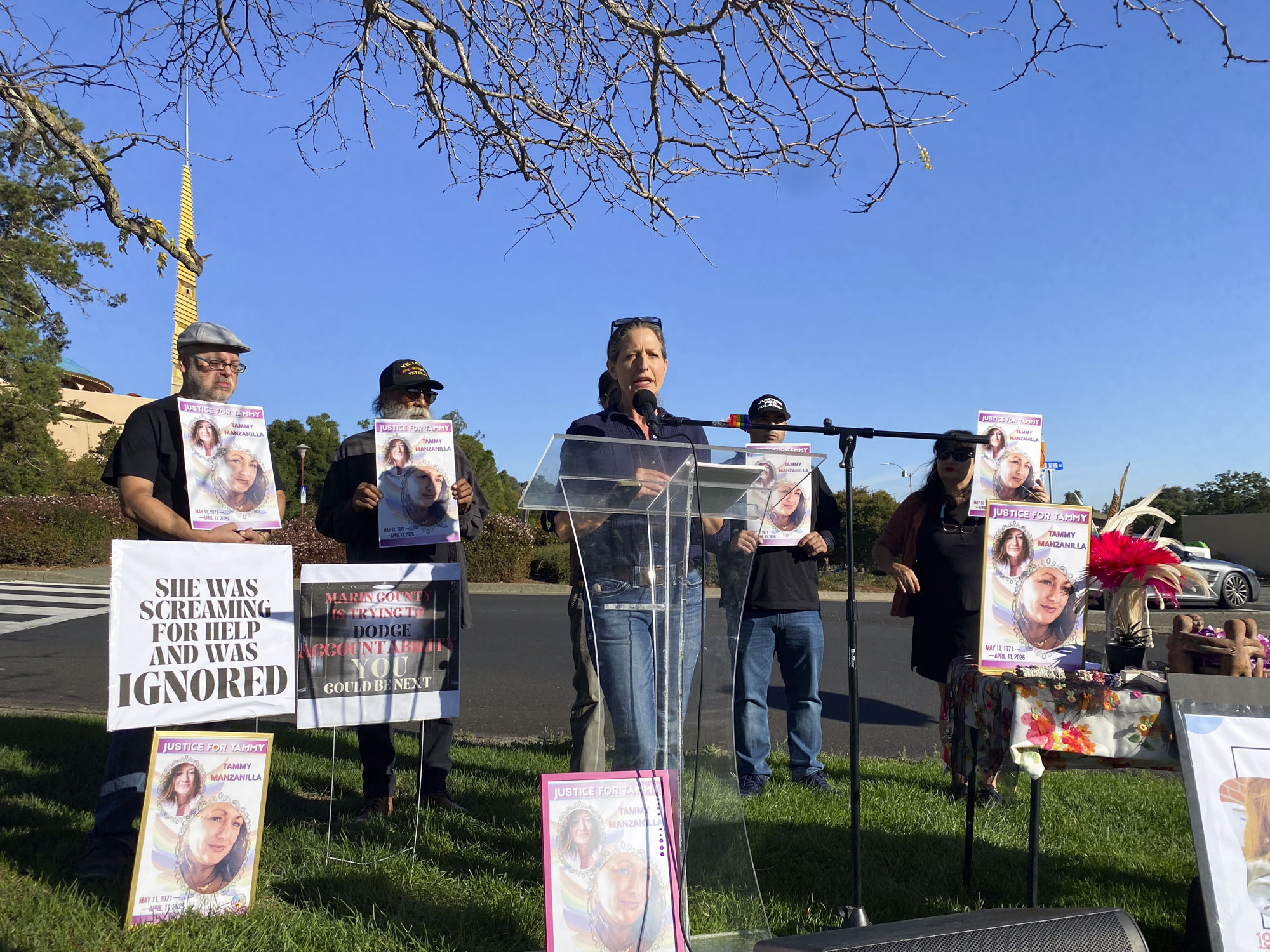
window.__IS_SSR__=true
window.__INITIAL_STATE__={
"attachmentsReducer": {
"audio_0": {
"type": "attachments",
"id": "audio_0",
"imgSizes": {
"kqedFullSize": {
"file": "https://ww2.kqed.org/news/wp-content/themes/KQED-unified/img/audio_bgs/background0.jpg"
}
}
},
"audio_1": {
"type": "attachments",
"id": "audio_1",
"imgSizes": {
"kqedFullSize": {
"file": "https://ww2.kqed.org/news/wp-content/themes/KQED-unified/img/audio_bgs/background1.jpg"
}
}
},
"audio_2": {
"type": "attachments",
"id": "audio_2",
"imgSizes": {
"kqedFullSize": {
"file": "https://ww2.kqed.org/news/wp-content/themes/KQED-unified/img/audio_bgs/background2.jpg"
}
}
},
"audio_3": {
"type": "attachments",
"id": "audio_3",
"imgSizes": {
"kqedFullSize": {
"file": "https://ww2.kqed.org/news/wp-content/themes/KQED-unified/img/audio_bgs/background3.jpg"
}
}
},
"audio_4": {
"type": "attachments",
"id": "audio_4",
"imgSizes": {
"kqedFullSize": {
"file": "https://ww2.kqed.org/news/wp-content/themes/KQED-unified/img/audio_bgs/background4.jpg"
}
}
},
"placeholder": {
"type": "attachments",
"id": "placeholder",
"imgSizes": {
"thumbnail": {
"file": "https://cdn.kqed.org/wp-content/uploads/2024/12/KQED-Default-Image-816638274-2000x1333-1-160x107.jpg",
"width": 160,
"height": 107,
"mimeType": "image/jpeg"
},
"medium": {
"file": "https://cdn.kqed.org/wp-content/uploads/2024/12/KQED-Default-Image-816638274-2000x1333-1-800x533.jpg",
"width": 800,
"height": 533,
"mimeType": "image/jpeg"
},
"medium_large": {
"file": "https://cdn.kqed.org/wp-content/uploads/2024/12/KQED-Default-Image-816638274-2000x1333-1-768x512.jpg",
"width": 768,
"height": 512,
"mimeType": "image/jpeg"
},
"large": {
"file": "https://cdn.kqed.org/wp-content/uploads/2024/12/KQED-Default-Image-816638274-2000x1333-1-1020x680.jpg",
"width": 1020,
"height": 680,
"mimeType": "image/jpeg"
},
"1536x1536": {
"file": "https://cdn.kqed.org/wp-content/uploads/2024/12/KQED-Default-Image-816638274-2000x1333-1-1536x1024.jpg",
"width": 1536,
"height": 1024,
"mimeType": "image/jpeg"
},
"fd-lrg": {
"file": "https://cdn.kqed.org/wp-content/uploads/2024/12/KQED-Default-Image-816638274-2000x1333-1-1536x1024.jpg",
"width": 1536,
"height": 1024,
"mimeType": "image/jpeg"
},
"fd-med": {
"file": "https://cdn.kqed.org/wp-content/uploads/2024/12/KQED-Default-Image-816638274-2000x1333-1-1020x680.jpg",
"width": 1020,
"height": 680,
"mimeType": "image/jpeg"
},
"fd-sm": {
"file": "https://cdn.kqed.org/wp-content/uploads/2024/12/KQED-Default-Image-816638274-2000x1333-1-800x533.jpg",
"width": 800,
"height": 533,
"mimeType": "image/jpeg"
},
"post-thumbnail": {
"file": "https://cdn.kqed.org/wp-content/uploads/2024/12/KQED-Default-Image-816638274-2000x1333-1-672x372.jpg",
"width": 672,
"height": 372,
"mimeType": "image/jpeg"
},
"twentyfourteen-full-width": {
"file": "https://cdn.kqed.org/wp-content/uploads/2024/12/KQED-Default-Image-816638274-2000x1333-1-1038x576.jpg",
"width": 1038,
"height": 576,
"mimeType": "image/jpeg"
},
"xxsmall": {
"file": "https://cdn.kqed.org/wp-content/uploads/2024/12/KQED-Default-Image-816638274-2000x1333-1-160x107.jpg",
"width": 160,
"height": 107,
"mimeType": "image/jpeg"
},
"xsmall": {
"file": "https://cdn.kqed.org/wp-content/uploads/2024/12/KQED-Default-Image-816638274-2000x1333-1-672x372.jpg",
"width": 672,
"height": 372,
"mimeType": "image/jpeg"
},
"small": {
"file": "https://cdn.kqed.org/wp-content/uploads/2024/12/KQED-Default-Image-816638274-2000x1333-1-672x372.jpg",
"width": 672,
"height": 372,
"mimeType": "image/jpeg"
},
"xlarge": {
"file": "https://cdn.kqed.org/wp-content/uploads/2024/12/KQED-Default-Image-816638274-2000x1333-1-1020x680.jpg",
"width": 1020,
"height": 680,
"mimeType": "image/jpeg"
},
"full-width": {
"file": "https://cdn.kqed.org/wp-content/uploads/2024/12/KQED-Default-Image-816638274-2000x1333-1-1920x1280.jpg",
"width": 1920,
"height": 1280,
"mimeType": "image/jpeg"
},
"guest-author-32": {
"file": "https://cdn.kqed.org/wp-content/uploads/2025/01/KQED-Default-Image-816638274-1333x1333-1-160x160.jpg",
"width": 32,
"height": 32,
"mimeType": "image/jpeg"
},
"guest-author-50": {
"file": "https://cdn.kqed.org/wp-content/uploads/2025/01/KQED-Default-Image-816638274-1333x1333-1-160x160.jpg",
"width": 50,
"height": 50,
"mimeType": "image/jpeg"
},
"guest-author-64": {
"file": "https://cdn.kqed.org/wp-content/uploads/2025/01/KQED-Default-Image-816638274-1333x1333-1-160x160.jpg",
"width": 64,
"height": 64,
"mimeType": "image/jpeg"
},
"guest-author-96": {
"file": "https://cdn.kqed.org/wp-content/uploads/2025/01/KQED-Default-Image-816638274-1333x1333-1-160x160.jpg",
"width": 96,
"height": 96,
"mimeType": "image/jpeg"
},
"guest-author-128": {
"file": "https://cdn.kqed.org/wp-content/uploads/2025/01/KQED-Default-Image-816638274-1333x1333-1-160x160.jpg",
"width": 128,
"height": 128,
"mimeType": "image/jpeg"
},
"detail": {
"file": "https://cdn.kqed.org/wp-content/uploads/2025/01/KQED-Default-Image-816638274-1333x1333-1-160x160.jpg",
"width": 160,
"height": 160,
"mimeType": "image/jpeg"
},
"kqedFullSize": {
"file": "https://cdn.kqed.org/wp-content/uploads/2024/12/KQED-Default-Image-816638274-2000x1333-1.jpg",
"width": 2000,
"height": 1333
}
}
},
"news_12098689": {
"type": "attachments",
"id": "news_12098689",
"meta": {
"index": "attachments_1716263798",
"site": "news",
"id": "12098689",
"found": true
},
"title": "TammyManzanilla1-KQED",
"publishDate": 1788896851,
"status": "inherit",
"parent": 0,
"modified": 1788978284,
"caption": "Amy Barry, sister of Tammy Manzanilla, speaks at a press conference outside of the Marin County Civic Center in San Rafael on Tuesday, Sept. 8, 2026. Barry told county supervisors that her family plans to file a formal lawsuit against the county after Manzanilla died after being held in the county jail. Barry said Manzanilla was held for 19 hours in a sobering cell without medical care.",
"credit": "Brian Krans/KQED",
"altTag": null,
"description": null,
"imgSizes": {
"thumbnail": {
"file": "https://cdn.kqed.org/wp-content/uploads/sites/10/2026/09/TammyManzanilla1-KQED-160x120.jpg",
"width": 160,
"height": 120,
"mimeType": "image/jpeg"
},
"1536x1536": {
"file": "https://cdn.kqed.org/wp-content/uploads/sites/10/2026/09/TammyManzanilla1-KQED-1536x1152.jpg",
"width": 1536,
"height": 1152,
"mimeType": "image/jpeg"
},
"post-thumbnail": {
"file": "https://cdn.kqed.org/wp-content/uploads/sites/10/2026/09/TammyManzanilla1-KQED-672x372.jpg",
"width": 672,
"height": 372,
"mimeType": "image/jpeg"
},
"twentyfourteen-full-width": {
"file": "https://cdn.kqed.org/wp-content/uploads/sites/10/2026/09/TammyManzanilla1-KQED-1038x576.jpg",
"width": 1038,
"height": 576,
"mimeType": "image/jpeg"
},
"npr-cds-wide": {
"file": "https://cdn.kqed.org/wp-content/uploads/sites/10/2026/09/TammyManzanilla1-KQED-1200x675.jpg",
"width": 1200,
"height": 675,
"mimeType": "image/jpeg"
},
"npr-cds-square": {
"file": "https://cdn.kqed.org/wp-content/uploads/sites/10/2026/09/TammyManzanilla1-KQED-600x600.jpg",
"width": 600,
"height": 600,
"mimeType": "image/jpeg"
},
"kqedFullSize": {
"file": "https://cdn.kqed.org/wp-content/uploads/sites/10/2026/09/TammyManzanilla1-KQED.jpg",
"width": 2000,
"height": 1500
}
},
"isLoading": false,
"fetchFailed": false
},
"news_12065255": {
"type": "attachments",
"id": "news_12065255",
"meta": {
"index": "attachments_1716263798",
"site": "news",
"id": "12065255",
"found": true
},
"title": "20251124_SF JAIL RALLY_GH-18-KQED",
"publishDate": 1764021785,
"status": "inherit",
"parent": 0,
"modified": 1764021815,
"caption": "The emblem of the San Francisco Sheriff’s Department is seen on the exterior of the San Francisco County Jail on Nov. 24, 2025. The department is facing public scrutiny over an alleged illegal strip search of incarcerated women.",
"credit": "Gustavo Hernandez/KQED",
"altTag": null,
"description": null,
"imgSizes": {
"thumbnail": {
"file": "https://cdn.kqed.org/wp-content/uploads/sites/10/2025/11/20251124_SF-JAIL-RALLY_GH-18-KQED-160x107.jpg",
"width": 160,
"height": 107,
"mimeType": "image/jpeg"
},
"1536x1536": {
"file": "https://cdn.kqed.org/wp-content/uploads/sites/10/2025/11/20251124_SF-JAIL-RALLY_GH-18-KQED-1536x1024.jpg",
"width": 1536,
"height": 1024,
"mimeType": "image/jpeg"
},
"post-thumbnail": {
"file": "https://cdn.kqed.org/wp-content/uploads/sites/10/2025/11/20251124_SF-JAIL-RALLY_GH-18-KQED-672x372.jpg",
"width": 672,
"height": 372,
"mimeType": "image/jpeg"
},
"twentyfourteen-full-width": {
"file": "https://cdn.kqed.org/wp-content/uploads/sites/10/2025/11/20251124_SF-JAIL-RALLY_GH-18-KQED-1038x576.jpg",
"width": 1038,
"height": 576,
"mimeType": "image/jpeg"
},
"npr-cds-wide": {
"file": "https://cdn.kqed.org/wp-content/uploads/sites/10/2025/11/20251124_SF-JAIL-RALLY_GH-18-KQED-1200x675.jpg",
"width": 1200,
"height": 675,
"mimeType": "image/jpeg"
},
"kqedFullSize": {
"file": "https://cdn.kqed.org/wp-content/uploads/sites/10/2025/11/20251124_SF-JAIL-RALLY_GH-18-KQED.jpg",
"width": 2000,
"height": 1333
}
},
"isLoading": false,
"fetchFailed": false
},
"news_12084366": {
"type": "attachments",
"id": "news_12084366",
"meta": {
"index": "attachments_1716263798",
"site": "news",
"id": "12084366",
"found": true
},
"title": "main-jail-sc_qed",
"publishDate": 1779221158,
"status": "inherit",
"parent": 12084364,
"modified": 1779221220,
"caption": "The Santa Clara County Main Jail on March 28, 2016.",
"credit": "Lisa Pickoff-White/KQED",
"altTag": null,
"description": null,
"imgSizes": {
"thumbnail": {
"file": "https://cdn.kqed.org/wp-content/uploads/sites/10/2026/05/main-jail-sc_qed-160x107.jpg",
"width": 160,
"height": 107,
"mimeType": "image/jpeg"
},
"1536x1536": {
"file": "https://cdn.kqed.org/wp-content/uploads/sites/10/2026/05/main-jail-sc_qed-1536x1024.jpg",
"width": 1536,
"height": 1024,
"mimeType": "image/jpeg"
},
"post-thumbnail": {
"file": "https://cdn.kqed.org/wp-content/uploads/sites/10/2026/05/main-jail-sc_qed-672x372.jpg",
"width": 672,
"height": 372,
"mimeType": "image/jpeg"
},
"twentyfourteen-full-width": {
"file": "https://cdn.kqed.org/wp-content/uploads/sites/10/2026/05/main-jail-sc_qed-1038x576.jpg",
"width": 1038,
"height": 576,
"mimeType": "image/jpeg"
},
"npr-cds-wide": {
"file": "https://cdn.kqed.org/wp-content/uploads/sites/10/2026/05/main-jail-sc_qed-1200x675.jpg",
"width": 1200,
"height": 675,
"mimeType": "image/jpeg"
},
"npr-cds-square": {
"file": "https://cdn.kqed.org/wp-content/uploads/sites/10/2026/05/main-jail-sc_qed-600x600.jpg",
"width": 600,
"height": 600,
"mimeType": "image/jpeg"
},
"kqedFullSize": {
"file": "https://cdn.kqed.org/wp-content/uploads/sites/10/2026/05/main-jail-sc_qed.jpg",
"width": 2000,
"height": 1333
}
},
"isLoading": false,
"fetchFailed": false
},
"news_12091299": {
"type": "attachments",
"id": "news_12091299",
"meta": {
"index": "attachments_1716263798",
"site": "news",
"id": "12091299",
"found": true
},
"title": "022218-la-jail-getty-cm-01-6a58e614715de",
"publishDate": 1784211007,
"status": "inherit",
"parent": 12091298,
"modified": 1784211112,
"caption": "An incarcerated person inside Los Angeles County Sheriff’s Men’s Central Jail in Los Angeles on Feb. 22, 2018. ",
"credit": "Photo by Sarah Reingewirtz, Pasadena Star-News via Getty Images",
"altTag": null,
"description": null,
"imgSizes": {
"thumbnail": {
"file": "https://cdn.kqed.org/wp-content/uploads/sites/10/2026/07/022218-la-jail-getty-cm-01-6a58e614715de-160x107.jpg",
"width": 160,
"height": 107,
"mimeType": "image/jpeg"
},
"post-thumbnail": {
"file": "https://cdn.kqed.org/wp-content/uploads/sites/10/2026/07/022218-la-jail-getty-cm-01-6a58e614715de-672x372.jpg",
"width": 672,
"height": 372,
"mimeType": "image/jpeg"
},
"twentyfourteen-full-width": {
"file": "https://cdn.kqed.org/wp-content/uploads/sites/10/2026/07/022218-la-jail-getty-cm-01-6a58e614715de-1038x576.jpg",
"width": 1038,
"height": 576,
"mimeType": "image/jpeg"
},
"npr-cds-wide": {
"file": "https://cdn.kqed.org/wp-content/uploads/sites/10/2026/07/022218-la-jail-getty-cm-01-6a58e614715de-1200x675.jpg",
"width": 1200,
"height": 675,
"mimeType": "image/jpeg"
},
"npr-cds-square": {
"file": "https://cdn.kqed.org/wp-content/uploads/sites/10/2026/07/022218-la-jail-getty-cm-01-6a58e614715de-600x600.jpg",
"width": 600,
"height": 600,
"mimeType": "image/jpeg"
},
"kqedFullSize": {
"file": "https://cdn.kqed.org/wp-content/uploads/sites/10/2026/07/022218-la-jail-getty-cm-01-6a58e614715de.jpg",
"width": 1200,
"height": 800
}
},
"isLoading": false,
"fetchFailed": false
},
"news_12085078": {
"type": "attachments",
"id": "news_12085078",
"meta": {
"index": "attachments_1716263798",
"site": "news",
"id": "12085078",
"found": true
},
"title": "260522-JAILSEARCHSUIT-18-BL-KQED",
"publishDate": 1779492125,
"status": "inherit",
"parent": 0,
"modified": 1779492156,
"caption": "Taylor Ross (center), a formerly incarcerated advocate, speaks during a rally outside of San Francisco County Jail 2 on May 22, 2026, one year after women incarcerated at the jail alleged they were subjected to illegal strip searches by sheriff’s deputies in a women’s housing unit.",
"credit": "Beth LaBerge/KQED",
"altTag": null,
"description": null,
"imgSizes": {
"thumbnail": {
"file": "https://cdn.kqed.org/wp-content/uploads/sites/10/2026/05/260522-JAILSEARCHSUIT-18-BL-KQED-160x107.jpg",
"width": 160,
"height": 107,
"mimeType": "image/jpeg"
},
"1536x1536": {
"file": "https://cdn.kqed.org/wp-content/uploads/sites/10/2026/05/260522-JAILSEARCHSUIT-18-BL-KQED-1536x1024.jpg",
"width": 1536,
"height": 1024,
"mimeType": "image/jpeg"
},
"post-thumbnail": {
"file": "https://cdn.kqed.org/wp-content/uploads/sites/10/2026/05/260522-JAILSEARCHSUIT-18-BL-KQED-672x372.jpg",
"width": 672,
"height": 372,
"mimeType": "image/jpeg"
},
"twentyfourteen-full-width": {
"file": "https://cdn.kqed.org/wp-content/uploads/sites/10/2026/05/260522-JAILSEARCHSUIT-18-BL-KQED-1038x576.jpg",
"width": 1038,
"height": 576,
"mimeType": "image/jpeg"
},
"npr-cds-wide": {
"file": "https://cdn.kqed.org/wp-content/uploads/sites/10/2026/05/260522-JAILSEARCHSUIT-18-BL-KQED-1200x675.jpg",
"width": 1200,
"height": 675,
"mimeType": "image/jpeg"
},
"npr-cds-square": {
"file": "https://cdn.kqed.org/wp-content/uploads/sites/10/2026/05/260522-JAILSEARCHSUIT-18-BL-KQED-600x600.jpg",
"width": 600,
"height": 600,
"mimeType": "image/jpeg"
},
"kqedFullSize": {
"file": "https://cdn.kqed.org/wp-content/uploads/sites/10/2026/05/260522-JAILSEARCHSUIT-18-BL-KQED.jpg",
"width": 2000,
"height": 1333
}
},
"isLoading": false,
"fetchFailed": false
},
"news_12018616": {
"type": "attachments",
"id": "news_12018616",
"meta": {
"index": "attachments_1716263798",
"site": "news",
"id": "12018616",
"found": true
},
"title": "121424_BSCC-Session_KC_CM_1",
"publishDate": 1734458782,
"status": "inherit",
"parent": 12018612,
"modified": 1734458804,
"caption": "Jennifer Schmidt reacts during a listening session hosted by the In-Custody Death Review Division with the Board of State and Community Corrections in Escondido on Dec. 14, 2024. Schmidt’s father, Gilbert Gil, died in Vista jail in 2022.",
"credit": "Kristian Carreon for CalMatters",
"altTag": null,
"description": null,
"imgSizes": {
"medium": {
"file": "https://cdn.kqed.org/wp-content/uploads/sites/10/2024/12/121424_BSCC-Session_KC_CM_1-800x533.jpg",
"width": 800,
"height": 533,
"mimeType": "image/jpeg"
},
"large": {
"file": "https://cdn.kqed.org/wp-content/uploads/sites/10/2024/12/121424_BSCC-Session_KC_CM_1-1020x680.jpg",
"width": 1020,
"height": 680,
"mimeType": "image/jpeg"
},
"thumbnail": {
"file": "https://cdn.kqed.org/wp-content/uploads/sites/10/2024/12/121424_BSCC-Session_KC_CM_1-160x107.jpg",
"width": 160,
"height": 107,
"mimeType": "image/jpeg"
},
"1536x1536": {
"file": "https://cdn.kqed.org/wp-content/uploads/sites/10/2024/12/121424_BSCC-Session_KC_CM_1-1536x1024.jpg",
"width": 1536,
"height": 1024,
"mimeType": "image/jpeg"
},
"post-thumbnail": {
"file": "https://cdn.kqed.org/wp-content/uploads/sites/10/2024/12/121424_BSCC-Session_KC_CM_1-672x372.jpg",
"width": 672,
"height": 372,
"mimeType": "image/jpeg"
},
"twentyfourteen-full-width": {
"file": "https://cdn.kqed.org/wp-content/uploads/sites/10/2024/12/121424_BSCC-Session_KC_CM_1-1038x576.jpg",
"width": 1038,
"height": 576,
"mimeType": "image/jpeg"
},
"full-width": {
"file": "https://cdn.kqed.org/wp-content/uploads/sites/10/2024/12/121424_BSCC-Session_KC_CM_1-1920x1280.jpg",
"width": 1920,
"height": 1280,
"mimeType": "image/jpeg"
},
"kqedFullSize": {
"file": "https://cdn.kqed.org/wp-content/uploads/sites/10/2024/12/121424_BSCC-Session_KC_CM_1.jpg",
"width": 2000,
"height": 1333
}
},
"isLoading": false,
"fetchFailed": false
},
"news_12004890": {
"type": "attachments",
"id": "news_12004890",
"meta": {
"index": "attachments_1716263798",
"site": "news",
"id": "12004890",
"found": true
},
"title": "091124_InmateVoting_FM_CM-08",
"publishDate": 1726516319,
"status": "inherit",
"parent": 12004883,
"modified": 1726520151,
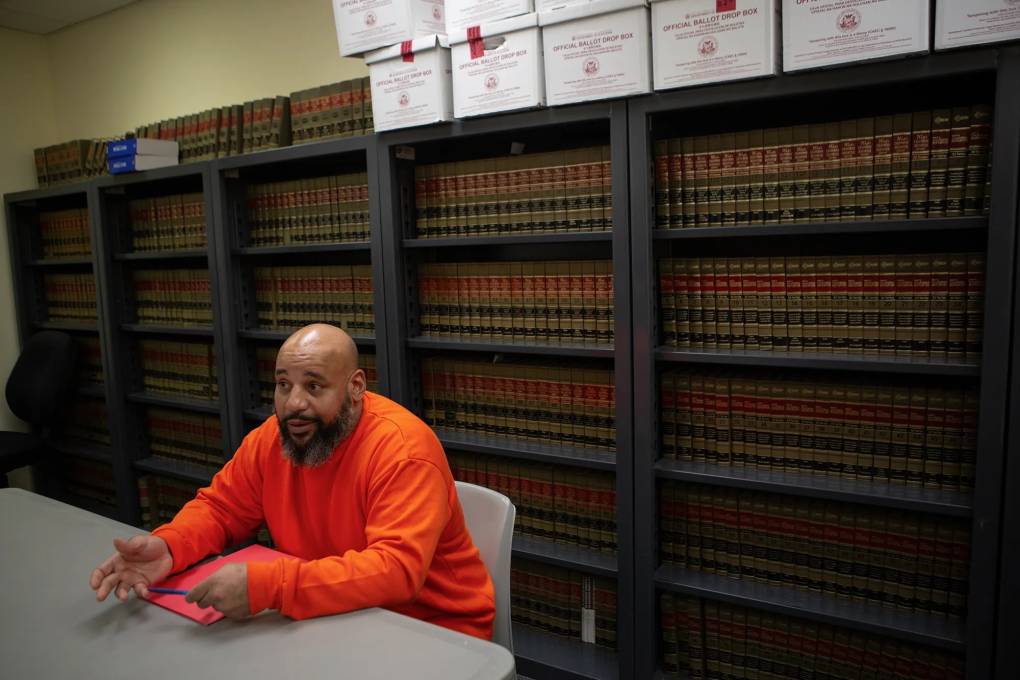
"caption": "Ronald Latney, 44, from San Francisco, speaks about voting while incarcerated in a San Francisco County Jail in San Bruno on Sept. 11, 2024.",
"credit": "Florence Middleton/CalMatters",
"altTag": "A Black, bearded, incarcerated man in an orange shirt sits at a table in front of a bookcase of legal books.",
"description": null,
"imgSizes": {
"medium": {
"file": "https://cdn.kqed.org/wp-content/uploads/sites/10/2024/09/091124_InmateVoting_FM_CM-08-800x533.jpeg",
"width": 800,
"height": 533,
"mimeType": "image/jpeg"
},
"large": {
"file": "https://cdn.kqed.org/wp-content/uploads/sites/10/2024/09/091124_InmateVoting_FM_CM-08-1020x680.jpeg",
"width": 1020,
"height": 680,
"mimeType": "image/jpeg"
},
"thumbnail": {
"file": "https://cdn.kqed.org/wp-content/uploads/sites/10/2024/09/091124_InmateVoting_FM_CM-08-160x107.jpeg",
"width": 160,
"height": 107,
"mimeType": "image/jpeg"
},
"1536x1536": {
"file": "https://cdn.kqed.org/wp-content/uploads/sites/10/2024/09/091124_InmateVoting_FM_CM-08-1536x1024.jpeg",
"width": 1536,
"height": 1024,
"mimeType": "image/jpeg"
},
"post-thumbnail": {
"file": "https://cdn.kqed.org/wp-content/uploads/sites/10/2024/09/091124_InmateVoting_FM_CM-08-672x372.jpeg",
"width": 672,
"height": 372,
"mimeType": "image/jpeg"
},
"twentyfourteen-full-width": {
"file": "https://cdn.kqed.org/wp-content/uploads/sites/10/2024/09/091124_InmateVoting_FM_CM-08-1038x576.jpeg",
"width": 1038,
"height": 576,
"mimeType": "image/jpeg"
},
"full-width": {
"file": "https://cdn.kqed.org/wp-content/uploads/sites/10/2024/09/091124_InmateVoting_FM_CM-08-1920x1280.jpeg",
"width": 1920,
"height": 1280,
"mimeType": "image/jpeg"
},
"kqedFullSize": {
"file": "https://cdn.kqed.org/wp-content/uploads/sites/10/2024/09/091124_InmateVoting_FM_CM-08.jpeg",
"width": 2000,
"height": 1333
}
},
"isLoading": false,
"fetchFailed": false
},
"news_11994148": {
"type": "attachments",
"id": "news_11994148",
"meta": {
"index": "attachments_1716263798",
"site": "news",
"id": "11994148",
"found": true
},
"title": "RNCTrumpVance2024",
"publishDate": 1721078653,
"status": "inherit",
"parent": 11994136,
"modified": 1721082454,
"caption": "Attendees hold signs in support of former President Donald Trump at the Republican National Convention in Milwaukee, Wisconsin on July 15, 2024. ",
"credit": "Scott Shafer/KQED",
"altTag": null,
"description": null,
"imgSizes": {
"medium": {
"file": "https://cdn.kqed.org/wp-content/uploads/sites/10/2024/07/RNCTrumpVance2024-800x600.jpg",
"width": 800,
"height": 600,
"mimeType": "image/jpeg"
},
"large": {
"file": "https://cdn.kqed.org/wp-content/uploads/sites/10/2024/07/RNCTrumpVance2024-1020x765.jpg",
"width": 1020,
"height": 765,
"mimeType": "image/jpeg"
},
"thumbnail": {
"file": "https://cdn.kqed.org/wp-content/uploads/sites/10/2024/07/RNCTrumpVance2024-160x120.jpg",
"width": 160,
"height": 120,
"mimeType": "image/jpeg"
},
"1536x1536": {
"file": "https://cdn.kqed.org/wp-content/uploads/sites/10/2024/07/RNCTrumpVance2024-1536x1152.jpg",
"width": 1536,
"height": 1152,
"mimeType": "image/jpeg"
},
"post-thumbnail": {
"file": "https://cdn.kqed.org/wp-content/uploads/sites/10/2024/07/RNCTrumpVance2024-672x372.jpg",
"width": 672,
"height": 372,
"mimeType": "image/jpeg"
},
"twentyfourteen-full-width": {
"file": "https://cdn.kqed.org/wp-content/uploads/sites/10/2024/07/RNCTrumpVance2024-1038x576.jpg",
"width": 1038,
"height": 576,
"mimeType": "image/jpeg"
},
"full-width": {
"file": "https://cdn.kqed.org/wp-content/uploads/sites/10/2024/07/RNCTrumpVance2024-1920x1440.jpg",
"width": 1920,
"height": 1440,
"mimeType": "image/jpeg"
},
"kqedFullSize": {
"file": "https://cdn.kqed.org/wp-content/uploads/sites/10/2024/07/RNCTrumpVance2024.jpg",
"width": 2000,
"height": 1500
}
},
"isLoading": false,
"fetchFailed": false
},
"news_11988271": {
"type": "attachments",
"id": "news_11988271",
"meta": {
"index": "attachments_1716263798",
"site": "news",
"id": "11988271",
"found": true
},
"title": "SanBrunoJail",
"publishDate": 1717102517,
"status": "inherit",
"parent": 0,
"modified": 1717104845,
"caption": "The entrance to San Bruno Jail, the San Francisco County facility where chemical agents that affected Portola Elementary School students were released during a crowd control and intervention training exercise on May 21.",
"credit": "Google Street View",
"altTag": null,
"description": null,
"imgSizes": {
"medium": {
"file": "https://cdn.kqed.org/wp-content/uploads/sites/10/2024/05/SanBrunoJail-800x487.jpg",
"width": 800,
"height": 487,
"mimeType": "image/jpeg"
},
"large": {
"file": "https://cdn.kqed.org/wp-content/uploads/sites/10/2024/05/SanBrunoJail-1020x621.jpg",
"width": 1020,
"height": 621,
"mimeType": "image/jpeg"
},
"thumbnail": {
"file": "https://cdn.kqed.org/wp-content/uploads/sites/10/2024/05/SanBrunoJail-160x97.jpg",
"width": 160,
"height": 97,
"mimeType": "image/jpeg"
},
"1536x1536": {
"file": "https://cdn.kqed.org/wp-content/uploads/sites/10/2024/05/SanBrunoJail-1536x935.jpg",
"width": 1536,
"height": 935,
"mimeType": "image/jpeg"
},
"post-thumbnail": {
"file": "https://cdn.kqed.org/wp-content/uploads/sites/10/2024/05/SanBrunoJail-672x372.jpg",
"width": 672,
"height": 372,
"mimeType": "image/jpeg"
},
"twentyfourteen-full-width": {
"file": "https://cdn.kqed.org/wp-content/uploads/sites/10/2024/05/SanBrunoJail-1038x576.jpg",
"width": 1038,
"height": 576,
"mimeType": "image/jpeg"
},
"kqedFullSize": {
"file": "https://cdn.kqed.org/wp-content/uploads/sites/10/2024/05/SanBrunoJail.jpg",
"width": 1920,
"height": 1169
}
},
"isLoading": false,
"fetchFailed": false
},
"news_11981527": {
"type": "attachments",
"id": "news_11981527",
"meta": {
"index": "attachments_1716263798",
"site": "news",
"id": "11981527",
"found": true
},
"parent": 11981516,
"imgSizes": {
"twentyfourteen-full-width": {
"file": "https://cdn.kqed.org/wp-content/uploads/sites/10/2024/04/103123-Riverside-JailDeath-JH-CM-20-1038x576.jpg",
"width": 1038,
"mimeType": "image/jpeg",
"height": 576
},
"thumbnail": {
"file": "https://cdn.kqed.org/wp-content/uploads/sites/10/2024/04/103123-Riverside-JailDeath-JH-CM-20-160x107.jpg",
"width": 160,
"mimeType": "image/jpeg",
"height": 107
},
"post-thumbnail": {
"file": "https://cdn.kqed.org/wp-content/uploads/sites/10/2024/04/103123-Riverside-JailDeath-JH-CM-20-672x372.jpg",
"width": 672,
"mimeType": "image/jpeg",
"height": 372
},
"kqedFullSize": {
"file": "https://cdn.kqed.org/wp-content/uploads/sites/10/2024/04/103123-Riverside-JailDeath-JH-CM-20.jpg",
"width": 1568,
"height": 1045
},
"large": {
"file": "https://cdn.kqed.org/wp-content/uploads/sites/10/2024/04/103123-Riverside-JailDeath-JH-CM-20-1020x680.jpg",
"width": 1020,
"mimeType": "image/jpeg",
"height": 680
},
"1536x1536": {
"file": "https://cdn.kqed.org/wp-content/uploads/sites/10/2024/04/103123-Riverside-JailDeath-JH-CM-20-1536x1024.jpg",
"width": 1536,
"mimeType": "image/jpeg",
"height": 1024
},
"medium": {
"file": "https://cdn.kqed.org/wp-content/uploads/sites/10/2024/04/103123-Riverside-JailDeath-JH-CM-20-800x533.jpg",
"width": 800,
"mimeType": "image/jpeg",
"height": 533
}
},
"publishDate": 1712002890,
"modified": 1712002960,
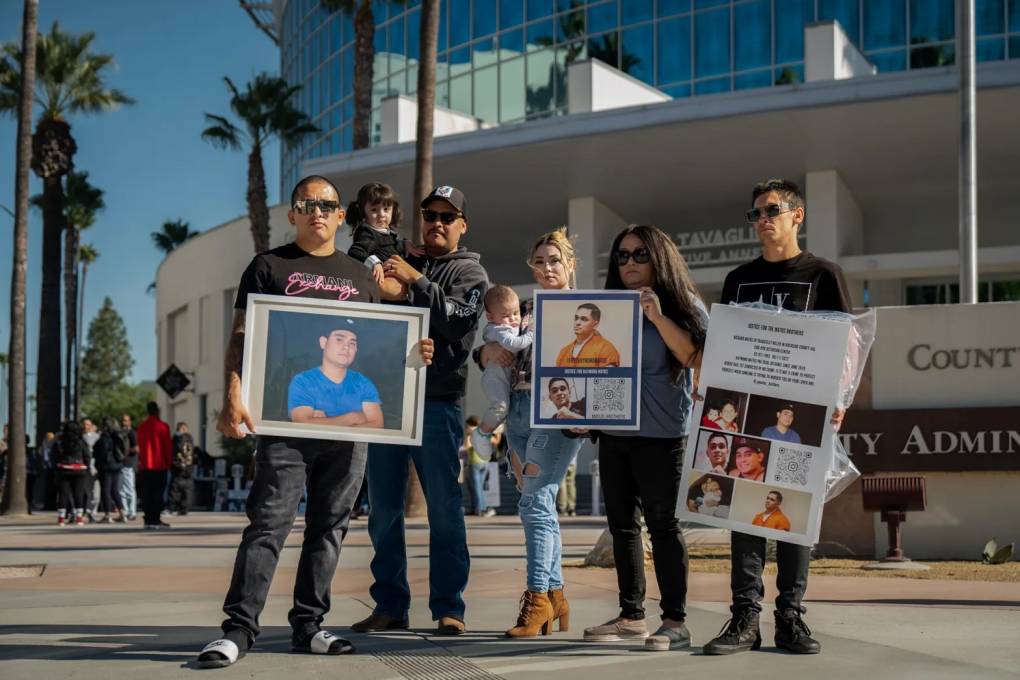
"caption": "The family of Richard Matus Jr. stands outside the John F. Tavaglione Executive Annex with memorial photos of Richard, who died in-custody of the Riverside Sheriff’s Department in Riverside County. (Jules Hotz/CalMatters)",
"description": null,
"title": "103123-Riverside-JailDeath-JH-CM-20",
"credit": null,
"status": "inherit",
"altTag": null,
"isLoading": false,
"fetchFailed": false
},
"news_11980994": {
"type": "attachments",
"id": "news_11980994",
"meta": {
"index": "attachments_1716263798",
"site": "news",
"id": "11980994",
"found": true
},
"parent": 11980987,
"imgSizes": {
"twentyfourteen-full-width": {
"file": "https://cdn.kqed.org/wp-content/uploads/sites/10/2024/03/103123-Riverside-JailDeath-JAH-CM-08-1038x576.jpg",
"width": 1038,
"mimeType": "image/jpeg",
"height": 576
},
"thumbnail": {
"file": "https://cdn.kqed.org/wp-content/uploads/sites/10/2024/03/103123-Riverside-JailDeath-JAH-CM-08-160x107.jpg",
"width": 160,
"mimeType": "image/jpeg",
"height": 107
},
"post-thumbnail": {
"file": "https://cdn.kqed.org/wp-content/uploads/sites/10/2024/03/103123-Riverside-JailDeath-JAH-CM-08-672x372.jpg",
"width": 672,
"mimeType": "image/jpeg",
"height": 372
},
"kqedFullSize": {
"file": "https://cdn.kqed.org/wp-content/uploads/sites/10/2024/03/103123-Riverside-JailDeath-JAH-CM-08.jpg",
"width": 2000,
"height": 1333
},
"large": {
"file": "https://cdn.kqed.org/wp-content/uploads/sites/10/2024/03/103123-Riverside-JailDeath-JAH-CM-08-1020x680.jpg",
"width": 1020,
"mimeType": "image/jpeg",
"height": 680
},
"1536x1536": {
"file": "https://cdn.kqed.org/wp-content/uploads/sites/10/2024/03/103123-Riverside-JailDeath-JAH-CM-08-1536x1024.jpg",
"width": 1536,
"mimeType": "image/jpeg",
"height": 1024
},
"full-width": {
"file": "https://cdn.kqed.org/wp-content/uploads/sites/10/2024/03/103123-Riverside-JailDeath-JAH-CM-08-1920x1280.jpg",
"width": 1920,
"mimeType": "image/jpeg",
"height": 1280
},
"medium": {
"file": "https://cdn.kqed.org/wp-content/uploads/sites/10/2024/03/103123-Riverside-JailDeath-JAH-CM-08-800x533.jpg",
"width": 800,
"mimeType": "image/jpeg",
"height": 533
}
},
"publishDate": 1711567480,
"modified": 1711568166,
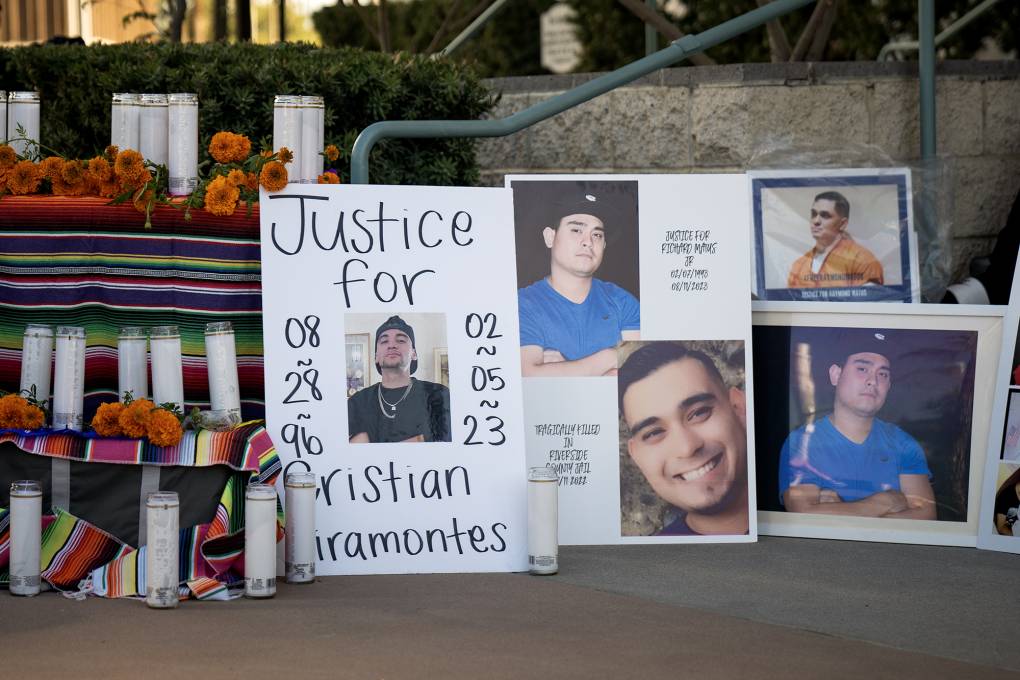
"caption": "A Dia de Los Muertos altar in honor of the lives of those killed in-custody or by Riverside Sheriff's Department deputies outside the John F. Tavaglione Executive Annex/Riverside County Board of Supervisors chambers in protest of recent jail deaths in Riverside county, on Oct. 31, 2023. ",
"description": null,
"title": "103123-Riverside-JailDeath-JAH-CM-08",
"credit": "Jules Hotz/CalMatters",
"status": "inherit",
"altTag": "An altar near steps of a building with candles and images of a man.",
"isLoading": false,
"fetchFailed": false
},
"news_11918236": {
"type": "attachments",
"id": "news_11918236",
"meta": {
"index": "attachments_1716263798",
"site": "news",
"id": "11918236",
"found": true
},
"title": "The intake, transfer and release area at the Santa Rita Jail in Dublin, California, on Thurs. Aug. 4, 2016. Alameda County is considering severing ties with their private health services contractor Corizon Health Inc.",
"publishDate": 1656457828,
"status": "inherit",
"parent": 11918230,
"modified": 1760661358,
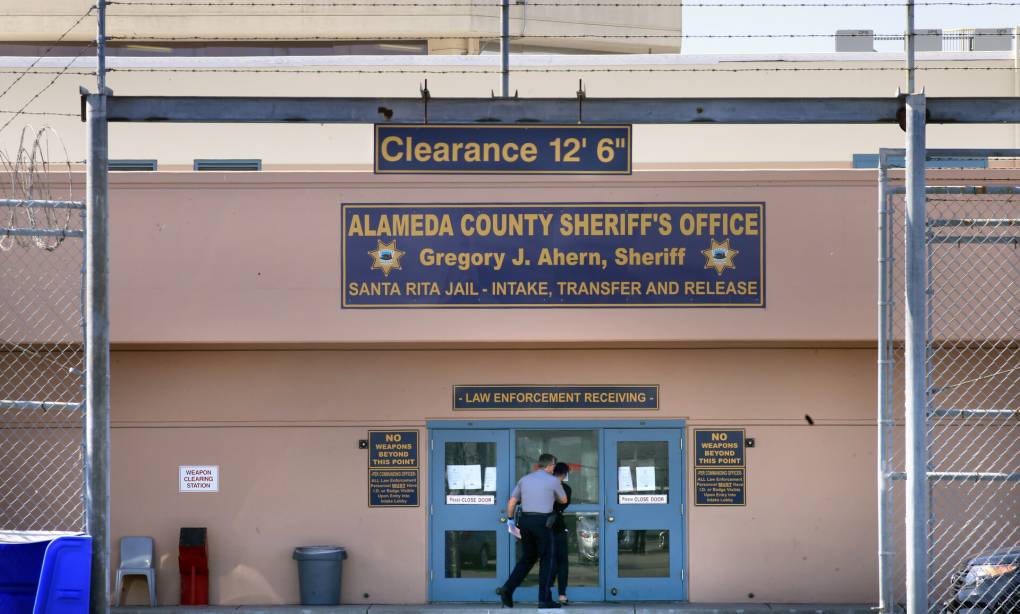
"caption": "The intake, transfer and release area at the Santa Rita Jail, in Dublin, on Aug. 4, 2016.",
"credit": "Michael Macor/The San Francisco Chronicle via Getty Images",
"altTag": "A blue door framed by a fence with a sign at the top saying \"Alameda County Sheriff's Office\"",
"description": null,
"imgSizes": {
"medium": {
"file": "https://cdn.kqed.org/wp-content/uploads/sites/10/2022/06/RS56996_GettyImages-1321825234-qut-800x481.jpg",
"width": 800,
"height": 481,
"mimeType": "image/jpeg"
},
"large": {
"file": "https://cdn.kqed.org/wp-content/uploads/sites/10/2022/06/RS56996_GettyImages-1321825234-qut-1020x614.jpg",
"width": 1020,
"height": 614,
"mimeType": "image/jpeg"
},
"thumbnail": {
"file": "https://cdn.kqed.org/wp-content/uploads/sites/10/2022/06/RS56996_GettyImages-1321825234-qut-160x96.jpg",
"width": 160,
"height": 96,
"mimeType": "image/jpeg"
},
"1536x1536": {
"file": "https://cdn.kqed.org/wp-content/uploads/sites/10/2022/06/RS56996_GettyImages-1321825234-qut-1536x924.jpg",
"width": 1536,
"height": 924,
"mimeType": "image/jpeg"
},
"post-thumbnail": {
"file": "https://cdn.kqed.org/wp-content/uploads/sites/10/2022/06/RS56996_GettyImages-1321825234-qut-672x372.jpg",
"width": 672,
"height": 372,
"mimeType": "image/jpeg"
},
"twentyfourteen-full-width": {
"file": "https://cdn.kqed.org/wp-content/uploads/sites/10/2022/06/RS56996_GettyImages-1321825234-qut-1038x576.jpg",
"width": 1038,
"height": 576,
"mimeType": "image/jpeg"
},
"kqedFullSize": {
"file": "https://cdn.kqed.org/wp-content/uploads/sites/10/2022/06/RS56996_GettyImages-1321825234-qut.jpg",
"width": 1920,
"height": 1155
}
},
"isLoading": false,
"fetchFailed": false
}
},
"audioPlayerReducer": {
"postId": "stream_live",
"isPaused": true,
"isPlaying": false,
"pfsActive": false,
"pledgeModalIsOpen": true,
"playerDrawerIsOpen": false,
"liveAudioPlayStartedAt": 0,
"liveAudioPlayContext": ""
},
"authorsReducer": {
"byline_news_12018612": {
"type": "authors",
"id": "byline_news_12018612",
"meta": {
"override": true
},
"slug": "byline_news_12018612",
"name": "Nigel Dura",
"isLoading": false
},
"byline_news_12004883": {
"type": "authors",
"id": "byline_news_12004883",
"meta": {
"override": true
},
"slug": "byline_news_12004883",
"name": "\u003ca href=\"https://calmatters.org/author/sameea-kamal/\">Sameea Kamal\u003c/a>, CalMatters",
"isLoading": false
},
"byline_news_11988293": {
"type": "authors",
"id": "byline_news_11988293",
"meta": {
"override": true
},
"slug": "byline_news_11988293",
"name": "\u003ca href=\"https://twitter.com/katie_debe?lang=en\">Katie DeBenedetti\u003c/a>",
"isLoading": false
},
"byline_news_11980987": {
"type": "authors",
"id": "byline_news_11980987",
"meta": {
"override": true
},
"slug": "byline_news_11980987",
"name": "Nigel Duara and Jeremia Kimelman",
"isLoading": false
},
"scottshafer": {
"type": "authors",
"id": "255",
"meta": {
"index": "authors_1716337520",
"id": "255",
"found": true
},
"name": "Scott Shafer",
"firstName": "Scott",
"lastName": "Shafer",
"slug": "scottshafer",
"email": "sshafer@kqed.org",
"display_author_email": false,
"staff_mastheads": [
"news"
],
"title": "KQED Contributor",
"bio": "Scott Shafer is a senior editor with the KQED Politics and Government desk. He is co-host of Political Breakdown, the award-winning radio show and podcast with a personal take on the world of politics. Scott came to KQED in 1998 to host the statewide\u003cem> California Report\u003c/em>. Prior to that he had extended stints in politics and government\u003cem>.\u003c/em> He uses that inside experience at KQED in his, reporting, hosting and analysis for the politics desk. Scott collaborated \u003cem>Political Breakdown a\u003c/em>nd on \u003cem>The Political Mind of Jerry Brown, \u003c/em>an eight-part series about the life and extraordinary political career of the former governor. For fun, he plays water polo with the San Francisco Tsunami.",
"avatar": "https://secure.gravatar.com/avatar/a62ebae45b79d7aed1a39a0e3bf68104?s=600&d=blank&r=g",
"twitter": "scottshafer",
"bluesky": null,
"facebook": null,
"instagram": null,
"linkedin": null,
"sites": [
{
"site": "news",
"roles": [
"editor"
]
},
{
"site": "stateofhealth",
"roles": [
"author"
]
},
{
"site": "science",
"roles": [
"author"
]
},
{
"site": "forum",
"roles": [
"subscriber"
]
},
{
"site": "liveblog",
"roles": [
"author"
]
}
],
"headData": {
"title": "Scott Shafer | KQED",
"description": "KQED Contributor",
"ogImgSrc": "https://secure.gravatar.com/avatar/a62ebae45b79d7aed1a39a0e3bf68104?s=600&d=blank&r=g",
"twImgSrc": "https://secure.gravatar.com/avatar/a62ebae45b79d7aed1a39a0e3bf68104?s=600&d=blank&r=g"
},
"isLoading": false,
"link": "/author/scottshafer"
},
"matthewgreen": {
"type": "authors",
"id": "1263",
"meta": {
"index": "authors_1716337520",
"id": "1263",
"found": true
},
"name": "Matthew Green",
"firstName": "Matthew",
"lastName": "Green",
"slug": "matthewgreen",
"email": "mgreen@kqed.org",
"display_author_email": false,
"staff_mastheads": [],
"title": "KQED Editor/Reporter",
"bio": "Matthew Green is a digital media producer for KQED News. He previously produced \u003ca href=\"http://www.kqed.org/lowdown\">The Lowdown\u003c/a>, KQED’s multimedia news education blog. Matthew's written for numerous Bay Area publications, including the Oakland Tribune and San Francisco Chronicle. He also taught journalism classes at Fremont High School in East Oakland.\r\n\r\nEmail: mgreen@kqed.org; Twitter: @MGreenKQED",
"avatar": "https://secure.gravatar.com/avatar/3bf498d1267ca02c8494f33d8cfc575e?s=600&d=blank&r=g",
"twitter": "MGreenKQED",
"facebook": null,
"instagram": null,
"linkedin": null,
"sites": [
{
"site": "news",
"roles": []
},
{
"site": "lowdown",
"roles": []
},
{
"site": "science",
"roles": []
},
{
"site": "education",
"roles": []
},
{
"site": "quest",
"roles": []
},
{
"site": "liveblog",
"roles": []
}
],
"headData": {
"title": "Matthew Green | KQED",
"description": "KQED Editor/Reporter",
"ogImgSrc": "https://secure.gravatar.com/avatar/3bf498d1267ca02c8494f33d8cfc575e?s=600&d=blank&r=g",
"twImgSrc": "https://secure.gravatar.com/avatar/3bf498d1267ca02c8494f33d8cfc575e?s=600&d=blank&r=g"
},
"isLoading": false,
"link": "/author/matthewgreen"
},
"lsarah": {
"type": "authors",
"id": "11626",
"meta": {
"index": "authors_1716337520",
"id": "11626",
"found": true
},
"name": "Lakshmi Sarah",
"firstName": "Lakshmi",
"lastName": "Sarah",
"slug": "lsarah",
"email": "lsarah@kqed.org",
"display_author_email": false,
"staff_mastheads": [],
"title": "Digital Producer",
"bio": "Lakshmi Sarah is an educator, author and journalist with a focus on innovative storytelling. She has worked with newspapers, radio and magazines from Ahmedabad, India to Los Angeles, California. She has written and produced for Die Zeit, Global Voices, AJ+, KQED, Fusion Media Group and the New York Times.",
"avatar": "https://secure.gravatar.com/avatar/652dcaecd8b28826fc17a8b2d6bb4e93?s=600&d=blank&r=g",
"twitter": "lakitalki",
"facebook": null,
"instagram": "https://www.instagram.com/laki.talki/",
"linkedin": "https://www.linkedin.com/in/lakisarah/",
"sites": [
{
"site": "arts",
"roles": []
},
{
"site": "news",
"roles": []
},
{
"site": "bayareabites",
"roles": []
},
{
"site": "science",
"roles": []
}
],
"headData": {
"title": "Lakshmi Sarah | KQED",
"description": "Digital Producer",
"ogImgSrc": "https://secure.gravatar.com/avatar/652dcaecd8b28826fc17a8b2d6bb4e93?s=600&d=blank&r=g",
"twImgSrc": "https://secure.gravatar.com/avatar/652dcaecd8b28826fc17a8b2d6bb4e93?s=600&d=blank&r=g"
},
"isLoading": false,
"link": "/author/lsarah"
},
"kmizuguchi": {
"type": "authors",
"id": "11739",
"meta": {
"index": "authors_1716337520",
"id": "11739",
"found": true
},
"name": "Keith Mizuguchi",
"firstName": "Keith",
"lastName": "Mizuguchi",
"slug": "kmizuguchi",
"email": "kmizuguchi@kqed.org",
"display_author_email": false,
"staff_mastheads": [],
"title": "KQED Contributor",
"bio": null,
"avatar": "https://secure.gravatar.com/avatar/64d8a7de0723d4099b9fe4e915136103febcc20809abce228ee4415bcb237023?s=600&d=blank&r=g",
"twitter": null,
"bluesky": null,
"facebook": null,
"instagram": null,
"linkedin": null,
"sites": [
{
"site": "news",
"roles": [
"editor"
]
},
{
"site": "science",
"roles": [
"editor"
]
}
],
"headData": {
"title": "Keith Mizuguchi | KQED",
"description": "KQED Contributor",
"ogImgSrc": "https://secure.gravatar.com/avatar/64d8a7de0723d4099b9fe4e915136103febcc20809abce228ee4415bcb237023?s=600&d=blank&r=g",
"twImgSrc": "https://secure.gravatar.com/avatar/64d8a7de0723d4099b9fe4e915136103febcc20809abce228ee4415bcb237023?s=600&d=blank&r=g"
},
"isLoading": false,
"link": "/author/kmizuguchi"
},
"jgeha": {
"type": "authors",
"id": "11906",
"meta": {
"index": "authors_1716337520",
"id": "11906",
"found": true
},
"name": "Joseph Geha",
"firstName": "Joseph",
"lastName": "Geha",
"slug": "jgeha",
"email": "jgeha@kqed.org",
"display_author_email": false,
"staff_mastheads": [
"news",
"science"
],
"title": "KQED Contributor",
"bio": null,
"avatar": "https://secure.gravatar.com/avatar/ea84d2b6dd93d6369d453edf19dd583f117cd1759d2d9c9c92f9de77017354fe?s=600&d=blank&r=g",
"twitter": null,
"bluesky": null,
"facebook": null,
"instagram": null,
"linkedin": null,
"sites": [
{
"site": "news",
"roles": [
"editor"
]
},
{
"site": "liveblog",
"roles": [
"author"
]
}
],
"headData": {
"title": "Joseph Geha | KQED",
"description": "KQED Contributor",
"ogImgSrc": "https://secure.gravatar.com/avatar/ea84d2b6dd93d6369d453edf19dd583f117cd1759d2d9c9c92f9de77017354fe?s=600&d=blank&r=g",
"twImgSrc": "https://secure.gravatar.com/avatar/ea84d2b6dd93d6369d453edf19dd583f117cd1759d2d9c9c92f9de77017354fe?s=600&d=blank&r=g"
},
"isLoading": false,
"link": "/author/jgeha"
},
"kdebenedetti": {
"type": "authors",
"id": "11913",
"meta": {
"index": "authors_1716337520",
"id": "11913",
"found": true
},
"name": "Katie DeBenedetti",
"firstName": "Katie",
"lastName": "DeBenedetti",
"slug": "kdebenedetti",
"email": "kdebenedetti@kqed.org",
"display_author_email": false,
"staff_mastheads": [
"news",
"science"
],
"title": "KQED Contributor",
"bio": "Katie DeBenedetti is a digital reporter covering daily news for the Express Desk. Prior to joining KQED as a culture reporting intern in January 2024, she covered education and city government for the Napa Valley Register.",
"avatar": "https://secure.gravatar.com/avatar/6e31073cb8f7e4214ab03f42771d0f45?s=600&d=blank&r=g",
"twitter": null,
"facebook": null,
"instagram": null,
"linkedin": null,
"sites": [
{
"site": "news",
"roles": [
"author"
]
},
{
"site": "science",
"roles": [
"author"
]
},
{
"site": "liveblog",
"roles": [
"author"
]
}
],
"headData": {
"title": "Katie DeBenedetti | KQED",
"description": "KQED Contributor",
"ogImgSrc": "https://secure.gravatar.com/avatar/6e31073cb8f7e4214ab03f42771d0f45?s=600&d=blank&r=g",
"twImgSrc": "https://secure.gravatar.com/avatar/6e31073cb8f7e4214ab03f42771d0f45?s=600&d=blank&r=g"
},
"isLoading": false,
"link": "/author/kdebenedetti"
},
"bkrans": {
"type": "authors",
"id": "11923",
"meta": {
"index": "authors_1716337520",
"id": "11923",
"found": true
},
"name": "Brian Krans",
"firstName": "Brian",
"lastName": "Krans",
"slug": "bkrans",
"email": "bkrans@kqed.org",
"display_author_email": false,
"staff_mastheads": [
"news"
],
"title": "KQED Contributing Reporter",
"bio": "Brian Krans is an award-winning local news and investigative reporter who has been proudly working as a general assignment reporter for KQED since August 2023. He lives in Richmond, where he also reports on air pollution for Richmondside. He is also a founding member of the Vallejo Sun.",
"avatar": "https://secure.gravatar.com/avatar/71fa91f931774612559f7640390b53d9c2840ff72b20f195a25239aab2d9fbb9?s=600&d=blank&r=g",
"twitter": "citizenkrans",
"bluesky": null,
"facebook": null,
"instagram": null,
"linkedin": null,
"sites": [
{
"site": "news",
"roles": [
"editor"
]
}
],
"headData": {
"title": "Brian Krans | KQED",
"description": "KQED Contributing Reporter",
"ogImgSrc": "https://secure.gravatar.com/avatar/71fa91f931774612559f7640390b53d9c2840ff72b20f195a25239aab2d9fbb9?s=600&d=blank&r=g",
"twImgSrc": "https://secure.gravatar.com/avatar/71fa91f931774612559f7640390b53d9c2840ff72b20f195a25239aab2d9fbb9?s=600&d=blank&r=g"
},
"isLoading": false,
"link": "/author/bkrans"
},
"aaliahmad": {
"type": "authors",
"id": "11986",
"meta": {
"index": "authors_1716337520",
"id": "11986",
"found": true
},
"name": "Ayah Ali-Ahmad",
"firstName": "Ayah",
"lastName": "Ali-Ahmad",
"slug": "aaliahmad",
"email": "aaliahmad@KQED.org",
"display_author_email": false,
"staff_mastheads": [],
"title": "KQED Contributor",
"bio": null,
"avatar": "https://secure.gravatar.com/avatar/1cf54f187a5e1064b2cfef3f3d2f1e4f93e453395d56912aca6382a6071ec3ed?s=600&d=blank&r=g",
"twitter": "ayahaliahmad",
"bluesky": null,
"facebook": null,
"instagram": null,
"linkedin": null,
"sites": [
{
"site": "news",
"roles": [
"subscriber"
]
}
],
"headData": {
"title": "Ayah Ali-Ahmad | KQED",
"description": "KQED Contributor",
"ogImgSrc": "https://secure.gravatar.com/avatar/1cf54f187a5e1064b2cfef3f3d2f1e4f93e453395d56912aca6382a6071ec3ed?s=600&d=blank&r=g",
"twImgSrc": "https://secure.gravatar.com/avatar/1cf54f187a5e1064b2cfef3f3d2f1e4f93e453395d56912aca6382a6071ec3ed?s=600&d=blank&r=g"
},
"isLoading": false,
"link": "/author/aaliahmad"
}
},
"pagesReducer": {
"news_tag_jails": {
"type": "terms",
"id": "news_2069",
"meta": {
"index": "terms_1716263798",
"site": "news",
"id": "2069",
"score": 10.40412
},
"featImg": null,
"name": "Jails",
"description": null,
"taxonomy": "tag",
"headData": {
"twImgId": null,
"twTitle": null,
"ogTitle": null,
"ogImgId": null,
"twDescription": null,
"description": null,
"title": "Jails Archives | KQED News",
"ogDescription": null
},
"ttid": 2084,
"slug": "jails",
"isLoading": false,
"title": "Jails",
"pageMeta": {
"site": "news",
"WpPageTemplate": "page-topic-editorial",
"currentPage": 1
},
"blocks": [
{
"blockName": "kqed/post-list",
"attrs": {
"layout": "cardArticle2",
"query": "posts/news?tag=jails",
"seeMore": false,
"paginated": true,
"page": 1
}
},
{
"blockName": "kqed/ad"
}
]
}
},
"pfsSessionReducer": {},
"postsReducer": {
"stream_live": {
"type": "live",
"id": "stream_live",
"audioUrl": "https://streams.kqed.org/kqedradio",
"title": "Live Stream",
"excerpt": "Live Stream information currently unavailable.",
"link": "/radio",
"featImg": "",
"label": {
"name": "KQED Live",
"link": "/"
}
},
"stream_kqedNewscast": {
"type": "posts",
"id": "stream_kqedNewscast",
"audioUrl": "https://www.kqed.org/.stream/anon/radio/RDnews/newscast.mp3?_=1",
"title": "KQED Newscast",
"featImg": "",
"label": {
"name": "88.5 FM",
"link": "/"
}
},
"news_12098695": {
"type": "posts",
"id": "news_12098695",
"meta": {
"index": "posts_1716263798",
"site": "news",
"id": "12098695",
"score": null,
"sort": [
1788975144000
]
},
"guestAuthors": [],
"slug": "family-of-marin-county-woman-briefly-held-in-jail-intends-to-file-wrongful-death-lawsuit",
"title": "Family of Marin County Woman Briefly Held in Jail Intends to File Wrongful Death Lawsuit",
"publishDate": 1788975144,
"format": "standard",
"headTitle": "Family of Marin County Woman Briefly Held in Jail Intends to File Wrongful Death Lawsuit | KQED",
"labelTerm": {
"site": "news"
},
"content": "\n\u003cp>The family of Tammy Annette Manzanilla, a woman who died after recently being held in the \u003ca href=\"https://www.kqed.org/news/tag/marin-county\">Marin County\u003c/a> Jail, said they’re proceeding with a wrongful death lawsuit against the county. \u003c/p>\n\n\n\n\u003cp>“The lawsuit will be filed,” said Manzanilla’s sister Amy Barry of Oakhurst, addressing the county’s Board of Supervisors on Tuesday. “You’ll be hearing a lot from me.”\u003c/p>\n\n\n\n\u003cp>Barry isn’t hopeful she’ll hear back from the county’s counsel, who she said has not addressed the tort claim — a precursor to a lawsuit — that an attorney filed on behalf of her family in July. \u003c/p>\n\n\n\n\u003cp>On April 8, the Central Marin Police Authority arrested Manzanilla and booked her into the Marin County Jail. Her family claimed she was held for 19 hours in a sobering cell while jail staff ignored her worsening health condition and only released her to a nearby hospital to avoid the public reporting and accountability that comes following an in-custody death. \u003c/p>\n\n\n\n\u003cp>“Because they quickly released her, technically, she was not in their custody,” Barry said in an interview with KQED. \u003c/p>\n\n\n\n\u003cfigure class=\"wp-block-image size-full\">\u003cimg loading=\"lazy\" decoding=\"async\" width=\"2000\" height=\"1500\" src=\"https://cdn.kqed.org/wp-content/uploads/sites/10/2026/09/TammyManzanilla5-KQED.jpg\" alt=\"\" class=\"wp-image-12098692\" srcset=\"https://cdn.kqed.org/wp-content/uploads/sites/10/2026/09/TammyManzanilla5-KQED.jpg 2000w, https://cdn.kqed.org/wp-content/uploads/sites/10/2026/09/TammyManzanilla5-KQED-160x120.jpg 160w, https://cdn.kqed.org/wp-content/uploads/sites/10/2026/09/TammyManzanilla5-KQED-1536x1152.jpg 1536w\" sizes=\"auto, (max-width: 2000px) 100vw, 2000px\" />\u003cfigcaption class=\"wp-element-caption\">Tammy Manzanilla’s sister, Amy Barry, right, and son, Angel Miniaci, second from right, sit with family members who also lost a loved one after they were in police custody during the Sept. 8, 2026, meeting of the Marin County Board of Supervisors. Barry told supervisors her family plans to file a formal lawsuit regarding Manzanilla’s April 11, 2026, death. (Brian Krans/KQED)\u003c/figcaption>\u003c/figure>\n\n\n\n\u003cp>Manzanilla was in her mid-50s when she died. Her family said she struggled with addiction and had been homeless in Marin County for the last 15 years. \u003c/p>\n\n\n\n\u003cp>Barry believes that the sheriff’s office chose to cite and release Manzanilla to a hospital only after they realized she was dying to avoid having to classify it as an in-custody death. \u003c/p>\n\n\n\n\u003cp>In California, law enforcement agencies have to disclose certain information about in-custody deaths, such as the time and place of the incident and the person’s age and race. (For example, Marin County did that for an in-custody death of a 66-year-old white man on June 12, but not in Manzanilla’s case.) \u003c/p>\n\n\n\n\u003cp>Barry was joined at the meeting by family members whose loved ones died under similar circumstances in Bay Area jails and interactions with law enforcement agencies. They say they’re “part of the club that no one wants to be a part of” as they seek justice for their families. \u003c/p>\n\n\n\n\n\n\u003cp>“What happened to Tammy is similar in so many ways because basic respect and basic policies were not followed,” said Robert Collins, the father of Angelo Quinto, who was killed by Antioch police in December 2020, during the news conference outside the jail on Tuesday. \u003c/p>\n\n\n\n\u003cp>In Quinto’s case, officers responded to a mental health call and knelt on Quinto’s neck for nearly five minutes, according to a civil rights lawsuit his family filed after his death. Quinto died at a hospital three days later. \u003c/p>\n\n\n\n\u003cp>Antioch did not make a public statement following Quinto’s death, as required by state law for in-custody deaths. The city of Antioch \u003ca href=\"https://www.kqed.org/news/11986351/family-of-man-suffocated-by-antioch-police-restraint-to-get-7-5-million-settlement\">settled the Quinto family’s lawsuit\u003c/a> for $7.5 million in 2024. \u003c/p>\n\n\n\n\u003cp>Marin County has not publicly released any information regarding Manzanilla’s death. \u003c/p>\n\n\n\n\u003cp>Responding to a request from KQED, Roger Fielding, chief deputy of Marin County’s coroner division, said the county’s counsel would review what could be shared publicly “due to the sensitive nature of this death investigation.”\u003c/p>\n\n\n\n\u003cp>According to a redacted incident report obtained by KQED, Manzanilla was booked into the Marin County Jail at 1:30 p.m. on April 8 on suspicion of public intoxication and other misdemeanors. \u003c/p>\n\n\n\n\u003cp>Deputy Keira Oliver noted in her report that the inmate — whom the family said is Manzanilla — was “very intoxicated” and placed into a cell for observation where she “had been yelling and making nonsensical statements.” \u003c/p>\n\n\n\n\u003cp>The next day at 8:15 a.m., Oliver and Deputy Taylor Del Santo got Manzanilla out of her cell. According to the report, she was able to walk out of the cell on her own, but soon had difficulty standing on her own during the fingerprinting and mugshot process. Deputies noted she “dropped her weight and fell to the floor” and needed a wheelchair. \u003c/p>\n\n\n\n\u003cfigure class=\"wp-block-image size-full\">\u003cimg loading=\"lazy\" decoding=\"async\" width=\"1500\" height=\"2000\" src=\"https://cdn.kqed.org/wp-content/uploads/sites/10/2026/09/TammyManzanilla3-KQED.jpg\" alt=\"\" class=\"wp-image-12098691\" srcset=\"https://cdn.kqed.org/wp-content/uploads/sites/10/2026/09/TammyManzanilla3-KQED.jpg 1500w, https://cdn.kqed.org/wp-content/uploads/sites/10/2026/09/TammyManzanilla3-KQED-160x213.jpg 160w, https://cdn.kqed.org/wp-content/uploads/sites/10/2026/09/TammyManzanilla3-KQED-1152x1536.jpg 1152w\" sizes=\"auto, (max-width: 1500px) 100vw, 1500px\" />\u003cfigcaption class=\"wp-element-caption\">Family members of Tammy Manzanilla held a press conference outside the Marin County Civic Center on Tuesday, Sept. 8, 2026. They were joined by family members of other Bay Area residents who have died after being in police custody. (Brian Krans/KQED)\u003c/figcaption>\u003c/figure>\n\n\n\n\u003cp>Within 15 minutes, a nurse checked Manzanilla’s eyes and indicated that she needed medical attention, according to the report. It goes on to show that deputies placed her on the ground on her side and gave her oxygen while waiting for the fire department to respond and address her medical issues. \u003c/p>\n\n\n\n\u003cp>“She was sitting in that jail cell, dying,” Barry said. “There was a cascade of events occurring inside of her body that there was no coming back from. It was that point of no return by the time she got to the hospital.” \u003c/p>\n\n\n\n\u003cp>The report states that Manzanilla was cited and released to MarinHealth Medical Center in Greenbrae at 8:30 a.m. on April 9. Her family said that Manzanilla died on April 11 after her liver and her kidneys shut down.\u003c/p>\n\n\n\n\n\n\u003cp>Court records show that the Marin County District Attorney’s Office filed charges of disorderly conduct, possession of drug paraphernalia and probation violation against Manzanilla four days after she died. A judge dismissed her case on May 1. \u003c/p>\n\n\n\n\u003cp>Like most of California’s counties, Marin County’s elected sheriff is also its coroner. This system has \u003ca href=\"https://www.npr.org/2018/05/04/608511061/in-california-critics-say-sheriff-coroner-gig-is-a-conflict-of-interest\">been under scrutiny for years\u003c/a>, especially with in-custody or officer-involved deaths, as the sheriff operates the jails and then oversees investigations into those deaths. \u003c/p>\n\n\n\n\u003cp>“In this case, Marin County did the investigation, which is definitely a conflict of interest, because I don’t feel like they’re doing an honest job,” Barry said. “They can say whatever. They said her death was accidental.”\u003c/p>\n\n\n\n\u003cp>County leaders have previously offered condolences to the family but have said they won’t comment on anticipated litigation.\u003c/p>\n\n\n\n\u003cp>“I just want them to say, ‘Hey, yeah, we screwed up. We really screwed up, and we’re going to make the changes so that this doesn’t happen anymore,’” Barry said. \u003c/p>\n\n\n\n\u003cp>Angel Miniachi, Manzanilla’s son, said he plans to bury his mother’s ashes so she can grow into a blossom tree, as she told him years ago that’s what she wanted.\u003c/p>\n\n\n\n\u003cp>“I’m gonna make that happen for her,” he said.\u003c/p>\n",
"blocks": [
{
"blockName": "core/paragraph",
"attrs": {
"dropCap": false
},
"innerHTML": "\n\u003cp>The family of Tammy Annette Manzanilla, a woman who died after recently being held in the \u003ca href=\"https://www.kqed.org/news/tag/marin-county\">Marin County\u003c/a> Jail, said they’re proceeding with a wrongful death lawsuit against the county. \u003c/p>\n",
"innerContent": [
"\n\u003cp>The family of Tammy Annette Manzanilla, a woman who died after recently being held in the \u003ca href=\"https://www.kqed.org/news/tag/marin-county\">Marin County\u003c/a> Jail, said they’re proceeding with a wrongful death lawsuit against the county. \u003c/p>\n"
],
"innerBlocks": []
},
{
"blockName": "core/paragraph",
"attrs": {
"dropCap": false
},
"innerHTML": "\n\u003cp>“The lawsuit will be filed,” said Manzanilla’s sister Amy Barry of Oakhurst, addressing the county’s Board of Supervisors on Tuesday. “You’ll be hearing a lot from me.”\u003c/p>\n",
"innerContent": [
"\n\u003cp>“The lawsuit will be filed,” said Manzanilla’s sister Amy Barry of Oakhurst, addressing the county’s Board of Supervisors on Tuesday. “You’ll be hearing a lot from me.”\u003c/p>\n"
],
"innerBlocks": []
},
{
"blockName": "core/paragraph",
"attrs": {
"dropCap": false
},
"innerHTML": "\n\u003cp>Barry isn’t hopeful she’ll hear back from the county’s counsel, who she said has not addressed the tort claim — a precursor to a lawsuit — that an attorney filed on behalf of her family in July. \u003c/p>\n",
"innerContent": [
"\n\u003cp>Barry isn’t hopeful she’ll hear back from the county’s counsel, who she said has not addressed the tort claim — a precursor to a lawsuit — that an attorney filed on behalf of her family in July. \u003c/p>\n"
],
"innerBlocks": []
},
{
"blockName": "core/paragraph",
"attrs": {
"dropCap": false
},
"innerHTML": "\n\u003cp>On April 8, the Central Marin Police Authority arrested Manzanilla and booked her into the Marin County Jail. Her family claimed she was held for 19 hours in a sobering cell while jail staff ignored her worsening health condition and only released her to a nearby hospital to avoid the public reporting and accountability that comes following an in-custody death. \u003c/p>\n",
"innerContent": [
"\n\u003cp>On April 8, the Central Marin Police Authority arrested Manzanilla and booked her into the Marin County Jail. Her family claimed she was held for 19 hours in a sobering cell while jail staff ignored her worsening health condition and only released her to a nearby hospital to avoid the public reporting and accountability that comes following an in-custody death. \u003c/p>\n"
],
"innerBlocks": []
},
{
"blockName": "core/paragraph",
"attrs": {
"dropCap": false
},
"innerHTML": "\n\u003cp>“Because they quickly released her, technically, she was not in their custody,” Barry said in an interview with KQED. \u003c/p>\n",
"innerContent": [
"\n\u003cp>“Because they quickly released her, technically, she was not in their custody,” Barry said in an interview with KQED. \u003c/p>\n"
],
"innerBlocks": []
},
{
"blockName": "core/image",
"attrs": {
"id": 12098692,
"sizeSlug": "full",
"linkDestination": "none",
"alt": "",
"srcset": "https://cdn.kqed.org/wp-content/uploads/sites/10/2026/09/TammyManzanilla5-KQED.jpg 2000w, https://cdn.kqed.org/wp-content/uploads/sites/10/2026/09/TammyManzanilla5-KQED-160x120.jpg 160w, https://cdn.kqed.org/wp-content/uploads/sites/10/2026/09/TammyManzanilla5-KQED-1536x1152.jpg 1536w",
"sizes": "(min-width: 992px) min(100vw, 1536px), (min-width: 768px) min(100vw, 1280px), min(100vw, 1020px)"
},
"innerHTML": "\n\u003cfigure class=\"wp-block-image size-full\">\u003cimg src=\"https://cdn.kqed.org/wp-content/uploads/sites/10/2026/09/TammyManzanilla5-KQED.jpg\" alt=\"\" class=\"wp-image-12098692\" srcset=\"https://cdn.kqed.org/wp-content/uploads/sites/10/2026/09/TammyManzanilla5-KQED.jpg 2000w, https://cdn.kqed.org/wp-content/uploads/sites/10/2026/09/TammyManzanilla5-KQED-160x120.jpg 160w, https://cdn.kqed.org/wp-content/uploads/sites/10/2026/09/TammyManzanilla5-KQED-1536x1152.jpg 1536w\" sizes=\"(min-width: 992px) min(100vw, 1536px), (min-width: 768px) min(100vw, 1280px), min(100vw, 1020px)\"/>\u003cfigcaption class=\"wp-element-caption\">Tammy Manzanilla’s sister, Amy Barry, right, and son, Angel Miniaci, second from right, sit with family members who also lost a loved one after they were in police custody during the Sept. 8, 2026, meeting of the Marin County Board of Supervisors. Barry told supervisors her family plans to file a formal lawsuit regarding Manzanilla’s April 11, 2026, death.\u003ccite class=\"wp-inline-image-credit\"> (Brian Krans/KQED)\u003c/cite>\u003c/figcaption>\u003c/figure>\n",
"innerContent": [
"\n\u003cfigure class=\"wp-block-image size-full\">\u003cimg src=\"https://cdn.kqed.org/wp-content/uploads/sites/10/2026/09/TammyManzanilla5-KQED.jpg\" alt=\"\" class=\"wp-image-12098692\"/>\u003cfigcaption class=\"wp-element-caption\">Tammy Manzanilla’s sister, Amy Barry, right, and son, Angel Miniaci, second from right, sit with family members who also lost a loved one after they were in police custody during the Sept. 8, 2026, meeting of the Marin County Board of Supervisors. Barry told supervisors her family plans to file a formal lawsuit regarding Manzanilla’s April 11, 2026, death.\u003ccite class=\"wp-inline-image-credit\"> (Brian Krans/KQED)\u003c/cite>\u003c/figcaption>\u003c/figure>\n"
],
"innerBlocks": []
},
{
"blockName": "core/paragraph",
"attrs": {
"dropCap": false
},
"innerHTML": "\n\u003cp>Manzanilla was in her mid-50s when she died. Her family said she struggled with addiction and had been homeless in Marin County for the last 15 years. \u003c/p>\n",
"innerContent": [
"\n\u003cp>Manzanilla was in her mid-50s when she died. Her family said she struggled with addiction and had been homeless in Marin County for the last 15 years. \u003c/p>\n"
],
"innerBlocks": []
},
{
"blockName": "core/paragraph",
"attrs": {
"dropCap": false
},
"innerHTML": "\n\u003cp>Barry believes that the sheriff’s office chose to cite and release Manzanilla to a hospital only after they realized she was dying to avoid having to classify it as an in-custody death. \u003c/p>\n",
"innerContent": [
"\n\u003cp>Barry believes that the sheriff’s office chose to cite and release Manzanilla to a hospital only after they realized she was dying to avoid having to classify it as an in-custody death. \u003c/p>\n"
],
"innerBlocks": []
},
{
"blockName": "core/paragraph",
"attrs": {
"dropCap": false
},
"innerHTML": "\n\u003cp>In California, law enforcement agencies have to disclose certain information about in-custody deaths, such as the time and place of the incident and the person’s age and race. (For example, Marin County did that for an in-custody death of a 66-year-old white man on June 12, but not in Manzanilla’s case.) \u003c/p>\n",
"innerContent": [
"\n\u003cp>In California, law enforcement agencies have to disclose certain information about in-custody deaths, such as the time and place of the incident and the person’s age and race. (For example, Marin County did that for an in-custody death of a 66-year-old white man on June 12, but not in Manzanilla’s case.) \u003c/p>\n"
],
"innerBlocks": []
},
{
"blockName": "core/paragraph",
"attrs": {
"dropCap": false
},
"innerHTML": "\n\u003cp>Barry was joined at the meeting by family members whose loved ones died under similar circumstances in Bay Area jails and interactions with law enforcement agencies. They say they’re “part of the club that no one wants to be a part of” as they seek justice for their families. \u003c/p>\n",
"innerContent": [
"\n\u003cp>Barry was joined at the meeting by family members whose loved ones died under similar circumstances in Bay Area jails and interactions with law enforcement agencies. They say they’re “part of the club that no one wants to be a part of” as they seek justice for their families. \u003c/p>\n"
],
"innerBlocks": []
},
{
"blockName": "kqed-v2/related-articles",
"attrs": {
"postIds": [
"news_12097788"
],
"label": "Related Articles",
"maxPosts": 1,
"showImages": false,
"heroImage": "https://cdn.kqed.org/wp-content/uploads/sites/10/2025/06/CHP-Getty-1536x1024.jpg",
"query": "",
"labelWasCleared": false,
"heroImageAlt": "",
"heroImageLink": "",
"labelLink": "",
"alignment": "right",
"target": "_self",
"manualLinks": [],
"posts": []
},
"innerHTML": "",
"innerContent": [],
"innerBlocks": []
},
{
"blockName": "core/paragraph",
"attrs": {
"dropCap": false
},
"innerHTML": "\n\u003cp>“What happened to Tammy is similar in so many ways because basic respect and basic policies were not followed,” said Robert Collins, the father of Angelo Quinto, who was killed by Antioch police in December 2020, during the news conference outside the jail on Tuesday. \u003c/p>\n",
"innerContent": [
"\n\u003cp>“What happened to Tammy is similar in so many ways because basic respect and basic policies were not followed,” said Robert Collins, the father of Angelo Quinto, who was killed by Antioch police in December 2020, during the news conference outside the jail on Tuesday. \u003c/p>\n"
],
"innerBlocks": []
},
{
"blockName": "core/paragraph",
"attrs": {
"dropCap": false
},
"innerHTML": "\n\u003cp>In Quinto’s case, officers responded to a mental health call and knelt on Quinto’s neck for nearly five minutes, according to a civil rights lawsuit his family filed after his death. Quinto died at a hospital three days later. \u003c/p>\n",
"innerContent": [
"\n\u003cp>In Quinto’s case, officers responded to a mental health call and knelt on Quinto’s neck for nearly five minutes, according to a civil rights lawsuit his family filed after his death. Quinto died at a hospital three days later. \u003c/p>\n"
],
"innerBlocks": []
},
{
"blockName": "core/paragraph",
"attrs": {
"dropCap": false
},
"innerHTML": "\n\u003cp>Antioch did not make a public statement following Quinto’s death, as required by state law for in-custody deaths. The city of Antioch \u003ca href=\"https://www.kqed.org/news/11986351/family-of-man-suffocated-by-antioch-police-restraint-to-get-7-5-million-settlement\">settled the Quinto family’s lawsuit\u003c/a> for $7.5 million in 2024. \u003c/p>\n",
"innerContent": [
"\n\u003cp>Antioch did not make a public statement following Quinto’s death, as required by state law for in-custody deaths. The city of Antioch \u003ca href=\"https://www.kqed.org/news/11986351/family-of-man-suffocated-by-antioch-police-restraint-to-get-7-5-million-settlement\">settled the Quinto family’s lawsuit\u003c/a> for $7.5 million in 2024. \u003c/p>\n"
],
"innerBlocks": []
},
{
"blockName": "core/paragraph",
"attrs": {
"dropCap": false
},
"innerHTML": "\n\u003cp>Marin County has not publicly released any information regarding Manzanilla’s death. \u003c/p>\n",
"innerContent": [
"\n\u003cp>Marin County has not publicly released any information regarding Manzanilla’s death. \u003c/p>\n"
],
"innerBlocks": []
},
{
"blockName": "core/paragraph",
"attrs": {
"dropCap": false
},
"innerHTML": "\n\u003cp>Responding to a request from KQED, Roger Fielding, chief deputy of Marin County’s coroner division, said the county’s counsel would review what could be shared publicly “due to the sensitive nature of this death investigation.”\u003c/p>\n",
"innerContent": [
"\n\u003cp>Responding to a request from KQED, Roger Fielding, chief deputy of Marin County’s coroner division, said the county’s counsel would review what could be shared publicly “due to the sensitive nature of this death investigation.”\u003c/p>\n"
],
"innerBlocks": []
},
{
"blockName": "core/paragraph",
"attrs": {
"dropCap": false
},
"innerHTML": "\n\u003cp>According to a redacted incident report obtained by KQED, Manzanilla was booked into the Marin County Jail at 1:30 p.m. on April 8 on suspicion of public intoxication and other misdemeanors. \u003c/p>\n",
"innerContent": [
"\n\u003cp>According to a redacted incident report obtained by KQED, Manzanilla was booked into the Marin County Jail at 1:30 p.m. on April 8 on suspicion of public intoxication and other misdemeanors. \u003c/p>\n"
],
"innerBlocks": []
},
{
"blockName": "core/paragraph",
"attrs": {
"dropCap": false
},
"innerHTML": "\n\u003cp>Deputy Keira Oliver noted in her report that the inmate — whom the family said is Manzanilla — was “very intoxicated” and placed into a cell for observation where she “had been yelling and making nonsensical statements.” \u003c/p>\n",
"innerContent": [
"\n\u003cp>Deputy Keira Oliver noted in her report that the inmate — whom the family said is Manzanilla — was “very intoxicated” and placed into a cell for observation where she “had been yelling and making nonsensical statements.” \u003c/p>\n"
],
"innerBlocks": []
},
{
"blockName": "core/paragraph",
"attrs": {
"dropCap": false
},
"innerHTML": "\n\u003cp>The next day at 8:15 a.m., Oliver and Deputy Taylor Del Santo got Manzanilla out of her cell. According to the report, she was able to walk out of the cell on her own, but soon had difficulty standing on her own during the fingerprinting and mugshot process. Deputies noted she “dropped her weight and fell to the floor” and needed a wheelchair. \u003c/p>\n",
"innerContent": [
"\n\u003cp>The next day at 8:15 a.m., Oliver and Deputy Taylor Del Santo got Manzanilla out of her cell. According to the report, she was able to walk out of the cell on her own, but soon had difficulty standing on her own during the fingerprinting and mugshot process. Deputies noted she “dropped her weight and fell to the floor” and needed a wheelchair. \u003c/p>\n"
],
"innerBlocks": []
},
{
"blockName": "core/image",
"attrs": {
"id": 12098691,
"sizeSlug": "full",
"linkDestination": "none",
"alt": "",
"srcset": "https://cdn.kqed.org/wp-content/uploads/sites/10/2026/09/TammyManzanilla3-KQED.jpg 1500w, https://cdn.kqed.org/wp-content/uploads/sites/10/2026/09/TammyManzanilla3-KQED-160x213.jpg 160w, https://cdn.kqed.org/wp-content/uploads/sites/10/2026/09/TammyManzanilla3-KQED-1152x1536.jpg 1152w",
"sizes": "(min-width: 992px) min(100vw, 1536px), (min-width: 768px) min(100vw, 1280px), min(100vw, 1020px)"
},
"innerHTML": "\n\u003cfigure class=\"wp-block-image size-full\">\u003cimg src=\"https://cdn.kqed.org/wp-content/uploads/sites/10/2026/09/TammyManzanilla3-KQED.jpg\" alt=\"\" class=\"wp-image-12098691\" srcset=\"https://cdn.kqed.org/wp-content/uploads/sites/10/2026/09/TammyManzanilla3-KQED.jpg 1500w, https://cdn.kqed.org/wp-content/uploads/sites/10/2026/09/TammyManzanilla3-KQED-160x213.jpg 160w, https://cdn.kqed.org/wp-content/uploads/sites/10/2026/09/TammyManzanilla3-KQED-1152x1536.jpg 1152w\" sizes=\"(min-width: 992px) min(100vw, 1536px), (min-width: 768px) min(100vw, 1280px), min(100vw, 1020px)\"/>\u003cfigcaption class=\"wp-element-caption\">Family members of Tammy Manzanilla held a press conference outside the Marin County Civic Center on Tuesday, Sept. 8, 2026. They were joined by family members of other Bay Area residents who have died after being in police custody.\u003ccite class=\"wp-inline-image-credit\"> (Brian Krans/KQED)\u003c/cite>\u003c/figcaption>\u003c/figure>\n",
"innerContent": [
"\n\u003cfigure class=\"wp-block-image size-full\">\u003cimg src=\"https://cdn.kqed.org/wp-content/uploads/sites/10/2026/09/TammyManzanilla3-KQED.jpg\" alt=\"\" class=\"wp-image-12098691\"/>\u003cfigcaption class=\"wp-element-caption\">Family members of Tammy Manzanilla held a press conference outside the Marin County Civic Center on Tuesday, Sept. 8, 2026. They were joined by family members of other Bay Area residents who have died after being in police custody.\u003ccite class=\"wp-inline-image-credit\"> (Brian Krans/KQED)\u003c/cite>\u003c/figcaption>\u003c/figure>\n"
],
"innerBlocks": []
},
{
"blockName": "core/paragraph",
"attrs": {
"dropCap": false
},
"innerHTML": "\n\u003cp>Within 15 minutes, a nurse checked Manzanilla’s eyes and indicated that she needed medical attention, according to the report. It goes on to show that deputies placed her on the ground on her side and gave her oxygen while waiting for the fire department to respond and address her medical issues. \u003c/p>\n",
"innerContent": [
"\n\u003cp>Within 15 minutes, a nurse checked Manzanilla’s eyes and indicated that she needed medical attention, according to the report. It goes on to show that deputies placed her on the ground on her side and gave her oxygen while waiting for the fire department to respond and address her medical issues. \u003c/p>\n"
],
"innerBlocks": []
},
{
"blockName": "core/paragraph",
"attrs": {
"dropCap": false
},
"innerHTML": "\n\u003cp>“She was sitting in that jail cell, dying,” Barry said. “There was a cascade of events occurring inside of her body that there was no coming back from. It was that point of no return by the time she got to the hospital.” \u003c/p>\n",
"innerContent": [
"\n\u003cp>“She was sitting in that jail cell, dying,” Barry said. “There was a cascade of events occurring inside of her body that there was no coming back from. It was that point of no return by the time she got to the hospital.” \u003c/p>\n"
],
"innerBlocks": []
},
{
"blockName": "core/paragraph",
"attrs": {
"dropCap": false
},
"innerHTML": "\n\u003cp>The report states that Manzanilla was cited and released to MarinHealth Medical Center in Greenbrae at 8:30 a.m. on April 9. Her family said that Manzanilla died on April 11 after her liver and her kidneys shut down.\u003c/p>\n",
"innerContent": [
"\n\u003cp>The report states that Manzanilla was cited and released to MarinHealth Medical Center in Greenbrae at 8:30 a.m. on April 9. Her family said that Manzanilla died on April 11 after her liver and her kidneys shut down.\u003c/p>\n"
],
"innerBlocks": []
},
{
"blockName": "kqed-v2/related-articles",
"attrs": {
"postIds": [
"news_12098607"
],
"label": "Related Articles",
"maxPosts": 1,
"showImages": false,
"heroImage": "https://cdn.kqed.org/wp-content/uploads/sites/10/2026/09/090826_Gilroy-ICE_GH_004-KQED.jpg",
"query": "",
"labelWasCleared": false,
"heroImageAlt": "",
"heroImageLink": "",
"labelLink": "",
"alignment": "right",
"target": "_self",
"manualLinks": [],
"posts": []
},
"innerHTML": "",
"innerContent": [],
"innerBlocks": []
},
{
"blockName": "core/paragraph",
"attrs": {
"dropCap": false
},
"innerHTML": "\n\u003cp>Court records show that the Marin County District Attorney’s Office filed charges of disorderly conduct, possession of drug paraphernalia and probation violation against Manzanilla four days after she died. A judge dismissed her case on May 1. \u003c/p>\n",
"innerContent": [
"\n\u003cp>Court records show that the Marin County District Attorney’s Office filed charges of disorderly conduct, possession of drug paraphernalia and probation violation against Manzanilla four days after she died. A judge dismissed her case on May 1. \u003c/p>\n"
],
"innerBlocks": []
},
{
"blockName": "core/paragraph",
"attrs": {
"dropCap": false
},
"innerHTML": "\n\u003cp>Like most of California’s counties, Marin County’s elected sheriff is also its coroner. This system has \u003ca href=\"https://www.npr.org/2018/05/04/608511061/in-california-critics-say-sheriff-coroner-gig-is-a-conflict-of-interest\">been under scrutiny for years\u003c/a>, especially with in-custody or officer-involved deaths, as the sheriff operates the jails and then oversees investigations into those deaths. \u003c/p>\n",
"innerContent": [
"\n\u003cp>Like most of California’s counties, Marin County’s elected sheriff is also its coroner. This system has \u003ca href=\"https://www.npr.org/2018/05/04/608511061/in-california-critics-say-sheriff-coroner-gig-is-a-conflict-of-interest\">been under scrutiny for years\u003c/a>, especially with in-custody or officer-involved deaths, as the sheriff operates the jails and then oversees investigations into those deaths. \u003c/p>\n"
],
"innerBlocks": []
},
{
"blockName": "core/paragraph",
"attrs": {
"dropCap": false
},
"innerHTML": "\n\u003cp>“In this case, Marin County did the investigation, which is definitely a conflict of interest, because I don’t feel like they’re doing an honest job,” Barry said. “They can say whatever. They said her death was accidental.”\u003c/p>\n",
"innerContent": [
"\n\u003cp>“In this case, Marin County did the investigation, which is definitely a conflict of interest, because I don’t feel like they’re doing an honest job,” Barry said. “They can say whatever. They said her death was accidental.”\u003c/p>\n"
],
"innerBlocks": []
},
{
"blockName": "core/paragraph",
"attrs": {
"dropCap": false
},
"innerHTML": "\n\u003cp>County leaders have previously offered condolences to the family but have said they won’t comment on anticipated litigation.\u003c/p>\n",
"innerContent": [
"\n\u003cp>County leaders have previously offered condolences to the family but have said they won’t comment on anticipated litigation.\u003c/p>\n"
],
"innerBlocks": []
},
{
"blockName": "core/paragraph",
"attrs": {
"dropCap": false
},
"innerHTML": "\n\u003cp>“I just want them to say, ‘Hey, yeah, we screwed up. We really screwed up, and we’re going to make the changes so that this doesn’t happen anymore,’” Barry said. \u003c/p>\n",
"innerContent": [
"\n\u003cp>“I just want them to say, ‘Hey, yeah, we screwed up. We really screwed up, and we’re going to make the changes so that this doesn’t happen anymore,’” Barry said. \u003c/p>\n"
],
"innerBlocks": []
},
{
"blockName": "core/paragraph",
"attrs": {
"dropCap": false
},
"innerHTML": "\n\u003cp>Angel Miniachi, Manzanilla’s son, said he plans to bury his mother’s ashes so she can grow into a blossom tree, as she told him years ago that’s what she wanted.\u003c/p>\n",
"innerContent": [
"\n\u003cp>Angel Miniachi, Manzanilla’s son, said he plans to bury his mother’s ashes so she can grow into a blossom tree, as she told him years ago that’s what she wanted.\u003c/p>\n"
],
"innerBlocks": []
},
{
"blockName": "core/paragraph",
"attrs": {
"dropCap": false
},
"innerHTML": "\n\u003cp>“I’m gonna make that happen for her,” he said.\u003c/p>\n",
"innerContent": [
"\n\u003cp>“I’m gonna make that happen for her,” he said.\u003c/p>\n"
],
"innerBlocks": []
}
],
"excerpt": "Tammy Manzanilla died after being arrested in Marin County. Her family wants her case designated an in-custody death. ",
"status": "publish",
"parent": 0,
"modified": 1788986459,
"stats": {
"hasAudio": false,
"hasVideo": false,
"hasChartOrMap": false,
"iframeSrcs": [],
"hasGoogleForm": false,
"hasGallery": false,
"hasHearkenModule": false,
"hasPolis": false,
"paragraphCount": 27,
"wordCount": 1136
},
"headData": {
"title": "Family of Marin County Woman Briefly Held in Jail Intends to File Wrongful Death Lawsuit | KQED",
"description": "Tammy Manzanilla died after being arrested in Marin County. Her family wants her case designated an in-custody death. ",
"ogTitle": "",
"ogDescription": "",
"ogImgId": "",
"twTitle": "",
"twDescription": "",
"twImgId": "",
"schema": {
"@context": "https://schema.org",
"@type": "NewsArticle",
"headline": "Family of Marin County Woman Briefly Held in Jail Intends to File Wrongful Death Lawsuit",
"datePublished": "2026-09-09T10:32:24-07:00",
"dateModified": "2026-09-09T13:40:59-07:00",
"image": "https://cdn.kqed.org/wp-content/uploads/2020/02/KQED-OG-Image@1x.png",
"isAccessibleForFree": "True",
"publisher": {
"@type": "NewsMediaOrganization",
"@id": "https://www.kqed.org/#organization",
"name": "KQED",
"logo": "https://cdn.kqed.org/wp-content/uploads/2020/02/KQED-OG-Image@1x.png",
"url": "https://www.kqed.org",
"sameAs": [
"https://www.facebook.com/KQED",
"https://twitter.com/KQED",
"https://www.instagram.com/kqed/",
"https://www.tiktok.com/@kqedofficial",
"https://www.linkedin.com/company/kqed",
"https://www.youtube.com/channel/UCeC0IOo7i1P_61zVUWbJ4nw"
]
}
}
},
"primaryCategory": {
"termId": 28250,
"slug": "local",
"name": "Local"
},
"audioUrl": "https://traffic.omny.fm/d/clips/0af137ef-751e-4b19-a055-aaef00d2d578/ffca7e9f-6831-41c5-bcaf-aaef00f5a073/17030868-5a06-4b80-ac9c-b4c00113d74f/audio.mp3",
"sticky": false,
"nprStoryId": "kqed-12098695",
"templateType": "standard",
"featuredImageType": "standard",
"excludeFromSiteSearch": "Include",
"articleAge": "0",
"path": "/news/12098695/family-of-marin-county-woman-briefly-held-in-jail-intends-to-file-wrongful-death-lawsuit",
"audioTrackLength": null,
"parsedContent": [
{
"type": "contentString",
"content": "\u003cdiv class=\"post-body\">\u003cp>\n\u003cp>The family of Tammy Annette Manzanilla, a woman who died after recently being held in the \u003ca href=\"https://www.kqed.org/news/tag/marin-county\">Marin County\u003c/a> Jail, said they’re proceeding with a wrongful death lawsuit against the county. \u003c/p>\n\n\n\n\u003cp>“The lawsuit will be filed,” said Manzanilla’s sister Amy Barry of Oakhurst, addressing the county’s Board of Supervisors on Tuesday. “You’ll be hearing a lot from me.”\u003c/p>\n\n\n\n\u003cp>Barry isn’t hopeful she’ll hear back from the county’s counsel, who she said has not addressed the tort claim — a precursor to a lawsuit — that an attorney filed on behalf of her family in July. \u003c/p>\n\n\n\n\u003cp>On April 8, the Central Marin Police Authority arrested Manzanilla and booked her into the Marin County Jail. Her family claimed she was held for 19 hours in a sobering cell while jail staff ignored her worsening health condition and only released her to a nearby hospital to avoid the public reporting and accountability that comes following an in-custody death. \u003c/p>\n\n\n\n\u003cp>“Because they quickly released her, technically, she was not in their custody,” Barry said in an interview with KQED. \u003c/p>\n\n\n\n\u003cfigure class=\"wp-block-image size-full\">\u003cimg loading=\"lazy\" decoding=\"async\" width=\"2000\" height=\"1500\" src=\"https://cdn.kqed.org/wp-content/uploads/sites/10/2026/09/TammyManzanilla5-KQED.jpg\" alt=\"\" class=\"wp-image-12098692\" srcset=\"https://cdn.kqed.org/wp-content/uploads/sites/10/2026/09/TammyManzanilla5-KQED.jpg 2000w, https://cdn.kqed.org/wp-content/uploads/sites/10/2026/09/TammyManzanilla5-KQED-160x120.jpg 160w, https://cdn.kqed.org/wp-content/uploads/sites/10/2026/09/TammyManzanilla5-KQED-1536x1152.jpg 1536w\" sizes=\"auto, (max-width: 2000px) 100vw, 2000px\" />\u003cfigcaption class=\"wp-element-caption\">Tammy Manzanilla’s sister, Amy Barry, right, and son, Angel Miniaci, second from right, sit with family members who also lost a loved one after they were in police custody during the Sept. 8, 2026, meeting of the Marin County Board of Supervisors. Barry told supervisors her family plans to file a formal lawsuit regarding Manzanilla’s April 11, 2026, death. (Brian Krans/KQED)\u003c/figcaption>\u003c/figure>\n\n\n\n\u003cp>Manzanilla was in her mid-50s when she died. Her family said she struggled with addiction and had been homeless in Marin County for the last 15 years. \u003c/p>\n\n\n\n\u003cp>Barry believes that the sheriff’s office chose to cite and release Manzanilla to a hospital only after they realized she was dying to avoid having to classify it as an in-custody death. \u003c/p>\n\n\n\n\u003cp>In California, law enforcement agencies have to disclose certain information about in-custody deaths, such as the time and place of the incident and the person’s age and race. (For example, Marin County did that for an in-custody death of a 66-year-old white man on June 12, but not in Manzanilla’s case.) \u003c/p>\n\n\n\n\u003cp>Barry was joined at the meeting by family members whose loved ones died under similar circumstances in Bay Area jails and interactions with law enforcement agencies. They say they’re “part of the club that no one wants to be a part of” as they seek justice for their families. \u003c/p>\n\n\n\n\n\n\u003cp>“What happened to Tammy is similar in so many ways because basic respect and basic policies were not followed,” said Robert Collins, the father of Angelo Quinto, who was killed by Antioch police in December 2020, during the news conference outside the jail on Tuesday. \u003c/p>\n\n\n\n\u003cp>In Quinto’s case, officers responded to a mental health call and knelt on Quinto’s neck for nearly five minutes, according to a civil rights lawsuit his family filed after his death. Quinto died at a hospital three days later. \u003c/p>\n\n\n\n\u003cp>Antioch did not make a public statement following Quinto’s death, as required by state law for in-custody deaths. The city of Antioch \u003ca href=\"https://www.kqed.org/news/11986351/family-of-man-suffocated-by-antioch-police-restraint-to-get-7-5-million-settlement\">settled the Quinto family’s lawsuit\u003c/a> for $7.5 million in 2024. \u003c/p>\n\n\n\n\u003cp>Marin County has not publicly released any information regarding Manzanilla’s death. \u003c/p>\n\n\n\n\u003cp>Responding to a request from KQED, Roger Fielding, chief deputy of Marin County’s coroner division, said the county’s counsel would review what could be shared publicly “due to the sensitive nature of this death investigation.”\u003c/p>\n\n\n\n\u003cp>According to a redacted incident report obtained by KQED, Manzanilla was booked into the Marin County Jail at 1:30 p.m. on April 8 on suspicion of public intoxication and other misdemeanors. \u003c/p>\n\n\n\n\u003cp>Deputy Keira Oliver noted in her report that the inmate — whom the family said is Manzanilla — was “very intoxicated” and placed into a cell for observation where she “had been yelling and making nonsensical statements.” \u003c/p>\n\n\n\n\u003cp>The next day at 8:15 a.m., Oliver and Deputy Taylor Del Santo got Manzanilla out of her cell. According to the report, she was able to walk out of the cell on her own, but soon had difficulty standing on her own during the fingerprinting and mugshot process. Deputies noted she “dropped her weight and fell to the floor” and needed a wheelchair. \u003c/p>\n\n\n\n\u003cfigure class=\"wp-block-image size-full\">\u003cimg loading=\"lazy\" decoding=\"async\" width=\"1500\" height=\"2000\" src=\"https://cdn.kqed.org/wp-content/uploads/sites/10/2026/09/TammyManzanilla3-KQED.jpg\" alt=\"\" class=\"wp-image-12098691\" srcset=\"https://cdn.kqed.org/wp-content/uploads/sites/10/2026/09/TammyManzanilla3-KQED.jpg 1500w, https://cdn.kqed.org/wp-content/uploads/sites/10/2026/09/TammyManzanilla3-KQED-160x213.jpg 160w, https://cdn.kqed.org/wp-content/uploads/sites/10/2026/09/TammyManzanilla3-KQED-1152x1536.jpg 1152w\" sizes=\"auto, (max-width: 1500px) 100vw, 1500px\" />\u003cfigcaption class=\"wp-element-caption\">Family members of Tammy Manzanilla held a press conference outside the Marin County Civic Center on Tuesday, Sept. 8, 2026. They were joined by family members of other Bay Area residents who have died after being in police custody. (Brian Krans/KQED)\u003c/figcaption>\u003c/figure>\n\n\n\n\u003cp>Within 15 minutes, a nurse checked Manzanilla’s eyes and indicated that she needed medical attention, according to the report. It goes on to show that deputies placed her on the ground on her side and gave her oxygen while waiting for the fire department to respond and address her medical issues. \u003c/p>\n\n\n\n\u003cp>“She was sitting in that jail cell, dying,” Barry said. “There was a cascade of events occurring inside of her body that there was no coming back from. It was that point of no return by the time she got to the hospital.” \u003c/p>\n\n\n\n\u003cp>The report states that Manzanilla was cited and released to MarinHealth Medical Center in Greenbrae at 8:30 a.m. on April 9. Her family said that Manzanilla died on April 11 after her liver and her kidneys shut down.\u003c/p>\n\n\n\n\n\n\u003cp>Court records show that the Marin County District Attorney’s Office filed charges of disorderly conduct, possession of drug paraphernalia and probation violation against Manzanilla four days after she died. A judge dismissed her case on May 1. \u003c/p>\n\n\n\n\u003cp>Like most of California’s counties, Marin County’s elected sheriff is also its coroner. This system has \u003ca href=\"https://www.npr.org/2018/05/04/608511061/in-california-critics-say-sheriff-coroner-gig-is-a-conflict-of-interest\">been under scrutiny for years\u003c/a>, especially with in-custody or officer-involved deaths, as the sheriff operates the jails and then oversees investigations into those deaths. \u003c/p>\n\n\n\n\u003cp>“In this case, Marin County did the investigation, which is definitely a conflict of interest, because I don’t feel like they’re doing an honest job,” Barry said. “They can say whatever. They said her death was accidental.”\u003c/p>\n\n\n\n\u003cp>County leaders have previously offered condolences to the family but have said they won’t comment on anticipated litigation.\u003c/p>\n\n\n\n\u003cp>“I just want them to say, ‘Hey, yeah, we screwed up. We really screwed up, and we’re going to make the changes so that this doesn’t happen anymore,’” Barry said. \u003c/p>\n\n\n\n\u003cp>Angel Miniachi, Manzanilla’s son, said he plans to bury his mother’s ashes so she can grow into a blossom tree, as she told him years ago that’s what she wanted.\u003c/p>\n\n\n\n\u003cp>“I’m gonna make that happen for her,” he said.\u003c/p>\n\u003c/div>\u003c/p>",
"attributes": {
"named": {},
"numeric": []
}
}
],
"link": "/news/12098695/family-of-marin-county-woman-briefly-held-in-jail-intends-to-file-wrongful-death-lawsuit",
"authors": [
"11923"
],
"categories": [
"news_34167",
"news_6188",
"news_28250",
"news_8"
],
"tags": [
"news_1386",
"news_4750",
"news_36496",
"news_17725",
"news_22434",
"news_2069",
"news_19954",
"news_21891",
"news_3729",
"news_6615",
"news_28780"
],
"featImg": "news_12098689",
"label": "news"
},
"news_12097025": {
"type": "posts",
"id": "news_12097025",
"meta": {
"index": "posts_1716263798",
"site": "news",
"id": "12097025",
"score": null,
"sort": [
1788219011000
]
},
"guestAuthors": [],
"slug": "sf-jail-survey-finds-injuries-bad-food-and-barriers-to-medical-and-legal-aid",
"title": "SF Jail Survey Finds Injuries, Bad Food and Barriers to Medical and Legal Aid",
"publishDate": 1788219011,
"format": "standard",
"headTitle": "SF Jail Survey Finds Injuries, Bad Food and Barriers to Medical and Legal Aid | KQED",
"labelTerm": {
"site": "news"
},
"content": "\n\u003cp>Over the past 10 years, Joanna Hernandez has learned that even a small thing can become a challenge when a loved one is \u003ca href=\"https://www.kqed.org/news/tag/jails\">behind bars\u003c/a>. \u003c/p>\n\n\n\n\u003cp>Her son has been held in San Francisco County Jail since July 2016 and is set for trial in September. A tooth ached without dental care. Lunch trays served cold. Deputies ridiculed him, he told his mother.\u003c/p>\n\n\n\n\u003cp>And for her 9-year-old grandson, seeing his father has meant months of emails to command staff and visits canceled without warning.\u003c/p>\n\n\n\n\u003cp>“They’re still human beings,” Hernandez said. “They deserve compassionate medical care and mental health support. And I mean, dignity for crying out loud.”\u003c/p>\n\n\n\n\u003cp>A new San Francisco \u003ca href=\"https://media.api.sf.gov/documents/SF_Jail_Survey_2026_Report.pdf\">report suggests Hernandez’s son’s experience is far from isolated.\u003c/a> \u003c/p>\n\n\n\n\u003cfigure class=\"wp-block-image size-full\">\u003cimg loading=\"lazy\" decoding=\"async\" width=\"1920\" height=\"1231\" src=\"https://cdn.kqed.org/wp-content/uploads/sites/10/2017/07/ReadingtoInmates.jpg\" alt=\"Dr. Carolyn Sufrin reads to female inmates at San Francisco Jail from her book, 'Jailcare.'\" class=\"wp-image-11591983\" srcset=\"https://cdn.kqed.org/wp-content/uploads/sites/10/2017/07/ReadingtoInmates.jpg 1920w, https://cdn.kqed.org/wp-content/uploads/sites/10/2017/07/ReadingtoInmates-160x103.jpg 160w, https://cdn.kqed.org/wp-content/uploads/sites/10/2017/07/ReadingtoInmates-800x513.jpg 800w, https://cdn.kqed.org/wp-content/uploads/sites/10/2017/07/ReadingtoInmates-1020x654.jpg 1020w, https://cdn.kqed.org/wp-content/uploads/sites/10/2017/07/ReadingtoInmates-1180x757.jpg 1180w, https://cdn.kqed.org/wp-content/uploads/sites/10/2017/07/ReadingtoInmates-960x616.jpg 960w, https://cdn.kqed.org/wp-content/uploads/sites/10/2017/07/ReadingtoInmates-240x154.jpg 240w, https://cdn.kqed.org/wp-content/uploads/sites/10/2017/07/ReadingtoInmates-375x240.jpg 375w, https://cdn.kqed.org/wp-content/uploads/sites/10/2017/07/ReadingtoInmates-520x333.jpg 520w\" sizes=\"auto, (max-width: 1920px) 100vw, 1920px\" />\u003cfigcaption class=\"wp-element-caption\">Dr. Carolyn Sufrin reads to female inmates at San Francisco County Jail from her book, ‘Jailcare.’ (Marisa Lagos/KQED)\u003c/figcaption>\u003c/figure>\n\n\n\n\u003cp>The survey of the city’s jail population, conducted by the San Francisco Department of Police Accountability, reported poor conditions across nearly every aspect of daily life, including nutrition, safety, access to sunlight, family visitation, medical care and contact with attorneys. \u003c/p>\n\n\n\n\u003cp>Nearly one-third reported being seriously injured while held in custody.\u003c/p>\n\n\n\n\u003cp>The survey was offered on jail tablets from March 18 to April 24. Nearly 500 people completed the survey of the roughly 1,200 people incarcerated at the time. DPA designed the 78-question survey in collaboration with the Sheriff’s Office and other city departments.\u003c/p>\n\n\n\n\u003cp>“I hope that this sheds light and provides an avenue for a lot of other neighboring counties and states to review and look at what’s happening inside of their county jails,” said Paul Briley, who spent about two months in a San Francisco county jail and now leads nonprofit Legal Services for Prisoners with Children. “So that the conditions of confinement are not depriving people of their basic humanity.”\u003c/p>\n\n\n\n\n\n\u003cp>In the survey, about 31% said they had been seriously injured in the jails, and 36% said the jail does not adequately protect people from violence. \u003c/p>\n\n\n\n\u003cp>Of the 151 people who reported an injury, 64 identified a physical altercation with Sheriff’s Office deputies as the source, compared with 40 who named other incarcerated people. \u003c/p>\n\n\n\n\u003cp>San Francisco Sheriff Paul Miyamoto said following up on the injury reports is his highest priority, and noted the responses are self-reported and were not independently verified. \u003c/p>\n\n\n\n\u003cp>“We want people to be safe, and we don’t want to think that our system is not protecting people,” he said. \u003c/p>\n\n\n\n\u003cp>His office logged 226 fights between incarcerated people and 125 incidents of violence toward staff last fiscal year, he said, plus 36 excessive force complaints, one sustained after an outside investigation by DPA. But he said the survey’s anonymity makes individual claims nearly impossible to trace.\u003c/p>\n\n\n\n\u003cp>More than half of women surveyed said they felt unprotected. This followed calls from advocates earlier this year to investigate reports that more than \u003ca href=\"https://www.kqed.org/news/12065232/advocates-demand-investigation-after-women-say-sf-jail-deputies-recorded-strip-searches\">a dozen women incarcerated\u003c/a> at a San Francisco jail were strip-searched in front of male deputies and recorded on body-worn cameras.\u003c/p>\n\n\n\n\u003cp>Briley said he became an advocate after seeing the conditions in county jails: 4 a.m. cold showers, wearing other people’s dirty clothing and an intake unit where meals are cold and no one goes outside.\u003c/p>\n\n\n\n\u003cfigure class=\"wp-block-image size-full\">\u003cimg loading=\"lazy\" decoding=\"async\" width=\"1920\" height=\"1280\" src=\"https://cdn.kqed.org/wp-content/uploads/sites/10/2023/11/009_KQED_SheriffPressConference_06082023-qut.jpg\" alt=\"A sheriff in uniform speaks from a podium.\" class=\"wp-image-11968000\" srcset=\"https://cdn.kqed.org/wp-content/uploads/sites/10/2023/11/009_KQED_SheriffPressConference_06082023-qut.jpg 1920w, https://cdn.kqed.org/wp-content/uploads/sites/10/2023/11/009_KQED_SheriffPressConference_06082023-qut-800x533.jpg 800w, https://cdn.kqed.org/wp-content/uploads/sites/10/2023/11/009_KQED_SheriffPressConference_06082023-qut-1020x680.jpg 1020w, https://cdn.kqed.org/wp-content/uploads/sites/10/2023/11/009_KQED_SheriffPressConference_06082023-qut-160x107.jpg 160w, https://cdn.kqed.org/wp-content/uploads/sites/10/2023/11/009_KQED_SheriffPressConference_06082023-qut-1536x1024.jpg 1536w\" sizes=\"auto, (max-width: 1920px) 100vw, 1920px\" />\u003cfigcaption class=\"wp-element-caption\">Sheriff Paul Miyamoto speaks during a news conference in Civic Center in San Francisco on June 8, 2023. (Beth LaBerge/KQED)\u003c/figcaption>\u003c/figure>\n\n\n\n\u003cp>“It sparked a fire inside of me to have to address this from the outside,” he said.\u003c/p>\n\n\n\n\u003cp>Food was the lowest-rated section in the survey. Nearly two-thirds said meals do not meet their nutritional needs at all. \u003c/p>\n\n\n\n\u003cp>Angela Chan, assistant chief attorney at the Public Defender’s Office, said she watched a client receive a lunch of two small pieces of bread, a ball of unidentifiable meat and a few dried baby carrots.\u003c/p>\n\n\n\n\u003cp>“That’s supposed to keep that adult individual full and healthy for half a day,” Chan said. \u003c/p>\n\n\n\n\u003cp>She said clients have left custody with high blood pressure and other conditions they did not arrive with. \u003c/p>\n\n\n\n\u003cp>Miyamoto said the menu is vetted against state standards and reviewed by a nutritionist. \u003c/p>\n\n\n\n\u003cp>“It may not seem tasty or healthy at some times, but we definitely have guardrails,” he said.\u003c/p>\n\n\n\n\u003cp>Roughly one in three said they could not reach their attorney by phone, video or in person, and 40% said lockdowns interfered with legal visits. Chan said her staff sometimes wait hours to see a client and are told no one is available to bring them. \u003c/p>\n\n\n\n\u003cp>“It’s a matter of priority,” she said, adding that lockdowns are not a lawful basis to deny a legal visit.\u003c/p>\n\n\n\n\u003cp>Miyamoto said delays happen but denied intentionally “preventing people from seeing their attorneys.” He cited the difficulty of moving people between San Bruno and downtown courts and the mismatch between jail phone hours and public defenders’ court calendars.\u003c/p>\n\n\n\n\u003cfigure class=\"wp-block-image size-full\">\u003cimg loading=\"lazy\" decoding=\"async\" width=\"2000\" height=\"1333\" src=\"https://cdn.kqed.org/wp-content/uploads/sites/10/2026/05/260522-JAILSEARCHSUIT-25-BL-KQED.jpg\" alt=\"\" class=\"wp-image-12085080\" srcset=\"https://cdn.kqed.org/wp-content/uploads/sites/10/2026/05/260522-JAILSEARCHSUIT-25-BL-KQED.jpg 2000w, https://cdn.kqed.org/wp-content/uploads/sites/10/2026/05/260522-JAILSEARCHSUIT-25-BL-KQED-160x107.jpg 160w, https://cdn.kqed.org/wp-content/uploads/sites/10/2026/05/260522-JAILSEARCHSUIT-25-BL-KQED-1536x1024.jpg 1536w\" sizes=\"auto, (max-width: 2000px) 100vw, 2000px\" />\u003cfigcaption class=\"wp-element-caption\">San Francisco Public Defender Mano Raju speaks during a rally outside of San Francisco County Jail 2 on May 22, 2026, one year after women incarcerated at the jail alleged they were subjected to illegal strip searches by sheriff’s deputies in a women’s housing unit. (Beth LaBerge/KQED)\u003c/figcaption>\u003c/figure>\n\n\n\n\u003cp>Briley said he was most surprised by how long some people have been inside. The survey found 39 respondents had spent five to 10 years in the jails and 15 for more than a decade. \u003c/p>\n\n\n\n\u003cp>“In a county jail,” he said. “This is not a prison.”\u003c/p>\n\n\n\n\u003cp>As a next step, the Sheriff’s Office has asked the Jail Justice Coalition for recommendations. \u003c/p>\n\n\n\n\u003cp>“I don’t think this is just a list of complaints,” said Anne Stuhldreher, senior adviser in the city’s office of the Treasurer, which helped develop the survey. “It’s really a list that lays out, OK, these are the challenges that we really need to work on — to fix.”\u003c/p>\n\n\n\n\u003cp>Asked what she would change right now, Hernandez said she wants to be able to hold her son. There should be a rule, she said, that anyone held longer than a year gets at least one hug a month from their mother.\u003c/p>\n\n\n\n\u003cp>“The human touch between a loved one and an incarcerated loved one can do so much,” she said. “Imagine what that can do to his mental health.”\u003c/p>\n\n\n\n\u003cp>\u003cem>KQED’s \u003c/em>\u003ca href=\"https://www.kqed.org/author/jlara\">\u003cem>Juan Carlos Lara\u003c/em>\u003c/a>\u003cem> contributed to this report\u003c/em>.\u003c/p>\n\n\n\n\u003cp>\u003cem>A previous version of this story incorrectly stated that the city’s Department of Police Accountability sustained two excessive force complaints. Only one complaint was sustained. \u003c/em>\u003c/p>\n",
"blocks": [
{
"blockName": "core/paragraph",
"attrs": {
"dropCap": false
},
"innerHTML": "\n\u003cp>Over the past 10 years, Joanna Hernandez has learned that even a small thing can become a challenge when a loved one is \u003ca href=\"https://www.kqed.org/news/tag/jails\">behind bars\u003c/a>. \u003c/p>\n",
"innerContent": [
"\n\u003cp>Over the past 10 years, Joanna Hernandez has learned that even a small thing can become a challenge when a loved one is \u003ca href=\"https://www.kqed.org/news/tag/jails\">behind bars\u003c/a>. \u003c/p>\n"
],
"innerBlocks": []
},
{
"blockName": "core/paragraph",
"attrs": {
"dropCap": false
},
"innerHTML": "\n\u003cp>Her son has been held in San Francisco County Jail since July 2016 and is set for trial in September. A tooth ached without dental care. Lunch trays served cold. Deputies ridiculed him, he told his mother.\u003c/p>\n",
"innerContent": [
"\n\u003cp>Her son has been held in San Francisco County Jail since July 2016 and is set for trial in September. A tooth ached without dental care. Lunch trays served cold. Deputies ridiculed him, he told his mother.\u003c/p>\n"
],
"innerBlocks": []
},
{
"blockName": "core/paragraph",
"attrs": {
"dropCap": false
},
"innerHTML": "\n\u003cp>And for her 9-year-old grandson, seeing his father has meant months of emails to command staff and visits canceled without warning.\u003c/p>\n",
"innerContent": [
"\n\u003cp>And for her 9-year-old grandson, seeing his father has meant months of emails to command staff and visits canceled without warning.\u003c/p>\n"
],
"innerBlocks": []
},
{
"blockName": "core/paragraph",
"attrs": {
"dropCap": false
},
"innerHTML": "\n\u003cp>“They’re still human beings,” Hernandez said. “They deserve compassionate medical care and mental health support. And I mean, dignity for crying out loud.”\u003c/p>\n",
"innerContent": [
"\n\u003cp>“They’re still human beings,” Hernandez said. “They deserve compassionate medical care and mental health support. And I mean, dignity for crying out loud.”\u003c/p>\n"
],
"innerBlocks": []
},
{
"blockName": "core/paragraph",
"attrs": {
"dropCap": false
},
"innerHTML": "\n\u003cp>A new San Francisco \u003ca href=\"https://media.api.sf.gov/documents/SF_Jail_Survey_2026_Report.pdf\">report suggests Hernandez’s son’s experience is far from isolated.\u003c/a> \u003c/p>\n",
"innerContent": [
"\n\u003cp>A new San Francisco \u003ca href=\"https://media.api.sf.gov/documents/SF_Jail_Survey_2026_Report.pdf\">report suggests Hernandez’s son’s experience is far from isolated.\u003c/a> \u003c/p>\n"
],
"innerBlocks": []
},
{
"blockName": "core/image",
"attrs": {
"id": 11591983,
"sizeSlug": "full",
"linkDestination": "none",
"alt": "Dr. Carolyn Sufrin reads to female inmates at San Francisco Jail from her book, 'Jailcare.'",
"srcset": "https://cdn.kqed.org/wp-content/uploads/sites/10/2017/07/ReadingtoInmates.jpg 1920w, https://cdn.kqed.org/wp-content/uploads/sites/10/2017/07/ReadingtoInmates-160x103.jpg 160w, https://cdn.kqed.org/wp-content/uploads/sites/10/2017/07/ReadingtoInmates-800x513.jpg 800w, https://cdn.kqed.org/wp-content/uploads/sites/10/2017/07/ReadingtoInmates-1020x654.jpg 1020w, https://cdn.kqed.org/wp-content/uploads/sites/10/2017/07/ReadingtoInmates-1180x757.jpg 1180w, https://cdn.kqed.org/wp-content/uploads/sites/10/2017/07/ReadingtoInmates-960x616.jpg 960w, https://cdn.kqed.org/wp-content/uploads/sites/10/2017/07/ReadingtoInmates-240x154.jpg 240w, https://cdn.kqed.org/wp-content/uploads/sites/10/2017/07/ReadingtoInmates-375x240.jpg 375w, https://cdn.kqed.org/wp-content/uploads/sites/10/2017/07/ReadingtoInmates-520x333.jpg 520w",
"sizes": "(min-width: 992px) min(100vw, 1536px), (min-width: 768px) min(100vw, 1280px), min(100vw, 1020px)"
},
"innerHTML": "\n\u003cfigure class=\"wp-block-image size-full\">\u003cimg src=\"https://cdn.kqed.org/wp-content/uploads/sites/10/2017/07/ReadingtoInmates.jpg\" alt=\"Dr. Carolyn Sufrin reads to female inmates at San Francisco Jail from her book, 'Jailcare.'\" class=\"wp-image-11591983\" srcset=\"https://cdn.kqed.org/wp-content/uploads/sites/10/2017/07/ReadingtoInmates.jpg 1920w, https://cdn.kqed.org/wp-content/uploads/sites/10/2017/07/ReadingtoInmates-160x103.jpg 160w, https://cdn.kqed.org/wp-content/uploads/sites/10/2017/07/ReadingtoInmates-800x513.jpg 800w, https://cdn.kqed.org/wp-content/uploads/sites/10/2017/07/ReadingtoInmates-1020x654.jpg 1020w, https://cdn.kqed.org/wp-content/uploads/sites/10/2017/07/ReadingtoInmates-1180x757.jpg 1180w, https://cdn.kqed.org/wp-content/uploads/sites/10/2017/07/ReadingtoInmates-960x616.jpg 960w, https://cdn.kqed.org/wp-content/uploads/sites/10/2017/07/ReadingtoInmates-240x154.jpg 240w, https://cdn.kqed.org/wp-content/uploads/sites/10/2017/07/ReadingtoInmates-375x240.jpg 375w, https://cdn.kqed.org/wp-content/uploads/sites/10/2017/07/ReadingtoInmates-520x333.jpg 520w\" sizes=\"(min-width: 992px) min(100vw, 1536px), (min-width: 768px) min(100vw, 1280px), min(100vw, 1020px)\" />\u003cfigcaption class=\"wp-element-caption\">Dr. Carolyn Sufrin reads to female inmates at San Francisco County Jail from her book, ‘Jailcare.’\u003ccite class=\"wp-inline-image-credit\"> (Marisa Lagos/KQED)\u003c/cite>\u003c/figcaption>\u003c/figure>\n",
"innerContent": [
"\n\u003cfigure class=\"wp-block-image size-full\">\u003cimg src=\"https://cdn.kqed.org/wp-content/uploads/sites/10/2017/07/ReadingtoInmates.jpg\" alt=\"Dr. Carolyn Sufrin reads to female inmates at San Francisco Jail from her book, 'Jailcare.'\" class=\"wp-image-11591983\" />\u003cfigcaption class=\"wp-element-caption\">Dr. Carolyn Sufrin reads to female inmates at San Francisco County Jail from her book, ‘Jailcare.’\u003ccite class=\"wp-inline-image-credit\"> (Marisa Lagos/KQED)\u003c/cite>\u003c/figcaption>\u003c/figure>\n"
],
"innerBlocks": []
},
{
"blockName": "core/paragraph",
"attrs": {
"dropCap": false
},
"innerHTML": "\n\u003cp>The survey of the city’s jail population, conducted by the San Francisco Department of Police Accountability, reported poor conditions across nearly every aspect of daily life, including nutrition, safety, access to sunlight, family visitation, medical care and contact with attorneys. \u003c/p>\n",
"innerContent": [
"\n\u003cp>The survey of the city’s jail population, conducted by the San Francisco Department of Police Accountability, reported poor conditions across nearly every aspect of daily life, including nutrition, safety, access to sunlight, family visitation, medical care and contact with attorneys. \u003c/p>\n"
],
"innerBlocks": []
},
{
"blockName": "core/paragraph",
"attrs": {
"dropCap": false
},
"innerHTML": "\n\u003cp>Nearly one-third reported being seriously injured while held in custody.\u003c/p>\n",
"innerContent": [
"\n\u003cp>Nearly one-third reported being seriously injured while held in custody.\u003c/p>\n"
],
"innerBlocks": []
},
{
"blockName": "core/paragraph",
"attrs": {
"dropCap": false
},
"innerHTML": "\n\u003cp>The survey was offered on jail tablets from March 18 to April 24. Nearly 500 people completed the survey of the roughly 1,200 people incarcerated at the time. DPA designed the 78-question survey in collaboration with the Sheriff’s Office and other city departments.\u003c/p>\n",
"innerContent": [
"\n\u003cp>The survey was offered on jail tablets from March 18 to April 24. Nearly 500 people completed the survey of the roughly 1,200 people incarcerated at the time. DPA designed the 78-question survey in collaboration with the Sheriff’s Office and other city departments.\u003c/p>\n"
],
"innerBlocks": []
},
{
"blockName": "core/paragraph",
"attrs": {
"dropCap": false
},
"innerHTML": "\n\u003cp>“I hope that this sheds light and provides an avenue for a lot of other neighboring counties and states to review and look at what’s happening inside of their county jails,” said Paul Briley, who spent about two months in a San Francisco county jail and now leads nonprofit Legal Services for Prisoners with Children. “So that the conditions of confinement are not depriving people of their basic humanity.”\u003c/p>\n",
"innerContent": [
"\n\u003cp>“I hope that this sheds light and provides an avenue for a lot of other neighboring counties and states to review and look at what’s happening inside of their county jails,” said Paul Briley, who spent about two months in a San Francisco county jail and now leads nonprofit Legal Services for Prisoners with Children. “So that the conditions of confinement are not depriving people of their basic humanity.”\u003c/p>\n"
],
"innerBlocks": []
},
{
"blockName": "kqed-v2/related-articles",
"attrs": {
"postIds": [
"news_12065232"
],
"label": "Related Articles",
"maxPosts": 1,
"showImages": false,
"heroImage": "https://cdn.kqed.org/wp-content/uploads/sites/10/2025/11/20251124_SF-JAIL-RALLY_GH-11-KQED-1536x1024.jpg",
"query": "",
"labelWasCleared": false,
"heroImageAlt": "",
"heroImageLink": "",
"labelLink": "",
"alignment": "right",
"target": "_self",
"manualLinks": [],
"posts": []
},
"innerHTML": "",
"innerContent": [],
"innerBlocks": []
},
{
"blockName": "core/paragraph",
"attrs": {
"dropCap": false
},
"innerHTML": "\n\u003cp>In the survey, about 31% said they had been seriously injured in the jails, and 36% said the jail does not adequately protect people from violence. \u003c/p>\n",
"innerContent": [
"\n\u003cp>In the survey, about 31% said they had been seriously injured in the jails, and 36% said the jail does not adequately protect people from violence. \u003c/p>\n"
],
"innerBlocks": []
},
{
"blockName": "core/paragraph",
"attrs": {
"dropCap": false
},
"innerHTML": "\n\u003cp>Of the 151 people who reported an injury, 64 identified a physical altercation with Sheriff’s Office deputies as the source, compared with 40 who named other incarcerated people. \u003c/p>\n",
"innerContent": [
"\n\u003cp>Of the 151 people who reported an injury, 64 identified a physical altercation with Sheriff’s Office deputies as the source, compared with 40 who named other incarcerated people. \u003c/p>\n"
],
"innerBlocks": []
},
{
"blockName": "core/paragraph",
"attrs": {
"dropCap": false
},
"innerHTML": "\n\u003cp>San Francisco Sheriff Paul Miyamoto said following up on the injury reports is his highest priority, and noted the responses are self-reported and were not independently verified. \u003c/p>\n",
"innerContent": [
"\n\u003cp>San Francisco Sheriff Paul Miyamoto said following up on the injury reports is his highest priority, and noted the responses are self-reported and were not independently verified. \u003c/p>\n"
],
"innerBlocks": []
},
{
"blockName": "core/paragraph",
"attrs": {
"dropCap": false
},
"innerHTML": "\n\u003cp>“We want people to be safe, and we don’t want to think that our system is not protecting people,” he said. \u003c/p>\n",
"innerContent": [
"\n\u003cp>“We want people to be safe, and we don’t want to think that our system is not protecting people,” he said. \u003c/p>\n"
],
"innerBlocks": []
},
{
"blockName": "core/paragraph",
"attrs": {
"dropCap": false
},
"innerHTML": "\n\u003cp>His office logged 226 fights between incarcerated people and 125 incidents of violence toward staff last fiscal year, he said, plus 36 excessive force complaints, one sustained after an outside investigation by DPA. But he said the survey’s anonymity makes individual claims nearly impossible to trace.\u003c/p>\n",
"innerContent": [
"\n\u003cp>His office logged 226 fights between incarcerated people and 125 incidents of violence toward staff last fiscal year, he said, plus 36 excessive force complaints, one sustained after an outside investigation by DPA. But he said the survey’s anonymity makes individual claims nearly impossible to trace.\u003c/p>\n"
],
"innerBlocks": []
},
{
"blockName": "core/paragraph",
"attrs": {
"dropCap": false
},
"innerHTML": "\n\u003cp>More than half of women surveyed said they felt unprotected. This followed calls from advocates earlier this year to investigate reports that more than \u003ca href=\"https://www.kqed.org/news/12065232/advocates-demand-investigation-after-women-say-sf-jail-deputies-recorded-strip-searches\">a dozen women incarcerated\u003c/a> at a San Francisco jail were strip-searched in front of male deputies and recorded on body-worn cameras.\u003c/p>\n",
"innerContent": [
"\n\u003cp>More than half of women surveyed said they felt unprotected. This followed calls from advocates earlier this year to investigate reports that more than \u003ca href=\"https://www.kqed.org/news/12065232/advocates-demand-investigation-after-women-say-sf-jail-deputies-recorded-strip-searches\">a dozen women incarcerated\u003c/a> at a San Francisco jail were strip-searched in front of male deputies and recorded on body-worn cameras.\u003c/p>\n"
],
"innerBlocks": []
},
{
"blockName": "core/paragraph",
"attrs": {
"dropCap": false
},
"innerHTML": "\n\u003cp>Briley said he became an advocate after seeing the conditions in county jails: 4 a.m. cold showers, wearing other people’s dirty clothing and an intake unit where meals are cold and no one goes outside.\u003c/p>\n",
"innerContent": [
"\n\u003cp>Briley said he became an advocate after seeing the conditions in county jails: 4 a.m. cold showers, wearing other people’s dirty clothing and an intake unit where meals are cold and no one goes outside.\u003c/p>\n"
],
"innerBlocks": []
},
{
"blockName": "core/image",
"attrs": {
"id": 11968000,
"sizeSlug": "full",
"linkDestination": "none",
"alt": "A sheriff in uniform speaks from a podium.",
"srcset": "https://cdn.kqed.org/wp-content/uploads/sites/10/2023/11/009_KQED_SheriffPressConference_06082023-qut.jpg 1920w, https://cdn.kqed.org/wp-content/uploads/sites/10/2023/11/009_KQED_SheriffPressConference_06082023-qut-800x533.jpg 800w, https://cdn.kqed.org/wp-content/uploads/sites/10/2023/11/009_KQED_SheriffPressConference_06082023-qut-1020x680.jpg 1020w, https://cdn.kqed.org/wp-content/uploads/sites/10/2023/11/009_KQED_SheriffPressConference_06082023-qut-160x107.jpg 160w, https://cdn.kqed.org/wp-content/uploads/sites/10/2023/11/009_KQED_SheriffPressConference_06082023-qut-1536x1024.jpg 1536w",
"sizes": "(min-width: 992px) min(100vw, 1536px), (min-width: 768px) min(100vw, 1280px), min(100vw, 1020px)"
},
"innerHTML": "\n\u003cfigure class=\"wp-block-image size-full\">\u003cimg src=\"https://cdn.kqed.org/wp-content/uploads/sites/10/2023/11/009_KQED_SheriffPressConference_06082023-qut.jpg\" alt=\"A sheriff in uniform speaks from a podium.\" class=\"wp-image-11968000\" srcset=\"https://cdn.kqed.org/wp-content/uploads/sites/10/2023/11/009_KQED_SheriffPressConference_06082023-qut.jpg 1920w, https://cdn.kqed.org/wp-content/uploads/sites/10/2023/11/009_KQED_SheriffPressConference_06082023-qut-800x533.jpg 800w, https://cdn.kqed.org/wp-content/uploads/sites/10/2023/11/009_KQED_SheriffPressConference_06082023-qut-1020x680.jpg 1020w, https://cdn.kqed.org/wp-content/uploads/sites/10/2023/11/009_KQED_SheriffPressConference_06082023-qut-160x107.jpg 160w, https://cdn.kqed.org/wp-content/uploads/sites/10/2023/11/009_KQED_SheriffPressConference_06082023-qut-1536x1024.jpg 1536w\" sizes=\"(min-width: 992px) min(100vw, 1536px), (min-width: 768px) min(100vw, 1280px), min(100vw, 1020px)\" />\u003cfigcaption class=\"wp-element-caption\">Sheriff Paul Miyamoto speaks during a news conference in Civic Center in San Francisco on June 8, 2023.\u003ccite class=\"wp-inline-image-credit\"> (Beth LaBerge/KQED)\u003c/cite>\u003c/figcaption>\u003c/figure>\n",
"innerContent": [
"\n\u003cfigure class=\"wp-block-image size-full\">\u003cimg src=\"https://cdn.kqed.org/wp-content/uploads/sites/10/2023/11/009_KQED_SheriffPressConference_06082023-qut.jpg\" alt=\"A sheriff in uniform speaks from a podium.\" class=\"wp-image-11968000\" />\u003cfigcaption class=\"wp-element-caption\">Sheriff Paul Miyamoto speaks during a news conference in Civic Center in San Francisco on June 8, 2023.\u003ccite class=\"wp-inline-image-credit\"> (Beth LaBerge/KQED)\u003c/cite>\u003c/figcaption>\u003c/figure>\n"
],
"innerBlocks": []
},
{
"blockName": "core/paragraph",
"attrs": {
"dropCap": false
},
"innerHTML": "\n\u003cp>“It sparked a fire inside of me to have to address this from the outside,” he said.\u003c/p>\n",
"innerContent": [
"\n\u003cp>“It sparked a fire inside of me to have to address this from the outside,” he said.\u003c/p>\n"
],
"innerBlocks": []
},
{
"blockName": "core/paragraph",
"attrs": {
"dropCap": false
},
"innerHTML": "\n\u003cp>Food was the lowest-rated section in the survey. Nearly two-thirds said meals do not meet their nutritional needs at all. \u003c/p>\n",
"innerContent": [
"\n\u003cp>Food was the lowest-rated section in the survey. Nearly two-thirds said meals do not meet their nutritional needs at all. \u003c/p>\n"
],
"innerBlocks": []
},
{
"blockName": "core/paragraph",
"attrs": {
"dropCap": false
},
"innerHTML": "\n\u003cp>Angela Chan, assistant chief attorney at the Public Defender’s Office, said she watched a client receive a lunch of two small pieces of bread, a ball of unidentifiable meat and a few dried baby carrots.\u003c/p>\n",
"innerContent": [
"\n\u003cp>Angela Chan, assistant chief attorney at the Public Defender’s Office, said she watched a client receive a lunch of two small pieces of bread, a ball of unidentifiable meat and a few dried baby carrots.\u003c/p>\n"
],
"innerBlocks": []
},
{
"blockName": "core/paragraph",
"attrs": {
"dropCap": false
},
"innerHTML": "\n\u003cp>“That’s supposed to keep that adult individual full and healthy for half a day,” Chan said. \u003c/p>\n",
"innerContent": [
"\n\u003cp>“That’s supposed to keep that adult individual full and healthy for half a day,” Chan said. \u003c/p>\n"
],
"innerBlocks": []
},
{
"blockName": "core/paragraph",
"attrs": {
"dropCap": false
},
"innerHTML": "\n\u003cp>She said clients have left custody with high blood pressure and other conditions they did not arrive with. \u003c/p>\n",
"innerContent": [
"\n\u003cp>She said clients have left custody with high blood pressure and other conditions they did not arrive with. \u003c/p>\n"
],
"innerBlocks": []
},
{
"blockName": "core/paragraph",
"attrs": {
"dropCap": false
},
"innerHTML": "\n\u003cp>Miyamoto said the menu is vetted against state standards and reviewed by a nutritionist. \u003c/p>\n",
"innerContent": [
"\n\u003cp>Miyamoto said the menu is vetted against state standards and reviewed by a nutritionist. \u003c/p>\n"
],
"innerBlocks": []
},
{
"blockName": "core/paragraph",
"attrs": {
"dropCap": false
},
"innerHTML": "\n\u003cp>“It may not seem tasty or healthy at some times, but we definitely have guardrails,” he said.\u003c/p>\n",
"innerContent": [
"\n\u003cp>“It may not seem tasty or healthy at some times, but we definitely have guardrails,” he said.\u003c/p>\n"
],
"innerBlocks": []
},
{
"blockName": "core/paragraph",
"attrs": {
"dropCap": false
},
"innerHTML": "\n\u003cp>Roughly one in three said they could not reach their attorney by phone, video or in person, and 40% said lockdowns interfered with legal visits. Chan said her staff sometimes wait hours to see a client and are told no one is available to bring them. \u003c/p>\n",
"innerContent": [
"\n\u003cp>Roughly one in three said they could not reach their attorney by phone, video or in person, and 40% said lockdowns interfered with legal visits. Chan said her staff sometimes wait hours to see a client and are told no one is available to bring them. \u003c/p>\n"
],
"innerBlocks": []
},
{
"blockName": "core/paragraph",
"attrs": {
"dropCap": false
},
"innerHTML": "\n\u003cp>“It’s a matter of priority,” she said, adding that lockdowns are not a lawful basis to deny a legal visit.\u003c/p>\n",
"innerContent": [
"\n\u003cp>“It’s a matter of priority,” she said, adding that lockdowns are not a lawful basis to deny a legal visit.\u003c/p>\n"
],
"innerBlocks": []
},
{
"blockName": "core/paragraph",
"attrs": {
"dropCap": false
},
"innerHTML": "\n\u003cp>Miyamoto said delays happen but denied intentionally “preventing people from seeing their attorneys.” He cited the difficulty of moving people between San Bruno and downtown courts and the mismatch between jail phone hours and public defenders’ court calendars.\u003c/p>\n",
"innerContent": [
"\n\u003cp>Miyamoto said delays happen but denied intentionally “preventing people from seeing their attorneys.” He cited the difficulty of moving people between San Bruno and downtown courts and the mismatch between jail phone hours and public defenders’ court calendars.\u003c/p>\n"
],
"innerBlocks": []
},
{
"blockName": "core/image",
"attrs": {
"id": 12085080,
"sizeSlug": "full",
"linkDestination": "none",
"alt": "",
"srcset": "https://cdn.kqed.org/wp-content/uploads/sites/10/2026/05/260522-JAILSEARCHSUIT-25-BL-KQED.jpg 2000w, https://cdn.kqed.org/wp-content/uploads/sites/10/2026/05/260522-JAILSEARCHSUIT-25-BL-KQED-160x107.jpg 160w, https://cdn.kqed.org/wp-content/uploads/sites/10/2026/05/260522-JAILSEARCHSUIT-25-BL-KQED-1536x1024.jpg 1536w",
"sizes": "(min-width: 992px) min(100vw, 1536px), (min-width: 768px) min(100vw, 1280px), min(100vw, 1020px)"
},
"innerHTML": "\n\u003cfigure class=\"wp-block-image size-full\">\u003cimg src=\"https://cdn.kqed.org/wp-content/uploads/sites/10/2026/05/260522-JAILSEARCHSUIT-25-BL-KQED.jpg\" alt=\"\" class=\"wp-image-12085080\" srcset=\"https://cdn.kqed.org/wp-content/uploads/sites/10/2026/05/260522-JAILSEARCHSUIT-25-BL-KQED.jpg 2000w, https://cdn.kqed.org/wp-content/uploads/sites/10/2026/05/260522-JAILSEARCHSUIT-25-BL-KQED-160x107.jpg 160w, https://cdn.kqed.org/wp-content/uploads/sites/10/2026/05/260522-JAILSEARCHSUIT-25-BL-KQED-1536x1024.jpg 1536w\" sizes=\"(min-width: 992px) min(100vw, 1536px), (min-width: 768px) min(100vw, 1280px), min(100vw, 1020px)\" />\u003cfigcaption class=\"wp-element-caption\">San Francisco Public Defender Mano Raju speaks during a rally outside of San Francisco County Jail 2 on May 22, 2026, one year after women incarcerated at the jail alleged they were subjected to illegal strip searches by sheriff’s deputies in a women’s housing unit.\u003ccite class=\"wp-inline-image-credit\"> (Beth LaBerge/KQED)\u003c/cite>\u003c/figcaption>\u003c/figure>\n",
"innerContent": [
"\n\u003cfigure class=\"wp-block-image size-full\">\u003cimg src=\"https://cdn.kqed.org/wp-content/uploads/sites/10/2026/05/260522-JAILSEARCHSUIT-25-BL-KQED.jpg\" alt=\"\" class=\"wp-image-12085080\" />\u003cfigcaption class=\"wp-element-caption\">San Francisco Public Defender Mano Raju speaks during a rally outside of San Francisco County Jail 2 on May 22, 2026, one year after women incarcerated at the jail alleged they were subjected to illegal strip searches by sheriff’s deputies in a women’s housing unit.\u003ccite class=\"wp-inline-image-credit\"> (Beth LaBerge/KQED)\u003c/cite>\u003c/figcaption>\u003c/figure>\n"
],
"innerBlocks": []
},
{
"blockName": "core/paragraph",
"attrs": {
"dropCap": false
},
"innerHTML": "\n\u003cp>Briley said he was most surprised by how long some people have been inside. The survey found 39 respondents had spent five to 10 years in the jails and 15 for more than a decade. \u003c/p>\n",
"innerContent": [
"\n\u003cp>Briley said he was most surprised by how long some people have been inside. The survey found 39 respondents had spent five to 10 years in the jails and 15 for more than a decade. \u003c/p>\n"
],
"innerBlocks": []
},
{
"blockName": "core/paragraph",
"attrs": {
"dropCap": false
},
"innerHTML": "\n\u003cp>“In a county jail,” he said. “This is not a prison.”\u003c/p>\n",
"innerContent": [
"\n\u003cp>“In a county jail,” he said. “This is not a prison.”\u003c/p>\n"
],
"innerBlocks": []
},
{
"blockName": "core/paragraph",
"attrs": {
"dropCap": false
},
"innerHTML": "\n\u003cp>As a next step, the Sheriff’s Office has asked the Jail Justice Coalition for recommendations. \u003c/p>\n",
"innerContent": [
"\n\u003cp>As a next step, the Sheriff’s Office has asked the Jail Justice Coalition for recommendations. \u003c/p>\n"
],
"innerBlocks": []
},
{
"blockName": "core/paragraph",
"attrs": {
"dropCap": false
},
"innerHTML": "\n\u003cp>“I don’t think this is just a list of complaints,” said Anne Stuhldreher, senior adviser in the city’s office of the Treasurer, which helped develop the survey. “It’s really a list that lays out, OK, these are the challenges that we really need to work on — to fix.”\u003c/p>\n",
"innerContent": [
"\n\u003cp>“I don’t think this is just a list of complaints,” said Anne Stuhldreher, senior adviser in the city’s office of the Treasurer, which helped develop the survey. “It’s really a list that lays out, OK, these are the challenges that we really need to work on — to fix.”\u003c/p>\n"
],
"innerBlocks": []
},
{
"blockName": "core/paragraph",
"attrs": {
"dropCap": false
},
"innerHTML": "\n\u003cp>Asked what she would change right now, Hernandez said she wants to be able to hold her son. There should be a rule, she said, that anyone held longer than a year gets at least one hug a month from their mother.\u003c/p>\n",
"innerContent": [
"\n\u003cp>Asked what she would change right now, Hernandez said she wants to be able to hold her son. There should be a rule, she said, that anyone held longer than a year gets at least one hug a month from their mother.\u003c/p>\n"
],
"innerBlocks": []
},
{
"blockName": "core/paragraph",
"attrs": {
"dropCap": false
},
"innerHTML": "\n\u003cp>“The human touch between a loved one and an incarcerated loved one can do so much,” she said. “Imagine what that can do to his mental health.”\u003c/p>\n",
"innerContent": [
"\n\u003cp>“The human touch between a loved one and an incarcerated loved one can do so much,” she said. “Imagine what that can do to his mental health.”\u003c/p>\n"
],
"innerBlocks": []
},
{
"blockName": "core/paragraph",
"attrs": {
"dropCap": false
},
"innerHTML": "\n\u003cp>\u003cem>KQED’s \u003c/em>\u003ca href=\"https://www.kqed.org/author/jlara\">\u003cem>Juan Carlos Lara\u003c/em>\u003c/a>\u003cem> contributed to this report\u003c/em>.\u003c/p>\n",
"innerContent": [
"\n\u003cp>\u003cem>KQED’s \u003c/em>\u003ca href=\"https://www.kqed.org/author/jlara\">\u003cem>Juan Carlos Lara\u003c/em>\u003c/a>\u003cem> contributed to this report\u003c/em>.\u003c/p>\n"
],
"innerBlocks": []
},
{
"blockName": "core/paragraph",
"attrs": {
"dropCap": false
},
"innerHTML": "\n\u003cp>\u003cem>A previous version of this story incorrectly stated that the city’s Department of Police Accountability sustained two excessive force complaints. Only one complaint was sustained. \u003c/em>\u003c/p>\n",
"innerContent": [
"\n\u003cp>\u003cem>A previous version of this story incorrectly stated that the city’s Department of Police Accountability sustained two excessive force complaints. Only one complaint was sustained. \u003c/em>\u003c/p>\n"
],
"innerBlocks": []
}
],
"excerpt": "A new survey found that nearly one-third of respondents reported being seriously injured in San Francisco jails.",
"status": "publish",
"parent": 0,
"modified": 1788319614,
"stats": {
"hasAudio": false,
"hasVideo": false,
"hasChartOrMap": false,
"iframeSrcs": [],
"hasGoogleForm": false,
"hasGallery": false,
"hasHearkenModule": false,
"hasPolis": false,
"paragraphCount": 34,
"wordCount": 1099
},
"headData": {
"title": "SF Jail Survey Finds Injuries, Bad Food and Barriers to Medical and Legal Aid | KQED",
"description": "A new survey found that nearly one-third of respondents reported being seriously injured in San Francisco jails.",
"ogTitle": "",
"ogDescription": "",
"ogImgId": "",
"twTitle": "",
"twDescription": "",
"twImgId": "",
"schema": {
"@context": "https://schema.org",
"@type": "NewsArticle",
"headline": "SF Jail Survey Finds Injuries, Bad Food and Barriers to Medical and Legal Aid",
"datePublished": "2026-08-31T16:30:11-07:00",
"dateModified": "2026-09-01T20:26:54-07:00",
"image": "https://cdn.kqed.org/wp-content/uploads/2020/02/KQED-OG-Image@1x.png",
"isAccessibleForFree": "True",
"publisher": {
"@type": "NewsMediaOrganization",
"@id": "https://www.kqed.org/#organization",
"name": "KQED",
"logo": "https://cdn.kqed.org/wp-content/uploads/2020/02/KQED-OG-Image@1x.png",
"url": "https://www.kqed.org",
"sameAs": [
"https://www.facebook.com/KQED",
"https://twitter.com/KQED",
"https://www.instagram.com/kqed/",
"https://www.tiktok.com/@kqedofficial",
"https://www.linkedin.com/company/kqed",
"https://www.youtube.com/channel/UCeC0IOo7i1P_61zVUWbJ4nw"
]
}
}
},
"primaryCategory": {
"termId": 28250,
"slug": "local",
"name": "Local"
},
"sticky": false,
"nprStoryId": "kqed-12097025",
"templateType": "standard",
"featuredImageType": "standard",
"excludeFromSiteSearch": "Include",
"articleAge": "0",
"path": "/news/12097025/sf-jail-survey-finds-injuries-bad-food-and-barriers-to-medical-and-legal-aid",
"audioTrackLength": null,
"parsedContent": [
{
"type": "contentString",
"content": "\u003cdiv class=\"post-body\">\u003cp>\n\u003cp>Over the past 10 years, Joanna Hernandez has learned that even a small thing can become a challenge when a loved one is \u003ca href=\"https://www.kqed.org/news/tag/jails\">behind bars\u003c/a>. \u003c/p>\n\n\n\n\u003cp>Her son has been held in San Francisco County Jail since July 2016 and is set for trial in September. A tooth ached without dental care. Lunch trays served cold. Deputies ridiculed him, he told his mother.\u003c/p>\n\n\n\n\u003cp>And for her 9-year-old grandson, seeing his father has meant months of emails to command staff and visits canceled without warning.\u003c/p>\n\n\n\n\u003cp>“They’re still human beings,” Hernandez said. “They deserve compassionate medical care and mental health support. And I mean, dignity for crying out loud.”\u003c/p>\n\n\n\n\u003cp>A new San Francisco \u003ca href=\"https://media.api.sf.gov/documents/SF_Jail_Survey_2026_Report.pdf\">report suggests Hernandez’s son’s experience is far from isolated.\u003c/a> \u003c/p>\n\n\n\n\u003cfigure class=\"wp-block-image size-full\">\u003cimg loading=\"lazy\" decoding=\"async\" width=\"1920\" height=\"1231\" src=\"https://cdn.kqed.org/wp-content/uploads/sites/10/2017/07/ReadingtoInmates.jpg\" alt=\"Dr. Carolyn Sufrin reads to female inmates at San Francisco Jail from her book, 'Jailcare.'\" class=\"wp-image-11591983\" srcset=\"https://cdn.kqed.org/wp-content/uploads/sites/10/2017/07/ReadingtoInmates.jpg 1920w, https://cdn.kqed.org/wp-content/uploads/sites/10/2017/07/ReadingtoInmates-160x103.jpg 160w, https://cdn.kqed.org/wp-content/uploads/sites/10/2017/07/ReadingtoInmates-800x513.jpg 800w, https://cdn.kqed.org/wp-content/uploads/sites/10/2017/07/ReadingtoInmates-1020x654.jpg 1020w, https://cdn.kqed.org/wp-content/uploads/sites/10/2017/07/ReadingtoInmates-1180x757.jpg 1180w, https://cdn.kqed.org/wp-content/uploads/sites/10/2017/07/ReadingtoInmates-960x616.jpg 960w, https://cdn.kqed.org/wp-content/uploads/sites/10/2017/07/ReadingtoInmates-240x154.jpg 240w, https://cdn.kqed.org/wp-content/uploads/sites/10/2017/07/ReadingtoInmates-375x240.jpg 375w, https://cdn.kqed.org/wp-content/uploads/sites/10/2017/07/ReadingtoInmates-520x333.jpg 520w\" sizes=\"auto, (max-width: 1920px) 100vw, 1920px\" />\u003cfigcaption class=\"wp-element-caption\">Dr. Carolyn Sufrin reads to female inmates at San Francisco County Jail from her book, ‘Jailcare.’ (Marisa Lagos/KQED)\u003c/figcaption>\u003c/figure>\n\n\n\n\u003cp>The survey of the city’s jail population, conducted by the San Francisco Department of Police Accountability, reported poor conditions across nearly every aspect of daily life, including nutrition, safety, access to sunlight, family visitation, medical care and contact with attorneys. \u003c/p>\n\n\n\n\u003cp>Nearly one-third reported being seriously injured while held in custody.\u003c/p>\n\n\n\n\u003cp>The survey was offered on jail tablets from March 18 to April 24. Nearly 500 people completed the survey of the roughly 1,200 people incarcerated at the time. DPA designed the 78-question survey in collaboration with the Sheriff’s Office and other city departments.\u003c/p>\n\n\n\n\u003cp>“I hope that this sheds light and provides an avenue for a lot of other neighboring counties and states to review and look at what’s happening inside of their county jails,” said Paul Briley, who spent about two months in a San Francisco county jail and now leads nonprofit Legal Services for Prisoners with Children. “So that the conditions of confinement are not depriving people of their basic humanity.”\u003c/p>\n\n\n\n\n\n\u003cp>In the survey, about 31% said they had been seriously injured in the jails, and 36% said the jail does not adequately protect people from violence. \u003c/p>\n\n\n\n\u003cp>Of the 151 people who reported an injury, 64 identified a physical altercation with Sheriff’s Office deputies as the source, compared with 40 who named other incarcerated people. \u003c/p>\n\n\n\n\u003cp>San Francisco Sheriff Paul Miyamoto said following up on the injury reports is his highest priority, and noted the responses are self-reported and were not independently verified. \u003c/p>\n\n\n\n\u003cp>“We want people to be safe, and we don’t want to think that our system is not protecting people,” he said. \u003c/p>\n\n\n\n\u003cp>His office logged 226 fights between incarcerated people and 125 incidents of violence toward staff last fiscal year, he said, plus 36 excessive force complaints, one sustained after an outside investigation by DPA. But he said the survey’s anonymity makes individual claims nearly impossible to trace.\u003c/p>\n\n\n\n\u003cp>More than half of women surveyed said they felt unprotected. This followed calls from advocates earlier this year to investigate reports that more than \u003ca href=\"https://www.kqed.org/news/12065232/advocates-demand-investigation-after-women-say-sf-jail-deputies-recorded-strip-searches\">a dozen women incarcerated\u003c/a> at a San Francisco jail were strip-searched in front of male deputies and recorded on body-worn cameras.\u003c/p>\n\n\n\n\u003cp>Briley said he became an advocate after seeing the conditions in county jails: 4 a.m. cold showers, wearing other people’s dirty clothing and an intake unit where meals are cold and no one goes outside.\u003c/p>\n\n\n\n\u003cfigure class=\"wp-block-image size-full\">\u003cimg loading=\"lazy\" decoding=\"async\" width=\"1920\" height=\"1280\" src=\"https://cdn.kqed.org/wp-content/uploads/sites/10/2023/11/009_KQED_SheriffPressConference_06082023-qut.jpg\" alt=\"A sheriff in uniform speaks from a podium.\" class=\"wp-image-11968000\" srcset=\"https://cdn.kqed.org/wp-content/uploads/sites/10/2023/11/009_KQED_SheriffPressConference_06082023-qut.jpg 1920w, https://cdn.kqed.org/wp-content/uploads/sites/10/2023/11/009_KQED_SheriffPressConference_06082023-qut-800x533.jpg 800w, https://cdn.kqed.org/wp-content/uploads/sites/10/2023/11/009_KQED_SheriffPressConference_06082023-qut-1020x680.jpg 1020w, https://cdn.kqed.org/wp-content/uploads/sites/10/2023/11/009_KQED_SheriffPressConference_06082023-qut-160x107.jpg 160w, https://cdn.kqed.org/wp-content/uploads/sites/10/2023/11/009_KQED_SheriffPressConference_06082023-qut-1536x1024.jpg 1536w\" sizes=\"auto, (max-width: 1920px) 100vw, 1920px\" />\u003cfigcaption class=\"wp-element-caption\">Sheriff Paul Miyamoto speaks during a news conference in Civic Center in San Francisco on June 8, 2023. (Beth LaBerge/KQED)\u003c/figcaption>\u003c/figure>\n\n\n\n\u003cp>“It sparked a fire inside of me to have to address this from the outside,” he said.\u003c/p>\n\n\n\n\u003cp>Food was the lowest-rated section in the survey. Nearly two-thirds said meals do not meet their nutritional needs at all. \u003c/p>\n\n\n\n\u003cp>Angela Chan, assistant chief attorney at the Public Defender’s Office, said she watched a client receive a lunch of two small pieces of bread, a ball of unidentifiable meat and a few dried baby carrots.\u003c/p>\n\n\n\n\u003cp>“That’s supposed to keep that adult individual full and healthy for half a day,” Chan said. \u003c/p>\n\n\n\n\u003cp>She said clients have left custody with high blood pressure and other conditions they did not arrive with. \u003c/p>\n\n\n\n\u003cp>Miyamoto said the menu is vetted against state standards and reviewed by a nutritionist. \u003c/p>\n\n\n\n\u003cp>“It may not seem tasty or healthy at some times, but we definitely have guardrails,” he said.\u003c/p>\n\n\n\n\u003cp>Roughly one in three said they could not reach their attorney by phone, video or in person, and 40% said lockdowns interfered with legal visits. Chan said her staff sometimes wait hours to see a client and are told no one is available to bring them. \u003c/p>\n\n\n\n\u003cp>“It’s a matter of priority,” she said, adding that lockdowns are not a lawful basis to deny a legal visit.\u003c/p>\n\n\n\n\u003cp>Miyamoto said delays happen but denied intentionally “preventing people from seeing their attorneys.” He cited the difficulty of moving people between San Bruno and downtown courts and the mismatch between jail phone hours and public defenders’ court calendars.\u003c/p>\n\n\n\n\u003cfigure class=\"wp-block-image size-full\">\u003cimg loading=\"lazy\" decoding=\"async\" width=\"2000\" height=\"1333\" src=\"https://cdn.kqed.org/wp-content/uploads/sites/10/2026/05/260522-JAILSEARCHSUIT-25-BL-KQED.jpg\" alt=\"\" class=\"wp-image-12085080\" srcset=\"https://cdn.kqed.org/wp-content/uploads/sites/10/2026/05/260522-JAILSEARCHSUIT-25-BL-KQED.jpg 2000w, https://cdn.kqed.org/wp-content/uploads/sites/10/2026/05/260522-JAILSEARCHSUIT-25-BL-KQED-160x107.jpg 160w, https://cdn.kqed.org/wp-content/uploads/sites/10/2026/05/260522-JAILSEARCHSUIT-25-BL-KQED-1536x1024.jpg 1536w\" sizes=\"auto, (max-width: 2000px) 100vw, 2000px\" />\u003cfigcaption class=\"wp-element-caption\">San Francisco Public Defender Mano Raju speaks during a rally outside of San Francisco County Jail 2 on May 22, 2026, one year after women incarcerated at the jail alleged they were subjected to illegal strip searches by sheriff’s deputies in a women’s housing unit. (Beth LaBerge/KQED)\u003c/figcaption>\u003c/figure>\n\n\n\n\u003cp>Briley said he was most surprised by how long some people have been inside. The survey found 39 respondents had spent five to 10 years in the jails and 15 for more than a decade. \u003c/p>\n\n\n\n\u003cp>“In a county jail,” he said. “This is not a prison.”\u003c/p>\n\n\n\n\u003cp>As a next step, the Sheriff’s Office has asked the Jail Justice Coalition for recommendations. \u003c/p>\n\n\n\n\u003cp>“I don’t think this is just a list of complaints,” said Anne Stuhldreher, senior adviser in the city’s office of the Treasurer, which helped develop the survey. “It’s really a list that lays out, OK, these are the challenges that we really need to work on — to fix.”\u003c/p>\n\n\n\n\u003cp>Asked what she would change right now, Hernandez said she wants to be able to hold her son. There should be a rule, she said, that anyone held longer than a year gets at least one hug a month from their mother.\u003c/p>\n\n\n\n\u003cp>“The human touch between a loved one and an incarcerated loved one can do so much,” she said. “Imagine what that can do to his mental health.”\u003c/p>\n\n\n\n\u003cp>\u003cem>KQED’s \u003c/em>\u003ca href=\"https://www.kqed.org/author/jlara\">\u003cem>Juan Carlos Lara\u003c/em>\u003c/a>\u003cem> contributed to this report\u003c/em>.\u003c/p>\n\n\n\n\u003cp>\u003cem>A previous version of this story incorrectly stated that the city’s Department of Police Accountability sustained two excessive force complaints. Only one complaint was sustained. \u003c/em>\u003c/p>\n\u003c/div>\u003c/p>",
"attributes": {
"named": {},
"numeric": []
}
}
],
"link": "/news/12097025/sf-jail-survey-finds-injuries-bad-food-and-barriers-to-medical-and-legal-aid",
"authors": [
"11986"
],
"categories": [
"news_6188",
"news_28250",
"news_8"
],
"tags": [
"news_4750",
"news_28654",
"news_2687",
"news_2069",
"news_19954",
"news_38"
],
"featImg": "news_12065255",
"label": "news"
},
"news_12097041": {
"type": "posts",
"id": "news_12097041",
"meta": {
"index": "posts_1716263798",
"site": "news",
"id": "12097041",
"score": null,
"sort": [
1787865041000
]
},
"guestAuthors": [],
"slug": "santa-clara-county-leaders-commit-1-billion-to-revamp-jails",
"title": "Santa Clara County Leaders Commit $1 Billion to Revamp Jails",
"publishDate": 1787865041,
"format": "standard",
"headTitle": "Santa Clara County Leaders Commit $1 Billion to Revamp Jails | KQED",
"labelTerm": {
"site": "news"
},
"content": "\n\u003cp>\u003ca href=\"https://www.kqed.org/news/12011618/santa-clara-county-among-first-in-california-to-enroll-incarcerated-people-in-medi-cal-before-release\">Santa Clara County\u003c/a> leaders approved a broad plan to spend roughly $1 billion over several years to revamp significantly outdated jail facilities described as “awful” by county officials, and bring them into compliance with longstanding court orders to improve safety and conditions. \u003c/p>\n\n\n\n\u003cp>The unanimous decision by the Board of Supervisors came over the protests of dozens of residents and advocates for people who are or have been incarcerated, who called on leaders to avoid further spending on new jail buildings, and to instead invest more in preventive and intervention programs, housing and education. \u003c/p>\n\n\n\n\u003cp>Supervisors said the decision reflects dual realities in the county, with leaders pledging to continue efforts to reduce incarceration and recidivism, while also facing a legal mandate to have adequate, safe facilities for people who are jailed and the people who work there. \u003c/p>\n\n\n\n\u003cp>“Today is not about an either-or decision,” Supervisor Susan Ellenberg said just before voting to support the plans this week. “We need to do everything we can to prevent people from entering the criminal legal system. When those investments are not successful, our obligation to care for people doesn’t end when they are incarcerated.” \u003c/p>\n\n\n\n\u003cfigure class=\"wp-block-image size-full\">\u003cimg loading=\"lazy\" decoding=\"async\" width=\"1999\" height=\"1333\" src=\"https://cdn.kqed.org/wp-content/uploads/sites/10/2025/06/250612-SCCVERMONT-JG-4_qed.jpg\" alt=\"\" class=\"wp-image-12044070\" srcset=\"https://cdn.kqed.org/wp-content/uploads/sites/10/2025/06/250612-SCCVERMONT-JG-4_qed.jpg 1999w, https://cdn.kqed.org/wp-content/uploads/sites/10/2025/06/250612-SCCVERMONT-JG-4_qed-160x107.jpg 160w, https://cdn.kqed.org/wp-content/uploads/sites/10/2025/06/250612-SCCVERMONT-JG-4_qed-1536x1024.jpg 1536w\" sizes=\"auto, (max-width: 1999px) 100vw, 1999px\" />\u003cfigcaption class=\"wp-element-caption\">Santa Clara County Supervisor Susan Ellenberg speaks during an event celebrating the opening of Vermont House, a new residential treatment facility in San José for people leaving jail with mental health needs. (Joseph Geha/KQED)\u003c/figcaption>\u003c/figure>\n\n\n\n\u003cp>“The punishment of incarceration itself, while it has debatable value, is the deprivation of liberty,” Ellenberg said, and “should not be the exposure to unsafe, deteriorating or inhumane conditions.”\u003c/p>\n\n\n\n\u003cp>The county plans are aimed at addressing the most pressing needs at both its jail facilities: the Main Jail near downtown San José and the Elmwood Correctional Facility in Milpitas. The changes include major investments in spaces for better medical and mental-health care, more efficient intake and processing and better assessment of people’s needs as they are coming into the jails. \u003c/p>\n\n\n\n\u003cp>Supervisor Margaret Abe-Koga said she has toured both jail facilities and was “shocked” by the conditions. “It’s beyond just cleaning the facilities. It’s really quite deplorable,” she said. \u003c/p>\n\n\n\n\u003cp>The lack of proper facilities, including layouts that make it harder for staff to supervise people, and the lack of access to adequate mental health and medical facilities have contributed to devastating outcomes like jail deaths and assaults, which led to costly lawsuits and two federal consent decrees mandating improvements with court oversight. \u003c/p>\n\n\n\n\n\n\u003cp>The jail system in the county has faced periods of intense scrutiny that started gaining more traction following the 2015 death of \u003ca href=\"https://www.kqed.org/news/11489517/three-santa-clara-sheriffs-deputies-found-guilty-of-killing-mentally-ill-inmate\">Michael Tyree\u003c/a>, a mentally ill man who three sheriff’s \u003ca href=\"https://www.kqed.org/news/12010532/santa-clara-jail-deputies-who-admitted-to-fatal-beating-will-be-freed\">correctional deputies\u003c/a> beat to death in his cell. \u003c/p>\n\n\n\n\u003cp>Overall, county staff said their plans would reduce the total number of jail beds in the system from 4,872 to 3,457, in line with estimated need for the 2035 jail population. \u003c/p>\n\n\n\n\u003cp>The biggest changes would happen at Elmwood, a sprawling 675,123-square-foot complex where more than two-thirds of the buildings are over 40 years old, with some more than 100 years old. County reports said the facilities there “were designed to meet the operational needs of a bygone era.”\u003c/p>\n\n\n\n\u003cp>The county plans to demolish the minimum-security camp portion of Elmwood, known colloquially as “the farm,” which would eliminate 1,130 beds. County reports said some of the units there are already closed due to poor conditions, and the minimum-security people it was built for are “a group no longer held in custody.” \u003c/p>\n\n\n\n\u003cp>The barracks-style facility was the site of a \u003ca href=\"https://www.kqed.org/news/12084364/fired-south-bay-jail-guard-sentenced-for-allowing-beating-of-incarcerated-man\">fatal assault\u003c/a> of an incarcerated man by other incarcerated men in January 2025, in an attack that lasted 15 minutes, much of which was captured on surveillance cameras, but not seen in real time by officers.\u003c/p>\n\n\n\n\u003cp>Elmwood would also gain a new 145,000-square-foot medical and behavioral health facility. The undersized medical facilities there currently lack a functional infirmary and an acute psychiatric unit, forcing people in jail who need those services to be transferred to the Main Jail, which increases risk to themselves and others, the report said. \u003c/p>\n\n\n\n\u003cfigure class=\"wp-block-image size-full\">\u003cimg loading=\"lazy\" decoding=\"async\" width=\"2000\" height=\"1333\" src=\"https://cdn.kqed.org/wp-content/uploads/sites/10/2025/04/250401-REGIONALMED-JG-6_qed.jpg\" alt=\"\" class=\"wp-image-12034078\" srcset=\"https://cdn.kqed.org/wp-content/uploads/sites/10/2025/04/250401-REGIONALMED-JG-6_qed.jpg 2000w, https://cdn.kqed.org/wp-content/uploads/sites/10/2025/04/250401-REGIONALMED-JG-6_qed-800x533.jpg 800w, https://cdn.kqed.org/wp-content/uploads/sites/10/2025/04/250401-REGIONALMED-JG-6_qed-1020x680.jpg 1020w, https://cdn.kqed.org/wp-content/uploads/sites/10/2025/04/250401-REGIONALMED-JG-6_qed-160x107.jpg 160w, https://cdn.kqed.org/wp-content/uploads/sites/10/2025/04/250401-REGIONALMED-JG-6_qed-1536x1024.jpg 1536w, https://cdn.kqed.org/wp-content/uploads/sites/10/2025/04/250401-REGIONALMED-JG-6_qed-1920x1280.jpg 1920w\" sizes=\"auto, (max-width: 2000px) 100vw, 2000px\" />\u003cfigcaption class=\"wp-element-caption\">Sylvia Arenas, the District 1 supervisor for Santa Clara County, speaks during a ceremony at Regional Medical Center in East San José to mark the county’s first day of ownership of the facility, on April 1, 2025. (Joseph Geha/KQED)\u003c/figcaption>\u003c/figure>\n\n\n\n\u003cp>The new facility would also “provide 300 new dedicated and purpose-built beds specifically for people with serious mental illness,” according to the report.\u003c/p>\n\n\n\n\u003cp>Another men’s housing unit at Elmwood with 540 beds would be demolished, with a new 672-bed modern facility to replace it, allowing some of the high-security inmates from the Main Jail to be transferred there. \u003c/p>\n\n\n\n\u003cp>The Main Jail would be in line for a new 56,000-square-foot intake, booking and short-term housing facility that would provide “dedicated space for medical, mental health, and custody assessments,” the report said. \u003c/p>\n\n\n\n\u003cp>Supervisor Sylvia Arenas said she wants the county to be “equally ambitious” about spending on youth violence prevention programs, education and other efforts to lower incarceration rates.\u003c/p>\n\n\n\n\n\n\u003cp>“I take this work really seriously because it impacts me as a mom of a 17-year-old who’s going to school on the East Side,” she said. “I don’t want a new jail. I don’t want any additional jails, because guess what? The people who are in there are going to look like me.”\u003c/p>\n\n\n\n\u003cp>Raj Jayadev, the director of Silicon Valley De-Bug, a community organization that advocates for criminal justice reform, told supervisors the county should “prioritize housing and healthcare and education and youth instead of cages and jails.”\u003c/p>\n\n\n\n\u003cp>Jayadev said the county’s plan — which spans about eight years for the first phases but up to 15 years in forecasted phases — lacks perspective. \u003c/p>\n\n\n\n\u003cp>“We are limiting our thinking of what’s possible based on the limitations of how the county thinks of the world today. We should allow for the possibility of the next generation, of what they could become,” he said. \u003c/p>\n\n\n\n\u003cp>The initial phases will likely be funded through lease revenue bonds, county reports said. \u003c/p>\n\n\n\n\u003cp>Future phases contemplated in the longer plan include up to another $1.5 billion in demolition, new construction and renovations, including new women’s housing units, and more new men’s units. Those future phases were not up for approval this week, and county staff noted the funding for those projects is unlikely to be available under current forecasts. \u003c/p>\n",
"blocks": [
{
"blockName": "core/paragraph",
"attrs": {
"dropCap": false
},
"innerHTML": "\n\u003cp>\u003ca href=\"https://www.kqed.org/news/12011618/santa-clara-county-among-first-in-california-to-enroll-incarcerated-people-in-medi-cal-before-release\">Santa Clara County\u003c/a> leaders approved a broad plan to spend roughly $1 billion over several years to revamp significantly outdated jail facilities described as “awful” by county officials, and bring them into compliance with longstanding court orders to improve safety and conditions. \u003c/p>\n",
"innerContent": [
"\n\u003cp>\u003ca href=\"https://www.kqed.org/news/12011618/santa-clara-county-among-first-in-california-to-enroll-incarcerated-people-in-medi-cal-before-release\">Santa Clara County\u003c/a> leaders approved a broad plan to spend roughly $1 billion over several years to revamp significantly outdated jail facilities described as “awful” by county officials, and bring them into compliance with longstanding court orders to improve safety and conditions. \u003c/p>\n"
],
"innerBlocks": []
},
{
"blockName": "core/paragraph",
"attrs": {
"dropCap": false
},
"innerHTML": "\n\u003cp>The unanimous decision by the Board of Supervisors came over the protests of dozens of residents and advocates for people who are or have been incarcerated, who called on leaders to avoid further spending on new jail buildings, and to instead invest more in preventive and intervention programs, housing and education. \u003c/p>\n",
"innerContent": [
"\n\u003cp>The unanimous decision by the Board of Supervisors came over the protests of dozens of residents and advocates for people who are or have been incarcerated, who called on leaders to avoid further spending on new jail buildings, and to instead invest more in preventive and intervention programs, housing and education. \u003c/p>\n"
],
"innerBlocks": []
},
{
"blockName": "core/paragraph",
"attrs": {
"dropCap": false
},
"innerHTML": "\n\u003cp>Supervisors said the decision reflects dual realities in the county, with leaders pledging to continue efforts to reduce incarceration and recidivism, while also facing a legal mandate to have adequate, safe facilities for people who are jailed and the people who work there. \u003c/p>\n",
"innerContent": [
"\n\u003cp>Supervisors said the decision reflects dual realities in the county, with leaders pledging to continue efforts to reduce incarceration and recidivism, while also facing a legal mandate to have adequate, safe facilities for people who are jailed and the people who work there. \u003c/p>\n"
],
"innerBlocks": []
},
{
"blockName": "core/paragraph",
"attrs": {
"dropCap": false
},
"innerHTML": "\n\u003cp>“Today is not about an either-or decision,” Supervisor Susan Ellenberg said just before voting to support the plans this week. “We need to do everything we can to prevent people from entering the criminal legal system. When those investments are not successful, our obligation to care for people doesn’t end when they are incarcerated.” \u003c/p>\n",
"innerContent": [
"\n\u003cp>“Today is not about an either-or decision,” Supervisor Susan Ellenberg said just before voting to support the plans this week. “We need to do everything we can to prevent people from entering the criminal legal system. When those investments are not successful, our obligation to care for people doesn’t end when they are incarcerated.” \u003c/p>\n"
],
"innerBlocks": []
},
{
"blockName": "core/image",
"attrs": {
"id": 12044070,
"sizeSlug": "full",
"linkDestination": "none",
"alt": "",
"srcset": "https://cdn.kqed.org/wp-content/uploads/sites/10/2025/06/250612-SCCVERMONT-JG-4_qed.jpg 1999w, https://cdn.kqed.org/wp-content/uploads/sites/10/2025/06/250612-SCCVERMONT-JG-4_qed-160x107.jpg 160w, https://cdn.kqed.org/wp-content/uploads/sites/10/2025/06/250612-SCCVERMONT-JG-4_qed-1536x1024.jpg 1536w",
"sizes": "(min-width: 992px) min(100vw, 1536px), (min-width: 768px) min(100vw, 1280px), min(100vw, 1020px)"
},
"innerHTML": "\n\u003cfigure class=\"wp-block-image size-full\">\u003cimg src=\"https://cdn.kqed.org/wp-content/uploads/sites/10/2025/06/250612-SCCVERMONT-JG-4_qed.jpg\" alt=\"\" class=\"wp-image-12044070\" srcset=\"https://cdn.kqed.org/wp-content/uploads/sites/10/2025/06/250612-SCCVERMONT-JG-4_qed.jpg 1999w, https://cdn.kqed.org/wp-content/uploads/sites/10/2025/06/250612-SCCVERMONT-JG-4_qed-160x107.jpg 160w, https://cdn.kqed.org/wp-content/uploads/sites/10/2025/06/250612-SCCVERMONT-JG-4_qed-1536x1024.jpg 1536w\" sizes=\"(min-width: 992px) min(100vw, 1536px), (min-width: 768px) min(100vw, 1280px), min(100vw, 1020px)\" />\u003cfigcaption class=\"wp-element-caption\">Santa Clara County Supervisor Susan Ellenberg speaks during an event celebrating the opening of Vermont House, a new residential treatment facility in San José for people leaving jail with mental health needs.\u003ccite class=\"wp-inline-image-credit\"> (Joseph Geha/KQED)\u003c/cite>\u003c/figcaption>\u003c/figure>\n",
"innerContent": [
"\n\u003cfigure class=\"wp-block-image size-full\">\u003cimg src=\"https://cdn.kqed.org/wp-content/uploads/sites/10/2025/06/250612-SCCVERMONT-JG-4_qed.jpg\" alt=\"\" class=\"wp-image-12044070\" />\u003cfigcaption class=\"wp-element-caption\">Santa Clara County Supervisor Susan Ellenberg speaks during an event celebrating the opening of Vermont House, a new residential treatment facility in San José for people leaving jail with mental health needs.\u003ccite class=\"wp-inline-image-credit\"> (Joseph Geha/KQED)\u003c/cite>\u003c/figcaption>\u003c/figure>\n"
],
"innerBlocks": []
},
{
"blockName": "core/paragraph",
"attrs": {
"dropCap": false
},
"innerHTML": "\n\u003cp>“The punishment of incarceration itself, while it has debatable value, is the deprivation of liberty,” Ellenberg said, and “should not be the exposure to unsafe, deteriorating or inhumane conditions.”\u003c/p>\n",
"innerContent": [
"\n\u003cp>“The punishment of incarceration itself, while it has debatable value, is the deprivation of liberty,” Ellenberg said, and “should not be the exposure to unsafe, deteriorating or inhumane conditions.”\u003c/p>\n"
],
"innerBlocks": []
},
{
"blockName": "core/paragraph",
"attrs": {
"dropCap": false
},
"innerHTML": "\n\u003cp>The county plans are aimed at addressing the most pressing needs at both its jail facilities: the Main Jail near downtown San José and the Elmwood Correctional Facility in Milpitas. The changes include major investments in spaces for better medical and mental-health care, more efficient intake and processing and better assessment of people’s needs as they are coming into the jails. \u003c/p>\n",
"innerContent": [
"\n\u003cp>The county plans are aimed at addressing the most pressing needs at both its jail facilities: the Main Jail near downtown San José and the Elmwood Correctional Facility in Milpitas. The changes include major investments in spaces for better medical and mental-health care, more efficient intake and processing and better assessment of people’s needs as they are coming into the jails. \u003c/p>\n"
],
"innerBlocks": []
},
{
"blockName": "core/paragraph",
"attrs": {
"dropCap": false
},
"innerHTML": "\n\u003cp>Supervisor Margaret Abe-Koga said she has toured both jail facilities and was “shocked” by the conditions. “It’s beyond just cleaning the facilities. It’s really quite deplorable,” she said. \u003c/p>\n",
"innerContent": [
"\n\u003cp>Supervisor Margaret Abe-Koga said she has toured both jail facilities and was “shocked” by the conditions. “It’s beyond just cleaning the facilities. It’s really quite deplorable,” she said. \u003c/p>\n"
],
"innerBlocks": []
},
{
"blockName": "core/paragraph",
"attrs": {
"dropCap": false
},
"innerHTML": "\n\u003cp>The lack of proper facilities, including layouts that make it harder for staff to supervise people, and the lack of access to adequate mental health and medical facilities have contributed to devastating outcomes like jail deaths and assaults, which led to costly lawsuits and two federal consent decrees mandating improvements with court oversight. \u003c/p>\n",
"innerContent": [
"\n\u003cp>The lack of proper facilities, including layouts that make it harder for staff to supervise people, and the lack of access to adequate mental health and medical facilities have contributed to devastating outcomes like jail deaths and assaults, which led to costly lawsuits and two federal consent decrees mandating improvements with court oversight. \u003c/p>\n"
],
"innerBlocks": []
},
{
"blockName": "kqed-v2/related-articles",
"attrs": {
"postIds": [
"news_12095008"
],
"label": "Related Articles",
"maxPosts": 1,
"showImages": false,
"heroImage": "https://cdn.kqed.org/wp-content/uploads/sites/10/2026/07/GettyImages-2285283677-2000x1377.jpg",
"query": "",
"labelWasCleared": false,
"heroImageAlt": "",
"heroImageLink": "",
"labelLink": "",
"alignment": "right",
"target": "_self",
"manualLinks": [],
"posts": []
},
"innerHTML": "",
"innerContent": [],
"innerBlocks": []
},
{
"blockName": "core/paragraph",
"attrs": {
"dropCap": false
},
"innerHTML": "\n\u003cp>The jail system in the county has faced periods of intense scrutiny that started gaining more traction following the 2015 death of \u003ca href=\"https://www.kqed.org/news/11489517/three-santa-clara-sheriffs-deputies-found-guilty-of-killing-mentally-ill-inmate\">Michael Tyree\u003c/a>, a mentally ill man who three sheriff’s \u003ca href=\"https://www.kqed.org/news/12010532/santa-clara-jail-deputies-who-admitted-to-fatal-beating-will-be-freed\">correctional deputies\u003c/a> beat to death in his cell. \u003c/p>\n",
"innerContent": [
"\n\u003cp>The jail system in the county has faced periods of intense scrutiny that started gaining more traction following the 2015 death of \u003ca href=\"https://www.kqed.org/news/11489517/three-santa-clara-sheriffs-deputies-found-guilty-of-killing-mentally-ill-inmate\">Michael Tyree\u003c/a>, a mentally ill man who three sheriff’s \u003ca href=\"https://www.kqed.org/news/12010532/santa-clara-jail-deputies-who-admitted-to-fatal-beating-will-be-freed\">correctional deputies\u003c/a> beat to death in his cell. \u003c/p>\n"
],
"innerBlocks": []
},
{
"blockName": "core/paragraph",
"attrs": {
"dropCap": false
},
"innerHTML": "\n\u003cp>Overall, county staff said their plans would reduce the total number of jail beds in the system from 4,872 to 3,457, in line with estimated need for the 2035 jail population. \u003c/p>\n",
"innerContent": [
"\n\u003cp>Overall, county staff said their plans would reduce the total number of jail beds in the system from 4,872 to 3,457, in line with estimated need for the 2035 jail population. \u003c/p>\n"
],
"innerBlocks": []
},
{
"blockName": "core/paragraph",
"attrs": {
"dropCap": false
},
"innerHTML": "\n\u003cp>The biggest changes would happen at Elmwood, a sprawling 675,123-square-foot complex where more than two-thirds of the buildings are over 40 years old, with some more than 100 years old. County reports said the facilities there “were designed to meet the operational needs of a bygone era.”\u003c/p>\n",
"innerContent": [
"\n\u003cp>The biggest changes would happen at Elmwood, a sprawling 675,123-square-foot complex where more than two-thirds of the buildings are over 40 years old, with some more than 100 years old. County reports said the facilities there “were designed to meet the operational needs of a bygone era.”\u003c/p>\n"
],
"innerBlocks": []
},
{
"blockName": "core/paragraph",
"attrs": {
"dropCap": false
},
"innerHTML": "\n\u003cp>The county plans to demolish the minimum-security camp portion of Elmwood, known colloquially as “the farm,” which would eliminate 1,130 beds. County reports said some of the units there are already closed due to poor conditions, and the minimum-security people it was built for are “a group no longer held in custody.” \u003c/p>\n",
"innerContent": [
"\n\u003cp>The county plans to demolish the minimum-security camp portion of Elmwood, known colloquially as “the farm,” which would eliminate 1,130 beds. County reports said some of the units there are already closed due to poor conditions, and the minimum-security people it was built for are “a group no longer held in custody.” \u003c/p>\n"
],
"innerBlocks": []
},
{
"blockName": "core/paragraph",
"attrs": {
"dropCap": false
},
"innerHTML": "\n\u003cp>The barracks-style facility was the site of a \u003ca href=\"https://www.kqed.org/news/12084364/fired-south-bay-jail-guard-sentenced-for-allowing-beating-of-incarcerated-man\">fatal assault\u003c/a> of an incarcerated man by other incarcerated men in January 2025, in an attack that lasted 15 minutes, much of which was captured on surveillance cameras, but not seen in real time by officers.\u003c/p>\n",
"innerContent": [
"\n\u003cp>The barracks-style facility was the site of a \u003ca href=\"https://www.kqed.org/news/12084364/fired-south-bay-jail-guard-sentenced-for-allowing-beating-of-incarcerated-man\">fatal assault\u003c/a> of an incarcerated man by other incarcerated men in January 2025, in an attack that lasted 15 minutes, much of which was captured on surveillance cameras, but not seen in real time by officers.\u003c/p>\n"
],
"innerBlocks": []
},
{
"blockName": "core/paragraph",
"attrs": {
"dropCap": false
},
"innerHTML": "\n\u003cp>Elmwood would also gain a new 145,000-square-foot medical and behavioral health facility. The undersized medical facilities there currently lack a functional infirmary and an acute psychiatric unit, forcing people in jail who need those services to be transferred to the Main Jail, which increases risk to themselves and others, the report said. \u003c/p>\n",
"innerContent": [
"\n\u003cp>Elmwood would also gain a new 145,000-square-foot medical and behavioral health facility. The undersized medical facilities there currently lack a functional infirmary and an acute psychiatric unit, forcing people in jail who need those services to be transferred to the Main Jail, which increases risk to themselves and others, the report said. \u003c/p>\n"
],
"innerBlocks": []
},
{
"blockName": "core/image",
"attrs": {
"id": 12034078,
"sizeSlug": "full",
"linkDestination": "none",
"alt": "",
"srcset": "https://cdn.kqed.org/wp-content/uploads/sites/10/2025/04/250401-REGIONALMED-JG-6_qed.jpg 2000w, https://cdn.kqed.org/wp-content/uploads/sites/10/2025/04/250401-REGIONALMED-JG-6_qed-800x533.jpg 800w, https://cdn.kqed.org/wp-content/uploads/sites/10/2025/04/250401-REGIONALMED-JG-6_qed-1020x680.jpg 1020w, https://cdn.kqed.org/wp-content/uploads/sites/10/2025/04/250401-REGIONALMED-JG-6_qed-160x107.jpg 160w, https://cdn.kqed.org/wp-content/uploads/sites/10/2025/04/250401-REGIONALMED-JG-6_qed-1536x1024.jpg 1536w, https://cdn.kqed.org/wp-content/uploads/sites/10/2025/04/250401-REGIONALMED-JG-6_qed-1920x1280.jpg 1920w",
"sizes": "(min-width: 992px) min(100vw, 1536px), (min-width: 768px) min(100vw, 1280px), min(100vw, 1020px)"
},
"innerHTML": "\n\u003cfigure class=\"wp-block-image size-full\">\u003cimg src=\"https://cdn.kqed.org/wp-content/uploads/sites/10/2025/04/250401-REGIONALMED-JG-6_qed.jpg\" alt=\"\" class=\"wp-image-12034078\" srcset=\"https://cdn.kqed.org/wp-content/uploads/sites/10/2025/04/250401-REGIONALMED-JG-6_qed.jpg 2000w, https://cdn.kqed.org/wp-content/uploads/sites/10/2025/04/250401-REGIONALMED-JG-6_qed-800x533.jpg 800w, https://cdn.kqed.org/wp-content/uploads/sites/10/2025/04/250401-REGIONALMED-JG-6_qed-1020x680.jpg 1020w, https://cdn.kqed.org/wp-content/uploads/sites/10/2025/04/250401-REGIONALMED-JG-6_qed-160x107.jpg 160w, https://cdn.kqed.org/wp-content/uploads/sites/10/2025/04/250401-REGIONALMED-JG-6_qed-1536x1024.jpg 1536w, https://cdn.kqed.org/wp-content/uploads/sites/10/2025/04/250401-REGIONALMED-JG-6_qed-1920x1280.jpg 1920w\" sizes=\"(min-width: 992px) min(100vw, 1536px), (min-width: 768px) min(100vw, 1280px), min(100vw, 1020px)\" />\u003cfigcaption class=\"wp-element-caption\">Sylvia Arenas, the District 1 supervisor for Santa Clara County, speaks during a ceremony at Regional Medical Center in East San José to mark the county’s first day of ownership of the facility, on April 1, 2025.\u003ccite class=\"wp-inline-image-credit\"> (Joseph Geha/KQED)\u003c/cite>\u003c/figcaption>\u003c/figure>\n",
"innerContent": [
"\n\u003cfigure class=\"wp-block-image size-full\">\u003cimg src=\"https://cdn.kqed.org/wp-content/uploads/sites/10/2025/04/250401-REGIONALMED-JG-6_qed.jpg\" alt=\"\" class=\"wp-image-12034078\" />\u003cfigcaption class=\"wp-element-caption\">Sylvia Arenas, the District 1 supervisor for Santa Clara County, speaks during a ceremony at Regional Medical Center in East San José to mark the county’s first day of ownership of the facility, on April 1, 2025.\u003ccite class=\"wp-inline-image-credit\"> (Joseph Geha/KQED)\u003c/cite>\u003c/figcaption>\u003c/figure>\n"
],
"innerBlocks": []
},
{
"blockName": "core/paragraph",
"attrs": {
"dropCap": false
},
"innerHTML": "\n\u003cp>The new facility would also “provide 300 new dedicated and purpose-built beds specifically for people with serious mental illness,” according to the report.\u003c/p>\n",
"innerContent": [
"\n\u003cp>The new facility would also “provide 300 new dedicated and purpose-built beds specifically for people with serious mental illness,” according to the report.\u003c/p>\n"
],
"innerBlocks": []
},
{
"blockName": "core/paragraph",
"attrs": {
"dropCap": false
},
"innerHTML": "\n\u003cp>Another men’s housing unit at Elmwood with 540 beds would be demolished, with a new 672-bed modern facility to replace it, allowing some of the high-security inmates from the Main Jail to be transferred there. \u003c/p>\n",
"innerContent": [
"\n\u003cp>Another men’s housing unit at Elmwood with 540 beds would be demolished, with a new 672-bed modern facility to replace it, allowing some of the high-security inmates from the Main Jail to be transferred there. \u003c/p>\n"
],
"innerBlocks": []
},
{
"blockName": "core/paragraph",
"attrs": {
"dropCap": false
},
"innerHTML": "\n\u003cp>The Main Jail would be in line for a new 56,000-square-foot intake, booking and short-term housing facility that would provide “dedicated space for medical, mental health, and custody assessments,” the report said. \u003c/p>\n",
"innerContent": [
"\n\u003cp>The Main Jail would be in line for a new 56,000-square-foot intake, booking and short-term housing facility that would provide “dedicated space for medical, mental health, and custody assessments,” the report said. \u003c/p>\n"
],
"innerBlocks": []
},
{
"blockName": "core/paragraph",
"attrs": {
"dropCap": false
},
"innerHTML": "\n\u003cp>Supervisor Sylvia Arenas said she wants the county to be “equally ambitious” about spending on youth violence prevention programs, education and other efforts to lower incarceration rates.\u003c/p>\n",
"innerContent": [
"\n\u003cp>Supervisor Sylvia Arenas said she wants the county to be “equally ambitious” about spending on youth violence prevention programs, education and other efforts to lower incarceration rates.\u003c/p>\n"
],
"innerBlocks": []
},
{
"blockName": "kqed-v2/related-articles",
"attrs": {
"postIds": [
"news_12097037"
],
"label": "Related Articles",
"maxPosts": 1,
"showImages": false,
"heroImage": "https://cdn.kqed.org/wp-content/uploads/sites/10/2025/11/GETTYIMAGES-2244764792-KQED.jpg",
"query": "",
"labelWasCleared": false,
"heroImageAlt": "",
"heroImageLink": "",
"labelLink": "",
"alignment": "right",
"target": "_self",
"manualLinks": [],
"posts": []
},
"innerHTML": "",
"innerContent": [],
"innerBlocks": []
},
{
"blockName": "core/paragraph",
"attrs": {
"dropCap": false
},
"innerHTML": "\n\u003cp>“I take this work really seriously because it impacts me as a mom of a 17-year-old who’s going to school on the East Side,” she said. “I don’t want a new jail. I don’t want any additional jails, because guess what? The people who are in there are going to look like me.”\u003c/p>\n",
"innerContent": [
"\n\u003cp>“I take this work really seriously because it impacts me as a mom of a 17-year-old who’s going to school on the East Side,” she said. “I don’t want a new jail. I don’t want any additional jails, because guess what? The people who are in there are going to look like me.”\u003c/p>\n"
],
"innerBlocks": []
},
{
"blockName": "core/paragraph",
"attrs": {
"dropCap": false
},
"innerHTML": "\n\u003cp>Raj Jayadev, the director of Silicon Valley De-Bug, a community organization that advocates for criminal justice reform, told supervisors the county should “prioritize housing and healthcare and education and youth instead of cages and jails.”\u003c/p>\n",
"innerContent": [
"\n\u003cp>Raj Jayadev, the director of Silicon Valley De-Bug, a community organization that advocates for criminal justice reform, told supervisors the county should “prioritize housing and healthcare and education and youth instead of cages and jails.”\u003c/p>\n"
],
"innerBlocks": []
},
{
"blockName": "core/paragraph",
"attrs": {
"dropCap": false
},
"innerHTML": "\n\u003cp>Jayadev said the county’s plan — which spans about eight years for the first phases but up to 15 years in forecasted phases — lacks perspective. \u003c/p>\n",
"innerContent": [
"\n\u003cp>Jayadev said the county’s plan — which spans about eight years for the first phases but up to 15 years in forecasted phases — lacks perspective. \u003c/p>\n"
],
"innerBlocks": []
},
{
"blockName": "core/paragraph",
"attrs": {
"dropCap": false
},
"innerHTML": "\n\u003cp>“We are limiting our thinking of what’s possible based on the limitations of how the county thinks of the world today. We should allow for the possibility of the next generation, of what they could become,” he said. \u003c/p>\n",
"innerContent": [
"\n\u003cp>“We are limiting our thinking of what’s possible based on the limitations of how the county thinks of the world today. We should allow for the possibility of the next generation, of what they could become,” he said. \u003c/p>\n"
],
"innerBlocks": []
},
{
"blockName": "core/paragraph",
"attrs": {
"dropCap": false
},
"innerHTML": "\n\u003cp>The initial phases will likely be funded through lease revenue bonds, county reports said. \u003c/p>\n",
"innerContent": [
"\n\u003cp>The initial phases will likely be funded through lease revenue bonds, county reports said. \u003c/p>\n"
],
"innerBlocks": []
},
{
"blockName": "core/paragraph",
"attrs": {
"dropCap": false
},
"innerHTML": "\n\u003cp>Future phases contemplated in the longer plan include up to another $1.5 billion in demolition, new construction and renovations, including new women’s housing units, and more new men’s units. Those future phases were not up for approval this week, and county staff noted the funding for those projects is unlikely to be available under current forecasts. \u003c/p>\n",
"innerContent": [
"\n\u003cp>Future phases contemplated in the longer plan include up to another $1.5 billion in demolition, new construction and renovations, including new women’s housing units, and more new men’s units. Those future phases were not up for approval this week, and county staff noted the funding for those projects is unlikely to be available under current forecasts. \u003c/p>\n"
],
"innerBlocks": []
}
],
"excerpt": "Santa Clara County supervisors approved a $1 billion plan to revamp two jail facilities over the next several years. ",
"status": "publish",
"parent": 0,
"modified": 1787869165,
"stats": {
"hasAudio": false,
"hasVideo": false,
"hasChartOrMap": false,
"iframeSrcs": [],
"hasGoogleForm": false,
"hasGallery": false,
"hasHearkenModule": false,
"hasPolis": false,
"paragraphCount": 24,
"wordCount": 1104
},
"headData": {
"title": "Santa Clara County Leaders Commit $1 Billion to Revamp Jails | KQED",
"description": "Santa Clara County supervisors approved a $1 billion plan to revamp two jail facilities over the next several years. ",
"ogTitle": "",
"ogDescription": "",
"ogImgId": "",
"twTitle": "",
"twDescription": "",
"twImgId": "",
"schema": {
"@context": "https://schema.org",
"@type": "NewsArticle",
"headline": "Santa Clara County Leaders Commit $1 Billion to Revamp Jails",
"datePublished": "2026-08-27T14:10:41-07:00",
"dateModified": "2026-08-27T15:19:25-07:00",
"image": "https://cdn.kqed.org/wp-content/uploads/2020/02/KQED-OG-Image@1x.png",
"isAccessibleForFree": "True",
"publisher": {
"@type": "NewsMediaOrganization",
"@id": "https://www.kqed.org/#organization",
"name": "KQED",
"logo": "https://cdn.kqed.org/wp-content/uploads/2020/02/KQED-OG-Image@1x.png",
"url": "https://www.kqed.org",
"sameAs": [
"https://www.facebook.com/KQED",
"https://twitter.com/KQED",
"https://www.instagram.com/kqed/",
"https://www.tiktok.com/@kqedofficial",
"https://www.linkedin.com/company/kqed",
"https://www.youtube.com/channel/UCeC0IOo7i1P_61zVUWbJ4nw"
]
}
}
},
"primaryCategory": {
"termId": 6188,
"slug": "law-and-justice",
"name": "Law and Justice"
},
"sticky": false,
"nprStoryId": "kqed-12097041",
"templateType": "standard",
"featuredImageType": "standard",
"excludeFromSiteSearch": "Include",
"articleAge": "0",
"path": "/news/12097041/santa-clara-county-leaders-commit-1-billion-to-revamp-jails",
"audioTrackLength": null,
"parsedContent": [
{
"type": "contentString",
"content": "\u003cdiv class=\"post-body\">\u003cp>\n\u003cp>\u003ca href=\"https://www.kqed.org/news/12011618/santa-clara-county-among-first-in-california-to-enroll-incarcerated-people-in-medi-cal-before-release\">Santa Clara County\u003c/a> leaders approved a broad plan to spend roughly $1 billion over several years to revamp significantly outdated jail facilities described as “awful” by county officials, and bring them into compliance with longstanding court orders to improve safety and conditions. \u003c/p>\n\n\n\n\u003cp>The unanimous decision by the Board of Supervisors came over the protests of dozens of residents and advocates for people who are or have been incarcerated, who called on leaders to avoid further spending on new jail buildings, and to instead invest more in preventive and intervention programs, housing and education. \u003c/p>\n\n\n\n\u003cp>Supervisors said the decision reflects dual realities in the county, with leaders pledging to continue efforts to reduce incarceration and recidivism, while also facing a legal mandate to have adequate, safe facilities for people who are jailed and the people who work there. \u003c/p>\n\n\n\n\u003cp>“Today is not about an either-or decision,” Supervisor Susan Ellenberg said just before voting to support the plans this week. “We need to do everything we can to prevent people from entering the criminal legal system. When those investments are not successful, our obligation to care for people doesn’t end when they are incarcerated.” \u003c/p>\n\n\n\n\u003cfigure class=\"wp-block-image size-full\">\u003cimg loading=\"lazy\" decoding=\"async\" width=\"1999\" height=\"1333\" src=\"https://cdn.kqed.org/wp-content/uploads/sites/10/2025/06/250612-SCCVERMONT-JG-4_qed.jpg\" alt=\"\" class=\"wp-image-12044070\" srcset=\"https://cdn.kqed.org/wp-content/uploads/sites/10/2025/06/250612-SCCVERMONT-JG-4_qed.jpg 1999w, https://cdn.kqed.org/wp-content/uploads/sites/10/2025/06/250612-SCCVERMONT-JG-4_qed-160x107.jpg 160w, https://cdn.kqed.org/wp-content/uploads/sites/10/2025/06/250612-SCCVERMONT-JG-4_qed-1536x1024.jpg 1536w\" sizes=\"auto, (max-width: 1999px) 100vw, 1999px\" />\u003cfigcaption class=\"wp-element-caption\">Santa Clara County Supervisor Susan Ellenberg speaks during an event celebrating the opening of Vermont House, a new residential treatment facility in San José for people leaving jail with mental health needs. (Joseph Geha/KQED)\u003c/figcaption>\u003c/figure>\n\n\n\n\u003cp>“The punishment of incarceration itself, while it has debatable value, is the deprivation of liberty,” Ellenberg said, and “should not be the exposure to unsafe, deteriorating or inhumane conditions.”\u003c/p>\n\n\n\n\u003cp>The county plans are aimed at addressing the most pressing needs at both its jail facilities: the Main Jail near downtown San José and the Elmwood Correctional Facility in Milpitas. The changes include major investments in spaces for better medical and mental-health care, more efficient intake and processing and better assessment of people’s needs as they are coming into the jails. \u003c/p>\n\n\n\n\u003cp>Supervisor Margaret Abe-Koga said she has toured both jail facilities and was “shocked” by the conditions. “It’s beyond just cleaning the facilities. It’s really quite deplorable,” she said. \u003c/p>\n\n\n\n\u003cp>The lack of proper facilities, including layouts that make it harder for staff to supervise people, and the lack of access to adequate mental health and medical facilities have contributed to devastating outcomes like jail deaths and assaults, which led to costly lawsuits and two federal consent decrees mandating improvements with court oversight. \u003c/p>\n\n\n\n\n\n\u003cp>The jail system in the county has faced periods of intense scrutiny that started gaining more traction following the 2015 death of \u003ca href=\"https://www.kqed.org/news/11489517/three-santa-clara-sheriffs-deputies-found-guilty-of-killing-mentally-ill-inmate\">Michael Tyree\u003c/a>, a mentally ill man who three sheriff’s \u003ca href=\"https://www.kqed.org/news/12010532/santa-clara-jail-deputies-who-admitted-to-fatal-beating-will-be-freed\">correctional deputies\u003c/a> beat to death in his cell. \u003c/p>\n\n\n\n\u003cp>Overall, county staff said their plans would reduce the total number of jail beds in the system from 4,872 to 3,457, in line with estimated need for the 2035 jail population. \u003c/p>\n\n\n\n\u003cp>The biggest changes would happen at Elmwood, a sprawling 675,123-square-foot complex where more than two-thirds of the buildings are over 40 years old, with some more than 100 years old. County reports said the facilities there “were designed to meet the operational needs of a bygone era.”\u003c/p>\n\n\n\n\u003cp>The county plans to demolish the minimum-security camp portion of Elmwood, known colloquially as “the farm,” which would eliminate 1,130 beds. County reports said some of the units there are already closed due to poor conditions, and the minimum-security people it was built for are “a group no longer held in custody.” \u003c/p>\n\n\n\n\u003cp>The barracks-style facility was the site of a \u003ca href=\"https://www.kqed.org/news/12084364/fired-south-bay-jail-guard-sentenced-for-allowing-beating-of-incarcerated-man\">fatal assault\u003c/a> of an incarcerated man by other incarcerated men in January 2025, in an attack that lasted 15 minutes, much of which was captured on surveillance cameras, but not seen in real time by officers.\u003c/p>\n\n\n\n\u003cp>Elmwood would also gain a new 145,000-square-foot medical and behavioral health facility. The undersized medical facilities there currently lack a functional infirmary and an acute psychiatric unit, forcing people in jail who need those services to be transferred to the Main Jail, which increases risk to themselves and others, the report said. \u003c/p>\n\n\n\n\u003cfigure class=\"wp-block-image size-full\">\u003cimg loading=\"lazy\" decoding=\"async\" width=\"2000\" height=\"1333\" src=\"https://cdn.kqed.org/wp-content/uploads/sites/10/2025/04/250401-REGIONALMED-JG-6_qed.jpg\" alt=\"\" class=\"wp-image-12034078\" srcset=\"https://cdn.kqed.org/wp-content/uploads/sites/10/2025/04/250401-REGIONALMED-JG-6_qed.jpg 2000w, https://cdn.kqed.org/wp-content/uploads/sites/10/2025/04/250401-REGIONALMED-JG-6_qed-800x533.jpg 800w, https://cdn.kqed.org/wp-content/uploads/sites/10/2025/04/250401-REGIONALMED-JG-6_qed-1020x680.jpg 1020w, https://cdn.kqed.org/wp-content/uploads/sites/10/2025/04/250401-REGIONALMED-JG-6_qed-160x107.jpg 160w, https://cdn.kqed.org/wp-content/uploads/sites/10/2025/04/250401-REGIONALMED-JG-6_qed-1536x1024.jpg 1536w, https://cdn.kqed.org/wp-content/uploads/sites/10/2025/04/250401-REGIONALMED-JG-6_qed-1920x1280.jpg 1920w\" sizes=\"auto, (max-width: 2000px) 100vw, 2000px\" />\u003cfigcaption class=\"wp-element-caption\">Sylvia Arenas, the District 1 supervisor for Santa Clara County, speaks during a ceremony at Regional Medical Center in East San José to mark the county’s first day of ownership of the facility, on April 1, 2025. (Joseph Geha/KQED)\u003c/figcaption>\u003c/figure>\n\n\n\n\u003cp>The new facility would also “provide 300 new dedicated and purpose-built beds specifically for people with serious mental illness,” according to the report.\u003c/p>\n\n\n\n\u003cp>Another men’s housing unit at Elmwood with 540 beds would be demolished, with a new 672-bed modern facility to replace it, allowing some of the high-security inmates from the Main Jail to be transferred there. \u003c/p>\n\n\n\n\u003cp>The Main Jail would be in line for a new 56,000-square-foot intake, booking and short-term housing facility that would provide “dedicated space for medical, mental health, and custody assessments,” the report said. \u003c/p>\n\n\n\n\u003cp>Supervisor Sylvia Arenas said she wants the county to be “equally ambitious” about spending on youth violence prevention programs, education and other efforts to lower incarceration rates.\u003c/p>\n\n\n\n\n\n\u003cp>“I take this work really seriously because it impacts me as a mom of a 17-year-old who’s going to school on the East Side,” she said. “I don’t want a new jail. I don’t want any additional jails, because guess what? The people who are in there are going to look like me.”\u003c/p>\n\n\n\n\u003cp>Raj Jayadev, the director of Silicon Valley De-Bug, a community organization that advocates for criminal justice reform, told supervisors the county should “prioritize housing and healthcare and education and youth instead of cages and jails.”\u003c/p>\n\n\n\n\u003cp>Jayadev said the county’s plan — which spans about eight years for the first phases but up to 15 years in forecasted phases — lacks perspective. \u003c/p>\n\n\n\n\u003cp>“We are limiting our thinking of what’s possible based on the limitations of how the county thinks of the world today. We should allow for the possibility of the next generation, of what they could become,” he said. \u003c/p>\n\n\n\n\u003cp>The initial phases will likely be funded through lease revenue bonds, county reports said. \u003c/p>\n\n\n\n\u003cp>Future phases contemplated in the longer plan include up to another $1.5 billion in demolition, new construction and renovations, including new women’s housing units, and more new men’s units. Those future phases were not up for approval this week, and county staff noted the funding for those projects is unlikely to be available under current forecasts. \u003c/p>\n\u003c/div>\u003c/p>",
"attributes": {
"named": {},
"numeric": []
}
}
],
"link": "/news/12097041/santa-clara-county-leaders-commit-1-billion-to-revamp-jails",
"authors": [
"11906"
],
"categories": [
"news_6188",
"news_28250",
"news_8"
],
"tags": [
"news_4750",
"news_28654",
"news_2069",
"news_19954",
"news_24020",
"news_18188",
"news_21285"
],
"featImg": "news_12084366",
"label": "news"
},
"news_12091298": {
"type": "posts",
"id": "news_12091298",
"meta": {
"index": "posts_1716263798",
"site": "news",
"id": "12091298",
"score": null,
"sort": [
1784227884000
]
},
"guestAuthors": [],
"slug": "jailhouse-stings-happening-more-frequently-in-california",
"title": "Jailhouse Stings Happening More Frequently in California",
"publishDate": 1784227884,
"format": "standard",
"headTitle": "Jailhouse Stings Happening More Frequently in California | KQED",
"labelTerm": {},
"content": "\u003cp>\u003cstrong>Here are the morning’s top stories on Thursday, July 16, 2026\u003c/strong>\u003c/p>\n\n\n\n\u003cul class=\"wp-block-list\">\n\u003cli>A law enforcement practice that’s being used in California jails is coming under increasing scrutiny. In what’s known as a \u003ca href=\"https://calmatters.org/justice/2026/07/perkins-investigation-california-jails/\">“Perkins operation,” undercover agents attempt to elicit confessions from people booked at county jails.\u003c/a> The tactic has helped secure hundreds of murder convictions. But critics say they are coercive, can produce false confessions and disproportionately target people of color. \u003c/li>\n\n\n\n\u003cli>Scorching heat has hit much of California this week. In Southern California, triple digit temperatures were recorded in cities across the region on Wednesday.\u003c/li>\n\u003c/ul>\n\n\n\n\u003ch2 class=\"wp-block-heading\">\u003cstrong>\u003ca href=\"https://calmatters.org/justice/2026/07/perkins-investigation-california-jails/\">‘Psychological war’: Inside California’s expanding use of jailhouse stings\u003c/a>\u003c/strong>\u003c/h2>\n\n\n\n\u003cp>When Jason Zapata was arrested for allegedly firing a gun into the air, he was thrown in a dimly lit holding cell with trash strewn across the floor and a broken payphone on the wall. It had nothing more than a rusted toilet, sink and three wooden benches that looked as though they had never been cleaned. Two older men with shaved heads sat in the back, eyeing the 24-year-old’s wristband that the jail used to display his personal information. One was over 6 feet tall and 300 pounds. The other was covered in tattoos from head to foot. They were gang members, they said, in jail for murder. It was 2015 and Zapata, a slight Hispanic man at 5 feet 9 inches tall and 180 pounds, had never been incarcerated before. His new cellmates in the Riverside County jail told him they had spent years in and out of the most violent prisons. As they boasted about the people they had stabbed to death, Zapata tried to hide how fast his heart was beating. “Your life is in their hands,” Zapata told CalMatters in a recent interview. “Anything could happen to you in that type of environment. Not everybody makes it out. You gotta do what you need to do to survive in this place.”\u003c/p>\n\n\n\n\u003cp>When they pressed him about why he was in jail, he tried to tread lightly as he maintained his innocence. But as the hours wore on, the men accused him of disrespecting them by not coming clean. Eventually, they threatened him with a “calentada” — Spanish prison slang for a beating or stabbing. Three months later, Zapata learned it was all a ruse: His cellmates were undercover law enforcement agents attempting to obtain information about an unsolved murder from the previous year. They were part of what is known as a “Perkins operation,” a controversial law enforcement tactic in which a police officer or civilian poses as an incarcerated person to elicit incriminating statements from a suspect. Perkins operations are widespread in California and have helped secure hundreds of murder convictions. District attorneys say they are a powerful investigative tool that can exonerate people or solve crimes. The tactic is so popular that law enforcement officials from Riverside County, a hotbed of Perkins operations, share tips on how to conduct them at conferences around the state. But the operations are under increasing scrutiny from judges, scholars and defense attorneys, who say they are coercive, risk false confessions, and disproportionately target Black and Latino people. \u003c/p>\n\n\n\n\u003cp>A CalMatters analysis of cases in Los Angeles, San Diego, Riverside and Santa Clara counties shows that Perkins operations include false evidence ploys, jail cells outfitted with recording devices, and cash payments of up to $3,000 per day to undercover operatives, also known as Perkins agents. The agents, often described in court filings as older and physically larger than their targets, frequently presented themselves as experienced gang members with a history of violence. In some cases, as many as five were placed in a cell with one person. \u003c/p>\n\n\n\n\u003cp>California has seen previous legislative and legal challenges to Perkins operations, but its high court has never intervened. In 2019, the \u003ca href=\"https://calmatters.org/tag/california-supreme-court/\">California Supreme Court\u003c/a> rejected a petition to review the case of a Kern County man who was targeted in a Perkins operation one day after he invoked his Miranda rights in a police interrogation. Although the court declined to hear the case, \u003ca href=\"https://www.latimes.com/california/story/2019-12-11/police-miranda-confessions-california-supreme-court-dissent\">Justice Goodwin Liu\u003c/a> had harsh words for law enforcement. “The use of deceptive schemes to elicit confessions from suspects who have invoked their Miranda rights appears to be a pervasive police practice in California,” he wrote. “How is it possible, one might ask, that the protections of Miranda are so easily evaded?” \u003c/p>\n\n\n\n\u003cp>[ad fullwidth]\u003c/p>\n\u003cp>Perkins operations are distinct because of their timing: They typically take place after a person has been arrested and before charges are filed. That timing is critical, because once someone has been formally charged, Sixth Amendment rights kick in and the person cannot be interrogated without a lawyer present. Protections under the Fifth Amendment, including Miranda rights, guarantee that a suspect will not be subject to custodial interrogation without a warning. Those protections, resulting from the famous 1966 United States Supreme Court case Miranda v. Arizona, are designed to guard against coercion in a police-dominated environment. Once invoked, all interrogation must stop. But roughly two decades later, the court held that statements made by a suspect during a Perkins operation are voluntary; therefore, Miranda does not apply. \u003c/p>\n\n\n\n\u003ch2 class=\"wp-block-heading\">\u003cstrong>Hot weather continues across much of the state\u003c/strong>\u003c/h2>\n\n\n\n\u003cp>Many communities across California hit triple digit temperatures this week as the summer heat wave continues.\u003c/p>\n\n\n\n\u003cp>The National Weather Service issued an \u003ca href=\"https://laist.com/news/climate-environment/making-sense-socal-heat-wave-terms\">extreme heat warning\u003c/a> for much of the Southern California region that is in effect through Thursday at 8 p.m. \u003c/p>\n\n\n\n\u003cp>The elevated temperatures are \u003ca href=\"https://laist.com/news/climate-environment/socal-extreme-heat-humidity\">posing a high risk of heat-related illnesses\u003c/a>, especially for people over 65, young children and other sensitive populations. People who work outdoors or do not have air conditioning are also particularly at risk.\u003c/p>\n\n\n\n\u003cp>\u003c/p>\n\u003cp>Health officials say people should avoid outdoor activity during peak heat if possible, stay hydrated and check on children and elders.\u003c/p>\n\n",
"blocks": [
{
"blockName": "core/paragraph",
"attrs": [],
"innerHTML": "\n\u003cp>\u003cstrong>Here are the morning’s top stories on Thursday, July 16, 2026\u003c/strong>\u003c/p>\n",
"innerContent": [
"\n\u003cp>\u003cstrong>Here are the morning’s top stories on Thursday, July 16, 2026\u003c/strong>\u003c/p>\n"
],
"innerBlocks": []
},
{
"blockName": "core/list",
"attrs": {
"items": [
"A law enforcement practice that’s being used in California jails is coming under increasing scrutiny. In what’s known as a “Perkins operation,” undercover agents attempt to elicit confessions from people booked at county jails. The tactic has helped secure hundreds of murder convictions. But critics say they are coercive, can produce false confessions and disproportionately target people of color. ",
"Scorching heat has hit much of California this week. In Southern California, triple digit temperatures were recorded in cities across the region on Wednesday."
]
},
"innerHTML": "\n\u003cul class=\"wp-block-list\">\n\n\u003c/ul>\n",
"innerContent": [
"\n\u003cul class=\"wp-block-list\">",
null,
"\n\n",
null,
"\u003c/ul>\n"
],
"innerBlocks": [
{
"blockName": "core/list-item",
"attrs": [],
"innerBlocks": [],
"innerHTML": "\n\u003cli>A law enforcement practice that’s being used in California jails is coming under increasing scrutiny. In what’s known as a \u003ca href=\"https://calmatters.org/justice/2026/07/perkins-investigation-california-jails/\">“Perkins operation,” undercover agents attempt to elicit confessions from people booked at county jails.\u003c/a> The tactic has helped secure hundreds of murder convictions. But critics say they are coercive, can produce false confessions and disproportionately target people of color. \u003c/li>\n",
"innerContent": [
"\n\u003cli>A law enforcement practice that’s being used in California jails is coming under increasing scrutiny. In what’s known as a \u003ca href=\"https://calmatters.org/justice/2026/07/perkins-investigation-california-jails/\">“Perkins operation,” undercover agents attempt to elicit confessions from people booked at county jails.\u003c/a> The tactic has helped secure hundreds of murder convictions. But critics say they are coercive, can produce false confessions and disproportionately target people of color. \u003c/li>\n"
]
},
{
"blockName": "core/list-item",
"attrs": [],
"innerBlocks": [],
"innerHTML": "\n\u003cli>Scorching heat has hit much of California this week. In Southern California, triple digit temperatures were recorded in cities across the region on Wednesday.\u003c/li>\n",
"innerContent": [
"\n\u003cli>Scorching heat has hit much of California this week. In Southern California, triple digit temperatures were recorded in cities across the region on Wednesday.\u003c/li>\n"
]
}
]
},
{
"blockName": "core/heading",
"attrs": {
"text": "‘Psychological war’: Inside California’s expanding use of jailhouse stings",
"level": 2
},
"innerHTML": "\n\u003ch2 class=\"wp-block-heading\">\u003cstrong>\u003ca href=\"https://calmatters.org/justice/2026/07/perkins-investigation-california-jails/\">‘Psychological war’: Inside California’s expanding use of jailhouse stings\u003c/a>\u003c/strong>\u003c/h2>\n",
"innerContent": [
"\n\u003ch2 class=\"wp-block-heading\">\u003cstrong>\u003ca href=\"https://calmatters.org/justice/2026/07/perkins-investigation-california-jails/\">‘Psychological war’: Inside California’s expanding use of jailhouse stings\u003c/a>\u003c/strong>\u003c/h2>\n"
],
"innerBlocks": []
},
{
"blockName": "core/paragraph",
"attrs": [],
"innerHTML": "\n\u003cp>When Jason Zapata was arrested for allegedly firing a gun into the air, he was thrown in a dimly lit holding cell with trash strewn across the floor and a broken payphone on the wall. It had nothing more than a rusted toilet, sink and three wooden benches that looked as though they had never been cleaned. Two older men with shaved heads sat in the back, eyeing the 24-year-old’s wristband that the jail used to display his personal information. One was over 6 feet tall and 300 pounds. The other was covered in tattoos from head to foot. They were gang members, they said, in jail for murder. It was 2015 and Zapata, a slight Hispanic man at 5 feet 9 inches tall and 180 pounds, had never been incarcerated before. His new cellmates in the Riverside County jail told him they had spent years in and out of the most violent prisons. As they boasted about the people they had stabbed to death, Zapata tried to hide how fast his heart was beating. “Your life is in their hands,” Zapata told CalMatters in a recent interview. “Anything could happen to you in that type of environment. Not everybody makes it out. You gotta do what you need to do to survive in this place.”\u003c/p>\n",
"innerContent": [
"\n\u003cp>When Jason Zapata was arrested for allegedly firing a gun into the air, he was thrown in a dimly lit holding cell with trash strewn across the floor and a broken payphone on the wall. It had nothing more than a rusted toilet, sink and three wooden benches that looked as though they had never been cleaned. Two older men with shaved heads sat in the back, eyeing the 24-year-old’s wristband that the jail used to display his personal information. One was over 6 feet tall and 300 pounds. The other was covered in tattoos from head to foot. They were gang members, they said, in jail for murder. It was 2015 and Zapata, a slight Hispanic man at 5 feet 9 inches tall and 180 pounds, had never been incarcerated before. His new cellmates in the Riverside County jail told him they had spent years in and out of the most violent prisons. As they boasted about the people they had stabbed to death, Zapata tried to hide how fast his heart was beating. “Your life is in their hands,” Zapata told CalMatters in a recent interview. “Anything could happen to you in that type of environment. Not everybody makes it out. You gotta do what you need to do to survive in this place.”\u003c/p>\n"
],
"innerBlocks": []
},
{
"blockName": "core/paragraph",
"attrs": [],
"innerHTML": "\n\u003cp>When they pressed him about why he was in jail, he tried to tread lightly as he maintained his innocence. But as the hours wore on, the men accused him of disrespecting them by not coming clean. Eventually, they threatened him with a “calentada” — Spanish prison slang for a beating or stabbing. Three months later, Zapata learned it was all a ruse: His cellmates were undercover law enforcement agents attempting to obtain information about an unsolved murder from the previous year. They were part of what is known as a “Perkins operation,” a controversial law enforcement tactic in which a police officer or civilian poses as an incarcerated person to elicit incriminating statements from a suspect. Perkins operations are widespread in California and have helped secure hundreds of murder convictions. District attorneys say they are a powerful investigative tool that can exonerate people or solve crimes. The tactic is so popular that law enforcement officials from Riverside County, a hotbed of Perkins operations, share tips on how to conduct them at conferences around the state. But the operations are under increasing scrutiny from judges, scholars and defense attorneys, who say they are coercive, risk false confessions, and disproportionately target Black and Latino people. \u003c/p>\n",
"innerContent": [
"\n\u003cp>When they pressed him about why he was in jail, he tried to tread lightly as he maintained his innocence. But as the hours wore on, the men accused him of disrespecting them by not coming clean. Eventually, they threatened him with a “calentada” — Spanish prison slang for a beating or stabbing. Three months later, Zapata learned it was all a ruse: His cellmates were undercover law enforcement agents attempting to obtain information about an unsolved murder from the previous year. They were part of what is known as a “Perkins operation,” a controversial law enforcement tactic in which a police officer or civilian poses as an incarcerated person to elicit incriminating statements from a suspect. Perkins operations are widespread in California and have helped secure hundreds of murder convictions. District attorneys say they are a powerful investigative tool that can exonerate people or solve crimes. The tactic is so popular that law enforcement officials from Riverside County, a hotbed of Perkins operations, share tips on how to conduct them at conferences around the state. But the operations are under increasing scrutiny from judges, scholars and defense attorneys, who say they are coercive, risk false confessions, and disproportionately target Black and Latino people. \u003c/p>\n"
],
"innerBlocks": []
},
{
"blockName": "core/paragraph",
"attrs": [],
"innerHTML": "\n\u003cp>A CalMatters analysis of cases in Los Angeles, San Diego, Riverside and Santa Clara counties shows that Perkins operations include false evidence ploys, jail cells outfitted with recording devices, and cash payments of up to $3,000 per day to undercover operatives, also known as Perkins agents. The agents, often described in court filings as older and physically larger than their targets, frequently presented themselves as experienced gang members with a history of violence. In some cases, as many as five were placed in a cell with one person. \u003c/p>\n",
"innerContent": [
"\n\u003cp>A CalMatters analysis of cases in Los Angeles, San Diego, Riverside and Santa Clara counties shows that Perkins operations include false evidence ploys, jail cells outfitted with recording devices, and cash payments of up to $3,000 per day to undercover operatives, also known as Perkins agents. The agents, often described in court filings as older and physically larger than their targets, frequently presented themselves as experienced gang members with a history of violence. In some cases, as many as five were placed in a cell with one person. \u003c/p>\n"
],
"innerBlocks": []
},
{
"blockName": "core/paragraph",
"attrs": [],
"innerHTML": "\n\u003cp>California has seen previous legislative and legal challenges to Perkins operations, but its high court has never intervened. In 2019, the \u003ca href=\"https://calmatters.org/tag/california-supreme-court/\">California Supreme Court\u003c/a> rejected a petition to review the case of a Kern County man who was targeted in a Perkins operation one day after he invoked his Miranda rights in a police interrogation. Although the court declined to hear the case, \u003ca href=\"https://www.latimes.com/california/story/2019-12-11/police-miranda-confessions-california-supreme-court-dissent\">Justice Goodwin Liu\u003c/a> had harsh words for law enforcement. “The use of deceptive schemes to elicit confessions from suspects who have invoked their Miranda rights appears to be a pervasive police practice in California,” he wrote. “How is it possible, one might ask, that the protections of Miranda are so easily evaded?” \u003c/p>\n",
"innerContent": [
"\n\u003cp>California has seen previous legislative and legal challenges to Perkins operations, but its high court has never intervened. In 2019, the \u003ca href=\"https://calmatters.org/tag/california-supreme-court/\">California Supreme Court\u003c/a> rejected a petition to review the case of a Kern County man who was targeted in a Perkins operation one day after he invoked his Miranda rights in a police interrogation. Although the court declined to hear the case, \u003ca href=\"https://www.latimes.com/california/story/2019-12-11/police-miranda-confessions-california-supreme-court-dissent\">Justice Goodwin Liu\u003c/a> had harsh words for law enforcement. “The use of deceptive schemes to elicit confessions from suspects who have invoked their Miranda rights appears to be a pervasive police practice in California,” he wrote. “How is it possible, one might ask, that the protections of Miranda are so easily evaded?” \u003c/p>\n"
],
"innerBlocks": []
},
{
"blockName": "kqed/ad",
"attrs": {
"format": "fullwidth"
},
"innerBlocks": [],
"innerHTML": "",
"innerContent": []
},
{
"blockName": "core/paragraph",
"attrs": [],
"innerHTML": "\n\u003cp>Perkins operations are distinct because of their timing: They typically take place after a person has been arrested and before charges are filed. That timing is critical, because once someone has been formally charged, Sixth Amendment rights kick in and the person cannot be interrogated without a lawyer present. Protections under the Fifth Amendment, including Miranda rights, guarantee that a suspect will not be subject to custodial interrogation without a warning. Those protections, resulting from the famous 1966 United States Supreme Court case Miranda v. Arizona, are designed to guard against coercion in a police-dominated environment. Once invoked, all interrogation must stop. But roughly two decades later, the court held that statements made by a suspect during a Perkins operation are voluntary; therefore, Miranda does not apply. \u003c/p>\n",
"innerContent": [
"\n\u003cp>Perkins operations are distinct because of their timing: They typically take place after a person has been arrested and before charges are filed. That timing is critical, because once someone has been formally charged, Sixth Amendment rights kick in and the person cannot be interrogated without a lawyer present. Protections under the Fifth Amendment, including Miranda rights, guarantee that a suspect will not be subject to custodial interrogation without a warning. Those protections, resulting from the famous 1966 United States Supreme Court case Miranda v. Arizona, are designed to guard against coercion in a police-dominated environment. Once invoked, all interrogation must stop. But roughly two decades later, the court held that statements made by a suspect during a Perkins operation are voluntary; therefore, Miranda does not apply. \u003c/p>\n"
],
"innerBlocks": []
},
{
"blockName": "core/heading",
"attrs": {
"text": "Hot weather continues across much of the state",
"level": 2
},
"innerHTML": "\n\u003ch2 class=\"wp-block-heading\">\u003cstrong>Hot weather continues across much of the state\u003c/strong>\u003c/h2>\n",
"innerContent": [
"\n\u003ch2 class=\"wp-block-heading\">\u003cstrong>Hot weather continues across much of the state\u003c/strong>\u003c/h2>\n"
],
"innerBlocks": []
},
{
"blockName": "core/paragraph",
"attrs": [],
"innerHTML": "\n\u003cp>Many communities across California hit triple digit temperatures this week as the summer heat wave continues.\u003c/p>\n",
"innerContent": [
"\n\u003cp>Many communities across California hit triple digit temperatures this week as the summer heat wave continues.\u003c/p>\n"
],
"innerBlocks": []
},
{
"blockName": "core/paragraph",
"attrs": [],
"innerHTML": "\n\u003cp>The National Weather Service issued an \u003ca href=\"https://laist.com/news/climate-environment/making-sense-socal-heat-wave-terms\">extreme heat warning\u003c/a> for much of the Southern California region that is in effect through Thursday at 8 p.m. \u003c/p>\n",
"innerContent": [
"\n\u003cp>The National Weather Service issued an \u003ca href=\"https://laist.com/news/climate-environment/making-sense-socal-heat-wave-terms\">extreme heat warning\u003c/a> for much of the Southern California region that is in effect through Thursday at 8 p.m. \u003c/p>\n"
],
"innerBlocks": []
},
{
"blockName": "core/paragraph",
"attrs": [],
"innerHTML": "\n\u003cp>The elevated temperatures are \u003ca href=\"https://laist.com/news/climate-environment/socal-extreme-heat-humidity\">posing a high risk of heat-related illnesses\u003c/a>, especially for people over 65, young children and other sensitive populations. People who work outdoors or do not have air conditioning are also particularly at risk.\u003c/p>\n",
"innerContent": [
"\n\u003cp>The elevated temperatures are \u003ca href=\"https://laist.com/news/climate-environment/socal-extreme-heat-humidity\">posing a high risk of heat-related illnesses\u003c/a>, especially for people over 65, young children and other sensitive populations. People who work outdoors or do not have air conditioning are also particularly at risk.\u003c/p>\n"
],
"innerBlocks": []
},
{
"blockName": "kqed/ad",
"attrs": {
"format": "floatright"
},
"innerBlocks": [],
"innerHTML": "",
"innerContent": []
},
{
"blockName": "core/paragraph",
"attrs": [],
"innerHTML": "\n\u003cp>Health officials say people should avoid outdoor activity during peak heat if possible, stay hydrated and check on children and elders.\u003c/p>\n",
"innerContent": [
"\n\u003cp>Health officials say people should avoid outdoor activity during peak heat if possible, stay hydrated and check on children and elders.\u003c/p>\n"
],
"innerBlocks": []
}
],
"excerpt": "Undercover police operations are proliferating in jails, even after suspects invoke their rights.",
"status": "publish",
"parent": 0,
"modified": 1784227892,
"stats": {
"hasAudio": false,
"hasVideo": false,
"hasChartOrMap": false,
"iframeSrcs": [],
"hasGoogleForm": false,
"hasGallery": false,
"hasHearkenModule": false,
"hasPolis": false,
"paragraphCount": 12,
"wordCount": 1006
},
"headData": {
"title": "Jailhouse Stings Happening More Frequently in California | KQED",
"description": "Undercover police operations are proliferating in jails, even after suspects invoke their rights.",
"ogTitle": "",
"ogDescription": "",
"ogImgId": "",
"twTitle": "",
"twDescription": "",
"twImgId": "",
"schema": {
"@context": "https://schema.org",
"@type": "NewsArticle",
"headline": "Jailhouse Stings Happening More Frequently in California",
"datePublished": "2026-07-16T11:51:24-07:00",
"dateModified": "2026-07-16T11:51:32-07:00",
"image": "https://cdn.kqed.org/wp-content/uploads/2020/02/KQED-OG-Image@1x.png",
"isAccessibleForFree": "True",
"publisher": {
"@type": "NewsMediaOrganization",
"@id": "https://www.kqed.org/#organization",
"name": "KQED",
"logo": "https://cdn.kqed.org/wp-content/uploads/2020/02/KQED-OG-Image@1x.png",
"url": "https://www.kqed.org",
"sameAs": [
"https://www.facebook.com/KQED",
"https://twitter.com/KQED",
"https://www.instagram.com/kqed/",
"https://www.tiktok.com/@kqedofficial",
"https://www.linkedin.com/company/kqed",
"https://www.youtube.com/channel/UCeC0IOo7i1P_61zVUWbJ4nw"
]
}
}
},
"primaryCategory": {
"termId": 33520,
"slug": "podcast",
"name": "Podcast"
},
"source": "The California Report",
"sourceUrl": "https://www.kqed.org/news/tag/tcrarchive/",
"audioUrl": "https://www.podtrac.com/pts/redirect.mp3/traffic.megaphone.fm/KQINC1875225844.mp3",
"sticky": false,
"nprStoryId": "kqed-12091298",
"templateType": "standard",
"featuredImageType": "standard",
"excludeFromSiteSearch": "Include",
"articleAge": "0",
"path": "/news/12091298/jailhouse-stings-happening-more-frequently-in-california",
"audioTrackLength": null,
"parsedContent": [
{
"type": "contentString",
"content": "\u003cdiv class=\"post-body\">\u003cp>\u003cp>\u003cstrong>Here are the morning’s top stories on Thursday, July 16, 2026\u003c/strong>\u003c/p>\n\n\n\n\u003cul class=\"wp-block-list\">\n\u003cli>A law enforcement practice that’s being used in California jails is coming under increasing scrutiny. In what’s known as a \u003ca href=\"https://calmatters.org/justice/2026/07/perkins-investigation-california-jails/\">“Perkins operation,” undercover agents attempt to elicit confessions from people booked at county jails.\u003c/a> The tactic has helped secure hundreds of murder convictions. But critics say they are coercive, can produce false confessions and disproportionately target people of color. \u003c/li>\n\n\n\n\u003cli>Scorching heat has hit much of California this week. In Southern California, triple digit temperatures were recorded in cities across the region on Wednesday.\u003c/li>\n\u003c/ul>\n\n\n\n\u003ch2 class=\"wp-block-heading\">\u003cstrong>\u003ca href=\"https://calmatters.org/justice/2026/07/perkins-investigation-california-jails/\">‘Psychological war’: Inside California’s expanding use of jailhouse stings\u003c/a>\u003c/strong>\u003c/h2>\n\n\n\n\u003cp>When Jason Zapata was arrested for allegedly firing a gun into the air, he was thrown in a dimly lit holding cell with trash strewn across the floor and a broken payphone on the wall. It had nothing more than a rusted toilet, sink and three wooden benches that looked as though they had never been cleaned. Two older men with shaved heads sat in the back, eyeing the 24-year-old’s wristband that the jail used to display his personal information. One was over 6 feet tall and 300 pounds. The other was covered in tattoos from head to foot. They were gang members, they said, in jail for murder. It was 2015 and Zapata, a slight Hispanic man at 5 feet 9 inches tall and 180 pounds, had never been incarcerated before. His new cellmates in the Riverside County jail told him they had spent years in and out of the most violent prisons. As they boasted about the people they had stabbed to death, Zapata tried to hide how fast his heart was beating. “Your life is in their hands,” Zapata told CalMatters in a recent interview. “Anything could happen to you in that type of environment. Not everybody makes it out. You gotta do what you need to do to survive in this place.”\u003c/p>\n\n\n\n\u003cp>When they pressed him about why he was in jail, he tried to tread lightly as he maintained his innocence. But as the hours wore on, the men accused him of disrespecting them by not coming clean. Eventually, they threatened him with a “calentada” — Spanish prison slang for a beating or stabbing. Three months later, Zapata learned it was all a ruse: His cellmates were undercover law enforcement agents attempting to obtain information about an unsolved murder from the previous year. They were part of what is known as a “Perkins operation,” a controversial law enforcement tactic in which a police officer or civilian poses as an incarcerated person to elicit incriminating statements from a suspect. Perkins operations are widespread in California and have helped secure hundreds of murder convictions. District attorneys say they are a powerful investigative tool that can exonerate people or solve crimes. The tactic is so popular that law enforcement officials from Riverside County, a hotbed of Perkins operations, share tips on how to conduct them at conferences around the state. But the operations are under increasing scrutiny from judges, scholars and defense attorneys, who say they are coercive, risk false confessions, and disproportionately target Black and Latino people. \u003c/p>\n\n\n\n\u003cp>A CalMatters analysis of cases in Los Angeles, San Diego, Riverside and Santa Clara counties shows that Perkins operations include false evidence ploys, jail cells outfitted with recording devices, and cash payments of up to $3,000 per day to undercover operatives, also known as Perkins agents. The agents, often described in court filings as older and physically larger than their targets, frequently presented themselves as experienced gang members with a history of violence. In some cases, as many as five were placed in a cell with one person. \u003c/p>\n\n\n\n\u003cp>California has seen previous legislative and legal challenges to Perkins operations, but its high court has never intervened. In 2019, the \u003ca href=\"https://calmatters.org/tag/california-supreme-court/\">California Supreme Court\u003c/a> rejected a petition to review the case of a Kern County man who was targeted in a Perkins operation one day after he invoked his Miranda rights in a police interrogation. Although the court declined to hear the case, \u003ca href=\"https://www.latimes.com/california/story/2019-12-11/police-miranda-confessions-california-supreme-court-dissent\">Justice Goodwin Liu\u003c/a> had harsh words for law enforcement. “The use of deceptive schemes to elicit confessions from suspects who have invoked their Miranda rights appears to be a pervasive police practice in California,” he wrote. “How is it possible, one might ask, that the protections of Miranda are so easily evaded?” \u003c/p>\n\n\n\n\u003cp>\u003c/p>\u003c/div>",
"attributes": {
"named": {},
"numeric": []
}
},
{
"type": "component",
"content": "",
"name": "ad",
"attributes": {
"named": {
"label": "fullwidth"
},
"numeric": [
"fullwidth"
]
}
},
{
"type": "contentString",
"content": "\u003cdiv class=\"post-body\">\u003cp>\u003c/p>\n\u003cp>Perkins operations are distinct because of their timing: They typically take place after a person has been arrested and before charges are filed. That timing is critical, because once someone has been formally charged, Sixth Amendment rights kick in and the person cannot be interrogated without a lawyer present. Protections under the Fifth Amendment, including Miranda rights, guarantee that a suspect will not be subject to custodial interrogation without a warning. Those protections, resulting from the famous 1966 United States Supreme Court case Miranda v. Arizona, are designed to guard against coercion in a police-dominated environment. Once invoked, all interrogation must stop. But roughly two decades later, the court held that statements made by a suspect during a Perkins operation are voluntary; therefore, Miranda does not apply. \u003c/p>\n\n\n\n\u003ch2 class=\"wp-block-heading\">\u003cstrong>Hot weather continues across much of the state\u003c/strong>\u003c/h2>\n\n\n\n\u003cp>Many communities across California hit triple digit temperatures this week as the summer heat wave continues.\u003c/p>\n\n\n\n\u003cp>The National Weather Service issued an \u003ca href=\"https://laist.com/news/climate-environment/making-sense-socal-heat-wave-terms\">extreme heat warning\u003c/a> for much of the Southern California region that is in effect through Thursday at 8 p.m. \u003c/p>\n\n\n\n\u003cp>The elevated temperatures are \u003ca href=\"https://laist.com/news/climate-environment/socal-extreme-heat-humidity\">posing a high risk of heat-related illnesses\u003c/a>, especially for people over 65, young children and other sensitive populations. People who work outdoors or do not have air conditioning are also particularly at risk.\u003c/p>\n\n\n\n\u003cp>\u003c/p>\n\u003cp>Health officials say people should avoid outdoor activity during peak heat if possible, stay hydrated and check on children and elders.\u003c/p>\n\n\u003c/div>\u003c/p>",
"attributes": {
"named": {},
"numeric": []
}
}
],
"link": "/news/12091298/jailhouse-stings-happening-more-frequently-in-california",
"authors": [
"11739"
],
"programs": [
"news_72"
],
"categories": [
"news_33520"
],
"tags": [
"news_34507",
"news_2069",
"news_37220",
"news_37217",
"news_18355",
"news_37218",
"news_21998",
"news_21268",
"news_37219"
],
"featImg": "news_12091299",
"label": "source_news_12091298"
},
"news_12084968": {
"type": "posts",
"id": "news_12084968",
"meta": {
"index": "posts_1716263798",
"site": "news",
"id": "12084968",
"score": null,
"sort": [
1779493773000
]
},
"guestAuthors": [],
"slug": "20-women-sue-sf-sheriffs-office-over-alleged-mass-strip-search",
"title": "20 Women Sue SF Sheriff’s Office Over Alleged Mass Strip Search",
"publishDate": 1779493773,
"format": "standard",
"headTitle": "20 Women Sue SF Sheriff’s Office Over Alleged Mass Strip Search | KQED",
"labelTerm": {
"site": "news"
},
"content": "\u003cp>Twenty women incarcerated in\u003ca href=\"https://www.kqed.org/news/tag/san-francisco\"> San Francisco\u003c/a> sued the city and sheriff over alleged civil rights violations on Friday, one year after they were allegedly forced to participate in a \u003ca href=\"https://www.kqed.org/news/12065232/advocates-demand-investigation-after-women-say-sf-jail-deputies-recorded-strip-searches\">mass strip search\u003c/a> that they say was part of a coordinated pattern.\u003c/p>\n\u003cp>The class action claim in U.S. District Court accuses Sheriff Paul Miyamoto and multiple named deputies of a pattern of “deliberately degrading” and retaliatory strip searches, in violation of the First, Fourth and 14th amendments, as well as California state law.\u003c/p>\n\u003cp>“What happened one year ago did not happen in a vacuum,” San Francisco Public Defender Mano Raju said during a vigil in support of the victims. “It happened in a system with processes that dehumanize.”\u003c/p>\n\u003cp>[ad fullwidth]\u003c/p>\n\u003cp>“These are not bugs in the system, these are the system, and we are here today to challenge that system,” he said.\u003c/p>\n\u003cp>The complaint alleges that in May of 2025, 12 sheriff’s deputies entered the women’s housing unit at the San Francisco jail at 425 Seventh St. and ordered women into the common area, where they were instructed one by one to participate in a search under armed guard.\u003c/p>\n\u003cp>The women say they were forced to remove their clothing, lift their breasts and spread their buttocks in front of male deputies, who were stationed as “partitions” on the staircase and upper tier of the housing unit, and in other positions with direct views of the women being searched.\u003c/p>\n\u003cfigure id=\"attachment_12085076\" class=\"wp-caption aligncenter\" style=\"max-width: 2000px\">\u003cimg loading=\"lazy\" decoding=\"async\" class=\"size-full wp-image-12085076\" src=\"https://cdn.kqed.org/wp-content/uploads/sites/10/2026/05/260522-JAILSEARCHSUIT-10-BL-KQED.jpg\" alt=\"\" width=\"2000\" height=\"1333\" srcset=\"https://cdn.kqed.org/wp-content/uploads/sites/10/2026/05/260522-JAILSEARCHSUIT-10-BL-KQED.jpg 2000w, https://cdn.kqed.org/wp-content/uploads/sites/10/2026/05/260522-JAILSEARCHSUIT-10-BL-KQED-160x107.jpg 160w, https://cdn.kqed.org/wp-content/uploads/sites/10/2026/05/260522-JAILSEARCHSUIT-10-BL-KQED-1536x1024.jpg 1536w\" sizes=\"auto, (max-width: 2000px) 100vw, 2000px\">\u003cfigcaption class=\"wp-caption-text\">Formerly incarcerated people and advocates rally outside of San Francisco County Jail 2 on May 22, 2026, one year after women incarcerated at the jail alleged they were subjected to illegal strip searches by sheriff’s deputies in a women’s housing unit. \u003ccite>(Beth LaBerge/KQED)\u003c/cite>\u003c/figcaption>\u003c/figure>\n\u003cp>Multiple women allege that they heard the supervising officer, Sgt. Ibarra, instruct a deputy not to deactivate her body-worn camera during the searches. According to their reports, Ibarra told the women that the footage might be “used for training purposes,” but would blur their genitalia before the footage was “released publicly.”\u003c/p>\n\u003cp>The San Francisco sheriff’s policy manual \u003ca href=\"https://sfsheriff.com/sites/default/files/2025-08/2025%20August%20Custody%20and%20Court%20Operations%20Policy%20Manual.pdf\">states\u003c/a> that strip searches should be conducted in a private location, and that all employees present should be of the same gender identity as the person being searched, except in emergency situations. Department policy also prohibits body-worn cameras during such searches, the suit said.\u003c/p>\n\u003cp>“The Sheriff’s own policies forbid male staff during women’s strip searches and forbid body cameras during them. Both rules were broken on May 22, on a supervisor’s order,” said Anthony Label, one of the women’s lead attorneys.\u003c/p>\n\u003cp>“This is not rogue conduct. It is institutional policy, carried out by an agency that then punished the women who spoke up.”[aside postID=news_12084403 hero='https://cdn.kqed.org/wp-content/uploads/sites/10/2026/05/260520-GGB-PROTEST-01-KQED.jpg']The lawsuit follows an official claim the women filed with the city in November.\u003c/p>\n\u003cp>The Sheriff’s Office denied that male deputies strip-searched the women and said that the searches were conducted individually in a private setting. They said the Department of Police Accountability had conducted an investigation, and its findings were consistent with the Sheriff’s Office’s initial review. An administrative review process is ongoing.\u003c/p>\n\u003cp>“The Sheriff’s Office has continued to work collaboratively with the Department on the Status of Women, the Human Rights Commission, the Department of Police Accountability, the Sheriff’s Oversight Board, the Public Defender’s Office, and other community stakeholders to review services and resources available to female inmates and identify opportunities to expand access to supportive programming and city services,” the department said via email.\u003c/p>\n\u003cp>City attorney spokesperson Jen Kwart said the office would respond to the suit in court once it was filed.\u003c/p>\n\u003cp>The lawsuit alleges that women continued to be strip-searched following the May 22 incident, after court appearances, medical appointments and family visitation.\u003c/p>\n\u003cp>One woman alleges that in June 2025, she was subjected to an “orifice search,” and in July, women said that deputies used flashlights to illuminate the interior of their genitalia. Another plaintiff said that in September 2025, male deputies entered her hospital room while she received pelvic examinations and while she was breastfeeding her newborn son, despite medical personnel asking them to leave. According to the suit, the deputies said they were required to maintain a line of sight of the woman per the agency’s policy.\u003c/p>\n\u003cfigure id=\"attachment_12085080\" class=\"wp-caption aligncenter\" style=\"max-width: 2000px\">\u003cimg loading=\"lazy\" decoding=\"async\" class=\"size-full wp-image-12085080\" src=\"https://cdn.kqed.org/wp-content/uploads/sites/10/2026/05/260522-JAILSEARCHSUIT-25-BL-KQED.jpg\" alt=\"\" width=\"2000\" height=\"1333\" srcset=\"https://cdn.kqed.org/wp-content/uploads/sites/10/2026/05/260522-JAILSEARCHSUIT-25-BL-KQED.jpg 2000w, https://cdn.kqed.org/wp-content/uploads/sites/10/2026/05/260522-JAILSEARCHSUIT-25-BL-KQED-160x107.jpg 160w, https://cdn.kqed.org/wp-content/uploads/sites/10/2026/05/260522-JAILSEARCHSUIT-25-BL-KQED-1536x1024.jpg 1536w\" sizes=\"auto, (max-width: 2000px) 100vw, 2000px\">\u003cfigcaption class=\"wp-caption-text\">San Francisco Public Defender Mano Raju speaks during a rally outside of San Francisco County Jail 2 on May 22, 2026, one year after women incarcerated at the jail alleged they were subjected to illegal strip searches by sheriff’s deputies in a women’s housing unit. \u003ccite>(Beth LaBerge/KQED)\u003c/cite>\u003c/figcaption>\u003c/figure>\n\u003cp>According to the lawsuit, when two women organized others to file tort claims over the policy violations, they were placed in segregation, and that in November, Ibarra threatened to continue the searches if the women continued “disrespecting officers.”\u003c/p>\n\u003cp>“Despite their fear, despite the retaliation, despite the fact they have to be in the very county jail with the perpetrators who did this, they still are speaking out,” said Elizabeth Bertolino, another of the women’s attorneys.\u003c/p>\n\u003cp>“This is not going away,” she said. “This is not going to be slipped under the rug. We are not asking for apologies. We are asking for change.”\u003c/p>\n\u003cp>\u003cem>KQED’s \u003c/em>\u003ca href=\"https://www.kqed.org/author/skennedy\">\u003cem>Samantha Kennedy\u003c/em>\u003c/a>\u003cem> contributed to this report.\u003c/em>\u003c/p>\n\u003cp>\u003c/p>\n",
"blocks": [],
"excerpt": "The lawsuit accuses Sheriff Paul Miyamoto and individual deputies of “a pattern” of degrading behavior and of violating the women' s constitutional rights. ",
"status": "publish",
"parent": 0,
"modified": 1779495814,
"stats": {
"hasAudio": false,
"hasVideo": false,
"hasChartOrMap": false,
"iframeSrcs": [],
"hasGoogleForm": false,
"hasGallery": false,
"hasHearkenModule": false,
"hasPolis": false,
"paragraphCount": 21,
"wordCount": 949
},
"headData": {
"title": "20 Women Sue SF Sheriff’s Office Over Alleged Mass Strip Search | KQED",
"description": "The lawsuit accuses Sheriff Paul Miyamoto and individual deputies of “a pattern” of degrading behavior and of violating the women' s constitutional rights. ",
"ogTitle": "",
"ogDescription": "",
"ogImgId": "",
"twTitle": "",
"twDescription": "",
"twImgId": "",
"schema": {
"@context": "https://schema.org",
"@type": "NewsArticle",
"headline": "20 Women Sue SF Sheriff’s Office Over Alleged Mass Strip Search",
"datePublished": "2026-05-22T16:49:33-07:00",
"dateModified": "2026-05-22T17:23:34-07:00",
"image": "https://cdn.kqed.org/wp-content/uploads/2020/02/KQED-OG-Image@1x.png",
"isAccessibleForFree": "True",
"publisher": {
"@type": "NewsMediaOrganization",
"@id": "https://www.kqed.org/#organization",
"name": "KQED",
"logo": "https://cdn.kqed.org/wp-content/uploads/2020/02/KQED-OG-Image@1x.png",
"url": "https://www.kqed.org",
"sameAs": [
"https://www.facebook.com/KQED",
"https://twitter.com/KQED",
"https://www.instagram.com/kqed/",
"https://www.tiktok.com/@kqedofficial",
"https://www.linkedin.com/company/kqed",
"https://www.youtube.com/channel/UCeC0IOo7i1P_61zVUWbJ4nw"
]
}
}
},
"primaryCategory": {
"termId": 34167,
"slug": "criminal-justice",
"name": "Criminal Justice"
},
"sticky": false,
"nprStoryId": "kqed-12084968",
"templateType": "standard",
"featuredImageType": "standard",
"excludeFromSiteSearch": "Include",
"articleAge": "0",
"path": "/news/12084968/20-women-sue-sf-sheriffs-office-over-alleged-mass-strip-search",
"audioTrackLength": null,
"parsedContent": [
{
"type": "contentString",
"content": "\u003cdiv class=\"post-body\">\u003cp>\u003cp>Twenty women incarcerated in\u003ca href=\"https://www.kqed.org/news/tag/san-francisco\"> San Francisco\u003c/a> sued the city and sheriff over alleged civil rights violations on Friday, one year after they were allegedly forced to participate in a \u003ca href=\"https://www.kqed.org/news/12065232/advocates-demand-investigation-after-women-say-sf-jail-deputies-recorded-strip-searches\">mass strip search\u003c/a> that they say was part of a coordinated pattern.\u003c/p>\n\u003cp>The class action claim in U.S. District Court accuses Sheriff Paul Miyamoto and multiple named deputies of a pattern of “deliberately degrading” and retaliatory strip searches, in violation of the First, Fourth and 14th amendments, as well as California state law.\u003c/p>\n\u003cp>“What happened one year ago did not happen in a vacuum,” San Francisco Public Defender Mano Raju said during a vigil in support of the victims. “It happened in a system with processes that dehumanize.”\u003c/p>\n\u003cp>\u003c/p>\u003c/div>",
"attributes": {
"named": {},
"numeric": []
}
},
{
"type": "component",
"content": "",
"name": "ad",
"attributes": {
"named": {
"label": "fullwidth"
},
"numeric": [
"fullwidth"
]
}
},
{
"type": "contentString",
"content": "\u003cdiv class=\"post-body\">\u003cp>\u003c/p>\n\u003cp>“These are not bugs in the system, these are the system, and we are here today to challenge that system,” he said.\u003c/p>\n\u003cp>The complaint alleges that in May of 2025, 12 sheriff’s deputies entered the women’s housing unit at the San Francisco jail at 425 Seventh St. and ordered women into the common area, where they were instructed one by one to participate in a search under armed guard.\u003c/p>\n\u003cp>The women say they were forced to remove their clothing, lift their breasts and spread their buttocks in front of male deputies, who were stationed as “partitions” on the staircase and upper tier of the housing unit, and in other positions with direct views of the women being searched.\u003c/p>\n\u003cfigure id=\"attachment_12085076\" class=\"wp-caption aligncenter\" style=\"max-width: 2000px\">\u003cimg loading=\"lazy\" decoding=\"async\" class=\"size-full wp-image-12085076\" src=\"https://cdn.kqed.org/wp-content/uploads/sites/10/2026/05/260522-JAILSEARCHSUIT-10-BL-KQED.jpg\" alt=\"\" width=\"2000\" height=\"1333\" srcset=\"https://cdn.kqed.org/wp-content/uploads/sites/10/2026/05/260522-JAILSEARCHSUIT-10-BL-KQED.jpg 2000w, https://cdn.kqed.org/wp-content/uploads/sites/10/2026/05/260522-JAILSEARCHSUIT-10-BL-KQED-160x107.jpg 160w, https://cdn.kqed.org/wp-content/uploads/sites/10/2026/05/260522-JAILSEARCHSUIT-10-BL-KQED-1536x1024.jpg 1536w\" sizes=\"auto, (max-width: 2000px) 100vw, 2000px\">\u003cfigcaption class=\"wp-caption-text\">Formerly incarcerated people and advocates rally outside of San Francisco County Jail 2 on May 22, 2026, one year after women incarcerated at the jail alleged they were subjected to illegal strip searches by sheriff’s deputies in a women’s housing unit. \u003ccite>(Beth LaBerge/KQED)\u003c/cite>\u003c/figcaption>\u003c/figure>\n\u003cp>Multiple women allege that they heard the supervising officer, Sgt. Ibarra, instruct a deputy not to deactivate her body-worn camera during the searches. According to their reports, Ibarra told the women that the footage might be “used for training purposes,” but would blur their genitalia before the footage was “released publicly.”\u003c/p>\n\u003cp>The San Francisco sheriff’s policy manual \u003ca href=\"https://sfsheriff.com/sites/default/files/2025-08/2025%20August%20Custody%20and%20Court%20Operations%20Policy%20Manual.pdf\">states\u003c/a> that strip searches should be conducted in a private location, and that all employees present should be of the same gender identity as the person being searched, except in emergency situations. Department policy also prohibits body-worn cameras during such searches, the suit said.\u003c/p>\n\u003cp>“The Sheriff’s own policies forbid male staff during women’s strip searches and forbid body cameras during them. Both rules were broken on May 22, on a supervisor’s order,” said Anthony Label, one of the women’s lead attorneys.\u003c/p>\n\u003cp>“This is not rogue conduct. It is institutional policy, carried out by an agency that then punished the women who spoke up.”\u003c/p>\u003c/div>",
"attributes": {
"named": {},
"numeric": []
}
},
{
"type": "component",
"content": "",
"name": "aside",
"attributes": {
"named": {
"postid": "news_12084403",
"hero": "https://cdn.kqed.org/wp-content/uploads/sites/10/2026/05/260520-GGB-PROTEST-01-KQED.jpg",
"label": ""
},
"numeric": []
}
},
{
"type": "contentString",
"content": "\u003cdiv class=\"post-body\">\u003cp>The lawsuit follows an official claim the women filed with the city in November.\u003c/p>\n\u003cp>The Sheriff’s Office denied that male deputies strip-searched the women and said that the searches were conducted individually in a private setting. They said the Department of Police Accountability had conducted an investigation, and its findings were consistent with the Sheriff’s Office’s initial review. An administrative review process is ongoing.\u003c/p>\n\u003cp>“The Sheriff’s Office has continued to work collaboratively with the Department on the Status of Women, the Human Rights Commission, the Department of Police Accountability, the Sheriff’s Oversight Board, the Public Defender’s Office, and other community stakeholders to review services and resources available to female inmates and identify opportunities to expand access to supportive programming and city services,” the department said via email.\u003c/p>\n\u003cp>City attorney spokesperson Jen Kwart said the office would respond to the suit in court once it was filed.\u003c/p>\n\u003cp>The lawsuit alleges that women continued to be strip-searched following the May 22 incident, after court appearances, medical appointments and family visitation.\u003c/p>\n\u003cp>One woman alleges that in June 2025, she was subjected to an “orifice search,” and in July, women said that deputies used flashlights to illuminate the interior of their genitalia. Another plaintiff said that in September 2025, male deputies entered her hospital room while she received pelvic examinations and while she was breastfeeding her newborn son, despite medical personnel asking them to leave. According to the suit, the deputies said they were required to maintain a line of sight of the woman per the agency’s policy.\u003c/p>\n\u003cfigure id=\"attachment_12085080\" class=\"wp-caption aligncenter\" style=\"max-width: 2000px\">\u003cimg loading=\"lazy\" decoding=\"async\" class=\"size-full wp-image-12085080\" src=\"https://cdn.kqed.org/wp-content/uploads/sites/10/2026/05/260522-JAILSEARCHSUIT-25-BL-KQED.jpg\" alt=\"\" width=\"2000\" height=\"1333\" srcset=\"https://cdn.kqed.org/wp-content/uploads/sites/10/2026/05/260522-JAILSEARCHSUIT-25-BL-KQED.jpg 2000w, https://cdn.kqed.org/wp-content/uploads/sites/10/2026/05/260522-JAILSEARCHSUIT-25-BL-KQED-160x107.jpg 160w, https://cdn.kqed.org/wp-content/uploads/sites/10/2026/05/260522-JAILSEARCHSUIT-25-BL-KQED-1536x1024.jpg 1536w\" sizes=\"auto, (max-width: 2000px) 100vw, 2000px\">\u003cfigcaption class=\"wp-caption-text\">San Francisco Public Defender Mano Raju speaks during a rally outside of San Francisco County Jail 2 on May 22, 2026, one year after women incarcerated at the jail alleged they were subjected to illegal strip searches by sheriff’s deputies in a women’s housing unit. \u003ccite>(Beth LaBerge/KQED)\u003c/cite>\u003c/figcaption>\u003c/figure>\n\u003cp>According to the lawsuit, when two women organized others to file tort claims over the policy violations, they were placed in segregation, and that in November, Ibarra threatened to continue the searches if the women continued “disrespecting officers.”\u003c/p>\n\u003cp>“Despite their fear, despite the retaliation, despite the fact they have to be in the very county jail with the perpetrators who did this, they still are speaking out,” said Elizabeth Bertolino, another of the women’s attorneys.\u003c/p>\n\u003cp>“This is not going away,” she said. “This is not going to be slipped under the rug. We are not asking for apologies. We are asking for change.”\u003c/p>\n\u003cp>\u003cem>KQED’s \u003c/em>\u003ca href=\"https://www.kqed.org/author/skennedy\">\u003cem>Samantha Kennedy\u003c/em>\u003c/a>\u003cem> contributed to this report.\u003c/em>\u003c/p>\n\u003cp>\u003c/p>\n\u003c/div>\u003c/p>",
"attributes": {
"named": {},
"numeric": []
}
}
],
"link": "/news/12084968/20-women-sue-sf-sheriffs-office-over-alleged-mass-strip-search",
"authors": [
"11913"
],
"categories": [
"news_34167",
"news_28250",
"news_8"
],
"tags": [
"news_4750",
"news_17725",
"news_2069",
"news_21891",
"news_28780",
"news_24958",
"news_38",
"news_1973",
"news_34766",
"news_1917"
],
"featImg": "news_12085078",
"label": "news"
},
"news_12018612": {
"type": "posts",
"id": "news_12018612",
"meta": {
"index": "posts_1716263798",
"site": "news",
"id": "12018612",
"score": null,
"sort": [
1734465636000
]
},
"guestAuthors": [],
"slug": "newly-passed-crime-measure-will-increase-jail-deaths-advocates-warn",
"title": "Proposition 36 Will Increase California’s Jail Population and In-Custody Deaths, Advocates Warn",
"publishDate": 1734465636,
"format": "standard",
"headTitle": "Proposition 36 Will Increase California’s Jail Population and In-Custody Deaths, Advocates Warn | KQED",
"labelTerm": {},
"content": "\u003cp>According to Orange County Sheriff Don Barnes, California doesn’t have a crisis in its jails, where record numbers of people have died even as the state’s jail population shrank.\u003c/p>\n\u003cp>“Saying people died in jails is a little bit of a misnomer,” said Barnes, who is also the president of the California State Sheriffs’ Association. “People who are dying in our care, and I can’t say this any other way; they’re not dying because they’re in jail. They are dying from things that are life choices, narcotics issues, poor health, cancer, other things.\u003c/p>\n\u003cp>“It’s not that the numbers are going up because they’re just dying from issues that are related to the jail.”\u003c/p>\n\u003cp>So Barnes said he’s not concerned that \u003ca href=\"https://calmatters.org/justice/2024/11/retail-theft-proposition-36-election/\">Proposition 36\u003c/a>, a newly passed crime measure, is expected to reverse the trend of declining jail populations and put more people in jail, and he does not believe that the increase in headcount will lead to more in-custody deaths.\u003c/p>\n\u003cp>Outside observers, academics and the families of people who died in jail argue the opposite: that California is about to witness a wave of jail deaths even worse than the last four years.\u003c/p>\n\u003cp>\u003c!-- iframe plugin v.4.3 wordpress.org/plugins/iframe/ -->\u003cbr>\n\u003ciframe loading=\"lazy\" title=\"Proposition 36 (Passed)\" aria-label=\"Table\" id=\"datawrapper-chart-GyDVB\" src=\"https://datawrapper.dwcdn.net/GyDVB/5/\" scrolling=\"no\" frameborder=\"0\" style=\"border: none;\" width=\"675\" height=\"159\" data-external=\"1\" class=\"iframe-class\">\u003c/iframe>\u003c/p>\n\u003cp>\u003c!-- iframe plugin v.4.3 wordpress.org/plugins/iframe/ -->\u003cbr>\n\u003ciframe loading=\"lazy\" title=\"Proposition 36\" aria-label=\"Map\" id=\"datawrapper-chart-3xOy4\" src=\"https://datawrapper.dwcdn.net/3xOy4/19/\" scrolling=\"no\" frameborder=\"0\" style=\"border: none;\" width=\"600\" height=\"662\" data-external=\"1\" class=\"iframe-class\">\u003c/iframe>\u003c/p>\n\u003cp>Proposition 36, passed overwhelmingly by voters in November, will likely \u003ca href=\"https://lao.ca.gov/BallotAnalysis/Proposition?number=36&year=2024\">increase county jail populations\u003c/a> by stiffening penalties for certain crimes and allowing district attorneys to charge some misdemeanors as felonies, according to the Legislative Analyst’s Office.\u003c/p>\n\u003cp>Yusef Miller, who leads a group of families whose relatives died in San Diego jails, said more incarcerated people will put pressure on jail systems that are already ill-equipped to handle more inmates.\u003c/p>\n\u003cp>“We’ve been claiming that Proposition 36 is going to increase the jail population, of course, but they’re increasing it into an already failed and broken system where people’s lives are lost from neglect. If you put more pressure and more activity on this, it’s gonna fail even more,” Miller said.\u003c/p>\n\u003cp>According to \u003ca href=\"https://calmatters.org/justice/2024/03/death-in-california-jails/\">Justice Department statistics\u003c/a>, a surge in overdoses drove the trend of increasing jail deaths. The other leading causes were suicide and the catch-all term “natural causes.”\u003c/p>\n\u003cp>\u003cspan style=\"font-weight: 400\">[ad fullwidth]\u003c/span>\u003c/p>\n\u003cp>Jails are responsible for inmates’ health care, but former jail medical staff have complained of overwork and burnout, \u003ca href=\"https://calmatters.org/justice/2024/03/death-in-california-jails/\">especially since the pandemic\u003c/a>. Many jail prisoners require complex care. More than half of them \u003ca href=\"https://www.ppic.org/blog/county-jails-house-fewer-inmates-but-over-half-face-mental-health-issues/\">have mental health needs\u003c/a>, according to a 2023 study by the Public Policy Institute of California.\u003c/p>\n\u003cp>In 2019, when 156 people died in the custody of California jails, \u003ca href=\"https://www.propublica.org/article/we-investigated-the-crisis-in-californias-jails-now-the-governor-calls-for-more-oversight\">Gov. Gavin Newsom\u003c/a> pledged that the state would take a stronger hand to prevent deaths in the 57 jail systems run by California county sheriffs.\u003c/p>\n\u003cp>In each of the following four years, more people died in California jails than when Newsom made that pledge — hitting a high of 215 in 2022. Tulare, San Diego, Kern, Riverside and San Bernardino counties’ jails set records.\u003c/p>\n\u003cp>As of July, 68 people had died in California jails this year, according to the most recent data available from the Justice Department, which declined to provide CalMatters with updated numbers.\u003c/p>\n\u003cp>Californians for Safety and Justice, a nonprofit that seeks to reduce prison and jail spending, estimated that \u003ca href=\"https://safeandjust.org/cost-tool/\">Proposition 36 will add 130,000 more people\u003c/a> to California jails each year, about 100,000 of them held in jail before trial and about 30,000 serving one-year sentences after their convictions.\u003c/p>\n\u003cp>Not all of those people would be held at the same time. In June 2024, the average daily jail population statewide was 56,795 people.\u003c/p>\n\u003cp>Michele Deitch, director of the Prison and Jail Innovation Lab at the University of Texas at Austin, said it’s likely, if not a certainty, that more people will die in jails as jail populations grow. And, she said, there will be cumulative effects on counties as the expenses pile up from additional inmates.\u003c/p>\n\u003cp>“Having more people means a more overcrowded situation, which means that the dynamics inside change,” Deitch said. “It could lead to more deaths. And the counties are going to very quickly realize how expensive it is to keep that number of people in jail. They’re going to have to develop strategies like (pre-trial diversion programs) to keep overcrowding down.”\u003c/p>\n\u003ch2>Why voters backed Proposition 36\u003c/h2>\n\u003cp>Proposition 36 was a rightward swing of the California political pendulum – a decade ago, voters eased criminal penalties for certain crimes under 2014’s Proposition 47, which was pitched as both a cost-saving measure and a more effective way to combat crime by focusing dollars on treatment instead of incarceration.\u003c/p>\n\u003cp>Then, during the pandemic, the rate of shoplifting and commercial burglaries skyrocketed, especially in Los Angeles, Alameda, San Mateo and Sacramento counties. Statewide, reported shoplifting of merchandise worth up to $950 \u003ca href=\"https://www.ppic.org/blog/commercial-burglaries-fell-in-2023-but-shoplifting-continued-to-rise/\">soared 28% over the past five years\u003c/a>, according to the Public Policy Institute of California. That’s the highest observed level since 2000.\u003c/p>\n\u003cfigure id=\"attachment_12018620\" class=\"wp-caption aligncenter\" style=\"max-width: 1200px\">\u003cimg loading=\"lazy\" decoding=\"async\" class=\"size-full wp-image-12018620\" src=\"https://cdn.kqed.org/wp-content/uploads/sites/10/2024/12/041524_SF-Retail-Theft_LE_CM_2.jpg\" alt=\"\" width=\"1200\" height=\"800\" srcset=\"https://cdn.kqed.org/wp-content/uploads/sites/10/2024/12/041524_SF-Retail-Theft_LE_CM_2.jpg 1200w, https://cdn.kqed.org/wp-content/uploads/sites/10/2024/12/041524_SF-Retail-Theft_LE_CM_2-800x533.jpg 800w, https://cdn.kqed.org/wp-content/uploads/sites/10/2024/12/041524_SF-Retail-Theft_LE_CM_2-1020x680.jpg 1020w, https://cdn.kqed.org/wp-content/uploads/sites/10/2024/12/041524_SF-Retail-Theft_LE_CM_2-160x107.jpg 160w\" sizes=\"auto, (max-width: 1200px) 100vw, 1200px\">\u003cfigcaption class=\"wp-caption-text\">A security guard stands by the front entrance of a luxury retail storefront in downtown San Francisco on April 15, 2024. Retail theft has plagued the area, and numerous storefronts sit vacant. \u003ccite>(Loren Elliott for CalMatters)\u003c/cite>\u003c/figcaption>\u003c/figure>\n\u003cp>Combining shoplifting with commercial burglaries, the institute’s researchers found that total reported thefts were 18% higher than in 2019.\u003c/p>\n\u003cp>Prosecutors, law enforcement and big-box retailers \u003ca href=\"https://www.davisenterprise.com/news/county_government/yolo-officials-report-continued-problems-under-prop-47/article_007fa097-0ef7-5861-98c4-4a2896452052.html\">blamed Proposition 47\u003c/a> and successfully urged the public to vote for Proposition 36.\u003c/p>\n\u003cp>Barnes’ jail system in Orange County had a record 18 people die inside in 2021. In 2023, that number was down to six. This year, so far, eight people have died in Orange County jails.\u003c/p>\n\u003cp>“In Orange County, we have several thousand available (jail) beds,” Barnes said. “Other counties may be impacted because they may not have capacity. They may just have to release people earlier because they don’t have the space for an incoming population to change.\u003c/p>\n\u003cp>“So it’s not as simple as saying that populations go up and, I guess (given) the law of averages, that more people will die. I don’t think that’s true.”\u003c/p>\n\u003ch2>California gradually increases jail oversight\u003c/h2>\n\u003cp>In 2011, California — as it thinned severely overcrowded state prisons by sending tens of thousands of recently convicted offenders to county-run jails — created an oversight board for prisons and jails. This 13-member Board of State and Community Corrections is composed mostly of people with law enforcement and probation experience.\u003c/p>\n\u003cp>CalMatters reported earlier this year that a civilian member of the oversight board felt that their work amounted to \u003ca href=\"https://calmatters.org/justice/2024/03/death-in-california-jails/\">little more than a rubber stamp\u003c/a> sanctioning the actions of sheriffs and their deputies when people died in their custody.\u003c/p>\n\u003cfigure id=\"attachment_12018621\" class=\"wp-caption aligncenter\" style=\"max-width: 1200px\">\u003cimg loading=\"lazy\" decoding=\"async\" class=\"size-full wp-image-12018621\" src=\"https://cdn.kqed.org/wp-content/uploads/sites/10/2024/12/121424_BSCC-Session_KC_CM_3.jpg\" alt=\"\" width=\"1200\" height=\"800\" srcset=\"https://cdn.kqed.org/wp-content/uploads/sites/10/2024/12/121424_BSCC-Session_KC_CM_3.jpg 1200w, https://cdn.kqed.org/wp-content/uploads/sites/10/2024/12/121424_BSCC-Session_KC_CM_3-800x533.jpg 800w, https://cdn.kqed.org/wp-content/uploads/sites/10/2024/12/121424_BSCC-Session_KC_CM_3-1020x680.jpg 1020w, https://cdn.kqed.org/wp-content/uploads/sites/10/2024/12/121424_BSCC-Session_KC_CM_3-160x107.jpg 160w\" sizes=\"auto, (max-width: 1200px) 100vw, 1200px\">\u003cfigcaption class=\"wp-caption-text\">DeAna Serna displays poster boards of loved ones who died in jail at a listening session hosted by the In-Custody Death Review Division with the Board of State and Community Corrections in Escondido on Dec. 14, 2024. Serna’s sister, Elisa Serna, died in a San Diego jail in 2019. \u003ccite>(Kristian Carreon for CalMatters)\u003c/cite>\u003c/figcaption>\u003c/figure>\n\u003cp>The board has responded to public and legislative pressure by conducting more unannounced jail inspections, a \u003ca href=\"https://www.bscc.ca.gov/wp-content/uploads/inspectionprocess.pdf\">change from past practice\u003c/a> when it would visit jails just once every two years and tell jail authorities in advance when inspectors were coming.\u003c/p>\n\u003cp>A new law that went into effect this year adds a staff position to \u003ca href=\"https://leginfo.legislature.ca.gov/faces/billNavClient.xhtml?bill_id=202320240SB519\">review in-custody deaths\u003c/a>. That staffer is hosting \u003ca href=\"https://calmatters.org/justice/2024/12/california-jail-deaths-listening-sessions/\">listening sessions\u003c/a> with the public in at least two cities.\u003c/p>\n\u003cp>A spokesperson for the oversight board said the board had not talked to local law enforcement about a potential increase in county jail populations as a result of Proposition 36, nor has it done a “formal analysis for impact.” But the board will make in-custody death data statewide available to the public next year, the spokesperson said.\u003c/p>\n\u003cp>Miller, who works with the San Diego families whose relatives died in jails, doubts that the state oversight board or the counties will raise the alarm if people continue to die in jails at the rate they have been since the pandemic.\u003c/p>\n\u003cp>“As it’s rolling out in their big promises that it’s not gonna be as terrible as we know it’s going to be, we still have to hold them accountable and make sure that a microscopic eye is on what they do,” Miller said. “That’s the only hope I see.”\u003c/p>\n\u003cp>[ad floatright]\u003c/p>\n",
"blocks": [],
"excerpt": "California recorded historically high numbers of deaths in county jails for the past six years. Now, counties expect to house more prisoners as Proposition 36 takes effect.",
"status": "publish",
"parent": 0,
"modified": 1734465799,
"stats": {
"hasAudio": false,
"hasVideo": false,
"hasChartOrMap": true,
"iframeSrcs": [
"https://datawrapper.dwcdn.net/GyDVB/5/",
"https://datawrapper.dwcdn.net/3xOy4/19/"
],
"hasGoogleForm": false,
"hasGallery": false,
"hasHearkenModule": false,
"hasPolis": false,
"paragraphCount": 35,
"wordCount": 1435
},
"headData": {
"title": "Proposition 36 Will Increase California’s Jail Population and In-Custody Deaths, Advocates Warn | KQED",
"description": "California recorded historically high numbers of deaths in county jails for the past six years. Now, counties expect to house more prisoners as Proposition 36 takes effect.",
"ogTitle": "",
"ogDescription": "",
"ogImgId": "",
"twTitle": "",
"twDescription": "",
"twImgId": "",
"schema": {
"@context": "https://schema.org",
"@type": "NewsArticle",
"headline": "Proposition 36 Will Increase California’s Jail Population and In-Custody Deaths, Advocates Warn",
"datePublished": "2024-12-17T12:00:36-08:00",
"dateModified": "2024-12-17T12:03:19-08:00",
"image": "https://cdn.kqed.org/wp-content/uploads/2020/02/KQED-OG-Image@1x.png",
"isAccessibleForFree": "True",
"publisher": {
"@type": "NewsMediaOrganization",
"@id": "https://www.kqed.org/#organization",
"name": "KQED",
"logo": "https://cdn.kqed.org/wp-content/uploads/2020/02/KQED-OG-Image@1x.png",
"url": "https://www.kqed.org",
"sameAs": [
"https://www.facebook.com/KQED",
"https://twitter.com/KQED",
"https://www.instagram.com/kqed/",
"https://www.tiktok.com/@kqedofficial",
"https://www.linkedin.com/company/kqed",
"https://www.youtube.com/channel/UCeC0IOo7i1P_61zVUWbJ4nw"
]
}
}
},
"source": "CalMatters",
"sourceUrl": "https://calmatters.org/",
"sticky": false,
"nprByline": "Nigel Dura",
"nprStoryId": "kqed-12018612",
"excludeFromSiteSearch": "Include",
"showOnAuthorArchivePages": "No",
"articleAge": "0",
"path": "/news/12018612/newly-passed-crime-measure-will-increase-jail-deaths-advocates-warn",
"audioTrackLength": null,
"parsedContent": [
{
"type": "contentString",
"content": "\u003cdiv class=\"post-body\">\u003cp>\u003cp>According to Orange County Sheriff Don Barnes, California doesn’t have a crisis in its jails, where record numbers of people have died even as the state’s jail population shrank.\u003c/p>\n\u003cp>“Saying people died in jails is a little bit of a misnomer,” said Barnes, who is also the president of the California State Sheriffs’ Association. “People who are dying in our care, and I can’t say this any other way; they’re not dying because they’re in jail. They are dying from things that are life choices, narcotics issues, poor health, cancer, other things.\u003c/p>\n\u003cp>“It’s not that the numbers are going up because they’re just dying from issues that are related to the jail.”\u003c/p>\n\u003cp>So Barnes said he’s not concerned that \u003ca href=\"https://calmatters.org/justice/2024/11/retail-theft-proposition-36-election/\">Proposition 36\u003c/a>, a newly passed crime measure, is expected to reverse the trend of declining jail populations and put more people in jail, and he does not believe that the increase in headcount will lead to more in-custody deaths.\u003c/p>\n\u003cp>Outside observers, academics and the families of people who died in jail argue the opposite: that California is about to witness a wave of jail deaths even worse than the last four years.\u003c/p>\n\u003cp>\u003c!-- iframe plugin v.4.3 wordpress.org/plugins/iframe/ -->\u003cbr>\n\u003ciframe loading=\"lazy\" title=\"Proposition 36 (Passed)\" aria-label=\"Table\" id=\"datawrapper-chart-GyDVB\" src=\"https://datawrapper.dwcdn.net/GyDVB/5/\" scrolling=\"no\" frameborder=\"0\" style=\"border: none;\" width=\"675\" height=\"159\" data-external=\"1\" class=\"iframe-class\">\u003c/iframe>\u003c/p>\n\u003cp>\u003c!-- iframe plugin v.4.3 wordpress.org/plugins/iframe/ -->\u003cbr>\n\u003ciframe loading=\"lazy\" title=\"Proposition 36\" aria-label=\"Map\" id=\"datawrapper-chart-3xOy4\" src=\"https://datawrapper.dwcdn.net/3xOy4/19/\" scrolling=\"no\" frameborder=\"0\" style=\"border: none;\" width=\"600\" height=\"662\" data-external=\"1\" class=\"iframe-class\">\u003c/iframe>\u003c/p>\n\u003cp>Proposition 36, passed overwhelmingly by voters in November, will likely \u003ca href=\"https://lao.ca.gov/BallotAnalysis/Proposition?number=36&year=2024\">increase county jail populations\u003c/a> by stiffening penalties for certain crimes and allowing district attorneys to charge some misdemeanors as felonies, according to the Legislative Analyst’s Office.\u003c/p>\n\u003cp>Yusef Miller, who leads a group of families whose relatives died in San Diego jails, said more incarcerated people will put pressure on jail systems that are already ill-equipped to handle more inmates.\u003c/p>\n\u003cp>“We’ve been claiming that Proposition 36 is going to increase the jail population, of course, but they’re increasing it into an already failed and broken system where people’s lives are lost from neglect. If you put more pressure and more activity on this, it’s gonna fail even more,” Miller said.\u003c/p>\n\u003cp>According to \u003ca href=\"https://calmatters.org/justice/2024/03/death-in-california-jails/\">Justice Department statistics\u003c/a>, a surge in overdoses drove the trend of increasing jail deaths. The other leading causes were suicide and the catch-all term “natural causes.”\u003c/p>\n\u003cp>\u003cspan style=\"font-weight: 400\">\u003c/p>\u003c/div>",
"attributes": {
"named": {},
"numeric": []
}
},
{
"type": "component",
"content": "",
"name": "ad",
"attributes": {
"named": {
"label": "fullwidth"
},
"numeric": [
"fullwidth"
]
}
},
{
"type": "contentString",
"content": "\u003cdiv class=\"post-body\">\u003cp>\u003c/span>\u003c/p>\n\u003cp>Jails are responsible for inmates’ health care, but former jail medical staff have complained of overwork and burnout, \u003ca href=\"https://calmatters.org/justice/2024/03/death-in-california-jails/\">especially since the pandemic\u003c/a>. Many jail prisoners require complex care. More than half of them \u003ca href=\"https://www.ppic.org/blog/county-jails-house-fewer-inmates-but-over-half-face-mental-health-issues/\">have mental health needs\u003c/a>, according to a 2023 study by the Public Policy Institute of California.\u003c/p>\n\u003cp>In 2019, when 156 people died in the custody of California jails, \u003ca href=\"https://www.propublica.org/article/we-investigated-the-crisis-in-californias-jails-now-the-governor-calls-for-more-oversight\">Gov. Gavin Newsom\u003c/a> pledged that the state would take a stronger hand to prevent deaths in the 57 jail systems run by California county sheriffs.\u003c/p>\n\u003cp>In each of the following four years, more people died in California jails than when Newsom made that pledge — hitting a high of 215 in 2022. Tulare, San Diego, Kern, Riverside and San Bernardino counties’ jails set records.\u003c/p>\n\u003cp>As of July, 68 people had died in California jails this year, according to the most recent data available from the Justice Department, which declined to provide CalMatters with updated numbers.\u003c/p>\n\u003cp>Californians for Safety and Justice, a nonprofit that seeks to reduce prison and jail spending, estimated that \u003ca href=\"https://safeandjust.org/cost-tool/\">Proposition 36 will add 130,000 more people\u003c/a> to California jails each year, about 100,000 of them held in jail before trial and about 30,000 serving one-year sentences after their convictions.\u003c/p>\n\u003cp>Not all of those people would be held at the same time. In June 2024, the average daily jail population statewide was 56,795 people.\u003c/p>\n\u003cp>Michele Deitch, director of the Prison and Jail Innovation Lab at the University of Texas at Austin, said it’s likely, if not a certainty, that more people will die in jails as jail populations grow. And, she said, there will be cumulative effects on counties as the expenses pile up from additional inmates.\u003c/p>\n\u003cp>“Having more people means a more overcrowded situation, which means that the dynamics inside change,” Deitch said. “It could lead to more deaths. And the counties are going to very quickly realize how expensive it is to keep that number of people in jail. They’re going to have to develop strategies like (pre-trial diversion programs) to keep overcrowding down.”\u003c/p>\n\u003ch2>Why voters backed Proposition 36\u003c/h2>\n\u003cp>Proposition 36 was a rightward swing of the California political pendulum – a decade ago, voters eased criminal penalties for certain crimes under 2014’s Proposition 47, which was pitched as both a cost-saving measure and a more effective way to combat crime by focusing dollars on treatment instead of incarceration.\u003c/p>\n\u003cp>Then, during the pandemic, the rate of shoplifting and commercial burglaries skyrocketed, especially in Los Angeles, Alameda, San Mateo and Sacramento counties. Statewide, reported shoplifting of merchandise worth up to $950 \u003ca href=\"https://www.ppic.org/blog/commercial-burglaries-fell-in-2023-but-shoplifting-continued-to-rise/\">soared 28% over the past five years\u003c/a>, according to the Public Policy Institute of California. That’s the highest observed level since 2000.\u003c/p>\n\u003cfigure id=\"attachment_12018620\" class=\"wp-caption aligncenter\" style=\"max-width: 1200px\">\u003cimg loading=\"lazy\" decoding=\"async\" class=\"size-full wp-image-12018620\" src=\"https://cdn.kqed.org/wp-content/uploads/sites/10/2024/12/041524_SF-Retail-Theft_LE_CM_2.jpg\" alt=\"\" width=\"1200\" height=\"800\" srcset=\"https://cdn.kqed.org/wp-content/uploads/sites/10/2024/12/041524_SF-Retail-Theft_LE_CM_2.jpg 1200w, https://cdn.kqed.org/wp-content/uploads/sites/10/2024/12/041524_SF-Retail-Theft_LE_CM_2-800x533.jpg 800w, https://cdn.kqed.org/wp-content/uploads/sites/10/2024/12/041524_SF-Retail-Theft_LE_CM_2-1020x680.jpg 1020w, https://cdn.kqed.org/wp-content/uploads/sites/10/2024/12/041524_SF-Retail-Theft_LE_CM_2-160x107.jpg 160w\" sizes=\"auto, (max-width: 1200px) 100vw, 1200px\">\u003cfigcaption class=\"wp-caption-text\">A security guard stands by the front entrance of a luxury retail storefront in downtown San Francisco on April 15, 2024. Retail theft has plagued the area, and numerous storefronts sit vacant. \u003ccite>(Loren Elliott for CalMatters)\u003c/cite>\u003c/figcaption>\u003c/figure>\n\u003cp>Combining shoplifting with commercial burglaries, the institute’s researchers found that total reported thefts were 18% higher than in 2019.\u003c/p>\n\u003cp>Prosecutors, law enforcement and big-box retailers \u003ca href=\"https://www.davisenterprise.com/news/county_government/yolo-officials-report-continued-problems-under-prop-47/article_007fa097-0ef7-5861-98c4-4a2896452052.html\">blamed Proposition 47\u003c/a> and successfully urged the public to vote for Proposition 36.\u003c/p>\n\u003cp>Barnes’ jail system in Orange County had a record 18 people die inside in 2021. In 2023, that number was down to six. This year, so far, eight people have died in Orange County jails.\u003c/p>\n\u003cp>“In Orange County, we have several thousand available (jail) beds,” Barnes said. “Other counties may be impacted because they may not have capacity. They may just have to release people earlier because they don’t have the space for an incoming population to change.\u003c/p>\n\u003cp>“So it’s not as simple as saying that populations go up and, I guess (given) the law of averages, that more people will die. I don’t think that’s true.”\u003c/p>\n\u003ch2>California gradually increases jail oversight\u003c/h2>\n\u003cp>In 2011, California — as it thinned severely overcrowded state prisons by sending tens of thousands of recently convicted offenders to county-run jails — created an oversight board for prisons and jails. This 13-member Board of State and Community Corrections is composed mostly of people with law enforcement and probation experience.\u003c/p>\n\u003cp>CalMatters reported earlier this year that a civilian member of the oversight board felt that their work amounted to \u003ca href=\"https://calmatters.org/justice/2024/03/death-in-california-jails/\">little more than a rubber stamp\u003c/a> sanctioning the actions of sheriffs and their deputies when people died in their custody.\u003c/p>\n\u003cfigure id=\"attachment_12018621\" class=\"wp-caption aligncenter\" style=\"max-width: 1200px\">\u003cimg loading=\"lazy\" decoding=\"async\" class=\"size-full wp-image-12018621\" src=\"https://cdn.kqed.org/wp-content/uploads/sites/10/2024/12/121424_BSCC-Session_KC_CM_3.jpg\" alt=\"\" width=\"1200\" height=\"800\" srcset=\"https://cdn.kqed.org/wp-content/uploads/sites/10/2024/12/121424_BSCC-Session_KC_CM_3.jpg 1200w, https://cdn.kqed.org/wp-content/uploads/sites/10/2024/12/121424_BSCC-Session_KC_CM_3-800x533.jpg 800w, https://cdn.kqed.org/wp-content/uploads/sites/10/2024/12/121424_BSCC-Session_KC_CM_3-1020x680.jpg 1020w, https://cdn.kqed.org/wp-content/uploads/sites/10/2024/12/121424_BSCC-Session_KC_CM_3-160x107.jpg 160w\" sizes=\"auto, (max-width: 1200px) 100vw, 1200px\">\u003cfigcaption class=\"wp-caption-text\">DeAna Serna displays poster boards of loved ones who died in jail at a listening session hosted by the In-Custody Death Review Division with the Board of State and Community Corrections in Escondido on Dec. 14, 2024. Serna’s sister, Elisa Serna, died in a San Diego jail in 2019. \u003ccite>(Kristian Carreon for CalMatters)\u003c/cite>\u003c/figcaption>\u003c/figure>\n\u003cp>The board has responded to public and legislative pressure by conducting more unannounced jail inspections, a \u003ca href=\"https://www.bscc.ca.gov/wp-content/uploads/inspectionprocess.pdf\">change from past practice\u003c/a> when it would visit jails just once every two years and tell jail authorities in advance when inspectors were coming.\u003c/p>\n\u003cp>A new law that went into effect this year adds a staff position to \u003ca href=\"https://leginfo.legislature.ca.gov/faces/billNavClient.xhtml?bill_id=202320240SB519\">review in-custody deaths\u003c/a>. That staffer is hosting \u003ca href=\"https://calmatters.org/justice/2024/12/california-jail-deaths-listening-sessions/\">listening sessions\u003c/a> with the public in at least two cities.\u003c/p>\n\u003cp>A spokesperson for the oversight board said the board had not talked to local law enforcement about a potential increase in county jail populations as a result of Proposition 36, nor has it done a “formal analysis for impact.” But the board will make in-custody death data statewide available to the public next year, the spokesperson said.\u003c/p>\n\u003cp>Miller, who works with the San Diego families whose relatives died in jails, doubts that the state oversight board or the counties will raise the alarm if people continue to die in jails at the rate they have been since the pandemic.\u003c/p>\n\u003cp>“As it’s rolling out in their big promises that it’s not gonna be as terrible as we know it’s going to be, we still have to hold them accountable and make sure that a microscopic eye is on what they do,” Miller said. “That’s the only hope I see.”\u003c/p>\n\u003cp>\u003c/p>\u003c/div>",
"attributes": {
"named": {},
"numeric": []
}
},
{
"type": "component",
"content": "",
"name": "ad",
"attributes": {
"named": {
"label": "floatright"
},
"numeric": [
"floatright"
]
}
},
{
"type": "contentString",
"content": "\u003cdiv class=\"post-body\">\u003cp>\u003c/p>\n\u003c/div>\u003c/p>",
"attributes": {
"named": {},
"numeric": []
}
}
],
"link": "/news/12018612/newly-passed-crime-measure-will-increase-jail-deaths-advocates-warn",
"authors": [
"byline_news_12018612"
],
"categories": [
"news_8"
],
"tags": [
"news_17626",
"news_26003",
"news_18563",
"news_2069",
"news_29747",
"news_34648"
],
"affiliates": [
"news_18481"
],
"featImg": "news_12018616",
"label": "source_news_12018612"
},
"news_12004883": {
"type": "posts",
"id": "news_12004883",
"meta": {
"index": "posts_1716263798",
"site": "news",
"id": "12004883",
"score": null,
"sort": [
1726520418000
]
},
"guestAuthors": [],
"slug": "thousands-in-california-jails-have-the-right-to-vote-heres-why-many-wont",
"title": "Thousands in California Jails Have the Right to Vote. Here’s Why Many Won’t",
"publishDate": 1726520418,
"format": "standard",
"headTitle": "Thousands in California Jails Have the Right to Vote. Here’s Why Many Won’t | KQED",
"labelTerm": {
"term": 18481,
"site": "news"
},
"content": "\u003cp>Ronald Latney used to believe his vote didn’t matter. But after returning to jail this year, he realized the difference it can make — especially locally.\u003c/p>\n\u003cp>“I try to tell everybody … like, man, we need to vote because our lives depend on this,” he said, mentioning district attorney races and bail policies. “That’s very impactful on me and what I’m going through now.”\u003c/p>\n\u003cp>It also helps him feel involved in the world, he said: “Sometimes we feel like we’re forgotten about, so to speak, except for our family. But this does definitely make me feel like I’m a part of something.”\u003c/p>\n\u003cp>Latney is able to vote with relative ease at a jail in San Bruno, where he’s serving time. But his experience isn’t all that common.\u003c/p>\n\u003cp>While California prides itself on making voting easier, \u003ca href=\"https://calmatters.org/politics/2024/06/california-voters-access-visually-impaired/\">some groups of voters\u003c/a> still face barriers. That includes many people in county jails, though the state has allowed most of them to vote since 2016.\u003c/p>\n\u003cp>[ad fullwidth]\u003c/p>\n\u003cp>The latest data from the California Department of Corrections shows that about \u003ca href=\"https://www.cdcr.ca.gov/research/wp-content/uploads/sites/174/2024/09/Tpop1d240911.pdf\">92,000 people\u003c/a> are in state prisons, and many are ineligible to vote. But in 2023, another \u003ca href=\"https://www.prisonpolicy.org/profiles/CA.html\">78,000 were in county jails\u003c/a>, according to the Prison Policy Initiative, a Massachusetts-based nonpartisan research group and about 60% of them have not been convicted of a crime, so they are eligible to vote.\u003c/p>\n\u003cp>A disproportionate number of people in jails are Black or Latino and \u003ca href=\"https://calmatters.org/justice/2021/03/waiting-for-justice/\">sometimes wait years until they go to trial\u003c/a>.\u003c/p>\n\u003cp>Most California jails don’t offer in-person voting, and voting by mail can be challenging. People might be registered at one address, but even if mail is being forwarded to their jail, they may get released or transferred elsewhere.\u003c/p>\n\u003cp>Advocates who have tried to help incarcerated people vote list a host of hurdles that vary by county. Due to lengthy mail screening, some people in jails don’t get voter guides in time. Others don’t get voter guides at all because people in jail can only receive mail under a certain page limit or without staples.\u003c/p>\n\u003cp>Voter information is key to the process, advocates say — letting people know if they’re eligible or how to register or vote. However, advocates face their own barriers, such as limits on how often they can visit jails or how long they can stay.\u003c/p>\n\u003cp>The state does not track the number of incarcerated people who vote, but some counties have encouraged more participation: Since 2010, nearly 9,200 jail inmates have voted by mail or at in-jail booths in Los Angeles County.\u003c/p>\n\u003cp>[aside label=\"more on voting rights\" tag=\"voting-rights\"]Advocates want to build on that program through a bill introduced by Assemblymember \u003ca href=\"https://digitaldemocracy.calmatters.org/legislators/isaac-bryan-165440\">Isaac Bryan\u003c/a> that would start a \u003ca href=\"https://digitaldemocracy.calmatters.org/bills/ca_202320240ab544?slug=CA_202320240AB544\">pilot program for in-jail voting\u003c/a> in three counties. The bill passed the Legislature in the session’s final days in late August and awaits Gov. Gavin Newsom’s decision by Sept. 30.\u003c/p>\n\u003cp>While nearly all Republicans voted against it, the bill has no official opposition on file.\u003c/p>\n\u003cp>Topo Padilla, a board member of Crime Victims United, said that he did not understand the need for the Legislature to intervene. “I do not believe there’s a sheriff in the state of California that is saying lawful mail cannot be delivered to an inmate,” he said.\u003c/p>\n\u003cp>The bill, he said, shows him again that Democrats in California “focus more about taking care of people that have been convicted of crimes than they do about victims of crime.”\u003c/p>\n\u003cp>But for Latney, he believes his vote directly affects his ability to get out of jail — and stay out.\u003c/p>\n\u003cp>He arrived at the law library at the jail, in a visit last week arranged by the San Francisco Sheriff’s Office, with a red folder that held a write-up of his own experience with state laws and a printed-out opinion piece from former prisoner \u003ca href=\"https://calmatters.org/commentary/2024/09/after-prison-vote-first-time/\">Richard Richardson\u003c/a>, whose voting experience resonated with Latney.\u003c/p>\n\u003cp>“I can honestly say that I made my mistake. … I’m paying my debt to society, and I’m just ready for this to be over with,” he said. “I know that voting can make things like this possible and can help better my circumstances and later on in life.”\u003c/p>\n\u003ch2>The jail upon a hill\u003c/h2>\n\u003cp>Melinda Benson, director of Prisoner Legal Services for the San Francisco Sheriff’s Office, said every eligible person incarcerated in California should have a “meaningful” opportunity to vote.\u003c/p>\n\u003cp>“I say meaningful because it’s not meaningful in a lot of counties. It might be just that they make an announcement that you can reach out to the Department of Elections,” she said. “The rule is that the Department of Elections has to make that opportunity available, but that’s it. That’s really the only guidance.”\u003c/p>\n\u003cp>Benson’s staff of three provides legal services, and also goes cell-by-cell to talk through each person’s eligibility and steps to register. A big push at the San Francisco County Jail involves convincing those incarcerated that they really can vote.\u003c/p>\n\u003cp>“I’m a lawyer, and I’m telling them, ‘No, you’re absolutely legally eligible to vote.’ They don’t believe me,” Benson said. “And then when they have the opportunity to do it, it’s pretty moving.”\u003c/p>\n\u003cp>\u003c!-- iframe plugin v.4.3 wordpress.org/plugins/iframe/ -->\u003cbr>\n\u003ciframe loading=\"lazy\" src=\"https://datawrapper.dwcdn.net/PdQOr/2/\" width=\"800\" height=\"400\" scrolling=\"yes\" class=\"iframe-class\" frameborder=\"0\">\u003c/iframe>\u003c/p>\n\u003cp>The Sheriff’s Office began its voting outreach program in 2003, based on interest in San Francisco’s mayoral race, and worked with the elections office to ensure anyone eligible could fill out absentee ballot forms.\u003c/p>\n\u003cp>Since then, the state has gradually expanded eligibility, such as to those on parole. And a 2021 state law that ensures that a mail ballot is sent to everyone registered made the process much easier for Benson’s department.\u003c/p>\n\u003cp>Data from four elections in San Francisco from February 2022 to March 2024 show that a third to half of jailed people who requested voter information went on to cast ballots.\u003c/p>\n\u003cfigure id=\"attachment_12004891\" class=\"wp-caption alignnone\" style=\"max-width: 1568px\">\u003ca href=\"https://cdn.kqed.org/wp-content/uploads/sites/10/2024/09/091124_InmateVoting_FM_CM-12.jpeg\">\u003cimg loading=\"lazy\" decoding=\"async\" class=\"size-full wp-image-12004891\" src=\"https://cdn.kqed.org/wp-content/uploads/sites/10/2024/09/091124_InmateVoting_FM_CM-12.jpeg\" alt=\"A bearded incarcerated man with glasses, in an orange shirt sits at a table in front of a bookcase of legal books.\" width=\"1568\" height=\"1045\" srcset=\"https://cdn.kqed.org/wp-content/uploads/sites/10/2024/09/091124_InmateVoting_FM_CM-12.jpeg 1568w, https://cdn.kqed.org/wp-content/uploads/sites/10/2024/09/091124_InmateVoting_FM_CM-12-800x533.jpeg 800w, https://cdn.kqed.org/wp-content/uploads/sites/10/2024/09/091124_InmateVoting_FM_CM-12-1020x680.jpeg 1020w, https://cdn.kqed.org/wp-content/uploads/sites/10/2024/09/091124_InmateVoting_FM_CM-12-160x107.jpeg 160w, https://cdn.kqed.org/wp-content/uploads/sites/10/2024/09/091124_InmateVoting_FM_CM-12-1536x1024.jpeg 1536w\" sizes=\"(max-width: 1568px) 100vw, 1568px\">\u003c/a>\u003cfigcaption class=\"wp-caption-text\">Thomas Neal of San Francisco speaks about voting while incarcerated in a San Francisco County Jail in San Bruno on Sept. 11, 2024. Neal said that voting, particularly in local elections, is important and it’s something he has done most of his life. \u003ccite>(Florence Middleton/CalMatters)\u003c/cite>\u003c/figcaption>\u003c/figure>\n\u003cp>Thomas Neal, 45, who is also incarcerated at its San Bruno jail, said voting has always been important to him. He sees it as his civic duty. His experience in San Francisco County jail has been better than in other counties, where he said he had to petition for voting resources to be made available.\u003c/p>\n\u003cp>“I shouldn’t have to argue about wanting to vote. It’s my right to vote,” he said.\u003c/p>\n\u003ch2>Workarounds\u003c/h2>\n\u003cp>A big advantage of the San Francisco program is that the team is in-house. Elsewhere, outside advocacy groups have to go through a myriad of workarounds.\u003c/p>\n\u003cp>Spread the Vote tries to set up relationships with someone inside the jail — a priest, rabbi or a counselor — who can be a point of contact to answer voting questions. The group aims to boost voter participation by eliminating barriers such as not having an ID card.\u003c/p>\n\u003cp>Kat Calvin, executive director of Spread the Vote, said that it takes more than just providing pamphlets to empower those incarcerated to vote.\u003c/p>\n\u003cp>“We’ve tried to work with California jails, and we’re always told, ‘Oh, we’ve got it. We’re so great.’ But then I’ve gotten letters from people who are incarcerated in California jails saying, ‘I’m trying to vote, but they won’t give me a pen. They’ll only give me a pencil,’” she said. “It’s those little things that make it impossible.”\u003c/p>\n\u003cp>Spread the Vote works in 20 states and creates voting guides geared to those in jail, sent early enough to avoid mail processing delays. Depending on local rules, they might also set up ballot collection boxes in jail.\u003c/p>\n\u003cp>The VOICE program in the Alameda County public defender’s office has registered nearly 1,800 people since 2016, mostly at the Santa Rita Jail in Dublin. It shows prospective voters how to look at downloaded guides for statewide initiatives on their tablets to get around the limits on stapled guides.\u003c/p>\n\u003cfigure id=\"attachment_12004889\" class=\"wp-caption alignnone\" style=\"max-width: 1568px\">\u003ca href=\"https://cdn.kqed.org/wp-content/uploads/sites/10/2024/09/091124_InmateVoting_FM_CM-02.jpeg\">\u003cimg loading=\"lazy\" decoding=\"async\" class=\"size-full wp-image-12004889\" src=\"https://cdn.kqed.org/wp-content/uploads/sites/10/2024/09/091124_InmateVoting_FM_CM-02.jpeg\" alt=\"A paper guide and two pens. The guide says '5 Facts About Voting With a Criminal History'\" width=\"1568\" height=\"1045\" srcset=\"https://cdn.kqed.org/wp-content/uploads/sites/10/2024/09/091124_InmateVoting_FM_CM-02.jpeg 1568w, https://cdn.kqed.org/wp-content/uploads/sites/10/2024/09/091124_InmateVoting_FM_CM-02-800x533.jpeg 800w, https://cdn.kqed.org/wp-content/uploads/sites/10/2024/09/091124_InmateVoting_FM_CM-02-1020x680.jpeg 1020w, https://cdn.kqed.org/wp-content/uploads/sites/10/2024/09/091124_InmateVoting_FM_CM-02-160x107.jpeg 160w, https://cdn.kqed.org/wp-content/uploads/sites/10/2024/09/091124_InmateVoting_FM_CM-02-1536x1024.jpeg 1536w\" sizes=\"(max-width: 1568px) 100vw, 1568px\">\u003c/a>\u003cfigcaption class=\"wp-caption-text\">A flier made by the San Francisco Department of Elections to inform people who are incarcerated about their voting rights. \u003ccite>(Florence Middleton/CalMatters)\u003c/cite>\u003c/figcaption>\u003c/figure>\n\u003cp>Not all advocacy groups find success.\u003c/p>\n\u003cp>In San Diego, for example, the sheriff’s department denied access to Pillars of the Community, so the advocacy group partnered with the League of Women Voters, which already worked with the jail.\u003c/p>\n\u003cp>The San Diego Sheriff’s Department said it works closely with the Registrar of Voters and the League of Women Voters to ensure access to voter registration and participation. In the case of the Pillars group, a sheriff’s spokesperson said some volunteers did not get security clearance or didn’t submit requests early enough.\u003c/p>\n\u003cp>Some volunteers have criminal records, which could prevent them from getting clearance, said Brittany Stonesifer, a voting rights attorney with the American Civil Liberties Union of Northern California.\u003cbr>\n<h2″>Are there solutions in sight?\u003c/p>\n\u003cp>For Bryan, a Democratic lawmaker from Culver City, the only way to address inconsistent mail voting in county jails — sometimes due to a lack of technical assistance or staff — is to allow voting inside.\u003c/p>\n\u003cp>That’s why he introduced \u003ca href=\"https://digitaldemocracy.calmatters.org/bills/ca_202320240ab544?slug=CA_202320240AB544\">Assembly Bill 544\u003c/a>, which requires the Secretary of State to provide grants to the elections offices in San Benito, Santa Cruz and San Mateo counties to set up in-person voting in jails — when the Legislature allocates funding, which might be an uphill battle given the state’s budget crunch.\u003c/p>\n\u003cp>“It increases public safety, it increases civic awareness, and it produces the best kind of electoral outcomes — where all eligible voters are able to be heard in our democracy,” Bryan said.\u003c/p>\n\u003cfigure id=\"attachment_12004888\" class=\"wp-caption alignnone\" style=\"max-width: 1568px\">\u003ca href=\"https://cdn.kqed.org/wp-content/uploads/sites/10/2024/09/032723-Isaac-Bryan-MG-CM-01.jpeg\">\u003cimg loading=\"lazy\" decoding=\"async\" class=\"size-full wp-image-12004888\" src=\"https://cdn.kqed.org/wp-content/uploads/sites/10/2024/09/032723-Isaac-Bryan-MG-CM-01.jpeg\" alt=\"A young, bald Black man with a beard, wearing a grey suit, speak at a formal hearing.\" width=\"1568\" height=\"1045\" srcset=\"https://cdn.kqed.org/wp-content/uploads/sites/10/2024/09/032723-Isaac-Bryan-MG-CM-01.jpeg 1568w, https://cdn.kqed.org/wp-content/uploads/sites/10/2024/09/032723-Isaac-Bryan-MG-CM-01-800x533.jpeg 800w, https://cdn.kqed.org/wp-content/uploads/sites/10/2024/09/032723-Isaac-Bryan-MG-CM-01-1020x680.jpeg 1020w, https://cdn.kqed.org/wp-content/uploads/sites/10/2024/09/032723-Isaac-Bryan-MG-CM-01-160x107.jpeg 160w, https://cdn.kqed.org/wp-content/uploads/sites/10/2024/09/032723-Isaac-Bryan-MG-CM-01-1536x1024.jpeg 1536w\" sizes=\"(max-width: 1568px) 100vw, 1568px\">\u003c/a>\u003cfigcaption class=\"wp-caption-text\">Assemblymember Isaac Bryan (D-Culver City) on the Assembly floor at the state Capitol on March 27, 2023. \u003ccite>(Miguel Gutierrez Jr./CalMatters)\u003c/cite>\u003c/figcaption>\u003c/figure>\n\u003cp>If Newsom signs the bill, the pilot programs would be for elections in 2026 through 2028.\u003c/p>\n\u003cp>The proposal is based on the success of the Los Angeles County “\u003ca href=\"https://spsf.senate.ca.gov/system/files/2024-06/ab-544-analysis_0.pdf\">We All Count” campaign\u003c/a>, which set up in-person voting for the March 2020 presidential primary at the Century Regional Detention Facility. More than 90 people cast ballots, but the COVID-19 pandemic suspended the effort. In 2022, the county expanded to a second jail and 40 people cast ballots between the two facilities.\u003c/p>\n\u003cp>Benson, of San Francisco Prisoner Legal Services, said any state mandate would be helpful in case future sheriffs aren’t as supportive of voting access. “If there is a law in place, that will be followed, and if there are resources behind it — you know, now we’re talking,” she said. “So you’ve got to not just say that. It has to have some teeth.”\u003c/p>\n\u003cp>There are other ways the state could help short of in-jail voting.\u003c/p>\n\u003cp>Ucedrah Osby, president of the Bakersfield chapter of All of Us or None, an advocacy group for the incarcerated, said the state could spend more on voter education. And jails could allow outside groups more access since voting information can have more impact coming from those with connections to the incarcerated.\u003c/p>\n\u003cp>Thanh Tran, an advocate who served two-and-a-half years of his 10-year sentence in jail, agreed. He said he was focused mostly on surviving each day, and it didn’t even cross his mind that he was still eligible to vote when he was shackled and belly-chained just to walk down the hallway.\u003c/p>\n\u003cp>Tran, whose sentence was commuted by Newsom in 2022, said he spent many days in solitary confinement, where he read the news and books on politics. After his release, he worked as a fellow at the Ella Baker Center for Human Rights, where he helped advocate for Bryan’s bill.\u003c/p>\n\u003cp>[ad floatright]\u003c/p>\n\u003cp>“If I knew that I could participate in voting, I would have done it. But the thing is that I wasn’t offered it. I didn’t know it was a thing,” he said. “There were many, many barriers stopping me from even conceiving the thought of voting during my incarceration.”\u003c/p>\n\n",
"blocks": [],
"excerpt": "Even though incarcerated Californians in county jails who aren’t serving felony sentences are eligible to vote, most lock-ups don’t make it very easy. A bill on Gov. Gavin Newsom’s desk would test in-person voting in jails in three counties.\r\n",
"status": "publish",
"parent": 0,
"modified": 1726520555,
"stats": {
"hasAudio": false,
"hasVideo": false,
"hasChartOrMap": true,
"iframeSrcs": [
"https://datawrapper.dwcdn.net/PdQOr/2/"
],
"hasGoogleForm": false,
"hasGallery": false,
"hasHearkenModule": false,
"hasPolis": false,
"paragraphCount": 51,
"wordCount": 2151
},
"headData": {
"title": "Thousands in California Jails Have the Right to Vote. Here’s Why Many Won’t | KQED",
"description": "Even though incarcerated Californians in county jails who aren’t serving felony sentences are eligible to vote, most lock-ups don’t make it very easy. A bill on Gov. Gavin Newsom’s desk would test in-person voting in jails in three counties.\r\n",
"ogTitle": "",
"ogDescription": "",
"ogImgId": "",
"twTitle": "",
"twDescription": "",
"twImgId": "",
"schema": {
"@context": "https://schema.org",
"@type": "NewsArticle",
"headline": "Thousands in California Jails Have the Right to Vote. Here’s Why Many Won’t",
"datePublished": "2024-09-16T14:00:18-07:00",
"dateModified": "2024-09-16T14:02:35-07:00",
"image": "https://cdn.kqed.org/wp-content/uploads/2020/02/KQED-OG-Image@1x.png",
"isAccessibleForFree": "True",
"publisher": {
"@type": "NewsMediaOrganization",
"@id": "https://www.kqed.org/#organization",
"name": "KQED",
"logo": "https://cdn.kqed.org/wp-content/uploads/2020/02/KQED-OG-Image@1x.png",
"url": "https://www.kqed.org",
"sameAs": [
"https://www.facebook.com/KQED",
"https://twitter.com/KQED",
"https://www.instagram.com/kqed/",
"https://www.tiktok.com/@kqedofficial",
"https://www.linkedin.com/company/kqed",
"https://www.youtube.com/channel/UCeC0IOo7i1P_61zVUWbJ4nw"
]
}
}
},
"sticky": false,
"nprByline": "\u003ca href=\"https://calmatters.org/author/sameea-kamal/\">Sameea Kamal\u003c/a>, CalMatters",
"nprStoryId": "kqed-12004883",
"excludeFromSiteSearch": "Include",
"showOnAuthorArchivePages": "No",
"articleAge": "0",
"path": "/news/12004883/thousands-in-california-jails-have-the-right-to-vote-heres-why-many-wont",
"audioTrackLength": null,
"parsedContent": [
{
"type": "contentString",
"content": "\u003cdiv class=\"post-body\">\u003cp>\u003cp>Ronald Latney used to believe his vote didn’t matter. But after returning to jail this year, he realized the difference it can make — especially locally.\u003c/p>\n\u003cp>“I try to tell everybody … like, man, we need to vote because our lives depend on this,” he said, mentioning district attorney races and bail policies. “That’s very impactful on me and what I’m going through now.”\u003c/p>\n\u003cp>It also helps him feel involved in the world, he said: “Sometimes we feel like we’re forgotten about, so to speak, except for our family. But this does definitely make me feel like I’m a part of something.”\u003c/p>\n\u003cp>Latney is able to vote with relative ease at a jail in San Bruno, where he’s serving time. But his experience isn’t all that common.\u003c/p>\n\u003cp>While California prides itself on making voting easier, \u003ca href=\"https://calmatters.org/politics/2024/06/california-voters-access-visually-impaired/\">some groups of voters\u003c/a> still face barriers. That includes many people in county jails, though the state has allowed most of them to vote since 2016.\u003c/p>\n\u003cp>\u003c/p>\u003c/div>",
"attributes": {
"named": {},
"numeric": []
}
},
{
"type": "component",
"content": "",
"name": "ad",
"attributes": {
"named": {
"label": "fullwidth"
},
"numeric": [
"fullwidth"
]
}
},
{
"type": "contentString",
"content": "\u003cdiv class=\"post-body\">\u003cp>\u003c/p>\n\u003cp>The latest data from the California Department of Corrections shows that about \u003ca href=\"https://www.cdcr.ca.gov/research/wp-content/uploads/sites/174/2024/09/Tpop1d240911.pdf\">92,000 people\u003c/a> are in state prisons, and many are ineligible to vote. But in 2023, another \u003ca href=\"https://www.prisonpolicy.org/profiles/CA.html\">78,000 were in county jails\u003c/a>, according to the Prison Policy Initiative, a Massachusetts-based nonpartisan research group and about 60% of them have not been convicted of a crime, so they are eligible to vote.\u003c/p>\n\u003cp>A disproportionate number of people in jails are Black or Latino and \u003ca href=\"https://calmatters.org/justice/2021/03/waiting-for-justice/\">sometimes wait years until they go to trial\u003c/a>.\u003c/p>\n\u003cp>Most California jails don’t offer in-person voting, and voting by mail can be challenging. People might be registered at one address, but even if mail is being forwarded to their jail, they may get released or transferred elsewhere.\u003c/p>\n\u003cp>Advocates who have tried to help incarcerated people vote list a host of hurdles that vary by county. Due to lengthy mail screening, some people in jails don’t get voter guides in time. Others don’t get voter guides at all because people in jail can only receive mail under a certain page limit or without staples.\u003c/p>\n\u003cp>Voter information is key to the process, advocates say — letting people know if they’re eligible or how to register or vote. However, advocates face their own barriers, such as limits on how often they can visit jails or how long they can stay.\u003c/p>\n\u003cp>The state does not track the number of incarcerated people who vote, but some counties have encouraged more participation: Since 2010, nearly 9,200 jail inmates have voted by mail or at in-jail booths in Los Angeles County.\u003c/p>\n\u003cp>\u003c/p>\u003c/div>",
"attributes": {
"named": {},
"numeric": []
}
},
{
"type": "component",
"content": "",
"name": "aside",
"attributes": {
"named": {
"label": "more on voting rights ",
"tag": "voting-rights"
},
"numeric": []
}
},
{
"type": "contentString",
"content": "\u003cdiv class=\"post-body\">\u003cp>Advocates want to build on that program through a bill introduced by Assemblymember \u003ca href=\"https://digitaldemocracy.calmatters.org/legislators/isaac-bryan-165440\">Isaac Bryan\u003c/a> that would start a \u003ca href=\"https://digitaldemocracy.calmatters.org/bills/ca_202320240ab544?slug=CA_202320240AB544\">pilot program for in-jail voting\u003c/a> in three counties. The bill passed the Legislature in the session’s final days in late August and awaits Gov. Gavin Newsom’s decision by Sept. 30.\u003c/p>\n\u003cp>While nearly all Republicans voted against it, the bill has no official opposition on file.\u003c/p>\n\u003cp>Topo Padilla, a board member of Crime Victims United, said that he did not understand the need for the Legislature to intervene. “I do not believe there’s a sheriff in the state of California that is saying lawful mail cannot be delivered to an inmate,” he said.\u003c/p>\n\u003cp>The bill, he said, shows him again that Democrats in California “focus more about taking care of people that have been convicted of crimes than they do about victims of crime.”\u003c/p>\n\u003cp>But for Latney, he believes his vote directly affects his ability to get out of jail — and stay out.\u003c/p>\n\u003cp>He arrived at the law library at the jail, in a visit last week arranged by the San Francisco Sheriff’s Office, with a red folder that held a write-up of his own experience with state laws and a printed-out opinion piece from former prisoner \u003ca href=\"https://calmatters.org/commentary/2024/09/after-prison-vote-first-time/\">Richard Richardson\u003c/a>, whose voting experience resonated with Latney.\u003c/p>\n\u003cp>“I can honestly say that I made my mistake. … I’m paying my debt to society, and I’m just ready for this to be over with,” he said. “I know that voting can make things like this possible and can help better my circumstances and later on in life.”\u003c/p>\n\u003ch2>The jail upon a hill\u003c/h2>\n\u003cp>Melinda Benson, director of Prisoner Legal Services for the San Francisco Sheriff’s Office, said every eligible person incarcerated in California should have a “meaningful” opportunity to vote.\u003c/p>\n\u003cp>“I say meaningful because it’s not meaningful in a lot of counties. It might be just that they make an announcement that you can reach out to the Department of Elections,” she said. “The rule is that the Department of Elections has to make that opportunity available, but that’s it. That’s really the only guidance.”\u003c/p>\n\u003cp>Benson’s staff of three provides legal services, and also goes cell-by-cell to talk through each person’s eligibility and steps to register. A big push at the San Francisco County Jail involves convincing those incarcerated that they really can vote.\u003c/p>\n\u003cp>“I’m a lawyer, and I’m telling them, ‘No, you’re absolutely legally eligible to vote.’ They don’t believe me,” Benson said. “And then when they have the opportunity to do it, it’s pretty moving.”\u003c/p>\n\u003cp>\u003c!-- iframe plugin v.4.3 wordpress.org/plugins/iframe/ -->\u003cbr>\n\u003ciframe loading=\"lazy\" src=\"https://datawrapper.dwcdn.net/PdQOr/2/\" width=\"800\" height=\"400\" scrolling=\"yes\" class=\"iframe-class\" frameborder=\"0\">\u003c/iframe>\u003c/p>\n\u003cp>The Sheriff’s Office began its voting outreach program in 2003, based on interest in San Francisco’s mayoral race, and worked with the elections office to ensure anyone eligible could fill out absentee ballot forms.\u003c/p>\n\u003cp>Since then, the state has gradually expanded eligibility, such as to those on parole. And a 2021 state law that ensures that a mail ballot is sent to everyone registered made the process much easier for Benson’s department.\u003c/p>\n\u003cp>Data from four elections in San Francisco from February 2022 to March 2024 show that a third to half of jailed people who requested voter information went on to cast ballots.\u003c/p>\n\u003cfigure id=\"attachment_12004891\" class=\"wp-caption alignnone\" style=\"max-width: 1568px\">\u003ca href=\"https://cdn.kqed.org/wp-content/uploads/sites/10/2024/09/091124_InmateVoting_FM_CM-12.jpeg\">\u003cimg loading=\"lazy\" decoding=\"async\" class=\"size-full wp-image-12004891\" src=\"https://cdn.kqed.org/wp-content/uploads/sites/10/2024/09/091124_InmateVoting_FM_CM-12.jpeg\" alt=\"A bearded incarcerated man with glasses, in an orange shirt sits at a table in front of a bookcase of legal books.\" width=\"1568\" height=\"1045\" srcset=\"https://cdn.kqed.org/wp-content/uploads/sites/10/2024/09/091124_InmateVoting_FM_CM-12.jpeg 1568w, https://cdn.kqed.org/wp-content/uploads/sites/10/2024/09/091124_InmateVoting_FM_CM-12-800x533.jpeg 800w, https://cdn.kqed.org/wp-content/uploads/sites/10/2024/09/091124_InmateVoting_FM_CM-12-1020x680.jpeg 1020w, https://cdn.kqed.org/wp-content/uploads/sites/10/2024/09/091124_InmateVoting_FM_CM-12-160x107.jpeg 160w, https://cdn.kqed.org/wp-content/uploads/sites/10/2024/09/091124_InmateVoting_FM_CM-12-1536x1024.jpeg 1536w\" sizes=\"(max-width: 1568px) 100vw, 1568px\">\u003c/a>\u003cfigcaption class=\"wp-caption-text\">Thomas Neal of San Francisco speaks about voting while incarcerated in a San Francisco County Jail in San Bruno on Sept. 11, 2024. Neal said that voting, particularly in local elections, is important and it’s something he has done most of his life. \u003ccite>(Florence Middleton/CalMatters)\u003c/cite>\u003c/figcaption>\u003c/figure>\n\u003cp>Thomas Neal, 45, who is also incarcerated at its San Bruno jail, said voting has always been important to him. He sees it as his civic duty. His experience in San Francisco County jail has been better than in other counties, where he said he had to petition for voting resources to be made available.\u003c/p>\n\u003cp>“I shouldn’t have to argue about wanting to vote. It’s my right to vote,” he said.\u003c/p>\n\u003ch2>Workarounds\u003c/h2>\n\u003cp>A big advantage of the San Francisco program is that the team is in-house. Elsewhere, outside advocacy groups have to go through a myriad of workarounds.\u003c/p>\n\u003cp>Spread the Vote tries to set up relationships with someone inside the jail — a priest, rabbi or a counselor — who can be a point of contact to answer voting questions. The group aims to boost voter participation by eliminating barriers such as not having an ID card.\u003c/p>\n\u003cp>Kat Calvin, executive director of Spread the Vote, said that it takes more than just providing pamphlets to empower those incarcerated to vote.\u003c/p>\n\u003cp>“We’ve tried to work with California jails, and we’re always told, ‘Oh, we’ve got it. We’re so great.’ But then I’ve gotten letters from people who are incarcerated in California jails saying, ‘I’m trying to vote, but they won’t give me a pen. They’ll only give me a pencil,’” she said. “It’s those little things that make it impossible.”\u003c/p>\n\u003cp>Spread the Vote works in 20 states and creates voting guides geared to those in jail, sent early enough to avoid mail processing delays. Depending on local rules, they might also set up ballot collection boxes in jail.\u003c/p>\n\u003cp>The VOICE program in the Alameda County public defender’s office has registered nearly 1,800 people since 2016, mostly at the Santa Rita Jail in Dublin. It shows prospective voters how to look at downloaded guides for statewide initiatives on their tablets to get around the limits on stapled guides.\u003c/p>\n\u003cfigure id=\"attachment_12004889\" class=\"wp-caption alignnone\" style=\"max-width: 1568px\">\u003ca href=\"https://cdn.kqed.org/wp-content/uploads/sites/10/2024/09/091124_InmateVoting_FM_CM-02.jpeg\">\u003cimg loading=\"lazy\" decoding=\"async\" class=\"size-full wp-image-12004889\" src=\"https://cdn.kqed.org/wp-content/uploads/sites/10/2024/09/091124_InmateVoting_FM_CM-02.jpeg\" alt=\"A paper guide and two pens. The guide says '5 Facts About Voting With a Criminal History'\" width=\"1568\" height=\"1045\" srcset=\"https://cdn.kqed.org/wp-content/uploads/sites/10/2024/09/091124_InmateVoting_FM_CM-02.jpeg 1568w, https://cdn.kqed.org/wp-content/uploads/sites/10/2024/09/091124_InmateVoting_FM_CM-02-800x533.jpeg 800w, https://cdn.kqed.org/wp-content/uploads/sites/10/2024/09/091124_InmateVoting_FM_CM-02-1020x680.jpeg 1020w, https://cdn.kqed.org/wp-content/uploads/sites/10/2024/09/091124_InmateVoting_FM_CM-02-160x107.jpeg 160w, https://cdn.kqed.org/wp-content/uploads/sites/10/2024/09/091124_InmateVoting_FM_CM-02-1536x1024.jpeg 1536w\" sizes=\"(max-width: 1568px) 100vw, 1568px\">\u003c/a>\u003cfigcaption class=\"wp-caption-text\">A flier made by the San Francisco Department of Elections to inform people who are incarcerated about their voting rights. \u003ccite>(Florence Middleton/CalMatters)\u003c/cite>\u003c/figcaption>\u003c/figure>\n\u003cp>Not all advocacy groups find success.\u003c/p>\n\u003cp>In San Diego, for example, the sheriff’s department denied access to Pillars of the Community, so the advocacy group partnered with the League of Women Voters, which already worked with the jail.\u003c/p>\n\u003cp>The San Diego Sheriff’s Department said it works closely with the Registrar of Voters and the League of Women Voters to ensure access to voter registration and participation. In the case of the Pillars group, a sheriff’s spokesperson said some volunteers did not get security clearance or didn’t submit requests early enough.\u003c/p>\n\u003cp>Some volunteers have criminal records, which could prevent them from getting clearance, said Brittany Stonesifer, a voting rights attorney with the American Civil Liberties Union of Northern California.\u003cbr>\n<h2″>Are there solutions in sight?\u003c/p>\n\u003cp>For Bryan, a Democratic lawmaker from Culver City, the only way to address inconsistent mail voting in county jails — sometimes due to a lack of technical assistance or staff — is to allow voting inside.\u003c/p>\n\u003cp>That’s why he introduced \u003ca href=\"https://digitaldemocracy.calmatters.org/bills/ca_202320240ab544?slug=CA_202320240AB544\">Assembly Bill 544\u003c/a>, which requires the Secretary of State to provide grants to the elections offices in San Benito, Santa Cruz and San Mateo counties to set up in-person voting in jails — when the Legislature allocates funding, which might be an uphill battle given the state’s budget crunch.\u003c/p>\n\u003cp>“It increases public safety, it increases civic awareness, and it produces the best kind of electoral outcomes — where all eligible voters are able to be heard in our democracy,” Bryan said.\u003c/p>\n\u003cfigure id=\"attachment_12004888\" class=\"wp-caption alignnone\" style=\"max-width: 1568px\">\u003ca href=\"https://cdn.kqed.org/wp-content/uploads/sites/10/2024/09/032723-Isaac-Bryan-MG-CM-01.jpeg\">\u003cimg loading=\"lazy\" decoding=\"async\" class=\"size-full wp-image-12004888\" src=\"https://cdn.kqed.org/wp-content/uploads/sites/10/2024/09/032723-Isaac-Bryan-MG-CM-01.jpeg\" alt=\"A young, bald Black man with a beard, wearing a grey suit, speak at a formal hearing.\" width=\"1568\" height=\"1045\" srcset=\"https://cdn.kqed.org/wp-content/uploads/sites/10/2024/09/032723-Isaac-Bryan-MG-CM-01.jpeg 1568w, https://cdn.kqed.org/wp-content/uploads/sites/10/2024/09/032723-Isaac-Bryan-MG-CM-01-800x533.jpeg 800w, https://cdn.kqed.org/wp-content/uploads/sites/10/2024/09/032723-Isaac-Bryan-MG-CM-01-1020x680.jpeg 1020w, https://cdn.kqed.org/wp-content/uploads/sites/10/2024/09/032723-Isaac-Bryan-MG-CM-01-160x107.jpeg 160w, https://cdn.kqed.org/wp-content/uploads/sites/10/2024/09/032723-Isaac-Bryan-MG-CM-01-1536x1024.jpeg 1536w\" sizes=\"(max-width: 1568px) 100vw, 1568px\">\u003c/a>\u003cfigcaption class=\"wp-caption-text\">Assemblymember Isaac Bryan (D-Culver City) on the Assembly floor at the state Capitol on March 27, 2023. \u003ccite>(Miguel Gutierrez Jr./CalMatters)\u003c/cite>\u003c/figcaption>\u003c/figure>\n\u003cp>If Newsom signs the bill, the pilot programs would be for elections in 2026 through 2028.\u003c/p>\n\u003cp>The proposal is based on the success of the Los Angeles County “\u003ca href=\"https://spsf.senate.ca.gov/system/files/2024-06/ab-544-analysis_0.pdf\">We All Count” campaign\u003c/a>, which set up in-person voting for the March 2020 presidential primary at the Century Regional Detention Facility. More than 90 people cast ballots, but the COVID-19 pandemic suspended the effort. In 2022, the county expanded to a second jail and 40 people cast ballots between the two facilities.\u003c/p>\n\u003cp>Benson, of San Francisco Prisoner Legal Services, said any state mandate would be helpful in case future sheriffs aren’t as supportive of voting access. “If there is a law in place, that will be followed, and if there are resources behind it — you know, now we’re talking,” she said. “So you’ve got to not just say that. It has to have some teeth.”\u003c/p>\n\u003cp>There are other ways the state could help short of in-jail voting.\u003c/p>\n\u003cp>Ucedrah Osby, president of the Bakersfield chapter of All of Us or None, an advocacy group for the incarcerated, said the state could spend more on voter education. And jails could allow outside groups more access since voting information can have more impact coming from those with connections to the incarcerated.\u003c/p>\n\u003cp>Thanh Tran, an advocate who served two-and-a-half years of his 10-year sentence in jail, agreed. He said he was focused mostly on surviving each day, and it didn’t even cross his mind that he was still eligible to vote when he was shackled and belly-chained just to walk down the hallway.\u003c/p>\n\u003cp>Tran, whose sentence was commuted by Newsom in 2022, said he spent many days in solitary confinement, where he read the news and books on politics. After his release, he worked as a fellow at the Ella Baker Center for Human Rights, where he helped advocate for Bryan’s bill.\u003c/p>\n\u003cp>\u003c/p>\u003c/div>",
"attributes": {
"named": {},
"numeric": []
}
},
{
"type": "component",
"content": "",
"name": "ad",
"attributes": {
"named": {
"label": "floatright"
},
"numeric": [
"floatright"
]
}
},
{
"type": "contentString",
"content": "\u003cdiv class=\"post-body\">\u003cp>\u003c/p>\n\u003cp>“If I knew that I could participate in voting, I would have done it. But the thing is that I wasn’t offered it. I didn’t know it was a thing,” he said. “There were many, many barriers stopping me from even conceiving the thought of voting during my incarceration.”\u003c/p>\n\n\u003c/div>\u003c/p>",
"attributes": {
"named": {},
"numeric": []
}
}
],
"link": "/news/12004883/thousands-in-california-jails-have-the-right-to-vote-heres-why-many-wont",
"authors": [
"byline_news_12004883"
],
"categories": [
"news_34167",
"news_8",
"news_13"
],
"tags": [
"news_17725",
"news_2842",
"news_2069",
"news_23471"
],
"affiliates": [
"news_18481"
],
"featImg": "news_12004890",
"label": "news_18481"
},
"news_11996204": {
"type": "posts",
"id": "news_11996204",
"meta": {
"index": "posts_1716263798",
"site": "news",
"id": "11996204",
"score": null,
"sort": [
1721327432000
]
},
"guestAuthors": [],
"slug": "california-delegation-has-reason-for-hope-at-republican-national-convention",
"title": "California Delegation Has Reason For Hope At Republican National Convention",
"publishDate": 1721327432,
"format": "standard",
"headTitle": "California Delegation Has Reason For Hope At Republican National Convention | KQED",
"labelTerm": {},
"content": "\u003cp>\u003cb>Here are the morning’s top stories on Thursday, July 18, 2024…\u003c/b>\u003c/p>\n\u003cul>\n\u003cli style=\"font-weight: 400\">\u003cspan style=\"font-weight: 400\">The Republican National Convention wraps up Thursday night in Milwaukee with a speech from former president Donald Trump. Some of the talk around the convention this week is the importance of \u003c/span>\u003ca href=\"https://www.kqed.org/news/11994004/after-trump-shooting-california-republicans-hope-to-turn-down-the-burner-at-convention\">\u003cspan style=\"font-weight: 400\">congressional races in California\u003c/span>\u003c/a>\u003cspan style=\"font-weight: 400\">, and how the state can be involved in the GOP’s national agenda.\u003c/span>\u003c/li>\n\u003cli style=\"font-weight: 400\">\u003cspan style=\"font-weight: 400\">A \u003c/span>\u003ca href=\"https://calmatters.org/justice/2024/07/minimum-wage-prisons/\">\u003cspan style=\"font-weight: 400\">state ballot measure\u003c/span>\u003c/a>\u003cspan style=\"font-weight: 400\"> set to go before voters this November could trigger a wage hike for California prisoners. If Proposition 6 passes, it would change the state Constitution to ban the practice of forced labor in jails and prisons.\u003c/span>\u003c/li>\n\u003cli>More than 250 Black sailors who were unjustly disciplined by the US Navy during World War II, have been \u003ca href=\"https://www.kqed.org/news/11996014/navy-exonerates-256-black-sailors-unjustly-punished-in-1944-after-a-deadly-california-port-explosion\">formally exonerated\u003c/a>. The Navy made the announcement Wednesday on the 80th anniversary of the explosion at Port Chicago in the Bay Area.\u003c/li>\n\u003c/ul>\n\u003ch2>\u003cb>Confidence Rising As Republican National Convention Concludes\u003c/b>\u003c/h2>\n\u003cp>\u003cspan style=\"font-weight: 400\">It’s the final day of \u003c/span>\u003ca href=\"https://www.npr.org/live-updates/trump-2024-rnc-milwaukee\">\u003cspan style=\"font-weight: 400\">the Republican National Convention\u003c/span>\u003c/a>\u003cspan style=\"font-weight: 400\"> in Milwaukee. Former President Donald Trump will accept the party’s nomination on Thursday night and address the convention.\u003c/span>\u003c/p>\n\u003cp>\u003cspan style=\"font-weight: 400\">The convention’s headliner on Wednesday night was Vice Presidential nominee J.D. Vance, who has already \u003c/span>\u003ca href=\"https://www.kqed.org/news/11994136/california-republicans-applaud-trumps-vp-pick-of-jd-vance-at-national-convention\">\u003cspan style=\"font-weight: 400\">gained support\u003c/span>\u003c/a>\u003cspan style=\"font-weight: 400\"> from California’s delegation. \u003c/span>\u003c/p>\n\u003cp>\u003cspan style=\"font-weight: 400\">Vance said that the country needs a “leader who fights for the workers in this country,” that it needs someone to “fight for working men, union and non-union alike.” He added that under a Trump-Vance administration, they would no longer fight for Wall Street, but for the working man — even as Trump told Bloomberg News he would consider JP Morgan Chase CEO Jamie Dimon his Treasury secretary.\u003c/span>\u003c/p>\n\u003cp>\u003cspan style=\"font-weight: 400\">California delegates in Milwaukee seem to be digging into the issue of public safety as a rallying cry. In speaking with KQED’s Guy Marzorati, many feel like \u003c/span>\u003ca href=\"https://www.kqed.org/news/11992997/here-are-the-state-ballot-measures-californians-will-vote-on-in-november\">\u003cspan style=\"font-weight: 400\">a public safety ballot measure\u003c/span>\u003c/a>\u003cspan style=\"font-weight: 400\"> on the November ballot could be used up and down the ticket, from congressional races to state legislative races as well.\u003c/span>\u003c/p>\n\u003ch2>\u003ca href=\"https://calmatters.org/justice/2024/07/minimum-wage-prisons/\">\u003cb>If Californians Vote To Ban Slavery This Fall, Will Prisoners Get A Raise?\u003c/b>\u003c/a>\u003c/h2>\n\u003cp>\u003cspan style=\"font-weight: 400\">Californians in the November election will vote on a ballot measure that would change the state Constitution to \u003c/span>\u003ca href=\"https://calmatters.org/politics/2024/06/anti-slavery-amendment/\">\u003cspan style=\"font-weight: 400\">ban the practice of forced labor\u003c/span>\u003c/a>\u003cspan style=\"font-weight: 400\"> in jails and prisons, a proposal advocates say would wipe out a legacy of enslavement that dates to the 19th century. \u003c/span>\u003c/p>\n\u003cp>[ad fullwidth]\u003c/p>\n\u003cp>\u003ca href=\"https://calmatters.org/explainers/california-ballot-measures-2024/\">\u003cspan style=\"font-weight: 400\">If Proposition 6 passes\u003c/span>\u003c/a>\u003cspan style=\"font-weight: 400\">, correctional officers could not order an inmate to work. What’s less clear is what might happen if an inmate wants to work in one of the thousands of prison jobs that allow them to earn small amounts of money or to build skills. \u003c/span>\u003c/p>\n\u003cp>\u003cspan style=\"font-weight: 400\">The legal precedent that allows California prisons to pay sub-minimum wage to inmates — less than 74 cents an hour for most — draws in part from the provision in the state Constitution that would be overturned if voters pass the anti-slavery amendment.\u003c/span>\u003c/p>\n\u003cp>\u003cspan style=\"font-weight: 400\">Deleting the provision that bans slavery except as punishment for a crime could open the door to higher pay for inmate labor depending on how courts interpret the ballot measure, according to experts and an analysis by the \u003c/span>\u003ca href=\"https://digitaldemocracy.calmatters.org/bills/ca_202320240ab628?slug=CA_202320240AB628\">\u003cspan style=\"font-weight: 400\">Senate Appropriations Committee\u003c/span>\u003c/a>\u003cspan style=\"font-weight: 400\">.\u003c/span>\u003c/p>\n\u003ch2>\u003ca href=\"https://www.kqed.org/news/11996014/navy-exonerates-256-black-sailors-unjustly-punished-in-1944-after-a-deadly-california-port-explosion\">\u003cb>Navy Exonerates 256 Black Sailors Unjustly Punished In 1944 After Deadly California Port Explosion\u003c/b>\u003c/a>\u003c/h2>\n\u003cp>\u003ca href=\"https://apnews.com/hub/us-navy\">\u003cspan style=\"font-weight: 400\">The U.S. Navy\u003c/span>\u003c/a>\u003cspan style=\"font-weight: 400\"> has exonerated 256 Black sailors who were found to be unjustly punished in 1944 following a \u003c/span>\u003ca href=\"https://www.kqed.org/arts/13960447/port-chicago-explosion-80-year-anniversary\">\u003cspan style=\"font-weight: 400\">horrific port explosion\u003c/span>\u003c/a>\u003cspan style=\"font-weight: 400\"> that killed hundreds of service members and exposed \u003c/span>\u003ca href=\"https://apnews.com/article/us-military-racism-discrimination-4e840e0acc7ef07fd635a312d9375413\">\u003cspan style=\"font-weight: 400\">racist double standards\u003c/span>\u003c/a>\u003cspan style=\"font-weight: 400\"> among the then-segregated ranks.\u003c/span>\u003c/p>\n\u003cp>\u003cspan style=\"font-weight: 400\">On July 17, 1944, munitions being loaded onto a cargo ship detonated, causing secondary blasts that ignited 5,000 tons of explosives at Port Chicago naval weapons station near San Francisco.\u003c/span>\u003c/p>\n\u003cp>\u003c/p>\n\u003cp>\u003cspan style=\"font-weight: 400\">The explosion killed 320 sailors and civilians, nearly 75% of whom were Black, and injured another 400 personnel. Surviving Black sailors had to pick up the human remains and clear the blast site while white officers were granted leave to recuperate.\u003c/span>\u003c/p>\n\n",
"blocks": [],
"excerpt": null,
"status": "publish",
"parent": 0,
"modified": 1721327432,
"stats": {
"hasAudio": false,
"hasVideo": false,
"hasChartOrMap": false,
"iframeSrcs": [],
"hasGoogleForm": false,
"hasGallery": false,
"hasHearkenModule": false,
"hasPolis": false,
"paragraphCount": 14,
"wordCount": 660
},
"headData": {
"title": "California Delegation Has Reason For Hope At Republican National Convention | KQED",
"description": "Here are the morning's top stories on Thursday, July 18, 2024… The Republican National Convention wraps up Thursday night in Milwaukee with a speech from former president Donald Trump. Some of the talk around the convention this week is the importance of congressional races in California, and how the state can be involved in the GOP's national agenda. A state ballot measure set to go before voters this November could trigger a wage hike for California prisoners. If Proposition 6 passes, it would change the state Constitution to ban the practice of forced labor in jails and prisons. More than",
"ogTitle": "",
"ogDescription": "",
"ogImgId": "",
"twTitle": "",
"twDescription": "",
"twImgId": "",
"schema": {
"@context": "https://schema.org",
"@type": "NewsArticle",
"headline": "California Delegation Has Reason For Hope At Republican National Convention",
"datePublished": "2024-07-18T11:30:32-07:00",
"dateModified": "2024-07-18T11:30:32-07:00",
"image": "https://cdn.kqed.org/wp-content/uploads/2020/02/KQED-OG-Image@1x.png",
"isAccessibleForFree": "True",
"publisher": {
"@type": "NewsMediaOrganization",
"@id": "https://www.kqed.org/#organization",
"name": "KQED",
"logo": "https://cdn.kqed.org/wp-content/uploads/2020/02/KQED-OG-Image@1x.png",
"url": "https://www.kqed.org",
"sameAs": [
"https://www.facebook.com/KQED",
"https://twitter.com/KQED",
"https://www.instagram.com/kqed/",
"https://www.tiktok.com/@kqedofficial",
"https://www.linkedin.com/company/kqed",
"https://www.youtube.com/channel/UCeC0IOo7i1P_61zVUWbJ4nw"
]
}
}
},
"source": "The California Report",
"sourceUrl": "https://www.kqed.org/news/tag/tcrarchive/",
"audioUrl": "https://www.podtrac.com/pts/redirect.mp3/chrt.fm/track/G6C7C3/traffic.megaphone.fm/KQINC1819302560.mp3?updated=1721314126",
"sticky": false,
"nprStoryId": "kqed-11996204",
"excludeFromSiteSearch": "Include",
"articleAge": "0",
"path": "/news/11996204/california-delegation-has-reason-for-hope-at-republican-national-convention",
"audioTrackLength": null,
"parsedContent": [
{
"type": "contentString",
"content": "\u003cdiv class=\"post-body\">\u003cp>\u003cp>\u003cb>Here are the morning’s top stories on Thursday, July 18, 2024…\u003c/b>\u003c/p>\n\u003cul>\n\u003cli style=\"font-weight: 400\">\u003cspan style=\"font-weight: 400\">The Republican National Convention wraps up Thursday night in Milwaukee with a speech from former president Donald Trump. Some of the talk around the convention this week is the importance of \u003c/span>\u003ca href=\"https://www.kqed.org/news/11994004/after-trump-shooting-california-republicans-hope-to-turn-down-the-burner-at-convention\">\u003cspan style=\"font-weight: 400\">congressional races in California\u003c/span>\u003c/a>\u003cspan style=\"font-weight: 400\">, and how the state can be involved in the GOP’s national agenda.\u003c/span>\u003c/li>\n\u003cli style=\"font-weight: 400\">\u003cspan style=\"font-weight: 400\">A \u003c/span>\u003ca href=\"https://calmatters.org/justice/2024/07/minimum-wage-prisons/\">\u003cspan style=\"font-weight: 400\">state ballot measure\u003c/span>\u003c/a>\u003cspan style=\"font-weight: 400\"> set to go before voters this November could trigger a wage hike for California prisoners. If Proposition 6 passes, it would change the state Constitution to ban the practice of forced labor in jails and prisons.\u003c/span>\u003c/li>\n\u003cli>More than 250 Black sailors who were unjustly disciplined by the US Navy during World War II, have been \u003ca href=\"https://www.kqed.org/news/11996014/navy-exonerates-256-black-sailors-unjustly-punished-in-1944-after-a-deadly-california-port-explosion\">formally exonerated\u003c/a>. The Navy made the announcement Wednesday on the 80th anniversary of the explosion at Port Chicago in the Bay Area.\u003c/li>\n\u003c/ul>\n\u003ch2>\u003cb>Confidence Rising As Republican National Convention Concludes\u003c/b>\u003c/h2>\n\u003cp>\u003cspan style=\"font-weight: 400\">It’s the final day of \u003c/span>\u003ca href=\"https://www.npr.org/live-updates/trump-2024-rnc-milwaukee\">\u003cspan style=\"font-weight: 400\">the Republican National Convention\u003c/span>\u003c/a>\u003cspan style=\"font-weight: 400\"> in Milwaukee. Former President Donald Trump will accept the party’s nomination on Thursday night and address the convention.\u003c/span>\u003c/p>\n\u003cp>\u003cspan style=\"font-weight: 400\">The convention’s headliner on Wednesday night was Vice Presidential nominee J.D. Vance, who has already \u003c/span>\u003ca href=\"https://www.kqed.org/news/11994136/california-republicans-applaud-trumps-vp-pick-of-jd-vance-at-national-convention\">\u003cspan style=\"font-weight: 400\">gained support\u003c/span>\u003c/a>\u003cspan style=\"font-weight: 400\"> from California’s delegation. \u003c/span>\u003c/p>\n\u003cp>\u003cspan style=\"font-weight: 400\">Vance said that the country needs a “leader who fights for the workers in this country,” that it needs someone to “fight for working men, union and non-union alike.” He added that under a Trump-Vance administration, they would no longer fight for Wall Street, but for the working man — even as Trump told Bloomberg News he would consider JP Morgan Chase CEO Jamie Dimon his Treasury secretary.\u003c/span>\u003c/p>\n\u003cp>\u003cspan style=\"font-weight: 400\">California delegates in Milwaukee seem to be digging into the issue of public safety as a rallying cry. In speaking with KQED’s Guy Marzorati, many feel like \u003c/span>\u003ca href=\"https://www.kqed.org/news/11992997/here-are-the-state-ballot-measures-californians-will-vote-on-in-november\">\u003cspan style=\"font-weight: 400\">a public safety ballot measure\u003c/span>\u003c/a>\u003cspan style=\"font-weight: 400\"> on the November ballot could be used up and down the ticket, from congressional races to state legislative races as well.\u003c/span>\u003c/p>\n\u003ch2>\u003ca href=\"https://calmatters.org/justice/2024/07/minimum-wage-prisons/\">\u003cb>If Californians Vote To Ban Slavery This Fall, Will Prisoners Get A Raise?\u003c/b>\u003c/a>\u003c/h2>\n\u003cp>\u003cspan style=\"font-weight: 400\">Californians in the November election will vote on a ballot measure that would change the state Constitution to \u003c/span>\u003ca href=\"https://calmatters.org/politics/2024/06/anti-slavery-amendment/\">\u003cspan style=\"font-weight: 400\">ban the practice of forced labor\u003c/span>\u003c/a>\u003cspan style=\"font-weight: 400\"> in jails and prisons, a proposal advocates say would wipe out a legacy of enslavement that dates to the 19th century. \u003c/span>\u003c/p>\n\u003cp>\u003c/p>\u003c/div>",
"attributes": {
"named": {},
"numeric": []
}
},
{
"type": "component",
"content": "",
"name": "ad",
"attributes": {
"named": {
"label": "fullwidth"
},
"numeric": [
"fullwidth"
]
}
},
{
"type": "contentString",
"content": "\u003cdiv class=\"post-body\">\u003cp>\u003c/p>\n\u003cp>\u003ca href=\"https://calmatters.org/explainers/california-ballot-measures-2024/\">\u003cspan style=\"font-weight: 400\">If Proposition 6 passes\u003c/span>\u003c/a>\u003cspan style=\"font-weight: 400\">, correctional officers could not order an inmate to work. What’s less clear is what might happen if an inmate wants to work in one of the thousands of prison jobs that allow them to earn small amounts of money or to build skills. \u003c/span>\u003c/p>\n\u003cp>\u003cspan style=\"font-weight: 400\">The legal precedent that allows California prisons to pay sub-minimum wage to inmates — less than 74 cents an hour for most — draws in part from the provision in the state Constitution that would be overturned if voters pass the anti-slavery amendment.\u003c/span>\u003c/p>\n\u003cp>\u003cspan style=\"font-weight: 400\">Deleting the provision that bans slavery except as punishment for a crime could open the door to higher pay for inmate labor depending on how courts interpret the ballot measure, according to experts and an analysis by the \u003c/span>\u003ca href=\"https://digitaldemocracy.calmatters.org/bills/ca_202320240ab628?slug=CA_202320240AB628\">\u003cspan style=\"font-weight: 400\">Senate Appropriations Committee\u003c/span>\u003c/a>\u003cspan style=\"font-weight: 400\">.\u003c/span>\u003c/p>\n\u003ch2>\u003ca href=\"https://www.kqed.org/news/11996014/navy-exonerates-256-black-sailors-unjustly-punished-in-1944-after-a-deadly-california-port-explosion\">\u003cb>Navy Exonerates 256 Black Sailors Unjustly Punished In 1944 After Deadly California Port Explosion\u003c/b>\u003c/a>\u003c/h2>\n\u003cp>\u003ca href=\"https://apnews.com/hub/us-navy\">\u003cspan style=\"font-weight: 400\">The U.S. Navy\u003c/span>\u003c/a>\u003cspan style=\"font-weight: 400\"> has exonerated 256 Black sailors who were found to be unjustly punished in 1944 following a \u003c/span>\u003ca href=\"https://www.kqed.org/arts/13960447/port-chicago-explosion-80-year-anniversary\">\u003cspan style=\"font-weight: 400\">horrific port explosion\u003c/span>\u003c/a>\u003cspan style=\"font-weight: 400\"> that killed hundreds of service members and exposed \u003c/span>\u003ca href=\"https://apnews.com/article/us-military-racism-discrimination-4e840e0acc7ef07fd635a312d9375413\">\u003cspan style=\"font-weight: 400\">racist double standards\u003c/span>\u003c/a>\u003cspan style=\"font-weight: 400\"> among the then-segregated ranks.\u003c/span>\u003c/p>\n\u003cp>\u003cspan style=\"font-weight: 400\">On July 17, 1944, munitions being loaded onto a cargo ship detonated, causing secondary blasts that ignited 5,000 tons of explosives at Port Chicago naval weapons station near San Francisco.\u003c/span>\u003c/p>\n\u003cp>\u003c/p>\n\u003cp>\u003cspan style=\"font-weight: 400\">The explosion killed 320 sailors and civilians, nearly 75% of whom were Black, and injured another 400 personnel. Surviving Black sailors had to pick up the human remains and clear the blast site while white officers were granted leave to recuperate.\u003c/span>\u003c/p>\n\n\u003c/div>\u003c/p>",
"attributes": {
"named": {},
"numeric": []
}
}
],
"link": "/news/11996204/california-delegation-has-reason-for-hope-at-republican-national-convention",
"authors": [
"11739"
],
"programs": [
"news_72"
],
"categories": [
"news_34018"
],
"tags": [
"news_34301",
"news_34300",
"news_3037",
"news_2069",
"news_6624",
"news_34277",
"news_21998",
"news_21268",
"news_236"
],
"featImg": "news_11994148",
"label": "source_news_11996204"
},
"news_11988293": {
"type": "posts",
"id": "news_11988293",
"meta": {
"index": "posts_1716263798",
"site": "news",
"id": "11988293",
"score": null,
"sort": [
1717105392000
]
},
"guestAuthors": [],
"slug": "chemicals-released-from-sf-jail-left-nearby-children-sicker-than-first-reported",
"title": "Chemicals Released From SF Jail Left Nearby Children Sicker Than First Reported",
"publishDate": 1717105392,
"format": "standard",
"headTitle": "Chemicals Released From SF Jail Left Nearby Children Sicker Than First Reported | KQED",
"labelTerm": {
"site": "news"
},
"content": "\u003cp>Portola Elementary School students sickened by chemicals released during a training exercise at a nearby San Bruno jail last week experienced more severe symptoms than were initially reported, with some even requiring emergency medical care, according to the school district superintendent.\u003c/p>\n\u003cp>The chemical agents, including pepper spray and 2-chlorobenzylidene malononitrile, a common form of tear gas, were released during a crowd control and intervention training exercise on May 21 at the San Francisco County Jail in San Bruno, according to the San Francisco Sheriff’s Office. They reached Portola Elementary School, about half a mile away.\u003c/p>\n\u003cp>Officials initially reported that 20 students and one teacher were sickened. However, nearly 30 students reported symptoms such as watery eyes, coughing, wheezing and trouble breathing at the time of the incident, San Bruno Park School District Superintendent Matthew Duffy said in a statement on Thursday. The school later determined that over the following days, students experienced more severe symptoms, including upset stomach, vomiting and rashes.\u003c/p>\n\u003cp>“More than a week later, we still have some students who are suffering adverse effects from the exposure to the tear gas and pepper spray dispersed into the air that day,” Duffy said in a statement to KQED.\u003c/p>\n\u003cp>During a two-hour town hall meeting with school officials and the sheriff’s office on Tuesday night, parents criticized a lack of communication after the chemical exposure, saying they pieced together what had happened only after multiple wrote in an online forum that their children were experiencing similar symptoms, \u003ca href=\"https://www.sfchronicle.com/crime/article/chemical-exposure-school-children-san-bruno-19484750.php\">the \u003cem>San Francisco Chronicle\u003c/em> reported\u003c/a>.\u003c/p>\n\u003cp>[ad fullwidth]\u003c/p>\n\u003cp>Parents also reported that the school did not take steps to clean surfaces on the exterior of the campus for two days and only did so after parents demanded it, according to the \u003cem>Chronicle\u003c/em>.\u003c/p>\n\u003cp>Duffy said that after conversations with local law enforcement and environmental and academic agencies, the school washed down outside campus areas.\u003c/p>\n\u003cp>San Mateo County Supervisor David Canepa told KQED on Wednesday that the chemical agents released may have been expired.\u003c/p>\n\u003cp>[aside postID=news_11981516,news_11980987,news_11967985 label='related coverage']“The chemical agent we used for the training does not have an expiration date, though we do use our oldest canisters for training purposes,” Christian Kropff, acting director of communications for the San Francisco Sheriff’s Office, said in a statement.\u003c/p>\n\u003cp>Canepa is considering calling a hearing over the incident and the larger practice of gas-related training.\u003c/p>\n\u003cp>“This requires transparency. This requires acknowledging that a mistake was made, but most importantly, making sure that it doesn’t happen again by putting in the correct protocols,” he told KQED.\u003c/p>\n\u003cp>The school district plans to write a letter to the San Francisco Sheriff’s Office asking that all gas-related training at the jail stop immediately, Duffy said.\u003c/p>\n\u003cp>\u003c/p>\n\u003cp>“We appreciate the time the SF Sheriff’s department has dedicated to understanding the events of that day, and we look forward to a partnership that sheds light on any inappropriate actions taken as well as needed steps to remedy the situation,” Duffy said in his statement.\u003c/p>\n\n",
"blocks": [],
"excerpt": "After a training exercise with pepper spray and tear gas at the San Bruno jail, some students at nearby Portola Elementary School needed emergency medical care.",
"status": "publish",
"parent": 0,
"modified": 1717106588,
"stats": {
"hasAudio": false,
"hasVideo": false,
"hasChartOrMap": false,
"iframeSrcs": [],
"hasGoogleForm": false,
"hasGallery": false,
"hasHearkenModule": false,
"hasPolis": false,
"paragraphCount": 15,
"wordCount": 518
},
"headData": {
"title": "Chemicals Released From SF Jail Left Nearby Children Sicker Than First Reported | KQED",
"description": "After a training exercise with pepper spray and tear gas at the San Bruno jail, some students at nearby Portola Elementary School needed emergency medical care.",
"ogTitle": "",
"ogDescription": "",
"ogImgId": "",
"twTitle": "",
"twDescription": "",
"twImgId": "",
"schema": {
"@context": "https://schema.org",
"@type": "NewsArticle",
"headline": "Chemicals Released From SF Jail Left Nearby Children Sicker Than First Reported",
"datePublished": "2024-05-30T14:43:12-07:00",
"dateModified": "2024-05-30T15:03:08-07:00",
"image": "https://cdn.kqed.org/wp-content/uploads/2020/02/KQED-OG-Image@1x.png",
"isAccessibleForFree": "True",
"publisher": {
"@type": "NewsMediaOrganization",
"@id": "https://www.kqed.org/#organization",
"name": "KQED",
"logo": "https://cdn.kqed.org/wp-content/uploads/2020/02/KQED-OG-Image@1x.png",
"url": "https://www.kqed.org",
"sameAs": [
"https://www.facebook.com/KQED",
"https://twitter.com/KQED",
"https://www.instagram.com/kqed/",
"https://www.tiktok.com/@kqedofficial",
"https://www.linkedin.com/company/kqed",
"https://www.youtube.com/channel/UCeC0IOo7i1P_61zVUWbJ4nw"
]
}
}
},
"sticky": false,
"nprByline": "\u003ca href=\"https://twitter.com/katie_debe?lang=en\">Katie DeBenedetti\u003c/a>",
"nprStoryId": "kqed-11988293",
"excludeFromSiteSearch": "Include",
"showOnAuthorArchivePages": "No",
"articleAge": "0",
"path": "/news/11988293/chemicals-released-from-sf-jail-left-nearby-children-sicker-than-first-reported",
"audioTrackLength": null,
"parsedContent": [
{
"type": "contentString",
"content": "\u003cdiv class=\"post-body\">\u003cp>\u003cp>Portola Elementary School students sickened by chemicals released during a training exercise at a nearby San Bruno jail last week experienced more severe symptoms than were initially reported, with some even requiring emergency medical care, according to the school district superintendent.\u003c/p>\n\u003cp>The chemical agents, including pepper spray and 2-chlorobenzylidene malononitrile, a common form of tear gas, were released during a crowd control and intervention training exercise on May 21 at the San Francisco County Jail in San Bruno, according to the San Francisco Sheriff’s Office. They reached Portola Elementary School, about half a mile away.\u003c/p>\n\u003cp>Officials initially reported that 20 students and one teacher were sickened. However, nearly 30 students reported symptoms such as watery eyes, coughing, wheezing and trouble breathing at the time of the incident, San Bruno Park School District Superintendent Matthew Duffy said in a statement on Thursday. The school later determined that over the following days, students experienced more severe symptoms, including upset stomach, vomiting and rashes.\u003c/p>\n\u003cp>“More than a week later, we still have some students who are suffering adverse effects from the exposure to the tear gas and pepper spray dispersed into the air that day,” Duffy said in a statement to KQED.\u003c/p>\n\u003cp>During a two-hour town hall meeting with school officials and the sheriff’s office on Tuesday night, parents criticized a lack of communication after the chemical exposure, saying they pieced together what had happened only after multiple wrote in an online forum that their children were experiencing similar symptoms, \u003ca href=\"https://www.sfchronicle.com/crime/article/chemical-exposure-school-children-san-bruno-19484750.php\">the \u003cem>San Francisco Chronicle\u003c/em> reported\u003c/a>.\u003c/p>\n\u003cp>\u003c/p>\u003c/div>",
"attributes": {
"named": {},
"numeric": []
}
},
{
"type": "component",
"content": "",
"name": "ad",
"attributes": {
"named": {
"label": "fullwidth"
},
"numeric": [
"fullwidth"
]
}
},
{
"type": "contentString",
"content": "\u003cdiv class=\"post-body\">\u003cp>\u003c/p>\n\u003cp>Parents also reported that the school did not take steps to clean surfaces on the exterior of the campus for two days and only did so after parents demanded it, according to the \u003cem>Chronicle\u003c/em>.\u003c/p>\n\u003cp>Duffy said that after conversations with local law enforcement and environmental and academic agencies, the school washed down outside campus areas.\u003c/p>\n\u003cp>San Mateo County Supervisor David Canepa told KQED on Wednesday that the chemical agents released may have been expired.\u003c/p>\n\u003cp>\u003c/p>\u003c/div>",
"attributes": {
"named": {},
"numeric": []
}
},
{
"type": "component",
"content": "",
"name": "aside",
"attributes": {
"named": {
"postid": "news_11981516,news_11980987,news_11967985",
"label": "related coverage "
},
"numeric": []
}
},
{
"type": "contentString",
"content": "\u003cdiv class=\"post-body\">\u003cp>“The chemical agent we used for the training does not have an expiration date, though we do use our oldest canisters for training purposes,” Christian Kropff, acting director of communications for the San Francisco Sheriff’s Office, said in a statement.\u003c/p>\n\u003cp>Canepa is considering calling a hearing over the incident and the larger practice of gas-related training.\u003c/p>\n\u003cp>“This requires transparency. This requires acknowledging that a mistake was made, but most importantly, making sure that it doesn’t happen again by putting in the correct protocols,” he told KQED.\u003c/p>\n\u003cp>The school district plans to write a letter to the San Francisco Sheriff’s Office asking that all gas-related training at the jail stop immediately, Duffy said.\u003c/p>\n\u003cp>\u003c/p>\n\u003cp>“We appreciate the time the SF Sheriff’s department has dedicated to understanding the events of that day, and we look forward to a partnership that sheds light on any inappropriate actions taken as well as needed steps to remedy the situation,” Duffy said in his statement.\u003c/p>\n\n\u003c/div>\u003c/p>",
"attributes": {
"named": {},
"numeric": []
}
}
],
"link": "/news/11988293/chemicals-released-from-sf-jail-left-nearby-children-sicker-than-first-reported",
"authors": [
"byline_news_11988293"
],
"categories": [
"news_18540",
"news_6188",
"news_8"
],
"tags": [
"news_20013",
"news_2069",
"news_930",
"news_1973",
"news_2998"
],
"featImg": "news_11988271",
"label": "news"
},
"news_11981516": {
"type": "posts",
"id": "news_11981516",
"meta": {
"index": "posts_1716263798",
"site": "news",
"id": "11981516",
"score": null,
"sort": [
1712017833000
]
},
"parent": 0,
"labelTerm": {},
"blocks": [],
"publishDate": 1712017833,
"format": "audio",
"title": "Jail Populations Are Down. So Why Are Inmate Deaths Up?",
"headTitle": "Jail Populations Are Down. So Why Are Inmate Deaths Up? | KQED",
"content": "\u003cp>\u003cspan style=\"font-weight: 400\">Fewer people are being held in county jails across California than a decade ago, and yet record numbers of incarcerated people are dying while in custody. \u003c/span>\u003cspan style=\"font-weight: 400\">Among the leading causes of death are drug overdoses and suicide. Scott talks with CalMatters reporter Nigel Duara, who spent the last nine months looking at the roots of these increased deaths in county jails and what’s being done to address it. \u003c/span>\u003c/p>\n\u003cp>Read more: \u003ca href=\"https://calmatters.org/justice/2024/03/death-in-california-jails/\">California jails are holding thousands fewer people, but far more are dying in them\u003c/a>\u003c/p>\n\u003cp>[ad fullwidth]\u003c/p>\u003cp>\u003c/p>\n",
"stats": {
"hasVideo": false,
"hasChartOrMap": false,
"hasAudio": false,
"hasPolis": false,
"wordCount": 89,
"hasGoogleForm": false,
"hasGallery": false,
"hasHearkenModule": false,
"iframeSrcs": [],
"paragraphCount": 4
},
"modified": 1712007595,
"excerpt": null,
"headData": {
"twImgId": "",
"twTitle": "",
"ogTitle": "",
"ogImgId": "",
"twDescription": "",
"description": "Fewer people are being held in county jails across California than a decade ago, and yet record numbers of incarcerated people are dying while in custody. Among the leading causes of death are drug overdoses and suicide. Scott talks with CalMatters reporter Nigel Duara, who spent the last nine months looking at the roots of",
"title": "Jail Populations Are Down. So Why Are Inmate Deaths Up? | KQED",
"ogDescription": "",
"schema": {
"@context": "https://schema.org",
"@type": "NewsArticle",
"headline": "Jail Populations Are Down. So Why Are Inmate Deaths Up?",
"datePublished": "2024-04-01T17:30:33-07:00",
"dateModified": "2024-04-01T14:39:55-07:00",
"image": "https://cdn.kqed.org/wp-content/uploads/2020/02/KQED-OG-Image@1x.png",
"isAccessibleForFree": "True",
"publisher": {
"@type": "NewsMediaOrganization",
"@id": "https://www.kqed.org/#organization",
"name": "KQED",
"logo": "https://cdn.kqed.org/wp-content/uploads/2020/02/KQED-OG-Image@1x.png",
"url": "https://www.kqed.org",
"sameAs": [
"https://www.facebook.com/KQED",
"https://twitter.com/KQED",
"https://www.instagram.com/kqed/",
"https://www.tiktok.com/@kqedofficial",
"https://www.linkedin.com/company/kqed",
"https://www.youtube.com/channel/UCeC0IOo7i1P_61zVUWbJ4nw"
]
}
}
},
"guestAuthors": [],
"slug": "jail-populations-are-down-so-why-are-inmate-deaths-up",
"status": "publish",
"audioUrl": "https://www.podtrac.com/pts/redirect.mp3/chrt.fm/track/G6C7C3/traffic.megaphone.fm/KQINC6712370243.mp3?updated=1712007340",
"excludeFromSiteSearch": "Include",
"sticky": false,
"source": "Political Breakdown",
"articleAge": "0",
"path": "/news/11981516/jail-populations-are-down-so-why-are-inmate-deaths-up",
"audioTrackLength": null,
"parsedContent": [
{
"type": "contentString",
"content": "\u003cdiv class=\"post-body\">\u003cp>\u003cp>\u003cspan style=\"font-weight: 400\">Fewer people are being held in county jails across California than a decade ago, and yet record numbers of incarcerated people are dying while in custody. \u003c/span>\u003cspan style=\"font-weight: 400\">Among the leading causes of death are drug overdoses and suicide. Scott talks with CalMatters reporter Nigel Duara, who spent the last nine months looking at the roots of these increased deaths in county jails and what’s being done to address it. \u003c/span>\u003c/p>\n\u003cp>Read more: \u003ca href=\"https://calmatters.org/justice/2024/03/death-in-california-jails/\">California jails are holding thousands fewer people, but far more are dying in them\u003c/a>\u003c/p>\n\u003cp>\u003c/p>\u003c/div>",
"attributes": {
"named": {},
"numeric": []
}
},
{
"type": "component",
"content": "",
"name": "ad",
"attributes": {
"named": {
"label": "fullwidth"
},
"numeric": [
"fullwidth"
]
}
},
{
"type": "contentString",
"content": "\u003cdiv class=\"post-body\">\u003cp>\u003c/p>\u003cp>\u003c/p>\n\u003c/div>\u003c/p>",
"attributes": {
"named": {},
"numeric": []
}
}
],
"link": "/news/11981516/jail-populations-are-down-so-why-are-inmate-deaths-up",
"authors": [
"255"
],
"programs": [
"news_33544"
],
"categories": [
"news_8"
],
"tags": [
"news_2069",
"news_22235",
"news_17968"
],
"featImg": "news_11981527",
"label": "source_news_11981516"
},
"news_11980987": {
"type": "posts",
"id": "news_11980987",
"meta": {
"index": "posts_1716263798",
"site": "news",
"id": "11980987",
"score": null,
"sort": [
1711623606000
]
},
"guestAuthors": [],
"slug": "newsoms-efforts-to-curb-jail-deaths-in-california-fall-flat-as-fentanyl-overdoses-spike",
"title": "California Jail Deaths Soar Despite Decrease in Number of People Incarcerated",
"publishDate": 1711623606,
"format": "standard",
"headTitle": "California Jail Deaths Soar Despite Decrease in Number of People Incarcerated | KQED",
"labelTerm": {
"term": 18481,
"site": "news"
},
"content": "\u003cp>People are dying in custody at record rates across California. They’re dying in big jails and small jails, in red counties and blue counties, in rural holding cells and downtown mega-complexes. They’re dying from suicide, drug overdoses and the catch-all term natural causes.\u003c/p>\n\u003cp>The number of jail deaths is up even though the number of people in jail is down.\u003c/p>\n\u003cp>The state is aware. Reams of \u003ca href=\"https://calmatters.org/newsletters/whatmatters/2022/02/jail-deaths-california/\">reports from oversight agencies\u003c/a> have repeatedly pointed to problems in individual jails and the state board that oversees them.\u003c/p>\n\u003cp>Gov. Gavin Newsom pledged almost \u003ca href=\"https://www.propublica.org/article/we-investigated-the-crisis-in-californias-jails-now-the-governor-calls-for-more-oversight\">five years ago\u003c/a> that the state would take a stronger hand to prevent deaths in the 57 jail systems run by California county sheriffs.\u003c/p>\n\u003cp>In every year since, more people have died in California jails than when Newsom made that pledge — hitting a high of 215 in 2022. Tulare, San Diego, Kern, Riverside and San Bernardino counties’ jails set records.\u003c/p>\n\u003cp>[ad fullwidth]\u003c/p>\n\u003cp>[pullquote size=\"medium\" align=\"right\" citation=\"Michele Deitch, professor, University of Texas School of Law\"]‘The vast majority of these deaths are preventable.’[/pullquote]Nor was the pandemic the driving factor: California in 2022 had the smallest share of deaths due to natural causes in the past four decades. A surge in overdoses drove the trend of increasing deaths. And almost every person who died was waiting to be tried. A \u003ca href=\"https://calmatters.org/justice/2021/03/waiting-for-justice/\">previous CalMatters investigation\u003c/a> found that three-quarters of those held in county jails had not been convicted or sentenced, with many awaiting trial for more than three years.\u003c/p>\n\u003cp>A state board was supposed to implement measures to keep inmates safer. \u003ca href=\"https://www.propublica.org/article/california-jail-oversight-governor-gavin-newsom-budget\">Newsom committed to working through\u003c/a> that board when he said in 2020, “I’ve got a board that’s responsibility is oversight. I want to see them step things up.”\u003ca href=\"https://www.propublica.org/article/california-jail-oversight-governor-gavin-newsom-budget\"> \u003c/a>\u003c/p>\n\u003cp>But in the years that followed, Newsom and the Board of State and Community Corrections were unable to slow the deaths. Until recently, the board was not even notified about deaths inside the county-run lockups, and a \u003ca href=\"https://www.auditor.ca.gov/pdfs/reports/2020-102.pdf\">2021 State Auditor’s report\u003c/a> criticized the board for failing to enforce its own rules and standards on mental health checks and in-cell wellness checks of inmates.\u003c/p>\n\u003cp>The state has begun to take a somewhat stronger role.\u003c/p>\n\u003cp>The governor appointed a formerly incarcerated person to the \u003ca href=\"https://calmatters.org/justice/2024/03/california-jail-board/\" target=\"_blank\" rel=\"noreferrer noopener\">Board of State and Community Corrections\u003c/a> and also signed a bill last year that added to it a licensed health care provider and a licensed mental or behavioral health care provider.\u003c/p>\n\u003cp>Following through on his 2021 budget proposal to increase the frequency of jail inspections and allow the board to perform them unannounced, Newsom directed an additional $3.1 million each year to the oversight board. The board reported that last year, it conducted 31 unannounced jail inspections, \u003ca href=\"https://www.bscc.ca.gov/wp-content/uploads/inspectionprocess.pdf\" target=\"_blank\" rel=\"noreferrer noopener\">a change from past practice\u003c/a> when it would visit jails just once every two years and told jail authorities in advance when inspectors were coming.\u003c/p>\n\u003cp>And a new law in July will add a staff position to \u003ca href=\"https://leginfo.legislature.ca.gov/faces/billNavClient.xhtml?bill_id=202320240SB519\" target=\"_blank\" rel=\"noreferrer noopener\">review in-custody deaths\u003c/a>, a position to be appointed by Newsom and confirmed by the Senate.\u003c/p>\n\u003cp>But critics say those steps have been insufficient. For instance, the original bill would have put jail death monitors in every county.\u003c/p>\n\u003cfigure id=\"attachment_11980990\" class=\"wp-caption aligncenter\" style=\"max-width: 2000px\">\u003ca href=\"https://cdn.kqed.org/wp-content/uploads/sites/10/2024/03/022924_Newsom-Prop-1_KC_CM_21.jpg\">\u003cimg loading=\"lazy\" decoding=\"async\" class=\"size-full wp-image-11980990\" src=\"https://cdn.kqed.org/wp-content/uploads/sites/10/2024/03/022924_Newsom-Prop-1_KC_CM_21.jpg\" alt=\"A white man in a business suit with his hands up by a podium stands next to two other men.\" width=\"2000\" height=\"1333\" srcset=\"https://cdn.kqed.org/wp-content/uploads/sites/10/2024/03/022924_Newsom-Prop-1_KC_CM_21.jpg 2000w, https://cdn.kqed.org/wp-content/uploads/sites/10/2024/03/022924_Newsom-Prop-1_KC_CM_21-800x533.jpg 800w, https://cdn.kqed.org/wp-content/uploads/sites/10/2024/03/022924_Newsom-Prop-1_KC_CM_21-1020x680.jpg 1020w, https://cdn.kqed.org/wp-content/uploads/sites/10/2024/03/022924_Newsom-Prop-1_KC_CM_21-160x107.jpg 160w, https://cdn.kqed.org/wp-content/uploads/sites/10/2024/03/022924_Newsom-Prop-1_KC_CM_21-1536x1024.jpg 1536w, https://cdn.kqed.org/wp-content/uploads/sites/10/2024/03/022924_Newsom-Prop-1_KC_CM_21-1920x1280.jpg 1920w\" sizes=\"auto, (max-width: 2000px) 100vw, 2000px\">\u003c/a>\u003cfigcaption class=\"wp-caption-text\">Gov. Gavin Newsom, along with Attorney General Rob Bonta and Senate President Pro Tem Toni Atkins, speaks in support of Proposition 1 during a press conference at the United Domestic Workers of America building in San Diego on Feb. 29, 2024. \u003ccite>(Kristian Carreon/CalMatters)\u003c/cite>\u003c/figcaption>\u003c/figure>\n\u003cp>CalMatters sent nine questions to the governor about jail deaths, the effectiveness of the state board, and his own 2021 pledge to strengthen jail oversight.\u003c/p>\n\u003cp>Newsom’s office did not answer the questions, instead sending a list of accomplishments reflecting “the Governor’s extensive record in this space.” Those mostly applied to his policies for state prisons, such as a death penalty moratorium.\u003c/p>\n\u003cp>[aside postID=\"news_11975692,news_11980642,news_11945438\" label=\"Related Stories\"]When CalMatters asked him about high statewide jail deaths at a March 1 press conference in the Inland Empire, Newsom responded by saying:\u003c/p>\n\u003cp>“The governor,” Newsom said, “just signed legislation to actually be able to create a point person specifically responsible for overseeing what’s happening in county jails, working with (Attorney General Rob Bonta), who’s also been advancing investigations. One very close to home here in Riverside County, related to 18 in-custody deaths in 2022 with the current sheriff.”\u003c/p>\n\u003cp>The officials with the greatest influence over what happens in jails — the state’s elected county sheriffs — say additional state oversight is unnecessary. California State Sheriffs’ Association president Mike Boudreaux, who is also the sheriff of Tulare County, said he already answers to a state oversight board, the state Justice Department, county grand juries, federal courts, state courts and the media.\u003c/p>\n\u003cp>“What we see is that people criticize jails, they criticize sheriffs’ offices,” Boudreaux said. “And the reality of it is, they’ve never been inside a jail. They’ve never worked side-by-side with the sheriffs’ offices. They’ve never sat in meetings that we sit in to make sure that not only are we doing things right, we’re doing things that are for the safety and security of those inmates.”\u003c/p>\n\u003cp>\u003c!-- iframe plugin v.4.3 wordpress.org/plugins/iframe/ -->\u003cbr>\n\u003ciframe loading=\"lazy\" src=\"https://calmatters-jail-deaths.netlify.app/chart?measure=deathCount&initialWidth=780&childId=pym_0&parentTitle=Deaths%20in%20California%20jails%20increase%20despite%20decline%20in%20inmates%20-%20CalMatters&parentUrl=https%3A%2F%2Fcalmatters.org%2Fjustice%2F2024%2F03%2Fdeath-in-california-jails%2F\" width=\"800\" height=\"500\" scrolling=\"yes\" class=\"iframe-class\" frameborder=\"0\">\u003c/iframe>\u003c/p>\n\u003cp>In 2011, California — as it thinned severely overcrowded state prisons by sending tens of thousands of recently convicted offenders to county-run jails — created an oversight board for prisons and jails. This 13-member Board of State and Community Corrections is composed mainly of people with law enforcement and probation experience. The governor appoints eight, with one each appointed by the Judicial Council of California, Speaker of the Assembly and Senate Rules Committee.\u003c/p>\n\u003cp>The other two current board members are the state prison system’s chief and its director of parole operations.\u003c/p>\n\u003cp>The board’s initial mission was to lend independent expertise to jails and prisons and act as a “data and information clearinghouse.” The board gives out $400 million each year to jails, prisons, tribes and community organizations. It also sets standards for correctional facilities, from the hourly checks performed on inmates to the time set aside for recreation.\u003c/p>\n\u003cp>Almost immediately after its formation, the board was confronted with the limits of its powers: It lacked authority to mandate that all California sheriffs report their data, including in-custody deaths.\u003c/p>\n\u003cp>That will change when the state board’s new reviewer of in-custody death starts this summer.\u003c/p>\n\u003cp>When asked by CalMatters why more people are dying in California jails despite a declining jail population, Board of State and Community Corrections representative Adam A. Lwin responded, “The BSCC is not in a position to comment on this question with respect to deaths in jails.”\u003c/p>\n\u003cp>“Until the passage of (the new law adding a detention monitor), the BSCC did not have specific responsibilities related to deaths in custody, beyond inspecting for the local agency’s policy and procedures related to reporting on any death in custody,” Lwin wrote in response to CalMatters’ questions.\u003c/p>\n\u003ch2>So why are so many dying in California jails?\u003c/h2>\n\u003cp>The reasons people are dying at record rates in California jails are a matter of circumstance, although in interviews with more than 70 people involved in California jail systems, from sheriffs and prosecutors to inmates and nurses, some patterns emerged.\u003c/p>\n\u003cp>Natural causes have long accounted for the biggest share of jail deaths, followed by suicides.\u003c/p>\n\u003cp>Suicide prevention should be a higher priority for jail staff, said University of Texas School of Law professor Michele Deitch, who is among the nation’s foremost authorities on deaths in prisons and jails.\u003c/p>\n\u003cp>“The vast majority of these deaths are preventable,” she said.\u003c/p>\n\u003cp>The causes of a significant number of deaths in recent years are still pending — meaning that the sheriff’s office hasn’t yet identified the cause or the Justice Department hasn’t updated the cause in its data collection.\u003c/p>\n\u003cp>However, the recent increase in deaths came from the third largest cause overall, accidental deaths, including fentanyl overdoses. Overdoses accounted for 43 deaths in 2022.\u003c/p>\n\u003cp>Fentanyl overdoses present a far deadlier challenge now than the previous dominant drug in jails, methamphetamine. Other factors are the same ones Newsom cited a few years ago: suicide, failures in health care or psychiatric evaluations and, less commonly, violence among inmates or by jail guards.\u003c/p>\n\u003cfigure id=\"attachment_11980995\" class=\"wp-caption aligncenter\" style=\"max-width: 2000px\">\u003ca href=\"https://cdn.kqed.org/wp-content/uploads/sites/10/2024/03/103123-Riverside-JailDeath-JH_CM_19.jpg\">\u003cimg loading=\"lazy\" decoding=\"async\" class=\"size-full wp-image-11980995\" src=\"https://cdn.kqed.org/wp-content/uploads/sites/10/2024/03/103123-Riverside-JailDeath-JH_CM_19.jpg\" alt='A young woman sits on steps with a sign that says \"Justice 4 Michael\" with several images of a man.' width=\"2000\" height=\"1333\" srcset=\"https://cdn.kqed.org/wp-content/uploads/sites/10/2024/03/103123-Riverside-JailDeath-JH_CM_19.jpg 2000w, https://cdn.kqed.org/wp-content/uploads/sites/10/2024/03/103123-Riverside-JailDeath-JH_CM_19-800x533.jpg 800w, https://cdn.kqed.org/wp-content/uploads/sites/10/2024/03/103123-Riverside-JailDeath-JH_CM_19-1020x680.jpg 1020w, https://cdn.kqed.org/wp-content/uploads/sites/10/2024/03/103123-Riverside-JailDeath-JH_CM_19-160x107.jpg 160w, https://cdn.kqed.org/wp-content/uploads/sites/10/2024/03/103123-Riverside-JailDeath-JH_CM_19-1536x1024.jpg 1536w, https://cdn.kqed.org/wp-content/uploads/sites/10/2024/03/103123-Riverside-JailDeath-JH_CM_19-1920x1280.jpg 1920w\" sizes=\"auto, (max-width: 2000px) 100vw, 2000px\">\u003c/a>\u003cfigcaption class=\"wp-caption-text\">Protesters hold signs outside the John F. Tavaglione Executive Annex/Riverside County Board of Supervisors building on Oct. 31, 2023, to protest recent jail deaths in Riverside County. \u003ccite>(Jules Hotz/CalMatters)\u003c/cite>\u003c/figcaption>\u003c/figure>\n\u003cp>Shannon Dicus, San Bernardino County’s Sheriff and a member of the Board of State and Community Corrections said the rise in deaths in part reflects trends that are unfolding outside of jails, including an overstretched mental health system and widespread use of potentially deadly opiates.\u003c/p>\n\u003cp>For his deputies, a persistent issue is people who know they are in violation of their probation terms hiding drugs in their bodies before they’re returned to jail.\u003c/p>\n\u003cfigure id=\"attachment_11980993\" class=\"wp-caption alignleft\" style=\"max-width: 2000px\">\u003ca href=\"https://cdn.kqed.org/wp-content/uploads/sites/10/2024/03/091823-Tulare-Jail-LV_CM_15.jpg\">\u003cimg loading=\"lazy\" decoding=\"async\" class=\"size-full wp-image-11980993\" src=\"https://cdn.kqed.org/wp-content/uploads/sites/10/2024/03/091823-Tulare-Jail-LV_CM_15.jpg\" alt=\"A jail facility with two rows of doors, tables and a television.\" width=\"2000\" height=\"1333\" srcset=\"https://cdn.kqed.org/wp-content/uploads/sites/10/2024/03/091823-Tulare-Jail-LV_CM_15.jpg 2000w, https://cdn.kqed.org/wp-content/uploads/sites/10/2024/03/091823-Tulare-Jail-LV_CM_15-800x533.jpg 800w, https://cdn.kqed.org/wp-content/uploads/sites/10/2024/03/091823-Tulare-Jail-LV_CM_15-1020x680.jpg 1020w, https://cdn.kqed.org/wp-content/uploads/sites/10/2024/03/091823-Tulare-Jail-LV_CM_15-160x107.jpg 160w, https://cdn.kqed.org/wp-content/uploads/sites/10/2024/03/091823-Tulare-Jail-LV_CM_15-1536x1024.jpg 1536w, https://cdn.kqed.org/wp-content/uploads/sites/10/2024/03/091823-Tulare-Jail-LV_CM_15-1920x1280.jpg 1920w\" sizes=\"auto, (max-width: 2000px) 100vw, 2000px\">\u003c/a>\u003cfigcaption class=\"wp-caption-text\">A row of cells in an inmate housing unit at the Tulare County Adult Pre-Trial Facility on Sept. 18, 2023. Last year, Tulare County set a record of eight inmate deaths in their facility. \u003ccite>(Larry Valenzuela/CalMatters/CatchLight Local)\u003c/cite>\u003c/figcaption>\u003c/figure>\n\u003cp>“So a lot of these folks are secreting opiates in their rectum,” Dicus said. “We run dogs through. We do a number of things. We’re spending $250,000 on body scanners. And what happens is some of these people, they’ll have it in their bodies, where we can’t detect it.\u003c/p>\n\u003cp>“They go into the jail; they get housed in their general housing assignment, and then all of a sudden, I have seven fentanyl overdoses. And that’s the truth.”\u003c/p>\n\u003cp>Dicus said jails also find letters sent to inmates in the mail that were dipped in diluted fentanyl or methamphetamine.\u003c/p>\n\u003cp>\u003c!-- iframe plugin v.4.3 wordpress.org/plugins/iframe/ -->\u003cbr>\n\u003ciframe loading=\"lazy\" src=\"https://calmatters-jail-deaths.netlify.app/chart?measure=rate&initialWidth=780&childId=pym_1&parentTitle=Deaths%20in%20California%20jails%20increase%20despite%20decline%20in%20inmates%20-%20CalMatters&parentUrl=https%3A%2F%2Fcalmatters.org%2Fjustice%2F2024%2F03%2Fdeath-in-california-jails%2F\" width=\"850\" height=\"420\" scrolling=\"yes\" class=\"iframe-class\" frameborder=\"0\">\u003c/iframe>\u003c/p>\n\u003cp>But sometimes, the jail-keepers themselves are responsible. During the pandemic, when jails were closed to visitors, drugs still found a way in. Jail deputies in \u003ca href=\"https://www.latimes.com/california/story/2023-09-18/riverside-jail-deputy-suspected-of-sell-more-than-40-pounds-of-narcotics\">Riverside\u003c/a> and \u003ca href=\"https://kmph.com/news/local/juvenile-corrections-officer-arrested-for-smuggling-drugs-into-jail-in-fresno-county\">Fresno \u003c/a>counties have been charged with drug smuggling, and an \u003ca href=\"https://cao-94612.s3.amazonaws.com/documents/Item-7c-Grand.Jury.Report.2022.pdf\">Alameda County civil grand jury \u003c/a>found that a private jail contractor fired the medical director of the county’s \u003ca href=\"https://oaklandside.org/2021/09/03/alameda-county-santa-rita-jail-medical-director-fired-wellpath-drugs-vaccination-covid/\">jails\u003c/a> for writing fake prescriptions to obtain opioids for herself.\u003c/p>\n\u003cfigure id=\"attachment_11980997\" class=\"wp-caption alignright\" style=\"max-width: 2000px\">\u003ca href=\"https://cdn.kqed.org/wp-content/uploads/sites/10/2024/03/10242023_Sabrina-Weddle_AH_CM_20.jpg\">\u003cimg loading=\"lazy\" decoding=\"async\" class=\"size-full wp-image-11980997\" src=\"https://cdn.kqed.org/wp-content/uploads/sites/10/2024/03/10242023_Sabrina-Weddle_AH_CM_20.jpg\" alt='A woman walks down he street with a black sign that says \"Being Homeless is Not a Crime or a Death Sentence.\"' width=\"2000\" height=\"1333\" srcset=\"https://cdn.kqed.org/wp-content/uploads/sites/10/2024/03/10242023_Sabrina-Weddle_AH_CM_20.jpg 2000w, https://cdn.kqed.org/wp-content/uploads/sites/10/2024/03/10242023_Sabrina-Weddle_AH_CM_20-800x533.jpg 800w, https://cdn.kqed.org/wp-content/uploads/sites/10/2024/03/10242023_Sabrina-Weddle_AH_CM_20-1020x680.jpg 1020w, https://cdn.kqed.org/wp-content/uploads/sites/10/2024/03/10242023_Sabrina-Weddle_AH_CM_20-160x107.jpg 160w, https://cdn.kqed.org/wp-content/uploads/sites/10/2024/03/10242023_Sabrina-Weddle_AH_CM_20-1536x1024.jpg 1536w, https://cdn.kqed.org/wp-content/uploads/sites/10/2024/03/10242023_Sabrina-Weddle_AH_CM_20-1920x1280.jpg 1920w\" sizes=\"auto, (max-width: 2000px) 100vw, 2000px\">\u003c/a>\u003cfigcaption class=\"wp-caption-text\">Sabrina Weddle protests in front of the San Diego Central Jail in San Diego on Oct. 24, 2023. Waddle’s brother, Saxon Rodriguez, died in custody at the jail after overdosing on fentanyl in 2021. \u003ccite>(Adriana Heldiz/CalMatters)\u003c/cite>\u003c/figcaption>\u003c/figure>\n\u003cp>Sheriffs have sometimes resisted outside pressure to monitor their employees more closely. In San Diego County jails, where, according to Justice Department statistics, 47 people died between 2021 and 2023, Sheriff Kelly Martinez and her predecessor have \u003ca href=\"https://www.sandiegocounty.gov/content/dam/sdc/clerb/docs/SDSO-PR-Responses/20223/Att.X-PR%20Response-Body%20Scan%20Staff.pdf\">repeatedly refused \u003c/a>requests from the local civilian law enforcement review board to put her deputies through scanners before they start their shifts. Two jail deputies pleaded guilty to drug-related charges last year, one for burglary of medication from a jail \u003ca href=\"https://www.sdsheriff.gov/Home/Components/News/News/1729/514\">prescription medication drop-off box\u003c/a> and the other for \u003ca href=\"https://www.sdsheriff.gov/Home/Components/News/News/1796/\">possession of cocaine on jail property.\u003c/a>\u003c/p>\n\u003ch2>Burned-out jail medical staff\u003c/h2>\n\u003cp>Jails could do a better job beginning at intake and reception, said Corene Kendrick, deputy director of the American Civil Liberties Union National Prison Project. She noted that people who have been arrested often are asked deeply personal questions about their substance use and history of self-harm within earshot of jail deputies and other inmates.\u003c/p>\n\u003cp>If they don’t disclose that they have drug or alcohol dependency — perhaps fearing that will lead to more charges — Kendrick said the immediate cutoff could pose an enormous health risk.\u003c/p>\n\u003cp>And for people who are on psychiatric medication but don’t like the side effects or don’t want to disclose their condition, the cessation of their medication can send their mental health into a tailspin.\u003c/p>\n\u003cp>The pandemic also badly dented jails’ ability to provide quality health care, critics contend.\u003c/p>\n\u003cp>When jails reopened to their regular capacity, Kendrick said, the arrival of new inmates and the resignations of burned-out health care workers stressed the systems beyond their breaking points. “A lot of jails have said that they’re having problems with correctional and health care staff who quit during the pandemic,” she said.\u003c/p>\n\u003cp>One of those was Dr. Lauren Wolchok, who worked in Los Angeles County jails from 2016 to 2021. Before and during the pandemic, she said, the number of opioid-dependent patients she saw skyrocketed. But those jails strictly restricted opioid treatment, she said, confining it to a small subset of the population that needed it.\u003c/p>\n\u003cp>“I was not able to offer the kind of medical care that I wanted to be able to offer, and that contributed to burnout for me,” Wolchok said. “I had long struggled with the existential crisis of, am I doing more harm than good by working in this terrible setting or am I sort of fighting against the system and getting people care that they otherwise wouldn’t have?\u003c/p>\n\u003cp>“Especially as the quality of the care that I felt I was delivering declined, it became harder and harder for me personally to decide that I was fighting the good fight.”\u003c/p>\n\u003cp>Drug overdoses, insufficient medical treatment, suicides — more stringent policies could minimize all of those causes of jail deaths. Academics, inmates and their advocates suggest scanning jail workers for drugs, providing a ready supply of the opioid-blocking naloxone nasal spray, ensuring inmates go through intake in a more private area, performing more frequent checks of inmates, and instituting local oversight boards.\u003c/p>\n\u003cp>Those decisions fall to one person: The county sheriff.\u003c/p>\n\u003ch2>An overdose? Or a heart attack?\u003c/h2>\n\u003cp>Some of California’s deadliest jails are in Riverside County, where 45 people have died since Jan. 1, 2021. One of them was Richard Matus.\u003c/p>\n\u003cp>Matus knew he wasn’t feeling well days before he died.\u003c/p>\n\u003cp>In journals he kept during his incarceration, which his family provided to CalMatters along with his medical records, Matus complained of feeling ill and receiving no medical help in jail.\u003c/p>\n\u003cp>“Its hard to deal with being treated as a sick animal an feeling like im just waiting to die,” he wrote in one entry. “Iv put in medical slips to see a doctor because I felt sick, very dizzy, bad head ack, felt like I was running fever and completely lost my sense of smell witch was really weird. They never followed up I believe it was twice I put in medical slips an no response so I gave up.”\u003c/p>\n\u003cp>Matus, whose family said he hadn’t used drugs besides marijuana before his incarceration, was found dead in his cell on Aug. 10, 2022, of a fentanyl overdose.\u003c/p>\n\u003cfigure id=\"attachment_11980991\" class=\"wp-caption aligncenter\" style=\"max-width: 1577px\">\u003ca href=\"https://cdn.kqed.org/wp-content/uploads/sites/10/2024/03/031224-Matus-Riverside-County-Coroner-CM-01.jpg\">\u003cimg loading=\"lazy\" decoding=\"async\" class=\"size-full wp-image-11980991\" src=\"https://cdn.kqed.org/wp-content/uploads/sites/10/2024/03/031224-Matus-Riverside-County-Coroner-CM-01.jpg\" alt=\"An illustration of a death record letter.\" width=\"1577\" height=\"2000\" srcset=\"https://cdn.kqed.org/wp-content/uploads/sites/10/2024/03/031224-Matus-Riverside-County-Coroner-CM-01.jpg 1577w, https://cdn.kqed.org/wp-content/uploads/sites/10/2024/03/031224-Matus-Riverside-County-Coroner-CM-01-800x1015.jpg 800w, https://cdn.kqed.org/wp-content/uploads/sites/10/2024/03/031224-Matus-Riverside-County-Coroner-CM-01-1020x1294.jpg 1020w, https://cdn.kqed.org/wp-content/uploads/sites/10/2024/03/031224-Matus-Riverside-County-Coroner-CM-01-160x203.jpg 160w, https://cdn.kqed.org/wp-content/uploads/sites/10/2024/03/031224-Matus-Riverside-County-Coroner-CM-01-1211x1536.jpg 1211w\" sizes=\"auto, (max-width: 1577px) 100vw, 1577px\">\u003c/a>\u003cfigcaption class=\"wp-caption-text\">The Riverside County Sheriff’s Department coroner’s death record for Richard Matus Jr. \u003ccite>(Illustration by Miguel Gutierrez Jr./CalMatters)\u003c/cite>\u003c/figcaption>\u003c/figure>\n\u003cp>In a lawsuit filed in March 2023, Matus’ family alleges that Matus was lucid and communicative on the phone with his mother, Lisa, hours before his death. They allege that his “dire need for emergency medical intervention went unnoticed by the (jail’s) custody staff.”\u003c/p>\n\u003cp>An autopsy conducted eight hours after Matus’ death found something else. His left anterior descending artery, which provides half the heart’s blood supply and is known colloquially as “the widowmaker,” was 80% to 90% blocked. A medical form filled out by Matus on Sept. 26, 2021, indicated that a doctor told him his cholesterol and blood pressure were far above normal.\u003c/p>\n\u003cp>“Every time he complained to that (jail medical) office, they gave him cholesterol pills and told him to lose weight,” Matus’ mother, Lisa, told CalMatters. “They never sent him to the hospital, even though his blood pressure and cholesterol was (above normal). The whole time, he needed medical care, and they just ignored him.”\u003c/p>\n\u003cp>That contention became part of the family’s lawsuit.\u003c/p>\n\u003cp>“Due to the great delays in securing adequate emergency medical attention for Richard Matus, Jr., and the failures on behalf of the (jail’s) custody staff in performing the required safety and welfare checks,” Matus’ family wrote in the lawsuit, “Mr. Matus did not respond to medical intervention and died.”\u003c/p>\n\u003cp>The Riverside County Sheriff’s Office responded to the lawsuit by denying all liability and said that Matus’ death was his own doing.\u003c/p>\n\u003cfigure id=\"attachment_11980996\" class=\"wp-caption aligncenter\" style=\"max-width: 2000px\">\u003ca href=\"https://cdn.kqed.org/wp-content/uploads/sites/10/2024/03/103123-Riverside-JailDeath-JH-CM-20.jpg\">\u003cimg loading=\"lazy\" decoding=\"async\" class=\"size-full wp-image-11980996\" src=\"https://cdn.kqed.org/wp-content/uploads/sites/10/2024/03/103123-Riverside-JailDeath-JH-CM-20.jpg\" alt=\"Five adults with two babies being held stand outside a building holding signs and images of a man.\" width=\"2000\" height=\"1333\" srcset=\"https://cdn.kqed.org/wp-content/uploads/sites/10/2024/03/103123-Riverside-JailDeath-JH-CM-20.jpg 2000w, https://cdn.kqed.org/wp-content/uploads/sites/10/2024/03/103123-Riverside-JailDeath-JH-CM-20-800x533.jpg 800w, https://cdn.kqed.org/wp-content/uploads/sites/10/2024/03/103123-Riverside-JailDeath-JH-CM-20-1020x680.jpg 1020w, https://cdn.kqed.org/wp-content/uploads/sites/10/2024/03/103123-Riverside-JailDeath-JH-CM-20-160x107.jpg 160w, https://cdn.kqed.org/wp-content/uploads/sites/10/2024/03/103123-Riverside-JailDeath-JH-CM-20-1536x1024.jpg 1536w, https://cdn.kqed.org/wp-content/uploads/sites/10/2024/03/103123-Riverside-JailDeath-JH-CM-20-1920x1280.jpg 1920w\" sizes=\"auto, (max-width: 2000px) 100vw, 2000px\">\u003c/a>\u003cfigcaption class=\"wp-caption-text\">The family of Richard Matus Jr. stands outside the John F. Tavaglione Executive Annex with memorial photos of Richard, who died in custody of the Riverside Sheriff’s Department in Riverside County. \u003ccite>(Jules Hotz / CalMatters)\u003c/cite>\u003c/figcaption>\u003c/figure>\n\u003cp>“If Plaintiffs sustained any injury or damages,” they wrote, “such injury or damages were solely caused or contributed to by the wrongful conduct of other entities or persons other than the answer Defendants.”\u003c/p>\n\u003cp>Some sheriffs have changed their practices to avoid in-custody deaths. Others say they’re looking for solutions. But Riverside County Sheriff Chad Bianco has instead taken an adversarial approach.\u003c/p>\n\u003cp>Criticism of his policy and practices, \u003ca href=\"https://www.pressenterprise.com/2023/10/20/riverside-county-sheriffs-department-again-under-fire-for-jail-inmate-deaths/\">Bianco told the \u003cem>Riverside Press-Enterprise\u003c/em>\u003c/a>, are a “political publicity stunt of the far left.” He did not answer questions from CalMatters.\u003c/p>\n\u003cp>After an inmate died in 2022, the \u003cem>Riverside Press-Enterprise\u003c/em> posted an interview with Bianco. In the comments under the story, someone who identified himself as Bianco interacted with commenters, referring to the demands of people whose family members had died in his jails.\u003c/p>\n\u003cp>“Did they demand their family members not commit suicide or consume drugs while they were in custody?” he wrote. “Did they ever demand that their family members not commit crimes in the first place? Did their parents ever demand that they take responsibility for their own actions?”\u003c/p>\n\u003cp>The ACLU sent a letter in September 2021 demanding that the state investigate Riverside County jails. In 2022, another 19 people died, including Matus. After the ACLU wrote again demanding an inquiry by the state’s jail oversight board in early 2023, Attorney General Rob Bonta launched an investigation.\u003c/p>\n\u003cp>The Justice Department refused to answer any questions about its investigation. Bianco did.\u003c/p>\n\u003cp>“This announcement comes as a shock but at the same time should have been expected from our California DOJ and the attorney general who cares more about politics than he does about transparency and the truth,” \u003ca href=\"https://www.youtube.com/watch?v=6ttMVVLyfaQ\">Bianco said in a video\u003c/a> the day the investigation was announced.\u003c/p>\n\u003cp>“This investigation is based on nothing but false and misleading statements and straight-out lies from activists, including their attorneys. This will prove to be a complete waste of time and resources.”\u003c/p>\n\u003ch2>‘All we’re doing is making recommendations to sheriffs’\u003c/h2>\n\u003cp>The attorney general has two open investigations into jails, one in Riverside County and one in Santa Clara County. However, the organization charged with overseeing the day-to-day operations of California’s jails is the Board of State and Community Corrections.\u003c/p>\n\u003cp>The board can wield significant power.\u003c/p>\n\u003cp>When it \u003ca href=\"https://www.bscc.ca.gov/news/bscc-finds-la-juvenile-halls-unsuitable/\">repeatedly found the Los Angeles juvenile hall\u003c/a> was unsuitable for housing last year, it shut down the system and directed the county probation department to find new housing for about 300 young people.\u003c/p>\n\u003cp>But that was an exception.\u003c/p>\n\u003cp>A Feb. 9, 2023, board meeting turned contentious regarding the Riverside County jail system, the 15th-largest in the U.S.\u003c/p>\n\u003cp>Avalon Edwards, a policy associate of Riverside-based social justice organization Starting Over Inc., said the board was not enforcing its own standards of inmate care.\u003c/p>\n\u003cp>“If (Riverside County) can kill 20 people in 13 months and fail to provide any information to the families impacted, fail to report those deaths to the DOJ within the 10-day mandated reporting period, continue to lie to the public about the cause of death for all these people,” he said, “what are those minimum standards accomplishing?”\u003c/p>\n\u003cp>Edwards urged the board to withhold funding from noncompliant departments or, if they wouldn’t, he asked every board member to resign.\u003c/p>\n\u003cp>\u003c!-- iframe plugin v.4.3 wordpress.org/plugins/iframe/ -->\u003cbr>\n\u003ciframe loading=\"lazy\" src=\"https://calmatters-jail-deaths.netlify.app/chart?measure=medianAdpTotal&initialWidth=780&childId=pym_2&parentTitle=Deaths%20in%20California%20jails%20increase%20despite%20decline%20in%20inmates%20-%20CalMatters&parentUrl=https%3A%2F%2Fcalmatters.org%2Fjustice%2F2024%2F03%2Fdeath-in-california-jails%2F\" width=\"850\" height=\"400\" scrolling=\"yes\" class=\"iframe-class\" frameborder=\"0\">\u003c/iframe>\u003c/p>\n\u003cp>Critics argue that the board cannot regulate jails effectively.\u003c/p>\n\u003cp>“It is not set up with the kind of enforcement power, or teeth, to be able to meaningfully hold accountable agencies that are failing to comply with standards,” recently recalled San Francisco District Attorney Chesa Boudin told CalMatters. “So that’s one problem. And I don’t say that as a criticism of the organization or the people there so much as of the structure.\u003c/p>\n\u003cp>“I mean, it doesn’t have the ability to actually impose remedies even when it is aware of violations,” he said.\u003c/p>\n\u003cp>\u003ca href=\"https://lao.ca.gov/Publications/Report/4371\">Two independent state oversight agencies also have found fault with the board and the jail system\u003c/a>. The Legislative Analyst’s Office found in 2021 that the board’s effectiveness is hard to judge because it’s unclear what the board’s mission is. It said this “undermines the Legislature’s ability to assess whether the program is \u003ca href=\"https://lao.ca.gov/Publications/Report/4371\">operating effectively and is consistent with Legislative priorities\u003c/a>.”\u003c/p>\n\u003cp>The State Auditor’s Office, meanwhile, \u003ca href=\"https://www.auditor.ca.gov/pdfs/reports/2021-109.pdf\">zeroed in on San Diego County jails\u003c/a> in February 2022. It found that the San Diego Sheriff’s Department failed to prevent deaths in its jails and that its practices “likely contributed to in‑custody deaths.” The auditor’s office also found fault with the state corrections board, saying its jail regulations are inconsistent and its answers to the audit were “deficient or misleading.”\u003c/p>\n\u003cp>Even one member of the state corrections board feels the board’s hands are tied.\u003c/p>\n\u003cp>“All we’re doing is making recommendations to sheriffs,” said board member Norma Cumpian. “You’re like, hey, 20 people have died in your jails. We recommend that you, you know, report it quicker. Like, that’s not a lot.”\u003c/p>\n\u003cfigure id=\"attachment_11980992\" class=\"wp-caption aligncenter\" style=\"max-width: 2000px\">\u003ca href=\"https://cdn.kqed.org/wp-content/uploads/sites/10/2024/03/091823_Tulare-Jail-LV_CM_07.jpg\">\u003cimg loading=\"lazy\" decoding=\"async\" class=\"size-full wp-image-11980992\" src=\"https://cdn.kqed.org/wp-content/uploads/sites/10/2024/03/091823_Tulare-Jail-LV_CM_07.jpg\" alt=\"A closeup of a patch on a person's arm that says "Tulare County Sheriff."\" width=\"2000\" height=\"1333\" srcset=\"https://cdn.kqed.org/wp-content/uploads/sites/10/2024/03/091823_Tulare-Jail-LV_CM_07.jpg 2000w, https://cdn.kqed.org/wp-content/uploads/sites/10/2024/03/091823_Tulare-Jail-LV_CM_07-800x533.jpg 800w, https://cdn.kqed.org/wp-content/uploads/sites/10/2024/03/091823_Tulare-Jail-LV_CM_07-1020x680.jpg 1020w, https://cdn.kqed.org/wp-content/uploads/sites/10/2024/03/091823_Tulare-Jail-LV_CM_07-160x107.jpg 160w, https://cdn.kqed.org/wp-content/uploads/sites/10/2024/03/091823_Tulare-Jail-LV_CM_07-1536x1024.jpg 1536w, https://cdn.kqed.org/wp-content/uploads/sites/10/2024/03/091823_Tulare-Jail-LV_CM_07-1920x1280.jpg 1920w\" sizes=\"auto, (max-width: 2000px) 100vw, 2000px\">\u003c/a>\u003cfigcaption class=\"wp-caption-text\">A Tulare County Sheriff stands guard at an inmate housing unit at the Tulare County Adult Pre-Trial Facility on Sept. 18, 2023. Last year, Tulare County set a record of eight inmate deaths in their facility. \u003ccite>(Larry Valenzuela/CalMatters/CatchLight Local)\u003c/cite>\u003c/figcaption>\u003c/figure>\n\u003cp>Cumpian, \u003ca href=\"https://www.sacbee.com/article262080442.html\">a former inmate\u003c/a> who served nearly 20 years in prison for killing her abusive partner, said she often senses indifference or complacency from her colleagues.\u003c/p>\n\u003cp>As for plans to add a detention monitor, a dubious Cumpian said, “I don’t know, this bill is supposed to release reports to the public. Like, what is that gonna do?”\u003c/p>\n\u003cp>Dicus, the San Bernardino sheriff who operates the seventh-largest jail system in the U.S., doesn’t see a problem with how the oversight board operates. He said the oversight board is doing its job in accordance with its mission: assessing the policies and procedures of the jails it oversees while ensuring facilities are up to code.\u003c/p>\n\u003cp>He said the blame for in-custody deaths extends beyond the jails.\u003c/p>\n\u003cp>“Locally, try getting some help,” Dicus said. “Our local department of behavioral health, and this is not me throwing stones at them, but they’re 9 to 5. We live in a 24/7 environment where people are in crisis. And the crisis that we’re experiencing, the cops are there 24/7, but we need some of these other service providers to have the same level of response.”\u003c/p>\n\u003cp>He said the state has to rethink how it operates the social safety net at the county level, especially for mental health and substance abuse.\u003c/p>\n\u003cp>[ad floatright]\u003c/p>\n\u003cp>“It’s just typically this is the way we’ve handled everything, and we need to break out of that,” he said. “I think we need kind of a statewide revisit of what’s working and what’s not.”\u003c/p>\n\n",
"blocks": [],
"excerpt": "Soon after becoming governor, Gavin Newsom pledged to address the rise in jail deaths. Since then, fentanyl overdoses and suicides have boosted those rates to historic highs.",
"status": "publish",
"parent": 0,
"modified": 1738778073,
"stats": {
"hasAudio": false,
"hasVideo": false,
"hasChartOrMap": true,
"iframeSrcs": [
"https://calmatters-jail-deaths.netlify.app/chart"
],
"hasGoogleForm": false,
"hasGallery": false,
"hasHearkenModule": false,
"hasPolis": false,
"paragraphCount": 97,
"wordCount": 4053
},
"headData": {
"title": "California Jail Deaths Soar Despite Decrease in Number of People Incarcerated | KQED",
"description": "Soon after becoming governor, Gavin Newsom pledged to address the rise in jail deaths. Since then, fentanyl overdoses and suicides have boosted those rates to historic highs.",
"ogTitle": "",
"ogDescription": "",
"ogImgId": "",
"twTitle": "",
"twDescription": "",
"twImgId": "",
"schema": {
"@context": "https://schema.org",
"@type": "NewsArticle",
"headline": "California Jail Deaths Soar Despite Decrease in Number of People Incarcerated",
"datePublished": "2024-03-28T04:00:06-07:00",
"dateModified": "2025-02-05T09:54:33-08:00",
"image": "https://cdn.kqed.org/wp-content/uploads/2020/02/KQED-OG-Image@1x.png",
"isAccessibleForFree": "True",
"publisher": {
"@type": "NewsMediaOrganization",
"@id": "https://www.kqed.org/#organization",
"name": "KQED",
"logo": "https://cdn.kqed.org/wp-content/uploads/2020/02/KQED-OG-Image@1x.png",
"url": "https://www.kqed.org",
"sameAs": [
"https://www.facebook.com/KQED",
"https://twitter.com/KQED",
"https://www.instagram.com/kqed/",
"https://www.tiktok.com/@kqedofficial",
"https://www.linkedin.com/company/kqed",
"https://www.youtube.com/channel/UCeC0IOo7i1P_61zVUWbJ4nw"
]
}
}
},
"sticky": false,
"nprByline": "Nigel Duara and Jeremia Kimelman",
"excludeFromSiteSearch": "Include",
"showOnAuthorArchivePages": "No",
"articleAge": "0",
"path": "/news/11980987/newsoms-efforts-to-curb-jail-deaths-in-california-fall-flat-as-fentanyl-overdoses-spike",
"audioTrackLength": null,
"parsedContent": [
{
"type": "contentString",
"content": "\u003cdiv class=\"post-body\">\u003cp>\u003cp>People are dying in custody at record rates across California. They’re dying in big jails and small jails, in red counties and blue counties, in rural holding cells and downtown mega-complexes. They’re dying from suicide, drug overdoses and the catch-all term natural causes.\u003c/p>\n\u003cp>The number of jail deaths is up even though the number of people in jail is down.\u003c/p>\n\u003cp>The state is aware. Reams of \u003ca href=\"https://calmatters.org/newsletters/whatmatters/2022/02/jail-deaths-california/\">reports from oversight agencies\u003c/a> have repeatedly pointed to problems in individual jails and the state board that oversees them.\u003c/p>\n\u003cp>Gov. Gavin Newsom pledged almost \u003ca href=\"https://www.propublica.org/article/we-investigated-the-crisis-in-californias-jails-now-the-governor-calls-for-more-oversight\">five years ago\u003c/a> that the state would take a stronger hand to prevent deaths in the 57 jail systems run by California county sheriffs.\u003c/p>\n\u003cp>In every year since, more people have died in California jails than when Newsom made that pledge — hitting a high of 215 in 2022. Tulare, San Diego, Kern, Riverside and San Bernardino counties’ jails set records.\u003c/p>\n\u003cp>\u003c/p>\u003c/div>",
"attributes": {
"named": {},
"numeric": []
}
},
{
"type": "component",
"content": "",
"name": "ad",
"attributes": {
"named": {
"label": "fullwidth"
},
"numeric": [
"fullwidth"
]
}
},
{
"type": "contentString",
"content": "\u003cdiv class=\"post-body\">\u003cp>\u003c/p>\n\u003cp>\u003c/p>\u003c/div>",
"attributes": {
"named": {},
"numeric": []
}
},
{
"type": "component",
"content": "‘The vast majority of these deaths are preventable.’",
"name": "pullquote",
"attributes": {
"named": {
"size": "medium",
"align": "right",
"citation": "Michele Deitch, professor, University of Texas School of Law",
"label": ""
},
"numeric": []
}
},
{
"type": "contentString",
"content": "\u003cdiv class=\"post-body\">\u003cp>Nor was the pandemic the driving factor: California in 2022 had the smallest share of deaths due to natural causes in the past four decades. A surge in overdoses drove the trend of increasing deaths. And almost every person who died was waiting to be tried. A \u003ca href=\"https://calmatters.org/justice/2021/03/waiting-for-justice/\">previous CalMatters investigation\u003c/a> found that three-quarters of those held in county jails had not been convicted or sentenced, with many awaiting trial for more than three years.\u003c/p>\n\u003cp>A state board was supposed to implement measures to keep inmates safer. \u003ca href=\"https://www.propublica.org/article/california-jail-oversight-governor-gavin-newsom-budget\">Newsom committed to working through\u003c/a> that board when he said in 2020, “I’ve got a board that’s responsibility is oversight. I want to see them step things up.”\u003ca href=\"https://www.propublica.org/article/california-jail-oversight-governor-gavin-newsom-budget\"> \u003c/a>\u003c/p>\n\u003cp>But in the years that followed, Newsom and the Board of State and Community Corrections were unable to slow the deaths. Until recently, the board was not even notified about deaths inside the county-run lockups, and a \u003ca href=\"https://www.auditor.ca.gov/pdfs/reports/2020-102.pdf\">2021 State Auditor’s report\u003c/a> criticized the board for failing to enforce its own rules and standards on mental health checks and in-cell wellness checks of inmates.\u003c/p>\n\u003cp>The state has begun to take a somewhat stronger role.\u003c/p>\n\u003cp>The governor appointed a formerly incarcerated person to the \u003ca href=\"https://calmatters.org/justice/2024/03/california-jail-board/\" target=\"_blank\" rel=\"noreferrer noopener\">Board of State and Community Corrections\u003c/a> and also signed a bill last year that added to it a licensed health care provider and a licensed mental or behavioral health care provider.\u003c/p>\n\u003cp>Following through on his 2021 budget proposal to increase the frequency of jail inspections and allow the board to perform them unannounced, Newsom directed an additional $3.1 million each year to the oversight board. The board reported that last year, it conducted 31 unannounced jail inspections, \u003ca href=\"https://www.bscc.ca.gov/wp-content/uploads/inspectionprocess.pdf\" target=\"_blank\" rel=\"noreferrer noopener\">a change from past practice\u003c/a> when it would visit jails just once every two years and told jail authorities in advance when inspectors were coming.\u003c/p>\n\u003cp>And a new law in July will add a staff position to \u003ca href=\"https://leginfo.legislature.ca.gov/faces/billNavClient.xhtml?bill_id=202320240SB519\" target=\"_blank\" rel=\"noreferrer noopener\">review in-custody deaths\u003c/a>, a position to be appointed by Newsom and confirmed by the Senate.\u003c/p>\n\u003cp>But critics say those steps have been insufficient. For instance, the original bill would have put jail death monitors in every county.\u003c/p>\n\u003cfigure id=\"attachment_11980990\" class=\"wp-caption aligncenter\" style=\"max-width: 2000px\">\u003ca href=\"https://cdn.kqed.org/wp-content/uploads/sites/10/2024/03/022924_Newsom-Prop-1_KC_CM_21.jpg\">\u003cimg loading=\"lazy\" decoding=\"async\" class=\"size-full wp-image-11980990\" src=\"https://cdn.kqed.org/wp-content/uploads/sites/10/2024/03/022924_Newsom-Prop-1_KC_CM_21.jpg\" alt=\"A white man in a business suit with his hands up by a podium stands next to two other men.\" width=\"2000\" height=\"1333\" srcset=\"https://cdn.kqed.org/wp-content/uploads/sites/10/2024/03/022924_Newsom-Prop-1_KC_CM_21.jpg 2000w, https://cdn.kqed.org/wp-content/uploads/sites/10/2024/03/022924_Newsom-Prop-1_KC_CM_21-800x533.jpg 800w, https://cdn.kqed.org/wp-content/uploads/sites/10/2024/03/022924_Newsom-Prop-1_KC_CM_21-1020x680.jpg 1020w, https://cdn.kqed.org/wp-content/uploads/sites/10/2024/03/022924_Newsom-Prop-1_KC_CM_21-160x107.jpg 160w, https://cdn.kqed.org/wp-content/uploads/sites/10/2024/03/022924_Newsom-Prop-1_KC_CM_21-1536x1024.jpg 1536w, https://cdn.kqed.org/wp-content/uploads/sites/10/2024/03/022924_Newsom-Prop-1_KC_CM_21-1920x1280.jpg 1920w\" sizes=\"auto, (max-width: 2000px) 100vw, 2000px\">\u003c/a>\u003cfigcaption class=\"wp-caption-text\">Gov. Gavin Newsom, along with Attorney General Rob Bonta and Senate President Pro Tem Toni Atkins, speaks in support of Proposition 1 during a press conference at the United Domestic Workers of America building in San Diego on Feb. 29, 2024. \u003ccite>(Kristian Carreon/CalMatters)\u003c/cite>\u003c/figcaption>\u003c/figure>\n\u003cp>CalMatters sent nine questions to the governor about jail deaths, the effectiveness of the state board, and his own 2021 pledge to strengthen jail oversight.\u003c/p>\n\u003cp>Newsom’s office did not answer the questions, instead sending a list of accomplishments reflecting “the Governor’s extensive record in this space.” Those mostly applied to his policies for state prisons, such as a death penalty moratorium.\u003c/p>\n\u003cp>\u003c/p>\u003c/div>",
"attributes": {
"named": {},
"numeric": []
}
},
{
"type": "component",
"content": "",
"name": "aside",
"attributes": {
"named": {
"postid": "news_11975692,news_11980642,news_11945438",
"label": "Related Stories "
},
"numeric": []
}
},
{
"type": "contentString",
"content": "\u003cdiv class=\"post-body\">\u003cp>When CalMatters asked him about high statewide jail deaths at a March 1 press conference in the Inland Empire, Newsom responded by saying:\u003c/p>\n\u003cp>“The governor,” Newsom said, “just signed legislation to actually be able to create a point person specifically responsible for overseeing what’s happening in county jails, working with (Attorney General Rob Bonta), who’s also been advancing investigations. One very close to home here in Riverside County, related to 18 in-custody deaths in 2022 with the current sheriff.”\u003c/p>\n\u003cp>The officials with the greatest influence over what happens in jails — the state’s elected county sheriffs — say additional state oversight is unnecessary. California State Sheriffs’ Association president Mike Boudreaux, who is also the sheriff of Tulare County, said he already answers to a state oversight board, the state Justice Department, county grand juries, federal courts, state courts and the media.\u003c/p>\n\u003cp>“What we see is that people criticize jails, they criticize sheriffs’ offices,” Boudreaux said. “And the reality of it is, they’ve never been inside a jail. They’ve never worked side-by-side with the sheriffs’ offices. They’ve never sat in meetings that we sit in to make sure that not only are we doing things right, we’re doing things that are for the safety and security of those inmates.”\u003c/p>\n\u003cp>\u003c!-- iframe plugin v.4.3 wordpress.org/plugins/iframe/ -->\u003cbr>\n\u003ciframe loading=\"lazy\" src=\"https://calmatters-jail-deaths.netlify.app/chart?measure=deathCount&initialWidth=780&childId=pym_0&parentTitle=Deaths%20in%20California%20jails%20increase%20despite%20decline%20in%20inmates%20-%20CalMatters&parentUrl=https%3A%2F%2Fcalmatters.org%2Fjustice%2F2024%2F03%2Fdeath-in-california-jails%2F\" width=\"800\" height=\"500\" scrolling=\"yes\" class=\"iframe-class\" frameborder=\"0\">\u003c/iframe>\u003c/p>\n\u003cp>In 2011, California — as it thinned severely overcrowded state prisons by sending tens of thousands of recently convicted offenders to county-run jails — created an oversight board for prisons and jails. This 13-member Board of State and Community Corrections is composed mainly of people with law enforcement and probation experience. The governor appoints eight, with one each appointed by the Judicial Council of California, Speaker of the Assembly and Senate Rules Committee.\u003c/p>\n\u003cp>The other two current board members are the state prison system’s chief and its director of parole operations.\u003c/p>\n\u003cp>The board’s initial mission was to lend independent expertise to jails and prisons and act as a “data and information clearinghouse.” The board gives out $400 million each year to jails, prisons, tribes and community organizations. It also sets standards for correctional facilities, from the hourly checks performed on inmates to the time set aside for recreation.\u003c/p>\n\u003cp>Almost immediately after its formation, the board was confronted with the limits of its powers: It lacked authority to mandate that all California sheriffs report their data, including in-custody deaths.\u003c/p>\n\u003cp>That will change when the state board’s new reviewer of in-custody death starts this summer.\u003c/p>\n\u003cp>When asked by CalMatters why more people are dying in California jails despite a declining jail population, Board of State and Community Corrections representative Adam A. Lwin responded, “The BSCC is not in a position to comment on this question with respect to deaths in jails.”\u003c/p>\n\u003cp>“Until the passage of (the new law adding a detention monitor), the BSCC did not have specific responsibilities related to deaths in custody, beyond inspecting for the local agency’s policy and procedures related to reporting on any death in custody,” Lwin wrote in response to CalMatters’ questions.\u003c/p>\n\u003ch2>So why are so many dying in California jails?\u003c/h2>\n\u003cp>The reasons people are dying at record rates in California jails are a matter of circumstance, although in interviews with more than 70 people involved in California jail systems, from sheriffs and prosecutors to inmates and nurses, some patterns emerged.\u003c/p>\n\u003cp>Natural causes have long accounted for the biggest share of jail deaths, followed by suicides.\u003c/p>\n\u003cp>Suicide prevention should be a higher priority for jail staff, said University of Texas School of Law professor Michele Deitch, who is among the nation’s foremost authorities on deaths in prisons and jails.\u003c/p>\n\u003cp>“The vast majority of these deaths are preventable,” she said.\u003c/p>\n\u003cp>The causes of a significant number of deaths in recent years are still pending — meaning that the sheriff’s office hasn’t yet identified the cause or the Justice Department hasn’t updated the cause in its data collection.\u003c/p>\n\u003cp>However, the recent increase in deaths came from the third largest cause overall, accidental deaths, including fentanyl overdoses. Overdoses accounted for 43 deaths in 2022.\u003c/p>\n\u003cp>Fentanyl overdoses present a far deadlier challenge now than the previous dominant drug in jails, methamphetamine. Other factors are the same ones Newsom cited a few years ago: suicide, failures in health care or psychiatric evaluations and, less commonly, violence among inmates or by jail guards.\u003c/p>\n\u003cfigure id=\"attachment_11980995\" class=\"wp-caption aligncenter\" style=\"max-width: 2000px\">\u003ca href=\"https://cdn.kqed.org/wp-content/uploads/sites/10/2024/03/103123-Riverside-JailDeath-JH_CM_19.jpg\">\u003cimg loading=\"lazy\" decoding=\"async\" class=\"size-full wp-image-11980995\" src=\"https://cdn.kqed.org/wp-content/uploads/sites/10/2024/03/103123-Riverside-JailDeath-JH_CM_19.jpg\" alt='A young woman sits on steps with a sign that says \"Justice 4 Michael\" with several images of a man.' width=\"2000\" height=\"1333\" srcset=\"https://cdn.kqed.org/wp-content/uploads/sites/10/2024/03/103123-Riverside-JailDeath-JH_CM_19.jpg 2000w, https://cdn.kqed.org/wp-content/uploads/sites/10/2024/03/103123-Riverside-JailDeath-JH_CM_19-800x533.jpg 800w, https://cdn.kqed.org/wp-content/uploads/sites/10/2024/03/103123-Riverside-JailDeath-JH_CM_19-1020x680.jpg 1020w, https://cdn.kqed.org/wp-content/uploads/sites/10/2024/03/103123-Riverside-JailDeath-JH_CM_19-160x107.jpg 160w, https://cdn.kqed.org/wp-content/uploads/sites/10/2024/03/103123-Riverside-JailDeath-JH_CM_19-1536x1024.jpg 1536w, https://cdn.kqed.org/wp-content/uploads/sites/10/2024/03/103123-Riverside-JailDeath-JH_CM_19-1920x1280.jpg 1920w\" sizes=\"auto, (max-width: 2000px) 100vw, 2000px\">\u003c/a>\u003cfigcaption class=\"wp-caption-text\">Protesters hold signs outside the John F. Tavaglione Executive Annex/Riverside County Board of Supervisors building on Oct. 31, 2023, to protest recent jail deaths in Riverside County. \u003ccite>(Jules Hotz/CalMatters)\u003c/cite>\u003c/figcaption>\u003c/figure>\n\u003cp>Shannon Dicus, San Bernardino County’s Sheriff and a member of the Board of State and Community Corrections said the rise in deaths in part reflects trends that are unfolding outside of jails, including an overstretched mental health system and widespread use of potentially deadly opiates.\u003c/p>\n\u003cp>For his deputies, a persistent issue is people who know they are in violation of their probation terms hiding drugs in their bodies before they’re returned to jail.\u003c/p>\n\u003cfigure id=\"attachment_11980993\" class=\"wp-caption alignleft\" style=\"max-width: 2000px\">\u003ca href=\"https://cdn.kqed.org/wp-content/uploads/sites/10/2024/03/091823-Tulare-Jail-LV_CM_15.jpg\">\u003cimg loading=\"lazy\" decoding=\"async\" class=\"size-full wp-image-11980993\" src=\"https://cdn.kqed.org/wp-content/uploads/sites/10/2024/03/091823-Tulare-Jail-LV_CM_15.jpg\" alt=\"A jail facility with two rows of doors, tables and a television.\" width=\"2000\" height=\"1333\" srcset=\"https://cdn.kqed.org/wp-content/uploads/sites/10/2024/03/091823-Tulare-Jail-LV_CM_15.jpg 2000w, https://cdn.kqed.org/wp-content/uploads/sites/10/2024/03/091823-Tulare-Jail-LV_CM_15-800x533.jpg 800w, https://cdn.kqed.org/wp-content/uploads/sites/10/2024/03/091823-Tulare-Jail-LV_CM_15-1020x680.jpg 1020w, https://cdn.kqed.org/wp-content/uploads/sites/10/2024/03/091823-Tulare-Jail-LV_CM_15-160x107.jpg 160w, https://cdn.kqed.org/wp-content/uploads/sites/10/2024/03/091823-Tulare-Jail-LV_CM_15-1536x1024.jpg 1536w, https://cdn.kqed.org/wp-content/uploads/sites/10/2024/03/091823-Tulare-Jail-LV_CM_15-1920x1280.jpg 1920w\" sizes=\"auto, (max-width: 2000px) 100vw, 2000px\">\u003c/a>\u003cfigcaption class=\"wp-caption-text\">A row of cells in an inmate housing unit at the Tulare County Adult Pre-Trial Facility on Sept. 18, 2023. Last year, Tulare County set a record of eight inmate deaths in their facility. \u003ccite>(Larry Valenzuela/CalMatters/CatchLight Local)\u003c/cite>\u003c/figcaption>\u003c/figure>\n\u003cp>“So a lot of these folks are secreting opiates in their rectum,” Dicus said. “We run dogs through. We do a number of things. We’re spending $250,000 on body scanners. And what happens is some of these people, they’ll have it in their bodies, where we can’t detect it.\u003c/p>\n\u003cp>“They go into the jail; they get housed in their general housing assignment, and then all of a sudden, I have seven fentanyl overdoses. And that’s the truth.”\u003c/p>\n\u003cp>Dicus said jails also find letters sent to inmates in the mail that were dipped in diluted fentanyl or methamphetamine.\u003c/p>\n\u003cp>\u003c!-- iframe plugin v.4.3 wordpress.org/plugins/iframe/ -->\u003cbr>\n\u003ciframe loading=\"lazy\" src=\"https://calmatters-jail-deaths.netlify.app/chart?measure=rate&initialWidth=780&childId=pym_1&parentTitle=Deaths%20in%20California%20jails%20increase%20despite%20decline%20in%20inmates%20-%20CalMatters&parentUrl=https%3A%2F%2Fcalmatters.org%2Fjustice%2F2024%2F03%2Fdeath-in-california-jails%2F\" width=\"850\" height=\"420\" scrolling=\"yes\" class=\"iframe-class\" frameborder=\"0\">\u003c/iframe>\u003c/p>\n\u003cp>But sometimes, the jail-keepers themselves are responsible. During the pandemic, when jails were closed to visitors, drugs still found a way in. Jail deputies in \u003ca href=\"https://www.latimes.com/california/story/2023-09-18/riverside-jail-deputy-suspected-of-sell-more-than-40-pounds-of-narcotics\">Riverside\u003c/a> and \u003ca href=\"https://kmph.com/news/local/juvenile-corrections-officer-arrested-for-smuggling-drugs-into-jail-in-fresno-county\">Fresno \u003c/a>counties have been charged with drug smuggling, and an \u003ca href=\"https://cao-94612.s3.amazonaws.com/documents/Item-7c-Grand.Jury.Report.2022.pdf\">Alameda County civil grand jury \u003c/a>found that a private jail contractor fired the medical director of the county’s \u003ca href=\"https://oaklandside.org/2021/09/03/alameda-county-santa-rita-jail-medical-director-fired-wellpath-drugs-vaccination-covid/\">jails\u003c/a> for writing fake prescriptions to obtain opioids for herself.\u003c/p>\n\u003cfigure id=\"attachment_11980997\" class=\"wp-caption alignright\" style=\"max-width: 2000px\">\u003ca href=\"https://cdn.kqed.org/wp-content/uploads/sites/10/2024/03/10242023_Sabrina-Weddle_AH_CM_20.jpg\">\u003cimg loading=\"lazy\" decoding=\"async\" class=\"size-full wp-image-11980997\" src=\"https://cdn.kqed.org/wp-content/uploads/sites/10/2024/03/10242023_Sabrina-Weddle_AH_CM_20.jpg\" alt='A woman walks down he street with a black sign that says \"Being Homeless is Not a Crime or a Death Sentence.\"' width=\"2000\" height=\"1333\" srcset=\"https://cdn.kqed.org/wp-content/uploads/sites/10/2024/03/10242023_Sabrina-Weddle_AH_CM_20.jpg 2000w, https://cdn.kqed.org/wp-content/uploads/sites/10/2024/03/10242023_Sabrina-Weddle_AH_CM_20-800x533.jpg 800w, https://cdn.kqed.org/wp-content/uploads/sites/10/2024/03/10242023_Sabrina-Weddle_AH_CM_20-1020x680.jpg 1020w, https://cdn.kqed.org/wp-content/uploads/sites/10/2024/03/10242023_Sabrina-Weddle_AH_CM_20-160x107.jpg 160w, https://cdn.kqed.org/wp-content/uploads/sites/10/2024/03/10242023_Sabrina-Weddle_AH_CM_20-1536x1024.jpg 1536w, https://cdn.kqed.org/wp-content/uploads/sites/10/2024/03/10242023_Sabrina-Weddle_AH_CM_20-1920x1280.jpg 1920w\" sizes=\"auto, (max-width: 2000px) 100vw, 2000px\">\u003c/a>\u003cfigcaption class=\"wp-caption-text\">Sabrina Weddle protests in front of the San Diego Central Jail in San Diego on Oct. 24, 2023. Waddle’s brother, Saxon Rodriguez, died in custody at the jail after overdosing on fentanyl in 2021. \u003ccite>(Adriana Heldiz/CalMatters)\u003c/cite>\u003c/figcaption>\u003c/figure>\n\u003cp>Sheriffs have sometimes resisted outside pressure to monitor their employees more closely. In San Diego County jails, where, according to Justice Department statistics, 47 people died between 2021 and 2023, Sheriff Kelly Martinez and her predecessor have \u003ca href=\"https://www.sandiegocounty.gov/content/dam/sdc/clerb/docs/SDSO-PR-Responses/20223/Att.X-PR%20Response-Body%20Scan%20Staff.pdf\">repeatedly refused \u003c/a>requests from the local civilian law enforcement review board to put her deputies through scanners before they start their shifts. Two jail deputies pleaded guilty to drug-related charges last year, one for burglary of medication from a jail \u003ca href=\"https://www.sdsheriff.gov/Home/Components/News/News/1729/514\">prescription medication drop-off box\u003c/a> and the other for \u003ca href=\"https://www.sdsheriff.gov/Home/Components/News/News/1796/\">possession of cocaine on jail property.\u003c/a>\u003c/p>\n\u003ch2>Burned-out jail medical staff\u003c/h2>\n\u003cp>Jails could do a better job beginning at intake and reception, said Corene Kendrick, deputy director of the American Civil Liberties Union National Prison Project. She noted that people who have been arrested often are asked deeply personal questions about their substance use and history of self-harm within earshot of jail deputies and other inmates.\u003c/p>\n\u003cp>If they don’t disclose that they have drug or alcohol dependency — perhaps fearing that will lead to more charges — Kendrick said the immediate cutoff could pose an enormous health risk.\u003c/p>\n\u003cp>And for people who are on psychiatric medication but don’t like the side effects or don’t want to disclose their condition, the cessation of their medication can send their mental health into a tailspin.\u003c/p>\n\u003cp>The pandemic also badly dented jails’ ability to provide quality health care, critics contend.\u003c/p>\n\u003cp>When jails reopened to their regular capacity, Kendrick said, the arrival of new inmates and the resignations of burned-out health care workers stressed the systems beyond their breaking points. “A lot of jails have said that they’re having problems with correctional and health care staff who quit during the pandemic,” she said.\u003c/p>\n\u003cp>One of those was Dr. Lauren Wolchok, who worked in Los Angeles County jails from 2016 to 2021. Before and during the pandemic, she said, the number of opioid-dependent patients she saw skyrocketed. But those jails strictly restricted opioid treatment, she said, confining it to a small subset of the population that needed it.\u003c/p>\n\u003cp>“I was not able to offer the kind of medical care that I wanted to be able to offer, and that contributed to burnout for me,” Wolchok said. “I had long struggled with the existential crisis of, am I doing more harm than good by working in this terrible setting or am I sort of fighting against the system and getting people care that they otherwise wouldn’t have?\u003c/p>\n\u003cp>“Especially as the quality of the care that I felt I was delivering declined, it became harder and harder for me personally to decide that I was fighting the good fight.”\u003c/p>\n\u003cp>Drug overdoses, insufficient medical treatment, suicides — more stringent policies could minimize all of those causes of jail deaths. Academics, inmates and their advocates suggest scanning jail workers for drugs, providing a ready supply of the opioid-blocking naloxone nasal spray, ensuring inmates go through intake in a more private area, performing more frequent checks of inmates, and instituting local oversight boards.\u003c/p>\n\u003cp>Those decisions fall to one person: The county sheriff.\u003c/p>\n\u003ch2>An overdose? Or a heart attack?\u003c/h2>\n\u003cp>Some of California’s deadliest jails are in Riverside County, where 45 people have died since Jan. 1, 2021. One of them was Richard Matus.\u003c/p>\n\u003cp>Matus knew he wasn’t feeling well days before he died.\u003c/p>\n\u003cp>In journals he kept during his incarceration, which his family provided to CalMatters along with his medical records, Matus complained of feeling ill and receiving no medical help in jail.\u003c/p>\n\u003cp>“Its hard to deal with being treated as a sick animal an feeling like im just waiting to die,” he wrote in one entry. “Iv put in medical slips to see a doctor because I felt sick, very dizzy, bad head ack, felt like I was running fever and completely lost my sense of smell witch was really weird. They never followed up I believe it was twice I put in medical slips an no response so I gave up.”\u003c/p>\n\u003cp>Matus, whose family said he hadn’t used drugs besides marijuana before his incarceration, was found dead in his cell on Aug. 10, 2022, of a fentanyl overdose.\u003c/p>\n\u003cfigure id=\"attachment_11980991\" class=\"wp-caption aligncenter\" style=\"max-width: 1577px\">\u003ca href=\"https://cdn.kqed.org/wp-content/uploads/sites/10/2024/03/031224-Matus-Riverside-County-Coroner-CM-01.jpg\">\u003cimg loading=\"lazy\" decoding=\"async\" class=\"size-full wp-image-11980991\" src=\"https://cdn.kqed.org/wp-content/uploads/sites/10/2024/03/031224-Matus-Riverside-County-Coroner-CM-01.jpg\" alt=\"An illustration of a death record letter.\" width=\"1577\" height=\"2000\" srcset=\"https://cdn.kqed.org/wp-content/uploads/sites/10/2024/03/031224-Matus-Riverside-County-Coroner-CM-01.jpg 1577w, https://cdn.kqed.org/wp-content/uploads/sites/10/2024/03/031224-Matus-Riverside-County-Coroner-CM-01-800x1015.jpg 800w, https://cdn.kqed.org/wp-content/uploads/sites/10/2024/03/031224-Matus-Riverside-County-Coroner-CM-01-1020x1294.jpg 1020w, https://cdn.kqed.org/wp-content/uploads/sites/10/2024/03/031224-Matus-Riverside-County-Coroner-CM-01-160x203.jpg 160w, https://cdn.kqed.org/wp-content/uploads/sites/10/2024/03/031224-Matus-Riverside-County-Coroner-CM-01-1211x1536.jpg 1211w\" sizes=\"auto, (max-width: 1577px) 100vw, 1577px\">\u003c/a>\u003cfigcaption class=\"wp-caption-text\">The Riverside County Sheriff’s Department coroner’s death record for Richard Matus Jr. \u003ccite>(Illustration by Miguel Gutierrez Jr./CalMatters)\u003c/cite>\u003c/figcaption>\u003c/figure>\n\u003cp>In a lawsuit filed in March 2023, Matus’ family alleges that Matus was lucid and communicative on the phone with his mother, Lisa, hours before his death. They allege that his “dire need for emergency medical intervention went unnoticed by the (jail’s) custody staff.”\u003c/p>\n\u003cp>An autopsy conducted eight hours after Matus’ death found something else. His left anterior descending artery, which provides half the heart’s blood supply and is known colloquially as “the widowmaker,” was 80% to 90% blocked. A medical form filled out by Matus on Sept. 26, 2021, indicated that a doctor told him his cholesterol and blood pressure were far above normal.\u003c/p>\n\u003cp>“Every time he complained to that (jail medical) office, they gave him cholesterol pills and told him to lose weight,” Matus’ mother, Lisa, told CalMatters. “They never sent him to the hospital, even though his blood pressure and cholesterol was (above normal). The whole time, he needed medical care, and they just ignored him.”\u003c/p>\n\u003cp>That contention became part of the family’s lawsuit.\u003c/p>\n\u003cp>“Due to the great delays in securing adequate emergency medical attention for Richard Matus, Jr., and the failures on behalf of the (jail’s) custody staff in performing the required safety and welfare checks,” Matus’ family wrote in the lawsuit, “Mr. Matus did not respond to medical intervention and died.”\u003c/p>\n\u003cp>The Riverside County Sheriff’s Office responded to the lawsuit by denying all liability and said that Matus’ death was his own doing.\u003c/p>\n\u003cfigure id=\"attachment_11980996\" class=\"wp-caption aligncenter\" style=\"max-width: 2000px\">\u003ca href=\"https://cdn.kqed.org/wp-content/uploads/sites/10/2024/03/103123-Riverside-JailDeath-JH-CM-20.jpg\">\u003cimg loading=\"lazy\" decoding=\"async\" class=\"size-full wp-image-11980996\" src=\"https://cdn.kqed.org/wp-content/uploads/sites/10/2024/03/103123-Riverside-JailDeath-JH-CM-20.jpg\" alt=\"Five adults with two babies being held stand outside a building holding signs and images of a man.\" width=\"2000\" height=\"1333\" srcset=\"https://cdn.kqed.org/wp-content/uploads/sites/10/2024/03/103123-Riverside-JailDeath-JH-CM-20.jpg 2000w, https://cdn.kqed.org/wp-content/uploads/sites/10/2024/03/103123-Riverside-JailDeath-JH-CM-20-800x533.jpg 800w, https://cdn.kqed.org/wp-content/uploads/sites/10/2024/03/103123-Riverside-JailDeath-JH-CM-20-1020x680.jpg 1020w, https://cdn.kqed.org/wp-content/uploads/sites/10/2024/03/103123-Riverside-JailDeath-JH-CM-20-160x107.jpg 160w, https://cdn.kqed.org/wp-content/uploads/sites/10/2024/03/103123-Riverside-JailDeath-JH-CM-20-1536x1024.jpg 1536w, https://cdn.kqed.org/wp-content/uploads/sites/10/2024/03/103123-Riverside-JailDeath-JH-CM-20-1920x1280.jpg 1920w\" sizes=\"auto, (max-width: 2000px) 100vw, 2000px\">\u003c/a>\u003cfigcaption class=\"wp-caption-text\">The family of Richard Matus Jr. stands outside the John F. Tavaglione Executive Annex with memorial photos of Richard, who died in custody of the Riverside Sheriff’s Department in Riverside County. \u003ccite>(Jules Hotz / CalMatters)\u003c/cite>\u003c/figcaption>\u003c/figure>\n\u003cp>“If Plaintiffs sustained any injury or damages,” they wrote, “such injury or damages were solely caused or contributed to by the wrongful conduct of other entities or persons other than the answer Defendants.”\u003c/p>\n\u003cp>Some sheriffs have changed their practices to avoid in-custody deaths. Others say they’re looking for solutions. But Riverside County Sheriff Chad Bianco has instead taken an adversarial approach.\u003c/p>\n\u003cp>Criticism of his policy and practices, \u003ca href=\"https://www.pressenterprise.com/2023/10/20/riverside-county-sheriffs-department-again-under-fire-for-jail-inmate-deaths/\">Bianco told the \u003cem>Riverside Press-Enterprise\u003c/em>\u003c/a>, are a “political publicity stunt of the far left.” He did not answer questions from CalMatters.\u003c/p>\n\u003cp>After an inmate died in 2022, the \u003cem>Riverside Press-Enterprise\u003c/em> posted an interview with Bianco. In the comments under the story, someone who identified himself as Bianco interacted with commenters, referring to the demands of people whose family members had died in his jails.\u003c/p>\n\u003cp>“Did they demand their family members not commit suicide or consume drugs while they were in custody?” he wrote. “Did they ever demand that their family members not commit crimes in the first place? Did their parents ever demand that they take responsibility for their own actions?”\u003c/p>\n\u003cp>The ACLU sent a letter in September 2021 demanding that the state investigate Riverside County jails. In 2022, another 19 people died, including Matus. After the ACLU wrote again demanding an inquiry by the state’s jail oversight board in early 2023, Attorney General Rob Bonta launched an investigation.\u003c/p>\n\u003cp>The Justice Department refused to answer any questions about its investigation. Bianco did.\u003c/p>\n\u003cp>“This announcement comes as a shock but at the same time should have been expected from our California DOJ and the attorney general who cares more about politics than he does about transparency and the truth,” \u003ca href=\"https://www.youtube.com/watch?v=6ttMVVLyfaQ\">Bianco said in a video\u003c/a> the day the investigation was announced.\u003c/p>\n\u003cp>“This investigation is based on nothing but false and misleading statements and straight-out lies from activists, including their attorneys. This will prove to be a complete waste of time and resources.”\u003c/p>\n\u003ch2>‘All we’re doing is making recommendations to sheriffs’\u003c/h2>\n\u003cp>The attorney general has two open investigations into jails, one in Riverside County and one in Santa Clara County. However, the organization charged with overseeing the day-to-day operations of California’s jails is the Board of State and Community Corrections.\u003c/p>\n\u003cp>The board can wield significant power.\u003c/p>\n\u003cp>When it \u003ca href=\"https://www.bscc.ca.gov/news/bscc-finds-la-juvenile-halls-unsuitable/\">repeatedly found the Los Angeles juvenile hall\u003c/a> was unsuitable for housing last year, it shut down the system and directed the county probation department to find new housing for about 300 young people.\u003c/p>\n\u003cp>But that was an exception.\u003c/p>\n\u003cp>A Feb. 9, 2023, board meeting turned contentious regarding the Riverside County jail system, the 15th-largest in the U.S.\u003c/p>\n\u003cp>Avalon Edwards, a policy associate of Riverside-based social justice organization Starting Over Inc., said the board was not enforcing its own standards of inmate care.\u003c/p>\n\u003cp>“If (Riverside County) can kill 20 people in 13 months and fail to provide any information to the families impacted, fail to report those deaths to the DOJ within the 10-day mandated reporting period, continue to lie to the public about the cause of death for all these people,” he said, “what are those minimum standards accomplishing?”\u003c/p>\n\u003cp>Edwards urged the board to withhold funding from noncompliant departments or, if they wouldn’t, he asked every board member to resign.\u003c/p>\n\u003cp>\u003c!-- iframe plugin v.4.3 wordpress.org/plugins/iframe/ -->\u003cbr>\n\u003ciframe loading=\"lazy\" src=\"https://calmatters-jail-deaths.netlify.app/chart?measure=medianAdpTotal&initialWidth=780&childId=pym_2&parentTitle=Deaths%20in%20California%20jails%20increase%20despite%20decline%20in%20inmates%20-%20CalMatters&parentUrl=https%3A%2F%2Fcalmatters.org%2Fjustice%2F2024%2F03%2Fdeath-in-california-jails%2F\" width=\"850\" height=\"400\" scrolling=\"yes\" class=\"iframe-class\" frameborder=\"0\">\u003c/iframe>\u003c/p>\n\u003cp>Critics argue that the board cannot regulate jails effectively.\u003c/p>\n\u003cp>“It is not set up with the kind of enforcement power, or teeth, to be able to meaningfully hold accountable agencies that are failing to comply with standards,” recently recalled San Francisco District Attorney Chesa Boudin told CalMatters. “So that’s one problem. And I don’t say that as a criticism of the organization or the people there so much as of the structure.\u003c/p>\n\u003cp>“I mean, it doesn’t have the ability to actually impose remedies even when it is aware of violations,” he said.\u003c/p>\n\u003cp>\u003ca href=\"https://lao.ca.gov/Publications/Report/4371\">Two independent state oversight agencies also have found fault with the board and the jail system\u003c/a>. The Legislative Analyst’s Office found in 2021 that the board’s effectiveness is hard to judge because it’s unclear what the board’s mission is. It said this “undermines the Legislature’s ability to assess whether the program is \u003ca href=\"https://lao.ca.gov/Publications/Report/4371\">operating effectively and is consistent with Legislative priorities\u003c/a>.”\u003c/p>\n\u003cp>The State Auditor’s Office, meanwhile, \u003ca href=\"https://www.auditor.ca.gov/pdfs/reports/2021-109.pdf\">zeroed in on San Diego County jails\u003c/a> in February 2022. It found that the San Diego Sheriff’s Department failed to prevent deaths in its jails and that its practices “likely contributed to in‑custody deaths.” The auditor’s office also found fault with the state corrections board, saying its jail regulations are inconsistent and its answers to the audit were “deficient or misleading.”\u003c/p>\n\u003cp>Even one member of the state corrections board feels the board’s hands are tied.\u003c/p>\n\u003cp>“All we’re doing is making recommendations to sheriffs,” said board member Norma Cumpian. “You’re like, hey, 20 people have died in your jails. We recommend that you, you know, report it quicker. Like, that’s not a lot.”\u003c/p>\n\u003cfigure id=\"attachment_11980992\" class=\"wp-caption aligncenter\" style=\"max-width: 2000px\">\u003ca href=\"https://cdn.kqed.org/wp-content/uploads/sites/10/2024/03/091823_Tulare-Jail-LV_CM_07.jpg\">\u003cimg loading=\"lazy\" decoding=\"async\" class=\"size-full wp-image-11980992\" src=\"https://cdn.kqed.org/wp-content/uploads/sites/10/2024/03/091823_Tulare-Jail-LV_CM_07.jpg\" alt=\"A closeup of a patch on a person's arm that says "Tulare County Sheriff."\" width=\"2000\" height=\"1333\" srcset=\"https://cdn.kqed.org/wp-content/uploads/sites/10/2024/03/091823_Tulare-Jail-LV_CM_07.jpg 2000w, https://cdn.kqed.org/wp-content/uploads/sites/10/2024/03/091823_Tulare-Jail-LV_CM_07-800x533.jpg 800w, https://cdn.kqed.org/wp-content/uploads/sites/10/2024/03/091823_Tulare-Jail-LV_CM_07-1020x680.jpg 1020w, https://cdn.kqed.org/wp-content/uploads/sites/10/2024/03/091823_Tulare-Jail-LV_CM_07-160x107.jpg 160w, https://cdn.kqed.org/wp-content/uploads/sites/10/2024/03/091823_Tulare-Jail-LV_CM_07-1536x1024.jpg 1536w, https://cdn.kqed.org/wp-content/uploads/sites/10/2024/03/091823_Tulare-Jail-LV_CM_07-1920x1280.jpg 1920w\" sizes=\"auto, (max-width: 2000px) 100vw, 2000px\">\u003c/a>\u003cfigcaption class=\"wp-caption-text\">A Tulare County Sheriff stands guard at an inmate housing unit at the Tulare County Adult Pre-Trial Facility on Sept. 18, 2023. Last year, Tulare County set a record of eight inmate deaths in their facility. \u003ccite>(Larry Valenzuela/CalMatters/CatchLight Local)\u003c/cite>\u003c/figcaption>\u003c/figure>\n\u003cp>Cumpian, \u003ca href=\"https://www.sacbee.com/article262080442.html\">a former inmate\u003c/a> who served nearly 20 years in prison for killing her abusive partner, said she often senses indifference or complacency from her colleagues.\u003c/p>\n\u003cp>As for plans to add a detention monitor, a dubious Cumpian said, “I don’t know, this bill is supposed to release reports to the public. Like, what is that gonna do?”\u003c/p>\n\u003cp>Dicus, the San Bernardino sheriff who operates the seventh-largest jail system in the U.S., doesn’t see a problem with how the oversight board operates. He said the oversight board is doing its job in accordance with its mission: assessing the policies and procedures of the jails it oversees while ensuring facilities are up to code.\u003c/p>\n\u003cp>He said the blame for in-custody deaths extends beyond the jails.\u003c/p>\n\u003cp>“Locally, try getting some help,” Dicus said. “Our local department of behavioral health, and this is not me throwing stones at them, but they’re 9 to 5. We live in a 24/7 environment where people are in crisis. And the crisis that we’re experiencing, the cops are there 24/7, but we need some of these other service providers to have the same level of response.”\u003c/p>\n\u003cp>He said the state has to rethink how it operates the social safety net at the county level, especially for mental health and substance abuse.\u003c/p>\n\u003cp>\u003c/p>\u003c/div>",
"attributes": {
"named": {},
"numeric": []
}
},
{
"type": "component",
"content": "",
"name": "ad",
"attributes": {
"named": {
"label": "floatright"
},
"numeric": [
"floatright"
]
}
},
{
"type": "contentString",
"content": "\u003cdiv class=\"post-body\">\u003cp>\u003c/p>\n\u003cp>“It’s just typically this is the way we’ve handled everything, and we need to break out of that,” he said. “I think we need kind of a statewide revisit of what’s working and what’s not.”\u003c/p>\n\n\u003c/div>\u003c/p>",
"attributes": {
"named": {},
"numeric": []
}
}
],
"link": "/news/11980987/newsoms-efforts-to-curb-jail-deaths-in-california-fall-flat-as-fentanyl-overdoses-spike",
"authors": [
"byline_news_11980987"
],
"categories": [
"news_34167",
"news_6188",
"news_8"
],
"tags": [
"news_17725",
"news_2587",
"news_2069",
"news_1471",
"news_20859"
],
"affiliates": [
"news_18481"
],
"featImg": "news_11980994",
"label": "news_18481"
},
"news_11918230": {
"type": "posts",
"id": "news_11918230",
"meta": {
"index": "posts_1716263798",
"site": "news",
"id": "11918230",
"score": null,
"sort": [
1656626037000
]
},
"parent": 0,
"labelTerm": {
"site": "news"
},
"blocks": [],
"publishDate": 1656626037,
"format": "standard",
"disqusTitle": "Grand Jury: Major Health and Safety Violations at Santa Rita Jail Require 'Urgent Attention'",
"title": "Grand Jury: Major Health and Safety Violations at Santa Rita Jail Require 'Urgent Attention'",
"headTitle": "KQED News",
"content": "\u003cp>Serious safety violations, inadequate medical services and poor sanitation are among a host of critical issues plaguing Santa Rita Jail, Alameda County's notorious lockup.\u003c/p>\n\u003cp>That's according to a civil grand jury investigation of the long-troubled Dublin-based jail, the county's main adult detention facility. The report, released Tuesday, details \u003ca href=\"http://grandjury.acgov.org/grandjury-assets/docs/2021-2022/Grand.Jury.Report.2022.for.ITD.Web.pdf\">a litany of major problems at the jail that have resulted in unsafe conditions for its detainees and staff\u003c/a>, and spurred a “multiple-year pattern of lawsuits concerning conditions.”\u003c/p>\n\u003cp>“The concerns identified in this report represent material health, safety, and financial risks and as such warrant urgent attention,” the 35-page report states.\u003c/p>\n\u003cp>In 2021 alone, it notes, there were seven in-custody deaths at the jail along with an \"unprecedented\" spike in COVID-19 cases, with some 20% of detainees testing positive at the peak of the January surge.\u003c/p>\n\u003cp>[pullquote size=\"medium\" align=\"right\" citation=\"2021-2022 Alameda County Grand Jury Final Report\"]'The concerns identified in this report represent material health, safety, and financial risks and as such warrant urgent attention.'[/pullquote]\u003c/p>\n\u003cp>“When a detainee enters custody at Santa Rita, Alameda County assumes responsibility for that detainee’s health and well-being,” the report asserts. “That responsibility is a legal duty and persists regardless of the emotional or mental state of the detainee, the offense with which they are charged, budget pressures within the county, or even the presence of a global pandemic.”\u003c/p>\n\u003cp>Among its wide-ranging findings, the report calls attention to inadequate access to outdoor spaces and describes a confusing and ineffective process for detainees to report grievances. It also underscores, in graphic terms, the jail's excessively dirty cells — especially those used for temporary occupancy.\u003c/p>\n\u003cp>“The presence of feces smeared on walls and foul odors in several cells described as being available for immediate occupancy suggests to the Grand Jury a systemic issue with the quality of cleaning and sanitation of temporary occupancy cells,” the report describes.\u003c/p>\n\u003cp>[ad fullwidth]\u003c/p>\n\u003cp>The investigation additionally identifies lackluster security procedures at the facility that often fail to block visitors and employees from smuggling in contraband, especially drugs — an issue its staff views “as perhaps the most serious and persistent challenge faced by the jail.”\u003c/p>\n\u003cp>The grand jurors reported that during their 13 inspection visits, they were asked for credentials only once and were never made to go through a metal detector or undergo a bag search.\u003c/p>\n\u003cp>Accounts of such lax oversight track with the jail's recent history of overdose deaths and smuggling scandals. In July 2020, an Alameda County Sheriff's technician was charged with 10 felonies for allegedly \u003ca href=\"https://www.mercurynews.com/2020/07/29/sheriffs-technician-charged-with-smuggling-drugs-cellphone-into-jail/\">smuggling methamphetamine and a cellphone\u003c/a> to an inmate awaiting trial for murder. The following month, a female detainee \u003ca href=\"https://www.mercurynews.com/2022/06/10/east-bay-woman-admits-to-selling-fentanyl-into-santa-rita-jail-leading-to-fatal-overdose/\">died from an overdose of fentanyl\u003c/a> that had been smuggled in from an outside dealer.\u003c/p>\n\u003cp>Around the same time, \u003ca href=\"https://oaklandside.org/2021/09/03/alameda-county-santa-rita-jail-medical-director-fired-wellpath-drugs-vaccination-covid/\">the jail's medical director was fired\u003c/a> for writing fake prescriptions to obtain opioid pain medications.\u003c/p>\n\u003cp>Operated by the Alameda County Sheriff's Office, Santa Rita Jail is among the largest detention facilities in the country. As of February 2022, the 33-year-old facility held roughly 2,260 male and female detainees — about 65% of its total capacity. Nearly two-thirds of its population have not been convicted of crimes, and are awaiting adjudication.\u003c/p>\n\u003cp>The grand jury, whose investigation included extensive interviews and reviews of thousands of pages of records, makes nearly 30 recommendations for improving conditions at the facility. Among them: regular safety inspections, tighter security at entry points, an updated and more responsive grievance process for detainees, increased access to outdoor areas and stricter enforcement of COVID-19 safety protocols.\u003c/p>\n\u003cp>The sheriff's office, which has 90 days to respond to the report, declined this week to comment on the findings, saying it was still reviewing them.\u003c/p>\n\u003cp>“While some of the information related to the Santa Rita Jail has been public for some time, we will obviously need time to review the comments in their entirety before an informed statement can be made,” Tya M. Modeste, a spokesperson for the sheriff's office, said in an email.\u003c/p>\n\u003cp>[aside tag=\"santa-rita-jail\" label=\"More Related Stories\"]The grand jury's report comes on the heels of a separate investigation by the U.S. Department of Justice's Civil Rights Division, which last year \u003ca href=\"https://www.justice.gov/crt/case-document/file/1388891/download\">concluded that the lack of mental health treatment options at the jail violated the Americans with Disabilities Act\u003c/a>. Such negligence, it found, resulted in needless suffering and death — including 19 reported suicides since 2014.\u003c/p>\n\u003cp>Alameda County and its sheriff's office, the DOJ report alleges, “engage in a pattern or practice of constitutional violations in the conditions at the Santa Rita Jail.”\u003c/p>\n\u003cp>And in March of this year, \u003ca href=\"https://oaklandside.org/2022/02/08/judge-places-santa-rita-jail-under-external-oversight-ending-mental-health-abuse-lawsuit/\">a federal judge placed the jail under court supervision for at least six years\u003c/a> after hearing stirring detainee testimony in a class-action lawsuit.\u003c/p>\n\u003cp>The new grand jury report confirms “that many safety rules are not being followed by the staff and medical providers at the Santa Rita Jail,” said Sanjay Schmidt, a San Francisco-based civil rights lawyer, who represents the family of \u003ca href=\"https://www.mercurynews.com/2022/03/29/alameda-county-has-deliberate-indifference-to-safety-of-inmates-at-santa-rita-jail-lawsuit-alleges/\">Jonas Park\u003c/a>.\u003c/p>\n\u003cp>Park was found dead in his cell in February 2021, after allegedly hanging himself — just five days into his detention at the facility.\u003c/p>\n\u003cp>The lawsuit against Alameda County and the sheriff's office, filed by Park's family earlier this year, alleges that the 33-year-old entered the jail while “actively experiencing opiate withdrawal\" and, rather than receiving help, was put in an isolation cell — known as “restrictive” housing. His death, the suit claims, was a result of the jail staff's “deliberate indifference” to Park’s “serious, emergency medical and mental health needs.”\u003c/p>\n\u003cp>“There appears to be a correlation between the overuse of restrictive housing, the inadequacy of access to outdoor space, and the high rate of suicides in the Santa Rita Jail,” Schmidt said, noting that the jail's suicide rate is significantly higher the average rate in detention centers nationwide.\u003c/p>\n\u003cp>Schmidt added that the report also emphasizes the importance of cases like the one he's working on, as they are “important vehicles for getting the attention of policymakers in the county, to alert them of the need for reforms to stop needlessly endangering the lives, safety, and welfare of pretrial detainees.”\u003c/p>\n\u003cp>\u003ca href=\"http://grandjury.acgov.org/index.page\" target=\"_blank\" rel=\"noopener noreferrer\">The civil grand jury,\u003c/a> similar to a citizen watchdog group, is made up of a team of 19 people tasked with ensuring that local agencies are acting in the best interest of the public. It's investigation of Santa Rita Jail is part of a much larger report released on Tuesday that scrutinizes multiple institutions within Alameda County, including its mental health system, student homelessness, BART oversight and election integrity.\u003c/p>\n\u003cp>\u003cem>KQED's Nina Thorsen contributed to this report. \u003c/em>\u003c/p>\n\u003cp>[ad floatright]\u003c/p>\n",
"disqusIdentifier": "11918230 https://ww2.kqed.org/news/?p=11918230",
"disqusUrl": "https://ww2.kqed.org/news/2022/06/30/grand-jury-major-health-and-safety-violations-at-santa-rita-jail-require-urgent-attention/",
"stats": {
"hasVideo": false,
"hasChartOrMap": false,
"hasAudio": false,
"hasPolis": false,
"wordCount": 1166,
"hasGoogleForm": false,
"hasGallery": false,
"hasHearkenModule": false,
"iframeSrcs": [],
"paragraphCount": 28
},
"modified": 1656631277,
"excerpt": "The investigation of the long-troubled jail highlights a litany of failures, including major safety violations, inadequate medical services and poor sanitation — all of which have contributed to avoidable deaths and a 'multiple-year pattern of lawsuits concerning conditions.'",
"headData": {
"twImgId": "",
"twTitle": "",
"ogTitle": "",
"ogImgId": "",
"twDescription": "",
"description": "The investigation of the long-troubled jail highlights a litany of failures, including major safety violations, inadequate medical services and poor sanitation — all of which have contributed to avoidable deaths and a 'multiple-year pattern of lawsuits concerning conditions.'",
"title": "Grand Jury: Major Health and Safety Violations at Santa Rita Jail Require 'Urgent Attention' | KQED",
"ogDescription": "",
"schema": {
"@context": "https://schema.org",
"@type": "NewsArticle",
"headline": "Grand Jury: Major Health and Safety Violations at Santa Rita Jail Require 'Urgent Attention'",
"datePublished": "2022-06-30T14:53:57-07:00",
"dateModified": "2022-06-30T16:21:17-07:00",
"image": "https://cdn.kqed.org/wp-content/uploads/2020/02/KQED-OG-Image@1x.png",
"isAccessibleForFree": "True",
"publisher": {
"@type": "NewsMediaOrganization",
"@id": "https://www.kqed.org/#organization",
"name": "KQED",
"logo": "https://cdn.kqed.org/wp-content/uploads/2020/02/KQED-OG-Image@1x.png",
"url": "https://www.kqed.org",
"sameAs": [
"https://www.facebook.com/KQED",
"https://twitter.com/KQED",
"https://www.instagram.com/kqed/",
"https://www.tiktok.com/@kqedofficial",
"https://www.linkedin.com/company/kqed",
"https://www.youtube.com/channel/UCeC0IOo7i1P_61zVUWbJ4nw"
]
}
}
},
"guestAuthors": [],
"slug": "grand-jury-major-health-and-safety-violations-at-santa-rita-jail-require-urgent-attention",
"status": "publish",
"excludeFromSiteSearch": "Include",
"path": "/news/11918230/grand-jury-major-health-and-safety-violations-at-santa-rita-jail-require-urgent-attention",
"audioTrackLength": null,
"parsedContent": [
{
"type": "contentString",
"content": "\u003cdiv class=\"post-body\">\u003cp>\u003cp>Serious safety violations, inadequate medical services and poor sanitation are among a host of critical issues plaguing Santa Rita Jail, Alameda County's notorious lockup.\u003c/p>\n\u003cp>That's according to a civil grand jury investigation of the long-troubled Dublin-based jail, the county's main adult detention facility. The report, released Tuesday, details \u003ca href=\"http://grandjury.acgov.org/grandjury-assets/docs/2021-2022/Grand.Jury.Report.2022.for.ITD.Web.pdf\">a litany of major problems at the jail that have resulted in unsafe conditions for its detainees and staff\u003c/a>, and spurred a “multiple-year pattern of lawsuits concerning conditions.”\u003c/p>\n\u003cp>“The concerns identified in this report represent material health, safety, and financial risks and as such warrant urgent attention,” the 35-page report states.\u003c/p>\n\u003cp>In 2021 alone, it notes, there were seven in-custody deaths at the jail along with an \"unprecedented\" spike in COVID-19 cases, with some 20% of detainees testing positive at the peak of the January surge.\u003c/p>\n\u003cp>\u003c/p>\u003c/div>",
"attributes": {
"named": {},
"numeric": []
}
},
{
"type": "component",
"content": "'The concerns identified in this report represent material health, safety, and financial risks and as such warrant urgent attention.'",
"name": "pullquote",
"attributes": {
"named": {
"size": "medium",
"align": "right",
"citation": "2021-2022 Alameda County Grand Jury Final Report",
"label": ""
},
"numeric": []
}
},
{
"type": "contentString",
"content": "\u003cdiv class=\"post-body\">\u003cp>\u003c/p>\n\u003cp>“When a detainee enters custody at Santa Rita, Alameda County assumes responsibility for that detainee’s health and well-being,” the report asserts. “That responsibility is a legal duty and persists regardless of the emotional or mental state of the detainee, the offense with which they are charged, budget pressures within the county, or even the presence of a global pandemic.”\u003c/p>\n\u003cp>Among its wide-ranging findings, the report calls attention to inadequate access to outdoor spaces and describes a confusing and ineffective process for detainees to report grievances. It also underscores, in graphic terms, the jail's excessively dirty cells — especially those used for temporary occupancy.\u003c/p>\n\u003cp>“The presence of feces smeared on walls and foul odors in several cells described as being available for immediate occupancy suggests to the Grand Jury a systemic issue with the quality of cleaning and sanitation of temporary occupancy cells,” the report describes.\u003c/p>\n\u003cp>\u003c/p>\u003c/div>",
"attributes": {
"named": {},
"numeric": []
}
},
{
"type": "component",
"content": "",
"name": "ad",
"attributes": {
"named": {
"label": "fullwidth"
},
"numeric": [
"fullwidth"
]
}
},
{
"type": "contentString",
"content": "\u003cdiv class=\"post-body\">\u003cp>\u003c/p>\n\u003cp>The investigation additionally identifies lackluster security procedures at the facility that often fail to block visitors and employees from smuggling in contraband, especially drugs — an issue its staff views “as perhaps the most serious and persistent challenge faced by the jail.”\u003c/p>\n\u003cp>The grand jurors reported that during their 13 inspection visits, they were asked for credentials only once and were never made to go through a metal detector or undergo a bag search.\u003c/p>\n\u003cp>Accounts of such lax oversight track with the jail's recent history of overdose deaths and smuggling scandals. In July 2020, an Alameda County Sheriff's technician was charged with 10 felonies for allegedly \u003ca href=\"https://www.mercurynews.com/2020/07/29/sheriffs-technician-charged-with-smuggling-drugs-cellphone-into-jail/\">smuggling methamphetamine and a cellphone\u003c/a> to an inmate awaiting trial for murder. The following month, a female detainee \u003ca href=\"https://www.mercurynews.com/2022/06/10/east-bay-woman-admits-to-selling-fentanyl-into-santa-rita-jail-leading-to-fatal-overdose/\">died from an overdose of fentanyl\u003c/a> that had been smuggled in from an outside dealer.\u003c/p>\n\u003cp>Around the same time, \u003ca href=\"https://oaklandside.org/2021/09/03/alameda-county-santa-rita-jail-medical-director-fired-wellpath-drugs-vaccination-covid/\">the jail's medical director was fired\u003c/a> for writing fake prescriptions to obtain opioid pain medications.\u003c/p>\n\u003cp>Operated by the Alameda County Sheriff's Office, Santa Rita Jail is among the largest detention facilities in the country. As of February 2022, the 33-year-old facility held roughly 2,260 male and female detainees — about 65% of its total capacity. Nearly two-thirds of its population have not been convicted of crimes, and are awaiting adjudication.\u003c/p>\n\u003cp>The grand jury, whose investigation included extensive interviews and reviews of thousands of pages of records, makes nearly 30 recommendations for improving conditions at the facility. Among them: regular safety inspections, tighter security at entry points, an updated and more responsive grievance process for detainees, increased access to outdoor areas and stricter enforcement of COVID-19 safety protocols.\u003c/p>\n\u003cp>The sheriff's office, which has 90 days to respond to the report, declined this week to comment on the findings, saying it was still reviewing them.\u003c/p>\n\u003cp>“While some of the information related to the Santa Rita Jail has been public for some time, we will obviously need time to review the comments in their entirety before an informed statement can be made,” Tya M. Modeste, a spokesperson for the sheriff's office, said in an email.\u003c/p>\n\u003cp>\u003c/p>\u003c/div>",
"attributes": {
"named": {},
"numeric": []
}
},
{
"type": "component",
"content": "",
"name": "aside",
"attributes": {
"named": {
"tag": "santa-rita-jail",
"label": "More Related Stories "
},
"numeric": []
}
},
{
"type": "contentString",
"content": "\u003cdiv class=\"post-body\">\u003cp>The grand jury's report comes on the heels of a separate investigation by the U.S. Department of Justice's Civil Rights Division, which last year \u003ca href=\"https://www.justice.gov/crt/case-document/file/1388891/download\">concluded that the lack of mental health treatment options at the jail violated the Americans with Disabilities Act\u003c/a>. Such negligence, it found, resulted in needless suffering and death — including 19 reported suicides since 2014.\u003c/p>\n\u003cp>Alameda County and its sheriff's office, the DOJ report alleges, “engage in a pattern or practice of constitutional violations in the conditions at the Santa Rita Jail.”\u003c/p>\n\u003cp>And in March of this year, \u003ca href=\"https://oaklandside.org/2022/02/08/judge-places-santa-rita-jail-under-external-oversight-ending-mental-health-abuse-lawsuit/\">a federal judge placed the jail under court supervision for at least six years\u003c/a> after hearing stirring detainee testimony in a class-action lawsuit.\u003c/p>\n\u003cp>The new grand jury report confirms “that many safety rules are not being followed by the staff and medical providers at the Santa Rita Jail,” said Sanjay Schmidt, a San Francisco-based civil rights lawyer, who represents the family of \u003ca href=\"https://www.mercurynews.com/2022/03/29/alameda-county-has-deliberate-indifference-to-safety-of-inmates-at-santa-rita-jail-lawsuit-alleges/\">Jonas Park\u003c/a>.\u003c/p>\n\u003cp>Park was found dead in his cell in February 2021, after allegedly hanging himself — just five days into his detention at the facility.\u003c/p>\n\u003cp>The lawsuit against Alameda County and the sheriff's office, filed by Park's family earlier this year, alleges that the 33-year-old entered the jail while “actively experiencing opiate withdrawal\" and, rather than receiving help, was put in an isolation cell — known as “restrictive” housing. His death, the suit claims, was a result of the jail staff's “deliberate indifference” to Park’s “serious, emergency medical and mental health needs.”\u003c/p>\n\u003cp>“There appears to be a correlation between the overuse of restrictive housing, the inadequacy of access to outdoor space, and the high rate of suicides in the Santa Rita Jail,” Schmidt said, noting that the jail's suicide rate is significantly higher the average rate in detention centers nationwide.\u003c/p>\n\u003cp>Schmidt added that the report also emphasizes the importance of cases like the one he's working on, as they are “important vehicles for getting the attention of policymakers in the county, to alert them of the need for reforms to stop needlessly endangering the lives, safety, and welfare of pretrial detainees.”\u003c/p>\n\u003cp>\u003ca href=\"http://grandjury.acgov.org/index.page\" target=\"_blank\" rel=\"noopener noreferrer\">The civil grand jury,\u003c/a> similar to a citizen watchdog group, is made up of a team of 19 people tasked with ensuring that local agencies are acting in the best interest of the public. It's investigation of Santa Rita Jail is part of a much larger report released on Tuesday that scrutinizes multiple institutions within Alameda County, including its mental health system, student homelessness, BART oversight and election integrity.\u003c/p>\n\u003cp>\u003cem>KQED's Nina Thorsen contributed to this report. \u003c/em>\u003c/p>\n\u003cp>\u003c/p>\u003c/div>",
"attributes": {
"named": {},
"numeric": []
}
},
{
"type": "component",
"content": "",
"name": "ad",
"attributes": {
"named": {
"label": "floatright"
},
"numeric": [
"floatright"
]
}
},
{
"type": "contentString",
"content": "\u003cdiv class=\"post-body\">\u003cp>\u003c/p>\n\u003c/div>\u003c/p>",
"attributes": {
"named": {},
"numeric": []
}
}
],
"link": "/news/11918230/grand-jury-major-health-and-safety-violations-at-santa-rita-jail-require-urgent-attention",
"authors": [
"11626",
"1263"
],
"categories": [
"news_457",
"news_6188",
"news_28250",
"news_8"
],
"tags": [
"news_27989",
"news_31265",
"news_2842",
"news_2069",
"news_21568"
],
"featImg": "news_11918236",
"label": "news"
}
},
"podcastsReducer": {
"isFetching": false,
"fetchFailed": false,
"hasFetched": false,
"podcasts": {}
},
"radioProgramsReducer": {
"isFetching": false,
"fetchFailed": false,
"hasFetched": false,
"radioPrograms": {}
},
"radioSearchSegmentsReducer": {},
"programsReducer": {
"all-things-considered": {
"id": "all-things-considered",
"title": "All Things Considered",
"info": "Every weekday, \u003cem>All Things Considered\u003c/em> hosts Robert Siegel, Audie Cornish, Ari Shapiro, and Kelly McEvers present the program's trademark mix of news, interviews, commentaries, reviews, and offbeat features. Michel Martin hosts on the weekends.",
"airtime": "MON-FRI 1pm-2pm, 4:30pm-6:30pm\u003cbr />SAT-SUN 5pm-6pm",
"imageSrc": "https://cdn.kqed.org/wp-content/uploads/2024/04/All-Things-Considered-Podcast-Tile-360x360-1.jpg",
"officialWebsiteLink": "https://www.npr.org/programs/all-things-considered/",
"meta": {
"site": "news",
"source": "npr"
},
"link": "/radio/program/all-things-considered"
},
"american-suburb-podcast": {
"id": "american-suburb-podcast",
"title": "American Suburb: The Podcast",
"tagline": "The flip side of gentrification, told through one town",
"info": "Gentrification is changing cities across America, forcing people from neighborhoods they have long called home. Call them the displaced. Now those priced out of the Bay Area are looking for a better life in an unlikely place. American Suburb follows this migration to one California town along the Delta, 45 miles from San Francisco. But is this once sleepy suburb ready for them?",
"imageSrc": "https://cdn.kqed.org/wp-content/uploads/2024/04/American-Suburb-Podcast-Tile-703x703-1.jpg",
"officialWebsiteLink": "/news/series/american-suburb-podcast",
"meta": {
"site": "news",
"source": "kqed",
"order": 19
},
"link": "/news/series/american-suburb-podcast/",
"subscribe": {
"npr": "https://rpb3r.app.goo.gl/RBrW",
"apple": "https://itunes.apple.com/WebObjects/MZStore.woa/wa/viewPodcast?mt=2&id=1287748328",
"tuneIn": "https://tunein.com/radio/American-Suburb-p1086805/",
"rss": "https://ww2.kqed.org/news/series/american-suburb-podcast/feed/podcast",
"google": "https://podcasts.google.com/feed/aHR0cHM6Ly9mZWVkcy5tZWdhcGhvbmUuZm0vS1FJTkMzMDExODgxNjA5"
}
},
"baycurious": {
"id": "baycurious",
"title": "Bay Curious",
"tagline": "Exploring the Bay Area, one question at a time",
"info": "KQED’s new podcast, Bay Curious, gets to the bottom of the mysteries — both profound and peculiar — that give the Bay Area its unique identity. And we’ll do it with your help! You ask the questions. You decide what Bay Curious investigates. And you join us on the journey to find the answers.",
"imageSrc": "https://cdn.kqed.org/wp-content/uploads/2024/04/Bay-Curious-Podcast-Tile-703x703-1.jpg",
"imageAlt": "KQED Bay Curious",
"officialWebsiteLink": "/news/series/baycurious",
"meta": {
"site": "news",
"source": "kqed",
"order": 3
},
"link": "/podcasts/baycurious",
"subscribe": {
"apple": "https://podcasts.apple.com/us/podcast/bay-curious/id1172473406",
"npr": "https://www.npr.org/podcasts/500557090/bay-curious",
"rss": "https://ww2.kqed.org/news/category/bay-curious-podcast/feed/podcast",
"amazon": "https://music.amazon.com/podcasts/9a90d476-aa04-455d-9a4c-0871ed6216d4/bay-curious",
"stitcher": "https://www.stitcher.com/podcast/kqed/bay-curious",
"spotify": "https://open.spotify.com/show/6O76IdmhixfijmhTZLIJ8k"
}
},
"bbc-world-service": {
"id": "bbc-world-service",
"title": "BBC World Service",
"info": "The day's top stories from BBC News compiled twice daily in the week, once at weekends.",
"airtime": "MON-FRI 9pm-10pm, TUE-FRI 1am-2am",
"imageSrc": "https://cdn.kqed.org/wp-content/uploads/2024/04/BBC-World-Service-Podcast-Tile-360x360-1.jpg",
"officialWebsiteLink": "https://www.bbc.co.uk/sounds/play/live:bbc_world_service",
"meta": {
"site": "news",
"source": "BBC World Service"
},
"link": "/radio/program/bbc-world-service",
"subscribe": {
"apple": "https://itunes.apple.com/us/podcast/global-news-podcast/id135067274?mt=2",
"tuneIn": "https://tunein.com/radio/BBC-World-Service-p455581/",
"rss": "https://podcasts.files.bbci.co.uk/p02nq0gn.rss"
}
},
"californiareport": {
"id": "californiareport",
"title": "The California Report",
"tagline": "California, day by day",
"info": "KQED’s statewide radio news program providing daily coverage of issues, trends and public policy decisions.",
"imageSrc": "https://cdn.kqed.org/wp-content/uploads/2024/04/The-California-Report-Podcast-Tile-703x703-1.jpg",
"imageAlt": "KQED The California Report",
"officialWebsiteLink": "/californiareport",
"meta": {
"site": "news",
"source": "kqed",
"order": 8
},
"link": "/californiareport",
"subscribe": {
"apple": "https://podcasts.apple.com/us/podcast/kqeds-the-california-report/id79681292",
"amazon": "https://music.amazon.com/podcasts/26099305-72af-4542-9dde-ac1807fe36d5/kqed-s-the-california-report",
"npr": "https://www.npr.org/podcasts/432285393/the-california-report",
"stitcher": "https://www.stitcher.com/podcast/kqedfm-kqeds-the-california-report-podcast-8838",
"rss": "https://ww2.kqed.org/news/tag/tcram/feed/podcast"
}
},
"californiareportmagazine": {
"id": "californiareportmagazine",
"title": "The California Report Magazine",
"tagline": "Your state, your stories",
"info": "Every week, The California Report Magazine takes you on a road trip for the ears: to visit the places and meet the people who make California unique. The in-depth storytelling podcast from the California Report.",
"airtime": "FRI 4:30pm-5pm, 6:30pm-7pm, 11pm-11:30pm",
"imageSrc": "https://cdn.kqed.org/wp-content/uploads/2024/04/The-California-Report-Magazine-Podcast-Tile-703x703-1.jpg",
"imageAlt": "KQED The California Report Magazine",
"officialWebsiteLink": "/californiareportmagazine",
"meta": {
"site": "news",
"source": "kqed",
"order": 10
},
"link": "/californiareportmagazine",
"subscribe": {
"apple": "https://podcasts.apple.com/us/podcast/the-california-report-magazine/id1314750545",
"google": "https://podcasts.google.com/feed/aHR0cHM6Ly9mZWVkcy5tZWdhcGhvbmUuZm0vS1FJTkM3NjkwNjk1OTAz",
"npr": "https://www.npr.org/podcasts/564733126/the-california-report-magazine",
"stitcher": "https://www.stitcher.com/podcast/kqed/the-california-report-magazine",
"rss": "https://ww2.kqed.org/news/tag/tcrmag/feed/podcast"
}
},
"city-arts": {
"id": "city-arts",
"title": "City Arts & Lectures",
"info": "A one-hour radio program to hear celebrated writers, artists and thinkers address contemporary ideas and values, often discussing the creative process. Please note: tapes or transcripts are not available",
"imageSrc": "https://ww2.kqed.org/radio/wp-content/uploads/sites/50/2018/05/cityartsandlecture-300x300.jpg",
"officialWebsiteLink": "https://www.cityarts.net/",
"airtime": "SUN 1pm-2pm, TUE 10pm, WED 1am",
"meta": {
"site": "news",
"source": "City Arts & Lectures"
},
"link": "https://www.cityarts.net",
"subscribe": {
"tuneIn": "https://tunein.com/radio/City-Arts-and-Lectures-p692/",
"rss": "https://www.cityarts.net/feed/"
}
},
"closealltabs": {
"id": "closealltabs",
"title": "Close All Tabs",
"tagline": "Your irreverent guide to the trends redefining our world",
"info": "Close All Tabs breaks down how digital culture shapes our world through thoughtful insights and irreverent humor.",
"imageSrc": "https://cdn.kqed.org/wp-content/uploads/2025/02/CAT_2_Tile-scaled.jpg",
"imageAlt": "KQED Close All Tabs",
"officialWebsiteLink": "/podcasts/closealltabs",
"meta": {
"site": "news",
"source": "kqed",
"order": 1
},
"link": "/podcasts/closealltabs",
"subscribe": {
"apple": "https://podcasts.apple.com/us/podcast/close-all-tabs/id214663465",
"rss": "https://feeds.megaphone.fm/KQINC6993880386",
"amazon": "https://music.amazon.com/podcasts/92d9d4ac-67a3-4eed-b10a-fb45d45b1ef2/close-all-tabs",
"spotify": "https://open.spotify.com/show/6LAJFHnGK1pYXYzv6SIol6?si=deb0cae19813417c"
}
},
"code-switch-life-kit": {
"id": "code-switch-life-kit",
"title": "Code Switch / Life Kit",
"info": "\u003cem>Code Switch\u003c/em>, which listeners will hear in the first part of the hour, has fearless and much-needed conversations about race. Hosted by journalists of color, the show tackles the subject of race head-on, exploring how it impacts every part of society — from politics and pop culture to history, sports and more.\u003cbr />\u003cbr />\u003cem>Life Kit\u003c/em>, which will be in the second part of the hour, guides you through spaces and feelings no one prepares you for — from finances to mental health, from workplace microaggressions to imposter syndrome, from relationships to parenting. The show features experts with real world experience and shares their knowledge. Because everyone needs a little help being human.\u003cbr />\u003cbr />\u003ca href=\"https://www.npr.org/podcasts/510312/codeswitch\">\u003cem>Code Switch\u003c/em> offical site and podcast\u003c/a>\u003cbr />\u003ca href=\"https://www.npr.org/lifekit\">\u003cem>Life Kit\u003c/em> offical site and podcast\u003c/a>\u003cbr />",
"airtime": "SUN 9pm-10pm",
"imageSrc": "https://cdn.kqed.org/wp-content/uploads/2024/04/Code-Switch-Life-Kit-Podcast-Tile-360x360-1.jpg",
"meta": {
"site": "radio",
"source": "npr"
},
"link": "/radio/program/code-switch-life-kit",
"subscribe": {
"apple": "https://podcasts.apple.com/podcast/1112190608?mt=2&at=11l79Y&ct=nprdirectory",
"google": "https://podcasts.google.com/feed/aHR0cHM6Ly93d3cubnByLm9yZy9yc3MvcG9kY2FzdC5waHA_aWQ9NTEwMzEy",
"spotify": "https://open.spotify.com/show/3bExJ9JQpkwNhoHvaIIuyV",
"rss": "https://feeds.npr.org/510312/podcast.xml"
}
},
"commonwealth-club": {
"id": "commonwealth-club",
"title": "Commonwealth Club of California Podcast",
"info": "The Commonwealth Club of California is the nation's oldest and largest public affairs forum. As a non-partisan forum, The Club brings to the public airwaves diverse viewpoints on important topics. The Club's weekly radio broadcast - the oldest in the U.S., dating back to 1924 - is carried across the nation on public radio stations and is now podcasting. Our website archive features audio of our recent programs, as well as selected speeches from our long and distinguished history. This podcast feed is usually updated twice a week and is always un-edited.",
"airtime": "THU 10pm, FRI 1am",
"imageSrc": "https://cdn.kqed.org/wp-content/uploads/2024/04/Commonwealth-Club-Podcast-Tile-360x360-1.jpg",
"officialWebsiteLink": "https://www.commonwealthclub.org/podcasts",
"meta": {
"site": "news",
"source": "Commonwealth Club of California"
},
"link": "/radio/program/commonwealth-club",
"subscribe": {
"apple": "https://itunes.apple.com/us/podcast/commonwealth-club-of-california-podcast/id976334034?mt=2",
"google": "https://podcasts.google.com/feed/aHR0cDovL3d3dy5jb21tb253ZWFsdGhjbHViLm9yZy9hdWRpby9wb2RjYXN0L3dlZWtseS54bWw",
"tuneIn": "https://tunein.com/radio/Commonwealth-Club-of-California-p1060/"
}
},
"forum": {
"id": "forum",
"title": "Forum",
"tagline": "The conversation starts here",
"info": "KQED’s live call-in program discussing local, state, national and international issues, as well as in-depth interviews.",
"airtime": "MON-FRI 9am-11am, 10pm-11pm",
"imageSrc": "https://cdn.kqed.org/wp-content/uploads/2024/04/Forum-Podcast-Tile-703x703-1.jpg",
"imageAlt": "KQED Forum with Mina Kim and Alexis Madrigal",
"officialWebsiteLink": "/forum",
"meta": {
"site": "news",
"source": "kqed",
"order": 9
},
"link": "/forum",
"subscribe": {
"apple": "https://podcasts.apple.com/us/podcast/kqeds-forum/id73329719",
"google": "https://podcasts.google.com/feed/aHR0cHM6Ly9mZWVkcy5tZWdhcGhvbmUuZm0vS1FJTkM5NTU3MzgxNjMz",
"npr": "https://www.npr.org/podcasts/432307980/forum",
"stitcher": "https://www.stitcher.com/podcast/kqedfm-kqeds-forum-podcast",
"rss": "https://feeds.megaphone.fm/KQINC9557381633"
}
},
"freakonomics-radio": {
"id": "freakonomics-radio",
"title": "Freakonomics Radio",
"info": "Freakonomics Radio is a one-hour award-winning podcast and public-radio project hosted by Stephen Dubner, with co-author Steve Levitt as a regular guest. It is produced in partnership with WNYC.",
"imageSrc": "https://ww2.kqed.org/news/wp-content/uploads/sites/10/2018/05/freakonomicsRadio.png",
"officialWebsiteLink": "http://freakonomics.com/",
"airtime": "SUN 1am-2am, SAT 3pm-4pm",
"meta": {
"site": "radio",
"source": "WNYC"
},
"link": "/radio/program/freakonomics-radio",
"subscribe": {
"npr": "https://rpb3r.app.goo.gl/4s8b",
"apple": "https://itunes.apple.com/us/podcast/freakonomics-radio/id354668519",
"tuneIn": "https://tunein.com/podcasts/WNYC-Podcasts/Freakonomics-Radio-p272293/",
"rss": "https://feeds.feedburner.com/freakonomicsradio"
}
},
"fresh-air": {
"id": "fresh-air",
"title": "Fresh Air",
"info": "Hosted by Terry Gross, \u003cem>Fresh Air from WHYY\u003c/em> is the Peabody Award-winning weekday magazine of contemporary arts and issues. One of public radio's most popular programs, Fresh Air features intimate conversations with today's biggest luminaries.",
"airtime": "MON-FRI 7pm-8pm",
"imageSrc": "https://cdn.kqed.org/wp-content/uploads/2024/04/Fresh-Air-Podcast-Tile-360x360-1.jpg",
"officialWebsiteLink": "https://www.npr.org/programs/fresh-air/",
"meta": {
"site": "radio",
"source": "npr"
},
"link": "/radio/program/fresh-air",
"subscribe": {
"npr": "https://rpb3r.app.goo.gl/4s8b",
"apple": "https://itunes.apple.com/WebObjects/MZStore.woa/wa/viewPodcast?s=143441&mt=2&id=214089682&at=11l79Y&ct=nprdirectory",
"tuneIn": "https://tunein.com/radio/Fresh-Air-p17/",
"rss": "https://feeds.npr.org/381444908/podcast.xml"
}
},
"here-and-now": {
"id": "here-and-now",
"title": "Here & Now",
"info": "A live production of NPR and WBUR Boston, in collaboration with stations across the country, Here & Now reflects the fluid world of news as it's happening in the middle of the day, with timely, in-depth news, interviews and conversation. Hosted by Robin Young, Jeremy Hobson and Tonya Mosley.",
"airtime": "MON-THU 11am-12pm",
"imageSrc": "https://cdn.kqed.org/wp-content/uploads/2024/04/Here-And-Now-Podcast-Tile-360x360-1.jpg",
"officialWebsiteLink": "http://www.wbur.org/hereandnow",
"meta": {
"site": "news",
"source": "npr"
},
"link": "/radio/program/here-and-now",
"subsdcribe": {
"apple": "https://itunes.apple.com/WebObjects/MZStore.woa/wa/viewPodcast?mt=2&id=426698661",
"tuneIn": "https://tunein.com/radio/Here--Now-p211/",
"rss": "https://feeds.npr.org/510051/podcast.xml"
}
},
"hidden-brain": {
"id": "hidden-brain",
"title": "Hidden Brain",
"info": "Shankar Vedantam uses science and storytelling to reveal the unconscious patterns that drive human behavior, shape our choices and direct our relationships.",
"imageSrc": "https://ww2.kqed.org/radio/wp-content/uploads/sites/50/2018/05/hiddenbrain.jpg",
"officialWebsiteLink": "https://www.npr.org/series/423302056/hidden-brain",
"airtime": "SUN 7pm-8pm",
"meta": {
"site": "news",
"source": "NPR"
},
"link": "/radio/program/hidden-brain",
"subscribe": {
"apple": "https://itunes.apple.com/us/podcast/hidden-brain/id1028908750?mt=2",
"tuneIn": "https://tunein.com/podcasts/Science-Podcasts/Hidden-Brain-p787503/",
"rss": "https://feeds.npr.org/510308/podcast.xml"
}
},
"how-i-built-this": {
"id": "how-i-built-this",
"title": "How I Built This with Guy Raz",
"info": "Guy Raz dives into the stories behind some of the world's best known companies. How I Built This weaves a narrative journey about innovators, entrepreneurs and idealists—and the movements they built.",
"imageSrc": "https://ww2.kqed.org/news/wp-content/uploads/sites/10/2018/05/howIBuiltThis.png",
"officialWebsiteLink": "https://www.npr.org/podcasts/510313/how-i-built-this",
"airtime": "SUN 7:30pm-8pm",
"meta": {
"site": "news",
"source": "npr"
},
"link": "/radio/program/how-i-built-this",
"subscribe": {
"npr": "https://rpb3r.app.goo.gl/3zxy",
"apple": "https://itunes.apple.com/us/podcast/how-i-built-this-with-guy-raz/id1150510297?mt=2",
"tuneIn": "https://tunein.com/podcasts/Arts--Culture-Podcasts/How-I-Built-This-p910896/",
"rss": "https://feeds.npr.org/510313/podcast.xml"
}
},
"hyphenacion": {
"id": "hyphenacion",
"title": "Hyphenación",
"tagline": "Where conversation and cultura meet",
"info": "What kind of no sabo word is Hyphenación? For us, it’s about living within a hyphenation. Like being a third-gen Mexican-American from the Texas border now living that Bay Area Chicano life. Like Xorje! Each week we bring together a couple of hyphenated Latinos to talk all about personal life choices: family, careers, relationships, belonging … everything is on the table. ",
"imageSrc": "https://cdn.kqed.org/wp-content/uploads/2025/03/Hyphenacion_FinalAssets_PodcastTile.png",
"imageAlt": "KQED Hyphenación",
"officialWebsiteLink": "/podcasts/hyphenacion",
"meta": {
"site": "news",
"source": "kqed",
"order": 15
},
"link": "/podcasts/hyphenacion",
"subscribe": {
"apple": "https://podcasts.apple.com/us/podcast/hyphenaci%C3%B3n/id1191591838",
"spotify": "https://open.spotify.com/show/2p3Fifq96nw9BPcmFdIq0o?si=39209f7b25774f38",
"youtube": "https://www.youtube.com/c/kqedarts",
"amazon": "https://music.amazon.com/podcasts/6c3dd23c-93fb-4aab-97ba-1725fa6315f1/hyphenaci%C3%B3n",
"rss": "https://feeds.megaphone.fm/KQINC2275451163"
}
},
"jerrybrown": {
"id": "jerrybrown",
"title": "The Political Mind of Jerry Brown",
"tagline": "Lessons from a lifetime in politics",
"info": "The Political Mind of Jerry Brown brings listeners the wisdom of the former Governor, Mayor, and presidential candidate. Scott Shafer interviewed Brown for more than 40 hours, covering the former governor's life and half-century in the political game – and Brown has some lessons he'd like to share. ",
"imageSrc": "https://cdn.kqed.org/wp-content/uploads/2024/04/The-Political-Mind-of-Jerry-Brown-Podcast-Tile-703x703-1.jpg",
"imageAlt": "KQED The Political Mind of Jerry Brown",
"officialWebsiteLink": "/podcasts/jerrybrown",
"meta": {
"site": "news",
"source": "kqed",
"order": 18
},
"link": "/podcasts/jerrybrown",
"subscribe": {
"npr": "https://www.npr.org/podcasts/790253322/the-political-mind-of-jerry-brown",
"apple": "https://itunes.apple.com/us/podcast/id1492194549",
"rss": "https://ww2.kqed.org/news/series/jerrybrown/feed/podcast/",
"tuneIn": "http://tun.in/pjGcK",
"stitcher": "https://www.stitcher.com/podcast/kqed/the-political-mind-of-jerry-brown",
"spotify": "https://open.spotify.com/show/54C1dmuyFyKMFttY6X2j6r?si=K8SgRCoISNK6ZbjpXrX5-w",
"amazon": "https://music.amazon.com/podcasts/44420f75-3b0e-4301-ab3b-16da6b09e543/the-political-mind-of-jerry-brown"
}
},
"latino-usa": {
"id": "latino-usa",
"title": "Latino USA",
"airtime": "MON 1am-2am, SUN 6pm-7pm",
"info": "Latino USA, the radio journal of news and culture, is the only national, English-language radio program produced from a Latino perspective.",
"imageSrc": "https://ww2.kqed.org/radio/wp-content/uploads/sites/50/2018/04/latinoUsa.jpg",
"officialWebsiteLink": "http://latinousa.org/",
"meta": {
"site": "news",
"source": "npr"
},
"link": "/radio/program/latino-usa",
"subscribe": {
"npr": "https://rpb3r.app.goo.gl/xtTd",
"apple": "https://itunes.apple.com/WebObjects/MZStore.woa/wa/viewPodcast?s=143441&mt=2&id=79681317&at=11l79Y&ct=nprdirectory",
"tuneIn": "https://tunein.com/radio/Latino-USA-p621/",
"rss": "https://feeds.npr.org/510016/podcast.xml"
}
},
"marketplace": {
"id": "marketplace",
"title": "Marketplace",
"info": "Our flagship program, helmed by Kai Ryssdal, examines what the day in money delivered, through stories, conversations, newsworthy numbers and more. Updated Monday through Friday at about 3:30 p.m. PT.",
"airtime": "MON-FRI 4pm-4:30pm, MON-WED 6:30pm-7pm",
"imageSrc": "https://cdn.kqed.org/wp-content/uploads/2024/04/Marketplace-Podcast-Tile-360x360-1.jpg",
"officialWebsiteLink": "https://www.marketplace.org/",
"meta": {
"site": "news",
"source": "American Public Media"
},
"link": "/radio/program/marketplace",
"subscribe": {
"apple": "https://itunes.apple.com/WebObjects/MZStore.woa/wa/viewPodcast?s=143441&mt=2&id=201853034&at=11l79Y&ct=nprdirectory",
"tuneIn": "https://tunein.com/radio/APM-Marketplace-p88/",
"rss": "https://feeds.publicradio.org/public_feeds/marketplace-pm/rss/rss"
}
},
"masters-of-scale": {
"id": "masters-of-scale",
"title": "Masters of Scale",
"info": "Masters of Scale is an original podcast in which LinkedIn co-founder and Greylock Partner Reid Hoffman sets out to describe and prove theories that explain how great entrepreneurs take their companies from zero to a gazillion in ingenious fashion.",
"airtime": "Every other Wednesday June 12 through October 16 at 8pm (repeats Thursdays at 2am)",
"imageSrc": "https://cdn.kqed.org/wp-content/uploads/2024/04/Masters-of-Scale-Podcast-Tile-360x360-1.jpg",
"officialWebsiteLink": "https://mastersofscale.com/",
"meta": {
"site": "radio",
"source": "WaitWhat"
},
"link": "/radio/program/masters-of-scale",
"subscribe": {
"apple": "http://mastersofscale.app.link/",
"rss": "https://rss.art19.com/masters-of-scale"
}
},
"mindshift": {
"id": "mindshift",
"title": "MindShift",
"tagline": "A podcast about the future of learning and how we raise our kids",
"info": "The MindShift podcast explores the innovations in education that are shaping how kids learn. Hosts Ki Sung and Katrina Schwartz introduce listeners to educators, researchers, parents and students who are developing effective ways to improve how kids learn. We cover topics like how fed-up administrators are developing surprising tactics to deal with classroom disruptions; how listening to podcasts are helping kids develop reading skills; the consequences of overparenting; and why interdisciplinary learning can engage students on all ends of the traditional achievement spectrum. This podcast is part of the MindShift education site, a division of KQED News. KQED is an NPR/PBS member station based in San Francisco. You can also visit the MindShift website for episodes and supplemental blog posts or tweet us \u003ca href=\"https://twitter.com/MindShiftKQED\">@MindShiftKQED\u003c/a> or visit us at \u003ca href=\"/mindshift\">MindShift.KQED.org\u003c/a>",
"imageSrc": "https://cdn.kqed.org/wp-content/uploads/2024/04/Mindshift-Podcast-Tile-703x703-1.jpg",
"imageAlt": "KQED MindShift: How We Will Learn",
"officialWebsiteLink": "/mindshift/",
"meta": {
"site": "news",
"source": "kqed",
"order": 12
},
"link": "/podcasts/mindshift",
"subscribe": {
"apple": "https://podcasts.apple.com/us/podcast/mindshift-podcast/id1078765985",
"google": "https://podcasts.google.com/feed/aHR0cHM6Ly9mZWVkcy5tZWdhcGhvbmUuZm0vS1FJTkM1NzY0NjAwNDI5",
"npr": "https://www.npr.org/podcasts/464615685/mind-shift-podcast",
"stitcher": "https://www.stitcher.com/podcast/kqed/stories-teachers-share",
"spotify": "https://open.spotify.com/show/0MxSpNYZKNprFLCl7eEtyx"
}
},
"morning-edition": {
"id": "morning-edition",
"title": "Morning Edition",
"info": "\u003cem>Morning Edition\u003c/em> takes listeners around the country and the world with multi-faceted stories and commentaries every weekday. Hosts Steve Inskeep, David Greene and Rachel Martin bring you the latest breaking news and features to prepare you for the day.",
"airtime": "MON-FRI 3am-9am",
"imageSrc": "https://cdn.kqed.org/wp-content/uploads/2024/04/Morning-Edition-Podcast-Tile-360x360-1.jpg",
"officialWebsiteLink": "https://www.npr.org/programs/morning-edition/",
"meta": {
"site": "news",
"source": "npr"
},
"link": "/radio/program/morning-edition"
},
"onourwatch": {
"id": "onourwatch",
"title": "On Our Watch",
"tagline": "Deeply-reported investigative journalism",
"info": "For decades, the process for how police police themselves has been inconsistent – if not opaque. In some states, like California, these proceedings were completely hidden. After a new police transparency law unsealed scores of internal affairs files, our reporters set out to examine these cases and the shadow world of police discipline. On Our Watch brings listeners into the rooms where officers are questioned and witnesses are interrogated to find out who this system is really protecting. Is it the officers, or the public they've sworn to serve?",
"imageSrc": "https://cdn.kqed.org/wp-content/uploads/2024/04/On-Our-Watch-Podcast-Tile-703x703-1.jpg",
"imageAlt": "On Our Watch from NPR and KQED",
"officialWebsiteLink": "/podcasts/onourwatch",
"meta": {
"site": "news",
"source": "kqed",
"order": 11
},
"link": "/podcasts/onourwatch",
"subscribe": {
"apple": "https://podcasts.apple.com/podcast/id1567098962",
"google": "https://podcasts.google.com/feed/aHR0cHM6Ly9mZWVkcy5ucHIub3JnLzUxMDM2MC9wb2RjYXN0LnhtbD9zYz1nb29nbGVwb2RjYXN0cw",
"npr": "https://rpb3r.app.goo.gl/onourwatch",
"spotify": "https://open.spotify.com/show/0OLWoyizopu6tY1XiuX70x",
"tuneIn": "https://tunein.com/radio/On-Our-Watch-p1436229/",
"stitcher": "https://www.stitcher.com/show/on-our-watch",
"rss": "https://feeds.npr.org/510360/podcast.xml"
}
},
"on-the-media": {
"id": "on-the-media",
"title": "On The Media",
"info": "Our weekly podcast explores how the media 'sausage' is made, casts an incisive eye on fluctuations in the marketplace of ideas, and examines threats to the freedom of information and expression in America and abroad. For one hour a week, the show tries to lift the veil from the process of \"making media,\" especially news media, because it's through that lens that we see the world and the world sees us",
"airtime": "SUN 2pm-3pm, MON 12am-1am",
"imageSrc": "https://ww2.kqed.org/radio/wp-content/uploads/sites/50/2018/04/onTheMedia.png",
"officialWebsiteLink": "https://www.wnycstudios.org/shows/otm",
"meta": {
"site": "news",
"source": "wnyc"
},
"link": "/radio/program/on-the-media",
"subscribe": {
"apple": "https://itunes.apple.com/us/podcast/on-the-media/id73330715?mt=2",
"tuneIn": "https://tunein.com/radio/On-the-Media-p69/",
"rss": "http://feeds.wnyc.org/onthemedia"
}
},
"pbs-newshour": {
"id": "pbs-newshour",
"title": "PBS NewsHour",
"info": "Analysis, background reports and updates from the PBS NewsHour putting today's news in context.",
"airtime": "MON-FRI 3pm-4pm",
"imageSrc": "https://cdn.kqed.org/wp-content/uploads/2024/04/PBS-News-Hour-Podcast-Tile-360x360-1.jpg",
"officialWebsiteLink": "https://www.pbs.org/newshour/",
"meta": {
"site": "news",
"source": "pbs"
},
"link": "/radio/program/pbs-newshour",
"subscribe": {
"apple": "https://itunes.apple.com/us/podcast/pbs-newshour-full-show/id394432287?mt=2",
"tuneIn": "https://tunein.com/radio/PBS-NewsHour---Full-Show-p425698/",
"rss": "https://www.pbs.org/newshour/feeds/rss/podcasts/show"
}
},
"perspectives": {
"id": "perspectives",
"title": "Perspectives",
"tagline": "KQED's series of daily listener commentaries since 1991",
"info": "KQED's series of daily listener commentaries since 1991.",
"imageSrc": "https://cdn.kqed.org/wp-content/uploads/2025/01/Perspectives_Tile_Final.jpg",
"imageAlt": "KQED Perspectives",
"officialWebsiteLink": "/perspectives/",
"meta": {
"site": "radio",
"source": "kqed",
"order": 14
},
"link": "/perspectives",
"subscribe": {
"apple": "https://podcasts.apple.com/us/podcast/id73801135",
"npr": "https://www.npr.org/podcasts/432309616/perspectives",
"rss": "https://ww2.kqed.org/perspectives/category/perspectives/feed/",
"google": "https://podcasts.google.com/feed/aHR0cHM6Ly93dzIua3FlZC5vcmcvcGVyc3BlY3RpdmVzL2NhdGVnb3J5L3BlcnNwZWN0aXZlcy9mZWVkLw"
}
},
"planet-money": {
"id": "planet-money",
"title": "Planet Money",
"info": "The economy explained. Imagine you could call up a friend and say, Meet me at the bar and tell me what's going on with the economy. Now imagine that's actually a fun evening.",
"airtime": "SUN 3pm-4pm",
"imageSrc": "https://ww2.kqed.org/radio/wp-content/uploads/sites/50/2018/04/planetmoney.jpg",
"officialWebsiteLink": "https://www.npr.org/sections/money/",
"meta": {
"site": "news",
"source": "npr"
},
"link": "/radio/program/planet-money",
"subscribe": {
"npr": "https://rpb3r.app.goo.gl/M4f5",
"apple": "https://itunes.apple.com/us/podcast/planet-money/id290783428?mt=2",
"tuneIn": "https://tunein.com/podcasts/Business--Economics-Podcasts/Planet-Money-p164680/",
"rss": "https://feeds.npr.org/510289/podcast.xml"
}
},
"politicalbreakdown": {
"id": "politicalbreakdown",
"title": "Political Breakdown",
"tagline": "Politics from a personal perspective",
"info": "Political Breakdown is a new series that explores the political intersection of California and the nation. Each week hosts Scott Shafer and Marisa Lagos are joined with a new special guest to unpack politics -- with personality — and offer an insider’s glimpse at how politics happens.",
"airtime": "THU 6:30pm-7pm",
"imageSrc": "https://cdn.kqed.org/wp-content/uploads/2024/04/Political-Breakdown-2024-Podcast-Tile-703x703-1.jpg",
"imageAlt": "KQED Political Breakdown",
"officialWebsiteLink": "/podcasts/politicalbreakdown",
"meta": {
"site": "radio",
"source": "kqed",
"order": 5
},
"link": "/podcasts/politicalbreakdown",
"subscribe": {
"apple": "https://podcasts.apple.com/us/podcast/political-breakdown/id1327641087",
"amazon": "https://music.amazon.com/podcasts/e0c2d153-ad36-4c8d-901d-f1da6a724824/political-breakdown",
"npr": "https://www.npr.org/podcasts/572155894/political-breakdown",
"stitcher": "https://www.stitcher.com/podcast/kqed/political-breakdown",
"spotify": "https://open.spotify.com/show/07RVyIjIdk2WDuVehvBMoN",
"rss": "https://ww2.kqed.org/news/tag/political-breakdown/feed/podcast"
}
},
"possible": {
"id": "possible",
"title": "Possible",
"info": "Possible is hosted by entrepreneur Reid Hoffman and writer Aria Finger. Together in Possible, Hoffman and Finger lead enlightening discussions about building a brighter collective future. The show features interviews with visionary guests like Trevor Noah, Sam Altman and Janette Sadik-Khan. Possible paints an optimistic portrait of the world we can create through science, policy, business, art and our shared humanity. It asks: What if everything goes right for once? How can we get there? Each episode also includes a short fiction story generated by advanced AI GPT-4, serving as a thought-provoking springboard to speculate how humanity could leverage technology for good.",
"airtime": "SUN 2pm",
"imageSrc": "https://cdn.kqed.org/wp-content/uploads/2024/04/Possible-Podcast-Tile-360x360-1.jpg",
"officialWebsiteLink": "https://www.possible.fm/",
"meta": {
"site": "news",
"source": "Possible"
},
"link": "/radio/program/possible",
"subscribe": {
"apple": "https://podcasts.apple.com/us/podcast/possible/id1677184070",
"spotify": "https://open.spotify.com/show/730YpdUSNlMyPQwNnyjp4k"
}
},
"pri-the-world": {
"id": "pri-the-world",
"title": "PRI's The World: Latest Edition",
"info": "Each weekday, host Marco Werman and his team of producers bring you the world's most interesting stories in an hour of radio that reminds us just how small our planet really is.",
"airtime": "MON-FRI 2pm-3pm",
"imageSrc": "https://cdn.kqed.org/wp-content/uploads/2024/04/The-World-Podcast-Tile-360x360-1.jpg",
"officialWebsiteLink": "https://www.pri.org/programs/the-world",
"meta": {
"site": "news",
"source": "PRI"
},
"link": "/radio/program/pri-the-world",
"subscribe": {
"apple": "https://itunes.apple.com/us/podcast/pris-the-world-latest-edition/id278196007?mt=2",
"tuneIn": "https://tunein.com/podcasts/News--Politics-Podcasts/PRIs-The-World-p24/",
"rss": "http://feeds.feedburner.com/pri/theworld"
}
},
"radiolab": {
"id": "radiolab",
"title": "Radiolab",
"info": "A two-time Peabody Award-winner, Radiolab is an investigation told through sounds and stories, and centered around one big idea. In the Radiolab world, information sounds like music and science and culture collide. Hosted by Jad Abumrad and Robert Krulwich, the show is designed for listeners who demand skepticism, but appreciate wonder. WNYC Studios is the producer of other leading podcasts including Freakonomics Radio, Death, Sex & Money, On the Media and many more.",
"airtime": "SUN 12am-1am, SAT 2pm-3pm",
"imageSrc": "https://ww2.kqed.org/radio/wp-content/uploads/sites/50/2018/04/radiolab1400.png",
"officialWebsiteLink": "https://www.wnycstudios.org/shows/radiolab/",
"meta": {
"site": "science",
"source": "WNYC"
},
"link": "/radio/program/radiolab",
"subscribe": {
"apple": "https://itunes.apple.com/us/podcast/radiolab/id152249110?mt=2",
"tuneIn": "https://tunein.com/radio/RadioLab-p68032/",
"rss": "https://feeds.wnyc.org/radiolab"
}
},
"reveal": {
"id": "reveal",
"title": "Reveal",
"info": "Created by The Center for Investigative Reporting and PRX, Reveal is public radios first one-hour weekly radio show and podcast dedicated to investigative reporting. Credible, fact based and without a partisan agenda, Reveal combines the power and artistry of driveway moment storytelling with data-rich reporting on critically important issues. The result is stories that inform and inspire, arming our listeners with information to right injustices, hold the powerful accountable and improve lives.Reveal is hosted by Al Letson and showcases the award-winning work of CIR and newsrooms large and small across the nation. In a radio and podcast market crowded with choices, Reveal focuses on important and often surprising stories that illuminate the world for our listeners.",
"airtime": "SAT 4pm-5pm",
"imageSrc": "https://ww2.kqed.org/radio/wp-content/uploads/sites/50/2018/04/reveal300px.png",
"officialWebsiteLink": "https://www.revealnews.org/episodes/",
"meta": {
"site": "news",
"source": "npr"
},
"link": "/radio/program/reveal",
"subscribe": {
"apple": "https://itunes.apple.com/us/podcast/reveal/id886009669",
"tuneIn": "https://tunein.com/radio/Reveal-p679597/",
"rss": "http://feeds.revealradio.org/revealpodcast"
}
},
"rightnowish": {
"id": "rightnowish",
"title": "Rightnowish",
"tagline": "Art is where you find it",
"info": "Rightnowish digs into life in the Bay Area right now… ish. Journalist Pendarvis Harshaw takes us to galleries painted on the sides of liquor stores in West Oakland. We'll dance in warehouses in the Bayview, make smoothies with kids in South Berkeley, and listen to classical music in a 1984 Cutlass Supreme in Richmond. Every week, Pen talks to movers and shakers about how the Bay Area shapes what they create, and how they shape the place we call home.",
"imageSrc": "https://cdn.kqed.org/wp-content/uploads/2024/04/Rightnowish-Podcast-Tile-500x500-1.jpg",
"imageAlt": "KQED Rightnowish with Pendarvis Harshaw",
"officialWebsiteLink": "/podcasts/rightnowish",
"meta": {
"site": "arts",
"source": "kqed",
"order": 16
},
"link": "/podcasts/rightnowish",
"subscribe": {
"npr": "https://www.npr.org/podcasts/721590300/rightnowish",
"rss": "https://ww2.kqed.org/arts/programs/rightnowish/feed/podcast",
"apple": "https://podcasts.apple.com/us/podcast/rightnowish/id1482187648",
"stitcher": "https://www.stitcher.com/podcast/kqed/rightnowish",
"google": "https://podcasts.google.com/feed/aHR0cHM6Ly9mZWVkcy5tZWdhcGhvbmUuZm0vS1FJTkMxMjU5MTY3NDc4",
"spotify": "https://open.spotify.com/show/7kEJuafTzTVan7B78ttz1I"
}
},
"science-friday": {
"id": "science-friday",
"title": "Science Friday",
"info": "Science Friday is a weekly science talk show, broadcast live over public radio stations nationwide. Each week, the show focuses on science topics that are in the news and tries to bring an educated, balanced discussion to bear on the scientific issues at hand. Panels of expert guests join host Ira Flatow, a veteran science journalist, to discuss science and to take questions from listeners during the call-in portion of the program.",
"airtime": "FRI 11am-1pm",
"imageSrc": "https://cdn.kqed.org/wp-content/uploads/2024/04/Science-Friday-Podcast-Tile-360x360-1.jpg",
"officialWebsiteLink": "https://www.wnycstudios.org/shows/science-friday",
"meta": {
"site": "news",
"source": "npr"
},
"link": "/radio/program/science-friday",
"subscribe": {
"apple": "https://itunes.apple.com/WebObjects/MZStore.woa/wa/viewPodcast?s=143441&mt=2&id=73329284&at=11l79Y&ct=nprdirectory",
"tuneIn": "https://tunein.com/radio/Science-Friday-p394/",
"rss": "http://feeds.wnyc.org/science-friday"
}
},
"snap-judgment": {
"id": "snap-judgment",
"title": "Snap Judgment",
"tagline": "Real stories with killer beats",
"info": "The Snap Judgment radio show and podcast mixes real stories with killer beats to produce cinematic, dramatic radio. Snap's musical brand of storytelling dares listeners to see the world through the eyes of another. This is storytelling... with a BEAT!! Snap first aired on public radio stations nationwide in July 2010. Today, Snap Judgment airs on over 450 public radio stations and is brought to the airwaves by KQED & PRX.",
"airtime": "SAT 1pm-2pm, 9pm-10pm",
"imageSrc": "https://cdn.kqed.org/wp-content/uploads/2024/05/Snap-Judgment-Podcast-Tile-703x703-1.jpg",
"imageAlt": "KQED Snap Judgment",
"officialWebsiteLink": "https://snapjudgment.org",
"meta": {
"site": "arts",
"source": "kqed",
"order": 4
},
"link": "https://snapjudgment.org",
"subscribe": {
"apple": "https://podcasts.apple.com/us/podcast/snap-judgment/id283657561",
"npr": "https://www.npr.org/podcasts/449018144/snap-judgment",
"stitcher": "https://www.pandora.com/podcast/snap-judgment/PC:241?source=stitcher-sunset",
"spotify": "https://open.spotify.com/show/3Cct7ZWmxHNAtLgBTqjC5v",
"rss": "https://snap.feed.snapjudgment.org/"
}
},
"soldout": {
"id": "soldout",
"title": "SOLD OUT: Rethinking Housing in America",
"tagline": "A new future for housing",
"info": "Sold Out: Rethinking Housing in America",
"imageSrc": "https://cdn.kqed.org/wp-content/uploads/2024/04/Sold-Out-Podcast-Tile-703x703-1.jpg",
"imageAlt": "KQED Sold Out: Rethinking Housing in America",
"officialWebsiteLink": "/podcasts/soldout",
"meta": {
"site": "news",
"source": "kqed",
"order": 13
},
"link": "/podcasts/soldout",
"subscribe": {
"npr": "https://www.npr.org/podcasts/911586047/s-o-l-d-o-u-t-a-new-future-for-housing",
"apple": "https://podcasts.apple.com/us/podcast/introducing-sold-out-rethinking-housing-in-america/id1531354937",
"rss": "https://feeds.megaphone.fm/soldout",
"spotify": "https://open.spotify.com/show/38dTBSk2ISFoPiyYNoKn1X",
"stitcher": "https://www.stitcher.com/podcast/kqed/sold-out-rethinking-housing-in-america",
"tunein": "https://tunein.com/radio/SOLD-OUT-Rethinking-Housing-in-America-p1365871/"
}
},
"spooked": {
"id": "spooked",
"title": "Spooked",
"tagline": "True-life supernatural stories",
"info": "",
"imageSrc": "https://cdn.kqed.org/wp-content/uploads/2024/10/Spooked-Podcast-Tile-703x703-1.jpg",
"imageAlt": "KQED Spooked",
"officialWebsiteLink": "https://spookedpodcast.org/",
"meta": {
"site": "news",
"source": "kqed",
"order": 7
},
"link": "https://spookedpodcast.org/",
"subscribe": {
"apple": "https://podcasts.apple.com/us/podcast/spooked/id1279361017",
"npr": "https://www.npr.org/podcasts/549547848/snap-judgment-presents-spooked",
"spotify": "https://open.spotify.com/show/76571Rfl3m7PLJQZKQIGCT",
"rss": "https://feeds.simplecast.com/TBotaapn"
}
},
"tech-nation": {
"id": "tech-nation",
"title": "Tech Nation Radio Podcast",
"info": "Tech Nation is a weekly public radio program, hosted by Dr. Moira Gunn. Founded in 1993, it has grown from a simple interview show to a multi-faceted production, featuring conversations with noted technology and science leaders, and a weekly science and technology-related commentary.",
"airtime": "FRI 10pm",
"imageSrc": "https://cdn.kqed.org/wp-content/uploads/2024/04/Tech-Nation-Radio-Podcast-Tile-360x360-1.jpg",
"officialWebsiteLink": "http://technation.podomatic.com/",
"meta": {
"site": "science",
"source": "Tech Nation Media"
},
"link": "/radio/program/tech-nation",
"subscribe": {
"rss": "https://technation.podomatic.com/rss2.xml"
}
},
"ted-radio-hour": {
"id": "ted-radio-hour",
"title": "TED Radio Hour",
"info": "The TED Radio Hour is a journey through fascinating ideas, astonishing inventions, fresh approaches to old problems, and new ways to think and create.",
"airtime": "SUN 3pm-4pm, SAT 10pm-11pm",
"imageSrc": "https://ww2.kqed.org/radio/wp-content/uploads/sites/50/2018/04/tedRadioHour.jpg",
"officialWebsiteLink": "https://www.npr.org/programs/ted-radio-hour/?showDate=2018-06-22",
"meta": {
"site": "news",
"source": "npr"
},
"link": "/radio/program/ted-radio-hour",
"subscribe": {
"npr": "https://rpb3r.app.goo.gl/8vsS",
"apple": "https://itunes.apple.com/WebObjects/MZStore.woa/wa/viewPodcast?s=143441&mt=2&id=523121474&at=11l79Y&ct=nprdirectory",
"tuneIn": "https://tunein.com/radio/TED-Radio-Hour-p418021/",
"rss": "https://feeds.npr.org/510298/podcast.xml"
}
},
"thebay": {
"id": "thebay",
"title": "The Bay",
"tagline": "Local news to keep you rooted",
"info": "Host Devin Katayama walks you through the biggest story of the day with reporters and newsmakers.",
"imageSrc": "https://cdn.kqed.org/wp-content/uploads/2024/04/The-Bay-Podcast-Tile-703x703-1.jpg",
"imageAlt": "KQED The Bay",
"officialWebsiteLink": "/podcasts/thebay",
"meta": {
"site": "radio",
"source": "kqed",
"order": 2
},
"link": "/podcasts/thebay",
"subscribe": {
"apple": "https://podcasts.apple.com/us/podcast/the-bay/id1350043452",
"amazon": "https://music.amazon.com/podcasts/d800ea4c-7a2c-42f2-b861-edaf78a5db0b/the-bay",
"npr": "https://www.npr.org/podcasts/586725995/the-bay",
"stitcher": "https://www.stitcher.com/podcast/kqed/the-bay",
"spotify": "https://open.spotify.com/show/4BIKBKIujizLHlIlBNaAqQ",
"rss": "https://feeds.megaphone.fm/KQINC8259786327"
}
},
"thelatest": {
"id": "thelatest",
"title": "The Latest",
"tagline": "Trusted local news in real time",
"info": "",
"imageSrc": "https://cdn.kqed.org/wp-content/uploads/2025/05/The-Latest-2025-Podcast-Tile-703x703-1.jpg",
"imageAlt": "KQED The Latest",
"officialWebsiteLink": "/thelatest",
"meta": {
"site": "news",
"source": "kqed",
"order": 6
},
"link": "/thelatest",
"subscribe": {
"apple": "https://podcasts.apple.com/us/podcast/the-latest-from-kqed/id1197721799",
"npr": "https://www.npr.org/podcasts/1257949365/the-latest-from-k-q-e-d",
"spotify": "https://open.spotify.com/show/5KIIXMgM9GTi5AepwOYvIZ?si=bd3053fec7244dba",
"rss": "https://feeds.megaphone.fm/KQINC9137121918"
}
},
"theleap": {
"id": "theleap",
"title": "The Leap",
"tagline": "What if you closed your eyes, and jumped?",
"info": "Stories about people making dramatic, risky changes, told by award-winning public radio reporter Judy Campbell.",
"imageSrc": "https://cdn.kqed.org/wp-content/uploads/2024/04/The-Leap-Podcast-Tile-703x703-1.jpg",
"imageAlt": "KQED The Leap",
"officialWebsiteLink": "/podcasts/theleap",
"meta": {
"site": "news",
"source": "kqed",
"order": 17
},
"link": "/podcasts/theleap",
"subscribe": {
"apple": "https://podcasts.apple.com/us/podcast/the-leap/id1046668171",
"npr": "https://www.npr.org/podcasts/447248267/the-leap",
"stitcher": "https://www.stitcher.com/podcast/kqed/the-leap",
"spotify": "https://open.spotify.com/show/3sSlVHHzU0ytLwuGs1SD1U",
"rss": "https://ww2.kqed.org/news/programs/the-leap/feed/podcast"
}
},
"the-moth-radio-hour": {
"id": "the-moth-radio-hour",
"title": "The Moth Radio Hour",
"info": "Since its launch in 1997, The Moth has presented thousands of true stories, told live and without notes, to standing-room-only crowds worldwide. Moth storytellers stand alone, under a spotlight, with only a microphone and a roomful of strangers. The storyteller and the audience embark on a high-wire act of shared experience which is both terrifying and exhilarating. Since 2008, The Moth podcast has featured many of our favorite stories told live on Moth stages around the country. For information on all of our programs and live events, visit themoth.org.",
"airtime": "SAT 8pm-9pm and SUN 11am-12pm",
"imageSrc": "https://ww2.kqed.org/radio/wp-content/uploads/sites/50/2018/04/theMoth.jpg",
"officialWebsiteLink": "https://themoth.org/",
"meta": {
"site": "arts",
"source": "prx"
},
"link": "/radio/program/the-moth-radio-hour",
"subscribe": {
"apple": "https://itunes.apple.com/us/podcast/the-moth-podcast/id275699983?mt=2",
"tuneIn": "https://tunein.com/radio/The-Moth-p273888/",
"rss": "http://feeds.themoth.org/themothpodcast"
}
},
"the-new-yorker-radio-hour": {
"id": "the-new-yorker-radio-hour",
"title": "The New Yorker Radio Hour",
"info": "The New Yorker Radio Hour is a weekly program presented by the magazine's editor, David Remnick, and produced by WNYC Studios and The New Yorker. Each episode features a diverse mix of interviews, profiles, storytelling, and an occasional burst of humor inspired by the magazine, and shaped by its writers, artists, and editors. This isn't a radio version of a magazine, but something all its own, reflecting the rich possibilities of audio storytelling and conversation. Theme music for the show was composed and performed by Merrill Garbus of tUnE-YArDs.",
"airtime": "SAT 10am-11am",
"imageSrc": "https://cdn.kqed.org/wp-content/uploads/2024/04/The-New-Yorker-Podcast-Tile-360x360-1.jpg",
"officialWebsiteLink": "https://www.wnycstudios.org/shows/tnyradiohour",
"meta": {
"site": "arts",
"source": "WNYC"
},
"link": "/radio/program/the-new-yorker-radio-hour",
"subscribe": {
"apple": "https://itunes.apple.com/us/podcast/id1050430296",
"tuneIn": "https://tunein.com/podcasts/WNYC-Podcasts/New-Yorker-Radio-Hour-p803804/",
"rss": "https://feeds.feedburner.com/newyorkerradiohour"
}
},
"the-sam-sanders-show": {
"id": "the-sam-sanders-show",
"title": "The Sam Sanders Show",
"info": "One of public radio's most dynamic voices, Sam Sanders helped launch The NPR Politics Podcast and hosted NPR's hit show It's Been A Minute. Now, the award-winning host returns with something brand new, The Sam Sanders Show. Every week, Sam Sanders and friends dig into the culture that shapes our lives: what's driving the biggest trends, how artists really think, and even the memes you can't stop scrolling past. Sam is beloved for his way of unpacking the world and bringing you up close to fresh currents and engaging conversations. The Sam Sanders Show is smart, funny and always a good time.",
"airtime": "FRI 12-1pm AND SAT 11am-12pm",
"imageSrc": "https://cdn.kqed.org/wp-content/uploads/2025/11/The-Sam-Sanders-Show-Podcast-Tile-400x400-1.jpg",
"officialWebsiteLink": "https://www.kcrw.com/shows/the-sam-sanders-show/latest",
"meta": {
"site": "arts",
"source": "KCRW"
},
"link": "https://www.kcrw.com/shows/the-sam-sanders-show/latest",
"subscribe": {
"rss": "https://feed.cdnstream1.com/zjb/feed/download/ac/28/59/ac28594c-e1d0-4231-8728-61865cdc80e8.xml"
}
},
"the-splendid-table": {
"id": "the-splendid-table",
"title": "The Splendid Table",
"info": "\u003cem>The Splendid Table\u003c/em> hosts our nation's conversations about cooking, sustainability and food culture.",
"imageSrc": "https://cdn.kqed.org/wp-content/uploads/2024/04/The-Splendid-Table-Podcast-Tile-360x360-1.jpg",
"officialWebsiteLink": "https://www.splendidtable.org/",
"airtime": "SUN 10-11 pm",
"meta": {
"site": "radio",
"source": "npr"
},
"link": "/radio/program/the-splendid-table"
},
"this-american-life": {
"id": "this-american-life",
"title": "This American Life",
"info": "This American Life is a weekly public radio show, heard by 2.2 million people on more than 500 stations. Another 2.5 million people download the weekly podcast. It is hosted by Ira Glass, produced in collaboration with Chicago Public Media, delivered to stations by PRX The Public Radio Exchange, and has won all of the major broadcasting awards.",
"airtime": "SAT 12pm-1pm, 7pm-8pm",
"imageSrc": "https://ww2.kqed.org/radio/wp-content/uploads/sites/50/2018/04/thisAmericanLife.png",
"officialWebsiteLink": "https://www.thisamericanlife.org/",
"meta": {
"site": "news",
"source": "wbez"
},
"link": "/radio/program/this-american-life",
"subscribe": {
"apple": "https://itunes.apple.com/WebObjects/MZStore.woa/wa/viewPodcast?s=143441&mt=2&id=201671138&at=11l79Y&ct=nprdirectory",
"rss": "https://www.thisamericanlife.org/podcast/rss.xml"
}
},
"tinydeskradio": {
"id": "tinydeskradio",
"title": "Tiny Desk Radio",
"info": "We're bringing the best of Tiny Desk to the airwaves, only on public radio.",
"airtime": "SUN 8pm and SAT 9pm",
"imageSrc": "https://cdn.kqed.org/wp-content/uploads/2025/04/300x300-For-Member-Station-Logo-Tiny-Desk-Radio-@2x.png",
"officialWebsiteLink": "https://www.npr.org/series/g-s1-52030/tiny-desk-radio",
"meta": {
"site": "news",
"source": "npr"
},
"link": "/radio/program/tinydeskradio",
"subscribe": {
"rss": "https://feeds.npr.org/g-s1-52030/rss.xml"
}
},
"wait-wait-dont-tell-me": {
"id": "wait-wait-dont-tell-me",
"title": "Wait Wait... Don't Tell Me!",
"info": "Peter Sagal and Bill Kurtis host the weekly NPR News quiz show alongside some of the best and brightest news and entertainment personalities.",
"airtime": "SUN 10am-11am, SAT 11am-12pm, SAT 6pm-7pm",
"imageSrc": "https://cdn.kqed.org/wp-content/uploads/2024/04/Wait-Wait-Podcast-Tile-300x300-1.jpg",
"officialWebsiteLink": "https://www.npr.org/programs/wait-wait-dont-tell-me/",
"meta": {
"site": "news",
"source": "npr"
},
"link": "/radio/program/wait-wait-dont-tell-me",
"subscribe": {
"npr": "https://rpb3r.app.goo.gl/Xogv",
"apple": "https://itunes.apple.com/WebObjects/MZStore.woa/wa/viewPodcast?s=143441&mt=2&id=121493804&at=11l79Y&ct=nprdirectory",
"tuneIn": "https://tunein.com/radio/Wait-Wait-Dont-Tell-Me-p46/",
"rss": "https://feeds.npr.org/344098539/podcast.xml"
}
},
"weekend-edition-saturday": {
"id": "weekend-edition-saturday",
"title": "Weekend Edition Saturday",
"info": "Weekend Edition Saturday wraps up the week's news and offers a mix of analysis and features on a wide range of topics, including arts, sports, entertainment, and human interest stories. The two-hour program is hosted by NPR's Peabody Award-winning Scott Simon.",
"airtime": "SAT 5am-10am",
"imageSrc": "https://cdn.kqed.org/wp-content/uploads/2024/04/Weekend-Edition-Podcast-Tile-360x360-1.jpg",
"officialWebsiteLink": "https://www.npr.org/programs/weekend-edition-saturday/",
"meta": {
"site": "news",
"source": "npr"
},
"link": "/radio/program/weekend-edition-saturday"
},
"weekend-edition-sunday": {
"id": "weekend-edition-sunday",
"title": "Weekend Edition Sunday",
"info": "Weekend Edition Sunday features interviews with newsmakers, artists, scientists, politicians, musicians, writers, theologians and historians. The program has covered news events from Nelson Mandela's 1990 release from a South African prison to the capture of Saddam Hussein.",
"airtime": "SUN 5am-10am",
"imageSrc": "https://cdn.kqed.org/wp-content/uploads/2024/04/Weekend-Edition-Podcast-Tile-360x360-1.jpg",
"officialWebsiteLink": "https://www.npr.org/programs/weekend-edition-sunday/",
"meta": {
"site": "news",
"source": "npr"
},
"link": "/radio/program/weekend-edition-sunday"
}
},
"racesReducer": {},
"racesGenElectionReducer": {},
"racesGenElection2026Reducer": {},
"racesGenElection2026PresidentialReducer": {},
"radioSchedulesReducer": {},
"listsReducer": {
"posts/news?tag=jails": {
"isFetching": false,
"latestQuery": {
"from": 0,
"size": 12
},
"vitalsOnly": false,
"totalRequested": 12,
"isLoading": false,
"isLoadingMore": true,
"total": {
"value": 44,
"relation": "eq"
},
"items": [
"news_12098695",
"news_12097025",
"news_12097041",
"news_12091298",
"news_12084968",
"news_12018612",
"news_12004883",
"news_11996204",
"news_11988293",
"news_11981516",
"news_11980987",
"news_11918230"
],
"complete": true
}
},
"recallGuideReducer": {
"intros": {},
"policy": {},
"candidates": {}
},
"savedArticleReducer": {
"articles": [],
"status": {}
},
"newslettersReducer": {
"isFetching": false,
"fetchFailed": false,
"hasFetched": false,
"newsletters": {},
"isSubscribing": false,
"isUnsubscribing": false,
"subscribedNewsletters": {}
},
"termsReducer": {
"about": {
"name": "About",
"type": "terms",
"id": "about",
"slug": "about",
"link": "/about",
"taxonomy": "site"
},
"arts": {
"name": "Arts & Culture",
"grouping": [
"arts",
"pop",
"trulyca"
],
"description": "KQED Arts provides daily in-depth coverage of the Bay Area's music, art, film, performing arts, literature and arts news, as well as cultural commentary and criticism.",
"type": "terms",
"id": "arts",
"slug": "arts",
"link": "/arts",
"taxonomy": "site"
},
"artschool": {
"name": "Art School",
"parent": "arts",
"type": "terms",
"id": "artschool",
"slug": "artschool",
"link": "/artschool",
"taxonomy": "site"
},
"bayareabites": {
"name": "KQED food",
"grouping": [
"food",
"bayareabites",
"checkplease"
],
"parent": "food",
"type": "terms",
"id": "bayareabites",
"slug": "bayareabites",
"link": "/food",
"taxonomy": "site"
},
"bayareahiphop": {
"name": "Bay Area Hiphop",
"type": "terms",
"id": "bayareahiphop",
"slug": "bayareahiphop",
"link": "/bayareahiphop",
"taxonomy": "site"
},
"campaign21": {
"name": "Campaign 21",
"type": "terms",
"id": "campaign21",
"slug": "campaign21",
"link": "/campaign21",
"taxonomy": "site"
},
"careers": {
"name": "Careers",
"type": "terms",
"id": "careers",
"slug": "careers",
"link": "/careers",
"taxonomy": "site"
},
"checkplease": {
"name": "KQED food",
"grouping": [
"food",
"bayareabites",
"checkplease"
],
"parent": "food",
"type": "terms",
"id": "checkplease",
"slug": "checkplease",
"link": "/food",
"taxonomy": "site"
},
"education": {
"name": "Education",
"grouping": [
"education"
],
"type": "terms",
"id": "education",
"slug": "education",
"link": "/education",
"taxonomy": "site"
},
"elections": {
"name": "Elections",
"type": "terms",
"id": "elections",
"slug": "elections",
"link": "/elections",
"taxonomy": "site"
},
"events": {
"name": "Events",
"type": "terms",
"id": "events",
"slug": "events",
"link": "/events",
"taxonomy": "site"
},
"event": {
"name": "Event",
"alias": "events",
"type": "terms",
"id": "event",
"slug": "event",
"link": "/event",
"taxonomy": "site"
},
"filmschoolshorts": {
"name": "Film School Shorts",
"type": "terms",
"id": "filmschoolshorts",
"slug": "filmschoolshorts",
"link": "/filmschoolshorts",
"taxonomy": "site"
},
"food": {
"name": "KQED food",
"grouping": [
"food",
"bayareabites",
"checkplease"
],
"type": "terms",
"id": "food",
"slug": "food",
"link": "/food",
"taxonomy": "site"
},
"forum": {
"name": "Forum",
"relatedContentQuery": "posts/forum?",
"parent": "news",
"type": "terms",
"id": "forum",
"slug": "forum",
"link": "/forum",
"taxonomy": "site"
},
"futureofyou": {
"name": "Future of You",
"grouping": [
"science",
"futureofyou"
],
"parent": "science",
"type": "terms",
"id": "futureofyou",
"slug": "futureofyou",
"link": "/futureofyou",
"taxonomy": "site"
},
"jpepinheart": {
"name": "KQED food",
"relatedContentQuery": "posts/food,bayareabites,checkplease",
"parent": "food",
"type": "terms",
"id": "jpepinheart",
"slug": "jpepinheart",
"link": "/food",
"taxonomy": "site"
},
"liveblog": {
"name": "Live Blog",
"type": "terms",
"id": "liveblog",
"slug": "liveblog",
"link": "/liveblog",
"taxonomy": "site"
},
"livetv": {
"name": "Live TV",
"parent": "tv",
"type": "terms",
"id": "livetv",
"slug": "livetv",
"link": "/livetv",
"taxonomy": "site"
},
"lowdown": {
"name": "The Lowdown",
"relatedContentQuery": "posts/lowdown?",
"parent": "news",
"type": "terms",
"id": "lowdown",
"slug": "lowdown",
"link": "/lowdown",
"taxonomy": "site"
},
"mindshift": {
"name": "Mindshift",
"parent": "news",
"description": "MindShift explores the future of education by highlighting the innovative – and sometimes counterintuitive – ways educators and parents are helping all children succeed.",
"type": "terms",
"id": "mindshift",
"slug": "mindshift",
"link": "/mindshift",
"taxonomy": "site"
},
"news": {
"name": "News",
"grouping": [
"news",
"forum"
],
"type": "terms",
"id": "news",
"slug": "news",
"link": "/news",
"taxonomy": "site"
},
"newsletters": {
"name": "newsletters",
"type": "terms",
"id": "newsletters",
"slug": "newsletters",
"link": "/newsletters",
"taxonomy": "site"
},
"perspectives": {
"name": "Perspectives",
"parent": "radio",
"type": "terms",
"id": "perspectives",
"slug": "perspectives",
"link": "/perspectives",
"taxonomy": "site"
},
"podcasts": {
"name": "Podcasts",
"type": "terms",
"id": "podcasts",
"slug": "podcasts",
"link": "/podcasts",
"taxonomy": "site"
},
"pop": {
"name": "Pop",
"parent": "arts",
"type": "terms",
"id": "pop",
"slug": "pop",
"link": "/pop",
"taxonomy": "site"
},
"pressroom": {
"name": "Pressroom",
"type": "terms",
"id": "pressroom",
"slug": "pressroom",
"link": "/pressroom",
"taxonomy": "site"
},
"quest": {
"name": "Quest",
"parent": "science",
"type": "terms",
"id": "quest",
"slug": "quest",
"link": "/quest",
"taxonomy": "site"
},
"radio": {
"name": "Radio",
"grouping": [
"forum",
"perspectives"
],
"description": "Listen to KQED Public Radio – home of Forum and The California Report – on 88.5 FM in San Francisco, 89.3 FM in Sacramento, 88.3 FM in Santa Rosa and 88.1 FM in Martinez.",
"type": "terms",
"id": "radio",
"slug": "radio",
"link": "/radio",
"taxonomy": "site"
},
"root": {
"name": "KQED",
"image": "https://ww2.kqed.org/app/uploads/2020/02/KQED-OG-Image@1x.png",
"imageWidth": 1200,
"imageHeight": 630,
"headData": {
"title": "KQED | News, Radio, Podcasts, TV | Public Media for Northern California",
"description": "KQED provides public radio, television, and independent reporting on issues that matter to the Bay Area. We’re the NPR and PBS member station for Northern California."
},
"type": "terms",
"id": "root",
"slug": "root",
"link": "/root",
"taxonomy": "site"
},
"science": {
"name": "Science",
"grouping": [
"science",
"futureofyou"
],
"description": "KQED Science brings you award-winning science and environment coverage from the Bay Area and beyond.",
"type": "terms",
"id": "science",
"slug": "science",
"link": "/science",
"taxonomy": "site"
},
"stateofhealth": {
"name": "State of Health",
"parent": "science",
"type": "terms",
"id": "stateofhealth",
"slug": "stateofhealth",
"link": "/stateofhealth",
"taxonomy": "site"
},
"support": {
"name": "Support",
"type": "terms",
"id": "support",
"slug": "support",
"link": "/support",
"taxonomy": "site"
},
"thedolist": {
"name": "The Do List",
"parent": "arts",
"type": "terms",
"id": "thedolist",
"slug": "thedolist",
"link": "/thedolist",
"taxonomy": "site"
},
"trulyca": {
"name": "Truly CA",
"grouping": [
"arts",
"pop",
"trulyca"
],
"parent": "arts",
"type": "terms",
"id": "trulyca",
"slug": "trulyca",
"link": "/trulyca",
"taxonomy": "site"
},
"tv": {
"name": "TV",
"type": "terms",
"id": "tv",
"slug": "tv",
"link": "/tv",
"taxonomy": "site"
},
"voterguide": {
"name": "Voter Guide",
"parent": "elections",
"alias": "elections",
"type": "terms",
"id": "voterguide",
"slug": "voterguide",
"link": "/voterguide",
"taxonomy": "site"
},
"guiaelectoral": {
"name": "Guia Electoral",
"parent": "elections",
"alias": "elections",
"type": "terms",
"id": "guiaelectoral",
"slug": "guiaelectoral",
"link": "/guiaelectoral",
"taxonomy": "site"
},
"news_tag_jails": {
"isLoading": true
},
"news_2069": {
"type": "terms",
"id": "news_2069",
"meta": {
"index": "terms_1716263798",
"site": "news",
"id": "2069",
"found": true
},
"relationships": {},
"featImg": null,
"name": "Jails",
"description": null,
"taxonomy": "tag",
"headData": {
"twImgId": null,
"twTitle": null,
"ogTitle": null,
"ogImgId": null,
"twDescription": null,
"description": null,
"title": "Jails Archives | KQED News",
"ogDescription": null
},
"ttid": 2084,
"slug": "jails",
"isLoading": false,
"link": "/news/tag/jails"
},
"source_news_12091298": {
"type": "terms",
"id": "source_news_12091298",
"meta": {
"override": true
},
"name": "The California Report",
"link": "https://www.kqed.org/news/tag/tcrarchive/",
"isLoading": false
},
"source_news_12018612": {
"type": "terms",
"id": "source_news_12018612",
"meta": {
"override": true
},
"name": "CalMatters",
"link": "https://calmatters.org/",
"isLoading": false
},
"source_news_11996204": {
"type": "terms",
"id": "source_news_11996204",
"meta": {
"override": true
},
"name": "The California Report",
"link": "https://www.kqed.org/news/tag/tcrarchive/",
"isLoading": false
},
"source_news_11981516": {
"type": "terms",
"id": "source_news_11981516",
"meta": {
"override": true
},
"name": "Political Breakdown",
"isLoading": false
},
"news_34167": {
"type": "terms",
"id": "news_34167",
"meta": {
"index": "terms_1716263798",
"site": "news",
"id": "34167",
"found": true
},
"relationships": {},
"name": "Criminal Justice",
"slug": "criminal-justice",
"taxonomy": "category",
"description": null,
"featImg": null,
"headData": {
"title": "Criminal Justice Archives | KQED News",
"description": null,
"ogTitle": null,
"ogDescription": null,
"ogImgId": null,
"twTitle": null,
"twDescription": null,
"twImgId": null
},
"ttid": 34184,
"isLoading": false,
"link": "/news/category/criminal-justice"
},
"news_6188": {
"type": "terms",
"id": "news_6188",
"meta": {
"index": "terms_1716263798",
"site": "news",
"id": "6188",
"found": true
},
"relationships": {},
"featImg": null,
"name": "Law and Justice",
"description": null,
"taxonomy": "category",
"headData": {
"twImgId": null,
"twTitle": null,
"ogTitle": null,
"ogImgId": null,
"twDescription": null,
"description": null,
"title": "Law and Justice Archives | KQED News",
"ogDescription": null
},
"ttid": 6212,
"slug": "law-and-justice",
"isLoading": false,
"link": "/news/category/law-and-justice"
},
"news_28250": {
"type": "terms",
"id": "news_28250",
"meta": {
"index": "terms_1716263798",
"site": "news",
"id": "28250",
"found": true
},
"relationships": {},
"featImg": null,
"name": "Local",
"description": null,
"taxonomy": "category",
"headData": {
"twImgId": null,
"twTitle": null,
"ogTitle": null,
"ogImgId": null,
"twDescription": null,
"description": null,
"title": "Local Archives | KQED News",
"ogDescription": null
},
"ttid": 28267,
"slug": "local",
"isLoading": false,
"link": "/news/category/local"
},
"news_8": {
"type": "terms",
"id": "news_8",
"meta": {
"index": "terms_1716263798",
"site": "news",
"id": "8",
"found": true
},
"relationships": {},
"featImg": null,
"name": "News",
"description": null,
"taxonomy": "category",
"headData": {
"twImgId": null,
"twTitle": null,
"ogTitle": null,
"ogImgId": null,
"twDescription": null,
"description": null,
"title": "News Archives | KQED News",
"ogDescription": null
},
"ttid": 8,
"slug": "news",
"isLoading": false,
"link": "/news/category/news"
},
"news_1386": {
"type": "terms",
"id": "news_1386",
"meta": {
"index": "terms_1716263798",
"site": "news",
"id": "1386",
"found": true
},
"relationships": {},
"featImg": null,
"name": "Bay Area",
"description": null,
"taxonomy": "tag",
"headData": {
"twImgId": null,
"twTitle": null,
"ogTitle": null,
"ogImgId": null,
"twDescription": null,
"description": null,
"title": "Bay Area Archives | KQED News",
"ogDescription": null
},
"ttid": 1398,
"slug": "bay-area",
"isLoading": false,
"link": "/news/tag/bay-area"
},
"news_4750": {
"type": "terms",
"id": "news_4750",
"meta": {
"index": "terms_1716263798",
"site": "news",
"id": "4750",
"found": true
},
"relationships": {},
"featImg": null,
"name": "civil rights",
"description": null,
"taxonomy": "tag",
"headData": {
"twImgId": null,
"twTitle": null,
"ogTitle": null,
"ogImgId": null,
"twDescription": null,
"description": null,
"title": "civil rights Archives | KQED News",
"ogDescription": null
},
"ttid": 4769,
"slug": "civil-rights",
"isLoading": false,
"link": "/news/tag/civil-rights"
},
"news_36496": {
"type": "terms",
"id": "news_36496",
"meta": {
"index": "terms_1716263798",
"site": "news",
"id": "36496",
"found": true
},
"relationships": {},
"name": "civil rights investigation",
"slug": "civil-rights-investigation",
"taxonomy": "tag",
"description": null,
"featImg": null,
"headData": {
"title": "civil rights investigation | KQED News",
"description": null,
"ogTitle": null,
"ogDescription": null,
"ogImgId": null,
"twTitle": null,
"twDescription": null,
"twImgId": null
},
"ttid": 36513,
"isLoading": false,
"link": "/news/tag/civil-rights-investigation"
},
"news_17725": {
"type": "terms",
"id": "news_17725",
"meta": {
"index": "terms_1716263798",
"site": "news",
"id": "17725",
"found": true
},
"relationships": {},
"featImg": null,
"name": "criminal justice",
"description": null,
"taxonomy": "tag",
"headData": {
"twImgId": null,
"twTitle": null,
"ogTitle": null,
"ogImgId": null,
"twDescription": null,
"description": null,
"title": "criminal justice Archives | KQED News",
"ogDescription": null
},
"ttid": 17759,
"slug": "criminal-justice",
"isLoading": false,
"link": "/news/tag/criminal-justice"
},
"news_22434": {
"type": "terms",
"id": "news_22434",
"meta": {
"index": "terms_1716263798",
"site": "news",
"id": "22434",
"found": true
},
"relationships": {},
"featImg": null,
"name": "death",
"description": null,
"taxonomy": "tag",
"headData": {
"twImgId": null,
"twTitle": null,
"ogTitle": null,
"ogImgId": null,
"twDescription": null,
"description": null,
"title": "death Archives | KQED News",
"ogDescription": null
},
"ttid": 22451,
"slug": "death",
"isLoading": false,
"link": "/news/tag/death"
},
"news_19954": {
"type": "terms",
"id": "news_19954",
"meta": {
"index": "terms_1716263798",
"site": "news",
"id": "19954",
"found": true
},
"relationships": {},
"featImg": null,
"name": "Law and Justice",
"description": null,
"taxonomy": "tag",
"headData": {
"twImgId": null,
"twTitle": null,
"ogTitle": null,
"ogImgId": null,
"twDescription": null,
"description": null,
"title": "Law and Justice Archives | KQED News",
"ogDescription": null
},
"ttid": 19971,
"slug": "law-and-justice",
"isLoading": false,
"link": "/news/tag/law-and-justice"
},
"news_21891": {
"type": "terms",
"id": "news_21891",
"meta": {
"index": "terms_1716263798",
"site": "news",
"id": "21891",
"found": true
},
"relationships": {},
"featImg": null,
"name": "lawsuits",
"description": null,
"taxonomy": "tag",
"headData": {
"twImgId": null,
"twTitle": null,
"ogTitle": null,
"ogImgId": null,
"twDescription": null,
"description": null,
"title": "lawsuits Archives | KQED News",
"ogDescription": null
},
"ttid": 21908,
"slug": "lawsuits",
"isLoading": false,
"link": "/news/tag/lawsuits"
},
"news_3729": {
"type": "terms",
"id": "news_3729",
"meta": {
"index": "terms_1716263798",
"site": "news",
"id": "3729",
"found": true
},
"relationships": {},
"featImg": null,
"name": "Marin County",
"description": null,
"taxonomy": "tag",
"headData": {
"twImgId": null,
"twTitle": null,
"ogTitle": null,
"ogImgId": null,
"twDescription": null,
"description": null,
"title": "Marin County Archives | KQED News",
"ogDescription": null
},
"ttid": 3747,
"slug": "marin-county",
"isLoading": false,
"link": "/news/tag/marin-county"
},
"news_6615": {
"type": "terms",
"id": "news_6615",
"meta": {
"index": "terms_1716263798",
"site": "news",
"id": "6615",
"found": true
},
"relationships": {},
"featImg": null,
"name": "North Bay",
"description": null,
"taxonomy": "tag",
"headData": {
"twImgId": null,
"twTitle": null,
"ogTitle": null,
"ogImgId": null,
"twDescription": null,
"description": null,
"title": "North Bay Archives | KQED News",
"ogDescription": null
},
"ttid": 6639,
"slug": "north-bay",
"isLoading": false,
"link": "/news/tag/north-bay"
},
"news_28780": {
"type": "terms",
"id": "news_28780",
"meta": {
"index": "terms_1716263798",
"site": "news",
"id": "28780",
"found": true
},
"relationships": {},
"featImg": null,
"name": "police accountability",
"description": null,
"taxonomy": "tag",
"headData": {
"twImgId": null,
"twTitle": null,
"ogTitle": null,
"ogImgId": null,
"twDescription": null,
"description": null,
"title": "police accountability Archives | KQED News",
"ogDescription": null
},
"ttid": 28797,
"slug": "police-accountability",
"isLoading": false,
"link": "/news/tag/police-accountability"
},
"news_33745": {
"type": "terms",
"id": "news_33745",
"meta": {
"index": "terms_1716263798",
"site": "news",
"id": "33745",
"found": true
},
"relationships": {},
"featImg": null,
"name": "Criminal Justice",
"description": null,
"taxonomy": "interest",
"headData": {
"twImgId": null,
"twTitle": null,
"ogTitle": null,
"ogImgId": null,
"twDescription": null,
"description": null,
"title": "Criminal Justice Archives | KQED News",
"ogDescription": null
},
"ttid": 33762,
"slug": "criminal-justice",
"isLoading": false,
"link": "/news/interest/criminal-justice"
},
"news_33733": {
"type": "terms",
"id": "news_33733",
"meta": {
"index": "terms_1716263798",
"site": "news",
"id": "33733",
"found": true
},
"relationships": {},
"featImg": null,
"name": "News",
"description": null,
"taxonomy": "interest",
"headData": {
"twImgId": null,
"twTitle": null,
"ogTitle": null,
"ogImgId": null,
"twDescription": null,
"description": null,
"title": "News Archives | KQED News",
"ogDescription": null
},
"ttid": 33750,
"slug": "news",
"isLoading": false,
"link": "/news/interest/news"
},
"news_33743": {
"type": "terms",
"id": "news_33743",
"meta": {
"index": "terms_1716263798",
"site": "news",
"id": "33743",
"found": true
},
"relationships": {},
"featImg": null,
"name": "North Bay",
"description": null,
"taxonomy": "interest",
"headData": {
"twImgId": null,
"twTitle": null,
"ogTitle": null,
"ogImgId": null,
"twDescription": null,
"description": null,
"title": "North Bay Archives | KQED News",
"ogDescription": null
},
"ttid": 33760,
"slug": "north-bay",
"isLoading": false,
"link": "/news/interest/north-bay"
},
"news_28654": {
"type": "terms",
"id": "news_28654",
"meta": {
"index": "terms_1716263798",
"site": "news",
"id": "28654",
"found": true
},
"relationships": {},
"featImg": null,
"name": "incarcerated",
"description": null,
"taxonomy": "tag",
"headData": {
"twImgId": null,
"twTitle": null,
"ogTitle": null,
"ogImgId": null,
"twDescription": null,
"description": null,
"title": "incarcerated Archives | KQED News",
"ogDescription": null
},
"ttid": 28671,
"slug": "incarcerated",
"isLoading": false,
"link": "/news/tag/incarcerated"
},
"news_2687": {
"type": "terms",
"id": "news_2687",
"meta": {
"index": "terms_1716263798",
"site": "news",
"id": "2687",
"found": true
},
"relationships": {},
"featImg": null,
"name": "jail",
"description": null,
"taxonomy": "tag",
"headData": {
"twImgId": null,
"twTitle": null,
"ogTitle": null,
"ogImgId": null,
"twDescription": null,
"description": null,
"title": "jail Archives | KQED News",
"ogDescription": null
},
"ttid": 2704,
"slug": "jail",
"isLoading": false,
"link": "/news/tag/jail"
},
"news_38": {
"type": "terms",
"id": "news_38",
"meta": {
"index": "terms_1716263798",
"site": "news",
"id": "38",
"found": true
},
"relationships": {},
"featImg": null,
"name": "San Francisco",
"description": null,
"taxonomy": "tag",
"headData": {
"twImgId": null,
"twTitle": null,
"ogTitle": null,
"ogImgId": null,
"twDescription": null,
"description": null,
"title": "San Francisco Archives | KQED News",
"ogDescription": null
},
"ttid": 58,
"slug": "san-francisco",
"isLoading": false,
"link": "/news/tag/san-francisco"
},
"news_33729": {
"type": "terms",
"id": "news_33729",
"meta": {
"index": "terms_1716263798",
"site": "news",
"id": "33729",
"found": true
},
"relationships": {},
"featImg": null,
"name": "San Francisco",
"description": null,
"taxonomy": "interest",
"headData": {
"twImgId": null,
"twTitle": null,
"ogTitle": null,
"ogImgId": null,
"twDescription": null,
"description": null,
"title": "San Francisco Archives | KQED News",
"ogDescription": null
},
"ttid": 33746,
"slug": "san-francisco",
"isLoading": false,
"link": "/news/interest/san-francisco"
},
"news_24020": {
"type": "terms",
"id": "news_24020",
"meta": {
"index": "terms_1716263798",
"site": "news",
"id": "24020",
"found": true
},
"relationships": {},
"featImg": null,
"name": "prison reform",
"description": null,
"taxonomy": "tag",
"headData": {
"twImgId": null,
"twTitle": null,
"ogTitle": null,
"ogImgId": null,
"twDescription": null,
"description": null,
"title": "prison reform Archives | KQED News",
"ogDescription": null
},
"ttid": 24037,
"slug": "prison-reform",
"isLoading": false,
"link": "/news/tag/prison-reform"
},
"news_18188": {
"type": "terms",
"id": "news_18188",
"meta": {
"index": "terms_1716263798",
"site": "news",
"id": "18188",
"found": true
},
"relationships": {},
"featImg": null,
"name": "Santa Clara County",
"description": null,
"taxonomy": "tag",
"headData": {
"twImgId": null,
"twTitle": null,
"ogTitle": null,
"ogImgId": null,
"twDescription": null,
"description": null,
"title": "Santa Clara County Archives | KQED News",
"ogDescription": null
},
"ttid": 18222,
"slug": "santa-clara-county",
"isLoading": false,
"link": "/news/tag/santa-clara-county"
},
"news_21285": {
"type": "terms",
"id": "news_21285",
"meta": {
"index": "terms_1716263798",
"site": "news",
"id": "21285",
"found": true
},
"relationships": {},
"featImg": null,
"name": "South Bay",
"description": null,
"taxonomy": "tag",
"headData": {
"twImgId": null,
"twTitle": null,
"ogTitle": null,
"ogImgId": null,
"twDescription": null,
"description": null,
"title": "South Bay Archives | KQED News",
"ogDescription": null
},
"ttid": 21302,
"slug": "south-bay",
"isLoading": false,
"link": "/news/tag/south-bay"
},
"news_33731": {
"type": "terms",
"id": "news_33731",
"meta": {
"index": "terms_1716263798",
"site": "news",
"id": "33731",
"found": true
},
"relationships": {},
"featImg": null,
"name": "South Bay",
"description": null,
"taxonomy": "interest",
"headData": {
"twImgId": null,
"twTitle": null,
"ogTitle": null,
"ogImgId": null,
"twDescription": null,
"description": null,
"title": "South Bay Archives | KQED News",
"ogDescription": null
},
"ttid": 33748,
"slug": "south-bay",
"isLoading": false,
"link": "/news/interest/south-bay"
},
"news_72": {
"type": "terms",
"id": "news_72",
"meta": {
"index": "terms_1716263798",
"site": "news",
"id": "72",
"found": true
},
"relationships": {},
"featImg": "https://ww2.kqed.org/app/uploads/sites/10/2014/10/TCR-2-Logo-Web-Banners-03.png",
"name": "The California Report",
"description": null,
"taxonomy": "program",
"headData": {
"twImgId": null,
"twTitle": null,
"ogTitle": null,
"ogImgId": null,
"twDescription": null,
"description": null,
"title": "The California Report Archives | KQED News",
"ogDescription": null
},
"ttid": 6969,
"slug": "the-california-report",
"isLoading": false,
"link": "/news/program/the-california-report"
},
"news_33520": {
"type": "terms",
"id": "news_33520",
"meta": {
"index": "terms_1716263798",
"site": "news",
"id": "33520",
"found": true
},
"relationships": {},
"featImg": null,
"name": "Podcast",
"description": null,
"taxonomy": "category",
"headData": {
"twImgId": null,
"twTitle": null,
"ogTitle": null,
"ogImgId": null,
"twDescription": null,
"description": null,
"title": "Podcast Archives | KQED News",
"ogDescription": null
},
"ttid": 33537,
"slug": "podcast",
"isLoading": false,
"link": "/news/category/podcast"
},
"news_34507": {
"type": "terms",
"id": "news_34507",
"meta": {
"index": "terms_1716263798",
"site": "news",
"id": "34507",
"found": true
},
"relationships": {},
"name": "hot weather",
"slug": "hot-weather",
"taxonomy": "tag",
"description": null,
"featImg": null,
"headData": {
"title": "hot weather | KQED News",
"description": null,
"ogTitle": null,
"ogDescription": null,
"ogImgId": null,
"twTitle": null,
"twDescription": null,
"twImgId": null
},
"ttid": 34524,
"isLoading": false,
"link": "/news/tag/hot-weather"
},
"news_37220": {
"type": "terms",
"id": "news_37220",
"meta": {
"index": "terms_1716263798",
"site": "news",
"id": "37220",
"found": true
},
"relationships": {},
"name": "Miranda rights",
"slug": "miranda-rights",
"taxonomy": "tag",
"description": null,
"featImg": null,
"headData": {
"title": "Miranda rights | KQED News",
"description": null,
"ogTitle": null,
"ogDescription": null,
"ogImgId": null,
"twTitle": null,
"twDescription": null,
"twImgId": null
},
"ttid": 37237,
"isLoading": false,
"link": "/news/tag/miranda-rights"
},
"news_37217": {
"type": "terms",
"id": "news_37217",
"meta": {
"index": "terms_1716263798",
"site": "news",
"id": "37217",
"found": true
},
"relationships": {},
"name": "Perkins operation",
"slug": "perkins-operation",
"taxonomy": "tag",
"description": null,
"featImg": null,
"headData": {
"title": "Perkins operation | KQED News",
"description": null,
"ogTitle": null,
"ogDescription": null,
"ogImgId": null,
"twTitle": null,
"twDescription": null,
"twImgId": null
},
"ttid": 37234,
"isLoading": false,
"link": "/news/tag/perkins-operation"
},
"news_18355": {
"type": "terms",
"id": "news_18355",
"meta": {
"index": "terms_1716263798",
"site": "news",
"id": "18355",
"found": true
},
"relationships": {},
"featImg": null,
"name": "Southern California",
"description": null,
"taxonomy": "tag",
"headData": {
"twImgId": null,
"twTitle": null,
"ogTitle": null,
"ogImgId": null,
"twDescription": null,
"description": null,
"title": "Southern California Archives | KQED News",
"ogDescription": null
},
"ttid": 18389,
"slug": "southern-california",
"isLoading": false,
"link": "/news/tag/southern-california"
},
"news_37218": {
"type": "terms",
"id": "news_37218",
"meta": {
"index": "terms_1716263798",
"site": "news",
"id": "37218",
"found": true
},
"relationships": {},
"name": "sting operation",
"slug": "sting-operation",
"taxonomy": "tag",
"description": null,
"featImg": null,
"headData": {
"title": "sting operation | KQED News",
"description": null,
"ogTitle": null,
"ogDescription": null,
"ogImgId": null,
"twTitle": null,
"twDescription": null,
"twImgId": null
},
"ttid": 37235,
"isLoading": false,
"link": "/news/tag/sting-operation"
},
"news_21998": {
"type": "terms",
"id": "news_21998",
"meta": {
"index": "terms_1716263798",
"site": "news",
"id": "21998",
"found": true
},
"relationships": {},
"featImg": null,
"name": "TCRAM",
"description": null,
"taxonomy": "tag",
"headData": {
"twImgId": null,
"twTitle": null,
"ogTitle": null,
"ogImgId": null,
"twDescription": null,
"description": null,
"title": "TCRAM Archives | KQED News",
"ogDescription": null
},
"ttid": 22015,
"slug": "tcram",
"isLoading": false,
"link": "/news/tag/tcram"
},
"news_21268": {
"type": "terms",
"id": "news_21268",
"meta": {
"index": "terms_1716263798",
"site": "news",
"id": "21268",
"found": true
},
"relationships": {},
"featImg": null,
"name": "tcrarchive",
"description": null,
"taxonomy": "tag",
"headData": {
"twImgId": null,
"twTitle": null,
"ogTitle": null,
"ogImgId": null,
"twDescription": null,
"description": null,
"title": "tcrarchive Archives | KQED News",
"ogDescription": null
},
"ttid": 21285,
"slug": "tcrarchive",
"isLoading": false,
"link": "/news/tag/tcrarchive"
},
"news_37219": {
"type": "terms",
"id": "news_37219",
"meta": {
"index": "terms_1716263798",
"site": "news",
"id": "37219",
"found": true
},
"relationships": {},
"name": "undercover agents",
"slug": "undercover-agents",
"taxonomy": "tag",
"description": null,
"featImg": null,
"headData": {
"title": "undercover agents | KQED News",
"description": null,
"ogTitle": null,
"ogDescription": null,
"ogImgId": null,
"twTitle": null,
"twDescription": null,
"twImgId": null
},
"ttid": 37236,
"isLoading": false,
"link": "/news/tag/undercover-agents"
},
"news_24958": {
"type": "terms",
"id": "news_24958",
"meta": {
"index": "terms_1716263798",
"site": "news",
"id": "24958",
"found": true
},
"relationships": {},
"featImg": null,
"name": "police misconduct",
"description": null,
"taxonomy": "tag",
"headData": {
"twImgId": null,
"twTitle": null,
"ogTitle": null,
"ogImgId": null,
"twDescription": null,
"description": null,
"title": "police misconduct Archives | KQED News",
"ogDescription": null
},
"ttid": 24975,
"slug": "police-misconduct",
"isLoading": false,
"link": "/news/tag/police-misconduct"
},
"news_1973": {
"type": "terms",
"id": "news_1973",
"meta": {
"index": "terms_1716263798",
"site": "news",
"id": "1973",
"found": true
},
"relationships": {},
"featImg": null,
"name": "San Francisco Sheriff",
"description": null,
"taxonomy": "tag",
"headData": {
"twImgId": null,
"twTitle": null,
"ogTitle": null,
"ogImgId": null,
"twDescription": null,
"description": null,
"title": "San Francisco Sheriff Archives | KQED News",
"ogDescription": null
},
"ttid": 1988,
"slug": "san-francisco-sheriff",
"isLoading": false,
"link": "/news/tag/san-francisco-sheriff"
},
"news_34766": {
"type": "terms",
"id": "news_34766",
"meta": {
"index": "terms_1716263798",
"site": "news",
"id": "34766",
"found": true
},
"relationships": {},
"name": "san francisco sheriff's department",
"slug": "san-francisco-sheriffs-department",
"taxonomy": "tag",
"description": null,
"featImg": null,
"headData": {
"title": "san francisco sheriff's department | KQED News",
"description": null,
"ogTitle": null,
"ogDescription": null,
"ogImgId": null,
"twTitle": null,
"twDescription": null,
"twImgId": null
},
"ttid": 34783,
"isLoading": false,
"link": "/news/tag/san-francisco-sheriffs-department"
},
"news_1917": {
"type": "terms",
"id": "news_1917",
"meta": {
"index": "terms_1716263798",
"site": "news",
"id": "1917",
"found": true
},
"relationships": {},
"featImg": null,
"name": "women's rights",
"description": null,
"taxonomy": "tag",
"headData": {
"twImgId": null,
"twTitle": null,
"ogTitle": null,
"ogImgId": null,
"twDescription": null,
"description": null,
"title": "women's rights Archives | KQED News",
"ogDescription": null
},
"ttid": 1932,
"slug": "womens-rights",
"isLoading": false,
"link": "/news/tag/womens-rights"
},
"news_17626": {
"type": "terms",
"id": "news_17626",
"meta": {
"index": "terms_1716263798",
"site": "news",
"id": "17626",
"found": true
},
"relationships": {},
"featImg": null,
"name": "crime",
"description": null,
"taxonomy": "tag",
"headData": {
"twImgId": null,
"twTitle": null,
"ogTitle": null,
"ogImgId": null,
"twDescription": null,
"description": null,
"title": "crime Archives | KQED News",
"ogDescription": null
},
"ttid": 17660,
"slug": "crime",
"isLoading": false,
"link": "/news/tag/crime"
},
"news_26003": {
"type": "terms",
"id": "news_26003",
"meta": {
"index": "terms_1716263798",
"site": "news",
"id": "26003",
"found": true
},
"relationships": {},
"featImg": null,
"name": "drug overdose",
"description": null,
"taxonomy": "tag",
"headData": {
"twImgId": null,
"twTitle": null,
"ogTitle": null,
"ogImgId": null,
"twDescription": null,
"description": null,
"title": "drug overdose Archives | KQED News",
"ogDescription": null
},
"ttid": 26020,
"slug": "drug-overdose",
"isLoading": false,
"link": "/news/tag/drug-overdose"
},
"news_18563": {
"type": "terms",
"id": "news_18563",
"meta": {
"index": "terms_1716263798",
"site": "news",
"id": "18563",
"found": true
},
"relationships": {},
"featImg": null,
"name": "in-custody death",
"description": null,
"taxonomy": "tag",
"headData": {
"twImgId": null,
"twTitle": null,
"ogTitle": null,
"ogImgId": null,
"twDescription": null,
"description": null,
"title": "in-custody death Archives | KQED News",
"ogDescription": null
},
"ttid": 18580,
"slug": "in-custody-death",
"isLoading": false,
"link": "/news/tag/in-custody-death"
},
"news_29747": {
"type": "terms",
"id": "news_29747",
"meta": {
"index": "terms_1716263798",
"site": "news",
"id": "29747",
"found": true
},
"relationships": {},
"featImg": null,
"name": "overdose deaths",
"description": null,
"taxonomy": "tag",
"headData": {
"twImgId": null,
"twTitle": null,
"ogTitle": null,
"ogImgId": null,
"twDescription": null,
"description": null,
"title": "overdose deaths Archives | KQED News",
"ogDescription": null
},
"ttid": 29764,
"slug": "overdose-deaths",
"isLoading": false,
"link": "/news/tag/overdose-deaths"
},
"news_34648": {
"type": "terms",
"id": "news_34648",
"meta": {
"index": "terms_1716263798",
"site": "news",
"id": "34648",
"found": true
},
"relationships": {},
"name": "prop 36",
"slug": "prop-36",
"taxonomy": "tag",
"description": null,
"featImg": null,
"headData": {
"title": "prop 36 | KQED News",
"description": null,
"ogTitle": null,
"ogDescription": null,
"ogImgId": null,
"twTitle": null,
"twDescription": null,
"twImgId": null
},
"ttid": 34665,
"isLoading": false,
"link": "/news/tag/prop-36"
},
"news_18481": {
"type": "terms",
"id": "news_18481",
"meta": {
"index": "terms_1716263798",
"site": "news",
"id": "18481",
"found": true
},
"relationships": {},
"featImg": null,
"name": "CALmatters",
"description": null,
"taxonomy": "affiliate",
"headData": {
"twImgId": null,
"twTitle": null,
"ogTitle": null,
"ogImgId": null,
"twDescription": null,
"description": null,
"title": "CALmatters Archives | KQED Arts",
"ogDescription": null
},
"ttid": 18515,
"slug": "calmatters",
"isLoading": false,
"link": "/news/affiliate/calmatters"
},
"news_33738": {
"type": "terms",
"id": "news_33738",
"meta": {
"index": "terms_1716263798",
"site": "news",
"id": "33738",
"found": true
},
"relationships": {},
"featImg": null,
"name": "California",
"description": null,
"taxonomy": "interest",
"headData": {
"twImgId": null,
"twTitle": null,
"ogTitle": null,
"ogImgId": null,
"twDescription": null,
"description": null,
"title": "California Archives | KQED News",
"ogDescription": null
},
"ttid": 33755,
"slug": "california",
"isLoading": false,
"link": "/news/interest/california"
},
"news_33734": {
"type": "terms",
"id": "news_33734",
"meta": {
"index": "terms_1716263798",
"site": "news",
"id": "33734",
"found": true
},
"relationships": {},
"featImg": null,
"name": "Local Politics",
"description": null,
"taxonomy": "interest",
"headData": {
"twImgId": null,
"twTitle": null,
"ogTitle": null,
"ogImgId": null,
"twDescription": null,
"description": null,
"title": "Local Politics Archives | KQED News",
"ogDescription": null
},
"ttid": 33751,
"slug": "local-politics",
"isLoading": false,
"link": "/news/interest/local-politics"
},
"news_13": {
"type": "terms",
"id": "news_13",
"meta": {
"index": "terms_1716263798",
"site": "news",
"id": "13",
"found": true
},
"relationships": {},
"name": "Politics",
"slug": "politics",
"taxonomy": "category",
"description": null,
"featImg": null,
"headData": {
"title": "Politics | KQED News",
"description": null,
"ogTitle": null,
"ogDescription": null,
"ogImgId": null,
"twTitle": null,
"twDescription": null,
"twImgId": null
},
"ttid": 13,
"isLoading": false,
"link": "/news/category/politics"
},
"news_2842": {
"type": "terms",
"id": "news_2842",
"meta": {
"index": "terms_1716263798",
"site": "news",
"id": "2842",
"found": true
},
"relationships": {},
"featImg": null,
"name": "incarceration",
"description": null,
"taxonomy": "tag",
"headData": {
"twImgId": null,
"twTitle": null,
"ogTitle": null,
"ogImgId": null,
"twDescription": null,
"description": null,
"title": "incarceration Archives | KQED News",
"ogDescription": null
},
"ttid": 2860,
"slug": "incarceration",
"isLoading": false,
"link": "/news/tag/incarceration"
},
"news_23471": {
"type": "terms",
"id": "news_23471",
"meta": {
"index": "terms_1716263798",
"site": "news",
"id": "23471",
"found": true
},
"relationships": {},
"featImg": null,
"name": "voting rights",
"description": null,
"taxonomy": "tag",
"headData": {
"twImgId": null,
"twTitle": null,
"ogTitle": null,
"ogImgId": null,
"twDescription": null,
"description": null,
"title": "voting rights Archives | KQED News",
"ogDescription": null
},
"ttid": 23488,
"slug": "voting-rights",
"isLoading": false,
"link": "/news/tag/voting-rights"
},
"news_34018": {
"type": "terms",
"id": "news_34018",
"meta": {
"index": "terms_1716263798",
"site": "news",
"id": "34018",
"found": true
},
"relationships": {},
"featImg": null,
"name": "tcr",
"description": null,
"taxonomy": "category",
"headData": {
"twImgId": null,
"twTitle": null,
"ogTitle": null,
"ogImgId": null,
"twDescription": null,
"description": null,
"title": "tcr Archives | KQED News",
"ogDescription": null
},
"ttid": 34035,
"slug": "tcr",
"isLoading": false,
"link": "/news/category/tcr"
},
"news_34301": {
"type": "terms",
"id": "news_34301",
"meta": {
"index": "terms_1716263798",
"site": "news",
"id": "34301",
"found": true
},
"relationships": {},
"name": "exoneration",
"slug": "exoneration",
"taxonomy": "tag",
"description": null,
"featImg": null,
"headData": {
"title": "exoneration | KQED News",
"description": null,
"ogTitle": null,
"ogDescription": null,
"ogImgId": null,
"twTitle": null,
"twDescription": null,
"twImgId": null,
"metaRobotsNoIndex": "noindex"
},
"ttid": 34318,
"isLoading": false,
"link": "/news/tag/exoneration"
},
"news_34300": {
"type": "terms",
"id": "news_34300",
"meta": {
"index": "terms_1716263798",
"site": "news",
"id": "34300",
"found": true
},
"relationships": {},
"name": "forced labor",
"slug": "forced-labor",
"taxonomy": "tag",
"description": null,
"featImg": null,
"headData": {
"title": "forced labor Archives | KQED News",
"description": null,
"ogTitle": null,
"ogDescription": null,
"ogImgId": null,
"twTitle": null,
"twDescription": null,
"twImgId": null
},
"ttid": 34317,
"isLoading": false,
"link": "/news/tag/forced-labor"
},
"news_3037": {
"type": "terms",
"id": "news_3037",
"meta": {
"index": "terms_1716263798",
"site": "news",
"id": "3037",
"found": true
},
"relationships": {},
"featImg": null,
"name": "GOP",
"description": null,
"taxonomy": "tag",
"headData": {
"twImgId": null,
"twTitle": null,
"ogTitle": null,
"ogImgId": null,
"twDescription": null,
"description": null,
"title": "GOP Archives | KQED News",
"ogDescription": null
},
"ttid": 3055,
"slug": "gop",
"isLoading": false,
"link": "/news/tag/gop"
},
"news_6624": {
"type": "terms",
"id": "news_6624",
"meta": {
"index": "terms_1716263798",
"site": "news",
"id": "6624",
"found": true
},
"relationships": {},
"name": "Port Chicago",
"slug": "port-chicago",
"taxonomy": "tag",
"description": null,
"featImg": null,
"headData": {
"title": "Port Chicago | KQED News",
"description": null,
"ogTitle": null,
"ogDescription": null,
"ogImgId": null,
"twTitle": null,
"twDescription": null,
"twImgId": null,
"metaRobotsNoIndex": "noindex"
},
"ttid": 6648,
"isLoading": false,
"link": "/news/tag/port-chicago"
},
"news_34277": {
"type": "terms",
"id": "news_34277",
"meta": {
"index": "terms_1716263798",
"site": "news",
"id": "34277",
"found": true
},
"relationships": {},
"name": "Republican National Convention",
"slug": "republican-national-convention",
"taxonomy": "tag",
"description": null,
"featImg": null,
"headData": {
"title": "Republican National Convention Archives | KQED News",
"description": null,
"ogTitle": null,
"ogDescription": null,
"ogImgId": null,
"twTitle": null,
"twDescription": null,
"twImgId": null
},
"ttid": 34294,
"isLoading": false,
"link": "/news/tag/republican-national-convention"
},
"news_236": {
"type": "terms",
"id": "news_236",
"meta": {
"index": "terms_1716263798",
"site": "news",
"id": "236",
"found": true
},
"relationships": {},
"featImg": null,
"name": "World War II",
"description": null,
"taxonomy": "tag",
"headData": {
"twImgId": null,
"twTitle": null,
"ogTitle": null,
"ogImgId": null,
"twDescription": null,
"description": null,
"title": "World War II Archives | KQED News",
"ogDescription": null
},
"ttid": 244,
"slug": "world-war-ii",
"isLoading": false,
"link": "/news/tag/world-war-ii"
},
"news_18540": {
"type": "terms",
"id": "news_18540",
"meta": {
"index": "terms_1716263798",
"site": "news",
"id": "18540",
"found": true
},
"relationships": {},
"featImg": null,
"name": "Education",
"description": null,
"taxonomy": "category",
"headData": {
"twImgId": null,
"twTitle": null,
"ogTitle": null,
"ogImgId": null,
"twDescription": null,
"description": null,
"title": "Education Archives | KQED News",
"ogDescription": null
},
"ttid": 2595,
"slug": "education",
"isLoading": false,
"link": "/news/category/education"
},
"news_20013": {
"type": "terms",
"id": "news_20013",
"meta": {
"index": "terms_1716263798",
"site": "news",
"id": "20013",
"found": true
},
"relationships": {},
"featImg": null,
"name": "education",
"description": null,
"taxonomy": "tag",
"headData": {
"twImgId": null,
"twTitle": null,
"ogTitle": null,
"ogImgId": null,
"twDescription": null,
"description": null,
"title": "education Archives | KQED News",
"ogDescription": null
},
"ttid": 20030,
"slug": "education",
"isLoading": false,
"link": "/news/tag/education"
},
"news_930": {
"type": "terms",
"id": "news_930",
"meta": {
"index": "terms_1716263798",
"site": "news",
"id": "930",
"found": true
},
"relationships": {},
"featImg": null,
"name": "san bruno",
"description": null,
"taxonomy": "tag",
"headData": {
"twImgId": null,
"twTitle": null,
"ogTitle": null,
"ogImgId": null,
"twDescription": null,
"description": null,
"title": "san bruno Archives | KQED News",
"ogDescription": null
},
"ttid": 940,
"slug": "san-bruno",
"isLoading": false,
"link": "/news/tag/san-bruno"
},
"news_2998": {
"type": "terms",
"id": "news_2998",
"meta": {
"index": "terms_1716263798",
"site": "news",
"id": "2998",
"found": true
},
"relationships": {},
"featImg": null,
"name": "schools",
"description": null,
"taxonomy": "tag",
"headData": {
"twImgId": null,
"twTitle": null,
"ogTitle": null,
"ogImgId": null,
"twDescription": null,
"description": null,
"title": "schools Archives | KQED News",
"ogDescription": null
},
"ttid": 3016,
"slug": "schools",
"isLoading": false,
"link": "/news/tag/schools"
},
"news_33746": {
"type": "terms",
"id": "news_33746",
"meta": {
"index": "terms_1716263798",
"site": "news",
"id": "33746",
"found": true
},
"relationships": {},
"featImg": null,
"name": "Education",
"description": null,
"taxonomy": "interest",
"headData": {
"twImgId": null,
"twTitle": null,
"ogTitle": null,
"ogImgId": null,
"twDescription": null,
"description": null,
"title": "Education Archives | KQED News",
"ogDescription": null
},
"ttid": 33763,
"slug": "education",
"isLoading": false,
"link": "/news/interest/education"
},
"news_33744": {
"type": "terms",
"id": "news_33744",
"meta": {
"index": "terms_1716263798",
"site": "news",
"id": "33744",
"found": true
},
"relationships": {},
"featImg": null,
"name": "Peninsula",
"description": null,
"taxonomy": "interest",
"headData": {
"twImgId": null,
"twTitle": null,
"ogTitle": null,
"ogImgId": null,
"twDescription": null,
"description": null,
"title": "Peninsula Archives | KQED News",
"ogDescription": null
},
"ttid": 33761,
"slug": "peninsula",
"isLoading": false,
"link": "/news/interest/peninsula"
},
"news_33544": {
"type": "terms",
"id": "news_33544",
"meta": {
"index": "terms_1716263798",
"site": "news",
"id": "33544",
"found": true
},
"relationships": {},
"featImg": null,
"name": "Political Breakdown",
"description": null,
"taxonomy": "program",
"headData": {
"twImgId": null,
"twTitle": null,
"ogTitle": null,
"ogImgId": null,
"twDescription": null,
"description": null,
"title": "Political Breakdown Archives | KQED News",
"ogDescription": null
},
"ttid": 33561,
"slug": "political-breakdown",
"isLoading": false,
"link": "/news/program/political-breakdown"
},
"news_22235": {
"type": "terms",
"id": "news_22235",
"meta": {
"index": "terms_1716263798",
"site": "news",
"id": "22235",
"found": true
},
"relationships": {},
"featImg": null,
"name": "Political Breakdown",
"description": "\u003cimg class=\"alignnone size-medium wp-image-11638190\" src=\"https://ww2.kqed.org/news/wp-content/uploads/sites/10/2018/01/PB-for-FB-links.png\" alt=\"\" />\r\n\r\nJoin hosts\u003cstrong> Scott Shafer\u003c/strong> and \u003cstrong>Marisa Lagos\u003c/strong> as they unpack the week in politics with a California perspective. Featuring interviews with reporters and other insiders involved in the craft of politics—including elected officials, candidates, pollsters, campaign managers, fundraisers, and other political players—\u003ci>Political Breakdown \u003c/i>pulls back the curtain to offer an insider’s glimpse at how politics works today.\r\n\r\n\u003ca href=\"https://itunes.apple.com/us/podcast/political-breakdown/id1327641087?mt=2\">\u003cimg src=\"https://ww2.kqed.org/news/wp-content/uploads/sites/10/2018/01/Listen_on_Apple_Podcasts_sRGB_US-e1515635079510.png\" />\u003c/a>",
"taxonomy": "tag",
"headData": {
"twImgId": null,
"twTitle": null,
"ogTitle": null,
"ogImgId": null,
"twDescription": null,
"description": "Join hosts Scott Shafer and Marisa Lagos as they unpack the week in politics with a California perspective. Featuring interviews with reporters and other insiders involved in the craft of politics—including elected officials, candidates, pollsters, campaign managers, fundraisers, and other political players—Political Breakdown pulls back the curtain to offer an insider’s glimpse at how politics works today.",
"title": "Political Breakdown Archives | KQED News",
"ogDescription": null
},
"ttid": 22252,
"slug": "political-breakdown",
"isLoading": false,
"link": "/news/tag/political-breakdown"
},
"news_17968": {
"type": "terms",
"id": "news_17968",
"meta": {
"index": "terms_1716263798",
"site": "news",
"id": "17968",
"found": true
},
"relationships": {},
"name": "Politics",
"slug": "politics",
"taxonomy": "tag",
"description": null,
"featImg": null,
"headData": {
"title": "Politics | KQED News",
"description": null,
"ogTitle": null,
"ogDescription": null,
"ogImgId": null,
"twTitle": null,
"twDescription": null,
"twImgId": null
},
"ttid": 18002,
"isLoading": false,
"link": "/news/tag/politics"
},
"news_2587": {
"type": "terms",
"id": "news_2587",
"meta": {
"index": "terms_1716263798",
"site": "news",
"id": "2587",
"found": true
},
"relationships": {},
"featImg": null,
"name": "drugs",
"description": null,
"taxonomy": "tag",
"headData": {
"twImgId": null,
"twTitle": null,
"ogTitle": null,
"ogImgId": null,
"twDescription": null,
"description": null,
"title": "drugs Archives | KQED News",
"ogDescription": null
},
"ttid": 2603,
"slug": "drugs",
"isLoading": false,
"link": "/news/tag/drugs"
},
"news_1471": {
"type": "terms",
"id": "news_1471",
"meta": {
"index": "terms_1716263798",
"site": "news",
"id": "1471",
"found": true
},
"relationships": {},
"featImg": null,
"name": "prisons",
"description": null,
"taxonomy": "tag",
"headData": {
"twImgId": null,
"twTitle": null,
"ogTitle": null,
"ogImgId": null,
"twDescription": null,
"description": null,
"title": "prisons Archives | KQED News",
"ogDescription": null
},
"ttid": 1483,
"slug": "prisons",
"isLoading": false,
"link": "/news/tag/prisons"
},
"news_20859": {
"type": "terms",
"id": "news_20859",
"meta": {
"index": "terms_1716263798",
"site": "news",
"id": "20859",
"found": true
},
"relationships": {},
"featImg": null,
"name": "Riverside County",
"description": null,
"taxonomy": "tag",
"headData": {
"twImgId": null,
"twTitle": null,
"ogTitle": null,
"ogImgId": null,
"twDescription": null,
"description": null,
"title": "Riverside County Archives | KQED News",
"ogDescription": null
},
"ttid": 20876,
"slug": "riverside-county",
"isLoading": false,
"link": "/news/tag/riverside-county"
},
"news_457": {
"type": "terms",
"id": "news_457",
"meta": {
"index": "terms_1716263798",
"site": "news",
"id": "457",
"found": true
},
"relationships": {},
"featImg": null,
"name": "Health",
"description": null,
"taxonomy": "category",
"headData": {
"twImgId": null,
"twTitle": null,
"ogTitle": null,
"ogImgId": null,
"twDescription": null,
"description": null,
"title": "Health Archives | KQED News",
"ogDescription": null
},
"ttid": 16998,
"slug": "health",
"isLoading": false,
"link": "/news/category/health"
},
"news_27989": {
"type": "terms",
"id": "news_27989",
"meta": {
"index": "terms_1716263798",
"site": "news",
"id": "27989",
"found": true
},
"relationships": {},
"featImg": null,
"name": "covid",
"description": null,
"taxonomy": "tag",
"headData": {
"twImgId": null,
"twTitle": null,
"ogTitle": null,
"ogImgId": null,
"twDescription": null,
"description": null,
"title": "covid Archives | KQED News",
"ogDescription": null
},
"ttid": 28006,
"slug": "covid",
"isLoading": false,
"link": "/news/tag/covid"
},
"news_21568": {
"type": "terms",
"id": "news_21568",
"meta": {
"index": "terms_1716263798",
"site": "news",
"id": "21568",
"found": true
},
"relationships": {},
"featImg": null,
"name": "Santa Rita jail",
"description": null,
"taxonomy": "tag",
"headData": {
"twImgId": null,
"twTitle": null,
"ogTitle": null,
"ogImgId": null,
"twDescription": null,
"description": null,
"title": "Santa Rita jail Archives | KQED News",
"ogDescription": null
},
"ttid": 21585,
"slug": "santa-rita-jail",
"isLoading": false,
"link": "/news/tag/santa-rita-jail"
}
},
"userPermissionsReducer": {
"wpLoggedIn": false
},
"eventsReducer": {},
"fssReducer": {},
"tvDailyScheduleReducer": {},
"tvWeeklyScheduleReducer": {},
"tvPrimetimeScheduleReducer": {},
"tvMonthlyScheduleReducer": {},
"userAccountReducer": {
"user": {
"email": null,
"emailStatus": "EMAIL_UNVALIDATED",
"loggedStatus": "LOGGED_OUT",
"loggingChecked": false,
"articles": [],
"firstName": null,
"lastName": null,
"phoneNumber": null,
"fetchingMembership": false,
"membershipError": false,
"memberships": [
{
"id": null,
"startDate": null,
"firstName": null,
"lastName": null,
"familyNumber": null,
"memberNumber": null,
"memberSince": null,
"expirationDate": null,
"pfsEligible": false,
"isSustaining": false,
"membershipLevel": "Prospect",
"membershipStatus": "Non Member",
"lastGiftDate": null,
"renewalDate": null,
"lastDonationAmount": null
}
]
},
"authModal": {
"isOpen": false,
"view": "LANDING_VIEW"
},
"error": null
},
"youthMediaReducer": {},
"checkPleaseReducer": {
"filterData": {
"region": {
"key": "Restaurant Region",
"filters": [
"Any Region"
]
},
"cuisine": {
"key": "Restaurant Cuisine",
"filters": [
"Any Cuisine"
]
}
},
"restaurantDataById": {},
"restaurantIdsSorted": [],
"error": null
},
"userAgentReducer": {
"userAgent": "Mozilla/5.0 AppleWebKit/537.36 (KHTML, like Gecko; compatible; ClaudeBot/1.0; +claudebot@anthropic.com)",
"isBot": true
},
"requestOutcomesReducer": {
"notFound": []
}
}